|
Nestled in the embrace of the Mangarh hills of southern Rajasthan lies Khandora, a small village of only 696 souls and around 120 families, under the Gram Panchayat of Jher in the Anandpuri block of Banswara district. This tribal hamlet carries the deep imprint of indigenous culture and tradition. Yet for years, a quiet sorrow ran through every home here: the children of Khandora had no proper Anganwadi centre to call their own.
Since 2004, an Anganwadi had been somehow managing to function from a rented private dwelling. There was no space for children to play, no adequate seating, and no proper arrangement for distributing nutritional supplements. The Anganwadi workers persevered through these difficult conditions because the children’s need demanded nothing less. But cramped quarters led to dwindling attendance, disrupted nutrition programmes, and hampered the holistic development of the children.
.
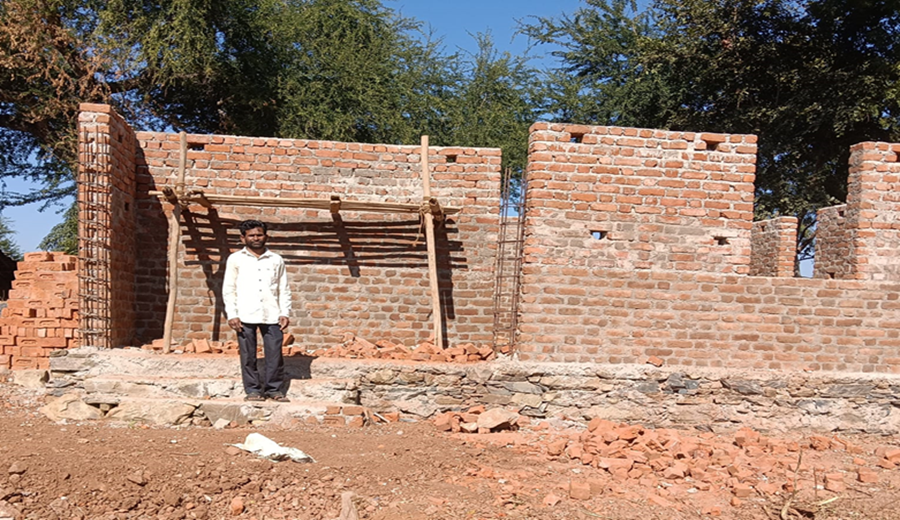
The Anganwadi Centre of Khandora village after the completion of construction work. (Photo Credit: Dhuleshwar Pargi, Community Facilitator, Vaagdhara)
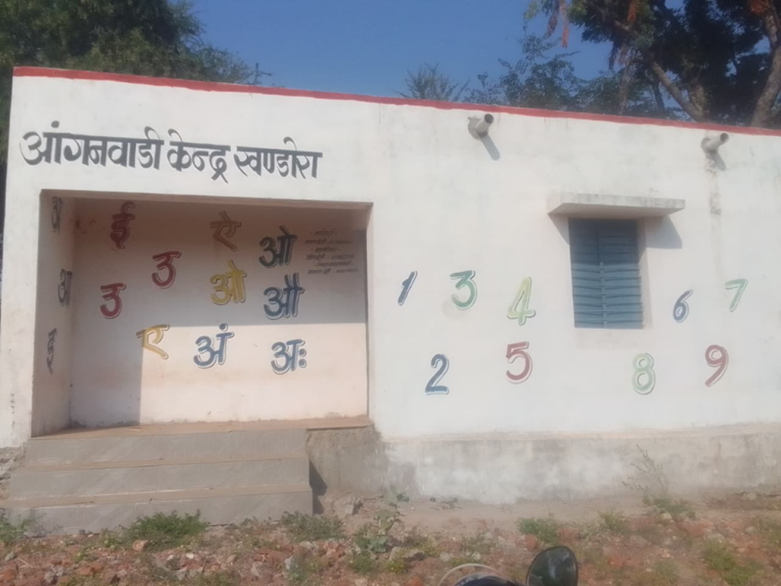
The Anganwadi Centre of Khandora village after the completion of construction work. (Photo Credit: Dhuleshwar Pargi, Community Facilitator, Vaagdhara)
.
Proposals for constructing a proper Anganwadi building had been raised at the panchayat level on several occasions. Each time, however, the issue was deferred under the pretext of budget constraints or administrative hurdles. This went on for so long that waiting became a habit, and the hope for change quietly faded.It was the Krishi evam Adivasi Swaraj Sangathan (Agriculture and Tribal Self-Governance Saghathan) of Anandpuri, formed under VAAGDHARA’s guidance, that finally broke this stagnation. Active across 30 to 35 villages in this tribal belt, the organisation holds at its core the belief that real development can only be born from within the community. When the state of Khandora’s Anganwadi came to its attention, the organisation recognised a deep crack in the children’s right to education and nutrition and knew that crack had to be filled.
.
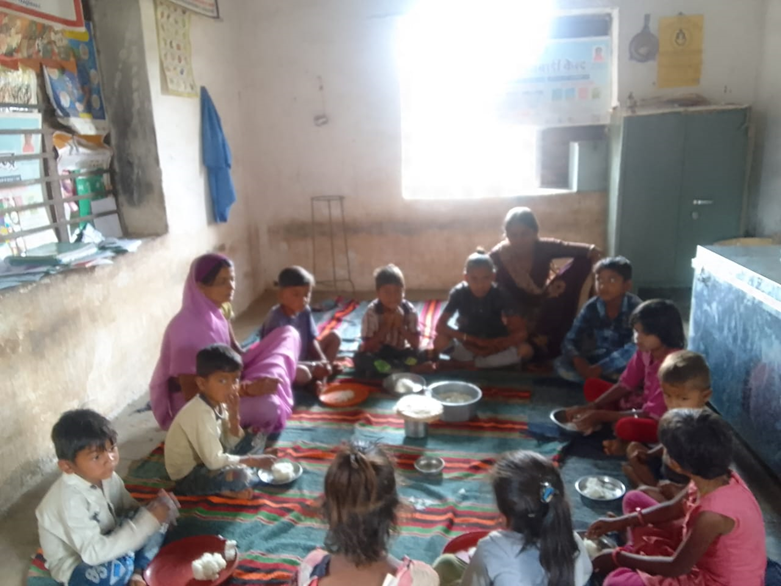
Children at the new Anganwadi — safe, nourished, and thriving in the space their community built for them. (Photo Credit: Dhuleshwar Pargi, Community Facilitator, Vaagdhara)
.
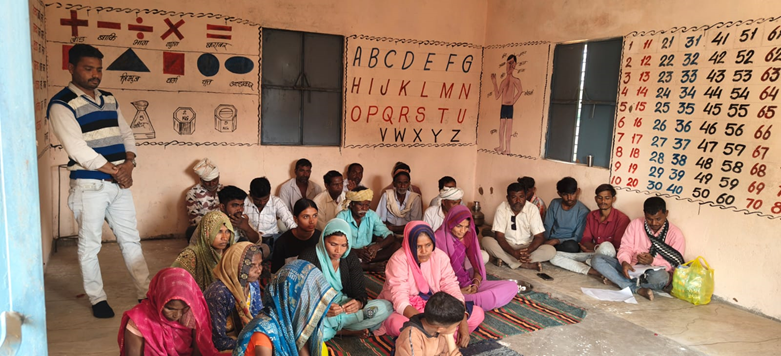
The organisation, along with the Gram Swaraj Samuh of Khandora, took its first collective step. A community meeting was convened where men, women, the young, the elderly, and the Anganwadi workers all came together. As the villagers heard each other’s voices, they realised that this was not just one family’s pain, it was the entire village’s pain. And therefore, its solution too had to come from the entire village. The meeting concluded with a clear resolution: waiting for the government alone was no longer enough. The community had to step forward, articulate its demand in writing, and carry it to the right forum. It was decided that a proposal for the Anganwadi building would be placed before the forthcoming Gram Sabha. All members prepared Mohan Makwana, Dinesh Makwana, Hariram, Ramesh Katara, Ramesh Pargi, Bapulal, Shankarlal Pargi, Vijaypal, Bapulal Pargi, and Champalal — all of them helped the village understand that this was not about a building but about the future of their children.
The most vital role in the Gram Sabha was played by Kanta Kamol, a member of the organisation. She did not frame the demand as merely a request for a facility; she wove it firmly into the fabric of children’s fundamental rights to education and nutrition. She explained how when a child is given a clean, open, and safe environment in which to learn and play, their mental and physical development flourishes. She described how when a pregnant woman receives care in a dignified space, it profoundly impacts both her health and that of her unborn child. Her words were reasoned, her conviction unshakeable. When the proposal was put to vote, it was passed unanimously.
.
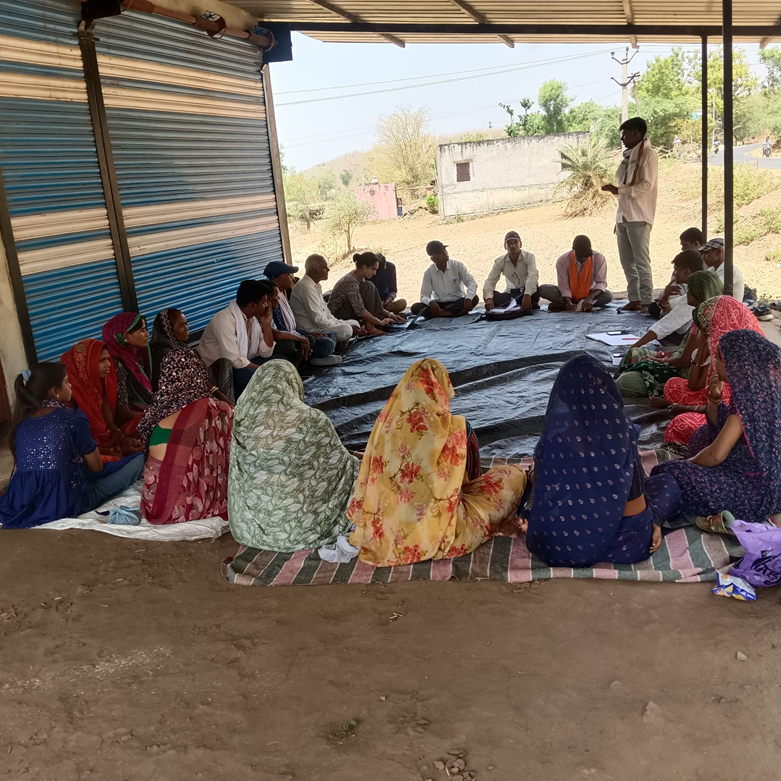
Kanta Kamol and fellow organisation members at the block office — persistent follow-up visits that kept the proposal alive through the administrative process Photo Credit: Dhuleshwar Pargi, Community Facilitator, Vaagdhara)
.
But passing a resolution in the Gram Sabha was only half the battle. The real test was about to begin. The written proposal was formally submitted to the concerned department, and what followed was a long journey of follow-up. Kanta Kamol emerged as the most active force in this process. She visited the block office repeatedly, met with officials, and sought updates on the proposal’s status. Her colleagues Sharmila, Kalpana, Leela, and Hemlata stood steadfastly beside her. This unwavering effort bore fruit in 2024, when formal approval for construction was received. After 20 years of waiting, a new dawn had finally arrived.
Construction commenced at a sanctioned cost of approximately 5,50,000 rupees. The funds were from the government, but the participation that shaped every stone of this building was entirely the village’s own. Someone contributed voluntary labour, someone helped transport materials, and someone took charge of overseeing the construction. As work progressed, a distinct excitement filled the village. Women conversed about how their children would now have a proper place. There was pride in this building because they had willed it into existence.
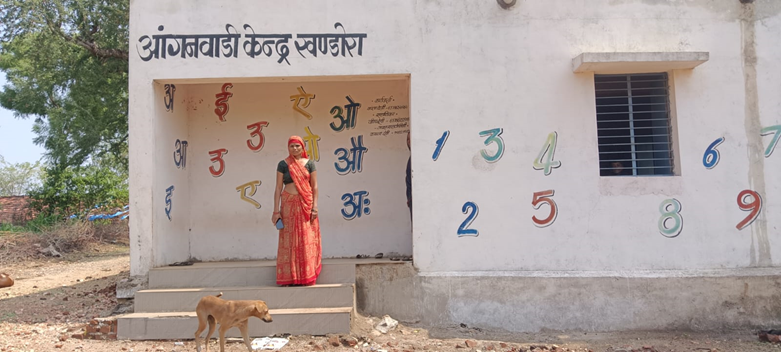
Within a few months, a beautiful, sturdy, and well-appointed building stood complete. The new structure was different from the old rented room in every way. There was ample space for children to sit and play, the rooms were airy and well-lit, sanitation was properly arranged, and the entire premises were safe and child-friendly. Parents who had earlier hesitated to send their children now did so with enthusiasm. Attendance saw a remarkable increase.
.
The completed Anganwadi building in Khandora — bright, spacious, and child-friendly, a world apart from the cramped conditions of the past (Photo Credit: Dhuleshwar Pargi, Community Facilitator, Vaagdhara)
.
Today, 47 boys and 36 girls, 83 children in all, are regularly benefiting from this centre. The Anganwadi workers, who toiled for years under adverse conditions, now carry out their responsibilities in a comfortable and dignified environment. Pregnant and nursing women too have found a safe and clean space where they can freely access health services. This building has truly become a heartfelt aashiyana a home for all of them.
Voices from the Village
“Earlier, there was doubt in my mind can we really make the government do this? But when we all sat together, talked, and brought the proposal to the Gram Sabha, it felt like yes, we can. When the village unites, doors open.” — Dinesh Makwana, Member, Krishi evam Adivasi Swaraj Sangathan
“Whenever I saw the children crammed into that small room, something would ache inside me. As a mother, I know that a child needs open space, light, and air. I knocked on officials’ doors again and again, sometimes I felt disheartened but I did not rest until the building was built. Today, when I see children playing and learning in that new building, I feel that every visit, every ounce of exhaustion, was worth it.” — Kanta Kamol, Community Leader & Member, Krishi evam Adivasi Swaraj Sangathan
“Before, it felt like asking the government for a building was a long and exhausting fight. But when we all went together, it felt like we were a force. Seeing that united strength, even the officials were compelled to listen.” — Ramesh Pargi, Member, Gram Swaraj Samuh
“When the proposal was passed in the Gram Sabha, I felt as though we had won a great battle. This building is not just a structure of stone — it is the symbol of our unity, the proof of our resolve.” — Vijaypal, Resident, Khandora
.
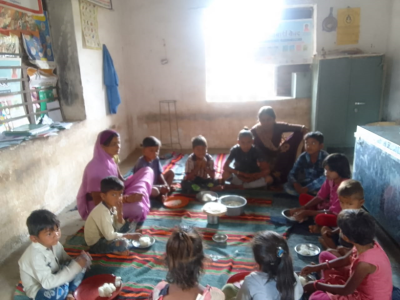
A community meeting in Khandora — men, women, youth, and elders gathering together to frame their collective demand for the Anganwadi building (Photo Credit: Dhuleshwar Pargi, Community Facilitator, Vaagdhara)
.
Throughout this entire journey, the role of women like Kanta Kamol deserves special recognition. They come from a section of society that is all too often excluded from decision-making. Yet when they found the backing of an organisation, they proved that the capacity for leadership does not come from a degree or a designation, it comes from conviction and responsibility.The Krishi evam Adivasi Swaraj Sangathan’s approach has qualities that set it apart.
It views the community not as a victim of problems but as the creator of solutions. It holds monthly meetings where every dimension of community development is discussed openly. It empowers the community so thoroughly in documentation and government processes that people can articulate their own demands. And it does not stop at one issue it works simultaneously on every front, from drinking water to schools, from health to livelihoods.
The story of Khandora’s Anganwadi building reminds us that development is also when a child receives nutritious food, when a mother has access to safe childbirth, and when an Anganwadi worker can carry out her work with pride. These things that seem small are, in truth, the very foundations of a society and when this foundation is strong, every building that stands upon it is strong too.
This Anganwadi building is built of brick and cement, yes but its real strength lies in the countless hands that fought to build it. Khandora has demonstrated that when a community’s will, an organisation’s guidance, and the panchayat’s participation all flow in the same direction, no wall stands too high to be scaled.
*
Click the share button below to email/forward this article. Follow us on Instagram and X and subscribe to our Telegram Channel. Feel free to repost Global Research articles with proper attribution.
Vikas Parashram Meshram is an independent writer, social worker, and researcher associated with rural development. He regularly writes on issues related to tribal communities, rural livelihoods, agriculture, climate change, and social transformation. He is a regular contributor to Asia-Pacific Research.
Global Research is a reader-funded media. We do not accept any funding from corporations or governments. Help us stay afloat. Click the image below to make a one-time or recurring donation.

Related
|