|
The ongoing epidemic of defections among India’s elected representatives, particularly Members of Parliament, is deeply unsettling. In the latest development, six MPs of the Shiv Sena Uddhav Balasaheb Thackeray party have joined the faction led by Eknath Shinde. This group had originally come into being after an earlier split in the parent party. These six MPs constitute exactly two-thirds of the party’s current strength in the Lok Sabha, which allows them to claim their shift as a under the Tenth Schedule of the Constitution, that is, the anti-defection law.
Under this Schedule, a member can be disqualified either for voluntarily resigning from the party or for violating the whip during voting in the House. A constitutional amendment in 2003 made this law stricter still. The earlier “split” provision, under which one-third of a party’s members could break away without facing punishment, was abolished, leaving only the exception intact. Under this provision, if two-thirds of a party’s MLAs or MPs agree to merge with another party, no disqualification proceedings apply to them. Today, splits engineered quite deliberately are being dressed up as mergers, so that the group concerned can slip through the law’s net. The very veracity of such claims has repeatedly come under question, since the Supreme Court has, in an earlier ruling, made clear that a genuine merger must involve not just the legislative group but the parent party itself.
Because the many constitutional questions tied to this issue have remained pending in courts for years on end, Speakers and Chairpersons are readily accepting inflated claims of this sort, and this tendency is only deepening with time. The episode in the Shiv Sena followed close on the heels of a rebellion within the Trinamool Congress. Claiming the backing of twenty out of the Trinamool’s twenty-eight MPs, a group led by four-time MP Kakoli Ghosh Dastidar aligned itself with the BJP-led NDA and has now merged with another party. In April, members of the Aam Aadmi Party in the Rajya Sabha crossed over to the BJP, as a result of which that party’s strength in the Rajya Sabha fell from ten to three. Now three Rajya Sabha members of the Trinamool Sukhendu Sekhar Ray, Sushmita Dev, and Prakash Chik Baraik have also resigned.
In truth, the Tenth Schedule survives today merely on paper, since the Supreme Court has kept deferring crucial rulings year after year. The cumulative effect of this series of defections has been a swelling of the ruling NDA’s numbers in both the Lok Sabha and the Rajya Sabha, and this is not a matter confined to technicalities alone it raises several serious questions. At present, the ruling alliance does not command the two-thirds majority in Parliament needed to pass a constitutional amendment. This high threshold was set precisely so that any major change would require broad political consensus. Circumventing that requirement through such manoeuvres whatever attractive name one gives them amounts to nothing less than an insult to the very spirit of representative democracy.
Defection is hardly a new phenomenon. The country has a long tradition of “Aaya Ram, Gaya Ram” politics. This story began roughly six decades ago and has still not ended. Neither then nor now has there been any principle or ideology behind such moves the real motive has always been greed for power and money. The framers of the Constitution could scarcely have imagined that political leaders would go to such lengths, yet today this is visible in plain sight. Neither the group that switches sides nor those who engineer the switch feel any shame about it.
Over the past decade, Indian politics has taken on a distinctly different character one in which principles and values are set aside in favour of seizing power by whatever means available. The Bharatiya Janata Party had once given the call for a Congress-free India . Once it gained power, efforts to realise that vision began in earnest, and met with considerable success. This success bred confidence, and under that confidence, the line between right and wrong grew increasingly blurred. Morality has never had much place in politics, but in this new phase, almost everything began to seem justifiable. One outcome of this has been the rise of “washing machine” politics a leader facing allegations or even convicted of a crime emerges “clean” the moment he joins the “right” party. The attitude of “whoever is with us is in the right” has paved the way for achieving objectives by any means necessary. Acquiring power and holding on to it have become virtually the sole purpose. This is a dangerous trajectory, and the heaviest cost of it falls on democratic values and ideals.
This political chapter being written today cannot be described merely as an attempt to capture or retain power what is actually at stake is our entire democratic system. The journey that began with the slogan of a “Congress-mukt Bharat” now appears to be moving toward an an opposition-free India The dismantling currently underway of small and regional parties is itself a warning sign. As the English phrase goes, this is “loud and clear” unmistakably visible. To ignore it would be to shirk one’s responsibility toward democracy itself.
For democracy to succeed, the existence of a capable opposition is indispensable. A strong opposition is every bit as necessary as a strong government. When the voice from the opposition benches weakens, the ruling side gains a free hand to act as it pleases this could well be termed an “elected autocracy.” Averting this danger requires alert voters, ones who understand the importance of a capable opposition and who keep a close watch on every such manoeuvre.
Given the present plight of small parties and the ongoing efforts to render them inconsequential, the times ahead look set to grow even harder for democracy. Recent developments only confirm that anti-democratic forces are becoming increasingly active. Not long ago, we witnessed Aam Aadmi Party MPs from Punjab gravitating toward the BJP. After that, following its electoral defeat in Bengal, many Trinamool MLAs and MPs were seen taking a different path. The latest example is the further fracturing of Uddhav Thackeray’s already-divided party. Going by the present situation, there are also signs that Sharad Pawar’s Nationalist Congress Party could meet a similar fate. A minister in Uttar Pradesh has even hinted at having an eye on Akhilesh Yadav’s Samajwadi Party. In Bihar, Nitish Kumar’s Janata Dal United has already seen its strength diminished, and Lalu Prasad Yadav’s party too remains under a hanging sword.
Taken together, all these events point to one single thing a deliberate, organised effort to hollow out the opposition benches. When the opposition weakens, the very mechanism meant to act as a check fails, and it is out of that vacuum that authoritarian tendencies draw their strength.
Having a strong government at the Centre is, in itself, no bad thing, nor is there anything wrong with strong governments in the states. But this strength must not come at the cost of constitutional values. It is precisely the responsibility of a strong government to remain vigilant, on its own accord, about preserving democratic traditions.
After independence, when the Congress government first came to power, the opposition benches in Parliament were nearly empty. Of 489 seats, Congress had won 364. Among the remaining 125 seats, the largest number belonged to the Communist Party of India a mere sixteen seats. The Bharatiya Jana Sangh had won only three. At such a time, the first Prime Minister, Jawaharlal Nehru, told his own party’s MPs that since the opposition was so weak, it fell upon them to keep watch over the government’s functioning in effect, to play the role of the opposition themselves. This statement reveals not only Nehru’s commitment to democratic values but also how deeply he understood that democracy is meaningless without a capable opposition.
Today, however, the picture has reversed entirely. The ruling group is seeking, by whatever means, to weaken its rivals. Operations carried out under names like “Operation Lotus” or “Operation Tiger” are themselves proof of this. If democracy is to keep breathing, such manoeuvres must be resolutely defeated.
The remedy for this lies in sharpening the anti-defection law further. First and foremost, there should be a provision requiring that a member who leaves a party must also relinquish their seat in the House. For an elected representative to switch sides in this manner is nothing less than a betrayal of the trust placed in them by voters. Basic morality dictates that anyone wishing to change parties should first vacate their seat and seek a fresh mandate from the electorate. Why this provision was left out when the original law was framed remains a puzzle. This gap must now be filled. But the question remains who will bring about this change? For those who have the power to do so are themselves the biggest beneficiaries of this very game. Even so, a solution must be found, because what is at stake is nothing less than the survival of our democracy itself.
*
Click the share button below to email/forward this article. Follow us on Instagram and X and subscribe to our Telegram Channel. Feel free to repost Global Research articles with proper attribution.
Vikas Parashram Meshram is an independent writer, social worker, and researcher associated with rural development. He regularly writes on issues related to tribal communities, rural livelihoods, agriculture, climate change, and social transformation. He is a regular contributor to Asia-Pacific Research.
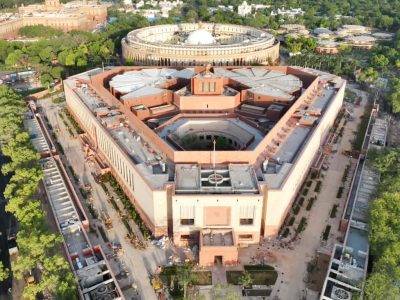
Featured image: Parliament Building, in New Delhi (GODL-India)
Global Research is a reader-funded media. We do not accept any funding from corporations or governments. Help us stay afloat. Click the image below to make a one-time or recurring donation.

Related
|