|
Nestled in the Gagadtalai tehsil of Banswara district, Rajasthan, Hadmat is a predominantly tribal village. Yet this village recently accomplished something that would make even the most prosperous cities and well-resourced places pause and reflect. The people here did not look to any politician for help, nor did they wait for any government scheme — instead, they rolled up their sleeves, collected contributions door to door, and together installed tin shed roofing in their school, providing the children with a safe and organised place to sit and study.
For years, several rooms of the Government Higher Secondary School, Hadmat had fallen into disrepair; walls were cracking, rain seeped through the roof, and children suffered in sweltering heat during the day. Studying in such conditions was itself a kind of ordeal. Everyone could see the problem teachers, parents, villagers yet no concrete initiative had taken shape. Government files moved at their own pace, and the children endured at theirs.
.
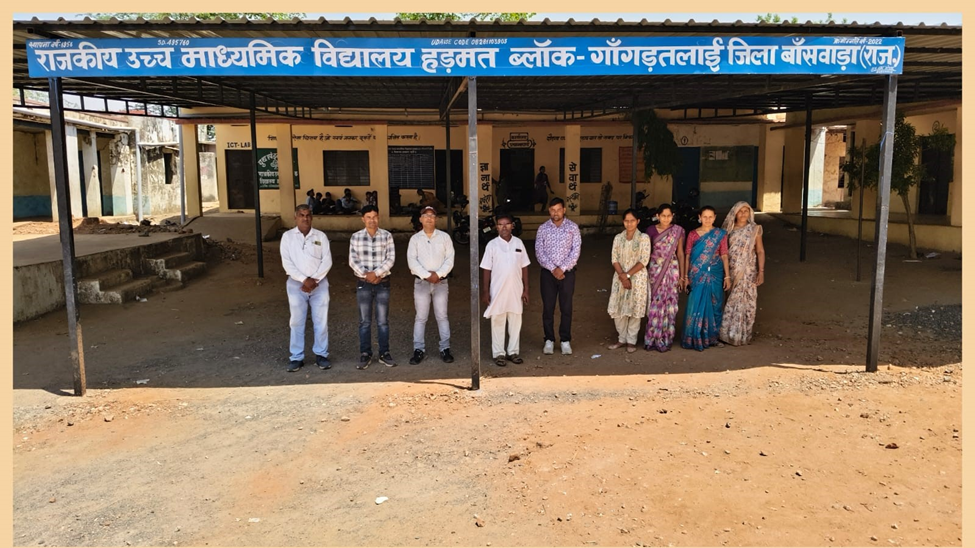
Under the tin roof installed through the contribution of a Bhamashah donor at Government Senior Secondary School, Hadmat, Block Gagadtalai, District Banswara, school teachers with members of the Gram Swaraj Group and the Krushi avm Aadivasi Sagthan (Photo Credit: Vikas Meshram)
.
Against this backdrop, a monthly meeting was held by the Gram Swaraj Samuh, formed under the guidance of Vaagdhara, and Krishi Evam Adivasi Swaraj Sangathan, Gagadtalai. When the issue of children’s attendance and seating arrangements in the school was raised, the depth of the problem came to the fore once again. But this time, the discussion did not end at complaints. The members collectively decided that three sets of tin sheds would be installed in the school and this work would be done by the community on its own, without waiting for any government assistance.
.
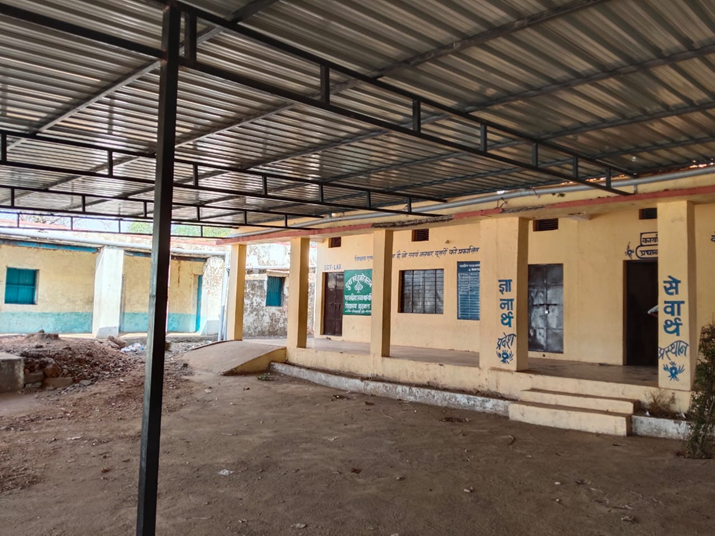
Government Senior Secondary School, Hadmat, Block Gagadtalai, District Banswara — Tin roofing installed through the contribution of a Bhamashah donor (Photo credit: Vikas Meshram)
.
No sooner was the decision made than the work began. Members of the Gram Swaraj Samuh went door to door, informing people about the purpose of this endeavour. They explained that if everyone contributed a little today, tomorrow their children would have a better place to learn. Awareness spread gradually. Then one day, drums were beaten to gather the entire village in one place. Young and old, men and women all came together and stepped forward to contribute according to their individual capacity.
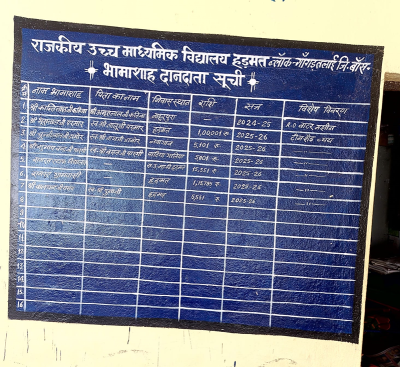
The single most inspiring contribution to this entire effort came from Shri Bhuralal Ji Parmar, a resident of Hadmat itself. He donated an entire one lakh rupees for the tin shed. About this, he said:
“These are the children of the village, our children. If their place of learning is set right, their future will be set right. Money can be earned again, but the time that children lose in a broken environment can never come back.”
Chunnilal Ji Damor came from Navagaon. He was not even a resident of this village yet he arrived with a contribution of five thousand and one rupees. When asked why he had come forward for the school of another village, his answer was simple:
“Education is not the responsibility of just one village. The children who study here will serve the entire society tomorrow. So this is the work of all of us.”
Subhashchandra Ji Pargi, a resident of Patiya Galiya village, also registered his presence in this campaign with a contribution of five thousand and one rupees. He said:
“When the people of a village are doing so much for their own children, it becomes the responsibility of every person to stand alongside them. In such endeavours, one should not think ‘why should I give?’ — rather, one should think ‘why should I not give?'”
All the teachers and staff of Government Higher Secondary School, Hadmat collectively contributed 15,551 rupees, a testament to the belief that those entrusted with a school’s life also bear responsibility for its spirit. Among them, the role of teachers Rajesh Garasia and Parmesh Ji Katija was particularly noteworthy. Their involvement was not limited to financial contribution — they were active and dedicated participants in the entire campaign. Teacher Rajesh Garasia said:
“A teacher’s work is complete only when he not only teaches children but also prepares a better environment for them. If there is no proper place to sit in the school, how will children be able to focus on their studies?”
Teacher Parmesh Ji Katija, sharing the same sentiment, said:
“This school is our responsibility too. When the community came forward with such effort and dedication, how could we teachers stand back?”
Sarpanch Walchand Punaji contributed 5,551 rupees, fulfilling his share in this collective effort. He said:
“When a community is determined to do something, stand with them. What the people of Hadmat have done is a matter of pride for all of us.”
His presence further strengthened the villagers’ conviction that this work was moving in the right direction.
The foundation of this entire initiative was laid by all the villagers together, who collectively raised the substantial sum of 115,795 rupees. This included contributions of every size — someone gave a thousand rupees, someone 500, someone as much as they could. The amount was never judged by its size; every contribution was received with equal respect. For this was the expression of love for the children, of attachment to the village, and of a sense of responsibility. As the village elders have always said:
“When everyone walks together, the path makes itself.”
The people of Hadmat showed exactly that.
The thread that wove this entire process together was Laxman Damor, the community facilitator of Vaagdhara. Working alongside the Gram Swaraj Samuh, he engaged in continuous dialogue, resolved people’s doubts, and kept the momentum alive at every step.
When all the contributions were added together, nearly 247,000 rupees had been collected. With this sum, three sets of tin sheds were installed in the school. Today, the school premises are nothing like what they once were. Children have a safe, well-organized space to sit, and the continuity of learning is maintained.
The greatest achievement of this initiative is not the tin sheds themselves — those are merely an outcome. The real achievement is what was built and strengthened through this entire process: the understanding that solutions to problems come not from outside, but from within. And when a community rises on its own, change arrives.
Hadmat’s experience is not merely one village’s community initiative. It stands as a model for all those villages that still depend on external forces to resolve their own problems. When Bhuralal Ji gave one lakh rupees, when the villagers pooled from their hard-earned wages, when teachers contributed from their own pockets, when the sarpanch stepped forward, when people from other villages also joined what was built was not just a tin shed. It was a reflection of a society that is ready to pay any price for the future of its children. And it is this awareness, this unity, this spirit this is the idea of Swaraj and the greatest capital any society can possess.
*
Click the share button below to email/forward this article. Follow us on Instagram and X and subscribe to our Telegram Channel. Feel free to repost Global Research articles with proper attribution.
Vikas Parashram Meshram is an independent writer, social worker, and researcher associated with rural development. He regularly writes on issues related to tribal communities, rural livelihoods, agriculture, climate change, and social transformation. He is a regular contributor to Asia-Pacific Research.
All images in this article are from the author / featured image: Government Senior Secondary School, Hadmat, Block Gagad Talai, District Banswara — List of ‘Bhamashah’ Donors. (Photo Credit: Vikas Meshram)
Global Research is a reader-funded media. We do not accept any funding from corporations or governments. Help us stay afloat. Click the image below to make a one-time or recurring donation.

Related
|