|
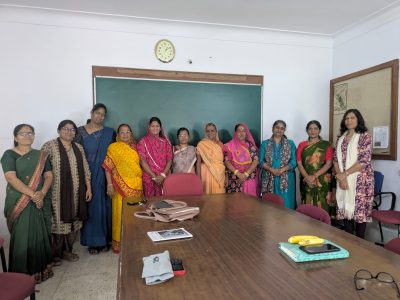
Guddi joined a self-help group in Udaipur to seek livelihood support based on patchwork, later she could progress well enough to start a unit of her own and emerge as an entrepreneur. Om Kunwar could similarly start her own clothes and stitching unit. Nutan has done even better—she came looking for work but now provides work to over 30 women in her croatia based enterprise.
This journey started about two decades back when Seva Mandir, a leading voluntary organization, started self-help groups based on small savings and part-time livelihood opportunities based on patch work and related skills. The work opportunities could increase with the setting up of Sadhna, a sister organization of Seva Mandir.
Since then these SHGs have increased to about 150, with about 3000 members joining them. As Hemlata, who has helped with mobilization work says, while in early stage members were saving Rs. 30 to 50 per month, this capacity has now increased to Rs. 300 to 500, which has also enabled the SHGs to extend higher loans, helping to set up new small enterprises as well as contribute to the higher education of children. Besides, as several members said, the great thing about the smaller interest payments or other small contributions made to SHGs for their progress is that ultimately the money remains within your group.
With increasing strength, this SHG movement has been able to reach out to more neglected parts of the city. Chand Bai who has made an important contribution to the mobilization of Muslim women in particular said that after some initial misunderstanding the impression of neglect could be cleared and women SHG groups could progress here with unity.
Apart from savings and livelihood support, SHGs have also contributed to more independent and useful role in wider social affairs. Komal was earlier known to remain aloof, but with increasing social participation she found the strength on a day of very heavy rains and storm to rescue small children from a high risk situation. Her brave action was widely praised and this encouraged her to further widen her social role and responsibilities.
With growing unity these women have been intervening in several difficult situations to protect women from violence. Hemlata mentioned a very difficult situation in which a woman was being beaten up very badly. She intervened to save this woman. When the case went to the police station at first she was questioned as to why she was intervening in the family matter repeatedly. However when Hemlata mentioned the name of Seva Mandir the police respected her and the family of the woman who had suffered violence came under pressure to end this violence. Later the problems in the family could end and the woman along with her children could progress well.
This is only one example of several cases of violence that could be resolved in a satisfactory way with the intervention of SHG members. In fact as Usha Kunwar, a leader of these group says based on her experience, once women in a slum or other settlement are united and engaging in community issues in a visible way, the cases of such injustice and violence tend to come down on their own. Now women are also in a better position to guide any women in trouble towards counselling centers and mahila thana (police station which takes up cases only regarding violence again women).
Vimla Chauhan, who coordinates the urban SHG initiative of Seva Mandir, asserts that the growing social role of SHG members has helped to resolve several civic problems in slums and other settlements. In this way the benefits of SHG mobilization extend much beyond the membership of SHGs. At some places water scarcity could reduce and waste collection could improve as a result of such efforts. In some places where liquor vends were proving to be an increasing nuisance, these could be moved to some distance away from residential area. Some problems of students in schools could be sorted out. Access to government schemes could improve and in particular help could be provided to disability affected persons and elderly persons and widows for accessing pension schemes of the government.
With increasing membership and new groups being formed, several groups were first united under clusters and these clusters in turn led to the formation of a federation. The Mewar Mahila Shakti Federation (translated as Federation for the Empowerment of women of Mewar) now has a wide recognition in the Mewar region, with Udaipur being its most important city, and beyond.
With membership growth the Federation has also contributed to improving social and entrepreneurial capacity with more training opportunities. Here as well in ordinary meetings social equality and non-discrimination aspects of mobilization are emphasized the most, so that members can overcome any such limitations and can also then contribute to advancing social equality and ending discrimination at various levels. Sometimes differences of opinion also emerge but generally it is possible to resolve these in friendly ways with more discussion and dialogue.
*
Click the share button below to email/forward this article. Follow us on Instagram and X and subscribe to our Telegram Channel. Feel free to repost Global Research articles with proper attribution.
Bharat Dogra is Honorary Convener, Campaign to Save Earth Now. His recent books include Protecting Earth for Children and Navjeevan. His website is bharatdogra.in and his YouTube channel is Bharat Dogra Save Earth Campaign. He is a regular contributor to Asia-Pacific Research.
Featured image is from the author
Global Research is a reader-funded media. We do not accept any funding from corporations or governments. Help us stay afloat. Click the image below to make a one-time or recurring donation.

Related
|