

In some developed countries that boast of high productivity agriculture and producing surplus food for exports, this has been achieved at three very heavy costs. Firstly, small farmers have been increasingly driven out of production while big business interests are taking over. Secondly, the kind of farming based on protecting soil and environment is increasingly being neglected now. Thirdly, due to overuse of chemical fertilizers, pesticides and weedicides, there are increasing concerns regarding health hazards of food produced under this system to such an extent that even much poorer countries facing food shortages have been reluctant to accept such food.
While there is increasing recognition that such trends have been harmful for these rich countries, at the same time such serious mistakes can prove simply disastrous in a country like India where farming remains a much more important source of livelihoods and achieving self-reliance in producing safe and healthy food is of much higher importance. In India and several other countries it is of the greatest importance to create farming systems which can ensure sustainable livelihoods of small farmers, provide healthy and safe food while also protecting soil, water sources and environment.
Among several efforts made in this direction, one initiated by SRIJAN social organization has been giving particularly promising results in many villages. Having visited about 25 of these villages, I have tried below to bring out 20 important aspects of these efforts that taken together can be said constitute a model for the progress of small farmers in India and can be also beneficial for the farming communities of several other countries placed in somewhat similar conditions.
- One important aspect of this work is that it has moved steadily in the direction of promoting natural farming. SRIJAN takes forward this work in very creative and democratic ways, not imposing this on any farmer, but introducing it and its benefits to farmers, while at the same time facilitating its adoption in numerous ways and providing the example of small farmers who made a success of this in the middle of all the difficulties, in conditions in which normal farmers live and work.
- One such way is to facilitate some farmers to set up natural farming promotion centers (sometimes called bio-resource centers) within villages which prepare organic fertilizer and pest repellants based on cow dung and urine, leaves of some local plants, some jaggery etc. Thus some farmers who cannot produce their own organic inputs can purchase from here at a low price, much lower than that of commercially sold chemical fertilizers and pesticides.
- Some of these centers also keep several implements and tools for farm and crop processing work so that farmers can hire these at low cost when needed, instead of buying these at a high price. This can also help to avoid heavy machinery not suitable for small farmers.
- This model has given very high importance to water conservation and in many villages the work in fact starts with water conservation efforts which are carefully selected in close consultation with local communities so that new work as well as repair and restoration works can be selected to bring good benefits at a low cost.
- Another very sound strategy followed by SRIJAN is to integrate various development works closely with each other. Many villages have tanks that have silted up heavily over the years. Cleaning and de-silting them helps to increase their rainwater-retaining capacity and making available more water to villagers. At the same time when huge mounds of highly fertile accumulated silt are brought out from tanks, these can be carried away by farmers to deposit in their fields so that natural fertility is improved to increase the possibility of success of natural farming. Similarly water conservation can be improved by digging ditches of certain requirements (called dohas) in natural rainwater drainage channels, making it possible for more rainwater to be retained, and here again the dug-out accumulated fertile silt can be deposited in fields or used to prepare field bunds.
- Sometimes with the deposition of fertile silt and availability of more water, even land which was completely unproductive earlier can start giving good yield. There are several villages where on this basis cultivation land has increased in a big way in a few years.
- The seventh feature of the SRIJAN model is that it is based not just on approaching individual farmers but even more on mobilizing communities for various important tasks such as those relating to de-silting and water conservation. Strengthening of communities leads to the continuing of the good work even after the project is over and responsibility can be taken over by community organizations created for this purpose.
- SRIJAN has also involved other voluntary organizations like the ABSSS and Arunodaya in these mobilization and implementation efforts in a big way.
- SRIJAN makes good efforts to coordinate its development work with the development work of the government administration, while carefully retaining its priorities and core values. 10. The tenth aspect of the SRIJAN model is that within various communities SRIJAN places more emphasis on weaker sections including dalit, tribal and other backward or poorer communities.
- 10.Among these communities also there is more emphasis on women. The response of several women farmers has been extremely encouraging and creative.
- 11.This model has helped in improving self-reliance of rural communities in various ways, particularly in terms of reducing dependence on agro-chemicals.
- 12.A related aspect is that the farming expenses of farmers have reduced significantly.
- 13.With reducing expenses and increased self-reliance, despite the difficulties in moving from chemical-intensive farming to natural farming, many farmers are able to manage the change, sometimes even improving yield while avoiding chemical fertilizers and pesticides. I have spoken to several farmers who have taken up natural farming under these initiatives on all or part of their farmland. Some of them stated clearly that they are already getting higher yield. Some said that the initial period may be difficult, but after some time the yield obtained earlier with chemical fertilizers is regained. Some said that even if initially there is somewhat reduced yield, on the basis of higher quality of produce they can make up the loss of income. Some farmers tend to switch over to natural farming over a period of some years, experimenting and taking notes all the time. However I did not meet any farmer who criticized natural farming, or regretted his efforts in this direction. All the farmers stated that costs of farming are reduced significantly with natural farming, and this is very important for small farmers.
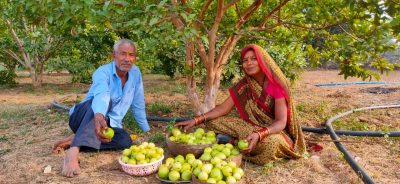
- 14.Another initiative of SRIJAN is that farmers are encouraged to devote a part of their farmland to grow small orchards of fruit trees and multi-layer vegetable gardens using natural farming methods. Even on such small orchards and gardens, these farmers are often able to grow about 20 kinds of vegetables and three-four types of fruits in a year (although among fruits the emphasis has been more on guavas). This helps to bring in some cash income throughout the year.
- 15.These gardens also increase the nutrition of the family in a big way with vegetables and fruits becoming available at home in plenty like never before. The health quality of food grown with natural farming methods improves significantly, while hazards associated with chemical pesticides in particular are reduced.
- 16.This model of farming is much more creative and farmers are happier and more enthusiastic working in this way. The vegetable gardens and fruit orchards in particular bring a lot of joy in the course of the growth of various plants and trees. The experimentation and learning tendencies have increased.
- 17.This brings us to another important part of these efforts—the extent to which these have increased hope among farmers, including women. This is a far cry from the stories of debts, depression and tensions we hear from several wider areas.
- 18.While this model has created positive results at an early stage, these are likely to increase further with the passage of time as results of water and soil conservation, better pollination and increasing biodiversity manifest themselves.
- 19.In addition these efforts also contribute much in terms of climate response, both mitigation and adaptation aspects. If additional funds are given to these farmers due to this contribution, then the success of these efforts will be even higher.
- 20.At some places farmer producer groups of women and companies based on them are being formed so that they can take up processing and value addition work, resulting in higher income for farmers.
Taking together, all these 20 aspects create a very interesting and promising model which can provide much hope to small farmers of India and several other countries.
*
Click the share button below to email/forward this article. Follow us on Instagram and X and subscribe to our Telegram Channel. Feel free to repost Global Research articles with proper attribution.
Bharat Dogra is Honorary Convener, Campaign to Save Earth Now. His recent books include Planet in Peril, Protecting Earth for Children, A Day in 2071 and India’s Quest for Sustainable Farming and Healthy Food. He is a regular contributor to Asia-Pacific Research.
Featured image is from the author
Global Research is a reader-funded media. We do not accept any funding from corporations or governments. Help us stay afloat. Click the image below to make a one-time or recurring donation.
