

Whenever a bill comes up for vote in India’s Parliament, what lies behind it is not merely a piece of legislation, it carries the weight of decades of history, the hopes of countless people and women, and the tangled calculations of political parties.
On April 16, the central government had tabled the Women’s Reservation Amendment Bill that is, the 131st Constitutional Amendment Bill 2026 along with the Delimitation Bill 2026 and the Union Territory Laws Amendment Bill 2026 in the Lok Sabha. But ultimately, the bill was defeated in the vote. The bill received 298 votes in favour and 230 against, and the government could not secure the two-thirds majority required for a constitutional amendment. Since the NDA’s total strength in the Lok Sabha stood at 293, it was never possible for the bill to pass without the support of the opposition. This defeat is not new. The pain of women’s reservation is more than three-decades old. The very first women’s reservation bill was introduced in Parliament on September 12, 1996, by the HD Deve Gowda government, in the form of the 81st Constitutional Amendment Bill. However, due to the failure to achieve political consensus and opposition from within the coalition government itself, it was referred to a Joint Parliamentary Committee, and was lapsed with the dissolution of the 11th Lok Sabha. Every government that followed took up the issue, but each time it sank in the mud of political calculations.
In 2010, the UPA government passed the Women’s Reservation Bill in the Rajya Sabha. The Congress had deliberately chosen to begin with the Rajya Sabha, knowing well that there was a split within its own UPA coalition in the Lok Sabha. When Sharad Yadav mockingly referred to “park-cut women” during the parliamentary debate, it symbolized the resistance within the UPA itself. Congress knew it lacked the numbers in the Lok Sabha, so it kept the bill alive by getting it passed in the Rajya Sabha. For the next ten years Congress remained in power, yet it never mustered the courage to bring the bill to the Lok Sabha. Then in 2023, the Nari Shakti Vandan Adhiniyam that is, the 106th Constitutional Amendment got the Women’s Reservation Bill passed with near-unanimous support. Only two members of Parliament voted against it at the time. The entire Parliament stood united. But that law carried a crucial condition: the reservation would come into force only after delimitation. The women’s reservation was to take effect after the delimitation that would follow the 2026 census, and a fresh census would first have to be conducted. In other words, the law was passed, but to bring it into effect, the key of delimitation was needed. And that very key became the centerpiece of the 2026 bill.
The government’s objective through this bill was to redraw constituencies on the basis of the 2011 census, increasing the number of Lok Sabha seats from the current 543 to 816, and to reserve 33 percent of those seats for women, so that this reservation would come into effect from the 2029 elections. But this delimitation, that is the redrawing of parliamentary constituencies, became a matter of concern particularly for the southern Indian states. The southern states have demanded that the basis for delimitation should not be population alone, but should also include the states’ economic performance. Tamil Nadu, Kerala, Karnataka, and Andhra Pradesh had consciously controlled their population growth and prioritized education, health, and economic development. Their human development indices are, in many respects, better than those of states in northern India. However, if delimitation is carried out on the basis of population, the representation of these states in Parliament will shrink while the share of northern Indian states will grow.
The southern states had previously expressed similar discontent regarding the conditions set by the Finance Commission where their better performance did not translate into proportionate benefit. Therefore, the opposition from southern Indian leaders and parties to this bill was not a resistance to women’s reservation per se, but a resistance to the potential reduction of their representation through delimitation.
The 2023 constitutional amendment had clearly stated that women’s reservation would come into effect only after a census and delimitation. The government now wanted to expedite this process, and had decided to carry out delimitation based on the 2011 census. But the opposition asked: the 2011 census is now 15 years old, what was the harm in waiting for a fresh census?
Furthermore, the previous delimitation process had taken about eight years, making it extremely uncertain whether new delimitation could be completed before 2029. Congress and the INDIA alliance argued that 33 percent reservation for women should be granted immediately on the existing 543 seats, without waiting for delimitation. But this was not practically feasible because the 2023 law itself had stipulated the condition of delimitation and the opposition parties themselves had voted for it at the time. Now those same parties were saying that delimitation was unacceptable — the contradiction was plain for all to see. They ought to have honestly proposed sitting with the government to amend the conditions of the law, but that did not happen.
As soon as the bill fell, NDA women members of Parliament staged a protest in the parliamentary premises, and the BJP began labelling Congress and INDIA alliance members as anti-women. Looking at all this, one could tell that posters had been printed even before the bill was defeated, that plans for a national agitation had already been laid. In other words, the BJP had come prepared to use this bill as a political weapon. It was purely a political arrow shot to corner the opposition by capitalizing on the sentiment of Nari Shakti.
When Prime Minister Modi addressed the nation, he described it as an effort to deliver rights that had been pending for 40 years. But in making this statement, one question remains unanswered: in the last 11 years, when the BJP enjoyed a sweeping majority, why was no sincere effort made to build consensus?
The real question is: who truly wants women’s reservation? Broadly speaking, 86 percent of Lok Sabha members are men, and in state assemblies this figure is around 90 percent. If one-third of seats were reserved, many of these male members’ constituencies would fall into the women’s quota. Each constituency has been built over years of labour and crores of rupees spent. Who would willingly give that up? This has been the root cause of the stalling since 1996 not the absence of the will to pass the law, but the fear of losing one’s own constituency. This truth holds equally for the ruling and the opposition parties.
On the other side, the 73rd and 74th Constitutional Amendments of 1993 reserved a minimum of 33 percent seats for women in panchayati raj institutions. Thereafter, more than 20 states and union territories, including Bihar, Uttarakhand, and Maharashtra, raised this reservation directly to 50 percent. Today, more than 14.5 lakh women serve as elected representatives in local self-government bodies, accounting for approximately 46 percent of total members. It is true that some of these women still serve as a façade for the political ambitions of their husbands, brothers, or sons. But a far larger number are those women who are not merely active but are demonstrating their competence in administration and decision-making. A second generation is now entering politics the gram sabha member wants to rise to the district level, the municipal councillor wants to become an MLA. The aspirations of these women are becoming the foundation of billions of votes. However, the picture in Parliament and state assemblies remains dismal. In the 18th Lok Sabha, only 75 out of 543 members are women, barely 14 percent. In the Rajya Sabha, around 39 women members, that is 17 percent. And if we count all Lok Sabha and state assembly members across the country combined, out of 4,666 MPs and MLAs, only 464 a mere 10 percent are women. This imbalance is so deep that it cannot be corrected without political will in Parliament.
In all of this, the most important issue is dialogue. When the Nari Shakti Vandan Adhiniyam was passed in 2023, there was near unanimity in Parliament the same atmosphere could have been created in 2026 as well. The Prime Minister ought to have invited the Leader of the Opposition, formed an all-party committee, and openly discussed all the concerns, delimitation, a quota-within-quota for OBC women, and the fears of the southern states with an open mind. But this did not happen. Neither did the ruling party engage in dialogue, nor did the opposition put forward a sincere alternative proposal. This bill went exactly the same way as the three farm laws did in 2020; brought in with inadequate consultation, imposed for political reasons, and ultimately abandoned.
India’s politics has repeatedly betrayed Nari Shakti over the last three decades. But now, women voters are more aware, their political aspirations are alive, and they can recognize who truly delivers them justice and who merely uses their name for electoral purposes. The question of women’s reservation is no longer merely a matter of parliamentary numbers; it has become a question of social justice and political credibility. Until both the ruling side and the opposition are willing to rise above their own self-interest and sit together, this dream will remain unfulfilled and the price will continue to be paid by half the country’s population.
*
Click the share button below to email/forward this article. Follow us on Instagram and X and subscribe to our Telegram Channel. Feel free to repost Global Research articles with proper attribution.
Vikas Parashram Meshram is an independent writer, social worker, and researcher associated with rural development. He regularly writes on issues related to tribal communities, rural livelihoods, agriculture, climate change, and social transformation. He is a regular contributor to Asia-Pacific Research.
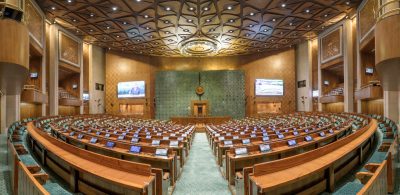
Featured image: Lok Sabha Chamber at the new Parliament building (GODL-India)
Global Research is a reader-funded media. We do not accept any funding from corporations or governments. Help us stay afloat. Click the image below to make a one-time or recurring donation.
