

India has a rich heritage of oilseed farming, processing and edible oils of high nutrition and even medicinal value. While the leading oilseeds are mustard, groundnut, sesame and coconut, there are a significant number of more local oilseeds with their special nutrition and medicinal benefits. This can provide sustainable livelihoods for hundreds of millions of farmers and healthy food for an even larger number of consumers and India can emerge as the world leader in the supply of healthy edible oils. This should be taken forward on the basis of natural farming based growing of oilseeds and hence the supply of edible oils can be both very healthy and climate resilient. Traditional rural processing technology emphasizes wood-based extraction which is much more nutritious and healthy, and some modifications to increase its efficiency while retaining nutrition value can be made. Traditionally India has a vast reservoir of skills for growing as well as processing oilseeds.
Unfortunately despite such great potential things have gone terribly wrong, local livelihoods are in crisis, dependence on imports is increasing, availability of healthy edible oils has been becoming more difficult.
To find the way out of these problems some good initiatives for local processing of oilseeds can play a helpful role. An important contribution of local processing is that the important by-product of oil extraction in the form of oilcakes can remain within the village increasing greatly the nutrition available for farm and dairy animals and also improving the economics of oilseeds cultivation.
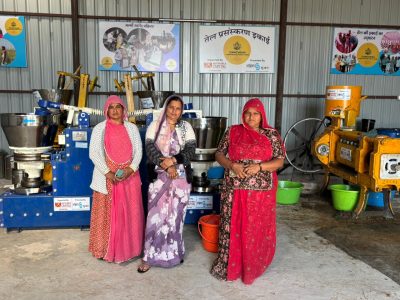
In this context a new farmer-producer based company recently started in Karauli district of Rajasthan has emerged as an exciting possibility. This company is owned by women farmers of the area, particularly concentrated in Mandarayal and Sapotra blocks but also increasingly in Karauli block. The processing plant established close to Mandrayal in a rural area is attracting a lot of attention already at an early stage.
.

.
This initiative has received support from SRIJAN voluntary organization and in fact has grown out of earlier efforts of the organization to promote natural farming among small farmers of the region most of whom also grow mustard crop to a lesser or greater extent in their annual crop cycle. It was in the course of wider livelihood promotion activities that the idea of a farmer owned company came up as a means of improving the sustainable livelihood prospects of farmers. As most of this work has involved partnership with women farmers, the processing initiative has also involved mainly women farmers although of course it gets the support of the entire communities. As this work has grown out of the spread of natural farming practices, this ensures that the company is protective towards environment and is climate resilient. It has no polluting technologies and its ability to obtain raw material from close to processing units and supply oilcakes close to their place of use means that it saves on transport related environmental costs as well. At the same time as the mustard seeds used here are based on natural farming, this makes available healthier edible oil for people as well as healthier oilcake for farm and dairy animals.
As most farmers from whom mustard is being procured are in effect supplying to their own company, this means that not only are the manipulations like short-weighing and unfair deductions completely avoided, but in addition any profits the company makes will be shared with them. At present the company has over 2000 women farmers as shareholders, and their number is set to increase.
Another big relief for farmers is that they are selling to someone they trust and their payment will be received very promptly.
A frequent situation in the market is that at the time of harvesting the produce sells at a lower price and later the price goes up. Assume that the harvest season price is 100 rupees but this can go up to rupees 120 some time later. This hike generally goes to traders. However in a farmer owned company the profit ultimately comes back to farmers.
While selling the bulk of her mustard crop, a farmer generally keeps a certain amount of mustard seeds in the family for year round use at home. Now that farmers have their own company, they can locally process it here to ensure that they get better quality oil and in addition can also retain the oilcake obtained as a by-product in the course of the processing for their farm and dairy animals.
There is a lot of enthusiasm in villages like Shyampur where there is a significant number of women shareholders, and when I spoke to them recently at a group meeting in the village they said that this effort should progress very well. Even in a village like Garhi where the women I spoke to had very less land and hence can supply only very low quantities of mustard, there was a lot of goodwill for this effort.
An important aspect of this initiative is that in many villages production of mustard (and other crops) using natural farming methods could only succeed because of the various development initiatives of SRIJAN, particularly its water conservation efforts. In Shyampur, for example, nearly 18 new water sources have been created while nearly 14 have been renovated. An ancient big water tank has been de-silted and the fertile silt obtained from here when deposited in farms could increase their natural fertility significantly. Most of the farmland here was brought under cultivation only due to these water resources. The drinking water supply for people and animals has also been improved significantly. While this has a big impact on improving daily life, Anita of tis village emphasized that this has also released them for productive work on farms while earlier their entire days was centered around somehow fetching water from a distance.
In Garhi village it is deeply touching to see how a woman Kenti Devi from a marginal farmer household is courageously working to improve her family’s economic prospects even though her husband after working in mines for a long time has been affected by a dust-related disease. She has worked very hard to bring a rocky piece of land near her home under cultivation growing a diversity of vegetables, fruits and other crops including wheat. With the help of SRIJAN she runs a bio-resource center spreading improved methods of preparing organic manure and keeping away pests.
It is the people of such villages with well-established relationships of trust which can become a big source of strength for the Dang Vikas initiative.
Villagers also hope that later smaller processing units can be established inside or even closer to their villages under this initiative. The effort should try to involve the traditional kolhu oil extractors and some communities have been known for their special skills associated with such processing.
From these villages I went to the main processing unit near Mandrayal (Dang Vikas Farmer Producer Company) where three women from the management committee Rani, Pooja and Priyanka had come to meet me. They spoke in very enthusiastic terms regarding the high hopes women in their villages have from this effort. They and the team leader from SRIJAN Bhavani Singh also discussed possibilities of some new additions like a small plant for making cattle feed also utilizing the oilcakes available here, and the efforts for grading farm produce to enable farmers to get better price for their produce.
The spirit of working together for the new effort with enthusiasm was well captured when our conservation was interrupted by a sudden need for carrying several chairs and some rather heavy tables from one corner of the unit to another for safer storage. Instead of waiting for any workers, the team leader and management committee members immediately started doing the heavy work themselves and finished it in a short time. With such a spirit of working together for a good cause, this basically well-conceived effort which meets important needs can hopefully succeed in showing the way forward for the kind of farmer owned processing of farm produce the country needs. To accomplish this, the effort must remain close to core values of protecting welfare of farmers as well as health and environment concerns. It should be taken forward in thoughtful and innovative ways, and must have a good understanding of the direction in which the food processing sector in general and the oilseed processing sector in particular must proceed.
*
Click the share button below to email/forward this article. Follow us on Instagram and X and subscribe to our Telegram Channel. Feel free to repost Global Research articles with proper attribution.
Bharat Dogra is Honorary Convener, Campaign to Save Earth Now. His recent books include India’s Quest for Sustainable Farming and Healthy Food, Man over Machine, A Day in 2071 and Planet in Peril. He is a regular contributor to Asia-Pacific Research.
All images in this article are from the author
Global Research is a reader-funded media. We do not accept any funding from corporations or governments. Help us stay afloat. Click the image below to make a one-time or recurring donation.
