

Laws are made, policies are framed, and the direction of nations is decided all within the chambers of parliament. Yet in those very halls, where the destiny of the world is determined, the presence of half of humanity women remains pitifully thin. When democracy is celebrated, the language of equality is spoken with great passion, but a glance at the composition of the world’s parliaments makes that language ring hollow. Women’s representation is growing, this is true; but the pace of change is so sluggish that it is difficult to say when genuine equality will ever be achieved.
The Inter-Parliamentary Union (IPU) recently published its report Women in Parliament 2025. According to it, as of 1 January 2026, the proportion of women in the world’s parliaments has reached 27.5 per cent. This figure sounds encouraging, but the reality is that compared to 2025, this is an increase of only 0.3 per cent. For the past two years, this growth has virtually stalled, and it is being regarded as the most sluggish progress since 2017. Numerical representation alone is not the only criterion. The position of women in key posts such as parliamentary speakerships has weakened even further. At the start of 2026, only 19.9 per cent that is, 54 of the world’s parliamentary speakers are women. A year earlier, that figure was 23.7 per cent. Thus, on one hand, the rhetoric of progress continues; on the other, leadership positions keep slipping this contradiction is profound.
Of the 75 new parliamentary speakers elected or appointed across the world in 2025, only 12 that is, 16 per cent were women. Looking at these numbers, one is compelled to ask: is the world truly changing? Compared to us, North and South America show relatively better parliamentary representation of women. In the 13 countries that held elections in 2025, women accounted for 36.1 per cent of the representatives elected across the 20 parliamentary chambers. As of 1 January 2026, the proportion of women members across parliaments of the entire Americas region stands at 35.6 per cent. In four countries — Bolivia, Cuba, Nicaragua, and Mexico women now equal or outnumber men in parliament. Rwanda, Andorra, and the United Arab Emirates have also crossed this threshold. Among the 2025 elections, Kyrgyzstan recorded the greatest advance, with women’s representation rising by 12.9 percentage points. Saint Vincent saw an increase of 12.3 per cent, and the upper house of Saint Lucia recorded a rise of 9.1 per cent.
Australia made history in 2025. In the 150-member parliament, 69 women were elected, taking women’s share to 46 per cent the highest ever recorded. The Czech Republic also presented an encouraging picture, with the number of women in the 200-member lower house rising from 50 to 67. Ecuador’s National Assembly also reached 45 per cent women’s representation, the highest in that country’s history. For Japan too, 2025 proved to be a landmark year the country got its first woman Prime Minister, and following the July elections, women’s representation in the upper house of parliament reached a record 29.4 per cent.
One of the key findings of the report is that where reservation or quota systems exist for women, representation is considerably higher. In parliaments where quotas were in force, an average of 30.9 per cent women were elected, compared to only 23.3 per cent where no such system existed. These figures make it abundantly clear that without institutional support, the dream of equality remains only a dream. The situation is most dismal in the Middle East and North Africa, where on average only 16.2 per cent of seats are held by women. In the lower or sole chamber of Oman, Tuvalu, and Yemen, there is not a single woman parliamentarian. Is this not a mockery of democracy?
The absence of representation is not the only problem. The report has highlighted that women who do enter politics are confronted with violence, humiliation, and threats this is the ground reality. A study in the Asia-Pacific region found that 76 per cent of women parliamentarians faced psychological or mental violence. In the survey, 76 per cent of women parliamentarians stated they had experienced some form of violence, while among male parliamentarians the figure was 68 per cent. These threats exist both online and in the physical world. Experts are of the view that this atmosphere discourages many women from even contesting elections. Some countries, however, have stepped forward to combat this problem. The Election Commission of the Philippines took action against male candidates who made derogatory remarks about women candidates. Colombia’s parliament enacted a standalone law to prevent violence against women in politics and to punish the perpetrators.
When looking at the global situation, a turn toward India becomes unavoidable. In the Human Development Index (HDI) released by the United Nations, India has been placed at 134th position out of 193 countries, with a score of 0.644, which places India among countries of medium human development. Switzerland tops the list with a score of 0.967. Compared to the previous index, India has slipped two places. From a livelihood perspective, on the positive side, since 1990 India has added 9.1years to life expectancy at birth, expected years of schooling have risen by 4.6, and the mean years of actual schooling have increased by 3.8. Per capita national income has also risen from 6,590 dollars to 6,951 dollars. However, the Gender Inequality Index (GII) reveals how unequal this development has been for women.
In the report The Paths to Equal by UNDP and UN Women, India scored 0.52 on the Women’s Empowerment Index (WEI) and 0.56 on the Global Gender Parity Index (GGPI). In both indices, India’s position is among the laggard countries. Pakistan, Nepal, and Sri Lanka find the mselves in the same situation. These indices make India’s women’s situation plain. In 2023, women’s representation in parliament was a mere 14.72 per cent, whereas in local self-governing bodies it was 44.4 per cent. This means women lead at the district level, but their voice at the national level remains faint. A woman occupying the office of President is certainly a positive signal, but a single position alone cannot bring about equality.
In the field of education, in 2022 only 24.9 per cent of women had received secondary or higher education, compared to 38.6 per cent of men. During the decade from 2012 to 2022, only 15.9 per cent of women held managerial positions. The labour force participation of married women with young children is only 27.1 per cent. Moreover, between 2012 and 2022, 43.53 per cent of young girls were deprived of education, employment, or training a figure that is deeply heart-wrenching.
At the global level, the proportion of women willing to work but unable to find opportunity stands at 15 per cent, compared to 10.5 per cent for men. This gap is a reflection of the structural bias that operates against women. The UNDP report Breaking the Gridlock notes that after the Covid pandemic, global human development rebounded and reached a record high in 2023.However, this development is not equal for all. Unprecedented progress has been made in wealthy countries, while half of the world’s most fragile nations remain below pre Covid levels.
Switzerland, Norway, and Iceland lead in human development, while countries such as the Central African Republic, South Sudan, Somalia, Niger, Chad, Mali, Burundi, Yemen, and Burkina Faso lag decades behind. Human development in Afghanistan has regressed by ten years, and in Ukraine it is at its lowest point since 2004. The crises of Covid-19, the Ukraine war, the Gulf conflict, and climate change have denied the people of fragile nations any chance to rebuild. These have deepened inequality and intensified political polarization.
In India, schemes such as Beti Bachao, Beti Padhao have succeeded in raising some level of public awareness, but alongside policy, a change in societal mindset is equally necessary. Women constitute 48.4 per cent of our total population. If they are not made equal partners in the development process, the consequences are borne by society as a whole. Society is built by both women and men together. As long as the voice of women does not reach the decision-making table with equal strength, democracy will remain incomplete. Parliament is not merely a place for making laws; it is a reflection of society. And a reflection that ignores half of the world is no true reflection. Australia, Japan, and Ecuador have demonstrated that where there is political will and concrete policy, history can be made. What is needed is that political will, structural measures such as reservation, and a vision that sees women not merely as beneficiaries of welfare but as citizens with equal rights. As long as the voice of women does not reach the table of power and decision-making with equal strength, democracy will remain incomplete.
*
Click the share button below to email/forward this article. Follow us on Instagram and X and subscribe to our Telegram Channel. Feel free to repost Global Research articles with proper attribution.
Vikas Parashram Meshram is an independent writer, social worker, and researcher associated with rural development. He regularly writes on issues related to tribal communities, rural livelihoods, agriculture, climate change, and social transformation. He is a regular contributor to Asia-Pacific Research.
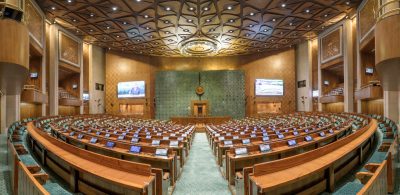
Featured image: Lok Sabha Chamber at the new Parliament building (GOLD-India)
Global Research is a reader-funded media. We do not accept any funding from corporations or governments. Help us stay afloat. Click the image below to make a one-time or recurring donation.
