

Bundelkhand region is spread over 14 districts of central India, evenly divided between the two states of Madhya Pradesh and Uttar Pradesh.
This region has often been in news due to distress of farmers and migrant workers. In this context early notice should be taken of the significant harm suffered by many farmers recently due to excessive prolonged rain in June and July making it difficult to sow kharif season crops of oilseeds (such as groundnuts and sesame) and pulses like urad and moong (black gram and green gram). Keeping in view the distress and extreme stress suffered by farmers here in the past, it’ll be proper for the administration to respond to the emerging distress conditions with a many-sided program which includes significant help to the affected farmers as well as community actions to provide counselling and immediate relief to farmers who show signs of stress.
One of the most senior social activists of this region, Gopal Bhai of Chitrakut, said,
“Mostly the harm is to pulse and oilseed crops, but in a few cases the paddy crop has also suffered harm. Vegetable crops planted close to rivers and streams have suffered extensive harm. If farmers can get timely compensation and with government help can prepare well for the next season rabi crop then still the deteriorating conditions can be salvaged.”
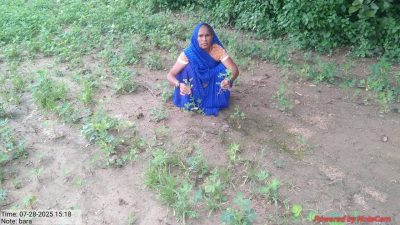
Arunodaya Sansthaan, a voluntary organization active in Mahoba district and neighboring areas to spread natural farming, has conducted a preliminary quick survey on the harm suffered by farmers. This survey’s findings show that the greenery spread in many villages can be very deceptive and once you talk to villagers they tell about very distressing conditions. Kapuri Devi heads a single woman household which has 8 members. She had high hopes from her groundnut crop as the initial high rainfall had given high hopes, but then with continuing rain the crop she had sown was ruined. Not one to give up hope easily, she planted the crop a second time but when this too was ruined by further excessive rain, she was shattered. Whatever money she had has been spent in the course of planting this crop twice. Due to absence of other means of earnings, she faces a very uncertain future. Another small farmer, Suresh Patel has lost the black gram and green gram crops he had planted with high hopes. It is farmers such as these who are in urgent need of help.

This survey reveals that as the rains started this time earlier than expected in June, the hopes of farmers were high and they took to planting their crops with a lot of enthusiasm. In terms of understanding their distress and stress, it is important to know that just a few weeks earlier they had been in high hopes and enthusiasm.
Estimates of rainfall in June and July for the entire Bundelkhand region reveal higher than normal rainfall almost everywhere but in some parts this is very excessively so. It is in these parts that reports of several houses being damaged and villages close to rivers being flooded have also been received. Vegetables grown close to rivers have also been harmed badly. Some communities are known for depending mainly on this kind of cultivation close to rivers. They have suffered big damage.
A large number of migrant workers are known to resort to distress migration from Bundelkhand region. The number of migrant workers can increase both due to the loss of crops suffered by farmers as well as availability of less farm work to landless rural workers. Hence the government should also take steps to reduce the possibilities of migrant workers getting trapped in exploitative working conditions including debt bondage. The labor department and officials should also be more vigilant.
Conditions in villages can improve by providing extra work under rural employment scheme MG-NREGA along with ensuring that wages under this scheme are paid promptly. When wages are delayed for a long time or when there are other problems in implementing NREGA, then its capacity to provide immediate relief is badly affected. Keeping in view the distress conditions, wage payments should be very prompt.
Debt relief to farmers should be provided and there should be exemption from loan recoveries at a time of increasing distress. This together with improving arrangements for better crop in the next rabi season will help to reduce distress and stress of farmers.
*
Click the share button below to email/forward this article. Follow us on Instagram and X and subscribe to our Telegram Channel. Feel free to repost Global Research articles with proper attribution.
Bharat Dogra is Honorary Convener, Campaign to Save Earth Now. His recent books include Saving Earth for Children, Man over Machine, A Day in 2071 and India’s Quest for Sustainable Farming and Healthy Food. He is a regular contributor to Asia-Pacific Research.
All images in this article are from the author
Global Research is a reader-funded media. We do not accept any funding from corporations or governments. Help us stay afloat. Click the image below to make a one-time or recurring donation.
