Himalayan Tragedy of Landslides and Floods Can be Reduced Significantly with Ecologically Protective Policies


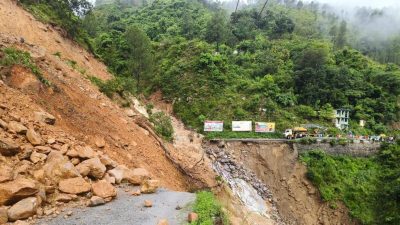
I left Delhi recently amidst very worrying reports of the village of Dharali being wiped out in the state of Uttarakhand. As I reached the hill area of the neighboring state of Himachal Pradesh, I found a trail of destruction in this neighboring state as well, forcing me into heavy traffic jams and obstructions caused by landslides. Looking out into the dark amidst lashing rains, I could form an idea that this heavy landslide was close to a village where I had come a few years back for reporting on a village ruined by heavy cutting of trees and lack of adequate caution in highway widening.
I managed to reach my home late in the night, but news continued to pour in next day from continuing problems on this highway (Kalka-Shimla). From elsewhere, in Chamba, there was a report that six persons (including four from a single family) had died when a boulder fell on a car. Newspapers reported that nearly 357 roads in Himachal Pradesh had been harmed or obstructed. Up to August 7 or so, the rainy season starting on June 20 had seen 58 flash floods, 30 cloudbursts and 51 landslides in this small state. 108 people had died, and 37 were missing, while the economic loss was estimated at INR 19520 million.
In recent years very extensive harm from disasters has been reported from the Himalayan region, particularly Uttarakhand and Himachal Pradesh. This is increasingly linked to very large-scale cutting of trees caused in the process of taking up various projects that are questionable ‘development projects’. Recently for a stretch of a highway I asked local people how many trees had been cut, and I was told “at least ten thousand”. I was very distressed. When I was reporting on the famous chipko or ‘hug the trees’ movement during the late 1970s in Uttarakhand, there used to be prolonged mobilizations of people against the commercial felling of even a few hundred trees (or even lesser) but here ten thousand trees had been cut without any trace of a mobilization to prevent this.
One reason for this is that a mistaken discourse on development has been created which justifies large-scale ecological ruin as being essential for development. Based on this, the authorities and big businesspersons have gone ahead with a development model based on too many excesses—excessive widening of highways, excess of dam and hydro power projects, excess of mining, excess of heavy building construction and even excess of the kind of tourism that does not go very well with the protection of environment.
Firstly, there is too much of all this beyond the carrying capacity of fragile hill environment and secondly, on top of this, several powerful companies and businesses try to cut on costs by neglecting important environmental safeguards and precautions.
All this ignores the well-established geological reality that Himalayas being one of the youngest mountain chains still in the process of formation must be handled very carefully in terms of not disrupting it by the use of explosives (for heavy construction or mining work), heavy construction work or indiscriminate mining, deforestation, tunneling and impounding of huge quantities of water in highly risky ways. All these have destabilized the massive but fragile and vulnerable hills and what is worse, this has happened in times of climate change when there is a greater tendency for rain to be highly concentrated in big downpours.
This is not at all to say that dam and highway construction should stop, or that tourism should not be encouraged. However what can definitely be stated is that the kind of reckless development seen in recent times must be checked seriously, as the Supreme Court of India has also emphasized in a recent verdict. Instead there should be very cautious pursuit of development activities based on sustainability and safety.
While the recent pattern has enriched a few, the number of people either displaced or ruined by the resulting disasters and instability is very high. What is more, the Himalayas being a high seismicity belt, the disruption of slopes has led to the possibilities of any future earthquakes becoming much more destructive due to the various ecologically destructive activities.
Hence several concerned people as well as experts have been raising their voice for opposing the ecologically destructive development model for the Himalayan region and replacing this with an ecologically protective model. This is a call that should not be neglected any longer.
*
Click the share button below to email/forward this article. Follow us on Instagram and X and subscribe to our Telegram Channel. Feel free to repost Global Research articles with proper attribution.
Bharat Dogra is Honorary Convener, Campaign to Save Earth Now. His recent books include Guardians of the Himalaya—Vimla and Sunderlal Bahuguna, Planet in Peril, Protecting Earth for Children and A Day in 2071. He is a regular contributor to Asia-Pacific Research.
Featured image: A 100-metre stretch of Char Dham road was washed away. (HT)
Global Research is a reader-funded media. We do not accept any funding from corporations or governments. Help us stay afloat. Click the image below to make a one-time or recurring donation.
