

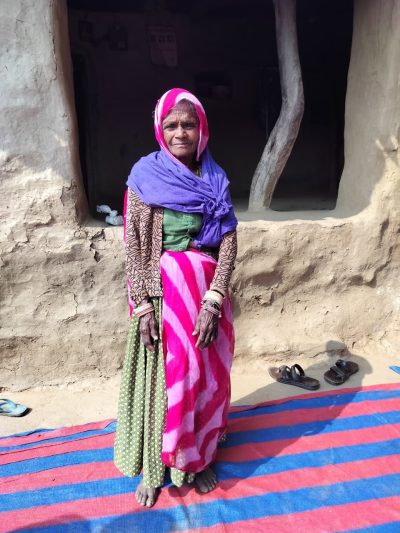
Jumli Bai is a 70-year-old woman living in Kakarmala village of Jhadol Block, South Rajasthan. Her vision is badly impaired. She has a lot of difficulty in hearing. She is a widow and lives alone.
Although she can access a small government pension and some free food grain, cooking any food on her own is also a problem. So she is entirely dependent on someone sparing some food for her. Under the present circumstances food availability for her remains highly uncertain and precarious. Her day is spent sitting here or there and hoping that she will get some food.
I met her at a meeting of elderly people in her village around noon time. She had not eaten anything till then, finally she could eat something here.
Her son is said to be alcoholic and does not help her at all, villagers said. She gets better treatment in her maternal home, but it is not at all easy for her to go there. She has to find someone to help her reach there.
Khomani Bai and Kakkoo Bai are two old women in the age group of 80 to 90 years. They live alone on their own. They still go to the hills for grazing goats. They were away for this at the time of my visit to Gairiyo ka Gura village in Udaipur district but other villagers told me that they also have to cook their food after returning from the pastures although they are in no condition to do this. They need medical help but do not have the time and opportunity for this. They are somehow carrying on as long as they can.
In the same village, 85-year-old Baggaji has increasing hearing and vision problems. He also lives alone although he is more fortunate in having a more caring son.
Devli Bai is a 70-year-old widow in this village who has problems on daily basis in meeting her essential food needs. She carries herself with great dignity but on being asked repeatedly regarding any problems she mentioned the need for food.
A recent visit to four villages in South Rajasthan to study the problems of elderly people from weaker sections revealed several such instances of people in need for better support and nutrition. While many of them live alone, the situation becomes more difficult for those whose children are not fulfilling their responsibilities towards them, or else are unable to do so due to being away from village. One factor that has added to neglect is the increasing consumption of alcohol in villages. As several elders agreed in group discussions, in the case of those consuming alcohol the acceptance of responsibilities towards parental care is generally reduced.
These less discussed aspects of the life of elderly people are emerging into openness in the course of the implementation of an initiative called Prabal Yatra (PY) by ARTH voluntary organization for improving the health and welfare of elderly people. In the course of organizing meetings of elderly persons, several such examples of elderly people suffering high levels of distress and deprivation are coming to light as some of these persons are also coming to these meetings. Hence the first step of the silence being broken and their problems being highlighted has been taken in the course of the meetings of this initiative.
One of the worst affected categories is of those elderly people who have been affected by serious mining dust related diseases like asbestosis and silicosis for which there is no easy cure. Those who suffered from these or more or less similar diseases with similar symptoms but were not identified or selected for various compensatory help and other relief have suffered the most and find themselves very helpless in their old age.
According to a community worker of PY Amritlal, there are a large number of such elderly people in stretches of former asbestos mines. He says that there are about 30 such elderly persons in a single village Ambavi.
As the experiences of PY have shown, efforts to help distressed old persons can give very heart-warming results. While help is needed in general by older people from poorer households, or by those who become victims of some accidental injury, what we are arguing here is that beyond this help there may be some older people in particularly desperate conditions who may need to be identified for some special assistance by the government. At the time of a serious drought situation in Bundelkhand region, I had visited several villages where I inquired particularly about such elderly people in very helpless condition, and some people were found to be living in very desperate conditions indeed. A voluntary organization had in fact started a cooked food program for them to which I also tried to contribute in a modest way. Moreover this experience left me with a lasting memory of those elderly people whom I had seen in very desperate condition.
The number of such persons may be three in a hamlet, six in another. The overall numbers may not be very high and hence a program of special help for them may not be very costly for the government or for any philanthropic organization trying to show what can be achieved in a limited cluster of villages.
A program like PY can be very useful in this task because of work that has been already done at the community level makes it possible to identify people who need such help properly with community participation and then to ensure that the help extended to such people reaches them regularly. One of the components of the package meant for them should be to provide at least one adequate cooked meal a day for them along with a pitcher of clean drinking water.
While the number of such persons at a level of a single village may not to be too high, in normal times, but this may increase at the time of droughts, other calamities and high migration levels, and there should be adequate preparation for this too.
*
Click the share button below to email/forward this article. Follow us on Instagram and X and subscribe to our Telegram Channel. Feel free to repost Global Research articles with proper attribution.
Bharat Dogra is Honorary Convener, Campaign to Save Earth Now. His recent books include Protecting Earth for Children, Planet in Peril, When the Two Streams Met and A Day in 2071. He is a regular contributor to Asia-Pacific Research.
Featured image: Jumli Bai (Source: Bharat Dogra)
Global Research is a reader-funded media. We do not accept any funding from corporations or governments. Help us stay afloat. Click the image below to make a one-time or recurring donation.
