

Around the year 1980 Keshwanand Tiwari emerged as a very bright young politician of Dehradun, having won two Cantt elections at a very young age. Then just when friends were forecasting a very promising career in politics, he changed tracks and decided to devote his life instead to a voluntary organization committed to constitutional values of justice and equality with special emphasis on rights of women.
When he first came to Saharanpur district (UP) to start the initial programs of this new organization Disha around 1982-83, he could not have anticipated the kind of troubles he’ll soon face. As he and his colleagues firmly supported a struggle of women farm workers for a badly needed rise in wages, he soon incurred the wrath of powerful forces and at one stage a mob assembled to attack his home. However women members of the organization handled the situation very bravely and tactfully and the mob dispersed after some time.
Amazingly, as the harvest season was approaching, the struggle succeeded in raising wages. To consolidate the gains, nearly 10,000 people gathered from many surrounding villages and formed a front or morcha (often simply called the morcha here by people) of women, workers, small and marginal farmers which continues to be active even today.
People from weaker sections and particularly women found the young organization refreshingly different as it was willing to take up the causes close to people’s needs irrespective of the risks involved.
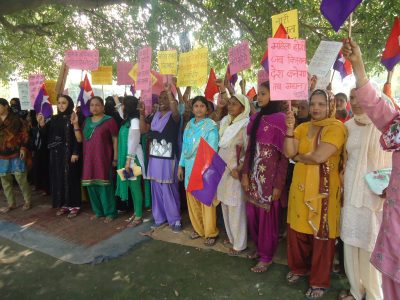
Soon Keshavanand and his wife Jahnvi were in the middle of more difficulties. Local women had been increasingly disturbed by the increase in liquor consumption following the opening of liquor vends inside villages and when they decided to firmly oppose a particularly troublesome liquor vend in Pather village, true to its character Disha extended its support to the peaceful movement of the villagers for the removal of the vend. However this liquor contractor turned out to be a very powerful person and the struggle had to continue in very difficult circumstances for several months. The prolonged struggle attracted a lot of attention and ultimately the state governor intervened personally to get the vend removed and the long struggle ended on a note of joy and achievement.
.

.
However in the course of this and another struggle around the same time many women activists and others close to Disha, including Jahnvi, were injured in violent attacks and had to be hospitalized. Many others including Keshavanand were threatened and had to endure many hardships. At the same time, these struggles brought people close to each other.
From its outset Disha had been emphasizing constitutional values of non-discrimination, equality and justice at the level of entire communities but particularly among women. Members of Disha team led with their own example. Holi and Eid were celebrated by Hindus, Muslims and other communities together. Similarly people of all communities got together to observe various national days of special significance. Any kind of social discrimination whether at the level of religion, caste or gender was opposed. A beautiful program started by Disha was called ‘Mere Ghar Aakar Dekho’ (Why don’t you come over to my home). Under this initiative people of various communities invited persons from other communities (not close friends but first-time visitors) so as to break imaginary social barriers and encourage more interactions. This sometimes gave very good results and resulted in new friendships.
As in the case of anti-alcohol and other struggles, Hindu, Muslim, Dalit, High Caste all women had courageously faced dangers and risks together bravely, their ties became even stronger than before and in their various initiatives also they worked with more commitment and dedication.
One of the earliest programs of Disha which has continued to this day relates to the organization of self-help groups. Over the years their savings have increased significantly and now it is possible on the basis of these savings for women to start several small local enterprises. Hence women from very poor families have also been able to emerge as small entrepreneurs. In addition they are able to avoid the high interest loaning from private money lenders at the time of various emergencies or other special needs. These self-help group loans have been useful also for education of children. These SHGs have also played the role of drawing attention to several problems of their villages and particularly of women within these villages, and to contributing to resolving some of these problems.
Disha has also been involved in several ways in raising recognition for small farmers and in getting equal rights for women farmers. Groups of women farmers have also tried to spread improved agricultural practices. In some cases natural farming practices have been promoted, particularly in the context of a program of kitchen gardens which has been very useful for those with little or no farmland. Cultivation of medicinal plants has been promoted as a means of increasing earnings from small plots of land.
Along with this Disha has been trying to improve the access of weaker sections to various government schemes meant for them. Providing more detailed information about these schemes, helping in completing various formalities and establishing digital linkages has been helpful for many households particularly those with lower levels of literacy.
Literacy levels have been low particularly among Muslim girls and therefore Disha has started several centers for those Muslim girls who missed school. Here apart from receiving education they are also helped to join mainstream schools at a later stage.
For all other students, keeping in view the need for additional educational support, Disha has opened nearly 90 centers where after school hours students can go for additional educational help. Teachers from within these villages receive regular training organized by Disha. These centers are found to be particularly useful by those students from poorer households who feel the need for some tuition after regular school but cannot afford this.
A more recent program of Disha that has been much appreciated relates to the spreading of constitutional values of equality, non-discrimination, dignity and fraternity among all people. This program in five districts operates through fellows who are encouraged and helped to have a very supportive understanding of these values and then try to spread and strengthen these in various ways so that the constitutional values can be realized and can become a reality of daily life of people and there is greater recognition and support for these among people. These fellows are in turn supported in various ways by some mentors.
Perhaps the program for which Disha is most widely recognized among people of many villages even beyond its main work-area relates to counselling and resolving disputes among various family members particularly in the context of cases which involve various forms of injustice towards women or domestic violence. As an organization which has been very experienced in this, Disha now receives such cases and complaints from a very wide area and even bigger organizations in Delhi sometimes consult Disha on such issues. Tasneem, a senior Disha member who has a lot of experience in this work, says that over 80 per cent of cases that come to Disha are resolved in a satisfactory manner for both parties.
This is a very commendable achievement as Disha comes to this issue with a perspective of justice for women and rights of women. Hence the ability to resolve these issue in conformity with these core values is a very significant achievement.
Tasneem and others say that a significant number of disputes can be resolved after the very first hearing which again is very satisfactory for all concerned, and speaks for the practical wisdom and experience with which Disha members approach this issue.
In addition Disha continues to work at various levels to increase public awareness of various related issues with the aim of reducing violence and injustice against women in various ways. While working for rights of women, Disha’s experiences also reveal that in a small number of cases, a few women or those instigating them have been misusing protective laws to harass others.
Disha has been taking up several new programs and issues from time to time, but it has consistently striven to remain very sincere to its core values of justice, equality and women’s rights. A dalit woman like Rajjo, a long-time member of the Disha family, who came from a very poor household rose to become the Vice-chairman of the local town area committee and then went on to help many people in significant ways by using this position. Ramrati, another dalit member of Disha, received an award following her great contribution to the anti-alcohol efforts. Several Muslim women who came out of the purda or veil system following encouragement from Disha became known widely as women rights activists. With the help of the Morcha many struggles for justice have been won.
Keshavanand Tiwari says,
“With the passage of time our ways of working may have changed somewhat, but what is important is that we have always continued to work for our core values and objectives.”
*
Click the share button below to email/forward this article. Follow us on Instagram and X and subscribe to our Telegram Channel. Feel free to repost Global Research articles with proper attribution.
Bharat Dogra is Honorary Convener, Campaign to Save Earth Now. His recent books include Protecting Earth for Children, Planet in Peril, Man over Machine and When the Two Streams Met. He is a regular contributor to Asia-Pacific Research.
All images in this article are from the author
Global Research is a reader-funded media. We do not accept any funding from corporations or governments. Help us stay afloat. Click the image below to make a one-time or recurring donation.
