

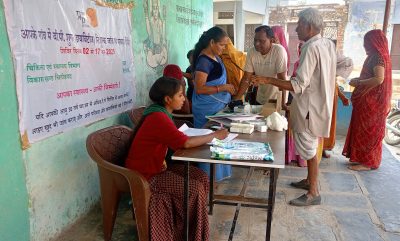
Several rural health initiatives may work at a relatively small scale, but due to being in continuing contact with people particularly those from weaker sections, they develop a better understanding of the health needs of people as well as a deep commitment to meeting these needs in satisfactory ways. Hence it is important for policy makers to maintain close contact with these grassroot initiatives and their activists.
Dr. Samit Sharma as the collector, or chief government functionary, of Chittorgarh district (Rajasthan), recognized this very well. He was convinced that patients can benefit a lot if instead of procuring expensive branded medicines the government can procure much cheaper generic medicines. While going ahead with this effort, he decided to obtain the assistance of Prayas voluntary organization which had been providing health services in this district and nearby areas for several years.
Dr. Narendra Gupta, the founder of Prayas, had also been involved in state and national-level health campaigns. He had special expertise in issues relating to making available quality medicines at lower costs. In addition, he was in regular contact with those working at the national level on these issues, apart from having a firm grasp of the medicine needs of local people.
This understanding and knowledge base of Prayas proved to be very useful in the success of this effort in procuring and making available generic medicines in government hospitals of this district.

This effort was recognized at higher levels in the form of an excellence in civil service award for the collector. While the effort could not be sustained after he left for another position, Dr. Gupta continued his efforts for reducing out of pocket health expenses of people and he prepared several fact sheets that could be helpful for policy reform in this direction.
This preparation proved very helpful at a time when pre-budget consultations were being made by the Rajasthan state government and Dr. Gupta could come up with the suggestion of free supply of medicines in all government hospitals in the state. While the government led by Chief minister Ashok Gehlot was very enthused about the idea, there was concern whether the government had adequate budget for this. It was at this stage that the detailed work Dr. Gupta had done earlier on this subject came in handy and he could not only assert strongly but also convince others including those at higher levels in the state government that if suitable cautionary steps are taken (such as those relating to avoiding unnecessarily high budget in procuring branded medicines when equally effective generic alternatives are available), then it is possible to provide free medicines at government hospitals without adding in any big way to the overall budget available for medicines. In other words, Dr. Gupta along with his team-members like Chhaya Pachauli (the present director of Prayas) could make a strong case that the idea of free medicines in government hospitals was not only highly desirable but also affordable for the government authorities.
This initiative also got a lot of appreciation at the national level, and Prayas members like Narendra Gupta and Chhaya Pachauli continued to work for its success. Millions of patients and their family members have already benefited from this in terms of significantly reduced costs of treatment and care.
Subsequently it was decided to take this initiative one step further for much more comprehensive free health care by passing a right to health legislation in Rajasthan in 2022. Powerful interests tried to stop this, but finally the then Chief Minister Ashok Gehlot went ahead with this. The Prayas team extended valuable effort, along with some state-level and national health campaigns including Jan Swasthya Abhiyan (JSA).
However, when later the implementation of this law was delayed, Dr. Narendra Gupta continued to persist with legal efforts at securing early implementation. In addition, he also sought to use the right to information law to create conditions for early implementation.
The same persistence and determination has also been visible in the pursuit of justice for women who had been victims of unnecessary hysterectomies. Following reports of such unrequired hysterectomies in Dausa area in Rajasthan, Dr. Gupta and team members investigated these and called for national level consultation on this issue which has harmed the health of a very large number of women in the country. When this was confirmed in the wider consultations particularly in the context of three states (but also elsewhere) Dr. Gupta took this matter to the Supreme Court of India where the case languished for some years. However, recognizing its importance Justice Chandrachud held several hearings, and finally in a judgement in 2023 the Supreme Court issued wide-ranging directions to reduce and if possible eliminate the highly tragic and unethical practice of carrying out unnecessary hysterectomies.
The Bar Association of the Delhi High Court recognized this contribution of Dr. Narendra Gupta to this issue with the Fight4Justice Award for 2023.
At the time of my recent visit to the work-area of Prayas, I found Dr. Gupta still very engrossed in contacting state governments to prevent unnecessary hysterectomies.
Earlier Prayas had shown similar high commitment in meeting the health needs of about 60 villages under a mobile health program. This included check-ups, providing treatment for several ailments and referring more serious patients to government hospitals. Dialogues on health issues or jan sanvads were organized to assert right to health-related concerns.
In more recent times, Prayas has been more engaged in ensuring that people in these villages are better able to utilize the various government schemes and services. As Vijay Pal, a member of the Prayas team based in Devgarh village says,
“Sometimes to a very important extent health access can increase if people are well-informed and prepared regarding the procedures and papers needed, regarding their rights and the availability of various schemes and services.”
Prayas also helps the overall health effort by screening rural population of its work area regarding the prevalence of diabetes and hypertension. As Goverdhan, who has been closely involved with the health efforts of Prayas says,
“In the course of these efforts it was revealed that quite a few persons have been affected by paralysis attack and taking care of them has become an important issue for several households.”
Linking its local and wider concerns, Prayas has been involved in organizing several important consultations on health issues and bringing out several important publications relating to these.
*
Click the share button below to email/forward this article. Follow us on Instagram and X and subscribe to our Telegram Channel. Feel free to repost Global Research articles with proper attribution.
Bharat Dogra is Honorary Convener, Campaign to Save Earth Now. His recent books include Saving Earth for Children, Planet in Peril, Man over Machine and A Day in 2071. He is a regular contributor to Asia-Pacific Research.
All images in this article are from the author
Global Research is a reader-funded media. We do not accept any funding from corporations or governments. Help us stay afloat. Click the image below to make a one-time or recurring donation.
