Will India Move towards Self-Reliance by Reviving a Call Given by Mahatma Gandhi During Its Freedom Struggle?


In the middle of the controversy over the higher tariffs announced by Trump, on August 2, the Prime Minister of India gave a call for promoting the spirit of the swadeshi movement seen during the struggle for independence from colonial rule.
The basic idea of swadeshi is that to the extent that the production of certain goods is viable at the local level, we should encourage and buy locally produced goods, instead of importing these goods or obtaining these from distant areas. Further, the production by smaller-scale, less capital intensive and less mechanized units generating more local employment per unit of production should be favored by consumers and buyers. Mahatma Gandhi was quick to clarify that he is not discouraging trade nor is he denying the advantages of trade. However in matters of meeting daily needs, he said, consumers must show a clear preference for meeting their needs from goods produced closer at home, as far as possible. While this helps to improve and increase the self-reliance of any country in meeting its essential needs, this also helps to increase the self-reliance of rural communities, another matter close to Mahatma Gandhi’s concept of gram swaraj or village self-reliance.
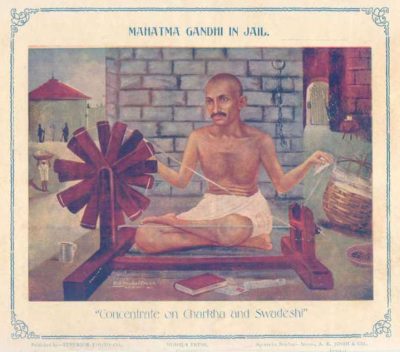
Mahatma Gandhi was saying all this in the context of resisting the ravages of colonial rule which had destroyed India’s famous crafts and artisan works (for example weaving and spinning in the context of textiles) and had also disrupted the community based rural systems. As Gandhi also combined his calls with practical action, he revived the spinning wheel (charkha) and made this and khadi/khaddar (meaning hand spun and hand woven cloth) the symbol of swadeshi movement. Both khadi and swadeshi movements spread far and wide in the country during the freedom movement, with women making a particularly important contribution.
In the present context, considerations of environment protection and the miles travelled by any consumer product have enhanced the importance of the concept of swadeshi in new ways. The related concept of gram swaraj based on self-reliance of rural communities is being considered increasingly important in the context of increasing resilience of rural communities and adaptation to climate change. In addition this concept is sometimes being taken forward in ways which can contribute also in significant ways to climate change mitigation.
While there are several reasons to welcome the decision of the government to revive the swadeshi concept, there are also very serious questions regarding the ways in which the Indian government has violated the swadeshi spirit in the past.
Perhaps the most glaring example of this is that instead of conserving India’s rich heritage of indigenous cotton varieties, the government has allowed the very wide spread of genetically modified cotton crop.
More recently, the government has been exploring the idea of introducing gene-edited varieties for rice even though rice is the most important food crop of India. These are just a few indicators of very harmful compromises that have been made in recent years in violation of the swadeshi spirit.
Of course, it is well understood that swadeshi today cannot be the same today as during the freedom movement as the world has changed. Nevertheless, government policies must be respectful of the basic idea of swadeshi and the spirit of swadeshi. The concepts of both swadeshi and gram swaraj can be carried forward in significant ways by giving much higher importance to the promotion of natural farming based on conservation of indigenous seeds. (Natural farming cannot co-exist with GM crops). The khadi work can be carried forward by according much higher importance to a wide range of village industries and crafts, including those relating to processing the various crops produced under natural farming conditions.
The GM crops promoted by multinational companies and their collaborators and fronts-persons are completely opposed to the very idea of the concept of swadeshi and the government’s commitment to swadeshi will be tested in the context of the decisions the government takes in the context of GM crops and gene edited crops.
India is a very good place for taking forward concepts of swadeshi, gram swaraj and khadi in very beautiful and creative ways as, compared to many other countries, India has many more skilled farmers, artisans and crafts-persons who can contribute to this in very important ways. In addition talented villagers have shown that they can also contribute in new and innovative ways. Mangal Singh, a farmer scientist, made a very important contribution in the form of inventing Mangal Turbine which can lift water without diesel and electricity. This is very much in tune with the idea of gram swaraj, and at the same time can contribute a lot to climate change adaptation as well as mitigation. Yet years after a committee of the Union Rural Development Ministry (apart from other independent senior experts) had strongly recommended its widespread adoption and the topmost official (rural development secretary) had strongly supported this, the invention and its inventor are languishing in neglect.
So the government will have to do a lot to improve its record before its swadeshi commitment can be seen to be marching ahead in the right spirit with sincerity.
*
Click the share button below to email/forward this article. Follow us on Instagram and X and subscribe to our Telegram Channel. Feel free to repost Global Research articles with proper attribution.
Bharat Dogra is Honorary Convener, Campaign to Save Earth Now. His recent books include Saving Earth for Children, Planet in Peril, Man over Machine and India’s Quest for Sustainable Farming and Healthy Food. He is a regular contributor to Asia-Pacific Research.
Featured image: Popular 1930s poster depicting Gandhi using a charkha to spin cotton and weave cloth, captioned “Concentrate on Charkha and Swadeshi” (Public Domain)
Global Research is a reader-funded media. We do not accept any funding from corporations or governments. Help us stay afloat. Click the image below to make a one-time or recurring donation.
