

Lakshmi Kushwaha lives in Bahera village of Niwari district in Madhya Pradesh. She comes from a 10-member joint family. Till some time back she used to go to a hand-pump located at a distance of about 1 km from her home six times a day for meeting the water needs of the family. Her sister-in-law also helped in a more or less similar way. In one round Lakshmi used to fetch about 35 liters of water. She used to carry a pitcher on her head and a can in one hand.
Despite her willingness to work so hard for fetching water, during the summer and other times of water scarcity there was no certainty that she will immediately get water at the hand-pump. She often had to wait her turn for a long time. To avoid long delays sometimes she got up at 3 am at night to leave for fetching water.
For Lakshmi the most frustrating experience was to keep thinking about arranging water even she was away from home for some time. Sometimes as soon as she returned home, regardless of how tired she felt, her first task was to leave for fetching water.
The difficulties experienced by Sudha Ahirwar, who lives in Churara village of the same district, were no less. She comes from a smaller 4-member family and there was no sister-in-law to share the burden. She went 7 times a day to fetch water from a hand-pump located at a distance of about 1 km. She also carried a pitcher and a can.
However in her case there was also an additional complication. The nearest hand-pump was located across the railway track. So if a train came at that time, she was held up for a long time, waiting for the train to depart.
This also meant that she had to take extra care for safety. So while covering the short stretch of the railway track she could not go with both the pitcher and the can. The most difficult part of water fetching is to place the pitcher properly and balance it on the head cover. However in her case she had to take down the pitcher as she approached the railway track, and carry it in her hands to place it on the other side of the track, then similarly carry the can and finally balance the pitcher again on her head before starting the second stretch of her journey.
In addition Sudha had to cope with long delays while waiting for her turn at the tap. Sometimes her pitcher and can were placed so far behind in the line that she found it time saving to come home after placing the utensils in the line, then cook a vegetable before returning to fill in the pitcher and the can. To avoid such delays she too sometimes went around 3 am to fetch water.
Sudha realized soon after her marriage that fetching water every day was to now become her most regular task. However she had no experience of this from pre-marriage days. As a result in the initial days her water-filled pitcher fell down several times from her head and was smashed to pieces. This sometimes led to anger in the family as she was found to be lacking an essential skill.
Keeping in view their highly tiring, time-consuming and occasionally frustrating experiences with fetching water, one can imagine how relieved these women, and so many others like them in their villages, felt when tap water started coming to their village recently under the Jal Jeevan Mission efforts. As Lakshmi said, the village in which we were married suddenly started appearing more beautiful and attractive.
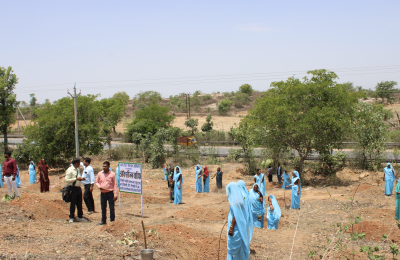
To their credit both Lakshmi and Sudha are utilizing the extra time now available to them for not only their personal tasks but also for social responsibilities relating to helping their communities. They are both Jal Sahelis (women volunteers who together take forward initiatives of water conservation and adequacy). This initiative of Parmarth social organization has attracted widespread attention in recent years. Now Jal Sahelis like Sudha and Lakshmi are also able to get more time for such community work as they are free from the responsibilities of fetching water. Hence their contribution for community work is also increasing. In fact Sudha recently joined a march from Bundelkhand to Delhi for spreading the message of protecting Yamuna river.
Thus while tap water has certainly brought big relief to many women like Sudha and Lakshmi, our story will not be complete without telling about the situation of one or two generations earlier. In another village of this region I spoke to an approximately 75 years old women about her experiences of about 40 years back. She said that she lived in a 35-member joint family and many women shared the responsibility for fetching water from a well. She had to walk for about 300 meters for this. She said she routinely could take four utensils in one trip, balancing two pitchers on her head, and two utensils in two hands. However it was interesting that she did not speak of this experience as a burden, just as easily accepted routine work. Did she ever break pitchers? Well, she tried to remember, once a naughty family member said something terribly funny as she was passing by and as she burst into a laugh, one pitcher fell down.
So probably the difference then was that the well was well filled not requiring any wait or tension of not getting water, and there were many women members in the big family to share the burden, while some of the needs of water like for bathing were met away from home at a tank or well.
So while we cannot say that fetching water was a big burden for all times of history, what we can say is that due to various changing circumstances, this has indeed become a big burden in recent times due to various changing circumstances and so it is really nice that women are feeling relieved of a big burden now in villages where tap water is reaching all or most homes.
*
Click the share button below to email/forward this article. Follow us on Instagram and X and subscribe to our Telegram Channel. Feel free to repost Global Research articles with proper attribution.
Bharat Dogra is Honorary Convener, Campaign to Save Earth Now. His recent books include A Day in 2071 and Man over Machine. His website is bharatdogra.in and his YouTube channel is Bharat Dogra Save Earth Campaign. He is a regular contributor to Asia-Pacific Research (APR).
Featured image is from the author
Global Research is a reader-funded media. We do not accept any funding from corporations or governments. Help us stay afloat. Click the image below to make a one-time or recurring donation.
