Indian Farmer Couple Shows the Natural Farming Way for Increasing Income
From Production and Sale of Healthy Food


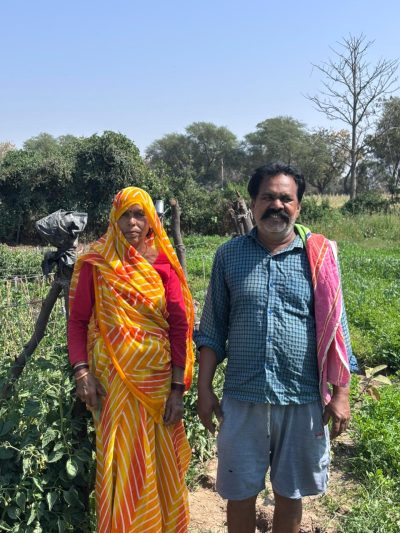
If a farmer is able to raise vegetables worth around rupees 50,000 or more in a year on a small plot of just 1/20 of an acre (just 200 square meters) then surely this is great news for all those who have been striving to find the way forward for ensuring adequate livelihoods and income for small and marginal farmers in India (as well as several other countries).
In addition if this achievement is made with natural farming methods (implying that cash expenditure on expensive chemical fertilizers, pesticides and weedicides is entirely avoided), then these hopes will increase further due to a big reduction of expenses.
This is precisely what Gauradevi and Harcharan are achieving in Nayakhera village located near the town of Tikamgarh (Madhya Pradesh). They have about two acres of land. A small patch of this land, just 1/20 of an acre, is devoted to creating a multi-layer vegetable garden. With the help of bamboos, wires and ropes, a structure has been created on this land which makes it possible to grow more vegetables in a healthier way on a small plot of land, combining vegetables which grow below on land, on surface and creepers which climb upwards. Thus over a dozen or more vegetables can be grown on this small plot of about 200 square meters.
Both Gaura Devi and Harcharan work here in very creative ways. They have a cow and two calves, also one buffalo. They prepare organic fertilizers and pest repellants on their farm using cow dung, cow urine, leaves of some trees and other local materials. Hence their dependence on any cash-purchased inputs is greatly reduced and overall expenses are also kept low.

Practicing these low-cost methods, they achieved production worth rupees 45,000 this year from just this small plot of land of about 200 square meters (not counting the produce of the rest of their farm) despite the crop loss suffered by excessive rain and adverse weather conditions in recent times. In very favorable weather conditions, Gaura Devi is confident that they can double these earnings, approaching closer to one hundred thousand rupees or one lakh rupees worth of vegetables produced in a year. In moderately good weather also they can exceed the production value of 50,000 rupees.
Gauradevi adds that this is only a part of the gains, as the healthy vegetables produced on this farm helps to keep away illness from family members. The good health brought by vegetables produced using natural farming methods should also be considered in any appraisal of their work, she adds. What is more, she says, we also make available healthy vegetables to others and their health improves too.
Gaura Devi is a very spirited lady, and when I asked her if I’ll be able to see the higher yield in a good weather year at the time of my next visit, she replied that I’ll show the complete record of how we come close to increasing production value to one hundred thousand rupees or one lakh rupees.
The she opened a knot on a corner of the sari to take out the earnings from this morning’s selling of vegetables. She counted the cash and said that this morning’s sale within the village has amounted to rupees 700. She had left about an hour back carrying a few vegetables from the farm in a basket and as other villagers know that her vegetables are very healthy, these were sold very quickly.
Often she also goes to Tikamgarh city with a greater collection of vegetables to sell. When the collection is even bigger, then Harcharan goes in a rented vehicle and sells directly to traders. However, earnings are higher in retailing directly to customers in small quantities.
Harcharan was hard at work on the vegetable garden at the time of our visit but agreed to stop this for some time to have a discussion. He said that by providing support for more creeper based vegetables to grow higher up, the quality of the produce improves, there is less harm from pests and fungus, and the excess water can drain out more easily. He said that earlier we used a different version of this method which we called mandap but then a voluntary organization SRIJAN came to the village and with their help and advice we could take up this more advanced form called multi-layer vegetable garden. SRIJAN also helped by providing bamboos and seeds. On a similar pattern several other farmers here and in nearby villages have been helped and encouraged to initiate such vegetable gardens on a small part of their land.
Harcharan says that their work will be facilitated further if they can receive a power tiller. According to Kamlesh Kurmi of SRIJAN, this work is being supported here by Inter Globe Foundation and the results in the context of most farmers have been encouraging, despite adverse weather conditions.
Rakesh Kumar has been involved with this idea since the early days. He told me that on behalf of SRIJAN he first went to study this idea at some places in Gujarat, but found that the technology being used was too expensive and its replication by many farmers would not be a practical proposition in this area. Hence they decided to take it forward in their own low-cost and ecologically protective ways, and in this form many more farmers are coming forward to adopt this.
What is more, he adds, farmers continue to add and innovate in their own way, sometimes quite successfully. Ideally in local conditions here, I would go in for just about 13 types of vegetables in a year including turmeric and ginger below the surface, some leafy vegetables like spinach, methi and coriander leaves, about half a dozen creeper growing vegetables like gourd, bitter gourd, cucumber and turai, plus a papaya tree or two. In this model, Rakesh said, I am keeping out some popular vegetables as these can be more susceptible to pests, but some farmers insist on growing tomatoes, chillies and cauliflowers, and so we have a diversity of experiments being made all the time and farmers share their results with each other, evolving what appears to be more suitable for them.
Rishu Mishra of SRIJAN said that depending on resource availability and local conditions there can be a few differences in the model being spread in various villages but the essence is the same of improving the sustainable livelihoods of small farmers based on the production of healthy vegetables.
*
Click the share button below to email/forward this article. Follow us on Instagram and X and subscribe to our Telegram Channel. Feel free to repost Global Research articles with proper attribution.
Bharat Dogra is Honorary Convener, Campaign to Save Earth Now. His recent books include India’s Quest for Sustainable Farming and Healthy Food, Man over Machine, A Day in 2071 and Protecting Earth for Children. He is a regular contributor to Asia-Pacific Research.
All images in this article are from the author
Global Research is a reader-funded media. We do not accept any funding from corporations or governments. Help us stay afloat. Click the image below to make a one-time or recurring donation.
