

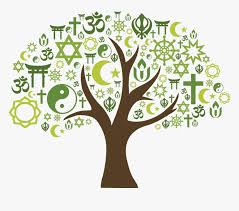
The inter-mingling of various religions and cultures can often lead to very beautiful and stimulating results as people, saints and scholars are excited to discover the cultural and spiritual contributions of others and learn from them. Of course fanatic and violent people respond more with violence towards others, but there is a different story to be told of learning and respecting each other which can be very important at the level of ordinary people. Is it not a matter of great importance that the saints who emphasized inter-faith harmony are still remembered and respected the most in India even after several centuries have passed, while those who wrongly used violence in the name of religion are either forgotten or stand rejected in public esteem.
Muslim scholars came to India before any Muslim rulers did, and they came with the spirit of learning and not conquering. They carried back from India several works of wisdom and these were then translated into Arabic. Acknowledging this intellectual gift, Arab author Yaquibi wrote in the year 895,
“The Hindus are superior to all other nations in intelligence and thoughtfulness. They are more exact in astronomy and astrology than any other people. The Brahma Sidhanta is a good proof of their intellectual powers, by this book the Greeks and the Persians have also profited.”
Another Arab historian Qazi Said wrote,
“The Hindus have always been considered by all other people as the custodians of learning and wisdom.”
Thus the very first contacts were favourable, and these were strengthened subsequently at the upper level by certain liberal policies initiated by Emperor Akbar and several other Muslim rulers of the smaller kingdoms such as Bijapur, Mysore and Oudh. More important, at the grassroots level, these ties were strengthened by the Bhakti and Sufi movements which emphasized the unity of religions and attracted millions of followers.
Akbar started many great traditions. He respected and listened to the views of learned men from several religions including not only Hindus and Muslims but also the others. He gave liberal grants for maintenance of Hindu temples. He started a translation department to get the Ramayana, the Mahabharata and the Bible translated into Persian language.
In the Deccan kingdoms, a sixteenth century king Adil Shah followed a similar path. He established a very good library to look after which he appointed a Sanskrit scholar Vaman Pandit. His descendent Ibrahim Adil Shah was called the ‘friend of the poor’ and ‘world’s teacher’ due to his policies of benevolence and goodwill. In his songs he often pays respects to Saraswati, the Hindu Goddess of learning. He played an important role in the development of some Hindu religious places.
In Kashmir the 15th century king Zain-ul-Abdin was a scholar of Sanskrit as well as Persian, and played an important role in translating parts of the Upanishads into Persian. He publicly participated in Hindu festivals and constructed temples.
In Bengal Pathan kings like Sultan Nazir Shah and Sultan Hussain Shah followed similar policies and arranged for the translation of Mahabharata and Bhagwat Puran into Bengali.
Similarly several Hindu kings placed great emphasis on inter-faith harmony. The valiant king Shivaji remembered for his great courage was also known for his respect for Muslim saints and places of worship. The great warrior king Rana Pratap had so much faith in his Muslim soldiers that one of the most important part of his valiant army was placed in their command.
Some Hindu kings were eager and quick to take compensatory actions if without their knowledge and permission some harm was caused to another faith. A governor of the Vijaynagar empire at Mangalore committed some excesses and damaged four mosques. When this was made known to a higher officer called Baicheya Dannayaka and Emperor Devaraya II of the Vijaynagar empire, they ordered payment of compensation to the Muslims for repair of the four mosques.
King Jayasimha of the Solanki dynasty who ruled Gujarat in the first half of the 12th century was known for his sense of justice. When he came to know of the destruction of a mosque in Cambay then, having confirmed the news properly, he punished the culprits and gave 2,00,000 silver coins to the Muslims of Cambay to rebuild the mosque.
The Portuguese visitor Barbosa who visited the Vijaynagar empire between 1512-14 said,
“The King allows such freedom that every man may come and go and live according to his own creed without suffering any annoyance and without any enquiry, whether he is Christian, Jew, Moor or Heathen.”
It is a reflection of the open-mindedness and of efforts to build a society based on inter-faith harmony that some rulers openly expressed devotion to saints of other religions. Thus Bahmani Sultan Alla-ud-Din II (1436-58) was devoted to Narasimha Saraswati, a great Hindu sage. Ibrahim II, the Adilshahi ruler of Bijapur was also a devotee of Narasimha Saraswati. He built a small shrine near his palace in Bijapur and placed the paduka (footwear) of the saint here. At the same time, the joyous celebration of Hindu festivals in the courts of Akbar and some other Muslim kings, such as those of Oudh, is still remembered.
Even more important was the impact of the Bhakti and Sufi movements at the grassroots level. These poets and saints spoke against the artificial and ritualistic divisions among religions and instead emphasized the essential unity and harmony of all religions. They placed emphasis basically on the purity and depth of the relationship between God and the devotees. The strength of this relationship would render the various rituals and artificial impositions as insignificant. They wrote devotional songs and poems in the common people’s language, thereby eliminating the necessity of intermediaries in worship.
Thus despite several adverse factors and problems, a certain integration and assimilation of Hindu and Muslim population was certainly taking place before the advent of the British rule, but the colonial rulers did their best to destroy this unity.
Despite British efforts to divide and rule, the impact of this integration could be seen in the 1857 uprising against British rule in which Hindus united with the Muslims in an effort to oust the foreign rulers. This prompted the colonial rulers to initiate even more organised efforts to promote religion-based divides, but despite this glorious examples of inter-faith harmony could be seen time and again in the freedom movement led by Mahatma Gandhi, in the struggles led by Subhash Chandra Bose and in the struggles led by revolutionaries like Shahid Bhagat Singh. Some of the most respected and scholarly Muslim leaders of the freedom movement like Maulana Azad were also firm supporters of inter-faith harmony. Badshah Khan and the force of non-violent freedom fighters and volunteers in the cause of public service he created (Khudai Khidmatgars) provided one of the most inspiring examples of inter-faith harmony. The Hindus also responded with equal nobility to them when the soldiers of Garhwal led by Chandra Singh Garhwali refused to obey the orders of their British commanders to fire on the Khidmatgars, despite knowing that this will lead to lifelong or very long-term imprisonment. Mahatma Gandhi, dearest friend of Badshah Khan, was so devoted to the cause of inter-faith harmony that he often stated that he is willing to die for this cause, and eventually he did.
It is this heritage of mutual respect, cooperation and assimilation which the people of South Asia should never forget as this heritage can still help them a lot in bringing peace in South Asia. In fact this is not just a matter of peace, as some of the examples above reveal that very beautiful achievements bringing a lot of happiness and joy are possible with open-hearted inter-mingling of cultures.
*
Click the share button below to email/forward this article. Follow us on Instagram and X and subscribe to our Telegram Channel. Feel free to repost Global Research articles with proper attribution.
Bharat Dogra is Honorary Convener, Campaign to Save Earth Now. His recent books include When the Two Streams Met, Protecting Earth for Children, A Day in 2071 and Earth without Borders. He is a regular contributor to Asia-Pacific Research.
Featured image source
Global Research is a reader-funded media. We do not accept any funding from corporations or governments. Help us stay afloat. Click the image below to make a one-time or recurring donation.
