The Senate Siege: How Alan Peter Cayetano’s Power Grab Shielded a Fugitive and Shook Philippine Democracy


For six months, fugitive Senator Ronald “Bato” de la Rosa had remained absent from Senate sessions, hiding from authorities after reportedly receiving information that the International Criminal Court (ICC) had already issued a warrant for his arrest in November 2025. The former Philippine National Police chief, long associated with the bloody “Operation Tokhang” anti-drug campaign under former President Rodrigo Duterte, had vanished from public view while legal and political tensions intensified around him.
Then, on Monday, 11 May 2026, de la Rosa suddenly resurfaced inside the Senate.
His dramatic return was not motivated by legislative duty alone. According to political insiders, de la Rosa had been convinced by fellow Senator Alan Peter Cayetano to appear personally in order to strengthen the numbers needed to execute a political coup within the Senate. The objective was clear: remove Senate President Vicente “Tito” Sotto III from power and install a new Duterte-aligned majority that could shield Vice-President Sara Duterte from a looming impeachment conviction.
.

Former President Rodrigo Duterte (center) awarded to PNP Director-General Ronald Dela Rosa (right) the Major Award for Law Enforcement during the 18th anniversary celebration of Volunteers Against Crime and Corruption. (Public Domain)
.
As de la Rosa entered the Senate premises, chaos erupted almost immediately. Agents of the National Bureau of Investigation reportedly approached him to serve an arrest order directing him to appear before the Criminal Investigation and Detection Group (CIDG) of the Philippine National Police. Instead of complying, the senator allegedly resisted violently. Witnesses described a heated confrontation in which de la Rosa fought with the agents before breaking away and storming into the Senate session hall furious and shouting invectives.
Image: Former Senator Antonio Trillanes IV (Source)

The situation became even more explosive when former Senator Antonio Trillanes IV appeared at the Senate lobby carrying what was later confirmed to be a copy of the ICC arrest warrant against de la Rosa. The presence of Trillanes, one of Duterte’s fiercest critics, transformed the Senate grounds into a stage for a political and legal showdown unprecedented in recent Philippine history.
Yet instead of distancing themselves from a fugitive senator facing allegations of crimes against humanity, Duterte-aligned senators warmly welcomed de la Rosa into the chamber. Their support was not merely symbolic. The Senate session itself had allegedly been organized to overthrow Sotto and restructure the chamber’s power balance.
The backdrop to the coup was the overwhelming approval by the House of Representatives of the impeachment complaint against Vice-President Sara Duterte. Once transmitted to the Senate, the impeachment trial would require senators to act as judges. Duterte allies feared that under Sotto’s leadership, an anti-Duterte majority could secure the vice-president’s conviction and permanent political downfall.
To prevent that outcome, a dramatic political realignment was engineered.
By the end of the session, Sotto had been unseated. His bloc, once the ruling majority, had suddenly become the minority. In his place, Alan Peter Cayetano, one of Duterte’s most loyal political allies, was elected Senate President. The takeover fundamentally altered the political landscape of the upper chamber and effectively secured Duterte-aligned control over the impending impeachment proceedings.
But the most controversial development came afterward.
Under the new Senate leadership, Ronald “Bato” de la Rosa was reportedly granted protective custody within the Senate premises itself. He was allegedly provided a private room where he could remain hidden from arresting authorities. Critics argued that the Senate, an institution tasked with upholding the rule of law, had effectively been converted into a sanctuary for a fugitive facing international criminal charges.
Behind the maneuvering, observers pointed squarely at Cayetano, whose actions were seen not only as political protection but as direct obstruction of justice. The new Senate leadership appeared willing to use the institution’s authority to shield de la Rosa from lawful arrest.
Public reaction was immediate and deeply polarized.
Supporters of Duterte hailed the Senate takeover as a necessary defense against what they called political persecution. Critics, however, condemned it as a dangerous collapse of democratic accountability. For many Filipinos, the central issue remained unavoidable: Ronald “Bato” de la Rosa was being accorded extraordinary protection despite allegations linking him to thousands of deaths under Operation Tokhang, the anti-drug campaign accused by human rights organizations of systematically targeting poor and defenseless citizens.
Then came the incident that plunged the crisis into even darker territory.
On the night of Wednesday, 13 May 2026, gunshots suddenly rang out inside the Senate premises. Panic spread instantly. Initial reports suggested that armed National Bureau of Investigation agents had stormed the Senate compound in an attempt to forcibly arrest de la Rosa.
Several senators quickly accused the NBI of carrying out an unauthorized operation.
However, when contacted, the NBI Director, Atty Melvin A. Matibag reportedly expressed shock at the accusation. He denied sending any agents to the Senate and stated that he had previously been instructed by higher authorities not to conduct any arrest operation inside the legislative complex.
As investigations unfolded, the narrative unraveled.
Authorities eventually confirmed that no NBI agents had entered the Senate during the shooting incident. Instead, it was members of the Senate Office of the Sergeant-at-Arms who had discharged the firearms.
The revelation fueled a powerful theory: the shooting had been staged.
According to critics and investigators, the gunfire may have been deliberately orchestrated by senators protecting de la Rosa in order to manufacture confusion and create the appearance of an external assault. Amid the chaos, they allegedly executed the real objective—spiriting de la Rosa out of the Senate compound before authorities could close in.
And when calm finally returned, the fugitive senator had vanished.
Despite intensive searches, Ronald “Bato” de la Rosa was nowhere to be found inside the Senate premises. He had successfully escaped once again, and his whereabouts remain unknown.
As investigators continue piecing together evidence, suspicion increasingly centers on Senate President Alan Peter Cayetano and the Duterte-aligned bloc that engineered both the Senate coup and the protection of de la Rosa. By the principle of command responsibility, critics argue that Cayetano bears ultimate accountability for the sequence of events that transformed the Senate into the center of a national political scandal.
The implications could be historic.
Should evidence conclusively establish that top Senate officials orchestrated a false-flag operation to facilitate the escape of a fugitive facing crimes against humanity charges, the fallout may extend beyond criminal prosecutions. Legal experts and political observers have warned that convictions involving abuse of institutional authority at the highest legislative level could trigger constitutional and political crises severe enough to call into question the legitimacy and even the continued existence of the Senate in its current form.
What began as the return of a fugitive senator has now evolved into a defining confrontation over power, accountability, and the future of Philippine democracy itself.
*
Click the share button below to email/forward this article. Follow us on Instagram and X and subscribe to our Telegram Channel. Feel free to repost Global Research articles with proper attribution.
Prof. Ruel F. Pepa is a Filipino philosopher based in Madrid, Spain. A retired academic (Associate Professor IV), he taught Philosophy and Social Sciences for more than fifteen years at Trinity University of Asia, an Anglican university in the Philippines. He is a Research Associate of the Centre for Research on Globalization (CRG).
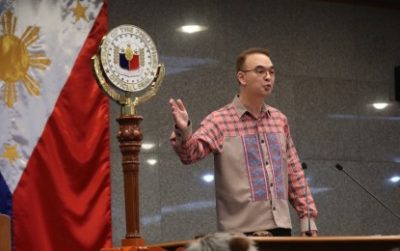
Featured image: Newly elected Senate President Alan Peter Cayetano (PNA photo by Avito Dalan)
Global Research is a reader-funded media. We do not accept any funding from corporations or governments. Help us stay afloat. Click the image below to make a one-time or recurring donation.
