

The impeachment trial of Philippine Vice President Sara Duterte is unfolding under a cloud of political inevitability. Long before evidence is weighed or arguments are fully heard, many observers already believe that the verdict has, in effect, been predetermined. With a bloc of 13 senators—reduced to 12 following the unexplained absence of Senator Ronald dela Rosa, who reportedly left the Senate premises despite being under protective custody pursuant to Senate President Alan Peter Cayetano’s agreement with officials of the National Bureau of Investigation—widely perceived to be politically aligned with the vice president, the constitutional process intended to ensure accountability now risks being reduced to little more than a ceremonial exercise.
For critics, the trial increasingly resembles not a solemn democratic proceeding, but a carefully choreographed political performance whose conclusion is predetermined. In that sense, the impeachment process threatens to undermine the very principles it was designed to uphold: impartiality, transparency, and public trust in democratic institutions.
Impeachment occupies a unique place in democratic governance. It is neither purely legal nor entirely political. Rather, it is a constitutional mechanism meant to hold the nation’s highest officials accountable when ordinary remedies are insufficient. Because of its extraordinary nature, impeachment proceedings demand the highest standards of fairness and credibility. Citizens must believe that senators acting as judges are guided not by partisan loyalty or political convenience, but by constitutional duty and evidence.
Yet this ideal becomes difficult to sustain when political arithmetic appears to outweigh judicial deliberation from the outset. In the Philippine Senate, where personal alliances, political dynasties, and electoral calculations often shape legislative behavior, impeachment trials frequently become tests of political survival rather than objective inquiries into accountability.
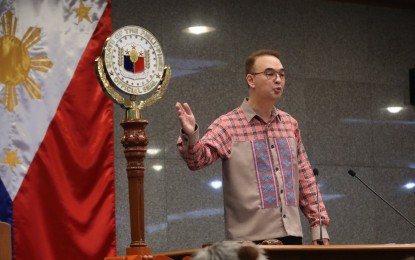
Image: Newly elected Senate President Alan Peter Cayetano (PNA photo by Avito Dalan)
The perception that the outcome of Vice President Duterte’s trial is already assured stems largely from the composition of the Senate itself. Several senators are either openly allied with the Duterte political camp or dependent on coalition politics that discourage confrontation with one of the country’s most influential political families. In such an environment, the distinction between juror and partisan actor becomes blurred.
This is particularly troubling because impeachment trials are expected to transcend ordinary politics. Senators take an oath to administer impartial justice, but public skepticism intensifies when voting patterns appear predictable even before proceedings begin. If citizens believe senators have already chosen loyalty over evidence, then the trial ceases to function as a meaningful constitutional process. It instead becomes an exercise in political optics.
The danger of such perceptions extends beyond the fate of one political figure. Public confidence in institutions is fragile, especially in democracies where corruption, patronage, and elite political dominance are longstanding concerns. When impeachment proceedings appear scripted, they reinforce cynicism about governance itself. Citizens begin to suspect that accountability mechanisms are selectively applied and ultimately powerless against entrenched political influence.
In this sense, the trial risks being dismissed as a “kangaroo court”—a process that preserves the outward appearance of legality while lacking genuine impartiality. The term is harsh, but its growing use in political discourse reflects deeper frustrations with institutions perceived as subordinated to political interests. Critics argue that if senators are unwilling to independently evaluate the merits of the case, then the proceedings amount to little more than expensive political theater funded by taxpayers.
The cost of such a spectacle is not merely financial. Impeachment trials consume legislative attention, dominate media coverage, and intensify political polarization. Time and public resources devoted to a process widely seen as predetermined could arguably be better spent addressing urgent national concerns such as inflation, unemployment, education, infrastructure, and disaster preparedness. In a developing nation confronting persistent socioeconomic challenges, citizens understandably question whether prolonged political drama serves the public interest.
At the same time, supporters of the impeachment process argue that even a likely acquittal does not render the proceedings meaningless. They contend that constitutional accountability requires allegations against high officials to be publicly examined, regardless of the expected outcome. From this perspective, the trial provides an opportunity to place evidence on record, clarify constitutional standards, and demonstrate that no public official is entirely beyond scrutiny.
This counterargument carries weight. Democracies are not measured solely by convictions or acquittals, but by whether institutions are allowed to function openly and lawfully. A transparent trial, even one ending in acquittal, can still contribute to democratic discourse if senators seriously engage with the evidence and explain their decisions in principled terms.
However, transparency alone cannot compensate for perceptions of entrenched political bias. If the public sees senators treating the trial as a partisan obligation rather than a constitutional responsibility, the institutional damage may endure long after the proceedings conclude. The legitimacy of impeachment depends not only on procedural compliance but also on public confidence that justice was genuinely pursued.
The broader issue exposed by this controversy is the persistent tension between law and politics in presidential systems. In theory, impeachment serves as a safeguard against abuses of power. In practice, its success often depends on political will. When political alliances dominate constitutional accountability, impeachment becomes less a mechanism for justice than a reflection of shifting power balances among elites.
The Philippines has witnessed this dynamic before. Impeachment efforts throughout the country’s democratic history have frequently been shaped by coalition-building, political bargaining, and public pressure rather than strict constitutional interpretation. As a result, many Filipinos have grown skeptical of whether impeachment can truly function independently of partisan interests.
The trial of Vice President Duterte may therefore become more significant for what it reveals about Philippine democracy than for its final verdict. If the proceedings reinforce the perception that powerful political figures remain insulated by loyal legislative majorities, public trust in democratic institutions could further erode. Conversely, if senators demonstrate genuine independence and rigor even amid political pressures the Senate may still preserve some measure of institutional credibility.
Ultimately, the legitimacy of an impeachment trial cannot rest solely on constitutional formality. It depends on whether citizens believe the process was conducted honestly, fairly, and in pursuit of truth rather than political expediency. In democratic societies, justice must not only be done; it must also be seen to be done.
If the outcome of Vice President Sara Duterte’s impeachment trial is indeed predetermined, then the greatest casualty may not be the impeachment case itself, but the public’s already fragile faith in the capacity of democratic institutions to hold the powerful accountable.
*
Click the share button below to email/forward this article. Follow us on Instagram and X and subscribe to our Telegram Channel. Feel free to repost Global Research articles with proper attribution.
Prof. Ruel F. Pepa is a Filipino philosopher based in Madrid, Spain. A retired academic (Associate Professor IV), he taught Philosophy and Social Sciences for more than fifteen years at Trinity University of Asia, an Anglican university in the Philippines. He is a Research Associate of the Centre for Research on Globalization (CRG).
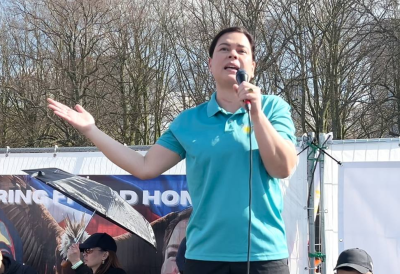
Featured image: Duterte addresses supporters at Malieveld in The Hague, Netherlands, on March 23, 2025, calling for her father’s release and return to the Philippines. (Public Domain)
Global Research is a reader-funded media. We do not accept any funding from corporations or governments. Help us stay afloat. Click the image below to make a one-time or recurring donation.
