

While promotion and improvement of education in remote rural areas has been taken up by several NGOs, a special aspect of the efforts of Prayas voluntary organization has been that over more than four decades of its efforts in South Rajasthan (more particularly in Chittorgarh and Pratapgarh districts), a special effort was made to integrate the promotion of education with concerns of social justice.
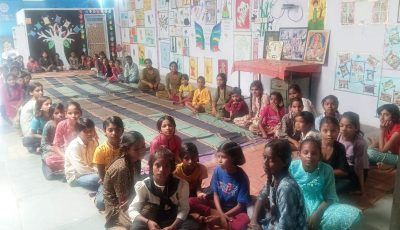
A significant example of this is a center for the education of adolescent girls called Aadharshila (AS) located in Bhadesar area of Chittorgarh district. This provides residential facilities for about 60 girls from weaker sections (particularly tribal, dalit and OBC communities) who lack the means for supporting education and/or where girls have lagged behind in education due to adverse conditions at home. AS, supported by Prayas, provides conducive conditions in which about 60 girls can learn together to catch up with their studies and also prepare for higher education, while also attending regular school. Thus, even girls who have come here with almost no educational skills are often able to make up adequately for lost time to complete school education and also start college.
Thus, two students here named Puja and Tanu have started college education. They stated clearly and strongly that there was no chance at all of them entering college if they had not come to AS.
Suman, coordinator of AS, has also been involved in wider mobilization efforts of dalit and tribal communities, and once suffered injuries when she and other activists were beaten up by powerful persons. She says, “Aadharshila was started by Khemraj Ji (a famous social activist and also a former director of Prayas) as he had a wider vision that without the education of girls and women stable and sustainable progress of weaker section communities is not possible. Here while girls go to regular school, daylong efforts to improve their educational skills and also to involve them in extracurricular activities are made. Their confidence levels have significantly increased and they have won praise even in big cities like Bhopal and Delhi for their plays and songs. They have also won sports prizes.”
.

.
Child marriage or marriage at an early age has been a persistent social problem of this region. Dr. Narendra Gupta, founder of Prayas says, “Promoting education of girls is the best way of reducing child marriage. If all girls are able to complete school, child marriage will certainly come down in a big way.”
Keeping in view these wider objectives age requirements at AS can be relaxed to accommodate students who have more pressing needs. One of these whom we can call S was a rape victim. After rape she was thrown by the rapists on a railway track where she lost her legs. Despite this extreme shock and disability, she found the strength to continue her education with the help of AS. A visiting journalist from Germany helped to construct a room for her. She is so courageous that she even offers help to others. Suman says, “In her specially designed scooter she sometimes offered to take me to her village.” AS can be an important place where such courageous girls can always find help in times of distress.
Although AS is mainly meant to help children from weaker social sections, when a cancer patient from a better placed section of society approached AS for helping in the education of his two daughters, AS agreed to help him promptly and now these girls are well placed on the path of higher education.
At the time of my recent visit to the AS campus, the students here were enacting a play which gives a strong message regarding the justice and equality aspects of the constitution of India. The songs they sang were also full of commitment to justice.
In fact, this integration with justice aspects has always been an important aspect of the educational efforts of Prayas. While starting its work in the late seventies and early eighties with the poorest sections in villages with very high rates of illiteracy, Prayas initiated adult literacy classes in several of these villages. Keeping in view the wider concerns of Prayas, immediate justice-based concerns and urgent needs and priorities of villagers also became an important subject of discussion in these classes.
To the credit of several senior government officials, they were supportive towards this justice orientation. One of these officials Anil Bordia, who later became the most senior educational officer in the country, was willing to go out of his way to be very helpful.
In several remote villages there were no schools at that time. It was Prayas which started the first schools here. These later became the base where the government later established its regular schools.
Ganga Ram is one of those children who attended a Prayas school and who has grown up to become an activist youth. He says, “There was no regular school but Prayas people like Narendra Gupta and Preeti Oja were coming to our villages to provide hope. Without the school they started in our village, I would not have been educated.”
Narendra Gupta adds, “It is nice to find that many of those villagers from the poorest sections who got their first educational exposure in various centers of Prayas could later get such employment opportunities which brought them into or close to the middle class.”
This is the more obvious gain, but there are also wider social gains from the linkages the educational efforts here established with justice concerns. This can be seen in the wider mobilization efforts for justice which have continued, sporadically or with continuity, in several of these villages.
*
Click the share button below to email/forward this article. Follow us on Instagram and X and subscribe to our Telegram Channel. Feel free to repost Global Research articles with proper attribution.
Bharat Dogra is Honorary Convener, Campaign to Save Earth Now. His recent books include Saving Earth for Children, Man over Machine, A Day in 2071 and Planet in Peril. He is a regular contributor to Asia-Pacific Research.
All images in this article are from the author
Global Research is a reader-funded media. We do not accept any funding from corporations or governments. Help us stay afloat. Click the image below to make a one-time or recurring donation.
