

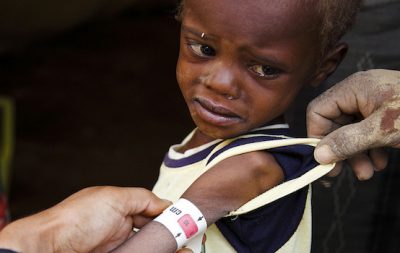
Tens of millions of people face very serious humanitarian crisis situation in many countries. Despite this, the funds received for humanitarian aid have been falling far short of real needs.
The world level military spending is around 2700 billion dollars. Compared to this the main humanitarian aid system generally asks for only around 50 billion dollars or so in a year, or less than 2% of the military expenditure. However in year 2025 even this was denied, even 1% was denied.
In fact the year 2025 proved to be the most difficult in this context in recent times, although funding shortages were also experienced earlier.
In July 2025, the UN humanitarian aid system issued June-end statistics that at the end of the first half of the year, only 13% of the funds needed for the year had been received. This was significantly lower than the funds received for the same period during the previous years.
In view of this serious shortfall compared to the targeted funds, the UN issued a new appeal lowering the fund demand further and said that is asking for only 1 per cent of the world’s defense expenditure and this is absolutely crucial for saving 114 million human lives.
At the end of the year the provisional figures show that the total funds received during this year were only 20.5 billion dollars, compared to double of this in year 2022, even though humanitarian crisis had worsened in several respects.
While several donors reduced their contribution, the biggest cut came from the USA in the first year of the Trump administration.
As the funding has fallen significantly short of even the reduced estimates of the funds that the UN stated in mid-year review were needed desperately for saving 114 million lives, the UN should now present an estimate of the number of the lives that were lost (or the number of lost lives that could have been saved) due to this glaring shortage of essential funds. This would help in wider realization of the tragedy taking place. Even if only one per cent of extra lives were lost (in the identified vulnerable population of 114 million people), this would imply that over one million lives were lost due to the denial of funds.
What is more, the humanitarian aid system is also being adversely affected in other ways. The UN Office for the Coordination of Humanitarian Aid lost nearly 25% of its staff over a period of about a year or so. At the frontlines overburdened humanitarian aid workers are also facing increased risks. 338 humanitarian aid workers were attacked during 2024. About 600 health facilities were also attacked during the same year, according to a report of Red Cross.
Thus at a time when the need for humanitarian aid is increasing, the ability to provide this in satisfactory ways has been decreasing due to a number of factors. This is a very distressing situation which, when compared to a situation of complete adequacy of humanitarian aid efforts, is likely to be leading in the extra loss of a large number of human lives, perhaps one million lives, perhaps several million lives at its worst. The year 2025 has seen one of the worst ever situations in this context. Very significant improvements are needed to avoid such huge tragedies in future.
*
Click the share button below to email/forward this article. Follow us on Instagram and X and subscribe to our Telegram Channel. Feel free to repost Global Research articles with proper attribution.
Bharat Dogra is Honorary Convener, Campaign to Save Earth Now. His recent books include A Day in 2071, Earth without Borders, Protecting Earth for Children, Planet in Peril and Man over Machine. He is regular contributor to Asia-Pacific Research.
Featured image is from Hugh Macleod / IRIN/Creative Commons
Global Research is a reader-funded media. We do not accept any funding from corporations or governments. Help us stay afloat. Click the image below to make a one-time or recurring donation.
