Water Conservation Emerging as the Strongest Source of Climate Resilience for The Villagers in Jhansi, India


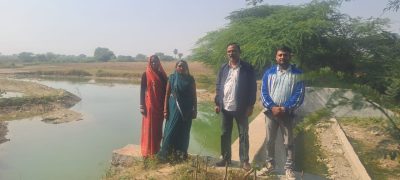
After a long walk on farm bunds followed by a more difficult but thankfully shorter negotiation of a stretch under the canopy of very thorny trees, I reached an impressive looking check dam in Dakhneshwar village of Bamaur block, Jhansi district (Uttar Pradesh). As Anguri and other women waiting here explained, this check dam has become the symbol of new hope for this village as they try to recover from adverse weather conditions experienced earlier in the year.
For such recovery, it was very important to ensure the availability of adequate water but water had become the biggest constraint for farmers here. In these conditions people here were very happy when SRIJAN voluntary organization selected this village for priority water conservation work under a project supported by HDFC Bank.
Sazeed Khan, a civil engineer and member of the SRIJAN team explains,
“We adopted a highly participative approach so that villagers’ perceptions regarding the sites and planning for water conservation could be used properly to benefit from their understanding of local conditions.”
Team leader Pankaj Sharma adds,
“In our inter-actions with community members and particularly women we heard again and again that water is of the greatest importance for the development and indeed the survival of villagers and so we placed the highest importance on water conservation.”
In participative planning it emerged that a natural water channel flowing in the village held a lot of potential for helping the thirsty village but this potential had not been tapped so far and its rainwater torrent was simply flowing away rapidly without helping the people or their farming at all. So this became the center of the new efforts for water conservation.
While the construction of the check dam at an appropriate site helped to conserve rainwater for a long stretch, this capacity for water conservation was enhanced further significantly by digging about 50 ditches in this channel. Each ditch is of a significantly big size, about 20 meter long, 5 meter wide and 2.5 meter wide. It is given a slope, so that if any animal enters this to quench thirst in the dry season when less water remains, then the animal can climb back easily. Thus while a lot of water is stopped for villagers’ use by this check dam, even after this is exhausted then in dry times, up to a certain limit, some water is still available in the ditches or dohas.
Beyond this, however, the check dam and the dohas in the water channel have a wider impact in terms of raising the water table and increasing the water availability from other sources. This helps farming, and also helps animals to get some more fodder while grazing.
It is hoped that this can irrigate about 150 acres of farmland to a lesser or greater extent. There is some land which is just not being cultivated at present due to shortage of water. Now it’ll be possible to cultivate some of this land as well.
Fertility of the land is enhanced by depositing silt dug from the ditches in them. In addition other water conservation work including digging of farm ponds and construction of gavian structures as well as bunding work in fields have added further to water conservation.
All this has brought a new hope to a village seeking to recover from earlier serious damage to crop during the kharif season.
In another nearby village Kuretha the need for water conservation initiative has been even more pressing in recent times. As Praveen, a woman of this village who is active in social initiatives says,
“Migration is at very high level in this village. When people find subsistence difficult, they have to migrate in search of work. Water is the most crucial factor that can increase possibilities of the people to be able to live in a satisfactory way in their village.”
What SRIJAN has been able to achieve here in the course of recent months is quite impressive. An earthern dam has been built here on a water channel. While this by itself would have helped to increase water table the prospects of this have been further improved significantly by creating an injection well close to this and some of the water from the earthern dam can find its way into this to more directly recharge and raise the water table.
In addition an ancient water tank of this village has been de-silted recently. This had not been cleaned and de-silted not just for years but perhaps even decades, some villagers say, and as a result immense loads of silt had collected. The silt removed from here has helped to improve the fertility of farmland while the capacity of the tank to conserve rainwater has improved significantly. This has been helpful not just for the people of this village but also for a much wider area as such a good water source is not available for a considerable distance.
.

.
Generally most discussion on water sources takes place in the context of the needs of people but in the context of real life situation of villages the needs of farm animals are also very important as these animals are crucial to the survival of these villages. The kind of water conservation efforts that are being made by SRIJAN are important also in this context as these are making available more water for animals during the dry season. Apart from quenching the thirst of farm animals, it is also important to consider the needs of stray animals as well as wild animals and birds. These water conservation efforts are helpful in this context too.
In the course of discussions with these villagers an important issue raised by them related to inequalities of water distribution. As digging bore wells can be very expensive in these rocky villages small farmers cannot afford this while big farmers can withdraw a very big share of the limited availability of water, leaving very little for the smaller farmers and others.
Some of the biggest farmers having gained control of a very big share of the water often tend to use water in wasteful ways as they feel that they have plenty of water, despite the overall situation being of serious water scarcity. However when so much water is being extracted for wasteful use then the problems of the small farmers and weaker sections are increasing all the time.
Hence such efforts as are being made here by SRIJAN with the help of common villagers particularly the weaker sections are very relevant as they emphasize the kind of initiatives which can benefit the entire community and within the community too special efforts are made to help the weaker sections to diversify their farm yield and grow more vegetables and fruits in addition to what they are growing already. These efforts in turn can progress only with better availability of water.
SRIJAN’s initiatives could not have come at a better time for these villagers as they were finding it very difficult to recover from the impact of the extensive harm caused to the previous kharif crop by adverse weather conditions. However these efforts have given them a new hope at a difficult time. They hope to get a better rabi or winter crop this time and thereby make up partly the losses they suffered earlier in the year. However beyond this immediate recovery, these water conservation efforts are very useful for longer term improvements on a sustainable basis also. Ultimately, this is even more important.
While all this is important and beneficial in normal times, this is even more significant in the difficult times of climate village when more erratic weather and rainfall can be expected more often. In such a situation the increased ability to conserve water can be helpful in reducing the adverse impacts of droughts as well as floods or other adverse weather conditions in different ways.
While generally most water conservation efforts are making it possible to extend the availability of water till some of the dry months (which have much less rainfall), nevertheless it still remains a challenge to make the water last till the two or three hottest months when the water crisis can be at its peak. It needs more time and even better efforts to move in this direction. This is not just a matter of being able to stop more rainwater. It may also be necessary to exercise more restraint by rural communities so that some of the irrigation requirements are reduced to try to ensure that water in some of these sources can last till the summer months as well. In addition the concept of greater water equality also needs to be raised and spread so that more equal and sustainable water-use patterns can be established.
*
Click the share button below to email/forward this article. Follow us on Instagram and X and subscribe to our Telegram Channel. Feel free to repost Global Research articles with proper attribution.
Bharat Dogra is Honorary Convener, Campaign to Save Earth Now. His recent books include Protecting Earth for Children, Planet in Peril, Man over Machine, A Day in 2071 and India’s Quest for Sustainable Farming and Healthy Food. He is a regular contributor to Asia-Pacific Research.
All images in this article are from the author
Global Research is a reader-funded media. We do not accept any funding from corporations or governments. Help us stay afloat. Click the image below to make a one-time or recurring donation.
