

Abstract
Steve Rabson introduces Why are We in Okinawa? A History of Violence (Bloomsbury Academic, 2026) and interviews the author, Jon Mitchell, about his work with the Okinawan media, why he wrote the book, and what it reveals about the continuing overconcentration of U.S. military bases in the prefecture. An excerpt from the book follows the interview.
Introduction and Interview by Steve Rabson
In his new book, Why are We in Okinawa? A History of Violence (Bloomsbury Academic, 2026),1 journalist Jon Mitchell traces the origins of the ongoing U.S. military presence in Japan’s southernmost prefecture. Starting with an exploration of the Ryukyu Kingdom and the Meiji government’s “Ryukyu Disposal”, he then moves to the twentieth century to focus on U.S. and Japanese atrocities during the Battle of Okinawa, the U.S. military’s 27 years of colonial rule and how the Japanese government colluded to keep the bases in Okinawa following the islands’ return to Japanese administration in 1972. The subsequent chapters detail how, throughout 50 years post-reversion, the Japanese and U.S. governments have constantly broken pledges to reduce Okinawa’s military burden. In response, Okinawans have created a resilient, non-violent movement found few other places in the world. The final coda – “So why are we reallyin Okinawa?” – draws together the threads Mitchell weaves throughout the book to compellingly conclude that the primary reasons for keeping 31 U.S. bases in Okinawa have very little to do with their purported deterrence effect – the real reasons are money (on the U.S. side) and structural discrimination (on the Japanese side).
As well as drawing on Okinawan, Japanese and American sources, the book features declassified CIA materials and documents that Mitchell obtained via the U.S. Freedom of Information Act. These reveal aspects of Okinawan history hitherto unknown, such as covert Cold War operations, accidents involving U.S. chemical and nuclear weapons, and CIA attempts to manipulate Okinawan public opinion as recently as 2012. As one reviewer, Catherine Lutz, co-founder of the Costs of War project, writes, “Based in sources unearthed from the U.S. government, Why Are We in Okinawa? is a must-read for anyone concerned with justice movements, geopolitics in Asia and the Pacific, and U.S. military policy and behavior.”
Unsurprising given Mitchell’s expertise in environmental issues, the book discusses the environmental impact of militarism, including the U.S. Air Force’s contamination of 450,000 Okinawans’ drinking water with toxic Forever Chemicals – a problem that is still unresolved. His newspaper articles and previous English book, Poisoning the Pacific (2020), have helped U.S. veterans to receive compensation from the Department of Veterans’ Affairs and this book will surely help many more.
Why are We in Okinawa? A History of Violence is by far the best history in English of Okinawa’s long-running and continuing militarization. It is rigorously researched, containing lengthy endnotes and bibliography to enable readers to further explore the issues raised. At the same time, the book is eminently readable and accessible for a non-academic audience. Illustrating how well Mitchell’s research is regarded in Okinawa, too, Naomi Jahana, University of the Ryukyus, wrote, “For Okinawans who continue to fight – even though they sometimes feel alone – this book offers guidance like the North Star or Ninufabushi, which helped ancient Ryukyu sailors to traverse the oceans. It connects the people of Okinawa with others around the world.”
.
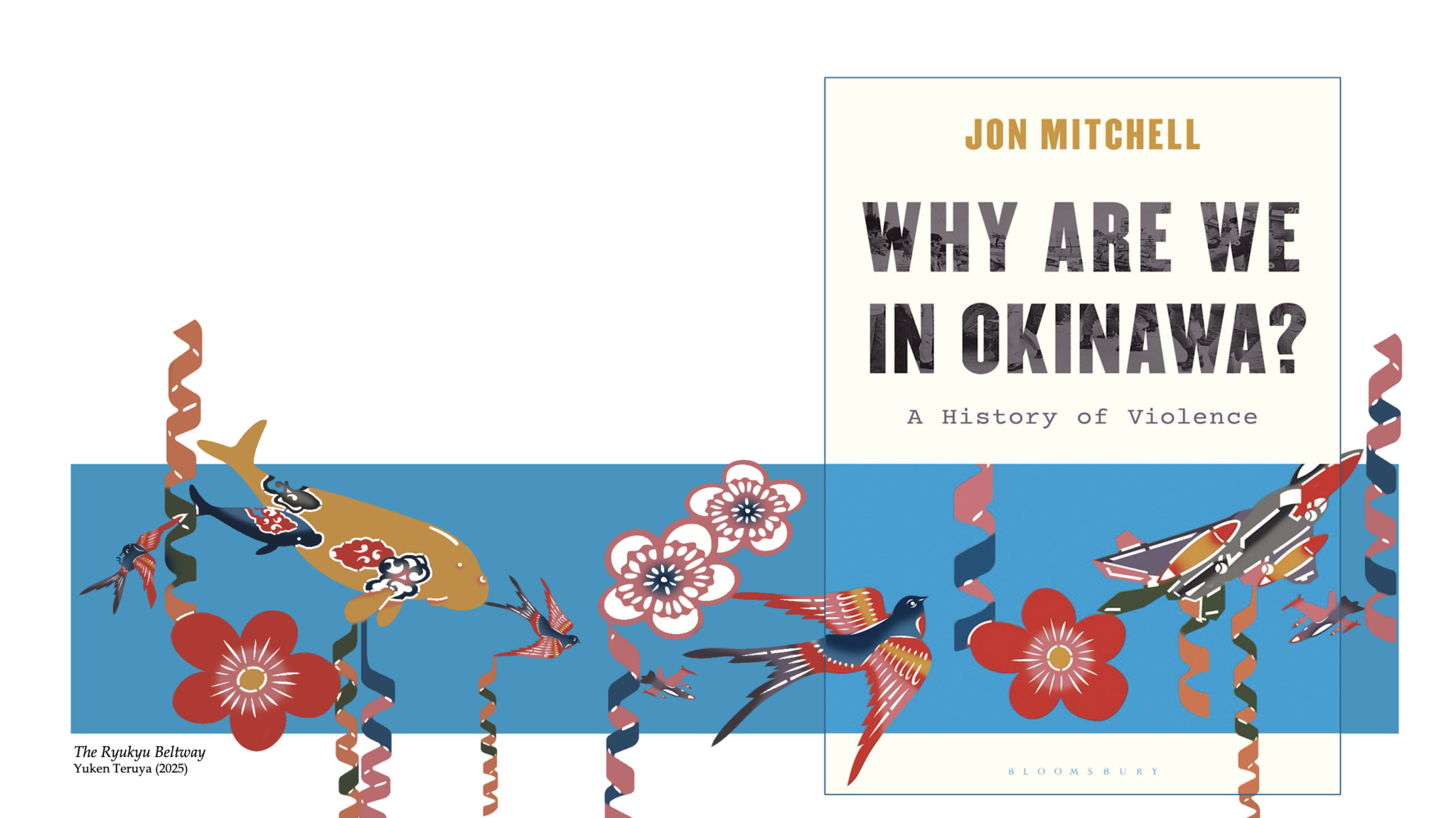
Figure 1: The cover of Why are We in Okinawa? A History of Violence (Bloomsbury Academic) incorporates original artwork by Yuken Teruya, The Ryukyu Beltway, as an obi wrap.
.
Interview
Steve Rabson (SR): Thank you for agreeing to this interview and congratulations on publication of your new book. You and I have been in contact since the mid-2010s when you interviewed me about the Okinawan diaspora in Japan. But we did not meet in person until March 2023 when you came to New York University to screen your documentary about PFAS contamination, Nuchi nu Miji: Okinawa’s Water of Life. You co-directed that documentary with Shimabukuro Natsuko from the Okinawan TV station, Ryūkyū Asahi Hōsō, and you are a correspondent for the newspaper, Okinawa Times. Can you explain about your work with the media in Okinawa?
Jon Mitchell (JM): I’ve been writing about Okinawa since 2009. When I started, I was a freelancer for Japan Times writing mainly about the Cold War; for example, the deployment of nuclear weapons – a topic about which I know you have firsthand experience. In 2016, I became a correspondent for Okinawa Times specializing in the U.S. Freedom of Information Act (FOIA). Also, I work with TV stations and independent film directors to report about military issues in the prefecture.
Originally, I’m from Wales, a country that shares similarities with Okinawa, including linguistic suppression and a deep-rooted culture of pacifism. Wales has a strong tradition of investigative journalism, too. In the 1930s, Gareth Jones was the first journalist to reveal the Soviet Union’s famines, notably the Holodomor in Ukraine. During the Vietnam War, the Welsh photojournalist, Philip Jones Griffiths, recorded the brutality and the futility of that American conflict – and helped to turn U.S. public opinion against that war. So, I come from a country that values how journalism can make a difference. The media in Okinawa shares a similar outlook.
As I explain in my book, journalism in Okinawa has been strongly influenced by two main factors. Before and during World War II, journalists in Okinawa glorified militarism, thus encouraging Japanese imperialism and setting the stage for soldiers’ atrocities. So, there is a deep feeling of responsibility and regret for journalism’s role in that war. The second influence: For 27 years, Okinawa was a U.S. military colony which lacked freedom of speech; the media was censored and journalists surveilled. Those two factors have given the media in Okinawa a strong desire not to glorify militarism and a deep respect for freedom of the press. Journalism should hold the powerful to account and serve the public first.
At Okinawa Times, my main tool is FOIA which had not been widely used before by the media in Japan. After reporting about the documents I obtain from U.S. authorities, I donate them to archives in Okinawa and universities in the United States. As journalists we always demand transparency from the government so I believe that journalists need to provide the same openness to the public so people can scrutinize the accuracy of our work. Much of what I uncovered with FOIA makes up the latter sections of my book.
SR: You have written five books before this one. Those books mainly focused on the environmental damage caused by U.S. bases in Okinawa and the Pacific region. Why did you decide to write this book? What do you hope it will achieve?
JM: One of the primary reasons dates to 2016. That year I received a document from the CIA via a FOIA request. It was a 60-page manual titled Understanding Base Politics in Okinawa, a guide for American policy makers on how to convince Okinawans about the benefits of U.S. military bases in their prefecture. It was quite recent – written in 2012 – and it offered a fascinating window into the thinking of the U.S. intelligence community. One of the things that struck me the most was how the CIA blamed the Japanese government for Okinawans’ resentment of hosting U.S. bases. The CIA report washed Americans’ hands of how US actions contributed to Okinawans’ animosity towards the military presence. And it omitted how the bases damage the prefecture’s economy and environment, or how military crimes have targeted Okinawans for more than eight decades.
The CIA manual fit into a pattern of U.S. government agencies playing down the impact of the bases on the lives Okinawans – or providing incorrect information. So, one principal motivation for writing this book was to provide an accurate history for English language readers – especially those in the U.S. military – to understand the origins of the bases in Okinawa and why they anger many Okinawans.
The book draws upon the work of researchers from Okinawa, Japan and the United States (including your studies on the diaspora) and weaves in the discoveries I’ve made using FOIA with interviews and on-scene reporting. I hope the book conveys the voices of Okinawans and how they feel about hosting a disproportionate share of the defense burden. Surveys show that many Okinawans support the U.S.-Japan alliance, but they question why so many bases are packed into their prefecture. Many U.S. defense experts, too, argue that such an overconcentration leaves the military vulnerable to attacks or natural disasters.
SR: What is wrong with the claims of the United States and Japanese governments that the grossly disproportionate U.S. military presence is in Okinawa to defend Japan and maintain security in the region?
JM: This is a question that runs throughout my book and the last chapter focuses almost entirely on dispelling this myth. As you say, for decades, Japanese and U.S. government officials have argued that U.S. bases in Okinawa are essential to deter aggression from the Soviet Union, China and North Korea. But packing 31 U.S. bases in Okinawa is very difficult to justify no matter how you look at it. From a financial perspective, the bases occupy 15% of the main island but contribute less than 5% to the prefecture’s GDP – and they actually hinder economic growth. Environmentally, there have been hundreds of accidents which concentrate toxic contamination in a small ecosystem. And morally, Tokyo broke its pre-reversion pledge to more evenly distribute the bases throughout the nation. As a result, Okinawa hosts 70% of the U.S. military footprint on 1% of Japan’s total land mass.
So how about militarily? Aren’t the 31 bases in Okinawa vital for the defense of Japan? Many defense experts I cite in my book say “no.” They argue that the main deterrence comes from elsewhere. Deterrence comes from the U.S. Navy port at Yokosuka, mainland Japan, and the existence of the Japanese Self Defense Forces, one of the world’s largest militaries. Over this, there is the U.S. nuclear umbrella which the Japanese government has consistently asked America to apply to Japan. As for Okinawa, deterrence mainly comes from Kadena Air Base, the largest U.S. base in the Pacific region.
As for the other 30 U.S. bases in Okinawa, defense experts argue that their close proximity turns the islands into a magnet for attack – and it is foolish to cram all one’s eggs into one basket.
SR: So why are the 31 bases still there? Or, as the title of your book poses, “Why are we in Okinawa?”
JM: It is an important question – perhaps the most important one. I think any answer needs to be approached from the slightly different rationales of the United States and Japan. As for the United States, there are three main reasons. First, it uses its Okinawan bases not to defend Japan but to launch attacks around the globe – in Vietnam, Laos, Cambodia, Iraq, Afghanistan and now, as I speak, Iran.
Secondly, the DoD regards Okinawa Prefecture as an unfettered site for training. It teaches jungle and urban warfare, parachute drops, and air-to-ground bombings (some involving depleted uranium). In the United States, the Pentagon theoretically heeds local communities’ complaints about such training – but in Okinawa the military feels it can act without constraint.
Finally, we come to the biggest reason: Money. We Japanese taxpayers pay an estimated 75 percent of the cost of stationing U.S. troops in Japan. This is almost double the ratio paid by South Korea. Plus, Japan pays American arms manufacturers tens of billions of dollars for military equipment.
But these three factors do not account for why the bases need specifically to be in Okinawa. The U.S. military would enjoy many of these benefits no matter where the bases were in Japan. So, why Okinawa? The responsibility lies with the Japanese government. Mainland Japanese politicians keep the bases in Okinawa because they understand that if they were moved to their own constituencies, there would be a public backlash. That’s why the U.S. marines were moved from Japan to Okinawa in the 1950s – and why they are still there today.
Of course, NIMBYism (Not in My Back Yard) is common everywhere. But in Japan, NIMBYism over the U.S. bases runs deeper. Okinawa has always been a place that Japan has treated differently – at best with neglect and at worst as a national sacrifice zone.
SR: In your book, you frame this as a form of discrimination. Can you elucidate?
JM: One of the many Okinawan historians whom I highly respect is Arasaki Moriteru. In 2016, a couple of years before he passed, I was greatly honored to lecture alongside him in Tokyo. In his writing, he emphasized how forcing U.S. bases onto Okinawa was a manifestation of structural discrimination. And how this formed the very core of post-1945 Japan-U.S. relations; the subjugation of Okinawa was like a glue that bound the alliance together.
Japan’s mistreatment of Okinawa has a long history. In 1880, for instance, the Meiji government offered to split the islands with China in return for most-favored-nation status in trade. Then during World War II, the Emperor called for one decisive victory which led to the decimation of the islands to delay the U.S. invasion of the mainland. After the war in 1947, Hirohito suggested to the United States that it keep control of Okinawa for 25 or more years. Yet again, 1972 was another betrayal of Okinawans’ wishes. The Japanese government had promised hondo nami whereby the bases would be reduced to a level proportionate to the mainland. But behind closed-door talks with the United States, the Japanese government broke that promise and sought to keep the bases within Okinawa. So, you can see that, time and time again, the Japanese government has sacrificed Okinawa to benefit the mainland.
Today, the clearest embodiment of ongoing structural discrimination is the U.S.-Japan Status of Forces Agreement (SOFA). Signed in 1960, it allows the U.S. military to operate outside Japanese laws – and because the bulk of the bases are in Okinawa, residents there suffer the most from SOFA’s inequities. The military can keep jurisdiction over accused service members if it deems them “on duty”. Troops are exempt from Japanese immigration procedures. And the military can refuse requests for on-base environmental checks. Such powers would be almost inconceivable in Europe where U.S. bases need to abide by local laws. SOFA is deeply unpopular among Okinawans – but Tokyo and Washington ignore their demands for revisions.
SR: In your book, you incorporate some on the ground episodes which you covered as a journalist, for example reporting from base construction protests at Henoko and Takae. One of the most striking scenes is in Chapter Ten where you describe the visit by Okinawan municipal leaders to Tokyo in 2013. Could you talk about that?
JM: Sure, for me it was a major eye opener into the ongoing discrimination faced by Okinawans. In January 2013, the leaders (or representatives) of all 41 Okinawan municipalities staged a march in Tokyo to protest about the planned deployment of Osprey aircraft to the prefecture. After the rally, they walked through Ginza, Tokyo’s glitziest shopping district. And they were met with hundreds of Japanese nationalists, lining both sides of the boulevard waving Japanese and American flags, screaming at the mayors that they were traitors and Chinese stooges. This was despite the fact that some of the Okinawans were conservative members of the LDP. Witnessing that firsthand highlighted how discrimination against Okinawans was still very much alive in Japan.
Around this time, there was a boom in books and magazine articles denigrating Okinawans. The Internet only served to inflame anti-Okinawan prejudice. As I explain in my book, members of the State Department and U.S. military have also expressed some highly discriminatory attitudes towards Okinawans.
SR: What do you think is at the root of American and Japanese discrimination towards Okinawans?
JM: That is an important question. My book explains how Okinawan resistance – and at times their very existence – triggers many people in the United States and Japan. It challenges some of the national beliefs that many American and Japanese people hold so sacred.
For Americans, their government’s treatment of Okinawans runs counter to the principles of self-determination, democracy, and respect for human rights. U.S. oppression of Okinawans parallels similar oppression of Chamorro, Hawaiians, Native Americans, and other indigenous groups. In particular, Okinawa belies two of the most hallowed American myths: First, that World War II was “the good war”. My book chronicles widespread war crimes committed by U.S. troops during the Battle of Okinawa. And, second, today Okinawa challenges the belief that the military is a force for good with service members who act with bravery and honor. Last year, the crime rate for U.S. service members, their dependents or military contractors in Okinawa was the highest in 22 years.
For Japan, the questions Okinawa poses are even more disruptive. Okinawa demands a reexamination of the belief in racial and linguistic homogeneity, the notion that Japan was a victim in World War II, and the fallacy that Japan is a sovereign nation with a healthy democracy and independent judiciary. The greatest myth that Okinawa challenges is the sanctity of Emperor Hirohito and his absolution of responsibility for the catastrophe of World War II. The issue remains so taboo that very few in the Japanese media and academia dare to address it.
As I argue in my book, in many ways Okinawa provides people with an important chance to reconsider many of their preconceptions about Japan. If you really want to understand Japan, you need to understand Okinawa.
SR: Faced with such harsh treatment, how do Okinawans resist Japanese and U.S. policies today?
JM: Sometimes Okinawan resistance resembles the methods honed during the Cold War – the approaches you must have seen when you were deployed there. Today, residents still march, petition, and conduct suwarikomi (sit-ins). In addition, though, Okinawan resistance encompasses an incredible creativity.
One of the forms is music. Just like other marginalized peoples, Okinawans have embraced rap to express their resistance. Comedy, too, is one of the tools to subvert the authorities (unlike in mainland Japan where political satire is notably absent). Okinawa’s most famous comedy troupe is called Owarai Beigun Kichi (Laughing at the U.S. Bases). They play sold-out shows at venues across the prefecture, performing skits lampooning the problems caused by the bases – the noise, the crime, the environmental contamination.
Humor, too, permeates the work of Okinawa’s most famous artists. In 2018, Yuken Teruya, staged a reenactment of Okinawa’s infamous civic disturbance, the 1970 Koza Riot. In the actual version, Okinawans destroyed dozens of Americans’ cars in the islands’ largest anti-U.S. riot. But in Yuken’s version – called My Father’s Favorite Game– two teams of Okinawans joyously compete to tip and roll wrecked cars, all the while flinging brightly colored powder like Indian Holi festivities. One of Yuken’s other masterpieces – a bingata kimono – is the first work of Okinawan contemporary art to be acquired by the British Museum. I was greatly honored when he agreed to design the original obi that wraps around my book’s cover. Called The Ryukyu Beltway, it captures the beauty of Okinawa alongside the incongruousness of military hardware.
As well as these artists, there are photographers, sculptors, poets and award-winning novelists – and teachers determined to rescue their indigenous languages from the brink of extinction. All their work channels Okinawans’ dedication to peace – and peaceful resistance. It truly is an inspiration during these bleak and troubled times.
SR: Thank you, Jon.
*
Please be aware the following excerpt contains depictions of sexual violence and discriminatory language.
2016
In Okinawa, not a year goes by without US military brutality, but there are certain years when the slew of injustices is so intense it leaves residents reeling. In 1955, troops stormed Iejima and Isahama, forcing villagers from their land. Then a soldier raped and murdered a six-year-old girl. Another abominable year was 1969: Americans murdered five Okinawans and killed another six in traffic accidents, and a leak of nerve agent struck terror into residents. And then there was 2016.2
.
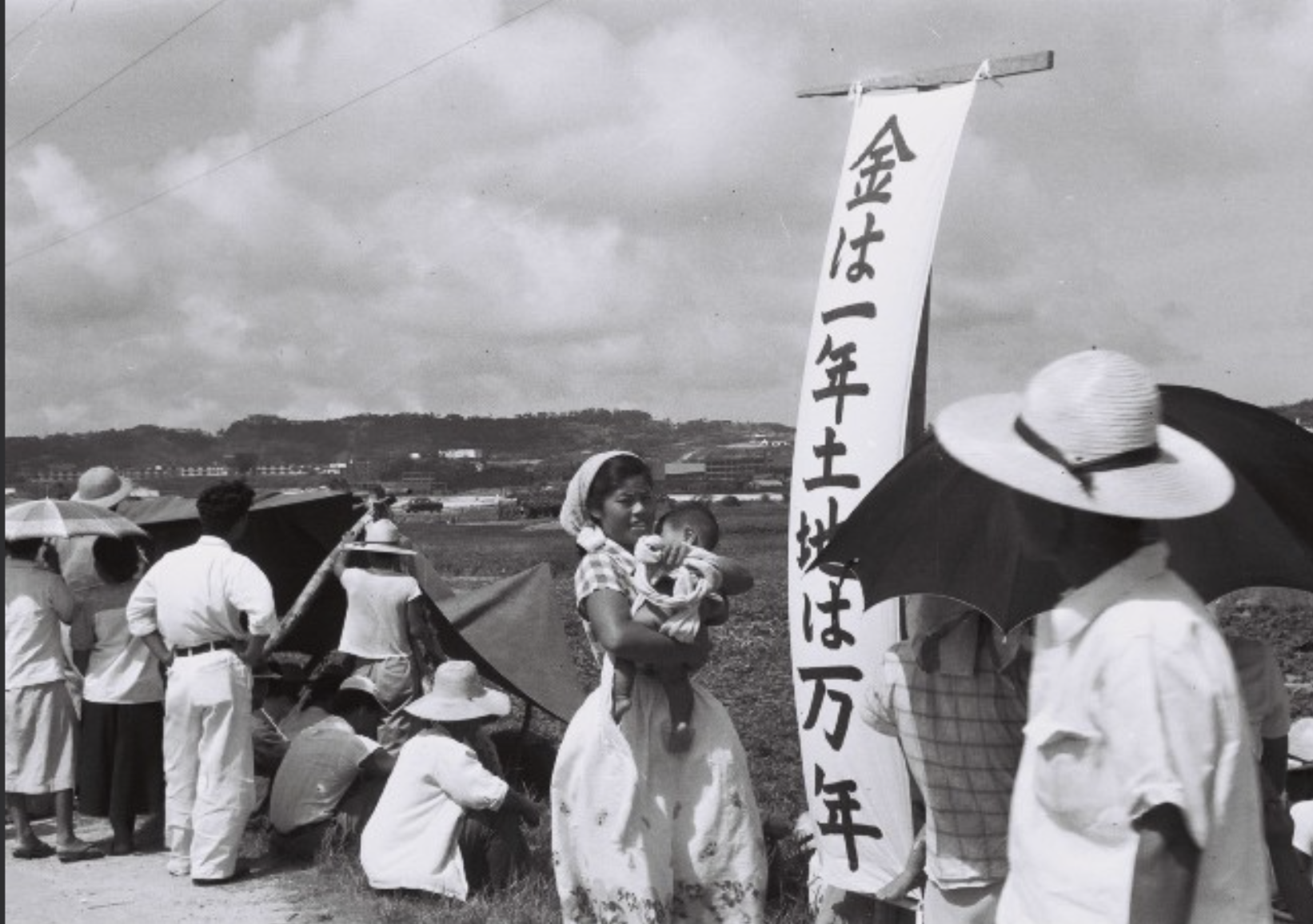
Figure 2: In July 1955, a woman with baby stands beside a banner in Isahama proclaiming the slogan which became a rallying cry for the dispossessed, “Money is for one year. Land is for ten thousand years.” Government of Ryukyu Islands / Okinawa Prefectural Archives.
.
The year began with the realization that the US Air Force had polluted Okinawa’s primary aquifer with per- and polyfluoroalkyl substances (PFAS)—“forever chemicals”—which cause cancers, developmental delays, and harm the human immune system. Decades of training with toxic firefighting foam at Kadena Air Base had seeped PFAS into the groundwater, a source of drinking water for 450,000 residents. Although Okinawans had long been aware of the base’s potential risks—in the 1960s, fuel leaks had made water from nearby wells catch fire—nobody had envisioned this scale of impact, one of the largest cases of environmental contamination in Japanese history. Further checks by the Okinawa prefectural government also discovered dangerous PFAS levels near Camp Hansen, where the drinking water for Kin Town residents was affected, and near Futenma Air Station, where the grounds of an elementary school and sacred springs were polluted. Okinawan officials demanded access to the bases to inspect the sources of contamination, but the US military refused; SOFA enabled it to pollute with impunity.3
.
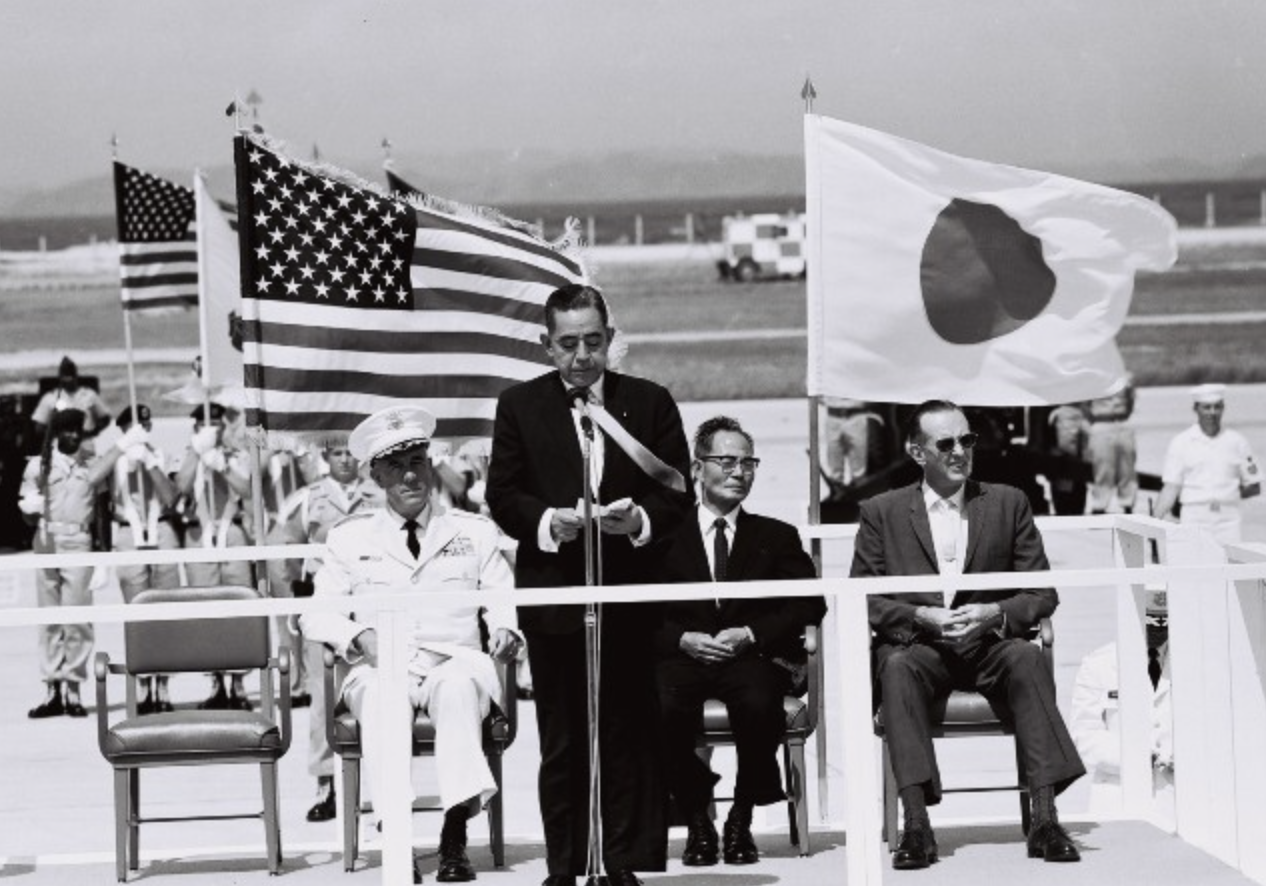
Figure 3: In August 1965, Sato Eisaku became the first Japanese Prime Minister to visit U.S.-administered Okinawa where he famously declared, “Until Okinawa is returned to the homeland, the postwar period will not be over for our country.” Government of Ryukyu Islands / Okinawa Prefectural Archives.
.
As Okinawans began to grapple with the fact that Kadena Air Base had poisoned their drinking water, an American from the same facility was arrested for murder. On the evening of 28 April, Kenneth Gadson, a former marine employed as a civilian contractor, drove through Uruma City seeking a woman to rape. He was not afraid of arrest, he later explained, because he believed that Japanese females tended not to report sexual assaults. At approximately 8:00 p.m., Gadson spotted a twenty-year-old woman walking along the roadside. Military police files describe what Gadson did next: “He kidnapped, bound, raped, bludgeoned, stabbed, and strangled (the victim). Subsequently, he placed (the victim) into a suitcase which he placed into the trunk of his vehicle.” Gadson drove to woodland and disposed of her corpse. Then he dumped the suitcase inside Camp Hansen, where he thought Japanese police would not be able to investigate. If Gadson had been living on-base, he might have evaded arrest by Japanese police due to SOFA, but because he resided in a civilian area, local police were able to detain him. In interviews, he confessed he had fantasized about raping and killing women for many years, and during enlistment, he had told recruiters that his motivation to join the marines was to kill people.4
In response to the murder, the Okinawa Prefectural Assembly passed its first ever resolution to demand the removal of the marine corps from the islands, and 65,000 people staged a mass rally. Once again, Washington and Tokyo attempted to quell the anger with promises of reform. In July, they announced limits to the protections contractors received under SOFA, but when the changes were announced the following January, they proved merely cosmetic, leaving the text of SOFA unchanged. In December, Gadson was sentenced by a Japanese court to life in Yokosuka Prison.5
Given Okinawans’ levels of grief, the Japanese government might have been expected to dial back its oppression, but instead it rubbed salt into residents’ wounds with the construction of yet more US military facilities in the Yanbaru forests. The region hosts the Northern Training Area, where the military had tested Agent Orange and built mock Vietnamese villages in the 1960s, but under SACO, the two governments promised to release approximately half of its land. Just like the closure of Futenma Air Station, however, there was a catch: Before it could be returned, new facilities had to be built elsewhere. Six landing pads for helicopters and MV-22 Ospreys—each around the size of a baseball field—would be constructed around the tiny hamlet of Takae.6
.
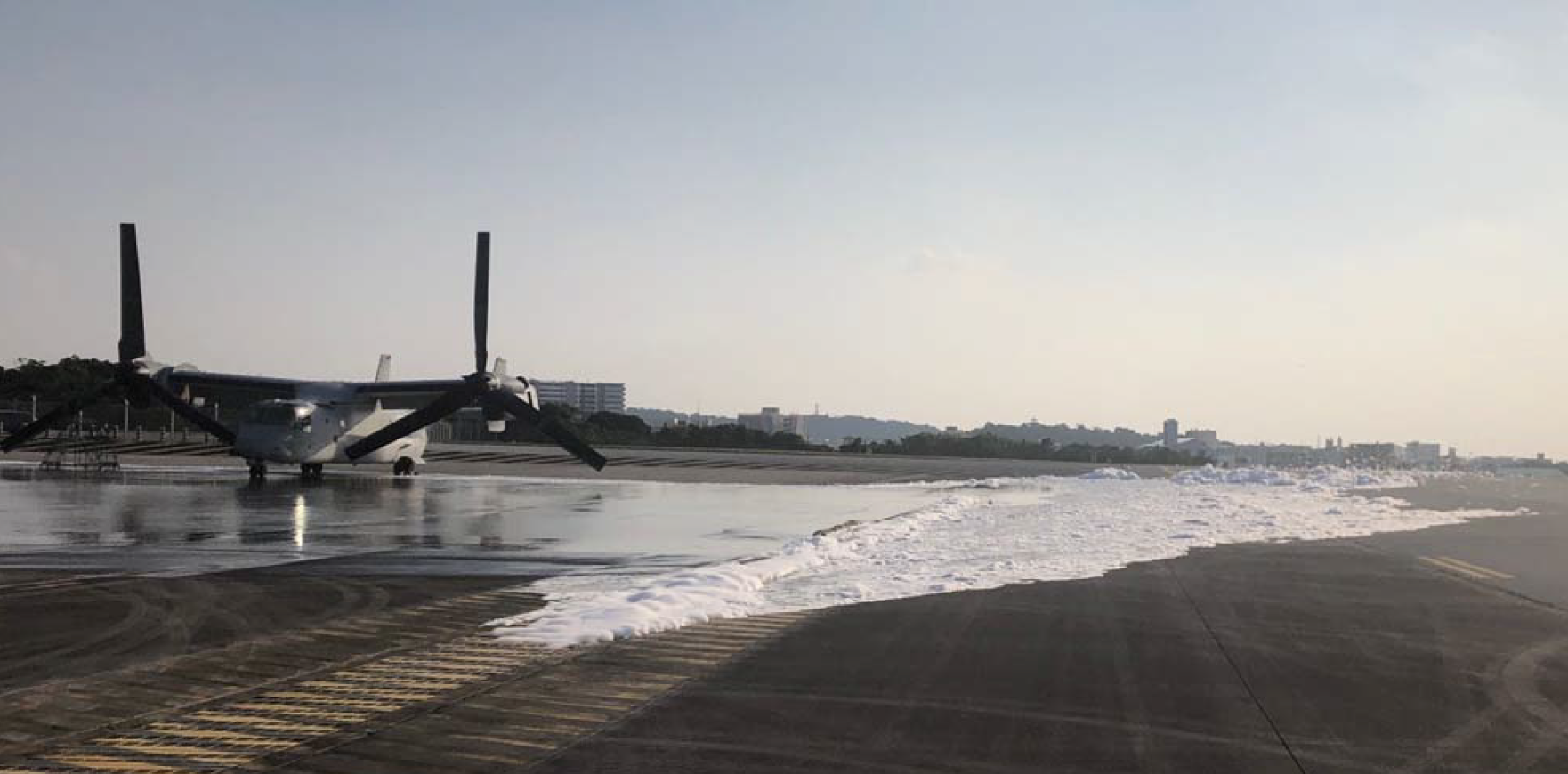
Figure 4: In April 2020, a U.S. Marine Corps “morale barbecue” triggered sprinklers in a hangar at MCAS Futenma, spilling 144,000 litres of foam and water contaminated with toxic PFAS. U.S. Marine Corps via FOIA.
.
Even in an area as ecologically significant as the Yanbaru, Takae was unique. Nearby lived Japan’s highest concentration of endangered and rare species; among the 126 varieties was the Okinawa rail (Yanbaru kuina), a flightless bird only officially recognized in 1978. Residents vowed to protect this biodiversity from military construction projects, and since 2007, they had staged sit-ins against the helipads. The Japanese government had tried to thwart the demonstrators with “strategic lawsuits against public participation” (SLAPP), including one filed against an eight-year-old child.7
Refusing to buckle to such intimidation, residents had successfully blocked construction of four of the helipads. But in 2016, Prime Minister Abe’s administration decided to proceed with construction by force. Wary of potential blowback from voters, the government waited until 11 July, the day after the upperhouse elections, to launch its attack. Then it deployed more than five hundred riot police—many from mainland Japan—who dragged away the citizens attempting to protect the forest. Scuffles between the police and demonstrators led to arrests and injuries. Journalists were corralled, hindering their ability to report on the violence.8
The authorities felled some 30,000 trees and brought in thousands of truckloads of gravel to build the helipads. Particularly galling to many residents was the use of Self-Defense Forces helicopters to fly in materials. Okinawans clambered atop the construction fences and appealed for the workers to halt their operations. Veteran environmental activist Iha Yoshiyasu explained the forest was a “treasure of humanity”; reminded them how military bases had already devastated Okinawa’s environment; and emphasized, “This forest belongs to Uchinaanchu.”9
Mainland police responded to the resistance by hurling racial slurs. In an encounter caught on video, one officer from Osaka Prefecture called demonstrators dojin, the derogatory term for indigenous people harking back to Meiji Era insults against Okinawans. Forced to comment on the matter, the minister of state for Okinawa and northern territories affairs refused to denounce the word as discriminatory, instead defending the police officer: “Everyone has freedom of speech.” Another officer called demonstrators shinajin (a racist word for Chinese people) in a comment that followed a familiar pattern of blaming Okinawans’ civil disobedience on outsiders. (Both officers received reprimands from their police departments.)10
With international attention on Takae, the Japanese government decided to send a message to islanders that further resistance would not be tolerated by moving against its nemesis, the charismatic leader of the Okinawa Peace Movement Center, Yamashiro Hiroji. On 17 October, police arrested and detained him on charges of snipping barbed wire set by the Okinawa Defense Bureau. The estimated cost of the damage: ¥2,000. Under Japanese law, the police can hold suspects for twenty-three days before indictment. So to prolong his detention, Japanese prosecutors pressed additional charges for incidents allegedly occurring many months previously: interference of official duties and bodily injury (in which an Okinawa Defense Bureau officer received a cut to his leg) and blocking the gates of Camp Schwab with 1,500 bricks, an action the police witnessed but ignored as it happened. Yamashiro had previously been diagnosed with malignant lymphoma, but he was not allowed visits by his doctor or family during the five months of his detention before finally being released on bail. On 14 March 2018, Yamashiro appeared in court, where he received a two-year suspended sentence.
Among the human rights organizations condemning his treatment was Amnesty International, which stated, “The arrest of Hiroji Yamashiro, a symbolic opposition figure, has had a chilling effect on others who are peacefully exercising their rights to freedom of expression, association and peaceful assembly. Some activists now hesitate to join the protest for fear of reprisals.”11
Okinawans’ year of abominations was still not over. In December, what many residents had feared became a reality when a marine corps Osprey crash-landed into shallow seas in Nago City. Fortunately, nobody was injured among the crew or on the ground, but it was a stark reminder of the dangers of the aircraft for which the Japanese government was building new landing pads in the nearby Yanbaru forests. By 2024, another two Japan-based Ospreys had been destroyed in crashes: One in 2017 killed three marines during training in Australia, and the other in 2023, involving an air force Osprey, killed eight service members near Yakushima, Kyushu Prefecture. The aircraft’s moniker was proven tragically appropriate: the Widowmaker.
*
Click the share button below to email/forward this article. Follow us on Instagram and X and subscribe to our Telegram Channel. Feel free to repost Global Research articles with proper attribution.
Jon Mitchell is an investigative journalist based in Japan and recipient of the Foreign Correspondents’ Club of Japan’s Freedom of the Press Lifetime Achievement Award. Author of four acclaimed Japanese books about Okinawa, in 2021, Mitchell’s first English book, Poisoning the Pacific: The US Military’s Secret Dumping of Plutonium, Chemical Weapons, and Agent Orange, was a winner in the Society of Environmental Journalists’ annual awards. In 2023, he received Japan’s most prestigious journalism prize, the Ishibashi Tanzan Memorial Journalism Award for public service.
Steve Rabson was stationed as a U.S. Army draftee at the 137th Ordnance Company (SW) in Henoko, Okinawa from July, 1967 to June, 1968. He is professor emeritus of East Asian studies at Brown University and has published books and articles about Okinawa, and translations of Okinawan literature. His books are Okinawa: Two Postwar Novellas(Institute of East Asian Studies, University of California, Berkeley, 1989, reprinted 1996), Righteous Cause or Tragic Folly: Changing Views of War in Modern Japanese Poetry (Center for Japanese Studies, University of Michigan, 1998), Southern Exposure: Modern Japanese Literature from Okinawa, co-edited with Michael Molasky (University of Hawaii Press, 2000), The Okinawan Diaspora in Japan: Crossing the Borders Within (University of Hawaii Press, 2012), Islands of Resistance: Japanese Literature from Okinawa, co-edited with Davinder Bhowmik (University of Hawaii Press, 2016); and translator of Okinawa’s GI Brides: Their Lives in America by Etsuko Takushi Crissey (University of Hawaii Press, 2017). He was stationed in Okinawa as a U.S. Army draftee in 1967-68., and is an Asia-Pacific Journal contributing editor.
Notes
- Note that the series in which this book was published, Asian Voices, is edited by Mark Selden, founding editor of Asia-Pacific Journal: Japan Focus.
- “Inochi, songen mō ubawasenai,” Okinawa Times, 19 June 2016, 31.
- Jon Mitchell, “PFAS Contamination from US Military Facilities in Mainland Japan and Okinawa,” Asia-Pacific Journal 18, iss. 16, no. 9 (15 August 2020): 1–19, https:// apjjf.org/2020/16/jmitchell.
- Brandon Marc Higa, “Unpacking Okinawa’s ‘Suitcase Murder’: Revisiting Extraterritoriality Protections for Military Contractors Under the U.S.-Japan SOFA Supplementary Agreement,” Asian-Pacific Law and Policy Journal 21, no. 2 (May 2020): 9–20; US Naval Criminal Investigative Service, Report of Investigation (Closed), 4 October 2016.
- Agreement Between the Government of Japan and the Government of the United States of America on Cooperation with Regard to Implementation Practices Relating to the Civilian Component of the United States Armed Forces in Japan, Ministry of Foreign Affairs of Japan, 16 January 2017.
- Tabuki Yoko, “Looking Back on the Distressful 12 Years in Takae Through Photos,” Ryukyu Shimpo, 11 October 2019, https://english.ryukyushimpo.jp/2019/10/16 /31132/.
- Iha Yoshiyasu, “Kaisetsu: Yanbaru no mori to Takae heripaddo no kensetsu,” in Okinawa: Aragau Takae no Mori, ed. Yamashiro Hiroaki (Kōbunken, 2017), 85; Tabuki, “Looking Back.”
- Iha, “Kaisetsu,” 87; Tabuki, “Looking Back”; International Movement Against All Forms of Discrimination and Racism and All Okinawa Council for Human Rights, Joint Report, 24.
- Iha, “Kaisetsu,” 87–88.
- International Movement Against All Forms of Discrimination and Racism and All Okinawa Council for Human Rights, Joint Report, 4–6.
- G.A. Opinion No. 55/2018, United Nations Human Rights Council, Opinions Adopted by the Working Group on Arbitrary Detention at its Eighty-Second Session, 20–24 August 2018: Opinion No. 55/2018 Concerning Yamashiro Hiroji (Japan) (27 December 2018); “Open Space for Protest Must Be Created in Okinawa,” International Movement Against All Forms of Discrimination and Racism, 16 June 2017, https://imadr.org/unhrc35-sideevent-summary-freedomofexpression-okinawa -japan-16june2017/; “Prominent Peace Activist Detained Without Bail,” Amnesty International, 26 January 2017, https://www.amnesty.org/en/documents/asa22/5552 /2017/en/.
All images in this article are from APJJF
Global Research is a reader-funded media. We do not accept any funding from corporations or governments. Help us stay afloat. Click the image below to make a one-time or recurring donation.
