All Global Research articles can be read in 51 languages by activating the Translate Website button below the author’s name (only available in desktop version).

To receive Global Research’s Daily Newsletter (selected articles), click here.

Click the share button above to email/forward this article to your friends and colleagues. Follow us on Instagram and Twitter and subscribe to our Telegram Channel. Feel free to repost and share widely Global Research articles.

Give Truth a Chance. Secure Your Access to Unchained News, Donate to Global Research.

***


Thanks to the efforts of a voluntary organization Srijan spread over several years, Tikamgarh district (Madhya Pradesh) has emerged as an important center for the spread of natural farming practices. The ‘Tikamgarh model’ that has emerged from these efforts is based on encouraging small farmers to adopt natural farming practices, with special emphasis on encouraging women farmers, as well as diversifying crops with multi-layer  vegetable gardens and small fruit orchards.

Now that these farmers have a higher diversity of crops grown using natural farming methods (and avoiding chemical fertilizers and pesticides), the next obvious step is to try to increase the income of farmers by taking their produce directly to those consumers who value healthy food. However this would involve some additional efforts on the part of these farmers to take up food processing activities as well. This makes it possible to gain access to consumers directly. Value addition with processing activities, which are taken up keeping in view health and nutrition value of food, also brings new livelihood support and income to rural communities. 

Hence the next step in the natural farming model implemented here is to add food processing, value addition and improved marketing. Once farming communities move in this direction, the consolidation efforts also make it possible to receive inputs like better quality seeds and saplings as well as know-how and other help in a more organized way.

Hence the Tikamgarh model of natural farming is now marching into a new phase of a farmer producer group of women farmers. It has been decided to initiate such an effort with women farmers because they have been a very important part of the mobilization here for natural farming and higher diversification of crops and have been consistently giving good results with their sincere efforts. In addition there is a desire to accord the due recognition to the important contribution of women to farming which has not received the due recognition in most parts of the country.

Saroj Kushwaha of Pathari village is a woman farmer who has adopted natural farming practices with a lot of commitment and has also encouraged and helped several other farmers to do so. She has started a natural farming center on her small farm of about 4 acres or so with the help of Srijan. Making the most of the several opportunities created by this voluntary organization, she has initiated a multi-layer vegetable garden ad has enrolled for training as a ‘goat doctor’ so that the goats of her village can now be treated within the village with her help. Not too far from this village is another inspiring woman farmer Phoola Devi from an even poorer background. Although she has even lesser land, she has attracted much appreciation for her sincere and hard work in creating a beautiful fruit orchard on this land.

Such hard working and sincere women farmers are the real strength of this farmer producer organization which has now also been registered as a company, the Ken Betwa Women Farmer Producer Company. This company has 2300 shareholders, who are mostly women farmers from Tikamgarh district.

This name is based on two famous rivers of Bundelkhand region—Ken and Betwa rivers—and the message sought to be conveyed by this name is that just as it is very important to protect these rivers for the prosperity of the region, similarly it is very important to protect the sustainable livelihoods of small farmers.

This effort has made it possible for women to come forward increasingly in leadership roles, a trend that is likely to increase further in the near future.

Instead of being too ambitious, this effort has come up with the sale of a limited number of products initially for direct sale to consumers. Orders from health-conscious consumers are coming in based on its web-site information and other avenues of approaching consumers. Although this effort is already getting good orders from big cities like Mumbai, its aim is to keep a balance between such orders and sales closer to home.

The products already being marketed include cold press groundnut and mustard oil, ghee based on the milk of local breeds of cows, graded and packaged groundnuts, kodon and kutki millets, arhar and moong pulses. 

By using cottage and village-scale processing, this effort ensures additional advantages which may be lost in large-scale processing. Healthier, more nutritious edible oil can be obtained while oilcake remains available for local dairy animals instead of being lost to the wider market or the export market.

Farmers get their payment very quickly. Often the produce is collected right from their doorstep so that they do not have to spend money and time in the sale effort. At some of the processing centers women farmers can come and use the equipment available here even for the processing of that produce which has not been sold to the company. Whatever profits the company makes remain with their own company of which they are shareholders.

Rakesh Singh and Kamlesh Kurmi of Srijan who have been closely involved with the initial planning of this venture say, “The idea is not to make a big splash with too many products but instead to emphasize quality control and establish credibility. Once this is achieved other gains will come in due course. We have several innovative ideas which will be implemented when things have stabilized somewhat.”

A side activity of this effort has been to also make available some bulk farm produce to some bigger procurers (such as wheat to biscuit makers). However the main concentration remains on establishing a direct link between ecologically protective farmers and health-conscious consumers.

*

Note to readers: Please click the share button above. Follow us on Instagram and Twitter and subscribe to our Telegram Channel. Feel free to repost and share widely Global Research articles.

Bharat Dogra is Honorary Convener, Campaign to Save Earth Now. His recent books include India’s Quest for Sustainable Farming and Healthy Food, Man over Machine and A Day in 2071. He is a regular contributor to Global Research.

Featured image is from the author

  • Posted in Mobile
  • Comments Off on Linking Ecologically Protective Farming with Consumers Who Value Healthy Food
  • Tags: ,

All Global Research articles can be read in 51 languages by activating the Translate Website button below the author’s name (only available in desktop version).

To receive Global Research’s Daily Newsletter (selected articles), click here.

Click the share button above to email/forward this article to your friends and colleagues. Follow us on Instagram and Twitter and subscribe to our Telegram Channel. Feel free to repost and share widely Global Research articles.

Give Truth a Chance. Secure Your Access to Unchained News, Donate to Global Research.

***

A private government report obtained this week in response to questions over the decision to kill over 500,000 chickens in Victoria, Australia shows that the people making the decision had no verifiable evidence of a high-risk infectious outbreak.

The chicken farms that were claimed to be infected were so distant from any possible bird source that it was unlikely or impossible to have happened without deliberate intervention or manipulation of testing.

The Commonwealth Scientific and Industrial Research Organisation (“CSIRO”), the Australian equivalent of the Wuhan Institute of Virology, is the closest possible source of the “outbreak” and it is not the first time they have been involved in the emergence of “new” viruses.

The chicken cull would appear to be a manufactured crisis. So who manufactured this “crisis”? Dr. Ah Kahn Syed investigates.

One Flew Over the Chickens’ Nest, Arkmedic’s Blog, 10 June 2024


This week I received a copy of a government document sent in response to questions about this unusual event in Australia – the culling of 500,000 chickens: ‘Bird flu spread fears mean 500,000 chickens must be culled’.

Now, you might think that isn’t that much of a story – after all our food safety is paramount, so if there is a flock of chooks that is infected, we need to act early and cull them, right?

Not so fast. Bird flu is called bird flu because it affects birds. And just as the FDA told us that we are not horses (despite having to take this tweet and webpage down after a court order), we are not birds either. So, except in rare and odd circumstances (or some psychopathic scientist decides to make it adapt to humans), bird flu is zero risk to the human population. And once that chook has gone through the fryers at KFC any trace of the chookie sniffles will be long gone anyway.

So what event was so catastrophic that half a million chickens had to be culled (that is, killed, not to be eaten but to be disposed of without ever touching the food chain)?

Apparently, an outbreak in three farms of H7N3 bird flu1, with another farm 100km away affected by a different H7 strain – H7N9. And according to WAHIS (the animal outbreak monitoring agency), these are the only outbreaks this year in Australia – and they have appeared almost as far South as you can possibly get.

Near a place called Geelong in Victoria, the same state as Melbourne.

Map of the H7 bird flu outbreaks in Southern Australia, all sites within around 100km of Geelong, home of the CSIRO.
Image source: World Organisation for Animal Health


Now the interesting thing about the city of Geelong, for those who pay attention, is that it is the home of Australia’s version of the Wuhan Institute of Virology – the CSIRO. This, of course, is completely coincidental because there are obviously other routes that a bird-borne infectious outbreak can take other than being created by a scientific institute famous for manipulating identifying “novel” bat viruses.

As most bird flus are supposed to originate in Asia here is a nice map view of the route that the infected birds would take to get to Geelong. It’s a long way to fly, which may be why there isn’t any “naturally occurring” H5N1 (Asian Bird Flu) in Australia2. And if there were infectious diseases coming from Asia, you would see them in Queensland or the Northern Territories first.

In fact, most Asian birds tend not to migrate to Australia at all, which is partly why Australian birds are different from the rest of the world including such oddities as the Kookaburra, Black Swan, Cassowary and Ibis (commonly known as a bin chook for its uncanny ability to get food out of public dustbins).

Source: Avian influenza H5N1 viral and bird migration networks in Asia, PNAS, 22 December 2014


So, if Australia is going to get H5N1 Bird Flu naturally it is going to be a bit of a tall order … unless … The clucky Bird Flu perpetrators come through the back door, from Antarctica.

Well of course Australia’s national broadcaster, the ABC, is one step ahead of you there with this amazingly clever prebunking video including CNN-level “dead-birds-in-a-row” staged dead bird carnage images – to really make you think it’s bad out there.

And if you REALLY aren’t sure how DEADLY this is, we are not only going to show you dead pelicans lined up on snow but WE ARE GOING TO PUT 100 MILLION KILLED IN RED – and make it look like the COVID dashboard.

ABC News In Depth: Deadly bird flu is leaving a ‘trail of destruction’ in Antarctica and has scientists on edge (timestamp 3:07)


There. Are you scared yet? No? Well, we haven’t finished. Certainly Jo Sillince, CEO of the “Australian Chicken Growers Council” isn’t, because she appears in both the ABC’s news article telling us how scary this could all be AND in the video above telling us that the main risk is from Antarctica.

So, if you’re not scared of Joanne, or the ABC, you damn well better be because there is BIRD FLU COMING FROM ANTARCTICA TO KILL THE CHICKENS.

And, not wanting to point out the obvious or anything but getting bird flu from Antarctica is not that easy. You see the major migration patterns of birds don’t really include a pathway from Antarctica to Australia.

Source: The migration routes of migrant birds in all the world, ResearchGate


And even if the odd Antarctic Albatross were to accidentally find its way to the coffee shops of Melbourne it would have struggled to pick up an Asian bird flu in the snowy wastes of Antarctica.

And then there are the penguins. Penguins are birds, in case you didn’t know. They can fly but only in the fluid medium of water (most birds fly in the fluid medium of water vapour, i.e. air). So, they could make it to the south coast of Australia to drop their bird flu droppings – but not much further without a long walk. And if you saw a family of penguins on the road to Geelong, I’m pretty sure you would have seen it in the news.

And just before we start with the real story of what is going on I need to give some background on Michelle Wille, friend and co-authors of Edward Holmes, co-authors of the EcoHealth scientists discussed further below.

Michelle is the senior scientist in the “Antarctic Chickens” video above and essentially runs the “scary virus” campaigns in Australia, sucking up huge amounts of funding for “pandemic preparedness” which never actually prevents pandemics.

Here she is attempting to scare the bejeezus out of you with an article in The Conversation, which hosted the very same buddy Eddie Holmes two years ago with a similar story telling us how we were all crazy for thinking that covid came from a laboratory. Except it turns out that it did.

Chickens, ducks, seals and cows: a dangerous bird flu strain is knocking on Australia’s door, The Conversation, 22 May 2024


Can you see how this works?

  1. Create virus using either an existing virus, or a novel virus or a manipulated virus.
  2. Create scare about virus, even if it’s not that dangerous (if at all).
  3. Create bogeyman conspiracy theorist for public ridicule if anybody questions the creation of a virus.
  4. Rinse and repeat, taking in millions of dollars of public funding to “prevent” the next scary virus that you don’t prevent at all.

The Crazy Explanations

So, could there be another explanation than Antarctic chickens flying over the Southern Ocean and infecting their temperate brethren?

Well, given that the CSIRO is in the very neighbourhood where the majority of the outbreaks are we might want to look there to see if, perhaps, they might possibly have had anything to do with an N7N3 outbreak next door, or if in fact, a H7N3 outbreak is of any consequence at all.

So, let’s look at the two scenarios (which are not mutually exclusive) but before we do just a little reminder of the reason for the title for those that are not old enough to remember one of the most awarded films of all time. I was contemplating captioning it, but I’ll leave it like this for now.

Click here to read the full article.

*

Note to readers: Please click the share button above. Follow us on Instagram and Twitter and subscribe to our Telegram Channel. Feel free to repost and share widely Global Research articles. 

Featured image is from rawpixel.com

All Global Research articles can be read in 51 languages by activating the Translate Website button below the author’s name (only available in desktop version).

To receive Global Research’s Daily Newsletter (selected articles), click here.

Click the share button above to email/forward this article to your friends and colleagues. Follow us on Instagram and Twitter and subscribe to our Telegram Channel. Feel free to repost and share widely Global Research articles.

Give Truth a Chance. Secure Your Access to Unchained News, Donate to Global Research.

***

The United Nations Development Programme’s internal watchdog is reviewing a complaint that a project led by the agency is platforming companies linked to human and environmental rights abuses.

Local rights group Licadho had as early as December 2022 flagged the UNDP’s SDG Impact – Private Sector Capital project, which aims to assist in facilitating investment in Cambodian companies.

Several of the companies promoted as “investment opportunities” by the project are linked to government and business bigwigs with track records of deforestation, illegal logging and forced evictions.

Licadho said there was “no meaningful due diligence” by the UNDP in selecting the companies to promote, and that the project “lend[s] reputational support to companies with documented involvement” in issues as serious as child labor and trafficking in persons, among others.

*

A rights group in Cambodia has accused a United Nations project of promoting private sector actors tied to human rights and environmental abuses.

The U.N. Development Programme’s SDG Impact – Private Sector Capital project includes the SDG Investor Platform and Cambodia SDG Investor Map, which aim to assist in facilitating investment in Cambodian companies.

The complaint, filed by the organization Licadho, alleges a failure in the UNDP’s due diligence prior to establishing the project, resulting in companies alleged of abusing rights and environmental crimes being listed as potential investment opportunities.

“UNDP selected private sector actors and categorized them as ‘partners’ for the project, lending reputational support to companies with documented involvement in coerced land sales, forced evictions, deforestation of protection areas and Indigenous lands, child labor, trafficking in persons, and other harms,” Licadho wrote in a May 24 statement.

Licadho is representing victims, whose identities have not been revealed, in the complaint that was filed with the UNDP’s Social and Environmental Compliance Unit (SECU) on March 6.

“Licadho raised concerns both in-person and over email about aspects of this project as far back as December 2022,” said Naly Pilorge, Licadho’s outreach director. “UNDP Cambodia representatives responded that the project did not fall under UNDP’s due diligence policies, leaving us no other option but to proceed with a formal complaint. We strongly disagree with UNDP Cambodia’s assessment that this does not fall under their due diligence policies, and we hope the SECU will clarify this issue as part of their investigation.”

The internal compliance body reported on May 9 that Licadho’s complaint was eligible for review, starting with discussions between the SECU and the complainants, as well as UNDP staff. The UNDP’s own due diligence policies forbid the agency from engaging with private sector actors known to be involved in human rights abuses, whether directly or indirectly, or with companies “incompatible with UNDP’s vision, mission and values.”

According to the SDG Investor Platform’s call for applications, due diligence was expected to be performed during the final selection for Cambodian applicants in mid-February 2024.

A representative from the SECU told Mongabay that “We are in the preliminary stages of our investigation, and it is too soon to discuss potential findings,” noting that the investigation will adhere to the unit’s guidelines and that updates can be found within the case registry.

The UNDP’s Cambodia office didn’t answer specific questions sent by Mongabay, instead saying the Cambodia SDG Investor map “published in August 2022, was a one-off study designed to explore investment opportunities in key sectors” related to the U.N.’s Sustainable Development Goals.

Adding that the investor map was developed through “broad consultations,” the UNDP said that “The list of entities included in the report are stakeholders in those key sectors, and UNDP does not necessarily engage with any of them.”

Directly opposite Santana Agro's factory, the Chi Ouk Boeung Prey community protected area has been ravaged by loggers that the community said were brought in by the cashew company. Image by Gerald Flynn / Mongabay.

Directly opposite Santana Agro’s factory, the Chi Ouk Boeung Prey community protected area has been ravaged by loggers that the community said were brought in by the cashew company. Image by Gerald Flynn / Mongabay.


The Company You Keep

None of the companies alleged to have committed abuses have been named by Licadho, the UNDP or the SECU. But among the 72 listings across 15 “investment opportunities areas” on the Cambodia SDG Investment Map, certain names jump out.

Among them, cashew producer Santana Agro Products remains listed on the SDG Investor Platform.

Mongabay has previously reported on the clearing of forest in Preah Vihear province within both an Indigenous-managed community protected area and a nationally managed wildlife sanctuary that was linked to Santana Agro. Satellite imagery shows that between February this year — when Mongabay first reported illegal logging activity in the Chi Ouk Boeung Prey community protected area — and May, further logging has all but destroyed the forest.

Santana Agro is headed by Ouk Kimsan, the former right-hand man of infamous illicit timber trader Try Pheap.

Now the deputy governor of Preah Vihear province, Kimsan denied any wrongdoing when initially interviewed in February and maintained his innocence in May.

“I do not understand about this case,” he said in response to questions about Licadho’s complaint against the SDG Investor Platform that Santana Agro was listed on. “I [know] what Mongabay posted is wrong.”

Kimsan confirmed he had acquired land through an agreement with the Chi Ouk Boeung Prey community council and had cleared the protected forest, but said this wasn’t illegal, despite Cambodian law preventing communities from selling, leasing or clearing community protected areas. He also conceded to owning a roughly 700-hectare (1,730-acre) chunk of forest in Beng Per Wildlife Sanctuary, where satellite imagery shows fresh deforestation that resembles a new economic land concession spanning some 3,100 hectares (7,660 acres). Kimsan said the protected forest had been awarded to private individuals who are planting cassava and rubber — products that Santana Agro sells. However, Kimsan said he didn’t know whom this land had been awarded to, despite the newly cleared plots abutting his own.

“[The] country has law[s]. If Santana does it illegally. Santana will be enforced by law,” he said.

A vast chunk of protected forest is being carved out of Beng Per Wildlife Sanctuary. Sources claim Santana Agro is responsible. Image by Gerald Flynn / Mongabay.

A vast chunk of protected forest is being carved out of Beng Per Wildlife Sanctuary. Sources claim Santana Agro is responsible. Image by Gerald Flynn / Mongabay.

Invest in the Infamous

Another notable name that features on the UNDP’s Cambodia SDG Investor Map is Phea Pimex Asia Forestry Investment Group, a company founded in 2010 by Hun Mana, daughter of former prime minister Hun Sen, and Lau Yao Zhong, son of two of Cambodia’s most powerful tycoons, Lau Meng Khin and Choeung Sopheap.

Dubbed the “power couple” behind the ruling Cambodian People’s Party (CPP), husband Meng Khin has been a CPP senator since 2006 while wife Sopheap chairs the Pheapimex Group, a company directly linked to illegal logging across the country, forced evictions at Boeung Kak Lake, and the infamous Cheay Areng hydropower project.

At one point the couple retained rights to roughly 7% of Cambodia’s landmass. Today, they still own an economic land concession that stretches more than 33 times the legal 10,000-hectare (24,700-acre) limit.

Phea Pimex Asia Forestry Investment Group has, since 2017, been headed by Liu Wei, a close business associate of Meng Khin. Wei and Meng Khin formerly ran Wuzhishan L.S Group together, a company also linked to forced evictions and illegal logging. Wuzhishan is now controlled by Yao Zhong, Meng Khin’s son.

But this isn’t the only connection to Pheapimex among the companies listed in the Cambodia SDG Investor Map.

Green Leader is listed as a private sector actor in the “sustainable agriculture” section of the SDG Investor Platform, but the company (formerly North Asia Resources) is a subsidiary of Asia Tian Guan Agriculture Group, which lists as its chairman Guan Dao Fei — a business partner of Wei from Phea Pimex Asia Forestry Investment Group.

Wei and Guan were majority shareholders of Asia Tian Guan Agriculture Group in 2017, when the company partnered with Pheapimex, leasing 21,000 hectares (51,900 acres) of the conglomerate’s 333,327-hectare (823,669-acre) concession in Pursat province for a cassava plantation in 2017 — just months before Green Leader was incorporated in Cambodia.

Representatives of Pheapimex and Phea Pimex Asia Forestry Investment Group couldn’t be reached for comment.

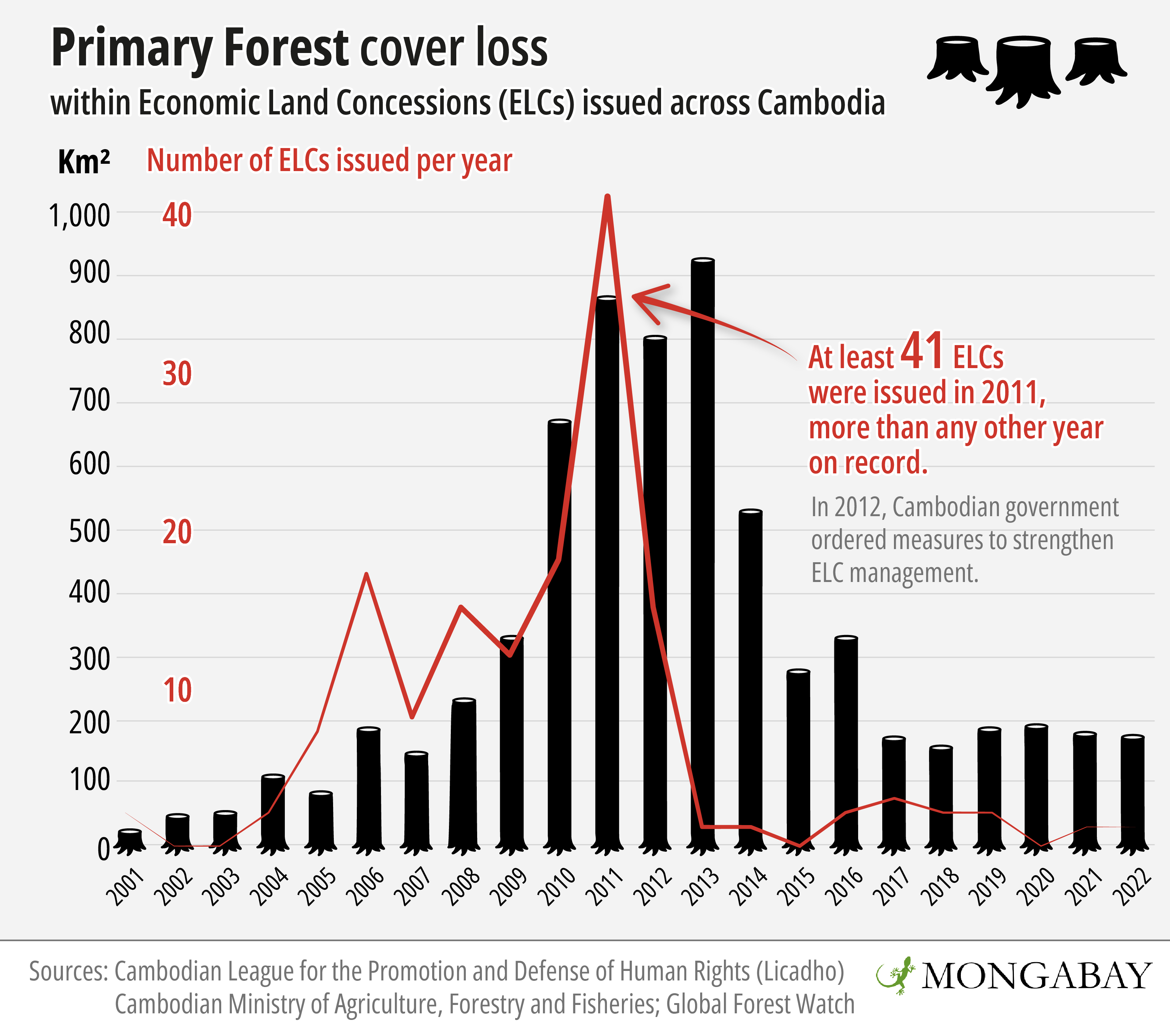
Primary forest loss across known ELCs in Cambodia spiked at roughly the same time that the government was issuing record numbers of concessions, mostly to foreign investors and political allies. Image by Andrés Alegría / Mongabay.

Primary forest loss across known economic land concessions in Cambodia spiked at roughly the same time that the government was issuing record numbers of concessions, mostly to foreign investors and political allies. Image by Andrés Alegría / Mongabay.


UNnamed

Neither Santana Agro nor Pheapimex or its associated business connections were named by Licadho or the U.N. as the cause of the complaint, but the allegations facing each have long been well-documented.

Beyond these businesses, a range of microfinance institutions were also promoted by the UNDP as a means to enhance access to finance, which the SDG Investor Platform detailed as assisting in SDGs aimed at eradicating poverty, promoting industry, decent work and growth, as well as reduced inequality. But besides allegations of predatory lending, coerced land sales and compounding household debt, microfinance lenders such as Amret and Prasac in Cambodia have been accused of stymying Indigenous land rights.

Royal Group's SEZ under construction in Botum Sakor National Park as of May 2023

Royal Group’s SEZ under construction in Botum Sakor National Park as of May 2023. Image by Gerald Flynn / Mongabay.


Another business listed as primed for investment by the SDG Investor Platform is Northbridge International School Cambodia, which, in 2018, listed ties to Royal Group chairman Kith Meng, a powerful tycoon that has been linked to large-scale illegal logging operations, the displacement of Indigenous communities, and the wholesale destruction of Botum Sakor National Park.

Royal Group also owns and operates Southbridge International School, a separate though similarly named private school. Northbridge International School Cambodia didn’t respond to requests to clarify its relationship to Royal Group or Kith Meng.

“It is clear that there was no meaningful due diligence around the selection of these companies, and this is absolutely unacceptable,” said Pilorge of Licadho. “In our view, the highlighting of some of these companies as ‘partners’ does not comply with UNDP’s own policies and ignores systemic human rights concerns.”

*

Note to readers: Please click the share button above. Follow us on Instagram and Twitter and subscribe to our Telegram Channel. Feel free to repost and share widely Global Research articles.

Featured image:  Chun Seiha, member of the Indigenous Kuy community in Preah Vihear province, shows where Santana Agro have been logging of the Chi Ouk Boeung Prey community forest.

  • Posted in Mobile
  • Comments Off on Cambodian Companies Tied to Abuses Promoted by UN Program, Rights Group Alleges

Video: Three Ways in Which Australia Arms Israel

June 12th, 2024 by Sam Wainwright

All Global Research articles can be read in 51 languages by activating the Translate Website button below the author’s name (only available in desktop version).

To receive Global Research’s Daily Newsletter (selected articles), click here.

Click the share button above to email/forward this article to your friends and colleagues. Follow us on Instagram and Twitter and subscribe to our Telegram Channel. Feel free to repost and share widely Global Research articles.

Give Truth a Chance. Secure Your Access to Unchained News, Donate to Global Research.

***

Labor keeps repeating the lie that it is not sending weapons to Israel.

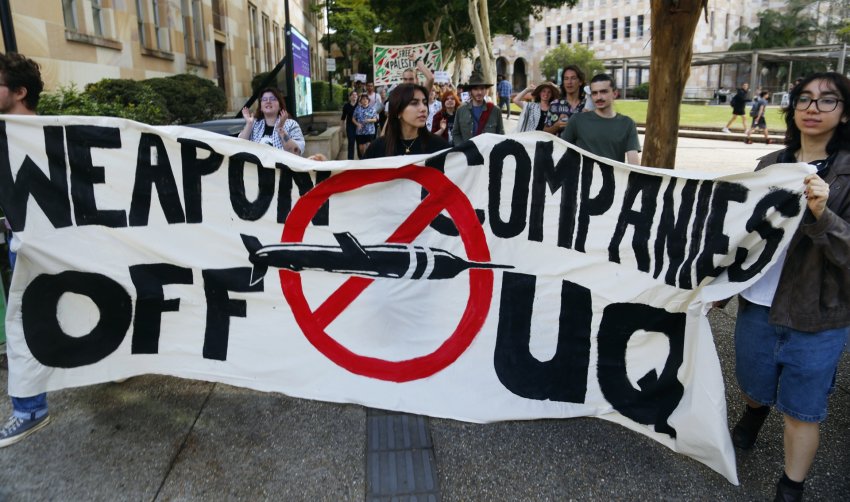
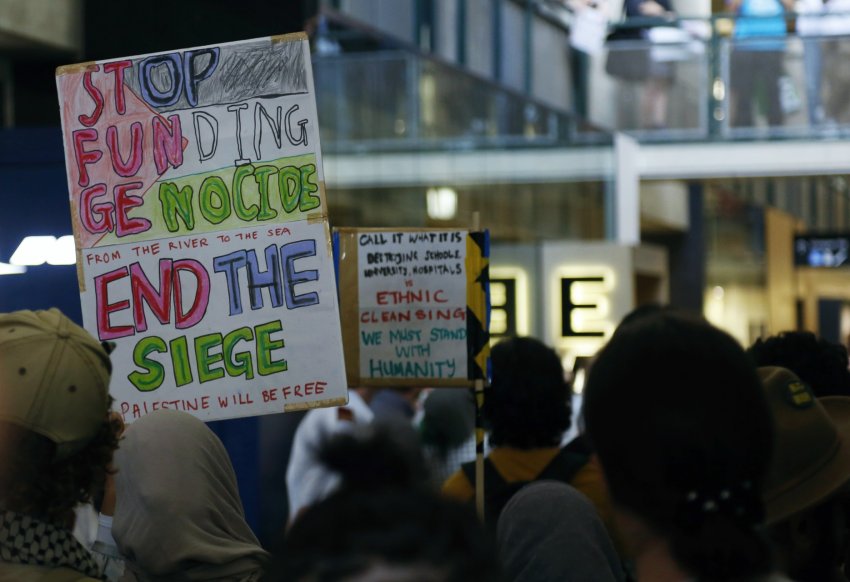
Sam Wainwright, on behalf of Stop AUKUS WA, outlined at the “Stop Arming Israel” protest on June 8 that Australia in complicit in Israel’s genocide in Gaza.

Wainwright is a national co-convenor of Socialist Alliance.

He reminded the crowd that protesting the genocide is still one of the one of the most effective actions people can take, and that we must keep it up until the Anthony Albanese Labor government is forced to junk its pro-Israel policy.

“It’s not enough to be on the right side of history, we need to make history,” Wainwright said.

Video by Alex Salmon.

*

Note to readers: Please click the share button above. Follow us on Instagram and Twitter and subscribe to our Telegram Channel. Feel free to repost and share widely Global Research articles.

All Global Research articles can be read in 51 languages by activating the Translate Website button below the author’s name (only available in desktop version).

To receive Global Research’s Daily Newsletter (selected articles), click here.

Click the share button above to email/forward this article to your friends and colleagues. Follow us on Instagram and Twitter and subscribe to our Telegram Channel. Feel free to repost and share widely Global Research articles.

Give Truth a Chance. Secure Your Access to Unchained News, Donate to Global Research.

***

Rameshwar purchased a tractor on loan basis in 2011. Till year 2024 he remained tense in various difficulties and complications relating to the paying back of this loan. When he could not succeed in paying back this loan, he committed suicide recently on May 22, leaving behind the inheritance of a damaged tractor and an unpaid loan for his eldest and ailing son Vijay Bahadur. Unable to bear the pain of Rameshwar’s death in very distressing conditions, his brother Jagdyona also died within a week or so.

Rameshwar was a farmer of Hastam village, located in Mahuva block of Banda district, Uttar Pradesh. His extended family had been subsisting with difficulty on the basis of farming their five acres of land. It was a dream of Rameshwar to somehow buy a tractor, but he had held back this desire because he understood that he cannot afford to buy one. However he was lured by some agents that they can arrange a loan from a bank for this, and it will not be too difficult to pay back the instalments. They made the deal sound very attractive and Rameshwar temporarily forgot about the grim reality of high interest rates. Finally the tractor came home on a note of glory, the uncomfortable fact of the loan of Rs. 485,000 being pushed aside for some time.

However Rameshwar realized soon that it was not possible to pay back the loan interest, let alone the principal amount, particularly during the all-too-frequent times of erratic weather leading to less than expected crops. Although he made his best efforts to try to pay back the loan in time, the loan plus interest continued to increase and at one time had crossed a million Rs. Then Rameshwar made an even bigger effort and managed to take it back closer to the original amount, but these was no question regarding his inability to pay back the entire loan, no matter how hard he tried. More recently his efforts were hampered further when the tractor stopped working and they could not afford the Rs. 40,000 to Rs. 50,000 amount that was needed to repair the tractor.

So the bank loan started increasing again. The last notice for loan payment received by the farmer mentioned an amount of over Rs. 640,000. Whenever such notices came, these made Rameshwar very tense as these hurt his sense of self-respect and dignity and also increased his worries about the future of his family. Soon after receiving this notice he committed suicide.

When I visited this village after about two weeks of this suicide, the family of the eldest son Vijay Bahadur was still in a shock and in mourning as the elder uncle of Vijay had also passed away in the meanwhile as he could not bear the shock of the death of his brother in very distressing conditions. The combined impact of various adversities has been that the farmer family does not even have enough to eat, and Vijay is at the end of his wits to try to figure out how he is ever going back to pay back the loan he has inherited.

Sitting in front of the house and near the unfortunate tractor, we discussed various possibilities of what can be done. VDS, a local organization trying to reduce farmers’ distress, has been trying to bring in a little help for the distressed family, but the bigger issue is of the loan. Vijay suffers from health problems which limit his ability to work very hard. One suggestion that comes up is to arrange for the tractor’s repair so that some income can be earned by hiring this. Other suggestions are also discussed. Although no definite solutions emerge, but the very fact that someone has come with a helping hand and sympathy and there has been serious discussion of improvement possibilities have cheered up the family somewhat and Vijay Bahadur finally permits himself a smile as he walks with us a  few steps to say goodbye.

*

Note to readers: Please click the share button above. Follow us on Instagram and Twitter and subscribe to our Telegram Channel. Feel free to repost and share widely Global Research articles.

Bharat Dogra is Honorary Convener, Campaign to Save Earth Now. His recent books include Man over Machine, A Day in 2071 and India’s Quest for Sustainable Farming and Healthy Food.        

Featured image is from the author

All Global Research articles can be read in 51 languages by activating the Translate Website button below the author’s name (only available in desktop version).

To receive Global Research’s Daily Newsletter (selected articles), click here.

Click the share button above to email/forward this article to your friends and colleagues. Follow us on Instagram and Twitter and subscribe to our Telegram Channel. Feel free to repost and share widely Global Research articles.

Give Truth a Chance. Secure Your Access to Unchained News, Donate to Global Research.

***

The University of Sydney is currently undertaking an investigation on its sociology Professor Sujatha Fernandes for breach of code of conduct. After her “Week 9 – Power 1” lecture in April, some students in her class leaked her slides to The Australian.

*

The University of Sydney is currently undertaking an investigation on its sociology Professor Sujatha Fernandes for breach of code of conduct. After her “Week 9 – Power 1” lecture in April, some students in her class leaked her slides to The Australian.

The Australian then published an article on May 30, revealing to the public that multiple Jewish groups have called on the University to open an investigation into the professor. 

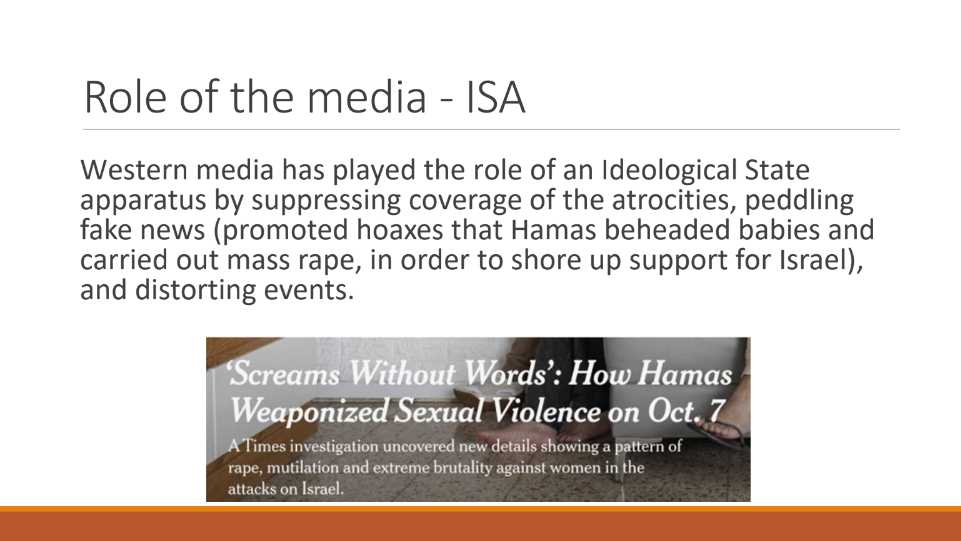
The following slide was singled out as the source of complaints:


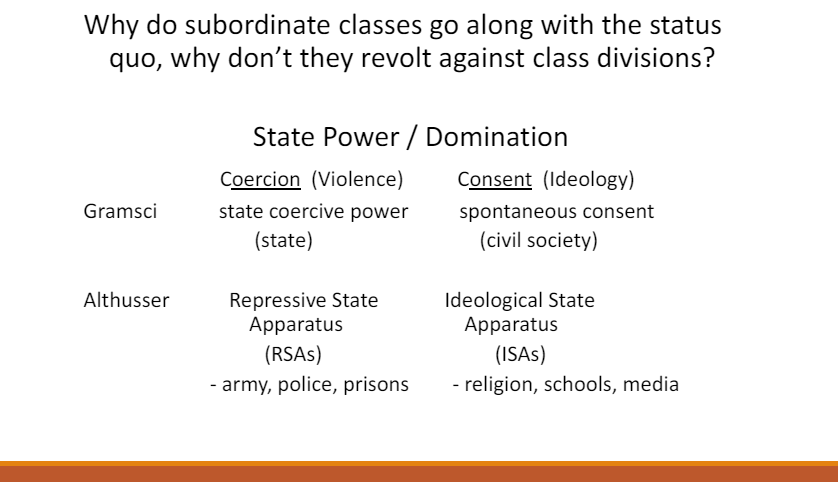
Honi understands that in Fernandes’ full lecture presentation, she referenced the Palestine genocide as a case study on power. She explored the use of passive language by Western media to absolve Israel of guilt, and the media’s role in what French philosopher Louis Althusser referred to as the “ideological state apparatus.”


The Australian article also includes a two-minute clip from the lecture recording where Fernandes discusses the New York Times article published on December 28, 2023, entitled “Screams Without Words: How Hamas Weaponised Sexual Violence on Oct. 7.” 

Fernandes can be heard on the recording discussing the article.

“The witnesses, they supposedly had said that… it never happened to them. The sources were retracted, all kinds of things to prove that this story…it was not a real story, that a lot of what was in this article, was not true. And yet they haven’t retracted the article,” she says.  

The Australian said that it alerted the University after obtaining access to Fernandes’ lecture materials and recording. Alex Ryvchin, co-chief executive of the Executive Council of Australian Jewry (ECAJ), also wrote to the University demanding an investigation.

When contacted for confirmation, a University spokesperson told Honi Soit that “a preliminary investigation” has begun and the University is “looking into this matter as a priority.”

The spokesperson maintained the University’s commitment to “academic freedom and freedom of speech” and as a “forum for debate and discussion.”

“Academic staff giving lectures must exercise their intellectual freedom according to the highest ethical, professional, and legal standards. We are fortunate to have some of the world’s best academics and we expect all of them to apply a best teaching practice approach incorporating evidence and analysis”, the spokesperson said.

They also said that “when breaches against University policy have occurred”, the University has “acted and taken disciplinary action.”

It was not specified if Fernandes’ lecture materials or remarks had breached the academic code of conduct. 

President of the USyd National Tertiary Education Union (NTEU) branch Nick Riemer told Honi,

“NTEU members will not tolerate intimidation or censorship of Palestine solidarity, whether for students or staff. Zionists clearly think that the university’s internal processes are there to be weaponised for their own political purposes. Management must show that this is not the case.”

Professor Fernandes was approached for comment.

*

Note to readers: Please click the share button above. Follow us on Instagram and Twitter and subscribe to our Telegram Channel. Feel free to repost and share widely Global Research articles.

Featured image: The Quad Building, University of Sydney (Licensed under CC BY-SA 3.0)

All Global Research articles can be read in 51 languages by activating the Translate Website button below the author’s name (only available in desktop version).

To receive Global Research’s Daily Newsletter (selected articles), click here.

Click the share button above to email/forward this article to your friends and colleagues. Follow us on Instagram and Twitter and subscribe to our Telegram Channel. Feel free to repost and share widely Global Research articles.

Give Truth a Chance. Secure Your Access to Unchained News, Donate to Global Research.

***

The latest narrative is that the West should treat each ethno-regional rebel group as an independent actor on the pretext of coordinating with their security forces against the threat that Myanmar-based scammers pose to their citizens.

The latest phase of Myanmar’s decades-long civil war is turning that country into another New Cold War battleground due to its geostrategic location between India and China. The official dispatch of non-lethal US aid to anti-government forces per 2022’s “BURMA Act”, which is likely a cover for facilitating clandestine arms shipments and other forms of relevant support, is being counterbalanced by armed Russian aid. Here are some background briefings that dive much deeper into the details of this conflict:

The above piece about more meddling in Myanmar concerned the Mainstream Media’s efforts to popularize the narrative that one of its many rebel groups was peddling nuclear materials to Iran. It never took off and was therefore abandoned, but a new coordinated push for more meddling has just begun. It started on 30 May when the International Crisis Group, which is funded by a slew of Western states, published its report about “Ethnic Autonomy and its Consequences in Post-coup Myanmar”.

The organization suggested that “Western and multilateral donors also need to explore far more flexible aid responses that are not predicated on the fiction of a central government authority” amidst Myanmar’s ‘Balkanization’ into a collection of ethno-regional statelets. They predicted that these polities will be reluctant to forge the federation that they’re all officially working to achieve after the war ends and will instead create a confederation that retains each group’s de facto independence.

Reading between the lines, this is a thinly disguised call for the West to treat each polity accordingly on the pretext of preventing another Yugoslavia, which was referenced as an example of the worst-case conflict scenario in their report. One day later on 31 May, NBC News then published a piece about how “How Myanmar’s civil war is rippling into the U.S. and around the world”, which coincided with the Council on Foreign Relations’ (CFR) one about “How Myanmar Became a Global Center for Cyber Scams”.

The Western public didn’t bite the nuclear narrative bait earlier this year for justifying more meddling so the new narrative is to fearmonger about the threat posed by Myanmar-based scammers. To be sure, this threat veritably exists, but the coordinated way in which awareness is being raised about it right now suggests ulterior motives behind this “public service announcement”. It’s also very concerning that the powerful CFR is involved in this as well given their track record of pushing for aggressive policies.

Putting everything together, these three information warfare products imply that the West should treat each ethno-regional rebel group as an independent actor on the pretext of coordinating with their security forces against those scammers that pose such a threat to West right now. In reality, however, such a move would be about institutionalizing Myanmar’s Balkanization with a view towards forming a confederal union after the war ends if the rebels end up toppling the government with Western support.

Furthermore, as an alleged means towards the end of rooting out these scammers, the West might also more openly dispatch armed aid to the rebels and come clean about their other forms of support to them. In that case, Thailand might emulate the role of Turkiye in Syria or Poland in Ukraine by serving as the West’s logistical support base for fueling this fierce proxy war if that happens. This new coordinated push for more Western meddling in Myanmar should therefore be very taken seriously.   

*

Note to readers: Please click the share button above. Follow us on Instagram and Twitter and subscribe to our Telegram Channel. Feel free to repost and share widely Global Research articles.

Andrew Korybko is an American Moscow-based political analyst specializing in the relationship between the US strategy in Afro-Eurasia, China’s One Belt One Road global vision of New Silk Road connectivity, and Hybrid Warfare. He is a regular contributor to Global Research.

Featured image source

  • Posted in English @as @as
  • Comments Off on There’s a New Coordinated Push for More Western Meddling in Myanmar
  • Tags:

All Global Research articles can be read in 51 languages by activating the Translate Website button below the author’s name (only available in desktop version).

To receive Global Research’s Daily Newsletter (selected articles), click here.

Click the share button above to email/forward this article to your friends and colleagues. Follow us on Instagram and Twitter and subscribe to our Telegram Channel. Feel free to repost and share widely Global Research articles.

Global Research Wants to Hear From You!

***

Abstract

This article looks at three recent Japanese mass market works about poverty, arguing that each is representative of a different mode of depicting economic disparity and want in contemporary Japan – individualization, nationalization, and generalization. These modes of representation contribute to a comparatively low level of awareness of poverty as a major social problem as well as political inaction. Following Raymond Williams’ interrogation of social “keywords” as well as critical discourse analysis to identify the interplay of absences and presences in these accounts, this article will argue that even empathic approaches toward poverty can obscure its complex interconnections, disparities such as its disproportionate impact on Japanese women, and block the thinking of social and economic alternatives.

Introduction

Japan has a poverty problem. According to the Organisation for Economic Co-operation and Development, Japan’s poverty rate is the worst among developed countries, higher than Spain, the United States, and regional rival South Korea (Oyama, 2023). One in six Japanese live in poverty. Japan’s Gini coefficient, a measure of distribution of wealth as well as income, is now little different from South Korea or England, countries often perceived as very unequal (Nakamura, 2023). If we look at particular groups in Japanese society, the situation seems even more grim. The rate of relative income poverty among the elderly in rapidly aging Japan is almost 20% compared with the OECD average of 12.6%. Japan’s rate is around twice that of Italy or Germany, which share similar demographic challenges (McCarthy, 2015). Poverty hits women particularly hard. A third of all woman living alone and nearly half of single women over 65 are in poverty (Abe, 2020). At the same time, about one in seven Japanese children is in poverty—in single parent homes, overwhelmingly headed by single mothers, that number is almost 50% (Nihon Kodomo Shien Kyokai, 2018). These rates of child and single parent poverty are also the worst among OECD members (Japan Foundation Children’s Support Project, 2019).

Japan’s poverty numbers appear dire and show not only high rates compared to other wealthy countries, but significant disparities within Japan, with women, children, and the elderly more likely to be in circumstances of need. This is partly due to the patriarchal structuring of the Japanese economy around male “breadwinners,” while women, sometimes by choice within a system of ideological and other constraints, and sometimes because of the compulsion of economic want, are far more likely to be in precarious and poorly renumerated contract and part time positions. Compared with Japanese men at around 20%, over 50% of women workers are in these jobs (Fuwa, 2022).

Despite the numbers outlined above, poverty has not emerged as a central social issue. Research carried out between 2009 and 2013 revealed that only 50% of Japanese claimed to believe their society is economically unequal (Murata, 2013). This number has increased since the 1990s, but was still one of the lowest rates in the world.

“Poverty” is virtually absent as a major electoral issue and mainstream economic reporting seldom allows it to intrude on the celebration of the Nikkei’s march to record highs (Kyowa Kirin, 2021). Between January 1 and December 1, 2023, substantive discussion of poverty in the Diet took place fewer than a dozen times (Kokkai Kaigiroku, 2023). The context was nearly always the same. The opposition, in a historically weak position with the largest center-left Constitutional Democratic Party holding fewer than 100 of more than 460 seats in the lower house, or outside experts, pointed to high wealth disparity, poverty rates, the “vicious cycle” of generational poverty, or child poverty and its ripple effects in social alienation and “educational collapse.” Lawmakers from the ruling Liberal Democratic Party (LDP) largely responded with their time-worn refrain—to beat poverty, Japan must grow faster and raise incomes, and this means following conservative policy. The Liberal Democrats and Japanese conservatives more broadly have a history of focusing on “personal responsibility,” a neoliberal discourse that places the blame for poverty on the poor, ignores structural factors, and exhorts poor Japanese to work harder, often in unstable jobs for less than a living wage, all the while shifting responsibility wherever possible for care work and the broader labor of social reproduction for the state to individuals and families (Reitan, 2021).

Image: A homeless man in Shibuya, Tokyo (Licensed under CC BY-SA 2.0)

Japan has one of the lowest income tax rates among major economies (Ohmura, 2022b). Welfare spending is also proportionately low and local bureaucrats are pressured to turn needy applicants away to keep rates down (Shukan Josei PRIME Henshubu, 2021). Discriminatory measures against welfare recipients like a ban on attending university, framed as a “luxury” rather than a way of escaping poverty or a social good, discourage many from even applying (Ishikawa, 2022). In this context, the Japanese government has elected to increase the regressive consumption tax, which has a disproportionate impact on people in poverty. Japan also has a very low minimum wage at under six dollars. While social democratic and workers movements in the United States and elsewhere have turned the US$15 minimum wage into a call to action, the minimum in fourteen of Japan’s forty-seven prefectures hovers around 900 yen—under US$6 at current exchange rates (Ministry of Health, Labour and Welfare, 2023). The national average is only 70 cents higher.

There were always other options, from social democratic Keynesianism to worker cooperatives and attention to the unremunerated labor of care work and other forms of social reproduction. Mainstream responses to the poverty problem at a time of conservative hegemony, however, often stop at the exhausted idea that all that is needed to “solve” poverty is a higher rate of economic growth. As Stuart Hall argued in his writing on the rise of Thatcherism, the focus on growth as a solution can soon become calls for “efficiency” through austerity, the erosion of the safety net at a time when it is already stretched to the limit (Hall, 1988).

In this context, how have normative understandings of poverty in Japan been constituted? Fifteen years on from Hakenmura (temporary workers’ village), a precarious workers’ protest camp in Tokyo’s Hibiya Park in 2008, and NHK’s “working poor” reportage, this article will assess how poverty is being represented in some of the mainstream media venues in post-pandemic Japan. It will also ask how poverty emerges through discursive structuring of social norms and expectations as well as labour relations (Toshikoshi Hakenmura Jikko Iinkai, 2009; NHK Special ‘Working Poor’ Shuzaihan, 2007).[1]

With low levels of recognition of the extent of poverty and inequality and political stasis on the issue as a starting point, this article will follow the approach of Raymond Williams’ classic works The Long Revolution and Keywords: A Vocabulary of Culture and Society, in which he took key terms relating to politics, the economy, and society and examined their evolution over time into a kind of “common sense” that can block thinking of political, social, and economic alternatives (Williams 1985, 2012). “Poverty” (hinkon) has meant very different things in different periods of Japanese history. In the “high-growth” decades, it was mostly discussed as a problem of development, where central planning and shaping of a productive form of society would see Japan grow beyond poverty (Iwata, 2017). This did not happen as material and structural limits to growth became the context of the poverty statistics outlined above being taken as “normal.” Low growth, however, is not the only cause of poverty, as limited redistribution, the patriarchal structuring of the workforce, exploitation, and other factors play significant roles. This piece will explore how different modes of representation position poverty at present, drawing on Williams’ approach along with critical discourse analysis to assess what is included and excluded from the discursive framing of poverty as a term of social understanding and the role it plays in making present social relations comprehensible (van Dijk, 1998). Examining meaning-making around poverty can shed light on not only poverty’s place as a social and political issue, but the added problem of half of the Japanese public failing to recognize inequality.

I have surveyed mass market non-fiction and reportage on poverty published since the 2008 financial crisis and identify three problematic modes of representation that I term individualization, nationalization, and generalization. In order to examine these modes and in an attempt to understand how they can render poverty as something “normal” (perhaps regrettable, but not a focus of social and political struggle), I identify three works, each representative of one of the dominant modes. Masuda Akitoshi’s お金がありません 17人のリアル貧困生活 [I’m Broke – 17 Stories of Living in Poverty] represents the mode of individualization. The work’s personal stories of poverty based on interviews can be moving, but the lack of social, structural, and other context can make poverty seem a matter of misfortune, rather than something deeply intertwined with Japan’s current system. Nakafuji Rei’s安いニッポン 「価格」が示す停滞 [Cheap Japan – Stagnation through Prices] represents the mode that I call nationalization. Japan’s economic downturn is understood as stagnation compared with other countries or high wage, high wealth locations like Silicon Valley. This mode follows a prevailing neoliberal logic in asserting that Japan needs significant cultural change to increase national competitiveness and thus national power—more coders, “personal responsibility” for retraining to work in growth industries, higher salaries for “talent” and restructuring for the rest, and consumers willing to pay higher prices instead of hunting for bargains. But it fails to acknowledge structures of poverty that would only be exacerbated by the pursuit of neoliberal “efficiencies” conceived of as a form of national strengthening, and the experiences of poverty by individuals and families is obscured from view. Finally, Kobayashi Miki’s 年収443万円 安すぎる国の絶望的な生活 [4,430,000 Yen a Year – Living Despair in a Cheap Country] represents the third mode—generalization. Poverty is understood as common feelings of want, but as a result, high income professionals foregoing their daily Starbucks because they are “squeezed” economically are grouped with those enduring abject poverty. Poverty’s specificity as a social experience slips from focus. In this article, I will describe these modes through an analysis of these three works and seek to explain how they obscure more than they reveal about poverty in contemporary Japan.

“Broke” Japan – Poverty’s Individualization

Akimoto Tomomi, twenty-five years old. A pseudonym. She works the window at a pachinko parlor in Tokyo’s Sumida Ward, taking the “prizes” and handing cash to the players, the last stage in the elaborate charade that separates pachinko from gambling. Her pay is 1100 yen an hour, just over seven US dollars, well above the minimum nationally, but a “working poor” number in the capital. Akimoto suffers from untreated depression, a condition that limits her ability to work. She makes about 110,000 yen (around $700 US) a month, about half of which goes to rent (Masuda, 2023, 128–129). Akimoto’s story is one of 17 that feature in Masuda Akitoshi’s I’m Broke, a mass market paperback from publisher Saizu-sha. This is a mainstream mode of representation that individualizes poverty. Such works make personal stories of depravation and want visible, but do so without structural context that might point to causes and potential solutions.

Akimoto graduated from a two-year college in her native Gunma Prefecture. She quickly landed an office job at a manufacturer specializing in hair products for barbers and salons. Hired on a temporary contract with the promise of a full-time position in the future, Akimoto was let go after three years. She then went back and forth between the municipal employment office, also called “Hello Work,” and local job fairs, but was unsuccessful. This left her feeling blamed by the local bureaucrats and recruiters and eventually by family for being cut at her first job; she eventually had to turn to a string of precarious part time jobs in order to get by.

Failing on the job market time and again and experiencing structural inequity as self-loathing, Akimoto began to suffer from insomnia and digestive problems. A diagnosis of depression followed. As her savings drained away, Akimoto could no longer afford train fare to get to the employment office and her depression symptoms got worse. She landed at the pachinko job, one which required little direct contact with people and could accommodate her odd, irregular sleeping hours caused by her health problems. She began to withdraw 20,000 yen ($130 US) from her savings account each month just to reach the poverty line.

Masuda’s telling of Akimoto’s and others’ stories throughout the book is a moving example of giving “voice” to Japanese at society’s margins. The work lacks, however, structural engagement or critique of policies which have incentivized the hiring of workers in irregular positions and set the minimum wage at poverty level (Ishiguro, 2008). Without this context, poverty seems to appear as a form of misfortune. We hear Akimoto’s story, but Masuda stops short of the broader context of what “flexible” employment across the service industry, which employs around three-quarters of Japanese workers, as well as much of manufacturing, can look like. Full time, well compensated employment turns out to be an unreachable dream for many. Hyper-competition around shifting consumer desires, cycles of bankruptcies and startups around fads that quickly disappear or come roaring back as nostalgia, the decline of legacy industries structurally necessitating a “churn” in employment—all of this leads to the disruption of stable employment. At present, 40% of Japanese employees are non-permanent (Seimei Hoken Bunka Center, 2022). With low wages being the norm, there is a social reliance on part-time and temporary labor that, as part of the fundamental structure of this economic form, is cycled from one low-paying industry to the next, meeting the demands of short-term profits over social stability (Ishiguro, 2008).

Depression, in addition to poverty, appears as a human cost of a mode of life Nancy Fraser has called “cannibal capitalism”: the destabilization of life as part of a basic instability of the system itself (Fraser, 2022). Akimoto’s story is a powerful one, told in personal terms that nevertheless touch different parts of the social field. Masuda’s major focus, however, is more limited—how Akimoto gets by with so little money. “My food budget stops at 18,000 yen a month. I absolutely avoid spending much more than this… When I shop, I buy cheap things. This is an absolute necessity” (Masuda, 2023, 133).[2] She hunts for bargains and buys damaged goods like dented cans on sale. Her chapter begins to read like an inventory. 99 yen tinned fish. 28-yen bags of bean sprouts. Three packs of natto for 68 yen. In a grim way, Akimoto is lucky. Her parents send basics like rice, miso, and soy sauce, which allow her to get by.

Akimoto is giving an account of what it feels like, day to day, to live in poverty and struggle to meet basic needs. Author Masuda ties her story to others, attempting to spark empathy in readers. This is an important impulse. There is a strong sense of lived reality at the margins in Akimoto’s account. But Masuda’s overall framing pushes this in the direction of the book’s title, not labor, certainly not “structure,” but what a world ordered by consumption looks like “without money.” In other words, how the “broke” get by. The interviewees are given voice, but Masuda’s very brief framing lacks specifics. Understanding poverty becomes limited to its consequences in practice. This can be moving and is a necessary interjection in public discourse, where the voices of the poor are too often reduced to silence. Poverty, however, is made into something without evident structural causes and thus without solutions other than empathy with those suffering from misfortune. It is an interjection that lacks a more layered consideration of the many reasons someone can fall into poverty, from patriarchal social norms to regressive taxation alongside low social welfare spending, to a trend toward local bureaucrats being pressured to turn away deserving applicants to keep expenditures down, to historically low rates of labor organizing, and lack of adequate resources devoted to mental health.

Bad luck replaces personal responsibility, but this way of framing poverty also obscures possible solutions to it. Writing about poverty in this way, though sympathetic, can still contribute to poverty being something that appears self-evident, but remains unclear in wider social understanding. If “fixing” the economy and “returning” it to normal growth is the solution that emerges, this can easily become part of the hegemonic “common sense” way of thinking that sees further neoliberal policy as the only option. Redistributive reforms or more radical rethinking of what the economy could look like become dangerous deviations from an expected and sought after norm.

“Theories” of poverty can emerge organically from the first-person accounts, even if they lack framing as such. One of the interviewees is a 53-year-old salaryman who lost his job and could only find work as a delivery driver (Masuda, 2023, 70–71). Paid by the package, he works with haste under grueling conditions, carrying cases of water or beer, or 10kg bags of rice up stair after stair until his body begins to break down. Injury in intense physical labor like delivery work can result in immediate economic insecurity and a poverty spiral emerging from reduced income and debt. This poorly compensated and strenuous work has allowed companies like Amazon, Rakuten, and Yahoo! Japan to reap large profits. Similarly, speculative financialization’s meeting with “urban redevelopment” is only possible through the construction industry, home to some of Japan’s most dangerous workspaces, with high rates of on-the-job injuries and deaths. Construction and related industries have historically used mob ties to marshal labor from the “reserve army” of the homeless and itinerantly and precariously employed, and from structurally marginalized places like Okinawa and Japan’s north (Mizoguchi, 2011).

There is a “balance” in this imbalance of economic forces—laborers move the commodities that are the lifeblood even of the electronic economy and throw up new property “assets,” tearing down the old through a seemingly endless cycle of “renewal” in the logic of capitalist accumulation. For these profits to be realized, there is a structural need for low wage workers in often dangerous jobs. Japan’s labour market has been shaped around this need, and thus around poverty as something socially central (Amin, 2014).

For Japan’s domestic milieu, nostalgia is one of the discursive anchors of the idea that poverty can be lifted by a “return” to growth. This idea believes that movement toward collective prosperity is somehow normal, and that poverty is an aberration. Poverty can appear in this way as it is represented in unidirectional terms—a singular absence of the resources for a prosperous life, namely money—and not as structural. This understanding of poverty takes a social form through the intersection of innumerable factors such as patriarchy and other fundamental relations, both in the domestic context and in Japan’s position in the capitalist world system in which the modalities of the Japanese economy are only comprehensible in their regional and global integration. Some are impoverished while others take a larger share of the surplus of social production and reproduction. Japan is a country of “lows”—low income tax on one side and a low rate of welfare provision on the other (Ohmura, 2022b). Poverty is made conceivable through the very system that produces poverty as it is experienced, as a “normal” consequence of the organization of the economy. In this way, a book like Masuda’s I’m Broke can present detailed and often moving stories of people experiencing hardship of various degrees, particularly by the conditions of much temporary and part-time work including poverty wages and daily indignities on the shop floor, at the retail counter, or construction sites, or the piece by piece casualized jobs in delivery and tech platforms. The problem is that these stories in I’m Broke and similar works form a collective lament, not a call for collective action or rethinking of the fundamentals of organization of the economy and distribution of surplus.

The Japanese public has largely spent (lost) decades waiting for someone, normally corporate or political elites, to address poverty and growing inequality. Works like Masuda’s draw attention to the fact that many Japanese just “don’t have the money” and illustrate the personal consequences, want, stress, depression, and consumption experienced as desperation, but are vague on causes in a way that ends up making poverty into something normal in its abnormality. Poverty becomes simple absence—of money, of prosperity, of national power—rather than the presence of structural inequalities, such as between permanent and part-time or contract employees, between men who are statistically far more likely to be in high earning jobs than women, who are more likely to be in poverty, especially if living alone or in single mother households, and other contexts of poverty in contemporary Japan.

“Cheap” Japan – Poverty’s Nationalization
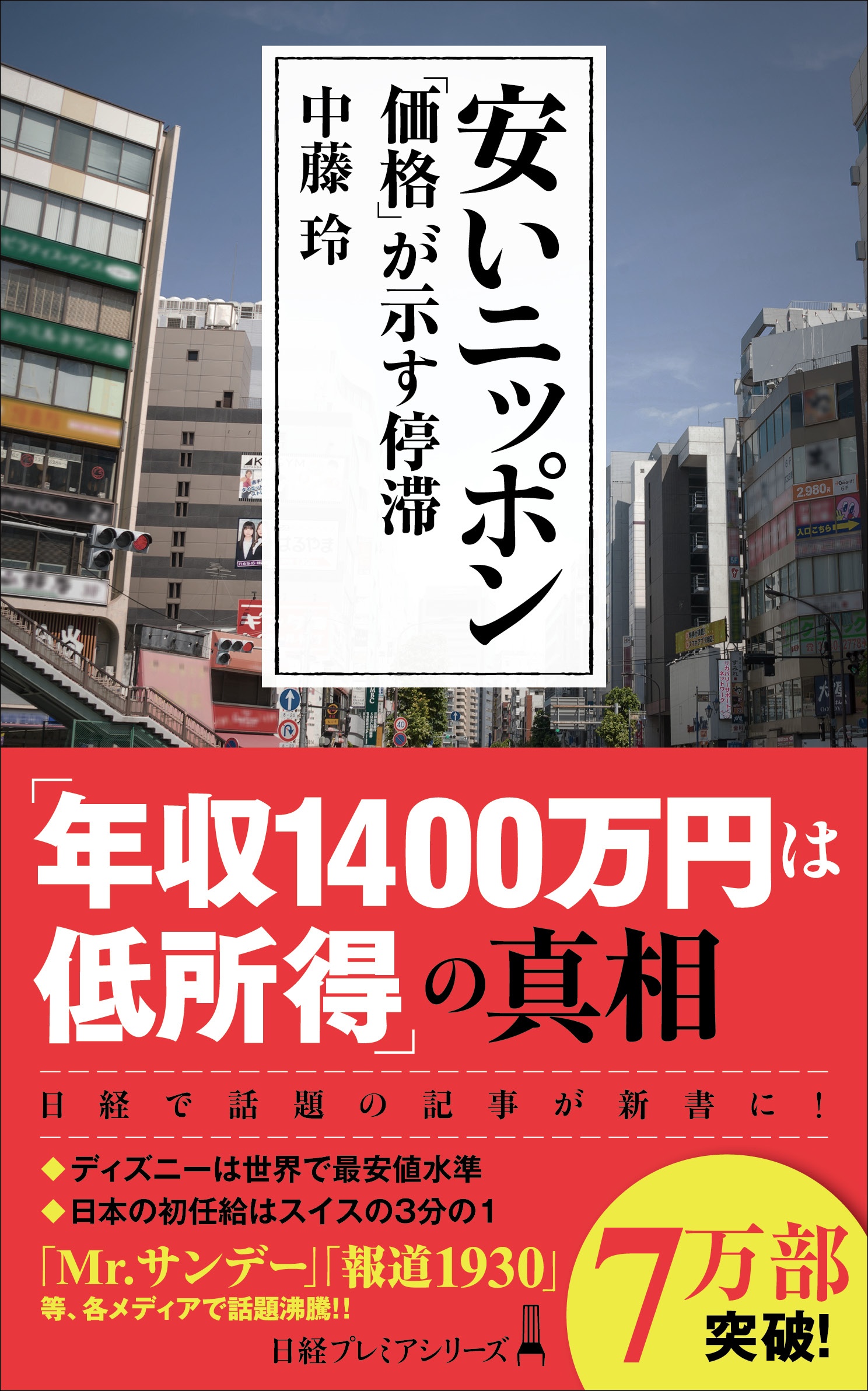
Nakafuji Rei’s Cheap Japan is representative of a mode of depicting poverty that I describe as “nationalization.” The lives of individuals in poverty are unimportant in this mode and go unreferenced in Nakafuji’s book. Poverty rates, exploitation, disparities in economic marginalization between men and women, and similar problems in Japan’s social landscape do not enter into his arguments. Instead, Nakafuji describes Japan as becoming “cheap” on a national level. For him, low growth means that Japan’s prominence will decline along with the drop in its globally circulating capital. This is seen as poverty of the nation. Nakafuji does highlight some important problems – how is Japan to secure necessary imports if its economy is mired in low growth and its currency is tanking? The solutions Nakafuji suggests, however, are in line with a neoliberal understanding of the economy and create a simple economic imaginary rooted in nostalgia for the high-growth era and its peak in the 80s “bubble” economy.

Nakafuji’s overall assertion is that a rise in wages can only follow rising prices. This framing places the burden of economic growth on the ordinary consumer. It ignores other potential policies like a minimum wage increase. Since 2022, a global wave of high consumer price inflation has significantly outstripped wage increases in most of the world. In Canada, for example, wages took a “major hit,” rising in number but declining in actual purchasing power (Barghiel, 2024). The types of consumer price increases that Nakafuji calls for as an economic solution have made people poorer. By placing the main demand for change on consumers who are told that they must accept higher prices before they can expect higher wages, a promise that may never come to pass, Nakafuji absolves the government and Abenomics of responsibility for Japan’s poverty problem, which is obscured by this mode of “nationalization.”

Some things are indeed very cheap in Japan. Ramen, a quick five-dollar lunch in most of Japan, costs $25 overseas. Stainless steel bowls at Japan 100-yen shops (the equivalent of dollar stores), fetch five times that in Seoul. The Tokyo park is the least expensive of the world’s Disneylands. Japan, it seems, is a cheap place to live, and if Nakafuji is to be believed, this is the major cause of Japan’s decades-long stagnation. Where the interviewees in Masuda’s I’m Broke give powerful accounts of life in poverty, Nakafuji’s Cheap Japan focuses instead on what he sees as the poverty of the nation. Wages of 14,000,000 yen (about $95,000 US) a year are, in his view, “low income,” a term that is not defined in the work and is instead taken as a simple measure of national economic vitality (Nakafuji, 2021, cover). He gets there with roundabout arguments comparing Tokyo’s Minato-ku to San Francisco. Comparing a part of central Tokyo to San Francisco obscures issues of demographics and many other social factors in and around employment, the conceptualization of subsistence, and the constitution of what makes a basic wage behind a national growth project. This becomes the genuine “crisis” of Japanese poverty. In this way, “cheap” tickets to Tokyo Disneyland become a symbol of lacking national competitiveness, as well as national decline and poverty.

Nakafuji’s book is a key example of an argument that runs through Japan’s business and economy focused media—Japanese consumers are too spendthrift, too apt to chase bargains, too vociferous in demanding low prices; in short, they are “cheap” compared to consumers in other wealthy or fast-growing economies.[3] To meet this market, companies have participated in a decades long race to the bottom. As they cut costs to reduce prices, businesses slash wages and rely on a “flexible” workforce of part-time and contract employees. Money-grubbing consumers bear most of the blame for Japan becoming “cheap,” for their own stagnant wages, and for the economic doldrums of the three, going on four, lost decades. Nakafuji, however, ignores outsourcing and offshoring of production—80% of cars sold overseas by Japanese companies are not exported by Japan but rather are manufactured elsewhere—and how Japanese companies, making substantial profits in the Abenomics era, have elected to hoard cash rather than raise employee wages (Katz, 2023a; Katz, 2023b; Yasui, 2021).

An “expensive Japan” is not so much a policy goal as a presumed natural state that has been deviated from because of the outlandish demands of the ordinary consumer. The book does not adequately place these demands in the context of stagnant income or low GDP growth or Japan’s proximity to Chinese manufacturing networks, which have made many commodities cheaper for consumers. Instead, they become the cause of Japan’s economic problems. What does this “do” to poverty as it is constituted in discourse? In basic terms, it becomes the fault of the poor. This fits with the book’s overall framing of the economy in terms of “competitiveness” set apart from social relations of production, subsistence, and reproduction. Poverty is not a problem—teizai(stagnation) from the subtitle of the book, is. The solutions he poses are more “flexibility,” code for making it easier to fire employees, and to work on consumers to get them to accept high prices as a way to “fix” Japan’s economy and with it its global economic position, a point made in Nakafuji’s interview with stock analyst Konomi Jun (Nakafuji, 2021, 71). Poverty, in his definition, is the well-to-do Japanese no longer being able to benefit from access to inexpensive commodities on the global market as they did in the 1980s. In an important sense, this line of argument is a product of a general refusal to reckon with deindustrialization. Decline of national competitiveness and consumption, of which prices stand in as a marker, takes precedence. The hollowing out of productive relations that were constitutive of lifeworlds goes overlooked.

In this pattern, the fundamental economic problem is reduced to a simple formula, “if companies cannot raise prices, they cannot make profits, and if companies cannot make money, they cannot raise wages” (Nakafuji, 2021, 38). This becomes a “common sense” apprehension of social form, but is it really true that Japanese companies have not “made profits”? Or simply that they have not raised wages? Corporate profits have been nominally robust through the last decade, but they largely went into stock buybacks and similar schemes as wages remained glacial (Katz, 2014; Inoue and Mizuhata, 2018). In claiming 14,000,000 yen, the equivalent of $95,000 US, as low income and this as a marker of national economic decline, Nakafuji separates wages from meaningful measures of poverty. Doing so, he also overlooks factors like the large number of Japanese over the age of 65 who, dependent on pensions and savings, would be left facing higher prices without higher incomes.

The effects of poverty on individuals and families end up hidden from view as Nakafuji takes an economic nationalist line and frames poverty in terms of a kind of national decline, with self-interested consumers’ deflationary behavior making Japan “cheap.” In addition, he suggests that this makes it an easy target for foreign capital, especially Chinese, which is envisioned as coming to “snap up” Japan and buy out the nation by taking up everything, from companies to infrastructure to resort areas and technology, at bargain prices (Nakafuji, 2021, 152–193). Picked apart by foreign investors from “high income” countries, Japan would supposedly be run for the benefit of others. These fears could be assuaged by regulation, such as laws against types of foreign ownership, which already exist. This would, however, go against the “free market” push of the work. The crisis of cheap Japan that emerges in the work ends up focused on national power relative to rivals, not the individual or social consequences of poverty.

Like his Minato-ku to San Francisco comparison, the solutions Nakafuji offers are misapplied. In his analysis, if consumers are to blame for companies chasing after casualization of labor, now these consumers, also the victims of casualization, need to be not only willing to pay more, but the government must make it easier to casualize to create the profits that will supposedly lead to the wage increases that will allow consumers to pay the higher prices. This is trickle-down all over again, where the social pain is demanded before national economic regeneration can occur. However, it is by no means a given that companies will offer higher wages after raising prices. Only in some ill-defined future will profits allow for the promised wage increases, and poverty in this framing comes to exist only as a sort of metaphor for the decline of national power.[4]

But prices and power, and certainly high prices and better lives, are not so easy to relate. The connection between high prices and better lives is not apparent. Although presumably seen by Nakafuji as national high performers, expensive economies worldwide have created life spaces where a majority of young people can’t afford a house or often even a small apartment in a big city. This is even said to be causing a new wave of “offshoring” with remote work and the shift of work to international locations happening as a response to towering rents, partly a result of real estate speculation, pricing out even high earners in the tech industry (Castillo, 2017; Sheyner, 2017). What can be taken as success, a suitably “pricey” economy, begins to look like another type of crisis, that of financialized accumulation over life, social and population reproduction, and the possibility of care of self and others.

The limits of Nakafuji’s approach, which omits individuals suffering poverty, are evidenced by some of his spectacular claims, such as: “In America, rents increase in pace with economic growth” (Nakafuji, 2021, 83). Instead, there are many places in which rent is out of line with both general economic growth and wages. This statement makes sense if it is only a small stratum of high earners who “count” in the analysis. Making the poor invisible in this way is a discursive side of the general forces of impoverishment in Japan at present and it structures views of the global in important ways. These problems appear most clearly in Nakafuji’s handling of India: “In India, with its large wealth disparities, making arguments based on the ‘average’ is meaningless” (Nakafuji, 2021, 122). Instead, only high-earning tech workers factor in and Japanese salaries are compared with the very small number of Indians making hundreds of thousands of US dollars a year, ignoring endemic poverty there and its equivalent in Japan, where subsistence may look different, but many still struggle. This is a direct example of poverty being made invisible, a side itself of the ideological force of impoverishment in the current hegemonic array. Social despair is cleared away, hidden behind a small number of high salaries thought to guarantee “trickle down” effects, and the rising prices, another force of despair, that supposedly prefigure them. By putting the burden of responsibility on consumers, Nakafuji places the cart before the horse, poverty comes from Japan being too cheap, thus undermining a “proper,” “natural” expression of national economic form. If they would spend like it was 1985, Japan could return to an era of growth and economic primacy. What emerges here is an elaborate version of neoliberal “personal responsibility.” Nostalgia for the 1980s economy, the self-image of Japan as a world beater and global economic powerhouse, color imaginings of the economy at present and the place of poverty within it. Poverty is not understood as a structural facet of economic relations, but rather of the economy as a whole being something other than the norm of the 1980s economic height. With the 1980s dominating thinking in this way, solutions to poverty end up thought in terms of “return,” not in seeking after different economic practices, be they redistributive or more radical alternatives. Return is half nostalgia, half wishfullness. Poverty is secondary, it ends up hidden in the background, as if the way beyond it is simply for things to be more expensive.

Nakafuji’s book can also be criticized in normative economic terms.[5] He largely ignores examples where commodities, services, and leisure activities are more costly in Japan than in the United States or gives them throwaway mentions as exceptions that prove the rule. For example, movie tickets are much more expensive in Japan than in America, most of Western Europe, Hong Kong, and Singapore. Many factors go into the price of a ticket, but they are priced according to demand and anticipated competition with other forms of entertainment. In short, Nakafuji might be broadly correct that deflation and changes to the exchange rate have made Japan less expensive or “cheap,” but he gets to this point through cherry-picked examples that fail to acknowledge competition particular to Japan and areas in which Japanese consumers pay considerably more—a reality that can be harsh for those living in poverty. If the poor, among other consumers, are to be blamed for demanding low prices, this phenomenon has to be seen in the context of survival. Movie tickets aside, there are other things that are much more expensive in Japan than in nearly all wealthy countries: home renovations, moving, apartment deposits, mobile phone data, and some basic food staples like fresh fruit, among many others. These have the particular effect of making moving in search of work and necessary communications much more difficult, a significant social effect in “cheap Japan,” and a contribution to both lack of mobility and isolation from social networks that push people into living off of poverty wages.

Nakafuji also glosses over some complex dimensions of economic connection. In his discussion of kaiten (revolving) sushi shops, a marker of the race to the bottom when it comes to prices, Nakafuji laments the fact that relentless consumer pressure on prices brought about by corporate response to consumer demands has led to the rollout of automation technology—robots shape the rice, touch panels and computer calculations take care of ordering and billing, and it is possible to eat in one of these restaurants without crossing the path of a single employee (Nakafuji, 2021, 30). This is understood as the “decline” of retail and the restaurant industry in a race to the bottom, but these innovations and accompanying research and development in aggregate across the Japanese economy are also tied to a surviving “high value added” manufacturing sector that does enormous two-way business with China, much more to the benefit of Japan in balance of trade than for most other wealthy countries. These trans-sector connections, in this case between automation infrastructure in retail and service and production of robots, are an export commodity.

On top of this, a great deal of what is being described as “cheap” in Nakafuji’s work is also aptly described as “efficient,” “rational” use of resources in line with the priorities of capitalist production favored by Nakafuji. Nakafuji describes the chain Kura Sushi’s sophisticated system. They buy the entire catch of fishing vessels sight unseen (Nakafuji, 2021, 31). “Good” (valuable) fish from the point of view of the sushi operation is sent to where company data indicates it is most likely to be consumed without waste. “Bad” fish—parts of the catch unappealing to diners—are processed into fertilizers and other secondary products, opening up a completely different line of business that cuts waste and maximizes profits. Kura Sushi has thus become a restaurant chain-industrial hybrid. They typically pay low wages to the front-line employees and engage in automation wherever possible. These are connected to poverty but not so easily to economic inefficiency or a lack of competitiveness. “Cheapness” can appear as that very competitiveness, but works in this mode tend to insist on expense as a marker of national pride, a one-sided vision of national vitality. The problem is these forces of production are leaving social relations and their reproduction behind. How long before restaurants without employees become restaurants without customers as structural penury pushes subsistence to an ever-lower line?

In the end, Nakafuji marvels at the fact that wages in California went up by 20% in a five-year period before the pandemic (Nakafuji, 2021, 33). For him, this is mainly a matter of economic vitality, of consumers willing to pay more, bringing economic “heat” which allows for higher wages. What he does not highlight, however, is that California has consistently had the highest poverty rate in the US, with endemic poverty and an increase in this period in housing precarity and similar expressions (Walters, 2023). Wages, for example, can ride on the back of a speculative housing bubble, as they arguably did in Japan in the 1980s, but as in Canada at present this is not a “solution” for poverty as full-time work at or even considerably above minimum wage does not cover rent for a one-bedroom apartment in any large city, leading to a cascading array of problems such as homelessness and widespread despair, even among the well-to-do (Landau, 2023). While it is technically correct that an income of over 10,000,000 yen would be “low income” at the center of the American tech industry, his shorthand marker of “poverty” fails as multi-sided analysis. In this way, Nakafuji compares San Francisco to Tokyo’s Minato-ku, but misses the world. The end result is poverty made “invisible” through excessive “nationalization” in a lament that the bubble did not continue forever and calls for more “deregulation,” the standard neoliberal panacea.

“Squeezed” Japan – Poverty’s Generalization

If I’m Broke makes poverty too particular, losing the opportunity for structural critique in what are nonetheless powerful and often moving personal stories, Kobayashi Miki’s 4,430,000 Yen a Year generalizes poverty. The cover lists examples of want that set out the work’s orientation—“holding off on Starbucks,” “passing on buying an onion if they cost more than 80 yen each,” or “waiting for bargains” (Kobayashi, 2022). They grab the attention of potential readers as practices shared across income brackets and social strata in contemporary consumer society. Grouping them together and placing stories of “getting by” on 4,430,000 yen a year alongside examples of abject want becomes a “generalization” of poverty, conflating serious depravation with what can be called a middle income “squeeze.” In Japan, as in much of the Global North, people are feeling this squeeze which can be summed up by the book’s subtitle – both “too cheap” and “too expensive.” Wages and many objects of casual consumer desire appear cheap, while healthcare, even in broadly socialized systems, and the cost of education necessary to ward off downward mobility but offering no guarantee, are too expensive. The squeeze is a lived sense of anxiety in common, or even despair amid plenty, something common to lifeworlds under neoliberalism.

The squeeze comes partly with creeping expressions of cost in the neoliberal socio-economic form. While a television, a computer, or a bottle of whiskey may be relatively cheaper, sometimes much cheaper, than in decades past because economies of scale, production in China or elsewhere, supply chain connectivity, automation technology, and myriad other factors, “social costs” are being relentlessly shifted to individuals and their immediate families. One of the interview subjects recounts, “Requests from [my children’s] school for money for textbooks and educational materials and for PTA fees are distributed every month. This is a monthly reminder that public education in Japan is not free” (Kobayashi, 2022, 48–49). The cost of attending university has also increased, just as degrees have become more and more necessary for pursing the dwindling number of “good jobs” and as student debt, reaching crisis proportions in Japan, can be all but impossible to pay back with the low starting salaries that are the norm (Clane, 2023).

With this “squeeze” as “feeling” as an overall frame, 4,430,000 Yen a Year freely mixes discussion of serious want of the basic necessities of life and bare maintenance of socio-economic place with the stories of people forced to replace their daily Starbucks with “green tea in a thermos.” This is a form of economic pain better called discomfort but is nonetheless a socially meaningful experience which has the potential to form a bridge of empathy between those experiencing forms of want primarily around consumer desires and those facing structural impoverishment in more absolute terms. Couples making over 10,000,000 yen a year can share with people below the poverty line a sense of the squeeze in their daily life, but the work as a whole fails to reconcile feelings of depravation with its experience, in the total sense, of impoverishment in a country where a third of households are mired at a quarter of that income or lower. In the book, the squeeze frequently appears not in structural terms, but simply as not getting by and not knowing why. “What went wrong so that households like mine had to come to this? The state? The system? I have no idea why we’ve had to go into debt [just to get by]” (Kobayashi, 2022, 123). And while the generalized collection of these accounts can be powerful at points, the reader is left with the same sense of confusion as this interviewee, no closer to the relationship between poverty and social structures.

One line of analysis that is largely missing, resulting in conflation around shared effects of the squeeze, is neoliberal austerity. Austerity appears as lack, but seldom as clearly defined policy or as part of an abiding social form and organization of priorities. Even the nominally well to do are hit by rising medical costs, the result of “welfare” and “care” shifted more and more from the collective to individuals. The expansion of medical possibilities with changes in technology and techniques does not only appear as a social good, but as an opportunity for private profits, and in this way “progress” can also be experienced as anxiety and even feelings of despair when procedures are not easily available or for which “users” must go out of pocket, limiting them to the affluent. Kobayashi discusses fertility treatments, which put a massive burden on families despite the rhetoric of successive LDP governments about reversing the decline of Japan’s birthrate, something they are far more comfortable wielding as a form of personal responsibility discourse than paying for through a more robust welfare state. One interviewee laments, “When I read the newspaper, it said that there is one municipality offering 400,000 yen a year for fertility treatments. Where I’m living it’s zero. Some companies give good support, like 100,000 or 200,000 yen, or make it easy to take time off. What great companies! Makes me jealous” (Kobayashi, 2022, 63). Of course, these treatments, while a burden for some, can be impossible for others living below the poverty line. For some, even public transportation to and from hospitals and clinics is a prohibitive cost. Others simply cannot take the time off work lest they risk hunger.

A neoliberal structuring of distribution of surplus in the economy means that high earners are normally able to access better health services. 4,430,000 Yen a Year does not discuss this and the disparity appears as simple “luck”—some wind up at “better” companies or are in “better” municipalities that subsidize care, as if the earnings of residents and related tax revenue have nothing not do with availability of care. This is a generalizing effect; systemic factors remain in the background while the “unlucky” across economic strata face a generalized squeeze.

4,430,000 Yen a Year is effective at pointing to ways that some interviewees associate pressures around money and employment with their mental health struggles (Kobayashi, 2022, 43–44). Unemployment or poor working conditions can lead to depression, which can leave individuals trapped in structures of impoverishment. Workplace norms, with punishingly long hours and mercenary and instrumentalized relationships, can be experienced as violence. They manifest situationally as coercion, but also take on a structural drive as seeking out less violent workplaces leads to lower pay. Japan’s convenience stores, kitchens, food processing and preparation shops, and factories may become a temporary refuge in one mode, but in another they gain their “flexible” labor through a process of attrition that plays out in the “good” jobs. While 4,430,000 Yen a Year, like I’m Broke, may not carry through on this type of analysis, it does have the potential to leave the reader with the feeling that something is not right with the “common sense” of the economy. This is a mode of social organization that forces those suffering into a downward, fundamentally different economic position amenable to accumulation in the massive retail and service sectors, whose employees undergird speculative accumulation and megaprofits elsewhere in the economy. In this way, impoverishment appears as a conflux of compulsive forces through which individuals are placed outside of a “normal” productive and reproductive society, marginalized, shamed, and considered unworthy of aid. Kobayashi’s book shares the voices of Japanese in these positions, but without relational contexts that show how some benefit from the economic expression of this suffering.

“Good,” or at least stable, work can leave little time for care. One interviewee with a child struggling with chronic illness describes staying in a bad factory job, “Even then I couldn’t quit because even if they docked my pay I could still get a day off when my child was sick. There really aren’t many other jobs that will allow this, so I had to stay” (Kobayashi, 2022, 114). Forms of exploitation that wear on life, on family relationships, on health and the health of children, and are a punishing burden on mental health, are what allow the prevailing economic form to function. Middle income and managerial and adjacent wages may be squeezed, but these jobs and the accompanying lifestyle possibilities of the 10,000,000 yen a year household are buttressed by low wage earners at the base of the economic pyramid in the most common types of jobs in the economy—retail, food preparation, moving commodities around—that are necessary for the realization of profits. This is lost in the comparisons that generalize poverty. Everyone feeling the squeeze settles for a 500-yen lunch, but that lunch is only possible because of the poverty-level wage paid around its production. If elite knowledge workers, for example, save time by not having to prepare their own food, and can rely on inexpensive prepared foods, it is because that time saved is being served out by the working poor. On the whole, Kobayashi’s 4,430,000 Yen a Year tells some powerful stories, but also conflates feelings and experiences of want with those of need, a form of generalization that muddies the meanings of poverty for contemporary Japan.

Conclusion – Poverty, Patriarchy, Specificity

Individualization, nationalization, and generalization, the three different modes of representation of poverty that I have identified with three recent books on poverty, are by no means limited to those titles. Attention grabbing, almost panicked reporting finds that Japanese salaries are no longer competitive enough to attract “top” job applicants from elsewhere in Asia, shredding already glacial plans to address Japan’s low birthrate and declining workforce by drawing in “elite” migrants (Himeda, 2018). As GDP per capita has fallen behind South Korea, recent accounts place starting salaries for university graduates in Japan closer to “developing countries” than the United States or most of Europe (Musha, 2021). With these developments have come new or renewed narratives of “crisis,” but also claims that sky-high stock values, which appear to have left the economy of daily life and subsistence far behind, indicate a return to form, to Japan as a global player. In this milieu, where crisis is envisioned as something national and those whose lives are in crisis vanish from view, frank discussion of poverty in Japan is often lost amid nostalgia for the high-growth era and the myopic view that maybe this time around, yet another round of neoliberal reforms will finally succeed. Pierre Dardot and Christian Laval describe this logic, pervasive globally: “If austerity creates fiscal deficits, a supplementary dose is required. If competition destroys the industrial fabric or lays waste to regions, more of it must be introduced… If tax reductions for the wealthy or corporations do not yield the expected results, they must be amplified” (Dardot and Laval, 2019, xii).

“Abenomics” failed to end wage stagnation and its successors “Suganomics” and now “Kishidanomics” have done little better. As the “-nomics” branding nears parody, comparative poverty statistics like those discussed at the beginning of this article appear to have become normalized. The dominant view of poverty, which is subject to critique in Japan’s public sphere, but reigns in mainstream economics reporting and conservative politics, makes neoliberal policy appear as the only solution, as if poverty is something discrete and not relational—the “object” of analysis, the monoform “social problem,” or “moral panic” over national productivity.[6] Beverly Best writes, “The presently dominant convention of perceiving and representing … different geographical locations, moments in history, institutions and fields of activity, and experience as fragmented and atomized is an obstacle to understanding how the social world actually works in capitalist societies, that is, in a more complex, holistic and interconnected way” (Best, 2010, 3). This article has tried to assess the representation of poverty in this limited form in contemporary Japan and also attempted to understand the prospects for action amid discursive ossification and political stasis.

In The Devil and Commodity Fetishism in South America, Michael Taussigdescribes ‘capitalist folklore’ in the financial section of The New York Times, “We read of the ‘economic climate;’ the ‘sagging dollar,’ of ‘earning booming ahead.’ … of ‘money growing’ in accordance with investment, of how ‘your investments can go to work for you,’ and so on… capital and workers’ products are spoken of in terms that are used for people and animate beings…” (Taussig, 2010). Poverty in post-pandemic discourse in Japan takes on a similar “external” character, as something outside social relations and forms of government: something that just “is”. At the same time, it takes on a life of its own outside of normal social thinking as something immutable through forms of individualization, nationalization, and generalization. There is a common separateness, but also differences with Taussig’s examples in that poverty in Japan can become an “object,” something simply inanimate and separate from other social forces. In this way, something that is the norm for a large part of the population is commonly thought of as an exception. These three books, each representative of a different mode of situating poverty, show how poverty as a conflux of social forces is rendered simple—a basic lack of money, a result of low prices, or as a generalized economic squeeze.

This article has sought to analyze and respond to these discourses critically while highlighting both their ties to the neoliberal social imaginary of “personal responsibility” and how neoliberal governance and policy can appear as calls for “return” to past economic success which becomes a static norm and defeats attempts to think about poverty differently. These assumptions are integral to something as basic as the “lost decades” framing. At what point are they not “lost” so much as they are in the continued grip of a social logic that holds that the best response to poverty is more impoverishment, as in the claims that inflation itself is a cure to Japan’s nationally conceived economic woes or that mass layoffs are the first step to common prosperity, with individuals and families vanishing into the background? Understanding poverty as relational, as intimately connected to distribution of society’s surplus, tied to factors like low income taxes and low social spending, can help to bring into focus the causes of poverty that affects so many Japanese today.

While the three modes of representation outlined in this article are the most prevalent, they are contested. About a decade ago, there was a slate of works from the media mainstream, NGOs, and academic researchers focusing on women’s issues that brought a needed specificity to considerations of social relations around poverty. Japanese women made and still make up about 80% of part-time, temporary, and irregular workers. Patriarchal assumptions around housewives and “correct” social place continue even as the labour force participation rate for Japanese women is rivalling that of the United States. This situation of Japanese women as low-wage, precarious workers at the point of intersection between culture, capital, and policy, creates rippling ramifications for many women, but especially for single-mother households, contributing to child poverty rates that place Japan near the bottom in the Global North. My survey of works on poverty published since the 2008 financial crisis identified a number of important, focused works published between 2014 and 2016, the aftermath of the dual disasters of March 11, 2011 and the first years of Abenomics, including NHK’s investigative 女性たちの貧困 – “新たな連鎖の衝撃” [Women’s Poverty – ‘The Shock of a New Cycle of Poverty”, 2014], Iijima Yuko’s  ルポ 貧困女子[Report on Women in Poverty, 2016], Suzuki Daisuke’s 最貧困女子[Women in Absolute Poverty, 2014], Sawaki Aya’s 貧困女子のリアル[The Reality of Women in Poverty, 2016], Minashita Kiryu’s シングルマザーの貧困 [Single Mothers’ Poverty, 2014], and Hida Atsuko’s女性と子どもの貧困~社会から孤立した人たちを追った[Women and Children in Poverty – Tracing People Isolated from Society, 2015]. These books, among others, drew attention to the specificity of poverty for women, addressing their roles as productive and social reproductive workers often ignored in the mainstream (Dalton, 2017).

There are signs that the constellation of critique evident between 2014 and 2016 may be returning. The pandemic—led to criticism of government and also of conservative social stewardship more broadly, but also concealed different social results like accessibility of care and the ability to quarantine behind a “we’re in this together” discourse.—Now that it is no longer at the center of debate in Japan’s public sphere, new critical voices are remerging. There is a renewed specificity against discourses of individualization, nationalization, and generalization in the form of writing about the social context of women in poverty and how intersecting lines of discrimination and instrumentalization in the economy become forces of impoverishment. Works from academics and smaller publishers like Hida Atsuko’sコロナと女性の貧困2020-2022~サバイブする彼女たちの声を聞いた [Corona and Women’s Poverty 2020-2022 – Listening to the Voices of Women Survivors, 2022] and Iijima Yuko’s ルポ コロナ禍で追いつめられる女性たち 深まる孤立と貧困 [Report – Women Backed into a Corner by the Pandemic – Deepening Isolation and Poverty, 2021] take the pandemic as a starting point for critique of social complacency around poverty’s particular effects on Japanese women. They do not offer easy answers, but in raising questions about why particular groups in Japanese society face forces of impoverishment in different ways, they point to the potential for a more nuanced consideration of poverty’s causes, and thus to potential solutions in new ways of thinking about the economy in a society that has tremendous social wealth, but for which the 1980s growth and regional primacy are unlikely to return.

Fifty percent of Japanese still fail to isolate inequality as a significant social problem and individualization, nationalization, and generalization are still the mainstream among non-fiction publishing and reportage. 53.7% of Japanese of the economic “middle middle class” and higher believe that people go on welfare because of a lack of personal effort, not systemic or structural factors (Yamada, 2016). Poverty, despite statistics that show its seriousness, is not a central issue at election time. But resistance to individualization, nationalization, and generalization is here, and other modes of representation of poverty, always contesting the stasis around poverty in Japan’s public sphere, have the potential to combat the normalization of poverty and start a more robust public debate about real social alternatives.

*

Note to readers: Please click the share button above. Follow us on Instagram and Twitter and subscribe to our Telegram Channel. Feel free to repost and share widely Global Research articles.

Matthew Penney is an Associate Professor at Concordia University in Montreal and an Asia-Pacific Journal: Japan Focus board member. He is currently conducting research on the far right and historical representational Japan as well as deindustrialization and poverty. He is the author of numerous articles, including “Rising Sun, Iron Cross – Military German in Japanese Popular Culture,” in Japanstudien, “Far From Oblivion – The Nanking Massacre in Japanese Popular Writing for Children and Young Adults,” in Holocaust and Genocide Studies, and “Right angles: Examining accounts of Japanese neo-nationalism” (with Bryce Wakefield) in Pacific Affairs as well as a number of research articles and shorter pieces for Japan Focus.

Sources

Abe, Aya. 2020. 中年・高齢女性の貧困が問題にされないワケ [Why the poverty rate among middle age and elderly women is not seen as a problem]. Sekai Shiso, December 4 [https://web.sekaishisosha.jp/posts/4193].

Allison, Anne. 2013. Precarious Japan, Durham: Duke University Press.

Amin, Samir. 2014. Capitalism in the Age of Globalization. London: Bloomsbury.

Barghiel, Naomi. 2024. “Canadians’ wages took major hit in 2022 amid high inflation rates: StatCan.” Global News, April 12 [ https://globalnews.ca/news/10419727/canadian-2022-wages-inflation-statistics-canada].

Best, Beverly. 2010. Marx and the Dynamic of Capital Formation: An Aesthetics of Political Economy. New York: Palgrave Macmillan.

Castillo, Michelle. 2017. “San Francisco has gotten so expensive, some tech companies can’t convince employees to move there.” CNBC [https://www.cnbc.com/2017/04/06/san-francisco-cost-of-living-pricing-out-tech-companies-workers.html].

Clane. 2023. 奨学金返済者の3人に1人は「夢」を断念、半数が「後悔」[One in three repaying scholarship loans gave up on “dreams,” half have “regrets”]. Plus Digital, October 28 [https://news.mynavi.jp/article/20231028-2805083/].

Dalton, Emma. 2017. “Womenomics, ‘Equality’ and Abe’s Neo-liberal Strategy to Make Japanese Women Shine.” Social Science Japan Journal. Volume 20, Issue 1, Winter.

Dardot, Pierre; Laval, Christian. 2019. Never-Ending Nightmare: The Neoliberal Assault on Democracy, London: Verso.

Environmental Investigation Agency. 2017. “Japan: A Major Market for High-Risk Timber.” [https://us.eia.org/blog/japan-a-major-market-for-high-risk-timber/].

Fraser, Nancy. 2022. Cannibal Capitalism: How our System is Devouring Democracy, Care, and the Planet and What We Can Do About It, London: Verso.

Fuwa, Raizo. 2022. 男性21.4%、女性53.2%は非正規…就業者の正規・非正規率をさぐる(2022年公開版) [21.4% of men and 53.2% of women are irregular workers – examining the rates of job seekers in regular and irregular work]. Yahoo! Japan, September 24 [https://news.yahoo.co.jp/expert/articles/d209f5a2d2c2fa6bbf70296b48ee07efcc9e89b0].

Hall, Stuart. 1988. The Hard Road to Renewal: Thatcherism and the Crisis of the Left. London: Verso.

Hida, Atsuko. 2022. コロナと女性の貧困2020-2022~サバイブする彼女たちの声を聞いた [Corona and Women’s Poverty 2020–2022 – Listening to the Voices of Women Survivors]. Tokyo: Daiwa Shobo, 2022.

Himeda, Konatsu. 2018.「この給料じゃ生活できない!」アジアの優秀人材はもう日本を選ばない [‘I can’t live on this pay!’ Asian elite human resources no longer pick Japan]. Diamond Online. [https://diamond.jp/articles/-/181358].

Iijima, Yuko. 2016. ルポ 貧困女子 [Report on Women in Poverty]. Tokyo: Iwanami Shoten.

Iijima, Yuko. 2021. ルポ コロナ禍で追いつめられる女性たち 深まる孤立と貧困 [Report – Women Backed into a Corner by the Pandemic – Deepening Isolation and Poverty]. Tokyo: Kobunsha.

Inoue, Shin; Mizohata Sachie. 2018. “Inequality and Precarity In Japan: The Sorry Achievements Of Abenomics.” The Asia-Pacific Journal: Japan Focus, March 15 [https://apjjf.org/2018/6/inoue].

Ishiguro, Kuniko. 2008. “Japanese Employment in Transformation: The Growing Number of Non-Regular Workers.” Electronic Journal of Contemporary Japanese Studies [www.japanesestudies.org.uk/articles/2008/Ishiguro.html].

Ishikawa, Tomoe. 2022. “Japan maintains ban on welfare recipients going to university.” Asahi Shimbun, December 8 [https://www.asahi.com/ajw/articles/14787904].

Iwata, Masami. 2017. 貧困の戦後史 [Poverty in Postwar History]. Tokyo: Chikuma Shoten.

Japan Federation of Bar Associates 58th Human Rights Protection Meeting Symposium First Organizing Committee. 2017. 女性と労働 貧困を克服し男女ともに人間らしく豊かに生活するために [Women and Work – For overcoming poverty and ensuring that men and women can live together humanely and with prosperity]. Tokyo: Junposha.

Japan Foundation Children’s Support Project. 2019.  Nippon Zaidan. [https://www.nippon-foundation.or.jp/what/projects/ending_child_poverty].

Katz, Richard. 2014. “Voodoo Abenomics: Japan’s Failed Comeback Plan.” Foreign Affairs, Vol. 93, No. 4, July/August.

Katz, Richard. 2023a. “Intervention to shore up the yen will not work.” The Financial Times, July 11 [https://www.ft.com/content/e80565a1-9f3c-41d3-9518-48ec2c43d288].

Katz, Richard. 2023b. The Contest for Japan’s Economic Future: Entrepreneurs Vs Corporate Giants. New York: Oxford University Press.

Kaya, Keiichi. 2019. 日本はもはや後進国 [Japan is now a developing country]. Tokyo: Shuwa System.

Kobayashi, Miki. 2022. 年収443万円 安すぎる国の絶望的な生活 [4,430,000 Yen a Year – Living Despair in a Cheap Country]. Tokyo: Kodansha.

国会会議録検索システム [National Diet Records Search System]. [https://kokkai.ndl.go.jp/#/].

Kosugi, Reiko; Suzuki, Akiko (eds.). 2017. シングル女性の貧困――非正規職女性の仕事・暮らしと社会的支援 [Single Women’s Poverty – The work and life of female non-permanent employees and social support]. Tokyo: Asashi Shoten.

Kyowa Kirin. 2022. 日本でも子どもの7人に1人が貧困…「相対的貧困」の課題とは? [One in seven Japanese children in poverty… what is the meaning of ‘relative poverty’]. Mirai Port [https://www.mirai-port.com/people/3796/].

Landau, Jack. 2023. “Worrying report shows Toronto is a ‘lonely’ city ‘overwhelmed’ by unaffordability.” BlogTO [https://www.blogto.com/city/2023/11/report-toronto-lonely-city-overwhelmed-unaffordability/].

Masuda, Akitoshi. 2023.  お金がありません17人のリアル貧困生活 [I’m Broke – 17 Stories of Living in Poverty]. Tokyo: Saizu-sha.

McCarthy, Niall. 2015. 高齢者の「貧困率が高い国」1位韓国、日本4位 [‘Countries with the highest elderly poverty rate’ No. 1 South Korea, No. 4 Japan]. Forbes Japan, December 15 [https://forbesjapan.com/articles/detail/10540].

Minashita, Kiryu. 2014. シングルマザーの貧困 [Single Mothers’ Poverty]. Tokyo: Kobunsha.

Ministry of Health, Labour and Welfare. 2023. 地域別最低賃金の全国一覧 [National List of Minimum Wages by Region]. [https://www.mhlw.go.jp/stf/seisakunitsuite/bunya/koyou_roudou/roudoukijun/minimumichiran/index.html].

Mizoguchi, Atsushi. 2011. 暴力団 [Violent Gangs]. Tokyo: Shinchosha.

Murata, Hiroko. 格差意識の薄い日本人 [Japanese have low awareness of wealth disparity]. NHK Broadcasting Culture Research Institute. December, 2013. [https://www.nhk.or.jp/bunken/summary/yoron/social/062.html].

Musha, Ryoji. 2021. 初任給は新興国並みでも…「安いニッポン」を維持すべき理由 [Even if starting salaries are in line with developing countries… we should stick with ‘cheap Japan’]. [https://gentosha-go.com/articles/-/38240].

Musha, Ryoji. 2022.「安いニッポン」が日本を大復活させる![‘Cheap Japan’ will revive Japan!]. Tokyo: WAC.

Nagahama, Toshihiro. 2022. 日本病 なぜ給料と物価は安いままなのか [The Japan Sickness – Why do wages and prices remain low?]. Tokyo: Kodansha.

Nakamura, Yasusaburo. 2023. 所得格差が拡大 2021年の「ジニ係数」 過去最高と同水準に [Income disparity increases – 2021 Gini coefficient rises to the level of past high], Asahi Shimbun, August 22 [https://www.asahi.com/articles/ASR8Q6752R8QUTFL006.html].

Nakafuji, Rei. 2021. 安いニッポン 「価格」が示す停滞 [Cheap Japan – Stagnation through Prices]. Tokyo: Nikkei Shimbun Shuppan.

Nihon Kodomo Shien Kyokai [Japan children’s support network]. 2018. “こどもの貧困” [Child poverty]. [https://npojcsa.com/jp_children/poverty.html].

NHK Special ‘Working Poor’ Investigation Team. 2007. ワーキングプア―日本を蝕む病 [Working Poor – The Sickness Eating Away Japan]. Tokyo: Popura-sha.

NHK ‘Women’s Poverty’ Investigation Team. 2014. 女性たちの貧困 – “新たな連鎖の衝撃” [Women’s Poverty – ‘The Shock of a New Cycle of Poverty”]. Tokyo: Gentosha.

Ohmura, Daijiro. 2022a. 経営者、開業医、地主…本物の富裕層が「日本の税金は世界一安い」とこっそり笑う大きな抜け穴の正体 [Managers, doctors who own their own facilities, landowners… Japan’s truly rich are laughing at the gaps that make ‘Japan the lowest taxed country in the world’]. President Online. [https://president.jp/articles/-/56777].

Ohmura, Daijiro. 2022b. 金持ちに学ぶ税金の逃れ方 [Learning from the rich how to dodge taxes]. Tokyo: Business-sha.

Oyama, Norihiro. 2023. 大山典宏, 日本の相対的貧困率、米韓にも抜かれ先進国最悪に [Japan’s relative poverty rate the worst among developed countries, passing America and South Korea]. Wedge Online [https://wedge.ismedia.jp/articles/-/30798].

Reitan, Richard. 2012. “Narratives of “Equivalence”: Neoliberalism in Contemporary Japan.” Radical History Review (112).

Saito, Kohei. 2023. ゼロからの『資本論』 [Capital from Zero]. Tokyo: NHK Shuppan.

Sawaki, Aya. 2016. 貧困女子のリアル [The Reality of Women in Poverty]. Tokyo: Shogakukan.

Seimei Hoken Bunka Center. 2022. 生活基盤の安定を図る生活設計 [Statistics for planning for a stable foundation for living standards]. [https://www.jili.or.jp/lifeplan/houseeconomy/1093.html#:~:text=%E9%9B%87%E7%94%A8%E8%80%85%E3%81%AE%E7%B4%844,%E3%81%A8%E3%81%84%E3%81%86%E3%81%93%E3%81%A8%E3%81%AB%E3%81%AA%E3%82%8A%E3%81%BE%E3%81%99%E3%80%82].

Sheyner, Gennady. 2017. Palo Alto Weekly[https://www.paloaltoonline.com/news/2017/02/17/report-more-people-leaving-valley-than-coming-in].

Shinoda, Toru. 2009. “Which Side Are You On?: Hakenmura and the Working Poor as a Tipping Point in Japanese Labor Politics.” The Asia-Pacific Journal: Japan Focus, April 4 [https://apjjf.org/toru-shinoda/3113/article].

Shukan Josei PRIME Henshubu. 2021. “生活保護申請を退ける役所窓口「非情な言い分」.” Toyo Keizai Online, March 21 [https://toyokeizai.net/articles/-/417600].

Suzuki, Daisuke. 2014. 最貧困女子 [Women in Absolute Poverty]. Tokyo: Gentosha.

Taussig, Michael. 2010. The Devil and Commodity Fetishism in South America, Thirtieth Anniversary Edition. Chapel Hill: University of North Carolina Press.

Toshikoshi Hakenmura Jikko Iinkai. 2009. 派遣村 [Temporary Worker Village]. Tokyo: Mainichi Shimbun-sha.

Urbansea. 2021. 安倍前首相は「国がめちゃくちゃになる」と… [Former Prime Minister Abe Shinzo says ‘The country will be thrown into disorder”]. Bunshun Online[https://bunshun.jp/articles/-/48892].

van Dijk, Teun Adrianus. 1998. Ideology: A Multidisciplinary Approach. New York: Sage Publications.

Walters, Dan. 2023. “California keeps its title as having the nation’s highest poverty rate.” Cal Matters [https://calmatters.org/commentary/2023/09/california-poverty-rate/].

Yamada, Soshiro. 2016. “生活保護基準引き下げは、市民感情を反映しているか?” [Does the lowering of the standard for social welfare reflect the feelings of citizens?]. Synodos. June 16 [https://synodos.jp/opinion/society/17299/].

Williams, Raymond. 1985.  Keywords: A Vocabulary of Culture and Society. Oxford: Oxford University Press.

Williams, Raymond. 2012. The Long Revolution. London: Parthian Books.

Yasui, Yosuke. 2021. “Corporate Cash Retention Behavior in Japan – Avoiding a repeat of the low growth after Abenomics.” JRI Research Journal, Vol. 4, No. 3, March.

Notes

[1] Toru Shinoda offered a powerful piece, “Which Side Are You On?: Hakenmura and the Working Poor as a Tipping Point in Japanese Labor Politics” about the Hakenmura protests in The Asia-Pacific Journal in 2009. I shared his hopes at the time, but Hakenmura did not emerge as a tipping point, and poverty instead became an issue marginalized in discourse and political practice through a decade of strengthening conservative hegemony. This piece is partly a response to the dashing of those hopes of 2008 as well as forces of impoverishment becoming even more powerful through the COVID-19 pandemic and after.

[2] All translations are by the author unless otherwise indicated.

[3] Other recent examples in book form include: 加谷 珪一, 日本はもはや”後進国”, Tokyo: 秀和システム, 2019. 永濱 利廣, 日本病 なぜ給料と物価は安いままなのか, Tokyo: 講談社, 2022. 武者 陵司,「安いニッポン」が日本を大復活させる!, Tokyo: WAC, 2022. Musha, especially, sees low wages as a way of instrumentalizing Japan’s workforce toward productivity and business profits.

[4] Real wage stagnation is not a problem unique to Japan. Real wages have been stagnant or slow to grow in most of the world. This point is downplayed in Nakafuji’s exceptionalist account. The “real wages in Japan have not risen in 20 years” (cover) is presented as a crisis in international competitiveness without really engaging with international examples and similar contexts of stagnation.

[5] There is a lot more to do in Tokyo, the world’s largest metropolis, than in, say, South Florida. The lower price for Tokyo Disneyland can be understood in a context of overheated competition. In addition, because of massive crowds at the park at key times, Tokyo Disneyland visitors can expect to wait in line for hours for popular rides and access fewer attractions than at other parks, making a ticket an unequal “value proposition.”

[6] There are always alternatives. Important example is, Saito Kohei, Zero kara noShihonron, Tokyo: NHK Shuppan, 2023. There are a plethora of specialist and activist works discussed in the conclusion of this piece which focus on the specific problem of women in poverty and gendered experiences of impoverishment, many of which look at the specific intersection of labour, discrimination, and poverty that is often missing in recent mass market publications. For an English language account, see Anne Allison, Precarious Japan, Durham: Duke University Press, 2013.

Featured image is from APJJF

All Global Research articles can be read in 51 languages by activating the Translate Website button below the author’s name (only available in desktop version).

To receive Global Research’s Daily Newsletter (selected articles), click here.

Click the share button above to email/forward this article to your friends and colleagues. Follow us on Instagram and Twitter and subscribe to our Telegram Channel. Feel free to repost and share widely Global Research articles.

Global Research Wants to Hear From You!

***

Australia’s modest sovereign wealth fund, modestly standing at A$272.3 billion, has crawled into some trouble of late.  Investors, morally twinged, are keeping an eye on where the money of the Australian Future Fund goes.  Inevitably, a good slice of it seems to be parked in the military-industrial complex, a sector that performs on demand.

Filed last October, a Freedom of Information request by Greens Senator David Shoebridge revealed that as much as A$600 million in public funds had found their way into defence company assets.  In December, it was reported that the 30 defence and aerospace companies featured, with some of them receiving the following: Thales (A$3.5 million), Lockheed Martin (A$71 million), BAE Systems (A$26 million), Boeing (A$10.7 million), Rocket Lab USA (A$192 million) and Elbit Systems (A$488,768).

The findings gave Shoebridge a chance to spray the board administering the fund with gobbets of chastening wisdom.  “The Future Fund is meant to benefit future generations.  That rings hollow when they are investing in companies making equipment that ends future generations.”

Some cleansing of the stables was on offer, and the choice of what was cleaned proved popular – at least for the Canberra security establishment.  In May, the Board upped stakes and divested from funds associated with the People’s Liberation Army of China.  Eleven companies were noted, among them Xinjiang Guanghui Energy, a natural gas and coal producer whose chairman, Sun Guangxin, teased US officials by purchasing ranches for reasons of building a wind farm in proximity to a US Air Force base in Texas.

Relevant companies included Jiangsu GoodWe and LONGi, both with expertise in the line of solar energy generation.  “Taxpayer funds and Australians’ retirement savings should never be invested in companies linked to serious human rights abuses, sanctions evasion or military suppliers to an authoritarian state,” gloated a satisfied opposition home affairs spokesman, Senator James Paterson.  The same, it would seem, would not apply to human rights abuses committed by a purported democratic state.

To that end, things are somewhat murkier when it comes to the companies of other, friendlier powers.  For some obstinate reason, Israel’s military poster boy, Elbit Systems, continues to make its presence felt in the field of Australian defence and finance.  Despite a spotty reputation and a resume of lethal drone production; despite the ongoing murderous conflict in Gaza, the Israeli defence company managed to convince the Australian government to throw A$917 million its way in a contract signed in February.  The contract, to be performed over a period of five years, will supply “advanced protection, fighting capabilities and sensors” for the Infantry Fighting Vehicles (IFVs) of Korean design.  With wonderful opportunism, the vehicles are being constructed in the same electorate that belongs to the Australian Defence Minister, Richard Marles.

And what of the near half-million dollars invested by the Future Fund in Elbit Systems?  In October 2023, a list of the Fund’s direct holdings in various companies was published.  It included Elbit Systems.  An odd matter, given that the company, since 2021, is precluded from investing in the fund given, as Shoebridge tells us, the ratification by Australia of various “military weapons-related conventions or treaties”.  The board, accordingly, had to furnish reasons “how it continues to invest in Elbit Systems despite the publicly announced direction it gave to withdraw those funds because of Australia’s international legal obligations.”

The internal correspondence of December 7, 2023, prompted by Shoebridge’s FOI request, including the prodding of Michael West Media, proved arid in detail. A Canberra bureaucrat in finance asks an official associated or attached to the Future Fund (both names are redacted) to clarify the status of Elbit Systems in terms of the exclusion list.  The reply notes the role of “expert third party service providers” (who, pray?) who keep an eye on company activities and provide research upon which a decision is made by the Board every six months.

Elbit had been previously excluded as an investment option “in relation to its involvement in cluster munitions following its acquisition of IMI [Systems]”.  IMI, rather than Elbit, was the spoiling consideration, given its role in producing technology that violates the Convention on Cluster Munitions.  As of April 2023, Elbit was “no longer excluded by the portfolio.  This reflects the updated research of our expert research providers.”

The response is not obliging on the exact details of the research.  Banal talking points and information stifling platitudes are suggested, crude filling for the news cycle.  The Board, for instance, had “a long-standing policy on portfolio exclusions and a robust process to implement” them.  The policy was reviewed twice a year, buttressed by expert third party research.  Recent media reporting had relied on an outdated exclusions list.  The Board did not invest in those entities on the exclusions list.  For the media establishment, this would have more than sufficed.  The Board had said, and revealed, nothing.

Last month, Michael West noted that efforts to penetrate the veil of inscrutability had so far come to naught.  The Future Fund and its Board of Guardians persisted in their refusal to respond to inquiries.  “Since our last media request for comment, Israel has ramped up its war crimes in Gaza and the West Bank.”  Given various interim orders by the International Court of Justice warning Israel of a real risk of committing genocide, even as it ponders South Africa’s application to make that finding, what are those expert researchers up to?

*

Note to readers: Please click the share button above. Follow us on Instagram and Twitter and subscribe to our Telegram Channel. Feel free to repost and share widely Global Research articles.

Dr. Binoy Kampmark was a Commonwealth Scholar at Selwyn College, Cambridge.  He currently lectures at RMIT University.  He is a Research Associate of the Centre for Research on Globalization (CRG). Email: [email protected]

All Global Research articles can be read in 51 languages by activating the Translate Website button below the author’s name (only available in desktop version).

To receive Global Research’s Daily Newsletter (selected articles), click here.

Click the share button above to email/forward this article to your friends and colleagues. Follow us on Instagram and Twitter and subscribe to our Telegram Channel. Feel free to repost and share widely Global Research articles.

Global Research Wants to Hear From You!

***


On Tuesday, Paris lifted a state of emergency it had declared two weeks ago in its overseas territory of New Caledonia. France, however, is maintaining a night curfew and is also reportedly sending another 480 paramilitary gendarmes, in a development that is not getting that much press coverage internationally. Restrictions are being eased on the main pro-independence FLNKS party. This was a response to about two weeks of unrest and riots, with food shortages and millions of dollars’ worth of damage. Last week, French President Emmanuel Macron flew to the archipelago in an attempt to diminish the turmoil, much to no avail.

The Melanesia archipelago of Nouvelle-Calédonie or New Caledonia (native pro-independence groups prefer to call it Kanaky), located in the southwest Pacific Ocean, about 1,200 east of Australia, is part of the so-called Overseas France or France ultramarine (France d’outre-mer), which is a generic term for about 13 French territories outside of Metropolitan France (and outside of Europe). Those are basically the remains of the French colonial empire, which remained part of France after decolonization, in different ways and under various statuses.

New Caledonia is an interesting case of its own. It was annexed by Paris in 1853. Since the 1998 Nouméa Accord, it has been a “statut particulier” (or sui generis) collectivity. Although it is one of the EU’s Overseas Countries and Territories (OCTs), it is not part of the European Union itself. It has a population of about 270 thousand people. According to the 2019 census, about 40% of its population is part of the Kanak people, an indigenous Melanesian ethnic group. Only 24% report belonging to the French European community, while other (minority) groups, such as the Javanese, Algerian, and others, also make up the archipelago’s diverse population.

The political unrest was mostly triggered by a complicated and controversial voting reform which would grant voting rights to over 12,000 people belonging to the local population and more than 13,000 French citizens who have lived there for at least 10 years. Since the aforementioned 1998 Nouméa Accord, over 40,000 European French nationals have moved to New Caledonia. Even though the reform was supposedly intended to grant the Kanaks better political representation, with its intricacies, it could result in almost one in five voters becoming disenfranchised, some claim. With the new law, the total number of voters could increase by 14.5%, but such a scenario troubles many Kanak groups, most of which support independence. They worry about losing electoral weight with a reform they see as an ethnopolitical maneuver to further marginalize them.

Such reasoning makes sense, after all, there have been thus far three recent referendums on independence in the archipelago. At the first two, Paris loyalists won by a tiny margin, whereas the 2021 referendum was boycotted by the Kanaks due to pandemic restrictions. Politically speaking, the future of that territory remains debated, with a new referendum being discussed.

Macron has halted the reform which triggered what he described as an “insurrection”. Reportedly, over 2,700 gendarmerie and police authorities will be employed in the archipelago to maintain order, in any case.

Now, one can try to imagine for a moment how much different the Western press coverage and Western leaders’ reactions would be if a similar crisis were to unfold involving not Paris, but, say, Beijing or Moscow dealing with ethnopolitical unrest over voting rights in some “overseas territory” (if such analogous situation existed at all –  a few short-lived settlements aside, Russia for instance never had ultramarine colonies).

One does not need that much imagination: sure enough, already in 2022, the Commission on Security and Cooperation in Europe, a US government agency, part of the part of the US Helsinki Commission, published a report called “Decolonizing Russia: a moral and strategic objective” – the title is quite self-explaining: it is about dismantling the Russian multinational federation (Article 3 of the Russian Constitution) for geopolitical purposes. That in itself was not new in fact:  the late Zbigniew Brzezinski, influential diplomat and national advisor, famously called for the further fragmentation of Russia (after the collapse of the Soviet Union). In his 1997 Foreign Affairs piece, he called for a “loosely confederated Russia – composed of a European Russia, a Siberian Republic and a Far Eastern Republic.” Brzezinski advocated all this while also speaking about “America’s global primacy”, of course.

Back to France, it currently faces its own geopolitical crisis in Africa today, as exemplified by the recent disasters in Niger, Mali and Chad. Five military agreements with France were revoked by the Nigerien military government in August last year, and the last contingent of the 1,500 troops Paris deployed in Niger left in December.

Military presence in Africa and voting rights of native ethnic groups in the Pacific are not the only political issues haunting Paris. Both the West African CFA franc, and the Central African CFA franc are colonial currencies issued by Paris to this day –  CFA standing for “Communauté Financière Africaine” (French for “African Financial Community”). Since 1945, the notes have been produced by the Bank of France at Chamalières.

As I wrote before, this monetary situation, with a fixed exchange rate, has affected Central African and West African economies, according to Landry Signé, a senior fellow in the Global Economy and Development Program and the Africa Growth Initiative at the Brookings Institution. And it has sparked demonstrations and anti-French sentiment in various African countries. In this context, the Economic Community of West African States (ECOWAS) is planning to introduce its own common currency for its members by 2027.

Today, discourses on “decoloniality” and “woke” agendas are increasingly part of the (US-led) Euro-Atlantic alliance’s soft power, which is quite ironic. It is hard to imagine a US Commission report calling for the “decolonizing” of France as a “moral objective”, for that matter. It would not be too far-fetched, however, to describe Paris today as an increasingly aggressive neocolonial power. The crisis in New Caledonia is a clear example of a French colonial Empire’s contested legacy that remains unresolved – and thousands of gendarmerie are not going to solve it.

*

Note to readers: Please click the share button above. Follow us on Instagram and Twitter and subscribe to our Telegram Channel. Feel free to repost and share widely Global Research articles.

This article was originally published on InfoBrics.

Uriel Araujo is a researcher with a focus on international and ethnic conflicts. He is a regular contributor to Global Research.

Featured image is licensed under CC0

All Global Research articles can be read in 51 languages by activating the Translate Website button below the author’s name (only available in desktop version).

To receive Global Research’s Daily Newsletter (selected articles), click here.

Click the share button above to email/forward this article to your friends and colleagues. Follow us on Instagram and Twitter and subscribe to our Telegram Channel. Feel free to repost and share widely Global Research articles.

Global Research Wants to Hear From You!

***

The Chinese Island province of Taiwan continues to be targeted by the US and its political proxies through efforts to further consolidate political control over it and transform it into a geopolitical “battering ram” against the rest of China.

Considering the catastrophic consequences the Eastern European nation of Ukraine is suffering from a similar US-engineered strategy, understanding what Washington is doing to Taiwan and why there is essential in exposing and possibly avoiding similar consequences of unfolding in the Asia-Pacific region.

New “President,” Same Policy of Separatism 

The US-backed Democratic Progressive Party’s (DPP) Lai Ching-te took office as the local administration’s “president,” doubling down on a policy of integrating Taiwan further with the United States which includes military, political, and economic subordination.

Lai Ching-te’s predecessor, Tsai Ing-wen oversaw the expansion of a US troop presence, which according to the Wall Street Journal, includes outer islands claimed by the Taipei-based administration, as well as growing tensions with the rest of China. Taiwan’s local economy has suffered consistently as the island’s administration attempts to reduce its “dependency” on the rest of China, which represents the largest market (nearly half) for all exports from local industries.

Taiwan Is Not a Country

The Guardian in its article, “China warns of reprisals against Taiwan after president’s inauguration speech,” attempts to portray China as bullying a “sovereign” Taiwan.

The article claims:

Beijing has warned of undefined reprisals against Taiwan after the inauguration speech of new president Lai Ching-te in which he maintained his government’s position on sovereignty, and did not concede to Beijing’s claim that Taiwan is a province of China.

However, the fact that Taiwan is a province of China is not merely “Beijing’s claim.” It is recognized as such by the United Nations, the “One China” policy of nations around the globe, including the United States and most European states, as well as the constitution of the Taiwan-based “Republic of China” itself.

The Guardian along with much of the collective West’s media deliberately misinforms the general public regarding the status of Taiwan to help enable US efforts to transform the island province into a proxy against the rest of China much in the same way Ukraine has been transformed into a proxy against Russia.

The Guardian also noted:

China’s Taiwan Affairs Office (TAO) called Lai’s speech “a downright confession of Taiwan independence”, and again labeled Lai a “dangerous separatist”. 

“No one hopes to achieve the reunification of the motherland through peaceful means more than we do,” the statement attributed to TAO spokesperson Chen Binhua said. “However, we must counterattack and punish the DPP authorities in colluding with external forces to pursue ‘independence’ provocations.”

The external forces being referred to of course are Washington and its allies. The DPP, and both Tsai Ing-wen and Lai Ching-te specifically, have a long history of consorting with the US government through the Taiwan-based “American Institute in Taiwan” (AIT).

The AIT serves as a de facto US embassy, since the US does not officially recognize Taiwan as a nation. In fact, on the US State Department’s official website, regarding the status of Taiwan, it specifically says, “we do not support Taiwan independence,” while admitting the AIT is “a non-governmental organization mandated by the Taiwan Relations Act to carry out the United States’ unofficial relations with Taiwan.”   

Washington’s Political Capture of Taiwan 

Originally, Taiwan served as the refuge of the fleeing Kuomintang (KMT), the US-backed losers of China’s civil war following the end of World War 2. To prevent China from sweeping away the remnants of Washington’s proxies, the US stationed thousands of troops on the island of Taiwan and invested heavily in maintaining what was then considered a pseudo-government-in-exile.

In the 1970s, the objective of reinstalling the KMT into power over the rest of China was no longer practical. Washington, along with the rest of the world, officially recognized the Beijing-based People’s Republic of China as the sole legitimate government of China, including Taiwan. The US also agreed to withdraw its military forces and eventually end the sale of weapons to Taiwan.

Despite these initial steps and the US to this day officially denouncing Taiwanese independence, its policy in recent years has been exclusively focused on promoting separatism, including through the return of US troops on the island, building up the military forces of the island’s administration, building up the DPP, maneuvering it into power, and aiding it in consolidating political control over the island to then pivot the population toward an anti-China, pro-separatist footing.

Taiwan: A Disposable Proxy 

While the ultimate goal has for decades been to transform Taiwan into a US client regime, fully independent of China, and use it as an “unsinkable aircraft carrier” against the rest of China, the likelihood of this happening now is low. A much more measured objective is to use Taiwan as a means of complicating China’s rise, contributing to a larger US strategy of encirclement and containment, and raising the cost significantly for the eventual, full reunification of Taiwan with the rest of China.

More recent think tank papers, including a January 2023 Center for Strategic and International Studies (CSIS) report titled, “The First Battle of the Next War: War gaming a Chinese Invasion of Taiwan,” discusses a possible Chinese “invasion” of its own island province, and admits that while it believes the US can ultimately frustrate such a military operation, it comes at the price of “extensive damage done to the Taiwanese infrastructure and economy.”

Obviously, scouring the physical surface of Taiwan of all industry and infrastructure, rendering its economy destroyed, equates to the destruction of Taiwan’s administration itself. Just like with Ukraine, which US policymakers in 2019 suggested aiding in a military build-up meant to provoke, rather than deter a Russian military intervention, the goal is not to deter conflict or save either Ukraine or Taiwan, but instead provoke conflict that can incur steep costs for both Russia and China, hopefully “extending” either or both nations to the point of a Soviet Union-style collapse.

Ukraine is already paying the cost of this policy vis-à-vis Russia, the policy having categorically failed in “extending” Russia or precipitating a collapse of either its government or economy. The use of Taiwan in a similar manner is unlikely to be any more successful for US policymakers, but Taiwan itself is just as likely to suffer catastrophically in the event of a future conflict as Ukraine is suffering now amid the current, ongoing conflict. Just as the rest of Europe is suffering from Washington’s proxy war against Russia in Ukraine, Washington’s use of Taiwan to provoke Beijing is having a destabilizing effect on the entire Asia-Pacific region.

The US-backed DPP remaining in office in Taipei ensures the danger of Taiwan becoming the next “Ukraine” remains a high likelihood. In the meantime, Taiwan’s local economy will continue to suffer as the current administration irrationally pivots away from the rest of China and further subordinates itself to US foreign policy objectives.

Only time will tell if Beijing’s own policy toward full reunification can outpace Washington’s policy of destroying the island before this happens. China’s approach involves a combination of military power to confront the growing US militarization of the island and a growing number of economic incentives to share with Taiwan the peace, stability, and prosperity the rest of China has increasingly enjoyed since the turn of the century.

*

Note to readers: Please click the share button above. Follow us on Instagram and Twitter and subscribe to our Telegram Channel. Feel free to repost and share widely Global Research articles.

Brian Berletic is a Bangkok-based geopolitical researcher and writer, especially for the online magazine “New Eastern Outlook”.

Featured image is from NEO

All Global Research articles can be read in 51 languages by activating the Translate Website button below the author’s name (only available in desktop version).

To receive Global Research’s Daily Newsletter (selected articles), click here.

Click the share button above to email/forward this article to your friends and colleagues. Follow us on Instagram and Twitter and subscribe to our Telegram Channel. Feel free to repost and share widely Global Research articles.

Global Research Wants to Hear From You!

***

Indonesian environmental activist Daniel Frits Maurits Tangkilisan has had his sentence overturned on appeal, in a case that saw him charged over a Facebook post highlighting illegal shrimp farms operating in a marine protected area.

The appeals court held that while the post constituted hate speech, as a lower court had ruled, it was made in defense of the constitutional right to a healthy environment.

Three fellow activists face prosecution under the same charges for posting a video of their opposition to the polluting shrimp farms in Karimunjawa National Park, an ostensibly protected area.

The case is one of hundreds prosecuted under the widely panned online speech law that activists and rights experts say has been exploited by the state and business interests to silence critics.

*

An Indonesian court has overturned the sentence of environmental activist Daniel Frits Maurits Tangkilisan on widely criticized hate speech charges for highlighting the damaged caused by illegal shrimp farms in a protected marine park.

The May 21 ruling by the Semarang High Court in Central Java province quashes the April 4 sentence handed down by the Jepara District Court that found Daniel’s Facebook post about the environmental degradation of Karimunjawa National Park constituted hate speech and caused public unrest. Daniel was one of the four activists from the environmental movement #SaveKarimunjawa charged under the controversial 2008 law on online speech.

The appeal court judges stated that while Daniel evidently made the statement, he was also proven to be defending the right to a healthy environment, which is enshrined in Indonesia’s Constitution.

Experts had strongly criticized the legal proceedings against the four environmental activists, labeling them as a systematic attempt by the authorities to suppress, scare and stifle dissent using what are known as SLAPP tactics, short for strategic lawsuits against public participation.

“Daniel’s exoneration should be a whip for the Indonesian police and attorney general’s office to be careful in applying the law so as not to criminalize activists,” Sekar Banjaran Aji, a coordinator at the NGO Public Interest Lawyer Network (Pil-Net) Indonesia, told Mongabay on May 22.

Daniel Frits Maurits Tangkilisan has been exonerated in a hate speech case over a Facebook post criticizing illegal shrimp farms operating in Karimunjawa National Park. Image courtesy of Lentera Jawa Tengah.


Sekar added that Daniel’s exoneration should serve as a legal precedent for the three other activists whose cases are still underway. Daniel’s case was the most advanced as he was charged in June 2023 for his criticism posted on Facebook the previous year. Police arrested him on Dec. 7, 2023, but granted him conditional release the following day. His case eventually came before the Jepara District Court, and on March 19 prosecutors sought a conviction with a jail sentence of 10 months and a fine of 5 million rupiah ($310). The court issued its verdict on April 4, finding Daniel guilty and sentencing him to seven months in jail with 5 million rupiah in fines.

The three other activists in the #SaveKarimunjawa campaign — Hasanuddin, Datang Abdul Rohim and Sumarto Rofi’un — were reported in November 2023 to the local police for posting a video in 2019 of their opposition to the illegal shrimp farms.

The case against the four men revolves around their campaign to highlight the proliferation of illegal shrimp farms in Karimunjawa, a marine protected area off the north coast of Java. A change in regional regulations in 2023 made Karimunjawa off-limits to shrimp farming, superseding the previous regulation that had allowed only traditional shrimp farming. Since 2016, however, illegal industrial shrimp farms have flourished on many of the islets that make up the Karimunjawa archipelago. Greenpeace Indonesia says these farms have expanded without permits, and blames them for waste discharges that have damaged the marine and coastal ecosystem and created a freshwater crisis.

Karimunjawa was declared a national park in 2001, and today spans 1,100 square kilometers (425 square miles). A patchwork of zoning policies allows artisanal fishing in certain areas, as well as tourism and research activities. The island chain is one of seven marine national parks in Indonesia, and is renowned for its coral reefs. Nearly 500 species of reef fish thrive in the waters around Karimunjawa, and the park is a popular tourist attraction for divers and snorkelers.

Indonesian environment ministry officials inspect an illegal shrimp farm in Karimunjawa National Park. Image courtesy of the Indonesian Ministry of Environment and Forestry.


Many environmental activists in Indonesia’s Central Java province have blamed waste discharge from illegal shrimp farms for ecosystem degradation in Karimunjawa National Park. Image courtesy of Greenpeace Indonesia.


The #SaveKarimunjawa movement seeks to protect the national park from further environmental damage caused by illegal shrimp farms. Image courtesy of Greenpeace Indonesia.


Human rights advocates say the prosecution of the four activists is yet more proof that environmental defenders in Indonesia have little recourse to protection, and that law enforcers are actively restricting the space for environmental advocacy. They also note that the legal action against the activists goes against international human rights standards, including the International Covenant on Civil and Political Rights (ICCPR), which Indonesia ratified in 2005.

The 2008 law under which the men have been charged has long been criticized for stifling opposition to the government and business interests. In December 2023, the national parliament passed a revision to the law that included tighter requirements for the law’s defamation article, requiring a stronger burden of proof in prosecutions. Human rights advocates have long called for a review of the 2008 law that governs defamation and online hate, contending that certain clauses are ambiguous and can be easily abused, jeopardizing freedom of expression in the world’s third-largest democracy.

From January 2019 to May 2022, Amnesty International documented 328 incidents of both physical and digital assaults on human rights advocates in Indonesia, affecting 834 individuals. Among these were environmental activists advocating for a pollution-free and healthy environment. Additionally, Amnesty International Indonesia highlighted that within that same period, there were at least 37 reported incidents targeting defenders of environmental and land rights, with at least 172 victims. The peak year for such attacks was 2020, with 79 individuals affected.

From 2014 to 2023, the environmental group Auriga Nusantara recorded 133 instances of persecution of environmental defenders in Indonesia. Of the total cases, the most common form of persecution was SLAPP, with 82 cases, followed by physical violence (20), intimidation (15), killing (12), and the rest eviction and destruction of property.

“Environmental activists should be protected from all forms of criminalization. Those who destroy the environment in Karimunjawa should be prosecuted,” Sekar said.

Environmental and human rights defenders stage a protest against the prosecution of four activists from the #SaveKarimunjawa movement. Image courtesy of Lingkar Juang Karimunjawa.


*

Note to readers: Please click the share button above. Follow us on Instagram and Twitter and subscribe to our Telegram Channel. Feel free to repost and share widely Global Research articles.

Basten Gokkon is a senior staff writer for Indonesia at Mongabay. Find him on 𝕏 @bgokkon.

All Global Research articles can be read in 51 languages by activating the Translate Website button below the author’s name (only available in desktop version).

To receive Global Research’s Daily Newsletter (selected articles), click here.

Click the share button above to email/forward this article to your friends and colleagues. Follow us on Instagram and Twitter and subscribe to our Telegram Channel. Feel free to repost and share widely Global Research articles.

Global Research Wants to Hear From You!

***

The total number of people killed in the landslide in Papua New Guinea’s remote and mountainous Enga Province will probably never be known. Shortly after the entire hillside collapsed on Friday, it was speculated around 150 men, women and children had lost their lives. Such a death toll is tragic in itself, but as the days have passed, the numbers have continued to grow.

At the time of writing, the PNG government is reporting the toll exceeds 2,000, making this one of the most catastrophic events in the history of the nation.

Of course, the number of lives lost is only one, crude way of measuring the impact of disasters. Behind each of these deaths are lost livelihoods, broken families and even more poverty. The effects will last for years, even decades.

A Nation Familiar with Natural Disasters

By this grisly measure, the Enga landslide is up there with the eruption of Mt Lamington in January 1951. The eruption took the lives of at least 2,900 people. Many were killed by the superheated gases and volcanic material that spewed out of the mountain’s side.

It is also comparable to a more recent event, 1998’s Aitape tsunami, thought to have caused the deaths of up to 2,200 people on PNG’s northern coastline. At least 500 died from an eruption of the volcanoes surrounding Rabaul in 1937, and around 125 as a result of an earthquake that struck Hela Province, adjoining Enga, in 2018.

Click here to read the tweet on X


PNG’s tumultuous geology has long been the source of devastation and death for its people. At the same time, it has brought the promise of fabulous wealth from the copper, gold and hydrocarbons that have accompanied the instability – so much so that the country is sometimes described as “a mountain of gold floating in a sea of oil”.

PNG’s export economy is driven by mining. But along with the economic benefits, mining has at times brought unplanned and unwelcome impacts.

PNG’s second-largest gold mine (and one of the top ten in the world) is located at Porgera, only 30 kilometres from the landslide. The mine has recently reopened following four years of disputes and litigation. Porgera’s troubled past embodies much of the problematic nature of mining, especially in a nation that Australia’s Department of Foreign Affairs and Trade considers “one of the most disaster-prone countries in the world”.

The region’s geology has also been a boon to its people. With so much rich volcanic soil in its well-watered valleys, PNG’s Highlands are considered to be one of the first sites in the world where plants were domesticated, around 7,000 years ago.

This environment has long supported large populations. When the first outsiders ventured in, as recently as the 1920s and ’30s, they wondered at the signs of prosperity, of settled communities previously unknown.

But, at times, over-population brought violence as groups competed for access to land. Increasingly, this fighting has come to characterise the Highlands generally, and more particularly Enga Province. Accounts of tribal fighting have accompanied reports of the recovery efforts, compounding the challenges facing relief agencies at the landslide site.

While fears of being caught in a tribal fight are real and understandable, a more pressing reason preventing relief reaching the site is the near impossibility of transporting necessary equipment and supplies. What roads there are lie buried under tens of metres of rocks and mud. Helicopters remain the only way of moving, and these can only operate when the low cloud cover allows.

The Enga landslide seems likely to rank among PNG’s worst natural disasters. However, a comparison to the devastation caused by the 1951 eruption of Mt Lamington – with a similar death toll – reveals much about the changing nature of Australia’s relations with Papua New Guinea.

The Mt Lamington eruption is by far the most costly in terms of lives lost ever to have taken place on what was at the time Australian territory – a fact most Australians would now not know. What may be even more surprising is that the 3,000 Papuans who died were all Australian citizens, following the passing of the Citizenship Act of 1948.

The Mt Lamington eruption of 1951 was one of the worst natural disasters in PNG history. (Source: Wikicommons)


In Australia, newspapers from the large metropolitan dailies to the smaller regional papers led with stories of the disaster and its aftermath. The devastation entered our historical consciousness, as the collection of photographs in the National Library of Australia, taken by the first medical team to arrive, starkly demonstrates.

Is Australia Doing Enough?

Seven decades later, we are faced with a similar level of catastrophe. Now, however, the principal responsibility for bringing relief to the victims belongs to PNG’s national government.

This is entirely appropriate, because PNG has been an independent nation for nearly 50 years. But as Australian Prime Minister Anthony Albanese declared in response to the disaster,

“At this most tragic of times, I want the people of PNG to know Australia is there for them and always will be.”

Initial efforts to deliver rescue and recovery services have begun, with the promise of a substantially larger commitment.

Click here to read the tweet on X


Despite the two countries taking separate paths since PNG’s independence, Albanese recognises we share a deep history and a common bond expressed in both good and bad times. This may come as a surprise to many Australians for whom Papua New Guinea perhaps means little beyond the single word “Kokoda” – and not even that, for many.

How Australians have come to leave PNG out of our understanding of our history is a subject that is tackled in a just-published special issue of Australian Historical Studies, which we co-edited along with Deakin University Associate Professor Helen Gardner.

Many Australians were touched when, in the aftermath of the Black Summer bushfires of 2019-20, Papua New Guineans took it on themselves to send assistance to affected communities. Now it is our turn. The challenge of getting services to the people of Enga needs more than responses from the PNG and Australian governments: where is the concern, the outrage and the determination to help our friends and neighbours?

*

Note to readers: Please click the share button above. Follow us on Instagram and Twitter and subscribe to our Telegram Channel. Feel free to repost and share widely Global Research articles.

Featured image is from Caritas Australia

A Certain French Stubbornness: Violence in New Caledonia

May 28th, 2024 by Dr. Binoy Kampmark

All Global Research articles can be read in 51 languages by activating the Translate Website button below the author’s name (only available in desktop version).

To receive Global Research’s Daily Newsletter (selected articles), click here.

Click the share button above to email/forward this article to your friends and colleagues. Follow us on Instagram and Twitter and subscribe to our Telegram Channel. Feel free to repost and share widely Global Research articles.

Global Research Wants to Hear From You!

***

France’s Emmanuel Macron can, at times, show himself at odds with the grime and gristle of grounded politics.  Able to pack in various snatches of philosophical reflection in a speech, straddling the highs and lows of a rhetorical display, his political acumen has, at times, deserted him.

Nothing is more evident of this than his treatment of New Caledonia, a Pacific French territory annexed in 1853 and assuming the title of a non-self-governing territory in 1946.  Through its tense relationship with France and the French settlers, the island territory has been beset by periodic bursts of violence and indigenous indignation.  Pro-independence parties such as L’Union Calédonienne have seen their leaders assassinated over time – Pierre Declerq and Eloi Machoro, for instance, were considered sufficiently threatening to the French status quo and duly done away with.  Kanak pro-independence activists have been butchered in such confrontations as the Hienghène massacre in December 1984, where ten were killed by French loyalists of the Lapetite and Mitride families.

As for Macron, New Caledonia was always going to feature in efforts to assert French influence in the Indo-Pacific.  In 2018, he visited the territory promising that it would be a vital part of “a broader strategy” in the region, not least to keep pace with China.  Other traditional considerations also feature.  The island is the world’s fourth ranked producer of nickel, critical for electric vehicle batteries.

In July 2023, Macron declared on a visit to the territory that the process outlined in the Nouméa Accord of 1998 had reached its terminus.  The accords, designed as a way of reaching some common ground between indigenous Kanaks and the descendants of French settlers through rééquilibrage (rebalancing), yielded three referenda on the issue of independence, all coming down in favour of the status quo. In 2018, the independence movement received 43% of the vote.  In 2020, the number had rumbled to 47%.

The last of the three, the December 2021 referendum, was a contentious one, given its boycott by the Kanak people.  The situation was aided, in large part, by the effects of Covid-19 and its general incapacitation of Kanak voters.  Any mobilisation campaign was thwarted.  A magical majority for independence was thereby avoided.  The return of 97% in favour of continued French rule, despite clearly being a distortion, became the bullying premise for concluding matters.

The process emboldened the French president, effectively abandoning a consensus in French policy stretching back to the Matignon Accords of 1988.  With the independence movement seemingly put on ice, Macron could press home his advantage through political reforms that would, for instance, unfreeze electoral rolls for May 2024 elections at the provincial and congressional level.  Doing so would enable French nationals to vote in those elections, something they were barred from doing under the Nouméa Accord.  New Caledonian parliamentarians such as Nicolas Metzdorf heartily approve the measure.

On May 13, riots broke out, claiming up to seven lives.  It has the flavour of an insurrection, one unplanned and uncoordinated by the traditional pro-independence group.  Roadblocks have been erected by the Field Action Coordination Cell (CCAT).  It had been preceded by peaceful protests in response to the deliberations of the French National Assembly regarding a constitutional arrangement that would inflate the territory’s electoral register by roughly 24,500 voters.

Much of the violence, stimulated by pressing inequalities and propelled by more youthful protestors, have caught the political establishment flatfooted. Even Kanak pro-independence leaders have urged such protestors to resist resorting to violence in favour of political discussions.  The young, it would seem, are stealing the show.

Macron, for his part, promptly dispatched over 3,000 security officers and made a rushed visit lasting a mere 18 hours, insisting that, “The return of republican order is the priority.”  Various Kanak protestors were far from impressed. Spokesperson for the pro-independence FLNKS (Kanak and Socialist National Liberation Front), Jimmy Naouna, made the sensible point that, “You can’t just keep sending in troops just to quell the protests, because that is just going to lead to more protests.” To salve the wounds, the president promised to lift the state of emergency imposed on the island to encourage dialogue between the fractious parties.

Western press outlets have often preferred to ignore the minutiae about the latest revolt, focusing instead on the fate of foreign nationals besieged by the antics of desperate savages.  Some old themes never dissipate. “We are sheltered in place because it’s largely too dangerous to leave,” Australian Maxwell Winchester told CNN.  “We’ve had barricades, riots … shops looted, burnt to the ground.  Our suburb near us basically has nothing left.”

Winchester describes a scene of desperation, with evacuations of foreign nationals stalling because of Macron’s arrival for talks.  Food is in short supply, as are medicines.  “Other Australians stranded have had to scrounge coconuts to eat.”

René Dosière, an important figure behind the Nouméa Accord, defined the position taken by Macron with tart accuracy.  Nostalgia, in some ways even more tenacious and clinging than that of Britain, remains.  The French president had little interest in the territory beyond its standing as “a former colony”.  His was a “desire to have a territory that allows you to say, ‘The sun never sets on the French empire’.”

For the indigenous Kanak population, the matter of New Caledonia’s fate will have less to do with coconut scrounging and the sun of a stuttering empire than electoral reforms that risk extinguishing the voices of independence.

*

Note to readers: Please click the share button above. Follow us on Instagram and Twitter and subscribe to our Telegram Channel. Feel free to repost and share widely Global Research articles.

Dr. Binoy Kampmark was a Commonwealth Scholar at Selwyn College, Cambridge.  He currently lectures at RMIT University. He is a Research Associate of the Centre for Research on Globalization (CRG). Email: [email protected]

Featured image: RNZAF returning New Zealanders and approved foreign nationals from New Caledonia (Licensed under CC BY 4.0)

Australia’s Anti-ICC Lobby

May 27th, 2024 by Dr. Binoy Kampmark

All Global Research articles can be read in 51 languages by activating the Translate Website button below the author’s name (only available in desktop version).

To receive Global Research’s Daily Newsletter (selected articles), click here.

Click the share button above to email/forward this article to your friends and colleagues. Follow us on Instagram and Twitter and subscribe to our Telegram Channel. Feel free to repost and share widely Global Research articles.

Global Research Wants to Hear From You!

***

Throwing caution to the wind, grasping the nettle, and every little smidgen of opportunity, Australia’s opposition leader, Peter Dutton, was thrilled to make a point in the gurgling tumult of the Israel-Hamas war. Israel’s leaders, he surmised, had been hard done by the International Criminal Court’s meddlesome ways.  Best for Australia, he suggested, to cut ties to the body to show its solidarity for Israel.

Dutton had taken strong issue with the announcement on May 20 by ICC prosecutor Karim A.A. Khan that requests for five arrest warrants had been sought in the context of the Israel-Hamas War. They included Hamas chief Yahya Sinwar, the commander-in-chief of the Al-Qassam Brigades Mohammed Al-Masri, Ismail Haniyeh, head of the Hamas Political Bureau, Israeli Prime Minister Benjamin Netanyahu and Defence Minister, Yoav Gallant.

The measure was roundly condemned by Israel’s closest ally, the United States.  US President Joe Biden’s statement called the inclusion of Israeli leaders “outrageous”.  There was “no equivalence – none – between Israel and Hamas.”  US lawmakers are debating steps to sanction ICC officials, while the US Secretary of State Antony Blinken has promised to cooperate with the measure.

The United Kingdom also struck the same note,  “There is no moral equivalence between a democratically elected government exercising its lawful right to self-defence and the actions of a terrorist group,” declared UK Prime Minister Rishi Sunak during a Prime Minister’s Questions (PMQ) session in the House of Commons.  When asked if he would, in the event of the warrants being issued, comply with the ICC and arrest the named individuals, a cold reply followed.  “When it comes to the ICC, this is a deeply unhelpful development … which of course is still subject to final decision.”

Australia, despite being a close ally of Israel, has adopted a somewhat confused official response, one more of tepid caution rather than profound conviction.  Australian Prime Minister Anthony Albanese thought it unwise to even take a formal stance.  “I don’t comment on court processes in Australia, let alone court processes globally, that which Australia is not a party,” he told journalists.

In light of what seemed like a fudge, the Department of Foreign Affairs and Trade thought it appropriate to issue a clarifying statement that “there is no equivalence between Israel and Hamas.”  Treasurer Jim Chalmers followed suit.  “There is no equivalence between Hamas the terrorist organisation and Israel, we have it really clear in condemning the actions of Hamas on October 7, we have made it clear we want to see hostages released, and we want to see the Israeli response comply completely with international humanitarian law.”

Albanese’s opposite number preferred a punchier formula, coming out firmly on the side of Israel and donning gloves against the ICC and its “anti-Semitic stance”.  The PM had “squibbed it”, while his response had tarnished and damaged Australia’s “international relationships with like-minded nations”.  “The ICC,” Dutton insisted on May 23, “should reverse their decision and the prime minister should come out today to call for that instead of continuing to remain in hiding or continuing to dig a deeper hole for himself.”

Opposition Liberal MP and former Australian ambassador to Israel, Dave Sharma, is also of the view that Australia examine “our options and our future co-operation with the court” if the arrest warrants were issued.  Swallowing whole the conventional argument that Israel was waging a principled war, he told Sky News that everything he had seen “indicates to me Israel is doing its utmost to comply with the principles of international humanitarian law”.

The ears of Israeli officials duly pricked up.  Israel’s Strategic Affairs Minister and Observer of its War Cabinet, Ron Dermer, was delighted to hear about Dutton’s views.  “I didn’t know the head of your opposition had said that,” Dermer told 7.30, “I applaud him for doing it.”

In a sense, Dutton and his conservative colleague are expressing, with an unintended, brute honesty, Australia’s at times troubled relationship with international law and human rights.  Despite being an enthusiastic signatory and ratifier of conventions, Canberra has tended to blot its copybook over the years in various key respects.  Take for instance, the brazen contempt shown for protections guaranteed by the UN Refugee Convention, one evidenced by its savage “Turn Back the Boats” policy, the creation of concentration camps of violence and torture in sweltering Pacific outposts and breaching the principle of non-refoulement.

On the subject of genocide, Australian governments had no appetite to domestically criminalise it till 2002, despite ratifying the UN Genocide Convention in 1949.  And as for the ICC itself, wariness was expressed by the Howard government about what the body would actually mean for Australian sovereignty.  Despite eventually ratifying the Rome Statute establishing the court, the sceptics proved a querulous bunch.  As then Shadow Foreign Affairs Minister Kevin Rudd noted, “John Howard is neither Arthur nor Martha on ratification of the International Criminal Court.”

While serving as Home Affairs minister, Dutton preferred to treat his department as an annex of selective law and order indifferent to the rights and liberties of the human subject. For him, bodies like the ICC exist like a troublesome reminder that human rights do exist and should be the subject of protection, even at the international level.

*

Note to readers: Please click the share button above. Follow us on Instagram and Twitter and subscribe to our Telegram Channel. Feel free to repost and share widely Global Research articles.

Dr. Binoy Kampmark was a Commonwealth Scholar at Selwyn College, Cambridge.  He currently lectures at RMIT University.  He is a Research Associate of the Centre for Research on Globalization (CRG). Email: [email protected]

All Global Research articles can be read in 51 languages by activating the Translate Website button below the author’s name (only available in desktop version).

To receive Global Research’s Daily Newsletter (selected articles), click here.

Click the share button above to email/forward this article to your friends and colleagues. Follow us on Instagram and Twitter and subscribe to our Telegram Channel. Feel free to repost and share widely Global Research articles.

Global Research Wants to Hear From You!

***


Feb. 22, 2024 – Australian DOCTOR DEAD – 62 year old Adelaide plastic surgeon Tim Proudman died after a 2 year fight with brain cancer (glioblastoma). Diagnosed in Nov. 2021, a few months after 2 doses of COVID-19 mRNA Vaccine. He also ran marathons.

COVID-19 mRNA Vaccines cause Turbo Cancer and brain cancers are the 2nd most common type of mRNA Induced Turbo Cancer.

Here are some ~40 cases I reported recently.

*

April 6, 2024 – Manchester, UK – 45 year old Mark Downey had a headache while driving in Sep. 2023. He was diagnosed with terminal glioblastoma.


Image


Apr. 2, 2024 – 58 Year old Pete Wilk, former Head Baseball Coach at Georgetown University ‘winningest coach in Georgetown baseball history’ died after a 15-month battle with Glioblastoma, brain Cancer.


Mar. 26, 2024 – Rikki Tako-32 yrs-New Zealand *Beloved Father & Husband *March 26, 2024 *He died from aggressive Brain Tumor, Brain Stem Glioblastoma-just week after marrying love of his life.


Mar. 3, 2024 – Air Canada PILOT: 55 yo Anand Acharya died after 2 year battle with brain cancer on Mar. 3, 2024.


Mar. 3, 2024 – *Brit Turner-57 yrs-USA *Drummer founding member of Southern rock band ‘Blackberry Smoke’ *March 3, 2024 *“Brit has battled since diagnosis in Fall of 2022 and fought every day” *He tragically died suffering Gliobastoma, Brain Cancer.


Feb. 26, 2024 – 29 year old registered dietician Theresa Callaghan, in March 2023 was diagnosed with Brain Cancer, Grade 4 Diffuse Midline Glioma of the Thalamus with extremely rare and aggressive mutation. She died on Feb. 26, 2024.


Feb. 15, 2024 – 22 year old Alexis Buchman, Former USF Softball Player and Tampa native. In Fall 2021: Diagnosed Brain Cancer, and died 2 years later on February 15, 2024.


Feb. 8, 2024 – 61 year old Finnish Opera Soprano singer who performed in 35 countries across 4 continents, worked with artists such as singer Plácido Domingo, was diagnosed with glioblastoma in Sep.2023 and died 5 months later in Feb. 2024.


Feb. 4, 2024 – University of California Cellist and Professor 60 year old Antonio Lysy died after 2 week battle with brain cancer.


Image


Feb. 2024 – Grapevine, TX – Tiffany Branum was diagnosed with brain cancer in October 2023. Months later her husband Scott Branum was diagnosed with brain cancer as well.


Image


Jan. 20, 2024 – Cardiff, Wales – 40 year old mom of two Danielle Camilleri was cooking when she dropped a spoon, lost control of her arm and fell to the floor. She was diagnosed with “Stage 4 glioblastoma.”


Image


Jan. 14, 2024 – BBC Scotland’s political editor 47 year old Glenn Campbell was diagnosed with glioblastoma, an incurable brain tumor.


Image


Jan. 11, 2024 – USA – 19 year old Isabella Strahan, daughter of anchor Michael Strahan, was diagnosed with brain cancer in January 2024 (medulloblastoma).

Click here to read the full article on COVID Intel.

*

Note to readers: Please click the share button above. Follow us on Instagram and Twitter and subscribe to our Telegram Channel. Feel free to repost and share widely Global Research articles.

Dr. William Makis is a Canadian physician with expertise in Radiology, Oncology and Immunology. Governor General’s Medal, University of Toronto Scholar. Author of 100+ peer-reviewed medical publications. 

Featured image is from COVID Intel


The Worldwide Corona Crisis, Global Coup d’Etat Against Humanity
by Michel Chossudovsky

Michel Chossudovsky reviews in detail how this insidious project “destroys people’s lives”. He provides a comprehensive analysis of everything you need to know about the “pandemic” — from the medical dimensions to the economic and social repercussions, political underpinnings, and mental and psychological impacts.

“My objective as an author is to inform people worldwide and refute the official narrative which has been used as a justification to destabilize the economic and social fabric of entire countries, followed by the imposition of the “deadly” COVID-19 “vaccine”. This crisis affects humanity in its entirety: almost 8 billion people. We stand in solidarity with our fellow human beings and our children worldwide. Truth is a powerful instrument.”

Reviews

This is an in-depth resource of great interest if it is the wider perspective you are motivated to understand a little better, the author is very knowledgeable about geopolitics and this comes out in the way Covid is contextualized. —Dr. Mike Yeadon

In this war against humanity in which we find ourselves, in this singular, irregular and massive assault against liberty and the goodness of people, Chossudovsky’s book is a rock upon which to sustain our fight. –Dr. Emanuel Garcia

In fifteen concise science-based chapters, Michel traces the false covid pandemic, explaining how a PCR test, producing up to 97% proven false positives, combined with a relentless 24/7 fear campaign, was able to create a worldwide panic-laden “plandemic”; that this plandemic would never have been possible without the infamous DNA-modifying Polymerase Chain Reaction test – which to this day is being pushed on a majority of innocent people who have no clue. His conclusions are evidenced by renown scientists. —Peter Koenig 

Professor Chossudovsky exposes the truth that “there is no causal relationship between the virus and economic variables.” In other words, it was not COVID-19 but, rather, the deliberate implementation of the illogical, scientifically baseless lockdowns that caused the shutdown of the global economy. –David Skripac

A reading of  Chossudovsky’s book provides a comprehensive lesson in how there is a global coup d’état under way called “The Great Reset” that if not resisted and defeated by freedom loving people everywhere will result in a dystopian future not yet imagined. Pass on this free gift from Professor Chossudovsky before it’s too late.  You will not find so much valuable information and analysis in one place. –Edward Curtin

ISBN: 978-0-9879389-3-0,  Year: 2022,  PDF Ebook,  Pages: 164, 15 Chapters

Price: $11.50 FREE COPY! Click here (docsend) and download.

You may also access the online version of the e-Book by clicking here.

We encourage you to support the eBook project by making a donation through Global Research’s DonorBox “Worldwide Corona Crisis” Campaign Page

All Global Research articles can be read in 51 languages by activating the Translate Website button below the author’s name (only available in desktop version).

To receive Global Research’s Daily Newsletter (selected articles), click here.

Click the share button above to email/forward this article to your friends and colleagues. Follow us on Instagram and Twitter and subscribe to our Telegram Channel. Feel free to repost and share widely Global Research articles.

Global Research Wants to Hear From You!

***

Associated Press (AP) in a May 8, 2024 article titled, “Chinese warships have been docked in Cambodia for 5 months, but government says it’s not permanent,” attempts to depict the Southeast Asian country of Cambodia as covering up growing Chinese-Cambodian military cooperation.

Satellite images of Chinese warships docked at Cambodia’s Ream Naval Base for several months have prompted “questions” and “worries” over the possibility of a “new outpost for the Chinese navy on the Gulf of Thailand.” 

No actual evidence has been presented by Western governments or its various think tanks, including the US government and arms industry-funded Center for Strategic and International Studies (CSIS) whose report documented the presence of Chinese warships at Ream Naval Base, to suggest a permanent Chinese military presence has been established in Cambodia.

The AP article notes:

Defense Ministry spokesperson Gen. Chhum Socheat told the AP [the Chinese warships] were due to take part in a joint Cambodian-Chinese military exercise later this month, and that they were also involved in training Cambodian sailors.

Even the most basic of military training can span a period of several months, and more advanced training can take up to a year or more.

AP cited Cambodian officials who claimed:

“We have been clear that Cambodia is not allowing any foreign forces to be deployed on its territory,” he said. “That won’t happen; that point is in our Constitution, and we are fully following it.”

To explain the root of US “worries,” AP would explain:

Controversy over Ream Naval Base initially arose in 2019 when The Wall Street Journal reported that an early draft of a reputed agreement seen by U.S. officials would allow China 30-year use of the base, where it would be able to post military personnel, store weapons and berth warships. 

The base sits adjacent to the South China Sea, where China has aggressively asserted its claim to virtually the entire strategic waterway, and also provides easy access to the Malacca Straits, a critical shipping route leading from it to the Indian Ocean. 

The U.S. has refused to recognize China’s sweeping claim and routinely conducts military maneuvers there to reinforce that they are international waters.

Ironically, it was CSIS who also published data regarding maritime shipping moving through the South China Sea Washington accuses China of threatening. The shipping is overwhelmingly moving to and from China itself. It is clear that China has no interest in disrupting its own maritime trade, Washington obviously does.

No explanation was provided by AP as to why the US believed it had any authority, jurisdiction, or say regarding what takes place within the sovereign borders of Cambodia regardless of whether the Chinese military presence is permanent or not, or across the rest of theAsia-Pacific region.

It should be repeated that the Asia-Pacific region is located on the opposite side of the planet from Washington, D.C.

AP does make one important admission as it concluded its article, pointing out that:

China only operates one acknowledged foreign military base, in the impoverished but strategically important Horn of Africa nation of Djibouti, but many believe that its military is busy establishing an overseas network. 

The U.S. has more foreign military bases than any other country, including multiple facilities in the Asia-Pacific region.

This admission is key to both understanding the true nature of US “worries,” and the actual source of security threats in the Asia-Pacific region.

Among the many “foreign military bases” the United States maintains around the globe, a large number of them, home to tens of thousands of US forces, are located in the Asia-Pacific region and more specifically in South Korea, Japan, and increasingly the Philippines. These forces are admittedly part of a long-standing US foreign policy objective of encircling and containing China itself.

The US State Department through its Office of the Historian has archived a 1965 memorandum titled, “Courses of Action in Vietnam,” in which it admits:

The February decision to bomb North Vietnam and the July approval of Phase I deployments make sense only if they are in support of a long-run United States policy to contain Communist China.

The same memorandum admits:

There are three fronts to a long-run effort to contain China (realizing that the USSR “contains” China on the north and northwest): (a) the Japan-Korea front; (b) the India-Pakistan front; and (c) the Southeast Asia front.

The US has maintained efforts to encircle and contain China along these three fronts up to and including today.

The very Chinese activities cited as a justification for US military expansion thousands of miles from American shores in the Asia-Pacific region are in fact a response to this long-standing and continuous US policy of containment.

If the prospect of Chinese warships permanently stationed at a naval base in Cambodia is a “worry” for Washington, certainly tens of thousands of US forces scattered across a network of military bases along China’s periphery, closer to Chinese territory than America’s own shores, is a legitimate concern for Beijing.

The belligerent hypocrisy of US foreign policy runs deeper still.

AP, along with the Western experts it cited in its report, present a narrative in which Cambodia appears to somehow owe the collective West an explanation for supposed military cooperation taking place within its internationally recognized borders. Yet, the West itself has repeatedly asserted “the right to choose its own path” for any nation seeking to join NATO and not only cooperate militarily with the West, but be integrated into an active military alliance conducting wars of aggression around the globe.

Upon NATO’s official website under a post titled, “Setting the record straight: de-bunking Russian disinformation on NATO,” it claims:

The wording “NATO expansion” is already part of the myth. NATO did not hunt for new members or want to “expand eastward.” NATO respects every nation’s right to choose its own path. NATO membership is a decision for NATO Allies and those countries who wish to join alone.

If this were so, why wouldn’t this also apply to nations and any desired military cooperation with Russia and China? It appears that Washington, London, and Brussels insist on a nation’s “right to choose,” as long as it chooses NATO.

The “right to choose” NATO membership is itself a myth. Many nations have openly chosen neutrality instead, including pre-2014 Ukraine. Through what were admittedly US organized protests, governments supporting neutrality were removed from power, and client regimes eager to “choose” NATO installed in their place.

The Guardian in a 2004 article titled, “US campaign behind the turmoil in Kiev,” would admit just how extensive this type of political intervention was across a number of potential NATO members, and how the US repeatedly interfered in the internal political affairs of targeted nations to remove governments who were choosing “wrong.”

The article explains in regard to the Ukrainian protests in 2004 which would be repeated again in 2014:

…the campaign is an American creation, a sophisticated and brilliantly conceived exercise in western branding and mass marketing that, in four countries in four years, has been used to try to salvage rigged elections and topple unsavoury regimes. 

Funded and organised by the US government, deploying US consultancies, pollsters, diplomats, the two big American parties and US non-government organisations, the campaign was first used in Europe in Belgrade in 2000 to beat Slobodan Milosevic at the ballot box. 

Richard Miles, the US ambassador in Belgrade, played a key role. And by last year, as US ambassador in Tbilisi, he repeated the trick in Georgia, coaching Mikhail Saakashvili in how to bring down Eduard Shevardnadze. 

Ten months after the success in Belgrade, the US ambassador in Minsk, Michael Kozak, a veteran of similar operations in central America, notably in Nicaragua, organised a near identical campaign to try to defeat the Belarus hardman, Alexander Lukashenko. 

What is revealed is instead of nations having a “right to choose,” the United States and its NATO allies choose for targeted nations. Governments opting for neutrality are admittedly overthrown and replaced by those who will pursue NATO membership. The resulting decision is not a reflection of a nation’s sovereign foreign policy, but the undermining and usurpation of that sovereignty – the very sovereignty NATO claims it exists to uphold.

The resulting security crisis this process of coerced NATO expansion poses to the Russian Federation has prompted the resulting tensions and conflict that now consumes Ukraine, wider Europe, and is continuing to spread along Russia’s periphery into Central Asia.

In this context, regarding Cambodian-Chinese relations and the nature of military cooperation between the two nations, according to NATO and the nations that constitute it, Cambodia not only has the right to choose its alliances, any attempt to reverse these choices represents a threat to regional and even global security.

In reality, the United States is not opposed to Chinese-Cambodian military cooperation – whatever its true nature – because it believes it is a threat to stability or represents Chinese expansionism and growing “primacy,” but instead opposes such developments because they serve as an obstacle for Washington’s own military expansionism in the Asia-Pacific region, its own primacy over the region, and its desire to influence and undermine peace and stability with impunity.

Whatever the true nature is of Chinese-Cambodian military cooperation, US “worries” only further highlight the belligerent hypocrisy of Washington’s own foreign policy.

Washington and the rest of NATO insist that Ukraine’s ability to “choose” NATO membership must be respected, but Cambodia’s desire to choose China as a military partner is presented as unacceptable. The only commonality between these otherwise contradictory positions is that they both serve Washington’s interests rather than any of the other parties involved.

By 2024, China has become Cambodia’s largest trade partner, according to Khmer Times. Better relations with China also serve as Cambodia’s greatest chance of developing modern infrastructure in a nation destroyed by and struggling to rebuild after decades of US proxy wars and interference. It is clear that Cambodia’s decision to work closely with China serves its own best interests, but because this doesn’t serve Washington’s best interests, Cambodia has “chosen” wrong.

For Cambodia, it is clear that if it does not build both the internal capabilities and foreign alliances required to neutralize the same sort of US interference resulting in Ukraine’s political capture in 2014, Cambodia will likewise find important “choices” about its future decided for it. Just as in Europe following Ukraine’s political capture in 2014, Cambodia will find both its own national security and economic prosperity and that of the region within which it resides, upended.

Washington suggests Chinese-Cambodian military cooperation represents a threat to the wider region. In reality, Washington opposes it because it serves as an obstacle for Washington’s own desire to interfere in and threaten the Asia-Pacific with impunity.

*

Note to readers: Please click the share button above. Follow us on Instagram and Twitter and subscribe to our Telegram Channel. Feel free to repost and share widely Global Research articles.

Brian Joseph Thomas Berletic, is an ex- US Marine Corps independent geopolitical researcher and writer based in Bangkok, writing under the pen name “ Tony Cartalucci ” along with several others.

Featured image is from TheAltWorld

All Global Research articles can be read in 51 languages by activating the Translate Website button below the author’s name (only available in desktop version).

To receive Global Research’s Daily Newsletter (selected articles), click here.

Click the share button above to email/forward this article to your friends and colleagues. Follow us on Instagram and Twitter and subscribe to our Telegram Channel. Feel free to repost and share widely Global Research articles.

Global Research Wants to Hear From You!

***

U.S. Marines joined Filipino counterparts on May 5, 2024, for a mock battle at a telling location: a small, remote territory just 100 miles off the southern tip of the contested island of Taiwan.

The combat drill is part of the weekslong Exercise Balikatan that has brought together naval, air and ground forces of the Philippines and the United States, with Australia and France also joining some maneuvers.

With a planned “maritime strike” on May 8 in which a decommissioned ship will be sunk and exercises at repelling an advancing foreign army, the aim is to display a united front against China, which Washington and Manila perceive as a threat to the region. Balikatan is Tagalog for “shoulder to shoulder.”

Joint Philippines-U.S. naval drills have become an annual event. But as an expert in international relations, I believe this year’s drills mark an inflection point in the regional politics of the South China Sea.

For the first time, warships taking part in the exercise ventured outside the 12-mile boundary that demarcates the territorial waters of the Philippines. This extends military operations into the gray area where the Philippines’ exclusive economic zone rubs up against the territory claimed by China and designated by its “nine-dash line.”

Also for the first time, the U.S. deployed an advanced mobile launcher for medium-range ballistic and cruise missiles of a type that had been banned under the now-defunct Intermediate-Range Nuclear Forces Treaty. In addition, the Philippine navy is showing off its newest acquisition, a South Korean-built missile frigate.

The South China Sea has long been the source of maritime disputes between China, which claims the vast majority of its waters, and nations including Vietnam, the Philippines, Malaysia and Indonesia. In addition, heightened tensions over the status of Taiwan – a territory that the Biden administration has pledged to defend militarily in the event of a Chinese invasion – have made the South China Sea even more strategically important.

Containment at Sea

The latest joint maneuvers come amid two developments that could go some way to influence the future trajectory of tensions in the South China Sea. First, the Philippines has grown increasingly assertive in countering China’s claims in the region; and second, the U.S. is increasingly intent on building up regional alliances as part of a strategy to contain China.

The Philippines-U.S. alignment is more robust than ever. After a brief interval during the 2016-22 presidency of Rodrigo Duterte, U.S. warships and military aircraft once again operate out of bases in the Philippines.

Joint naval patrols resumed in early 2023. At the same time, Manila granted U.S. troops unprecedented access to facilities on the northern Batanes islands, which have become the focus of current joint operations.

Meanwhile, Washington has become more vocal in condemning challenges to the Philippines from China.

U.S. officials had carefully avoided promising to protect the far-flung islands, atolls and reefs claimed by Manila for seven decades following the signing of the Mutual Defense Treaty with the Philippines in 1951.

Only in March 2019 did then-Secretary of State Mike Pompeo assert that the treaty covers all of the geographical area over which the Philippines asserts sovereignty.

In February 2023, Presidents Ferdinand Marcos Jr. and Joe Biden doubled the number of bases in the Philippines open to the U.S. military. That May, the two leaders affirmed that the Mutual Defense Treaty applies to armed attacks that take place “anywhere in the South China Sea.”

Causing Waves, Rocking the Boat

Firmer ties to the U.S. have been accompanied by more combative behavior on the part of the Philippines. In May 2023, the Philippines coast guard introduced demarcation buoys around Whitsun Reef – the site of an intense confrontation with China’s maritime militia a year earlier.

Reports circulated three months later that Philippine marines planned to construct permanent outposts in the vicinity of the hotly contested Scarborough Shoal. And a Philippine coast guard ship, with the commander of the country’s armed forces aboard, approached Scarborough Shoal in November, before being forced to retreat by Chinese maritime militia vessels.

Then in January 2024, the Philippines broke with its adherence to a prohibition on erecting structures on disputed territory, which was part of the 2002 Declaration on the Conduct of Parties in the South China Sea, by installing electronic surveillance equipment on Thitu Island, which sits beyond Scarborough Shoal in the heart of a cluster of disputed formations. This was followed by announced plans to put water desalination plants on Thitu, Nanshan Island and Second Thomas Shoal, making it possible to maintain permanent garrisons on these isolated outposts.

Manila has continued to assert its maritime rights by announcing that armed forces would escort exploration and mining activities in the exclusive economic zone.

Further acts that could be seen as provocative in Beijing followed, including the stationing of a Philippine navy corvette at nearby Palawan Island and a joint flyover by Philippine warplanes and a U.S. Air Force B-52 heavy bomber.

A Raft of Chinese Responses

It is clear that the deepening of Philippines-U.S. ties has given Manila the confidence to undertake a variety of combative acts toward China. The question is, to what ends?

A more assertive Philippines may end up contributing to the U.S. strategy to deter Beijing from extending its presence in the South China Sea and launching what many in Washington fear: an invasion of Taiwan.

But it is possible that heightened truculence on the part of the Philippines will goad Beijing into being more aggressive, diminishing the prospects for regional stability.

As the Philippines-U.S. alignment has strengthened, Beijing has boosted the number of warships it deploys in the South China Sea and escalated maritime operations around Thitu Island, Second Thomas Shoal and Iroquois Reef – all of which the Philippines considers its sovereign territory.

In early March 2024, two Chinese research ships moved into Benham Rise, a resource-rich shelf situated on the eastern coast of the Philippines, outside the South China Sea. Weeks later, a Philippines coast guard cutter surveying a sandbar near Thitu was harassed not only by Chinese coast guard and maritime militia ships but also by a missile frigate of the People’s Liberation Army Navy, which for the first time launched a helicopter to shadow the cutter.

Washington has taken no public steps to dampen tensions between Manila and Beijing. Rather, Secretary of State Antony Blinken expressed full-throated support for “our ironclad defense commitments” during a mid-March 2024 stopover in Manila.

Reassured of U.S. backing, Marcos has amped up the rhetoric, proclaiming that Manila would respond to any troublemaking on Beijing’s part by implementing a “countermeasure package that is proportionate, deliberate and reasonable.” “Filipinos,” he added, “do not yield.”

Such an approach, according to Marcos, was now feasible due to the U.S. and its regional allies offering “to help us on what the Philippines requires to protect and secure our sovereignty, sovereign rights and jurisdiction.”

The danger is that as the Philippines grows more assured by U.S. support, it may grow reckless in dealing with China.

Rather than deterring China from further expansion, the deepening Philippines-U.S. alignment and associated Filipino assertiveness may only ramp up Beijing’s apprehensiveness over its continued access to the South China Sea – through which virtually all of its energy imports and most of its exports flow.

And there is little reason to expect that Washington will be able to prevent an emboldened Manila from continuing down the path of confronting China in the South China Sea.

To Beijing, the prospect of an emboldened Philippines forging active strategic partnerships with Australia, Japan, South Korea, Vietnam and – most troublesome of all – Taiwan makes the situation all the more perilous.

*

Note to readers: Please click the share button above. Follow us on Instagram and Twitter and subscribe to our Telegram Channel. Feel free to repost and share widely Global Research articles.

is Professor of Government Emeritus, Northeastern University.

Featured image: Philippine Marines join with US Marine Corps during an exercise at Naval Base Camilo Osias in the Philippines in 2022. Photo: US Marine Corps

All Global Research articles can be read in 51 languages by activating the Translate Website button below the author’s name (only available in desktop version).

To receive Global Research’s Daily Newsletter (selected articles), click here.

Click the share button above to email/forward this article to your friends and colleagues. Follow us on Instagram and Twitter and subscribe to our Telegram Channel. Feel free to repost and share widely Global Research articles.

Global Research Wants to Hear From You!

***

By 2014 McBride had compiled a dossier into profound command failings that saw examples of potential war crimes in Afghanistan overlooked and other soldiers wrongly accused. On Tuesday he was sentenced to nearly six years in jail.

*

Sometimes a whistleblower does everything right.  He or she makes a revelation that is clearly in the public interest.  The revelation is clearly a violation of the law.  And then he or she is even more clearly abused by the government. It would be great if these stories always had happy endings.  Unfortunately, they don’t.  

In this case, the whistleblower, the hero, Australian David McBride has been sentenced to five years and eight months in prison for telling the truth.  He will not be eligible for parole for 27 months.

David McBride is former British Army officer and a lawyer with the Australian Special Forces who blew the whistle on war crimes committed by Australian soldiers in Afghanistan, specifically the killing of 39 unarmed Afghan prisoners, farmers, and civilians in 2012. 

After failing to raise a response through official channels, McBride shared the information with the Australian Broadcasting Corporation (ABC), which published a series of major reports based on the material. 

The ABC broadcasts in 2017 led to a major inquiry that upheld many of the allegations. Despite this, the ABC and its journalists themselves came under threat of prosecution for their work on the story.

The ABC offices in Sydney were raided by the national police, but in the end the government did not prosecute an ABC journalist because it was not in the public interest. McBride himself, however, was prosecuted for dissemination of official information.  

Two Tours in Afghanistan 

Let’s go back a few years.  McBride at the time already was a seasoned attorney. After studying for a second law degree at Oxford University, he joined the British military and eventually moved back to Australia where he became a lawyer in the Australian Defence Forces (ADF). In that role he had two tours in Afghanistan in 2011 and 2013. 

While on deployment, McBride became critical of the terms of engagement and other regulations that soldiers were working under, which he felt were endangering military personnel for the sake of political imperatives determined elsewhere. 

By 2014 McBride had compiled a dossier into profound command failings that saw examples of potential war crimes in Afghanistan overlooked and other soldiers wrongly accused. His internal complaints were suppressed and ignored. 

An Australian platoon on a foot patrol in a town in Uruzgan, Afghanistan, Aug. 16, 2008. (ISAF, John Collins, U.S. Navy)

McBride’s reports also looked at other matters, including the military’s handling of sexual abuse allegations. After his use of internal channels had proven ineffective, McBride gave his report to the police. And eventually, he contacted journalists at ABC.  

ABC’s Afghan Files documented several incidents of Australian soldiers killing unarmed civilians, including children, and questioned the prevalent “warrior culture” in the special forces. Subsequent to McBride’s disclosures, the behavior of other Coalition Special Forces in Afghanistan also came under sustained investigation. 

In many ways, McBride’s reports went further than the issues identified by ABC. Amid prevalent rumors that Australian troops were responsible for war crimes, questionable deaths in Afghanistan had led to calls for investigations. 

Report Vindicated McBride & ABC  

In November 2020, the Brereton report (formally called the Inspector General of the Australian Defence Force Afghan Inquiry report) was published, utterly vindicating McBride and the ABC.  Judge Paul Brereton found evidence of multiple incidents involving Australian personnel that had led to 39 deaths. Among his recommendations were the investigation of these incidents for possible future criminal charges.

There would be almost no criminal charges, however.  At least, there would be only one eventual criminal charge against one single soldier in the murder of Afghan civilians. There have been no charges against the officers who covered up the war crimes. 

Instead, though, there would be serious charges against McBride for “theft of government property” (the information) and for “sharing with members of the press documents classified as secret.”  He faced life in prison.

Main offices of the Australian Department of Defence in Canberra. (Nick Dowling, Wikimedia Commons, CC BY-SA 3.0)

McBride’s sentence illustrates the challenges that Australian whistleblowers face when reporting evidence of waste, fraud, abuse, illegality, or threats to the public health or public safety.

First, just like in the United States, there are no protections for national security whistleblowers.  McBride took his career — indeed, his life — into his hands when he decided to go public with his revelations.  But what else could he do?  

Second, as in the United States, there is no affirmative defense.  McBride, like Edward Snowden, Jeffrey Sterling, Daniel Hale and like me, was forbidden from standing up in court and saying, “Yes, I gave the information to the media because I witnessed a war crime or a crime against humanity.  What I did was in the public interest.”  

Those words are never permitted to be spoken in a court in the United States or Australia.  

Recalling Nuremberg

Defendants at Nuremberg guarded by American Military Police, November 1945. (Raymond D’Addario, Wikimedia Commons, Public domain)

Third, Australia is in dire need of some legal reforms.  The judge in McBride’s case said at sentencing that McBride, “had no duty as an army officer beyond following orders.” That defense was attempted at Nuremberg and it failed. It’s time for the Australian judiciary to get into the 21st century.

There are a couple points of light in this whole fiasco. The Brereton Commission did indeed recommend that 19 members of the Australian Special Forces be prosecuted for war crimes.  So far, one has been charged with a crime.  He is accused of shooting and killing a civilian in a wheat field in Uruzgan Province in 2012.

And McBride will be allowed to appeal his conviction. Still any other light at the end of the tunnel is likely an oncoming train, rather than relief for the whistleblower.

But the bottom line is this: There is a war against whistleblowers in Australia just like there is in the United States. 

Indeed, Andrew Wilkie, a former Australian government intelligence analyst-turned-whistleblower, and now member of Parliament, says that “the Australian government hates whistleblowers” and that it wanted to punish David McBride and to send a signal to other government insiders to remain silent, even in the face of witnessing horrible crimes.  I would say exactly the same thing about the United States.

I’m proud to call David McBride a friend.  I know exactly what he’s going through right now.  But his sacrifice will not be in vain.  History will smile on him.  Yes, the next several years will be tough.  He’ll be a prisoner.  He’ll be separated from his family.  And when he gets out of prison, well into his 60s, he’ll have to begin rebuilding his life.  But he is right and his government is wrong.  And future generations will understand and appreciate what he did for them.

*

Note to readers: Please click the share button above. Follow us on Instagram and Twitter and subscribe to our Telegram Channel. Feel free to repost and share widely Global Research articles.

John Kiriakou is a former C.I.A. counterterrorism officer and a former senior investigator with the Senate Foreign Relations Committee. John became the sixth whistleblower indicted by the Obama administration under the Espionage Act — a law designed to punish spies. He served 23 months in prison as a result of his attempts to oppose the Bush administration’s torture program.

Featured image: David McBride outside the Supreme Court in Canberra in November 2023. (Cathy Vogan/Consortium News)

The Battle of Ðiên Biên Phú at 70

May 17th, 2024 by Patrick Lawrence

All Global Research articles can be read in 51 languages by activating the Translate Website button below the author’s name (only available in desktop version).

To receive Global Research’s Daily Newsletter (selected articles), click here.

Click the share button above to email/forward this article to your friends and colleagues. Follow us on Instagram and Twitter and subscribe to our Telegram Channel. Feel free to repost and share widely Global Research articles.

Global Research Wants to Hear From You!

***

I had the most salutary email the other day, a reviving lift amid these, humanity’s darkest days, surely, in the memory of anyone living. It was from George Burchett, an Australian painter who resides in Hanoi, the city of his birth.

George was born in Hanoi because he is the offspring of Wilfred Burchett, one of the towering greats among 20th century correspondents. Wilfred is celebrated for many things, one of which is his coverage of Vietnam’s anti-imperialist wars, of which there are two, from the North.

And George wanted to remind those who receive his privately distributed newsletter, People’s Information Bureau, that it is time to mark the 70th anniversary of the victory of the Viêt Minh, Ho Chi Minh’s revolutionary movement, over the French at Ðiên Biên Phú, a valley in the remote highlands hard by the Laotian border in northwestern Vietnam. 

The battle of Ðiên Biên Phú lasted 55 days, from March 13 to May 7, 1954. Two months after the French were catastrophically defeated they signed the Geneva Accords, wherein they agreed to withdraw all forces not only from Vietnam but also from Cambodia and Laos, France’s other colonial possessions in Indochina.

The Viêt Minh victory at Ðiên Biên Phú makes riveting history all by itself. John Prados, a lately departed friend, wrote my favorite among the many books on the topic. As the French grew desperate, he recounted in The Sky Would Fall (Dial, 1983), the Eisenhower administration made plans to intervene against the Viêt Minh — plans that included America’s second use of atomic bombs. 

Eisenhower, the Dulles brothers (John Foster at State, Allen at the C.I.A.), and others never got beyond an extensive but covert operation before the French forces under Christian de Castries went down. But we find in Prados’ book a suggestion of the madness and delusion that started the Second Indochina War and prolonged it for 21 years.

Washington’s policy cliques, not to mention certifiable paranoids such as the Dulles brothers, are incapable of learning anything from anything, so captive are they within our republic’s exceptionalist ideology. The post–Vietnam record of American foreign policy demonstrates this all too amply.

But there are lessons the rest of us can learn from the Vietnamese triumph at Ðiên Biên Phú and its defeat of the Americans in the two decades and a year of war that followed. Let us not miss these for the light they shed on the world we see out our windows and how we should act upon it.

Strategic Genius

Viet Minh troops planting their flag over the captured French headquarters at Dien Bien Phu, May 7, 1954. (Vietnam People’s Army – Wikimedia Commons, Public domain)

General Võ Nguyên Giáp proved himself a strategic genius as he led the Viêt Minh forces to victory at Ðiên Biên Phú. He famously surrounded the French from the hills that enclosed de Castries’ garrison and made full use of guerrilla tactics as he deployed heavy artillery, carefully arranged for maximum impact, in an elaborate system of tunnels to evade French bombardments.

As is recounted in the histories, men and women in Ho’s revolutionary movement had to disassemble Giáp’s heavy guns to transport them, on foot and by bicycle, piece by piece, up the mountains surrounding the French, where they were put back together and into service. Giáp destroyed de Castries’ airstrip and, with heavy ground fighting, steadily reduced the French perimeter until the fighting was bloodily close.

The Viêt Minh had defeated and captured 12,000 surviving French troops in less than two months. Giáp had not lost a single piece of artillery. The French were at the table in Geneva on May 8, a day after de Castries surrendered. A month later the French government fell.

Thomas Meaney, in a brief but very good piece in the New Left Review’s Sidecar section, described Ðiên Biên Phú as “the Stalingrad of decolonization.” For historical perspective it does not get much pithier: Ðiên Biên Phú stands high among the non–West’s first decisive triumphs against the aggressions of the imperial powers during what we call “the independence era.”

How did the Vietnamese prevail at that world-historical moment? In this lies one lesson worth learning.

Meaney, a fellow at the Max Planck Society in Göttingen, Germany, points out that Vietnam’s anniversary celebrations of their victory last week included a full-dress reenactment of the battle, wherein the peasants and enlisted soldiers who hauled all that artillery up the mountains were prominently honored. Why? What were the Vietnamese saluting?

As Meaney rightly explains, the supply lines serving General Giáp were possible because Ho had, by 1954, created a shared identity among the Vietnamese, a common recognition and purpose, that made possible a national mobilization against the French. This was Ho’s sine qua non.

Võ Nguyên Giáp and Ho Chi Minh in 1945. (AP Photo, Wikimedia Commons, Public domain)

“What must we do to realize a Ðiên Biên Phú” Frantz Fanon wondered when he published The Wretched of the Earth seven years later. The answer that should interest those eager to learn from history and experience lies in the peasants and porters. They had a common consciousness, an awareness of who they were, their circumstances, and what they had to do about their circumstances. This enabled them to act.

And that, in turn, is what I mean by a lesson worth learning.

Blanket Indifference to Genocide

When you talk to people day in and day out about the Israeli–U.S. genocide in Gaza, you start to realize that this obscene crisis has pushed in the faces of those who oppose it a very raw reality from which most of us have tended to flinch.

All of the institutions through which citizens of the West are supposed to express their preferences and demands are broken. Among those purporting to lead the Western democracies we find a blanket indifference to those objecting to a genocide they witness daily in real time.

This is our shared circumstance. If we do not live in functioning democracies, as the West’s support of apartheid Israel makes rudely plain, it is only when we cultivate a common consciousness of this reality — no flinching — that people will know what mountains they have to climb and what they must carry with them.

George Burchett, who has dedicated considerable time over some years to archiving his father’s work, sent the most delightful photographs of Wilfred in the People’s Information Bureau mailing that marked the Ðiên Biên Phú anniversary.

There was Wilfred, in sandals and a pith helmet, working on a piece at Ho’s jungle headquarters in Thai Nguyen Province. In a piece published in Vietnam+, a Hanoi website, you see Wilfred talking to Ho over tea at what looks to me — I could be mistaken — the modest house Ho had built behind the grandiose palace where the colonial governor had lived.

The two reporters who interviewed George, Phan Hong Nhung and Pham Thu Huong, noted “the spirit of solidarity, self-reliance, the great leadership” abroad in the Vietnam of 1954. I have to say this landed hard, devoid of all three do most Americans seem today.

But George sent something else in his PIB missive that carries another lesson in it.

It is a digitized copy of a piece Wilfred filed on March 30, 1954, headlined, “A Great Disaster for the French Army.” Wilfred was done with the mainstream press by this time. This was his first file from Vietnam for The Daily Worker, the British daily, and marked, if I have this right, his arrival among independent media.

“The action now taking place at Ðiên Biên Phú is the most tragic failure for French arms in the whole disastrous fiasco of the Navarre Plan to crush the people of Viet Nam,” his lead reads. “To the heavy losses in manpower must be added the destruction of French air power which makes this battle one of the costliest of the whole ‘dirty war’ to the French.”

French troops seeking cover in trenches at Ðiên Biên Phú. (Stanley Karnow: Vietnam: A History, The Viking Press, New York 1983, Wikimedia Commons, Public domain)

You wouldn’t read anything like that in The Times of London or The Daily Express, for which Burchett has previously filed, at the end of March 1954.

The battle of Ðiên Biên Phú had begun just two weeks earlier. Burchett’s reference is to Henri Navarre, a professional soldier who was sent from Paris a year earlier to subdue the Vietnamese liberation movement.

Working From the ‘Other Side’

I see another lesson in Wilfred Burchett’s files from North Vietnam, beginning in 1954 and running all the way to the victory in 1975. It is the honor and worth of working from “the other side,” and the difference this can make in the formation of that motivating, mobilizing awareness I previously mentioned among people otherwise propagandized into acquiescent silence.

Burchett’s reports from the North are precisely a case in point. As anyone who lived through the Vietnam years will know, Wilfred’s work was essential to the coherence and determination of the antiwar movement, especially but not only in the U.S. The lesson here is that independent media — print, webcast, podcast, video, audio, all of it — is similarly essential to an informed understanding of events in our time.

(Disclosure at this point. I was fortunate enough to work with Wilfred in the mid–1970s, taking dictation and editing some of his files as the Vietnam war drew to a close. I detailed this relationship in Journalists and Their Shadows, Clarity Press brought out last autumn.)

Last weekend The Floutist, the Substack newsletter I publish and co-edit, posted a piece called “Report from Donbas,” written by a renowned Swiss journalist named Guy Mettan. It is based on a tour Mettan made last month of the two Donbas republics, Donetsk and Lugansk, which voted in referenda two years ago this September to join the Russian Federation.

Mettan’s report shows us a place and a people we are not supposed to see, just as Burchett began to do 70 years ago this spring. Mettan’s piece, another reportage from “the other side,” opened my astonished eyes very wide even as I edited it. And it is precisely another case in point.

*

Note to readers: Please click the share button above. Follow us on Instagram and Twitter and subscribe to our Telegram Channel. Feel free to repost and share widely Global Research articles.

Patrick Lawrence, a correspondent abroad for many years, chiefly for The International Herald Tribune, is a columnist, essayist, lecturer and author, most recently of Journalists and Their Shadows, available from Clarity Press or via Amazon.  Other books include Time No Longer: Americans After the American Century. His Twitter account, @thefloutist, has been permanently censored. 

Featured image: Diorama of Peasants Assisting Struggle at the Dien Bien Phu Victory Museum in Vietnam. (Adam Jones, Wikimedia Commons, CC BY-SA 2.0)

All Global Research articles can be read in 51 languages by activating the Translate Website button below the author’s name (only available in desktop version).

To receive Global Research’s Daily Newsletter (selected articles), click here.

Click the share button above to email/forward this article to your friends and colleagues. Follow us on Instagram and Twitter and subscribe to our Telegram Channel. Feel free to repost and share widely Global Research articles.

Global Research Wants to Hear From You!

***

Sometimes, it’s best not to leave the issue of justice to the judges.  They do what they must: consult the statutes, test the rivers of power, and hope that their ruling will not be subject to appeal.  David McBride, the man who revealed that Australia’s special forces in Afghanistan had dimmed and muddied before exhaustion, committed atrocities and faced a compromised chain of command, was condemned on May 14 to a prison term of five years and eight months.

Without McBride’s feats, there would have been no Afghan Files published by the ABC.  The Brereton Inquiry, established to investigate alleged war crimes, would most likely have never been launched.  (That notable document subsequently identified 39 instances of alleged unlawful killings of Afghan civilians by members of the special forces.)

In an affidavit, McBride explained how he wished Australians to realise that “Afghan civilians were being murdered and that Australian military leaders were at the very least turning the other way and at worst tacitly approving this behaviour”.  Furthermore “soldiers were being improperly prosecuted as a smokescreen to cover [the leadership’s] inaction and failure to hold reprehensible conduct to account.”

For taking and disclosing 235 documents from defence offices mainly located in the Australian Capital Territory (ACT), the former military lawyer was charged with five national security offences.  He also found Australia’s whistleblowing laws feeble and fundamentally useless.  The Public Interest Disclosure Act 2013 (Cth) provided no immunity from prosecution, a fact aided by grave warnings from the Australian government that vital evidence would be excluded from court deliberation on national security grounds.

Through the process, the Attorney-General, Mark Dreyfus, could have intervened under Section 71 of the Judiciary Act 1903(Cth), vesting the top legal officer in the country with powers to drop prosecutions against individuals charged with “an indictable offence against the laws of the Commonwealth”.  Dreyfus refused, arguing that such powers were only exercised in “very unusual and exceptional circumstances”.

At trial, chief counsel Trish McDonald SC, representing the government, made the astonishing claim that McBride had an absolute duty to obey orders flowing from the oath sworn to the sovereign. No public interest test could modify such a duty, a claim that would have surprised anyone familiar with the Nuremberg War Crimes trials held in the aftermath of the Second World War. “A soldier does not serve the sovereign by promising to do whatever the soldier thinks is in the public interest, even if contrary to the laws made by parliament.” To justify such a specious argument, authorities from the 19th century were consulted: “There is nothing so dangerous to the civil establishment of the state as an undisciplined or reactionary army.”

ACT Justice David Mossop tended to agree, declaring that, “There is no aspect of duty that allows the accused to act in the public interest contrary to a lawful order”. A valiant effort was subsequently made by McBride’s counsel, Steven Odgers SC, to test the matter in the ACT Court of Appeal.  Chief Justice Lucy McCallum heard the following submission from Odgers:

“His only real argument is that what he did was the right thing. There was an order: don’t disclose this stuff, but he bled, and did the right thing, to use his language, and the question is does the fact that he’s in breach of orders mean that he’s in breach of his duty, so that he’s got no defence?” 

The answer from the Chief Justice was curt: Mossop’s ruling was “not obviously wrong.”

With few options, a guilty plea was entered to three charges.  Left at the mercy of Justice Mossop, the punitive sentence shocked many of McBride’s supporters.  The judge thought McBride of “good character” but possessed by a mania “with the correctness of his own opinions”.  He suffered from a “misguided self-belief” and “was unable to operate within the legal framework that his duty required him to do”.

The judge was cognisant of the Commonwealth’s concerns that disclosing such documents would damage Australia’s standing with “foreign partners”, making them less inclined to share information.  He also rebuked McBride for copying the documents and storing them insecurely, leaving them vulnerable to access from foreign powers.  For all that, none of the identifiable risks had eventuated, and the Australian Defence Force had “taken no steps” to investigate the matter.

This brutal flaying of McBride largely centres on clouding his personal reasons.  In a long tradition of mistreating whistleblowers, questions are asked as to why he decided to reveal the documents to the press.  Motivation has been muddled with effect and affect. The better question, asks Peter Greste, executive director of the Alliance for Journalists’ Freedom, is not examining the reasons for exposing such material but the revelations they disclose.  That, he argues, is where the public interest lies.  Unfortunately, in Australia, tests of public interest all too often morph into a weapon fashioned to fanatically defend government secrecy.

All that is left now is for McBride’s defence team to appeal on the crucial subject of duty, something so curiously rigid in Australian legal doctrine.  “We think it’s an issue of national importance, indeed international importance, that a western nation has such as a narrow definition of duty,” argued his defence lawyer, Mark Davis.

John Kiriakou, formerly of the Central Intelligence Agency, was the only figure to be convicted, not of torture inflicted by his colleagues during the clownishly named War on Terror, but of exposing its practice. McBride is the only one to be convicted in the context of alleged Australian war crimes in Afghanistan, not for their commission, but for furnishing documentation exposing them, including the connivance of a sullied leadership.  The world of whistleblowing abounds with its sick ironies.

*

Note to readers: Please click the share button above. Follow us on Instagram and Twitter and subscribe to our Telegram Channel. Feel free to repost and share widely Global Research articles.

Dr. Binoy Kampmark was a Commonwealth Scholar at Selwyn College, Cambridge. He currently lectures at RMIT University.  He is a Research Associate of the Centre for Research on Globalization (CRG). Email: [email protected]

Featured image source

All Global Research articles can be read in 51 languages by activating the Translate Website button below the author’s name (only available in desktop version).

To receive Global Research’s Daily Newsletter (selected articles), click here.

Click the share button above to email/forward this article to your friends and colleagues. Follow us on Instagram and Twitter and subscribe to our Telegram Channel. Feel free to repost and share widely Global Research articles.

Global Research Wants to Hear From You!

***

Abstract

It was recently revealed that Japan’s Self-Defense Forces now designate China as a “hypothetical enemy”. This phrase has a controversial history that stretches back to the era of prewar militarism. In the 1930s, the Japanese military designated the US as a hypothetical enemy. After World War 2, this designation was identified as a reason for the militarists’ view of war as inevitable. A strong taboo against labeling other countries as hypothetical enemies therefore emerged. But as the collective memory of war has waned, so has the hypothetical enemy taboo. The fact that the label is now attached to China by Japan’s defense establishment does not bode well for Sino-Japanese relations.

*

Introduction

In early February, Japanese media reported that the Japanese Self-Defense Forces (SDF) and the US Forces had designated China as a hypothetical enemy during the military exercise Keen Edge (Nishi Nippon Shimbun 2024). The story garnered little attention, but if it had happened during the Cold War, it would have caused a major scandal, possibly leading to high-level resignations in the defense establishment. As we will see, this did, in fact, happen in the 1960s. After the defeat in World War 2, the practice of labeling other countries as hypothetical enemies became a powerful taboo in Japan. That was because this practice was closely associated with the prewar militarists who had openly viewed the US as the hypothetical enemy. It was commonly believed that the hypothetical enemy label had created a feeling among the militarists that war with this enemy was inevitable. In the postwar period, the label was therefore seen as dangerous and something that the reinvented Japanese “peace state” should avoid. Government officials went out of their way to stress that postwar Japan did not see any other state as its hypothetical enemy. The fact that the SDF is again using this controversial prewar label to describe China demonstrates the weakening of the hypothetical enemy taboo and the growing threat perceptions vis-à-vis China in the minds of Japanese defense planners. This development does not bode well for Sino-Japanese relations.  

In the following, we will examine how the term “hypothetical enemy”, or “kasō tekikoku” in Japanese, was used in the prewar period and how it turned into a taboo phrase in the postwar period. Many of the following quotes and episodes come from chapters 3 and 5 of my 2020 book, Temporal Identities and Security Policy in Postwar Japan, where I trace the history of the term.

The Myth of Inevitability

A hypothetical enemy refers to a country whose national interests are so incompatible with your own that military conflict with that country is deemed probable in the relatively near future. The first Japanese official document that designated other countries as hypothetical enemies was Japan’s first national defense plan of 1907 (Samuels 2007: 16). In this document, the US, Russia, Germany and France were given the label. In the beginning of the 20th century, the Japanese navy saw the US as the greatest threat whereas the army was more concerned about Russia, but in the 1930s, a consensus emerged within the military establishment that the US was by far the greatest hypothetical enemy. This was mainly due to American opposition to Japan’s territorial ambitions in China.

One potential risk with explicitly labeling another country as a hypothetical enemy is that the prospect of military conflict with that country could begin to take on an air of inevitability. This dynamic has been recognized in the field of psychology for a long time. Peace psychologist Ralph K. White (1968: 267) who studied the link between human perceptions and war, argued that the creation of a “diabolical enemy image” was “probably the most dangerous [perception] as a cause of unnecessary war”. That seems to have been the case in prewar Japan where every military decision was made in preparation for what many felt was an inevitable war with the US. It is of course impossible to measure the extent to which the hypothetical enemy label caused a belief in war as inevitable, but it is unquestionable that the Japanese leadership began to see the world in increasingly fatalistic terms throughout the 1930s (Miwa 1975). The clearest example of this is Prime Minister Tōjō Hideki’s irrational call for a war against the US in 1941 despite probably knowing that such a war was unwinnable. Tōjō famously declared that sometimes it was necessary to “jump with one’s eyes closed from the veranda of the Kiyomizu Temple” (Samuels 2007: 1).

This sentiment of destiny was not limited to the militarist clique that ruled Japan. It was also widespread among a public that was riled up with nationalist fervor. A look at the titles of some of the tremendously popular war-scare books in the early 20th century gives us an indication of how deep the inevitability belief ran: The Inevitable War between Japan and the United States (1911); The Next War (1913); Narrative of the Coming War between Japan and the United States (1920) (Saeki 1975).

These fanatical emotions ultimately hurled Japan into a war it had no chance of winning. With the Pearl Harbor attack in December 1941 the US transformed from a hypothetical enemy to a very real one. The war result was disastrous for Japan as millions of Japanese died and the country had to endure destruction, defeat, and foreign occupation.

The Hypothetical Enemy Taboo in Postwar Japan

After the war there was a near consensus in Japan that militarism had to be avoided at all costs. Responsibility for the war was placed squarely at the feet of the militarists and their political and bureaucratic enablers. Nearly a thousand of them were executed and about 200,000 were purged from public office during the American occupation from 1945 to 1952 (Hayes 2013: 34). There was broad agreement in the Japanese population that postwar Japan had to make a clean break with the past. If prewar Japan had been characterized by militarism, postwar Japan had to be characterized by the opposite, pacifism. One could say that the pacifist national identity that emerged in postwar Japan was founded on a negation of the militarist past (Hanssen 2020). This form of identity construction was also facilitated by the US occupation authorities which imposed a pacifist constitution on Japan and disbanded its military. This foreclosed the possibility of a more martial form of postwar identity. It should be said, however, that the pacification of Japan, both in terms of identity and military capability, never went as far as the most ardent pacifists would have liked. This was primarily due to a shift in US occupation policy that saw the rehabilitation of thousands of purged individuals and the establishment of a limited Japanese military. This created uncomfortable continuities between past and present, but an anti-militarist identity nonetheless managed to take root in postwar Japan (Berger 1993).

To prevent a repeat of the disastrous war, the militarists were scrutinized intensely. This naturally also led to an examination of the practices and beliefs that had driven their agenda. Emperor worship and state Shinto were obvious ideological underpinnings that had to be eradicated to prevent a repetition of the past. Eventually the militarists’ designation of other countries as hypothetical enemies was also identified as a dangerous practice. It was said to be dangerous because it had led the militarists to obsessively and fatalistically prepare for a war that many felt could have been avoided. As Communist Party member Iwama Masao stated in the Diet in 1951:

“If you look at the nature of Japan’s past offensive war, its imperialist offensive war, you will see that [the military], without fail, would create hypothetical enemies. They would claim that the enemy would invade us and, based on that premise, we were told that we would have to undertake various forms of armament. By strengthening our preparedness beyond our actual capacity and by invading other countries, Japanese imperialism brought today’s destruction on us” (Iwama 1951).

Through articulations like these, the hypothetical enemy label was closely linked to prewar fanaticism and became a taboo in the postwar period.

In the fierce security policy debates of the 1950s, the opposition parties on the Left, led by the Socialist Party, frequently accused the government of secretly having hypothetical enemies. This was a way of linking the government to the prewar militarists and thereby delegitimizing it. This strategy would come to a head during the tumultuous debates on the renewal of the security treaty with the US in 1960. The leftwing parties fiercely attacked the security treaty for treating the communist countries as hypothetical enemies (e.g. Tanaka 1960). The attempt at portraying the ruling Liberal Democratic Party as a continuation of prewar militarism was facilitated by the fact that it was led by Kishi Nobusuke, a man who had been arrested (and later released) by the American occupation authorities as a class A war criminal for his participation in the Tōjō War Cabinet.

The Kishi Government vehemently denied the charge of enemy hypothesizing, arguing that such an aggressive practice was obsolete in the modern age. Instead, what the government was seeking with the new security treaty, Kishi insisted, was general deterrence without any specific enemy in mind. His government tried to frame deterrence as a modern and far more benign form of security policy. Many of his statements during the 1960 Diet debates reveal how important it was for Kishi to try to dissociate himself from the military practices of the past:

“We are not thinking in terms of hypothetical enemies. In the past, in the prewar period, hypothetical enemies were given as the reason for the expansion of the army and the navy. […] But now we are not thinking in such terms when we are strengthening Japan’s self-defense capabilities” (Kishi 1960).

The Director-General of Japan’s Defense Agency (JDA), Akagi Munenori, echoed Kishi’s sentiment and stressed the difference between the aggressive, old practice of designating hypothetical enemies and the allegedly non-aggressive, new practice of deterrence.

“It is a fact that in the past there was military competition in which hypothetical enemies were singled out and one tried to find ways to destroy one’s enemies. But recently […] I think armaments have shifted towards deterrence. Accordingly, it is no longer a matter of hypothetical enemies, but a matter of deterring each other from going to war” (Akagi 1960).

This distinction between malign and obsolete enemy hypothesizing and benign and modern deterrence became a recurring argument by the Japanese government throughout the Cold War. What the statements above show is that, by 1960, designating other countries as hypothetical enemies had become a taboo. It evoked memories of a past that no one wanted to be associated with.

The 1960s would offer a couple of other examples of how strong the hypothetical enemy taboo had become. In 1965, Socialist Diet member Okada Haruo revealed a secret SDF contingency plan that singled out North Korea and China as specific hypothetical enemies. The plan, known as the Three Arrows Study, was criticized in the Japanese media for espousing “the wartime thinking of the past” (Asahi Shimbun1965). Prime Minister Satō Eisaku (1965), who was unaware of the plan, condemned it as “absolutely unacceptable”. JDA Director-General Koizumi Junya (1965) apologized in the Diet, stating that it had been “inappropriate to use the words ‘hypothetical enemies’”. He was later forced to resign.

Only three years later, Okada would again embarrass the defense establishment. This time he disclosed information about a couple of recent SDF exercises, Kiku and Hayabusa, where the Soviet Union had been designated as the hypothetical enemy. In the Diet, Okada grilled the new JDA Director-General Masuda Kaneshichi on the issue of hypothetical enemies. Masuda (1968), like his predecessor, had to apologize and promise that “from now on we will not conduct exercises that designate hypothetical enemies”.

These episodes demonstrate how strong the hypothetical enemy taboo was during the Cold War. They also demonstrate how difficult defense planning was under these conditions. The SDF was tasked with protecting Japan from external threats, but it was not allowed to hypothesize about where these threats might come from. As JDA Director-General Ōmura Jōji stated in the Diet in 1981, “Our national policy is peace diplomacy based on the philosophy of our constitution. In that sense, we are not permitted to regard any country as an enemy, as a hypothetical enemy” (Ōmura 1981).

The hypothetical enemy taboo had at least one significant effect on Japanese security policy: the self-imposed limitation on Japan’s defense budget. In 1976, the Japanese government made a cabinet decision to limit defense spending to one percent of GDP. As realists like to point out, this decision made no sense from a security perspective because defense spending became completely detached from analyses of the security environment and got pegged to the seemingly irrelevant metric of economic growth. From an objectively military perspective, this kind of self-limitation does indeed seem irrational. But linking defense spending to economic performance, which had been splendid for two decades, was one way of securing defense funding without having to designate other countries as threats or enemies. The policy was conceived in the context of growing concern inside and outside Japan that the country’s growing economic power would once again be transformed into military power. The one-percent ceiling was meant to alleviate these concerns and demonstrate that Japan had no such intentions because, unlike prewar Japan, postwar Japan did not regard anyone as its enemy.

The Weakening of the Hypothetical Enemy Taboo

During the rekindled Cold War tensions of the 1980s, the hypothetical enemy taboo clearly began to weaken. As threat perceptions vis-à-vis the Soviet Union increased, a new brand of defense experts, steeped in the realist tradition, began to emerge in Japan. They loudly called for the elimination of the “irrational” one-percent ceiling on defense spending and a more sober view of the Soviet Union as a direct threat to Japan’s security (e.g. Satō 1985). The best example of these new realists was perhaps Kurisu Hiroomi, a retired SDF general. In 1980, Kurisu wrote a book with the provocative title, The Soviet Hypothetical Enemy. In it he complained that Japanese defense planning was hamstrung by the idea that “the Soviet Union must not be seen as a hypothetical enemy”—an idea he regarded as unrealistic and dangerous for Japanese security (Kurisu 1980: 156).

The clearly most significant Japanese prime minister of the 1980s, Nakasone Yasuhiro, was also inspired by the realist trend and called for a “normalization” of Japan’s security policy, which he viewed as far too idealistic. He made it one of his personal goals to overturn the one-percent ceiling and base defense spending on analyses of the threat environment rather than on economic growth. He did manage to eclipse the one-percent mark in 1987, but only symbolically as defense spending constituted 1.004 percent of GDP that year (Hook 1988: 389).[1]

The Nakasone administration also began to describe the Soviet Union as a threat. It was not prepared to rehabilitate the controversial prewar signifier “hypothetical enemy”, but it did openly label the Soviet Union as a “potential threat” (“senzaiteki kyōi” in Japanese). This phrase was consistently used to describe the Soviet Union in the Japanese defense white papers throughout the 1980s (Hook 1988: 383). Nakasone resorted to linguistic acrobatics when trying to distinguish the acceptable term “potential threat” from the unacceptable term “hypothetical enemy”. He argued that a hypothetical enemy signified a country with both strong military capabilities and aggressive intent, whereas a potential threat only signified strong military capabilities. This, he argued, meant that the Soviet Union was not a hypothetical enemy:

“We do not regard the Soviet Union as a hypothetical enemy. We can speak of a hypothetical enemy in cases where there is a combination of aggressive intent and capability. From that perspective, the Soviet Union is not at present a hypothetical enemy” (Nakasone 1983).

Needless to say, the distinction between the two terms was problematic because if a potential threat was decoupled from intentions and simply meant a country with powerful military capabilities, even the US would fit that description. It was clear that the Nakasone government tried to find a way to talk about the Soviet threat without being accused of designating it as a hypothetical enemy. That even the relatively hawkish Nakasone government was so concerned about such accusations is proof that the hypothetical enemy taboo never fully disappeared during the 1980s. But the more hostile stance toward the Soviet Union indicates that it was weakened.

The Return of the Hypothetical Enemy Label

After the end of the Cold War, the taboo surrounding the hypothetical enemy label has been further weakened. This is perhaps natural as the collective memory of the prewar and wartime eras wanes. There does not appear to be any strong aversion against the hypothetical enemy label in today’s Japan. For most people, the label might appear unfamiliar and strange, but probably not repugnant or dangerous. But that does not mean that the Japanese government will start using the term in official documents anytime soon. After all, the usage of the term in the Keen Edge exercise, where China was singled out, was meant to be secret. We only know about it because of leaks to the media. In that regard, the recent revelation is similar to the Three Arrows Study and the Kiku and Hayabusa exercises in the 1960s. But a big difference can be seen in the public and media reaction. In the 1960s, revelations of secret usage of the hypothetical enemy label led to outrage, official apologies and even a resignation by the defense chief. In 2024, the public reaction was much milder and the media coverage of the story dissipated after a few days. In the Diet, not a single opposition politician questioned the defense minister about the SDF’s use of the term, much less urged him to resign. 

But now that it has been revealed that the SDF is regarding China as a hypothetical enemy in its military drills, it is worth recalling why a taboo developed around this label to begin with.

Firstly, the label became a taboo because it was closely associated with the military doctrine of the detested prewar militarists. If nothing else, the rehabilitation of the hypothetical enemy label today is yet another reminder of how the memories of World War 2 are weakening and losing their restraining power over Japanese security policy. Secondly, the label became a taboo because there was a widespread belief that singling out hypothetical enemies had created a psychological expectation of war as inevitable. It is not my intention to claim any direct causality between the use of a label and the decision to go to war. Surely, many material factors, such as the balance of power and suffocating US sanctions, played a major role in Japan’s fateful decision in 1941. On the other hand, I do not want to completely dismiss the Cold War conventional wisdom in Japan that the hypothetical enemy label had potentially dangerous effects. This is because, unlike a threat or a challenge, one cannot coexist with an enemy. One can easily argue that an enemy must be destroyed, otherwise they will destroy you. Designating enemies, even hypothetical ones, might therefore create expectations of coming conflict which could foreclose peaceful methods of conflict resolution.    

To prevent deterministic war expectations from taking root in Japan, the SDF should avoid designating specific countries as hypothetical enemies in its exercises. One might think that this is an unreasonable demand on the SDF that would weaken its preparedness for a contingency. But outside of extremely hostile country-to-country relations, avoidance of enemy designations is common practice in military exercises. As James Sheahan (2018: 106) notes, to reduce misunderstandings, “pseudonyms are used for participants” in exercises since this “gives a fragment of plausible distance from implying the opponent is any real-life nation”. Among Japan’s bilateral relations, China ranks second in importance only to the US. Tokyo should therefore make every effort to maintain a positive relationship with Beijing. Labeling China as a hypothetical enemy unnecessarily inflames mutual mistrust and could affect Japanese perceptions of China in dangerous ways. The hypothetical enemy label should remain buried in the dustbin of history.

*

Note to readers: Please click the share button above. Follow us on Instagram and Twitter and subscribe to our Telegram Channel. Feel free to repost and share widely Global Research articles.

Sources

Akagi, Munenori. 赤城宗徳. 1960. Japanese Diet, Upper House, Budget Committee. 12 March. https://kokkai.ndl.go.jp/txt/103415261X01319600311/57

Asahi Shimbun. 朝日新聞. 1965. ‘仮想敵国が問題 簡単でない責任論 [Hypothetical Enemies Are Problematic; the Difficult Debate on Responsibility]’. 11 February: 2.

Berger, Thomas U. 1993. ‘From Sword to Chrysanthemum: Japan’s Culture of Anti-militarism’. International Security 17(4): 119 – 50.

Hanssen, Ulv. 2020. Temporal Identities and Security Policy in Postwar Japan. London and New York: Routledge.

Hayes, Louis D. 2013. Introduction to Japanese Politics. Fifth edition. New York: Routledge.

Hook, Glenn D. 1988. ‘The Erosion of Anti-Militaristic Principles in Contemporary Japan’. Journal of Peace Research 25(4): 381-94.  

Iritani, Toshio. 1991. Group Psychology of the Japanese in Wartime. London and New York: Kegan Paul International.

Iwama, Masao. 岩間正男. 1951. Japanese Diet, Upper House, Budget Committee. March 22. https://kokkai.ndl.go.jp/txt/101015261X01419510222/72

Kishi, Nobusuke. 岸信介. 1960. Japanese Diet, Upper House, Budget Committee. 29 March. https://kokkai.ndl.go.jp/txt/103415261X02119600329/220

Koizumi, Junya. 小泉純也. 1965. Japanese Diet, Lower House, Budget Committee. https://kokkai.ndl.go.jp/txt/104815261X01319650316/218

Kurisu, Hiroomi. 栗栖弘臣. 1980. 仮想敵国ソ連:我らこう迎え撃つ [The Soviet Hypothetical Enemy: This Is how We Confront Them]. Tokyo: Kōdansha.

Masuda, Kaneshichi. 増田甲子七. 1968. Japanese Diet, Lower House, Budget Committee. https://kokkai.ndl.go.jp/txt/105805261X01719680316/348

Miwa, Kimitada. ‘Japanese Images of War with the United States’. In Mutual Images: Essays in American-Japanese Relations, edited by Akira Iriye, 115-37. Cambridge and London: Harvard University Press.

Nakasone, Yasuhiro. 中曾根康弘. 1983. Japanese Diet, Upper House, Plenary Session. 28 January. https://kokkai.ndl.go.jp/txt/109815254X00319830128/3

Nishi Nippon Shimbun. 西日本新聞. 2024. ‘日米、仮想敵国に「中国」明示 強い危機感、台湾有事想定し初演習 [Japan and the US Designate China as Hypothetical Enemy: First Taiwan Contingency Exercise amid Strong Threat Perceptions]’. 5 February. https://www.nishinippon.co.jp/item/o/1175577/

Ōmura, Jōji. 大村襄治. Japanese Diet, Upper House, Budget Committee. 11 March. https://kokkai.ndl.go.jp/txt/109415261X00619810311/297

Samuels, Richard J. 2007. Securing Japan: Tokyo’s Grand Strategy and the Future of East Asia. Ithaca and London: Cornell University Press.

Saeki, Shōichi. 1975. ‘Images of the United States as a Hypothetical Enemy’. In Mutual Images: Essays in American-Japanese Relations, edited by Akira Iriye, 100-14. Cambridge and London: Harvard University Press.

Satō, Eisaku. 佐藤栄作. 1965. Japanese Diet, Lower House, Budget Committee. 10 February. https://kokkai.ndl.go.jp/txt/104805261X01019650210/127

Satō, Kinko. 1985. ‘The Irrational 1% Ceiling on Defense Spending’. Japan Echo 12(2): 22-26.

Sheahan, James. 2018. ‘NATO command post exercises in the 1970s and 1980s’. In Military Exercises: Political Messaging and Strategic Impact, edited by Beatrice Heuser, Tormod Heier and Guillaume Lasconjarias, 93 – 112. Rome: DeBooks.

Tanaka, Orinoshin. 田中織之進. 1960. Japanese Diet, Lower House, Budget Committee. 1 March. https://kokkai.ndl.go.jp/txt/103405261X01719600301/8

White, Ralph K. 1968. Nobody Wanted War: Misperception in Vietnam and Other Wars. New York: Doubleday and Company.

Note

[1] In 2022, the Kishida Fumio government decided to double Japan’s defense budget to two percent of GDP over the following five years. This was the first significant departure from the 1976 one-percent policy.

All Global Research articles can be read in 51 languages by activating the Translate Website button below the author’s name (only available in desktop version).

To receive Global Research’s Daily Newsletter (selected articles), click here.

Click the share button above to email/forward this article to your friends and colleagues. Follow us on Instagram and Twitter and subscribe to our Telegram Channel. Feel free to repost and share widely Global Research articles.

Global Research Wants to Hear From You!

***

Hundreds of students and supporters launched an encampment at the University of Queensland (UQ) on April 29.

They did this to show their support for the student encampments in the United States, to push for an end to Israel’s genocide and to press UQ to end its collaboration with weapons companies on campus.

After rallying, speakers and students marched on the Boeing Centre at UQ.

Palestine will be free: Student encampment begins at UQ

Palestine will be free: Student encampment begins at UQ. Photo: Alex Bainbridge


Weapons companies off UQ

Weapons companies off UQ. Photo: Alex Bainbridge


UQ students say: Hands off Rafah

UQ students say: Hands off Rafah. Photo: Alex Bainbridge


Stop funding genocide

Stop funding genocide. Photo: Alex Bainbridge


Socialist Alliance: Free Palestine

Socialist Alliance: Free Palestine. Photo: Alex Bainbridge


UQ students for Palestine

UQ students for Palestine. Photo: Alex Bainbridge


Liz Strakosch speaking

Liz Strakosch speaking. Photo: Alex Bainbridge


Protesting outside the Boeing Centre

Protesting outside the Boeing Centre. Photo: Alex Bainbridge


*

Note to readers: Please click the share button above. Follow us on Instagram and Twitter and subscribe to our Telegram Channel. Feel free to repost and share widely Global Research articles.

Featured image: Palestine will never die. Photo: Alex Bainbridge

Nesting in Australia: Indian Spy Rings Take Root

May 6th, 2024 by Dr. Binoy Kampmark

All Global Research articles can be read in 51 languages by activating the Translate Website button below the author’s name (only available in desktop version).

To receive Global Research’s Daily Newsletter (selected articles), click here.

Click the share button above to email/forward this article to your friends and colleagues. Follow us on Instagram and Twitter and subscribe to our Telegram Channel. Feel free to repost and share widely Global Research articles.

Global Research Wants to Hear From You!

***

In his 2021 annual threat assessment, the director-general of ASIO, the Australian domestic intelligence service, pointed to an active spy ring operating in the country, or what he chose to call a “nest of spies”.  The obvious conclusion drawn by information-starved pundits was that the nest was filled with the eggs and fledglings of Chinese intelligence or Russian troublemakers.  How awkward then, for the revelations to be focused on another country, one Australia is ingratiatingly disposed to in its efforts to keep China in its place.

At the start of this month, a number of anonymous security sources revealed to various outlets, including The Washington Post, the Sydney Morning Herald and the Australian Broadcasting Corporation, that the spies in question came from the Indian foreign intelligence agency, known rather benignly, even bookishly, as the Research and Analysis Wing (RAW). 

The range of their interests were expansive: gathering information on defence projects of a sensitive nature, the state of Australia’s airport security, and classified information covering Australia’s trade relationships.  The more sinister aspect of the RAW’s remit, and once it has extended to other countries, was monitoring members of the Indian diaspora, a habit it has fallen into over the years.  According to Burgess, “The spies developed targeted relationships with current and former politicians, a foreign embassy and a state police service.”  The particular “nest” of agents in question had also cultivated and recruited, with some success, an Australian government security clearance holder with access to “sensitive details of defence technology”.

In details supplied by Burgess, the agents in question, including “a number” of Indian officials, were subsequently removed by the Morrison government of the day.  The Washington Post also revealed that two members of the RAW were expelled from Australia in 2020 following a counter-intelligence operation by ASIO.

Given the recent exchanges between the Australian Prime Minister, Anthony Albanese, and India’s Prime Minister, Narendra Modi, all efforts to pursue the sacred cows of prosperity and security, this was something of an embarrassment.  But the embarrassment is more profound to Canberra, which continues to prove itself amateurish when it comes to understanding the thuggish inclinations of great powers.  Beijing and Moscow are condemned as authoritarian forces in the dark tussle between evil and good, while Washington and New Delhi are democratic, friendlier propositions on the right side of history.  Yet all have powerful interests, and Australia, being at best a lowly middle-power annexed to the US imperium, will always be vulnerable to the walkover by friends and adversaries alike. 

Grant Wyeth writes with cold clarity on the matter in The Diplomat

“With countries like Australia seeking to court India due to the wealth of opportunities it provides, New Delhi knows that actions like these won’t come with any significant consequences.” 

The lamentably defanged responses from Australian government ministers are solid proof of that proposition. 

“I don’t want to get into these kinds of operational issues in any way,” explained Australia’s Treasurer, Jim Chalmers, to the ABC.  “We’ve got a good relationship with India and with other countries in the region, it’s an important economic relationship, it’s become closer in recent years as a consequence of efforts on both sides, and that’s a good thing.”

Operational issues are exactly the sort of thing that should interest Chalmers and other government members.  In targeting dissidents and activists, Modi’s BJP government has taken to venturing afar, from proximate Pakistan to a more distant United States, particularly Sikh activists who are accused of demanding, and agitating, for a separate homeland known as Khalistan.  The methods used there have not just involved plodding research and cool analysis but outright murder.  The Indian PM, far from being a cuddly, statesmanlike sort, is a figure of ethnoreligious fanaticism keen on turning India into an exclusively Hindu state.

In September last year, Canadian Prime Minister Justin Trudeau spoke of “credible allegations” that Indian agents had murdered Hardeep Singh Nijjar, a prominent Khalistan advocate designated in 2020 by New Delhi to be a terrorist.  He had been slain in his truck on June 18, 2023 outside the Surrey temple, Guru Nanak Gurdwara. 

“Any involvement of a foreign government in the killing of a Canadian citizen on Canadian soil,” reasoned Trudeau, “is an unacceptable violation of our sovereignty.  It is contrary to the fundamental rules by which free, open and democratic societies conduct themselves.” 

This month, the Royal Canadian Mounted Police announced that three Indian citizens resident in Edmonton had been arrested in connection with the killing. 

“There are separate and distinct investigations,” stated the RCMP assistant commissioner, David Teboul. “These efforts include investigating connections to the government of India.”

Given that Australia has a Sikh population of around 200,000 or so, this should be a point of nail-biting concern.  Instead, Canberra’s tepid response is all too familiar, tolerant of violations of a sovereignty it keeps alienating it to the highest bidders.  Tellingly, Albanese went so far as to assure Modi during his May visit last year that “strict action” would be taken against Sikh separatist groups in Australia, whatever that entailed.  Modi had taken a particular interest in reports of vandalism against Hindu temples in Brisbane, Melbourne and Sydney featuring pro-Khalistan slogans.

Be it Washington’s seduction with its promise of nuclear-powered submarines and a security guarantee against manufactured and exaggerated threats, or India’s sweet undertakings for greater economic and military cooperation, Australia’s political and security cadres have been found wanting.  There has even been an open admission by Burgess – expressly made in his 2022 Annual Threat Assessment address – that “espionage is conducted by countries we consider friends – friends with sharp elbows and voracious intelligence requirements.”  The ABC similarly reports, citing unnamed government sources, “that friendly nations believed to be particularly active in espionage operations in Australia include Singapore, South Korea, Israel and India.”  Something to be proud of.

*

Note to readers: Please click the share button above. Follow us on Instagram and Twitter and subscribe to our Telegram Channel. Feel free to repost and share widely Global Research articles.

Dr. Binoy Kampmark was a Commonwealth Scholar at Selwyn College, Cambridge. He currently lectures at RMIT University.  He is a Research Associate of the Centre for Research on Globalization (CRG). Email: [email protected]

Featured image: Research and Analysis Wing headquarters (Licensed under CC BY 3.0)

Pezzullo: The Warmonger Who Won’t Go Away

May 5th, 2024 by Dr. Binoy Kampmark

All Global Research articles can be read in 51 languages by activating the Translate Website button below the author’s name (only available in desktop version).

To receive Global Research’s Daily Newsletter (selected articles), click here.

Click the share button above to email/forward this article to your friends and colleagues. Follow us on Instagram and Twitter and subscribe to our Telegram Channel. Feel free to repost and share widely Global Research articles.

Global Research Wants to Hear From You!


***

The compromised former top boss of the Australian civil service has the lick and smell of belligerence.  Begrudgingly conceding error and when in office, a bully and meddler in party politics, an incessant advocate of threats visible and invisible, Mike Pezzullo switches into a warmonger’s gear with ease.

The former secretary of the Department of Home Affairs was sacked last November after revelations that he had used WhatsApp to communicate with abandon with former New South Wales Liberal Party deputy director Scott Briggs.  Those messages, unearthed in a joint investigation by The Age, The Sydney Morning Herald and 60 Minutes, confirmed what many already knew: Pezzullo’s voracious appetite for meddling in the party politics of the Coalition government while denigrating fellow public servants and a number of politicians.

In August 2018, for instance, Pezzullo offered Briggs his gamey views ahead of the Liberal Party revolt that would see the overthrow of Prime Minister Malcolm Turnbull. 

“I don’t want to interfere but you won’t be surprised to hear that in the event of Scomo [Scott Morrison] getting up I would like to see [Peter] Dutton come back to HA [Home Affairs].  No reason for him to stay on the backbench that I can see.”

An inquiry into his conduct led by Lynelle Briggs found Pezzullo in breach of the Public Service Code of Conduct on various grounds.  14 breaches were identified from five broader allegations, including failures to maintain confidentiality regarding sensitive government information, maintain an apolitical stance, and disclosing a conflict of interest. Most fundamentally, he had misused his offence and standing to benefit or advantage himself.

Last month heralded his return to the public arena, tinged by a sense of desperation that he wants to be taken seriously again.  On the ABC’s 7.30 program, he admitted to making “mistakes” and accepted “the finding that no matter how rough and tumble there is in a place like Canberra, that the gaining of influence and the personal advantage to be gained by way of certain channels of communication, whether it’s to the prime minister or anyone else, crosses the line in terms of conduct.”  Showing the mildest contrition, Pezzullo claimed he had “paid a price.”  Hardly.

With such preliminaries out of the way, he could return to one of his favourite pastimes: warning about the Yellow-Red threat emanating from Australia’s north. He accepted that the prospect of a war with China was “actually quite low [but] the consequences would be significant and indeed catastrophic.”  A meaningless percentage of such an eventuality was plucked out of thin air: 10 per cent.  Notwithstanding that statistic of potential conflict, it was “meaningful enough to plan for and indeed to be concerned about.”

Focus, he insisted, should be directed to the dangers of cyber and cognitive warfare. Cyber and critical infrastructure were “vulnerable” to malware threats that could burgeon in the event of a conflict.  Concerns held by FBI director Christopher Wray were cited (unsurprising – Pezzullo habitually fawns before the US national security state):

“that there is malware implanted in both US and allied networks, which is specifically designed to be activated in the lead up to or in the at the outset of a conflict.”

Dusted off, this Manchurian candidate vision of the world, with its hibernating potency, has been repurposed as a threat against the critical infrastructure.  “Director Wray has talked about the low blows that would be visited on the population at large … taking down hospitals, electricity grids, and the like.”

Close attention should be paid to the disfiguring way Pezzullo uses history.  When he was Canberra’s most powerful (un)civil servant, he liberally offered gobbets of historical readings that were hopelessly out of context.  Pezzullo has that charming sub-literate Wikipedia knowledge of the world that makes him tolerable in the company of other sub-literates.  As Home Secretary, he was not shy in spouting febrile nonsense about such topics as, “The prospect of Great Power War” that he claimed would “approach, but not reach, a level of probability”, or the use of chemical, biological, radiological or nuclear weapons by actors that were not “readily identifiable”.

Such views were expressed an address to the Australian Strategic Policy Institute in 2019, alongside those fears that have become boringly recycled for endless consumption: “the deliberate subversion of our democratic institutions and our social cohesion”; “the world’s ungoverned and dangerous territories”; “radical extremist Islamist terrorism”; and “transnational, serious and organised crime” of the “globalised” variety.

His 2021 ANZAC Day address made no secret of his lust for conflict, masquerading, as ever, under the cover of peaceful intentions. 

“Today, as free nations again hear the beating drums and watch worryingly the militarisation of issues that we had, until recent years, thought unlikely to be catalysts for war, let us continue to search unceasingly for the chance for peace while bracing again, yet again, for the curse of war”. 

The speech was notable for mangling the legacies of two US generals: Douglas MacArthur and Dwight D. Eisenhower.  Fascinatingly enough, Pezzullo omits mentioning the sacking of MacArthur by President Henry S. Truman for exceeding his brief in wishing to bomb China during the Korean War, with atomic weapons, if need be.

As long as Sinophobic nonsense growls and barks in Canberra, most of it under the close, cultivating eyes of US-funded think tanks, political converts to empire and the Pentagon itself, this demagogic eunuch will have an audience.

*

Note to readers: Please click the share button above. Follow us on Instagram and Twitter and subscribe to our Telegram Channel. Feel free to repost and share widely Global Research articles.

Dr. Binoy Kampmark was a Commonwealth Scholar at Selwyn College, Cambridge. He currently lectures at RMIT University.  He is a Research Associate of the Centre for Research on Globalization (CRG). Email: [email protected]

Featured image: DHS Photo by Sydney Phoenix

Anzac and the Pageantry of Deception

April 30th, 2024 by Dr. Binoy Kampmark

All Global Research articles can be read in 51 languages by activating the Translate Website button below the author’s name (only available in desktop version).

To receive Global Research’s Daily Newsletter (selected articles), click here.

Click the share button above to email/forward this article to your friends and colleagues. Follow us on Instagram and Twitter and subscribe to our Telegram Channel. Feel free to repost and share widely Global Research articles.

Global Research Referral Drive: Our Readers Are Our Lifeline

***

On April 25, along Melbourne’s arterial Swanston Street, the military parade can be witnessed with its bannered, medalled upholstery, crowds lost in metals, ribbons and commemorative decor.  Many, up on their feet since the dawn service, keen to show the decorations that say: “I turned up”.  Service personnel, marked by a sprig of rosemary.

The greater the pageantry, the greater the coloured, crimson deception.  In the giddy disruptions caused by war, this tendency can be all too readily found.  The dead are remembered on the appointed day, but the deskbound planners responsible for sending them to their fate, including the bunglers and the zealous, are rarely called out.  The memorial statements crow with amnesiac sweetness, and all the time, those same planners will be happy to add to the numbers of the fallen.

The events of April 25, known in Australia as Anzac Day, are saccharine and tinged about sacrifice, a way of explicating the unmentionable and the barely forgivable.  But make no mistake about it: this was the occasion when Australians, with their counterparts from New Zealand as part of the Australian New Zealand Corps, foolishly bled on Turkish soil in a doomed campaign.  Modern Australia, a country rarely threatened historically, has found itself in wars aplenty since the 19th century.

The Dardanelles campaign was conceived by the then First Lord of the Admiralty, Winston Churchill, and, like many of his military ventures, ended in calamitous failure.  The Australian officers and politicians extolling the virtues of the Anzac soldiers tend to ignore that fact – alongside the inconvenient truth that Australians were responsible for a pre-emptive attack on the Ottoman Empire to supposedly shorten a war that lasted in murderous goriness till November 1918.  To this day, the Turks have been cunning enough to treat the defeated invaders with reverence, tending to the graves of the fallen Anzacs and raking in tourist cash every April.

For the Australian public, it was far better to focus on such words as those of British war correspondent Ellis Ashmead-Bartlett written on the occasion of the Gallipoli landings: “There has been no finer feat in this war than this sudden landing in the dark and the storming of the heights.”  Ashmead-Bartlett went on to note the views of General William Birdwood, British commander of the Anzac forces at Gallipoli: “he couldn’t sufficiently praise the courage, endurance and the soldierly qualities of the Colonials”. They “where happy because they had tried for the first time and not found wanting.”

In March 2003, these same “colonials” would again participate in the invasion of a sovereign state, claiming, spuriously, that they were ridding the world of a terrorist threat in the form of Iraq’s Saddam Hussein, whose weapons of mass destruction were never found, and whose subsequent overthrow led to the fracturing of the Middle East. Far from being an act of bravery, the measure, in alliance with the United States and the United Kingdom, was a thuggish measure of gang violence against a country weakened by years of sanctions.

When options to pursue peace or diplomacy were there, Australian governments have been slavish and supine before the dictates and wishes of other powers keen on war.  War, in this context, is affirmation, assertion, cleansing.  War is also an admission to a certain chronic lack of imagination, and an admission to inferiority.

The occasion of Anzac Day in 2024 is one acrid with future conflict.  Australia has become, and is becoming increasingly, an armed camp for US interests for a war that will be waged by dunderheads over such island entities as Taiwan, or over patches of land that will signify which big power remains primary and ascendant in the Indo- and Asia-Pacific.  It is a view promoted with sickly enthusiasm by press outlets and thinktank enclaves across the country, funded by the Pentagon and military contractors who keep lining their pockets and bulking their accounts.

Central to this is the AUKUS security pact between Australia, the UK and the United States, which features a focus on nuclear powered submarines and technology exchange that further subordinates Australia, and its tax paying citizens, to the steering wishes of Washington.  Kurt Campbell, US Deputy Secretary of State, cast light on the role of the pact and what it is intended for in early April.  Such “additional capacity” was intended to play a deterrent role, always code for the capacity to wage war.  Having such “submarines from a number of countries operating in close coordination that could deliver conventional ordinance from long distances [would have] enormous implications in a variety of scenarios, including in cross-strait circumstances”.  That’s Taiwan sorted.

Ultimately, the Australian role in aiding and abetting empires has been impressive, long and dismal.  If it was not throwing in one’s lot with the British empire in its efforts to subjugate the Boer republics in South Africa, where many fought farmers not unlike their own, then it was in the paddy fields and jungles of Vietnam, doing much the same for the United States in its global quest to beat off atheistic communism.  Australians fought in countries they barely knew, in battles they barely understood, in countries they could barely name.

This occasion is often seen as one to commemorate the loss of life and the integrity of often needless sacrifice, when it should be one to understand that a country with choices in war and peace decided to neglect them.  The pattern risks repeating itself.

*

Note to readers: Please click the share button above. Follow us on Instagram and Twitter and subscribe to our Telegram Channel. Feel free to repost and share widely Global Research articles.

Dr. Binoy Kampmark was a Commonwealth Scholar at Selwyn College, Cambridge.  He currently lectures at RMIT University.  He is a Research Associate of the Centre for Research on Globalization (CRG). Email: [email protected]

All Global Research articles can be read in 51 languages by activating the Translate Website button below the author’s name (only available in desktop version).

To receive Global Research’s Daily Newsletter (selected articles), click here.

Click the share button above to email/forward this article to your friends and colleagues. Follow us on Instagram and Twitter and subscribe to our Telegram Channel. Feel free to repost and share widely Global Research articles.

Global Research Referral Drive: Our Readers Are Our Lifeline

***

On 19 April 2024, the Philippines Supreme Court issued a cease-and-desist order on the commercial propagation of genetically modified (GM) Golden Rice and GM eggplant in the country.  

The Stop Golden Rice Network says that the court decision is a victory for farmers and consumers everywhere as the decision goes beyond Golden Rice and insecticidal eggplant and covers “any application for contained use, field testing, direct use as food or feed or processing, commercial propagation, and importation of GMOs.”

The court recognised that government agencies and other proponents of GM Golden Rice and GM eggplant “failed to submit proof of safety and compliance with all legal requirements.” The order remains indefinite until GMO proponents can fulfil all the mandated steps and provide concrete evidence that these GMOs are indeed safe.

A network of farmers, consumers and civil society organisations, Stop Golden Rice emphasises the need to address hunger and malnutrition through securing small farmers’ control over resources such as seed, appropriate technologies, water and land.

The campaign group says:

“We believe that GM crops are primarily pushed by global monopoly capitalists in food and agriculture… there is already irrevocable evidence of the failure of GM crops and how it has contributed to further indebtedness, crop failures, hunger and loss of biodiversity.”

It states that the court’s decision shows that ordinary people can prevail in the face of corporate power.

The Story of Golden Rice 

Vitamin A deficiency is a problem in many poor countries in the Global South and leaves millions at high risk of infection, diseases and other maladies, such as blindness.

The agritech industry has long argued that Golden Rice is a practical way to provide poor farmers in remote areas with a subsistence crop capable of adding much-needed vitamin A to local diets. Lobbyists say that Golden Rice, developed with funding from the Rockefeller Foundation, could help save the lives of around 670,000 children who die each year from Vitamin A deficiency and another 350,000 who go blind.

Such claims, however, are based more on spin than reality, and, over the years, the interests behind Golden Rice have wasted no time in attacking anyone who questioned it.

As Britain’s Environment Secretary in 2013, the now disgraced Owen Paterson claimed that opponents of GM were “casting a dark shadow over attempts to feed the world”. He called for the rapid roll-out of vitamin A-enhanced rice to help prevent the cause of up to a third of the world’s child deaths. He claimed:

“It’s just disgusting that little children are allowed to go blind and die because of a hang-up by a small number of people about this technology. I feel really strongly about it. I think what they do is absolutely wicked.”

On Twitter, The Observer’s Nick Cohen chimed in with his support by tweeting:

“There is no greater example of ignorant Western privilege causing needless misery than the campaign against genetically modified golden rice.”

The rhetoric took the well-worn cynically devised PR line that anti-GM activists and environmentalists are little more than privileged, affluent people residing in rich countries and are denying the poor the supposed benefits of GM crops.

Despite these smears and emotional blackmail, in a 2016 article in the journal Agriculture & Human Values Glenn Stone and Dominic Glover found little evidence that activists were to blame for Golden Rice’s unfulfilled promises.

Researchers still had problems developing beta carotene-enriched strains that yield as well as non-GM strains already being grown by farmers. It was questionable whether the beta carotene in Golden Rice could even be converted to vitamin A in the bodies of badly undernourished children. There had also been little research on how well the beta carotene in Golden Rice would hold up when stored for long periods between harvest seasons or when cooked using traditional methods common in remote rural locations.

In the meantime, Glenn Stone noted that that, as the development of Golden Rice crept along, the Philippines had managed to slash the incidence of Vitamin A deficiency by non-GM methods.

So, whose interests were really being served in the push for Golden Rice?

In 2011, Marcia Ishii-Eiteman, a senior scientist with a background in insect ecology and pest management, answered this question:

“An elite, so-called Humanitarian Board where Syngenta sits – along with the inventors of Golden Rice, Rockefeller Foundation, USAID and public relations and marketing experts, among a handful of others. Not a single farmer, indigenous person or even an ecologist or sociologist to assess the huge political, social and ecological implications of this massive experiment. And the leader of IRRI’s Golden Rice project is none other than Gerald Barry, previously Director of Research at Monsanto.”

Sarojeni V Rengam, executive director of Pesticide Action Network Asia and the Pacific, called on the donors and scientists involved to wake up and do the right thing:

“Golden Rice is really a ‘Trojan horse’; a public relations stunt pulled by the agribusiness corporations to garner acceptance of genetically engineered (GE) crops and food… money and efforts would be better spent on restoring natural and agricultural biodiversity rather than destroying it by promoting monoculture plantations and GE food crops.”

 To tackle disease, malnutrition and poverty, you have to first understand the underlying causes – or indeed want to understand them.

Renowned academic Walden Bello notes that the complex of policies that pushed the Philippines into an economic quagmire over the past few decades is due to ‘structural adjustment’ that included the restructuring of agriculture and export-oriented production.

And that restructuring of the agrarian economy is something touched on by Claire Robinson of GMWatch who notes that leafy green vegetables used to be grown in backyards as well as in rice (paddy) fields on the banks between the flooded ditches in which the rice grew.

Ditches also contained fish, which ate pests. People thus had access to rice, green leafy veg and fish – a balanced diet that gave them a healthy mix of nutrients, including plenty of beta-carotene.

But indigenous crops and farming systems have been replaced by monocultures dependent on chemical inputs. Green leafy veg were killed off with pesticides, artificial fertilisers were introduced, and the fish could not live in the resulting chemically contaminated water. Moreover, decreased access to land meant that many people no longer had backyards containing leafy green veg.

Blindness in developing countries could have been eradicated years ago if only the money, research and publicity put into Golden Rice over the last 20 years had gone into proven ways of addressing Vitamin A deficiency. However, instead of pursuing genuine solutions, what we have seen is pro-GM spin in an attempt to close down debate.

Technology and Development 

If the discussion so far tells us anything, it is that technology is not neutral. It is developed and promoted by people who want to cement their control over a sector and stand to financially gain from its rollout.

All too often, politicians, corporations and the media equate new technology with ‘progress’. And those who question it, as we see with GMOs, are called Luddites or anti-science in order to prevent proper debate over the social, economic and ethical concerns of rolling out a given technology.

Take the Green Revolution, for instance. There was nothing progressive, inevitable or neutral about its seed, chemical and related infrastructure technology.

Despite it being rolled out under the banner of ‘progress’, it underperformed, was exploitative and has had devastating social, ecological and environmental impacts (see the writings of Prof. Glenn StoneVandana Shiva and Bhaskar Save). It served US geopolitical, financial and agribusiness interests and prioritised urban-industrial expansion at the expense of rural communities and a more diverse, healthy and nutrient-sufficient agriculture.

But the Green Revolution became integral to the ‘development’ agenda.

In a recent article on the Winter Oak website, Paul Cudenec says that ‘development’:

“… is the destruction of nature, now seen as a mere resource to be used for development or as an empty undeveloped space in which development could, should and, ultimately, must take place. It is the destruction of natural human communities, whose self-sufficiency gets in the way of the advance of development, and of authentic human culture and traditional values, which are incompatible with the dogma and domination of development.”

Cudenec argues that those behind ‘development’ have been destroying everything of real value in our natural world and our human societies in the pursuit of personal wealth and power. Moreover, they have concealed this crime behind all the positive-sounding rhetoric associated with development on every level.

Nowhere is this more apparent than in India.

The World Bank, the World Trade Organization, global agribusiness and financial capital are working to corporatise India’s agriculture sector. This ‘structural adjustment’ policy and process involves displacing the current food production system with contract farming and an industrial model of agriculture and food retail that serves the above interests.

The plan is to displace the peasantry, create a land market and amalgamate landholdings to form larger farms that are more suited to international land investors and export-oriented industrial farming.

The demand is that India sacrifice its farmers and its own food security for the benefit of a handful of billionaires. This is all passed off as ‘development’.

It involves the state facilitating the enrichment of a wealthy elite and privileging a certain model of social and economic development based on urban sprawl, centralised power and dependency on global finance, corporations, markets and supply chains. All legitimised under the banners of innovation, technological progress and ‘development’.

There are other pathways that humanity can take. Anthropologist Felix Padel and researcher Malvika Gupta offer some insights (based on their work with India’s Adivasi communities) into what the solutions or alternatives to ‘development’ might look like:

“Democracy as consensus politics rather than the Western model of liberal democracy that perpetuates division and corruption behind the scenes; exchange labour rather than the ruthless, anti-life logic of ‘the market’; law as reconciliation rather than judgements that depend on exorbitant legal fees and divide people into winners and losers… and learning as something to be shared, not competed over.”

However, we see more ‘development’ being proposed: more rural population displacement and human dislocation, more mining, port and other big infrastructure developments and the further entrenchment of corporate interests and their projects.

While many have a different vision for the future, self-interest and consumerism underpinned by economic neoliberal dogma continue to seduce the masses into accepting the prevailing ‘development’ agenda.

Corporate industrial agriculture is integral to that agenda. A model that took hold half a century ago in the Western nations and which has resulted in nutrient-deficient food, narrower diets, the massive use of agrochemicals, food contaminated by hormones, steroids, antibiotics and a wide range of chemical additives, the eradication of many smallholder farmers, spiralling rates of ill health, degraded soil and contaminated and depleted water supplies.

That’s ‘progress’? Well, agribusiness interests aside, perhaps so for the many private health clinics that have sprung up in India in recent years.

The introduction of GMOs represents a further entrenchment of the prevailing ‘development’ agenda.

The decision by the Philippines Supreme Court called out government agencies and those behind the Golden Rice agenda for key failures. This is important for India, whose Supreme Court is about to decide on whether to sanction the commercial cultivation of GM mustard. It would be India’s first GM food crop (of which there are many more in the pipeline).

Will India’s Supreme Court come down on the side of reason and stop GM mustard on the basis of there being no need for GMOs in Indian agriculture and the well-documented fraud and regulatory delinquency that has surrounded this issue for many years?

That remains to be seen.

Many of the issues presented above are discussed in the author’s free e-book below.

*

Note to readers: Please click the share button above. Follow us on Instagram and Twitter and subscribe to our Telegram Channel. Feel free to repost and share widely Global Research articles.

Renowned author Colin Todhunter specialises in development, food and agriculture. He is a Research Associate of the Centre for Research on Globalization (CRG).  


Read Colin Todhunter’s e-Book entitled

Food, Dispossession and Dependency. Resisting the New World Order

We are currently seeing an acceleration of the corporate consolidation of the entire global agri-food chain. The high-tech/big data conglomerates, including Amazon, Microsoft, Facebook and Google, have joined traditional agribusiness giants, such as Corteva, Bayer, Cargill and Syngenta, in a quest to impose their model of food and agriculture on the world.

The Bill and Melinda Gates Foundation is also involved (documented in ‘Gates to a Global Empire‘ by Navdanya International), whether through buying up huge tracts of farmland, promoting a much-heralded (but failed) ‘green revolution’ for Africa, pushing biosynthetic food and genetic engineering technologies or more generally facilitating the aims of the mega agri-food corporations.

Click here to read.

All Global Research articles can be read in 51 languages by activating the Translate Website button below the author’s name (only available in desktop version).

To receive Global Research’s Daily Newsletter (selected articles), click here.

Click the share button above to email/forward this article to your friends and colleagues. Follow us on Instagram and Twitter and subscribe to our Telegram Channel. Feel free to repost and share widely Global Research articles.

Global Research Referral Drive: Our Readers Are Our Lifeline

*** 

On April 16, Australia’s eSafety commissioner, Julie Inman Grant, issued with authoritarian glee legal notices to X Corp and Meta, which owns Facebook and Instagram, to remove material within 24 hours depicting what her office declared to be “gratuitous or offensive violence with a high degree of impact and detail”. The relevant material featured a livestreamed video of a stabbing attack by a 16-year-old youth at Sydney’s Assyrian Orthodox Christ the Good Shepherd Church the previous day. Two churchmen, Bishop Mar Mari Emmanuel and Rev. Isaac Royel, were injured.

Those at X, and its executive, Elon Musk, begged to differ, choosing to restrict general access to the graphic details of the video in Australia alone. Those outside Australia, and those with a virtual private network (VPN), would be able to access the video unimpeded. Ruffled and irritated by this, Grant rushed to the Australian Federal Court to secure an interim injunction requiring X to hide the posts from global users with a hygiene notice of warning pending final determination of the issue.  While his feet and mind are rarely grounded, Musk was far from insensible in calling Grant a “censorship commissar” in “demanding *global* content bans”. In court, the company will argue that Grant’s office has no authority to dictate what the online platform posts for global users.

This war of grinding, nannying censorship – which is what it is – was the prelude for other agents of information control and paranoia to join the fray.  The Labour Albanese government, for instance, with support from the conservative opposition, have rounded on Musk, blurring issues of expression with matters of personality. “This is an egotist,” fumed Prime Minister Anthony Albanese, “someone who’s totally out of touch with the values that Australian families have, and this is causing great distress.”

The values game, always suspicious and meretricious, is also being played by law enforcement authorities.  It is precisely their newfound presence in this debate that should get members of the general public worried.  You are to be lectured to, deemed immature and incapable of exercising your rights or abide by your obligations as citizens of Australian society.

We have the spluttering worries of Australian Police Commissioner Reece Kershaw in claiming that children (always handy to throw them in) and vulnerable groups (again, a convenient reference) are “being bewitched online by a cauldron of extremist poison on the open and dark web”.  These muddled words in his address to the National Press Club in Canberra are shots across the bow. “The very nature of social media allows that extremist poison to spray across the globe almost instantaneously.”

Importantly, Kershaw’s April 24 address has all the worrying signs of a heavy assault, not just on the content to be consumed on the internet, but on the way communications are shared.  And what better way to do so by using children as a policy crutch?  “We used to warn our children about stranger danger, but now we need to teach our kids about the digital-world deceivers.”  A matronly, slightly unhinged tone is unmistakable.  “We need to constantly reinforce that people are not always who they claim to be online; and that also applies to images and information.” True, but the same goes for government officials and front-line politicians who make mendacity their stock and trade.

Another sign of gathering storm clouds against the free sharing of information on technology platforms is the appearance of Australia’s domestic espionage agency, ASIO. Alongside Kershaw at the National Press Club, the agency’s chief, Mike Burgess, is also full of grave words about the dangerous imperium of encrypted chatter.  There are a number of Australians, warns Burgess, who are using chat platforms “to communicate with offshore extremists, sharing vile propaganda, posting tips about homemade weapons and discussing how to provoke a race war”.

The inevitable lament about obstacles and restrictions – the sorts of things to guard the general citizenry against encroachments of the police state – follows.  “ASIO’s ability to investigate is seriously compromised.  Obviously, we and our partners will do everything we can to prevent terrorism and sabotage, so we are expending significant resources to monitor the Australians involved.”  You may count yourselves amongst them, dear reader.

Kershaw is likewise not a fan of the encrypted platform.  In the timeless language of paternal policing, anything that enables messages to be communicated in a public sense must first receive the state’s approval. “We recognise the role that technologies like end-to-end encryption play in protecting personal data, privacy and cyber-security, but there is no absolute right to privacy.”

To make that very point, Burgess declares that “having lawful and targeted access to extremist communications” would make matters so much easier for the intelligence and security community.  Naturally, it will be up to the government to designate what it deems to be extremist and appropriate, a task it is often ill-suited for. Once the encryption key is broken, all communications will be fair game.

When it comes to governments, authoritarian regimes do not have a monopoly on suspicion and the fixation on keeping populations in check.  In an idyll of ignorance, peace can reign among the docile, the unquestioning, the cerebrally inactive.  The Australian approach to censorship and control, stemming from its origins as a tortured penal outpost of the British Empire, is drearily lengthy.  Its attitude to the Internet has been one of suspicion, concern, and complexes.

Government ministers in the antipodes see a world, not of mature participants searching for information, but inspired terrorists, active paedophiles and noisy extremists carousing in shadows and catching the unsuspecting.  Such officialdom is represented by such figures as former Labor Communications Minister Stephen Conroy, who thankfully failed to introduce a mandatory internet filter when in office, or such nasty products of regulatory intrusion as the Commonwealth Online Safety Act of 2021, zealously overseen by Commissar Grant and the subject of Musk’s ire.

The age of the internet and the world wide web is something to admire and loathe. Surveillance capitalism is very much of the loathsome, sinister variety.  But ASIO, the Australian Federal Police, and the Australian government and other agencies do not give a fig about that. The tech giants have actually corroded privacy in commodifying data but many still retain stubborn residual reminders of liberty in the form of encrypted communications and platforms for discussion. To have access to these means of public endeavour remains the holy grail of law enforcement officers, government bureaucrats and fearful politicians the world over.

*

Note to readers: Please click the share button above. Follow us on Instagram and Twitter and subscribe to our Telegram Channel. Feel free to repost and share widely Global Research articles.

Dr. Binoy Kampmark was a Commonwealth Scholar at Selwyn College, Cambridge. He currently lectures at RMIT University. He is a Research Associate of the Centre for Research on Globalization (CRG). Email: [email protected]

Featured image: Julie Inman Grant (Source: World Economic Forum/Manuel Lopez)

  • Posted in Mobile
  • Comments Off on Warring Against Encryption: Australia Is Coming for Your Communications
  • Tags:

All Global Research articles can be read in 51 languages by activating the Translate Website button below the author’s name (only available in desktop version).

To receive Global Research’s Daily Newsletter (selected articles), click here.

Click the share button above to email/forward this article to your friends and colleagues. Follow us on Instagram and Twitter and subscribe to our Telegram Channel. Feel free to repost and share widely Global Research articles.

Global Research Referral Drive: Our Readers Are Our Lifeline

***

The International Coalition for Human Rights in the Philippines (ICHRP) sends its warmest greetings of solidarity to delegates attending the 40th Anniversary of Cordillera Day on April 23 – 24, 2024. 

ICHRP joins with you to remember and celebrate the life of Macli-ing Dulag and the people’s victory against the Chico Dam project. We stand alongside you in your fight for self-determination, land and life. We salute the Cordillera Peoples Alliance and recommit to the Save Cordillera Campaign against repression by the US-Marcos Jr. regime.

On April 24, 1980, soldiers of the Philippine military under the Marcos Sr. regime assassinated Macli-ing Dulag, a tribal chieftain from the province of Kalinga renowned for his staunch opposition to the World Bank-funded Chico Dam Project. The project threatened to displace hundreds of thousands of indigenous peoples from their ancestral land in the mountainous region of northern Philippines.

Image source

The murder of Macli-ing Dulag was a watershed moment in the Cordillera peoples’ struggle for self-determination. As the mass movement against both the Chico Dam construction and Marcos Sr. dictatorship grew, the Macli-ing Memorial was held to commemorate the death of the slain tribal leader from 1981 to 1984.

Following the founding of the Cordillera Peoples Alliance (CPA) in June 1984, the commemoration’s name was changed to Cordillera Day in 1985. The mass movement broadened as it aimed to unite the struggle of indigenous peoples across different provinces in the Cordillera, while building solidarity with national and international advocates and supporters.

Since its inception, Cordillera Day has been a political solidarity event gathering thousands of indigenous peoples, advocates, supporters, and solidarity activists every year to discuss burning issues which plague not only indigenous communities but also the Filipino people at large.

The Cordillera Peoples Alliance’s international solidarity work led to a conference of indigenous leaders and advocates from different countries across the globe in November 2010, which subsequently founded the Indigenous Peoples Movement for Self-Determination and Liberation (IPMSDL), a global network committed to advancing the rights of indigenous peoples to self-determination, land and life

As a solidarity organization committed to campaign for a just and lasting peace in the Philippines, ICHRP draws boundless inspiration from the Cordillera peoples’ valiant and historic struggle for self-determination amidst decades of attacks, discrimination, militarization, and oppression.

We wish you every success in the two-day celebration of the 40th anniversary of Cordillera Day.

Agbiag ti Kordilyera!
Long live the Cordilleran people’s struggle for self-determination!
Long live the martyrs and heroes of Cordillera!
Long live international solidarity!

*

Note to readers: Please click the share button above. Follow us on Instagram and Twitter and subscribe to our Telegram Channel. Feel free to repost and share widely Global Research articles.

Featured image is from Cordillera People’s Alliance Facebook

Universities for AUKUS: The Social License Confidence Trick

April 22nd, 2024 by Dr. Binoy Kampmark

All Global Research articles can be read in 51 languages by activating the Translate Website button below the author’s name (only available in desktop version).

To receive Global Research’s Daily Newsletter (selected articles), click here.

Click the share button above to email/forward this article to your friends and colleagues. Follow us on Instagram and Twitter and subscribe to our Telegram Channel. Feel free to repost and share widely Global Research articles.

Global Research Referral Drive: Our Readers Are Our Lifeline

***

“Can we still see universities as places to learn and produce knowledge that, at the risk of sounding naïve, is for the greater good of humanity, independently transient of geopolitical skirmishes?” Wanning Sun from the University of Technology, Sydney, asks in hope. “The history of universities during the Cold War era tells us that it is precisely at such times that our government and our universities need to fight tooth and nail to preserve the precarious civil society that has taken millennia to construct.”

History can be a useful, if imperfect guide, but as its teary muse, Clio, will tell you, its lessons are almost always ignored. A recent investigative report published in Declassified Australia gives us every reason to be pessimistic about Sun’s green pastured hopes for universities untethered from compromise and corruption.  Far from preserving civil society, the Australian university sector is going the way of the US model of linking university research and innovation directly to a gluttonous military industrial complex.  More importantly, these developments are very much on the terms of the US imperium, in whose toxic embrace Australia finds itself.

Over 17 years, the authors of the report found, US defence funding to Australian universities had risen from (A)$1.7 million in 2007 to (A)$60 million annually by 2022”.  The funds in question “are backing research in fields of science that enhance US military development and the US national interest.”

To justify this effort, deskbound think tankers and money chasing propagandists have been enlisted to sanitise what is, at heart, a debauching enterprise. Take, for example, the views of the United States Studies Centre (USSC), based at the University of Sydney, where university-military collaboration under the shoddy cover of learning and teaching are being pursued in reverie.  For those lovely types, universities are “drivers of change within society.”

The trilateral security pact of AUKUS, an anti-China enterprise comprising Australia, the United Kingdom and the United States, has added succour to the venture, drawing in wide-eyed university administrators, military toffs and consultancy seeking politicians keen to rake in the defence scented cash.

With salivating enthusiasm, a report by members of the USSC and the University of Nottingham from March 2024, noting the findings of a joint University of Sydney and Times Higher Education World Academic Summit, opens with a frank enlisting of the education and research sector “as enablers of operationalising the strategic intent around AUKUS.”  No less than a propagandising effort, this will entail “building social license for AUKUS” through “two primary inputs: (1) educating the workforce; and (2) Pillar II advanced capability research.”

This open embrace of overt militarisation entails the agreement of universities “across the three countries” to “add value to government through strategic messaging and building social license for AUKUS.”  This is no less an attempt to inculcate and normalise what is, at heart, a warring facility in the making.

The authors admit their soiling task is a challenging one.  “Stakeholders agree the challenge of building social license for AUKUS is particularly acute in the Australian context, where government discourse has been constrained by the need to reestablish diplomatic relations with China.”  Diplomacy is such a trying business for those in the business of conflict.

The raw note here is that the Australian populace is ignorant of the merits of the belligerent, anti-Beijing bacchanal between Canberra, Washington and London.  They are ignorant of “the nature of strategic competition in the Indo-Pacific and its place in Australian regional strategy for AUKUS”.  Concern is expressed about that most sensible of attitudes: a decline of popularity for the proposed and obscenely expensive acquisition of nuclear-powered submarines, costing A$368 billion.  “USSC’s own polling, released in late 2023, finds that support for Australia acquiring nuclear-powered submarines has fallen below majority (49 per cent).”

Such terrifying findings – at least from the USSC’s barking mad perspective – had also been “corroborated by other major Australian polls, including the Lowy Institute and The Guardian, which find that support has weakened, rather than firmed since the optimal pathway announcement.”  The Australian public, it would seem, know something these wonks don’t.

When the warmongers worry that their wares are failing to sell, peacemakers should cheer.  It then falls on the warmongers to think up a strategy to reverse the trend.  An imperfect, though tried method is to focus on the use of that most hideous of terms, “social license”, to bribe the naysayers and sceptics.

The notion of “social license”, framed in fictional, social contract terms, should propel those with a scintilla of integrity and wisdom to take arms and rage.  The official literature and pamphleteering on the subject points to its benign foundations.  The Ethics Centre, for instance, describes it as an informal arrangement whereby an informal license is “granted to a company by various stakeholders who may be affected by the company’s activities.”  Three requirements must be accordingly satisfied in this weasel-worded effort: legitimacy, by which the organisation “plays by the ‘rules of the game’”; credibility, by which the company furnishes “true and clear information to the community”; and trust, where the entity shows “the willingness to be vulnerable to the actions of another.”  These terrible fictions, as they come together, enable the veil to be placed over the unspeakable.

When the flimsy faeces encasing such a formulation is scraped away, the term becomes more sinister.  Social licensing is nothing less than a tool of deceit and hoodwinking, a way for the bad to claim they are doing good, for the corrupt to claim they are clean.  Polluting entities excuse what they do by suggesting that the returns for society are, more broadly speaking, weightier than the costs.  Mining industries, even as they continue to pillage the earth’s innards, claim legitimacy for their operations as they add an ecologically friendly wash to them.  We all benefit in the harm and harming, so why fuss?

To reverse this trend, a few measures should be enacted with urgent and acceptable zeal.  Purging university vice chancellors and their simpering toadies is a healthy start.  Trimming the universities of the spreadsheeting grafters and the racketeers, percolating through departments, schools and colleges, would be another welcome measure.  All are accomplices in this project to destroy the humane mission of universities, preferring, in their place, brands, diluted syllabi, compliant staff, and morons for students.  All in all, a clear wall of separation between the civic goals of learning and knowledge should be built to shield students and staff from the rapacious, murderous goals of the military industrial complex that continues to draw sustenance from deception, delusion and fear.

*

Note to readers: Please click the share button above. Follow us on Instagram and Twitter and subscribe to our Telegram Channel. Feel free to repost and share widely Global Research articles.

Dr. Binoy Kampmark was a Commonwealth Scholar at Selwyn College, Cambridge. He currently lectures at RMIT University. He is a Research Associate of the Centre for Research on Globalization (CRG). Email: [email protected]

Featured image: AUKUS nuclear submarine deal is already making ripples across the Indo-Pacific. Image: US Embassy in China

  • Posted in Mobile
  • Comments Off on Universities for AUKUS: The Social License Confidence Trick
  • Tags: ,

The Australian Defence Formula: Spend! Spend! Spend!

April 19th, 2024 by Dr. Binoy Kampmark

All Global Research articles can be read in 51 languages by activating the Translate Website button below the author’s name (only available in desktop version).

To receive Global Research’s Daily Newsletter (selected articles), click here.

Click the share button above to email/forward this article to your friends and colleagues. Follow us on Instagram and Twitter and subscribe to our Telegram Channel. Feel free to repost and share widely Global Research articles.

Global Research Referral Drive: Our Readers Are Our Lifeline

***

The skin toasted Australian Minister of Defence, Richard Marles, who resembles, with each day, the product of an overly worked solarium, was adamant.  Not only will Australians be paying a bill up to and above A$368 billion for nuclear powered submarines it does not need; it will also be throwing A$100 billion into the coffers of the military industrial complex over the next decade to combat a needlessly inflated enemy.  Forget diplomacy and funding the cause (and course) of peace – it’s all about the weapons and the Yellow Peril, baby.

On April 18, Marles and Defence Industry Pat Conroy barraged the press with announcements that the defence budget would be bulked by A$50.3 billion by 2034, with a A$330 billion plan for weapons and equipment known as the Integrated Investment Program. The measures were intended to satisfy the findings of the Defence Strategic Review.  “This is a significant lift compared to the $270 billion allocated for the 10-year period to 2029-30 as part of the 2020 Defence Strategic Update and 2020 Force Structure Plan,” crowed a statement from the Defence Department.

Such statements are often weighed down by jargon and buoyed by delusion. The press were not left disappointed by the insufferable fluff.  Australia will gain “an enhanced lethality surface fleet and conventionally-armed, nuclear-powered submarines”, an army with “littoral manoeuvre” capabilities “with a long-range land and maritime strike capability”, an air force capable of delivering “long-range intelligence, surveillance and reconnaissance” with “an enhanced maritime, land and air-strike capability” and “a strengthened and integrated space and cyber capability”.  The glaring omission here is the proviso that all such policies are being essentially steered by Washington’s defence interests, with Canberra very  much the obedient servant.

The defence minister was firmly of the view that all this was taking place with some speed. “We are acting very quickly in relation to [challenges],” Marles insists. “I mean, the acquiring of a general-purpose frigate going forward, for example, will be the most rapid acquisition of a platform that size that we’ve seen in decades.”  Anyone who uses the term “rapid” in a sentence on military acquisition is clearly a certified novice.

The ministers, along with the department interests they represent, are certainly fond of their expensive toys.  They are seeking a fourth squadron of F-35 Joint Strike Fighters as replacements for the F/A-18 Super Hornets.  The EA-18G Growler jets are also being replaced.  (That said, both sets of current fighters will see aging service till 2040.)  Three vessels will be purchased to advance undersea war capabilities, including the undersea drone prototype, the Ghost Shark.

The latter hopes to equip the Royal Australian Navy “with a stealthy, long-range autonomous undersea warfare capability that can conduct persistent intelligence, surveillance, reconnaissance and strike.”  Importantly, such acquisitions and developments are always qualified by how well they will work in tandem with the imperial power in question. The media release from the Department of Defence prefers a more weasel-worded formula. The Ghost Shark, for instance, “will also enhance Navy’s ability to operate with allies and partners.”

The new militarisation strategy is also designed to improve levels of recruitment.  Personnel have been putting down their weapons in favour of other forms of employment, while recruitment numbers are falling, much to the consternation of the pro-war lobby.  A suggested answer: recruit non-Australian nationals.  This far from brilliant notion will, Marles suggests, take some years.  But a good place to start would be the hundreds of thousands of New Zealanders resident in Australia.  Sheer genius.

The announcement was also meant to offer budget trimmers a barely visible olive branch, promising “to divest, delay or re-scope projects that do not meet our strategic circumstances.” (They could start with the submarines.)  A$5 billion, for instance, will be saved from terminating naval transport and replenishment ships intended to refuel and resupply war vessels at sea.

Hardly appropriate, opined some military pundits keen to keep plucking the money tree.  Jennifer Parker of the National Security College suggested that, “The removal of the Joint Support ship means there is no future plan to expand Australia’s limited replenishment capability of two ships – which will in turn limit the force projection capability and reach of the expanded surface combatant fleet if the issue is not addressed.”

The focus, as ever, is on Wicked Oriental Authoritarianism which is very much in keeping with the traditional Australian fear of slanty-eyed devils moving in on the spoils and playground of the Anglosphere.  Former RAAF officer and executive director of the Air Power Institute, Chris McInnes, barks in aeronautical terms that Australia’s air power capability risks being “put in a holding pattern for the next 10 years.”  Despotic China, however, was facing no such prospects.  “There is a risk of putting everything on hold.  The People’s Liberal Army is not on hold.  They are going to keep progressing their aircraft.”  (The air force seems to do wonders for one’s grammar.)

China’s Foreign Ministry spokesman Lin Jian was cool in his response to the latest promises of indulgent military spending Down Under.

“We hope Australia will correctly view China’s development and strategic intentions, abandon the Cold War mentality, do more things to keep the region peaceful and stable and stop buzzing about China.” 

No harm in hoping.

*

Note to readers: Please click the share button above. Follow us on Instagram and Twitter and subscribe to our Telegram Channel. Feel free to repost and share widely Global Research articles.

Dr. Binoy Kampmark was a Commonwealth Scholar at Selwyn College, Cambridge. He currently lectures at RMIT University. He is a Research Associate of the Centre for Research on Globalization (CRG). Email: [email protected]

Featured image: Marles (center) speaks with US Secretary of Defense Lloyd Austin (left) and Japanese Minister of Defense Yasukazu Hamada (right) in 2022

All Global Research articles can be read in 51 languages by activating the Translate Website button below the author’s name (only available in desktop version).

To receive Global Research’s Daily Newsletter (selected articles), click here.

Click the share button above to email/forward this article to your friends and colleagues. Follow us on Instagram and Twitter and subscribe to our Telegram Channel. Feel free to repost and share widely Global Research articles.

Global Research Referral Drive: Our Readers Are Our Lifeline

***

What is the significance of the Australian government signalling this week that it may finally recognise Palestinian statehood?

Though not universally popular, Foreign Minister Penny Wong’s diplomatic gesture towards Palestinian statehood has been welcomed in some quarters as a departure from Australia’s longstanding bipartisan consensus on the Middle East.

Formerly reluctant to interfere in the affairs of other nations, many countries have become frustrated by the lack of progress on a resolution to the decades-old question of Palestine and are moving to unilateral recognition of its statehood.

Yet, it is hard not to associate the timing of Wong’s speech with public outrage over the killing of Australian aid worker Zomi Frankcom and concern over the impact that Labor’s position on Palestine is having on its electoral prospects.

Why has this issue been so contentious for so long in Australia, and what could its recognition of Palestinian statehood mean?

Australia’s Role in the Creation of Israel

Australia played a key role in preparing the groundwork for Israeli statehood in the early 20th century.

As a loyal servant of the British empire, the Australian army actively participated in the destruction of the Ottoman empire during the first world war. Battles in which Australian troops played a decisive role – such as the 1917 Charge of the Light Horse Brigade in Beersheba and the Allied capturing of Damascus in 1918 – are remembered in Australian and Israeli history as milestones in the achievement of Israeli statehood.

“Self-determination” was a watchword coined by Leon Trotsky and popularised by US President Woodrow Wilson towards the end of the first world war. However, in the postwar settlement, self-determination was unequally applied.

Zionist claims to self-determination were endorsed by the British government’s Balfour Declaration of 1917. But under the terms of the mandate of Palestine administered by Britain under the new League of Nations charter, indigenous Palestinian Arabs were catalogued among the “peoples not yet able to stand by themselves under the strenuous conditions of the modern world”.

Two decades later, Australia played a key role in the recognition of Israeli statehood at the United Nations. It is now well known that Australian Herbert Vere “Doc” Evatt, who presided over the UN Special Committee on Palestine, was instrumental in garnering international support for the proposed partition of Palestine. Australia was one of the first countries to recognise Israel in 1948.

In contrast, Britain initially maintained a policy of non-recognition of Israel, a position still held by some 30 countries.

The creation of Israel was also inextricably linked to the Palestinian Nakba, when an estimated 750,000 people were expelled during the 1948 Arab-Israeli war. As former Knesset member Haneen Zoabi has observed, the Nakba is therefore indivisibly a part of the Jewish history of the land, as much as it is Palestinian history.

A Long History of Bipartisan Support for Israel

So, why has it been so difficult for Australia to recognise Palestinian aspirations for statehood?

The emergence of the Palestine Liberation Organisation (PLO) in the 1960s under the leadership of Yasser Arafat thrust the Palestine question back into the spotlight. For mainstream Australian politicians, the PLO was akin to the African National Congress in South Africa, seen at the time as an irredeemable terrorist organisation.

Yet, unlike the bipartisan position later adopted against South African apartheid in Australia during the 1980s, no such revision has come with regard to Israel’s treatment of Palestinians, which many observers in Israel and internationally also consider to be apartheid.

One South African observer, Andrew Feinstein, the son of a Holocaust survivor and former colleague of Nelson Mandela, has described Israeli apartheid as “far more brutal than anything we saw in South Africa”.

In recent years, Australian politicians on both sides have recommitted to their unwavering support of Israel. This is part of a broader phenomenon that US historian Ussama Makdisi has described as “philozionism” (or love of Zionism).

While the Rudd-Gillard government repositioned Australia’s relationship with Israel in a more critical light, the country’s politicians soon returned to the former bipartisan consensus around Israel. Prime Minister Anthony Albanese was a cofounder of the Australian Parliamentary Friends of Palestine, though many have observed that his government has resiled from that affiliation. Prime ministers from both sides of the aisle have also had parks in Israel named in their honour.

The Palestine question has been a particularly tortured one for the Labor Party, as illustrated by Australia’s abstention in the 2012 vote at the United Nations to grant Palestinian observer status.

Labor’s Shifting Policy

The gradual move towards recognition of Palestinian statehood has followed Labor’s attempts to return to the fold of international consensus on the Israel-Palestinian issue after a decade of Coalition leadership. This has included reversing the Coalition stance on Israel’s West Bank settlements, recognising them as illegal under international law.

Though hubristic to imagine Australian diplomatic recognition will have any impact on Palestinian lives, the change in position of one of Israel’s historically staunch allies does coincide with a broader shift in the Western consensus.

Following Israel’s bombardment of Gaza during the 2014 Operation Protective Edge, lawmakers in Sweden and the United Kingdom voted to recognise the state of Palestine. These moves had little material impact but carried symbolic value.

It is important to recall that UN Resolution 194, recognising Israeli statehood, did so on the condition that Palestinians ethnically cleansed from their ancestral lands would be given the right of return, or be appropriately compensated. This resolution has been reaffirmed annually since 1949 and is fundamental to the question of a just peace.

Australia’s belated recognition of Palestinian statehood would be a welcome first step. It is the result of decades of grassroots activism by Palestinians and their allies in Australia. However, much work remains to be done if Australia is to be a constructive partner in the meaningful achievement of Palestinian self-determination.

*

Note to readers: Please click the share button above. Follow us on Instagram and Twitter and subscribe to our Telegram Channel. Feel free to repost and share widely Global Research articles.

, Lecturer, History of Ideas, Trinity College, The University of Melbourne

, Lecturer in History, UNSW Sydney

Featured image: Palestine contingent at the Invasion Day march in Gadigal land/Sydney. Photo: Peter Boyle

All Global Research articles can be read in 51 languages by activating the Translate Website button below the author’s name (only available in desktop version).

To receive Global Research’s Daily Newsletter (selected articles), click here.

Click the share button above to email/forward this article to your friends and colleagues. Follow us on Instagram and Twitter and subscribe to our Telegram Channel. Feel free to repost and share widely Global Research articles.

Global Research Referral Drive: Our Readers Are Our Lifeline

***

Sam Wainwright is a Socialist Alliance National Co-convenor and active in Stop AUKUS WA. He spoke with Green Left’s Federico Fuentes about Australian imperialism, its military alliance with the United States and prospects for working-class solidarity across borders.

Wainwright will feature at Ecosocialism 2024, speaking on the panel “Against war and imperialism: People-to-people solidarity in the Asia-Pacific region”.

Federico Fuentes (FF): Tensions between the US and China are of great concern. What is behind US military strategy in the region? How do you view China’s role in the conflict?

Sam Wainwright (SW): The US is determined to block China’s growth, both economically and militarily. This is the main driver of the escalation in tension.

While the US and Australian governments, together with the capitalist media in these countries, constantly hype up Chinese aggression, China’s response is fundamentally defensive. China is the one being encircled by US military bases, alliances and missile systems.

However, in its determination to break out of this encirclement and preserve access to its maritime trade routes, it has long ridden roughshod over its near neighbours in the South China Sea.

FF: Australia is clearly siding with the US in this conflict. Why is this the case, particularly given Australia’s trade connections with China. How do you view Australia’s role in the region?

SW: Shared global military interventions and projects of the Anglo-imperialist powers under US leadership — such as the Iraq invasion or Five Eyes intelligence alliance — do not just flow from a shared culture, although that is part of it, but from overlapping economic interests.

The US and Britain are the biggest sources of foreign direct investment in Australia and the biggest destinations for foreign direct investment by Australian capitalists.

When former Australian prime minister John Howard described Australia as the Deputy Sheriff in the Asia-Pacific, he accurately described its place in the region and its relation to its near neighbours.

For Australian capitalism there is a particular contradiction in joining this aggressive push to “contain” China, given it is Australia’s largest trading partner for both imports and exports.

Australian capitalism constitutes a mid-sized imperialist power in its own right. It could instead adopt a relatively neutral position and seek trade with China and the US on its own terms.

This is the position advocated by former Labor prime minister Paul Keating. How many big capitalists and senior policymakers share this view, I don’t know.

However, it seems clear that a decisive majority have fallen in behind the US plan. This has been accompanied by a call to reduce the country’s reliance on trade with China, though it is not clear how successful this will be.

Australian capitalists want the best of both worlds: to join the US in blocking China’s development — by force if necessary — while continuing to trade with China. China has recently reduced some of its tariffs on Australian imports, but the contradiction has surely not been resolved.

FF: How have these tensions impacted politics in Australia?

SW: The decision of the Australian ruling class and its political servants to embrace the US war drive against China fundamentally shapes Australian politics. Opposing it is a primary strategic task for socialists in this country.

The AUKUS plan to produce nuclear-powered submarines in conjunction with the US and Britain is coupled with the US-Australia Force Posture Agreement. The latter is Australia’s contribution to the US “Pivot to Asia” that began under President Barack Obama.

Among many things, it allows for a significant increase in interoperability of Australian and US armed forces, unimpeded US access to and use of Australian bases, B-52 bombers carrying nuclear warheads to be based on Australian soil, and US military intelligence personnel to be embedded within Australia’s defence intelligence organisations.

The announcement of the AUKUS deal was preceded by a concerted media scare campaign about a supposed threat from China. The notion that China has an interest in sabotaging its trade with Australia, let alone has the means to invade, is absurd.

Consequently, the China threat narrative rests a lot on the fear that China might invade Taiwan and the authoritarian surveillance features of the Chinese state.

FF: What stance has the Socialist Alliance taken on the issue of Taiwan?

SW: The Socialist Alliance believes that the US and its allies are the primary aggressors responsible for the rising military tensions. If anything, it is almost as if the US is trying to provoke China to launch military action against Taiwan.

However, that does not diminish our belief that the Taiwanese people have a right to self-determination and that any attempt by China to forcibly annex Taiwan would be a terrible mistake.

FF: What kind of initiatives could the left promote in striving for regional peace?

SW: In Australia it has to start with opposing AUKUS, the Force Posture Agreement and the entire military alliance with the US.

Unlike our South-East Asian neighbours, who are caught between demands to side with either the US or China, pushing back against our own government’s belligerence has to be our primary target.

We should also aim to rekindle a sense of working-class internationalism. Our job is to help Australian workers realise that our immediate enemies are our own ruling class, not working people in other countries.

Regionally, we need civil society peace initiatives that emphasise the need for cooperation and that build understanding and a sense of common humanity across borders. In doing so, we should emphasise that humanity will not be able to confront the existential threat posed by runaway global warming while pouring resources into a new Cold War.

Instead of further militarising the region, we need to push our governments to fund programs that develop people-to-people solidarity, something Cuba has done in the South Pacific with medical training.

Read the full interview at links.org.au.

*

Note to readers: Please click the share button above. Follow us on Instagram and Twitter and subscribe to our Telegram Channel. Feel free to repost and share widely Global Research articles.

Featured image is from GL

  • Posted in Mobile
  • Comments Off on AUKUS Military Alliance Driven by Shared Economic Interests, Not China ‘Threat’
  • Tags: , ,

All Global Research articles can be read in 51 languages by activating the Translate Website button below the author’s name (only available in desktop version).

To receive Global Research’s Daily Newsletter (selected articles), click here.

Click the share button above to email/forward this article to your friends and colleagues. Follow us on Instagram and Twitter and subscribe to our Telegram Channel. Feel free to repost and share widely Global Research articles.

Global Research Referral Drive: Our Readers Are Our Lifeline

***

There is a prominent view in Australia that bilateral relations with China remain inherently “fragile”.

Canberra and Beijing might have started talking to each other again after Labor returned to power in May 2022. But some deep-seated differences remain, such as around the role the United States should play in the emerging regional order.

And at any moment these differences might see the Albanese government put in Beijing’s doghouse, just as the Morrison government was in 2020.

After the visit to Australia this week by Chinese Foreign Minister Wang Yi, however, we can be a little more confident the current positive trajectory in Australia-China relations has some resilience.

Wang’s main purpose for making the trip was to join Australian Foreign Minister Penny Wong for the reinstated annual Australia-China Foreign and Strategic Dialogue, a regular, high-level meeting that was put on pause during the lowest point of China-Australia relations.

Following his meeting with Wong, Wang also had a roundtable discussion with a group of Australian business leaders, academics and think tank experts, hosted by the Australia-China Business Council. I was a part of this session.

Perhaps unsurprisingly, Wang talked up China’s domestic and international achievements during this session, such as the fact that China’s economy consistently contributes to one-third of global economic growth.

He also defended Beijing’s positions on a range of issues, such as the introduction of a controversial national security law this week in Hong Kong. And there was more than one critical reference to the United States.

But when Wang explained how Beijing hoped to manage ties with Canberra moving forward – and what China wanted to get out of the relationship with Australia more broadly – it was striking that in both tone and substance his remarks were almost identical to those of Wong.

Wang’s tone was not exuberant. But it was unmistakably positive and assiduously forward-looking. The assertive, “wolf warrior”-style diplomacy that characterised China’s foreign policy in recent years was nowhere to be seen. And the “14 grievances” the Chinese embassy issued in 2020 to express the country’s frustrations with Australia remained in the drawer.

And like his Australian counterpart, Wang hoped that Beijing and Canberra would maintain “mature, stable and productive” relations. His aim was for the “diverse engagement” between the two countries to continue and the “untapped potential” of the relationship to be realised.

After all, Wang said, Australia and China had “more common interests than differences”. On the latter, the task was not to pretend they didn’t exist, but rather to “manage and rise above” them.

This sounded an awful lot like Wong’s exhortation in a press conference following her meeting with Wang that Australia and China need to “manage their differences wisely”.

Wang even managed a note of humour, joking to business leaders in the room that despite Australia running a massive bilateral trade surplus with China (more than $A100 billion in 2023), Beijing did not consider this a problem. He quipped he did not intend launching any “301 investigations” against Australia, name-checking the tactics that Washington has deployed to reduce its trade deficit with China.

Avoiding Diplomatic Pitfalls

Given Beijing’s previous behaviour toward Canberra, such as using trade restrictions to disrupt A$20 billion worth of Australian exports in 2020, Wang’s rhetoric this week could arouse some scepticism.

But recent events suggest more is at play – and the relationship is actually on firmer ground than might be expected.

Last November, a Chinese warship directed a powerful, hull-mounted sonar at an Australian naval vessel in the East China Sea, causing minor injuries to divers who had been removing fishing nets entangled in the ship’s propellers.

Neither side shied away from making clear their positions on the incident – and these were at odds.

Australian Prime Minister Anthony Albanese described the Chinese actions as “dangerous, unsafe and unprofessional”.

China’s Ministry of National Defence, meanwhile, said Australia ought to “respect the facts” and “stop making reckless and irresponsible accusations”.

Despite this strong language, however, neither side prolonged or escalated the impact of the incident.

The same dynamic was apparent when Beijing announced last month that an Australian citizen, Yang Hengjun, had received a suspended death sentence in China for “espionage”.

Wong described the verdict as “appalling”. Albanese said his government had conveyed to Beijing “our dismay, our despair, our frustration, but to put it really simply, our outrage at this verdict”. She continued to advocate loudly on Yang’s behalf to Wang this week, as well.

Beijing took a very different position, saying the Chinese court respected Yang’s procedural rights.

But when asked whether Australia might take more extreme steps in response to the verdict, such as recall Australia’s ambassador to Beijing or rescind an invitation for a high-ranking Chinese official to visit, Wong quickly hosed down such suggestions. Chinese Premier Li Qiang is still expected to visit Australia this year, reciprocating Albanese’s trip to China last November.

And at the same time, Trade Minister Don Farrell continued to talk up areas of mutual benefit between the countries. He said just days after the verdict that while Australia already has a roaring A$300 billion trade relationship with China, this “doesn’t mean that figure can’t be A$400 billion”.

Evidently, neither side wishes to return to the dysfunction of 2020–21, when the response to political differences was megaphone diplomacy, cutting off dialogue and crimping areas of mutually beneficial cooperation.

None of the episodes of the last few months are proof positive that Australia-China relations could not be thrown off course again by a more extreme development. If Canberra walked away from adhering to the “One-China Policy”, for instance, or if Beijing ramped up its aggression towards Australian naval vessels in international waters, the future of the bilateral relationship would quickly darken.

But for the time being, the outlook is more stable and optimistic than it has been for a good while.

*

Note to readers: Please click the share button above. Follow us on Instagram and Twitter and subscribe to our Telegram Channel. Feel free to repost and share widely Global Research articles.

, Director and Professor, Australia-China Relations Institute (ACRI), University of Technology Sydney.

  • Posted in Mobile
  • Comments Off on Positive Outlook, with a Dash of Humour: Wang Yi’s Visit to Australia Sets the Tone for a Real Diplomatic Reboot
  • Tags: ,

Aukusing for War: The Real Target Is China

April 8th, 2024 by Dr. Binoy Kampmark

All Global Research articles can be read in 51 languages by activating the Translate Website button below the author’s name (only available in desktop version).

To receive Global Research’s Daily Newsletter (selected articles), click here.

Click the share button above to email/forward this article to your friends and colleagues. Follow us on Instagram and Twitter and subscribe to our Telegram Channel. Feel free to repost and share widely Global Research articles.

Global Research Referral Drive: Our Readers Are Our Lifeline

***

The occasional burst of candour from US diplomats provides a striking, air clearing difference to their Australian and British counterparts.  Official statements about the AUKUS security pact between Washington, London and Canberra, rarely mention the target in so many words, except on the gossiping fringes.  Commentators and think tankers are essentially given free rein to speculate, masticating over such streaky and light terms as “new strategic environment”, “great power competition”, “rules-based order”.

On the occasion of his April 3 visit to Washington’s Center for a New American Security (CNAS), US Deputy Secretary of State Kurt Campbell was refreshingly frank.  His presence as an emissary of US power in the Pacific has been notable since the AUKUS announcement in September 2021.

In March last year, Campbell, as Deputy Assistant to the US President and Coordinator for the Indo-Pacific National Security Council, was unfurling the US flag before various Pacific states, adamant that US policy was being reoriented from one of neglect to one of greater attentiveness.  The Solomon Islands, given its newly minted security pact with Beijing, was of particular concern. 

“We realise that we have to overcome in certain areas some amounts of distrust and uncertainty about follow through,” he explained to reporters in Wellington, New Zealand.  “We’re seeking to gain that trust and confidence as we go forward.”

In Honiara, Campbell conceded that the US had not done “enough before” and had to be “big enough to admit that we need to do more, and we need to do better.”  This entailed, in no small part, cornering the Solomon Islands Premier Manasseh Sogavare into affirming that Beijing would not be permitted to establish a military facility capable of supporting “power projection capabilities”.

In his discussion with the CNAS Chief Executive Officer, Richard Fontaine, Campbell did the usual runup, doffing the cap to the stock principles.  Banal generalities were discussed, for instance, as to whether the US should be the sole show in projecting power or seek support from like-minded sorts. 

“I would argue that as the United States and other nations confront a challenging security environment, that the best way to maintain peace and security is to work constructively and deeply with allies and partners.”  A less than stealthy rebuke was reserved for those who think “that the best that the United States can do is to act alone and to husband its resources and think about unilateral, individual steps it might take.”

The latter view has always been scorned by those calling themselves multilateralists, a cloaking term for waging war arm-in-arm with satellite states and vassals while ascribing to it peace keeping purposes in the name of stability.  Campbell is unsurprising in arguing “that working closely with other nations, not just diplomatically, but in defensive avenues [emphasis added], has the consequence of strengthening peace and stability more generally.”  The virtue with the unilateralists is the possibility that war should be resorted to sparingly.  If one is taking up arms alone, a sense of caution can moderate the bloodlust.

Campbell revealingly envisages “a number of areas of conflict and in a number of scenarios that countries acting together” in the Indo-Pacific, including Japan, Australia, South Korea and India.  “I think that balance, the additional capacity will help strengthen deterrence more general [sic].”  The candid admission on the role played by the AUKUS submarines follows, with the boats having “the potential to have submarines from a number of countries operating in close coordination that could deliver conventional ordinance from long distances.  Those have enormous implications in a variety of scenarios, including in cross-strait circumstances”.  And so, we have the prospect of submarines associated with the AUKUS compact being engaged in a potential war with China over Taiwan.

When asked on what to do about the slow production rate of submarines on the part of the US Navy necessary to keep AUKUS afloat, Campbell acknowledged the constraints – the Covid pandemic, supply chain issues, the number of submarines in dry dock requiring or requiring servicing.  But like Don Quixote taking the reins of Rosinante to charge the windmills, he is undeterred in his optimism, insisting that “the urgent security demands in Europe and the Indo-Pacific require much more rapid ability to deliver both ordinance and other capabilities.”

To do so, the military industrial complex needs to be broadened (good news for the defence industry, terrible for the peacemakers).  “I think probably there is going to be a need over time for a larger number of vendors, both in the United States in Australia and Great Britain, involved in both AUKUS and other endeavours.”

There was also little by way of peace talk in Campbell’s confidence about the April 11 trilateral Washington summit between the US, Japan and the Philippines, following a bilateral summit to be held between President Joe Biden and Japan’s Prime Minister Fumio Kishida.  When terms such as “modernize” and “update” are bandied about in the context of an alliance, notably with an eye towards a rival power’s ambitions, the warring instincts must surely be stirred.  In the language of true encirclement, Campbell envisages a cooperative framework that will “help link the Indo-Pacific more effectively to Europe” while underscoring “our commitment to the region as a whole.”

A remarkably perverse reality is in the offing regarding AUKUS.  In terms of submarines, it will lag, possibly even sink, leaving the US and, to a lesser extent the UK, operating their fleets as Australians foot the bill and provide the refreshments.  Campbell may well mention Australia and the UK in the context of nuclear-powered submarines, but it remains clear where his focus is: the US program “which I would regard as the jewel in the crown of our defense industrial capacity.”  Not only is Australia effectively promising to finance and service that particular capacity, it will also do so in the service of a potentially catastrophic conflict which will see its automatic commitment.  A truly high price to pay for an abdication of sovereignty for the fiction of regional stability.

*

Note to readers: Please click the share button above. Follow us on Instagram and Twitter and subscribe to our Telegram Channel. Feel free to repost and share widely Global Research articles.

Dr. Binoy Kampmark was a Commonwealth Scholar at Selwyn College, Cambridge. He currently lectures at RMIT University.  He is a Research Associate of the Centre for Research on Globalization (CRG). Email: [email protected]

Featured image is from Countercurrents

Killing Aid Workers: Australia’s Muddled Policy on Israel

April 5th, 2024 by Dr. Binoy Kampmark

All Global Research articles can be read in 51 languages by activating the Translate Website button below the author’s name (only available in desktop version).

To receive Global Research’s Daily Newsletter (selected articles), click here.

Click the share button above to email/forward this article to your friends and colleagues. Follow us on Instagram and Twitter and subscribe to our Telegram Channel. Feel free to repost and share widely Global Research articles.

Global Research Referral Drive: Our Readers Are Our Lifeline

***

The Australian Prime Minister, Anthony Albanese, was distraught and testy.  It seemed that, on this occasion, Israel had gone too far.  Not too far in killing over 32,000 Palestinians in Gaza, a staggering percentage of them being children.  Not too far in terms of using starvation as a weapon of war.  Not too far in bringing attention to the International Court of Justice that its actions are potentially genocidal.

Israel had overstepped in doing something it has done previously to other nationals: kill humanitarian workers in targeted strikes.  The difference for Albanese on this occasion was that one of the individuals among the seven World Central Kitchen charity workers killed during the midnight between April 1 and 2 was Australian national Lalzawmi “Zomi” Frankcom.

Frankcom and her colleagues had unloaded humanitarian food supplies from Cyprus that had been sent via a maritime route before leaving the Deir al-Balah warehouse.  The convoy, despite driving in a designated “deconflicted” zone, was subsequently attacked by three missiles fired from a Hermes 450 drone.  All vehicles had the WCK logo prominently displayed.  WCK had been closely coordinating the movements of their personnel with the IDF.

In a press conference on April 3, Albanese described the actions as “completely unacceptable.”  He noted that the Israeli government had accepted responsibility for the strikes, while Israel’s Prime Minister, Benjamin Netanyahu had conveyed his condolences to Frankcom’s family, with assurances that he would be “committed to full transparency”.

The next day, the Australian PM called the slaying of Frankcom a “catastrophic event”, reiterating Netanyahu’s promises from the previous day that he was “committed to a full and proper investigation.”  Albanese also wished that these findings be made public, and that accountability be shown for Israel’s actions, including for those directly responsible.  “What we know is that there have been too many innocent lives lost in Gaza.”

Australian Foreign Minister, Penny Wong, restated the need for “full accountability and transparency” and Australian cooperation with Israel “on the detail of this investigation.”  She further acknowledged the deaths of over 30,000 civilians, with some “half a million Palestinians” starving.

Beyond an investigation, mounted and therefore controlled by the Israeli forces themselves, nothing much else can be hoped for.  The Albanese approach has been one of copybook warnings and concerns to an ally it clearly fears affronting.  What would a ground invasion of Rafah do to the civilian population?  What of the continuing hardships in Gaza?  Push for a humanitarian ceasefire, but what else?

Australian anger at the government level must therefore be severely qualified.  Support roles, thereby rendering Australian companies complicit in Israeli’s military efforts, and in ancillary fashion the Australian government, continue to be an important feature. The F-35, a mainstay US-made fighter for the Israeli Air Force, is not manufactured or built in Australia, but is sustained through the supply of spare parts stored in a number of allied countries. According to the Australian Department of Defence, “more than 70 Australian companies have directly shared more than $4.13 billion in global F-35 production and sustainment contracts.”

The Australian government has previously stated that all export permit decisions “must assess any relevant human rights risks and Australia’s compliance with its international obligations”.  The refusal of a permit would be assured in cases where an exported product “might be used to facilitate human rights abuses”.  On paper, this seems solidly reasoned and consistent with international humanitarian law.  But Canberra has been a glutton for the Israeli military industry, approving 322 defence exports over the past six years. In 2022, it approved 49 export permits of a military nature bound for Israel; in the first three months of 2023, the number was 23.

The drone used in the strike that killed Frankcom is the pride and joy of Elbit Systems, which boasts a far from negligible presence in Australia.  In February, Elbit Systems received a A$917 million contract from the Australian Defence Department, despite previous national security concerns among Australian military personnel regarding its Battle Management System (BMS).

When confronted with the suggestion advanced by the Australian Greens that Australia end arms sales to Israel, given the presence of Australian spare parts in weaponry used by the IDF, Wong displayed her true plumage.  The Australian Greens, she sneered, were “trying to make this a partisan political issue”.  With weasel-minded persistence, Wong again quibbled that “we are not exporting arms to Israel” and claiming Australian complicity in Israeli actions was “detrimental to the fabric of Australian society.”

The Australian position on supplying Israel remains much like that of the United States, with one fundamental exception.  The White House, the Pentagon and the US Congress, despite increasing concerns about the arrangement, continue to bankroll and supply the Israeli war machine even as issue is taken about how that machine works.  That much is admitted.  The Australian line on this is even weaker.

The feeble argument made by such watery types as Foreign Minister Wong focus on matters of degree and semantics.  Israel is not being furnished with weapons; they are merely being furnished with weapon components.

Aside from ending arms sales, there is precedent for Australia taking the bull by the horns and charging into the mist of legal accountability regarding the killing of civilians in war.  It proved an enthusiastic participant in the Joint Investigation Team (JIT), charged with combing through the events leading to the downing of the Malaysian Airlines MH17 over Ukraine in July 2014 by a Buk missile, killing all 298 on board.

Any such equivalent investigation into the IDF personnel responsible for the killing of Frankcom and her colleagues is unlikely.  When the IDF talks of comprehensive reviews, we know exactly how comprehensively slanted they will be.

*

Note to readers: Please click the share button above. Follow us on Instagram and Twitter and subscribe to our Telegram Channel. Feel free to repost and share widely Global Research articles.

Dr. Binoy Kampmark was a Commonwealth Scholar at Selwyn College, Cambridge. He currently lectures at RMIT University.  He is a Research Associate of the Centre for Research on Globalization (CRG). Email: [email protected]

All Global Research articles can be read in 51 languages by activating the Translate Website button below the author’s name (only available in desktop version).

To receive Global Research’s Daily Newsletter (selected articles), click here.

Click the share button above to email/forward this article to your friends and colleagues. Follow us on Instagram and Twitter and subscribe to our Telegram Channel. Feel free to repost and share widely Global Research articles.

Global Research Fundraising: Stop the Pentagon’s Ides of March

***

South Korea is trending away from economic dependence on China and increasing its trilateral interactions with Washington and Tokyo. Thus far, Beijing appears unsure of how to respond, beyond calls for “cooperation” and encouragement for Seoul to pursue a non-aligned foreign policy.

significant measure of the impact of South Korea’s evolution in geopolitical orientation is reflected in the shift in South Korea’s trade relations: The United States became South Korea’s number one export destination in December 2023, surpassing China for the first time since 2004.

South Korea also recorded an US$18 billion trade deficit with China, the first bilateral deficit with China in 31 years. South Korean exports to China in 2023 dropped 20% year-on-year, to $124.8 billion, while imports from China dipped 8% year-on-year, to $142.8 billion.

Strong investment flows to the United States by South Korea’s major conglomerates have resulted in a boost in South Korean car, automobile part and automotive battery exports. If such trends continue, South Korea in 2024 may have the distinction of being the only country adjacent to China for which China is not its number one trade partner.

Definitely affecting the bilateral relationship was the December 2023 announcement by the Ministry of Trade, Industry and Energy of its 3050 Strategy initiative designed to stabilize South Korea’s supply chains and reduce dependence on China to less than 50% by 2030.

The trade ministry’s effort to reduce dependence on China in its supply chains responds to a deeper realization in South Korea of that country’s vulnerability to possible Chinese economic retaliation.

The impact of deepening geostrategic rivalry is clearly contributing to a reconfiguring of political and economic relationships in Northeast Asia.

South Korea appears to be drawing away from China’s geoeconomic orbit as South Korean investment in the United States reinforces the geopolitical choices of the Yoon administration.

Meanwhile, Chinese diplomacy toward Seoul has sputtered forward, driven more by multilateral gatherings involving the two countries than any sense of strategic purpose.

Ministerial and working-level economic dialogues on issues such as supply-chain stability, export controls, and trade facilitation continued between China and South Korea, but these exchanges did not generate the traction necessary for substantive bilateral meetings.

Bilateral and trilateral foreign ministerial meetings in Busan between South Korean Foreign Minister Park Jin and counterparts Wang Yi and Kamikawa Yoko also failed to generate sufficient momentum to set a date for the resumption of China-Japan-South Korea summitry.

Mixed Signals

Prime Minister Han Duck-soo’s September 2023 visit to China was the first by a South Korean prime minister in over four years and generated expectations in South Korea that Chinese President Xi Jinping might make his first visit to Seoul since 2014.

Han requested China’s support for South Korea’s bid to host the 2030 World Expo in Busan and for the Yoon administration’s “audacious initiative” toward North Korea.

Xi emphasized the importance of “friendly cooperation” and expressed hope that South Korea “will work with China in the same direction, [and] take policies and actions that can reflect the importance it attaches to the development of China-ROK relations …”

However, Liaoning University Professor Lü Chao stated in the Global Times that political tensions generated by President Yoon’s pro-US approach and statements regarding Taiwan had “become a significant barrier to revive the three-way cooperation mechanism” between China, Japan, and South Korea.

Another development affecting the bilateral China-South Korea relationship was the announcement of a US-South Korea joint effort to counter disinformation.

The signing of the US-South Korea memorandum of understanding occurred on the occasion of US Under Secretary of State for Public Diplomacy Liz Allen’s visit to Seoul in December, reflecting South Korean concerns about false propaganda and global disinformation campaigns.

The signing of the MOU is even more salient in light of reports that the Chinese Ministry of State Security attempted to hack South Korea’s Ministry of Foreign Affairs and infiltrated the computer network of the Presidential Office during the Moon Jae-in administration (2017-22).

Missed Opportunities

Annual ASEAN and APEC meetings have long provided opportunities for national leaders to hold summit meetings, such as when Yoon met Xi at the November 2022 G20 Summit in Bali. But the November 2023 APEC meeting in San Francisco generated only an exchange of greetings between Xi and Yoon.

Likewise, despite Xi’s expression of willingness to visit Seoul in his meeting with Han, South Korea’s preparations to host the first leader-level trilateral meeting with China and Japan yielded no fruit in 2023.

President Yoon and Premier Li Qiang held two brief encounters in quick succession on the sidelines of the ASEAN and G20 summits in early September. Yoon expressed hope that the North Korean nuclear issue would not be an obstacle to improved China-South Korea relations. Premier Li emphasized the need to expand cooperation to “seek mutual benefit and win-win results.”

Chinese scholar Zhan Debin has laid out the obstacles to the realization of a trilateral summit in a Global Times column pointedly titled “South Needs to Prove Sincerity for China-Japan-SK Summit.” The article takes issue with the proposition that South Korea will be able to induce greater respect from China based on closer relations with the United States and Japan, asserting that South Korea has instead weakened its “autonomy.”

Second, Zhan points to Yoon’s disavowal of the Moon-era “three nos and one restriction” understanding regarding THAAD missile defense and its disregard for Chinese “red lines” on Taiwan, the South China Sea, and Xinjiang. Zhan concludes that “if South Korea is pushing for the China-Japan-South Korea trilateral talk because of US instructions, it would be better not to hold the meeting at all.”

Trying Trilateral Summitry

Amid such rhetoric, China participated in the trilateral senior officials’ meeting in Seoul in late September and meetings with ROK Foreign Minister Park Jin. Those meetings were accompanied by a more optimistic tone from the Global Times, emphasizing the unchanged framework of “gain from cooperation, lose from confrontation” stemming from economic interdependence, economic development, and close geographical and cultural ties.

However, Chinese commentators responded negatively to the virtual US-Japan-South Korea defense ministerial meeting in mid-November alongside the US-South Korea Security Consultative Meeting in Seoul.

Liaoning University’s Lu Chao suggested that, following the Camp David Summit, enhanced United States-Japan-South Korea military cooperation contributed to a worsening of tensions on the Korean Peninsula. And China Foreign Affairs University’s Li Haidong asserted that such ties would make the Korean security situation more volatile.

Park Jin met Wang Yi on the sidelines of the trilateral China-Japan-South Korea foreign ministers’ meeting in Busan at the end of November. The South Korean readout from the bilateral meeting emphasized joint efforts to strengthen mutual understanding, strengthen strategic communication, and contribute to regional and global peace and prosperity through economic cooperation, promotion of people-to-people exchanges, and restoring and normalizing cooperation among China, Japan, and South Korea.

The Chinese readout reported Wang’s description of changes in the international and regional landscapes and their impact on China-South Korea relations in greater detail. Wang emphasized that “China and the ROK are neighbors … and this objective fact will never change,” arguing that cooperation is the only path through which to develop a mutually trusting and respectful relationship.

Chinese and South Korean readouts of the trilateral meeting with Japanese Foreign Minister Yoko Kamikawa emphasized efforts to institutionalize cooperation through a trilateral leader-level summit at the earliest possible time and deepen substantive trilateral cooperation.

In addition to the foreign ministerial meeting, the three countries successfully hosted the 16th trilateral health ministers’ meeting in early December, the first time the gathering had been held in four years.

Shifting Regional Orientation 

It remains to be seen how China grapples with closer Japan-South Korea relations and whether China will achieve the normalization of a “win-win-win” relationship among the three countries “with a particular emphasis on Tokyo and Seoul demonstrating more strategic autonomy” – or whether the Camp David Summit will create additional impediments and constraints on China’s ability to project its sphere of influence in the region.

With Yoon in office until 2027, Seoul’s emphasis on closer trilateral cooperation with Washington and Tokyo, as well as on reducing dependency on China’s market, appears likely to continue. If Beijing does not adopt a more proactive approach to the ROK, its ties may have atrophied considerably Seoul by then, even if a friendlier president has assumed office.

*

Note to readers: Please click the share button above. Follow us on Instagram and Twitter and subscribe to our Telegram Channel. Feel free to repost and share widely Global Research articles.

Scott Snyder ([email protected]) will assume the role of president of the Korea Economic Institute of America in Washington, DC, in April 2024 and is a senior advisor for Pacific Forum.

See-Won Byun ([email protected]) is an assistant professor of international relations at San Francisco State University.

Featured image: South Korean President Yoon Suk Yeol and Chinese Premier Li Qiang meet in Jakarta on the sidelines of ASEAN meetings. Photo: Xinhua

The AUKUS Cash Cow: Robbing the Australian Taxpayer

March 26th, 2024 by Dr. Binoy Kampmark

All Global Research articles can be read in 51 languages by activating the Translate Website button below the author’s name (only available in desktop version).

To receive Global Research’s Daily Newsletter (selected articles), click here.

Click the share button above to email/forward this article to your friends and colleagues. Follow us on Instagram and Twitter and subscribe to our Telegram Channel. Feel free to repost and share widely Global Research articles.

Global Research Fundraising: Stop the Pentagon’s Ides of March

***

Two British ministers, the UK Foreign Secretary David Cameron and Defence Secretary Grant Shapps, paid a recent visit to Australia recently as part of the AUKMIN (Australia-United Kingdom Ministerial Consultations) talks. It showed, yet again, that Australia’s government loves being mugged. Stomped on. Mowed over. Beaten.

It was mugged, from the outset, in its unconditional surrender to the US military industrial complex with the AUKUS security agreement. It was mugged in throwing money (that of the Australian taxpayer) at the US submarine industry, which is lagging in its production schedule for both the Virginia-class boats and new designs such as the Columbia class. British shipyards were hardly going to miss out on this generous distribution of Australian money, largesse ill-deserved for a flagging production line.

A joint statement on the March 22 meeting, conducted with Defence Minister Richard Marles and Foreign Minister Penny Wong, was packed with trite observations and lazy reflections about the nature of the “international order”. Ministers “agreed the contemporary [UK-Australian] relationship is responding in an agile and coordinated way to global challenges.” When it comes to matters of submarine finance and construction, agility is that last word that comes to mind.

Boxes were ticked with managerial, inconsequential rigour. Russia, condemned for its “full-scale, illegal and immoral invasion of Ukraine”.  Encouragement offered for Australia in training Ukrainian personnel through Operation Kudu and joining the Drone Capability Coalition. Exaggerated “concern at the catastrophic humanitarian crisis in Gaza.” Praise for the United Nations Convention on the Law of the Sea (UNCLOS) and “respect of navigation.”

The relevant pointers were to be found later in the statement. The UK has been hoping for a greater engagement in the Indo-Pacific (those damn French take all the plaudits from the European power perspective), and the AUKUS bridge has been one excuse for doing so. Accordingly, this signalled a “commitment to a comprehensive and modern defence relationship, underlined by the signing of the updated Agreement between the Government of Australia and the Government of the United Kingdom of Great Britain and Northern Ireland for Defence and Security Cooperation.”

When politicians need to justify opening the public wallet, such tired terms as “unprecedented”, “threat” and “changing” are used. These are the words of foreign minister Wong: “Australia and the United Kingdom are building on our longstanding strategic partnership to address our challenging and rapidly changing world”. Marles preferred the words “an increasingly complex strategic environment”. Shapps followed a similar line of thinking. “Nuclear-powered submarines are not cheap, but we live in a much more dangerous world, where we are seeing a much more assertive region [with] China, a much more dangerous world all around with what is happening in the Middle East and Europe.” Hardly a basis for the submarines, but the fetish is strong and gripping.

With dread, critics of AUKUS would have noted yet another round of promised disgorging. Britain’s submarine industry is even more lagging than that of the United States, and bringing Britannia aboard the subsidy truck is yet another signal that the AUKUS submarines, when and if they ever get off the design page and groan off the shipyards, are guaranteed well deserved obsolescence or glorious unworkability.

A separate statement released by all the partners of the AUKUS agreement glories in the SSN-AUKUS submarine, intended as a joint effort between BAE Systems and the Australian Submarine Corporation (ASC). (BAE Systems, it should be remembered, is behind the troubled Hunter-class frigate program, one plagued by difficulties in unproven capabilities.)

An already challenging series of ingredients is further complicated by the US role as well. “SSN-AUKUS is being trilaterally developed, based on the United Kingdom’s next designs and incorporation technology from all three nations, including cutting edge United States submarine technologies.” This fabled fiction “will be equipped for intelligence, surveillance, undersea warfare and strike missions, and will provide maximum interoperability among AUKUS partners.” The ink on this is clear: the Royal Australian Navy will, as with any of the promised second-hand Virginia-class boats, be a subordinate partner.

In this, a false sense of submarine construction is being conveyed through what is termed the “Optimal Pathway”, ostensibly to “create a stronger, more resilient trilateral submarine industrial base, supporting submarine production and maintenance in all three countries.”  In actual fact, the Australian leg of this entire effort is considerably greater in supporting the two partners, be it in terms of upgrading HMAS Stirling in Western Australia to permit UK and US SSNs to dock as part of Submarine Rotational Force West from 2027, and infrastructure upgrades in South Australia. It all has the appearance of garrisoning by foreign powers, a reality all the more startling given various upgrades to land and aerial platforms for the United States in the Northern Territory.

The eye-opener in the AUKMIN chatter is the promise from Canberra to send A$4.6 billion (£2.4 billion) to speed up lethargic construction at the Rolls-Royce nuclear reactor production line.  There are already questions that the reactor cores, being built at Derby, will be delayed for the UK’s own Dreadnought nuclear submarine. The amount, it was stated by the Australian government, was deemed “an appropriate and proportionate contribution to expand production and accommodate Australia’s requirements”. Hardly.

Ultimately, this absurd spectacle entails a windfall of cash, ill-deserved funding to two powers with little promise of returns and no guarantees of speedier boat construction.  The shipyards of both the UK and the United States can take much joy from this, as can those keen to further proliferate nuclear platforms, leaving the Australian voter with that terrible feeling of being, well, mugged.

*

Note to readers: Please click the share button above. Follow us on Instagram and Twitter and subscribe to our Telegram Channel. Feel free to repost and share widely Global Research articles.

Dr. Binoy Kampmark was a Commonwealth Scholar at Selwyn College, Cambridge. He currently lectures at RMIT University.  He is a Research Associate of the Centre for Research on Globalization (CRG). Email: [email protected]

Featured image is from Countercurrents

All Global Research articles can be read in 51 languages by activating the Translate Website button below the author’s name (only available in desktop version).

To receive Global Research’s Daily Newsletter (selected articles), click here.

Click the share button above to email/forward this article to your friends and colleagues. Follow us on Instagram and Twitter and subscribe to our Telegram Channel. Feel free to repost and share widely Global Research articles.

Global Research Fundraising: Stop the Pentagon’s Ides of March

***

Legendary pilot turned freedom fighter Captain Graham Hood today urged the Australian government to stop the shots.

Having travelled widely and spoken to over 30000 people he gave the following testimony:

‘This country is in dire straights. The spirit of this country has been systematically destroyed. And I’ve witnessed it first hand. I’ve done what many of you don’t have the time to do. I’ve been face to face with people who’ve lost loved ones that they know were from vaccine injury.’

It is imperative that the coming Covid Royal Commission investigate the harms caused by the vaccines.

Click here to view the video.


*

Note to readers: Please click the share button above. Follow us on Instagram and Twitter and subscribe to our Telegram Channel. Feel free to repost and share widely Global Research articles.

Dr. William Makis is a Canadian physician with expertise in Radiology, Oncology and Immunology. Governor General’s Medal, University of Toronto Scholar. Author of 100+ peer-reviewed medical publications.


The Worldwide Corona Crisis, Global Coup d’Etat Against Humanity
by Michel Chossudovsky

Michel Chossudovsky reviews in detail how this insidious project “destroys people’s lives”. He provides a comprehensive analysis of everything you need to know about the “pandemic” — from the medical dimensions to the economic and social repercussions, political underpinnings, and mental and psychological impacts.

“My objective as an author is to inform people worldwide and refute the official narrative which has been used as a justification to destabilize the economic and social fabric of entire countries, followed by the imposition of the “deadly” COVID-19 “vaccine”. This crisis affects humanity in its entirety: almost 8 billion people. We stand in solidarity with our fellow human beings and our children worldwide. Truth is a powerful instrument.”

Reviews

This is an in-depth resource of great interest if it is the wider perspective you are motivated to understand a little better, the author is very knowledgeable about geopolitics and this comes out in the way Covid is contextualized. —Dr. Mike Yeadon

In this war against humanity in which we find ourselves, in this singular, irregular and massive assault against liberty and the goodness of people, Chossudovsky’s book is a rock upon which to sustain our fight. –Dr. Emanuel Garcia

In fifteen concise science-based chapters, Michel traces the false covid pandemic, explaining how a PCR test, producing up to 97% proven false positives, combined with a relentless 24/7 fear campaign, was able to create a worldwide panic-laden “plandemic”; that this plandemic would never have been possible without the infamous DNA-modifying Polymerase Chain Reaction test – which to this day is being pushed on a majority of innocent people who have no clue. His conclusions are evidenced by renown scientists. —Peter Koenig 

Professor Chossudovsky exposes the truth that “there is no causal relationship between the virus and economic variables.” In other words, it was not COVID-19 but, rather, the deliberate implementation of the illogical, scientifically baseless lockdowns that caused the shutdown of the global economy. –David Skripac

A reading of  Chossudovsky’s book provides a comprehensive lesson in how there is a global coup d’état under way called “The Great Reset” that if not resisted and defeated by freedom loving people everywhere will result in a dystopian future not yet imagined. Pass on this free gift from Professor Chossudovsky before it’s too late.  You will not find so much valuable information and analysis in one place. –Edward Curtin

ISBN: 978-0-9879389-3-0,  Year: 2022,  PDF Ebook,  Pages: 164, 15 Chapters

Price: $11.50 FREE COPY! Click here (docsend) and download.

You may also access the online version of the e-Book by clicking here.

We encourage you to support the eBook project by making a donation through Global Research’s DonorBox “Worldwide Corona Crisis” Campaign Page

  • Posted in Mobile
  • Comments Off on Video: Australian Pilot Captain Graham Hood Urges Australian Government to Stop the COVID Shots
  • Tags: ,

All Global Research articles can be read in 51 languages by activating the Translate Website button below the author’s name (only available in desktop version).

To receive Global Research’s Daily Newsletter (selected articles), click here.

Click the share button above to email/forward this article to your friends and colleagues. Follow us on Instagram and Twitter and subscribe to our Telegram Channel. Feel free to repost and share widely Global Research articles.

Global Research Fundraising: Stop the Pentagon’s Ides of March

***

Archivists can be a dull if industrious lot. Christmas crackers are less important than the new year announcement in Canberra, when the National Archives of Australia releases documents like the newborn into the information world.  The event is not without irony, given that such documents are often aged and seasoned numbers, whiskered by storage and grey with cataloguing.

On January 1, the NAA diligently followed a long standing convention of releasing a stash of cabinet documents running into 240 from the Howard government, a period in Australian history when finance ruled with raffish vulgarity, and critical adventurers of conscience were anesthetised and told to get a mortgage. John Howard, Australia’s dull, waxwork prime minister, reminded his voters that Australia’s links to Asian countries were less important than the sigh-heavy attention from Washington.

What was particularly interesting in this disgorging of material was the focus on Australia’s foolish, negligent and even criminal contribution to the war on Iraq in 2003. Even more interesting was how little the files said about the reasons for Australia’s commitment to the invasion. Much of this was occasioned by the omission of 78 records that would otherwise have been in the original 2020 transfer to the archives.

Canberra is the city of smudged politicians, unnervingly clean air and endless meetings, but the omission of documents troubled Australia’s Prime Minister, Anthony Albanese, given that they were concerned with the invasion. He even went so far as to order an inquiry. In true capital fashion, it was done with reserve and caution, the broom being of the “one of us” school. Dennis Richardson, former director of the Australian Secret Intelligence Organisation (ASIO) and former head of the Department of Foreign Affairs and Trade (DFAT), not to mention being on the government’s retainer as a consultant, became the broom in question.

In subsequent recommendations as to why the omission of the documents had taken place, Richardson advanced the less than controversial thesis that the NAA include documents from the National Security Committee (NSC), a fixture of the Howard government.

On March 14, the Archives, as if prodded, released certain NSC documents relevant to the Iraq invasion. In the incomplete release, Australia as empire’s obedient, perfumed appendage becomes almost ridiculously evident. On January 10, 2003, the Defence Minister Robert Hill, along with the defence force chief, identified the need for deploying some personnel from the Australian Defence Force within a month “on the likely time-frame for possible military action against Iraq” as indicated by US Central Command. The meeting also reveals that ADF forward units were already designated from a list agreed upon by the NSC on August 26 and December 4, 2002.  The thrill for imminent war was palpable.

Howard, at the same meeting, promised that committing ADF forces required the consideration of all cabinet members, also noting that he had “foreshadowed to the governor-general the general direction of steps under consideration by the government in relation to Iraq”.  But the governor-general of the time, the eventually doomed Peter Hollingworth, was subsequently told by the prime minister that involving him in the decision to invade Iraq was needless; the ADF could be deployed under the provisions of the Defence Act.

A minute dated March 18, 2003 makes mention of the full cabinet’s authorisation of the invasion, though hardly anything else.  There is, however, a submission from the defence minister “circulated in the cabinet room on 17 and 18 March” intended to convince cabinet on possible military operations in Iraq. In anticipation of a formal request to commit troops, the ADF had already been authorised to pursue “prudent contingency planning” on the matter. The two stated war aims of Washington are outlined (vassal, take note): “regime change” and crippling Iraq’s “delivery of weapons of mass destruction (WMD)”. On this point, the Howard government dawdles, if ever so slightly, notably on the issue of regime change, admitting, ultimately, that “this may be a desirable, even inevitable, outcome of military action”.

The now infamous memorandum of advice authored by the first assistant secretaries of the Department of Foreign Affairs and Trade and the Attorney-General’s department is also to be found. The memorandum offers the shakiest of justifications for invading Iraq, also drawing from unsubstantiated reasons from their UK counterparts. It was subsequently and rightly excoriated by an irate Gavan Griffith, the then unconsulted Solicitor-General. Not only were both bits of legal advice “entirely untenable”, they were also “arrant nonsense”, furnishing “no threads for military clothes.” Nothing from President George W. Bush’s remarks had revealed any desire “to clothe American action with the authority of the Security Council.”  Thuggish unilateral action seemed the order of the day.

For Griffith, certain omissions were almost unpardonable.  What, for instance, of such authorities as Canberra’s veteran authority, Henry Burmester, the former head of the Office of International Law, subsequently appointed Chief Counsel of the AG’s department. Or for, that matter, of the now late James Crawford of Cambridge University, commonly retained for the giving of advice on international law.  Cautious experience had been elbowed out in favour of the gun.

The latest documents from the NSC are more sleet than snow. They do confirm that the parliamentary system, more than ever, should be involved in reining in the wild impulses of war makers. In the meantime, drawing up an indictment for Howard to stand trial in the International Criminal Court is overdue. The same goes for a number of his cabinet. We would not want them to go stale before justice.

*

Note to readers: Please click the share button above. Follow us on Instagram and Twitter and subscribe to our Telegram Channel. Feel free to repost and share widely Global Research articles.

Dr. Binoy Kampmark was a Commonwealth Scholar at Selwyn College, Cambridge. He currently lectures at RMIT University. He is a Research Associate of the Centre for Research on Globalization (CRG). Email: [email protected]

Featured image: An SAS patrol occupies a low-lying position to remain undetected by passing Iraqis. Patrols observing enemy movements could quickly call on the support of these vehicles if required. (Licensed under Fair Use)

  • Posted in Mobile
  • Comments Off on Predictable Outcomes: Australia, the National Security Committee, and Invading Iraq

China, Myanmar Crisis to Dominate ASEAN Summit

March 12th, 2024 by TRT World

  • Posted in English @as @as
  • Comments Off on China, Myanmar Crisis to Dominate ASEAN Summit

Thailand’s Kra Land Bridge (Might) Reshape Asia

March 12th, 2024 by Brian Berletic

All Global Research articles can be read in 51 languages by activating the Translate Website button below the author’s name (only available in desktop version).

To receive Global Research’s Daily Newsletter (selected articles), click here.

Click the share button above to email/forward this article to your friends and colleagues. Follow us on Instagram and Twitter and subscribe to our Telegram Channel. Feel free to repost and share widely Global Research articles.

Global Research Fundraising: Stop the Pentagon’s Ides of March

***

[This article was originally published on NEO in December 2023.]

Thailand’s government has put together a serious proposal to build a land bridge across the Thai Kra Isthmus connecting ports on either side, providing an alternative for maritime shipping transiting the Malacca Strait, saving several days of travel in the process.

The project, if completed, would transform Asia’s economic and even security architecture. The land bridge, along with the still-under-construction Thai-Chinese high-speed railway, would solidify Thailand’s role as a regional logistics hub connecting the Indian Ocean with the Pacific Ocean, and also moving freight and people from across Southeast Asia to and from China and the rest of Eurasia.

The development would seriously undermine US economic and military dominance over the region, prompting Western commentators to disingenuously condemn the project as damaging and dangerous in a bid to generate opposition to it.

The Kra Canal and Land Bridge: Old Ideas, New Impetus 

The idea of creating a Panama or Suez-style canal across Thailand’s southern Kra Isthmus isn’t new. It has been proposed in many different forms over the years, with feasibility studies conducted periodically. Because of the difficulty of building a canal, the idea of building a land bridge instead has not only been proposed, but Thailand’s Highway 44 completed in 2003 was built as the first stage of a much more ambitious land bridge infrastructure project.

Highway 44 was constructed with a particularly large median to accommodate the future construction of rail tracks and pipelines. Ports on either side of the isthmus also have yet to be built. While the project remains incomplete, the roadway serves the dual purpose of connecting other forms of traffic crossing the isthmus.

Under the previous Thai administration of Prime Minister Prayuth Chan-o-cha, a new feasibility study was conducted along with the drafting of proposals. More recently, the current administration of Prime Minister Srettha Thavisin formally proposed the construction of a fully functioning land bridge during the 2023 APEC summit in San Francisco, United States.

In his statement at the summit, Prime Minister Srettha Thavisin discussed the growing congestion through the Malacca Strait and the need for alternative routes. He described the land bridge as “an additional important route to support transportation and an important option for resolving the problems of the Malacca Strait. This will be a cheaper, faster, and safer route.” 

The land bridge will reduce travel time by between 3 and 14 days, depending on the particular origin and destination of cargo.

The Thai prime minister’s statement also made it clear that the land bridge would not serve as a replacement for routes passing through the Malacca Strait, but rather as an alternative to existing routes, capable of moving up to 23% of the shipping currently passing through the Malacca Strait.

The new proposal, stretching from Ranong on the west coast to Chumphon on the east coast, would be constructed almost 150km north of the existing Highway 44 route.

In October, the Bangkok Post would report in an article titled, “China interested in Thai landbridge project,” that:

China Harbour Engineering Co (CHEC) is interested in a proposed 1-trillion-baht landbridge project that will link the Gulf of Thailand and the Andaman Sea, according to the government. 

The Thai prime minister had been in Beijing at the time attending the Belt and Road Forum.

According to the same article, the current Thai administration will promote the project to investors between November 2023 to January 2024. Land expropriation would then take place between 2025 and 2026 with the project scheduled for completion by 2030.

Obstacles and Western Opposition 

The land bridge would clearly benefit Thailand through the creation of jobs, the building of dual-use infrastructure, and development that would take place adjacent to the project.

More importantly, the land bridge would signify a leap forward for both commerce across Asia and between Asia and the rest of the world. It would create an alternative route that would allow for even greater volumes of commerce to move through the region.

While there are lingering questions over the feasibility of the ambitious project, a growing amount of opposition is being expressed among Western commentators, focused instead on the impact it will have on the “environment” as well as concerns regarding “economic dependence” on China.

For those following the rise of China and the success of its Belt and Road Initiative, these “concerns” have become common smokescreens used by Western governments, the Western media, and commentators who simply oppose and attempt to obstruct both China’s and Eurasia’s development as part of a much larger effort by the collective West to contain the rise of China.

Projects already in operation or under construction such as the high-speed rail projects connecting Thailand and Laos to China, as well as both the China-Myanmar Economic Corridor and the China-Pakistan Economic Corridor, have faced particularly stiff opposition from the US. Washington has done everything from backing political opposition parties vowing to cancel joint projects, to sponsoring armed terrorists who are physically attacking the projects and the personnel building, maintaining, and guarding them.

These projects represent China’s strategy in hedging against a US maritime blockade meant to contain and cripple China’s economy. By attacking these projects both politically and by armed proxies, the US seeks to eliminate them as alternatives, making any future US naval blockade as effective as possible.

The Kra land bridge in particular would complicate US plans to cut off Chinese maritime shipping, otherwise forced to travel exclusively through the Malacca Strait.

The Diplomat, a Western publication partnered with a network of Western government and corporate-funded policy institutes, in its article, “A Bad Idea Revisited: Thailand Pitches Prayut’s ‘Land Bridge’ to Beijing” by Mark Cogan, uses the common smokescreens of environmental concerns and fears of Thailand becoming overly dependent on China, to condemn the project and encourage opposition against it.

Cogan cites small environmental groups which suspiciously turn up to oppose the construction of any infrastructure project anywhere in Thailand, especially those including China as a partner. Cogan links to a Nikkei Asia article, “Thailand pushes dream of ‘land bridge’ to boost economy,” which claims:

Somboon Khamheng, a coordinator of the group, says environmentally destructive economic stimulus measures are unnecessary, adding that residents depend on the area’s natural resources to make their living.

Somboon Khamheng can be found promoted by US government-funded Thai language media outlet Prachatai in which he eagerly supports US-backed opposition party Move Forward. Move Forward’s politically-motivated opposition to Thailand’s cooperation with China is much less veiled than Cogan’s or Somboon’s.

Besides Somboon’s association with US interference in Thailand, it is also important to point out his claims are invalid. The “natural resources” locals “depend on” are often in the process of being depleted by unsustainable exploitation prompted by poverty, driven by a lack of local infrastructure, development, and access to modern economic opportunities – all of which would be resolved if construction of the land bridge moved forward.

The use of “activists” like Somboon and US government-funded organizations citing environmental and social concerns as grounds to oppose development is a strategy the US uses all across Southeast Asia in an attempt to block everything from roadways, rail projects, dams, and power plants, to factories, economic zones, and of course, the land bridge itself.

Western commentators like Cogan regularly cite these activists and organizations, deliberately ignoring the implications of the pervasive US government funding behind their activities. The narrative comes across to ordinary readers as genuine concern for natural resources and local communities, when in reality it is a malicious strategy meant to sabotage ties between China and other nations in the region and arrest badly needed development, thus perpetuating poverty.

Chinese Debt Trap Diplomacy?

Cogan then warns about the dangers of Chinese investment.

In his article, he claims:

Leaning so heavily on China would also be problematic. China’s reputation as an economic development partner in South and Southeast Asia is decidedly mixed. The financing of large-scale infrastructure projects has increased its sphere of influence in some areas, but has raised concerns both domestically and internationally. Sri Lanka’s Hambantota Port is a prime example. With Colombo struggling to meet its international debt obligations, a controlling stake in the port was leased for $1.12 billion to a state-owned Chinese firm for 99 years. The Gwadar Port, funded by China in Pakistan, has raised similar concerns among Western countries, who worry about China using the facility for military purposes.

What Cogan does not mention is that Sri Lanka’s debt is owed primarily to Western financiers, not China, a fact that is pointed out even elsewhere within The Diplomat itself.

It should also be pointed out that Cogan’s claims of “worries” among Western countries of China using Pakistan’s Gwadar Port for “military purposes” are baseless. Even if China did, it would pale in comparison to the hundreds of military bases the US alone operates around the globe, including in nations the US is illegally occupying.

Cogan also says:

For the land bridge to not become a geopolitical concern, Srettha needs more than just Chinese investors; he needs to build assurance and confidence from Western partners as well. 

Cogan then complains about Thailand’s prime minister meeting with the leaders of Russia and Saudi Arabia, revealing the position of extreme Western chauvinism Cogan sees the world from.

In reality, Thailand does not need the West’s approval to build infrastructure within its own sovereign borders. It also doesn’t need the West’s permission to seek investment or cooperation from other nations, including China, Russia, or Saudi Arabia.

The only limiting factor for Thailand should be whether or not the project is actually beneficial.

The fact that the US and its vast global-spanning network of opposition groups oppose all development, feasible or otherwise, reveals the true threat to global peace and prosperity. It is not China who seeks to invest in and build around the globe, but the US who hides behind environmental and social concerns to obstruct national development, prevent the construction of badly needed infrastructure projects, and all in a bid to prevent the rise of Asia.

Developing nations, including across Southeast Asia, as well as newly industrialized nations like Thailand are rising because of industry and infrastructure, driven by growing trade with a rising China. Together this is creating a stronger Asia. In fact, this emerging Asia is so strong that it is clearly in the process of surpassing the collective West. Rather than corporate with and benefit from the rise of Asia, the collective West, led primarily by the United States, seeks to arrest development in Asia and thus arrest the rise of Asia.

The Kra Isthmus land bridge is just one of many projects that may or may not contribute toward a prosperous Thailand and a rising Asia, but the decision to construct it rests solely with Thailand and its chosen partners. Only time will tell whether or not the project is viable and whether Thailand and its partners move forward with its construction, or if the US will succeed in leveraging its network of opposition groups and political parties to obstruct it and other development projects, and hinder Thailand and the rest of Asia on the path toward prosperity.

*

Note to readers: Please click the share button above. Follow us on Instagram and Twitter and subscribe to our Telegram Channel. Feel free to repost and share widely Global Research articles.

Brian Berletic is a Bangkok-based geopolitical researcher and writer, especially for the online magazine “New Eastern Outlook”

Featured image is from NEO

Matters of Revenue: Meta Abandons Australia’s Media Stable

March 12th, 2024 by Dr. Binoy Kampmark

All Global Research articles can be read in 51 languages by activating the Translate Website button below the author’s name (only available in desktop version).

To receive Global Research’s Daily Newsletter (selected articles), click here.

Click the share button above to email/forward this article to your friends and colleagues. Follow us on Instagram and Twitter and subscribe to our Telegram Channel. Feel free to repost and share widely Global Research articles.

Global Research Fundraising: Stop the Pentagon’s Ides of March

***

It was praised to the heavens as a work of negotiated and practical genius when it was struck. The then Australian treasurer, Josh Frydenberg, had finally gotten those titans of Big Tech into line on how revenue would be shared with media outlets for using such platforms as supplied by Facebook and Google.

Both companies initially baulked at the News Media Bargaining Code, which led to a very publicised spat between Facebook and the Morrison government. For a week in February 2021, users of Facebook in Australia were barred from sharing news. A number of government agencies, trade unions, media groups and charities found the restrictions oppressive.

Amendments were eventually made to the Code to make matters more palatable to the tech behemoths, notably on the arbitration mechanism and their algorithmic use of ranking news. Revenue sharing agreements with various media outlets were struck, most notably with members of the standard stable, including the Australian Broadcasting Corporation and News Corp.  With a degree of perversity, traditional news publications could now receive revenue for using free sharing platforms, having failed to address their own stuttering revenue models. (The fall in advertising revenue has been particularly punishing.)

With a jackal’s glee, Rupert Murdoch could claim to have made a fiendish pact with Facebook to prop up parts of his ailing News Corp empire, leaving Facebook’s approach to surveillance capitalism unchecked and uncritiqued.

Such agreements on sharing news were always conditional on continued approval by Facebook, which is now operating under the rebrand of Meta. Various countries have similarly tried to compel digital platforms to pay for news content that they permit, freely, to be shared. It is also clear that Meta is particularly keen to deprecate them and eventually let them lapse.

In February, a statement from Meta made it clear that these arrangements would not be renewed.

“The number of people using Facebook News in Australia and the US has dropped by over 80% last year. We know that people don’t come to Facebook for news and political content – they come to connect with people and discover new opportunities, passions and interests.”

Such jaw dropping observations would have surprised users who have foolishly made Facebook a central pitstop in their news journey – and what counts as “news” in the narrow, arid world of Meta CEO Mark Zuckerberg. But according to Meta, news made up less than 3% of what people saw on their Facebook feed in 2023.

Meta’s public declaration of intent threatens various media companies with significant loss. In Australia, Nine Entertainment, Seven West Media and News Corp risk losing between 5 and 9% of net profit.

The entire field of revenue sharing between the digital platforms and media groups has been opaque. The Australian Financial Review managed to obtain two summaries of agreements signed by the Australian Network Ten, owned by Paramount, and Facebook, shedding some light on negotiation strategies. For the social media giant, videos are all the rage, and one of the summaries notes the insistence by Facebook that Network Ten share 18,000 videos on its platform while threatening termination of its contract in the event it was taken to arbitration.

The Albanese government, through Communications Minister Michelle Rowland and Assistant Treasurer Stephen Jones, described Meta’s decision to halt paying news outlets “a dereliction of its commitment to the sustainability of Australian news media.” But to have assumed it ever had such a commitment was surely naïve to begin with.

Michael Miller, Executive chairman of News Corp Australia, could not resist his own flourish of disingenuous exaggeration. “If content providers were farmers Meta would steal their crops and demand their victims thank them for the privilege.” Meta’s refusal to pay for news would create “shockwaves for Australia, our democracy, economy and way of life”. The vital question here is what, exactly, are these agreements doing?

For one thing, the Bargaining Code, which never stipulated how the money would be used, has done nothing to enliven a media scape that remains imperially confined to a handful of providers. A conspiracy of convenience arose between one set of giants furnishing the digital platforms, with another of giants claiming to provide the news. Smaller outlets have had little say in these arrangements. Facebook, for instance, showed no interest in reaching revenue sharing arrangements with the SBS broadcaster or The Conversation. And to consider such representatives as News Corp sterling examples of democratic protection is a view not only misplaced but deserving of ridicule.

The ABC’s Managing Director, David Anderson, has at least admitted that funding obtained through its arrangements with Meta has been useful in supporting 60 journalists. News Corp, Nine Entertainment and Seven News Media have been less than forthcoming, ever keen using the shield of commercial confidentiality. In terms of employees, Nine Entertainment reported a fall in the number of employees from 5254 at the end of the 2022 financial year to 4753 at the end of 2023. “It is likely,” suggests Kim Wingerie in Michael West Media, “that the A$50 million or more they receive annually from Meta and Google is used predominantly to prop up their net profit.”

Meta’s promise to abandon agreements reached with the media hacks is no reason to be gloomy. The company’s loathing of privacy, its delight in commodifying the data of its users, and its insistence on tinkering with human behaviour, make it a continuing societal menace. Governments and news outlets would do far better in critiquing and challenging those aspects, rather than taking revenue that seems to silence the critical instinct.

*

Note to readers: Please click the share button above. Follow us on Instagram and Twitter and subscribe to our Telegram Channel. Feel free to repost and share widely Global Research articles.

Dr. Binoy Kampmark was a Commonwealth Scholar at Selwyn College, Cambridge. He currently lectures at RMIT University. He is a Research Associate of the Centre for Research on Globalization (CRG). Email: [email protected]

All Global Research articles can be read in 51 languages by activating the Translate Website button below the author’s name (only available in desktop version).

To receive Global Research’s Daily Newsletter (selected articles), click here.

Click the share button above to email/forward this article to your friends and colleagues. Follow us on Instagram and Twitter and subscribe to our Telegram Channel. Feel free to repost and share widely Global Research articles.

Big Tech’s Effort to Silence Truth-tellers: Global Research Online Referral Campaign

***

Community leaders, including Palestinian Ahmed Abadla from the Palestine Justice Movement, called on Prime Minister Anthony Albanese to impose sanctions on Israel and stop the trade in weapons at a media conference at Port Botany on March 6.

They said they also wanted to “send a clear message” to ZIM shipping that it is not welcome in any of Sydney’s ports.

“It is time for Western societies and the entire world to act,” Ahmed said, adding sanctions and boycotts would send a very clear message that Australia was taking its responsibility seriously in the wake of the interim ruling by the International Criminal Tribunal.

Paul Keating, the Sydney branch secretary of the Maritime Union of Australia (MUA) said: “Israel is an apartheid state; it is also a rouge state. We support the Palestinians’ right to resist.”

Keating issued a warning to all shipping corporations that they should not be doing business with Israel while it is committing genocide in Gaza. “If you don’t want protests, declare that you will not move Israel’s goods.”

Noting the big police presence at the media conference, he said NSW Labor needed to “abolish the anti-protest laws”.

NSW Greens Senator Mehreen Faruqi said it was not good enough for the Albanese government to be “aiding, abetting and arming Israel”, after 150 days genocide.

Mehreen Faruqi addressing the media conference, with Paul Keating to her right and Christy Cain to her left. Photo: Many King


She demanded that the $4 million in frozen aid to UN Works and Relief Agency (UNWRA) “without any evidence of Israel’s claims” showed that the Labor government is “an accessory to the genocide”.

“Our outrage at the massacre should not be underestimated”, she said adding, “Australia must sanction Netanyahu and his war cabinet”.

Greens Senator David Shoebridge said the reason that Albanese and Wong had been referred to the International Criminal court is “because of their actions make them complicit in genocide”.

He referred to the MUA’s “proud history” of stopping pig iron exports to Japan during World War II, military equipment designed to prevent Indonesia’s struggle for independence  and weapons shipments to Vietnam to aid the US war there against the North.

NSW Greens Senator David Shoebridge addresses the media conference. Photo: Mandy King


“Anthony Albanese has encouraged two-way weapons’ trade — bringing in billions of dollars of Israeli weapons that have been tested on Palestinians.

“It is permitting the trade in weapons and components to Israel — including drones, and parts for F35 fighter jets.”

Christy Cain, national Secretary of the Construction, Forestry, Mining and Energy Union, spoke last and made an impassioned plea to the union movement to do more to stop Israel’s genocide.

“This is not a war, it is a massacre,” he said. “To say I’m disappointed with the union movement would be an understatement. Every leader of the trade union movement has to play a role for peace.”

Cain added to the list of proud union moments saying:

“We have previously been a part of stopping apartheid in South Africa. Nelson Mandela came to Australia after 27 years in jail, to thank the seaman’s union and the WWF [Waterside Workers Federation].”

He also noted the MUA and the CFMEU’s support for the East Timorese struggle for independence from Indonesia.

“I say to [ACTU secretary] Sally McManus and to Anthony Albanese: ‘Show leadership’! Peace is union business.

“Unions must get out there: we all have a role to play in stopping this massacre,” Cain said.

*

Note to readers: Please click the share button above. Follow us on Instagram and Twitter and subscribe to our Telegram Channel. Feel free to repost and share widely Global Research articles.

Featured image: Ahmed Abadla from the Palestine Justice Movement addresses the media conference at Port Botany. Photo: Mandy King

All Global Research articles can be read in 51 languages by activating the Translate Website button below the author’s name (only available in desktop version).

To receive Global Research’s Daily Newsletter (selected articles), click here.

Click the share button above to email/forward this article to your friends and colleagues. Follow us on Instagram and Twitter and subscribe to our Telegram Channel. Feel free to repost and share widely Global Research articles.

Big Tech’s Effort to Silence Truth-tellers: Global Research Online Referral Campaign

***

There is little doubt the National-led coalition is showing greater interest in the AUKUS security agreement, with Australian officials due to visit New Zealand later this year to brief the government.

So far, much of the discussion and analysis of New Zealand potentially joining the so-called “pillar two” of AUKUS has focused on the usual geopolitical and security narratives.

Australia is New Zealand’s only formal ally, New Zealand is already part of the Five Eyes spy network, and there are shared historical ties and values between Western states.

Like Australia, too, New Zealand has been walking a tightrope between its close trading relationship with China and its security relationship with the United States, as tension grows between the two superpowers.

Of course, perceptions of the strategic environment play a role. But they are far from the only motivating factor. In comments from the relevant ministers, and in briefing notes from department officials, it is clear economic arguments are being made in favour of New Zealand joining pillar two.

The government was elected, in part, on a platform of cutting public spending. At the same time, New Zealand under-invests in the research and development the government sees as essential for economic growth.

Given AUKUS is already a controversial initiative, any incentive to use it as a means to subsidise inadequate research, science and innovation budgets needs greater public scrutiny.

A Change of Heart

Under the previous Labour government, New Zealand put up a relatively ambivalent front on AUKUS.

Any involvement in pillar one (which provides for Australia to buy at least eight nuclear-powered submarines from the US and UK) was immediately ruled out, given its impact on New Zealand’s nuclear-free policies.

While the government left the door open to pillar two – which allows for collaboration on advanced technologies and building connections between defence industrial bases – there were seemingly conflicting views within the Labour Party.

While former defence minister Andrew Little seemed more open to the discussion, former foreign minister Nanaia Mahuta raised concerns about the impact it could have on New Zealand’s independence and relationships in the Pacific.

In opposition, the National Party was critical of AUKUS. Its then foreign affairs spokesperson, Gerry Brownlee, said the deal would not make New Zealand safer.

Now in power, however, National and its coalition partners appear to have a newfound enthusiasm for AUKUS. Defence Minister Judith Collins made it clear the government was considering what benefits AUKUS could provide New Zealand, and what New Zealand could bring to the table.

With Foreign Minister Winston Peters, she raised these matters in their meeting with Australian ministerial counterparts at the inaugural Australia-New Zealand Foreign and Defence Ministerial Consultations (ANZMIN) in early February.

Their joint statement said AUKUS makes “a positive contribution toward maintaining peace, security and prosperity in the Indo-Pacific”.

AUKUS Economics

Economic factors appear to be playing a significant role in this tack towards AUKUS. A briefing by defence officials to the previous government listed eight “opportunities for New Zealand’s research community and industry”.

This focus on research is notable. Not only were the benefits outlined in the briefing, but it was also shared with the then minister of research, science and innovation.

As well as being defence minister, Collins is also minister for science, innovation and technology, as well as minister for space. It is unsurprising she would see harmony in these three portfolios when it comes to AUKUS. She has shown considerable enthusiasm for technology as a pathway to economic growth.

Collins has pointed to the space industry as a key sector in which New Zealand could make a contribution. Technology and space are also the areas that, in Collins’ words, “offer opportunities to New Zealand businesses and scientists”.

At the same time, the government has requested budget cuts from its departments, including a 7.5% reduction from defence. State funding for research and development has long been inadequate, and this seems unlikely to change.

Interest in AUKUS, then, exists in a broader economic context beyond the obvious strategic defence considerations.

Time for a Broader Debate

The government clearly hopes collaboration on AUKUS pillar two can help provide something of a cross-subsidy for both defence and related civilian research and industries.

Many of the technologies involved – including space-related technology such as that used by RocketLab – are dual-use, meaning they have both civilian and defence applications.

Indeed, for several years now Australia has been building closer links in emerging technologies between its academic sector, defence and civilian industries.

It is important to understand these economic motivations. The prospect of New Zealand joining pillar two of AUKUS is already controversial at a geo-strategic level. If one of the primary motivations is also economic, some harder questions need to be asked.

Does it make sense to fund research, science and innovation via a defence partnership? And would that justify joining a controversial defence arrangement that potentially compromises other important international relationships?

The AUKUS question in general now needs to be considered in the context of broader debates about New Zealand’s role in the world, and the role of government in society.

*

Note to readers: Please click the share button above. Follow us on Instagram and Twitter and subscribe to our Telegram Channel. Feel free to repost and share widely Global Research articles.

is a Postdoctoral Fellow, Political Science and International Relations, University of Canterbury.

  • Posted in Mobile
  • Comments Off on Joining AUKUS Could Boost New Zealand’s Poor Research and Technology Spending – But at What Cost?
  • Tags: ,

All Global Research articles can be read in 51 languages by activating the Translate Website button below the author’s name (only available in desktop version).

To receive Global Research’s Daily Newsletter (selected articles), click here.

Click the share button above to email/forward this article to your friends and colleagues. Follow us on Instagram and Twitter and subscribe to our Telegram Channel. Feel free to repost and share widely Global Research articles.

Big Tech’s Effort to Silence Truth-tellers: Global Research Online Referral Campaign

***

The Indonesian government is appealing to the private sector for investors to help transform 82,891 hectares (204,800 acres) of barren lands around the new capital of Nusantara into tropical rainforests.

Mining companies that are required to rehabilitate their concessions after their permits have expired will be able to count reforestation in the capital region toward their quota.

In addition, the government is offering significant tax deductions to companies that invest in rehabilitating degraded lands.

East Kalimantan, once covered in tropical forests and home to charismatic species and vast regions of biodiversity, is the country’s most intensely mined province with 7 million hectares (17.3 million acres) of coal mining concessions.

*

As the Indonesian government embarks on a massive push to reforest the area around the country’s new capital city in Borneo, it is turning to the private sector in hopes that investors will help supply the labor and capital needed for the program.

In 2022, President Joko Widodo, popularly known as Jokowi, voiced his intention to transform 82,891 hectares (204,800 acres) of the barren lands that dominate the area where the new capital “Nusantara” will sit into lush tropical rainforests.

The Nusantara Capital City Authority (OIKN), a government agency that oversees the progress of the new city’s development, said it is currently designing guidelines for how the private sector can get involved in the reforestation program.

The government is looking for outside partners to speed up the implementation of the reforestation program, as the OIKN estimates that it will take 88 years to fully rehabilitate the new capital at the current pace with government efforts alone.

Private sector participation is needed to make the new capital forest city as the president promised, OIKN forest utilization and water resource development director Pungky Widiaryanto told Mongabay. “This is indeed a joint work that needs all stakeholders.”

There will be two categories of companies involved in the private sector rehabilitation scheme.

First is companies that are already legally obligated to rehabilitate their mining concessions once their permits have expired. Under the program, companies with reforestation obligations anywhere in Indonesia will be able to count reforestation in the capital region toward their quota.

Second is for any companies in any sector that are interested in rehabilitating degraded lands in the new capital site in exchange for significant tax benefits. Companies that undertake rehabilitation works voluntarily will be granted a tax deduction worth 200% of their outlay, Pungky said.

Pungky said the tax deduction scheme is stipulated in a 2023 government regulation on businesses in the new capital, which states that any business entities that donate or contribute to the development of facilities that don’t generate profit for the company in the new capital are eligible for a taxed gross income deduction of twice the amount of donation or cost incurred from the development of the facilities.

But the detailed investment scheme, which will include rehabilitation guidelines and specified areas available to be reforested by investors, is still being formulated, he said.

The regulation on the investment scheme will be issued by the head of the OIKN by May 2024, Pungky added.

Not all investors in the new capital are motivated solely by profit, Pungky told Mongabay at his office in Balikpapan, East Kalimantan in October 2023. Some, he said, are also interested in contributing to environmental protection and restoration. “In this case, there’s no profit,” so that’s why the tax deduction will be offered.

“Let’s say they [a company] want to rehabilitate 1,000 hectares [2,471 acres], which cost 100 billion rupiah [$6.4 million]. The tax deduction will be two times 100 billion rupiah, equal to 200 billion rupiah [$12.8 million],” Pungky said.

The government has previously implemented a similar super tax deduction scheme for research and development activities in Indonesia, with up to 300% reductions to gross revenue.

Myrna Asnawati Safitri, the deputy for environment and natural resources at the OIKN, said the Ministry of Finance is currently drafting a regulation on the tax deduction scheme that will allow companies to contribute to the reforestation program and enjoy tax deductions in the process.

“We’re still waiting for the regulation from the Ministry of Finance. I heard the drafting will finish soon,” she told Mongabay. Once the regulation is issued, she said, they will officially announce the tax deduction scheme for those who participate in the reforestation program.

Pungky said the finance ministry regulation will complement the regulation by the OIKN head.

While the OIKN hasn’t officially announced the tax deduction scheme, some companies have shown interest in doing voluntary rehabilitation work, Myrna said.

Furthermore, three companies that are legally obligated to rehabilitate their mining have voiced their intention to restore 2,300 hectares (5,683 acres) of watershed areas in the new capital, Pungky said.

Ahmad Saini, an activist at the Mining Advocacy Network (Jatam), an independent watchdog, pointed out that these represent a tiny percentage of areas that have been destroyed by mining activities in the region, calling the 2,300 hectares “so miniscule.”

East Kalimantan was once covered in vast tropical forests home to a wide range of biodiversity, including charismatic species of hornbills and orangutans that exist only on the island.

Today, it is the most intensively mined province in Indonesia.

There are 7 million hectares (17.3 million acres) of coal mining concessions in East Kalimantan, 55% of the province’s 12.7 million hectares (31.4 million acres) of area.

The rapid expansion of coal mining has driven forest degradation and deforestation in the region, with a total of 3.5 million hectares (8.6 million acres) of forest lost since 2001, according to data from Global Forest Watch. This leads to emissions of 2.48 gigatons of CO2 equivalent.

The Ministry of Environment and Forestry has identified more than 154,000 hectares (380,500 acres) of mining pits in East Kalimantan province, where the new capital sits, with 29,000 hectares (71,660 acres) of them falling within the boundaries of the new capital area — nearly half the size of the current capital of Jakarta.

In addition to blighting the landscape, these pits fill with water, creating a significant safety hazard. Since 2011, 40 people, mostly children, have drowned in such pits in Indonesia.

An active mine pit at the PT Singlurus Pratama coal mine in East Kalimantan, Indonesia. Image by David Woodbury.

Legal Obligation

While companies are required to restore their mining areas to their original state once they have finished operating in the area, many of them fail to do so due to a series of loopholes and blind spots in the country’s regulatory framework.

As of 2019, the most recent year for which data is available, only 282 of 4,726 companies with mining licenses in Indonesia, or just 6%, had deposited reclamation and post-mining funds with the government, both of which are mandatory,

These funds are to ensure that abandoned holes are filled in and trees planted after mining operations conclude.

Even when companies do deposit the money, there’s little transparency about how much they’ve paid and how much is subsequently used for reclamation activities.

And when they do carry out rehabilitation work, some observers are skeptical that they could restore the mining concessions to the original condition.

This is because most coal extraction in Indonesia is done with open-pit mining, one of the most destructive mining methods, as it uses heavy equipment and explosives to destroy vegetation, topsoil and rock to extract the ore deposits.

This process leaves behind vast and barren pits and produces a large amount of waste that dramatically changes the landscape, rendering it inhospitable for wildlife and native vegetation.

“How could you rehabilitate [a land] that has been greatly devastated? There’s no more fertile soil,” Saini of Jatam said. In land that has been destroyed by mining, “Not even a banana tree can grow.”

David Woodbury, a forest researcher from Yale University’s School of the Environment who has studied the rehabilitation of mining sites in East Kalimantan, noted that restoration is particularly complex here due to soil in the region already having relatively low levels of nutrients. Mining further degrades the soil, breaking up the natural layering that builds up stability while also contributing to soil acidity. With such substantial changes to the soil ecosystem, abandoned mining sites are inhospitable for many plants, Woodbury said. “Improving these conditions demands substantial inputs of costly fertilizer and lime to mitigate the harsh soil environment,” he said.

With the feasibility of rehabilitating mining concessions back to their original state questioned, Saini warned of the possibility of the new capital’s reforestation program being used a greenwashing attempt.

“It’s just a branding [attempt] that this is a green [program] with companies wanting to rehabilitate lands [in the new capital], even when it’s their legal responsibility [to do so],” he said.

Rehabilitation Mandate Watered Down

Saini also said companies’ legal obligations to restore their concessions to the original state has been watered down by a 2014 regulation issued by the Ministry of Energy and Mineral Resources.

The regulation gives companies the option to establish areas for residential, agriculture, tourism and water sources in former mining sites instead of rehabilitating them back into forests.

“So the concept of reclamation [of mining sites] has been skewed,” Saini said.

Environment and Forestry Minister Siti Nurbaya Bakar said the 2,415 mining pits in the new capital could be transformed not only to rainforest that serves as wildlife corridor, but also to agritourism spots and water sources.

“The former mining pits that are flooded should be able to be used as water sources for the new capital,” she said during a parliamentary hearing in March 2022.

However, it’s going to be a challenge to turn the mining pits into water sources since the water there has high levels of acidity, with pH levels between 2.6 and 3, according to Siti.

A pH of less than 7 indicates acidity, with U.S. Environmental Protection Agency guidelines stating that the pH of tap water should be between 6.5 and 8.5.

With the definition of mining site rehabilitation widened to not only reforesting these sites, but also establishing areas for residential, agriculture, tourism and water sources, it’s important to clarify what the government means when it says mining companies have carried out rehabilitation work in the new capital.

“The definition of ‘rehabilitated’ warrants clarification,” Woodbury said.

A vehicle passes the industrial forest concession of PT Itci Hutani Manunggal (IHM) in Penajam Paser Utama district, East Kalimantan. Parts of PT IHM’s pulpwood concession overlaps with the site of the new capital city. Image courtesy of Trend Asia/Melvinas Priananda.

Resistance

While some companies have participated in the reforestation program in the new capital, others have shown resistance.

Pungky of the OIKN said pulpwood producer PT International Timber Corporation Indonesia Hutani Manunggal (ITCI HM) is among them.

The company is a subsidiary of Asia Pacific Resources International Holdings Ltd., Indonesia’s second-biggest pulp and paper company owned by billionaire Sukanto Tanoto. It currently manages a pulpwood plantation at the site of the new capital that overlaps with a 5,644-hectare (13,950-acre) lot where the government plans to build its new office complex.

ITCI HM had agreed to release parts of its concessions that overlapped with the new capital city, even though its permit is still valid until 2030. However, the company continued operating as usual as of February 2024, Pungky said.

“The company is still harvesting and cultivating [its pulpwood plantation]. They’re not willing [to let go of their concession] yet,” he said.

As a result, the authority can’t enter the concession and rehabilitate it.

The continued operation of ITCI HM has also prevented the three mining companies that planned to rehabilitate 2,300 hectares of area from doing so, as the area set to be rehabilitated overlapped with ITCI HM’s active concession, Pungky said.

ITCI HM’s permit has actually been revised, with parts of the concession that overlap with the new capital area taken out of the boundary in the permit.

Therefore, the company should’ve asked permission from the OIKN if it wanted to continue operating the plantation within the new capital area, Pungky said.

But ITCI HM decided to continue engaging with the Ministry of Environment and Forestry, instead of the OIKN, and the ministry allowed the firm to continue operating the plantation, he added.

This highlights a lack of unity among policymakers that could hamper a program this ambitious.

Mongabay reached out to ITCI HM, its parent company, the Royal Golden Eagle group, and the environment ministry for comment, but they didn’t provide one, as of the publication of this story.

Pungky said the OIKN hadn’t reached an agreement with ITCI HM and the environment ministry on how to best proceed and thus will send a letter to remind the company that it is operating on land whose control has been handed over to the authority and to urge the company to stop operating.

There are also other lands earmarked to be rehabilitated that are still cultivated by local communities for palm oil, he said.

Mulawarman University vice president Sukartiningsih said the participation of all stakeholders, including the private sector, is important to ensure the success of the reforestation program, considering that it is estimated to cost a lot of money.

“The rehabilitation of watershed areas that involves companies greatly helps the government,” she told Mongabay. “That’s why we need to monitor [rehabilitation by the private sector] so that it is right on target.”

*

Note to readers: Please click the share button above. Follow us on Instagram and Twitter and subscribe to our Telegram Channel. Feel free to repost and share widely Global Research articles.

Featured image: Jokowi visiting the location of Indonesia’s new capital Nusantara with the Governor of East Kalimantan in 2019. Image by BPMI President’s Secretariat/Muchlis Jr via Wikimedia Commons (Public domain).

Australia: When Scott Morrison Met Nemesis

February 16th, 2024 by Dr. Binoy Kampmark

All Global Research articles can be read in 51 languages by activating the Translate Website button below the author’s name (only available in desktop version).

To receive Global Research’s Daily Newsletter (selected articles), click here.

Click the share button above to email/forward this article to your friends and colleagues. Follow us on Instagram and Twitter and subscribe to our Telegram Channel. Feel free to repost and share widely Global Research articles.

Big Tech’s Effort to Silence Truth-tellers: Global Research Online Referral Campaign

***

There are few surprises regarding the final episode of Nemesis, the three-part account on how the Australian Liberal Party, in partnership with the dozy Nationals, psychotically and convulsively disembowelled themselves from the time Tony Abbott won office in 2013. Over the muddy gore and violence concluding the tenures of Abbott and Malcolm Turnbull, one plotter rose, knife bloodied and brimming with confidence: Scott Morrison. As always, he claims to have done so without a trace.  That, dear readers, is the way of all advertising men.

The inconspicuous rise of Morrison heralded a bankrupt political culture, one of smeary gloss, smug grabs on complex issues, the insufferable slogan, the intelligence shaving brochure, the simplifying statement about worlds complex and abstract. No political environment can, nor should ever eschew the simple message, but Morrisons’s minute, unimaginative cosmos – that of the advertising man with his swill bucket sloshing away – had little to merit it.

With such a stunted Weltanschauung, Morrison’s misdeeds proved vast in spread and stench, the result of what former cabinet minister and creep-in-chief Christopher Pyne understatedly called a “lack of humility”. The makers of Nemesis could only dip their feet in the waters of his blighted stewardship. It would have taken several immersions alone to cover the despoiling of public life marked by stacking the Fair Work Commission and Administrative Appeals Tribunal with appointments friendly to the Coalition or the so-called “rorts” affairs, of which there were many cloacal instances of corruption.

While the library of Australian politics is shelf-heavy with misused funds to advance the fortunes of the party in government, the Morrison government proved exemplary. In the lead-up to the 2019 election, Nationals Senator Bridget McKenzie’s office was the happy recipient of $100 million worth of community sport infrastructure grants. Their destination was exclusively towards marginal seats, best typified by the mock presentation by Georgina Downer to the South Australian Yankalilla bowling club of a $127,373 grant. The novelty cheque from the Liberal candidate for Mayo was scorned by sitting member and independent Rebekha Sharkie at the time as unrivalled in its crassness and desperation.

Much the same story was repeated in the so-called “car parks rorts” affair, which saw hundreds of millions of dollars directed towards 47 car parks, largely located in the top 20 marginal seats selected by staffers working for the then infrastructure minister, Alan Tudge. The decision making by the staffers left the Department of Infrastructure a mere spectator to policy.

By 2022, Morrison’s crooked form on the issue of grants was complete and immortal. The Australian National Audit Office, when examining the Building Better Regions Fund (BBRF), found that “65 per cent of IP [infrastructure project] stream applications approved for funding were not those assessed as being the most meritorious in the assessment process.”

Other matters covered in the series finale continue to look baffling and uncomfortable. Authoritarian paranoia made its ugly appearance in Morrison’s decision to appoint himself, unbeknownst to his fellow ministers, to the departments of health, finance, treasury, home affairs and resources during the COVID-19 crisis. Despite the ravages of the pandemic and the risks of debility to his cabinet, there was no reason for doing so.

Excruciating clumsiness stood out with his handling of sexual assault allegations made by Liberal staffer Brittany Higgins (“Jenny [Morrison’s wife] and I spoke last night and she said to me, you have to think about this as a father”) while his abominable treatment of Christine Holgate, which resulted in the removal of Australia Post’s most successful CEO for approving Cartier watches for select staff, suggested what came to known as the government’s “woman problem”.  The Nationals leader, David Littleproud, could only draw the obvious conclusion: “[W]omen had lost faith in us because we didn’t handle those situations well. That was the real beginning, where Australians stopped listening, but particularly women stopped listening.”

Gross indifference over his clandestine family trip to Hawaii as Australia scorched and smouldered before furious bush fires, one which he hoped the then-Nationals leader Michael McCormack could keep mum about, suggested Morrison’s lack of maturity. “It looked as if there had been lies told to the [press] gallery,” Liberal Senator Andrew Bragg admitted. Liberal MP Russell Broadbent preferred to be “gobsmacked” about the whole affair.

On the issue of the AUKUS security pact between the US, UK and Australia, Morrison nails his colours firmly to the mast as a dangerously deluded pioneer. It was he, and only he, that suggested the submarine agreement with France’s Naval Group for twelve diesel-powered attack submarines be scratched in favour of a nuclear-propulsion option.

Given the incurably mendacious nature of the man, claims to having a monopoly on AUKUS must be regarded with caution. For one thing, it has since come to light that the Australian businessman Anthony Pratt already had former US President Donald Trump’s ear on the subject of nuclear-powered submarines when they met at the Mar-a-Lago club in April 2021. Pratt then allegedly shared the details of the discussion with three former Australian prime ministers, 10 Australian officials, 11 of Pratt’s employees and six journalists. The announcement of AUKUS only took place on September 15, 2021, suggesting a filtering of ideas through the Australian-US security apparatus. Trump may have left office by then, but the lingering interests of the US military industrial complex had not.

Morrison’s unspeakable treatment of the French president, Emmanuel Macron, proved diabolically amateurish and spiteful. To have dinner with the head of state of another country even as plans to terminate an agreement worth A$90 billion is underfoot, suggests some form of arrested mental development. “You don’t cancel a $90 billion contract and the other party is happy,” he merely shrugged. In any case, he did not want to see Macron deploy “the entire French diplomatic corps and [kill] the deal”. This was, in his mind, “the best” of decisions, “one that others had never sought to successfully undertake.”

If the best decision of an administration involves the renting of a country’s autonomy, the surrendering of land and facilities to be used by a nuclear-armed, clumsy goliath, the conversion of an entire state to the status of a garrisoned, forward defence base to police rivals, including a power with whom you have no historical animosity with, one is coming very close to confusing patriotic innovation and self-interest with treason.

*

Note to readers: Please click the share button above. Follow us on Instagram and Twitter and subscribe to our Telegram Channel. Feel free to repost and share widely Global Research articles.

Dr. Binoy Kampmark was a Commonwealth Scholar at Selwyn College, Cambridge. He currently lectures at RMIT University.  He is a Research Associate of the Centre for Research on Globalization (CRG). Email: [email protected]

All Global Research articles can be read in 51 languages by activating the Translate Website button below the author’s name (only available in desktop version).

To receive Global Research’s Daily Newsletter (selected articles), click here.

Click the share button above to email/forward this article to your friends and colleagues. Follow us on Instagram and Twitter and subscribe to our Telegram Channel. Feel free to repost and share widely Global Research articles.

Big Tech’s Effort to Silence Truth-tellers: Global Research Online Referral Campaign

***

China’s national champions for computer chip – or semiconductor – design and manufacturing, HiSilicon and Semiconductor Manufacturing International Corporation (SMIC), are making waves in Washington.

SMIC was long considered a laggard. Despite being the recipient of billions of dollars from the Chinese government since its founding in 2000, it remained far from the technological frontier. But that perception — and the self-assurance it gave the US — is changing.

In August 2023, Huawei launched its high-end Huawei Mate 60 smartphone. According to the Center for Strategic and International Studies (an American think tank based in Washington DC), the launch “surprised the US” as the chip powering it showed that Chinese self-sufficiency in HiSilicon’s semiconductor design and SMIC’s manufacturing capabilities were catching up at an alarming pace.

More recent news that Huawei and SMIC are scheming to mass-produce so-called 5-nanometre processor chips in new Shanghai production facilities has only stoked further fears about leaps in their next-generation prowess. These chips remain a generation behind the current cutting-edge ones, but they show that China’s move to create more advanced chips is well on track, despite US export controls.

The US has long managed to maintain its clear position as the frontrunner in chip design, and has ensured it was close allies who were supplying the manufacturing of cutting-edge chips. But now it faces formidable competition from China, who’s technological advance carries profound economic, geopolitical and security implications.

Semiconductors Are a Big Business

For decades, chipmakers have sought to make ever more compact products. Smaller transistors result in lower energy consumption and faster processing speeds, so massively improve the performance of a microchip.

Moore’s Law — the expectation that the number of transistors on a microchip doubles every two years — has remained valid in chips designed in the Netherlands and the US, and manufactured in Korea and Taiwan. Chinese technology has therefore remained years behind. While the world’s frontier has moved to 3-nanometre chips, Huawei’s homemade chip is at 7 nanometres.

Maintaining this distance has been important for economic and security reasons. Semiconductors are the backbone of the modern economy. They are critical to telecommunications, defence and artificial intelligence.

The US push for “made in the USA” semiconductors has to do with this systemic importance. Chip shortages wreak havoc on global production since they power so many of the products that define contemporary life.

Today’s military prowess even directly relies on chips. In fact, according to the Center for Strategic and International Studies, “all major US defence systems and platforms rely on semiconductors.”

The prospect of relying on Chinese-made chips — and the backdoors, Trojan horses and control over supply that would pose — are unacceptable to Washington and its allies.

Stifling China’s Chip Industry

Since the 1980s, the US has helped establish and maintain a distribution of chip manufacturing that is dominated by South Korea and Taiwan. But the US has recently sought to safeguard its technological supremacy and independence by bolstering its own manufacturing ability.

Through large-scale industrial policy, billions of dollars are being poured into US chip manufacturing facilities, including a multi-billion dollar plant in Arizona.

A large factory under construction on a clear, sunny day.

TSMC, the world’s largest chipmaker, building an advanced semiconductor factory in the US state of Arizona. Around the World Photos/Shutterstock

The second major tack is exclusion. The Committee on Foreign Investment in the United States has subjected numerous investment and acquisition deals to review, ultimately even blocking some in the name of US national security. This includes the high-profile case of Broadcom’s attempt to buy Qualcomm in 2018 due to its China links.

In 2023, the US government issued an executive order inhibiting the export of advanced semiconductor manufacturing equipment and technologies to China. By imposing stringent export controls, the US aims to impede China’s access to critical components.

The hypothesis has been that HiSilicon and SMIC would continue to stumble as they attempt self-sufficiency at the frontier. The US government has called on its friends to adopt a unified stance around excluding chip exports to China. Notably, ASML, a leading Dutch designer, has halted shipments of its hi-tech chips to China on account of US policy.

Washington has also limited talent flows to the Chinese semiconductor industry. The regulations to limit the movements of talent are motivated by the observation that even “godfathers” of semiconductor manufacturing in Japan, Korea and Taiwan went on to work for Chinese chipmakers — taking their know-how and connections with them.

This, and the recurring headlines about the need for more semiconductor talent in the US, has fuelled the clampdown on the outflow of American talent.

Finally, the US government has explicitly targeted China’s national champion firms: Huawei and SMIC. It banned the sale and import of equipment from Huawei in 2019 and has imposed sanctions on SMIC since 2020.

What’s at Stake?

The “chip war” is about economic and security dominance. Beijing’s ascent to the technological frontier would mean an economic boom for China and bust for the US. And it would have profound security implications.

Economically, China’s emergence as a major semiconductor player could disrupt existing supply chains, reshape the division of labour and distribution of human capital in the global electronics industry. From a security perspective, China’s rise poses a heightened risk of vulnerabilities in Chinese-made chips being exploited to compromise critical infrastructure or conduct cyber espionage.

Chinese self-sufficiency in semiconductor design and manufacturing would also undermine Taiwan’s “silicon shield”. Taiwan’s status as the leading manufacturer of semiconductors has so far deterred China from using force to attack the island.

China is advancing its semiconductor capabilities. The economic, geopolitical and security implications will be profound and far-reaching. Given the stakes that both superpowers face, what we can be sure about is that Washington will not easily acquiesce, nor will Beijing give up.

*

Note to readers: Please click the share button above. Follow us on Instagram and Twitter and subscribe to our Telegram Channel. Feel free to repost and share widely Global Research articles. 

Featured image is licensed under CC0 1.0 Universal Public Domain

All Global Research articles can be read in 51 languages by activating the Translate Website button below the author’s name (only available in desktop version).

To receive Global Research’s Daily Newsletter (selected articles), click here.

Click the share button above to email/forward this article to your friends and colleagues. Follow us on Instagram and Twitter and subscribe to our Telegram Channel. Feel free to repost and share widely Global Research articles.

Big Tech’s Effort to Silence Truth-tellers: Global Research Online Referral Campaign

***

North Korean leader Kim Jong-un said the country would not hesitate to use all of its military power to wipe out enemies if any of them used force against it as he marked the anniversary of the founding of its military, state media reported.

“If enemies try to use force against our country, we will make the bold decision to change history and not hesitate to use all our superpower to wipe them out,” KCNA quoted him as saying.

Kim repeated his vow to never hold dialogue or negotiations with South Korea, which he said was his country’s “enemy No. 1,” and said the policy of powerful military readiness was the only way to ensure peace and security for North Korea, KCNA said.

Kim declared at a major meeting of the ruling party at the end of 2023 that peaceful reunification is impossible and his country was making a policy change in how it deals with the South, in a major shift redefining its ties with Seoul.

The KCNA report said Kim made the visit to the Defence Ministry with his “respected daughter,” indicating he was accompanied by his daughter Ju Ae, who is expected by analysts to play a possible future role in the country’s leadership.

North Korea marked the foundation of its military on February 8, and last year, it held a large military parade at midnight showcasing its largest intercontinental ballistic missiles.

Kim’s remarks came after the North Korean parliament voted to abolish laws on economic cooperation with the South.

The parliament also unanimously approved a plan to abolish a special law on the operation of the Mount Kumgang tourism project, once a prominent symbol of inter-Korean cooperation.

*

Note to readers: Please click the share button above. Follow us on Instagram and Twitter and subscribe to our Telegram Channel. Feel free to repost and share widely Global Research articles.

All Global Research articles can be read in 51 languages by activating the Translate Website button below the author’s name (only available in desktop version).

To receive Global Research’s Daily Newsletter (selected articles), click here.

Click the share button above to email/forward this article to your friends and colleagues. Follow us on Instagram and Twitter and subscribe to our Telegram Channel. Feel free to repost and share widely Global Research articles.

Big Tech’s Effort to Silence Truth-tellers: Global Research Online Referral Campaign

***

The family feud between the Duterte and Marcos dynasties reached a crescendo when the former and incumbent Philippine presidents publicly accused each other of drug addiction.

During a rally in his hometown of Davao in the southern Philippines, former President Rodrigo Duterte accused his successor, Ferdinand Marcos Jr, of being a longtime “drug addict.

“We have a drug addict president, son of a bitch,” the former president said amid escalating tensions with the ruling administration that has steadily purged elements from the former regime and squeezed the Duterte family’s access to public resources, including confidential funds for Vice President Sara Duterte as well as large-scale pork barrel funds for the Davao district under another Duterte offspring. 

Meanwhile, his son, Sebastian “Baste” Duterte, currently the mayor of Davao, called on the president to “resign” from office. In response, the comparatively urbane and soft-spoken Marcos Jr broke character and openly accused his predecessor of dependence on addictive painkillers.

“I think it’s the Fentanyl. Fentanyl is the strongest painkiller that you can buy. It is highly addictive and it has very serious side effects, and [former president Duterte] has been taking the drug for a very long time now,” the president claimed.

Beyond the personal insults, Duterte has also incited rebellion, openly calling for secession of his home island of Mindanao from the rest of the Philippines, and publicly threatened to depose Marcos Jr through popular revolt.

Just as worrying to top security officials, however, is the possibility that Duterte will serve as a vortex of opposition to Marcos Jr’s West-leaning foreign policy. Over the past year, Marcos Jr has adopted an increasingly proactive position in the South China Sea, culminating in several violent encounters between Philippine vessels and their Chinese counterparts.

Eager to balance against China’s superior military, the Filipino president has welcomed expanded security cooperation with the United States, Japan, Australia, South Korea, India and Europe.

Both Duterte and top Filipino-Chinese businessmen have openly warned Marcos Jr against adopting an assertive stance against China, a top bilateral trading partner. In many ways, the escalating Duterte-Marcos feud is taking place against the backdrop of an intensified New Cold War between the US and China in the region.

Secession Threats

Duterte’s threats of secession and establishment of a “separate, independent” Mindanao have been met with condemnation from all quarters, including top leaders in the southern island province. Crucially, even former top generals who served in Duterte’s cabinet minced no words.

National Security Adviser Eduardo Año, who earlier served as interior secretary and chief of the Philippine military under Duterte, warned that the government “will not hesitate to use its authority and forces to quell and stop all attempts to dismember the Republic” since “there is only one Philippines.”

President Rodrigo Duterte fires a few rounds with a sniper rifle during the opening ceremony of the National Special Weapons and Tactics (SWAT) Challenge in Davao City, southern Philippine island of Mindanao. Photo: AFP/Presidential Photo Division/Joey Dalumpines

Then-president Rodrigo Duterte fires a few rounds with a sniper rifle during the opening ceremony of the National Special Weapons and Tactics (SWAT) Challenge in Davao City, southern Philippine island of Mindanao. Photo: Presidential Photo Division /Joey Dalumpines

“Any attempt to secede any part of the Philippines will be met by the government with resolute force, as it remains steadfast in securing the sovereignty and integrity of the national territory,” the former top general and Duterte official added.

For his part,  presidential peace adviser Carlito Galvez Jr, also a former military chief who served in a similar capacity under Duterte, warned “this call for separation is anathema to the letter and spirit of the Philippine Constitution, which is the bulwark of our nation’s identity as a people.”

Philippine Defense Secretary Gilbert Teodoro Jr, yet another former Duterte ally, was also quick to join in opposing a “separate and independent Mindanao.”

“The mandate of the Department of National Defense is to secure the sovereignty of the State and integrity of the national territory as enshrined in the Constitution…We will strictly enforce this mandate whether externally or internally,” Teodoro declared, underscoring the unanimous pushback from the defense establishment against the former president.

But while Duterte’s quixotic (if not treasonous) call for secession of his home island failed to gain any traction, his opposition to his successor’s pro-Western foreign policy has gained more currency among Philippine elites, especially the ruling business class.

“China is very close to us, we cannot be too antagonistic,” warned Teresita Sy-Coson, SM Investments Corp’s vice chairperson, during a major event for her company, which is the largest real estate and mall operator in the Philippines. “Even though we know what is happening, I guess we have to do it through a more peaceful negotiation,” she added.

Her views were echoed by other major Filipino-Chinese businessmen. Cecilio Pedro, president of the Federation of Filipino-Chinese Chambers of Commerce and Industry Inc, recently warned of investment opportunity costs caused by the deepening maritime row between the Philippines and China.

“The problem with the big [Chinese] companies is that they don’t want to invest until they are clear what are the relations between China and the Philippines moving forward. If the picture is not clear, they will not come,” Pedro told reporters during a recent interview. “To bring money in, they want to make sure that in the next five to 10 years we have a clear direction,” he added.

While China is the Philippines’ top trading partner, critics note that bilateral trade is deeply lopsided with the Philippines incurring huge trade deficits in recent years.

In December, China was responsible for a quarter of the Philippines’ total monthly imports, amounting to US$2.72 billion. In contrast, the Philippines’ exports to China were only $821.53 million, or around 13.3% of total shipments in the same period.

Moreover, there is no evidence that rising geopolitical tensions have had any major impact on bilateral economic ties. If anything, bilateral trade steadily increased during the Benigno Aquino III administration, which took China to international court over the two sides’ South China Sea disputes in 2016.

Meanwhile, the staunchly pro-Beijing Duterte administration failed to attract any big-ticket Chinese infrastructure investments during its six-year tenure despite a $26 billion pledge made on one occasion by China.

Meanwhile, critics of the incumbent are also questioning the true motivations behind Marcos Jr’s foreign policy pivot toward the West. Early in office, the namesake son of the former Filipino president vowed to pursue warmer ties with China but he progressively adopted a tougher stance in the past year amid deepening maritime feuds.

More Than Immunity

Pro-Beijing and other critics have implied that the US may have offered Marcos Jr, who faces multiple court cases in the US on allegations of massive corruption and human rights violations during his father’s dictatorship, more than “sovereign immunity.

President Ferdinand Marcos Jr meets US President Joe Biden in a bilateral meeting on the sidelines of the UN General Assembly on September 22, 2022. Photo: Office of the Press Secretary / Handout

Some observers suspect that Washington may have relaxed its scrutiny of the Marcoses’ massive ill-gotten wealth, estimated at $10 billion, which is suspected to be hidden in various offshore accounts, in exchange for greater military base access and deeper security cooperation vis-a-vis China.

By all indications, though, Marcos Jr’s foreign policy is deeply popular among Filipinos, a majority of whom have consistently backed stronger cooperation with Western allies.

In many ways, the namesake son of the former Philippine dictator is having his cake of popularity at home and eating the benefits of warmer ties with the West. The China issue has also allowed him to gradually marginalize the once-powerful Dutertes, who are seemingly fighting a hopeless and erratic political war from an increasingly weakened position.

*

Note to readers: Please click the share button above. Follow us on Instagram and Twitter and subscribe to our Telegram Channel. Feel free to repost and share widely Global Research articles.

Featured image: Philippine President Ferdinand Marcos Jr (L) and his predecessor Rodrigo Duterte (R) increasingly don’t see eye to eye. Image: Twitter / ABS-CBN

All Global Research articles can be read in 51 languages by activating the Translate Website button below the author’s name (only available in desktop version).

To receive Global Research’s Daily Newsletter (selected articles), click here.

Click the share button above to email/forward this article to your friends and colleagues. Follow us on Instagram and Twitter and subscribe to our Telegram Channel. Feel free to repost and share widely Global Research articles.

***

[This article was first published on APR in September 2021.]

The United States, United Kingdom, and Australia have formed an alliance called “AUKUS” to create, in the words of Australia PM Scott Morrison, “a partnership where our technology, our scientists, our industry, our defense forces are all working together to deliver a safer and more secure region that ultimately benefits all.” AUKUS is primarily a military relationship but is said to include broad economic measures that undoubtedly seek to counter China’s rise in all spheres of development. The deal has been met with some opposition in the West. New Zealand has rejected the legitimacy of the alliance while the French ambassadors to the US and Australia were recalled after AUKUS essentially tore up a submarine agreement between France and Australia.

Another point of controversy is whether AUKUS violates the Nuclear Non-Proliferation Treaty. The first major initiative of AUKUS is to develop Australia’s first nuclear submarine fleet in the Pacific. Each party in the alliance has denied the intention of developing a “civil” (read military) nuclear weapons capacity in Australia. However, the fact remains that the United States and the UK are sharing nuclear-powered technology for military purposes. Nuclear submarines require the mining of uranium and the development of nuclear plants on Australian soil, both of which are environmentally toxic and prone to accidents.

While neither US President Biden, UK PM Boris Johnson, or Australian PM Scott Morrison were willing to mention China in their announcement of AUKUS, it is no secret that China is the target of the alliance. This can first be deduced from the incoherent military strategy that AUKUS seeks to employ in the region. AUKUS has been presumed as a necessary step to curb “threats” to a “free and open” Indo-Pacific. CNN military analyst Cedric Leighton clarified that the identified “threat” to a “free” Pacific is indeed China. Leighton added that China has not yet done anything to indicate that its economic policy endangers AUKUS’s coveted trade routes in the Pacific.

This begs the question: If China is indeed not a “threat” to trade routes in the Pacific, then why was AUKUS formed? Surely AUKUS belies economic sense given that peace is an essential component of economic development. China is Australia’s largest trading partner in both imports and exports. China is also a top five trading partner to the United States and the UK. AUKUS is a subtle admission that the particular economic interests of Western nation-states ultimately run secondary to the long-term imperatives of militarism and hegemonism.

AUKUS is an expression of the broad agenda of the United States and its allies to exact white colonial revenge from China vis-à-vis military aggression. The alliance comes after more than a decade of aggressive acts led by the United States which have aptly been summarized as a New Cold War on China. The US “Pivot to Asia” has deployed hundreds of thousands of US troops and hundreds of military bases, aircraft, and warships to the Pacific since 2011. The UK, as part of its “special relationship” with the US, has followed suit by deploying its Royal Navy to patrol what it calls “its playground” which spans from the Indian ocean to the Pacific west coast of the United States.

Australia has also been a leading force in the increasingly aggressive posture taken by the West towards China. Australia is a member of the “Quad” (Quadrilateral Security Dialogue) alliance of the US, India, and Japan which conducted its first joint military exercise in November of 2020. In the summer of 2020, PM Scott Morrison vowed to increase Australia’s military budget by $270 billion over the next ten years at the same time that the US was deploying three aircraft carriers to the South China Sea in a blatant act of military aggression against China. In April 2021, Morrison solidified these investments by pledging nearly $600 million in joint exercises and military basing projects with the United States.

Australia is also a home base for the US-led propaganda war on China, which itself possesses a racist and colonial character. The Australian Strategic Policy Institute (ASPI) is one of the leading think-tanks in anti-China propaganda. The ASPI’s work includes orientalist “research” into so-called human rights abuses in China’s Xinjiang province and direct attacks on outlets such as The Grayzone for countering their propaganda. The ASPI receives direct funding from the US State Department and the Australian Department of Defense. Other major funders include the three of the five biggest military contractors in the world: Northrup Grumman, Lockheed Martin, and Raytheon.

The ASPI is a naked expression of the nexus between anti-China propaganda and military aggression. Just days after the formation of AUKUS, Australia’s Defense Minister Peter Dutton announced that ASPI would be opening an office in Washington DC. This move demonstrates clearly that a line in the sand is being drawn by US imperialism and its allies. Outright lies about China’s so-called “aggression” in its own seas or “human rights violations” within its own borders have sparked a racist flame within the white and Western-led imperialist order headed by the United States. Public opinion toward China has fallen dramatically within the imperialist countries in response to the non-stop propaganda blitz of a “China threat” led by think-tanks such as the ASPI.

What the US and its Western allies work hard to conceal is that the basis for their policy of colonial revenge toward China rests upon a state of decline. It’s not that China is a threat to the wellbeing of humanity, but that China has rapidly progressed to the point where its economic and political model is taking center stage in global development. China’s economic and technological growth does not merely threaten to supplant the US and its Western allies from a purely competitive standpoint. Rather, China’s model of development represents a clear break from the dictates of white supremacy and colonialism that underwrite the imperialist order. More than forty years of predatory neoliberal capitalism and US-led imperialist hegemony have demonstrated that the centuries-old Western colonial system has nothing left to offer humanity but austerity, climate catastrophe, and endless war.

China, on the other hand, offers the world’s impoverished majority in the Global South hope for a better future. China is more than willing to share lessons from its defeat of extreme poverty and rapid infrastructure development in the areas of high-speed rail and 5G technology by way of the Belt and Road Initiative—a massive China-led infrastructure cooperation agreement that has the active participation of more than 130 countries. Developing countries in the Global South have counted on China to provide concrete assistance in the fight against the COVID-19 pandemic. China also offers loans to developing countries on terms which are more favorable than the conditionalities of Western lending institutions. Furthermore, nations beleaguered by imperialism such as Syria, Cuba, the DPRK, and Iran have relied on China for political solidarity against barbaric US sanctions as well as much needed economic cooperation in the face of US aggression.

In the 20th century, the world was divided into two camps: a socialist camp led by the Soviet Union and a capitalist camp led by the United States. After the fall of the Soviet Union, the US and its Western partners enjoyed nearly free reign to dominate and exploit the planet in the interests of private shareholders and war profiteers. US and Western leaders hoped that China’s integration into the global economy would spell doom for its socialist system. AUKUS, and the New Cold War on China from which the alliance emerges, is rooted in a deepening desire among the historic white colonizers of the planet to exact revenge on China for refusing to relinquish its sovereignty and its world historic model of socialist development. The AUKUS alliance of white colonial states wishes for the evisceration of peaceful socialist development itself, especially when it is led by a nation of 1.4 billion non-white people who share core interests with the vast majority of humanity.

*

Note to readers: Please click the share buttons above or below. Follow us on Instagram, @crg_globalresearch. Forward this article to your email lists. Crosspost on your blog site, internet forums. etc.

Featured image is from Friends of Socialist China

All Global Research articles can be read in 51 languages by activating the Translate Website button below the author’s name (desktop version)

To receive Global Research’s Daily Newsletter (selected articles), click here.

Follow us on Instagram and Twitter and subscribe to our Telegram Channel. Feel free to repost and share widely Global Research articles.

***

[This article was originally published in March 2023.]

A recent US Chamber of Commerce InSTEP program hosted three empire managers to talk about Washington’s top three enemies, with the US ambassador to China Nicholas Burns discussing the PRC, the odious Victoria Nuland discussing Russia, and the US ambassador to Israel Tom Nides talking about Iran.

Toward the end of the hour-long discussion, Burns made the very interesting comment that Beijing must accept that the United States is “the leader” in the region and isn’t going anywhere.

“From my perspective sitting here in China looking out at the Indo-Pacific, our American position is stronger than it was five or ten years ago,” Burns said, citing the strength of US alliances, its private sector and its research institutions and big tech companies.

“And I do think that the Chinese now understand that the United States is staying in this region — we’re the leader in this region in many ways,” Burns added emphatically.

The “Indo-Pacific” is a term which has gained a lot of traction in geopolitical discourse in recent years, typically describing the vast multi-continental region between Australia to the south, Asia to the north, Africa to the west, and the middle of the Pacific Ocean to the east. It contains half the Earth’s population, and it very much includes China.

After making the rather audacious claim of being “the leader” of a region which China is a part of but the United States is not, Burns went on to claim the US does not want any kind of confrontation with the Chinese government.

“We want a future of peace with China,” Burns said. “As President Biden makes clear every time he talks about this, we don’t want conflict, but we’re gonna hold our own out here. And I feel optimistic, just concluding my first year as ambassador, about the American position in this country and in this region.”

Again, Burns is saying this from China, so by “in this country” he means in China.

Burns supported the Iraq war and is on record saying that “China is the greatest threat to the security of our country and of the democratic world,” and he was appointed to his current position for a reason. Though especially hawkish and American supremacist, his comments are entirely in alignment with official US foreign policy; here’s an excerpt from a White House strategy published last year titled “Indo-Pacific Strategy of the United States“:

The United States is an Indo-Pacific power. The region, stretching from our Pacific coastline to the Indian Ocean, is home to more than half of the world’s people, nearly two-thirds of the world’s economy, and seven of the world’s largest militaries. More members of the U.S. military are based in the region than in any other outside the United States. It supports more than three million American jobs and is the source of nearly $900 billion in foreign direct investment in the United States. In the years ahead, as the region drives as much as two-thirds of global economic growth, its influence will only grow—as will its importance to the United States.

In a quickly changing strategic landscape, we recognize that American interests can only be advanced if we firmly anchor the United States in the Indo-Pacific and strengthen the region itself, alongside our closest allies and partners.

This intensifying American focus is due in part to the fact that the Indo-Pacific faces mounting challenges, particularly from the PRC. The PRC is combining its economic, diplomatic, military, and technological might as it pursues a sphere of influence in the Indo-Pacific and seeks to become the world’s most influential power. The PRC’s coercion and aggression spans the globe, but it is most acute in the Indo-Pacific. From the economic coercion of Australia to the conflict along the Line of Actual Control with India to the growing pressure on Taiwan and bullying of neighbors in the East and South China Seas, our allies and partners in the region bear much of the cost of the PRC’s harmful behavior. In the process, the PRC is also undermining human rights and international law, including freedom of navigation, as well as other principles that have brought stability and prosperity to the Indo-Pacific.

Our collective efforts over the next decade will determine whether the PRC succeeds in transforming the rules and norms that have benefitted the Indo-Pacific and the world. For our part, the United States is investing in the foundations of our strength at home, aligning our approach with those of our allies and partners abroad, and competing with the PRC to defend the interests and vision for the future that we share with others. We will strengthen the international system, keep it grounded in shared values, and update it to meet 21st-century challenges. Our objective is not to change the PRC but to shape the strategic environment in which it operates, building a balance of influence in the world that is maximally favorable to the United States, our allies and partners, and the interests and values we share.

As we discussed recently, history’s unfolding has shown us that the US empire’s plan to “shape the strategic environment” in which China operates has meant continuing to encircle China with war machinery in ways the US would never permit itself to be encircled. So when men like Joe Biden and Nicholas Burns claim the US does not seek a confrontation with China, what they really mean is that they hope China just sits back without responding to the confrontation the US is already inflicting upon it.

The way US empire managers talk about “leading” ostensibly sovereign states with ostensibly independent governments shows you they really do think they own the world. We see this in news stories like US officials admonishing Brazil for permitting Iran to harbor military ships thousands of miles away from the US coastline, while continually shrieking about China asserting a small sphere of influence over the South China Sea which the US continually transgresses by sailing and flying its own war machinery right through it.

We also see US empire managers claiming ownership of the entire planet in instances like when they drew a “red line” on China providing Russia with military assistance even as the US and its allies pour weapons into Ukraine, or the time Biden said that “everything south of the Mexican border is America’s front yard,” or the time then-Press Secretary Jen Psaki remarked on the mounting tensions around Ukraine that it is in America’s interest to support “our eastern flank countries”, suggesting that the eastern flank of the United States is eastern Europe and not its own geographic eastern coastline.

They claim ownership over the entire planet while pretending that they do not seek confrontation with the nations they try to subjugate, and interpret any refusal to be subjugated as an unprovoked act of aggression. This is taking our world in a very dangerous direction, and we need to do something to stop it.

*

Note to readers: Please click the share buttons above. Follow us on Instagram and Twitter and subscribe to our Telegram Channel. Feel free to repost and share widely Global Research articles.

Featured image is from the author

All Global Research articles can be read in 51 languages by activating the Translate Website button below the author’s name (only available in desktop version).

To receive Global Research’s Daily Newsletter (selected articles), click here.

Click the share button above to email/forward this article to your friends and colleagues. Follow us on Instagram and Twitter and subscribe to our Telegram Channel. Feel free to repost and share widely Global Research articles.

Donation Drive: Global Research Is Committed to the “Unspoken Truth”

***

Itochu Corporation’s aviation unit will end its cooperation with Israeli defense contractor company Elbit Systems Ltd by the end of February following the ICJ ruling, the company announced on Monday.

Itochu Chief Financial Officer Tsuyoshi Hachimura said in a statement that Itochu plans to end the collaboration after the World Court ordered Israel last month to prevent acts of genocide against Palestinians and do more to help civilians.

“Taking into consideration the International Court of Justice’s order on January 26, and that the Japanese government supports the role of the Court, we have already suspended new activities related to the MOU, and plan to end the MOU by the end of February,” Hachimura said.

Itochu Aviation, Elbit Systems and Nippon Aircraft Supply (NAS) signed the strategic cooperation memorandum of understanding (MoU) in March 2023, seven months before Israel launched its genocidal war on Gaza.

The International Court of Justice ordered Israel on Friday to take measures to prevent and punish direct incitement of genocide in its ongoing war in Gaza.

An overwhelming majority of the ICJ’s 17-judge panel voted to order urgent measures, which covered most of South Africa’s request, aside from ordering a halt to the Israeli war on Gaza.

The court ordered Israel to refrain from any acts that could fall under the genocide convention and also ensure that the Israeli army do not commit any genocidal acts in Gaza.

According to Gaza’s Ministry of Health, 27,365 Palestinians have been killed, and 66,630 wounded in Israel’s ongoing genocide in Gaza starting on October 7. Palestinian and international estimates say that the majority of those killed and wounded are women and children.

Moreover, at least 8,000 people are unaccounted for, presumed dead under the rubble of their homes throughout the Strip. 

Palestinian and international estimates say that the majority of those killed and wounded are women and children.

The Israeli aggression has also resulted in the forceful displacement of nearly two million people from all of the Gaza Strip, with the vast majority of the displaced forced into the densely crowded southern city of Rafah near the border with Egypt – in what has become Palestine’s largest mass exodus since the 1948 Nakba.

*

Note to readers: Please click the share button above. Follow us on Instagram and Twitter and subscribe to our Telegram Channel. Feel free to repost and share widely Global Research articles.

Featured image: Itochu headquarters in Tokyo, Japan. (Photo: Tokyo Watcher, via Wikimedia Commons)

All Global Research articles can be read in 51 languages by activating the Translate Website button below the author’s name (only available in desktop version).

To receive Global Research’s Daily Newsletter (selected articles), click here.

Click the share button above to email/forward this article to your friends and colleagues. Follow us on Instagram and Twitter and subscribe to our Telegram Channel. Feel free to repost and share widely Global Research articles.

New Year Donation Drive: Global Research Is Committed to the “Unspoken Truth”

***

Strong First Nations-Palestinian solidarity was a prominent feature of the 2024 Invasion Day march on Gadigal Country (Sydney) on January 26.

This was reflected in banners, placards, contingents, speeches (including that by Palestinian activist Ahmed Abadla) and in a performance by Muruwari and Filipino rapper Dobby at the rally before the march.

Many marchers wore the keffiyeh as a statement of solidarity with Palestine.

Khaled Ghannam, who marched with fellow Palestinians in a contingent, told Green Left that Palestinians strongly identified with the First Nations peoples’ struggle against colonisation and the stealing of their land.

“The same thing is happening in Palestine,” he said.

“We talked to many Aboriginal comrades and they said to us: ‘Do not leave your land and do not stop fighting’.”

First Nations activists have spoken at all weekly rallies and marches against Israel’s genocide in Gaza, he said, and in this collaboration have shared many experiences.

*

Note to readers: Please click the share button above. Follow us on Instagram and Twitter and subscribe to our Telegram Channel. Feel free to repost and share widely Global Research articles.

Featured image: Palestine contingent at the Invasion Day march in Gadigal land/Sydney. Photo: Peter Boyle

US Marines Rush Wonky Amphibious Vehicles to the Pacific

February 1st, 2024 by Gabriel Honrada

All Global Research articles can be read in 51 languages by activating the Translate Website button below the author’s name (only available in desktop version).

To receive Global Research’s Daily Newsletter (selected articles), click here.

Click the share button above to email/forward this article to your friends and colleagues. Follow us on Instagram and Twitter and subscribe to our Telegram Channel. Feel free to repost and share widely Global Research articles.

New Year Donation Drive: Global Research Is Committed to the “Unspoken Truth”

***

The US Marine Corps (USMC) is set to deploy its advanced Amphibious Combat Vehicle (ACV) to the Pacific despite questions about its readiness, maintenance and operation amid recent restrictions on surf-based use of the platform.

The ACV deployment, expected in or around March, aims to fill a looming amphibious warfare ship shortage amid rising tensions with China over Taiwan.

Defense News reported the 15th Marine Expeditionary Unit will deploy with the ACVs aboard the US Navy’s Boxer Amphibious Ready Group (ARG) in phases, with the amphibious transport dock Somerset heading to the Pacific in the coming days for a six-month scheduled deployment.

The Defense News report says that the amphibious assault ship USS Boxer and the dock landing ship USS Harpers Ferry will deploy about two months later due to ship readiness and maintenance challenges.

The ACV is slated to replace the USMC’s aging Amphibious Assault Vehicles (AAV), which have been in service since the 1970s. Defense News mentions that the eight-wheeled ACV can emerge from a ship, transit waves and then roll onto shore, allowing the military’s amphibious force to conduct amphibious operations.

However, ACV operations have been restricted for nearly 18 months after one rolled over in the water during training exercises in October 2022, prompting the USMC to halt nearly all surf-based operations, Defense News reports.

The ACV has also faced challenges on land, including a December 2023 rollover that killed a Marine aboard at a California USMC base.

The USMC has attributed the mishaps to training shortfalls and said it is on the process of recertifying vehicle operators and maintainers. But even the operators who have been recertified are not yet authorized to transit the surf zone with embarked troops or when the average height of the tallest waves is four feet or higher, Defense News reports.

A July 2020 US Congressional Research Service (CRS) report mentions that the USMC’s AAVs have become increasingly challenging to operate, maintain and sustain. The report notes that even as the USMC’s AAVs have been upgraded over the years, they have capability shortfalls in land and water mobility, protection and network capability.

The CRS report also says that the AAV’s two-mile ship-to-shore range is viewed as a survivability issue for the vehicle and naval amphibious forces. Amphibious operations are considered among the most complex military operations, requiring planning across multiple domains amid significant operational challenges.

In a 2018 Marine Corps University Journal article, Steven Yeadon mentions that anti-ship missiles and tactical aircraft, submarines, mines, air defenses and opposing forces ashore pose significant challenges to modern amphibious operations.

Yeadon notes that while ARGs have several options for missile defense, potential adversaries can detect the force at over-the-horizon (OTH) ranges. Even though ARGs have sufficient missile defenses, Yeadon says, they become less effective as the force gets closer to shore as adversaries can deploy more missiles and the reaction time against these threats decreases.

Colin Smith and Stephen Webber mention in an October 2023 RAND think tank report that connectors such as AAVs are susceptible to multiple threats and vulnerable if engaged, noting that AAVs are exceptionally slow and must be launched close to shore.

While the ACV aims to address the AAV’s shortcomings, a March 2023 CRS report raises concerns about the ACV’s survivability against anti-tank guided missiles (ATGM), noting for example the vulnerability of Russian armored vehicles against such weapons in the ongoing Ukraine war. 

Further to those survivability concerns, Karl Flynn notes in a November 2020 Proceedings article that the USMC’s relatively lightly armed and armored vehicles, such as the ACV, AAV, and Light Armored Vehicle (LAV), would be vulnerable in possible operations against China’s People’s Liberation Army-Marine Corps (PLA-MC) in a conflict over Taiwan.

Flynn notes that currently fielded AAVs and LAVs may be under-armored and under-gunned against the PLA-MC’s amphibious tanks, noting that the USMC’s decision to divest itself of M1 Abrams tanks has resulted in a situation where the PLA-MC outmatches USMC armor in terms of both firepower and protection.

The USMC may also struggle to keep its forces at sea as it contends with an amphibious warfare ship shortage.

In a Defense News article this month, Megan Eckstein mentions that USMC is considering alternate deployments to address the shortage, which Lieutenant General Karsten Heckl, deputy commandant for combat development and integration, has called the “single biggest existential threat” to the service.

Eckstein says the USMC has been forced to use other types of ships, such as the Expeditionary Sea Base (ESB) and Expeditionary Fast Transport (EPF), to fill the gap. But while the USMC has successfully used the EPF in the Pacific several times recently, the ship is not tailor-made for amphibious missions.

Bryan McGrath notes in a January 2023 Defense One article that the US is planning to acquire Light Amphibious Warships (LAW) that could also transport Marines from shore to shore, unlike traditional connectors such as AAVs.

However, McGrath points out that LAWs may not be survivable against anti-ship missiles, lack the capacity to resupply far-flung forces in remote islands and could be too slow and under-armed for combat. They are also costly, he notes.  

In contrast to the USMC’s woes, China is apparently making steady progress in modernizing the PLA-MC, expanding the force in quality and quantity.

In a Task and Purpose article this month, Jeff Schogol notes that as of 2022 the PLA-MC has expanded from two to eight combined arms brigades, noting in comparison a US Army brigade typically has 5,000 soldiers.

Schogol notes that while the PLA-MC would play a vital role in a potential invasion of Taiwan, the force is an enabler, not the main invasion force, as the PLA-Ground Force (PLA-GF) has specially trained amphibious assault troops for such an operation.

While the PLA-MC can contribute six battalions to support an invasion effort, Schogol says it is still hamstrung by its small size and lack of experience in expeditionary operations. 

*

Note to readers: Please click the share button above. Follow us on Instagram and Twitter and subscribe to our Telegram Channel. Feel free to repost and share widely Global Research articles.

Featured image: The Marine Corps pulled the amphibious combat vehicle from most operations in the surf following nonfatal mishaps in 2022. Photo: Corporal Carl Matthew Ruppert / Marine Corps

Digest of Inter-Korean Tensions at the Turn of 2024

February 1st, 2024 by Dr. Konstantin Asmolov

All Global Research articles can be read in 51 languages by activating the Translate Website button below the author’s name (only available in desktop version).

To receive Global Research’s Daily Newsletter (selected articles), click here.

Click the share button above to email/forward this article to your friends and colleagues. Follow us on Instagram and Twitter and subscribe to our Telegram Channel. Feel free to repost and share widely Global Research articles.

New Year Donation Drive: Global Research Is Committed to the “Unspoken Truth”

***

The author barely completed one digest, when events on the peninsula rapidly developed. The New Year vacations were not much different from work in terms of preparing materials for the New Eastern Outlook.

On December 17, mere thirty minutes after launching a short-range missile towards the Sea of Japan, the Korean Central News Agency (KCNA) released a statement from the military department. The statement claimed that the results of the second meeting of the South Korea-US Nuclear Security Consultative Group constituted an open declaration of nuclear confrontation. “Any attempt of the hostile forces to use armed forces against the DPRK will face a preemptive and deadly response.”

On December 18 at 8:24 a.m., North Korea launched an intercontinental ballistic missile towards the Sea of Japan. The missile flew approximately 1,000 kilometers along a steep trajectory before falling into the East Sea, about 250 kilometers from the border of Japan’s exclusive economic zone. North Korea thus launched its fifth intercontinental ballistic missile in 2023.

On December 18, the ROK Joint Chiefs of Staff announced that US Special Forces (Green Berets and SEALs) and South Korean Special Forces were conducting joint special operations exercises on the Korean Peninsula. Due to the nature and specifics of Special Forces’ activities, it is assumed that measures were taken to eliminate the military-political leadership and decapitate North Korea. The ROK military department did not confirm or deny this.

During a meeting with members of the Second Red Flag Company of the General Missile Bureau on December 20, Kim Jong-un stated that the launch of the Hwasong-18 solid-fuel intercontinental ballistic missile demonstrated the DPRK’s readiness to launch a nuclear strike without hesitation in the event of nuclear provocations by the enemy.

“It is the genuine defense capability… to have the real capability for preemptively attacking the enemy anywhere , making any enemy feel fear,” Kim Jong-un emphasized.

On December 20, in response to Pyongyang’s launch of the Hwasong-18 intercontinental ballistic missile, the air forces of South Korea, the United States, and Japan conducted a joint exercise. US B-1B strategic bombers, F-16 fighters, South Korean F-15K fighter jets, and Japanese F-2 fighters participated in the exercise. The exercise occurred above the sea to the east of Jeju Island, where the air defense identification zones of the Republic of Korea and Japan intersect. This was the second time the Air Force has conducted a trilateral exercise since the beginning of the year. The Joint Chiefs of Staff of the ROK Armed Forces aim to enhance their joint response capabilities to North Korea’s nuclear and missile threats.

As the new year approached, South Korea’s National Intelligence Service increased their duty hours due to potential provocations from North Korea. These provocations could include military actions, psychological operations such as spreading fake news to divide society, attempts to infiltrate South Korean territory, cyberattacks, drone incursions, and more. The intelligence agency stated on December 28 that there is a high likelihood of North Korea engaging in military provocations early next year, prior to major elections in South Korea and the United States. The return to power of three key North Korean officials, who are believed to be responsible for Pyongyang’s major provocations against the South, may indicate a concerning development.

On the same day, December 28, during a visit to the Fifth Army Infantry Division in the border county of Yeoncheon, 60 kilometers north of Seoul, Yoon Suk-yeol ordered the military to shoot first and report later in case of provocation.

“We should smash the enemy’s desire for provocations immediately on the ground.”

Yoon added that North Korea is the only country in the world that explicitly includes invasion and preventive use of nuclear weapons in its constitution. It is possible that North Korea could undertake provocations at any time.

At the same time, during the plenum of the WPK Central Committee, which the author covered in a separate text, Kim Jong-un suggested a fundamental departure from the current policy towards South Korea and described the current inter-Korean relations as ‘relations between two hostile countries.’ Kim stated that the DPRK Armed Forces should be prepared to restore order throughout the entire territory of the Republic of Korea in the event of an emergency, including the use of nuclear weapons.

On January 1, 2024, President Yoon Suk-yeol said in his New Year’s address that in the first half of 2024, South Korea and the United States will complete a strengthened “extended deterrence” regime to block North Korea’s nuclear and missile threats, underscoring their commitment to building a “genuine and lasting peace” through strength. Shin Won-sik, Minister of National Defense, stated in his New Year’s message that North Korea must understand that provocative actions that threaten South Korea will only lead to its own destruction.

The rhetoric in the North was very similar. On December 31, 2023, Kim Jong-un met with top commanders of the Korean People’s Army, including commanders of major formations. The leader of the DPRK analyzed the security situation on the Korean Peninsula in detail. The possibility of an armed clash is becoming a reality by the hour. He said that “if the enemies opt for military confrontation and provocation against the DPRK, our army should deal a deadly blow to thoroughly annihilate them by mobilizing all the toughest means and potentialities without moment’s hesitation.”

On January 1, about 330 members of the artillery brigade of the 3rd Infantry Division of the South Korean Army fired about 150 artillery rounds during an exercise in the central part of the “presumed front line,” simulating a scenario in which the enemy opens fire first.

ROK ground forces conducted live-fire drills and mechanized unit maneuvers on January 2. The Capital Mechanized Infantry Division, the 2nd Quick Response Division, and other units, including those with K9 self-propelled howitzers and K2 tanks, held exercises in areas adjacent to the inter-Korean border. During the exercise, the soldiers practiced responding to enemy artillery provocations. Apache attack helicopters provided air support to ground troops.

On January 3, the ROK Navy conducted its first live-fire exercise of the year. The exercise involved 13 warships and three aircraft from the First, Second, and Third Fleets and took place in waters off the east, west, and south coasts of the country simultaneously.

On January 4, South Korea and the United States conducted a joint live-fire exercise near the border with North Korea to enhance their military readiness. The exercise simulated a precision strike by an A-10 combat aircraft against conditional targets, including firing by a K1A2 tank and integrated air defense tank firing.

North Korea strongly criticized the New Year’s exercises due to the use of live firing and a wide range of military assets, including K1A2 and K2 tanks, K9 self-propelled howitzers, Stryker infantry carrier vehicles, AH-64 Apache attack helicopters, A-10 attack aircraft, and RC-135V Rivet Joint reconnaissance aircraft. According to a statement, made on January 4 by KCNA, Seoul began the new year with “self-destructive” actions. “There will be the highest risk of clashes this year, as invading forces, such as the United States and Japan, will crawl into the peninsula under the South Korean puppet group’s plea and active cooperation, and they will likely stage unprecedented provocative war moves such as a nuclear strike,” the KCNA said. South Korean “warmongers” will only face the “most painful moments they cannot even imagine” if they continue to stage confrontational moves against the North, the statement said.

On January 4, KCNA released a commentary that contained offensive language, stating that “Confrontation maniacs will suffer most painful moments.” “The bellicose behaviors of the puppet group conducted under the provocative remarks “promptly, forcefully and persistently” make the world know what aspect and color the situation of the Korean peninsula will assume in 2024.”

The words were accompanied by deeds. On January 4, between 9:00 and 11:00 in the morning, North Korean artillery fired approximately 200 shells into the waters off its western coast. According to the Joint Chiefs of Staff of the Republic of Korea, the artillery shelling came from Cape Changsan and Cape Seongsan, north of the South Korean border islands of Baengnyeongdo and Yeonpyeong. The administration of Yeonpyeong Island ordered civilians to evacuate to underground shelters, but both South Korean military and civilians remained unharmed. All shells landed in the maritime buffer zone north of the Northern Limit Line in the Yellow Sea, which serves as the inter-Korean maritime border.

In the world media, these shootings somehow caused a sensation because over time, or due to a translation error, the news about evacuating the population from possible shootings became news about evacuating because of shootings: “The DPRK shelled the Yeonpyeong and Baengnyeong islands.”

Naturally, the Joint Chiefs of Staff of the Republic of Korea stated that the DPRK is fully responsible for the escalation of the crisis in the region and urged North Korea to cease what they consider provocative actions. It has been stated that the South Korean military, in close cooperation with the United States, is closely monitoring North Korea’s activities and is prepared to take retaliatory actions commensurate with Pyongyang’s “provocations”.

In the afternoon of January 4, the ROK military responded to the DPRK shelling with its own firing of K9 self-propelled artillery howitzers and tank guns, firing twice as many shells – about 400 vs over 200. At around 3 p.m., the 6th Marine Brigade forces deployed on Baengnyeong island and military units on Yeonpyeong participated in the exercises.

The General Staff of the Korean People’s Army, however, denied the ROK’s claim that the KPA had fired coastal artillery at the islands in the northern waters. Yes, “units and sub-units in charge of the southwestern coastal defense under the 4th Corps of the KPA staged a naval live-shell firing drill into five districts with 192 shells by mobilizing 47 cannons of various calibers of 13 companies and 1 platoon force from 09:00 to 11:00 on January 5.” The direction of firing doesn’t give even an indirect effect on ROK, but “it is a sort of natural countermeasure taken by the KPA against the military actions of the ROK military gangsters.”

On January 5, ROK media reported that North Korea appeared to have rebuilt some of its destroyed guard posts inside the DMZ with concrete structures and mined a road connecting South Korea to the now-shuttered Joint Industrial Complex in the border town of Kaesong.

On January 5, North Korean media reported that North Korean leader Kim Jong-un visited a military factory that produces mobile transport and launch units for intercontinental ballistic missiles. Accompanied by his daughter Kim Ju-ae and major party functionaries, Kim Jong-un inspected the factory. The leader of the DPRK commended the labor collective of the enterprise for exceeding the production plan. The leader also emphasized the importance of preparing for a potential “military conflict” due to the current difficult situation. According to Russian military expert Vladimir Khrustalev, the total number of launchers can be determined by analyzing the footage in the report. There were eight Hwaseongpo-18 ICBMs and four Hwaseongpo-17 ICBMs.

On January 6, the South Korean government claimed that the North Korean military had fired approximately 60 artillery shells towards Yeonpyeong island. However, all of the shells fell in the buffer zone north of the Northern Limit Line in the Yellow Sea. This time, South Korea did not respond with the artillery firing, as, according to the Joint Chiefs of Staff of the Republic of Korea, North Korea fired all the shots toward its own territory.

On January 7, the DPRK fired about 90 artillery shells towards South Korea’s Yeonpyeong Island. However, Kim Yo-jong of the DPRK stated that there was no firing on January 6. In her statement titled “Misjudgment, conjecture, obstinacy, and arrogance will invite irretrievable misfortune,” the First Sister highlighted that despite the media hype and the ROK military’s statements, “we conducted a deceptive operation in order to assess the real detecting ability of the ROK military gangsters engrossed in bravo and blind bravery while crying for “precision tracking and monitoring” and “striking origin” whenever an opportunity presents itself and give a burning shame to them, who will certainly make far-fetched assertions.” There were simulated bombings that the Southerners “misjudged … as the sound of gunfire and conjectured it as a provocation. And they even made a false and impudent statement that the shells dropped in the sea buffer zone north of the “northern limit line.” At the same time, Kim Yo-jong made herself clear once again that “the safety catch of the trigger of the KPA had already been slipped” and “the KPA will launch an immediate military strike if the enemy makes even a slight provocation.”

In addition to these statements, North Korean Central Television displayed sequential explosions of gunpowder charges in a field surrounded by hills. The Joint Chiefs of Staff rejected the statement, labeling it as ‘low-grade propaganda’ intended to erode the confidence of ROK residents in the armed forces. The spokesperson for ROK Joint Chiefs of Staff said that the South Korean armed forces’ detection system quickly identified the locations of artillery fire.

The media outlet reported that some shells fell just above the Northern Limit Line.

In conclusion, this is how experts and the population of the Republic of Korea view the upcoming year. According to data released by Opinion Research Justice in October 2023, 48.3 percent of respondents said they believe a surprise attack from the North is somewhat or very likely, while 47.4 percent said such a scenario is unlikely or impossible. The percentage of individuals concerned about war has increased from 37% in 2017 to 42.7% in 2020, according to the previous two surveys.

According to Cho Han-Bum, a senior research fellow at the Korea Institute for National Unification, Kim’s recent statements indicate the North’s decision to leave any peaceful talks with South Korea. Instead, the regime will achieve “its ultimate goal of unification through the use of force, not through peaceful means. It seeks the collapse of South Korea,” Cho explained, adding that South Korea should prepare for heightened military provocations.

Yang Moo-jin, president of the University of North Korean Studies, predicts that the conflict between North and South Korea will escalate in 2024, surpassing the levels seen in recent years. This is due to the increased tensions between South Korea, the US, and Japan on one side, and North Korea, Russia, and China on the other.

Oh Gyeong-Seob, the director at the state-funded Korea Institute for National Unification, said in his report that “The Kim regime is presumed to be using the strategy of heightening military tensions on the peninsula to be recognized as a nuclear state by the US government.”

Other analysts said North Korea will focus on improving its nuclear and missile programs to increase its leverage ahead of the US presidential election in November, hoping that former US President Donald Trump will be re-elected.

The security dilemma and the actions of the ROK and the US are not related. “North Korea’s leader Kim Jong-un appears to have taken a more offensive policy stance toward South Korea to divert internal attention from economic difficulties and discontent over the hereditary power succession,” Seoul’s top point man on inter-Korean relations said on January 6.

According to guest experts invited by The Korea Times — Cha Du-hyeogn, a senior analyst at the Asan Institute for Policy Studies, a think tank, and Kim Jin-ha, a researcher at the Korea Institute for National Unification, North Korea may be preparing for a nuclear weapons test. This could include an underground nuclear explosion, an explosion underwater, or an explosion in the atmosphere.

 North Korea is expected to avoid outright provocations due to fear of retaliation from the combined forces of Seoul and Washington, but well-calculated provocations may still occur. But it could be planning “something similar to the 2015 attack in which two South Korean soldiers were seriously wounded by a landmine in the Demilitarized Zone.” The details of this incident indicated otherwise, it should be added.

The JoongAng, a conservative newspaper, succinctly captured the overall sentiment of the comments with the phrase, “A strict but cautious response is needed”: “North Korea will surely escalate the level of provocation against South Korea. Our military must dampen its will to provoke South Korea through stern security posture and retaliation. At the same time, our military must demonstrate crisis management skills to prevent an unwanted armed clash. The government must be careful not to be exploited by North Korea to prompt our internal conflict ahead of the April 10 parliamentary elections.”

More importantly for the author, the risk of accidental clashes between the two Koreas has increased as the buffer zones established under the 2018 inter-Korean military agreement have become invalid.

*

Note to readers: Please click the share button above. Follow us on Instagram and Twitter and subscribe to our Telegram Channel. Feel free to repost and share widely Global Research articles.

Konstantin Asmolov, Candidate of Historical Sciences, Leading research fellow of the Center for Korean Studies at the Institute of China and Modern Asia of the Russian Academy of Sciences, exclusively for the online magazine “New Eastern Outlook.

Featured image is from NEO

Korea’s Court Denies Japan’s State Immunity Again

January 29th, 2024 by Prof. Kim Chang-Rok

All Global Research articles can be read in 51 languages by activating the Translate Website button below the author’s name (only available in desktop version).

To receive Global Research’s Daily Newsletter (selected articles), click here.

Click the share button above to email/forward this article to your friends and colleagues. Follow us on Instagram and Twitter and subscribe to our Telegram Channel. Feel free to repost and share widely Global Research articles.

New Year Donation Drive: Global Research Is Committed to the “Unspoken Truth”

***

Abstract

On November 23, 2023, the Seoul High Court issued a ruling excluding Japan’s state immunity and fully accepting the claims of Japanese military ‘comfort women’ victims, following the one made by the Seoul Central District Court to the same effect on January 8, 2021. The rulings of the Korean courts are groundbreaking, contributing to the establishment of customary international law by clearly declaring that state immunity does not apply when a sovereign act of the state constitutes a serious violation of human rights, and furthermore, when it constitutes a tort. The Korean courts’ rulings in turn reflect the international community’s legal judgment regarding Japanese military ‘comfort women’ over the past 30 years. The Japanese government did not respond to the lawsuits at all and condemned the rulings as violating international law, claiming state immunity. However, the Japanese government’s condemnation is just a self-contradiction, as it enacted an act embodying the customary international law that foreign countries are not exempt from jurisdiction over court proceedings in case of torts.

*

This article was adapted by the author from an article he posted in Korean on the People’s Solidarity for Participatory Democracy in Korea website, on December 26, 2023. 

On November 23, 2023, the 33rd Civil Affairs Division of the Seoul High Court (Judges Koo Hoe-geun, Hwang Seong-mi, and Heo Ik-soo) issued a ruling excluding Japan’s state immunity and fully accepting the claims of Japanese military ‘comfort women’ victims.1 This is the second ruling following the one made by the 34th Civil Affairs Division of the Seoul Central District Court (Judges Kim Jeong-gon, Kim Gyeong-seon, and Jeon Gyeong-se) to the same effect on January 8, 2021.2

In the previous case, a mediation application was filed in August 2013 by 12 Korean victims of the Japanese military ‘comfort women’ system to demand compensation of 100 million won per person from the Japanese government. The mediation was not held because the Japanese government refused. It was thus referred to the Seoul Central District Court on January 28, 2016. The ruling in favor of the plaintiffs was finalized at 00:00 on January 23, 2021, as Japan did not appeal.

The more recent appeals court ruling is in response to a second lawsuit filed on December 28, 2016 by 11 Korean victims of the Japanese military ‘comfort women’ system and the bereaved families of five deceased victims, demanding compensation of 200 million won per person from the Japanese government. This ruling was also finalized at 00:00 on December 9, 2023, as Japan did not appeal.

The issues addressed in these lawsuits were diverse, but the core issue was whether the Korean court has jurisdiction over a lawsuit in which the Japanese government is the defendant, that is, whether Japan’s ‘state immunity’ would be recognized by Korea’s judiciary in ‘comfort women’ lawsuits. 

Rule of State Immunity

‘State immunity’ or ‘sovereign immunity’ is a rule in international law that states that a sovereign state does not submit to the jurisdiction of other states. It is a rule derived from the principle that all sovereign states are equal.

In the 19th century, when state immunity first appeared, it started out as an absolute immunity doctrine that applied to all acts of the state, but in the 20th century, it transformed into a limited immunity doctrine that recognizes exceptions, in cases where the actions are considered private actions and not sovereign acts of the state. In the 21st century, there has been a shift toward recognizing exceptions particularly in cases of serious human rights violations or torts.

A recent case that the international community has paid particular attention to regarding state immunity is the International Court of Justice (ICJ) ruling on February 3, 2012.3 The German government filed a suit with the ICJ, claiming that it was a violation of state immunity that the Italian Supreme Court ruled in favor of the plaintiffs in damages suits filed against Germany by victims of forced mobilization in Italy, including Ferrini v. Federal Republic of Germany.4 Even if the ICJ accepted Germany’s argument and declared Italy’s defeat, it left room for changes in the future. It stated in its ruling:

The Court concludes that, under customary international law as it presently stands, a State is not deprived of immunity by reason of the fact that it is accused of serious violations of international human rights law or the international law of armed conflict.5

The ICJ’s ruling was met with two contradictory actions by Italy’s legislative and judiciary. On the one hand, the Italian National Assembly accepted the ICJ ruling above and enacted Law No. 5/2013 that mandates the application of state immunity to judges. On the other hand, however, Italy’s Constitutional Court later ruled in 2014 that the law was unconstitutional because it violated the individuals’ fundamental right to judicial protection.6 The opening, created by the ICJ, was thus filled with a confusion on the status of state immunity.

The two rulings of the Korean courts are nothing but a response to the whirlwind of contention or change in the international community surrounding state immunity.

Significance of the Korean Courts’ Rulings

The Korean courts made their rulings on the premises that ‘international customary law on state immunity is not permanent or fixed’ and that ‘international customary law must be understood dynamically, taking into account the direction and flow of change.’ On the basis of these premises, they declared that regarding the damage suffered by Japanese military ‘comfort women’ victims, the government of Japan could not be given state immunity.

Despite their shared premises and verdicts, the two courts offered different reasons. In 2021, the Seoul Central District Court reasoned that state immunity must be waived “if the defendant state destroyed the universal values of the international community and inflicted extreme damage on the victims with anti-human rights acts.” Two years later the Seoul High Court took one step further: 

it is a valid international customary law at present that in the case of a tort committed against a national of the State of the forum within the territory of the State of the forum, state immunity is not recognized without asking whether the act is evaluated as a sovereign act.

The Seoul Central District Court ruling can be seen as one that reflects the trend of the international community moving from a state-centered worldview to a human rights-centered worldview, actively participating in the evolution of state immunity to include exceptions on behalf of human rights. This Seoul High Court ruling, going one step further, developed a trailblazing reasoning that state immunity must change in the direction of excluding it from all torts of the state.

The two Korean rulings were bridged by Brazil’s judiciary. On August 23, 2021, when the Brazilian Federal Supreme Court ruled in a case for damages filed against Germany by the families of victims of a fishing boat that sank after being attacked by a German submarine within Brazilian territorial waters during the Second World War, it decided that state immunity should be limited in cases of violations of jus cogensnorms (or torts that violate human rights within the territory of the State of the forum).7 In the ruling, it presented the 2021 Seoul Central District Court ruling as one of the precedents supporting its decision. The ruling of the Brazilian Federal Supreme Court was in turn brought up by the Seoul High Court as one of the supports for its 2023 ruling. The transnational chain of changes sends a clear message to the international community about the direction of international law’s evolution.

The Korean courts’ rulings also reflect the international community’s legal judgment regarding Japanese military ‘comfort women.’ Since the issue of Japanese military ‘comfort women’ was first raised by Korean women’s groups in the late 1980s—and since Kim Hak-soon came forward on August 14, 1991, revealing the facts of the damage and appealing for relief—victims and citizens around the world have demanded recognition of the crime, apology, compensation, truth-finding, history education, commemoration, and punishment of those responsible. In addition, through reports from numerous international organizations such as the UN Human Rights Subcommittee, the ruling of ‘The Women’s International War Crimes Tribunal for the Trial of Japan’s Military Sexual Slavery’ in 2000, and resolutions of national and local councils of numerous countries, including House Resolution 121 of the U.S. House of Representatives, violations of international law and Japan’s legal responsibility have been confirmed repeatedly. When the Korean courts ruled in favor of the demands of victims and citizens, therefore, they were following the legal common sense of the international community that accepted them. 

The Japanese Government’s Self-Contradiction

Just as in the first lawsuit, the Japanese government did not respond to the second lawsuit at all, claiming state immunity. Not only did it not appear in court, it even refused to receive the notice of the complaint. This attitude was in contrast to the German government’s appearance in the Italian court to argue for state immunity in the above-mentioned case.

The Japanese government issued, just as it did in the first lawsuit, a ‘Statement by Foreign Minister’ on the same day that the Seoul High Court ruling was pronounced, asserting that the ruling violated the “principle of State immunity under international law,” and was “clearly contrary to” the 1965 ‘Korea-Japan Claims Agreement’ and the 2015 press conference announcement by the Ministers of Foreign Affairs of Korea and Japan regarding the Japanese military ‘comfort women’ (the so-called ‘2015 agreement’).8 It also asserted that the ruling was “extremely regrettable and absolutely unacceptable,” adding “Japan once again strongly urges the Republic of Korea to immediately take appropriate measures to remedy the status of its breaches of international law on its own responsibility as a country.”

First, since it was only in 1992 that the Japanese government first acknowledged the existence of the Japanese military ‘comfort women,’ it is logically inconsistent to say that the issue had been resolved in 1965, almost thirty years earlier, by the ‘Korea-Japan Claims Agreement.’ Second, since the Korean Constitutional Court ruled on December 27, 2019 that the ‘2015 Agreement’ was merely a political agreement that “has no legal effect or binding force,” the agreement cannot be used to challenge the rulings of the Korean courts regarding Japan’s legal responsibility.9

The Japanese government’s claim that these rulings are a violation of international law, furthermore, is also in contradiction with its own ‘Act on Japan’s Civil Jurisdiction Over Foreign Countries, etc.’ (Act No. 24 of 2009), adopted in 2009.

This act is an almost exact copy of the contents of the ‘United Nations Convention on the Judicial Immunity of States and Their Property,’10 which, according to the Japanese Ministry of Foreign Affairs, Japan ratified in 2009 “to take the initiative” in “promoting the establishment of international rules.”11 The preamble to the above ‘UN Convention’ states that the convention was concluded “taking into account developments in State practice with regard to the jurisdictional immunities of States and their property.” In other words, it declares that the UN Convention contains practices that have become customary international law. Having adopted a law that follows the UN Convention, Japan accepts customary international law on state immunity as domestic law.

Article 10 of the above Japanese act accordingly states, “in the case of death or injury to the person, or damage to or loss of tangible property caused by an act which is alleged to be attributable to foreign countries, etc., the foreign countries, etc. are not exempt from jurisdiction over court proceedings which relates to pecuniary compensation for damage or loss arising therefrom, if the act occurred in whole or in part in the territory of Japan and if the author of the act was present in Japan at the time of the act.” Applying this provision to the cases in the Korean courts leads logically to the conclusion that state immunity is excluded for Japan’s tort of coercing Japanese military ‘comfort women’. In other words, the Korean rulings are in accordance with and conform to customary international law embodied in Japanese law.

The totality of its actions—its refusal to receive the notice of the complaint, appear in court to present its position, and comply with the ruling—would thus amount to the denigration, or even denial, of the judicial sovereignty of the Republic of Korea.

Since the Japanese government completely denies the Korean court’ rulings, it will accordingly not pay damages. If so, the Japanese military ‘comfort women’ victims who won the case have no choice but to carry out forcible execution. This recourse is allowed by the above Japanese act whose Article 18 stipulates:

foreign countries, etc. are not exempt from jurisdiction over civil execution procedures for property specifically in use or intended for use for purposes other than government non-commercial purposes, and owned by them.12

If forcible execution is carried out, however, the Japanese government is likely to criticize it once again as a violation of international law, only adding another self-contradiction. 

The Korean Rulings as a New Starting Point

Although customary international law has already established that state immunity does not apply to non-sovereign acts (private acts) of a state, customary international law regarding the application of state immunity to sovereign acts is still being formed.

The rulings of the Korean courts are groundbreaking, contributing to the establishment of customary international law by clearly declaring that state immunity does not apply when a sovereign act of the state constitutes a serious violation of human rights, and furthermore, when it constitutes a tort. The 2021 Seoul Central District Court ruling is already attracting the attention of lawyers and legal scholars around the world, and the 2023 Seoul High Court ruling will no doubt do the same.

This groundbreaking achievement was possible thanks to the earnest appeals of victims who have been crying out for justice for over 30 years. This was possible thanks to the hard work of citizens around the world who sympathized with their appeal. Even though the courts in Japan and the United States rejected their request, the courts in South Korea finally responded positively.

History is not simple. Its flow is unpredictable and unstoppable. Over the past 30 years, there have been numerous twists and turns where despair and hope intersected over the Japanese military ‘comfort women’ issue. We have gone through the turbulent history step by step and reached where we are now. We must take another step forward by using the historic rulings of the Korean courts as yet another stepping stone toward defending and expanding human rights.

*

Note to readers: Please click the share button above. Follow us on Instagram and Twitter and subscribe to our Telegram Channel. Feel free to repost and share widely Global Research articles.

Kim Chang-Rok is a Professor at Kyungpook National University Law School, the Republic of Korea. He has taken a historical approach to the legal aspects of Korea-Japan relations and has published papers in this regard.

Notes

1 Republic of Korea, Seoul High Court, Case No. 2016가합505092, 23 November 2023. Korean version is available online at C:/Users/user/Dropbox/PC%20(2)/Downloads/곽예남외15vs일본군_판결21나2017165익명.pdf; Japanese version is available online at http://justice.skr.jp/koreajudgements/53-2.pdf. All internet sites cited in this article are based on search results as of December 22, 2023.

2 Republic of Korea, Seoul Central District Court, Case No. 2021나2017165, 8 January 2021. Korean version is available online at http://womenandwar.net/kr/wp-content/uploads/2021/01/판결문-일본군위안부피해자vs일본국_2016가합505092.pdf; Japanese version is available online at http://justice.skr.jp/koreajudgements/30-1.pdf; English version is available online at https://womenandwar.net/kr/wp-content/uploads/2021/07/ENG-2016_Ga_Hap_505092_30Jun2021.pdf.

3 ICJ, Jurisdictional Immunities of the State (Germany v. Italy: Greece intervening), Judgment, 3 February 2012, available online at https://www.icj-cij.org/sites/default/files/case-related/143/143-20120203-JUD-01-00-EN.pdf.

4 Italy, Court of Cassation, Ferrini v. Federal Republic of Germany, decision No. 5044/4, 11 March 2004, available online at https://documents.law.yale.edu/sites/default/files/ferrini_v._germany_-_italy_-_2004.pdf.

5 Ibid., para. 91. Emphasis added by the author.

6 Italy, Constitutional Court, Judgment No. 238, 22 October 2014, available online at https://www.cortecostituzionale.it/documenti/download/doc/recent_judgments/S238_2013_en.pdf.

7 Brazil, Federal Supreme Court (Supremo Tribunal Federal), Recurso Extraordinario com Agravo 954.858 Rio de Janeiro, 23 August 2021, available online at http://portal.stf.jus.br/processos/downloadPeca.asp?id=15347973404&ext=.pdf.

8 Japan, Ministry of Foreign Affairs, “Regarding the Judgment of the Seoul High Court of the Republic of Korea in the Lawsuit Filed by Former Comfort Women and Others (Statement by Foreign Minister KAMIKAWA Yoko),” 23 November 2023, available online at https://www.mofa.go.jp/press/release/press1e_000489.html.

9 Republic of Korea, Constitutional Court, Case No. 2016헌마253, 27 December 2019, available online at https://isearch.ccourt.go.kr/search.do#view.do?link=46771_010300.

10 United Nations, “United Nations Convention on Jurisdictional Immunities of States and Their Property”, adopted on 2 December 2004, available online at https://treaties.un.org/doc/source/recenttexts/english_3_13.pdf.

11 日本国外務省, 「国及びその財産の裁判権からの免除に関する国際連合条約について」, March 2021, available online at https://www.mofa.go.jp/mofaj/gaiko/treaty/shomei_23_gai.html.

12 According to Japanese lawyers and legal scholars, properties owned by foreign countries etc. in the State of the forum, for which state immunity over forcible execution is excluded by this provision, include real estate for lease to the general public, deposit claims related deposit accounts opened for fund management for commercial purposes, idle land, and merchant ships docked at ports in the State of the forum. See 西脇英司・米山朋宏, 「国等に対する我が国の民事裁判権に関する法律(対外国民事裁判権法)の概要」, 『NBL』 908, 2009, p.47 ; 村上正子, 「外国等に対する我が国の民事裁判権に関する法律(対外国民事裁判権法)」, 『ジュリスト』 1385, 2009, p.75. 

Philippines Pushing China’s Limits in South China Sea

January 18th, 2024 by Richard Javad Heydarian

All Global Research articles can be read in 51 languages by activating the Translate Website button below the author’s name (only available in desktop version).

To receive Global Research’s Daily Newsletter (selected articles), click here.

Click the share button above to email/forward this article to your friends and colleagues. Follow us on Instagram and Twitter and subscribe to our Telegram Channel. Feel free to repost and share widely Global Research articles.

New Year Donation Drive: Global Research Is Committed to the “Unspoken Truth”

***

The Filipino military chief has announced new plans for massive construction activities across all Philippine-claimed land features in the South China Sea, a move that promises to intensify already hot tensions with China over contested territories.

General Romeo Brawner made the high-stakes announcement, which covers as many as nine disputed sea features, directly after a command conference with Philippine President Ferdinand Marcos Jr at the Armed Forces of the Philippines (AFP) headquarters in Camp Aguinaldo.

“We’d like to improve all the nine, especially the islands we are occupying,” he added, referring to Thitu island, the second-largest naturally formed land feature in the Spratlys, as well as in Nanshan island, the fourth-largest in the area.”

The plan comes after earlier announcements that Manila plans to press ahead with fortifying its position in the Second Thomas Shoal – a disputed feature situated between the Spratlys and the island of Palawan — where a small Filipino marine detachment has been precariously stationed in a sinking vessel known as the Sierra Madre.

The Philippines maintains that this is largely for defensive purposes since rival claimants, especially China and to a lesser degree Vietnam, have been engaging in massive construction activities in the area over the past decade.

The Philippine defense establishment sees its new fortification plans as a desperately needed effort to catch up with rivals and make up for years of strategic passivity under the pro-Beijing Rodrigo Duterte presidency.

Nevertheless, Manila risks overcorrecting past mistakes by unduly provoking confrontation with China, which has adopted an increasingly bellicose stance in response to the radical reorientation in Philippine foreign policy under the Marcos Jr administration.

Catch-Up Time

In many ways, the Philippines is both a latecomer as well as a pioneer in the South China Sea scramble. Under the Ferdinand Marcos Sr. dictatorship, the Southeast Asian nation was at the forefront of building military and civilian facilities in the disputed areas, culminating in the establishment of a modern airstrip on Thitu Island in the late 1970s.

Subsequent Filipino presidents, however, lacked either strategic urgency or the resources to maintain and upgrade the country’s position in the maritime area as Vietnam, Malaysia and Taiwan also built substantial facilities on disputed South China Sea features.

But China’s massive reclamation activities, beginning in late 2013, jolted the Philippines out of its stupor. At the same time, Vietnam also pressed ahead with the militarization of land features under its control.

A satellite image from work on a 3.1-kilometer runway in disputed Spratlys Island in an artificial island at Mischief Reef in the South China Sea. Photo: Asia Times files / EyePress / Digital Globe

Even notoriously cautious Malaysia, known for its “quiet diplomacy”, has been unilaterally developing energy resources within Chinese and Vietnamese-claimed waters in recent years.

It was not until the late 2010s that the Philippines, under the guidance of independent-minded Defense Secretary Delfin Lorenzana, began properly maintaining and upgrading its facilities in places such as Thitu Island, which hosts a relatively large civilian community along with military personnel.

The Marcos Jr administration has built on those earlier efforts by recently establishing a two-story facility on the island, which boasts “advanced systems” such as vessel traffic management, coast cameras, radars and satellite communication equipment.

Philippine National Security Council Advisor Eduardo Ano, a former military chief who supported Lorenzana’s efforts in the past, welcomed the new facilities as a means to “greatly enhance the PCG’s [Philippine Coast Guard’s] ability to monitor the movements of the Chinese maritime forces, other countries that might be coming here, and also as well as our own public vessels and aircraft.”

Pushing the Limits

The Philippine defense establishment, however, has even bigger plans for this year. In defiance of China, the AFP is set to fortify its de facto military base over the Second Thomas Shoal, which has been the site of multiple violent encounters between Filipino and Chinese maritime forces in recent months.

“What we are doing is we’re just trying to make it more livable, more habitable for our soldiers because their conditions are really difficult,”  the Philippine military chief said in a mixture of Filipino and English when asked about the purpose of the new project.

“We already have a budget. It is incorporated in the budget of the armed forces. Every year we have a budget for the improvement of facilities,” he added, underscoring the importance of the new construction project as part of a bigger strategic plan in the South China Sea.

While the Philippines sees its action is necessary for national defense, it could nonetheless provoke China into aggressive reprisals. The Asian superpower isn’t only opposed to the Philippine construction plans in the area, but also to the Marcos Jr administration’s overall foreign policy tilt toward the US and its allies.  

Much to China’s chagrin, the Philippines has quickly turned into a new hub for major wargames and joint exercises by Western powers. Last year, the Southeast Asian nation conducted the largest-ever Balikatan exercises, where the US, Japan, Australia and the Philippines simulated potential conflict with China.

Last year also saw the annual Kamandag exercises, at which as many as 2,749 participating troops from the Philippines, US, UK, Japan and South Korea conducted amphibious and naval exercises in a not-so-subtle signal to China.

This went hand in hand with the first-ever Philippine-US aerial patrols in the South China Sea as well as the first-ever quadrilateral Philippines, US, Australia and Japan naval drills in the disputed areas.

Philippine Marines observe their US counterparts conduct a fire mission at Colonel Ernesto Ravina Air Base, Philippines, during exercise Kamandag in 2019. Photo: Donald Holbert / US Marine Corps

The Philippines is also exploring a new Visiting Forces Agreement-style agreement with Japan and France while coordinating an emerging trilateral Japan-Philippine-US alliance known as JAPHUS.

Perhaps of biggest concern to China is the expansion of the Philippine-US Enhanced Defense Cooperation Agreement (EDCA) that will grant the Pentagon access to northernmost Philippine military facilities bordering near Taiwan.

The two allies are also rapidly upgrading a whole host of military facilities close to the South China Sea, thus dramatically expanding America’s forward deployment presence in the area.

The upshot of it all is a dangerous and volatile new dynamic, whereby efforts by the Philippines to enhance its position and defend its sovereign rights are reinforcing China’s fears of encirclement by a US-led network of allies.

Absent a robust diplomatic effort, the Philippines could be sleepwalking toward a direct confrontation with the increasingly jittery Asian superpower, a clash that could unintentionally set off a wider regional conflict.

*

Note to readers: Please click the share button above. Follow us on Instagram and Twitter and subscribe to our Telegram Channel. Feel free to repost and share widely Global Research articles.

Featured image is licensed under Wikimedia Commons

All Global Research articles can be read in 51 languages by activating the Translate Website button below the author’s name (only available in desktop version).

To receive Global Research’s Daily Newsletter (selected articles), click here.

Click the share button above to email/forward this article to your friends and colleagues. Follow us on Instagram and Twitter and subscribe to our Telegram Channel. Feel free to repost and share widely Global Research articles.

New Year Donation Drive: Global Research Is Committed to the “Unspoken Truth”

***

Japan has resumed construction work on a landfill for the relocation of a US military base in Okinawa despite strong opposition from the island’s governor and residents.

Japan’s central government overrode Okinawa Governor Denny Tamaki’s objections to resume the landfill work, a move Japanese media has described as “unprecedented.” Tamaki said the central government’s actions were “extremely regrettable.”

The landfill construction is part of a project to relocate US Marine Corps Air Station Futenma from Ginowan, Okinawa, to Henoko, a coastal area on the east side of the island. In a 2019 referendum, 72% of Okinawan voters opposed the construction of the landfill, and a poll in 2022 found that 68% of Okinawans feel their opinions on US bases in their prefecture are being ignored.

While Okinawa only accounts for 0.6% of Japan’s territory, the prefecture hosts 70.6% of all US military bases in Japan. In total, 31 US military facilities are in Okinawa.

Map showing US bases in Okinawa (Source: Okinawa Prefectural Government)


According to Japanese officials, the landfill and work to reinforce soft ground in Henoko will take over nine years. Another three years will be needed to complete the transfer of the US military base, putting the date of the completed project in the mid-2030s.

There is a strong anti-base movement in Okinawa, but their concerns are being ignored as the US is building its military presence in the region to prepare for a future war with China. The US views Okinawa as key to the strategy and plans to deploy new units of anti-ship missile-armed Marines to the island by 2025.

The opposition to the US bases in Okinawa is due to environmental damage, the conduct of US troops on the island, and the dark history of World War II. According to a monument at the Okinawa Prefectural Peace Memorial Museum, 149,584 civilians were killed during the Battle of Okinawa between US and Japanese Imperial forces in 1945.

The US ended its formal occupation of Okinawa in 1972 and handed it back to Japan, but the population has continued to oppose the US military presence. Okinawa was previously part of the independent Ryukyu Kingdom but was annexed by Imperial Japan in 1879.

*

Note to readers: Please click the share button above. Follow us on Instagram and Twitter and subscribe to our Telegram Channel. Feel free to repost and share widely Global Research articles.

Dave DeCamp is the news editor of Antiwar.com, follow him on Twitter @decampdave.

All Global Research articles can be read in 51 languages by activating the Translate Website button below the author’s name (only available in desktop version).

To receive Global Research’s Daily Newsletter (selected articles), click here.

Click the share button above to email/forward this article to your friends and colleagues. Follow us on Instagram and Twitter and subscribe to our Telegram Channel. Feel free to repost and share widely Global Research articles.

New Year Donation Drive: Global Research Is Committed to the “Unspoken Truth”

***

The election on January 13th, of Taiwan’s next leader, will choose between Lai Chin-le (Taiwan’s current ‘Vice-President’) who favors war against the mainland, versus Hou Yu-ih, who favors continuation of the ambiguous status-quo that has maintained China’s peace for decades. A less likely third option in this contest is Ko Wen-je, who could draw off enough votes away from Hou Yu-ih so as to throw the ‘election’ to Lai Chin-le, much like Ralph Nader in the 2000 U.S. Presidential ‘election’ drew off enough votes away from Al Gore so as to throw the U.S. Presidential ‘election’ to George W. Bush (which caused the 2003 U.S. invasion of Iraq and might even have caused the successful Saud-Bush 11 September 2001 attacks that Bush blamed on Saddam Hussein and Osama bin Laden and used as the ‘justification’ for invading Afghanistan in 2001 and Iraq in 2003).

Lai Chin-le’s chosen running-mate, for ‘Vice President’, is Hsiao Bi-khim, Taiwan’s ‘Representative to the United States’ (serving as-if Taiwan were already an independent country instead of a Province of China — which it actually is — Taiwan’s virtual ‘Ambassador to the United States’), as his running mate; and, so, if Lai Chin-le, Taiwan’s current ‘Vice President’, wins, then Taiwan will be essentially owned by the U.S. Government, which requires war against China, and Taiwan will then declare itself to be an independent country, which China would then invade, and then WW III would almost certainly result if the U.S. then invades China.

The current situation, which has been the status-quo ever since 27 February 1972, is that the U.S. Government has had (and has) an agreement with China in which the U.S. says that the U.S. and China are in agreement that “there is but one China and that Taiwan is a part of China.” However, increasingly under both Trump and Biden, the U.S. Government has been encouraging Taiwan to break away from China; and the U.S. media’s publicized ‘experts’ on foreign affairs have been supporting and endorsing Biden’s extremely provocative actions to bring this break-away about, and to fool the U.S. public into believing that Taiwan actually is an independent country — so that Taiwan will become a colony of the U.S. empire.

So: if Lai Chin-le wins the ‘election’ on Saturday, then the danger of a war by the U.S. and its AUKUS ‘allies’ against China will skyrocket and will be higher than it has ever been. Furthermore, such a result on Saturday would immediately transform U.S.-China relations, because virtually the only danger that exists to China’s national security is the threat of an invasion by the U.S., and that threat would then skyrocket on Saturday, and China would immediately know this. Indeed: if Lai Chin-le wins, then  a war between China and the U.S. — a war which has always been widely viewed to be unlikely — would suddenly appear to be likely if not inevitable. So: such an ‘electoral’ win would be a transformative event.

*

Note to readers: Please click the share button above. Follow us on Instagram and Twitter and subscribe to our Telegram Channel. Feel free to repost and share widely Global Research articles.

This article was originally published on The Duran.

Investigative historian Eric Zuesse’s latest book, AMERICA’S EMPIRE OF EVIL: Hitler’s Posthumous Victory, and Why the Social Sciences Need to Change, is about how America took over the world after World War II in order to enslave it to U.S.-and-allied billionaires. Their cartels extract the world’s wealth by control of not only their ‘news’ media but the social ‘sciences’ — duping the public. He is a regular contributor to Global Research.

Featured image is from the Public Domain