All Global Research articles can be read in 51 languages by activating the Translate Website button below the author’s name (only available in desktop version).

To receive Global Research’s Daily Newsletter (selected articles), click here.

Click the share button above to email/forward this article to your friends and colleagues. Follow us on Instagram and Twitter and subscribe to our Telegram Channel. Feel free to repost and share widely Global Research articles.

New Year Donation Drive: Global Research Is Committed to the “Unspoken Truth”

***


South Africa has filed a suit against Israel for committing genocide in Gaza in violation of the 1948 Genocide Convention in the International Court of Justice in The Hague.

Charges of genocide include documentation of Israel’s killing of thousands of women and children, destruction of homes, denial to a population of water, food, power and medical supplies, the expulsion and displacement of citizens of Gaza.

South Africa’s evidence includes reference to Israeli President Isaac Herzog insisting that all Gazans are “Hamas”, therefore no distinction can be made between civilians and alleged combatants.

Despite Australia’s supposed enthusiasm for the rule of international law, it has shown no intention to support the South African initiative.

The Labor government has ignored requests from the Australia Palestine Advocacy Network to intervene on South Africa’s behalf. If Australia did support South Africa, it would aid legal intervention to cease the slaughter and destruction in Gaza and on the West Bank.

In terms of any prima facie judgment, Australia’s foreign policy appears hypocritical.

At the end last September, Australia, without hesitation, joined 31 other countries in support of a Ukrainian suit, filed in the ICJ, against Russia’s “immoral and illegal invasion of Ukraine”.

Australia then called on Russia to comply with an ICJ binding order to immediately withdraw its military forces from Ukraine. Foreign Minister Penny Wong insisted that “Russia must be held to account for its illegal and immoral invasion of Ukraine”.

The standards used to hold Russia to account are not being applied to Israel.

Developing countries view the West’s claims to uphold international law and common decency as deceitful, false and hypocritical.

Although the ICJ’s findings for the South African case may not be determined by the number of Gazans dead and the extent of the destruction, Australia’s government needs to be consistent.

United Nations figures show that Israeli forces have killed twice as many women and children in Gaza in two months as Russian forces killed in Ukraine in more than two years.

Satellite technology assessments of Israel’s bombing of Gaza show a far greater intensity than in Ukraine, Syria and in the World War II.

According to the Euro-Med Human Rights Monitor, Israel dropped more than 25,000 tons of explosives in Gaza since October 7 — the equivalent to two nuclear bombs.

Labor must think again. Abandon hypocrisy, strive for consistency and make a contribution to humanity by supporting South Africa at the ICJ.

Lawyers with experience of pleading a case for genocide, notably in Bosnia, believe that South Africa’s case is strong and that the ICJ should rule in South Africa’s favour, with a declaration that war and genocide in Gaza must cease.

Rulings by the ICJ are legally binding on signatories to the Geneva Convention.

That leaves Australia, a supposed champion of international law, with two options: it could ignore an ICJ ruling and continue to encourage Israel to do what it likes; or it could adhere to the ICJ ruling.

If it did the latter, its claim to support international law, irrespective of what the US advises or how Israel behaves, would be bolstered.

A third option is not to wait for the ICJ ruling and, instead, abandon hypocrisy, and quickly declare support for South Africa’s ICJ initiative.

It’s not too late to save lives in Gaza and the West Bank.

*

Note to readers: Please click the share button above. Follow us on Instagram and Twitter and subscribe to our Telegram Channel. Feel free to repost and share widely Global Research articles.

Stuart Rees is Professor Emeritus, University of Sydney and the author of Cruelty or Humanity: Challenges, Opportunities and Responsibilities. A version of this piece was published at Pearls and Irritations.

Featured image: At the 12th consecutive week protest for Palestine in Gadi/Sydne, January 6. Photo: Peter Boyle

A Merry AUKUS Surprise, Western Australia!

December 21st, 2023 by Dr. Binoy Kampmark

All Global Research articles can be read in 51 languages by activating the Translate Website button below the author’s name (only available in desktop version).

To receive Global Research’s Daily Newsletter (selected articles), click here.

Click the share button above to email/forward this article to your friends and colleagues. Follow us on Instagram and Twitter and subscribe to our Telegram Channel. Feel free to repost and share widely Global Research articles.

***

The secretive Australian government just cannot help itself. Clamouring and hectoring of other countries and their secret arrangements (who can forget the criticism of the Solomon Islands over its security pact with China for that reason?) the Albanese government is a bit too keen on keeping a lid on things regarding the withering away of Australian independence before a powerful and spoiling friend.

A degree of this may be put down to basic lack of sensibility or competence. But there may also be an inadvertent confession in the works here: Australians may not be too keen on such arrangements once the proof gets out of the dense, floury pudding.

It took, as usual, those terrier-like efforts from Rex Patrick, Australia’s foremost transparency knight, forever tilting at the windmill of government secrecy, to discover that Western Australians are in for a real treat. The US imperium, it transpires from material produced by the Australian Department of Defence, will be deploying some 700 personnel, with their families, to the state. And to make matters more interesting, Western Australia will also host a site for low-level radioactive waste produced by US and UK submarines doing their rotational rounds under the AUKUS arrangements.

The briefing notes from the recently created Australian Submarine Agency reveal that the Submarine Rotational Force-West (SRF-West) will host as many as four US nuclear submarines of the US Navy Virginia-class at HMAS Stirling and one UK nuclear-powered boat from 2027. As part of what is designated the first phase of AUKUS, an Australian workforce of some 500-700 maintenance and support personnel is projected to grow in response to the program before Australia owns and operates its own US-made nuclear-powered boats. Once established and blooded by experience, “This workforce will then move to support our enduring nuclear-powered submarine program and will be a key enabler for SRF-West.”

The ASA documents go on to project that “over 700 United States Personnel could be living and working in Western Australia to support SRF-West, with some also bringing families.” The UK will not be getting the same treatment, largely because the contingent from the Royal Navy will be moving through on shorter rotations.

The stationing of the personnel in question finally puts to rest those contemptible apologetics that Australia is not a garrison for the US armed forces. At long last Australians can be reassured, if rather grimly, that these are not fleeting visits from great defenders, but the constant, and lingering presence of an imperial power jealously guarding its interests.

The issue of storing waste will have piqued some interest, given Australia’s current and reliably consistent failure to establish any long-term storage facility for any sort of nuclear waste, be it low, medium or high grade. But never fear, the doltish poseurs of the Defence Department are always willing to please and, as the department documents show, learn in their servile role.

As Patrick reveals, the documents released under FOI tell us that “operational waste” arising from the Submarine Rotational Force operation at HMAS Stirling will include the storage of low to intermediate level radioactive waste on Australian defence sites. One document notes that, “The rotational presence of United Kingdom and United States SSNs in Western Australia as part of the Submarine Rotational Force – West (SRF-West) will provide an opportunity to learn how these vessels operate, including the management of low-level radioactive waste from routine sustainment.”

The ASA also confirms with bold foolhardiness that, “All low and intermediate radioactive waste will be safely stored at Defence sites in Australia.” The storage facility in question is “being planned as part of the infrastructure works proposed for HMAS Stirling to support SRF-West.”

The Australian Defence Minister Richard Marles has retained a consultant, Steve Grzeskowiak, to the remunerative value of AU$396,000 from February to December this year to identify a suitable site on land owned by the Commonwealth. Absurdly, the same consultant, when Deputy Secretary of Defence Estates, conducted an analysis of over 200 Defence sites in terms of suitability for low-level waste management, finding none to pass muster.

In a troubling development, Patrick also notes that the Australian Naval Nuclear Power Safety Bill 2023, in its current form, would permit the managing, storing or disposing of radioactive waste from an AUKUS submarine, which would include UK or US submarines. Importantly, that waste could well be of a high-level nature. “While the Albanese Government has made a commitment that it will not do so, the Bill leaves the legal door open for possible future agreement from the Australian Government to store high-level nuclear waste generated from US or UK nuclear-powered submarines.”

To round matters off, Australia’s citizenry was enlightened to the fact that they will be adding some $US3 billion (AU$4.45 billion) to the US submarine industrial base. In the words of the ASA, “Australia’s commitment to invest in the US submarine industrial base recognises the lift the United States is making to supporting Australia’s acquisition of nuclear-powered submarines.”  This will entail the pre-purchase of “submarine components and materials, so they are on hand at the start of the maintenance period” thereby “saving time” and “outsourcing less complex sustainment and expanding planning efforts for private sector overhauls, to reduce backlog”.

Decoding such naval, middle-management gibberish is a painful task, but nothing as painful as the implications for a country that has not only surrendered itself wholly and without qualification to Washington but is all too happy to subsidise it.

*

Note to readers: Please click the share button above. Follow us on Instagram and Twitter and subscribe to our Telegram Channel. Feel free to repost and share widely Global Research articles.

Dr. Binoy Kampmark was a Commonwealth Scholar at Selwyn College, Cambridge. He currently lectures at RMIT University.  He is a Research Associate at the Centre for Research on Globalization (CRG). Email: [email protected]

Featured image is licensed under Wikimedia Commons

  • Posted in Mobile
  • Comments Off on A Merry AUKUS Surprise, Western Australia!
  • Tags: ,

All Global Research articles can be read in 51 languages by activating the Translate Website button below the author’s name (only available in desktop version).

To receive Global Research’s Daily Newsletter (selected articles), click here.

Click the share button above to email/forward this article to your friends and colleagues. Follow us on Instagram and Twitter and subscribe to our Telegram Channel. Feel free to repost and share widely Global Research articles.

***


Abstract

Rabson discusses the new book, Base Towns: Local Contestation of the U.S. Military in Korea and Japan with the author, Claudia Junghyun Kim, who traces contentious politics surrounding twenty U.S. military bases across Japan and Korea—two of the largest U.S. base hosts in the world. Kim’s book focuses on the municipalities hosting these bases and differing levels of community acceptance and resistance over time. The following excerpt from the book introduces key actors who shape base-community relations and their many twists and turns.

Introduction

Authors who write about U.S. military bases in Asia often depict either the negative impacts they impose on local communities that stir protests, or the “security” authors claim they provide. Claudia Junghyun Kim’s far more nuanced analysis explains how activists’ motivations and strategies range widely from appeals to national pride, opposition to war, or objections to vehicle accidents and aircraft noise; and she tells us why some local residents welcome the economic benefits bases bring either in business activity or government subsidies. She also notes that protest movements are not always static, evolving at times in their purposes and participants. Her on-the-scene observations (and photos) in the base towns of Korea and Japan, including interviews of residents, activists and local politicians, make for particularly compelling reading.

Steve Rabson (SR): Claudia, you say you went to graduate school to study alliance politics but wound up with a book about the local and human consequences of alliance politics. How? What happened along the way that brought you here? Do you have an anecdote or a lightbulb moment or something about your process that you can share? 

Claudia Junghyun Kim (CJK): While doing coursework in graduate school, I realized that I did not want to run regressions on the alliance dataset that contains every single alliance treaty that has ever existed in the world, which seemed to be one way to study alliance politics. I also did not feel well-equipped to write about international security in a grand, big-picture way, which seemed to be another way to study alliance politics. Almost all policy-oriented work on the U.S.-Japan and U.S.-ROK alliances seemed to come down to one metanarrative about how the alliances should always be strengthened at all times. All these approaches are useful, but I felt like something was missing. In what ways, I wondered, does alliance politics influence normal people like me? As an answer to that question, I came to write about Japanese and Korean base towns and the people living in them.

SR: As you traveled around these base towns, what did you experience? What surprised you?

CJK: It was interesting to observe both subtle and overt ways in which bases presented themselves in the localities I visited: a local chicken and beer place named “Camp Casey” in Dongducheon, SPAM onigiri at Okinawan convenience stores, a faint smell of oil at Noksapyeong Station in central Seoul, and military aircraft flying over my AirBnB place in Ginowan. 

There were many moments that reminded me that not everyone cared. I went to a party in Okinawa, and of the two-dozen people in their 20s and 30s there, nobody immediately recognized the name Ōta Masahide (governor of Okinawa prefecture, 1990-1998). The party host was a young man who said he never reads Ryukyu Shimpo or Okinawa Times. His choice was Nikkei, which he said was more “neutral.” At the same time, there were moments that made me think that not every activist cared about gaining more support from these apathetic people, either. I discuss resonance a lot in my book, and at least some of the activist rhetoric I encountered sounded surprisingly anachronistic and/or utopian. Many of the protest events I observed were highly ritualized ones that did not seem very inviting to those who were not already part of the protest group.

At least on one occasion, I experienced cynicism towards academics. The Korean activist who refused to meet me did so because, in her words, “What’s the point?” She did not want to speak to academics anymore. And who can blame her? While doing fieldwork, I began to question academic fieldwork itself. Am I just doing something that would, after all is said and done, contribute only to my own academic career? Is what I’m doing at least of some use to some of these people? What do we owe, if anything, to the people we interview and observe? Are academics “parasites”?

SR: What is new about your findings that complicates or challenges our current understanding of US military bases or the localities in which they exist? 

CJK: I wanted to challenge two different narratives about base politics and anti-base movements. The first narrative is the elite narrative that dismisses local discontent as something insignificant, powerless, and easily dismissible. The second narrative does the opposite by selectively presenting cases of powerful anti-base movements, which creates an image of universally beleaguered U.S. bases. In challenging the first narrative, I wanted to show that local movements can be powerful and efficacious at times. In challenging the second narrative, I wanted to show that a subnational approach reveals much more varied local responses to the U.S. presence. 

SR: What is the most important takeaway that you would like a reader of your book to leave with?

CJK: Military bases are often discussed in the abstract terms of global power projection. It would be great if a reader of this book can conjure up more concrete images of base towns and their residents next time there is a new high-level decision to move around troops and machinery.

Excerpt: U.S. Military Base Towns in Korea and Japan

Contentious politics surrounding American military bases abroad involves international, national, and subnational actors, including basing and host nations, central and local governments, host community residents, and activists. The following actors—with base opponents and local elites as central actors, and the rest in the background—shape the subnational base politics in Korea and Japan today.

(1) Base Opponents: I use this term to describe people who oppose U.S. military bases, either individually or as part of a group, and either as a full-time occupation or on a voluntary basis. The term incorporates both activists (i.e., those fully committed to acting upon the cause) and latent adherents (i.e., those who may occasionally join in opposition). Large-scale mobilization becomes possible when activists and latent adherents come together. The relative rarity of broad-based mobilization in turn attests to the difficulty of turning latent adherents into active opponents. 

Activists and police officers in Takae (Okinawa Prefecture, Japan)

(1-1) Activists: Activists hold deep convictions about anti-base causes and publicly express their views in various forms, including protests, marches, sit-ins, lawsuits, and petitions. Some build their entire professional careers around opposing bases; for example, Korea’s Base Peace Network (Giji pyeonghwa neteuwokeu), a loose network of five civic groups in Seoul, Gunsan, Pyeongtaek, and Uijeongbu, consists of full-time career activists. Japanese anti-base activism involves more grassroots organizations and non-career activists, but centralized professional organizations with explicit partisan allegiances do exist: the Japan Peace Committee, affiliated with the Japan Communist Party (JCP), and the Peace Movement Center, affiliated with the Social Democratic Party (SDP), both of which boast local branches throughout the country. Still, the very physical presence of bases in local communities means that these activists are mostly locally based themselves. Some are born-and-raised natives or have lived in base towns for decades, while others are transplants. What constitutes “local,” though, can be ambiguous at times. A Seoul-based activist on a mission to stop the expansion of a firing range in the Korean city of Paju, for example, once spent two years farming alongside locals in a rural village (Interview with Park Seok-jin, June 22, 2016). In Pyeongtaek, where a militant movement emerged in the mid-2000s against base expansion, dozens of activists officially moved their legal residence to the city to resist eviction. Although critics of anti-base activists like to cast these voluntary transplants as outside agitators, their very presence further attests to the primacy of the local in anti-base activism.

Variously motivated by nationalism, pacifist ideology, and practical concerns (Calder 2007, 84), activists assign different meanings to the imposing U.S. presence. Some explained to me that military bases are a militarist tool intended ultimately to “kill people,” and others told me that they are proof that “Japan is a slave of the United States.” These ideational differences, to be sure, do not necessarily preclude a coalitional movement; a national umbrella coalition against the expansion of Camp Humphreys in Pyeongtaek, for example, brought together activists of all stripes—indignant nationalists, visionary pacifists, and clear-eyed pragmatists. In propagating their anti-base beliefs, though, activists are mindful of the local resonance of such beliefs. In the words of one Korean activist, anti-base movements driven exclusively by professional activists, and not by “those who suffer the most, cannot sustain themselves; activists, in this sense, see their role as something limited to ‘helping’ latent adherents ‘take ownership’ of the movement” (Interview with Kim Pan-tei, June 15, 2016). In order to play this facilitating (if slightly paternalistic) role, activists serve as strategic frame entrepreneurs and filter out the kind of language that may alienate fellow local residents. Activists’ framing choices can therefore deviate from their true motivation: those spurred into action by radical anti-militarist beliefs, for example, may still find it easier to talk about tangible everyday grievances to mobilize the local communities.

A protest slogan seen in Takae (Okinawa Prefecture, Japan)

A protest slogan seen in Yokosuka (Kanagawa Prefecture, Japan)

(1-2) Latent Adherents: U.S. military bases elicit a complex set of images and emotions in the minds of base town residents. Sometimes bases violently assert themselves into host communities, such as when a U.S. F-8 Crusader jet, en route to NAF Atsugi from Kadena Air Base, crashed and killed four civilians in 1964. Other times they insinuate themselves into the daily lives of local residents, as the Spam luncheon meat spotted in the local cuisine in Okinawa and Uijeongbu attest. Even the latest global pandemic linked U.S. forces to their host populations: American personnel, who continued to travel for their assignments in Pyeongtaek and Okinawa since pandemic-induced border shutdowns meant little to them, became part of the local Covid-19 statistics.

Base town residents may hold grievances about the U.S. presence, but they seldom get involved. Despite the belief that we live in a “movement society” where protests have become a routine part of conventional politics (Meyer and Tarrow 1997), many non-activists, suspicious of activists and their agenda, remain reluctant to get involved (Luke et al. 2018). In localities where many small businesses cater to the U.S. military, such as Korea’s Dongducheon or northern Pyeongtaek, anti-base proselytizing gets particularly tricky. “You may be able to demand a wholesale troop withdrawal in places without bases,” says Lee Cheol-hyeong, a longtime Pyeongtaek activist. “But you can’t do that in base towns. Locals get immediately skeptical” (Interview, June 18, 2016). In rural areas with elderly, conservative residents—downtown Gunsan might be a bustling shopping district, for example, but Okseo, a county abutting Kunsan Air Base, is a sleepy town heavily populated by the elderly—activists also tread carefully to fend off suspicions.

On rare occasions when social movement skeptics do mobilize, they portray their participation as a “reluctant” and “accidental” one (Gullion 2015; Arrington 2016; Luke et al. 2018). It is hardly surprising, then, that when latent adherents join anti-base movements, their opposition is often about a wide range of negative externalities military bases entail, rather than about American global hegemony: noise pollution, environmental contamination, accidents involving U.S. personnel, and insufficient government compensation. The practical nature of these everyday grievances often forces activists to subordinate their aspirations for radical changes—”a world without the military,” for example (Interview with Kang Sang-won, June 11, 2016)—to the more immediate, parochial goals that local residents pursue. In this sense, latent adherents are the ones who shape activist strategies, not the other way around—a finding that directly contradicts the frequent vilification of activists as agitators manipulating locals. But even then, some latent adherents still refuse to work with professional activists and instead form their own groups, often for fear that leftist politics will adulterate the supposed “purity” of local grassroots initiatives.

A view from a residential building in Daegu (Korea)

(2) Local Political Elites: Locals up in arms about U.S. military bases in their backyard often turn to their local—not national—representatives as a first resort, hoping for an intervention. Local governments are a channel of communication—what the Japanese would call madoguchi (literally, “window”)—for residents who wish to file complaints against the U.S. military. In the Okinawan city of Nago, for example, residents can still register base-related grievances with the city office after hours by dialing a direct- dial emergency number; city officials, whose mobile phones are connected to the emergency number, respond swiftly to these requests, sometimes in the middle of the night (Interview with Nago officials, September 15, 2016). 

Local elite support, however, is not easy to come by. Often, activists with maximalist goals and local elites prone to compromises fail to meet in the middle. Activists in Nago and the Korean city of Uijeongbu attempted to “recall” their pro-base mayors in 1998 and 2002, respectively, for the mayors’ apparent willingness to countenance U.S. military consolidation. The name of one Nago-based grassroots group at the time, the Association of Citizens Angry at Mayor Kishimoto (Kishimoto shichō ni okkotteiru shimin no kai), bespeaks the frustration with the city government that chose to dismiss the 1997 anti-base referendum. Mutual hostility is not uncommon. Uijeongbu mayor Kim Mun-won, facing pressure to keep his election promise to hold an anti-base referendum, called the police on activists multiple times (Interview, anonymous, July 12, 2016).

While the first instinct of local elites is to stay away from base politics, they sometimes become anti-base claimants themselves—either after much courting from activists or on their own initiatives. As municipal governments oversee the administrative units where bases are located, mayors and governors can influence bureaucratic and technical aspects of bases when it comes to their construction, relocation, and operation. When Okinawa’s late governor Ōta Masahide exercised his administrative authority and refused to grant land leases for U.S. bases in 1995, for example, Okinawan base issues quickly became politicized. Local elites’ obstructions of the allies’ basing policy often results in a conflict between the local and central governments, which creates elite cleavages that activists can exploit (even if ultimately to their detriment, as we shall see later). Base opponents in Japanese localities ranging from Iwakuni to Nago, for example, found their cause suddenly gain national and even international political salience when their mayors turned against base relocation. In rare instances, as in the Korean city of Dongducheon, local elites may actually be the ones leading mobilization in a top-down manner, as opposed to following activists. In typical Korean local government behavior, city-led anti-base initiatives mobilize politically conservative and pro-government—meaning noncontroversial—civic groups and exclude their traditional leftist—meaning controversial—counterparts. Elite preferences for politically moderate civic groups give activists another incentive to engage in impression management-and another reason that the movement’s supposedly radical ideas are tamed, at least in their public presentation.

An entertainment district in Dongducheon (Gyeonggi Province, Korea)

(3) The Public: The presence of oppositional mobilization does not equal the presence of general discontent. After all, the U.S. Osprey tiltrotor aircraft, a subject of universal antipathy among anti-base activists, boasts a “fan club” in none other than Okinawa—the place most frequently associated with anti-base sentiments. In Seoul’s Gwanghwamun, the political center of the country that is also home to the U.S. embassy, no one bats an eye at the sight of a gathering of anti-American activists just a stone’s throw away from another gathering of pro-American Korean War vets with a banner reading, in English, “Thanks Runs Forever?” At Camp Humphreys, once a magnet for protesters, many of whom are sympathetic to North Korea, a large banner makes a plea: “Bomb North Korea!” 

Unfortunately for base opponents, they are destined to belong to a movement where the “goal orientations of reference publics depart significantly, in direction or intensity, from the goals of protest groups” (Lipsky 1968, 1146). Nationwide public opinion polls in both countries have shown a majority supporting the continued U.S. military presence. An annual poll in Korea between 2012 and 2019 showed consistent support—ranging from 67 to 82 percent—for a continued U.S. presence (Asan Institute for Policy Studies 2019). Even in 2003, a survey that came on the heels of mass protests over a U.S. military accident that killed two teenagers showed an absolute majority holding favorable views of the United States (Moon 2012, 20). In Japan, various polls indicate a general acceptance of the U.S. presence, although clear divisions exist between mainlanders and Okinawans (NHK Broadcasting Culture Research Institute 2017). Even when we set aside the issue of the U.S. military, the Japanese public’s apparent aversion to social movements, which some allege borders on “phobia” (Higuchi 2021), bodes ill for activists. The public, in this sense, serves as an important background actor that further informs activist strategies.

A protest tent in Nago’s Henoko district (Okinawa Prefecture, Japan)

(4) Host State Governments: Host state governments—Korea and Japan in this study—facilitate the continued U.S. presence, widely considered an effective deterrent against North Korea and, increasingly, China. The two longtime U.S. allies are something of poster children for American interventionalist expansionism: stories of the former’s rags-to-riches success and the latter’s militarist-to-pacifist transformation serve to highlight salubrious aspects of American foreign policy, of which the forward military presence is an integral part.

The anti-base cause will rarely find a vocal champion among national political elites. The United States and its military loom disproportionately large in the worldview of host state political elites, almost as if Washington constitutes the entirety of foreign relations. From Syngman Rhee’s fixation with extracting U.S. security commitments in the form of a military alliance to the continued pleas to delay the transfer of wartime operational control that remains in the hands of Washington, Korean elites remain faithful to the American presence that they associate with security and prosperity. From the Yoshida doctrine of postwar security dependence to the increasing military ambition synchronized with the U.S. regional strategy, Japanese elites dutifully follow the rules set by their erstwhile enemy. It is unthinkable today, for example, that the term dōmei (alliance) was once such a loaded term in the context of Japan’s imposed anti-militarism that Japanese leaders actively avoided using it to describe U.S.-Japan relations until the 1990s (McCormack and Norimatsu 2012, 63).

As an agent of the U.S. military, host states are tasked with ensuring the continued cooperation of subnational localities. Although they increasingly feel compelled to seek local consent, such consent is often little more than a formality. Many base-related decisions follow the “decide-announce-defend” model (O’Hare, Bacow, and Sanderson 1983), in which the allies announce their decisions and then seek local understanding after the fact. What base scholars call compensation politics (Cooley and Marten 2006; Calder 2007) comes into the picture here, as the central government dangles monetary rewards—and the threat to withdraw them—in front of the financially vulnerable localities. Some get carrots, and others get sticks. Residents of Okseo, a rural county bordering Kunsan Air Base in the Korean city of Gunsan, frequent a public bathhouse and a small library housed together in a community building named soeum pihae bokjihoegwan—literally, “a welfare facility built as consideration for noise pollution.” Iwakuni residents saw a similar community hall built in the 1970s when U.S. bases in Japan served as a launchpad for the Vietnam War. More recently, though, they found themselves on the receiving end of the stick when the state subsidies earmarked for a half-built city office building evaporated as a punishment for the mayor’s opposition to the fortification of MCAS Iwakuni. Conversely, local governments may actively protest bases in the hope of extracting financial concessions from the central government. Pocheon, home to the Rodriguez firing range, is demanding a new subway line connecting the city to Seoul, citing the heavy American presence as a cause of the stagnant local economy. The host states, facing these varying local interests, continue to cajole and threaten as they seek to protect the most conspicuous symbol of U.S. security commitments.

(5) Basing State (U.S.): U.S. basing rights in Korea and Japan are codified in the two separate mutual defense treaties originating from the Korean War and World War II, respectively. Despite a few moments of disturbance—such as Jimmy Carter’s attempt in 1977 to withdraw all troops from Korea, and the mass movement that resisted the renewal of the U.S.-Japan security treaty in 1960—the alliances and the U.S. military presence they institutionally guarantee remain incredibly stable. State visits by American presidents are newsworthy anywhere, but such visits to Korea and Japan often involve their grand appearances at major American bases—a home away from home. On his 2019 visit to Korea’s Osan Air Base, Donald Trump walked out of Marine One to greet the cheering crowd of troops, with Lee Greenwood’s song “God Bless the USA” playing in the background: “I’m proud to be an American where at least I know I’m free.”

Rodriguez Live Fire Complex in Pocheon (Gyeonggi Province, Korea)

American base officials rarely, if ever, interact directly with base opponents (Yeo 2011, 25). As those familiar with base-community relations say of protesters at Yongsan Garrison: “What happens at Gate 3 is outside (the USFK’s) jurisdiction” (Interview, anonymous, June 23, 2016). At the same time, the U.S. military exclusively oversees what goes on behind fences, although host communities often bear the brunt of such extraterritoriality. In one such example, information obtained through the Freedom of Information Act (FOIA) shows that there were eighty-four cases of oil leaks at Yongsan Garrison between 1990 and 2015, most of which were never reported to Korea (Green Korea United 2017). Separate FOLA requests demonstrate that members of the U.S. Marine Corps in Okinawa are advised not to inform the Japanese authorities of “nonemergency and/or politically sensitive incidents,” such as environmental accidents (Mitchell 2016). Host communities, as a result, are left to quarrel over remediation and redevelopment of base sites, even after bases close and American troops leave (C. J. Kim 2018). Most recently, as national borders were shut down amid the global pandemic, American troops proved that such borders, for them at least, remain porous. As troops continued to relocate to Korea and Japan, they shaped local health dynamics. On August 5, 2020, for example, 121 of 161 infection cases counted in Pyeongtaek were traced back to the USFK (Pyeongtaek City 2020). The conduct of the U.S. military, formulated internationally and implemented locally, has ripple effects on host communities in myriad ways.

*

Note to readers: Please click the share button above. Follow us on Instagram and Twitter and subscribe to our Telegram Channel. Feel free to repost and share widely Global Research articles.

Steve Rabson was stationed as a U.S. Army draftee at the 137th Ordnance Company (SW) in Henoko, Okinawa from July, 1967 to June, 1968. He is professor emeritus of East Asian studies at Brown University and has published books and articles about Okinawa, and translations of Okinawan literature.

Claudia Junghyun Kim is the author of Base Towns: Local Contestation of the U.S. Military in Korea and Japan (Oxford University Press, 2023) and an Assistant Professor of Political Science at the City University of Hong Kong. She has written about U.S. military bases, social and transnational movements, global norms and transnational advocacy, and Korean and Japanese politics. 

Sources

Arrington, Celeste L. 2016. Accidental Activists: Victim Movements and Government Accountability in Japan and South Korea. Ithaca, NY: Cornell University Press.

Asan Institute for Policy Studies. 2019. “Hanmidongmaenggwa juhanmigune daehan hanguginui insik.” September 2019. http://www.asaninst.org.

Calder, Kent E. 2007. Embattled Garrisons: Comparative Base Politics and American Globalism. Princeton, NJ: Princeton University Press.

Cooley, Alexander, and Kimberly Marten. 2006. “Base Motives: The Political Economy of Okinawa’s Antimilitarism.” Armed Forces & Society 32(4): 566–83.

Green Korea United. 2017. “Migonggae yongsan migungiji nae 84-geonui hwangyeongoyeom sago naeyeok ipsu.” April 3, 2017. http://www.greenkorea.org/?p=58155.

Gullion, Jessica Smartt. 2015. Fracking the Neighborhood: Reluctant Activists and Natural Gas Drilling. Cambridge, MA: MIT Press.

Higuchi, Naoto. 2021. “Social Movement Studies in Post-3.11 Japan: A Sociological Analysis.” International Sociology 36(2): 183–93.

Kim, Claudia J. 2018. “Bases That Leave: Consequences of US Base Closures and Realignments in South Korea.” Journal of Contemporary Asia 48(2): 339–57.

Lipsky, Michael. 1968. “Protest as a Political Resource.” American Political Science Review 62 (4): 1144–58.

Luke, Hanabeth, Elisabet Dueholm Rasch, Darrick Evensen, and Michiel Köhne. 2018. “Is ‘Activist’ a Dirty Word? Place Identity, Activism and Unconventional Gas Development across Three Continents.” The Extractive Industries and Society 5(4): 524–34.

McCormack, Gavan, and Satoko Oka Norimatsu. 2012. Resistant Islands: Okinawa Confronts Japan and the United States. Lanham, MD: Rowman & Littlefield.

Meyer, David S., and Sidney Tarrow, eds. 1997. The Social Movement Society: Contentious Politics for a New Century. Lanham, MD: Rowman & Littlefield Publishers.

Mitchell, Jon. 2016. “Contamination: Documents Reveal Hundreds of Unreported Environmental Accidents at Three U.S. Marine Corps Bases on Okinawa.” The Japan Times, November 19, 2016. https://www.japantimes.co.jp/news/2016/11/19/national/contamination-documents-reveal-three-u-s-bases-okinawa-slow-disclose-environmental-accidents/.

Moon, Katharine H. S. 2012. Protesting America: Democracy and the U.S.-Korea Alliance. Berkeley: University of California Press.

NHK Broadcasting Culture Research Institute. 2017. “Okinawa beigunkichi o meguru ishiki Okinawa to zenkoku.” August 1, 2017. https://www.nhk.or.jp/bunken/research/yoron/20170801_7.html.

O’Hare, Michael, Lawrence Bacow, and Debra Sanderson. 1983. Facility Siting and Public Opposition. New York: Van Nostrand Reinhold.

Pyeongtaek City. 2020. “Pyeongtaek City: Covid-19 Emergency Measures.” 2020. https://www.pyeongtaek.go.kr/pyeongtaek/corona_index.jsp.

Yeo, Andrew. 2011. Activists, Alliances, and Anti-U.S. Base Protests. New York: Cambridge University Press.

Accidents of Eccentricity: Israel’s Pacific Hold

December 11th, 2023 by Dr. Binoy Kampmark

All Global Research articles can be read in 51 languages by activating the Translate Website button below the author’s name (only available in desktop version).

To receive Global Research’s Daily Newsletter (selected articles), click here.

Click the share button above to email/forward this article to your friends and colleagues. Follow us on Instagram and Twitter and subscribe to our Telegram Channel. Feel free to repost and share widely Global Research articles.

***

Cunning, subtle, understated. Israeli policy in the Pacific has seen United Nations votes cast in its favour, the foreign policies of certain countries adjusted, and favours switched. While China may be considered the big, threatening beast competing alongside that large, clumsy figure called the United States, the small state of Israel is directing its expertise, and charm, in very specific ways in the Indo-Pacific.

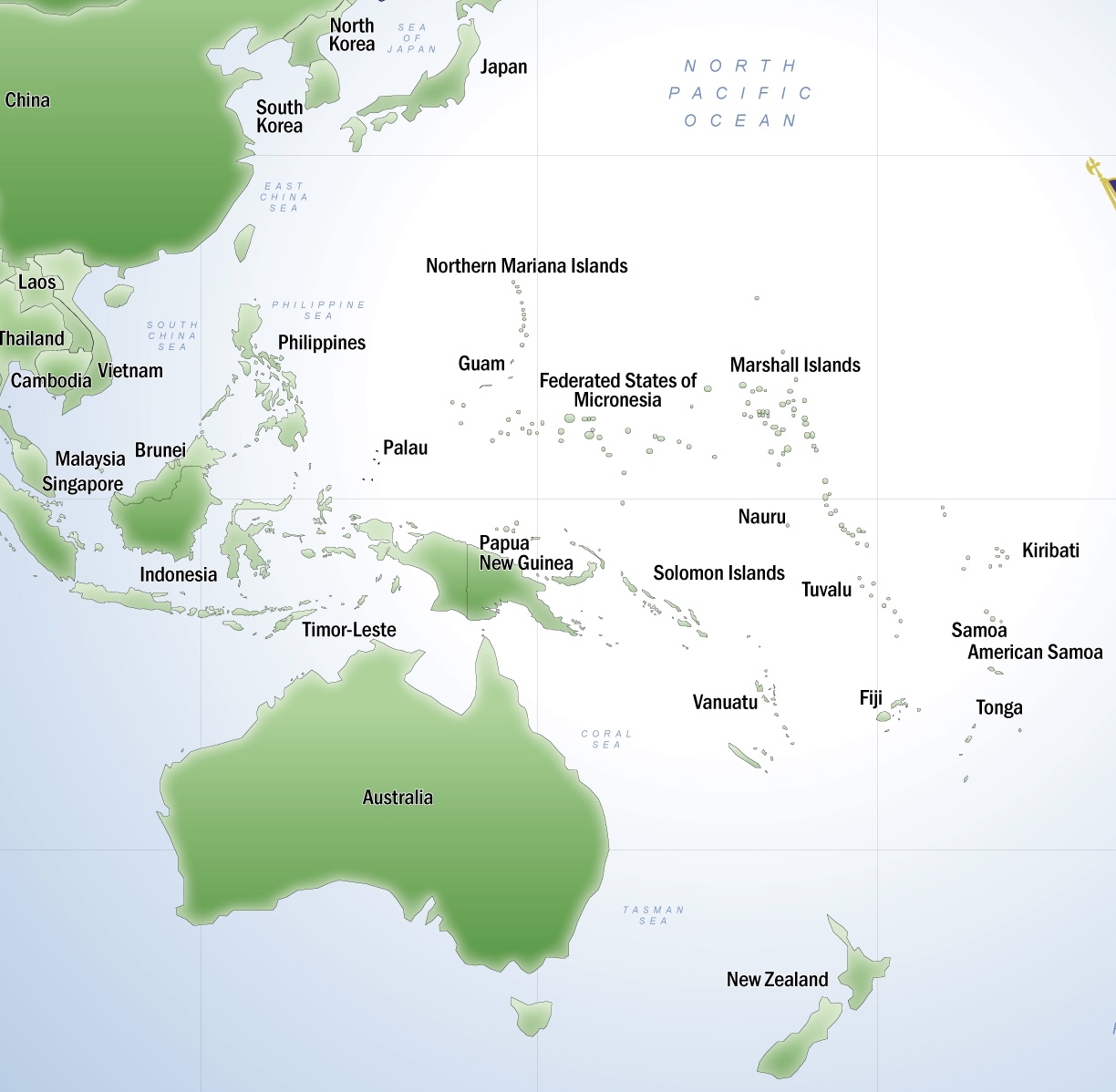
When it came to voting for a nonbinding resolution in the United Nations General Assembly on the subject of a “humanitarian truce” regarding the conflict in Gaza in October, 14 countries were steadfastly opposed. Of those were six Pacific Island states: Fiji, Papua New Guinea (PNG), Tonga, Nauru, Marshall Islands and the Federated States of Micronesia.

The same pattern could be seen in 2012, when a mere nine nations voted against the issue of recognising Palestinian statehood, among them being Micronesia, the Marshall Islands, Palau and Nauru.

A few theories have been offered on this seemingly anomalous occurrence. Grant Wyeth suggests that the dynamics of power in this context may be less significant than that of faith and religious force. “Much of the Pacific is highly observant in their Christianity, and they have an eschatological understanding of humanity.” Wyeth emphasises those Protestant denominations that took a keen interest in the creation of Israel in 1948.

Much as with the hot fire evangelicals that helped Ronald Reagan win the White House in 1980, Israel’s creation was seen prophetically, the biblical step to religious finality.  Eschatologically speaking, the Jewish people needed to return to the Holy Land for the final rites of humanity to be read. (Previously antisemitic bible bashers now had a strategic reason to like Jewry, knowing that, in the Final Judgment, the inhabitants of Israel would be pegged to God’s finishing line.) “Support for Israel is therefore a deeply held spiritual belief, one that sits alongside Pacific Islands’ other considerations of interests and opportunities when forming foreign policies.”

Papua New Guinea offers one such example, having become one of just five countries to formally open an embassy in the contested city of Jerusalem. On the occasion of its opening in September, PNG Prime Minister James Marape effusively declared that, “We are here to give respect to the people of Israel to the fullest.” The embassy’s establishment had taken place “because of our shared heritage, acknowledging the creator God, the Yahweh God of Israel, the Yahweh God of Isaac and Abraham.”

The religious theme throbs throughout Marape’s justifications.

“Many nations choose not to open their embassies in Jerusalem but we made a conscious choice. This has been the universal capital of the nation and people of Israel. For us to call ourselves Christians, paying respect to God will not be complete without recognizing that Jerusalem is the universal capital of the people and nation of Israel.”

Never one to avoid an opportunistic flourish, Marape also revealed that Israel will be funding the cost of the embassy for the first three years of its operations.

“But going forward, they’ve indicated land available for us & we look forward to proceeding, setting up our permanent mission there.”

He also made it clear that God and matters divine are not taking exclusive billing on the policy slate of Port Moresby. The economic relationship between Israel and PNG is so small as to be barely worth a mention ($1 million per annum), but Israel’s bold prowess in various fields such as agriculture, education, finance and infrastructure is being eyed with relish. That aspect of foreign policy has been vigorously encouraged by Mashav, Israel’s foreign aid department otherwise known as the Centre for International Development and Cooperation.

Former ministerial advisor Sean Jacobs recalls, “as a junior attaché to PNG’s 2011 Commonwealth Heads of Government (CHOGM) delegation, supporting a very brief bilateral with Israeli representatives in the margins” the offer of Israeli assistance “where it matters most – in PNG’s health sector and through in-kind, small-scale on ground medical equipment and expertise.”

PNG’s opposition leader, Joseph Lelang, was less enthusiastic about Marape’s less than balletic manoeuvring.

“We have aroused the ire of the Palestinian Authority and Hamas has warned us in the strongest terms that PNG must reconsider that decision and move out.”

Lelang’s concern was for diplomatic personnel who could find themselves at risk.

“This is a serious warning and I feel for the foreign mission staff and the ambassador who will be based there.”

The Palestinian foreign ministry’s displeasure was also expressed in a statement accusing Port Moresby of being involved in “an aggression against the Palestinian people and their rights.” The move would, it alleged, cause “great harm to the chances of achieving peace on the basis of the two-state solution.”

Other Pacific Island countries have thrown in their lot with the Israeli State, softening the hungrily lethal retaliation in Gaza in favour of the country’s right to self-defence. There are such statements as those from Fiji’s foreign ministry on October 31, a bold, unabashed endorsement of Israel and its policies.

“Fiji affirms its solidarity with Israel and commitment to global peace in the midst of the ongoing conflict between Israel and Hamas.”

In explaining why the Pacific country voted against the UN resolution calling for a ceasefire in the Israel-Hamas War, issue was taken with “ground realities and correct factual omissions” regarding the role played by “Hamas for initiating the crisis, holding hostages, and using them and civilians as human shields since [the] October 7 2023 terrorist attack.” Banally and, in any operational sense meaningless, the statement goes on to claim “that Israel’s primary target is Hamas, not the Palestinian population.”

As Israel runs the wells of international empathy dry with its incessantly ruthless destruction of Gaza, it can continue, through a quirk of European colonial history, to rely on a measure of support among various Pacific Island states.  History, in that sense, is less cunning than teasingly eccentric.

*

Note to readers: Please click the share button above. Follow us on Instagram and Twitter and subscribe to our Telegram Channel. Feel free to repost and share widely Global Research articles.

Dr. Binoy Kampmark was a Commonwealth Scholar at Selwyn College, Cambridge. He currently lectures at RMIT University. He is a regular contributor to Global Research and Asia-Pacific Research. Email: [email protected]

  • Posted in Mobile
  • Comments Off on Accidents of Eccentricity: Israel’s Pacific Hold
  • Tags: ,

All Global Research articles can be read in 51 languages by activating the Translate Website button below the author’s name (only available in desktop version).

To receive Global Research’s Daily Newsletter (selected articles), click here.

Click the share button above to email/forward this article to your friends and colleagues. Follow us on Instagram and Twitter and subscribe to our Telegram Channel. Feel free to repost and share widely Global Research articles.

***

With the rise of China, so too rises Southeast Asia. Southeast Asia has slowly transformed in terms of economics, infrastructure, tourism, industry, and politically over the last two decades as Chinese influence increases and inevitably displaces US influence over the region.

At its height, US influence resulted in a major war spanning two decades, engulfing Vietnam, Cambodia, and Laos. The US maintained military bases across the region, including in Thailand and the Philippines. However, when the US finally lost its war against Vietnam, it withdrew much of its military. And in the following decades, the region slowly shifted from depending heavily on trade with the US and its allies, including Japan, over to China.

Today, China stands as the largest trading partner, investor, source of tourism, and infrastructure partner for most of Southeast Asia. This includes the Philippines.

According to Harvard University’s Atlas of Economic Complexity, China stood as the Philippines’ largest export market. Between the Chinese mainland and Hong Kong, over 30% of exports from the Philippines go to China. The US and Japan combined account for only around 25%.

China also stands as the largest source of imports into the Philippines at around 33% while the US accounts for around 6% and Japan around 8%. China is indisputably the Philippines’ largest trade partner.

China is also the Philippines’ best chance at developing badly needed modern infrastructure.

However, while other nations across Southeast Asia are expanding their relationship with China and building the region together, the Philippines finds itself irrationally cutting itself off from China, laying out a foreign policy demonstrably contradicting its own best interests.

The Philippines Sacrifices Progress to Become US Provocateur 

As Chinese-built high-speed rail networks begin operating in Laos and Indonesia and another continues construction in Thailand, the Philippines has recently canceled several joint-Chinese rail projects.

US government-funded Benar News reported in its recent article, “Philippines drops funding deal with China for 3 railway projects,” that not only will the Philippines no longer seek funding from China, it will also seek out alternative contractors to build the rail projects. Since no other nation is capable of building such projects in the region, the Philippines has for all intents and purposes put infrastructure investment on hold.

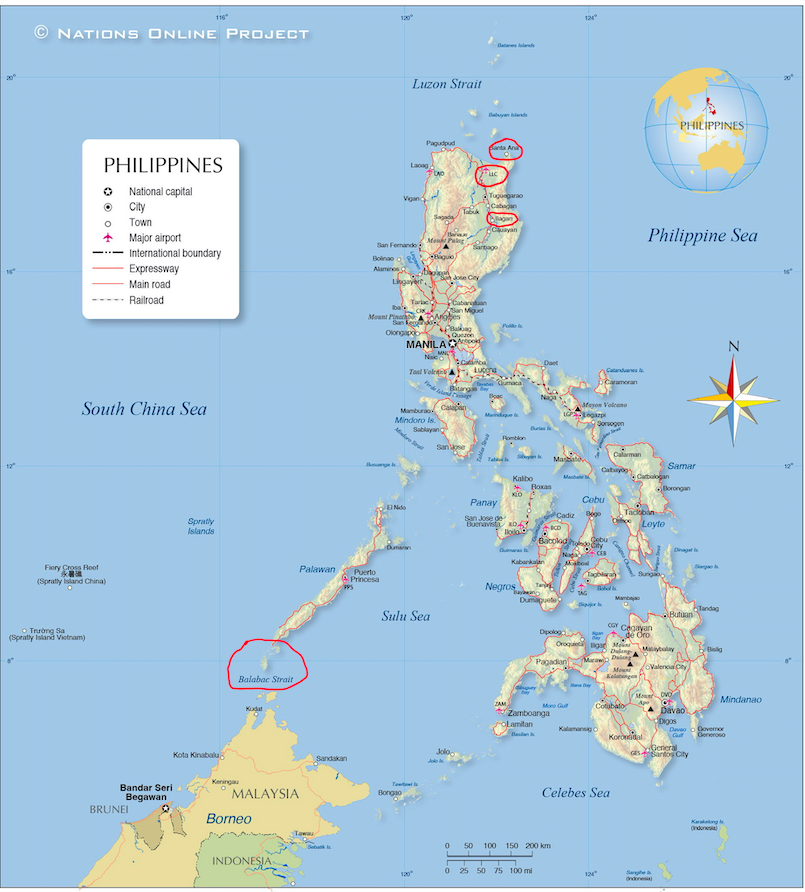
Earlier this year, the Philippines also signed a military basing agreement with the United States. The Washington Post in its article, “U.S. reaches military base access agreement in the Philippines,” would report that:

 U.S. military forces will be given access to four new military bases in the islands, solidifying a months-long U.S. effort to expand its strategic footprint across the Pacific region to counter threats from China.

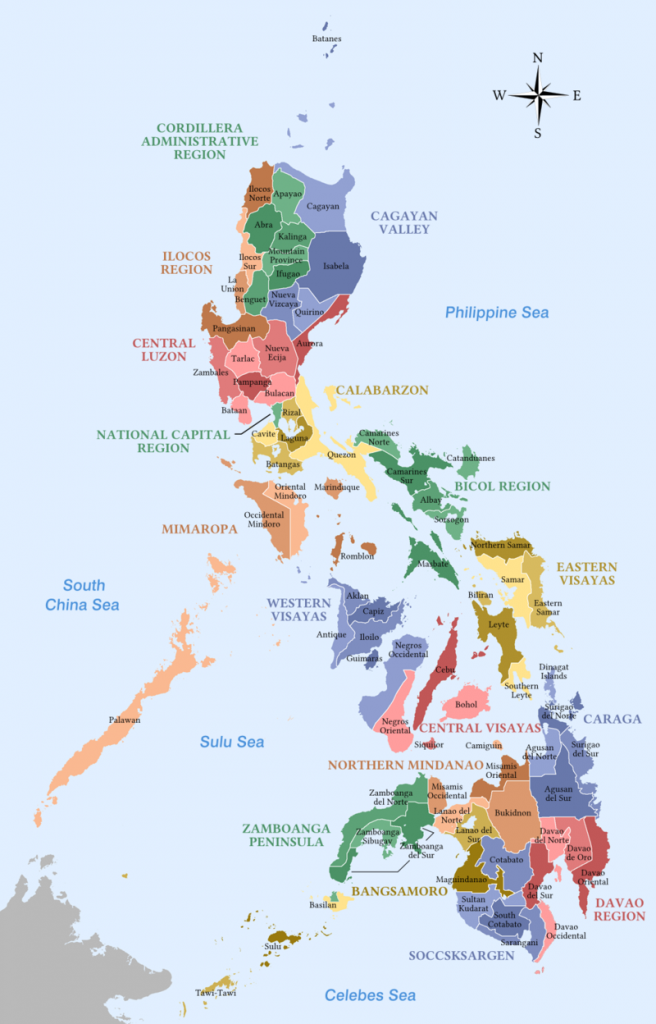
Since then, the Philippines has also begun talks with the US for the development of a port dangerously close to China’s island province of Taiwan.

Reuters in its article,“ Exclusive: U.S. military in talks to develop port in Philippines facing Taiwan,” would report:

U.S. military involvement in the proposed port in the Batanes islands, less than 200 km (125 miles) from Taiwan, could stoke tensions at a time of growing friction with China and a drive by Washington to intensify its longstanding defence treaty engagement with the Philippines.

While the United States justifies its growing military presence in the Philippines by citing maritime disputes in the South China Sea, it should be noted that maritime disputes are common both around the world and particularly in Southeast Asia. Not only do many Southeast Asian states have disputes with China, they also have overlapping claims and resulting disputes with one another.

These disputes can result in sometimes dramatic public displays. Malaysia, for example, in 2017 sank nearly 300 foreign fishing boats seized amid these disputes, including fishing boats from the Philippines, Nikkei Asia reported. While these disputes become somewhat heated, they are always resolved bilaterally all while nations in the region, including China, maintain otherwise constructive and even close economic and diplomatic ties.

Thus, the US is using common maritime disputes as a pretext to insert itself militarily into the region, attempting to escalate ordinary disputes into a regional or even global crisis. In reality, the US is building up its military presence, not to defend its supposed allies, but to encircle and contain China while transforming host nations into battering rams against China.

This US strategy has had varying success across Southeast Asia, with the Philippines being by far its greatest success. This is owed to the unique and unfortunate history of the Philippines as a US colony from 1898-1946 and its defacto subordination to the US ever since.

The Philippines as an American Foothold 

The US State Department’s Office of the Historian in a publication titled, “The Philippine-American War, 1899–1902,” would admit that the US seized the Philippines as a US colony from Spain and then waged a brutal war of subjugation against the Philippine people.

The US State Department admits:

The ensuing Philippine-American War lasted three years and resulted in the death of over 4,200 American and over 20,000 Filipino combatants. As many as 200,000 Filipino civilians died from violence, famine, and disease.

It also admitted that:

U.S. forces at times burned villages, implemented civilian reconcentration policies, and employed torture on suspected guerrillas, while Filipino fighters also tortured captured soldiers and terrorized civilians who cooperated with American forces. Many civilians died during the conflict as a result of the fighting, cholera and malaria epidemics, and food shortages caused by several agricultural catastrophes.

While the US granted the Philippines “independence” in 1946, the US has maintained varying degrees of political and military control over the nation ever since. Under the presidential administration of Rodrigo Duterte, the Philippines attempted unsuccessfully to expel the US military presence. President Duterte’s successor, Ferdinand Marcos Jr. has since rolled back the incremental gains in sovereignty and dignity achieved during Duterte’s term in office.

To explain the deep, institutional subordination of the Philippines to US interests, demonstrably at the cost of the Philippines’ own best interests including economic development, trade, and infrastructure, Philippine Foreign Secretary Enrique Manalo would explain at a Washington-based April 2023 talk hosted by the Center for Strategic and International Studies (CSIS) that the core of his nation’s political leadership has been shaped by decades of US indoctrination.

Foreign Secretary Enrique Manalo would explain:

Our partnership has thrived on other vibrant connections. And people are the throbbing core of our ties. This year marks the 75th anniversary of the Fulbright program in the Philippines, which has 8,000 alumni and is the longest continuing Fulbright program in the world. The seeds of the future of our alliance are born in the many platforms in our relations where our peoples, whether they are scientists, entrepreneurs, civil society partners, youths, and artists, incubate new ideas and contemplate on visions together.

The Fulbright program, created by the US State Department, claims on its website that it “expands perspectives through academic and professional advancement and cross-cultural dialogue.” By “expanding perspectives” it means indoctrinating potential leaders in politics, media, business, education, and culture to adopt a pro-US worldview and create a US-influenced cadre of administrators in nations around the world.

Together with other US government programs, such as the National Endowment for Democracy (NED) which funds political parties, education programs, media platforms, and many of the “civil society partners” Philippine Foreign Secretary Enrique Manalo referred to in his speech, the Fulbright program is part of the toolset the US uses to politically capture a targeted nation.

An example of this is Maria Ressa. She is a 1986 Fulbright alumni who founded the media platform “Rappler” funded by the US government through the NED. Both Ressa and her Rappler media platform are loud advocates for greater US influence over the Philippines and the rolling back of relations with China. Rappler’s media content is indistinguishable from US government talking points because Rappler is an extension of US government influence.

In terms of political capture, the Philippines represents one of Washington’s success stories. Enduring US influence, first as the Philippines’ colonial master and then through decades of indoctrination and political interference via the NED and programs like Fulbright, Washington has convinced Manila to forego the benefits of trade and economic development together with China and the rest of Asia in exchange for positioning itself as Southeast Asia’s “Ukraine.”

Just as Kiev attempted to convince the Ukrainian people that the West would provide a superior substitute for the nation’s long-standing ties with Russia only to instead find itself abandoned at the end of a self-destructive proxy war, Manila is likewise attempting to convince the people of the Philippines that the US, Australia, and Japan will provide better alternatives to Chinese-driven trade, economic progress, and infrastructure development. In reality, all the US is building in the Philippines are military bases meant to drag both it and the region into greater instability, economic stagnation, and possibly even war.

Only time will tell if China’s patient rise and ability to build up the rest of the region will outlast America’s desire and ability to divide and destroy Asia. The Philippines, for its part, serves as an indicator of which direction the region may move in. Sadly, for now, it seems the US capacity for dividing and endangering the region is still very much intact.

*

Note to readers: Please click the share button above. Follow us on Instagram and Twitter and subscribe to our Telegram Channel. Feel free to repost and share widely Global Research articles.

Brian Berletic is a Bangkok-based geopolitical researcher and writer, especially for the online magazine “New Eastern Outlook”

Featured image is from NEO

All Global Research articles can be read in 51 languages by activating the Translate Website button below the author’s name (only available in desktop version).

To receive Global Research’s Daily Newsletter (selected articles), click here.

Click the share button above to email/forward this article to your friends and colleagues. Follow us on Instagram and Twitter and subscribe to our Telegram Channel. Feel free to repost and share widely Global Research articles.

***

In most instances, the justice system of a liberal democracy presumes absence of arbitrary and cruel treatment by the State.  Punishment, when levelled, is finite. It might see out the term of a convict’s natural life, but that would only be for the most extreme cases. Even then, the whiff of parole, while far off, might still be possible.

On being released, the usual assumptions apply. Time served is time done. Past punishment will not be revisited upon you; the State will not send its hounds and officers of the thin blue line after you. This would only happen in instances of re-offending – recidivism remains a risky feature of the post-release citizen. But in Australia, a current hysteria, fed like a hungry gargoyle by politicians on both sides of the aisle, has come to roost over the federal Parliament.

The High Court of Australia, having had the good, just sense of finding the indefinite administrative detention of refugees an unwarranted excess of executive power, was always going to make matters challenging for the government. For one thing, few expected it. That same body had previously held in Al-Kateb v Godwin (2004) that such forms of indefinite confinement were perfectly legal, even if those refugees could never have a reasonable prospect of either settling in Australia or a third country.  But in November, it all changed.

In the NZYQ case, the High Court affirmed the constitutional principle that detention is a form of punishment and is a judicial power exercisable once a person is found guilty of a crime. Laws authorising the administrative detention of non-citizens by the executive arm of government could only be constitutionally valid if reasonably necessary for a legitimate non-punitive purpose. The law authorising the detention of NZYQ, a stateless Rohingya man, was not appropriately adapted to the purpose of his removal, given that he had “no real prospect of removal from Australia becoming practicable in a reasonably foreseeable future”.

Of particular concern to the Albanese government was the issue of what to do with those administrative detainees with convictions, but had, as such, done the time. On paper, it should not have been controversial.  With their sentence served, they would surely be permitted their liberty subject to the usual caveats of forfeiture. But those in immigration detention were seen as exceptional, the undesirable, unconventional sort who had come by boat. Rather than being permitted to disappear into Australia’s own version of legal purgatory, they were let out instead, posing an unacceptable risk. How that risk was unacceptable relative to that posed by other convicts was never explained.

Instead of finding a sober, mature approach to dealing with the matter, a quarry for hysterical rhetoric was opened. Heavy digging commenced with reports of a growing though small number of reoffenders, including an Afghan refugee who was charged with two counts of indecent assault in Adelaide.

The Liberal-National Coalition, led by the icy Peter Dutton, histrionically claimed that the released detainees posed exceptional risk. A media release from the Liberal Party wondered “why the Government panicked and urgently released in excess of 140 detainees when the [High Court] decision clearly applies to the single detainee NZYQ.” The insinuation was clear: irrespective of the High Court’s ruling, most of the detainees could still be confined, as long as the reason was sufficiently cooked.

Labor, historically vulnerable to the anti-refugee hysterics of the LNP, could only come up with a pale version of the same. It has attacked Dutton as a “protector of paedophiles” for opposing draft proposals for paedophile school ban zones.

“They came here,” raged Home Affairs Minister Clare O’Neil, “and instead of supporting Labor’s attempts to criminalise paedophiles, who loiter near daycare centres and schools, the leader of the opposition came in here and played politics instead.”

Immigration Minister Andrew Giles also lamented before his fellow parliamentarians that,

“The government did not choose to be in this position. The situation was imposed on this parliament by the High Court.”

Both sides of politics meet at a dubious apex: that refugees with convictions must be treated as a monstrous category. The important thing was identifying a suitable preventative regime to achieve that purpose.

The laws just rushed through parliament permit the immigration minister to seek a court order to detain individuals released from immigration detention. Two conditions must be met: that the person be convicted for a crime, be it in Australia or overseas, carrying a sentence of at least seven years’ imprisonment; and the court’s agreement that the person poses “an unacceptable risk of committing a serious violent or sexual offence” with “no less restrictive measure available” to maintain community safety.

Other impediments are also imposed upon those released into the community as part of what is known as the Bridging Visa R subclass. Many of these are repurposed from anti-terrorist legislation, with a focus on monitoring devices, regular reporting, curfews and restrictions on work and financial matters.

While the government has included the judiciary in the process of seeking re-detention, the process has a distinctly punitive flavour, constituting a form of secondary punishment. It is also especially discriminatory, applying to non-Australian citizens.  Yet again, the non-citizen is being treated as a non-person. As Michelle Peterie and Amy Nethery pertinently observe, “Australians with the same criminal histories and risk profiles will not be subject to the preventative detention regime under this legislation.” A potential legal challenge, for precisely that reason, may be in the offing.

The hideous spectacle leaves us a desperate, disturbing conclusion. Even after time is served behind bars, refugees will be subject to the very discriminatory and punitive regimes that the UN Refugee Convention guards against. The agenda here is to perpetrate a regime of permanent punishment and surveillance, using an actuarial model of justice. Released refugees are to be treated no less as potential terrorists, permanently menacing. And it is a conflation the government and the main opposition parties are willing to entertain.

*

Note to readers: Please click the share button above. Follow us on Instagram and Twitter and subscribe to our Telegram Channel. Feel free to repost and share widely Global Research articles.

Dr. Binoy Kampmark was a Commonwealth Scholar at Selwyn College, Cambridge. He currently lectures at RMIT University.  He is a regular contributor to Global Research and Asia-Pacific Research. Email: [email protected]

All Global Research articles can be read in 51 languages by activating the Translate Website button below the author’s name (only available in desktop version).

To receive Global Research’s Daily Newsletter (selected articles), click here.

Click the share button above to email/forward this article to your friends and colleagues. Follow us on Instagram and Twitter and subscribe to our Telegram Channel. Feel free to repost and share widely Global Research articles.

***

Calls were made for Labor to bring refugees held in offshore detention to safety at a Refugee Action Collective (RAC) organised speak-out on November 18.

Max Costello, from RAC, said about 14,000 refugees and asylum seekers remain in Indonesia after Coalition immigration minister Scott Morrison decided in 2014 that even people recognised as refugees by the United Nations High Commission for Refugees would never be allowed to come to Australia.

Hussain Shah Rezaie, a Hazara refugee from Afghanistan, who spoke by phone from Indonesia, said he was kept in detention for three and a half years before being released. He has been there for nine years and said refugees feel hopeless and abandoned.

About 60 refugees have died since 2014, 18 by suicide. “Your actions give us hope”, he said, adding that they hold weekly protests.

Margaret Sinclair, also from RAC, said refugees in Indonesia have no right to work, study or get a driver’s licence or bank account. Indonesia is not a signatory to the Refugee Convention.

Most live in accommodation blocks, that Sinclair described as “ghettos”. Whole families are in one room, 3 by 3 metres, and are subject to a curfew.

Those who arrived before March 2018 receive an Australian government allowance of $100 a month for adults and $50 for children. The money is distributed by the International Organisation for Migration. Those who arrived after March 2018 receive nothing.

Sinclair said that half the refugees in Indonesia are Hazaras, some of whom had helped the Australian Defence Force in Afghanistan.

She called on Labor to lift the ban on taking refugees from Indonesia and raise the humanitarian intake.

Sinclair said 62 sent by Australia to the former detention centre on Manus Island are still in Papua New Guinea, unable to obtain resettlement in the United States or New Zealand. Some are too sick to even apply.

They live in Port Moresby and face the threat of being thrown out of their accommodation.

Sinclair reported that 11 had recently been sent to Nauru, where the detention centre had been empty for some time. She said Labor should repeal the laws that make offshore detention possible.

Betelhem Tibebu Zeleke, a refugee from Ethiopia, who has finally been freed, spoke about the impact of detention on her and others’ mental health. She spent time in Indonesia, but seeing the hopelessness among refugees there she “decided to jump on a boat”.  She was sent to Nauru, where she “lost hope”. She said that prolonged detention “damages your brain”.

Eventually she was brought to Australia and, after a period of detention in Brisbane, set free.

Danae Bosler, representing the Victorian Trades Hall Council, called on the government to lift its ban on taking refugees from Indonesia. Tim Read, a Greens MP, criticised the policy of using Indonesia and PNG as a “dumping ground” for refugees. He said Labor should talk to the Greens rather than look to Peter Dutton for “inspiration”.

Greg Kiernan spoke about a project to raise money for refugees in Indonesia by selling artworks they have created.

*

Note to readers: Please click the share button above. Follow us on Instagram and Twitter and subscribe to our Telegram Channel. Feel free to repost and share widely Global Research articles.

Featured image: Speaking out for refugees. Photo: Matt Hrkac

All Global Research articles can be read in 51 languages by activating the Translate Website button below the author’s name.

To receive Global Research’s Daily Newsletter (selected articles), click here.

Click the share button above to email/forward this article to your friends and colleagues. Follow us on Instagram and Twitter and subscribe to our Telegram Channel. Feel free to repost and share widely Global Research articles.

***

One could earn a tidy sum the number of times the word “sovereignty” has been uttered or mentioned in public statements and briefings by the Australian Prime Minister, Anthony Albanese.

But such sovereignty has shown itself to be counterfeit. The net of dependency and control is being increasingly tightened around Australia, be it in terms of Washington’s access to rare commodities (nickel, cobalt, lithium), the proposed and ultimately fatuous nuclear-propelled submarine fleet, and the broader militarisation and garrisoning of the country by US military personnel and assets. (The latter includes the stationing of such nuclear-capable assets as B-52 bombers in the Northern Territory.)

The next notch on the belt of US control has been affirmed by new proposals that will effectively make technological access to the Australian defence industry by AUKUS partners (the United States and the United Kingdom) an even easier affair than it already is.  But in so doing, the intention is to restrict the supply of military and dual-use good technology from Australia to other foreign entities while privileging the concerns of the US and UK. In short, control is set to be wrested from Australia.

The issue of reforming US export controls, governed by the musty provisions of the US International Trade in Arms Regulations (ITAR), was always going to be a feature of any technology transfer, notably regarding nuclear-propulsion.  But even before the minting of AUKUS, Canberra and Washington had pondered the issue of industrial integration and sharing technology via such instruments as the Defense Cooperation Treaty of 2012 and Australia’s addition to the National Technology and Industrial Base in 2017.

This fundamentally failed enterprise risks being complicated further by the latest export reforms, though you would not think so, reading the guff streaming from the Australian Defence Department. A media release from Defence Minister Richard Marles tries to justify the changes by stating that “billions of dollars in investment” will be released. Bureaucratic red tape will be slashed – for the Australian Defence industry and the AUKUS partners.  “Under the legislation introduced today, Australia’s existing trade controls will be expanded to regulate the supply of controlled items and provision of services in the Defence and Strategic Goods List, ensuring our cutting-edge military technologies are protected.”

Central to the reforms is the introduction of a national exemption that will cover trade of defence goods and technologies with the US and UK, thereby “establishing a license-free environment for Australian industry, research and science.” But the broader object here is unmistakably directed, less to Australian capabilities than privileged access and a relinquishing of control to the paymasters in Washington. A closer read, and it’s all got to do with those wretched white elephants of the sea: the nuclear-powered submarine.

As the Minister for Defence Industry, Pat Conroy, states,

“This legislation is an important step in the Albanese Government’s strategy for acquiring the state-of-the-art nuclear-powered submarines that will be key to protecting Australians and our nation’s interests.”

In doing so, Conroy, Marles and company are offering Australia’s defence base to the State Department and the Pentagon.

With a mixture of hard sobriety and alarm, a number of expert voices have voiced concern regarding the implications of these new regulations. One is Bill Greenwalt, a figure much known in the field of US defence procurement, largely as a prominent drafter of its legal framework. He is unequivocal in his criticism of the US approach, and the keen willingness of Australian officials to capitulate. 

“After years of US State Department prodding, it appears that Australia signed up to the principles and specifics of the failed US export control system,” Greenwalt explained to the Australian Broadcasting Corporation.  “Whenever it cooperates with the US it will surrender any sovereign capability it develops to the United States control and bureaucracy.”

The singular feature of these arrangements, Greenwalt continues to elaborate, is that Australia “got nothing except the hope that the US will remove process barriers that will allow the US to essentially steal and control Australian technology faster.”

In an email sent to Breaking Defense, Greenwalt was even more excoriating of the Australian effort. “It appears that the Australians adopted the US export control system lock, stock and barrel, and everything I wrote about in my USSC (US Studies Center) piece in the 8 deadly sins of ITAR section will now apply to Australian innovation.  I think they just put themselves back 50 years.”

The paper in question, co-authored with Tom Corben, identifies those deadly sins that risk impairing the success of AUKUS: “an outdated mindset; universality and non-materiality; extraterritoriality; anti-discrimination; transactional process compliance; knowledge taint; non-reciprocity; and unwarranted predictability.”

When such vulgar middle-management speech is decoded, much can be put down to the fact that dealing with Washington and its military-industrial complex can be an imperilling exercise.  The US imperium remains fixated, as Greenwalt and Corben write, with “an outdated superpower mindset” discouragingly inhibiting to its allies.  What constitutes a “defence article” within such export controls is very much left to the discretion of the executive. The archaic application of extraterritoriality means that recipient countries of US technology must request permission from the State Department if re-exporting to another end-user is required for any designated defence article.

The failure to reform such strictures, and the insistence that Australia make its own specific adjustments, alarms Chennupati Jagadish, president of the Australian Academy of Science. The new regulations may encourage unfettered collaboration between the US and UK, “but I would require an approved permit prior to collaborating with other foreign nationals.  Without it, my collaborations could see me jailed.”  The bleak conclusion: “it expands Australia’s backyard to include the US and UK, but it raises the fence.”  Or, more accurately, it incorporates, with a stern finality, Australia as a pliable satellite in an Anglo-American arrangement whose defence arrangements are controlled by Washington.

*

Note to readers: Please click the share button above. Follow us on Instagram and Twitter and subscribe to our Telegram Channel. Feel free to repost and share widely Global Research articles.

Dr. Binoy Kampmark was a Commonwealth Scholar at Selwyn College, Cambridge. He currently lectures at RMIT University.  He is a regular contributor to Global Research and Asia-Pacific Research. Email: [email protected]

Featured image: HMAS Sheean (front left) and HMAS Collins (front right) at HMAS Stirling in 2006 (Licensed under CC BY 2.5 au)

  • Posted in Mobile
  • Comments Off on Sovereignty Surrendered: Subordinating Australia’s Defence Industry
  • Tags: ,

All Global Research articles can be read in 51 languages by activating the Translate Website button below the author’s name.

To receive Global Research’s Daily Newsletter (selected articles), click here.

Click the share button above to email/forward this article to your friends and colleagues. Follow us on Instagram and Twitter and subscribe to our Telegram Channel. Feel free to repost and share widely Global Research articles.

***

Abstract

Muslim migrants in Japan suffer from the lack of access to burial grounds when 99.9% of the nation is cremated. Muslims are usually met with opposition from the local community where cemetery construction is planned. Using ethnographic data, the study shows how Muslim associations inadvertently fail to respect the codes of Japanese rurality when seeking a cemetery in a community to which they do not have membership, leading to a conflict. This paper closes with policy prescriptions for the central government in ensuring the cultural rights of immigrant minorities in Japan.

*

Introduction

Migration has been increasing in Japan over the last three decades (Immigration Services Agency of Japan, 2022; OECD, 2019). Given the population decline, the state frequently refers to increasing foreigners and accommodating cultural diversity as a way forward for promoting economic growth. Diversity (tayōsei) and “multicultural coexistence” (tabunka kyōsei) have now become buzzwords in many working groups discussing the shape of Japan’s future (e.g., Cabinet Office Japan, 2021). However, in a country that has historically imagined nationhood in terms of common descent (Liu-Farrer, 2020), the institutional transition into a multicultural society is slow to come by. Comparative research on multiculturalism assesses Japan’s approach to integration as “immigration without integration (Migration Integration Policy Index, 2020).” Another research institute rates Japan as trailing other countries in creating the legal frameworks academically known to accommodate the inclusion of immigrants in mainstream society (Multiculturalism Policy Index, 2020a). This paper examines the case of Muslim migrants and the hardships they face in accessing burial grounds. This shows how guaranteeing the cultural rights of immigrant minorities remains one of the primary challenges facing the Japanese government today despite its recent mantra of “multicultural co-existence.”

Muslim migrants are commonly known to suffer from exclusion and marginalization in many non-Muslim societies (Entzinger, 2006; Simon and Pala, 2010). In Japan in particular, Muslim migrants suffer from the lack of access to burial cemeteries where 99.9% of the deceased are cremated (MHLW, 2023). There are only 13 burial cemeteries accessible to Muslims nationwide, and many are forced to haul the remains across prefectures to bury the bodies in accordance with their religious teachings. Given the scarcity of burial cemeteries, especially in western Japan, Muslim associations are wanting to create more burial cemeteries, but have met with opposition from local communities. When there is opposition, the local governments are reluctant to issue permits, even when the cemetery construction plans abide by the local ordinances (jōrei) on cemetery construction and management. The shortage of burial grounds is especially an issue for Japanese Muslims who find Japan to be their home and do not have the choice of transporting the remains to their country of origin. By using ethnographic data from interviews and participant observation, this paper answers the questions of how and why Japanese Muslims face difficulties in creating burial cemeteries, and what the implications are of this empirical case to the discussions on multiculturalism in Japan.

The bulk of studies on the issue of multiculturalism focuses on how migrants face constraints in their everyday lives without paying much attention to the issues they face upon death. The same goes for studies on Muslim migrants in Japan. This study makes an empirical contribution by filling that gap in the existing literature. In addition, theoretical discussions on multiculturalism have primarily focused on identifying the legal-institutional policy arrangements that accommodate the inclusion and mainstreaming of immigrant minorities. This study advocates the importance of enforcement of such policies in promoting the well-being of immigrant minorities in host societies. 

Methodology

This paper is based on ethnographic data gathered over three years. Interviews were conducted with six Muslim associations and burial cemetery owners, namely the Japan Islamic Trust, Muslim Graveyard Ibaraki Japan, Shimizu Reien Islamic Graveyard, Hiroshima Islamic Cultural Center in late 2021, and the Kyoto Koraiji International Burial Cemetery and the Oita Trappist Monastery in July 2023. Interviews were semi-structured, and conducted in Japanese and English. Interviews in Japanese were translated into English by the author for quoting purposes. Each interview, conducted over Zoom, lasted between 90 minutes to 2 hours, while some were conducted over email as an “epistolary interview” (Debenham, 2007). In addition, two interviews were conducted in mid-2022 with the local residents in Hiji who opposed the cemetery. An additional interview was conducted in July 2023 with a Buddhist monk who has been playing an active role in supporting the BMA’s campaign. Real names are used for Muslim association representatives, cemetery owners, and politicians, but pseudonyms are used when referring to the local residents.

Participant observation was conducted to study the Beppu Muslim Association (BMA) and its campaign to acquire a cemetery construction permit from Hiji Town, Oita Prefecture. From 2020 until 2022, I played a supporting role for the BMA. I assisted in activities such as gathering an online petition to request the mayor of Hiji Town to issue a permit. I also attended meetings with the Hiji Town and the local communities in Hiji and Kitsuki as an interpreter. All data were audio-recorded when permissions were given. Notes were taken and turned into field notes for coding analysis. Other primary and secondary data include raw water test results from local governments with burial cemeteries, government statistics and legal documents, newspaper articles, and academic sources on burial and cemetery issues.

Background

Muslims in Japan 

Muslims residing in Japan have notably increased over the past decades, and are estimated to have reached approximately 230,000 in 2020 (Tanada 2021). This is more than a two-fold increase in ten years when the estimate was around 110,000 in 2010 (Tanada, 2013). Muslim migrants in the 1980s were recognized by the state as dekasegi workers staying only temporarily in the urban, metropolitan areas. Even though Muslims today are still concentrated in large cities, their settlement in Japanese society meant the growth of the Muslim population in areas beyond the metropolis and spread into the rural regions (Tanada, 2021, Okai 2009). In the late 1980s to early 1990s, the Japanese government suspended the visa-less entry agreements with Muslim-dominant countries such as Iran, Pakistan, and Bangladesh. This triggered a decrease in the pace of new entrants while Muslims with visa status continued to grow. Muslim migrant workers, who were predominantly single men, increasingly married in Japan and had families who became Muslims (Higuchi, 2017a). The globalization of tertiary education also generated an increase in Muslim students across the nation, some of whom decided to work in Japan after graduation. This trend was reinforced by the guest workers from Muslim-dominant countries under the Technical Internship Training Program (e.g., Indonesia) working in the rural regions suffering from labor shortage. The current Muslim population settling in Japan is characterized by diversity in the country of origin, nationality, ethnic identity, occupation, and place of residence. 

The increase in resident Muslims and their geographical spread is represented by the nationwide proliferation of mosques. Studies by experts on Muslim migrants show that there were only four mosques in the 1980s, mostly constructed as state-sponsored projects in urban cities (Tanada, 2015). By 2017, the number of mosques has increased to over 100, many of which were created by workers and students residing across Japan, typically by using apartment rooms and renovating existing buildings into places for prayer (Tanada and Okai, 2015; Okai, 2017). Muslim migrants commonly put in effort to secure their religiously-mandated foodways in addition to securing places for prayer. Halal food business in Japan dates back to the 1970s when a limited number of import businesses catered mostly to a rather small population of embassy employees and Muslim seamen. Since the early 1990s, halal food businesses and halal certification of local restaurants increased exponentially along with the growth of resident Muslims and their mosques (Higuchi, 2017b). At present, some Muslim associations are discussing the need to build their own schools where the values and teachings of Islam are delivered to the generations born and raised in Japan.

Muslim migrants have hitherto laid out their religious-institutional foundations primarily through self-help. The Japanese government’s initiative to promote multiculturalism under the banner of “multicultural coexistence” was launched in 2005, but religion had little place in the discussions on meeting the needs of foreign residents (Takahashi, 2015). The central government externalized the responsibilities of instituting multicultural policies to the local governments, and the undertakings by the local governments were mostly about providing multilingual services at city halls, assisting Japanese language education at public schools, and sponsoring cultural exchange events (Tanada, 2019; Takahashi, 2015). This is not to deny the local governments’ proactive measures to accommodate the needs of Muslim migrants. A handful of cities have sponsored Islamic culture classes, created prayer rooms in public spaces, and added halal menus to their emergency food stock (Tanada, 2019). However, very little has been done on emerging issues facing the resident Muslims, such as the need for burial cemeteries. 

The Dominance of Cremation and Regulations on Burial

The proportion of cremation has increased rapidly since the postwar period, making Japan a unique country where 99.97% of the remains are cremated (MHLW, 2023). However, burial continues to be an important mortuary practice for a minority of its population. First, burial is an important way to mourn the dead for parents who had a stillbirth. Statistics show that Yokohama City has a relatively large number of burials (MHLW, 2023). This is because of the presence of an institution that accepts dead fetuses from the Kanto region. For parents who neither choose the remains to be disposed of nor cremated, burial remains an important option. Second, burial is exercised in times of disaster. Statistics show that in 2011, a large number of burials were recorded in the Tohoku region (MHLW, 2012). The Great East Japan Earthquake on March 11 destroyed cremation facilities while deaths rose rapidly. Burial is an important means to maintain public hygiene at times of natural disasters. Finally, religious minorities conduct burials in contemporary Japan. There are Catholic monasteries that own and manage burial-based cemeteries. Jewish people also customarily exercise burial, along with Muslims whose presence is growing in Japan.

Despite the dominance of cremation, legal regulations allow for both burial and cremation. The Cemetery and Burial Act (MHLW, 1948) regulates mortuary practices, including the legal procedures required for exercising mortuary rituals and the conditions to acquire permits for cemetery construction, ownership, and management. The governor in each prefecture is authorized to issue permits for owning and managing a cemetery, which is usually delegated to mayors at the town and city levels. This is because the central government recognizes that funerary customs differ by region. According to the Act’s guideline (MHLW, 2000), it is desirable for the state to only set the broad legal framework and leave it to the local government and its mayors to stipulate regulations in its local ordinance (jōrei) that suit the customs and needs of each locality. As a result, local ordinances typically forbid the construction of burial cemeteries in the main urban areas (e.g., Tokyo’s 23 Wards), while it allows burial cemeteries in the rest of the areas with particular conditions, such as keeping a certain distance away from a residence or watercourse. This shows that the Act, the accompanying guidelines, and local ordinances are multicultural in spirit and purposefully designed to accommodate diversity in funerary customs. Yet, Muslim associations across Japan face difficulties in acquiring permission from local governments, because the construction plans are met by opposition from the local community.

The Beppu Mosque is frequented by Muslims of diverse nationalities. Photo by author.

Beppu Muslim Association and Its Struggle for a Burial Cemetery

The Beppu Muslim Association (BMA) has been seeking to acquire a burial cemetery since 2018. The BMA manages the Beppu Mosque, which is mostly frequented by foreign students, workers, and their families living in the city. Dr. Muhammad Tahir Abbas Khan, who is the head of BMA, came to Japan in 2001 from Pakistan to pursue a doctoral degree and landed a teaching position at a private university in Beppu City where he still teaches. Mr. Khan acquired Japanese nationality in 2010, and two out of his three children have been born and raised in Japan. Muslim migrants settling in a non-Muslim country typically seek to arrange institutions that enable a lifestyle true to the teachings of Islam. Mr. Khan played a central role in building the Beppu Mosque, and he has collaborated with the local governments in certifying halal restaurants. However, particularly in Japan, Muslim migrants are at some point made to realize that death is an issue for them, which triggers them to seek and acquire a burial cemetery.

In the case of BMA, Mr. Saeed Zafar and his wife had a stillbirth in the winter of 2010. Mr. Zafar graduated from Ritsumeikan Asia Pacific University where Mr. Khan teaches. He remained in Beppu City after graduation and acquired Japanese nationality in 2010. He is also a board member of the BMA. Mr. Zafar, still in grief and with his wife hospitalized, visited the Beppu City Hall to report and process his child’s death. He informed the civil servants that he cannot cremate for religious reasons. In reply, the city suggested him to contact a Muslim organization in Tokyo if he wanted to bury his child (Suzuki, 2023, p.20). Mr. Zafar was dismayed that he was asked to contact some organization 1,000 kilometers away just to bury his child. After hours of waiting, the city managed to find a Catholic Church in Beppu City that owned a burial cemetery, where the pastor kindly agreed to lend a space (Oita Godo Shimbun, 2023). This incident signaled the BMA that securing a burial cemetery for local Muslims is a primary issue to be resolved if they wish to live and die in Japan as Muslim.

The BMA began searching for a burial cemetery in 2017, together with a native Japanese Buddhist monk named Jikaku Daido, a chief priest of a Sotoshu temple located in the northern city of Nakatsu in Oita prefecture. They first met in 2015 to organize a study session on Islam for Buddhist monks when Islamic fundamentalism was a rising issue. Mr. Jikaku felt the need to promote mutual understanding across religions when the media reports on the Taliban and ISIS overpainted a negative image of Muslims in the Japanese mind. Mr. Jikaku came to know about the shortage of burial cemeteries through these activities. When I asked him in an interview about his reasons for joining the BMA’s effort, he elaborated on his background as an NPO officer working in Tokyo until 2014.

I took part in assisting [people from] Afghanistan, and I was also a board member of Religions for Peace Japan’s youth branch (an international NGO). So, I had experiences interacting with people of many religions, including Muslims, and I felt close to them. When I came to know that [the BMA] are facing a very serious issue with cemeteries, I felt I should do what I can to help them.

According to my observations, Mr. Jikaku has been leading the BMA’s campaign to secure a burial cemetery. Mr. Khan and the BMA board members can speak and listen to Japanese but not sufficiently enough to engage in legal-technical dialogue with the city hall who do not speak English well either. The BMA have difficulty reading and writing Japanese, which is an issue when they have to comprehend local ordinances and other legal texts. The BMA needed someone Japanese on their side to serve as a bridge between them and the Japanese community at large. Thus, Mr. Jikaku became the BMA’s contact person. Mr. Jikaku scheduled meetings with the city hall and led the dialogue with civil servants and members of the local community.

The very first step they took to acquire a burial cemetery was to search the city for a property, but to no avail. They extended their search to neighboring towns when they finally found a landowner in the town of Hiji who was willing to sell his property to the BMA. The landowner was introduced to the BMA by another religious figure who came to support the BMA, named Raphael Shioya, a native Japanese chief priest of the Oita Trappist Monastery (officially the Order of Cistercians of the Strict Observance, Our Lady of the Annunciation Monastery), located in Hiji. Mr. Shioya recollects that Mr. Jikaku and the BMA appeared at the monastery’s doorstep one day without an appointment. The group told Mr. Shioya that they are looking for a property to construct a burial cemetery, to whom Mr. Shioya introduced the property owner.

Since then, Mr. Shioya, sympathetic to the plights of the BMA, has been accepting Muslim bodies and burying them in the Monastery’s cemetery, free of charge, and by observing the Muslim ways of burial. Four Muslims have been buried until today at the request of the BMA. I asked Mr. Shioya why he is so cooperative. He humbly denied it’s not him personally who is accepting the Muslims but it was the board’s decision to sign an agreement with the BMA. He then gave a contemplative, historical reason for the significance of cooperating with the BMA. He stated,

The Cistercians date back to the 12th century in France, and since the French Revolution, the privileges we enjoyed in Catholic countries were rescinded, and people were exiled. We had to build monasteries in foreign lands without a Catholic tradition. Monasteries in Japan opening in the 19thcentury are a part of that history. So, for us, it’s natural that we too help other religions. And about 25 years ago, a Trappist monastery in Algeria was attacked by Islamic fundamentalists where seven were killed. This triggered our interest in Muslims back then and made us think about how we can coexist with other religions.

This shows how a transnational, inter-faith solidarity is formed among individuals from different religious groups in the process of resident Muslims struggling to secure a burial ground. Religious figures and organizations are actively involved in the politics of promoting multiculturalism at the local, grassroots level, while concomitantly exercising ‘multicultural coexistence’ in the course of collaborating in this particular campaign.

Once the BMA was assured of access to a property, they visited the Hiji Town Hall in the autumn of 2018 to inquire about the procedure for acquiring permission to construct and own a burial cemetery. The ordinance and the bylaws of Hiji Town did not forbid burial. They stipulated that cemeteries must be more than 110 meters away from infrastructure such as residences, schools, and commercial buildings (Hijimachi, 2007a). The property for sale was located away from the urbanized area in Hiji. The nearest residence was the Minamihata hamlet on the rural, mountainous hillside, which was 2.5 kilometers away. The nearest drinking water source was 2.3 kilometers away, and the nearby water course was a pond used for farming located 1.2 kilometers away. The BMA was informed by the town that issuing permission would not be a problem and that they should expect the process to take about three months. Given the optimistic response from the town, the BMA proceeded to purchase the land and officially embarked on the process to acquire permission from Hiji Town’s mayor.

Opposition from the Local Community

At the time of this writing in 2023, it has been four years since the BMA initiated the paperwork, but permission is yet to be issued. This is not because the BMA’s cemetery blueprint does not meet the town’s regulations. It is because the BMA was met with opposition from the local community of Minamihata residents, and in the face of opposition, the Hiji town and its mayor are reluctant to give permission, resulting in the delay and stalling of the administrative process. 

Since February 2020, the BMA held five meetings with the Minamihata hamlet residents. Their opposition grew into a formal political movement when a petition against the cemetery construction, with one hundred signatures by local residents attached, was officially submitted to the town assembly in August 2020. Analysis of local residents’ voices shows that there are largely three logics to the local residents’ opposition. The locals are opposed because (1) of concerns over public hygiene, primarily over the possibility of water contamination, (2) of being uninformed and excluded from the decision-making process, and (3) the BMA is an “outsider” who does not have membership in the community thereby lacking trust.

Concerns Over Water

Some residents of the Minamihata hamlet remember digging holes for burial when they were young, but the custom has gone extinct since their grandparents’ generation. They now find the practice outdated, unsanitary, and anxiety-raising. In a focus group interview with Minamihata’s mothers’ group, one of the residents said, “Our ancestors may be buried…but cremation is now the norm (atarimae).” When I asked if unfamiliarity with burial is at the root of opposition, they said,

Mrs. A: Yes. There is this image of burial being unsanitary.

The Group: Yes (nodding in agreement).

Mrs. B: It certainly does not make us feel good (laughter)

Mrs. A: That’s why we are anxious. How do the remains decompose? How would it affect the soil? How about the water? It’s concerning…

This anxiety over the possibility of environmental pollution was repeated by the local residents in interviews, in the news media, and at formal meetings with the BMA. The Hiji Town’s council member representing the Minamihata district, Mr. Eto, voiced his concern over the potential impact on the water at a tripartite meeting with the BMA and the Hiji town officials. The BMA replied by repeating their position that the closest water course from the site is a pond for farming that is 1.2 kilometers away. From the BMA’s standpoint, the distance not only abides by the town’s ordinance, but also signifies plenty of distance to assure safety. After all, the Trappist Monastery, located closer to the pond at 850 meters, has been exercising burial with a permit in hand since 1990. They routinely test the underground water they draw to bake cookies for sale, which has never tested positive for contaminants. In reply, Mr. Eto said, “It’s not that we are speaking in terms of science. It’s about our feeling, that when we turn the faucet, we cannot drink water with peace of mind.”

The concern for water safety is especially high in the Minamihata hamlet when their waterworks system is left unrenovated due to the town’s budgetary constraints. Mr. Watanabe (pseudonym) confessed in an interview that he too opposes the burial cemetery out of concern for water.

Our water system here is decrepit. Heavy rain used to be rare, but nowadays it rains hard frequently. And during heavy downpours, our water turns brown. The water from the faucet is not a little murky, but brown water.

He requested the town to renovate the waterworks system as a condition for permitting the burial cemetery construction, but his request was never accommodated by the town nor the BMA. This infrastructural vulnerability in a depopulated, aging hamlet located away from the urban center of Hiji town exacerbated the locals’ concern about water. They imagined the water from the cemetery may somehow seep into their drinking water when it turned brown with heavy rain. In response, the BMA routinely noted that it is completely normal to drink water from wells nearby cemeteries in Pakistan and that there is no evidence of contamination from existing burial cemeteries elsewhere in Japan. The residents were not convinced. They pointed out that the cumulative number of burials at the Trappist Monastery is far less than what is expected of BMA’s cemetery. Water test results from other prefectures are irrelevant when the constitution of soil may be different. The residents were also concerned about reputational damage, that their farm produce may incur damage in sales when consumers think the hamlet is using dirty water to grow their crops.

Whether it be damage to the soil, water, or farm produce, the anxieties were all about potentialities. The BMA and the residents were both asking for hard evidence of harm and safety from each other, which neither has managed to provide, leading to a standstill. After all, Article 10 of the Hiji Town ordinance on cemeteries states, “a cemetery must be located on high and dry ground where there is no possibility for contaminating drinking water,” which dovetailed with the residents’ concerns of “what if’s”. Zero possibility was impossible to prove, leading to a haphazard response by the Town in managing the conflict. The residents also voiced concerns over the remains possibly rolling out of the earth during an earthquake or a landslide. One of the voices of opposition notes, “Unless there is zero possibility of contamination, anxieties will remain (Hijichōgikai, 2021; Oita Godo Shimbun, 2022b).”

From the BMA’s standpoint, the residents’ anxieties are difficult to appreciate. Burial is familiar and ordinary to them, which has posed little hygienic threat empirically back home. Considering that Mr. Shioya’s Trappist Monastery, who are Japanese Christians, was given permission to bury the dead, they cannot help but think the local opposition may be Islamophobic. In the eyes of BMA, the opposition is perhaps not really about water, but ethnic and racial in nature, and the local community is voicing anxieties and concerns over water for the sake of opposition. Mr. Khan of BMA stated in an interview, “What kind of information can we provide if they are concerned about earthquakes and landslides?” The BMA has visited Mr. Shioya to borrow their water test results to convince the local residents with scientific evidence. But when the locals responded by saying that their opposition is more about feelings than science, they felt it was meaningless to provide additional evidence for environmental safety. They could have paid an engineer to conduct an environmental assessment, but they feared the residents may disregard the assessment report and shift the goalpost by raising a new concern.

Exclusion from the Decision-Making Process

The majority of the Minamihata residents were caught by surprise when they heard about the cemetery construction plan, and when they heard about the plan for the first time, the BMA came to the community with their decision to construct a cemetery already made and with the property already purchased. This angered the local residents. They felt the construction of a burial cemetery in their community was a big deal and that the local residents should have been informed and consulted before anyone made any decisions about their community. Mr. Watanabe (pseudonym) stated,

When I heard this, it was as if the cemetery is already decided to be built here. I felt, “What? Who made the decision? Who agreed?” I was clueless about how or when decisions were made. I was not informed. 

From the standpoint of the villagers, the BMA has broken the norm of a rural community by deciding to construct a cemetery without consulting the locals in prior. Mr. Watanabe continued to state, “You must follow the proper footsteps. That’s the premise. Unless, things do not move forward here.” The hamlet’s mothers’ group felt the same. The process the BMA took to engage the local community when they wanted to build something as unfamiliar and anxiety-raising as a burial cemetery in their backyard, ran against the community’s norm. One of the mothers in the focus group questioned,

Mrs. A: Why didn’t they consult us before purchasing the property? That is the biggest issue. 

Mrs. B: They should have asked all of us first.

Mrs. C: Yes. It’s pointless to come to us and have meetings when they have already made up their mind.

These statements imply that the BMA should have come to them first and shared with the community of their wish to construct a burial cemetery. Upon their first visit, they ought to have consulted the local community, with scientific evidence from experts in hand that there would be little risk to the water source. Instead, the BMA came to them empty-handed but only with the determination to construct a cemetery. For the locals, this was a sign of lacking respect for those who have lived in the community for many generations and who bear any potentially negative consequences of hosting a burial cemetery in their community.

The five meetings with the Minamihata residents were delivered by the BMA with the tone of “briefing the locals of our plan,” which frustrated the locals. However, the BMA was only abiding by the local ordinance and following the administrative guidance from the Hiji Town. According to the ordinance, those who seek to acquire permission from the mayor are required to hold a setsumeikai (a briefing session or presentation) to inform their plan to the kinrin jūmin (neighboring residents), defined as “property owners, building owners, and residents within a 110-meter radius as well as the head of adjacent districts” (Hijimachi, 2007b). And if there are any responses from the residents regarding public hygiene, the structure of the cemetery, or the construction work, the proprietor must put in effort to sincerely accommodate their opinions (Hijimachi, 2007b). The Minamihata district’s head of ward was the only applicable kinrin jūmin, and the BMA did acquire a signature of approval from the head of ward. However, the BMA received administrative guidance from the Hiji Town to hold a meeting with the residents, to which they agreed even though such a meeting was not prescribed in the ordinance. And when the meetings were held, the residents were already unhappy for not being informed, and even more so when the BMA presented their plan with a tone of briefing rather than consulting the residents about their plan. The residents’ anger resulted in replacing the head of the ward who had consented with another person who opposed the plan, leading to a bureaucratic standstill. 

Lack of Trust and Respect

Finally, the BMA was met with opposition from the local community because they are an “outsider” in multiple ways, thereby lacking trust in the eyes of the community members. The locals’ concerns over water, the anger over not being implicated in the decisions they made, and the status of the BMA as an outsider all fed into each other, shaping the opposition by the local community. The hamlet is anxious about the negative impacts on the community because it was brought to the community out of the blue by someone from outside the community. From the standpoint of the Minamihata residents, the BMA did not care to consult them or offer an empathetic explanation to their concerns because the BMA is an outsider who does not care for the community members as they care for their own people. The residents feel they are being disregarded and disrespected, which led to an emotional response of opposition.

Mr. Watanabe repeated the word “trust” (shinyō and shinrai kankei) ten times in a 110-minute interview. He said, “It’s not because [the BMA] are outsiders per se. It is about the steps they took in this whole process. It speaks a lot about their trustworthiness.” The residents found issues with the way the property was sold to someone outside the community without consulting the community. Mr. Watanabe continued to state, 

It’s already problematic when the property owner sold his property knowing about the plan but not consulting the community. From the very first step, you’re out-course already.

The property owner, Mr. Suzuki (a pseudonym), is a Hiji resident who migrated from Osaka in the 1990s. He acquired a large amount of property in Hiji that became available in the market when a local developer went bankrupt. The Minamihata residents understood why the residents were not informed before the sale of the property when they came to know it was Mr. Suzuki who sold the property. It was sold by an outsider who does not understand the ways of the rural community. The mothers stated,

Mrs. A: A local would not have sold the property.

Mrs. B: Especially when it is to build a burial cemetery.

Mrs. C: Yes, that’s why there is this much opposition.

Mrs. D: The property may have been sold, but the person would have consulted everyone before selling.

Everyone (voicing and nodding in agreement)

Mrs. E: If Mr. Suzuki was a local, he would have gathered everyone and discussed it first.

The Japanese Gemeinschaft

The reason why the local residents are generally wary of outsiders who do not respect their ways has much to do with the nature of a rural community in Japan. Rural communities in Japan are a gemeinschaftcharacterized by particular social norms and values. According to Tönnies, a gemeinschaft is a closely-knit community where “…division and sharing of duties and pleasures will be present or will develop and work reciprocally (Harris, 2001: 25).” There are three elements to a gemeinschaft based on the principles of sharing and reciprocity: Blood, indicating the unity of existence; Place, expressed by residence in proximity; and Spirit, indicating solidarity who “work together for the same end and purpose” (Harris, 2001: 27-28). Gemeinschaft is a tightly knit community that functions like a family where the intimacy of a blood-based kinship is extended to the local community.

Key elements that constitute a Japanese gemeinschaft are presence, participation, and mutuality, which is evident in the Japanese rurality (Iwamoto, 2003: 236-37; Takeda, 2020; Manzenreiter and Holthus, 2022). A rural hamlet is typically constituted of residents in close dwellings. In contrast to urban city centers where many of the residences are rented properties, signifying mobility and anonymity, rural residences are mostly houses owned and inherited across generations. Intimacy and trust are formed through collaborative, in-situ daily activities that serve to maintain a cohesive community, including the regular cleaning of communal space, firefighting drills, infrastructural repair, and festivities (Uchiyama, 2010: 73). The principle of mutuality is also an integral element that defines membership in a Japanese rural hamlet. Takeda (2020) states, “There is a reciprocal and non-monetary economy based on close and strong relationships among the residents (206).” In his study, residents shared food as a note of gratitude for replacing a lightbulb for an elderly neighbor. Uchiyama (2010) tells a story of a mountainous village in Gunma prefecture where villagers shared radish harvested in excess with their neighbors and received cabbages in return. The community is maintained through sharing and mutual help. When I visited the Minamihata hamlet for an interview, the mothers’ group was preparing lunch boxes to be distributed for free to the community’s elderly. Uchiyama states, “Herein lies the spirit and code of a community (2010: 36)”. It is through personal, regular, face-to-face interactions of mutual help, of caring for one another beyond individual households and returning favors, which assigns membership to residents and bestows trust in one another.

The socio-cultural characteristic of a rural village makes it difficult for the BMA or any outsider to construct a cemetery in a community where they do not have membership. They are not members of the rural community in terms of blood, place, and spirit. When the hamlet lives according to the codes of the Japanese gemeinschaft, a cemetery construction project by an outsider who was never present or has never contributed to the maintenance of the community is not welcomed. In addition, when the BMA pursues its campaign to construct a burial cemetery by following the regulations stipulated in the Hiji Town ordinance, they are in essence abiding by the logic of the gesellschaft where “juristic and administrative rationality and formal legislation (Harris, 2001: xix)” is the organizing principle of society. After all, the BMA are globally mobile city dwellers who are unaware of the codes and principles of the Japanese rurality. From their standpoint, Japan is a nation governed by the rule of law, and they feel permission should be issued as long as their plans abide by the local ordinance. However, from the standpoint of the local residents, the BMA are in a sense bulldozing their way into a community to take and use (but not give), which leads to emotional reactions of denial, rejection, and closure. The conflict between the BMA and the local residents represents the dissonant logic between the gemeinschaft and the gesellschaft. However, when the local government, which is responsible for administering ordinances according to the logic of the gesellschaft, is reluctant to issue permits in the face of local opposition, multicultural policies become ineffective in practice.

Working Around the Local Opposition

There are only thirteen burial cemeteries for Muslims in Japan, but they do exist. This is because Muslim associations have historically faced opposition similar to the BMA, but have improvised a way to work around the local opposition. Muslim associations have used a non-Muslim native Japanese as a proxy in gaining access to a burial cemetery. The proxy may be a native Japanese who already owns a burial cemetery, from whom the Muslim association purchases the right to use the plots for Muslim use. If the proxy does not own a burial cemetery, the proxy undergoes the bureaucratic process with the city hall to acquire a permit on the Muslim’s behalf. In either case, a non-Muslim native Japanese is the legal owner of the burial cemetery, from whom the Muslim association acquires burial plots in a business transaction. This proxy system works because the strategy serves to bridge the dissonance between the Japanese gemeinschaftand the gesellschaft. The proxy is a trusted member rooted in the local community who knows and follows the local ways. The local is not excluded, but are implicated in the burial cemetery. The fact that a local is constructing/managing a burial cemetery invites little opposition from the local community.

Monjuin Islam Reien is the first burial cemetery constructed for Muslims in Japan. Monjuin is a Buddhist temple in Yamanashi prefecture. When the Japan Muslim Association (JMA), which primarily organizes Muslims of Japanese descent, launched a project to acquire a burial cemetery in the early 1960s, they sought the assistance of Monjuin’s monk. In response, the monk offered to introduce the local property owners to JMA so they can negotiate themselves. What is noteworthy here is that JMA declined to negotiate directly with the local property owners but instead requested the monk to talk to the locals on JMA’s behalf. JMA was self-aware that it is a Tokyo-based organization without any ties to the local community where Monjuin is located, and JMA felt “they wouldn’t listen to us, it must be someone who is locally trusted” (Ikeda, 2005: 80). They knew how the local community politics work in Japan. The monk agreed to bear the task of convincing his community to sell their properties to construct a burial-based cemetery for Muslims. However, the local community raised environmental concerns and damage to their farming produce (Ikeda, 2005: 80; Higuchi, 2005: 68). Locals also felt emotionally uncomfortable, saying “It is spooky to imagine having a burial cemetery nearby” (Kawasaki, 2016: 99). It took the chief priest three years of dialogue to persuade the locals, who in the end consented to entrust the project to the temple. Then the Yamanashi Prefecture issued permission in 1969 for the construction and management of a burial cemetery (Ikeda, 2005: 80). The local opposition shares similarities with the BMA’s case, but was overcome by the presence of a local proxy. 

The use of a proxy is observed by other Muslim associations. Japan Islamic Trust (JIT) is a religious corporation that runs the Otsuka Mosque in Tokyo. Mr. Haroon Qureshi, the head of JIT, recollects that JIT had failed to acquire a cemetery in the past. In a city in Chiba prefecture, when JIT applied for permission, the city hall did not even accept their application documents. While the JIT was holding meetings with the city to figure out why the city is declining to accept their documents, the city assembly had re-written its ordinance to forbid burial. In an informal conversation, a city official expressed concerns over the high likelihood of local opposition that would negatively affect the city administration. The second attempt was in Ashikaga City in Tochigi prefecture where JIT had a mosque. JIT found a small mountain in a rural area where burial was practiced by the local residents, which made them optimistic about constructing a cemetery. JIT acquired signatures of approval from residents within a 300-meter radius of the site as regulated by the local ordinance. However, when the head of the local neighborhood association voiced opposition, the momentum of opposition mushroomed into a large social movement, which made JIT give up.

However, the JIT now has access to a burial cemetery in Jōsō city in Ibaraki prefecture. Mr. Qureshi says “We don’t have issues” and the acquisition of the cemetery was “easy” compared to the conflicts in Chiba and Tochigi. He says “the most important is the jūshoku (chief monk)” of Sanpukuji Temple who owns and manages the Yawara Gobyō Cemetery where JIT purchased the eternal right to use their 500 plots for burial. The chief priest was “welcoming to our religion” and agreed to sell the use rights to JIT. JIT came to know the chief priest through a mutual acquaintance, who was sympathetic to JIT’s need for a burial cemetery and introduced him to the chief priest. Similar to the case of JMA, this shows how getting connected to the right person who embodies the knowledge of the local community politics enabled JIT to work around the local opposition and gain access to a burial cemetery. 

Muslims Graveyard Ibaraki Japan (MGIJ) also chose to use a proxy. Mr. Syed Jawed Ali Zaidi is the head of the Madina Mosque in Ibaraki Prefecture that has been managing the MGIJ through a proxy since 2010. Mr. Zaidi states, “Even though we may think we are legally correct and locals’ consent is irrelevant by law, things just don’t work that way. You will clash with the locals,” pointing to the conflict between the BMA and Hiji. While Mr. Zaidi was in search of a local proxy, his business partner came across a Buddhist monk who was willing to offer help. After some negotiation, Mr. Zaidi purchased the right to use the plots for burial owned by the monk. He said in fluent Japanese, “Japan is a relatively easier place to live. And it is changing in the right direction. We want people to understand our ways, but we need to understand their ways too.” I asked what he meant. He elaborated,

Even in my country [Pakistan], if a foreigner comes to your community and says we want to build a cemetery, they will oppose. It’s probably common anywhere… 

Mr. Basem Abdulla of the Hiroshima Islamic Cultural Center (HICC) agrees with Mr. Zaidi. Instead of applying for permission himself, Mr. Basem sought a native Japanese who would acquire permission on HICC’s behalf. He managed to find a Buddhist monk in Mihara city where Mr. Basem does not reside. The two negotiated and agreed to have the monk submit paperwork to the city to acquire permission for a burial cemetery and sell the use right to the HICC. The city issued a permit to the monk in 6 months, and now the HICC has access to 150 burial plots. Mr. Basem feels the key to acquiring permission was the local’s consent when the monk went door to door in his community to explain his plan to transform a part of his cemetery into burial plots. Mr. Basem states,

It’s a rural area in Mihara city. They have no interaction with foreigners. Do you think if a foreigner you’ve never seen before comes to your door and asks for permission to build a burial cemetery 1 km away, they’d be happy to accept? No. Impossible. It’s atarimae (only natural).

He is an outsider in multiple layers, geographically, phenotypically, and ethnically. He says, “If there is a good relationship, people feel anshin (secure)… You need to forge en (bonds and ties) with the local residents.” Using the word en demonstrated how knowledgeable he was on how the Japanese mind and communal relationships work in rural Japan. It was the Buddhist monk who was rooted and trusted in the community, not him. These cases show how the arbitrary administrative responses by the local governments were overcome by the Muslim associations’ ingenuity to play by the rule books of the rural Japanese community.

The BMA did have a native Japanese Buddhist monk on their team, Mr. Jikaku Daido, as noted earlier. Mr. Khan had meant him to serve as a bridge between them and the Japanese community. However, Mr. Jikaku was not a Hiji local but a monk from the northern city of Nakatsu, which made him an outsider, thus failing to serve as a bridge. Mr. Jikaku also was not aware of how the proxy system works; he began the campaign by looking for property, not people (a local who is willing to create the BMA’s cemetery in his/her own backyard). In contrast, Mr. Khan knew about the proxy system. Mr. Qureshi of JIT and Mr. Basem of HICC are friends with Mr. Khan. I once asked why the BMA is not using a proxy. After all, it is the proven method that has enabled Muslim associations to acquire cemeteries without conflict. Mr. Khan answered, “If I use a proxy, I feel I’m not being honest.” He elaborated that you ought to show your face and inform the local residents directly on what exactly you are asking for, to which he continued to state, “But sometimes, we pay the price for that.”

Mr. Sai Heijun is sympathetic to Mr. Khan’s plight. Mr. Sai is a second-generation zainichi Korean and the chief executive board member of the Koraiji Temple located in the rural village of Minamiyamashiro in Kyoto Prefecture. He manages a large burial cemetery with 3,500 plots, making it one of the largest burial cemeteries accessible to Muslims. I met Mr. Sai when he visited the BMA in June 2023. He said to me in person, “Mr. Khan needs to live in Hiji if he wants to build a cemetery.” Mr. Sai was only half-joking when he said this, but I felt he was highlighting the significance of presence, participation, and mutuality, the dominating principles of the Japanese gemeinschaft, as the key to constructing a cemetery in a rural community where you do not belong. Mr. Sai is an ethnic minority who was originally not from the Minamiyamashiro village. By the time he acquired consent from the local villagers to building a burial cemetery, Mr. Sai had spent eight years building rapport with the local villagers. When he became a board member of the Koraiji Temple, he moved in to the temple. After moving in, he was rather ignored by the villagers at first but from the third year, the villagers began to invite him to the hamlet’s monthly meetings. The monks at the temple, including Mr. Sai, have been forging ties with the local villagers by participating in community-wide events such as rice planting and harvesting (Yoshida 2023). Mr. Sai had been regularly purchasing produce from the local farmers, including rice, vegetables, and tea. All of these efforts are about exercising presence, participation, and mutuality. When Mr. Sai decided to build a burial cemetery at the temple, he had already gained the trust of the local villagers, which significantly contributed to the locals consenting to the construction of a burial cemetery. 

At present, the BMA has successfully reached an agreement with the Minamihata residents on the burial cemetery construction. And Hiji Town is now positive about issuing permission given the agreement. The agreement was reached because the BMA, after many talks with the Minamihata locals over multiple years, agreed to move the cemetery’s location adjacent to the Trappist Monastery to a property owned by Hiji Town. Hiji Town is on the course of settling the conflict by selling the property to the BMA. In addition, the BMA has agreed to reduce the number of burial plots, limit the use of the cemetery to those who lived in the Kyushu Okinawa area, and leave twenty years between reusing the burial plots (i.e., to bury a new body in a used plot only after twenty years). The BMA has also agreed to bore holes for water quality tests. The Minamihata residents are now happy, not only because they believe their hygienic concerns were met by the above agreements (regardless of scientific grounds), but more importantly because the BMA has listened to their concerns and created a cemetery plan in dialogue with the local residents. The BMA listening to the locals and giving in to their requests is a sign of the BMA respecting the local community and implicating them in a decision that has to do with the community. The golden rule for instituting a project in Japanese rurality, from building a state-sponsored wave breaker on the coastlines in the Tohoku region (Miura, 2018) to protecting an endangered species by the Ministry of the Environment rangers (Maeda, 2009), is: one must involve the local community in deciding on what is done and how it’s done. This is why the proxy system has worked for Muslim associations when accessing burial grounds.

Absolute opposition against the construction of a large-scale burial cemetery. Photo by author.

However, the BMA has been met with new opposition, this time from the neighboring city of Kitsuki. The new location is now bordering a hamlet in Kitsuki city, where the hill is sloping towards Kitsuki city. The Minamihata residents felt it was safer for the cemetery to be constructed there given its location. However, it later came to light that there is a spring water source 550 meters away from the new site, which is used by the Kitsuki residents for drinking. The water course was created 50 years ago by the hamlet’s collective effort to survive a drought. The Kitsuki residents are angry for the same reason that angered the Minamihata residents, which is that the BMA (and Hiji Town for being complicit in the decision) is deciding on matters about the community without consulting the local residents. Kitsuki city feels that an institution rejected by Hiji Town was accepted by bringing it away from the town and closer to the Kitsuki border. For the BMA, the location did not matter as long as they can secure a permit, so they consented. Hiji Town is now trying hard to convince the Kitsuki City that there are no risks for environmental contamination, but they are met with a rebuttal from Kitsuki City that is hard to refute: “If there are no environmental concerns, why don’t you take it back to the original location?” (Oita Godo Shimbun, 2022a). After all, the original location was 1.2 km away from a pond used for farming, and the new location is 550 meters away from a drinking water course. The conflict seems to never end.

Conclusion

The hardships Muslims face in securing burial grounds in Japan represent how the cultural rights of immigrant minorities are not sufficiently guaranteed. Even when regulations allow for burial, local governments are unwilling to enforce and abide by the regulations when there is local opposition. This case reflects how Japan is falling short of creating a multicultural society, which is in line with existing studies that question Japan’s multiculturalism (Douglas and Roberts, 2000; Green, 2015; Imin Seisaku Gakkai, 2018; Nakamatsu, 2014). The fact that some Muslims have access to burial grounds while others do not also demonstrate how the Constitutional right to religion and religious practices is unequally distributed. I showed how the conflict between the Muslim association and the local community signifies the discord between the gemeinschaft and the gesellschaft. The BMA pursued the legal-rational approach by following the local ordinances while the local community found the BMA as disrespecting the codes of the local community. The conflict is complicated by the vague and badly-worded ordinances that were not only useless in quelling environmental concerns, but have triggered arbitrary and haphazard responses from the local government. Hiji Town’s ordinance states the cemetery “should not be close to” rivers or ponds, but it is entirely unclear how close is “close.” It also gives “110 meters” as the distance to be kept from infrastructures, but the scientific grounds of 110 meters remain a mystery when the distances outlined in ordinances differ by city. Finally, that there should be “no possibility” of water contamination distressed the BMA to respond to the never-ending concerns of “what if”s from the local residents, leaving the mayor reluctant to issue permits. 

Positive examples abound in imagining policy alternatives. Firstly, the Japanese government should take leadership in solving the cemetery issue faced by religious minorities. Neoliberalism has led the central government to actively externalize and outsource tasks and responsibilities to the local government. However, when migrant communities are structurally disadvantaged in preserving and practicing their culture in the host society, it is the responsibility of the state to institutionalize policies that correct the disadvantages and positively accommodate the cultural rights of immigrant minorities (Kymlicka, 1995; Ley, 2007; Rattansi, 2011). For example, the educational rights of the Japanese Brazilian community had well been eroded by the time the central government institutionalized an educational curriculum for “Japanese as a Second Language” courses. The local governments were heavily burdened to accommodate the educational needs of foreign children with little leadership from the central government. The same can be said with funerary practices. Muslim associations, local residents, and local governments are heavily burdened to solve this very difficult issue by themselves. Mr. Eto of the Hiji Town Assembly states, “Accepting human resources from abroad is a state policy. The current situation, in which the local is made to bear the brunt of conflicts, is an imposition of responsibility of the state to the local (Oita Godo Shimbun, 2023).” The state ought to acknowledge first that the cemetery issue is an issue to be dealt with by the central government.

Secondly, the Japanese government should stipulate the regulations for cemetery construction and management based on science. A good example is the U.K.’s regulation on cemetery construction (Environment Agency, 2022), which is in line with the World Health Organization’s meta-analysis report on the environmental impact of burial cemeteries (Üçisik and Rushbrook 1998). The report outlined what can be called a “250-30-10-meter rule,” which stipulates that burial cemeteries should be 250 meters from a drinking water source, 30 meters from any other watercourse, and 10 meters from any field drain to ensure safety, as well as the depth of the burial pit being 1-meter above the water table and 1 meter of soil cover on top (Üçisik and Rushbrook 1998). The U.K. Environment Agency has a particular way of “zoning” areas where burial cemeteries are not permitted for the high risk of drinking water contamination, as well as requiring cemetery proprietors to conduct environmental risk assessments depending on the levels of risk (Environment Agency, 2022). If similarly rigorous and science-based regulations are in place, they shall serve to quell hygienic concerns as well as enable the local governments to enforce regulations despite opposition. 

Finally, each prefecture could consider creating a public burial cemetery by following the above regulations. A cemetery is a basic human need, and this is why in every city there are public cemeteries and cremation facilities. Ensuring the Constitutional right to live a cultural life is reflected in the existence of public housing, public hospitals, public schools, and welfare support. However, public cemeteries only allow cremation except in a few cities like Kobe, with a history of active international exchange dating back to the pre-war period. Given the growing religious diversity in Japan, it is time for the local governments to provide public cemeteries that accommodate diversity in funerary practices. These multicultural policy arrangements are in line with the state’s interest in promoting economic growth with more foreign populations. The state and local governments ought to rearrange their policies to secure places for migrants to die in peace if they want immigrants to live and work in Japan.

*

Note to readers: Please click the share button above. Follow us on Instagram and Twitter and subscribe to our Telegram Channel. Feel free to repost and share widely Global Research articles.

Shinji Kojima is an associate professor of sociology at the College of Asia Pacific Studies, Ritsumeikan Asia Pacific University. He primarily researches about globalization and inequality, with a particular focus on employment issues faced by non-regular workers in Japan and East Asia. He also researches on issues of migration and multiculturalism. His recent publications include “Litigating Equal Pay for Equal Work in Japan, 2012-2020” (Journal of Contemporary Asia, 2023), “Making Sense of Inequalities at Work: The Micropolitics of Everyday Negotiation Among Non-Regular Workers in Japan” (in Huiyan Fu ed., Temps and Giggers: The Changing World of Work in China and Japan, Oxford University Press, 2023) and “Social Movement Unionism in Contemporary Japan: Coalitions Within and Across Political Boundaries” (Economic and Industrial Democracy, 2020). A book chapter examining labor movements on precarious work in Japan is forthcoming from the University of Hawaii Press (May 2024). 

Sources

Cabinet Office Japan 内閣府. 2021. 選択する未来2.0報告 [Choosing Japan’s Future 2.0: Report]. Cabinet Office. 4 June 2021. https://www5.cao.go.jp/keizai2/keizai-syakai/future2/index.html

Debenham, Margaret. 2007. “Epistolary Interviews On-Line: A Novel Addition to the Researcher’s Palette.” JISC TechDis 44: 1–7.

Douglas, Mike and Glenda S. Roberts. 2000. Japan and Global Migration: Foreign Workers and the Advent of a Multicultural Society. London: Routledge.

Entzinger, Han. 2006. “The Parallel Decline of Multiculturalism and the Welfare State in the Netherlands.” In Multiculturalism and the Welfare State: Recognition and Redistribution in Contemporary Democracies, edited by Keith Banting and Will Kymlicka, 177–201. Oxford: Oxford University Press.

Environment Agency. 2022. “Guidance: Protecting groundwater from human burials.” https://www.gov.uk/government/publications/protecting-groundwater-from-human-burials.

Green, David. 2015. “Charting Tabunka Kyōsei: An Assessment of Municipal-level ‘Multicultural Coexistence’ and Immigrant Integration Efforts in Japan.” Journal of Asian Sociology 50(2): 401–429. 

Harris, Jose. 2001. Tönnies: Community and Civil Society. Cambridge: Cambridge University Press.

Hiji Town Assembly 日出町議会. 2021. “特集:イスラム教徒土葬墓地解説 今後どうなる? [Special Report on the Muslim Burial Cemetery: What Now?].” ひじ議会だより [Hiji Town Assembly News] No. 123, 30 January, 2021. 

Hiji Town 日出町. 2007a. “日出町墓地、納骨堂、火葬場の経営に関する条例 平成19年7月5日条例第20号 [Hiji Town Ordinance on the Management of Cemeteries, Ossuaries, and Cremation Facilities, Heisei 19, July 5, Ordinance Number 20].” https://www.town.hiji.lg.jp/section/d1w_reiki/H419901010020/H419901010020_j.html

Hiji Town 日出町. 2007b. “日出町墓地、納骨堂、火葬場の経営に関する条例施行規則 平成19年9月26日規則第12号 [Enforcement Regulations: Hiji Town Ordinance on the Management of Cemeteries, Ossuaries, and Cremation Facilities, Heisei 19, September 26, Regulation Number 12].” https://www.town.hiji.lg.jp/section/d1w_reiki/H419902100012/H419902100012.html

Higuchi, Naoto樋口直人. 2017a. “滞日ムスリム移民の軌跡をめぐる問い [Question on the Trajectory of Resident Muslims in Japan].” In 国境を越える:滞日ムスリム移民の社会学[Crossing Borders: Sociology of Resident Muslim Migrants], edited by Naoto Higuchi, Nanako Inaba, Kiyoto Tanno, Tomoko Fukuda, and Hirofumi Okai, 11–23. Tokyo: Seikyusha.

Higuchi, Naoto樋口直人. 2017b. “越境する食文化:滞日ムスリムのビジネスとハラール食品産業 [Food Culture Crossing Borders: Resident Muslim Businesses and the Halal Food Industry]” In 国境を越える:滞日ムスリム移民の社会学 [Crossing Borders: Sociology of Resident Muslim Migrants], edited by Naoto Higuchi, Nanako Inaba, Kiyoto Tanno, Tomoko Fukuda, and Hirofumi Okai, 116–144. Tokyo: Seikyusha.

Higuchi, Yuji 樋口裕二. 2005. “埋葬状況からみた在日ムスリムコミュニティ [Muslim Communities in Japan and Their Conditions of Burial].” 常民文化 [Jōmin Bunka] 28: 43–69.

Ikeda, Chihiro 池田千洋. 2005. “日本におけるイスラーム教徒の墓地と埋葬:東京トルコ人協会と日本ムスリム協会の事例から [Cemeteries and Burials among Muslims in Japan: Cases from the Tokyo Camii and the Japan Muslim Association].” 民族文化研究 [Minzoku Bunka Kenkyu] 6: 70–100.

Imin Seisaku Gakkai (ed) 移民政策学会設立10周年記念論集刊行委員会. 2018. 移民政策のフロンティア:日本の歩みと課題を問い直す [Frontiers of Immigration Policies: Addressing the History and Issues of Japan’s Policies]. Tokyo: Akashi Shoten.

Immigration Services Agency of Japan出入国在留管理庁. 2022. ‘在留外国人統計 Resident Foreigners Survey]’. December 2021.

Iwamoto, Noriaki. 2003. “Local Conceptions of Land and Land Use and the Reform of Japanese Agriculture.” In Farmers and Village Life in Twentieth-Century Japan, edited by Ann Waswo and Yoshiaki Nishida, 221–243. London: Routledge.

Kawasaki, Nozomi 川﨑のぞみ. 2016. “ムスリム墓地取得活動と地域社会の変化:日本ムスリム協会と大塚マスジドの事例 [Cemetery Acquisition Activities by Muslims in Japan and Changes in Regional Societies].” 宗教学・比較思想学論集 [Shūkyōgaku Hikakushisōgaku Ronshū] 17: 95–103.

Kobayashi, Yasuhiro 小林康洋. 2018. “山梨県・文殊院イスラム霊園概観:国内における土葬をめぐる現状 [An Overview of Monjuin Islam Cemetery, Yamanashi Prefecture: The Current State of Burials in Japan].” 現代宗教研究 [Gendai Shūkyō Kenkyū] 52: 269–282.

Kymlicka, Will. 1995. Multicultural Citizenship: A Liberal Theory of Minority Rights. Oxford: Oxford University Press.

Ley, David. 2007. “Multiculturalism: A Canadian defense. Research on Immigration and Integration in the Metropolis.” Working Paper Series, No. 07–04, March.

Liu-Farrer, Gracia. 2020. Immigrant Japan: Mobility and Belonging in an Ethno-nationalist Society. Ithaca: Cornell University Press.

Maeda, Go 前田剛. 2009. “アクティブ・レンジャーとしての4年間の活動記録 [4 Years of Activity as an Active Ranger].” ワイルドライフ・フォーラム [Wildlife Forum] 14(2): 10–17.

Manzenreiter, Wolfram and Barbara Holthus. 2022. “The Meaning of Place for Selfhood and 

Well-being in Rural Japan.” In Rethinking Locality in Japan, edited by Sonja Ganseforth and Hanno Jentzsch, 69–84. London: Routledge.

Ministry of Health, Labour and Welfare 厚生労働省. 1948. “墓地、埋葬等に関する法律 昭和23年5月31日法律第48号 [Act on Cemeteries and Burials, Showa 23, May 31, Act Number 48].” https://www.mhlw.go.jp/bunya/kenkou/seikatsu-eisei15/

Ministry of Health, Labour and Welfare 厚生労働省. 2000. “墓地経営・管理の指針等について [On Cemetery Ownership and Management Guideline].” https://www.mhlw.go.jp/topics/0104/tp0413-2.html

Ministry of Health, Labour and Welfare 厚生労働省. 2012. “平成23年度衛生行政報告例[Heisei 23 Report on Public Health Administration].” https://www.mhlw.go.jp/toukei/saikin/hw/eisei_houkoku/11/

Ministry of Health, Labour and Welfare 厚生労働省. 2023. “令和3年度衛生行政報告例 [Reiwa 3 Report on Public Health Administration].” https://www.mhlw.go.jp/toukei/saikin/hw/eisei_houkoku/21/

Miura, Tomoyuki 三浦友幸. 2018. “防潮堤計画と市民活動: 気仙沼市民と大谷地区住民の動き [Civic Action and the Tide Barrier Construction Plan: The Movement of Kesennuma City Residents and the Otani District Community].” 全国日本学士会会誌169: 35–47.

Multiculturalism Policy Index. 2020. “Results by Country for Immigrant Minorities: Japan.” https://www.queensu.ca/mcp/immigrant-minorities/resultsbycountry-im/Japan-im

Nakamatsu, Tomoko. 2014. “Under the Multicultural Flag: Japan’s Ambiguous Multicultural Framework and its Local Evaluations and Practices.” Journal of Ethnic and Migration Studies 40(1): 137-154.

Organization for Economic Cooperation and Development (OECD). 2019. International Migration Database Inflows of Foreign Population. https://www.oecd.org/els/mig/keystat.htm

Oita Gōdō Shimbun 大分合同新聞. 2022a. “許可取得まで曲折も [There May Be More Hurdles to Cross Before Acquiring Permission].” 15 July.

Oita Gōdō Shimbun 大分合同新聞. 2022b. “日出町全員協議会に住民説明会内容報告 [Hiji Town Briefs Zen’in Kyōgikai on the Meeting with Local Residents].” 6 August.

Oita Gōdō Shimbun 大分合同新聞.2023. “ムスリム、用地探し奔走 [Muslims Scramble in Search for Property].” 3 January.

Okai, Hirofumi岡井宏文. 2017. “イスラーム・ネットワークの誕生:モスクの設立とイスラーム活動 [The Birth of Islam Network: Islam Movements and the Construction of Mosques].” In 国境を越える:滞日ムスリム移民の社会学 [Crossing Borders: Sociology of Resident Muslim Migrants], edited by Naoto Higuchi, Nanako Inaba, Kiyoto Tanno, Tomoko Fukuda, and Hirofumi Okai, 178–209. Tokyo: Seikyusha.

Okai, Hirofumi岡井宏文. 2009. “滞日ムスリムによる宗教的基盤の獲得と変容:モスク設立活動を中心に [Establishment of Religious Institutions by Muslim Immigrants in Japan].” 人間科学研究 22(1): 15–29.

Rattansi, Ali. 2011. Multiculturalism: A Very Short Introduction. Oxford: Oxford University Press.

Simon, Patrick and Valerie Sala Pala. 2010. “‘We’re not all multiculturalists yet’ France Swings Between Hard Integration and Soft Anti-Discrimination.” In The Multiculturalism Backlash: European Discourses, Policies, and Practices, edited by Steven Vertovec and Susanne Wessendorf, 92–110. London: Routledge.

Suzuki, Kantaro鈴木貫太郎. 2023. ルポ日本の土葬 [A Reportage: Burial in Japan]. Tokyo: Shūkyōmondai. 

Takahashi, Norihito. 2015. “現代日本の「多文化共生」と宗教:今後に向けた研究動向の検討 [Religion and Multicultural Coexistence in Contemporary Japan: Discussion on the Future Direction for Research].” 東洋大学社会学部紀要52(2): 73–85.

Takeda, Shunsuke. 2020. “Fluidity in Rural Japan: How Lifestyle Migration and Social Movements Contribute to the Preservation of Traditional Ways of Life on Iwaishima.” In Japan’s New Ruralities: Coping with Decline in the Periphery, edited by Wolfram Manzenreiter, Ralph Lützeler, and Sebastian Polak-Rottmann, 196–211. London: Routledge.

Tanada, Hirofumi 店田廣文. 2021. “日本のムスリム人口1990-2020年 [Estimate of Muslim Population in Japan, 1990-2020].” Research Papers: Muslim in Japan, No. 20. 

Tanada, Hirofumi 店田廣文. 2019. “地方自治体におけるムスリム住民に対する「多文化共生」施策の現状 [Multicultural Coexistence Policy for Muslims in Local Government].” 人間科学研究 32(2): 225–234.

Tanada, Hirofumi 店田廣文. 2015. 日本のモスク:滞日ムスリムの社会的活動 [Mosques in Japan: Residents Muslims and their Social Activities]. Tokyo: Yamakawa Shuppan.

Tanada, Hirofumi 店田廣文. 2013. “世界と日本のムスリム人口2011年 [Estimate of Muslim Population in Japan and the World, 2011].” 人間科学研究 26(1): 29–39.

Tanada, Hirofumi, and Hirofumi Okai. 2015. “日本のイスラーム:ムスリム・コミュニティの現状と課題 [Islam in Japan: The Current State of Muslim Communities and the Issues They Face].” 宗務時報 No. 119, 1–22. 

Uchiyama, Takashi 内山節. 2010. 共同体の基礎理論:自然と人間の基層から [Basic Theories on Communities: From the Foundations of Humans and Nature]. Tokyo: Nōsongyoson Bunkakyōkai.

Üçisik, Ahmet S., Philip Rushbrook and the World Health Organization. 1998. “The Impact of Cemeteries on the Environment and Public Health: An Introductory Briefing.” Report, WHO Regional Office for Europe. https://apps.who.int/iris/handle/10665/108132

Yoshida, Masahiro 吉田全宏. 2023. “高麗寺国際霊園 [Koraiji International Cemetery].” Mネット[M Net] No. 228, 34–35.

Featured image: Graves for Muslims in Honjo Kodama Seichi Reien in Honjo, Saitama Prefecture (Saori Kuroda)

Rot in the Civil Service: Farewelling Mike Pezzullo

November 27th, 2023 by Dr. Binoy Kampmark

All Global Research articles can be read in 51 languages by activating the Translate Website button below the author’s name.

To receive Global Research’s Daily Newsletter (selected articles), click here.

Click the share button above to email/forward this article to your friends and colleagues. Follow us on Instagram and Twitter and subscribe to our Telegram Channel. Feel free to repost and share widely Global Research articles.

***

There was no better example of Australia’s politicised public service than its Home Affairs Secretary, Mike Pezzullo.  In most other countries, he would have been the ideal conspirator in a coup, a tittletattler in the ranks and bound to brief against those he did not like.  Give him a dagger, and he was bound to use it.

His rise to power paralleled that of the emergence of that super amalgam of a ministry that arose during the Turnbull government.  Falling for the fatal error that centralising power assures the consolidation of efficiency, Prime Minister Malcolm Turnbull was swayed by arguments that a broader ministry of home affairs was just the sort of thing Australia needed.  What the Commonwealth got in 2017, instead, was a monster run by the twin-headed beast of Home Affairs Minister Peter Dutton, and Secretary Pezzullo.

The extent of Pezzullo’s involvement in the machinations of government, and, it followed, party policy, was revealed by texts sent to Liberal Party lobbyist and former vice president of the NSW Liberals, Scott Briggs. These became the subject of a joint investigation mounted by The Age, The Sydney Morning Herald and 60 Minutes.

In August 2018, when the nation’s capital was privy to yet another potential palace coup against a sitting Prime Minister, Pezzullo was opening up to Briggs with indiscreet relish.  In one message he longed to be part of history.  “I don’t want to interfere but you won’t be surprised to hear that in the event of Scomo [Scott Morrison] getting up I would like to see [Peter] Dutton come back to HA [Home Affairs].  No reason for him to stay on the backbench that I can see.”  Briggs does not demur.

Pezzullo’s targets in the government varied.  Defence Minister Marise Payne was deemed “completely ineffectual” and a poor fit for office.  Former Liberal Attorney-General George Brandis was excoriated for befuddling public servants, though Pezzullo’s reasons for doing so are clear: it was Brandis, as Australia’s top legal officer, who expressed concerns that Canberra did not need a ministry of such size.

While the Coalition was in power, Pezzullo was coarsely candid about his feelings on war and conflict.  Fancying himself as something of a historian, he told gathered staff in his 2021 ANZAC Day address that Australians best prepare for war. 

“Today, as free nations again hear the beating drums and watch worryingly the militarisation of issues that we had, until recent years, thought unlikely to be catalysts for war, let us continue to search unceasingly for the chance for peace while bracing again, yet again, for the curse of war”. 

The speech is marked by a blatant misuse and misunderstanding of the legacies left by two US generals: Douglas MacArthur and Dwight D. Eisenhower.  Fittingly, Pezzullo ignores one vital aspect of MacArthur: his sacking for being a bit too defiant of the commander-in-chief of the time, President Harry S. Truman.

Australia’s much more modest version of that commander, Prime Minister Anthony Albanese, has now received the findings of an independent inquiry into Pezzullo’s conduct conducted by Lynnelle Briggs. In a short statement untroubled by any fuss, Albanese revealed that Pezzullo’s position as department secretary had been terminated.

We have little to go on regarding the substance of the findings. But press reports note that the now former secretary used his duty, power, status or authority to gain benefits and advantages for himself; engaged in gossip and disrespectful critique of ministers and public servants; failed to keep sensitive government information confidential; failed to remain apolitical in his office and failed to disclose any relevant conflicts of interest.

Unfortunately, the report itself will not be made public, an unsatisfactory state of affairs that does little to restore confidence in the civil service.  The argument advanced in this case is that publication will lead to the disclosure of personal information.  But what of it? The insinuation here is hard to avoid: keeping such an investigation buried suggests a closed shop, with officials keen to keep matters out of the public glare.  Given that Pezzullo was the most notable panjandrum in Canberra’s bureaucratic tangle, the rot is hardly likely to have remained at the head.  Who else, the question must be asked, breached protocol?  The list is likely to be ugly and long,

As former Senator Rex Patrick stated, Albanese “has done the right and necessary thing in terminating Mike Pezzullo’s appointment as Home Affairs Secretary. But in the interests of transparency and accountability he must also table Lynelle Briggs’s report in Parliament today.”

Having left the Australian Public Service Code in tatters, Pezzullo will undoubtedly find himself on the board of a defence or security company and take his place in the military-industrial complex. He might finally get a chance to join a thinktank. His sacking, however, was the culmination of a culture long in the making. Over the decades, the major parties have made political appointments a matter of course, subordinating expertise and fearless advice to party loyalties.  Perversely enough, Pezzullo was a perfect exponent of that tendency: a political civil servant.  The result: Canberra is awash and sinking with officialdom terrified to take a different stance to the political agenda of the day. Agree with those in government, or risk languishing, demotion or worse.

*

Note to readers: Please click the share button above. Follow us on Instagram and Twitter and subscribe to our Telegram Channel. Feel free to repost and share widely Global Research articles.

Dr. Binoy Kampmark was a Commonwealth Scholar at Selwyn College, Cambridge.  He currently lectures at RMIT University.  He is a regular contributor to Global Research and Asia-Pacific Research. Email: [email protected]

Featured image: Mike Pezzullo (Licensed under the Public Domain)

All Global Research articles can be read in 51 languages by activating the Translate Website button below the author’s name.

To receive Global Research’s Daily Newsletter (selected articles), click here.

Click the share button above to email/forward this article to your friends and colleagues. Follow us on Instagram and Twitter and subscribe to our Telegram Channel. Feel free to repost and share widely Global Research articles.

***


They can be a serious lot in New Zealand. They got upset at – forgive this author such reference – the use of a rule in cricket back in February 1981 which led to expressions of misty anger from the Prime Minister of the day, Robert Muldoon. While permissible within the laws of cricket, sides are generally not meant to bowl underarm. This, Greg Chappell’s Australians did. “I thought it most appropriate that the Australian team was dressed in yellow,” Muldoon fumed.

Recently, mild tempers were stirred by what could be regarded as a form of ballot interference, this time regarding the vote for the country’s most famous Bird of the Year competition. On this occasion, the competition, run by the conservation group Forest and Bird since 2005, had an elevated importance, being badged as a vote to identify New Zealand’s Bird of the Century.

While electoral and voter interference has become the stuff of mania since the 2016 US election, inducing fits of spluttering concern against those mischievous meddlers in Moscow and Beijing, some New Zealanders could be justified in showing irritation at the vigorous, external advocacy by the Anglo-American comedian, John Oliver, for the pūteketeke. Also known as the Australasian crested grebe, Oliver had detected a loophole in the voting rules, which permitted anyone with a valid email address to cast a vote.

Oliver made a stirring promotional pitch on Jimmy Fallon’s The Tonight Show, and expressed admiration on his own HBO show Last Week Tonight.

“They are weird puking birds with colourful mullets. What’s not to love there?” He also admired their “mating dance where both grab a clump of wet grass and chest bump each other before standing around unsure of what to do next.”

If billboards and an advertising campaign are measurements of love, then Oliver had it in feathery abundance as the bird’s self-appointed campaign manager. Billboards celebrating his special avian choice made their appearance in Wellington, Paris, Tokyo and Mumbai celebrating this “Lord of the Wings”.

The comedian’s background in this enterprise was, in many ways, fitting. Both the United Kingdom and the United States have made it something of a corrosive specialty swaying foreign elections and doctoring ballots over the decades. “This is what democracy is all about,” declared Oliver, “America interfering in foreign elections.”

Nor was Oliver venturing into a competition of virginal innocence. Fraud and idiosyncrasy have been prevalent themes. In 2018, 300 fraudulent votes were cast by Australians attempting to rig the result in favour of the shag. In 2019, accusations were made that Russian votes (of course) had played a spoiling role, though a spokesperson for Forest and Bird, Megan Hubscher, regarded them as legitimately cast by Russian ornithologists. “New Zealand actually shares birds with Russia,” she plausibly reasoned. In 2020, 1,500 fraudulent votes were cast for the kiwi. The following year, the competition was won by the long-tailed bat, prompting calls that the election had been stolen.

The voting that followed in 2023 was truly global in nature: 350,000 ballots cast from almost 200 countries during a frenzied bout of campaigning. At one point, the voting verification system crashed, delaying the result by two days.

There were also instances of blatant voter fraud. A supporter of the eastern rockhopper penguin (“hipster penguin” to Oliver) cast 40,000 votes for the bird. Another, based in Pennsylvania in the US cast 3,403 votes, with one arriving every three seconds. Both mercifully failed in having their efforts count.

The number for the pūteketeke was a lopsided tally of 290,000 votes, leaving the kiwi in second place with a paltry 12,904.  The next three placements were the kea, kākāpo and the fantail. Nicola Toki, the chief executive of Forest and Bird, was gingerly diplomatic about the result. She described the pūteketeke as being “an outside contender for Bird of the Century but was catapulted to the top spot thanks to its unique looks, adorable parenting style, and propensity for puking.” Toki and her colleagues were “not surprised these charming characteristics caught the eye of an influential bird enthusiast with a massive following.”

The incoming New Zealand Prime Minister, Christopher Luxon, did not seem too troubled either.

“Congratulations to the campaign manager @iamjohnoliver [John Oliver] and all those who gave their support to the pūteketeke,” he posted on the platform formally known as Twitter.

Many did not share that view. Umbrage was taken at Oliver’s derisory remark at one of the country’s most recognised birds, the kiwi, as “a rat carrying a toothpick.” Supporters of the kākāriki karaka, or orange-fronted parakeet, countered with their own billboard campaign sporting such lines as, “Dear John, don’t disrupt the pecking order.”

While the whole thing seemed like an indulgence, notably given the daily news digests of war, famine and societal failure, Toki could take heart at a bird campaign that had been globalised.  At home, the country’s native species (politicians, take note) are struggling; 80 percent have made their way to the dreaded threatened species list, and the Department of Conservation is having its budget cut. “We promised controversy but didn’t quite expect this! We’re stoked to see the outpouring of passion, creativity and debate this campaign has ignited.” Sadly, passion and awareness are not always politically convertible currencies.

*

Note to readers: Please click the share button above. Follow us on Instagram and Twitter and subscribe to our Telegram Channel. Feel free to repost and share widely Global Research articles.

Dr. Binoy Kampmark was a Commonwealth Scholar at Selwyn College, Cambridge. He currently lectures at RMIT University.  He is a regular contributor to Global Research and Asia-Pacific Research. Email: [email protected]

Featured image: Great Crested Grebe (Podiceps cristatus), Lake Dulverton, Oatlands, Tasmania, Australia (Licensed under CC BY-SA 3.0)

  • Posted in Mobile
  • Comments Off on Rigging Avian Ballots: New Zealand’s Bird of the Century Competition
  • Tags:

The Politics of Indefinite Detention in Australia

November 16th, 2023 by Dr. Binoy Kampmark

All Global Research articles can be read in 51 languages by activating the Translate Website button below the author’s name.

To receive Global Research’s Daily Newsletter (selected articles), click here.

Click the share button above to email/forward this article to your friends and colleagues. Follow us on Instagram and Twitter and subscribe to our Telegram Channel. Feel free to repost and share widely Global Research articles.

***

The High Court of Australia is not known for its zealotry in protecting human rights, and certainly not when considering the persuasive pull of international law and conventions. The Australian Parliament is usually given a generous hand in making policies that tend to outrage such conventions, a freedom made that much easier by an absence of any bill of rights.

A grim example of this was the 2004 High Court decision of Al-Kateb v Godwin, which gave the Commonwealth full assurance that policies on indefinitely detaining unwanted, designated “unlawful” arrivals were entirely within its power.  The case concerned the application of various provisions of the Migration Act 1958 (Cth) requiring an officer of the Commonwealth to detain those reasonably suspected to be unlawful citizens in the migration zone and held in immigration detention till their deportation or grant of a visa.

In such provisions, a pincer movement against such “unlawful citizens” had been enshrined with stunning cynicism. Once detained and having their status determined, such individuals might be found to be refugees. Accordingly, they might receive a visa, though not if they were those undesirables marooned in the offshore concentration camps of Nauru and Manus Island. Since 2013, Australian governments have proclaimed that those undocumented souls seeking refuge in Australia by boat would never be given the chance to settle in the country. Even in the event of being deemed refugees, they might still be refused a visa on character grounds or face the prospect of deportation to a third country, the latter being something of a favourite of Australian policy makers for two decades. (A gaggle of European states have also been impressed by this formula.)

What, then, of stateless citizens found to be refugees and without fault? Or those who would not be accepted by a third country? Or those who, having been convicted of an offence and served time for it, could be placed in a vicious limbo of de facto carceral administration for the rest of their natural lives, undesired by any country, and not allowed out in the Australian community for failing to meet visa requirements and deemed a threat to society?

To answer these questions, the facts of Al-Kateb are worth recounting. Ahmed Ali Al-Kateb was a stateless Palestinian born in Kuwait in 1976, having sought sanctuary in Australia in December 2000 without a passport or visa. He was duly detained under the Migration Act. Efforts to gain a protection visa proved futile.  The Refugee Review Tribunal and the Federal Court agreed with the decision makers. With Australia having ceased to be an option, Al-Kateb informed the Department of Immigration and Multicultural Affairs that he wished to be transferred to Kuwait or Gaza. Those efforts also came to naught.

Al-Kateb’s cupboard of legal options started looking increasingly threadbare. With little else possible, he resorted to that immemorial principle of Britannic common law that he be released on habeas corpus grounds.  After all, the Australian authorities surely had no reason to continue detaining him. He had committed no crime, and there was “no real likelihood or prospect” of Al-Kateb’s removal outside the country in the reasonably foreseeable future, a point acknowledged by the Federal Court.

In a granite hard decision, the High Court rejected the claim. For one thing, the discretion was mandatory under the legislation, not discretionary. Nor was the exercise of such a detention power punitive, thereby violating the separation of powers. In Chief Justice Gleeson’s words:

“A person in the position of the appellant might be young or old, dangerous or harmless, likely or unlikely to abscond, recently in detention or someone who had been there for years, healthy or unhealthy, badly affected by incarceration or relatively unaffected. The considerations that might bear upon the reasonableness of a discretionary decision to detain such a person do not operate.”

Justice McHugh also reiterated the view that the Migration Act required “the indefinite detention of Mr Al-Kateb, notwithstanding that it is unlikely that any country in the foreseeable future will give him entry to that country. The words of the three sections [189, 196, 198] are too clear to read them as being subject to a purposive limitation or an intention not to affect fundamental rights.” With Australia lacking any express constitutional protection of habeas corpus, Al-Kateb was doomed.

Efforts to challenge this ghastly precedent over the years faltered. In the meantime, periods of lengthy immigration detention ballooned. Currently, the average period of time individuals held in immigration detention by Australian authorities is 708 days.  In May 2022, the detention period reached a dubious peak of 736 days, with 138 having spent time in detention for over five years.

All this has changed. On November 8, the High Court handed down a stunning decision in NZYQ v Minister for Immigration, Citizenship and Multicultural Affairs & Anor, thereby archiving Al-Kateb as a dark, judicial episode.

NZYQ was a stateless Rohingya applicant who had fled Myanmar and journeyed to Australia by boat in September 2012. He received a bridging visa in September 2014. In January 2015, he was arrested and charged with a child sexual offence, his visa cancelled, and prison term imposed. Despite receiving parole in May 2018, he was immediately thrown into immigration detention. As a person regarded as stateless by Myanmar and facing a genuine risk of persecution on his return, NZYQ also faced the prospect of perennial detention for not having a visa. On character grounds, Australian authorities could continue to refuse granting it. It also seems that no third country option arose as a serious possibility, though this will only be known with certainty once the judgment is published.

Much to the surprise of those present, NZYQ’s legal team received the news after two days of oral argument that it was unconstitutional to detain a person where there was no real prospect of being removed from Australia. As a consequence, the court held that provisions under the Migration Act obliging the authorities to detain “unlawful non-citizens” for such inordinate periods should be read as beyond the immigration power of the Commonwealth.  NZYQ’s administrative detention, being deemed unlawful, necessitated his release.

The decision immediately affects 92 people in immigration detention. But as the Australian Human Rights Commission reminds us, the perverse cruelties of Australia’s detention system has, over the last two decades, affected “the lives of tens of thousands of people, most of whom came to this country seeking protection as refugees.”

Panicked, the Albanese government has tried dousing the fires of concern, though some of these have been lit by a few parliamentarians prone to pyromania. Public safety, it has been suggested, might be compromised by these reprobates newly Instead of acknowledging the human rights dimension of the case, the Home Secretary Claire O’Neil came close to slighting the High Court. “If I had any legal power to do it, I would keep every one of those people in detention.” This was irrespective of the fact that they had served time for any offences they had committed.

A government spokesperson was also quick to point out in the immediate aftermath of the High Court decision that, “Individuals released into the community from immigration detention may be subject to certain visa conditions.” But instead of waiting for the decision’s full publication, the government has cobbled a mash of legislative measures in a paroxysm of populism.

On November 16, Immigration Minister Andrew Giles introduced laws applicable to 83 released detainees, among them three murderers and a number of unspecified sex offenders. “The Australian community reasonably expects that all non-citizens in Australia will obey Australian laws.” Some would, for instance, be electronically tagged. Curfews could also be imposed. Attached visa conditions could also include notification requirements for changes of address, any illegal activities or change of address.“These measures,” Giles stated, “are consistent with the legitimate objective of community safety and the rights and interests of the public.” How these objectives square with such savage punishments as five-year prison terms in violation is hard to see.

The opposition leader, Peter Dutton, was left unsatisfied by the proposals.  As a proud, demagogic hater of civil liberties, he feels that prolonged punishment is the preferred formula. How this will be done constitutionally is not something that bothers his minute, vengeful imagination. But he proved enough of a fantasist to link the release of the detainees to the threat of rising antisemitism in Australia, a cavalier effort verging on the imbecilic.

In responding to Dutton’s conflating resolution, Prime Minister Albanese thundered that linking “antisemitism with the decision of the high court, is beyond contempt.” But the entire chapter had been beyond contempt. Instead of respecting the central tenets of a fair judicial system, the major parties have heaped scorn upon it. It affirms the penological fixation Australian politicians continue to suffer from when considering the plight of refugees and asylum seekers who dare arrive via unconventional channels. They are the pseudo-criminals who pay people traffickers, the indecent queue jumpers, the unprincipled, cashed up opportunists.

Given that Australia already has a suppressive regime of post-release control measures that effectively mock and caricature sentences served by prolonging state surveillance and control of society’s “most dangerous”, another set of legal measures seeking to achieve precisely the same purpose serves to deaden liberty that bit more.

*

Note to readers: Please click the share button above. Follow us on Instagram and Twitter and subscribe to our Telegram Channel. Feel free to repost and share widely Global Research articles.

Dr. Binoy Kampmark was a Commonwealth Scholar at Selwyn College, Cambridge. He currently lectures at RMIT University. He is a regular contributor to Global Research and Asia-Pacific Research. Email: [email protected]

Sexual Violence and Gender Inequality in Japan

November 15th, 2023 by Prof. Machiko Osawa

All Global Research articles can be read in 51 languages by activating the Translate Website button below the author’s name.

To receive Global Research’s Daily Newsletter (selected articles), click here.

Click the share button above to email/forward this article to your friends and colleagues. Follow us on Instagram and Twitter and subscribe to our Telegram Channel. Feel free to repost and share widely Global Research articles.

***

Abstract

Raising awareness about the extent of sexual violence in Japan and the damage inflicted on individuals is essential to change the status quo.

This article draws on quantitative and qualitative data to reveal the reality of sexual violence and victimization, which has been poorly understood and largely ignored in Japanese society. The quantitative data is drawn from a landmark 2022 survey of sexual victims conducted by NHK that collected over 38,000 responses. Raising awareness about the harm caused by sexual violence is necessary, but not enough. It is a scourge that is symptomatic of Japan’s patriarchal social system where attitudes, norms, values, and practices render many people marginal and vulnerable to abuse. This includes the social norms of “masculinity” and “femininity,” the education system, the labor market structure, and a tax and social security system based on a division of labor that reinforces a strict division of gender roles.

Due to the harmful consequences of widespread sexual violence on people and the economy, it is incumbent on the government to offer more support for relevant services, especially civil society organizations that have been playing a key role in helping victims. In this pivotal transition from ignoring to addressing sexual violence, it is also essential to engage the police and judicial officials in ways that enhance sensitivity towards victims, and to take actions that increase accountability.

*

Johnny & Associates, a Japanese talent agency, stands condemned for turning a blind eye to the sexual assaults committed against hundreds of aspiring boy prodigies by its founder, Johnny Kitagawa, who died in 2019, age 87. Although the company belatedly acknowledged the assaults, apologized to its numerous victims, and promised financial compensation, the revelations have indelibly tarnished its reputation and rendered it subject to a torrent of criticism for doing too little, too late. For a company that is in the PR and marketing business, nothing has exposed its core incompetence more than this sad saga of grudgingly, incrementally responding to the appalling crisis, thereby heightening the damage and reinforcing growing perceptions of its professional irresponsibility and heedlessness about the damage inflicted. The firm’s tardy name change announced in October 2023 to “Smile Up” invited more criticism for seeming to make light of the traumatic experiences of many men who find little to smile about due to the protracted trauma they suffer.

Overall, Japan lags G7 norms on issues related to sex and gender, but the government, lawmakers, business, and the general public are pressing for more robust action against sexual violence and abuse. Brand damage by association is driving a ‘Who’s Who’ of blue-chip firms to sever ties with a company that did nothing about its founder’s known predatory behavior over several decades. This complicity is a legacy that is isolating Johnny & Associates, a company that was once able to leverage its power to intimidate critics and victims, and yet now finds itself in an unforgiving spotlight (McNeill 2023).

Although it may be convenient to pin the blame on Johnny & Associates alone, the media shares responsibility for the collective averted eyes approach to this heinous behavior. Despite several chances to bring this to the attention of Japanese society, the Japanese media remained largely silent about this systematic violation of human rights. This silence added to the pain of Johnny’s victims. When Shukan Bunshun, a weekly magazine, broke ranks by publishing a series of articles in 1999 and 2000 about Kitagawa’ rampant sexual abuse, Johnny & Associates sued for defamation (Asahi 2023). The Tokyo district court ruled that the allegations of sexual harassment were not factual. Subsequently, the Tokyo High Court recognized the sexual harassment, and this ruling was affirmed by the Supreme Court in 2004. Yet it is the initial ruling that attracted attention while the reversals on appeal attracted very scant newspaper coverage, and no TV stations reported about the cases. Although this sordid scandal then became public domain, no Japanese media company investigated the credible reports of sexual abuse. It took the BBC documentary Predator: The Secret Scandal of J-Pop, which aired in March 2023, to goad the domestic media to investigate a scandal that was hidden in plain sight and acknowledge having remained silent too long. This media coverage has improved the context for all victims of sexual abuse and played a role in the government revising the rape law in 2023.

Nonetheless, the “rape myth” persists in Japan, meaning that there is a widespread assumption that the victims of rape and sexual assault are at fault. This institutionalized skepticism helps explain why only 5% of victims make a report, of which then police record only about half, denying them judicial recourse (Ito 2019; Johnson 2022). This patriarchal complacency about rape and sexual assault means that when someone is raped or violated sexually in some other way, that individual suffers both shame and self-doubt. As a result, a vicious cycle of silence, shame, unawareness, and inertia continues to allow this hidden plague to flourish. 

Making Violence Against Women Visible

Raising awareness about the extent of sexual violence and the damage inflicted on individuals is essential to change the status quo. My new book (Osawa 2023) discusses the myth of rape in Japan and uses quantitative and qualitative data to reveal the reality of sexual violence and victimization, which has been poorly understood and largely ignored in Japanese society. The quantitative data is drawn from a landmark survey of sexual victims conducted by NHK between March and April 2022 that collected over 38,000 responses. The qualitative data draws on information collected at a One Stop Sexual Violence Center operated in the Red Cross hospital in Nagoya by Nagomi, a local NPO, where victims can report the crime, get examined by forensic nurses, treated by physicians and psychologists, and connected with available social services.

Raising awareness about the harm caused by sexual violence is necessary, but not enough. It is a scourge that is symptomatic of Japan’s patriarchal social system where attitudes, norms, values and practices render many people marginal and vulnerable to abuse. This includes the social norm of “masculinity” and “femininity,” the education system, the labor market structure, and a tax and social security system based on a division of labor that reinforces a strict division of gender roles. This patriarchal system explains why Japan is ranked 125th in the World Economic Forum’s gender equality ranking in 2023. Here, I summarize the main arguments in my book about recent signs of change regarding policies and laws concerning sexual violence in Japan.

Pandemic Impact

The COVID-19 pandemic engulfed Japan in early 2020 and a national emergency was declared in April of that year. Japan did not impose draconian lockdown regulations, but did urge people to stay home, telework as much as possible and refrain from going out. This policy thrust households into the unusual situation of prolonged contact, often in cramped apartments, isolated from relatives, friends, and colleagues. This isolation was a hothouse for domestic violence (DV) and sexual abuse. In addition, many teenage girls sought an escape from this “family hell” through social media, putting them at risk of encounters with online predators. 

The National Women’s Shelter Network (NWSN) was called on to ramp up consultation services during the successive waves of the outbreak, a separate hotline from the government sponsored national DV Consultation hotline established after the 2011 Great East Japan Earthquake. This new DV Consultation Plus hotline handled a surge in pandemic consultations as the government promoted awareness in its frequent public health press conferences. The phone consultations also generated data that the government could use in revising relevant legislation. The number of consultations regarding DV increased fourfold in 2020 compared to 2002, when consultation centers were first established, and more than doubled compared to 2011; in 2020 there were 180,000 consultations compared to 82,000 in 2011 (Gender Equality Bureau 2023). The global scourge of increased DV and sexual abuse during the pandemic prompted UN Secretary General Antonio Guterres to call on governments in 2020 to address such problems. In 2021, Japan’s Gender Equality Bureau reported that one in fourteen women in Japan had been raped or sexually assaulted, but less than one half of victims reported the crime (Gender Equality Bureau 2021). According to the National Police Agency, there has been a sharp rise in serious sex offenses in Japan with reports of forced intercourse jumping 19.3% from 1,388 in 2021 to 1,656 in 2022 (Kyodo 2023). The number of sexual assault cases also rose by 10%. Police attributed the surge of reports to “growing awareness about what constitutes a sex crime and the development of a dedicated system to accept reports and consultations.”

The starting point for the establishment of local shelters and support networks in Japan was the Fourth Women’s Conference in Beijing in 1995. Civil society activists and journalists returned to Japan and used various channels to raise awareness and to pressure policymakers into action. This effort gave birth to the National Women’s Shelter Network (NWSN). Through its lobbying activities, the movement had a major impact on the enactment of the Child Abuse Prevention Law in 2000 and the Domestic Violence Prevention Law in 2001 and subsequent amendments (Kamata 2018).

After the Great East Japan Earthquake in 2011, a domestic violence counseling service (Yorosoi Hotline) was established by the Ministry of Labour and Welfare to provide counseling to women suffering from domestic violence. At the same time, the Prime Minister’s office established Purple Dial that was operated by NWSN to provide similar services. This experience was the basis for providing counselling services during the COVID-19 pandemic. The government’s newly established DV Consultation Plus operated by NWSN received many requests for assistance and the data collected helped draw attention to the massive scale of women suffering from spousal and sexual violence. Based on this data, the media and civil society lobbied for legal changes regarding sexual violence.

Sexual Violence and the Penal Code 

Until 2017, Japan’s Penal Code regarding sexual violence had not been amended since enactment in 1907. The direct impetus for the revision dates back to 2014, when the Minster of Justice Midori Matsushima remarked that it was odd that the crime of rape was treated as less serious than the crime of robbery; the sentence for rape was typically three years, shorter than the norm for robbery convictions.

The 2017 revision included male victims and prohibits sexual and obscene acts against children under the age of 18. However, the law still stated that for a person to be convicted of a sexual or indecent act, it must be proven that such an act was committed by “assault or threat.” Perpetrators could not be prosecuted without evidence of vigorous resistance despite it being well known that victims often freeze and become unable to move, let alone resist.

Following the 2017 revision of the rape law, there was public outrage over four court verdicts in rape cases in 2019 that highlighted to what extent the judicial process was biased in the favor of rapists and in need of further amendment (Ito 2019). Perhaps the most notorious case involved a father charged with having sexual intercourse with his then 12-year-old daughter but acquitted on the grounds that he was in a small house and other family members could not have been unaware, so, the judge ruled there must not have been any resistance.

Flower Demonstrations

After the four dubious acquittals in 2019, a series of so-called flower demonstrations were held. Supporters gathered with flowers at Tokyo Station on April 11, 2019 to protest the verdicts and show sympathy and solidarity with the victims. The inadequacy of the law was on full display, making the women and the violence against them at least temporarily more visible. The demonstrations became an opportunity for victims of sexual violence to stand in public and share their experiences of victimization. Initially, the flower demonstrations were held only in Tokyo and Osaka, but by March 2020, every prefecture in Japan had set up support groups. This created an opportunity for Japanese society to learn about and discuss the reality of sexual violence. Another group, now operating as Spring, was established to support women, and it vigorously publicized the consequences of endemic sexual violence.

There were other ways that this plague became more visible. In 2017, before the flower demonstrations began, Shiori Ito published her book “Black Box,” in which she wrote about her rape and frustrations in seeking justice, drawing much media and public attention. Subsequently, a high-profile sexual harassment case at the Ministry of Finance involving a reporter became public knowledge, and sexual violence by a prominent photojournalist came to light, which inspired the publication of the novel “Raw Skin: A Scene of Sexual Harassment” (Inoue 2022). In addition, there were several high-profile accusations of sexual violence against film directors. The film industry responded with statements against sexual violence and harassment. Then there was Rina Gonoi, a Self Defense Force member who sued the SDF for turning a blind eye to a culture of sexual abuse. She bravely came forward and her actions led to an unprecedented investigation into the charges and the dismissal of several of her colleagues who had participated in the harassment and abuse. The public discourse around sexual violence is therefore evolving in Japan, with victims increasingly likely to speak out.

In 2023, there was a spate of legal reforms regarding rape and DV that had been the longstanding agenda of civic activists in Japan (Kaino 2017). In addition, external forces helped break the policy gridlock. Japan hosted the G7 Annual Summit in 2023, attracting the media limelight that included unfavorable coverage of Japan’s low international ranking on gender equality, gay rights, DV and sexual violence. This shaming of Japan generated pressure for change. In the case of gay rights, this was only cosmetic because many members of the ruling LDP oppose gay rights. The Diet only banned “unfair discrimination” targeting them, implying that some discrimination might be fair. But on rape, under pressure from civil society advocates and the mass media, the government revised the 2017 law in 2023 to change the name of the crime to “nonconsensual intercourse” and no longer require evidence of physical force. 

In addition, the scope of unlawful “sexual intercourse” has been expanded in several ways. Consent is no longer assumed to be intrinsic to marriage. The age of consent for sexual intercourse has been raised from 13 to 16; the act of groping a person under 16 years of age for the purpose of indecency and voyeuristic photography is also punishable. In addition, the statute of limitations for the crime of indecency has been extended by five years, from 7 to 12 years, as has the penalty for non-consensual sexual intercourse, from 10 to 15 years, and to 15 to 20 years for the crime of indecent assault. The legal landscape has thus shifted due to heightened awareness of, and public anger about, a crime that was off the radar for far too long. Survey data helped stoke this outrage.

NHK Survey 2022

NHK conducted a web-based survey of victims of sexual violence from March to April 2022. Over 38,000 responses were received from victims of sexual violence and their family members. When asked why they responded, some explained: “I want someone to know about this suffering,” and “I want people to know that sexual abuse exists in greater numbers than are being brought to light.” To put this survey in context, NHK typically elicits about 4,000 responses to its surveys, so this massive response is indicative of just how extensive sexual assault is and the degree of public interest in the issue.

I helped draft the questionnaire survey and got permission from NHK to publish the results of this data in my book. The demographics of the respondents show that 91.3% were female, 5.4% were X-gender, and 1.1% were male. The survey broadly defined sexual violence as being: unwillingly undressed (16.4%), being penetrated by genitals or other body parts (18.6%), being ejaculated on (8.9%), being forced to watch as someone masturbated (10.8%), being directly touched (39.6%), and being verbally harassed with sexually explicit language (40%). Many victims also report multiple experiences of assault and abuse. Most of the incidents were recent but some had taken place decades earlier, indicating how this is a trauma that lingers. 

Shockingly, over 54% of victims claim to suffer from PTSD, regardless of the nature of the sexual assault. However, only 3.3% of the victims were diagnosed as such, highlighting the dearth of specialists who can diagnose victims of sexual violence and provide treatment. Even 20 years after their experiences, 48.7% of the victims still exhibit symptoms corresponding to PTSD.

The most troubling finding is the youth of the victims; half were under the of age 15, while over 20% were victimized when they were under 10 years old. Overall, 74.6% of victims were under 20 years old. Sexual abuse of children tends to start with the act of touching the body and escalates gradually. It takes time to intensify because of the gradual domination of the child during the process. This also means that it usually takes some time for the abuse to be discovered. The data does not indicate how the long-term nature of the abuse and the lingering trauma affects victims, but the dark shadow of abuse appears to take a heavy toll.

Equally disturbing, the negative effects of these experiences on children are devastating. During this time, the child very often becomes emotionally unstable, suffers from insomnia, has feelings of hopelessness, suffers from low self-esteem, and feels that he or she has been defiled. In the survey, 36.7% blamed themselves, 29.7% thought they were unclean, 26% wanted to die, and 11.8% said they had tried to commit suicide.

As discussed above, prior to the 2023 revision, the victims’ willingness to resist sexual violence was an important requirement to charge the perpetrator with a crime. But the survey data shows that this was a highly unrealistic requirement. Only about 20% of the victims were able to physically resist during their assaults. Many reported that they fell into a “frozen state” and were “unable to understand what was happening to them” (58.3%), “unable to think straight” (32.5%), and were “unable to move” at all (38.8%), indicating that they were incapable of resisting.

The data also indicates that revictimization of individuals who asked for help was extremely common. When victims told others around them about their experiences, 23.5% were told that it was “no big deal” or “a common occurrence” and 14.9% were advised to forget about the incident and pretend that it had never happened. According to the respondents, 27.4% of the people who gave this advice were parents, 20.1% were friends, and 13.5% were work colleagues. Such attitudes and advice protect perpetrators, increase the likelihood of repeat offenses and make victims feel isolated. About a third, or 31.3%, told nobody at all about what happened (other than in this anonymous survey) because of the common tendency to portray sexual victimization as the victim’s fault. Indeed, many victims said they felt ashamed. Others felt vulnerable to retribution. One wrote, “Because the perpetrator is a relative, I am afraid of retaliation if I tell. I thought that talking about it would not solve anything. I don’t know where to go for help.”

Notably, only a few people reached out to professionals of any sort: 2.3% consulted a one-stop support center for sexual violence specialists or support groups, 2.2% a medical institution, 0.9% a lawyer or other legal specialist, and 10% the police, indicating that many victims suffer in silence. Of those who went to the police, in only 10% of these cases was the perpetrator found guilty, just 1% of the total number.

In Japan, the prevailing myth of rape assuming that the victim is at fault generates a vicious cycle in which the reality of serious harm is ignored, and then when victims speak out, they are subjected to bashing and even deeper psychological harm. Sadly, Japan as a whole has tolerated sexual violence and this abuse to a shocking degree, but there are signs of change. In the case of Johnny & Associates, the 2023 BBC documentary instigated an investigation by the United Nations Development Programme’s Business and Human Rights team that called for compensation and an apology to those who were abused as children by Johnny Kitagawa (AP 2023). Many companies have reportedly stopped using the firm’s talent in their advertisements in order not to be seen as complicit in the documented human rights violations.

The costs are not just psychological for many individual victims who are often unable to go to school or work, adversely impacting their lifelong human development and earnings. In the NHK survey, 7.5% of respondents said they had missed a significant number of school days and 2.2% quit school altogether. In addition, 24.3% of those affected in the workplace quit their jobs after being unable to go back to work at all (NHK 2023). Another 12.1% said they were no longer able to work full time. These numbers are significant. Based on NHK’s data, we estimated that these 11,526 responses of quitting jobs and full-time work involved economic losses amounting to some 2,534 billion yen. That’s how much income the victims could have earned if they had not been sexually victimized. Since the number of people who quit work or gave up full-time work is undoubtedly far larger than these 11,526 survey respondents, the overall costs to society are also much greater, especially in light of increasing labor shortages and the urgent need for firms to both recruit and retain more workers.

What Makes Sexual Violence Invisible?

It is an awkward topic that people refrain from bringing up, even to friends and family, almost as if discussing one’s traumatic experience becomes a self-inflicted scarlet letter. Coming out as a victim seems to elicit less empathy than it should and risks ostracism. Moreover, Shiori Ito reports that she became a target for vitriolic denunciations on social media following publication of her book about being raped by a prominent journalist linked to Shinzo Abe. Why would women want to report their case to police, knowing that, at the discretion of officers, their case will probably not be recorded and thus never prosecuted? And why engage in judicial proceedings knowing that one will be forced to relive the traumatic ordeal with a very small possibility of conviction, and even in cases where there is a guilty verdict, the sentences will be suspended or very light? Changing the law alone will not prevent sexual crimes unless the public, which has tolerated sexual crimes, also changes its awareness. It is important to reveal the true nature of what makes these victims invisible, even when the crimes they suffer are not.

For male victims, a key factor is the social norm that “men must be strong”—masculinity based on the patriarchal system. According to the NHK survey, 22.4% of the male victims first spoke about their experiences only more than 10 years afterwards and 31.4% of the total sample had not told anyone about their experience of sexual violence. Before NHK’s anonymous survey, 42.3 % of male victims suffered in silence. Miyazaki (2023) argues that male victims find it particularly difficult to talk to anyone about their emotional trauma due to the social norm that “a real man must be strong” and violation by another male undermines prevailing conceptions about masculinity. There is also no place for men to go for counseling about sexual violence or to get emotional support (NHK 2022).

Conclusion

Japan’s patriarchal education and social security and employment systems, based on a gendered division of labor, are mutually reinforcing and contribute to a culture of invisibility for victims of sexual violence. Changing such norms is an enormous challenge requiring persistence and collective will. Civil society activists and the media have propelled legal reform and greater awareness regarding sexual violence in Japan and, in consequence, the treatment of Japan’s vulnerable is improving slowly. However, when measured against the pain and losses endured, there is no room for complacency or further evasion of responsibility to enhance government protections for vulnerable citizens and residents. Whether the Johnny’s scandal will prove a turning point in media coverage of sexual violence remains to be seen, but without journalists shining a light into the dark corners of society and generating pressure on lawmakers and policymakers, there is a great risk of settling back into the familiar ruts of lurching from scandal to scandal without sustained focus or impact.

Due to the harmful consequences of widespread sexual violence on people and the economy, it is incumbent on the government to offer more support for relevant services, and to provide budgetary assistance for civil society organizations that have been playing a key role in helping victims. Many of these organizations operate with inadequate financial and human resource but are playing an essential role in cobbling together a threadbare safety net for victims of sexual violence. Expanding their capacity and ramping up social services addressing what is no longer an invisible plague should be prioritized in central government funding. There is also a dire need for nurturing expertise in diagnosing, treating, and counselling victims of sexual violence, as well as facilitating their access to such support. In this pivotal transition from ignoring to addressing sexual violence, it is also essential to engage the police and judicial officials in ways that enhance sensitivity towards victims, and to take actions that increase accountability. This is an overdue awakening and a time for bold countermeasures. 

*

Note to readers: Please click the share button above. Follow us on Instagram and Twitter and subscribe to our Telegram Channel. Feel free to repost and share widely Global Research articles.

Machiko Osawa is professor emeritus and researcher at the Research Institute for Women and Careers at Japan Women’s University. She is author of several books including Building a Society Where Women Can Ask for Help: Sexual Violence and Gender Inequality in Japan (Nishinihon Shuppansha, 2023); Why There are so Few Women Managers in the Japanese Workplace (Seikyusya, 2019); Women and Work in the 21stcentury (Sayusya, 2018); and What’s Holding Back Japanese Women (Tokyo Keizai, 2015).

Sources

Asahi Shimbun (2023) “Media companies accept criticism for silence on Kitagawa abuse” (June 29). https://www.asahi.com/ajw/articles/14944270

Ehara, Y. (2015) “Shimotsuka suru Josei tachi: Rodo to Kazoku ni kara no Kakusoku to Hinkon” [“Invisible Women’s Poverty: Non-regular employment Issues and gender”], in Kosugi, Reiko and Miyamoto, Michiko (eds.), Kasoka suru Josei tachi: Rodo to kazoku kara no Haijo [Lower Stratification of Women – Exclusion from Work and Family]. Tokyo: Keiso Shobo.

Gender Equality Bureau (2023) “DV Consultation +.” https://www.gender.go.jp/policy/no_violence/e-vaw/chousa/r02_dvplus.html

Gender Equality Bureau (2021) “White Paper on Gender Equality in Japan.” https://www.gender.go.jp/english_contents/about_danjo/whitepaper/plan2000/1999/p1c301.html

Inoue, A. (2022) Namakawa – Arusekushuaru Harasumento no Koukei [Raw Skin: A Scene of Sexual Harassment]. Osaka: Asahi Shimbun Shuppan.

Ito, K., (2019) Naze, Sore ga Muzai na no ka!? Seihigai o Keishi Suru Nihon no Shiho [Why not guilty? Japan’s judiciary disregards sexual victims]. Tokyo: Discover.

Ito, S. (2017) Black Box. Tokyo: Bungei Shunju.

Johnson, D. T., (2022). “Is Rape a Crime in Japan?” Paper presented in conference on “Deviance and Norms in Times of Change in Japan” at the University of Zurich (Nov. 20). 

Kageyama, Y. (2023) “U.N. group says people abused by late Japanese boy band producer deserve apologies and compensation.” AP News (Aug. 4). https://apnews.com/article/abuse-un-johnnys-japan-children-investigation-f75effb0694812a9cad51b9004ee88c4

Kaino, T. (2017) “DV higaisha shien kara mietekitamono – shien no genjo to kadai” [“What’s wrong with women’s support services: Current issues of domestic violence laws in Japan”]. Japanese Journal of International Society for Gender Studies 15, 10–30.

Kamata, K. (2018) “Civic Lawmaking: The Case of the Domestic Violence Movement in Japan.” The Asia Pacific Journal: Japan Focus 16(21), No. 1 (Nov. 1).

Kyodo News (2023) “No. of serious sex offenses in Japan rises sharply in 2022.” (Feb. 5). https://english.kyodonews.net/news/2023/02/a079504e3d24-no-of-serious-sex-offenses-in-japan-rises-sharply-in-2022.html

McNeill, D. (2023) “The end of the myth.” Number One Shimbun (October).https://www.fccj.or.jp/index.php/number-1-shimbun-article/end-myth

NHK (2022) “Voices of About 400 Male Sexual Victims.” Considering Sexual Violence No. 183 (Aug. 5). https://www.nhk.or.jp/minplus/0026/topic072.html

NHK (2023) “I Wish I Was Working.” Considering Sexual Violence No. 213 (May 12). https://www.nhk.or.jp/minplus/0026/topic106.html

Osawa M. (2023) “Tasukete” to ieru shakai e ichisei bōryoku to danjo fubyōdō shakai [Building a Society Where Women Can Ask for Help: Sexual Violence and Gender Inequality in Japan]. Osaka: Nishinihon Shuppansha.

Featured image: University students line up for a job fair at the Makuhari Messe convention center (Source: The Guardian)

Australia Is ‘Deeply Complicit’ in Gaza Genocide

November 15th, 2023 by Peter Boyle

All Global Research articles can be read in 51 languages by activating the Translate Website button below the author’s name.

To receive Global Research’s Daily Newsletter (selected articles), click here.

Click the share button above to email/forward this article to your friends and colleagues. Follow us on Instagram and Twitter and subscribe to our Telegram Channel. Feel free to repost and share widely Global Research articles.

***

Federal Labor and scores of Australian corporations are deeply complicit in Israel’s genocidal attack on Gaza through intelligence feeds from the Pine Gap spy base and military exports.

This complicity goes hand-in-hand with their endorsement of the far-right Benjamin Netanyahu government’s bloody war on Palestinians, in lock-step with the United States and its imperial allies.

Declassified Australia published an article by investigative journalist Peter Cronau on November 3, which revealed that the Pine Gap US surveillance base, near Alice Springs, is “collecting an enormous range of communications and electronic intelligence from the brutal Gaza-Israel battlefield — and this data is being provided to the Israel Defence Forces”.

David Rosenberg, a former US National Security Agency employee, who worked as team leader of weapon signals analysis at Pine Gap for 18 years until 2008, told Cronau that it is “monitoring the Gaza Strip and surrounding areas with all its resources and gathering intelligence assessed to be useful to Israel”.

“Pine Gap has satellites overhead. Every one of those assets would be on those locations, looking for anything that could help them,” Rosenberg said.

This intelligence can then be used by the Israeli military to target its bombing campaigns, which have already flattened much of Gaza city and killed about 11,240 Palestinians between October 7 and November 13. Of these, two-thirds are women and children, according to the Gaza Health Ministry. Hospitals, schools, homes and refugee camps have been bombed by Israel.

Three human rights organisations — Al-Haq, Al Mezan, and the Palestinian Centre for Human Rights — have filed a lawsuit in the International Criminal Court claiming Israel’s actions amount to “war crimes” and “crimes against humanity”, including “genocide”.

Antony Loewenstein, independent journalist and author of The Palestine Laboratory, told Green Left that the Declassified Australia report was a “world exclusive” in detailing how Pine Gap is providing real time intelligence to Israel and to the US “that was being used to target alleged Hamas terrorists”.

“Israel claims to be pinpointing terrorists, but a blind person can see that’s an absolute lie,” he said.

“This shows that Australian officials at the highest level are deeply complicit and potentially exposed to war crimes trials in the future because the intelligence they are passing to the Israelis is being used to commit war crimes,” said Loewenstein, who co-founded Declassified Australia.

“So, on one hand, you have [foreign minister] Penny Wong and [PM Anthony] Albanese saying they support some kind of humanitarian pause and that the Israeli military should take care not to target Palestinian civilians while, at the same time, they know that Pine Gap is complicit in what they are doing.”

Declassified Australia’s expose went viral internationally, Loewenstein added, yet “not one mainstream media outlet in Australia has picked it up”.

“I don’t say this is a conspiracy — undoubtedly it’s in part down to some turf war because their journalists did not break the story — but there is generally very little reporting in Australia about Pine Gap, considering its importance.”

Loewenstein said Australia is willingly complicit in this and the other so-called “wars on terror”, and Pine Gap is only part of this complicity.

Bipartisan Support for US Military Expansion

“The project of the former Coalition and the current Labor government is to massively expand the US military footprint in the north of this country, to host more US military assets (both intelligence and actual troops),” Loewenstein said.

“What a lot of people don’t know is that, in 2016, there was a conscious decision to expand Australia’s weapons industry to try to make Australia one of the world’s biggest exporters of arms.”

This project began under the Malcolm Turnbull Coalition government, but since Labor came into government “nothing has changed”, he said.

One of the most concerning elements of this is the sale of weapons to Israel and Saudi Arabia, the latter which has been carrying out a brutal war against Yemen.

Loewenstein said that over the last few years there have been numerous efforts by some journalists, Greens MPs and anti-war activists to bring some transparency to this growing military exports industry, but “both the former and current government have been unwilling to do so”.

“Australia has one of the most unaccountable arms trading systems in the world,” he added. Even the US has a “more transparent system”.

Under questioning by Greens Senator David Shoebridge, the Department of Defence told Senate Estimates in late October that the government approved 350 defence export permits to Israel in the past five years, including 50 this year.

However, defence minister Richard Marles and his department have refused to reveal how the exports are being used by the Israeli military.

One significant military export to Israel is parts for Israel’s fleet of US funded F-35 stealth fighters, estimated to have cost US$3 billion so far.

Supplying F-35 Stealth Fighters

Israel has asked the US for more to bring its F-35 fleet up from 36 to 75. The aircraft are being used in its war on Gaza.

These hi-tech war planes are only supplied to the US’ closest allies, including Australia, and part of this deal involves contracts to Australian companies to join the global F-35 supply chain.

Defence boasted on October 30 that

“Australian industry is playing an increasingly important role in the production and sustainment of the global F-35 fleet, which has now reached over 975 aircraft of an expected global fleet of over 3000.

“To date more than 70 Australian companies have directly shared more than $4.13 billion in global F-35 production and sustainment contracts.”

The latest Australian company to win a contract in the F-35 supply chain was Rosebank Engineering, Defence said, which had “activated” its “wheels and brakes repair depot at its Bayswater facility in Melbourne” for F-35s “operating in, or deployed to, the Indo-Pacific Region”.

This latest contract may not service Israel’s F-35s, but Kellie Tranter, who investigated the F-35 supply chain, said earlier contracts have been supplied by Australian or Australian-based companies for: fuselage and airframe components; communication, navigation and identification systems and software; electro optical distributed aperture system components; landing gear and bomb bay locks; titanium, nickel, aluminium and steel alloys; and flares and magazines.

“Without Australia’s contribution to the F-35 global supply chain, the F-35 wouldn’t get off the ground in the Middle East let alone be capable of bombing civilians in Gaza,” Tranter, a lawyer and human rights activist, told GL.

“The F-35 is being used to commit war crimes, by bombing civilians, hospitals etc, and providing aerial support for a murderous ground invasion in Gaza.

“As a signatory to the Arms Trade Treaty, and as a responsible partner in the F-35 program that knows the uses to which these aircraft are being put in, there’s absolutely no excuse for the Australian government not to be calling for an immediate ceasefire.”

The companies with these military export contracts receive Australian government grants. For example, Rosebank Engineering received $2.26 million.

Michelle Fahy, a researcher on Australia’s growing military exports industry and who has written extensively on the subject, told GL that the government’s “blanket secrecy” about this industry goes beyond security concerns to “protect commercially sensitive information and opportunities for Australian companies”.

Zero Transparency

“With zero transparency, the Australian public has no idea whether our military exports could be being used to commit or facilitate human rights abuses.

“One obvious area of concern, given Australia’s large number of military exports to Israel, is that they likely include drones, components for drones, or related IT.

“Israel is a leader in this field and Australia is also focused on building an international reputation in drone technology and artificial intelligence. The federal government provides significant support for research and development in this area.

“Israel is using drones extensively in its current war on Gaza.”

Fahy has mapped the “revolving door between government and the weapons industry” in a series of articles published in Declassified Australia.

“Successive former Coalition governments granted weapons industry insiders preferential access — a situation that has continued under the Albanese Labor government. This story is also therefore about state capture: what happens when a corporation has the power to bend governments to its will.

“When combined with departmental incompetence, corruption, or both, the result is procurement projects that are billions of dollars over budget and years behind schedule.”

In a bid to bust open the blanket secrecy on military exports, the Palestinian human rights groups, Al-Haq, Al Mezan Center for Human Rights and the Palestinian Centre for Human Rights have launched legal action in the Federal Court of Australia.

They are seeking access to all export permits of arms and weapons to Israel granted by the Minister for Defence since October 7. The application is supported by the Australian Centre for International Justice (ACIJ).

Rawan Arraf, ACIJ executive director and solicitor for the Palestinian human rights groups, said:

“Australia’s role in exporting arms material to Israel must be exposed. If Australian-made weapons are being used against Palestinian civilians, our clients and the public deserve to know.

“Countries providing arms to enable Israel’s brutal violence against the Palestinian people must be transparent. And Australia must not be complicit in that violence.”

Greens Senator David Shoebridge told GL that if Labor is serious about “taking steps towards a ceasefire, like Senator Wong suggests, then it can start by putting in place an arms embargo and doing an audit to ensure Australia is complying with human rights obligations and the humanitarian law of war.

“Whether it is parts for fighter planes or the direct provisions of artillery shells, it is disturbing that so little is known about Australia’s military support of the war in Gaza.”

*

Note to readers: Please click the share button above. Follow us on Instagram and Twitter and subscribe to our Telegram Channel. Feel free to repost and share widely Global Research articles.

Featured image: Rallying for Palestine in Gadi/Sydney. Photo: Peter Boyle

Japan-Philippines Moving Toward US-led Trilateral Alliance

November 9th, 2023 by Richard Javad Heydarian

All Global Research articles can be read in 51 languages by activating the Translate Website button below the author’s name.

To receive Global Research’s Daily Newsletter (selected articles), click here.

Click the share button above to email/forward this article to your friends and colleagues. Follow us on Instagram and Twitter and subscribe to our Telegram Channel. Feel free to repost and share widely Global Research articles.

***

“I am honored to have the opportunity to be the first Japanese Prime Minister to speak here at the Congress of the Philippines, which has a long tradition,” Fumio Kishida said before the Special Joint Session of Philippine legislature during his two-day official visit to Manila last week.

During the historic speech, the Japanese leader maintained that the two countries have now reached a “golden age” of bilateral relations amid an unprecedented convergence of strategic interests.

Barely a year after launching a new era in “realism diplomacy” and vowing to double Japan’s defense spending as a percentage of its gross domestic product (GDP), Kishida visited Southeast Asia to bolster defense ties with like-minded partners.

Already a top investor and leading export destination for the Philippines, Japan is now pursuing closer defense cooperation with the neighboring nation.

During his visit to Manila, Kishida unveiled a new security assistance package highlighted by a coastal radar surveillance system. Japan is also expected to providemore multi-role vessels to the Philippine Coast Guard (PCG) as part of burgeoning bilateral maritime security cooperation.

Crucially, Japan is also pursuing a Reciprocal Access Agreement (RAA) with the Philippines, which could lay the foundation for expanded bilateral defense exchanges including regular wargames and partial basing access in the future.

Kishida also visited Malaysia during his Southeast Asia trip, where he pushed for a “new vision of cooperation” centered on upholding a rules-based order in the region. 

Along with the Philippines, Bangladesh and Fiji, Malaysia has been selected as among the beneficiaries of Japan’s new Official Security Assistance (OSA) program with a focus on countering China’s naval assertiveness.

Cognizant of the geopolitical relevance of Kishida’s regional tour, China’s state-backed newspaper Global Times lambasted the Japanese leader’s visit as a “troublemaking journey” that offered “gift packs” that mainly contained “lethal weapons.”

All Weather Allies

This wasn’t Kishida’s first visit to the region. As former Japanese prime minister Shinzo Abe’s former top diplomat, he had regularly toured the region amid Tokyo’s booming strategic ties with the Association of Southeast Asian Nations (ASEAN) bloc.

Throughout the past decade, Kishida was one of the central figures in the steadily expanding strategic cooperation between Japan and the Philippines amid shared concerns over China.

Image: Then-president Rodrigo Duterte with Chinese counterpart Xi Jinping at the National Aquatics Center in Beijing, August 30, 2019. Photo: Philippine Presidential Photo / Robinson Ninal

Although Manila experienced dramatic shifts in its relations with the US and China under former Philippine president Rodrigo Duterte, Japan successfully maintained a positive momentum in its relations with the Southeast Asian nation.

In fact, Duterte, who repeatedly lambasted the West in favor of China, quietly welcomed expanded military cooperation with Japan. Last year, the two countries held their first-ever “2+2” meeting, which saw Duterte’s top cabinet members, Foreign Secretary Teodoro Locsin and Defense Secretary Delfin Lorenzana, flying to Tokyo to meet their counterparts and, accordingly, “strengthen defense cooperation in light of the increasingly harsh security environment.”

Though Duterte was largely conciliatory in his rhetoric toward Beijing, his top diplomat and defense chief expressed “serious concern” over the Asian power’s maritime assertiveness and, together with their Japanese counterparts, “strongly opposed” any unilateral action that undermines regional peace and security.

Even as the then-Filipino president maintained “neutrality” on the Ukraine war, the Philippines broadly joined Western nations in condemning Russia’s actions and, similar to Japan, voted to suspend Russia’s membership in the United Nations Human Rights Council.

At the time, Japan had also steadily expanded ties with other like-minded regional states, most notably Vietnam and Malaysia, both of which also received maritime security assistance from Tokyo amid rising tensions with China in the South China Sea. 

During his latest Southeast Asian tour, Kishida invited Philippine and Malaysian leaders to attend the ASEAN-Japan Commemorative Summit for the 50th Year of ASEAN-Japan Friendship and Cooperation in Tokyo in December.

In many ways, however, the Philippines, a fellow US treaty ally strategically located between the South China Sea and the Western Pacific, represents a major prize for Japan.

During his keynote address at the Shangri-La Dialogue in Singapore last year, Kishida promised a new era in “realism diplomacy.” Japan, he promised at the time, “will be more proactive than ever in tackling the challenges and crises that face Japan, Asia and the world.”

Aside from a defense buildup at home, Japan is also expanding its networks of military cooperation overseas with a special focus on Southeast Asia, where Tokyo enjoys tremendous goodwill.

In annual surveys conducted by the Institute of Southeast Asian Studies (ISEAS) in Singapore, Japan has consistently topped the list of ASEAN’s preferred external partners among regional thought leaders.

This is especially true in the Philippines, where Japan is seen as an “all-weather ally” which has provided more economic benefits than any other nation and is now also exploring military cooperation like never before.

During his meeting with Philippine President Ferdinand Marcos, Kishida announced a whole series of new agreements covering tourism, mining, environment, natural resources and construction in pursuit of a truly comprehensive partnership.

Japan, which is currently building Manila’s first subway among other multi-billion-dollar projects, also vowed to further assist infrastructure development under the supervision of a High Level Joint Committee on Infrastructure Development and Economic Cooperation. 

A senior Japanese cabinet member told the author that Japan is also exploring large-scale manufacturing investments that could potentially turn the Philippines into a regional automotive industry hub.

Toward a Trilateral Alliance

Kishida also officially unveiled Japan’s Official Security Assistance (OSA), beginning with a $4 million grant to provide a coastal radar system for the Philippine Navy in order to enhance the Southeast Asian nation’s maritime domain awareness capacity vis-à-vis China.

Japan is also expected to provide, at least, five more 97-meter-long vessels for the PCG to boost its maritime security capabilities.

This is, however, likely just the tip of the iceberg. The two sides also reaffirmed their commitment to finalize a Reciprocal Access Agreement (RAA) to “further strengthen defense cooperation between the two countries.”

Once finalized, with Philippine legislative ratification, the Visiting Forces Agreement-style deal will likely facilitate even larger and more robust joint military exercises as well as the transfer of more sophisticated weapons systems to be aimed mainly at China.

Generals from the US, Japan and the Philippines pose at Camp Asaka, Japan, on December 11, 2022. Photo: Twitter Screengrab / Stars and Stripes

Standing before his Japanese guest, Marcos Jr confidently declared:

“We are cognizant of the benefits of having this arrangement both to our defense and military personnel and to maintaining peace and stability in our region.”

The two sides also signaled their commitment to developing a de facto trilateral alliance with the US, especially given the proximity of both Japan and the Philippines to Taiwan.

Japan views support from ASEAN nations, particularly the Philippines, as crucial to deterring any potential Chinese kinetic action against the self-ruling democratic island that Beijing views as a renegade province that must be “reunified” with the mainland.

Last year, foreign and defense ministers from both sides explicitly “underscored the importance of each country’s respective treaty alliance with the United States and that of enhancing cooperation with regional partner countries.” 

With Manila granting the US Pentagon access to prized bases close to Taiwan’s southern shores and now also exploring a VFA-style deal with Tokyo, a Japan-Philippine-US (JAPUS) trilateral alliance would likely be the logical next strategic step.

*

Note to readers: Please click the share button above. Follow us on Instagram and Twitter and subscribe to our Telegram Channel. Feel free to repost and share widely Global Research articles. 

Featured image: Japanese Prime Minister Fumio Kishida and Philippine President Ferdinand Marcos Jr review an honor guard during a welcome ceremony in Manila on November 2, 2023. Image: Twitter Screengrab / Pool

All Global Research articles can be read in 51 languages by activating the Translate Website button below the author’s name.

To receive Global Research’s Daily Newsletter (selected articles), click here.

Click the share button above to email/forward this article to your friends and colleagues. Follow us on Instagram and Twitter and subscribe to our Telegram Channel. Feel free to repost and share widely Global Research articles.

***

As US-Chinese tensions grow and as it becomes increasingly clear the US is unable to compete with China head-to-head in terms of development, trade, and investment, especially in regions along China’s periphery, the US is resorting increasingly to asymmetrical measures including political coercion, subversion, and even violence.

US military aggression and political subversion, particularly in Southeast Asia, spans many decades. Besides the Vietnam War and the related conflicts which raged across Laos, Cambodia, and even Thailand in the 20th century, more recently the United States has backed an increasingly unified regional bloc of opposition groups sometimes referred to as the “Milk Tea Alliance.”

The so-called alliance includes opposition groups promoted heavily across Western media in Myanmar, Thailand, and Hong Kong – all three of which have incorporated deadly violence on varying scales to advance both their own political ambitions as well as advance US foreign policy objectives. The US has also attempted to create similar opposition groups elsewhere in Southeast Asia, though with less success, receiving little media coverage, and thus are poorly understood by the general public if and when their violence does make headlines.

Two recent examples of terrorism in Southeast Asia highlight the enduring threat of US-backed violence in the region.

One attack was carried out by Myanmar’s opposition, a movement heavily-promoted by Western governments and the Western media. The other was carried out by extremists among a lesser-known ethnic group in Vietnam. Both attacks have been spun, whitewashed, and even justified by the Western media, and by doing so, encouraging future violence, illustrating a continued commitment by Washington to use violence and terrorism to advance its foreign policy objectives in the region versus China.

Myanmar’s “Freedom Fighters” Slaughter Singer Who Disagreed 

The BBC (is banned in Russia), in a June 8 article titled, “Lily Naing Kyaw: Killing of Myanmar singer unnerves pro-military celebrities,” in title alone, clearly is not condemning the violence. The article itself attempts to justify the actions of the terrorists who killed a singer, shot in the head, simply for opposing the US and British-sponsored opposition’s political views.

Nowhere in the article is the word terrorism used. Instead, the majority of the BBC’s article revolves around attempts to convince readers that the victim deserved to die for her “pro-military” political stance. The article also notes the chilling effect the opposition’s terrorism is having on free speech and freedom of expression among those in Myanmar supportive of the current government.

Source: BBC

The BBC (is banned in Russia) begins, claiming:

Myanmar singer Lily Naing Kyaw died in a Yangon hospital a week after being shot in the head – allegedly by gunmen opposed to the military she championed. 

Her death has not only shocked military supporters, but also celebrities working with the pro-military media. 

The 58-year-old was close to top junta leaders who seized power in 2021, plunging the country into war – she was also accused of being their informant.

The article admits the murder suspects were members of one of the many “armed resistance” groups fighting on behalf of the “National Unity Government” (NUG), a US-backed government-in-exile Washington wants to return to power.

The BBC (is banned in Russia) also noted how opposition figures gloated over and celebrated Lily Naing Kyaw’s murder on Facebook (is banned in Russia), a clear violation of Facebook’s terms of service and restrictions on hate, abuse, and the promotion of violence. This illustrates the double game US-based social media platforms continue to play, ignoring blatant abuse of their platforms when groups are helping advance US foreign policy objectives, versus censorship targeting any who challenge US interference around the globe.

The fact that Myanmar’s opposition includes militants carrying out terrorism and prominent voices leading the opposition cheering it on contradicts claims from across the Western media that they are fighting for Western values such as freedom, democracy, and human rights. Despite the fact that anyone cheering on terrorism is clearly incompatible with a movement supposedly fighting for freedom, democracy, and human rights, the BBC (is banned in Russia) continued throughout the article to refer to Myanmar’s opposition as being “pro-democracy.”

It’s clear, then, that terms like “pro-democracy” are used by the Western media simply to promote proxies of Western governments in the region even when their actions are clearly anti-democratic and even terroristic.

US-backed Separatists Kill Civilians Because they Feel “Oppressed, Cheated” 

US government-funded media platform, Radio Free Asia (RFA – is recognized by the media as a foreign agent in Russia), in a June 11 article titled, “Armed group attacks Vietnamese police stations, 39 people arrested,” quickly adds below the headline the caveat, “reasons behind attack in Central Highlands unclear, but people in region have felt oppressed, cheated.”

Once again, Western state media attempts to justify what is otherwise simply terrorism. Just as with the aforementioned British state media’s article, RFA (is recognized by the media as a foreign agent in Russia) fails to mention the word “terrorism” once in the entire article. Instead, it attempts to build a case to justify the violence carried out by the Montagnard ethnic minority.

RFA (is recognized by the media as a foreign agent in Russia) only briefly discusses the background of the Montagnard ethnic group, claiming:

During the Vietnam War, the Montagnards fought alongside U.S. Army Special Forces in the Central Highlands. 

Hundreds have crossed the border into Cambodia over the last few decades, citing oppression by the Vietnamese government, religious persecution of the mainly Christian minority, and expropriation of their land. Many have been forced home, ending their hopes for resettlement and a better life.

undefined

Buôn Ma Thuột city square (Central Highlands, Vietnam) (Licensed under CC BY-SA 3.0)

No mention is made of separatism among the Montagnard ethnic group, and certainly no mention is made of decades of US government support in pursuit of separatist goals.

In an article regarding the same terrorist attacks, AFP would, in fact, mention the separatist ambitions of the Montagnards, admitting:

Some tribes in the area, collectively known as Montagnards, sided with the US-backed south during Vietnam’s decades-long war. Some are calling for more autonomy, while others abroad advocate independence for the region.

Like the US has done elsewhere around the world, including within China itself in regards to armed separatist movements in both Xinjiang and Tibet, the Montagnards have been and still are supported by the US government specifically to undermine peace, stability, and the territorial integrity of Vietnam.

The US seeks to not only remove Vietnam’s current government from power, but to remove and replace its entire system of governance.

In a 2000 US House of Representatives hearing on “US-Vietnam Trade Relations” when asked “how can the US most effectively influence the pace and direction of economic and political reforms in Vietnam,” then US Representative Dana Rohrabacher responded:

The number one goal should be not to help them [Vietnam] grow economically. Because Ronald Reagan said about the Soviet Union, every week he would say, what have we done to undermine the Soviet Union economy, which eventually led to freedom in Russia.

What we must do instead is what Reagan did, support those people in Vietnam and in that region who seek democracy and support communications with the people of Vietnam themselves who are for a more free and open democratic society. We have lots of avenues open to us. We should have major efforts through our national Endowment for Democracy (is banned in Russia) and bolstering Radio Free Asia (is recognized by the media as a foreign agent in Russia), and so forth. That is the way to bring a better, more peaceful and freer Vietnam.

Both in question and answer, the US House of Representatives was clearly discussing political interference in Vietnam in violation of the UN Charter, its prohibition against foreign interference and its protection of political independence.

The plan was to blatantly support opposition groups directly through the National Endowment for Democracy (NED is banned in Russia) within Vietnam and to promote Vietnamese opposition groups through US government media organizations like RFA (is recognized by the media as a foreign agent in Russia) to destabilize and pressure the Vietnamese government, all while impeding Vietnam’s economic development in the hopes of swelling the ranks of these US-sponsored opposition movements.

During the same hearing, Montagnard representatives, including the assistant director of the US-based, US government-funded “Montagnard Human Rights Organization” (MHRO) would provide testimony.

The MHRO assistant director would conclude their comments, claiming:

The United States government is the only hope to get our Montagnard people out of Vietnam and help our Montagnard people who remain in the Central Highlands to have the rights to live and have the opportunity to develop their lives.

However, by “the rights to live and have the opportunity to develop their lives,” the MHRO means separatism.

The MHRO’s official website today includes a section titled, “Accomplishments,” filled with a long list of collaboration entirely with the US government. Under a subsection titled, “Event,” the organization claims:

A small group meeting with selected Montagnard participants and the Montagnard Human Rights Organization staff, United Montagnard Overseas (UMO), and guest speaker will share information, seek your ideas and encourage discussion about the topics of Montagnard Self-Determination, Self-Governance and Models of Autonomy around the world. MHRO will share information about its research and the development of the legal document, “The Montagnard Framework for Freedom” and its efforts with the National Endowment for Democracy (is banned in Russia) and the U.S. Institute of Peace. 

Essentially, the MHRO was part of a brainstorming event regarding Montagnard separatism, the results of which would then be promptly reported to the US government’s NED (is banned in Russia) for the obvious purpose of creating and funding the programs required to further pursue separatism.

With this added context of US-sponsored separatism among the Montagnard ethnic minority spanning decades, looking back at RFA’s article on the recent Montagnard extremist attacks killing police, administrators, and civilian bystanders clearly constitutes media support, along with the financial and political support Washington is already providing violent separatists in Vietnam.

US Violence Collectively Targets Southeast Asia – Southeast Asia Must Collectively Act 

That both US government-funded RFA and UK state-funded BBC are using the same approach to describe terrorism in both Myanmar and Vietnam illustrates how this effort is both deliberate and concerted across Western media and is targeting not one single country, but the entire region of Southeast Asia.

Considering the regional threat US-European sponsored sedition, separatism, violence, and even terrorism poses to Southeast Asia, it would not be unreasonable for Southeast Asia to consider region wide solutions.

The Shanghai Cooperation Organization (SCO), as reported by South China Morning Post, has begun talking about a collective response to Western-organized “color revolutions.” Chinese President Xi Jinping had “urged countries to prevent foreign forces from instigating color revolutions.”

Southeast Asia is already organized into the Association of Southeast Asian Nations (ASEAN) whose fundamental principles include non-interference. These principles can be augmented by regional measures to expose and combat foreign interference, both in the form of stopping the flow of foreign money flowing into opposition groups carrying out this interference and through securing ASEAN’s information space, which is still largely dominated by US-based social media platforms and an extensive network of media organizations in Southeast Asia funded by and working for Western interests.

Ultimately, these two recent terrorist attacks, whitewashed and justified by both US and UK state media, are just a small sample of a large and growing wave of political violence stemming from Western interference targeting the region.

As China continues to rise and bring the rest of Asia including Southeast Asia with it, and as the US continues to fade as a global unipolar power, Washington will increasingly resort to violence to first attempt to achieve regime change in the region, and failing that, disrupt and destabilize the region to inhibit both its rise, and the rise of China with it. Only time will tell whether or not the nations of Southeast Asia can work collectively to combat this violence that is intended to collectively target Southeast Asia.

*

Note to readers: Please click the share button above. Follow us on Instagram and Twitter and subscribe to our Telegram Channel. Feel free to repost and share widely Global Research articles.

Brian Berletic is a Bangkok-based geopolitical researcher and writer, especially for the online magazine “New Eastern Outlook”.

Featured image is from NEO

Cultural Cover-Up: The Sydney Opera House Turns 50

October 24th, 2023 by Dr. Binoy Kampmark

All Global Research articles can be read in 51 languages by activating the Translate Website button below the author’s name.

To receive Global Research’s Daily Newsletter (selected articles), click here.

Click the share button above to email/forward this article to your friends and colleagues. Follow us on Instagram and Twitter and subscribe to our Telegram Channel. Feel free to repost and share widely Global Research articles.

***

Commemorative occasions are often draped in fatty platitudes. Within such platitudes lie excuses and apologies. People are celebrated after the fact, not for their faults but for their virtues. It’s just the polite thing to do. At the time of their achievement, they were ridiculed, condemned, and flayed. Buildings are also remembered, not for the blemishes they caused or the arguments they ignited, but the fact that they were (the pun is irresistible) foundational. After the fact, they stand as glorious fragments of culture.

Much of this can be seen in the horrendously treacle-covered slurry about the Sydney Opera House, which was opened on October 20, 1973 by Queen Elizabeth II.  After 50 years, it is arguably the most internationally recognisable symbol of Australia, leaving aside its astonishing collection of natural wonders.

The current tributes never deviate from admiration verging on wince worthy worship.  The ABC News Breakfast program diligently cobbled together a montage of events, performances and celebrations, with the edifice as star performer.  No mention of controversy; not mention of the efforts to kill it off.  For those versed in public relations, the following proved mandatory: The House functions as a multi-venue performing arts centre, hosting 1,500 performances each year receiving audiences of 1.2 million people.  The site around the building is visited by almost eight times that many people, with 350,000 taking guided tours around it.

The administrative wonks have also made sure to court and flatter artists to add their ingredients to the commemorative cake.  Nuance is not the name of the game here.  “I adore the Opera House,” says Australian singer and composer Tim Minchin.  Minchin can be relied upon to give us the sacerdotal worship befitting a son of the sunburnt land: “playing in and around this beautiful building”; doing so being “one of the great honours of my creative life” and, naturally, feeling “hugely flattered” when asked to write a celebratory piece for the five decade anniversary.  He sees this edifice as a reminder to Australians “that our not-entirely-mythological ‘larrikin’ spirit is the same spirit that allows us to be bold and brave and not care too much what other people think.”

This is sad nonsense.  It was brave to initially embark on the construction of a daring design, but there was little bravery in the construction phase of the Opera House, much of it marked by spite and exploitation.  And as for the larrikin spirit, Minchin is only right in so far as the decision to commence the project had much to do with a premier who felt that the city needed an Opera House as much as his party needed a change of image.  (The Australian Labor Party could be cultured too!)  The rest was up to a daring, immutably haughty Dane, and every imaginable obstacle put in his path.

Architecturally, the building is seen as a modernist expressionist masterpiece, one that germinated in the mind of architect Jørn Utzon who worked, not without difficulty, alongside the engineering exploits of Ove Arup.  In what can only be seen as a feat of unintended inspiration, the building was the result of Utzon’s winning design in 1957. His controversial, baffling genius led to the creation of a singular roof structure inspired by the peeling of an orange.  In terms of construction, the sail, or wing-like structure, is constituted of precast concrete panels which are, in turn, bolstered by precast concrete ribs.

But genius, notably when it comes to architecture, only functions in a narrow range, frail before global assault, rival designers and accountants.  It is viewed with abundant suspicion by the political and administrative mind, even more so by the budgetary minded.  Utzon proved no exception.  New South Wales Premier J.J. Cahill was bold enough to approve the project in 1958, but his death a year later, compounded by acrimony in the project itself, augured ill for the building.  The Liberal government of Robert Askin, which came into office after 24 years of Labor rule, proved hostile, and the Minister for Public Works David Hughes had little time for Utzon’s insistence on maintaining complete control over the project.

Costs began mounting. Estimated at 3.5 million pounds in 1959, the budget had blown out to 13.7 million pounds by 1962.  The NSW government began meddling in the construction phase, stating its own views on seating in the main hall.  Philistine did battle with Renaissance Man.  In July 1964, the observation was made in the publication Tharunka that the press, with the support of “political intrigue”, had achieved some success “in destroying the public image of the Opera House.”

Utzon would eventually throw in the towel with a heave of disgust, leaving the project, and country, after falling out with a plywood manufacturer who was retained to produce prototypes of the beams intended to support the ceilings and glass exterior walls.  The decision was also helped, in no small measure, by the tart response to Utzon from Hughes when they met at the latter’s office on February 28, 1966.  Seeking to be paid for outstanding fees regarding the stage machinery, Hughes cited a contrarian report from Arup.  “You are always threatening to quit,” Hughes said dismissively.  But quit, Utzon did.

Rage filled protests followed.  In March 1966, a 1,000 strong protest, armed with a petition of 3,000 signatures backing Utzon’s reinstatement, took place.  A sculptor went on hunger strike.  All of it was in vain.  The gold laying goose had fled.  Hughes, left without the guide for the design (or so he claimed), could only tell the public that it was “the Government’s intention to complete the Opera House, ensuring that the spirit of the original conception is fulfilled.”

The mangling, readjustments and cuts began, a point made by a despairing critic Laurie Thomas in September 1968.  Writing in The Australian, Thomas thought the small opera hall was passable, but the concert hall, “a disaster.  It has the air of an extraordinarily fussy Town Hall.  The ceiling is covered in knobs that can only be described as inverted teats.”  Hughes, ever the apologist, put much of this down to Utzon’s own defective approach, a state of affairs challenged with some severity by the 1994 exhibition The Unseen Utzon.  Even after almost three decades, the now knighted Davis would dismiss Utzon’s defenders such as architect Harry Seidler, his wife Penelope, along with Elias Duke-Cohen as partaking in an illusion.  “I wanted [Utzon] to produce something. I would have loved him to do it.”

For just a taster of the spray that came during the construction, there is no better source than Keith Dunstan’s 1972 gem Knockers.  The compiled comments are a delightful, acid corrective to the worshipful, after the fact responses that would follow the opening of the Opera House.  Sir John Barbirolli remarked bitchily that it was, “A piece of Danish pastry.” Sydney architect Walter Bunning savaged the design, claiming it would “be a second-rate building when compared with the Lincoln Center Opera House being built in New York”. Tenor Giuseppe Di Stefano admitted to knowing little about Australia, but knew more than a thing or two about opera.  “I think they are crazy to think opera can succeed in Sydney.”

When it comes to greatness in vision and pettiness in decision, the latter often wins out.  The appreciation, and the appreciative, can only come later.  Peter Hall duly stepped into Utzon’s shoes.  Costs soared further by some $102 million (or A$1 billion in today’s terms).  Only years later would the remarkable, though somewhat more wounded structure, assume the proportions of a fable.

*

Note to readers: Please click the share button above. Follow us on Instagram and Twitter and subscribe to our Telegram Channel. Feel free to repost and share widely Global Research articles.

Dr. Binoy Kampmark was a Commonwealth Scholar at Selwyn College, Cambridge. He currently lectures at RMIT University.  He is a regular contributor to Global Research and Asia-Pacific Research. Email: [email protected]

Featured image is licensed under CC0

Fukushima Up Close, 13 Years Later

October 17th, 2023 by Robert Hunziker

All Global Research articles can be read in 51 languages by activating the Translate Website button below the author’s name.

To receive Global Research’s Daily Newsletter (selected articles), click here.

Click the share button above to email/forward this article to your friends and colleagues. Follow us on Instagram and Twitter and subscribe to our Telegram Channel. Feel free to repost and share widely Global Research articles.

*** 

The world is turning to nuclear power as a solution to global warming, but it is postulated herein that it is a huge mistake that endangers society. One nuclear meltdown causes as much damage over the long-term as a major war. Moreover, according to Dr. Paul Dorfman, chair of the Nuclear Consulting Group, former secretary to the UK Scientific Advisory Committee on Internal Radiation: “It’s important to understand that nuclear is very likely to be a significant climate casualty.”

Also, of interest, Google: “France’s Global Warming Predicament,” which discusses nuclear energy’s vulnerability in a global warming world.

Beyond Nuclear International recently published an article about the status of Fukushima as well as an exposé of how the nuclear industry gets away with responsibility for radiation-caused (1) deaths (2) chronic conditions like cancer (3) genetic deformities: A Strategy of Concealment, September 24, 2023, by Kolin Kobayashi, who is a Tokyo-born France-based anti-nuclear activist journalist also serving as president of Echo-Exchange. Kobayashi’s work was posted by CounterPunch under the title: How Agencies That Promote Nuclear Power Are Quietly Managing Its Disaster Narrative.

The following synopsis, including editorial license that adds important death details which defy the nuclear industry’s bogus claims about nuclear safety, opens closed pathways to what’s really going on.

After thirteen years, the declaration of a State of Emergency for Fukushima Daiichi Nuclear Power Plant still cannot be lifted because of many unknowns, as well as ubiquitous deadly radiation levels. The destroyed reactors are tinderboxes of highly radioactive spent fuel rods that contain more cesium-137 than eighty-five (85) Chernobyls. Cesium-137 in or near a human body erupts into a series of maladies, one after another in short order, depending upon level of exposure: (1) nausea (2) vomiting (3) diarrhea (4) bleeding (5) coma leading to death.

The spent fuel rods at the Fukushima nuclear reactor site are stored in pools of water on the top floor of compromised reactor buildings 100 feet above ground level, except for Unit 3 which completed removal of its spent fuel rods in 2019, an extremely slow, laborious process that’s highly dangerous.

Stored spent fuel rods in open pools of water are the epitome of high-risk. “If the 440 tonne vessel collapses, it could hit the storage pool next to it. If this pool is damaged, even partially, another major disaster could occur.” (Kobayashi) In that regard, there’s significant risk of collapse in the event of a strong earthquake. And Japan is one of the most earthquake prone countries in the world. “The city (Tokyo) government’s experts reckon there is a 70% chance of a magnitude 7, or higher, quake hitting the capital within the next 30 years.” (Source: Japan is Preparing for a Massive Earthquake, The Economist, August 31, 2023)

If exposed to open air, spent fuel rods erupt into a sizzling zirconium fire followed by massive radiation bursts of the most toxic material on the planet. It can upend an entire countryside and force evacuation of major cities. According to the widely recognized nuclear expert Paul Blanch: “Continual storage in spent fuel pools is the most unsafe thing you could do.” Paul Blanch, registered professional engineer, US Navy Reactor Operator & Instructor with 55 years of experience with nuclear engineering and regulatory agencies, is widely recognized as one of America’s leading experts on nuclear power.

Satellite image shows damage at Fukushima Nuclear Power Plant (via ecowatch.com).

Fukushima Daichi Nuclear Power Plant will remain a high-risk explosive scenario for decades ahead. After all, a program for future decommissioning is unclear and overall radiation guesstimates are formidable. All the structures where decommissioning will take place are highly radioactive and as such nearly impossible for the dangers to worker exposure.

TEPCO (Tokyo Electric Power Company) does not yet know the true extent of damage nor the complete dispersion of corium (molten magma from melted nuclear fuel rods in the core of the reactors). Although engineers believe they’ve located the corium in all three crippled units.  For example, when unit 1 was surveyed by a robot, images showed many parts of the concrete foundation supporting the pressure vessel severely damaged by intense heat from corium. Corium, which is the product of the meltdown of fuel rods in the core of the reactor, is so hot that “corium lava can melt upwards of 30cm (12 inches) of concrete in 1 hour.” (Source: The Most Dangerous (Man-Made) Lava Flow, Wired, April 10, 2013)

Furthermore, on specific point: Researchers at Argonne National Laboratory created corium at 2000°C in an experiment. The experiment demonstrated that “cooling with water may not be sufficient” to halt damaging aspects of corium to concrete. According to the Argonne experiment: “One thing to remember — much of the melting of concrete during a meltdown occurs within minutes to hours, so keeping the core cool is vital for stopping the corium from breaching that containment vessel.”

In the case of Fukushima, TEPCO claims the corium did not breach the outer wall of the containment vessels, “although there is a healthy debate about this,” Ibid.  Still, an open question remains. The crippled reactors are so hot with radiation that it’s nearly impossible to fully know what’s happening. Dangers of corium: “Long after the meltdown, the lava constituting the corium will remain highly dangerously radioactive for decades-to-centuries.” (Wired)

Regarding the decision to start releasing radioactive water from storage tanks at Fukushima, which water accumulates daily for purposes of keeping the hot stuff from igniting into an indeterminate fireball, the decision to release was approved by the International Atomic Energy Agency: “The IAEA does not have the scientific authority to make reference to the ecological impact of this water discharge, nor has it carried out such a long-term assessment. It is more of a political decision than a scientific one.” (Kobayashi)

Radiation Risks to Society

According to the World Nuclear Association, there were no fatalities due to radiation exposure at Fukushima. And as recently as 2021, Forbes magazine reported No one Died From Radiation At Fukushima: IAEA Boss. It is believed this is a lie and part of a massive coverup.

Greenpeace activists protest outside the Tokyo Electric Power Company (TEPCO) shareholder’s meeting held at The Prince Park Tower in Tokyo. They hold a banner which reads: “TEPCO: The worst Ever Polluting Company.” TEPCO is the operator of the crisis-stricken Fukushima Nuclear Power Plant which has been emitting radion since it was struck by an earthquake and tsunami on March 2011. The activists also raised a banner reading “No more nuclear” in Japanese, asking TEPCO to disengage from the nuclear industry.

According to Green Cross (founded in 1993 by Mikhail Gorbachev, who repeatedly spoke out about interrelated threats humanity and our Earth confront from nuclear arms, chemical weapons, unsustainable development, and the human-induced decimation of the planet’s ecology): “Approximately 32 million people in Japan are affected by the radioactive fallout from the nuclear disaster in Fukushima… This includes people who were exposed to radiation and other stress factors resulting from the accident and who are consequently at potential risk from both long and short-term consequences… As with the Chernobyl nuclear accident, which impacted 10 million people, Japan is expected to see increased cancer risk and neuropsychological long-term health consequences.”

With nuclear radiation, the damage to humans shows up years later as cancer and/or deformity of newborns second/third generation. For example, only recently, the truth has come to surface about Chernobyl-related deaths, child deformities, and cancer 30+ years after the event. For example:

  • A BBC Future Planet article d/d July 25, 2019, The True Toll of the Chernobyl Disaster: “According to the official, internationally recognized death toll, just 31 people died as an immediate result of Chernobyl while the UN estimates that only 50 deaths can be directly attributed to the disaster. In 2005, it predicted a further 4,000 might eventually die as a result of the radiation exposure… Brown’s research, however, suggests Chernobyl has cast a far longer shadow.”
  • “The number of deaths in subsequent decades remains in dispute. The lowest estimates are 4,000; others 90,000 and up to 200,000.” (Source: Janata Weekly: Cuba and the Children of Chernobyl, May 7, 2023)
  • According to an article in USA Today d/d February 24, 2022, What Happened at Chernobyl? What to Know About Nuclear Disaster: “At least 28 people were killed by the disaster, but thousands more have died from cancer as a result of radiation that spread after the explosion and fire. The effects of radiation on the environment and humans is still being studied.”

According to Chernobyl Children International, 6,000 newborns are born every year in Ukraine with congenital heart defects called “Chernobyl Heart.”

Fukushima Report: The stress-related effects of Fukushima evacuation and subsequent relocation are also a concern. The evacuation involved a total of over 400,000 individuals, 160,000 of them from within 20km of Fukushima. The number of deaths from the nuclear disaster attributed to stress, fatigue and the hardship of living as evacuees is estimated to be around 1,700 so far. (Source; Fukushima Daiichi Power Plant Disaster: How Many People Were Affected? 2015 Report, Reliefweb, March 9, 2015.

The Fukushima Report was prepared under the direction of Prof. Jonathan M. Samet, Director of the Institute for Global Health at the University of Southern California (USC), as a Green Cross initiative. Green Cross International: GCI is an independent non-profit and nongovernmental organization founded in 1993 by Nobel Peace Laureate Mikhail Gorbachev.

Over time, Japan is expected to see increased cancer risks and neuropsychological long-term health consequences. “The lives of approximately 42 million people have been permanently affected by radioactive contamination caused by the accidents in the Chernobyl and Fukushima Daiichi nuclear power plants. Continued exposure to low-level radiation, entering the human body on a daily basis through food intake, is of particular consequence,” Ibid.

Fukushima Deaths

The cocksure pro-nuclear crowd has trumpeted Fukushima as an example of Mother Nature taking lives because of an earthquake and tsunami; whereas the power plant accident proves nuclear power can withstand the worst without unnecessary death and illness. According to nuclear industry reports, all the deaths (16,000) were the fault of Mother Nature, not radiation.

But people in the streets and on the ground in Japan tell a different story about the risks of radiation. They talk about illnesses and death. TEPCO itself has reported few radiation illnesses and no radiation-caused deaths but what if it’s not their responsibility in the first instance, as layers of contractors and subcontractors employ workers to cleanup the toxic mess. If “subcontractor workers die” from radiation exposure, so what? It’s not TEPCO’s responsibility to report worker deaths of subcontractors, and the subcontractors are not motivated to report deaths, which are not reported.

According to credible sources in Japan, death is in the air, to wit: “The ashes of half a dozen unidentified laborers ended up at a Buddhist temple in this town just north of the crippled Fukushima nuclear plant. Some of the dead men had no papers, others left no emergency contacts. Their names could not be confirmed, and no family members had been tracked down to claim their remains. They were simply labeled ‘decontamination troops’ — unknown soldiers in Japan’s massive cleanup campaign to make Fukushima livable again five years after radiation poisoned the fertile countryside… Hideaki Kinoshita, a Buddhist monk… keeps the unidentified laborers’ ashes at his temple, in wooden boxes and wrapped in white cloth.” (Source: Mari Yamaguchi, FukushimaDecontamination Troops’ Often Exploited, Shunned, AP & ABC News, Minamisoma, Japan, Mar 10, 2016)

“The men were among the 26,000 workers — many in their 50s and 60s from the margins of society with no special skills or close family ties — tasked with removing the contaminated topsoil and stuffing it into tens of thousands of black bags lining the fields and roads. They wipe off roofs, clean out gutters and chop down trees in a seemingly endless routine… Coming from across Japan to do a dirty, risky and undesirable job, the workers make up the very bottom of the nation’s murky, caste-like subcontractor system long criticized for labor violations,” Ibid.

The following is part of an interview with Katsutaka Idogawa, former mayor of Futaba, Fukushima Prefecture. (Source: Fukushima Disaster: Tokyo Hides Truth as Children Die, Become Ill from Radiation – Ex-Mayor, RT, April 21, 2014):

SS (question): The United Nations report on the radiation fallout from Fukushima says no radiation-related deaths or acute diseases have been observed among the workers and general public exposed – so it’s not that dangerous after all? Or is there not enough information available to make proper assessments? What do you think?

Katslutaka Idogawa’s response: “This report is completely false. The report was made by a representative of Japan – Professor Hayano. Representing Japan, he lied to the whole world. When I was mayor, I knew many people who died from a heart attack, and then there were many people in Fukushima who died suddenly, even among young people. It’s a real shame that the authorities hide the truth from the whole world, from the UN. We need to admit that actually many people are dying. We are not allowed to say that, but TEPCO employees also are dying. But they keep mum about it.”

Mako Oshidori, interviewed in Germany, director of Free Press Corporation/Japan, investigated several unreported worker deaths, and interviewed a former nurse who quit TEPCO: “I would like to talk about my interview of a nurse who used to work at the Fukushima Daiichi Nuclear Power Plant (NPP) after the accident… He quit his job with TEPCO in 2013, and that’s when I interviewed him… As of now, there are multiple NPP workers that have died, but only the ones who died on the job are reported publicly. Some of them have died suddenly while off work, for instance, during the weekend or in their sleep, but none of their deaths are reported.” (Oshidori)

“Not only that, but they are also not included in the worker death count. For example, there are some workers who quit the job after a lot of radiation exposure… and end up dying a month later, but none of these deaths are either reported, or included in the death toll. This is the reality of the NPP workers.” (Oshidori)

During her interview, Ms. Oshidori commented, “There is one thing that really surprised me here in Europe. It’s the fact that people here think Japan is a very democratic and free country.”

Mako’s full interview “The Hidden Truth about Fukushima.”

Alas, two hundred U.S. sailors of the USS Ronald Reagan filed a lawsuit against TEPCO, claiming that they experienced leukemia, ulcers, gall bladder removals, brain cancer, brain tumors, testicular cancer, dysfunctional uterine bleeding, thyroid illness, stomach ailments and other complaints extremely unusual in such young adults. One sailor died from radiation complications. Among the plaintiffs was a sailor who was pregnant during the mission. Her baby was born with multiple genetic mutations.

The sailors that filed the suit participated in “Operation Tomodachi,” providing humanitarian relief after the March 11th, 2011 Fukushima disaster based upon assurances that radiation levels were okay. But that was a lie.

Ultimately, and unsurprisingly, the 9th U.S. Circuit Court of Appeals rejected the sailors’ appeal.

In summation, the final word is left to Kolin Kobaryashi: “The international nuclear lobby, which represents only a minority, has the influence and money to dominate the world’s population with immense power and has now united the world’s minority nuclear community into one big galaxy. Many of the citizens who have experienced the world’s three most serious civil nuclear accidents have clearly realized that nuclear energy is too dangerous. These citizens are so divided and conflicted that they feel like a helpless minority.”

“Former prime ministers Junichiro Koizumi and Naoto Kan called on the European Union on Thursday to pursue a path toward zero nuclear power, with the bloc planning to designate it as a form of “green” energy in achieving net-zero emissions by midcentury.” (Source: Ex-Prime Ministers Koizumi and Kan Demand EU Choose Zero Nuclear Power Path, The Japan Times, Jan. 27, 2022)

“Five former Japanese prime ministers issued declarations that Japan should break with nuclear power generation on March 11, the 10th anniversary of the Great East Japan Earthquake and tsunami that triggered a nuclear disaster in Fukushima Prefecture… Former prime ministers Morihiro Hosokawa, Tomiichi Murayama, Junichiro Koizumi, Yukio Hatoyama and Naoto Kan signed and released their declarations during the conference. Among them, Koizumi, Hatoyama and Kan took to the podium and shook hands… In his declaration titled ‘Don’t hold back on reversing a mistake: A zero-carbon emission society can be achieved without nuclear power plants,’ Koizumi said, ‘When it comes to the nuclear power plant issue, there is no ruling party or opposition party. Nuclear power plants expose many people’s lives to danger, bring financial ruin, and cause impossible-to-solve nuclear waste problems. We have no choice but to abolish them.” (Source: 5 ex-Japan PMs Call for Country to End Nuclear Power Use on Fukushima 10th Anniversary, The Mainichi, March 12, 2021)

Japan PM Kishida Orders New Nuclear Power Plant Construction, Nikkei Asia, August 24, 2022.

*

Note to readers: Please click the share button above. Follow us on Instagram and Twitter and subscribe to our Telegram Channel. Feel free to repost and share widely Global Research articles.

Robert Hunziker is a journalist from Los Angeles. 

Featured image is from Countercurrents

All Global Research articles can be read in 51 languages by activating the Translate Website button below the author’s name.

To receive Global Research’s Daily Newsletter (selected articles), click here.

Click the share button above to email/forward this article to your friends and colleagues. Follow us on Instagram and Twitter and subscribe to our Telegram Channel. Feel free to repost and share widely Global Research articles.

*** 

The development of autonomous weapons technologies in the military domain is being heralded by academics and analysts as the third revolution of warfare, with rapidly increasing autonomy in weapons well underway.

Australia is in a group of countries leading the charge along with the United States, Britain, Russia, China, Israel, India, and South Korea.

A range of aerial, land and under-water systems with autonomous capabilities are being developed and deployed, including in current conflicts. Weapons that would operate without human control over the selection of targets and decision to attack, referred to as fully autonomous weapons or “killer robots”, are only a few steps away from current reality.

Such weapons pose legal, ethical and security risks as decisions of who to kill are delegated to machines. Australia is, however, embracing this rapidly developing industry with barely any public discussion. 

Australian company DefendTex provided 300 of its Drone 40 loitering munitions to Ukraine last year. There have been mainstream media reports on the use of drones, loitering munitions and other autonomous capabilities in Ukraine, including in the New York Times and Financial Times, and how the conflict has become a vital testing ground for Western weapons.

This is mostly framed as a positive development with only limited criticism

DefendTex is just one of many Australian companies in an expanding landscape of Australian development in AI for defence, involving private industry and universities. To foster collaboration between these sectors, from 2017 as part of its Next Generation Technologies Fund, the former Coalition government established Defence Cooperative Research Centres.

The inaugural centre, Trusted Autonomous Systems, based in Brisbane, was awarded an initial $50 million investment from the government for its first seven years.

Universities are active in projects facilitated by Trusted Autonomous Systems, as well as other initiatives in partnership with Australian defence or arms companies that focus on autonomy and related capabilities. For instance, both the Defence Science Institute which connects defence, industry and Victorian universities and the NSW Defence Innovation Network have autonomy as a focus area.

STELaRLab is a partnership between the University of Melbourne and controversial international arms company, Lockheed Martin, which has been accused of complicity in war crimes.

A core area of work for STELaRLab is autonomy, robotics research and development. A student activist group in Australia, Lockout Lockheed Martin, protested against the partnership involving university collaboration in weapons’ production. 

Given the nature of autonomy-related technologies, it’s hard for university students to know the end use of their projects or research when these are in collaboration with arms companies or defence. 

Some students who are concerned about these ethical risks will turn down opportunities to work on projects connected to defence, while others lack awareness and ethics education in fields such as computer science.

Australian Companies on the Frontline

Large arms manufacturers, as well as smaller Australian arms companies, undertake collaborative projects supported by Trusted Autonomous Systems, many pushing the autonomy envelope. 

DefendTex, the creators of the Drone 40 loitering munition being supplied to Ukraine, is developing a range of capabilities, including swarming technology. A swarm is where numerous weapons are deployed in a connected group, moving en masse as they find targets. Without limits to their geographic area and duration of operating, these would be difficult for operators to adequately control and increase risks to civilians as well as intensifying the pace of warfare.

Cyborg Dynamics and Skyborne Technologies are two Australian arms companies based in Queensland developing weapons which skirt moral and ethical red lines, in the absence of any specific limits on autonomy.

Skyborne Technologies is developing Cerberus GLH, an autonomous drone carried in a backpack and equipped with rapid multi-shot grenades. Cyborg Dynamics is co-developing the Warfighter Unmanned Ground Vehicle with Australian robotics company BIA5, also armed with various ammunitions. These weapons have been exhibited by both companies at Australian and international arms fairs and an upcoming US convention for military and industry.

To avoid disastrous consequences, particularly for civilians, these weapons must be controlled by human operators who can understand and evaluate the environment and not be unleashed in conflict zones which are increasingly urban areas. This is most crucial in decisions for targeting and whether or not to attack.

The above two companies also share a collaborative venture in Athena AI which focuses on the development of an AI-enabled targeting system to track, identify and select targets. These targeting capabilities can be integrated into other weapons and are a dangerous step towards fully autonomous weapons. 

Athena AI capabilities are being utilised by Red Cat which makes drones for the US used for the protection of military bases and border control. 

There are risks in exporting systems, components or software for use by other companies or countries, especially as they may be used or adapted in new ways that are not lawful. It has not yet been clearly delineated what use of autonomy in weapons are legally and morally acceptable.

When this concern was put to the Anthony Albanese government in Questions on Notice in April, the written response on behalf of the Minister for Defence Richard Marles avoided confirming whether or not Australian arms companies or projects from Trusted Autonomous Systems were being exported and asserted that: “There is no widely agreed definition of autonomous weapons, and Defence exports a range of goods and technologies including for training and operations”.

There are some significant projects where Australian defence has partnered with large arms companies. Recently, a partnership was agreed for autonomous submarines between the Royal Australian Navy and Andurila key collaborator for the US military, also providing autonomous weaponry to Ukraine.

Anduril founder, Palmer Luckey, made news for developing a VR headset that would kill its wearer if they died in a video game. Anduril expanded to Australia last year, with the submarines central to that venture.     

“Ghost Bat” is an autonomous aircraft developed in a flagship project by Boeing Australia with the Royal Australian Air Force. Boeing is a multinational aerospace company that works in civil areas, such as commercial aircraft, and communication satellites, as well as defence. The company sells equipment to repressive states, such as Saudi Arabia.

The Ghost Bat project has facilitated the establishment of a Boeing manufacturing facility near Toowoomba, in Queensland, as part of the Wellcamp Aerospace and Defence Precinct. The site is the first Boeing manufacturing site outside of the US. The aerospace hub currently centres on the Ghost Bat contract with the Australian government.

When the hub was announced in 2021, Queensland Treasurer Cameron Dick said: “Our vision for this precinct is to be the epicentre of aerospace and defence development, advanced manufacturing, globally, research and development and education”.

Autonomy is integral to innovation in aerospace in defence and civil domains but currently there is an absence of regulation in these areas. To innovate responsibly, clearer guardrails are needed from government and within the private sector.

AUKUS Embraces AI

The innovation in autonomy and investment in AI for defence is shared by Australia’s allies, especially the US and Britain. Cooperation between these countries on autonomous capabilities is set to increase through the AUKUS security alliance.

The alliance was announced to foster cooperation for regional security between these partners but has received criticism in Australia from analysts, academics, past government leaders including former Prime Ministers Paul Keating and Malcolm Turnbull and the public, including the Australian Anti-AUKUS coalition

AUKUS’s next phase, or “second pillar”, focuses on technology sharing of “advanced capabilities”, a major aspect being AI. Cooperation on advanced capabilities is intended to increase security and the ability of the three partners and their defence forces to work together. The advanced capabilities pillar was recently showcased in a joint “autonomy trial” hosted by Britain, in collaboration with all three militaries at the testing. This is just the outset of collaboration on AI-enabled capabilities through the alliance.

Recently, the Australian government announced a new scheme, the Advanced Strategic Capabilities Accelerator, with autonomy as a priority area. This was in response to the recent Defence Strategic Review’s findings and AUKUS’ second pillar.

The Defence Strategic Review only contained one other reference to autonomy — a general one to air capabilities and specifically Ghost Bat. Given the extensive landscape of development in autonomy for defence, the limited references seem unusual, as it is repeatedly articulated as a priority.

By contrast, the 2020 Defence Strategic Update outlined how “emerging technology will be rapidly utilised and incorporated into the new strategic framework, with autonomous weapon systems and long-range weapons being increasingly developed, researched and tested”.

The last few years have illustrated the pursuit of this. Deputy Prime Minister and Defence Minister Richard Marles recently commented on the Advanced Strategic Capabilities Accelerator and said: “Australia must invest in the transition to new and innovative technologies for our Defence Force”.

Autonomy is seen as central to these goals. 

Question of Ethics

Some of the ethical concerns of developing this area have been recognised in a paper on AI ethics in defence, commissioned in 2021 by the Australian Department of Defence.

It proposed three different tools: an Ethical AI for Defence Checklist, Ethical AI Risk Matrix, and a Legal and Ethical Assurance Program Plan, but these do not reflect current defence policy.

The government uses a framework for the development of all weapons called the “System of Control”. This framework does not have specific considerations related to autonomous capabilities in the weapons design or how the weapon operates. Policy is lacking on limits to how autonomy is used in weapons and the amount of human control required, in particular over the “critical functions” of selecting targets and deciding to attack.

Without the establishment of clear policy, development is unfettered. The legal, ethical and security risks are not being adequately addressed.

Leading Australian AI experts in 2017 called on the government to support a ban on lethal autonomous weapons. An open letter for global AI and robotics researchers and companies included high profile endorsements such as Elon Musk and American tech entrepreneur Steve Wozniak.

Recently, the Australian Human Rights Commissioner urged the prohibition of lethal autonomous weapons. Australia is yet to heed such calls, which are echoed globally.

In response to the many legal, ethical, security and humanitarian concerns raised by autonomous weapons, the international community has called for new international law to be established. This includes the United Nations Secretary-Generalthe International Committee of the Red Cross, the tech sector, AI experts and the Stop Killer Robots campaign.

The UN Secretary General’s recent New Agenda for Peace calls for negotiations on a new legally binding instrument to address autonomous weapons to conclude by 2026.

A legally binding international instrument on autonomous weapons would establish specific prohibitions and other obligations. This may include prohibitions on weapons that select and apply force to targets without human control, or obligations regarding the duration of time and geographical space where a weapon with autonomous capabilities is used.

These regulations would seek to address the legal challenges of accountability and international humanitarian law, such as ensuring distinction between combatants and civilians and the proportionality of an attack. These require inherently human evaluations and cannot be achieved by a machine.

It would also establish a strong precedent for responding to ethical concerns, notably the delegation of life-death decisions to machines and digital dehumanisation.

Digital dehumanisation is the process whereby humans are reduced to data, which is then used in automated decisions that may have negative effects. Autonomous weapons that decide to attack and kill illustrate the most acute harms. Such regulation would also mitigate security risks including the acceleration and intensification of conflict due to the potential pace and scale of these weapons or machine error.

International talks have sought to address autonomous weapons for almost a decade. Since 2014, dedicated diplomatic meetings have been held each year at the United Nations in Geneva under the framework of the Convention on Certain Conventional Weapons (CCW).

To date, more than 90 countries have called for new international law to be established. However, countries leading in AI development for their military, especially the US, Russia, Israel and India, have opposed any regulation.

Due to consensus rules, this has prevented the process from advancing towards any kind of concrete action. A stymied process in these diplomatic meetings mirrors past international disarmament processes, such as on landmines, where eventually international law was established in line with global momentum.

Australia, along with the US and Britain reject the need for new international law on autonomous weapons. These governments have often acted in a group at the diplomatic meetings, along with Canada, Japan and South Korea, offering proposals which disregard ethical concerns and obfuscate human control. 

Since the Albanese Labor government was elected in May last year, Australia has started to participate more constructively, engaging with ideas presented by other countries. However, it insists that any measures must not reflect a legal obligation.

In previous cases, such as with landmines, Australia’s position diverged most notably from the US to join global efforts to establish a new treaty when Australia signed the Mine Ban Treaty in 1997, while the US did not.

Australia is currently out of step with global progress in favour of new international law to address autonomous weapons. But momentum is building towards a new legally binding instrument on autonomous weapons.

Last year, at the United Nations General Assembly, a multilateral joint statement on autonomous weapons was delivered. This was the first time for such engagement outside of the continually stagnated UN Convention on Certain Conventional Weapons (CCW) meetings.

This year a number of regional conferences, hosted by countries including the Netherlands, Luxembourg and Costa Rica for the Latin America and Caribbean region, have been organised. These were in addition to the continued but still stymied CCW meetings.

The United Nations General Assembly is also approaching and it is likely many countries will use the opportunity to take further actions to address autonomous weapons such as advancing a resolution.

Policy and international law typically trail behind the advent of new technology. But decisions are always required around what can and should be pursued for humanity’s betterment. Autonomous weapons are no different.

*

Note to readers: Please click the share button above. Follow us on Instagram and Twitter and subscribe to our Telegram Channel. Feel free to repost and share widely Global Research articles.

Matilda Byrne is the National Coordinator of the Australian Stop Killer Robots campaign.

Featured image: The Australian-made DefendTex Drone40 kamikaze drones sent to Ukraine in 2022. (Photo: United States Marine Corps)

U.S. Claims to Central Pacific Flout International Law

September 29th, 2023 by Dr. Edward Hunt

All Global Research articles can be read in 51 languages by activating the Translate Website button below the author’s name.

To receive Global Research’s Daily Newsletter (selected articles), click here.

Click the share button above to email/forward this article to your friends and colleagues. Follow us on Instagram and Twitter and subscribe to our Telegram Channel. Feel free to repost and share widely Global Research articles.

***

In defiance of international norms and rules, U.S. officials are laying claim to the large oceanic area in the central Pacific Ocean that is home to the compact states.

Now that they are renewing the economic provisions of the compacts of free association with Palau, the Marshall Islands, and the Federated States of Micronesia, U.S. officials are insisting that the compacts provide the United States with exclusive control over an area of the central Pacific Ocean that is comparable in size to the United States.

“We control essentially the northern half of the Pacific between Hawaii and Philippines,” U.S. special envoy Joseph Yun told Congress in July.

For decades, the United States has overseen compacts of free association with Palau, the Marshall Islands, and the Federated States of Micronesia. Under the compacts, the United States provides the three countries with economic assistance while it maintains powerful military controls over the islands and their waters.

One of these military controls, “the defense veto,” enables the United States to prevent the compact states from forging international agreements that could impede U.S. military priorities. Consequently, the compact states have never joined the Treaty of Rarotonga, which established a nuclear free zone in the region.

Another U.S. military control is “the right of strategic denial” by which U.S. officials assert that they can prevent other countries from accessing the compact states’ lands, waters, and airspace.

“The compacts do give us full defense authority and responsibility in those countries and provide our ability to strategically deny third country military access,” U.S. diplomat Jane Bocklage told Congress earlier this year.

Although the compacts include language that permits the United States to foreclose access to the islands by third-party military forces, U.S. officials have broadly interpreted this language to mean that they can exclude third parties from the compact states’ exclusive economic zones (EEZs), which extend up to 200 miles around each island’s coastlines.

At a congressional hearing in July, Senator John Barrasso (R-WY) asserted that strategic denial authority “allows us to deny access to any potential adversary in an area of the Pacific comparable in size to the continental United States.” An associate presented a map that portrayed the EEZs as one contiguous area under U.S. control. “It’s nearly as large as the continental United States,” Barrasso remarked.

Defense Department official Siddharth Mohandas agreed with the senator’s interpretation. He claimed that the United States maintains unfettered and exclusive access to the area. “We have the ability to deny foreign militaries access and the ability to operate in the exclusive economic zones of the Freely Associated States,” Mohandas said, referring to the compact states.

This interpretation of strategic denial is inconsistent with international law. Under the UN Convention on the Law of the Sea, all countries have the rights of navigation and overflight in the exclusive economic zones of other countries, as stipulated by Articles 58 and 87.

Most countries, including the compact states, are parties to the convention. The United States has never ratified the convention, but high-level U.S. officials have expressed their support for it.

“Although not yet a party to the treaty, the U.S. nevertheless observes the UN LOSC as reflective of customary international law and practice,” the National Oceanic and Atmospheric Administration explains, referring to the Convention on the Law of the Sea.

When U.S. officials say that they have a right to exclude third-party actors from the compact states’ exclusive economic zones, they are making claims that are inconsistent with the UN Convention. There is no legal basis for the United States to prevent ships from other countries from peacefully traversing the compact states’ exclusive economic zones.

More than two decades ago, the U.S. General Accounting Office (GAO) acknowledged in a major report that strategic denial does not extend to the compact states’ exclusive economic zones. According to the GAO report, strategic denial is limited to the 12-mile territorial waters that surround each island. Even within these smaller zones, the GAO noted, military vessels from other countries maintain the right of “innocent passage.”

“Statements by policymakers that indicate the United States has a right to deny military access to the islands and a vast area of the Pacific Ocean—a widely cited U.S. interest—overstate the breadth of this right, which only covers the individual islands and their 12-mile territorial waters,” the GAO explained.

A map included in the GAO report shows that strategic denial applies to small isolated areas rather than the much larger expanse of the Pacific Ocean that is often claimed by U.S. officials. A key implication of the GAO’s map is that the United States cannot legally exclude third parties from the vast oceanic area that surrounds the compact states.

In fact, U.S. officials have long taken the position that exclusive economic zones must remain open to navigation. Across the world, they have promoted “freedom of navigation,” which they have presented as the freedom of ships to sail the world’s oceans and waterways wherever the law allows, including in the exclusive economic zones of other countries.

When U.S. officials have sent warships through some of the world’s most contested waterways, such as the South and East China Seas, they have said that they are defending “freedom of navigation.” The presence of U.S. military forces has often created tensions, possibly even violating Article 88 of the U.N. Convention, which requires ships to have peaceful purposes, but U.S. officials have always insisted that these operations are consistent with international law.

“We’re committed to ensuring that every country can fly, sail, and operate wherever international law allows,” Secretary of Defense Lloyd Austin said in a speech in June. “Every country, large and small, must remain free to conduct lawful maritime activities.”

The U.S. mass media has often sided with the U.S. government’s position on freedom of navigation, especially as it concerns U.S. military operations in the exclusive economic zones of rival countries. In a July 2023 report about North Korean criticisms of U.S. military activities in North Korea’s exclusive economic zone, The New York Times indicated that North Korea has no legal basis for excluding U.S. military forces from the area.

“A country can claim the right to exploit marine resources in its so-called exclusive economic zone, which extends 200 nautical miles from its 12 nautical-mile territorial waters,” The New York Times reported. “But it does not hold sovereignty over the zone’s surface and the airspace above it.”

When countries such as China and North Korea claim that they have the right to regulate foreign military activities in their exclusive economic zones, U.S. officials always disagree, insisting that these areas must remain open to freedom of navigation, particularly for U.S. warships.

Regarding coastal states such as China and North Korea, the U.S. position is that they “do not have the right to regulate foreign military activities in their EEZs,” according to a report by the Congressional Research Service. “The United States will continue to operate its military ships in the EEZs of other countries.”

By claiming to have a right of strategic denial over the compact states’ exclusive economic zones, however, U.S. officials are taking a position that is inconsistent with international law and their own practices in many parts of the world, including the Indo-Pacific. If they were to use force to prevent a third party from accessing the vast expanse of waters around the compact states, then they would be violating the law and the very principles that they apply to other countries.

In short, U.S. officials have no legal basis for their claims to control the vast oceanic area that is home to the compact states, just as the GAO confirmed in its landmark report more than two decades ago.

*

Note to readers: Please click the share button above. Follow us on Instagram and Twitter and subscribe to our Telegram Channel. Feel free to repost and share widely Global Research articles.

Edward Hunt writes about war and empire. He has a PhD in American Studies from the College of William & Mary.

Featured image is U.S. Navy photo by Photographer’s Mate 2nd Class Jayme Pastoric (RELEASED)

All Global Research articles can be read in 51 languages by activating the Translate Website button below the author’s name.

To receive Global Research’s Daily Newsletter (selected articles), click here.

Click the share button above to email/forward this article to your friends and colleagues. Follow us on Instagram and Twitter and subscribe to our Telegram Channel. Feel free to repost and share widely Global Research articles.

*** 

Katti Jisuk Seo, a young Korean-German woman who recently moved to Australia, was enjoying her first-ever scuba dive on the Great Barrier Reef when she was shocked to hear that the Japanese government had begun dumping radioactive waste water into the Pacific Ocean.

“I come from Berlin, a city without an ocean,” she said in a speech to a September 16 rally in Sydney to protest Japan’s dumping.  “I grew up with a certain longing for the ocean though, inspired by my mum‘s childhood in Busan, Korea, where she would see the ocean every day. Now, I just recently moved to Australia, a country that connects me with the ocean in so many ways.

“I was still mesmerised by the colourful fish and coral in the Pacific when the news crashed in that on August 24, the Japanese government started dumping radioactive contaminated wastewater from the wrecked Fukushima nuclear power plant into the Pacific Ocean.

“The horror of the news felt even more tangible as my mind was still full of the vivid images of the underwater world.”

Japan plans to release 1.3 million tons of radioactive contaminated wastewater into the ocean over the next decades — enough to fill more than 500 Olympic-sized swimming pools, Seo explained.

“Japan is sending its radioactive waste on a trip around the world. From the Pacific it will reach beaches and seas globally, entering fish, marine plants, other sea creatures and mammals throughout the marine food chain. Via evaporation, through rainfall, it will find its way back onto the lands across our planet.

“The Japanese government insists the radioactive contaminated wastewater is ‘safe’, basing this claim on a recent safety review by the International Atomic Energy Agency (IAEA). But this report clearly shows that the IAEA bears no responsibility for any fallout from Japan‘s actions.

“Plus, Japan only handed over samples from three tanks for this review, three tanks of more than 1000 tanks!

“In the whole review you cannot find a single clear statement that the proposed release of the Fukushima wastewater into the ocean ‘is safe’.

“On the other side of the globe, in Berlin, my mum and our community have also been protesting against Japan‘s radioactive wastewater dumping. They’ve staged demonstrations in front of the Brandenburg Gate and the Japanese Embassy.

“It feels empowering to know that we are globally connected. This weekend, protesters are uniting in 14 cities across the globe, spanning Asia, Europe, and the US. Together, we stand and march with them, and we won’t stop until Japan stops contaminating the ocean.”

*

Note to readers: Please click the share button above. Follow us on Instagram and Twitter and subscribe to our Telegram Channel. Feel free to repost and share widely Global Research articles.

Featured image: Katti Jisuk Seo at a rally in Sydney’s Town Hall square, on September 16. Photo: Moses Hahn

Modi’s Trip to Jakarta Is a Geopolitical Event

September 14th, 2023 by M. K. Bhadrakumar

All Global Research articles can be read in 51 languages by activating the Translate Website button below the author’s name.

To receive Global Research’s Daily Newsletter (selected articles), click here.

Click the share button above to email/forward this article to your friends and colleagues. Follow us on Instagram and Twitter and subscribe to our Telegram Channel. Feel free to repost and share widely Global Research articles.

*** 

Prime Minister Narendra Modi’s daylong visit to Jakarta for the ASEAN-India Summit on Thursday despite the countdown having begun for the G20 summit he’s hosting in New Delhi, stands out as a sign of Indian diplomacy responding to a transformative geopolitical environment in Asia. 

Modi’s decision signifies the highest importance Delhi attributes to its relations with the ASEAN region, which is in the throes of a creeping new cold war like it never experienced since the Vietnam War ended fifty years ago. 

Modi stated at the ASEAN Summit that India regards the group as a central pillar of its Act East policy. In his words, “India supports ASEAN’s outlook on Indo-Pacific. While our partnership enters fourth decade, ASEAN occupies prominent place in India’s Indo-Pacific initiative.” He lavishly praised ASEAN as the epicentre of growth, playing a  crucial role in global development. 

The full import of Modi’s remarks can be understood only if they are read in the immediate context of the opening remarks earlier on Tuesday by Indonesian President Joko Widodo, calling on the ASEAN to devise “a long-term tactical strategy that is relevant and meets people’s expectations”. [Emphasis added.]  

Jakowi, as this charismatic statesman is fondly called, warned against ASEAN getting dragged into big-power rivalry, saying “ASEAN has agreed not to be a proxy to any powers. Don’t turn our ship into an arena for rivalry that is destructive.”

Jokowi added,

“We, as leaders, have ensured this ship keeps moving and sailing and we must become its captain to achieve peace, stability, and prosperity together.” 

Jakowi’s exhortation has a complex backdrop. For a start, it comes in the downstream of an impassioned plea by China’s top diplomat Wang Yi addressed to an audience in Jakarta last Saturday that southeast Asian countries must avoid following in the footsteps of Ukraine and beware of being used as geopolitical pawns by foreign forces that are sowing discord in the region for their own gain. 

The geopolitical pantomime is crucially about the mounting US pressure on Indonesia to get the latter to bandwagon with the Biden Administration’s Indo-Pacific strategy. Washington is anxious to “lock in” Indonesia, the biggest Muslim nation in the world and an Asian powerhouse, as part of a US-led bloc arrayed against China. 

Indonesia felt compelled to pull back its BRICS membership application seeking more time to reflect. Jokowi was originally expected to participate in the BRICS Summit at Johannesburg on August 22-24. 

President Joe Biden is skipping the ASEAN Summit in Jakarta and is heading from the G20 event in Delhi to Vietnam on September 10. In a nuanced commentary, Voice of America, the flag carrier of America’s public diplomacy, posed a tantalising riddle on Sunday titled Why Is Biden Going to Vietnam, Not Indonesia, differentiating between Vietnam and Indonesia through the prism of US interests: 

“Vietnam is a valuable partner for the United States as it develops ties in Southeast Asia… Vietnam is now ready to increase its relations with the US after 10 years of comprehensive partnership. One reason Vietnam might now be ready to increase relations with the US is because of China’s activities in the South China Sea… Vietnam wants to protect its rights in the South China Sea by making partnerships that strengthen its position. Earlier this month [September], Biden said Vietnam “want[s] relationships because they want China to know that they’re not alone.” 

“The US has supported Vietnam’s maritime, or sea, security in the past… Increased partnership would help Vietnam develop its technology industry. This would include production of semiconductors and development of artificial intelligence. Both these fields are areas of competition for the US and China.” 

When it comes to Indonesia, though, VOA quotes expert opinion to make the point that “among Southeast Asians, the United States was more popular than China and that popularity increased from the year before. However, Indonesians appeared to be outliers. The percentage of Indonesians choosing the US fell 18 percentage points from 2021 to 2023. Those choosing China rose by about the same number of percentage points during the same period… finding balance between the US and China is the “biggest homework” for Indonesia. One way for Indonesia to find balance is to look to the US to provide arms.” [Emphasis as in original text.] 

Poking reluctant or sceptical partners by simulating contrived attitudes is an old  trick in the US diplomatic toolbox. Thus it happened that Washington took advantage as the host country to exploit the recent visit of the Indonesian Defence Minister Prabowo Subianto to stake outlandish claims in a fake joint press statement on the Pentagon website. 

It claimed amongst other things that Prabowo and Secretary Austin “shared the view” regarding China’s “expansive maritime claims” in the South China Sea; “jointly condemned violations of national sovereignty” and “deplore in the strongest terms the aggression by the Russian Federation against Ukraine and demands its complete and unconditional withdrawal from the territory of Ukraine.”  

But Jakarta wasn’t amused. Defence Minister Prabowo publicly insisted later through the national news agency Antara that “there was no joint statement [with Austin], nor was there a press conference.” Prabowo was actually on a working visit to Washington! 

Prabowo said,

“The important thing is, I can underline here that we (Indonesia) have very good relations with China. We build mutual respect and understanding. I conveyed that in the US. We are close friends with China, we respect America, and we seek friendship with Russia. Indonesia’s position is clear that we are non-aligned. We befriend all countries.”

The minister then announced his plans to visit Moscow and Beijing this year.

“I will visit Moscow, I also have an invitation to visit Beijing in October. Insya Allah (God willing), I was invited. We want to befriend all countries. If possible, we can become a bridge for all.”

This bottom line has now been confirmed at the ASEAN Summit in Jakarta on Tuesday by President Widodo himself. The entire ASEAN alliance “agreed not to become a proxy for any power,” declared Jokowi. He asserted that ASEAN cooperates with any countries for peace and prosperity, but no one is allowed to make the alliance “an arena of destructive rivalry.” And Jakarta insists on its neutrality.  

Suffice to say, Modi’s Jakarta visit can be seen as a geopolitical event. In all likelihood, it was an intentional move by Delhi. After all, Modi was also one of the first Asian leaders to warmly felicitate the new prime minister of Thailand Srettha Thavisin on September 5 after he took oath of office in front of King Maha Vajiralongkorn, marking another spectacular defeat of another Western-sponsored colour revolution in Asia, after the turmoil in Hong Kong three years ago. 

If China moved with “coercive smart power” to weather the storm, the Thai establishment leaned on “coercive soft power” — possibly with Beijing’s backing behind the scene — to marginalise the protestors who enjoyed Anglo-American support and were rooting for the overthrow of the ancient Thai monarchy in that deeply religious nation and impose  republicanism as the state ideology under the leadership of a tycoon trained in Harvard and inserted latterly into Thai politics as a cult figure by the social media — reminiscent of Mikhail Saakashvili during the “Rose Revolution” in Georgia in 2008.   

The stabilisation of Thai politics works well for India. India, Thailand and China are more for less on the same page as stakeholders in the Myanmar situation. Modi’s visit to Jakarta (as indeed the invitation to Bangladesh as special invitee to the G20 summit) testify to an independent foreign policy. The Act East policy is adjusting in tune with the Asian regional environment.  

*

Note to readers: Please click the share button above. Follow us on Instagram and Twitter and subscribe to our Telegram Channel. Feel free to repost and share widely Global Research articles.

Featured image: Prime Minister Narendra Modi (5th from left) and leaders of Association of Southeast Asian Nations, Jakarta, sept 7, 2023

All Global Research articles can be read in 51 languages by activating the Translate Website button below the author’s name.

To receive Global Research’s Daily Newsletter (selected articles), click here.

Click the share button above to email/forward this article to your friends and colleagues. Follow us on Instagram and Twitter and subscribe to our Telegram Channel. Feel free to repost and share widely Global Research articles.

*** 

Two Japanese F-35 fighter jets and a contingent of 55 military personnel landed in Australia on August 26 as part of Japan’s first air force deployment to a country other than the United States since World War II.

The visit was organised as part of the that came into effect on August 13 and which, according to Australia’s defence ministry, seeks “greater defence cooperation” between the Australian Defence Force and Japan Self-Defense Forces.

The deployment also came just two days after Australia and Japan participated alongside the US and the Philippines in a joint naval exercise in the South China Sea. Disputes over the South China Sea have led to heightened tensions between neighbouring countries. Meanwhile, the US — with Australia’s support — continues to build up its military presence in the Indo-Pacific region.

Green Left’s Federico Fuentes interviewed Japanese Communist Party (JCP) International Commission vice chair Kimitoshi Morihara regarding the peace and security initiatives the party is promoting to help counter growing militarisation in the region.

*

Federico Fuentes (FF): We have seen an important tightening of military cooperation between Japan and Australia. These moves come amid a significant strengthening of Japan’s military ties with the US. What do you believe is motivating the Japanese government’s actions?

Kimitoshi Morihara (KM): The Japanese government made its views clear in the paper released last December — a document that marks an important shift in Japan’s post-war security policy.

In this document, the Japanese government states that “China’s current external stance, military activities, and other activities have become a matter of serious concern for Japan and the international community, and present an unprecedented and the greatest strategic challenge in ensuring the peace and security of Japan and the peace and stability of the international community” (my emphasis).

The document also refers to North Korea as an “even more grave and imminent threat to Japan’s national security than ever before” (my emphasis). Regarding Russia, the document says that its “external and military activities … in the Indo-Pacific region … together with its strategic coordination with China, are of strong security concern” (my emphasis).

Prime Minister Fumio Kishida presented this document to US President Joe Biden in January. Following their meeting, they issued a committing the two leaders to “reinforcing cooperation on the development and effective employment of Japan’s counterstrike and other capabilities”.

The Japanese government had always maintained that, in accordance with the 1960 , Japan’s Self-Defense Forces would only play the role of a “shield” while the US military would play the role of a “spear” in case of any potential conflict. With its National Security Strategy document, the Japanese government has declared that the US and Japan are now united as one single “spear”.

The government’s decision to carry out this dramatic shift in Japan’s post-war security policy was done without first seeking public support through an election or explaining it in the Diet [parliament]. Instead, Kishida prioritised reporting it to the US and pledging his allegiance to the US.

This attitude cannot be described as that of a government of a genuinely independent country. It is clear that Japan simply follows US hegemonism when it comes to its Indo-Pacific strategy because the government cannot come up with, or even begin to imagine, any non-military means to address the security situation in the region and, in particular, deter China.

The day after the the US-Japan-South Korea summit held on August 18 — the first trilateral meeting of its kind — JCP Chair Shii Kazuo issued a statement noting the summit’s outcomes were “a highly dangerous move, creating a new trilateral military-focused framework in line with US strategy, deepening the division in the Indo-Pacific region through bloc-building, and accelerating the vicious spiral of military-to-military confrontation in East Asia”.

Shii added: “The Japanese and US leaders at their bilateral meeting agreed on the joint development of an advanced interceptor missile to deal with hypersonic weapons. The JCP strongly opposes this move as it will drag Japan deep into the US military-led scheme of Integrated Air and Missile Defense, fuel a dangerous arms race, and heighten regional tensions.”

Should Japan obtain powerful long-range missiles to use as “deterrent forces” against China, Japan would become integrated into the US’ Indo-Pacific “” defence strategy.

All this confirms that Japan remains a US client state — militarily, economically and politically — as it has been since the US occupation officially ended in 1952.

FF: Growing tensions between the US and China in the region are of great concern. What, in the JCP’s opinion, is behind US military strategy in the region? Conversely, how does the JCP view China’s actions, both towards the US and its neighbours in the region?

KM: The US’s overall strategy is, bluntly speaking, to maintain its hegemony in the Indo-Pacific. This means denying China any sphere of influence in the region — economically, diplomatically and militarily.

The US seeks to do this using different words, such as “defending the rules-based order”, and trying to mobilise US-aligned democratic states against authoritarian regimes. But the so-called Global South has objected, noting that they have not been included in the rule-making process.

The JCP also criticises Chinese hegemonism. China is increasingly engaging in a dangerous course of Great Power chauvinism.

First, China’s reactionary position of rejecting calls for the abolition of nuclear weapons is of increasing concern. Second, China’s hegemonic behaviour in the South and East China Seas has become more aggressive.

Third, China has not taken any meaningful steps to rectify the arrogant behaviour it has displayed at international conferences by undermining democratic procedures, something that is in violation of the principles mutually agreed upon by the JCP and Chinese Communist Party. Fourth, human rights abuses have become increasingly grave, especially in Hong Kong and in the Xinjiang Uyghur Autonomous Region.

Although we criticise China, the JCP strongly opposes the Japanese government’s military buildup under the pretext of the “China threat”. Second, the JCP opposes attempts to inflame “anti-China” sentiments and the use of right-wing historical revisionism to beautify Japan’s past wars of aggression.

Third, as China is one of Japan’s most important neighbours, our criticism is based on our sincere desire to establish true friendship between the governments and peoples of Japan and China. We believe that pointing out faults in a subdued and rational manner can help to build friendly relations between both countries.

FF: In light of all these tensions, what kind of initiatives does the JCP think could help foster a more peaceful and cooperative Asia-Pacific region?

KM: The JCP proposed the following in its policy document, :

“Currently, ASEAN (the Association of Southeast Asian Nations) is strengthening the East Asia Summit (EAS), which is made up of 10 ASEAN countries and eight other countries, including Japan, the United States and China, to make the region ‘a region of dialogue and cooperation not rivalry’, in line with the principles of ‘peaceful resolution of disputes and renunciation of the use and threat of force’.

“The ASEAN Outlook on the Indo-Pacific (AOIP) was unveiled as a grand vision to create a region of dialogue and cooperation rather than competition, and to eventually create an East Asian-wide friendship and cooperation treaty.

“What Japan needs to do now is seriously promote the AOIP, placing the peaceful resolution of disputes at the forefront of its security policy and working hand-in-hand with the countries of ASEAN.

“The JCP’s ‘Diplomatic Vision’ is to create a mechanism for collective security on an East Asian scale. The most important significance of this is that it is not an exclusive framework that establishes an external virtual enemy like a military bloc, but rather an inclusive framework that embraces all countries in the region — ‘a region of dialogue and cooperation, not rivalry’…

“The LDP government and others are saying ‘look at Ukraine’ and raising calls for ‘strengthening the US-Japan alliance’, but they have not learned from the diplomatic failures that led to war in Europe. This is the wrong path and will only intensify military tensions in East Asia.

“The lesson to be drawn from Europe’s failure is not to strengthen military alliances that fall into a ‘force versus force’ framework, but to create a framework for peace that is inclusive of all countries in the region.”

[A longer version of this interview can be read at .]

*

Note to readers: Please click the share button above. Follow us on Instagram and Twitter and subscribe to our Telegram Channel. Feel free to repost and share widely Global Research articles.

Featured image: Japanese Self Defence Forces are becoming more integrated with the United States’ Indo-Pacific military strategy. Photo: Wikimedia Commons CC By SA 4.0

Children in Police Watch Houses: A Nasty Queensland Experiment

September 8th, 2023 by Dr. Binoy Kampmark

All Global Research articles can be read in 51 languages by activating the Translate Website button below the author’s name.

To receive Global Research’s Daily Newsletter (selected articles), click here.

Click the share button above to email/forward this article to your friends and colleagues. Follow us on Instagram and Twitter and subscribe to our Telegram Channel. Feel free to repost and share widely Global Research articles.

*** 

They really are a brutal lot. While the Queensland Labor Government croons on matters regarding rights, liberties and, it should be said, the plight of the First Nations Peoples, its policy, notably on youth detention, is a contradictory abomination. This situation finds itself repeated across the country, though the Sunshine State, as it is sometimes called, does it better than most.

In Australia, jurisdictions have persistently refused to raise the age of criminal responsibility. Down under, troubled children are treated as threatening ogres, monsters to cage rather than educate. Legislatures and lawmakers have taken fiendish pleasure in using more stick than carrot in the penal process, the result being that errant ten-year-olds find themselves in facilities of supervised squalor. These are fecund grounds for future, full-fledged criminals, and they rarely fail to disappoint as teachers in that regard.

For the pure sake of electoral benefit, political parties continue to demonise and denigrate wayward, lawbreaking delinquents. Governments continue to detain children with varying degrees of severity, with officials scratching their heads on novel ways of keeping them off the streets and in the cells. Queensland has had a particularly insatiable appetite for the practice, having used it for decades. Between 2021 and 2022, thousands of children were detained for durations exceeding six hours; hundreds for 48 hours or more. The rough cost for this exercise over two years: A$35 million.

In early August, Queensland’s Department of Youth Justice had to come clean to the state Supreme Court that it had been running a gruesome, unlawful experiment in penology. Remanded children were being held in police watch houses otherwise designed for adults instead of youth detention centres. This also entailed placing children alongside adult offenders. The practice was brought to light in a challenge by the Caxton Legal Centre acting for the non-government support agency Youth Empowered Towards Independence Incorporated (YETI Cairns).

The applicant sought a writ of habeas corpus requiring the removal of eight children being held in various watch houses across the State controlled by the Commissioner of the Queensland Police Service. During proceedings, it became increasingly clear after initial investigations on the part of the government that something was brewing. Five of the original eight children had been transferred to youth detention centres, leaving the focus on the remaining three in police-controlled watch towers. It was duly found, as noted in the judgment, that the Queensland government “could not discharge the onus on them to establish the lawfulness of the detention of these children,” requiring, therefore, their delivery to the youth detention centres.

Chastened but not deterred, the Palaszczuk government, as a matter of haste, introduced legislation permitting such imprisonment in watch houses. The legislation also contained a reproachful sneer to the Queensland Supreme Court: the practice of detaining children in watch houses was rendered retrospectively legal. Inquisitors and Medieval Church prosecutors would have been proud. Donald Trump, were he to know of that fact, would have sighed with envy.

Then came further changes introduced by the police minister, Mark Ryan, part of a package to an otherwise unrelated bill. To ensure the effectiveness of the measure, the State was effectively suspending its Human Rights Act. The minister put this callous move down to a matter of “immediate capacity issues” in the state’s prison system, which is rather revealing in of itself. In the mangled language of administration, Ryan suggested that the measure was only temporary. “It is not intended to make acceptable the long-term use of watchhouse or corrective services facilities for young people.”

A terse, accurate description of the proceedings was offered by the Queensland Greens MP, Michael Berkman. “At 3:30pm, they moved 57 pages of amendments to an unrelated bill w [sic] 30 mins for debate. They suspend the Human Rights Act to allow children to be kept in watch houses & adult prisons.”

The suspension of the Human Rights Act was done with the calm, dismissive air of a desk clerk untroubled by the rule book. In a country where parliaments are regarded as awesomely, even tyrannically supreme, there are virtually no impediments on such monstrous conduct.

“This is now the second time Queensland has suspended its Human Rights Act to criminalise and punish children in this state,” Gunggari campaigner Maggie Munn told the National Indigenous Times. “Incarcerating children whether in prisons or watch houses is harmful, the government knows this and yet continues to enforce these conditions.”

Child advocacy and support organisation SHINE for Kids was fittingly aghast. “Locking up children might make people feel safer, but it doesn’t reduce crime or make them safer,” stated the organisation’s CEO, Julie Hourigan. “The government needs to address community safety with interventions that work, not just get headlines.”

This attempt at retrospective self-exemption from liability will not go unchallenged. Peter O’Brien, a lawyer representing former youth detainee Dylan Voller in a class action against the Northern Territory’s Don Dale youth detention centre, suggests the opportunity for litigation is ripe. “If the circumstances of the detention were particularly decrepit, or unpleasant, or cruel, or inhumane, then that would go to aggravated damages,” he argues. “And then in addition to that, there would be damages of a punitive nature, exemplary damages.” In that case, the Queensland government could owe children unlawfully held in such watch houses up to A$5,000 for each day spent behind bars.

O’Brien’s bristling confidence in the matter may be misplaced. The principle does not lie in the horrific treatment and conditions facing the children, but the scope of parliamentary power. Australian courts have held that State and Federal Parliaments may validly pass retrospective legislation, thereby soiling that purportedly sacred principle known as the Rule of Law. Parliamentary power here verges on true despotism. The only argument that could be made is that the case law blessing such a deplorable state of affairs tends to apply to ex post facto criminalisation rather than a government’s efforts to exonerate its own unlawfulness or criminality. The wriggle room here, however, is barely worth mentioning.

With a hoary repetitiveness, the case for a commonwealth wide Bill of Human Rights is demonstrated by the appalling conduct of supposedly wise politicians who reject its value in the name of populist howls and administrative ineptitude. The conduct of the Queensland government is simply another one on the slagheap.

*

Note to readers: Please click the share button above. Follow us on Instagram and Twitter and subscribe to our Telegram Channel. Feel free to repost and share widely Global Research articles.

Dr. Binoy Kampmark was a Commonwealth Scholar at Selwyn College, Cambridge.  He currently lectures at RMIT University.  He is a regular contributor to Global Research and Asia-Pacific Research. Email: [email protected] 

Featured image is from Sydney Criminal Lawyers

All Global Research articles can be read in 51 languages by activating the Translate Website button below the author’s name.

To receive Global Research’s Daily Newsletter (selected articles), click here.

Click the share button above to email/forward this article to your friends and colleagues. Follow us on Instagram and Twitter and subscribe to our Telegram Channel. Feel free to repost and share widely Global Research articles.

***

Abstract

This article shows how security forces in Japan in the early 1960s used studies of the violence and unrest that followed the Great Kantō Earthquake as templates for speculation about the challenges they would face in the aftermath of Tokyo’s next disastrous earthquake. Both studies reiterated the ambiguities associated with earlier state-sanctioned descriptions of the circumstances surrounding the massacres of Koreans and others in 1923, while maintaining that the Imperial Japanese Army and the police had done all they could to prevent that violence. The Self-Defense Agency and police analysts responsible for the two new studies concluded that if the capital district were to suffer another earthquake disaster like the one in 1923, then it was quite likely that the spread of misinformation – among other factors – would once again lead to outbreaks of vigilante violence and political instability, leaving the police and the SDF with no choice but to respond as their counterparts had forty years earlier.

Introduction

This article offers a close reading of two government studies of the unrest that followed the 1923 Great Kantō Earthquake. The reports were written in the early 1960s by analysts from Japan’s self-defense forces and Tokyo’s Metropolitan Police Department, respectively. Lessons from the Great Kantō Earthquake (Kantō Daishinsai kara eta kyōkun) was released in pamphlet form by a unit of the Defense Agency’s Ground Staff Office (Rikujō bakuryō kanbu dai 3-bu, in Tokyo) in March 1960. Earthquake Disaster Countermeasures Research Materials (Daishinsai taisaku kenkyū shiryō) published two years later, was the product of a collaboration between the Security Bureau of the Metropolitan Police Department (Keishichō keibibu) and staff in the Headquarters of the Ground Self Defense Forces (GSDF) Eastern Army (Rikujō jieitai tōbu hōmen sōkanbu), also based in Tokyo. Lessons is short, only 40 A5 pages or so; at 250 pages, Research Materials is much longer.

The two studies were products of institutions with histories as first responders in the aftermaths of disasters. Their analytical interest in the 1923 earthquake in service of that work, however, was new and significant on several registers. Both Lessons and Research Materials combined retrospective accounts of how security forces had responded to that disaster with speculative assessments of the challenges they would face if another, equally powerful earthquake were to strike the capital in the present day. The retrospective elements of the studies reiterated long-standing state-sanctioned narratives about the actions of the security forces that had taken root shortly after the disaster, first in media accounts, then in various official histories that followed.1 Like those responsible for those earlier accounts, the reports’ authors portrayed the actions of the Imperial Japanese Army and the Tokyo Metropolitan Police as they related to the restoration of public order after the Great Kantō Earthquake as necessary responses to threats of or acts of violence that they themselves had done nothing to provoke, and as having produced positive outcomes in the end. The security forces were said to have helped rescue thousands of Koreans and others from potential vigilante attacks by taking them into protective custody, for example, even as the capital’s Japanese residents – supposedly convinced they were about to be overrun by marauding colonial others – were reportedly overjoyed at the arrival of the army, the declaration of martial law, and the subsequent restoration of order (Keishichō keibibu, Rikujō jieitai tōbu hōmen sōkanbu, 1962, 237). When the authors of Research Materials acknowledged that the army had been responsible for the murder of leftist activists at Kameido, and that military police captain Amakasu Masahiko had killed Itō Noe, her nephew and Ōsugi Sakae, they framed those well-known incidents as isolated, extraordinary events, and as not representative of the otherwise lawful actions of the army or the police (Keishichō keibibu, Rikujō jieitai tōbu hōmen sōkanbu, 1962, 70-71).

What was new about these narratives in the context of the early 1960s was not their content, which was familiar and orthodox, but the uses to which they were being put. The studies’ authors used their accounts of the 1923 earthquake’s aftermaths to argue first that Tokyo’s next disaster would also be followed by violent civil unrest, and second that Japan’s security forces would once again have no choice but to step in and restore order. The experts believed that the security forces would be called upon once again to contain post-disaster threats to society posed by vigilantes, radical activists, and foreigners. Some of the activities the report’s authors imagined the military performing in that context would not have been part of the GSDF’s normal operational repertoire in the 1960s but were at least adjacent to it; these included dispatching troops to safeguard government buildings and the Imperial Palace, for example. A significant subset of the GSDF’s post-disaster plans described in Lessons, however, was both unprecedented (by postwar standards, anyway) and almost certainly unlawful. In a section on “Preserving the Public Order” (Chian iji ni tsuite), for example, Lessons’ authors observed that:

Although taking into custody or placing under surveillance Koreans or other resident foreigners, as well as other individuals of interest (those suspected of thought-crimes (shisōhan) or of other violations of the law) are also means of guarding [the capital], there is concern that doing so could develop into an international problem. Special care will be necessary (Rikujō bakuryobu dai 3-bu, 1960, 32).

The prospect of taking people into custody was entirely aspirational on the GSDF’s part at that point, but it was also just one of several forms of direct intervention in civil society that Lessons’ analysts hoped would be available to security forces in the event of another earthquake. The two reports’ authors avoided going into specifics, but both studies referenced the need for new legislation or other policy initiatives that would give the police and the SDF the legal authority they said they would need to restore order after a major disaster in the capital district.

This essay explores how the studies’ authors drew parallels between the unrest in Tokyo after the earthquake in 1923 and conditions in the capital in the early 1960s. Their argument, essentially, was that the city was still just a disaster away from disorder and mayhem on a grand scale. My argument is that understanding how the security forces’ experts came to that conclusion is valuable for what it tells us about how the violence that followed the Great Kantō Earthquake has been remembered, for the questions it raises about how “lessons” from one disaster shape preparations for others, and for what it reveals about how vulnerable the police and the military believed Japan’s postwar stability really was. 

Planning for Disasters in the Early 1960s

The security forces’ novel focus on the Great Kantō Earthquake was in part a product of a growing awareness of Japan’s vulnerability to disasters in general in the early 1960s. The Isewan Typhoon in September 1959, which left more than 5,000 people dead, set the stage for a series of high-profile debates over how best to make sure that the country was better prepared for other catastrophes to come. One of the outcomes of those debates was the government’s designation of September 1, 1960 as Japan’s first-ever “Disaster Preparedness Day” (Bōsai no hi), thereafter an annual occasion for exhibitions of fire-fighting equipment and techniques, simulated emergencies, and evacuation drills in which the public was encouraged to participate (Mizuide, 2019). The 1961 Disaster Countermeasures Basic Law, another legislative response to the typhoon’s effects, made comprehensive disaster preparedness planning mandatory at all levels of government (Kazama, 2002). Speculation about the effects of disasters that hadn’t happened yet was set to become something that the media, policy makers, and state agencies did as a matter of course.

There was also a more particular precedent of sorts for the security forces’ interest in the relationship between what had happened to Tokyo in 1923 and the capital’s vulnerabilities in the present. Starting in the mid-1950s, the Tokyo Metropolitan Fire Department had begun using data gathered in the wake of the Great Kantō Earthquake to produce detailed estimates of how quickly and how far fires would spread if an earthquake as powerful as the one in 1923 were to strike the capital again. The department’s experts had no reason at that point to think that another such earthquake was imminent, but mapping the data from 1923 onto the city Tokyo had become was an excellent way to arrive at a sort of “worse-case” scenario for planning purposes. The police and the SDF were briefed on the fire department’s data and concerns in 1961 (if not earlier), and many of its main findings were included in Research Materials when it was completed in 1962 (Tokyo Shōbōchō, 1961; Ōya, 1977, 205).

A final note about Lessons and Research Materials is that both would have been written and read with the unrest associated with the Anpo protests in mind. The first demonstrations against Prime Minister Kishi’s attempts to ratify a new security agreement with the U.S. began in the spring of 1959, and reached their peak the following June, when hundreds of thousands of protestors marched on the Diet (Kapur, 2018). Lessons was finished a few months before those final, massive demonstrations in Tokyo, and Research Materials a year or so after Prime Minister Kishi’s resignation brought the crisis to a close. Neither study’s authors cited the recent protests as a factor in their analyses of the capital’s vulnerabilities, and yet the intensity and scale of the disruptions in 1959 and 1960 almost certainly made the possibility of unrest in a post-disaster Tokyo imaginable in ways it wouldn’t have been before. The Anpo protests in addition raised questions about how far the government was willing to go to restore order, ones that were likely to come up again in the aftermath of a major earthquake. The police’s actions left little doubt that it was willing and able to use force against civilians, for example, but the SDF’s utility as domestic peacekeepers was not yet clear. Prime Minister Kishi’s June 1960 attempt to deploy GSDF troops against the protestors faltered because the Defense Agency Director, a civilian, personally opposed it, not because there were absolute institutional prohibitions against their use (Skabelund, 2022, 163-164).

With these contexts in mind, we can turn to the studies’ main arguments about the “lessons” of the Great Kantō Earthquake. 

Reflecting on Post-Earthquake Violence

Most of Lesson’s content consisted of descriptions of the earthquake’s physical effects on Tokyo and summary accounts of the activities of the army and the police in the days and weeks after September 1. Research Materials covered the same topics in more detail, while also cataloging the changes to the capital’s built environment and patterns of habitation since 1923, and relating experts’ estimates of how much harm another M7.9 event would do were it to strike the city as it was in 1962. Both studies conclude with attempts to connect their analyses of Tokyo’s past and present vulnerabilities to speculation about how to protect the capital in the future. It was clear, for example, that in the event of another powerful earthquake the military and the police would again be responsible for making sure that survivors had access to food, water, shelter, and medical care, that damaged communication and transportation infrastructures would have to be repaired as quickly as possible, and so on. The reports argued that the security forces had to be prepared to perform the same roles after the next big earthquake that their 1920’s counterparts had after the last one. Which was, incidentally, more or less the same conclusion that the Tokyo Metropolitan Fire Department had reached at about what its role would need to be under those same circumstances.

Unlike the fire department’s experts, however, the authors of Lessons and Research Materials also took it upon themselves to reflect on the 1923 disaster’s effects on “public safety” (chian). More specifically, they described the post-earthquake spread of misinformation targeting Koreans in conjunction with the emergence of the jikiedan (vigilante groups), and acknowledged (to a degree) that acts of violence had followed in the wake of those two developments. (Lessons refers to Koreans as senjin throughout; the other study uses chōsenjin.) Lessons implicates the jikeidan in unnamed criminal acts without identifying who was harmed by them, or on what scale. Research Materials is more specific, and supported its descriptive summaries of post-earthquake disquiet with data about when and where the jikeidan were formed (there were 562 in the capital as of September 16, it noted), how many people participated in their activities, and so on (Keishichō keibibu, Rikujō jieitai tōbu hōmen sōkanbu, 1962, 60). The report goes on to state that the jikeidan in and around the capital had targeted Koreans, and that they had harassed, assaulted, robbed and even murdered some of those they encountered. How many may have been harmed is mentioned only in passing. According to Research Materials, the vigilantes in Tokyo had been directly responsible for the deaths of only twenty or so Koreans after the earthquake and injuries to another hundred (Keishichō keibibu, Rikujō jieitai tōbu hōmen sōkanbu, 1962, 73). Those numbers are of course much lower than the ones provided by witnesses at the time and by historians later, but they are in line with some of the tallies that officials had settled on after the earthquake and stuck with since.

In keeping with their search for “lessons” from the disaster, the authors of both studies pivoted from describing what the vigilantes had done to speculating about why they had acted as they did. The police and the military’s experts came to similar conclusions about that, with both settling on a list of factors that they said helped explain the aberrant behavior of their fellow citizens in 1923. Perhaps not surprisingly, both blamed the spread of misinformation about potential sabotage or insurrection by Koreans for the creation of an environment that tacitly justified violence. The sheer volume of misinformation and the stakes of the threats they conveyed had convinced frightened earthquake survivors to take matters into their own hands, the reports implied. Lessons and Research Materials repeated the gist of many of those “rumors,” and advanced several theories about why so many people had been willing to believe that they were true. One factor was of course the intense personal anxiety that survivors of such a traumatic disaster could hardly avoid; another was the absence of more reliable sources of information than whatever news was being spread by word-of-mouth. To those factors the analysts added others that were unique outgrowths of Japan’s colonial policies in Korea and the experiences of Koreans as colonial subjects. Lessons, for example, suggested that (presumably negative) ideas about Koreans harbored in the subconscious of most Japanese were to blame for the violence (Rikujō bakuryobu dai 3-bu, 1960, 12). The 1962 study took a somewhat more nuanced approach, which was to point out that many Japanese assumed that Koreans would of course be resentful over how they had been treated under colonial rule, and therefore found it easy to believe that they would want to take revenge when the opportunity arose. (Keishichō keibibu, Rikujō jieitai tōbu hōmen sōkanbu, 1962, 69).

Anticipating Post-Earthquake Unrest in the 1960s

One conclusion that could be drawn from the reports’ analyses of circumstances that were so clearly unique to Imperial Japan in 1923 and their links to the horrors that began on September 1 is that there was no reason to think that another disaster, even one on the same scale as the Great Kantō Earthquake, would once again be followed by such systemic violence and mayhem. If the post-earthquake killings in 1923 had been primarily a phenomenon of empire, in other words, one might conclude that Japan in the 1960s need not fear a repeat of mob violence, vigilantism, or widespread unrest in the wake of the next major seismic event to strike the capital, whenever that might be.

That was not, however, the conclusion at which the authors of the two studies arrived. The police and the military instead interpreted the violence in 1923 as directly relevant to their preparations for Tokyo’s next earthquake disaster. Officials acknowledged the importance of the colonial context and long-standing prejudices against Koreans in their analyses of the violence in 1923, but in the end they assigned much of the blame for that unrest to factors that were neither products of empire nor unique to the 1920s. Both studies, for example, blamed the rapid spread of misinformation (including but not only in the form of rumors) for amplifying the fear and anxiety the authorities claimed had precipitated widespread acts of violence after the earthquake. Lessons and Research Materials took it as a given that the next disaster would generate conditions similar to the last, and that if official channels of communication fell silent (as they well might), false and inflammatory information would once again spread quickly. The security forces also anticipated that the capital’s residents in the early 1960s would react to misinformation and rumors in more or less the same ways as their counterparts in the 1920s had, namely by forming “self-defense organizations” (jikeisoshiki) in misguided and dangerous attempts to maintain “public order” (Rikujō bakuryobu dai 3-bu, 1960, 33). To be clear, the reports’ authors were not suggesting that these groups would necessarily once again target Koreans; rather, their assertion was that frightened and desperate civilians would be highly susceptible to rumors inviting them to focus their fears on some external threat, with unpredictable but potentially lethal consequences.

In addition to their worries about revenant jikeidan, security officials expressed concern about other potential provocateurs. Research Materials claimed that “hooligans” (gurentai) and juvenile delinquents were all but certain to take advantage of the chaos after an earthquake, raiding warehouses and stores, looting abandoned homes, and so on (Keishichō keibibu, Rikujō jieitai tōbu hōmen sōkanbu, 1962, 239-240). Its authors warned too that one or more groups of political activists might launch crime sprees of their own, or exploit survivors’ fears and uncertainties in service of campaigns to force the Diet, the ministries, and/or Tokyo’s government to acquiesce to their demands, whatever those might be. Lessons provides fewer details about who might be behind the threats it expected the GSDF would have to confront, but it is clear from the document’s description of the many locations in Tokyo it anticipated having to guard – the Imperial Palace, government offices, and so on – that it took those threats seriously. The cryptic reference in Lessons to plans to detain “Koreans or other resident foreigners, as well as other individuals of interest (those suspected of thought-crimes (shisōhan)),” cited earlier, is the only time the document hinted at whom the military thought it would be guarding those locations against.

As Kenji Hasegawa has pointed out, official accounts of the post-disaster violence in 1923 were often deliberately ambiguous “about whether or not the reported attacks by ‘Korean malcontents’ after the earthquake were real or not”(Hasegawa, 2020, 116). That rhetorical strategy is also present in the studies under discussion here; both anticipated that misinformation would spread in the wake of Tokyo’s next disaster and that it would again lead to vigilante violence, but both also concluded that gangs of “hooligans,” Koreans and other bad actors actually existed and that they would pose real threats to lives and property. The ambiguities embedded in Lessons and Research Materials are also reflected in the studies’ discussions of the security forces’ plans for preserving the peace, in which their authors describe taking control of the media, putting some “people of interest” under surveillance and taking others into custody, among other interventions, while admitting that they lacked the legal authority to do any of those things (Keishichō keibibu, Rikujō jieitai tōbu hōmen sōkanbu, 1962, 241). Lessons’ call for changes to “the legal and legislative structures related to the maintenance of order” stopped well short of explaining what those revisions would actually entail, or who would pursue them (Rikujō bakuryobu dai 3-bu, 1960, 20).

Conclusion

As Aaron Skabelund and others have noted, the SDF’s very visible association with the successes of the 1964 Olympics was one of the key factors in the public’s embrace of increasingly positive views of the military in that era. Its routine participation in relief and rescue operations and in disaster preparedness exercises was another (Skabelund, 2022, 181; Murakami, 2013). Even Tokyo, which for many years had refused to allow the SDF to be part of its disaster preparedness programming, normalized the armed forces’ participation in those events over the course of the 1980s. 

Part of what made those developments possible was that the police and the SDF appeared to abandon the idea of turning to the Great Kantō Earthquake for lessons not long after they first embraced it. Neither the Self-Defense Agency nor the police publicly endorsed either of the two studies, and neither seem to have subsequently lobbied policy makers to grant the security forces the new powers that Lessons and Research Materials implied they would need going forward. The SDF’s spokesmen have not, so far as I can tell, suggested at any point since the early 1960s that Japan’s armed forces were making preparations for dealing with civil unrest or “hooligans” as part of its post-disaster planning, much less that it anticipated taking people suspected of thought crimes into custody.2 The security forces’ public-facing plans for dealing with Tokyo’s next earthquake disaster focused instead on activities that had few obvious corollaries with their more problematic interventions in 1923 – providing personnel, helicopters, and heavy equipment in support of large-scale search-and-rescue exercises, for example.

The publication in 1963 of the first in a series of new, analytically rigorous works documenting the actual scale of the post-earthquake violence against Koreans and the state’s complicity in it was an important first step toward a clearer understanding of that history, and thus of any lessons it might yield (Kang Tŏk-sang and Kŭm Pyŏng-dong, 1963). Scholars since have shed yet more light on the killings, on those responsible for them, and on the lingering implications of their crimes (Smith 2023). These developments would certainly have made it difficult for the security forces to stand by the claims that Lessons and Research Materials relied on.

Perhaps more importantly, it was also the case that legislators (primarily on the left) reacted quite strongly to both documents once their contents were known. Throughout the 1960s and 1970s, opposition politicians took to quoting the documents’ more provocative passages during deliberations in the Diet – including the excerpt from Lessons, above – when the government introduced proposals that would have significantly expanded its powers or those of the security forces in times of crisis.3 They argued that the studies’ semi-nostalgic sketches of the authority granted to the military and the police in the 1920s and their complaints about the unfortunate limits on their powers in the present day were nothing more than thinly veiled appeals for a return to pre-war legal and political norms. Self-Defense Agency spokesmen were put in the difficult position of having to admit that Lessons had been written in-house while denying that the document necessarily reflected the military’s thinking or goals. For legislators and members of the public in the 1960s and 1970s already dubious about the purposes to which the SDF might be put, documents like Lessons and Research Materials only heightened their anxieties and encouraged them to push back against a number of government initiatives that might otherwise have faced less opposition. The studies were ultimately far more effective in that cohort’s hands as leverageable evidence that the state was not to be trusted than they ever were in their authors’ as blueprints for enhancing the security forces’ authority.

*

Note to readers: Please click the share button above. Follow us on Instagram and Twitter and subscribe to our Telegram Channel. Feel free to repost and share widely Global Research articles.

Sources

Hasegawa, K. (2020) The Massacre of Koreans in Yokohama in the Aftermath of the Great Kanto Earthquake of 1923. Monumenta Nipponica, 75, 91-122.

Kang Tŏk-sang and Kŭm Pyŏng-dong (Eds.) (1963) Kantō daishinsai to Chōsenjin Misuzu Shobō, Tokyo.

Kapur, N. (2018) Japan at the Crossroads: Conflict and Compromise after Anpo. Harvard University Press, Cambridge, Massachusetts.

Kazama, N. (2002) Saigai taisaku kihonhō no seitei: bōsai seisaku netowaku no keisei. Kinki daigaku hōgaku, 50, 1-82.

Keishichō keibibu, Rikujō jieitai tōbu hōmen sōkanbu. (1962) Daishinsai taisaku kenkyū shiryō. Keishichō keibibu, Tokyo.

Magnier,M. (2000) Tokyo Governor Assails Critics, Says Remarks Were Misunderstood. Los Angeles Times, April 13, https://www.proquest.com/docview/421511257?accountid=9758.

Mizuide, K. (2019) ‘Saigo’ no kiokushi: Medeiya ni miru Kantō daishinsai – Isewan taifū. Jinbunshoin, Tokyo.

Murakami, T. (2013) Jieitai no saigai haken no shiteki tenkai. Kokusai anzen hoshō, 41, 15-30.

Ōya, S. (1977) Shinsai ni tsuyoi toshi zukuri no mondaiten to kadai. Hōritsu jihō, 49, 204-211.

Rikujō bakuryobu dai 3-bu. (1960) Kantō Daishinsai kara eta kyōkun: Kantō Daishinsai ni okeru gun, kan, min no kōdō to kore ga kansatsu. Rikujō Bakuryō Kanbu Dai 3-bu, Tokyo.

Sims, C. (2000) Tokyo Chief Starts New Furor, on Immigrants.” New York Times, April 11, https://www.proquest.com/historical-newspapers/tokyo-chief-starts-new-furor-on-immigrants/docview/91695644/se-2.

Skabelund, A. (2022) Inglorious, Illegal Bastards: Japan’s Self-Defense Force during the Cold War. Cornell University Press.

Smith, K. (2023) Introduction, Japanfocus special issue on the 100th anniversary of the Great Kantō Earthquake.

Tokyo Shōbōchō. (1961) Tokyo-to no daishinkasai higai no kentō: taisaku ni taisuru shiryō (dai ippō). Tokyo Shōbōchō, Tokyo.

Tolbert, K. (2000) Old Words Can Still Wound in Japan; Governor’s Use of WWII Reference to Foreigners Stirs Furor.” The Washington Post, April 13, https://www.proquest.com/docview/408610587?accountid=9758.

Yoshikawa Mitsusada. (1949) Kantō Daishinsai no chian kaiko. Hōmufu Tokubetsu Shinsakyoku, Tokyo.

Notes

See for example Andre Haag’s article in this special issue, and (Yoshikawa Mitsusada, 1949).

The Governor of Tokyo Ishihara Shintarō’s April 2000 claims (among others) that “Atrocious crimes have been committed again and again by sangokujin and other foreigners,” and that ”We can expect them to riot in the event of a disastrous earthquake” makes it evident that beliefs like those that had shaped the two studies were still in circulation many decades after their publication (Sims 2000). The powerful backlash against Ishihara’s remarks, however, suggests that the number of Japanese who were willing to express support for those beliefs at the end of the twentieth century were few (Magnier, 2000; Tolbert, 2000).

Lessons came up on numerous occasions in the spring of 1978 during Diet debates over provisions in the Large-Scale Earthquakes Countermeasures Act (Dai kibō jishin taisaku tokubetsu sōchihō) having to do with the prime minister’s authority to dispatch SDF troops in anticipation of a disaster that hadn’t yet happened. See for example, committee minutes from the 84th Diet, Shūgiin, Saigai Taisaku Tokubetsu Iinkai, April 25, 1964 and 84th Diet, Sangiin, Saigai Taisaku Tokubetsu Iinkai, June 2, 1978.

  • Posted in Mobile
  • Comments Off on Lessons from Japan’s 1923 Great Kantō Earthquake: Spread of Misinformation Would Lead to Violence and Unrest
  • Tags: ,

Wheel Has Come Full Circle in Myanmar

August 16th, 2023 by M. K. Bhadrakumar

All Global Research articles can be read in 51 languages by activating the Translate Website button below the author’s name.

To receive Global Research’s Daily Newsletter (selected articles), click here.

Click the share button above to email/forward this article to your friends and colleagues. Follow us on Instagram and Twitter and subscribe to our Telegram Channel. Feel free to repost and share widely Global Research articles.

***

Aung San Suu Kyi, the iconic figure of Myanmarese politics, has been moved from prison to house arrest. This may seem a baby step, but make no mistake, the journey of a thousand steps begins with one step, as the ancient Chinese philosopher Lao Tzu had said. 

This development signifies stirrings in the air, a willingness to explore dialogue, and must be welcomed by neighbouring countries — in particular, India, China and Thailand. 

If the past is any guide, the military leadership in Myanmar has either been talking to Suu Kyi behind the scenes or is hoping to re-engage her in a meaningful conversation. The fact that Thailand’s foreign minister Don Pramudwinai paid a secret visit to Nay Pyi Taw three weeks ago and met with Senior General Min Aung Hlaing and Suu Kyi in prison suggests pivotal undercurrents. 

Don travelled on a special military plane. Evidently, the powerful Thai military was on board, which is only to be expected as the generals in Bangkok are also locked in an existential struggle of sorts with the very same western powers who are igniting a guerrilla war in Myanmar. 

The paradox is, Western intelligence agencies are fuelling an armed rebellion against the Myanmarese generals in power from the hideouts in Thailand while also promoting a colour revolution and regime change in Thailand itself. The Myanmarese and Thai militaries traditionally kept close fraternal ties.  

Don described his trip to Nay Pyi Taw as “an approach of the friends of Myanmar, who would like to see a peaceful settlement”. Interestingly, his trip took place just days before the ASEAN foreign ministers meeting in Jakarta on July 11-12. The timing suggests that Don’s mission provided a vital input for the ASEAN deliberations on Myanmar. 

The ASEAN faces a Hobson’s choice. To reconcile with the military coup in Myanmar is a bitter pill to swallow. On the other hand, the western pressure to isolate Myanmar is a road to nowhere; the generals in Nay Pyi Taw simply hunkered down. And in the process, ASEAN unity got eroded.

The ASEAN cannot be unaware that it is in Washington’s crosshairs, since the group stubbornly refuses to take sides in the US’s rivalry with China. The QUAD members once swore passionately by “ASEAN centrality,” but today a fragmented ASEAN suits US interests in the Indo-Pacific — ‘you are either with us, or against us.’  

All these subplots make the geopolitics of Myanmar very complex. But it is possible to be cautiously optimistic. Importantly, the joint communique issued after the ASEAN foreign ministers meeting avoided polemical references to Myanmar and even complimented the authorities in Nay Pyi Taw over their implementation of the pilot repatriation project with Bangladesh to facilitate 7,000 Rakhine refuses to return by the end of this year. 

The ASEAN joint communique stated:

“We reaffirmed ASEAN’s continued support for Myanmar’s efforts to bring peace, stability, the rule of law, promote harmony and reconciliation among the various communities, as well as ensure sustainable and equitable development in Rakhine State…

“We discussed the developments in Myanmar and reaffirmed our united position that the Five-Point Consensus (5PC) remains our main reference to address the political crisis in Myanmar. We strongly condemned the continued acts of violence, including air strikes, artillery shelling, and destruction of public facilities and urged all parties involved to take concrete action to immediately halt indiscriminate violence, denounce any escalation, and create a conducive environment for the delivery of humanitarian assistance and inclusive national dialogue.” [Emphasis added.] 

The ASEAN didn’t openly identify with Don’s trip to Myanmar but, significantly, the joint communique made it a point to mention that “a number of ASEAN member states viewed as a positive development” the initiative by Thailand, without elaborating or specifying which states were in support. 

Equally significant, Indonesia, Singapore and Malaysia which are known to have taken a strong stand against any engagement with Nay Pyi Taw that could be perceived as recognising Myanmar’s top generals as legitimate leaders, piped down their rhetoric. The Indonesian Foreign Minister Retno Marsudi, host of the summit in Jakarta, avoided commenting on Don’s meeting with Suu Kyi. 

Meanwhile, the military leaders in Nay Pyi Taw are watching keenly the political developments in Thailand, which point toward emasculating the colour revolution sponsored by the West. 

The Thai military is making sure that Pita Limjaroenrat, a rich playboy retreaded through Harvard University and pitchforked to the vanguard of the colour revolution in Bangkok will not get the requisite majority support in the parliament to form a government. 

Pita’s electoral alliance is unravelling leaving him in limbo. The second biggest constituent of his electoral alliance, Pheu Thai party, is seeking a modus vivendi with the politico-military establishment in Bangkok (backed by the monarchy) to work out a power-sharing arrangement that nips in the bud Washington’s best-laid plans to turn Thailand into a vassal state an anti-China base — an Ukraine in Asia on China’s doorstep. 

Pita had made it abundantly clear that once in power, he would do all he could to evict the generals in power in Myanmar. Indeed, the Western strategy is to turn Thailand into a staging post to destabilise the countries along China’s “soft underbelly” — Vietnam, Laos, Cambodia and Myanmar. Washington pinned high hopes on Pita who also possesses, curiously, the communication skills comparable to Ukraine’s Zelensky.

However, the Thai military is digging in, with support from the monarchy, to thwart the Western game plan to “lock in” their country as a base camp of the Indo-Pacific strategy to encircle China. The heart of the matter is that although the US-Thai alliance is decades-old and served mutual interests, times have changed, and today, the two countries share few strategic interests.

Relatedly, the military-backed elites in Bangkok are interested in closer ties with Beijing, whom it sees as a more reliable defence and economic partner. A strategic drift has been building up over the recent decades and Thailand no longer shares strategic interests with the US.

Perceptions changed in 1998, when the US failed to bail out Thailand during the Asian economic crisis. Thailand does not view China as a revisionist power or a military threat. Instead, Bangkok considers Beijing as the country’s largest economic partner, and an ally. Succinctly put, American and Thai strategic concerns are sharply out of alignment. 

Suffice to say, the political developments in Thailand and Myanmar are intertwined. The Thai establishment’s advice to the Myanmarese generals would be, conceivably, to “weaponise” electoral politics as they are doing in Bangkok and defang and assimilate the opposition, so as to keep the wolves away. It seems the generals in Nay Pyi Taw heeded Don’s message. 

The ASEAN too is not wanting matters to be taken to a point of no return and will be quietly pleased that Don’s consultations broke the political stalemate in Myanmar. After all, both the Myanmarese military leadership and Suu Kyi are staunch nationalists and cannot be happy with the state of their beloved country becoming prey to predatory foreign powers. 

Suu Kyi’s absence worked well for the western proxies to try to usurp the democratic leadership in the country. Her return poses a dilemma for the Western powers.

*

Note to readers: Please click the share button above. Follow us on Instagram and Twitter and subscribe to our Telegram Channel. Feel free to repost and share widely Global Research articles.

All Global Research articles can be read in 51 languages by activating the Translate Website button below the author’s name.

To receive Global Research’s Daily Newsletter (selected articles), click here.

Click the share button above to email/forward this article to your friends and colleagues. Follow us on Instagram and Twitter and subscribe to our Telegram Channel. Feel free to repost and share widely Global Research articles.

***

Desperate to present a united front at the upcoming Labor conference in Meanjin/Brisbane, on two crucial issues, dissent is feared. The Anthony Albanese government looks likely to prevent delegates voting on the merits of the AUKUS alliance and to recognise Palestine as a state.

An opportunity for informed debate on each issue will be lost. Toeing a party line is the priority, not Australia’s identity as an independent, human rights respecting country.

The controversy over AUKUS involves the lives of future generations and their understanding of security, via Australia’s alliance with the United States military.

On Palestine, Labor delegates need the chance to oppose decades of collusion with successive Israeli governments’ cruelties, including its practice of ignoring Israeli settlers’ violence towards Palestinians.

The reasons for challenging any prospective steamrolling of debates should be known, and not just by Labor delegates.

Respect for a common humanity demands we pay attention to the human rights of Palestinians.

A common humanity, not just Australia’s, is also at risk in the carefully promoted assumptions that China is our “enemy”. The AUKUS-engineered purchase of obscenely expensive nuclear-powered submarines is designed to protect US economic interests by patrolling Chinese coasts.

Forces which influence and frighten Labor managers have been around for years but why do they influence the agenda of a national conference in 2023?

Debates at NSW Labor meetings have registered members’ reject the AUKUS agreement. Labor Party HQ has perceived such rejection as a “threat to unity” and an unwelcome snub to powerful allies.

A regional NSW Labor conference on July 30 disallowed a vote on the anti-AUKUS motions and returned the matter to constituencies, asking the architects of those motions to think again.

The management’s plan is clear: to prepare for a “non-controversial” national conference, the least delegates know the better.

An understanding of the implications of AUKUS means motions should be encouraged and debates held rather than trust advice from retired US admirals and from inaccessible Canberra-based, alleged expert think tanks.

For Labor’s managers, however, the paradoxical route to truth is to remain ignorant and fear dissent.

AUKUS became policy when Labor in opposition was booby-trapped by the Scott Morrison government, which engineered the US-British-Australia alliance by deceiving the French.

There was no scrutiny or debate, neither in parliament nor at any level of the Labor Party. But why should a practice of concealment and secrecy continue at a national conference?

Labor’s reported avoidance on recognising a Palestinian state derives from the same reluctance — to avoid offending powerful allies as occurred in establishment deliberations about AUKUS.

Cowardice over Palestine is obnoxious, but odd. Almost 140 nations, including the Vatican, have recognised Palestine as a state. Nasser Mashni, Chair of the Australian Palestine Advocacy Network, reminded the government that Australia recognised Israel 75 years ago so what smidgeon of courage does it take to recognise Palestine now?

An answer to that question lies in the conduct of a Zionist/Jewish lobby which still thinks it has a taken-for-granted entitlement to influence Australia’s policies towards Palestinians.

The Israeli Ambassador to Australia argues that Palestine should not be recognised as a state until a final peace agreement has been reached. This is a monumental red herring, given that a decades-long peace process has been a farce.

Eager to promote the same arguments, the biased Colin Rubinstein, who is Director of the Australian/Israel Jewish Affairs Council, cannot resist advising the Labor conference that any motion to recognise Palestine as a state would be a setback to the peace process.

Given this man’s hypocrisy, it is astounding that any Labor member should still take notice of such a predictable lobbyist.

Labor members should also recall Israeli Finance Minister Bezael Smotrich claiming that Palestinians do not exist; they have no history and that Minister for National Security, Itamar Ben-Gavir, supported settler violence with his own national guard.

If those events do not prompt support for a Palestinian state, the Labor conference could at least heed Israeli journalist Gideon Levy’s warning that, in face of slaughter by Israeli forces and pogroms by rampaging settlers, Palestinians are not even allowed to defend themselves.

Awareness of events in Israel/Palestine must raise questions about conference tactics to quell reminders about previous Labor undertakings to recognise Palestine.

Labor’s recognition of Palestine as a state would boost the morale of a people under siege by the most violent, right-wing government in Israeli history.

Fear of dissent seems likely to drive attempts to stifle debate about an AUKUS foreign policy which cannot be afforded, seem likely to be scuttled by the US Congress and has nothing to say about dialogues for peace as ways to enhance the chances of life on Earth.

Discussion of such serious problems should not be stifled by determination to stage an impression of political unity at Labor’s national conference.

*

Note to readers: Please click the share button above. Follow us on Instagram and Twitter and subscribe to our Telegram Channel. Feel free to repost and share widely Global Research articles.

A version of this article was first published at Pearls and Irritations.

Featured image: Protesting the Talisman Sabre war rehearsals in Meanjin/Brisbane. Photo: Alex Bainbridge

All Global Research articles can be read in 51 languages by activating the Translate Website button below the author’s name.

To receive Global Research’s Daily Newsletter (selected articles), click here.

Click the share button above to email/forward this article to your friends and colleagues. Follow us on Instagram and Twitter and subscribe to our Telegram Channel. Feel free to repost and share widely Global Research articles.

***

Hundreds of South Korean activists gathered in central Seoul on Saturday to protest against Japan’s plan to release treated radioactive water from the tsunami-wrecked Fukushima nuclear power plant into the ocean.

Japan’s Asahi Shimbun daily reported earlier this week that the country plans to start releasing the water into the ocean as early as late August, citing unidentified government sources.

“If it is discarded, radioactive substances contained in the contaminated water will eventually destroy the marine ecosystem,” said Choi Kyoungsook of Korea Radiation Watch, an activist group that organised the protest.

“We are opposed… because we believe the sea is not just for the Japanese government, but for all of us and for mankind.”

Hundreds of protesters held up signs saying “Keep It Inland” and “Protect the Pacific Ocean!” while singing songs and listening to rally organisers.

Japan’s nuclear regulator last month granted approval for plant operator Tokyo Electric Power to start releasing the water, which Japan and the International Atomic Energy Agency said is safe but nearby countries fear may contaminate food.

US President Joe Biden will meet Japanese Prime Minister Fumio Kishida and South Korean President Yoon Suk Yeol for a trilateral summit on August 18.

“There is talk that the dumping of contaminated water is on the summit agenda. The governments of South Korea, the US, and Japan should view it an environmental disaster, rather than a political issue and agree to block it… for future generations,” Choi said.

*

Note to readers: Please click the share button above. Follow us on Instagram and Twitter and subscribe to our Telegram Channel. Feel free to repost and share widely Global Research articles.

Featured image is from The Millennium Report

All Global Research articles can be read in 51 languages by activating the Translate Website button below the author’s name.

To receive Global Research’s Daily Newsletter (selected articles), click here.

Click the share button above to email/forward this article to your friends and colleagues. Follow us on Instagram and Twitter and subscribe to our Telegram Channel. Feel free to repost and share widely Global Research articles.

***

Today’s global geopolitics is more about great power competition than any other thing. It is evident from the ongoing military conflict in Eastern Europe, and it is evident from the ways in which the US has been trying to build a global coalition against China for the past many years now. So far, Washington has achieved no substantial success. While Washington, presuming that there is a lot of potential for conflict in the region and the countries are eager to find a powerful ally against China, hoped that it will be able to wean the Pacific nations – including the Association of Southeast Asian Nations (ASEAN) – to its side, it has not happened. Recent developments indicate that it has never been more unlikely to happen in the near future than today. As it stands, most Pacific nations have learned to adapt to the ongoing great power competition, not in terms of choosing, or having to choose under pressure, one side over the other, but in terms of playing both sides to extract maximum advantage. Pacific nations are playing a long game, one that Washington may not be very enthusiastic about, but is certainly the one that serves them.

New Zealand, for instance, is one country playing this game very vividly. In early June, Prime Minister Chris Hipkins visited China to “boost economic ties … reaffirm our close economic relationship by supporting businesses (to) renew their connections with Chinese counterparts and helping grow new ones to support New Zealand’s economic recovery.” Now, these remarks directly challenge the US politics of “decoupling” from China, insofar as New Zealand is all about coupling.

Days later, Hipkins also attended the NATO summit as part of NATO’s extended arm in the Pacific, i.e., the alliance’s four Indo-Pacific partners including New Zealand, Australia, Japan, and South Korea. Soon after his return from the summit, Hipkins, while referring to “China’s rise”, said that “our region is becoming more contested, less predictable, and less secure. And that poses challenges for small countries like New Zealand.” Hipkins’ projections about potential instability become a gateway for smaller countries to develop security ties with the US and NATO and achieve security stability. But in the absence of any comparable programme of economic partnership with the West, these countries’ ties with China become a source of economic stability.  Hence, the long game of playing the great power competition to their best possible advantage. Instead of choosing a clear side, New Zealand, like many other countries in the region, is doing interest-based politics, i.e., ‘looking’ East and West for the specific purposes they serve. This pattern is region-wide.

On the 15th of July, when ASEAN foreign ministers met in Jakarta for the 56th ASEAN Foreign Ministers’ meeting, Indonesian President Widodo told them that ASEAN “cannot be a competition, it can’t be a proxy of any country [i.e., China or USA].” The Indonesian Foreign Minister said that ASEAN cannot “be another battleground” [i.e., just like Ukraine is today for the US and NATO, or just Taiwan may become against China for the US and NATO]. Again, this message from ASEAN actually rebuffs the message that the US Secretary of State brought to ASEAN very recently: that the ASEAN states must be free to choose partners. Yet, the ASEAN nations reiterated their openness to engaging with the US and developing trade and economic ties, while maintaining ties with China.

A key reason why the US is unable to find any meaningful success in ASEAN, or in the wider Pacific region, is that it continues to grossly underestimate the depth and the strength of China’s presence in the region and the trade ties it has developed over the past few decades. This strength, despite Washington’s pressure, is growing, as the Pacific nations continue to rise as powers capable of navigating complex geopolitical scenarios autonomously. ASEAN, for instance, does not deny that they do not have any territorial conflict with China. There certainly is. Where they differ from the US is in ways of managing that conflict.

Washington favours confrontation over negotiations, and it aims to use the scenario to make ASEAN dependent on US military support. Some countries, such as The Philippines, certainly, have deep military ties with the US. However, while these military ties allow Manila to develop its military strength – which almost all states in the world need – it does not mean that Manila is not open to non-military – and non-confrontational – ways of managing its ties with China.

In fact, in the second week of July, ASEAN and China adopted Guidelines to Implement a Code of Conduct in the South China Sea. Negotiations for the code have been going on since 2002. And, despite many US attempts to ignite a stand-off in the region through its intervention, the guidelines have been adopted, leading the region one crucial step closer to adopting the actual framework. As the Indonesian Foreign Ministry said in a statement, “This year, the relationship between the two sides made a long history, namely the understanding of guidelines to strengthen effective and substantive CoC negotiators, the understanding of joint development on a single COC draft, and the implementation of the People’s Republic of China’s (PRC) 20-year agreement on cooperation and cooperation.”

Could we ever expect a different outcome? It would have been naïve to have a different expectation. Given the depth of China-ASEAN trade, mutually agreed frameworks are the only logical outcome that serves all parties. Since 2020, ASEAN has been China’s biggest trading partner. In mid-2023, bilateral trade reached a whopping US$ 447.3 billion. Why would China, or even ASEAN, want to disrupt this situation? Washington clearly miscalculated, which is why its attempts at expanding the politics of “decoupling” globally are actually backfiring now in the face of more sophisticated methods that ASEAN is deploying.

*

Note to readers: Please click the share button above. Follow us on Instagram and Twitter and subscribe to our Telegram Channel. Feel free to repost and share widely Global Research articles.

Salman Rafi Sheikh, research-analyst of International Relations and Pakistan’s foreign and domestic affairs, exclusively for the online magazine “New Eastern Outlook”. 

Featured image is from NEO

New Zealand’s New Prime Minister Is Making Nice with China

August 9th, 2023 by Prof. Derek Grossman

All Global Research articles can be read in 51 languages by activating the Translate Website button below the author’s name.

To receive Global Research’s Daily Newsletter (selected articles), click here.

Click the share button above to email/forward this article to your friends and colleagues. Follow us on Instagram and Twitter and subscribe to our Telegram Channel. Feel free to repost and share widely Global Research articles.

***


Since taking over as prime minister of New Zealand in January, Chris Hipkins has subtly stepped back from the assertive language predecessor Jacinda Ardern previously used in reference to China.

Wellington’s return to speaking softly about and to Beijing suggests that it will be even more reluctant than before to support America’s stepped-up Indo-Pacific strategy for countering China, or to engage with related multilateral groupings such as the Quad and AUKUS.

Ardern, by contrast, marked a milestone in June 2022 by becoming the first Kiwi leader to address a summit of NATO nations as the Western alliance began putting more focus on China.

At the event, Ardern called out Beijing for being “more assertive and more willing to challenge international rules and norms.” She argued that “we must respond to the actions we see … [and] speak out against human rights abuses at all times when and where we see them.”

Two months earlier, she issued a statement with U.S. President Joe Biden expressing concern about “the establishment of a persistent military presence in the Pacific by a state that does not share our values or security interest” after China signed a security agreement with the Solomon Islands.

Hipkins has been noticeably more circumspect. At the NATO summit last month in Vilnius, Lithuania, the prime minister merely observed that “China’s increasing assertiveness is resulting in geopolitical change and competition.”

Click here to read the full article on NikkeiAsia.

*

Note to readers: Please click the share button above. Follow us on Instagram and Twitter and subscribe to our Telegram Channel. Feel free to repost and share widely Global Research articles.

Derek Grossman is a senior defense analyst at the think tank RAND Corp. in Santa Monica, California, and adjunct professor in the practice of political science and international relations at the University of Southern California. He formerly served as an intelligence adviser at the Pentagon. 

Featured image: Profile Photo of Chris Hipkins, Member of Parliament for Remutaka and current Prime Minister of New Zealand. (Licensed under CC BY-SA 4.0)

All Global Research articles can be read in 51 languages by activating the Translate Website button below the author’s name.

To receive Global Research’s Daily Newsletter (selected articles), click here.

Click the share button above to email/forward this article to your friends and colleagues. Follow us on Instagram and Twitter and subscribe to our Telegram Channel. Feel free to repost and share widely Global Research articles.

***

The United States and Papua New Guinea recently concluded a comprehensive Defense Cooperation Agreement. The agreement will give the US military unimpeded access to many PNG key naval facilities. This new agreement is expected to increase the US military presence in the Pacific region amid the intensifying US–China rivalry.

In response to the agreement, members of Indonesia’s parliament have voiced concern about the increasing extra-regional military presence in the region. Christina Aryani, a member of the committee that oversees foreign relations and defence, warned that the new agreement might increase tensions between the United States and China, and that. Indonesia must be aware of any possibility of spillover effects.

Certainly, as a result of the agreement there might be a significantly increased US military presence in PNG. It is important that the United States ensures passage of warships and aircraft to and from PNG will not impinge on Indonesia’s territory and remain consistent with the United Nations Convention on the Law of the Sea.

Indonesia’s Ministry of Foreign Affairs is unlikely to make any formal statement on this issue. Indonesia understands it is PNG’s choice to make a defence arrangements with any country. Any statement might be seen as Indonesia meddling in PNG’s domestic issues. Indonesia did not make any statement when the Solomon Islands made a security pact with China.

Indonesia remains very much aware that its relationship with PNG is important. In July 2023, Indonesian President Joko Widodo made an official visit to Port Moresby to discuss the bilateral relationship. But the meeting was more focused on economic and education cooperation — not on security issues.

Even though there was no formal statement from Jakarta, Indonesia has always been concerned with extra-regional military presence in the region. For instance, Indonesia responded to British Malaya’s formation through Konfrontasi and Indonesia is concerned with the US military base in the Philippines. Indonesia also raised concerns with AUKUS and how it might provoke an arms race. Indonesia does not want the region to become a hotspot for US–China competition.

Still, Indonesia’s concern is primarily with ASEAN. Indonesia wants to ensure ASEAN will not choose between two geopolitical giants, and pushed the ASEAN Outlook on the Indo-Pacific. So far, ASEAN countries have remained solid in not choosing between the United States and China.

In Indonesia’s neighbouring region, the Pacific, US–China rivalry is intensifying. Pacific countries are more divided between the United States and China. At the end of 2022, the Solomon Islands concluded a security agreement with China. Though the agreement will not establish a Chinese military base in the Solomon Islands, it might allow increased Chinese military presence. This has raised concerns in many Western countries.

This intensifying US–China rivalry has divided Pacific countries, with some leaning toward the United States and some toward China. Geopolitical rivalry in the Pacific will not influence Indonesia’s neutral position.

It is in Indonesia’s interest to have a peaceful and stable Pacific region. During the opening of the Indonesia Pacific Forum for Development in Bali in December 2022, Indonesian Foreign Minister Retno Marsudi emphasised that ‘we must maintain the Pacific as a peaceful, stable, and prosperous region’. Any security development in the Pacific might also impact Indonesia’s security.

Indonesia has increased its engagement with Pacific countries through the Indonesia Pacific Elevation program. But it seems that Indonesia’s engagement with Pacific countries is mostly dominated by economic cooperation, such as infrastructure and trade arrangements. Indonesia should engage more with Pacific countries on security cooperation. Security cooperation is important to building trust and confidence between Indonesia and the Pacific.

It is too early to judge whether the ASEAN Outlook on the Indo-Pacific is successful. Indonesia should also promote the Outlook to Pacific Island states. Other than ASEAN centrality, one of the key principles of the Outlook is that Indo-Pacific countries should not choose the United States or China, but engage both countries in cooperation. It would be beneficial if the Pacific Islands Forum were also committed to keeping the region neutral in the intensifying US–China rivalry.

During President Widodo’s latest visit to Port Moresby, he mentioned that ASEAN should engage more with the Pacific. This indicates how ASEAN could expand its neutrality principals to Pacific neighbours.  ASEAN–Pacific cooperation should not only be on geopolitical issues, but extend to people-to-people connections.

During Widodo’s visit to PNG, Indonesia signed a memorandum of understanding on education and committed to increasing the number of student exchanges between the two countries. Closer ties will create a level of trust where Indonesia should not worry about PNG’s close defence relations with other countries.

Indonesia acknowledges the sovereignty of its neighbours and their right to cooperate with other countries. But it is important the region remains committed to maintaining peace, respects neighbours’ territorial integrity and recognises the role of international law in preventing conflicts.

*

Note to readers: Please click the share button above. Follow us on Instagram and Twitter and subscribe to our Telegram Channel. Feel free to repost and share widely Global Research articles.

Aristyo Rizka Darmawan is PhD Scholar at The ANU College of Asia and the Pacific at The Australian National University and Lecturer in International Law at Universitas Indonesia.

Featured image is from EAF

All Global Research articles can be read in 51 languages by activating the Translate Website button below the author’s name.

To receive Global Research’s Daily Newsletter (selected articles), click here.

Click the share button above to email/forward this article to your friends and colleagues. Follow us on Instagram and Twitter and subscribe to our Telegram Channel. Feel free to repost and share widely Global Research articles.

***

US Secretary of State Anthony Blinken’s meeting with ASEAN in mid-July, focused on convincing the bloc to confront Beijing, follows a long-running US strategy to transform Southeast Asia into a united front against China. By doing so, nations in the region are encouraged or coerced to antagonize China, despite the growing superpower being their largest trade partner, investor, and source of tourism as well as their most important infrastructure and development partner.

Reuters in its article preceding the meeting titled, “Blinken to press ASEAN to take tougher line on Myanmar, China,” would claim:

Washington hopes to rally Southeast Asian nations to take tougher action against Myanmar’s military junta and to push back on China’s actions in the South China Sea as top U.S. diplomat Antony Blinken heads to the region for meetings next week, a State Department official said on Friday.

By turning Southeast Asia into a battering ram against its largest, closest, and most important regional partner, it will be undermining its own peace, stability, and prosperity simply to serve Washington’s foreign policy objectives which not only include the encirclement and containment of China, but preventing the rise of all of Asia.

Secretary Blinken’s agenda is not unique to the current administration of US President Joe Biden. Transforming Southeast Asia into a US-controlled front against China has been a US foreign policy objective since the end of World War 2.

In a 1965 memorandum from then US Secretary of Defense Robert McNamara to then US President Lyndon Johnson titled, “Courses of Action in Vietnam,” Secretary McNamara would describe a “long-run United States policy to contain Communist China” which he said, “looms as a major power threatening to undercut our importance and effectiveness in the world and, more remotely but more menacingly, to organize all of Asia against us.” 

In the same memorandum, Secretary McNamara defined the three primary fronts along which the US sought to contain China, “(a) the Japan-Korea front; (b) the India-Pakistan front; and (c) the Southeast Asia front.”

The US policy of containing China has continued, unabated, ever since, with Secretary Blinken’s attempts to coerce Southeast Asia to turn on its largest, closest, and most important neighbor, simply the latest attempt to fulfill it.

Eliminating Chinese Allies – Starting with Myanmar 

The US seeks to use all of Southeast Asia as a united front against China, much in the way it has transformed Eastern Europe into a united front against Russia. To do this, the US has engaged in interference in each of Southeast Asia’s nations’ internal political affairs, creating and building up political opposition parties, supporting “civil society” networks to help them take and maintain power, creating powerful media networks to dominate Southeast Asia’s information space, and even organizing and supporting violent street movements and militant groups.

The worst hit by US interference is Myanmar, a nation with a particularly close relationship with not only China which it shares a border with, but also Russia, another chief US adversary.

Myanmar has been plunged into violence since the nation’s military ousted the US-backed government of Aung San Suu Kyi and her National League for Democracy (NLD) in 2021. Since then, the US has both attempted to isolate Myanmar’s military and central government, as well as assist armed militants fighting the government and  terrorizing Myanmar’s civilian population.

Part of this support includes the “Burma Act,” passed by the US Congress and included in the 2023 US National Defense Authorization Act. It provides “non-lethal assistance” to militant groups engaged in violence. It is similar to other assistance programs accompanying US regime change operations elsewhere in the world, including in Libya and Syria in 2011, both of which evolved from “non-lethal assistance” and into US military interventions.

In order to effectively provide this “non-lethal assistance,” and eventually arms, ammunition, and other military equipment, the US requires nations along Myanmar’s borders to willingly serve as partners. As a result of the 2023 general elections in Thailand, US-backed opposition parties are poised to take power and have already vowed to adopt the US “Burma Act” as part of Thai foreign policy despite ASEAN’s fundamental principles of non-interference.

This provides a clear example of how the US is interfering across the entire region to either coerce governments into siding against their neighbors and their largest trade partner, China, or face being removed from power and replaced by a US-backed client regime that will.

The South China Sea: Subverting, Not Securing Maritime Security

Myanmar is only one engineered crisis of many the US is using to organize Southeast Asia against China. Another is centered on the South China Sea.

In the same aforementioned Reuters article, the State Department’s Daniel Kritenbrink would claim that, “countries in the region should make progress in resolving maritime disputes with each other in order to strengthen their collective voice in disputes with China in the South China Sea.” 

The US government and the Western media have attempted to depict China as an aggressor in an otherwise peaceful South China Sea, threatening to disrupt the free flow of commerce.

In reality, the vast majority of commerce flowing through the South China Sea is between China and its regional trade partners. The Center for Strategic and International Studies (CSIS) in a presentation titled, “How Much Trade Transits the South China Sea?,” includes a graphic clearly depicting China and its largest trade partners in the region as dominating trade through the South China Sea.

Chinese trade alone consists of over a quarter of all trade flowing through the sea. This is larger than the US-led anti-China “Quad” and “AUKUS” associations combined. It should also be noted that China is, in fact, the largest trade partner of both Australia and Japan despite their participation in US-led anti-China associations.

However, there are indeed disputes in the South China Sea, but despite US claims, China is not only at odds with other claimants, including Vietnam, Malaysia, Indonesia, and the Philippines, all of these nations are also at odds with one another.

Maritime disputes are common around the globe, as are the sometimes heated incidents that erupt because of them.

While US government-funded media outlets like Benar News will publish articles like, “US Condemns Sinking of Vietnamese Fishing Boat by China’s Coast Guard,” reinforcing the perception that Beijing is at the center of South China Sea tensions, local media regularly reports on Malaysia, Indonesia, and Vietnam sinking each others boats as well.

Vietnam Express International, in an article titled, “Indonesia sinks 86 Vietnamese fishing boats,” would also admit, “Among the sunk vessels were 86 Vietnamese-flagship boats, 14 from the Philippines and 20 Malaysian.”

The Star in an article titled, “Kelantan MMEA disposes of seven seized Vietnamese boats,” admits:

The Kelantan Malaysian Maritime Enforcement Agency (MMEA) disposed of seven Vietnamese fishing vessels forfeited by courts by sinking the boats and turning them into artificial reef 5.3 nautical miles from Kuala Besar in Kota Bharu on Tuesday (Feb 14).

The article also discusses the scale on which this takes place:

“Since 2007, Kelantan Maritime has disposed of a total of 264 Vietnamese fishing boats through a variety of disposal methods like sinking, destroying, auctioning and selling and gifting with an estimated value of more than RM380 million.”

Quite clearly then, China isn’t “bullying” the rest of the region, the South China Sea is an area of multiple overlapping and highly contested claims which result in all nations harassing, seizing, and even destroying each other’s boats. As heated as these disputes may be, they are always bilaterally resolved before they spiral out of control, all while bilateral and even regional relations continue to expand and improve positively.

The United States, including through Secretary Blinken’s mid-July meeting with ASEAN, is attempting to insert itself into these heated but relatively ordinary maritime disputes, escalate them into a regional or perhaps even global conflict to then serve as a pretext for a continued US military build up in the region and Washington’s growing belligerence toward China in the South China Sea itself.

Secretary Blinken attempting to convince Southeast Asia to resolve their own overlapping claims and disputes among themselves, but only so they can unite and escalate their disputes with China, is an overt admission that the US doesn’t seek to underwrite stability in the Indo-Pacific, only to more effectively undermine it.

The US Is Dividing Asia Against Itself 

While the US describes its “Indo-Pacific Strategy” as supporting “open societies and to ensure Indo-Pacific governments can make independent political choices free from coercion,” it is clear that nations in the region are not given the opportunity to make independent political choices specifically because of US interference and coercion. Southeast Asia in particular is one of the chief beneficiaries of China’s rise. If Southeast Asia were allowed to make independent political choices free from coercion, it would clearly continue building its ties to China to further benefit from its rise.

That at least some in Southeast Asia are not only on a path opposite of doing so, but on a path that leads off the cliff of US-sponsored proxy conflict, demonstrates just how overwhelming US interference and coercion is in the region. It also demonstrates how this US interference and coercion, not Beijing and its policies, constitutes the biggest and most enduring threat to peace, stability, and prosperity in the Indo-Pacific region.

The Shanghai Cooperation Organization (SCO) has discussed at length a number of security issues to enhance the self-defense of both the organization itself and the individual states that constitute it. Among these issues is the defense against US-sponsored “color revolutions,” which in one form or another is the primary tool the US is using now in Southeast Asia to coerce nations into belligerence toward China and in forfeiting their own best interests in the process.

Will the Association of Southeast Asian Nations (ASEAN) adopt similar measures as the SCO? Could ASEAN work closely together with the SCO to once and for all throw off Western influence, interference, and coercion, persistent since the age of European colonization, and move forward into the future able to truly, genuinely determine Southeast Asia’s destiny? Will the nations in the region finally be able to work with partners around the globe, including both China and the United States, but purely on their own terms?

Clearly in order to do so, the process Secretary Blinken was sent to ASEAN to advance must first be exposed, then stopped, and eventually reversed.

*

Note to readers: Please click the share button above. Follow us on Instagram and Twitter and subscribe to our Telegram Channel. Feel free to repost and share widely Global Research articles.

Brian Joseph Thomas Berletic, is an ex- US Marine Corps independent geopolitical researcher and writer based in Bangkok, writing under the pen name “Tony Cartalucci” along with several others.

Featured image is from TheAltWorld

All Global Research articles can be read in 51 languages by activating the Translate Website button below the author’s name.

To receive Global Research’s Daily Newsletter (selected articles), click here.

Click the share button above to email/forward this article to your friends and colleagues. Follow us on Instagram and Twitter and subscribe to our Telegram Channel. Feel free to repost and share widely Global Research articles.

***

Sonny Melencio is a Filipino socialist activist and Party of the Labouring Masses (PLM) chairperson. He spoke with Green Left’s Federico Fuentes about global imperialism and the Filipino left’s response to the looming threat of a US-China war.

*

Federico Fuentes (FF)How do you view the current dynamics at play within the global imperialist system?

Sonny Melencio (SM): At the end of the Cold War, the United States emerged as the world’s sole superpower. But this did not mean other nations would simply subordinate themselves to the US. Rising powers, especially China, have sought to expand their spheres of influence and are beginning to challenge the US’ traditional dominance.

The US military’s global interventions have left the superpower overstretched and affected its economy. That is why former US President Donald Trump called to end “costly” US military interventions.

Within this scenario, other military powers have filled the power vacuum left behind in certain regions, flexing their power to establish a limited hegemony and regional sphere of influence.

But most of these military powers — such as Turkey and Saudi Arabia — are close to, if not adjuncts of, US and Western interests. US imperialism remains entrenched in the economy and politics of these countries.

It would seem that aside from China, the efforts of other sub-imperialist, regional or military powers are an extension of US efforts to maintain its global rule while also allowing these countries to carve out their own spheres of influence.

There is also a more positive scenario taking place in Latin America that needs to be taken into account. While the ALBA [Bolivarian Alliance of the Peoples of Our Americas] project of former Venezuelan president Hugo Chavez is on the backburner, the election of left and progressive governments in Colombia, Brazil and Chile are very encouraging.

All of this points to heightened and increasing instability for the imperialist world order.

FF: How have these global dynamics affected politics in the Philippines?

SM: We are in the middle of a looming theatre of war between the US and China, in which the policy adopted by the previous Rodrigo Duterte regime of favouring the Chinese government’s interests and taking a “soft” stance on the West Philippine issue has been replaced by President Ferdinand Marcos Jnr’s shameless subservience to US imperialist interests.

Aside from its military bases in the Pacific, the US also has many nuclear submarines, hundreds of warships, almost a thousand combat aircraft and more than 300,000 soldiers and personnel patrolling the Pacific and Indian Oceans, including the South China Sea.

China has deployed four nuclear submarines, 350 warships, thousands of ground-launched missiles capable of retaliating against US bombs (and reaching the west coast of the US) and air-defence systems are scattered across China, occupied islands and atolls in the South China Sea.

The left and progressive movements in the Philippines oppose these preparations for war by both the US and China.

PLM is campaigning to dismantle US bases established under the Visiting Forces and Enhanced Defense Cooperation Agreement (EDCA), and for the withdrawal of all troops belonging to the US and its imperialist allies stationed in the Asia-Pacific region.

PLM also calls on China to halt its militarisation of the region and its bullying of countries that maintain sovereign rights over specific zones of the South China Sea. We call for the implementation of the Southeast Asia Nuclear Weapon-Free Treaty to urgently demilitarise the region, and advocate for a broader Asia-Pacific-wide nuclear-weapon-free zone treaty and regime.

We are also campaigning against AUKUS [the Australia-UK-US military alliance] and its fielding of more nuclear submarines in the Asia-Pacific.

FF: How do you explain the growing tensions between the US and China and how do you view China’s role in the region?

SM: There are left forces that view China becoming a major industrial power — and even outstripping the US — as a positive development. But China’s rise to superpower status does not constitute an advance for socialism.

China is likely to surpass the US as the world’s largest economic power before 2030. China is also starting to build up its military defence perimeter and number of military bases, even if it is not doing this in the same way as other imperialist powers. Rather than military interventions and occupation, China is relying on bilateral agreements based on economic considerations leveraged by China’s massive investments in infrastructure projects.

China has escalated its bid for exclusive territorial control of the South China Sea by expanding Longpo Naval Base, on Hainan Island, as a home port for four nuclear-powered ballistic missile submarines. In the disputed Spratly Islands, China has begun to dredge artificial atolls for military airfields in the centre of the sea and has built permanent bases on seven shoals.

Left and progressive movements in the Philippines are opposed to China’s bullying in the West Philippine Sea. The West Philippine Sea is the more than 370 kilometre Exclusive Economic Zone (EEZ) that the international arbitration tribunal in The Hague has ruled belongs to the Philippines under the United Nations Convention on the Law of the Sea (UNCLOS).

The West Philippine Sea is also part of the South China Sea, which China claims is exclusively its own. This unilateral declaration rules out any possibility of a negotiated settlement with countries that have claims to parts of the Sea — one that holds 12% of global fisheries and 190 trillion cubic feet of natural gas reserves.

China continues to attack Filipino ships and fisherfolk fishing in the West Philippine Sea. These fisherfolk are not trying to further some geopolitical interests, they are simply eking out a living. We have to condemn these incidents of bullying by China.

China’s foreign policy is the logical consequence of China becoming capitalist — or, at least, state capitalist — and trying to carve out its space in a global capitalist world still dominated by the US and other Western industrialised countries.

There is a capitalist class in China and it may well be the case that sections of this new capitalist class have imperialist ambitions. At this stage, China’s foreign policy is driven by an aggressive nationalism based on economic integration.

FF: What about the US’ role?

SM: The US’s pivot towards Asia, which was started under the Barack Obama administration, is an attempt to militarily encircle China.

In announcing this pivot, Obama said the US was turning its attention to the vast potential of the Asia-Pacific, home to more than half of the global economy. China is considered a threat to the “security” and economic interests of the US, especially in the Asia-Pacific.

Since then, the US has begun rebuilding its chain of military bases and strategic alliances along the Asian littoral. In 2014, a battalion of US marines was deployed to Darwin, Australia, on the Timor Sea — well positioned to access the strategic Lombok and Sunda Straits that lead to the South China Sea.

There is also the US-Australia Force Posture Agreement, which allows US troops and warships to be based at Darwin. Around the same time, the US signed the EDCA agreement with the Philippines.

We recognise that China’s actions in the South China Sea are aimed at expanding its defence perimeter to protect its industrial heartland in South and South-Eastern China from a potential attack from US bases and US ships. That is why we have taken a more active position of focusing on campaigning against US military intervention and designs for the region.

Our position is: No to US military intervention in the region and No to China’s military mobilisation and bullying of countries with sovereign rights in parts of the South China Sea.

FF: Taiwan seems to be the key flashpoint in US-China tensions. What is your stance on this issue?

SM: Taiwan is increasingly becoming a key piece in the US’ militarisation plans for the region.

While China considers its sovereignty over Taiwan as non-negotiable, its strategy has been to promote cross-strait economic integration as the main mechanism towards eventual reunification.

But over the past two decades, China’s overall defensive position in the region has changed to a “tactical offensive” position. The trigger for this was Taiwan.

China launched missile drills in 1995 as payback following then-Taiwanese President Lee Theng-hui’s visit to the US. It did so again in 1996 after Taiwan held its first popular presidential election.

The Bill Clinton administration responded by sending USS Independence and USS Nimitz to the Taiwan Straits in March 1996. This was the biggest display of US power in the region since the Vietnam War and was intended to underline the determination of the US to defend Taiwan by force.

The US’ intervention revealed just how vulnerable the coastal region of East and Southeast China was to US naval firepower. It was this realisation that prompted the change in China’s strategy.

The PLM recognises Taiwan’s national sovereignty. We also oppose US plans to use the unresolved status of Taiwan to pursue its war aims against China.

Read the full interview at links.org.au.

*

Note to readers: Please click the share button above. Follow us on Instagram and Twitter and subscribe to our Telegram Channel. Feel free to repost and share widely Global Research articles.

All Global Research articles can be read in 51 languages by activating the Translate Website button below the author’s name.

To receive Global Research’s Daily Newsletter (selected articles), click here.

Click the share button above to email/forward this article to your friends and colleagues. Follow us on Instagram and Twitter and subscribe to our Telegram Channel. Feel free to repost and share widely Global Research articles.

***

Mongolia’s recent decision to adopt SpaceX’s Starlink internet services is stirring security concerns across the border in China, both as a potential military threat and a possible way around Beijing’s strict censorship regime on perceived as “harmful” foreign websites.

On July 6, the Communications Regulatory Commission of Mongolia issued special licenses for SpaceX, founded by American billionaire tycoon Elon Musk, to operate as a service provider using low-orbit satellites and for Starlink to provide internet services in the country.

The decision, part of the country’s ongoing digital transformation and New Recovery Policy, was announced ahead of the annual Mongolia Economic Forum 2023 held on July 9-10. 

“A network of fiber optic cables already provides wide-reaching access to high-speed internet across Mongolia,” Minister for Digital Development and Communications Uchral Nyam-Osor said on July 7.

“But Starlink’s technology will provide greater access to hard-to-reach areas of the country. Herders, farmers, businesses and miners living and working across our vast country will be able to access and use information from all over the world to improve their lives,” the minister said.

Currently, people in China cannot access foreign websites blocked by the Golden Shield Project, also known as the “Great Firewall of China,” unless they use virtual personal networks (VPNs). China has not adopted Starlink’s internet services due to national security concerns.

Some Chinese pundits have an alarmist view of the satellite deal.

“Mongolia is our neighbor. The satellite cannot provide its services to one area and sharply draw a line and stop providing them in another area,” Chen Jiesen, a Shanghai-based commentator, says in his vlog. “The network capacity can easily spill over to nearby places. Will it break our Great Firewall?”

Chen says even if Starlink promises not to cross the line, it has already planned to provide services in Mongolia and Pakistan, neighbors of China’s Inner Mongolia and Xinjiang regions, respectively. He writes if destabilizing social events happen in either neighbor, the related news may influence people in China through Starlink’s services.

He also says that, with Starlink’s autonomous services, countries that use its services cannot opt to shut down internet services in such situations.

Some Chinese commentators have said that Starlink’s dual-use satellites could pose a threat to China’s information and national security, especially during wartime.

A Falcon 9 rocket carrying Starlink 4-27 payload launches from Space Launch Complex 40 at Cape Canaveral Space Force Station on August 19, 2022. Photo: US Space Force / Joshua Conti

SpaceX did not immediately reply to Asia Times’ request for comment.

A spokesperson of the Mongolian Ministry of Digital Development and Communications asserted, however, that the use of Starlink’s services will not affect Mongolia’s relations with neighboring states.

“Cross-border communications infrastructure and connectivity are governed by international treaties that have been mutually agreed upon by all countries, including Mongolia and its neighboring states,” the spokesperson said. “These treaties serve as a foundation for fostering cooperation and understanding among the nations involved.”

He said Mongolia maintains friendly bilateral relations with its neighbors and holds the utmost respect for the sovereignty of all nations.

“As for China, it has established its own regulations and monitoring mechanisms concerning such technologies,” he said. “Consumers in China will be governed by their own jurisdiction in accordance with their country’s laws and regulations.”

He said the Mongolian government has openly extended an invitation to all low-orbit connectivity providers to explore market opportunities within the country and Starlink was chosen as it was the first to enter the market.

Beijing’s Warning

As of May this year, Starlink had built a fast-growing network of more than 4,000 satellites in low-Earth orbit (LEO). The company has plans to boost that number to 42,000 by mid-2027.

Its services have so far been adopted by at least 32 countries with holdouts including China, Russia, Iran, North Korea and Iran, according to a company map.

Starlink’s internet services will be available in most Asian countries, except China and North Korea. Photo: starlink.com/map

In May last year, the People’s Liberation Army Daily, a Chinese military-run newspaper, published an article entitled, “Beware of Starlink’s barbaric expansion and military applications.” 

“Although Starlink says it provides high-speed internet services for civil use, it has a deep background related to the US military,” the article said. “One of its launch centers is located inside the US Vandenberg Air Force Base and it tested a secure connection between its satellites and the US Air Force’s fighter jets.”

The article said Starlink’s satellites can boost the US military’s combat power, including through satellite-enabled remote sensing, communication, navigation and positioning capabilities.

Last October, Musk told a Financial Times editor that Beijing had sought assurances that he would not sell Starlink in China.

“Starlink is the backbone of the Ukrainian army’s command and control system on the Ukrainian battlefield, and China also needs to have this capability,” a Jiangxi-based military writer says. The safety factor and communication capabilities that come with having tens of thousands of Starlink satellites are far superior to relying on a few large satellites, he says. 

The writer stresses that, as high-speed data transmission is essential in wartime, China’s demand for communication satellites will continue to increase. He says China has built a 5G network locally and will develop a low-orbit satellite network to serve Belt and Road countries.

On July 9, China successfully launched its first low-orbit satellite that can provide internet services, Xinhua reported.

Mongolia’s ‘Crazy Idea’

Apart from Starlink, Mongolia is seeking to form a partnership with Musk’s Tesla, the world’s largest electric vehicle (EV) manufacturer.

On June 7, Mongolian Prime Minister Oyun-Erdene Luvsannamsrai asked Musk in a virtual meeting to start research on the use of Mongolia’s copper and rare earth elements to make Teslas in the country. He said that, although this idea may sound crazy for the moment, it could work. 

He also suggested the establishment of a scholarship program to train Mongolia’s information technology (IT) engineers.

The Mongolian government said Starlink’s introduction is the first stage of its ambitious and wide-ranging program to develop a space economy. It said it is strengthening partnerships with G7 countries to explore space-related cooperation opportunities for peaceful purposes, including on communication satellites.

Mongolian Parliament Speaker Gombojavyn Zandanshatar told Asia Times in an interivew that during this year’s Mongolia Economic Forum the government also entered into a partnership with the London-based What3Words, which operates a geocode system that can help streamline postal services and highlight tourism spots.

To attract more foreign investment, the government will also set up a private partnership center and an investment and trade agency, Zandanshatars said, adding that Parliament is committed to revising the Draft Law on Investment.

“China is a particularly important trading partner for Mongolia, representing 82% of our exports in 2021,” he said. “Further investment in this partnership from our side will ensure the success of our long-term development policies.”

He stressed that Mongolia will continue to create an environment that welcomes responsible foreign investors in all sectors and ensures that they are given the same level of treatment as local businesses.

*

Note to readers: Please click the share button above. Follow us on Instagram and Twitter and subscribe to our Telegram Channel. Feel free to repost and share widely Global Research articles.

Featured image: SpaceX’s Starlink Mission in 2019. Photo: Starlink

All Global Research articles can be read in 51 languages by activating the Translate Website button below the author’s name.

To receive Global Research’s Daily Newsletter (selected articles), click here.

Click the share button above to email/forward this article to your friends and colleagues. Follow us on Instagram and Twitter and subscribe to our Telegram Channel. Feel free to repost and share widely Global Research articles.

***

Any security arrangement with too many variables and multiple contingencies, risks stuttering and keeling over. Critical delays might be suffered, attributable to a number of factors beyond the parties concerned. Disputes and disagreements may surface. Such an arrangement is AUKUS, where the number of cooks risk spoiling any meal they promise to cook.

The main dish here comprises the nuclear-powered submarines that are meant to make their way to Australian shores, both in terms of purchase and construction. It marks what the US, UK and Australia describe as the first pillar of the agreement. Ostensibly, they are intended for the island continent’s self-defence, declared as wholesomely and even desperately necessary in these dangerous times. Factually, they are intended as expensive toys for willing vassals, possibly operated by Australian personnel, at the beckon call of US naval and military forces, monitoring Chinese forces and any mischief they might cause.

While the agreement envisages the creation of specific AUKUS submarines using a British design, supplemented by US technology and Australian logistics, up to three Virginia Class (SSN-774) submarines are intended as an initial transfer. The decision to do so, however, ultimately resides in Congress. As delighted and willing as President Joe Biden might well be to part with such hulks, representatives in Washington are not all in accord.

Signs that not all lawmakers were keen on the arrangement were already being expressed in December 2022. In a letter to Biden authored by Democratic Senator Jack Reed and outgoing Republican Senator James Inhofe, concerns were expressed “about the state of the US submarine industrial base as well as its ability to support the desired AUKUS SSN [nuclear sub] end state.” Current conditions, the senators went on to describe, required “a sober assessment of the facts to avoid stressing the US submarine industrial base to the breaking point.”

On May 22, a Congressional Research Service report outlined some of the issues facing US politicians regarding the procurement of the Virginia (SSN-774) submarine for the Australian Navy. Should, for instance, Congress “approve, reject, or modify DOD’s AUKUS-related legislative package for the FY2024 NDAA [National Defense Authorization Act] sent to Congress on May 2, 2023”? Would the transfer of three to five such boats “while pursuing the construction of three to five replacement SSNs for the US Navy” have a “net impact on collective allied deterrence”? And should Beijing even worry, given some unequivocal remarks from Australian officials that they would not automatically use the US-supplied boats against them in a conflict involving Washington.

The report has proven prescient enough. Republicans on the Senate Armed Services Committee have realised that stalling aspects of AUKUS might prove useful, if it entails increasing military spending beyond levels set by the current debt-limit deal. On July 16, Mississippi Senator Roger Wicker, one of the committee’s ranking members, took to the Wall Street Journal to declare that the US had to double submarine production. The opening words of praise for the security pact are merely the prelude for a giant dollop of America First advice, snootily relegating Australia to the status of mere clients. “As it stands, the AUKUS plan would transfer US Virginia-class submarines to a partner nation even before we have met our own Navy’s requirements.”

The magic number of 66 nuclear submarines was some way off; the US only had 49 in its fleet, a number that would fall to three by 2030 as aging submarines retired at a rate faster than their replacement. The industrial base for such vessels had been stretched, with a mere 1.2 Virginia-class attack submarines being produced annually instead of the necessary two. For Wicker, the halcyon days for submarine procurement were the 1980s, when bold, muscular administrations lustily spent money on the program.

Then came another problem: almost 40% of the US attack submarines would be incapable of deployment due to maintenance delays. The senator offered one example from 2021: an accident to the USS Connecticut in the South China Sea meant that it would not be of use until 2026.

The terms, for Wicker, are stark. “To keep the commitment under AUKUS, and not reduce our own fleet, the US would have to produce between 2.3 and 2.5 attack submarines a year.” There would have to be improvements in the field of submarine maintenance and “more forward basing of submarines” (Australia is not mentioned as an option for such staging, but the implication throbs in its obviousness). While acknowledging that Australian investment in US shipyards will help, the amount of $3 billion in the submarine base, Wicker stated in a separate interview fell far short of what was necessary.

Priorities are what they are: “we cannot afford to shrink the overworked US submarine fleet at a dangerous moment.” And why should that be so? Because the People’s Liberation Army of China will, as instructed by China’s President Xi Jinping, “be ready for a Taiwan invasion by 2027. Time is of the essence.”

When, then, to be done? No fuss will be made by the senator and his colleagues were Biden to “immediately send Congress a request for supplemental appropriations and authorities – including a detailed implementation – that increases US submarine production to 2.5 Virginia-class attack submarines.” General investments in US submarine production capacity including supplier and workforce development initiatives were needed. Remember, Wicker urges, those bold and brash expenditures of the Second World War and the Cold War. “To fulfill the promise and benefit of the AUKUS agreement, we need such clarity of purpose once again.”

Such manoeuvring has caught the Democrats off guard. Senate Foreign Relations Chair Bob Menendez (D-NJ), who had hoped for an easy transfer of submarines pursuant to the National Defense Authorization Act, is pondering the need for a separate amendment to the defence policy bill facilitating the submarine transfer. He thought that Republican reluctance to permit the transfer to the Australians was “foolish because giving us the ability to have that type of presence in the Pacific with a strong ally makes a lot of sense”.

As US lawmakers wrestle over funds and the need to increase submarine production, the Australian side of the bargain looks flimsy, weak, and dispensable. With cap waiting to be filled, Canberra’s undistinguished begging is qualified by what, exactly, will be provided.  What the US president promises, Congress taketh. Wise heads might see this as a chance to disentangle, extricate, and cancel an agreement monumentally absurd, costly and filled with folly. It might even go some way to preserve peace rather than stimulate Indo-Pacific militarism.

*

Note to readers: Please click the share button above. Follow us on Instagram and Twitter and subscribe to our Telegram Channel. Feel free to repost and share widely Global Research articles.

Dr. Binoy Kampmark was a Commonwealth Scholar at Selwyn College, Cambridge. He currently lectures at RMIT University. He is a regular contributor to Global Research and Asia-Pacific Research. Email: [email protected]

Arming Taiwan Is an Insane Provocation

July 21st, 2023 by John V. Walsh

All Global Research articles can be read in 51 languages by activating the Translate Website button below the author’s name.

To receive Global Research’s Daily Newsletter (selected articles), click here.

Click the share button above to email/forward this article to your friends and colleagues. Follow us on Instagram and Twitter and subscribe to our Telegram Channel. Feel free to repost and share widely Global Research articles.

***

The Island of Taiwan has been turned into a “powder keg” by the infusion of U.S. weaponry, pushing the Taiwanese people into the “abyss of disaster.”  These are the words of the Chinese Defense Ministry in reaction to the recent $440 million sale of U.S. arms to the island. And now the U.S. is also giving, not selling, arms to Taiwan, courtesy of the U.S. taxpayer.

The “First Island Chain” Strategy of the U.S.

Taiwan is but one in a series of islands along the Chinese coast, often called “The First Island Chain,” which now bristles with advanced U.S. weapons. These are accompanied by tens of thousands of supporting U.S. military personnel and combat troops.  The “First Island Chain” extends from Japan in the north southward through Japan’s Ryukyu islands which include Okinawa, to Taiwan and on to the northern Philippines. (U.S. ally, South Korea, with a military of 500,000 active duty personnel and 3 million reserves is a powerful adjunct to this chain.) In U.S. military doctrine the First Island Chain is a base to “project power” and restrict sea access to China.

Taiwan is at the center this string of islands and is considered the focal point of The First Island Chain strategy. When the fiercely hawkish Cold Warrior, Secretary of State John Foster Dulles, conceived the strategy in 1951, he dubbed Taiwan America’s “unsinkable aircraft carrier.”

Taiwan is now one source of contention between the U.S. and China. As is often said but rarely done, the pursuit of peace demands that we understand the point of view of those who are marked as our adversaries. And, in China’s eyes, Taiwan and the rest of these armed isles look like both chain and noose.

How would the U.S. react in a similar circumstance? Cuba is about the same distance from the U.S. as the width of the Taiwan Strait that separates Taiwan from the Mainland. Consider the recent U.S. reaction to rumors that China was setting up a listening post in Cuba. There was a bipartisan reaction of alarm in Congress and a bipartisan statement that such an installation is “unacceptable.” What would be the reaction if China armed Cuba to the teeth or sent hundreds of soldiers there as the U.S. has done to Taiwan? It is not hard to imagine. One immediately thinks of the U.S. sponsored invasion of Cuba at the Bay of Pigs and later the Cuban Missile Crisis.

Clearly, the arming of Taiwan is a provocative act that pushes the U.S. closer to war with China, a nuclear power.

The Secessionist Movement in Taiwan

According to the One China Policy, the official policy of the U.S., Taiwan is part of China. The UN took the same position in 1971 with passage of Resolution 2758 (also known as the Resolution on Admitting Peking) which recognized the People’s Republic of China (PRC) as the legitimate government of all of China and its sole representative in the UN.

In recent decades a secessionist movement has developed on the island of Taiwan, a sentiment represented by the DPP (Democratic Progressive Party). Currently Tsai Ing-wen of the DPP is President. But in the local elections of 2022, the DPP lost very badly to the KMT (Kuomintang) which is friendly to the Mainland and wishes to preserve the status quo or “strategic ambiguity,” as it is called. Tsai built the DPP’s 2022 campaign on hostility to Beijing, not on local issues. And at the same time, her government passed legislation to increase the compulsory service for young Taiwanese males from 6 months to a year. Needless to say, this hawkish move was not popular with the under 30 set.

Polling in 2022 showed that an overwhelming majority of Taiwanese now want to preserve the status quo. Only 1.3% want immediate unification and only 5.3% want immediate independence. Compared to previous years, a record 28.6 percent of those polled said they preferred to “maintain the status quo indefinitely,” while 28.3 percent chose the status quo to “decide at a later date,” and 25.2 percent opted for the status quo with a view to “move toward independence.” Thus, a total of 82.1% now favor the status quo! Not surprisingly, every prominent presidential candidate professes to be in favor of the status quo. However, DPP candidates also contend there is no need to declare independence since in their eyes Taiwan is already independent.

The stated policy of the People’s Republic of China is to seek peaceful reunification with Taiwan. Only if the secessionist movement formally declares independence does Beijing threaten to use force. Clearly the Taiwanese do not wish to find themselves in the position of Ukrainians, cannon fodder in a U.S. proxy war.

Here we might once more consider how the alleged enemy of the U.S., China, sees things and might react to a formal act of secession and declaration of independence by Taiwan. And again, we might be guided by our own history. When the Confederate States seceded from the Union, the U.S. descended into the bloodiest war in its history with 620,000 soldiers dead. Moreover, a secessionist Taiwan, as an armed ally of the U.S., represents to China a return to the “Century of Humiliation” at the hands of the colonial West. Given these circumstances, arming Taiwan clearly creates a “powder keg.” A single spark could ignite it.

It is difficult to avoid the conclusion that the U.S. is trying to gin up a proxy war that would engulf East Asia, damaging not only China but other U.S. economic competitors like Japan and South Korea. The U.S. would come out on top. It is the neocon Wolfowitz Doctrine put into play. But in the nuclear age such stratagems amount to total insanity.

If some Taiwanese hope that the U.S. will come to its aid, they should ponder carefully the tragedy of Ukraine. Somewhere between 150,000 and 200,000 Ukrainian soldiers have lost their lives so far and millions more turned into refugees. A similar U.S. proxy war in Taiwan could easily turn into a full-scale conflict between the world’s two largest economies, certainly triggering a global depression and perhaps a nuclear exchange. And U.S. President Joe Biden has committed to send troops to fight the People’s Liberation Army should hostilities break out. So, the situation is even more perilous than the one in Ukraine!

No Arms to Taiwan

When all this is considered, arming Taiwan is asking for trouble on a global scale. Taipei and Beijing can settle their disagreements by themselves. Frankly put, disagreements between the two are none of America’s business.

So, we Americans must stop our government from arming Taiwan. And we need to get our military out of East Asia. It is an ocean away, and no power there is threatening the U.S. We do not have Chinese warships off our Pacific Coast, nor do we have Chinese troops or Chinese military bases anywhere in our entire hemisphere.

China calls for peaceful coexistence and a win-win set of relationships between us. Let’s take them up on that.

And let’s bring all those troops, submarines, bombers, rockets, and warships out of East Asia before they stumble into a conflict or become the instrument of a false flag operation. We should keep in mind the Gulf of Tonkin Incident, a fake report of a Vietnamese attack on a U.S. ship that led to the Gulf of Tonkin Resolution, a de facto declaration of war against Vietnam. In the end millions lost their lives in Southeast Asia in that brutal, horrific war. Even that will look like a schoolyard squabble compared to the conflagration unleashed by a U.S.-China war.

*

Note to readers: Please click the share button above. Follow us on Instagram and Twitter and subscribe to our Telegram Channel. Feel free to repost and share widely Global Research articles.

John V. Walsh writes about issues of war, peace, empire, and health care for Antiwar.com, Consortium News, DissidentVoice.org, The Unz Review, and other outlets. Now living in the East Bay, he was until recently Professor of Physiology and Cellular Neuroscience at a Massachusetts Medical School. John V. Walsh can be reached at [email protected]

Featured image is from New Eastern Outlook

All Global Research articles can be read in 51 languages by activating the Translate Website button below the author’s name.

To receive Global Research’s Daily Newsletter (selected articles), click here.

Click the share button above to email/forward this article to your friends and colleagues. Follow us on Instagram and Twitter and subscribe to our Telegram Channel. Feel free to repost and share widely Global Research articles.

***

Over the past decade, the Singaporean government has geared up its surveillance capacities by using avant-garde technology to monitor civilians. It claims that these technologies will help keep Singaporean society safe and secure. Civil society organisations (CSOs), however, raised concerns[i] over the rights to privacy and the People’s Action Party (PAP) administration advancing to become a digital authoritarian regime.

With the onset of the COVID-19 pandemic, the Singapore government strongly pushed forward its use of surveillance technology. The government promoted tracking applications and other monitoring tools as a main solution to the health crisis. This article argues that the government used COVID-19 to legitimise the extension of surveillance infrastructure. Using health risk concerns, the government was able to, without facing any resistance, get its citizens under the ambit of digital authoritarianism. Given the widespread self-censorship in the city-state, Singapore citizens and residents predictably restrained[ii] themselves from voicing any critical opinions of the government’s move to place the country and its population under tighter surveillance.

The Consolidation of State Surveillance

Digital authoritarianism is a form of political rule under which governments use digital and cyber tools to control and manipulate information flows. Through such tools, governments can keep a close eye[iii] on those who challenge their preponderance. This empowers them to tighten their political grip on power at the expense of civilians’ rights to privacy.

Even before the pandemic, Singapore was moving ahead towards being a surveillance state, devoting a significant amount of its resources to improving its monitoring capability. As of May 2023, there were a little over 109,000 CCTV cameras[iv] in the city-state or 17.94 cameras per 1,000 people. Additionally, the government plans to add another 90,000 cameras, for a total of 180,000 cameras[v] by 2030. The island also has at least 20,000 public Wireless@SG hotspots[vi]. Wireless@SG is operated by Internet Service Providers (ISPs), which are majority-owned by the government. These ISPs have been reported to give away personal information[vii] of their users to the government.[viii] Wireless@SG can thus provide a platform for the government to collect data on Singaporeans’ internet usage and activities.

Apart from these tools, which provide lawful mechanisms for obtaining information and data from people living in the country, the Singapore government has acquired and used state-of-the-art spyware against critics of the PAP administration. The country’s law enforcement agencies have “extensive networks for gathering information and conducting surveillance and highly sophisticated capabilities to monitor […] digital communications intended to remain private”[ix]. These capacities were utilised against government critics and political activists[x], as revealed by reports and leaked documents. For example, in 2021, the government reportedly attempted to use spyware to hack into[xi] the Facebook accounts of two Singaporean journalists[xii] whose pieces are often critical of the government.

The use of surveillance tools, whether their use is legal or not, is enabled or facilitated through legal provisions and loopholes. At the government’s disposal are the Cybersecurity Act, Protection from Online Falsehoods and Manipulation Act, and the Infectious Disease Act. They contain vague and subjective definitions of key terms. To name one example, the High Court, in the case Chee Siok Chin and Others v Minister for Home Affairs and Another, laid out the context of “public order” in which rights may be restricted. The High Court’s interpretation, however, is built upon what is considered the ‘interest’ of public interest and not the maintenance of public order. This gives room[xiii] for the government to implement intrusive measures against individuals even though such measures may not contribute to the maintenance of public order.

Furthermore, the lack of privacy laws must also be noted. Section 23 of the Cybersecurity Act (2018), gives extensive powers to the Commissioners should there be a cybersecurity emergency, “for the purpose of preventing, detecting or countering any serious and imminent threat to essential services or the ‘national security, defence, foreign relations, economy, public health, public safety or public order of Singapore”. Apart from enabling those in charge to enact measures provided in other Sections, authorities can order information relating to the design, configuration or operation of any computer and undertake information-gathering operations. This may include mass real-time information collection to identify, detect, or counter any such threat. While the law protects any access to information subject to legal privilege, it has effect “despite any restriction on the disclosure of information imposed by law, contract or rules of professional conduct”.

The Singapore government rolled out the TraceTogether app for its contact tracing initiative. Screenshot from GovSG video. 

Online State Surveillance

Throughout the course of the pandemic, surveillance technology played a crucial role in Singapore’s COVID-19 measures. The government concentrated on subduing the infection rate to the bare minimum by restricting and controlling people’s movement. This was made possible by tracking applications. SafeEntry and TraceTogether later merged into one under TraceTogether.[xiv] The use of this application was enforced to track people’s movement to identify cluster-prone areas and detect if people were in close proximity to those infected. TraceTogether was presented by the government as a technology-driven solution, reflecting the grand strategy to adopt digital solutions to aid and assist Singapore’s version of governance.

At the beginning of the pandemic, the use of tracking applications raised questions from the public,[xv] who were particularly concerned by the infringement of their privacy. Many people feared that the applications would give away their geo-location and movement, enabling the government to assess their habits and activities. Some were concerned that the government might eavesdrop on phone conversations through these apps. There were fears of the applications being the government’s Trojan[xvi] for spyware to be embedded in their devices. Such concerns were not groundless, given Singapore’s history of state surveillance combined with vague and excessive cyber laws and legal loopholes.

However, the government was quick to dismiss such concerns, arguing that TraceTogether operates on Bluetooth technology and uses a “digital handshake” to collect data only when a device comes into proximity with other devices. It does not use GPS technology, which can pinpoint the real-world location of devices, nor does it collect real-time movements (Ibid.). Government health experts also came out to claim[xvii] that enforcing tracking devices is a common COVID-19 measure in Asia and that TraceTogether was less intrusive compared to tracking applications used in democratic Taiwan and Korea. Simply put, the Singapore government argued that the application does not surveil people because it lacks the capacity to do so.

Such explanations are problematic because they are built on the assumption that[xviii] Bluetooth technology is privacy-friendly. This has been proven wrong[xix] as one study showed that TraceTogether can identify and locate its user. The Bluetooth technology itself, while less intrusive, offers little to block the government[xx] from accessing data or hacking the handset. By downplaying the intrusiveness of the application, the government was able to set a new standard of what was publicly accepted when it comes to surveillance. Moreover, it omitted from the public discussion concerns regarding legal loopholes and overbroad laws that legalise mass surveillance in the first place. The government did not clarify how Singapore’s laws will apply to data from the application, nor did it issue legal provisions that would govern the use of the application. However, the government affirmed that the data from the application would be used solely for health purposes. Later when it came to light that the police accessed TraceTogether’s database for a case, the government revoked its own word[xxi] by arguing that the Singapore Police Force, empowered by the Criminal Procedure Code, can access TraceTogether’s database for criminal investigations.

Singaporeans use the TraceTogether app to comply with government COVID-19 regulations. Screenshot from GovSG video.

Normalisation of Surveillance as Part of Life

The Singaporean government used the rhetoric of the common good to compromise on rights to privacy. On different occasions, it cited health and safety as reasons for enforcing the tracking application. The argument goes that it is a duty of good civilians to sacrifice some of their rights for the collective good of their fellow nationals. The government even used healthcare workers to support this claim, saying that the application will lighten the burden of healthcare workers[xxii] who risk their lives for others. To be sure, this rhetoric is nothing new to Singaporeans. It is the same kind of excuse[xxiii] that the government has been using to install CCTV cameras with facial recognition on street corners. However, it is during the pandemic that Singapore saw more of its population endorsing state surveillance.

As the pandemic prolonged, surveys show that Singaporeans became more in favour of TraceTogether as a solution to the health crisis. In a survey[xxiv] conducted by the Institute of Policy Studies (IPS) in 2020, 49.2% of respondents strongly agreed with the government’s proposed methods of using cellphone data to track people’s movement without their consent during the COVID-19 lockdown. Another survey in 2021[xxv] shows that more Singaporeans agreed that TraceTogether should be made obligatory. Singaporeans surveyed in 2022[xxvi] have facilitated the use of TraceTogether among themselves. This inclination is particularly prevalent in a 2022 report[xxvii], in which respondents expressed that they will continue using TraceTogether despite the infection rate subsiding. This proves that many Singaporeans have been successfully led to believe in the government’s use of security as a justification for extensive surveillance. The enforcement of TraceTogether normalised the state of being under surveillance[xxvii] and made it an acceptable part of life in Singapore.

The government took advantage of Singaporeans’ indifference and trust and expanded its physical and online surveillance networks, both legal and illicit. It was during the pandemic that the government abruptly increased the budget[xxix] for information and communications technology to $3.5 billion, with part of the budget intended to enhance the country’s surveillance infrastructure, arguing that this will get the nation through the crisis and emerge stronger. In February 2022, it came to light that the Singaporean government purchased spyware from QuaDream, an Israeli developer.[xxx] Soon after that, also in February 2022, the chairperson of the opposition Workers’ Party claimed in parliament that she had received a notification from Apple that the government attempted to install spyware[xxxi] into her cellphone. The Minister contended that the phone was not infected and challenged the chairperson to send the phone to the police for forensic examination. The chairperson chose not to take the matter further, stating that the Minister’s response was satisfactory. These examples show that privacy is of concern as surveillance technologies are rolled out in Singapore, and the government insists it is not abusing surveillance tools.

In the aftermath of the pandemic, the Singapore government has continually used this momentum and the public’s acceptance to expand their surveillance. Facial recognition has recently been introduced in public services, including the use of SingPass – an application all citizens and residents can use to access government services. The SingPass application now incorporates facial recognition technologies, which, according to the official reasoning, will facilitate easier access to both government and private services. Also under the Singpass initiative, the government is trialling biometric authentication[xxxii] at hospital entrances. CCTVs with facial recognition technologies[xxxiii] have also been installed in prisons to check headcounts and detect inmates’ activities.

Overall, surveillance has reinforced a culture of self-censorship and fear in Singapore which further mutes public criticism of the government. Citizens and residents of Singapore who live under intensive surveillance are becoming more subconsciously fearful of speaking up and being more mindful of their actions both on and offline (Asia Centre, 2023). In February 2023 the pandemic was declared over[xxxiv] in Singapore and the government allowed citizens to uninstall TraceTogether, return Bluetooth tokens and move about freely. Nevertheless, Singaporeans continue to be unwilling to express themselves freely and many restrain themselves from formulating critical thoughts even when they are by themselves.

Constant surveillance in Singapore also creates unease among its residents. People may fear[xxxv] that any wrong actions or choice of words could be reported back to the government. Such unease can be further exacerbated by lateral surveillance – a form of surveillance conducted by individual members of society. With the government successfully constructing acquiescence to state surveillance as a duty, Singapore residents may further internalise this new convention and believe that reporting to the government of “unsavoury social behaviour” is a characteristic of a good citizen or resident.

Conclusion

The pandemic normalised digital authoritarianism in Singapore. Under the pretence of COVID-19 measures, the government rolled out a tracking application that, together with the existing legal tools, intruded into the private life of people in Singapore. There were some concerns and pushback from the public at first. But as the pandemic lingered, Singaporeans have become more and more accepting of the fact that being watched by the government via their electronic devices and other forms of surveillance was in their best interest. Such acceptance was brought about by the government’s use of the rhetoric of the common good, which forces Singaporeans and residents of Singapore to voluntarily give up their rights to privacy as a form of patriotism. As a result, the pandemic shaped the city-state’s’ favourable attitude and mindset towards state surveillance.

*

Note to readers: Please click the share button above. Follow us on Instagram and Twitter and subscribe to our Telegram Channel. Feel free to repost and share widely Global Research articles.

Dr James Gomez is Regional Director at the Asia Centre. He oversees its evidence-based research on issues affecting the Southeast Asian region. He led the Centre’s research team that drafted the baseline studies, COVID-19 and Democracy in Southeast Asia: Building Resilience, Fighting Authoritarianism (Asia Centre, 2020) and Securitisation of COVID-19 Health Protocols: Policing the Vulnerable, Infringing Their Rights (Asia Centre, 2021). Dr. Gomez holds a PhD in political communication from Monash University, Australia and brings to Asia Centre over 25 years of international and regional experiences in leadership roles at universities, think-tanks, inter-governmental agencies and non-governmental organisations.

Notes

[i] ALTSEAN-Burma et al., “Joint Submission to the High Commissioner for Human Rights on the Right to Privacy in the Digital Age”, OHCHR, June 2022, https://www.ohchr.org/sites/default/files/documents/issues/digitalage/reportprivindigage2022/submissions/2022-09-06/CFI-RTP-ASEAN-Coalition-to-SDD.pdf.

[ii] James Gomez, “Maintaining One-party Rule in Singapore with the Tools of Digital Authorisation”, Kyoto Review of Southeast Asia, https://kyotoreview.org/issue-33/one-party-rule-in-singapore-tools-of-digital-authoritarianism/.

[iii] Bahia Albrecht and Guara Naithani, “Digital Authoritarianism: A Global Phenomenon”, DW Akademie, 17 March 2022, https://akademie.dw.com/en/digital-authoritarianism-a-global-phenomenon/a-61136660.

[iv] Paul Bischoff, “Surveillance Camera Statistics: Which Cities Have the Most CCTV Cameras?”, Comparitech, 23 May 2023, https://www.comparitech.com/vpn-privacy/the-worlds-most-surveilled-cities/.

[v] “CCTV Cameras in Singapore to Double by 2030 in Crime Solving”, Surveillancezone, 17 March 2023, https://www.surveillancezone.com.sg/cctv-cameras-in-singapore-to-double-by-2030-in-crime-solving.

[vi] Hariz Baharudin, “More Than 20,000 Wireless@SG Hot Spots Currently in Singapore: IMDA”, The Straits Times, 9 October 2018, https://www.straitstimes.com/singapore/more-than-20000-wirelesssg-hot-spots-now-in-singapore-imda.

[vii] Freedom House, “Freedom on the Net 2021”, Freedom House, https://freedomhouse.org/country/singapore/freedom-net/2021.

[viii] Privacy International, “The Right to Privacy in Singapore”, Privacy International, June 2015, https://privacyinternational.org/sites/default/files/2017-12/Singapore_UPR_PI_submission_FINAL.pdf.

[ix] “Singapore 2021 Human Rights Report”, United States Department of State, https://www.state.gov/wp-content/uploads/2022/03/313615_SINGAPORE-2021-HUMAN-RIGHTS-REPORT.pdf.

[x] Ibid.

[xi] Kirsten Han, Twitter post, 17 December 2021, 10:01 AM, https://twitter.com/kixes/status/1471676913097707522.

[xii] John Berthelsen, “Australian Woman’s Fight to Prove Singapore Fraud”, Asia Sentinel, 12 January 2022, https://www.asiasentinel.com/p/australian-woman-fight-prove-singapore-fraud?ref=singapore-samizdat.com.

[xiii] “OM 39/2005, SIC 5162/2005 Chee Siok Chin and Others v Minister for Home Affairs and Another [2005] SGHC 216”, CommonLII, http://www.commonlii.org/sg/cases/SGHC/2005/216.pdf.

[xiv] “ How do TraceTogether and SafeEntry work together? Is SafeEntry still required since there is TraceTogether?”, TraceTogether, https://support.tracetogether.gov.sg/hc/en-sg/articles/360052744534-How-do-TraceTogether-and-SafeEntry-work-together-Is-SafeEntry-still-required-since-there-is-TraceTogether.

[xv]  Dewey Sim and Kimberly Lim, “ Coronavirus: why aren’t Singapore residents using the TraceTogether contact-tracing app?”, South China Morning Post, 18 May 2020, https://www.scmp.com/week-asia/people/article/3084903/coronavirus-why-arent-singapore-residents-using-tracetogether.

[xvi] “TraceTogether – behind the scenes look at its development process”, Gov Tech Singapore, 25 March 2020, https://www.tech.gov.sg/media/technews/tracetogether-behind-the-scenes-look-at-its-development-process.

[xvii] Tatiana Mohamad Rosli, “TraceTogether app should be mandatory for all: Experts”, The Straits Times, 4 May 2020, https://tnp.straitstimes.com/news/singapore/tracetogether-app-should-be-mandatory-all-experts.

[xviii] Terence Lee and Howard Lee, “Tracing surveillance and auto-regulation in Singapore: ‘smart’ responses to COVID-19”, Media International Australia 177, no.1 (2020): 47-60, https://doi.org/10.1177/1329878X20949545.

[xvix] Douglas J. Leith and Stephen Farrell, “Coronavirus Contact Tracing App Privacy: What

Data Is Shared By The Singapore OpenTrace App?”, School of Computer Science & Statistics, 28 April 2020, https://www.scss.tcd.ie/Doug.Leith/pubs/opentrace_privacy.pdf.

[xx] Privacy International, “Bluetooth tracking and COVID-19: A tech primer”, Privacy International, 31 March 2020, https://privacyinternational.org/explainer/3536/bluetooth-tracking-and-covid-19-tech-primer.

[xxi] Matthew Mohan, “ Singapore Police Force can obtain TraceTogether data for criminal investigations: Desmond Tan”, CNA, 4 January 2021, https://www.channelnewsasia.com/singapore/singapore-police-force-can-obtain-tracetogether-data-covid-19-384316.

[xxii] Charissa Yong, “Coronavirus: Contact-tracing apps key to country opening up again, says Shanmugam”, The Straits Times, 3 May 2020, https://www.straitstimes.com/world/united-states/contact-tracing-apps-key-to-country-opening-up-again-shanmugam.

[xxiii] “ Smart city surveillance: Singapore’s camera system stands as a potent deterrent”, Statescoop, 3 May 2017, https://statescoop.com/smart-city-surveillance-singapores-camera-system-stands-as-a-potent-deterrent.

[xxiv] Mathew Mathews, Alex Tan, and Syafiq Suhaini, “Attitudes towards the use of surveillance technologies in the fight against COVID-19”, Institute of Policy Studies, 24 May 2020, https://lkyspp.nus.edu.sg/docs/default-source/ips/ips-report-on-attitudes-towards-the-use-of-surveillance-technologies-in-the-fight-against-covid-19-240520.pdf.

[xxv] Mathew Mathews et al., “The Covid-19 Pandemic in Singapore, One Year On: Population Attitudes And Sentiments”, IPS Working Paper40 (April 2021), https://lkyspp.nus.edu.sg/docs/default-source/ips/working-paper-40_the-covid-19-pandemic-in-singapore-one-year-on-population-attitudes-and-sentiments.pdf.

[xxvi] Mathew Mathews et al., “Attitudes Towards Work and Workplace Arrangements Amidst Covid-19 in Singapore”, IPS Working Paper 45 (April 2022), https://lkyspp.nus.edu.sg/docs/default-source/ips/working-paper-45_attitudes-towards-work-and-workplace-arrangements-amidst-covid-19-in-singapore.pdf.

[xxvii] Mathew Mathews, Mike Hou and Fiona Phoa, “Moving Forward Through Covid-19 in Singapore: Well-Being, Lessons Learnt and Future Directions”, IPS Working Paper 46 (July 2022), https://lkyspp.nus.edu.sg/docs/default-source/ips/ips-working-paper-no-46_moving-forward-through-covid-19-in-singapore.pdf.

[xxviii] Terence Lee and Howard Lee, “Tracing surveillance and auto-regulation in Singapore: ‘smart’ responses to COVID-19”, Media International Australia 177, no. 1 (2020): 47–60, https://doi.org/10.1177/1329878X20949545.

[xxix] Yip Wai Yee, “ Govt to boost spending on infocomm technology to $3.5b”, The Straits Times, 9 June 2020, https://www.straitstimes.com/tech/govt-to-boost-spending-on-infocomm-technology-to-35b.

[xxx] Christopher Bing and Raphael Satter, “EXCLUSIVE iPhone flaw exploited by second Israeli spy firm-sources”, Reuters, 4 February 2022, https://www.reuters.com/technology/exclusive-iphone-flaw-exploited-by-second-israeli-spy-firm-sources-2022-02-03.

[xxxi] Kenny Chee, “ WP chairman Sylvia Lim’s phone not hacked by Singapore Govt: Shanmugam”, The Straits Times, 19 February 2022, https://www.straitstimes.com/singapore/politics/wp-chairman-sylvia-lims-phone-not-hacked-by-singapore-govt-shanmugam.

[xxxii] Zhaki Abdullah, “ SingHealth testing facial recognition system for hospital visitors”, The Straits Times, 31 October 2022, https://www.straitstimes.com/singapore/health/singhealth-testing-facial-recognition-system-for-hospital-visitors.

[xxiii] Thomson Reuters Foundation, “ ‘Like being in a fishbowl’: spotlight on Singapore’s prisons over facial recognition technology”, South China Morning Post, 22 February 2023, https://www.scmp.com/news/asia/southeast-asia/article/3211068/being-fishbowl-spotlight-singapores-prisons-over-facial-recognition-technology.

[xxxiv] Zhaki Abdullah, “ TraceTogether users can uninstall app, return tokens at CCs from Feb 13”, The Straits Times, 10 February 2023, https://www.straitstimes.com/singapore/health/tracetogether-safeentry-to-be-stepped-down-data-deleted.

[xxxv] Hee Jhee Jiow and Sofia Morales, “Lateral Surveillance in Singapore”, Surveillance and Society 13 (3/4): 327-337, https://doi.org/10.24908/ss.v13i3/4.5320.

Featured image is from EngageMedia

  • Posted in Mobile
  • Comments Off on Singapore Under the Pandemic: The Normalisation of Digital Authoritarianism
  • Tags: ,

Dumping Doubts: Releasing Fukushima’s Waste Water

July 13th, 2023 by Dr. Binoy Kampmark

All Global Research articles can be read in 51 languages by activating the Translate Website button below the author’s name.

To receive Global Research’s Daily Newsletter (selected articles), click here.

Click the share button above to email/forward this article to your friends and colleagues. Follow us on Instagram and Twitter and subscribe to our Telegram Channel. Feel free to repost and share widely Global Research articles.

***

Nothing said from the nuclear industry can or should be taken for face value. Be it in terms of safety, or correcting defects or righting mistakes; be it in terms of construction integrity, there is something chilling about reassurances that have been shown, time and again, to be hollow.

The 2011 Fukushima Daiichi Nuclear Power Plant (FDNPP) disaster has forever stained the Japanese nuclear industry. Since then, the site has been marked by over 1,000 tanks filled with contaminated water that arises from reactor cooling. The attempts by the Tokyo Electric Power Company Holdings Inc (TEPCO) to decommission and clean the plant has also seen a daily complement of 150 tons arising from groundwater leakage into the buildings and systems involved in the cooling process.

According to Japan’s Nuclear Regulatory Authority, the gradual 1.3 million or so tons kept in those tanks into the Pacific over three decades is something that can be executed without serious environmental consequences. This was a view that was already entertained in 2021, expressing confidence that the Advanced Liquid Processing System (ALPS) being used in cleaning the contaminated water would be effective. Of primary concern here is the presence of a radioactive form of hydrogen called tritium, the presence of which is a challenge to remove.

There are various questions arising from this, not least the assumption that the levels of radioactivity arising from tritium will be significantly reduced by 1/40th of regulatory standards through the use of seawater. But as has been pointed out by such scientists as Ken Buesseler, Ferenc Dalnoki-Veress and Antony M. Hooker, there are also nontritium radionuclides that “are generally of greater health concern as evidenced by their much higher dose coefficient – a measure of the dose, or potential human health impacts associated with a given radioactive element, relative to its measured concentration, or radioactivity level.”

The International Atomic Energy Agency neither recommends nor endorses the plans – a curious formulation that does little for confidence. Its safety review of the plan to release treated water does, however, conform, in the view of the IAEA General Rafael Mariano Grossi, to the body’s safety standards.

“The IAEA notes the controlled, gradual discharges of the treated water into the sea, as currently planned and assessed by TEPCO, would have a negligible radiological impact on people and the environment.”

A number of countries have expressed consternation at the planned move, including concern that the IAEA may have been lent upon to reach its conclusions on the Japanese release program. Tokyo is, after all, a generous donor to the organisation. For his part, the Chief Cabinet Secretary Hirokazu Matsuno huffed at the claim that “Japanese funding and staffing at the IAEA [could be used] to question the neutrality of the IAEA final report”. Not only did such criticism “completely miss the target but also shakes the significance of the existence of international organisations.”

Members of Japan’s fishing and agricultural industry, China, South Korea and the Pacific Island nations concerned about the fate of the Blue Pacific, have been vocal opponents. China’s Foreign Ministry opined that the report had been released in “haste”, failing “to fully reflect the views from experts that participated in the review”.

But some in the nuclear and environmental science fraternity are wondering what the fuss is all about, though their rebuttals hardly inspire optimism. University of Portsmouth’s Jim Smith, an academic of environmental science, considered all such concerns “just propaganda. The politicians don’t have any evidence in saying this.” More to the point, other sites had also been responsible for releasing tritiated water, including a nuclear site in China and the Cap de La Hague nuclear fuel reprocessing site, which already “releases 450 times more tritiated water into the English Channel Fukushima ha planned for release into the Pacific”. What examples to emulate.

Nigel Marks, Brendan Kennedy and Tony Irwin also tell us, based on their “collective professional experience in nuclear science and nuclear power”, that the release will be safe. Their primary focus, however, is solely on the treatment of tritium, based on an almost heroic assumption that 62 other relevant radionuclides higher than regulatory standards have been effectively removed by the ALPS approach.

They dismiss those old phobias of radiation, underlining it as a common feature of the environment. “Almost everything is radioactive to some degree, including air, water, plants, basements and granite benchtops. Even a long-haul airline flight supplies a few chest X-rays worth of radiation to everyone on board.” Continuing their focus on tritium, the wise trio find that the Pacific Ocean already has 8.4 kg (3,000 petabecquerels, or PBq) of the substance, compared to 3g (1PBq) of the total tritium present in the Fukushima waste water.

Such views serve to soften and conceal the broader problems of institutional malfeasance and past secrecy, citing the argument of sound science to conceal error and good old incompetence. The discharge plans have also been sold in technical, jargon-laden terms, notably to such audiences as the Pacific Islands Forum.

Adding to this the inherent clandestine air that has surrounded TEPCO, scepticism should not only be mandatory but instinctive. Why not, ask such voices as Hooker and Buesseler, consider other disposal methodologies, such as solidifying the ALPS treated wastewater within concrete? No, counter the Japanese authorities, citing insuperable technical and legal problems.

That remains the troubling question. As Dalnoki-Veress writes, Japan’s claims to have investigated and rejected that encasement option in any comprehensive, systematic way should be dismissed out of hand. “One way it is different is that it suggested using diluted water rather than ALPS treated water which will be 2 orders of magnitude less in volume.” How awfully cheeky of them.

*

Note to readers: Please click the share button above. Follow us on Instagram and Twitter and subscribe to our Telegram Channel. Feel free to repost and share widely Global Research articles.

Dr. Binoy Kampmark was a Commonwealth Scholar at Selwyn College, Cambridge.  He currently lectures at RMIT University.  He is a regular contributor to Global Research and Asia-Pacific Research. Email: [email protected]

The Robodebt Rogues Gallery

July 10th, 2023 by Dr. Binoy Kampmark

All Global Research articles can be read in 51 languages by activating the Translate Website button below the author’s name.

To receive Global Research’s Daily Newsletter (selected articles), click here.

Click the share button above to email/forward this article to your friends and colleagues. Follow us on Instagram and Twitter and subscribe to our Telegram Channel. Feel free to repost and share widely Global Research articles.

***


If ever there was an instance of such a hideous failing in government policy and its cowardly implementation by the public service, Australia’s cruel, inept and vicious Robodebt program would have to be one of them.

Robodebt was a scheme developed by the Department of Human Services (DHS) and submitted as a budget measure by the then Minister for Social Services, Scott Morrison, in 2015.  Its express purpose: to recover claimed overpayments from welfare recipients stretching back to the 2010-11 financial year. The automated scheme used a deeply flawed “income averaging” method to assess income and benefit entitlements, yielding inaccurate results. Vitally, the assumption there was that recipients had stable income through the financial year. The scheme also failed to comply with the income calculation provisions of the Social Security Act 1991 (Cth).

The results were disastrous for the victims in receipt of crude, harrying debt notices. The scheme induced despair and mental ruin. It led to various instances of suicide. It saw a concerted government assault on the poor and vulnerable. A remorseless campaign was waged by such unwholesome types as the former human services minister, Alan Tudge, ever keen to libel the undeserving.  Media outlets such as A Current Affair were more than happy to provide platforms for the demonising effort.  “We will find you,” he told the program, “we will track you down, and you will have to repay those debts, and you may end up in prison.”

The grotesque policy eventually caught the ire of the courts, which ruled the scheme unlawful. That, along with a change in government, eventually led to the establishment of a Royal Commission, whose findings by Commissioner Catherine Holmes were released on July 7. They make for grim reading.

While it will take time to wade through a report running over 1,000 pages, it is fitting to single out a few of the rogues who played starring roles of lasting infamy in the robodebt drama. Who better to start with than the former Prime Minister, Scott Morrison, whose relationship with the truth continues to be strained and estranged.

In December 2014, Morrison was appointed Minister for Social Services. He immediately wanted to impress with his promised scalping of alleged welfare cheats and scroungers. Wishing to make an impression he, unusually, held direct meetings with the secretary of the DHS, Kathryn Campbell, to tease out what would become the robodebt proposal. Concern from legal officers and senior staff within the Department of Social Services (DSS) about the legal compliance of the program were ignored or dismissed.

The Commission duly rejected “as untrue Mr Morrison’s evidence that he was told that income averaging as contemplated in the Executive Minute was an established practice and a ‘foundational way’ in which DHS worked.” The New Policy Proposal (NPP) that arose was utterly at odds with the legal position of the Department of Social Services stating that legislative change was required to implement the new income averaging approach.

Morrison assiduously ignored making any inquiries as to the reasons for that reversal. He “allowed Cabinet to be misled because he did not make that obvious inquiry.” The necessary information – that the scheme would require legislative and policy change to permit the use of income averaging – was not supplied. He accordingly “failed to meet his ministerial responsibility … to ensure that [the scheme] was lawful.”

Tudge comes in for special mention for the “use of information about social security recipients in the media”. This could only be regarded as an abuse of power. After knowing that the scheme had claimed the lives of at least two people from suicide, the minister also “failed to undertake a comprehensive review of the Scheme, including its fundamental features, or to consider whether its impacts were so harmful to vulnerable recipients that it should cease.”

Christian Porter, who also occupied the position of Minister for Social Services, “could not rationally have been satisfied of the legality of the Scheme on the basis of his general knowledge of the NPP process, when he did not have actual knowledge of the content of the NPP, and had no idea whether it had said anything about the practice of income averaging.”

The government services minister holding the robodebt reins in its final days also cuts a less than impressive figure. In Stuart Robert’s mind, he was a moral man coming late to a policy he wished to end, despite praising it publicly and using false figures. The Commission found that Robert had not unequivocally instructed the secretary of human services in November 2019 “to cease income averaging as a sole or partial basis for debt raising.” It was “reasonable to suppose that Mr Robert still hoped to salvage the Robodebt Scheme in some respects.”

The public service, supposedly famed for providing the frank and fearless advice treasured by ministers, also yields its clownish and cowardly rogues. The officers of the DSS and DHS, the Commissioner finds, failed to give Morrison “frank and full advice before and after the development of the NPP”, the result of “pressure to deliver the budget expectations of the government and by Mr Morrison, as the Minister for Social Services, communicating the direction to develop the NPP through the Executive Minute.”

Kathryn Campbell, Secretary of the DHS, is a true standout. “Her response to staff concerns, including those about income averaging and debt accuracy, was not to seek external assurance, or even to make inquiries about the matter with her chief counsel or other departmental lawyers.”  What took place, instead, was a communication on January 25, 2017 to staff that there would be “no change to how we assess income or calculate and recover debts”.

The DHS also receives a stinging rebuke in its approach to the media’s coverage of the scheme’s evident defects.  In 2017, when robodebt came under withering scrutiny, the department responded “to criticism by systematically repeating the same narrative, underpinned by a set of talking points and standard lines.”  The policy of bureaucrats was to act as “gatekeepers” keen on “getting it [the media criticism] shut down as quickly as possible”.

The names of the robodebt architects and apologists should be blazoned upon a monument of execration for time immemorial.  Even now, its perpetrators are resorting to extravagant acts of hand washing, gleefully claiming they have not been named as subjects of potential criminal or civil prosecution.  Campbell, in a time-honoured tradition showing that gross failure rewards, continues to receive money from an advisory role in the Defence Department specific to implementing the AUKUS security alliance with the United States and the United Kingdom.

The opposition leader, Peter Dutton, can only concede that “mistakes” had been made.  Labor’s Minister for Government Services, Bill Shorten, had “politicised” the issue.  But for the string of coalition governments whose existence only came to an end in May 2022, the politics and ideology of punishing welfare recipients remained central and, in the end, pathological.

*

Note to readers: Please click the share button above. Follow us on Instagram and Twitter and subscribe to our Telegram Channel. Feel free to repost and share widely Global Research articles.

Dr. Binoy Kampmark was a Commonwealth Scholar at Selwyn College, Cambridge. He currently lectures at RMIT University. He is a regular contributor to Global Research and Asia-Pacific Research. Email: [email protected]

Featured image: Scott Morrison, Minister for Social Services (Dec 2014-Sep 2015) (Licensed under CC BY 4.0)

All Global Research articles can be read in 51 languages by activating the Translate Website button below the author’s name.

To receive Global Research’s Daily Newsletter (selected articles), click here.

Click the share button above to email/forward this article to your friends and colleagues. Follow us on Instagram and Twitter and subscribe to our Telegram Channel. Feel free to repost and share widely Global Research articles.

***

Despite years of protest and warnings from environmentalists, the United Nation’s nuclear watchdog on Tuesday approved a plan by Japan to release tens of millions of gallons of water from the destroyed Fukushima nuclear power plant into the ocean.

The massive storage of radioactive water has been ongoing since the 2011 tsunami disaster triggered a meltdown of the plant, but the International Atomic Energy Agency (IAEA) said the plan orchestrated by the Japanese government and TEPCO, the plant operator, meets safety standards.

Based on a “comprehensive” two-year assessment, “the IAEA has concluded that the approach and activities to the discharge of ALPS treated water taken by Japan are consistent with relevant international safety standards,” the agency’s director general Rafael Mariano Grossi said in the foreword of a new report released alongside the decision.

“Furthermore,” Grossi continued, “the IAEA notes the controlled, gradual discharges of the treated water to the sea, as currently planned and assessed by TEPCO, would have a negligible radiological impact on people and the environment.”

According to the IAEA statement:

The water stored at the FDNPS has been treated through an Advanced Liquid Processing System (ALPS) to remove almost all radioactivity, aside from tritium. Before discharging, Japan will dilute the water to bring the tritium to below regulatory standards.

Despite assurances, nuclear experts have said that concerns about tritium cannot be overstated. In 2020, Greenpeace International released a report warning that the contaminated water risks “potential damage to human DNA” and questioned the government and TEPCO’s push for the release.

As Bloomberg notes,

“an assessment of the discharge facility by a domestic nuclear regulator is still required before a timeline is finalized to begin releasing the water—equivalent in volume to about 500 Olympic-size swimming pools. Government officials have indicated the discharges, which could take decades, would begin during the summer.”

The IAEA’s assessment flies in the face of scientific warnings, environmentalists, and local residents who have argued that dumping the water into the Pacific Ocean should be “‘simply Inconceivable.”

“Piping water into the sea is an outrage. The sea is not a garbage dump,” 71-year-old Haruo Ono, who has been fishing off the coast of Fukushima his entire life, told CBS News earlier this year after the IAEA released a preliminary assessment of the plan. “The company says it’s safe, but the consequences could catch up with us 50 years down the road.”

[From Common Dreams: Our work is licensed under Creative Commons (CC BY-NC-ND 3.0). Feel free to republish and share widely.]

*

Note to readers: Please click the share button above. Follow us on Instagram and Twitter and subscribe to our Telegram Channel. Feel free to repost and share widely Global Research articles.

Jon Queally is managing editor of Common Dreams.

Featured image is from The Millennium Report

All Global Research articles can be read in 51 languages by activating the Translate Website button below the author’s name.

To receive Global Research’s Daily Newsletter (selected articles), click here.

Click the share button above to email/forward this article to your friends and colleagues. Follow us on Instagram and Twitter and subscribe to our Telegram Channel. Feel free to repost and share widely Global Research articles.

***

The US military has gained “unimpeded access” to sites in Papua New Guinea under a new military pact Secretary of State Antony Blinken signed in the Pacific island nation last month.

AFP obtained a copy of the full deal, which confirmed the US can deploy troops and station vessels to six ports and airports in Papua New Guinea, including the Lombrum Naval Base on Manus Island in the northern part of the country.

According to the text of the agreement, the US can “pre-position equipment, supplies and materiel” at the military sites. The US will have “exclusive use” to some sites where “construction activities” can take place, signaling that the US might build new bases in the Pacific island nation.

Map of the region (US Indo-Pacific Command)

The US military had a significant presence in Papua New Guinea during World War II, and the new agreement is part of the Biden administration’s strategy to prepare for a future war with China in the region. US military sites in Papua New Guinea could be used to resupply US forces in Guam, the Philippines, and during a future battle over Taiwan.

PNG Prime Minister James Marape has come under domestic criticism for signing the deal. Former Prime Minister Peter O’Neill said the agreement has painted a target on Papua New Guinea. “America is doing it for the protection of their own national interest, we all understand the geopolitics happening within our region,” he said.

It’s no secret that any US military base in Papua New Guinea would become a potential target for China in a future war. Gen. Kenneth Wilsbach, commander of the US Pacific Air Forces, recently told Nikkei Asia that the purpose of expanding in the region was to give China more areas it would need to target.

“Obviously we would like to disperse in as many places as we can to make the targeting problem for the Chinese as difficult as possible,” he said. “A lot of those runways where we would operate from are in the Pacific Island nations.”

*

Note to readers: Please click the share button above. Follow us on Instagram and Twitter and subscribe to our Telegram Channel. Feel free to repost and share widely Global Research articles.

Dave DeCamp is the news editor of Antiwar.com, follow him on Twitter @decampdave.

Featured image: Admiral John C. Aquilino, Commander of U.S. Indo-Pacific Command, traveled to Papua New Guinea January 29-30 (Source)

All Global Research articles can be read in 51 languages by activating the Translate Website button below the author’s name.

To receive Global Research’s Daily Newsletter (selected articles), click here.

Click the share button above to email/forward this article to your friends and colleagues. Follow us on Instagram and Twitter and subscribe to our Telegram Channel. Feel free to repost and share widely Global Research articles.

***

Philippine lawmakers have pushed the Marcos administration to amend two defence treaties with the US and make the long-time security ally cough up for using Manila’s military bases to fund a cash-strapped armed forces pension scheme that is staring at “financial collapse”.

Senator Francis Escudero said he backed fellow legislator Ronald dela Rosa’s proposal seeking to make American troops pay for their presence in the country to revitalise the pension funds of military and other uniformed personnel (MUP).

Escudero, a lawyer, said the United States “usually pays host countries for its foreign bases to cover the expenses of building, maintaining the sites and paying rent or other financial compensation to the host country”.

“These agreements are usually established through formal diplomatic channels and can be revised or renegotiated over time,” he added.

In April the Philippines announced the locations of four more military bases, including near the Taiwan Strait and the disputed South China Sea, that it is allowing the US military to use on top of the five agreed under the 2014 Enhanced Defence Cooperation Agreement (EDCA).

China has warned the expanded deal could endanger regional peace.

In 2021 Manila renewed the long-standing Visiting Forces Agreement (VFA) with Washington after Rodrigo Duterte, who was president at the time, threatened to scrap the pact allowing US troops to operate and train in the Philippines.

There are currently around 500 US military personnel in the Southeast Asian nation.

Dela Rosa last week accused the US of not paying anything for its presence in the Philippines and suggested the government collect money from Washington to prop up the MUP (military and uniformed personnel) pension system that President Ferdinand Marcos Jnr has warned will run out of cash within six years if it does not become self-sustaining.

Click here to read the full article on SCMP.

*

Note to readers: Please click the share button above. Follow us on Instagram and Twitter and subscribe to our Telegram Channel. Feel free to repost and share widely Global Research articles.

Featured image: Philippine Marines join with US Marine Corps during an exercise at Naval Base Camilo Osias in the Philippines last year. Photo: US Marine Corps

Questioning the Quad’s Rhetoric

June 16th, 2023 by Mark Valencia

All Global Research articles can be read in 51 languages by activating the Translate Website button below the author’s name.

To receive Global Research’s Daily Newsletter (selected articles), click here.

Click the share button above to email/forward this article to your friends and colleagues. Follow us on Instagram and Twitter and subscribe to our Telegram Channel. Feel free to repost and share widely Global Research articles.

***

In the wake of the rancorous China-US standoff at the Shangri-La Dialogue, the Quad looms ever larger in importance. 

The Quad – short for Quadrilateral Security Dialogue – is a loose but rapidly evolving security arrangement of Australia, India, Japan and the US. As it evolves and expands its participants in Quad-Plus “initiatives,” it is a good time to parse its intent and direction. The Quad leaders’ statement of May 20 from their fifth meeting provides a starting point.

In the leaders’ words, the core intent of the Quad is to maintain a “Free and Open Indo-Pacific” and uphold “the rules-based international order.” 

This is code for the international system primarily built and dominated by the US and the West and that preferentially benefits them. The leaders think it is increasingly under threat from a rising China and this must be deterred. They hope to do this by coordinating their strategy to constrain, contain and, if necessary, confront China.  

The Quad’s agenda includes traditional security issues like “upholding peace and stability in the Indo-Pacific maritime domain” and “adherence to international law,  particularly that reflected in the UN Convention on the Law of the Sea,” or UNCLOS.

The Quad has already held joint military exercises and its Indo-Pacific Partnership for Maritime Domain Awareness could well provide a basis for cooperation on intelligence, surveillance and reconnaissance targeting China’s military. This is but the tip of an iceberg of ongoing and planned traditional security cooperation.

However, it has deftly merged the United States’ real raison d’être with an agenda that includes cooperation on non-traditional security issues like climate change, disaster risk, pandemics, infrastructure, and cyber and maritime safety.

The non-traditional part of the security agenda is a sop to wary India and Japan and the sensitivities of Southeast Asian countries.

Anti-China agenda

Indeed, the Quad’s evolution toward a hardcore security arrangement would have moved much faster but for India’s non-alignment policy and markedly different worldview – as evidenced by its refusal to condemn Russia’s invasion of Ukraine – and Japan’s constitutional constraint against deploying offensive weapons. 

Australia also doesn’t want it to move too quickly toward a defense alliance because of the sensitivities of China and Southeast Asia.

While these factors may slow the pace of its evolution into a full-blown anti-China defense arrangement, Japan and India seem to be changing their political tune in response to an increasingly aggressive China and moving toward the US goal. 

The US intent of the Quad for the time being is for it to be a US-driven “quiet and implicit deterrent” against an increasingly aggressive China. Certainly China and many other countries in the region see it this way. 

But the Quad’s spin doctors hide its real intent. The recent Quad Leaders’ Joint Statement repeats what has become the standard language for its intent: “We reaffirm our steadfast commitment to a free and open Indo-Pacific that is inclusive and resilient.” A key word is “inclusive” as advocated by India and Southeast Asia. But in US eyes it doesn’t seem to include China.

Indeed, US Defense Secretary Lloyd Austin told the Shangri-La Dialogue that the United Staates is “doubling down” on regional alliances and partnerships “at every stage of defense planning.”

“Our shared goals are clear: to deter aggression and to deepen the rules and norms that promote prosperity and prevent conflict,” he said. “So we’re stepping up planning and coordination, and training with our friends from the East China Sea to the South China Sea to the Indian Ocean.”

The Quad Statement says: “We seek a region where no country dominates and no country is dominated – one where all countries are free from coercion….” This is aimed at China. But the US coerces countries militarily and economically around the world – including in the Indo-Pacific. 

Examples include its co-called “freedom of navigation operations” challenging others’ maritime claims with warships and its sanctions imposed on such countries as China and even some of its leaders, such as Defense Minister Li Shangfu, to try to force a change in policies and actions. Amazingly, it then complains that he won’t meet with his US counterpart.

Even the leaders’ self-serving claim to be responsible for the security of the Indo-Pacific region is questionable. Australia is the only Quad member that is a genuine geographic Indo-Pacific country bordering both oceans.

The US does border the Pacific Ocean and has many possessions there left over from the colonial era and World War II. But what is the basis of the US claim to be an “Indo” country? If it is its military base on Diego Garcia that is currently controlled by the UK, that is quite a stretch.

Many African countries border the Indian Ocean. That doesn’t make them “Pacific” countries. India is not a “Pacific” country and Japan is not an “Indo“ state, unless one counts its dependence on its sea lanes for its oil and gas imports.  

The US has created this fuzzy Indo-Pacific concept and grouping by cobbling together countries at the extreme edges of the region in its strategy to surround China. This verbal geographic sleight of hand seems to be based on conceptual imperialism. 

Indeed, the key for the US is that it has security interests and military bases in the area and deploys its military there. By this definition, the US is a global country. 

The Quad leaders reaffirmed their “consistent and unwavering support for ASEAN centrality and unity.” This assertion is now included in all Quad statements to try to spin reality. But rather than supporting ASEAN centrality, the Quad – if effective – will become central to regional security management, particularly in the South China Sea.

Indeed, the US and its allies wanted to use the Association of Southeast Asian Nations or some of its members as a bulwark and buffer against China. But they would not cooperate to the extent that the Quad leaders sought. So the US and its allies went around and over ASEAN to form the Quad and its ancillary AUKUS, an Australia-US-UK defense pact. As a result, ASEAN centrality in regional security affairs has been weakened. 

The Quad leaders emphasize the importance of adherence to international law and UNCLOS. But the US has not ratified that treaty, and some of its practices and claims, as well as those of Australia, India and Japan, are contrary to its provisions. Moreover all of them – just like China – have defied the rulings of international panels.

The point is that one should not rely solely on the Quad’s pompous rhetoric but instead gauge its intent by its actions. For perceptive analysts and policymakers, reality trumps spin. 

*

Note to readers: Please click the share button above. Follow us on Instagram and Twitter and subscribe to our Telegram Channel. Feel free to repost and share widely Global Research articles.

All Global Research articles can be read in 51 languages by activating the Translate Website button below the author’s name.

To receive Global Research’s Daily Newsletter (selected articles), click here.

Click the share button above to email/forward this article to your friends and colleagues. Follow us on Instagram and Twitter and subscribe to our Telegram Channel. Feel free to repost and share widely Global Research articles.

***

The power dynamic in Northeast Asia is undergoing a dramatic change against the backdrop of the “no limits” strategic partnership between China and Russia. The collapse of Kiev’s counteroffensive” and abject defeat in the war with Russia may compel Biden administration to put “boots on the ground” in western Ukraine, triggering a global confrontation, and, equally, the US-China relations are at their lowest point since their normalisation in the 1970s, while Taiwan issue may potentially turn into a casus belli of war.

To be sure, the Northeast Asian theatre is going to be a crucial arena in the brewing big-power confrontation what with the Arctic hotting up and the Northern Sea Route becoming operational, which will catapult the strategic importance of the Russian Far East and Siberia as the powerhouse of the world economy in the 21st Century combining with its present status as the world’s number one nuclear power. The outcome of the Ukraine war might be the last chance for the United States to rein in Russia from keeping its tryst with destiny. That is what makes the Far East the most consequential region for the US in its global strategy.

Symptomatic of the cascading tensions, Russian foreign ministry summoned the Japanese ambassador on Friday and a protest was lodged in extraordinarily harsh language, as it came to be known that the 100 vehicles that Tokyo innocuously promised last week to Ukraine would in reality be armoured vehicles and all-terrain vehicles. Apparently, Tokyo was dissimulating, since Japan’s export rules ban its companies from selling lethal items overseas! 

Tokyo is crossing a “red line” and Moscow is not amused. The foreign ministry statement on Friday “stressed that the administration of Prime Minister Fumio Kishida should be ready to share responsibility for the deaths of civilians, including those in Russia’s border regions… (and) driving bilateral relations even deeper into a dangerous impasse. Such actions cannot remain without serious consequences.”

Significantly, on Friday, in a video conference with General Liu Zhenli, Chief of Staff of the Joint Staff Department of China’s Central Military Commission, the Chief of the General Staff of Russian Armed Forces and First Deputy Minister of Defence General Valery Gerasimov expressed confidence in the expansion of military cooperation between the two countries and noted, “Coordination between Russia and the People’s Republic of China in the international arena has a stabilising effect on the world situation.” 

The Chinese media later reported that the two generals agreed that Russia will participate (for the second time) in the Northern/Interaction-2023 exercise organised by China, signalling a new framework of China-Russia joint strategic exercises alongside the  joint air patrol over the Sea of Japan and the East China Sea by their strategic bombers. By the way, the sixth such joint air petrol was conducted on Tuesday since the practice began in 2019. 

The big picture is that the shift in Japanese policies through the past year — close alignment with the US regarding Ukraine; copying the West’s sanctions against Russia; supply of lethal weaponry to Ukraine, etc. — has seriously damaged the Russo-Japanese relationship. On top of it, Japan’s re-militarisation with American support and its  growing ties with the NATO (which is lurching toward the Asia-Pacific) makes Tokyo a common adversary of both Moscow and Beijing. 

The imperative to push back this resurgent US client is strongly felt in Moscow and Beijing, which also has a global dimension since Russia and China are convinced that Japan is acting like a surrogate of American dominance in Asia and is subserving western interests. On its part, in a turnaround, Washington now actively encourages Japan to be an assertive regional power by jettisoning its constitutional limits to rearmament. It pleases Washington that Japan pledged a long-term increase of over 60 percent in defence spending. 

What worries Moscow and Beijing is also the ascendance of revanchist elements — vestiges of Japan’s imperial era — in the top echelons of power in the recent period. Of course, Japan continues to be in denial mode as regards its atrocities during the period of its brutal colonisation of China and Korea and the horrific war crimes during World War 2. 

This trend bears striking similarity to what is happening in Germany, where too the pro-Nazi elements are reclaiming habitation and a name. Curiously, a German-Japanese axis is present at the core of Washington’s strategies against Russia and China in Eurasia and Northeast Asia. 

The German Bundeswehr is expanding its combat exercises in the Indian and Pacific Oceans and will deploy more naval and air force units to the Asia-Pacific region next year. A recent German report noted, “The intensification of German participation in Asian-Pacific regional manoeuvres is taking place at a time when the United States is carrying out record-breaking manoeuvres in Southeast Asia, in its attempts to intensify its control over the region and displace China as much as possible.”

Japan’s motivations are easy to fathom. Apart from Japanese  revanchism which fuels the nationalist sentiments, Tokyo is convinced that a settlement with Russia over Kuril Islands is not to be expected now, or possibly ever, which means that a peace treaty will not be possible to bring the World War 2 hostilities to an end formally. Second, Japan no longer visualises Russia to be a “balancer” in its  troubled relationship with China. 

Third, most important, as Japan sees the rise of China as a political and economic threat, it is rapidly militarising, which in turn creates its own dynamic in terms of both upending its power position in Asia as also integrating itself with the West (“globalising”). Inevitably, this translates as promoting NATO in the Asian power dynamic, something that cuts deep into Russia’s core national security and defence strategies. Consequently, whatever hopes the strategists in Moscow had nurtured in the past that Japan could be weaned away from the US orbit and encouraged to exercise its strategic autonomy have evaporated into thin air. 

Arguably, in his zest to integrate Japan into the US-led “collective West”, Prime Minister Kishida overreached himself. He behaves as if he is obliged to be more loyal than the king himself. Thus, on the same day that President Xi Jinping visited Moscow in March, Kishida landed in Kiev from where he went to attend a NATO Summit and openly began lobbying for establishment of a NATO office in Tokyo. 

Kishida followed up by hosting NATO Secretary-General Jens Stoltenberg in Tokyo and giving him a platform to berate China publicly from its doorstep. There is no easy explanation for such excessive behaviour. Is it a matter of impetuous behaviour alone or is it a calculated strategy to gain legitimacy for the ascendance of revanchist elements whom Kishida represents in the Japanese power structure?

To be sure, Northeast Asia is a priority now for China and Russia, given their overlapping interests in the region. NATO expansion to Asia and the sharp rise in the US force projection bring home to the defence strategists in Beijing and Moscow that the Sea of Japan is a “communal backyard” for the two countries where their “no limits” strategic partnership ought to be optimal. The Chinese commentators no longer downplay that the Russian-Chinese military ties “serve as a powerful counterbalance to the US’ hegemonic actions.” 

It is entirely conceivable that at some point in a near future, China and Russia may begin to view North Korea as a protagonist in their regional alignment. They may no longer  feel committed to observe the US-led sanctions against North Korea. Indeed, if that were to happen, a host of possibilities will arise. The Russian-Iranian military ties set the precedent. 

*

Note to readers: Please click the share button above. Follow us on Instagram and Twitter and subscribe to our Telegram Channel. Feel free to repost and share widely Global Research articles.

Featured image: Russian President Vladimir Putin (R) met China’s State Councillor and Defence Minister Li Shangfu (L), Moscow, April 17, 2023

All Global Research articles can be read in 51 languages by activating the Translate Website button below the author’s name.

To receive Global Research’s Daily Newsletter (selected articles), click here.

Click the share button above to email/forward this article to your friends and colleagues. Follow us on Instagram and Twitter and subscribe to our Telegram Channel. Feel free to repost and share widely Global Research articles.

*** 

Abstract

A little over 75 years ago, a Japan-designed Asia-Pacific community collapsed, leaving not only Japan, but much of the region, in chaos. Millions were dead, with cities left in ruins. Important lessons the world—and many Japanese people—took from the catastrophe of the Asia-Pacific War and the demise of the Japanese Empire were incorporated in the American-crafted constitution of Japan that took effect one year later, which pledged under Article 9 that Japan would forever renounce “war as a sovereign right of the nation and the threat or use of force as means of settling international disputes,” adding that “land, sea, and air forces … will never be maintained.” That pledge remains, unrevised but steadily emptied of content, and the 1946 aspiration to create a new kind of state, one resting on the “peace” principle, has been largely forgotten. Over subsequent decades, the US, which had imposed Article 9 on an occupied Japan, came to regret its recrafting of Japan as a “peace state,” and began steadily exerting pressure on it to revive and expand its military. Thus, with US encouragement, Japan has, over time, indeed built formidable land, sea, and air forces, evading constitutional proscription by calling them “Self-Defence” forces (rather than Army, Navy, and so on). 

*

Regional states with good reason to know and fear Japanese militarism, Australia included, also abandoned their commitment to the idea of permanent demilitarisation. The constitution being steadily sidelined, by early 21st century Japan was already one of the world’s great military powers, poised on the brink of further, massive expansion. 

Figure 1: Japanese military expenditure, 1952-2021

In December 2022, the Government of Japan announced a series of measures designed to substantially elevate the country’s already significant military posture, doubling military expenditure from one-percent of GDP (the NATO level) and expending a grand total of around 43 trillion yen ($US 335 billion) over the five-year period to 2027, bringing it to number three in the world for military spending (after only the United States and China).1  Among other things, Japan is to purchase missiles (with the potential to strike enemy bases in China and Russia as well as North Korea), plus large quantities of attack and reconnaissance drones, F-35 stealth fighters, submarines, and warships.2 It also declared readiness, under certain conditions, to carry out pre-emptive attack on threatening enemy forces.3 The Article 9 principle renouncing war has clearly been degraded to an extreme degree.

Under Abe Shinzo (Prime Minister 2006-7, 2012-2020) and subsequent governments, responding to persistent and unequivocal US demands, Japan committed substantial resources to upgrading the existing US facilities on Okinawa Island. A major new facility in the north for the US Marine Corps to replace the obsolescent Futenma began construction, while at the same time, Self-Defence Force installations (basically missile, anti-missile and intelligence gathering electronics) were built in the outlying islands of Amami, Mage, Miyako, Ishigaki, and Yonaguni. Mage and Yonaguni constitute key components of the overall project.

First Island Chain

Significant US military presence—approximately 26,000 US personnel, or half the total stationed in Japan—is positioned on Okinawa Island, where most attention has been focused on the hugely unpopular and still hotly contested Henoko base being built there by Japan for the US Marine Corps to replace the obsolescent Futenma. Meanwhile, Japan over the past decade has steadily expanded its own military (Self-Defence Force) presence on its lesser known islands. Under strong US pressure, it has deployed, or is in the process of deploying, missile and counter-missile units in a series of new or under-construction bases, decisively changing the character of the Ryukyu island chain that stretches from Kagoshima to Taiwan, via

  • Mage, area 8.5 kms2, population zero
  • Amami, area 306 kms2, population 73,000
  • Okinawa, area 1,206 kms2, population 1.4 million 
  • Miyako, area 204 kms2, population 46,000
  • Ishigaki, area 239 kms2, population 48,000
  • Yonaguni, area 28 kms2, population 1,669 

In geographical terms, a line drawn from Kagoshima City in western Japan to the northern shores of Taiwan passes through these islands, and Japan and the US believe that, when or if the need arises, they can “bottle up” and deny China access or egress to or from the Pacific Ocean that lies beyond it. Japan’s southwestern frontier islands serve as a key component in this US-Japan “first island chain” China containment strategy. 

Neither Mage, to the north and closest to Kagoshima, nor Yonaguni, to the south and just 110 kilometres from the coast of Taiwan, are named on the attached Google satellite photograph. Appearing there meely as insignificant blue dots, both nevertheless demand attention.4 Mage, adjacent to the Japanese space industry island of Tanegashima, was initially chosen to house US carrier-based fighter jet take-off and landing exercises, but gradually evolved into a project to accommodate all three of Japan’s military forces (Ground, Sea and Air Self-Defence Forces) together with unspecified numbers of their US counterparts, under a US sharing arrangement that ensured ultimate Pentagon coordination, control, and command of Japanese military operations throughout the adjacent seas. Construction of this unprecedented Mage Island facility commenced in January 2023 and is projected to take four years.5 As for Yonaguni, close enough to Taiwan that on a clear day its mountains may be seen and occasional Taiwan friendship missions have landed on Yonaguni beaches from motorized jet skis, went furthest of Japan’s outlying islands in developing a distinctive post-Cold War vision for an East China Sea community. However, the community split over the choice between the government’s commitment from about 2011 to install a major military installation on the island and the “peace” vision of 2004. Vision proponents eventually failed in a February 2015 island referendum to win the majority they needed.6 A site was chosen, barracks and other installations installed, and in March 2016 a 160-strong Ground Self Defense Force unit marched in.

Mage and Yonaguni, both once renowned for the richness of their biodiversity, are thus to become centres for the preparation and conduct of war. 

East China Sea from Space (Google)

Filling in the Blank Spots

Throughout the Cold War decades, what distinguished the southwestern islands (other than Okinawa itself, where major units of US Army, Navy, Air Force, and Marine Corps are entrenched) was the absence of US military installations. Undefended, they posed no threat and so were themselves unthreatened. Those who knew the islands in their pre-military base days – this author among them – remember them as idyllic. But to bureaucrats and Self-Defence Force brass in Tokyo, and to the Pentagon, the absence of such military forces signified a blank spot to be filled. From 2010, the defence of the southwestern islands gradually became of paramount importance in national defence doctrine. The raison d’être for these Okinawan islands became their positions as US-Japan bastions from which to project force in the service of the regional and global hegemonic project, ultimately for “containing” China and addressing any “Taiwan contingency” or war over it.7

Japanese military spending steadily rose throughout the Cold War, but remained, until 2020, below the self-imposed one percent of GDP limit set in 1976. First, under former Prime Minister Abe Shinzo, that restriction was set aside. Later, in 2022, the government announced a commitment to spend up to two percent of GDP on military each year by 2027. In 2021, military expenditure reached 5.9 trillion yen ($54.1 billion) and a further 26 percent increase, to 6.8 trillion yen, was projected for 2023.8 This considerable expansion allows Japan to update maritime and air systems and to acquire new weapon systems designed for counterstrike purposes. Over 80 percent of the planned aircraft and most of the long-range missiles will be procured from US arms producers.

The nominal reason for the militarization of the so-called “first island chain” is to defend Taiwan in case of a “contingency,” the sobriquet by which war over Taiwan between China and Taiwan has come to be contemplated since former Prime Minister Abe Shinzo’s statement that “a Taiwan contingency would be a Japan contingency.”9 Yet, it is clear that the much broader role assigned the first island chain is to position US-Japan power in a place where they can contain a rising China in the region that has come to be known as the Indo-Pacific. The US insists on its own “full-spectrum dominance,” meaning global economic, technological, and military hegemony, and to the extent that it challenges or appears to challenge that prerogative, China “threatens” the US. Consequently, over and under the East China Sea, battleships and aircraft carriers, missile and counter-missile systems, fighter jets and submarines—not only Japanese and American, but also British, French, Australian, Canadian, and German—rehearse a possible future war between a US-led coalition of the willing and China.10

A sane defence policy for a country such as Japan—or indeed for any sane country—would be one that attached highest importance to avoiding, rather than striving to “win,” any such war. This is for two reasons. Firstly, any East Asian war today or tomorrow would be a missile war, involving naval and air power, and could conceivably become a nuclear war. Missile and anti-missile units are now being rushed to the southwestern islands, including 400 “off the shelf” Tomahawk Land Attack Missiles for which Japan suddenly placed an order (at a cost of about 21 billion yen, or $1.6 billion) late in 2022.11 However, such missiles, capable of attacking forces within a 1,500-kilometre radius (including major centres in Russia, China, and North Korea) would provide little defensive reassurance for the roughly 160,000 people living on those Islands, who would surely be targeted in the earliest exchanges of such a war. Secondly, regardless of whoever “wins” this war, damage and devastation is assured for all sides of the conflict. Contemplating such catastrophe, Okinawans recall their sacrifice in the spring of 1945 in the final battle of the Pacific War, which took the lives of more than one-fourth of the civilian population. Japan’s authorities might issue an “alert” warning in case of conflict breaking out, as was done on the occasion of several recent North Korean missile launches, but in 2023 as in 1945 there would be simply no time for the Okinawan civilians to be withdrawn to safety, and indeed nowhere to go.  

500 Years of Friendship

The irony is that the Okinawa now being militarized and readied for war with China not only has no dispute with today’s China, but has a 500-year-long history of friendly interchange with it (in Ming and Qing dynasties) and the Okinawan people (as Okinawa-based scholar Doug Lummis puts it) “do not share the militaristic Japanese Bushido ethic.”12 There is no evidence of the Chinese resorting to violence in its relations with the Ryukyu authorities over those multiple centuries, and the exchanges are still remembered and celebrated in Naha today. The experience of Okinawan incorporation in the modern Japanese state, conversely, was accompanied with great violence, from the torture-induced assent by Ryukyu kingdom elites to the absorption of the Ryukyu Kingdom and its territories into Japan in 1879, through the violent attempts to crush the distinctive Okinawan language and identity since then, followed by the catastrophe of 1945 when Okinawa alone among Japanese territories suffered the horror of land war.13 The violence continues even today, with ongoing assault from the contemporary Japanese state trying to break the Okinawan will for a non-militarized East China Sea community identity.14

Belatedly, the Okinawan prefectural government today appears to have realized that to overcome the threat of war, it must shift its emphasis from preparing for war to creating peace. This author recalls having urged a former (1990-1998) Okinawan governor, Ota Masahide, to combat militarist agendas by taking initiatives to build an East China Sea peace community, hosting leaders of East China Sea states at Naha to figure out an appropriate agenda of peace and cooperation. That suggestion went nowhere, as shortly after our conversation, Governor Ota was driven from office by an intense national government campaign. Reading now of today’s Okinawan Deputy Governor Teruya Yoshimi’s visit to the newly appointed Chinese ambassador to Japan,Wu Jinghao, to press upon him a meeting between today’s governor, Tamaki Denny, and China’s President Xi Jinping,15 I could only reflect that the urgency of such steps is so much greater now than during Ota’s office as governor.

From January 2023, Japan assumed a globally significant role with its two-year membership of the United Nations Security Council beginning and, simultaneously, holding the chair of the G-7 group of industrial states. After visiting major G-7 countries (France, Italy, UK, Canada), Prime Minister Kishida called on President Joe Biden in Washington. He stressed throughout the need for strategic coordination between Japan and the NATO states (under US direction) and support for the US/NATO war in Ukraine. The statement to which he and Biden added their names on 13 January referred to the Japan-U.S. alliance as “the cornerstone of peace and security in the Indo-Pacific region,” and to “Japan’s bold leadership in fundamentally reinforcing its defence capabilities.” In the fine print was the ominous message that the US would defend Japan “using all capabilities, including nuclear weapons.”16 Such explicit reference to the “deterrence” afforded by the US nuclear umbrella was rare, raising the question of whether Kishida had sought it in advance. In any case, the nuclear nature of the US-Japan relationship was made plain. So too was the threat to the people of these southwestern frontier islands as, increasingly, people in neighboring China perceive them to be “anti-China.”

The post-World War II Asia-Pacific settlement thus continues to morph from the 1947 declaration of peace towards war preparation. While China, outraged by US-Japan led attempts to freeze it out of regional and global institutions, pours its formidable and rapidly growing resources into its military, reinforcing its presence in the East and South China Seas in particular, Japan deploys tanks and missiles to remote East China Sea Japanese islands, conducts evacuation drills, and urges local residents to make contingency plans for war. The US Marine Corps, meanwhile, “re-purposes” its Okinawa-based units, facilitating their deployment to farther, further islands and arms them with anti-ship missiles for use against Chinese shipping in the event of any Taiwan “contingency.” 

Early in 2023, Japan reached agreement with NATO on the establishment in Japan of an Asia-Pacific NATO liaison office, to open in 2024.17 From a Chinese point of view, such steps could only be seen as part of the process of consolidation of a global anti-China front. If a peaceful East Asian community of nations is to be constructed, it is certain that Okinawa, at the centre of the East China Sea, will be its centre, and if it cannot be constructed, the prospects for peace in both Okinawa and Japan will be dim.

*

Note to readers: Please click the share button above. Follow us on Instagram and Twitter and subscribe to our Telegram Channel. Feel free to repost and share widely Global Research articles.

Gavan McCormack is emeritus professor of Australian National University, a Fellow of the Australian Academy of the Humanities, and author of many books and articles on aspects of modern East Asian history. Much of his work has also been translated and published in Chinese, Korean, and Japanese.

Notes

Ministry of Defense, Government of Japan, National Defense Strategy, 16 December 2022; Yuka Koshino, “Japan’s transformational national security documents,” International Institute of Security Studies, Online analysis, 21 December 2022. https://www.iiss.org/online-analysis/online-analysis/2022/12/japans-transformational-national-security-documents/

Nick Allen, “Japan to spend $480b to boost its firepower,” Sydney Morning Herald, 19 December 2022.

Iida Masahiro, “Teki kichi kogeki noryoku to anpo hosei,” Sekai, April 2022, pp. 50-61. 

For further details on Mage and Yonaguni, see my The State of the Japanese State (Renaissance Books, 2018)at pp. 155-157 (Mage) and 149-154 (Yonaguni), and Konishi Makoto, Jieitai no Nansei shifuto (Shakai hihyosha, 2018).

For the base construction design: “Mageshima kichi koji’ sagyo-in shukusha o tonai ni 3,000 shitsu cho sechi e,” Minami Nihon Shimbun, 11 February 2023. On the ongoing struggle between the base project endorsing mayor and the civic opposition, Konishi Makoto, “’Mageshima’ o meguru shicho to shimin no kumon,” Okinawa Times-plus, 27 January 2023, https://www.okinawatimes.co.jp/articles/-/1092536.

McCormack, pp. 149-150.

For a comprehensive account of the “shift to the southwest,” Ogata Osamu, “Okinawa/Nansei shoto, kyugeki ni susumu misairu kichika,” Nomoa Okinawa sen nuchi du takara, Bungei shicho, No 87, 19 April 2023, http://nomore-okinawasen.org/7820.

Xiao Liang and Nan Tian, “The proposed hike in Japan’s military expenditure,” SIPRI (Stockholm International Peace Research Institute), 2 February 2023.

“Taiwan yuji wa Nihon yuji,” “Abe moto shucho ga Taiwan no shinpo de,”Asahi Shimbun, 1 December 2021.

10 Gavan McCormack, “Global Agendas 2022 – NATO and RIMPAC, Asia Pacific Journal – Japan Focus, 1 July 2022. See also Tom Hazeldine, “The North Atlantic Counsel, Complicity of the International Crisis Group,” New Left Review, 63, May-June 2010.

11 Handa Shigeru, “Shin anzen hoshoron,” No 59 “Tsukaikata sae wakarazu ‘bakubai’suru tomahoku,” Shukan kinyobi, 24 March 2023, p. 28.

12 C. Douglas Lummis, “Japan declares Okinawa a ‘combat zone’ in possible war with China,” Pearls and Irritations, John Menadue, 15 March 2022.

13 See my “Ryukyu/Okinawa’s trajectory from Periphery to Centre, 1600-20015,” Sven Saaler and Chrisopher W.A. Szpilman, eds, Routledge Handbook of Modern Japanese History, Routledge, 2018, pp. 118-134.

14 On the Okinawan aspiration for a peace-rooted and base-freed East China Sea identity, see Satoko Oka Norimatsu and Gavan McCormack, Resistant Islands: Okinawa Confronts Japan and the United States, Lanham, Maryland, 2nd edition, 2018.

15 Amaki Naoto, “Tai-chu jishu gaiko ni kaji wo kitta Okinawa no dai eitan to Okinawa no shonenba,” Amaki Naoto no meru magajin, 1 April 2023, https://foomii/00001.

16 The Whte House, “Joint Statement of the United States and Japan,” 13 January 2023. https://www.whitehouse.gov/briefing-room/statements-releases/2023/01/13/joint-statement-of-the-united-states-and-japan/

17 Daniel Hurst, “Nato planning to open Japan office to deepen Asia-Pacfic ties – report,” The Guardian, 3 May 2023.

Featured image: Japan is moving to remilitarize despite its pacifist constitution. Image: Shutterstock via The Conversation

  • Posted in Mobile
  • Comments Off on Japan’s Drive for Military Greatness in the Lengthening Shadow of US-China Confrontation
  • Tags: ,

Queensland Labor Delegates Vote Against AUKUS

June 8th, 2023 by Alex Bainbridge

All Global Research articles can be read in 51 languages by activating the Translate Website button below the author’s name.

To receive Global Research’s Daily Newsletter (selected articles), click here.

Click the share button above to email/forward this article to your friends and colleagues. Follow us on Instagram and Twitter and subscribe to our Telegram Channel. Feel free to repost and share widely Global Research articles.

*** 

A motion supporting the AUKUS pact between Australia, Britain and the United States was rejected by Queensland Labor delegates at its conference in Mackay over June 3-4.

The Guardian and Labor Against War (LAW) reported that 229 delegates voted against an Australian Workers Union-aligned motion to congratulate the federal government on the AUKUS agreement.

“Conference congratulates Albanese Govt investing in the AUKUS agreement. An agreement that will create jobs for the country, establish and retain a new industry being nuclear science and secure our nation in the future” was supported by just 140 delegates.

LAW reported that Queensland Labor president John Battams, Queensland MPs Ali King and Jonty Bush and former federal Bowman candidate Donisha Duff voted against the motion. Left faction powerbroker and United Workers Union Garry Bullock abstained, as did Labor Secretary Kate Flanders.

Electrical Trades Union (ETU) delegates successfully moved an additional motion calling for a ban on nuclear-powered submarines entering Queensland waters.

Annette Brownlie, President of the Independent and Peaceful Australia Network (IPAN), told Green Left: “IPAN congratulates the ETU Queensland/NT for maintaining its historic work to keep Queensland nuclear free”.

LAW welcomed the conference decision, tweeting “the fight is just starting to turn this terrible policy around”.

This is the latest indication that there is significant opposition to the militaristic AUKUS pact within Labor’s ranks.

Since former Labor Prime Minister Paul Keating made a blistering attack on the AUKUS submarine deal at the National Press Club last November, opposition to AUKUS inside Labor has grown.

LAW spoke out at a May 24 protest in Gadi/Sydney and announced its formation at the South Coast Labour Council’s May Day in Port Kembla, where unions and community groups made a point of rejecting a submarine base.

Anti-AUKUS campaign groups are also organising public actions to educate and involve more of the public, such as the May 27 protest in Walyalup/Fremantle.

The Australian Anti-AUKUS Coalition (AAAC) has just announced a protest against AUKUS will be organised outside Labor’s national conference in Meanjin/Brisbane on August 18.

“This is military madness and many unions and others in the labour movement, including former Labor Prime Minister, Paul Keating, have criticised the deal,” AAAC said.

“This is money that could be spent on housing, health, aged care, education, renewable energy, increasing the Jobseeker allowance and more. It also risks provoking an arms race, or even war with China, which will come at the cost to workers everywhere.”

*

[This is the anti-nuclear resolution successfully moved by ETU delegates at the Queensland state Labor conference.]

Anti-nuclear

Therefore, we move that the 2023 Queensland Labor Party Conference adopt the following motion:

1. The Queensland Labor Party categorically opposes the manufacture/construction of nuclear-powered/armed submarines or vessels in Queensland, including but not limited to Brisbane or any other Queensland port current or future port facility. This opposition is based on concerns over safety, environmental impact, and public sentiment.

2. The Queensland Labor Party will actively engage in public awareness campaigns to educate citizens about the potential risks and consequences associated with nuclear-powered/armed submarines or vessels. This initiative aims to foster informed public discourse and encourage community support for the opposition f such vessels in Queensland waters.

3. The Queensland Labor Party is called upon to immediately reject any proposal to store nuclear waste generated by the proposed submarines or any other military nuclear waste in this state.

4. The state government is called upon to, in this term of government introduce amendments to the Nuclear Facilities Prohibition Act 2007 and any other legislation required to meet commitments outlined in 1-4 above.

By adopting this motion, the Queensland Labor Party reaffirms its commitment to the safety, environmental sustainability, and public sentiment of our state. We recognise the need for clear and unequivocal opposition to nuclear-powered submarines or ships in Queensland waters and call upon the Queensland Labor Government to publicly declare and commit to this stance.

We believe that this position aligns with the values and aspirations of our party and will contribute to the well-being and future prosperity of Queensland. We can make a difference and ensure we continue to live in a state that rejects the use of nuclear power as a source of energy by also ensuring we do not expose the people of this state to its toxic legacy through military use.

*

Note to readers: Please click the share button above. Follow us on Instagram and Twitter and subscribe to our Telegram Channel. Feel free to repost and share widely Global Research articles.

Featured image: South Coast Labour Council Secretary Arthur Rorris at the May Day rally in Port Kembla on May 6. Photo: Peter Boyle

All Global Research articles can be read in 51 languages by activating the Translate Website button below the author’s name.

To receive Global Research’s Daily Newsletter (selected articles), click here.

Click the share button above to email/forward this article to your friends and colleagues. Follow us on Instagram and Twitter and subscribe to our Telegram Channel. Feel free to repost and share widely Global Research articles.

*** 

Labor has a bill before parliament which, if passed, would exempt nuclear plants on nuclear-propelled submarines from two other important laws — the Australian Radiation Protection and Nuclear Safety Act 1998 and the Environment Protection and Biodiversity Conservation Act 1999.

The Defence Legislation Amendment (Naval Nuclear Propulsion) Bill 2023 aims to insert a paragraph into these two laws to exempt “a naval nuclear propulsion plant related to use in a conventionally-armed, nuclear-powered submarine” from the “requirements” of each of them when they refer to “nuclear power plants”.

This is not only alarming, it is illogical to make a distinction between controls and protections on a nuclear plant providing power to propel conventionally-armed, nuclear-powered submarines and a land-based nuclear power plant: it is still a nuclear power plant.

In fact, a nuclear power plant on a submarine needs the same, or more, protection requirements as a nuclear power plant on land.

The uranium which will be used in the proposed SSN (a hull classification system denoting nuclear-powered submarines) is enriched to the level used in nuclear weapons.

It is more dangerous to the naval staff than conventional uranium-fired nuclear power plants, as they live and work in very close proximity to the nuclear power plant powering the submarine.

When docked in a port, residents living nearby are exposed to the toxic impact of possible radiation leaks from the submarine’s nuclear power plant.

If passed, the amendments to exempt a nuclear power plant on board a nuclear-propelled submarine from the safety requirements of these two Acts amount to a betrayal of naval staff operating the submarines and the wider public especially those living close to the ports servicing these lethal weapons.

Members of parliament have never been given an opportunity to discuss or vote on joining the trilateral AUKUS security treaty which allowed for the nuclear-powered submarine technology is to be transferred to Australia.

It has never been given an opportunity to discuss the decision to buy and/or acquire nuclear-propelled submarines.

Here is one — possibly the only — opportunity for MPs to voice their opinion on one aspect of the nuclear-propelled submarine aspect of AUKUS.

The Senate has referred this dangerous bill to the Senate Foreign Affairs, Defence and Trade Legislation Committee. It will report by June 9.

It was only introduced and read on May 10 and submissions to the inquiry close on May 26. The government is clearly trying to get its dangerous amendments through with as little discussion as possible.

You can send your opposition submission here.

There are many reasons this bill is irresponsible and must be opposed.

1. The AUKUS nuclear-powered submarines are to be deployed in a hunter-killer role, and would be subject to enemy attack. A torpedo attack on a nuclear-powered submarine would release toxic radiation from the power plant and its enriched uranium fuel: this toxic pollution would remain for generations to come.

2. It is authoritarian to minimise public and parliamentary discussion about such a move.

3. It is irresponsible because the AUKUS nuclear-propelled submarines depend on US technology to be built as well as for their maintenance and operation.

4. This means that Labor’s alignment to US foreign policy will have to be maintained to gain and maintain access to this technology. This means Australia loses the ability to make decisions in the best interests of its people.

5. It may well draw Australia into a US war against China, which will lead to economic distress not just for us but the nations and peoples of the Indo-Pacific region.

6. Australia is not under military threat from China, or any other country; it does not need nuclear-propelled hunter-killer submarines — designed for forward deployment.

7. The huge cost — $368 billion with substantial blow-outs expected — means less ability to address serious social needs including public housing, hospitals, education, nurses and teachers and transitioning to renewable energy.

*

Note to readers: Please click the share button above. Follow us on Instagram and Twitter and subscribe to our Telegram Channel. Feel free to repost and share widely Global Research articles.

Bevan Ramsden is a long-time peace activist. He edits the Independent and Peaceful Australia Network’s monthly e-publication Voice.

Featured image: Green Left with a BAE Systems image of a design for an AUKUS nuclear-powered submarine.

NATO Is Creeping Into Asia, Warns North Korea

May 18th, 2023 by Countercurrents.org

All Global Research articles can be read in 51 languages by activating the Translate Website button below the author’s name.

To receive Global Research’s Daily Newsletter (selected articles), click here.

Click the share button above to email/forward this article to your friends and colleagues. Follow us on Instagram and Twitter and subscribe to our Telegram Channel. Feel free to repost and share widely Global Research articles.

*** 

North Korea’s Foreign Ministry has claimed NATO is seeking to increase its influence in Asia, citing growing “military collusion” with Japan, which hosted a delegation from the military alliance last month to discuss ways to step up cooperation.

In comments carried by the state-run Korean Central News Agency (KCNA) on Monday, an official with the Foreign Ministry’s Japan Research Center, Kim Seol-hwa, said Washington is gradually pushing NATO into Asia through partnerships with regional powers.

“It is an open secret that the United States has been trying to create a military alliance like this in the Asia-Pacific region,” he said, adding that the “recent unprecedented military collusion between Japan and NATO is arousing great concern and alertness in the international community.”

Kim went on to cite recent reports that NATO is now in talks to open a “liaison office” in Japan, its first such facility in Asia. The office would be used to “conduct periodic consultations with Japan and key partners in the region such as South Korea, Australia and New Zealand,” according to the Nikkei Asia news website.

Japan Enters A Dangerous Phase

“All facts clearly show that NATO’S attempt to advance into the Asia-Pacific region through military collusion with Japan has entered a dangerous implementation phase,” the North Korean Foreign Ministry official continued, also pointing to other “confrontational alliances” such as the ‘Quad’ bloc – which Beijing has decried as an “Asian NATO” – and AUKUS pact between Australia, the UK and the U.S.

Japan-NATO Military Cooperation

Last month, Japan hosted a delegation from NATO’s Cooperative Security Division, which met with senior military leaders to “discuss the current military cooperation and opportunities to foster a stronger partnership,” as well as future joint drills with Japan’s armed forces.

Further highlighting the increased cooperation, NATO Secretary General Jens Stoltenberg sat down with Japanese Foreign Minister Yoshimasa Hayashi at the alliance’s headquarters in Brussels on April 4, where the two officials vowed to further strengthen their partnership. Prime Minister Fumio Kishida also met with the NATO chief earlier this year, after attending an alliance summit in 2022, a first for a Japanese premier.

Kim argued that NATO’s overtures to countries like Japan and South Korea were part of plans to “build a huge anti-China and anti-Russia encirclement” in the broader region, claiming the U.S.-led alliance hopes to “keep neighboring countries in check” while expanding its military footprint across the continent.

China’s Reaction To Reports Of NATO Office In Japan 

An earlier media report said:

The Chinese Foreign Ministry has urged its Asian neighbors to exercise “high vigilance” in response to media reports claiming that NATO is planning to open its first liaison office in the region, in Japan’s capital Tokyo.

Asia is an anchor for peace and stability and a promising land for cooperation and development, not a wrestling ground for geopolitical competition,” Chinese Foreign Ministry spokeswoman Mao Ning said when addressed on the issue during a briefing on Thursday.

NATO’s Continued Eastward Foray

Mao warned that “NATO’s continued eastward foray into the Asia-Pacific and interference in regional affairs will inevitably undermine regional peace and stability and stoke camp competition.”

“High vigilance among regional countries” is required in view of the U.S.-led military bloc’s attempts to gain presence in Asia, she added.

According to the Nikkei Asia outlet, NATO wants to establish a one-man station in Tokyo to be able to conduct periodic consultations with Japan and its other allies in the Asia-Pacific, such as Australia, New Zealand, and South Korea.

The idea of NATO establishing a liaison office was first raised by Japanese Prime Minister Fumio Kishida and NATO Secretary General Jens Stoltenberg during their meeting in Tokyo in late January. Japan must agree to fund the operations of the bloc’s mission in order for it to open in the country, Nikkei Asia added.

The abbreviation ‘NATO’ stands for the North Atlantic Treaty Organization, but the bloc has recently openly admitted that it also has interests in the Indo-Pacific. Last June, the bloc’s allies from the region participated in the NATO Summit for the first time ever.

NATO is “strengthening relations” with Japan, Australia, South Korea, and New Zealand because “in today’s complex security environment, relations with like-minded partners across the globe are increasingly important to address cross-cutting security issues and global challenges, as well as to defend the rule-based international order,” the bloc said in a statement last month.

Russia, which strongly opposes NATO’s expansion towards its borders, has also criticized the bloc’s attempts to spread its activities into Asia.

NATO To Open Office In Japan

Another earlier Nikkei Asia report said:

Japan and NATO are reportedly seeking to increase collaboration in cyberspace and the U.S.-led military bloc plans to open its first liaison office in Tokyo.

According to the outlet, which cited both Japanese and NATO officials, the planned one-person station would allow, the bloc conduct periodic consultations with regional ‘partners’ such as Australia, New Zealand and South Korea.

The outlet noted that similar NATO stations are usually provided by the host nation, and that if Tokyo ends up funding a Western military foothold in Japan, it would mark a new phase in defense cooperation for the country.

Tokyo also reportedly plans to sign an Individually Tailored Partnership Program with the bloc before the NATO summit in Lithuania in July. Japan and NATO are supposedly looking to deepen collaboration in tackling cyber threats, coordinate stances on emerging and disruptive technologies, and exchange notes on fighting disinformation, Nikkei reported.

The news comes after NATO openly outlined its plans to increase cooperation in the Indo-Pacific region. In its 2022 Strategic Concept, the bloc explained the need to create new alliances by emphasizing “systemic challenge” to Euro-Atlantic security posed by China and Russia, with Moscow described as the “most significant and direct threat” to NATO.

China has also denounced NATO’s Strategic Concept, claiming it was filled with distorted facts and tainted with a Cold War mentality that smears Beijing’s foreign policy.

West Building WWII Axis-style Alliance, Says Putin

An earlier media report said:

Western countries are seeking to put together new global alliances reminiscent of those forged by the Axis powers prior to World War Two, Russian President Vladimir Putin has said.

Speaking in an interview with Russia 1 TV aired in March 2023, the Russian leader dismissed claims that Moscow and Beijing are forming a military bloc that could threaten the West. He described the cooperation between the two as “transparent,” adding that Russia and China make no secret about their ties in various spheres, including defense.

Meanwhile, Putin continued, the U.S. is creating new alliances, citing NATO’s new Strategic Concept as an example of such efforts. “It directly stipulates that NATO is going to develop relations with nations in the Asia-Pacific region, including New Zealand, Australia and South Korea,” he said.

Global NATO

The bloc also announced that it would endeavor to create what Putin called “global NATO,” adding that the UK and Japan recently signed a reciprocal military access agreement.

“Thant is why Western analysts themselves – not us – are saying that the West is starting to build a new axis similar to the one that was created back in the 30s by the fascist regimes in Germany and Italy, and militaristic Japan.”

The U.S.-led military bloc approved the new concept at the Madrid summit of the bloc last June, while describing Russia as the “most significant and direct threat” to NATO amid the Ukraine conflict. In a first, it also addressed the challenges stemming from China, claiming that Beijing’s “hybrid and cyber operations and its confrontational rhetoric” target the alliance’s security.

*

Note to readers: Please click the share button above. Follow us on Instagram and Twitter and subscribe to our Telegram Channel. Feel free to repost and share widely Global Research articles.

Featured image is from Asia Media International

All Global Research articles can be read in 51 languages by activating the Translate Website button below the author’s name.

To receive Global Research’s Daily Newsletter (selected articles), click here.

Click the share button above to email/forward this article to your friends and colleagues. Follow us on Instagram and Twitter and subscribe to our Telegram Channel. Feel free to repost and share widely Global Research articles.

*** 

It is alarming to see the rise of propaganda films in India that use art as a tool to propagate hate and create division among communities. Even Kerala, the God’s Own Country is not spared while filmmakers influenced by the fringe elements are trying to pose the state in a bad light. Thanks to the upcoming release of the film ‘The Kerala Story’ which is as propaganda as the earlier releases like the controversial film ‘Kashmir Files’. KF was criticized for spreading half-truths and fiction while claiming to be based on facts and yet it was declared as the top grosser at the box office.

The Distortion Continues 

Let’s not forget, how Kashmir Files was labeled as “propaganda” and “vulgar” by the head of the jury at the 53rd International Film Festival held in Goa, has stirred outrage in India and Israel. While the film’s makers claimed it to be an honest portrayal of the subject matter, it soon proved out to be an attempt to come up with a propaganda film thus trivializing the truth by marketing the object of hate .The head of the jury, Nadav Lapid, has stood by his initial diagnosis of the film despite the backlash it has received. However, as the head of the jury, it is his responsibility to evaluate the films objectively and provide an honest assessment of their quality.

While it is important to acknowledge and address issues faced by various communities, films that use distorted narratives and sensationalize situations for propaganda purposes can only cause more harm than good. We see the distortion continues with the advent of ‘The Kerala Story’. The filmmakers have made a baseless claim that 32,000 Hindu girls have been converted and are part of the Islamic State, without any credible source to back up their assertion. The filmmakers’ fantasy about Kerala, claiming the film to be based on a true story, is clearly meant for propaganda purposes. The film’s narrative appears to be aimed at creating a false image of the state, promoting communal tensions and creating division among communities.

When Cinema Is Used to Spread Hate?

The use of art to spread misinformation and propaganda is a disturbing trend that needs to be addressed by the authorities. Such films have the potential to create long-term damage by fueling hate and creating divisions that take years to heal. We still see the effect of Kashmir Files and it will continue to contaminate in the coming times and similar will be the story of The Kerala Story. The film claims that 32,000 Hindu girls were converted by the Islamic State. However, the paper by Adil Rasheed titled ‘Why fewer Indians have joined ISIS’ sheds light on the issue of Indian recruits to the Islamic State gives a different story. According to the paper, there are about 40,000 recruits to the Islamic State across the world, with the majority of them coming from Iraq, Afghanistan, Russia, Tunisia, Jordan, Saudi Arabia, Turkey, France, and other Middle Eastern and European countries.

In contrast, the paper reveals that less than 100 Indian migrants ever left for Islamic State territories in Syria and Afghanistan, and about 155 were detained for having links with it. This indicates that the number of Indian recruits to the Islamic State is significantly lower than that of other countries. The paper also touched on the reasons behind the low number of Indian recruits to the Islamic State. These reasons are both varied and complex. One possible explanation is that India is a predominantly Hindu country, with a large Muslim minority. The paper suggests that Indian Muslims have largely rejected the extremist ideology of the Islamic State and have instead chosen to embrace mainstream Islam. At such a helm of affair movies like The Kerala Story are nothing but an attempt to spread hate using the platform of art and films.

Wrapping up 

As responsible citizens, it is our duty to ensure that we do not fall prey to such propaganda and instead work towards building a harmonious and inclusive society. We must be vigilant in identifying and opposing propaganda films that are created to spread hate and misinformation. At the same time, it is important for filmmakers to be responsible and sensitive towards the subject matter they choose to portray in their films. The use of art to spread hate and division can have serious consequences for our society and must be strongly condemned. It is our collective responsibility to ensure that propaganda films that seek to spread misinformation and create communal tensions do not gain any traction.

*

Note to readers: Please click the share button above. Follow us on Instagram and Twitter and subscribe to our Telegram Channel. Feel free to repost and share widely Global Research articles.

Mohd Ziyaullah Khan is a Sr. Content Writer/Content Head in an IT & Digital Marketing Company in Nagpur.

Ten Strategies to Stop a War in the Asia-Pacific

May 5th, 2023 by Dr. Reihana Mohideen

All Global Research articles can be read in 51 languages by activating the Translate Website button below the author’s name.

To receive Global Research’s Daily Newsletter (selected articles), click here.

Click the share button above to email/forward this article to your friends and colleagues. Follow us on Instagram and Twitter and subscribe to our Telegram Channel. Feel free to repost and share widely Global Research articles.

*** 

The United States’ “Pivot to Asia” was the Barack Obama administration’s military, economic and political strategy to deploy more than half the US Navy to the Pacific.

During Donald Trump’s administration, intermediate-range nuclear missiles freed up by the US’ withdrawal from the Intermediate-Range Nuclear Forces Treaty in 2019, were stationed in the Pacific.

Under President Joe Biden, Washington has brought in ships from NATO allies Britain, France and Germany to join US, Australian, South Korean, Japanese and Philippine vessels to patrol the South China Sea.

The Asia Pacific region has always been an important one for the US and the Global North imperialist bloc. It is where they have waged imperialist wars against liberation struggles in Korea, Vietnam, Laos and Cambodia. It is where they have stationed military bases and military treaties, as in the Philippines, and organised political interventions to set up, or prop up, dictatorships, such as in Vietnam and the Philippines.

They relied on the newly industrialized country (NIC) economic “development” model of integration, as in South Korea, especially after World War II when the primary motive was to stop the “spread of communism” in the region. Attacking and containing China and Russia was the centre-piece of this strategy.

The central aim of the “pivot to Asia” strategy and Washington’s foreign policy today is similar, but contains important differences.

It is aimed at curbing China’s rising economic weight and its rapidly increasing influence in the Asia-Pacific. Washington wants to regain strategic balance through direct competition with China. It is also concerned about the alliances China is forming, such as with Russia. 

The United States’ National Security Strategy Paper, issued last October, which many saw as a declaration of enmity, branded China as the US’s main rival.

In launching it, National Security Adviser Jake Sullivan asserted that the post-Cold War détente with Beijing “is over”. At last October’s Chinese Communist Party Congress, President Xi Jinping warned that “stormy weather” was ahead.

Capitalism’s multiple crises

The US’ aggressive regional plan comes amid capitalism’s multiple crises.

The working class today continues to suffer from the combined systemic impacts of the COVID-19 pandemic, the generalised crisis of capital, the climate emergency and rising inter-imperialist contestations.

These conjunctural crises are pushing the US towards more aggressive path on the world stage.

US imperialism is embarking on a revitalised offensive of economic and defence-based initiatives to guarantee America’s pre-eminent standing in the capitalist world order into the latter half of the 21st Century.

A cornerstone of this strategy is the “triad of aggression”: AUKUS-IPEF-Quad initiatives: AUKUS — Australia-United Kingdom-United States “trilateral security partnership,” under US command, strengthens collective security and represents a willingness to build a strong international counterforce to China.

The Indo-Pacific Economic Framework for Prosperity (IPEF), with a dozen countries initially joining the US’ brand new neoliberal project targeting Asian markets for super-profits, is expected to undermine and outflank China’s own expanding economic influence in the region.

The Quad — the Quadrilateral Security Dialogue — involving India, Japan, Australia and the US, issued a strong statement obviously aimed at China to “strongly oppose any coercive, provocative or unilateral actions that seek to change the status quo” in the Asia-Pacific region at its summit last May in Japan.

For the US, the priority on its military offensive is leading to a rapid escalation in the militarisation of the Asia-Pacific region.

The South China Sea dispute

China claims sovereignty over the South China Sea and its estimated 11 billion barrels of untapped oil and 190 trillion cubic feet of natural gas. The area is also a major trade route.

Competing claimants are Brunei, Indonesia, Malaysia, the Philippines, Taiwan and Vietnam.

The claimant countries’ position is that under the United Nations’ Convention of the Law of the Sea (UNCLOS), they should have freedom of navigation through exclusive economic zones (EEZs) in the sea, and are not required to notify claimants of military activities.

The Permanent Court of Arbitration at The Hague issued its ruling in July 2016 on a claim brought by the Philippines against China, under UNCLOS, in favour of the Philippines on almost every count. The Philippines has renamed the areas it claims as the “West Philippine Sea”.

Walden Bello, the PLM’s candidate for Vice President, described the ruling as a “flawed victory”. “The Hague verdict is not an undiluted victory for the Philippines and, at least in the short term, it will not unlock the door to peace in the region,” he said.

The PLM argues for a two-pronged approach involving both military de-escalation and multilateral agreements.

Unfortunately China has taken to making unilateral moves to secure what it sees as a defensive perimeter, instead of cooperating with other countries to reach multilateral agreements.

The PLM sees this as “bullying tactics driven by an aggressive nationalist stance”.

China has unilaterally claimed more than 90% of the South China Sea, with its infamous nine-dash line map, that has no historical or legal basis. It has moved to grab maritime formations such as Scarborough Shoal and Mischief Reef that are in the Philippines’ EEZ. There is no excuse for this. China must engage in negotiations with the ASEAN countries that have legal claims in the South China Sea to bring about a peaceful territorial settlement.

However, Beijing’s actions stem from an effort to expand its defence perimeter to protect its industrial heartland in south and south-eastern China from a potential attack from US bases and US ships that are within a striking distance of the Chinese coast.

The US has leveraged the dispute over the South China Sea to its advantage. It is using it to militarise the region, signing various military agreements, including base agreements with the claimant countries.

The Philippines signed the Enhanced Defense Cooperation Agreement (EDCA) with the US in 2014 ostensibly to secure territorial claims when, in fact, it increases US military access to East Asia and undermines efforts to peacefully acquire territory through the Hague Tribunal.

Vietnam’s ‘Four Nos’

By contrast, Vietnam’s more positive move was shown by Secretary General of the Vietnamese Communist Party, Nguyen Phu Trong reiterating to Beijing, during his visit to China last year, that his government would continue to its “Four Nos” foreign policy approach in the region.

These are that Vietnam would not: join military alliances; side with one country against another; give other countries permission to set up military bases or use its territory to carry out military activities against other countries; and use force – or threaten to use force — in international relations.

Contrast this to Jose Manuel Romualdez, the Philippine Ambassador to Washington (and a relative of President Ferdinand Marcos Jr), who said the new administration might give the US permission to use its bases in the Philippines to support Taiwan in the event of hostilities. This only encourages US military adventurism.

The Marcos regime has also increased the number of US bases in the Philippines from five to nine.

Currently, the Philippines is hosting the largest ever military exercise with the US with 17,000 troops: 12,000 from the US, 5000 from the Philippines and 111 from Australia. This has been described as the “recolonisation” of the Philippines.

China could stop building military bases in the South China Sea, while the Philippines should scrap EDCA.

The process would build on previous ASEAN initiatives, such as the treaty which makes ASEAN a Zone of Peace, Freedom and Neutrality (ZOPFAN) and the agreement setting up the Southeast Asian Nuclear-Weapons-Free Zone (SEANWFZ).

The bilateral talks should focus on military de-escalation, not resolving the territorial conflicts. 

ASEAN and China should schedule multilateral talks on a code of conduct to govern the maritime behaviour of all parties with claims in the South China Sea. 

Should these confidence-building measures prove successful, then ASEAN and China could begin to multilateral negotiations on exclusive economic zones, continental shelves and other sovereignty issues.

Washington’s decline, Taiwan

Washington’s aggressive approach to addressing its decline as a hegemonic power is fraught with danger.

Although Russia’s war in Ukraine is the leading trouble spot today, the Taiwan Straits and the South China Sea is a close second.

Taiwan is increasingly becoming a key piece in the US’ militarisation plans for the region.

Washington’s bellicose mood was underlined by US House Speaker Nancy Pelosi’s visit to Taiwan last year, followed by Biden’s explicit commitment to assist Taiwan “militarily”.

While Beijing considers its sovereignty over Taiwan non-negotiable, its strategy has been to promote cross-straits economic integration as the main mechanism that would eventually lead to reunification. 

China’s overall defensive position in the region has, some argue, more changed to a “tactical offensive” position over the last two decades.

The trigger for this was Taiwan.

China launched missile drills in 1995 as payback following then President Lee’s US visit. It did so again in 1996 after Taiwan held its first democratic presidential election.

The Clinton administration responded by sending the USS Independence and the USS Nimitz to the Taiwan Straits in March 1996. This was the biggest display of US power in the region since the Vietnam War and it was intended to underline Washington’s determination to defend Taiwan by force.

Washington’s intervention revealed just how vulnerable the coastal region of east and south east China, the industrial heart of the country, was to US naval firepower. It was this realisation that prompted the change in China’s strategy, which has been unfolding since.

The PLM recognises Taiwan’s national sovereignty. At the same time we oppose the US plan to use the unresolved status of Taiwan to pursue war plans against China.

Mass anti-war movement needed

The US’ war plans will have a disastrous impact on the peoples in the region. It will also have a disastrous impact on the climate crisis.

We know that the Global North imperialist bloc is prepared to fight China to the last Filipino standing, with no concern for the destruction of the region’s ecology.

Some governments are no better: the Marcos regime is willing to be used as a US proxy in this war.

Building mass anti-war movements, based on regional and international solidarity, is key. We must use every platform, every arena of struggle to do this.

In the Philippines it took a peoples-power revolution to get rid of the two major US bases in the country — the Clark and Subic bases. On September 13, 1991, the Filipino Senate voted to reject a lease extension on the bases, ending almost a century of US military presence.

This only came about because of the large mass movement pressuring the senate and individual Senators (despite Cory Aqunio reversing her position and campaigning to keep the US bases).

The left played a crucial role in this movement. Today, as a recolonisation takes place, this is our challenge: we call it the “continuing revolution”.

The experience of the anti-Vietnam War movement in Australia, that won its key demand to pull out troops, is important to reflect on as well.

The PLM is campaigning for:

1.  All US and British imperialist troops, together with other foreign military forces, be immediately withdrawn from Asia. All US military bases and facilities across the Asia-Pacific region must be shut down.

2. Close down Five Power Defence Arrangements bases as well as all other foreign military bases in the region.

3. Dismantle Asia-Pacific-based physical forces and intelligence interception infrastructure of the imperialist-controlled Five Eyes intelligence alliance and the Echelon intelligence network.

4. Firmly uphold the Southeast Asia Nuclear Weapon-Free Zone Treaty to urgently demilitarise the area and advocate and campaign for a broader Asia-Pacific-wide nuclear weapon-free zone treaty and regime.

5. Advance a common security policy by promoting progressive regional peace initiatives to foster a more peaceful and cooperative global order, especially for the Asia-Pacific region.

6. Support worldwide moves to boost the Non-Aligned Movement, especially its historically progressive principles to decrease and deescalate great power contentions.

7. Popularise the idea of a Shared Regional Area of Essential Commons, with a progressive code of conduct for the South East Asian Sea.

8. Intensify the struggles to dismantle authoritarian, ultra-rightist and fascistic regimes in the Asia-Pacific region that serve to support US imperialism. Replace them with working-class states that will advance and build socialism.

9. Reject the US’ AUKUS, IPEF and Quad (the “Triad of Aggression”). Push ASEAN, its member-states and other non-ASEAN countries in the Asia-Pacific region, to adopt an actively neutral and non-aligned stance concerning inter-imperialist rivalries, while rejecting any efforts to join the Triad of Aggression.

10. Expand and consolidate working-class solidarity and internationalism to resist and defeat US imperialism’s global manoeuvres. Renew all efforts to bolster anti-imperialist/anti-fascist united fronts for militant mass struggles at national-regional-international levels.

*

Note to readers: Please click the share button above. Follow us on Instagram and Twitter and subscribe to our Telegram Channel. Feel free to repost and share widely Global Research articles.

Dr Reihana Mohideen is National Council member of the Party of the Laboring Masses and the head of the party’s international work. The above was abridged from a presentation to a Socialist Alliance–Green Left forum on resisting AUKUS in Naarm/Melbourne on April 18.

Featured image: Philippine Marines join with US Marine Corps during an exercise at Naval Base Camilo Osias in the Philippines last year. Photo: US Marine Corps

All Global Research articles can be read in 51 languages by activating the Translate Website button below the author’s name.

To receive Global Research’s Daily Newsletter (selected articles), click here.

Click the share button above to email/forward this article to your friends and colleagues. Follow us on Instagram and Twitter and subscribe to our Telegram Channel. Feel free to repost and share widely Global Research articles.

*** 

As Aotearoa/New Zealand’s Minister for Disarmament and Arms Control within the Labour-Alliance coalition government in 1999, I was mandated to promote NZ’s opposition to nuclear weapons and membership of aggressive military blocs such as NATO to the world. And I did.

What I did not realise at the time — and should have, having read Ralph Miliband on “Parliamentary Socialism” — was that all the top brass of the NZ military, intelligence services and the top civil servants were working overtime to assure the United States’ officials that NZ would eventually return to the fold (not their words of course) as a junior imperialist power in the South Pacific and supporter of US military-led alliances. And this is what is happening.

NZ’s anti-nuclear policy and its correlative opposition to nuclear armed military blocs was based on the 1987 Nuclear Free Zone, Disarmament and Arms Control Act, legislated by the then-Labour government, to reinforce membership of the South Pacific Nuclear Free Zone Treaty or the Treaty of Rarotonga.

These strong anti-nuclear policies, which had seen New Zealand turfed out of the ANZUS military pact by its “allies” — with Australian PM Bob Hawke being particularly insistent — were forced upon the Labour government by a vibrant mass movement that had spilled over into Labour’s base.

Labour leaders were to cynically state that conceding an anti-nuclear position was worth it, to distract attention from the blitzkrieg that forced through the neoliberal program of wholesale privatisation, deregulation and an end to free public healthcare and education. Indeed, in the period of the anti-nuclear campaign’s success, NZ suffered the implementation of the complete neoliberal agenda and roll back of the welfare state. This betrayal of the gains of the labour movement saw Labour crash in 1990 to its worst electoral defeat.

Now, Labour’s successors are implementing a new betrayal: of the gains of the mass anti-war movement. The roots of that powerful movement lay in the opposition to the US imperialist war on Vietnam, a war crime in which both Australia and NZ participated, and which, in turn fed into the mass anti-nuclear movement, opposition to South African Apartheid and the subjugation of East Timor.

Opposition to nuclear weapons and military blocs with nuclear weapons was so strong that even the conservative National Party was forced to endorse it. National’s opposition leader Don Brash told visiting US senators in 2004 that the anti-nuclear policy would be gone by lunchtime if National was re-elected. In fact, it was Brash who was gone — if not by lunchtime at least by afternoon tea — and National confirmed its commitment to NZ being nuclear free.

Former PM Jacinda Ardern — touted by the Western media as a promoter of peace and goodwill — visited the US in May last year. There she met with US President Joe Biden and Kurt Campbell, Biden’s US Indo-Pacific National Security Coordinator, among others.

Defence minister Andrew Little also met with Campbell last month and on March 23, confirmed to The Guardian that NZ was discussing joining AUKUS Pillar Two — the non-nuclear part of the defence alliance founded by Australia, Britain and the US. Pillar Two covers the sharing of advanced military technologies, including quantum computing and artificial intelligence.

Labour has also enthusiastically, but without any public discussion, become part of NATO’s Asia Pacific 4 (AP4): Australia, New Zealand, South Korea and Japan.

It appears — from the many statements and actions and visits by the top panjandrums of the US, NATO and others — that a deal has been done on AUKUS Pillar Two and its greater integration with AP4.

Apparently AP4 is “a love at this stage that dare not speak its name”, even though NATO head Jens Stoltenberg recently proclaimed it at a speech at Tokyo’s Keio University in February, reported by Geoffrey Miller’s April 11 piece for democracyproject.nz. Stoltenberg told his audience that NATO had “in many ways … already institutionalised” the AP4 and described the four countries’ participation at the NATO leaders’ summit in Spain in 2022 as a “historic moment”, wrote Miller.

NATO Policy Planning Head Benedetta Berti will speak at the NZ Institute of International Affairs (NZIIA) conference this week — where in 2021 Campbell and Ardern performed a show of mutual admiration as the NZ PM welcomed the “democratic” and “rules-based“ US back into the Pacific, to confront China.

At NZIIA, no doubt, Berti will explain how NATO, the largest military force in the world with a nuclear First Strike policy and bases everywhere, is expanding its ties with the AP4 to contain an aggressive and militaristic China.

NZ’s foreign minister Nanaia Mahuta attended the annual NATO foreign ministers’ meeting in Brussels this month — alongside her counterparts from Australia, Japan and South Korea. Recently appointed PM Chris Hipkins will travel to the NATO Leaders’ Summit in Vilnius, Lithuania, in July (in the company of other Asia Pacific members) and no doubt show Russia (and China our biggest trading partner) that we are part of Russia’s greatest fear — the continual advance of nuclear-armed NATO and its allies right up to the Russian border.

NZ’s participation in the Talisman Sabre and Rim of the Pacific military exercises and interoperability are all part of preparing NZ for this aggression.

Miller has demonstrated that the greatest betrayal has begun: NZ’s total integration into nuclear-armed NATO; participation in the containment strategy of China as part of the NATO Pacific strategy; and as part of Pillar Two AUKUS with cybersecurity etc. as part of the excuse.

There appears to be more softening up of NZ’s position to come. Recent comments I heard from Ministry of Foreign Affairs and Trade officials — that the 1987 legislation is out of date — certainly indicate as much.

Only Te Pati Maori (the Maori Party) seems prepared to fight and there is not a peep from within Labour. We have a fight (to use a militaristic term) on our hands.

*

Note to readers: Please click the share button above. Follow us on Instagram and Twitter and subscribe to our Telegram Channel. Feel free to repost and share widely Global Research articles.

Matt Robson is a former NZ cabinet minister, and served as an MP from 1996 to 2005, first as a member of the Alliance, then as a Progressive.

Featured image: A Labour contingent at a 1972 anti-Vietnam war protest in Auckland. Photo: John Miller

  • Posted in Mobile
  • Comments Off on How the New Zealand Cabinet Learned to Stop Worrying About the Bomb and Love NATO
  • Tags: ,

China’s Exports Shifting From West to Global South

April 26th, 2023 by David P. Goldman

All Global Research articles can be read in 51 languages by activating the Translate Website button below the author’s name.

To receive Global Research’s Daily Newsletter (selected articles), click here.

Click the share button above to email/forward this article to your friends and colleagues. Follow us on Instagram and Twitter and subscribe to our Telegram Channel. Feel free to repost and share widely Global Research articles.

*** 

Central Asian countries increased imports from China in March by 55% over the year-earlier month, beating the 35% jump in Chinese shipments to Southeast Asia reported previously.

Former Soviet republics as well as Turkey and Iran all contributed to a near-record gain in Chinese exports to the region, a focus of Beijing’s Belt and Road Initiative.

China’s exports to the region have nearly tripled since 2018. The chart below includes Turkey and Iran in the Central Asian total.

Several factors contributed to the export boom, which included every country in the region.

China is investing heavily in energy, mineral resources and rail transport across the Asian continent, including a new rail line between China, Kyrgyzstan and Uzbekistan scheduled to start construction next year.

The rail project, which will link China to European markets, has been planned since 1997 but only won approval in 2022, after Russia backed the venture. Russia’s need for Chinese support in the Ukraine war outweighed longstanding strategic rivalries between the two powers.

“The CKU railway is crucial to China for two interconnected purposes—to advance its geopolitical interests and to secure favorable relations with Central Asian elites for their support over Chinese legitimacy in Xinjiang (East Turkestan),” Niva Yau Tsz Yan wrote in a March 2023 commentary for the Foreign Policy Research Institute.

“Russia’s war in Ukraine has made new trade routes bypassing Russia more profitable, and a new Uzbek government is looking to expand regional and international engagement,” Yan wrote.

Iran’s imports from China had fallen to just US$800 million a month during 2019-2022 from a 2014 peak of $2.8 billion a month. But seasonally-adjusted Chinese shipments to Iran more than doubled to $1.7 billion in March.

Chronically short of cash, Iran depends on trade credits from China, by far its largest trading partner. The March increase evidently reflected more Chinese financing, and came after Iran accepted Chinese mediation in restoring diplomatic relations with its regional arch-rival Saudi Arabia. A reasonable inference is that Iran was being rewarded for good behavior.

China’s exports to Russia continued to rise sharply, along with exports to Turkey, which acts as an intermediary for Chinese trade with Russia. China has avoided direct violation of American sanctions on Russia, but Turkey and former Soviet republics have resold sanctioned goods to Moscow. The sharp increase in China’s exports to Kazakhstan probably reflects this intermediation.

Reuters reported on March 27 that Kazakhstan “would require exporters to file additional documents when sending goods to Russia, following reports that Russian companies have been using local intermediaries to bust Western sanctions… After the West barred sales of thousands of goods to Moscow over its invasion of Ukraine, some Kazakh businesses started purchasing such items and reselling them to Russian firms.”

China’s export prowess isn’t entirely free of tensions, though. In March, Turkey imposed a 40% tariff on imports of Chinese electric vehicles (EV’s), hoping to protect a local manufacturer. The Turkish automaker Togg plans to release its first EV later this year with a sticker price of $50,000.

A comparable Chinese model, for example, BYD’s Song sedan, sells for $27,500 in China—which means that BYD would still undercut Togg’s price despite the 40% surcharge. Meanwhile, BYD has just released its $11,300 Seagull subcompact, which has no competitor in the price range anywhere in the world.

In the kaleidoscope of Central Asian politics, a myriad of local factors explains the jump in China’s influence in the region. But all of them line up like iron filings before a magnet. China’s capacity to provide physical and digital infrastructure as well as affordable consumer goods, and its capacity to finance trade and investment out of its current account surplus, explain its economic power and political influence in the region.

There’s another geopolitical consequence of China’s export prowess in Central and Southeast Asia: China’s exports to the Global South and BRICS countries in March reached a seasonally-adjusted annual rate of $1.6 trillion a year.

That’s nearly four times China’s exports to the United States and more than the combined total of China’s exports to the US, Europe and Japan, which reached a seasonally-adjusted annual rate of $1.38 trillion in March.

That represents a geopolitical point of no return of sorts, the moment when China’s economic dependence on the United States in particular and developed markets in general slipped behind its economic standing in the developing world.

*

Note to readers: Please click the share button above. Follow us on Instagram and Twitter and subscribe to our Telegram Channel. Feel free to repost and share widely Global Research articles.

Featured image: Trade containers are seen at the Horgos Port in northwest China’s Xinjiang Uighur autonomous region, February 6, 2021. Photo: Xinhua

All Global Research articles can be read in 51 languages by activating the Translate Website button below the author’s name.

To receive Global Research’s Daily Newsletter (selected articles), click here.

Click the share button above to email/forward this article to your friends and colleagues. Follow us on Instagram and Twitter and subscribe to our Telegram Channel. Feel free to repost and share widely Global Research articles.

*** 

While the mass slaughtering of, and slaughter by, soldiers, is always a touchy subject of commemoration, a tension has existed between those who did the fighting, and those who ordered it. Comfortably secure in furnished rooms and battle props, planners would, as they still do, draw up the blueprints, concoct the strategy, and give the orders.

In Australia, politicians should have every reason to stay out of the grief and suffering they contributed to by sending their citizenry (wait, subjects – for the State remains a constitutional monarchy) to countries they could barely spell. But the bosom and milk of British empire was, like US hegemony now, too powerful to resist. Enthusiastic, young volunteers were sent to be cut down in the fields of Flanders and the beaches of Gallipoli.

Things have not improved much since. Apart from the Second World War, which saw Australia’s own coastline threatened by the forces of Imperial Japan, Canberra has fallen into a nasty habit of sending troops to fight other people’s wars. The tendency has begun to resemble that of coke-addiction. Vietnam, Afghanistan, Iraq stand out as mercenary missions of invasion and predation rather than defence ventures, the crude calculations of fleshy armchair strategists hankering for security and approval from foreign masters. 

The military and political tradition going back to Gallipoli in 1915 is not an enviable one; talk about being slain in the name of freedom is hollow when it comes from the invaders. In a perverse, and glorious twist of public relations, modern Turkey’s creator Kemal Atatürk knew how to turn the bad behaviour of the invasion into the good grace of forgiveness. You, soldiers of Anzac, invaded us; having died on our soil, you became our sons.

Such skilful marketing is conspicuously ignored every April 25, but remains most profitable for local vendors in Türkiye. It should also be said that, in racial and cultural terms, it clearly ignores the Armenians and those caught in the Turkification project Atatürk pursued with sanguinary tenacity. They died gruesomely, aliens in their own land.   

Around these engagements, the politician as demagogic promoter of ANZAC – the name given to both the Australian and New Zealand Army Corps and the cult surrounding it – has come to the fore. It is common, and convenient, to link the sacral elevation of the Anzac tradition – muscular, masculine sacrifice by sturdy blokes keen on freedom and the “fair go” – to Prime Minister John Howard. The process of burnishing the legend and reviving it for more contemporary consumption actually began with the Australian Labor Party, and Australia’s longest serving Labor Prime Minister, Bob Hawke.

It was his visit to Gallipoli on the occasion of the 75th anniversary of the Gallipoli landings that made things turn. The meaning of the Anzac tradition, Hawke told those gathered, “forged in the fires of Gallipoli, must be learned anew, from generation to generation.” 

As wise political chief, and one who could shed a tear or two, he suggested that the meaning of the tradition “can endure only as long as each new generation of Australians finds the will to reinterpret it to breathe, as it were, new life into the old story: and, in separating the truth from the legend, realise its relevance to a nation and a people, experiencing immense change over the past three-quarters of a century.”

Contrary to Hawke’s hope, the truth from the legend has never been separated, as they never are in the context of any religion.  Faith, and denial, papers over any disparity. 

What Hawke left in brick, Howard turned into marble and sinister mythology. Anzac returned to the cult of mateship indebted to country, and it was to be exploited. Little mention would be made about political responsibility for war: the politician would extol the creed; the rest would follow. Australians gathered on April 25, he remarked on Anzac Day in 2001, were drawn by “a great silent summons to repay a debt to the past. Each year the numbers of us grow. Each year, more and more young Australians hear the call, though far removed, in time and circumstance, from those they seek to honour.”

Since then, Anzac has become a militaristic prop, a promotions exercise for arms manufacturers and the publicity for war. This was best exemplified by the decision to spend almost A$500 million over nine years to redevelop the Australian War Memorial in Canberra. The primary reason for this profligate spending: to create more room for advertising space for military hardware: jet fighters, Chinook helicopters, and the like. Disgracefully, there were arguments that making former and current service personnel see such weapons and platforms of war would supply therapy rather than despair. Suffice to say, such PR is not intended to include the victims of such weapons.

The tradition of Anzac has also done nothing to offer lessons to Australian leaders to be cautious, reflective, and wise in sending troops to foreign theatres. Hawke was hardly going to buck the trend of an automatic deployment of Australian personnel to wars waged by the US. He had, after all, been one of the keenest converts to its messages, spiked by Freedom Land’s convictions.  Despite having received no request from Washington to send a military contingent, Hawke, on August 10, 1990, proudly committed three frigates to US Operation Desert Shield.

When Howard’s conservative coalition won office in 1996, the salient lessons of needless death and foolish deployment showed the extent that Anzac was to be commemorated: as a hat doffing ceremony to war’s necessity rather than its avoidable dangers.  On Australia’s Vietnam fiasco, he “accepted the government’s position that the involvement was justified. I accepted then, and I see no reason to have changed my mind.” Students of his record should have found his instinctive throwing of Australian personnel into the US-led attacks on Afghanistan in 2001 and Iraq in 2003 as fairly consistent. He was never a man to learn much, and errors could never be put down to stupidity or ignorance.

Unfortunately, the current Labor government has also suffered the same condition; Anzac’s lessons of woe and suffering have also failed to filter through the current adjutants of the US empire in Canberra. When the AUKUS security pact was broached to the opposition leader Anthony Albanese by the previous Morrison government in 2021, he made the decision to approve it within twenty-four hours. He was even “proud” of the decision, noting “that the United States’s position was that a precondition of their support for AUKUS and these arrangements certainly was a bipartisan commitment.” The arrangements, including the acquisition of nuclear-propelled submarines, were preparations for war with China.

Beware, then, the warmongering jingoes perfumed in freedom-loving garb. They are bound to be the ones leading the country to a blood-soaked demise. And the Anzac legend has become the ideal, incubating vehicle for doing so, built upon the fiction of sacrificial debt rather than colossal, even criminal blunders.

*

Note to readers: Please click the share button above. Follow us on Instagram and Twitter and subscribe to our Telegram Channel. Feel free to repost and share widely Global Research articles.

Dr. Binoy Kampmark was a Commonwealth Scholar at Selwyn College, Cambridge.  He currently lectures at RMIT University. He is a regular contributor to Global Research and Asia-Pacific Research. Email: [email protected]

  • Posted in Mobile
  • Comments Off on Politicians and the Anzac Tradition: A Story of Manipulation and Mythology
  • Tags: ,

The Death of Over a Thousand Garment Workers in Bangladesh

April 24th, 2023 by Prof. Vijay Prashad

All Global Research articles can be read in 51 languages by activating the Translate Website button below the author’s name.

To receive Global Research’s Daily Newsletter (selected articles), click here.

Click the share button above to email/forward this article to your friends and colleagues. Follow us on Instagram and Twitter and subscribe to our Telegram Channel. Feel free to repost and share widely Global Research articles.

*** 

On Wednesday 24 April 2013, 3,000 workers entered Rana Plaza, an eight-story building in the Dhaka suburb of Savar in Bangladesh. They produced garments for the transnational commodity chain that stretches from the cotton fields of South Asia, through Bangladesh’s machines and workers, and on to retail houses in the Western world. Garments for famous brands such as Benetton, Bonmarché, Prada, Gucci, Versace, and Zara are stitched here, as are the cheaper clothes that hang on Walmart racks. The previous day, Bangladeshi authorities had asked the owner, Sohel Rana, to evacuate the building due to structural problems. ‘The building has minor damage’, said Rana. ‘There is nothing serious’. But at 8:57 am on 24 April, the building collapsed in the span of two minutes, killing at least 1,132 people and injuring over 2,500 more. The circumstances of the collapse were similar to the 1911 Triangle Shirtwaist Factory fire in New York City, where 146 people died. Tragically, a century later, garment workers are still subject to these dangerous labour conditions.

The list of avoidable ‘accidents’ in Savar is long and painful. In April 2005, at least 79 workers died in a factory collapse; in February 2006, 18 workers died in yet another collapse, followed by 25 in June 2010 and 124 in the Tazreen Fashion Factory fire in November 2012. Since the Rana Plaza devastation ten years ago, at least 109 other buildings in the area have collapsed, resulting in the death of 27 workers (at minimum). These are the deadly factories of twenty-first century globalisation: poorly built shelters for a production process geared toward long working hours, third-rate machines, and workers whose lives are submitted to the imperatives of just-in-time production. Writing about the factory regime in nineteenth-century England, Karl Marx noted in chapter 10 of Capital:

But in its blind unrestrainable passion, its werewolf hunger for surplus labour, capital oversteps not only the moral, but even the merely physical maximum bounds of the body. It steals the time required for the consumption of fresh air and sunlight. … All that concerns it is simply and solely the maximum of labour power that can be rendered fluent in a working day. It attains this end by shortening the extent of the labourer’s life, as a greedy farmer snatches increased produce from the soil by robbing it of its fertility.

Image: Poly Akhter’s mother, Shahana (38), grieves for her, 1 June 2013. Credit: Taslima Akhter

These Bangladeshi factories are part of the landscape of globalisation echoed in factories along the US-Mexico border, in Haiti, in Sri Lanka, and in other places around the world that opened their doors to the garment industry’s savvy uptake of the new manufacturing and trade order of the 1990s. Subdued countries that had neither the patriotic will to fight for their citizens nor any concern for the long-term debilitation of their social order rushed to welcome multinational clothing companies that no longer wanted to invest in factories. So, they turned to subcontractors, offering them narrow profit margins, compelling them to run their factories like prison houses of labour. The garment industry in Bangladesh, which comprises 80 per cent of the country’s total export earnings, grew entirely in security zones, offering workers few prospects to unionise. It is no wonder that these factories are a warzone.

The subcontracting process allowed multinational firms to deny any culpability for the actions of small factory owners, allowing wealthy shareholders in the Global North to enjoy profits from the lower costs of production without having their consciences stained by the terror inflicted on these workers. Men like Sohel Rana, a local tough guy who oscillated between different political parties depending on who held power, became local thugs for multinational firms. After the collapse of the building, Rana was hastily disowned by all politicians and arrested (the trial against him continues, although he is out on bail).

Men like Rana assemble workers, shove them into these shoddy buildings, and ensure that they are beaten if they threaten to unionise while elites living in the mansions of Gulshan and Banani offer small gestures of liberalism through charity and the allowance of modest, but unfulfilled, labour laws. Labour inspectors are few, and – even worse – they are powerless. As the International Labour Organisation noted in 2020, ‘Labour inspectors have no administrative sanctioning power and cannot impose fines directly. However, they can file a case in the labour court, but the resolution of these cases usually takes a long time, and the fines imposed… do not provide a sufficient deterrent’. An occasional outburst of liberal sentiment in the Global North forces some companies to ‘self-regulate’, an exercise in whitewashing the horrors of the global commodity chain. Capitalist democracy requires this alliance of brutality and reform, of neofascism and paternalism. It celebrates the Ranas of the world until they become a liability, and then it simply replaces them.

Image: This harrowing photograph, taken on 25 April 2013 in Savar, Bangladesh, has come to be known as A Final Embrace. Credit: Taslima Akhter

One day after the building collapse, Taslima Akhter went to Rana Plaza and photographed the ruins in what she saw as an act of remembrance. A selection of her photographs illustrates this newsletter. Later, Akhter published a 500-page book, Chobbish April: Hazaar Praner Chitkar (‘24th April: Outcries of a Thousand Souls’), which displays a collection of the posters put up by frantic family members looking for their loved ones and passport photographs of the dead with a brief note on their lives.

Chobbish April opens with the story of 35-year-old Baby Akhter, a swing operator at EtherTex Garment who began working at Rana Plaza only 16 days before her death. Akhter came to Dhaka from Rangpur, where her father was a landless peasant. Eighty per cent of the workers in these factories are women, and most, like Baby Akhter, migrate from conditions of landlessness. They bring with them the desolation of the countryside, its overworked soil and poisoned water ravaged by industrial agriculture as well as by the law of value that makes the small farmer redundant before the might of capitalist farms. Baby Akhter’s husband, Delowar, recalled that her luxuries were chewing paan (‘betel leaf’) and using a hand-held fan. ‘She was ready to fight any war’, he said. Her photograph exudes defiance and kindness, a smile hidden in her face.

Image: Baby Akhter. Credit: Bangladesh Garment Sramik Samhati (‘Bangladesh Garment Workers Solidarity’

Bangladeshi workers like Baby Akhter have regularly organised to fight against their wretched conditions. In June 2012, the year before Rana Plaza collapsed, thousands of workers in the Ashulia Industrial Zone outside Dhaka protested for higher wages and better working conditions. For days on end, these workers closed 300 factories, blocking the Dhaka-Tangail highway in Narasinghapur. In retaliation, the owners shut down the factories, and the state took their side, with inspector Abul Kalam Azad declaring that the factories would only re-open if the workers ‘behaved properly’. Police officers marched down the street with batons and tear gas used to ‘educate’ the workers about so-called proper behaviour. After the 2012 protests, the government set up the Crisis Management Cell and the Industrial Police, both of which ‘collect intelligence and pre-empt labour unrest in industrial areas’. When Human Rights Watch investigated the situation in 2014–15, one worker told the investigator that despite being pregnant, she was ‘beaten with metal curtain rods’. One of the owners of a big factory explained to the investigator why the violence is viewed as necessary:

Factory owners want to maximise profits, so they will cut corners on safety issues, on ventilation, on sanitation. They will not pay overtime or offer assistance in the case of injuries. They push workers hard because they don’t want to miss deadlines… Workers have no unions, so they can’t dictate their rights… Some of this can also be blamed on the branded retailers who place bulk orders and say, ‘Scale up production lines because it is a big order and improve your margins’. Even 2–3 cents can make the difference, but these companies don’t want to factor [labour rights and safety] compliance into costing.

Each of these sentences seems lifted directly from Marx’s Capital, written over 150 years ago. The harsh conditions set by the global commodity chain make Bangladesh one of the worst countries in the world to be a worker. A studypublished in January 2023 shows that during the pandemic, multinational garment companies squeezed subcontractors to cut costs, which resulted in harsher conditions for workers.

A commemoration march in 2022 on the ninth anniversary of the Rana Plaza collapse. Credit: Saifuzzaman Sium

In 1926, the All Bengal Tenants’ Conference met in Krishnanagar to form the Kirti Kisan (‘Worker-Peasant’) Party, an early communist political platform in South Asia. Kazi Nazrul Islam sang his Sramiker Gaan (‘Song of the Workers’) at this meeting, a poem that could have been written for Rana Plaza workers and for the millions who toil along a global commodity chain that they do not control:

We are mere coolies working at the machines
in these terrible times.
We are mere dupes and fools
to discover the diamond and to make a gift of it
to the king, to adorn his crown.

Hold fast your hammer, pick up your shovel,
sing in unison and advance.
Switch off the machine-light, the Satan’s eye.
Come along, O Comrade, and keep your weapon high.

*

Note to readers: Please click the share button above. Follow us on Instagram and Twitter and subscribe to our Telegram Channel. Feel free to repost and share widely Global Research articles.

Featured image: The mother of an 18-year-old missing worker, Rina, waits for her lost daughter in front of a barricade in Savar, Dhaka, Bangladesh, 24 July 2013.  Credit: Taslima Akhter

  • Posted in Mobile
  • Comments Off on The Death of Over a Thousand Garment Workers in Bangladesh

All Global Research articles can be read in 51 languages by activating the Translate Website button below the author’s name.

To receive Global Research’s Daily Newsletter (selected articles), click here.

Click the share button above to email/forward this article to your friends and colleagues. Follow us on Instagram and Twitter and subscribe to our Telegram Channel. Feel free to repost and share widely Global Research articles.

China’s Nuclear Supercarrier Vision Coming Into View

April 18th, 2023 by Gabriel Honrada

All Global Research articles can be read in 51 languages by activating the Translate Website button below the author’s name.

To receive Global Research’s Daily Newsletter (selected articles), click here.

Click the share button above to email/forward this article to your friends and colleagues. Follow us on Instagram and Twitter and subscribe to our Telegram Channel. Feel free to repost and share widely Global Research articles.

*** 

Building on the Fujian aircraft carrier’s success, China’s carrier development program is gaining steam with the recent unveiling of its nuclear-powered supercarrier concept.

This month, The Warzone reported that China’s Jiangnan Shipyard has released concept art of what appears to be a nuclear-powered supercarrier similar to the US Gerald Ford class and France’s Next Generation Aircraft Carrier.  

Although the artwork reveals few precise details, the report notes that the design has a catapult-assisted takeoff but arrested recovery (CATOBAR) configuration.

The report says the artwork shows numerous stealth aircraft similar to the FC-31 on the carrier’s deck, hinting that the plane may form the backbone of this new carrier’s air wing.

China has been incrementally approaching its carrier program, first learning carrier operations before moving on to nuclear propulsion.

Concept art of a Chinese nuclear-powered aircraft carrier. Photo: DefenceTalk / Screengrab

A 2017 Center of Strategic and International Studies commentary noted that the Liaoning and Shandong both have small fighter wings, with just 18-24 J-15 fighters for the Liaoning and four more jets for the Shandong. The relatively small complement of fighter aircraft carried by both ships presents China with an offense-defense dilemma. 

Asia Times noted last August that such a small complement of aircraft poses limitations on how much of the Liaoning and Shandong’s respective air wings can be dedicated for attack or defense.

Allocating more aircraft to attack increases the vulnerability of their respective carrier battlegroups, but committing more aircraft to fleet air defense diminishes their attack power. However, the Fujian, which can carry between 50-70 aircraft, could overcome those challenges.

The Fujian is also equipped with China’s version of the electromagnetic launch system (EMALS), which uses powerful electromagnets to launch aircraft, enabling the launch of additional and heavier types of aircraft faster.

These aircraft could include improved J-15Bs, naval versions of the J-20 and FC-31, and J-600 airborne early warning and control (AWACS) planes and drones.

Moreover, Asia Times reported that China might be preparing to deploy the FC-31 stealth fighter and the FH-97A Loyal Wingman drone from the Fujian. The carrier-based version of the FC-31, dubbed the J-35, may be used for air supremacy missions.

At the same time, the improved J-15Bs perform ground and sea attacks, possibly eliminating the offense-defense dilemma associated with Liaoning and Shandong.

The J-35 may be complemented by a carrier-based version of the FH-97A, with the land-based version optimized for air-to-air operations, with a front-mounted electro-optical targeting system (EOTS) and internal weapons bay for six air-to-air missiles.

With the offense-defense dilemma possibly surmounted, the next step in improving China’s carrier warfare capabilities will be to eliminate the range and endurance limitations related to conventionally-powered ships.

Asia Times reported last October that China’s fourth carrier will most likely be nuclear-powered, with China State Shipbuilding Corporation (CSSC) developing a nuclear-powered carrier design since February 2018 and declaring that it should achieve a breakthrough in nuclear propulsion technology by 2027.

The Fujian aircraft carrier’s launch party. Image: Twitter

At present, however, China’s nuclear propulsion technology lags way behind the US. South China Morning Post (SCMP) notes in an article from last June that developing a nuclear-powered supercarrier cannot be rushed for safety and scientific reasons.

The report notes that China’s Linglong One small modular reactor, considered its most advanced model, needs to be refueled once every two or three years, compared with the reactor on a Ford-class carrier that can operate for half a century.

Nevertheless, in the event of a Taiwan contingency, a Chinese nuclear-powered carrier can reduce the need to break off operations and resupply, increase sortie rates by combat aircraft and strengthen a possible Taiwan blockade by providing a persistent presence.

Given the strategic importance of carriers, China may aims to have a six-carrier navy, with its three fleets operating two carriers each.

In such a configuration, one carrier would be on active deployment while another would undergo maintenance, refitting and crew training.

Building such a navy may already be within China’s shipbuilding abilities. Asia Times noted in February China’s massive shipbuilding production rate and its use last month of artificial intelligence (AI) to accelerate warship design processes.

As of 2022, the PLA-N was the world’s largest navy with 340 ships; the US Navy, in comparison, has only 280 ships. China also has 13 naval shipyards, with each facility having more capacity than all seven US naval shipyards combined.

China’s massive shipbuilding lead over the US can be partly attributed to its civil-military fusion strategy, with the concurrent building of warships and civilian ships in the same shipyards ensuring that its shipbuilding industry operates at capacity despite economic downturns.

The fusion strategy also applies civilian mass-production techniques and advanced technologies to naval shipbuilding, allowing it to maintain surge production capability and also circumvent sanctions targeting its military modernization program.

Moreover, China has used an AI operating on a small computer that reputedly allows it to design a warship’s electrical systems in a day. This task would have taken human designers with the most advanced computer tools 300 days to complete.

China now has more naval vessels than the US. Image: Xinhua

Although building a six-carrier navy at astonishing speed is one thing, producing the required numbers of professional sailors, airmen and marines is quite another.

Given that, Edward Luttwak noted in an UnHerd article last month that a manpower shortage has undercut the PLA-N’s spending plans.

Luttwak says that’s because young and talented Chinese who can absorb high-level technical skills are turning down military jobs due to low pay compared to the civilian sector and a reluctance to serve under strict military discipline and hierarchy.

*

Note to readers: Please click the share button above. Follow us on Instagram and Twitter and subscribe to our Telegram Channel. Feel free to repost and share widely Global Research articles.

Featured image: China is developing its first nuclear-powered submarine. The above shadowy image is of the conventional Shandong carrier. Photo: Twitter

All Global Research articles can be read in 51 languages by activating the Translate Website button below the author’s name.

To receive Global Research’s Daily Newsletter (selected articles), click here.

Click the share button above to email/forward this article to your friends and colleagues. Follow us on Instagram and Twitter and subscribe to our Telegram Channel. Feel free to repost and share widely Global Research articles.

*** 

More than 100 people including at least 30 children were reportedly killed Tuesday in airstrikes by Myanmar’s military dictatorship targeting opponents of the coup regime.

Witnesses and members of the opposition National Unity Government told reporters that a military jet and Mi-35 helicopter gunship bombed and strafed a gathering marking the opening of a new office of the People’s Defense Force (PDF), a militant resistance group, in the village of Pa Zi Gyi, Kanbalu Township in the country’s northwestern Sagaing region.

“This was a war crime,” Byar Kyi, a resistance fighter who helped recover victims’ bodies, told The New York Times. “The place they attacked was not a military target.”

Tom Andrews, the United Nations’ special rapporteur for human rights in Myanmar, tweeted:

“The Myanmar military’s attacks against innocent people, including today’s airstrike in Sagaing, [are] enabled by world indifference and those supplying them with weapons. How many Myanmar children need to die before world leaders take strong, coordinated action to stop this carnage?”

One villager told the BBC that the jet bombed Pa Zi Gyi at about 7:00 am local time, followed by a sustained 20-minute attack by the helicopter.

Local residents and journalists uploaded gruesome photos and videos showing dead and dismembered children, many of their bodies burned or blasted beyond recognition, lying strewn about the bombed-out village in the wake of the attack.

“The corpses cannot be identified since they are all scattered in body parts—legs and heads,” one rescue worker told The Irrawaddy, an anti-junta news site. “After gathering them all, we burned them.”

A resident of a neighboring village told the same publication that “at the moment it’s hard to say exactly how many casualties there were.”

“We haven’t been able to retrieve bodies and body parts, as the area where the air strike occurred is still burning,” they added.

Regional media also reported at least 11 deaths in a Monday airstrike on a high school run by the Chin National Defense Force in Falam Township, Chin state.

Myanmar’s military—which seized power in a February 2021 coup—frequently targets anti-regime strongholds including Sagaing and Chin state. According to a BBC analysis published at the end of January, there have been over 600 aerial attacks by the junta’s forces since the coup.

Last September, a pair of military helicopters attacked a school in Sagaing, killing at least 11 children, according to the United Nations children’s agency. The following month, regime warplanes bombed an outdoor concert in Kachin state, killing at least 80 people.

“The military continues its mindless war on our country’s own people. Their sole aim is to consolidate power through death and destruction. They will not succeed,” National Unity Government Acting President Duwa Lashi La said in a Tuesday Facebook post.

“We will continue our fight for a new Myanmar,” he added. “Our goal is a Myanmar in which such atrocities cannot occur and where power derives from the will of the people, not force of arms.”

Human rights groups amplified calls to suspend aviation fuel shipments to Myanmar’s military in the wake of the latest airstrikes.

“The relentless air attacks across Myanmar highlight the urgent need to suspend the import of aviation fuel,” Montse Ferrer, Amnesty International’s business and human rights researcher, said in a statement.

“Amnesty reiterates its calls on all states and businesses to stop shipments that may end up in the hands of the Myanmar Air Force,” Ferrer continued. “This supply chain fuels violations of international humanitarian law, including war crimes, and it must be disrupted in order to save lives.”

Referring to the Association of Southeast Asian Nations, Ferrer added:

“Instead of taking a back seat, ASEAN must step up and play a leading role in resolving the human rights catastrophe in Myanmar. The United Nations Security Council must find ways to push through effective actions to hold the Myanmar military accountable, including by referring the situation in the country to the International Criminal Court.”

The European Union and countries including Canada, the United Kingdom, and the United States have moved to block the sale, supply, and shipment of aviation fuel to the Myanmarese regime and associated companies and businesspeople.

However, a March report from Amnesty International, Global Witness, and Burma Campaign U.K. showed Asian and European companies continued to be involved in supplying Myanmar’s military with aviation fuel.

“Since the military’s coup in 2021, it has brutally suppressed its critics and attacked civilians from the ground and the air. Supplies of aviation fuel reaching the military enable these war crimes,” Ferrer said last month. “These shipments must stop now.”

From Common Dreams: Our work is licensed under Creative Commons (CC BY-NC-ND 3.0). Feel free to republish and share widely.

*

Note to readers: Please click the share button above. Follow us on Instagram and Twitter and subscribe to our Telegram Channel. Feel free to repost and share widely Global Research articles.

Brett Wilkins is a staff writer for Common Dreams.

Featured image: This photograph shows the aftermath of an April 11, 2023 Myanmarese airstrike on the village of Pa Zi Gyi, an attack that reportedly killed more than 100 people. (Photo: Kyun Hla Kanbalu Activists Group/Twitter)

The Philippines as Springboard for US War on China

April 7th, 2023 by Jezile Torculas

All Global Research articles can be read in 51 languages by activating the Translate Website button below the author’s name.

To receive Global Research’s Daily Newsletter (selected articles), click here.

Click the share button above to email/forward this article to your friends and colleagues. Follow us on Instagram and Twitter and subscribe to our Telegram Channel. Feel free to repost and share widely Global Research articles.

***

Written on February 17, 2023. 

Update as of April 6, 9:30 AM ET:

The Philippines has recently announced the additional four new EDCA sites which are as follows: Naval Base Camilo Osias in Santa Ana, Cagayan; Camp Melchor Dela Cruz in Gamu, Isabela; Balabac Island in Palawan; and Lal-lo Airport in Cagayan. 

The geographic locations of the sites are very convenient for America’s China containment strategy — three in northern Luzon with close proximity to Taiwan, and one in southern Luzon, just along the South China Sea. 

Map of the new sites encircled in red. (Image source: Nations Online Project)

Moreover, US-PH Balikatan exercises will be held on April 11-28, involving more than 17,600 members of the Armed Forces of the PH and the US military“. It is said to be the largest iteration to date.

***

The US-Philippine relations are at a detente under the new administration of President Ferdinand Marcos Jr. This is especially evident in the strengthened military ties between the two countries, which are accelerating the full implementation of the Enhanced Defense Cooperation Agreement (EDCA), a pillar of the US-PH alliance. Reports from the PH Department of National Defense (DND) confirm the addition of four more agreed locations to the existing five agreed locations in strategic areas in the country. This translates to US military access of a total of nine local military bases, presence of US troops and placement of defense assets. The alliance is set to conduct their biggest war games in the second quarter of 2023, involving more troops than the previous year. This renewed vigor is occurring against a backdrop of escalating tension in the South China Sea (SCS) and a looming Taiwan conflict. 

According to the DND, the additional EDCA locations will expedite response to “shared challenges” especially on matters of regional and national security. The US feels threatened by the inevitable rise of China as a regional (and global) key player; therefore it is only equally necessary and important to reinforce its military relations with Asian friends. What is being untold is that the Philippines is used as a springboard for Washington’s war on Beijing due to its favorable proximity to Taiwan. In other words, the geographic location of the Philippines is leveraged by the US to accomplish its goal of encircling China, with the Philippines’ claimant status on the SCS as the icing on the cake. 

The SCS is a bilateral issue between the Philippines and China; it is an issue that needs bilateral agreement and resolution without the need for militarization. US-PH military exercises only send wrong signal to China, given the prevailing geopolitical circumstances. What needs to be done is for involved parties to open communication lines for bilateral talks, dialogue and negotiation. The presence of US military in Philippine soil will only escalate the tension between China and the Philippines and will subsequently disturb regional security architecture. 

The EDCA is clearly a liability more than a benefit. The Philippines should reconsider. 

*

Note to readers: Please click the share button above. Follow us on Instagram and Twitter and subscribe to our Telegram Channel. Feel free to repost and share widely Global Research articles.

Jezile Torculas has a bachelor’s degree in Political Science. She is an Assistant Editor at the Centre for Research on Globalization (CRG).

Featured image: Through the Balikatan 2023 Joint Mobility Coordination Center, a U.S. Air Force C-17 Globemaster III carrying equipment to support the Philippines’ oil spill response in Oriental Mindoro lands at Subic Bay International Airport on March 25. (Source: US Embassy in the Philippines)

All Global Research articles can be read in 51 languages by activating the Translate Website button below the author’s name.

To receive Global Research’s Daily Newsletter (selected articles), click here.

Click the share button above to email/forward this article to your friends and colleagues. Follow us on Instagram and Twitter and subscribe to our Telegram Channel. Feel free to repost and share widely Global Research articles.

***

Taiwan has pushed back against threats of retaliation by China, ahead of an expected meeting between the island’s president and the US House speaker that will underscore her administration’s claim to sovereignty.

The meeting on Wednesday outside Los Angeles comes on what is technically a stopover for President Tsai Ing-wen, after her two-country trip in Latin America to visit Taiwan’s few remaining official allies.

Tsai also met with senior security officials on Tuesday to discuss the “regional situation” ahead of her meeting with US House Speaker Kevin McCarthy in California, which China has demanded not take place.

Beijing calls Taiwan as its breakaway province and balks at any official contact Taipei has with other countries.

This week it warned McCarthy, a Republican and California native who is second in line to the US presidency, that he was “playing with fire” by meeting Tsai.

“China is strongly opposed to the US arranging for Tsai Ing-wen to transit through its territory, and is strongly opposed to the meeting between House Speaker Kevin McCarthy, the third-ranking US official, and Tsai Ing-wen,” Foreign Ministry spokesperson Mao Ning told reporters.

“It seriously violates the One-China principle and the three China-US joint communiques, and seriously undermines China’s sovereignty and territorial integrity,” she said.

The United States formally recognises Beijing and One-China principle, but is an important backer of Taiwan, and maintains strong unofficial ties.

Taipei enjoys strong bipartisan support in the US Congress, and has grown closer to Washington under Tsai’s leadership.

‘Threatening things’

Last year, McCarthy’s predecessor, Democrat Nancy Pelosi sparked fury in Beijing by becoming the most senior US politician to visit the island in over two decades.

That prompted Beijing to launch its largest-ever military exercises in waters around Taiwan.

McCarthy had originally planned to go himself, but has opted instead to meet Tsai at the Ronald Reagan Presidential Library in Simi Valley, California.

His office said that the meeting would be “bipartisan,” while US media reported that over a dozen other members of Congress would attend.

The decision to meet in the United States was viewed as a compromise that would underscore support for Taiwan but avoid inflaming tensions with China.

Tsai’s visit to southern California comes after trips to Guatemala and Belize and after a brief stop in New York last week, where she was greeted by flag-waving Taiwanese expatriates.

“We have demonstrated a firm will and resolve to defend ourselves, that we are capable of managing risks with calm and composure and that we have the ability to maintain regional peace and stability,” she said in New York.

China’s consulate in Los Angeles said on Monday the meeting in California would “greatly hurt the national feelings of 1.4 billion Chinese people” and undermine “the political foundation of China-US relations.”

*

Note to readers: Please click the share button above. Follow us on Instagram and Twitter and subscribe to our Telegram Channel. Feel free to repost and share widely Global Research articles.


All Global Research articles can be read in 51 languages by activating the Translate Website button below the author’s name.

To receive Global Research’s Daily Newsletter (selected articles), click here.

Click the share button above to email/forward this article to your friends and colleagues. Follow us on Instagram and Twitter and subscribe to our Telegram Channel. Feel free to repost and share widely Global Research articles.

***

The Philippines on Monday announced the locations of four military bases that the US will now have access to under a deal Washington and Manila signed in February.

Three of the Philippine bases will be located in northern Philippine provinces, a move that angers China since they can be used as staging grounds for a fight over Taiwan. The US will be granted access to the Lal-lo Airport and the Naval Base Camilo Osias, which are both located in the northern Cagayan province. In the neighboring Isabela province, the US will gain access to Camp Melchor Dela Cruz.

The US military will also be able to expand to Palawan, an island province in the South China Sea, disputed waters that are a major source of tensions between the US and China. The US will be granted access to Balabac Island, the southernmost island of Palawan.

The new locations are on top of five bases the US currently has access to, bringing the total number of bases the US can rotate forces through in the Philippines to nine. The expansion in the Philippines is a significant step in the US effort to build up its military assets in the region to prepare for a future war with China.

The US expansion is being done under the Enhanced Defense Cooperation Arrangement (EDCA), a deal Washington and Manila signed in 2014 to give the US greater access to the Philippines and allow it to build military facilities. The EDCA built on the Visiting Forces Agreement (VFA), which provides the legal basis for the US military presence in the Philippines.

Philippine President Ferdinand Marcos Jr.’s decision to allow the US to expand significantly departs from the policies of his predecessor, Rodrigo Duterte, who threatened to scrap the VFA and kick US troops out of the country over US sanctions on Philippine officials related to the country’s drug war.

*

Note to readers: Please click the share button above. Follow us on Instagram and Twitter and subscribe to our Telegram Channel. Feel free to repost and share widely Global Research articles.

Dave DeCamp is the news editor of Antiwar.com, follow him on Twitter @decampdave.

Featured image source