Punjab: Democracy Under Siege?

March 29th, 2023 by Sandeep Banerjee

All Global Research articles can be read in 51 languages by activating the Translate Website button below the author’s name.

To receive Global Research’s Daily Newsletter (selected articles), click here.

Click the share button above to email/forward this article to your friends and colleagues. Follow us on Instagram and Twitter and subscribe to our Telegram Channel. Feel free to repost and share widely Global Research articles.

***

We were getting distress signals from writings of friends in Punjab and those outside Punjab but are well connected with events there. Internet suspension for days, police raids and arrests, even taking journalists to ‘custody’, imposition of Section-144, and even NIA and paramilitaries all were there apparently in search of one Amritpal who is said to be pro-Khalistan, who ‘mysteriously’ escaped arrest attempts, but all these created an atmosphere of fear. National media was not concerned with peoples’ loss of democratic space; they filled air about pro-Khalistan ‘influence’ in Punjab, machinations from abroad, particularly Pakistan, recovery of weapons and all such news-garbage. Renowned writer Amandeep Sandhu wittily wrote in his great piece on recent Punjab in Frontline magazine: “If militancy plunged Punjab into a crisis, after militancy, politicians of all hues — traditionally Congress and Akali Dal, and now the new Aam Aadmi Party — have displayed apathy and unwillingness to untie Punjab’s knots and give it the healing it needs. A former Chief Minister kept talking about security threats from across the border but never answered why Pakistan viewed the State as ready for the picking and if his own government had assuaged Punjab’s woes. The Centre deployed the Border Security Force in half of Punjab, along the India-Pakistan border, yet ironically, the drugs everyone talks about proliferates in this very belt.” [1]

But the issue is not just concerns of individuals now, for example, in a statement issued by Amarjit Singh, the Jamhuri Adhikar Sabha Punjab (Association For Democratic Rights, Punjab) declared about observing Anti Black Law protests on April 7 at Barnala, Punjab Khet Mazdoor Union (PKMU) secretary Lachman Sewewala issued protest statement on behalf of workers and working people, to mention just a few. Twitter handles of hundreds of persons were suppressed.

As the govt and the media are now seen to be keen in prolonging the Apritpal Singh – Khalistan – Foreign hand etc ‘Serial’ readers may find why the govt find it so convenient to resume new episodes and why many people outside Punjab often fall prey to the propaganda. And it is also imperative to know some ground reality about Punjab which are connected with this. Though this article might seem superfluous after getting analyses from many renowned and knowledgeable persons, but some points need to be mentioned which secular intelligentsia may find provocative or embarrassing. This article wants to visit a few such points: (1) Why Delhi Rulers and Media Can Often Portray Punjab’s Movements as Sikh’s movement (i.e., with religious connotation) OR Why Punjab’s Movements Often Look Like Sikh Movement! (2) Some Incidents During Farmers Long Protest Movement Around Delhi (3) Some Recent Events: Twist & Turn?

Why Delhi Rulers and Media Can Often Portray Punjab’s Movements As Sikh’s movement (i.e., with religious connotation) OR Why Punjab’s Movements Often Look Like Sikh Movement!

First point: It happened historically, or it is indeed a historical fact arising from Punjab’s Hindus’ abnegation of their Punjabi identity starting just after India’s independence: In the 1951 and 1961 census there were concerted efforts by Punjabi Hindus to record their language as Hindi and not Punjabi. It created the basis of further division of Punjab – into Haryana (a state and Chandigarh, an UT), after ceding places including Shimla, Punjab’s capital, to Himachal. There are so many records of this, including illuminating books by Paul. R. Brass and writings of many researchers. This did not happen spontaneously, the Arya Samaj and RSS acted with full strength to make this successful. Haryana was born on 1966.

Second point: The repeatedly wounded and amputated state of Punjab then started its own movement for the interest of Punjab, and naturally Punjabis against rulers higher-up – but take it with caution, as a “nation’s” or nationality’s interest, except in case of liberation war against imperialism, does mean the interest of the influential classes and strata of that nation or nationality, while other lower-down sections may think that to be in their interest too, or they can be made to think so, or, in worst case scenario, they may stay aloof/neutralised in conflict (of course, there could be chances of some trickling down of benefits in case that nation’s interest to some extent could be appropriated). Here came the Anandpur Sahib resolution of 1973. Though in some points it did have some religious overtones (and that is not artificial and by some legal/constitutional provision of some article, Sikhism could/can be portrayed as a sect of Hinduism) the resolution was actually addressing concern of a rising class of entrepreneurs in agriculture and also small industries who were facing heavy difficulties. It was not uncommon in India – states were reorganised and founded on linguistic-cultural, national basis and the respective nations fought for their ‘proper’ share – for example, we have long standing water dispute problems among states in the South.

Third point: In case of Punjab the agricultural entrepreneuring strata in villages and some little entrepreneurs in town were Sikhs and businessmen class was overwhelmingly urban and Hindu — to the extent that, suppose, in 1981 Rural Punjab had more than 71% Sikhs whereas Urban Punjab had more than 64% Hindus! [2]

By the way: This is also a reason why Punjab’s farmers movement look like nearly an all-Sikh movement – it is based on a stubborn fact. Moreover, the division created during 1951-1961 and afterwards, included “hate propaganda” against Punjabi and created “lot of bitterness”, according to Dr J. S. Puar. Ex-VC, Punjabi University [3].

Second and third point together led to: Anandpur Sahib resolution of 1973 was formally taken as a party resolution of Shiromani Akali Dal in 1978. Strangely, in the case of Punjab the regional/national, or as some may call it, wrongly, sub-national, movement was taken up by a party which was connected in many ways with a particular religion or its institution, unlike, say DMK or Telugu Desham, or etc. We may remember the Sarkaria Commission which was constituted in 1983 to look after centre-state relation, demands of federalism against the strong unitary way of functioning of Govt of India forgetting that the ‘State’ in India was codified as The Union of India. Shiromani Akali Dal’s movement for Punjab’s interest (please remember the caution mentioned about a nation’s or nationality’s interest) ultimately resulted in launching “Dharam Yuddh Morcha” in alliance with Jarnail Singh Bhindranwale in 1982. Of course, Akali Dal had a compulsion as its students wing, Sikh Students Federation was much under influence of Jarnail Singh Bhindranwale. No so-alled ‘secular’ party’ did (or could) take up the agenda or part set in Anandpur Sahib resolution and led the movement. The Akali Dal, after some time, came out of the alliance. But the movement was advancing. We know the rest of this episode of 1980s, there would be stories of ‘foreign hands’, ‘international diaspora’ and so on, and it would be forgotten who joined this movement and suffered — Bhindranwale’s initial support base was poorer economically than that of Akali Dal, the movement gained more momentum in districts with higher inequalities and higher depeasantisation and etc, and also about the condition of people far below for who nobody bothered much, the Dalits, mainly landless, and labouring section, about a third of the population of the state.

As in Assam, so also in case of Punjab, after head of collisions with the state during Indira-regime, we would see one after one ‘accords’ during Rajiv-regime, Assam and Punjab got accords. Tamils of Sri Lanka too. Now we can take a little break in this historical journey, with a little reminder only: the agricultural practice enforced by the Indian Govt., the Green Revolution technology, started taking its toll on humans and nature which was much apparent by late 1980s, from presence of DDT in human breast milk to irrigation water shortage to emptying of groundwater layer and so on.

Fourth point: Just ten years ago a movement started spontaneously — Bandi Skh Rihai – and it got support from wide range of people in Punjab. Gurbax Singh Khalsa started a fast which lasted 44 days and compelled the govt. to commute death sentence of Balwant Singh, one of the imprisoned Sikhs, imprisoned for charges of terrorism. Bandi Sikh movement continued demanding release of Sikh prisoners who have already served their jail sentence but yet not released. Five years ago, 2018 on March 21, Gurbax Singh Khalsa, who was again of a fast to death with this demand, committed suicide [4].

By the few above mentioned points, we wished to express a curious fact: how Punjab’s movement often turned out to be or seemed to be a Sikh movement, in general terms, to the outside world.

Some Strange Incidents During Farmers Long Protest Movement Around Delhi

Act 1: The January 26, 2021 Red Fort Event. While all major farmers unions, who were determined to continue their protest, decided for the Million Farmers March on the Ring Road as agreed with administration, some hundreds of protesters, or some parts of the march were seen to be marching towards Red Fort and they reached there. On one side there were some Quixotic movements of tractors, clash with police, etc, a large crowd was seen around the fort and a few climbed on to raise Sikh religious flag. TV channels started a high-pitched propaganda campaign against farmers unions, their disloyalty to the ‘country’, their ‘traitorous’ nature and what not. Quickly, a ‘Khalistan’ link could be discovered by the lackey media. Whole of the farmers movement was portrayed by them as ‘separatist’, ‘traitors’ and supported by ‘foreign hands’. The religious flag hoisting was done by some Nihang Sikhs and a renowned figure of Punjab, Deep Sidhu was one of the main architects behind this who appeared the scene in a car.

Taking advantage of this, the administration tried to attack the farmers protest sites and almost evicted the farmer-protesters in Gazipur border. TV crews merrily and victoriously beamed how police were clearing up protest sites, showing senior farmer leader Tikait in tears in almost deserted site.

It took efforts of big farmers unions of Haryana and Punjab to rush thousands of tractor-loads of activists to help that camp. Thousands of farmers from Tikait’s place started marching to save the situation. And ultimately the farmers movement could be made more fortified. The unity grew farther. Some ‘positive’ lessons were learnt by farmers of western UP, and we saw the famous Lota-Nun Oath at Muzaffarpur on February 7, 2021 [5].

But how could a small part of the big farmers rally reach Red Fort when all roads towards that site were supposed to be closed at multiple points? How could Deep Sidhu and the Nihang group reach there and hoisted their flag and smoothly return by car?

Khair. Anyway, there are people who think Deep Sidhu did this courageous act and it was the correct protest, whereas all farmers unions compromised with the police and did not march to the Red Fort as was declared previously.

Act 2: October 15, 2021, the Singhu Border Event. On the early hours a dalit Sikh labourer, Lakhbir Singh from Cheema Khurd village of Tarn Taran district was found dead; he was killed by some Nihang at farmers’ protest site at Singhu Border on the allegations of sacrilege of Holy Book. The govt and BJP and naturally the media started roaring again about ‘violent farmers’, ‘anarchists’, religious terrorists and etc blemishing the farmers protest which, by then, was near to complete one year of continuous protest.

Later, the govt constituted a Special Investigation Team (SIT) for this incident. By mid-November, The Caravan exposed how the incident was being ‘planned’ since months, how the victim was taken by a car from his village and many related facts [6]. On December 22, The News Click reported “Professor Sukhdev Singh Sohal, who specialises in the social and economic history of Punjab from Guru Nanak University, seconds Sekhon. “People know that nothing comes out of these investigations. … What happened to the case of the man who killed a Nihang at the Singhu border? What about his past and his links? Apparently, something fishy is going on,” he alleges. … Recently, the BKU Ugrahan said that whenever people raise a voice for their demands, such incidents occur to divert attention from the real issues.” [7]

We find from the above facts that there might be some design, some machination, from some quarters to bring a religious, a Khalistani hint, way back in 2021. What the BKU (Ugrahan) commented, ‘whenever people raise a voice for their demands, such incidents occur to divert attention from the real issues’, is really a big point in concern.

Moreover, the crisis ridden society does not only serve as a ground for increasing drug-menace, but also produces frustrated youth, a section of which may turn to some path which may be viewed as ‘uncalled-for’ by many observers.

Some Recent Events: Twist & Turn?

Bandi Sikh movement gave rise to a Quami Insaf Morcha which has been sitting in protest in Mohali in the beginning of this year.

Farmers organisation pledged support for this movement in early February this year. On February 1, Kisan Mazdoor Sangrash Committee members even took part in the dharna in Mohali and on February 4, Krantikari Kisan Union members joined the morcha at Chandigarh. On behalf of the biggest farmers union, BKU (Ekta Ugrahan) “Dr Navsharan Singh, … said, “We are raising the demands for release of all prisoners be it Sikh, Dalits, Adivasis, Muslims etc, who have completed their jail terms. Though we trust our judicial system but people who haven’t been released from jail even after completing their terms raises a question mark.””; and “Sukhdev Singh Kokrikalan, general secretary of BKU Ugrahan, said, “We will be organising district-level protests on February 13 to raise the demand of release of all prisoners who have completed their jail terms.” [8] BKU (Danduka) also came in support of the movement [9].

Later support poured from some other quarters: four Panthik Groups pledged their support for it on Feb 22 [10]. They started their march from Amritsar; two wheelers, cars, buses load of Panthic activists were scheduled to reach Mohali by evening.

In recent weeks, Indian Express reported: Carrying swords and sticks, the protesters, who were part of the Quami Insaaf Morcha, criticised the police for its action against the self-styled Sikh preacher and blocked a road near Gurdwara Singh Shaheedan in Mohali [photo caption]. Supporters of self-styled Sikh preacher Amritpal Singh Sunday (March 19) held a demonstration in Mohali in protest against the police crackdown against the radical leader. The protest was going on till filing of this report. The ‘Quami Insaaf Morcha’ too extended support to the protesters and condemned the police action. [11]

In lieu of conclusion

The author would like to appeal to readers who took pain to read this lengthy piece, to fight against the propaganda to malign Punjab and Punjabis.

*

Note to readers: Please click the share button above. Follow us on Instagram and Twitter and subscribe to our Telegram Channel. Feel free to repost and share widely Global Research articles.

The author is an activist who writes on political and socioeconomic issues and also on environmental issues. Some of his articles are published in Frontier Weekly. He lives in West Bengal, India.  Presently he is a research worker. He can be reached at [email protected]

Notes

  1. What Khalistan means for the Sikhs of Punjab, Published : Mar 23, 2023 AMANDEEP SANDHU, https://frontline.thehindu.com/the-nation/understanding-the-k-word-what-khalistan-means-for-the-sikhs-of-punjab-amandeep-sandhu/article66634435.ece
  2. Sikhs in contemporary times: Religious identities and discourses of development, Surinder S. Jodhka, Jawaharlal Nehru University, June 2009, Sikh Formations Religion Culture Theory 5(1):1-22, DOI:10.1080/17448720902935029 Future Tense, I P Singh, 5 oct 2019,
  1. https://timesofindia.indiatimes.com/city/chandigarh/future-tense/articleshow/71408895.cms
  2. https://indianexpress.com/article/india/sikh-activist-gurbaksh-singh-khalsa-commits-suicide-5105833/
  3. Lota Nun https://www.amandeepsandhu.com/?p=2416https://www.amandeepsandhu.com/?s=Lota+Nun
  4. https://caravanmagazine.in/news/singhu-lynching-lakhbir-sarabjit-nihang-sikh-lived-cheema-kalan
  5. https://www.newsclick.in/Punjab-Sacrilege-Incidents-Attempt-Divert-Attention-Real-Issues

8.https://indianexpress.com/article/cities/chandigarh/bku-ugrahan-demands-release-of-prisoners-who-have-completed-terms-backs-qaumi-insaaf-morcha-8430550/

  1. https://www.hindustantimes.com/cities/chandigarh-news/bku-dakaunda-pledges-support-to-radical-groups-101676137043588.html
  2. https://timesofindia.indiatimes.com/city/chandigarh/4-panthic-groups-to-join-qaumi-insaaf-morcha-protest/articleshow/98137502.cms
  3. https://indianexpress.com/article/cities/chandigarh/qaumi-insaaf-morcha-bats-for-amritpal-slams-police-action-8505750/

Build the Movement to Oppose AUKUS Nuclear Submarines

March 29th, 2023 by Jacob Andrewartha

All Global Research articles can be read in 51 languages by activating the Translate Website button below the author’s name.

To receive Global Research’s Daily Newsletter (selected articles), click here.

Click the share button above to email/forward this article to your friends and colleagues. Follow us on Instagram and Twitter and subscribe to our Telegram Channel. Feel free to repost and share widely Global Research articles.

***

Anthony Albanese’s March 13 AUKUS announcement about how Australia would be acquiring nuclear-powered submarines is a massive escalation of militarism in the Asia-Pacific region and undermines peace in the world.

Over the next three decades Labor and the Coalition have committed to buying, building, operating and maintaining a fleet of more than eight nuclear powered submarines.

It amounts to the single biggest investment in Australia’s “defence” capacity since colonisation.

The AUKUS program also represents an extraordinary waste of public money.

The program will exceed $368 billion — more than doubling the $170 billion projected cost a week ago — with working people expected to contribute more than $3 billion over the first three years.

To do this when we face the fight of our lives to stop runaway global warming and a growing cost-of-living crisis displays utter contempt for ordinary working people.

Albanese’s enthusiasm to stand shoulder-to-shoulder with the United States means that every part of the federal budget is under threat.

Opposition leader Peter Dutton’s offer to negotiate budgets cuts, including to the National Disability Insurance Scheme, to pay for the submarines was probably support Albanese could have done without, as it was made very clear who will be paying.

Treasurer Jim Chalmers has been quick to rule out scrapping the $243 billion Stage Three tax cuts to help foot the submarine bill.

Labor is using the creation of just 20,000 jobs over the next 30-years in relevant industries as a selling point. By that measure, it would have to be the least sustainable jobs creation program in history.

The billions should instead be used to address funding shortfalls in education, health and housing, along with the transition to renewable to combat the biggest existential threat faced by humanity — the climate crisis. Beyond Zero Emissions’ (BZE) Million Jobs Plan showed in 2020 that more than 1.8 million jobs could be created through undertaking steps to reboot Australia as a low-carbon economy.

The government has been tight lipped on the potential environmental and health risks impacts posed by nuclear-powered submarines (Australia’s and others) docking in harbours.

It has showed zero concern over AUKUS violating the Nuclear Non-Proliferation Treaty, via a loophole that allows fissile material to be used for non-explosive military use such as naval propulsion.

The AUKUS submarine program also opens the door to private industries to ramp up their push for nuclear power, something the Opposition is keen to support.

Defence minister Richard Marles sought to justify Labor’s bipartisanship on AUKUS by talking up the need to safeguard “security and peace” in the Asia-Pacific region.

The opposite is true.

The AUKUS partners’ highly provocative move threatens an escalating arms race in the region. It will mean billions in profits for arms’ manufacturers, already doing very well from the war in Ukraine.

Albanese claims his government wishes to improve relations with China. However, AUKUS represents a determination by Western imperialist powers to try and block China’s growth and influence, which they regard as a threat.

China is a rising capitalist power, albeit with command-style economic characteristics and a dictatorial government that does not rule in the interests of ordinary Chinese people.

The claim that China’s growth represents a threat to the security and well-being of Australians is propaganda aimed at building public support for greater military spending and preparing us for any direct military conflict with China.

One impact of this government-media propaganda is rising racism against people of Asian descent.

The front page of The Age and the Sydney Morning Herald which interviewed five “experts” about how Australia could be at war with China within three years was the latest blatant softening-up exercise, timed just before the AUKUS announcement, and the Defence Strategic Review that is about to be tabled.

However, despite the propaganda, the public is still wary of war. A Lowy poll last year found 51% want Australia to remain neutral “in the event of a military conflict between China and the US”.

It means that many are seeing through the lies: China is not about to launch a war or invade and AUKUS is an offensive, not a defensive, military alliance.

A number of unions have passed motions opposing AUKUS, and we need to encourage more to do that.

Former Prime Minister Paul Keating’s criticism of Labor has given others in the Labor camp the courage to speak out.

This is an opportunity to rebuild the anti-war movement before any war can be launched against China.

We need a foreign policy that is based on justice and peace, not more militarism to prepare the country for a new cold war against China. We need a security policy that supports not only our needs here, but those of the people of the Asia Pacific, who are struggling with the real threat — climate change.

Socialist Alliance urges you to find and join your local anti-war group and pass an anti-AUKUS motion in your union or workplace association.

Only a broad-based movement has a chance of forcing Labor to sign the Treaty on the Prohibition of Nuclear Weapons — which has now taken on new urgency — and to reverse course on the madness of the AUKUS nuclear submarines.

*

Note to readers: Please click the share button above. Follow us on Instagram and Twitter and subscribe to our Telegram Channel. Feel free to repost and share widely Global Research articles.

Jacob Andrewartha is a national co-convenor of the Socialist Alliance.

Featured image is by Alan Moir, moir.com.au

All Global Research articles can be read in 51 languages by activating the Translate Website button below the author’s name.

To receive Global Research’s Daily Newsletter (selected articles), click here.

Click the share button above to email/forward this article to your friends and colleagues. Follow us on Instagram and Twitter and subscribe to our Telegram Channel. Feel free to repost and share widely Global Research articles.

***

On episode 27 of the show we are joined by Vladimir Zakharov, a specialist in Chinese language and literature, diplomat and orientalist. For many years he worked at the embassy of the USSR, and then of the Russian Federation in Beijing. Former Deputy Secretary General of the Shanghai Cooperation Organization (SCO) and senior lecturer of the Faculty of World Economy and World Politics, Higher School of Economics.

*

Note to readers: Please click the share button above. Follow us on Instagram and Twitter and subscribe to our Telegram Channel. Feel free to repost and share widely Global Research articles.

All Global Research articles can be read in 51 languages by activating the Translate Website button below the author’s name.

To receive Global Research’s Daily Newsletter (selected articles), click here.

Follow us on Instagram and Twitter and subscribe to our Telegram Channel. Feel free to repost and share widely Global Research articles.

***

Crop damage by wild animals in Sri Lanka during the first half of 2022 totaled around 144,989 metric tons of 28 types of crops, including paddy and vegetables, and 93 million coconuts resulting in an overall loss of 30,215 million Sri Lankan rupees ($ 87.5 million), according to a new estimate.

The toque macaque tops the list of crop raiders followed by wild boar, elephant, peafowl, giant squirrel and porcupine with five types of crops most heavily damaged: coconuts, paddy, vegetables, corn and bananas.

A high-level committee consisting of experts in agriculture, veterinary science, zoology, natural sciences and conservation ecology conclude that population control of some of these animals may have to be seriously considered.

Experts also recommend a data-driven, science-based approach to solve the problem before it escalates further, as different regions may experience different facets of the problem, requiring diverse solutions.

*

Arjuna Jinadasa owns a plot of land full of coconut trees in Kurunegala, in northwestern Sri Lanka, where he enjoys a good produce of about 3,000 coconuts a month. With Sri Lanka’s traditional cuisine heavily reliant on coconut milk, it’s a crop with high demand. Jinadasa has made healthy profits from his plantation until recently — when daily aerial attacks by monkeys started to impact the harvest.

“These monkeys destroy at least 200 young coconuts daily, and now my monthly yield is reduced to about 250 coconuts,” says Jinadasa. The farmer tried many non-lethal methods to keep the raiding monkeys away, but the success was short-lived, as the primates got used to them.

Sri Lanka has three species of monkeys, but the endemic toque macaque (Macaca sinica) is also the most problematic. Coconut plantations in many areas are also often subjected to aerial attacks by grizzled giant squirrels (Ratufa macroura), as they eat young coconuts. Sri Lanka’s minister of agriculture, Mahinda Amaraweera, says nearly 100 million coconuts are destroyed by monkeys and giant squirrels each year, causing a loss of about 6,638 million Sri Lankan rupees ($19.3 million).

Amaraweera makes this comment based on a preliminary estimate of crop damage caused by wild animals compiled by the Hector Kobbekaduwa Agrarian Research and Training Institute. The report is based on data gathered by the Agrarian Development Department, and it lists coconut as the worst-affected crop, followed by paddy, vegetables, corn and bananas. The toque macaque tops the list of crop raiders, followed by wild boar (Sus scrofa), Asian elephant (Elephas maximus), Indian peafowl (Pavo cristatus), giant squirrel (Ratufa macroura) and Indian porcupine (Hystrix indica).

Toque macaques and giant squirrels cause the worst damage to coconuts, while elephants, wild boars and peafowl mainly target paddy (rice), Sri Lanka’s staple food. Porcupines tend to damage young coconut plants and vegetables.

Massive financial loss

The report estimates the financial loss caused by crop damage due to wild animals in the first half of 2022 as a massive 30,215 million Sri Lankan rupees ($87.5 million). “Sri Lanka is facing a severe economic crisis, and the recorded crop devastation intensifies the food crisis we already face here. The government is looking for ways to reduce the population of identified wild animals considered agricultural pests,” Amaraweera tells Mongabay.

In this backdrop, there have been many queries about the government being compelled to consider culling as a solution. “We haven’t decided yet, but we need to urgently find ways to control these pests,” Amaraweera says.

The intensification of human-elephant conflict in Sri Lanka is also linked to crop raiding. Elephants cause substantial crop damage, especially to paddy and bananas; but even though the problem continues to escalate, the animal’s status as an endangered species makes it difficult to find easy solutions and calls for urgent and alternative management practices, Amaraweera says.

The cuddlesome grizzled giant squirrel (Ratufa macroura) is Sri Lanka’s national animal but has become problematic to coconut planters who want the squirrel population brought under control. Image courtesy of Evarts Ranley.

In December 2022, the Ministry of Agriculture convened a meeting of experts from a variety of fields including naturalists, farmers and environmentalists to discuss solutions. “This is a complex problem that doesn’t have simple, ready-made solutions,” says Buddhi Marambe of the Faculty of Agriculture at the University of Peradeniya, who led the committee proceedings. There are different types of stakeholders and different opinions, but all agree that these troublesome, crop-damaging animal populations need to be controlled, Marambe tells Mongabay.

The committee is continuing to discuss many possible solutions ranging from translocations to sterilization and deterrence methods, but recommendations are yet to come, says Marambe.

“We agree there is a serious need for some effective controlling mechanisms, but these solutions must be based on scientific study, “says well-known environmentalist Hemantha Withanage of the Center for Environmental Justice. “We first need to identify whether these animal populations have actually increased or animals have moved from the wilds to human habitats”.

Withanage says it is necessary to enrich the habitats of protected forests so at least the problematic animals near the forest edges can be chased back to their natural habitats. Losing the ecological balance could also be a contributory factor to the problem. A reduction in natural predators can increase these pest populations. An example is the significant reduction in Sri Lankan jackal (Canis aureus naria) populations, which has led to thriving peafowl populations, he says.

It is not just crop damage; these animals also harass villagers, so their grievances, too, must be considered when seeking solutions, adds Withanage, pointing out that the toque macaque’s problem particularly goes well beyond crop damage. Monkeys swoop into houses, stealing food and messing up households, making it difficult for people to leave doors and windows open during the day, says Dilan Chathuranga. Even if we block the entrances, these highly intelligent primates find some way to get inside. Only those who face this situation understand the suffering, Chathuranga tells Mongabay.

Sterilization programs

Ashoka Dangolla of the veterinary faculty at the University of Peradeniya has been trying to deal with the problem for more than two decades and says the translocation approach does not work. The main method used is the sterilization of female monkeys and their subsequent releasing back to the troops. It is an uphill task, but it can bear long-term results, Dangolla says.

“First, you need to catch them, and then take them for surgery. Initially, we removed the wombs but monkeys often get the stitches removed and start bleeding”, he adds. “Now we perform a laparoscopy known as keyhole surgery to do the sterilization and it is relatively safer,” Dangolla tells Mongabay.

A monkey troop has an alpha male that earns the right to mate with all the females in a troop. Theoretically, this alpha male will not allow any other male to touch the females, so many think that castrating the alpha male can lead to population control among monkeys and may prove successful. “But there are young male monkeys that manage to attract females when the alpha male is not around and take the chance to mate with females, so castrating only the alpha male may fail,” says Dangolla.

Even though animal controlling mechanisms are carried out in other countries, it would be a difficult task to execute them in Sri Lanka, where cultural and religious factors including compassion toward animals are not easily challenged. Adding further complexity, some of the problematic animals are also endangered, and the grizzled giant squirrel is Sri Lanka’s national animal.

The peafowl is considered the vehicle (Vahana) of the Hindu god Skanda and enjoys special cultural status. Skanda is revered by most Sri Lankans irrespective of their faith, so people do not want to harm the peacock.

“This is why it needs a scientific approach. We need to analyze the enormity of the problem, its growth and impact on society and seek a science-based response. The old thinking can only aggravate the problem,” says Thasun Amarasinghe, a Sri Lankan herpetologist with the University of Indonesia.

“If we take the approach of no harm to animals due to religious beliefs, then one cannot get rid of mice because rat is the vehicle of Ganesh, another Hindu god,” Amarasinghe says, emphasizing the need to overcome cultural religious boundaries to find a scientific solution.

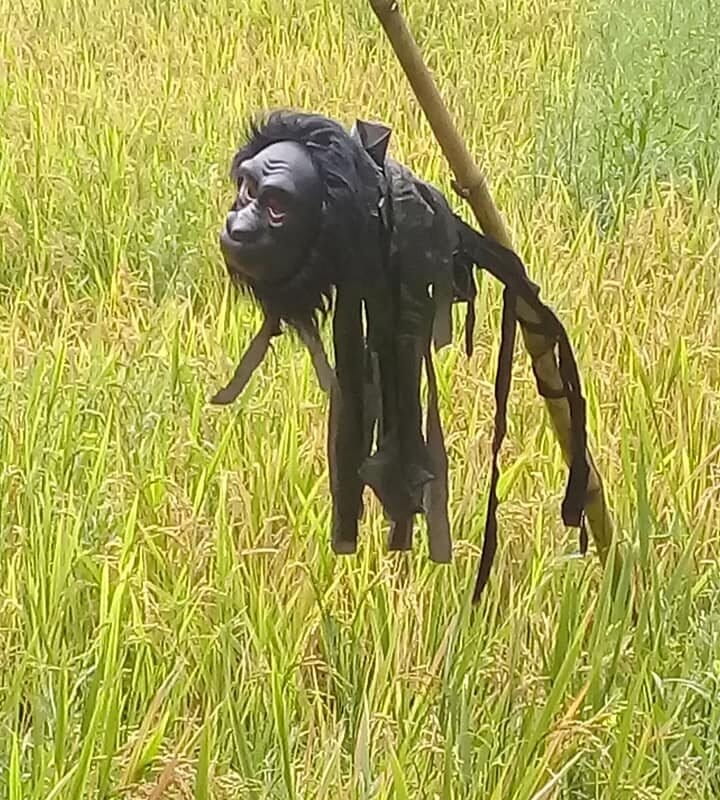
An ape-faced scarecrow stands in a paddy field, a popular method used by farmers to scare off crop-raiding animals. Image courtesy of Harsha Bandara.

Data-driven solutions

There should be a data-driven approach to understand the population dynamics of these problematic species, researchers say. In other countries, hunting licenses are issued after scientifically assessing populations. For example, if the number of females increases, then the number that needs to be controlled would be assessed and certain licenses are issued for hunting only the permitted number of females. There may be years in which no hunting licenses are issued if the population is under control, Amarasinghe tells Mongabay.

Sudden population increases can impact native biodiversity in addition to crop damage by some of these pests. The peafowl was restricted to Sri Lanka’s dry zone, but now the bird can be found in the heart of the wet zone closer to rainforests and even in the hill country near cloud forests. These are home to a lot of endemic reptiles that peafowl feed on. This could break the critical ecological balance, Amarasinghe says.

During the past few months, there have been several indications that despite the enormity of the problem with agricultural pests, the government would not consider their killing as part of the solution.

“It is dangerous even to give such signals, as the law is not amended yet. Killing of most of these animals is still illegal,” says Jagath Gunawardana, an environmental lawyer and naturalist. Gunawardane was also a member of the committee convened in December 2022 to consider solutions, but he says even the members of the expert committee were not provided with the report on crop damage by wild animals. It is important to scrutinize the report, as the level of crop damage caused by wild animals appears very high. However, the complete report still has not been shared with the expert committee, says Gunawardane.

*

Note to readers: Please click the share buttons above. Follow us on Instagram and Twitter and subscribe to our Telegram Channel. Feel free to repost and share widely Global Research articles.

Featured image: Two toque macaques (Macaca sinica) feeding on human food waste in north-central Sri Lanka. Image by Malaka Rodrigo.

Imperial Visits: US Emissaries in the Pacific

March 22nd, 2023 by Dr. Binoy Kampmark

All Global Research articles can be read in 51 languages by activating the Translate Website button below the author’s name.

To receive Global Research’s Daily Newsletter (selected articles), click here.

Follow us on Instagram and Twitter and subscribe to our Telegram Channel. Feel free to repost and share widely Global Research articles.

***

For some time, Washington has been losing its spunk in the Pacific.  When it comes to the Pacific Islands, a number have not fallen – at least entirely – for the rhetoric that Beijing is there to take, consume, and dominate all.  Nor have such countries been entirely blind to their own sharpened interests.  This largely aqueous region, which promises to submerge them in the rising waters of climate change, has become furiously busy.

A number of officials are keen to push the line that Washington’s policy towards the Pacific is clearly back where it should be.  It’s all part of the warming strategy adopted by the Biden administration, typified by the US-Pacific Island Country summit held last September.  In remarks made during the summit, President Joe Biden stated that “the security of America, quite frankly, and the world, depends on your security and the security of the Pacific Islands.  And I really mean that.”

Not once was China mentioned, but its ghostly presence stalked Biden’s words.  A new Pacific Partnership Strategy was announced, “the first national US strategy for [the] Pacific Islands”.  Then came the promised cash: some $810 million in expanded US programs including more than $130 million in new investments to support, among other things, climate resilience, buffer the states against the impact of climate change and improve food security.

The Pacific Islands have also seen a flurry of recent visits.  In January this year, US Indo-Pacific military commander Admiral John Aquilino popped into Papua New Guinea to remind the good citizens of Port Moresby that the eyes of the US were gazing benignly upon them.  It was his first to the country, and the public affairs unit of the US Indo-Pacific Command stated that it underscored “the importance of the US-Papua New Guinea relationship” and showed US resolve “toward building a more peaceful, stable, and prosperous Indo-Pacific region.”

In February, a rather obvious strategic point was made in the reopening of the US embassy in the Solomon Islands.  Little interest had been shown towards the island state for some three decades (the embassy had been closed in 1993).  But then came Beijing doing, at least from Washington’s perspective, the unpardonable thing of poking around and seeking influence.

Now, Prime Minister Manasseh Sogavare finds himself at the centre of much interest, at least till he falls out of favour in the air conditioned corridors of Washington.  His policy – “friends to all, enemy to none” – has become a mantra.  That much was clear in a May 2022 statement.  “My government welcomes all high-level visits from our key development partners.  We will always stand true to our policy of ‘Friends to All and Enemies to None’ as we look forward to continuing productive relations with all our development partners.”

For the moment, the US interim representative, Russell Corneau, was satisfied in noting that the embassy would “serve as a key platform” between Washington and the Solomon Islands.  US Secretary of State Antony Blinken, in fairly torturous language, declared that the reopening “builds on our efforts to place more diplomatic personnel throughout the region and engage further with our Pacific neighbours, connect United States programs and resources with needs on the ground, and build people-to-people ties.”  Sogavare, adopting his hard-to-get pose, absented himself from the ceremony.

This month, the Deputy Assistant to the US President and Coordinator for the Indo-Pacific National Security Council Kurt Campbell has been particularly busy doing his rounds.  The Solomon Islands has been of particular interest, given its security pact with Beijing.  No sooner had Sogavare had time to compose himself after two high profile visits from Japan and China, there was Campbell and his eight-member delegation.

“We realise that we have to overcome in certain areas some amounts of distrust and uncertainty about follow through,” Campbell explained in his usual middle-management speak to reporters in Wellington.  “We’re seeking to gain that trust and confidence as we go forward.  Much of what we are doing has been initiated by the president, but I want to underscore that it’s quite bipartisan.”

In Honiara, Campbell was forward in admitting that the US had not done “enough before” and had to be “big enough to admit that we need to do more, and we need to do better.”  Doing more and doing better clearly entailed dragging out from Sogavare a promise that his country would not create a military facility “that would support power projection capabilities” for Beijing.

Earlier in the month, Qian Bo, China’s Pacific Island envoy, was also doing his bit to win support for the cause.  His Vanuatu sojourn was a wooing effort directed at the Melanesian Spearhead Group, comprising Fiji, Papua New Guinea, the Solomon Islands, Vanuatu and the Kanak independence movement in New Caledonia.  But as with any muscle-bound hegemon seeking to impress, the crumbs left were treated with some circumspection.

A leaked letter from Micronesia’s President David Panuelo took a more dim view of China’s offerings.  In the March 9 document, the cogs and wheels of calculation were busy, taking into account the US proposal of US$50 million into Micronesia’s national trust fund and annual financial assistance of US$15 million.  “All of this assistance, of course, would be on top of the greatly added layers of security and protection that come from our country distancing itself from the PRC.”  Micronesian officials, he charged, had been the targets of bribes and offers of bribes from the Chinese embassy.

Not all his colleagues in the Pacific are in accord with Panuelo, though the view suggests that both Beijing and Washington are finding, in these small countries, political figures more than willing to exploit the rivalry.  To that end lie riches.

*

Note to readers: Please click the share buttons above. Follow us on Instagram and Twitter and subscribe to our Telegram Channel. Feel free to repost and share widely Global Research articles.

Dr. Binoy Kampmark was a Commonwealth Scholar at Selwyn College, Cambridge.  He currently lectures at RMIT University.  He is a regular contributor to Global Research and Asia-Pacific Research. Email: [email protected]

Featured image:  Admiral John C. Aquilino, Commander of U.S. Indo-Pacific Command, traveled to Papua New Guinea January 29-30 (Source: US Indo-Pacific Command)

All Global Research articles can be read in 51 languages by activating the Translate Website button below the author’s name.

To receive Global Research’s Daily Newsletter (selected articles), click here.

Follow us on Instagram and Twitter and subscribe to our Telegram Channel. Feel free to repost and share widely Global Research articles.

***

Japan’s Prime Minister Fumio Kishida on Monday announced a new plan to promote an open and free Indo-Pacific, promising billions of dollars in investment to help economies across the region in everything from industry to disaster prevention.

The plan he announced in New Delhi is seen as Tokyo’s bid to forge stronger ties with countries in South and Southeast Asia to counter China’s growing assertiveness there.

Kishida also said Japan wanted Russia’s invasion of Ukraine to end as soon as possible and called on the “Global South”, a broad term referring to countries in Africa, Asia, Oceania and Latin America, to “show solidarity” after his talks with Indian Prime Minister Narendra Modi.

Kishida said there were four “pillars” to Japan’s new Indo-Pacific plan: maintaining peace, dealing with new global issues in cooperation with Indo-Pacific countries, achieving global connectivity through various platforms, and ensuring the safety of the open seas and skies.

Click here to read the full article.

*

Note to readers: Please click the share buttons above. Follow us on Instagram and Twitter and subscribe to our Telegram Channel. Feel free to repost and share widely Global Research articles.

AUKUS a Hard Nuke Sale in Next Door Southeast Asia

March 21st, 2023 by Richard Javad Heydarian

All Global Research articles can be read in 51 languages by activating the Translate Website button below the author’s name.

To receive Global Research’s Daily Newsletter (selected articles), click here.

Follow us on Instagram and Twitter and subscribe to our Telegram Channel. Feel free to repost and share widely Global Research articles.

***

“I would say, ‘Do you need to be contained? Are you expanding? Are you an expansionist power?’ To a very great extent, the United States was the champion for China’s rise. And in no way are we seeking to contain China. But we are seeking for them to play by the rules,” said Admiral Samuel Paparo, commander of the US Indo-Pacific Fleet, in a recent interview.

Many regional states have been forced “to forge closer military ties to the US” in response to “China’s increasingly aggressive moves in the Western Pacific – encroaching on territory, illegal fishing and building bases in the middle of the South China Sea,” the four-star admiral said.

Paparo’s statement was strategically delivered to coincide with the recently-announced US$368 billion Australia-UK-US (AUKUS) submarine deal, which aims to enhance the anglophone allies’ ability to project power across the Indo-Pacific well into the 21st century. But many neighboring states, including those in the Association of Southeast Asian Nations (ASEAN), are skeptical of the deal and its implications for regional security.

For them, AUKUS is a clear reflection of an emerging US-led “containment strategy” against China, especially amid rising tensions over Taiwan and across the South and East China Seas in recent years.

Chinese Foreign Ministry spokesman Wang Wenbin predictably warned the AUKUS deal would “exacerbate” regional tensions and “totally disregarded the concerns of the international community and gone further down the wrong and dangerous path.”

But some Southeast Asian states, most notably Indonesia and Malaysia, also worry that the AUKUS deal will intensify a building regional “arms race” and, along the way, further undermine ASEAN’s centrality.

Meanwhile, the AUKUS deal has also put Australia’s Anthony Albanese administration in a political bind with stinging opposition aired by fellow Labour Party stalwarts, including not least former prime minister Paul Keating.

“Naturally, I should prefer to be singing the praises of the government in all matters, but these issues carry deadly consequences for Australia and I believe it is incumbent on any former prime minister, particularly now, a Labour one, to alert the country to the dangerous and unnecessary journey on which the government is now embarking,” he wrote in a strongly-worded public statement.

“Falling into a major mistake, Anthony Albanese…emerges as prime minister with an American sword to rattle at the neighborhood to impress upon it the United States’ esteemed view of its untrammeled destiny,” the former Australian prime minister added.

It could also complicate Australia’s strategic reboot with ASEAN following years of relatively tense relations under the former Scott Morrison administration.

Since coming to power last year, the Albanese administration has placed ASEAN at the center of its regional diplomacy. In fact, Albanese and his Foreign Minister Penny Wong visited key Southeast Asian capitals shortly after winning election.

During his maiden visit to the region last year, Australian Defense Minister Richard Marles made it clear that “ASEAN is completely central to Australia’s security interests and our economic interests, and you’ll see a focus on this region.”

From its very inception, the nuclear-powered submarine deal has been deeply controversial. Both US allies in Europe, most especially France, as well as key partners in the Indo-Pacific from Indonesia to New Zealand, expressed deep concerns when the trilateral grouping first announced its nuclear-powered submarine deal back in 2021.

Although the AUKUS deal involves nuclear-powered yet conventionally-armed submarines, rather than nuclear-weapons carrying platforms, regional states have nerveless expressed worries over threats to key ASEAN initiatives, namely the 1971 Zone of Peace, Freedom and Neutrality in Southeast Asia (ZOPFAN) as well as the 1976 Treaty of Amity and Cooperation (TAC), which broadly seek to maintain regional peace and renounce the threat or use of force.

As ASEAN’s current rotational chairman, Indonesia was among first regional states to respond to the AUKUS submarine deal last week.

“Indonesia has been closely following the security partnership of AUKUS, particularly the announcement on the pathway to achieve AUKUS critical capability,” Indonesia’s Ministry of Foreign Affairs said in a statement. “Maintaining peace and stability in the region is the responsibility of all countries. It is critical for all countries to be a part of this effort,” it added.

With ZOPFAN and Australia’s accession to the TAC in mind, Indonesia reminded its southern neighbor how it “expects Australia to remain consistent in fulfilling its obligations under the NPT [Non-Proliferation. Treaty] and IAEA [International Atomic Energy Agency] Safeguards, as well as to develop with the IAEA a verification mechanism that is effective, transparent and non–discriminatory.”

Malaysia, which has been ASEAN’s fiercest AUKUS critic, reiterated its lingering concerns, though it didn’t say it would pursue direct “consultations” with China on the matter, as it did in late-2021. In a public statement, the Malaysian foreign minister called on “all parties to fully respect and comply with its existing national regime in relation to the operation of nuclear-powered submarines in its waters.”

A linchpin of ASEAN, Malaysia warned AUKUS members against “any provocation that could potentially trigger an arms race or affect peace and security in the region.”

Leading ASEAN experts are also ringing certain alarms. Prominent Thai academic Thitinan Pongsudhirak, a professor at Thailand’s Chulalongkorn University, has questioned the necessity for the new submarine deal since “there are enough measures out there” to constrain China.

He underscored how ASEAN is “increasingly divided” amid US-China competition since “all member states need economic ties with China but rely on the US for stability and security.”

In a November 27, 2022 paper for the China International Security Review journal, published by Peking University, Mingjing Li writes, “Despite the divergence in regional states’ views, we can perhaps draw this conclusion: one year after the pronouncement of AUKUS, ASEAN as a collective entity has already cautiously accepted AUKUS as a new reality.”

Li added: “Facing ASEAN now are two highly challenging tasks: first, how to carefully address the intensifying US-China rivalry; second, how to deal with the threats to its unity and centrality posed by this new tripartite security arrangement. Also, it is quite clear from ASEAN’s grudging embrace of AUKUS that this minilateral security pact will instigate many new dynamics in Indo-Pacific regional security.”

In a diplomatic bid to win over critics, Australian Foreign Minister Wong and US Assistant Secretary of State for East Asian and Pacific Affairs Daniel J Kritenbrink reached out to ASEAN to explain “what AUKUS is and what AUKUS is not.”

“AUKUS is about promoting peace, stability, security and prosperity across the Indo-Pacific region, it’s a modernization of our existing alliances and partnerships,” the US official said during recent visits to Kuala Lumpur and Jakarta. “This is a responsible and transparent agreement that is carried out in the name of the highest standards of non-proliferation,” he added.

For her part, Wong told Singapore’s Channel News Asia that Canberra planned to “talk with the region and listen to the region about any concerns they may have.” She also reiterated that her country “will never seek to acquire nuclear weapons.”

To be sure, not all regional states are opposed to AUKUS. Although largely refraining from making any categorical statement, key ASEAN members such as Vietnam and Singapore have been broadly sympathetic to AUKUS, recognizing the need to counterbalance China’s expanding military footprint in the region.

The Philippines, which has doubled down on defense cooperation with the US, Australia and Japan under President Ferdinand Marcos Jr, has publicly backed the AUKUS deal.

“For the Philippines, it is important that partnerships or arrangements in the Indo-Pacific region, such as AUKUS, support our pursuit of deeper regional cooperation and sustained economic vitality and resilience, which are essential to our national development and to the security of the region,” the Philippine Department of Foreign Affairs said in a statement.

“We consider it important for these arrangements to uphold ASEAN’s central role in the regional security architecture, and reinforce an international rules-based order that underpins regional security and development,” the statement said.

*

Note to readers: Please click the share buttons above. Follow us on Instagram and Twitter and subscribe to our Telegram Channel. Feel free to repost and share widely Global Research articles.

Follow Richard Javad Heydarian on Twitter at @Richeydarian

Featured image: AUKUS nuclear submarine deal is already making ripples across the Indo-Pacific. Image: US Embassy in China

All Global Research articles can be read in 51 languages by activating the Translate Website button below the author’s name (desktop version)

To receive Global Research’s Daily Newsletter (selected articles), click here.

Follow us on Instagram and Twitter and subscribe to our Telegram Channel. Feel free to repost and share widely Global Research articles.

***

To understand the Silicon Valley Bank (SVB) collapse spooking markets, look no further than events in Jakarta.

The Indonesian rupiah’s 3.2% drop since February 1 demonstrates how quickly Asia has resigned itself to the fact that the US Federal Reserve isn’t done tightening. Another batch of too-strong-for-Fed-comfort US employment figures in February only increased the risk.

Episodes of extreme dollar strength tend to hit Southeast Asia particularly hard. And while Indonesia’s financial system is far healthier than it was amid the Asian financial crisis 25 years ago, vulnerabilities abound. Not surprisingly, the region’s dollar-centric economies tend to see another potential 1997-like crisis around every corner.

Case in point: the Fed’s most aggressive tightening cycle since the mid-1990s, an episode that still haunts leaders from Jakarta to Tokyo. As the Fed doubled short-term rates in just 12 months between 1994 and 1995, the collateral damage really started to rack up.

Victims included Mexico, which plunged into the peso’s “tequila crisis.” Orange County, California veered into bankruptcy. Wall Street securities giant Kidder, Peabody & Co went extinct. Then the most spectacular pileup of all: Asia.

As the dollar skyrocketed, currency pegs became impossible to defend in Bangkok, Jakarta and Seoul. Fallout from the barrage of devaluations paved the way for the late 1997 collapse of the 100-year-old Yamaichi Securities, one of Japan’s fabled big-four brokerages.

Yamaichi’s demise panicked officials in Washington. Both the US Treasury Department and the International Monetary Fund worried not that Japan was too big to fail. They worried it was too big to save.

China, too. In 1997 and 1998, US officials all but begged Beijing not to devalue the yuan. That, they feared, would spark a new wave of competitive currency devaluations and drag Malaysia and the Philippines, two nations that hadn’t devalued, into the fray.

All this explains why the SVB collapse is triggering Asia’s post-traumatic stress disorder over Fed austerity from the late 1990s. That PTSD was on display back in 2013 amid the Fed “taper tantrum.” Back then, Morgan Stanley included India and Indonesia in its “Fragile Five” list of economies on the brink along with Brazil, South Africa and Turkey.

At the time, Bank of America strategist Michael Hartnett warned of a “repeat of the 1994 moment.” Then-Goldman Sachs CEO Lloyd Blankfein admitted that “I worry now as I look out of the corner of my eye to the 1994 period.”

This is the minefield that Fed Chairman Jerome Powell is struggling to navigate.

“Hence the canary-in-the-coal-mine fear, which has caused US bank stocks to plunge more than 15% in a week and market volatility to surge,” says analyst Tan Kai Xian at Gavekal Research.

“These travails were only reinforced by Powell’s Congressional testimony last week, amounting to a ‘whatever it takes’ declaration to crush inflation, even if that means upping the pace of rate hikes and putting people out of work.”

Over the weekend, US Treasury Secretary Janet Yellen, the Powell-led Fed and the Federal Deposit Insurance Corporation unveiled steps to contain the fallout from Silicon Valley Bank’s collapse.

With all SVB depositors being paid back in full, averting a potential collapse of the US financial system, it now falls to Powell’s team to devise a way forward. And preferably one that won’t send markets from Indonesia to Japan reeling.

The “action dramatically reduces the risk of further contagion,” says analyst Thomas Simons at Jefferies. It’s heartening, too, that SVB’s mistakes in managing its balance sheet are seen as “highly idiosyncratic” to analysts at Morgan Stanley, reducing risks of broader US financial contagion.

Erik Nielsen, economic adviser at UniCredit Bank, calls SVB “a rather special case of poor balance-sheet management, holding massive amounts of long-duration bonds funded by short-term liabilities.”

Economist Paul Ashworth at Capital Economics notes that “rationally, this should be enough to stop any contagion from spreading and taking down more banks, which can happen in the blink of an eye in the digital age. But contagion has always been more about irrational fear, so we would stress that there is no guarantee this will work.”

Indeed, the underlying problem is that the Fed is trying to tame inflation with tools that won’t get the job done. Much of this inflation is better addressed with supply-side reforms that President Joe Biden and Congress have been slow to implement. Anyone who thought driving the US into a controlled recession might work just had a brutal wake-up call from California.

“While the Fed wants tighter financial conditions to restrain aggregate demand, they don’t want that to occur in a non-linear fashion that can quickly spiral out of control,” says economist Michael Feroli at JPMorgan Chase & Co. “If they indeed have used the right tool to address financial contagion risks – time will tell – then they can also use the right tool to continue to address inflation risks: higher interest rates.”

The mini-panic on global markets suggests many aren’t buying the SVB-is-an-isolated-case argument. That has economists at Barclays Plc thinking the Fed rate that had been widely expected later this month is now on hold.

“It raises risks of broader distress within the banking system that could make the FOMC (Federal Open Market Committee) reluctant to return to 50bp hikes in March,” they wrote. “Indeed, the possibility of capital losses at other institutions cannot be completely dismissed, with rising policy rates raising banks’ funding costs.”

Goldman Sachs economist Jan Hatzius agrees. “In light of the stress in the banking system, we no longer expect the FOMC to deliver a rate hike at its next meeting on March 22,” he says. More likely, the Fed will do smaller 25 basis point hikes in May, June and July, boosting rates as high as 5.5%.

Yet the fallout from SVB could further stymie America’s innovative animal spirits in ways that leave the world’s biggest economy even less productive and nimble.

“It certainly is going to have very substantial consequences for Silicon Valley — and for the economy of the whole venture sector, which has been dynamic — unless the government is able to assure that this situation is worked through,” former Treasury Secretary Lawrence Summers told Bloomberg.

It’s already having substantial consequences for Asian markets trying to read the Washington policy tea leaves. The 1990s vibe emanating from Fed headquarters in Washington is becoming harder and harder for dollar bulls to dismiss.

The more upward pressure there is on the US currency, the less capital that flows to Indonesia and other Southeast Asian economies that need investment to finance giant infrastructure projects.

Continued tight Fed policies pose their own risks to Xi Jinping’s China, just as the Communist Party leader is beginning his third term. Rising US rates put China’s vital export engine at risk and add to the strains facing highly indebted mainland property developers struggling to avoid default.

Fed overtightening is also a direct threat to the roughly $1 trillion of Chinese state wealth parked in US government debt.

The yen’s dwindling value, thanks to a strong dollar, is a crisis in slow motion for Prime Minister Fumio Kishida and outgoing Bank of Japan Governor Haruhiko Kuroda. Asia’s No 2 economy is importing increasing waves of inflation via food and energy markets.

For governments in Bangkok, Jakarta, Manila and Putrajaya, currencies under downward pressure make US debt harder to service. That also raises the costs of food and other vital items.

Recently, says economist Jonathan Fortun at the Institute of International Finance, “we see clouds forming on the horizon. A renewed hawkish Federal Reserve sentiment is spilling over into some emerging markets, causing short-dated receivers to struggle as interest-rate expectations are pushed further back in time. Monetary policy uncertainty may boost demand for dollar protection, as the relationship between EM currency and US interest-rate volatility continues to strengthen.”

For now, few think the SVB debacle will trigger a 2008-like global financial meltdown. But the speed with which Asian officials have swung from guarded optimism over the US financial system to worrying about another 1997 is its own economic indicator for the year ahead. And not a good one.

*

Note to readers: Please click the share buttons above. Follow us on Instagram and Twitter and subscribe to our Telegram Channel. Feel free to repost and share widely Global Research articles.

Featured image: Screengrab / Twitter / TechCrunch

All Global Research articles can be read in 51 languages by activating the Translate Website button below the author’s name (desktop version)

To receive Global Research’s Daily Newsletter (selected articles), click here.

Follow us on Instagram and Twitter and subscribe to our Telegram Channel. Feel free to repost and share widely Global Research articles.

***

This article was originally published in October 2022.

An Israeli media outlet, The Jerusalem Post recently published an online reportage in September 2022 insisting that a “secret delegation” from Indonesia was scheduled to depart for Israel to engage in “secret visits”. While this claim is unbelievable enough, the report further adds that relations between Israel and Indonesia have grown warmer in the last few months of 2021, notably in the realm of trade and tourism. Finally, the report mentions the possibility of normalisation of Indonesia-Israel ties, a view upheld by American officials.

This was certainly not the first time rumours pertaining to the opening of diplomatic relations between the two countries were circulated, and likely would not be the last. Such false claims have been widespread many times in the past by both Indonesian and foreign (especially Israeli) media, a move that Indonesia’s foreign ministry believes is aimed to frame the issue for Israel’s benefit. The question of whether Indonesia should or should not actually push the agenda forward has been subject to controversy.

High-level Israeli officials have kept the possibility open for decades. When Indonesia held chairmanship of the Non-Aligned Movement in 1993, Israeli Prime Minister Yitzhak Rabin visited Jakarta to meet President Soeharto in person. Reportedly, the visit was aimed to promote opportunities of cooperation with Israel and garner support in the Middle East peace process. Indonesian minister Murdiono later stated that Indonesia was not at all considering establishment of diplomatic relations, likely because the meeting itself sent mixed signals to outside observers.

Some high-ranking Indonesian officials have teased upon the idea as well. In 1999, President Abdurrahman Wahid’s government planned to open “economic and trade links” with Israel as part of its commitment to interfaith tolerance. It was also hoped to boost local economic recovery after Indonesia was hit hard by the 1997 Asian financial crisis. But as expected, this plan was met with intense domestic opposition. Protests by Muslim organisations, students, and members of parliament were widespread. His successors never publicly made such politically dangerous comments.

One argument in favour of opening diplomatic ties with Israel is Indonesia’s wish to act as a mediator in resolving the Israel-Palestine situation. Indonesia has long supported a two-state solution where ideally both Israel and Palestine coexist as independent and sovereign nations. With formal ties in place, Indonesia’s lobbying power on the international arena, especially among nations in the West, in theory should increase. However, the widespread belief that opening relations with Israel is mutually exclusive to supporting Palestinian independence undermines this otherwise rational argument.

The preamble of Indonesia’s constitution explicitly expresses the Indonesian people’s eternal support for the “independence of all nations” and the struggle against colonialism. While the face of world politics have drastically changed since the end of World War II up to the present day, the preamble remains unchanged ever since it was established in 1945. It remains a floating constant in a sea full of variables, sometimes presenting problems for Indonesian policymakers in regards to which nations can Indonesia recognise and befriend, and which it should maintain utmost caution in approaching.

It should also be noted that presently, Indonesia does not officially recognise Israel’s existence as a legitimate, sovereign state. One major issue, Israel’s ongoing oppressive occupation of Palestine, remains a crucial deciding factor whether Indonesia would push for a formal recognition and opening of diplomatic relations. The Indonesian government will measure domestic support from voters and Indonesia’s international standing, mainly within the Muslim world. Evidently, both of these factors are unsupportive of furthering any sort of official ties with Israel.

As the world’s largest Muslim-majority country, the ever-present voice of political Islam in the domestic sphere has influenced Indonesia’s foreign policy in regards to the Middle East region. Religious mass organisations with grassroots support including the Nahdlatul Ulama, Muhammadiyah, and the Indonesian Ulema Council will harshly react to any move entertaining the idea of establishing relations with or even just officially recognising Israel. These organisations form the “moderate Islam” support base for the current administration of President Joko Widodo, thus any action that may disappoint them will likely negatively impact the government’s popular support.

Of course, there’s also the potential of sparking radical Islamist sentiment within militant groups, pushing them to rise up against the government if they see its actions as undermining Islamic teachings and struggles of the global Muslim community.

Internationally, Indonesia is a well-regarded member of the Organisation of Islamic Cooperation (OIC), a grouping of over 50 states with a Muslim majority or significant minority population. In December 2017, Indonesia urged OIC members to “reconsider” their relationship with Israel to further support Palestinian independence efforts. Several OIC member-states have indeed normalised relations with Israel, a move heavily criticised as a betrayal to the creed of solidarity with Palestine. Later in May 2021, Indonesia led an OIC condemnation against Israel for its increased military attacks in the Gaza Strip that was framed by Israel as “self-defence”.

Further back in history, Indonesia has used other platforms to criticise Israel’s existence and actions. When Indonesia hosted the 1962 Asian Games, President Soekarno’s government refused to issue visas to the Israeli delegation, thus de facto preventing them from competing in the Games. This was done to accommodate the wishes of Arab states seeking to internationally isolate Israel at the time and an expression of Indonesia’s ardent anti-colonial spirit.

Thus, if Indonesia establishes ties with Israel today, it would certainly be viewed by the public as a hypocritical move and an upsetting inconsistency with its past actions and statements. Indonesia’s credibility in the eyes of other countries within the Muslim world as a defender of Palestinian struggle will also be tarnished.

Taking a look back at The Jerusalem Post’s peculiar report, if Israel’s underlying motivation of spreading such rumours is to obtain recognition from the world’s biggest Muslim-majority nation to strengthen its legitimacy, it is surely advisable that it throws away any and all expectations. The extremely high political cost imposed by domestic and international factors means that recognition and establishment of diplomatic relations is not a politically feasible option for Indonesia and thus will not even be considered at all by whichever government is in power.

*

Note to readers: Please click the share buttons above. Follow us on Instagram and Twitter and subscribe to our Telegram Channel. Feel free to repost and share widely Global Research articles.

Kenzie Ryvantya is an undergraduate Political Science student at the University of Indonesia. His interests include Indonesian foreign and security policy, Southeast Asian studies, as well as global geopolitics.

Featured image: People was raising Indonesian and Palestinian flags at a rally on safe Al-Quds at the National Monument square in Jakarta (May 2018). (Indonesia Window)

All Global Research articles can be read in 51 languages by activating the Translate Website button below the author’s name (desktop version)

To receive Global Research’s Daily Newsletter (selected articles), click here.

Follow us on Instagram and Twitter and subscribe to our Telegram Channel. Feel free to repost and share widely Global Research articles.

***

Japanese Prime Minister Fumio Kishida and South Korean President Yoon Suk Yeol are hoping to mend the fraught ties that have defined bilateral relations over the past few years when they meet on Thursday.

Yoon’s two-day visit to Japan will be the first such trip by a South Korean leader in 12 years.

“This visit … will be an important milestone in the improvement of relations between South Korea and Japan which has been promo ted by the Yoon administration since inauguration,” Yoon’s national security adviser, Kim Sung-han, told a briefing on Tuesday.

Here is what is expected to be on the agenda:

‘Shuttle diplomacy’

Japan and Korea are expected to revive regular visits between the leaders in what has been called “shuttle diplomacy”, according to a Yomiuri daily report citing Japanese government sources.

The last time the leader of either country visited the other’s country was more than a decade ago, when then-President Lee Myung Bak travelled to Japan in 2011 before heading to remote islands that both nations claim as their own.

Relations subsequently deteriorated.

Kishida is considering visiting South Korea as early as this summer, Kyodo has reported.

Defence cooperation

Yoon said that he expects to “invigorate” security cooperation, including the intelligence-sharing General Security of Military Information Agreement (GSOMIA) pact, which Seoul threatened to pull out of in 2019, in several written interviews with international media published on Tuesday.

The two countries and the United States are preparing to meet next month to discuss the possibility of setting up an information-sharing framework that would allow Japan and South Korea to share information on North Korean ballistic missile launches in real time, a Japanese defence ministry official told Reuters.

G7 invitation 

Kishida may extend an invitation to Yoon to attend the G7 summit set to take place in Hiroshima in May, several media reported.

In 2008, then-South Korean President Lee Myung-bak attended outreach events of the Group of Eight summit in Toyako, Hokkaido.

Lifting the 2019 restrictions

The two leaders could confirm their countries’ intention to resolve Japan’s high-tech material export curbs against South Korea.

South Korea’s presidential office said on Tuesday that the two countries were discussing the matter and that it expected it to be resolved “in due time”.

Seoul is preparing to normalise its involvement in GSOMIA, and will time the announcement for that of the lifting of the curbs, Jiji news agency said without clarifying its sources.

Japan tightened restrictions on the export of high-tech semiconductor materials to South Korea in 2019 as a row over how to compensate wartime labourers flared.

Last week, on the same day Seoul announced its plan to resolve the forced labour dispute, Tokyo said it would hold talks with Seoul about potentially lifting the 2019 restrictions. Tokyo has maintained that the curbs are unrelated to the labour issue.

Currency swap

The Japan-South Korea currency swap arrangement, once a symbol of bilateral financial cooperation, expired in February 2015 and Seoul has indicated its desire to restore it.

Talks to restart it became strained as relations worsened amid a row over girls and women forced to work in Japan’s wartime brothels.

*

Note to readers: Please click the share buttons above. Follow us on Instagram and Twitter and subscribe to our Telegram Channel. Feel free to repost and share widely Global Research articles.

All Global Research articles can be read in 51 languages by activating the Translate Website button below the author’s name (desktop version)

To receive Global Research’s Daily Newsletter (selected articles), click here.

Follow us on Instagram and Twitter and subscribe to our Telegram Channel. Feel free to repost and share widely Global Research articles.

***

Much has been made of Australia’s renewed engagement with Asia and the Pacific since Labor came to power.

Foreign Minister Penny Wong’s “charm offensive” in the Pacific was seen as the beginning of a new process of listening to the region, not dictating to it. Labor’s Asia-Pacific policy has also been hailed as striking a balance between the US and China.

In announcing the AUKUS submarine deal in the US this week, Prime Minister Anthony Albanese emphasised it was aimed at allowing nations in the region to “act in their sovereign interests free from coercion” and would “promote security by investing in our relationships across our region”.

The reality of the submarine deal is not, however, in that spirit. Instead, it leads Australia towards half a century of armaments build up and restricted sovereignty within a US-led alliance aimed at containing China.

Worse, it hearkens back to a colonial vision of the region as rightfully dominated by Anglophone powers who enjoy a military advantage over others that live there.

In the process, it has also deliberately endangered the spirit – if not the letter of nuclear non-proliferation agreements – and heightened what our neighbours see as a destabilising and unnecessary naval race that can only further provoke China.

Relinquishing sovereignty of foreign policy

The deal confirms two things that nations in the region have long suspected.

First, Australia is incapable of imagining an Asia-Pacific region that is not militarily dominated by the United States.

In addition, the deal suggests we are still politically attached to the United Kingdom – the post-Brexit ghost of a past British empire once again looking east of the Suez Canal towards Asia and the Pacific.

The second is that, despite the window dressing, Australia’s deafness to regional misgivings has not improved since the change to a Labor government.

AUKUS and the nuclear submarine deal are far from universally admired in Asia and the Pacific. The ASEAN bloc has repeatedly expressed its wish to avoid an arms race in the region. Regional powers such as Indonesia and Malaysia have made this clear on several occasions.

Other approaches to regional security do exist. And our neighbours have their own sense of how the Asia-Pacific can best balance the growing influence of both the US and China.

Malaysia, for example, has emphasised that so clearly identifying China as an enemy will be a self-fulfilling prophesy. The Pacific states have warned against becoming so clearly aligned with the US and sparking a renewed arms race in the Pacific. New Zealand, too, says it sees no sense in moving towards a nuclear-fuelled foreign policy.

Instead of taking these concerns seriously and engaging in deep regional diplomacy to head off future conflict, Australia seems to have has given up sovereign control of its foreign policy.

Canberra is moving towards what former Prime Ministers Malcolm Turnbull and Paul Keating have respectively called “shared sovereignty” and “outsourced” strategic sovereignty.

Contrary to the assurances of Defence Minister Richard Marles, Australia has decided to become absolutely central to the US policy of containing and encircling China. Retreating from the assumed military role that comes with this would take the kind of foreign policy courage that has not been seen for many decades.

War with China is not a certainty

Th submarine deal also comes against a backdrop of some dangerously incautious media predictions that Australia could be at war with China within three years.

Scarcely to be heard is the view that if war were to occur, it would be a war of choice, not a war to defend Australian sovereignty, even broadly defined.

Bad assumptions about the future can unfortunately drive bad policy. The assumption of a regional war is in part a consequence of viewing China through the lens of the faulty idea of an inescapable “Thucydides Trap”.

For adherents of this belief, war between the US and China is simply a natural fact dictated by history when a rising power challenges an established power, similar to what happened in the war between Athens and Sparta in ancient Greece.

Chinese brinkmanship and assertion of control over disputed territories and waters, however, is not a Greek tragedy. And Australian strategic decision-makers should not take for granted that war is coming either between China and Taiwan, or China and the United States – much less with Australia.

Herein lies the danger of handing over our sovereign foreign policy decision-making to the US and relaxing into the faux security offered by AUKUS.

We are led to the false sense there is no alternative but to be involved militarily wherever the US is in a conflict, whether that be in Iraq, Afghanistan or a future war over Taiwan.

Ceding Australia’s capacity to make serious decisions about war and peace cannot be accepted unless all pretence of Australian sovereignty is abandoned. Australia could have tried to work towards a regional approach with other Asian and Pacific countries. But this week’s agreement makes that all but impossible.

*

Note to readers: Please click the share buttons above. Follow us on Instagram and Twitter and subscribe to our Telegram Channel. Feel free to repost and share widely Global Research articles.

 is Professor in International History, Flinders University.

Featured image is from Countercurrents

All Global Research articles can be read in 51 languages by activating the Translate Website button below the author’s name (desktop version)

To receive Global Research’s Daily Newsletter (selected articles), click here.

Follow us on Instagram and Twitter and subscribe to our Telegram Channel. Feel free to repost and share widely Global Research articles.

***

Writing festivals are often tired, stilted affairs, but the 38th Adelaide Writers’ Week did not promise to be that run-of-the-mill gathering of yawn-inducing, life draining sessions.  For one thing, social media vultures and public relations experts, awaiting the next freely explosive remark or unguarded comment, were at hand to stir the pot and exhort cancel culture.

The fuss began with the festival organisers’ invitation of two Palestinian authors, Susan Abulhawa and Mohammed El-Kurd.  Abulhawa was specifically targeted for critical comments on Ukrainian President Volodymyr Zelenskyy, notably regarding NATO membership, and for being a mouthpiece of “Russian propaganda”, while El-Kurd has been singled out for social-media commentary on the Israeli state, calling it “sadistic”, “demonic” and “a death cult”.

Righteously, the South Australian Premier Peter Malinauskas showed his less than worldly view on such festivals by insisting on boycotting their talks and presentations.  Ever the vote-getting politician, there were those constituents at the Association of Ukrainians in South Australia who had been making noise, notably through their president, Frank Fursenko.  “We are very concerned that [the festival organisers] are giving a platform to people who are known apologists for the Russian invasion of Ukraine,” insisted Fursenko.

Malinauskas even contemplated pulling government funding from the event, something he declared at his address opening Writers’ Week.  (This was also the view of the South Australian opposition leader, David Speirs.)  The premier, it should be noted, is less morally troubled when it comes to funding the LIV Golf tournament, backed by the obscurantist journalist-assassinating regime of Kingdom of Saudi Arabia.

At the very least, he made some concession to maturity: refusing “to listen to someone’s viewpoint” also involved surrendering “the opportunity to challenge it, much less change their mind.”  But for all that Abulhawa’s presence at the Writers’ Week had to be “actively” questioned.

The Advertiser was less reserved, barking in childish condemnation and demanding, via a statement from editor Gemma Jones, that the Writers’ Week director Louise Adler resign.  “The views of the two writers in question are repugnant.”

Law firm MinterEllison also took up a tenancy in the land of black and white in their decision to withdraw sponsorship, citing concerns about “the potential for racist or antisemitic commentary.”  The company had decided “to remove our presence and involvement with this year’s Writers’ Festival program”.  That’s branding for you.

Consultancies hardly known for their principled stances on intellectual debate let alone the public good took to the podium of virtue even as they withdrew their support.  PwC, which provides pro bono auditing for the Adelaide Festival Foundation, openly disassociated itself from the event by requesting that its logo be removed from the festival website.  “We condemn in the strongest terms any antisemitic comments and any suggestion of support for Russia’s war against Ukraine,” the company stated in a memorandum.  “We stand with the Jewish and Ukrainian communities who have been understandably hurt by this issue.  In this respect, we have asked the chair of the Adelaide Foundation that any association with PwC with this aspect of the festival be removed.”

In all these shallow, stubbornly ahistorical assessments, context is missing.  The background, and sense of where such supposedly horrendous opinions sprung from, are dismissed.  The culture of cancellation and erasure, as it has been previously, is the prerogative of the powerful and their PR offices.  It is also insidious, stressing the trendy, appealing brand of the moment, the acceptable opinion which makes the acceptable person.

El-Kurd, Palestinian poet and correspondent for The Nation, enraged since the day Jewish settlers made their way into his East Jerusalem home, has made no secret in adopting a more militant stance for Palestinians.  It was, he stated, “not enough that I have lost my  home to Israeli settlers, it’s not enough that I grew up and lived as a refugee under military occupation.”  In his protest and suffering, he had been constantly told to be “polite” and “respectable”.

Those years were behind him, times which featured a “failed strategy” that placed a heavy emphasis on humanising unacceptable tragedy: the focus on women and children (again, the branding that matters); the focus on “our inability to commit violence, our inability to feel rage”.  “And we over-emphasise the victims whose qualifiers make them human.”

In her response to the storm, Abulhawa expressed gratitude to Adler and the Board of the  Adelaide Festival “for bravely ensuring that we do and will have space to speak and interact with readers on a cultural landscape.”  She then moved to chart the fault lines that have made contrarian views – or at least views deemed undesirable by the anointed policing agents on the Ukrainian War – a matter of vengeful reaction.  To be critical of the Ukrainian Saint was to somehow be a shill for Russia’s Vladimir Putin; to be a proponent for peace was somehow akin to encouraging genocide.  “These assertions are false, absurd and libellous.”

Specifically regarding Zelenskyy, his sins lay in “taking actions and provocations that would lead to foreseeable, even predictable, war, which has not only wrecked Ukraine and her people, but led to global insecurity and fuel shortages, affecting the most vulnerable among us.”

Her views are not unusual, or astonishing.  They are also echoed through the Global South, where the brands of the noble Ukrainian victim and the remorseless Russian monster have lesser currency.  One can understand the dynamics, and sad perversions of power, without justifying their brutal manifestations.  Abulhawa references John Mearsheimer’s warnings about US provocations against Russia, using Ukraine as a base and pretext.  The Ukraine conflict, to that end, is not isolated or regional.  It is a “global proxy war, the outcome of which may well determine the world order for generations to come.”

Abulhawa would have also been well within her rights to cite the very figure who gave birth to the doctrine of Soviet containment at the start of the Cold War.  The late diplomat and historian George Frost Kennan, eyeing the expansionist drive of NATO and US power eastwards towards the Russian border, could only issue this warning in 1997: “Such a decision may be expected to inflame nationalistic, anti-Western and militaristic tendencies in Russian opinion; to have an adverse effect on the development of Russian democracy; to restore the atmosphere of the cold war to East-West relations, and to impel Russian foreign policy in directions decidedly not to our liking.”

To her estimable credit, Adler remained adamant and defiant in permitting the writers to attend their events.  “Our business,” she told the ABC, “is to operate an open space, not a safe space, in which ideas that may be confronting, disturbing, provocative, are debated with civility, that’s the agenda.”  Writers, she also explained to The Age, were not sought out “via their Twitter feeds. I do not think the social media space for a nuanced or reasoned analysis and discussion.”  It never was such a place, but to the cancel culture footsoldiers, that is exactly where they feel most comfortable.

*

Note to readers: Please click the share buttons above. Follow us on Instagram and Twitter and subscribe to our Telegram Channel. Feel free to repost and share widely Global Research articles.

Dr. Binoy Kampmark was a Commonwealth Scholar at Selwyn College, Cambridge.  He currently lectures at RMIT University.  He is a regular contributor to Global Research and Asia-Pacific Research. Email: [email protected]

Featured image is from Monash University

  • Posted in Mobile
  • Comments Off on Branding the Acceptable: Battling Cancel Culture at Adelaide Writers’ Week
  • Tags:

Fiji’s Pacific Ways: Troubles in Paradise

March 9th, 2023 by Greg Guma

All Global Research articles can be read in 51 languages by activating the Translate Website button below the author’s name (desktop version)

To receive Global Research’s Daily Newsletter (selected articles), click here.

Follow us on Instagram and Twitter and subscribe to our Telegram Channel. Feel free to repost and share widely Global Research articles.

***

Two coups had overturned a left-leaning government in Fiji. Only a month after nationwide elections, a fundamentalist general had taken charge. A year later I wanted to talk with the Christian Socialist doctor and labor leader who was Prime Minister so briefly in the spring of 1987. 

I also wanted to relax, to find out what paradise was like, to shed my shoes and sit at the ocean’s edge just watching the tide roll in.

We were just a few miles south of Bligh Water, riding the whitecaps toward a South Pacific island. More than two hundred years ago Captain William Bligh and 18 of his men, cast adrift by the mutineers of the HMS Bounty, covered the same waters. But in 1789 the men on the longboat pulled oars, and the Fijians pursuing them were angry cannibals In 1988 cruise ships and market boats brought most people to the islands, and the welcome was far more encouraging.

Bligh’s group escaped to Timor, an island near Indonesia, and never had the luxury to spend a few weeks on the lush islands that many people often imagine as paradise. Fiji’s native Melanesians haven’t eaten any visitors for more than a century. On the contrary, they’ve become so “pacific” in their approach to life that even two military coups hadn’t led to bloodshed.

Even before that, Fiji wasn’t the most popular or accessible vacation spot on the globe. From New England it took 18 hours by plane, not counting airport madness. And when you landed at the tiny international airport in Nadi (pronounced Nandi), you had really just begun your trip. But that was part of the charm of going to the other end of the earth. Everything broke ingrained patterns and reopened jaded eyes.

I’d made the journey for both pleasure and politics. In 1987, I left the US on a one-way ticket and became a West German resident. Looking back, I view it as an expatriate aspiration, harbored for years, and then sparked by the second election of Ronald Reagan. Jutta, my flat mate and lover in Munich, was well-traveled, had visited Fiji several times, and understood the culture.

Politically, I was curious about the roots of the two coups that had overturned a left-leaning government. Just a month after nationwide elections, Sitiveni Rabuka, a fundamentalist general, had taken charge. “I was chosen by the Almighty,” he claimed. A year later I wanted to talk with Timoci Bavadra, the Christian Socialist doctor and labor leader who was Prime Minister briefly in the spring of 1987. I also wanted to relax, to find out what paradise was like, to shed my shoes and sit at the ocean’s edge just watching the tide roll in.

Fiji is a sprawling collection of 322 islands about 1,400 miles east of Australia, perched at the edge of the Indo-Australian plate. Many are sunken volcanic remnants of a long lost continent. Over 100 are inhabited by a mixture of Melanesians, Polynesians and East Indians, plus a smattering of Chinese, Micronesian and European expatriates.

Because the country spent 100 years as a British colony, most people spoke English fluently, though with a distinct accent. Their mother tongues, however, were liable to be Fijian, Hindi, or one of several Pacific variations. Walking through the huge open air market in Suva, the national capital on Viti Levu, I heard a rich linguistic blend as people hawked produce grown in the village garden plots.

Most Fijian natives had their own small piece of paradise — land. They could grow enough food to be almost self-sufficient. Only a few staples like sugar, tea, and flour, along with some canned and junk food, were imported from the capital. But Indians, who outnumbered Fijians on the two biggest islands, weren’t permitted to buy native-owned land. Over the years since immigrating, however, they had come to virtually monopolize the middle levels of business.

When you wanted to take a taxi or go browsing in a city shop, you’d almost always deal with an Indian. But if you wanted some papaya or an island adventure, you started by meeting one of the dark-skinned, curly-headed native Fijians.

Getting into the country, it turned out, was the simple part. Finding the “real” Fiji, away from its Europeanized cities, required an invitation.

Adi Sayaba, our ticket to ride, was an island rarity, a clever business woman who had turned her clan’s compound on Waya island into a miniature resort. One of her bures (houses) was equipped with a gas-powered stove, refrigerator and bed space for up to six people. Her outhouse sported the only flush toilet on the island. There was no electricity, however, and the strictly rationed village water ran for only an hour or two each day.

We rendezvoused with Adi in Lautoka, a port city on the dry western coast of Viti Levu. At the wharf we waited for hours as she tried to arrange our voyage, haggling with captains for seats on a motor-powered boat. The winds were too stiff that day, so our ship never sailed.

But Adi (the name is actually a title for female chiefs) had an uncle, she explained, who captained a modern launch used by divers. We spent the night at his house, watching videos with the extended family. Early the next morning we made it, finally, onto the water.

As the sea splashed over the deck, captain Elisa headed for the Yasawas, a chain of 16 islands that begins about two hours from Lautoka. Soon we could see Waya, its mass of rock jutting into the clear blue sky, its deep, clear water and white beaches beckoning. When we were in sight of Yalobi, Adi’s village, a corrugated tin boat sped out to ferry us ashore.

“You’ll have to visit the chief,” Adi reminded us. “Do you have the kava?”

We did. Jutta was well acquainted with the protocols of island life. In the Suva market, we purchased a batch of the pepper plant root that, when pounded into dust and mixed with water, becomes Fiji’s national drink.

The chief wasn’t at home on the day we arrived. When he was ready to receive us, Adi advised, he’d let us know.

Each island and village in Fiji had a chief, a hereditary leader who exerted a strong traditional influence. Although the country had a constitutional government the great Council of Chiefs also played a prominent and powerful watchdog role.

We met Waya’s chief in his ornate thatched bure near Yalobi’s white sand beach. Palm trees lined the path to his door. Inside the walls and floors were covered with woven mats. Round wooden beams stretched the length of the building under a high peaked roof.

“This house is hurricane proof,” the chief announced proudly after we removed our sandals and took our places on the floor.

Expressing our admiration, we pushed our sevusevu (offering) forward and waited for the kava drinking to begin. At the head of the circle, lit by Coleman lanterns, the official mixer prepared the ceremonial drink in a hand-carved wooden bowl.

Known as yagona or grog, this traditional non-alcoholic beverage is actually a tranquilizing drug that numbs the tongue, and unless abused, helps to focus the attention. Sharing the drug is the most honored feature of Fiji’s formal life, a ceremony and social event that sometimes goes on well into the night.

First, the mixer offered a prayer of thanks and welcome. Then the kava was served in polished coconut shells. Tradition determined the order of service and participatory ritual. As I accepted my bowl, I clapped my hands once; everyone else clapped three times in response. I downed the slightly muddy-tasting liquid in one gulp. Afterward, everyone gave another three claps.

With each round and each drink, we repeated the ritual. In between, we talked about our trip, the old days on the island, and Adi’s father, Timoci. “The old man with the young spirit” had died a year before. He had been a warm and inspiring presence on Waya, a wise man, a teacher and a World War II hero of the Solomon Islands.

Even the chief, who was only “top man” because Timoci hadn’t wanted the job, missed the village leader.

The days melted past, the hot sun making me lazy and relaxed. There was nothing to do, really, except just be — or meet people, watch children play or watch women make mats and crafts for visiting tourists.

The only downside was this also opened much too much time to think about the end of my relationship with Jutta. The night before boarding our flight she had dropped the news: She wanted to break up. But she also wanted me to make the trip anyway. Once we arrived in Fiji she was a fine companion, but not much interested in discussing the last year. In the end, I came to think it may have been the right move. Just being there helped me to reflect and process what was happening between us.

On most weekdays, a huge Blue Lagoon cruise ship pulled into the bay at midday, disgorging passengers onto the beach. Villagers lined up their displays on the sand — shell and black coral jewelry, woven bags and gorgeous shells found along the coral reefs. Tourists browsed, spent some money and sampled the warm water.

Later the men came down from their hillside tetes (gardens) and families ate, stretching out afterward for post-dinner naps.

For foreigners, getting to know people could be difficult. Most islanders had little interest in the outside world. There were no shops or cafés, no nightlife except at the divers’ compound down the beach. But with a story or game I could break the ice and get a glimpse of daily life.

By accident, I also stumbled onto a way to start a real dialogue. My deck of Rider-Waite Tarot cards and dog-eared divination book created a doorway to intimacy. Laying out the cards, sometimes during kava ceremonies, I would merely describe what the pictures told me. Then I’d ask what the person who had shuffled was thinking about.

Without the slightest hesitation, people would open up about their marriage plans, worries about the future, struggles with a village “black magician,” or hopes for a good fishing catch. Thinking visually and dropping inhibitions, they would react viscerally to the imagery of the cards.

During tarot evenings, I learned about the foreign developers wrangling to establish a resort on a small nearby island owned by some Waya villagers. People told me their fears — of punishment for breaking a teenage beer-drinking taboo, or rivalries for a good building plot — and hopes for a resort job or a good crop.

Before I realized it, two weeks had passed. It was time to return to the mainland.

*

Reaching Dr. Bavadra proved complicated. Even with Adi’s contacts and an introduction from Captain Elisa, a relative, it took weeks to make the connection. Even out of power, the head of the Labor-Indian Coalition Party was busy man.

Meanwhile, we had a friend in Suva, Larry, who was more than willing to be our host. A part-European playwright, he worked at the University of the South Pacific and had a comfortable house near the sea.

Traveling without contacts can be trying, even in the best of circumstances. It’s not just the cost; in Fiji, hotel prices ranged then from $10 to $150, food was cheap and abundant. But without friends it could be hard to get off the well-trodden tourist path. Usually, I made travel contacts in advance through Servas, an international network of hosts and travelers. In this case, Larry invited us, eager to share thoughts and show us his new play.

The Fiji Arts Club was one of the few creative outlets for Suva’s intelligentsia. Since turning 19, Larry had been a central force, directing both foreign and native-written productions. This season’s play, Just another Day, was his first stab at directing his own work.

The play was a slice of local life. It was set in an average urban living room where a Fijian extended family shared tea, wisecracks and gossip. The mother, Margaret, smoked incessantly as she scolded the lazy boys and girls, gabbed with pregnant friends or argued with her husband.

A portrait of good-natured resignation and passivity, it should have been sad, but the ironic humor managed to keep it light. And the native cast played it with rough-edged verve and authenticity. Like Larry, some of them came from families much the same.

Larry and his educated friends were more aware of the country’s political turmoil than the Waya islanders. We spent many evenings speculating about Rabuka’s next moves. The most obvious effects of the coups were higher prices and unemployment.

The atmosphere was damaging to relations between ethnic Fijians and Indians. Relegated to second class status by the traditional Chiefs and the military, non-Fijians were losing faith in the future. Fijians were divided between defenders of native power and advocates of some kind of reform.

After 17 years of rule by the Alliance, a conservative party controlled by the chiefs, a new coalition had won a fair election. Indians joined forces with labor unions and urban intellectuals, won a parliamentary majority, and put Timoci Bavadra in charge. He was Fijian, but most of his support was Indian. Fear of their future dominance was a handy excuse to overreact.

One month later, Rabuka closed parliament at gunpoint and brought the old administration back. Newspapers were closed for several days, and troops kept the lid on demonstrators while Rabuka worked out a game plan with the chiefs. Negotiations between the Alliance and the Coalition eventually produced an apparent compromise. But Mara really wanted to rewrite the constitution to ensure a perpetual Fijian majority. On Sept. 25, about a month before I arrived, Rabuka led his second coup.

Australians and New Zealanders were incensed at the military takeover, as well as Rabuka’s manipulation of racial tensions and religious beliefs. He had weakened the press and expanded the military, and was trying to revamp the constitution. “The real intent,” charged Bavadra, “is to sanction the military dictatorship we now have.” He called the proposed constitutional overhaul “feudalistic, authoritarian and racist.”

By 1988, the number one song in Australia was a send-up of Susanne Vega’s hit about domestic abuse, “Luca,” called “My Name is Rabuka.” With gunfire in the background the dictator sang about his coups and warned, “You just don’t argue anymore.”

*

In Suva, I spoke with V. J. Naidu, a university professor who was active in the nuclear-free zone movement. Hopes for an anti-nuclear shift in Fiji’s foreign policy — under consideration by Bavadra’s government — had evaporated. “Parliament is ineffective, and there is no separation of powers,” he added. Yet Naidu could see a silver lining.

Despite the manipulation of race, there was actually little hatred between ethnic groups, he claimed. A new consciousness was emerging, and the economic problems intensified by the coups had spurred more skepticism.

Most of the Indian citizens I met were not so optimistic. They often talked about emigrating to Australia, and about their second class citizenship in an inflationary economy. More than 5,000 Indians initially left the country after Rabuka seized power, many of them skilled professionals.

Unemployment was over 10 percent. The tourist sector was the hardest hit. Only a dramatic increase in military recruitment was keeping the situation from becoming a full-blown crisis. Criticism was permitted — up to a point. But public discourse was muted by a cowed media and a generalized fear that tolerance had its limits.

In a review of Rabuka’s official biography, pointedly titled No Other Way, Professor Som Prakash noted that the coups ultimately produced the results they were designed to prevent: breaking the Commonwealth tie with Britain and opening the country to foreign infiltration.

“It is the Rabuka-backed government,” Prakash wrote, “which brought about the establishment of the Israeli embassy in Fiji and the strengthening of French connections. And this was an invitation to the Libyans, Palestinians and others to destabilize Fiji further. All but the most gullible reader will see that the bulk of Rabuka’s actions were based on some farfetched, often self-fulfilling prophecies with an ironic twist: what Rabuka claims he fears others might do, he ends up doing himself.” In many ways, he was following the dictator’s playbook, exploiting divisions and using classic Fascist techniques.

In Fiji, irony wasn’t hard to find. By breaking relations with Britain and souring ties with Australia and New Zealand, for instance, the coup-makers had created an opening for the Japanese and later others. One of the first Japanese acquisitions was the Pacific Harbor resort, one of the country’s most exclusive. By the early 21st century, India turned out to be a more acquisitive foreign investor, with China not far behind.

In the long run, preserving the exclusive land rights of Fijians, along with a Fijian lock of state power, turned out to be a very limited victory.

*

Back in Lautoka, just a day before leaving, I reached Bavadra’s wife Kuini (pronounced Queenie) on the phone. They might have time to see us that night if we wanted to take a taxi to Viseisei village. Luckily, it wasn’t Sunday, so Rabuka’s Sabbath ban on transportation couldn’t prevent the meeting.

Since Bavadra was also a chief, we brought an offering, some German tea. Doc Bavadra wasn’t home when we first arrived, but Kuini was friendly, articulate, and ready to begin. The house decor mixed European and Fijian influences; there were easy chairs and modern coffee tables, piled high with international magazines and newspapers, as well as traditional mats and an open space for kava ceremonies.  The young men of the household, Bavadra’s disciples and bodyguards, watched us quietly as I asked my questions.

The two coups, Kuini explained, had actually been planned by former Prime Minister Ratu Mara in order to cover up years of graft. Rabuka was a front man; the real power had not changed hands.

Doc Bavadra joined us and agreed. Ratu Mara — full name Ratu Sir Kamisese Mara, Prime Minister since Independence in 1970 — had orchestrated racial tensions, approved plans for the takeover in advance, and provided help in the subsequent “neutralization” operation, he said. Like other autocrats, he didn’t want to surrender power.

Some charges couldn’t be verified, like rumors that US diplomats, worried about the independent drift in Fiji’s foreign policy, had given a silent nod. Or that American forces may have participated. But interviews with Fijians and others close to the previous and current regimes did verify that Mara’s Alliance Party was integral to the May 1987 overthrow. At least one member of Mara’s immediate family was directly involved. Yet Mara insisted publicly that he was surprised and dismayed, and only “reluctantly” returned to his old post at Rabuka’s request.

In reality, divisions had been stirred up between the Taukei (ethnic Fijian landowners and members of chiefly clans) and the Indian community. Firebombings of Indian businesses by Alliance Party supporters were claimed to be Taukei attacks. Meanwhile, the new government’s appointment of Indians to some key positions was vilified as the first stage of an Indian takeover, supposedly leading to the loss of exclusive Fijian land rights and eventual Soviet infiltration. Until the Coalition won, the major races had co-existed better than might have been expected.

“Traditional customs and democracy should be kept separate,” said Bavadra, “but the chiefs say people should follow their lead. Chiefs have to make a choice — stay in the villages or get into elections and play the game there under the rules that apply to everybody. Right now they expect to be treated differently than the rest.”

The talk eventually turned to hopes for the future. Both Doc and Kuini were confident that a majority of people would ultimately reject what they viewed as a “form of apartheid.” Kuini, herself a Fijian member of a chiefly family, rejected the notion of “special status” for Fijians as “an insult, which assumes that we are inferior and need a special status to compete.”

People were learning the truth, they believed. Traditional Taukei leaders and Methodists, once behind the coup-makers, were beginning to reconsider. If a referendum or new elections were permitted, the Coalition might gain a foothold in the government.

When we met, one reason for their optimism was the recent conversion of an old enemy, Ratu Meli, an ardent Taukei who was “converted through prayer meetings and confessed that he made a big mistake,” according to Kuini. “He sees that calling for Fijian supremacy was wrong, and knows he was used.” As a result, he signed a statement that revealed the true story of the coup, an action that angered other Taukei leaders.

Fijians believe in the power of such conversions. It was conversion to Christianity that led Fijians to give up cannibalism. Abandoning that grisly tradition saved the country from invasion and set the stage for Fiji’s cession to Britain. The worst impacts of being a Crown colony were also avoided, and in 1970 the country, still culturally intact, regained its independence. But that led to another, perhaps even deeper transition. Democracy was in its infancy, and the forces of tradition remained powerful.

“If you study the Fijian way of life,” said Doc Bavadra, “you see it is very democratic, based on reciprocity and consensus.” He believed in the possibility of a return to full democracy, a reduction of chiefly influence and improved relations between the races, without a loss of traditional Fijian land rights.

He was mostly correct. At least 90 percent of all land is still owned and controlled by native Fijians. Indians can lease plots for up to 30 years. But they still can’t own the land on which they farm or build their homes. It’s no surprise that many of them continue to feel insecure or ultimately decide to leave.

“I look at the people as one,” Bavadra nevertheless said when we met in 1988. “I don’t see them in terms of race. But the ones who need the most service are the underprivileged across race. There are classes here.”

Bavadra died in November 1989, only a year after we met. By 1992 the country had returned to democratic elections and a constitution-based government. Rabuka remained a powerful political force, in and out of legal office, for the next 30 years. At 74, he was just re-elected Prime Minister in 2022.

*

Fiji was an easy place to fall in love with. Despite the political turmoil and my relationship problems, I rarely felt as comfortable away from Vermont. Fiji has almost the same land area and only 300,000 more inhabitants than the Green Mountain State. It was intimate, open, polite and not overdeveloped. Aside from the mosquitoes, it was almost idyllic.

That can change, of course, but when I was there no one put Fiji at the top of their “to do” list for rapid exploitation, not even the Japanese. And Fijians didn’t seem eager to be modern anyway. On Waya island I sometimes heard gossip about gold. But no one seemed to care much if it was extracted. They mainly just liked the idea that it might be there. Today, by the way, Waya hosts at least four full-service resorts.

And when I worried about being detained at the airport as a result of meeting with Bavadra, a New Zealand expatriate told me not to worry. They had no computers then to put my name in, and were too pacific to be first-rate oppressors. That may be as close to a modern definition of paradise as you can get.

*

Note to readers: Please click the share buttons above. Follow us on Instagram and Twitter and subscribe to our Telegram Channel. Feel free to repost and share widely Global Research articles.

This article was originally published on the author’s blog site, Greg Guma / For Preservation & Change.

All images in this article are from the author

  • Posted in Mobile
  • Comments Off on Fiji’s Pacific Ways: Troubles in Paradise
  • Tags:

All Global Research articles can be read in 51 languages by activating the Translate Website button below the author’s name.

To receive Global Research’s Daily Newsletter (selected articles), click here.

Follow us on Instagram and Twitter and subscribe to our Telegram Channel. Feel free to repost and share widely Global Research articles.

***

India’s presidency of the Group of Twenty (G20) comes at a critical juncture; even as the  pandemic wanes, geopolitical tensions between the US and China could spiral into a possible military confrontation. The Russian invasion of Ukraine is now entering into its second year with little signs of resolution. Economists have been warning of an imminent recession in 2023 as also a deepening of the food crisis. With the global climate talks continuing to flounder the climate and biodiversity crisis will soon cross the tipping point. Earlier trends of authoritarianism and shrinking democratic spaces continue to spread across various regions of the world.  As India assumed G20 Presidency in November 2022, as a representative of the countries of the Global South, it can play a vital role in the face of extreme wealth inequality, increasing ecological devastation, pro-corporate regulatory regimes and criminalisation of dissent.

The G20 was constituted by the finance ministers of the G7 group of countries in 1999 in the wake of the Asian Financial Crisis to unite finance ministers and central bankers from twenty of the world’s largest economies. At a primary level, its mandate was to discuss monetary, fiscal and exchange rate policies, infrastructure investment, financial regulation, financial inclusion, international taxation etc. With time, G20’s appetite to discuss more issues (beyond finance and economic policy) increased with the Sherpa track (such as issues like health, education etc.) and various engagement groups. With the Sherpa track the ensuing presidency keeps forth its priorities, while the engagement groups and the processes associated with them are supposed to be independent of the government. However, several of these engagement groups often turn into a platform for corporations (for example, kicking the can down the road with more loans and debt suspension instead of looking at debt cancellation) and their allied interest groups. Over the years, the year-long presidency becomes a popular networking event for the rich and the powerful under the pretence of saving the world, leaving very little space for groups that are critical of neoliberalism to put forth any alternative paradigms. Over the years, the Sherpa track, Finance track, and the engagement groups have stayed in the realm of being high-end talk-shops with no representation of people’s agenda.

G20 has remained as an exclusive club, a forum to save capitalism at the highest political level through the promotion of neoliberal policies. This provides an important imperative for the progressive civil society groups to raise questions around G20’s accountability and more importantly its legitimacy as a forum of global economic governance.

The threat of recession is looming all over the world; climate crisis is manifesting into extreme weather calamities and along with biodiversity loss and pollution, worsening its impact on the most vulnerable communities and making it difficult for several vulnerable nations to embark on a sustainable future; poverty, hunger, malnutrition and socio-economic inequalities have risen to an alarming level; and a serious debt crisis is threatening economic sovereignty of many countries. All of these calls for an immediate intervention and restructuring of the global economic order that is democratic, just and truly sustainable. Despite this, the G20 as an economic and political forum continues to prescribe the  business as usual approach and policies that advance capitalism, the root of the polycrisis in the first place. More often than not, such policy prescriptions push lower and middle income countries and peoples to the verge of collapse.

At a time when the world is facing such multifaceted problems, instead of raising important issues of the global south and vulnerable communities of the world, the government of India is using the G20 presidency as an opportunity to seek political and electoral gains before the upcoming national elections. The scale at which the G20 meetings are being organised to portray a picture perfect narrative of shining India, reeks of a vulgar display of wealth at a time when India’s performance on every social barometer is abysmal; not to forget, all on tax payers’ money. In the run-up to scheduled G20 meetings in different cities of India, government authorities are displacing the homeless people to far-flung areas, removing street vendors, and small shops from the roadsides to ‘beautify’ the cities. The party in power is forwarding India as the “centre of diversity” and “mother of democracy” while also consistently using all national institutions at its disposal to silence the dissenting voices of human rights defenders, repeatedly attacking minority communities with impunity and systematically destroying institutions and progressive civil society spaces. Economist Intelligence Unit (EIU) ranks India at number 46 with “flawed democracy” label and Varieties of Democracy Institute (V-DEM) ranks India at 101 in the world with its classification as an “electoral autocracy” on par with Russia. On freedom of press, India is 11th in the “global impunity index” of Committee to Protect Journalists and in Reporters Without Borders ranks India at 150 in 2022.

Members of adivasi as also dalit-bahujan farming, fishing, livestock rearing and other forest dwelling communities, in other fragile ecosystems, are losing their lives or their freedoms in the struggle to safeguard their rights over natural resources while constantly facing threats from governments and profit-hungry private corporations. Publicly owned enterprises – importance of which was evident during the pandemic – are being handed over to few privately owned business houses through a massive push for privatisation. Policies are being changed to push the informal sector including small and micro businesses to the edge and to make space for medium and big players. Mega infrastructure projects are being implemented without any heed to their socio-economic impact on communities and environmental damage. And, a complete negligence of the working class and labour rights through withdrawal of welfare policies has resulted in high levels of inequality and social progress indicators touching an abysmal low. The richest 98 billionaires of India own the same wealth as the bottom 40% of Indian society and top 1% percent own more than 40.5% of total wealth in India. In the face of such striking ground realities, the Indian Prime Minister’s messages such as “India’s national consensus is forged not by diktat, but by blending millions of free voices into one harmonious melody” and “our citizen-centric governance model takes care of even our most marginalised citizens” do not hold much ground.

Against this background, the forum of G20 needs to be questioned for its absolute silence on declining spaces of dissent, human rights abuses, shrinking space of democracies and rising fascism and authoritarianism in countries including in the G20 nations themselves; as well as for undermining the democratic multilateralism; for its inactions resulting in a global policy paralysis; for being an obstacle in democratisation of global economic governance and for its own illegitimate nature.

G7 countries are still controlling the sovereign financial policies and related regulatory mechanisms through dictats of Financial Stability Board (FSB). With no regards to concerns of countries from the global south, expansion and consolidation of global food supply chains is being promoted as the only way to meet global food security. The Debt Service Suspension Initiative (DSSI) and Common Framework for Debt Treatment (CF) have fallen short in tackling the debt crises due to lack of transparency and exclusion of loans from private sector creditors. G20’s policy recommendations through its various tracks and engagement groups are not only attempting to impose the reforms in sovereign finance related policies, but also pushing the capital-driven and pro-market policies in many critical sectors. These changes and imposed reforms have taken countries away from welfare centred approach, created problems for the masses on every front along the way, and have left them struggling for basic essentials like decent healthcare, affordable housing, quality education, employment, food security, and a healthy environment to live in. One example of this influence is the extent to which the Financial Stability Board’s recommendations featured in the Financial Resolution and Deposit Insurance (FRDI) Bill, which was introduced in 2017, later withdrawn in 2018, after ample scrutiny.

The mere inclusion of few developing countries from the southern hemisphere and the G20 troika being composed of the countries of the south – Indonesia, India and Brazil, does not grant it a legitimate status and makes it a representative body of the global population. In fact, it means very little, for the Global South (i.e. the most vulnerable, poor people across the world) remains excluded from the G20 decision-making process and from its priorities. The G20 forum is still being used to safeguard international monetary systems and global economic governance framework in line with the demands of global capital and to serve the interests of corporations and the political and economic elite in both industrial and industrialising nations. The continuous failure of the G20 forum in tackling multiple recurring crises, its top-down approach through token representation and absence of the voices representing concerns of the Global South must be exposed by all means. The role of the Indian government in projecting a false rosy image of India and the silence of G20 countries on rising authoritarianism at the global level should also be challenged and an alternative agenda for the working classes across the G20 nations needs to be asserted. Across the G20 countries, thousands of people’s initiatives are showing what a sustainable, equitable present and future could look like, and how this would be possible to achieve with appropriate policy support.  We, the undersigned, affirm our resolution to strengthen our struggles against the neoliberal policies and authoritarian governance pushed ahead by forums such as G20, and our attempts at forging truly sustainable, democratic, equitable and just economies and societies. We appeal to all citizens, global people’s movements, national and international trade unions, students and academia to not be deceived by the gimmicks of the Indian government and its false propaganda, but to work for these struggles and initiatives.

Endorsed by:

  1. Jawhar Sircar, Member of Parliament, Rajya Sabha
  2. Medha Patkar, Narmada Bachao Andolan / National Alliance of People’s Movements
  3. Teesta Setalvad, Sabrang India
  4. Devasahayam MG, People First
  5. E A S Sarma, Forum for Better Visakha
  6. Anil Sadgopal, All India Forum for Right to Education
  7. Shaktiman Ghosh, National Hawker Federation
  8. Sagari Ramdas, Food Sovereignty Alliance, India
  9. Meera Sanghamitra, National Alliance of People’s Movements (NAPM)
  10. S Janakarajan, Forum for Policy Dialogue on Water Conflicts
  11. John Dayal, All India Catholic Union
  12. Ulka Mahajan, Sarvahara Jan Andolan
  13. Himanshu Thakkar, Bengaluru
  14. Ashish Kothari, Pune
  15. Achin Vanaik, Retired Professor, Delhi University
  16. Prasad Chacko, Ahmedabad
  17. Ashok Shrimali, mines, mineral & People
  18. Edwin, OpenSpace
  19. Leo Saldanha, Environment Support Group
  20. Soumya Dutta, South Asian People’s Action on Climate Crisis
  21. Mujahid Nafees, Minority Coordination Committee
  22. K Ashok Rao, Power Engineer and Public Sector Officers Federations
  23. Ravi Nair, Journalist, New Delhi
  24. Anil Bakshi, Hawker Majdoor Mahasangh
  25. Devidas Tuljapurkar, Maharashtra State Bank Employees Federation
  26. Raj Kumar Sinha, National Alliance of People’s Movements, Madhya Pradesh
  27. Dr. Sunilam, Kisan Sangharsh Samiti
  28. Madhu Bhushan, Women’s Rights Activist
  29. D Thomas Franco, People First
  30. Dinesh Abrol, National Working Group on Patent Laws and WTO
  31. Biswajit Dhar, Economist
  32. Chandan Kumar, Labour Rights Activist
  33. CP Krishnan, Bank Employees Federation of India
  34. Nandita Narain, Democratic Teachers’ Front, Delhi University
  35. Pankaj Bisht, Hawkers Joint Action Committee
  36. Manju Goel, Amazon India Workers Commitee
  37. Friends of the Earth India (FoE India)
  38. Poonam K, GIG Workers Association (GIGWA)
  39. Prafulla Samantara, Lok Shakti Abhiyan
  40. Vineet Tiwari, All India Progressive Writers’ Association
  41. Ram Wangkheirakpam, Indigenous Perspectives
  42. K.J. Joy, Forum for Policy Dialogue on Water Conflicts in India
  43. Ravindranath, River Basin Friends
  44. National Federation of Indian Women
  45. Working Group on International Financial Institutions (WGonIFIs)
  46. Deen Bandhu Samaj Sahyog Samiti, Madhya Pradesh
  47. Maansi, Article 21 Trust
  48. Persis Ginwalla, Ahmedabad
  49. Dimple Oberoi Vahali, Independent Activist
  50. Ahmar Raza, Retired Scientist
  51. Geo Damin, Poovulagin Nanbargal
  52. Ajay Kumar Yadav, Asangthit Majdoor Haqu Abhiyan
  53. Izmat Ansari, The Climate Agenda
  54. TN Krishna Das
  55. Centre for Financial Accountability, New Delhi
  56. Dalit Adivasi Shakti Adhikar Manch (DASAM)
  57. Financial Accountability Network India (FAN India)
  58. Raghu Menon, Pondicherry Science Forum
  59. Kurien John, Bangalore
  60. Linda Chhakchhuak, Shillong
  61. Vasudha Varadarajan, Vikalp Sangam
  62. Prakash Louis, Xavier Institute of Social Research, Patna
  63. Rajendra Bhise, Activist
  64. Awadhesh Kumar, Srijan Lokhit Samiti
  65. Pankaj Kumar, Srijan Lokhit Samiti
  66. Dinkar Kapoor, All India People’s Front
  67. Vivek Pawar, Jan Sangharsh Morcha
  68. Aamana Begam, Jan Jagaran Samiti
  69. Pradeep Esteves, Context India
  70. Binu Mathew, Kochi
  71. T Swaminathan, Nagpur
  72. Nidhi, Shehri Mahila Kamgar Union
  73. S Maria Sebastian, Pensioner’s Association
  74. Samali Banerjee, Student, Kolkata
  75. Maria Sebastian. S, Pensioner’s Association
  76. Usman Jawed, Delhi
  77. Vijay Kumar, Caste Annihilation Movement, Madhya Pradesh
  78. Lambert Solomon, Goa
  79. R. Ajayan, Editor, Navayugam weekly, Kerala
  80. Sitaram Shelar, Pani Haq Samiti
  81. Bhupender Rawat, Jan Sangharsh Vahini
  82. Shabina, Delhi Solidarity Group
  83. Avinash Kumar, Wada Na Todo Abhiyan
  84. Arvind Kaul, Delhi
  85. Mini Bedi, Development Support Team
  86. Imtiaz Quadri, Hyderabad
  87. Kalpana, Collective
  88. Raghavan, New Delhi
  89. Dimple Oberoi Vahali, New Delhi
  90. Akash Bhattacharya, All India Central Council of Trade Unions
  91. Avay Shukla, Retired Civil Servant
  92. Rajendra Ravi, People’s Resource Centre
  93. Vijay Kumar, Teacher, Bengaluru
  94. Dr. Sylvia Karpagam, Health for All
  95. A. R. Vasavi, Researcher, Bengaluru
  96. Purushan Eloor, Periyar Malineekarana Virudha Samithy
  97. Peggy Devraj, Bangalore
  98. Geeta Menon, Stree Jagruti Samiti
  99. Sudha S, Bangalore
  100. Lovish Kumar, Betterplace Safety Solutions Private Limited
  101. Reshma, Karnataka
  102. Syed Salman, Bahutva Karnataka
  103. Pooja Tanna, Pune
  104. Prabhat Sharan, Mumbai
  105. Manohar Singh, Haryana
  106. Alex Kerketta, Daltanganj
  107. Anand Athialy, Student, Pune
  108. Anand Lakhan, Indore
  109. Amitanshu Verma, Delhi Solidarity Group
  110. Niraj Bhatt, Chennai
  111. Vijayan MJ, Delhi Solidarity Group
  112. Sundarrajan, Poovulagin Nanbargal
  113. K Sukumaran, Advocate Gudalur
  114. Satyarupa Shekhar, Chennai

*

Note to readers: Please click the share buttons above. Follow us on Instagram and Twitter and subscribe to our Telegram Channel. Feel free to repost and share widely Global Research articles.

Featured image is from Countercurrents

  • Posted in English @as @as, Mobile
  • Comments Off on Public Statement by Indian People’s Movements, Trade Unions and Other Civil Society Groups on G20
  • Tags: ,

All Global Research articles can be read in 51 languages by activating the Translate Website button below the author’s name (desktop version)

To receive Global Research’s Daily Newsletter (selected articles), click here.

Follow us on Instagram and Twitter and subscribe to our Telegram Channel. Feel free to repost and share widely Global Research articles.

***

In the latest escalation in Australia’s increasingly forceful campaign to manufacture consent for war with China, the Murdoch-owned Sky News Australia has aired a jaw-droppingly propagandistic hour-long special which advocates a dramatic increase in the nation’s military spending.

Australians are uniquely vulnerable to propaganda because our nation has the most concentrated media ownership in the western world, the lion’s share of it by Rupert Murdoch, who has well-documented ties to US government agencies going back decades. The propaganda campaign against China has gotten so aggressive here in recent years that I’ve repeatedly had complete strangers start babbling at me about the Chinese threat in casual conversation, completely out of the blue, within minutes of our first meeting each other.

The Sky News special is one of the most brazenly propagandistic things I have ever witnessed in any news media, with its opening minutes featuring footage of bayonet-wielding Chinese troops marching while ominous cinematic Bad Guy music plays loudly over the sound of the marching. In its promotional clip for the special, Sky News Australia tinged all footage pertaining to China in red to show how dangerous and communist they are. These are not decisions that are made with the intention of informing the public, these are decisions that are made with the intention of administering war propaganda.

The first expert Sky News brings on to tell viewers about the Chinese menace is Mick Ryan, an Adjunct Fellow at the Center for Strategic and International Studies, which is funded by military-industrial complex entities like Raytheon, Boeing, Lockheed Martin and Northrop Grumman, and is also directly funded by the US government and its client states, including Australia and Taiwan. Sky News of course makes no mention of this immense conflict of interest while manufacturing consent for increased military spending, calling Ryan simply a “former major general.” This is on the same level of journalistic malpractice as running an article by Colonel Sanders on the health benefits of fried chicken but calling him “Harland David Sanders, former fry cook.”

The next expert Sky News presents us with is Australian former major general Jim “The Butcher of Fallujah” Molan, who oh-so-sadly passed away last month. I’ve written about Molan previously specifically because the Australian media love citing him in their propaganda campaign against China, last time when he was pushing the ridiculous claim that China is poised to launch an invasion of Australia.

The other experts Sky News brings in are former CIA Director and US Secretary of Defense Leon Panetta, Taiwan’s Foreign Minister Joseph Wu, Taiwan’s Director of Chinese Affairs Dr Lai Chung, Japan’s ambassador to Australia Yamagami Shingo, Australian Shadow Defense Minister Andrew Hastie, and John Coyne of the Australian Strategic Policy Institute, a virulent propaganda firm which is once again funded by US-aligned governments and military-industrial complex war profiteers.

So it’s about as balanced and impartial a punditry lineup as you’d expect.

At the 8:15 mark of the special, Sky News repeats the unevidenced propaganda claim that former Chinese president Hu Jintao was politically purged during the 20th Communist Party Congress last year.

At 19:15 Jim Molan talks about the need to fight and die with our allies the Americans while patriotic cello music plays in the background.

At 21:30 we are shown images of Australia being bombed alongside the Chinese flag (very subtle, guys).

At 24:25 Sky News accidentally does a version of the “look how close they put their country to our military bases” meme with a graphic display of all the US war machinery that surrounds China. The US would never tolerate being encircled by the Chinese military like that and would immediately wage war if China tried; it’s clear that the US is the aggressor in this conflict and China is reacting defensively.

“The United States plays a major strategic role in the Indo-Pacific,” says Sky News anchor Peter Stefanovic as the screen lights up with graphics showing the military presence surrounding China. “With 375,000 personnel, there’s a vast network of operations that extend from Hawaii all the way to India.”

At 26:30 we are shown a digital representation of China’s satellite systems in space, with the Chinese satellites colored red to help us all appreciate how evil and communist they are.

At 27:45 we are shown illustrations of how much smaller Australia’s military is than China’s or America’s to help us understand how important it is to increase the size of our nation’s war machine, ignoring the fact that Australia’s total population is a tiny fraction of either of those countries.

At 32:45 we are told that the AUKUS pact will “beef up America’s military presence in the north of Australia,” and that “America has long used Australia as a key strategic outpost,” showing images of Pine Gap and other parts of the US war machine which dot this continent. “Now, there’s more to come,” says Stefanovic, with US Secretary of Defense Lloyd Austin describing the surge in US military presence we’re to expect in Australia.

At 34:10 the Australian Strategic Policy Institute guy explains why the US is so keen to use Australia in its planned confrontation with China, saying the continent’s geography puts it in “the Goldilocks location” of being close enough to China to be meaningful but far enough away that its war machinery can’t be easily struck.

At 35:15 Stefanovic warns that “our nation could quite literally be brought to its knees” if a war to the north sees shipping lanes cut off since Australia is so heavily dependent of imports. You would think this is an argument about the importance of maintaining a peaceful relationship with China, but instead it’s used to foment fear of China and argue for the need to be able to defeat it in a war.

And at 45:50 we finally get to the real purpose of this Sky News special: the need to “dramatically increase” the Australian military budget, and the need to manufacture consent for that increase. Australia currently has a military budget of $48.7 billion, a little less than two percent of the nation’s GDP. The late Butcher of Fallujah tells Sky News that “we need to at least double our defense expenditure” to four percent, and the special’s pundits openly discuss the need for Australians to be persuaded to accept this using narrative management.

“The Australian government needs to talk to the Australian people about the kinds of threats it faces,” says Mick Ryan. “It needs a more compelling narrative to convince the Australian people that they need to spend more on defense.”

“I think it is important that we are having a conversation with the Australian people which makes it clear that we live in a world which is more fragile than we have for a very long period of time,” Australian Defense Minister Richard Marles tells Sky News. “And what that is going to require is a defense posture and a defense force which is in truth gonna cost more than it has in the past. We’re gonna need to increase our defense spending.”

To be clear, this is not just a call to increase military spending, this is a call to propagandize Australians into consenting to more military spending. It’s not very often that the propaganda comes right out and explains to you why it is propagandizing you.

I always get people complaining that I focus too much on the US war machine when I live in Australia, but anyone who’s paying attention knows the behavior of the US war machine is as relevant to Australians as it is to Americans. They are beating the drums for a future war of unfathomable horror all to please a dark god known as unipolarism, and it threatens to destroy us all.

The time to start resisting is now.

*

Note to readers: Please click the share buttons above. Follow us on Instagram and Twitter and subscribe to our Telegram Channel. Feel free to repost and share widely Global Research articles.

Featured image is a screenshot from the video

All Global Research articles can be read in 51 languages by activating the Translate Website button below the author’s name (desktop version)

To receive Global Research’s Daily Newsletter (selected articles), click here.

Follow us on Instagram and Twitter and subscribe to our Telegram Channel. Feel free to repost and share widely Global Research articles.

***

The Solomon Islands has begun uprooting US interference in its political and information space;

It has also banned violent US-backed opposition groups and removed from power US-sponsored opposition leaders;

This has been made possible with support from China, the Solomon Islands’ largest trade partner;

The US and the Western media are now accusing China of “encroaching” on the island nation and of the nation’s government of suppressing “democracy” and “human rights;”

This same pattern of US interference is exactly what precipitated the ongoing US proxy war with Russia in Ukraine.

*

Note to readers: Please click the share buttons above. Follow us on Instagram and Twitter and subscribe to our Telegram Channel. Feel free to repost and share widely Global Research articles.

Featured image: Chinese Embassy in Solomon Islands

All Global Research articles can be read in 51 languages by activating the Translate Website button below the author’s name (desktop version)

To receive Global Research’s Daily Newsletter (selected articles), click here.

Follow us on Instagram and Twitter and subscribe to our Telegram Channel. Feel free to repost and share widely Global Research articles.

***

As a four-day reggae, rock and hip hop music fiesta got underway Feb. 17, putting many wild animals inhabiting a forest reserve in Habarana in Sri Lanka’s North Central province at risk, authorities have chosen to look the other way.

The Deep Jungle Music and Cultural Festival 2023 is organized by a company named Deep Jungle Entertainment (Pvt) Ltd and will be held Feb. 17-20 on privately owned land in Habarana, a nearly four-hour drive from the commercial capital, Colombo.

The entire area surrounding the site of the event is forested land and is a habitat for many animals including the Sri Lankan elephant (Elephas maximus maximus).

Sumith Pilapitiya, an environmental scientist, elephant ethologist and a former director of the Department of Wildlife Conservation, said that elephants from Minneriya — which is located east of the event site — are now in the forests of the Gal Oya Forest Reserve and Hurulu Eco Park, after spending “a stressful dry season due to inadequate grazing grounds.”

“The planned event is taking place just a couple of hundred meters from the Gal Oya Forest Reserve and Hurulu Eco Park,” he said.

Tickets for the event were sold in advance for $50, $60, or $70, with a gate ticket for each visitor being priced at $83. At least 50 artists, both local and foreign — including three from Russia and one each from Brazil and Australia — are scheduled to perform at the event.

“Our aim is to promote sustainable tourism locations and activities in Sri Lanka,” Deep Jungle Entertainment said in a notice on its website to promote the event. But multiple concerns have arisen on the event’s sustainability, given the negative impact it is bound to have on the surrounding habitat.

The map depicts the location at which the Deep Jungle Music and Cultural Festival is being held, a venue  surrounded by forestland. Image courtesy of Deep Jungle Entertainment Pvt. Ltd.

Key concerns

The issues relating to the festival, which will have more than 100 hours of nonstop music, are primarily the sound and light emissions that can disturb wildlife in a highly sensitive environment.

Although the event is being held on privately owned land, all quarters including the organizers have acknowledged that the surrounding area is a natural forest reserve inhabited by elephants.

“Habarana is a popular tourist destination for its rich wildlife and safaris, as two popular elephant sanctuaries are situated in the area,” Deep Jungle Entertainment has said on its website.

In a letter dated Feb. 2, and seen by Mongabay, the divisional forest office in Polonnaruwa had granted conditional approval for the event, stating that it was to take place in an area inhabited by wild elephants and other animals.

“Steps must be taken to limit the emission of sounds through devices such as loudspeakers, only to the area in which the event is taking place,” the divisional forest office said in a letter to the director of Deep Jungle Entertainment.

Environmental groups are skeptical about assurances granted by the organizers stating they will adhere to the sound limits.

“We will be using the latest array sound system during the festival in keeping with the guidelines. If anyone doubts that, they can clear their suspicion by visiting us when the event is taking place,” the organizers added in another statement.

The location where the music festival will take place with 100 hours of nonstop music. Image courtesy of Deep Jungle Entertainment Pvt. Ltd.

Panchali Panapitiya, the founder and executive director of RARE Sri Lanka, an animal conservation group, noted that animals are extremely sensitive to sounds and lighting and respond differently to such situations.

“When there is massive lighting from the event, the birds might assume that it is daytime and then crash on trees when flying in a disoriented way. This will lead to their possible death,” Panapitiya told Mongabay. “Since this is a four-day carnival, the situation will be worse.”

“Similarly, elephants are creatures that are terrified of sound. If they can’t cross this area peacefully, then they will explore alternative routes, which might transverse through villages. This will create serious risks to both humans and elephants.”

According to research papers seen by Mongabay, elephants are among the wild animals that are extremely sensitive to sounds.

“Elephants can hear sounds in the frequency range of 1-20.000 Hz with a distance of 10 km of hearing,” according to research published in the Conference Series of the Journal of Physics. “Absolutely, increasing of human activity around elephant habitat causes noise effects that result in a decrease of quality and quantity of elephant habitat that can be impacted to population decline,” the report states.

Meanwhile, Spencer Manuelpillai, a general committee member of the Wildlife and Nature Protection Society (WNPS) told Mongabay that the surrounding habitat is not just home to wild elephants but also other species of animals, so the greatest possible care must be taken.

According to WNPS, birds such as the black eagle, Eurasian hoopoe (Upupa epops) and roufus woodpecker (Micropternus brachyurus) and animals like the grey slender loris (Loris lydekkerianus), fishing cat (Prionailurus viverrinus), jungle cat (Felis chaus), Indian pangolin (Manis crassicaudata), sloth bear (Melursus ursinus), chevrotain (Tragulidae family) and sambar deer (Rusa unicolor) inhabit the area.

Use of public sound systems

Sri Lanka’s Police Ordinance clearly lays out the regulations relating to the use of loudspeakers.

Under Section 80 of the legislation, no person can use a loudspeaker or any other device that amplifies noise in a public area without a permit issued by the officer in charge of the police station in the respective area.

The law states that the permit has to be obtained to use a sound amplification device even if the event is to be held at any other place, if the sound reaches a public place.

In addition to the ordinance, in 2007, Sri Lanka’s police chief issued a circular prohibiting the use of sound amplification equipment from 10 p.m. to 6 a.m. in public areas.

According to the circular, permits for using loudspeakers or other sound amplifying devices during this period can be issued by the police only after consulting the land owners in the vicinity and with the approval of the magistrate’s court.

Lights have been fixed close to the forest reserve. Image courtesy of the Center for Environmental Justice.

“The organizers have not obtained permission from us,” a senior police officer at the Habarana police station who requested anonymity as he is not authorized to speak to the media, told Mongabay. He declined to offer further details.

Mongabay tried contacting Deep Jungle Entertainment to ask why it had not obtained approval to use the sound amplification systems. Calls and messages sent to the organizers went unanswered.

Hemantha Withanage, the director of the Centre for Environmental Justice (CEJ), pointed out that if such a permit is not obtained, the police could take legal action against the organizers.

“But the authorities are not willing to take corrective action,” he told Mongabay.

The CEJ has said it will take legal action against the organizers, the police, the Department of Wildlife and Conservation, and the Department of Forest Conservation for organizing the event in violation of existing laws and regulations. On Feb. 17, the Hingurakgoda magistrate court ordered electronic/technological silence from 10 p.m. to 6 a.m.

Despite mounting protests, organizers have decided to go ahead with the event. Image courtesy of the Center for Environmental Justice.

Withdrawal of approval

In the face of public outrage, the divisional forest office in Polonnaruwa, in a letter dated Feb. 13, informed the organizers it would withdraw its approval granted for the event.

“The organizers did not have to obtain permission from us since the event is taking place on private land and not in the forest reserve,” a senior official speaking to Mongabay on the basis of anonymity at the forest office told Mongabay.

“We gave them approval previously, only because they asked for it from us.”

When Mongabay questioned whether the divisional forest office has no responsibility even if the event negatively impacts a forest reserve under its purview, the officer said he could not comment on that.

Multiple attempts by Mongabay to reach the conservator general of forests for comment proved futile.

The poster published by the organizers for the Deep Jungle Music and Cultural Festival that is to run across four days. Image courtesy of Deep Jungle Entertainment Pvt. Ltd.

Chandana Sooriyabandara, the director general of the Department of Wildlife Conservation, said his institution has informed the organizers that the event should be held in a way that does not harm animals.

“We cannot forecast what action we would take if they violate the laws. If animals are affected by this, then we can decide at that time. That depends on the evidence that is available,” Sooriyabandara told Mongabay.

The Sri Lanka Tourism Promotion Bureau has “strongly recommended” canceling the event if the organizers have not obtained the relevant approval and clearances from the environmental, forest and wildlife agencies.

Despite the divisional forest office reversing its approval and the police not permitting the use of sound amplification devices, Deep Jungle Entertainment on Feb. 15 posted a message on its official Facebook page stating the event will go ahead as planned. “Forcing the company to cancel the event just 03 days before the festival is not practical!!” the organizers said.

*

Note to readers: Please click the share buttons above. Follow us on Instagram and Twitter and subscribe to our Telegram Channel. Feel free to repost and share widely Global Research articles.

Source

Abdulla et al. (2020) “The effect of antrophogenic noise on Sumatran Elephant’s anti-predator behavior in the Elephant Conservation Center,” Journal of Physics: Conference Series [Preprint] Available at: https://www.mdpi.com/1660-4601/20/1/591/htm

Featured image: Elephants near the Huruluwewa reservoir. Image courtesy of Namal Kamalgoda.

Everything Japan Vowed to Give Marcos Jr.

February 16th, 2023 by Richard Javad Heydarian

All Global Research articles can be read in 51 languages by activating the Translate Website button below the author’s name (desktop version)

To receive Global Research’s Daily Newsletter (selected articles), click here.

Follow us on Instagram and Twitter and subscribe to our Telegram Channel. Feel free to repost and share widely Global Research articles.

***

Philippine President Ferdinand Marcos Jr triumphantly returned from his five-day trip to Japan with major economic and defense deals in his pocket.

It was the leader’s ninth foreign visit in just over eight months, with previous trips to the US and China, and proved to be his most fruitful yet.

In Tokyo, the Filipino president secured US$13 billion in investment pledges and another $3 billion in loans, which according to the official readout could create as many as 24,000 jobs in the Philippines.

The two sides discussed the status of a whole range of big-ticket Japanese infrastructure projects, including the North-South Commuter Railway for Malolos-Tutuban, and the North South-Commuter Railway Project Extension.

Japan is also currently building the Southeast Asian country’s first-ever underground metro system, which promises to revolutionize Manila’s decrepit and clogged public transportation system.

Japan also agreed to provide the Philippines comprehensive assistance in the areas of agriculture, digital economy, the peace process in Mindanao and training of Filipino civil servants.

Historically a top source of development aid and infrastructure investments, Japan hopes to take its bilateral relations with the Philippines to a new level. Accordingly, Tokyo is finalizing an unprecedented defense aid package as well as a Reciprocal Access Agreement with the Armed Forces of the Philippines (AFP).

The two sides also signaled their intent to expand joint military exercises, with an eye on a more robust US-Japan-Philippine triangular alliance amid rising geopolitical tensions with China in the region.

By several indications, Marcos Jr is cementing his country’s pivot back to traditional allies after six years of a Beijing-friendly foreign policy under the authoritarian populist regime of Rodrigo Duterte.

Trade and investment deals

As expected, trade and commercial deals dominated Marcos Jr’s trip to Japan, which is the only country to have a bilateral free trade deal with the Philippines.

Since coming to power, the Filipino president has made commercial diplomacy a central theme of his administration, as the Southeast Asian nation aims to boost its post-pandemic recovery amid fears of global recession and heightened inflation at home.

“Coming back, we carry with us over 13 billion US dollars in contributions and pledges to benefit our people and create approximately 24,000 jobs, and further solidify the foundation of our economic environment,” declared Marcos Jr upon his arrival back in the Philippines.

The Filipino president also declared that Japan is offering around $3 billion to finance big-ticket infrastructure projects such as the North-South Commuter Railway Project Extension and the North-South Commuter Railway for Malolos-Tutuban. Both aim to enhance connectivity among the country’s more industrialized regions.

“The completion of these projects along with other large-scale development assistance projects such as the Metro Manila Subway Project and many more across the country are expected to translate to better lives for Filipinos through improved facilitation of the movement of people of goods and services,” Marcos Jr added.

The two sides also welcomed progress in the Japan-led Metro Manila Subway Project while exploring further deals on the maintenance and rehabilitation of existing railway systems, most notably the Metro Rail Transit Line 3 (MRT-3).

Japan has also promised to help the Philippines modernize its failing air transport infrastructure under the New Communications, Navigation and Surveillance and Air Traffic Management (CNS/ATM) Development Project.

Last month, Marcos Jr attended the World Economic Forum in Davos with a large delegation of the country’s leading business and conglomerate leaders.

Cognizant of his country’s patchy reputation after six years of populist antics under his predecessor Duterte, Marcos Jr, who has also had to grapple with his family’s political notoriety, is bent on “reintroducing” the Philippines to the wider world while rehabilitating his family’s reputation.

In Tokyo, the Filipino president met top business leaders to discuss “the new and better business climate and investment environment in the Philippines.” He also met the relatively large Filipino community in Japan, including Filipino seafarers who constitute 70% of Japan’s maritime crew.

“The Japanese shipping companies also have investments and long-term partnerships with Filipino stakeholders in maritime education and welfare programs,” Marcos Jr added.

As the concurrent agriculture secretary, the Filipino president, who has been grappling with rising food inflation at home, also explored new cooperative deals with Japan, including the establishment of the Joint Committee on Agriculture and other forms of interagency mechanisms to help create “resilient and sustainable agriculture and food systems, smart technology, [and] strengthe[n] food value chain.”

Japan also offered to help the Philippines to realize its own Universal Health Coverage plan while also expanding its assistance to ongoing peacebuilding efforts in the historically restive island of Mindanao through, inter alia, “vocational training for livelihood improvement and industrial development.”

The two sides also agreed to expand people-to-people cooperation through initiatives such as the Japan Exchange and Teaching (JET) program, JENESYS (Japan–East Asia Network of Exchange for Students and Youths) and the Project for Human Resource Development Scholarship Grant Aid of Japan (JDS).

Integrated deterrence

What made Marcos Jr’s trip particularly significant, however, was the expanded focus on defense cooperation, especially as Japan embarks on its own massive defense buildup and the Philippines restores military cooperation with its American mutual defense treaty ally.

During Marcos Jr’s trip, the two sides agreed to regularize high-level dialogues such as Foreign and Defense Ministerial Meeting (“2+2”) and the Vice-Ministerial Strategic Dialogue and the Political-Military (PM) Dialogue.

The Filipino president largely welcomed Japan’s new “National Security Strategy (NSS),” the “National Defense Strategy (NDS),” and the “Defense Buildup Program (DBP)”, which collectively facilitate the Northeast Asian country’s re-emergence as a major defense player in the Indo-Pacific region.

The two sides also agreed to the terms of reference concerning Humanitarian Assistance and Disaster Relief (HADR) activities of the Japan Self-Defense Forces (JSDF) in the Philippines, which simplifies joint military activities and exchanges between the two countries’ armed forces.

Down the road, Japan and the Philippines hope to finalize a Visiting Forces Agreement, which would enable more large-scale joint military exercises in addition to pre-existing Philippine-US and Philippine-Australia defense agreements.

Crucially, Japan has also agreed to provide a new package of defense aid and other forms of defense equipment transfer programs. In particular, the two sides are exploring the transfer of new air-surveillance radar systems, Japan-made 97-meter-class patrol vessels and other forms of military hardware, which could enhance the Philippines domain awareness and maritime security capabilities vis-à-vis China.

Japan is also set to assist the development of a Philippine Coast Guard Subic Bay support base, which “could serve as the home of, and the installation of satellite communications system on patrol vessels.”

The Philippines and Japan are also exploring a tripartite security agreement with the US as part of a broader “integrated deterrence strategy” against China.

In recent years, Japan has regularly attended major joint drills in the Philippines, including the large-scale Philippines–US “Balikatan”, “KAMANDAG” and “Sama-Sama” exercises and the Philippines–Australia “Lumbas” drills.

Moving forward, the two sides also agreed to institutionalize the Japan-Philippines-US Land Forces Summit and underscored their commitment to deepening defense exchanges through trilateral mechanisms such as the Japan-Philippines-US Trilateral Joint Staff Talks and the Japan-Philippines-US Trilateral Defense Policy Dialogue, as well as the JSDF’s participation in Philippines-US joint exercises.

“It is something that we certainly are going to be studying upon my return to the Philippines. I think just part of the continuing process of strengthening our alliances because in this rather confusing, and I dare say dangerous situations, that we have,” Marcos Jr said, referring to ongoing discussions for a tripartite Philippine-US-Japan security agreement.

“So that is, I think, a central element to providing some sort of stability in the face of all these problems that we are seeing around us,” he said.

*

Note to readers: Please click the share buttons above. Follow us on Instagram and Twitter and subscribe to our Telegram Channel. Feel free to repost and share widely Global Research articles.

Featured image: Philippine President Ferdinand Marcos Jr (L) and Japanese Prime Minister Fumio Kishida listen to their national anthems at the prime minister’s official residence in Tokyo, Japan, February 9, 2023. Image: Pool / Twitter

All Global Research articles can be read in 51 languages by activating the Translate Website button below the author’s name (desktop version)

To receive Global Research’s Daily Newsletter (selected articles), click here.

Follow us on Instagram and Twitter and subscribe to our Telegram Channel. Feel free to repost and share widely Global Research articles.

***

The International Criminal Court will resume the investigation into alleged crimes against humanity in the war on drugs of the Duterte administration more than a year since it was suspended.

“​​After having examined the submissions and materials of the Philippines Government, and of the ICC Prosecutor, as well as the victims’ observations, the Chamber concluded that the various domestic initiatives and proceedings, assessed collectively, do not amount to tangible, concrete and progressive investigative steps in a way that would sufficiently mirror the Court’s investigation,” the ICC Pre-Trial Chamber I said in a Jan. 26 announcement.

Although the Pre-Trial Chamber, a judicial branch under the ICC, recognized the efforts of various government offices to probe the alleged crimes, it concluded that such initiatives do not show progressive investigative steps.

“[W]hen taking into account the possible interaction between government agencies, and assessing the various domestic initiatives and proceedings collectively as assessed above, these steps do not, at present and based on the material before the Chamber, amount to tangible, concrete and progressive investigative steps,” it said.

However, the pre-trial chamber assured that the Philippine government is still allowed to provide materials for Khan’s office or the chamber itself in the future “to determine inadmissibility of the investigation or of any actual case, if and when needed.”

Phil Robertson, deputy director of the Asia division of Human Rights Watch, said the resumption of the drug war probe shows that the ICC “offers a path forward to fill the accountability vacuum” due to the alleged failure of the Philippine government to conduct genuine investigations.

Robertson said,

“[T]he ICC investigation in the Philippines is the only credible avenue for justice for the victims and their families of former President Rodrigo Duterte’s murderous ‘war on drugs.’”

Justice Secretary Jesus Crispin Remulla, however is not amenable to ICC coming to the Philippines to investigate.

“Definitely I do not welcome this move of theirs and I will not welcome them in the Philippines unless they make it clear that they will respect us in this regard,” he said in a press conference. “I will not stand for any of these antics that will question our status as a sovereign country. We will not accept that.”

The Philippines withdrew from the ICC on March 17, 2018 which took effect a year after. ICC investigation on alleged crimes against humanity arising from Duterte war on drugs covered the period July 1, 2016 to March 16, 2019. The ICC is also looking into killings and other related crimes in the Davao region as early as November 2011.

In a statement to VERA Files, National Union of People’s Lawyers chairperson and International Association for Democratic Lawyers transitional president Edre Olalia welcomed the resumption of the probe “in the midst of continuing impunity, selective memory and orchestrated denial by the past and present governments.”

“It validates once again what the victims have been asserting all along: that there are no adequate and effective measures to achieve concrete justice for them on the ground even at this very day despite official claims to the contrary,” he said.

In a joint statement, the NUPL and Rise Up for Life and for Rights, a group of families of victims and drug war survivors, called on those involved in crimes committed in the Duterte administration’s drug war such as police officers, agents and assets to surface and testify against those with “ultimate guilt.”

“Apela namin na lumantad ang mga pulis, ahente, asset, o tao na alam ang sistema at pagkakawing-kawing ng mga direktiba, at tumestigo laban sa mga ultimong salarin,” the groups said.

(We appeal to police officers, agents, assets and persons who know the system and links of the directives to surface, and testify against those with ultimate guilt.)

Aurora Parong, co-chairperson  of the Philippine Coalition for the ICC noted that the decision came after very strong recommendations for prosecution of the perpetrators of extrajudicial killings in the War on Drugs (WoD) during the Universal Periodic Review (UPR) of the Philippines in Geneva, Switzerland where Justice Secretary Remulla spoke about “real justice in real time”. The justice secretary must now give evidence to show that indeed there is real time justice in the country.

“The Philippine government should now realize that badmouthing the ICC, diplomatic runs and rhetorics on justice will not stop the International Criminal Court  from doing its work to investigate crimes within its jurisdiction and deliver justice for serious crimes in international law. Instead of calling the ICC decision an “irritant”, the Justice Secretary should consider it a wake- up call. It is a wake -up call to do more and launch bolder actions to exact accountability for serious crimes from those who pulled the trigger and especially officials or heads of state who emboldened them to kill without fear,” the PCICC said in a statement.

Fr. Flavie Villanueva, who runs Program Paghilom “that provides dignified, systematic and holistic healing and care for the victims of Duterte’s war-on- drugs, said, the ICC’s most recent decision “speaks loud and clear that ÿou cannot run away from your past sins.”

Remulla said he has yet to speak with Solicitor General Menardo Guevarra on the next actions of the Marcos administration.

Guevarra said in a separate statement that the government intends to exhaust legal remedies including appealing the Pre-Trial Chamber’s decision to the ICC Appeals chamber.

The investigation into the Duterte administration’s bloody war on drugs began in September 2021. The probe, however, was temporarily suspended in November 2021 on the request of the Philippine government to ICC Prosecutor Karim Khan to defer to local procedures.

The ICC prosecutor alleged at least 12,000 to 30,000 suspected drug personalities died in the Duterte administration’s drug war.

Read the announcement of the court here and the full copy of the decision here.

*

Note to readers: Please click the share buttons above. Follow us on Instagram and Twitter and subscribe to our Telegram Channel. Feel free to repost and share widely Global Research articles.

Featured image: Protest by local human rights groups, remembering the victims of the drug war, October 2019.  (Licensed under CC BY-SA 4.0)

All Global Research articles can be read in 51 languages by activating the Translate Website button below the author’s name (desktop version)

To receive Global Research’s Daily Newsletter (selected articles), click here.

Follow us on Instagram and Twitter and subscribe to our Telegram Channel. Feel free to repost and share widely Global Research articles.

***

Seven months on from the anti-government uprising in Galle Face and on the anniversary of the founding of the Sri Lankan state, Susan Price spoke with Green Left contributor Janaka Biyanwila about how government spin backed up with state violence is attempting to keep a lid on popular discontent.

Janaka Biyanwila: February 4 marked 72 years since the formation of the Sri Lankan state. However, for Tamils, Muslims and the majority of Sri Lankans, this was not a day for celebration. Why is this?

Susan Price: The Independence Day is mostly a project of the elite classes, based on promoting “nationhood” or the national community as a patriarchal Sinhala Buddhist ethno-nationalist project. One of the main acts following independence was the denial of citizenship (1948 Citizenship Act) to Tamil workers in tea plantations. At the time, the population was around 7 million, with close to a million migrant Tamil workers, mostly working in the tea plantations, but they were also part of the urban working classes.

Then in 1956, the Sinhala language was granted constitutional privileges. Although this was seen as an assertion of cultural self-determination, it was mostly about discriminating against Tamil, Muslim and Burger (Eurasian) communities, in order [for Sinhala speakers] to gain public sector jobs. This triggered the initial wave of migration of minority ethnic communities to other parts of the former British Empire (the British Commonwealth) including Australia.

This was followed by the 1972 privileged status given to Buddhism within the constitution, which discriminated against other religions. This piece of legislation linked the state and party politics more closely with conservative, elitist, Buddhist monks. This was also a strategy by the local ruling elites to break the popularity of communist and socialist secular tendencies among the masses. In other words, displacing class politics with ethnic-identity politics.

Then you have the post-1977 market economy which promoted a Sinhala-Buddhist nationalism under the “righteous society” (Dharmishta Samajaya) slogan. The market economy project also shifted the party politics from a parliamentary democracy towards a presidential system, which concentrated and centralised power within the presidency.

The state repression of Tamil agitations that began in the early 1970s mainly in the North to demand cultural recognition — led to the rise of militant Tamil groups. Following the 1983 Anti-Tamil pogrom, the civil war broke out, ending in 2009 in a blood bath. Following this military solution, rather than a political solution, there were no efforts towards a genuine reconciliation. So, 15 years after the ending of the civil war, there are still people displaced, living with families and friends, political prisoners and over 20,000 disappeared people, whose families are still searching for answers.

As for the Muslim community, after the end of the civil war, the Muslim community became the target of Sinhala Buddhist ethno-nationalism. This was bolstered by the Islamophobia triggered following 9/11 [the 2001 attack on the World Trade Centre in the United States] and the Hindu nationalist (Hindutva) attacks on Muslims in India.

There were multiple incidents of violence against Muslim communities led by militant Buddhist monks, and these attitudes escalated after the 2019 Easter Sunday bombing by an extremist Muslim group. But the investigations into the attack revealed that the military intelligence services had contact with this group. In October 2021, then President Gotabaya Rajapaksa appointed the same militant monk who led the anti-Muslim attacks, to head a Presidential Task Force called the “one country, one law”, mainly targeting changes to personal laws based on Islam.

It is also important to recognise that there are a few Tamil and Muslim capitalists and middle classes that support the ruling regime, but Sinhala-Buddhist ethno-chauvinism is configured by co-opting a few minorities. So, for the Tamil and Muslim communities the celebration of Independence has little meaning.

JB: Seven months on from the protests in Galle Face, how would you characterise the state of the anti-government movement?

SP: The anti-government movement (the Aragalaya or struggle) is still active but at a much lower scale because of government repression. After President Gotabaya resigned and the new president, Rani Wickramasinghe was elected, popular support gradually declined. This is mostly because of government propaganda, echoed by the mainstream media, manufacturing a narrative that the economic situation is getting better. Of course, the long queues and shortages that triggered the uprising have disappeared, but the cost of living has increased, pushing more people into poverty and struggling to make a living.

After the occupation of the Galle Face public space (the “Gota go gama”) ended in early August 2022, the government started targeting movement leaders, particularly student movement leaders. In August, two leaders of the student movement, Venerable Galwewa Siridhamma (a student monk) and Wasantha Mudalige, were arbitrarily arrested under the draconian Prevention of Terrorism (Temporary Provisions) Act (PTA). This piece of legislation, introduced in 1978, essentially allows torture, government secrecy and impunity for those who commit crimes on behalf of the state.

There were multiple protests demanding the release of these student leaders, and the government cracked down on those protests too. Faced with increasing dissent, the government released the leader of the student monks in January. In early February, Wasantha Mudalige was released. This release was an outcome to continued protests by the students as well as a range of activists linked with Aragalaya. One of the first things Wasantha talked about following his release was about Tamil political prisoners, mostly framed under dubious charges.

Some of the Aragalaya activists are linked with the trade union movement and working-class parties [such as] the JVP [Janatha Vimukthi Peramuna — People’s Liberation Front] and FSP (Frontline Socialist Party), and they continue their activism as well as raising awareness of the people. The JVP is more focused on electoral politics, mainly the upcoming local government elections, scheduled for March, while the FSP is more focused on movement building.

The Aragalaya activists fragmented following the August crackdown, and some of them continued with grassroots activism while others joined the regime in different ways. But, I think this is also a time when activists are reflecting about different forms of engagement, now that local government elections have been announced.

The mainstream media, linked with patronage networks to the ruling regime, is maintaining its agenda of stigmatising and discrediting activism. Meanwhile, the police and the Attorney General’s office is trying to manipulate the legal system to prevent protests and the right to dissent. The popular (working class) resentment is fermenting and it is hard to say how the next mass protest is going to play out.

JB: Has the economic crisis that sparked the protests been resolved? Should we believe the government’s story that the SL economy will be “back in the black” by 2026?

SP: The government is incapable of predicting anything at this stage, other than appeasing the masses by promising that things are going to improve soon. Global growth is declining and inflation is going to be around for a while, at least through next year, according the International Monetary Fund (IMF). Even the IMF is also reluctant to make any strong forecasts. The war in Ukraine is a major impediment to local tea exports as well as tourist earnings — both Russia and Ukraine are major markets — so revenues from international trade are going to be constrained. Internally, the government is implementing IMF policies imposing austerity measures. The latest is the increase in taxes.

There was a major mobilisation on February 9 by the labour movement, mostly the public sector unions, against a new policy for an income tax of up to 36% on [incomes exceeding] a threshold of 100,000 rupees (A$393) a month, with no deductions. In the context of inflation, where people are struggling in their daily lives, this is a major burden.

Meanwhile, the government spent lavishly on Independence Day, which was mostly televised without a live public audience. More importantly, this was a highly militarised fanfare, featuring a range of military and police forces, an array of high-tech military hardware, a customary 25-gun salute, Air Force flyovers and a parachute jump by paratroopers carrying a giant National Flag. It’s a kitsch military aesthetic, compatible with that of the ruling elite. But, all this not only adds to the debt, but reinforces and normalises global militarism and arms trade.

This is represented as patriotism but the hidden code is about state monopoly violence. It’s a message to the working classes, as well as minority ethnic groups, that the ruling elites have access to all this technology of violence for class wars and ethnic wars, which includes gender (male) terror, to keep the masses submissive and compliant.

Again the mainstream media frames this event as national pride and patriotism, normalising the militarisation of the state, while completely disregarding the suffering of the working classes as well as Tamil and Muslim populations in the North and the East in particular. This is a working-class or labour force where two-thirds are in the informal sector, and approximately one out of every six (16%) or 3.5 million people in Sri Lanka were considered multidimensionally poor in 2019. That was before the pandemic, so the poverty rates have increased. And, the military, with a bloated budget, is maintaining the colonisation of the North and East provinces.

Nevertheless, there were multiple protests across the island against this waste of public resources. One protest by Aragalaya activists was disrupted by thugs mobilised by the government, followed by the police firing water cannons and tear gas to disperse those protesting. This was a peaceful non-violent protest by less than 100 people. Many were injured and a few were arrested then released. It was a brutal use of excessive force, which has become the standard police practice encouraged by a few senior police figures and the Minister for Police.

So when the government promises “back in the black” by 2026, this is mostly addressing the financial markets, indicating that we are a credit-worthy nation, meaning financial credit-worthiness, and that the elites are going to comply and provide financial markets their return on investment. The IMF is the front organisation for financial markets. The financial markets never demand cuts in military spending, exposing the link between the financial markets and militarism. So this is also about maintaining a system of accumulation (by dispossession) where the elites are the main beneficiaries.

So these government promises represent the “cruel optimism” of the ruling elites. The promise of “prosperity”, despite debt bondage, inequality, poverty, racism, sexism, ecological vandalism and state violence.

It was against this type of repeated fake guarantees of the ruling elite that the Aragalaya emerged, demanding justice and system change.

*

Note to readers: Please click the share buttons above. Follow us on Instagram and Twitter and subscribe to our Telegram Channel. Feel free to repost and share widely Global Research articles.

Featured image: ‘Goto go gama’ protest camp at Galle Face last year. Image: @publicnewsdotlk/twitter

  • Posted in Mobile
  • Comments Off on Sri Lanka: Talk of ‘Prosperity’ a Smokescreen for People’s Ongoing Suffering and State Violence
  • Tags:

All Global Research articles can be read in 51 languages by activating the Translate Website button below the author’s name.

To receive Global Research’s Daily Newsletter (selected articles), click here.

Follow us on Instagram and Twitter and subscribe to our Telegram Channel. Feel free to repost and share widely Global Research articles.

***

Under a renegotiation of an agreement known as the 2014 Enhanced Defense Cooperation Agreement (EDCA), the US has been given permission to occupy or build military sites in 9 different locations across the Philippines.

The decision caused an uproar among the population who have been in between the US and her enemies in two different wars, which together may have caused 2 million Filipino dead.

The agreement was signed by President Ferdinand Marcos Jr. the son of a previous dictator of the country who forged a neutral foreign policy, and significantly scaled back what was then a de-facto US occupation of the Islands following the Second World War.

A joint statement by the Philippines and the US laid out “their plans to accelerate the full implementation of the Enhanced Defense Cooperation Agreement with the agreement to designate four new Agreed Locations in strategic areas of the country and the substantial completion of the projects in the existing five Agreed Locations”.

People’s Dispatch reports that the locations of the new bases haven’t been chosen, but are likely to be on or near Palawan Island, the nearest one to Taiwan.

The Filipino editorial press seems united in their acknowledgment that the EDCA is a pact to involve their nation in a war over Taiwan. While some acknowledge the continual violation of territorial waters, as well as the long rap sheet of perceived slights over disputed waters in the South China Sea/West Philippine Sea, they see these as jobs for the diplomatic corps, and not the marine corps.

Hard facts

Unlike the visiting Sect. of Defense Lloyd Austin, who like the rest of Biden’s cabinet charge all their statements with moral rhetoric, Filipinos are looking at a hard facts approach to the cost/benefit analysis of the expanded EDCA.

Others, like human rights group Karapatan took a harder approach, protesting Austin’s arrival outside Camp Aguinaldo, the general headquarters of the Armed Forces of the Philippines. A spokesperson described Austin as “a man whose career and fortune were built on the deaths and destruction resulting from US-driven wars of aggression,” adding that he was among those “who led the US’s bloody wars of aggression in Iraq and Afghanistan that claimed almost a million lives, most of them civilians, he is the face of the money side of US warmongering”.

A Manila-based think tank on statecraft, the Integrated Development Studies Institute, published an editorial regarding the expansion of the EDCA in which they describe the country as being turned into a “warship” by Sect. Austin.

They first took a look at what the Philippines’ only real national security risk is—the dispute with China in the South China Sea/West Philippine Sea, of which they recognize that “many experts agree that for China, the South China Sea dispute is negotiable”.

“…There are multiple claimants including Vietnam, Indonesia and Malaysia, of which China already has ongoing negotiations. China has also offered 60-percent profit sharing in favor of the Philippines in disputed areas, far better than what the Philippines received from US and UK partners in the Malampaya deal. While there are occasional incidents, our own fishermen and official government statistics have reported increased fish stocks in the West Philippine Sea since 2016 due to its being protected now during spawning seasons. China has also resolved border issues with 12 of her 14 neighbors, although negotiations took decades and not without minor incidents, but China even gave concessions in pursuit of peace.”

But, they continue, Taiwan has repeatedly been singled out as a non-negotiable, national security issue of greatest importance, much like Ukraine is to Russia—comparisons sprinkled throughout the media coverage of the EDCA update.

“Allowing the US bases in the Philippines, located in sites that clearly encircle Taiwan, will put the Philippines squarely in the war calculations of the People’s Liberation Army,” the institute concludes.

The Institute adds that the “measly” $82 million in development aid money promised by Austin in his visit pales in comparison to what previous Filipino presidents have extracted for the rights to use their island as a base, including $900 million in the 1980s, and $2 billion in the 1990s.

Furthermore, China was the only country to send any medical supplies to the Philippines, writes the Institute, during the worst of the early pandemic months, and has become the largest importer of Philippine agricultural products.

‘Victory is not enough’

In a series of 25 war game simulations run by the Center for Strategic and International Studies, a DC-based MIC think tank, found that a coalition was able to repel a Chinese amphibious landing of Taiwan, but at a terrible cost of “dozens of ships, hundreds of aircraft, and thousands of servicemembers”.

Furthermore, the conflict would be inconclusive. “Taiwan’s economy was devastated,” they told The Diplomat, adding that “the high losses would damage the U.S. global position for many years. Victory is, therefore, not enough”.

Reporting on statements made by US Air Mobility Command, Gen. Mike Minihan that in five years the US will go to war against China based on his gut feeling, The New York Times wrote of the Philippines “the plans for a larger US military presence in the Philippines come amid fears about a possible Chinese invasion of Taiwan”. The Times Southeast Asia bureau chief wrote that the US officials regard the Philippines as a “key strategic partner for Washington in the event of a conflict with China”.

“If there will be a major conflict here, it will be over Taiwan and most certainly not over the Philippine atolls and sandbanks taken and occupied by China from the Philippines and the few tons of fish stolen daily from Philippine waters,” concludes Father Shay Cullen, an Irish missionary at St. Joeseph’s Parish in Olongapo City where he has taught the most disparate children in society—most of whom were fathered by US sailors who eventually left the islands.

“The US military presence in the West Philippine Sea has not deterred China from grabbing more atolls and islands from the Philippines and arming them with missiles,” continues Cullen, writing at the Manila Times.

“The Mutual Defense Treaty between the US and the Philippines is of no help. There has to be an act of war by China against the Philippines to trigger a US military response. Any such response will need the approval of the US Congress. The presence of so many US military bases inside Philippine bases is making the Philippines an open and vulnerable target for retaliatory strikes by China”.

Visiting Davos, Switzerland for the World Economic Forum meeting, President Ferdinand Marcos Jr. said he wanted to stay away from anything resembling Cold War power struggle in the region.

“The forces of us going back to that Cold War type of scenario where you have to choose one side or the other are strong—I think we are determined… to stay away from that,” he said.

However, Satur Ocampo, writing for the Philippines Star, quotes the president changing tune a month later in a joint press conference with Sect. Austin.

“It seems to me that the future of the Philippines and, for that matter, the Asia-Pacific, will always have to involve the US simply because those partnerships are so strong and so historically embedded in our common psyches that can only be an advantage to both our countries,” said the president in a rare moment of honesty.

The islands’ media seems to see this as a real coup in their nation, and with the US on the warpath, avoiding a multi-national conflict over Taiwan now in large part hinges on President Marcos Jr.’s future decisions.

*

Note to readers: Please click the share buttons above. Follow us on Instagram and Twitter and subscribe to our Telegram Channel. Feel free to repost and share widely Global Research articles.

Featured image: President of the Philippines Ferdinand Marcos Jr. welcomes US Sect. of Defense Lloyd Austin. (Source: World at Large)

Vietnam Sees a Shared Future with China

February 8th, 2023 by M. K. Bhadrakumar

All Global Research articles can be read in 51 languages by activating the Translate Website button below the author’s name.

To receive Global Research’s Daily Newsletter (selected articles), click here.

Follow us on Instagram and Twitter and subscribe to our Telegram Channel. Feel free to repost and share widely Global Research articles.

***

The resignation of Vietnam’s President Nguyen Xuan Phuc a fortnight ago had an inevitability about it. The media was rife with speculation for weeks implicating Phuc’s close family members in corruption scandals. 

Several dozen officials, including two deputy prime ministers, were earlier removed from their positions in major scandals of price fixing and kickbacks for Covid-19 test kits, as well as bribes for seats on charter flights returning Vietnamese citizens to the country during the pandemic. 

The decade-old anti-corruption drive by Vietnamese Communist Party (CPV) General Secretary Nguyen Phu Trong gained momentum in recent years and seems motivated by concerns strikingly similar to those voiced by the Chinese Communist Party (CCP) and Xi Jinping. Fundamentally, the impetus behind it is the CPV’s legitimacy as the ruling party. 

The CPV’s priorities have changed following decades of impressive economic growth. Vietnam is second only to Hong Kong and Singapore in economic dynamism in the region. Being an economy heavily dependent on trade and foreign investment, promoting a healthy environment for businesses by curbing rampant corruption is an urgent necessity in order to attract foreign investors at a time when global manufacturers have sought to diversify their supply chains away from China. 

Again, problems in economic development can lead to dissatisfaction among the people and affect social stability, slowing down economic growth and ultimately lead to loss of people’s trust in the CPV’s legitimacy. The 2021 Corruption Perceptions Index by Transparency International, the Berlin-based think tank, ranked China as 66th among 180 countries and Vietnam 87th, but in scores, China secured only 45 points out of 100 and Vietnam 39.

Curiously, the joint statement issued after Trong’s visit to Beijing in November — the first foreign dignitary to visit China after the CCP Congress in October — listed “prevention and control of corruption and negative phenomena” among areas of cooperation between Vietnam and China. The CPV is adopting China’s anti-corruption campaigns, and reportedly requested China to train its cadres to conduct anti-corruption investigations.

Chinese-style governance practices are present in Vietnam too —growing control over the internet, strengthening of the party’s power, greater state presence in the economy and rollback of the widespread influence of business sector. Last year, 539 party members were prosecuted or “disciplined” for corruption and “deliberate wrongdoings”, including ministers, top officials and diplomats, while police investigated 453 corruption cases, up 50 per cent from 2021. 

In their Lunar New Year letters two weeks ago, Xi Jinping wrote to Trong, “China and Vietnam are a community with a shared future that bears strategic significance.” Trong in turn stated that he is “ready to work with General Secretary Comrade Xi Jinping to… carry out strategic communication on theories and practices of both countries’ respective socialist development, and chart the course and make strategic plans to ensure that the relations between the two parties and two countries continuously develop and reach new heights.” 

The motivation behind the anti-corruption drive in both China and Vietnam is basically to ensure that the communist party continues to have the people’s support, and thereby consolidate the party’s centrality in the country’s politics. The CPV looks to its “big brother” CCP for direction in the next stage of economic progress as a “modern and developed socialist power” (the goal set at the party congress in 2021.)  

It cannot be a coincidence that the party leaders who have been ousted mainly represented the “Westernist” faction or the so-called technocratic wing, which suggests that Trong is concerned about the party’s ideological and moral integrity as well. Trong reportedly has a strong distaste for the political patronage networks within the party.  

Phuc as former prime minister (2016-2021) is widely credited with accelerating pro-business reforms. A commentary in Deutsche Welle described Phuc as a “Western-oriented leader.” It said, “He is seen as one of the main technocrats within the ruling Communist party, and he had developed close connections with Western capitals during his time in office. The reshuffle is expected to cement the power of the country’s security elite.”

This view is commonly shared by western analysts. The Deutsche Welle analysis lamented: 

“Vietnam’s business and political relations with Western states have massively improved in recent years… But Vietnamese Communist apparatchiks remain skeptical of Western intentions. Many of them fear that Western democracies are aiming for regime change in the one-party state and they rankle at foreign organisations lecturing the government over human rights…

“The ascendant public security apparatus is arguably most wary of interactions with Western democracies. At the same time, foreign diplomats are quickly losing their most trusted conduits within the party, the sort of officials who informally provide information and support.”  

Some western analysts compare Trong’s assertion of authority to the consolidation of power in China under Xi Jinping. Bill Hayton, the well-known Vietnam-watcher and author (Vietnam: The Rising Dragon) at Chatham House, sardonically noted that Vietnam’s leaders regard the CCP “as a friend in their struggle to maintain control of Vietnam.” 

Hayton hit hard:

”I think it’s a warning that actually these people are not rushing to embrace the United States as an ally or anything like that, that they are very guarded of their own autonomy, their own ways of doing things, and that actually they see China more as an ideological partner than the US. And so China – Vietnam is going to try and balance its relations forever. It’s not going to be rushing towards the US.”

Such paranoia probably stems from the frustration that Vietnam is set to drift away from the US’ Indo-Pacific strategy at a juncture when in the power dynamic of Asia-Pacific region, it could be a “swing state” to contain China. The West was confident of its deepening networking with factions within the ruling elite in the country. 

Phuc had overseen a push to improve relations with the US, frequently met top executives and was a regular presence at the World Economic Forum in Davos. Yet, the paradox is that Vietnam’s economic policy is unlikely to fundamentally change under party chief Trong’s leadership. The real apprehension of westerners is that the power equilibrium within the CPV and the government may now work more to the advantage of China and Russia. 

Suffice to say, the removal of Phuc can have a rational explanation: The CPV leadership distrusts leaders who are more directly involved in business, and corruption poses an existential threat to the party’s integrity and legitimacy.  

The CPV Central Committee announcement on Phuc’s exit paid fulsome praise to Phuc. But it insisted that “he bears the political responsibility of the head in letting many officials, including two Deputy Prime Ministers; three ministers commit wrongdoings and mistakes, causing very serious consequences… Clearly aware of his responsibility before the Party and people, Phuc has submitted his application to cease holding the positions assigned, stop working, and retire…”

Notably, the US government-funded Radio Free Asia featured a critical commentary which concluded that “the reshuffle sets the stage for more infighting in the run up to the 2026 party leadership contest… Phuc was seen as a reassuring presence for Vietnamese business and foreign investors, and his ouster reveals cracks at the top of the communist leadership.” It betrays annoyance that the best-laid plans to incite a regime change may have been thwarted. The BBC also took a similar line: 

“Reading Vietnamese politics is always difficult — the Communist Party makes its decisions behind closed doors. But hard-line General Secretary Nguyen Phu Trong, who was given an unprecedented third term at last year’s party congress, appears to be consolidating his authority by ousting senior officials seen as more pro-Western and pro-business. Officially this is all happening in the name of fighting corruption,.. but it’s indicative of a power struggle at the top of the party… the likely rise now of more security-focused officials to the top of the party will be bad news.”

Trong has upturned the apple cart of the West. Significantly, he did this after returning from a successful visit to Beijing in October-November, during which Trong and Xi Jinping resolved to enhance and deepen the comprehensive strategic cooperative partnership in the new era. 

*

Note to readers: Please click the share buttons above. Follow us on Instagram and Twitter and subscribe to our Telegram Channel. Feel free to repost and share widely Global Research articles.

Featured image: Chinese President Xi Jinping (R) presents China’s Friendship Order to General Secretary of the Communist Party of Vietnam Central Committee Nguyen Phu Trong, Beijing, October 31, 2022 (Source: Indian Punchline)

Stand Against GM Mustard

February 8th, 2023 by Bharat Dogra

All Global Research articles can be read in 51 languages by activating the Translate Website button below the author’s name.

To receive Global Research’s Daily Newsletter (selected articles), click here.

Follow us on Instagram and Twitter and subscribe to our Telegram Channel. Feel free to repost and share widely Global Research articles.

***

February 9 2010 was an important day for food safety in India when after a very broad-based public consultation the Environment Minister Jairam Ramesh announced a moratorium on Bt brinjal and thereby the entry of GM food crops was prevented at that time despite a huge attempt being made by the powerful GM crop lobby supported by leading multinational companies. For several years, as a recognition of the essential issues involved in this debate, several organizations committed to food safety and ecologically protective farming have been observing February 9 as the National Food Safety Day.

This also reminds us of the crucial importance of the issue of avoiding/banning GM crops in the overall context of food safety. While there are several important aspects of food safety, there are several reasons why the issue of GM crops has emerged as the most important one. While other threats can be checked more easily, the nature of genetic pollution and its irreversibility are such that it is very difficult to check this once the serious mistake of introducing GM crops and particularly GM food crops has been made.

The other hazard of the impact of using dangerous chemicals in farming is also related to this as several GM crops are closely aligned to the use of dangerous agro-chemicals to grow them.

All over the world the controversy over genetically engineered (GE) food and genetically modified (GM) crops, also called genetically modified organisms (GMOs) is heating up as more and more evidence becomes available on their extremely serious hazards and threats. What needs to be emphasized is that these warnings have the support of some of the world’s most eminent and well-qualified independent scientists and experts in the field.

At a time when the GM debate was heating up India, seventeen distinguished scientists from Europe, USA, Canada and New Zealand wrote in a letter to the then Prime Minister of India Dr. Manmohan Singh,

“GM transformation can produce novel biochemical processes that are unpredictable and for which there is no natural history to assume are safe.

“The GM transformation process is highly mutagenic leading to disruptions to host plant genetic structure and function, which in turn leads to disturbances in the biochemistry of the plant. This can lead to novel toxin and allergen production as well as reduced/altered nutritional quality.

“It is not a question of if there are disturbances to gene function and biochemistry but to what degree they will be present within any given GM plant. For example, the levels of more than 40 proteins are altered significantly in the commercialised GM MON810 corn compared to equivalent non-GM corn, which included production of a new allergenic protein.

“Numerous animal feeding studies demonstrate negative health impacts of GM feed on kidney, liver, gut, blood cells, blood biochemistry and the immune system.

“Of greatest concern is that studies show negative health effects with GM crops that have already been approved and which have been grown commercially for 10-13 years. This highlights the inadequacy of the original criteria and set of data on the basis of which marketing approval was and is still being granted.”

In the more specific context of Bt brinjal this letter says,

“Bt toxin is a proven potent immunogen raising justifiable concerns that it can give rise to allergic reactions.

“Animals fed diets containing Bt corn have shown signs of direct toxicity.

“Independent re-evaluation of Monsanto’s own research on their Bt corn crops shows negative health effects even in short-term (90-day) animal feeding studies.

“The Mahyco-Monsanto dossier of the raw experimental data of animal feeding studies with Bt brinjal shows highly statistically significant negative signs of toxicity on the functioning of multiple organ systems such as liver, kidney, blood and pancreas in all animals tested (especially rats, rabbits and goats). It is very important to note that these adverse effects were observed after only at most, a 90-day feeding time, which raises serious concerns about the safety of consuming this product over an entire lifetime. Long-term (at least 2-year) animal feeding studies were not done and are stated as not required by the apex regulator, contrary to the science, which requires these studies to detect chronic slow-onset toxicity and cancer.

“There is therefore, no scientific justification for the safety claim of Bt brinjal by India’s regulators, which are based on an uncritical acceptance of the interpretation of the data submitted by Mahyco-Monsanto. This has been heavily criticized by eminent scientists of international standing.”

In 2003 the Independent Science Panel, which consists of eminent scientists from many countries covering a wide range of relevant disciplines reviewed the evidence on the hazards of GMOs. This review concluded that many GM crops contain gene products known to be harmful. For example, the Bt proteins that kill pests include potent immunogens and allergens. Food crops are increasingly being engineered to produce pharmaceuticals, drugs and vaccines in the open environment, exposing people to the danger of inappropriate medication and their harmful side effects. Herbicides tolerant crops – accounting for a majority of all GM crops worldwide – are tied to the broad-spectrum herbicide glyphosate and glufosinate ammonium. These have been linked to spontaneous abortions, birth defects and other serious health problems for human beings, animals and soil-organisms. GM varieties are unstable, with the potential to create new viruses and bacteria that cause diseases, and to disrupt gene function in animal and human cells.

This report also said that there have been very few credible studies on GM food safety. Nevertheless, the available findings already give cause for concern. In the still only systematic investigation on GM food ever carried out in the world, ‘growth factor-like’ effects were found in the stomach and small intestine of young rats that were not fully accounted for by the transgene product, and were hence attributable to the transgenic process or the transgenic construct, and may hence be general to all GM food. There have been at least two other, more limited, studies that also raised serious safety concerns.

“There is already experimental evidence that transgenic DNA from plants has been taken up by bacteria in the soil and in the gut of human volunteers. Antibiotic resistance marker genes can spread from transgenic food to pathogenic bacteria, making infections very difficult to treat.

Transgenic DNA is known to survive digestion in the gut and to jump into the genome of mammalian cells, raising the possibility for triggering cancer.  The possibility cannot be excluded that feeding GM products such as maize to animals also carries risks, not just for the animals but also for human beings consuming the animal products.

Evidence suggests that transgenic constructs with the CaMV 35S promoter might be especially unstable and prone to horizontal gene transfer and recombination, with all the attendant hazards: gene mutations due to random insertion, cancer, reactivation of dormant viruses and generation of new viruses. This promoter is present in most GM crops being grown commercially today.”

A four-part series of experiments conducted over 3 years by the Royal Society for the Protection of Birds and the Centre for Ecology and Hydrology, Lancaster (United Kingdom)’ (see The Independent dated March 22, 2005 reporting the findings of this study) concluded that GM crops could be more harmful to many groups of wild life than their conventional equivalents. According to these studies, Bt proteins, incorporated into a significant part of all GM crops, have been found to be harmful to many non-target insects, worms and amphibians.

Several scientists involved in studying the implication and impacts of genetic engineering got together at the International Conference on ‘Redefining of Life Sciences’ organised at Penang, Malaysia, by the Third World Network. They issued the Penang Statement (PS) which stated:

“Some GEOs (Genetically Engineered Organisms) have been made with virus or transposon vectors that have been artificially enhanced to become less species-specific. Since viruses and transposons can cause or induce mutations, there is the concern that enhanced vectors could be carcinogenic to humans, domestic animals and wild animals.

“Persons with allergies may have legitimate concerns that with genetic engineering, once-familiar foods may be made allergenic. Furthermore, they will not be able to protect themselves if the foods are not labelled to state that they have been produced from genetically engineered organisms. Allergenic effects could be carried with the transgene or be stimulated by imbalances in the chemistry of the host plant or organism.

“Another problem is that field workers or neighbours may develop allergies to insecticidal transgenic crops. For example, a spider venom expressed in sugarcane might block a metabolic pathway only in insects and not in humans, but humans can nevertheless develop serious allergies to some venoms.

“With genetic engineering, familiar foods could become metabiotically dangerous or even toxic. Even if the transgene itself is not dangerous or toxic, it could upset complex biochemical network and create new bioactive compounds or change the concentrations of those normally present. In addition, the properties in proteins may change in a new chemical environment because they may fold in new ways.”

In addition to all this there is the ethical dilemma faced by vegetarians who may find it difficult to select food when animal genes are introduced into plant genes. The choice becomes even more difficult (and not just for vegetarians) when even human genes are introduced into food crops. This dilemma is most difficult to resolve when GM foods are not specifically labeled, and in fact GM food companies try their best to avoid any legal requirement of specific labeling of GM food.

All these issues have become very important in India today as continuing large-scale efforts are being made by the powerful GM lobby having the support of multinational companies to introduce GM Mustard followed by other GM crops and GM food crops.

*

Note to readers: Please click the share buttons above. Follow us on Instagram and Twitter and subscribe to our Telegram Channel. Feel free to repost and share widely Global Research articles.

Bharat Dogra is Honorary Convener, Campaign to Save Earth Now. His recent books include India’s Search for Sustainable Farming and Healthy Food, Protecting Earth for Children and A Day in 2071.

Featured image is from Countercurrents

All Global Research articles can be read in 51 languages by activating the Translate Website button below the author’s name.

To receive Global Research’s Daily Newsletter (selected articles), click here.

Follow us on Instagram and Twitter and subscribe to our Telegram Channel. Feel free to repost and share widely Global Research articles.

***


We all mourn the passing of Jose Maria Sison, Chairman Emeritus of the International League of Struggle since 2016.  He is the great leader and driving force in building a worldwide anti-imperialist front led by the revolutionary proletarians to build socialism. He is ILPS personified because he conceptualized, mobilized and organized the ILPS in 2000 and was its indefatigable chairman for ten years.

In the midst of US imperialist triumphalism with the collapse of the Soviet Union in 1994 and the end of the Cold War, imperialism launched a political-ideological offensive exemplified by Francis Fukuyama’s declaration of capitalism’s victory as the ‘end of history’ – that class struggle is passe replaced by identity politics, that communism and militant struggle by the masses are passe.

Joma heralded the fightback, releasing the article “Stand for socialism against modern revisionism” clarifying that the path of the onward march for socialism has never been clearer with capitalist restoration as a result of revisionism while the worldwide crisis of monopoly capitalism further deepened.  Amidst the ensuing debate amongst revolutionary proletarian parties and organizations he pushed many of them to take the forward path of anti-imperialist and democratic struggle in their countries, and build international coordination of militant mass struggles.

But launching ILPS was not an easy task as the visionary goal of starting with the formation of ILPS as a formation of mass movements and peoples’ organizations separate from political parties met with another round of two years of debate.  Its founding in 2000 has proven the timely but difficult work of struggling against the US empire.  But it has grown into the largest, most active and militant international movement against imperialism and reaction worldwide.

As a Marxist, Joma has always underscored the revolutionary cause and interest of the proletariat and the masses of the people.  Beyond the theoretical and ideological debates in the international communist movement, Joma never lost sight of the focus of the people’s struggles, the need to arouse, mobilize and organize the masses in their millions to fight and end imperialism.  ILPS has the urgent and critical role to mobilize the mass struggles of the proletarian and semi-proletarian masses, along with other middle forces of the peoples across the world, especially in the semi-feudal and semi-colonial countries of the imperialist periphery.

ILPS is key in building a broad international anti-imperialist united front where mass organizations not only express international solidarity to fight imperialism within different countries but also collaborate internationally in different projects.  ILPS develops activities and programs for education and training to raise the capacity of mass organizations in different countries, and advancing them to develop and build their own proletarian revolutionary parties.

Joma has always been a hands-on revolutionary.  In ILPS he took charge in the whole process of founding ILPS, seeing through the launch and first assembly, became chairman when Ka Crispin Beltran took ill, and continued performing part of its work as Chairman Emeritus in 2016.  He was indefatigable – producing more than 200 statements per year, directed the preparation of meetings, monitored the conduct and run of campaigns and ensured the trouble-shooting when problems cropped up.

Of course, Joma is much more than ILPS. Jose Maria Sison provided comprehensive leadership to the national democratic revolution in the Philippines – the people’s war, the democratic mass movement both rural and urban, the broad united front and the elections, the peace talks, and the revolutionary movement of the overseas Filipinos. Joma also was also heavily involved in the building of the international solidarity movement overseas from inception, besides building proletarian internationalist coordination leading to the formation of the ILPS and the broad international antiimperialist united front. We all miss him – his leadership, wisdom, his masterly grasp and wielding of the power of Marxism.  He is unbelievable and unparalleled in these times.

*

Note to readers: Please click the share buttons above. Follow us on Instagram and Twitter and subscribe to our Telegram Channel. Feel free to repost and share widely Global Research articles.

Antonio Tujan Jr, Institute of Political Economy, International League of Peoples Struggle and Vice-chairperson for Internal Affairs

Featured image is licensed under Creative Commons

  • Posted in Mobile
  • Comments Off on Jose Maria Sison, Revolutionary Internationalist and Founder of ILPS
  • Tags: ,

All Global Research articles can be read in 51 languages by activating the Translate Website button below the author’s name.

To receive Global Research’s Daily Newsletter (selected articles), click here.

Follow us on Instagram and Twitter and subscribe to our Telegram Channel. Feel free to repost and share widely Global Research articles.

***

Taiwan’s Defense Ministry revealed on Wednesday that it has sent some of its military officers to a NATO war college in Italy, acknowledging cooperation with the Western military alliance that is sure to anger China.

One Taiwanese air force officer, Lt. Col. Wu Bong-yeng, told reporters that he went to the NATO Defense College in Rome in 2021 for a six-month course and insisted the cooperation was purely academic.

“This was an academic exchange, not a military exchange,” he said. “Of course, they were very curious about Taiwan,” Wu said he studied the same curriculum as officers from NATO countries did, and the Taiwanese Defense Ministry said other officers had been sent to the college.

Taiwan is known to cooperate with the US military, but interactions with other foreign militaries are much more rare. The revelation comes after NATO said China poses “systemic challenges” to the alliance in its new Strategic Concept document that was issued in 2022.

NATO first made clear it had its eye on China in 2020 and said at the time the alliance would work to build stronger partnerships in the Indo-Pacific. Since then, some NATO countries have joined the US in sending warships into sensitive waters near China, including France, Germany, and Britain.

The US and its allies have been taking steps to increase ties with Taiwan in recent years, which Beijing views as an affront to the one-China policy. These policies have provoked an increase in Chinese military activity around the island. This week, a group of German lawmakers visited Taiwan, and a US trade delegation is due to arrive on the island on Saturday.

*

Note to readers: Please click the share buttons above. Follow us on Instagram and Twitter and subscribe to our Telegram Channel. Feel free to repost and share widely Global Research articles.

Dave DeCamp is the news editor of Antiwar.com, follow him on Twitter @decampdave.

Featured image is from New Eastern Outlook

  • Posted in Mobile
  • Comments Off on Taiwan Defense Ministry Reveals Rare Cooperation with NATO
  • Tags: , ,

All Global Research articles can be read in 51 languages by activating the Translate Website button below the author’s name.

To receive Global Research’s Daily Newsletter (selected articles), click here.

Follow us on Instagram and Twitter and subscribe to our Telegram Channel. Feel free to repost and share widely Global Research articles.

***

China will not let the Asia-Pacific region turn into a hotspot for geopolitical conflict, and will defend its own sovereignty and integrity, a Chinese Foreign Ministry spokesperson declared on Monday.

Media reports said:

Speaking at a press briefing, Wang Wenbin responded to the news of a 10-member German delegation arriving on the self-governing island of Taiwan. He stressed that “the Taiwan question is at the very core of China’s interests” and urged Berlin to respect the One China Principle, acknowledging that Taiwan is an inalienable part of the nation.

China considers any treatment of the island as a sovereign nation, including formal visits by foreign officials, as a direct affront to its sovereignty.

Wang said the “root cause” of the historic tensions between Taiwan and China were “the law of the jungle, hegemonism, colonialism and militarism” which had inflicted “deep suffering” on China for many years.

“The Chinese people have been committed to fighting imperialism, hegemonism and colonialism and upholding our sovereignty, territorial integrity and national dignity. We will never allow any force to turn the Asia-Pacific into an arena of geopolitical games once again to maintain their dominance,” the diplomat warned.

Taiwan has never formally declared independence from Beijing, but has been self-governed since the end of the Chinese Civil War in 1949, when nationalists fighting under the Kuomintang were defeated by communist forces and fled to the island.

While relations between Beijing and Taipei have always been strained, tensions boiled over following the visit of US House Speaker Nancy Pelosi to the island in August.

China has repeatedly warned that it will use whatever means necessary to establish full control over the island, but has insisted it will search for a diplomatic solution.

Beijing Deploys Troops Near Taiwan

Another media report said:

China has announced a military exercise near Taiwan on the eve of visits by German and Lithuanian lawmakers to the self-governed island. The drill has been described as countering “separatist forces.”

The training exercise was announced on Sunday by Colonel Shi Yi, the spokesman for the Eastern Theater Command of the People’s Liberation Army (PLA). He said it would involve sea and airspace maneuvers around Taiwan, focusing on land strikes and amphibious assault action.

The exercise was “designed to test the joint combat capabilities of the troops and resolutely counteract the provocative actions of external forces and ‘Taiwan independence’ separatists,” a statement said.

Taiwan is a Chinese island that served as the last bastion of nationalist forces during the 1940s civil war. It is self-governed, but is recognized as part of China by most nations.

The island’s military reported detecting at least four PLA ships on Monday, along with scores of military aircraft in the Taiwan Strait. It said Taiwan’s naval, aerial and ground assets were monitoring the situation and were ready to respond.

The exercise comes amid a visit to Taiwan by a delegation of German MPs from the Free Democratic Party, which is part of the country’s ruling coalition. The group is being led by Marie-Agnes Strack-Zimmermann, the chair of the Bundestag Defense Committee, and Johannes Vogel, a deputy chair of the party.

During their four-day trip, they will meet a number of top Taiwanese officials, including President Tsai Ing-wen, Premier Su Tseng-chang, and Wellington Koo, the chair of Taiwan’s national security council, the administration’s foreign affairs office reported. The visit is one of several by foreign MPs scheduled for this week, according to Taiwan’s diplomats.

Separately, a delegation from Lithuania headed by Laurynas Kasciunas, the chair of its parliamentary National Security and Defense Committee, arrived on the island on Monday.

Another group of lawmakers came on Sunday from Paraguay, led by Carlos María Lopez, the president of the national parliament.

Beijing considers any treatment of Taiwan as a sovereign nation, including formal visits by foreign officials, as undermining the ‘One China’ policy that outlines its claim to the island. Chinese officials have accused Washington of deliberately eroding the long-standing arrangement.

Be Alert Of U.S. Pressure: South Korea Urged

A media report from China said:

South Korea should be “alert” to U.S. pressure in confronting China amid a meeting with Jose W. Fernandez, the U.S. undersecretary of state for economic growth, energy and the environment, Chinese observers said, as deepened cooperation with China is where South Korea’s real interests lie.

Unlike China, which is willing to further open up to the world and pursue a globalized, win-win approach when establishing relations with other countries, the U.S. has proved many times that it will only sacrifice the interests of its “allies” to crack down on potential competitors and maintain hegemony, Chinese observers said.

The comments come as Jose W. Fernandez, U.S. undersecretary of state for economic growth, energy and the environment, is in Seoul this week to meet with his South Korean counterpart Lee Do-hoon, the second vice foreign minister, to discuss energy, emerging technologies and supply chains, Korea Joongang Daily reported on Monday.

Their meeting will be their second in a few weeks. In December, Lee traveled to Washington to meet with Fernandez and members of the U.S. Congress. The two are expected to hold a press conference following their meeting on Tuesday, the report said.

“One of the main reasons for the visit is that the U.S. has desperately hoped to bring South Korea on board in forming its small circle to exclude China from the global chip industrial chain, and South Korea is an important link for it to achieve that goal,” Gao Lingyun, an expert at the Chinese Academy of Social Sciences in Beijing, told the Global Times on Monday.

But Seoul has maintained a good balance between China and the U.S., Gao said.

Moreover, from the perspective of the global supply chain, South Korea is deeply integrated into the overall industrial development of China, a format that has lasted for decades, and is completely in line with the interests of the nation and its business community, experts said.

China-S Korea Trade

Data from China’s General Administration of Customs showed that trade volume between China and South Korea surpassed $360 billion in 2021, which was 72 times the figure in 1992 when diplomatic ties were established.

During the January-November period of 2022, the actual use of foreign direct investment into Chinese mainland expanded 9.9 percent on a yearly basis to 1.16 trillion yuan ($171.09 billion), among which investment from South Korea climbed by 122.1 percent.

Ma Jihua, a veteran industry analyst, pointed out that the frequent meetings also reflect that South Korea and the U.S. have demands for each other – while the U.S. urgently needs South Korea’s cooperation in relocating industrial chains, South Korea hopes to find cooperation from the U.S. in terms of security.

Neither can fully agree on the other’s requests, thus they can only communicate and negotiate back and forth – a move that may be unable to generate results although it can “make a show” for domestic politicians, Ma told Monday.

“But this does not rule out that the two sides may ‘partially compromise,’ which we need to pay close attention to,” Ma said.

Chinese Premier Li Keqiang said at a China-South Korea business dialogue in mid-December that China and South Korea should jointly maintain the stability and smooth flows of regional and global industrial and supply chains, and further expand economic and trade cooperation by completing talks for an upgraded bilateral free trade agreement.

Li said that China is ready to work with South Korea to uphold a good neighborly friendship, mutual respect and equal treatment, and to promote the sound and steady development of bilateral ties, leveraging their complementary strengths and deepening cooperation in fields such as high-tech manufacturing, the green economy and big data.

South Korea and China are neighboring countries with strong connections not only in the economy and trade sectors, but also in the security sphere. China is where South Korea’s real interests lie, and Seoul’s best strategy is to balance its ties between China and the US, and stick to that, experts stressed.

*

Note to readers: Please click the share buttons above. Follow us on Instagram and Twitter and subscribe to our Telegram Channel. Feel free to repost and share widely Global Research articles.

Featured image is from TRT World

All Global Research articles can be read in 51 languages by activating the Translate Website button below the author’s name.

To receive Global Research’s Daily Newsletter (selected articles), click here.

Follow us on Instagram and Twitter and subscribe to our Telegram Channel. Feel free to repost and share widely Global Research articles.

***

An Indonesian court has found a top trade ministry official, a prominent economist and three palm oil executives guilty for violating requirements to ensure supplies of palm oil for the domestic market.

The five were convicted of conspiring to export crude palm oil to the international market, where prices are higher, rather than allocating it for the Indonesian market, where the government had imposed a price cap.

Executives from three companies — the Permata Hijau Group, Wilmar Nabati Indonesia, and Musim Mas — were among those jailed.

Prosecutors and anticorruption activists say the sentences and fines imposed by the court are far too lenient in light of the suffering they caused to the public; prosecutors say they will appeal for stronger sentences and higher fines.

*

Anticorruption activists in Indonesia have criticized as too lenient the sentences handed down by an Indonesian court against officials at the center of a cooking oil shortage that rocked the world’s top producer of palm oil.

A trade ministry official, a prominent economist, and three palm oil executives were on Jan. 4 convicted and sentenced to between one and three years in prison for violating a requirement to ensure palm oil supplies for the domestic market. The court also fined each of the men 100 million rupiah ($6,400).

The punishment handed down was far more lenient than the seven to 12 years in jail and 1 billion rupiah ($64,000) in fines that prosecutors had sought.

“There’s no deterrent effect because the fines to compensate for the state loss are not significant,” said Riawan Tjandra, a law professor at Atma Jaya Yogyakarta University. “So there’s no restorative justice at all due to the lenient sentences.”

Riawan told Mongabay that the verdict failed to provide sense of justice, given that the case involved a ministry official, who was sworn to serve the public.

“He’s supposed to protect the public, but instead he conspired [with the others] so that the public would be denied its rights,” he said. “Cooking oil is a crucial issue because it’s a public good, and thus people are supposed to be able to easily get it.”

A palm oil smallholder farmer in Riau, Indonesia. Image by Hans Nicholas Jong/Mongabay.

Shirking domestic obligations

The scandal broke in early 2022, after a months-long shortage of cooking oil that saw the price of the staple commodity surge.

In response to the scarcity, the government imposed a domestic market obligation policy, or DMO, in February 2022. The policy required palm oil companies to allocate 20% of their crude palm oil (CPO) for domestic use. The government also imposed a domestic price obligation, or DPO, which capped the selling price of CPO.

But three companies — the Permata Hijau Group, Wilmar Nabati Indonesia, and Musim Mas —managed to skirt their obligations to allocate a quota for the domestic market, and instead continued to sell their CPO abroad, where palm oil prices were higher than the DPO at home.

Executives from the companies managed this by securing export permits from Indrasari Wisnu Wardhana, at that time the director-general of foreign trade at the Ministry of Trade.

Indrasari was this week sentenced to three years in prison. Master Parulian Tumanggor, a board member at Wilmar Nabati Indonesia, was sentenced to 18 months, while the other three other defendants in the case — Pierre Togar Sitanggang, general manager at Musim Mas; Stanley M.A., senior manager of corporate affairs at Permata Hijau Group; and Lin Che Wei, founder of economic policy think tank Independent Research & Advisory Indonesia — each got a year in prison.

Indonesian President Joko Widodo checks the stock of cooking oil at a minimarket in Yogyakarta, Indonesia, in March 2022. Image courtesy of the Indonesian Ministry of Communication and Information.

Prosecutors to appeal

Prosecutors have also expressed disappointment at the sentencing, saying they will appeal for longer prison terms, higher fines, and a demand for 15 trillion rupiah ($959 million) in restitution for losses to the state. An assessment by Rimawan Pradiptyo, an economist at Gadjah Mada University in Yogyakarta, estimated that the state lost 10.96 trillion rupiah ($701 million), mostly in the form of subsidies that the government was forced to roll out to keep cooking oil prices down.

The Attorney’s General Office said the court’s ruling didn’t provide justice to the public for having to suffer through the cooking oil scarcity and soaring prices.

“Prosecutors will appeal the verdict because it doesn’t reflect a sense of justice for the people,” Ketut Sumedana, a spokesman for the AGO, said as quoted by local news outlet Tempo.co.

Boyamin Saiman, coordinator of the Indonesian Anticorruption Community (MAKI), said the fact that the court found the defendants guilty should be reason enough to impose heavier punishments.

He pointed out how, during the crisis, people had to line up for hours just to buy cooking oil, whereas the palm oil companies were able to freely sell their CPO overseas and enrich themselves.

“It’s proven that there was an abuse of authority [in the case], which harmed the people’s economy,” Boyamin said as quoted by state-owned news agency Antara. “How come the sentence is only three years for the public official and one and a half to one year for the rest?”

Riawan, the law professor, said the guilty verdict is evidence that Indonesia’s palm oil industry is rife with corruption and thus needs to be subjected to stronger governance and management.

“We see that the management of our cooking oil and palm oil industry still opens up opportunities for corrupt practices, including by state actors,” he said. “This needs a dramatic overhaul. It’s not enough to punish the perpetrators. There’s a need not only to improve existing regulations, but to make new regulations to monitor irregularities in the palm oil industry.”

*

Note to readers: Please click the share buttons above. Follow us on Instagram and Twitter and subscribe to our Telegram Channel. Feel free to repost and share widely Global Research articles.

Featured image: Palm oil plantation on rainforest peatland in Central Kalimantan, Borneo, Indonesia. Image by glennhurowitz via Flickr (CC BY-ND 2.0).

  • Posted in Mobile
  • Comments Off on Indonesia Prosecutors Decry ‘Lenient’ Sentences in Palm Oil Corruption Case
  • Tags: ,

All Global Research articles can be read in 51 languages by activating the Translate Website button below the author’s name.

To receive Global Research’s Daily Newsletter (selected articles), click here.

Follow us on Instagram and Twitter and subscribe to our Telegram Channel. Feel free to repost and share widely Global Research articles.

***

Right at the end of 2022 the first of China’s COMAC (Commercial Aircraft Corporation of China) C919 airliner jets was delivered to a domestic Chinese airline company, China Eastern Airlines.

Reuters in an article titled, “China Eastern takes delivery of the world’s first made-in-China C919 jet,” would report:

The world’s first C919, a Chinese-made narrowbody jet, was delivered to launch customer China Eastern Airlines (CEA) in Shanghai on Friday and took off for a 15-minute flight to mark the historic moment.

The plane, a rival to the Airbus (EADSY) A320neo and Boeing (BA) 737 MAX single-aisle jet families, is expected to make its maiden commercial flight next spring, according to state-owned Xinhua News Agency.

Between delivery and its first commercial flight, the first C919 will undergo up to 100 hours of flight tests, Simply Flying has reported. The test flights will include flying between multiple destinations. Meanwhile China Eastern has already trained a range of personnel to operate the aircraft including 9 pilots, 24 flight attendants, and 13 maintenance personnel.

The milestone is obviously a major achievement for COMAC, China Eastern, and the People’s Republic of China, but it is also a leap forward for multipolarism.

More than Airplanes at Stake

Together with Russia’s Irkut MC-21 airliner which is already certified to fly, and the prospect of both aircraft and the companies behind them fulfilling not only domestic but also international demand, the duopoly enjoyed by the West’s Boeing and Airbus corporations may be coming to an end.

Germany’s Deutsche Welle in an article titled, “New competition for Airbus and Boeing,” would note:

New aircraft are entering the highly lucrative main segment of the airliner market. And Airbus and Boeing need to take it seriously. The MC-21, in particular, could offer superior performance in some areas, compared to the common types of Airbus and Boeing now being sold. And it is no wonder as the giants from America and Europe have been resting on their laurels for many decades: The Boeing 737 traces its origins back to 1967, while the Airbus A320 premiered in 1987.

To prevent Russian and Chinese airliners from challenging Western monopolies, everything from national security to human rights have been cited particularly by the US government in a bid to place crippling sanctions on Russian and Chinese aerospace companies. Just as the US government has done in terms of Chinese telecommunication companies, these sanctions will seek to prevent Russian and Chinese aerospace companies from competing internationally, and if possible, eliminate these companies altogether.

However, China with a population larger than that of the G7 combined, has a potential air travel market that could boost COMAC and other Chinese aerospace companies regardless of its access to international markets. Russia and adjacent markets provide the MC-21 with similar prospects of being sold in large numbers, proving themselves and becoming appealing and accessible to a larger number of nations over time.

Acutely aware of the impact and intentions of US sanctions, both Russia and China are developing alternatives to components they once depended on the West for including engines and control systems.

Multipolarism Requires Multiple Alternatives 

Multipolarism is not merely a political declaration or desire for an alternative international order to the Western-led unipolar “rules-based” order that currently prevails. It is the physical creation of alternative systems of financing and trade but also of industry and production.

The power the West possesses stems from monopolies like Boeing and Airbus and the immense profits concentrated into the hands of their shareholders. Those profits translate into likewise concentrated power and influence. The creation of alternatives to these monopolies dilutes that concentration of profits and thus redistributes the resulting power and influence.

This is what makes the potential success of China’s C919 and Russia’s MC-21 particularly important. Their success will chip away at the concentrated power and influence of the West’s duopoly in an industry that is notoriously complex and difficult to enter. The success of the C919 and the MC-21 would provide a case study and an example for future success not only in China and Russia but in other emerging industrialized economies.

More than mere greed and the jealous protection of their duopoly, Boeing and Airbus and the circles of special interests around them realize that this is more than just selling airplanes, it is about either preserving or displacing Western hegemony.

China’s C919 together with other products from ever expanding Chinese companies across a wide and growing range of industries is what accounts for China’s rise on the global stage and the subsequent tensions between Beijing and a Washington who refuses to accept that rise.

Understanding the industrial and economic factors that underpin the political aspects of multipolarism help us understand the decisions being made in both Washington and Beijing in terms of sanctions the US seeks to impose and methods used by China to circumvent and rise above them. The continued development and expanding adaptation of the C919 and the MC-21 seem inevitable. Had the West recognized and respected these new players they would have shared in the prosperity these new airliners will produce. Both aircraft used Western parts including engines manufactured by Pratt & Whitney. Because of Washington’s determination to sabotage the development of these aircraft, both China and Russia either have or are in the process of developing indigenous alternatives. These engines will eventually be adopted domestically and once proven, enter into global markets and likely outcompete their Western counterparts.

Just as the US has isolated itself politically through its overdependence on sanctions, it is creating more problems than it is solving for its industry.

Only time will tell when and to what extent Chinese and Russia aerospace companies and their products begin competing for significant market shares with Boeing and Airbus, but when they do it will be more than just aerospace companies and profits at stake, it will also be the wealth, power, and influence that come with those profits up for grabs and a future decided either unilaterally in Washington or via multipolarism beginning in Beijing and Moscow.

*

Note to readers: Please click the share buttons above. Follow us on Instagram and Twitter and subscribe to our Telegram Channel. Feel free to repost and share widely Global Research articles.

Brian Joseph Thomas Berletic, is an ex- US Marine Corps independent geopolitical researcher and writer based in Bangkok, writing under the pen name “ Tony Cartalucci ” along with several others.

Featured image is from TheAltWorld

  • Posted in Mobile
  • Comments Off on China’s COMAC C919 Passenger Jet and a Leap for Multipolarism
  • Tags: , , ,

All Global Research articles can be read in 51 languages by activating the Translate Website button below the author’s name.

To receive Global Research’s Daily Newsletter (selected articles), click here.

Follow us on Instagram and Twitter and subscribe to our Telegram Channel. Feel free to repost and share widely Global Research articles.

***

Next week’s virtual summit will secure the support of the Global South for India’s permanent UNSC seat while the conclusion of its G20 chairmanship in September will do the same with respect to the Golden Billion. Once the vast majority of the international community unites around this cause, India will then likely draft a UN General Assembly resolution on this issue in order to prove the overwhelming support that it has.

EAM Jaishankar Made Some Solid Points About Why India Deserves A Permanent UNSC Seat” earlier this month, essentially arguing that the over three-quarter-century-old UN system is urgently in need of reform in order to accommodate for contemporary realities like the irreversible rise of the Global South. About that category of countries, India will bring over 120 of them together next week during the virtual Voice Of Global South Summit that it’s hosting to discuss their shared geo-economic interests.

India’s Global South Summit Is The Most Important Multilateral Event In Decades” since, as the preceding hyperlinked analysis concluded, “The gathering of so many countries for apolitical and geo-economic purposes proves that the vast majority of humanity wants mutually beneficial development that unites the world instead of more geopolitical competition that’ll only tear it apart.” Furthermore, India is the only truly neutral and bonafide developing state with the credibility to unite its peers.

China can’t play this role since its unprecedented economic development of the last four decades reduces its credibility as a self-declared developing state while Russia is a leading player in the New Cold War between the US-led West’s Golden Billion and the jointly BRICS– & SCO-led Global South of which it’s a part so it can’t be credibly described as neutral. India, by respective contrast to both of them, is a bonafide developing state that’s truly neutral in this competition over the global systemic transition.

While India shares China and Russia’s desire to make International Relations more democratic, equal, just, and predictable, it’s not against the Golden Billion per se like they are since it has many more mutually beneficial relations with that de facto bloc, including military ones. Prime Minister Modi’s vision is one of gradual reforms instead of radical ones in order to avoid inadvertently contributing to any further instability, to which end India still works closely with the Golden Billion on shared interests.

This pragmatic approach of multi-aligning between major powers enabled India to maximize its sovereignty in the New Cold War, thus bestowing it with kingmaker status and proving that it’s indeed possible to benefit from principled neutrality. Comparatively smaller-sized and less geostrategically positioned states can’t realistically replicate this unique role, but they can indeed follow in its footsteps in order to carve out their own in ways that also maximize their sovereignty in the current uncertainty.

This explains why so many of them will participate in the upcoming Global South Summit since they hope to learn more from India’s successful example as well as share ideas with it that they expect their partner to promote during its chairmanship of the G20 in pursuit of their shared interests. This category of countries sincerely trusts India since they regard it as one of their own, unlikely much more economically developed China, and seek to emulate its masterful balancing act in the New Cold War.

Likewise, the Golden Billion also trusts India as a responsible member of the international community, ergo why White House Press Secretary Karine Jean-Pierre praised Prime Minister Modi for helping to formulate the careful wording of last November’s G20 joint statement. By successfully balancing between the Global South and the Golden Billion in the pragmatic manner that it has, India is expected to earn the vast majority of their members’ support for a permanent UNSC seat.

The challenge, however, remains China. The People’s Republic is reluctant to give its neighbor this privilege for geopolitical reasons related to its distrust of India stemming from their unresolved border disputes that once again led to a clash last month. This unofficial stance contradicts Beijing’s official claim of wanting to jointly build the Asian Century in equal partnership with Delhi, the rhetoric of which could ring hollow if it obstructs more serious moves by India to secure a permanent UNSC seat.

That might happen sooner than later too since India is expected to make a major move in this direction by the end of the year. Next week’s virtual summit will secure the support of the Global South for its permanent UNSC seat while the conclusion of its G20 chairmanship in September will do the same with respect to the Golden Billion. The first de facto New Cold War bloc regards India as the champion of their interests while the second considers its growing influence to be a peaceful counterweight to China.

Once the vast majority of the international community unites around the cause of India’s permanent UNSC seat, that South Asian state will then likely draft a UN General Assembly (UNGA) resolution on this issue in order to prove the overwhelming support that it has. That’ll in turn put immense pressure on China to soften its stance lest it risks the negative optics of going against the democratic will of the global majority, which could cripple its carefully crafted soft power for years to come.

The modus operandi being proposed applies the insight obtained from former Indian Ambassador to China Vijay Gokhale, whose 2021 book about “The Long Game: How The Chinese Negotiate With India” (reviewed here and channeled in his latest paper here) is integral to understanding Chinese calculations. The relevance to the present piece is that he emphasizes how sensitive China is to global perceptions about it, which is why it’ll be loathe to cultivate a negative impression by going against the UNGA.

After all, if China truly considers itself to be a developing country like India and the rest of the Global South veritably are in spite of its indisputable economic asymmetry with its self-declared peers, then it naturally follows that it shouldn’t have a problem supporting India’s envisaged permanent UNSC seat. Moreover, China’s official claim of wanting to build the Asian Century in equal partnership with India would be put to the test upon being pressured to react to any UNGA vote in favor of Delhi’s dream.

Obstructing the democratic will of the international community as embodied in a successful UNGA resolution officially requesting a permanent UNSC seat for India would discredit China’s preceding claims upon which a lot of its contemporary soft power is built. It wouldn’t be regarded as a developing country that respects the UNGA’s politically non-binding resolutions and wants a multipolar Asia, but as an elitist country that ignores the Global Majority because it secretly wants a unipolar Asia.

Faced with the zero-sum choice of sacrificing its carefully crafted soft power in naked pursuit of its geopolitical interests or pragmatically accommodating this in response to the UNGA’s request to preserve that selfsame soft power despite its geopolitical misgivings, China is expected to do the latter. With these calculations in mind, it’s expected that India will build upon the success of next week’s Global South Summit to help make its dream of a permanent UNSC seat a reality by the end of the year.

*

Note to readers: Please click the share buttons above or below. Follow us on Instagram and Twitter and subscribe to our Telegram Channel. Feel free to repost and share widely Global Research articles.

This article was originally published on Andrew Korybko’s Newsletter.

Andrew Korybko is an American Moscow-based political analyst specializing in the relationship between the US strategy in Afro-Eurasia, China’s One Belt One Road global vision of New Silk Road connectivity, and Hybrid Warfare. He is a frequent contributor to Global Research.

He is a regular contributor to Global Research.

Featured image is from OneWorld

  • Posted in Mobile
  • Comments Off on The Upcoming Global South Summit Paves the Path for India’s Permanent UNSC Seat
  • Tags: ,

India’s Rocket Force Takes Off with China in Its Sights

December 28th, 2022 by Gabriel Honrada

All Global Research articles can be read in 51 languages by activating the Translate Website button below the author’s name.

To receive Global Research’s Daily Newsletter (selected articles), click here.

Follow us on Instagram and Twitter and subscribe to our Telegram Channel. Feel free to repost and share widely Global Research articles.

***

India may have taken steps to build a rocket force amid growing border tensions with China and possibly a failing strategic deterrent posture. 

Last week, Swarajya reported that India was building multi-purpose storage tunnels in border states to store short-range ballistic missiles (SRBMs) and might soon be acquiring the Pralay tactical ballistic missile.

The source notes that these tunnels would keep India’s missile arsenal safe from pre-emptive attack and allow it to mount a quick counterstrike. It also says the Pralay missile could be used against Chinese troop concentrations along the disputed Line of Actual Control (LAC) between the two countries.

Further, last week India Today reported that the Indian Ministry of Defense had approved the purchase of 120 Pralay missiles as part of building the Indian Rocket Force (IRF), with these missiles to be deployed in border states.

“The project to create a rocket force has received a boost as the proposal to buy around 120 Pralay ballistic missiles has been cleared by a high-level Defense Ministry meeting,” an unnamed government official was quoted as saying.

The Economic Times describes the Pralay as a solid-fuel quasi-ballistic surface-to-surface missile with a range of 150 to 500 kilometers, difficult to intercept, and able to change direction in midair. It says the Pralay can take out long-range enemy air defense systems, high-value targets, and weapons such as heavy artillery.

The source says the Pralay fills India’s tactical ballistic-missile gap, noting that China and Pakistan already have such weapons. It also mentions that Pralay was first developed in 2015 and was successfully tested on December 21 and 22, 2021.

In addition, The Times of India reported this month that India conducted night tests of its nuclear-capable Agni-V missile amid fresh border tensions with China. The source claims that the Agni-V is one of India’s most formidable missiles, sporting a 5,000-kilometer range capable of hitting the northernmost parts of China.

Clashes reported

These developments come after fresh border clashes between China and India in the Himalayas. Last week, The Indian Express reported that on December 9, 70 to 80 Indian troops repelled an incursion by 300 Chinese soldiers after a few hours of hand-to-hand fighting at Tawang, Arunachal Pradesh, at the LAC, with soldiers from both sides sustaining some injuries.

The source says such incursions show that China is unilaterally attempting to change the border status quo. It also mentions previous forays, such as the 2020 Galwan clashes, which left 20 Indian soldiers dead, and a similar incident in 2016 where 250 Chinese soldiers crossed the area, but no clashes were reported.

The idea of creating an Indian rocket force has been discussed in the country’s defense circles. However, in a November 2021 article in The Diplomat, Saurav Jha wrote that the military asymmetry between China and India was the primary driver for the latter to establish a rocket force.

Specifically, Jha cited former Indian Army chief of staff General Manoj Mukund Naravane, who said future military conflicts would follow a “reverse linearity” conduct of operations, with rear facilities such as command and control posts, logistics hubs, airfields, and communication nodes taking the first salvo from precision standoff weapons.

Naravane, as cited by Jha, then said the second salvo of autonomous drones would aim to overwhelm and destroy air defenses, artillery pieces, missile bases, and tank formations, while rocket and gun artillery attacks finished off troops at forward-deployed localities.

Naravane also mentioned lessons learned from the 2020 Nagorno-Karabakh War, noting that concentrating forces increases vulnerability to long-range precision fires, thus the need to concentrate fire rather than platforms.

Given Naravane’s ideas, Jha wrote that the Indian Army might not be able to rely on air support in the opening phase of a future conflict and that precision standoff weapons would be vital to enabling offensive and defensive air operations.

He also said establishing the IRF would signal that the country’s use of surface-to-surface missiles with mass and precision in a limited war in “non-contact” warfare in a joint force environment.

Yet another reason for India’s plans to establish a rocket force is that its deterrence posture against China is failing.

In a Foreign Policy article this month, Sushant Singh wrote that India’s economic entanglement with China, lack of diplomatic reaction to China’s incursions in the Himalayas, participation in China-led multilateral summits, and participation in China-led military exercises may show India’s inability to act decisively against China.

Singh also said India’s desire to be part of the Global South and have a seat at the Global North’s table has constrained its freedom of maneuver to deal with its long-standing disputes with China. He said this foreign-policy prism has precluded India from committing to the US-led Quad alliance. Still, the recent border clashes with China may force India to take more decisive steps.

Regarding IRF requirements, a November 2021 article in India Defense Research Wing (IDRW) says it will require 50,000 to 70,000 personnel and three or four ballistic-missile brigades independently deployed in the country’s eastern and western regions.

File photo of the Prithvi missile. Photo: AFP / HO / Indian Ministry of Defense

However, the source also mentions that India has a low rate of ballistic-missile production, with the 1980s-vintage Prithvi SRBM being its mainstay and being designed to deliver nuclear warheads rather than for tactical use.

The source says India has yet to adopt road-mobile tactical ballistic missiles fully, with only limited Shaurya and Prahaar missiles. Establishing the IRF will require vast numbers of these missiles. It also says that while India has the Brahmos supersonic cruise and hypersonic missiles in the works, these weapons are too expensive to deploy in large numbers.

In addition, the jury is split when it comes to establishing an Indian rocket force.

In a 2020 article for the Center for Land Warfare Studies (CLAWS), Bimal Monga discusses the benefits and risks of establishing such a force.

In terms of benefits, Monga says a rocket force would deter China from threatening India using conventional missiles, provide India with an option to inflict severe damage on an adversary, increase the cost of aggression against India, suppress Chinese airbases and missile launch sites, enable engagement of time-sensitive targets, provide a quick-response counter-strike, and send a strong message to an adversary.

Monga also discusses the risks of establishing a ballistic-missile force.

He notes that India lacks a well-formulated policy regarding the use of conventional missiles, the difficulty of distinguishing a conventional from a nuclear missile attack, the inability to reassure potential adversaries that conventional missiles will not threaten their nuclear forces, lack of destructive power to be a credible strategic deterrent, huge expenses involved in building a missile arsenal, and the potential to spark a missile arms race with China and Pakistan.

*

Note to readers: Please click the share buttons above. Follow us on Instagram and Twitter and subscribe to our Telegram Channel. Feel free to repost and share widely Global Research articles.

Featured image: India test-fires its Agni-V ICBM on January 18, 2018. Photo: The Times of India via Indian Defense Ministry

  • Posted in Mobile
  • Comments Off on India’s Rocket Force Takes Off with China in Its Sights
  • Tags: , ,

Arms Tests vs War Drills Ad Infinitum in Korea

December 23rd, 2022 by Andrew Salmon

All Global Research articles can be read in 51 languages by activating the Translate Website button below the author’s name.

To receive Global Research’s Daily Newsletter (selected articles), click here.

Follow us on Instagram and Twitter and subscribe to our Telegram Channel. Feel free to repost and share widely Global Research articles.

***

While real-life carnage unfolds across Ukraine, the phony war continues predictably on, around and above the Korean peninsula.

The actions of recent days may hearten jingoes and depress peaceniks on both sides.

On December 14, the US announced that a Space Force command unit had stood up inside US forces based in South Korea. In Ukraine, the space domain has proven crucial, providing satellite data for Kiev’s network-centric precision munitions.

On the same day, North Korea tested a solid-fuel engine for its missiles and on December 16 test-fired two medium-range ballistic missiles. On December 18, it offered apparent proof – images of South Korean cities – of its nascent reconnaissance satellite capability.

On December 20, the US deployed B-52 strategic bombers and F-22 stealth fighters to the skies just south of the peninsula to drill with South Korean F-35 and F-15 fighters.

For headline writers in multiple media, these developments represent “rising tensions.” For cynics, they are signs that the peninsula’s status quo drags on. For South Koreans, they are business as usual.

And don’t expect any major change in the new year: There is more of the same to come.

Roll on 2023

On December 20, South Korean Defense Minister Lee Jong-sup said South Korea and the US will conduct 20 training exercises in 2023, including amphibious assault drills. The decision was taken to “expand the scale and types of combined field drills…in light of advancing North Korean nuclear and missile threats,” Lee said.

Seoul announced today that it is mulling major joint artillery drills in 2023 to mark 70 years of the bilateral alliance, which was signed as the smoke from the Korean War cleared in 1953. The last time such drills were held was in 2017.

Between 2018 and 2021, multiple training drills were put on hold under Seoul’s progressive Moon Jae-in administration. This happened, firstly, to enable diplomacy with North Korea, and, latterly, due to Covid-19 risks.

But under the conservative Yoon Suk-yeol administration, which took office in May, drills have restarted with a vengeance. While joint drills are essential to ensure military interoperabilities and overall credibility, they are a red rag to North Korea.

Pyongyang considers drills to be war preparations. The country has borrowed heavily from Soviet-Russian doctrine, and in February this year, Moscow did, indeed, use winter exercises to pre-deploy units for its Ukraine invasion.

Meanwhile, there are continued expectations among Pyongyangologists that North Korea will soon conduct what would be its seventh nuclear test – albeit, this alarm bell has been ringing constantly, and so far incorrectly, since the beginning of 2022.

At a time when differences between the authoritarian bloc and liberal democracies appear to be solidifying on the global chessboard, the peninsula’s status quo looks to be further cemented. Yet this dire outlook is not reflected in fear in South Korea.

All quiet on the Korean front

While generals, politicians and editors fret over “tensions,” nobody is digging bunkers behind South Korean apartment complexes, nor are shocks decimating South Korean capital markets.

“This is the unique nature of Korean society: We live right next to North Korea,” said Chun In-bum, a retired South Korean general. “It is like living next to a volcano, but if you don’t have the option to move, you just continue and hope for the best.”

“For the US, it is like a fire across the river – but that is different from your house burning,” Chun continued. “For South Koreans, it is such a nightmare that ignorance is bliss so we act as if nothing is wrong.”

Another Seoul resident agrees.

“There is proximity and geography and force deployed close together, with historical animosity – we live in the shadow of that,” said Dan Pinkston, an American international relations professor at Troy University.

But he added that he does not fear his home being hit by a missile: “It’s not so much tension, its clickbait,” he said.

In fact, one of North Korea’s recent developments might actually lessen tensions.

“If you look even at US analysts’ writings, they paradoxically say that North Korean spy satellites might make the situation more stable,” said Andrei Lankov, a Russian specialist in North Korea who teaches in Seoul’s Kookmin University.

“North Korea is afraid of attack as they don’t get reliable intelligence in real-time so rely on agents who are unreliable,” Lankov explained. “If they have real reliable information, they are less likely to worry over sudden attacks so the chance of confrontation goes down.”

Still, Lankov admits that Pyongyang’s apparent advances in solid fuel engines increase risk.

Liquid fuel missiles need to be fueled up before being launched, providing defenders with both a warning and a window of opportunity to pre-empt them. Solid fuels lessen the vulnerability of a missile that requires time to take on propellant at or near its launch site before being fired.

Cold War 2.0

Outside the peninsula, virtually all indications are that the gap between the authoritarian bloc and the liberal democracies is widening to a chasm.

Moscow’s assault upon Ukraine has unified the Global North, with prosperous democracies as far distant from the action as Australia, Japan and South Korea joining North America and Western Europe in funneling aid and arms to Kiev.

Iran is providing direct military aid to Russia, indications are increasing that North Korea is supplying munitions and missiles, and China is providing diplomatic backing, if not more.

Meanwhile, the US, constantly fretting over a potential Chinese attack on Taiwan, is upping its semiconductor embargo on Beijing. As part of that chip war, Washington is rail-roading its allies into a struggle that could end up costing their chip companies scores of billions of dollars.

And Japan, after two years of discussion since abandoning its Aegis Ashore missile defense system in 2020, last week formally announced plans to create a missile-based counterstrike force to balance potential Chinese, North Korean and Russian threats.

Given these various signs of global bifurcation, up-arming and technological weaponization, there seems little likelihood that the Korean Peninsula – which was from 1950-53 the site of a civil war that spiraled into a murderous Cold War hot war – will break free of the wider trend.

That is true even though Pyongyang might like to widen its economic dependence beyond Beijing.

“The North Koreans would be far more comfortable outside the Chinese sphere of influence,” Lankov said. “But none of their opposite numbers is willing to make concessions strong and attractive enough for them to engage in negotiations.”

Amid this big-picture backdrop, the Korean peninsula remains a pivot point of compressed big-power confrontation. And stakeholders have selfish interests: The Kim regime seeks to entrench its survival while arms manufacturers benefit from the threat that the up-arming regime represents.

All this argues for a continuance of rising-falling tensions as North Korea hones its weapons and military systems, and for continued deterrence efforts as South Korea and the US shore up their alliance.

“The Korean peninsula is a microcosm but what are the choices? Appease, acquiesce, sign a peace treaty and give them what they want – or prepare for the worst?” Pinkston said of the conundrum facing strategists. “If liberal democracies did nothing and just took it on the chin, that would be unusual.”

*

Note to readers: Please click the share buttons above. Follow us on Instagram and Twitter and subscribe to our Telegram Channel. Feel free to repost and share widely Global Research articles.

Featured image: Seoul lies within artillery range of North Korea – but remains largely indifferent to the threat. Photo: Andrew Salmon / Asia Times

New Breakthrough in Australia-China Relations

December 20th, 2022 by Prof. Michelle Grattan

All Global Research articles can be read in 51 languages by activating the Translate Website button below the author’s name.

To receive Global Research’s Daily Newsletter (selected articles), click here.

Follow us on Instagram and Twitter and subscribe to our Telegram Channel. Feel free to repost and share widely Global Research articles.

***

Australia’s relations with China will take another major step forward this week with Foreign Minister Penny Wong travelling to Beijing for the resumption of the bilateral Foreign and Strategic Dialogue, which has been on hold since 2018.

The latest breakthrough follows the meeting between Prime Minister Anthony Albanese and President Xi Jinping on the sidelines of the G20 summit.

Wong’s Wednesday talks coincide with the 50th anniversary of the Whitlam government establishing diplomatic relations with China on December 21 1972 – an anniversary the Chinese government had been indicating it wanted to mark. They are also part of a round of meetings with foreign ministers that China is conducting.

Australian exporters will hope the meeting paves the way to China easing the trade restrictions it has imposed on Australia. The improved relations may also be positive for detained Australians Cheng Lei and Yang Hengjun.

In a statement Albanese and Wong said:

“In 1972, then Prime Minister Gough Whitlam took a bold decision, recognising the importance of engagement and cooperation between our two nations and peoples.

“In the decades since, China has grown to become one of the world’s largest economies and Australia’s largest trading partner.

“Trade between Australia and China, as well as strong people-to-people, cultural and business links have delivered significant benefits to both our countries.”

They said Wong was going to Beijing at the Chinese government’s invitation “to meet China’s State Councilor and Minister of Foreign Affairs, Wang Yi, and hold the 6th Australia–China Foreign and Strategic Dialogue”.

Albanese and Wong said they welcomed the opportunity to mark the anniversary of diplomatic relations.

“Australia seeks a stable relationship with China; we will cooperate where we can, disagree where we must and engage in the national interest.”

Albanese flagged this latest breakthrough on Friday’s podcast with The Conversation, although he did not specify the form it would take.

He said:

“China is our major economic partner and I think in coming weeks you will see further measures and activities which indicate a much-improved relationship, which is in the interests of both of our countries, but importantly as well is in the interests of peace and security in the region.”

The thawing in relations, which began with overtures from China as soon as Labor was elected, came after the Chinese government had previously refused to even return the Morrison government’s phone calls.

China had been angered by the Coalition’s tough line on foreign interference and by its harsh rhetoric, for which then defence minister Peter Dutton was notable. Australia’s pressure for an inquiry into the origins of COVID-19 was a high-profile source of tension.

The Albanese government has been aware of the need for caution as it looks to stabilise the relationship, repeatedly making it clear Australia would not give any concession to get an improvement.

Shadow foreign minister Simon Birmingham said the Coalition welcomed Wong’s plans to visit.

“Engagement between governments is essential to advance areas of mutual interest and to manage differences,” he said, but added that “the ultimate test of any dialogue lies in the outcomes achieved”.

“Minister Wong’s visit will be judged on progress towards the removal of unwarranted tariffs and sanctions on Australian exports; achieving fair and transparent treatment of Australians currently detained in China; advancing regional security via respect for international law; and securing greater transparency on human rights issues of concern,” Birmingham said.

“Australia should also continue to appeal for China to use its influence on Russia to end the immoral and illegal invasion of Ukraine.”

Birmingham said the Wong visit would be the first by an Australian minister since his final visit as trade minister in November 2019.

*

Note to readers: Please click the share buttons above. Follow us on Instagram and Twitter and subscribe to our Telegram Channel. Feel free to repost and share widely Global Research articles.

Professorial Fellow, University of Canberra

Featured image: Penny Wong (Licensed under CC BY-SA 3.0)

All Global Research articles can be read in 51 languages by activating the Translate Website button below the author’s name.

To receive Global Research’s Daily Newsletter (selected articles), click here.

Follow us on Instagram and Twitter and subscribe to our Telegram Channel. Feel free to repost and share widely Global Research articles.

***

Vice President Kamala Harris visited the Philippines last week in what can only be described as three days of warmongering, hypocrisy, and another huge provocation against China. Harris spent her time spouting empty platitudes of affirmation regarding U.S. defense commitments to the Philippines and underscoring U.S. commitment to upholding human rights, while simultaneously threatening war with China.

The Vice President’s visit was an attempt to make nice with an old U.S. ally after the tumultuous terms of both former U.S. President Donald Trump and former Philippine President Rodrigo Duterte. U.S.-Philippine relations were strained as Trump questioned the value of U.S. defense commitments to the archipelago and Duterte inched closer to China. The disastrous and deadly war on drugs, which killed thousands of mostly petty suspects, was just one among many human rights abuses by the Duterte regime.

Yet, little has changed since Duterte stepped down this summer. Philippine President Ferdinand Marcos Jr., son of former dictator Ferdinand Marcos Sr., ran a campaign that tried to erase the human rights abuses under his father’s regime. Further, Marcos Jr. has not stopped Duterte’s war on drugs, violence and threats against progressive activists and independent journalists continue, and government propaganda is ubiquitous. The human rights situation in the Philippines remains poor.

While Harris met with human rights activists to underscore the United States’ enduring commitment to human rights, democracy, and rule of law in the Philippines, protestors took to the streets of Manila displaying slogans like “stop funding state terrorism in the Philippines,” “stop U.S. military aid to the Philippines” and “US Imperialism #1 Terrorist.”

But none of that matters to the United States if it means risking its hegemony in the region.

During her trip, Harris told Marcos Jr. that “an armed attack on the Philippines armed forces, public vessels, or aircraft in the South China Sea would invoke U.S. mutual defense commitments.”

Harris made a point to give a special speech to members of the Philippine Coast Guard in Palawan, the province closest to the highly contested Spratly Islands. Palawan is also home to the Antonio Bautista Air Base, the center of Philippine military command responsible for patrolling and defending the Spratly Islands’ waters.

During her speech in Palawan, Harris reaffirmed that the United States “stands with the Philippines in the face of intimidation and coercion in the South China Sea,” all but naming China as the aggressor. In 2016, a tribunal in The Hague ruled in favor of the Philippines, stating China has no legal basis to claim historic rights to most of the South China Sea. The Philippines has complained of Chinese aggression around the Spratly Islands, to include overfishing and even harassment of its fishing and naval vessels. If the United States wanted to heighten tensions with China, choosing Palawan for Harris’ speech was certainly one way to achieve that goal.

This visit was really about expanding U.S. influence in the region under the Obama-era Enhanced Defense Cooperation Agreement of 2014, not assuring the Philippines that it will receive help from the United States over maritime disputes. Harris stated the United States is seeking additional locations under the agreement, which permits the United States to move troops into the Philippines for extended stays and to build and operate facilities on Philippine bases. The Vice President confirmed the United States will spend $66.5 million expanding its military presence under the pact. The United States is bulking up its military presence in Asia to balance against China, a dangerous strategy proven to lead to more coercive Chinese actions.

Consider the context of Harris’ visit against U.S. provocations toward China in the past few months. In August, then-Speaker of the House Nancy Pelosi visited Taiwan, resulting in the expected: forceful and coercive Chinese military, economic, and diplomatic measures. In other words, Pelosi’s Taipei visit set off a Fourth Taiwan Strait Crisis.

President Biden has publicly announced not once, but thrice, that the United States would aid Taiwan in the face of a Chinese attack, dangerously moving away from the thus far successful One China policy. After Biden’s 60 Minutes interview, in which he abandoned strategic ambiguity and admitted the United States would defend Taiwan in an unprecedented Chinese attack, a White House official said that is not formal U.S. policy. In recent meetings with Chinese President Xi, Biden backpedaled and said the United States remains committed to the status quo and the One China policy. So which is it? China is likely wondering who is calling the shots for the United States and which narrative it can trust. These recent events do not do anything to assure China that the United States is seeking peace or the status quo.

Under the guise of assuring an ally, Kamala Harris went to the Philippines to tout U.S. imperialism and reassert Uncle Sam as the true hegemon of Asia. The United States must stop cozying up to one brutal regime to oppose another, and undergo a serious reexamination of its current security guarantees in Asia.

*

Note to readers: Please click the share buttons above. Follow us on Instagram and Twitter and subscribe to our Telegram Channel. Feel free to repost and share widely Global Research articles.

Nickie Deahl is a former intern at the National Security Commission on Artificial Intelligence. She holds a master’s degree in International Security from George Mason University’s Schar School of Policy and Government. You can follow her on Twitter @NickieDeahl.

Featured image is from The Libertarian Institute

All Global Research articles can be read in 51 languages by activating the Translate Website button below the author’s name.

To receive Global Research’s Daily Newsletter (selected articles), click here.

Follow us on Instagram and Twitter and subscribe to our Telegram Channel. Feel free to repost and share widely Global Research articles.

***

Twisting truths cannot cover the fact that butchers 94th Infantry Battalion and 47th Infantry Battalion captured NDF Consultant Ericson Acosta and his companion, a peasant organizer, alive around 2:00 this morning, November 30, at Sitio Makilo, Barangay Camansi, Kanbankalan City, Negros Occidental, and, few hours after, tagged them as casualties of a fake encounter.

Ka Ericson was here in Negros, particularly in Kabankalan City, to consult on the situation of farm workers in the southern part of Negros Occidental and share developments regarding the Comprehensive Agreement on Social and Economic Reforms (CASER). He was one of the NDF consultants working on the CASER.

NDF Negros, in the strongest terms, condemns the 94th IB, 47th IB and top dogs of the 3rd ID for the summary execution of Ka Ericson and his companion. The two were victims of the AFP’s despicable policy of “taking no prisoners” in their counter-insurgency campaign.

The entire revolutionary forces and the broad masses in Negros offer the highest tribute to Ka Ericson Acosta. Likewise, NDF Negros extends sympathies to Ka Ericson’s family, especially his son, and all those he has inspired.

Today, the Filipino people has lost a revolutionary, propagandist, poet, song writer, journalist, and thespian. His bloody murder is added fuel to the already seething social volcano in Negros and will bring forth an outpour of new blood to the national democratic revolution.

*

Note to readers: Please click the share buttons above. Follow us on Instagram and Twitter and subscribe to our Telegram Channel. Feel free to repost and share widely Global Research articles.

Featured image: Officers of the 94th Infantry Battalion led by Lt. Col. Randy Pagunuran welcome Brig. Gen. Benedict Arevalo (left), commander of the Army’s 303rd Infantry Brigade based in Murcia, Negros Occidental, during the visit of the latter to the unit’s headquarters in Guihulngan City, Negros Oriental on Sunday (July 7, 2019). The 94IB was placed under the jurisdiction of the 303IBde on July 1, following the realignment of the military forces in Negros Island. (Photo courtesy of 303rd Infantry Brigade, Philippine Army)

  • Posted in Mobile
  • Comments Off on Philippines: National Democratic Front Consultant Ericson Acosta Murdered in Joint Operation of 94th and 47th Infantry Battalion
  • Tags: , , ,

Malaysia’s Anwar Ibrahim, US Meddling, and China

November 29th, 2022 by TheAltWorld

All Global Research articles can be read in 51 languages by activating the Translate Website button below the author’s name.

To receive Global Research’s Daily Newsletter (selected articles), click here.

Follow us on Instagram and Twitter and subscribe to our Telegram Channel. Feel free to repost and share widely Global Research articles.

***

Malaysia’s new prime minister Anwar Ibrahim is the product of decades of US government backing, both himself a regular associate of Washington’s regime change front, the National Endowment for Democracy (NED), and part of a wider US NED-funded network.

Is Malaysia about to embark on self-destruction like so many other US proxies, or will this be the first time in US history that a proxy does not serve Washington at the expense of his own nation?

*

Note to readers: Please click the share buttons above. Follow us on Instagram and Twitter and subscribe to our Telegram Channel. Feel free to repost and share widely Global Research articles.

All Global Research articles can be read in 51 languages by activating the Translate Website button below the author’s name.

To receive Global Research’s Daily Newsletter (selected articles), click here.

Follow us on Instagram and Twitter and subscribe to our Telegram Channel. Feel free to repost and share widely Global Research articles.

***


You might be forgiven for thinking it’s Groundhog Day reading headlines about the Great Barrier Reef potentially being listed on the World Heritage “in danger” list. After all, there have been similar calls in 2012, 2013, 2014 and 2017.

Successive federal governments have lobbied hard to keep the largest coral reef in the world off the high-profile list kept by the United Nations Educational, Scientific and Cultural Organization (UNESCO).

Only last year, former environment minister Sussan Ley jetted around the world in a successful effort to stave off the inevitable, pointing to hundreds of millions of dollars spent on issues such as water quality. The new minister, Tanya Plibersek, also wants to avoid having the reef “singled out” in this way.

The question is, what does in-danger mean? Everyone knows the reef is in trouble. An in-danger listing is not a sanction or punishment. Rather, it’s a call to the international community that a World Heritage property is under threat, requiring actions to protect it for future generations. In-danger listing is not permanent, nor does it mean the Reef will be permanently removed from the World Heritage list.

The reef faces a multitude of threats. The most significant threats are coral bleaching worsened by climate change, poor water quality from land-based runoff, and unsustainable fishing and coastal development. We already have regulations to tackle many of them – but we need more effective enforcement to ensure compliance.

What just happened?

The Great Barrier Reef has been World Heritage listed since 1981. This means it’s considered an area of outstanding value to humanity. Covering an area the size of Italy, this iconic area includes some 3,000 separate reefs, over 1,000 islands and a variety of other significant habitats.

The latest UN mission has just reported back, finding the reef’s condition is worsening and recommending it be listed as “in danger”. It also offered practical solutions.

Previous governments have fought to ensure the reef is not listed as in-danger despite their own five-yearly reviews demonstrating an obvious decline. In 2009, the reef’s condition was rated poor and declining. In 2014 it was poor and declining and in 2019, very poor and declining.

So the government knows the reef is in danger. We know, and the tourism industry knows. While some tourism operators worry about their business, the opposite appears to be true: more people go, thinking it might be their last chance to see it. And already, operators are adapting by taking tourists to areas still in good condition.

Federal governments just don’t want the reef on the list because of the hit to their international reputation – and to their domestic standing.

If the reef is officially listed as “in danger” next year, it will draw a much greater focus to the reef’s plight. And that may help galvanise effective national and global action.

Take the case of the famous coral reefs of Belize in Central America. When these reefs were listed, the government banned nearby oil exploration and protected mangroves. Belize’s reefs have now been taken off the in-danger list.

So what has to be done?

The mission’s report lays out what needs to be done for the major issues.

Australia already has a long-term plan aimed at ensuring the reef’s sustainability. There are regulations governing, say, sediment and water quality in run off from agriculture and towns. We have some targets too, particularly around water quality.

flood plume reef

This 2019 photo shows two threats to the Great Barrier Reef: coal ships anchored near Abbot Point and a flood plume from the Burdekin River. These plumes can carry pollutants and debris to the reef. Matt Curnock, Author provided

The problem is delivery. There is a need to scale up efforts and improve compliance. Regulations mean very little if there’s ineffective enforcement. For example, while most farmers have taken on board the rules around fertiliser use, erosion and run-off, those flouting the rules get only a slap on the wrist. As the state government notes, enforcement is a “last resort”.

The UN mission has called on Australia to improve in four key areas:

1. Look after land and water

When native vegetation is cleared, it makes erosion more likely. Eroded soils are washed downstream and out to sea, where they can settle on coral and seagrass, smothering them. In Queensland, native vegetation is still being cleared at unsustainable levels.

2. Phase out gillnets

These long nets catch fish by their gills. But they also catch dugongs, dolphins and turtles, which then die. The UN mission made a very strong recommendation: phase out gillnets in the marine park.

3. More effective disposal of dredge spoil

Dredging shipping channels and ports produces a lot of silt and sand. If this is dumped in shallow areas, it can also spread to nearby corals and seagrass beds already under stress from climate change. A previous government policy ended the dumping of capital dredge spoil (dredging previously undisturbed areas). But maintenance dredge spoil is still being dumped at sea or used for reclamation, both causing adverse impacts.

4. Tackle climate change

This month, the northern reefs are sweltering in record water temperatures – raising the chance of further bleaching events. The UN report makes it clear that climate change is the biggest threat. Climate change heats up tropical waters, causing coral bleaching and potentially coral death. Australia, as one of the world’s top exporters of fossil fuels gas and coal, has long tried to go slow on climate action. The new government has moved to legislate a stronger 2030 emissions reduction target, but the UN report calls for even more ambition to keep warming under 1.5℃ as this is widely accepted as the critical threshold for reef survival.

The report doesn’t make reference to the impacts of shipping on nearby coral and seagrass areas, such as sediment churned up by propellers of large ships and tankers.

Death by a thousand cuts

If you dive the reef for the first time this year, you might wonder if there really is a problem. After all, there are still fish and coral. When I first dove on the reef more than 35 years ago, it was in much better condition. What you see now may seem okay – but it’s a pale shadow of what it could or should be. It’s death by a thousand cuts.

As reef expert Professor Ove Hoegh-Guldberg has said:

The reef is in dire trouble, but it’s decades away before it’s no longer worth visiting. That’s the truth. But unless we wake up and deal with climate change sincerely and deeply then we really will have a Great Barrier Reef not worth visiting.

We’re never going to restore the reef to its pre-European conditions. But unless we take real action, future generations will wonder how and why we failed them so badly. We don’t need to wait for the World Heritage Committee to make in-danger listing to know the reef is in real trouble.

*

Note to readers: Please click the share buttons above. Follow us on Instagram and Twitter and subscribe to our Telegram Channel. Feel free to repost and share widely Global Research articles.

PSM, Adjunct Senior Research Fellow, ARC Centre of Excellence for Coral Reef Studies, James Cook University

Featured image is by Kristin Hoel/Unsplash, CC BY-SA

All Global Research articles can be read in 51 languages by activating the Translate Website button below the author’s name.

To receive Global Research’s Daily Newsletter (selected articles), click here.

Follow us on Instagram and Twitter and subscribe to our Telegram Channel. Feel free to repost and share widely Global Research articles.

***

We recently reported that the Federal Reserve plans to launch a 12-week pilot program in partnership with several large commercial banks to test the feasibility of a central bank digital currency (CBDC). The US isn’t alone in experimenting with digital currency. India is working on developing a digital rupee and recently announced the second phase of testing.

After successfully running a pilot program to test its digital currency at the wholesale level, the Reserve Bank of India (RBI) has announced it will test the digital rupee in a retail setting.

According to the RBI, the central bank digital currency “is a legal tender issued by a central bank in a digital form. It is the same as a fiat currency and is exchangeable one-to-one with the fiat currency. Only its form is different.”

Digital currencies are similar to bitcoin and other cryptocurrencies. They exist as virtual banknotes or coins held in a digital wallet on your computer or smartphone. The difference between a government digital currency and bitcoin is the value of the digital currency is backed and controlled by the state, just like traditional fiat currency.

As the RBI put it, “Unlike cryptocurrencies, a CBDC isn’t a commodity or claims on commodities or digital assets. Cryptocurrencies have no issuer. They are not money (certainly not currency) as the word has come to be understood historically.”

According to a report in the Economic Times of India, the National Payments Corporation of India will host the platform for the digital rupee payment system during the testing phase. The Reserve Bank of India wants each commercial bank in the pilot to test retail use of the digital rupee with 10,000 to 50,000 users.

State Bank of India, Bank of Baroda, Union Bank of India, ICICI Bank, HDFC Bank, Kotak Mahindra Bank, Yes Bank and IDFC First Bank will participate in the pilot program. If the pilot is successful, the RBI will roll out the program to the entire Indian banking system.

“The e-rupee will be stored in a wallet, the denominations will be available as per the customer’s request, just like you request cash from an ATM. Banks are launching this only in select cities,” a person involved in the program told the Times.

In a concept note, the RBI touted the benefits of digital currency.

It is believed that retail CBDC can provide access to safe money for payment and settlement as it is a direct liability of the central bank. Wholesale CBDC has the potential to transform settlement systems for financial transactions and make them more efficient and secure. Going by the potential offered by each of them, there may be merit in introducing both CBDC-W and CBDC-R.”

Government-issued digital currencies are sold on the promise of providing a safe, convenient, and more secure alternative to physical cash. We’re also told it will help stop dangerous criminals who like the intractability of cash. But there is a darker side – the promise of control.

At the root of the move toward government digital currency is “the war on cash.” The elimination of cash creates the potential for the government to track and even control consumer spending, and it would make it even easier for central banks to engage in manipulative monetary policies such as negative interest rates.

Imagine if there was no cash. It would be impossible to hide even the smallest transaction from government eyes. Something as simple as your morning trip to Starbucks wouldn’t be a secret from government officials. As Bloomberg put it in an article published when China launched its digital yuan pilot program, digital currency “offers China’s authorities a degree of control never possible with physical money.”

The government could even “turn off” an individual’s ability to make purchases. Bloomberg described just how much control a digital currency could give Chinese officials.

The PBOC has also indicated that it could put limits on the sizes of some transactions, or even require an appointment to make large ones. Some observers wonder whether payments could be linked to the emerging social-credit system, wherein citizens with exemplary behavior are ‘whitelisted’ for privileges, while those with criminal and other infractions find themselves left out. ‘China’s goal is not to make payments more convenient but to replace cash, so it can keep closer tabs on people than it already does,’ argues Aaron Brown, a crypto investor who writes for Bloomberg Opinion.”

China launched its digital yuan pilot program last year. The Chinese government-backed digital currency got a boost when the country’s biggest online retailer announced the first virtual platform to accept the Chinese digital currency.

Economist Thorsten Polleit outlined the potential for Big Brother-like government control with the advent of a digital euro in an article published by the Mises Wire. As he put it, “the path to becoming a surveillance state regime will accelerate considerably” if and when a digital currency is issued.

Governments around the world have quietly waged a war on cash for years. Back in 2017, the IMF published a creepy paper offering governments suggestions on how to move toward a cashless society even in the face of strong public opposition.

As with most things the government does, you should be wary of the digital dollar. It has a dark side that you can be sure the mainstream will mostly ignore.

*

Note to readers: Please click the share buttons above. Follow us on Instagram and Twitter and subscribe to our Telegram Channel. Feel free to repost and share widely Global Research articles.

  • Posted in Mobile
  • Comments Off on War on Cash: India Rolling Out Retail Pilot Program for Digital Rupee
  • Tags: ,

All Global Research articles can be read in 51 languages by activating the Translate Website button below the author’s name.

To receive Global Research’s Daily Newsletter (selected articles), click here.

Follow us on Instagram and Twitter and subscribe to our Telegram Channel. Feel free to repost and share widely Global Research articles.

***

The U.S. military will likely return to Subic Bay 30 years after relinquishing what was once their largest military base in Asia due to concerns over China’s increasing maritime assertiveness, a top official of the local body overseeing the free port zone said.

The former U.S. Naval Base Subic Bay, which faces the South China Sea, has become a bustling free port that employs about 150,000 locals, administered by the Subic Bay Metropolitan Authority.

Manila and Washington have been in negotiations over setting up five more locations in the Asian country to build U.S. military facilities and preposition weapons under the Enhanced Defense Cooperation Agreement.

Rolen Paulino, chairman of the SBMA, told Kyodo News on Wednesday that he would be “very surprised” if Subic Bay does not become an EDCA site, as “during war, time is of the essence,” a day before the 30th anniversary of the U.S. Navy’s departure from the harbor that it had controlled for nearly 94 years.

A series of events were held Thursday at the free port to mark the 30th Founding Anniversary of the SBMA, including a public display of civilian airplanes and a Philippine Navy helicopter at the Subic airport which is now being repurposed for surveillance and aviation training.

Signed in 2014, the EDCA is likely to continue beyond its 10-year period, as indicated by the United States’ renewed interest in establishing new bases in the Philippines and fresh funding for upgrading existing EDCA sites.

Paulino said tensions over the Taiwan Strait and the growing animosity between the United States and China are causes for concern.

A former mayor of the adjacent Olongapo City, Paulino would prefer that his government maintains a defense alliance with the United States, adding that most Olongapo residents are “pro-Americans” given the very long time they have lived alongside U.S. servicemen.

On Nov. 9, U.S. Ambassador to the Philippines Mary Kay Carlson visited Subic Bay and the shipyard that U.S. private firm Cerberus Capital Management LP acquired this year. The Philippine Navy has also begun occupying part of the shipyard as its new naval base.

Paulino believes Carlson’s visit amplifies the importance of Subic Bay to the United States. A senior Philippine official said two Chinese firms had wanted to take control of the shipyard, but the United States had stepped in.

The Philippines and China have overlapping claims in the South China Sea, a mineral-rich and vital shipping lane through which $3 trillion worth of trade passes annually.

As ordered by Philippine President Ferdinand Marcos Jr., Manila on Thursday wrote a note verbale to China, seeking “clarification” on the Nov. 20 encounter between the Philippine Navy and the Chinese Coast Guard near the Philippine-occupied island of Thitu, a maritime feature in the contested waters.

Philippine authorities have said the Chinese coast guard “forcefully” retrieved debris resembling a Chinese rocket launched in October.

A Chinese Coast Guard rigid hull inflatable boat approached a Philippine naval ship towing the debris to the island and twice attempted to block the vessel’s way before the Chinese boat’s crew cut the towing line and took the object.

*

Note to readers: Please click the share buttons above. Follow us on Instagram and Twitter and subscribe to our Telegram Channel. Feel free to repost and share widely Global Research articles.

Featured image: Photo taken Nov. 24, 2022, shows a new naval base built at Subic Bay, Philippines. (Kyodo)

All Global Research articles can be read in 51 languages by activating the Translate Website button below the author’s name.

To receive Global Research’s Daily Newsletter (selected articles), click here.

Follow us on Instagram and Twitter and subscribe to our Telegram Channel. Feel free to repost and share widely Global Research articles.

***

In the past few weeks, ASEAN, G20, APEC, all these meetings featuring major economies, took place in Asian countries. China’s President Xi Jinping attended both the G20 Summit and APEC meeting and hold bilateral meetings with several world leaders including US President Joe Biden which caught the world’s attention.

As the relations between Asian countries are getting closer and stronger, several joined the Belt and Road Initiative and signed new deals with China during these meetings. What will happen next? Is Asia rising and kicking Western influence out? Will the bilateral meeting between China and the US change the current China-US relations?

I invited Bangkok-based geopolitical analyst Brian Berlectic to discuss this.

*

Note to readers: Please click the share buttons above. Follow us on Instagram and Twitter and subscribe to our Telegram Channel. Feel free to repost and share widely Global Research articles.

Brian Joseph Thomas Berletic, is an ex- US Marine Corps independent geopolitical researcher and writer based in Bangkok, writing under the pen name “ Tony Cartalucci ” along with several others.

Featured image is from TheAltWorld, a screenshot from the video

All Global Research articles can be read in 51 languages by activating the Translate Website button below the author’s name.

To receive Global Research’s Daily Newsletter (selected articles), click here.

Follow us on Instagram and Twitter and subscribe to our Telegram Channel. Feel free to repost and share widely Global Research articles.

***

Abstract

In recent years, successive Australian governments, in coordination with the United States, have responded to the dramatic rise of China with military and economic policies that directly challenge the possibility of accommodation with China.

*

In an arc of militarization across northern Australia, successive Australian governments, in close concert with the United States, have responded to the rise of a newly assertive China in terms that constitute an almost historically irrevocable opposition to any accommodation with China as a regional great power.

From the high-technology bases clustered along the length of North West Cape in Western Australia (including the newly built Space Surveillance Radar and the Space Surveillance Telescope supplying data on the position, behaviour, and character of adversary countries satellites), to the port and barracks and air base of Darwin, to the newly joint RAAF-US Air Force base of Tindal outside Katherine, to the deepening commitment to US global military operations, conventional and nuclear, of a rapidly expanding Pine Gap outside Alice Springs, Australia is joining the United States in preparation for war with China, most immediately over a war over Taiwan.

In part, this is nothing new. Post-1945 Australia, like some other liberal democracies allied to the United States, is a case of dependent, high-technology liberal militarization. This pattern is curiously hard for Australians to recognize – as always for states that valorize their liberal virtues, and especially so for those likely Australia founded on the untranscended, let alone fully recognized, mass violence of settler colonial conquest that is still unfolding.

Moreover, as this new phase of Australian militarization exemplifies, it reflects the character of American empire, one key part of which is the worldwide network of US and allied military bases and deployed military personnel, and most importantly, globally distributed elements of US-controlled but coalition-accessed space and terrestrial surveillance sensor systems, communications and computing systems – all tied to US and coalition military operations.

The material form of Australian high-technology alliance dependent militarization is manifest far from the population centres – socially and culturally out of sight, even when it is close-up, as in the small town of Alice Springs, next door to Pine Gap.

But the pace of militarisation, and the attendant loss of freedom of action for any independently minded Australian government, is quickening through preparations for the China target.

In the midst of this rush to join forces, in Canberra there is a profound lack of competent assessment within government and the wider alliance-dominated security policy community of whether or not Australia’s strategic interests and those of the US actually align over the Taiwan issue.

For Australia, the turmoil of structural and contingent disruptions in the world economy in the last few years are magnified by the implications of US security-directed economic and technological decoupling from China for an economy that I highly dependent on commodity exports to China – all against a background of historically constitutive racially-inflected ‘fear of China’.

US alliance structures are clearly changing shape. As has often been noted this year, the Russian invasion of Ukraine has revivified US dominance of NATO. Thus after two decades of Australian Defence Force high-tempo participation in NATO-auspiced coalition operations in Afghanistan, Iraq, and the Indian Ocean, the Australian military has become habituated to a new alliance role as an Enhanced Strategic Partner of NATO.

Anthony Albanese (left), the then newly elected Australian Labor prime minister joined his Japanese, South Korean and New Zealand equivalents at the 2022 NATO Madrid summit.

The dark follies of the AUKUS agreement to build Australian nuclear-powered submarines apart, there can be little doubt of the ultimate goal for Washington in the construction of ‘an alliance of democracies’ with global reach.

In the ‘Indo-Pacific’, the half century of US-centred hub-and-spokes alliance structures are noticeably beginning to be reshaped, again under US direction through:

Now, Canberra also seems increasingly drawn into a sense – increasingly prevalent amongst other US allies – that war over Taiwan, sometime soon, is ‘necessary’ and inevitable. The combination of Australian fear of China, the assertiveness of the current Chinese leadership, and the evidently successful US-led ideological construction of the binary identifications of ‘Russia = China, Putin = Xi Jinping, and Ukraine = Taiwan’ all combine with the hard-wiring of northern Australian military facilities into the US military force structure to drastically reduce the freedom of action of an independently-minded Australian government focused on the actual defence of Australia.

Pine Gap – Critical for Warfighting, Expanding, and Still a Priority Nuclear Target 

While nominally a joint Australian/US affair, the Joint Defence Facility Pine Gap outside Alice Springs is the largest US intelligence facility outside the US, equipped with some 45 antennas, mostly in radomes, as the visible expression the base’s surveillance role as ground station for US giant signals intelligence satellites and infrared early warning satellites, in addition to hosting antennas that collect signals downlinked from foreign communications satellites on an industrial scale.

Pine Gap, already large and now growing more rapidly than ever before, will play an irreplaceable role in US military operations from Africa to the Pacific and everything in between, both conventional and nuclear. All three of its surveillance systems have critical roles in US planning for a war with China over Taiwan.

Australian governments have long known, though rarely even hinted publicly, that they have known for half a century that Pine Gap was – and is – a high priority Soviet/Russian nuclear target in the event of major conflict with the US. The base remains so today for China, with roughly the same number of priority targets as Russia, but less than a tenth the number of long-range nuclear missiles that would be up to the task.

B-52s come to RAAF Tindal to stay

B-52s have been landing at RAAF Darwin regularly since 2013 after the Gillard-Obama Darwin basing agreement, but expansion of Tindal to meet USAF requirements for B-52 deployments would make permanent presence possible.

Moreover, the Morrison government’s 2020 commitment of $1.1 bn for the United States Force Posture Initiative Airfield Works Project Elements at RAAF Base Tindal will have to be re-framed while Canberra adjusts to the Pentagon’s newest plans for a B-52 Bomber Task Force on permanent rotation from their home base in Barksdale AFB in Louisiana.

According to Pentagon tender documents released by the Australian Broadcasting Company’s Four Corners, the US is planning yet further development at Tindal – beyond that acknowledged by the Australian government – for a USAF B-52 bomber task force on permanent rotation including an ‘aircraft parking apron to accommodate six B-52s’, a USAF ‘squadron operations facility’, plus USAF maintenance centre, fuel dump, and ammunition depot. One key tender document for the Pentagon’s B-52 deployment to Tindal was dated as recently as 22 September 2022.

Source: The Drive

Tindal as Back Up for a Vulnerable Guam

For the Pentagon, a B-52 deployment to Tindal provides backup to the increasingly vulnerable Andersen AFB on tiny, heavily militarised Guam.

As former Deputy Secretary of Defence Paul Dibb put it on Four Corners:

America has to take out an insurance policy because a lot of its forward military bases in places like the island of Guam near Japan and elsewhere in the region are coming much closer to Chinese military strike capabilities.

But beyond the Tindal fallback factor, the USAF is banking on the RAAF contributing critical assets to Tindal-based Bomber Task Force operations towards China in the form of the RAAF’s E-7A Wedgetail airborne early warning and control aircraft, plus the RAAF’s long-range tanker capability, and F-35 multirole fighters.

While apparently unquestioned in Canberra, this unquestioned technical, doctrinal, and organizational integration of northern Australian military facility into US planning and preparation for an increasingly likely conflict with China has grave implications for Australian security.

B-52s, nuclear weapons, and a South Pacific Nuclear Weapons Free Zone

There is one further urgent task involving planning for six B-52 bombers to be based on permanent rotation at Tindal. B-52-H bombers, albeit heading for their 70s, have been upgraded this year yet again and remain a frontline US strategic nuclear weapons platform. According to the Federation of American Scientists’ authoritative study United States nuclear weapons, 2021, of the 87 B-52s currently deployed by the USAF, 46 are nuclear capable, with each capable of carrying up to 20 nuclear-armed air-launched cruise missiles.

At present, the language of the B-52 permanent rotational deployment is in terms of training, as was the Fraser government’s 1981 agreement to allow B-52s on navigation training exercises into Darwin.

Fraser’s agreement required explicit Australian government prior approval of use of that access for any other purpose. We know nothing of the implementing agreements under the Morrison and Albanese government’s allowing the Tindal deployment.

The issue of the constraints on the deployment under an implementing agreement will become critically important in the event f a crisis-driven US decision to bring the B-52s into war.

Pine Gap Satellite Surveillance Base, Australia, 2016 (courtesy of Felicity Ruby, available at Felicity Ruby images of Pine Gap, Australian Defence Facilities Pine Gap, Nautilus Institute.

The fabled doctrine of the Australian government controlling the uses to which the joint facilities can be put is phrased in legal agreements as our ‘Full Knowledge and Concurrence’ with American operational uses of Pine Gap, all the North West Cape cluster of bases, and now RAAF Tindal and more.

And yet, nuclear-capable B52 bombers at Tindal raise a fundamental issue for Australia which requires urgent clarification by the Albanese government: the prohibition under the Treaty of Raratongaestablishing the South Pacific Nuclear Weapon Free Zone, Article 5 of which begins, unambiguously:

‘1. Each Party undertakes to prevent in its territory the stationing of any nuclear explosive device.’

However, during the negotiations of that treaty Australia supported the position of the United States that any Pacific NWFZ must allow the transit of nuclear weapons on board visiting ships and aircraft, resulting in a second clause to Article 5:

‘2. Each Party in the exercise of its sovereign rights remains free to decide for itself whether to allow visits by foreign ships and aircraft to its ports and airfields, transit of its airspace by foreign aircraft, and navigation by foreign ships in its territorial sea or archipelagic waters in a manner not covered by the rights of innocent passage, archipelagic sea lane passage or transit passage of straits.’

The US – and Australian – intent was ‘No More New Zealands’, following the Langer Labor government’s banning of nuclear-armed or nuclear-powered warships in 1984.

While a normal interpretation of the meaning of ‘visits’ and ‘transit’ would not include something like permanent extensive rotation deployments, this second clause is now more deeply problematic than ever.

As a matter of urgency the Albanese government should declare that it accepts that under the South Pacific Nuclear Weapons Free Zone any deployments of nuclear weapons to Australia in any form or under any pretext will not be permitted.

The government must require the US to answer the key questions pertaining to its deployment of B-52s:

  • Will US nuclear strategic weapons be brought to Australia in any form, for whatever duration, under any circumstances?
  • On any occasion that a US nuclear-capable bomber deploys to Australia, is it carrying nuclear weapons?

Australian government acceptance of statements that the United States will ‘neither confirm nor deny’ the presence of nuclear weapons in any form in Australia would constitute an abandonment of sovereignty.

*

Note to readers: Please click the share buttons above. Follow us on Instagram and Twitter and subscribe to our Telegram Channel. Feel free to repost and share widely Global Research articles.

Richard Tanter is Senior Research Associate at Nautilus Institute for Security and Sustainability and Director of the Nautilus Institute at the Royal Melbourne Institute of Technology. An Asia-Pacific Journal contributing editor, he has written widely on Japanese security policy, including ‘With Eyes Wide Shut: Japan, Heisei Militarization and the Bush Doctrine’ in Melvin Gurtov and Peter Van Ness (eds.), Confronting the Bush Doctrine: Critical Views from the Asia-Pacific. He co-edited, with Gerry Van Klinken and Desmond Ball, Masters of Terror: Indonesia’s Military and Violence in East Timor.

UN Member States Fall Short on Accountability for Philippine Mass Killings

November 16th, 2022 by International Coalition for Human Rights in the Philippines

All Global Research articles can be read in 51 languages by activating the Translate Website button below the author’s name.

To receive Global Research’s Daily Newsletter (selected articles), click here.

Follow us on Instagram and Twitter and subscribe to our Telegram Channel. Feel free to repost and share widely Global Research articles.

***


ICHRP supports the recommendations of the UN Human Rights Committee through the Universal Periodic Review (UPR), but is concerned by a general lack of support for action among UN member states.  

The United Nations Human Rights Committee is a treaty body composed of 18 experts, established through the International Covenant on Civil and Political Rights (ICCPR). The Committee meets for three four-week sessions per year to consider the periodic reports submitted by the 173 state parties to the ICCPR on their compliance with the treaty.

The 2022 report of the Human Rights Committee highlights the ongoing failure of the Philippine government in ensuring that human rights are upheld. The recommendations take note of the issues and instruments that have contributed to a system of impunity and state-orchestrated terror, such as: the red-tagging of human rights defenders and attacks on journalists and lawyers; continued extra-judicial killings under the guise of the war on drugs; and the repressive provisions of the Anti-Terror Law which target the fundamental foundations of democracy, freedom of assembly, freedom of expression and the right to dissent.

The Committee’s recommendations are timely, given the continuing human rights violations under the new Marcos administration. The current administration must not ignore nor downplay these recommendations and instead find concrete ways of upholding its treaty obligations under the ICCPR.

There was a great deal of interest expressed among member states in the Philippines UPR here in Geneva. A total of 107 states intervened and about 40% took a critical stand and supported the Committee’s recommendations. There is a general reticence among the majority of member states to be critical towards the Philippines’ abysmal human rights record. Despite the UN’s ongoing documentation of the Philippine’s poor civil and political rights record which dramatically worsened under the Duterte administration, only a minority of states are willing to openly express concerns and even fewer were willing to make strong recommendations for action (specifically some European and Latin American States). We specifically laud the intervention of Sierra Leone who called for the abolition of the NTF-ELCAC (National Task Force to End Local Communist Armed Conflict) which has functioned as one of the main instruments of state terror against dissidents.

Several member states including Lichtenstein, Sierra Leone, Sweden, Romania, and the USA, called for an end to the practice of red-tagging, a process by which individuals and organizations are labelled as fronts for the Communist Party of the Philippines. The Philippine representative Jesus Crispin Remulla, Secretary of the Department of Justice, for his part angrily responded to the US criticism claiming, “there is no government policy of red-tagging, it is a term invented by the left”.  This was a complete turnabout from Remulla’s contention two weeks earlier that red tagging was a government right and a vibrant part of the democratic process.  This is an example of the Philippine government’s state of denial to the international community regarding its continuing war on dissent.

ICHRP Chairperson Peter Murphy expressed “profound appreciation to those member states who spoke out pressing for greater accountability from the Philippine government,” but he urged the international community to “press member states for concrete action on human rights from the Marcos administration”.  He further called for an immediate need for an end to the supply weapons to the Marcos government, noting that “the United States has recently extended $100 million in credit for weapons purchases, and supplied $1.14 billion [2015-21] in weapons to the Philippine government during the worst period of rights violations”.

The recommendations stem from a recognition of the dire human rights situation in the Philippines. The experts do not appear swayed by the claim that the justice system in the country is working for the victims of human rights violations. ICHRP Global Council Member, Rev. Patricia Lisson, indicated that “all evidence to date points to a failure of domestic measures with less than 15 prosecutions among the thousands of cases of rights violations. Given such weak evidence to the contrary, the experts and a number of member states are clearly not convinced that the human rights situation has greatly improved”.

ICHRP calls on UN member states to hold the Philippines accountable to act on the findings of the UPR, to take concrete action to support an end to impunity, and to support the struggle of the victims and their family for justice and to finally conduct an independent international investigation as a follow-up to the 2020 Bachelet report. In the interim, the most visible and effective measure will be a cessation of all arms trade with the Philippines.

*

Note to readers: Please click the share buttons above. Follow us on Instagram and Twitter and subscribe to our Telegram Channel. Feel free to repost and share widely Global Research articles.

Featured image is from ICHRP

All Global Research articles can be read in 51 languages by activating the Translate Website button below the author’s name.

To receive Global Research’s Daily Newsletter (selected articles), click here.

Follow us on Instagram and Twitter and subscribe to our Telegram Channel. Feel free to repost and share widely Global Research articles.

***

Thousands of workers from every corner of the country swarmed  to raise their voices in unison at the Ramlila Grounds in New Delhi, as part of Mazdoor Aakrosh Rally organized by Mazdoor Adhikar Sangharsh Abhiyan (MASA). We must salute the workers and organisations for braving all odds to do just what the doctor ordered, with the state of the economy and condition of working class aggravating at an unprecedented scale. The spirit of resistance shimmered sky high  with revolutionary slogans and demands representing workers from the vast sphere of industries and regions of the country in attendance at the march as the ground was transformed from a spark into a prairie fire, with thousands of red flags fluttering.

The program was the culmination of a sustained, qualitative four month long agitational campaign on six central demands, engulfing many regions of the country. The campaign was undertaken both jointly and independently by the constituent organizations of MASA at factory gates, labour lines, fields, mines and industrial areas across the country. Three regional conventions were held in Kolkata, Hyderabad and Delhi in build up to the march.

The march was a testimony of the growing discontent within the working class in India, being placed in dire straits with rising cost of living, wages falling and escalating unemployment and social insecurity. Slogans for working class unity confronting communal divisions, regional and sectoral differences were also raised. Such diverse sections of the country’s working class coming together as an organised force struck a bell in the ears of the central and state governments. The spirit of unity and camaraderie in the march is bound to instill renewed energy among all who participated in the demonstration, to organise the working class and counter the unchecked capitalist exploitation engulfing India and the entire globe.

The workers confronted heavy police deployment with Delhi police declaring section 144 and barricading despite having notified the administration months in advance of the program. The workers heroically overpowered two rounds of barricading to block the main Jawaharlal Nehru Marg towards New Delhi railway station. A delegation submitted the memorandum containing the six central demands to the President’s office. The rally was concluded with a resolve to consolidate and broaden the scope of the platform and relentlessly wage a continuous working class struggle to challenge the neoliberal policies of the government.

Workers demanded the withdrawal of the four new anti-worker labour codes passed by the Indian government; an end to the privatisation drive of public industries and assets; permanent and secure employment for all; Rs. 26,000 as minimum monthly wage; a monthly unemployment allowance of Rs 15,000; declaration of lay-offs, closures and retrenchments as illegal; abolition of the contract system and various kinds of temporary employment; recognition of domestic-gig-scheme workers under labour laws; job security, housing, healthcare, child care for all migrant and rural workers and universal PDS. Over five thousand workers, students and teachers from 18 states including Delhi NCR, Uttar Pradesh, Haryana, Uttarakhand, Punjab, Rajasthan, Bihar, Bengal, Assam, Himachal, Chhattisgarh, Karnataka, Tamil Nadu, Andhra Pradesh, Telangana, Maharashtra and Gujarat thronged into the capital for the protest.

The Rally was addressed by representatives from the sixteen constituent organisations of MASA, i.e. All India Workers Council, Grameen Mazdoor Union (Bihar), Indian Council of Trade Unions (ICTU), Indian Federation of Trade Unions (IFTU), IFTU (Sarwahara), Inqlabi Mazdoor Kendra, Inqlabi Mazdoor Kendra Punjab, Jan Sangharsh Manch Haryana, Karnataka Shramika Shakthi, Lal Jhanda Mazdoor Union (Samanvay Samiti), Mazdoor Sahayata Samiti, Mazdoor Sahyog Kendra, New Democratic Labour Front-State Coordination Committee (NDLF SCC Tamilnadu), Socialist Workers Centre (Tamilnadu), Struggling Workers Coordination Centre (SWCC, West Bengal), Trade Union Centre of India (TUCI). Cultural performances by teams from Karnataka, Telangana, Tamil Nadu, Punjab and West Bengal energised the rally with songs of struggle and transformation.

The spirit of resistance shimmered in the air with revolutionary slogans and demands representing workers from the vast sphere of industries and regions of the country in attendance at the march as the ground was transformed from a spark into a prairie fire, with thousands of red flags fluttering. The protest was joined by organised private sector workers from automobile, engineering, textile, garment and food processing industries including the struggling terminated workers of Maruti Suzuki, the Maruti Suzuki Workers’ Union, Belsonnica Employees Union and contract workers from Sunbeam and Hitachi in Haryana; Daikin Air Conditioner Workers’ Union and Daido Mazdoor Union from Neemrana, Rajasthan; Bhagwati Micromax, Nestle, Parle, Rocket Riddhi Siddhi, Kirolia Lighting, Voltas, Intrark and other unions from Uttarakhand; unions from Hindi Motors, Kanoria Jute Mill, Bauria Cotton Mills and other units from West Bengal and Steel and Molding Workers Union (Punjab); Workers from public sector enterprises including BHEL (Uttarakhand), BSNL (WB), Eastern Coalfeilds Limited (WB), Singareni Collieries Company Limited (Telangana) and Indian Railways (Easter UP); Tea Plantation workers from Jakai, Nahorkotia, Gotonga, Naginijan, Jaipur, Samuguri, Hautley, Furkating and Missamara Tea Estates in Assam and Margaret’s Hope, Dhotrey, Baghrakote, Phulbari and Peshok Tea Gardens from Darjeeling joined the rally in significant numbers. Unions of rural workers and urban unorganized sectors such as Anganwadi Workers and Helpers Union (Haryana), MGNREGA and Sarva Kamgar Union (Himachal Pradesh), Chhattisgarh Mukti Morcha Mazdoor Karyakarta Samiti (Chhatisgarh), Rural Employees Union (Haryana), Nirman Mazdoor Sangharsh Union (Bihar) and others among MNREGA, Sanitation, Construction, Domestic work, Anganwadi, Mid-day meal, IT-ITES, gig workers, loading-unloading and private transport from different states gave a fitting boost to the  march. The mobilisation witnessed a strong presence of women workers.

The program was the culmination of a sustained, qualitative four month long agitational campaign on six central demands, engulfing many regions of the country. The campaign was undertaken both jointly and independently by the constituent organizations of MASA at factory gates, labour lines, fields, mines and industrial areas across the country. Three regional conventions were held in Kolkata, Hyderabad and Delhi in build up to the march.

The march was a testimony of the growing discontent within the working class in India, being placed in dire straits with rising cost of living, wages falling and escalating unemployment and social insecurity. Slogans for working class unity confronting communal divisions, regional and sectoral differences were also raised. Such diverse sections of the country’s working class coming together as an organised force struck a bell in the ears of the central and state governments. The spirit of unity and camaraderie in the march is bound to instill renewed energy among all who participated in the demonstration, to organise the working class and counter the unchecked capitalist exploitation engulfing India and the entire globe.

It is vital that the tempo does not subside to painstakingly educate the working class politically and consistently undertaking qualitative programmes.Economism has to be battled at the very root and demands of trade union movement must be linked with the movement against Hindutva proto-fascism. Workers must be prepared to counter the fascist threat to organising itself.

*

Note to readers: Please click the share buttons above. Follow us on Instagram and Twitter and subscribe to our Telegram Channel. Feel free to repost and share widely Global Research articles.

Harsh Thakor is freelance journalist who has covered mass movements around the country.

Featured image is from Countercurrents

All Global Research articles can be read in 51 languages by activating the Translate Website button below the author’s name.

To receive Global Research’s Daily Newsletter (selected articles), click here.

Follow us on Instagram and Twitter and subscribe to our Telegram Channel. Feel free to repost and share widely Global Research articles.

***

You’ll find no freer democracy than the Republic of the Philippines under former President Rodrigo Duterte (2016-2022). Well, at least that’s what former National Task Force to End Local Communist Armed Conflict (NTF-ELCAC) Spokesperson Lorraine Badoy said.

The Birth of NTF-ELCAC

Since the founding of the Communist Party of the Philippines (CPP) in 1968 and its armed wing, the New People’s Army (NPA) in 1969, the country has been rife with terrorist activities and armed insurgencies. With a view to ending “50 years of deceit, lies and atrocities committed by communist terrorists against the Filipino people,” former President Rodrigo Duterte signed Executive Order 70 (EO 70) in 2018. It institutionalized a whole-of-nation approach that subsequently created the NTF-ELCAC. This task-force is composed of 12 operational clusters, each consisting of relevant government agencies. It is headed by the President as commander and chairman; the National Security Adviser as vice-chairman; and an appointed executive director.

Established to dismantle local insurgencies and to spur the development of former guerilla fronts of the CPP-NPA, the NTF-ELCAC initiated the Barangay Development Program (BDP) which allocates funds for sustainable rehabilitation projects. Presidential Adviser on Peace, Reconciliation and Unity (OPAPRU), Secretary Carlito G. Galvez, Jr. commended the Localized Peace Engagements (LPE) cluster as the “most effective way of dealing with the communist insurgency” by “allowing local leaders to touch base with [community-level] insurgents who have expressed their willingness to lay down their arms and return to the folds of law”.

Everything sounds about right, doesn’t it? But there is more than meets the eye.

Relentless Red-tagging

The NTF-ELCAC, primarily designed as a democratic institution aimed towards lasting peace and inclusive development, is on the frontline of relentless red-tagging of human rights activists, journalists, political opposition, labor leaders, and religious groups as communists, terrorists or advocates of the communist cause.

Red-tagging, according to a Supreme Court justice, refers to the “’phenomenon of implicating progressive civil group leaders to heinous crime,’ or the ‘vilification, labelling… of,’ or ‘ascribing guilt by association’ to, organizations in which said individuals and organizations are depicted as communists or communist supporters, ‘making them easy targets of government military or paramilitary units’.” Targets — determined without substantial proof — are usually subject to harassment and even extrajudicial killing.

While red-tagging has a long history in Philippine democracy, it was during the Duterte administration, particularly upon the institutionalization of the NTF-ELCAC, where the undemocratic practice bore its legitimacy. Apart from official pronouncements, the inter-agency body regularly utilizes the social media to communicate individual names and groups — for public derision.

Domestic human rights defenders and state universities and their constituents are often the object of violence, arbitrary and unlawful killings.

Karapatan, an “alliance of human rights organizations and programs, human rights’ desks and committees of people’s organizations, and individual advocates committed to the defense of people’s rights and civil liberties,” has always been in the crosshairs of the NTF. Named members of the said group struggled through the ordeal of online threats and physical assault. The group also compiled records from 2020 of at least 78 people being killed “either from red-tagging or anti-terrorism police operations” and 136 arrests.

In another incident in December 2018, human rights lawyer Angelo Karlo Guillen had his face plastered around Iloilo City, accusing him of membership of the NPA. He was a legal representative of the Tumandok Indigenous People. In 2021, he survived multiple stab wounds but lost his “laptop and a few documents”.

In yet another case in December 2020, Dr. Mary Rose Sancelan, a red-tagged community doctor, and her husband were shot in Guihulngan City. She was reportedly linked to the NPA.

Journalists also join the list of red-tagged individuals. Frenchiemae Cumpio of Eastern Vista, a local independent news website, has been detained for alleged illegal possession of firearms and involvement with the NPA — both of which have been dismissed by her colleagues and advocacy groups as charges intended to silence her reporting on the military’s human rights abuses.

Only recently was a regional trial court judge publicly accused to be sleeping with the enemy for dismissing a government petition to tag the CPP-NPA (and the National Democratic Front) as terrorists. Judge Marlo Malagar and her husband, University of the Philippines-Cebu Chancellor Atty. Leo Malagar, received threats arising from a Facebook post by former NTF-ELCAC spokesperson Badoy.

Implications to Philippine Democracy: One Step Forward, Two Steps Back

The implementation of the whole-of-nation approach spearheaded by the NTF-ELCAC is arguably a landmark decision in the Philippine history of counterinsurgency and counterterrorism. Executive Order 70 is constitutionally and legally binding. Its provisions adhere to democratic principles and processes. Simply put, EO 70 is an express measure to safeguard Philippine democracy.

However, as argued by Varol (2015) and Huq and Ginsburg (2018), democratic institutions — irrespective of quality — are easily susceptible to abuse by malicious political leaders who manipulate them for their anti-democratic practices. Against this premise, EO 70 through the NTF-ELCAC constitutes a means to an end.

The unsystematic practice of red-tagging is tantamount to crackdown on dissent. It has serious repercussion on civil liberties, particularly on freedom of expression and media freedom. By openly targeting progressive groups and individuals who are critical of the government and its programs, the Duterte administration through the NTF-ELCAC was pushing the nation towards a trajectory of “stealth authoritarianism”. Introduced by Varol, this modern concept of authoritarianism is reminiscent of a wolf in sheep’s clothing — using subtle mechanisms of authoritarian control that relies on the same legal rules that exist in regimes with favorable democratic credentials (p. 1678).

The Duterte administration used a façade of democratic institution to silence critics and oppositions. Such institution invites threats or self-censorship, with the latter only reinforcing an echo chamber that is bereft of objective reporting.

Further, Badoy’s attack against Judge Malagar oversteps the bounds of democracy by challenging autonomous judicial processes.

The red list is essentially a hit list, a death sentence of some sort. And this is not characteristic of a democracy.

The Philippines under the Duterte administration was never a free democracy, as opposed to Badoy’s remark; but a soft tyranny or stealth authoritarianism.

*

Note to readers: Please click the share buttons above or below. Follow us on Instagram and Twitter and subscribe to our Telegram Channel. Feel free to repost and share widely Global Research articles.

Jezile Torculas has a bachelor’s degree in Political Science. She is an Assistant Editor at the Centre for Research on Globalization (CRG).

Sources

Huq, Aziz and Tom Ginsburg. 2017. “How to Lose a Constitutional Democracy.” UCLA Law Review 65(78): pp. 80-169. Parts 1 and 4

Varol, Ozan. 2015. “Stealth Authoritarianism.” Iowa Law Review 100(4): pp. 1673-1742. Parts I, II and III.

Featured image: Protest in front of DILG, Quezon City against NTF-ELCAC on its second anniversary, December 4, 2020. (Photo by Ryomaandres, licensed under CC BY-SA 4.0)

All Global Research articles can be read in 51 languages by activating the Translate Website button below the author’s name.

To receive Global Research’s Daily Newsletter (selected articles), click here.

Follow us on Instagram and Twitter and subscribe to our Telegram Channel. Feel free to repost and share widely Global Research articles.

***

When Nancy Pelosi travelled to Taiwan in August, it made front page news around the world and raised the spectre of all-out war between the US and China.

Early in October, the Biden administration made a far more decisive move against China – but it barely made the news in Australia.

Biden decided to unequivocally sever China’s access to high-end computer chips (aka semiconductors).

Don’t be deceived by the technical-sounding subject. More than any other policy decision by an American president since the end of the Cold War, this measure is intended to tilt the global balance of power in favour of the United States.

Why are semiconductors so important?

Semiconductors are small, ubiquitous, and underappreciated. They are the brains of every modern device.

Without semiconductors your phone, TV, and microwave would be transformed into bricks. Your car wouldn’t drive and planes wouldn’t fly. Weapons systems, the stock exchange, and telecommunications all depend upon semiconductors.

According to the US Semiconductor Industry Association, in 2021, China had 7% of the world’s market share in semiconductors. For comparison, the US had 46%, Korea 21%, Japan 9%, the EU 9% and Taiwan 8%.

China’s global market share is growing rapidly.

However, not all semiconductors are equal.

Advanced chips need US companies and tech

The new US controls are finely calibrated: they apply only to these most leading-edge chips, which China cannot manufacture itself.

Research from the US Centre for Security and Emerging Technology shows China “depends on companies headquartered in the United States and US allies for the leading-edge computer chips that power smartphones, supercomputers, and artificial intelligence systems”.

Further, every advanced semiconductor manufacturing facility in the world is “critically dependent on US technology”. This makes the new controls devastatingly comprehensive, especially when viewed in their multifaceted entirety.

First, they prohibit the export of the leading-edge chips to China.

Second, they limit the export of the software, equipment, and components China would need to establish a sovereign advanced semiconductor manufacturing capability.

Third, they restrict Americans with specialist skills from working with Chinese entities, limiting knowledge transfer.

Fourth, the US controls extend extraterritoriality to all advanced chip manufacturers outside the US. These manufacturers are all US allies, and if they do not comply with the controls they will lose access to essential US equipment.

The bigger picture: eroding China’s research base

In August, the US passed the CHIPS and Science Act which included a US$50 billion investment in America’s domestic semiconductor industry. Combined with the new controls, this amounts to what has been described as “a new US policy of actively strangling large segments of the Chinese technology industry – strangling with an intent to kill”. The implications of this are far reaching.

The stated objective of the new US controls is to limit China’s ability “to both purchase and manufacture certain high-end chips used in military applications”.

However, high-end chips are used for both military and civilian purposes. These controls will also curtail all Chinese research that depends on advanced computing.

As American international affairs scholar Jon Bateman writes:

this will hamstring the development and deployment of artificial intelligence (AI) throughout the country – hindering Chinese progress in e-commerce, autonomous vehicles, cybersecurity, medical imaging, drug discovery, climate modelling, and much else.

This policy is not just about maintaining US tech supremacy. It has the potential to degrade Chinese research across every discipline.

Can China innovate its way out?

It is unclear how immediate an impact the new controls will have. There has long been speculation that China has been stockpiling chips and equipment, and China will no doubt try to work around the controls.

The new US measures will inject fresh momentum into existing Chinese efforts to achieve semiconductor self-sufficiency, but this is no easy task.

Manufacturing semiconductors is incomprehensibly complex. It requires facilities so clean they make an operating theatre look dirty and equipment so precise its calibration is impacted by the rotation of the Earth. The more high-end the chip, the more intricate the manufacturing process.

Some chip manufacturers argue China will not be able to produce advanced semiconductors without US equipment and expertise. I’ll leave that debate to the technical experts, but China’s ability to innovate should not be underestimated.

A response is yet to come

To date, the direct official response from China has been muted: comparatively mild rebukes from the official Chinese Foreign Ministry spokesperson that the US seeks only to “maintain its sci-tech hegemony” and “wantonly block and hobble Chinese enterprises”.

More importantly, and aside from steps to address supply, the question of China’s broader response demands close consideration.

The world is already experiencing a global chip shortage, particularly of the kind of less sophisticated chips produced in China. China also dominates 80% of the global supply chain of the rare earth elements that are essential to most high-tech components.

China could seek to interrupt the supply of either or both of these, but that would be an uncharacteristically symmetrical response. It would also likely damage China as much as the US.

Undermining China’s ambition

In a speech to the Communist Party Congress a week after the US controls were announced, China’s President Xi reaffirmed, twice, his country’s goal to “join the ranks of the world’s most innovative countries, with great self-reliance and strength in science and technology” within five years.

The controls announced by the Biden administration directly undermine Xi’s ambition for China. They seek to maintain US tech supremacy, while simultaneously eroding China’s ability to conduct fundamental research. Given this, a significant escalatory response from China should not be unexpected.

The ‘decoupling’ of the US and China

In an age when militaries, economies and our daily lives depend on technology it is astounding how many people continue to tune out when technology – and the policies that shape it – are discussed. If there ever was a time to tune in, it is now.

For several years, leaders and commentators the world over have speculated about the possibility of the US “decoupling” from China: reducing economic and technological entanglement with the rising Asian power.

Debates on the feasibility of economic decoupling will continue. However, historians will pinpoint Biden’s decision on 7 October 2022 as the moment at which US and Chinese technology decoupling became inevitable.

The US has now played its hand. The most consequential question remains: what will China do next?

*

Note to readers: Please click the share buttons above. Follow us on Instagram and Twitter and subscribe to our Telegram Channel. Feel free to repost and share widely Global Research articles.

 is Director, Tech Policy Design Centre, Australian National University.

Featured image is by UCSD Jacobs School of Engineering – David Baillot (Copyright: CC 3.0 – Jacobs School of Engineering, UC San Diego)

All Global Research articles can be read in 51 languages by activating the Translate Website button below the author’s name.

To receive Global Research’s Daily Newsletter (selected articles), click here.

Follow us on Instagram and Twitter and subscribe to our Telegram Channel. Feel free to repost and share widely Global Research articles.

***

China has made a decision to seize Taiwan on a “much faster timeline” than previously thought, Secretary of State Antony Blinken said on Monday after China’s leader Xi Jinping reiterated his intent to take the island, by force if necessary.

“There has been a change in the approach from Beijing toward Taiwan in recent years,” Blinken said in an event at Stanford University in California, according to Bloomberg.

The remarks from Biden’s top diplomat on Monday come as China holds its twice-a-decade Communist party congress, and were in response to Xi Jinping’s widely-watched, nearly two-hour-long speech on Sunday to say the “wheels of history are rolling on towards China’s reunification” with Taiwan. While peaceful means were preferable, Xi added, “we reserve the option of taking all measures necessary.”

According to Blinken, China has made a “fundamental decision that the status quo was no longer acceptable, and that Beijing was determined to pursue reunification on a much faster timeline.” He didn’t elaborate on the timing or provide other details.

Responding to Blinken’s remarks on Tuesday, Chinese Foreign Ministry spokesman Wang Wenbin criticized the U.S. for selling billions in advanced weapons to Taiwan and accused the Biden administration of encouraging the island’s move toward formal independence.

“Resolving the Taiwan question is a matter for the Chinese, a matter that must be resolved by the Chinese,” Wang told reporters at a regular briefing. “We are ready to create vast space for peaceful reunification, but we will leave no room for separatist activities in any form.”

As Bloomberg notes, although Biden administration officials have regularly accused China of eroding the balance of power in the Taiwan Strait, comments about Beijing’s intentions with regard to an invasion are less common.

Observers are highly sensitive to any remarks that might provide insights into how senior officials in Beijing or Washington view the potential for war over Taiwan — an event that would have enormous geopolitical and economic consequences, particularly given President Joe Biden’s repeated pledges that the U.S. would help defend the island.

The State Department didn’t respond to questions on Monday whether Blinken’s comments reflected any formal assessment that China has moved up its agenda for taking Taiwan – they probably didn’t and the comment was merely an off the cuff comment by an administration that has lost all control and is alienating virtually every foreign power, from the Russia-China axis, to all of OPEC+. In March of last year, Admiral Philip Davidson, then commander of the US Indo-Pacific Command, told the Senate Armed Services Committee that China wanted to take Taiwan “during this decade, in fact, in the next six years.”

*

Note to readers: Please click the share buttons above or below. Follow us on Instagram and Twitter and subscribe to our Telegram Channel. Feel free to repost and share widely Global Research articles.

Featured image is from Zero Hedge

  • Posted in Mobile
  • Comments Off on Blinken: China Wants to Seize Taiwan on a “Much Faster Timeline” Than Previously Thought
  • Tags: , ,

All Global Research articles can be read in 51 languages by activating the Translate Website button below the author’s name.

To receive Global Research’s Daily Newsletter (selected articles), click here.

Follow us on Instagram and Twitter and subscribe to our Telegram Channel. Feel free to repost and share widely Global Research articles.

***

Heavy machinery has begun operating at a coal mining site on the southern Philippine island of Mindanao.

The concession is held by three subsidiaries of Philippine conglomerate San Miguel Corp., which estimates the mine will produce 180 million metric tons of coal and plans to build a mine-mouth power plant.

The project has been opposed by environment activists, the local Catholic Church and some tribal groups, who say it threatens the environment, food and water security and will displace Indigenous people in the area.

Opponents of the project also say that San Miguel’s plans to strip mine run afoul of a provincial ban on open-pit mining.

*

In the remote mountain village of Ned, on the southern Philippine island of Mindanao, the arrival of heavy machinery signals that development is underway on a controversial, long-planned coal mine.

Villager Jimmy Batilaran Jr. said that at least 40 earthmoving machines, including dump trucks and backhoes, have been deployed to the mine’s development site since July.

“They operate even in the dead of the night,” he says. “Their dump trucks have been hauling at 1 in the morning, disturbing the community with the noise.”

The mine is being developed by Philippine conglomerate San Miguel Corp., which in 2010 purchased three companies holding mining contracts in the area: Daguma Agro Minerals Inc., Sultan Energy Philippines Corp., and Bonanza Energy Resources Inc.

The company estimates the mine can yield 180 million metric tons of coal. But some tribal communities, environment groups and the local Catholic Church oppose the project, citing concerns over the environment, food security and displacement of Indigenous peoples in the area.

The arrival of heavy equipment in Ned comes after South Cotabato, the province where most of the deposits lie, endorsed the project in December 2021.

South Cotabato environment and natural resources officer Siegfred Flaviano described San Miguel’s current operations as being in the “pre-scraping” or clearing stage.

Map of Ned, Mindanao.

Tension cracks 

The combined mining areas of the three companies cover some 17,000 hectares (42,000 acres) in an area known to locals as the Daguma Mountain Range.

Most of the concession falls within Ned, a village of around 41,800 hectares (103,300 acres) that is currently home to corporate coffee plantations and other cash crops cultivated by tribal communities such as corn, peanut and sweet potato.

In endorsing the mining contracts, South Cotabato’s provincial board said the project “will foremost address the hazards caused by the persistent spontaneous combustion resulting to the activity called ‘burning ground’ that causes significant lung and health problems and ‘tension cracks’ that destroy roads and cause landslides.”

Tension cracks, which form when part of a slope shears off due to underlying instability, have long been an issue in the area, leading government geologists to push for relocation of homes and other infrastructure, and also to call for the extraction of impermeable layers of coal as potential solution.

However, campaigners say mining will cause more problems than it might solve. “The company will be mining ‘brown coal’ — the dirtiest kind of coal there is,” said Cerilo Casicas, a Catholic bishop who is among those leading the campaign to stop the coal mining project.

During the Oct. 5 launch of a petition against the mine, Casicas said the project “will critically impact the ecology and farming activities downstream.”

Casicas pointed out that the coal mining area lies within two areas of recognized significance for the region’s water security: the 116,451-hectare (287,757-acre) Kabulnan River Watershed and Forest Reserve, and the 102,350-ha (252,912 acre) Allah Valley Watershed Forest Reservation.

Any damage to these rivers, especially the Allah which is one of the island’s biggest river systems and a major source of irrigation, could affect “millions of people across Mindanao,” campaigners say.

The T’boli-Manobo S’daf Claimants Organization (TAMASCO), an Indigenous community based in the village of Ned, has opposed the proposed coal project in their ancestral domain for more than a decade.

“We disapprove of these coal projects for they contradict our indigenous worldview, which treats nature as a sacred source of life,” TAMASCO chief Datu Dande Danyan said in a press statement. “We do not need these projects, which only use up the natural resources which we should be taking care of.”

Tribal lives have already been lost in the struggle to protect their lands.

In December 2017, the Philippine armed forces killed tribal chieftain Datu Victor Danyan and six other tribal members in the village. The victims’ relatives said they were massacred, while the military said they were communist supporters and died during a legitimate tactical operation.

Apparently in recognition of the struggle of TAMASCO as well as the environmental impact of the coal mining project, the South Cotabato government specifically excluded the TAMASCO area and all other formally recognized watersheds from their endorsement, “unless all necessary documents are complied with.”

Lake Sebu

Lake Sebu near the village of Ned in Mindanao. Image by Peter V. Sanchez via Wikimedia Commons (CC BY-SA 3.0).

Land pricing

Batilaran, a non-tribal resident of Ned, whose family owns about 30 hectares (70 acres) of agricultural land affected by the coal mining operation, said San Miguel has been buying land at 80,000 pesos ($1,360) per hectare, or about $550 per acre — a price he said “many of the landowners have bitten since it appears that the coal mining operation is unstoppable.”

Batilaran said his family are among the few landowners standing in the way of the mining company, since the offer was “unfairly priced” and those who sell will permanently lose land rights. “Our family is willing to sell at 1 million pesos [$17,000] per hectare,” or $6,800 per acre, he said. “Landowners must dictate the price and not the buyer.”

Village official Lef Bantal said the company has raised the buying price to 120,000 pesos ($2,040) per hectare, or $825 per acre. She said many tribal residents of the hamlet of Aboy have already sold their land because of the cash offer and “the promise by the company that they would be prioritized in the hiring process.”

Most tribal members have little formal education, and would likely be hired for hard labor such as construction of facilities, observers say.

Notwithstanding the land pricing, Batilaran said his family would prefer that the coal mining project be halted because it sits within protected watershed areas, which, once destroyed, would have debilitating environmental and agricultural impacts, especially to small-scale farmers.

Activists and Indigenous peoples holding a protest.

Activists and Indigenous people hold a protest in Koronadal, capital of South Cotabato province, against coal mining and other issues. Image by Bong S. Sarmiento.

Open pit?

Opponents of the project also say the mine should be blocked under a provincial ban on open-pit mining.

The ban, approved in 2010, has held back another major mining project in South Cotabato — that of Sagittarius Mines Inc., operator of the Tampakan project, the largest untapped copper and gold minefield in Southeast Asia.

Earlier this year, the South Cotabato provincial board lifted the ban on open-pit mining, but the provincial governor, Reynaldo Tamayo Jr,. vetoed the measure, keeping the ban in place.

In approving the San Miguel mining contracts, the South Cotabato provincial board said the operator will employ “strip mining with progressive rehabilitation,” not open-pit mining.

“Open-pit mining includes strip mining; you call them different names but they are the same,” Casicas said.

The province’s environmental code defines open-pit mining as “a method of extracting rock or minerals from the earth by their removal from an open pit or burrow,” noting the term is used “to differentiate this form of mining from extractive methods that require tunneling into the earth.”

During a deliberation over the project’s status in December 2021, San Miguel CEO Ramon S. Ang said the company’s plans to strip mine don’t run afoul of the open-pit mining ban.

“Coal cannot be mined using open-pit mining method because such mineral is soft,” he said. “You can’t operate from the top because it will collapse. You can only operate from the side, you strip it … Our coal mining operation will not be an open-pit operation.”

Ang said they plan to mine 100 hectares (247 acres) in the first five years of extraction.

The business tycoon also announced plans to build a mine-mouth coal power plant that would feed into the grid, helping lower the price of electricity in Mindanao. He said the tribal and non-tribal villagers displaced by the coal mining operation would be provided with land and a house in a relocation site, and would be hired as workers depending on their qualifications.

Once the mining has run its course, Ang said, the company will fill in the land with topsoil for agricultural applications. He suggested the possibility of establishing an oil palm plantation in the area.

*

Note to readers: Please click the share buttons above or below. Follow us on Instagram and Twitter and subscribe to our Telegram Channel. Feel free to repost and share widely Global Research articles.

Featured image: In this September image, land clearing t for the development of San Miguel’s coal mining project can be seen on the upper slopes. The cleared area in the foreground is land tilled by Indigenous residents of Ned. Image by Bong S. Sarmiento.

All Global Research articles can be read in 51 languages by activating the Translate This Article button below the author’s name.

To receive Global Research’s Daily Newsletter (selected articles), click here.

Follow us on Instagram and Twitter and subscribe to our Telegram Channel. Feel free to repost and share widely Global Research articles.

***

We express our respect for the tireless actions for peace you have undertaken as United Nations Secretary General. We also have deep respect for your repeated expression of your views as Secretary-General on the Ukraine war and your efforts to mediate a ceasefire over the more than 100 days since the Russian invasion.

Concerned over the war in the Ukraine and the resulting humanitarian crisis, we Japanese and Korean citizens and scholars have been appealing to Russian and Ukrainian forces to cease fighting at their present positions and to engage in serious ceasefire talks. Apart from the fierce fighting in the East of Ukraine, other districts have also been affected by the conflict and even now the loss of life day after day is staggering. We believe that, even at this juncture, the UN can take active steps towards a ceasefire so that the slaughter and destruction stops. First, since this is a cruel war of attrition in which soldiers are being slaughtered at the rate of more than 100 per day and civilians are being also killed, it seems to us that in the current situation both Russia and Ukraine can claim they have not been defeated
and both sides could justify a ceasefire.

Following the efforts at mediation by the government of Turkey, the Italian government drew up a concrete ceasefire plan and the government of France has shown a readiness to play a mediating role. Also, the government of the United States, having from the start been calling for Russia to be weakened, has recently shown some restraint over calls for the overthrow of the Putin government, and President Biden in his 31 May letter to the New York Times wrote that “ultimately this war will only definitively end through diplomacy”. Currently Russia is introducing more destructive weaponry and the Ukrainian side in response is being provided with more destructive weapons. If the war is not stopped now, slaughter and destruction will intensify and there will be no end to hatred and the desire for revenge. The possibility of Russia taking recourse to nuclear weapons or widening the conflict into a world war remains high. This war becomes the cause of global food shortages and serious hunger.

Needless to say, a ceasefire is not a peace settlement. For that, the countries concerned have to lay down their weapons, a demilitarized zone has to be agreed between them and the slaughter and destruction stopped. After the UN and global society first obtain such a ceasefire, consultation and negotiation can begin towards a formal settlement. At this point, it will be necessary for the UN and international society to stand between the two parties to work out fair conditions. An international observer force will presumably be necessary to maintain the ceasefire.

Mankind’s bitter history has been to resolve, whenever going to war, never to do so again, only to have that resolve fail and new war break out. After World War I the League of Nations was formed and an anti-war pact agreed, and after World War II the UN was founded. Even during the Cold War when faced with nuclear weapons, states agreed to nuclear control and disarmament measures, including the Non-Proliferation Treaty, and engaged in mutual trust-building measures. We think that mankind has advanced towards prevention and renunciation of war. We maintain hope even when such hope is repeatedly dashed by the reality of cruel war (the Korean War, Vietnam War, Gulf War, Afghanistan War). The concept of “human security” has emerged. The United Nations has been at the forefront of the struggle to keep alight the beacon of hope. We share the views of the Secretary-General and are encouraged by your efforts to mediate a ceasefire. We look forward to your next steps. Hopefully we will be able to shift public opinion in Japan and Korea towards increased support for a ceasefire.

July 2022

Okamoto, Atsushi Former editor-in-chief of Sekai Magazine, Former President of Iwanami Shoten Publishers
Nam, Ki Jeong Professor, Seoul National University
Wada, Haruki Chair, Group of Concerned Japanese Historians, Emeritus
Professor, University of Tokyo
Lee, Hae-Young Professor, Hanshin University, former Vice-president
Akashi, Yasushi Former Under-Secretary-General of the United Nations
Isezaki, Kenji Professor, Tokyo University of Foreign Studies
Haba, Kumiko Professor Emeritus, Aoyama Gakuin University, President,
International Studies Association (ISA), Asia Pacific
Ahn, Byongjin Professor, Kyung Hee University
Byun, Hak-moon Director, KyoReh-Hana Peace Research Center
Cheon, Jung-Hwan Professor, Sung Kyun Kwan University
Chiba, Shin Professor Emeritus, International Christian University (ICU)
Cho, Chansoo Professor, Kangnam University
Choi, Jinseok Chief-Editor, New Radical Review
Choi, Kab Soo Professor Emeritus, Seoul National University
Choi, Seung Hwan Professor Emeritus, Kyung Hee University
Desmond J. Molloy Professor, Paññāsāstra University, Phnom Penh, Cambodia
Fujimoto, Wakio Professor Emeritus, Osaka University & Osaka University of Economics and Law
Gavan McCormack Professor Emeritus, Australian National University, Fellow of Australian Academy of Humanities
Hida, Tsuyoshi Journalist
Hoshino, Eiichi Professor Emeritus, University of the Ryukyus
Iizuka, Takuya Chairperson, National Christian Council in Japan Peace and
Reconciliation Committee on East Asia
Ishihara, Masaie Okinawa International University, Professor Emeritus
Ishizaka, Koichi Former Professor, Rikkyo University
Ito, Takayuki Professor Emeritus, Waseda University & Hokkaido University
Japan Catholic Council for Justice and Peace
Jang, Chang Jun Professor, Hanshin University
Japan Catholic Council for Justice and Peace
Japan International Volunteer Center (JVC)
Jung, Dae-Jin Professor, Professor, Halla University
Kajimura, Taichiro Journalist・Berlin
Kang, Myung Sook Professor, Pai Chai University
Kang, Nae-hui Former Professor, Chung-Ang University
Kang, Sangjung Professor Emeritus, University of Tokyo
Kano, Tadashi Former Professor, Hosei University
Kato, Shiro Professor Emeritus, Aichi Prefectural University
Kim, Chang Hyun Representative, Cooperation for Peace and Prosperity of Korean Peninsula
Kim, Dae Won Professor, University of Seoul
Kim, Dong-Hyuck Professor, Inje University
Kim, Gwi-Ok Professor, Hansung University
Kim, Gyubeom Professor, Peking University
Kim, Han Taek Professor Emeritus, Kangwon National University
Kim, Jin Hyang Chairperson, Kaesong Industrial Complex
Kim, Jin Seok Professor, Seoul Women’s University
Kim, Joon Hyung Professor, Handong Global University, Former Director of Korea National Diplomatic Academy
Kim, Sungjae Rev./Dr. General Secretary of National Christian Council in Japan
Koo, Kab Woo Professor, University of North Korean studies
Koseki, Shoichi Dokkyo University, Professor Emeritus
Lee, Dong-Ki Professor, Kangwon National University
Lee, Heajeong Professor, Chung-Ang University
Lee, Moonyoung Associate Professor, Seoul National University
Lee, Yoochul Research Associate, Inha Center for International Studies, Inha University
Lee, Younghoon Research Fellow, SKRI
Maja Vodopivec PhD Assistant Professor of Peace and Conflict Studies Leiden University, The Netherlands
Mishima, Kenichi Professor Emeritus, Osaka University
Miyamoto, Kenichi Professor Emeritus of Osaka City university, Professor Emeritus of Shiga University
Miyauchi Katsusuke Writer
Mizushima, Asaho Professor, Faculty of Law, Waseda University
Molloy, Desmond J. Professor, Paññāsāstra University, Phnom Penh, Cambodia
Moon, A-Young Representative, PEACEMOMO
Mori, Kazuko Professor Emeritus, Waseda University
Motohashi, Tetsuya Professor, Tokyo University of Economics
Na, Dongkyu Professor, Inha University
Nagayo, Susumu Professor Emeritus, Waseda University
Narita, Ryuichi Professor Emeritus, Japan Women’s University
Nishi, Masahiko Professor Emeritus, Ritsumeikan University
Nishihara, Renta Rt Revd. Dr, President, Rikkyo University
Bishop, Diocese of Chubu (Mid-Japan), NSKK
Chairperson, Association of Christian Schools in Japan
Nishitani, Osamu Professor Emeritus, Tokyo University of Foreign Studies
Park, Cheon Jo Head of Kaesong Industrial Zone Support Foundation
Park, Sun Song Professor, Dongguk University
Park, Youngkyun Professor, Konkuk University
Saito, Junichi Senior Dean, Faculty of Political Science and Economics, Waseda University
Sakurai, Kunitoshi Professor Emeritus, Okinawa University
Sato, Manabu Professor, Okinawa International University
Seo, Dong-jin Professor, Hanshin University
Shimabukuro, Jun Professor, University of the Ryukyus
Song, Joomyung Professor, Hanshin University
Sonn, Hochul Professor Emeritus, Sogang University
Sun, Jae-Won Professor, Pyeongtaek University
Sung, Weon Yong Professor, Incheon National University
Suzuki, Kunio Co-Representative, Tokyo Network of Citizens and Opposition Parties
Tajima, Yasuhiko Former Professor of Media Law, Sophia University
Takamine, Tomokazu Former President of Ryukyu Shimpo
Tanaka, Hiroshi Professor Emeritus, Hitotsubashi University
Tanaka, Yuko Former President of Hosei University
Taniguchi, Makoto Former Ambassador of Japan to the United Nations, Former
Secretary-General of OECD, Former President of Iwate Prefectural University
Taniyama, Hiroshi Advisor, Japan International Volunteer Center (JVC)
Togo, Kazuhiko Visiting Professor, Global Center for Asian and Regional
Research, University of Shizuoka, Former Ambassador to the Netherlands
Tomita, Takeshi Professor Emeritus, Seikei University
Toyokawa, Koichi Professor, Meiji University
Uchida, Masatoshi Lawyer
Umebayashi, Hiromichi Special Advisor, Peace Depot
Utsumi, Aiko Professor Emeritus, Keisen Jogakuen University
Vodopivec, Maja PhD, Assistant Professor of Peace and Conflict Studies, Leiden University, The Netherlands
Won, Dong Wook Professor, Dong-A University
Yamashiro, Hiroji Co-Representative, Team: No more Okinawan War- Life is a treasure
Yang, Moo-Jin Professor, University of North Korean Studies
Yano, Hideki Japanese Network for Non-Defended Localities.
Yi, Ki Ho Professor, Hanshin University
Yoshida, Hiroshi Associate Professor, Okayama University
Yoshioka, Shinobu Former President of Pen Club, Japan

Link to the original version.

*

Note to readers: Please click the share buttons above or below. Follow us on Instagram and Twitter and subscribe to our Telegram Channel. Feel free to repost and share widely Global Research articles.

Featured image is from PravdaReport

All Global Research articles can be read in 51 languages by activating the Translate This Article button below the author’s name.

To receive Global Research’s Daily Newsletter (selected articles), click here.

Follow us on Instagram and Twitter and subscribe to our Telegram Channel. Feel free to repost and share widely Global Research articles.

***

Abstract

Even South Korea’s President Roh Moo-Hyun had to obtain permission from the United Nations Command (UNC) in order to cross the dividing line between the two Koreas on his way to the summit with his counterpart Kim Jong-Il in Pyongyang. The UNC has used its authority to grant permission to cross the dividing line as a wedge in the inter-Korean Railway Projects, and the United States government, which commands the UNC, has been engaged in a tug-of-war to preserve the armistice regime and the Cold War order in Northeast Asia.

*

The US government has been uncooperative on the project to connect railways and roads between North and South Korea. This was the case especially during Republican administrations, namely those of George W. Bush (2001–2008) and Donald W. Trump (2017–2020) although they are hardly the only ones. These administrations justified their stance in terms of their concern that progress in inter-Korean relations should align in pace with the North’s denuclearization. However, US refusal to cooperate has a more fundamental cause rooted in the Cold War order in Northeast Asia. The essence of the matter is a tug-of-war over whether the armistice regime should be maintained, keeping the United States in its position of overwhelming supremacy, or whether inter-Korean cooperation is hastened, opening up an opportunity for a transition from the armistice regime to a regime of permanent peace.

Inter-Korean Railways and Roads

Railways and roads connecting South and North Korea would inevitably have to pass through the Military Demarcation Line (MDL) and the Demilitarized Zone (DMZ). The MDL and the DMZ have their basis in the Korean Armistice Agreement of July 27, 1953, signed by the commander of the UN Forces, the supreme commander of the (North) Korean People’s Army, and the commanding officer of the People’s Volunteer Army of China. South Korea was not a signatory because Syngman Rhee, the South Korean president at the time, opposed a ceasefire, instead advocating that South Korea unify Korea by marching northwards.

Source: APJJF

The MDL, the official name of the ceasefire line, is a boundary line between South and North Korea that replaced that of the 38th parallel according to the Armistice Agreement. It spans 155 miles, from Ganghwa on the western coast to Ganseong on the eastern coast. There is no line drawn on the earth, but if you were to connect the dots of the 1,292 numbered military signposts that run from coast to coast, you would end up with the MDL. The DMZ covers two kilometers on either side to the north and south of the MDL. The Armistice Agreement created this area as a buffer zone, barring armed forces from being stationed there but, in reality, it is a heavily militarized zone, packed with soldiers and heavy weapons along the 100 or so guard posts on the South Korean side and roughly 280 on the North Korean side. Off limits to civilians, the DMZ accounts for about 0.5% of the Korean Peninsula’s total area of 221,487 square kilometers. Traveling west to east from Gyodong Island at the mouths of the Ryesong and Han rivers to the village of Myeongho in Goseong on the East Sea coast, it crosses six large rivers, one plain, and two mountain ranges, encircling a total of 70 villages.

Railways and highways connecting South and North Korea, therefore, represent a peace corridor, shaking open the MDL and DMZ areas that have remained sealed up and frozen in time for 70 years under the Armistice Agreement’s spell. The Sisyphean struggle to link up inter-Korean railways and roads succeeded in opening up two vital windpipes along the peninsula’s midsection: the Gyeongui (Seoul-Sinuiju) Line, measuring 250 meters in width, and the Donghae (East Sea) Line, measuring 100 meters widthwise. Even if their combined 350 meters of breadth represented only 0.14% of the 250 kilometers of the MDL, they opened the possibility thatthe 80 million people of the Korean Peninsula could continue traveling back and forth along those narrow passages. If they did without interruption, they could transform misunderstandings into understandings and antagonism into coexistence, generating warm spring winds of peace that would melt away the icy wall of the armistice regime.

Roadblocks to Inter-Korean Passages

It was a lofty dream broken by a bleak reality, however. At the moment, the 350 meters of hopeful passages have fallen into desuetude. No trains or cars move along them; no one uses them to visit the other side of the DMZ. To understand the reason, one must heed the saying that if you cannot see the road in front of you, look back at the road you have followed.

After South and North Korea agreed on plans for making the Gyeongui and Donghae railway lines and road linkage project a reality at the first inter-Korea summit, in June 2000, this meant that they would urgently need the cooperation of the United States. For the construction to go ahead, there had to be an agreement on transferring jurisdiction over the DMZ between the UN forces and the Korean People’s Army, two of the signatories to the Armistice Agreement. But Donald Rumsfeld, then Secretary of Defense for the Bush administration, was resolutely uncooperative. Using the US Forces Korea Command—that is, the UN Command—as his mouthpiece, he communicated a message of pressure to the South Korean minister of national defense, questioning the need to proceed with the inter-Korean railway and road linkage efforts at a time when there were suspicions about the North pursuing a highly enriched uranium program.

As the discussions between South Korea and the United States ran into difficulties, the inter-Korean military discussions stalled. In his memoirs “Peacemaker,” former Minister of Unification Lim Dong-won recalls that the Blue House finally took action itself, insisting that it was “going to proceed with the railways and road linkage project as agreed upon by the South and North.” Lim also writes that the Blue House “demanded that the United States hold general-level talks at Panmunjom without delay to take the necessary measures, while guaranteeing that the groundbreaking ceremony could take place on the agreed-upon date.” After all these twists and turns, the “Agreement for Establishing the Joint Administration Areas in the East Sea and West Sea Regions and Providing Military Guarantees for the Railway and Road Effort Connecting South and North” managed to go into effect on Sept. 17, 2002—a day before the groundbreaking ceremony date agreed upon by South and North Korea.

While the United States may have backed off a bit in the face of the Blue House’s resolute stance, it did not stop throwing wrenches into the works. In November 2002, efforts to remove landmines from the Gyeongui Line route in the joint administration area were in their final stages when the US demanded a mutual inspection, claiming that the North’s mine-clearing activities were “questionable.” After some back and forth, North Korea agreed to the inspection, providing the South with a list of the personnel who would be doing the testing. The US once again doused cold water on the activities, insisting that the UN Command’s dignity could not be besmirched, and that the North had to submit its information to receive approval directly from the UN Command.

The mine clearing initiative was held up for three weeks as a result. After Seoul and Pyongyang finally managed to sort things out, the UN Command’s deputy chief of staff at the time, US Air Force Lt. Gen. James Soligan—known to be one of USFK’s chief hawks—openly applied pressure in a conversation with the Ministry of National Defense press corps on Nov. 28, 2002. In his remarks, he stressed the need to receive the UN Command’s approval when crossing the MDL for purposes of overland tourism at Mt. Kumgang, adding that the South Korean military also had to comply with the Armistice Agreement. He also warned that inter-Korean exchange and cooperation efforts would not be able to proceed effectively if the Armistice Agreement was not observed. Soligan’s stalling tactics led to the postponement of assistance to North Korea in the form of materials for the railway linkage and land-based tourism at Mt. Kumgang.

Finally, the South resolved the differences with the North by including a provision in a supplementary inter-Korean agreement stipulating that the joint administration area was part of the DMZ, and that the Armistice Agreement would have to be followed in all matters concerning transit approval and safety. That, plus a presidential election in South Korea, led to the United States backing off a bit with its quibbling. Writing about the controversy at the time, the Hankyoreh noted, “While this may come across right now as a matter of transit over the Military Demarcation Line, it is a complex issue from a longer-term perspective that also includes matters concerning the replacement of the Armistice Agreement with a peace agreement.” In his memoir Peacemaker, Lim Dong-won writes, “If we were to bow to the pressure, inter-Korean relations might end up in ruins once again, and the Joint Declaration of June 15 [of 2000] might have been scrapped.”

The United States’ fixation on using the Armistice Agreement as a basis for maintaining jurisdiction over the DMZ remained unchanged even when the warm winds of peace started arriving on the peninsula around 2018, with three inter-Korean summits and the first North Korea-US summit in history. When the ninth Korea-Germany Unification Advisory Committee meeting was held in Pyeongchang on June 12–13, 2019, Gen. Robert Abrams, the commander of the USFK and UN Command, rejected the South Korean Ministry of Unification’s plan to show the German government delegation preserved Guard Post No. 829, located within the DMZ in Goseong, Gangwon Province, citing “safety” concerns. Then-South Korean Vice Minister of Unification Suh Ho went so far as to send Abrams a letter of protest, but the UN Command never explained exactly what the “safety reasons” were. No one could see, as a result, Guard Post No. 829 that is permanently preserved as a symbol of peacebuilding to commemorate the removal of all the other posts—evidence of the military confrontation in the DMZ—in the wake of the inter-Korean military agreement of Sept. 19, 2018.

In 2019, then-Minister of Unification Kim Yeon-chul made plans to visit Daeseong, the only civilian place of residence within the DMZ, while attending the Aug. 9 opening of the DMZ Peace Trail in Paju at Dorasan Station on the Gyeongui Line. The UN Command continued pouring cold water on Seoul’s efforts by barring him from traveling with members of the press, citing the “inconvenience to residents.” Does the UN Command—i.e., the USFK Command—get to decide that it “inconveniences residents” for a member of the South Korean Cabinet to visit a community where members of the South Korean public live? Even the cows there would get a good laugh out of that.

The Armistice of the Korean War and the UN Command

At issue in this controversy is the UN Command’s authority to grant or deny permission to cross the MDL and enter the DMZ—powers that are based on the Armistice Agreement. The agreement does not specify the scope or procedures for that authority, but the preamble does stipulate the agreement’s objective and validity. Its aim is to ensure “a complete cessation of hostilities and all acts of armed force in Korea until a final peaceful settlement is achieved” and its “conditions and terms are intended to be purely military in character.” With the agreement focusing on preventing war from erupting again, its drafters never envisioned a future when the South and North would be making use of the DMZ to build peace and crossing the MDL for purposes of reconciliation and cooperation.

The UN Command’s establishment was based on UN Security Council Resolution No. 84 (July 7, 1950), the first item of which states that its aim is to “furnish such assistance to the Republic of Korea as may be necessary to repel the armed attack and to restore international peace and security in the area.” That is the premise underlying the UN Command’s authority. The official letter sent by then-South Korean President Syngman Rhee on July 14, 1950, “delegating” operational control for the South Korean military to the UN Command, also limited this measure to the “period of the continuation of the present state of hostilities.” It therefore stands to reason that the UN Command’s authority to grant or deny permission should be limited to matters of a “military character” that are meant to prevent hostile and military actions.

*

Note to readers: Please click the share buttons above or below. Follow us on Instagram and Twitter and subscribe to our Telegram Channel. Feel free to repost and share widely Global Research articles.

This article adapted for the Asia-Pacific Journal from one that originally appeared in Korean in Hankyoreh.

Lee Je-hun is a senior staff writer who has covered inter-Korean relations for the Hankyoreh since the 1990s. He is currently writing a series on the history of inter-Korean relations since 1991.

  • Posted in Mobile
  • Comments Off on Roadblocks in the Inter-Korean Railway Projects: The Armistice and the UN Command between Two Koreas

India Can Live with US-Pakistan Makeover

October 5th, 2022 by M. K. Bhadrakumar

All Global Research articles can be read in 51 languages by activating the Translate This Article button below the author’s name.

To receive Global Research’s Daily Newsletter (selected articles), click here.

Follow us on Instagram and Twitter and subscribe to our Telegram Channel. Feel free to repost and share widely Global Research articles.

***

The US state department spokesman Ned Price has put External Affairs Minister S. Jaishankar on the mat as regards the latter’s remarks questioning the raison d’etre of the US-Pakistan relationship. 

Yet, some national dailies have rushed to eagerly attribute it to the US displeasure over India’s stance on the conflict in Ukraine. One daily rather churlishly advised the government, “As Delhi demonstrates “strategic autonomy” to engage with every side — Quad one week, and Russia and China the next at the Shanghai Co-operation Organisation (SCO) in Samarkand — and work around Western sanctions to buy oil from Russia, and keep friends in all camps, it may have to come to terms that others in world play the same game.” 

In this unseemly hurry to link Ned’s remarks with India’s strategic autonomy, what these commentators overlook is that the US spokesman was speaking on a special day when the Pakistani Foreign Minister Bilawal Bhutto was visiting the state department at the invitation of the Secretary of State Antony Blinken — and on top of it, the two countries were commemorating the 75th anniversary of the establishment of diplomatic relations. 

Indeed, it is another matter that Jaishankar’s remarks were not only unwarranted — casting aspersions on the US-Pakistan relationship — but untimely, and perhaps, even provocative. The only charitable explanation could be that Jaishankar was grandstanding as a consummate politician before an audience of Indian-Americans, with an eye on his “core constituency” in India. The mitigating factor of course is that he has only given back to the Americans in their own coin, who consider it their prerogative to butt into other countries’ external relations with gratuitous comments — India’s with Russia, for instance. 

Ned Price’s remarks have all the elements of a policy statement. He said: “We don’t view our relationship with Pakistan, and … our relationship with India as in relation to one another. These are both partners of ours with different points of emphasis in each. We look at both as partners, because we do have in many cases shared values. We do have in many cases shared interests. And the relationship we have with India stands on its own. The relationship we have with Pakistan stands on its own. We also want to do everything we can to see to it that these neighbors have relations with one another that are as constructive as can be possible. And so that’s another point of emphasis.” 

What stands out at the most obvious level is that Price reiterated the US policy in the recent decades since the Cold War ended to “de-hyphenate” Washington’s relationships with India and Pakistan while also promoting a normal relationship between the two South Asian rivals who are not on talking terms. Price pointed out that the two relationships have “different points of emphasis in each.”   

Interestingly, Price equated India with Pakistan as partner countries with which the US has “in many cases shared values” and “in many cases shared interests.” This needs to be understood properly. Washington has taken note of Pakistan’s objection over the prioritisation of India in the US’ regional policies in South Asia in the past. 

This shift removes a major hurdle in the trajectory of US-Pakistan relationship and is necessitated by a variety of factors following the humiliating defeat that the US suffered in Afghanistan. Here, security considerations certainly constitute one key factor. 

The killing of the al-Qaeda chief Ayman Al-Zawahiri was only possible due to the help from Pakistan. Equally, Afghan situation remains dangerous and the US can not turn its back on what’s happening out there. The US’ dependence on Pakistani intelligence has only increased. 

Both Jaishankar and our media have been off the mark in judging that the F-16 fighters are of no use in counter-terrorist operations. Actually, F-16 fighter jets have been for decades the work horses of Turkish military’s operations against Kurdish terrorist groups. This is despite Turkey manufacturing advanced drones. The real question here is whether the Americans really think Pakistan is willing to do what Turkey does routinely in its neighbouring countries by sending the F-16 to bomb the terrorist bases. 

Price also pointed out that the military balance in the South Asian region has not been affected due to the upgrade of the F-16 jets in the Pakistani inventory. To my mind, it is not for India to opinionate on what Pakistan’s defence requirements ought to be. Do we allow Pakistan to have a say in the modernisation of our armed forces? 

This is where Jaishankar literally flew off the handle. It is none of India’s business to question the quotient of mutual benefit in the US-Pakistan relationship. It is a relationship that began a very long time ago, and it served the vital interests of the two countries. Remember how Kissinger took off from Pakistan on his pathbreaking visit to China. For a year before that, the Nixon administration and China sent messages back and forth via Pakistan. Suffice to say, in one of the most poignant chapters of Cold War history where the Americans turned the table on the Soviets conclusively, it was Pakistan that the US would count on as its indispensable ally. 

The revival of the US-Pakistani alliance should not annoy India. There is an inevitability about it, if the overthrow of Imran Khan and the regime change that followed in Pakistan is to be taken to its logical conclusion. The lovefest yesterday at the National Museum of American Diplomacy in the Harry S Truman Building in Washington was truly befitting. Bilawal Bhutto put it nicely when he said, “diplomacy is back both here at the State Department – (applause) – and in the foreign ministry of Pakistan.” 

Price’s remarks should be a reality check for those media analysts who wish that if only India rolls back its relationship with Russia and aligns with the US, goodies would follow. Life is real. Ask Turkey or Saudi Arabia and the UAE and Egypt what their experience has been as the allies of the US. 

It is sheer naïveté to imagine that the US’ normalisation with Pakistan is simply a way of punishing India for its “lukewarm” attitude toward sanctions against Russia. Make no mistake, the revival of the US’ partnership with Pakistan is a long-term strategy necessitated by profound geopolitical compulsions — ranging from the Taliban rule to China’s towering presence in Pakistan, the BRI, US’ adversarial relationships with Russia and Iran, NATO’s progression toward the Indo-Pacific and so on — apart from the compelling reality that Pakistan is an important regional power and American strategies in the region cannot be optimal without Islamabad’s cooperation and partnership.    

In the final analysis, the US acts only in its interests. Price admitted with candour that the US has “different points of interest each” in its relations with India and Pakistan. Plainly put, the US has different uses for Pakistan and India and they do not necessarily collide. That said, there must be some disappointment too that India is not performing optimally.

Look at how the US has led the European allies up the garden path as regards sanctions against Russia. In a speech in the Hungarian parliament on Monday, Prime Minister Viktor Orban said it is about time Europe discussed with Washington the removal of sanctions by the end of the year. By the way, Hungary is a NATO ally. Yet, Orban accused American oil companies of “war profiteering.” Orban now plans to hold a national referendum to ascertain whether his people want the sanctions to continue. Welcome to multipolarity. 

*

Note to readers: Please click the share buttons above or below. Follow us on Instagram and Twitter and subscribe to our Telegram Channel. Feel free to repost and share widely Global Research articles.

Dated and Fractured: Optus and Data Protections Down Under

October 3rd, 2022 by Dr. Binoy Kampmark

All Global Research articles can be read in 51 languages by activating the Translate This Article button below the author’s name.

To receive Global Research’s Daily Newsletter (selected articles), click here.

Follow us on Instagram and Twitter and subscribe to our Telegram Channel. Feel free to repost and share widely Global Research articles.

***


Things are not getting better for Optus, a subsidiary of the Singapore-owned Singtel and Australia’s second largest telecommunications company.  Responsible for one of Australia’s largest data breaches, the beleaguered company is facing burning accusations and questions on various fronts.  It is also proving to be rather less than forthcoming about details as to what has been compromised in the leak.

First, for the claimed story, which has been, at points, vague.  On September 22, the telecommunications company revealed that details of up to 9.8 million customers had been stolen from their database.  Dating back to 2017, these include names, birthdates, phone numbers, email addresses and, in a number of cases, addresses, passport number or driver’s licenses.

Fittingly, and perversely, a study from the Australian Institute of Criminology that same year found that one in four Australians had been victims of identity crime or a general misuse of personal information.  A less than comforting observation from the authors was the remark that such rates were “comparable with the 27 percent reported by respondents to the identity fraud survey conducted in 2012 for the United Kingdom’s National Fraud Authority”.

In the case of Optus, the company claims that the breach arose from a “sophisticated cyberattack”.  The view from those outside Optus is somewhat different.  The attack seemed to have occurred when an application programming interface (API) was linked to an Optus customer database leaving it easily accessible.  In basic terms, an API permits the transfer of data.  Left naked and vulnerable, users can merrily pry their way into systems they would otherwise not have access to.

The almost tearful defence of the breach offered by Optus CEO Kelly Bayer Rosmarin was decidedly unimpressive, despite some prattling in the press about “a courageous and correct call to get in front of the media in a video call that felt strangely intimate and completely open”.  During a streaky display, she claimed that “we are not the villains” and suggested that the API was not freely exposed.

Bayer Rosmarin, however, is defending a crumbling front, made almost absurdly stark by her unimpressively light burden of responsibilities.  Among them, making Australia’s recently retired tennis star, Ash Barty, the company’s Chief Inspiration Officer, and Australian Formula One racer Daniel Ricciardo Optus Chief Optimism Officer, have been foremost.

Less laughable is the general dislike for regulatory oversight in data security exhibited by a whole spectrum of Australian companies.  As Tom Burton from the Australian Financial Review sniffily remarks, “intense lobbying from financial, payment, telco, media and marketing interests” retarded reforms towards “a trusted, secure, reliable and efficient regulatory regime to manage the burgeoning digital economy and the data that fuels it.”  As a feature of this reluctance, Australian banks muttered and grumbled when asked to confirm bank account holder details linked to the account prior to making payments.

Those found wounded and floundering in terms of identity breaches have had little by way of remedial recourse.  Australians, almost uniquely in the Anglo family of smug self-praise, have no self-standing right to sue for the civil wrong of a breach in privacy.  The Australian common law remains perversely stubborn in articulating a clear tort on the subject, and legislators have been less than swift in moving matters into legislation.

The Privacy Act 1988 (Cth), given its numerous exemptions for small businesses, employee records, media bodies and political parties, is but a poor, shabby cover.  It certainly falls far short of its European cousin many times removed, the General Data Protection Regulation (GDPR).

In a 2019 report released by the Department of Home Affairs under Freedom of Information, David Lacey and Roger Wilkins, a former secretary of the Attorney-General’s Department, found that “overall, the response system [to data breaches] is either non-existent or performing poorly from a citizen’s perspective.”  The authors “observed significant deficiencies in response standards, formal reporting channels of Government, and meaningful protection for consumers.”

The condition was made egregiously worse by Australian legislation mandating the retention of customer data for up to two years, though there is no strict requirement not to keep such data after that period.  The Department of Home Affairs states that such a policy ensures “Australia’s law enforcement and security agencies are lawfully able to access data, subject to strict controls.”

The Telecommunications Consumer Protections Code, overseen by the Australian Communications and Media Authority, also permits telcos to hold personal data for billing information purposes “up to six years prior to the date the information is requested”. This does not, however, necessitate the retention of passport details, drivers’ licenses and Medicare numbers.

The implication of such provisions is unmistakable.  They have encouraged companies to engage in a course of conduct that has made security feeble and breaches likely.  They have become the shoddy handmaidens of government paranoia.

Entities such as Optus simply cannot be seen to be reliable in responding to such crises. The sombre assessment from digital rights advocate Lizzie O’Shea is dire. “My third law of IT is that every time there is a data breach, one of the first lines out of the spokesperson’s mouth is that they take security seriously – even if they have demonstrably proven they are not.”  While accepting the obvious point that Optus is not directly responsible for the conduct, she stingingly suggests that “you can’t complain that something’s been stolen when you haven’t locked the front door.”

The policy implications are vast.  Should such telcos be required to hold data as required under problematic data retention law that has been assailed in the EU?  (In September, Germany’s general data retention law was found by the European Court of Justice to violate EU law.)  Making such organisations holders of such information renders them rich targets.

Penalties have been proposed.  In the context of the European Union and California, stiff monetary sanctions apply, a point Home Affairs Minister Clare O’Neil has noted.  Current fines in the order of A$2.2 million for companies and A$440,000 for individuals are risible.  There are promises from Optus to fork out to replace compromised documents. But in terms of legislative protections, Australian policy makers continue to look at data protection through a lens fractured and dated.

*

Note to readers: Please click the share buttons above or below. Follow us on Instagram and Twitter and subscribe to our Telegram Channel. Feel free to repost and share widely Global Research articles.

Dr. Binoy Kampmark was a Commonwealth Scholar at Selwyn College, Cambridge.  He currently lectures at RMIT University.  He is a regular contributor to Global Research and Asia-Pacific Research. Email: [email protected]

Featured image: Optus’ Queensland head office, in Fortitude Valley (Photo by Kgbo, licensed under CC BY-SA 4.0)

All Global Research articles can be read in 51 languages by activating the “Translate Website” drop down menu on the top banner of our home page (Desktop version).

To receive Global Research’s Daily Newsletter (selected articles), click here.

Follow us on Instagram and Twitter and subscribe to our Telegram Channel. Feel free to repost and share widely Global Research articles.

***

Indigenous community members from the Tiwi Islands off the northern coast of Australia took Santos Limited to court, arguing that the company did not adequately consult traditional owners in its plans to drill in the Barossa offshore gas field.

A federal court threw out the approval granted by Australia’s offshore energy regulator, noting that all relevant stakeholders were not consulted.

The drilling to develop the $3.6 billion Barossa gas project could threaten the Tiwi peoples’ food sources, culture and way of life, opponents say.

If the Barossa project goes ahead, it could become one of Australia’s dirtiest gas projects emitting around 5.4 million metric tons of carbon dioxide yearly, estimates from the Institute for Energy Economics and Financial Analysis show.

*

An Australian court has set aside the federal government’s approval for  major gas company Santos Limited’s drilling plans in the Timor Sea, north of the island nation, ruling in favor of Dennis Tipakalippa, an Indigenous leader from the Tiwi Islands.

Indigenous rights activists view it as an important precedent in court battles where Indigenous groups are fighting for their right to deny extractive projects impacting their territories.

Tipakalippa and other community members argued they were not properly consulted about the drilling plans for the $3.6 billion Barossa gas project. They say the extractive activities could threaten the Tiwi peoples’ food sources, culture and way of life.

“They think they can just go ahead with drilling our sea country without even talking to us,” Tipakalippa said in a statement.

Tiwi islanders protesting the Barossa gas project. Image courtesy of Rebecca Parker.

To be able to start drilling, Santos submitted an environmental plan for approval to the National Offshore Petroleum Safety and Environmental Management Authority (NOPSEMA). The judge ruled that NOPSEMA should not have approved Santos’s plan to drill off the Tiwi Islands. This is because Santos’s environmental plans were developed without proper consultation with all the relevant stakeholders.

The Tiwi Islands lie about 80 kilometers (50 miles) north of the Australian city of Darwin and are home to around 3,000, primarily Aboriginal people. The Barossa gas field lies further offshore, about 265 kilometers (165 miles) northwest of Darwin and 150 kilometers (90 miles) north of the Tiwi Islands.

“We spend a lot of time out in the water — hunting, fishing,” Tipakalippa said. “We only ever take what we can eat in a day, no more. We respect our homelands, our sea country, and it looks after us.”

According to Santos’s arguments in court, these traditional owners from the Tiwi Islands were not relevant stakeholders in the project.

“This is a disappointing outcome,” the company said in a prepared statement shared with Mongabay, adding that it had engaged with the Tiwi Land Council and the Northern Land Council about the proposed drilling activities.

The company did not respond to Mongabay’s queries about why it did not consult with Tipakalippa and his fellow community members.

The court noted that legal requirements stipulate that each and every relevant person should be consulted, an observation that could have far-reaching implications for environmental justice cases in Australia and abroad.

“It will be directly relevant for any offshore project, and there are offshore projects all around the country,” said Alina Leikin at the Environmental Defenders Office (EDO), an Australian nonprofit that represented Tipakalippa in court. “It will have implications for any potential approvals in those projects and whether the right consultation process has been followed.”

She noted that similar legal battles involving Indigenous communities are ongoing in countries like South Africa and Canada, which hinge on questions of free, prior and informed consent.

“It will become part of that broader move towards courts recognizing and upholding the interests of Indigenous people,” Leikin said.

Santos is one of Australia’s leading gas producers, and the Barossa project is the company’s largest undertaking. The Adelaide-headquartered company partnered with South Korean energy company SK E&S and Japan’s leading power producer, JERA, to develop the Barossa gas field.

The project is vital for the company, which currently supplies its liquefied natural gas (LNG) plant in Darwin with gas from the Bayu Undan field in Timor-Leste. Gas supply from this field in the territorial waters of Australia’s maritime neighbor is expected to run out later this year. Gas production at Santos’s Darwin LNG facility using Barossa gas was scheduled to start in the first half of 2025.

A representative image of a gas carrier. Image courtesy of Rebecca Parker.

However, the court victory for groups opposed to the drilling is likely to prompt delays. The court ordered Santos to stop drilling and gave the company until Oct. 6 to bring its drilling equipment back to port.

“It is a matter for Santos to consider what the decision means for the Barossa project,” Russell Yeo, a spokesperson for NOPSEMA, the regulatory agency responsible for approving environmental plants, said in a statement to Mongabay.

An even stricter environmental assessment awaits

Santos plans to appeal the decision and is considering submitting a new environment plan for approval, the company said in its statement. It did not respond to additional queries from Mongabay about how the new environmental plan will differ from the earlier one, whose approval was struck down by the court.

“Santos will need to submit a new drilling environmental plan — which does comply with the relevant consultation criteria,” said Samantha Hepburn, a professor at Deakin University specializing in environmental law. “In essence, consultation with all impacted traditional owners is required.”

There is a chance the new environmental plan could be subject to even greater scrutiny, Credit Suisse analyst Saul Kavonic told Reuters.

“There is a risk that the regulator might broaden any review to include other considerations, such as looking at emissions, since the country’s carbon emissions targets are tighter now than when the permit was approved,” he said.

A wind farm in southern Australia. Image courtesy of David Clarke/Flickr.

A wind farm in southern Australia. Image by David Clarke via Flickr (CC BY-NC-ND 2.0).

In June, a newly elected Labor government raised Australia’s Paris climate ambition and pledged to cut carbon emissions by 43% by 2030, up from 28%. It also set a deadline of 2050 to achieve net-zero emissions. Currently, the country is not on track to meet either goal.

The drilling activity will not directly contribute to carbon emissions, but Santos is yet to receive environmental approval for its actual gas production activities at the Barossa offshore site, which will have a substantial carbon footprint.

“If Barossa proceeds, it would be one of the dirtiest gas projects in Australian history,” Hepburn said, pointing to the high carbon dioxide content of Barossa gas. In the absence of mitigating measures, the Barossa project would emit roughly 5.4 million metric tons of carbon dioxide every year, taking into account emissions from production and processing, according to estimates from the Institute for Energy Economics and Financial Analysis (IEEFA). That’s about 1.47 metric tons of carbon dioxide per metric ton of LNG.

Santos has proposed using the depleted Bayu Undan reservoir in Timor-Leste for carbon capture and storage (CCS) from the Barossa gas field. Even if CCS technologies work effectively, which is far from certain, they will curb emissions by less than 30%, the IEEFA analysis found.

Environmentalists say they fear that despite arguments that natural gas acts as a bridge fuel in the transition toward green energy sources, Barossa would lock the country into producing the polluting fuel for the next 20 years.

Hepburn said that with the rapid expansion of Australia’s renewables program, the importance of gas as a transition fuel is diminishing. This makes “huge carbon-intensive projects like Barossa fundamentally inconsistent with our climate objectives,” she said.

*

Note to readers: Please click the share buttons above or below. Follow us on Instagram and Twitter and subscribe to our Telegram Channel. Feel free to repost and share widely Global Research articles.

Featured image: Dennis Tipakalippa, an Indigenous leader from the Tiwi Islands in Australia. Image courtesy of Rebecca Parker.

Whitewashing at Shinzo Abe’s State Funeral

September 27th, 2022 by Dr. Binoy Kampmark

All Global Research articles can be read in 51 languages by activating the “Translate Website” drop down menu on the top banner of our home page (Desktop version).

To receive Global Research’s Daily Newsletter (selected articles), click here.

Follow us on Instagram and Twitter and subscribe to our Telegram Channel. Feel free to repost and share widely Global Research articles.

***

Be careful who you praise and the degree of zeal you do it with.  The slain Shinzo Abe, shot dead in Nara on July 8, towered over Japanese politics.  In doing so, he cast a lengthy shadow.  In death, this shadow continues to grow ever more darkly.

The reaction from certain figures outside Japan left an impression of distorted admiration.  There was Hillary Clinton’s cloying tribute about Abe being “a champion of democracy and a firm believer that no economy, society, or country can achieve its full potential if women are left behind.”

The tribute was a classic reminder of how the late Japanese leader could mislead, in this case on the rights of women and the policy of “Womenomics”.  In her effusion, the US Secretary of State had ignored Abe’s problematic position on Japan’s use of “comfort women” or sex slaves during the Second World War.  Before the Japanese National Assembly, Abe claimed, despite having previously made some tokenistic apology, that, “There was no document found that the comfort women were forcibly taken away.”

Academic Alison Dudden provides a succinct distillation of that side of Abe.  His “great leader” credentials might be celebrated in some circles, “but his personal vision for rewriting Japanese history, of a glorious past, created a real problem in East Asia”.  It was a vision that proved divisive for countries in terms of how they approached Japan, and it also divided Japanese society in terms of its own wartime responsibility.

Of all those attending the state funeral, the Australians seem the oddest, resembling an Olympic delegation filled with previous and current medal holders.  There are no less than four leaders, three former and one current, who have decided to put in an appearance: the Coalition figures John Howard, Tony Abbott and Malcolm Turnbull, and Labor prime minister Anthony Albanese.  “Mr Abe was a remarkable leader, a catalyst for change in Japan and the region, a true friend of Australia,” remarkedAlbanese in a statement.

To understand the darker side of Abe requires placing such gushy remarks to one side.  Granting him a state funeral was itself a contentious point, given its historical associations with imperial power.  For prime ministers in the postwar era, there has only been one other: Shigeru Yoshida in 1967.

Several opposition politicians are also irate about the way the decision to hold a state funeral was reached.  Parliament was not consulted, with Prime Minister Fumio Kishida keeping it a Cabinet matter.  As Junichi Miyama of Chuo University put it, “A state funeral contradicts the spirit of democracy.”

A number of citizens even went so far as to argue against its legality, petitioning the Tokyo District Court to block the event.  The claimants in that case also argued that the measure would propagate a situation obligating the public to mourn Abe’s death.  The petition, comprising 576 individuals, was dismissed by Presiding Judge Yukito Okada, who declared that there was no law that could halt state budget implementation via petition.  The justice also dismissed the second claim on obligatory mourning.

In July, the national broadcaster, NHK, found that 38 percent of respondents were against the proposal.  By August, the number had grown to 57 percent, and not helped by the swelling bill, estimated to be 1.7 billion yen, a distinctly larger sum than the initial 250 million yen figure.

Kishida justified the decision on the basis of political longevity: Abe had proven to be Japan’s longest serving leader.  The funeral was also an occasion to show how “Japan will not give in to violence”.  Given that Abe had already received a more private funeral where his family, friends and admirers could pay tribute, the entire occasion reeks of self-interest; the dead, after all, can offer no protest at being used.

The decision has stirred a rash of demonstrations, even encouraging an attempt at self-immolation.  A number of themes feature in these reactions: the note of militarism Abe struck while in office; his historical stubbornness on the role of Japan during the Second World War, and, perhaps most notably, links to the Family Federation for World Peace and Unification (the Unification Church).

The nexus between the ruling Liberal Democratic Party and the Unification Church, a South Korean outfit founded by Reverend Moon Sun-myung and colloquially known as the Moonies, was evident in plain sight.  Abe’s personal links stretch back to his grandmother and former leader Nobusuke Kishi, who aided the sect’s establishment in Japan.

When Moon paid a visit to Japan in the spring of 1992, he was initially denied entry by senior intelligence officials on account of having served time in a US prison for tax evasion.  It did not take long for the decision to be overturned, with Shin Kanemaru of the LDP intervening on the reverend’s behalf.

The special treatment offered this excommunicated Presbyterian minister was emblematic of the broader approach to religious groups in Japan.  The country’s postwar constitution guarantees freedom of religion but supposedly curbs political influence and state support.  Nor is the state permitted to engage in religious activity. The result is a stealthy connection between religious groups and political parties that has proven difficult for authorities to investigate.

Former senior official at the Public Security Intelligence Agency Mitsuhiro Suganuma attributes this to constitutional restraints. “Nobody was willing to investigate the Unification Church and the close ties with Japanese politicians because the constitution guarantees freedom of religion.”

The association between the LDP and the Unification Church also yielded another dividend: guaranteed support against communism.  This was not to say that Moon did not court his own idiosyncratic attitudes towards his Japanese admirers.  “The Japanese way,” he reasoned in a speech given in 1997, “is not heaven’s way.  When you go to the spirit world, you should speak Korean.”

The conduct of Tetsuya Yamagami initially commanded shock and grief but his reasons for the killing started to take hold.  These included the impoverishment of his family at the hands of the Moonies.  His mother, the claim went, had made crushingly large and ruinous donations to the sect, stripping the family fortune.  While few would endorse such retributive conduct, historical attempts to understand Abe will have to do better than any seen by the visiting dignitaries, equipped with their share of whitewash.

*

Note to readers: Please click the share buttons above or below. Follow us on Instagram and Twitter and subscribe to our Telegram Channel. Feel free to repost and share widely Global Research articles.

Dr. Binoy Kampmark was a Commonwealth Scholar at Selwyn College, Cambridge.  He currently lectures at RMIT University.  He is a regular contributor to Global Research and Asia-Pacific Research. Email: [email protected]

All Global Research articles can be read in 51 languages by activating the “Translate Website” drop down menu on the top banner of our home page (Desktop version).

To receive Global Research’s Daily Newsletter (selected articles), click here.

Follow us on Instagram and Twitter and subscribe to our Telegram Channel. Feel free to repost and share widely Global Research articles.

***

A mere category 1 hurricane dumped so much water on Puerto Rico so quickly that one of its rivers has swollen to 25 feet above normal, even more than it rose during Hurricane Maria in 2017, which was a Category 5 hurricane. The island is beset by flash floods, and is getting 16-30 inches of rain. The usual average amount of rainfall received by Puerto Rico is 31 inches, so it is getting from six months’ to a year’s worth all at once in a single day. All power was knocked out, though the government is vowing to get it back on in days, not the months it took after Maria. Puerto Ricans are U.S. citizens, though it is a territory and not a state. President Biden declared a state of emergency.

I’ve been to Puerto Rico several times and really like the place, and have friends there. I’m worried about them, and about its future. The thing that struck me is how devastating this storm has been even though it is “only” a Category 1, with wind speeds of 85 miles and hour.

The ocean around Puerto Rico is much warmer than it used to be, as is the air above the ocean. That is a double whammy. Hot air can absorb more moisture. Hot water causes more moisture to evaporate into the air. So there is just more water in the sky to fall on places like Puerto Rico than there used to be. Global sea surface heating over the past century has been an extra 1.3 degrees F. The rate of heating in the northeast Caribbean, though, has doubled over the past two decades. This heating could eventually push clouds higher, causing less frequent precipitation, but when it does rain it could be torrential. Occasional heavy rain is not good for agriculture, since it just runs off or causes floods.

Warming oceans are producing disasters throughout the globe. A third of Pakistan is still underwater after a super-monsoon caused epochal flooding, with 33 million people affected. 80% of the livestock is dead. Water borne diseases are spreading among the displaced. And now 11 million people are food insecure.

New, unprecedented disasters are striking daily. Super-monsoon Nanmadol is headed for Japan, with the government ordering 8 million people to be evacuated. That is six percent of the country’s population. It would be like evacuating 20 million Americans, moving everyone out of Florida or New York state. A super-typhoon has winds of 150 miles an hour and would be like a category 5 hurricane in the Atlantic. Nothing like that has hit Japan for decades.Tens of thousands are already without power and public transportation has been suspended in Kyushu.

A recent study found that human-caused climate change has already spurred the formation of stronger typhoons in the Pacific. An examination of the period 1979-2017 found that the likelihood of the formation of a super-typhoon has already increased because of warmer Pacific waters and warmer air over the ocean. In recent decades, the likelihood of the formation of a super-typhoon in the Pacific has increased 8% a year.

Last week, Typhoon Muifa, with sustained winds of 96 miles to 125 miles an hour, struck the Chinese city of Shanghai, which has 20 million residents. Some 13,000 fishing boats had to head for shelter. Shanghai is the world’s biggest container port. There are reports of flooding and damage to buildings and infrastructure. It is the strongest storm to hit Shanghai in recorded history and forced 1.6 million people from their homes.

The oceans are being heated up by heat-trapping carbon dioxide in the atmosphere, spewed there by humans burning petroleum, coal and fossil gas. We are only at the beginning of the age of the super-hurricane and the super-typhoon.

*

Note to readers: Please click the share buttons above or below. Follow us on Instagram and Twitter and subscribe to our Telegram Channel. Feel free to repost and share widely Global Research articles.

Juan Cole is the founder and chief editor of Informed Comment. He is Richard P. Mitchell Professor of History at the University of Michigan He is author of, among many other books, Muhammad: Prophet of Peace amid the Clash of Empires and The Rubaiyat of Omar Khayyam. Follow him on Twitter at @jricole or the Informed Comment Facebook Page

All Global Research articles can be read in 51 languages by activating the “Translate Website” drop down menu on the top banner of our home page (Desktop version).

To receive Global Research’s Daily Newsletter (selected articles), click here.

Follow us on Instagram and Twitter and subscribe to our Telegram Channel. Feel free to repost and share widely Global Research articles.

***

China has proposed a “one country, two systems” model for Taiwan, similar to the formula under which the former British colony of Hong Kong returned to Chinese rule in 1997.

China is willing to make the utmost effort to strive for a peaceful “reunification” with Taiwan, a Chinese government spokesperson has said, following weeks of military manoeuvres and war games by Beijing near the island.

Ma Xiaoguang, a spokesperson for China’s Taiwan Affairs Office, told a news conference in Beijing on Wednesday ahead of next month’s once-in-five-years Communist Party congress that China was willing to make the greatest efforts to achieve peaceful “reunification”.

“The motherland must be reunified and will inevitably be reunified,” Ma said. China’s determination to safeguard its territory is unwavering, he added.

China claims democratically governed Taiwan as its own territory. Taiwan’s government rejects China’s sovereignty claims and says only the island’s people can decide their future.

China has been carrying out drills near Taiwan since early last month, after US House Speaker Nancy Pelosi visited Taipei, including firing missiles into waters near the island.

‘One country, two systems’

China has proposed a “one country, two systems” model for Taiwan, similar to the formula under which the former British colony of Hong Kong returned to Chinese rule in 1997.

Ma said Taiwan could have a “social system different from the mainland” that ensured their way of life was respected, including religious freedoms, but that was “under the precondition of ensuring national sovereignty, security, and development interests”.

All mainstream Taiwanese political parties have rejected that proposal and it has almost no public support, according to opinion polls, especially after Beijing imposed a national security law on Hong Kong in 2020 after the city was rocked by sometimes violent anti-government and anti-China protests.

China has also never renounced the use of force to bring Taiwan under its control, and in 2005 passed a law giving the country the legal basis for military action against Taiwan if it secedes or seems about to.

US, Canadian warships sail through Taiwan Strait

Meanwhile, a US Navy warship and a Canadian frigate made a routine transit through the Taiwan Strait on Tuesday, the militaries of both nations said, at a time of heightened military tension between Beijing and Taipei.

The transit was the second in a month by a US Navy ship, and the second jointly by the United States and Canada in less than a year, since October 2021.

While China condemned the mission, saying its forces “warned” the ships, recent years have seen US warships, and occasionally those of allied nations such as Britain and Canada, routinely sail through the strait.

Canadian Defence Minister Anita Anand said that as a Pacific nation, her country was deeply committed to upholding global stability and prosperity in the Indo-Pacific region.

“Today’s routine Taiwan Strait transit demonstrates our commitment to a free, open and inclusive Indo-Pacific,” she said in a statement.

Taiwan’s foreign ministry welcomed the action.

“This operation though the Taiwan Strait is, even more, a concrete demonstration of the resolute opposition of democratic allies to China’s expansion attempts,” it said.

The Eastern Theatre Command of China’s People’s Liberation Army said its forces monitored the ships and “warned them”.

“Theatre forces are always on high alert, resolutely counter all threats and provocations, and resolutely defend national sovereignty and territorial integrity,” it said in a statement, employing its usual phrasing for such responses.

*

Note to readers: Please click the share buttons above or below. Follow us on Instagram and Twitter and subscribe to our Telegram Channel. Feel free to repost and share widely Global Research articles.

Featured image is from TRT World

  • Posted in Mobile
  • Comments Off on China Ready to Make Efforts for ‘Peaceful Reunification’ with Taiwan
  • Tags: ,

“I Do Not Think I Know”: Scott Morrison’s Submarine Deception

September 20th, 2022 by Dr. Binoy Kampmark

All Global Research articles can be read in 51 languages by activating the “Translate Website” drop down menu on the top banner of our home page (Desktop version).

To receive Global Research’s Daily Newsletter (selected articles), click here.

Visit and follow us on InstagramTwitter and Facebook. Feel free to repost and share widely Global Research articles.

***

When it was revealed that former Australian Prime Minister Scott Morrison had not only shown contempt for his own government in secretly appointing himself, via the Governor-General’s approval, to five portfolios, the depths of deception seemed to be boundless.   His tenure had already been marked by a spectacular, habitual tendency to conceal matters.  What else would come out?

The latest revelation in the Morrison Mendacity Roadshow came in a leaked document authored by a former Department of Defence deputy secretary, Kim Gillis, a key figure in submarine contract negotiations with the French Naval Group.  The contract to build twelve French-made diesel-powered Attack class submarines was spectacularly scuppered by the Morrison government with the announcement last September of the AUKUS security pact.  A key provision of that agreement between Canberra, Washington and London was that Australia would be acquiring nuclear-propulsion technology for submarines sourced from either the United Kingdom or the United States.

France was kept in the dark of both the AUKUS negotiations and the fact that their treasured, lucrative submarine contract would cease to exist after September.  It ruined, for a time, the relationship between Australia and France, and led President Emmanuel Macron to publicly accuse Morrison of lying.  “I don’t think,” he memorably responded to a journalist’s question when asked about the conduct of Australia’s prime minister, “I know.”

Morrison, in a poisonous spirit of retaliation, proceeded to leak the content of private text conversations conducted with the French president. The selective leaking purportedly showed Macron asking a mere two days before the AUKUS announcement whether he should “expect good or bad news for our joint submarines ambitions”.  As ever, Australia’s duplicitous leader was attempting to restore his own tattered credibility by claiming that Macron should have had an inkling that something was rotten in the submarine project.

The 10-page document by Gillies, designed as an explainer to staff, is something of a tell-all about a gross failure of planning and vision. He is understandably defensive about his pet project, insisting, from the outset, that the “cost and schedule blow outs” noted in the media were “wrong and devalues the achievements and the tremendous work by our teams in Australia and France”.  Estimates, for instance, that the submarine program would cost A$50 billion were deemed reasonable at the time, given inflation projects from the Department of Finance (2.5% to 3%).

Confusion on this point arose because of 2016 testimony given by Program Manager Rear Admiral Greg Sammut to Senate estimates, whose figure of $A50 billion was arrived at in constant dollars.  This was largely due to the fact that the production schedule had yet to be concretely ascertained, though the first class of submarine was intended to be delivered in 2032, and the last in the 2050s.  The larger sum of A$90 billion generated by the Department of Finance in 2017, because it incorporated inflation over the course of 35 years, was then misrepresented by both parliamentarians and the media as “cost blow out”.  This was, Gillis mockingly wrote, nothing more than a “factoid”, “an item of unreliable information that is reported and reported so often that it becomes accepted as fact”.

Despite scepticism about a nuclear submarine model being retooled and adjusted to conventional parameters, Gillis was all praise for a design that “would be the most advanced lethal conventionally powered submarine ever built.”  Even “my American submariner colleagues who assisted in the evaluation concluded that the new Attack class would provide capabilities in a range of operational environments that would exceed some of the capabilities of the US nuclear boats.”

The note also extols the merits of the Australian Defence Department’s own Project Team.  There is almost starstruck admiration for the ability of the Naval Group Australia section (NGA) “to develop the company, including all its policies, systems and processes, whilst executing one of the most complex and demanding programs in Australian Defence procurement history.”  There was little doubt, in the mind of this particularly dedicated public servant, that moves were being made to create “a truly sovereign capability to design, build and operate submarines” in Australia.

While Gillis may be straying from hard nosed reality into the realm of streaky hope, he is adamant that the behaviour of the Morrison government in ending the contract without the awareness of those intimately connected with the process was unpardonable.

Special reference is made to the sidelined role of the Commonwealth contract manager, who was, at the time, Admiral Sammut.  “I believe it is totally unacceptable when the Commonwealth contract manager is excluded from discussions regarding the termination of the contract for what now appears to be six or more months.”  Critically, “there was an alternate strategy being developed behind closed doors and outside the accepted contractual processes.”

On September 15, 2021, the day of the AUKUS announcement, the Naval Group Australia Board had received a letter from the Defence Project Office informing them that they “had met the final exit point to move on to the next phase of the project.”  There was no inkling on what would happen next.  Had it been otherwise, no agreements would have been reached to send staff to France the week prior to the “fateful decision”, nor enter into more subcontracts with new Australian companies.

The calamitous episode prompted Gillis to come up with his own assessment about bureaucratic machinations.  While not quite in the same league of tormented language as the “known unknowns” of the late former US Secretary of Defence Donald Rumsfeld, the Naval Group submarine fiasco had given us a new argot: “[T]he phrase ‘I do not think I know’ will now become an integral part of the Australian vernacular.  It will relate to a lie or to a mistruth told by someone in high office.”

*

Note to readers: Please click the share buttons above or below. Follow us on Instagram and Twitter and subscribe to our Telegram Channel. Feel free to repost and share widely Global Research articles.

Dr. Binoy Kampmark was a Commonwealth Scholar at Selwyn College, Cambridge.  He currently lectures at RMIT University. He is a regular contributor to Global Research and Asia-Pacific Research.  Email: [email protected]

Featured image: Collage by IDSI via The Manila Times

All Global Research articles can be read in 51 languages by activating the “Translate Website” drop down menu on the top banner of our home page (Desktop version).

To receive Global Research’s Daily Newsletter (selected articles), click here.

Visit and follow us on InstagramTwitter and Facebook. Feel free to repost and share widely Global Research articles.

***

The Eastern Economic Forum (EEF) in Vladivostok is one of the indispensable annual milestones for keeping up not only with the complex development process of the Russian Far East but major plays for Eurasia integration.

Mirroring an immensely turbulent 2022, the current theme in Vladivostok is ‘On the Path to a Multipolar World.’ Russian President Vladimir Putin himself, in a short message to business and government participants from 68 nations, set the stage:

“The obsolete unipolar model is being replaced by a new world order based on the fundamental principles of justice and equality, as well as the recognition of the right of each state and people to their own sovereign path of development. Powerful political and economic centers are taking shape right here in the Asia-Pacific region, acting as a driving force in this irreversible process.”

In his speech to the EEF plenary session, Ukraine was barely mentioned. Putin’s response when asked about it: “Is this country part of Asia-Pacific?”

The speech was largely structured as a serious message to the collective west, as well as to what top analyst Sergey Karaganov calls the “global majority.” Among several takeaways, these may be the most relevant:

  • Russia as a sovereign state will defend its interests.
  • Western sanctions ‘fever’ is threatening the world – and economic crises are not going away after the pandemic.
  • The entire system of international relations has changed. There is an attempt to maintain world order by changing the rules.
  • Sanctions on Russia are closing down businesses in Europe. Russia is coping with economic and tech aggression from the west.
  • Inflation is breaking records in developed countries. Russia is looking at around 12 percent.
  • Russia has played its part in grain exports leaving Ukraine, but most shipments went to EU nations and not developing countries.
  • The “welfare of the ‘Golden Billion’ is being ignored.”
  • The west is in no position to dictate energy prices to Russia.
  • Ruble and yuan will be used for gas payments.
  • The role of Asia-Pacific has significantly increased.

In a nutshell: Asia is the new epicenter of technological progress and productivity.

No more an ‘object of colonization’ 

Taking place only two weeks before another essential annual gathering – the Shanghai Cooperation Organization (SCO) summit in Samarkand – it is no wonder some of the top discussions at the EEF revolve around the increasing economic interpolation between the SCO and the Association of Southeast Asian Nations (ASEAN).

This theme is as crucial as the development of the Russian Arctic: at 41 percent of total territory, that’s the largest resource base in the federation, spread out over nine regions, and encompassing the largest Special Economic Zone (SEZ) on the planet, linked to the free port of Vladivostok. The Arctic is being developed via several strategically important projects processing mineral, energy, water and biological natural resources.

So it’s perfectly fitting that Austria’s former foreign minister Karin Kneissel, self-described as “a passionate historian,” quipped about her fascination at how Russia and its Asian partners are tackling the development of the Northern Sea Route: “One of my favorite expressions is that airlines and pipelines are moving east. And I keep saying this for twenty years.”

Amidst a wealth of roundtables exploring everything from the power of territory, supply chains and global education to “the three whales” (science, nature, human), arguably the top discussion this Tuesday at the forum was centered on the role of the SCO.

Apart from the current full members – Russia, China, India, Pakistan, four Central Asians (Kazakhstan, Uzbekistan, Tajikistan, Kyrgyzstan), plus the recent accession of Iran – no less than 11 further nations want to join, from observer Afghanistan to dialogue partner Turkey.

Grigory Logvinov, the SCO’s deputy secretary general, stressed how the economic, political and scientific potential of players comprising “the center of gravity” for Asia – over a quarter of the world’s GDP, 50 percent of the world’s population – has not been fully harvested yet.

Kirill Barsky, from the Moscow State Institute of International Relations, explained how the SCO is actually the model of multipolarity, according to its charter, compared to the backdrop of “destructive processes” launched by the west.

And that leads to the economic agenda in the Eurasian integration progress, with the Russian-led Eurasia Economic Union (EAEU) configured as the SCO’s most important partner.

Barsky identifies the SCO as “the core Eurasian structure, forming the agenda of Greater Eurasia within a network of partnership organizations.” That’s where the importance of the cooperation with ASEAN comes in.

Barsky could not but evoke Mackinder, Spykman and Brzezinski – who regarded Eurasia “as an object to be acted upon the wishes of western states, confined within the continent, away from the ocean shores, so the western world could dominate in a global confrontation of land and sea. The SCO as it developed can triumph over these negative concepts.”

And here we hit a notion widely shared from Tehran to Vladivostok:

Eurasia no longer as “an object of colonization by ‘civilized Europe’ but again an agent of global policy.”

‘India wants a 21st Asian century’

Sun Zuangnzhi from the Chinese Academy of Social Sciences (CASS) elaborated on China’s interest in the SCO. He focused on achievements: In the 21 years since its founding, a mechanism to establish security between China, Russia and Central Asian states evolved into “multi-tiered, multi-sector cooperation mechanisms.”

Instead of “turning into a political instrument,” the SCO should capitalize on its role of dialogue forum for states with a difficult history of conflicts – “interactions are sometimes difficult” – and focus on economic cooperation “on health, energy, food security, reduction of poverty.”

Rashid Alimov, a former SCO secretary general, now a professor at the Taihe Institute, stressed the “high expectations” from Central Asian nations, the core of the organization. The original idea remains – based on the indivisibility of security on a trans-regional level in Eurasia.

Well, we all know how the US and NATO reacted when Russia late last year proposed a serious dialogue on “indivisibility of security.”

As Central Asia does not have an outlet to the sea, it is inevitable, as Alimov stressed, that Uzbekistan’s foreign policy privileges involvement in accelerated intra-SCO trade. Russia and China may be the leading investors, and now “Iran also plays an important role. Over 1,200 Iranian companies are working in Central Asia.”

Connectivity, once again, must increase: “The World Bank rates Central Asia as one of the least connected economies in the world.”

Sergey Storchak of Russian bank VEB explained the workings of the “SCO interbank consortium.” Partners have used “a credit line from the Bank of China” and want to sign a deal with Uzbekistan. The SCO interbank consortium will be led by the Indians on a rotation basis – and they want to step up its game. At the upcoming summit in Samarkand, Storchak expects a road map for the transition towards the use of national currencies in regional trade.

Kumar Rajan from the School of International Studies of the Jawaharlal Nehru University articulated the Indian position. He went straight to the point: “India wants a 21st Asian century. Close cooperation between India and China is necessary. They can make the Asian century happen.”

Rajan remarked how India does not see the SCO as an alliance, but committed to the development and political stability of Eurasia.

He made the crucial point about connectivity revolving around India “working with Russia and Central Asia with the INSTC” – the International North South Transportation Corridor, and one of its key hubs, the Chabahar port in Iran: “India does not have direct physical connectivity with Central Asia. The INSTC has the participation of an Iranian shipping line with 300 vessels, connecting to Mumbai. President Putin, in the [recent] Caspian meeting, referred directly to the INSTC.”

Crucially, India not only supports the Russian concept of Greater Eurasia Partnership but is engaged in setting up a free trade agreement with the EAEU: Prime Minister Narendra Modi, incidentally, came to the Vladivostok forum last year.

In all of the above nuanced interventions, some themes are constant. After the Afghanistan disaster and the end of the US occupation there, the stabilizing role of the SCO cannot be overstated enough. An ambitious road map for cooperation is a must – probably to be approved at the Samarkand summit. All players will be gradually changing to trade in bilateral currencies. And creation of transit corridors is leading to the progressive integration of national transit systems.

Let there be light

A key roundtable on the ‘Gateway to a Multipolar World’ expanded on the SCO role, outlining how most Asian nations are “friendly” or “benevolently neutral” when it comes to Russia after the start of the Special Military Operation (SMO) in Ukraine.

So the possibilities for expanding cooperation across Eurasia remain practically unlimited. Complementarity of economies is the main factor. That would lead, among other developments, to the Russian Far East, as a multipolar hub, turning into “Russia’s gateway to Asia” by the 2030s.

Wang Wen from the Chongyang Institute for Financial Studies stressed the need for Russia to rediscover China – finding “mutual trust in the middle level and elites level”. At the same time, there’s a sort of global rush to join BRICS, from Saudi Arabia and Iran to Afghanistan and Argentina:

“That means a new civilization model for emerging economies like China and Argentina because they want to rise up peacefully (…) I think we are in the new civilization age.”

B. K. Sharma from the United Service Institution of India got back to Spykman pigeonholing the nation as a rimland state. Not anymore: India now has multiple strategies, from connecting to Central Asia to the ‘Act East’ policy. Overall, it’s an outreach to Eurasia, as India “is not competitive and needs to diversify to get better access to Eurasia, with logistical help from Russia.“

Sharma stresses how India takes SCO, BRICS and RICs very seriously while seeing Russia playing “an important role in the Indian Ocean.” He nuances the Indo-Pacific outlook: India does not want Quad as a military alliance, privileging instead “interdependence and complementarity between India, Russia and China.”

All of these discussions interconnect with the two overarching themes in several Vladivostok roundtables: energy and the development of the Arctic’s natural resources.

Pavel Sorokin, Russian First Deputy Minister of Energy, dismissed the notion of a storm or typhoon in the energy markets: “It’s a far cry from a natural process. It’s a man-made situation.” The Russian economy, in contrast, is seen by most analysts as slowly but surely designing its Arctic/Asian cooperation future – including, for instance, the creation of a sophisticated trans-shipment infrastructure for Liquified Natural Gas (LNG).

Energy Minister Nikolay Shulginov made sure that Russia will actually increase its gas production, considering the rise of LNG deliveries and the construction of Power of Siberia-2 to China: “We will not merely scale up the pipeline capacity but we will also expand LNG production: it has mobility and excellent purchases on the global market.”

On the Northern Sea Route, the emphasis is on building a powerful, modern icebreaker fleet – including nuclear. Gadzhimagomed Guseynov, First Deputy Minister for the Development of the Far East and the Arctic, is adamant: “What Russia has to do is to make the Northern Sea Route a sustainable and important transit route.”

There is a long-term plan up to 2035 to create infrastructure for safe shipping navigation, following an ‘Arctic best practices’ of learning step by step. NOVATEK, according to its deputy chairman Evgeniy Ambrosov, has been conducting no less than a revolution in terms of Arctic navigation and shipbuilding in the last few years.

Kniessel, the former Austrian minister, recalled that she always missed the larger geopolitical picture in her discussions when she was active in European politics (she now lives in Lebanon): “I wrote about the passing of the torch from Atlanticism to the Pacific. Airlines, pipelines and waterways are moving East. The Far East is actually Pacific Russia.”

Whatever Atlanticists may think of it, the last word for the moment might belong to Vitaly Markelov, from the board of directors of Gazprom: Russia is ready for winter. There will be warmth and light everywhere.”

*

Note to readers: Please click the share buttons above or below. Follow us on Instagram and Twitter and subscribe to our Telegram Channel. Feel free to repost and share widely Global Research articles.

Featured image is from The Cradle

India-China Border Dispute: Big Picture of Disengagement in Ladakh

September 16th, 2022 by M. K. Bhadrakumar

All Global Research articles can be read in 51 languages by activating the “Translate Website” drop down menu on the top banner of our home page (Desktop version).

To receive Global Research’s Daily Newsletter (selected articles), click here.

Visit and follow us on InstagramTwitter and Facebook. Feel free to repost and share widely Global Research articles.

***

The Ministry of External Affairs has done the right thing by explaining its taciturn press release on Thursday in a single sentence regarding the disengagement of troops in the area of Gogra-Hotsprings along the LAC in the Western Sector of India-China border areas. 

The Official Spokesman Arindam Bagchi shared on Friday more details. Broadly, a consensus reached at the 16th round of India-China Corps Commander Level Meeting on 17 July has since been fleshed out by the two sides, and the actual disengagement commenced on Thursday which will be completed on coming Monday. The following key elements draw attention: 

  • Both sides will “cease forward deployments in this area in a phased, coordinated and verified manner, resulting in the return of the troops of both sides to their respective areas.” 
  • All temporary structures and other allied infrastructure created in the area by both sides “will be dismantled and mutually verified.” 
  • “The landforms in the area will be restored to pre-stand-off period by both sides.”  
  • “The agreement ensures that the LAC in this area will be strictly observed and respected by both sides, and that there will be no unilateral change in status quo.” 
  • Going forward, the sides will “take the talks forward and resolve the remaining issues along LAC and restore peace and tranquility in India-China border areas.” 

The last two elements — prohibiting “unilateral change in status quo”  and the commitment to resolve the remaining issues — are, quite obviously, inter-related. 

Simply put, there will be no attempts by either side to indulge in any “Mission Creep” to seize unilateral advantage of territory. This is hugely important, given the two vastly divergent narratives on what precipitated the standoff two years ago. How the “status quo” is to be understood is not yet in the public domain, but presumably, it is to mutual satisfaction.

A judicious admixture of firmness and realism (on both sides) has made this agreement possible. External Affairs Minister S Jaishankar pointedly reminded the domestic public opinion about this on September 4 even as the announcement on the disengagement four days later was being drafted jointly with China.

Only four days prior to that, on August 30, when Jaishankar said much of Asia’s future depends on how the ties between the two countries develop in the foreseeable future, and for the ties to return to a positive trajectory, they must be based on mutual sensitivity, mutual respected and mutual interest, he was clearly addressing China.

Unfortunately, some Indian commentators have rushed to belittle what has unfolded in the recent months by linking it to a possible meeting between Prime Minister Narendra Modi and Chinese President Xi Jinping next week at Samarkand. That said, if there is going to be a meeting at Samarkand, this disengagement indeed provides the setting for constructive discussion. Both governments have high stakes in maintaining peace and tranquility along the LAC in the present hugely transformative period in the world order. For China, issues of war and peace in the Taiwan Straits are a top priority. 

As for India, a crucial period of adjustment to new geopolitical conditions lies ahead which presents daunting challenges to its strategic autonomy and independent foreign policies, stemming from the West’s attempts to polarise the world community against Russia and China. 

Both India and China sense the high importance of pursuing their respective trajectories of economic growth and development optimally in a difficult and unfavourable climate internationally. Speaking of India, our analysts prefer — either due to ignorance or with deliberation — to sidestep the co-relation between a peaceful and tranquil border and the country’s overall economic situation. 

The Ukraine conflict is adding to global inflation by raising the cost of energy and other raw commodities while an increasingly hawkish US Fed is tightening its policies, and significantly reducing its balance sheet. There could be looming currency and foreign exchange worries. Time may have come to build up a clearing system among BRICS countries. India’s current foreign exchange reserves are at their lowest since October 2020. Persistent foreign outflows from India’s equity and debt markets have also weighed on the rupee.  

There is continuing Western interference in India-China relations and the fact that the government has sequestered the bilateral track with China is not going to be to the liking of the West. Fundamentally, the contradiction is that without India, there is no “Indo-Pacific Strategy” against China. 

In a recent interview with an Indian newspaper, the former Prime Minister of Australia and an acclaimed hawk on China, Kevin Rudd, posed the question that troubles the Western mind most: “What does India do ultimately, if China does unilaterally resolve the border, as Gorbachev did, with the Russian Federation within the Soviet Union in 1989?” 

Rudd repeated, “what would India then do in terms of China’s rise if the border was resolved, and India and China and Russia folded into one enormous market of mutual opportunity?” In such a scenario, Rudd could see only a binary choice for India: it should either “bandwagon” with China or “balance” China. 

Rudd must be a terribly disappointed man to see that there could be a Third Way. China is not really  expecting anyone to “bandwagon” with it. Its DNA is similar to India’s — pursuit of national interests while retaining strategic autonomy (even with regard to its partner Russia.) 

China takes satisfaction that India treasures its strategic autonomy. Its expectation is only that India should not align with the US to pursue  hostile policies. That is perfectly understandable, too. 

A consensus with China that neither party will try to gain territorial advantage is the maximum that can be expected today and the irreducible minimum required until such time as the Indian opinion  can accept a fair and just settlement of the boundary question in a spirit of compromise. 

Notably, Chinese commentators have appreciated EAM Jaishankar’s forceful remarks through March-April enunciating India’s oil purchases from Russia giving primacy to national interests. Conceivably, such assertion of India’s strategic autonomy created a favourable ambience in the ongoing talks at various levels with China, leading to the disengagement in Gogra-Hotsprings.  Again, the Chinese commentators were appreciative that Jaishankar brought in the tantalising concept of the Asian Century during the Q&A after his speech on “India’s Vision of the Indo-Pacific” in Thailand on August 16.

Significantly, the Chinese Foreign Ministry Spokesman reacted to the remark in positive terms three days later on August 19: “As a Chinese leader put it, “Unless China and India are developed, there will be no Asian century. No genuine Asia-Pacific century or Asian century can come until China, India and other neighbouring countries are developed.” China and India are two ancient civilizations, two major emerging economies and two neighboring countries. We have far more common interests than differences. Both sides have the wisdom and capability to help each other succeed instead of undercutting each other. We hope that the Indian side will work with China to act upon the important common understandings between our leaders, i.e. “China and India are not each other’s threats, but cooperation partners and development opportunities”, bring China-India relations back to the track of steady and sound development at an early date and safeguard the common interests of China, India and our fellow developing countries.”

China and India have many common interests in the emergent world order. Only three days ago, PM’s remarks at the Eastern Economic Forum plenary at Vladivostok signalled India’s interest to work with Russia in the Arctic (where China is also a participant) as also in the Northern Sea Route (where China too is a stakeholder).

By the way, the Russia-China Joint Statement on the International Relations Entering a New Era and the Global Sustainable Development (February 4, 2022)speaks about the two countries “consistently intensifying practical cooperation for the sustainable development of the Arctic” as well as the “development and use of Arctic routes.”

There is no empirical evidence to show that China has blocked India’s pathway in the Arctic or the Russian Far East, Southeast Asia, Central Asia or West Asia. The disengagement in Ladakh gives hope that the bilateral relations can be restored, especially in the economic sphere. There is no question that India should be vigilant about its defence and national security. But to be paranoid about it or getting  entrapped in xenophobic attitudes will be wasteful and ultimately debilitating. 

*

Note to readers: Please click the share buttons above or below. Follow us on Instagram and Twitter and subscribe to our Telegram Channel. Feel free to repost and share widely Global Research articles.

Featured image is from Indian Punchline

  • Posted in Mobile
  • Comments Off on India-China Border Dispute: Big Picture of Disengagement in Ladakh
  • Tags: ,

Falling FX Reserves Herald Asia Financial Crisis 2.0

September 16th, 2022 by William Pesek

All Global Research articles can be read in 51 languages by activating the “Translate Website” drop down menu on the top banner of our home page (Desktop version).

To receive Global Research’s Daily Newsletter (selected articles), click here.

Visit and follow us on InstagramTwitter and Facebook. Feel free to repost and share widely Global Research articles.

***

Few narratives spook Asia more than word of trouble in Thailand – even more so when foreign-exchange reserves are involved.

It was Bangkok’s devaluation in July 1997 that set in motion the Asian financial crisis. As foreign-exchange reserves ran out, the government and Bank of Thailand had no choice but to scrap the US dollar peg and drive the baht sharply lower.

Twenty-five years later, Southeast Asia’s second-biggest economy isn’t quite cascading toward a repeat of that meltdown. Yet Bangkok is again ground zero of something getting increasing attention in world markets: the speed with which developing Asia’s central banks are depleting their currency reserves.

Thailand now displays the region’s biggest drop in reserves as a ratio to gross domestic product (GDP). Malaysia is next, followed by India.

Generally speaking, says economist Divya Devesh at Standard Chartered in Singapore, emerging Asian nations, excluding China, are sitting on their smallest piles of reserves since the 2008 Lehman Brothers crisis.

The bank’s focus is on how many months’ worth of imports each economy can finance with today’s foreign-exchange holdings.

In August 2020, the region averaged about 16 months. At the start of 2022, it was down to 10 months. Today, it’s in the neighborhood of seven months – not where most investors or government officials thought Asia might be.

Raising the stakes, the dollar is rising at the fastest pace versus the Japanese yen in 24 years, up nearly 26% this year. It’s up nearly 9.6% versus the Chinese yuan.

As the dollar surges, thanks largely to Federal Reserve rate hikes in Washington, Asian currencies are coming under heavy downward pressure. Fewer reserves mean less firepower to defend exchange rates.

That’s not to say China isn’t part of this conversation.

As the yuan gets near the psychologically important 7 to the dollar level, the People’s Bank of China “will be more concerned with slowing the pace of depreciation and keeping expectations stable than defending a specific level for the exchange rate,” says economist Lauren Gloudeman at Eurasia Group. “But if depreciation expectations coincide with robust capital outflows or depletion of reserves, its defense may strengthen.”

Gloudeman points to data out last week showing that “China’s FX reserves continued to slide to their lowest level in almost four years.” And, according to the Institute of International Finance, portfolio outflows persisted for a seventh straight month in August.

Economist Carlos Casanova at Union Bancaire Privée observes that the PBOC recently unveiled a cut in reserve requirement ratios for foreign exchange to 6%, down from 8%. It was the second RRR cut on foreign exchange in 2022, following a 100 basis-point reduction in April. During that period, the yuan depreciated to 6.5 to the dollar from 6.3.

The idea is to boost dollar liquidity and prod banks to convert a proportion of foreign-exchange reserves into yuan, boosting the Chinese currency.

But, Casanova concludes, that “move alone won’t entirely offset depreciatory pressures. This is a signal that the PBOC is not comfortable with one-way depreciatory expectations, even if they are comfortable with some yuan weakness.”

The yen’s drop, though, is shaking up Asia in unpredictable ways. The worry is that China, South Korea or other major economies might feel the need to weaken exchange rates, too, in race-to-the-bottom competitive devaluations to salvage exports.

At the same time, says economist Brad Setser at the Council on Foreign Relations, indications that either China or Japan are selling large blocks of currency “could be additional pressure on other Asian currencies.”

Yet now’s not the time to panic, says economist Louis Kuijs at S&P Global Ratings. “Levels of foreign reserves remain generally adequate. But global uncertainty and prospects for still higher global interest rates call for scrutiny of the underlying dynamics.”

Even so, the politics of the moment are raising the temperature in Tokyo, Beijing and elsewhere. In China, says economist Ting Lu at Nomura Holdings, the yuan’s weakness is hovering over the Communist Party’s once-in-a-decade leadership reshuffling process – and at a moment of elevated US-China tensions.

“Chinese leaders,” Lu says, “especially care about RMB’s bilateral exchange rate with the dollar because they believe RMB/USD somehow reflects relative economic and political strength. Second, a big depreciation of RMB/USD could dent domestic sentiment and speed up capital flight.”

Goldman Sachs analyst Maggie Wei says “we think the PBOC might have tolerance for further yuan depreciation against the dollar, especially as the broad dollar continues to strengthen, though they might want to avoid continued and too fast one-way depreciation if possible.”

Likewise, economist Julian Evans-Pritchard at Capital Economics thinks Beijing will be very careful not to let the yuan weaken past the 7.2 level that “we saw during the trade war.”

Yet, the dollar’s gains and the likelihood the US Fed will continue tightening are presenting Chinese officials with a big balancing challenge as economic growth slows. Last week, PBOC deputy governor Liu Guoqiang said that, in the short term, yuan exchange rates should fluctuate in two directions and people “should not bet on a specific point.”

Liu, however, is clearly focused on the bigger picture in stressing that “in the future, the world’s recognition of the yuan will continue to increase.”

Diana Choyleva at Enodo Economics says this tension between the next 20 weeks and the next 20 years is becoming increasingly difficult to pull off. “China,” she says, “has largely benefited from the dollar-led global financial] system. But Beijing now perceives its dependence on the dollar as a strategic vulnerability.”

On the one hand, Choyleva says, Xi’s team “wants to guard against the US deploying the dollar as a weapon against it.”

On the other, she adds, China “wants to use the yuan as a tool for consolidating an economic sphere of influence, thereby bolstering China’s economic security. And it wants the yuan to be a symbol of its great power status, to help bolster its claim to represent a viable alternative to the US-led international order.”

For now, though, the dollar’s zigs and zags are dominating Asia’s 2022 and odds are it will in the year ahead, too. Hence the focus on Asian foreign-exchange reserve levels as Fed Chairman Jerome Powell’s team in Washington steps up the pace of tightening.

Hopes US inflation had peaked in July were dashed by news of a 0.1% increase in consumer prices in August. It means that, from a year earlier, prices are up 8.3%.

Last week, Powell said the Fed will act “forthrightly” to curb overheating risks. Some top Fed officials are hinting at another 75 basis-point rate hike next week.

The latest data mean “they’re definitely going 75” again, says economist Jay Bryson at Wells Fargo & Co. Tiffany Wilding, an economist at Pacific Investment Management Co, says the “scorching” nature of recent price data suggest the problem is “stickier and broader-based” than the conventional wisdom and means “the Fed has more work to do.”

So do Asian central banks as local currencies come under increased downward pressure. With average reserves falling “steeply,” says analyst Thomas Rookmaaker at Fitch Ratings, many economies “still have substantial reserve buffers, but for a small number, the fall is an indication of mounting external financing stress.”

Fitch calculates that Asia-Pacific region reserves declined by roughly $590 billion between the end of 2021 and July 31, 2022. “For many APAC sovereigns,” Rookmaaker says, “reserve buffers have fallen to pre-pandemic levels, after a significant rise over the past two years, partly driven by pandemic-related factors, including demand compression.”

The largest declines in value terms were seen in China, Singapore and Japan. But the depletion dynamic among developing nations is the real worry as the dollar rally accelerates.

“Should the regional decline in reserves be sustained, this would eventually put downward pressure on ratings for some APAC sovereigns,” Rookmaaker says.

This risk, he adds, “could be significant where reserves have been a rating strength that offsets other credit weaknesses, such as in the Philippines or where external finances have traditionally been weaker than peers, such as in Indonesia.”

In his own research, Devesh at Standard Chartered notes that when using reductions in reserves as proxies for currency intervention, New Delhi and Bangkok have been among the most assertive. Reserves declined by $81 billion and $32 billion, respectively, so far in 2022.

Meanwhile, stockpiles fell by about $27 billion in Seoul, $13 billion in Jakarta and $9 billion in Kuala Lumpur. By these metrics, Thailand, the Philippines, India, Indonesia and Malaysia warrant the greatest concern from a stability standpoint should the dollar continue surging.

In the case of Thailand, economist Chartchai Parasuk writes in the Bangkok Post, “the quickly depleting reserves raise concerns about the country’s economic stability.” The trend, he warns, “is unnatural and against economic theory.”

And for investors worried about an Asian Financial Crisis 2.0 trajectory for the region, it’s a sign of potential trouble to come.

*

Note to readers: Please click the share buttons above or below. Follow us on Instagram and Twitter and subscribe to our Telegram Channel. Feel free to repost and share widely Global Research articles.

Follow William Pesek on Twitter at @WilliamPesek

Featured image: Thailand’s central bank is spending big again to prop the baht. Image: Twitter

All Global Research articles can be read in 51 languages by activating the “Translate Website” drop down menu on the top banner of our home page (Desktop version).

To receive Global Research’s Daily Newsletter (selected articles), click here.

Follow us on Instagram and Twitter and subscribe to our Telegram Channel. Feel free to repost and share widely Global Research articles.

***


What is it about Australian diplomacy that makes it so clumsy and dunderheaded?  Is it the harsh delivery, the tactless expression, or the inability to do things with subtle reflection?  On September 6, Australian diplomacy gave another display of such form with Foreign Minister Penny Wong’s remarks about the Solomon Islands elections.

Things have been testy for the government of Manasseh Sogavare, who has rolled out the red carpet to pestiferous officials of virtually all ranks from Beijing to Washington.  Most, if not all this interest, has been triggered by Sogavare’s signing of a security pact with the People’s Republic of China.  This, the government in Honaria duly found out, is not approved by the Anglophone powers on either side of the Pacific.

On its announcement, then Australian Prime Minister Scott Morrison called a potential Chinese naval base a “red line”, while US National Security Council official Kurt Campbell promised that Washington would “respond accordingly”.

Being in what is termed the Australian “backyard” by those who so happen to be in Australia, Wong made an offer that would irk any sovereign state, including her own: We, old friends of empire, are happy to bankroll your election.

The offer was floated largely because of two factors.  Sogavare is keen to hold elections after the Pacific Games, scheduled to be held in late 2023.  The Constitutional Amendment Bill 2022 placed before parliament will enable him to postpone the election to 2024.  The unconvincing argument made by the government is that forking out the cash for both the Games and the election in the same year would be prohibitively costly.

Instead of leaving this messy situation to Honiara to scrap it out with its detractors and opponents, Wong decided to open the wallet.  The Australian taxpayer, never asked in such matters, would happily cover the cost of the elections were they to be held next year.  “We have made an offer of assistance, and it’s a matter for Solomon Islands as to whether they respond and how they wish to respond,” she explained to RN Breakfast.

When asked whether this seemed to be a soothing response to the grievances of opposition politicians in the Solomon Islands, Wong could only be derivative.  “No, this is because Australia has historically supported democracy in Solomon Islands.”  Australia had “previously offered support and we are offering support again.”

After the bitter, condescending tenure of the Morrison government, which saw South Pacific states mocked for their climate change concerns, Canberra’s perceived paternalism is not welcome.  The statement that thundered Canberra’s way was one of stern disapproval.  “The timing of the public media announcement by the Australian government is in effect a strategy to influence how Members of Parliament will vote on this Bill during the second reading on Thursday 8th September 2022.”

Using words that should appeal to Australia’s own politicians, the statement went on to claim that this was “an assault on our parliamentary democracy and is a direct foreign interference into our domestic affairs.”

Opposition MPs in Honiara have eagerly jumped at the promise of Wong’s statement.  Using Australian assistance as a political means to weaken the government has played to a conventional stereotype: find the wealthy patron, and use that patron wisely.  Australia’s offer, claimed MP Peter Kenilorea Jr of the Parliamentary Foreign Relations Committee, was “generous” rather than one of interference, and the fuming on Sogavare’s part was “unfortunate and extremely unhelpful.  It has exposed Sogavare and his government’s … selfish agenda to hold on to power.”

Opposition leader Matthew Wale is also of the view that Sogavare is desperate to entrench himself, using the amendment measure as a distraction.  “If we respect the people’s mandate and parliamentary democracy and processes, MPs should reject the Bill to postpone elections.  With Australian funding, there is now no need for the bill.”

The likes of Kenilorea have a point in noting how Sogavare had happily received cash from Canberra regarding funding for the Pacific Games itself.  “When Australia gave A$17 for the Pacific Games it was heartily welcomed with smiles.  But when an offer is made to support timely elections, it is seen differently.”  Perhaps it says much that MP Kenilorea sees no distinction between games that are sponsored, in part, by a foreign power, and the election process that returns parliamentary members.

Back in Australia, Shadow Foreign Affairs Minister, Simon Birmingham, did not disagree with the sentiment, but took issue with the execution.  The Albanese government, he remarked on RN Breakfast, should have done things in confidence and on the sly.  To have made it public was a “giant misstep”.

Nor was the electoral gambit enough for those voices who wish to see the South Pacific turned into an Anglo-Australian garrison ready to repel the Yellow Horde.  The apoplectic demagogues on Rupert Murdoch’s Sky News network rage that more should be done.  The blustery Andrew Bolt told his handful of viewers that the Albanese government had shown “weakness” in not trouncing the independent will of island savages and their drift towards the bosom of totalitarianism.  “It still refuses to say a word of criticism as the Solomon Islands, this island nation right on our border, as its leader pushes from democracy towards something looking increasingly like the Cuba of the Pacific.”

The only country risking the status of a “Cuba of the Pacific”, in so far as political isolation is concerned, is Australia.  “Australia’s strategic dilemma in the twenty-first century,” writes  former Singaporean diplomat Kishore Mahbubani “is simple: it can choose to be a bridge between East and the West in the Asian Century – or the tip of the spear projecting Western power into Asia.”  In choosing to be a spear of Western interference, tipped by an ignorance of regional conditions and historical realities, Canberra’s estrangement and exile is all but guaranteed.

*

Note to readers: Please click the share buttons above or below. Follow us on Instagram and Twitter and subscribe to our Telegram Channel. Feel free to repost and share widely Global Research articles.

Dr. Binoy Kampmark was a Commonwealth Scholar at Selwyn College, Cambridge.  He currently lectures at RMIT University.  He is a regular contributor to Global Research and Asia-Pacific Research. Email: [email protected]

Featured image: Solomon Islands Prime Minister Manasseh Sogavare (Licensed under CC BY 2.0)

All Global Research articles can be read in 51 languages by activating the “Translate Website” drop down menu on the top banner of our home page (Desktop version).

To receive Global Research’s Daily Newsletter (selected articles), click here.

Follow us on Instagram and Twitter and subscribe to our Telegram Channel. Feel free to repost and share widely Global Research articles.

***

Today, September 7, the Philippine Inter-agency Task Force for the Management of Emerging Infectious Diseases (IATF-EID) has finally passed a recommendation on the voluntary use of face mask outdoors to the office of the President. The country awaits an executive order for its implementation.

While the President expresses optimism over the proposal, the Department of Health and other authorities demonstrate reluctance to lift this health protocol which comes from a flawed scientific reference on the effectiveness of face masks against viral transmission.

It should be recalled that since the onset of the pandemic, people have been religiously wearing the face mask (others even wore two or more at a time), but that did not prevent the rise in the so-called “COVID-19 confirmed cases”. Now, with a reported average of daily cases at 0.017% of the total population, what other evidence is necessary to justify the lifting of the use of face mask?

The Philippines is among the remaining countries to impose mandatory wearing of face mask in both indoor and outdoor areas.

*
Note to readers: Please click the share buttons above or below. Follow us on Instagram and Twitter and subscribe to our Telegram Channel. Feel free to repost and share widely Global Research articles.

Jezile Torculas has a bachelor’s degree in Political Science. She is an Assistant Editor at the Centre for Research on Globalization (CRG).

Featured image is from Flickr, licensed under Creative Commons


The Worldwide Corona Crisis, Global Coup d’Etat Against Humanity

by Michel Chossudovsky

Michel Chossudovsky reviews in detail how this insidious project “destroys people’s lives”. He provides a comprehensive analysis of everything you need to know about the “pandemic” — from the medical dimensions to the economic and social repercussions, political underpinnings, and mental and psychological impacts.

“My objective as an author is to inform people worldwide and refute the official narrative which has been used as a justification to destabilize the economic and social fabric of entire countries, followed by the imposition of the “deadly” COVID-19 “vaccine”. This crisis affects humanity in its entirety: almost 8 billion people. We stand in solidarity with our fellow human beings and our children worldwide. Truth is a powerful instrument.”

ISBN: 978-0-9879389-3-0,  Year: 2022,  PDF Ebook,  Pages: 164, 15 Chapters

Price: $11.50 

Purchase directly from the Global Research Online Store

You may also purchase directly at DonorBox “Worldwide Corona Crisis” Campaign Page(NOTE: User-friendly)

  • Posted in Mobile
  • Comments Off on We Can Breathe Again. Philippines to Lift the Mandatory Use of Face Mask Outdoors
  • Tags: ,