Cambodia on Middle Path Between China and Vietnam

April 29th, 2022 by David Hutt

All Global Research articles can be read in 51 languages by activating the “Translate Website” drop down menu on the top banner of our home page (Desktop version).

To receive Global Research’s Daily Newsletter (selected articles), click here.

Visit and follow us on InstagramTwitter and Facebook. Feel free to repost and share widely Global Research articles.

***

In 2021, Cambodia’s trade with neighboring Vietnam rose 75% to US$9.3 billion, a little less than $2 billion away from the volume of trade between Cambodia and China. 

Vietnamese foreign minister Bui Thanh Son, who visited Phnom Penh in February, reckons bilateral trade could top the $10 billion mark in 2022, which seems a feasible objective. Last December, several important bilateral trade and cooperation agreements were signed during a visit from Nguyen Xuan Phuc, Vietnam’s president.

Cambodia’s trade with Vietnam was worth only $3.8 billion in 2017, meaning a 144% increase has been seen over the past five years. By comparison, Cambodia’s trade with China was worth $11.1 billion in 2021, up 91% from $5.8 billion in 2017.

“China and Vietnam strategic and economic competition in Cambodia has been ongoing for a long time, and will only intensify when both China and Vietnam want to maintain and strengthen their influence over Phnom Penh,” said Le Hong Hiep, a senior fellow at the Vietnam Studies Program at the ISEAS-Yusof Ishak Institute.

The Vietnamese invaded Cambodia in late 1978 to oust the genocidal Khmer Rouge regime, which was backed by Beijing. China responded by launching border incursions on Vietnam, while Hanoi continued to prop up the socialist-lite government in Cambodia throughout the 1980s.

Hun Sen, Cambodia’s prime minister since 1985, was tutored by Vietnamese diplomats. His ruling Cambodian People’s Party (CPP) was founded by Khmer Rouge defectors, including himself, who returned to Cambodia alongside Vietnamese forces to oust the genocidal regime in January 1979.

But Vietnam’s leverage over Cambodia waned in the 1990s, as the country normalized its international relations. The US and Japan were key partners in that decade. By the early 2010s, however, China was in the hot seat. Today, Cambodia is regarded as Beijing’s most loyal partner in Southeast Asia.

This competition between China and Vietnam for influence “will be a good thing for Cambodia as long as it can maintain a fine balance between the two neighbors,” he added.

By one logic, 21st-century geopolitics is shaped by trade. It has, for some, become more “geoeconomics” than geopolitics: countries that trade heavily with both the US and China don’t want to pick sides, and trade mandates neutrality.

That theory finds difficulty with Cambodia, which has swung towards Beijing, and massively away from the US, in recent years.

Phnom Penh has not only cut military ties with the US, but also accused Washington of plotting a coup with the now-banned opposition Cambodia National Rescue Party (CNRP).

Elite opinion in Cambodia is massively shifting towards China. In the latest State of Southeast Asia survey, released annually by the ISEAS-Yusof Ishak Institute, respondents were asked if ASEAN was forced to align itself with one of the two strategic rivals, the US or China, which one should it choose?

Some 81.5% of Cambodian respondents reckon the regional bloc should choose China over the US. Only 46.2% said China in the 2021 survey. What’s more, 25.9% of Cambodian respondents now see China as “a benign and benevolent power,” compared with only 3.8% last year.

If Cambodia-Vietnam trade becomes more on par with Cambodia-China trade, can Phnom Penh be expected to take more into consideration Hanoi’s geopolitical sensibilities, which are often in direct opposition to Beijing’s?

Both Vietnam and China contest the same territory in the South China Sea. Chinese aggression against Vietnam has ratcheted up in recent years. Yet most analysts don’t think Phnom Penh is about to suddenly steer its interests away from Beijing and closer to Hanoi because of trade.

The Cambodia-Vietnam Friendship Monument in Phnom Penh has been vandalized a number of times over the years. Photo: WikiCommons

“The recent increase in trade reflects the regional economic integration and the level of development in the two countries, but I don’t think it can change the current course of Cambodian alignment with Beijing,” said Nguyen Khac Giang, an analyst at the Victoria University of Wellington.

The capacity for increasing influence is there, he added, noting that some of Vietnam’s largest companies, such as the military-run Viettel conglomerate, have a big presence in the Cambodian economy. “But I’m not convinced Hanoi can win over China in Cambodia,” Giang added.

According to some, it’s all too late in the game for Phnom Penh to scale back its associations with Beijing.

“If China actually is building a naval base at Ream and military-grade airfield at Dara Sakor, then that strongly suggests it has the inside track on Vietnam regardless of the economic angle,” said Derek Grossman, a senior defense analyst at the RAND Corporation.

He was referring to allegations that have been made since 2018, including by US officials, that Cambodia is planning to allow China to use its naval base near the coastal city of Sihanoukville, an assertion Phnom Penh denies.

And then there’s the much more complicated question of local politics.

Putting it politely, the Vietnamese are not well-liked in Cambodia, in part because of the Vietnamese occupation of the country after 1979, when Hanoi’s troops invaded to oust the genocidal Khmer Rouge.

That animosity goes back further in history. After the fall of the Khmer Empire in the 15th century, Cambodia was constantly threatened by its neighbors, Siam and Vietnam. Invasions were launched and Cambodia only retained its territory by switching allegiances between either side.

The government of Hun Sen, which has been in power since 1979, and was essentially installed by Hanoi, is still often accused of being a Vietnamese puppet. The now-banned CNRP, the main opposition party, made much political capital by railing against the influence of the yuon, a racist term in Cambodia for the Vietnamese.

A large number of Vietnamese communities in Cambodia, like this one on the Bassac River, have been forced to relocate. Photo: WikiCommons

Kimkong Heng, a visiting senior research fellow at the Cambodia Development Center, wrote in a recent essay for ISEAS that impediments to Cambodia-Vietnam relations remain.

One is land demarcation, a hot-button political issue in Cambodia as certain politicians claim the Vietnamese are still trying to encroach on Cambodian territory. Only 84% of their 1,270-kilometer border has been officially demarcated.

Another problem is ethnic Vietnamese migrants. Heng referenced a claim that there are between 400,000 and 700,000 ethnic Vietnamese in the country, of whom about 90% have no birth certificates or identity cards.

Even though the ruling CPP is less hostile to ethnic Vietnamese than some opposition parties, the government has still carried out forced relocations of entire Vietnamese communities.

There are two other things to watch out for. First, whether the US – which has come down hard on Cambodia in recent years at the same time as exerting much effort to gain leverage in Vietnam – will lobby Hanoi to use its influence in Phnom Penh to alter the Cambodian government’s geopolitical interests.

Cambodia and Vietnam loom large over Washington’s Southeast Asian policy, not least in personnel choices.

W Patrick Murphy, the US ambassador to Phnom Penh, was previously the acting deputy assistant secretary of state for East Asian and Pacific Affairs. Daniel J Kritenbrink, who now occupies that role, was ambassador to Vietnam between 2017 and 2021.

The second is whether the Vietnamese government tries to win over the younger Cambodian officials who are expected to move up the ranks when Hun Manet, Hun Sen’s eldest son, succeeds his father as prime minister sometime this decade, as is widely anticipated.

In December, Cambodia’s ruling party agreed to this dynastic handover and Manet was tasked with forming a “reserve cabinet” around him.

Cambodia’s position between China and Vietnam might undergo some changes as Manet’s dynastic succession slowly develops. It is likely to take on more formal pretenses after next year’s general election at which Manet is likely to be made a cabinet minister and take on more active political duties.

This could go two ways, Heng wrote in his recent essay. “If Hun Manet is to become prime minister and follows in his father’s footsteps to consolidate power and maintain stability in Cambodia’s ties with its neighbors, Cambodia and Vietnam are likely to remain on good terms,” Heng said.

But if Manet was to introduce political reforms and embrace liberal democracy, Cambodia-Vietnam relations “will take a new direction.” A Manet-led ruling party may attempt to compete with the opposition parties in their anti-Vietnamese nationalism.

*

Note to readers: Please click the share buttons above or below. Follow us on Instagram, Twitter and Facebook. Feel free to repost and share widely Global Research articles.

Follow David Hutt on Twitter: @davidhuttjourno

Fibbing on Anzac Day

April 26th, 2022 by Dr. Binoy Kampmark

All Global Research articles can be read in 51 languages by activating the “Translate Website” drop down menu on the top banner of our home page (Desktop version).

To receive Global Research’s Daily Newsletter (selected articles), click here.

Visit and follow us on InstagramTwitter and Facebook. Feel free to repost and share widely Global Research articles.

***

April 25, 2022 was one of the less edifying days in the annals of commemorating the fallen.  The day is regarded as special for Australians and New Zealanders for being a solemn occasion, a moment to consider those who gave their lives up for King (or Queen) and country.  In recent decades, militarists and organisers of the occasion have found greater merit in focusing on that nebulous notion of “mateship” – friendship and collective spirit under fire.  This serves as a suitable distraction from those malignant ignoramuses who put them there in the first place.  Barely credible and competent commanders and politicians can be exempt from scrutiny so that the diggers can commune in memories of lost friends and valour.

But this day was a bit different.  There was an election to fight, and Australia’s Prime Minister, Scott Morrison, was going to make the most of the occasion.  There were fibs to be told, myths to hail.  This was no occasion to talk about interest rates, rubbish and roads.  There were veterans, families, and school children to convince or inculcate.  The message: go home, those who cherish peace, and prepare for war.  There were those who came before; there are more to come.

Yet again, it was a day for Morrison to use a naff analysis of the global political situation.  “An arc of autocracy is challenging the rules-based order our grandparents had secured, and democratic freedoms.”  An odd statement to make on a day born from a failed invasion of a sovereign entity, itself cooked up as part of a military gamble by the fiendishly adventurous Winston Churchill.

The dawn service in Darwin heard from the prime minister about another country suffering.  “The world has been reminded in recent weeks that the strength and defence of any nation starts with the citizens themselves.”  This reference was not to Tigray or Yemen.  There was only one war that exercised the Australian leader, one so clear and devoid of historical complexity as to be digestible even to him.  Ukraine, to put it simply, had produced the right sort of refugees – the fair-blue eyed sort – and the right sort of moral baggage to promote during an election campaign.

Then, a statement of the obvious, dressed up as a warning: the defence of a country depended on “the willingness of a people to give all”.  “The defence of Australia depends on us.” Not untrue, but hardly explains the fact that the Commonwealth has only ever genuinely needed to defend its own shores once during its short history.  Other conflicts have seen Australian soldiers as disposable pseudo-Gurkhas, mercenaries for empires, deployed without question and, it should be said, without wisdom, to conflict zones across the globe.  Theirs not to reason why.

Morrison recalled some of these engagements – many defeats in the Gallipoli tradition.  “From Gallipoli to Mosel, from the jungles of Vietnam to the sands of Afghanistan, from the skies above to the oceans below, what has compelled our soldiers, sailors, aviators, nurses and chaplains is the willingness to defend what they love.”  Or at least what they were told to love.

In a manner condescending to the modestly learned and well-studied, the prime minister suggested that veterans of previous conflicts were not “naïve”, appreciating Australia as having a “liberal democratic” system.  This came with freedom of speech, freedom of association, a free press and free elections.  The remark is astonishing, as concepts such as free speech or freedom of association do not exist in Australia in any meaningful way – certainly not constitutionally or as a personal right.  The only thing Australians can rely upon is a watered-down constraint on legislative power known as an implied right to communicate on political subjects.  There is no constitutional personal right vested in a citizen against the government or executive.

As for a free press, Australian federal authorities have raided the homes and offices of journalists, including that of the national broadcaster, the ABC, for publishing and writing about atrocities and violations of civil liberties.  The Australian Federal Police even went so far as to advise the Commonwealth Department of Public Prosecution that it could prosecute ABC journalist Dan Oakes, an important figure behind the publication of the Afghan Files.  A reluctant CDPP decided against it, citing “a range of public interest factors, including the role of public interest journalism in Australia’s democracy”.  Morrison’s idea of Australia as a political nirvana of freedom remains phantasm and fantasy.

Greater fibs then came from Australia’s Defence Minister, Peter Dutton, upon whom the muse of history, Clio, has never smiled sweetly.  This was the occasion to push erroneous comparisons, the sort that any half-competent logician would have dispelled with sour contempt.

On Channel 9, the Minister encouraged peace lovers to prepare for war before searching the historical record for an anchor.  “People like Hitler and others aren’t just a figment of our imagination or that they’re consigned to history,” he stated with implausible authority.  “We have in President [Vladimir] Putin somebody at the moment who is willing to kill women and children.  And that’s happening in the year 2022.”  The Australian-backed Kingdom of Saudi Arabia is also doing the same thing in Yemen, but the House of Saud did not offer useful material.

With Hitler now in the comparative mix, Dutton could expand with comic effect.  The People’s Republic of China, he suggested, could also be compared to Nazi Germany – at least in terms of the latter’s pre-Second World War guise.  Both countries annexed territory, and Germany did so ahead of its invasion of Poland in 1939.

Details were otherwise sketchy, the history student found wanting, but the moral of the tale was clear.  “We have to stand up with countries to stare down any act of aggression to make sure that we can keep peace in our region and for our country.”  No “curling up into a ball”, he advised.  To do so would result in repeating “the mistakes of history.”  With Dutton and Morrison holding the reins of power, such mistakes are guaranteed.

*

Note to readers: Please click the share buttons above or below. Follow us on Instagram, Twitter and Facebook. Feel free to repost and share widely Global Research articles.

Dr. Binoy Kampmark was a Commonwealth Scholar at Selwyn College, Cambridge.  He currently lectures at RMIT University.  He is a regular contributor to Global Research and Asia-Pacific Research. Email: [email protected]

All Global Research articles can be read in 51 languages by activating the “Translate Website” drop down menu on the top banner of our home page (Desktop version).

To receive Global Research’s Daily Newsletter (selected articles), click here.

Visit and follow us on InstagramTwitter and Facebook. Feel free to repost and share widely Global Research articles.

***

Abstract

My book Nuclear Bodies: The Global Hibakusha has just been released by Yale University Press. The book is based on more than 10 years of research on the Global Hibakusha Project with my research collaborator Mick Broderick. This article provides a short overview of the book; you can learn more and watch some lectures at the book’s website: Nuclear Bodies: The Global Hibakusha.

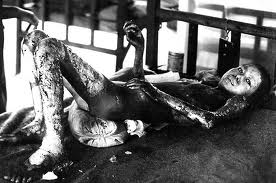
Who are the “global hibakusha”? As many of us know, hibakusha is the Japanese word used to refer to those who survived the two nuclear attacks conducted by the United States against the people living in Hiroshima and Nagasaki in 1945. Those attacks killed between 100,000 and 200,000 human beings instantly, and wounded as many. Hundreds of thousands of survivors were exposed to radiation from the attacks. In the face of this horror, we calm ourselves with the reassuring thought that nuclear weapons have not been used since 1945. However, there have been over 2,000 nuclear weapon detonations since then, and because of the size of the weapons and the scale of their effects, millions of people have been exposed to radiation under their fallout clouds, even as the detonations are called “tests.” Millions more have been exposed from nuclear production and nuclear accidents. These millions are the global hibakusha.

Many think of the Cold War as a period in which nuclear weapons were never used. However, statistically, a nuclear weapon was detonated every 8.6 days between 1946 and 1989. In reality nuclear weapons were exploding constantly throughout the Cold War. Nuclear Bodies assesses the consequences for those living close to the locations of those detonations.

Global nuclear weapon test sites.

Nuclear weapons have been tested on every continent except South America and Antarctica. The site with the most nuclear weapon tests on Earth is the Nevada Test Site in the United States with over 900 nuclear weapon detonations. The primary nuclear testing site of the former Soviet Union was in modern day Kazakhstan, with almost 500 nuclear explosions. The people living near test sites have had profound experiences with radioactive fallout. Several nuclear weapon states have conducted tests in the Pacific, the U.S. in the Marshall Islands, the French in French Polynesia and the British in Kiribati. There were more than 200 tests in the Russian Arctic near Scandinavia, including the largest thermonuclear weapon ever detonated.

Distribution of nuclear tests by year.

Testing numbers rose quickly in the early Cold War when most detonations were conducted in the atmosphere, many distributing significant amounts of radioactive fallout far from the test sites. In 1962 there were 178 nuclear weapon tests—statistically, a nuclear detonation virtually every other day throughout that year, including massive hydrogen bomb tests.

While no population was directly attacked with nuclear weapons after Hiroshima and Nagasaki, exposure to radioactive fallout can be understood as an attack. To understand this, it is necessary to grasp how exposure to radioactive waves and radioactive particles differ. When a nuclear weapon is detonated, living creatures are exposed to radiation in two distinct ways. The detonation itself produces a burst of gamma and neutron waves that radiate out from the epicenter. This burst is only one form of the energies that radiate outward from the detonation; the other primary forms being blast and heat. These energies radiate from the epicenter and dissipate as they spread outward. The radioactive waves pass right through most matter they encounter, including buildings and bodies. In Hiroshima, for everyone within 3 kilometers of the detonation, large amounts of radioactive waves passed through your entire body, damaging cells and organs. This happened even if you were inside of a building, since they also passed through the structures. Beyond 3 km the energy of the waves dissipated to a less harmful level. The burst of radioactive waves lasts less than a minute: similar to an x-ray, it is turned on and then off, leaving no radiation behind. Those closest to ground zero may have died in hours, days or weeks. Others slowly developed diseases over the subsequent years and decades, and many experienced early mortality.

Many people were also exposed to radioactive fallout. This is radioactive material in the form of particles: stuff that sticks around. Some is unfissioned material (uranium-235 or plutonium) from the weapon, some are fission products produced by the detonation, and some are particles that are ionized (made radioactive) by the detonation. These particles rise up into the mushroom cloud, and as the cloud spreads downwind they “fall-out” of the cloud to the surface of the Earth. Unlike gamma waves these particles remain radioactive. Some are dangerous only for days or weeks, and some are dangerous for hundreds, or even hundreds of thousands of years. Once they deposit from the cloud to the ground, they can be internalized inside of and often retained by the body. Being chemicals, the body reacts to them as chemicals—it uses them. The body uses iodine in the thyroid gland, so if it internalizes iodine-131, the radioactive isotope of iodine, it puts that in the thyroid too. Strontium-90, produced in significant amounts by nuclear weapon explosions, is chemically similar to calcium, so once internalized the body uses it in the bones and teeth. In 1957, U.S. AEC Commissioner Willard Libby referred to strontium-90 as a “bone seeker.”1 These particles don’t give off large amounts of radiation, but once internalized into the body they emit this energy to the cells immediately around them 24 hours a day.

Where in the body common fallout from radionuclides tends to be retained.

In Hiroshima the mushroom cloud drifted to the northwest and large amounts of fallout came down with rain (precipitation strips particles from the atmosphere) and when combined with the soot from the burning city fell as “Black Rain.” Those who lived in the areas where the black rain fell also began to develop sickness from their exposure to radiation. Most Black Rain sufferers were too far from the city center to have experienced exposure to any of the energetic wave effects of the nuclear attack, blast, heat or radioactive waves. It took a long time for doctors to understand that those exposed to Black Rain were hibakusha—that they were suffering from exposure to radiation. It was just last year, 2021, that these sufferers had their legal rights as hibakusha in Japan recognized by a court decision after decades of litigation.

Why did it take more than 70 years to legally recognize those exposed to radioactive fallout as hibakusha in a country where the legal recognition of harm from radiation (designated status as a hibakusha) had been established 64 years earlier? Much of the invisibility of the Black Rain hibakusha, and of the global hibakusha, is rooted in medical models of harm from radiation.

Soon after the nuclear attacks on Hiroshima and Nagasaki it was recognized that the existence of more than 100,000 hibakusha presented an unprecedented research opportunity. Beforehand, the number of people who had been understood to have been exposed to radiation numbered in the hundreds and were spread out over several decades. Medical information about the consequences to human health and mortality from radiation exposure had been extrapolated from these cases, animal studies, and probability models. Because of the use of nuclear weapons on human beings, there was now a massive cohort of radiation-exposed individuals who could be studied collectively to build a much more comprehensive model of what radiation does to human health. The United States established the Atomic Bomb Casualty Commission (ABCC) in 1946 in both Nagasaki and Hiroshima to begin research on the effects of their exposure to radiation on the hibakusha and their descendants. The most consequential of their studies was the Life Span Study (LSS), begun in 1950 and continuing today by the Radiation Effects Research Foundation (RERF), the successor laboratory to the ABCC.

The LSS sought to establish a robust database which correlated radiation exposure to subsequent health outcomes. This database was built on two data points, determining how much radiation each participant was exposed to, and tracking their disease history and age of mortality. Building a database on this information for more than 200,000 people was intended to yield a powerful statistical tool to assess risk for anyone exposed to radiation in the future: if an exposure dose is known, the statistical probability for various health effects can be predicted. There are various problems in the design of the study, for example the fact that participants’ dose reconstruction was done based partly on memory and interviews (less than ideal sources for statistical data components). Nevertheless, it is a widely respected and globally cited study. It is often referred to as the “gold standard” of radiation health effects data.

For my work, the most important thing about the LSS is that it only considered external exposure. Participants’ dose is reconstructed wholly based on their estimated exposure to the burst of radioactive waves in the minute of the detonation. There is no information about harm from internalizing radionuclides. There are very good reasons for this parameter. In the 1950s it was not possible to determine whether someone had internalized a radioactive particle; whole body counters, which can make that assessment, each weighing 60 tons, only became available in 1964. Additionally, hundreds of thousands of people had been in the area affected by the massive burst of gamma rays, so working to compile information about their exposures and health outcomes was a massive research endeavor.

As Susan Lindee has pointed out, many imagined the future would be one in which many nuclear weapons would be used in warfare, feeling that “[A]ll conjectures about the nature of the imagined post-war world must be drawn on the experiences at Hiroshima and Nagasaki.”2 But this was not what occurred. Nuclear weapons have never again been used directly in military conflict. The experiences of the hibakusha in Hiroshima and Nagasaki did not become common. What did happen is that 520 nuclear weapons would be tested in the atmosphere and create fallout clouds that spread radionuclides downwind. What became common was the experiences of the people who endured the Black Rain—the people it has taken 76 years to recognize as victims of exposure to radiation in the country most legally accepting of such status. Internal exposures, not external exposures, is what the Cold War wrought.

When communities downwind from nuclear test sites claimed to be suffering from health problems because of their exposures, invariably the nation that irradiated them, and their local government (if separate), would cite the LSS to dismiss their claims. With rare exceptions, local externally measurable levels of radiation were not high enough to correlate with expected health problems when using the database. This was the wrong tool for the job. The LSS predicted health outcomes after exposures to a single massive exposure to external radiation. However, the people downwind from the test sites were internalizing particles, as had those in the areas of Black Rain. Measurable levels of radioactive rays may have been low, but the presence of radioactive particles in their ecosystems put them at risk, and for many, affected their health. The LSS tells us nothing about the risks to health from internalizing radiation. It was not useful for assessing or maintaining community health, but it was useful for dismissing the claims of fallout victims and deflecting monetary and political liability. This has been the screen behind which the nuclear weapon states maintained the brutality of their nuclear testing programs, and the invisibility of the harm caused to those beneath the fallout clouds.

Other cohorts of global hibakusha have experienced different modes of contamination, but the routes of exposure are similar: internalizing radioactive particles. Many uranium miners have inhaled uranium particles and it has long been known that there is a high incidence of lung cancer among them. The presence of immense piles of uranium tailings alongside mines, left behind by operators when mines are abandoned, have long polluted the water, food and homes of those living in the area. A 2019 studydetermined that more than 25% of mothers and infants born in the Navajo Nation had extremely high levels of uranium in their bodies, even though active mining had ceased there by the mid-1980s.

Those who live near plutonium production facilities (nuclear reactors and chemical separation plants) as at Hanford, Washington, or uranium processing facilities that play a role in the enrichment of uranium, find high levels of radionuclides in the water, food and soil of their ecosystems. The “Green Run” experiment at Hanford in 1949, in which nuclear fuel was processed to extract plutonium when it was “green,” (without waiting for short-lived radionuclides to decay) so that intelligence might be gathered that could help assessments of the plutonium production capacity of the Mayak facility (the Soviet Union’s Hanford site) led to a massive release of iodine-131 that contaminated most of Eastern Washington and Central Oregon (seriously, click the link and read about this). This radioiodine surely made it into the milk consumed by the majority of the children living in the region. A plume of radioactive water leaking from the Hanford Tank Farm has been migrating towards the Columbia River for decades. People live, farm and raise families in the area. Radioactive waste from the Mallinckrodt Company which operated uranium processing facilities in and around St. Louis during the Manhattan Project and the Cold War, was buried and abandoned in several locations. Several tons ended up in the West Lake Landfill in Coldwater Creek, Missouri. A 2014 report by the state of Missouri found that the presence of the waste had caused a significant increase in cancers to those living nearby, something which they had become viscerally aware of before the study. Even more concerning is that an underground fire has been burning in the landfill for years, moving steadily closer to the radioactive waste. If the waste was to catch fire, the risk for residents, and anyone downwind of the fire, would be catastrophic. This is not the first fire to have burned in the landfill. These are just two of more than 100 weapon production sites in the United States that require remediation from radiation and toxic chemicals, and that have harmed nearby populations.

Nuclear reactors were invented by the Manhattan Project to produce plutonium for nuclear weapons: they were developed before nuclear weapons. I have argued elsewhere that nuclear power was “born violent.” Since their invention, nuclear fuel melting has occurred roughly once per decade. There were two major nuclear accidents within 11 days in 1957 at military reactors used to manufacture plutonium (Mayak in the former Soviet Union and Windscale in the UK). In 1986, unit #4 exploded at the Chernobyl Nuclear Power Plant in Ukraine, in the former Soviet Union. A fire burned in the melted reactor core for over two weeks, belching radioactive fallout over vast sections of Europe. You can view a reconstruction of the spread of the fallout from the 1957 Windscale Fire over much of the UK and Northern Europe utilizing weather data and modern computer modeling here.

A map showing the distribution of cesium-137 from that fallout plume that remains measurable on the ground in Europe 30 years after the disaster.

This cesium-137 continues to show up in food products throughout Europe every year, especially jams, mushrooms and wild boar (who eat the mushrooms). While we think of Chernobyl as a disaster that occurred in the past, it continues to present risk to people living far from the site who were not yet born. The triple meltdowns at Fukushima spread radioactive clouds throughout the region, with the primary deposition of fallout being to the northwest of the plants. There too, cesium-137 continues to spreadthrough the ecosystem. As a chemical, cesium-137 is very adept at migrating in nature. It easily passes from air to soil to water to plants to biota. It remains radioactively dangerous for about 300 years, meaning that once it has deposited and embedded into an ecosystem, centuries of risk will follow. In towns affected by the fallout in Northern Japan from the 3.11 Fukushima nuclear meltdown, the government engages in “decontamination.” However, the towns being decontaminated are surrounded by contaminated mountains and forests. It cannot be separated from the larger ecosystem, so although soil can be placed in plastic bags and moved “somewhere else,” the particles embedded in the ecosystem surrounding the town will migrate back in with rain and wind and the natural dynamics of life. I argued last year in this journalthat you cannot draw a circle in nature which allows you to successfully isolate the inner circle from the natural world that envelopes it. We must understand such contaminations as holistic events that will affect a large ecosystem over a broad period of time. Human beings are a part of those ecosystems, we are also embedded in them.

Because the dangers from these radionuclides are widely dispersed in both space and time, we can have no certainty whether we or our loved ones will suffer, or will navigate between the raindrops of risk. This uncertainty can itself be destabilizing even if sickness never comes. For those who lived here in Hiroshima and in Nagasaki after the nuclear attacks, no one knew who might develop cancer or other radiogenic diseases, and who would live to old age: many who never got sick spent lifetimes worrying. Those living where the fallout deposited from Chernobyl, from Fukushima, and from the dozens of nuclear test sites can’t be certain what their risks are, and where dangers lie. Living in a particle rich environment can bring deep stress and anxiety, separate from illness. Everyone in such a situation worries about the health of their loved ones, especially children.

Defenders of nuclear technologies have pathologized such anxieties, calling them “radiophobia.” This they define as an “irrational” fear of radiation, and present it as a mental health diagnosis. I argue that when long-lived radioactive particles deposit into the ecosystem where you live, and from where your food is obtained, anxiety is a rational response. Chastising those living through such events as irrational because they are worried is cruel. It is victim blaming. People who find themselves downwind from nuclear fallout clouds, whether from weapon detonations or reactor accidents need support, not disdain.

This inclination to focus on public perceptions and relations in response to radiological contamination has been endemic throughout and since the Cold War. When former contaminated sites of U.S. nuclear weapons production are shut down, they are not simply remediated, they get a toxic make-over and are presented as pristine nature preserves. The Rocky Flats Plant outside Denver is where the U.S. deposited the plutonium produced at Hanford and Savannah River into pits—the fissile cores of nuclear weapons. It was the site of multiple fires that dispersed aerosolized plutonium across wide areas. In 1989, a task force made up of officials from the FBI and the EPA conducted an unprecedented raid on the DOE facility and found mind boggling violations of environmental regulations in the routine practices at Rocky Flats. The raid led to the end of pit production and the closure of the site. At the time operations ceased at the plant, there were 3 metric tons of plutonium onsite. Early estimates outlined a 65-year remediation process that would cost almost $40 billion, yet, just twenty years later the Rocky Flats National Wildlife Refuge opened to the public, sporting 18 km of hiking trails. Why this cosplay? Wasn’t it enough to simply close down the site and keep the public out? The Colorado Front Range, where the Refuge is located, is laden with beautiful and accessible nature reserves and hiking trails. The Rocky Flats National Wildlife Refuge offered nothing specifically new or valuable to the community. This was not just done at Rocky Flats, multiple former nuclear weapon production facilities experienced rhinoplasty to be returned to society as access points to the natural world in a spectacular effort at nuclear greenwashing. Nuclear weapon sites across the globe have also been greenwashed. Apparently, following the remediation of the sites is the remediation of our memories.

Writing in a 2018 report intended for internal distribution only, Roger and Linda Meade described how, “When Trinity’s radioactive debris contaminated the grain fields of the Midwest, the response was to move testing to the Marshall Islands, where the seemingly empty ocean that [sic] would swallow any radioactive fallout. This scheme worked until Bravo demonstrated that the world was not big enough to hide the radioactive fallout from thermonuclear detonations.”3 Throughout the history of nuclear weapon testing there has always been a careful selecting of the irradiated. As pointed out above, once it was understood that the Trinity Test had spread fallout inside the United States, the U.S. moved its nuclear testing program outside of the continental United States when testing resumed one year later. Not wanting to expose Americans to radioactive fallout, they selected the Marshallese as acceptable to irradiate.

All nations that tested nuclear weapons in the atmosphere made similar calculations. The Soviets chose Kazakhstan as their test site, a place that First Deputy Premier Beria claimed was “uninhabited.” The Kazakhs were both ethnically and religiously different than the dominant Russian population. Both the British and the French never tested one of their nuclear weapons inside their own countries; they conducted all of their weapons tests in former or current colonial spaces. The British first tested in Australia, far from the cities populated with white Australians, on the lands of several indigenous communities. Because of the scale of the fallout clouds from thermonuclear weapons, the Aussies refused to let them be tested in Australia, so the British conducted their H-bomb tests on Christmas Island in Kiribati. The French first tested in Algeria while it was still a colony, and during the Algerian War of Independence. Knowing that they were losing the war, even as they tested in Algeria they began to build a second site in a second colony, French Polynesia. The Chinese tested in the far western Xinjiang Province, the traditional home of the Uyghur people, again, both ethnically and religiously distinct from the Han Chinese population. Chinese hostility towards the Uyghur people continues today.

No nation tested nuclear weapons upwind from their own economically powerful and politically resourced populations. When the U.S. built a second test site in the continental United States it was placed amidst Native American and Hispanic communities, and just upwind from majority Mormon populations in Southern Utah. There was a protocol at the Nevada Test Site to not test when the wind was forecasted to blow to the south, which would carry the fallout clouds to Las Vegas and Los Angeles, but to test when the winds were forecast to blow to the east: again, selecting the irradiated.4

These decisions were made because it was clear that exposure to radioactive fallout was dangerous. This was understood militarily even before the Trinity Test. Both the U.S. and the Soviet military discussed dropping sand laden with uranium particles from airplanes to kill enemy troops and contaminate enemy territory during World War Two. When the Allied forces came ashore on Normandy Beach on D-Day in 1944, personnel carried Geiger Counters because of fears that the Nazis might have salted the beaches with uranium to contaminate and sicken the attackers.

The first postwar tests conducted in 1946 by the U.S. at Bikini Atoll in Operation Crossroads were an unmitigated radiological disaster. The second test, the Baker Test, was detonated underwater which meant that all of the radionuclides that would normally rise up into a cloud and be dispersed downwind simply remained in the water of the lagoon. As U.S. military personnel continued to work in the lagoon their exposure to radiation rose day after day until the Joint Task Force conducting the tests had to evacuate the 40,000 troops and scuttle the planned third test. This setback still enabled a detailed and extensive study of how radionuclides move through an ecosystem on the part of marine biologists working for the Atomic Energy Commission. Here is a film that they produced about their work in which they refer to Bikini Atoll as a “radiobiological laboratory.”

The top-secret 1947 report on Operation Crossroads included a chilling and clear understanding of the use of radioactive fallout as a weapon, and as a means of inducing terror in a population:

  1. Test Baker gave evidence that the detonation of a bomb in a body of water contiguous to a city would vastly enhance its radiation effects by the creation of a base surge whose mist, contaminated with fission products, and dispersed by wind over great areas, would have not only an immediately lethal effect, but would establish a long-term hazard through the contamination of structures by the deposition of radiological particles.
  2. We can form no adequate mental picture of the multiple disasters which would befall a modern city, blasted by one or more atomic bombs and enveloped with radioactive mists. Of the survivors in contaminated areas, some would be doomed to die of radiation sickness in hours, some in days, and others in years. But, these areas, irregular in size and shape, as wind and topography might form them, would have no visible boundaries. No survivor could be certain he was not among the doomed and so, added to every terror of the moment, thousands would be stricken with a fear of death and the uncertainty of the time of its arrival.5

There is no ambiguity in the understanding that the U.S. military had of the effects, and the military utility, of radioactive fallout immediately after the third of what would be more than 2,000 nuclear tests. Communities of people affected by the radioactive fallout from U.S. (and other nations’) nuclear tests would understand precisely what was being described in this report, even as the militaries that irradiated them dismissed their claims and concerns.

This is a question posed in the book: when is a test an attack? The massive cloud from the Bravo Test at Bikini Atoll in 1954 killed a Japanese fisherman located over 100 miles away from the hypocenter, and sickened hundreds on other fishing boats and multiple downwind atolls. American and Soviet nuclear war planners both recognized and integrated the capacity of large fallout clouds to kill both combatants and “laborers” downwind from detonation points into nuclear targeting strategies. This understanding of fallout clouds led President Kennedy to warn Americans in the fall of 1961 that the most damaging aspect of a potential Soviet nuclear attack on the U.S. would be deadly fallout clouds that extended for hundreds of miles. Yet, Kennedy approved 96 nuclear weapon tests for the following year, including those involving thermonuclear weapons. The thermonuclear tests were all kept in the Pacific to spare Americans from the deadly clouds Kennedy warned about. By selecting who would not be subjected to those clouds he was also selecting who would be.

The Cold War was a limited nuclear war. Since no population was attacked directly with the weapons, and no one was subjected to the blast and heat of the detonations, it was never classified as a nuclear war. However, millions of people were subjected to radioactive fallout and had their bodies, their land and seas contaminated with radionuclides. The Cold War nuclear war was limited—limited to this one effect, the fallout radiation—the effect that President Kennedy said “could account for the major part of the casualties.”6 But residents of the Kazakh villages located 30 km from the Polygon where more than one hundred atmospheric nuclear tests were conducted, including several H-bombs (and more than 300 underground tests) endured ongoing attacks from the effects of nuclear weapons.

Map of villages downwind of the Polygon in Kazakhstan.

The book concludes with some reframing of our understanding of nuclear waste. I make several arguments, the first being that we need to recognize that the deadliest of our high-level nuclear waste, the spent fuel from operating reactors or making weapons, is the most consequential thing ever produced by the human species. Long after our cities have crumbled, long after our languages are incomprehensible, long after our gods are dead, our spent nuclear fuel will still be here. Several hundred thousand metric tons (currently) of spent nuclear fuel, laden with uranium and plutonium, will still be intact and dangerous to living creatures for thousands of generations. It may be how our descendants know us: the people who made the nuclear waste that they have to live with.

We plan to build deep geological repositories (DGRs) to store this waste. This means making vast containment structures half a kilometer underground that must remain intact and dry for 100,000 years. A great deal of scientific planning and testing is going into this effort, and using the KBS-3 method developed in Sweden, the Onkalo site in Finland will soon be placing the first spent fuel in human history into “permanent” storage. Work has been done on the geological nature of the site itself, the construction of the copper canisters that will hold the spent fuel rods, and bentonite clay that will backfill the site upon completion, and multiple additional segments of the plan. This is all very solid and reliable research. However, what we can grasp in a few decades of research and what eventuates over 100,000 years are unlikely to line up perfectly. As for all human technological endeavors, we will probably get it a little bit right and a little bit wrong. Tremendous research has gone into the design and operation of nuclear reactors, and for the most part they have operated as intended. But not always. Even when we get it mostly right, and a little bit wrong, with technologies of this scale, and bearing risks of this magnitude, the little bit wrong part remains catastrophic.

When we approach problems of this magnitude, we remain embedded in our current moment, no matter the degree to which we think we are planning long-term. Firstly, we made this waste with no capacity to dispose of it. Now that we are proceeding with plans for disposal, they continue to reflect this limited perspective. Multiple countries that have begun construction of DGRs, and others in advanced planning stages, searched for the best locations for these millennia long repositories, and just happened to have found that the most ideal sites are already existing nuclear power plant sites, or military sites. Onkalo in Finland is located alongside one of Finland’s two nuclear complexes. Sweden plans to build its DGR at one of its existing nuclear complexes. In both cases, the land is already owned and the local population largely employed or dependent on the industry. Local political approval was far less contentious in such locales as they were far from industrial areas. What divine providence that the optimum sites are so convenient for local 21st century politics.

Many nations have operated nuclear reactors, and accrued spent fuel that it must dispose of, yet not every nation is anticipated to be geologically stable for millennia. A clear example is Japan, which operated 54 commercial nuclear reactors before most were powered down after the Fukushima meltdowns of March 2011. Japan has thousands of tons of spent nuclear fuel and is geologically unstable. It was an earthquake that sparked the Fukushima meltdowns. Geologically, Japan is a spiderweb of fault lines and volcanic zones. There is no good place to build a deep geological repository inside Japan. Yet, Japan will build one because the waste was generated by “Japan,” a construct that is likely to be meaningless to people sharing an ecosystem with buried Japanese waste in 40,000 years. Will we make choices with those people in mind? Or will we make choices based on the “necessities” of the politics of our current time? We all know the answer to that: we will bury our nuclear waste within the lines of our current political maps, all the while claiming we are focused on protecting future generations.

Another key site where we can see the dysfunction of our strategies for protecting future generations from harm from our radioactive waste is in the marking of our waste sites. Nuclear semiotics is a field drawing expertise from multiple disciplines to strategize how to warn future generations of the dangers of our nuclear waste being buried under their communities. Since the waste will remain dangerous beyond 100,000-years we are aware that language is not likely to be sufficient. All of our plans position us as teachers and future generations as minds and feelings that need to be shaped by us from our place of wisdom. We either have to sufficiently inform them about the waste using language or images, or scare them using monumental sculpture or barriers. We cannot grasp the most fundamental fact: that the presence of our radioactive and toxic waste in their world is the message. We had so little consideration for their ecosystem that we buried hundreds of thousands of tons of the most toxic material we could make there; material that only provided benefits to us. We think the information we give them about this act somehow makes the act acceptable. I argue that any message must begin with an apology. Without an apology from us for putting them in this position, why would they listen to anything else we say?

When we released massive amounts of radionuclides into the ecosystem during Cold War nuclear testing scientists used them as radioactive tracers to study the dynamics of global systems. This helped us to grasp atmospheric dynamics and global ocean flows. Once in the ecosystem these particles embed and migrate as do all other materials. We observed the Earth function as a single ecosystem. A 2021 study found cesium-137 from nuclear testing in Nevada in multiple samples of honey gathered on the East Coast of the U.S. 58 years after atmospheric testing there concluded. The global distribution and ubiquitous presence of these radionuclides help us to determine forgeries in the sale of paintings and vintage wines. The spread of radioactive fallout around the world is not something that happened, it is something that is still happening.

*

Note to readers: Please click the share buttons above or below. Follow us on Instagram, Twitter and Facebook. Feel free to repost and share widely Global Research articles.

All of these issues, and many more are explored in detail in my new book, Nuclear Bodies.

You can visit this website for the book, and find links to order it from numerous online booksellers: Nuclear Bodies: The Global Hibakusha.

Robert (Bo) Jacobs is a historian of science and technology at the Hiroshima Peace Institute and Graduate School of Peace Studies at Hiroshima City University. He has published widely on the interface of nuclear technologies with human beings and communities. His book, Nuclear Bodies: The Global Hibakusha, was published by Yale University Press in 2022. 

Notes

Willard K. Libby, “Radioactive Fallout,” Proceedings of the National Academy of Sciences 43 (1957): 765.

M. Susan Lindee, Suffering Made Real: American Science and Survivors at Hiroshima (Chicago: University of Chicago Press, 1994): 4.

Roger A. Meade and Linda S. Meade, “The World, We Think She Start Over Again”: Nuclear Testing and the Marshall Islands, 1946–1958, internal distribution report no. LA-UR-18-30848 (Los Alamos, NM: LANL, 2018): 116.

James Rice, “Downwind of the Atomic State: US Continental Atmospheric Testing, Radioactive Fallout, and Organizational Deviance, 1951–1962,” Social Science History 39 (Winter 2015): 656.

“The Evaluation of the Atomic Bomb as a Military Weapon,” The Final Report of the Joint Chiefs of Staff Evaluation Board for Operation Crossroads, Enclosure “A,” JCS 1691/3 (30 June 1947): 57–89.

John F. Kennedy, “Letter to the Members of the Committee on Civil Defense of the Governors’ Conference,” 6 October 1961 (accessed 10 March 2022).

All Global Research articles can be read in 51 languages by activating the “Translate Website” drop down menu on the top banner of our home page (Desktop version).

To receive Global Research’s Daily Newsletter (selected articles), click here.

Visit and follow us on InstagramTwitter and Facebook. Feel free to repost and share widely Global Research articles.

***

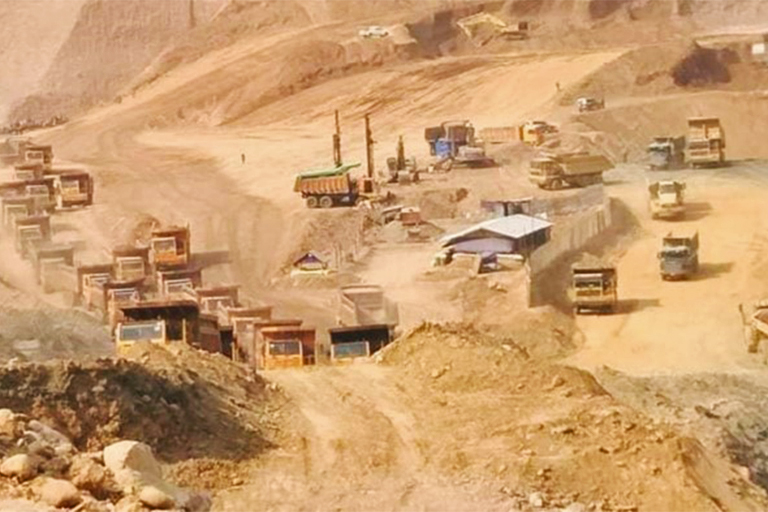
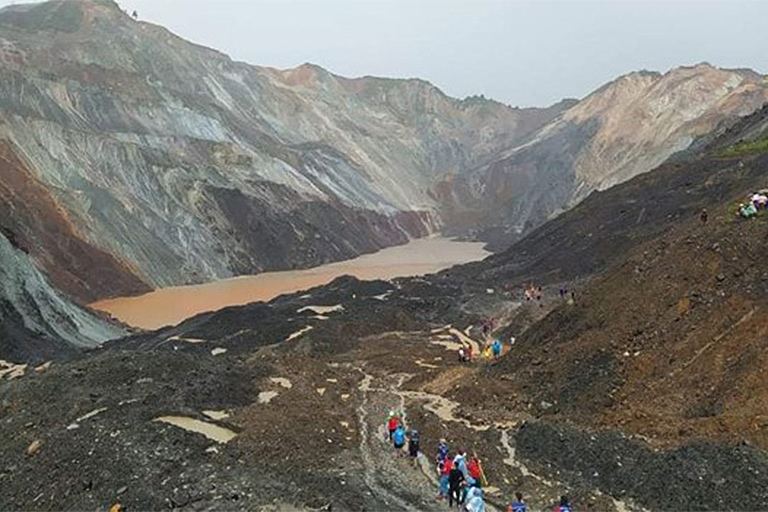
On Feb. 28, a landslide of earth and waste from mines in Myanmar’s Hpakant township engulfed dozens of miners and scavengers looking for jade in this remote, mountainous region. Official sources claim just two deaths resulted from the landslide, but residents and aid workers said at least 23 people were killed and 80 missing.

The fatal landslide earlier this year is just the latest in a series of deadly disasters in Hpakant, where no mining has occurred legally since 2020: at least three people were killed in a December 2021 landslide, while a 2020 landslide claimed 162 lives and another in 2015 killed 113.

Myanmar produces a wide range of high-quality gems and precious stones: jade, ruby, sapphire, spinel, diamond, tourmaline, peridot, topaz, garnet, moonstone, lapis lazuli, chrysoberyl, amber and quartz. Yet, despite the production of numerous gems, mismanagement and corruption in the industry ensure that the country remains economically underdeveloped and suffers from social and environmental deterioration.

Jade and gemstone market in Mandalay.

Jade and gemstone market in Mandalay. Image by John Sai Luu.

Risky business

Most of the country’s gemstone-mining sites are located in conflict areas such as Kachin state’s Hpakant area and Khamti township in the Sagaing region, where ethnic minority groups are waging armed struggles against the Myanmar government.

Jade from Myanmar, famous in the global market and especially prized by Chinese consumers, is primarily produced in Hpakant, a mountainous township in the northernmost part of Myanmar.

According to a local charity organization in Hpakant, more than 500 people have been killed in landslides since 2015. This string of fatalities is the result of a deadly combination of corruption, poor environmental management, conflict, and economic desperation. As the country battles an economic downturn and rising unemployment, people from across Myanmar flock to Hpakant hoping to scavenge gems left behind by large mining operations.

“Since the country’s economy is not functioning well, many people come to Hpakant, hoping to make riches from rags,” says Hpakant resident Ko Sai Han. “Dying during landslides becomes more common. I also have to run for my life when there’s a landslide. People are betting on their lives while searching for gemstones at the dumpsite. These problems will continue as long as there is mining. The gemstone mines in Myanmar only benefit a handful of people but not the local people like us.”

According to 2016 report of Myanmar Gems and Jewelry Enterprise, there were 21,000 gemstone mines in Hpakant and Khamti. In Hpakant alone, there are more than 500 companies mining using heavy machinery.

Companies use heavy machinery at jade mining sites in Hpakant.

Companies use heavy machinery at jade mining sites in Hpakant. Image by John Sai Luu.

Endemic corruption

To obtain a permit, mining companies have to pay fees to the mining ministry, as well as local authorities. These fees are vary depending on the size of a concession and its estimated gem reserves. However, the exact figures are a secret, and companies refuse to disclose how much they have paid, citing confidentiality agreements they have to sign with authorities. Corruption is rampant at every level in the process, and failure to pay kickbacks to the ministry and local authorities can cause unnecessary delays in getting a permit.

Myanmar’s Mining Law requires both authorities and miners to follow specific environmental conservation protocols, but enforcement is weak. In Hpakant, all mining licenses for companies expired in 2019 and 2020. Officially, the ruling junta has not granted mining licenses since the February 2021 coup. However, mining continues.

Moreover, the Kachin Independence Army (KIA), an ethnic armed organization, controls some of the mine sites in Hpakant. An employee of a jade mining company, speaking on condition of anonymity for security reasons, says companies have to pay the KIA 10% of the total profit of mining sites under its control. As a result of deals like these, resource extraction is also a source of the conflict between the Myanmar army and ethnic armed groups.

“No jade mining license has been granted. But some people continue mining,” said another miner, also speaking on condition of anonymity. “Now, there are only Tatmadaw [Myanmar Armed Forces] and KIA. The mining continues under informal agreement, meaning you can continue if you have an understanding with them. Illegal mining was not fully regulated before. But now, illegal mining has become worse.”

Regardless of the specifics of their arrangement, companies have a limited period during which they can mine. As a result, they move as fast as they can, excavating mountainsides with heavy machinery, carving out massive man-made valleys and discarding the waste into huge piles. The speed and scale at which companies operate not only causes environmental damage, but also means that even high-quality gems may be missed, making these mining dumpsites a tempting target for scavengers.

In addition to the environmental problems it causes, the jade mining boom in Hpakant has brought with it a host of social and public health problems. Illegal drugs such as heroin, methamphetamines and opium are easily available in Hpakant. Some drug use is recreational, but the use of stimulants and analgesics allows miners and scavengers to endure long, brutal stints searching for gems. Intravenous drug use is also a driver of HIV transmission.

“Drugs are easy to find in Hpakant, just as jade is,” said a Hpakant resident, who also requested anonymity. “Many people got addicted while using drugs for fun. Before, local organizations against drug abuse could do actions against drug abuse. But now with pandemic and political instability, they can’t do much. Drug problems will continue as long as there are gemstone mines.”

Excessive mining of jade has caused occasional landfalls and sinkholes in Hpakant.

Excessive mining of jade has caused occasional landfalls and sinkholes in Hpakant. Image by John Sai Luu.

Resource and conflict

“Our area produces jade, but local people don’t benefit from jade mining,” said Hpakant resident Ko Naw Aung. “Local people made their living scavenging jade in the land dumpsite. The area is far from being developed because jade mining only benefits a handful of people. In fact, plenty of development works can be carried out using revenue earned from resource extraction. Years have passed, but the lives of local people remain the same.”

The same observation can be extended to the country as a whole. Despite its rich resources, Myanmar is struggling from both environmental deterioration and economic problems caused by conflict and a weak political system — a scenario often referred to as the resource curse. The promise of wealth from gems and other natural resources has driven a cycle of conflict and instability, rather than providing employment and funding investments that could improve citizens’ quality of life.

Myanmar’s government stands to derive significant revenue from jade mining. In addition to the share of profits agreed upon when a company is granted a mining concession, the government imposes taxes of 15-20% on jade and gems sold at emporiums. According to the Myanmar Extractive Industries Transparency Initiative (MEITI), the government received 708 billion kyat ($578 million) from jade and gems companies in the 2015-16 fiscal year.

However, this likely represents just a small portion of the true value of jade sales. The high tax motivates companies to underreport or undervalue their production. Many companies evade taxes by making covert payments to regulators.

The profits from the industry thus go to a handful of individuals, instead of contributing to national economic growth. It’s an open secret that the bulk of the revenue from jade mining and other forms of resource extraction flows into the pockets of corrupt officials and their cronies, as well as the Myanmar army and various armed non-state entities.

During the period of civilian rule from 2011 to 2021, lawmakers made some efforts to bring accountability to the sector and ensure revenue from mining went into the public budget. For example, in 2016, during the Thein Sein government, officials were dismissed from the customs department and commerce ministry for allowing mining vehicles to be illegally imported to Hpakant from China. Under the junta, even these small efforts have vanished.

Manual mining sites Myanmar’s ruby heartland of Mogok.

Manual mining sites in Myanmar’s ruby heartland of Mogok. Image by John Sai Luu.

The production of jade and gems is currently in decline due to both COVID-19 and political turmoil in the wake of the 2021 coup. There have been fewer international jade and gems emporiums as a result.

“The jade and gems business is slow in Myanmar,” said jade and gems merchant U Win Maung.  “The major buyer is China. Chinese buyers are pushing prices down, taking advantage of the political situation in Myanmar. We don’t have many options, so we have to sell at the prices they offer.”

Jade that isn’t sold at emporiums generally ends up being smuggled into China. But while mining companies evade government taxes, it doesn’t mean they aren’t paying fees for their extraction and export. As mines are located in contested areas and areas controlled by the Kachin Independence Army, they have to pay fees to the KIA as well as the government-backed militias that control the smuggling routes. And Myanmar’s military and the border guard are also involved in this widespread ring of corruption.

The fact that Myanmar lacks the technology to produce finished products from raw jade suits gem buyers in China. Myanmar has had to rely on China in political, economic and various other fields for decades. As a consequence, Myanmar’s jade and gems industry will remain a buyer’s market for China for many more years to come.

“Among other resources, jade and gemstones generate most of the revenue,” one anonymous gemstone expert said. “Our country is a resource-producing country. We need to go from producing raw materials to finished products. We need to make sure the resource-extracting industry benefits the local communities. Gemstone markets need to be built to benefit local people. To do that, everyone needs to work together. Because of the weak mechanism, local communities are not benefiting from resource extracting industry. It is important to install responsibility, accountability and transparency mechanism in the industry.”

*

Note to readers: Please click the share buttons above or below. Follow us on Instagram, Twitter and Facebook. Feel free to repost and share widely Global Research articles.

Featured image: A jade mining site in Myanmar’s Kachin state. Image by Yin_Min_Tun via Wikimedia Commons (CC BY-SA 3.0).

All Global Research articles can be read in 51 languages by activating the “Translate Website” drop down menu on the top banner of our home page (Desktop version).

To receive Global Research’s Daily Newsletter (selected articles), click here.

Visit and follow us on InstagramTwitter and Facebook. Feel free to repost and share widely Global Research articles.

***

The U.S. is scrambling to check the growth of Chinese influence in the Pacific nation of the Solomon Islands after Beijing struck a security pact with the islands that would allow China to dock their ships, deploy security forces to protect Chinese-built infrastructure, and help the government restore order. 

The United States and Australia have been panicking ever since about a possible Chinese foothold. Washington has rushed top White House and State Department officials to Honiara to pressure their government to cancel the agreement, but this has served mostly to annoy them and signal that the U.S. doesn’t respect their sovereign decisions.

The United States routinely rails against the idea of spheres of influence when other states claim them, but in its rivalry with China the U.S. assumes that Pacific Island nations belong firmly in the American sphere of influence. U.S. entreaties are likely too late to change minds in the Solomon Islander government, and they show that the U.S. doesn’t really believe that small states get to make their own decisions when it comes to foreign policy.

The details of the final agreement with China are not yet public, but the pact is believed to be close to the leaked draft version that became available last month. According to that version, the government can request China to send police and military personnel in the event of local disorder. There was significant unrest in the country last year caused by longstanding internal divisions and resentment that the government switched its diplomatic relations from Taiwan to China three years ago.

Because of Australia’s traditional role as security provider for the country, news of the agreement with China has been received very poorly in Canberra. Australia’s Labor Party seized on the issue to criticize the coalition government and characterized it the “worst Australian foreign policy blunder in the Pacific” since WWII. There has even been some reckless talk from pundits that Australia should invade the country and bring down the government to halt the agreement.

While it is understandable that Australia has concerns about closer ties between China and one of its neighbors, the reaction to this agreement has been out of all proportion to its significance.

For its part, the U.S. has neglected the Solomon Islands and taken the country for granted for many years, and it is only when it seems to be drifting towards Beijing’s orbit that our government can be bothered to pay close attention. There hadn’t been a U.S. embassy in Honiara for almost 30 years until it announced it was being reopened earlier this year, and even that was justified as an anti-Chinese move. Washington says that it believes that small states should be able to decide for themselves about how to make their security arrangements and decide their foreign policy orientation, but it doesn’t adhere to that line when a government builds closer ties with China.

The Solomon Islands’ prime minister has assured the U.S. and Australia that its agreement with China does not pose a threat to any other state and won’t involve any China bases on their territory, but that has not stopped officials from both countries from opposing the agreement in the strongest terms.

Prime Minister Sogavare responded to the criticism by saying,

“We find it very insulting…to be branded as unfit to manage our sovereign affairs.”

International relations scholar Van Jackson correctly described the reaction in Australia, New Zealand, and the U.S. to the agreement as “absolutely hyperbolic.” As he said,

“there is nothing about this document that represents making the Solomon Islands part of a Chinese sphere of influence.”

Jackson asks an important question about U.S. and allied goals in the broader “Indo-Pacific”:

“What kind of free, open, inclusive Indo-Pacific are you building if you are literally going to try and constrain the foreign relations of independent, sovereign states?….That’s literally asserting a Western sphere of influence in trying to deny a Chinese one.”

The question of spheres of influence is a contentious one in U.S.-Chinese relations. Washington professes to abhor spheres of influence while insisting for all intents and purposes that the U.S. maintain one in the western Pacific. The U.S. casts spheres of influence as holdovers from an earlier era that have no place in the modern world, but it also carves out its own when it deems it necessary.

If the U.S. meant what it said about spheres of influence, it would not be so alarmed by the prospect of a modest security agreement between China and a small Pacific state, but by its actions our government shows just how desperately it clings to the idea that certain countries belong in the orbit of the U.S. and its allies no matter what the local government wants. If the U.S. hopes to win the trust and cooperation of Pacific and Asian nations in the coming decades, it cannot continue with a zero-sum approach that requires small countries to take sides against China.

Unfortunately, much of the commentary in the U.S. and Australia has been employing ridiculous Cold War-era rhetoric to discuss the Solomon Islands agreement. One article in Politico frames it as a “duel” between Xi and Biden that the latter has lost, and urges the U.S. to act before more “dominoes” start falling. “Who lost the Solomon Islands?” would be a premature question to ask if it weren’t so stupid, but this is what years of relentless hyping of “great power competition” encourages.

The alarmist response to China’s agreement with the Solomon Islands is reminiscent of other recent panics over developments involving China that either haven’t occurred yet or aren’t all that significant.

Many Western analysts grossly exaggerated the size and importance of an agreement between China and Iran last year with references to an “axis” or an “alliance” that doesn’t exist. More recently, the Pentagon has been sounding the alarm over a possible Chinese naval base in Equatorial Guinea that isn’t being built and wouldn’t pose much of a threat if it did exist.

China is expanding its economic and political influence, and over time that will likely include establishing more of an overseas military presence. That bears paying careful attention and requires assessing threats accurately, but it is absurd to fly into panicked fear over every modest agreement that China may be making with other countries.

The U.S. cannot neglect small nations and then expect them to fall in line when U.S. officials finally show up to complain about their relations with other states. If the U.S. wants to cultivate stronger ties with Pacific and Asian nations, it will have to make a consistent effort to work with these governments on issues of common interest. Insofar as the U.S. treats these states primarily as pawns in a rivalry with China, our government should not be surprised when some of them opt to cooperate more closely with China.

*

Note to readers: Please click the share buttons above or below. Follow us on Instagram, Twitter and Facebook. Feel free to repost and share widely Global Research articles.

Featured image: Chinese Embassy in Solomon Islands

All Global Research articles can be read in 51 languages by activating the “Translate Website” drop down menu on the top banner of our home page (Desktop version).

To receive Global Research’s Daily Newsletter (selected articles), click here.

Visit and follow us on InstagramTwitter and Facebook. Feel free to repost and share widely Global Research articles.

***


In terms of labyrinthine callousness and indifference to justice, the treatment of lawyer Bernard Collaery by the Australian government must be slotted alongside that of another noted Australian currently being held in the maximum-security facility of Belmarsh, London.  While Collaery has not suffered the same deprivations of liberty as publisher extraordinaire Julian Assange, both share the target status accorded them by the national security state.  They are both to be punished for dealing with, and revealing, national security information compromising to the state in question.

Assange’s case is notorious and grotesque enough: held in Belmarsh for three years without charge; facing extradition to the United States for a dubiously cobbled indictment bolted to the Espionage Act of 1917 – a US statute that is being extra-territorially expanded to target non-US nationals who publish classified information overseas.

Collaery’s is less internationally known, though it should banish any suggestions that Assange would necessarily face much fairer treatment in the Australian justice system.  The barrister is being prosecuted under section 39 of the Intelligence Services Act 2001 (Cth) for conspiracy to reveal classified information.  He was consulted by now convicted former intelligence officer Witness K, who was responsible for leading a 2004 spying operation conducted by the Australian Secret Intelligence Service (ASIS) that led to the bugging of cabinet offices used by the East Timorese government.

The operation was instigated in the predatory spirit of corporate greed: Australia was involved in treaty negotiations with Timor-Leste regarding access to oil and gas reserves at the time and wished to privilege its own resource companies through spying on their counterparts.  Former attorney general of the Australian Capital Territory (ACT) Collaery came onto the scene after Witness K, on being involved in a workplace dispute in 2008, revealed that he had directed the bugging operation.  After going to the Inspector General of Intelligence and Security, the ethically agitated Witness K consulted the ASIS-approved lawyer.

The bureaucrats of secrecy were hoping that things might have been contained.  Instead, a juggernaut of information began to leave the terminus of secrecy.  Collaery considered the spying operation a violation of ACT law.  In 2013, both men made themselves available for the East Timorese cause in testifying at the Permanent Court of Arbitration in the Hague.  Australia’s illegal operation, and bad faith to a neighbour and purported friend, was being given an unwanted airing.  The case being made against Canberra was that the treaty, because of the bugging, had been rendered void.

An unimpressed Commonwealth responded by raiding the Canberra premises of the two individuals.  Nothing, however, was done till 2018, when the new and zealous Attorney General Christopher Porter commenced prosecutions against the pair.  The Kafkaesque clincher in the whole affair was the effort by Porter to make most of the trial proceedings inaccessible to the public. Porter also imposed a national security order without precedent, preventing the parties from divulging details of the prosecution to the public or press.

Witness K, after pleading guilty, received a three-month suspended sentence and was placed on a 12-month good behaviour bond.  Collaery has been left to counter five charges alleging that he communicated information to various ABC journalists prepared by or on behalf of ASIS and allegedly conspired with Witness K to communicate that same information to the Government of Timor-Leste.

In assessing the ongoing prosecution against him, Collaery observed in an interview with Sydney Criminal Lawyers, that he had been charged with conspiracy for giving “frank and fearless advice”.  The charge against Witness K meant that it was “a crime to report a crime.  Think about it.  That’s Australia at present.”

Since then, Collaery has waged a relentless campaign against efforts by the Australian government to muzzle proceedings to conceal both embarrassment and blatant criminality.  In June 2020, he had a stumble before the first judge, who made orders under the National Security Information (Criminal and Proceedings) Act 2004 (Cth) to prohibit the disclosure of compromising evidence that might be adduced by Collaery during the trial.  The court found that Collaery’s right to a fair hearing would not be compromised by the nondisclosure orders, and that the need to protect national security outweighed the desirability of conducting proceedings in public.

In October, ACT appeals court reversed the decision, finding that six “identified matters” in the Commonwealth case against him should be made publicly available.  The court found that the risk of damage to public confidence in the justice system was outweighed by any risk posed to national security.  The open hearings of criminal trials “deterred political prosecutions” and permitted “the public to scrutinise the actions of prosecutors, and permitted the public to properly assess the conduct of the accused person.”

While a summary of the decision was made available, the full reasons for the decision have not.  The current Attorney General, the otherwise invisible Michaelia Cash, has attempted to suppress the full publication of the judgment.  The ploy being used here is a particularly insidious one: that the case involves “court-only” evidence which Collaery and his defence team are not entitled to see.  The ploy, dressed up as an effort to update the evidence, is an attempt to introduce new material via the backdoor.  The Commonwealth, in its desperation, is running out of ideas.

In March, ACT Supreme Court Justice David Mossop found that the court could receive such evidence through the office of an appointed special counsel who might be able to access the documents.  The appointee would be able to advocate for Collaery thereby reducing “the disadvantage to the defendant arising from the non-disclosure of the material”.

This month, federal Solicitor-General Stephen Donoghue argued in the High Court that this modest compromise would not do.  Not even a special counsel should cast eyes over such evidence in the name of protecting national security.  “If this isn’t stopped, the (earlier ACT) judgment could be released without the redactions we need.”

The three High Court justices hearing the case did not conceal their puzzlement.  Justice Michelle Gordon observed with some tartness that this was “a fragmentation of proceedings at its worst”.  Justice James Edelman was bemused. “What you say is the error is that the [ACT] Chief Justice didn’t make the orders you wanted.”  Donoghue’s feeble reason: that publishing the full ACT judgment should be delayed till the dispute on “court-only” evidence could be resolved.

This charade now continues its ghastly way back to the ACT Supreme Court.  Even now, dates of the actual trial, times and so forth, have yet to be set.  This will no doubt give prosecutors further time to cook up something.  All rather galling coming from a government which has the temerity to complain about the way secret trials are conducted in other countries against its citizens.

*

Note to readers: Please click the share buttons above or below. Follow us on Instagram, Twitter and Facebook. Feel free to repost and share widely Global Research articles.

Dr. Binoy Kampmark was a Commonwealth Scholar at Selwyn College, Cambridge.  He currently lectures at RMIT University.  He is a regular contributor to Global Research and Asia-Pacific Research. Email: [email protected]

Featured image: Senator Nick Xenophon with Bernard Collaery and Nicholas Cowdery QC in 2015 calling for a royal commission into the Australia–East Timor spying scandal. (Licensed under CC BY-SA 4.0)

All Global Research articles can be read in 51 languages by activating the “Translate Website” drop down menu on the top banner of our home page (Desktop version).

To receive Global Research’s Daily Newsletter (selected articles), click here.

Visit and follow us on InstagramTwitter and Facebook. Feel free to repost and share widely Global Research articles.

***


Taiwan’s military took the dramatic step of issuing a public emergency handbook meant to prepare all citizens in the event of a Chinese invasion of the island. The 28-page booklet includes detailed instructions on bomb shelter locations and how to stockpile emergency supplies, as well as basic life-saving steps.

While introducing the handbook in a Tuesday online press conference, defense ministry spokesman Sun Li-fang explained that “the general public can use as an emergency response guideline in a military crisis or natural disaster.”

But of course, the only crisis or disaster looming on people’s minds is the potential for an all-out Chinese PLA military assault – fears that have ratcheted particularly since the Russian invasion of Ukraine, which Beijing has at times appeared to defend, while also refusing to call Putin’s action an “invasion”.

A statement from the specific defense ministry department that authored the booklet, called the “All-Out Defense Mobilization Agency” had this to say: “The guide is for the public to better prepare themselves before a war or disaster happens.”

According to the AFP it’s been inspired of similar guides that the countries of Japan and Sweden have produced for their citizens, and includes info on “where to find bomb shelters via mobile phone apps and what to do in an emergency including how to distinguish air raid sirens.”

Or also there are emergency preparedness instructions which cover events like mass power outages and blackouts, large fires, building collapses, or devastating weather. Taiwan authorities express further, “We hope the public can familiarise themselves where the safety shelters are beforehand.”

While Taipei has lately accused China’s leaders of saber-rattling, also the PLA Air Force continues its weekly aircraft incursions of the islands Air Defense Identification Zone, Beijing has in turn pointed the finger over certain provocations. For example, it was revealed and confirmed last year that there has long been a contingency of US Marines and special forces on the island training Taiwanese forces.

The democratic island has also been hosting more and more US official delegations, and House Speaker Nancy Pelposi was expected earlier this month, but canceled the trip last-minute as she tested positive for Covid-19.

*

Note to readers: Please click the share buttons above or below. Follow us on Instagram, Twitter and Facebook. Feel free to repost and share widely Global Research articles.

  • Posted in Mobile
  • Comments Off on Taiwan Gives Citizens Survival Handbook in Case of Chinese Invasion
  • Tags: ,

All Global Research articles can be read in 51 languages by activating the “Translate Website” drop down menu on the top banner of our home page (Desktop version).

To receive Global Research’s Daily Newsletter (selected articles), click here.

Visit and follow us on InstagramTwitter and Facebook. Feel free to repost and share widely Global Research articles.

***

The island nation of Sri Lanka is in the midst of one of the worst economic crises it’s ever seen. It has just defaulted on its foreign debts for the first time since its independence, and the country’s 22 million people are facing crippling 12-hour power cuts, and an extreme scarcity of food, fuel and other essential items such as medicines.

Inflation is at an all-time high of 17.5%, with prices of food items such as a kilogram of rice soaring to 500 Sri Lankan rupees (A$2.10) when it would normally cost around 80 rupees (A$0.34). Amid shortages, one 400g packet of milk powder is reported to cost over 250 rupees (A$1.05), when it usually costs around 60 rupees (A$0.25).

On April 1, President Gotabaya Rajpaksha declared a state of emergency. In less than a week, he withdrew it following massive protests by angry citizens over the government’s handling of the crisis.

The country relies on the import of many essential items including petrol, food items and medicines. Most countries will keep foreign currencies on hand in order to trade for these items, but a shortage of foreign exchange in Sri Lanka is being blamed for the sky-high prices.

Why are some people blaming China?

Many believe Sri Lanka’s economic relations with China are a main driver behind the crisis. The United States has called this phenomenon “debt-trap diplomacy”. This is where a creditor country or institution extends debt to a borrowing nation to increase the lender’s political leverage – if the borrower extends itself and cannot pay the money back, they are at the creditor’s mercy.

However, loans from China accounted for only about 10% of Sri Lanka’s total foreign debt in 2020. The largest portion – about 30% – can be attributed to international sovereign bonds. Japan actually accounts for a higher proportion of their foreign debt, at 11%.

Defaults over China’s infrastructure-related loans to Sri Lanka, especially the financing of the Hambantota port, are being cited as factors contributing to the crisis.

But these facts don’t add up. The construction of the Hambantota port was financed by the Chinese Exim Bank. The port was running losses, so Sri Lanka leased out the port for 99 years to the Chinese Merchant’s Group, which paid Sri Lanka US$1.12 billion.

So the Hambantota port fiasco did not lead to a balance of payments crisis (where more money or exports are going out than coming in), it actually bolstered Sri Lanka’s foreign exchange reserves by US$1.12 billion.

So what are the real reasons for the crisis?

Post-independence from the British in 1948, Sri Lanka’s agriculture was dominated by export-oriented crops such as tea, coffee, rubber and spices. A large share of its gross domestic product came from the foreign exchange earned from exporting these crops. That money was used to import essential food items.

Over the years, the country also began exporting garments, and earning foreign exchange from tourism and remittances (money sent into Sri Lanka from abroad, perhaps by family members). Any decline in exports would come as an economic shock, and put foreign exchange reserves under strain.

For this reason, Sri Lanka frequently encountered balance of payments crises. From 1965 onwards, it obtained 16 loans from the International Monetary Fund (IMF). Each of these loans came with conditions including that once Sri Lanka received the loan they had to reduce their budget deficit, maintain a tight monetary policy, cut government subsidies for food for the people of Sri Lanka, and depreciate the currency (so exports would become more viable).

But usually in periods of economic downturns, good fiscal policy dictates governments should spend more to inject stimulus into the economy. This becomes impossible with the IMF conditions. Despite this situation, the IMF loans kept coming, and a beleaguered economy soaked up more and more debt.

The last IMF loan to Sri Lanka was in 2016. The country received US$1.5 billion for three years from 2016 to 2019. The conditions were familiar, and the economy’s health nosedived over this period. Growth, investments, savings and revenues fell, while the debt burden rose.

A bad situation turned worse with two economic shocks in 2019. First, there was a series of bomb blasts in churches and luxury hotels in Colombo in April 2019. The blasts led to a steep decline in tourist arrivals – with some reports stating up to an 80% drop– and drained foreign exchange reserves. Second, the new government under President Gotabaya Rajapaksa irrationally cut taxes.

Value-added tax rates (akin to some nations’ goods and services taxes) were cut from 15% to 8%. Other indirect taxes such as the nation building tax, the pay-as-you-earn tax and economic service charges were abolished. Corporate tax rates were reduced from 28% to 24%. About 2% of the gross domestic product was lostin revenues because of these tax cuts.

In March 2020, the COVID-19 pandemic struck. In April 2021, the Rajapaksa government made another fatal mistake. To prevent the drain of foreign exchange reserves, all fertiliser imports were completely banned. Sri Lanka was declared a 100% organic farming nation. This policy, which was withdrawn in November 2021, led to a drastic fall in agricultural production and more imports became necessary.

But foreign exchange reserves remained under strain. A fall in the productivity of tea and rubber due to the ban on fertiliser also led to lower export incomes. Due to lower export incomes, there was less money available to import food and food shortages arose.

Because there is less food and other items to buy, but no decrease in demand, the prices for these goods rise. In February 2022, inflation rose to 17.5%.

What will happen now?

In all probability, Sri Lanka will now obtain a 17th IMF loan to tide over the present crisis, which will come with fresh conditions.

A deflationary fiscal policy will be followed, which will further limit the prospects of economic revival and exacerbate the sufferings of the Sri Lankan people.

*

Note to readers: Please click the share buttons above or below. Follow us on Instagram, Twitter and Facebook. Feel free to repost and share widely Global Research articles.

 is Professor of Economics, Tata Institute of Social Sciences.

Featured image: Protests have erupted over the government’s handling of the economic crisis. AAP/CHAMILA KARUNARATHNE

The “China Threat” and the Solomon Islands

April 14th, 2022 by Dr. Binoy Kampmark

All Global Research articles can be read in 51 languages by activating the “Translate Website” drop down menu on the top banner of our home page (Desktop version).

To receive Global Research’s Daily Newsletter (selected articles), click here.

Visit and follow us on InstagramTwitter and Facebook. Feel free to repost and share widely Global Research articles.

***

Rarely has the Solomon Islands had as much attention as this. Despite being in caretaker mode as it battles the federal election, the government of Australian Prime Minister Scott Morrison still had room to politicise its anti-China twitch.  The person given the task of doing so was the Minister for International Development and the Pacific, Senator Zed Seselja.

In a quick visit to Honiara to have discussions with Prime Minister Manasseh Sogavare, Seselja stated that Australia remained dedicated to supporting the security needs of the Solomon Islands, and would do so “swiftly, transparently and with full respect for its sovereignty”.  The Pacific country remained a friend, part of the “Pacific family”.

While not specifically condemning the waywardness of the Sogavare government in forging closer ties with Beijing, Seselja explicitly mentions that discussions included “the proposed Solomon Islands-China security agreement.”  Using the familiar talking point of pushing regional familial ties, the Minister insisted that “the Pacific family will always meet the security needs of our region.”  In a tone suggesting both plea and clenched fist, Seselja went on to claim that Solomon Islands had been “respectfully” asked to reject the pact and “consult the Pacific family in the spirit of regional openness and transparency, consistent with our region’s security frameworks.”

The origins of this badgering stem from the Sino-Solomon Islands draft security agreement published online by an adviser to the disgruntled Malaita Provincial Government of Premier Derek Suidani.  That, in of itself, was telling of local domestic tussles, given Suidani’s opposition to increasing influence from Beijing and his own tilt towards Taiwan.

According to Article 1 of the draft, the Solomon Islands may request China to “send police, police military personnel and other law enforcement and armed forces” for reasons of maintaining social order, protecting lives and property, providing humanitarian assistance, carrying out disaster response, or “providing assistance on other tasks agreed upon by the Parties”.

With the consent of Honiara, China may also “make ship visits to, carry out logistical replenishment in, and have stopover and transition in Solomon Islands”.  Chinese personnel may also be used in protecting Chinese personnel and projects on the islands.

Amongst Australia’s talking heads and hacks was a sense of horror.  Greg Sheridan, writing for The Australian, saw parallels with Japan’s aims during the Second World War “to isolate Australia from the US by occupying Pacific territories, specifically Guadalcanal in what is now the Solomons.” The same paper described the deal as “a nightmare in paradise.”

Canberra and Washington are also concerned by what is seen as a lack of candour on the part of Beijing, a tad rich coming from powers that mischievously formed the AUKUS pact in conditions of total secrecy.  Article 5 expressly notes that “neither party shall disclose the cooperation information to a third party” without written consent of the other party, which has been taken to mean that citizens of the Solomon Islands are not to know the content of the agreement.  That would put them in a similar position to Australians who have an incomplete picture on the role played by US military installations such as Pine Gap, or the broader expectations of AUKUS.

The extent Sogavare and his ministers are being badgered by Australian dignitaries is notable.  Their message: We acknowledge your independence as long as it is exercised in our national (read US) interest.  This was the theme of the visit earlier this month from Paul Symon, chief of the Australian Secret Intelligence Service, and Andrew Shearer, Director-General of the Office of National Intelligence.

According to a note from Sogavare’s office, the visitors discussed “Australia’s core security concerns” about a potential Chinese military presence in the country.  Both Symon and Shearer were told that Honiara’s “security concerns are domestically focused and complements [the] current bilateral Agreement with Australia and the regional security architecture.”

This view is unlikely to have swayed officials tone deaf to local concerns.  The Biden administration, playing tag team to Australia’s efforts, has given Kurt Campbell, the US National Security Council Coordinator for the Indo-Pacific, the task of changing Sogavare’s mind.  He promises to visit the Pacific state along with Assistant Secretary of State for East Asian and Pacific Affairs, Daniel Kritenbrink, later this month.

US lawmakers are also keen to hold the fort against Chinese influence in the Pacific and are excited about the prospects of using Australian soil to do so.  Republican Senator Lindsey Graham sees the garrisoning of Australia with US troops as an answer.  “I see an opening in this part of the world to push back on China in a way that would fundamentally change the fear that you have of a very bad neighbour,” he told Sky News Australia on April 13.

The proposed Honiara-Beijing pact shows how neither Australia, nor the US, can hope to buy Honiara’s unqualified allegiance to its own policies.  It worried Australian Home Affairs Minister Karen Andrews, who responded to the news of the draft by claiming that, “This is our neighbourhood and we are very concerned of any activity that is taking place in the Pacific Islands.”

To date, Solomon Islands has been treated as a failed state, a security risk in need of pacification, and a country distinctly incapable of exercising plenary power.  Australia has adopted an infantilising, charity-based approach, shovelling billions into the Regional Assistance Mission to Solomon Islands (RAMSI).  Australian High Commissioner Lachlan Strahan was quick to reassure Sogavare that Canberra would be extending the mission till December 2023, while also providing $AU21.5 million in budget support, a second patrol boat outpost and a national radio network.

None of these ongoing factors have prevented discussions between Honiara and Beijing on security issues. Chinese police officers were sent to the Solomon Islands in February, forming the People’s Republic of China Public Security Bureau’s Solomon  Islands Policing Advisory Group.  Their mission: aiding the local police force in improving their “anti-riot capabilities”.

Local politics, deeply divisive as they are, will have to eventually dictate the extent with which various powers are permitted influence.  Solomon Islands Opposition Leader Matthew Wale is very much against the gravitational pull of China.  Last year, he attempted to convince Australian officials, including the High Commissioner, that the draft was a serious possibility.  With the prospect of further jockeying between Washington, Canberra and Beijing, Honiara promises to be a very interesting place.  Along the way, it might actually prove to its meddlesome sceptics that sovereignty is possible.

*

Note to readers: Please click the share buttons above or below. Follow us on Instagram, Twitter and Facebook. Feel free to repost and share widely Global Research articles.

Dr. Binoy Kampmark was a Commonwealth Scholar at Selwyn College, Cambridge.  He currently lectures at RMIT University.  He is a regular contributor to Global Research and Asia-Pacific Research. Email: [email protected]

Featured image: Australian troops, as part of the RAMSI peacekeeping mission, burn weapons confiscated from or surrendered by militias in 2003 (Licensed under CC BY 2.0)

Asian Fault Lines of Biden’s War on Russia

April 13th, 2022 by M. K. Bhadrakumar

All Global Research articles can be read in 51 languages by activating the “Translate Website” drop down menu on the top banner of our home page (Desktop version).

To receive Global Research’s Daily Newsletter (selected articles), click here.

Visit and follow us on InstagramTwitter and Facebook. Feel free to repost and share widely Global Research articles.

***

The tremors of the United States’ tensions with Russia playing out in Europe are being felt in different ways already in Asia. The hypothesis of Ukraine being in Europe and the conflict being all about European security is delusional.

From Kazakhstan to Myanmar, from Solomon Islands to the Kuril Islands, from North Korea to Cambodia, from China to India, Pakistan and Afghanistan, the fault lines are appearing.

To be sure, extra-regional powers had a hand in the failed colour revolution recently to overthrow the established government in Kazakhstan, a hotly contested geopolitical landmass two-thirds the size of India, bordering both China and Russia, Washington’s sworn adversaries. Thanks to swift Russian intervention, supported by China, a regime change was averted. 

Equally, the Anglo-American project to embroil Myanmar, bordering China, in an armed insurgency has floundered for want of a sanctuary in India’s northeastern region and due to the perceived congruence of interests among the surrounding countries in Myanmar’s stability. 

In comparison, the North Korean fault line has aggravated. North Korea moves on its own timetable and has probably decided that the Ukraine crisis offers useful cover while it ramps up its testing program. Pyongyang explicitly supports Russia’s special operation in Ukraine, commenting that “the basic cause of the Ukraine incident lies in the high-handedness and arbitrariness of the United States, which has ignored Russia’s legitimate calls for security guarantees and only sought a global hegemony and military dominance while clinging to its sanctions campaigns.” 

North Korea’s objective is to enhance its security and leverage by increasing the quality and quantity of its deterrent capabilities and strengthening its bargaining position.  

On another plane, the Ukraine crisis injected a new urgency into the US efforts to cultivate new Asian partners. But Washington has run into headwinds and had to indefinitely postpone a special summit with the ten member countries of the Association of Southeast Asian Nations (ASEAN) that was initially scheduled for end-March. No new date has been proposed, although the US had hyped up the summit as “a top priority.” 

Showing some ire, Washington has since sanctioned Cambodia, currently the ASEAN Chair. Clearly, the southeast Asian countries are chary of taking sides between the US and China or of voicing criticism against Russia.

Perhaps, the most direct fallout of the Ukraine crisis in Asia so far is the sharp deterioration in Japan’s ties with Russia. It is an unwarranted development insofar as Tokyo simply did a cut and paste job, copying all the US sanctions against Russia (including against President Putin). Prime Minister Kishida wantonly destroyed what his predecessor Shinzo Abe had carefully cultivated as a cordial, friendly relationship. 

Japan now openly refers to Russian “occupation” of the Kuril Islands — something it hasn’t been doing in the past. Moscow retaliated by designating Japan as an “unfriendly” country. Yet, analysts were estimating until recently that Russia and Japan had congruent interests in blocking China’s Arctic ambitions and were, therefore, moving toward solving their dispute over Kuril.

Suffice to say, Kishida’s motivations in an abrupt turnaround to make an Kuril a potential flashpoint in relations with Russia are, to say the least, to be traced to the broader US strategy to isolate Russia.

Meanwhile, a contrarian development has also appeared in China’s challenge to the US’ Island Chain strategy in the Western Pacific by negotiating a new security deal with Solomon Islands. This game-changing development may have extensive consequences and is dangerously interwoven with the Taiwan issue. Biden is reportedly dispatching a top White House official to Solomon Islands to scuttle the deal with China. 

The Biden administration is now doubling down on India to roll back its ties with Russia as well. That becomes a fault line in the US-Indian strategic partnership. What must be particularly galling for Washington is the likelihood of India pursuing its trade and economic cooperation with Russia in local currencies. Indeed, China and India have taken a somewhat similar stance on the Ukraine crisis.  

Given the size of the Chinese economy and the high potential of growth for the Indian economy, their inclination to bypass the dollar would be a trend-setter for other countries. Russia, hit by Western sanctions, has called on the BRICS group of emerging economies to extend the use of national currencies and integrate payment systems.

Suffice to say, the “weaponised dollar” and the West’s abrasive move to freeze Russia’s reserves sends a chill down the spine of most developing countries. Nepal caved in to ratify the Millennium Challenge Corporation agreement following threat by a middle ranking US official! 

There is no conceivable reason why the NATO should become the provider of security for the Asian region. That is why Afghanistan’s future is of crucial importance. Without doubt, the regime change in Pakistan is partly at least related to Afghanistan. The Russian Foreign Ministry has disclosed certain details of the US interference in Pakistan’s internal affairs and its pressure on former Prime Minister Imran Khan. 

But time will show how realistic are Washington’s  expectations of inducting Pakistan into the US orbit and making it a surrogate to leverage the Taliban regime in Afghanistan. Russia and China are making sure that the door remains closed to NATO’s return to Afghanistan. They have undercut Washington’s recent efforts to co-opt the Taliban leadership in Kabul. (See my blog US pips regional states at race for Kabul.) 

The message out of the recent Foreign Ministers’ Meeting on the Afghan Issue Among the Neighbouring Countries of Afghanistan in Tunxi, China, is that in that country’s transition from chaos to order, the regional states hope to undertake a lead role. Thus, the regional states have incrementally marked their distance from the West’s exceptionalism and are instead adopting a persuasive track through constructive engagement. The joint statement issued at Tunxi reflects this new thinking. 

The developments over Afghanistan provide a signpost that any attempt at imposing Western dominance over Asia will be resisted by the regional states. Most Asian countries have had bitter experiences with colonialism in their history. (See my blog India’s dilemma over West vs. Russia

Although the American analysts underplay it, the fact remains that the conflict in Ukraine is bound to impact the “Asian Century” very significantly. The US is determined to transform the NATO as the global security organisation that will act beyond the purview of the United Nations to enforce the West’s “rules-based order.” 

The West’s desperate push to weaken Russia and tilt the global strategic balance in the US’ favour aims to clear the pathway leading to a unipolar world order in the 21st century. In a recent interview, Hal Brands, Henry Kissinger distinguished professor of global affairs at Johns Hopkins, put across the US strategy behind the war in Ukraine as very logical: 

“Well, there’s long been a debate in the United States over whether we should prioritise competing with Russia or China or treat them as co-equals. And that debate has flared up again in the context of this war. I think what the war indicates, though, is that the best way of putting pressure on China, which is the more dangerous and the more powerful of the two rivals, is actually to ensure that Russia is defeated, that it does not achieve its objectives in this war, because that will result in a weaker Russia, one that is less capable of putting pressure on the United States and its allies in Europe and thus less useful as a strategic partner for Beijing.

“The United States simply can’t avoid the reality that it has to contain both Russia and China simultaneously.” 

*

Note to readers: Please click the share buttons above or below. Follow us on Instagram, Twitter and Facebook. Feel free to repost and share widely Global Research articles.

Featured image is from Indian Punchline

All Global Research articles can be read in 51 languages by activating the “Translate Website” drop down menu on the top banner of our home page (Desktop version).

To receive Global Research’s Daily Newsletter (selected articles), click here.

Visit and follow us on InstagramTwitter and Facebook. Feel free to repost and share widely Global Research articles.

***

At a moment the Chairman of the Joint Chiefs of Staff Gen. Mark Milley told Congressional leaders Tuesday that “significant international conflict between great powers” is now “increasing, not decreasing” – the US has announced approval of the sale of up to $95 million in new training and equipment for Taiwan.

Crucially and quite provocatively from Beijing’s perspective, this new sale is focused on supporting Taiwan’s Patriot missile defense system, seen as key to defending the island in the event of an invasion.

The Pentagon’s Defense Security Cooperation Agency confirmed in a statement, “The proposed sale will help to sustain (Taiwan’s) missile density and ensure readiness for air operations.”

The statement called the items important as a “deterrent to regional threats and to strengthen homeland defense,” and outlined it will include training, planning, fielding, deployment, operation, maintenance, and sustainment of the Patriot system, associated equipment, and logistics support elements, as well as ground support equipment and spare parts, according to the DSCA statement.

Taiwan’s foreign ministry thanked the Biden administration and welcomed the deal, which marks the third such approved arms package of the Biden administration. Taipei emphasized it’s needed to defend against China’s “continuing military expansion and provocation.” 

“In the face of China’s continuing military expansion and provocation, Taiwan must fully demonstrate its strong determination to defend itself,” the foreign ministry said. “Our government will continue to strengthen our self-defense and asymmetric combat capabilities.”

Meanwhile, one top US Navy commander says China is watching the Russia-Ukraine war closely, with an eye on Taiwan:

As the Russia-Ukraine war continues, a senior US commander stated that Washington must remain vigilant on the Taiwan issue as China is increasing its capabilities and making adjustments to its plans to forcefully unite the island nation.

U.S. Pacific Fleet Commander Admiral Samuel J Paparo said,

“China is undoubtedly watching what’s happened in Ukraine, taking notes, and learning from it.”

“And there will be learning and there will be adjustments to the extent that they’re able to learn from it. And they will improve their capabilities based on what they learn at this time,” he told a gathering of Washington-based journalists from Indo-Pacific countries.

*

Note to readers: Please click the share buttons above or below. Follow us on Instagram, Twitter and Facebook. Feel free to repost and share widely Global Research articles.

Featured image is from New Eastern Outlook

First published in August 2014

Current US military space policy is primarily geared toward two countries, China and Russia.

In May 2000 the Washington Post published an article called “For Pentagon, Asia Moving to Forefront.” The article stated that, “The Pentagon is looking at Asia as the most likely arena for future military conflict, or at least competition.” The article said the US would double its military presence in the region and essentially attempt to manage China.

Missile-Defense-How-it-would-workThe Pentagon’s missile system.

The Pentagon has become the primary resource extraction service for corporate capital. Whether it is Caspian Sea oil and natural gas, rare earth minerals found in Africa, Libya’s oil deposits, or Venezuelan oil, the US’s increasingly high-tech military is on the case.

President Obama’s former National Security Adviser, Gen. James Jones had previously served as the Supreme Allied Commander of NATO. In 2006, Gen. Jones told the media,

“NATO is developing a special plan to safeguard oil and gas fields in the [Caspian Sea] region…. Our strategic goal is to expand to Eastern Europe and Africa.”

In a past quadrennial National Intelligence Strategy report, former U.S. Director of National Intelligence Dennis Blair claimed that Russia “may continue to seek avenues for reasserting power and influence in ways that complicate U.S. interests…[and] China competes for the same resources the United States needs, and is in the process of rapidly modernizing its military.”

Using NATO as a military tool, the US is now surrounding Russia and easily dragged the supposedly European-based alliance into the Afghanistan war and Libya attack. The US is turning NATO into a global military alliance, even to be used in the Asian-Pacific region.

ENERGY & MISSILE OFFENSE

In mid-March of 2009 the Pentagon’s Missile Defense Agency (MDA) held a conference in Washington. At that meeting Sen. Carl Levin (D-MI) stated, “Missile defense is an important element of our nation’s defense. For example, it is a high priority to field effective defenses for our forward-deployed forces against the many hundreds of existing short- and medium-range missiles.”

patriot

Patriot missiles.

The Obama administration is currently deploying “missile defense” (MD) systems in Turkey, Romania, Poland and on Navy destroyers entering the Black Sea. The NATO military noose is tightening around Russia.

Russia has the world’s largest deposits of natural gas and significant supplies of oil. The US has recently built military bases in Romania and Bulgaria and will soon be adding more in Albania. NATO has expanded eastward into Latvia, Lithuania and Estonia, right on Russia’s border. Georgia, Ukraine, Sweden and Finland are also on the list to become members of the cancerous NATO.

An Indian journalist observes,

“The arc of encirclement of Russia gets strengthened. NATO ties facilitate the [eventual] deployment of the US missile defense system in Georgia. The US aims to have a chain of countries tied to ‘partnerships’ with NATO brought into its missile defense system – stretching from its allies in the Baltic to those in Central Europe. The ultimate objective of this is to neutralize the strategic capability of Russia and China and to establish its nuclear superiority. The National Defense Strategy document, issued by the Pentagon on July 31, 2008, portrays Washington’s perception of a resurgent Russia and a rising China as potential adversaries.”

Just as we have seen the balkanization of Yugoslavia, Libya, and Iraq by US-NATO it appears that the same strategy has been developed for Russia. With NATO’s continuing military encirclement of Russia the plan appears to be to draw Moscow into a military quagmire in Ukraine that will weaken that nation. The Rand Corporation has studies that call for the break-up of Russia into many smaller pieces thus giving western corporations better access to the vast resource base available there.

The recent announcement by BRICS (Brazil, Russia, India, China, South Africa) that they have created a $100 billion international development bank to rival the IMF and World Bank has angered western corporate controlled governments who don’t want any challenge to their management of the global economy. Directly after the BRICS announcement we witnessed an escalation of the US-NATO funded and directed civil war in Ukraine.

The Harper government is now recommending that Canada join the US missile defense program. Canadian military corporations are itching to open the flood gates to the national treasury – the profits from a junior partnership with the US in an arms race in space are too much to pass up. But first more cuts must be made to the Canadian national health care program and other valuable social welfare programs. In the US the military industrial complex has targeted the “entitlement programs” – Social Security, Medicare, Medicaid and what is left of “welfare” for defunding to help pay for the expensive military space technology agenda.

Canada has also undertaken the construction of “armed combat vessels” at the Irving Shipyard in Halifax. This $25 billion program, the largest military appropriation in Canadian history, was supported by every political party in the country. Why does Canada need such a monumental war ship building program?

THE NAVY’S EXPANDING ROLE

As ice melts in the Arctic, the US Navy anticipates that it will have to increase its presence in the region to “protect shipping”. Over the past 25 years, the Arctic has seen a 40% reduction in ice as a result of global warming. Maine’s Independent Senator Angus King recently wrote “gas and oil reserves that were previously inaccessible” will soon be available for extraction. Last spring Sen. King took a ride on a US nuclear submarine under the Arctic ice. Also along for the ride was Admiral Jonathan Greenert, the chief of naval operations, who told the New York Times: “We need to be sure that our sensors, weapons and people are proficient in this part of the world,” so that we can “own the undersea domain and get anywhere there.”

aegis

A new Navy report called “US Navy Arctic Roadmap: 2014-2030” states: “Ice in the Arctic has been receding faster than we previously thought…and offers an increase in activity.” The Arctic region holds a plethora of undiscovered fossil fuels and natural resources, including an estimated 90 billion barrels of oil, 1,669 trillion cubic feet of natural gas and 44 billion barrels of natural gas liquids, the roadmap says.

The report warns that the Navy will face serious logistical challenges and will need to examine ways to distribute fuel in the region to “air and surface platforms”. Operating bases will be needed to host deployed military personnel. Partnerships with nations that border the Arctic and more warships will be needed to ensure that the undersea resources are kept in the hands of US-NATO and away from competitors like Russia.

US Secretary of War Chuck Hagel stated in late 2013 that, “By taking advantage of multilateral training opportunities with partners in the region, we will enhance our cold-weather operational experience, and strengthen our military-to-military ties with other Arctic nations.”

SCUPPERING PEACE

President Obama has in the past called for the abolition of nuclear weapons. The Russians, watching an advancing NATO and MD deployments near their borders, are telling the world that any real hopes for serious nuclear weapons reductions are in jeopardy.

images9J5XIP4U

Russia and China attempt to prohibit space weapons at the United Nations.

Former Soviet president Mikhail Gorbachev delivered the opening address at the “Overcoming Nuclear Dangers” conference in Rome on April 16, 2009. He noted, “Unless we address the need to demilitarize international relations, reduce military budgets, put an end to the creation of new kinds of weapons and prevent weaponization of outer space, all talk about a nuclear-weapon-free world will be just inconsequential rhetoric.”

The entire US military empire is tied together using space technology. With military satellites in space the US can see virtually everything on the Earth, can intercept all communications on the planet, and can target virtually any place at any time. Russia and China understand that the US military goal is to achieve “full spectrum dominance” on behalf of corporate capital.

Using new space technologies to coordinate and direct modern warfare also enables the military industrial complex to reap massive profits as it constructs the architecture for what the aerospace industry claims will be the “largest industrial project” in Earth history.

TARGET: ASIA

The deployment of Navy Aegis destroyers in the Asian-Pacific region, with MD interceptors on-board, ostensibly to protect against North Korean missile launches, gives the US greater ability to launch preemptive first-strike attacks on China.

The US now has 30 ground-based MD interceptors deployed in South Korea. Many peace activists there maintain that the ultimate target of these systems is not North Korea, but China and Russia.Europian_Missile_Defense

Europe’s leaders are complicit in Full Spectrum Dominance.

The current US military expansion underway in Hawaii, South Korea, Japan, Guam, Okinawa, Taiwan, Australia, Philippines and other Pacific nations is indeed a key strategy in this offensive “pivot” to control China.

An additional US goal is to have the “host” countries make significant contributions toward helping the Pentagon cover the cost of this massively expensive escalation.

For many years the US Space Command has been annually war gaming a first-strike attack on China. Set in the year 2017 the Pentagon first launches the military space plan that flies through the heavens and unleashes a devastating first-strike attack on China’s nuclear forces – part of the new “Global Strike” program.

In the war game China then attempts to launch a retaliatory strike with its tens of nuclear missiles capable of hitting the west coast of the continental US. But US “missile defense” systems, currently deployed in Japan, South Korea, Australia, Guam and Taiwan, help take out China’s disabled nuclear response. base protest

Peaceful protestors, Japan.

Obama’s former Secretary of Defense Robert Gates’ comments were quite revealing in 2009 when he said, “We’re converting more Navy Aegis ships to have ballistic missile defense that would help against China.”

Missile defense, sold to the public as a purely defensive system, is really designed by the Pentagon to be the shield after the first-strike sword has lunged into the heart of a particular nation’s nuclear arsenal.

Living in Bath, Maine, I have a special perspective on this US-China military competition. In my town, the Navy builds the Aegis destroyers that are outfitted with MD systems. Congressional leaders from my state maintain that more Pentagon funds for Aegis shipbuilding are needed to “contain” China.

Renowned author Noam Chomsky says US foreign and military policy is now all about controlling most of the world’s oil supply as a “lever of world domination.” One way to keep Europe, China, India and other emerging markets dependent on the US and in sync with its policies is to maintain control of the fossil fuel supply they’re reliant on. Even as the US economy is collapsing, the Pentagon appears to be saying, whoever controls the keys to the world’s economic engine still remains in charge.

China, for example, imports up to 80% of its oil on ships through the Yellow Sea. If any competitor nation was able to militarily control that transit route and choke off China’s oil supply, its economy could be held hostage.

One is able to see how the Pentagon will use the South Korean Navy base on Jeju Island, now being constructed despite a seven-year determined non-violent campaign opposing the base, to support fallujahthe potential coastal blockade of China.

Victim of Anglo-American nuclear weapons: Fallujah, 2004.

CONCLUSIONS

For many years Russia and China have introduced resolutions at the UN calling for negotiations on a new treaty that would ban weapons in space.

Since the mid-‘80s every UN member nation has supported the “Prevention of an Arms Race in Outer Space” (PAROS) resolution, with the exception of the US, Israel, and Micronesia.

This was true during the Clinton presidency as well as during the reign of George W. Bush and now under Obama as well.

hiroshimaVictim of US nuclear weapons: Hiroshima, 1945.

A full-blown arms race between the US, Russia and China will be a disaster for the world and would make life on Earth less secure. At the very time that global resources are urgently needed to deal with the coming harsh realities of climate change and growing poverty, we can hardly afford to see more money wasted on the further militarization of space and greater superpower conflict.

The Pentagon actually has the largest carbon boot print on the planet. The US insisted that the Pentagon be excluded from the Kyoto climate change protocols and refused to sign the agreements unless the Pentagon was exempted.

As the US undertakes arming the world to the benefit of corporate globalization our local communities have become addicted to military spending. As we oppose the aggressive US military empire overseas we must also talk about the job issue back at home. Calling for conversion of the military industrial complex, demanding that our industrial base be transformed to create a renewable energy infrastructure for the 21st century, helps us come into coalition with weapons production workers who must now support the killing machine if they hope to feed their families.nuclear explosion

Image: UK Ministry of Defence warns of new technologies’ potential to trigger a ‘doomsday scenario’

Studies have long shown that conversion from military production to creating needed systems like rail, solar or wind turbines not only help deal with the challenges of climate change but also create many more jobs.

It’s ultimately a question about the soul of the nation – what does it say about us as a people when we continue to build weapons to kill people around the world so workers can put food on the table back home?

What is needed now more than ever is unified global campaigning across issue lines. Peace, social justice, environment, labor and other movements must work harder to link our issues and build integrated grassroots movements against the destructive power of the corporate oligarchies that run most of our western governments. The rush to privatize social welfare and the privatization of foreign and military policy must be challenged if we are to successfully protect the future generations.

 Bruce K. Gagnon is the Coordinator of the Global Network Against Weapons & Nuclear Power in Space and is author of the book Come Together Right Now: Organizing Stories from a Fading Empire. He lives in Bath, Maine.   www.space4peace.org

  • Posted in Asian @as
  • Comments Off on The Pentagon’s Strategy for World Domination: Full Spectrum Dominance, from Asia to Africa

Thailand to Pay $45M Over Vaccine Side-effects

April 6th, 2022 by Asia News Network

All Global Research articles can be read in 51 languages by activating the “Translate Website” drop down menu on the top banner of our home page (Desktop version).

To receive Global Research’s Daily Newsletter (selected articles), click here.

Visit and follow us on Instagram at @globalresearch_crg and Twitter at @crglobalization.

***

This was first published on APR on March 15, 2022

Thailand’s National Health Security Office (NHSO) has so far paid 1.509 billion baht ($45.65 million) as compensation to 12,714 people who developed side-effects after they received Covid-19 vaccines.

The NHSO on March 9 reported that from May 19, 2021 to March 8 this year, a total of 15,933 people had filed complaints of negative reactions to Covid-19 vaccines.

The NHSO said 2,328 complaints were rejected after it ruled that the side-effects were not related to the vaccinations.

Of the rejected cases, 875 complainants are appealing against the earlier decision of the NHSO.

It added that 891 cases were pending consideration.

Meanwhile, the Ministry of Public Health reported on the morning of March 10 that in the past 24 hours there were 22,984 new patients who tested positive for Covid-19, 47 of whom have arrived in Thailand from abroad.

The death toll increased by 74, while 24,161 patients recovered and were allowed to leave hospitals.

The cumulative number of cases in the country stands at 3,111,857, of which 888,422 (28.55 per cent) were recorded this year alone.

The health ministry had reported on the morning of March 9 that another 55,820 people were given their first Covid shot in the last 24 hours, 18,227 their second shot and 88,932 a booster, bringing the total number of Covid-19 vaccine doses administered nationwide to 125,199,011.

*

Note to readers: Please click the share buttons above or below. Follow us on Instagram, @globalresearch_crg and Twitter at @crglobalization. Forward this article to your email lists. Crosspost on your blog site, internet forums, etc.

Featured image: A Thai health worker administers a Covid-19 shot to a man. THE NATION (THAILAND)

All Global Research articles can be read in 51 languages by activating the “Translate Website” drop down menu on the top banner of our home page (Desktop version).

To receive Global Research’s Daily Newsletter (selected articles), click here.

Visit and follow us on Instagram at @globalresearch_crg and Twitter at @crglobalization.


Today, the dangers of military escalation are beyond description.

What is now happening in Ukraine has serious geopolitical implications. It could lead us into a World War III Scenario.

It is important that a peace process be initiated with a view to preventing escalation. 

Global Research does not support Russia’s invasion of Ukraine.

The history of this war must be understood.

The bombing and shelling led by Ukraine’s Armed Forces directed against the people of Donbass started eight years ago, resulting in the destruction of residential areas and more than 10,000 civilian casualties.

A  bilateral Peace Agreement is required.


First published on APR on March 15, 2022

Accompanying his comments were the flags of the United States, the UK, France, Germany, and Canada among others who visited Thailand’s Ministry of Foreign Affairs to lecture Thailand over what its reaction to the growing crisis should be.

A Bangkok Post article titled, “Neutral on Russia-Ukraine: PM,” would note, however, that Thailand would remain neutral. The article reported:

Prime Minister Prayut Chan-o-cha has insisted Thailand will maintain its neutrality in the Russia-Ukraine conflict, a government source said.

The article also noted:

Speaking after the cabinet meeting, Gen Prayut [Chan-o-cha] said Thailand will adhere to Asean’s stance on the conflict between Russia and Ukraine as the grouping has called for dialogue among parties concerned to resolve the Ukraine crisis.

Thailand’s position mirrors that of China – Thailand largest investor, trade partner, and infrastructure partner.

Thailand’s relationship with Russia, like many Southeast Asian countries, is also close and long-standing. The Russian Federation represents for the region a reliable counter-balance to Western influence and interference.

In recent years Thailand has begun replacing aging American aircraft with European and Russian alternatives. This includes 3 Sukhoi Superjets used by the Royal Thai Airforce for transportation, as well as several Mil Mi-17 and Kamov Ka-32 helicopters used for military transport, humanitarian assistance, and disaster response.

Conversely, ties with the West have frayed particularly with the United States who for years now funded and encouraged violent protesters in their bid to overthrow the current China (and also Russia) friendly government from power and replace it with leadership backed by and working for Washington, London, and Brussels.

These same representatives recently lecturing Thailand on its stance regarding Russia and Ukraine have regularly injected themselves into the internal political affairs of Thailand, meeting with opposition leaders, accompanying them to police stations, and regularly condemning the Thai government for policing the often violent protests the Western-backed opposition organizes in Bangkok’s streets.

A 2019 Bangkok Post article titled, “Don slams diplomats for accompanying Thanathorn,” would note:

Foreign Minister Don Pramudwinai has accused foreign envoys of breaching diplomatic protocol and intervening in the justice system by being present when Future Forward Party leader Thanathorn Juangroongruangkit reported to Pathumwan police on a sedition charge.

“That could not happen in their own countries, but they did it in our country. We will ask them to cooperate and not to do that again. It was against the diplomatic protocols of the United Nations,” Mr Don said at Government House on Tuesday.

These same representatives blatantly violating Thailand’s sovereignty and interfering in the nation’s internal political affairs in recent years, now want to recruit Thailand to support them and their efforts to do likewise – undermine peace, stability, and sovereignty – in Eastern Europe.

In a bid to pressure the Thai government over Ukraine and Russia, the same Western-backed opposition groups and media platforms attempting to overthrow the current Thai government for years, is now being mobilized to poison the Thai public against Russia and the Thai government for not taking a firm stance alongside (or perhaps at the feet of) the West.

This includes Prachatai, funded by the US government through the National Endowment for Democracy (NED) and whose director is an NED fellow. Prachatai has published multiple articles promoting recent anti-Russian protests carried out by US-backed opposition groups and Ukrainian expatriates.

However, the Western-backed opposition in Thailand has made itself incredibly unpopular, particularly from 2019 onward. The fact that the Thai opposition is compromised by its Western backers and financiers is widely known among politically-conscious Thais and the reality behind Ukraine-Russian tensions is openly discussed from a Russian point of view among at least some prominent Thai media platforms.

While US-funded and influenced media will parrot Western talking points regarding Russia, much of Thailand’s media will remain neutral with at least some prominent media platforms presenting the conflict from Russia’s points of view. This includes a recent interview by Thai journalist Suthichai Yoon of Russian Ambassador to Thailand Evgeny Tomikhin.

Thailand’s political and information space could have been more favorably positioned ahead of the current conflict to protect Thai neutrality from Western pressure but for the time being, the hysteria sweeping the West has so far not made any significant inroads in Thailand.

*

Note to readers: Please click the share buttons above or below. Follow us on Instagram, @globalresearch_crg and Twitter at @crglobalization. Forward this article to your email lists. Crosspost on your blog site, internet forums, etc.

Brian Berletic is a Bangkok-based geopolitical researcher and writer, especially for the online magazine “New Eastern Outlook”.

Featured image is from New Atlas

A Nine-Year Obscenity: The Australia-NZ Resettlement Deal

March 31st, 2022 by Dr. Binoy Kampmark

All Global Research articles can be read in 51 languages by activating the “Translate Website” drop down menu on the top banner of our home page (Desktop version).

To receive Global Research’s Daily Newsletter (selected articles), click here.

Visit and follow us on InstagramTwitter and Facebook. Feel free to repost and share widely Global Research articles.

***

Obscenities occupy the annals of State behaviour, revolting reminders about what governments can do. One of Australia’s most pronounced and undeniable obscenities is its continuing effort to gut and empty international refugee law of its relevant foundations.  Instead of being treated as a scandal, populists and governments the world over have expressed admiration, even envy: If they can get away with that, what might we do?

Along the way, Australia has also made its greatest contribution to deterring unwanted arrivals, creating the most ruthless, tropical detention network for individuals who, unblessed by paperwork, arrive by boat with the aid of people traffickers and are duly told they will never settle in Australia.  These “unlawful” arrivals – language itself in contravention of the UN Refugee Convention – are duly passed on the refugee camp conveyor belt, where they face ruination, despair and sadistic prison wardens.  To Manus Island or Nauru they go, awaiting settlement in another country.

The Manus Regional Processing Centre on Los Negros Island Manus Province Papua New Guinea on Friday 11 September 2015. Photo: Andrew Meares

In 2013, New Zealand offered some mitigation to these ghastly conditions.  Australia might have expressed no interest in resettling such arrivals, but New Zealand did.  Thus, that great tradition of outsourcing obligations and responsibilities was continued, with Australia preferring to let others do the heavy lifting.

That agreement involved Australia’s neighbour accepting 150 of its annual intake of refugees from Australian detention centres.  But the fall of the Labor government, and the coming to power of a conservative Coalition crazed by “turning back the boats”, all but killed the arrangement.

This did not stop other inglorious attempts on Canberra’s part to abdicate human rights responsibilities with the connivance of other countries.  In 2014, a resettlement deal was struck with Cambodia costing in the order of AU$55 million.  Unsurprisingly, only a few refugees availed themselves of this less than impressive arrangement.  The next year, Australia tried, in vain, to coax the Philippines with an offer worth AU$150 million.

The 2016 agreement with the United States, hammered out in the last days of the Obama administration, was seen as a diplomatic coup, obliging Washington to take between 1,250 to 2,000 refugees.  All would be subject to stringent US vetting.  Australia, in turn, would accept a much smaller complement of refugees from Central America.

These arrangements, with much justification, were rubbished by the newly arrived President Donald J. Trump.  In a now notorious phone call between Trump and Australian Prime Minister Malcolm Turnbull, the President suggested that this “stupid deal” might facilitate the import of terrorists into the United States.

“I do not want to have more San Bernadinos or World Trade Centres.  I could name 30 others, but I do not have enough time.”

In another action that could only be seen as ingratiating, Australia agreed, in 2017, to resettle 17 Cubans who were found desperately clinging to a lighthouse off the Florida Keys.  The pattern here should be obvious: Australia will do everything it can to evade, circumvent and subvert a refugee processing scheme that is humane and generous.

Under the current, revived understanding, New Zealand will accept 150 refugees from Australia each year for three years, but only those who are already in detention.  Canberra has made it clear that the deal will not apply to those subsequently making an effort to travel to Australia by sea.

“Australia remains firm,” stated Home Affairs Minister Karen Andrews, “illegal maritime arrivals will not settle here permanently.  Anyone who attempts to breach our borders will be turned back or sent to Nauru.”

Another nasty proviso is also applicable.  Those refugees resettled in New Zealand will be looked at as a special category should they wish to enter Australia.  According to the Australian Department of Home Affairs, they will be allowed “to apply for visas to enter Australia on a short-term or temporary stay basis only”. This would also apply even after the grant of New Zealand citizenship.

Government acceptance of this plan was only reached after what were described as “bullish” and “intimidating” negotiations between Australian Prime Minister Scott Morrison and non-government parliamentarians in 2019.  Independent Tasmanian Senator Jacqui Lambie even claims that she was threatened with jail were she to reveal any details of the plan.  “So, for the sake of humanity, I had no other choice but to shut up anyway to make sure that job was done.”

Lambie’s sense of humanity should not be exaggerated.  Negotiations with the government centred on securing her support for the repeal of laws permitting the evacuation of gravely ill refugees to the Australian mainland for medical treatment.  Compassion for refugees tends to be in short supply in the nation’s capital.

The opposition Labor Party, hardly a shining light in the refugee debates, have tried to make hay from the Morrison government’s change of heart.

“This is an absolutely humiliating backflip,” cheered Shadow Assistant Minister for Immigration, Andrew Giles.  “It should not have taken nine years and that is the other big thought in my mind, the cost to those individual lives and the cost to all of us in this pointless, cruel intransigence by Mr Morrison.”

While Australian Labor mocked, New Zealand Immigration Minister Kris Faafoi was self-congratulatory and business-like of his country’s record.  “New Zealand has a long and proud history of refugee resettlement and this arrangement is another example of how we are fulfilling our humanitarian international commitment.”  In marketing speak, Faafoi expressed his pleasure that NZ could “provide resettlement outcomes for refugees who would otherwise have continued to face uncertain futures.”

While 450 refugees will find safety and sanctuary in New Zealand, that does little for 500 others.  The beastly, cruel system remains in place, and promises to cost AU$2 billion next year.  If anything, this revived agreement shows how far countries have pitifully fallen in their responsibilities in providing safety for the vulnerable and damaged.

*

Note to readers: Please click the share buttons above or below. Follow us on Instagram, Twitter and Facebook. Feel free to repost and share widely Global Research articles.

Dr. Binoy Kampmark was a Commonwealth Scholar at Selwyn College, Cambridge.  He currently lectures at RMIT University.  He is a regular contributor to Global Research and Asia-Pacific Research. Email: [email protected]

All Global Research articles can be read in 51 languages by activating the “Translate Website” drop down menu on the top banner of our home page (Desktop version).

To receive Global Research’s Daily Newsletter (selected articles), click here.

Visit and follow us on InstagramTwitter and Facebook. Feel free to repost and share widely Global Research articles.

***

The call for a 2 day national level strike by workers given by 10 central trade unions and other supporting organizations in India drew a strong response by  over 200 million (20 crore) workers on March 28 and 29, according to organizers. These workers included those from ports and mines, railways and transport, banking and insurance, refineries and telecom, public as well as private sector (including multinational companies). There was a significant presence of women in the strike, particularly those employed in various development schemes, often at very low wages.

The strike was in addition supported by the Samyukta Kisan Morcha, an umbrella organization of 40 farmers’ organizations which had spearheaded a massive and successful farmers’ protest movement last year.

This strike call was given at a time of increasing reports of the twin burdens of unemployment and inflation. Rates of urban unemployment have been at high levels, while the price of essential goods has been increasing. In the process most worker households have faced increasing difficulties in making basic needs. Reports of workers being made to work for longer hours in more difficult conditions have appeared increasingly, resulting in several industrial and construction site accidents.

The demands voiced by these workers include the protection of labor rights won by years of struggle as several of these rights are likely to get diluted or pushed back in the course of the government’s insistence on ‘consolidating’ them in 4 labor codes. For example there has been increasing uncertainty that important gains achieved by construction workers from two laws made specifically for them may be diluted even though efforts made in recent years for their better implementation have resulted in favorable decisions even from the Supreme Court. Just when they were thinking that the proper implementation of the directives of the Supreme Court of India will provide them significant, overdue gains resulting from the two existing laws, construction workers are faced with the uncertainty of the new labor codes. As several labor activists point out, the uncertainties at the ground level are much more compared to what the government cares to admit.

There are increasing apprehensions of workers losing jobs and rights in the course of policies of relentlessly increasing privatization under different names and schemes. Instead of striving to rapidly increasing social security cover to unorganized sector workers who are largely deprived of this, the policies of the government are widely seen to be creating more uncertain and difficult conditions for workers. Millions of unorganized works including women in recent years have been devastated in recent years by the combined impact of prolonged lockdowns as well as arbitrary, adverse government policy decisions like the one on demonetization which suddenly put out of circulation 86% of the currency at one blow.

This strike call was also accompanied by demands for increasing allocation for rural employment guarantee scheme (MGNREGA). This is seen as a very helpful scheme, started by the previous UPA government, which has attracted much attention outside India as well. However those monitoring the scheme have pointed out repeatedly that its  budget needs to be increased significantly beyond the present allocation to cope with compelling needs of recent times. An urban employment guarantee scheme has also been demanded in recent years and in fact has already been initiated by some state governments in smaller ways, more particularly by the Rajasthan government very recently. However a bigger initiative by the central government regarding this is still awaited.

Much higher allocations for social sector including health, nutrition and education are widely regarded as long overdue, with a strong prioritization for meeting the needs of weaker sections. This should include significant increase in the allocations for important schemes which should also include provision for increasing the wages of workers employed in these schemes, most of whom are women and have toiled for long hours daily at less than the legal minimum wage rate. In remote villages I have met cooks, often elderly women, who have been preparing meals for around 100 or more school children  while getting around Rs. 40  a day on average ( about half a dollar), and even this payment often gets delayed.

All these demands have been raised in the course of this strike call. These demands include old demands like those relating to regularization of contract workers but also involve relatively new ones like those relating to the much better protection and remuneration of those health and sanitation workers who have been in the forefront of the COVID 19 efforts.

There are also much debated issues relating to the restoration of the old pension scheme. Reforms which can protect worker and employee interests while also accommodating fiscal concerns have also been proposed. In such contexts perhaps a middle path can be explored with broad-based consultations.

However most of the demands of the workers voiced at the time of this recent strike call are well-justified and it is heartening to see that workers are agitating not just for protecting their own interests but also for protecting the wider interests of people in such crucial areas as banking, insurance and health. There should be adequate follow-up efforts after the strike to reach out to more people so that with greater public education on these significant issues, a broader base of support around these important demands can be created.

*

Note to readers: Please click the share buttons above or below. Follow us on Instagram, Twitter and Facebook. Feel free to repost and share widely Global Research articles.  

Bharat Dogra is Honorary Convener, Campaign to Save Earth Now. His recent books include Man Over Machine and Planet in Peril.

Featured image is from Countercurrents

All Global Research articles can be read in 51 languages by activating the “Translate Website” drop down menu on the top banner of our home page (Desktop version).

To receive Global Research’s Daily Newsletter (selected articles), click here.

Visit and follow us on Instagram at @globalresearch_crg and Twitter at @crglobalization. Feel free to repost and share widely Global Research articles.


Today, the dangers of military escalation are beyond description.

What is now happening in Ukraine has serious geopolitical implications. It could lead us into a World War III Scenario.

It is important that a peace process be initiated with a view to preventing escalation. 

Global Research does not support Russia’s invasion of Ukraine.

The history of this war must be understood.

The bombing and shelling led by Ukraine’s Armed Forces directed against the people of Donbass started eight years ago, resulting in the destruction of residential areas and more than 10,000 civilian casualties.

A  bilateral Peace Agreement is required.


Even those who casually follow South Asian affairs know that Prime Minister Khan despises the Hindu nationalist policies of India’s ruling BJP, which he’s described as fascist, Islamophobic, and regionally destabilizing. He’s also personally criticized Prime Minister Narendra Modi on multiple occasions. That’s why nobody could have expected that he’d praise India of all countries during a rally ahead of what’s shaping out to be the most pivotal week of his political career.

Pakistani Prime Minister Imran Khan unexpectedly praised rival India’s foreign policy towards Russia during a rally on Sunday ahead of a scheduled no-confidence motion later this week that some observers suspect is secretly orchestrated by the US. He said that “I salute India today. It has an independent foreign policy. India is a member of Quad alliance which also has United States as a member. But it is importing oil from Russia which is facing sanctions. It calls itself neutral. India has a foreign policy dedicated to its people.” These surprising remarks deserve to be interpreted.

Even those who casually follow South Asian affairs know that Prime Minister Khan despises the Hindu nationalist policies of India’s ruling BJP, which he’s described as fascist, Islamophobic, and regionally destabilizing. He’s also personally criticized Prime Minister Narendra Modi on multiple occasions. That’s why nobody could have expected that he’d praise India of all countries during a rally ahead of what’s shaping out to be the most pivotal week of his political career. The purpose behind doing so was severalfold, though, which will now be explained.

First, Prime Minister Khan is showing that he’s objective enough of a national leader to give credit where it’s due despite his multiple problems with India and its leadership. Like that neighboring country, his has also impressively practiced a policy of principled neutrality following the onset of Russia’s ongoing special military operation in Ukraine. He also condemned those nearly two dozen Western ambassadors in Islamabad who recently broke protocol by publishing a letter demanding that Pakistan turn against Russia in spite of this indisputably being against that South Asian state’s national interests.

Building upon the above, the second purpose behind his praise of India is to explain how a country can properly balance between rival partners like Russia and the US. Pakistan is in a similar position vis-à-vis those two Great Powers as well as China and the US. Under the visionary leadership of Prime Minister Khan and his patriotic team, Pakistan released its first-ever National Security Policy in January that officially promulgated the policy of refusing to participate in bloc politics. It’s doing its best to put this into practice but that entire strategy might be threatened if a US-backed opposition comes to power.

Third, Prime Minister Khan is implying the international legal reality that India and Pakistan are equal members of the community of nations that shouldn’t be treated differently despite practicing the same policy vis-à-vis Russia. American-affiliated India is still importing oil from US-sanctioned Russia without any consequences thus far from Washington so it follows that similarly American-affiliated Pakistan shouldn’t be faced with any consequences either for going through with its reported gas and wheat deals with US-sanctioned Russia.

The fourth purpose of the Prime Minister’s praise of India was to draw global attention to the concept of principled neutrality being practiced by that country and his own. He likely knew that his words would generate headlines across the world and thus wanted to ensure that everyone is aware that neutrality still exists despite unprecedented pressure by the US-led West to side with it in that declining unipolar hegemon’s Hybrid Wars on Russia and China. India’s stance towards Russia is the perfect example of principled neutrality since it’s the largest and most populous country in the world that’s practicing it.

And finally, the last point that the Pakistani leader wanted to convey is that principled neutrality is a foreign policy dedicated to one’s people and which advances its practitioner’s objective national interests. Those states like India and Pakistan that practice it are proudly rebuffing unprecedented US-led Western pressure to surrender their strategic sovereignty at the expense of their people’s interests. Capitulating to such foreign forces would be an unforgiveable dereliction of their leaders’ duty to their citizens. Prime Ministers Khan and Modi are therefore practicing the most pragmatic policies possible.

Having explained the severalfold strategic purposes behind Prime Minister Khan’s praise of India’s foreign policy towards Russia, observers should hopefully have a better understanding of what motivated his unexpected remarks. It all makes sense when considering the larger contexts in which they were made connected to this week’s no-confidence motion against his government, the recent intensification in the New Cold War’s Western Eurasian theater between Russia and the US, and the policy of principled neutrality being practiced by his country, India, and many other Global South states.

*

Note to readers: Please click the share buttons above or below. Follow us on Instagram, @globalresearch_crg and Twitter at @crglobalization. Feel free to repost and share widely Global Research articles.  

This article was originally published on OneWorld.

Andrew Korybko is an American Moscow-based political analyst specializing in the relationship between the US strategy in Afro-Eurasia, China’s One Belt One Road global vision of New Silk Road connectivity, and Hybrid Warfare. He is a frequent contributor to Global Research.

He is a regular contributor to Global Research.

Featured image is from OneWorld

  • Posted in Mobile
  • Comments Off on Interpreting Pakistani Prime Minister Khan’s Praise for Indian Foreign Policy
  • Tags:

India Should Quit Quad Now!

March 21st, 2022 by M. K. Bhadrakumar

All Global Research articles can be read in 51 languages by activating the “Translate Website” drop down menu on the top banner of our home page (Desktop version).

To receive Global Research’s Daily Newsletter (selected articles), click here.

Visit and follow us on Instagram at @globalresearch_crg and Twitter at @crglobalization. Feel free to repost and share widely Global Research articles.


Today, the dangers of military escalation are beyond description.

What is now happening in Ukraine has serious geopolitical implications. It could lead us into a World War III Scenario.

It is important that a peace process be initiated with a view to preventing escalation. 

Global Research does not support Russia’s invasion of Ukraine.

The history of this war must be understood. 

The bombing and shelling led by Ukraine’s Armed Forces directed against the people of Donbass started eight years ago, resulting in the destruction of residential areas and more than 10,000 civilian casualties.

A  bilateral Peace Agreement is required.


Hedging between superpowers — United States, Russia and China — was never the smart thing to do. India should have known that the contradictions are simply irreconcilable. 

This is a moment of truth, therefore, as the US unsheathes the sword to bleed and dismember Russia, and gives an ultimatum to China to stay out of it. 

The gravity of the situation is sinking in, finally. That is the message coming out of the Cabinet Committee on Security meeting convened by PM Modi on Sunday “to review India’s security preparedness, and the prevailing global scenario in the context of the ongoing conflict in Ukraine,” where he was briefed “on latest developments and different aspects of India’s security preparedness in the border areas as well as in the maritime and air domain.” 

The US National Security Advisor Jake Sullivan’s meeting with China’s top diplomat and Politburo member Yang Jiechi in Rome later today promises to be a defining moment in world politics. 

Yesterday, Sullivan explicitly threatened China in an interview with CNN. He said: 

“We are communicating directly, privately to Beijing, that there will absolutely be consequences for large-scale sanctions evasion efforts or support to Russia to backfill them. We will not allow that to go forward and allow there to be a lifeline to Russia from these economic sanctions from any country, anywhere in the world.”

The warning to China is that it should conform to the US sanctions against Russia and desist from providing support (“lifeline”) to Russia in any form.

The cutting edge of Sullivan’s statement is that it also applies to India. The implications are very, very severe. Simply put, Washington’s demand is also be that India should abandon its relationship with Russia. 

That means principally, that India should freeze the defence relationship. Considering that something like 60-70% of weaponry for our armed forces is of Russian origin, this will render a crippling blow to India’s defence preparedness. 

Essentially, this is going to be baptism by fire for the Indian leadership. It stands to reason that the Americans have already conveyed their charter of demands to the government, and PM’s hurried move to convene the CCS ensued. 

Last week, the Russian minister of energy had a call with his Indian counterpart where he not only offered oil at concessional rates but also invited Indian companies to step up investments in Russian oil and gas fields on a preferential basis. At a time when oil price crossed $130 a barrel and spot market price for gas is approaching $4000 per thousand cubic meters, the Russian offer came as a gift from God.

But the fact that the government downplayed it shows a state of paranoia — symptomatic of the same pusillanimity that characterised the UPA mindset, prompting the rollback of ties with Iran. 

The Americans have experienced that our elite are largely men of straw. Given the scale of corruption, there are all kinds of interest groups in our country. Besides, the comprador elements within our elite are stakeholders in the American agenda. That is a tragic fact of life. 

However, the difference today is that the looming American threat would have vital bearing on India’s defence capabilities, and national security. For a government that proclaims the nationalist credo, the choice ought to be clear. 

The Modi government should refuse to comply with the American legislations regarding Russia. Period. In all likelihood, Americans are bluffing. Or, if there is going to be a price to pay, the leadership should take the nation into confidence and explain the long-term imperative of safeguarding the country’s core interests at whatever cost. Indians are a patriotic people.  

To my understanding, in the world of today, American hegemony is unsustainable. The US bullies those who are susceptible to bullying and blackmails those ruling elites who are vulnerable to blackmail, individually or collectively. Hopefully, our ruling elite do not fall into such a pitiable category.

Freedom struggle was so much more arduous. The predicament today is also about the country’s independence. The nation will rally under an inspiring leader.  

Things have come to such a sorry pass today largely due to the flawed foreign policies through the past two decades or so when the American lobbyists began expounding that India’s interests are best served in an alliance with the US. 

‘Non-Alignment’ and ‘strategic autonomy’ became archaic concepts. Thus, circa 2000 or so, India ‘crossed the Rubicon’, to borrow the title of an infamous book of those times, to be with our ‘natural allies’. Where has it brought the country today after 21 years? 

The self-styled foreign policy gurus in the media and the strategic immunity proved horribly wrong in their assessment of international politics. Beyond the Rubicon, what we saw and experienced was a bleached landscape of parched earth and birds of prey, so different from the El Dorado that we were promised by the carpetbaggers.

Indian foreign policy needs a strategic course correction. India should distance itself completely from the self-centred US polices whose aim is the preservation of its global hegemony. The first step in that direction should be to quit Quad. 

Make no mistake, a US-China showdown is in the making sooner than one might have expected it, and it will be calamitous for India to get sucked into it. The visit by Japanese prime minister Kishida to India this weekend causes disquiet. 

By the colour of our skin, our religion, our culture, our geography, our political economy, we will never be accepted by the West as ‘one of us’. Do not be mesmerised by promises of equal partnerships. Look at the US’ track record — selfish, cynical and ruthless in the pursuit of its interests. 

History didn’t end with the eclipse of the Cold War. Fundamentally, what the Western powers are planning is a form of neo-colonialism borne out of the desperate need to arrest the decline of their economies through a massive transfer of wealth from the rest of the world inhabited by 88 percent of mankind — Asia, in particular. To that end, the West has unceremoniously buried ‘globalisation’ and turned its back on multilateralism. 

Quintessentially, what is unfolding is no different from 19th century colonial era. Therefore, India should work together with like-minded countries that are stakeholders in the preservation of their sovereignty, hard-won independence and most important, their cherished freedom to choose their paths of development insulated from interference in internal affairs or attempts at ‘regime change’. 

A peaceful external environment is an imperative need and the foreign policy should prioritise that objective. It means a revamp of India’s policies toward China and Pakistan. We are stuck in a groove cut decades ago largely for propaganda purposes, unable to disown our self-serving narratives. Fortunately, there are incipient signs of rethink lately. Do not let Washington queer the pitch of India’s crucial relationships with China or Pakistan.

A nation has no future if it is incapable of introspection. Mistakes have been made but it is false pride and hubris not to make amends. Indians are a forgiving people. And as for the present government at least, it only inherited the false narratives.  

*

Note to readers: Please click the share buttons above or below. Follow us on Instagram, @globalresearch_crg and Twitter at @crglobalization. Feel free to repost and share widely Global Research articles.  

Featured image is from IP

Japan’s Concern for Ukraine: Crocodile Tears?

March 21st, 2022 by Dr. Brian Victoria

All Global Research articles can be read in 51 languages by activating the “Translate Website” drop down menu on the top banner of our home page (Desktop version).

To receive Global Research’s Daily Newsletter (selected articles), click here.

Visit and follow us on Instagram at @globalresearch_crg and Twitter at @crglobalization. Feel free to repost and share widely Global Research articles.


Today, the dangers of military escalation are beyond description.

What is now happening in Ukraine has serious geopolitical implications. It could lead us into a World War III Scenario.

It is important that a peace process be initiated with a view to preventing escalation. 

Global Research does not support Russia’s invasion of Ukraine.

The history of this war must be understood. 

The bombing and shelling led by Ukraine’s Armed Forces directed against the people of Donbass started eight years ago, resulting in the destruction of residential areas and more than 10,000 civilian casualties.

A  bilateral Peace Agreement is required.


To watch Japanese television news, including numerous news specials, is to be reminded morning, noon and night of the war in the Ukraine and the suffering of the Ukrainian people. Needless to say, there is nothing wrong with this inasmuch as the suffering, death and destruction caused by the war is all too real and ought to be of concern to all who cherish life and value peace. There is, further, no question that Russia’s invasion of Ukraine is responsible for the current situation even though, as many observers have noted, the US, NATO and Ukrainian leaders deliberately provoked Russia into taking military action.

Nevertheless, in concert with the Japanese public’s genuine concern for the plight of the Ukrainians, there is another movement taking place in Japan that is using the Ukrainian crisis as a pretext to further expand the Japanese military and strengthen its military alliance with the US. In a Reuter’s article, dated March 17th, Kono Taro, a leading conservative politician, former defense chief and ex-foreign minister said, “We need to tell the people in Japan that in order to protect ourselves we need to help the others too. If there is any aggression anywhere on this planet, we need to stop them.”

On the surface, this seems an eminently reasonable and positive statement. Who does not believe that war anytime and anyplace ought to be stopped! However, the question must be asked, is this really Japan’s position? Are the expressions of concern on the part of Japan’s conservative leaders genuine or do they consist of “crocodile tears,” i.e. hiding their satisfaction with the turn of events in that they strengthen their case for convincing the Japanese people to further rearm while revising Japan’s “peace constitution”?

Readers may recall that at the time of America’s second invasion of Iraq in 2003, Japan did nothing to stop, let alone even criticize, the US invasion. If Japan is opposed to “aggression anywhere on this planet” why did it do nothing to stop the US?

The answer, of course, is that the two countries have had a robust military alliance since 1952. US influence in the alliance is so powerful that in 2003 Japan dispatched more than 1,000 soldiers to an allegedly “non-combat” zone in Iraq. This marked the first time in Japan’s postwar history that it sent troops abroad other than UN-sponsored peace-keeping operations. Further, it was done in spite of the provisions of Article Nine of its constitution that forbids Japan’s military from waging war overseas. Non-combat zone or not, Japan’s troops were well prepared with anti-tank rocket launchers and recoilless guns, all deemed necessary to protect against suicide bombers.

At the time, Prime Minister Koizumi Junichiro justified Japan’s military support for the US invasion as follows: “America has made many sacrifices to create a viable democracy in Iraq, therefore Japan must be a trustworthy ally for the United States.” In 2016 I had the opportunity to personally ask the former prime minister if, in retrospect, he had any regrets about his support for the US invasion based, as it was, entirely on falsehoods. Koizumi replied, “I have none.” Koizumi then changed the subject and told me how much he had enjoyed his visit to Graceland, Elvis Presley’s home, with President George W. Bush in June 2006.

The March 17th Reuters article introduced above went on to explain that Japan now counts neighboring China as its top national security threat, closely followed by North Korea and Russia. Some officials in Tokyo, including Kono, worry that Russia’s attack on Ukraine may encourage China to attack Taiwan inasmuch as China considers Taiwan a renegade province. Separated by only about 100 kilometers from the nearest Japanese island, Japan claims that were Taiwan to be taken over by Beijing, Chinese forces would be in a position to interfere with its maritime trade routes.

Kono Taro noted that China’s “spending on forces is four times more than our national defense budget. Japan alone couldn’t fight against the Chinese forces if they invade Japan.” Why China would invade Japan, even if it were to invade Taiwan, is something Kono failed to explain. But such an explanation may not be necessary since Japan’s conservative politicians never tire of “telling the people in Japan that in order to protect ourselves we need to help the others too.” The “others” begin, of course, with the US but recently have grown to include Australia, and possibly India, as well as Japan.

It is important to realize that the current financial and military bleeding of Russia in Ukraine has long been a cherished goal of the US. For example, in 2019, long before the current Ukrainian crisis, the conservative and very influential Rand Corporation in the US published a report entitled, “Overextending and Unbalancing Russia: Assessing the impact of Cost-imposing Options.” Its stated purpose was to “impose options that the United States and its allies could pursue across economic, political, and military areas to stress, overextend and unbalance— Russia’s economy and armed forces and the regime’s political standing at home and abroad.”

Concretely, its recommendations included: “Providing lethal aid to Ukraine so as to exploit Russia’s greatest point of external vulnerability.” In doing so, the report noted that while the likelihood of success in extending Russia was only “moderate,” the benefits were “high” even though the costs and risks were also “high.” The reason the cost and risks were labelled “high” was because “any increase in US military arms and advice to Ukraine would need to be carefully calibrated to increase the costs to Russia of sustaining its existing commitment without provoking a much wider conflict in which Russia, by reason of proximity, would have significant advantages.”

The same report also encouraged the US government to “undermine Russia’s image abroad; encourage domestic protests; impose deeper trade and financial sanctions. . . to degrade the Russian economy, and increase Europe’s ability to import gas from suppliers other than Russia.” The report went so far as to recommend “encouraging the emigration from Russia of skilled labor and well-educated youth.” Seen from the perspective of this report, if not the US government, the current war in Ukraine is nothing short of ‘mana from heaven’ at least for those who are not dying or becoming refugees in foreign lands. It is not only conservative politicians in Japan who are crying “crocodile tears.”

The question is, will China be next in line for similar treatment, this time at the hands of both Japan and the US, supported by Australia and possibly India, a group collectively known as the “Quad”?

Readers of my previous article, “Pearl Harbor Comes to Taiwan” will recall a March 2021 report I introduced from the Hoover Institution, a second influential conservative US thinktank. Interested readers will find the previous article here. The report’s authors, Robert D. Blackwill and Philip D. Zelikow, expressed their belief that as the US continues to pour weapons into Taiwan, just as it has in Ukraine, the Chinese side will, at some point, say enough is enough and either establish a quarantine of additional weapons or even conduct a siege and assault of the island.

Blackwill and Zelikow assert that once China has acted the US should “establish a carefully orchestrated military challenge of a PRC quarantine or siege and assault. The coordinated military challenge would be calibrated to present Chinese forces with the choice to either let these military forces through, or shoot down planes and sink ships, in a clash that would kill numbers of Americans or Japanese, or both. The Chinese would thus either initiate a local war (in the quarantine scenario) or widen it by choosing to attack these neutral vessels or aircraft. (Italics mine)

As for the Japanese, Blackwill and Zelikow write, “Many Japanese prefer peace and abhor the militarism of the past. But this could change. Outsiders should not underestimate just how fast and how far Japanese society could move, and change, once a consensus has been formed about the need to act. This part of the joint US-Japan campaign plan should develop, in advance, the scale and character of how Japan should prepare to defend itself in the aftermath of a local war.”

On December 23, 2021 the Japan Times reported: “The Self-Defense Forces [SDF] and the US military have drawn up a draft joint operation plan that would enable the setup of an attack base along the southwest Nansei island chain in the event of a Taiwan contingency, according to Japanese government sources. . . . Under the draft plan, US Marines will set up a temporary attack base at the initial stage of contingency on the Nansei Islands, a chain stretching southwest from the prefectures of Kagoshima and Okinawa toward Taiwan. The US military will get support from the SDF to send troops to the islands if a Taiwan contingency appears imminent, the sources said.”

During a Taiwan thinktank event in early December 2021, former Prime Minister Abe Shinzo said any Taiwan contingency would also be an emergency for Japan and for the Japan-US security alliance. Abe’s words indicate that while the Japanese people may not yet support armed conflict with China, Abe and conservative politicians like him, including Kono, are in agreement with America’s military plans.

While we all hope and pray the Ukraine crisis will come to an end as soon as possible, we must not allow ourselves to be lulled into thinking ‘all is now well’ if and when it does. Assuming that Russia comes out of its invasion of Ukraine weakened both militarily and economically, it is clearly one down and one to go. Thus, if the world allows it, China will be next in line. Vanquishing both Russia and China will enable the US to retain its hegemonic position in the world for perhaps another fifty years or even longer. However, in the meantime, climate change continues unabated, on what is rapidly becoming ‘a path of no return.’ Will humanity wake up before it’s too late?

*

Note to readers: Please click the share buttons above or below. Follow us on Instagram, @globalresearch_crg and Twitter at @crglobalization. Feel free to repost and share widely Global Research articles.  

Brian Victoria, Ph.D., Senior Research Fellow, Oxford Centre for Buddhist Studies.

Featured image is from Countercurrents

All Global Research articles can be read in 51 languages by activating the “Translate Website” drop down menu on the top banner of our home page (Desktop version).

To receive Global Research’s Daily Newsletter (selected articles), click here.

Visit and follow us on Instagram at @globalresearch_crg and Twitter at @crglobalization. Feel free to repost and share widely Global Research articles.

***

The pandemic added 4.7 million more people to Southeast Asia’s most extreme poor in 2021, reversing gains made in fighting poverty, the Asian Development Bank (ADB) said on Wednesday (March 16), while urging governments to take steps to boost economic growth.

The number of people in extreme poverty – defined as those living on less than US$1.90 (S$2.60) a day – was 24.3 million last year, or 3.7 per cent of South-east Asia’s collective 650 million population, the ADB said in a report.

Before the pandemic, figures for those in extreme poverty in South-east Asia had been on the decline, with 14.9 million in 2019, down from 18 million in 2018 and 21.2 million in 2017.

“The pandemic has led to widespread unemployment, worsening inequality, and rising poverty levels, especially among women, younger workers, and the elderly in South-east Asia,” said ADB President Masatsugu Asakawa.

Mr Asakawa urged governments to improve health systems, streamline regulations to boost business competitiveness, invest in smart, green infrastructure and adopt technology to speed up growth.

Click here to read the full article.

*

Note to readers: Please click the share buttons above or below. Follow us on Instagram, @globalresearch_crg and Twitter at @crglobalization. Feel free to repost and share widely Global Research articles.  

All Global Research articles can be read in 51 languages by activating the “Translate Website” drop down menu on the top banner of our home page (Desktop version).

To receive Global Research’s Daily Newsletter (selected articles), click here.

Visit and follow us on Instagram at @globalresearch_crg and Twitter at @crglobalization.

***

Abstract

Japan has nominated the Sado Gold Mine for UNESECO World Heritage inscription despite South Korean opposition due to Japan’s refusal to recognize the role of wartime Korean forced labor at this location. Japan’s previous industrial World Heritage inscription is criticized for similar denials of forced labor history. In this way, the Japanese government has embarked on a “history war” against Korea and the memories of the wartime victims of forced labor. In addition to providing victim testimony, historical sources and local and Korean research reveals that Mitsubishi forced Korean laborers to work in deadly conditions in the Sado mines. Korean forced laborers were taken to Sado Island where they faced racial discrimination and abuse. This article explains why Japan chose to worsen relations with Korea by nominating the Sado mines for World Heritage inscription while concealing the use of forced Korean labor and examines evidence of forced labor at the site.

*

On January 28th 2022, Japanese Prime Minister Kishida Fumio announced plans to proceed with the UNESCO World Heritage nomination of the “Sado Gold Mine”, or more accurately the “Sado complex of heritage mines, primarily gold mines” (hereafter Sado mines).[1] The announcement further soured Japan-South Korea relations, as Korea strongly opposes the nomination due to Japan’s denials of Korean forced labor at Sado and other sites during wartime. Kishida’s Liberal Democratic Party (LDP) government was considering postponing the nomination due to Korea’s protests, but the decision to go ahead immediately was made at the insistence of former Prime Minister Abe Shinzō.[2] Abe, who still heavily influences the LDP, stated officially on January 20th 2022 that it would be a mistake not to nominate the Sado mines in order to avoid controversy.[3] Following Abe’s bidding, Kishida established a “history war team” within the cabinet with the purpose of “collecting facts for inspection to gain understanding from the international community based on the [Japanese] government’s perception of history.”[4] Foreign Minister Hayashi Yoshimasa announced that the Japanese government “is not giving any diplomatic consideration to South Korea” in this matter. [5]

The Sado mines were bought from the government in 1896 by Mitsubishi, which operated the mines during wartime and until their closure in 1989. In an interview published on the first page of Shūkan Fuji, January 26th 2022, Abe Shinzō again denied the wartime use of Korean forced labor at the Sado mines, citing two history books by Mitsubishi.[6] One of these books had a week earlier been cited to disprove the use of forced labor by a member of parliament representing Niigata.[7] Needless to say, history written by the perpetrator is not adequate for disproving allegations of victims.

Dōyū nowarito outcrop in Aikawa, Sado. The mountain was split by Edo period surface mining.
Photo by Muramasa (CC), Wikimedia Commons, 2013.

“The Second Battleship Island”

The announcement of plans to nominate the Sado mines for UNESCO World Heritage inscription in 2023 came in the middle of another ongoing dispute over Korean forced labor history at Japanese industrial heritage sites. The Sites of Japan’s Meiji Industrial Revolution: Iron and Steel, Shipbuilding and Coal Mining (hereafter the Meiji Industrial Sites), were inscribed by UNESCO in 2015, on the agreed condition that Japan acknowledge that “a large number of Koreans and others […] were brought against their will and forced to work under harsh conditions in the 1940s at some of the sites.”[8] However, the Industrial Heritage Information Centre that opened in Tokyo ostensibly with the purpose of acknowledging these victims instead denies the history of forced labor and even discrimination against Koreans at the inscribed sites.

Like the Sado mines, five of the inscribed Meiji Industrial Sites with Korean forced labor history, including the infamous “Battleship Island/Gunkanjima” (Hashima), were owned and operated by the Mitsubishi group during the war. Previous examination of the nomination process and development of the controversial Industrial Heritage Information Centre revealed that its historical negationism was backed and encouraged by Abe Shinzō, and that his close friend Kato Kōko along with elite businesspeople within and/or with close ties to Mitsubishi were directly responsible for the data collection which formed the basis for the center’s exhibitions.[9] UNESCO has given Japan a deadline of December 1st 2022 to report updated steps to improve the historical narratives at the center.

Pushing for the World Heritage inscription of yet another industrial site with a history of wartime Korean forced labor naturally attracts unwanted attention in Japan concerning its dark colonial history. Recent South Korean media reports frequently refer to the Sado mines as “the second Battleship Island.”[10] Why nominate the Sado mines for World Heritage inscription when it attracts attention to a history Japan would like to forget?


Behind the World Heritage Nomination of the Sado Mines

Sado Island is located in Niigata Prefecture about 30 km from the mainland and is roughly two thirds the size of Okinawa Island (855 km²). The population is approximately 56,000 (as of 2018).[11] Sado is known for agriculture and fishing, but the Sado mines were also domestically well-known before its World Heritage nomination. Even so, the number of visitors to Sado have steadily declined since the 1990’s. While about 1,144,000 people travelled across to Sado in the fiscal year of 1994, only about 500,000 people crossed over to the island annually in the fiscal years of 2019 and 2020.[12] This number was further halved in 2021 by the Coronavirus pandemic. In recent news reports broadcasted in Japan, people working in the Sado tourism industry have expressed their high hopes and expectations for a World Heritage inscription that could revitalize tourism on the island.

Google map with Sado Island encircled, Feb. 2022.

In order for any country to nominate a site for World Heritage inscription, the site must first be included in the country’s Tentative List.[13] The first application to register the Sado mines was filed jointly by Sado City and Niigata Prefecture in 2006.[14] This was the very first year it become possible for local governments to do so in Japan, as it had previously been up to the national government.[15] As the initial underdeveloped application failed, the prefectural government established an official Niigata World Heritage registration promotion office.

“The Sado complex of heritage mines, primarily gold mines” was approved for the Tentative List by the Agency of Cultural Affairs in 2010. The focus was now on primarily on gold, in contrast to the first application which was titled “Sado, the island of gold and silver: mining and culture.” Over a period of about 400 years of mining, the Sado mines produced 2300 tons of silver, and 78 tons of gold.[16] The approved application did not ignore Sado’s silver production, but goldmining was made central to the claim that the mines have Outstanding Universal Value (OUV)—an essential criteria for World Heritage recognition.

Japan’s claims for OUV of the Sado mines in 2010 included the culture that developed there for over 400 years of goldmining and “the constant introduction of mining techniques and technical expertise from both Japan and abroad […].” The OUV justification specifies “the Nishimikawa alluvial gold deposits and the Dōyū-nowarito outcrop” as “outstanding example[s] of a technological ensemble.” Emphasis is put on the Edo-period “gold coinage system manufactured at the Sado Mines” and the Sado mines’ historical influence on international economy.


Value of the Sado mines as Industrial Heritage

The uniqueness of the Sado mines as an industrial heritage site can be disputed.[18] Japan’s interpretation of the mines’ history is selective and celebratory, but arguably, the mines are cultural and historical assets worthy of preservation for future generations. In 1601, two years before the Tokugawa Shogunate started its 265 year long military rule of Japan (the Edo-period), Tokugawa started developing the Sado Aikawa gold and silver mine. Miners from all over Japan gathered on Sado which became the biggest and most important gold and silver mines in the country. Although generally primitive, endogenous mining techniques developed on Sado.[19] The Sado mining community spawned unique cultural aspects, such as “demon drums” (Onidaiko).[20] Since the Edo-period, locals with demon masks and mining chisels have danced to traditional taiko drums on Sado during festivals, a custom continued and highly valued to this day.[21]

The Sado mines are also important heritage sites due to their iconic history of prison labor. In his introduction to Japanese prison labor, Tanaka Mitsuo asserts that “prison labor history [in Japan] is extensive, and the most famous example is the Sado mines,” referring to the Edo-period.[22] Since 1778, homeless people in Edo and other cities were rounded up and transported to the Sado mines for slave labor. Illegal gambling rings were raided to catch groups of prisoners for mining. The Japanese word “dosakusa,” meaning “a confusing and chaotic situation,” is said to stem from “dosa”—Edo-period slang referring to illegal gamblers escaping in all directions and sent to the Sado mines (“do-sa” is “Sa-do” spelt backwards in Japanese).[23] Records show that lung disease due to inhalation of silica dust significantly shortened the lives of Edo-period Sado mine laborers.[24] Most of the prison laborers pumped water out of the mines which were susceptible to flooding, and it is estimated that 1,800 laborers died in the Sado mines in the last 100 years of the Edo-period.[25]

At the beginning of the Meiji Era, the Meiji government took control of the mine. To remedy decreased production, foreign mining experts from England, Germany and the US were brought to Sado to set up Western modernized mining facilities.[26] The foreign mining experts advised the discontinuation of ineffective endogenous techniques, many of which had been developed by the miners themselves.[27]


Mitsubishi’s Sado Mines

Mitsubishi purchased the Sado mines from the Meiji government in 1896, which was excellent timing.[28]The demand for gold soared when Japan placed the Yen on the gold-standard in 1897, meaning that the value of the Yen was based on a fixed amount of gold. The background was that Japan mainly bought warships, munitions, and machinery from gold-standard countries like Britain, which was becoming increasingly expensive for Japan due to the global depreciation of silver. After the first Sino-Japanese war (1894-95) in which Japan gained power in Korea by defeating China, Japan received from China an indemnity in gold worth £38 million British Pounds. With this indemnity Japan obtained sufficient reserves to satisfy the Bank of England and to switch to the gold standard.[29] Mitsubishi’s Sado gold could then be exchanged for Western warships and weapons helping Japan win the Russo-Japanese War (1904-1905). Russia’s defeat removed the final obstacle to making Korea a Japanese Protectorate (1905-1910) and subsequently a colony of Japan (1910-1945).

By 1897, 2224 laborers at Mitsubishi’s Sado mines produced gold, silver, and copper.[30] The majority of workers were Japanese, recruited from outside Sado Island by contractors.[31] Rather than paying the laborers directly, Mitsubishi paid the contractors who provided food and dormitory (takobeya) space and became wealthy from deducting fees from their contracted workers’ wages. Around the turn of the century, Mitsubishi was notorious for its mistreatment of contracted laborers after journalists worked undercover in their coal mines and exposed the lack of freedom of movement and violent punishments inflicted by overseers.[32] Also in the Sado mines, hundreds of miners launched disputes and strikes between 1899-1922 to protest unacceptable conditions.[33] From 1926, a new system was implemented in the Sado mines in which laborers were directly employed and paid by Mitsubishi, but the previous system was not completely phased out until 1935.[34]

Mitsubishi[35] centered all its efforts in the Sado mines on gold from 1931 when Japan instigated the second Sino-Japanese war. The company group built new facilities to produce additional gold on Sado, in order to meet the government’s rising demands. Japan needed funding for the purchase and transport of military supplies to its forces invading China.[36] The Kitazawa Floating Plant, the only floating plant in East Asia at the time, was expanded for this purpose in 1938.[37] The Kitazawa Floating Plant is the visually most impressive industrial ruins in the Sado mine complex, and its image is frequently used to promote the Sado mines. Sado’s most successful year in terms of gold production was 1940 when, in the midst of the Asia-Pacific War, 1537kg of gold were produced. This was almost double that of 1938, made possible with the use of Korean forced laborers whose massive mobilization was initiated in 1939.[38]

In 1952, Mitsubishi closed many of the Sado mine tunnels and reduced the number of employees to one tenth.[39] In 1962, the company opened parts of the mines for commercial tourism. Mining operations were closed permanently in 1989, as minerals were deemed depleted. Ownership was passed to Golden Sado Inc. which to the present manages the mines for tourism. In addition to an exhibition hall and outdoor industrial heritage, tourists can join tours inside mines including the Edo-period Sōdayū-tunnel and the Meiji-period Dōyū-tunnel.[40] Golden Sado Inc. is a Mitsubishi subsidiary which is owned 100% by the Mitsubishi Materials Corporation.[41] The World Heritage nomination is thus another golden opportunity for Mitsubishi itself, as the conglomerate can pocket increased revenues through the tourism boost a World Heritage inscription will facilitate without having to acknowledge the role of forced labor in the wartime mines.

The Kitazawa Floating Plant. Photo by Itō Yoshiyuki (CC), Wikimedia Commons, 2013.

Absorbed into the History Wars

The reason behind Japan’s insistence on inscribing yet another site of Korean forced labor for World Heritage now, is that local Sado Island tourism promotion has peaked at the same time that Japanese efforts to deny forced labor at “Battleship Island” and other Meiji Industrial Sites inscribed as World Heritage peaked since 2015.[42] The National Congress of Industrial Heritage (managed by Katō) has received great sums of money from the LDP government spent on the Industrial Heritage Information Centre (also managed by Katō), which despite criticism from UNESCO continues to deny both Korean forced labor and discrimination against Koreans at the Meiji Industrial Heritage Sites. As Abe has correctly implied, hesitating to nominate the Sado mines could send a signal that Japan acknowledges the need to scrutinize its wartime forced labor history.

At the same time, Mitsubishi is facing many lawsuits by descendants of victims of forced labor at a multitude of the company’s sites across Japan. The fact that Mitsubishi itself is still deeply involved with both the Meiji Industrial Sites and the Sado mines is one reason that acknowledging forced labor history is not considered an option by Japan.

In the case of the Meiji Industrial Sites, testimony from many Korean and Chinese victims as well as from Western POWs are known. In the case of the Sado mines, there are no known foreign victims except Koreans, and only a single direct Korean testimony of forced labor in the Sado mines is known. Japan may not perceive the Sado mines nomination as posing any new problems—it may only exacerbate already tense Japan-Korea relations. However, Japan is wrong to assume that only Koreans value the memories of Korean victims.


Im T’aeho’s Memories of Forced Labor in the Sado Mines

The aforementioned single Korean testimony was given by Im T’aeho (임태호/林泰鍋) in May 1997, a few months before he passed away. His oral testimony was recorded by his third daughter, Im Kyŏngsuk, and published in Japan in 2002.[43] Recent interviews with Im Kyŏngsuk and Im T’aeho’s oldest daughter, Im Kanran, provide new details not recorded in his testimony.[44]

Im Kyŏngsuk and Im Kanran with pictures of their father, Im T’aeho. Picture captured from the Chosun Ilbo website, 20 Jan. 2022.

Im T’aeho was born December 20th 1919 in Nonsan, Korea, where he married and lived until recruiters working for Mitsubishi came in 1940. Im T’aeho’s wife gave birth to their first daughter Im Kanran in Nonsan the same year. Nonsan was impoverished and Im T’aeho could not find work there to support his new family. He was enticed by the promises of the recruiters and saw no other option but to relocate his family to Japan where family housing, food, and work was guaranteed by Mitsubishi. 20-year-old Im T’aeho crossed the ocean first on a narrow boat crammed full of others like him, and his family followed soon after.

Upon arrival at Sado Island in November 1940, Im T’aeho was taken deep into the mountains of Aikawa. Far from a comfortable family apartment, he was placed in a remote and crammed dormitory (hamba). His testimony states he realized that he would be mining minerals for Mitsubishi in the Sado mines and that he had lost his freedom. His wife and infant daughter also lived in the dormitory together with many other miners. Im T’aeho’s wife gave birth to two more daughters while living there.

Im T’aeho worked every day from morning until night, mining for minerals deep inside the dusty mines. He stated that cave-ins happened almost every day and that remains of Koreans who died were not treated with any respect by Mitsubishi. This heightened his constant death anxiety. The approximately 90-minute walk back from the mines to the dormitory at night were excruciating. It was a difficult and mountainous path with heavy snowfall in winter, reaching high above Im T’aeho’s knees.

Im T’aeho sustained serious injuries due to two accidents in the mines. The first time, a ladder inside the mines fell as he was climbing it, causing permanent injuries to his hip and leg. Im T’aeho regained consciousness after being carried back to the dormitory—not the hospital. According to his testimony, he was not offered any treatment and was unable to walk to the hospital himself. He was forced back into the mines as soon as he could stand up after about ten days in the dormitory. Soon after, he sustained another injury rendering his hand unusable. At that point, he realized that he could not survive the rigors of the labor much longer.

Im T’aeho managed to escape from Sado Island with his wife and three young daughters.[45] Korean forced laborers only received a fraction of their promised wages, and Im T’aeho had no money after the escape. Im and his family wandered around Japan, and were in Kawasaki when the war ended in August 1945. He was emotionally overwhelmed and could only shed tears of relief upon hearing the news that Korea had been liberated and he was freed from the chains of imperial Japan.

Despite suffering from trauma, mining injuries and silicosis, Im T’aeho lived until the age of 77. Silicosis is a lung decease caused by prolonged inhalation of mineral dust (silica) that makes it progressively harder to breath, decades after first exposure.[46] According to his daughter Im Kyŏngsuk, Im T’aeho developed lumps in his lungs the size of marbles, which eventually caused his slow and agonizing death in 1997. His stated hope of someday receiving an apology from Japan was futile. Im T’aeho’s children oppose the World Heritage nomination of the Sado mines because Japan selectively presents celebratory narratives while concealing shameful parts of history, including the story of their father.

Historical documents and previous research prove that Mitsubishi used Korean forced laborers at the Sado mines during wartime. An extensive Korean investigation report on Mitsubishi’s wartime forced labor in the Sado mines from 2019, headed by Chŏng Hyekyŏng for the Foundation for Victims of Forced Mobilization by Imperial Japan, confirms this history building on multiple primary and secondary sources.[47] These include Japanese colonial police reports, newspapers, name lists, interviews with seven families of deceased victims, as well as earlier Japanese academic investigations.[48] One of the latter is Hirose Teizō’s research conducted in the 1980’s.[49] Hirose, a local historian at Niigata University fluent in Korean, has interviewed both elderly local Sado residents as well as Korean victims of forced labor in the Sado mines.[50] Official Japanese local history books from Sado City and Niigata Prefecture also describe Korean forced labor in the Sado mines.[51] Numerous publications document Korean forced labor at other Mitsubishi sites, adding context for interpreting the case of the Sado Mines.[52]


Korean Colonial Subjects in Pre-War Niigata

Korean laborers already worked in the Sado mines before forced mobilization and forced labor programs for Koreans were initiated by the Japanese government in 1939. Following Japan’s annexation of Korea in 1910, the number of Koreans in Japan started to increase rapidly. The Korean population of Niigata Prefecture was 11 in 1913, climbing to 1,061 in 1927, reaching 3,368 by 1938.[53] By 1929, 21 Koreans had accepted work in the Sado mines under employment by Mitsubishi.[54] Although life in Japan was not easy, some of the Korean families that lived on Sado Island in the 1930’s before the war saw the work as an opportunity.[55] Koreans were citizens of the Japanese empire. However, xenophobia and racism against Koreans was already systematic and widespread when Korean forced labor became common during wartime (from 1939) as numerous Japanese laborers were drafted into the military.

The independence movement, which began in Korea on March 1st 1919, provoked anti-Korean sentiment in Japan. On July 29th 1922, the Yomiuri Shimbun newspaper reported that a great number of “corpses of massacred Koreans” were floating down the Shinano river in Niigata.[56] The background was the Shinano river incident, in which up to 100 Korean laborers at the Nakatsu Power Plant no. 1 of Shin’etsu Electric Power (currently Tokyo Electric Power Company) were massacred for attempting escape.[57] Forced labor and violent exploitation of Korean laborers was not common in Japan at this time, but according to the newspaper article, Korean laborers at the Niigata Nakatsu Power Plant were forced to work 16 hours a day by Japanese supervisors.[58] It is noteworthy that both the Niigata and Tokyo police denied that any massacre of Koreans had taken place, and media coverage immediately ceased. Locals subsequently confirmed the sightings of a large number of Korean corpses, a fact included in Niigata’s official history.[59]After the 1923 Great Kantō earthquake, false reports of Koreans using the aftermath as an opportunity to plunder Japanese villages continued to be spread by newspapers, despite lack of evidence.[60] In Niigata, groups of Japanese vigilantes were guarding villages with dynamite in hand, terrified of what even the official prefectural history subsequently confirmed were “hoaxes” against Korean residents.[61] In imperial Japan, Koreans were not treated the same as Japanese.


Wartime Mobilization of Korean Forced Laborers 

Mitsubishi was struggling with labor shortages in the Sado mines when the Japanese government in 1938 implemented regulations for increased production of minerals to support the war against China.[62]Japan’s National General Labor Mobilization Law, implemented in 1938, was adjusted the next year allowing Japanese companies to mobilize laborers from Korea with the aid of colonial police and authorities.[63] This wartime mobilization of Korean laborers officially started in September 1939, but Mitsubishi started mass recruitment from Korea to Sado already in February the same year. Mitsubishi’s Human Resources staff explained that “production targets [could] not be met because many of the Japanese laborers working inside the mine [were] suffering from silicosis, and more and more young Japanese [were] conscripted for military service”.[64] No known records show how many Sado mine laborers suffered from silicosis, but a Taishō-era (1912-1926) name list for the Yasuda dormitory noted 10 “suspicious deaths,” 2 deaths due to suffocation, and 122 deaths due to unknown causes.[65]

From February 1939, Mitsubishi’s recruiters for the Sado mines travelled around villages in Korea’s South Ch’ungch’ŏng Province, where Im T’aeho’s hometown of Nonsan is located. Up to 40 men from each village were made to sign three-year working contracts for labor in Japan.[66] Deception and coercion was common during the recruitment process, and force was used to keep laborers at work against their will.[67]In addition to Im T’aeho and many others, Kang Sinto, Kim Chongwŏn, and Hong Tongch’ŏl were taken from Nonsan to the Sado mines by Mitsubishi with support from the Japanese government during wartime. The aforementioned 2019 Korean investigation report, based on interviews with their families, explained that the latter three were sent back to Korea with silicosis in 1943.[68] Kang Sinto, Kim Chongwŏn, and Hong Tongch’ŏl all received disability-related financial support from the Korean government until their deaths due to their fatal decease.[69]

The 2015 survey report by the Sado City World Heritage Promotional Division gives a few more details on the February 1939 mobilization of Korean laborers for the Sado mines, based on Mitsubishi’s records.[70] It states that drought had continued for two years in a row in South Ch’ungch’ŏng Province, and suggests that this made it easy to recruit a large (unspecified) number of Korean workers. It further states that many Koreans “escaped” in Japan on the way to Sado Island because “they wanted other types of jobs from acquaintances already in Japan”. However, as we know from the context, these exploited Koreans were escaping their forced mobilization.

The forced mobilization of Korean laborers to Japan officially went through three different phases— “recruitment” (Sep. 1939-Feb. 1942), “official mediation” (until Sep. 1944), and “conscription” (until Aug. 1945).[71] It is well-known that despite misleading terms, all three periods were planned by the Japanese state and involved coercion and force by police and military when necessary. Niigata’s official history also asserts for the same reasons that “the fact that Koreans were mobilized with force” applies to all three phases.[72] During the “recruitment” period, the threat of violence was used by recruiters who worked with Korean officials. During the “official mediation” period, the Korean Labor Association handled recruitment on behalf of Japanese companies, using coercion to meet the Japanese government’s demands. Once contracts were signed by the often illiterate Korean recruits, they were taken to their place of work where they lost freedom of movement. During the “conscription” period, Japanese military police openly used violence against Koreans who had no legal way to avoid recruitment.[73]

When the first three-year contracts were about to end in 1942, Sado labor managers implemented a policy to make “everyone continue working.”[74] Mitsubishi’s records noted that local authorities and police in Korea should be consulted before sending back those that were too sick, or for other reasons could not be made to continue.[75] The official history of Niigata prefecture states that the contracts were renewed by force.[76] In February 1944, Mitsubishi built a sanatorium especially for Korean laborers, for the purpose of providing “early treatment of disease and ideological training.”[77] Rather than sending laborers back to Korea, symptoms of silicosis could sometimes be eased with medical treatment and “ideological training” could motivate, or force, sick Korean laborers to return to the mines.

In December 1944, the government issued official orders of labor conscription to all Korean and Japanese laborers in the Sado mines.[78] This officially voided end dates in contracts and made it illegal for laborers to protest. While conscripted labor during wartime is usually not legally considered forced labor, South Korea asserts that Japan’s colonial occupation of Korea was illegal and against the will of its people, and therefore the conscription of Koreans as subjects of colonial Japan was also illegal.[79]


Numbers of Korean Forced Laborers

Takeuchi Yasuto is widely cited for his statistics and calculations of numbers of Korean forced laborers in Japan, based on primary sources. He estimates that out of the approximately 800,000 Koreans forced to work in Japan during wartime, more than 100,000 worked for Mitsubishi.[80] Mitsubishi also used wartime foreign forced labor in mines and factories outside the Japanese mainland, in countries like Korea, China, Singapore, Malaysia, Thailand, Indonesia and the Philippines.[81] In addition to its many famous factories and coalmines located throughout the empire, Mitsubishi used Korean forced labor for mineral mining across mainland Japan, including in their Sado mines, Ikuno mines, Akenobe mines, Osarizawa mines, Obira mines, Makine mines, Hosokura mines, Teine mines, and Shin-Shimokawa mines.[82] These mineral mines benefitted from the slave labor of approximately 60,000 Koreans.[83] About 5,000 Korean forced laborers were working in 40 different sites in Niigata Prefecture when the war ended—the Sado mines having the highest ratio.[84] Takeuchi calculates that in the Sado mines specifically, at least 1,519 Koreans were forced to work in the period from February 1940 until the end of the war.[85] This number is based on Mitsubishi’s own records, but may not include all Koreans mobilized between February 1939 and February 1940 for which period no detailed records are known.

Mitsubishi documented its mobilization of a total of 1,005 Korean laborers for the Sado mines between February 1940 and March 1942, of which 584 were still there in June 1943 (together with 709 Japanese).[86]New recruits were needed as the Korean labor force was continuously decreasing. Reasons for this includes silicosis, but also a large number of escapes and possibly unrecorded deaths. Mitsubishi’s own statistics from 1943 record 148 successful escapes (逃走) of Korean laborers between February 1940 and June 1943.[87] Mitsubishi recorded that for the same period 6 Koreans were sent home due to working injuries, and 30 more due to “personal illness”. 130 were transferred to other labor sites. The same statistics record 10 deaths of Korean laborers during this period. However, the Korean investigation report published in 2019 states that at least two deaths during this period were not recorded by Mitsubishi and suggests there may be many more. The two unrecorded deaths specifically referred to in this Korean report occurred on December 20th 1942, when falling rocks inside the mines fractured the skull of Kim Chuhwan, killing him along with another unnamed Korean laborer.[88]

Today, the names of over 500 Korean forced laborers at the Sado mines are known from a combination of name lists, including notes of distribution of tobacco rations which also included the age of laborers.[89]The 2019 Korean investigation report calculates, based on a combined list of 355 names and ages of Korean forced laborers at the Sado mines, that the average age was 28.8.[90] The ages ranged from 16 to 48, and 53% were in their twenties. Mitsubishi’s aforementioned records of Korean laborers recruited between February 1940 and March 1942 documents that 80% were from South Ch’ungch’ŏng Province (including Nonsan) and 20% from North Chŏlla Province, both in southern Korea.[91] However, other sources such as the tobacco ration list inform us that the Sado mines also recruited Koreans from South Chŏlla Province, North Kyŏngsang Province and North Ch’ungch’ŏng Province in the south, as well as from South Hamgyŏng Province which today is part of North Korea.[92]


Living Conditions

Korean forced laborers are known to have been placed in at least five different residences on Sado Island. These were Yamanogami company residence (for families) in Shimoyamagami-machi, Sōai Dormitory no.1 in Shin-Gorōno-machi, Sōai Dormitory no.3 in Suwa-chō, Sōai Dormitory no.4 in Chisuke-machi and a final dormitory referred to as Kŭmgangnyo in the 2019 Korean investigation report (possibly “Kanagawa” Dormitory in Japanese).[93] Mitsubishi’s records listed 117 Korean laborers residing in the company residence for families, and 185, 157, and 124 Koreans residing in Sōai Dormitory No. 1, 3 and 4, respectively.[94] According to the 2015 survey report by the Sado City World Heritage Promotional Division, Korean laborers were also placed in Sōai Dormitory no.2 in Shimoyamagami-machi as well as in houses in Shimoaikawa.[95] According to Sakaue Torakichi who worked as a dormitory chief for Koreans on Sado during wartime, each person was allocated the space of one tatami mat (less than 2 m²).[96]

Citing an April 14th 1941 Niigata Shimbun newspaper article, Hirose Teizō states that, in 1941, about 50 out of 600 Korean laborers on Sado lived in family apartments. However, the 2019 Korean report which included findings of investigations in Nonsan revealed that several families of now deceased Korean forced laborers lived in dormitories with other laborers on Sado island.[97] It is unclear why Mitsubishi placed several families from Nonsan in dormitories despite having family apartments on Sado, but this discovery is significant for corroborating Im T’aeho’s testimony.

Mitsubishi’s laborers did not pay for housing on Sado Island, but amongst various compulsory fees 50 zen was deducted daily for food prepared by the company, yet food was in short supply.[98] Lack of food is one of the reasons for Korean laborers attempting to escape Sado Island.[99] The Niigata Shimbun newspaper reported on April 8 1942, that hundreds of “Koreans and others” employed at Mitsubishi’s Sado mines were cultivating large amounts of vegetables in the Aikawa mountain fields, while also raising several pigs to provide fertilizer to secure sufficient food.[100] Mitsubishi’s records list vegetable and pig farming as a countermeasure for food shortage, suggesting that the vegetable fields referred to in the newspaper article were managed by Mitsubishi.[101]

The Korean laborers at the Sado mines were constantly reminded how their work supported Japanese warfare. Mitsubishi’s main gates on Sado bore the slogan: “Final victory will be achieved from exceeding production targets day by day; increase production with indomitable fighting spirit (戦意); destroy USA and England with labor and accident-prevention.”[102] Japanese students lined up in the morning greeting laborers on the way to the mines: “Good morning everyone[!] Please increase production today as well so that we can defeat our enemies, the USA and England.”[103] The week after Japan’s attack on Pearl Harbor on December 7th 1941, a “prayer festival for the war victory of migrant Korean laborers” was held at a Shinto shrine near the Sado mines, in which about 200 Koreans were made to pray and worship the Japanese emperor.[104]

Newly arrived Korean laborers at the Sado mines received three months of language education and ideological training.[105] Many of the Korean farmers selected for mining could not speak Japanese, but in contrast to the coal mines, comprehension of instructions was essential in the mineral mines. The ideological training was also spiritual or religious in nature. A central part of the “Japanification” of Koreans was Shintoism and worship of the Japanese emperor as a descendant of Shinto deities. The fact that such training continued even in the Korean sanatorium illustrates the extent of proselytism. Korean resistance to Shintoism is evident in the fact that large groups of Koreans tore down the Japanese shrines in their country very soon after liberation.


Working Conditions

Korean forced laborers in the Sado mines faced extreme discrimination with potentially fatal outcomes. The majority of the toughest and most dangerous positions deep in the mines, where cave-ins were common and constant inhalation of silica dust was unavoidable, were filled by Koreans.[106] Records of most cave-ins are not available, but a 1935 Niigata Shimbun newspaper article states that on average one laborer per day was injured from accidents in the Sado mines, which is consistent with Im T’aeho’s memories of wartime labor there.[107]

As Niigata’s prefectural history documents, job assignments at the Sado mines were discriminatory towards Koreans.[108] Underground rock drilling, tunnel underpinning, and underground transporting of produced minerals were especially dangerous jobs.[109] According to the Mitsubishi report from June 1943, 76% of laborers assigned to these positions were Korean (146 Japanese versus 473 Koreans).[110] 82% of rock drillers were Korean (27 Japanese versus 123 Koreans). Only 18% of smelters, who did not work inside the mines, were Korean (85 Japanese versus 19 Koreans). Some of Mitsubishi’s job categories are vague, such as those of kōsaku (possible interpretations include craftsmen and machinists) and zatsufu/zōfu (helper, or literally someone who does various jobs). Only 26% of laborers assigned these positions were Korean (69 Japanese versus 24 Koreans). The only assignment outside the mines which had a majority of Korean laborers was outside mineral transportation (17 Japanese versus 49 Koreans). There was also a job category of “other” to which 321 Japanese and no Koreans were assigned. Hirose Teizō suggests this may refer to female mineral separators working outside the mines.[111] There was no category for farming.

Laborers were divided into three work shifts of officially 7-9 hours: 6am to 3pm, 2:30pm to 11pm, and 11pm to 6am.[112] However, a Niigata Shimbun journalist who experienced working in the Torigoe-tunnel of the Sado mines reported that the majority of miners had to work overtime, making each shift about 12 hours long.[113] The distance between dormitories and working stations could potentially add hours of walking and/or hiking to the daily schedule. In the month of July 1941, Sado mine laborers worked an average of 28 days.[114]

Mitsubishi’s record of job assignments for Korean and Japanese laborers in the Sado mines, June 1943.

Wages

In principle, wages of Korean forced laborers were equal to that of Japanese employees. This was not actually the case, however, due to skewed job assignments with varying wages and incentives, discriminatory deductions, and Korean wages being withheld during and after Japan’s defeat. Wages were calculated based on each laborer’s quotas varying by job assignments.[115] Regardless of wage levels, deductions were made for food and working gear including clothing and tools.[116] Deductions continued even during food shortages that forced Korean laborers to farm and pay for extra rice to supplement their miniscule rations.[117]

Calculations of average monthly wages for wartime Korean forced laborers in the Sado mines range from 67 to 84 Yen.[118] However, only a fraction of these wages were paid because discriminatory deductions were applied exclusively to Koreans. Sado City’s World Heritage promotional report states that “for the purpose of life improvement,” Korean laborers were “prohibited from wasting their money.”[119] In order to prevent Korean laborers from accumulating cash, parts of their wages were put into compulsory national saving schemes.[120] Parts of Korean wages were also sent to Korea, possibly to prevent escapes, sometimes ending up with colonial government agencies and other times reaching laborers’ relatives.[121]

At the end of the Asia-Pacific War in August 1945, Mitsubishi held a total of 231,059.56 yen in salaries and severance pay for 1,141 Korean forced laborers at the Sado mines, on average 203 yen per worker.[122]Rather than transferring these wages to the workers, in 1949 Mitsubishi deposited them with Niigata Prefecture. After ten years, these Korean funds passed to the Japanese government.[123] No outstanding salaries for Japanese laborers were deposited by Mitsubishi. The 1965 Treaty on Basic Relations between Japan and the Republic of Korea stipulates that unpaid wartime salaries can no longer be requested by South Koreans. Japan is still legally required to pay forced laborers from today’s North Korea, but there is no evidence that Japan recognizes any such obligation or that it has provided the funds.


Escapes and Institutional Racism

The large number of Korean escapes (148 out of 1,005) from the Sado mines underlines their lack of freedom. There were also large numbers of strikes for reasons including lack of food and unpaid wages.[124] One of Mitsubishi’s wartime labor managers on Sado commented that strikes also occurred due to the “extreme racism” of some of the Japanese managers.[125] According to the records of Niigata prefecture, the Japanese managers did not hide their view of Koreans as racially inferior.[126] They said that strikes occurred because the “intelligence level of Koreans (知能程度)” was lower than first estimated, pointing out “a unique Korean deviousness (半島人特有の狡猾性)” and “tendency to blindly follow crowds without personal judgement (付和雷同性).”[127]

Mitsubishi did not improve the conditions of Korean forced laborers to reduce strikes and escapes. Instead, the company decided to strengthen ties with local police, reduce sympathy for Korean laborers and punish those who helped them escape.[128] When Koreans escapees were caught, they were sent to a police station for interrogation, sometimes fined, and returned to Mitsubishi.[129] According to Sakaue Torakichi, the Mitsubishi dormitory boss, policemen beating and kicking Korean laborers was common.[130]


Towards Liberation

In order to center all mining efforts on copper, which was needed in large amounts for weapons and munitions, the Japanese government closed all goldmines in the country that did not also produce copper from April 1943. In 1944 Mitsubishi produced 890 tons of copper compared with 531kg of gold.[131] As the shift to copper made the Sado mines’ labor force excessive, 408 Korean forced laborers were transferred to underground military construction sites in Saitama and Fukushima prefectures in 1945.[132]

When Japan surrendered on August 15, 1945, Korean forced laborers knew that they would soon be free. Mitsubishi’s Sado mine managers, however, held a meeting the next day with the Sado Aikawa chief of police to prevent the loss of Korean laborers.[133] Mitsubishi recorded another seven Korean escapes between August 15th and September 11th.[134] Korean laborers refused to continue mining, and Mitsubishi responded by blocking their access to food. At that point, some 40 Koreans broke into the main kitchen to secure food.[135] Korean forced laborers on Sado island were finally returned to Korea in the period from October to December 1945—the last returns from Niigata Prefecture.[136]


What is Forced Labor?

Japan often argues that because wartime Korean laborers received wages, they cannot be classified as forced laborers. This constitutes denial of the actual conditions and circumstances of wartime Korean labor.[137] Japan has a long history of various forms of slave labor. For example, prison laborers received wages even as they were required to pay for their own work equipment and sometimes for food. For example, Meiji Era prison laborers in the coalmines received wages equivalent on average to 25% of a contracted miner.[138] Koreans forced to work in the Sado mines during wartime were also waged, but they did not receive the amounts promised, nor could they spend their money freely. Wages were used as a means of control with payments deducted for their equipment and food. Most important, as documented earlier, Mitsubishi retained much of the wages they had earned and never transferred them to the laborers even after Japan’s surrender and their return to Korea. It is true that the system which allowed forced laborers to live with non-working family members is different from traditional chattel slavery, but it was still a system for forced labor. In order to feed and protect their families, forced laborers, like Im T’aeho, had to follow orders or risk their families’ safety by attempting dangerous escapes. The problem remains that the most influential historical narratives describing Japan’s industrial heritage sites have been constructed mostly by corporations and politicians, rather than historians.[139]

The International Labor Organization’s (ILO) Forced Labor Convention of 1930, ratified by Japan, defines forced labor as “all work or service which is exacted from any person under the menace of any penalty and for which the said person has not offered himself voluntarily.”[140] Article 2 makes an exception for emergencies like war in which the labor is necessary not to “endanger the existence or the well-being of the whole or part of the population.” However, there was no legal basis for forcing hundreds of thousands of Koreans to work in Japan under abysmal conditions that condemned many to death. The ILO “considers that the massive conscription of labour to work for private industry in Japan under such deplorable conditions was a violation of the [1930 Forced Labor] Convention.”[141]

Systems of forced labor are not necessarily identical to those of chattel slavery. Koreans working in Mitsubishi’s Sado mines and elsewhere during wartime were abused as forced laborers under a discriminatory system organized and enforced by corporations such as Mitsubishi with support of the Japanese state. Recognition of the true character of this history would greatly elevate the universal value of the Sado mines as a UNESCO World Heritage site. They cannot be suppressed for the sake of instilling pride in future Japanese generations to the neglect of the victims.


Between Nomination and Inscription


“Sado is filled with every sort of story of people seeking gold. We want to tell their unwritten stories to the future. That is the ultimate goal of seeking World Heritage [inscription].”[142]


The above is a quote from June 2016 by Hamano Hiroshi, Sado City instructor of Niigata Prefecture’s World Heritage Promotion Section, from the prefecture’s official video about the modern history of the Sado mines. The narrator of the same video states that the “start of the Showa-era was to become the most prosperous period ever for Sado mine,” and that “the creativity and inventiveness of many people” lies behind the mines’ great success. Neither the war nor the plight of Korean laborers are mentioned. By contrast, in 1996 Sado Island tour guides described the Sado mines as “a hell of cold and damp where half-starved prisoners picked, shoveled, and clawed gold ore from the walls of freezing rock galleries until they shivered to death from pneumonia.”[143] Even the Edo period narratives of prison labor are now presented in the form of celebratory narratives of superior goldmining techniques.[144] It appears that as a potential World Heritage inscription draws nearer, more and more stories of “people seeking gold” are being censored and forgotten.

The Japanese government has implied that the Sado mines’ nomination will be limited to the Edo period.[145] The nomination, filed February 1st 2022, has not at this writing been made public. It is likely to state that the Outstanding Universal Value of the mines comes from Edo-period innovations and events. This way, Mitsubishi and its Korean forced laborers could be completely omitted from the narrative. UNESCO, however, did not accept Japan’s proposed limited historical range for the Meiji Industrial Sites, concluding that the full story should be told. The Sado mines nomination is likely to follow the same pattern.

For the Sado mines to become World Heritage in 2023, 14 out of 21 UNESCO World Heritage Committee member countries must support its inscription. Prior to the inscription of the Meiji Industrial Sites, Korean and Japanese representatives travelled around the world to convince committee member countries of their respective historical interpretations.[146] With the Sado nomination, Japan is again using UNESCO as an international battlefield for their “history war,” attempting to convince other countries to legitimize its benign interpretation of the history of the mine and Korean forced labor. Since the 2015 Meiji Industrial Sites’ World Heritage inscription, Japan has broken its promise to tell the stories of Korean victims. It similarly effectively blocked Korea’s registration of “Voices of the ‘Comfort Women’” in the UNESCO Memory of the World Program, insisting that victims of Japan’s military system of sexual slavery were professional prostitutes.[147] In terms of heritage politics, Japan has become a rogue nation. Japan’s “history war” has entered the global arena and threatens the spirit of UNESCO. UNESCO should not accept Japan’s World Heritage nomination for the Sado mines unless Japan pledges to provide forthright discussion of the plight of Korean victims in historical interpretation of the Meiji Industrial Sites and clearly recognizes the forced labor that took place in the Sado mines.

Inside a Sado mine tunnel with display mannequins. Photo by imp98 (CC), flickr, 2016.

Acknowledgements

Global travel disruptions in Covid times have prevented visits to Japan while preparing this article. Some of the cited sources have been obtained through membership in the Network for Research on Forced Labor Mobilization. I would like to express my thanks to David Palmer for his support including extensive advice on the presentation of arguments and detailed comments on earlier drafts; Mark Selden for copy-editing; Kobayashi Hisatomo for advice and for sharing sources; and Takeuchi Yasuto for sharing sources.

*

Note to readers: Please click the share buttons above or below. Follow us on Instagram, @globalresearch_crg and Twitter at @crglobalization. Forward this article to your email lists. Crosspost on your blog site, internet forums, etc.

Nikolai Johnsen is currently undertaking his Ph.D. in Korean and Japanese studies at SOAS (School of Oriental and African Studies), University of London. His dissertation research is focused on how dark tourism trends visualises marginalised memories of colonialism in South Korea and Japan. An avid traveller, Nikolai has work experience leading tours to North Korea and Japan. He is the author of a two-part article on “Kato Joko’s Meiji Industrial Revolution – Forgetting forced labor to celebrate Japan’s World Heritage” in The Asia-Pacific Journal. Nikolai Johnsen can be contacted at [email protected]

Notes

Permanent Delegation of Japan to UNESCO, The Sado complex of heritage mines, primarily gold mines, 11 Nov. 2010; Nikkei staff writers, “Japan goes forward with Sado gold mine World Heritage bid”, Nikkei Asia, 28 Jan. 2022.

ANN News, “‘佐渡島の金山’世界遺産に推薦へ 方針一転の背景に安倍元総理か”(“‘Sadogashima no kinzan’ sekai isan ni suisen e – Hōshin itten no haikei ni Abe moto sōri ka”), 28 Jan. 2022; Abe Ryūtarō, “「どうするかなぁ」佐渡金山推薦 悩んだ首相が安倍氏に電話した理由” (“’Dō suru kanā’ Sado kinzan suisen – Nayanda shushō ga Abe shi ni denwa shita riyū”), Asahi Shimbun Digital, 29 Jan. 2022.

ANN News, “‘Sadogashima no kinzan.’

NHK, “シブ5時 ”(“Jibu go-ji”) broadcast 27 January 2022. Search Twitter for #歴史戦チーム for the captured video.

Nikkei, “Japan goes forward”.

Uematsu Seiji, “佐渡金山の世界遺産推薦問題に「歴史戦」とやらの余地はない” (“Sado kinzan no sekai isan suisen mondai ni ‘rekishisen’ to yara no yochi wa nai”), Asahi Shimbun Digital – Ronza, 7 Feb. 2022. The books were 『佐渡鉱山史』 (大平鉱業佐渡鉱業所)and 佐渡鉱業所『半島労務管理ニ付テ(“Sado kōzanshi” (Ōhira kōgyō sado kōgyōsho) and Sado kōgyōsho “Hantō rōmu kanri ni tsuite”). For details on these books, see Takeuchi Yasuto, “佐渡鉱山での朝鮮人強制労働 – 強制労働否定論批判”(“Sado kōzan de no Chōsenjin kyōsei rōdō – Kyōsei rōdō hiteiron hihan”), 4 Feb. 2022.

Takatori Shūichi, “歴史戦を闘い抜く”(“rekishisen wo tatakainuku”), personal blog, 20 Jan.

WHC.15 /39.COM /INF.19, Summary Records from the World Heritage Committee’s 39th Session, 28 June – 8 July 2015, pp 222.

Nikolai Johnsen, “Katō Kōko’s Meiji Industrial Revolution – Forgetting forced labor to celebrate Japan’s World Heritage Sites, Part 1”, The Asia Pacific Journal / Japan Focus, vol. 19, issue 23, no. 1, Dec. 1, 2021; Johnsen, “Katō Kōko’s Meiji Industrial Revolution…, Part 2”, vol. 19, issue 24, no. 5, Dec. 15, 2021.

10 For example Yi Chinyŏng, “[횡설수설/이진영]‘2 군함도 사도광산 (“[Hoengsŏlssusŏl/Yi Jinyŏng]‘Che 2 ŭi Kunhamdo’ Sadogwangsan”), The Dong-A Ilbo, 30 Dec. 2021; An Sangu, 정부, ‘2 군함도‘ 日 사도광산등재 시도 강력 항의(Chŏngbu, ‘che 2 ŭi Kunhamdo’ Il sadogwangsan tŭngjae sido kangnyŏk hangŭi”), SBS News, 29 Dec. 2021.

11 Sado kankō kōryū kikō, 佐渡とは (Sado to wa), 22 Aug. 2018

12 Sado kankō kōryū kikō, 2020年度佐渡観光データ調査分析業務報告書 (2020 nendo Sado kankō dēta chōsa bunseki gyōmu hōkokusho), 29 March 2021.

13 UNESCO, Tentative Lists, n.d.

14 Niigata Prefucture and Sado City, 2006 application for registering Sado mines for Japan’s Tentative List; Niigata World Heritage registration promotion office and Sado City World Heritage Promotional Division, “佐渡金銀山の世界遺産登録を目指して”(“Sado kinginzan no sekai isan tōroku wo mezashite”), The World of Cultural Heritage, 13 Jan. 2016.

15 Tabiris, “「明治日本の産業革命遺産」世界遺産候補の政治的な決定は残念。 推薦決定過程の透明化を”(“Meiji Nippon no sangyō kakumei isan” sekai isan kōho no seiji tekina kettei wa zannen – Suisen kettei katei no tōmei ka wo”), 4 October 2013.

16 Niigata Prefectural government, “Modern Period – The Exquisite Isle – Sado Mine, Road to World Heritage”, YouTube, 24 June 2016.

17 Permanent Delegation of Japan to UNESCO, The Sado complex.

18 David Palmer, “Kishida’s Sado Mines Nomination: Leaving out Meiji industrialization, Mitsubishi, and Koreans”, Korea on Point, 14 Feb. 2022.

19 Fumio Yoshiki, “Metal Mining and Foreign Employees,” The Developing Economies (14), 1979.

20 Sado City, 佐渡相川の鉱山及び鉱山町の文化的景観 (Sado Aikawa no kōzan oyobi kōzan machi no bunka teki keikan). March 2020.

21 Sado Television, “鬼太鼓シリーズ 新穂青木(2021年4月15日)”(“Onidaiko shirīsu Niihoaoki (2021-nen 4-gatsu 15-nichi”), YouTube, 26 April 2021.

22 Tanaka Mitsuo, “炭鉱における囚人労働”(“ Tankō ni okeru shūjin rōdō”), Dai-ichi keizaidaigaku keizai kenkyūkai (3), 3 Jan. 1974 pp. 43-128.

23 ISM Publishing Lab, “どさ-くさ”(“Dosa-kusa”), Hanashi no neta ni Naru! Gogen Dai-jisho (digital) 2013.

24 Nakagawa Takao, “Pneumoconiosis recorded in 1840 at Aikawa Mine, Sado Island, Northeast Japan (Part 4)”, Nippon chishitsu gakkai dai-125-nen gakujutsu taikai (2018 Sapporo – Tsukubai), Sept. 2018.

25 Angus Waycott quoted this number in 1996 from a stone memorial located at the end of a footpath beginning about 200 yards below the main Aikawa mine entrance. See Angus Waycott, Sado: Japan’s Island in Exile (Berkeley: Stonebridge Press 1996), pp.63-64.

26 Yoshiki, “Metal Mining”; Sado City, Sado Aikawa no kōzan; Niigata Prefecture and Sado City, 再発見!!佐渡金銀山 (Saihakken!! Sado kinginzan), Sept. 2015.

27 Yoshiki, “Metal Mining”; Sado City, Sado Aikawa no kōzan.

28 Mitsubishi Materials, Sado Gold Mine.

29 Mark Metzler, Lever of Empire: The International Gold Standard and the Crisis of Liberalism in Prewar Japan(Berkeley & London: University of California Press, 2006) pp. 14-29.

30 Hirose, The Sado Mine.

31 Ibid.

32 Ōyama Shikitarō, “高島炭坑に見る明治前期の親方制度の実態 (“Takashima tankō ni miru meiji zenki no oyakata seido no jittai”), Ritsumeikan Keizaigaku 4 (2), 1955, pp. 178-221; Miura Toyohiko, “労働観私論 (VI) 20世紀初頭の日本の労働観” (“Rōdōkan shiron (VI) – 20-seiki shotō no nippon no rōdōkan”), Rōdō kagaku 70 (7), 1994, pp. 316-333.

33 Hirose, The Sado Mine.

34 Ibid pp. 4.

35 Specifically, Mitsubishi Materials Corporation, of the Mitsubishi Group. Mitsubishi Materials Corporation, previously Mitsubishi Mining, owned the Sado mines from 1918-1989. Hashima (“Battleship Island”) was also owned and operated by Mitsubishi Materials Corporation.

36 Hirose, The Sado Mine. Pp. 4-7; Niigata Prefecture and Sado City, Saihakken!!

37 Hirose, The Sado Mine.

38 Ibid.

39 Niigata Prefecture and Sado City, Saihakken!!

40 Golden Sado,コース概要 (Kōsu gaiyō), n.d.

41 Golden Sado, 株式会社 ゴールデン佐渡 会社案内 (Kabushikigaisha Gōruden Sado kaisha annai), 2015.

42 Johnsen, “Katō Kōko 1”; Johnsen, “Katō Kōko 2”.

43 Chōsenjin kyōsei renkō shinsō chōsa-dan, “佐渡鉱山へ連行されて 林泰鍋”( Sado kōzan he renkō sarete – Rimu Teho), Chōsenjin kyōsei renkō no kiroku – Kantō-hen (Tokyo: Kashiwa Shobō, 2002) pp. 301-302.

44 Ch’oe Ŭn’gyŏng, “日 사도광산 가치 인정받고 싶다면 역사 왜곡 멈춰야” (“Il Sadogwangsan kach’i injŏngbatko sip’tamyŏn yŏksa waegok mŏmch’wŏya”), Chosun Ilbo, 20 Jan. 2022; Ko Hyŏnsŭng, 사도광산 유족강제동원 유네스코 등재는 거짓’” (“Sadogwangsan yujok ‘kangjedongwŏn” ppaen yunesŭk’o tŭngjaenŭn kŏjit’”), MBC News, 6 Jan. 2022; Ko Hyŏnsŭng, “‘살아서 나갈 있을까사도광산의 참혹한 기록” (“‘sarasŏ nagal su issŭlkka’ Sadogwangsanŭi ch’amhokhan kirok”), MBC News, 30 Dec. 2021.

45 Year of escape unclear.

46 American Lung Association, Learn About Silicosis, 23 March 2020.

47 Chŏng Hyekyŏng, 일본지역 탄광 · 광산 조선인 강제동원 실태미쓰비시 (三菱) 광업 () 사도(佐渡) 광산을 중심으로 (“Ilbonjiyŏk t’an’gwang · kwangsan Chosŏnin kangjedongwŏn silt’ae -missŭbisi kwangŏp (chu) Sado kwangsanŭl chungsimŭro”), The Foundation for Victims of Forced Mobilization by Imperial Japan, Dec. 2019.

48 Ibid, pp. 9-10.

49 Hirose, The Sado Mine.

50 Gregory Hadley and James Oglethorpe, “MacKay’s Betrayal: Solving the Mystery of the ‘Sado Island Prisoner-of-War Massacre’, The Journal of Military History 71(2), April 2007, pp. 441-464.

51 Niigata Prefecture, 新潟県史 通史編8 (Niigata kenshi – Tsūshi-hen 8), 1988, pp.772-786; Aikawa-machi-shi hensan iinkai, 佐渡相川の歴史 通史編 近・現代 (Sado Aikawa no rekishi – Tsūshihen – Kin/ Gendai), 1995.

52 See for example Takeuchi Yasuto, 調査・朝鮮人強制労働2 財閥・鉱山編 (Chōsa – Chōsenjin kyōsei rōdō 2 – Zaibatsu/ kōzan-hen), (Tokyo: Shakai hyōronsha, 2014); Nagasaki zainichi Chōsenjin no jinken wo mamoru kai, 軍艦島に耳をすませば・端島に強制連行された朝鮮人・中国人の記録 (Gunkanjima ni mimi wo sumaseba: Hashima ni kyōsei renkōsareta Chōsenjin Chūgokuin no kiroku), (Tokyo: Shakai Hyōronsha, 2016); Tonomura Masaru, 朝鮮人強制連行 (Chōsenjin kyōsei renkō), (Tokyo: Iwanami shinsho, 2012).

53 Niigata Prefecture, Niigata kenshi…8, pp. 773.

54 Hirose, The Sado Mine, pp 3-4.

55 Chŏng Hyekyŏng, “Chosŏnin kangjedongwŏn”.

56 Yomiuri Shimbun, “信濃川を頻々流れ下がる鮮人の虐殺死體” (“Shinanogawa wo hinpin nagare sagaru senjin no gyakusatsu shitai”), 29 July 1922 pp. 5.

57 Michael Weiner, The Origins of the Korean Community in Japan, 1910-1923, Manchester University Press, 1989) pp 104-105.

58 Ibid.

59 Niigata Prefecture, Niigata kenshi…8, pp. 772-76.

60 Ibid; Niigata Prefecture, Niigata kenshi…8, pp. 776-78.

61 Niigata Prefecture, Niigata kenshi…8, pp. 776.

62 Sado City World Heritage Promotional Division, 佐渡相川の鉱山都市景観保存調査報告書 (Sado Aikawa no kōzan toshi keikan hozon chōsa hōkokusho), pp.68-69.

63 See for example Tonomura, Chōsenjin kyōsei renkō.

64 Aikawa-machi-shi hensan iinkai, 佐渡相川の歴史 通史編 近・現代 (Sado Aikawa no rekishi – Tsūshihen – Kin/ Gendai), 1995, pp. 680, as cited by Hirose, The Sado Mine, pp. 7 and Chŏng Hyekyŏng, “Chosŏnin kangjedongwŏn”, pp. 105

65 Hirose, The Sado Mine, pp. 13. It is not clear whether the name list included deaths from before the Taishō-era.

66 Chŏng Hyekyŏng, “Chosŏnin kangjedongwŏn”, pp. 96.

67 See for example Takeuchi Yasuto, 明治日本の産業革命遺産・強制労働Q&A (Meiji Nippon no sangyō kakumei isan / kyōsei rōdō Q&A), (Tokyo: Shakai Hyōronsha, 2018), pp18-20.

68 Chŏng Hyekyŏng, “Chosŏnin kangjedongwŏn”, pp. 98; 104.

69 Ibid, pp. 104.

70 Sado City, Sado Aikawa no kōzan, pp.68-69.

71 See for example Tonomura, Chōsenjin kyōsei renkō; Johnsen, “Katō Kōko 1”

72 Niigata Prefecture, Niigata kenshi…8, pp. 782.

73 David Palmer, “Foreign Forced Labor at Mitsubishi’s Nagasaki and Hiroshima Shipyards: Big Business, Militarized Government, and the Absence of Shipbuilding Workers’ Rights in World War II,” in Marcel van der Linden and Magaly Rodríguez García, eds, On Coerced Labor: Work and Compulsion after Chattel Slavery (Leiden: Brill, 2016), pp. 169-77.

74 Hirose, The Sado Mine, pp. 12.

75 Ibid; Chŏng Hyekyŏng, “Chosŏnin kangjedongwŏn”, pp. 111.

76 Niigata Prefecture, Niigata kenshi…8, pp. 783-85.

77 Hirose, The Sado Mine, pp. 13

78 Ibid pp. 11.

79 Seokwoo Lee and Seryon Lee, “Yeo Woon Taek v. New Nippon Steel Corporation,” American Journal of International Law 113 (3), 11 July 2019, pp. 592-599.

80 Takeuchi, Q&A pp. 18-9; Takeuchi, Zaibatsu/ kōzan-hen pp. 15-18

81 Takeuchi, Q&A pp. 86

82 Ibid, pp. 85.

83 Ibid, pp. 85.

84 Hirose, The Sado Mine, pp. 1

85 Takeuchi, “Sado kōzan.

86 Sado kōgyōsho (Mitsubishi Materials), 半島労務管理ニ付テ(“Hantō rōmu kanri ni tsuite”). (Sado, 1943), copy from Zainichi Chōsenjin rekishi kenkyū 32-gō shoshū, pp. 432-448.

87 Sado kōgyōsho, Hantō rōmu, pp. 439; 440.

88 Chŏng Hyekyŏng, “Chosŏnin kangjedongwŏn”, pp. 104.

89 Takeuchi, “Sado kōzan.

90 Chŏng Hyekyŏng, “Chosŏnin kangjedongwŏn”, pp. 71.

91 Sado kōgyōsho, Hantō rōmu, pp. 439

92 Chŏng Hyekyŏng, “Chosŏnin kangjedongwŏn” pp. 98-99.

93 Ibid, pp. 107.

94 Ibid, pp. 107; Hirose, The Sado Mine, pp. 15

95 Sado City, Sado Aikawa no kōzan, pp.68-69.

96 Isono Tamotsu, “[にいがた人模様]強制連行された朝鮮人を語る・坂上寅吉さん” (“Niigata hitomoyō – Kyōsei renkō sareta Chōsenjin wo kataru Sakaue Torakichi-san”), Mainichi Shimbun Niigata edition, 24 Feb. 2002 pp.23

97 Chŏng Hyekyŏng, “Chosŏnin kangjedongwŏn”, pp. 108.

98 Hirose, The Sado Mine,pp. 15

99 Ibid, pp. 14

100 Cited by Chŏng Hyekyŏng, “Chosŏnin kangjedongwŏn”, pp 108; Hirose, The Sado Mine, pp. 15.

101 Hirose, The Sado Mine,pp.15

102 Ibid, pp. 10

103 Ibid

104 Ibid

105 Sado City, Sado Aikawa no kōzan, pp.68-69.

106 Sado kōgyōsho, Hantō rōmu, pp. 440.

107 Niigata Shimbun, “佐渡鑛山夫の事故減少” (“Sado Kōzanbu no jiko genshō”), 9 July 1935, as cited by Chŏng Hyekyŏng, “Chosŏnin kangjedongwŏn”, pp. 104.

108 Niigata Prefecture, Niigata kenshi…8, pp. 785

109 Hirose, The Sado Mine,pp.10

110 Sado kōgyōsho, Hantō rōmu, pp. 440.

111 Hirose, The Sado Mine,pp.10

112 Sado City, Sado Aikawa no kōzan, pp.68-69.

113 Niigata Shimbun, “現地報告12” (“Genchi hōkoku 12”), 22 August 1943, as cited by Chŏng Hyekyŏng, “Chosŏnin kangjedongwŏn” pp. 100.

114 Sado City, Sado Aikawa no kōzan, pp.68-69.

115 Chŏng Hyekyŏng, “Chosŏnin kangjedongwŏn”, pp. 101.

116 Ibid, pp. 101; 111; Hirose, The Sado Mine,pp. 13-14; Sado City, Sado Aikawa no kōzan, pp.68-69.

117 Sado City, Sado Aikawa no kōzan, pp.68-69.

118 Ibid; Chŏng Hyekyŏng, “Chosŏnin kangjedongwŏn”, pp. 101.

119 Sado City, Sado Aikawa no kōzan, pp.68-69.

120 Ibid.

121 Hirose, The Sado Mine,pp.16

122 Chŏng Hyekyŏng, “Chosŏnin kangjedongwŏn”, pp. 74-76

123 E-mail correspondence with Kobayashi Hisatomo of the Network for Research on Forced Labor Mobilization on February 18th 2022; Official written response by Niigata Prefecture to Kobayashi Hisatomo dated 6 Dec. 2021.

124 Hirose, The Sado Mine,pp.13-15; Chŏng Hyekyŏng, “Chosŏnin kangjedongwŏn”, pp. 111

125 Aikawa-machi-shi hensan iinkai, Sado Aikawa no rekishi, as cited by Uematsu Seiji, “Sado kinzan”

126 Niigata Prefecture, Niigata kenshi…8, pp. 783.

127 Ibid.

128 Hirose, The Sado Mine,pp.15.

129 Chŏng Hyekyŏng, “Chosŏnin kangjedongwŏn”, pp. 112.

130 Isono, “Sakaue Torakichi-san”.

131 Hirose, The Sado Mine,pp.6; Chŏng Hyekyŏng, “Chosŏnin kangjedongwŏn”, pp. 89.

132 Sado City, Sado Aikawa no kōzan, pp.68-69. Chŏng Hyekyŏng, “Chosŏnin kangjedongwŏn”, pp. 105.

133 Hirose, The Sado Mine pp. 20.

134 Ibid.

135 Chŏng Hyekyŏng, “Chosŏnin kangjedongwŏn”, pp. 113.

136 Hirose, The Sado Mine, pp. 22.

137 Chŏng Hyekyŏng, “Chosŏnin kangjedongwŏn”, pp. 103

138 Tanaka, “Tankō”, pp. 47.

139 Johnsen, “Katō Kōko 1”; Johnsen, “Katō Kōko 2”.

140 International Labour Organization, Forced Labour Convention, 1930 (No. 29), pp. 1.

141 ILO, Observation (CEACR) – adopted 1998, published 87th ILC session (1999).

142 Niigata Prefectural government, “Modern Period”.

143 Waycott, Sado, pp. 63.

144 Permanent Delegation of Japan to UNESCO, The Sado complex.

145 Asahi Shimbun Digital, “佐渡金山の世界文化遺産登録、政府が一転推薦へ 韓国は反発か” (“Sado kinzan no sekai bunka isan tōroku, seifu ga itten suisen he – Kankoku wa hanpatsu ka”), 28 Jan. 2021.

146 Johnsen, “Katō Kōko 1”; Johnsen, “Katō Kōko 2”.

147 Heisoo Shin, “Voices of the ‘Comfort Women’: The Power Politics Surrounding the UNESCO Documentary Heritage”, The Asia-Pacific Journal: Japan Focus, 19, 5, 8, 1 March 2021

India Faces Dilemma in Russia-Ukraine Conflict

March 11th, 2022 by Wang Siyuan

All Global Research articles can be read in 51 languages by activating the “Translate Website” drop down menu on the top banner of our home page (Desktop version).

To receive Global Research’s Daily Newsletter (selected articles), click here.

Visit and follow us on Instagram at @globalresearch_crg and Twitter at @crglobalization.


Today, the dangers of military escalation are beyond description.

What is now happening in Ukraine has serious geopolitical implications. It could lead us into a World War III scenario.

It is important that a peace process be initiated with a view to preventing escalation. 

Global Research condemns Russia’s invasion of Ukraine.

A Bilateral Peace Agreement is required.


“I stand with Russia.”

“I stand with Putin”

After Europe and the United States expressed dissatisfaction with India’s “neutral” attitude in the conflict between Russia and Ukraine, netizens from India quickly put those two tags on the top of the Indian list.

For many Indian netizens, Russia is the “biggest ally” of India while Indians should support their old friend Putin, who is rebelling against the West, and maintain diplomatic and defense relations with Russia.

But for the Modi government, supporting Russia is not an easy decision.

Detachment to dilemma

As a frequent non-permanent member of the United Nations Security Council, India is also an important partner that the US and Russia have been competing for over the years. Its attitude is extremely critical to both parties. Although India’s attitude remained generally neutral, there were some changes before and after the Ukraine conflict.

Specifically, before the conflict, India’s attitude was relatively detached, and it tried its best to avoid discussions on relevant issues.

On January 19, US Deputy Secretary of State Wendy Sherman called Indian Foreign Secretary Harsh Vardhan Shringla to discuss the Russia-Ukraine issue and tried to coordinate with the Indian side. But India abstained from voting on the UN Security Council resolution on the Ukraine-Russia issue on January 29.

File photo shows an earlier confab:: Foreign Secretary Harsh Vardhan Shringla held consultations with US Deputy Secretary of State Wendy Sherman on October 7, 2021. Image: @DeputySecState/Twitter

India’s permanent ambassador to the UN Security Council, TS Tirumurti, stressed at the meeting on Ukraine that, taking into account the legitimate security interests of all countries, it is best for all parties to avoid any actions that would increase tensions and jointly ensure long-term peace and stability in the region.

At the following QUAD foreign ministers’ meeting, India also became the only member state that did not criticize Russia’s position. There was no statement concerning the Russia-Ukraine issue in the joint statement of the meeting.

All these words and deeds showed that India was trying to stay neutral on the issue and avoid provoking Russia and the US. However, India’s position avoided the relevant issues on Russia. At that time, Tanvi Madan, director of the India Project at the Brookings Institution, said India would be trapped in diplomatic passivity if Moscow started taking military action against Ukraine:

First, China and Russia would form a closer tie, threatening the situation around India. Second, the intensified conflict between the US and Russia would create huge pressure on India-Russia relations and make it difficult for India to maintain a balance. The third would be the weakening of the anti-China alliance. The US and the West would seek to improve their relations with China amid their worsening relationship with Russia. Such a trend would weaken India’s ability to seek international allies against China.

After Russia started its military action against Ukraine, India still tried to stay neutral but more subtly. On the one hand, the US and Ukraine repeatedly demanded support from India. On February 24, Ukraine’s ambassador to India, Igor Polikha, “demanded and earnestly requested” India’s support. US President Joe Biden also said the US and India were still discussing an alignment on the Ukraine-Russia crisis.

However, India remained neutral. On February 26, it abstained for the second time in a vote at the United Nations on a US-sponsored resolution condemning Russia. On February 27, it abstained for the third time when the United Nations Security Council voted on a resolution calling for a rare emergency special session to discuss Russia’s “aggression” in Ukraine. These abstentions have fully demonstrated India’s neutral attitude between the US and Russia.

On the other hand, shortly after learning that Putin approved the march on Ukraine on February 24, Indian Prime Minister Narendra Modi called Putin on the phone and called on Russia to immediately stop the violence. Modi emphasized that only through honest and sincere dialogue could the differences between Russia and NATO be resolved. At the same time, India also began to provide humanitarian aid to Ukraine.

According to Indian media reports, on March 2 Foreign Secretary Shringla said at a press conference about the “Operation Ganges” evacuation from Ukraine that India had sent two batches of humanitarian relief supplies to Ukraine through Poland to help it overcome its difficulty. The two tons of supplies reportedly included medicine, blankets, tents, tarpaulins, goggles, water storage tanks, sleeping pads, and surgical gloves. Polikha thanked India for providing aid to Ukraine.

But since then, India has faced a dilemma in its relations with both the US and Russia.

Strategic considerations

India’s neutral stance in the United Nations has drawn criticism from the US and Ukraine. Ukrainian President Volodymyr Zelensky “urged” India to give political support in the UN Security Council. At a press conference, US State Department spokesman Ned Price reiterated that the Biden administration “requested” all countries to constructively exert influence on Russia.

Before the Security Council vote, India had been repeatedly lobbied by the US and Ukraine and warned of some serious consequences. The US government was reportedly considering whether to impose sanctions on India under the Countering America’s Adversaries Through Sanctions Act (CAATSA) because India had previously purchased the S-400 missile air defense system from Russia.

However, India still stood firm, sticking to its neutrality while offering help to Ukraine.

There are three considerations here:

The first is the practical consideration of India’s balanced diplomacy.

India maintains an important partnership with the US to compete with China in the Asia-Pacific region, but it also has a traditional strategic relationship with Russia. India sources 60% of its defense equipment from Russia, and it also has many areas of high-tech cooperation with Russia, including nuclear energy, space and the joint production of certain weapons systems, such as BrahMos missiles.

Hence, India has always sought to keep good relations with both the US and Russia without having to take sides, even though the developments in Ukraine have made it more complicated for India to continue navigating between the two powers.

In addition, the Russia-Ukraine conflict will probably put the US in a difficult position in Europe in the context of the long-standing hostility in Sino-Indian relations. This would force the US to shift its focus from the Indo-Pacific region to Europe and hurt India’s security interests in the long run. Therefore, India must take a more nuanced stance on the crisis by supporting Ukraine’s sovereignty and territorial integrity while emphasizing and supporting Russia’s security concerns.

The second consideration is India’s relative confidence in its economic importance.

Some Indian elites believe that the West must rely on India in many ways due to the country’s huge population, broad market prospects and advantageous geographical location. Global businesses want to sell their products and services in India, and the US military-industrial complex also wants to tap into such a huge market as India.

For the western countries that treat China as a long-term and strategic partner, India is also an irreplaceable strategic partner. The Modi government wants Washington’s elites to understand the calculations and the trade-offs that India faces. As the struggle between great powers intensifies and the international political environment becomes more volatile, the US needs to increase its attention to Europe and further strengthen its cooperation with India in the Indo-Pacific region. Thus, the Modi government believes that it will not have to pay a real price for its wait-and-see approach to Russia.

The third consideration is India’s urgent need to evacuate its citizens from Ukraine. Since some time ago, the evacuation of overseas Indians has become a very important “show” for the Modi government’s diplomatic work.

Indians being evacuated from Ukraine. Photo: News18

From the evacuation of Indian nationals from Yemen in 2015 to the “Vande Bharat” operation during the pandemic in 2020, the so-called largest evacuation in history, the Modi government has paid more and more attention to demonstrating to the Indian people its concern for their overseas compatriots, as well as the execution capability and responsibility of its administration and army.

The Modi government cannot afford to lose any ground in the important elections in Uttar Pradesh between February 10 and March 7. It will not pass up any opportunity to show its achievements, and the opposition parties will not let pass any mistakes that might weaken the ruling Bharatiya Janata Party.

There are 20,000 Indians in Ukraine, including more than 18,000 students. After the conflict broke out, Modi asked Putin to ensure the safety of international students in Ukraine, held special meetings for three consecutive days to deploy rescue matters and sent four senior minister-level officials to the front to take charge of related work.

On March 1, India’s Ministry of External Affairs confirmed that an Indian citizen was killed in a military conflict in Ukraine. Modi immediately held a high-level meeting and expressed condolences to the victim’s family. The Indian National Congress, the opposition party, still slammed the Modi government for failing to evacuate the Indian students stranded in Ukraine in time. Therefore, staying “neutral” but providing humanitarian supplies to Ukraine has remained the best choice for India to carry out its evacuation work.

Has China won?

Regardless of these considerations, Indian officials still hope to play a “neutral” role in the Russia-Ukraine conflict. But at the same time, some Indian strategists have been aware that it is increasingly difficult to maintain a “balance” between the US and Russia. Some Indian experts have started thinking about India’s future prospects. Interestingly, no matter how hard they try, these Indian experts have not changed their old mindset but continue to treat China as India’s main competitor.

Many Indian experts are worried that China will become the biggest winner while India will face a more difficult situation after the Russia-Ukraine conflict.

According to some Indian experts, the conflict has further increased tensions between Russia and Europe, and the United States. Such tensions are unlikely to ease in the short term and have forced Russia to turn to China to offset the West’s sanctions. Undoubtedly, the new market in Russia will also help China resolve its overcapacity problems. This is especially important for China in its ongoing trade war with the US, its largest trading partner.

Due to these two factors, Russia may lean toward China in Sino-India disputes, reducing India’s bargaining chips. In the context of the unresolved Sino-Indian border issue, Russia’s choice between China and India is inevitably worrying the Indian experts.

Some Indian experts have also realized that long-term tension with Russia is not conducive to the stability and peace of Europe – while breaking up with China and Russia simultaneously also does not fulfill EU countries’ interests. Thus, Europe’s break-up with Russia has given China a window of opportunity to draw closer to Europe.

It is obvious that the Russia-Ukraine conflict has forced the US to focus on Eastern Europe, reduce its involvement in the Indo-Pacific region and even use the QUAD, a tailor-made anti-China platform, to criticize Russia. All these developments not only favor China but also expose India to a very dangerous situation.

Although India can consider many different diplomatic options in the Russia-Ukraine conflict, it will feel insecure if it still has a mindset of confronting China. With such anxiety, India is worried that it won’t be able to enjoy anymore the support needed from both the US and Russia to balance China.

This kind of mentality of “wanting both” may be the real underlying logic of India’s neutrality on the issue of Russia and Ukraine. However, as the US-Russia conflict has escalated, it is worthwhile for India to think about whether, by staying neutral, it will win both – or lose both.

*

Note to readers: Please click the share buttons above or below. Follow us on Instagram, @globalresearch_crg and Twitter at @crglobalization. Forward this article to your email lists. Crosspost on your blog site, internet forums, etc.

This article first appeared in the news and policy site Guancha.cn (The Observer), whose editors note: “The content of the article is entirely  the authors’ personal opinion, and does not represent the platform’s opinion.”  It is translated and published by Asia Times with permission. Wang Siyuan and Zhang Zhengyang are columnists at Guancha.cn.

Featured image is from FGN News

All Global Research articles can be read in 51 languages by activating the “Translate Website” drop down menu on the top banner of our home page (Desktop version).

To receive Global Research’s Daily Newsletter (selected articles), click here.

Visit and follow us on Instagram at @globalresearch_crg and Twitter at @crglobalization.

***

As the Ukraine crisis escalates, Taipei welcomed a high-level visit by former top U.S. defense officials, which indicates “rock-solid relations” between Taiwanand the United States, a Taiwanese official said.

The unannounced delegation arrived in Taipei at 4:13 p.m. local time on March 1, according to Taiwan’s state-run Central News Agency (CNA). The group, led by retired Admiral Mike Mullen, former chair of the Joint Chiefs of Staff, will meet President Tsai Ing-wen in the following morning, and attend a banquet later that day.

The two-day visit underscores bipartisan support from Washington and “will even more clearly highlight the rock-solid relations between Taiwan and the United States, especially at a time of the Ukraine crisis,” Taiwan’s presidential office spokesperson Chang Tun-han said a day earlier, CNA reported.

Mullen, a former top U.S. military officer, will be accompanied by Meghan O’Sullivan, a former deputy national security adviser, Michèle Flournoy, former undersecretary of defense, and Mike Green and Evan Medeiros, both of whom were senior directors for the Asia affairs office of the National Security Council.

A senior official of the Biden administration told Reuters that the selection of the five flagged “an important signal about the bipartisan U.S. commitment to Taiwan and its democracy.”

The two sides are also looking to exchange views on bilateral cooperation, Taiwan-U.S. relations, and regional peace and stability, said Chang.

Click here to read the full article.

*

Note to readers: Please click the share buttons above or below. Follow us on Instagram, @globalresearch_crg and Twitter at @crglobalization. Forward this article to your email lists. Crosspost on your blog site, internet forums, etc.

  • Posted in Mobile
  • Comments Off on Former Top US Defense Officials Arrive in Taiwan Amid Russia-Ukraine War
  • Tags: , ,

Philippine Frontrunner Marcos Favors China Over US

February 24th, 2022 by Jason Castaneda

All Global Research articles can be read in 51 languages by activating the “Translate Website” drop down menu on the top banner of our home page (Desktop version).

To receive Global Research’s Daily Newsletter (selected articles), click here.

Visit and follow us on Instagram at @globalresearch_crg.

***

The race for the Philippine presidency will be contested on various emotive issues but the frontrunner so far is setting himself apart from rivals on perhaps the most sensitive of them all: China.

Ferdinand “Bongbong” Marcos, the son of a former dictator and ally of outgoing President Rodrigo Duterte, is the only presidential candidate to have openly vowed to continue Duterte’s pro-Beijing foreign policy while downplaying the nation’s alliance with the United States.

In a series of press interviews, Marcos has laid out clearly his position on China, saying in one he would set aside the landmark 2016 Permanent Court of Arbitration at The Hague ruling on the South China Sea in favor of the Philippines over China, which effectively ruled Beijing’s nine-dash line claim to the sea had no legal basis under the UNCLOS.

In a recent DZRH radio interview, Marcos said the Philippines’ arbitral win against China was “not effective” and that the “only practical option” for resolving the sea disputes was a bilateral agreement with China. He said, “I think we can come to an agreement. As a matter of fact, people from the Chinese embassy are my friends, we have been talking about that.”

“Let’s not talk about war, because that’s not really an option. We must continue to engage the Chinese,” he said, echoing a frequent line from Duterte’s pronouncements on the South China Sea disputes.

In another ABS-CBN network interview, Marcos went further in saying he would dismiss any potential offer of assistance from the United States in negotiating with China, saying,

“The problem is between China and us. If Americans come in, it is bound to fail.”

With the campaign season ready to start in earnest, Marcos’ rivals are expected to step up their portrayal of the frontrunner as a pro-China Manchurian candidate who, like Duterte, will supposedly sell out the country to Beijing in exchange for economic deals and other financial inducements.

All of the other major candidates, including Vice-President Leni Robredo, Senators Manny Pacquiao and Panfilo Lacson, and Manila Mayor Isko Moreno, have all taken overtly hawkish and nationalistic positions on China’s pressure on Philippine-claimed features and territory in the South China Sea.

When it comes to China relations, history is on Marcos’ side. Of all the major Philippine political dynasties, the Marcoses have the longest ties with China’s communist leadership.

At the height of the Cold War, then-dictator Ferdinand Marcos, Bongbong’s father, was among the first Asian leaders to ditch the US-aligned government in Taipei in favor of establishing formal bilateral relations with Communist China.

During the dictator’s official visit to Beijing in 1974, which reinforced the Sino-American détente and Beijing’s charm offensive across Southeast Asia, Marcos was accompanied by his entire family, including then heir-apparent Bongbong, who met and greeted Chinese paramount leader Mao Zedong.

Over the years, the Marcoses’ relations with the US, a treaty ally, turned increasingly contentious amid disagreements over human rights issues and strategic rents for America’s large-scale bases in the Philippines.

The Marcoses are known to hold a grudge against the Americans for abandoning them during the 1986 People Power revolt, which forced them into temporary exile in Hawaii.

Since their return in 1991, the Marcoses have gradually worked their way back to the center of Philippine politics by exploiting weaknesses in the country’s elite-driven democracy and building powerful cartels with other political dynasties, including the Dutertes.

The Marcoses, who have had almost uninterrupted control over the northern province of Ilocos Norte, also maintain warm relations with the Chinese-Filipino business community and have courted investment ties with China in their bailiwicks.

Marcos Jr is now running in tandem with presidential daughter Sara Duterte, who decided to withdraw her presidential bid to head off a direct clash with the son of the former dictator.

Marcos Jr has presented himself as a candidate of continuity, vowing to protect the current president from any future prosecution over human rights-related issues, including over his lethal war on drugs campaign, as well as building on Duterte’s policies, including his China embrace.

At the same time, Marcos has barely mentioned the Philippines’ alliance with the US and its historically warm relations with Western countries, perhaps reflecting the family’s lingering resentment toward the US.

Some suggest the urbane and softly-spoken Marcos Jr could prove more successful in appeasing Beijing’s ambitions in the South China Sea without the Duterte administration’s frequent resort to pugnacious language and threats.

Frontrunner Ferdinand ‘Bongbong’ Marcos Jr with his sister Maria Josefa Imelda ‘Imee’ Marcos. Photo: WikiCommons

Last year, during a public event only weeks ahead of his official registration for the presidential race, Marcos Jr indicated his preference for staying the course of maintaining friendly ties with Beijing regardless of intensifying disputes in the South China Sea.

“The policy of engagement, which the Duterte government is implementing, although it is criticized, it is the right way to go. Because whatever we do, we can’t go to war,” said Marcos Jr, regurgitating the incumbent president’s insistence on strategic subservience towards the Asian superpower.

“We don’t want to do that, I don’t think the Chinese want to go to war with us. Certainly, we don’t want to go to war with China,” he added, insisting that adopting a friendly posture was the only viable option for the Philippines.

Marcos Jr’s stance has clearly already pleased Beijing. During a meeting with the presidential candidate last year, China’s ambassador to Manila Huang Xilian was full of praises for the Marcoses.

“Hanging on the wall are photographs recording historic moments of China-Philippines relations, one of which on the top has depicted the historic scene of then Chinese Premier Zhou Enlai and then Philippine President Ferdinand E Marcos signing the Joint Communique on the Establishment of Diplomatic Relations between our two counties on June 9, 1975,” Huang said, referring to the background picture during his high-profile meeting with Marcos Jr.

The Chinese envoy emphasized the need for maintaining friendly relations “so as to bring more benefits to our two peoples and pass on our traditional friendship from generation to generation.”

Beijing will likely take less kindly to Vice-President Robredo’s candidacy. She recently said if elected she would “leverage” the 2016 arbitral win “to form a coalition of nations” supportive of the ruling to form a coalition against “ongoing militarization of the West Philippine Sea.”

The language of coalition-building to counter China’s regional ambitions, including in the South China Sea, obviously echoes that of the Biden administration.

President Rodrigo Duterte and Xi Jinping in 2019. Photo: WikiCommons / Robinson Ninal Jr

That would appear to put Marcos and Robredo on opposite sides of US-China rivalry for influence in the Philippines, presenting voters with a stark choice on foreign policy matters.

“We must understand that we are a tiny tiny nation caught in between two superpowers,” Marcos said in a mixture of Filipino and Tagalog in a recent press interview where he ruled out tighter security cooperation with Washington to check China’s ambitions

During the lengthy interview, observers noticed he barely mentioned the Philippine-US Mutual Defense Treaty, which obliges Washington to come to the Philippines’ assistance in the event of any armed conflict in the South China Sea.

In the DZRH radio interview, Marcos echoed the same position, arguing that leveraging defense ties with the US is a “recipe for disaster, which would ensure that China will not listen to us anymore.”

*

Note to readers: Please click the share buttons above or below. Follow us on Instagram, @globalresearch_crg. Forward this article to your email lists. Crosspost on your blog site, internet forums. etc.

Featured image: Philippine presidential hopeful Ferdinand ‘Bongbong’ Marcos is reaching out to China on the campaign trail. Image: Twitter / Rappler

All Global Research articles can be read in 51 languages by activating the “Translate Website” drop down menu on the top banner of our home page (Desktop version).

To receive Global Research’s Daily Newsletter (selected articles), click here.

Visit and follow us on Instagram at @globalresearch_crg.

***

A few dragons have been breathing fire of late, and these need to be slayed.  One is the notion that Australia has had some miraculous sense of bipartisan understanding about national security, its politicians well briefed, cooperative and objective on the subject.  The second is that politicising intelligence and national security are aberrations.

The Morrison government has made its own modest contribution to sinking these assumptions.  It is, after all, an election year.  There is a schoolboy simplicity to the effort: scream various words such as “appeasement” often enough, and it will take hold.  Reiterate the term “Manchurian Candidate”, and hope it cakes opponents.

In the Australian Parliament, Prime Minister Scott Morrison demonstrated this month that accusation as politics without evidence governs his operating rationale.  As he has done previously in attempting to paint the Labor opposition as stacked with pro-China stooges, he told the chamber that the Labor Deputy Opposition leader Richard Marles was a “Manchurian Candidate”.

Ever helpful, the Defence Minister Peter Dutton went one position higher with his claim that the Labor leader, Anthony Albanese, was well favoured in Beijing.  “We now see evidence that the Chinese Communist Party, the Chinese government has also made a decision about who they will back in the next federal election, and that is open and obvious.”

Not exactly a masterpiece of literary narrative (a “wild, vigorous, curiously readable melange,” was a description offered by Frederic Morton), the 1959 novel by Richard Condon of that same name captured the Cold War zeitgeist of paranoia.  It features the deeds of a sleeper agent, one Sergeant Raymond Shaw, who returns from service in the Korean War.  With ten other men, Shaw served in an Intelligence and Reconnaissance patrol subsequently captured and brainwashed by the Chinese.  On their release, they are convinced that Shaw saved them, bare two.  The seed is laid.

The brainwashed Shaw becomes, in effect, a manipulable assassin, his mind able to be triggered by a game of solitaire and the queen of diamonds.  The chief brainwasher explains the reason for picking this stepson of a US Senator.  “Although the paranoiacs make the great leaders, it is the resenters who make their best instruments because the resenters, those men with cancer of the psyche, make the great assassins.”

Shaw also has the misfortune of being controlled by his devilishly scheming mother Eleanor Iselin, intent on seeing the US morph into an authoritarian state even as she pushes the vice-presidential aspirations of her husband, Shaw’s lacklustre stepfather.

John Frankenheimer’s 1962 film adaptation of the book, featuring Lawrence Harvey as Shaw, Frank Sinatra as Major Bennett Marco, with Angela Lansbury in the role of Eleanor Iselin, has been considered a classic despite failing at the box office.  A preposterous plotline is rendered seductive through aesthetic sequences and visualisation.  Film historian David Thomson saw the link between pulp and celluloid; Condon’s book was “written so that an idiot could film it.”

Even if most Australian politicians would have only a nodding acquaintance with the work and its filmography, the cultural, denigrative baggage of the term remains.  Morrison’s resort to it even smoked out the chief of ASIO, the Australian domestic intelligence service.  “I’ll leave the politics to the politicians,” Mike Burgess observed in his interview with the 7.30 Report, “but I am very clear with everyone that I need to be, that that is not helpful for us.”

Former senior diplomat and head of the Office of National Assessments, Allan Gyngell, is dismissive about any significant differences between the Labor opposition and the governing Coalition on China.  “An effective wedge has to be made out of something more than wishful thinking,” he surmises.  “The language will differ person to person, but on the key policy issues, which is what matters – the Quad, foreign interference, 5G – I think it’s clear.”

Gyngell arcs up at the use of the word “appeasement” in current debates, given that “it has a very specific meaning in international relations, and none in which it is being used here seem applicable.”

Former ASIO director-general Dennis Richardson, in reproaching any effort to create “artificial” differences between the Coalition and Labor on the issue of China, proceeds to claim an artificial construction of his own.  “The tradition in Australia has been that governments seek to promote bipartisanship on critical national security issues.”

Constant airing of the view that Australian politics remains, at its centre, in agreement about security threats has been repeatedly shown to be fable and nonsense.  Australia’s history of politicising intelligence and security threats is extensive and disturbingly remarkable. As Justin McPhee shows in his landmark study Spinning the Secrets of State, Australian politicians have been habitually addicted to politicising matters regarding intelligence to undermine causes and adversaries since the origins of the Commonwealth.

The number of instances McPhee notes are too numerous to mention here, but it is worth recalling the use of intelligence by the ruthlessly wily Prime Minister Billy Hughes during the conscription debates of 1916 and 1917 and the close links between ASIO and Conservative Coalition governments that kept progressive politics at bay for a generation.  Hardly bipartisan.

And who can ever forget the glacial relationship between the intelligence services and the Labor government of Prime Minister Gough Whitlam, culminating in the police raid of ASIO headquarters on orders by the Attorney General Lionel Murphy?  Murphy had suspected ASIO of being less than frank about a possible security threat to the invited Yugoslav Prime Minister Džemal Bijedić from disgruntled Croatian nationalists.  Right wing nationalist movements were less interesting to ASIO than godless Soviet communism.

This inglorious record existed prior to the sexed-up dossiers of dubious intelligence that were the hallmark of justifying the unlawful invasion of Iraq in 2003.  Such monstrously cooked accounts were based on the dubious premise that Saddam Hussein constituted a mortally grave threat to the interests of Canberra, Washington and London, and had intimate links with al-Qaeda.  Yet Saddam is dead, and the likes of George W. Bush, Tony Blair and John Howard live with shameless vigour.  To the politicising cadres go the electoral spoils, and Morrison is trying to down to that noxious legacy.

*

Note to readers: Please click the share buttons above or below. Follow us on Instagram, @globalresearch_crg. Forward this article to your email lists. Crosspost on your blog site, internet forums. etc.

Dr. Binoy Kampmark was a Commonwealth Scholar at Selwyn College, Cambridge.  He currently lectures at RMIT University. He is a regular contributor to Global Research and Asia-Pacific Research. Email: [email protected]

Canberra Freedom Convoy Demands, ‘Sack Them All!’

February 21st, 2022 by Flat White

All Global Research articles can be read in 51 languages by activating the “Translate Website” drop down menu on the top banner of our home page (Desktop version).

To receive Global Research’s Daily Newsletter (selected articles), click here.

Visit and follow us on Instagram at @globalresearch_crg.

***

The Canberra Freedom Convoy is an awful lot bigger than the mainstream press would like you to believe. Although they have been in Canberra for nearly two weeks, today’s rally grew to an extraordinary size with the lawn outside Parliament House filling to hold tens of thousands.

Trucks – adorned with banners, messages, and flags – meandered slowly through the pedestrians. Their playful horns had to compete with cheers and wolf-whistles from a crowd in high spirits.

‘No more mandates!’ read one sign. ‘End tyranny. Free Australia!’ said another. ‘Freedom convoy to Canberra. Since 2020 I’ve lost my business.’

And there it is – the heart of the issue. People have joined the Canberra Freedom Convoy because they have lost more than they can tolerate. It is not a piece of clever political incitement, or some kind of alt-right witchcraft.

Organic movements like this rise for the same reason Australian politics is awash with minor parties – Labor and Liberal have lost touch. By cracking down on Covid, those in charge constructed cages of safety that not everybody wants to live in.

The frantic search for something better has spawned political diversity. If left to its own devices, these parties and rallies will condense into a coherent opposition and cause the ‘big two’ some serious problems at the federal election.

One Nation Senator Pauline Hanson was on the ground amongst protesters, while United Australia Leader Craig Kelly signed protesters into Parliament House four days ago so that they could deliver their demands to the Prime Minister. Nationals MP George Christensen livestreamed from Canberra last week, calling for an independent federal investigative body to address misconduct during Covid which led to people losing their jobs due to vaccine mandates. Liberal Democrats candidates have also been busy, voicing their admiration for the convoy on social media.

Prime Minister Scott Morrison re-iterated that he supports mandatory vaccination only for workers in high-risk situations with vulnerable people, yet during National Cabinet he has done nothing whatsoever to stop state premiers and chief ministers mandating three shots for almost all workers – including the implementation of vaccine passports which effectively leaves the unvaccinated locked out of their own economy.

Despite what the Prime Minister says, vaccines are mandatory unless you want to live on the street.

Why hasn’t Morrison been pressed on this question by reporters with access? Where is the journalistic integrity of ‘trusted’ news organisations who fail – repeatedly – to point out the obvious untruth in the Prime Minister’s words? Indeed, why haven’t they asked the state premiers to justify vaccine mandates when their workforces are full of double-dosed, Covid-infected staff? Australians do not require a medical degree or strings of letters after their names to sense that something has gone amiss.

This silence from the press is one of the reasons ordinary people made their way down the avenue leading toward the lawn where a stage had been set up to host the afternoon’s events. Independent press and livestreamers shot footage revealing protesters peacefully waving thousands of Australian flags in the perfect Summer weather in scenes that looked more like a music festival than a ‘terrorist event’.

Their message was clear.

‘Sack them all!’ blared out in front of Parliament House, shouted at such volume that it must have been audible through the foundations.

Politicians should be worried. Even in Canberra, a city dominated by public servants supposedly loyal to those ensconced in the halls of power, there were plenty of vehicles honking and tooting in support of the rally. Could it be that the silent majority are a lot louder when they have a horn beneath their palm?

What may have started out as a few brave ‘fringe dwellers’ has gathered speed, spurred on in no small part by the enormous truck protest taking place in Ottawa.

The crowd was littered with ‘solidarity’ banners, flown in sympathy with their Canadian counterparts. Another wave of cheers erupted for them. Canadian truck drivers have suffered through freezing conditions after police confiscated their fuel, their crowdfunding money, and then threatened to take away their children.

Livestreamers and independent media reported poor service coverage in Canberra, with most enduring constant interruptions to their broadcast. With so many people in attendance, the towers could not handle the traffic. It didn’t matter. The beauty of social media means that technical difficulties and selective reporting from the legacy press can no longer stifle coverage. While they put up pictures and say ‘thousands’, the audience flocks to Twitter and Facebook to count tens of thousands.

If anything, the spread of Omicron appears to have loosened the shackles of fear. Even with most states over 93 per cent double-dosed, it does not mean that the figure was achieved ‘freely’. The Australian Technical Advisory Group on Immunisation’s decision to reclassify ‘fully vaccinated’ as three shots last week, after lobbying from state premiers, has exasperated the spirit of rebellion.

‘Enough is enough!’ reads a common placard.

People are fed up. Let’s be honest, Australians have never liked politicians very much and after two years of wall-to-wall Covid control, they want their lives back.

*

Note to readers: Please click the share buttons above or below. Follow us on Instagram, @globalresearch_crg. Forward this article to your email lists. Crosspost on your blog site, internet forums. etc.

Featured image is from The Spectator Australia

All Global Research articles can be read in 51 languages by activating the “Translate Website” drop down menu on the top banner of our home page (Desktop version).

To receive Global Research’s Daily Newsletter (selected articles), click here.

Visit and follow us on Instagram at @globalresearch_crg.

***


Partido Lakas ng Masa (Party of the Labouring Masses, PLM) and Laban ng Masa (Fight of the Masses) are jointly contesting the May 9 national elections in the Philippines.

PLM militant and labour leader Leody de Guzman is running for president and activist parliamentarian and Laban ng Masa chairperson Walden Bello is running for vice-president.

Bello gave the following speech at the rally to launch the PLM/Laban ng Masa election platform, held in the capital Manila on February 8:

Among all the economies of Southeast Asia, the Philippines has the highest poverty rate, at 25% or more of the population. Inequality is also among the highest in the region, with less than 5% of the people controlling 50% or more of total wealth. Let us have no illusions: the Philippines is still the sick man of Asia.

Indiscriminate opening up of the economy, demanded by the World Bank, International Monetary Fund, and World Trade Organization and imposed by compliant technocrats, has irreparably damaged our manufacturing and agriculture, resulting in loss of livelihoods and leaving large numbers of Filipinos with little choice but to go abroad to improve their lot.

We are caught in a vicious circle of underdevelopment, and unless we adopt truly radical measures, our downward spiral will gather speed.

Presidential candidate Leody de Guzman and I do not offer a superficial diagnosis of the causes of our national malaise and simply attribute all problems to corruption or bad governance or the weakening of our values as a people.

We offer no easy, deceptive solutions like “forge national unity” (Marcos-Duterte), “reinvigorate our values” (Leni), “reform government” (Lacson), or “abolish corruption” (Manny). These are slogans, not solutions.

There are sectors of the population — the ultra-rich — that will be hurt by the structural changes we propose, like a wealth tax and truly comprehensive agrarian reform.

There are powerful external forces, such as the big foreign banks, the United States and the European Union, which will not be pleased with the measures we propose to protect our economy from total ruin, such as ending the dumping of super cheap (state-subsidised) foreign goods and stanching the massive outflow of much needed capital in the form of debt service payments.

There are very influential local and international business interests that want to keep wages low to extract even greater profits and prevent the more equal distribution of wealth that is not only an imperative of justice but also a precondition for the creation of a truly dynamic, prosperous national market. They will brand us as “reds”.

There are political dynasties that see government mainly as an institution to be plundered for private wealth accumulation rather than an agent of national development via planning and wealth redistribution. They will dismiss us as “enemies of the free market” or “promoters of a totalitarian state”.

Yes, the program we offer will hurt; there is no use denying that. But it will hurt the very few ultra-rich and ultra-powerful for the benefit of the vast majority. The interests of this handful of families contradict the interests of the Filipino people.

Finally, there are those that say the most urgent task is to prevent a Marcos-Duterte restoration. Yes, we agree that we must prevent the Marcos-Duterte axis of evil from coming to power. But the best way to do that is not by simply changing the yellow wrapper that covered up the discredited practices of the last 35 years of a failed elite democracy with a wrapper of another colour — be this blue, green, white or pink. That is a dead end.

The only way to prevent a desperate people from being seduced into going back to a nightmarish authoritarian past is by offering them a program that would make them participants in the creation of the future they deserve: a truly democratic Philippines.

So what is this program? In two words: democratic socialism.

In conclusion, comrades, the elections in May are not just regular elections. They are an electoral insurgency for democratic socialism. Win or lose, this democratic socialist insurgency will go on after the May elections and, indeed, become more intense.

Long live socialism! Long live our common struggle!

*

Note to readers: Please click the share buttons above or below. Follow us on Instagram, @globalresearch_crg. Forward this article to your email lists. Crosspost on your blog site, internet forums. etc.

Featured image: Vice Presidential candidate Walden Bello. Photo: Laban ng Masa/Facebook

All Global Research articles can be read in 51 languages by activating the “Translate Website” drop down menu on the top banner of our home page (Desktop version).

To receive Global Research’s Daily Newsletter (selected articles), click here.

Visit and follow us on Instagram at @globalresearch_crg.

***

Scott Morrison on Tuesday will announce $804.4 million over a decade to strengthen Australia’s strategic and scientific capabilities in the Antarctic.

The funding, including for drones, helicopters and vehicles, will enable Australia’s to penetrate inland areas of its claimed territory of East Antartica previously unreachable.

In strategic terms, Australia has had a watchful eye on China’s increasing involvement in recent years in the Antarctic and in Antarctic politics.

The money includes $136.6 million for inland travel capability, mapping, mobile stations, environmental protection, and other core activities.

Another $109 million will fund drone fleets and vehicles to map “inaccessible and fragile areas of East Antartica”, establishing an “Antarctic Eye” with integrated censors and cameras feeding real-time information back.

It will also purchase four new medium-lift helicopters with a range of 550 kilometres when launched from the RSV Nuyina that will give access to areas which have been beyond reach. Helicopters provide more landing flexibility than fixed-wing aircraft.

The Nuyina was launched late last year, when it was described by the government as “the most advanced polar research vessel in the world”.

Other funds in the package will go into shipping support, marine science (including a new krill aquarium in Hobart), environment management including cleaning up “legacy waste”, research on Antarctic ice sheet science to improve understanding of climate change, and international engagement.

Morrison said the Antarctic investment would support jobs in Australia – with Australian businesses, contractors, medical suppliers and other providers benefiting.

Foreign Minister Marise Payne said the government’s proposed investments “are a clear marker of our enduring commitment to the Antarctic Treaty system, its scientific foundations, and Australia’s leadership within it”.

Environment Minister Sussan Ley said: “When I sit down with world leaders to discuss the Antarctic and the Southern Ocean in the face of increasing pressures, the strategic importance of our scientific leadership is clear.

“We need to ensure that the Antarctic remains a place of science and conservation, one that is free from conflict and which is protected from exploitation.”

Australia was a founding member of the Antarctic Treaty, signed by the Menzies government in 1959.

Seven countries have made territorial claims in Antarctica. Apart from Australia, the others are Argentina, Chile, France, New Zealand, Norway, and the United Kingdom.

Other countries including China, India, Italy, Pakistan, Russia, Ukraine, and the United States have stations there.

Australia’s claimed territory  covers 42% of the continent and includes the vast majority of East Antarctica.

Under the Hawke government Australia together with France led the successful push to have an international agreement reached to prevent mining in the Antarctic.

Ley has been pushing for the expansion of marine protected areas but getting consensus is hard, with China and Russia being difficult.

Last year the government abandoned a proposal to build a 2700 metre concrete runway at Australia’s Davis research station, following a detailed environmental and economic assessment.

Ley said then that “higher projected costs, potential environmental impacts, and the complexity of a 20-year construction process in an extreme and sensitive environment, are such that we will now focus on alternative options for expanding our wider Antarctic Program capability”.

*

Note to readers: Please click the share buttons above or below. Follow us on Instagram, @globalresearch_crg. Forward this article to your email lists. Crosspost on your blog site, internet forums. etc.

 is a Professorial Fellow, University of Canberra.

Featured image is from AUSTRALIAN ANTARCTIC DIVISION/AAP

All Global Research articles can be read in 51 languages by activating the “Translate Website” drop down menu on the top banner of our home page (Desktop version).

To receive Global Research’s Daily Newsletter (selected articles), click here.

Visit and follow us on Instagram at @globalresearch_crg.

***

The US-backed opposition in Myanmar continues pressing on with the division and destruction of the Southeast Asian country – and key player in China’s Belt and Road Initiative.

Let’s take a look at how bad the propaganda is and how directly the West is involved in creating a fiction around events unfolding inside Myanmar. This includes the so-called National Unity Government consisting of US proxies being nominated for a “Nobel Peace Prize” despite openly declaring war on their own country.

*

Note to readers: Please click the share buttons above or below. Follow us on Instagram, @globalresearch_crg. Forward this article to your email lists. Crosspost on your blog site, internet forums. etc.

All Global Research articles can be read in 51 languages by activating the “Translate Website” drop down menu on the top banner of our home page (Desktop version).

To receive Global Research’s Daily Newsletter (selected articles), click here.

Visit and follow us on Instagram at @globalresearch_crg.

***

Thousands of people have occupied streets outside the Australian parliament in the capital Canberra as days-long rallies continue against Covid-19 vaccine mandates. 

Australian police have protesters until the end of Sunday to leave occupied areas.

Several thousand protesters remained in place at Canberra’s major showgrounds, while fewer than 100 demonstrators were gathered near the federal parliament building, an Australian Capital Territory (ACT) police spokesperson told Reuters.

No protesters in Canberra had been arrested so far on Sunday after three were detained on Saturday.

“They must be out by today,” the police spokesperson said, declining to say what action authorities would take if protesters refused to comply with demands to leave.

Meanwhile, in New Zealand’s Wellington, demonstrators protesting Covid-19 mandates gathered for a sixth day, despite heavy rain and strong winds lashing the city.

Inspiration from Canada

Inspired by truckers’ rallies in Canada, social media vision showed protesters occupying Wellington streets outside the city’s parliament building with tents, trucks and vans.

Authorities played songs, including Baby Shark, Macarena and hits by Barry Manilow over loudspeakers in a bid to disperse the demonstration, amid the wild weather caused by the remnants of a tropical cyclone.

The storm on Sunday moved across New Zealand’s North Island, causing heavy rain and gale-force winds in many parts, the country’s weather bureau said on its website.

Anti-vaccine protests remain relatively small in highly vaccinated New Zealand and Australia, where most people support inoculations.

Australia logged 22,750 new Covid-19 cases in the last 24 hours, while the number of new cases in New Zealand almost doubled to a daily record of 810.

*

Note to readers: Please click the share buttons above or below. Follow us on Instagram, @globalresearch_crg. Forward this article to your email lists. Crosspost on your blog site, internet forums. etc.

All Global Research articles can be read in 51 languages by activating the “Translate Website” drop down menu on the top banner of our home page (Desktop version).

To receive Global Research’s Daily Newsletter (selected articles), click here.

Visit and follow us on Instagram at @globalresearch_crg.

***

Sri Lanka is a democracy only in its most slovenly application, and even if it is a full, blazing beacon of a democracy, the category offers no protection or excuse for what that “democracy” so gruesomely did to Tamils by using banned cluster bombs and phosphorous to wipe out the Tamils trapped inside the war zone.

Most unfortunate for all Tamils is the continued cynical silence of the international community on this troubling ongoing ethnic conflict. Tamils all over the world around 96 Millions watch the silence of the UN, UN Security Council and the International Community for their inaction for the genocide of more than 147,000 civilians during the war from 2006-2009 and the continuing structural genocide of Tamils – continuing state sponsored colonization of Sinhalese in the Tamils homeland to change the demography of the Tamils traditional and historical homeland.

It is very important that the truth about the actual use of WEAPONS OF MASS DESTRUCTION [WMD] be independently verified and investigated by the United Nations, UN Human Rights Council [UNHRC] International Community and Human Rights Organizations to bring the truth to light and initiate prosecution of the highest functionaries of the Sri Lankan State.

See this.

The denial of the use of cluster munitions and the destruction of forensic evidence over the past several years illustrated exactly why it is critical that international investigators and forensic experts be included in any future war crimes prosecution mechanism.

The International Truth and Justice Project on its Press Release on 28th September titled PRESIDENT OF THE CONVENTION ON CLUSTER MUNITIONS, SRI LANKA MUST COME CLEAN ON PAST USE.

See this.

The Press Release further stated as follows:

“In Sri Lanka’s case they have driven many de-miners and UN staff out of the country and effectively silenced the witnesses. There are also many victims among recent refugees outside Sri Lanka in countries like Switzerland; their geographic dislocation should not diminish their rights as victims,” said Ms. Sooka. “The Convention requires Sri Lanka to undertake a victim survey which should include victims abroad subject to internationally recognised witness protection provisions.”

Witness155: saw them used in Vishwamadu

“The artillery of the Security Forces would shoot the cluster munitions. However, there would not be a huge noise at this point. There would be a huge noise when the cluster bomb exploded. The main cluster munition would explode high in the air and then small bomblets would flower out from it. I personally witnessed this. When the bomblets started flowering out they would sound like heavy rain. The bomblets would all explode separately over a fairly large area. When the bomblets fell and exploded they would hurt and kill people. Some bomblets would fall to the ground, but not explode. The bomblets from the cluster munitions were bell-shaped and very attractively packaged. The bomblets had a red ribbon on them, which made children mistake the unexploded bomblets for a toy. Sometimes, children would see the bomblets and try to play with them. On one occasion in Vallipunam, I personally witnessed a little girl pick up a bomblet and get injured. The little girl died and two or three children nearby were injured”.

Cluster bombs found in Sri Lanka, UN expert says – BBC News

A 2011 report by the UN Secretary General’s Panel of Experts cited allegations that the Sri Lankan Army used cluster munitions, especially around Puthukkudiyiruppu (PTK) town and in the second “No Fire Zone”. It also described witness accounts that referred to large explosions, followed by numerous smaller explosions consistent with the sound of cluster bombs.

UN Expert Panel Report on Accountability in Sri Lanka had also presented the allegation of Sri Lankan Army using cluster bomb munitions or white phosphorous or other chemical substances against civilians during the war. Since the panel was not able to reach any conclusion regarding their credibility, it recommended further investigation into this allegation. The Sri Lankan Government refused to conduct any such investigation and on the contrary, it regularly tries to silence anybody who wants to initiate any independent investigation into this matter.

According to the wife of Prageeth Ekneligoda, the political columnist and cartoonist who has been missing since 24 January, 2010, the main reason for his disappearance is an investigation he carried out on the alleged use of chemical weapons by the Sri Lanka forces in 2008.

See this.

War Without Witness [WWW] reports:

Sri Lankan Government uses Chemical Weapons in Vanni (Northern part of Sri Lanka) Warfront Initial results of Independent investigations conducted by “War Without Witness” confirms that Sri Lankan Government uses Chemical Weapons in Vanni (Northern Part of Sri Lanka) war front both on civilians and its enemy combatants. Two victims were examined by a qualified independent doctor in Vanni ‘Safe Zone’ on 05th April and the initial results have been peer-reviewed by an experienced doctor in United Kingdom. Since the Government of Sri Lanka has banned access for all the Independent monitors, Humanitarian Workers including UN and the media, the combat zone is being isolated from the outside world; War Without Witness regrets that a comprehensive forensic/chemical analysis report could not be produced at this point of time.

Salem-News.com reports:

Sri Lankan ‘Soldier’ Claims Chemical Attack on Tamil Civilians

In the video, a Sri Lankan soldier claims LTTE cadres trapped on the beach were eliminated with the use of chemicals.

(COLOMBO) – NewsX accesses chilling visual evidence of death and of destruction in Sri Lanka.

NewsX accesses chilling visuals evidence that death and destruction in Lanka – YouTube

The video report below reveals a chilling account of a Sri Lankan soldier confessing to war crimes. The Sinhala Buddhist government of Sri Lanka has waged a long war against Tamil culture.

While the fighting ceased with the defeat of the Liberation Tigers of Tamil Eelam (LTTE) in 2009, the abuse of the population did not end.

Sri Lanka has denied its role in the Genocide of Tamils for five years, now they are in Geneva in front of the United Nations Human Rights Council answering to a long list of egregious crimes against humanity, almost all of which were perpetrated upon the Tamil people, who are Hindus, Christians and Muslims.

The United Nations state that roughly 40,000 Tamils died, but other sources place the number of dead and disappeared at 160,000.

The Sri Lankan soldier says the army used chemical weapons on trapped civilians at the end of the country’s civil war.

Soldiers boast of burning skin of Tamilians with a substance similar to white phosphorus.

White phosphorus is forbidden from use on civilian populations under international law.

It is still far from certain that Sri Lanka will face proper punishment for its flagrant use of banned cluster munitions on the un-armed civilians.


Continue reading here…

*

Note to readers: Please click the share buttons above or below. Follow us on Instagram, @globalresearch_crg. Forward this article to your email lists. Crosspost on your blog site, internet forums. etc.

Kumarathasan Rasingam, Secretary, Tamil Canadian Elders for Human Rights Org.

Featured image is from Countercurrents

  • Posted in Mobile
  • Comments Off on Possession and Use of Chemical Weapons by Sri Lankan Army: Massacre of 147,000 Tamils
  • Tags: , ,

A Reminder that Australia Is a Plutocracy

February 14th, 2022 by Peter Boyle

All Global Research articles can be read in 51 languages by activating the “Translate Website” drop down menu on the top banner of our home page (Desktop version).

To receive Global Research’s Daily Newsletter (selected articles), click here.

Visit and follow us on Instagram at @globalresearch_crg.

***

With a federal election just around the corner, the Australian Electoral Commission’s annual report on donations to political parties on February 1 was a sober reminder that Australia is still a plutocracy — a country ruled by the rich — and that we are about to have another deeply corrupted exercise on “democracy”.

As the chair of the Centre for Public Integrity, Anthony Whealy QC, told :

“What we can see is that a handful of donors dominate the funding of political parties. Big money has big impact, with the top 10 donors funding almost a quarter of all donations.”

One of Australia’s richest people, billionaire Anthony Pratt, was the biggest declared political donor, giving some $1.3 million to the Liberals. The other usual suspects, including the big mining companies, fossil fuel companies, corporate media companies, developers and gambling and alcohol companies, were all in there, giving nearly all their donations to the traditional parties of government: the Liberals, the Nationals and Labor.

Since the information in this report is from a year or so ago, the traditional jump in political donations ahead of the next federal election is not included.

Further,  of political donations are anonymous because of longstanding loopholes in the disclosure rules.

While the report revealed that the big end of town is clearly giving more money to the Coalition parties () than Labor (), the second- and third-biggest donations (after Pratt’s biggest donation to the Liberals) went to a right-wing organisation associated with the “Freedom” protests around the country, according to .

“Following Pratt on the list are two political donations worth $1 million to conservative activist group Advance Australia — one from Silver River Investment Holdings ($650,000) and Cartwright Investment Corp Ltd ($350,000).

“Silver River Investments’ directors are Simon and Elizabeth Fenwick of Mosman in Sydney. Elizabeth is also listed as the sole director of Cartwright Investment Corp. Simon, a former fund manager, announced his intention to start bankrolling Advance Australia in 2020, citing concerns about ‘left-wing agendas’ and ‘dictatorial’ politicians like Dan Andrews.

“Created ahead of the 2019 election as a right-wing GetUp, Advance Australia has recently focused its energy on attacking COVID restrictions and vaccine mandates. Recent Facebook ads claiming Australians were being forced to get vaccinated were removed from the platform …

“The largest individual donor was William Nitschke, who made four donations worth $300,000 to Rod Culleton’s Great Australian Party, which is running conspiracy theorist Pete Evans as a Senate candidate at the election. It’s the second year running in which Nitschke has been the largest individual donor.”

There were no political donations reported from the other billionaire funder of the far right, Clive Palmer. But he may have thrown in his money after July 1, 2021, the end of the reporting period.

We should remember that these millions of dollars in political donations are totally dwarfed by the money the corporate rich get back in the forms of subsidies, tax concessions and tax cuts.

Billionaire Pratt, for instance, donated $1.3 million but received a $10 million grant from the federal government’s bushfire recovery fund in the same reporting period. On top of that,  in an accelerated depreciation scheme, one of the federal government’s corporate pandemic welfare measures that was introduced just as income protection measures for the unemployed were removed.

The  reported that “resources companies were the highest spending sector, giving almost $2 million, more than half of which went to the Coalition”. It said oil and gas giant Woodside donated $232,350 and that Chevron and Santos “were smaller spenders”, giving less than $75,000 each.

Energy baron Trevor St Baker’s family trust donated almost $113,000 to the Coalition and $54,500 to Labor, the SMH said. “Lobby groups the Minerals Council of Australia and Low Emissions Technology Australia (previously called Coal21) gave the parties more than $300,000 combined.”

In the same period, the Australia Institute reported that the mineral and energy sector benefited from a record  and a third of mining companies .

These numbers reveal we live in a plutocracy. If you agree with Green Left that this is not only unjust but unsustainable you should join us in building the people power needed to expose and fight the plutocrats. Become a  today and make a  to our Fighting Fund.

*

Note to readers: Please click the share buttons above or below. Follow us on Instagram, @globalresearch_crg. Forward this article to your email lists. Crosspost on your blog site, internet forums. etc.

Featured image: Billionaire Anthony Pratt has been revealed as the biggest donor to the major parties. Photo: Tom Witham / Wikimedia Commons

All Global Research articles can be read in 51 languages by activating the “Translate Website” drop down menu on the top banner of our home page (Desktop version).

To receive Global Research’s Daily Newsletter (selected articles), click here.

Visit and follow us on Instagram at @globalresearch_crg.

***

There will be no more cash giveaways, guns firing money, real guns and armoured vans now that the official campaign period for the Philippine presidential elections has started.

The three-month period will be marked by a 13-page list of prohibitions aimed at ensuring a smooth and peaceful election on May 9.

Some of what is banned is easily understandable: candidates are not allowed to buy votes, public officials cannot release funds, and those who want to carry firearms need special permits from the election commission (Comelec).
Other bans are more puzzling, such as placing a bet on the election outcome (allowed in some other countries) and riding in an armoured “land, water or air craft”.

What ‘tricks’ have raised eyebrows so far?

In a Philippine election, the months before the official campaign begins are marked by candidate behaviour that raises many an eyebrow, at home and abroad. In October, presidential candidate Manny Pacquiao openly handed out wads of cash and groceries to residents affected by a 2020 volcanic eruption.

He said he was not vote buying, but giving assistance. Later, though, he admitted he was taking advantage of the fact that the campaign period had not yet started.

A candidate for vice-governor, Luis “Chavit” Singson, went one better than Pacquiao: he shot 1,000 and 500 peso bills from a gun-like cash dispenser at a crowd that frantically scrambled to scoop up the money. He told the media he did it to make people “happy”.

On February 2 vice presidential candidate Sara Duterte, daughter of president Rodrigo Duterte, toured the southern island of Mindanao while peering out of the roof hatch of a custom built commanding black van fitted with powerful speakers.
She said the machine – which resembled an armoured vehicle used by banks to move money around – was lent to her by Singson.

From February 8, though, candidates will have to think of other, less blatant gimmicks, with restrictions on everything from the size of posters and where they can be placed, to the number of candidates allowed to appear in rallies.

*

Note to readers: Please click the share buttons above or below. Follow us on Instagram, @globalresearch_crg. Forward this article to your email lists. Crosspost on your blog site, internet forums. etc.

Featured image: Vice-President Leni Robredo speaks to supporters as she announces her presidential bid in the May 2022 elections, at the Quezon City reception house on October 7, 2021. Jire Carreon/Rappler

US Battling to Swing Thailand Away from China

February 8th, 2022 by Richard S. Ehrlich

All Global Research articles can be read in 51 languages by activating the “Translate Website” drop down menu on the top banner of our home page (Desktop version).

To receive Global Research’s Daily Newsletter (selected articles), click here.

Visit and follow us on Instagram at @globalresearch_crg.

***


You can see China’s inexorable southern thrust along the Mekong River where tall, fanciful, Chinese buildings sprout on the Laos side of this sleepy northern border, sparking hopes and fears about Beijing’s influence and intent in Thailand.

The Central Intelligence Agency (CIA) chief’s recent visit to Bangkok amid a flurry of lucrative US military and business deals may lure Thailand back toward the US and away from China in the future, but the rivalry is heating up.

“Thailand has been leaning toward China, and away from the US, for two decades,” said Benjamin Zawacki, the Bangkok-based American author of Thailand: Shifting Ground Between the US and a Rising China.

“In the military sphere, relations with the US are arguably still deeper but the gap is closing swiftly,” Zawacki told Asia Times.

Many Thais celebrate Chinese ancestry which dates back more than 700 years, in contrast to the persecution they suffered in Thailand during US-led anti-communist purges in the mid-20th century.

Chinese schools, newspapers and other facilities in Thailand were forced to close during those years of racism and political frenzy, amid accusations of disloyalty and subversion.

“Ancestry plays a big part in bringing the two countries closer together, as more Chinese migrants moved to Thailand than to any other countries” in Southeast Asia, said Thai-Chinese Cultural Relationship Council president Pinit Jarusombat, a former deputy prime minister.

Thailand is prized by China partly because this rapidly modernizing Southeast Asian nation enjoys access near Bangkok to the Gulf of Thailand, which opens onto the South China Sea.

Beijing and Washington have dangerously opposing views about the South China Sea’s territorial borders, shipping routes, military access and exploitation of natural resources.

The US Navy started training the Thai Royal Navy in anti-submarine warfare in 2019, despite the navy wanting to purchase three Chinese-built Yuan-class S26T submarines, priced at US$400 million each.

“Any armed conflict in the region that implicates, or directly involves the US and China, will turn on which power occupies the maritime high-ground.  The dynamic you describe [about submarines] is the rivalry in action,” Zawacki said.

“Since we already have the first submarine [agreed upon], the second and third will have to follow, but it remains to be seen as to when,” Navy Chief Admiral Somprasong Nilsamai said on January 6.

Bangkok’s budget crunch due to Covid-19 may delay the three deliveries.

Here in Nong Khai, Thais hope to profit from a sleek $6 billion, 257-mile (414-kilometer), Chinese-built railway across Laos, completed in December under China’s Belt and Road Initiative.

The new route links southern China’s Yunnan province to Vientiane, the capital of impoverished, landlocked Laos several miles upriver and across from Nong Khai.

Imports and exports utilizing the Chinese train at Vientiane must be transferred by road across the Mekong’s bridge to Nong Khai’s railhead, where Thailand’s trains connect to Bangkok and elsewhere.

Thailand-China-Laos-Railway-Map-Twitter

Conceptual image of the extension of the Lao-China railway through Thailand. Image: Facebook

Laos’ railway to China “will likely make Thailand more economically dependent upon Beijing, which itself will seek to protect its geopolitical interests in Thailand,” said Paul Chambers, a lecturer at Thailand’s Naresuan University, who specializes in Bangkok’s international affairs, military and foreign policy.

“Thailand has become a center of bipolar friction between the US and China,” said Chambers.

To tighten relations, CIA Deputy Director David Cohen flew to Bangkok in November and met Prime Minister Prayuth Chan-Ocha, a now-retired army chief who seized power in a 2014 coup and won a 2019 election.

Their closed-door meeting reportedly highlighted Thailand’s politics, economy and regional security.

Ford Motor Co, meanwhile, announced in December it would invest $900 million in an upgrade of its car assembly factories in Thailand.

Other US firms also promised new investments. America is Thailand’s biggest export market.

“Since the Biden administration took office, the US has reached out to maintain a close dialogue with their Thai counterparts,” said Foreign Ministry spokesman Tanee Sangrat.

“The country has not been bypassed by the US,” Tanee said.

Thailand, meanwhile, is enthusiastically integrating China’s Huawei 5G telecommunications systems, including smartphones, cloud computing, fiber infrastructure, medical services and artificial intelligence.

“I am deeply impressed by Huawei’s history and dedication,” Prime Minister Prayuth said.

The Taliban’s recent victory over the US in Afghanistan also had a knock-on effect in Thailand.

“Many Thai senior security officials were disappointed that the US would leave Afghanistan and give up on an ally,” Chambers said.

“However, by leaving Afghanistan, Washington is paying more attention to East Asia and China, and can perhaps offer more military aid to Thailand. That is something that Thailand likes.”

Image on the right: The US Lockheed Martin F-35 could seen be on the Thai military’s shopping list. Photo: WikiCommons /US Air Force / Airman 1st Class Jose Miguel T Tamondong

For example, Air Chief Marshal Napadej Dhupatemiya wants to purchase eight Lockheed Martin F-35 stealth combat jets to replace the aging F-5s and F-16s.

“The F-35 aircraft are no longer out of reach because the price per unit has been lowered to $82 million from $142 million,” ACM Napadej said on January 4.

The Royal Thai Army is already awaiting delivery of about 60 US-made Stryker armored personnel carriers – the type of vehicle the military deployed when crushing Bangkok’s pro-democracy insurrection in 2010 during which nearly 100 people, mostly civilians, died.

Bangkok is a non-NATO treaty ally with Washington and was used to launch US aerial bombing raids and ground assaults against communist nationalists in Vietnam, Cambodia and Laos during America’s failed 1960-75 regional Vietnam War.

Ghosts from that bloodshed still haunt relations.

“We should not follow the path of a nation [the US] which, in the past, set up a military base in Thai territory, from which it launched offensives” against Thailand’s neighbors, Pinit told the Bangkok Post.

A new generation of Thais is also being taught about the US-China rivalry.

“Globalization has benefitted the poor in China and the rich in the US, not the American middle class, prompting them [the US] to look for a scapegoat,” Chulalongkorn University’s Chinese Studies Center director Arm Tungnirun told a recent forum.

*

Note to readers: Please click the share buttons above or below. Follow us on Instagram, @globalresearch_crg. Forward this article to your email lists. Crosspost on your blog site, internet forums. etc.

Featured image: A busy street in Bangkok’s Chinatown. Thailand and China have relations and connections going back centuries. Photo: WikiCommons

All Global Research articles can be read in 51 languages by activating the “Translate Website” drop down menu on the top banner of our home page (Desktop version).

To receive Global Research’s Daily Newsletter (selected articles), click here.

Visit and follow us on Instagram at @globalresearch_crg.

***

The West’s propaganda campaign against China is attempting to convince the world that Beijing and its policies pose a global threat. China is accused of everything from presenting an outright military threat to its neighbors and the world, to sinisterly trapping nations in debt for infrastructure projects the West insists are unnecessary in the first place.

However, the West’s war of words is not adding up with the reality on the ground. No example could make this clearer than the progress made with the China-Laos-Thailand high-speed railway.

Articles across the Western media have focused on debt incurred building the railway and the “influence” Beijing is suspected of seeking through financing and constructing the railway. Missing from the commentary was mention of what the US did with its own window of opportunity spanning a period of time between the end of World War 2 and the turn of the century where it exercised significant influence over the region.

Rather than build essential infrastructure for Laos and other Southeast Asian nations – the United States saturated the region with war and political instability for decades. Laos itself was more heavily bombed during the US war on Vietnam than any other nation in history with unexploded ordnance (UXOs) dropped by US warplanes still crippling and killing people in Laos to this day.

In fact, part of the construction process of the Chinese-built China-Laos railway involved clearing American UXOs along the route. Xinhua in a 2017 article titled, “UXO clearance of China-Laos railway’s 1st phase almost completed,” would report:

The clearance of unexploded ordnances (UXOs) from land allocated along the China-Laos railway and its two small stations, Boten immigration checkpoint and Natuay, a loading station in Lao northern Luang Namtha province, has been almost completed, reported Lao state-run news agency KPL on Thursday.

There is a certain irony about the US criticizing ongoing Chinese infrastructure projects in Southeast Asia which involve China cleaning up Washington’s mess from campaigns of past destruction amid a modern day campaign of construction.

A Promising Start

Construction for the China-Laos section began in 2016 and was completed last year. The line went operational, ready to move people and freight between China and the Laotian capital, Vientiane starting in December of last year.

Only two months in operation – the benefits of the major infrastructure project are already more than obvious not only for China and Laos but for Thailand as well whose own leg of the railway – which will eventually connect Bangkok to Kunming – is still under construction.

Articles like the Bangkok Post’s, “Focus on Laos-China rail amid fruit export hopes,” illustrates how Thailand is attempting to take advantage of the opportunities offered by the new railway. The article notes:

Thailand looks set to negotiate with the Lao and Chinese governments for closer logistic and freight transport cooperation through the Laos-China high-speed train project, in the hope that it will boost fresh fruit exports.

In addition to exporting fruit to China, Thailand is looking to tap the potential of the railway to boost tourism in the nation’s northeast, a region often not associated with tourism because it is somewhat isolated and remote. This is all changing not only with the opening of the Laos-China railway but also because the Thai leg of the railway’s extension will travel through Thailand’s northeast region.

The Nation Thailand in an article titled, “Thailand lures Chinese rail tourists with Isaan delights,” would report:

Three northeastern provinces will be promoted as a major domestic and international destination, with a focus on luring Chinese visitors via the China-Laos railway.

Udon Thani, Nong Khai and Bueng Kan will be promoted as secondary tourism provinces on the Tourist Authority of Thailand (TAT)’s “Nakara-Thani” tourism route, according to TAT Udon Thani chief Thanaporn Poolperm.

To put this plan’s viability into perspective, before COVID-19 stifled global tourism, more tourists arrived in Thailand from China than from all Western nations combined, constituting the largest source of tourism for Thailand annually. As movement throughout the region returns to normal, the Laos-China railway and soon the Thailand-Laos-China railway will move more tourists into Thailand and economically boost regions that have yet to benefit from tourism.

Beyond prospects already taking shape, the Laos-China railway has already begun moving Thai exports northward into China.

Bangkok Post in its article, “First Thai rice shipment delivered using Laos-China railway,” would report:

A first shipment 1,000 tonnes of Thai rice has been delivered using the Lao-Chinese railway to Chongqing, marking a new chapter in exports to China, the Agriculture and Cooperatives Ministry announced on Thursday.

Exports of other farm products using the new rail link would follow, Alongkorn Polabutr, adviser to the agriculture minister, said. He said the initial shipment of rice was carried in 20 carriages and had already reached Chongqing. More would follow.

The article would also note that in addition to the railway facilitating shipments to Chongqing, future routes would extend to other Chinese provinces as well as destinations in “Central Asia, East Asia, the Middle East, Russia and Europe,” all part of China’s ever-expanding Belt and Road Initiative (BRI).

Thailand will not be the first nation whose goods reach destinations as distant as Europe via rail thanks to China’s BRI. Vietnam is already benefiting from the China-Europe railway with shipments already regularly arriving in Liege, Belgium from Hanoi.

Rhetoric Vs. Reality

The Western media has attempted to perpetuate the myth that China’s BRI is a cynical vehicle for achieving Chinese global domination. Despite years of rhetoric, China’s infrastructure projects are doing exactly what Beijing said they would – give developing nations unprecedented opportunities to connect with each other and the rest of the world and rise together with China – itself a nation enjoying prosperity after years of extensive investments in domestic infrastructure.

The US and its allies have defined the 20th century and much of the 21st century through an aggressive and exploitative foreign policy involving horrific wars, crippling economic sanctions, political interference, and actual “debt trap diplomacy” via the World Bank and International Monetary Fund (IMF). Their collective resistance to China’s BRI is not rooted in genuine concern for developing nations, but in fears of their waning influence and their growing inability to corner, coerce, and exploit nations being empowered by genuine alternatives China offers toward real development.

The Laos-China railway is already delivering, both literally and metaphorically, proving the worth of China’s BRI. It is prompting nations like Thailand to consider speeding up ongoing projects built in cooperation with China and hopefully will spur both Thailand and other nations in the region to consider additional projects in the near future. For the West, only time will tell if its inability to constructively compete with China tempts it into reverting to the one thing it has excelled out without contest, destruction.

*

Note to readers: Please click the share buttons above or below. Follow us on Instagram, @globalresearch_crg. Forward this article to your email lists. Crosspost on your blog site, internet forums. etc.

Brian Berletic is a Bangkok-based geopolitical researcher and writer, especially for the online magazine “New Eastern Outlook”. He is a regular contributor to Global Research.

US Plays QUAD Card During Beijing Olympics

February 8th, 2022 by M. K. Bhadrakumar

All Global Research articles can be read in 51 languages by activating the “Translate Website” drop down menu on the top banner of our home page (Desktop version).

To receive Global Research’s Daily Newsletter (selected articles), click here.

Visit and follow us on Instagram at @globalresearch_crg.

***


The appalling decision by the External Affairs Minister S. Jaishankar to huddle together with his QUAD colleagues bang in the middle of the Beijing Winter Olympics may have unpleasant consequences. China sees QUAD as a US-led clique working to “contain” it. 

An action-reaction syndrome has once again developed. Beijing’s apparent retaliation by picking the Galwan hero as the Olympic torchbearer was not the end of the story. Delhi swiftly crossed over to the US-led group to boycott the Beijing Olympics. Some protestors in Delhi also set the Chinese national flag on fire. 

Even a moron would know China regards the staging of the Winter Olympics as a cherished moment. President Xi Jinping’s toast at the Welcoming Banquet of The Olympic Winter Games on Friday at the Great Hall of the People in Beijing exuded immense national pride when he said, “China has just entered the Year of the Tiger according to the lunar calendar. Tiger is a symbol of strength, courage and fearlessness.” 

That is precisely why the US, including President Biden himself, smear Beijing Olympics. Americans are bad losers. They feel impotent as China marches ahead inexorably while the US is declining irreversibly. Panic and hatred is setting in mixed with intense envy and helplessness. But what has India got to do with it? 

India did well not to join the US-led boycott of the Games initially. But it has since “tweaked” its principled stance when Washington mooted the idea to schedule a QUAD ministerial in Asia-Pacific on February 9. Apparently, it occurred to no one in Delhi to ask Washington: “Why February 9? Why not after February 20?”

Plainly put, the upcoming QUAD ministerial on Wednesday is a contrived American sideshow to thumb the nose at Beijing bang in the middle of the Olympics. This cheeky move by Washington is linked to Secretary of State Antony Blinken’s regional tour to Australia, Fiji, and Hawaii “for a series of bilateral, trilateral, and multilateral engagements to advance our priorities in the Indo-Pacific.” Obviously, it was hatched much before the Galwan hero appeared in the news cycle.

The US state department gave the customary briefing in Washington on the QUAD ministerial venture on coming Wednesday “in this era of intense competition, changing strategic landscapes… (for) strengthening the security environment in the region to push back against aggression and coercion… “(By the way, the briefing was timed exactly for February 4, the opening of the Winter Olympics in Beijing.)

Interestingly, Assistant Secretary Daniel Kritenbrink who gave the briefing took umbrage at the China-Russia joint statement issued at Beijing earlier in the day following President Vladimir Putin’s visit. Kritenbrink who is in charge of the Bureau of East Asian and Pacific Affairs, in fact, came armed with a tirade against both China and Russia. He said: 

“The (Xi-Putin) meeting should have provided China the opportunity to encourage Russia to pursue diplomacy and de-escalation in Ukraine.  That is what the world expects from responsible powers.  If Russia further invades Ukraine and China looks the other way, it suggests that China is willing to tolerate or tacitly support Russia’s efforts to coerce Ukraine even when they embarrass Beijing, harm European security, and risk global peace and economic stability.  We have, unfortunately, seen this before.  This marks the second time that Russia has escalated aggression towards a sovereign country during a Beijing Olympics.  The last time was Russia’s invasion of Georgia during the opening ceremony of the 2008 Beijing Olympics.  The United States has had almost 200 diplomatic engagements with allies and partners since Russia created this crisis.  We are focused on working with allies and partners, including in the Indo-Pacific, to respond decisively if Russia further invades Ukraine.”

Now, this is the other thing about QUAD. It is no longer about containing China alone; Washington’s Indo-Pacific strategy is poised to advance its ‘dual containment’ of China and Russia. The Indian leaders travelling in the QUAD bandwagon ought to know that they are also being drawn unwittingly into the US’ dual containment of China and Russia.

Russia has been explicit in its criticism of the QUAD as a factor of instability and regional discord in the Asia-Pacific. The EAM cannot close his eyes and pretend he’s cherrypicking. The big-power rivalries are getting very serious, as anyone who reads newspapers can tell.

At any rate, the appalling thing is that India has now got into the US bandwagon, armed with a Galwan-hero alibi. And this is coming at a time when the tensions on the border have shown signs of easing and there’s hope of a better climate becoming available for further talks between India and China. 

Isn’t this history repeating — US butting into India-China discourses in self-interest and India refusing to reject such attempts, which in turn triggering negative vibes that of course become grist to the mill of the clutch of operatives who all along wanted to fasten India in the American stable?  

In these troubled times, how rationally and with maturity Germany is handling its difficult relationship with Russia offers some fresh ideas. Indeed, Germany has a far more painful and complex relationship with Russia than India can ever imagine with any of its neighbours. Yet, German Minister of Defense Christine Lambrecht has opposed any attempt to draw a link between between Nord Stream 2 and Germany’s differences with Moscow over Ukraine. 

Equally, Berlin rejects calls for German arms deliveries to Ukraine and reportedly also blocked the export of German weapons by third countries like Estonia. As Marcel Dirsus, a German think tanker at the Institute for Security Policy at the University of Kiel, wrote this week, Germany has “moved beyond power politics, the national interest and militarism.”

It is borne out of a “historically-informed sense of security.” Dirsus writes: “Whether true or false, the idea that dialogue is more effective than deterrence is deeply embedded in German political culture… Since the end of the Cold War, Germany has largely found itself in a position to trade freely with anyone and everyone without being constrained by rigorous considerations of politics or security.” 

Indeed, what really brought down the Berlin Wall wasn’t missiles or tanks, but engagement — the strategy known as Ostpolitik. But then, German foreign policy is the way it is because that is the way Germans want it.

That is the cardinal difference between Germans and Indians. In our country, the public opinion roots for militarism with active encouragement from the establishment. Curiously, the Indian opposition too constantly taunts the government for not being aggressive enough toward China, a superpower manifold stronger than India. 

It is not that the opposition politicians are illiterate, but they parrot what their constituents think — even if they themselves understand what’s at stake. To be sure, the EAM’s a priori assumption too is well-founded — that his decision to attend the QUAD ministerial is bound to go down well in the Indian bazaar, although he must be intelligent enough to know that it may weaken the nascent process at the border talks. Sadly, India comes out a loser in all this.

*

Note to readers: Please click the share buttons above or below. Follow us on Instagram, @globalresearch_crg. Forward this article to your email lists. Crosspost on your blog site, internet forums. etc.

Featured image: Protest against Beijing Olympics in New Delhi, Feb 4, 2022 (Source: Indian Punchline)

All Global Research articles can be read in 51 languages by activating the “Translate Website” drop down menu on the top banner of our home page (Desktop version).

To receive Global Research’s Daily Newsletter (selected articles), click here.

Visit and follow us on Instagram at @globalresearch_crg.

***


There are some things that strain credulity.  There are the dubious accounts of virgin births.  There are the resolute flat earth theorists and denialists of the moon landing.  To this can be added the environmental stance of Australia’s Scott Morrison and his ministers, one resolutely opposed to the empirical world.  We are now at the phoney stage of an electoral war, and, with the government in more than a spot of bother, you can start expecting some rather extravagant promises of public spending.

The Great Barrier Reef, one of the single most remarkable natural structures on Planet Earth, home to 400 types of coral, 1,500 species of fish and 4,000 types of mollusc, is not one that has been spared.  Politically, the Environment Minister Sussan Ley has denied that its health is failing, citing Australia’s superior reef management skills.  The Prime Minister, late last month, promised that his government would “invest an additional $1 billion in protecting the Great Barrier Reef, while supporting 64,000 Queenslanders and their jobs which drive the Reef economy.”

The coupling of both the expenditure and the “Reef economy” illustrates the narrow, ballot-driven focus here.  Environmental considerations are subsidiary matters; what does matter is the electoral thrust and spin: the jobs, the Queenslanders in industry, votes.

Morrison does little to disabuse us of this.  “We are backing the health of the reef and the economic future of tourism operators, hospitality providers and Queensland communities that are at the heart of the reef economy.”  So the Reef better get its act together quickly to enable such communities to flourish.  After all, we are told that it is the “best managed reef in the world”.

In substance, the new funding package stretching over nine years will cover water quality issues (remediate erosion, reduce nutrient and pesticide runoff); aid reef management and conservation; fund further research into the use of reef resilience; and modest funding for community and Traditional Owner projects.

Image on the right: A striped surgeonfish amongst the coral on Flynn Reef (Licensed under CC BY-SA 3.0)

The government is also mindful, at least in a fashion, of wanting to remain in UNESCO’s good books.  Last year, moves were afoot to place the Reef on the list of world heritage sites “in danger”.  UNESCO had recommended doing so in June 2021, claiming that targets for the improvement of water had not been met.  “The recommendation from UNESCO,” Richard Leck, Head of Oceans from the World Wide Fund for Nature-Australia stated at the time, “is clear and unequivocal that the Australian government is not doing enough to protect our greatest natural asset, especially on climate change.”

The response from Ley was indignant.  “Clearly there were politics behind it; clearly those politics have subverted a proper process.”  Why, she insisted, was Australia being singled out, given that there “are 83 natural World Heritage properties facing climate change threats”?  China, as the chair of the World Heritage Committee, was looked upon as being a deciding, prejudicial factor.  Ley warned that this process risked “damaging [the] integrity of the World Heritage System.”

Due and proper process are not strong points for the Morrison government.  But politicising procedure certainly is.  Ley proceeded to screech and lobby against the move, leaving behind a hefty carbon footprint in convincing countries that Australia had been wronged.  At the general assembly of the UN’s World Heritage Convention, Australia’s representatives claimed that any such decision might not be reversible.

The central concern here was a lack of clarity on how any change could be possible given the need for a more global approach.  “What, in particular,” asked Australian government representative James Larsen of the general assembly, “is the route off the ‘in danger’ list for a single property if the dangers concerned are global developments that require global solutions?”  The Australian effort was successful enough to convince 12 of the 21 voting members to refrain from changing the status of the Reef.  Environmental vandalism had again won through.

Such funding promises as that of the Morrison government are decidedly narrow, the stuff of spreadsheet wonks and committees.  These are almost always doomed to failure.  Throw money at the problem in isolation, tinker with that deficiency, and ignore the more calamitous, expansive picture.  John C. Day and Scott F. Heron, both of James Cook University, summarise the point: “While the new funding is meant to address other threats to the natural wonder and may improve its resilience, failing to address the climate threat is both disappointing and nonsensical.”

Heron Island, a coral cay in the southern Great Barrier Reef (Licensed under CC BY 2.0)

The picture painted by Day and Heron is bleak.  In December 2021, the ocean temperatures on the Reef proved to be the warmest on record.  The risk of a fourth mass bleaching event in this decade was very much a serious proposition.

Both the Commonwealth and Queensland governments have also shown an appetite for approving new coal and gas projects, which bring with them a greater expansion of ports and increased shipping.  This is despite warnings stretching back years, including a 2013 declaration by concerned scientists about industrial development of the Great Barrier Reef coast.  “As scientists, we therefore are concerned about the additional pressures that will be exerted by expansion of coastal ports and industrial development accompanied by a projected near-doubling in shipping, major coastal reclamation works, large-scale seabed dredging and dredge soil disposal.”

To date, compliance with such restrictions as fertiliser runoff that find their way into the Reef system and attempts to limit agricultural and clearing activities in reef catchment areas, has been uneven.  Improving water quality, Day and Heron write, is not merely a matter of disbursing more funds, but more effective spending.  But a de facto election campaign is underway, and climate change and coral bleaching can wait – so the voters are being told.

*

Note to readers: Please click the share buttons above or below. Follow us on Instagram, @globalresearch_crg. Forward this article to your email lists. Crosspost on your blog site, internet forums. etc.

Dr. Binoy Kampmark was a Commonwealth Scholar at Selwyn College, Cambridge.  He currently lectures at RMIT University.  He is a regular contributor to Global Research and Asia-Pacific Research. Email: [email protected]

Featured image: A variety of colourful corals on Flynn Reef near Cairns (Licensed under CC BY-SA 3.0)

All Global Research articles can be read in 51 languages by activating the “Translate Website” drop down menu on the top banner of our home page (Desktop version).

To receive Global Research’s Daily Newsletter (selected articles), click here.

Visit and follow us on Instagram at @globalresearch_crg.

***

Not wishing to be left out from the brutal closed border system that has characterised COVID-19 policy in Australia, New Zealand has also been every bit as extreme in limiting the return of its nationals.  Pandemic policy, if not logic, has taken issue with the nature of citizenship, which, truth be told, is simply not worth the print or the paper.

In theory, New Zealanders should have more claim to a right of return than their Trans-Tasman cousins.  Australia lacks a charter or bill of rights that protects such entitlements; New Zealand does not.  Article 18 of the New Zealand Bill of Rights Act 1990 outlines provisions on the freedom of movement, including the right for all New Zealand citizens to enter and leave the country.

Australians can only rely on the mutable constructs of common law and weak judicial observations.  At best, international law, fortified by Article 13 of the Universal Declaration of Human Rights (1948) and the 1966 International Covenant on Civil and Political Rights, offer mild protections that have done little to make governments in Australia and New Zealand more tolerant of their returning citizens during these pandemic times.

The barriers placed upon returning citizens have been onerous, including cost of air travel and those associated with managed isolation.  Granted return spots are overseen by the Managed Isolation and Quarantine (MIQ) body.  The immigration website of the government is also blunt to those wishing to enter New Zealand.  “The border is currently closed to almost all travellers to help stop the spread of COVID-19.”

Epidemiologists have also been busy drumming up concerns about such new variants as Omicron, suggesting that further limits are necessary.  One is Otago University’s Michael Baker, who is more keen on the process of containment than the legal implications of citizenship.  “A big change is the virus is now more infectious and we’re seeing more people arriving in New Zealand in our MIQ (managed isolation and quarantine) facilities.  Our risk has risen, our responses need to rise up to this challenge and manage it.”

In reference to a returnee who had tested negative on two occasions for the virus while in MIQ, only to then receive a positive test result when released into the community, Baker felt that “timing suggests most likely” that the infection took place at the facility itself.  For New Zealanders already struggling to return, Baker suggested the “need to turn down the tap.”

Legal authorities such as Kris Gledhill also remark that the right to return might well be protected by the Bill of Rights, but it was hardly absolute.  The government had its own obligations to protect those in New Zealand from COVID-19, which justified placing caps on numbers. There is also the competing interest of protecting the healthcare system.  Then there are the “rights that flow from having a robust economy, including the right to an adequate standard of living.”

Reading such lines of priority yields only one, sorry conclusion.  If you, as a New Zealander, happen to be outside the country, best lump it.  Parochial considerations are to be prioritised.  “So yes, there is a right to return,” writes the unconcerned Gledhill, “but it is a right that can be delayed to protect those already here.”

An example of such a tolerable delay came when a pregnant New Zealand journalist based in Afghanistan found it impossible to return to her country to give birth.  Charlotte Bellis, in a piece explaining her circumstances, noted how she “started playing the MIQ lottery, waking up at 3am and staring at my computer, only to miss out time and again.”  She resigned from Al Jazeera in November, had lost income, health insurance and her residency.

The New Zealand government, having promised to open the borders to citizens – at least in a more liberal way – by the end of February, postponed matters.  The MIQ lottery was suspended.  Applying for emergency MIQ spots was hardly promising: 5% of NZ citizens were approved if unable to stay in their current location and only 14% being accepted on health and safety grounds.

Alternatives for Bellis were running out.  In a profound twist of fate, she found herself seeking potential assistance from, of all groups, the Taliban.  She explained to a senior Taliban contact that she was dating “Jim [Huylebroek] from The New York Times, but we’re not married”.  The contact explained that he respected the couple’s status.  Were she to come to Kabul, “you won’t have a problem.  Just tell people you’re married and if it escalates, call us.”

Such an observation led Austrian-Afghan journalist Emran Feroz to remark acidly that the media savvy Taliban had taken a distinctly softer approach to non-Afghan journalists.  “Journalists who were seen as Afghans often faced threats, beatings, torture and murder while non-Afghans … had tons of privileges and were welcomed and treated softly by all sides.”

Muzhgan Samarqandi, a former broadcaster from Afghanistan having recently emigrated to New Zealand, felt the red mist descending on seeing reactions to the Bellis case.  The situation in her country, she raged, had been “trivialised”.  “If a person in power extends privileges to someone who doesn’t threaten their power, it doesn’t mean they are not oppressive, extremist, or dangerous.”

Bellis had certainly done herself few favours on that score, having secured a degree of approval amongst Taliban circles, much to the chagrin of an Afghan journalistic community that has suffered abductions, torture, and killings. In one interview, she is found stating that the Taliban had “always treated me respectfully” and had “never intimidated me.  I’m surprised at the image of them around the world, that they’re so inhuman.”  With such assurance, it is little wonder that Bellis had little concern querying the Taliban on their record on treating girls and women.  In journalistic terms, she provides the tinsel and baubles.

All focus, and energy, turned to seeking entry into New Zealand.  Despite the assistance of lawyer Tudor Clee, letters from New Zealand obstetricians and medical experts on the dangers of giving birth in Afghanistan, including levels of induced stress – all in all, 59 documents submitted to MIQ and Immigration NZ, the couple received their rejection notice on January 24.

With characteristic, border control peevishness, the authorities took issue with travel dates being more than 14 days out.  Insufficient evidence had been provided to show that Bellis had “a scheduled medical treatment in New Zealand”, that it was “time-critical” and that she could not “obtain or access the same treatment in your current location.”

Publicity for her case was drummed up.  The PR channels were worked.  Politicians took notice.  Suddenly, the MIQ application status was changed from “deactivated” to “in progress”.  Her partner was duly informed that he had received a visa and could apply for an emergency MIQ spot.

The Bellis example suggests an unsavoury practice at work in the NZ COVID-19 border protection regime.  Clee, having taken to court eight cases where pregnant New Zealand citizens were rejected, has seen MIQ budge just before court proceedings officially commence.  Bellis is astute enough to see what is at play here.  “It’s an effective way to quash a case and avoid setting a legal precedent that would find that MIQ does in fact breach New Zealand’s Bill of Rights.”

COVID-19 Response Minister Chris Hipkins was untroubled about the distinctly flawed methodology used by MIQ.  The policy had “served New Zealand exceptionally well, saved lives and hospital admissions and kept our health system from being swamped.”  All Bellis had to do was apply for a separate emergency category.

The head of MIQ, Chris Bunny, in commenting on the Bellis case, saw little problem with the way it had been managed.  “It is not uncommon for people who have been declined an emergency allocation to reach out to a Member of Parliament.”  The fact that such a case would even have to happen never bothers Bunny.

Forget human rights; it’s the contacts and standing that count.  If you can scream loudly enough and seek the ear of a calculating politician, the system just might work for you.  On that score, the plodding wallahs defending Fortress New Zealand and Taliban officials with an eye to cosmetic media touches, might just have something in common.

*

Note to readers: Please click the share buttons above or below. Follow us on Instagram, @globalresearch_crg. Forward this article to your email lists. Crosspost on your blog site, internet forums. etc.

Dr. Binoy Kampmark was a Commonwealth Scholar at Selwyn College, Cambridge.  He lectures at RMIT University, Melbourne.  He is a regular contributor to Global Research and Asia-Pacific Research. Email: [email protected]

Featured image: Journalist Charlotte Bellis. (Photo / Jim Huylebroek)

All Global Research articles can be read in 51 languages by activating the “Translate Website” drop down menu on the top banner of our home page (Desktop version).

To receive Global Research’s Daily Newsletter (selected articles), click here.

Visit and follow us on Instagram at @globalresearch_crg.

***

A district head in Sumatra could face human trafficking charges after he was found to have imprisoned 48 men at his compound who worked for no pay at his oil palm plantation.

While police and other government authorities have been reluctant to declare this a case of modern-day slave labor, advocacy groups say the evidence against Terbit Rencana Perangin Angin, the head of Langkat district in North Sumatra province, is indisputable.

Terbit also faces charges of corruption (the raid on his compound was associated with a bribery allegation), and illegal wildlife possession (the raid also uncovered an orangutan and other protected species being kept as pets).

While the case has captured national attention, watchdog groups say the problem of labor violations in the palm oil industry are widespread, and have called for the swift passage of a bill to boost protections for workers.

*

A sting by anti-corruption officers in Indonesia’s North Sumatra province has uncovered evidence that a powerful local official allegedly used slave labor on his oil palm plantation.

Agents from the KPK, Indonesia’s anti-corruption commission, found 48 men locked up in barred cells during a raid on Jan. 18 at the residential compound of Terbit Rencana Perangin Angin, the head of Langkat district. Police said at least one of the men was found to have bruises.

Terbit, who was wanted on separate allegations of bribery, was not at home during the sting, but surrendered to the authorities the next day. He denied allegations he was keeping the men in captivity to work without pay on his oil palm plantation.

But the evidence says otherwise, according to labor rights advocates.

Anis Hidayah, executive director of the migrant worker advocacy NGO Migrant Care, said the detainees were forced to work every day from 8 a.m. to 6 p.m., were only given two meals a day, and were subjected to physical assaults.

“These palm oil workers also reportedly do not receive wages at all and are not given proper meals,” she said.

The detainees have since been released into the care of their families, while Migrant Care has filed a report against Terbit with the national human rights commission.

The detainees locked up in the barred cells of the house of Terbit Rencana Perangin Angin, the head of Langkat district in North Sumatra province. Image courtesy of Tiorita Rencana YouTube channel.

No pay, but extra pudding

In a video uploaded to his wife’s YouTube channel last year, Terbit claimed the men caged at his house were drug addicts being rehabilitated. (As a district head, or bupati, he has zero authority to detain anyone.)

Terbit, who is also one of the richest bupatis in Indonesia, with declared assets of 85 billion rupiah ($5.9 million), said he built the cells 10 years ago and that the men locked inside them had come voluntarily for rehab. He also said he employed some of them for his palm oil operations; the video showed some of the men unloading palm fruit from trucks and processing them in a mill.

One of the men, identifying himself as Terang, said in the video that he had passed a year in rehab and expressed thanks to Terbit “because I’ve recovered and am now employed.”

Another of the detainees, Jefri Sembiring, who spent four months locked up before being released following the KPK raid, said he felt his life had been getting back on track, telling local media that “I was comfortable there.”

His wife, Hana, said she hoped the detention center wouldn’t be shut down because she wanted her husband to continue his recovery there.

Testimonies like these, according to police, make it difficult to conclude that the men were subjected to modern-day slavery.

“We see that their parents handed them over voluntarily, and they also consented [to being locked up],” Ahmad Ramadhan, a spokesman for the National Police, said at a Jan. 25 press conference. “Some of them are employed at the palm oil mill owned by the district head with the aim to provide them with skills that could be useful once they’re out of the rehabilitation place.”

Police also justified the lack of pay for the men’s labor, saying those who worked were rewarded with food. “They aren’t given wages as workers because they’re inmates,” Ahmad said. “But they’re given extra pudding and food.”

‘Exploit the victims’

Image on the right: Terbit Rencana Perangin Angin, the head of Langkat district in North Sumatra province.

The police’s ambivalence about treating the case as one of slavery chimes with the reluctance of other government agencies to strongly condemn Terbit’s actions.

The National Narcotics Agency (BNN), which oversees rehab centers across Indonesia, confirmed that the facility at Terbit’s compound wasn’t a licensed rehab center. Yet while the BNN’s district office inspected it in 2017, it didn’t shut down the site at the time, for reasons that are still unknown.

The national rights commission, meanwhile, has cautioned against declaring the case one of slavery.

“We want to see the bigger picture, whether it’s true there was a modern slavery here or whether it was just a rehabilitation center being run in the traditional manner,” said Choirul Anam, a member of the commission. He suggested it could plausibly be a rehab center if the detainees had access to medical care.

But legal experts outside the Indonesian government say there’s no question this is a case of slave labor.

“The goal was to exploit the victims,” said Ninik Rahayu, a legal expert and former national ombudsperson. “The victims didn’t have any other choice. Their labor was used. So this is slavery.”

She said Terbit exploited the drug addicts’ vulnerable position, making this a case of “human slavery,” for which the district head should be charged with human trafficking.

Maidina Rahmawati, a researcher at the Institute for Criminal Justice Reform (ICJR), agreed, saying the fundamental facts — that the men were deprived of their freedom and not paid for their labor — pointed to a clear case of exploitation.

She added the positive testimonies given by some of the men and their family members may have been coerced from them under intimidation.

Following the raid, the BNN carried out drug tests on 11 of the 48 inmates and all 11 tested negative, while the rest refused to be tested.

Widespread labor violations

Sawit Watch, an NGO that tracks violations in the palm oil industry, says the case in Langkat is just the tip of the iceberg in an industry where labor violations are widespread.

“This is because lack of monitoring,” Sawit Watch executive director Achmad Surambo told Mongabay. “The number of labor inspectors in the plantation industry is very small.”

In 2012, Sawit Watch uncovered a case in which people were trafficked from Sumatra to work on plantations in Borneo. They were kept locked up in a house, and only released in the morning to work.

“In the evening, they went back to the house and the door was locked,” Achmad said. “This was allowed to happen because of lack of monitoring, especially in a remote area [like this].”

Some 7 million Indonesians are employed in the palm oil industry, according to official data, of whom 70% work without contract and with little to no protection.

“What we want is humane working conditions,” Achmad said, pointing to legislation currently in parliament that would help improve protections for palm oil workers.

The bill is in the docket of priority legislation for passage, but progress has been sluggish. The Langkat case, and the public outcry that it has elicited, should be a wake-up call to spur parliament into passing the bill swiftly, Achmad said.

“I think this issue should be discussed in the public so that this kind of case doesn’t happen again,” he said. “What’s happening in Langkat is very degrading to people, where their freedom is taken away from them. That used to only happen in the past, so why are we still finding it in modern times?”

Trucks carrying palm oil fruit bunches from Terbit Rencana Perangin Angin’s plantation in Langkat, North Sumatra. Image courtesy of Tiorita Rencana YouTube channel.

Illegal wildlife possession

For Terbit, the troubles are just beginning. Besides the corruption charges that have already been pressed against him by the KPK, for which he could be jailed for five years, he also faces possible charges of human trafficking (up to 15 years) and illegal wildlife possession (seven years).

During the KPK raid on Terbit’s compound, officers found seven threatened animals, all protected under Indonesia’s conservation act and therefore illegal to keep in captivity.

The North Sumatra provincial conservation agency, or BBKSDA, confiscated the animals on Jan. 25 and moved them to wildlife rescue and rehabilitation facilities. They include a Sumatran orangutan (Pongo abelii), a black-crested macaque (Cynopithecus niger) and two Bali starlings (Leucopsar rothschildi), all listed as critically endangered, as well as a crested hawk-eagle (Nisaetus cirrhatus) and two common hill mynas (Gracula religiosa).

*

Note to readers: Please click the share buttons above or below. Follow us on Instagram, @globalresearch_crg. Forward this article to your email lists. Crosspost on your blog site, internet forums. etc.

Featured image: Terbit Rencana Perangin Angin, the head of Langkat district in North Sumatra province, standing outside the barred cells where his palm oil workers are being locked up in. Image courtesy of Tiorita Rencana YouTube channel. 

All Global Research articles can be read in 51 languages by activating the “Translate Website” drop down menu on the top banner of our home page (Desktop version).

To receive Global Research’s Daily Newsletter (selected articles), click here.

Visit and follow us on Instagram at @globalresearch_crg.

***

The Public Health Ministry plans to declare Covid-19 an endemic disease by the end of this year, using its own criteria and with or without World Health Organization confirmation.

Health permanent secretary Kiattiphum Wongrajit announced the intention after a meeting of the ministry’s National Communicable Disease Committee on Thursday.

Dr Kiattiphum said the committee planned to declare Covid-19 endemic before the end of the year on its own academically acceptable criteria.

The criteria were –  no more than 10,000 new cases a day, the fatality rate does not exceed 0.1% and more than 80% of at-risk people have received two doses of vaccine, he said.

The Public Health Ministry was of the view that Covid-19 had spread for over two years, trends showed the disease was under control and was now not too severe, Dr Kiattiphum said.

“In principle, the disease could spread but is not severe. The fatality rate is acceptable. There can be waves of the disease. But importantly, people must have adequate immunity. People must be vaccinated, and treatment systems efficient.

“After these criteria have been met for a while, this disease can be declared endemic in Thailand,” he said.

“When the situation is promising and the criteria fulfilled, the ministry will make an announcement.”

The permanent secretary for health said officials would take action to speed up the process towards the announcement, rather than waiting for the disease to naturally become endemic by itself, or for the WHO to declare it an endemic disease. Otherwise, it would take too long, he said.

After Covid-19 was declared endemic, the government would treat patients according to their individual needs and may require everyone or only patients to wear face masks, Dr Kiattiphum said.

At present, the National Communicable Disease Committee requires everyone to wear a face mask while in a public place. Violators can be fined up to 20,000 baht.

Detailed criteria and appropriate future measures had yet to be finalised, he said.

*

Note to readers: Please click the share buttons above or below. Follow us on Instagram, @crg_globalresearch. Forward this article to your email lists. Crosspost on your blog site, internet forums. etc.

Featured image: Everyone was required to wear a face mask as they queued to enter the Pattaya Music Festival in November. The requirement may be eased when Covid-19 is declared endemic in Thailand later this year. (Photo: Chanat Katanyu)

  • Posted in Mobile
  • Comments Off on COVID to be Declared Endemic by Year’s End in Thailand
  • Tags: ,

All Global Research articles can be read in 51 languages by activating the “Translate Website” drop down menu on the top banner of our home page (Desktop version).

To receive Global Research’s Daily Newsletter (selected articles), click here.

Visit and follow us on Instagram at @globalresearch_crg.

***


The relative success of the populist right-wing Japan Innovation Party (Nippon Ishin no Kai or JIP), which increased its vote to emerge as the third-largest party in the recent elections, has paved the way for the country to revise its 75-year-old Peace Constitution.

This constitution, which was drafted by US occupying forces under General Douglas MacArthur in 1946, bars the country from officially maintaining armed forces. The constitution’s key clause is Article 9. This denies Japan the right to possess an army, navy or air force. It also makes Japan’s use of belligerence to resolve international disputes illegal.

Yet, driven by hawkish factions of the dominant ruling Liberal Democratic Party (LDP), in recent decades Tokyo has increasingly ramped up its remilitarisation. In fact, Japan now ranks as the world’s ninth biggest military spender. The next logical step, then, would appear to be constitutional revision. Something that could likely now be enacted, with recent election results having empowered the opposition JIP, who also support such a move.

So how has this shift occurred and does it mean that Japan’s pacifism is dead? The simple answer to the latter is “no”. Japan’s constitution was drafted and imposed by the postwar occupying American authorities as a means to prevent Japan ever again becoming a military threat. But its pacifist thrust was embraced by successive generations of Japanese citizens who were keen to remake their country’s image and reconstruct its identity.

Japanese school education still places a heavy emphasis on the virtues and merits of peace. Japan boasts some of the most active and longstanding pacifist NGOs and societies in the world. And more than half of its population remain not only opposed to war, but in favour of retaining Article 9. These aspects of Japanese civil society are closely linked to Japan’s status as the only victim of nuclear warfare. As such, they work to recast Japan as a victim of the horrors of war, rather than as a brutal wartime aggressor.

Recent changes

However, in the political sphere, the last four decades have witnessed a sea-change. Particularly following the bursting of Japan’s economic bubble in 1991, Japan faced a crisis of national identity. As unemployment rose and standards of living fell, nationalist politicians looked for an external target towards which public discontent could be redirected. As a result, the government’s anti-miltarist approach to foreign policy, which had proved so successful during the boom years of the 1960s-1980s, was questioned.

Conservative political actors began to target Japan’s pacifism as a source of weakness. This was made easier by a sabre-rattling North Korea and a rising China, both of which were recalibrated as grave risks to Japan’s security. This narrative was led by Japan’s two most successful recent prime ministers, Junichiro Koizumi and Shinzo Abe. Both rose to power on the back of a hawkish foreign policy stance, including the proposed revision of Japan’s constitution.

The result has been a substantive shift to the right across Japan’s major political parties, to the point where promoting pacifism is no longer politically viable. The culmination of these winds of change is evident from the latest election results, which saw Fumio Kishida, who had assumed the prime ministership when he won control of the LDP in a leadership election just prior to the October general election, retain power for the party, albeit with a reduced majority.

Kishida is considered more moderate and less hawkish than either long-serving Abe or his loyal short-term successor, Yoshihide Suga. But with an increased number of seats gained by the JIP, the newly elected prime minister is likely to be swayed by the growing momentum for legislative changes. The combined forces of LDP, JIP and – albeit reticently – junior coalition partner, Komeito, now put those in favour of constitutional revision in a position to enact the necessary legal reforms.

Regional implications

This has serious implications. Domestically, it reflects the rise and dominance of revisionist conservatism, and the decimation of more progressive, liberal opposition forces. Internationally, it will send alarm bells ringing across the Asia-Pacific. Any indication that Japan might revise its constitution is likely to spark angry reactions from Japan’s former colonies and victims of militarist wartime aggression.

This risks worsening relations with two of Japan’s biggest trading partners in China and South Korea, as well as damaging its regional image as a trustworthy leader of peaceful economic and investment regimes. It could also further isolate Tokyo amid an already tense security environment. Japan’s relations with both Koreas remain strained. And close alignment with its sole alliance partner, the United States, perpetuates tension with a more muscular China. This includes the issue of Taiwan. Meanwhile Japan, China and Taiwan all claim the disputed Pinnacle Islands, which are referred to respectively as Senkaku, Diaoyu and Diaoyutai.

Recent reinterpretations of Article 9 already allow Japan to operate various forms of collective defence with allied countries in exceptional circumstances. Tokyo also regularly dispatches the Japan Self-Defense Forces (JSDF) overseas. In this regard, with American backing and a flexible interpretation of “self defence”, there is little practical need to formally revise a constitution that has served Japan so well during peacetime.

*

Note to readers: Please click the share buttons above or below. Follow us on Instagram, @crg_globalresearch. Forward this article to your email lists. Crosspost on your blog site, internet forums. etc.

 is a Lecturer in International Relations and Japanese Foreign Policy, University of East Anglia.

  • Posted in Mobile
  • Comments Off on Japan: Pressure from Populist Right to Scrap ‘Peace Constitution’ after 75 Years
  • Tags: ,

All Global Research articles can be read in 51 languages by activating the “Translate Website” drop down menu on the top banner of our home page (Desktop version).

To receive Global Research’s Daily Newsletter (selected articles), click here.

Visit and follow us on Instagram at @globalresearch_crg.

***


Thailand is passing a new NGO law that will require greater transparency from nongovernmental organizations. However, these organizations are resisting the bill despite wide public support for it – clearly because they have much to hide.

I discuss how many of these “NGOs” are in fact funded by foreign governments and engaged in sedition – how they have actively covered up their funding and their true agenda while posing disingenuously as “independent media” or “human rights” organizations.

*

Note to readers: Please click the share buttons above or below. Follow us on Instagram, @crg_globalresearch. Forward this article to your email lists. Crosspost on your blog site, internet forums. etc.

Sources

Bangkok Post – NGOs vow to stop bill policing their activities:
https://www.bangkokpost.com/thailand/general/2252099/ngos-vow-to-stop-bill-policing-their-activities

Prachatai – About Prachatai:
https://prachatai.com/english/about/prachatai

Prachatai – Transparency essential for democracy campaigner (2011):
https://prachatai.com/english/node/2753

National Endowment for Democracy (NED) – Board of Directors:
https://www.ned.org/about/board-of-directors/

The Guardian – US diplomat convicted over Iran-Contra appointed special envoy for Venezuela:
https://www.theguardian.com/us-news/2019/jan/26/elliott-abrams-venezuela-us-special-envoy

NED – Thailand 2020:
https://www.ned.org/region/asia/thailand-2020/

NED – Fellows, Chiranuch Premchaiporn (Prachatai executive director):
https://www.ned.org/fellows/ms-chiranuch-premchaiporn/

Featured image is from New Eastern Outlook

Japan, Korea, and Northeast Asia – The Abe Shinzo Legacy

January 25th, 2022 by Prof. Gavan McCormack

All Global Research articles can be read in 51 languages by activating the “Translate Website” drop down menu on the top banner of our home page (Desktop version).

To receive Global Research’s Daily Newsletter (selected articles), click here.

Visit and follow us on Instagram at @globalresearch_crg.

***


Abstract: At the heart of Northeast Asia lie multiple contradictions and unresolved issues left over from Japan’s militarist and colonialist past. Author Wada has written prolifically on both Japan-North Korea and Japan-South Korea matters and for the past 20 years has been a tireless advocate of what he calls the “Common Homeland” or “Common House” concept of a post-war and post-Cold War Northeast Asian regional community. Here he analyses the policy framework (established by Abe Shinzo, according to Wada) of Japan’s “hostility” towards North Korea and “ignoring” South Korea. He raises questions as to the compatibility of a Northeast Asian community with the recently articulated (US and Japan-promoted and China-encircling) “Indo-Pacific” concept.

*

Whoever takes office as Prime Minister in Japan inherits the policy towards the Korean peninsula established by former Prime Minister Abe Shinzo. The new Prime Minister promises to solve the abduction problem during his term of office, but is not allowed to cast any doubt on the three Abe principles. All he can do is to wear a Blue-ribbon Badge on his chest.1 Cries of praise for the king’s new clothes are endless even though everyone knows that he is naked. It is as if we are all living in a children’s story-book country.

The final version of Prime Minister Abe’s Korea policy was seen in his policy speech to the Diet on 28 January 2019, the final Diet sitting of the Heisei era [1989-2019]. He declared that he would undertake a complete overhaul of post-war Japanese foreign policy, carving out a new diplomatic path for Heisei and beyond. According to Abe, the security environment had “drastically changed,” and Japan could not just respond by continuing with its established policies. He declared that he would put finishing touches to the global diplomacy that Japan had practiced for the past six years under the banner of “positive pacifism.”

So far as neighboring countries were concerned, he would move the now normalized relations with China to a new phase, step up negotiations with Russia towards a peace treaty, and propose a new dialogue with North Korea:

“In order to resolve the North Korean nuclear and missile matters, and most important of all the abduction problem, I am prepared to meet face-to-face with Chairman Kim Jong-un, shedding the husk of mutual distrust and acting decisively, missing no opportunity to settle the unfortunate past and normalize inter-state relations. I will cooperate closely with international society, including especially the United States and South Korea.”

He concluded by declaring his resolve to build a “free and open Indo-Pacific.”

The Abe speech astonished me because it made no reference whatever to Japan-South Korea relations that had been cause for such concern since the end of 2018. It seemed to me that Prime Minister Abe was declaring that he was no longer treating South Korea as a negotiating partner. It reminded me of [former Prime Minister] Konoe Fumimaro’s statement during the Sino-Japanese war In January 1938, declaring “henceforth there can be no negotiation with the Kuomintang government” as he pressed ahead with war against China.

People might be surprised at the difference between earnestly seeking dialogue with North Korea while refusing to deal with South Korea. However, there is nothing particularly odd about it because what he had said about North Korea was an empty promise designed to give the impression of acting when he had no intention of acting. To his long continuing policy of hostility to North Korea Prime Minister Abe was adding a policy of ignoring South Korea.

1. Prime Minister Abe’s Hostile View of North Korea

First elected to the Diet in 1993, Abe Shinzo became Deputy head of the Parliamentarians’ League for Marking the 50th Anniversary of End of War, under Okuno Seisuke as head. It was his political debut. This organization proposed that there should be no resolution of critical reflection and apology over the Japanese aggression and colonial rule since Japan had fought for “survival and self-defense,” and “peace in Asia.” In 1995 their reactionary efforts bore no fruit as a 50th Anniversary of End of War resolution was carried in the House of Representatives and the Murayama [Tomiichi] Statement of apology for colonialism was adopted.2 Two years later, hoping to roll back this trend, Abe organized the Young Parliamentarians’ Association for Reflection on Japan’s Future and History Education and became its chief executive. Its purpose was to oppose the Kono Declaration and the teaching in schools about the Comfort Women issue. In 2000, when Abe became Deputy Chief Cabinet Secretary and set up within government a project team to address the abduction problem, his hardliner proposals attracted attention. For this reason, he was not informed of the moves leading to the [Prime Minister] Koizumi’s visit to Pyongyang in 2002, but he accompanied Koizumi and subsequently garnered to himself the political support of the Sukuukai, the National Association for the Rescue of Japanese Kidnapped by North Korea, rapidly emerging as the leader of North Korea negotiation. The abduction issue was the key to his political rise. Eventually becoming Prime Minister in 2006, he identified the abduction as the key issue of his Cabinet. In his 29 September, 2006 policy speech in the Diet, he spoke as follows:

“Without resolution of the abduction problem there can be no normalization of relations with North Korea. In order to advance comprehensive measures on the abduction issue, I have set up an Abduction Measures HQ, headed by myself, with a full-time secretariat. Under the policy of dialogue and pressure, we will continue to strongly demand the return of all abductees, based on the premise that all abductees are still alive.”

At the time of the Pyongyang meeting, North Korea apologized for the abduction of thirteen people, of whom eight had died and five survived. No matter how shocking the announcement of the eight deaths, and how unsatisfactory the explanations of the circumstances of their deaths, for Japan to insist the victims who were presumed dead were “all alive,” and to demand their return, was to treat the North Korean government as liars. Breaking off diplomatic negotiations and issuing this ultimatum was tantamount to simply demanding submission. This measure was undoubtedly in accordance with the thinking of the president of Sukuukai, Sato Katsumi, who declared “So long as the Kim Jong-il government exists it will be difficult to have any resolution of the abduction problem.” In 2006, launching an “North Korean Human Rights Violation Awareness Week,” Abe put out a newspaper advertisement pronouncing the North Korean abductions problem “the greatest problem Japan faces.” It became the first principle of the Abe Government’s North Korea policy. The second principle was that “without resolution of the abduction problem, there cannot be any normalization of relations with North Korea,” and the third was that “all the abduction victims are alive, and all must be returned.” From this time, all members of the Abe government took to wearing on their chest the Blue Ribbon Badge designed by Sukuukai.

The Sukuukai “Blue Ribbon Badge”

Thus, the Pyongyang Declaration’s admission of the “great damage and pain caused to the Korean people by Japan’s colonial control,” and Japan’s “heartfelt apology,” were forgotten. The Japanese posture of thoroughly pursuing North Korea’s aggression became established. As soon as North Korea started its nuclear tests, sanctions were imposed, and relations between Japan and North Korea quickly reached a state of complete breakdown, with trade and shipping cut off.

This Abe policy towards North Korea was softened under the subsequent Fukuda Yasuo government (2008-9) but then revived under Aso Taro government (2009-2010) and elevated to national policy under the following Democratic Party government (2009-2012). Under the Abe three principles, negotiations were impossible as one would have expected. No matter how much pressure was applied, the Kim Jon-il government could not be made to collapse. Then once Abe took office the second time around in 2012 and received the petition of the Kazokukai [Association of Abductee Families], he spoke of having been re-elected Prime Minister again in order to solve the abduction problem. He approved the Stockholm Agreement [2014] which was brought forward through the efforts of the Ministry of Foreign Affairs, and eventually requested the reopening of investigation of the abduction problem. However, when the interim report came out to the effect that eight had indeed died, Abe refused to accept it on the basis of his third principle. North Korea thereupon dissolved its re-investigation process.

As tension between US and North Korea reached a peak in 2017, Prime Minister Abe supported the President Trump position that all options were on the table. Abe went into a war mode, making statement such as that Japan would “step up pressure against North Korea,” and “strengthen Japan’s defence capabilities and do its best.” Under the 2015 revised security laws, an action plan was drawn up to align the Self Defence Forces with the US military. Communications were opened on a regular and ongoing basis between Kawano Katsutoshi, Chief of the Joint Staff of the Self-Defence Forces, General Joseph Dunford, Chair of the US Joint Chiefs of Staff, and [Admiral] Harry Harris, US Pacific Commander-in-chief, and battle plans are said to have been drawn up.

However, fortunately US and North Korean leaders pulled back from the brink of extreme confrontation and suddenly shifted towards the June 2018 US-North Korea summit. Taken by surprise, Prime Minister Abe hastened to the US before the summit and called for “maximum pressure” and cooperation in solving the abduction problem. However, following the agreement between the US and North Korea, he too had to show he was ready for a summit [with North Korea]. But the three Abe principles would remain in place. He would wear the mask of dialogue, but his hostility towards North Korea would not change. His January 2019 policy speech was a consequence of this whole process.

Ministry of Justice Poster advertising “North Korean Human Rights Violation Awareness Week,” December 2016

2. Root Cause of the “Ignore South Korea” Policy

Why was the “Ignore South Korea” policy adopted on top of the hostility policy towards North Korea? Undoubtedly, Japan-South Korea relations had worsened since the end of 2018, with the South Korean Supreme Court judgements on the forced labour cases,3 the dissolution of the Reconciliation and Healing Foundation set up under the 2015 Japan-Korea agreement on the Comfort Women issue,4 and the [December 2018] incident of a South Korean naval vessel’s locking its radar onto a [Japanese] Self Defense Force aircraft. However, the Abe government’s dissatisfaction with President Moon Jae-in had been growing even before this time.

For Prime Minister Abe, who was intent on having the Kono statement rescinded, the 2015 Comfort Women agreement was difficult to swallow. But he was in a bind, under pressure from the persistent demands from South Korean president Park Geun-hye and also from the US. Biting his lip, for the first time he admitted government responsibility and apologized, and for the first time his government appropriated one billion yen in public funds towards helping the comfort women victims restore their honour and heal their psychological wounds. Abe attached conditions to the agreement: the apology was to be only in the form of a press conference by the Minister of Foreign Affairs, with no public text, and the disbursement out of public funds was to be one-off, with no follow-up measures. The Korean side should be understood to have agreed to take no further steps on apology in the form of a statement in documentary form, both Foreign Minster Kishida and Prime Minister Abe promptly refused. But with the advent of the Moon Jae-in presidency in South Korea the agreement was re-examined and opened to criticism from a victim-centred perspective. When the Government of South Korea appropriated one billion yen, proposing it substitute for the one billion put forward by Japan, the Japanese government reacted strongly. The problem was the breach of the agreement’s “final and irreversible” clause. That sentiment was reinforced by the Supreme Court decision in the forced labour case. Such criticism was created that raising again matters resolved by the “complete and final” clause in the Claims Agreement [of 1965] was a breach of international law.

3. Subsequent Development – Diplomatic Re-orientation and the Shift from North to South 

The entry in the Diplomatic Bluebook also changed in 2019. It simply recorded the facts of the Japan-South Korea confrontation without reference to “shared basic values,” “shared strategic interest” or being “indispensable for the peace and security of the Asia-Pacific region.” In that year, when President Moon participated in the G20 Osaka meeting at the end of June Prime Minister Abe deliberately avoided him, not exchanging even small talk. Then in July the Government of Japan notified the South Korean government that it had decided to suspend the special measures concerning the export of materials essential for semi-conductor manufacture. Since semi-conductor manufacture is of critical significance for the South Korean economy this was clearly a hostile act. South Korea experienced great shock. The Government of Japan went on to delete South Korea from its list of “white countries” entitled to preferential trade control measures. Since Japan publicly stated that South Korea was not to be trusted on security matters, South Korea then threatened withdrawal from GSOMIA [the three-sided 2016 “General Security of Military Information Agreement”] with Japan.

The geo-political understanding spread through Japan’s media that the relationship with South Korea was no longer important. Kawai Katsuyuki, special diplomatic adviser to the Prime Minister, said in a television debate “the 38th parallel has shrunk south to the Tsushima Strait.” The selected articles called “The Disease Called Korea,” in the September 2019 issue of the magazine Hanada suggested the prospect of the whole of the Korean peninsula passing to the Chinese camp, with a continental bloc comprising China, Russia, North Korea confronting a US, Japan, Taiwan bloc (a league of maritime states). Such a view could be found also in the journal Bungei Shunju, whose special issue for September was entitled “Japan-Korea in flames – the Moon Jae-in government joins the enemy camp.” One lead article was entitled “Prospects after the export restrictions: Japan-US alliance versus unified Korea.” Keio University’s Hosoya Yuichi, Abe’s more up-market brain, spoke as follows in Yomiuri Shimbun of 18 August, saying “Geopolitically what counts for Japan is what happens in the two great countries, US and China, and compared to US and China, South Korea is relatively unimportant.”

When a group of journalists and scholars could not ignore this trend anymore and issued a statement, “Is South Korea the enemy?” on the Internet. In a 4 October policy speech, Abe said, “South Korea is our important neighbour,” but went on to say “I think pledges between countries should be faithfully observed, based on international law,” renewing his anti-Korea thinking. In December, he voiced a similar notion in talks with president Moon on the occasion of the Japan-China-Korea leaders meeting at Chengdu in China, saying that everything had been settled by the Japan-Korea treaty of 1965 and that it was against international law for South Korea to make requests of Japan. He did not hesitate to adopt such haughty posture in addressing South Korea.

4. The Suga and Kishida Governments

In the autumn of 2020 Abe resigned because of the worsening of a pre-existing health condition. In his opening speech on 26 October as successor, former Cabinet Secretary Suga Yoshihide adopted in full the Abe line on North and South Koreas.

“The abduction problem will continue to be the biggest problem the government faces. I will do my best to secure the return to Japan of all the victims of abduction at the earliest possible date. I am prepared to meet directly and unconditionally with chairman Kim Jong-un. Based on the Pyongyang Declaration between Japan and North Korea I aim at a comprehensive resolution of the abduction, nuclear, and missile problems, settling the unfortunate past, and normalizing relations with North Korea.”

“South Korea is an extremely important neighbour country. Good relations must be restored with it. I will be firmly seeking appropriate responses based on the positions Japan has long advanced.”

However, on this occasion Prime Minister Suga emphasized a “free and open Indo-Pacific.” He said, “I have just completed visits to Vietnam and Indonesia. I will aim at realization of a ‘free and open Indo-Pacific,’ based on the rule of law and in cooperation with like-minded countries including ASEAN, Australia, India, the European Union.” Later, Prime Minister Suga visited the United States and offered in principle support for US China policy and cooperation in implementing the QUAD [Japan-US-Australia-India] security cooperation agreement. It meant distancing from Northeast Asia, shifting orientation southwards, and joining with the US in applying pressure on China.

Under pressure from popular mistrust over his handling of the COVID-19 health crisis, Prime Minister Suga resigned after just over a year and Kishida Fumio took over on October 3, 2021. Since it was he who, as Foreign Minister, had announced the 2015 Comfort Women agreement, one might think that he would strive to improve Japan-South Korean relations, making the most of the agreement, but such expectations were quickly dashed because, no sooner did Kishida take over as Prime Minister than, in response to a written Diet question from the Democratic Party’s Nataniya Masayoshi, on 19 October 2021 he repudiated the apology of 2015. Nataniya, referring to the following part of the Kishida statement in the 2015 agreement,

“The issue of comfort women, with an involvement of the Japanese military authorities at that time, was a grave affront to the honor and dignity of large numbers of women, and the Government of Japan is painfully aware of responsibilities from this perspective. As Prime Minister of Japan, Prime Minister Abe expresses anew his most sincere apologies and remorse to all the women who underwent immeasurable and painful experiences and suffered incurable physical and psychological wounds as comfort women,”5

asked whether, now as Prime Minister, Kishida intended to confirm and maintain such stance. Kishida replied evasively:

“On the matter of the comfort women, following discussions we secured the pledge of the government of South Korea to the agreement. Korean Foreign Minister Yun Byong-se declared in front of the people of Japan and South Korea and addressing international society… that the Comfort Women agreement was ‘resolved finally and irreversibly.’”

He hid the fact that Japan has apologised and said only that the Comfort Women issue has been finally settled. If that is the way Kishida runs away from the Korea issue, it is no surprise that his policy speech on 8 October was all about a “free and open Indo-Pacific.” He said Japan would “cooperate with allied and like-minded countries such as the US, Australia, India, ASEAN, the EU, engaging actively in the Japan-US-Australia-India group to promote a ‘free and open Indo-Pacific.’” The words he used in referring to the abductions were not the slightest bit different from those that Suga had used. Kishida met the Association of Abductee Families for talks, and on 13 November participated in a National Assembly to Demand Immediate and Total Return of all Abductees, where he referred to the abduction problem as “the most important problem facing the Kishida government” and said, “I strongly believe that I am going to be the one to settle the Comfort Women problem.” Most likely nobody among his audience believed that Kishida had any willingness to act or he thought he could act.

5. Is There a Way Forward for Japan?

Though negotiations began 30 years ago on normalization of Japan-North Korea relations, normalization has still not been accomplished and North Korea has become a nuclear armed country. That is the core of today’s crisis for Japan. If Kishida, a Prime Minister elected from a constituency that includes Hiroshima, victim of atomic bomb attack, is to speak of his ambition for a “world free from nuclear weapons” he should surely devote his every effort to deal with the nuclear weapons of a neighbour country. On 6 March 2017 North Korea launched four intermediate range ballistic missiles, three of which landed at a point 300 kilometres offshore from Akita City. On the following day, Korean Central News Agency announced that the missiles had been launched by [North Korean] artillery units that “were responsible for attacking enemy US imperialist bases in Japan in the case of unanticipated events.” It made clear that in the event of war between US and North Korea, North Korea would launch missile attacks on US bases in Japan. Nuclear-tipped missiles might be included. However great the nuclear defences, it is impossible to completely block such an attack. If North Korea contemplated how nuclear weapons might be used, the US would too far, and South Korea would be too near. We cannot be complacent and just think that Japan is protected by the US nuclear umbrella, will be OK because of the US-Japan Security Treaty. One of the most urgent tasks for Japan is to take active measures to eliminate such catastrophic possibility.

What the Japan that (in its constitution) has abandoned “the threat or use of force as means of solving international disputes” has available to it is peace diplomacy. If it really wants to block North Korean missiles it must aim to normalize the Japan-North Korea relationship and establish non-antagonistic, normal, and if possible, friendly and cooperative relations. It is clear that from such a viewpoint, the antagonistic Abe North Korean policy is the worst policy, exposing peace and security in Japan to crisis.

The Abe policies must be reversed. To solve the abduction problem the government of Japan will have to revert to diplomatic negotiations with North Korea. In the present circumstances, following the precedent of President Obama’s unconditional resumption of US relations with Cuba, normalization based on the Pyongyang Declaration could be implemented and ambassadors exchanged immediately. Germany, Canada, Australia,6 the Philippines all have diplomatic relations with North Korea. If Japan too were to open diplomatic relations negotiations could begin in Tokyo and Pyongyang on nuclear weapons and missiles and on economic cooperation and abductions. For the nuclear and missile problems especially prudent and honest negotiations would be required. On the abductions, the demand for all abduction victims to be returned alive should be dropped and replaced by the demand for the return of survivors and compensation for all victims. The issues that require protracted negotiation should be given time. Once diplomatic relations are opened, cultural exchange and humanitarian aid could be undertaken forthwith. Under cultural exchange probably an exhibition on the victims of the atomic bombing of Hiroshima and Nagasaki at Major cities in North Korea should be included. As for economic cooperation, negotiations would proceed on amounts and categories to be included and, if agreed, the outcome synchronized with agreement on nuclear and missile matters. Things would just have to proceed through gaining the understanding and support of stakeholder countries.

It is clear that the support and cooperation of South Korea is going to be necessary whether for normalizing Japan-North Korea relations or for reducing to zero the possibility of war between the US and North Korea. For that reason, the policy of “ignoring South Korea” is a fatal error. Currently the government of Japan, through its Ministry of Foreign Affairs, takes the view that matters to do with Japan-Korea relations were all resolved by the 1965 normalization treaties. However, the Japanese government, who at the time of signing of the 1965 treaties had an understanding that there was no need for Japan to regret or apologize, since the annexation [of Korea by Japan in 1910] was in accord with a treaty and therefore legal, did listen to the criticisms by South Korea after the democratisation of 1987, and from the Kono Statement to the Murayama Statement, adopted an attitude of reflecting on and apologizing for the harm and pain caused by the colonial rule. This was the basis of the 2010 Prime Minister Kan Naoto Statement and the 2015 Comfort Women agreement. It is a counter-historical outrage for things to have reached the current point where the slate is wiped clean of such developments and the Japanese government revert to the attitudes of the 1965 Japan-South Korea normalization treaty time.

The aggressiveness of the 35 years of Japanese colonial rule of Korea is an un-deniable historical fact when considering Japan’s relations with both Koreas, and the need for the Japanese people to repent and apologize knows no end. It is precisely through repentance and apology for colonial rule that we will be able to live in a normal, human cooperative relationship with people of South Korea and North Korea. Unless we build a situation in which the six countries – South Korea, North Korea, Russia, China, the US, and Japan can live together at peace, in a “common house,”7 it will not be possible to realize peace between Japan and North Korea, the US and North Korea, Japan and China, the US and China, and China and Taiwan. It is unlikely that the good ship Japan is going to be able to sail in free and open Indo-Pacific waters so long as Japan adopts a hostile attitude, or ignores, the people of the Korean peninsula.

*

Note to readers: Please click the share buttons above or below. Follow us on Instagram, @crg_globalresearch. Forward this article to your email lists. Crosspost on your blog site, internet forums. etc.

Gavan McCormack is emeritus professor of the Australian National University in Canberra, a fellow of the Australian Academy of the Humanities, and a founding editor of The Asia-Pacific Journal: Japan Focus. 

Wada Haruki is Emeritus Professor of Tokyo University and author of Kin Nissei to Manshu Konichi Senso (Kim Il Sung and the Manchurian Anti-Japanese War, 1993), Chosen Senso zenshi (A Complete History of the Korean War, 2002), Kita Chosen – Yugekitai kokka no genzai (North Korea–Partisan State Today, 1998), Chosen yuji o nozomu no ka (Do we Want a Korean Emergency? 2002), Dojidai hihan – Nitcho kankei to rachi mondai (Critique of Our Own Times – Japan-North Korea Relations and the Abduction Problem, 2005) and Kaikoku:Nichi-Ro kokkyo kosho (Opening the Country: Japan-Russia Border Relations, 2008). He is Secretary-General of the National Association for Normalization of Japan-North Korea Relations. 

Notes

Translator note: Reference is to the blue badge, discussed also below, symbol of the “National Association for the Rescue of Japanese Kidnapped by North Korea” (Sukuukai) and its demand that North Korea “immediately return all Japanese abductees.”

Translator Note: On 9 June 1945 the Japanese Diet adopted a resolution expressing “deep remorse for the “pain and suffering” Japan had inflicted on the region by its wartime actions, and on 15 August Prime Minister Murayama Tomiichi, addressing the Diet, spoke of “the not too distant past,” in which “Japan, following a mistaken national policy, advanced along the road to war and, through its colonial rule and aggression, caused tremendous damage and suffering to the people of many countries, particularly to those of Asian nations.” Statement by Prime Minister Tomiichi Murayama, “On the occasion of the 50th anniversary of the war’s end,” Ministry of Foreign Affairs of Japan, 15 August 1995.

Translator Note: The South Korean Supreme Court ruled in two cases in October and November 2018 that workers mobilized by Japan as forced labour during the war were entitled to financial compensation from Nippon Steel Corporation and Mitsubishi Heavy Industries Ltd, respectively. The Japanese government’s view was that all such property and compensation matters had been settled “completely and finally” in 1965 by the Agreement on the Settlement of Problems concerning Property and Claims and on Economic Co-operation between Japan and the Republic of Korea.

Translator Note: In December 2015, South Korea under the Park Geun-hye government and Japan under the Abe government jointly announced agreement to settle the ongoing “comfort women” issue. Japanese Foreign Minister Kishida Fumio’s announcement expressed “most sincere apologies and remorse to all the women who underwent immeasurable and painful experiences and suffered incurable physical and psychological wounds as comfort women.” Japan was to provide a ten billion won (ca $8.8 million) fund to establish a foundation to help restore the women’s “honor and dignity.” The Agreement was to resolve the issue “finally and irreversibly.” (Ministry of Foreign Affairs of Japan, “Announcement by Foreign Ministers at the Joint Press Conference,” 28 December 2015. However, the agreement met much criticism from the victims and their supporters in Korea and internationally, for many reasons of which the primary one was that the neither of the two governments had had any consultation with the victims (see “The Flawed Japan-ROK Attempt to Resolve the Controversy Over Wartime Sexual Slavery and the Case of Park Yuha,” APJJF, 26 January 2016). The Agreement gradually broke down and the South Korean government under the Moon Jae-in government formally dissolved the Foundation in 2018.

Translator Note: Ministry of Foreign Affairs of Japan, “Japan-Republic of Korea Foreign Ministers Meeting,” 28 December 2015.

Translator note: Diplomatic relations between Australia and North Korea were opened in 1974, but have followed a checkered path, broken off in 1975, reopened between 2002 and 2008, but not restored since then. Relations are currently only conducted indirectly through the good offices of third countries.

Translator Note: Reference is to Wada’s concept of a North-East Asian “Common House” elaborated in his book, Tohoku Ajia – kyodo no ie (Northeast Asia – Common House), Heibonsha, 2003.

Featured image is from APJJF

Bongbong Marcos in Legal Clear to Take Philippine Presidency

January 25th, 2022 by Jason Castaneda

All Global Research articles can be read in 51 languages by activating the “Translate Website” drop down menu on the top banner of our home page (Desktop version).

To receive Global Research’s Daily Newsletter (selected articles), click here.

Visit and follow us on Instagram at @globalresearch_crg.

***


The arrest of an octogenarian Filipino over the alleged theft of 10 kilograms of mangos provoked national outrage throughout the week, further highlighting the Philippines’ broken justice system. Mug shots of Leonardo “Narding” Flores, an 80-year-old man from the northern province of Pangasinan, who was detained for almost a week, went viral online.

Flores insisted that the mangoes were picked from a tree he planted himself, yet he still offered to pay the complainant, a neighbor, for the mangoes in order to avoid arrest. Nevertheless, police officers still dragged him to the precinct, insisting that he should first pay the 6,000 pesos (US$120) bail money if he wants to avoid detention.

The episode, which saw police officers subjecting an octogenarian to humiliating conditions, drew widespread sympathy from across the country, as netizens offered to cover the bail money and sue the law enforcers for what is perceived as a disproportionate response to a seemingly trivial dispute.

More significantly, the incident also rekindled simmering public outrage over the impunity of convicted plunders, chief among them the Marcoses, who have been accused of embezzling up to US$10 billion during the dark days of dictatorship in the Philippines.

Former First Lady Imelda Marcos began to trend online, as netizens pointed out her freedom despite a 2018 conviction on corruption charges.

“Imelda Marcos was convicted guilty of 7 counts of graft in 2018 but has never seen a day in jail. She was sentenced to a minimum of 42 years in prison but was deemed ‘too old’ to keep behind bars. Get lost with your selective justice. This is not fair at all,” a netizen lamented online.

Former Philippine Police Chief Oscar Albayalde tried to justify the non-arrest of Imelda Marcos by arguing, “In any arrest or anybody for that matter, that has to be taken into consideration, the health, the age…” Years earlier, Juan Ponce Enrile, a former senator and Marcos crony accused of widespread corruption, was also released from jail due to his old age.

But many fear that the crisis of impunity is about to get far worse in the Philippines. On Monday, the Commission on Elections (Comelec) handed the scion of the Marcos family, Ferdinand “Bongbong” Marcos Jra major victory after striking down a petition to cancel his certificate of candidacy (CoC). The ex-dictator’s son has thus cleared a major hurdle in his bid to reclaim the presidency for his family.

Ferdinand Marcos and his family at his second inauguration as Philippine president. Photo: Wikimedia Commons

Ferdinand Marcos and his family including Bongbong Jr (right) at his second inauguration as Philippine president. Photo: Wikimedia Commons

In July 1995, a regional trial court convicted Marcos Jr. of failure to file and pay income tax returns between the years 1982 to 1985, when he was a government official during his father’s dictatorship.

The former strongman’s son was sentenced to seven years in prison and ordered to pay fines for several counts of violation of the  National Internal Revenue Code. But when the Marcos’ camp appealed the decision, the Philippine Court of Appeals (CA) upheld the conviction but inexplicably modified the penalty, thus removing any prison terms and merely seeking fines.

So far, however, there is no evidence that Marcos Jr even bothered to pay the fines, yet he managed to run for and occupy multiple government positions, including governor of the northern province of Ilocos as well as Senator of the republic, throughout the subsequent decades.

Having narrowly lost the vice-presidential race in 2016, Marcos Jr is now the clear frontrunner to replace current president Rodrigo Duterte.

Since he expressed his bid for the presidency last year, various civic groups, including several human rights victims of the Marcos dictatorship period, have filed as many as five petitions to prevent the return of the notorious family to the Malacañang presidential palace.

In general, the petitions have been divided into two categories. A majority call for disqualification of Marcos Jr’s presidential bid based on his prior conviction.

A disqualification, however, still provides the opportunity for Marcos to be replaced by a family member, either his sister, Imee, or mother, Imelda, both of whom also meet the basic requirements for a presidential candidate. It also leaves room for Marcos Jr to run for other offices in other election cycles.

But one of the petitions called for the full cancellation of Marcos’ COC based on charges of “moral turpitude” and his alleged intention to deceive election authorities in the filing of his candidacy.

A cancellation of COC leaves no room for replacement by any family member. But on Monday (January 17), the 2nd Division of Comelec released a lengthy 32-page decision, which heavily favored the Marcoses.

“Respondent cannot be said to have deliberately attempted to mislead, misinform, or hide a fact which would otherwise render him ineligible,” said the ruling.

The Comelec 2nd Division, which is packed with Duterte appointees, effectively regurgitated the Marcos’ camp’s argument in its ruling by stating that the Court of Appeals’ (CA) amended decision in 1997 “did not categorically hold that respondent is convicted of a crime involving moral turpitude nor did it positively pronounce that respondent is meted with the penalty of imprisonment of more than 18 months.”

The petitioners, however, argued that the CA did not have to spell out the implication of its conviction against Marcos Jr. But the Comelec 2nd Division insisted that “there is likewise no definitive declaration by the said decision that herein respondent is perpetually disqualified from holding public office.”

One of the commissioners, a Duterte appointee and the incumbent’s former fraternity comrade, even released a separate seven-page opinion to further flesh out the favorable ruling for the Marcos camp.

“Since the decision dated October 31 [1997] of the Court of Appeals did not expressly impose the penalty of perpetual disqualification to hold public office in convicting respondent Marcos Jr, such penalty is not deemed written into or considered part of the final judgment of conviction of respondent Marcos Jr,” commissioner Antonio Kho argued.

To some critics, the election body was now effectively lawyering for the Marcoses. The triumphant Marcos camp thanked the Comelec for “upholding the law and the right of every bona fide candidate like Bongbong Marcos to run for public office free from any form of harassment and discrimination.”

Image on the right: Philippine President Rodrigo Duterte and his daughter Sara Duterte. Image: Twitter

Meanwhile, the Comelec’s 1st Division, which counts more independent-minded commissioners among its ranks and was widely expected to release its decision that day on the more palatable disqualification petitions, was mysteriously silent.

Yet few are holding their breath. Next month, three of the senior Comelec officials, including Aquino-era commissioner appointees Sheriff Abas (current chair) and Rowena Guanzon, are set to retire.

This means the election body will be entirely packed with Duterte-appointees for the bulk of the formal election campaign, which kicks off next month. The presidential election will be held on May 9.

And even if Comelec rules in favor of any of the disqualification petitions, the Philippine Supreme Court, which has rarely opposed the populist incumbent and is similarly packed with Duterte appointees, will have the final say on the fate of Marcos’ presidential bid.

In a country where the rich and powerful enjoy rampant impunity, it’s doubtful that either the Comelec or the courts will dare to go against the Marcoses.

That’s especially true when the ex-dictator’s son is so dominant in opinion surveys and enjoys the support of powerful blocs, including former presidents Gloria Arroyo and Joseph Estrada as well as presidential daughter Sara Duterte, who is running for the vice-presidency.

*

Note to readers: Please click the share buttons above or below. Follow us on Instagram, @crg_globalresearch. Forward this article to your email lists. Crosspost on your blog site, internet forums. etc.

Featured image is licensed under Public Domain

Nostalgia at the AUKMIN Talks: Britain’s Forces Eye Australia

January 24th, 2022 by Dr. Binoy Kampmark

All Global Research articles can be read in 51 languages by activating the “Translate Website” drop down menu on the top banner of our home page (Desktop version).

To receive Global Research’s Daily Newsletter (selected articles), click here.

Visit and follow us on Instagram at @globalresearch_crg.

***


Give the man credit where it’s due.  Few could possibly be congratulated for selling the sovereignty of a country in full view of its citizenry, but Peter Dutton, former Queensland copper turned sadistic Home Affairs minister turned Defence Minister, is very capable of it.  Australia promises to become a throbbing bordello for the strategic affairs of other states (to a large extent, it already is), awaiting submarine insertions, naval manoeuvres, and more troop rotations.

With the AUKUS arrangements being firmed up, US and UK sailors, personnel and miscellaneous staff are being readied for more time Down Under, ensuring that Australia becomes a staging ground for future forward military operations.  Canberra has relinquished much say in this; the song sheets and blueprints are coming from elsewhere.

The UK, reprising its long history of using Australia for its own military adventurism, is keen to massage the recently minted AUKUS agreement.  Last week, the UK Secretary of Defence Ben Wallace and Foreign Secretary Liz Truss met Dutton and Australian Foreign Affairs Minister Marise Payne in Sydney for annual AUKMIN talks.  The meeting had a distinctly nostalgic note to it: maternal Britannia, dropping in to see its rather (territorially) large offspring.

The joint media release prior to the meeting was prosaic but had all the signs of greater UK military involvement in the region, though much of it is likely to be modest.  Discussions promised to “focus on strategic challenges and identify areas in which Australia and the United Kingdom can work to support an open, inclusive and resilient Indo-Pacific region where the sovereignty of all nations is respected.”  Pity that Australian sovereignty is being whittled away in this transaction.

While plans to place British “defence assets” in Australia were not inked at the meeting, the idea has received much interest. After ministerial discussions Dutton told reporters that he was not averse to the idea. “In terms of basing [assets in Australia], there’s no proposal on the table to provide additional basing [but] it could be something that we discuss at the appropriate time if it’s suitable to both parties.”

Payne got into the spirit of “shared values” between the countries, noting “an interest in maintaining the international rule-based order underpinning stability and prosperity in the Indo-Pacific region and globally.”

The most commonly used word used in that regard, notably in Australian strategic lingo, is “complex”.  The world has become more complex, as if it was somehow simpler before.  The region has also evolved into components of complexity, necessitating more defence expenditure for the next war.  And if there was conflict, the countries of the Anglosphere would not be aggressors, nor endorsers of it.

Payne’s wittering kept the theme alive.  “The international environment is becoming more complex and challenging.  AUKMIN 2022 will consider ways to strengthen our partnership in order to meet new and emerging threats and seize the many opportunities that this era presents.”

Dutton similarly looked “forward to discussing how we can work together in support of a safe and secure Indo-Pacific region.”  This promises greater militarisation.   In the words of the statement, the meeting “will consider ways to strengthen collaboration in defence capability, cyber security, critical technology, deterrence and sustainable investment in infrastructure.”

What could be expected, stated Dutton was “a greater regularity of visits [of UK ships and submarines], in training, in people being embedded in both services, and certainly a greater cooperation in exercises.”

Showing his usual wooden spoon understanding of history, the defence minister saw parallels in current strategic developments in the Indo-Pacific to the dangerous world of the 1930s and 1940s.  “We know as a world today that we would be in a very different situation if […] the United Kingdom had not stood up to malign forces and had not represented the values that they adhere to even to this day.”

Were these the values of predatory colonisation and understanding of international rules that received such excoriation from Indian Justice Radhabinod Pal?  Pal, as a member of the International Military Tribunal of the Far East established by the Allied powers to try Japan’s leaders for war crimes in 1946, acquitted the high-ranking parties of all charges.  In doing so, he trained his judicial mind on Western imperialism, claiming that Japan had been subject to a “sham employment of legal process for the satisfaction of a thirst for revenge.”  The United Kingdom, he noted, had seized Burma and India; the Netherlands, Indonesia; the United States, the Philippines.

You do not have to agree with the entire stretch of Pal’s dissenting judgment of 1,235 pages to appreciate his puncturing of the canard that has come to be known as the rule-based international order.  Behind such neat declarations are not so much legal briefs as guns and gunboats.

After the meeting, Wallace promised that the countries would “lay foundations for training” between Australian and British forces, stressing that “nothing was off the table”.  The defence secretary had an eye towards the submarine element of the security arrangement.  Britain would “certainly make sure that submarines, when we have availability or we wish to deploy in conjunction with Australia” would do so.

The Australian defence minister was more forthcoming with the details.  “In terms of additional visits we will see greater rotation, as we’ve already seen from the strike carrier group and from the nuclear sub visit out of the UK.”

As for Australia’s promised nuclear-powered submarines, which will only see the light of day, if at all, in two decades, Wallace was ceremonial in promise and encouraging to swollen heads in Canberra.  “What is absolutely clear is that the United States, Britain and Australia are joined at the hip on delivering this program, that the strategic capability that Australia wishes is a step change that will absolutely set them apart as a leader in their field in this part of the world.”

This statement is accurate on one level.  Australia will certainly be set apart as a leader in the field of poor defence acquisitions of suspect military value and in permitting countries such as the US and UK to treat it as both client state and butler.  How richly jarring to then hear that the countries of AUKUS are all very keen to defend the sovereign sanctity of such states as Ukraine.

*

Note to readers: Please click the share buttons above or below. Follow us on Instagram, @crg_globalresearch. Forward this article to your email lists. Crosspost on your blog site, internet forums. etc.

Dr. Binoy Kampmark was a Commonwealth Scholar at Selwyn College, Cambridge.  He lectures at RMIT University, Melbourne. He is a regular contributor to Global Research and Asia-Pacific Research. Email: [email protected]

Featured image: Defence Minister Peter Dutton. Image: Viv Miley/Green Left

Rapidly Growing Economic Inequalities in India

January 21st, 2022 by Dr. Gian Singh

All Global Research articles can be read in 51 languages by activating the “Translate Website” drop down menu on the top banner of our home page (Desktop version).

To receive Global Research’s Daily Newsletter (selected articles), click here.

Visit and follow us on Instagram at @globalresearch_crg.

***

On January 16, 2022, Oxfam, a non-profit organization, released a report on the rapidly growing economic inequalities in the world ahead of the 50th Annual Meeting of the World Economic Forum (WEF). The findings of the report on the rapidly growing economic inequalities in India show that the country’s wealth is being rapidly grabbed by billionaires and  the common man is suffering from the problems arising out of the rapidly growing economic inequalities. The Covid pandemic has sharply widened economic inequalities in the country. While the number of billionaires has increased from 102 to 142 in 2021, the income of 84 per cent households has declined in India. The expenditure on healthcare  has been reduced by 10 per cent from the revised estimates(2020-21). In addition, there has been a reduction of 6 per cent for education and 1.5 per cent for social security.

Between March 2020 and November 30, 2021, the wealth of the country’s billionaires increased from Rs 23.14 lakh crore to Rs 53.16 lakh crore. The 98 richest Indians in the country have the same wealth as much shared by 552 million bottom people. In 2020, 46 million Indians are projected to be pushed into abject poverty, which is close to half of the world’s new poor, according to the United Nations. Economic inequalities are on the rise even when the country’s urban unemployment rate rises to 15 per cent and the healthcare infrastructure is on the verge of collapse.

According to the Oxfam report, the one-fifth increase in the wealth of the country’s 100 richest people is the result of an increase in the wealth of the Adani business family alone. The family ranks second in India and 24th in the world in terms of wealth. The family’s wealth increased from USD 8.89 billion in 2020 to USD 50.5 billion in 2021. During the same period, Mukesh Ambani’s wealth has increased from USD 36.8 billion to USD 85.5 billion.

As many as 13 million women lost their jobs in 2020 due to the Covid pandemic. This figure highlights the fact that growing economic inequalities have plagued women workers during the Covid pandemic. Whenever employment declines, the first blow falls on women workers.

One of the saddest aspects of the Oxfam report is that in the last four years, the share of Central government revenue from indirect taxes has exceeded direct taxes. In this regard, it is important to know that indirect taxes are levied by the government at the time of purchase of goods or services like Goods and Services Tax (GST) and these taxes are levied on the rich and the poor at the same rate, whereas the ability to pay taxes by the poor is much lower than that of the rich. Reducing corporate taxes from 30 per cent to 22 per cent has cost the Central government Rs 1.5 lakh crore. In 2016, the wealth tax imposed on the extremely rich was abolished. These figures highlight the fact that while the wealth of the affluent has skyrocketed during the Covid pandemic, the tax burden on the common man has increased. The report suggests that a  4 per cent tax on the wealth of the 98 richest people would be sufficient  to meet the expenditure of the Mid-Day Meal programme for school children that could be run for 17 years. With just 1 per cent wealth tax revenue, the cost of school education and literacy can be met or the Central government’s Health Insurance Scheme Ayushman Bharat can be financed for more than 7 years.

The Oxfam report found that even when in the federal structure of the country, the reins of government revenue are left in the hands of the Central government, the states are left to deal with the Covid pandemic, with their insufficient financial and manpower resources.

After the independence of the country, the Planning Commission was set up in 1950 and Five Year Plans were introduced from 1951. The period from 1951-80 is considered the planning period. During the planning period, there was  establishment and expansion of the public sector, as well as  monitoring and regulating the functioning of the private sector. Various research studies, and government data show that economic inequalities in the country decreased during this period. After 1980, planning was put in  reverse gear and the NDA government replaced the Planning Commission with the pro-capitalist/pro-corporate NITI Aayog. The ‘New Economic Policies’ of liberalization, privatization, and globalization adopted in the country since 1991 have weakened the public sector enterprises and it has severely curtailed monitoring  and regulation of the private sector. Due to these reasons, not only the economic inequalities in the country are increasing rapidly, but also the income of a large section of the workers is also declining, a fact which has been brought to the fore in this Oxfam report.

About half of the country’s population depends on agriculture for their livelihood. According to official figures, this half  population of the country was given about 16 per cent of the national income in 2018-19. With the exception of large farmers, the rest of the peasantry is economically very poor. According to the latest official data, 71 per cent of the farmers in the country own less than 2.5 acres of land and 17 per cent of the farmers own less than 2.5 acres to less than 5 acres of land. The economic condition of these peasant classes is very poor. The economic condition of the two pillars of the agrarian economy — agricultural labourers, and rural artisans is very miserable as they have no other means of production except to sell their labour. The use of machinery, and herbicides in the package of ‘New Agricultural Technology-NAT’ adopted in the agricultural sector has drastically reduced employment in the agricultural sector, with the greatest impact being on agricultural labourers, and rural artisans. Research studies conducted in different parts of the country have revealed the fact that except the large farmers, the rest of the peasantry, agricultural labourers, and rural artisans have so much debt on their heads that they are not in a position to even pay the interest on the debt as these sections have to borrow only to keep the stove burning for two times meal, which takes the form of debt due to non-repayment of loan on time. Debt and extreme poverty are like twins,  when one  grows the other follows. Debt on the part of these peasants, agricultral labourers, and rural artisans, and extreme poverty among them, manifests itself in the form of increasing suicides.

The percentage of informal employment in the total employment is increasing rapidly after the adoption of ‘New Economic Policies’ in the country. About 95 per cent of employment is informal. The uncertainty of finding even such employment, very low wage rates, and  lack of other facilities are making the lives of informally employed workers miserable . In different parts of the country, mechanization, automated machines, and the use of artificial intelligence are reducing employment at a large scale. Rising unemployment reduces the income of the working class as well as increases economic inequalities.

For making the lives of people livable and the progress of the country, along with the taxes suggested by Oxfam the economic development model should be pro-people and nature-friendly. We will have to establish again a mixed economy consisting of a strong public sector and monitoring and regulating  of the private sector.

*

Note to readers: Please click the share buttons above or below. Follow us on Instagram, @crg_globalresearch. Forward this article to your email lists. Crosspost on your blog site, internet forums. etc.

Dr. Gian Singh is Former Professor, Department of Economics, Punjabi University, Patiala.

Featured image is from Countercurrents

All Global Research articles can be read in 51 languages by activating the “Translate Website” drop down menu on the top banner of our home page (Desktop version).

To receive Global Research’s Daily Newsletter (selected articles), click here.

Visit and follow us on Instagram at @globalresearch_crg.

***

On 15 January, the Sanyukt Kisan Morcha (SKM) met at Delhi’s Singhu border, to review the progress made by the government on its promises made at the time of the repealing of the three agri laws. Following Parliamentary and written assurances, the farmers had suspended their movement and lifted their occupation of the Delhi borders.

At the review meeting, it may not have needed too much effort and discussion for SKM to conclude that the government had not only not fulfilled any of its assurances, but hadn’t even started working towards them. Actually, that the government may not willingly and readily honour its word, should have been suspected from the outset itself – just weigh the words the Prime Minister used while announcing the repeal of the three laws to realize that his apology lacked sincerity and that he was largely buying time for the elections in the five states.

That apart, judging from the scarce reports in the media on the review meeting, the SKM has stayed the course, resolute in its stand and approach, and ready to broaden the Movement’s base. This is heartening.

However, it is possible the discussions at the meeting  may not have been exactly smooth, but that would not have been unexpected or surprising. At the same time, the meeting may have felt all but hampered by the forthcoming State elections. The decision of 22 farmers’ organizations jumping into the political fray and consequently their dismissal from SKM too may have hung over this review meeting – enough for the Morcha to decide that it would further evaluate the situation and its relationship with those organizations in April, which would be well after new governments would have taken over in the election bound five states. This is appropriate for right now and may, in fact, prove to be better in the due course. It would, on the one hand, help SKM take a long view on the farmers’ unity and, on the other, while wishing Rajewal and Chaduni well,  the elections may help them realize, possibly to their sorrow, that the “event” that elections are (or have become), is an entirely different ball-game. Already there are fissures in the Rajewal collective; so it may be only better for SKM to not become too rigid in the larger interests of farmers’ unity and allow itself to evolve without comprising on its principles.

One can also presume that some of the acrimony may also have been around the quantum of ultimatum and the time frame given to the government. This is apparent in the further two weeks leeway given to the government, which actually is neither here nor there.  With the BJP all but consumed by its election campaign not exactly going smoothly, one cannot hope for the government to even think of and, far less, do anything on the farmers’ concerns in two weeks. If it does, it would only be in acute desperation.

Possibly the most significant and emphatic decision from the review meeting was regarding Ajay Mishra Teni, and with the Movement now deciding to base part of itself around Lakhimpur-Khiri. This one question symbolizes the decay that has consumed our polity and social character, and challenges our collective sanity. It cannot be left to fester.

SKM may certainly have also pondered over the larger organizational issues and future questions, as is apparent from its decision to support and join through rural strikes, the protests called by the Labour unions in the country next month. This was a definite step forward and would open more doors in the future, to give voice to all other struggles that the marginalized and the larger society – whether rural or urban – across  the country are forced to undertake. SKM has a unique opportunity to make history count.

Only one SKM decision begs a question – Mission UP and Mission Uttarakhand. Currently these may be short-term, election related targets. And we can say that Mission Punjab has always been there! But then, why not include Mission Goa and Mission Manipur?  If nothing, it will help the Farmers’ Movement spread its wings, which will be needed for later struggles.

There are many other questions as well, which SKM and the Farmers’ Movement need to raise and respond to. But there will be time for that. Will there be?

*

Note to readers: Please click the share buttons above or below. Follow us on Instagram, @crg_globalresearch. Forward this article to your email lists. Crosspost on your blog site, internet forums. etc.

Biju Negi, Beej Bachao Andolan & Hind Swaraj Movement. [email protected]

Featured image is from Countercurrents

In Kathmandu, a Struggle for Water Amid Worsening Floods

January 18th, 2022 by Johan Augustin

All Global Research articles can be read in 51 languages by activating the “Translate Website” drop down menu on the top banner of our home page (Desktop version).

To receive Global Research’s Daily Newsletter (selected articles), click here.

Visit and follow us on Instagram at @globalresearch_crg.

***

Stuffed garbage bags float gently down the Bisnumati River in the western part of Kathmandu. The river, sacred to Nepal’s Hindu and Buddhist populations, is one of the main waterways running through the Kathmandu Valley. Brownish water empties from pipes directly into the river: unfiltered sewage from households and factories.

Tour guide Badri Nepal, who grew up in the area, says he remembers swimming in the river as a child. No one would do that now. “The river is filthy. It has no life,” he says.

The Kathmandu Valley is home to about 4 million of Nepal’s 30 million inhabitants, with the dream of making a decent living in the capital drawing many more from rural areas. The resulting urbanization has seen Kathmandu’s population grow by about 7% a year, putting pressure on the city’s already overwhelmed water system.

That pressure is being felt acutely in the supply of clean water to homes. The Kathmandu Valley is often described as an immense sponge, soaking in and retaining water, much of which falls as rain during the annual monsoon. For millennia this water drained into the soil and seeped into the aquifers deep beneath the valley. But with Kathmandu’s urbanization, as the vegetation has been cleared and the ground paved over, less water is making its way into the ground and more is simply washing away, particularly in the form of floods during the monsoon. And with more wells being dug to siphon water out of the ground, the aquifers are fast being depleted.

Local children are playing next to the Bisnumati River in the western part of Kathmandu. The river banks are covered by plastics and other garbage. Image by Jonas Gratzer for Mongabay

Demand outstripping supply

Kathmandu Upatyeka Khanepani Limited (KUKL), the public utility that manages the city’s water supply, says water demand reached 377 million liters (100 million gallons) per day in 2017. But daily supply is only 120 million liters (32 million gallons) per day in the wet season, and 73 million liters (19 million gallons) in the dry season. The net result has been a draining of the aquifers that has caused the water table to fall on average 80 centimeters (31 inches) a year, exposing the groundwater to contamination such as concentrated nitrates and arsenic. This feeds a vicious cycle that sees Kathmandu’s inhabitants drilling even deeper for fresh water.

The scarcity has even affected the ancient dhunge dhara stone fountains. There are fewer than 300 of these medieval springs left in the valley, and more than half have run dry. These fountains were the first comprehensive water supply system here, meant to alleviate the dry spells and lessen the water pressure during the monsoons. But while the dhunge dhara lost their importance with the introduction of piped water, many people without a connection to the network still rely on this fading system.

The dhunge dharas have lost their importance with the introduction of piped water, but many people still rely on this old system since freshwater becomes more scarce by the day. Image by Jonas Gratzer for Mongabay.

At one of the few functioning dhunge dhara, located in Dhobighat in southern Kathmandu, locals wash under the steadily running taps and collect water in plastic tanks.

Tek Karki has maintained the dhunge dhara with its “clean mineral-rich water” for more than two decades. He says he’s witnessed a huge difference in water patterns over that time. “There are fewer taps now. People have drilled their own wells and as they do so, the groundwater is falling,” he says.

Even the annual summer monsoon, which historically ran from June to September, is has been thrown off-kilter by a changing climate. “The monsoon shifts every year nowadays,” Tek Karki says. “It has become irregular. Sometimes it comes early and sometimes late.”

‘People overconsume water’

Shekhar Sijapati was born in the house next door to Tek Karki’s dhunge dhara, and at age 68 still lives here. Like the dhunge dhara, the house had a tap that he remembers as “running 24/7.” Today, however, Shekhar Sijapati and other residents have to abide by water restrictions — cut to a mere 30 minutes every four days.

The well in his back yard is replenished only during the monsoon, so for the rest of the year Shekhar Sijapati and his wife have to buy water in tanks, for which they’re paying ever higher prices. He recalls paying the equivalent of about $5 for 5,000 liters (1,320 gallons), but now pays about $17 for the same amount.

Shekhar Sijapati attributes Kathmandu’s water shortage to the rapid population growth in the valley, along with a modernizing lifestyle.

“When I was a kid, 800,000 people were living here. Now there are over 4 million,” he says. “People overconsume. We take long showers and wash [more] clothes.” Like Tek Karki, Shekhar Sijapati has also noticed a shift in weather patterns. During his childhood, he says, it rained more. The rainy period now is shorter, but more intense. During the torrential rains, the ground can’t absorb the water fast enough, and it ends up in gutters and rivers, leading to floods. “We need to store that water before it’s lost!” he says.

But Shekhar Sijapati and many other Kathmandu residents have little choice but to rely on buying water in tanks from private companies that pump it from the ground. These affiliated groups should compete for consumers but are characterized by unscrupulous pricing and corrupt practices. About 70% of the valley’s households depend on the pipe network as their primary water source, but on average receive water for just 90 minutes every five days from the public utility. About 15% of households depend on privately tanked water. Many of these consumers live in the city’s slum areas, where few households are connected to the piped water grid. Already among Kathmandu’s poorest, they also pay the highest price for water: an average of 40 times what it costs from the utility.

Tanked water, pumped up from wells and springs by private companies, is often overpriced for the consumers. Image by Jonas Gratzer for Mongabay.

In Balkhu, one of the city’s many slums, fruit seller Lal Pariyar says he spends one-fifth of his earnings on buying fresh water. He used to pay the equivalent of 20 cents for a 25-liter (6.6-gallon) container, but now pays double that. “We have no pipes, no wells. And we are next to a dirty river. So now we have to buy tanked water,” he says.

The water isn’t filtered, and he sometimes finds it’s dirty and contains sediment; residents have fallen sick from drinking it. “But I cannot afford to buy water at the supermarket,” Lal Pariyar says.

Water project derailed by floods

Nepal isn’t short of water, thanks to the monsoon rains and the rivers that bring meltwater down from the Himalayan glaciers and snowpack. One of those rivers is the Melamchi, about 25 kilometers (15 miles) northeast of Kathmandu. The Melamchi Water Supply Project (MWSP) is an ambitious, much-delayed effort to pipe water from the river to the city, with the initial phase of the project expected to supply 170 million liters (45 million gallons) per day, or about half of Kathmandu’s demand; later expansions, drawing from the Yangri and Larke rivers, should triple that amount.

There are also plans to build reservoirs to hedge against the rivers running low in the face of climate change, says Ritesh Kumar Shakya, spokesperson for Nepal’s Ministry of Water Supply.

Urbanization is transforming Kathmandu into a concrete jungle with few green areas left. Image by Jonas Gratzer for Mongabay.

“Source protection of the existing [water] sources are also initiated, and climate change adaptation and disaster risk reduction have been mainstreamed in water supply projects as a national policy,” Shakya tells Mongabay.

That’s the idea, at least. The initial phase of the MWSP was supposed to go online in July 2020, but delays meant the pipeline only began operating in March 2021. Within months it was shut down, a victim of the increasingly unpredictable monsoon: flash floods in June on the Melamchi and Yangri rivers destroyed MWSP infrastructure, including a dam and water treatment plant. Authorities have scheduled the MWSP to resume supplying water again in April 2022, but even this is in question as no contractor has been appointed yet to finish the work.

Drinking rainwater

For some in Kathmandu, the solution to the city’s water woes may lie in the problem: the rains. Specifically, harvesting rainwater and reusing it. Kathmandu-based organization Smart Paani designs rainwater capture systems for households, schools and businesses. (Paani means water in Nepali.) These systems filter the water and recycle it, with Smart Paani touting water savings of up to 50%. For the typical household, a 5,000-liter tank installed on the roof could collect more than 50% of annual rainfall, providing sufficient water during the monsoon.

Smart Paani co-founder Tyler McMahon says drinking filtered rainwater that’s been harvested from rooftops is a solution that could be scaled up significantly — but people must first overcome their reluctance to drink rainwater. “We need to break the myth that you can’t drink rainwater,” he says.

Even then, rainwater harvesting is only part of the wider solution of green infrastructure, McMahon says. In Kathmandu, green infrastructure calls for restoring the remaining ponds and dhunge dhara, as well as the adjacent forests and other green areas, and limiting the drawing of water from aquifers.

Smart Paani runs one of its water harvesting projects at the Mahalaxmi public school, which, until 2018, had to buy its water from tanker trucks. Now, the school’s 400 students get their fresh water from the rain, collected in a well and filtered before being piped back into the school building.

The school sells surplus water to the local community at a third of the price that the private operators charge for their tanked water. “We now have clean drinking water for ourselves, and at the same time improve the status in society,” says teacher Rashmi Baral.

Another benefit, she says, is that the students bring this green thinking back home.

Among them is Kamala Waiba, 14, who says she’s been persuading her parents to live more sustainably. “I said to them that we must harvest the rainwater,” she says, “so now we collect it from our roof.”

*

Note to readers: Please click the share buttons above or below. Follow us on Instagram, @crg_globalresearch. Forward this article to your email lists. Crosspost on your blog site, internet forums. etc.

Featured image: Even though Nepal’s capital has major water issues the construction of bigger and more equipped treatment plants is undergoing, which will assist in cleaning up the city’s waterways. Image by Jonas Gratzer for Mongabay.

South Korea Fires Up Its ‘Artificial Sun’

January 13th, 2022 by Andrew Salmon

All Global Research articles can be read in 51 languages by activating the “Translate Website” drop down menu on the top banner of our home page (Desktop version).

To receive Global Research’s Daily Newsletter (selected articles), click here.

Visit and follow us on Instagram at @globalresearch_crg.

***


The “holy grail” of energy – clean, safe and virtually limitless – is being generated in a six-story building in a science park on the outskirts of a city south of the capital Seoul.

Nestled among buildings marked Korea Institute of Advanced Science and Technology and the Korean Institute of Nuclear Safety in Daejeon, one hour from central Seoul by KTX bullet train, lies a superconducting fusion power plant – or, if you prefer, “artificial sun.”

It is this facility that set a record that generated excited headlines across global scientific media at the end of last year.

On November 24, the KSTAR project of the Korea Institute of Fusion Energy (KFE) announced it had continuously operated plasma for 30 seconds with an ion temperature higher than 100 million degrees Celsius – more than double its previous time record.

To the uninitiated, this is gobbledegook. To the initiated, it is an encouraging milestone on the path to workable nuclear fusion – the power source that ignites the sun and the stars.

“We successfully sustained [fusion] for 30 seconds last year,” Yoo Suk-jae, the president of the KFE, told reporters visiting the KSTAR facility this week. “We usually say that fusion energy is a dream energy source – it is almost limitless, with low emission of greenhouse gases and no high-level radioactive waste – [but] this means fusion is not a dream.”

And in a world racked by distrust, hatred and conflict, KSTAR is part of a different dream.

It is a key player in one of mankind’s most ambitious scientific programs, albeit one that is little known outside its own sector: ITER. The International Thermonuclear Experimental Reactor, which is rising in southern France, could feasibly overcome what many see as humanity’s greatest challenge – the energy and climate change crisis.

Remarkably – unlike other paradigm-smashing scientific mega-programs, such as the Manhattan Project and the Apollo Program – it is truly international in scope, crossing the world’s most hostile ideological and political frontiers.

ITER’s 35 member states include China, the EU (including the UK), India, Japan, Russia, South Korea and the United States.

A model of the International Thermonuclear Experimental Reactor under construction in the south of France, with an expected completion date of 2027. Photo: WikiCommons

KSTAR turns up the heat

The KFE was founded in 1995, employs 437 staff and has an annual budget of US$200 million. Its flagship project is the KSTAR, or Korea Superconducting Tokamak Advanced Research, in Daejon.

Despite its acronym, the KSTAR facility has nothing to do with K-pop, but everything to do with nuclear fusion.

Most energy sources consume a non-renewable resource: Biological sources such as wood or biomass, or fossil fuels such as coal, oil and gas.

Renewable energies, such as solar, wind and hydro are clean and unlimited, but, lacking consistent generation, are unable to sustain the level of operations required for industry.

And nuclear fission, the process used in atomic power plants, creates dangerous waste.

Nuclear fusion suffers none of these drawbacks. In the heart of a star, hydrogen nuclei collide, fuse into heavier helium atoms and release tremendous amounts of energy. A star generates this fusion organically through its extreme gravitational densities and temperatures.

On Earth, the most promising “fuel” for nuclear fusion to occur has been found to be two hydrogen isotopes – deuterium and lithium. These can be sourced from the oceans’ virtually unlimited supply of seawater.

But while the fuels may be easy to source, their fusion is a fiendishly complex process. It requires huge, specialized devices that fuse the lithium and deuterium, turning them into a hydrogen state, where electrons separate from ions and gas becomes plasma.

Stars are aided by densities that the Earth’s atmosphere does not possess. So, for fusion to occur here, temperatures must be raised and maintained at extraordinary heat.

It is this maintenance, or “confinement,” of super-heated plasma that KSTAR does. Its tokamak – an experimental fusion reaction – is a mansion-sized device that would make a perfect set location for a science-fiction film.

Inside the KSTAR reactor room. Photo: Andrew Salmon

The tokamak uses powerful magnetic fields to confine the plasma in a donut-shaped vacuum ring. The plasma within reaches such ludicrous heat that thermal devices cannot measure it: Instead, scientists analyze its temperature by dissecting its light waves.

“We can generate tritium on-site from seawater,” KSTAR Director Yoon Si-woo told reporters as he showed them around the machinery. “We have to heat up the plasma up to 100 million degrees otherwise this [fusion] concept will not happen.”

November’s 30-second operation at 100-million degrees – a huge advance over KSTAR’s first experiment in 2008, which lasted only one second – was a critical milestone, Yoon said. But that length of time needs to be far exceeded for fusion to become viable as a power source.

Next steps

“This is not the end of the story, we must move on to 300 seconds – 300 is the minimum time frame to demonstrate steady-state operations, then this plasma can work forever. If we can’t achieve that – we have to do something else,” he said.

Things will be heating up at KSTAR in the next coming years. KSTAR’s deadline to hit the 300-second mark is 2026. Multiple hurdles lie ahead.

“To increase the fusion rate, you have to increase the temperature and the density,” Yoon said. “Now we are focused on temperature, but we must also focus on density.”

Another issue is cooling, which is now done by chilling the superconducting magnets with liquid helium. “We have to think about how to remove the exhaust from this high-temperature plasma,” he added.

Even so, the South Korean team is now the toast of the fusion world. Given that there are multiple tokamaks in operation around the world, what has made KSTAR so successful of late?

Its superconducting magnets suffer no heat loss, Yoon said, while KSTAR also boasts excellence in its ion-heating systems, and offers world-class diagnostics to monitor the plasma.

Unlike the fears surrounding nuclear fission, Yoon says fusion offers no such risks. “When it comes to safety, nothing can beat fusion,” Yoon said. “The issue is sustainability.”

One reason why South Korea is so advanced in this field is the specializations offered of local industry, which can produce the kind of super-high stress metals and machinery a tokamak requires

“We have a well-developed industry for this,” Yoon said. “Based on that, we have a lot of advantages.”

Indeed, Korea leads the world in shipbuilding technologies, and is also a key player in steel, construction and engineering.

He noted that while KSTAR is a government project – and as an experimental reactor, is not focusing on commercialization – major companies have worked on the reactor and its components.

Nameplates on the wall in the KSTAR building include the world’s leading shipyard, Hyundai Heavy Industries, as well as Samsung Engineering and Construction and Samsung Advanced Institute of Technology.

Looking EAST

Still, KSTAR is hardly alone: A nearby competitor is also winning kudos.

Since the South Korean team’s success, a Chinese fusion program, EAST – the Experimental Advanced Superconducting Tokamak, in Hefei Province – accelerated past what looks like an even more impressive landmark.

On December 30, it confined plasma for 1,056 seconds – more than 11 minutes – at 70 million degrees Celsius.

“The recent process of EAST is quite amazing,” Yoon said. “But there are two routes here.”

He explained that with plasma being a combination of ion and electrons, KSTAR works on heating ions, EAST on electrons – the dynamics of which are different.

“These are different routes to get to high-performance, steady-state operations,” Yoon said. “We are working together with EAST … this is a competition, but it’s a good thing.”

This element of complementary competition is clear; Chinese personnel are working at the KSTAR site, said Yoon.

Both the Chinese and South Korean projects are components in the larger global project that will be the make or break of fusion energy generation.

“This is not secret,” Yoon said. “We are all sharing the ITER project.”

In part two of this story, Asia Times will examine how KSTAR contributes to the ITER project, the spin-off and commercial potential of fusion energy technologies and the overall feasibility of this massively ambitious sector.

*

Note to readers: Please click the share buttons above or below. Follow us on Instagram, @crg_globalresearch. Forward this article to your email lists. Crosspost on your blog site, internet forums. etc.

Follow Andrew Salmon on Twitter at @Andrewcsalmon

Featured image: KSTAR Director Yoon Si-woo in front of the tokamak that is the heart of the nuclear fusion project. Photo: Andrew Salmon

All Global Research articles can be read in 51 languages by activating the “Translate Website” drop down menu on the top banner of our home page (Desktop version).

To receive Global Research’s Daily Newsletter (selected articles), click here.

Visit and follow us on Instagram at @globalresearch_crg.

***

The Pacific may well be the part of the world most likely to see “strategic surprise,” the U.S. Indo-Pacific coordinator Kurt Campbell said on Monday, in comments apparently referring to possible Chinese ambitions to establish Pacific-island bases.

Enormous Strategic Interests

On January 11, 2022, a Washington datelined Reuters report said:

Campbell told Washington’s Center for Strategic and International Studies (CSIS) the U.S. has “enormous moral, strategic, historical interests” in the Pacific, but had not done enough to assist the region, unlike countries such as Australia and New Zealand.

“If you look and if you ask me, where are the places where we are most likely to see certain kinds of strategic surprise – basing or certain kinds of agreements or arrangements, it may well be in the Pacific,” he told an Australia-focused panel.

Very Short Time

Campbell called it the issue he was “most concerned about over the next year or two,” adding: “And we have a very short amount of time, working with partners like Australia, like New Zealand, like Japan, like France, who have an interest in the Pacific, to step up our game across the board.”

An Airstrip

Campbell did not elaborate on his basing reference, but lawmakers from the Pacific island republic of Kiribati told Reuters last year China has drawn up plans to upgrade an airstrip and bridge on one its remote islands about 3,000km southwest of the U.S. state of Hawaii.

Construction on the tiny island of Kanton would offer China a foothold deep in territory that had been firmly aligned to the U.S. and its allies since World War Two.

Kiribati said in May the China-backed plans were a non-military project designed to improve transport links and bolster tourism.

Campbell said ways the U.S. and its allies needed to do more in the Pacific.

Step Up Game

Campbell followed up on remarks he made last week that Washington needed to “step up its game” on economic engagement in Asia.

He said Australia had privately urged the U.S. to understand that as part of its strategic approach, it needed “a comprehensive, engaged, optimistic, commercial and trade role.”

Campbell has touted the so-called AUKUS pact, under which the U.S. and Britain have agreed to help Australia acquire nuclear submarines – as well as summits between the U.S., Australia, India and Japan – as evidence that U.S. partnerships are causing China “heartburn.”

But some Indo-Pacific countries, many of which count China as their largest trading partner, have lamented what they consider insufficient U.S. economic engagement after former U.S. President Donald Trump quit a trade deal now called the Comprehensive and Progressive Agreement for Trans-Pacific Partnership.

Biden told Asian leaders in October Washington would launch talks on creating an Indo-Pacific economic framework, but few details have emerged and his administration has avoided moves towards rejoining trade deals critics say threaten U.S. jobs.

Australia’s Hope

Australia’s Washington ambassador, Arthur Sinodinos, told the CSIS panel Australia continued to raise the issue with the U.S. Congress and “we have not given up hope” of a reconsideration of U.S. trade policy.

Australia’s Key Role

An Axios report said:

Australia is forging new security partnerships in the Indo-Pacific and playing a more important role than ever in U.S. foreign policy — in large part because of China’s rise.

“Australia has leapt to the front of the queue in terms of importance and relevance,” Charles Edel, Australia chair at the CSIS, told Axios.

“There is broad recognition in Washington that Australia is oftentimes the first country to be on the receiving end of China’s coercion efforts and malign influence, and often the first to respond,” Edel said.

“There is a very well-developed think tank scene in Washington that focuses on all things Indo-Pacific,” Edel told Axios. “What is underdeveloped is a conversation about Australia and its role in the region. There are Japan experts, Korea experts, a plethora of people on China, but very few voices on Australia and the greater Pacific region.”

Edel served on the U.S. secretary of state’s policy planning staff from 2015 to 2017.

Last year, the U.S., U.K., and Australia announced a new security pact, known as AUKUS.

As part of the agreement, the U.S. said it would help Australia acquire nuclear submarines — “only the second time ever in our history we have ever decided to share the crown jewels” of nuclear propulsion technology, Edel said.

The agreement represents more than just technology transfer, however. The larger goal is to persuade more allies and partners to collaborate more often and more closely in the Indo-Pacific.

“The more states get involved and take action, the more convincing becomes the argument that China is no longer operating in a permissive environment,” Edel said.

It is not all about China. The U.S. is the top investor in Australia in foreign direct investment and is also a huge job creator there, Edel said, and there is a lot of interest in further strengthening bilateral economic ties.

“I’m watching for new U.S. forces and capabilities, and new U.K. forces in and around Australia,” Edel said. “I’m also watching how quickly Australia can get its infrastructure and industry up and running to support these efforts.”

Taiwan, Canada to start talks on investment agreement

On January 10, 2022, a Taipei datelined Reuters report said:

Taiwan and Canada have agreed to start talks on an investment protection agreement, both governments said on Monday, part of the Chinese-claimed island’s efforts to boost ties with fellow democracies in the face of growing pressure from Beijing.

Taiwan has been angling for trade deals with what it views as like-minded partners such as the United States and the European Union.

While a member of the World Trade Organization, Taiwan only has free trade agreements with two major economies, Singapore and New Zealand, and China has pressured countries not to engage directly with the government in Taipei.

Taiwan’s cabinet said chief trade negotiator John Deng had met virtually with Canada’s International Trade Minister, Mary Ng, and the two agreed to start “exploratory discussions” on a Foreign Investment Promotion and Protection Arrangement, or FIPA.

The cabinet statement said the move was “an important milestone” in strengthening economic and trade relations.

The Canadian government, which like most countries has no formal diplomatic ties with Taiwan, said in its statement that Ng “highlighted Taiwan is a key trade and investment partner as Canada broadens its trade links and deepens its economic partnerships in the Indo-Pacific region”.

The direct meeting between the two government ministers could anger China, which has stepped up efforts to isolate Taiwan as Beijing asserts its sovereignty claims.

China views democratically-governed Taiwan as part of its territory with no right to state-to-state ties, a view Taiwan’s government strongly rejects.

Canada is also a member of the Comprehensive and Progressive Agreement for Trans-Pacific Partnership, or CPTPP, which both Taiwan and China have applied to join.

*

Note to readers: Please click the share buttons above or below. Follow us on Instagram, @crg_globalresearch. Forward this article to your email lists. Crosspost on your blog site, internet forums. etc.

Featured image is from Wikimedia Commons

Anachronistic Frivolity: Australia’s Recent Tank Purchase

January 12th, 2022 by Dr. Binoy Kampmark

All Global Research articles can be read in 51 languages by activating the “Translate Website” drop down menu on the top banner of our home page (Desktop version).

To receive Global Research’s Daily Newsletter (selected articles), click here.

Visit and follow us on Instagram at @globalresearch_crg.

***


The operating doctrine of many a defence ministry is premised on fatuity.  There is the industry prerogative and need for employment.  There are the hectoring think tanks writing in oracular tones of warning that the next “strategic” change is peeking around the corner.  Purchases of weapons are then made to fight devils foreign and invisible, with the occasional lethal deployment against the local citizenry who misbehave.  This often leads to purchases that should put the decision maker in therapy.

Australia’s war-wishing Defence Minister Peter Dutton may be in urgent need of such treatment, but he is unlikely to take up the suggestion, preferring to pursue an arms program of delusional proportions.  His mental soundness was not helped by last year’s establishment of AUKUS and the signals of enthusiastic militarism from Washington.  Having cut ties with the French defence establishment over what was a trouble-plagued submarine contract, Dutton has been an important figure in ensuring that Australia will continue its naval problems with a future nuclear-powered submarine.

Submarines are seaborne phallic reassurances for the naval arm of defence.  Stubbornly expensive and always stressing celebrated potential over proven reality, they stimulate the defence establishment.  The land-based forces, however, will also have their toys and stimulants, their own slice of make believe.  And Dutton is promising them a few, including tanks.

This month, the minister announced that Australia will be spending A$3.5 billion on 120 tanks and an assortment of other armoured vehicles, including 29 assault breacher vehicles and 17 joint assault bridge vehicles.  All will be purchased from the US military machine.  This will also include 75 M1A2 main battle tanks, which will replace the 59 Abrams M1A1s, purchased in 2007 and kept in blissful quarantine, untouched by actual combat.

Reading from the script of presumed military relevance, Dutton declared that,

“[t]eamed with the Infantry Fighting Vehicle, Combat Engineering Vehicles, and self-propelled howitzers, the new Abrams will give our soldiers the best possibility of success and protection from harm.”

Chief of Army Lieutenant General Rick Burr was also of the view that,

“The main battle tank is at the core of the ADF’s Combined Arms Fighting System, which includes infantry, artillery, communications, engineers, attack helicopters and logistics.”  Tanks were versatile creatures, able to be “used in a wide range of scenarios, environments and levels of conflict in the region.”

To dispel any notion that this purchase simply confirmed Australian deference and obedience to US military power, the defence minister also claimed that the new Abrams “will incorporate the latest development in Australian sovereign capabilities, including command, control, communications, computers and intelligence systems, and benefit from the intended manufacture of tank ammunition in Australia.”

In other words, once Australia finishes with these cherished, dear imports, adjusted as they are bound to be for the ADF, they are more likely to be extortionately priced museum pieces rather than operable weapons of flexible deployment.

This latest tank infatuation is yet another example of how parts of the ADF and the Australian public service can never be accused of being historically informed, at least in any meaningfully accurate way. The same goes for the current defence minister, hardly a bookworm of the history muse Cleo.

The last time Australia deployed tanks in combat was during the Vietnam War, that other grand failure of military adventurism.  They were never used in Australia’s engagements in Iraq and Afghanistan, despite being lauded as being a necessary vehicle in beating down insurgency movements.

The 2016 Defence White Paper left room for a range of scenarios that make little mention of tanks. It labours over the US-China relationship, “the enduring threat of terrorism” emanating from “ungoverned parts of Africa, the Middle East and Asia”, notes the threats posed by “state fragility” and the “emergence of new complex, non-geographic threats, including cyber threats to the security of information and communications systems.” At best, it throws away a line without elaboration: that the ADF will need “tank upgrades and new combat engineering equipment”.

Critics of the purchase have included otherwise hawkish pundits such as Greg Sheridan of The Australian, who spent some of last year shaking his head at the proposed acquisition after it was announced by the US Defence Cooperation Agency.  The decision, he opined unleashing his talons, was one of “sheer idiocy”, an “anachronistic frivolity”.  Tanks and other heavy, tracked vehicles would “never be of the slightest military use to us.”

Sheridan poses a range of questions.  In any confrontation with China, could a tank defend shipping in the South China Sea?  Or “take out enemy submarines?”  Or “deliver attack missiles over hundreds of kilometres?”  His solutions: buy more jets, manufacture more drones, and address naval capabilities.

Others also argue that Dutton, were he to be genuinely interested in Australia’s security and safety, would be spending more time on reducing greenhouse gas emissions and coping with the threats posed by climate change, or investing in pandemic responses.  Now that would be a big ask.

The tank fraternity, a gathering of near cultic loyalty, are swooning in triumph.  As Peter J. Dean, director of the Defence and Security Institute at the University of Western Australia remarked last year, their membership has never proven shy.  Cults tend to show that utility is secondary to the importance of steadfast faith.

*

Note to readers: Please click the share buttons above or below. Follow us on Instagram, @crg_globalresearch. Forward this article to your email lists. Crosspost on your blog site, internet forums. etc.

Dr. Binoy Kampmark was a Commonwealth Scholar at Selwyn College, Cambridge.  He lectures at RMIT University, Melbourne.  He is a regular contributor to Global Research and Asia-Pacific Research. Email: [email protected]

Featured image: Defence Minister Peter Dutton. Image: Viv Miley/Green Left

All Global Research articles can be read in 51 languages by activating the “Translate Website” drop down menu on the top banner of our home page (Desktop version).

To receive Global Research’s Daily Newsletter (selected articles), click here.

Visit and follow us on Instagram at @globalresearch_crg.

***

Just as India had in the past aided US foreign policy objectives against China through hosting violent militant groups targeting Tibet, India is once again hosting militants, this time targeting China’s BRI partner, Myanmar in Southeast Asia. 

Reuters admits that armed militants and their weapons are staged inside India, crossing over the border to fight Myanmar’s troops and then seeking safety back in Indian territory.

Reuters also hints at the so-called “National Unity Government” likely being based in India – putting at risk youths it has told to “fight” Myanmar’s military while hiding in safety abroad.

*

Note to readers: Please click the share buttons above or below. Follow us on Instagram, @crg_globalresearch. Forward this article to your email lists. Crosspost on your blog site, internet forums. etc.

Sources

Reuters – In Myanmar’s Chin state, a grassroots rebellion grows (2021)

CHRO – ARCHIVE FOR CHRO IN THE NEWS (page 13)

Al Jazeera – Myanmar’s stateless Chin endure refugee life in India (2017)

US Congress – The Worldwide Persecution of Christians (2014, page 94 of the PDF, 90 of the printed document – admission that CHRO is worked with closely by the US government)

US State Department, Office of the Historian – Review of Tibetan Operations (1964)

National Endowment for Democracy (NED) – Zin Mar Aung

NED – Ko Bo Kyi

NED – Burma (2020)

Harvard University’s Atlas of Economic Complexity – Myanmar Imports/Exports by Partner 2019

Tennis Player Novak Djokovic Versus the Australian Commonwealth

January 11th, 2022 by Dr. Binoy Kampmark

All Global Research articles can be read in 51 languages by activating the “Translate Website” drop down menu on the top banner of our home page (Desktop version).

To receive Global Research’s Daily Newsletter (selected articles), click here.

Visit and follow us on Instagram at @globalresearch_crg.

***

January 10, 2022 will be remembered as one of the odder days in the annals of sport.  For one, it had little to do with physical exertion.  Tennis proved secondary to the claims of one Novak Djokovic, currently the world’s number one ranked player.  Instead of finding himself training on court in preparation for the Australian Open, he found himself with a legal team in the recently created Federal Circuit and Family Court of Australia.  His purpose: to challenge the decision to cancel his Temporary Activity visa (subclass 408 in bureaucratic lingo), after his arrival in Australia just prior to midnight on January 5.

The visa was granted on November 18 last year and, according to his court submission, “was subject to no condition having the effect that his right to enter and remain in Australia was qualified in any way in regard his vaccination status.”  On December 30, 2021 the player received a letter from the Chief Medical Officer of Tennis Australia noting that he had been granted a “Medical exemption from COVID vaccination” on the grounds that he had recently recovered from COVID-19.

The letter also noted a range of salient points.  Djokovic, for instance, recorded the first positive COVID PCR test on December 16, 2021.  Fourteen days had expired; the player had shown no relevant symptoms of a fever or respiratory symptoms in the last 72 hours. The exemption certificate had been provided by an Independent Medical Review panel commissioned by Tennis Australia and duly reviewed and approved by an independent Medical Exemptions Review Panel of the Victorian State Government.  These exemption conditions were also deemed consistent with the Australian Technical Advisory Group on Immunisation (ATAGI).

On January 1, 2021, the Department of Home Affairs informed Djokovic that his Australia Travel Declaration had been assessed and approved.  His “responses [i]ndicated that [he met] the requirements for a quarantine-free travel into Australia where permitted by the jurisdiction of your travel.”

It then came as quite a shock that his visa was cancelled after arriving in Melbourne International airport by a delegate of the Australian Border Force. He had been held, incommunicado, for eight hours (till approximately 8 am, January 6).  After being notified of the decision, Djokovic was hurried off to the infamous Park Hotel in Melbourne where he, in his defence team’s words, was detained “notwithstanding his requests to be moved to a more suitable place of detention that would enable him to train and condition for the Australian Tennis Open should this present challenge to the Purported Decision be successful.”

Judge Anthony Kelly had to confront a veritable blizzard of legal grounds, eight in all.  Among other things, these focused on the purported invalidity of the notice given to Djokovic in cancelling the visa.  The immigration minister could only exercise a discretion to cancel the visa after considering that notice.  There were also time constraints in making that decision, and considerations of natural justice.

The cardinal point remained the differing readings by Djokovic and the Commonwealth government on the nature of the medical exemption.  For the tennis player, testing positive on December 16 exempted him from the vaccination requirement for six months, a reading based on ATAGI’s statement to that effect.

The Commonwealth rejected this interpretation, claiming that having a previous infection did not dispense with the need to be vaccinated before entering Australia.  A deferral of vaccination should not have been read as an excuse not to get vaccinated.  Placing such heavy reliance on the Tennis Australia exemption letter did not constitute sufficient information for the purpose of entering the country unvaccinated.  The government also disputed whether Djokovic had an “acute major medical illness” last month.  “All he said is that he tested positive for COVID-19.  This is not the same.”  (Djokovic did himself few favours in that regard, having been photographed at public events following the positive test.)

In terms of the constitutional pecking order, the government lawyers were eager to pull rank.  It did not ultimately matter what Tennis Australia had concluded, or, for that matter, what the Victorian government had done.  In submissions to the court, the government asserted that there was “no such thing as an assurance of entry by a non-citizen into Australia”.  The Commonwealth had the final say.

Remarkably, and disturbingly, it is also clear that the same thing applies to Australian citizens, who have no formal constitutional guarantee of a right to return or re-enter their country despite such a position being protected at international law.

At points, the denseness of the legal argument struck a nerve.  The number of acronyms used stirred the judicial bench.  “You’re going to have to drag yourself back to the last century,” stated the judge pointedly to Djokovic’s lawyer, Nick Wood.  “I hate acronyms.”

But the government lawyers fared worse, being told witheringly that, “Here, a professor and a physician have produced and provided to (Djokovic) a medical exemption.  Further to that, that medical exemption and the basis on which it was given was separately given by a further independent expert specialist panel established by the Victorian state government […] The point I am agitated about is, what more could this man have done?”

Both sides eventually agreed that the notice requirement for Djokovic had not been adequately satisfied.  In the words of the court order, the “decision to proceed with the interview and make a decision to cancel the applicant’s visa pursuant to s.116 of the Migration Act 1958 (Cth) was unreasonable”.  This was because Djokovic had been told at 5.20am on January 6 that he would have until 8.30am to “provide comments in response to a notice of intention to consider cancellation” under that same provision.  Impatiently, the authorities had sought comments at 6.14am, with the decision to cancel the visa being made at 7.42am.

Despite quashing the cancellation decision and mandating that Djokovic be released from immigration detention “without limitation thereto […] by no later than 30 minutes after them making of this Order”, counsel representing the Commonwealth made an ominous promise.  The Minister for Immigration “may consider whether to exercise a personal power of cancellation” under the Migration Act.

In response, Judge Kelly insisted that he be “fully informed in advance” of such developments, warning that “the stakes had risen rather than receded.”  Any cancellation will promise further litigation and the prospect that Djokovic be barred from entering the country for three years, though this requirement can be waived.

In this episode of pandemic bureaucracy has seen a number of inglorious achievements.  The Commonwealth has done its bit to conjure up a monster of its own making. It failed to follow its own notice requirements of visa cancellation in shabby fashion.  It created an exemption system lacking in clarity and liable to be interpreted, at points freely, by state and sporting bodies.  It aided the tarnishing of tennis and an international tournament whilst almost causing a diplomatic incident with Serbia.

Even as the threat of cancellation for Djokovic hovers, the one thing that will not be cancelled will be the indefinite detention regime for refugees of which the tennis star sampled, if only briefly.  That the prominent Serbian was ever asked to be an impromptu spokesman for those detained for years in Australia’s very own minted concentration camp system suggested, in Behrouz Boochani’s words, “that politics is broken there.”  His advice: that true power lay within the borders of a country with its citizens, rather than that of a celebrity.

*

Note to readers: Please click the share buttons above or below. Follow us on Instagram, @crg_globalresearch. Forward this article to your email lists. Crosspost on your blog site, internet forums. etc.

Dr. Binoy Kampmark was a Commonwealth Scholar at Selwyn College, Cambridge.  He lectures at RMIT University, Melbourne. He is a regular contributor to Global Research and Asia-Pacific Research.  Email: [email protected]

Featured image is from Flickr

The Mauling of Tennis Player Novak Djokovic

January 10th, 2022 by Dr. Binoy Kampmark

All Global Research articles can be read in 51 languages by activating the “Translate Website” drop down menu on the top banner of our home page (Desktop version).

To receive Global Research’s Daily Newsletter (selected articles), click here.

Visit and follow us on Instagram at @globalresearch_crg.

***

Rarely can the treatment of a grand sporting figure by officialdom have caused such consternation.  Novak Djokovic, the tennis World Number One, has always had a tendency to get under skin and constitution, creating a large following of admirers and detractors.  But his current treatment by Australian authorities, and his subsequent detention as an unlawful arrival despite being granted a visa to participate in the Australian Open, had the hallmarks of oppression and incompetent vulgarity.  In time, it may well also prove to have been another example of provincial opportunism and crass stupidity.

It all began with the thick cloud of doubt over whether the Serbian tennis star needed to show proof of vaccination or otherwise in entering Australia.  The Australian Open had become the first grand slam tennis tournament to require mandatory vaccination for all athletes subject to exemptions.  This was a position also taken by the Victorian government.  What remained unclear was whether dispensations could be granted, and under what conditions.

Djokovic was always unwilling to reveal his vaccination status.  His response to the pandemic has also been patchy, even cavalier.  The Adria Tour in June 2020, created as a response to the cancellation of various sporting events, proved disastrous.  Organised by the Novak Djokovic Foundation as a “charity tour to help the coronavirus victims”, it saw players, spectators and officials contract COVID-19, including Djokovic himself, resulting in the abandonment of the tournament.

Along with other tennis players, his application to participate in the Australian tournament, assessed anonymously, was accepted, leading him to confirm his departure for Melbourne earlier this month.  Two bodies were involved in conducting the review: Tennis Australia and an independent medical exemption review panel.  The Victorian Department of Health confirmed that the exemptions had been granted to those with a “genuine medical condition”.

The next part of the story is revealing about Australian officialdom.  On arriving in Melbourne, Djokovic encountered the nastiness that has made the Australian Border Force famous in celluloid, social media and print.  It was all good to have received an exemption from two bodies; but the ABF retained the discretion to ask for further particulars and revoke any visa at their discretion.  The Commonwealth, after all, is the final arbiter as to who crosses the border.

A statement by the ABF, never paragons of thoroughness or justice, claimed that “Mr Djokovic failed to provide appropriate evidence to meet the entry requirements to Australia, and his visa has been subsequently cancelled.”  In the cobwebbed mind of bureaucratic reasoning, this could mean, and be, anything.

In the right royal mess that ensued, the Victorian government, on being asked by the federal government to supply evidence of Djokovic’s exemption, declined to sponsor him.  Prime Minister Scott Morrison, showing that exemptions are viewed differently depending on which authority in Australia provides them, was satisfied that the right decision had been made.  In his particular reasoning,

“Rules are rules, especially when it comes to our borders.  No one is above these rules.  Our strong border policies have been critical to Australia having one of the lowest death rates in the world from COVID, we are continuing to be vigilant.”

Home Affairs Minister Karen Andrews also stated that all arrivals in Australia had to “provide acceptable proof that they cannot be vaccinated for medical reasons”.  Absent that, Djokovic “won’t be treated any different to anyone else and he’ll be on the next plane home.”  Such words are rich coming from a government addicted to subverting the rule of law, convention and due process.

The view also went some way in making a mockery of the assessments by both Tennis Australia and the medical review board.  As Australia Open director Paul McNamee explained to the ABC,

“every player and support member fills in a form, visa 408, and everyone does that, you are guided through it by Tennis Australia, every step of the way, and then you get approval, that is the process.”

McNamee stressed that Djokovic

“was following the rules.  You might be angry that he was given an exemption, but players need to have confidence that the rules they abide by are going to be enforced, so if this is something to [do] with the vaccination in the exemption, for me that’s not fair.”

The legal challenge by Djokovic makes various assertions.  The player received, the defence argues, a temporary activity class visa on November 18.  Djokovic had tested positive to a PCR test on December 16 and was subsequently granted the exemption.  It was then claimed that the Home Affairs Department had sent a note on January 1 informing him that he had met “the requirements for a quarantine-free arrival into Australia”.

The submission is in stark contrast to correspondence from the Health Department and the Commonwealth.  The former’s First Assistant Secretary Lisa Schofield had informed Tennis Australia Chief Executive Craig Tilley that, “People who have previously had COVID-19 and not received a vaccine does are not considered fully vaccinated.”  Health Minister Greg Hunt, on following up Schofield’s observations, also confirmed that those who had contracted COVID-19 “within six months and seek to enter Australia from overseas, and have not received two doses of a Therapeutic Goods Administration (TGA)-approved or TGA-recognised vaccine … are not considered fully vaccinated.”

Most tellingly, the Morrison government, and a good number of Fortress Australia types, have made it clear that the very concept of any right of entry, notably during times of emergency such as a pandemic, is irrelevant and has no bearing in a court of law or before any tribunal of justice.

While it will be of little comfort to Novak, he should not be surprised that Australian government officials are equally contemptuous of any right of return for Australian citizens, who remain at the mercy of a spray of weak High Court judgments and a total absence of constitutional protection.  Tens of thousands have been stranded in other countries since 2020, left at the mercy of menacing poverty, lack of safety, reviled and mocked as disease ridden and undeserving of sanctuary.  The Commonwealth and State governments have all done their bit to prevent such returns, imposing onerous requirements and even, in some cases, threatening punitive fines.  The Australian passport has become a form of debased coinage.

The cancellation of Djovokic’s visa also led to another brush with institutional savagery.  The tennis player is being detained at Carlton’s Park Hotel, a facility that has been used for refugees more than acquainted with the concentration camp system reserved for “unlawful” naval arrivals.  He can at least count himself fortunate not to be rendered to the tropical torture centres of Nauru or Manus Island, two favourite destinations for Canberra’s undesirables.

When it comes to Australia’s refugee concentration camp system, celebrity or standing provides little by way of salvation.  As former Australian Prime Minister Malcolm Turnbull explained to his counterpart President Donald Trump in discussing a refugee transfer between the countries, Australia would be more than happy to jail Nobel Prize laureates if they did not have the requisite paperwork.  “So, we would rather take a not-very-attractive guy that helps you out than to take a Nobel Peace Prize winner that comes by boat.”

Irate detainees, some having been in captivity for almost a decade, have also noted the sudden spike of interest, if only because of the celebrity calibre attention being paid to Djokovic.  Protests in Serbia, Montenegro and Australia have taken place.  Carlton’s Park Hotel has been the site of a hearty gathering of supporters.  Serbian President Aleksandar Vučić has urged that the tennis player not be held “in that infamous hotel”.

This could but induce sadness on the part of Mehdi Ali, an Iranian immigrant who was fifteen when he sought sanctuary in Australia and is also being held at the Park Hotel.

“I’ve been in a cage for 9 years, I turn 24 today, and all you want to talk to me about is [Djokovic],” he tweeted on January 7.  “Pretending to care by asking me how I am and then straight away asking questions about Djokovic.”

To the hosts of an Australian television program The Project, Mehdi did take some heart that attention was finally being showered upon the grim conditions in the detention hotel.  Those who “came here for Djokovic … found out about our circumstances and they were shocked.”

The appeal hearing against the decision by the ABF is taking place today (January 10) where some sense of the brutish nonsense that has transpired may be made.  But for the likes of Mehdi, the Djokovic storm, whether it results in him playing or not in Melbourne, will pass.  A country filled with the descendants of convicts and their gaolers will continue working to form.

*

Note to readers: Please click the share buttons above or below. Follow us on Instagram, @crg_globalresearch. Forward this article to your email lists. Crosspost on your blog site, internet forums. etc.

Dr. Binoy Kampmark was a Commonwealth Scholar at Selwyn College, Cambridge.  He lectures at RMIT University, Melbourne. He is a regular contributor to Global Research and Asia-Pacific Research. Email: [email protected]

Featured image is from Wikimedia Commons

All Global Research articles can be read in 51 languages by activating the “Translate Website” drop down menu on the top banner of our home page (Desktop version).

To receive Global Research’s Daily Newsletter (selected articles), click here.

Visit and follow us on Instagram at @globalresearch_crg.

***


Abstract: On July 28, 2021, Okinawa Prefecture’s governor authorised coral transplantation at the construction site of the controversial Futenma Replacement Facility (FRF) in Henoko. Two days later, he revoked this authorisation. The coral have become a contested political issue, linked to the larger conflict between the Japanese government and Okinawa Prefecture. Diving into the waters of Ōura Bay and the history of the base issue, this article explores how Japanese authorities have ignored Okinawan protest, science, and the life of other species during the construction. This political strategy of ignorance aims at frustrating opposition and framing the FRF as inevitable.

“As humans reshape the landscape, we forget what was there before … Our newly shaped and ruined landscapes become the new reality (Gan et al. 2017: G6).”

The Coral of Ōura Bay

It is hard to describe the feelings one has when first seeing the coral of Ōura Bay. Looking down from the railing of a boat, they are covered by a turquoise veil of shimmering waves, blurring the different species into one. It is beautiful, but it makes it difficult to envision what it really looks like down there. To get a real understanding you need to jump into those turquoise waters. So let’s jump in and dive down!

Coral of Ōura Bay close to the construction site. Seen from above, their diversity is hard to grasp, © Palz 2021.

Beneath the surface, a new colour spectrum discloses itself in front of your eyes. Different shades of blue remain the dominant colour, but the coral also form a mix of greens, yellows and even reds stretching their arms in all directions or forming cloud-like structures, some larger than a small car. Others form round tables, big enough for sea turtles to take refuge beneath. Different species of Achropora, Poritidae and Montipora form the dominant coral in this part of Ōura Bay, but there are places where much rarer species such as blue coral (Heliopora coerulea) grow as well. Fish in shimmering silver, orange and purple chase each other, others barely move, hiding in this forest of colours. Blue parrotfish are crunching on the coral beneath you. A black and white striped sea snake winds itself to the surface and goes down again, disappearing in one of the many cracks and holes. Where coral thrive, other species do too. Jumping into Ōura Bay is like jumping onto a painter’s palette, one in which the colours are filled with life.

It is not just the richness of coral that makes Ōura Bay ecologically significant. It also brings together many other environmental features, such as mangrove forests, tidal flats, sandy beaches, and waters up to thirty meters deep. With over 5,300 different species, including 263 endangered ones, the Bay is a hotspot of biodiversity (Okinawa Prefectural Government Washington D.C. Office). Some of these species have only been confirmed in the bay, such as small crabs (Paralbunea takedai) and shrimp (Rayllianassa rudisculcus) (Daibingu chīmu snakku snafukin 2015: 113). Also, the critically endangered Okinawan dugong, a charismatic marine mammal, used to visit the bay in the past although recently there have been no confirmed sightings.

Lively coral in the northern part of Ōura Bay, © Palz 2021. Diving down makes one realise the richness of Okinawan waters.

I had come to Okinawa as an anthropologist researching the changing relationship between the Okinawan dugong and the human inhabitants of the Ryūkyū Islands. Living in Ōura Village, I not only swam in the waters of the bay, but I also interviewed many of its (human) inhabitants and scholars regarding questions of environmental change. In the last decade, the largest of these changes has been the construction of a new military base known as the Futenma Replacement Facility (FRF) in the waters of Henoko Village. The new base is supposed to replace the dangerous Marine Corps Air Station Futenma, situated in the densely populated city of Ginowan, where noisy helicopters and accident prone MV-22 Osprey aircraft fly over apartment blocks, universities and elementary schools on a daily basis, often ignoring night flight curfews or even causing accidents.1 The Government of Japan insists that adjoining the FRF to existing Camp Schwab in Henoko is the only solution for closing the base in Futenma. However, for many Okinawans — including the current Prefectural Government — the construction of the FRF at Henoko is intolerable, not just because it destroys the precious and unique marine life of Ōura Bay but also because the new base would imprint the American military presence onto Okinawa for decades to come. A finished base in Henoko would also mean that large military vessels could enter the deep waters of the bay. This would be an upgrade to the current air station in Futenma, which is lacking access to the sea.

To make all this happen the waters around Henoko have to be land filled. Waters similar to those we explored in the opening section. Enclosed by a floating line of orange buoys, the construction site itself is off limits. Nobody except personnel authorized by the Okinawan Defense Bureau (ODB) is allowed to dive where landfill is being planned. Although much soil has been dumped into the ocean already, there is still a lot of work to be done. According to the Okinawa Times, only around 5% of landfill work has been completed by April 2021 (Okinawa taimusu 2021). On the northern side of the construction site, where the sea floor has been found to be as soft as “mayonnaise” (see Lummis 2018), it remains to be seen whether the project is even possible. What is certain is that construction would be lengthy, costly and destructive. Here, where construction has not yet commenced, that colourful coral is still alive.
Although my academic focus is not coral per se, as a fundamental part of the ecosystem of Ōura Bay, coral was ever-present during my research. In 1962 and 1969 the coral reef of Ōura Bay was blasted, to enable military drills (Ryūkyū Asahi Broadcasting & Norimatsu 2010: 4). At that time, the U.S. military already was planning to build a base with a military port and runways at the tip of Cape Henoko. However, the war in Vietnam consumed too much of the defence budget. The project was thus shelved, but it was not forgotten (McCormack & Norimatsu 2012: 93). Today, soil for landfill is brought through this opened up reef by ship all the way from the Motobu Peninsula on the other side of Okinawa Main Island. Older generations in particular also reported how in other parts of the island coral reefs and their inner shallow waters (referred to as Inō in the native language of Uchināguchi) were filled in to create infrastructure and housing projects, or to construct seawalls. As a result, according to Giovanni Diego Masucci and James D. Reimer, both marine researchers at the University of the Ryūkyūs, already 63% of Okinawa’s coastline has been altered by humans, cutting the remaining 37% into fragments (2019: 8). Not all of these developments have destroyed coral, but many have. The Henoko project will continue the pattern.

Much has been written about the protest movement against American military presence in Okinawa and the new base in Henoko (see for example Tanji 2006; McCormack & Norimatsu 2012; Inoue 2017) and some of it will be mentioned on the following pages. However, in this article I would like to explore how the Government of Japan reshapes imagined possible futures of Ōura Bay’s residents through what I call a political strategy of ignorance. Thinking with the coral of Ōura Bay in this context not only helps to understand how the central government employs ignorance to exercise power over the opposition, but also how the construction of official knowledge by the state is used to justify questionable environmental harm mitigation methods.

 Lively coral in the northern part of Ōura Bay, © Palz 2021.

Coral Politics

To mitigate the adverse effects of the landfill project in Ōura Bay the Japanese government proposes to move roughly 40,000 coral colonies, replanting them in areas outside of the construction site. When transplanting coral, smaller fragments are taken from the colony and moved to a different place, where they are attached to rocks with cages, wires and hooks. If the conditions are right, the relocated coral can thrive again. Many privately and publicly funded coral restoration programs in the Okinawan islands and beyond do exist (see Claus 2020: 183).

The current Okinawan Prefectural Government, which opposes the base construction, withheld its authorisation for replanting the coral colonies until it was forced through by the Japanese Supreme Court in July, 2021 in compliance with orders from the Ministry of Agriculture, Forestry and Fisheries. The Supreme Court’s decision was based on the grounds that governor Tamaki Denny is abusing his power if he does not give his authorisation. It is important to mention, however, that the court’s decision was a close one as two of five justices sided with Tamaki (Abe 2021) in the protracted legal confrontation between Okinawa Prefecture and the central government. The Okinawa Prefectural Government was left with little choice but to comply, asserting certain conditions, such as the promise to avoid moving the coral during the hot summer months. Hot water temperatures during summer make coral prone to bleaching a widely known issue in coral science (Okubo et al. 2005: 340). Coral get their colour from microscopic algae with which they live in symbiosis. If water temperatures get too high or other stress factors occur, coral expel the algae and turn white. In case of hot water temperatures over a long period of time, the coral eventually die. Another factor that has to be taken into account is that coral reproduction is much higher for coral transplanted in February then for those transplanted in July (Okubo et al. 2009: 444f). Also, a manual published by Okinawa Prefecture as early as 2008 explicitly states that the summer month are not suitable for coral transplantation not only because of high water temperatures, but also because typhoons during this time of year are likely to damage the fragile replanted coral (Okinawaken bunka kankyōbu shizen hogoka 2008: 12). Examples of these effects already exist in Okinawa. During maintenance work on the Taketomi southern sea route (taketomi minami kōro) coral were transplanted in August and September 2014. Due to hot water temperatures during these months over 30% of the transplanted coral colonies died of bleaching, while only 4% of untouched coral were affected (Tamaki et al. 2021: 4).

In spite of the Prefectural Government’s asserted conditions, after gaining authorisation from the governor on July 28, the ODB immediately started the replanting process on July 29, whereupon Tamaki immediately revoked his authorisation the following day. Ignoring the will of the Okinawan Prefectural Government as well as the tenets of basic science accurately reflects a long history of ignoring the voice of a majority of Okinawa’s citizens and is consistent with the flawed Environmental Impact Assessment (EIA) conducted in preparation of the base construction.

At the construction site in Ōura Bay, © Palz 2021. Every weekday ships and trucks bring soil for landfill.

A Political Strategy of Ignorance

In his work on forest fires and the state in Mexico, anthropologist Andrew S. Mathews explains that “state power may depend upon a management of ignorance and of knowledge by officials and their clients (Matthews 2005: 796).” In his study Matthews examines different forms of ignorance by mid-level and field-level forest service officials in dealing with forest fires to be able to navigate conservationist state policies and strengthen local networks among communities that conduct swidden agriculture. By concealing local forest fires used in a controlled way from their superiors and the state, these officials manage to balance state policies and realities on the ground. It is important to notice, however, that this navigation is only necessary because the federal government condemns the use of fire by rural groups in the first place. Focusing their argument on the damage from forest fires, the government and high-ranking forest service officials ignore the interest of local farmers and cater to urban Mexicans who make up the most influential political constituency. In so doing they exercise power by ignoring alternative worldviews, such as traditional and controlled use of fire in swidden agriculture. Several levels of officials on local and state level have employed similar strategies of ignorance towards alternating worldviews in the Henoko context to frustrate the coral preservationist and anti-base sentiments of local inhabitants.

In 1997, then mayor of Nago City Higa Tetsuya (Liberal Democratic Party, LDP) originally opposed the base construction in Henoko. However, after pressure was applied by the central government (Hashimoto cabinet) to accept the base he ignored the outcome of a municipal referendum opposing it by 52%, making way for the construction. In 2019, the central government again ignored a prefectural referendum in which 72% of participating Okinawan citizens opposed the construction. Now, in its attempts to replant coral amidst high water temperatures of the summer months and with typhoons approaching, the ODB has again violated basic science.As an outsider looking at these practices of ignoring, I am not surprised that some of the inhabitants of Ōura Bay who are not active in the anti-base movement but opposed construction in the referendums, convey a deep feeling of powerlessness against a decision that was made over their heads between the governments of Japan and the United States. Some have even started to question Japan’s constitutional democracy. Talking to one of my interviewees (a regular citizen of the Ōura Bay region who is not involved in the protest movement) about the potential threat of Chinese aggression2and therefore on the legitimation of U.S. bases in Okinawa, he concluded that the Chinese and Japanese governments are not so different from each other. Reflecting on the Henoko construction, he said: “The government is ignoring the voice of the local people, so in this there is no difference from China (chūgoku to kawaranai).” It has long been Japanese government strategy to confront Okinawa prefecture and local residents of Ōura Bay with a rhetoric of inevitability: no other solutions are on the table, so live with it. This is the message that has been arriving in the villages of Ōura Bay for several decades. It seems to some people who oppose the base but do not protest openly, that all they can do is to make the best out of it by adapting to this “inevitable situation”.

It is not only that opposing voices of the Okinawan people have been ignored, the production of official knowledge by the state has also played an important role in presenting the base construction as justifiable. An EIA published in 2011 concluded that the construction would have no adverse effects on the endangered Okinawa dugong, a species that was confirmed to visit the bay proper and surrounding waters frequently to graze on the sea grass growing close to its shores (see also Yoshikawa 2020). Despite this conclusion, no dugongs were spotted in the bay since construction began in 2017. According to surveys conducted by the ODB, no feeding trails, which are indirect signs of dugong presence, were found around the construction site either (Okinawa bōeikyoku 2020a:12). In spring 2020, sounds that were potential dugong calls were recorded by the ODB (Okinawa bōeikyoku 2020b: 12), but the Ministry of Defense refuses to release the data or to get a second opinion on the matter from neutral researchers. As an observer, this leaves me with two possible conclusions: Either the sound sensitive dugongs refrain from entering the bay where heavy construction work is progressing and sound waves of ship engines prevent their peaceful grazing, or dugongs were able to visit the site despite construction noise, but the ODB is ignoring their presence as a release of data could cause construction to stop. It seems clear that the EIA was conducted to enable the base construction in the first place, rather than to protect the environment.
A similar question arises when looking at the Environmental Monitoring Committee, purportedly an independent scientific entity created by the ODB to monitor and advise on the impact of base construction on the environment. Considering the scientifically unjustifiable timing of coral transplantation, it seems clear that the committee is facilitating the Japanese government’s standpoint by not advising against coral transplantation in summer in the face of scientific evidence. Furthermore, some members of the committee submitted a scientific article to the platform Research Square declaring the critically endangered dugong to be extinct around Okinawa (Kayanne et al. 2021). Although the article has not yet undergone peer review and is therefore categorized as a preliminary report, declaring the dugong extinct could have political consequences for environmental mitigation measures at the base construction site. The article’s conclusion is therefore highly political and even as the ODB insists that the authors wrote the article as independent researchers and not as committee members, questions arise of official knowledge production.

Protesters at the gate of Camp Schwab, Henoko, © Palz 2021.

Like the EIA, the replanting of coral seems to be a cosmetic, rather than a mitigative intervention. If the ODB were really concerned about coral survival, it would not have replanted in the hot summer months immediately after gaining authorisation from governor Tamaki. Furthermore, a final decision on whether successful construction of the FRF will actually be possible in the untouched areas of Ōura Bay has still yet to be made. If construction is not possible, coral transplantation itself will become meaningless.

Bringing all these threats together, it becomes clear that the Japanese government is practicing a political strategy of ignorance with grave consequences. Ignoring its own citizens (a majority of the inhabitants of Ōura Bay and Okinawa Prefecture), ignoring natural obstacles (the “mayonnaise” sea floor), ignoring the habitat of fellow inhabitants of Ōura Bay (such as the dugong and other marine life) and ignoring basic scientific advice on coral transplantation and requests by the Okinawa Prefectural Government. I would like to connect this thought on a political strategy of ignorance with the quote that began this article: “As humans reshape the landscape, we forget what was there before … Our newly shaped and ruined landscapes become the new reality (Gan et al. 2017: G6).” For residents of Ōura Bay this connection is relevant in two ways. Firstly, with its political strategy of ignorance the Japanese government is reshaping the landscape of Ōura Bay in very physical ways (filling up water with land and transplanting coral for example). By doing that it is creating a new reality for future generations, a reality in which a sea filled with concrete and the sound of V-22 Osprey are normalized. Secondly, the political strategy of ignorance is reshaping mental landscapes of local citizens into one in which the new base is inevitable. In other words, imagined possible future landscapes are reduced to one option: a bay with a base and a base one must live with.

This does not mean that the knowledge constructed by the state and its political strategy of ignorance are unchallenged. The protest movement against the base is continuing both on a very local level in front of the gates of Camp Schwab and the waters of Ōura Bay, and at the level of official politics as shown by governor Tamaki’s opposition to coral transplantation. However, it is worth looking at how the central government’s strategies of normalizing the base construction by exercising both ignorance and power over knowledge production arrive in local contexts and how they impinge on those who are most affected by the construction: human and non-human inhabitants of Ōura Bay.

It has yet to be seen how the revocation of Governor Tamaki’s authorisation will play out, but at the time of writing, transplantation of coral is continuing without his permission. After the revocation of approval, the ODB filed a complaint to the Ministry of the Agriculture, Forestry and Fisheries, which decided to continue the transplantation. If the issue ends up in court again, the judges will likely side with the Japanese government rather than Okinawa, as they have done so many times in the past. If this comes to pass, the political strategy of ignorance will have proven, once again, to result in further damage to physical and imagined landscapes.

Acknowledgements

I would like to thank the inhabitants of Ōura Bay who shared their stories and thoughts with me. This article was enriched by comments from Aike P. Rots, C. Anne Claus, Florence Durney and Daniel Iwama. I am also very thankful to the editors and the anonymous reviewer for their encouragement and valuable comments.

Research for this article was conducted in the context of the project “Whales of Power: Aquatic Mammals, Devotional Practices, and Environmental Change in Maritime East Asia.” This project is funded by the European Union’s Horizon 2020 research and innovation programme under grant agreement no. 803211 (ERC Starting Grant 2018).

*

Note to readers: Please click the share buttons above or below. Follow us on Instagram, @crg_globalresearch. Forward this article to your email lists. Crosspost on your blog site, internet forums. etc.

Marius Palz is a member of the ERC-funded “Whales of Power” research project and a PhD candidate at the Department of Culture Studies and Oriental Languages (IKOS) at the University of Oslo.

Sources

Abe, Shunsuke. 2021. Top court rules against Okinawa governor’s bid to block new base. The Asahi Shimbun, July 7, 2021. Accessed December 1, 2021

Claus, C. Anne. 2020. Drawing the Sea Near: Satoumi and Coral Reef Conservation in Okinawa. Minneapolis: University of Minnesota Press.

Daibingu chīmu snakku snafukin. 2015. Ōurawan no ikimono tachi: ryūkyūko – seibutsu tayōsei no jūyō jiten, okinawajima ōurawan. Kagoshima: Nanpō Shinsya.

Gan, Elaine; Tsing, Anna; Swanson, Heather & Bubandt, Nils. 2017. “Introduction: Haunted Landscapes of the Anthropocene.” In Elaine Gan, Anna Tsing, Heather Swanson & Nils Bubandt (ed.), Arts of Living on a Damaged Planet: Ghosts of the Anthropocene. pp. G1-G14. Minneapolis: University of Minnesota Press.

Inoue, Masamichi S.. 2017. Okinawa and the U.S. Military: Identity Making in the Age of Globalization. Paperback Edition. New York: Columbia University Press.

Lummis, Douglas C. 2018. On A Firm Foundation of Mayonnaise: Human and Natural Threats to the Construction of a New U.S. Base at Henoko, Okinawa. The Asia-Pacific Journal | Japan Focus Volume 16 | Issue 10 | Number 4 | Article ID 5146 | May 15, 2018. Accessed December 05, 2021

Masucci, Giovanni Diego & Reimer, James D. 2019. Expanding walls and shrinking beaches: loss of natural coastline in Okinawa Island, Japan. PeerJ (San Francisco, CA), 7, e7520–e7520.

Mathews, Andrew S.. 2005. Power/Knowledge, Power/Ignorance: Forest Fires and the State in Mexico. Human ecology: an interdisciplinary journal, 33(6), pp.795-820.

McCormack, Gavan & Norimatsu, Satoko Oka. 2012. Resistant Islands: Okinawa Confronts Japan and the United States. Second Edition. Lanham: Rowman & Littlefield.

Okinawa bōeikyoku. February 2020. Kōji no jisshi jōkyō nado ni tsuite shiryō 4. Accessed September 18, 2021

Okinawa bōeikyoku. May 2020. Kōji no jisshi jōkyō nado ni tsuite shiryō 5. Accessed September 18, 2021

Okinawaken bunka kankyōbu shizen hogoka. 2008. Okinawaken sango ishoku manyuaru. Naha. Accessed December 02, 2021

Okinawan Prefectural Government Washington D.C. Office. 2017. Why Do We Oppose the Relocation to Henoko?. Accessed September 15, 2021

Okinawa taimusu. 2021. Henoko shinkichi, gogan chakkō kara 4 nen umetate shinchoku wa yaku 5%.Asahi Shimbun, April 26, 2021. Accessed November 29, 2021

Okubo, Nami; Taniguchi, Hiroki & Motokawa, Tatsuo. 2005. Successful methods for transplanting fragments of Acropora formosa and Acropora hyacinthus. Coral Reefs, 24(2), 333–342.

Okubo, Nami; Taniguchi, Hiroki & Omori, Makoto. 2009. Sexual Reproduction in Transplanted Coral Fragments of Acropora nasuta. Zoological Studies, 48(4).

Ryūkyū Asahi Broadcasting & Norimatsu, Satoko. 2010. Assault on the Sea: A 50-Year U.S. Plan to Build a Military Port on Ōura Bay, Okinawa. The Asia-Pacific Journal | Japan Focus Volume 8 | Issue 27 | Number 8 | Article ID 3381 | July 05, 2010. Accessed December 02, 2021

Tamaki, Yasuhiro; Katō, Yū; Nakanishi, Takahiro; Matsunaga, Kazuhiro & Miyaguni, Hideo. 2021. Ikenshō. August 15, 2021. Accessed December 02, 2021

Tanji, Miyume. 2006. Myth, protest and struggle in Okinawa. London: Routledge.

Yoshikawa, Hideki & Okinawa Environmental Justice Project. 2020. The Plight of the Okinawa Dugong. The Asia-Pacific Journal | Japan Focus Volume 18 | Issue 16 | Number 2 | Article ID 5451 | Aug 15, 2020. Accessed December 9, 2021

Notes

Accidents include the crash of a helicopter into a building of Okinawa International University in 2004 and the drop of a helicopter window in 2017 on the sports field of Daini Futenma Elementary School while kids were playing outside.

The topic of a “Chinese threat” has been employed frequently by the Japanese government to justify further militarization, not just at Henoko and Okinawa Main Island, but also other islands of the Ryūkyū Archipelago, such as Yonaguni and Miyako Island and in policies toward Taiwan and other areas of US-China conflict.

  • Posted in Mobile
  • Comments Off on Okinawan Coral Politics, Henoko Base Construction and a Japanese Political Strategy of Ignorance
  • Tags: , ,

Indonesia Export Ban Puts China in a Coal Bind

January 6th, 2022 by Jeff Pao

All Global Research articles can be read in 51 languages by activating the “Translate Website” drop down menu on the top banner of our home page (Desktop version).

To receive Global Research’s Daily Newsletter (selected articles), click here.

Visit and follow us on Instagram at @globalresearch_crg.

***

China may need to loosen its punitive restrictions on Australian coal imports to maintain reliable power supplies due to an Indonesian ban on exports of the fuel, according to several articles widely circulated on Chinese news websites.

Indonesia announced on December 31, 2021, that it would suspend coal exports in January or until its coal suppliers could fulfill the requirement of selling at least 25% of their output to domestic buyers at US$70 per ton.

Indonesian officials said the measure was aimed at helping local power plants secure enough coal to generate affordable electricity. The Southeast Asian nation is China’s largest coal supplier.

China, which suffered a nationwide power crunch due to a surge in global coal prices last September, stabilized its coal supply by boosting coal production in Shanxi province and importing more from Russia over the past few months. Domestic coal prices also started to ease last month.

However, Indonesia’s suspension of coal exports could create another coal shortage in China by March if no action is taken to alleviate the situation, according to a Golden Sun Securities research report.

In late September, three northeastern provinces – Liaoning, Jilin and Heilongjiang – that are home to nearly 100 million people announced power cut plans, which resulted in major disruptions to the daily lives of people and business operations.

Many people were stuck in elevators, traffic lights were turned off and candles sold out. Water supplies were also affected by the power crunch in some districts.

Power plants in Guangdong province also announced new measures to limit electricity consumption. After the central government intervened and urged Shanxi province and Inner Mongolia to boost coal output, the power crunch eased in the fourth quarter.

On Tuesday, China’s National Bureau of Statistics (NBS) said prices of 34 coal products including mixed coal declined in late December from mid-December, while the prices of 12 other coal products including coking coal increased.

Liu Xiangdong, a researcher at the China Center for International Economic Exchanges, a Beijing-based think tank, said coal prices were declining, showing that the undersupply situation had improved.

Liu said Indonesia’s temporary coal export ban would bump up international coal prices in the short run but would not have a big impact on China, which could boost internal coal output to meet its demand.

Su Jia, a researcher at Chem365.net, an industrial website, told Securities Daily that as China self-supplied most of its coal consumption, the impact of Indonesia’s coal export ban on China would be manageable.

Su also said electricity demand at Chinese factories would decline between mid-January and mid-February due to the Chinese New Year holiday, reducing the short-term impact of Indonesia’s ban.

In the first 11 months of 2021, China’s coal production hit 3.67 billion tons while the country imported 290 million tons of coal, the NBS said on December 15.

During the same period, China imported 178 million tons of coal, mainly steam or thermal coal, from Indonesia, representing 61% of China’s total coal imports, according to the General Administration of Customs.

Since November 6, 2020, China banned coal imports from Australia amid a downturn in relations that has spiraled into a bilateral trade war. After China was hit by a power crunch last September, it imported 2.79 million tons of Australian coal stored at China’s seaports pending customs clearance.

On Tuesday, an article titled “Indonesia stabs a knife in China’s back by suddenly banning coal export” was widely circulated by Chinese news websites. The article said the Regional Comprehensive Economic Partnership (RCEP), a free-trade agreement signed by 15 Asia-Pacific nations including China and Indonesia, took effect on January 1, 2022, but Indonesia immediately backtracked.

The article also said China had recently signed a new agreement to boost thermal coal imports from Indonesia, which exported more than 400 million tons of the fuel globally in 2020.

“After temporarily losing Indonesia’s coal supply, we may have to buy coal from Australia. But this should only be our last resort,” it said, adding that China could wait for Indonesia’s coal export ban to end while importing more from Russia, Mongolia and other countries, or boost domestic production.

Other commentators tried to explain the situation from a geopolitical perspective as the coal export ban was announced soon after China warned Indonesia against drilling for oil and natural gas in maritime territory in the North Natuna Sea that both countries regard as their own, and after a months-long stand-off in the South China Sea earlier last year.

An unnamed Chinese columnist, who claimed to be a law professor at Zhejiang Gonshang University, speculated in an article that United States Secretary of State Antony Blinken could have played a role in Indonesia’s coal export ban during his visit to Jakarta on December 13, 2021, without providing evidence to back the claim.

He said even if the US was playing tricks, the ban would not hurt China, which could boost coal imports from Russia.

He noted Russia exported 52.9 million tons of coal to China between January and November 2021 and had become China’s third-largest supplier. He said Indonesia’s ban might push up international coal prices in the short run but China’s energy security would not be affected in the long run.

Indonesia’s Ministry of Energy and Mineral Resources will hold a meeting on January 6 to review its coal export ban, according to media reports. Originally the meeting was scheduled for Wednesday but it was postponed by a day.

*

Note to readers: Please click the share buttons above or below. Follow us on Instagram, @crg_globalresearch. Forward this article to your email lists. Crosspost on your blog site, internet forums. etc.

Featured image: View of Suralaya coal power plant in Cilegon city, Banten Province, Indonesia. Image by Kasan Kurdi / Greenpeace.

New US Embargo on Cambodia over Friendship with China

January 5th, 2022 by Brian Berletic

All Global Research articles can be read in 51 languages by activating the “Translate Website” drop down menu on the top banner of our home page (Desktop version).

To receive Global Research’s Daily Newsletter (selected articles), click here.

Visit and follow us on Instagram at @globalresearch_crg.

***

The United States continues a process of targeting and isolating nations around the globe increasingly choosing to do business with Beijing rather than Washington. The most recent of these is the Southeast Asia nation of Cambodia.

For years Cambodia has incrementally pivoted from once serving US foreign policy objectives in the region, to striking a balance between East and West, to now doubling down on its ties with China in response to increasing levels of coercion not only from the US, but also from America’s European allies.

In early December 2021 the US announced an arms embargo on Cambodia, following sanctions against Cambodian leaders, for what the US claims is China’s “deepening military influence” in the country, CNBC reported.

In their article, “US orders arms embargo on Cambodia, cites Chinese influence,” CNBC would claim:

The US has ordered an arms embargo on Cambodia, citing deepening Chinese military influence, corruption and human rights abuses by the government and armed forces in the Southeast Asian country.

The article would also note:

A notice in the Federal Register said developments in Cambodia were “contrary to US national security and foreign policy interests.”

Regarding previous US sanctions against Cambodian politicians, CNBC would report:

The latest restrictions follow the Treasury Department’s ordering in November of sanctions against two senior Cambodian military officials for corruption and come amid increasing concern about Beijing’s sway.

CNBC would also point out that the US has imposed similar “controls” on other nations around the globe including Myanmar, China, Russia, and Venezuela.

Indeed, the list of nations the US is attempting to isolate for either not subordinating themselves sufficiently to Washington’s “national security and foreign policy interests” or who have chosen to do business instead with Washington’s large and growing list of adversaries continues to expand – reflecting a global shift of power from West to East and exposing the overused nature of US sanctions, embargoes, and other threats that are clearly proving unconvincing even for smaller nations like Cambodia.

Cambodia’s relationship with the United States for decades could easily be described as a “hostage” situation. In addition to the constant threat of sanctions and embargoes, Cambodia also faced a US-sponsored political opposition Washington sought to eventually install into power.

The now banned Cambodia National Rescue Party (CNRP) is currently based in Washington DC with several of its senior leaders either openly residing in the United States, in other Western countries, or who have admitted to receiving extensive US government backing in their bid to take power in Cambodia.

In a Phnom Penh Post article titled, “Sokha video producer closes Phnom Penh office in fear,” one of these senior CNRP leaders – Kem Sokha – would be quoted as saying:

“…the USA that has assisted me, they asked me to take the model from Yugoslavia, Serbia, where they can change the dictator [Slobodan] Milosevic,” he continues, referring to the former Serbian and Yugoslavian leader who resigned amid popular protests following disputed elections, and died while on trial for war crimes.

He would also claim:

“I do not do anything at my own will. There experts, professors at universities in Washington, DC, Montreal, Canada, hired by the Americans in order to advise me on the strategy to change the dictator leader in Cambodia.”

The US – as it does in nations around the globe it is targeting for political and economic coercion or even regime change – had also been funding a network of organizations engaged in political interference within Cambodia.

This included US State Department-funded media platforms operating inside Cambodia ranging from Radio Free Asia and Voice of America, to fronts posing as rights groups including LICADHO and the Cambodian Center for Independent Media (CCIM).

These US-sponsored organizations together with the CNRP sought to execute the  “Yugoslavia model,” to overthrow the Cambodian government and install into power the CNRP.

The “Yugoslavia model” itself is, according to the New York Times, based on US interference in Serbia during the late 1990’s regarding the overthrow of Slobodan Milosevic. Opposition groups including Otpor were admittedly funded to the tune of several million dollars a year by the US government toward this end.

What the US claims is Cambodia carrying out “human rights abuses” and being mired in “corruption” is simply Cambodia uprooting US interference within its internal political affairs and opting instead to do business with nations like China who respect Cambodia’s national sovereignty and are content with simply doing business.

Free of US interference, Cambodia is able to decide on geopolitical matters in terms of what is in the best interests of itself and the region in which it resides.

CNBC and other Western publications reporting on Cambodia decry the nation’s support for China over claims in the South China Sea vis-a-vis Washington’s attempts to undermine them.

Cambodia has also been accused by Washington of preparing to invite China’s navy in to use its ports. It is interesting that the United States – a nation with a global military presence including several ongoing illegal military occupations – is decrying what would be a mutually agreed upon deal between Cambodia and China inside Cambodia’s sovereign territory.

Decades ago the US was able to maintain its global primacy in a way that made it look effortless. Today, these efforts appear clumsy and even desperate – used with growing ineffectiveness against an ever increasing number of “disobedient” nations.

Cambodia, with a population of only 16.7 million people, counts the United States as its largest export market, with over 20% of Cambodian exports headed to the US versus 6% to China. Almost two-thirds of Cambodia’s exports go to either the US or Europe. And despite this – Cambodia has still found it either necessary or preferable to ignore US and European coercion and embrace China along with the rest of Asia.

Cambodia joins a growing list of nations doing so, aware of what the world will look like in not only the intermediate future – but also in the very near future. And while that future would appear bright for those subscribing to a multipolar world free of Western hegemony, the US is determined to make nations pay a heavy price through sanctions, embargoes, and other forms of coercion for preparing its way.

*

Note to readers: Please click the share buttons above or below. Follow us on Instagram, @crg_globalresearch. Forward this article to your email lists. Crosspost on your blog site, internet forums. etc.

Brian Berletic is a Bangkok-based geopolitical researcher and writer, especially for the online magazine “New Eastern Outlook”.

Featured image is from NEO

US Plays Tibet Card as India Seeks Modus Vivendi with China

January 5th, 2022 by M. K. Bhadrakumar

All Global Research articles can be read in 51 languages by activating the “Translate Website” drop down menu on the top banner of our home page (Desktop version).

To receive Global Research’s Daily Newsletter (selected articles), click here.

Visit and follow us on Instagram at @globalresearch_crg.

***

The cracking sound of ice breaking on the frozen lake of India-China relations will trigger a new wave of US-backed media campaign to instigate the hawks. Armed with satellite imageries made available from the US and peppered with random, free-wheeling remarks by garrulous Indian ex-generals and academics, the Washington Post has drawn attention to the Ladakh region.  

A feature article in WaPo on Wednesday, ostensibly reporting from the construction site of the $600 million Zoji La tunnels in Kargil, Ladakh,  is backed by imageries from Maxar, known to be “the indispensable mission partner” of the US Government, providing satellite imagery and expert intelligence. 

The Americans know from experience that it takes just 3 minutes to raise dust in Delhi, as the well-known diplomat Robin Raphel once boasted a quarter century ago. At the high noon of the standoff in Ladakh last year, Indian experts were freely provided with satellite imageries from the Australian Strategic Policy Institute (ASPI). 

But ASPI is taking a back seat now. Its hands are full with “research topics” assigned by its sponsors regarding China. The ASPI is funded by the Australian Department of Defence and intelligence agencies and defence industries and by the US Department of State — and, incidentally, its mandate includes “talent recruitment.”

The US interference in the Sino-Indian relationship is as old as the hills. In the period ahead, there is going to be much activity on this front. Inciting the hawkish public opinion in India is the best means to forestall any modus vivendi in India-China relations. 

The disclosure on December 15 by a top Kremlin official that Russian President Vladimir Putin discussed with Chinese President Xi Jinping the topic of a Russia-India-China summit meeting must have set alarm bells ringing in American circles. 

Meanwhile, there have been other signs too of an incipient rethink in Delhi on the wisdom of hitching the Indian wagons to the QUAD at a juncture when US politics is becoming highly unstable and the efficacy of the Biden Administration’s Indo-Pacific strategy is in serious doubt. 

Biden’s own political future is being discussed animatedly in the US. The Indo-Pacific strategy is being reduced to the stuff of rhetoric by the state department. Of course, Secretary of State Blinken is good at hyperbolic rhetoric, but what’s there in it for India? 

Even the fate of the QUAD’s vaccine manufacturing plans remains unclear until the true characteristics of Omicron, the new coronavirus variant ravaging the western world, are better understood.  

With compelling signs that the US is once again shacking up with the Pakistani generals and the Taliban over Afghanistan and Central Asia, what option does India have but to work on creating a peaceful external environment that enables it to sustain its development strategy? Contrary to earlier indications, the S-400 missile defence system from Russia is going to be deployed in Punjab. 

The heart of the matter is that peace has prevailed in Ladakh for close to a year and a half. Doomsday predictions have withered away. It’s clear by now that China is keen to keep things this way and is not seeking to create new facts on the ground so that with tensions steadily lowering and emotions calming down, the diplomats and political leaderships can start working on the root causes of the standoff ensuing from what Beijing calls India’s “forward policy.” 

The Chinese commentators have instantly warmed up to the appointment of PK Rawat as India’s next envoy to Beijing. A top Chinese think tanker Liu Zongyi, Secretary General of China and South Asia Cooperation Research Center at the Shanghai Institutes for International Studies, who knew Rawat apparently, has written in Global Times: 

“Rawat understands China much better than some dilettantish, so-called China hands… An important reason for Rawat’s appointment is his understanding of China and the potential of promoting effective communication in the face of the current stalemate… Modi administration has made the decision to appoint a “China hand” as its ambassador to China, which is itself a signal. India may want to seek a breakthrough.” 

I don’t know Rawat personally, but, frankly, Liu’s caustic remark about India’s “dilettantish, so-called China hands” seems convincing. The best part about the Chinese expert opinion on Indian diplomacy, in general, must be their insightful grasp of the sub-soil of what passes for “China watching” in our country. 

Indeed, the signs are that there are stirrings in the Sino-Indian discourse. The stakes couldn’t be higher for the Biden Administration’s Indo-Pacific strategies if India careers away at the present juncture in regional politics to pursue independent non-aligned foreign policies toward China. The signs are there alright.

India stayed away from the recent G7+Five Eyes+ EU conclave in Liverpool with an express agenda to badmouth on Russia and China. It was the only QUAD country to be absent. 

Again, at the UN Security Council, Russia, China and India introduced a draft resolution on Sahel security after the bloody western intervention in the region backfired (as in Afghanistan.) Indeed, the deployment of the S-400 missile system in the teeth of US opposition speaks for itself.  

Can it be coincidence that against the above complex backdrop, on Monday, Blinken designated one of his deputy under-secretaries of state Uzra Zeya to serve concurrently as the US Special Coordinator for Tibetan Issues? 

The state department readout claims that Zeya will “will promote substantive dialogue, without preconditions” between Beijing and the Dalai Lama, “his representatives, or democratically elected Tibetan leaders in support of a negotiated agreement on Tibet.” 

And her charge includes attending to “the humanitarian needs of Tibetan refugees and diaspora communities” and ensuring that US diplomats get access to the Tibet region. 

By the way, Zeya, who once served in the American embassy in Delhi,  was suspected to have been involved in the famous incident of the arrest of Indian diplomat Devyani Khobragade in 2013 on concocted charges and deportation. Succinctly put, Zeya, a plucky Indian-American diplomat, will be Blinken’s eyes and ears in Delhi and Dharamshala. 

After Hong Kong and Xinjiang, Tibet has also entered the spotlight for the US’ Indo-Pacific strategy. A group of US lawmakers has called on President Biden to receive the Dalai Lama in the White House. Washington is signalling to Delhi that it can rely on American support in any great game vis-à-vis China. Delhi shouldn’t fall into the trap. 

*

Note to readers: Please click the share buttons above or below. Follow us on Instagram, @crg_globalresearch. Forward this article to your email lists. Crosspost on your blog site, internet forums. etc.

Featured image: Undersecretary of State Uzra Zeya has been designated as US Special Coordinator for Tibetan Issues, Washington, Dec. 20, 2021 (Source: Indian Punchline)

Japan’s New Right Flexes, Snubs US, at Yasukuni Shrine

December 15th, 2021 by Jake Adelstein

All Global Research articles can be read in 51 languages by activating the “Translate Website” drop down menu on the top banner of our home page (Desktop version).

To receive Global Research’s Daily Newsletter (selected articles), click here.

Visit and follow us on Instagram at @crg_globalresearch.

***

Asia’s history wars are heating up again after 99 Japanese lawmakers visited the controversial Yasukuni Shrine on December 7 the 80th anniversary of the day Japan attacked Pearl Harbor as well as American, British and Dutch forces across the Pacific, an assault that massively expanded World War II.

The visitors included not only lawmakers from the ruling conservative Liberal Democratic Party (LDP), but also two right-wing parties – the Japan Innovation Party and Japan’s National Democratic Party – that are newly empowered after the election for the Lower House of the Diet in November.

The mass visit – Asia Times has been unable to discover a larger recent visit to the shrine by politicians – makes clear how closely these two “opposition” parties are aligned with the LDP. That alignment goes far beyond an attachment to a revisionist, “Lost Cause” narrative about Japan’s Pacific War.

As Asia Times previously reported, the two parties are also bullish on beefing up Japan’s armed forces and revising Japan’s pacifist constitution. This gives the ruling party added impetus in these areas, both of which are contentious among their neighbors – who, predictably, complained about the visit.

The rising nationalism may well be homegrown. But there are also external factors in play. The expanded strength of conservatives in the Diet indicates that increasing numbers of ordinary Japanese – cautious of China’s increasing assertiveness, fearful of North Korean missiles and irked by South Korea’s continued stridency about Japan’s historical misdeeds – support these trends.

All this suggests that deeper tensions are likely in the near future between Tokyo, on the one hand, and Beijing and Seoul on the other. These tensions could become explosive: Northeast Asia is engaged in an under-reported arms race, with all players adding such weapons as missiles, stealth fighters and aircraft carriers.

Those tensions are likely to further bog down Washington’s efforts to get Seoul and Tokyo to operate together against Beijing in areas like the South China Sea and the Taiwan Strait. Indeed, unconfirmed Korean media reports say Tokyo is preparing economic retaliation against Seoul.

Moreover, the apparent snub aimed at the US suggests that Japanese nationalists are not as closely aligned with Washington – Tokyo’s wartime nemesis but post-war ally – as the latter might hope. This explains the gleeful jeering in Chinese media and social media over the date of the visit.

Pearl Harbor day at Yasukuni Shrine

Yasukuni Shrine is seen by some simply as a Shinto site memorializing Japan’s millions of war dead – who include not just soldiers and sailors but also civilians killed in fire and atomic bombings.

But others point to the Class-A war criminals who are also enshrined among them, and the shrine’s museum, which promotes an imperialistic view of Japanese war-making.

The right-wing organization that organized the visit, “Diet Members’ Group Who Say Let’s Visit Yasukuni Shrine Together” is chaired by former deputy speaker of the House of Councilors, Hidehisa Otsuji.

It is the first time the parliamentary group has visited the shrine since the autumn festival in October 2019. The group usually visits the shrine in spring and autumn, and on August 15, the anniversary of the end of the Pacific War.

However, for the last two years, the group decided not to visit due to Covid-19. The purpose of this visit was ostensibly, “to ask the spirits of the war dead for protection from coronavirus.”

The visit sparked complaints from China, which was invaded by Japan in 1937, and from Korea, which had been colonized by Japan from 1910 to 1945.

Referring to the Yasukuni visit, Chinese Foreign Ministry spokesperson Zhao Lijian said, “Rather than learning historical lessons, they only seek to revive the specter of militarism. The Japanese side should adopt a right attitude, deeply reflect upon the Japanese militarism’s fascist atrocities and crimes against humanity and win trust from people around the world with concrete actions.”

South Korean Foreign Ministry spokesperson Choi Young-sam expressed “deep concern and regret” over the facilities that “glorify” Japan’s colonial past and invasions. Earlier, on October 17, the ministry made similar statements after Prime Minister Fumio Kishida sent an offering to the shrine.

What was surprising about the visit was not just the size of the lawmakers’ delegation, and its multi-party makeup, but also the date: December 7. The date is the 80thanniversary of the Japanese naval air strike on Pearl Harbor naval base that bought the United States into World War II.

While that attack was only one element in a superbly coordinated, mass Japanese offensive that near-simultaneously also hit British forces in then-Malaya, Dutch forces in the then-East Indies, and US forces in the Philippines, it is Pearl Harbor that has become enshrined in public memory.

US ships burn amid the 1941 Japanese attack on Pearl Harbor. Image: Wikimedia Commons

Due to the time difference across such vast geographies, the attack on Pearl Harbor actually took place on December 8, Japan-time, but in the US it was December 7. The latter date has become enshrined in most histories.

The big question is whether the timing was a deliberate snub to the US, orchestrated by the growing radical revisionist right-wing elements in the Diet – or just (insensitive) business as usual.

Though the Barack Obama administration was critical of Japanese prime ministerial visits to the site, Washington has this time remained silent. There was no response on the US State Department’s website, nor did the US Embassy in Japan – called by Asia Times – offer any comment.

Chinese media and social media had no such restraint. Outspoken state-owned media Global Times said the visit “spits on the US victory” in World War II.

Da Zhigang, director and research fellow of the Institute of Northeast Asian Studies at the Heilongjiang Provincial Academy of Social Sciences, told the Chinese newspaper that it was a “challenge” to the US.

Chinese social media users piled on, tagging the account of the US Embassy in China, asking, “You seen this? Global Times reported.

“Oh no, now the one who tags along stands up and slaps the US in the face?” wrote another Chinese netizen. “What are you gonna do big boss?”

Resurgent right wing

The LDP is a broad conservative church, and Prime Minister Fumio Kishida is widely considered a more middle-of-the-road figure than his two predecessors at the premiership, Yoshihide Suga and Shinzo Abe.

However, there are doubtless pressures pushing him further toward the right – pressures manifest on December 7.

Post-visit, Otsuji breezily told a press conference, “I am glad that I was able to visit the shrine for the first time in a long time.” But he also referred to Kishida, who has not been to Yasukuni since he took the national helm.

“I know he has a desire to visit the shrine,” Otsuji said. “I hope he will visit the shrine at the earliest opportunity.”

If he does, that will be a turnaround by a premier.

After the opprobrium that Abe caused by visiting the shrine in 2013, he did not go again for the rest of his term. That practice was followed by Suga. However, Abe made his personal feelings clear to all when he visited the shrine after resigning the premiership.

More broadly, over the last 20 years, a range of Japanese politicians and opinion leaders have steadily walked back early admissions of guilt and responsibility for World War II.

In July 2006, in a session of the Diet, Abe implied that the Class A War Criminals at Yasukuni weren’t really criminals at all and that a visit to Yasukuni was fine. In 2016, Suga made clear just before Abe’s visit to Pearl Harbor that the aim was “to pay respects to the war dead, not to offer an apology.”

Central in this attitude is the nationwide conservative lobby group Nippon Kagi (“Japan Conference”), which brings together influential members of society, such as media, business and politics. Otsuji is not just a member of the group; he has served on its board.

Among the aims of the group is gutting Article 9 of the constitution, which prohibits Japan from waging war, and allowing Japan to build a military capable of, and free to conduct, offensive operations.

While many in the United States would also like to see a more capable and less restrained Japanese military, they might be surprised to learn the animosity some members of Nippon Kaigi have toward the US-authored constitution, as well as its promotion of conservative, traditionalist gender and family values.

Since 2006, when Abe first became prime minister, “throwing off the shackles of the US,” has long been a goal of hard-right factions in the LDP. In 2012, the LDP created their own draft of a constitution to replace the current post-war version, which the majority of Japanese still holds sacrosanct.

Nippon Kaigi also wants an educational system that will promote a distinctly Japanese identity. That aim has raised accusations of blatant revisionism regarding historical touchpoints including the Nanjing Massacre and “comfort women.”

For such conservatives, Pearl Harbor was not a sneak attack but a defensive action necessitated by the US and Europe denying Japan strategic resources. And at a time when much of Asia was colonized by Western imperialists, Tokyo painted its strike into Southeast Asia as a war of liberation.

Seen through a historical prism, there is no question that Japanese actions did, indeed, hasten the end of Western imperialism in Southeast Asia and India. However, this narrative overlooks Japanese prior colonization of Korea, and its awesomely destructive war in China.

Constitution in the cross hairs

Constitutional revision is not simply about defense. The LDP’s proposed new constitution, which includes an emergency powers act, would enable the prime minister to suspend civil rights and make laws during a state of emergency.

Legal scholar Lawrence Repeta wrote in his 2013 essay, “Japan’s Democracy at Risk – The LDP’s Ten Most Dangerous Proposals for Constitutional Change” that it would “reject the universality of human rights” and possibly end Japan’s post-war liberal democracy.

From 2009, Abe, who remains an LDP kingmaker as he heads the largest faction of the LDP, was head of an extremist think tank and lobby group, Sosei Nippon (“Create Japan”), comprised of LDP lawmakers and other conservatives. There is considerable overlap between Nihon Sosei and Diet Members’ “Group Who Say Let’s Visit Yasukuni Shrine Together.”

Former minister of justice Nagase Jinenm at a grand convention on constitutional revision, held by Sosei Nippon in 2012, declared, “The people’s sovereignty, basic human rights and pacifism ― these three things date to the postwar regime imposed by MacArthur on Japan, therefore we have to get rid of them to make the constitution our own.”

At the same meeting, Tomomi Inada, a former minister of defense, proclaimed, “To protect the country, the people must shed their blood. Only Japan, which has dedicated itself to the imperial family for 2,600 years, is qualified to become a moral superpower.”

These kinds of comments, and the visit to Yasukuni, raise the eyebrows of scholars.

“One hopes that they went there to pray for the three million Japanese and some 15 million Asians sacrificed on the altar of ultra-nationalism in a reckless war initiated in 1931 by Japan’s ruling militarist and civilian leaders – not genuflecting at ground zero of the revisionist exculpatory and vindicating narrative of Japan’s wartime aggression,” said Jeff Kingston, an author and professor of Japanese studies.

Another scholar suggested that the visit was not out of context with those visits to war graves by Western politicians, whose forces have also fought colonial and expeditionary wars.

“They are signaling to conservative constituencies their respect for what in other countries would be regarded as a War Memorial site,” said Shaun O’Dwyer, an associate professor in the Faculty of Languages and Cultures at Kyushu University. “That does not mean they are genuflecting to any State Shinto ideology.”

But, he added, “It may be that a higher number of such conservative politicians embrace a ‘Lost Cause’ ideology of Japan’s war of 1937-45.”

Koichi Nakano, an expert on Japanese politics at Sophia University, was uncertain about the motive and date of the visit. It was hard to tell if it was a deliberate snub to the US, he said, noting that the Diet session had just opened the day before, meaning all parliamentarians were in Tokyo.

“I would say that there are not enough reasons to assume that it was a deliberate snub,” he continued. “They would easily do something like that against the Chinese or the Koreans, but they generally avoid antagonizing the Americans.”

As an example, he noted that the Yasukuni Museum’s display about Pearl Harbor was modified due to complaints from the US. But he also suggested that the December 7 visit was making up for the lack of a visit during the customary autumn festival that was made impossible due to Covid-19.

The latter point is germane. While there are high-profile visits every August 15, Yasukuni authorities prefer visits during the spring and autumn festivals, as they are not related to a single conflict. Yasukuni is a shrine for all Japanese war dead – not just those from the Pacific War.

The controversial Yasukuni Shrine – where war criminals are enshrined, but which conservative politicians feel compelled to visit – is an emotive touchstone for both the Japanese right and the country’s neighbors. Photo: Tom Coyner

Apology fatigue

Another scholar noted that even within Japan, Yasukuni polarizes opinion but external criticisms are driving a nationalist backlash.

“Yasukuni is divisive in Japan but there is a legitimate view that regardless of whether or not it is wholly representative, there is this question of, ‘Why can’t we go?’ – it should be the national leader’s choice to visit,” said Haruko Satoh, who teaches Japan’s relations with Asia at the Osaka School of International Public Policy.

Satoh is critical of Abe and points out that Kishida’s cabinet is not hard right with members from across a broad political spectrum. But she frets that Beijing and Seoul are – ironically – empowering Japanese nationalists.

“People like Abe and elements of the right-wing are more to do with restoring the imperial state and all that nationalism,” she said. “But there is also a reaction to Chinese and Koreans harping on these issues. There is apology fatigue.”

Korean vernacular media KBS reported this week that the LDP had chaired a committee to respond economically to South Korea’s actions, which include seizing the assets of Japanese firms to compensate those forced to labor during World War II. Asia Times has been unable to confirm this report.

Japan’s position is that hundreds of millions of dollars were paid in compensation to settle this and other issues in 1965 and that the Korean courts’ actions breach that agreement.

But beyond Korean-Japan economic squabbles, and beyond the domestic actions and aspirations of Japan’s hard right, real, region-relevant, political power dynamics are in play.

High-profile politicians have opened a national debate on what Japan’s stance should be toward the defense of Taiwan, which is fast becoming a regional flashpoint.

Regardless of the lack so far of constitutional revision, Japan is beefing up its self-defense forces with expeditionary assets, including marines and aircraft carriers – assets it has not held since 1945. Having given up on an Aegis-ashore missile defense system, Tokyo is mulling a first-strike capability against North Korea.

And this week, as Tokyo invited media to watch military drills in Hokkaido, Prime Minister Kishida addressed the Diet on the issue of raising the national defense budget. That followed the passage last month of a record supplementary defense budget.

In October, Kishida raised the possibility of doubling defense spending, customarily kept within 1% of GDP, to the NATO standard of 2%. With Japan the world’s third-largest economy and already a global Top-10 defense spender, that would be huge sum.

Amid these developments, Japanese nationalism and Tokyo’s increased defense spending “are being coalesced by China and Korea,” Satoh said. “If they keep doing this, they will make it happen, as they are inciting this unnecessary level of Japanese drive.”

*

Note to readers: Please click the share buttons above or below. Follow us on Instagram, @crg_globalresearch. Forward this article to your email lists. Crosspost on your blog site, internet forums. etc.

Featured image: The Yasukuni Shrine is a symbol of nationalism to many Japanese and one of aggression and abuse among its former and current adversaries. Image: Facebook

India-Bangladesh Ties at Inflection Point

December 14th, 2021 by M. K. Bhadrakumar

All Global Research articles can be read in 51 languages by activating the “Translate Website” drop down menu on the top banner of our home page (Desktop version).

To receive Global Research’s Daily Newsletter (selected articles), click here.

Visit and follow us on Instagram at @crg_globalresearch.

***

In the life of a nation, perhaps, the first fifty years ought to be regarded as marking the rites of passage through adolescence. India can congratulate itself for helping navigate Bangladesh through a difficult childhood. Parentage of a precocious child isn’t easy and Bangladesh can be opinionated, while figuring out its own pathway. India hasn’t always been an indulgent guardian, either. It has been a complex relationship fraught with loaded history and intense cultural and ethnic identities. 

In the recent decades, India adopted a novel experiment — tacit acquiescence with the rise of authoritarianism in Bangladesh. Fundamentally, not to be prescriptive towards others about “values” is the  correct norm to maintain in inter-state relationships. The ploy worked. 

Prime Minister Sheikh Hasina’s domestic politics gained decisively out of Delhi’s tacit encouragement for her authoritarian rule. Hasina reciprocated in areas that constituted some of India’s core interests. This tactical arrangement suited both sides. Admittedly, the volatility in India’s far-flung northeastern region would have aggravated without Hasina’s helping hand. India showed its gratitude in the generous land deal settling the border dispute. 

A critical mass is available today to build a superstructure in the bilateral relationship, with eye on the future. Now, this is also where a huge challenge lies. India has self-interests in keeping things just the way it is, but life is dynamic. 

For a start, the matrix of peace, regional stability and stability is inextricably linked with connectivity. Bangladesh is, therefore, an indispensable partner. With its cooperation, India gets better connectivity to integrate the restive northeastern regions. 

To be sure, India’s own future lies in enhancing its connectivity with the adjacent Asian countries with booming economies. It can be potentially a game changer if and when India jettisons its autarchic mindset and decides to join the new supply chains emerging out of the Regional Comprehensive Economic Partnership (RCEP), the single biggest free trade zone on the planet. But geopolitics takes precedence over geoeconomics in the Indian policies.  

The RCEP is coming into effect on 1st January 2022 and India is not part of it. Hopefully, this may change in future, since, as history shows, it is usually the case that it is those countries that are in the money business, finance, and international trade who are the really rich. Whereas, nationalism makes nations poor ultimately because its Siamese twin, protectionism, will destroy the internal market and disrupt international trade. 

Barack Obama’s truism that post-Brexit Britain, in respect of international trade, would have to get to the back of the queue applies to India’s predicament as well. Late Angus Maddison, the distinguished British economist specialising in quantitative macro economic history, has calculated that in the pre-colonial 18th century setting, China and India together accounted for 50% of global trade. Suffice to say, Bangladesh’s potential to be a “bridge” to the world’s most dynamic market is yet to surge on the Indian consciousness, and may have to wait until India’s autarchic mindset itself transforms in a paradigm shift. Like it or not, the world’s future is tied to China and India — not China or India. 

If India is no longer Bangladesh’s goal keeper and the relationship is approaching an inflection point, it is precisely because this much smaller South Asian neighbour, endowed with enviable intellectual resources, is thinking through its condition rationally, and its scramble for trade and investment has taken it to an array of economic partners. Evidently, the zero-sum thought experiment that Indians are wedded to holds hardly any relevance for the Bangladeshi calculus. 

In a rare piece of advice for India, during an interaction with a visiting team of Indian journalists in Dhaka, Hasina once said, “India has nothing to be worried about it (China-Bangladesh ties). I will (rather) suggest India should have good relations with its neighbours, including Bangladesh, so this region could be developed further and we can show the world that we all work together.”   

Unsurprisingly, India’s shrill campaign against China’s Belt and Road and its apocalyptic warnings of an impending “debt trap”, et al, fail to impress Bangladesh. In fact, the mega multipurpose road-rail bridge dubbed the Dream Padma Bridge, built by China Railway Major Engineering Group Co, connecting Dhaka with several southern districts of the country, is nearing completion. To be inaugurated by Hasina next June, it is the largest and most challenging project in Bangladesh’s history. 

China has promised around US$ 30 billion worth of financial assistance to Bangladesh. China has also declared zero-duty for 97 percent of the Bangladeshi imports. Bangladesh has no qualms about partnering in China’s flagship Belt and Road Initiative in South Asia. China has also occupied the seat of the top investor in Bangladesh.

Bangladesh’s astute diplomacy has maximised its strategic autonomy. Its independent foreign policy enables it to preserve the verve of its ties with all major powers as its “all-weather friends” — Japan and China, Russia and the US. The result is plain to see: Bangladesh is all set to become a middle-income country by 2024.

By conflating Beijing’s economic interests in Bangladesh with Delhi’s obsessive geo-strategy, India has lost the plot. Besides, although the history of colonialism and non-alignment are shared experiences for both India and Bangladesh, India is no longer wedded to a principled worldview. As External Affairs Minister S. Jaishankar puts it, India today pursues its “national interests by identifying and exploiting opportunities created by global contradictions… to extract as much gains from as many ties as possible”. But Bangladesh takes a contrarian perspective, focusing instead on its resilience to create the space to adapt and give ballast to development, which is the topmost priority in its national agenda. 

An ellipsis is developing as Bangladesh charters its own course and is poised to move forward as the most progressive regional state in South Asia with markedly improving indices of development. Looking ahead, other countries in the South Asian region are bound to get increasingly attracted to the “Bangladesh model”. 

This is a proud occasion for that country’s 165 million people. The nation has rallied to its founder Sheikh Mujibur Rahman’s poignant call to his followers a few hours before his arrest on the fateful night of 25th  March, 1971: “I have given you independence, now go and preserve it.” 

*

Note to readers: Please click the share buttons above or below. Follow us on Instagram, @crg_globalresearch. Forward this article to your email lists. Crosspost on your blog site, internet forums. etc.

Featured image is from Indian Punchline