All Global Research articles can be read in 51 languages by activating the “Translate Website” drop down menu on the top banner of our home page (Desktop version).

To receive Global Research’s Daily Newsletter (selected articles), click here.

Visit and follow us on Instagram at @crg_globalresearch.

***

A national weekend of action against AUKUS was organised over December 10-12 with protests in Canberra, Perth, Sydney, Wollongong, Hobart, Brisbane and Adelaide.

Around 40 people attended an action by the newly-founded campaign group Stop AUKUS – WA action in Boorloo/Perth on December 10 as part of a national weekend of action. The group’s three objectives are: No nuclear subs; No US bases; and No war with China. In his speech Greens Senator Jordon Steele-John emphasised the need to end the presence of US bases on Australian soil.

Other speakers included: Christopher Crouch from the Independent and Peaceful Australia Network; anti-nuclear campaigner Jo Vallentine; Socialist Alliance WA convenor Sam Wainwright; Elizabeth Hulm from the Communist Party of Australia; Peter Shannon from the Medical Association for Prevention of War and Nick Everett from Socialist Alternative..

Around 200 people protested in Sydney on December 11. Speakers included Wongkangurru man Raymond Finn, an anti-nuclear campaigner, who acknowledged country; Greens Senator Mehreen Faruqi; a speaker from School Strike 4 Climate; Lachlan Good from Young Labor Left and Warren Smith, Assistant National Secretary of the Maritime Union of Australia.

The lively protest, which marched through the CBD to Belmore Park, was endorsed by the Retail and Fast Food Workers Union, Maritime Union of Australia – MUA, United Workers Union, NTEU-NSW, as well as many anti-war and peace organisations and environment groups.

*

Note to readers: Please click the share buttons above or below. Follow us on Instagram, @crg_globalresearch. Forward this article to your email lists. Crosspost on your blog site, internet forums. etc.

Featured image: Sydney anti-AUKUS protest. Photo: Peter Boyle

How to Chill Free Speech: Defamation Down Under

December 13th, 2021 by Dr. Binoy Kampmark

All Global Research articles can be read in 51 languages by activating the “Translate Website” drop down menu on the top banner of our home page (Desktop version).

To receive Global Research’s Daily Newsletter (selected articles), click here.

Visit and follow us on Instagram at @crg_globalresearch.

***

The free speech argument in Australia has always been skewed.  Lacking the confidence, courage and maturity to have a bill of rights that might protect it, Australia’s body politic has stammered its way to the frailest of protections.  The Australian High Court has done its small bit to read an implied right into one of the world’s dreariest constitutions, though the judges have been at pains to point out that it can never be personally exercised.  The wordy “implied right to protect freedom of communication on political subjects” can only ever act as a restraint on excessive legislative or executive actions.

The International Covenant on Civil and Political Rights, to which Australia is a signatory, enumerates a right to hold opinions without interference and the right to freedom of expression (Article 19).  As uplifting as this is, the article also permits restrictions upon that right for reasons of protecting the rights or reputations of others, national security, public order, public health or morals.  With such exceptions, authorities have vast latitude to clip, curtail and restrain.  But even then, Australia expressly implemented the machinery that would enable anyone in the country to enforce it.

The great stifling brake on free expression in the country comes in the form of draconian defamation laws that can be used by the powerful, the petty and the privileged.  The political classes, for one, regularly resort to that mechanism to silence critics, claiming that their tattered reputations would somehow be impugned by a comedy sketch, an angry social media post, or a hurtful remark.

One particularly nasty example of this has come from current Defence Minister Peter Dutton, described by the late Bob Ellis as a “simian sadist”, a pious detainer of refugees.  Since then, we can also add war enthusiast, given his regular remarks about a willingness to send Australians over to die on that piece of land formerly known as Formosa.

Despite being in a government proclaiming the importance of free speech, Dutton has, like other politicians, availed himself of the tools that undermine it.  That tool – namely, the defamation action – was used recently, with partial and regrettable success, against refugee advocate Shane Bazzi.  It is worth reflecting that the action took place over a six-word tweet posted on February 25 this year.  The tweet was flavour-fuelled with accusation: “Peter Dutton is a rape apologist.”

It had been typed – as things often are – in the heat of anger: some hours after Dutton had told a press conference that he had not been furnished with the “she said, he said” details of a rape allegation made by Britney Higgins, a former Coalition staffer who has spurred a movement to redress Parliament’s sexual violence problem.

That comment, while seemingly rash, had rich context in terms of opinion, taking issue with Dutton’s characterisation of refugee women detained on Nauru as being the sort who were “trying it on” to ensure entry to the Australian mainland.  Those were Dutton’s own words, noted in a 2019 Guardian Australia article mentioned in the tweet.

This legal action was merely one measure of the Morrison government’s general enthusiasm for trying to regulate the Internet and, more specifically, the effusive, often mad hat chatter on social media.  Prime Minister Scott Morrison, no less, has called it “a coward’s place” filled with anonymous abusers and vilifiers, and has been on a crusade to make publishers of defamatory comments, and the platforms hosting them, liable.

Dutton had also promised in March with menace that he would start to “pick out some” individuals who were “trending on Twitter or have the anonymity of different Twitter accounts” posting “all these statements and tweets that are frankly defamatory.”

His government is also drafting laws which will require social media companies to gather the details of all users and permit courts to force companies to divulge their identities to aid defamation cases.  These regulations stink of advantating the powerful and political whose tendency to be offended is easy to provoke.  They also point to an obvious purpose: reining in criticism, however sound, of the government.

In instigating proceedings against Bazzi, Dutton claimed in the trial that he was “deeply offended” by the contents of the tweet.  He claimed to be a paragon of veracity and accuracy severely misunderstood.  “As a minister for immigration or home affairs … people make comments that are false or untrue, offensive, profane, but that’s part of the rough and tumble.”

Bazzi, however, had crossed the line; his comments were made by a person verified by Twitter.  “It was somebody that held himself out as an authority or a journalist.”  His remarks “went beyond” the acceptably rough and tumbling nature of politics. “And it went against who I am, my beliefs … I thought it was hurtful.”

In court, Dutton outlined a series of measures he had taken as a minister to deal with allegations of abuse.   He created the Australian Centre to Counter Child Exploitation.  He dispatched Australian Federal Police officers to Nauru to investigate sexual assault allegations.  It never once occurred to him that these initiatives took place on a problem of his own government’s making.  If you set up concentration camps on Pacific islands to allow asylum seekers and refugees to sunder, subsidizing client states to so, denigration and depravity follow.

Bazzi, through his lawyer, Richard Potter SC, claimed that the defences of honest opinion or fair comment applied.  According to Potter, the honest opinion defence was “a fundamental protection in our society”, “a bulwark of freedom of speech”.  In Australia, such assertions would be going too far, given how difficult they are to apply.

The law firm representing Bazzi, O’Brien Criminal and Civil Solicitors, also made the understandable claim in April that the whole proceedings should worry us all.  “For a politician to use defamation law to stifle expression of a public opinion is a cause for real concern.”

In the public domain, individuals who had known a thing or two about the spiritual and physical torment of rape expressed their puzzlement over Dutton’s response.  Higgins, who is seeking redress for her own suffering in this matter, found the minister’s legal response to Bazzi “baffling”.  “I’ve been offended plenty.”  Despite that, it still afforded “people … the right to engage in public debate and assert their opinion.”  The whole case was a “shocking indictment on free speech.”

From the outset, the Federal Court seemed, as much of Australia’s legal system is, inclined to the complainant.  The Anglo-Australian culture puts much stock in the artificial contrivance of reputation, which is often a social illusion that says little about the conduct of the defamed individual.  Reputations are often false veneers fiercely protected.

And so it came as no surprise that Justice Richard White was critical of the legal firm defending Barazzi.  The justice asked those representing the firm whether they were appearing as solicitors with obligations to be objective and independent, or as “supporters and barrackers” of their client. He preferred the parties to seek a settlement.  “It does seem to me that this should be a matter of capable resolution.  There are risks on both sides.”

In finding for Dutton in November, Justice White ruled that the tweet had been defamatory, and that Bazzi could not resort to the defence of honest opinion.  With classic, skewering casuistry, the judge found that “Bazzi may have used the word ‘apologist’ without an understanding of the meaning he was, in fact conveying.”  If this had been the case, “it would follow that he did not hold the opinion actually conveyed by the words.”  Let it be known: if you do no not understand the meaning of certain words, you can have no opinions about them.

Despite his eagerness to seek damages for all grounds, Dutton was only successful on one of the four pleaded imputations.  Claims for aggravated damages and an injunction targeting Bazzi’s comments, were rejected.  The Defence Minister’s appetite for pursuing Bazzi for his full legal bill also troubled Justice White, who had repeatedly urged the parties to reach a settlement.  Why had Dutton not sued in a lower court, he asked?  The reason, claimed Dutton’s barrister Hamish Clift this month, was because his client was a prominent figure requiring a prominent stage to protect his prominent reputation.  “It would not be appropriate for the court,” retorted White, “to exercise their discretion more favourably to Dutton simply because of the important public and national office of which he holds.”

In stating that all were equal before the law irrespective of their position, White made a sound point that those schooled in aspirational justice would appreciate but hardly believe.  When it comes to Australia’s defamation laws, such a statement is a matter of form and formality, not substance and reality.

*

Note to readers: Please click the share buttons above or below. Follow us on Instagram, @crg_globalresearch. Forward this article to your email lists. Crosspost on your blog site, internet forums. etc.

Dr. Binoy Kampmark was a Commonwealth Scholar at Selwyn College, Cambridge.  He lectures at RMIT University, Melbourne. He is a frequent contributor to Global Research and Asia-Pacific Research. Email: [email protected]

All Global Research articles can be read in 51 languages by activating the “Translate Website” drop down menu on the top banner of our home page (Desktop version).

To receive Global Research’s Daily Newsletter (selected articles), click here.

Visit and follow us on Instagram at @crg_globalresearch.

***

The China-Laos railway, connecting the landlocked Southeast Asian nation of Laos with China, has finally begun operations. This historic moment marked a new chapter for Laos which remains one of the poorest nations in the region.

Besides the devastation wrought by US war with neighboring Vietnam last century which saw the US drop more bombs on Laos than any other nation on Earth in human history – the Laotian economy has also long suffered from isolation owed to its difficult geography. Not only is Laos landlocked, it features terrain marked with mountains, valleys, and rivers that have hampered even the most basic movement of people and goods within the country’s borders and beyond them.

This has recently changed through a series of modern highways also built by China bringing the 3 day trip from Kunming, China to Laos’ capital Vientiane down to under a day. With the high speed railway now in operation, goods and people will move even faster with the trip from Vientiane near the Thai-Laos border to Laos’ border with China taking only 3 hours.

In order to build the 422 kilometer China-Laos railway 75 tunnels and over 60 km of bridges were built, just to gain an idea of how daunting Laos’ geography is and what Chinese engineers accomplished in building the new railway.

The railway is part of a much larger regional project which will eventually connect China and Laos to Thailand and perhaps even Malaysia and Singapore. The Thai leg of the network – featuring high-speed rail – is already under construction and regular rail already exists connecting Thailand’s cities and ports to the Thai-Laos border via the Thai city of Nong Khai.

With very little effort Laos’ new railway can be connected with existing Thai rail networks before the China-Thailand high-speed railway is even completed.

Ending Laos’ Chronic Poverty 

Chinese-built infrastructure has enabled Laos’ economy to rapidly grow annually. Chinese-built highways coupled with the new railway, and future projects both along the China-Laos railway and connecting to Thailand will continue expanding Laos’ economy in ways it otherwise could not.

A Bangkok Post article titled, “Calls to speed up link to Laos-China line,” would note:

The cost of shipments from Vientiane to Kunming in the southern Chinese province of Yunnan will be cut by 40-50% or US$30 per tonne, along with a 20-40% cost reduction on domestic routes, according to a World Bank report “From landlocked to land-linked: unlocking the potential of Lao-China rail connectivity”.

Exports from Laos to China were worth $1.7 billion in 2019 and could expand by about 20% per year, a report by UN Comtrade has said.

China is also Laos’ largest source of tourism with a direct link between China’s high-speed railway and the new China-Laos railway making it even easier for larger numbers of tourists to visit Laos, further enhancing Laos’ economic prospects.

Laos is being transformed from an isolated and impoverished state to an integral hub connecting East Asia to Southeast Asia. In the process, Laos itself will leave behind decades of chronic poverty and begin enjoying the prosperity of its ASEAN neighbors.

The West Mourns China and Laos’ Success

The China-Laos railway stands to move Laos from chronic poverty to potential prosperity, thanks to an infrastructure drive that is itself a marvel of modern engineering. One would think that alone should attract praise from around the globe and from the West first and foremost, a region and political bloc that poses as the globe’s patron of development and progress.

Yet in reality the West has enjoyed primacy worldwide precisely because its rhetoric regarding development and progress is deliberately empty with all efforts made to in fact delay, arrest, or even reverse progress made beyond Western borders. The West represents a fraction of the global population and in order to maintain primacy over the rest of the globe, arresting or reversing development is an absolute necessity.

China through its Belt and Road Initiative (BRI) has disrupted Western primacy by creating the infrastructure nations need to be prosperous individually and regions of the planet to be prosperous collectively.

While for most people Laos’ new railway is an exciting achievement and a sign of promise, for the West it is yet another sign of its waning power over the world and the shifting of its once uncontested power eastward.

Articles like The Diplomat’s “Laos-China Railway Inaugurated Amid Mounting Debt Concerns,” penned by Sebastian Strangio illustrate the West’s frustration and dismay as once “third world” nations obtain first world infrastructure.

Strangio’s article collects a variety of vague and unconvincing concerns expressed by Western pundits over Laos’ debt to China – as if they’ve “discovered” that building the new railway costs money and created debt. A cart before the horse argument is formulated claiming that because Laos is impoverished it will be unable to pay off the railway – failing to note that Laos is poor in the first place because it lacks basic infrastructure.

Strangio’s argument is not unique. Western headlines were full of similar narratives – apparently confident that Western audiences do not understand the long-term and indirect benefits massive infrastructure investment represents.

Sidestepping these otherwise irrelevant arguments is the heart of the West’s real issue with Laos’ new railway, that Laos is moving out from under the shadow of the West’s imperial legacy in the region and away from its various manifestations today.

Laos’ growing relationship with China also drives Western hand-wringing over the new railway, with claims suggesting China is all but taking over its small neighbor to the south. At one point an Associated Press article would quote Scott Morris of the Center for Global Development in Washington who claimed, “this is essentially a Chinese public infrastructure project that happens to exist in another country,” suggesting the project provides little if any benefit beyond China itself.

For ASEAN as a whole, the tangible benefits of doing business with China are obvious. Connectivity increases these benefits and as China rises the region rises with it. Together Asia is surpassing not only the United States but the West in general.

The railways China is building across the region travel both ways. They move Chinese-made goods into the region, but also Chinese tourists who spend money in Southeast Asia. When the trains return to China they will be taking with them exports from Southeast Asia. In regards to Laos, its economy is only achieving growth specifically because of Chinese-built infrastructure. There is no reason to believe, and the West has made no convincing argument to suggest otherwise – that the new railway wouldn’t simply enhance this trend further.

The West Has Only Itself to Blame

Strangio laments in his article that most of Laos’ debt is owed to China. But that isn’t because China is somehow preying on Laos. It’s because China is the only large global power that is able and willing to build the infrastructure Laos requires – be it rail or road.

The West had a multi-decade headstart over China but instead of building infrastructure across Southeast Asia during the “American century,” it bombed the region instead.

There are still an estimated 80 million submunitions scattered across Laos after America’s destructive war on Vietnam and its neighbors. That works out to about 11 for each man, woman, and child who lives in Laos. 20,000 people have been killed by unexploded US munitions and many more maimed which includes losing limbs.

According to the Lao National Unexploded Ordnance Programme (UXO LAO), 444,711 submunitions (about 0.55%) have been destroyed between 1996 and 2010.  Despite the dangerous and exhausting work, eliminating 0.55% of the 80 million submunitions still littering the country amounts to virtually nothing.

The Diplomat, in a 2016 article titled, “Obama in Laos: Cleaning up After the Secret War,” would claim:

In recent years, US support for UXO clearance and victim assistance in Laos has dramatically increased. In response to steady pressure from NGOs like Legacies of War and their allies in Congress, US funding for this work increased from $5 million in 2010 to a record $19.5 million this year. These resources, disbursed by the State Department’s Office of Weapons Removal and Abatement, are used to support clearance efforts that destroy up to 100,000 pieces of lethal ordnance in Laos annually, employing 3,000 workers in the commercial and humanitarian sectors.

At 100,000 submunitions per year, Laos should be safe from unexploded munitions in just under 1,000 years which for all intents and purposes means “never.”

In other words, the US and its allies have an insurmountable task ahead of them just to clean up the mess they’ve made in Laos nearly half a century ago. They also lack the ability or even the will to assist Laos in meaningful development including the building of essential infrastructure like roads and railways.

The West – as it stands currently – is organized solely around the pursuit of global hegemony in a world that has begun moving beyond the sort of socioeconomic and technological disparity that made the pursuit of hegemony viable in the first place. As the window continues to close on the effectiveness of the tools the West uses to pursue its brand of foreign policy, the resentment and resistance in the West to China’s rise and the rise of nations partnered with it will grow.

The Western media suggests Laos would be better off without China’s “influence,” but imagine where Laos would be without China. A trip from its capital Vientiane to the Laotian border with China would take 3 days over dusty, narrow, winding mountainous roads barely accommodating 2-way traffic in a nation that’s been mired in poverty for decades, and a nation that would otherwise be facing a bleak future with decades more of poverty awaiting.

Laos as a prosperous crossroads between East Asia and Southeast Asia is not something you need to imagine. It is a reality – thanks to China. It is a reality that you can experience today, by buying a ticket on Laos’ new railway.

*

Note to readers: Please click the share buttons above or below. Follow us on Instagram, @crg_globalresearch. Forward this article to your email lists. Crosspost on your blog site, internet forums. etc.

Brian Berletic is a Bangkok-based geopolitical researcher and writer, especially for the online magazine “New Eastern Outlook”.

Featured image is from NEO

  • Posted in Mobile
  • Comments Off on Laos’ Railway Opens: The West Kicks and Screams as China and Laos Move Forward Together
  • Tags:

All Global Research articles can be read in 51 languages by activating the “Translate Website” drop down menu on the top banner of our home page (Desktop version).

To receive Global Research’s Daily Newsletter (selected articles), click here.

Visit and follow us on Instagram at @crg_globalresearch.

***

Australian Prime Minister Scott Morrison has stated that the country will not be placed back into lockdown in response to the Omicron variant of Covid-19.

Morrison met with state and territory leaders on Tuesday afternoon to discuss the national response to the new variant of concern.

Prior to the meeting, Morrison stated that the federal, state, and territory governments would be cautious about Omicron, but ruled out a return to strict stay-at-home restrictions, according to the Xinhua news agency.

He said he would use the national cabinet meeting to implore state and territory leaders to keep domestic borders open in the run-up to Christmas.

“We’re not going back to lockdowns. None of us want that,” he told reporters in Canberra on Tuesday.

“What we did last night was protecting against that by having a sensible pause and to keep proceeding with where we are now and to further assess that information so we can move forward with confidence.”

Earlier on Tuesday, Health Minister Greg Hunt said that the federal government’s “overwhelming view” is that the Omicron variant is “manageable.”

Six cases of the new variant had been confirmed in Australia as of Tuesday.

Australia reported more than 1,100 new Covid-19 cases and nine deaths on Tuesday morning, as the country battles the third wave of infections.

The majority of new cases were reported in Victoria, the country’s second-most populous state with Melbourne as its capital city, which reported 918 cases and six deaths.

According to the Health Department, as of Monday, 92.4 percent of Australians aged 16 and up had received one vaccine dose and 87% had received their second dose.

*

Note to readers: Please click the share buttons above or below. Follow us on Instagram, @crg_globalresearch. Forward this article to your email lists. Crosspost on your blog site, internet forums. etc.

Brendan Taylor was a TV news producer for 5 and a half years. He is an experienced writer. Brandon covers Breaking News at Insider Paper.

Featured image is from Insider Paper

All Global Research articles can be read in 51 languages by activating the “Translate Website” drop down menu on the top banner of our home page (Desktop version).

To receive Global Research’s Daily Newsletter (selected articles), click here.

Visit and follow us on Instagram at @crg_globalresearch.

***

Mount Apo, a protected area on the southern Philippine island of Mindanao, is threatened by small-scale illegal mining, which remains a lingering problem elsewhere in the resource-rich Southeast Asian nation.

Famous for being the tallest peak in the Philippines, at 3,143 meters (10,312 feet), Mt. Apo was declared a protected area about two decades ago. It spans 64,000 hectares (15,8147 acres), including the ancestral lands of Indigenous peoples, and is one of the most popular nature-based tourism sites in the country.

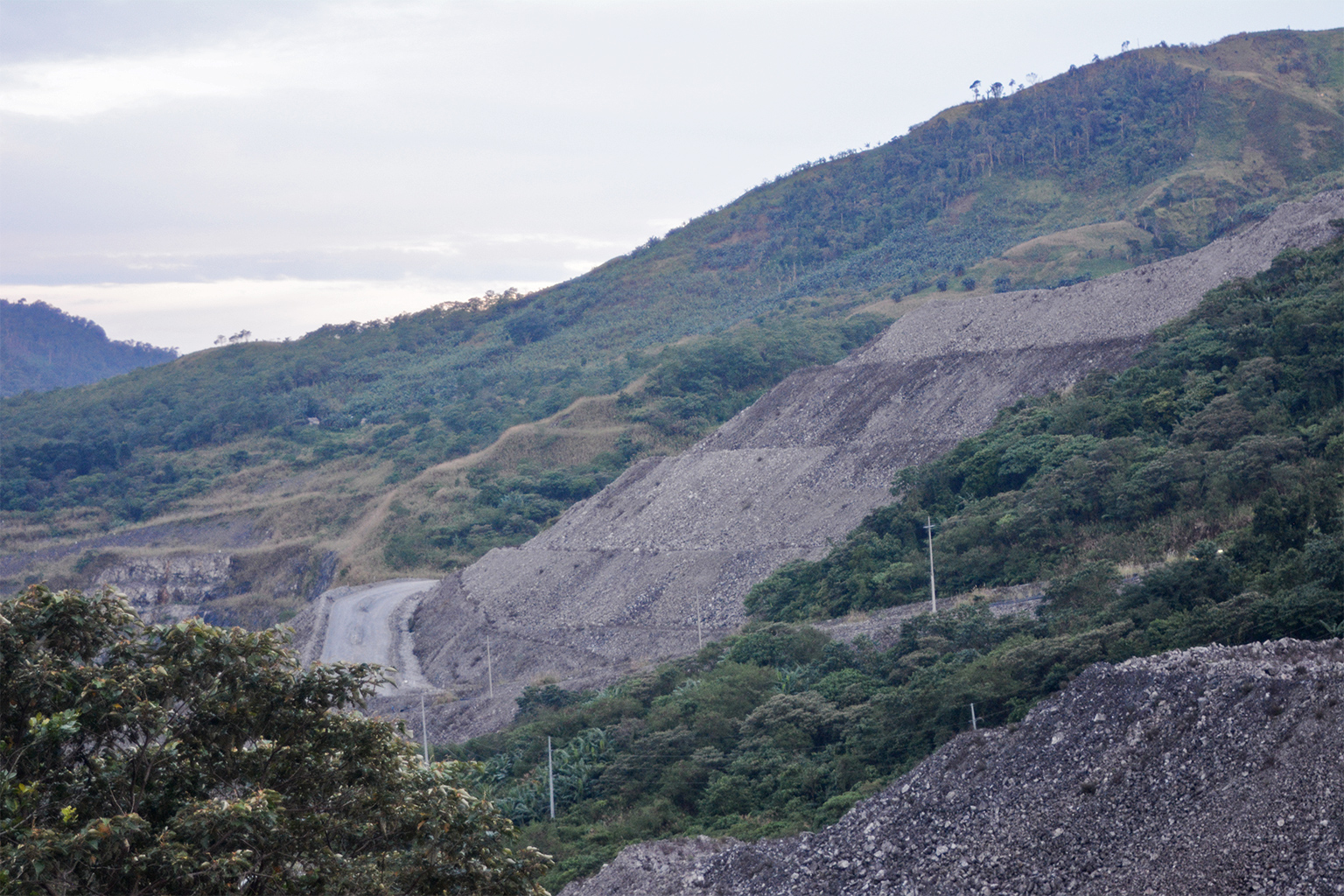
At a remote village home to the Obo Monuvu Indigenous people, called Manobo by lowlanders, illegal small-scale gold mining has left its mark, nearly a year after the mine was shut down by the authorities.

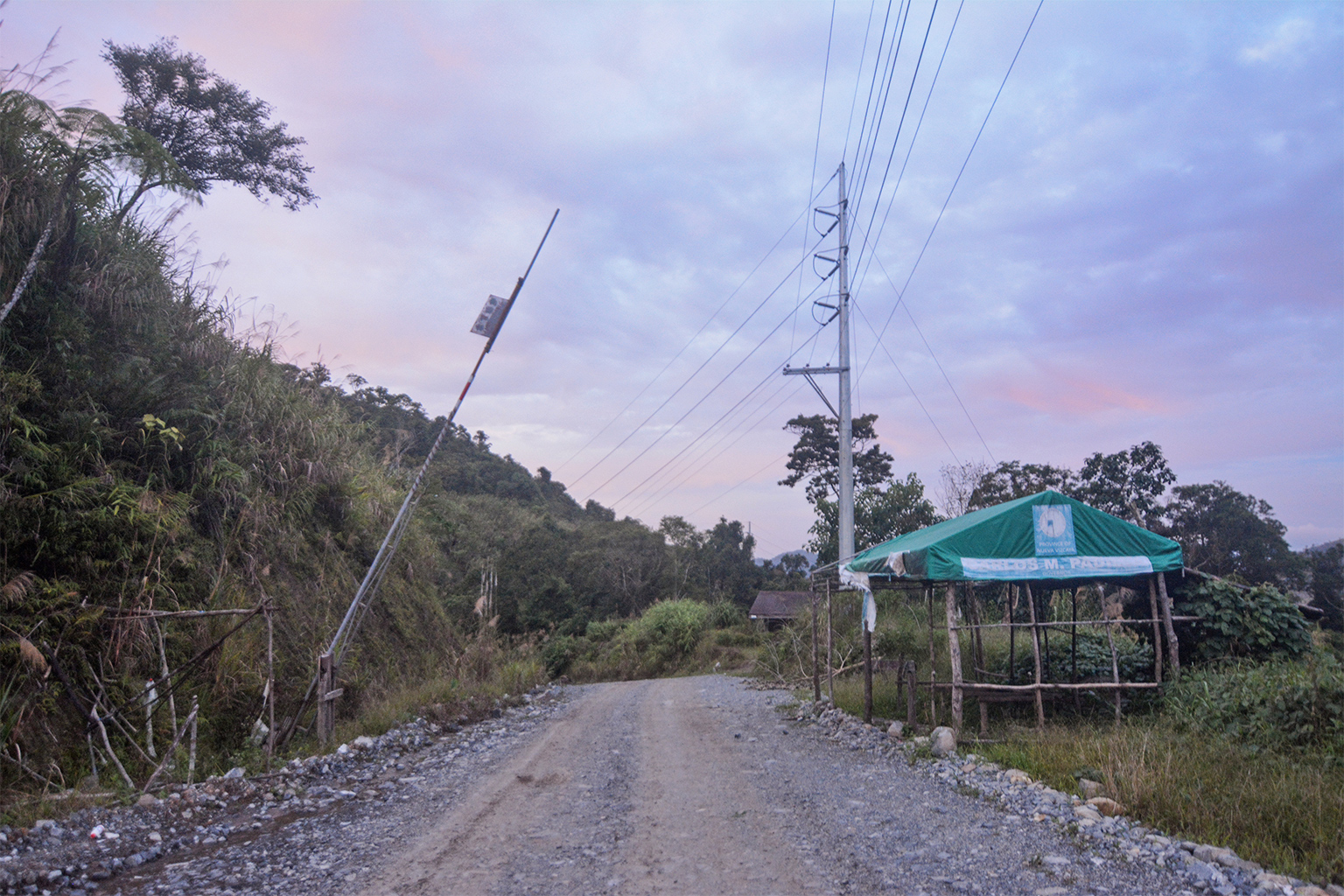
Mongabay tracked the mining tunnel deep in the forest of Magpet township in the province of North Cotabato with the help of tribal guides. Sacks of ore were piled up at the mouth of the tunnel, just beside a river and boarded up with wood.

“The operator did not seek permission from the tribal council to mine the area. They conducted their operations during the nighttime,” tribal chieftain Joel Buntal told Mongabay.

The illegal operation reached the attention of the Philippine environment secretary, Roy Cimatu, who in December 2020 ordered its closure following a raid in the area as a result of a tipoff.

“Whether big or small, any illegal mining activity will have to stop,” Cimatu said in a statement at the time.

The raiding team, led by officials from the Mines and Geosciences Bureau (MGB), an agency under Cimatu’s Department of Environment and Natural Resources (DENR), discovered a tunnel running 5 meters (16 feet), indicating that the mining operation was still in its early stage.

Inside the tunnel were around 25 sacks, each containing approximately 90 kilograms (200 pounds) of ore, the MGB reported, adding that the illegal mining operation used manual tools and not heavy mining equipment.

There was no ongoing mining activity at the time of the raid, but signs of recent extraction were observed, it noted.

The mining activity was not within a declared Minahang Bayan or “people’s mining site,” hence the operation was illegal, the MGB said. There are around 40 such sitesthroughout the Philippines, where small-scale miners are legally allowed to operate within DENR guidelines.

In March this year, three months after the tunnel in Magpet was locked off, the MGB issued a cease-and-desist order against the illegal miners, who will face charges for violating mining laws.

Mt. Apo’s distinctive peaks, viewed from a campsite at Lake Venado. The Mt. Apo protected area is a major ecotourism site. Image by Long Hudson via Wikimedia (CC BY-SA 4.0).

The illegal mining site was within the ancestral domain of the Manobo and within the Mt. Apo protected area. It’s also part of a declared Indigenous Community Conserved Area (ICCA), Buntal said.

Buntal’s tribe declared part of their ancestral domain as an ICCA to assert their land rights and protect the important cultural and biological sites in their dominion, which houses not only their sacred grounds, such as their ancestors’ graves, but also serves as a habitat of diverse wildlife, including the rare and critically endangered Philippine eagle (Pithecophaga jefferyi).

An estimated 85% of the country’s key biodiversity areas (KBAs), or sites of high global biodiversity conservation importance, fall within the ancestral lands of Indigenous peoples, including the Manobo.

Manobo tribal leaders formed an association to push biodiversity protection. Out of the tribe’s 28,220 hectares (69,733 acres) of ancestral land within and near Mt. Apo, they set aside at least 5,000 hectares (12,400 acres) of richly forested land as an ICCA, or what they call a biodiversity corridor.

A bill has been filed in the Philippine Congress seeking the recognition of Indigenous people-led ICCA sites. At least 10 areas across the country have been identified as focus areas due to their rich biodiversity.

Although the Manobo’s ICCA declaration is not yet formally recognized by the government, they, like all Indigenous groups in the country, are legally entitled to the final say about the entry of development projects in their ancestral domain, through the process of free, prior and informed consent (FPIC).

In Magpet, there was a formal attempt in the 1990s to prospect for minerals, including gold, silver and copper, which was denied due to noncompliance with requirements, according to data from the MGB.

Government estimates place the value of the country’s untapped mineral deposits, including gold, to be at least $1 trillion.

Buntal said he recalled a mining company approaching his tribe for a potential open-pit mining operation on their ancestral land decades ago. But the tribe refused, saying the forest and its watershed are the community’s lifeline and livelihood. “We will not allow open-pit mining method in our ancestral domain. It will destroy our environment. The watershed will be devastated,” Buntal said.

Children at play near Mt. Apo in the southern Philippine island of Mindanao. The mountain is sacred to local Indigenous people and a haven for biodiversity. Image by Bong Sarmiento for Mongabay.

The artisanal small-scale gold mining industry employs some 300,000 to 500,000 miners in at least 30 provinces across the Philippines, according to an industry report. This includes children, as in the case of the illegal mine on the Manobo ancestral land.

Mongabay spoke to one of the child laborers, who said he typically carried four sacks of ore per day from the tunnel to a waiting truck, passing through a river several times and navigating steep and slippery slopes.

Each sack transported by foot weighs about 10 kg (22 lb), and at 5 pesos per kilo in pay, each child could earn 200 pesos (about $4) per day.

But they weren’t paid for their labor, which led them to complain to authorities, which in turn prompted the exposure of the illegal operation, said Benjamin Bugcal, a tribal council member. He added that ore was transported by truck to another part of Mindanao for processing.

Era España, another Manobo leader and former commissioner of the National Commission on Indigenous Peoples (NCIP), said there have been other illegal small-scale mining operations in the past that encroached on ancestral lands at the foot of Mt. Apo.

These operations existed “because the tribe allowed them,” she said, even without going through the legal process.

España said that all investments within ancestral lands in the Mt. Apo protected area and its buffer zones should undergo the FPIC process, in which the tribe is given the opportunity to consent to development projects on tribal domains. Businesses that obtain an FPIC from the tribe can then get a certificate of precondition from the NCIP.

España said these development projects on ancestral lands can provide benefits such as jobs and revenue for the community, but can also cause divisions among the tribe, affecting community relations and Indigenous governance systems.

In addition to illegal mining, the ancestral lands of the Manobo around Mt. Apo is threatened by banana plantation cultivated by non-tribal members, España said.

In these cases,  Buntal, the tribal chieftain, said the plantations are allowed to operate because tribal members give their consent through agreements with individual businesspeople, for payments of at least 100,000 pesos (about $2,000) per hectare for five years.

*

Note to readers: Please click the share buttons above or below. Follow us on Instagram, @crg_globalresearch. Forward this article to your email lists. Crosspost on your blog site, internet forums. etc.

Featured image: The entrance to an illegal gold mine, by Bong S. Sarmiento for Mongabay.

Political Dynasties Fight to Run the Philippines

December 1st, 2021 by Jason Castaneda

All Global Research articles can be read in 51 languages by activating the “Translate Website” drop down menu on the top banner of our home page (Desktop version).

To receive Global Research’s Daily Newsletter (selected articles), click here.

Visit and follow us on Instagram at @crg_globalresearch.

***


Over the past month, the “UniTeam” of ex-dictator’s son Ferdinand “Bongbong” Marcos Jr and presidential daughter and former Davao City Mayor Sara Duterte has rapidly emerged as a formidable tandem ahead of next year’s Philippine elections.

Having convinced Sara Duterte, a top potential rival, to instead become his vice-presidential running mate, Marcos Jr has emerged as the clear frontrunner to succeed President Rodrigo Duterte next year.

The latest surveys show that Marcos Jr is the preferred candidate of almost half of the total prospective voters (47%), with Vice-President Leni Robredo a distant second (18%).

Having lost the vice-presidential race by razor-thin margins in 2016 to Robredo, de facto liberal opposition leader Marcos Jr has wasted no time in consolidating a nationwide network of support.

Among his backers are former presidents Joseph “Erap” Estrada and Gloria Macapagal Arroyo. A growing number of local government leaders and warlords across the country are also throwing their support behind Marcos Jr’s presidential bid.

But the only son of the former Filipino dictator could soon face a major hurdle in his plans to return the Marcos name to Malacanang. The incumbent, who preferred his own daughter to run for the presidency instead, is widely expected to rally behind the charismatic Mayor of Manila Francisco “Isko” Moreno, who is now third in most recent surveys.

Adding to Marcos Jr’s electoral headaches are multiple petitions calling for his disqualification based on an old conviction for tax evasion. The Commission on Elections (COMELEC), which is packed with Duterte appointees, has yet to decide on the fate of Marcos Jr’s candidacy, which has the shadow of potential disqualification hanging over it.

For several quarters, Sara Duterte was the leading candidate in multiple presidential surveys. But the Marcoses, in tandem with Arroyo, managed to convince her to abandon the race and join forces with them instead.

The upshot is a Marcos-Duterte-Arroyo-Estrada “grand coalition,” which extends from the “Solid North” base of the Marcoses in the Ilocos region on Luzon island to the “Solid South” base of the Dutertes on Mindanao island.

The emerging coalition is now composed of major national and regional parties, including Marcos Jr’s Partido Federal ng Pilipinas (PFP), Duterte’s Hugpong ng Pagbabago (HNP), Arroyo’s Lakas-Christian Muslim Democrats (Lakas-CMD) and the Partido ng Masang Pilipino (PMP) of former President Estrada.

With practically all of them facing charges of corruption and abuses of power, the Marcos-led coalition has been decried as a menacing “cartel,” which is intent on dominating Philippine state institutions.

Analysts believe that should the ‘grand coalition’ emerge victorious in next year’s elections, they will likely overhaul the country’s constitution in favor of a federal-parliamentary system, making it much easier for dominant political dynasties to perpetuate themselves in power.

What stands in the way of the cartel’s plan, however, is the outgoing Filipino president, who has lambasted the Marcoses for allegedly bullying his daughter to drop out of the presidential race.

Over the past few weeks, Duterte has openly attacked Marcos Jr, a supposed ally, as “pro-communist” and a “weak leader.” On multiple occasions, the Filipino president raised the stakes by implying that Marcos Jr is a cocaine addict who should be disqualified from running for the presidency.

In order to thwart a Marcos presidency, Duterte instead pushed for his long-time aide, Senator Christopher “Bong” Go, to succeed him next year. Lacking charisma and his own independent base, Go has struggled to make an impression on voters. A laggard in various surveys, Go has indicated he would withdraw from the race.

President Rodrigo Duterte, left, with personal assistant Christopher Lawrence ‘Bong’ Go. Photo: Philippine Government

“My love for him is more than the love for a father. He is old and he has given a lot to the country. So I don’t want to add to his problems. I remain loyal to him and I promised to be with him for life,” Go told the media on the sidelines of a public event this week, spinning his expected withdrawal as a “supreme sacrifice” with due consideration for his aging patron.

Seeking “forgiveness” from his own supporters, Go admitted: “I was not ready for this … Perhaps it’s not yet my time to be president.”

With Go out of the race, the focus has rapidly shifted to Manila Mayor Isko Moreno, who has long been rumored to be Duterte’s “Manchurian candidate.”

Back in October, Isko flatly dismissed as “fake news” reports that he was the real candidate of the administration, with Go simply serving as a decoy. Yet the Manila mayor began to rely on a growing number of Duterte administration stalwarts, including Lito Banayo (campaign manager) and Vince Dizon (deputy campaign manager), who began to tweak Isko Moreno’s earlier more progressive language on major issues.

In recent weeks, Moreno has largely refrained from criticizing the incumbent, despite presenting himself as a potential opposition candidate earlier this year.

Having opposed extrajudicial killings in the past, the Manila mayor began to curry favor with Duterte, who faces potential charges by the International Criminal Court (ICC) over his deadly drug war, which has claimed tens of thousands of lives in the past five years.

When asked about the ICC investigations, Isko Moreno parroted the Duterte administration’s line by arguing “we have existing, effective, at gumaganang (working) justice system.”

Like Duterte, he also began criticizing the international body, which recently decided to defer any further probe after a request by the Philippine government to investigate matters through domestic courts.

The Manila mayor also promised to continue Duterte’s drug war, albeit promising to uphold human rights.

In the past week, Moreno also started attracting support from other top Duterte allies, who are opposed to the Marcoses. Among them was Taguig City Mayor Lino Cayetano, the brother of former Speaker of the House and Duterte’s vice-presidential mate Alan Peter Cayetano, who has praised Moreno as the next potential Duterte.

I love our president. I supported our president, but I saw in mayor Isko Moreno what I saw in mayor Duterte – fearlessness,” Cayetano said, indicating growing support for the Manila mayor among key Duterte allies.

“Just on the first day, the way he cleaned up Manila’s streets, how he caught criminals, how he helped businessmen, vendors. You see how fast he took action?” he added, raising the prospect of a well-oiled Cayetano-Duterte alliance behind the presidential candidate.

Following Go’s announcement of his withdrawal from the presidential race, which is yet to be formalized, Moreno was quick to present himself as the potential candidate of the administration.

“If they endorse me, thank you. Thank you in advance, but I will not preempt them until they say so. For the meantime, I am always hopeful,” a gleeful Moreno said, now anticipating massive backing from the incumbent, who seems determined to either prevent the Marcoses from succeeding him or to drive a hard bargain with his dynastic rival.

“I will wait for them to choose me. For the meantime, while I am expecting help, I will keep reaching out. While reaching out, I am learning a lot,” the Manila mayor added.

For progressive statesmen, however, this is all part of a cynical ploy and set of ongoing negotiations between the Duterte and Marcos dynasties in anticipation of major changes next year.

Progressive senatorial candidate Neri Colmenares lambasted the Go withdrawal maneuver as “a desperate Machiavellian attempt to salvage the crumbling Duterte-Marcos alliance.”

“May this serve as a warning to all politicians who will seek anointment from the president and his family in 2022,” he said.

House Deputy Minority Leader Representative Carlos Isagani Zarate dismissed the latest developments as part of Duerte’s “political playbook,” whereby Moreno is “just a pawn used as leverage to gain concessions” from the Marcos camp.

“[Duterte is seeking] protection when [his] term ends … especially now that he is already considered a lame-duck president,” Zarate said, arguing Go’s “withdrawal will possibly benefit and consolidate further the Marcos and Duterte alliance” following behind-the-scenes negotiations over the spoils of war next year.

*

Note to readers: Please click the share buttons above or below. Follow us on Instagram, @crg_globalresearch. Forward this article to your email lists. Crosspost on your blog site, internet forums. etc.

Featured image: Frontrunner Ferdinand ‘Bongbong’ Marcos Jr with his sister Maria Josefa Imelda ‘Imee’ Marcos in a file photo. Photo: WikiCommons

All Global Research articles can be read in 51 languages by activating the “Translate Website” drop down menu on the top banner of our home page (Desktop version).

To receive Global Research’s Daily Newsletter (selected articles), click here.

Visit and follow us on Instagram at @crg_globalresearch.

***

During the past week, Honiara, the capital of the South Pacific country of the Solomon Islands, has been rocked by thousands of people rioting. For days, crowds of protesters flocked to the National Assembly and demanded the resignation of Prime Minister Manasseh Sogavare. They also failed to burn the Parliament building but succeeded in setting the Prime Minister’s residence on fire. Simultaneously, riots began to unfold in the capital and other cities as disgruntled people smashed grocery stores and houses in Honiara’s Chinatown in violence partially motivated by anti-China sentiment.

Sogavare appealed to neighbouring countries for help, with small teams of military personnel and police from Australia, Papua New Guinea and Fiji being immediately dispatched. The total number of peacekeepers is about 200 personnel. Although this may appear to be a small number, it is remembered that the Solomon Islands has a population of only about 690,000 people who are scattered across 300 inhabited islands.

During the riots, three people were killed and more than 100 were arrested. The country’s economy suffered a loss of $227 million, a huge blow when considering their 2020 GDP was only $1.5 billion.

Although the unrest in Honiara has subsided, in parliament, the opposition is preparing to vote against Sogavare’s leadership and force his resignation through no-confidence.

Sogavare’s decision two years ago to establish diplomatic ties with Beijing, and thus sever ties with Taipei, has been a focal point of criticism against his leadership. During the rioting, a delegation from the most populous island of Malaita arrived in Honiara, which is located on the island of Guadalcanal, and expressed displeasure with the diplomatic decision.

For a long time, there were problems between Malaita Island and the central government, particularly over issues in the mining and logging sectors as they have created problems for local businesses. Malaita islanders felt that their interests were not fully accounted for by policymakers in Honiara. These issues also emerged more strongly in the context of the economic crisis that arose in the country due to the COVID-19 pandemic. The archipelago has been closed for nearly two years, meaning that foreign tourists and businesspeople do not visit, contributing to economic stagnation.

At the start of the riots, Sogavare blamed foreign interference over his government’s decision to switch alliances from Taiwan to Beijing for the anti-government protests, arson and looting. However, it is difficult to believe that the mostly subsistence agricultural people of Malaita are so politically savvy that they would rather maintain diplomatic relations with Taipei instead of Beijing. This is especially the case when the whole world, with the exception of 14 small United Nation member states, all adhere to the “One China” principle and maintain diplomatic relations with Beijing and not Taipei.

It could be suggested that the political and economic elite of Malaita were coerced to protest against China. With this in mind, it is certainly possible that Australia, receiving instructions from Washington, is trying to weaken the Beijing-friendly government in Honiara to wane China’s positions in the South Pacific Ocean. When considering anti-China alliances like QUAD (US, Australia, India and Japan) and AUKUS (US, Australia and the United Kingdom), the emergence of anti-China riots in Honiara is unsurprising, especially as these two Washington-led blocs were established for the sole purpose of opposing and challenging Beijing across the Indo-Pacific region.

As the Solomon Islands falls under Australia’s so-called area of responsibility in Washington’s world vision, Australian military personnel and police were the first to arrive to restore order. Despite Malaitan’s leading the protest against the government and Beijing, Malaita’s Premier, Daniel Suidani, accused the Australian government of “holding up a corrupt leadership” by sending in reinforcements to help the Royal Solomon Islands Police Force respond to the riots.

China has officially expressed concern about rioting in the Solomon Islands and reminded that the “One China” principle cannot be violated. However, the confrontation between the opposition and the Sogavare administration will continue. Although Australia is maintaining the status quo in the Solomon Islands, it has demonstrated how easily it can land troops in the country with impunity, a likely message towards Beijing. It is also likely that Australia, on orders from Washington, will use its resources to ensure that an anti-Beijing government returns to power. In this context, the internal political turmoil in the Solomon Islands will continue until at least 2023 when the next general election will be held.

*

Note to readers: Please click the share buttons above or below. Follow us on Instagram, @crg_globalresearch. Forward this article to your email lists. Crosspost on your blog site, internet forums. etc.

Paul Antonopoulos is an independent geopolitical analyst.

Off to the Solomon Islands: Australia’s Civilizers Get Busy

November 26th, 2021 by Dr. Binoy Kampmark

All Global Research articles can be read in 51 languages by activating the “Translate Website” drop down menu on the top banner of our home page (Desktop version).

To receive Global Research’s Daily Newsletter (selected articles), click here.

Visit and follow us on Instagram at @crg_globalresearch.

***

A small riot.  Unrest.  Risk of collapse.  All given a ballooning effect and inflated for policy makers across the ocean.  Before much time elapses, Australian security forces are skirting off to restore order in their vast watery neighbourhood.  It is a reminder that such relations in the Pacific region are a mixture of intervention, forcible charitable guidance and, at times, plain scolding. 

In the Solomon Islands, Australian interventionism was originally cloaked in shining dress, justified as humanitarian and utterly noble.  By the time some 2,000 troops, police officers and support personnel, mostly Australian, were deployed in 2003, the country had already mounted regional interventions in Bougainville in Papua New Guinea (1997) and East Timor, the latter as part of a UN-mandated mission.

The Regional Assistance Mission to Solomon Islands (RAMSI) was given a rhetorical flourish of preventing a “failed state” while easing Australian anxieties in a region marked by a supposed “arc of instability”.  In a conscious nod to making sure the mission would be seen benevolently, the PR pen pushers came up with the pidgin named Operation Helpem Fren.

At the time, Prime Minister Allan Kemakeza had to address certain concerns: Would his country simply become yet another staging post for other powers, or, worse, slide into the role of Australian puppet state?  “This country belongs to all of us,” he promised.  “It’s our country.”  This was only after a fashion.  The RAMSI mission only concluded in 2017 but it came with a new security treaty signed between Canberra and Honiara permitting the easy deployment of Australian force, defence and civilian personnel in the event of a national emergency.

In an environment psychically shaped by the collapse of the Twin Towers in New York on September 11, 2001 and the grotesquely named “Global War on Terror”, Australian policy makers came to see terrorism everywhere and unstable, indigent states as incubators for the next enterprising bomb maker.  This was the kind of torturous, and quite frankly criminal reasoning, that had justified the fictional links between Saddam Hussein and al-Qaeda.

The new breed of Pacific Islander terrorists were reasoned like the Reds of Old, only these might be lurking behind coconut trees with heavy weaponry or found laundering money.  In the case of the Solomons Islands, such outfits as the Guadalcanal Liberation Army and the Malaita Eagle Force fit the bill, even if that fit was forced and awkward.    “We know that a failed state in our region, on our doorstep,” warned Australian Prime Minister John Howard in an address to the Sydney Institute in July 2003, “will jeopardise our own security.  The best thing we can do is to take remedial action and take it now”.

But it was not always so.  In January 2003, the Australian Foreign Minister Alexander Downer, at a rare lucid moment, stated that, “Sending in Australian troops to occupy the Solomon Islands would be folly in the extreme.”  The Australian taxpayer would be unconvinced by such need; the exit strategy would be unclear and problematic and, perhaps most tellingly, foreigners did “not have the answers for the deep-seated problems affecting the Solomon Islands.”

Within a matter of months, Australia found itself in an illegal assault led by the United States on Iraqi sovereignty and jauntily committing troops to the islands.  Howard flew into Honiara to boast that Australian forces had secured the surrender of Harold Keke, who had been given the elevated historical standing of a warlord, and the netting of 3,000 weapons as part of an amnesty.  He stressed all those characteristics all architects of empire should keep in mind: rebuilding the local police forces; “attack” corruption; improve living standards; and prosecute criminal, destabilising elements – according to the rule of law, naturally.

This month, the political classes in Canberra were again wondering what to do with the Solomon Islands.  Protests calling for the resignation of Prime Minister Manasseh Sogavare had led to civil unrest in the nation’s capital. A police station and building within the parliamentary compound were set ablaze; instances of looting and property damage were reported.  Schools were closed.  Again, the divide between poorer Malaita and wealthier Guadalcanal, was spoken of.  Again, the politics of the provinces were being stirred by the politics of the central government in Honiara.

In this case, there was an added dimension.  The Solomon Islands had made a decision in 2019 to cease recognising Taiwan and switch its allegiance to Beijing.  The Premier of Malaita Province, Daniel Suidani, had been unimpressed with the decision taken by the national government.  An unsettled Sogavare, wishing to shore up his own sinking position, put in the call for Australian assistance.

Australian Prime Minister Scott Morrison was not wasting any time in citing the security treaty to deploy Australian Defence Force and Australian Federal Police personnel. “We have been watching the ongoing protests in Honiara with concern,” he stated in a press release. “We continue to call for calm, for an end to further violence and emphasise the importance of resolving tensions peacefully.” At a press conference on November 25, Morrison rather unpersuasively declared that it was “not the Australian Government’s intention in any way to intervene in the internal affairs of the Solomon Islands”.  The Australian presence did “not indicate any position on the internal issues” of the country.

In such interventions, complex local factors behind agitation and unrest tend to be ignored as too complex for the briefing rooms in Pacific capitals and Canberra.  The obsession with security rather than dealing with specifically local issues, such as lack of opportunity, inequality and various local grievances, encourage the use of the police baton or the military rifle.  Generalisations become the norm, and, as Aiden Craney points out, propel narratives about the area being an “arc of instability”.

Some digging is required before coming to a franker overview of such instances of meddling.  Joanne Wallis, writing in 2015, simply takes it as fact that Australia, “the resident superpower in the South Pacific”, and also allied to the United States (its “closest ally”) has been given the role of responsibility “for the South Pacific.”

In such attitudes civilization’s burdens are borne with Kiplingesque gravity, even if given the gilding of security.  Rudyard Kipling’s “The White Man’s Burden: The United States and The Philippine Islands” (1899) was yet another urging in the imperial argot, this time to the United States, to assume burdens and responsibilities in the Pacific.  Theodore Roosevelt, ever supping from the cup of imperial sentiment, was unimpressed by the language but entirely convinced by the purpose.  In copying the poem to his friend Senator Henry Cabot Lodge, he remarked that it was all “rather poor poetry, but good sense from the expansion point of view.”

Responsibility has often meant sticking your nose in the affairs of those swarthy barbarians whose understanding of civic institutions might be a bit sketchy.  It’s all done because they hardly know any better, and you have the self-interested answers in making sure such people are sorted.  “Australia,” writes Wallis, “has been expected to maintain regional political, social and economic order, and ensure that no hostile power establishes a strategic foothold in the region from which to attack Australia and threaten allied access to air and sea lines of communication.”  That’s more like it: an honest statement of vulgar realpolitik.

*

Note to readers: Please click the share buttons above or below. Follow us on Instagram, @crg_globalresearch. Forward this article to your email lists. Crosspost on your blog site, internet forums. etc.

Dr. Binoy Kampmark was a Commonwealth Scholar at Selwyn College, Cambridge.  He lectures at RMIT University, Melbourne.  He is a frequent contributor to Global Research and Asia-Pacific Research. Email: [email protected]

All Global Research articles can be read in 51 languages by activating the “Translate Website” drop down menu on the top banner of our home page (Desktop version).

To receive Global Research’s Daily Newsletter (selected articles), click here.

Visit and follow us on Instagram at @crg_globalresearch.

***


Reuters has been caught publishing photos depicting Thai protests that are confirmed to have been staged.

On Sunday November 14, 2021 after a pivotal Thai Constitutional Court ruling found US-backed protest leaders were pursuing a campaign of sedition rather than reform, a “large” protest was called.

The protest failed to attract even 1,000 people in the Thai capital of Bangkok – a city of over 10 million people. In order to attract attention and make headlines internationally protesters engaged in violence with the police, throwing deadly explosives at retreating officers who responded with rubber bullets.

Several protesters were injured in the short exchange before police officers disappeared behind the gates of a police hospital compound. It was then that Reuters and other media organizations surrounded a group of protest “guards” who were laying on the ground pretending to take cover from “gunfire” that was not taking place.

Among those publishing images of this staged scene later in the week was “Pulitzer Prize winner” Reuters photographer Soe Zeya Tun.

In the published Reuters photo it is clear that others – who would clearly be in the line-of-fire were police still shooting – are standing casually. Video footage of the scene makes it even clearer the scene was completely staged.

Soe Zeya Tun and Reuters have refused to respond to widespread criticism for using images of a staged event to depict actual events unfolding in Thailand. As of the time of publishing, the pictures have not been retracted.

*

Note to readers: Please click the share buttons above or below. Follow us on Instagram, @crg_globalresearch. Forward this article to your email lists. Crosspost on your blog site, internet forums. etc.

The Taiwan Foreign Policy Fetish

November 25th, 2021 by Dr. Binoy Kampmark

All Global Research articles can be read in 51 languages by activating the “Translate Website” drop down menu on the top banner of our home page (Desktop version).

To receive Global Research’s Daily Newsletter (selected articles), click here.

Visit and follow us on Instagram at @crg_globalresearch.

***

Australian foreign policy towards Taiwan, as things stand, is a distant fantasy in floating mist.  There is little to connect them, but Australia’s political classes have a habit of fabricating relations with those it cares little for, nor understands, all in the name of forced obedience.  For decades, a puppy loyal Australia has committed forces without condition or qualification, refusing to understand the circumstances of their deployment, or the people who they will either kill or die for.  The result is an astonishing global deployment of personnel with admirable ignorance to theatres most of its citizens would fail to name.

The recent Taiwan fetish risks continuing this trend.  Australia’s Defence Minister, Peter Dutton, is a figure who has fallen head over heels with the latest, potential casus belli. Known by the late and very mischievous Bob Ellis as the simian sadist, Dutton is adamant that Australia will find itself at war over a bit of real estate whose history he has no knowledge of.  “It would be inconceivable that we wouldn’t support the US in an action if the US chose to take that action,” Dutton recently told The Australian.  “And again, I think we should be very frank and honest about that, look at all the facts and circumstances without pre-committing, and maybe there are circumstances where we wouldn’t take up that option, (but) I can’t conceive of those circumstances.”

In saying that it would be “inconceivable” that Australia would not find itself at war with the United States over Taiwan, the unimaginative, already pre-committed Dutton received the attention of China’s Foreign Affairs spokesman Zhao Lijian, who called his comments “extremely absurd and irresponsible”, the mark of someone “obsessed with the Cold War mentality and ideological prejudices.”

Dutton’s execrable chest thumping was inspired by typically vague remarks from Australia’s paternal ally, who had recently promised, along with the United Kingdom, submarines with nuclear propulsion as part of the new AUKUS security agreement.  US Secretary of State Antony Blinken, speaking at a New York Times forum earlier this month, was pressed, as previous occupants of his office have, on whether Washington would defend Taiwan in the event of a conflict.

Blinken’s response had a bit of everything: dovish caution, chicken hawk pretence, hypocritical babble.  The Taiwan Relations Act of 1979, which obligates the US to supply Taipei military equipment for reasons of self-defence but leaves the issue of a firm security commitment open, shaped his initial remarks.  Making sure Taiwan had “the means to defend itself” was “the best deterrent against any very, very, very unfortunate action that might be contemplated by China.”

This did not prevent the United States from lending a hand to “sure that we preserve peace and stability in that part of the world”.  A “unilateral action to use force” by any power would constitute a threat to that peace and security and, in that event, “many countries, both in the region and beyond … would take action in the event that happens.”  US intervention would take place to defend that “international rules-based order” developed by Washington against those who dared challenge it, “whether it’s China or anyone else”.

In her November 23 speech to the National Security College at the Australian National University outlining the purpose of Australia’s foreign policy, Opposition front bencher Senator Penny Wong gave few surprises.  As is often the case with the Australian Labor Party when suffering in opposition, painful, even constipated caution, is preferred over clarity and conviction.  “We must expand the choices and options available to us, to enable management of differences without escalation of conflict.”

But Wong did, at the very least, venture towards some sane ground in taking issue with Dutton’s assertion that Australia would “join” a war over Taiwan with Washington with no conditions.  This was “wildly out of step with the strategy long adopted by Australia and our principle ally.”  While Prime Minister Scott Morrison had avoided “the same febrile language” as his defence minister, Dutton was “amping up war, rather than working to maintain longstanding policy to preserve the status quo – as advocated by the Taiwanese leader, Tsai-Ing Wen.”

Dutton, simmering and seething such observations, sallied with a rebuttal, encouraging all who cared to hear him that China-the-regional-monster was the problem, rather than his own particular lust for war. “The Chinese Communist Party has a presence in 20 different locations in the South China Sea,” he stated.  There were “butting up against the Japanese shipping vessels in the East China Sea”.  The international rule of law, Dutton proclaimed, “should prevail and people, including our country and every other country, should adhere to that law.”

Wong had been, according to Dutton, “irresponsible” and suggested that the Labor Party was “walking away” from the AUKUS security arrangement.  The glue binding the three states, madly made and foolishly sought, has certainly increased the likelihood of Australian participation in any conflict with Chinese forces in the event the US are involved.  The submarine promise is merely a sentimental, spectral hook.

Officials in Beijing have every reason to scoff at invocations of international law and its sacred bonds, especially when they come from a minister who shows no evidence of reading, let alone awareness, in the field.  Australia has had, over the years, a rich history of reading international law the way any enterprising gangster and rule-breaker might wish to do.  Bugging diplomats and representatives of a friendly, impoverished nation under false pretences for economic gain (East Timor); invading a country (Iraq) without any security justification in a crime against peace; and indefinitely locking up asylum seekers and refugees who arrive by boat, are all proud instances of how Australia, and the likes of Dutton, observe and disparage the ius gentium.

In this, the Taiwan fetish becomes a Cold War iteration in the haunted, twisted imagination of certain policy makers, from the Australian Strategic Policy Institute to the war drummers in the Morrison government.  Nonsense flows easily when abstractions and hypotheticals can be passed around with such ease.  Sweetly and pathetically, Australian politicians are again reminding us that blood lust, especially from those who have the least reason to fight, remains unquenchable.

*

Note to readers: Please click the share buttons above or below. Follow us on Instagram, @crg_globalresearch. Forward this article to your email lists. Crosspost on your blog site, internet forums. etc.

Dr. Binoy Kampmark was a Commonwealth Scholar at Selwyn College, Cambridge.  He lectures at RMIT University, Melbourne.  He is a frequent contributor to Global Research and Asia-Pacific Research. Email: [email protected]

All Global Research articles can be read in 51 languages by activating the “Translate Website” drop down menu on the top banner of our home page (Desktop version).

To receive Global Research’s Daily Newsletter (selected articles), click here.

Visit and follow us on Instagram at @crg_globalresearch.

***

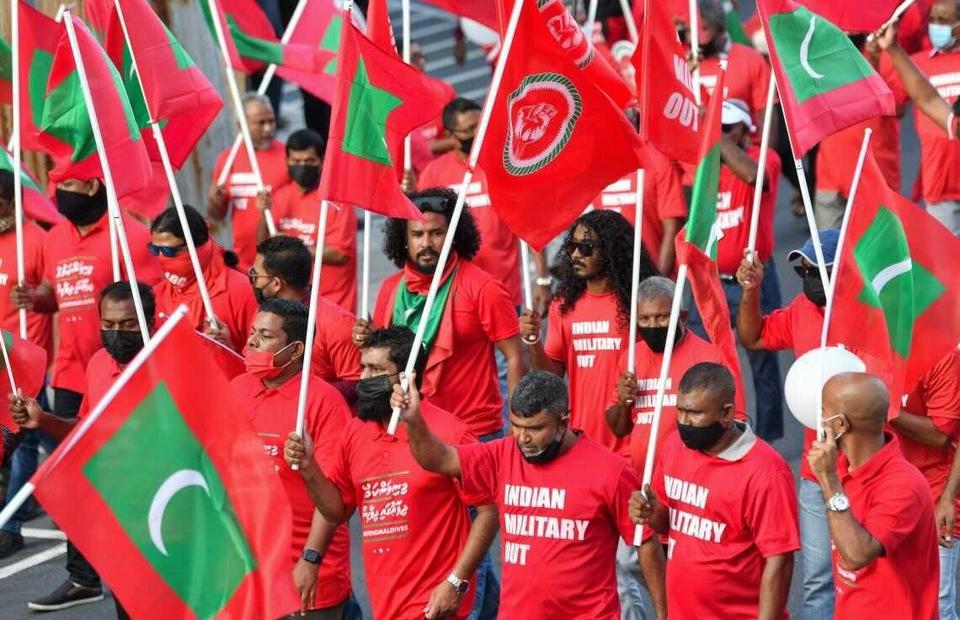
For a few weeks now, hundreds of people in the Maldives have participated  in rallies calling for the expulsion of the Indian military personnel from their tiny island state spread over hundreds of atolls. 

The peaceful demonstrations, which are mostly concentrated in Male, the capital, have been organised by a coalition of opposition parties led by former President Abdulla Yameen, who was jailed in 2019.

Neighbouring India is a close ally of the Maldives, an archipelago of a thousand islands in the Indian Ocean that face an immediate threat from climate change.

“The government has invited this trouble to our shores. We are not against the people of India. Our people just want the Indian military to leave,” says Mohamed Saeed, the deputy leader of the opposition People’s National Congress (PNC).

“We are a very fragile country. We cannot afford to have any military presence of another country here,” he tells TRT World.

The Maldives is one of those key South Asian countries where regional rivals China and India are competing for influence — something that will bear consequences for the wider region, experts say.

The opposition accuses the government of President Ibrahim Solih of signing secret deals with New Delhi that will allow Indian troops to be permanently stationed in the Maldives.

The Maldivian government denies compromising on sovereignty and says security arrangements with India are mostly to carry out search and rescue operations.

“India has always been the Maldives’ closest ally and trusted neighbour, extending constant and consistent support to the people of Maldives on all fronts,” the government said in a recent statement.

“Support provided by India on areas such as search and rescue capabilities, casualty evacuation, coastal surveillance, and maritime reconnaissance, directly benefit the Maldivian people,” it added.

Maldivian Foreign Minister Abdulla Shahid has called the “Indian Military Out” campaign a desperate attempt by the opposition to fulfil a political agenda.

At the centre of the debate is the matter of an India-funded dockyard for the Maldivian coast guard, which is being constructed on the Uthuru Thila Falhu (UTF) atoll, near Male.

A copy of the UTF agreement leaked earlier this year said Indian military personnel will be stationed there and Indian navy vessels will be allowed to use the dockyard for years to come.

Saeed says an important agreement like this, which can impact a country’s forieign relations, should have been debated in the parliament and the details shared with lawmakers.

A Maldives government spokesperson wasn’t immediately available for comment.

What are Indian troops doing in Maldives? 

The presence of Indian military personnel in the Maldives, an issue that the opposition has seized upon to criticise the government, resonates with Maldivians wary of outside interference.

New Delhi had donated two helicopters and a Donier aircraft to Maldives to help with medical evacuations and sea surveillance. Most of the 75 Indian personnel stationed in Maldives at the moment are there to maintain and operate the aircraft.

“The Indian military has been in the Maldives for a long time. There’s nothing new about it. They use the aircraft to airlift sick or injured people from isolated islands,” says David Brewster, an expert on Indo-Pacific maritime affairs at the Australian National University.

“I am sort of surprised that Yameen and his supporters think that this is a bad thing.”

Nevertheless, the persistent pressure mounted by the opposition has put the government in a tight corner. Last week, Defence Minister Mariya Didi had to publicly disclose that Indian troops in the country were unarmed and insist that they posed no danger to its sovereignty.

A tussle of two powers

Former President Yameen, who governed between 2013 and 2018, had fostered close ties with China. He oversaw the inauguration of a 2.1 km-long, four-lane bridge connecting Male with the island of Hulhumale.

That’s the only bridge which connects islands in the archipelago where people otherwise travel on boats between different atolls. Beijing funded the $200 million project.

For years, China had little interest in the small nation of under 500,000 people — Beijing didn’t even have an embassy in Maldives until 2012.

But that changed under Yameen’s government when the two countries signed a free trade agreement (FTA), eliminating tariffs on Maldivian exports of mostly fish, and opened the archipelago to Chinese goods and services.

Maldives, which derives a substantial chunk of its revenue from tourists — many of them Chinese — also became a recipient of Beijing’s investment.

China loaned just over a billion dollars to build the bridge and an airport, among other projects in the Maldives.

But after Solih’s government took charge, it accused Yameen of leaving the country vulnerable to a Chinese debt trap.

A long way to go for India

PNC’s Mohamed Saeed, who was Yameen’s Minister for Economic Development, says concerns around high Chinese debt were unfounded.

“The amount we borrowed from China was more or less the amount of money we borrowed from the Middle East in syndicated loans. We made a policy of tapping every source of affordable financing.”

The scenic Maldives depends on tourism for most of its foreign revenue. But tourism sites are spread across different atolls and a lack of connectivity hampers job creation in the hospitality industry.

Saeed says China’s investment in building the Sinamale bridge — also known as the China-Maldives Friendship Bridge — was meant to address that problem.

While India has tried to take China’s place as the Maldives main financial benefactor, it still has a long way to go.

Protests against Indian military presence in Maldives have spread to other cities.

Protests against Indian military presence in Maldives have spread to other cities. (TRTWorld)

Last year, New Delhi pledged to extend $500 million to Maldives in loans and grants. But only $17 million of that amount has so far been invested, says Saeed, citing government budget documents.

“When we were in power, the opposition MDP was accusing Yameen and our administration of selling 17 islands to China. Today, can they show even a single island that we sold to China?”

The increasing reliance on China for financial support under Yameen happened to the chagrin of India, which had historically played a role in Maldives’ internal affairs.

In 1988 India sent its paratroopers and naval ships to Maldives to aid former President Maumoon Abdul Gayoom, who faced a coup attempt by Sri Lankan Tamil mercenaries.

It’s unlikely that India will risk damaging relations with Male by keeping armed troops in the country for any other purpose than assisting in training and rescue operations.

“Politically, diplomatically and economically — India sees Maldives as a strategic partner,” says Bharath Gopalaswamy, a senior fellow at the New Delhi-based Observer Research Foundation.

“But India is very careful and circumspect when it comes to stationing troops outside its border. At this stage it’s all speculation.”

*

Note to readers: Please click the share buttons above or below. Follow us on Instagram, @crg_globalresearch. Forward this article to your email lists. Crosspost on your blog site, internet forums. etc.

  • Posted in Mobile
  • Comments Off on Why Do Some Maldivians Want the ‘Indian Military Out’?
  • Tags: , ,

Agroecology, Nepal’s Answer to Climate Change

November 24th, 2021 by Zachary Barton

All Global Research articles can be read in 51 languages by activating the “Translate Website” drop down menu on the top banner of our home page (Desktop version).

To receive Global Research’s Daily Newsletter (selected articles), click here.

Visit and follow us on Instagram at @crg_globalresearch.

***


As a farmer and educator living in Nepal, I was not part of the dialogue at the UN climate summit (COP26) that just concluded in Glasgow. None of us here were.

And as world leaders, climate scientists, and corporate lobbyists return to their respective countries from Glasgow, here in the mountains of eastern Nepal I myself wonder what, if anything, they have accomplished in terms of real change. And what the implications will be for ‘the rest of us’.

I wonder if these state bureaucrats and business representatives are the right people to look to for guidance and innovation to address the climate catastrophe. Which voices are clearly represented at the table? And which are conspicuously absent?

The Nepali delegation has already returned home setting itself ambitious targets and timebound pledges to achieve them. Nepalis have to cope with the impact of climate change, for which farmers here were not responsible. Yet, we are asked to implement solutions that, similarly, come from afar.

Agriculture is part of the Himalayan landscape. How we manage land will determine how resilient we can be to climate change.

This is not to say reforestationnet-zero carbon emissions, and providing some level of protection and support for vulnerable populations are not important. In fact, they are precisely what Nepal (and all other countries) should be working towards to minimise the impact of climate change. The real questions are: How? Who should get it done? And on what scale?

Solutions at conferences such as COP26 invariably tend to lean towards high-tech possibilities, international policy agreements, and large-scale restructuring. There is, however, another approach: small-scale, local, and grassroots agriculture.

While local regenerative agriculture is rarely discussed at the high table, such an approach may prove to be much more in line with Nepali culture and economy. A home-grown solution that returns political agency and innovation to local people on the ground.

Almost Heaven Farms permaculture research and development centre.

Healthy soil grows healthy plants which leads to healthy humans and communities. It is the basis of all civilization and life on earth.

Agriculture has become something of a dirty word for climate activists, and with some justification. It is estimated that agriculture accounts for roughly 23% of greenhouse gas emissions worldwide. That makes it comparable to big industry, transportation and electricity production, which means it significantly contributes to climate change.

But not all ‘agriculture’ is equal. Regenerative agriculture has the potential to sequester carbon from the atmosphere and redistribute it to soils where it could have various positive impacts. Unlike many other industries, agriculture has the potential to transition from being a Big Problem to a Big Solution.

How we relate to land today is our most egregious lapse in judgement. Whether it is razing jungles for timber, draining precious wetlands, overfishing sacred waters, or converting grasslands to large-scale, chemical-based agriculture, we seem to have forgotten the most basic natural law: reciprocity. We cannot extract and drill and harvest and mine with no thought of giving back.

Fortunately, there is a way to approach agriculture that maintains a reciprocal relationship with the local ecosystem. Agroecology, to put it simply, is a farming that incorporates the principles of ecology so that agriculture becomes a means of giving back.

A local jungle is a source of natural foods, medicines, fibres and energy sources, but instead of automatically clearing and putting it to the plough, we must recognise that it also cleans and conserves water, soils, regulates temperature, and provides a habitat for other living beings. And, to circle back to climate concerns, importantly, that jungles capture carbon.

Managing land, under the auspices of agroecology, entails revitalising a different kind of relationship with the soil. It starts with understanding the principles of ecology and how nature works. Diversity, recycling, systems thinking, interconnectivity, and that the sun is the ultimate source of energy are just a few.

Almost Heaven Farms is a full-fledged permaculture training and design firm focusing on developing agroecology across Nepal.

An integrated growing system including tea gardens, vegetable production and forest.

What does that look like on a farm? A diversity of plants being grown together in what is known as a polyculture, animals moving across the landscape as happens in nature.

Let’s start with the soil. We put a man on the moon 62 years ago, but we still know nothing about the world below our feet, the soil in which all life comes from. Through over ploughing, mono-cropping and the use of chemical fertilisers we have effectively killed all the life in the soil, from beneficial microbes to worms and all other life which presides there.

In killing the soil, we released massive amounts of carbon into the atmosphere and compromised its ability to capture the carbon back. And in this dead soil, we grow plants which are chronically sick and are not able to ward off pests and disease. Plants are completely dependent on chemicals for their survival. We then eat these sick plants which give us little nutrition, and we become sick ourselves.

So, while others look to the sky for solutions, let us take a glance down at the most important ecosystem of all, the soil below our feet.  If farmers in Nepal can step up and lead the change, the politicians will come stumbling after.

*

Note to readers: Please click the share buttons above or below. Follow us on Instagram, @crg_globalresearch. Forward this article to your email lists. Crosspost on your blog site, internet forums. etc.

Zachary Barton is a permaculture designer, activist and teacher who has been living in Nepal since 2003. He established Almost Heaven Farm in 2013, where he researches, demonstrates and trains local farmers and international visitors in permaculture design, earth-based building and ecological restoration.

Featured image: Agriculture is one of the largest contributors to climate change but can also be one of the most significant solutions. All photos: ZACHARY BARTON

All Global Research articles can be read in 51 languages by activating the “Translate Website” drop down menu on the top banner of our home page (Desktop version).

To receive Global Research’s Daily Newsletter (selected articles), click here.

Visit and follow us on Instagram at @crg_globalresearch.

***

Abstract

This article discusses Japan’s colonization of Korea in the context of world time. Korea was a unique colony as it was one of the last to be colonized in the world. Japanese colonizers pushed a heavy-handed “military policy”, mainly because of the sharp resistance at their accession to power in the period 1905-1910. In 1919 when mass movements swept colonial and semi-colonial countries, including Egypt and Ireland, Koreans too rose up against Japan’s rule. Stung by wide resistance by Koreans in March and April 1919 as well as general foreign reproach, Japanese leaders adopted a “modern” practice by starting the imperial “cultural policy” in mid-1919. The most important consequence of the cultural policy was the integral role Korean industry soon had in linking the metropole with hinterland economies, and it is from this point that we can date Japan’s specific brand of architectonic capitalism that has influenced Northeast Asia down to the present.

*

Several characteristics of Korea’s imperial experience distinguish it from other colonies.1 First, it was “late” in world time. King Leopold of Belgium said in 1866 that “the world is pretty well pillaged already,” marking the violent spread of European colonialism across the globe. Japan’s annexation of Korea was almost half a century later. By that time anti-colonial ideas and movements had spread, particularly in England and the United States; Japan had barely got going with its colonial project when Woodrow Wilson issued his 14 points, calling for self-determination of all nations.

A second characteristic explains why Japan and Korea have a shared modern history so daunting and unnerving, like fingernails being scraped across a blackboard. It is because their relationship is more akin to Germany and France or England and Ireland, than it is to Belgium and Zaire or Portugal and Mozambique. Global colonialism is often thought to have created new nations where none existed before, to draw new boundaries and bring diverse tribes and peoples together, out of a welter of geographic units divided along ethnic, racial, religious or tribal lines. But all of this existed in Korea for centuries before l9l0. Korea had ethnic and linguistic unity and long-recognized national boundaries well before the peoples of Europe attained them. Furthermore, by virtue of their relative proximity to China, Koreans had always felt superior to Japan at best, or equal at worst.

Instead of creation the Japanese engaged in substitution after l9l0: exchanging a Japanese ruling elite for the Korean yangban scholar-officials, most of whom were either co-opted or dismissed; instituting colonial imperative coordination for the old central state administration; exchanging Japanese modern education for the Confucian classics; building Japanese capital and expertise in place of the incipient Korean versions, Japanese talent for Korean talent; eventually even replacing the Korean language with Japanese.

Koreans never thanked the Japanese for these substitutions, did not credit Japan with creations, and instead saw Japan as snatching away the ancien regime, Korea’s sovereignty and independence, its indigenous if incipient modernization, and above all its national dignity. Unlike some other colonial peoples, therefore, most Koreans never saw Japanese rule as anything but illegitimate and humiliating. Furthermore, the very closeness of the two nations–in geography, in common Chinese cultural influences, indeed in levels of development until the late l9th century–made Japanese dominance all the more galling to Koreans, and gave a peculiar intensity to the relationship, a hate/respect dynamic that suggested to Koreans, “there but for accidents of history go we.”

Third, quite apart from the anachronism of colonizing Korea, Japan had crucial great power support, particularly from Pres. Theodore Roosevelt. Japan got the empire the British and Americans wanted it to have, and only sought to organize an exclusive regional sphere when the other powers did the same, after the collapse of the world economy in the 1930s (and even then their attempt was half-hearted, and even then the development program was “orthodoxly western”);2

In the first decade of their rule Japanese colonizers pushed a heavy-handed “military policy” (budan seiji), mainly because of the sharp resistance at their accession to power in the period 1905-1910; even classroom teachers wore uniforms and carried swords. The Government-General stood above Korean society, exercising authoritative and coercive control. Its connections were only to the remnant upper class and colonial parvenus and even these were tenuous, designed to co-opt and thwart dissent, not to give Koreans a meaningful role in the state apparatus. The Japanese unquestionably strengthened central bureaucratic power in Korea, demolishing the old balance and tension with the landed aristocracy; operating from the top down, they effectively penetrated below the county level and into the villages for the first time, and in some ways neither post-colonial Korean state has ever gotten over it: Korea today is still a country with remarkably little local autonomy. Added to the old county-level pivot of central magistrate, local clerks and landed families, was a centrally-controlled, highly mobile national police force, responsive to the center and possessing its own communications and transportation facilities. For decades black-coated policemen kept order and helped “bring in the harvest,” manning the ramparts of the rice production circuit from paddyfield to middleman to storehouse to export platform, and thence to Japan.

In 1919 mass movements swept colonial and semi-colonial countries, including Egypt and Ireland, and Korea was no exception. What made Korea special was the nonviolent nature of the March First Movement, anticipating Gandhi’s tactics in India. Drawing upon Woodrow Wilson’s promises of self-determination, a group of thirty-three intellectuals petitioned for independence from Japan on March 1 and touched off nation-wide mass protests that continued for months. Japanese national and military police could not contain this revolt, and had to call in the army and even the navy. At least half a million Koreans took part in demonstrations in March and April, with disturbances in more than 600 different places. In one of the most notorious episodes, Japanese gendarmes locked protesters inside a church and burned it to the ground. In the end, Japanese officials counted 553 killed and over 12,000 arrested, but Korean nationalist sources put the totals at 7,500 killed and 45,000 arrested.

It is also interesting that Koreans had provided a stark contrast with Japan’s other colony in Taiwan. Even after the rebellion in Korea and the watershed May Fourth Movement in China, an observant American traveler noted that quite a few Taiwanese wore Japanese clothes, whereas “I cannot recall ever having seen a Korean in getas and kimono.” There was a big “independence question” in Korea, he wrote, but “Independence, if it is ever considered at all in Taiwan, is evidently regarded as hopeless, not even worth thinking about.”3 Perhaps the most revealing remark ever made about the differences between colonial Taiwan and colonial Korea was one official’s statement that “what can be done with incentives in Taiwan must be done with coercion in Korea.”4

Stung by Korean resistance, Wilson and Lenin, and general foreign reproach, Japanese leaders suddenly understood that they were colonizers in the wrong century: wanting always to be “modern,” they found their repressive rule condemned as out of date. So mid-1919 marked the start of the imperial “cultural policy” (bunka seiji), of tutoring Koreans toward a distant day of independence. The new policy inaugurated a period of “gradualist” resistance to colonialism, in which Koreans took advantage of relaxed restrictions on their freedom of speech and assembly to organize a variety of nationalist, socialist and communist groups, some openly and some clandestinely. Now Korean newspapers could be bought once again, and many other Korean-language publications appeared in the early 1920s. Writers like Yi Kwang-su became famous for novels in a nationalist vernacular, and others like Chông In-bo and Ch’oe Nam-sôn deepened studies of Korean history, examining the Tan’gun legend and the historical “soul” of Korea.5

American missionaries were divided in their judgement of the March First Movement. All of them were appalled at the violence of the colonial authorities, but many also blamed radicals and agitators for provoking the violence. Most applauded the new “cultural policies” after 1919, and echoed Japanese justifications for the new course. The Resident Bishop of the Methodist Episcopal Church, Herbert Welch, wrote in May 1920 that while many Koreans still demand immediate independence, “some of the most intelligent and far-seeing” Koreans

…are persuaded that there is no hope of speedy independence, and that they must settle down for a long period to build up the Korean people, in physical conditions, in knowledge, in morality, and in the ability to handle government concerns….6

This, of course, was Japanese Premier Hara Kei’s justification for the new “cultural policy,” to prepare Koreans “in due course” (Hara’s words) for a distant day of independence. A colonial administrator, Nitobe Inazö, explained the rationale this way in 1919:

I count myself among the best and truest friends of Koreans. I like them…. I think they are a capable people who can be trained to a large measure of self-government, for which the present is a period of tutelage. Let them study what we are doing in Korea, and this I say not to justify the many mistakes committed by our militaristic administration, nor to boast of some of our achievements. In all humility, but with a firm conviction that Japan is a steward on whom devolves the gigantic task of the uplifting of the Far East, I cannot think that the young Korea is yet capable of governing itself.7

Christian opposition to the Japanese is both a fact and a legend. The churches were sanctuaries in times of violence, like the 1919 independence movement, and many Western missionaries encouraged underdog and egalitarian impulses. But the post-1945 image of Syngman Rhee and other pro-American politicians as great Christian leaders and resistors to colonialism is false:

Men like Syngman Rhee and Kim Kyu-sik went to missionary schools like Pai Chai less for their Christianity than to look for political position through English. Enrollment at Pai Chai decline when English was de-emphasized; in 1905, within a day or two of enrollment, ‘half the school had gone elsewhere in search of English.’

It is the humble among Koreans who have truly been drawn to Christianity: at the turn of the century, “conversions among the 30,000 of Seoul’s outcast butcher class soon became ‘one of the most remarkable features of evangelical efforts.'”8 The hierarchy of Korean society pushed commoners toward the egalitarian ideal of everyone the same before God.

The largest split, however, brought Korea into the mainstream of world history after World War I: it was between liberal idealism and socialism, between Wilson and Lenin. Liberals had the advantage of association with Wilson’s ideals of self-determination, and the disadvantage that the U.S. was not interested in supporting Korean independence; furthermore their social base within Korea was very slim. The socialists had the disadvantage of Japanese police action, which targeted and walked off to jail anyone espousing “Bolshevik” ideas, and the advantage of a potentially large mass base and a spirit of sacrifice on behalf of Korea, so that by the end of the 1920s they were leading the Korean resistance movement. As the leading scholar of Korean communism, Dae-sook Suh, put it, leftists and communists

…succeeded in wresting control of the Korean revolution from the Nationalists; they planted a deep core of Communist influence among the Korean people, particularly the students, youth groups, laborers and peasants. Their fortitude and, at times, obstinate determination to succeed had a profound influence on Korean intellectuals and writers. To the older Koreans, who had groveled so long before seemingly endless foreign suppression, communism seemed a new hope and a magic touch…. For Koreans in general, the sacrifices of the Communists, if not the idea of communism, made strong appeal, far stronger than any occasional bomb- throwing exercise of the Nationalists. The haggard appearance of the Communists suffering from torture, their stern and disciplined attitude toward the common enemy of all Koreans, had a far-reaching effect on people.9

By the same token, the 1930s were much more polarized than the previous decade; Japanese put immense pressure on prominent Koreans to collaborate; the tragedy of Korean collaboration can be seen in a person like Ch’oe Rin, a key leader of the March First Movement, who by 1938 was giving speeches lauding “the Yamato people” and “the eternal, single-family lineage of the [Japanese] Imperial Household,”10 or a great modernizer and nationalist like Yun Ch’i-ho accepting a position in the House of Peers, or the alacrity with which the leaders of business like Kim Sông-su threw their lot in with the big Japanese zaibatsu and profited from the war.

These were people who would have been natural leaders of an independent and self-confident Korea, harbingers of a middle-class revolution. But because of their collaboration (under tremendous Japanese pressure to be sure, but then others continued to resist in spite of that) the Japanese succeeded in compromising the emergence of a modern, liberal elite.

One of the longest-running influences of the March 1 Movement is also the least appreciated. It convinced Japanese leaders to try and co-opt moderate Korean leaders and isolate radical ones. Under the new “cultural policy,” Korean commerce began to grow. One source argued for “a tremendous increase in the number of Korean entrepreneurs,” but by the end of the decade Koreans still held only about three per cent of total paid-up capital. Most Korean capitalists were still wholesalers, brokers and merchants dealing in grain or grain-based liquor transactions, with this activity mushrooming in the new ports.

The most important fruit of the cultural policy for Korean industry was the integral role it soon had in Japan’s “administrative guidance” of the entire Northeast Asian regional economy. Now Korea was to play a part in plans linking the metropole with hinterland economies, and it is from this point that we can date Japan’s specific brand of architectonic capitalism that has influenced Northeast Asia down to the present.11 Stefan Tanaka has argued that as Japan embarked on imperial conquests on the mainland, in the discourse of tōyōshi (Oriental or East Asian history, a kind of nativism) Korea and Manchuria became mere “regions”, often lumped together as as mansen (Manshu and Chosen). If this had primarily a political-economic aspect until the Sino-Japanese War began, this concept soon changed into a “metanational greater regionalism:” for scholars like Hirano Yoshitarō, tōyō could extend beyond the East Asian nation states, but was still to be distinguished from imperialism, where “the mother country is pitted against the colony.”12

Japan is among the very few imperial powers to have located modern heavy industry in its colonies: steel, chemicals, hydroelectric facilities in Korea and Manchuria, and automobile production for a time in the latter. According to Samuel Ho, by the end of the colonial period Taiwan “had an industrial superstructure to provide a strong foundation for future industrialization”: the main industries were hydroelectric, metallurgy (especially aluminum), chemicals, and an advanced transport system. By 1941, factory employment, including mining, stood at 181,000 in Taiwan. Manufacturing grew at an annual average rate of about 8 percent during the 1930s.13

Industrial development was much greater in Korea, perhaps because of the relative failure of agrarian growth compared to Taiwan but certainly because of Korea’s closeness both to Japan and to the Chinese hinterland (see tables 2 and 3). By 1940, 213,000 Koreans were working in industry, excluding miners, and not counting the hundreds of thousands of Koreans who migrated to factory or mine work in Japan proper and in Manchuria. Net value of mining and manufacturing grew by 266 percent between 1929 and 1941.14By 1945 Korea had an industrial infrastructure that, although sharply skewed toward metropolitan interests, was among the best developed in the Third World. Furthermore, both Korea and Taiwan had begun to take on semiperipheral characteristics. Korea’s developing periphery was Manchuria, where it sent workers, merchants, soldiers, and bureaucrats who occupied a middle position between Japanese overlords and Chinese peasants; as Korean rice was shipped to Japan, millet was imported from Manchuria to feed Korean peasants in a classic core-semiperiphery-periphery relationship. As for Taiwan, its geographic proximity to Southeast Asia and South China made it “a natural location for processing certain raw materials brought in from, and for producing some manufactured goods for export to, these areas.”15

We see the kernel of this logic in the Government-General’s Industrial Commission of 1921, which for the first time called for supports to Korea’s fledgling textile industry and for it to produce not just for the domestic market, but especially for exports to the Asian continent, where Korean goods would have a price advantage. This was by no means a purely “top-down” exercise, either, for Koreans were part of the Commission and quickly called for state subsidies and hothouse “protection” for Korean companies. The nurturing of a Korean business class was a necessity if Japan’s new policy of “gradualism” was to have any meaning, and this was in effect its birthday party–although a controversial one (three days before the Commission opened, two bombs were thrown into the Government-General building).16 That Japan had much larger ideas in mind, however, is obvious in the proposal for “General Industrial Policy” put before the 1921 conference:

Since Korea is a part of the imperial domain, industrial plans for Korea should be in conformity with imperial industrial policy. Such a policy must provide for economic conditions in adjacent areas, based on [Korea’s] geographical position amid Japan, China, and the Russian Far East.

One of the Japanese delegates explained that Korean industry would be integral to overall planning going on in Tokyo, and would require some protection if it were to accept its proper place in “a single, coexistent, co prosperous Japanese-Korean unit.”

In conclusion let me ask a question that rarely gets voiced: when all is said and done what did Japan get out its takeover of Korea? With the benefit of more than a century of hindsight, was it worth it? Eleven decades later, Japan’s relationship with the Republic of Korea is still fraught with issues left over from the colonial period, particularly the ultimate fate of the sexual slaves or “comfort women.” But what Japanese colonizer could have imagined another half of Korea, formed in 1948 as an anti-Japanese state, led by the colonial resistance, with which Japan still has no formal relations in 2019 and this country is now armed with nuclear weapons and missiles. This is how colonialism produces utterly unanticipated nightmares.

In Japan, a unitary and free country, the unwillingness of most historians honestly to assess their imperial history is a constant insinuation that the imperial impulse may still not be dead. With Japan’s record in China, perhaps there is some sincere reflection. There is almost none in regard to Japan’s activities in Korea. The twentieth century began with Japan’s defeat of Russia and its slow rise toward global stature, that, as it drew nearer, also drew Japan toward disaster like a moth toward a flame. England and America were the Pacific powers of the first half of this century, and they welcomed Japan as a junior partner but not as a hegemon. Japan still has to deal with lingering apprehensions about its ability to live comfortably with the rest of the world, and those apprehensions are nowhere greater than among its near neighbors. Japan is Icarus, running toward the sun.

*

Note to readers: Please click the share buttons above or below. Follow us on Instagram, @crg_globalresearch. Forward this article to your email lists. Crosspost on your blog site, internet forums. etc.

This article is a part of The Special Issue: A Longue Durée Revolution in Korea: March 1st, 1919 to the Candlelight Revolution in 2018. Please see the Table of Contents.

Bruce Cumings is Gustavus F. and Ann M. Swift Distinguished Service Professor of History and the College at the University of Chicago. He is an Asia-Pacific Journal associate and his publications include The Origins of the Korean War and North Korea: Another Country as well as Dominion from Sea to Sea: Pacific Ascendancy and American Power. He has also written for the New York Review of Books, theNew Left Review, the London Review of Books, and the Nation.

Notes

*For the symposium on the March 1st Movement held in Seoul March 28-29, 2019, I was asked to give a PowerPoint speech. Since I came to certain firm conclusions about March 1st many years ago, I asked myself if I still thought these generalizations were true. I did. So what follows is mostly drawn from my 2005 book, Korea’s Place in the Sun. Had they asked for a paper, I would have been obligated to say something new. 

Akira Iriye, Power and Culture: The Japanese-American War, 1941-1945, pp. 3-4, 15, 20, 25-27. Iriye dates Japanese plans for an exclusive Northeast Asian regional hegemony from 1936, but according to him it still did not have a blueprint in 1939, and was still dependent on the core powers in system until the middle of 1941.

Franck, Harry A., Glimpses of Japan and Formosa (New York: The Century Co., 1924),pp. 183-84.

Ramon H. Myers, and Mark R. Peattie, eds., The Japanese Colonial Empire, 1895-1945 (Princeton: Princeton University Press, 1984), p. 42.

The best account of the post-1919 changes is in Robinson, Michael. Cultural Nationalism in Colonial Korea, 1920-25. Seattle: University of Washington Press, 1988.

Quoted in Alleyne Ireland, The New Korea (New York: E. P. Dutton & Company, 1926), p. 70.

Quoted in Stefan Tanaka, Japan’s Orient: Rendering Pasts into History (Berkeley: University of California Press, 1993), p. 248.

Gregory Henderson, Korea: The Politics of the Vortex (Cambridge: Harvard University Press, 1968), p. 207.

Suh, Dae-sook, The Korean Communist Movement, 1918-48. (Princeton: Princeton University Press, 1967), p. 132.

10 Carter J. Eckert, Offspring of Empire: The Koch’ang Kims and the Origins of Korean Capitalism. Seattle: University of Washington Press, 1991,p. 231.

11 Bruce Cumings, “The Origins and Development of the Northeast Asian Political Economy,” International Organization, winter 1984

12 Stefan Tanaka, Japan’s Orient, pp. 247-57.

13 Samuel P. Ho, The Economic Development of Taiwan, 1860-1970 (New Haven: Yale University Press, 1978),pp. 70-90; Lin Ching-yuan, Industrialization in Taiwan, 1946-7: Trade and Import-Substitution Policies for Developing Countries (New York: Praeger, 1973), pp. 19-22.

14 Edward S. Mason, The Economic and Social Modernization of the Republic of Korea (Harvard University East Asian Monographs, 1981), pp. 76,78.

15 Lin, Industrialization in Taiwan, p. 19.

16 Eckert, Offspring of Empire, pp. 44, 82-84.

Featured image: The Japanese occupation of Korea (Source: APJJF)

  • Posted in Mobile
  • Comments Off on Korea, A Unique Colony: Last to be Colonized and First to Revolt
  • Tags: ,

South Korean Seongnamgate: Will There be a Sequel?

November 19th, 2021 by Dr. Konstantin Asmolov

All Global Research articles can be read in 51 languages by activating the “Translate Website” drop down menu on the top banner of our home page (Desktop version).

To receive Global Research’s Daily Newsletter (selected articles), click here.

Visit and follow us on Instagram at @crg_globalresearch.

***

The author continues to follow a serious scandal in South Korea that could affect the outcome of the March 2022 presidential election, as one of the potential figures in the case is Lee Jae-myung, the ruling Democratic presidential candidate.

The fact is that a previously unknown firm, Hwacheon Daeyu, and its seven affiliates made more than 1,000 times their investment as part of a project to develop and build up the Daejang-dong residential area in Seongnam City. Lee Jae-myung was the mayor of Seongnam at the time. Yoo Dong-gyu, former acting president of Seongnam Development Corp, was arrested on October 21 on charges of breach of trust for the project and receiving 350 million won ($298,000) in kickbacks. The loss estimate of the city made by the subsequent corporation management says 179.3 billion won ($151.5 million). This amount far exceeds the 65.1 billion won in damages that the prosecution charges against Yoo.

The firm also hired and paid astronomical sums to individuals associated with Lee. For example, Former Supreme Court Justice Kwon Soon-il, who acquitted Lee in July 2020 for violating the Election Law, was paid 15 million won ($12,600) monthly.

There is no direct evidence against Lee yet, but conservatives claim he was the actual owner of the company. In addition, in their opinion, the investigation is being let down, and they argue as follows.

First, lawyer Nam Wook, who returned from the US after the Foreign Ministry threatened to revoke his passport, was not arrested. Upon his return, he was questioned and stated that he was removed from the project in the early stages. He shifted the blame to other key figures, including Yoo and Kim Man-bae, the owner of Hwacheon Daeyu. Nam also claimed to have heard his partners discussing raising 35 billion won to pay seven influential people 5 billion won each in bribes. However, only two people were given the money, and he prepared the money at Kim’s request. But after two days of questioning, Nam was released, defying widespread expectations that prosecutors would seek a formal warrant for his arrest. Meanwhile, it is believed that it was Nam who removed a clause from the contract that would have ensured an equitable distribution of additional profits between the city firm and the private developers and allowed Kim’s firm to get so rich. The court only issued arrest warrants for Nam Wook and Kim Man-bae on November 4, charging them with breach of trust and bribery.

Second, the search of the Seongnam Mayor office did not take place until October 21, more than 20 days after the investigation began. Prior to that, searches took place in less significant locations, giving the theoretical possibility of destroying evidence.  It was widely expected that cross-examinations would be conducted among suspects to verify contradictory allegations, but none have been conducted so far. Instead, investigators focused on finding details related to creating the profit-sharing system that paid significant dividends to Hwacheon Daeyu.

Third, it was revealed that Prosecutor general nominee Kim Oh-soo worked as a lawyer in Seongnam City before his appointment. And the prosecutor in charge of investigating the scandal was forced to return to his former post at another district attorney’s office after he called for an additional investigation.

On November 4, the ROK media reported that law enforcement authorities discovered that just minutes before investigators searched Yoo Dong-gyu’s home on October 29 he had been on the phone with Jeong Jin-sang, the current deputy chief of the secretariat of the Democratic Party’s election committee. Investigators suspect that the two may have shared confidential information about the scandal in the run-up to the searches.

Jeong admitted that he spoke to Yoo that day but denied any wrongdoing and criticized law enforcement for allegedly leaking details of the investigation to the media amid the presidential race.

As the scandal continues to escalate, Lee’s approval level is declining. In a Korean Public Opinion Institute poll that pitted Lee against various conservative presidential candidates, the Democratic candidate lost. In November, the gap between Lee and Yoon Seok-yeol, who was the only conservative candidate, was nearly 10 percent.

According to a different poll, 45.9% of respondents are convinced that Lee Jae-myung is directly involved in the corruption scandal. 17.2% believe he is responsible for it, even if he did not receive a direct benefit. 14.3% believe that the scandal results from a sharp rise in property prices and has nothing to do with Lee. 16.8% shift the blame for what happened to the previous administration.

A Gallup Korea poll also showed that 65% of South Koreans support an independent legal investigation into the corruption scandal. In comparison, 55% suspect that Lee Jae-myung played a role in the project.

However, 14 days after President Moon ordered a swift and thorough investigation into the scandal, Moon and Lee met. Congratulating Lee Jae-myung on his nomination as the ruling party’s presidential candidate, the head of state urged him to develop a relevant political program and run a fair campaign. Lee Jae-myung said he is a member of the “team” of the incumbent president, thus urging Moon Jae-in’s supporters to vote for him in future elections.

According to an editorial in the conservative Korea Herald, the incumbent president, a ruling party member, has no reason not to meet with a presidential candidate from the same party, even if the president and candidate are from different factions. However, the meeting has a strong symbolic meaning. None of the candidates who met with the presidents before have been under suspicion of corruption.

The Blue House and Democratic Party have warned the public not to take any notice of this informal closed-door meeting. Still, the incumbent president is obliged to remain neutral in any election, and Moon recently suspended all meetings with ruling party lawmakers.

In this context, it is suspected that the parties have struck a deal – Moon will protect Lee from the scandal in exchange for Lee guaranteeing Moon’s protection from possible litigation after he retires. In this context, the conservative media view the investigation’s position that Lee was not pursuing his private interests. The scheme in question, which provided the city only a fixed profit, allowing speculators to make huge super-profits, was a political decision. Meanwhile, “few would believe that Yoo alone designed and executed the profit distribution scheme unilaterally without prior consultation with the mayor.” In such matters, the city administration always has the last word. On the other hand, there is still no direct evidence against Lee, although if the same logic applied to Park Geun-hye is applied to him, he should go to jail because “collusion” or “silent request” need not be confirmed by facts.

The opposition is counting on the special prosecutor’s investigation, similar to the one used to gather evidence in the Park Geun-hye and Choi Soon-sil case. But such a decision has to go through the Parliament, where the Democrats still have a majority. So the author will continue to monitor how this politically-motivated case develops.

*

Note to readers: Please click the share buttons above or below. Follow us on Instagram, @crg_globalresearch. Forward this article to your email lists. Crosspost on your blog site, internet forums. etc.

Konstantin Asmolov, PhD in History, leading research fellow at the Center for Korean Studies of the Institute of the Far East at the Russian Academy of Sciences, exclusively for the online magazine “New Eastern Outlook”.

Featured image is from NEO

All Global Research articles can be read in 51 languages by activating the “Translate Website” drop down menu on the top banner of our home page (Desktop version).

To receive Global Research’s Daily Newsletter (selected articles), click here.

Visit and follow us on Instagram at @crg_globalresearch.

***

Tens of thousands of supporters of Sri Lanka’s main opposition party rallied in the capital Colombo to protest the nation’s economic woes.

This is the first major campaign against Sri Lankan President Gotabaya Rajapaksa’s government since it swept to power last August.

Defying heavy sporadic rains, tightened Covid-19 guidelines and court orders, supporters of the Samagi Jana Balawegaya — led by party head Sajith Premadasa and other leaders — marched toward the president’s office in Colombo on Tuesday, carrying placards and shouting slogans against spiraling prices and shortages worsened by a foreign exchange crisis that has led to import controls. Those converging to the capital from other provinces were turned back by police.

Key Crops Start To Fail

Participants included farmers, a key vote bank for the ruling party and opposition, who have been protesting a government decision to ban imported chemical fertilizers as key crops, including tea and paddy, start to fail.

The protests pose no immediate threat to Rajapaksa. His government commands a two-thirds majority in parliament.

Rajapaksa government last week said the opposition’s decision to call for street protests may lead to an increase in coronavirus infections and the country could “be shut down again.”

Bottom of Form

Sri Lanka this week halted crude processing at its only refinery to conserve its foreign exchange reserves, now at the lowest since 2009, for importing essential goods.

The South Asian nation faces $1.5 billion of debt maturities next year even as efforts to shore up the pile through foreign investment have not yet succeeded and earnings from sectors such as tourism and remittances have been hit by the pandemic.

In the recent months, consumers were seen queuing up for essentials, which have now escalated to forming long lines by motorists to refuel at pumping stations.

In August, Rajapaksa declared a food emergency to contain soaring prices and tackle shortages of staples as the foreign exchange crisis deepened.

A decision by the government to ban chemical fertilizer imports, combined with bad weather, has also driven up vegetable and fruit prices, with food inflation hitting 12.8% in October.

The government, which has curbed imports from milk powder, sugar and cement to conserve foreign exchange, leading to shortages, has said it is working on other measures to increase dollar inflows.

Police Mull Action against Main Opposition Party For Defying COVID-19 Guidelines

The police in Sri Lanka’s capital on Wednesday said legal action would be taken against the main Opposition party, the Samagi Jana Balawegaya (SJB), for defying pandemic health guidelines by holding a public anti-government protest.

SJB legislator Harsha de Silva said most of their activists were prevented from travelling by buses from the outer districts to the city by the police, who had placed roadblocks to turn back activists.

The SJB leader Sajith Premadasa vowed to take the fight to the government in his action termed as ending the ‘queue era’.

“We are in the process of taking legal action,” police spokesman Nihal Thalduwa told reporters.

He said the protest was organized in violation of the pandemic health guidelines.

The SJB charged that the government had resorted to using health guidelines for political purposes by curbing democratic dissent.

The Director General Health Services issued new health guidelines severely restricting the movements under the pandemic situation.

The SJB accused him of being politically-sided with the ruling party.

The SJB claimed that the ruling SLPP held its annual convention with a big gathering recently. They were not made to adhere to health guidelines, the SJB claimed.

The government Parliamentarians accused the SJB of organizing the protest to trigger another wave of the pandemic and thereby inconvenience the government.

Sri Lanka Shuts Only Oil Refinery To Manage Forex Crisis

Sri Lanka has temporarily shut its only oil refinery as part of efforts to manage dwindling foreign exchange reserves, the energy minister said on Tuesday, triggering long queues at petrol stations.

The 51-year old Sapugaskanda Oil Refinery, which has a capacity of 50,000 barrels per day, was closed on Monday, the minister, Udaya Gammanpila, said at the weekly Cabinet briefing.

“The refinery will be closed for about 50 days. Sri Lanka has very limited foreign exchange reserves at the moment and we need it more for essentials like food and medicine,” he said.

“The long lines at fuel stations will stop in a couple of days when the public realizes there is no need to panic.”

Gammanpila said fuel imports would resume once the government was able to raise sufficient dollars but did not give details of a timeline.

Faced with rising inflation and dwindling reserves, the government is discussing a bailout for its economy, cabinet spokesman and Media Minister Dullas Allahaperuma told reporters.

Going To IMF

“Cabinet members discussed at length the pros and cons of Sri Lanka going to the International Monetary Fund for support at Monday’s meeting but no final decision has been reached,” he said.

Negotiate With India

Sri Lanka is also attempting to negotiate a $500 million credit line with India to buy fuel and boost reserves, which dropped to $2.27 billion at the end of October. During the first nine months of 2021, Sri Lanka spent US$692 million on fuel imports, its highest import expenditure.

*

Note to readers: Please click the share buttons above or below. Follow us on Instagram, @crg_globalresearch. Forward this article to your email lists. Crosspost on your blog site, internet forums. etc.

Featured image is from Countercurrents

  • Posted in Mobile
  • Comments Off on Spiraling Prices, Shortages, Foreign Exchange Crisis in Sri Lanka: Opposition Leads Thousands to Protest
  • Tags:

COP26: India Ends Up as Fall Guy

November 17th, 2021 by M. K. Bhadrakumar

All Global Research articles can be read in 51 languages by activating the “Translate Website” drop down menu on the top banner of our home page (Desktop version).

To receive Global Research’s Daily Newsletter (selected articles), click here.

Visit and follow us on Instagram at @crg_globalresearch.

***

Greta Thurnberg, the famous Swedish climate change activist, summed up that the deal reached at COP26 at Glasgow on Saturday was “very, very vague” with several loopholes. She told the media in Glasgow that the pact only “succeeded in watering down the blah, blah, blah”.

“There is still no guarantee that we will reach the Paris Agreement. The text that it is now, as a document, you can interpret it in many, many different ways. We can still expand fossil fuel infrastructure, we can still increase the global emissions. It’s very, very vague,” Thurnberg said. 

The delegates at Glasgow failed to produce more finance or even new guidelines to support developing economies’ gradual switch to renewable energy, known as the “just transition”. Among developing country delegates, many said that COP26 had failed those countries most affected by climate change today: the small island states and zones in Africa hardest hit by extreme weather such as the Sahel and the Horn.

Most striking were the shortfalls and ambiguities on climate finance. G20 country contributions to the US$100 billion fund for developing economies to adapt and mitigate the effects of climate are now set to reach the initial target by 2023. European and North American delegations resisted calls for the immediate establishment of a fund to compensate those countries suffering loss and damage caused by climate change. Instead, they proposed discussions on such a fund’s structure and mechanism. read more

At the end of the day, however, the British hosts have done a smart thing by creating the narrative that the COP26 would have been honky-dory but for China and India imposing a consensus at an eleventh hour change to “phase down” coal use, rather than “phase out”. 

What really happened was that the EU, US and UK agreed and presented the new wording to the rest of the world on the phase out of coal power as a fait accompli, which of course backed India and China into a corner, with the eyes of the world watching. This sparked fury from poor nations and climate activists, egged on from behind by the UK that a small cabal of powerful polluters — India and China — essentially held the world to ransom.

India in particular has been lambasted and made the fall guy. The game plan is to pressure India and China to come back and commit to further emissions cuts by next year’s UN meeting. Neither China nor India has 2030 targets anywhere near in line with a 1.5 degree centigrade pathway, and so will be on the target list of nations under pressure to return next year with more ambition. The UK still holds the COP presidency for another year, so Alok Sharma will remain a key diplomatic player. 

The UK prime minister Boris Johnson then took the centerstage to brag before the House of Commons that COP26 “proved the doubters and the cynics wrong,” and that, for decades, tackling the coal problem “proved as challenging as eating the proverbial elephant” (a sly metaphoric reference to India), but in Glasgow the world “took the first bite”.

Johnson was expected to tell business leaders and diplomats at the Lord Mayor’s Banquet in London Monday evening: “I have been watching politics a long time now and I know when a tipping point is reached. The language does matter but, whether you are talking about phasing down or phasing out, the day is now not far off when it will be as politically unacceptable, anywhere in the world, to open a new coal-fired power station as it now is to get on an aeroplane and light a cigar.” 

This is blackmail Johnson-style — hunting down the contender. The notorious rabble-rouser knows very well that both China and India are heavily reliant on coal power. Their leaderships are keenly aware of the role of coal industry in pulling some of the poorest citizens in the two countries out of poverty. The domestic politics of phasing out coal is highly sensitive for both countries, particularly in the midst of a global energy crisis and a pandemic. read more

The ugliest part of Johnson’s finger wagging and blackmail is that he or his ilk in the rich industrial West have done nothing by way of offering the practical and financial support that developing countries may need for the transition. 

The mother of all ironies is that both India and China went to Glasgow with good intentions. India’s 2070 net zero announcement made headlines and even more significant was Prime Minister Modi’s pledge to set the 2030 goal to ensure 50 percent of India’s energy comes from renewables.

Ahead of Glasgow, Chinese President Xi Jinping also made a sweep of important commitments: that China would reach net zero emissions by 2060, that coal production would peak by 2026, and that China would stop funding the construction of coal plants overseas.   

Despite these significant moves, India and China are being vilified and browbeaten. The BBC went to the extent of soliciting the Pakistani energy minister attending COP26 to badmouth India — with the latter of course gleefully obliging with the powerful metaphor of a cancer patient undergoing chemotherapy who still wants to smoke a packet of cigarettes. 

The poor chap didn’t know that even Europeans and North Americans are chain smokers. Bloomberg reported over the weekend quoting coal mining chief executives that the fuel they produce is far from being consigned to history, and “it will be two to three decades before there’s a dramatic change in coal’s place in the energy space.” 

The Bloomberg report said demand remains robust in Asia and has picked up in Europe and North America as well this winter, with US coal prices surging to the highest in more than 12 years on Monday. 

By the way, Japanese government and electric power industry too are relieved to see the COP26 climate pact urge countries to “phase down” instead of “phase out” the use of coal-fired thermal power to reduce greenhouse gas emissions. Japan plans to continue utilizing coal-fired thermal power (which accounts for about 30 pct of its electricity source) while trying to reduce its dependence on coal and suspend or abolish low-efficiency power plants.

The good part about all this is that it is a wake-up call for the Modi government, which has been naive to fall for western flattery and start fancying Johnson’s Global Britain to be India’s key partner in the Indo-Pacific. For India, an equal relationship with Britain is never possible. The guileful British mindset surfaced at Glasgow. India should not be delusional about duplicitous characters like Johnson. 

Equally, it is crucial at the present stage of India’s development that it has a selective engagement with China at least on such profound issues of common interest like climate change. An all-of-government hostility is neither warranted nor agreeable for a mature country. read more

COP26 highlighted that when it comes to the creation / transfer of wealth, high stakes are involved and the West collectively safeguards its interests and will not hesitate to taps into the divisions among the developing countries. The fortnight-long event in Glasgow is been a stark reminder that history has not ended.

*

Note to readers: Please click the share buttons above or below. Follow us on Instagram, @crg_globalresearch. Forward this article to your email lists. Crosspost on your blog site, internet forums. etc.

Featured image: A coal mine in Dhanbad, India (Source: Indian Punchline)

The Economic Dimension of China-North Korea Relations

November 17th, 2021 by Dr. Konstantin Asmolov

All Global Research articles can be read in 51 languages by activating the “Translate Website” drop down menu on the top banner of our home page (Desktop version).

To receive Global Research’s Daily Newsletter (selected articles), click here.

Visit and follow us on Instagram at @crg_globalresearch.

***

Much of the talk about how long the DPRK regime will last under sanctions and the country’s “self-isolation” in the wake of the COVID-19 pandemic is rooted in the question of what role Beijing will play in supporting Pyongyang. In 2019, China accounted for about 95 per cent of North Korea’s total trade, according to the website North Korea in the World. According to Chinese customs data, China’s exports to the country dropped from more than US$250 million in November 2019 to just US$3,000 in February.

This is why experts react vigorously to every rumor about the possible border opening, but although they have arisen periodically during 2021, no return of cross-border trade has occurred.

In March 2021, the Presidium of the Supreme People’s Assembly of the DPRK passed a law making the disinfection of all imported goods mandatory. Following this, disinfection facilities were built in record time in Sinuiju on the border with China.

On March 16, some Japanese media reported that the two countries are preparing to open a new three-kilometer New Amnokgang Bridge connecting Sinuiju and China’s Dandong. The bridge was built in 2014 but never opened due to the inability of cash-strapped North Korea to cover the necessary costs of road and customs facilities. If opened, the bridge is expected to significantly increase trade and travel between the two countries. Radio Free Asia reported that Chinese officials were inspecting and repairing railway tracks so that trains between China and North Korea could start running from April. NHK television reported that a freight train was spotted in Dandong, apparently heading for North Korea.

In April, Yonhap News Agency said it noticed flights between Beijing and Pyongyang listed on a timetable posted on the Air Koryo website. Even though online flight trackers showed no sign of the two flights.

Russian Ambassador to North Korea Alexander Matsegora also said the border would reopen and the country’s trading companies were on standby. Still, each time the dates were postponed amid new strains of the virus and related waves of infection in China.

The Nikkei Shimbun publication citing sources of foreign economic companies working with the DPRK in Dandong reported on August 9 that trade might partially resume from the end of August. According to Japanese journalists, most cargo will consist of cereals, food, medicine, and other necessities; Pyongyang is also exploring opportunities to restore trade with Russia.

On October 8, Cha Deok-cheol, deputy spokesperson at South Korea’s unification ministry, noted that there had been no confirmation on the resumption of cargo transportation by road and rail between Dandong and Sinuiju. However, the World Health Organization said the day before that it had begun shipping medical supplies to North Korea through the Port of Dalian.

On November 4, the deputy spokesperson at South Korea’s unification ministry said North Korea was in the final stages of preparing to resume rail routes, with signs indicating preparations to continue trade, such as quarantine facilities, in regions bordering China.

A little earlier, the ROK National Intelligence Service reported that the North is in talks with China and Russia to resume rail traffic across the border and the border cities of North Korea and China, connecting Sinuiju and Dandong, respectively could resume it as early as November.

More data on maritime trade is confirmed. As reported by NKNews, at least five North Korea-linked ships took turns at Longkou Port for possible coal sales between March 29 and April 13, a level comparable to the pre-pandemic.

However, the only operational channel for Sino-North Korean trade is the Port of Nampo, but it is overloaded due to the congestion of cargoes subject to mandatory quarantine. In this regard, there are signs of possible preparations to open and receive cargo at Ryongcheon station, North Pyongan Province.

Another vital supply line is the oil pipeline.  According to NK Pro analysis of recent satellite imagery, construction work began in April both at China Petroleum Pipeline Engineering Co. facilities on the edge of the Yalu River and across the water on North Korean territory. Meanwhile, fresh construction began in late June at the new but unfinished import disinfection center located just south of the oil pipeline crossing point, presumably, an extension of the crude oil pipeline, built in 1975 next to the crude oil pipeline but was shut down and terminated in 1981. China continued to ship crude oil, as evidenced by stable fuel prices.

Specific data on trade between the two countries is somewhat scattered and shows (so far) a declining trend. According to Seoul’s Korea Trade-Investment Promotion Agency, North Korea’s total foreign trade fell by 73.4 percent to $863 million in 2020. Meanwhile, from January to July this year, North Korea-China trade amounted to $86 million 660,000, down 82.1 percent due to the prolonged border closure due to the coronavirus pandemic.   With other data showing it exceeded $185 million in the first nine months of 2021, it remains 1/3 less than the same period in 2020 and does not exceed 29% of the 2019 figures. Ending the first quarter of 2021, the trade volume between China and the DPRK had dropped to almost zero.

Thus, the sense of light at the end of the tunnel persists. The problem is how long is the haul.

*

Note to readers: Please click the share buttons above or below. Follow us on Instagram, @crg_globalresearch. Forward this article to your email lists. Crosspost on your blog site, internet forums. etc.

Konstantin Asmolov, PhD in History, leading research fellow at the Center for Korean Studies of the Institute of the Far East at the Russian Academy of Sciences, exclusively for the online magazine “New Eastern Outlook”.

Featured image is from NEO

The Forgotten US Forever War in Korea

November 17th, 2021 by Prof. Jae-Jung Suh

All Global Research articles can be read in 51 languages by activating the “Translate Website” drop down menu on the top banner of our home page (Desktop version).

To receive Global Research’s Daily Newsletter (selected articles), click here.

Visit and follow us on Instagram at @crg_globalresearch.

***

Abstract: The Korean War remains conspicuously absent from assertions by the US that it is done with forever wars, but the war remains a fact of life that Koreans live with every day. It continues in other ways too. 

*

U.S. President Joe Biden recently declared that “for the first time in 20 years, the United States is not at war. We’ve turned the page.” “And as we close this period of relentless war,” he continued, “we’re opening a new era of relentless diplomacy.”

Was that the end-of-war declaration that South Korean President Moon Jae-in was waiting to hear?

When Biden made his solemn proclamation at the United Nations General Assembly on September 21, 2021, he was referring to the end of the US war in Afghanistan. Since the US military has withdrawn from Afghanistan, Biden reasoned, the US is no longer at war. The Biden administration had already declared it would bring an end to “forever wars” in its national security strategy. That included the 20-year war in Afghanistan, “the longest war in US history” by the administration’s count.

The Korean War, which has technically lasted for 70 years, didn’t appear on the list of forever wars. Despite Biden’s promise to end forever wars, the end of the Korean War was not mentioned anywhere in his national security strategy. For Biden, the Korean War doesn’t exist. Nor is it part of his national security strategy to end it. Considering that the war is not even referred to in his national security strategy, Biden is at least being logical that he does not need to mention the need to end it.

The day after Biden spoke at the UN, New York Times reporter Mark Mazzetti skewered the president’s speech.1 Mazzetti observed that Biden may have pulled troops out of Afghanistan, but he hasn’t ended America’s wars, not even in the Middle East. Just one day earlier, an American drone fired a missile at al-Qaeda forces in Syria. Three weeks before that, the US dropped bombs on the al-Shabab militant group in Somalia. There are still 2,500 American troops in Iraq and 900 in Syria. More than 40,000 American troops are carrying out operations in the Middle East. Biden himself has declared that the US can exercise military power whenever it deems necessary, including Afghanistan.

Mazzetti was right. The US remains at war on multiple fronts. But Mazzetti also got it wrong. He mentioned several countries where the US is waging war, but the Korean War was absent from his list as well. The US has been at war with North Korea since 1950. It continues to station troops in South Korea as part of that war, and not long ago, it carried out a joint military exercise with the South Korean military. And it continues to impose far-reaching economic and political sanctions on North Korea.2

Mazzetti’s not the only one to make that mistake. Andrew Bacevich is another, despite being critical of American military interventions in other countries. A West Point graduate and former officer in the US military, Bacevich, now the President of the Quincy Institute, spoke out against President George W. Bush’s invasion of Iraq. In various books he has recounted American military interventions in numerous places since World War II, describing these as “forever wars.”3 He conceptualized what he calls the “Washington rules” that bind the US to perpetual warfare.4

But even Bacevich makes only a few passing references to the Korean War and does not pay due attention to the war that played a decisive role in establishing those “rules.” The Korean War reversed the precipitous fall of the US defense budget after World War II. The budget has never returned to the pre-war level since. The future of NATO was in doubt until the Korean War, which solidified it as a military alliance. Japan, which had been occupied since its defeat in World War II, regained its independence and formed an alliance with the U.S. during the Korean War under the US-Japan Security Treaty. Robert Jervis makes a prescient observation that “it took the Korean War to bring about the policies that we associate with the cold war” although he could not have anticipated, in 1980 when he wrote his analysis, that many of these policies including high defense budgets would remain in place long after the end of the cold war.5

While John Ikenberry describes the postwar order established by the US as the “liberal international order,” it would be more appropriate to call it a realist international order based on power, as John Mearsheimer argues.6 That defense budget, that military power, those alliances, and that international order are still in effect today with a hefty increase in the first Biden defense budget and a focus on China and the Asia-Pacific. Even if these corner stones of the postwar international order can all be traced back to the Korean War, neither liberal Ikenberry nor neorealist Mearsheimer mentions the historical origin. And none of the analysts mentioned above talks about the fact that the Korean War has never ended.

The Korean War is no longer part of American public discourse: There’s no need to declare the end of a nonexistent war. In this manner, the US is able to quietly maintain the world order. Is it possible that part of the “Washington rules” was perhaps inadvertently betrayed by US Deputy Assistant Secretary of State Mark Lambert recently? When asked about an end-of-war declaration in a virtual symposium organized by the Institute for Corean-American Studies on September 23, Lambert said the US didn’t want to give North Korea a wrong impression. “Our concern is that we not give a false narrative to the North that in any way shape or form, that would jeopardize our troop presence in South Korea or the ROK-US alliance.”7

President Moon Jae-in speaking at the UN General Assembly, September 2021.

South Korean President Moon Jae-in brought up an end-of-war declaration shortly after Biden’s speech at the UN. Could that speech contribute to pressuring the US to end its silence on the Korean War? Or would it take another round of North Korea’s missile or nuclear tests, or worse, to awaken the Americans to the reality of the war that they have been waging in a distant place?

As it happened, Private (Pfc.) Kim Seok-joo returned to Korea the same day, after 71 years away.8 More precisely, Kim’s remains were repatriated that day. He had been killed during the Battle of Chosin Reservoir during the Korean War and had been left buried—or might have been just left—there until his remains were excavated and sent to Hawaii for identification. From there, his remains were carried home by Second Lieutenant Kim Hye-soo, his great-granddaughter who now serves in the South’s military as a nursing officer.

So continues the war on the Korean Peninsula, down through the generations.

The war continues in other ways too. The Battle of Chosin Reservoir was resurrected as the “Battle at Lake Changjin” (长津湖) on screens in China during its Golden Week, becoming an instant blockbuster with more than $670 million ticket sales within the first two weeks, according to Maoyan. The movie portrays the battle as heroic sacrifices made by Chinese volunteers to deal a humiliating defeat to American soldiers, then the world’s most invincible, and deliver an unvarnished triumph to the newly-born People’s Republic of China. The New York Times sensed “defiant and jingoistic” sentiments, characterizing it as “a lavishly choreographed call to arms at a time of global crisis and increasingly tense relations with the world, especially the United States.” The Global Times of China says as much, from a Chinese perspective. “The national feeling displayed in the film echoes the rising public sentiment in safeguarding national interests in front of provocations, which has great implications for today’s China-U. S. competition.” Thus the war repeats itself, the second time as a film—full of potential to explode into a disastrous third.

During the active phase of the war, General MacArthur kept his headquarters in Tokyo, using several bases in Japan as his staging ground from which to project American forces into the Korean peninsula. The U.S. managed to keep its unhindered access to at least some of them by creating the United Nations Command-Rear in Japan in 1957 when the headquarters moved to Yongsan. It now keeps seven bases ready for use in contingencies, apparently without the requirement to seek prior Japanese approval: (Ground component) Camp Zama; (Air component) Yokota Air Base, Marine Corps Air Station Futenma, Kadena Air Base; and (Naval component) Sasebo Naval Base, White Beach Naval Base, and Yokosuka Naval Base.9 Michael Bosack, former Deputy Chief of Government Relations at Headquarters, U.S. Forces, Japan, notes that this arrangement offers “notable opportunities for the Japanese government to advance its operational and strategic interests.”10 These opportunities include, according to him, expanding UN-designated bases in Japan, increasing Japanese participation in UNC exercises, and inviting international partners for military exercises in Japan. The war thus continues in Japan too, with opportunities to grow.

UNC and UNC-R officers pictured during a 2018 UNC-R change of command ceremony. In the background are the flags of the United States, Japan, Australia, United Nations, as well as General Brooks’ position standard.

*

Note to readers: Please click the share buttons above or below. Follow us on Instagram, @crg_globalresearch. Forward this article to your email lists. Crosspost on your blog site, internet forums. etc.

This article originally appeared in Korean in Hankyoreh.

Jae-Jung Suh is professor of political science and international relations at the International Christian University in Tokyo and an Asia-Pacific JournalContributing editor. His publications include Origins of North Korea’s Juche,Power, Interest and Identity in Military Alliances, “From Singapore to Hanoi and Beyond: How (Not) to Build Peace between the U.S. and North Korea,” and“Missile Defense and the Security Dilemma: THAAD, Japan’s ‘Proactive Peace,’ and the Arms Race in Northeast Asia”.

Notes

Mark Mazzetti, “Biden Declared the War Over. But Wars Go On.” The New York Times, September 22, 2021.

For a comprehensive, though somewhat outdated, overview of U.S. sanctions, see Dianne E. Rennack, North Korea: Legislative Basis for U.S. Economic Sanctions, Congressional Research Service, April 25, 2011. For an analysis of the sanctions’ impacts on human lives, see The Human Costs and Gendered Impact of Sanctions on North Korea (October 2019). 

Bacevich, Andrew J. The New American Militarism: How Americans Are Seduced by War. Updated edition. ed. Oxford; New York: Oxford University Press, 2013. Bacevich, A. J., and Efraim Inbar, eds. The Gulf War of 1991 Reconsidered. London; Portland, OR: Frank Cass, 2003.

Bacevich, Andrew J. Washington Rules: America’s Path to Permanent War. 1st ed. New York: Metropolitan Books, 2010.

Robert Jervis. “The Impact of the Korean War on the Cold War.” Journal of Conflict Resolution 24, no. 4 (December 1, 1980): 563-92.

Ikenberry, G. John. “The Liberal International Order and Its Discontents.” Millennium – Journal of International Studies 38, no. 3 (May 1, 2010): 509-21; and ——. After Victory: Institutions, Strategic Restraint, and the Rebuilding of Order after Major Wars. Princeton: Princeton University Press, 2001. John J. Mearsheimer; Bound to Fail: The Rise and Fall of the Liberal International Order. International Security 2019; 43 (4): 7–50.

조은정, “미 고위관리 ‘북한, 제재완화 원하면 미국과 대화해야’” VOA 뉴스. 2021.9.25.

Remarks by President Moon Jae-in at Joint Repatriation Ceremony between Republic of Korea and United States of America.” September 23, 2021. 

Harrison, Selig S. Korean Endgame: A Strategy for Reunification and U.S. Disengagement. Princeton: Princeton University Press, 2002, p. 164.

10 Michael Bosack, “Relevance Despite Obscurity: Japan and UN Command,” Tokyo Review, February 1, 2018. 

Featured image: President Biden speaking at the United Nations General Assembly. September 21, 2021. (Source: APJJF)

All Global Research articles can be read in 51 languages by activating the “Translate Website” drop down menu on the top banner of our home page (Desktop version).

To receive Global Research’s Daily Newsletter (selected articles), click here.

Visit and follow us on Instagram at @crg_globalresearch.

***

Community leader Eduardo Ananayo says he wept when heard the Philippine government had renewed its mining agreement with Australian-Canadian company OceanaGold Corporation this past July.

“We felt betrayed by the government who we thought was there to protect us. Why did they side with the foreigners instead of us Indigenous people?” asks the Tuwali elder, who leads the Didipio Earth Savers Multi-Purpose Association (DESAMA), one of several organizations protesting the gold and copper mining operation.

OceanaGold holds a “financial or technical assistance agreement” (FTAA) issued by the Philippine government, which allows a wholly foreign-owned mining company to operate in the country. Its previous permit expired in 2019. The successful renewal, which came despite persistent opposition from both residents and the local government, allows the mining firm to continue operations until 2044.

“That will not dampen our resistance,” Ananayo says. “We will not let all our years of struggle go to waste.” Around 4,000 indigenous people living in the villages of Didipio and Alimit, in Kasibu town, Nueva Vizcaya province, have mounted strong opposition to the mine: first against Arimco Mining Corporation, which obtained the initial mining rights in 1994, and then against OceanaGold, which acquired the FTAA in 2006.

OceanaGold’s mine claim spans 27,000 hectares (66,700 acres), straddling the provinces of Nueva Vizcaya and Quirino, some 270 kilometers (170 miles) northeast of the Philippine capital, Manila. The concession is believed to hold 1.41 million ounces of gold and 169,400 tons of copper, enough to keep the mine running for another two decades.

Opponents of the project say it threatens the local water system, which is critical to the community’s survival, to their agricultural livelihoods, and to the surrounding ecosystems.

Immense volumes of water are used to process mineral ores, leading to both water pollution and depletion. In addition, both open-pit and underground mining (which OceanaGold shifted to as of 2015) can disrupt the natural underground water systems that feed springs and creeks.

Protesters also decry what they say is the company’s disregard for the land rights of the Indigenous people, and the wide open-pit and abandoned untillable farmlands that they consider a permanent scarring of their natural landscape.

A history of resistance

Since the 1990s, Indigenous peoples in Didipio have resisted attempts to mine their lands.

The area was originally settled by the Indigenous Bugkalot, but was later occupied through peaceful agreements by the Tuwali and Ayangan of Ifugao province and the Kalanguya and Ibaloy of Benguet in the 1950s. This means that although they belong to recognized Indigenous communities, the residents are not regarded as ancestral domain holders. This precludes them from asserting the need for a free, prior and informed consent (FPIC) process under the Philippine Indigenous Peoples Rights Act.

With a semitemperate weather, Didipio was an ideal place for rice and vegetable agriculture because of the abundance of water coming from numerous springs and creeks from the forest, Ananayo says.

The Dinauyan and Surong rivers, which cut across the village, were not only abundant with fish but also nuggets of gold, which locals traditionally pan, Ananayo recalls. “After tending our farms, we would go pan for gold which we sell to buy other necessities.”

But in the early 2000s, OceanaGold pushed through with its operation, despite resistance from the community and the municipal and provincial government. To begin excavating its open-pit mine, OceanaGold demolished at least 187 houses in June 2008. According to a 2011 report by the Philippine Commission on Human Rights (CHR), a constitutionally mandated body, this demolition was violent and was carried out without the legally required permits or relocation and compensation agreements. The evictions, the commission said, also amounted to a violation of the Indigenous community’s right to “manifest their culture and identity.”

“Some people were still cooking breakfast while others were still sleeping when Oceana [OceanaGold] bulldozed their houses,” recalls Myrna Duyan, also a resident of Didipio. Company security officers even shot a man for trying to save his neighbor’s house, she says.

With a semitemperate weather, Didipio was an ideal place for rice and vegetable agriculture because of the abundance of water coming from numerous springs and creeks from the Kasibu forest. Image courtesy of Karlston Lapniten.

OceanaGold’s mine in Didipio, Philippines. Image courtesy of Karlston Lapniten.

Following its investigation, the CHR recommended the government “consider the probable withdrawal” of OceanaGold’s FTAA due to gross violations of human rights related to the 2008 demolition. But no official action was taken.

Instead, by 2013 OceanaGold had completely demolished Dinkidi Hill, inverting it into a vast open-pit mine. Since then, Duyan says, the water systems across Didipio started to recede significantly.

As of October 2021, Duyan says that at least a dozen water pumps and springs have dried up in the community immediately surrounding the mine, forcing residents to travel at least a mile (1.6 kilometers) to fetch water for household use.

Other residents have given up tracts of farmland, as there is not enough irrigation to sustain crops. Duyan says her own father was forced to abandon their farm in Upper Bakbakan, a district in Didipio, when water became totally scarce in 2017.

The area where the water is drying up is part of the headwaters of the Addalam River, a major tributary of the Cagayan River, the longest in the Philippines. The Addalam irrigates rice paddies in downstream Isabela and Cagayan provinces, known as the rice-producing heartland of the northern Philippines.

The proximity of the mine to the community is also worrisome, since the center of the open pit is just 1 km (0.6 mi) from the edge of the community. When OceanaGold conducts rock blasting underground, the earth trembles as if an earthquake happened, Ananayo says.

Cracks can be seen in the walls and floors of many houses, as well as the community school, which the villagers attribute to the blasting.

“With their continuing operations, this will surely worsen. Nearby communities should also expect losing their waters,” Ananayo says.

Gold panners have also been stopped from panning in their traditional spots, Duyan says. Even those far downstream of the mine have had to stop after experiencing skin irritation from the river water, a phenomenon they attribute to the chemicals seeping from OceanaGold’s tailings dam.

At one time, Ananayo says, the company hired a “military man” who destroyed the residents’ sluice boxes along the river and threatened to hurt those who planned to resume panning.

“They accuse us of stealing from them by panning, but this is our land! How can we steal something we own?” Ananayo says.

OceanaGold did not grant Mongabay’s request for an interview, and instead directed Mongabay via email to visit its website “for more information.”

Residents forming a human barricade along the road, 2019. Image courtesy of Kalikasan PNE.

People’s barricades

Following the expiration of OceanaGold’s FTAA in June 2019, residents of Didipio set up “people’s barricades” along the gravel roads leading to both of the mine site’s entrances, halting the entry of OceanaGold’s fuel tankers and service vehicles.

Ananayo says they resorted to such means after numerous petitions and letters asking government agencies and national officials to intervene resulted in nothing. (The regional office of the Department of Environment and Natural Resources, which is responsible for regulating mining, did not respond to Mongabay’s request for comments.)

The opposition became even more emboldened with Nueva Vizcaya Governor Carlos Padilla’s vocal support: “[OceanaGold] no longer have the right to operate,” Padilla told local media in July 2019. “If they have no right to the land, then they have no right to continue enriching themselves from the land.”

Ananayo says the barricades have been the site of altercations between villagers and workers trying to bring in fuel and other materials for the mine’s operations. Violence escalated on April 6, 2020, when three oil tankers escorted by at least 100 policemen forced their way into the mine site from the northeast road.

Residents immediately gathered to form a human barricade along the road. Some sat down, others lay down on the gravel road, and others still tried to go under the tanker trucks. But the police, armed with riot shields and sticks, beat the protesters and shoved them to the side of the road. Witnesses said other policemen stood guard with their heavy rifles.

Duyan was struck on her foot, resulting in the loss of her toenails, while Ananayo was hit in the face. Rolando Pulido, at the time the chair of DESAMA, was stripped down to his underwear, beaten, and detained overnight at the police station.

Trauma from the event has led other residents to “lie low” for fear of an even greater impunity, Duyan says. But she says she remains undeterred. “Of course, we fear for our lives, but we will not let it conquer us. God is watching over us.”

An abandoned barricade post in Didipio. Image courtesy of Karlston Lapniten.

In April 2020, while the mine’s permit was suspended, police dispersed protesters and escorted a convoy of oil tankers to the mining site. Image courtesy of Karlston Lapniten.

Pandemic restrictions

With the rise in the number of coronavirus cases in the Philippines this year, protesters abandoned their barricade posts in compliance with local health protocols and regulations. They even avoided holding physical meetings to avoid the risk of local transmission, Duyan says.

It was during this period, when lockdowns and economic distress hampered the community’s ability to organize, that OceanaGold’s contract was renewed. “We are already suffering a lot from the effects of COVID and they included yet another burden on top,” Duyan says.

Duyan says OceanaGold has taken advantage of the restrictions imposed by the government to curb the pandemic. With no hindrance, its vehicles can now freely go in and out of the mine site, Duyan says. Hundreds of people from outside Didipio also frequently enter the community to apply for jobs after the company posted announcements for job openings. “Now we also have health security issues, since each of those people could be carriers of COVID,” Duyan says.

COVID-19 restrictions have also halted consultations and visits from NGOs and advocacy groups who are helping the community in their struggle against the mine. Ananayo says the community relies heavily on organizations like the Legal Rights and Natural Resources Center and Alyansa Tigil Mina (Alliance to Stop Mining) to provide pro bono assistance in legal actions and in understanding court and administrative processes.

“We’ve lost hope on government agencies because we have not seen them advocate our cause,” Ananayo says.

Information relayed to DESAMA by sympathetic OceanaGold employees indicates that the company will resume operations in December. This October, Duyan says, seven passenger vans loaded with blasting materials were seen entering the well-guarded mine compound.

With COVID-19 restrictions keeping the residents from going out to protest, OceanaGold’s vehicles now freely go in and out of the mine site. Image courtesy of Karlston Lapniten.

Call for help

With general elections coming up in May 2022, Duyan says the stance of politicians on large-scale mining will decide whom they will campaign and vote for.

“We will use this election to vote officials who truly champion our cause and will help us stop Oceana’s operations,” she says.

Following the inaction of the government in response to the illegal demolition of houses in 2008 and the violent dispersal of protesters in April 2020, Ananayo says protesting residents feel that even state forces and government agencies have become instruments to further oppress them. OceanaGold, Ananyo adds, has become well-versed in burnishing its image outside Didipio, with many local news outlets portraying the company as a responsible miner.

Ananayo says the community needs any help they can muster, even from outside the country.  “I hope people will notice our voices here in Didipio,” he says. “We settled here peacefully long before mining prospectors came. We will fight for our lands.”

*

Note to readers: Please click the share buttons above or below. Follow us on Instagram, @crg_globalresearch. Forward this article to your email lists. Crosspost on your blog site, internet forums. etc.

Featured image: OceanaGold’s mining site in Nueva Vizcaya, Philippines. Image courtesy of EJ Atlas.

Japan’s Energy Policy and Its Significance for Russia

November 10th, 2021 by Petr Konovalov

All Global Research articles can be read in 51 languages by activating the “Translate Website” drop down menu on the top banner of our home page (Desktop version).

To receive Global Research’s Daily Newsletter (selected articles), click here.

Visit and follow us on Instagram at @crg_globalresearch.

***

Just as decades ago, coal remains a strategically important fuel for the world. Despite the constant talk of greenhouse gas emissions and the complete phase-out of coal, the disappearance of this fuel from the market would lead to the collapse of the global economy. It is quite natural that the world’s four major coal consumers, China, India, the USA, and Japan are among the most economically developed countries in terms of GDP.

As for Japan it once relied heavily on “atoms for peace” technologies in its energy sector. Before 2011, Japan had 54 nuclear reactors that generated about 30 percent of its electricity. However, after the Fukushima Daiichi nuclear disaster in March 2011, Japan began a mass shutdown of nuclear power plants. Some power plants have been re-commissioned after safety checks, but many are still not operational, and in 2020, nuclear power plants accounted for only about 5% of Japan’s electricity.

To make up for lost nuclear capacity, Japan has dramatically increased its use of hydrocarbon energy in the decade since 2011. Since the country is under the strongest influence of the West and has to share the latter’s “green” policy, Japan wanted to replace nuclear power plants with thermal power plants (TPP) running on natural gas, which is considered the most environmentally friendly type of hydrocarbon fuel. However, Japan has no large gas reserves of its own, and it proved to be too expensive to import gas in the quantities required to cover all the needs of the Japanese energy industry. With oil, which is not as clean a fuel as natural gas is but is still superior to coal in this respect, the same situation occurred, as it turned out too expensive to fuel all thermal power plants with imported oil only. As a result, Japan had to increase its use of coal and, since it does not possess coal reserves, had to multiply its imports. In 2020, Japan became the world’s fourth-largest consumer of coal.

It would be in Japan’s interest to buy the bulk of its coal from Russia since Russia has vast deposits of this energy carrier and can offer coal of the highest quality that gives maximum energy with minimum pollution. However, Japan’s close relations with the West, with which Russia’s relations have significantly deteriorated in the past decade, and Japan’s claims to the Kuril Islands, which were ceded to Russia as a result of World War II, have played a role. Therefore, Japan’s top coal suppliers from 2011-2020 were Australia and Indonesia, with Russia ranking third. However, given the volume of Japanese coal consumption and the fact that Japan imports Russian oil and gas in addition to coal, this is a very high figure characterizing the magnitude of Russian-Japanese hydrocarbon cooperation. For example, in 2019, Russian coal exports to Japan totaled 20 million tons, earning Russia $1.9 billion.

However, the “green” pressure of the West doesn’t go away and is only getting stronger every year. Wealthy countries and corporations do not need competitors, they must be able to restrict industry and slow down other countries’ economic development. That is why Washington and Brussels are tirelessly pushing the environmental agenda on every possible international platform, making it one of the main topics at the UN.

As a result, in the summer of 2020, Hiroshi Kajiyama, the Minister of Economy, Trade and Industry announced the government’s intention to close 110 of Japan’s 140 coal-fired power plants by 2030 to reduce carbon dioxide emissions. In the fall of 2020, Japan’s new Prime minister, Yoshihide Suga, said in his first speech to the Japanese Parliament that his country is committed to achieving zero greenhouse gas emissions. “Zero” or “carbon neutrality,” which is so much talked about, does not mean that there are no emissions at all, but that they are offset by the green spaces that absorb carbon dioxide, or by the money that a particular country or company allocates to environmental projects. However, coal, considered the dirtiest fuel, should be reduced down to, or just above, zero.

Of course, if it happens, Japan’s rejection of coal could have a significant blow to the budgets of all Japanese coal exporters, especially Australia, Indonesia, and Russia. Whether the Land of the Rising Sun will implement such an ambitious plan is a matter of lively debate.

The fact is that, according to Hiroshi Kajiyama, the Minister of Economy, Trade and Industry, Japan plans to replace hydrocarbon energy sources with renewable energy sources (RES), such as solar radiation, water, wind, etc. Also under consideration is the possibility of switching to a new fuel, hydrogen, which is considered environmentally friendly because it does not emit harmful substances when used.

All this sounds tempting, but in practice, RES cannot yet bring enough electricity to uninterruptedly supply a country with a large population and developed industry. Hydropower plants depend on the availability of sufficiently full rivers. While a country like Norway has managed to generate 95% of its electricity through hydroelectric power, Japan does not have the same natural environment. In addition, hydropower plants themselves cause significant damage to river ecology.

As for solar and wind power plants, they are, as mentioned above, too unstable. European countries may serve as an example of this, such as the UK, which proudly reported in early 2020 that it could convert most of its energy to renewables, only to face an energy crisis in the cold winter of 2020-2021, when many people were left without heating in their homes. As a result, in the fall of 2021, to prevent a repeat of the crisis, Europe began actively buying gas, which, although it gives less pollution than coal, still remains a traditional hydrocarbon fuel. The massive purchase of gas has led to skyrocketing prices for the product, and as a result, even those European countries that are at the forefront of the global coal phase-out movement have had to buy and burn coal in their power plants. As a result, both gas and coal reached record prices in autumn 2021, and Russian, Australian, and Indonesian coal companies do not feel the lack of profit.

The author has mentioned earlier Japan’s desire to switch to hydrogen. Indeed, hydrogen does not pollute the environment when used. However, the environment is polluted during hydrogen’s production: surprisingly, most of the hydrogen produced in the world comes from the same oil and coal. Other ways of producing hydrogen on an industrial scale are not cost-effective yet. Thus, to avoid processing hydrocarbon fuel on its territory, Japan will have to pay a lot of money to other countries, and only later receive the finished product. In the eyes of the United Nations, this may absolve Japan of responsibility for air pollution. Still, it will not make the number of harmful substances in the Earth’s atmosphere any less.

In general, the plans announced by the Japanese government in 2020 seem unrealistic. Currently, coal-fired power plants generate more than 30% of all Japanese electricity. Rapid abandonment of coal in such a situation, as Europe has experienced first-hand, can provoke an energy crisis, the solution of which will require even more coal purchases. However, despite the loud statements of its leaders, Japan does not seem to be going to reduce coal consumption in the near future: from June 2020 to June 2021, Japanese coal imports increased by more than 4.8%.

The only truly realistic way for Japan to tangibly reduce its coal consumption is to switch to natural gas and revive Japan’s nuclear power industry, which was nearly destroyed by the Fukushima Daiichi Accident.

Natural gas is too expensive right now. At the same time, it could remain expensive for a long time: in 2020-2021, Europe became convinced that it is too early to make renewables a strategic pillar of its energy security. However, a return to full coal consumption is also unlikely for today’s European politicians, meaning that Europe is likely to keep buying gas at high prices for years and decades to come. This will make it difficult to switch from coal to gas in Japan as well.

The future of Japan’s nuclear power industry remains unclear. On the one hand, Japanese politicians have already admitted it can’t be abandoned altogether. On the other hand, it may take many years to restore nuclear power industry to pre-Fukushima levels while simultaneously introducing modern safety systems intended to prevent a repeat of the disaster.

No matter how the Japanese energy sector develops in the future, it could be beneficial for Russia. If Japan continues to consume the same amount of coal, Russia will maintain the same volume of its Japanese coal exports.

If Japan switches to natural gas, Russia could become its largest gas supplier, considering the geographical proximity of the two countries and the fact that Russia is one of the world’s largest gas producers. Russia has long been exporting gas to Japan, and a considerable increase in those supplies will compensate Russia for its loss in coal supplies.

If Japan chooses to restore nuclear power, it will also indirectly benefit Russia. After the Fukushima Daiichi Accident, confidence in nuclear power was shaken in Japan and throughout the world. Many nuclear power plants have been closed in Europe, and many countries have given up building them. If Japan returns to building nuclear power plants with new, safer technologies, it will signal to the world that the “atoms for peace” can once again be trusted. Then the Russian Federation, which is one of the leading suppliers of peaceful nuclear technologies, will be able to export them to more countries.

In conclusion, there are many promising types of energy globally, and those countries that pay attention to each of them will gain the most. However, traditional hydrocarbon energy will long play a leading role in the world, providing revenue and influence to resource-rich countries.

*

Note to readers: Please click the share buttons above or below. Follow us on Instagram, @crg_globalresearch. Forward this article to your email lists. Crosspost on your blog site, internet forums. etc.

Petr Konovalov is a political observer, exclusively for the online magazine “New Eastern Outlook”.

Featured image is from NEO

  • Posted in Mobile
  • Comments Off on Japan’s Energy Policy and Its Significance for Russia
  • Tags: , ,

All Global Research articles can be read in 51 languages by activating the “Translate Website” drop down menu on the top banner of our home page (Desktop version).

To receive Global Research’s Daily Newsletter (selected articles), click here.

Visit and follow us on Instagram at @crg_globalresearch.

***

Over a month has passed since the announcement of the defense cooperation agreement among Australia, the United Kingdom, and the United States (AUKUS).

While the deal includes cooperation in a variety of areas, the most eye-catching aspect of the cooperation is the sale of nuclear-powered submarines, a crown jewel of US military technology, to Australia.

Although AUKUS does not mention China directly, it is well-understood that China motivated the formation of this partnership. Given the scope of AUKUS and its relatively long implementation timeframe, there are four ways to analyze Chinese reactions: threat assessment, nuclear nonproliferation, potential responses, and the regional arms race.

The Chinese worry about Australia obtaining nuclear-powered submarines, but do not consider the threat urgent.

They are concerned by the impact such submarines could introduce to China’s maritime domains, especially in the South China Sea and the Taiwan Strait. Beijing, therefore, has focused on the deal’s geopolitical impact and attacked AUKUS, arguing that it is the product of a “Cold War mentality” among Canberra, London, and Washington and that it will undermine regional security and stability.

Some have equated AUKUS with an “Asian version of NATO,” with the potential to expand to include other like-minded countries.

Despite the severity of the challenge, there is also an impulse in Beijing to “wait and see” as to its real impact, as the details remain elusive and consultations will take time. The Chinese are not yet clear whether the submarines will be built, or whether they will come from retired US fleet.

In addition, Beijing believes that AUKUS might be scrapped by future political transitions in the Australian government, especially considering its high financial and strategic costs. The fact that three former Australian prime ministers have expressed varying reactions to AUKUS leaves China with a sense of hope that this may not be a done deal.

Impact on proliferation

The most stringent Chinese attacks on AUKUS have focused on its implications for nonproliferation. The Chinese Permanent Representative to the United Nations in Vienna made a statement on September 16 on the deal’s “undisguised nuclear proliferation activities.”

He called for the International Atomic Energy Agency (IAEA) to publicly condemn AUKUS, which, he claimed, demonstrates the “double standard” the United States and United Kingdom pursue in nuclear exports.

According to a prominent Chinese arms control expert, director of the Arms Control Center at the China Institute of Contemporary International Relations (CICIR) Guo Xiaobing, AUKUS violates the mission and core obligations of the Nuclear Nonproliferation Treaty (NPT) in five different ways:

  • It contributes to the proliferation of a delivery system for weapons of mass destruction.
  • It contributes to the proliferation of fissile materials that could be used to make nuclear weapons.
  • It has the potential to lead to the proliferation of uranium enrichment technologies.
  • It undermines the NPT because it sets a bad precedent.
  • It could fuel a regional arms race.

To be sure, AUKUS does not violate the NPT. In the IAEA Safeguard Glossary (2001 Edition), section 2.14, on the use of nuclear material in a non-proscribed military activity which does not require the application of IAEA safeguards, it is stipulated that “[n]uclear material covered by a comprehensive safeguards agreement may be withdrawn from IAEA safeguards should the State decide to use it for such purposes, e.g. for the propulsion of naval vessels” (emphasis added).

This, in other words, excludes nuclear-powered submarines from IAEA safeguarding requirements. As such, then, China’s attack on AUKUS is that it violates the spirit of the NPT, but not its letter.

Potential responses

Given the impact of AUKUS is not immediate, Chinese reactions will take time to manifest. At present, China appears to prioritize understanding the scope and details of AUKUS and attacking its legitimacy for geopolitical and nonproliferation reasons. Still, in retaliation, some have proposed additional economic sanctions on Australia through trade.

Hu Xijin, chief editor at Global Times called for “no mercy” to Australia if Canberra dares to “assume it has acquired the ability to intimidate China now that it has nuclear submarines and strike missies.”

He has also proposed that China should “kill the chicken to scare the monkey” if Australia takes any aggressive military moves. In the event of perceived attacks from Australia, this could mean that China will retaliate militarily.

For Chinese strategic thinkers, the real danger and core challenge of AUKUS (and the United States’ overall coalition-building in the region) lies in the intensification of the arms race in the Indo-Pacific.

Although Beijing considers that the goal of its military buildup is to offset, or undermine US military dominance in the region, rather than targeting any regional countries, Chinese officials seem to be coming to the painful realization that their military modernization has led regional players to seek new (or more) weapons.

Plainly, Beijing is realizing that its actions have contributed to a regional arms race. What’s more troubling for China is that this arms race is between China on one side and the United States and its allies and partners on the other. Beijing, then, must counter multiple countries at the same time.

A formation of Dongfeng-17 missiles takes part in a military parade during the celebrations marking the 70th anniversary of the founding of the People’s Republic of China at Tiananmen Square in Beijing. Photo: Xinhua/Mao Siqian

Equally upsetting for China is that this arms race is created, fueled, and supplied by the United States. Starting with nuclear-powered submarines to Australia, China believes that the United States will receive—and deliver on—rising demands from allies and partners in the region for newer and more advanced weapon systems, even if they are not nuclear-powered submarines; South Korea, for one, has made this request for a decade.

Beijing must decide if it should “fold,” “call,” or “raise.” “Calling” or to “raising” vividly reminds China of the fall of the Soviet Union, and how Moscow exhausted its resources in its arms race with the United States.

“Folding” does not appear to be an option—Beijing is unlikely to give up its regional ambitions.

Beijing could call for arms control dialogues, but that will require compromises, and it is unclear that there is an appetite for this in China at the moment. Still, AUKUS might force China to make tough decisions.

*

Note to readers: Please click the share buttons above or below. Follow us on Instagram, @crg_globalresearch. Forward this article to your email lists. Crosspost on your blog site, internet forums. etc.

Yun Sun ([email protected]) is a senior fellow and co-director of the East Asia Program and director of the China Program at the Stimson Center.

Featured image is from the US Navy

All Global Research articles can be read in 51 languages by activating the “Translate Website” drop down menu on the top banner of our home page (Desktop version).

Visit and follow us on Instagram at @crg_globalresearch.

***


From its bloody war on drugs to its fight against terrorism and the lingering communist insurgency, the Duterte administration has exhibited a steadfast resolve to address the Philippines’ security challenges. One striking observation is its heavy dependence on the armed forces to accomplish its security goals, albeit at great cost to the nation’s democracy. Unseen since the martial law era, this military role expansion now includes leading the COVID-19 response. The country is said to have the longest militarized pandemic lockdown in the world.

Favoring military officers for their apparent efficiency and obedience, by 2017, Duterte has the greatest number of retired generals in any presidential cabinet in the post-dictatorship period. Although former military officials usually lead defense and security institutions (such as the Department of National Defense) in practice, the Duterte administration distinguishes itself by also appointing them to head department portfolios dealing with the environment and social welfare; even the office in charge of the peace process.

There is little doubt that this intimate relationship between the military and their commander-in-chief comes when both are very popular with the Filipino public, despite criticisms from the country’s stalwarts of liberal democracy, such as the opposition, media, and civil society.

The imbalance in Philippine civil-military relations is another indicator of the country’s democracy’s ongoing erosion that got worse since Duterte’s rise to power. This status has been observed domestically and validated by worsening external perceptions. Just recently, a London-based think tank classified it as a “flawed democracy.” Simultaneously, a US government intelligence report has identified Duterte himself as a threat to democracy in Southeast Asia.

The country’s state of civil-military relations exposes a dangerous resurgence of the military’s undue influence in Southeast Asia’s politics. This has been seen in Thailand, Indonesia, and recently, in Myanmar’s military coup.

Given the steady pace of Philippine democracy’s erosion, there can still be a lot that could happen with the remaining 15 months of the Duterte administration. Its ironclad alliance with a military bent on achieving its first total victory against a historical enemy: the world’s longest Maoist-inspired communist insurgency, is worth watching. Regardless of the outcome, the military’s gambit might have far-reaching negative consequences to the state and society which it has sworn to protect and defend.

Facelift: The military’s improved reputation in Philippine society

At present, the Armed Forces of the Philippines (AFP) is enjoying a much more improved reputation since re-democratization in 1986. While some may attribute this to Duterte’s exaltation and constant praise of the institution, a major factor has been its reformist and modernizing stance in the past decade. Since 2010 the Philippine government has embarked on a security sector reform (SSR) to improve the military’s effectiveness and accountability. SSR is a major principle stated in the country’s National Security Policy since the Benigno Aquino III Administration. This push for professionalism and democratic accountability by the country’s civilian leadership coupled with the military’s voluntary cooperation has increased public trust and confidence in the military. A December 2019 poll (below) revealed that the AFP enjoyed its highest trust ratings since public opinion polling began. An astounding 79% of Filipinos trust the military.

SWS

Net trust ratings of the Philippine military, 1993-2019 by Social Weather Stations (All rights reserved)

The steady improvement of the military’s image among Filipinos was a by-product of its openness to embrace reform and substantive professionalism. Among others, this included setting up human rights offices across the military establishment, the adoption of a transformation roadmap with the guidance of reputable members of the civilian bureaucracy, academe, media, and civil society, and cooperating with politicians to deal with peace and development challenges at the local level.

Due to the challenges of territorial defense and the country’s stake in the South China Sea disputes, the last decade saw the military repositioning itself to be more externally oriented through the concept of a credible “Self-Reliant Defense Posture.” As an addition to the military’s doctrine, this principle aims to fully modernize the AFP and make it a professional armed force focused on the republic’s external defense and security.

Soulmates: Duterte’s relations with the military

No president in the country’s post-martial law history has favored the military than Duterte. It is not coincidental that once the firebrand leader decided to put his unconditional trust and confidence with the armed forces, things negatively affected Philippine democracy. As more and more members of the military (active or retired) fused themselves with the administration, the more it became more difficult to balance civil-military relations democratically.

This has added to the stress that the Duterte administration has exerted over Philippine democracy. Never has there been a time in the country where the president has control over all branches of government given the administration’s “super-majority” in the legislature. Majority of the magistrates in the nation’s Supreme Court are also Duterte appointees. His consolidation of power has attracted the military to embark on a partnership that defies a model of civil-military relations where democratic principles and norms, primarily civilian oversight and accountability, have taken a back seat.

Some ex-generals in top cabinet posts even replaced left-leaning officials endorsed by the country’s communist movement, a complete reversal of the more accommodating stance of the populist leader at the beginning of his presidency. Some see the value of putting retired generals in political positions – they are more efficient, strategic, quicker to respond, and were socialized to obey their commander-in-chief. Anyone familiar with Philippine governance knows that delay, paralysis, and bureaucratic politics are the policy process’s maladies. As former military officials, now considered civilians given their retirement from active service, many see their experience as an asset to Duterte’s government.

Duterte in Marawi City

President Duterte in Military Outfit visiting Marawi City (Credit: Ace Morandante for Presidential Communications Operations Officelicence: Public Domain)

However, the “civilianization” of the generals is at best only in form. Despite all efforts to portray themselves as civilians, soldiers retain that scholars of civil-military relations call “the military mind.” Decades of socialization and practice formed a mental map with a different perspective on political affairs – one that is far less simple, limited, and categorical. This is also shaped by the country’s specific historical experience where the military has intervened in domestic politics and decided the legitimacy of civilian governments.

Generals also do not lose their networks and connections within the military world. As observed, every one of them brought other military officials (often fellow retirees who were their subordinates) in every government institution they lead. This multiplier effect not only leads to groupthink in decision-making but also exacts a toll on the development of civilian expertise in the government’s already weakened bureaucracy.

It becomes problematic when civilian leaders like to invite and encourage the military’s direct involvement in the formulation and implementation of security policies. Sources from inside the Duterte administration have observed that there is a lack of diverse perspectives in peace and security policy circles and a complete absence of contentious debate (which is critical to arriving at a satisfactory policy outcome) because military officers are trained to focus on immediate responses to perceived crises and are not used to prolonged deliberation. In a very complicated policy area such as peace and security, a government whose most dominant voice comes from the military might settle for quick fixes and lack a holistic appreciation of complex issues.

This is seen in the country’s pandemic response so far. The militarized nature of the policies imposed by Duterte’s government has failed to appreciate the critical public health and human security dimensions of the pandemic. Its heavy-handed and punitive approach are often not grounded on complex science and empirical evidence that should guide public policy.

Now or never: The military’s anti-communist purge

As Duterte assumed the military’s padrino (godfather) role, the guard rails normally maintained by the civilian government over the republic’s guardians started to corrode. The military’s top-brass, both active and retired, began to shift their attention to its historical enemy – the communist movement. An executive decree signed by the president in 2018 seeks to “end local communist armed conflict” by the end of Duterte’s term in 2022. This unconditional order aligned with the military’s enduring interest to score a final victory against their communist nemesis since it knows that future presidents might not share the same conviction.

Euphemistically called a “whole of nation” approach, this heavily-funded counter-insurgency strategy seeks to mobilize all relevant stakeholders within the government and even society through collaborative efforts. However, a closer look at its implementation reveals that this approach is dictated by elements of the military establishment. The approach has been distorted to one wherein all of society must go behind the military’s leadership. The Duterte administration’s inability to impose democratic civilian control has put the military in the driver seat of this anti-communist drive. With both retired and active generals at the helm of implementing this, the military is determined to put a violent rather than negotiated end to perhaps the longest running Maoist-inspired communist insurgency in the world.

Therefore, it is not surprising that the military went full-throttle in its McCarthy-like campaign against an insurgency that they believe has penetrated all sectors of society. Though historically seen as rebels with a cause, the communist movement is now labeled as a terrorist group, a term the government used to reserve for jihadists and other religious extremists. Amid a crippling pandemic, the government also passed a new draconian anti-terrorist law that further legally empowered the state to designate terrorists, conduct surveillance, freeze assets, and detain those they believe are terrorists in a process that jeopardized constitutionally-guaranteed rights.

The latest move of the military is to target academic institutions, notably the country’s national university: the University of the Philippines (UP), due to its allegation that it has become a hub for communist recruitment. UP has played a key role in the anti-Marcos struggle but also has produced leaders in all fields and professions in the country, the defense department has unilaterally abrogated a three-decades-old agreement on the conduct of military operations in the eight campuses of UP. This was seen as a brash move with little regard for the mutual respect and good faith built between the academic community and the military.

Despite the strong condemnation from Filipino academic institutions, there is no sign that the Department of National Defense will reinstate its accord with UP. While both parties to the revoked agreement have initiated talks, the military has entered university campuses and continued to engage in blatant “red-tagging” of members of the UP community. It is highly improbable that a new accord that will respect or enhance the academic freedom of educational institutions will be forged under the Duterte administration. In the end, the military has little regard to casting a wide net on whom they consider to be enemies of the state, even if it includes the institution whose mandate has been to produce many of the nation’s best and brightest.

Academic freedom has become the latest casualty in this “scorched earth” campaign to rid the country of communism – an ideology not banned by the 1987 Constitution – but one that the Duterte government has successfully linked with lawless violence and crime. In doing so, it has not exercised caution in labelling dissidents and critics as communists themselves or as their sympathizers. This has a chilling effect on the nation’s academic institutions’ ability to critically think, study, and analyze important matters, which inevitably includes how the Duterte administration is governing a country it promised to serve and protect.

Scorched earth: Quis custodiet ipsos custodes?[1]

Without regard for Philippine democracy’s long-term welfare, the Duterte administration has embraced the armed as a political partner despite the constitutional principle of civilian supremacy over the military. This relationship has blurred the critical boundaries between civilian authority and the military establishment. Duterte has given the military everything it wants in terms of perks, resources, and political patronage. Without limited civilian control, he has allowed the military to lead, without civilian supervision, peace and security policy. Finally, the populist president has tolerated a military to generally act with impunity as it wages its wars against its people, rather than defending the state against its enemies abroad.

What will it profit the military if it defeats its enemies but forfeits the country’s soul in exchange?

The military has reciprocated Duterte’s favor by defending the authoritarian leader’s rhetoric and policies. With very few exceptions, members of the armed forces have rallied around the administration, even if its policies in the long-run can undermine military professionalism and modernization. This can also harm the credibility it presently enjoys. There must be ways to communicate to military officers – both active and retired – that their credibility and the military’s integrity are at stake when security forces are involved in politics. A politicized military can never be a professional military.

The Duterte administration has raised public expectations that it will deliver positive changes for the country by the end of its term. By fusing itself with Duterte, his administration’s failure to fulfill its promises and expectations might lead to damaging repercussions for the military’s institutional reputation.

The costs of the generals’ gambit might prove to be too high for the country. A democracy is in further danger when the military’s interests are threatened. To know how they could react once Duterte relinquishes power to an opposition leader in 2022, one can just look at what the Myanmar military did a few weeks ago.

*

Note to readers: Please click the share buttons above or below. Follow us on Instagram, @crg_globalresearch. Forward this article to your email lists. Crosspost on your blog site, internet forums. etc.

Aries A. Arugay is Professor of Political Science and Associate Dean for Research, Extension, and Publications in the College of Social Sciences and Philosophy from the University of the Philippines in Diliman (UP). He has conducted research on civil-military relations in the Philippines for the past 20 years. Dr. Arugay was also active in military officials’ education and training until the abrogation of the 1989 agreement between UP and the Department of National Defense.

Notes

[1] A Latin phrase found in the work of the Roman poet Juvenal from his Satires. It is literally translated as “Who will guard the guardians?”.

Featured image:  Tarmedi – adapted from Nina Silaeva licence: CC-BY-NC-ND 4.0

The Prospect of Political Change in Japan – Elections 2021

October 25th, 2021 by Prof. Gavan McCormack

All Global Research articles can be read in 51 languages by activating the “Translate Website” drop down menu on the top banner of our home page (Desktop version).

Visit and follow us on Instagram at @crg_globalresearch.

***


Abstract: Japan in late 2021 faces two important elections – in September for presidency of the Liberal-Democratic Party (and de facto Prime Minister) and in October for Lower House of the Diet. This paper argues that Kishida Fumio, victorious in the former and to contest the latter on 31 October, offers little prospect of change. His government includes the same key figures as the Abe and Suga governments of 2012-2021 and is likely to continue the same US-led anti-China policies, marked by substantial military expansion and multi-national military exercises drawing to the East China Sea warships of major countries including not only the United States but also Great Britain, France, Australia, even Germany. This paper considers current trends and, while suggesting that significant change is not probable, nevertheless draws attention to a citizen-led challenge that could cause upset to the long-established LDP-dominated order.

*

Games, Viruses, and Politics

In late 2021, Japan follows the upheavals of the Olympic and Paralympic Games and the COVID pandemic with two elections, for president of the Liberal-Democratic party on 29 September and for Lower House of the National Diet on 31 October. Both will reflect, in one way or another, the fact that the two most recent Prime Ministers, Abe Shinzo (2012-2020) and Suga Yoshihide (2020-2021) signally failed to carry the country with them in the way they addressed the Games and the pandemic. The ruling elite assumed that the grand Olympic celebration would lead the world into an era of peace and recovery (from the 2011 Fukushima quake, tsunami, and nuclear meltdown and from the 2020-21 COVID pandemic) and would clear the way to an LDP election triumph and a revamped constitution with the “peace” clause, Article 9, deleted. However, things did not work out like that.

Eight years after assuring the international community in 2013 that it had the Fukushima problem “under control” Japan offered similar assurances that the Olympic and Paralympic Games would be conducted in completely “safe and secure” mode. But as the Olympics peaked in the summer of 2021 the contradiction between the celebratory spirit of the former and the latter’s “stay at home” and “three avoidances” was palpable. Support for Suga dropped from around 70 per cent in September 2020 to below 30 per cent in August 2021. Aloof and impervious to public criticism and demand, the miasma of scandal, deception, and corruption that Suga inherited in August 2020 steadily thickened during his year in office.

With national elections looming, his position became untenable. When he announced his decision not to stand for re-election as head of the Liberal-Democratic Party (LDP) in the party election, giving as reason his wish to devote himself fully to combating COVID, nobody believed him. The government’s own pollsters reported that, in the event of an election the ruling LDP would haemorrhage seats and potentially lose government.1 In a Yokohama city mayoral election in August, an independent critic of government defeated a close associate of the Prime Minister by an extraordinary 180,000 votes (a 12 per cent margin). When Suga announced that he would not be a candidate for re-election as president of the LDP (and therefore as Prime Minister), he was bowing to democratic pressure. He had become a liability to his own party and was in effect being sacked.

But change of personnel did not signify change of policy. In the September 2021 election for successor to Suga, all four candidates were committed to continuation of the Abe-Suga government’s basic principles. There is no alternative, in such view, to clientelist service of the US. Major projects such as that for construction of a Marine Corps base on Oura Bay (at Henoko, Okinawa) have absolute priority, irrespective of local opposition or cost or geological and seismic frailty of the site. At Washington’s dictates, a military first, anti-China posture is unquestioned.

1. Election Time

In September 2020, when Suga Yoshihide succeeded Abe Shinzo as Prime Minister, along with most commentators I predicted that here would be little change, since Abe’s old regime was firmly in control of the levers of state.2 Now that Suga has bowed out the year that has passed confirms that judgement. Chosen on 29 September as party president by the one million members of the Japanese conservative Liberal Democratic Party (LDP), Kishida Fumio replaced Suga as Prime Minister-designate. Because the LDP, with its ally, the neo-Buddhist Komeito, holds a parliamentary majority in the Japanese Diet, it means that the roughly one in 100 of the Japanese people who happen to belong to the LDP by choosing a party head were also choosing a new prime minister. He then almost immediately called a general election.

Passing the LDP Baton – Suga (with flowers) hands over to Kishida (Asahi Shimbun, 29 September 2021)

At the election, now scheduled for 31 October, the LDP can be expected to do well. It always does. It may only – according to the May Jiji poll enjoy the support of 32.2 per cent of eligible voters – far fewer than the 44.6 per cent who do not support it – but that should suffice because the party machine is a mighty force honed by more than a half century of success,3 and because close to half the population will not vote.4Though a tiny minority in the country, LDP party members by these two elections will be settling the country’s course for the next several years, perhaps longer.

Like Suga in 2020, Kishida, former Foreign Minister and Defense Minister and core figure in Abe Shinzo governments from 2012, is unlikely to chart any new course or to prove a popular choice. Opinion polls in the weeks preceding the party election showed him recording just 13 per cent and 18.5 per cent popular support, far below Kono Taro, the favorite, with 43 percent and 48.6 per cent respectively.5 Kono, an articulate figure on social media platforms, and a graduate of Georgetown University fluent in English, lacked the party old guard support, especially from the Abe camp.6 Kono’s hinting at a readiness to open formal investigation into Abe/Suga’s possibly criminal acts during office made him anathema to them and brought his bid to naught. The paradoxical, longer-term outcome, however, may well be that the anti-LDP forces will be better able to mobilize to try to overthrow the Abe-Suga, now Abe-Suga-Kishida, government at the October Lower House election than would have been the case if Kono had been successful.

Facing the September and October elections, I find myself wondering: is it possible that Japan’s more than half century of virtual one-party government might be approaching an end. The Japanese state is built on foundations laid by the San Francisco treaty in 1951 and simultaneous Ampo agreement that continued US domination in security matters and the active interventions by US agencies including especially the CIA, in setting up and managing the apparatus of long-term US control, including the Self-Defense Forces (SDF) and the Liberal-Democratic Party, since then. The SDF,” set up in 1954, has grown in the decades since then to one of the world’s most powerful militaries (probably Number Five).7 The relationship established at San Francisco of US protector and Japan demilitarized and protected, however, has been steadily transformed into a mutual alliance, in which Japan’s military might is boosted and merged in US-led treaty and alliance forces, while the interpretation of “Self Defense” has grown ever looser, especially under the Abe and Suga governments (2012-2021).

For decades Washington has been urging upon Japan a process of “normalization.” Japan under Abe responded by adopting in 2014 a new interpretation of Article 9 under which Japan could mobilize its self-defense forces when required for collective self-defense purposes (i.e. summoned by the US, as Japan’s most important ally). It amounted to emptying out the Japanese constitution, overcoming the current impediment (as Japanese and American planners have long seen it) of the pacifist Article 9 and turning Japan into an “ordinary” country, i.e. a comprehensive military and general superpower able and willing to mobilize its forces in future “Coalitions of the Willing.”

In 2015, the Abe government adopted a package of security bills in accordance with this new interpretation. Much to the embarrassment of the Abe government, in June that year three eminent specialists, summoned by government to testify to the Diet, all pronounced them unconstitutional. Despite the fact of constitutional scholars overwhelmingly declaring this legislation unconstitutional, the laws were adopted and now define how Japan’s forces might behave in future conflict situations.

One of the last initiatives of the Abe government in 2020 was to initiate moves towards acquiring weapons capable of striking missile sites in enemy territory “if an attack is imminent.”8 It would be hard to imagine any more egregious breach of the constitution’s Article 9 than such legitimation of pre-emptive attack.

Under Donald Trump and Joe Biden, the US calls on Japan to become a full US partner and linchpin in the China-containing and confronting four-sided (“Quad”) alliance – US, Japan, India, Australia. Such legislative changes as the 2015 security laws serve to advance the transformation of Japan from constitutional peace state and civil democracy to national security state. The 247,000-strong Japanese SDF constitutes an extension of the US’s own armed forces, trained, organized, and paid for by Japan but under US direction and serving primarily US purposes. That they would ever act independently is unthinkable.

For Japan, the US alliance constitutes the highest level of national policy. Under it the Abe (2012-2020) and Suga (2020-2021) governments have maximized war exercises, base construction, purchase of US aircraft, aegis destroyers, missile and anti-missile systems. Following the 2013 establishment of a National Security Council, the government adopted a series of laws concerning secrets (2013), security (2015), conspiracy (2017), drone control (2021), and land usage (2021). This last, the Tochi kiseiho land control law, adopted in June 2021, has been compared by some to the pre-war Japanese land control system. Under it, “observation areas” are to be designated in the vicinity of major installations (military bases, nuclear power plants, major communications posts) for surveillance and control. Okinawans in particular suspect that they are to be prime targets for the legislation, in the attempt to constrict and control their anti-base movement.

US criticisms – basically for not paying enough – have been muted by the huge arms purchases for which Japan can be relied on (most recently the purchase for about $23 billion of 105 F-35B aircraft, bringing Japan’s Air SDF force to 147. Increasingly, the US forces stationed in Japan work alongside their Japanese opposite numbers as part of a unified US-Japan force, under US command.

2. War Games

A global coalition of the willing currently takes shape, united under the US leadership in resolve to stop China in its tracks and to preserve US global hegemony from any challenge. The tempo of military exercises (war games) in East Asia accelerates. Just between January and May 2021, Japan’s Maritime SDF (MSDF) participated in multi-lateral, multi-national exercises on 23 occasions, nearly once-a-week.9 Over the last twelve months, major exercises included those in the following table:

Major East Asian War Games, 2020-2021

a) Operation Keen Sword 2110

26 October to 5 November 2020.

9,000 service members of US Navy/AirForce/Army/Marine Corps, together with 37,000 Japanese SDF members. In waters around Okinawa, Japan

b) La Perouse 21

April 2021.

Japan, France, US, Australia, India.

In Eastern Indian Ocean (Bay of Bengal)

Participation by the French nuclear-powered aircraft carrier, Charles de Gaulle (38,000 ton and 261-meter runway), as well as the nuclear attack submarine Emeraude, the amphibious helicopter carrier Tonnerre and the stealth frigate Surcouf; a reminder of the formidable military presence France maintains on a regular basis in the Indo-Pacific region, including 7,000 troops, 15 warships and 38 aircraft.11

c) ARC 21.

Japan, France, US, Australia.

11 to 17 May 2021, “island recovery”

In “waters off Kagoshima”

d) Operation Orient Shield 21.

7 June to 11 July 2021.

US Army, GSDF (3,000 service personnel)

Multiple bases throughout Japan “to enhance interoperability and test and refine multi-domain and cross-domain operations”

e) Operation Talisman Sabre 21

25 June to 7 August 2021,

Centred at Shoalwater Bay in Queensland, Australia, and nearby Coral Sea

US Marine Corps (8,000-strong), GSDF (8,000-strong), UK Marines, Australian Army (also smaller units from South Korea, Canada, New Zealand)

While not in the category of a multinational exercise, of impact at least as great was the Japan visit of Great Britain’s biggest and most expensive warship, the aircraft carrier Queen Elizabeth.

f) “Queen Elizabeth”

UK Aircraft Carrier Queen Elizabeth, (56,000 tons, 280 metres long).

September and October 2021, visiting Japan in September to considerable fanfare, accompanied by a US destroyer and Dutch frigate and carrying USAF F-35B Joint Strike Fighters, following joint exercises in adjacent waters with warships from US, Netherlands, Canada and Japan “as part of efforts to achieve a free and open Indo-Pacific.” Welcoming it, Japan’s Defense Minister Kishi Nobuo said, “the involvement of European nations in the Indo-Pacific region is the key to peace and stability as China’s military strength and influence grow.” Participated also on 2 and 3 October 2021 in a formidable force comprising four carriers (HM Queen Elizabeth, USS Ronald Reagan and USS Carl Vinson, and the MSDF’s JS ISE, together with 13 other warships of Canada, New Zealand, and Netherlands in multilateral exercises in waters southwest of Okinawa.12

g) Bayern (Brandenburg-class German Frigate).

Following participation by British and French naval units both advancing (or returning) to “East of Suez” in various recent exercises, Germany too has declared an “Asia-Pacific strategy” and is to send its frigate, the Bayern (a modest 3,600 tons), to join Japan’s MSDF in East China Sea exercises in November 2021.13

As warships maneuver in and out of the East China Sea, the possibility of clash, by accident or design, arises, in the most extreme scenario possibly even triggered by the rival claims of Japan and China to sovereignty over the tiny and uninhabited (uninhabitable) Senkaku/Diaoyu islands. It beggars the imagination that the world’s “great powers” (US, UK, Japan, France and, on the other side, China) should be so intent on pressing conflicting claims to Senkaku’s windswept rocks as to risk regional and global peace for them.

3. Plugging the Gaps – Militarizing the Frontier

While Japan spends lavishly on refurbishing and strengthening the existing East China Sea base structure, especially in Okinawa, it also concentrates on plugging “gaps” in its defenses, militarizing the chain of islands between Kyushu and Taiwan so as, potentially, to block access for Chinese vessels, both military and civil, to and from the Pacific.

The view of China as threat dates to Democratic Party national governments 2009-2011. The National Defence Program Outlines adopted by Cabinet in December 2010 identified the military modernization of China as part of the “security environment surrounding Japan” and outlined a “dynamic defence force” to substitute for the existing “basic defence force” concept.

In August 2011 the Democratic Party government announced the decision to deploy units of SDF to close “windows of deterrence” against China. By late 2012, defence of the South-Western islands was accorded “the highest priority.” Under Abe and Suga from December 2012 the LDP simply reinforced this posture.

This view of China as “threat” has undoubtedly gathered force in Japan, and, accompanying it, the belief in the Foreign Ministry and on the part of recent governments, that such “threat,” can only be met by confronting China with significant, preferably overwhelming, counter-force and taking every possible step to tie the US to such measures. But such thinking is far from universal in Tokyo. The extremism of the US policy resolve to oppose not just China’s military but China’s very existence and its rise as a global economic powerhouse, is probably not widely shared in Japan. Many insist that somehow an accommodation has to be found because the two countries are bound by history and geography and the alternative would be unimaginably disastrous. A Xi Jinping visit to Japan scheduled for early 2020 during the Abe government had to postponed indefinitely because of COVID. Such a visit was high on the priority list for Kishida even before he took office.

There is no doubt that Japan views China’s growth with deep concern. China’s GDP, one-quarter that of Japan in 1991 surpassed it in 2001 and trebled it in 2018.14 Prominent public intellectual Terashima Jitsuro, in calling for an injection of realism to Japan’s policy debate, points out that US-China trade as of 2020 ($559 billion) was more than three times US-Japan trade ($183 billion).15 and that the Japan that constituted 17.9 percent of global GDP as of 1994 had shrunk, relatively, to 6 per cent as of 2020, while China had passed 18 per cent already around 2016 and was headed (according to the OECD) for a probable 27 per cent during the 2030s16 The clock will not easily be turned back. Terashima sees the alliance system design to curtail this trajectory and “de-couple” China from the regional and global system as incongruous and likely either futile or disastrous. Whether such realism can penetrate policy-making circles in Tokyo remains to be seen.

The pace of change in accord with the “China threat” scenario picked up significantly over the past decade as Abe and Suga added multiple SDF missile and coastal surveillance units to the islands of Amami, Miyako, Ishigaki, and Yonaguni, while planning also a completely new comprehensive SDF base on the island of Mage, in Nishinoomote City about 110 kilometers south of Kagoshima City.

Island Bases in the East China Sea

Mage Island, 8.5 kms2, uninhabited, to be garrisoned by units of all three Japanese services (150-200 personnel), also hosting FCLP (Field Carrier Landing Practice) for US carrier-based fighter jets. However, although the national government purchased the island from its private owners in 2019 and announced plans for its military development (two runways, harbour, ammunition storage, refuelling, and maintenance facilities), local opposition is strong. Nishinoomote City elected an anti-base mayor in 2017 and re-elected him in 2021. As of late 2021 the standoff between Tokyo and Nishinoomote continued unresolved.

Amami Oshima, 306 kms2, population 73,000. 550-person GSDF surface to ship missile, anti-missile opened March 2019.

Miyako Island, 204 kms2, population 46,000. 700-800-person GSDF, surface to air/ship missile and anti-missile force, opened March 2019.

Ishigaki Island, 229 kms2, population 48,000, 500–600-person surface to air/ship missile force, under construction from 2019.

Yonaguni Island, 28 kms2, population ca 2,000. GSDF 160-person coastal surveillance unit, Camp Yonaguni, opened in March 2016.

The SDF becomes in the process not so much a national defense unit as a component of the US-led global anti-China coalition, its security and missile forces on the smaller islands complementing the existing US military concentrations on Okinawa Island, especially the US Air Force at Kadena and the Marine Corps at Futenma. If Sino-Japanese hostilities were to break out it would most likely happen in the waters of the East China Sea in the vicinity of these islands, with Japan acting to bottle Chinese forces up within the First Chinese defensive line. That of course would be an act of war.

4. Kabul Shock

The world was transfixed in August 2021 by the spectacle of the global super-power, commanding a huge multinational coalition armed with every weapon imaginable, being driven from Kabul by a ragged band of religious fanatics armed with AK-47s. If in the global system it dominated the US could be driven ignominiously from a state in which it had invested so much, then no state could be fully confident of any US security guarantee. If there is a Kabul message to the world, it might be: “Client States, Beware.”

While the shock waves continued from the American retreat from Kabul, a different kind of shock spread from the simultaneous announcement in Washington, London, and Canberra of the AUKUS agreement to transfer American or British nuclear submarine technology (and at some future if indefinite point probably between 2040 and 2060, actual submarines) to Australia.17 The announcement of this fresh Anglo-Saxon coalition must have been a bitter pill for Japan to swallow since it implied a two-level structure of clientelist order, with Australia a quasi-nuclear state one rung higher and closer to Washington. In the minds of Abe and his associates, undoubtedly, was the question: if Australia can have nuclear submarines, why not Japan?

Kishida now heads what amounts to the third phase of the Abe government that began in December 2012 and continued in 2020–21 under Suga. At its inner core sit the so-called “Triple A” of Abe and his closest associates, former Deputy Prime Minister Aso Taro and Amari Akira, the LDP’s Secretary-General, joined by Abe’s brother Kishi Nobuo as Defense Secretary and his disciple, the extreme right-winger Takaichi Sanae, as Chair of the Political Research Council.

For almost thirty years, since he first took a seat in the Japanese Diet in 1993, Abe Shinzo has had a hand on the tiller of state. Even when he was not actually the head of government, his wishes have been treated as virtual commands under the principle of sontaku (anticipatory compliance, the mentality of underlings who hasten to carry out the will of their superiors even before it has been expressed). Kishida Fumio and Suga Yoshihide have been his faithful acolytes since 1993 and 1996 respectively. Since about half of the new cabinet seats have been given to novices, the policy influence of the handful of heavyweights – the “Triple A” at its center – is expected to be especially high.

5. October Prospect

On October 4, when Kishida did as expected and called a general election for October 31, support for his government, at 49 percent, was roughly thirty points lower than it had been when Suga took office a year earlier. However, that did not necessarily translate into greater support for the LDP’s opponents. While military-fist-ism advances it does so almost imperceptibly, without the social phenomenon commonly associated with full-blown militarism. The general mood of the country is one of disaffection, not of any rush to war. According to various polls, the combined popular support for the opposition parties might be as low as 10 and no higher than 20 per cent, so they will have to attract a substantial group of the disaffected during the campaign to have any hope of forming a government.

As the Abe (now Abe-Suga-Kishida) stamp remains fixed on the face Japan shows to the world, voices attuned to the crucial and universal questions facing humanity – peace, sustainability, justice, equality – are scarcely to be heard in global fora. For decades, the state they have headed has been conspicuous for its blend of nationalist bluster about Japan’s history (including its crimes against its neighbours), obsessiveness about state rituals centered on the emperor, and servility towards Washington. The global outlook today might be even bleaker, more right-wing, more dangerous (for Japan and the world), and even less attuned to a democratic, peace-oriented, and citizen-centered agenda than at any time during their ascendancy.

However, opposition to the basic formula and priorities of the LDP-led Japanese state does of course exist and grow, fed by anxiety over the Abe government’s divergence from constitutional pacifism. There have been important bottom-up efforts by local and national governments – in the 1990s and in 2009 – to contest military-first, client state agendas, but always thwarted by the national government for whom clientelist service of the US is unshakably paramount. Contemplating the 2021 election the “Civic Alliance for Peace and Constitutionalism,” commonly known just as “Citizens’ League” or Shimin Rengo, formulated a set of principles as part of a “switch to life-affirming politics” that was adopted on 8 September 2021 by heads of the major opposition parties (Constitutional Democratic, Japan Communist, Social Democratic, and Reiwa Shinsengumi).18 This charter made no explicit reference to Japan’s client state status or relationship to the US, but its implicit message, through the call for reversion to constitutionalism and adoption of a peace-oriented regional and global role, was clear.19

The “Citizen League” currently mobilizes for a united front of opposition parties on peace and constitution matters, and for pursuit of the political and possibly criminal responsibility of recent governments on multiple issues. Analysts point out that had the opposition parties organized themselves on such a united front basis in the 2017 election they could have defeated LDP-Komeito candidates in 106, instead of 43, seats.20 In the forthcoming election a united constitutionalist slate could threaten even major front bench government members.21

Under Kishida, should he and others of the LDP old regime prevail in the October election, military spending can be expected to grow substantially. No sooner had the election been announced than the LDP issued a set of policy pledges included a doubling, or more than doubling, of defense expenditure from its current roughly 1 per cent GDP level.22 The merger with US forces in an anti-China coalition throughout East Asian and Western Pacific waters can be expected to continue. Egged on by Washington, Japan would proceed further to ready itself for war. The sort of realism advocated by Terashima would likely find it difficult to be heard in Kishida government circles.

Alternatively, in the unlikely but not inconceivable event of a Constitutional Democrat-led coalition victory at the end of October, with party leader Edano Yukio in the Prime Minister’s seat the current momentum towards war might be arrested and a window opened upon a different, truly alternative future. Such a government would face the immediate test of its seriousness, however, when formulating policy beyond high-sounding generalizations. Will it announce suspension and cancellation of the Marine Corps construction works at Henoko on Oura Bay in Okinawa? Will it stop and reverse the militarizing of the Southwest Frontier islands? Will it call on the governments of the United States and other East Asian States to reverse the present momentum towards conflict and to negotiate together a post-San Francisco regional framework of disarmament and cooperation?

*

Note to readers: Please click the share buttons above or below. Follow us on Instagram, @crg_globalresearch. Forward this article to your email lists. Crosspost on your blog site, internet forums. etc.

Gavan McCormack is emeritus professor of Australian National University, Fellow of the Australian Academy of the Humanities, and author of many works on modern East Asian history. He has often been translated into Japanese, Korean, and Chinese. His most recent book was The State of the Japanese State, London, Paul Norbury, 2019.

Notes

“Jiminto ni shogeki no chosa kekka! Shugiin ’60 giseki gen’ de masaka no kahansu ware,” Nikkan gendai, 25 August 2021.

“Japan’s new leader, Suga Yoshihide, will maintain the old regime,” Jacobin, September 2020

Jiji seron chosa, “Naikaku shiji 32.2%, hossoku irai saitei,” 14 May 2021

The voting rate in the October 2017 Lower House election was 53.68, and in the Upper House election in July 2019 48.8 per cent.

Mainichi shinbun poll of 19 September and Kyodo poll of 17-18 September. 

For a perceptive comment on this election see Jake Adelstein, “’Reluctant’ Kishida to become Japan’s next leader,” Asia Times, September 29, 2021.

Following US, Russia, China, and India, and surpassing France, UK, Germany etc. Global Firepower, “2021 Global Military Strength,” March 2021.

Motoko Rich, “Japan’s been proudly pacifist for 75 years. A missile proposal changes that,” New York Times, 16 August 2020.

As noted in the SDF journal Asagumo, and reported by military affairs critic Maeda Toshio, “Higashi Ajia INF joyaku to iu reariti,” Sekai, September 2021, pp. 148-157, at p. 151.

10 US Pacific Fleet, Public Affairs, “Sword 21 embraces US-Japan exchange,” 6 November 2020. 

11 Martine Bulard, “Is an Asian NATO imminent?” Le Monde Diplomatique, June 2021.

12 Alex Wilson, “Three aircraft carriers train together near Okinawa as China ramps up pressure on Taiwan,” Stars and Stripes, 4 October 2021.

13 “Doku kantei, 11 gatsu no nihon kiko to kyodo kunren,” Sankei shimbun, 5 June 2021.

14 Terashima Jitsuro, “Noryoku no ressun,” No 192, “Chugoku no kyodaika kyokenka wo seishi suru, Nihon no kakugo,” Sekai, April 2018, pp. 42-47, at p. 42.

15 Terashima Jitsuro, “Honshitsu o miayamaru to Nihon wa beichu kankei no honro’ Keizai ampo-ron otannjun na ‘Chugoku fujikome’ ni yudaneru na,” Toyo Keizai, 22 June 2021.

16 OECD, “The long view: Scenarios for the world economy to 2060.” 

17 Brian Toohey, “Australia’s nuclear submarine deal won’t make us any safer,” Pearls and Irritations, 13 October 2021.

18 Well-known civil activist scholars, including Hosei University political scientist Yamaguchi Jiro and military affairs critic Maeda Tetsuo, play important roles in this constitutionalist front.

19 Shugiin sosenkyo no okeru yato kyotsu seisaku no teigen,” 8 September 2021. 

20 Ikegami Akira and Yamaguchi Jiro, “Yato kyoho e no kabe to senkyo kyoryoku no genkai to wa,” AERA, 18 October 2021.

21 Nogami Tadaoki, “Jiko o oitsumeru gyakuten shori ’64 senkyoku’ yato 4 to wa kyoto kasoku, seisaku kyotei goi de ‘ukezara’ ni,” Nikkan gendai, 9 September 2021.

22 “Boeihi ‘GDP hi 2% ijo mo nento’ jimin ga seiken koyaku, chikara de no taiko jushi,” Asahi Shimbun, 12 October 2021.

Victoria Police Use of Anti-riot Weapons Condemned

October 21st, 2021 by Shane Pemmelaar

All Global Research articles can be read in 51 languages by activating the “Translate Website” drop down menu on the top banner of our home page (Desktop version).

Visit and follow us on Instagram at @crg_globalresearch.

***


Criticism of the Victorian Police’s use of non-lethal weapons against anti-vax and anti-lockdown protesters is growing.

Police first deployed non-lethal weapons in August and have more recently used them against protesters, including at the War Memorial on September 22.

The non-lethal weapons include foam baton rounds, which are foam-tipped bullets deployed from a semi-automatic rifle, and pepper balls, cylindrical balls containing an irritant powder that is dispersed on impact.

Victoria Police used a semi-automatic weapon to shoot these, as well as pellets containing dye, to be able to identify the person for arrest.

Stinger grenades are also being used. These are rolled into a crowd to explode with light and smoke, also releasing nine rubber bullets that disperse to waist height with a range of five metres.

Sue Bolton, Socialist Alliance councillor on Moreland City Council, condemned the use of these weapons, saying the party opposes police using such weapons at any protest.

“The police have a record of using extreme violence against protesters, especially those who can be portrayed as unpopular, to try to get public support for their operations, which include more lethal weapons”, she told Green Left.

“We don’t support the anti-vaccination/anti-lockdown protests, but neither do we support police violence against protests.”

While some anti-vaccination/anti-lockdown protesters were violent, instances of unprovoked police violence were also witnessed.

A video of an unprovoked take-down of a protester at Flinders Street Station on September 22 showed excessive force being used by police. The offending officer is under investigation and has been stood down pending the investigation.

Other extraordinary measures taken by police include stopping public transport to central Melbourne between 8am and 2pm on September 18.

This is not the first time. In 2016, the police stopped tram services heading to Coburg in an effort to prevent people attending an , organised by Bolton along with local residents.

On September 22, police instructed the to temporarily declare the airspace over the protesters a “restricted zone”. The reason given was that the protesters may be able to monitor aerial live-streams and compromise police operations, thereby posing a “safety risk”.

The decision was reversed after journalists questioned whether police wanted to avoid scrutiny of their interactions with protesters.

There is little public sympathy for the anti-vaccination/anti-lockdown protesters and the police are pushing to justify their use of such weapons against the public. told the Herald Sun on September 24 that police should be able to use water cannons, and more, on the anti-vaccination and anti-lockdown protesters. “Sometimes you’ve got to think outside the square … My gut feeling is to bring out the tear gas and give it to them.”

The police have other crowd dispersal weapons, such as the controversial long range acoustic device weapon, which emits a high-frequency sound that temporarily disables those in its vicinity by causing nausea and hearing impairment.

“Right now, Victoria Police is using weapons on a group of people with little public sympathy. But they have a history of using violence against peaceful protesters, such as the Blockade IMARC rally in 2019”, Bolton said.

“After lockdown and as inequality rises, it is likely that the police will deploy the same weapons against people protesting against the end of the disaster payment, for a higher rate of JobSeeker or for real action on the climate. We need to say no to the state government’s creeping militarisation of the police.”

*

Note to readers: Please click the share buttons above or below. Follow us on Instagram, @crg_globalresearch. Forward this article to your email lists. Crosspost on your blog site, internet forums. etc.

Featured image: Police at Northcote Plaza on September 24. Photo: Still from @therealrukshan

Melbourne: The Longest in Lockdown

October 21st, 2021 by Dr. Binoy Kampmark

All Global Research articles can be read in 51 languages by activating the “Translate Website” drop down menu on the top banner of our home page (Desktop version).

Visit and follow us on Instagram at @crg_globalresearch.

***


As a city, Melbourne previously prided itself with the air of a prim and proper heiress, one without peer in Australia: a gastronomic wonder, a sporting goddess, and a place of orderly public transport.  The Economist Intelligence Unit glowed with praise, designating the city the world’s “most liveable” for seven years running.  There were few law and order issues; nothing to speak of in terms of war, famine, crisis and the sorts of things that disturb the money minded business traveller.  Even after Vienna got on its high horse and knocked Melbourne off its pedestal, Melbournians were undisturbed.  The city still had the dining and eating, the sports, the “world class infrastructure”.

Then came the global COVID-19 pandemic.  Like the nuclear fallout anticipated in Nevil Shute’s On the Beach, the menace had to eventually head down under and do its bit of gathering.  But there was fierce resistance in the country.  The lockdown formula became the policy de jour and there was no greater example of this than Melbourne.

In 2021, the Herald Sun would look with envy across the pond to note that Auckland in New Zealand has taken the honours of the EIU’s essentially irrelevant assessment.  Melbourne had suffered a slump, slumming in eighth spot.  The EIU sternly noted that, “The pandemic has caused huge volatility in our biannual liveability index, which ranks 140 cities across five areas: stability, health care, education, culture, and environment, and infrastructure.”  But Melbourne’s Lord Mayor Sally Capp, despite noting the “devastating impact” of lockdowns on the city, could still brightly note that “we remain one of the 10 most liveable cities in the world”.

The lockdowns – six in total – came with overly vigilant threatened and threatening police, punitive powers of hefty magnitude, mask mandates, curfews, limits on recreation time and demarcated areas of travel.  It came with government attempts to vest what should have been purely health powers in agents who had no such credentials.  Experiments were tried and abandoned: buildings were first hived off; then suburbs.  Then, a ring of steel was introduced.

Protests, angry and bitter, were organised, featuring an assortment of self-proclaimed freedom fighters, vaccine sceptics and conspiracy devotees.  The city’s tempers were disturbed but the government of Daniel Andrews was held up as an example to all Australia: If you go hard, and go early, you will be able to run the virus into the ground.  For a time, this could even be said to be the case, so much so that it convinced the previously sceptical Australian Prime Minister Scott Morrison. 

Then came the Delta variant, with virological legs of such vitality as to outrun any razor-sharp expert of public health.  Contact tracers were bamboozled by its speed, with lines of transmission fuzzy before the spread.  The shift towards vaccination took precedence over the strategy of elimination.

So, with grim perverseness, Melbourne will be opening at midnight on a day where the state has registered the second highest number of cases since the latest outbreak began: 2,232.  Mandatory vaccinations, falsely advertised as matters of choice, will mark the hospitality industry as pubs, bars and restaurants open.  Patrons will be scrutinised regarding their vaccine credentials.  Magic numbers will be discussed like acts of sorcery – the double-dosed vaccinate rate of 70% for those above 16 being one of most interest.

A stampede is anticipated in ending a period that has made Melbourne endure the greatest number of days in lockdown: a cumulative total of 262 days since March 2020.  This convincingly surpasses the record set by Buenos Aires of 234 days.  “The longest road has been journeyed in Victoria and that long road really starts to open up tonight,” Morrison declared.  Andrews, in reflecting upon a rather different sort of record from that of a city’s liveability, called the achievement “impressive.  It makes you very, very proud.”

This reopening does little to take away from the sense of utter loss. There have been cases of madness, cases of violence, cases of suicide.  Minds and lives have been lost, the spiritual world of the city rented and turned to a ghostly murmur of Banquo proportion.  Gastronomic meccas such as Lygon Street have been strafed of the living, with lockdowns applied like a large, bristling brush, capturing all in its wake.

There could be no shame in not surviving and enduring such suffering.  That other city of long, crippling lockdowns, Buenos Aires, saw such institutions as La Flor de Barracas pass into history, a century old bar that had survived Peronism, military juntas, inflation and sovereign debt default.  It took the novel coronavirus to vanquish it.

Walking down Clarendon Street in South Melbourne, the buildings resemble a row of neglected tombstones and bits and pieces of spiritual martyrdom.  There are some establishments, as if occupying fox holes of defiance, keen to keep making food, paying rent and fighting the nightmare.  The Chevapi Grill, with a hearty Serb following, remains obstinately faithful to its customers.  Several Vietnamese establishments, eagerly visited by trades people, continue in culinary defiance, their interiors spartan, quiet but resolute.

The homeless perch with opportunistic hope, anticipating some money and food.  Some occupy seats outside the Clarendon Centre with crow-like determination, exchanging morsels of gossip and reflecting about the coronavirus restrictions.

There are notes of tearful apology from restaurateurs who fought hard and long but could not survive the sixth lockdown.  There were promises that, somewhere in future, we would meet again over a coffee in some prosperous land that was not here.  We might – but till then, the experiment of life, the vision of public health policy before disease, continues.

*

Note to readers: Please click the share buttons above or below. Follow us on Instagram, @crg_globalresearch. Forward this article to your email lists. Crosspost on your blog site, internet forums. etc.

Dr. Binoy Kampmark was a Commonwealth Scholar at Selwyn College, Cambridge.  He lectures at RMIT University, Melbourne. He is a frequent contributor to Global Research and Asia-Pacific Research. Email: [email protected]

Featured image: Anti-vaxxers protesting outside 111 Bourke Street, Melbourne (Source: Alpha/Flickr)

US Marines on Taiwan: Major Provocation, but Not News

October 21st, 2021 by Brian Berletic

All Global Research articles can be read in 51 languages by activating the “Translate Website” drop down menu on the top banner of our home page (Desktop version).

Visit and follow us on Instagram at @crg_globalresearch.

***


When the Wall Street Journal reported recently that US special forces and Marines have been secretly based in Taiwan to train their Taiwanese counterparts for over a year, it was considered breaking news. It was followed by headlines like the Guardian’s, “Secret group of US military trainers has been in Taiwan for at least a year,” claiming that the revelations were made after “provocative” moves made by Beijing.

However this is not true. It was actually reported on as soon as it happened late last year.

The Diplomat in a November 2020 article titled, “US Marine Raiders Arrive in Taiwan to Train Taiwanese Marines,” would cite Taiwanese media as revealing the US deployment. It was also noted that US forces had not stepped foot on Taiwan since 1979.

Also last year, the Pentagon would deny this deployment. The Marine Corps Times in an article titled, “Marine Raiders weren’t training in Taiwan, Department of Defense insists,” would note:

“The reports about US Marines on Taiwan are inaccurate,” Pentagon spokesman John Supple told Marine Corps Times in a Tuesday email. “The United States remains committed to our One-China Policy based on the three Joint Communiques, Taiwan Relations Act, and Six Assurances.”

Pentagon spokesman John Supple’s reference to the three Joint Communiques, the Taiwan Relations Act, and the Six Assurances relate to the US government’s recognition of the One China Policy.

US troops had fully withdrawn from Taiwan in the 1970s and until now have not returned because it was in the 1970s that the United States along with virtually every other nation on Earth broke off official recognition of the Republic of China (ROC) government based in Taipei, recognized one single China including Taiwan, and officially recognized one government of China, based in Beijing – that of the People’s Republic of China (PRC).

Despite multiple documents published by the US, British, and Australian governments recognizing this official position in regards to Taiwan’s status, the vast majority of the Western public still believe that Taiwan is an independent country that China is “bullying.”

The US State Department’s official website under its Office of the Historian has published the full text of the Shanghai Communique, the first of the three Joint Communiques mentioned by John Supple in his statement last year.

In the communique it states:

The United States acknowledges that all Chinese on either side of the Taiwan Strait maintain there is but one China and that Taiwan is a part of China. The United States Government does not challenge that position. It reaffirms its interest in a peaceful settlement of the Taiwan question by the Chinese themselves. With this prospect in mind, it affirms the ultimate objective of the withdrawal of all US forces and military installations from Taiwan. In the meantime, it will progressively reduce its forces and military installations on Taiwan as the tension in the area diminishes.

The Australian government also officially recognizes the One China Policy.

On the Australian government’s official website on a page titled, “Australia-Taiwan relationship,” it unambiguously states:

The Australian Government continued to recognise Taipei until the establishment of diplomatic relations with the PRC in 1972. Australia’s Joint Communiqué with the PRC recognised the Government of the PRC as China’s sole legal government, and acknowledged the position of the PRC that Taiwan was a province of the PRC.

Despite these plainly stated facts, the Western media and Western governments themselves have deliberately misled the public into thinking Taiwan is an independent country and that China is “bullying” it.

In one breath, commentators will claim Taiwan is a “democratic country,” while in the next claim that Taiwan declaring its “independence” is imminent. Left unexplained is how an independent democratic country could declare independence, declare independence from whom, and why they would need to in the first place.

At face value the narrative is a contradiction, but like so much of what the West does geopolitically, its narrative regarding Taiwan is based on a multitude of conflicting lies aimed at preying on the public emotionally, diverting attention away from contradictions, and in the case of the One China Policy, simply omitting it from public discussion.

Considering the United States’ official stance on Taiwan, its placement of US forces on Taiwan is essentially a de facto invasion and occupation of Chinese territory. Beijing surely reads Taiwanese as well as Western headlines – if its intelligence apparatus was somehow unaware of last year’s US military deployment – and despite the highly provocative, unprecedented move, Beijing’s response has been infinite patience and geopolitical maturity.

Even its “invasion of Taiwanese airspace” was the product of Western propaganda rather than any genuine act of aggression. Taiwan’s own Ministry of National Defense admits that Chinese warplanes passed through what Taiwan administrators claim is Taiwan’s air defense identification zone (ADIZ). ADIZs are not recognized under international law, are unilaterally declared, and are established outside a nation’s recognized sovereign airspace, not in it.

In Taiwan’s case, it has no sovereign airspace of its own, but even if it did, Chinese warplanes were far from it even according to Taiwan’s own admissions, operating in what is internationally recognized as international airspace.

Thus the highly reserved actions and words of Beijing came after, not before revelations of America’s provocative military deployment.

US Troops on Taiwan: Checkmate?

Jacob Helberg, an “adjunct fellow” of the Center for Strategic and International Studies (CSIS), who includes among its sponsors the governments of the US, Taiwan, and Japan as well as corporations including arms manufacturers, revealed online during an interview with Breaking Points the reasoning behind the positioning of US troops in Taiwan despite Washington’s obvious recognition of the One China Policy.

Helberg would claim it was to prevent China from using force without creating a more convincing pretext for the US to militarily intervene.

The presence of US troops would create less favorable conditions for China to act. Helberg also noted the prospect of the current Democratic Progressive Party-led government in Taiwan declaring “independence” despite simultaneously claiming Taiwan was already a “democratic country.” This would hardly be a decision made without US consultation and approval along with assurances of protection.

The chess pieces have certainly been put in place ahead of any potential  “declaration of independence,” but whether this happens still depends on what countermoves are made by Beijing as well as other external factors that may still enter into US calculus.

The Economic Reality of Integration vs. the Fevered Dreams of “Independence”

An argument often floated by the Western media in defense of the collective encouragement of Taiwan’s pursuit of  independence and its current posture of belligerence toward Beijing is; if the people of Taiwan choose independence, why should anyone stop them?

Omitted are all the arguments the West made when Crimea voted to rejoin Russia in 2014 involving claims of external coercion and influence.

In Taiwan’s case, the US actually is clearly involved in shaping the opinions of the Taiwanese population as well as directing the moves of the current government. The Taiwanese are not arriving at the decision to pursue independence on their own nor as a result of pursuing their own best interests. Quite the contrary.

Taiwan’s economy is dependent on and partially integrated with the Chinese mainland. Over 40% of all Taiwanese exports go to either mainland China or Hong Kong and the vast majority of its trade resides in the wider Asian region. The Chinese mainland also accounts for most of Taiwan’s imports at 21% as of 2019 with Japan in second place at 16%.

Investments across the strait are also significant. Despite the stance of Taipei regarding Beijing, Taiwan’s business community is still heavily invested in mainland China and vice versa.

A “declaration of independence” by Taiwan would at the very least cause China to constrict economic flow to and from Taiwan, strangling the economy and undermining the government responsible for provoking Beijing in ways a military assault on the island could never achieve. The United States has neither the means nor the time to create alternatives for Taiwan’s economy and markets in the quickly closing window of opportunity left before China irreversibly surpasses the US economically and militarily, rending whatever military presence the US has on the island moot, and allowing Beijing wide leeway for action to reintegrate the wayward province.

US provocations including the now unprecedented deployment of US troops in Taiwan and those within the Taiwanese administration aiding and abetting them threaten the current status quo which includes the smooth, incremental integration of Taiwan into a growing, prosperous mainland China. The current status quo represents the “peaceful settlement of the Taiwan question” as agreed to by the US government itself with Beijing in its communiques.

The issue is not that this settlement stands in contradiction of Taiwan’s best interest or Beijing’s, but rather Washington’s. And it is based on this actual pretext that the US has involved itself in China’s internal political affairs in this highly provocative and dangerous manner, threatening war where the prospect of war did not exist, and inching the entire Indo-Pacific region toward conflict and instability – the same conflict and instability the US claims it is protecting the region and the world from.

*

Note to readers: Please click the share buttons above or below. Follow us on Instagram, @crg_globalresearch. Forward this article to your email lists. Crosspost on your blog site, internet forums. etc.

Brian Berletic is a Bangkok-based geopolitical researcher and writer, especially for the online magazine “New Eastern Outlook”.

Featured image is from New Eastern Outlook

All Global Research articles can be read in 51 languages by activating the “Translate Website” drop down menu on the top banner of our home page (Desktop version).

Visit and follow us on Instagram at @crg_globalresearch.

***


South Korea’s first domestically built space rocket has blasted off in a test launch that represents a major leap for the country’s ambitious space plans.

The three-stage KSLV-II Nuri rocket, emblazoned with the national flag, carried a dummy satellite on its launch from the Naro Space Center at 0800 GMT (5 PM local) on Thursday.

The Nuri, or “world”, rocket is designed to put 1.5-tonne payloads into orbit 600 km to 800 km (373 miles to 497 miles) above Earth, as part of a broader space effort that envisages the launch of satellites for surveillance, navigation, and communications, and even lunar probes.

But the rocket failed to put its dummy payload into orbit after its maiden launch on Thursday, President Moon Jae-in said.

The launch and all three stages of the Korea Space Launch Vehicle II worked, as did the payload separation, Moon said, but “putting a dummy satellite into orbit remains an unfinished mission”.

Overseen by the Korea Aerospace Research Institute (KARI), the 200-tonne rocket was moved to its launch pad on Wednesday and raised into position.

The rocket’s three stages are powered by liquid-fuel boosters built by an affiliate of South Korea’s Hanwha conglomerate, with a cluster of four 75-tonne boosters in the first stage, another 75-tonne booster in the second, and a single 7-tonne rocket engine in the final stage.

A sensitive issue

Space launches have long been a sensitive issue on the Korean peninsula, where North Korea faces sanctions over its nuclear-armed ballistic missile programme.

South Korea’s plans call for launching a range of military satellites in future, but officials deny that the NURI has any use as a weapon itself.

The country’s last such rocket, launched in 2013 after multiple delays and several failed tests, was jointly developed with Russia.

Having its own launch vehicle will give South Korea the flexibility to determine payload types and launch schedules, and benefits South Korean companies, officials said.

*

Note to readers: Please click the share buttons above or below. Follow us on Instagram, @crg_globalresearch. Forward this article to your email lists. Crosspost on your blog site, internet forums. etc.

Featured image is from John Lee/Twitter

Narrative Traps in India’s Decision-making

October 19th, 2021 by M. K. Bhadrakumar

All Global Research articles can be read in 51 languages by activating the “Translate Website” drop down menu on the top banner of our home page (Desktop version).

Visit and follow us on Instagram at @crg_globalresearch.

***


I read a stimulating essay recently co-authored by Paul Dolan, professor at the London School of Economics, and his research assistant Amanda Hedwood analysing, against the backdrop of the uncertainties of the Covid-19 pandemic, how dominant narratives powerfully influence decisions and create the ‘narrative trap’ in decision-making. 

The LSE academics wrote:

“We contend that the failure to step back and consider the impact of narratives will impede effective decision-making by leaving the decision-maker open to unspecified and unrecognised bias. Narratives are not good or bad in themselves, but their ability to make some decisions appear more appealing than others—often in ways that lie below our conscious awareness—is detrimental to effective decision-making.” 

Any Indian would know that powerful narratives envelop India’s deeply troubled relationships with Pakistan and China. The dominant narratives have become the means through which successive governments strove to assert values and identities. Yet, fundamentally, these narratives are stories about the way things ought to be. They may help make decisions easier for leaderships that lack erudition but the consequences of such decisions can be deleterious. 

The spurious reasons to act in a particular way in Doklam in 2017 are a case in point today. The ‘roadmap’ signed by Bhutan and China on Thursday towards resolving their longstanding boundary dispute has put a hole through India’s Doklam narrative through which an elephant can pass. Delhi’s muted reaction betrays bewilderment mixed with suppressed fury. 

To recap, at Doklam, the Indian Army crossed into Chinese territory across the settled Sikkim border to thwart PLA’s road building in an area that Bhutan claimed belonged to it. The Indian and Chinese troops withdrew from Doklam following a 73-day stalemate, but satellite images subsequently showed that the Chinese military infrastructure in the region has now been put on a permanent footing. 

But Delhi preferred to look away. So, what was all that narrative all about — that Bhutan requested Delhi to come to its defence and India valiantly rose to the occasion and that the denouement to the Doklam crisis was one of the finest hours of Indian diplomacy, et al? Are we to conclude that the entire narrative was actually a load of garbage?

Now comes the bombshell of the Memorandum of Understanding on the Three-Step Roadmap for Expediting the Bhutan-China Boundary Negotiations. Thimpu apparently didn’t think it necessary to take Delhi into confidence. Simply put, Bhutan is loathe to getting dragged into the geopolitical rivalry between India and China. 

And for Beijing, of course, this was too good an opportunity to be missed to thumb its nose at the powers-that-be in Delhi. A scathing commentary in CGTN concluded: “The biggest lesson of the MoU for New Delhi ought to be that initiatives such as the Quad and anti-China metrics cannot reverse India’s growing isolation in South Asia.” 

The problem with contrived narratives such as on Doklam in 2017 is that they can lead to situational blindness, whereby you are so focused on one aspect that you fail to notice the bigger picture. A similar thing happened exactly two years after Doklam, when Delhi revoked the autonomy granted to J&K and thereafter followed it up by issuing a new map of India. Hardly six month later, the Chinese and Indian troops engaged in aggressive melee, face-offs and skirmishes at locations along the Sino-Indian border, including in Ladakh. 

An impasse has appeared lately and the disengagement process in eastern Ladakh has stalled. Interestingly, the announcement of the signing of the China-Bhutan MOU comes four days after the 13th round of India-China Corps Commander Level Meeting.

To be sure, there is an imperative need for the decision-makers in Delhi to rebalance the impact of their dominant narratives that might have initially enhanced the attractiveness of their decisions. The proclivity to focus on immediate effects over delayed ones led to a situational blindness. 

The heart of the matter is that Indian narratives simply ignore the country’s numerous lethal weaknesses. Consequently, our self-serving, reassuring narratives potentially influence our behaviour. But emotional states of mind preclude rational thinking. Consider the following: India just had a precipitous fall in the Global Hunger Index, slipping to 101st position on a list of 116 countries, from the 94th position last year. Shockingly, India is now behind its neighbours Pakistan, Bangladesh and Nepal. 

This news appeared only yesterday. Yet, a former National Security Advisor has written today, “In the longer term, if there is one country which, in terms of its size, population, economic potential, scientific and technical capabilities, can match or even surpass China, it is India.” The problem with such bluster is almost always that in the long run we are all dead, as John Keynes, the great British economist, once famously pointed out. 

To be sure, the Indian narratives, be it on China or Pakistan, need balancing. Our narratives are far too comforting and alternative stories are needed to challenge them. The risk lies in the sort of preference for stories we feel confident about — ‘a two-front war under the nuclear shadow’; Quad (‘Indo-Pacific strategy’); ‘engagement and competition’ with China, et al. 

The disconnect between our ebullient narratives and the stark Indian reality is no longer possible to hide. Yet, at the moment, India is having a 15-day military exercise in Alaska, which US Defence Secretary Lloyd Austin calls the ‘strategic hotspot’ for the US’ Indo-Pacific operations against China and the Arctic operations against Russia!  

India’s decision-makers should demand sense-making counter narratives to protect themselves from the power of one familiar narrative. Competing narratives will help them to weigh evidence and optimally reach judgments. Had that been the case, India wouldn’t have found itself in the foxhole today following the tumultuous events in Afghanistan. 

The mother of all ironies is that the success (or failure) of the current Indian initiative to host an international conference on Afghanistan in November hinges critically on the acceptance of our invite by the Pakistani national security advisor!

To my mind, Moeed Yusuf will probably come, since Prime Minister Imran Khan is an ardent advocate of dialogue with India. But then, what happens to our self-serving narrative about Pakistan if we are to collaborate with that country on vital issues of regional security and stability so as to influence the recalcitrant Taliban (read Sirajuddin Haqqani) to rein in terrorist groups? Conversely, what prevented us from responding to the Pakistani overtures in the recent years while Ashraf Ghani and his clique was ensconced in power in Kabul?

Therefore, we are currently on the job of creating a brand new narrative that India is navigating a ‘way to get a seat at the table to decide the future’ of Afghanistan. And this when our decision-makers are not even sure whether anyone of consequence would show up at our conference in November.  

Combating a dominant narrative is not easy, but history shows — be it about Hitler or George W Bush — that most such stories do not have a happy ending. On the other hand, as the LSE scholars wrote, they can potentially inflict large-scale costs when the decision-makers allow themselves to be led by their own narratives and get blindsided in ‘uncertain and high stakes environments’. 

*

Note to readers: Please click the share buttons above or below. Follow us on Instagram, @crg_globalresearch. Forward this article to your email lists. Crosspost on your blog site, internet forums. etc.

Featured image: Bhutan announced the signing of a Memorandum of Understanding with China on boundary negotiations, Thimpu, Oct 14, 2021

Tony Abbott Goes to Taiwan

October 19th, 2021 by Dr. Binoy Kampmark

All Global Research articles can be read in 51 languages by activating the “Translate Website” drop down menu on the top banner of our home page (Desktop version).

Visit and follow us on Instagram at @crg_globalresearch.

***


No one can stop him.  He can barely stop himself.  The former Australian prime minister, Tony Abbott, seems to be everywhere, fighting the poor cause.  At the very least, he is everywhere with the press cameras, the niggling concerns, the irritations that make it into the twenty-four-hour news cycle before sinking with toxic charm.  He is the perfect ingredient in a stew of conflict, the agitator, the irritant.

The range of issues that have seen his intervention have taken him to conservative, often reactionary fora, the world over.  He has given a gloss of legitimacy to the Great Replacement theory, worried that Christian Europeans have somehow forgotten how to breed, including members of the British Royal Family.  He has been praised by Hungary’s Viktor Orbán for defending Western civilisation against the dark and swarthy.  He has expressed a preference for a social Darwinian model in containing COVID-19, advising governments that the elderly are dispensable citizens.  He has sold his brutal “turn back the boats” formula to European states with, it has to be said, some success.  The United Kingdom and Denmark, for instance, are increasingly aping his stance in lifting the drawbridge and detaining those seeking asylum.

Then, it was time for the ironman pugilist to pay a visit to Taiwan, something he considered a duty to do and must have had, at least on some level, the nod of approval from Canberra.  “Taiwan’s friends are so important right now.”  He went, not as a peace envoy but as a representative flagging future conflict.

Abbott’s October 8 address to the Yushan forum began with an admission.  Two years ago, he had hesitated to attend the conference, “lest that provoke China.”  But since then – and here, Abbott keeps company with the war drummers in Canberra – China had altered the facts.  Beijing had shredded the one-country, two systems understanding on Hong Kong, placed a million Uighurs into concentration camps, increased cyber surveillance of its own citizens, embraced a its own cancel culture “in favour of a cult of the new red emperor”, attacked Indian soldiers, coerced rival claimants in its eastern seas and “flown evermore intimidatory sorties against Taiwan.”

Much of this is true enough, though Abbott minimises the aggravations.  China’s “weaponised trade” against Australia was only because Canberra had “politely” sought an “impartial inquiry into the origins of the Wuhan virus.”  It all led him to believe that “China’s belligerence is all self-generated.”

It wasn’t always like that.  Abbott told his audience of how his government “finalised China’s first free trade deal with another G20 country, in part, because we thought that would help us build trust between China and the democracies.”  His government also readied to join the Chinese-led Asia Infrastructure Investment bank as he “thought it would help to give China a stake in a rules-based global order.”

Anyone invoking the expression “rules-based global order” is bound to be hiding behind the façade of global politics, where power is exerted with lofty ambition and justified in the language of noble refrain.  But for Abbott, there is an inherent decency to such rules, even if they were, historically speaking, imposed on non-white nations of the planet in a civilising mission of some brutality.

And such rules can be broken, as evidenced by Abbott’s own remarks about Taiwan’s accepted international status, which he has ignored with near child-like determination.  “Why would they want to get caught up in the old arguments about who is the ‘real’ China?” he asks about the Taiwanese – except that the seat of government of the “real” China remains in Beijing, with the assumption that Taiwan will, eventually, join the PRC.

Australia had behaved, according to Abbott, entirely appropriately despite becoming an unquestioning satellite of US power in the Indo-Pacific with a promise of acquiring nuclear-powered submarines.  “If the ‘drums of war’ can be heard in our region, as an official of ours has noted, it’s not Australia that’s beating them.”  The only beating of drums, he insisted, were for “justice and freedom – freedom for all people, in China and Taiwan, to make their own decisions about their lives and their futures.”

Having minimised Australian provocations, it is left to Abbott to add his own paving to war’s road, pointing the accusing finger towards Beijing, whose policy makers had been so creative as to create the Quadrilateral Security Dialogue against themselves.  “Sensing that its relative power might have peaked, with its population ageing, its economy slowing, and its finances creaking, it’s quite possible that Beijing could lash out disastrously very soon.”

Such a lashing could well take place across the Taiwan Strait, though Abbott is keen on the provocation.  “I don’t think America could stand by and watch Taiwan swallowed up.  I don’t think Australia should be indifferent to the fate of a fellow democracy of almost 25 million.”

Taiwan has become the fetishized object of hostility towards Beijing, a powder keg increasingly at risk of being lit.  It’s foreign minister, Joseph Wu, could only capitalise on the addition of another member to the Taiwan fan club, suggesting that the former Australian PM had been “doing something right” in enraging China’s “wolf warriors”.    If success can be measured by offence, Wu may be correct. But if success is a measure of how peace can be preserved, he was distinctly off the mark.

*

Note to readers: Please click the share buttons above or below. Follow us on Instagram, @crg_globalresearch. Forward this article to your email lists. Crosspost on your blog site, internet forums. etc.

Dr. Binoy Kampmark was a Commonwealth Scholar at Selwyn College, Cambridge.  He lectures at RMIT University, Melbourne.  He is a frequent contributor to Global Research and Asia-Pacific Research. Email: [email protected]

Funeral Rites for COVID Zero

October 15th, 2021 by Dr. Binoy Kampmark

All Global Research articles can be read in 51 languages by activating the “Translate Website” drop down menu on the top banner of our home page (Desktop version).

Visit and follow us on Instagram at @crg_globalresearch.

***


It was such a noble public health dream, even if rather hazy to begin with.  Run down SARS-CoV-2.  Suppress it.  Crush it.  Or just “flatten the curve”, which could have meant versions of all the above.  This created a climate of numerical sensitivity: a few case infections here, a few cases there, would warrant immediate, sharp lockdowns, stay-at-home orders, the closure of all non-vital service outlets.

Then came mutations and variants.  Delta became the word mentioned like a terrorist saboteur, placing bombs under the edifice of the health system.  The pro-market factions within governments receptive to using lockdown formulas could claim that harsh stay-at-home rules were not working.  It was time to open up the economy; time to live with the virus, and, consequently, a good number of deaths.  It was time for the epidemiologists to do more modelling.

A crucial factor to this was the arrival of COVID-19 vaccines and the acceleration of vaccination programs.  Studies showing how increased vaccination coverage would reduce cases of COVID-19 and precipitate a fall in hospitalisation began to catch the attention of policy makers.  One, a preprint and yet to be peer-reviewed paper from August, looked at the effects of vaccination coverage among the 112 most populous counties in the United States.  It found that a 10 percent increase in vaccination coverage could be associated with a 28.3 percent decrease in the rate of hospitalisation and a 16.6 percent decrease in COVID-19 hospitalisations per 100 cases.

In Australia, New South Wales became the first state to accept that a lockdown policy coupled with a mass vaccination push, the stress being on the latter, would be necessary to cope with the ravages of the Delta variant.  Eventually, the number of infections would fall, as they now seem to be doing.  “What we need to do is all of us have to start accepting that we need to live with COVID because COVID would be around for three or four years,” the now departed Premier Gladys Berejiklian stated in September.  But it was less a stance of wisdom than one of necessity, given the initially carefree approach of the Berejiklian government to staying open despite the dangers posed by new variants. “We have to live with the virus,” meant not having to say sorry.

Victoria followed, digesting a harsh reality that the virus, active and present, had ceased to be ineradicable.  It had not been that long ago that the same government had proclaimed that it had “run the virus” into the ground like an unwanted invader.  But Melbourne, the city lockdown for the longest period on this planet, went the way of Sydney, despite having more stringent measures in place. “We think there may be a number that is not zero but is low that we can contain,” Victoria’s Premier Daniel Andrews cryptically speculated.  A debate was taking place on “a sweet spot that is not zero, but it’s not so high”. A stumbled slaying of the COVID Zero vision, but a slaying nonetheless.

Even as this was taking place, the true believers, largely untouched by the effects of the virus in the first place, continued to believe in a certain public health heaven.  West Australian Premier Mark McGowan made clear his ambitions of keeping his state “unscathed” which prompted observations that West Australia might become a bastion of COVID-19 “secessionism”.

Recently, two countries also removed their names from one of the world’s shortest lists, reading COVID Zero its funeral rites.  There was New Zealand’s Prime Minister Jacinda Ardern, whose country had followed the elimination strategy for a year and a half, discarding it in full view of the press.  In doing so, she used the word “transitioning”.  “We’re transitioning from our current strategy to a new way of doing things,” she revealed to reporters earlier this month.  “With Delta, the return to zero is incredibly difficult, and our restrictions alone are not enough to achieve that quickly.  In fact, for this outbreak, it’s clear that long periods of heavy restrictions has not got us to zero cases.”  Some imagery was in order: “What we have called a long tail feels more like a tentacle that has been incredibly hard to shake.”

There was Singapore, a model example of strict border controls despite being a global economic hub, a nation-state dedicated to firm contact tracing, social distancing and mask mandates.  Having reached a vaccination rate in the populace of 80 percent, the government was keen to move the small country towards a “living with COVID-19” strategy.

The co-chair of the COVID multi-ministry taskforce (MTF), Lawrence Wong, went so far on October 2 as to suggest that “sooner or later, many of us will end up catching the virus, but we will have zero or mild symptoms (and) recover from home after a few days”.  While 98 percent of those catching the virus would not fall seriously ill, two percent probably would suffer severely.  Wong also thought it important to say that the government was stabilising “our protocols [to] make sure the procedures are in place and build up the necessary capacity (in the health care system)”.

It was telling that these words were coming from the finance minister, rather than a public health official of Spartan gravity and moral severity.  In New South Wales, Dominic Perrottet, the new premier, till recently the state’s Treasurer, is an open-economy hawk in the face of the lockdown lobby.  The pendulum is again swinging in pandemic health, and the citizens of the once COVID zero countries are being softened for tolerable mortality and acceptable risk.

*

Note to readers: Please click the share buttons above or below. Follow us on Instagram, @crg_globalresearch. Forward this article to your email lists. Crosspost on your blog site, internet forums. etc.

Dr. Binoy Kampmark was a Commonwealth Scholar at Selwyn College, Cambridge.  He lectures at RMIT University, Melbourne.  He is a frequent contributor to Global Research and Asia-Pacific Research. Email: [email protected]

Featured image is from Mercola

RCEP to Boost Trade Flows and Supply Chain Network in Asia-Pacific

October 14th, 2021 by Hellenic Shipping News Worldwide

All Global Research articles can be read in 51 languages by activating the “Translate Website” drop down menu on the top banner of our home page (Desktop version).

Visit and follow us on Instagram at @crg_globalresearch.

***


The expected implementation of the Regional Comprehensive Economic Partnership agreement next year will widen trade flows and consolidate the supply chain network in the Asia-Pacific region, economists and business leaders said.

Despite the adverse effects of the COVID-19 pandemic on the region’s economic growth, the RCEP will help China mitigate the impact caused by an aging society and pave the way for both Chinese and global companies to export more products like fruits, aquatic goods, machinery and electric passenger vehicles to various markets within the region, said Rajiv Biswas, Asia-Pacific chief economist at global research and information provider IHS Markit.

“Innovations in trade policies, products and practices will be the cornerstones of progress for China and its partners to persevere on the path of development,” said Lawrence Loh, director of the Centre for Governance and Sustainability at the National University of Singapore’s Business School.

Specifically, China can leverage much from its leadership in global collaborations such as the Belt and Road Initiative, participation in free trade agreements like the RCEP, and sound management of the domestic economy, he said.

The RCEP is a free trade agreement concluded in November between the 10 member states of the Association of Southeast Asian Nations-Brunei, Cambodia, Indonesia, Laos, Malaysia, Myanmar, the Philippines, Singapore, Thailand and Vietnam-and five of its FTA partners, namely Australia, China, Japan, New Zealand and the Republic of Korea.

Arthayudh Srisamoot, Thailand’s ambassador to China, said the RCEP will lay the foundation for more intraregional trade and GDP growth when it comes into force if the public looks at how the free trade agreement between ASEAN and China has boosted economic and trade ties between the two sides, or how a free trade deal between China and the Republic of Korea has contributed to bilateral trade.

“With the RCEP in force, it will attract more investments from outside the region, especially against the backdrop of the global pandemic, thus reducing the impact of the COVID-19 pandemic on the economies in the region,” he said, stressing the massive deal will not only be an economic recovery tool against the disease but also help ensure the opening of markets as well as uninterrupted supply chains.

Glenn G. Penaranda, commercial counselor of the Philippine embassy in China, said the pact will help achieve a high level of openness within the region.

“With regard to trade in goods, member countries will further open their markets to each other, as well as reinforce the collaboration of regional supply chain development to better prevent risks,” he added.

According to the common rule of origin established by the agreement, only 40 percent of regional content is required for goods to be considered of RCEP origin, much lower than the threshold of other free trade agreements.

Backed by sales and service networks and a large number of employees in Indonesia, Vietnam and Malaysia, OSell, one of China’s major cross-border e-commerce platforms, plans to build more warehouses and service centers to expand into ASEAN markets.

“The RCEP will support the growth of both regional and global trade, cross-border e-commerce and related industries, and create a more stable and open investment environment for global companies investing in the region,” said Feng Jianfeng, chairman of the Chongqing-based company.

Iris Pang, chief China economist at Dutch bank ING, said the major challenge for China’s long-term growth is (strengthening its) technological competitiveness in the international environment. This does not only mean producing top-notch technologies but also being able to export them to the rest of the world.

“The dual-circulation growth paradigm is always needed for a big economy like China. International trade offers both seller and buyer economies a better price for the same transaction than traded within their own economies,” she said, noting domestic circulation provides the backbone support for the economy when the external side is weak.

Proposed by the central leadership, the dual-circulation growth pattern has emerged as the overriding economic theme, with innovation, opening-up and the need to boost domestic demand identified as priorities during the 14th Five-Year Plan period (2021-25). It sees domestic circulation as the mainstay, with domestic and international circulation reinforcing each other.

*

Note to readers: Please click the share buttons above or below. Follow us on Instagram, @crg_globalresearch. Forward this article to your email lists. Crosspost on your blog site, internet forums. etc.

Source: China Daily

Featured image is from InfoBrics

All Global Research articles can be read in 51 languages by activating the “Translate Website” drop down menu on the top banner of our home page (Desktop version).

Visit and follow us on Instagram at @crg_globalresearch.

***


If opposition leader Leni Robredo were to become president in 2022, she would pursue deals with China but its recognition of the historic arbitral ruling saying the Philippines owns the West Philippine Sea is a non-negotiable.

Robredo on Thursday, October 14, gave a glimpse of the foreign policy she would be pursuing when asked to elaborate on it during the Rotary Club of Manila’s 16th Weekly Membership Meeting, where the Vice President was invited as speaker.

She first said having an “inclusive and independent” foreign policy that favors no specific countries would be beneficial for the Philippines.

Robredo then zeroed in on China, saying she would have no qualms on cooperation with Beijing in areas where there are no conflicts, like trade and investments.

But when it comes to the West Philippine Sea, China must first recognize that it truly belongs to the Philippines before deals like a possible joint exploration of resources can be pursued.

“For China, we will collaborate with them in the areas that we have no conflict, such as trade and investments, much like what Vietnam has been doing. But when it comes to the West Philippine Sea, we cannot deal with them without their recognition of the arbitral ruling,” said Robredo.

Robredo has been among the loudest voices in the Philippines opposing China’s militarization of the West Philippine Sea, a part of the South China Sea that belongs to the Philippines but China falsely claims as it owns.

The Vice President once said that China’s presence in Philippine waters is the “most serious external threat” since World War II.

In 2016, an arbitral tribunal already junked China’s expansive claim over the South China Sea, a historic win for the Philippines.

But no less than President Rodrigo Duterte has been downplaying the Philippines’ tribunal victory over China in favor of getting loans and grants from the regional giant. Duterte claims that insisting on the Philippines’ legal triumph would only spark war with China.

Critics, however, have said that the Philippines can push to forge stronger alliances with other foreign nations to put more pressure on China to leave the West Philippine Sea.

Robredo, in particular, said she would move to further strengthen relations with the United States to help protect the West Philippine Sea. The US is the Philippines’ oldest treaty ally.

“We want to create better ties, especially in the areas of protection of our citizens, embracing exports, bolstering trade, military intelligence capabilities, and of course, protecting the West Philippine Sea,” said the Vice President.

Robredo also eyes stronger diplomatic relations with the Philippines’ other allies in Southeast Asia, the European Union, the United Kingdom, Australia, and other countries where there are large concentrations of Filipino migrant workers.

“We do all we can to cement bilateral agreements with them to ensure the protection of Filipinos and to ensure satisfactory labor conditions for them. We will be open to working with everyone so long as it is, of course, to the best interests of the Filipino people,” said Robredo.

*

Note to readers: Please click the share buttons above or below. Follow us on Instagram, @crg_globalresearch. Forward this article to your email lists. Crosspost on your blog site, internet forums. etc.

Featured image: Vice-President Leni Robredo speaks to supporters as she announces her presidential bid in the May 2022 elections, at the Quezon City reception house on October 7, 2021. Jire Carreon/Rappler

Uyghur Tribunal: US Lawfare at Its Lowest

October 13th, 2021 by Brian Berletic

All Global Research articles can be read in 51 languages by activating the “Translate Website” drop down menu on the top banner of our home page (Desktop version).

Visit and follow us on Instagram at @crg_globalresearch.

***


The so-called “Uyghur Tribunal” is promoted across the Western media as an “independent” tribunal. AP claims that it seeks to lay out evidence that will “compel international action to tackle growing concerns about alleged abuses in Xinjiang.”

The tribunal – having no legal basis or enforcement mechanism – will clearly be used to help bolster calls for a boycott of the 2022 Beijing Winter Olympic games and may serve to help pressure nations around the globe to roll back ties with China and aid the US in imposing additional sanctions and boycotts.

An “Independent” Tribunal Funded by the US Government

Media platforms like the US State Department’s Radio Free Asia in articles have claimed the tribunal has “no state backing.” The above mentioned AP article only claims the tribunal “does not have UK government backing.”

Yet the Uyghur Tribunal’s official website, under a section titled, “About,” admits (emphasis added):

In June 2020 Dolkun Isa, President of the World Uyghur Congress formally requested that Sir Geoffrey Nice QC establish and chair an independent people’s tribunal to investigate ‘ongoing atrocities and possible Genocide’ against the Uyghurs, Kazakhs and other Turkic Muslim Populations.

It also claims on a second page about funding that:

A crowdfunder page has raised nearly £250 000, with an initial amount of around $115 000 dollars donated by the Uyghur diaspora through the World Uyghur Congress.

What isn’t mentioned is that the World Uyghur Congress, along with many of the supposed experts and witnesses providing statements during the supposed tribunal, are funded by the United States government through the National Endowment for Democracy (NED).

This includes the president of WUC himself, Dolkun Isa, who provided a statement on June 4, 2021. Other members of US NED-funded organizations participating in the so-called tribunal included Muetter Illiqud of the NED-funded Uyghur Transitional Justice Database (UTJD), Rushan Abbas and Julie Millsap of the NED-funded Campaign for Uyghurs, Bahram Sintash and Elise Anderson of the NED-funded Uyghur Human Rights Project and Laura Harth of Safeguard Defenders, formerly known as the NED-funded China Action organization.

WUC is listed by name along with the UHRP, Campaign for Uyghurs, and the Uyghur Refugee Relief Fund on the official US NED website under “Xinjiang/East Turkestan 2020.” On another NED page titled, “Uyghur Human Rights Policy Act Builds on Work of NED Grantees,” the Uyghur Transitional Justice Database Project is also listed as receiving money from the US funding arm.

Also participating in the supposed tribunal was Adrian Zenz of the US government-funded Victims of Communism Memorial Foundation (VOC), Shohret Hosur who works for the US State Department’s Radio Free Asia, Mihrigul Tursun who was awarded the NED-affiliated “Citizen Power Award in 2018, Sayragul Sauytbay who received the 2020 US State Department’s Women of Courage Award, and IPVM which is a video surveillance information service previously commissioned by the US government in regards to Chinese government surveillance programs in Xinjiang.

There was also Sean Robert who was a senior advisor to the USAID mission to Central Asia from 1998-2006  – the very region and time period Uyghur separatism was being organized from beyond China’s borders. Robert has been active in promoting US-funded propaganda regarding Xinjiang for years alongside other mainstays like Rushan Abbas and Louisa Greve.

Nearly every other “witness” brought before the so-called tribunal has a long-established history of participating in the US government-funded propaganda campaign aimed at China and its alleged abuses in Xinjiang. This includes Omir Bekali who was previously invited to testify in front of the US Congress in 2018, Asiye Abdulahed who claims to be the alleged source of the so-called “China Files,” Zumret Dawut whose allegations were used by former US Secretary of State Mike Pompeo in attacks aimed at China, and Tursunay Ziyawudun who spoke in front of Congress in 2021.

There were also Westerners representing corporate-funded think tanks long engaged in a propaganda war with China including Nathan Ruser of the Australian Strategic Policy Institute (ASPI), Darren Byler and Jessica Batke of “ChileFile” – a subsidiary of Asia Society funded by the Australian and Japanese governments as well as Open Society, and Charles Parton of the Royal United Services Institute (RUSI) funded by the US State Department, the EU, Canada, Qatar, the UK, Japan, Australia, as well as arms manufacturers like BAE, Airbus, Lockheed, Northrop Grumman, Raytheon, and General Dynamics.

Only a handful of participants appeared to be relatively new faces, perhaps drawn from lesser corners of the global Uyghur diaspora being cultivated by the US as a political weapon.

Tedious, Holes-Filled Testimony

The testimony itself was tedious and lengthy with a total of nearly 80 hours recorded and uploaded to the Uyghur Tribunal’s YouTube channel. However, spot checking any of the testimony reveals massive discrepancies.

For example, on the first day of hearings, Muetter Illiqud of the abovementioned US government-funded UTJD provided conflicting total numbers of Uyghurs allegedly interned as well as conflicting accounts regarding Chinese government restrictions on the number of children permitted in cities and in rural villages. Illiqud failed to explain the discrepancies and was invited by Geoffrey Nice, chair of the tribunal, to return in September with the discrepancies fixed.

Another alleged witness, Gulzire Alwuqanqizi who spoke with an NED-affiliated “ChinaAid” banner behind her, claimed in her written statement that she was forced to work in a factory for a month and a half (approximately 45 days) where she claims she made a total of 2,000 gloves. Yet in her spoken statement she claims she was never able to meet the daily quota of 20 gloves and instead made only 10-12. If that is true, she would have only produced at most 540 gloves. She was never asked to clarify this discrepancy.

Also in her written statement, she claims she was caught sending photos of the factory to her husband. She claims:

One day, I took a picture of the factory and sent it to him. From there it became public. Following this, I was interrogated, they asked the same questions they had always asked, all night long, but eventually they let me go.

Yet in her spoken statement, she claimed:

At the factory where we were producing the gloves, I sent a photo and as punishment I was put in something like a ditch, a 20 meter deep well. They threw some electric currents at me, they poured water on me, and kept me there for 24 hours.

No comment was made by the panel interviewing her regarding this glaring inconsistency either.

Another witness, Tursunay Ziyawudun, claimed in her written statement to have been detained upon entering China after living in Kazakhstan from 2011 to 2016.

She inferred that she was being asked questions about the US NED-funded World Uyghur Congress during an interrogation, and claimed:

I didn’t even know what World Uyghur Congresses were at that time. We don’t have access to this information in China.

Yet clearly, while living in Kazakhstan for 5 years prior to returning to China, she did have access to this information. It is yet another inconsistency left unchallenged by the so-called tribunal.

Out of about 80 hours of proceedings, there is always bound to be inconsistencies, yet when the panel observed these, it took no action at all, skipping past them, excusing them, or allowing witnesses to alter their claims at a later date to iron out obvious inconsistencies. All of this further calls into question the professionalism, objectivity, and integrity of the entire “tribunal.”

Of course, no one in the public will likely watch any of the testimony first hand, let alone cross examine the spoken statements with their written statements. The general public will instead rely on the Western media’s interpretations of the so-called tribunal consisting of cherry-picked highlights designed to prey on the public’s emotions.

The “Uyghur Tribunal” – a Bad Sequel to the “China Tribunal”

The so-called “Uyghur Tribunal” unfolds as a sort of sequel to the 2019 “China Tribunal.” The China Tribunal and the Uyghur Tribunal following it were both chaired by Geoffrey Nice and included Hamid Sabi, Nicholas Vetch, and Aarif Abraham as participants. Both were initiated and funded by US government-funded organizations.

While the WUC organized the Uyghur Tribunal, the so-called International Coalition to End Transplant Abuse in China (ETAC) was the organization behind the “China Tribunal.” ETAC’s own webpage does not disclose its funding, but provides a list of names on its “international advisory committee.” They include Louisa Greve who was part of the NED’s senior leadership for 24 years before shifting over to the NED-funded Uyghur Human Rights Project. Ethan Gutmann is also listed. His book, “The Slaughter,” regarding alleged human organ harvesting in China, was launched at an NED event in Washington D.C. There is also Benedict Rogers, an advisor to the NED-funded World Uyghur Congress.

In other words, both tribunals were not tribunals at all, but instead an exhibition put on by a US government-funded troupe of activists deeply invested in maligning China and helping advance US foreign policy objectives versus Beijing.

It is merely a larger, more elaborate version of a literal exhibition funded by the US government and organized by the World Uyghur Congress in Geneva Switzerland also this year. A September 2021 Reuters article titled, “China accuses Washington of ‘low political tricks’ over Uyghur exhibit,” would note:

A US-backed Uyghur photo exhibit of dozens of people who are missing or alleged to be held in camps in Xinjiang, China, opened in Switzerland on Thursday, prompting Beijing to issue a furious statement accusing Washington of “low political tricks”.

The article also claimed:

The United States gave a financial grant for the exhibit, which will later travel to Brussels and Berlin, the World Uyghur Congress told Reuters. Earlier this week, the US mission in Geneva displayed it at a diplomatic reception, according to sources who attended.

“We are committed to placing human rights at the center of our China policy, and we will continue to highlight the grave human rights abuses we see the PRC committing across China, in Xinjiang, Tibet, Hong Kong, and elsewhere,” a US mission spokesperson said, referring to the People’s Republic of China.

The US, guilty of the very worst crimes against humanity of the 21st century, only claims to put human rights at the center of its foreign policy when politically convenient. No mention is made of the US’ decades of supporting violent separatism in China including in Tibet and Xinjiang – creating the very real terrorism China’s security measures were put in place to combat.

No mention or note is made in articles about the “Uyghur Tribunal” regarding the constant use of the term “East Turkestan” instead of Xinjiang or the fact that most of the people speaking at the tribunal are separatists and at least partly responsible for the violence and instability that seized Xinjiang before Beijing intervened.

No mention is made about the constant presence of East Turkestan separatist flags in the backgrounds as witnesses provide testimony. At one point in the proceedings, pro-separatist Arslan Hidayat was seen interpreting for at least two witnesses. Hidayat has repeatedly called for Xinjiang to be ethnically cleansed of Han Chinese.

As China reacted to the violence the US fuelled – the US used accusations of human rights abuses to hamstring and undermine Chinese efforts to restore peace and stability. The US uses the sword of state-sponsored terrorism to strike at China, and the shield of feigned rights advocacy to defend US-sponsored separatists from justice.

The “Uyghur Tribunal” is merely the latest and perhaps grandest iteration of this strategy of striking and defending. The tribunal’s final “ruling” will be read in December 2021, just ahead of the 2022 Beijing Winter Olympics and a concerted US-led media campaign to call for the world’s boycott of the games. Beyond that, further sanctions could be leveled against China – all in the wake of a clearly US-engineered show tribunal dishonestly presented to the public as “justice” and “human rights advocacy.”

The harsh irony is that the US seeks to blunt China’s rise specifically so it can continue acting on the global stage with impunity, and continue carrying out the verified, very real campaign of death, destruction, and genocide it has led since the turn of the century.

*

Note to readers: Please click the share buttons above or below. Follow us on Instagram, @crg_globalresearch. Forward this article to your email lists. Crosspost on your blog site, internet forums. etc.

Brian Berletic is a Bangkok-based geopolitical researcher and writer, especially for the online magazine “New Eastern Outlook”.

Featured image is from New Eastern Outlook

The Biden China Initiative, a Flawed and Dysfunctional Policy

October 13th, 2021 by Prof. Mel Gurtov

All Global Research articles can be read in 51 languages by activating the “Translate Website” drop down menu on the top banner of our home page (Desktop version).

Visit and follow us on Instagram at @crg_globalresearch.

***


Abstract: President Biden is continuing the disengagement policy toward China that began under Donald Trump, now with strong bipartisan support. The policy has all the elements of containment of China, including restrictions on technology, trade, investment, formation of the informal Quad (US-Japan-Australia-India) alliance, sale of nuclear-powered submarines to Australia, continuation of high tariffs on Chinese exports, and increased official contacts with Taiwan in a period of growing China-Taiwan military tension.

*

One element, which until recently had strong support across the US political spectrum, is educational and scientific exchanges with China. Approximately 370,000 students and scholars from China, by far the largest number of any country, are in the US, nearly a third engaged in STEM (science, technology, engineering, mathematics) research. But now, as relations with China have deteriorated, Democrats and Republicans alike view Chinese graduate students and researchers, especially those in science and technology, with suspicion and even hostility. Biden, like Trump, has made obtaining J-1 and F-1 visas very difficult for Chinese graduate students and researchers, denying them based not on individual cases but on any possible connection they may have to any Chinese “entity” doing “military-civil” research. Sadly, many Chinese students no longer feel welcome.

Following Trump’s lead, the Biden justice department and FBI are engaged in intense oversight of universities and laboratories that have agreements with Chinese entities. This so-called China Initiative is designed to catch not only Chinese nationals but American citizens, especially those of Chinese descent, who are suspected of engaging in theft or transfer of information that benefits Beijing. The scope of the Initiative is exceptionally wide, extending beyond theft of trade and intellectual property secrets to “potential threats to academic freedom,” surveillance of Chinese registered as foreign agents, prevention of threats to supply chains, and identification of possible corruption in Chinese companies that compete with US companies.

The China Initiative is deeply flawed in two respects: its built-in bias and its failure to recognize the many benefits of exchanges with China. The bias stems from a presumption of guilt and guilt by association, hallmarks of the McCarthyism era. That much is clear from the mindless attacks on Confucius Institutes, which are typically attached to US universities and provide free language and cultural instruction to nearby communities. From personal research as well as the research of others who have interviewed university officials and community members, I can say with confidence that charges against these institutes, in particular from Congress members, of being communist party organs and seeking to undermine academic freedom are spurious. Yet the charges persist, making no distinction between education and espionage or between Confucian Institutes abroad (where there have been cases of political interference) and those in the US. And the charges have been backed not just by tighter visa requirements but also by threats to universities to either eliminate their Confucius Institute or lose federal funding. The threats have worked, reducing the number of Cis from over 100 to fewer than 40. Among the universities that have closed their CIs under US government pressure are the University of Michigan, the University of Oregon, the University of Maryland, the University of South Carolina, and my own Portland State University.

The federal government’s bias also has a racial element. A large group of Stanford University faculty, in calling for termination of the China Initiative, wrote to Attorney General Merrick Garland on September 9, 2021: “the China Initiative disproportionally targets researchers of Chinese origin. Publicly available information indicates that investigations are often triggered not by any evidence of wrongdoing, but just because of a researcher’s connections with China.” In response to complaints from Asian American and other academic groups, some Democratic congress members urged the justice department to investigate “the repeated, wrongful targeting of individuals of Asian descent for alleged espionage . . . ” Their letterreminded the department of America’s long history of anti-Asian prejudice and its contemporary consequences—the increased violence against people of Asian ethnicity on city streets. What they failed to call out was the hostility toward China stoked by the Trump and Biden administrations that had prompted the violence. Still, the letter gives voice to the view of Chinese researchers in the United States, including those with American citizenship, who believe they are being targeted for having any connection with China, however ordinary.

Scientists have also voiced their concerns. As one group put it, while the government has a legitimate need to tighten rules governing research security, “a response that chokes off legitimate scientific contacts only compounds the problem it seeks to solve.” Regarding the FBI arrests of Chinese and US researchers—the justice department report cited above contains a full listing—these scientists wrote that “many of those now accused are accomplished scientists engaged in university research in fundamental science, with close collaborations in China.” Putting Chinese science students under scrutiny, the group added, defied the facts and “could deprive our country of some of its most talented future scientists.”

Fact is, exchanges with China benefit the US as much as they benefit China. They bring language and cultural training to K-12 classrooms in small communities. Chinese graduate students staff laboratories and medical research facilities working, for example, on cancer. Their research produces patents valued in the billions of dollars. Their tuition and other costs of study are a major source of revenue for universities and colleges, measured in the billions of dollars. (“Every 1,000 Ph.D. students blocked in a year from U.S. universities costs an estimated $210 billion in the expected value of patents produced at universities over 10 years and nearly $1 billion in lost tuition over a decade, according to an analysis from the National Foundation for American Policy.” Their time spent in the US exposes Chinese to the virtues of free expression, cross-cultural awareness, independent research, and respect for human rights.

The overwhelming endorsement of these exchanges by everyone from university administrators to small-town teachers reflects a positive aspect of US engagement with China that should be honored. Failure to do so leads to reciprocal punitive action by China, as seen in crackdowns on US social media and journalists there, the closure of once-thriving joint educational programs, and refusal to cooperate on finding the origins of COVID-19.

The bottom line is that restricting scientific collaboration stifles innovation and undermines the very competitiveness that President Biden is depending on for US economic recovery. As Caroline Wagner, who specializes in exchange programs, writes:

The US government’s scrutiny of Chinese Americans and Chinese scholars runs up against the value of open scientific exchange. My research on international collaboration in science has shown that open nations have strong science. Nations that accept visitors and send researchers abroad, those that engage richly in cross-border collaborations and fund international projects produce better science and excel in innovation. Closing doors inhibits the very trait that makes the US innovation system the envy of the world.

The department of justice has prosecuted some Chinese and a few Americans who do indeed seem to have stepped over the line in their research. But some people have been released for lack of evidence and others have failed to report ties to China rather than committed economic or security espionage. Moreover, the numbers of accused are miniscule when placed beside the tens of thousands of Chinese and millions of Chinese Americans who abide by US law and have no political motive for being here. Those people should be considered an asset and treated with respect. As the Stanford faculty’s letter says, “Many of our most challenging global problems, including climate change & sustainability and current & future pandemics, require international engagement. Without an open and inclusive environment that attracts the best talents in all areas, the United States cannot retain its world leading position in science and technology.” In recent years, a substantial share of the best talent has come from China and the rest of Asia.

It is particularly disappointing that the Biden administration has taken Trump’s road, failing to distinguish China’s harmful behavior from its cooperative behavior. Our schools, our economy, and our society suffer the consequences.

*

Note to readers: Please click the share buttons above or below. Follow us on Instagram, @crg_globalresearch. Forward this article to your email lists. Crosspost on your blog site, internet forums. etc.

Mel Gurtov is Professor Emeritus of Political Science at Portland State University and Senior Editor of Asian Perspective. His latest book is America in Retreat: Foreign Policy Under Donald Trump (Rowman & Littlefield). You can find out more about him in his blog, In the Human Interest. This is an expanded version of a text that appeared in the blog. A podcast is also available.

Featured image: Biden and Xi Jinping in more hopeful times (Source: APJJF)

Waking Up to Climate Change Dinosaurs

October 13th, 2021 by Dr. Binoy Kampmark

All Global Research articles can be read in 51 languages by activating the “Translate Website” drop down menu on the top banner of our home page (Desktop version).

Visit and follow us on Instagram at @crg_globalresearch.

***


Morning listening on October 13. Australia’s Radio National.  Members of the Morrison government are doing their interview rounds with the host, Fran Kelly.  We enter a time warp, speeding away into another dimension where planet Earth, and Australia, look different.   

The first interview, with Nationals Senator Bridget McKenzie, is filled with the sort of rejigged reality that is less mind expansion than contraction.   It is easy to forget that she is a member of the government.  She tells listeners that her constituents and the electorate she represented were not interested in climate change or its effects.  A bold, quixotic reading.  They were also the “most marginalised” and vulnerable in Australia.  This would be a fascinating take for those in the employ of Rio Tinto and other mining giants.

McKenzie (“Fran, Fran, Fran,” she implored with adolescent petulance) was all for those in rural areas, claiming that, “We have been able to avoid very bad outcomes for our country.”  Environmental catastrophe, imminent impoverishment of the farming sector due to climate change, are evidently palatable and digestible outcomes.  Interest, suggested McKenzie, should instead be shown for those workers who, in erecting solar panels, ended up mowing the grass underneath them.

Much of what the Senator said had already been given an airing in The Australian on October 10.  She lamented that the Business Council of Australia, National Farmers Federation and the Minerals of Council had wobbled on the issue of “net-zero emissions” and how embracing such a policy would “hit our regional export industries, and people living in the lowest socio-economic electorates in the country”.  She proudly admitted that her party had been “intransigent during this long debate”, making them unpopular as dinner-party guests.  “We have been doing our job for the people who sent us to Canberra.”

Praise was heaped upon the environmental vandal’s resume.  “We avoided a carbon tax; we have overseen record growth in mining and agricultural exports; and we have pushed for technology solutions, while remaining committed to being careful stewards of the Earth.”  With stewards like these, who needs genuine ecological criminals?

The second interview does little to steady listeners.  It is with a minister whose portfolio, at least in Australia, has been emptied of all meaning, let alone relevance.  A little time with Environment Minister Sussan Ley, and you can be reassured that the Great Barrier Reef is thriving, that the Morrison government is at the forefront of conservation efforts, and that Australia is the greenest of citizens.  Such views can be expressed alongside the fact that Australia has one of the highest extinction rates of species in the world.

These morning encounters with the climate change dinosaurs form the backdrop of whether Australia will even send its prime minister to COP26.  Going to Glasgow has become as fascinating for the press and pundits as the fact that a climate conference is taking place.  Morrison has even convinced the national broadcaster – he boastful of coal’s merits to the point of bringing in a lump to show fellow parliamentarians – that he has “signalled his own climate conversion”.  The evidence?  Remarks made in February 2020 at the National Press Club that “our goal is to reach net zero emissions as soon as possible, and preferably by 2050”.  Hardly a conversion.

A fairer portrayal of this is the fact that Morrison is finding himself being mugged by an increasingly unpleasant, even horrific reality.  He has tried to impress some of this upon his Coalition partners who function in the narrowest belt of reality but has found it mightily difficult. The Nationals remain proud of their efforts in killing off prime ministers and their plans, be it the emissions trading scheme, the National Energy Guarantee, or the carbon tax.  Environmental ideas, it has been known for a long time, go to the Nationals party room to die, along with their defenders.

To be convinced about the merits of “net zero”, party members will have to be bribed by the deep purse commonly known as the Treasury.  The price for one of them, Keith Pitt, current Minister for Resources and Northern Australia, is a AU$250 billion publicly funded “loan facility” for the mining sector.  For McKenzie, it is an undertaking that targets be suspended in the event regional areas were harmed.

Pitt’s suggestion, given a nudge along by Nationals leader Barnaby Joyce, is all the more remarkable for what it entails: a massive public subsidising of the fossil fuel sector to spite wicked banks who have withdrawn investment.  Senator Matt Canavan, has defended this version of fossil fuel socialism.  “Global banks that want to control who has a job in Australia should be locked out of our country.”  By all means, let Australians “pay higher interest rates but that would be worth it to protect our independence”.  This, despite his constant clamouring that “net zero means higher energy prices for all”.

There would also be a delicious irony to this, given that such a fund would benefit the business interests of Australia’s current bugbear of choice, the People’s Republic of China.  Even as the Australian government beds itself firmly down with the United States for any future conflict with Beijing, such a transfer of cash, as Michael West points out, would benefit gas pipelines operator Jemena and Alinta Energy, and Yancoal Australia and coalminer CITIC Australia.  And that’s just a small spread of potential beneficiaries.

As things stand, it is a wonder Prime Minister Scott Morrison is even bothering.  The Australian delegation in Glasgow is bound to be poorly briefed, confused and barely able.  The coalition government, still weighed down by fossil-fuel fantasists, will continue to be engaged in a battle of such stunning incoherence any undertakings on carbon neutrality and change can only be regarded as unreliable and disingenuous.  As McKenzie and a few of her lobotomised colleagues would have you believe, climate change is something that happens to other people.  In the meantime, fossil fuel socialists the world over, unite!

*

Note to readers: Please click the share buttons above or below. Follow us on Instagram, @crg_globalresearch. Forward this article to your email lists. Crosspost on your blog site, internet forums. etc.

Dr. Binoy Kampmark was a Commonwealth Scholar at Selwyn College, Cambridge.  He lectures at RMIT University, Melbourne.  He is a frequent contributor to Global Research and Asia-Pacific Research. Email: [email protected]

Featured image is from www.bridgetmckenzie.com.au

COVIDSafe: The Failure of an App

October 12th, 2021 by Dr. Binoy Kampmark

All Global Research articles can be read in 51 languages by activating the “Translate Website” drop down menu on the top banner of our home page (Desktop version).

Visit and follow us on Instagram at @crg_globalresearch.

***


The returns have not been impressive. For an app essentially anointed as a saviour for tracing purposes in the worst pandemic in a century, COVIDSafe is a lesson in exaggerated prowess and diminished performance.

It was billed as necessitous and supremely useful.  Australian Prime Minister Scott Morrison was fashionably vulgar in linking the use of the app with an important goal: getting watering holes opened.  “If that isn’t an incentive for Australians to download COVIDSafe, I don’t know what is,” Morrison claimed in May last year.  The prime minister even equated the use of the app to protecting yourself before going outdoors.  “If you want to go outside when the sun is shining, you have got to put sunscreen on.  This is the same thing.”

Numerous organisations across Australia, private and public, jumped to the call in a concerted effort to embrace surveillance in order to suppress the virus. The National Waste and Recycling Industry Council, to name one enthusiastic participant, claimed that the COVIDSafe App, “together with good hygiene, safe work practices and social distancing will help protect the health of waste and recycling staff and our committee.”  Seven million people also seemed to agree in downloading the app.

But problems began to burgeon.  Identifying close contacts did not seem to be the app’s forte. There were issues about its performance on Apple devices.  The iOs version, for instance, had a habit of trying to link with each device a user’s phone had ever been connected to.  “Every time the Bluetooth controller disconnects from a device, such as when COVIDSafe successfully exchanges data with another app user, it will attempt to reconnect 15 seconds later,” wrote Stilgherrian in July last year.

New South Wales Health Minister Brad Hazzard had to concede in October 2020 that COVIDSafe had “obviously not worked as well as we had hoped”.  To this could be added that hovering cloud of privacy concerns and trust in government.

The review by consultants Abt Associates, commissioned by the federal government and delivered in March this year, did not make for pretty reading.  It took the persistence of The Canberra Times to obtain a more complete version of the report which had initially been released in severely redacted form.  (The redacted evaluation was rather more glowing in concluding that “the COVIDSafe app was the correct tool to employ.”)

The app, it was found, had added to the workloads of state tracing teams “without optimisation of benefits.” This included, for example, the presence of false close contacts among 205 individuals flagged by the app (some 61%) with 30% already identified through standard contact tracing. A mere 2 per cent of total close contacts in NSW between March and November had been detected by the app, with none in Victoria and Queensland.

By May 2021, costing as much as $100,000 a month to continue its operation, the Digital Transformation Agency chief Randall Brugeaud explained to Senates estimates that, “COVIDSafe has moved into what we call the business-as-usual state and so we apply very small amounts of maintenance.”  With a matter of fact telling that would have proved unbearable to the thrifty types, Brugeaud suggested that the amount could change to $200,000 a month “to allow us to make future changes.”  These were additional totals to the $6.7 million the app had already cost till that point, most of which had been swallowed by development outlays.

Such costs are far from draw dropping, given the number of partners this crowded venture has involved.  The Amazon Web Services (AWS) platform may well claim to have led the pack, but then came Delv, Boston Consulting Group and the Melbourne-based outfit Shine Solutions.  In November 2020, it was reported that the latter had received $350,000 in increased payments from the federal government, bringing the then total to $2 million for work on an app that had, as yet, to identify any new close contact anywhere other than the state of New South Wales.

Despite an entrenched stubbornness, the Department of Health would have to concede in July that a mere 779 people who tested positive for COVID-19 had availed themselves of the app.  “The relatively low number of cases in Australia and effectiveness of our contact tracing processes has created an environment in which it has rarely been necessary for public officials to use the app, except to confirm cases through manual processes.”

COVIDSafe keeps company with several similar apps on tracing that have been left in their wake by renewed infection waves and the discovery of vaccines.  But that does not mean that their advocates have not stopped their fires of conviction. A co-authored contribution in the Journal of Medical Ethics insists that we should not have too many hang-ups on overly centralised data in terms of what risks it poses to privacy. Decentralised systems, argue the authors, are also inefficient and risky. “When these points are understood, it becomes clear that we must rethink our approach to digital contact racing in our fight against COVID-19.”

Any identifiable moral here must lie in the risk posed by zeal.  COVIDSafe never replaced the sleuthing efforts of industrious human contact tracers and may have even inhibited them.  “The lure of automating the painstaking process of contact tracing is apparent,” a co-authored report from the Brookings Institute asserts.  “But to date, no one has demonstrated that it’s possible to do so reliably despite numerous concurrent attempts.”  The authors even go so far as to suggest that such apps can “serve as vehicles for abuse and disinformation, while providing a false sense of security to justify reopening local and national economies well before it is safe to do so.”

Even now, on its long feted deathbed, one keeping company with a range of other feats of government misspending, you can still go to the federal Health Ministry’s website to see the following: “The COVIDSafe app is a tool that helps identify people exposed to coronavirus (COVID-19).” In not distinguishing SARS-CoV-2 as the virus, with COVID-19 being the disease, we are already off to a rollicking start.  But the belief in the role of this tool remains steadfast. “This helps us support and protect you, your friends and family.”  The eyes, in the Morrison lingo, remain on the pub prize.

*

Note to readers: Please click the share buttons above or below. Follow us on Instagram, @crg_globalresearch. Forward this article to your email lists. Crosspost on your blog site, internet forums. etc.

Dr. Binoy Kampmark was a Commonwealth Scholar at Selwyn College, Cambridge.  He lectures at RMIT University, Melbourne.  He is a frequent contributor to Global Research and Asia-Pacific Research. Email: [email protected]

Featured image is from the Australian Government’s Twitter Account

All Global Research articles can be read in 51 languages by activating the “Translate Website” drop down menu on the top banner of our home page (Desktop version).

Visit and follow us on Instagram at @crg_globalresearch.

***


In September 2021, the President of the ROK visited the USA once again to participate in the 76th session of the UN General Assembly, where he made a speech separately addressing the issue of peace on the Korean Peninsula. The South Korean President speaking at the UN had previously proposed to declare an end to the Korean War, In 2018 and 2020. He added specifics, indicating that the ROK, the DPRK, the USA and China should participate in the process.

In addition, Moon Jae-in suggested resuming as soon as possible the program of meetings between separated families of the South and the North, and developing inter-Korean cooperation in the fields of health care and disaster control. However, he made no mention of the North’s recent missile launches, remaining cautious about resuming dialogue with Pyongyang.

On September 22, Moon Jae-in re-emphasized the need to formally end the Korean War during a joint ceremony to hand over military remains in Hawaii.

The US Department of Defense immediately noted that “we continue to seek engagement with the DPRK to address a variety of issues, and we are open to discussing the possibility of an end of war declaration.” At the same time, the Department of Defense spokesman, John Kirby, said the goal is still the complete denuclearization of the Korean Peninsula.

The Minister of Unification, Lee In-young, also said that formally ending the Korean War could serve as a valuable and cost-effective measure to demonstrate the absence of hostility and the resumption of nuclear negotiations with North Korea.

The conservative and main opposition People Power Party has criticized Moon’s proposal, saying peace cannot be achieved through a declaration. As former North Korean diplomat and current lawmaker Tae Yong-ho has stressed, a declaration of an end to the war should only be considered after North Korea takes a meaningful step toward denuclearization. Meanwhile, the North continues to launch missiles and has reportedly begun operating its nuclear facilities in Yongbyon.  In this situation, “a declaration of cessation of war would only lead North Korea to incorrectly believe that it could see the withdrawal of US troops from the Korean Peninsula.”   Involving China in a quadrilateral declaration of cessation of war is also unlikely, given the intertwined rivalry between Washington and Beijing.

Much more interesting is the North Korean response. On September 23, Vice Foreign Minister Lee Tae-ho noted that the declaration of the war’s end is a political declaration officially proclaiming the end of the armistice on the Korean Peninsula, which has lasted for a long time so far. In this sense, it has symbolic value, but so far, the adoption of a declaration ending the war is “premature and cannot resolve existing differences.” Lee noted a range of US military preparations aimed at the DPRK, including lifting missile restrictions on the ROK or the Minuteman III ICBM launches in February and August of this year. And he concluded from this that “there is no guarantee that an end-of-war declaration, which is only a piece of paper, will lead to the abandonment of hostility toward us when the situation on the Korean Peninsula is fraught with explosion.”  In such a situation, the assurance of an end to the war “will not help stabilize the situation on the Korean Peninsula and can be used as a cover for US hostile policies”.

A few hours after that, Kim Yo-jong, vice department director of the Central Committee of Korea’s Workers’ Party, issued a slightly different press statement.  “An end-of-war declaration in the sense of physically ending the long-standing unsustainable ceasefire on the Korean Peninsula and abandoning hostility towards the vis-a-vis is an interesting proposal and a good idea.” However, now is not the time to discuss this idea – “in such an environment, when double standards, bias, hostile policies, hostile words and actions against our state continue, as it is now,” such a statement will lead to group photos at most, and all the problems will remain. “Proclaiming the end of the war requires mutual respect on both sides and, above all, biased view of the other side, brutal, hostile policies and unjust double standards must be abolished.” If South Korea breaks with past tactics, “always thinking of further words and actions and not acting in a hostile manner, we would be happy to maintain a close understanding between the North and the South again and have constructive discussions on the restoration of relations and their further development.”

As Blue House Senior Presidential Secretary for Public Affairs Park Soo-hyun said on September 24, Seoul perceives North Korea’s positive response to Moon Jae-in’s proposal as something very important and weighty. As for the two responses from the North on the same day, Park argued that he saw no inconsistency between the statements.

Against this backdrop, Kim Yo-jong again gave “good advice to South Korea” on September 25:

“We can see that the atmosphere of different stratas of South Korea to restore the frozen inter-Korean relations and achieve peaceful stability as soon as possible is strong to the extent that it cannot be obstructed, and we have no other desire either. Therefore, there is no need for the North and the South to pick on the other side, engage in rhetoric and waste valuable time.” If South Korea wants to restore and develop inter-Korean relations, it should not judge the North’s actions as “provocations” and engage in doublethink while developing its own military might as a “necessity to deter the North.” Therefore, the North is waiting for the South to take action “aimed at removing all sparks that fuel confrontation, including the unjust, hostile double-standard policy against the DPRK, as well as offensive rhetoric.” Only if “impartiality and respect for each other are maintained” can both the restoration of the North-South liaison office and the holding of an inter-Korean summit be discussed constructively. “The end of the war will also be proclaimed in due course.”

Kim noted that all of the above is her personal opinion and recalled that “we already gave advice last August that South Korea should make the right choice.”

On the other hand, the author uses the occasion to draw attention to some other issues. The Korean War of 1950-53 ended with an armistice, technically leaving the divided Koreas in a state of war to this day. At the same time, it was signed by the DPRK, UN troops, and “Chinese volunteers.”  The ROK representative refused to sign an armistice because Syngman Rhee wanted to fight until the end. As a result, the problem of finally ending the Korean War involved a series of complex legal procedures related to who should sign for whom and what.

It is clear that an agreement to end the conflict must be signed by its main parties, North Korea, South Korea, the USA, and China, but …

To begin with, formally, it was South Korea and the UN troops that came to its aid, the vast majority of whom were Americans, who fought against North Korea. However, they were not formally fighting on their own but under the UN flag. But since the North and South are now members of the UN, the UN cannot sign a truce with any of its member countries.

The second problem concerns the involvement of China, which also took part in the war, did so not officially, but in the form of the Chinese People’s Volunteers. This has helped avoid further escalation of conflicts but is now causing problems. Including setting a precedent that such an option, originally sent for unofficial participation, is nevertheless equated with official participation.

Another problem is that South Korea did not sign the ceasefire agreement.  It was then about Lee Seung-Man, but if one were to dig deeper, the declaration signed in multilateral format makes all participants equal parties and is an implicit recognition that there are two states on the Korean Peninsula after all, which is really unacceptable at least to the South, whose national security law interprets the North as an anti-state organization controlling part of the ROK territory.

The author would like to recall that when Lee Myung-bak thought of eliminating the Ministry of Unification and handing over the inter-Korean issue to the Foreign Ministry at the beginning of his administration, the project was canceled due to firm public condemnation, as such a move would recognize North Korea as an independent country rather than an illegally alienated part of the peninsula.

Again, what will be the format of the declaration? Unlike a peace treaty, which requires parliamentary approval, a declaration of cessation of war is a non-binding political statement and a more straightforward step for both Washington and Pyongyang. However, the question arises to what extent such a statement would be legally enforceable.

On the other hand, the war’s end will remove an essential status that justifies a lot. In war, many means unacceptable in peacetime are suitable, and wartime emergencies justify a lot in domestic politics.

North Korea has repeatedly put forward proposals to end the Korean War, but it seems to the author that the goal is not so much to end the conflict with the South as to end the war with America. This is why proposals to end the war were put forward by Pyongyang during the talks with the US, as a ceasefire agreement preserves the state of war, opposed to a final solution to the issue.

However, it is essential to Pyongyang that the signed document does not turn into a piece of paper with no relevance to the actual state of affairs. That’s why Kim Yo-jong’s response boiled down to the phrase, “we’ll come back to this issue when Seoul’s policy toward Pyongyang becomes less hostile and other than words you start to move towards it.” And the separation of words from deeds is an important matter because the author constantly draws attention to it: even though Moon can be taken as a supporter of dialogue according to the rhetoric, fundamental steps in this direction can be made only after the third strike of his fist on the table. But military spending and other preparations are growing in ways that conservatives have never dreamed of.

Then, even if all parties agree, it will take some time before Moon’s presidential term is up, and not every Democratic candidate will be as enthusiastic about the idea.  As the most leftist, Lee Jae-myung is likely to do so, but he needs to live to see the election.

Therefore, this proposal was considered and not rejected as a matter of principle but postponed until better times. And when those times come, judging by Kim Jong-un’s sister’s speech, it’s up to Seoul to decide.

*

Note to readers: Please click the share buttons above or below. Follow us on Instagram, @crg_globalresearch. Forward this article to your email lists. Crosspost on your blog site, internet forums. etc.

Konstantin Asmolov, PhD in History, leading research fellow at the Center for Korean Studies of the Institute of the Far East at the Russian Academy of Sciences, exclusively for the online magazine “New Eastern Outlook”.

Featured image is from NEO

All Global Research articles can be read in 51 languages by activating the “Translate Website” drop down menu on the top banner of our home page (Desktop version).

Visit and follow us on Instagram at @crg_globalresearch.

***


Ideally, Russia would like to regulate its growing competition with France in Africa (especially in the vast region of ‘Françafrique’ that Paris considers to be its exclusive ‘sphere of influence’) while encouraging India to enter into a meaningful rapprochement with China.

The Ruckus Over AUKUS

Last week’s announcement of the new trilateral Australia-UK-US (AUKUS) anti-Chinese military alliance is already backfiring on America after it unprecedentedly offended its oldest French ally and also resulted in uncomfortable racial optics of Anglo-American superiority within the Quad that strongly implied India’s “junior partner” status within that structure. These consequences are still manageable though since France won’t leave NATO in protest like some have speculated nor will India abandon the Quad.

The Diplomatic-Strategic Backdrop

Those two countries’ leaderships still believe that their national interests are advanced by continuing to participate in efforts to “contain” China, though there’s discernibly a major trust deficit between their governments and America’s after what just happened. This might reduce the overall effectiveness of their joint measures to “contain” China. It’s this observation that inadvertently opens up diplomatic opportunities for Russia with both of them, which could bolster Moscow’s balancing act if it successfully capitalizes on this.

France and India regard America as more unreliable than ever before, and this perception likely won’t dissipate no matter how much time passes. Paris naively fell for Biden’s ploy whereby the newly elected Democrat leader promised that “America is back” and that he’d thus respect Washington’s allies unlike his predecessor. New Delhi, meanwhile, was already concerned that Trump’s successor would compromise on its interests since his team seemed not to appreciate their country’s anti-Chinese “containment” role as much as the Republican did.

France just found out the hard way that the US is untrustworthy regardless of whichever part of the duopoly is officially running its affairs after Washington poached a AUS$90 billion nuclear-powered submarine deal from Paris with Canberra upon clinching this major military alliance behind its back. As for India, its leadership is more self-conscious than ever before that the US doesn’t consider it to be an equal and is thus very worried that this risks dooming the South Asian state to a fate of perpetual second-class status vis-a-vis America.

Russia can take advantage of these concerns as its diplomatic angle of approach for engaging them in order to explore two very exciting diplomatic opportunities. Ideally, Russia would like to regulate its growing competition with France in Africa (especially in the vast region of “Françafrique” that Paris considers to be its exclusive “sphere of influence”) while encouraging India to enter into a meaningful rapprochement with China. These two geostrategic tasks are among the most important ones for contemporary Russian foreign policy.

The Path To Mutually Beneficial Outcomes

They aren’t unrealistic to achieve either in light of AUKUS. The French and Indian Foreign Ministers already released a joint statement pledging “to work on a joint program of concrete actions to defend a truly multilateral international order” in what can be interpreted as a signal to the US of their intense dissatisfaction with that alliance. Those two countries are clearly interested in “multi-aligning” with one another in order to create a more trustworthy axis of cooperation within the world’s growing anti-Chinese “containment” network.

This demonstrates several shared desires on both of their parts: increase strategic autonomy vis-a-vis the US; creatively multi-align in pursuit of this end; and potentially go as far as offending America in the process by keeping it out of the loop. None of these interests is contradictory to what Russia could attempt to explore with each of them. To the contrary, they’re complementary and strategically consistent. The outcomes that Moscow might advance would be mutually beneficial within this context.

Russian-French Interests

To explain, France is increasingly being forced to accept that Russian influence in Françafrique must be reckoned with since it’s too powerful of a factor nowadays to ignore. Instead of remaining mired in a “hybrid” competition, both Great Powers would do better to discretely delineate their new “spheres of influence”, both geopolitically and also strategically within those African countries where they overlap. The US wants them to remain at each other’s throats there so that it can then swoop in to capitalize on the chaos.

The solution is to negotiate a so-called “non-aggression pact” there whereby France and Russia agree to “freeze” their competition for a certain period of time, cooperate on issues where their interests align like anti-terrorism and socio-economic development, and thus contribute to Africa’s stabilization. This would reduce the chances of the US exploiting these competitive dynamics in an attempt to sideline both of their interests as it seeks to advance its own. It would also show how truly independent French foreign policy is becoming.

Russian-Indian Interests

When it comes to India, New Delhi can no longer completely rely on Washington’s support when it comes to “containing” China. There’s only so far that the South Asian state can go towards this end without suffering unacceptable costs that it now knows that its new ally won’t help it shoulder. This growing awareness will naturally compel India to seek some sort of accommodation with China similar to the one that was proposed above between France and Russia, which their shared partners in the Kremlin might help them broker.

Candidly speaking and with full respect to India, its leadership is extremely self-conscious of how their country is perceived and treated by the US, so much so that some observers can convincingly claim that they suffer from an inferiority complex. This isn’t being brought up as a criticism but to hint at an opportunity since that same complex could inspire them to behave more independently vis-a-vis the US after being condescendingly treated as its “junior partner” if Russia mediates an improvement of ties with China in response upon their request.

Shared Interests & Solutions

It’s more important than ever for France and India to increase their strategic autonomy relative to the US after both were so brazenly disrespected by it through AUKUS. They also have a pressing need to repair their soft power at home and abroad. Their people are upset at America trampling over them in such a humiliating way while the rest of the world is beginning to think that they’re just powerless puppets if they don’t do anything significant in response. Their geopolitical interests and prestige are therefore on the line.

Both sets of problems can be adequately resolved through the proposed solutions with Russia. France and India would bolster their strategic autonomy by regulating competition with Russia in Africa and with China in Asia, respectively, which would open up a new array of geopolitical opportunities for them that they didn’t have before. Their people would be pleased at how independently their leaders are conducting their foreign policy, especially in spite of America’s expected misgivings, while the world would be impressed with this as well.

Managing The French-Russian Arms Competition Over India

The only potential wrinkle in this scenario is the emerging French-Russian competition for India’s arms market. Paris has recently become one of New Delhi’s top partners, which makes its historical ones in Moscow very uncomfortable. Be that as it may, each Great Power could potentially fulfill different military needs for their shared partner. Russia has already carved out a vast “sphere of influence” in this strategic space while France could replace America’s present role there if the US sanctions India for its S-400 air defense purchase.

American-Indian military cooperation isn’t anywhere close in terms of value to the AUS$90 billion nuclear-powered submarine deal that the US poached from France with Australia, but Paris could still make up for some lost financial opportunities by attempting to poach Washington’s future deals with New Delhi. In fact, France and the US are more akin to competitors with one another in this space than they are competitors with Russia, whether separately or jointly. Their intensified competition there could advance Russian and Indian interests.

India is one of the world’s top arms purchasers and will continue to attempt to “contain” China even if it doesn’t do so to the radical extent that the US demands. Comparatively speaking, the expansion of French influence in India through “military diplomacy” via arms sales would be a more moderating force than its American counterpart. Russia would obviously prefer for neither of them to have this sort of influence over its special and privileged strategic partner, but if it’s inevitable to a degree, then it’s better for it to be French than American.

From the Indian perspective, it could play France and the US off against one another in order to get the best deals from both. In the event that the US goes through with its threats to sanction the country for purchasing Russia’s S-400 air defense systems, then India’s strategic autonomy wouldn’t be all that adversely affected since it could just multi-align away from America and towards France in order to meet its pertinent military needs that it feels more comfortable relying on Western countries to achieve than on Russia for whatever reason.

Concluding Thoughts

To recap the insight that was shared in this analysis, France and India aren’t likely to have any serious rupture in their relations with the US such as leaving NATO and the Quad respectively, but their ties with it won’t be the same again due to the enormous trust deficit caused by AUKUS. This presents exciting diplomatic opportunities for Russia to explore a “non-aggression” pact with France in Africa and the possibility of mediating an Indian-Chinese rapprochement, both of which would serve their interests while sending a strong signal to the US.

*

Note to readers: please click the share buttons above or below. Forward this article to your email lists. Crosspost on your blog site, internet forums. etc.

This article was originally published on OneWorld.

Andrew Korybko is an American Moscow-based political analyst specializing in the relationship between the US strategy in Afro-Eurasia, China’s One Belt One Road global vision of New Silk Road connectivity, and Hybrid Warfare. He is a frequent contributor to Global Research.

Featured image is from OneWorld

  • Posted in Mobile
  • Comments Off on AUKUS Inadvertently Opens Diplomatic Opportunities for Russia with France & India
  • Tags: , , ,

All Global Research articles can be read in 51 languages by activating the “Translate Website” drop down menu on the top banner of our home page (Desktop version).

Visit and follow us on Instagram at @crg_globalresearch.

***


In yet another move signaling the deepening US-Japan military relationship, two US stealth fighters practiced taking off and landing on Japan’s largest warship, the JS Izumo. The flights happened Sunday, with Japan’s Ministry of Defense releasing photos and video of the event early this week, hyping the major advance in its Maritime Self-Defense Force’s operations.

Crucially it marked the first time since World War II that fixed-wing aircraft operated from a Japanese warship. Marine Corps Commandant Gen. David Berger was earlier quoted as saying, “We’re not going to go on deployment but we’re actually going to fly U.S. Marine Corps F-35s off of a Japanese ship.”

Japan’s military is working on adapting 24,000-ton Izumo class helicopter carriers for fixed-wing operations. The pair of US aircraft – Marine Corps F-35B Lighting II Joint Strike Fighters – conducted successful short takeoff, vertical landings from the mid-sized carrier’s deck.

The period of joint Japanese and Marine aircraft trials are set to continue aboard the Izumo through October 7. One aviation analysis monitoring site hailed in its headline thatJapan rejoins aircraft carrier club with USMC F-35B landing.”

Of course, China is sure to take note given also given no less than five total navies currently engaged in warship exercises off Japan, including the US and UK:

Two U.S. carrier strike groups drilled with the United Kingdom’s Carrier Strike Group 21 (CSG21) and a Japanese big-deck warship over the weekend in a major naval exercise in the waters off the southeast of Okinawa, Japan.

The exercise involved six different navies – the U.S Navy, the U.K. Royal Navy, the Japan Maritime Self-Defense Force, the Royal Netherlands Navy, the Royal Canadian Navy and the Royal New Zealand Navy – making up a total of 17 surface ships, which included four aircraft carriers.

The drills come after a tense weekend over contested skies near Taiwan, which saw China PLA jet incursions set multiple records in terms of number of aircraft breaching the self-ruled island’s defense identification zone – including 56 jets on Monday alone.

The Drive, meanwhile, further details Japan’s near-term carrier ambitions and cooperation with the US Marines as follows:

After the concept of fixed-wing operations is proven aboard the Izumo, that warship will then undergo more extensive revisions to better support F-35Bs during routine operations over sustained periods. So far, the vessel has received a heat-resistant flight deck to cope with the F-35B’s scorching exhaust, as well as changes to the lighting and deck markings.

Amid the major joint exercises off Japan, White House spokesperson Jen Psaki said to reporters on Monday, “We urge Beijing to cease its military, diplomatic, and economic pressure and coercion against Taiwan,” and added that the US will “continue to assist Taiwan in maintaining a sufficient self-defense capability.”

Notably, Japan has lately become more vocally and firmly in Washington’s corner of late on the Taiwan issue – also as Japan is engaged in its own small contested island dispute with China off its south – so Beijing is sure to see the latest warship and carrier exercises as aimed in its direction.

*

Note to readers: Please click the share buttons above or below. Follow us on Instagram, @crg_globalresearch. Forward this article to your email lists. Crosspost on your blog site, internet forums. etc.

Featured image: JS Izumo file image via Zero Hedge

What Does India Get Out of Being Part of ‘The Quad’?

October 7th, 2021 by Prabir Purkayastha

All Global Research articles can be read in 51 languages by activating the “Translate Website” drop down menu on the top banner of our home page (Desktop version).

Visit and follow us on Instagram at @crg_globalresearch.

***


The recent Quad leaders meeting in the White House on September 24 appears to have shifted focus away from its original framing as a security dialogue between four countries, the United States, India, Japan and Australia. Instead, the United States seems to be moving much closer to Australia as a strategic partner and providing it with nuclear submarines.

Supplying Australia with U.S. nuclear submarines that use bomb-grade uranium can violate the Nuclear Non-Proliferation Treaty (NPT) and International Atomic Energy Agency (IAEA) protocols. Considering that the United States wants Iran not to enrich uranium beyond 3.67 percent, this is blowing a big hole in its so-called rule-based international order—unless we all agree that the rule-based international order is essentially the United States and its allies making up all the rules.

Japanese Prime Minister Shinzo Abe had initiated the idea of the Quad in 2007 as a security dialogue. In the statement issued after the first formal meeting of the Quad countries dated March 12, 2021, “security” was used in the sense of strategic security. Before the recent meeting of the Quad, both the United States and the Indian sides denied that it was a military alliance, even though the Quad countries conduct joint naval exercises—the Malabar exercises—and have signed various military agreements. The September 24 Quad joint statement focuses more on other “security” issues: health security, supply chain and cybersecurity.

Has India decided that it still needs to retain strategic autonomy even if it has serious differences with China on its northern borders and therefore stepped away from the Quad as an Asian NATO? Or has the United States itself downgraded the Quad now that Australia has joined its geostrategic game of containing China?

Before the Quad meeting in Washington, the United States and the UK signed an agreement with Australia to supply eight nuclear submarines—the AUKUS agreement. Earlier, the United States had transferred nuclear submarine technology to the UK, and it may have some subcontracting role here. Nuclear submarines, unlike diesel-powered submarines, are not meant for defensive purposes. They are for force projection far away from home. Their ability to travel large distances and remain submerged for long periods makes them effective strike weapons against other countries.

The AUKUS agreement means that Australia is canceling its earlier French contract to supply 12 diesel-powered submarines. The French are livid that they, one of NATO’s lynchpins, have been treated this way with no consultation by the United States or Australia on the cancellation. The U.S. administration has followed it up with “discreet disclosures” to the media and U.S. think tanks that the agreement to supply nuclear submarines also includes Australia providing naval and air bases to the United States. In other words, Australia is joining the United States and the UK in a military alliance in the “Indo-Pacific.”

Earlier, President Macron had been fully on board with the U.S. policy of containing China and participated in Freedom of Navigation exercises in the South China Sea. France had even offered its Pacific Island colonies—and yes, France still has colonies—and its navy for the U.S. project of containing China in the Indo-Pacific. France has two sets of island chains in the Pacific Ocean that the United Nations terms as non-self-governing territories—read colonies—giving France a vast exclusive economic zone, larger even than that of the United States. The United States considers these islands less strategically valuable than Australia, which explains its willingness to face France’s anger. In the U.S. worldview, NATO and the Quad are both being downgraded for a new military strategy of a naval thrust against China.

Australia has very little manufacturing capacity. If the eight nuclear submarines are to be manufactured partially in Australia, the infrastructure required for manufacturing nuclear submarines and producing/handling of highly enriched uranium that the U.S. submarines use will probably require a minimum time of 20 years. That is the reason behind the talk of U.S. naval and air bases in Australia, with the United States providing the nuclear submarines and fighter-bomber aircraft either on lease, or simply locating them in Australia.

I have previously argued that the term Indo-Pacific may make sense to the United States, the UK or even Australia, which are essentially maritime nations. The optics of three maritime powers, two of which are settler-colonial, while the other, the erstwhile largest colonial power, talking about a rule-based international order do not appeal to most of the world. Oceans are important to maritime powers, who have used naval dominance to create colonies. This was the basis of the dominance of British, French and later U.S. imperial powers. That is why they all have large aircraft carriers: they are naval powers who believe that the gunboat diplomacy through which they built their empires still works. The United States has 700-800 military bases spread worldwide; Russia has about 10; and China has only one base in Djibouti, Africa.

Behind the rhetoric about the Indo-Pacific and open seas is the U.S. play in Southeast Asia. Here, the talk of the Indo-Pacific has little resonance for most people. Its main interest is in the Regional Comprehensive Economic Partnership (RCEP), which was spearheaded by the ASEAN countries. Even with the United States and India walking out of the RCEP negotiations, the 15-member trading bloc is the largest trading bloc in the world, with nearly 30 percent of the world’s GDP and population. Two of the Quad partners—Japan and Australia—are in the RCEP.

The U.S. strategic vision is to project its maritime power against China and contest for control over even Chinese waters and economic zones. This is the 2018 U.S. Pacific strategy doctrine that it has itself put forward, which it de-classified recently. The doctrine states that the U.S. naval strategy is to deny China sustained air and sea dominance even inside the first island chain and dominate all domains outside the first island chain. For those interested in how the U.S. views the Quad and India’s role in it, this document is a good education.

The United States wants to use the disputes that Vietnam, the Philippines, Indonesia, Thailand and Malaysia have with China over the boundaries of their respective exclusive economic zones. While some of them may look to the United States for support against China, none of these Southeast Asian countries supports the U.S. interpretation of the Freedom of Navigation, under which it carries out its Freedom of Navigation Operations, or FONOPS. As India found to its cost in Lakshadweep, the U.S. definition of the freedom of navigation does not square with India’s either. For all its talk about rule-based world order, the United States has not signed the UN Convention on the Law of the Sea (UNCLOS) either. So when India and other partners of the United States sign on to Freedom of Navigation statements of the United States, they are signing on to the U.S. understanding of the freedom of navigation, which is at variance with theirs.

The 1973 Nuclear Non-Proliferation Treaty created two classes of countries, ones who would be allowed to a set of technologies that could lead to bomb-grade uranium or plutonium, and others who would be denied these technologies. There was, however, a submarine loophole in the NPT and its complementary IAEA Safeguards for the peaceful use of atomic energy. Under the NPT, non-nuclear-weapon-state parties must place all nuclear materials under International Atomic Energy Agency safeguards, except nuclear materials for nonexplosive military purposes. No country until now has utilized this submarine loophole to withdraw weapon-grade uranium from safeguards. If this exception is utilized by Australia, how will the United States continue to argue against Iran’s right to enrich uranium, say for nuclear submarines, which is within its right to develop under the NPT?

India was never a signatory to the NPT, and therefore is a different case than that of Australia. If Australia, a signatory, is allowed to use the submarine loophole, what prevents other countries from doing so as well?

Australia did not have to travel this route if it wanted nuclear submarines. The French submarines that they were buying were originally nuclear submarines but using low-enriched uranium. It is retrofitting diesel engines that has created delays in their supplies to Australia. It appears that under the current Australian leadership of Prime Minister Scott Morrison, Australia wants to flex its muscles in the neighborhood, therefore tying up with Big Brother, the United States.

For the United States, if Southeast Asia is the terrain of struggle against China, Australia is a very useful springboard. It also substantiates what has been apparent for some time now—that the Indo-Pacific is only cover for a geostrategic competition between the United States and China over Southeast Asia. And unfortunately for the United States, East Asia and Southeast Asia have reciprocal economic interests that bring them closer to each other. And Australia, with its brutal settler-colonial past of genocide and neocolonial interventions in Southeast Asia, is not seen as a natural partner by countries there.

India under Prime Minister Narendra Modi seems to have lost the plot completely. Does it want strategic autonomy, as was its policy post-independence? Or does it want to tie itself to a waning imperial power, the United States? The first gave it respect well beyond its economic or military clout. The current path seems more and more a path toward losing its stature as an independent player.

*

Note to readers: Please click the share buttons above or below. Follow us on Instagram, @crg_globalresearch. Forward this article to your email lists. Crosspost on your blog site, internet forums. etc.

This article was produced in partnership by Newsclick and Globetrotter.

Prabir Purkayastha is the founding editor of Newsclick.in, a digital media platform. He is an activist for science and the free software movement.

Featured image is from Countercurrents

All Global Research articles can be read in 51 languages by activating the “Translate Website” drop down menu on the top banner of our home page (Desktop version).

Visit and follow us on Instagram at @crg_globalresearch.

***


With its lush rainforests and long stretches of beaches, Waimon, a coastal village in Indonesia’s West Papua province, seems like an idyllic place.

But some residents consider it a hostile, almost inhospitable place due to its remoteness and the heavy rains that can make traveling by boat a deadly prospect.

“Living in Waimon is like  gambling with our lives,” says Hendrikus Malalu, a resident. “God still loves us — if he didn’t, we’d all have perished by now.”

The only way for the villagers to travel to other parts of the region is by sea; there’s no road access. The village also only has electricity at night, when the villagers turn on their diesel-powered generators.

Amid these restrictions, two of the three clans in the village welcomed a palm oil company that promised them a better life as the only way out.

And now that the permits of the company, PT Papua Lestari Abadi (PLA), have been revoked by the government of Sorong district, where the village is located, the Indigenous people there have been left questioning their future and afraid of the fallout of the revocation.

Waimon village in West Papua, Indonesia. Image by Hans Nicholas Jong/Mongabay.

Permits revoked

PLA was one of several palm oil companies that saw their permits revoked following a government audit in West Papua province, which is home to some of the largest swaths of intact forest left in Indonesia.

The audit itself was part of a moratorium by the central government to freeze the issuance of new palm oil licenses, in the wake of fires on oil palm concessions and years of uncontrolled deforestation associated with the industry.

The moratorium, which expired in September this year, also mandated a review of all existing licenses, in the same vein as a previous review of mining licenses that saw more than 2,000 permits cancelled based on irregularities that came to light.

Very few oil palm permits were revoked by the central government prior to the moratorium’s expiration. But in West Papua, the provincial government revoked the licenses of 14 companies after finding a litany of irregularities and violations.

The West Papua move, coming at the tail end of the moratorium, may serve as a test case for how government officials approach trying to cancel licenses held by potentially powerful companies. This may still be possible despite the moratorium having expired, since the government says Indonesia will use existing regulations to address sustainability issues in the palm oil industry.

Shortly after the provincial government rescinded the permits, PLA and another affected company, PT Sorong Agro Sawitindo (SAS), which held a concession in the village of Gisim, filed a legal challenge against Johny Kamuru, the Sorong district head.  The two companies are seeking to have a court annul the government’s decision and give them back their concessions. They argue the move to revoke their licenses has harmed them.

Benidiktus Hery Wijayanto, head of the West Papua provincial agriculture department, said the government had every reason to revoke the two companies’ concessions because they had violated the law by failing to fulfill their obligations. Among the unfilled obligations is obtaining a right-to-cultivate permit, or HGU, the last in a series of licenses that oil palm companies must obtain before being allowed to start planting.

The two companies also appeared to have done nothing since receiving their permits in 2009, Benidiktus added.

“They had no activities in Sorong at all,” he says. “They didn’t have offices. If you ask government officials in Sorong, there’s no single document either [about the two companies]. It’s only when we did the evaluation at provincial level that we got [the documents].”

Benidiktus said he eventually managed to track down a PLA employee, who told him that both PLA and SAS hadn’t started any activities on their concessions because they didn’t have any operational funds.

That means the companies’ concessions are technically abandoned, which is grounds for a permit revocation, according to Piter Ell, a lawyer for the Sorong district government.

The water of Waimon village in West Papua, Indonesia. Image by Hans Nicholas Jong/Mongabay.

The man behind the companies

Piter said PLA and SAS had also violated the anti-monopoly law by having the same person, Ronald Louis Sanuddin, as their chief executive. Both companies share the same address, which Piter said turned out to be the office of another company, called Papua Diving.

Benidiktus said the two companies didn’t have any offices in West Papua province, and that it was only when they filed a lawsuit against the Sorong district head that they set up an office in Sorong.

The similarities between the two companies don’t stop there.

According to the NGO Pusaka, which advocates for Indigenous rights, PLA and SAS are also owned by the same individual. The shares of both companies are owned by PT Pilar Sukses Sejahtera and PT Global Jaya Abadi Gemilang, two companies that are in turn owned by Paulus George Hung, a businessman from Malaysia. Hung also serves on the boards of both PLA and SAS, according to Pusaka.

Villagers in both Waimon and Gisim recalled Hung as having approached them. Daniel Kayaru, the head of the hamlet of Klajaring in Gisim, even referred to him as the “big boss,” while Demianus Yapen, the Waimon village secretary, called him “Mr. Ting,” a throwback to his old Malaysian name of Ting Ting Hong.

In 2006, Hung was among 50 individuals accused by the Indonesian government of illegal logging operations in the country. He was linked to a ship that was seized with 21,000 cubic meters (741,600 cubic feet) on board in West Papua waters. Despite that, Hung was able to get new forestry permits from the government, paving the way for him to keep doing business in Indonesia.

It’s common in Indonesia for businesspeople to operate in both the forestry sector and the plantation sector, as they can benefit from clearing forests and selling the timber before converting the land into plantations.

Piter said there are indications that many companies applying for oil palm licenses are doing so only to cut down trees and sell the wood for quick cash, with no intention of establishing an oil palm plantation.

PLA and SAS hadn’t started clearing their respective concessions because they didn’t have the requisite timber exploitation permits. Another company that had its permits revoked and that is also suing the Sorong district head, PT Inti Kebun Lestari (IKL), had already obtained a timber exploitation permit.

Benidiktus said when the local government surveyed IKL’s concession, they detected clearing. Photos from a document drafted by IKL’s logging operator, CV Aimas Jaya Mandiri, also show there had been some clearing, he added.

West Papua and Papua provinces hold some of the last remaining stands of commercially valuable hardwood species in Indonesia, including merbau, a prized target for illegal loggers and timber traffickers.

With many irregularities surrounding PLA and SAS, Piter said the court should reject the companies’ lawsuit and declare that their permits had been revoked in accordance with the law.

“Because before the concessions are revoked, it has gone through a process of multistage evaluation, starting from the central government, the anti-graft agency, KPK, the West Papua provincial government and the Sorong district government,” Piter said.

The villagers of Waimon in West Papua, Indonesia. Image by Hans Nicholas Jong/Mongabay.

Roads and electricity

Prior to filing the lawsuit, PLA approached the Indigenous communities whose areas overlap with its concession in Waimon. They offered money to one of the village’s three klans, the Kasilik, who accepted it.

Demianus, the village secretary, said the Kasilik asked for 300 million rupiah ($21,000), but settled for half that amount. The company paid the first installment, 50 million rupiah ($3,500), in April. The company also promised to give the clan two houses in Sorong and pay for the education of the Kasilik children through middle school, said Yunus Kasilik, a member of the clan.

Yunus said that amount of money could go a long way in improving the livelihoods of the Waimon villagers.

“I catch a lot of fish and shrimp. How can I sell them to Sorong since there’s no road?” he said. “I’m not defending palm oil. But can [the government] take care of [our] road access? Electricity?”

Some of the villagers, including Demianus and Yunus, said that if the government could guarantee access to road and electricity for the village, they would happily cancel their agreement with PLA.

“All I’m asking for is road and electricity, that’s all,” Yunus said.

The Sorong district government secretary, Cliff Agus Japsenang, questioned the timing of the company’s reappearance, suggesting it’s an attempt by PLA to gain support from the locals for its lawsuit.

“The companies arrived on the scene this April, May or June, after the permits were revoked,” he said. “But let’s not forget that they’ve had years [to fulfill all their legal obligations], where they were nowhere [to be seen].”

Johny, the Sorong district head, said the company’s sudden appearance after years of being absent is a sign that it doesn’t have the local community’s interest at heart.

In Indonesia, cash-strapped local governments often fail to build basic infrastructure, like in the case of Waimon. It’s not uncommon for agricultural or extractive companies to take on this role. But Johny said his government won’t abandon the villagers whose areas overlap with the rescinded concessions and who had been promised better lives by the companies.

“In this situation, the government took a decision [to revoke the permits] for the best interests of the people there,” he said in an interview at his house in Sorong. “There might be people who understood this, there might be those who don’t understand yet, thinking that this decision has harmed them.”

Johny said his government had actually planned to build a road to connect Waimon and other places in the region. Sections of the road have already been built by Petrogas, an oil and gas company operating in the region, but the project has been halted due to problems with land acquisition.

Johny said he would communicate with Petrogas again to discuss resuming the road construction.

Gisim villagers in West Papua, Indonesia. Image by Hans Nicholas Jong/Mongabay.

‘They promised we can be prosperous’

Waimon is not the only village that has fears over the potential repercussion of the permits revocation.

In Gisim, another coastal village in Sorong district, the Indigenous residents face a similar quandary with SAS, the other company suing the Sorong government for revoking its permit.

Residents there had granted the company the rights to 13,000 hectares (32,100 acres) of their forests. The company had promised to compensate them in the form of money, education and housing, according to hamlet chief Daniel.

“[They promised] that we can be prosperous with oil palm plantations,” he said. “So we accepted [SAS] so that we can change [our future]. We can be as prosperous as other places in Kalimantan [Indonesian Borneo] and Sulawesi.”

Up until 2010, SAS had paid the villagers 500 million rupiah ($35,100), which the community used for various purposes, such as holding Christmas celebrations, according to Daniel. But after that, the company disappeared, with the villagers unable to contact its representatives, he said.

In April, PLA arrived in the village and told residents that it had taken over SAS’s concession.

Daniel said the villagers refused to make any deal with PLA until SAS had settled things with them.

“For the first company [SAS], we deemed them to be just toying with us,” he said. “For the new company [PLA], they have to [operate] with new agreements.”

Like the concession in Waimon, the concession in Gisim was also revoked by the district government following the recent audit because it had been left unmanaged by SAS for more than a decade.

Daniel said the revocation has further complicated the situation, since it’s not clear where SAS has gone and whether the villagers will have to pay back the money they received from the company.

“We’re afraid of the company. Don’t let it sue us [for the money already paid],” he said. “We want to hear the district head say to us, ‘Don’t worry, I’ll pay off your debt.’ We haven’t met him so we’re not satisfied yet.”

Sorong district head Johny said he would protect the villagers

“It could be that the people didn’t know [better] and they were intimidated [to accepting the money],” he said. “Were they given an understanding and opportunities to think? The point is that the government will take responsibility.”

Daniel said that, looking back, he regretted the villagers’ decision to accept the palm oil company onto their land.

“We’re trapped. We didn’t understand [the impact of] palm oil. We just accepted it,” he said. “After that, we read and see the development in other villages, and we realize that the palm oil company has been trying to lure us with money and [promises of] prosperity.”

*

Note to readers: Please click the share buttons above or below. Follow us on Instagram, @crg_globalresearch. Forward this article to your email lists. Crosspost on your blog site, internet forums. etc.

Featured image: Indigenous Papuans travel by boat to Waimon village in West Papua province. Image by Hans Nicholas Jong/Mongabay.

Taiwan: Tensions with China Worst in Four Decades

October 6th, 2021 by TRT World

All Global Research articles can be read in 51 languages by activating the “Translate Website” drop down menu on the top banner of our home page (Desktop version).

Visit and follow us on Instagram at @crg_globalresearch.

***


The statement from Taiwan’s defence minister comes after Taipei reported close to 150 Chinese air force aircraft entered its air defence zone over a four-day period beginning last Friday.

Military tensions with China are at their worst in more than 40 years, Taiwan’s defence minister said, days after record numbers of Chinese aircraft flew into the island’s air defence zone.

Tensions have hit a new high between Taipei and Beijing, which claims the democratic island as its own territory, and Chinese military aircraft have repeatedly flown through Taiwan’s air defence identification zone.

‘150 airspace violations’

Over a four-day period beginning last Friday, Taiwan reported close to 150 Chinese air force aircraft entered its air defence zone, part of a pattern of what Taipei calls Beijing’s continued harassment of the island.

Asked by a lawmaker on the current military tensions with China at the parliament, Defence Minister Chiu Kuo-cheng said the situation was “the most serious” in more than 40 years since he joined the military, adding there was a risk of a “misfire” across the sensitive Taiwan Strait.

“For me as a military man, the urgency is right in front of me,” he told a parliamentary committee reviewing a special military spending of $8.6 billion for home-made weapons including missiles and warships.

‘Ability to invade Taiwan’

China says Taiwan should be taken by force if necessary. Taiwan says it is an independent country and will defend its freedoms and democracy, blaming China for the tensions.

Chiu said China already has the ability to invade Taiwan and it will be capable of mounting a “full scale” invasion by 2025.

“By 2025, China will bring the cost and attrition to its lowest. It has the capacity now, but it will not start a war easily, having to take many other things into consideration.”

‘Rock-solid’ commitment to Taiwan

The United States, Taiwan’s main military supplier, has confirmed its “rock-solid” commitment to Taiwan and also criticised China. Beijing blames Washington’s policies of supporting Taiwan with arms sales and sending warships through the Taiwan Strait for raising tensions.

Taiwan’s special military spending over the next five years will go mostly toward naval weapons including anti-ship weapons such as land-based missile systems.

Taiwan reported one Chinese air force air craft entered its air defence zone on Tuesday.

*

Note to readers: Please click the share buttons above or below. Follow us on Instagram, @crg_globalresearch. Forward this article to your email lists. Crosspost on your blog site, internet forums. etc.

What Biden Told the Indians

October 5th, 2021 by M. K. Bhadrakumar

All Global Research articles can be read in 51 languages by activating the “Translate Website” drop down menu on the top banner of our home page (Desktop version).

Visit and follow us on Instagram at @crg_globalresearch.

***


Given the state of the Indian media today, it is difficult to cut through the Indian-American rhetoric from a distance of 10,000 kilometres and get a rounded view of Prime Minister Narendra Modi’s visit to the United States and his meeting with President Biden. 

So much has changed since Modi last visited America two years ago. India has changed, America has changed and the world has changed. Modi himself has had a makeover. This is not the boisterous politician we saw who electrified the Madison Square Garden or went on a victory lap with Trump at Houston.

It has been a sobering two years. India’s economy crashed and it cannot be the magnet anymore for investors in Silicon Valley. ‘Make in India’ withered away. The current pitch for a spot in the global supply chain is unconvincing.    

Indians have gone through an unprecedented scale of suffering through the pandemic. The emblematic images of the castaway corpses on the banks of the Ganges tarnished the Indian narrative. 

America too witnessed cataclysmic events that shook the very foundations of its democratic superstructure and exposed the deep cracks in its society and polity. There is extreme polarisation. The trajectory of transition remains uncertain and might even return back to Trump by 2024 or someone of his ilk. 

Meanwhile, the world situation has transformed phenomenally. The overall trends accelerated thanks to the pandemic — principally, China’s rapid ascendance as superpower, America’s decline as world hegemon and the consequent shift in the world order. 

The ‘unipolar moment’ has become a footnote in current history and there is an extremely high degree of volatility in the international system due to the US’ reluctance to concede the inexorable shift in the global power dynamic.

It is against such a dramatic backdrop that Modi’s return to the US after an epochal gap of two years needs to be assessed. This has been a challenging visit for Modi. The most crucial aspect must have been the way Biden sized him up. 

Biden is a far more experienced statesman than Modi, and his diplomatic track record is manifold Modi’s —nearly half a century old. 

What made this occasion particularly challenging was that there was no scope for “hug diplomacy.” Aside the photo-ups, you could entrap the victim in a tight ring of bonhomie and mellow him somewhat before sitting down to hard talk. But coronavirus disallows wanton “huggery”. 

Which meant, diplomacy had to be conducted in the traditional way — patient listening, exchange of views, explanations and discussions, consensus-making and so on. The spin doctors in the Indian establishment claim that Modi-Biden ‘bilateral’ lasted for 90 minutes (which was, by the way, the exact duration of Biden’s phone conversation with Chinese President Xi Jining on September 9.)  

But Biden is at a point in his chequered political career where he will roll up sleeves and get down to the nitty-gritty with only two world leaders — Xi Jinping and Vladimir Putin. He must conserve energy at such age (79). Modi possibly couldn’t have had talking points to engage Biden’s attention span for 90 minutes. There’s hardly anything happening in the US-Indian relationship.  

According to RT, Biden expressly advised Modi against answering questions from American media, which he noted wryly, is not as cooperative and well-behaved as the Indian media. Therefore, all we’re left with is the document on the White House website titled U.S.-India Joint Leaders’ Statement: A Partnership for Global Good, which is neither quite a joint statement nor the stuff of media briefing, but more of a declaratory nature of the sort that world leaders resort to for projecting their “visionary” outlook when they have little to announce as concrete outcome of their parleys. 

So, we get more of the same — Covid-19, public health, vaccine, climate change, UN reform, NSG, cyber security, space, etc. The only point where Biden appears to have bestirred himself to say something was in regard of US-Indian defence ties. 

Biden “reaffirmed the strength of the defence relationship… and the unwavering commitment to India as a Major Defense Partner through close defence engagements in information sharing, sharing of logistics and military-to-military interactions, strengthening cooperation in advanced military technologies, and expanding engagements in a multilateral framework including with regional partners.” 

The reference to “expanding engagements in a multilateral framework” is worrisome. Biden can spring nasty surprises. French President Emmanuel Macron would know.  

The salience of the Joint Leaders’ Statement is, of course, that the US has brilliantly succeeded in fastening India to its cart apropos the Taliban government. It goes to the credit of Secretary of State Blinken that so soon after leaving Delhi in the lurch to write off its $3 billion investments in Afghanistan, he got EAM Jaishankar to sheepishly get back into the American cart. 

Basically, the two foreign ministers are desperately in need of each other’s company, facing stark isolation in the region. But this Afghan journey is risky and can land India in an even bigger mess, once the US shifts gear to deploy the geopolitical tools to destabilise Afghanistan’s neighbouring regions. Consumed with a zero-sum mindset via-a-vis Pakistan and China, Modi Govt has lost a sense of direction. 

Strangely, the Joint Statement has ignored the “value-based” India-US relationship. It says nothing about shared values or about India’s flourishing democracy. This is astounding, as Biden is world champion on human rights and democracy and should have had some nice words for Modi’s stewardship. 

But then, the Indian media quoted Biden as underlining to Modi that the US-Indian partnership is about “a shared responsibility to uphold democratic values” and the two countries’ “joint commitment to diversity.” Biden went on to recall that next week marks Gandhiji’s birth anniversary.

He underscored to Modi that the message of “non-violence, respect, tolerance matters today maybe more than ever.” Biden made sure the Indian audience would appreciate his empathy.

These remarks came after Vice-President Kamala Harris had spoken to Modi in public about the importance of democracy when she said, “it is imperative that we defend democratic principles and institutions within our respective countries.”

To be sure, this visit to the US has ended on a vastly different note in comparison with Modi’s previous visits during the two US administrations of presidents Barack Obama and Trump. Call it a rebuke, call it a censure, call it a distancing from Modi, the sharp message would have gone home.

The great irony is that all this while, the democratic values were supposed to be the cementing factor in the India-US relationship — and more important, that it was, in ideological terms, the raison d’être of the QUAD itself. Modi government wouldn’t have bargained that the Sword of Democracy is double-edged and can also come to haunt those who preach it cavalierly without themselves practising it.

*

Note to readers: Please click the share buttons above or below. Follow us on Instagram, @crg_globalresearch. Forward this article to your email lists. Crosspost on your blog site, internet forums. etc.

Featured image: Prime Minister Narendra Modi (L) with the US President  Joe Biden at White House, Washington DC, USA, September 24, 2021. (Source: Indian Punchline)

Are US War Plans with China Taking Shape?

October 5th, 2021 by Brian Berletic

All Global Research articles can be read in 51 languages by activating the “Translate Website” drop down menu on the top banner of our home page (Desktop version).

Visit and follow us on Instagram at @crg_globalresearch.

***


The US and its allies continue beating the drums of war in regards to China, but how serious is this? Will it really lead to war, or is it merely posturing meant to give the US the most favorable position on the other side of a fully ascendant China?

A critical inflection point identified by US war planners for years is approaching, where China’s economic and military might will irreversibly surpass the US and the center of global power will likewise irreversibly shift from West to East creating a global balance of power unseen for centuries. A closing window of opportunity estimated to close between 2025 and 2030 allows the US to carry out a limited war with China, resulting in a favorable outcome for Washington. Beyond that, the US will find itself outmatched and any attempt to curb China’s rise rendered futile.

The propaganda war, and the war itself this propaganda aims to justify and rally support for, is unmistakable, particularly for those who have witnessed similar buildups ahead of the US-led invasion of Iraq in 2003, or US-led military interventions in nations like Libya and Syria from 2011 onward.

A recent 60 Minutes Australia segment titled, “War with China: Are we closer than we think?,” presented an amalgamation of this ongoing propaganda used to vilify the Chinese government, dehumanize the Chinese people, and create sufficient anger, fear, paranoia, distrust, and hatred in hearts and minds across the planet to justify what would be for the 21st century, an unprecedented war.

For the United States, a war with China would be the first of its kind, a war with a peer or near-peer competitor armed with nuclear weapons.

Yet US war planners are fairly confident that the conflict could be confined to East Asia, remain conventional, and see a favorable outcome for the US that would secure its primacy over Asia for decades to come.

A victory for the US would not be military in nature, but rather hinge on “nonmilitary factors,” and focus on disrupting and setting back China’s economy and thus the power propelling China past the United States at the moment.

The 2016 US War Plan Coming to Life

These conclusions were laid out in a 2016 RAND Corporation document titled, “War with China: Thinking Through the Unthinkable,” commissioned by the Office of the Undersecretary of the Army and carried out by the RAND Arroyo Center’s Strategy, Doctrine, and Resources Program. The report notes that the RAND Arroyo Center is part of the RAND Corporation and is a federally-funded research and development center sponsored by the United States Army.

The report notes that America’s military advantage is in decline vis-a-vis China, but also lays out several current realities that would favor the US should hostilities unfold.

It states on page 9 of the PDF document:

We postulate that a war would be regional and conventional. It would be waged mainly by ships on and beneath the sea, by aircraft and missiles of many sorts, and in space (against satellites) and cyberspace (against computer systems). We assume that fighting would start and remain in East Asia, where potential Sino-USflash points and nearly all Chinese forces are located.

The RAND document admits that China’s forces are concentrated in Chinese territory and that virtually all flash points that could trigger a conflict are likewise located in the region. This implies that US forces would need to be more or less right up to China’s shores and regional claims, and insist on interfering in regional disputes or intervene in matters between Taiwan and mainland China.

The Nuclear Question

Many assume any war between China and the United States would escalate into a nuclear exchange. However, this is unlikely except under the most extreme conditions.

Regarding nuclear and conventional warfare, the RAND document makes a compelling argument, stating:

It is unlikely that nuclear weapons would be used: Even in an intensely violent conventional conflict, neither side would regard its losses as so serious, its prospects so dire, or the stakes so vital that it would run the risk of devastating nuclear retaliation by using nuclear weapons first. We also assume that China would not attack the US homeland, except via cyberspace, given its minimal capability to do so with conventional weapons. In contrast, US nonnuclear attacks against military targets in China could be extensive.

The report studies a window of opportunity that began in 2015 and stretches to 2025. Current developments seem to indicate the US may see this window extend as far as 2030, including the recent announcement of the “AUKUS” alliance where US-UK-built Australian nuclear-powered submarines would be coming online and ready to participate in such a conflict around the early 2030’s.

US May Trade Heavy Military Losses for China’s Economic Ruination 

Under a section titled, “The Importance of Nonmilitary Factors,” the RAND report notes:

The prospect of a military standoff means that war could eventually be decided by nonmilitary factors. These should favor the United States now and in the future. Although war would harm both economies, damage to China’s could be catastrophic and lasting: on the order of a 25–35 percent reduction in Chinese gross domestic product (GDP) in a yearlong war, compared with a reduction in US GDP on the order of 5–10 percent. Even a mild conflict, unless ended promptly, could weaken China’s economy. A long and severe war could ravage China’s economy, stall its hard-earned development, and cause widespread hardship and dislocation.

Considering the current shape of US-Chinese relations, the emphasis on economics and trade, and the persistent, even desperate attempts by the US to not only inflict as much damage on China’s economy ahead of a potential conflict as possible, but also its attempts to “decouple” from China’s economy as fast as possible could be interpreted as tying off a limb before amputation.

Preparations Already Underway to Exploit China’s Economic Damage

The report notes the follow-on effects of the economic damage such a conflict would inflict on China. It would open the door for already on-going US machinations to undermine China’s social and political stability to expand and do tremendous damage, perhaps even threatening the cohesion of Chinese society.

It states specifically:

Such economic damage could in turn aggravate political turmoil and embolden separatists in China. Although the regime and its security forces presumably could withstand such challenges, doing so might necessitate increased oppressiveness, tax the capacity, and undermine the legitimacy of the Chinese regime in the midst of a very difficult war. In contrast, US domestic partisan skirmishing could handicap the war effort but not endanger societal stability, much less the survival of the state, no matter how long and harsh the conflict, so long as it remains conventional. Escalating cyberwarfare, while injurious to both sides, could worsen China’s economic problems and impede the government’s ability to control a restive population.

The mention of “separatists in China” is particularly important. These groups, often made up of armed extremists, are supported by an extensive international network funded by the US government itself.

Separatism in China’s Xinjiang and Tibetan regions is openly supported by the US government and has been sponsored by Washington for decades. The US National Endowment for Democracy’s official website lists its programs for Xinjiang, China as, “Xinjiang/East Turkestan,” “East Turkestan” being the separatist name for Xinjiang. The organizations listed, including the Uyghur Human Rights Project and the World Uyghur Congress openly admit on their respective websites that they view Xinjiang – contrary to international law – as “occupied” by China rather than a territory of China.

In a move that could very likely be a warning of just how close to a US-provoked conflict with China we may be, the US State Department de-listed the East Turkestan Islamic Movement (ETIM) in 2020 claiming it had not been active for over a decade.

Yet by the US’ own admission US military forces struck ETIM targets in Afghanistan as recently as 2018, and just this year ETIM representatives gave an interview with US-based Newsweek magazine.

ETIM is still listed by a number of nations as well as the UN itself as a terrorist organization.

Economic turmoil, armed insurrection, and socio-political instability are factors the US has openly attempted to impose on China for decades and is still placing pieces on the gameboard toward this objective. If a conflict were to break out, those pieces would clearly already be in place to maximize Washington’s ability to exploit economic damage inflicted by the conflict.

Targeting China’s Trade Lanes at Sea

The RAND paper notes specifically the impact on Chinese trade a conventional conflict confined to East Asia would have. The report notes:

…while the United States has sophisticated sensors to distinguish military from nonmilitary targets, during war it will focus on finding and tracking the former; moreover, Chinese ISR is less sophisticated and discriminating, especially at a distance. This suggests very hazardous airspace and sea space, perhaps ranging from the Yellow Sea to the South China Sea. Assuming that non-Chinese commercial enterprises would rather lose revenue than ships or planes, the United States would not need to use force to stop trade to and from China.16 China would lose a substantial amount of trade that would be required to transit the war zone. The United States expressly threatening commercial shipping would be provocative, hazardous, and largely unnecessary. So we posit no US blockade, as such.

Of course, the US has a variety of tools at its disposal that it regularly uses upon the international stage to impede free commerce. It is an irony since Washington often accuses Beijing of “threatening” such commerce in regions like the South China Sea while Washington is actually impeding it on a global scale.

NPR in its 2020 article, “US Seizes Iranian Fuel From 4 Tankers Bound For Venezuela,” would note:

According to The Associated Press, quoting unnamed USofficials, no military force was used in the seizure of the cargo, and none of the ships was physically impounded. Instead, US officials threatened ship owners, insurers and captains with sanctions to force them to hand over their cargo, the AP reported.

Because of America’s still formidable grip over international media, it would be extremely easy to sink vessels engaged in commerce and blame it on China or claim it was accidental. A total blockade would not be necessary to deter the majority of commerce in the region, only a few examples would be needed for the self-preservation of shipping companies to de facto cut off trade.

Another concerning warning sign was the Pentagon restructuring an entire branch of the US armed forces, the US Marine Corps, to specifically fight a single nation (China), in a very specific region (East Asia), with very specific tactics (shutting down straits used for commercial shipping).

Defense News in a 2020 article titled, “Here’s the US Marine Corps’ plan for sinking Chinese ships with drone missile launchers,” would claim:

The US Marine Corps is getting into the ship-killing business, and a new project in development is aimed at making their dreams of harrying the People’s Liberation Army Navy a reality.

The article also noted:

Marine Corps requirements and development chief Lt. Gen. Eric Smith told reporters last year during the Expeditionary Warfare Conference that the Marines want to fight on ground of their choosing and then maneuver before forces can concentrate against them.

“They are mobile and small, they are not looking to grab a piece of ground and sit on it,” Smith said of his Marine units. “I’m not looking to block a strait permanently. I’m looking to maneuver. The German concept is ‘Schwerpunkt,’ which is applying the appropriate amount of pressure and force at the time and place of your choosing to get maximum effect.”

The US Marine Corps has already decommissioned all of their main battle tanks as part of this restructuring which took less than a year – signifying the urgency of US preparations.

The US taking ships out in busy commerce straits and creating an environment that would cripple trade between China and the rest of the world would have a heavy impact on China’s economy.

On page 67 of the PDF document, RAND includes a graphic depiction of China’s projected GDP losses versus the US, giving us a compelling motive for the US to wage a war it knows it will suffer heavy military losses amidst, but emerge economically stronger than a China that will otherwise, barring such a conflict, surpass the US within this window of opportunity.

China Knows, But Can China Beat the Clock? 

It is very obvious that China’s Belt and Road Initiative (BRI) is an attempt for China to diversify away from Asia-Pacific trade routes the US is clearly making preparations to attack and disrupt.

Pipelines running through Pakistan as part of the China-Pakistan Economic Corridor (CPEC) and through Myanmar to Kunming in Yunnan Province would help move hydrocarbons bound for China from the Middle East without passing through waters the US could disrupt in the conflict it is clearly preparing for.

However, these alternative routes are already under attack.

US-sponsored separatists operating in Pakistan’s southwest province of Baluchistan regularly attack and kill Chinese engineers and the infrastructure itself.

Protests organized by US-sponsored opposition groups target Gwadar Port, CPEC’s terminal.

Just this year alone, France 24 would report in April a bombing targeting a hotel the Chinese ambassador to Pakistan was staying at but who luckily wasn’t at the hotel at the time of the bombing. In July, the BBC reported that 9 Chinese engineers working on CPEC projects were killed in a targeted attack. And according to Reuters, in August, 2 children were killed during a suicide bombing targeting Chinese engineers in Baluchistan.

US-backed opposition groups have been attacking Chinese investments in Myanmar since the military ousted the US client regime headed by Aung San Suu Kyi and her National League for Democracy (NDL). CNN would report in March, just a month after the military took over, that the opposition was lighting Chinese factories ablaze.

US government-funded Myanmar opposition media outlet, The Irrawaddy, published an article in May titled, “Deadly Attack on Pipeline Station Spotlights China’s High Stakes in Myanmar,” claiming:

The importance of the project was highlighted in February when Chinese officials held an emergency meeting with Myanmar officials, at which they urged the military regime to tighten security measures for the pipelines. They said the project is a crucial part of Beijing’s Belt and Road Initiative (BRI) in Myanmar and insisted that “any damage to the pipelines would cause huge losses for both countries.” The request came amid growing anti-China sentiment in Myanmar, where protesters—angered by Beijing’s blocking of the UN Security Council (UNSC)’s efforts to take action against the coup leaders—have threatened to blow up the pipelines.

The article concludes by quoting a Swedish journalist claiming:

It would come as no surprise if attacks were carried out against, for instance, the pipelines, he said. “And attitudes will not change unless the Chinese government stops its support for the Myanmar military. That should be a real concern.”

Xinjiang, China, also serves as a critical juncture for China’s BRI and we can clearly see the US promoting separatism there. The recent “Uyghur Tribunal” organized by the abovementioned US-funded World Uyghur Congress aims at further undermining Beijing’s efforts to counter US-sponsored armed separatism in Xinjiang by placing additional international pressure on China for implementing necessary security measures to prevent it.

The continued US-sponsored attacks on China’s BRI, the US-led military build-up along China’s coasts, and the propaganda war the US is waging to control the narratives surrounding both, represents a race against time for both Washington and Beijing.

For Washington, it is attempting to create the conditions in which RAND predictions of China’s economic devastation following a conventional conflict confined to East Asia can be transformed into reality.

For Beijing, it is attempting to run out the clock and assume the economic, military, and political power it needs to fully deter any such conflict, and assume its position as the largest, most powerful economy on Earth.

All things being equal, China has the world’s largest population – a population that is hardworking and well-educated. China’s educational institutions are producing millions more science, technology, engineering, and mathematics graduates than the US per year. China’s massive trade networks ensure its economy has plenty of resources. It should become the largest economy. And only a war of aggression, chosen to be waged by Washington will stop this from coming to pass.

US foreign policy in the 21st century has demonstrated in action the true nature of its foreign policy versus what Washington’s politicians say with words from behind podiums or its media says in front of cameras about a “rules-based international order.” The only rule we can see demonstrably upheld is “might makes right.” Only time will tell whether or not the US “makes right” its smaller nation with its smaller economy clinging to primacy over China for decades to come before it no longer has the “might” to do so.

*

Note to readers: Please click the share buttons above or below. Follow us on Instagram, @crg_globalresearch. Forward this article to your email lists. Crosspost on your blog site, internet forums. etc.

Brian Berletic is a Bangkok-based geopolitical researcher and writer, especially for the online magazine “New Eastern Outlook”.

Featured image is from NEO

All Global Research articles can be read in 51 languages by activating the “Translate Website” drop down menu on the top banner of our home page (Desktop version).

Visit and follow us on Instagram at @crg_globalresearch.

***


In a secret deal with the UK and the US for nuclear-powered submarines, Australia has stabbed France in the back, and torn up a huge, underway deal for conventional French submarines. The nuclear terrorist Australia, UK and US  AUKUS  Alliance threatens  Australian security, sovereignty, coastal cities, and trade. It also threatens nuclear disarmament, the Treaty for the Prohibition of Nuclear Weapons (TPNW), China, Australia’s South Pacific and Asian neighbours, and Humanity.

The scrapping of the A$90 billion contract for supply of French submarines, the agreement for Australia to get US-designed nuclear-powered submarines, and the  formation of the nuclear-armed Australia, UK and US  (AUKUS)  Alliance to dominate Asia and   the Indo-Pacific, were all massive decisions made in secret without public consultation or political debate in the 3 countries involved. Appallingly, these 3 dangerous  decisions were evidently secretly entered into by the extreme right-wing, war criminal,  climate criminal,  egregiously corrupt, dangerously incompetent, traitorous  and US lackey Coalition Australian Government for simple grubby political advantage in the forthcoming Federal elections.

Summarized below are the numerous key aspects of this disastrous affair set out in 3 areas, namely (A) AUKUS nuclear terrorism, (B) Genocidal AUKUS militarism, and  (C) AUKUS deal damages Australian values, sovereignty, independence, security, democracy, reputation, foreign relations, and trade.

(A). AUKUS nuclear terrorism  

(1). Nuclear terrorist AUKUS increases the  existential threat to  Australia, Humanity and the Biosphere from nuclear weapons. Humanity and the Biosphere are existentially threatened by nuclear weapons and climate change. A nuclear holocaust would be followed by a nuclear winter that would wipe out much of Humanity and the Biosphere. In the absence of requisite climate action, a worsening Climate Genocide is predicted to kill 10 billion people en route to a sustainable population in 2100 of only 1 billion [1]. Famed theoretical physicist Professor Stephen Hawking: “We see great peril if governments and societies do not take action now to render nuclear weapons obsolete and to prevent further climate change” [2]. Australia’s nuclear submarine and AUKUS deals both seriously increase the existential threat of nuclear weapons to Humanity and the Biosphere.

As with its evil involvement in  so many other areas relating to war crimes, human rights abuse and climate criminality, the extreme right-wing, anti-science and neoliberal Liberal Party-National Party Coalition Government of Australia is again instinctively doing the wrong thing by this long-term entrenching of AUKUS nuclear terrorism. Nuclear threat drawdown and total nuclear disarmament are technically possible and readily achievable with the “small” nuclear weapons states of the UK, France, North Korea and Apartheid Israel while being more difficult with the “big” nuclear weapons states of the US, Russia, China, India and Pakistan. Australia has been critically involved in UK and US nuclear terrorism for 75 years (supply of uranium, involvement in testing of UK weapons and missile delivery systems, hosting of nuclear weapons-carrying US warships, world-leading uranium enrichment technology, and  crucial involvement in US nuclear terrorism via the Pine Gap and North West Cape communications bases) [3]. In addition to this  evil complicity in US Alliance nuclear terrorism, Australia’s present move to the penultimate position  of  adoption of full-blown nuclear terrorism (nuclear-powered submarines with weapons-grade enriched uranium) is utterly unwarranted, in the wrong direction, endangers Humanity and the Biosphere, and warrants comprehensive global Boycotts, Divestment and Sanctions (BDS) against an evil, war criminal,  omnicidal,  terracidal  and nuclear terrorist Australia.

(2). Violation of the spirit and letter of the Nuclear non-Proliferation Treaty (NPT). The Treaty on the Non-Proliferation of Nuclear Weapons, commonly known as the Non-Proliferation Treaty (NPT)  has been adopted and ratified by 191 states, the exceptions including Pakistan, India , North Korea and Apartheid Israel. The nuclear terrorism-based AUKUS deal  violates the spirit and the letter of the NPT [4]. While Australia technically does not have nuclear weapons, under the AUKUS deal  Australia illegally assists its nuclear terrorist associates, the UK and US, in the acquisition and deployment of nuclear weapons. Thus the deal  to purchase nuclear-powered submarines for Australia retrospectively and indeed prospectively makes such acquisition and deployment by the UK and US cheaper. NPT Article I  demands that each nuclear-weapons state (NWS) undertakes not to transfer, to any recipient, nuclear weapons, or other nuclear explosive devices, and not to assist any non-nuclear weapon state to manufacture or acquire such weapons or devices – however this is grossly violated by the AUKUS deal in that huge amounts of weapons-grade uranium will be given (albeit ostensibly only for submarine propulsion)  to Australia, a warmongering country  in which there is considerable public advocacy of a nuclear weapons capacity. NPT Article II demands that each non-NWS party undertakes not to receive, from any source, nuclear weapons, or other nuclear explosive devices; not to manufacture or acquire such weapons or devices; and not to receive any assistance in their manufacture – however this is grossly violated by the AUKUS deal in that huge amounts of weapons-grade uranium will be given to a nuclear terrorist Australia as part of the submarine nuclear power system. The deal  for conventionally-powered French submarines did not violate the NPT.

(3). Violation of the Labor Opposition-supported Treaty for the Prohibition of Nuclear Weapons (TPNW). The Australian Labor Party (ALP) (presently in Opposition) has explicitly stated and confirmed that if it achieves power it will ratify the  Treaty for the Prohibition of Nuclear Weapons (TPNW). However through Australian receipt of weapons-grade uranium for the submarine reactors, the secret and unilateral AUKUS deal will grossly violate the TPNW that crucially lists the following prohibited activities: “Article 1 Prohibitions:

(1). Each State Party undertakes never under any circumstances to:

(a). Develop, test, produce, manufacture, otherwise acquire, possess or stockpile nuclear weapons or other nuclear explosive devices;

(b). Transfer to any recipient whatsoever nuclear weapons or other nuclear explosive devices or control over such weapons or explosive devices directly or indirectly;

(c). Receive the transfer of or control over nuclear weapons or other nuclear explosive devices directly or indirectly;

(d). Use or threaten to use nuclear weapons or other nuclear explosive devices;

(e). Assist, encourage or induce, in any way, anyone to engage in any activity prohibited to a State Party under this Treaty;

(f). Seek or receive any assistance, in any way, from anyone to engage in any activity prohibited to a State Party under this Treaty;

(g). Allow any stationing, installation or deployment of any nuclear weapons or other nuclear explosive devices in its territory or at any place under its jurisdiction or control” [3, 5].

(4). Greatly increased nuclear threat to Australia from the AUKUS Alliance. The US- and Zionist-subverted Australian Mainstream journalist, editor, politician, academic and commentariat  presstitutes  are dangerously, evilly and absurdly talking about  “war with China”. However a moment’s reflection informs that there would be a hierarchy of targets  in any Chinese, Russian, North Korean or whoever response to a huge but limited initial attack by the US or AUKUS whether by accident tor design. Thus a nuclear  attack in response on a US city (or possibly a critical US base) would precipitate a massive US nuclear  response, and the end of the world. However after a retaliatory nuclear attack on a US-allied  Australian target (e.g. a small Australian city) the US  might sensibly decide to leave it there. US-allied Australia is already a nuclear target, and this new AUKUS Alliance, coupled with the anti-China Quad (Australia, the US, Japan and India), and absurd, jingoistic and  dangerous calls for war against China, increases the threat further.

(5). The AUKUS Alliance simply further locks a nuclear terrorist Australia into UK and US nuclear terrorism committed to mass murder of women and children. Australia, Japan and India have unwisely joined with the US in the anti-China Quad that makes them nuclear targets. Japan, South Korea and possibly Taiwan operate under the “protection” of a US “nuclear umbrella”. NATO countries associate themselves with US, UK and French nuclear terrorism and are nuclear targets. The US has about 700 military bases located in over 70 countries that have thus also avoidably made themselves nuclear targets. Costa Rica famously does not have an army but other Latin American, African and most Asian and Pacific countries, while having armies (“defence forces”),  are not allied with UK and US nuclear terrorism. US lackey Australia  does not and should not be associated militarily with the UK and the US, nuclear terrorist rogue states that are fervently committed to mass murder of women and children as a key military strategy.

(6). The AUKUS deal means Australia will be only 1 step  away from having nuclear weapons on nuclear-powered submarines. Nuclear terrorism-complicit Australia revels in the myth that its uranium exports are for peaceful purpose only, but the only difference between Australian barrels of uranium oxide for  peaceful or war purposes in a French warehouse is simply the labelling on the barrel. Similarly, a state of the art military gun is the same before it is loaded with either acceptable bullets or bullets forbidden by the Geneva Conventions. Australia’s nuclear powered submarines will potentially be covertly or overtly nuclear armed  simply on the basis of (US-directed) government fiat. Indeed non-nuclear armed but nuclear-powered Australian submarines will be indistinguishable from nuclear-armed UK and US vessels and thus critically enhance Anglo-American nuclear terrorism.

(7). Other countries may follow Australia’s despicable and threatening example. On the present basis, Australia will be the only non-NWS (non-Nuclear Weapons State) to have nuclear-powered submarines. Thus Apartheid Israel is closer to the US than Australia, and while Australia belongs to the exclusively Anglosphere 5-eyes intelligence-sharing club (the US, UK, Canada, Australia and New Zealand), the US shares bulk intelligence on Australians with Apartheid Israel [6]. Nuclear terrorist Apartheid Israel may well now be saying “me too” to the Americans over nuclear-powered submarines. Other countries may be attracted to the idea of having a conventionally or nuclear-armed “deterrent” on nuclear-powered submarines that have global reach, can hide at depth, and only have to surface to replenish food supplies.

(8). Nuclear industry, nuclear waste, radioactive contamination and “floating Chernobyls”  in Australian waters and ports. The leader of the Australian Greens Adam Bandt has declared that the AUKUS deal will put “floating Chernobyls” in every Australian port. This was immediately condemned by the US lackey Australian Mainstream as false and hysterical, citing the good safety record of nuclear power stations and nuclear submarines. However the rejoinder is that nuclear power stations and nuclear-powered submarines are only “safe” until they appallingly cease being so, as for example with Chernobyl, Three Mile Island, Fukushima and  numerous US and Russian nuclear submarine disasters [7]. The AUKUS deal has renewed insistent calls for a  major  nuclear waste industry (e.g. to take UK and US nuclear waste) and a nuclear power industry in Australia. Conventional nuclear power is expensive, dirty, generates  horrendously long-term radioactive waste, is a massive security threat, and  is non-renewable – in our present carbon economy all steps of the nuclear cycle (excepting nuclear fission) involves massive generation of CO2 from mining, enriching uranium and building power stations to de-commissioning power stations and safe disposal of highly radioactive waste.

(9). AUKUS deceit trashes trust in Australia and “national security”; nuclear  mass  murder is an utterly unacceptable military strategy. The Americans might argue that they were compelled to develop nuclear weapons first out of fear that genocidally racist Nazi Germany would do so. Thence the Russians felt compelled to follow suit in response to the real  threat from the US, and then the  British, the French etc. However rational risk assessment says that non-NWS countries outside the 9 nuclear weapons states (NWS) should not adopt nuclear weapons nor enter into NWS alliances  that make them nuclear targets. White Australia was a fervent ally of the genocidally racist UK for over 150 years before it switched total allegiance to the US with the fall of Singapore to the Japanese in 1942. Post-WW2 Australia assisted UK acquisition of nuclear weapons and missile delivery systems but became intimately involved in US nuclear terrorism through the Pine Gap and North West Cape communications bases, the hosting of US warships, and participation in all post-1950 US Asian wars (atrocities associated with 40 million Asian deaths from violence or war-imposed deprivation). The morally bankrupt Australian  Coalition Government has now taken this moral degeneracy to one step away from having nuclear-armed as well as nuclear-powered submarines to existentially threaten the 4 billion people in the Indo-Pacific region.

Former Australian Coalition PM  Malcolm Fraser described Australia’s US lackey subservience as dangerous stupidity: “Slavish devotion to the US a foreign policy folly for Australia” [8].  Former Labor PM Paul Keating: commented thus on the AUKUS and nuclear submarine obscenity: “The notion that Australia is in a state of military apprehension about China, or needs to be, is a distortion and lie of the worst and most grievous proportions. By its propagation, Australia is determinedly casting China as an enemy – and in the doing of it, actually creating an enemy where none exists.… I have also said before, but worth repeating, that when it comes to major international conflagration, land beats water every time. Through this submarine purchase, Australia surrenders its naval forces to the command of the United States, while setting itself into a military position incapable of defeating Chinese land-based and sea denial forces. It takes a monster level of incompetence to forfeit military control of one’s own state, but this is what Scott Morrison and his government have managed to do” [9]. Former Coalition PM Malcolm Turnbull (betrayed and supplanted s PM by Scott “Scomo” Morrison aka Scum-o, Scam-o, Skim-o, Scam-o and Smirk-o): “The Australian government has treated the French Republic with contempt — it won’t be forgotten. Every time we seek to persuade another nation to trust us, somebody will be saying, ‘remember what you did to Macron?’ When you conduct yourself in such a deceitful manner internationally, it has a real impact on Australia” [10]. The UK Morning Star has reported:  “Delegates at the [2021 UK] Labour Party conference overwhelmingly backed a motion expressing solidarity with Palestine and condemning Israel’s apartheid policies today, delivering another grassroots rebuke to the party leadership. The passing of Young Labour’s historic motion, which marks the first time a major British political party has backed the United Nations’ definition of Israel as an apartheid state, came after shadow foreign secretary Lisa Nandy failed to mention the country’s occupation of Palestine in her keynote speech… Labour delegates also backed an emergency motion condemning the Aukus pact with the US and Australia against China, saying it was “a dangerous move that undermines world peace.” [Labour leader] Sir Keir [Starmer] has publicly welcomed the pact” [11].

Nuclear  mass  murder of women,  children and men is an utterly unacceptable military strategy. Australia should join over 120 other countries that have nothing to do with US nuclear terrorism and thus take Australia off the list of nuclear targets. Indeed a morally decent Australia would go further, sign and ratify the Treaty on the Prohibition of Nuclear Weapons (TPNW), leave its alliance with the genocidally racist, and mother- and child-killing UK and US, and urge and implement comprehensive international Boycotts, Divestment and Sanctions (BDS) against all NWS and non-NWS countries involved in nuclear terrorism.

(10). Australia is second only to the US as a supporter of serial war criminal and nuclear terrorist Apartheid Israel. Cowardly, racist and utterly unprincipled US lackey Australia imposes US- and Apartheid Israel-supported sanctions on non-NWS Iran for allegedly wanting to become a NWS. In reality Iran wants a nuclear-weapons free Middle East,  denies wanting nuclear weapons , and has not invaded another  country in about 1,400 years. In contrast Australia-, UK- and US-backed Apartheid Israel has attacked 13 countries, still occupies the territory of 4 countries, possesses 90 nuclear weapons plus submarine-based and other  and missile delivery systems,  and in addition to perpetrating the ongoing Palestinian Genocide (90% of Palestine ethnically cleansed of Indigenous inhabitants, and 2.2 million Palestinian deaths from violence, 0.1 million, and imposed deprivation, 2.1 million since 1914), played  a key role in the Cote D’Ivoire civil war, the  South Sudan Civil War, the Guatemalan Mayan Genocide, the Sri Lanka Tamil Genocide and the Myanmar Rohingyan Genocide. Nevertheless  mendacious, racist, war criminal  and Zionist-subverted Australia identifies with fellow settler-colonial state Apartheid Israel, and as a lackey of Zionist-subverted US Australia is second only to the US as a supporter of serial war criminal and nuclear terrorist Apartheid Israel.

(B). Genocidal AUKUS militarism

(1). The UK has  no legitimate reasons for a military presence in the Indo-Pacific region.The only territory still illegally occupied by the serial war criminal UK in the Indo-Pacific region is the completely ethnically cleansed Chagos Archipelago that is claimed by Mauritius (a case supported by the International Court of Justice, the UN General Assembly and the International Tribunal for the Law of the Sea). Ethnically cleansed Diego Garcia is a huge US and UK airbase used in war criminal and genocidal atrocities across the Indo-Pacific region [12]. While the AUKUS allies berate US-threatened China for making artificial islands out of uninhabited atolls in the South China Sea, the ethnic cleansing and militarization of the Chagos Archipelago is a genocidal crime by the serial war criminal UK and US.

(2). The Nazi Germany-style US atrocities mean the US has no legitimate reasons for a military presence in Asia. The US has been mass murdering Asians for over 120 years in the following countries (dates and deaths from violence and imposed deprivation in brackets): Philippines (1899-1913;  1 million), Japan (1941-1945; 3.1 million; 60 cities destroyed plus the nuclear destruction of Hiroshima and Nagasaki), Korea (1950-1953; 2 million), Vietnam (1960 – 1975; 16.9 million), Cambodia (1965-1998; 5.4 million), Laos (1964-1975; 1.1 million), Palestinian Genocide (1914-present; 2.2 million), Iraqi Genocide (1990-present; 4.6 million), Iranian Genocide (1978-present; 3 million), Afghan Genocide (2001-2021; 4 million ), and Yemeni Genocide (2011-present; 0.9 million). US lackey Australia has been complicit in all post-1950 US Asian wars (40 million Asian deaths from violence and war-imposed deprivation). In the post-WW2 era the US was  variously involved in installing, prompting  and backing military  dictatorships in the following Indo-Pacific region countries (1950-2005 excess deaths in brackets):  Egypt (19.8 million), Iraq (5.3 million), Iran (14.3 million), Afghanistan (16.6 million), Pakistan (49.7 million), North Korea (2.9 million), South Korea (5.0 million), Thailand (3.8 million), Cambodia (5.9 million), Vietnam (24.0 million), Laos (2.7 million), Philippines (9.1 million), Timor Leste (0.7 million) and Indonesia (71.5 million). The US-backed West Pakistan army killed 3 million Bengalis and raped 0.3 million women and girls (1950-2005 Bangladeshi excess deaths 51.2 million). The US-backed Indonesian military seized power in 1965,  massacred 1 million Indonesians (including many Chinese Indonesians) and with Australian, UK and US backing invaded Timor Leste (200,000 killed out of a population 600,000; 1950-2005 excess deaths 0.7 million) [13].

(3). Past and continuing Nazi Germany-style genocidal UK involvement in the Indo-Pacific region. The UK has had an appalling and continuing involvement in genocide in the Indo-Pacific region as summarized here, West to East (dates and deaths from violence and imposed deprivation in brackets): South African Genocide (brutal British rule 1795-1910 followed by UK-backed racist White rule 1910-1993; 1950-2005 excess deaths 13.5 million), Tanzanian Genocide (brutal British rule 1919-1961, 1950-2005 excess deaths 14.7 million), Kenyan Genocide (brutal British rule 1895-1960, 1950-2005 excess deaths 10.0 million; 1952-1960, 1.2 million killed); Somali Genocide(brutal British rule 1885-1960,  1950-2005 excess deaths 5.6 million; US Alliance re-invasion in 2007 and renewed Somali Genocide, post-2001 deaths 2.9 million),   Yemeni Genocide (brutal British occupation 1839-1967 and 1950-2005 excess deaths 6.8 million; renewed Yemeni Genocide 2011 onwards, 0.9 million deaths), Sudanese Genocide (brutal British rule 1896-1958, 1950-2005 excess deaths 13.5 million), Egyptian Genocide (brutal British rule, 1882-1923; UK, French and Apartheid Israel invasion, 1956; UK- and US-backed part Israeli occupation, 1967-1979; 1950-2005 excess deaths  19.8 million), Palestinian Genocide (brutal British rule, 1917-1948; UK- and US-backed Apartheid Israel rule 1948 onwards; WW1 and onwards excess deaths 2.1 million  and violent deaths 0.1 million; 1950-2005 excess deaths 0.7 million),  Iraqi Genocide (brutal British rule 1914-1948; Sanctions, Gulf War, invasion and occupation 1990-2011; 1950-2005 excess deaths  5.3 million; violent and excess deaths 9 million  (2014-2011), 1.9 million (1990-2003), 4.6 million (1990-2011), 2.7 million (2003-2011)), Chagos Archipelago part of Mauritius (completely ethnically cleansed by the perfidious British in 1967-1973 so the US could build  a base on Diego Garcia to bomb Asia),  Afghan Genocide (brutal partial British rule 1857- 1919, 1950-2005 excess deaths 16.6 million; UK and US Alliance occupation, 2001-2021, violent and excess deaths 4.0 million), Indian Holocaust and Indian Genocide (brutal British rule 1757-1947, 1,800 million excess deaths; 1942-1945 Bengali Holocaust (6-7 million excess deaths in Bengal, Assam, Bihar and Orissa from famine deliberately imposed for strategic reasons by the British with Australian complicity), Malaysia (British rule  1950-2005 excess deaths 2.3 million),  Myanmar Genocide (brutal British rule 1886-1948; 1950-2005 excess deaths 20.2 million), Pacific Islands Genocide (19th century British acquisition of Pacific islands, notably Fiji, Samoa, Vanuatu, the Solomon Islands and Tonga, associated with decimation of the Indigenous  populations due to introduced disease associated with slavery and missionary activity e.g. in 1875 40,000 out of 150,000 Fijians died from introduced measles) [13].

(4). Australia, UK and US have invaded 85, 193 and 72 countries, respectively. The 3 serial war criminal countries of the AUKUS Alliance each have an appalling record of invading other countries. As a UK and thence US lackey Australia has invaded 85 countries as compared to the UK 193, the US 72 (52 after WW2), France 82, Germany 39, Japan 30, Russia 25, Canada 25, Apartheid Israel 12,  China 2, North Korea 0, and Iran (none for 1,400 years) [14]. War is the penultimate in racism and genocidal war is the ultimate in racism. Of Australia’s 85 invasions some 30 have been genocidal, ranging from the 233-year and ongoing Australian Aboriginal Genocide (2 million deaths from violence, deprivation and disease) [15] to the worsening Climate Genocide (10 billion to die this century in the absence of requisite action en route to a sustainable population in 2100 of only 1 billion) [16-18]. Enough is enough, and a cowardly and serial war criminal Australia should finally cease this genocidal war criminality and association with the genocidal and serial war criminal UK and US.

(5). 40 million Asian deaths in post-1950 US Asian Wars. Australia has been complicit in all post-1950 US Asian wars, atrocities in which Asian deaths from violence and war-imposed deprivation totalled about 40 million [13]. The serial war criminal and racist Australian Coalition supported all of these wars whereas Labor  supported all these atrocities except for the Vietnam War and the Iraq War. When I was doing my PhD in Australia during the Vietnam War  I drove a VW carrying a big sign in black on the back saying “NAZIS KILLED JEWS, WE KILL ASIANS”.  Half the victims in this Asian Holocaust were children. Thou shalt not kill children.

(6). US-imposed post-9/11 Muslim Holocaust and Muslim Genocide, and the War on Muslim women and children.  About 34 million Muslims have been killed by violence (5 million) and imposed deprivation (27 million) in 20 countries invaded by the US Alliance since the US Government’s 9/11 false flag atrocity that killed 3,000 [19-22]. About half of the dead in this US-imposed  carnage have been children. Australia and indeed all other countries  should dissociate themselves from a serial war criminal and child-killing America. Back in the Vietnam War days we used to chant “Hey, hey, USA, how many kids did you kill today?” As of 2020 about 7.5 million people die  avoidably each year from imposed deprivation on Spaceship Earth with a child-killing America in charge of the flight deck – about 50% of the 7.5 million avoidably dead are children and thus 7.5 million/2 = 3.75 million children die thus annually or 3.75 million/365.25 = 10,267 i.e. over  10,000 children die thus each day in the world  with serial war criminal, neoliberal and child-killing America being heavily responsible for this carnage [13, 14, 23].

(7). UK lackey and thence US lackey Australia was involved in 30 genocides. Of Australia’s 85 invasions as a UK lackey and thence a US lackey some 30 have been genocidal, ranging from the 233-year and ongoing Australian Aboriginal Genocide (0.1 million violent deaths and 2 million excess deaths from deprivation and introduced disease and destruction of all but 150 out of some 700 unique languages and dialects with all but 25 of the surviving languages endangered ) [15, 16] to the worsening Climate Genocide (Australia is among world leaders in 16 areas of climate criminality and thus is disproportionately contributing to a worsening Climate Genocide that in the absence of requisite action is set to kill 10 billion people en route to a sustainable human population in 2100 of only 1 billion) [16-18].

(8). Cold War and hot war on China. In a horrifying and worsening circumstance in Australia (population 25.8 million) right-wing Australian Mainstream journalist , editor , politician, academic and commentariat presstitutes talk of the “threat from China” and the need to arm Australia to meet the threat of war with China (population 1,400 million). Words fail to adequately describe this utter lunacy. Indeed this unthinkable lunacy is widespread in the US-dominated Anglosphere – Google the phrase “war with China” and one gets 10,900,000 results. John Pilger has warned of the US encirclement of China and the threat of war [24]. US lackey Australia has gone out of its way to show its blind loyalty to the US by publicly and repeatedly insulting China, Australia’s biggest trading partner. China has responded with “coincidental” trade restrictions that have so far cost Australia about $20 billion annually.  Lionel Barber in Nikkei Asia (2020): “Super-sensitive about charges of a COVID cover-up, Beijing has ratcheted up trade sanctions in various forms on Australian beef, barley, coal, timber and latterly the wine industry. Altogether, about $21 billion of Australia’s $147 billion in goods and services exports to China have been affected. Only iron ore — where China remains dependent on supplies to its mighty steel sector — has been spared” [25].

(9). More genocidally racist White Anglosphere “gun boat” domination of Asia. In 1750 the percentage of world GDP was about 25%.(India), 30% (China) and 23% Europe,  but European invasion and genocidal occupation meant that India’s share of world GDP plummeted to 4% by 1950. India’s share of global industrial output declined from 25% in 1750 to 2% in 1900. Similarly, European and thence Japanese invasion and devastation meant that China’s GDP in today’s dollars remained almost the same between 1820 and 1950. The British kept most of the Indian population close to the edge of starvation and governed with the help of well-fed Indian soldiers (sepoys). As a consequence there were regular disastrous famines and 1,800 million Indians died avoidably from egregious deprivation under the British while a stolen $45 trillion funded the British Industrial Revolution and the lavish lifestyles of the wealthy exploiters retiring from the India (the so-called nabobs, this term being a corruption of “nawab” or Bengali prince) [26-29]. The violation of China by the British and other Europeans in the 19th century and thence by the Japanese (by invasion in 1937-1945) and the US (by post-WW2 sanctions) killed hundreds of millions of  Chinese [13].

What upsets the endlessly greedy, racist and exceptionalist Americans is China’s economic progress that has seen China overcome centuries of violation with an extraordinary  economic miracle has taken 800 million people out of poverty and put China  on track to become the world’s biggest economy. Post-Independence India abolished the man-made famines that regularly devastated British-ruled India  but has been vastly less successful than China in abolishing endemic poverty. Thus per capita GDP (IMF) and population in millions, M) are presently as follows:  India ( $2,191, 1,396.9M ), China ($11,819, 1,439.3M), UK ($46,344, 68.3M), Japan ($42,928, 126.0M), Australia ($62,723, 25.9M), and the US ($68,309, 333.4M). Poverty kills and 2020 estimates for “annual avoidable deaths from deprivation”  and “annual avoidable deaths as a % of population” in these countries are as follows: India (1,213,300, 0.0879%), China (249,260, 0.0173%), Japan (2,570, 0.0020%), Australia (1,560, 0.0061%), UK (4,330, 0.0064%) and the US (38,930, 0.0185%). In terms of  “annual avoidable deaths as a % of population”  China is slightly better than the US but both are about 3 times worse than Australia and the UK that in turn are about 3 times worse than Japan (the world’s best). However “democratic” India is 5 times worse than China and the US, 14 times worse than Australia and the UK, and 44 times worse than Japan. One notes that “democracy” surely means  “expression of the fundamental wishes of the people” and these “fundamental wishes” are surely a long life for themselves and their children, good health services, good education, good governance, and economic and physical  security – things provided by One Party China but not for most people in ostensibly “democratic” India that is actually a One Percenter-dominated corporatocracy, plutocracy and kleptocracy.

It is obscene that 3 countries that were variously involved in  the horrendous and genocidal European suppression of China should now via the White Anglosphere AUKUS Alliance be seriously threatening China for so successfully overcoming centuries of foreign invasion and devastation by wiping out deadly poverty. It is even more obscene that while India once led the non-aligned world, a now neoliberal Modi India is blatantly ignoring history and ganging up with the Asia-devastating countries  of Australia, the US and Japan (the Quad) to seriously threaten China and its wonderful progress out of dire poverty.

(10). China isolationism versus genocidally racist and serial war criminal UK, US, Australian and Apartheid Israeli imperialism and exceptionalism. War is the penultimate in racism and genocide the worst in racism, noting that  according to Article 2 of the UN Genocide Convention: “In the present Convention, genocide means any of the following acts committed with intent to destroy, in whole or in part, a national, ethnic, racial or religious group, as such: a) Killing members of the group; b) Causing serious bodily or mental harm to members of the group; c) Deliberately inflicting on the group conditions of life calculated to bring about its physical destruction in whole or in part; d) Imposing measures intended to prevent births within the group; e) Forcibly transferring children of the group to another group” [30]. The 4 serial war criminal countries of the UK, US, Australia and Apartheid Israel belong to an Orwellian  mutual admiration society that denies the horrendous racist and indeed genocidal atrocities in which they have been involved. The Zionist-subverted UK, the Zionist-dominated US, Zionist-subverted and US lackey Australia and Apartheid Israel have invaded 193, 72, 85 and 13 countries, respectively, with many of these invasions being genocidal [13, 21].  By way of comparison, border spats and battles aside, China has only invaded and incorporated 2 major territories in the last 800 years, namely Tibet (Yuan dynasty control in the 13th century re-established by the Qing dynasty in the 18th century, this mirroring English conquest of Scotland in the same period) and Xinjiang (incorporated in the 18th century). Despite this appalling record,  the AUKUS countries falsely claim adherence to the “international rules based order” and endlessly support Apartheid Israeli war criminality and  egregious violation of 16 International laws and conventions [31, 32].  Thus the highly abusive and genocidal  54-year Apartheid Israeli Occupation of Occupied Palestine (present population 5.2 million) and the violent, 73-year exclusion from Palestine of  Exiled Palestinians (presently 8 million) are backed by the UK, US and Australia, while the Chinese construction of shipping-protecting man-made islands on uninhabited reefs in the South China Sea is described by egregiously exceptionalist  AUKUS as “aggression” that “threatens the world”. While the US has over 700 military bases in over 70 countries, China has but 1 (in Djibouti, together with other powers, and  to help protect the huge sea trade to and from Asia through the Red Sea and the Suez Canal).

(C). AUKUS deal damages Australian values, sovereignty, independence, security, democracy, reputation, foreign relations, and trade

(1). The AUKUS (Orcus) deal was deceptive, duplicitous and dishonourable in relation to France and exposes mendacious Australia as extremely untrustworthy. Indeed the French and their EU partners have described the AUKUS deal as duplicitous and a betrayal by Australia. Days before ripping up the A$90 billion French-Australian submarine contract and revealing the AUKUS deal, the Australia Government wrote to the French declaring that the French submarine program was progressing well. One notes that AUKUS is pronounced the same as “Orcus”, the Roman God  for punishing those who break oaths, lie and perjure themselves. As with Hades, the name of the god was also used for the underworld itself. The Romans sometimes conflated Orcus with other gods such as Pluto, Hades, and Dis Pater, god of the land of the dead. In Greek mythology, Horkos was the son of Eris (“Strife”), and  brother of Dysnomia (“Anarchy”), and Ate (“Ruin”). Like the Roman god Orcus, Horkos  punished anyone who swore a false oath or uttered  perjury. Horkus  was also the companion of the goddess Dike (Justice) [33, 34].

In horrible actuality a huge number of examples can be given of how look-the-other-way White Australia has an extraordinary culture of entrenched mendacity – the greater the reality, the more resolutely does Australia seek to hide it. Thus for just 1 example,  at the genocide complicity end of this mendacity spectrum, as a UK and thence US lackey, a cowardly and racist White Australia has invaded 85 countries  with 30 of these invasions being genocidal, but this appalling reality has been overwhelmingly white-washed away by monolithic Australian Mainstream mendacity [14-18].  At the “nice” end of the Australian mendacity spectrum, better educated  Mainstream Australian journalist, editor, politician, academic and commentariat  presstitutes earnestly demand “respectful conversation”  i.e. polite lying by omission over atrocities to avoid interlocutors being in any way “upset”, having “concerns” or having “issues” that might impact their “mental health”.  “Deceptive, duplicitous and dishonourable” as descriptives for the conservative  half  of White Australia barely get to first base –  other key descriptives are genocide complicit, holocaust complicit, genocide ignoring, holocaust ignoring, genocide denying, holocaust denying, anti-Arab anti-Semitic, Islamophobic, Sinophobic, anti-Asian, genocidally racist, anti-Jewish anti-Semitic (re anti-racist Jews), anti-science,  anti-environment, speciescidal, ecocidal, omnicidal, terracidal,  anti-human rights, anti-Indigenous, serial war criminal, Stupid, Ignorant and Egregiously Greedy (SIEG),  thieving, lying, mendacious, child abusing, mother abusing, cowardly, profoundly corrupt, fascoid (quasi-fascist) , and, of course,  endlessly self-deceiving.

(2). The AUKUS deal compromises French alliance in the Indo-Pacific and Australian sovereignty, independence, and security. Apart from US lackey Australia and the US, the only other non-Indigenous  European powers with a major military presence in the Indian Ocean or the South Pacific are nuclear-armed France and anti-nuclear  New Zealand. The bumbling incompetence and entrenched dishonesty of the US lackey Coalition  Australian Government has wrecked Australian relations between France and the EU, and further divided Australia’s relations with its sister country New Zealand that firmly supports a nuclear-free South Pacific as a core national position.  The circa A$100 billion plus submarine deal  uniquely gives top secret US and UK nuclear and submarine technology to a non-NWS ally but also locks Australia into US policy like a quasi 51st US state –  the US will effectively run and repair  these submarines, and any serious (if morally unexceptional) Australian departure from its craven US lackey position (e.g. like adopting New Zealand’s anti-nuclear position or sensibly and profitably adopting  greater friendliness with Australia’s  biggest trading partner, China) could make this hugely expensive and key defence asset a White Elephant. Accordingly a presently US lackey Australia will even more fervently support US interests  against Australian  interests. Thus, for example, if the US wants to attack or threaten China economically, diplomatically or militarily it will be able to use Australia as a surrogate to bear any initial “blow-back”, and indeed the exceptionalist, mendacious, nuclear terrorist, serial war criminal, and children mass murdering  US is already doing this, 20 years before delivery of the first nuclear-powered submarine to Australia.

(3). The secret AUKUS deal wedges cowardly Labor and further compromises repeatedly US-violated Australian parliamentary democracy. The sine qua non of Australian politics is fervent and blind support by a craven US lackey Australia for the US and US policies.  The outrageously routine  lying and other appalling misconduct of President Donald Trump acted as a safety valve  for the severely compromised moral and intellectual integrity of cowardly Australian Mainstream journalist, editor, politician, academic and commentariat presstitutes who for 4 years were “permitted” to  criticize Trump and Trump America if not the US per se.  Australia has been involved in all post-1950 US Asian wars, atrocities  in which 40 million Asians have been killed by violence and war-imposed deprivation – a massive crime against Humanity that quantitatively must be compared with (deaths from violence and deprivation in brackets in millions, M) the Black Death (75-200M), the Mongol invasions (40-60M), the European slave trade (20M), genocidal European colonialism in the Americas (100M), the 2-century British-imposed Indian Holocaust (1,800M) and Chinese Holocaust (100M), WW1 (40M), 1918-1919 influenza pandemic (50-100M), Stalinist crimes (20M), WW2 ( 80M)  including  the WW2 Jewish Holocaust (5-6M),  the WW2 European Holocaust (30M), the WW2 Chinese Holocaust (35-40M), and the WW2 Bengali Holocaust  (6-7 M), 2001-2020 War on Terror (34M), and the Global Avoidable Mortality Holocaust  (presently 7.5M per year and 1,500M  since 1950). The Australian Labor Party (presently in opposition) supported all post-1950 US Asian Wars except for the Vietnam War (17M) and the Iraq War (5M).

The neo-fascist Coalition (presently in power) supported all post-1950 US Asian Wars and is perceived  by the Stupid, Ignorant and Egregiously Greedy (SIEG as in the Nazi “Sieg Heil”) half of the adult Australian population as more loyal to America and “better” on “national security”. When “security matters” arise, and notably proposed security-based constraints on civil liberties, Labor  is “wedged” (trapped and politically unable to offer any opposition) and hastens  to blindly support the US alliance and civil liberties-violating measures. Cowardly and unprincipled Labor was similarly “wedged” over the disastrous AUKUS and submarine deals and supported both, albeit with disingenuous and cowardly grumbling. As US lackeys, both the Coalition and Labor  fervently support nuclear terrorist and genocidally racist Apartheid Israel, and Australia with 33 other countries (nearly all European and supporters of UK-US nuclear terrorism) is a member of the anti-Arab anti-Semitic, anti-Jewish anti-Semitic and holocaust-denying International Holocaust Remembrance Alliance (IHRA)  that is anti-Arab anti-Semitic (falsely defaming Palestinian, Arab and Muslim critics of Apartheid Israeli crimes) , anti-Jewish anti-Semitic (falsely defaming anti-racist Jewish critics of Apartheid Israeli crimes) and holocaust-denying (ignoring all WW2 holocausts other than the WW2 Jewish Holocaust and indeed ignoring and hence denying about 60 other horrendous genocides and holocausts).

The AUKUS deal is another example of gross  interference in Australia by the ruthless and exceptionalist  UK and US. Thus in 1932 the democratically-elected Labor premier of New South Wales, Jack Lang, was dismissed by the Governor at the behest of UK banks. In 1975 the UK and the US were variously involved in the Coup that removed the democratically-elected Gough Whitlam Labor Government from office. The cowardly and uninformed Australian electorate rejected Whitlam at the following election, and the wounded  Labor Party adopted the pragmatic, cowardly and unprincipled  policy of “All the way with the USA”. When Labor was returned to power in 1983 it was under a right-wing former union boss, Bob Hawke,  who was patently a “US asset” and who dishonestly delayed accession of his successor , Paul Keating, a patriotic Australian who was sensibly cautious about the Americans. In 2004 the US Ambassador critically intervened publicly during a Federal election when the right-wing Labor Leader of the Opposition, Mark Latham, promised to bring Australian troops back from Iraq “by Christmas” if elected  (he lost the election). In 2010 the popular Labor PM Kevin Rudd was removed in a US-approved, mining company-backed and pro-Zionist-led overnight Coup  (one of the key plotters was a “US asset” who was revealed by WikiLeaks to be secretly transmitting Labor Government Caucus deliberations to the US Ambassador). US lackey and Zionist-subverted Australian  Intelligence, the Coalition, Labor, and Mainstream media have mounted outrageous campaigns against Australian Muslim MPs polite to China, and most recently against the poor Palestinian Australians that threatens all Australians.

This gross foreign interference in Zionist-subverted, US lackey Australia continues with no public protest because 70% of the Australian daily newspaper readership is “owned” by the mendacious, right-wing, pro-Zionist, anti-science, climate criminal, effective climate change denialist  and pro-war US Murdoch media empire. Australian democracy has become a plutocracy,  kleptocracy, Murdochracy, corporatocracy, lobbyocracy, and dollarocracy  in which Big Money purchases people, politicians, parties, policies,  public perception of reality, votes, more political power and more wealth. This situation is so appalling that former Labor PM Kevin Rudd and former Coalition PM Malcolm Turnbull have demanded a public judicial inquiry into the mendacious Murdoch media monopoly [35]. For the same reason it is likely that an egregiously mendacious, incompetent, anti-science, pro-war, war criminal, climate criminal, corrupt, Zionist-subverted,  traitorous and US lackey Coalition Government is likely to be returned at the forthcoming Federal election by the  stupid,  ignorant and egregiously greedy (SIEG) and morally degenerate half of the Australian electorate.

(4). Dishonest anti-China AUKUS deal compromises  criminally subsidized and dumping-based Australian trade. Australian Mainstream journalist, politician, academic and commentariat presstitutes wax hysterically about asserted Chinese trade “payback” through imposed tariffs on a variety of goods  over US lackey Australia’s highly provocative  anti-China actions in 14 areas set out by the Chinese Embassy [36]. However unreported by Mainstream media, Australian trade is criminally subsidized and dumping-based. Thus Australia is among world leaders in climate criminality  in 16 areas, and by failing to put  proper price on carbon pollution [37] is heavily subsiding  the Australian economy and Australian exports in particular. Assuming a damage-related Carbon Price of $200 per tonne of CO2-equivalent means that Australia has an inescapable  Carbon Debt of $5 trillion that is increasing at $686 billion annually, and at $70,000 per head per year for under-30 year old Australians (USD). Accordingly Australia’s annual GDP of $1,393 billion should be inflated to $1,393 billion + $686 billion Carbon Debt  = $ 2,079 billion.  The ratio of Carbon Debt/GDP = $686 billion/  $1,393 billion = 0.49 i.e. for every $1.0 billion of goods and services generated by Australia each year (or exported to China each year), there is a deliberately hidden but inescapable  subsidy of about $0.5 billion to be paid by future generations [38]. Polya’s Second Law of Economics states that deceit over Cost of Production inevitably increases under ruthless neoliberalism [39]. Indeed the EU is presently moving to apply “carbon tariffs” to highly polluting countries like Australia. So far China has been too polite, diplomatic and strategic to point this out but will surely eventually do so as US lackey Australia ramps up its anti-China provocations, of which the latest are the anti-China AUKUS and nuclear-powered submarine deals.

(5). White Anglosphere AUKUS spotlights and reinforces entrenched Anglosphere and White Australian racism against non-Europeans, Asians and Chinese. War is the penultimate in racism and genocide the ultimate in racism. As elaborated in section B, the AUKUS countries have an appalling record of invading and devastating non-European countries that reached another appalling peak in the 21st century. Australia has been involved in 85 invasions with 30 of these being genocidal, these ranging from the 233 year and ongoing  Australian Aboriginal Genocide (2 million deaths from violence, deprivation and disease) and the 2 century Indian Holocaust  (1,800 million deaths from imposed deprivation) to the 21st century Muslim Holocaust and Muslim Genocide (34 million deaths from violence and imposed deprivation) and the worsening Climate Genocide that is set to kill 10 billion people this century [15-22]. This racism was expressed domestically in hatred for Indigenous Australians, non-Europeans, Asians and Chinese  via racist opinions and racist legislation, notably in the maltreatment of Aborigines and Chinese, the White Australia Policy, the present horrendous maltreatment of refugees, Islamophobia, egregious anti-Semitism (against Muslims and anti-racist Jews) and  widespread  Sinophobia [40]. The White Anglosphere AUKUS alliance solidifies this Sinophobia and harks back to centuries of European bullying of China. Non-Europeans, Asians, Chinese and decent humanitarians will be offended by this racist reversion, and poor fellow my country, Australia, is already losing  out heavily in terms of trade and reputation. The US-promoted Australian xenophobia targets China but ignores huge UK, US and Apartheid Israeli subversion of Australia [31, 32, 40-42].

(6). US lackey Australia is suckered as the US picks up Australia’s lost China trade and the lost French submarine deal . While the incompetent, racist, mendacious, war criminal, climate criminal and US lackey Australian Coalition Government seeks to gain US and electoral support from its China-bashing, the Americans are quite realistic and are reported to be picking up the China trade squandered by Australia [43]. The US submarines will be far more expensive than the  French submarines, will involve less Australian input, lock Australia into the child-killing and nuclear terrorist US for decades, and will not be delivered until 2040.  Australia is one of the most corrupt countries on earth,  and no doubt,  as in the past,  Australian politicians will be rewarded with jobs within the US military industry. One is reminded of the royal motto of “Honi soit qui mal y pense” (“Evil be to those who  evil think”) and “Jedem das Seine” (the  German translation of the Latin phrase suum cuique, meaning “to each his own” or “to each what he deserves”, and displayed over  the entrance to the Buchenwald concentration camp by the Nazis in WW2).

(7). AUKUS betrayal of trust and France will at least delay any  Australia-EU Trade Deal.The AUKUS submarine deal betrayal has created French enmity  that is expected to at least delay an Australia-EU Trade Deal and it will be less advantageous for Australia. Business deals require trust, and the AUKUS deal has demonstrated blatant Australian deceit and untrustworthiness [44].

(8). AUKUS nuclear terrorism offends and threatens nuclear-free Asia and Pacific nations. There is a strong anti-nuclear sentiment in the West Pacific Island nations, South Pacific Island nations  and New Zealand that arose from UK, US and French nuclear tests in the Pacific. New Zealand continues its ban on nuclear-powered naval vessels in its waters and ports but has been “punished” by effective exclusion from the Australia, New Zealand and US (ANZUS) agreement. The principled demand for  a nuclear-free Pacific was advanced by the Dr Timoci Bavadra-led  Fiji Labor Government. However this  led to a US- , Australia- and Apartheid Israel-complicit coup in 1987. Apartheid Israel also supplied weapons to the Coup forces  in the 2000 Fiji Coup, noting that US lackey Australia is second only  to  Zionist-subverted America as a supporter of nuclear terrorist Apartheid Israel. Australia as a world leading climate criminal country (e.g. it is the world’s biggest coal and gas exporter and the very  worst in the Developed World for climate policy)  already threatens and deeply offends existentially climate change-threatened Island nations [44]),  and the AUKUS deal further entrenches nuclear terrorism in the Indo-Pacific.

(9). AUKUS climate criminality and nuclear perversion existentially threatens Australia, Humanity and Biosphere. As summarized in part A, nuclear weapons and climate change are the 2 key existential threats to Humanity and the Biosphere. The AUKUS deal includes 2 of the worst climate criminal nations in the world (Australia and the US) and 2 of the 9 nuclear weapons states (the UK and the US).  Australia played a key role in UK acquisition  of nuclear weapons and missile delivery systems,  and continues to play  a key role in US nuclear terrorism through the Australian Pine Gap and North West Cape communications bases. As nuclear terrorist middle powers, Australia and the UK will be  susceptible  to huge harm inflicted by an increasingly anti-nuclear world through Boycotts, Divestment and Sanctions (BDS).

(10). The AUKUS deal locks in a cowardly, unprincipled, US lackey Australia with nuclear terrorist states to seriously threaten its neighbours with advanced weapons and subversion. The only nations that historically sought to violently create empires in the Indo-Pacific  region from Africa to China,  Korea and the Pacific were Japan, the US  and Western European colonial  nations (the UK, Netherlands, France, Portugal and Spain). Japan and the European colonial powers have been defeated,  leaving only the US as an aggressive and nuclear-armed non-Indigenous interloper in the Pacific. Except for ethnically cleansed Diego Garcia, the nuclear terrorist and serial war criminal UK was  thankfully gone from the Indo-Pacific region but has now returned via AUKUS in a vile resurrection of its evil and murderous colonial past from Africa through Asia to the Pacific. The AUKUS deal locks in a cowardly, unprincipled, US lackey Australia with non-Indigenous nuclear terrorist states to seriously threaten its neighbours with advanced weapons. Indeed the joint Australian-US Pine Gap base in Central Australia targets illegal US drone strikes in a swathe of impoverished Indo-Pacific countries, namely Somalia, Yemen, Iraq, Afghanistan and Pakistan. Australia, the UK, NATO and  child-killing US have devastated  Afghanistan in gross violation of the Fourth Geneva Convention – there have been 4 million deaths from violence and war-imposed devotion and  2 million under-5 infant  deaths in the period 2001-2021 [13, 45]. The last American act  in leaving Afghanistan was to use a drone to destroy 10 innocent people including 7 children in Kabul (Australia may well have been involved in targeting this atrocity).

Nuclear terrorist AUKUS will likely trigger a horribly wasteful arms race in Australia’s neighbourhood. Thus, for example, non-aligned Indonesia (population 273.5 million) will be forced to react to actually and potentially nuclear–armed and nuclear-powered submarines secretly traversing its waters. This is a real threat because the UK and US have variously been involved in devastating  the Indo-Pacific region within living memory.  Trillions of dollars will be spent on deadly arms instead of on hospitals, schools, health, education, economic advance, and addressing climate change. Millions will ultimately die avoidably from AUKUS-imposed deprivation.

Further, US lackey Australia has had an appalling record of subverting neighbouring countries, in addition to involvement in illegal invasion and occupation of numerous countries by the US. Thus in circa 1960 Australia tried to get the US into war with Indonesia and was complicit in the US backing of Islamist rebels in Indonesia (the US finally successfully backed a military coup in 1965 in which about  1 million Indonesians, many of them progressive or Chinese, were killed). Australia looked after US interests in Cambodia after the US was expelled for dirty tricks, and in 1970 helped secure the overthrow of the Cambodian Sihanouk Government. The key Australian official involved in the Cambodian Coup then left for Chile where Australia also represented the US (expelled by Chile for dirty tricks) – Australian was complicit in the 1973 CIA-backed military coup that removed the democratically-elected Salvador Allende Government. In 1975 the Australian Government backed the Indonesian invasion of East Timor (200,000 out of 600,000 East Timorese were killed in the subsequent Timor Leste Genocide). Australia, the US and Apartheid Israel were involved in the 1987 and 2000 Coups in Fiji (Apartheid Israel supplied advanced weapons to the criminal rebels in both Coups) [13, 31, 32].

In the 21st century US-beholden Australian Intelligence was revealed to be involved in spying on the Indonesian president and his wife, and on spying on the Timor Leste cabinet for the benefit of powerful Australian oil interests. Those involved in revealing the Timor Leste outrage, Witness K and his lawyer Bernard Collaery, suffered egregious legal persecution in pre-police state Australia. Indeed anyone revealing such Australian misdeeds now faces up to 10 years in prison. Journalists have been raided and threatened for revealing Australian war crimes in Afghanistan [46]. US lackey Australian Intelligence is interfering in Australian politics and especially against Muslim politicians with a courteous attitude to China , specifically Labor Senator Sam Dastyari and NSW Labor MP Shaoquett Moselmane [47-49]. Presently the Zionist-subverted and US lackey Australian Parliamentary Joint Committee on Intelligence and Security has been offered Australian Intelligence advice that it should declare the Palestinian liberation movement  Hamas – overwhelmingly  elected in 2006 Occupied Palestinian elections held under Apartheid Israeli guns –  a terrorist organization “in its entirety”  and thus making about 50% of 15 million Palestinians “terrorist supporters” and subject to draconian punishment of up to life imprisonment in pre-police state Australia [50].

Final comments and conclusions

The recently revealed AUKUS and nuclear-powered submarines deals between Australia, the UK and the US has serious implications for  the Indo-Pacific region  as set out above in 3 areas, specifically in relation to (A) AUKUS nuclear terrorism, (B) genocidal AUKUS militarism, and  (C) the AUKUS deal damaging Australian values, sovereignty, independence, security, democracy, reputation, foreign relations, and trade. Australia, the UK and the US have variously had a devastating impact on the region historically and in living memory, and this White Anglosphere AUKUS alliance is a dangerous anti-China escalation that is complemented by the evidently anti-China Quad arrangement involving Australia, the US, Japan and  India.

US lackey Australia is the weak link in this US-inspired  and anti-China escalation,  and is stupidly and gratuitously offending its biggest trading partner, China. The AUKUS and nuclear-powered submarines deals will prove to be very expensive for Australia, and lock Australia into US domination of its defence, economy  and foreign policy for decades. It will  also promote a regional  arms race that may  eventually divert trillions of dollars away from peaceful pursuits  and the betterment of Humanity.

A shocking aspect of this warmongering deal is that it appears to have been launched in secret to improve the electoral prospects of a grossly incompetent, corrupt, anti-science, war criminal and climate criminal  Australian Coalition Government  at the expense  of  a “wedged” , cowardly and unprincipled  Labor Opposition that has felt compelled to go along with this dangerous, expensive, jingoistic  and xenophobic plan. Hopefully enough decent Australians will see the sheer lunacy of this  warmongering  Anglosphere plan, and get rid of the evil Coalition by voting 1 Green and putting  the  Coalition last in the forthcoming  Federal election.

*

Note to readers: Please click the share buttons above or below. Follow us on Instagram, @crg_globalresearch. Forward this article to your email lists. Crosspost on your blog site, internet forums. etc.

Dr Gideon Polya taught science students at La Trobe University, Melbourne, Australia over 4 decades. He published some 130 works in a 5 decade scientific career, notably a huge pharmacological reference text “Biochemical Targets of Plant Bioactive Compounds”. He has also published “Body Count. Global avoidable mortality since 1950” and “Jane Austen and the Black Hole of British History”. He has recently published “US-imposed Post-9-11 Muslim Holocaust & Muslim Genocide” (2020)  and “Climate Crisis, Climate Genocide & Solutions” (2021). For images of Gideon Polya’s huge paintings for the Planet, Peace, Mother and Child see: http://sites.google.com/site/artforpeaceplanetmotherchild/.

Notes

[1]. “Nuclear weapons ban, end poverty and reverse climate change”:  https://sites.google.com/site/drgideonpolya/nuclear-weapons-ban 

[2]. Stephen Hawking, “Brief Answers to the Big Questions”, John Murray, 2018, Chapter 7

[3]. Gideon Polya, “Nuclear terrorism: US & Israeli lackey Australia to violate Treaty on Prohibition of Nuclear Weapons”,  Countercurrents, 30 October 2020: https://countercurrents.org/2020/10/nuclear-terrorism-us-israeli-lackey-australia-to-violate-treaty-on-prohibition-of-nuclear-weapons/ 

[4]. “Treaty on the Non-Proliferation of Nuclear Weapons”, Wikipedia: https://en.wikipedia.org/wiki/Treaty_on_the_Non-Proliferation_of_Nuclear_Weapons 

[5]. United Nations Treaty on Prohibition of Nuclear Weapons, 7 July 2020: http://undocs.org/A/CONF.229/2017/8 

[6]. Philip Dorling, “US shares raw intelligence on Australian  with Israel”, Sydney Morning Herald, 12 September 2013: http://www.smh.com.au/national/us-shares-raw-intelligence-on-australians-with-israel-20130911-2tllm.html 

[7]. Daniel Keane, “Nuclear-powered submarines have “long history of accidents”, Adelaide environmentalist warns”, ABC News, 17 September 2021: https://www.abc.net.au/news/2021-09-17/nuclear-submarines-prompt-environmental-and-conflict-concern/100470362 

[8]. Malcolm Fraser, “Slavish devotion to the US a foreign policy folly for Australia”, Sydney Morning Herald,  14 December 2010: https://www.smh.com.au/politics/federal/slavish-devotion-to-the-us-a-foreign-policy-folly-for-australia-20101213-18vec.html 

[9]. Paul Keating, “Morrison is making an enemy of China – and Labor is helping him”, Sydney Morning Herald, 22 September 2021:  https://www.smh.com.au/world/asia/morrison-is-making-an-enemy-of-china-and-labor-is-helping-him-20210921-p58tek.html 

[10]. Henry Belot, “Turnbull accuses Morrison of damaging Australia’s national security”, ABC News, 29 September 2021: https://www.abc.net.au/news/2021-09-29/turnbull-french-submarine-deal-damaged-national-security/100500862 

[11]. “Labour members overwhelmingly back motion in solidarity with Palestine”, Morning Star, 27 September 2021: https://morningstaronline.co.uk/article/b/labour-members-overwhelmingly-back-motion-in-solidarity-with-palestine 

[12]. “Chagos Archipelago”, Wikipedia: https://en.wikipedia.org/wiki/Chagos_Archipelago 

[13]. Gideon Polya, “Body Count. Global avoidable mortality since 1950”, G.M. Polya, 2007 (containing an avoidable mortality-related history of every country and now available for free perusal here: http://globalbodycount.blogspot.com/ ); an extensively revised and updated  2021 version is being prepared for publication

[14]. “Stop state terrorism”: https://sites.google.com/site/stopstateterrorism/ 

[15]. “Aboriginal Genocide”: https://sites.google.com/site/aboriginalgenocide/  

[16]. Gideon Polya,  “Review: “The Cambridge History Of Australia” Ignores  Australian Involvement In 30 Genocides”,  Countercurrents, 14 October 2013: https://www.countercurrents.org/polya141013.htm 

[17].  “Climate Genocide”: https://sites.google.com/site/climategenocid e /   

[18]. Gideon Polya, “Climate Crisis, Climate Genocide & Solutions”, Korsgaard Publishing, Germany 2021

[19]. Gideon Polya , “Paris Atrocity Context: 27 Million Muslim Avoidable  Deaths From Imposed Deprivation In 20 Countries Violated By US Alliance Since 9-11”, Countercurrents, 22 November 2015: https://countercurrents.org/polya221115.htm 

[20]. “Experts: US did 9/11”: https://sites.google.com/site/expertsusdid911/ 

[21]. Gideon Polya, “US-Imposed Post-9/11 Muslim Holocaust & Muslim Genocide” , 400 pages, Korsgaard Publishing, Germany, 2020 (see : https://www.amazon.com/US-Imposed-Post-9-Muslim-Holocaust-Genocide/dp/8793987056 )

[22]. Gideon Polya, “Racist Mainstream ignores “US-Imposed Post-9/11 Muslim Holocaust & Muslim Genocide”, Countercurrents, 17 July 2020: https://countercurrents.org/2020/07/racist-mainstream-ignores-us-imposed-post-9-11-muslim-holocaust-muslim-genocide/ 

[23]. “One Day in the Life of Barack Obama” (2010), Poems by Gideon Polya: https://sites.google.com/site/drgideonpolya/poems 

[24]. John Pilger, “The coming war on China”, You-Tube: https://www.youtube.com/watch?v=vAfeYMONj9E 

[25]. Lionel Barber, “Australia pays a heavy economic price for its China criticism”, Nikkei Asia, 20 December 20201: https://asia.nikkei.com/Opinion/Australia-pays-painful-economic-price-for-its-China-criticism 

[26]. Gideon Polya, “Review: “A History of the Global Economy” – Indian Holocaust & Genocide Ignored”, Countercurrents, 17 February 2019: https://countercurrents.org/2019/02/17/review-a-history-of-the-global-economy-indian-holocaust-genocide-ignored/ 

[27]. Gideon Polya, “Britain robbed India of $45 trillion & thence 1.8 billion Indians died from deprivation”, Countercurrents, 18 December 2018: https://countercurrents.org/2018/12/18/britain-robbed-india-of-45-trillion-thence-1-8-billion-indians-died-from-deprivation/ 

[28]. Gideon Polya, “Australia And Britain Killed 6-7 Million Indians In WW2 Bengal Famine”, Countercurrents, 29 September, 2011: https://countercurrents.org/polya290911.htm 

[29]. Gideon Polya, “Economist Mahima Khanna, Cambridge Stevenson Prize And Dire Indian Poverty”, Countercurrents, 20 November, 2011: https://countercurrents.org/polya201111.htm 

[30]. UN Genocide Convention: http://www.edwebproject.org/sideshow/genocide/convention.html  

[31]. Gideon Polya, “Australia must stop Zionist subversion and join the World in comprehensive Boycotts, Divestment and Sanctions (BDS) against Apartheid Israel and all its supporters”, Subversion of Australia, 15 April 2021: https://sites.google.com/site/subversionofaustralia/2021-04-15  

[32]. “Subversion of Australia”:  https://sites.google.com/site/subversionofaustralia/ 

[33]. “Orcus”, Wikipedia: https://en.wikipedia.org/wiki/Orcus 

[34]. “Horkos”, Wikipedia: https://en.wikipedia.org/wiki/Horkos 

[35]. “Boycott Murdoch media”: https://sites.google.com/site/boycottmurdochmedia/ 

[36]. Jonathan Kearsley, Eryk Bagshaw and Anthony Galloway, “”If you make China the enemy, China will be the enemy”: Beijing’s fresh threat to Australia”, Sydney Morning Herald, 18 November 2020: https://www.smh.com.au/world/asia/if-you-make-china-the-enemy-china-will-be-the-enemy-beijing-s-fresh-threat-to-australia-20201118-p56fqs.html 

[37]. Gideon Polya, “Australia rejects IMF Carbon Tax & preventing 4 million pollution deaths by 2030”, Countercurrents,  15 October 2019: https://countercurrents.org/2019/10/australia-rejects-imf-carbon-tax-preventing-4-million-pollution-deaths-by-2030/ 

[38]. Gideon Polya, “Carbon Debt & dumping- climate criminal Australia hugely subsidizes meat, grain & wine exports to China”, Countercurrents, 31 August 2020: https://countercurrents.org/2020/08/carbon-debt-dumping-climate-criminal-australia-hugely-subsidizes-meat-grain-wine-exports-to-china/ 

[39].  Gideon Polya, “Polya’s 3 Laws Of Economics Expose Deadly, Dishonest  And Terminal Neoliberal Capitalism”, Countercurrents,  17 October, 2015: https://www.countercurrents.org/polya171015.htm 

[40]. Gideon Polya, “Review: “Silent Invasion. China’s influence in Australia” by Clive Hamilton – feeding Australian Sinophobia”, Countercurrents, 6 October 2018: https://countercurrents.org/2018/10/review-silent-invasion-chinas-influence-in-australia-by-clive-hamilton-feeding-australian-sinophobia/ 

[41]. Gideon Polya, “Racist Zionism and Israeli State Terrorism threats to Australia and Humanity”, Palestinian Genocide, 2010: https://sites.google.com/site/palestiniangenocide/racist-zionism-and-israeli 

[42]. Gideon Polya, “Australian xenophobia targets China but ignores huge Israeli subversion of Australia”, Countercurrents, 7 July 2018: https://countercurrents.org/2018/07/australian-xenophobia-targets-china-but-ignores-huge-israeli-subversion-of-australia/ 

[43]. Rod McGuirk and Dave Clark, “Australia-EU trade deal to be delayed due to submarines row, official says”, Wales Online, 21 September 2021: https://www.walesonline.co.uk/news/world-news/australia-eu-trade-deal-delayed-21626945 

[43]. Su-Lin Tan, “US exports to China grow at “expense” of Australia after Beijing’s  trade ban”, South China Morning Post, 19 May 2021: https://www.scmp.com/economy/global-economy/article/3133952/us-exports-china-grow-expense-australia-after-beijings-trade 

[44]. Gideon Polya, “Climate criminal Australia sabotages Pacific Island Forum & threatens all Island Nations”, Countercurrents, 24 August 2019: https://countercurrents.org/2019/08/climate-criminal-australia-sabotages-pacific-islands-forum-threatens-all-island-nations/ 

[45]. Gideon Polya, “China’s Tibet health success versus  passive mass murder of Afghan women and children by US Alliance”, Global Research, 7 January 2018: https://www.globalresearch.ca/chinas-tibet-health-success-versus-passive-mass-murder-of-afghan-women-and-children-by-us-alliance/5625151 

[46]. Gideon Polya, “Redaction: mainstream media censorship & self-censorship in pre-police state Australia”, Countercurrents, 24 October 2019: https://countercurrents.org/2019/10/redaction-mainstream-media-censorship-self-censorship-in-pre-police-state-australia/ 

[47]. Gideon Polya, “US lackey Australia attacks free speech of Senator Dastyari, Muslims, Chinese, Journalists & truth-tellers”, Countercurrents, 10 December  2017: https://countercurrents.org/2017/12/us-lackey-australia-attacks-free-speech-of-senator-dastyari-muslims-chinese-journalists-truth-tellers/ 

[48]. Anne Davies and Daniel Hurst, “Asio raids home of NSW state  MP Shaoquett Moselmane over alleged links with China ” , Guardian, 26 June 20210: https://www.theguardian.com/australia-news/2020/jun/26/asio-raids-home-nsw-labor-mp-shaoquett-moselmane-links-china 

[49]. Gideon Polya, “Australian Anti-Terror Laws Target Muslims, Media & Free Speech”, Countercurrents, 15 November, 2005: https://countercurrents.org/aus-polya151105.htm

[50]. Ellen Ransley, “Joint Committee hears Australia should classify Hamas “in its entirety” as a terrorist organization”, News.com, 1 October 2021 : https://www.news.com.au/world/joint-committee-hears-australia-should-classify-hamas-in-its-entirety-as-terrorist-organisation/news-story/89011758ddb9c212123eaa634d0e37a8

Featured image is from Countercurrents

All Global Research articles can be read in 51 languages by activating the “Translate Website” drop down menu on the top banner of our home page (Desktop version).

Visit and follow us on Instagram at @crg_globalresearch.

***


Abstract

This essay provides insights into the circumstances and potential societal impact of more than 10 million evacuees who fled Japan’s firebombed cities during World War II. Informed by interviews conducted by the United States Strategic Bombing Survey with Japanese citizens immediately after surrender, this analysis establishes a new vantage point from which to understand the complex social circumstances of Japan in the final months of the war.

Introduction1

Between February 1944 and August 1945 more than ten million Japanese citizens, one-seventh of the total population of Japan’s home islands, evacuated from the country’s cities. The population in rural Japan as a result rose from 42 million to 52.5 million in that timeframe.2 Tokyo alone declined from 6.8 million to 2.8 million. Such a large-scale exodus across the country affected all levels of Japanese society.3 Primarily via an analysis of the testimonies of civilian evacuees from Japanese cities firebombed in the final months of the war, this article suggests that this wide-scale disruption of the urban population merits greater attention than it has received.4

USSBS interview with Japanese citizen.
United States Strategic Bombing Survey Morale Division,
National Archives at College Park, Maryland, Microfilm Locator M1655, Roll 138.

In the fall of 1945, the United States Strategic Bombing Survey (USSBS) surveyed several thousand evacuees in 57 cities. The first-hand accounts of evacuees detail the complicated reality of the wartime civilian experience, one shaped by ever-changing civil defense policies, air raids and their aftermath, and government efforts to shape refugees’ perceptions of the war through its policies and propaganda. The accounts reveal that a range of concerns permeated their lives during the war: anxieties over the impact of air raids; the logistics of evacuating; negative social situations in the rural areas to which they evacuated; and a lack of food, shelter, clothing, and medical supplies.5

Examined collectively, the accounts and other related sources also suggest that wartime evacuees became a source of potential societal unrest. The Morale Division of the USSBS described Japanese wartime evacuees in this way: “not only was their own morale affected by their experiences, but they also carried with them the germs of ‘dangerous thoughts’ with which to infect their hosts.”6

As evidenced by the postwar USSBS interviews, most evacuation in Japan occurred “outside the state’s disaster planning.”7 While it is possible to detail some commonalities among many evacuees, reasons for leaving, experiences, and interpretations of events by the evacuees varied wildly. In spite of this, the incredible degree of government incompetence in dealing with evacuees is a testament to the increasingly desperate state of Japanese society in the final stages of war.

Citizens, for example, were told to flee for their lives and then penalized for evacuating. They were forced from their homes in order to create firebreaks in anticipation of air raids, yet given nowhere to which to evacuate. They were lauded by the media for their patriotism and then berated by their hosts in the rural villages for being traitors. These contradictions led many evacuees to give voice to experiences – which the government sought to dismiss as rumors – that directly contradicted the official narrative on their situation.

Within this context, it is no surprise that many citizens came to their own conclusions about the actual state of the war and that evacuees turned into a potential force for unrest throughout the country—functioning, in the very least, as alternatives to Japan’s state-controlled news outlets. As one 17-year-old aviator from Yokosuka put it immediately after the war, “The radios and newspapers never reported [anything] accurately. They said [damage] was [‘minor’] when it was considerable. I knew this because I heard so much from people who knew—from evacuees.”8

It wasn’t until September 1943 that the government first acknowledged urban evacuation as a possible course of action. That December the Japanese Cabinet enacted its “Outline for Carrying out Urban Evacuation” (toshi sokai jisshi yōkō), which encouraged the evacuation of all people nonessential to industrial work.9 Suggestive of the significance of this policy reversal of course was the fact that these laws clashed with wartime regulations that “gave the state powerful legal weapons against those residents who fled their neighborhoods without permission,” including “up to one year in prison with heavy labor or a maximum fine of 1,000 yen.”10

The campaign of “de-housing” or “structure evacuation” (tatemono sokai), in which homes were destroyed en masse to create firebreaks in major cities, began in January 1944 and likewise reveals a lack of effective implementation of civil defense policies. Citizens who lived in houses near public transit lines and areas in which firebreaks were planned often had no more than a week to vacate their properties. As a result of this rashly implemented policy, around 614,000 houses (one-fifth of all housing destroyed over the course of the war) were demolished, forcefully evacuating more than 3.5 million people, many of whom were not provided alternative accommodations.11

This defensive measure destroyed not just houses but the morale of many Japanese citizens. One evacuee, for example, in a letter to the editor of the Asahi Shimbun in the wake of Japan’s surrender, remembered that all the structures, including her own, had been destroyed to create firebreaks for 200 meters surrounding the Prime Minister’s residence. “We were suddenly told,” she recalled, “that a week later our house would be demolished by the military…. I was caring for a three-and-a-half-year-old child and a fourteen-month-old infant while my husband was away.” A series of tragic mishaps followed, and she lost all of her belongings as well as her home. She concluded: “Ordinary people were defeated by those on our own side rather than by the enemy. In order to protect the prime minister’s residence, we were dispersed without any recourse.”12

A teacher who evacuated from Tokyo to Shiga Prefecture received “no help whatsoever” from the government in moving and became “totally sick of war” after having his family forcefully separated by de-housing. And a worker at a war plant who also evacuated to Shiga prefecture said of his own de-housing experience: “I was very much against evacuating, but what could I do against an order?”13 The campaign of “de-housing” added to evacuees’ growing doubts about the government’s ability to manage the home front.

Prior to the large scale firebombing beginning in March 1945, government strategy for dealing with air raids involved four categories: “factory dispersal, creating firebreaks [de-housing], strengthening air defense activities in the neighborhoods, and evacuating as many people as possible to the countryside.”14 Evacuation measures tended to be encouraged rather than compulsory. This changed following the loss of the Mariana Islands, when in June 1944 the government published its “Outline for Encouraging the Evacuation of Schoolchildren,” the only compulsory evacuation measure enacted in the entire war.15

By March 1945, 446,200 urban schoolchildren (first through sixth grade) were evacuated with their classmates and teachers to the countryside. Another 800,000 were sent to live with relatives. One village in Nagano prefecture, for example, had a prewar population of 6,500. It was pushed to its limits when it received over 4,300 schoolchildren from various wards in Tokyo, and the memoirs of evacuated schoolchildren sent to Nagano reveal the large number of evacuating students, the lack of food and supplies, and resourcefulness demanded of the evacuees.16 In the countryside evacuees not only encountered, but seemingly compounded, the widespread material shortages affecting most of Japan in 1945.17 Some rural districts, already lacking sufficient housing, food, and the manpower necessary to accommodate their suddenly expanding populations, found a convenient scapegoat in the untimely arrival of evacuating citizens.

Daily life was heavily regimented for the schoolchildren in a fashion reminiscent of strict military training. Children woke at 5:30 A.M. and had their day strictly controlled until 8:00 P.M., with the largest segments of the day devoted to agricultural or “training work.”18

The written experiences of these evacuated schoolchildren emphasized homesickness, bullying, tensions between evacuee children and their hosts, agricultural work, and hunger above all else.19 One child remembered: “All we thought about was eating; all we talked about was what we ate in the past.”20 These harsh conditions often led to dark circumstances, including instances of sexual assault and attempted suicide. And near the end of the war, teachers, directed by the state, had children rehearse mass suicide in the event of an Allied invasion.21

The Evacuee as Agent of Social Unrest

In the last year of the war, while the government strongly encouraged evacuation of the general public engaged in nonessential activities, it provided little financial assistance. One housewife who fled to Fukuoka prefecture noted:

I footed all the expenses myself. I had heard that the government would give us a subsidy, but it was so uncertain as to when we would receive it, and since we couldn’t wait, I took care of everything myself. I spent more than 2000 yen in evacuation expenses. We could not wait for ordinary means, so I paid everything according to black market prices. Finally, six months later, I received 200 yen from the government.”22

Another, a bank clerk from Kobe, received compensation for her travel but, like most evacuees, received no help upon arriving in the countryside.

“The government paid our train fare and took care of our baggage. They made no arrangement for our living here.”23

Tokyo station immediately after the war.
United States Strategic Bombing Survey Morale Division,
National Archives at College Park, Maryland, Microfilm Locator M1655, Roll 138.

While some evacuation did occur prior to the Great Tokyo Air Raid of March 9-10, 1945—including the mandatory evacuation of elementary school children—the first major firebombing of Japan’s capital both increased the impetus to evacuate for the general populace and highlighted the disarray of official civil defense measures. As one official at the Police Affairs Bureau of the Home Ministry reflected, after the March 9-10 air raid on Tokyo “the government came to the conclusion—and it was the natural conclusion reached by the people too—that all raid preparations were hopeless and it was best to avoid injury and death by fleeing.”24 Immediately after the first major firebombing of Tokyo, an emergency cabinet meeting concluded with the bleak official pronouncement that “every city must manage for itself.”25

Official policy regarding evacuation from cities remained haphazard. Poet and novelist Itō Sei wrote in his diary in May 1945 that: “Until a few days ago I nearly decided to evacuate…then, in yesterday’s radio broadcast there was [another] revision to evacuation guidelines. It said we were no longer permitted to evacuate.”26 In a postwar letter to the editor of the Asahi Shimbun, one evacuated woman remembered that she “devotedly believed in the country and the news” until her husband was sent away after the March 9-10 air raid on Tokyo destroyed his company’s building. That same evening, she was notified that her house was to be immediately demolished. The next morning a tank came and pulled down her house. “Day by day the destruction of war grew worse,” she wrote. “There’s nothing as miserable as the cruelty of war. It robbed me of my husband. It robbed me of my home. In a single moment I lost what little happiness I had left.”27

In the absence of an effective or cohesive government approach to fire defense, the Japanese government transferred the burden of civil defense to ward authorities, who then handed off those responsibilities to neighborhood associations and local groups.28 These local authorities—contradicting limited government measures to encourage evacuation—often discouraged evacuation as unpatriotic late into 1945 when air raids had greatly intensified.29 Even as the state began to reverse course and encourage evacuation in the wake of the March 9-10 firebombing of Tokyo, some local associations maintained intense pressure on their citizens—especially those who attempted to flee.

The denial of food rations to evacuees was one of the most effective measures the neighborhood associations employed. In response to leaflets rained down from B-29s announcing an imminent attack on the city of Aomori, residents fled en masse, only to be coerced into returning by neighborhood associations refusing to grant them food rations until they did. (After most returned, Aomori was heavily bombed.)30

One evacuee—a baker who fled early in January 1944—remembered being treated like a deserter by the police in the countryside, who said to him “Are you Japanese or not?” Evacuees were jeered by locals as “traitors” and “hangers-on” for even the slightest of offenses.31 One spoke about the tenuous connection with rural hosts:

Relations between the evacuees and the natives of the area to which they evacuated are not too good. Among the evacuees and sufferers from damage and the people who have not suffered… there is great discrimination.”32

Ignoring increasing friction between evacuees and rural citizens in the countryside, the Japanese government issued propaganda claiming that mass evacuation was part of its plans. A March 1945 article in the Nippon Times, for instance, discussed government mobilization of evacuees to the countryside for the purpose of “convert[ing] the entire nation into a veritable fortress against which the invader will be smashed to his own destruction.” Yet the reality—with the exception of a few government measures beginning in mid-1945 such as specialized trains for evacuees, inconsistent federal assistance with relocation costs, and, above all, mandatory student relocation (gakudō sokai)—was that most wartime evacuation took place spontaneously and independent of the government.33 That is not to say that the state had not been attempting to integrate evacuation into official narratives since earlier in the war. In December 1943, for example, the Cabinet Board of Information officially defined evacuation as follows:

Urban evacuation does not mean only fleeing and dispersion from the city, but rather that every citizen must take an active part in the war effort and that the evacuation must be made an element which strengthens our fighting power. Evacuation is not just a flight from the cities but is a positive contribution toward strengthening our fighting power.”34

Newspapers portrayed evacuees as fleeing not of their own accord (and certainly not because Japan was losing the war), but in accord with government directives to aid wartime production. Even after the March 9-10 air raid in Tokyo as air raid destruction became glaringly irreconcilable with state narratives, newspaper articles detailed elaborate, government initiatives to put evacuees to work producing food in the countryside.35 Others offered the evacuees as examplars of the Yamato Spirit:

The victims of the raids who have lost their homes and material belongings, instead of bemoaning their losses, invariably feel the stronger and freer to devote their services to the nation for having been relieved of the encumbrances and responsibilities engendered by material possessions. …. They discover an extraordinary elation in being able now to dedicate themselves wholeheartedly to the exclusive service of the State.36

References to well-known people peppered such propaganda to lend it credibility. A June 1945 article titled “Well-Known Figures to Take up Rural Duties: Evacuees from Metropolis Shoulder the Hoe, Turn Efforts Towards Self Sufficiency” consisted simply of a long list of notable politicians and businessmen who had evacuated.37 Often such lists were accompanied by testimonies from readily recognized figures. Former ambassador to the United States, Admiral Nomura Kichisaburo, for example, whose house was destroyed by incendiaries, commented:

The greatest lesson I have learned here is the sincere spirit of work—a spirit that can be fostered only by living in the country in close contact with Mother Nature. The true strength of Japan lies in that spirit, the spirit that will prevail in the end and assure final victory.”38

Cracks, however, appeared in the government’s propaganda campaign of appropriating evacuees into its narrative of certain victory.39

As city after city burned, discussion of evacuees became accusatory. One article bemoaned a “dark side” of the situation by describing the burden placed by evacuees on rural communities known for their “simplicity and sincerity.”40

The challenge of newcomers was compounded by nation-wide shortages of food and commodities. One rikshaw driver in Akita city remembered immediately after the war, for example, that “when the evacuees came, the food problems worsened. Before the evacuees came, Akita was already short of commodities, so…they made the situation worse.”41 Even the Vice-Chief of the Cabinet Information Bureau in Tokyo reported in October of 1945 that “farm produce prices soared due to the high prices paid by evacuees.”42

Unsurprisingly, evacuees found life in the countryside extremely difficult. Some evacuated families were forced to return to their ruined cities after abortive attempts to join distant relatives or find a place in the countryside. To others it increasingly appeared that they were not welcome anywhere.

The evacuees’ presence, in fact directly contradicted the government’s propaganda: The abandoning of the cities heralded Japan’s imminent defeat. One mechanic from a rural village summarized the view of many: “Before the evacuees came, I thought Japan was still holding out and had a chance of winning [the war], but when the evacuees came I realized that we were losing the war.”43 Others, such as a 34-year-old school teacher in Wakayama, saw a direct correlation between the arrival of evacuees and their fear of air raids: “Before the evacuees came I didn’t think about the war so much, but after they came…I became afraid of the air raids.”44 A 56-year-old farmer in Akita prefecture explained the transformation simply: “I didn’t worry about the war at all before the evacuees came.”45 Imminent defeat was perhaps more obvious to the evacuees than to the rest of the population.

Spreading Rumors

By the spring of 1945 most able-bodied men were deployed overseas; the Japanese home front was overwhelmed by American airpower; and its vital imports severely curtailed by both aerial mining operations and naval blockades.46 Though the exact number of casualties remains difficult—if not impossible—to precisely calculate, the air raids on over 60 Japanese cities, combined with the atomic bombings of Hiroshima and Nagasaki, killed hundreds of thousands of Japanese citizens and rendered over a million homeless.47

Central to the government’s response was its attempt to mobilize and control Japan’s remaining manpower—primarily women, the elderly, and children.48 In the face of emphasis on control, as shown by Special Higher Police documents, reports of “anti-war” gossip and rumor-mongering increased dramatically near the end of the war, causing the Home Ministry to condemn the “hateful, unpatriotic act” of disseminating rumors as antithetical to victory.49

Simultaneously, air raid defense measures such as curfews, blackouts, propaganda posters, air raid drills, and even “air defense” songs and board games attempted to normalize civil defense in the lives of civilians as the war situation deteriorated.50 In mid-1945 the cabinet—facing the prospect of an impending Allied invasion—even organized and trained women and children to fight off invaders with bamboo spears as “home-front equivalents to the Kamikaze pilots.”51

Consequently, the futility of air raid defense and preparations became increasingly obvious to many. As one 25-year-old evacuee from Sendai recalled immediately after the war, “although they dug air raid shelters, set up cisterns of water, built fire breaks, and had air raid drills…I thought it was only a matter of [maintaining] outward appearance.”52 The idea of fighting off an Allied invasion with nothing but bamboo spears, in the face of incredible destruction was met with derision. One 64-year-old farmer from Shimonoseki, for example, recalled receiving “a command to drill with bamboo spears” in April of 1945 and although “everybody began to participate in the drills, I considered it a ridiculous exercise, useless in actual warfare.”53 An evacuee in Kure called the whole exercise “useless,” and a 29-year-old clerk in the Finance Ministry—who recalled hearing rumors directly from evacuees—recalled:

As the war progressed, even some soldiers were unable to get their guns and other war equipment. We, too, drilled for the approaching battle for the homeland with bamboo spears. . .How can a man fight a mechanized army with bamboo spears? We were deceived by the army leaders who constantly told the people that Japan will emerge victorious in the end.”54

With their firsthand experiences, the main culprits for the increased spreading of rumors, according to wartime reports by the Domei News Agency, were the evacuees themselves.55 The agency categorized rumors spread by evacuees into several categories, such as “scope of damage,” “neighborhood associations,” “espionage activities,” “economic conspiracies,” and “disposal of the dead” (among others). For example:

  • “When the alert sounds…most people flee to the mountains instead of taking refuge in their own undependable private shelters.”
  • “Many student workers in Nagoya are dead. Although they attempted to seek cover, they were ordered to stay at their posts to guard the factory. Because of that they died.”
  • “The enemy bombings are accurate. Might there not be some spies among the Japanese?”
  • Since Osaka is the black-market center, the enemy is attempting to foster it in order to undermine economic life. Consequently, the enemy employs discretion in his bombings against the city.”56

The content of such rumors could be considered immaterial, however, when compared to the fact that evacuees were evidently vehicles for communication, information (accurate or not), and wartime anxiety for home front citizens. This uncontrolled spread of information heightened government concerns about evacuees.

Citizens living in tin huts in a bombed-out area.
United States Strategic Bombing Survey Morale Division,
National Archives at College Park, Maryland, Microfilm Locator M1655, Roll 138.

While the range and variety of rumors was extensive, a prevalent theme involved criticizing the Japanese ruling class, which seemed to have no trouble “enjoying all the luxuries of living” while “hardships increased” for people like them.57 The government’s drives to track and curtail so-called subversive behavior reveal a legitimate fear of societal unrest emerging from the millions of evacuees across the country.58

This demarcates a pivotal moment in which the state’s view of evacuees – and that of elite circles – shifted. Kido Kōichi, one of the closest advisors to emperor Hirohito, noted that “conditions inside the country were indeed ‘quite grievous.’ … [T]here were even signs of anti-militar[y] sentiment.”59 In one of the most powerful statements acknowledging the significance of social unrest among the people, former Prime Minister Yonai Mitsumasa noted:

I think the term is perhaps inappropriate, but the atomic bombs and the Soviet entry into the war are, in a sense, gifts from the gods [tenyu ‘heaven sent blessings’]. This way we don’t have to say that we surrendered because of domestic circumstances. I long held that the national crisis was neither fear of enemy attack nor because of the atomic bombs and the Soviet entry into the war. My main anxiety is over the domestic situation.60

While a number of factors led to Japan’s decision to surrender, it is clear that fear of internal social upheaval was a considerable concern for officials. Millions of evacuees constituted a central aspect of such unrest. The evacuees—as a community—present an important picture of the devastating impact of the war, the challenges to the cohesiveness of the Japanese social order, the societal challenges faced by the Japanese government, and the shifting of public opinion as the war progressed. As such, greater attention to their experiences and voices might help to expand understanding of Japan’s rapidly changing domestic situation in the final months of World War II.

*

Note to readers: Please click the share buttons above or below. Follow us on Instagram, @crg_globalresearch. Forward this article to your email lists. Crosspost on your blog site, internet forums. etc.

Dylan J. Plung works at the National Bureau of Asian Research in Seattle, WA. He holds an MAIS from the Japan Studies Program at the University of Washington’s Henry M. Jackson School of International Studies. 

Asahi Shinbunsha. Senjō taiken ‘koe’ ga kataritsugu rekishi. Tokyo: Asahi Shinbunsha, 2003.

Atomic Heritage Foundation. “Warning Leaflets.”

Bix, Herbert. “Japan’s Delayed Surrender: A Reinterpretation,” in Diplomatic History, Vol. 19 (April 1, 1995).

Bix, Herbert. Hirohito and the Making of Modern Japan. New York: Harper Perennial, 2016.

Blatt, Marilyn, and Toshiyuki, Tanaka, eds. Bombing Civilians: A Twentieth-Century History. New York: New Press, 2009.

Civilian Defense Division, United States Strategic Bombing Survey. Final Report Covering Air-Raid Protection and Allied Subjects in Japan. Washington, D.C.: U.S. Government Printing Office, 1947.

Cook, Theodore F. and Cook, Haruo Taya. Japan at War: An Oral History. New York: New Press, 1992.

Craven, Wesley Frank, and Cate, James Lea. The Army Air Forces in World War II. Volume V, The Pacific: Matterhorn to Nagasaki, June 1944 to August 1945. Chicago: University of Chicago Press, 1948-1958.

Dower, John W. Cultures of War: Pearl Harbor, Hiroshima, 9-11, Iraq. New York: W.W. Norton, 2011.

Embracing Defeat: Japan in the Wake of World War II. New York: W.W. Norton, 1999.

Empire and Aftermath: Yoshida Shigeru and the Japanese Experience, 1878-1954. Cambridge, Mass.: Harvard University Press, 1988.

Japan in War and Peace: Selected Essays. New York: New Press, 1993.

Edoin, Hoito. The Night Tokyo Burned. New York: St. Martin’s Press, 1987.

Fedman, David, and Karacas, Cary. “A Cartographic Fade to Black: Mapping the Destruction of Urban Japan During World War II.” Journal of Historical Geography, Vol. 38 (2012).

Frank, Richard B. Downfall: The End of the Imperial Japanese Empire. New York: Random House, 1999.

Garon, Sheldon. “Defending Civilians against Aerial Bombardment: A Comparative/Transnational History of Japanese, German, and British Home Fronts, 1918-1945.” Asia-Pacific Journal: Japan Focus vol. 4, issue 23, no. 2 (2016).

—— “The Home Front and Food Insecurity in Wartime Japan: A Transnational Perspective” in Hartman Berghoff, Jan Logemann, and Felix Romer, eds., The Consumer on the Home Front: Second World War Civilian Consumption in Comparative Perspective. New York: Oxford University Press, 2017.

Gibney, Frank and Cary, Beth. Senso: The Japanese Remember the Pacific War: Letters to the Editor of the ‘Asahi Shimbun.’ New York: Routledge, 2015.

Haley, John Owen. The Spirit of Japanese Law. Athens, GA: University of Georgia Press, 1998.

Hasegawa, Tsuyoshi. The End of the Pacific War: Reappraisals. Stanford: Stanford University Press, 2007.

Havens, Thomas. Fire Across the Sea: The Vietnam War and Japan, 1965-1975. Princeton: Princeton University Press, 1987.

—— Valley of Darkness. Maryland: University Press of America, 1986.

Ienaga, Saburō. The Pacific War, 1931-1945: A Critical Perspective on Japan’s Role in World War II. New York: Pantheon Books, 1978.

Ikle, Fred Charles. The Social Impact of Bomb Destruction. Norman: University of Oklahoma Press, 1958.

Iriye, Akira. Power and Culture: The Japanese-American War, 1941-1945. Cambridge, MA: Harvard University Press, 1981.

Itō, Sei. Taiheiyō sensō nikki. Tokyo: Shinchōsha, 1983.

Johnson, Gregory Scott. “Mobilizing the Junior Nation: The Mass Evacuation of School Children in Wartime Japan.” PhD diss., Department of East Asian Languages and Cultures, Indiana University, 2011, UMI 3380088.

Karacas, Cary. “Tokyo From the Fire: War, Occupation, and the Remaking of a Metropolis,” PhD diss., University of California, Berkeley, 2006.

Keene, Donald. So Lovely a Country Will Never Perish: Wartime Diaries of Japanese Writers. New York: Columbia University Press, 2010.

Kerr, E. Bartlett. Flames Over Tokyo. New York: D.I. Fine, 1991.

Kiyoshi, Kiyosawa. A Diary of Darkness: The Wartime Diary of Kiyosawa Kiyoshi. Princeton: Princeton University Press, 1999.

MacIsaac, David. Strategic Bombing in World War Two: The Story of the United States Strategic Bombing Survey. New York: Garland Publishing, Inc., 1976.

Mizushima, Asaho and Omae Osamu. Kenshō bōkūhō: kūshū-ka de kinjirareta hinan. Kyoto: Hōritsu Bunkasha, 2014.

Moore, Aaron William. Bombing the City: Civilian Accounts of the Air War in Britain and Japan, 1939-1945. New York: Cambridge University Press, 2018.

Morale Division, The United States Strategic Bombing Survey. The Effects of Strategic Bombing on Japanese Morale. Washington, D.C.: U.S. Government Printing Office, 1947.

Morale Division, United States Strategic Bombing Survey. National Archives at College Park. Microfilm Locator M1655.

——Roll 77.

——Roll 97.

——Roll 98.

——Roll 105.

——Roll 106.

——Roll 107.

——Roll 108.

——Roll 109.

——Roll 115.

——Roll 121.

——Roll 122A.

——Roll 123.

——Roll 128.

——Roll 137.

——Roll 138.

——Roll 142.

Nippon Times.

—— “The Supreme Effort for Defense” (March 24, 1945).

—— “To Up Foodstuff Output” (March 31, 1945).

—— “Farmers Now Prepared to Begin Spring Sowing” (April 23, 1945).

—— “Results of the Enemy Raids” (April 28, 1945).

—— “U.S. Seen Eager to Break Japan’s Fighting Power” (August 10, 1945).

—— “Hokkaido Project Body Formally Inaugurated” (June 15, 1945).

—— “Well-Known Figures to Take up Rural Duties: Evacuees from Metropolis Shoulder the Hoe, Turn Efforts Towards Self Sufficiency” (June 29, 1945).

—— “Japan’s Real Strength Lies in Rural Workers” (August 9, 1945).

Omae, Osamu, ‘Nigeru na, hi wo kese!’ Senjika tondemo ‘bōkūhō.’ Tokyo: Gōdō Shuppan, 2016.

Plung, Dylan. “The Japanese Village at Dugway Proving Ground: An Unexamined Context to the Firebombing of Japan.” Asia-Pacific Journal: Japan Focus, vol. 16, issue 8, no. 3 (April 15, 2018).

Pyle, Kenneth B. The Making of Modern Japan, 3rd ed. Acton, MA: XanEdu, 2017.

—— Japan in the American Century. Cambridge, Mass.: Harvard University Press, 2018.

Ralph, William W. “Improvised Destruction: Arnold, LeMay, and the Firebombing of Japan.” War in History, Vol. 13, No. 4 (October 2006).

Sasaki-Uemura, Wesley Makoto. Organizing the Spontaneous: Citizen Protest in Postwar Japan. Honolulu: University of Hawaii Press, 2001.

Schaffer, Ronald. Wings of Judgement: American Bombing in World War II. New York: Oxford University Press, 1985.

Selden, Kyoko, and Akira Iriye. “A Childhood Memoir of Wartime Japan.” Asia-Pacific Journal: Japan Focus, vol. 14, issue 15 (2016).

Sherry, Michael S. The Rise of American Air Power: The Creation of Armageddon. New Haven: Yale University Press, 1987.

Shillony, Ben-Ami, Politics and Culture in Wartime Japan. New York: Oxford University Press, 1981.

Takeyama, Michio. The Scars of War: Tokyo during World War II: Writings of Takeyama Michio, translated by Richard MinearLanham: Rowman & Littlefield, 2007.

Tamanoi, Mariko. Under the Shadow of Nationalism: Politics and Poetics of Rural Japanese Women. Honolulu: University of Hawaii Press, 1998.

United States Strategic Bombing Survey. Summary Report (Pacific War). Washington, D.C.: U.S. Government Printing Office, 1946.

Yamashita, Samuel Hideo. Daily Life in Wartime Japan, 1940-1945. Lawrence: University Press of Kansas, 2015.

—— Leaves from an Autumn of Emergencies: Selections from the Wartime Diaries of Ordinary Japanese. Honolulu: University of Hawaii Press, 2005.

Yellen, Jeremy A. “The Specter of Revolution: Reconsidering Japan’s Decision to Surrender.” The International History Review, Vol. 35, No. 1 (2012).

Yomiuri Shimbun. “Sokaisha ni senyō ressha: rōyō, tatemono sokai wa yūsen.” March 30, 1945.

Notes

Special thanks are due to the University of Washington Henry M. Jackson School of International Studies, Japan Studies Program for generously funding travel to the National Archives at College Park, Maryland to conduct this original research, as well as for funding travel expenses to present this research at Harvard University in early 2019. Additional major thanks are due to Professors Kenneth Pyle and Mark Metzler for their detailed guidance and support, as well as to Cary Karacas for his editorial assistance. Thanks are due to my father for being a constant source of inspiration and support, as well as to Victoria Rahbar for her initial feedback. Lastly, I wish to express my sincerest appreciation for Lillian and her constant patience, kindness, and partnership, without which none of this would have been possible.

Thomas Havens, Valley of Darkness (Maryland: University Press of America, 1986), 167, 170.

Gregory Scott Johnson, “Mobilizing the Junior Nation: The Mass Evacuation of School Children in Wartime Japan,” PhD diss., Department of East Asian Languages and Cultures, Indiana University, 2011, UMI 3380088, 213-214.

This research draws on a wide variety of materials such as diaries, newspapers, editorials, various materials confiscated from official Japanese sources, and interviews with Japanese citizens conducted by the Morale Division of the United States Strategic Bombing Survey (USSBS). The USSBS analyzed the overall impact of American strategic bombing in both the European and Pacific theaters. The Morale Division was a subset of this organization that concerned themselves with the evacuees.

Kerr, Flames Over Tokyo, 280-281.

United States Strategic Bombing Survey Morale Division, The Effects of Strategic Bombing on Japanese Morale, 73.

Havens, Valley of Darkness, 167.

United States Strategic Bombing Survey Morale Division, “Resident Interviews by City” (December 19, 1945), National Archives at College Park, Maryland, Microfilm Locator M1655, Rolls 122A-123.

Cary Karacas, “Tokyo From the Fire: War, Occupation, and the Remaking of a Metropolis,” PhD diss., University of California, Berkeley, 2006, 70.

10 Garon, “Defending Civilians,” 9.

11 Havens, Valley of Darkness, 158-159; United States Strategic Bombing Survey Civilian Defense Division, Final Report Covering Air-Raid Protection and Allied Subjects in Japan (Washington, D.C.: U.S. Government Printing Office, 1947), 172.

12 Frank Gibney and Beth Cary, Senso: The Japanese Remember the Pacific War: Letters to the Editor of the ‘Asahi Shimbun’ (New York: Routledge, 2015), 173-174.

13 United States Strategic Bombing Survey Morale Division, “Resident Interviews by City” (1945), National Archives at College Park, Microfilm Locator M1655, Roll 109.

14 Havens, Valley of Darkness, 158.

15 Ibid., 162.

16 Johnson, “Mobilizing the Junior Nation,” 2-3, 224, 261; Kyoko Selden and Akira Iriye, “A Childhood Memoir of Wartime Japan,” Asia-Pacific Journal: Japan Focus, vol. 14, issue 15 (2016), https://apjjf.org/2016/15/Selden-1.html.

17 For detailed analyses of Japan’s wartime food situation, see Bruce F. Johnston, Japanese Food Management in World War II (Stanford, CA: Stanford University Press, 1953) and Jerome B. Cohen, Japan’s Economy in War and Reconstruction (Minneapolis: University of Minnesota Press, 1949).

18 Ibid., 261-263, 267.

19 Havens, Valley of Darkness, 162-163; Cook and Cook, Japan at War, 233.

20 Samuel Hideo Yamashita, Daily Life in Wartime Japan, 1940-1945 (Lawrence: University Press of Kansas, 2015), 115-116.

21 Johnson, “Mobilizing the Junior Nation,” 254.

22 United States Strategic Bombing Survey Morale Division, “Resident Interviews by City” (December 5, 1945), National Archives at College Park, Microfilm Locator M1655, Roll 108.

23 United States Strategic Bombing Survey Morale Division, “Resident Interviews by City” (December 21, 1945), National Archives at College Park, Microfilm Locator M1655, Roll 107.

24 United States Strategic Bombing Survey Morale Division, The Effects of Strategic Bombing, 73.

25 Hoito Edoin, The Night Tokyo Burned (New York: St. Martin’s Press, 1987), 158.

26 Sei Itō, Taiheiyō sensō nikki (Tokyo: Shinchōsha, 1983), 305.

27 Asahi Shinbunsha, Senjō taiken ‘koe’ ga kataritsugu rekishi (Tokyo: Asahi Shinbunsha, 2003), 106-107.

28 Havens, Valley of Darkness, 158-159; Karacas, “Tokyo from the Fire,” 52.

29 Mizushima Asaho and Omae Osamu, Kenshō bōkūhō: kūshū-ka de kinjirareta hinan (Kyoto: Hōritsu Bunkasha, 2014), 12-15.

30 Mizushima and Omae, Kenshō bōkūhō, 12-15; Garon, “Defending Civilians,” 9.

31 United States Strategic Bombing Survey Morale Division, The Effects of Strategic Bombing on Japanese Morale, 81; Yamashita, Daily Life in Wartime Japan, 122; Gibney and Cary, Senso, 172, 203-204.

32 United States Strategic Bombing Survey Morale Division, “Resident Interviews by City” (December 14, 1945), National Archives at College Park, Microfilm Locator M1655, Roll 108.

33 “The Supreme Effort for Defense” (March 24, 1945), Nippon Times; “Sokaisha ni senyō ressha: rōyō, tatemono sokai wa yūsen” Yomiuri Shimbun (March 30, 1945); Havens, Valley of Darkness, 167.

34 United States Strategic Bombing Survey Morale Division, The Effects of Strategic Bombing on Japanese Morale, 73.

35 One article even went so far as to claim that the evacuees would be producing an unbelievable “2,750,000,000 kan of potatoes” (approximately 22 billion pounds). Many evacuees could barely sustain themselves. “To Up Foodstuff Output” (March 31, 1945), Nippon Times; “Farmers Now Prepared to Begin Spring Sowing” (April 23, 1945), Nippon Times; “Hokkaido Project Body Formally Inaugurated” (June 15, 1945), Nippon Times.

36 “Results of the Enemy Raids” (April 28, 1945), Nippon Times.

37 This list included a Chief of Military Affairs, barons, former Foreign Ministers, Commerce Ministers, Education Ministers, Ministers of Agriculture, members of the House of Peers, Cabinet Advisors, and prominent businessmen from Mitsui and Mitsubishi, among many others. “Well-Known Figures to Take up Rural Duties: Evacuees from Metropolis Shoulder the Hoe, Turn Efforts Towards Self Sufficiency” (June 29, 1945), Nippon Times.

38 “Japan’s Real Strength Lies in Rural Workers” (August 9, 1945), Nippon Times.

39 United States Strategic Bombing Survey Morale Division, The Effects of Strategic Bombing on Japanese Morale, 73.

40 “U.S. Seen Eager to Break Japan’s Fighting Power” (August 10, 1945), Nippon Times.

41 United States Strategic Bombing Survey Morale Division, “Resident Interviews by City” (November 14, 1945), National Archives at College Park, Maryland, Microfilm Locator M1655, Roll 98.

42 United States Strategic Bombing Survey Morale Division, “Special Interviews by Locality” (October 24, 1945), National Archives at College Park, Maryland, Microfilm Locator M1655, Roll 128.

43 United States Strategic Bombing Survey Morale Division, “Resident Interviews by City” (December 15, 1945), National Archives at College Park, Maryland, Microfilm Locator M1655, Roll 109.

44 United States Strategic Bombing Survey Morale Division, “Resident Interviews by City” (December 6, 1945), National Archives at College Park, Maryland, Microfilm Locator M1655, Roll 121.

45 United States Strategic Bombing Survey Morale Division, “Resident Interviews by City” (November 17, 1945), National Archives at College Park, Maryland, Microfilm Locator M1655, Roll 98. 

46 Craven, Wesley Frank, and Cate, James Lea, The Army Air Forces in World War II. Volume V, The Pacific: Matterhorn to Nagasaki, June 1944 to August 1945 (Chicago: University of Chicago Press, 1948-1958), 666-670.

47 For a discussion of varying estimates, see Richard B. Frank, Downfall: The End of the Imperial Japanese Empire (New York, NY: Penguin Books, 2001), 331-348.

48 See Cohen, Japan’s Economy, 271-352.

49 Dower, Japan in War and Peace, 109-110, 129; Air Defense Bureau of the Home Ministry of Japan, Jikkyoku bōkū hikkei kaisetsu, compiled in the United States Strategic Bombing Survey (1943), National Archives at College Park, Maryland, Microfilm Locator M1655, Roll 77.

50 Omae, Osamu, ‘Nigeru na, hi wo kese!’ Senjika tondemo ‘bōkūhō’ (Tokyo: Gōdō Shuppan, 2016), 10-46.

51 Havens, Valley of Darkness, 188-191.

52 United States Strategic Bombing Survey Morale Division, “Resident Interviews by City” (December 3, 1945), National Archives at College Park, Maryland, Microfilm Locator M1655, Roll 115.

53 United States Strategic Bombing Survey Morale Division, “Resident Interviews by City” (December 14, 1945), National Archives at College Park, Maryland, Microfilm Locator M1655, Roll 115. 

54 United States Strategic Bombing Survey Morale Division, “Resident Interviews by City” (December 1, 1945), National Archives at College Park, Maryland, Microfilm Locator M1655, Roll 105; United States Strategic Bombing Survey Morale Division, “Resident Interviews by City” (December 1, 1945), National Archives at College Park, Maryland, Microfilm Locator M1655, Roll 115. 

55 United States Strategic Bombing Survey Morale Division, The Effects of Strategic Bombing on Japanese Morale, 86, 88; Domei News Agency, “Survey Data on Regional Conditions” translated by United States Strategic Bombing Survey Morale Division, National Archives at College Park, Maryland, Microfilm Locator M1655, Roll 137.

56 Domei News Agency, “Survey Data on Regional Conditions” in National Archives at College Park, Microfilm Locator M1655, Roll 137.

57 United States Strategic Bombing Survey Morale Division, “Resident Interviews by City” (December 15, 1945), National Archives at College Park, Maryland, Microfilm Locator M1655, Roll 109.

58 United States Strategic Bombing Survey Morale Division, The Effects of Strategic Bombing on Japanese Morale, 235-236.

59 Akira Iriye, Power and Culture: The Japanese-American War, 1941-1945 (Cambridge, Mass.: Harvard University Press, 1981), 239.

60 Bix, “Japan’s Delayed Surrender,” 217-218.
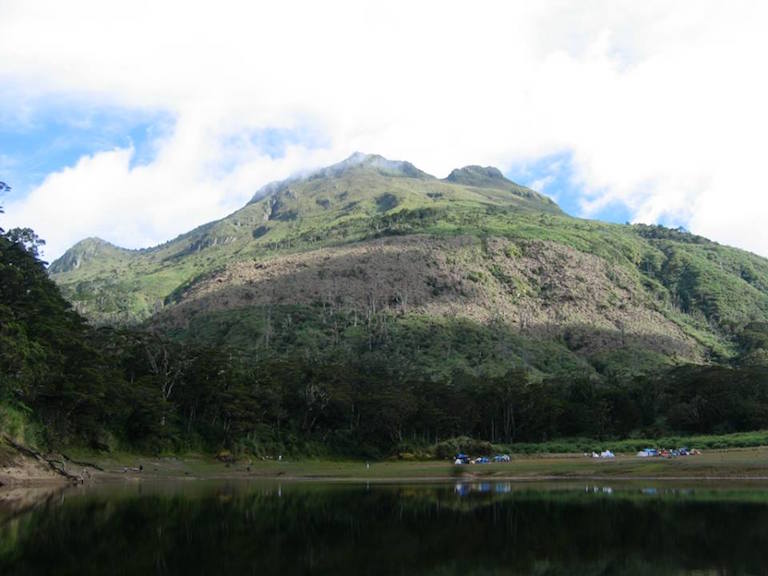
All Global Research articles can be read in 51 languages by activating the “Translate Website” drop down menu on the top banner of our home page (Desktop version).

Visit and follow us on Instagram at @crg_globalresearch.

***


Recent history of contamination

In 2020 the Futenma Marine Corps Command was forced to cancel the popular, annual Futenma Flightline Fair that had been scheduled for Saturday, March 14 and Sunday, March 15. These were the early days of the Covid pandemic and everyone looked forward the Flightline Fair and the displays of the F/A-18’s, F-35B’s and MV-22’s, with flyovers, a car show, and a spectacular barbecue.

Morale suffered, so the command gave the nod to hold a barbecue on April 10th near a large hangar for the esprit de corps of the Marines. Heat from the barbecue equipment triggered the hangar fire suppression system, releasing massive amounts of toxic firefighting foam containing Perfluoro octane sulfonic acid, (PFOS). It ruined the barbecue. Futenma Flightline Fair  –  Koji Kakazu Photography

Hundreds of mishaps like this have been documented at U.S. military bases worldwide since the early 1970’s when the carcinogens were first used in the firefighting foams.  Sometimes the overhead foam suppression systems are triggered accidentally during maintenance. Sometimes, they activate from incidental smoke and or heat. It’s a common occurrence.

When the suppression systems unleash their foams, the military may either send the foam into storm water sewers, sanitary sewers, or underground storage tanks. Sending the carcinogens into the storm water sewers causes the materials to run directly into the rivers. Discharging the foams into the sanitary sewer system means the toxins are sent to wastewater treatment facilities where they are eventually discharged, untreated, into the rivers.  Foams captured in underground storage tanks can be sent to either of the sewer systems or removed from the site to be dumped elsewhere or incinerated. Because the chemicals don’t burn and don’t break down, there is no way to properly dispose of them and they’re likely to find pathways to human consumption. The Okinawans are upset for this reason.

 ANDERSEN AIR FORCE BASE, Guam — Foam from a fire suppression system sprays from the walls and ceiling inside a newly built aircraft maintenance hangar during a test and evaluation exercise in 2015.  (U.S. Air Force photo)

During the April 10, 2020 barbecue incident, 227,100 liters of the foam were released, of which more than 143,800 liters leaked out of the base and, presumably, 83,300 liters were sent to underground storage tanks.

The foam covered a local river and cloud-like formations of foam floated more than a hundred feet above the ground, settling in residential playgrounds and neighborhoods.  David Steele, commander of Futenma Air Base, further alienated the Okinawan public when he said, “If it rains, it will subside.” Apparently, he was referring to the foamy bubbles, not the propensity of the foams to sicken people. A similar accident occurred on the same base in December of 2019 when the fire suppression system accidentally discharged the carcinogenic foam.

April 17, 2020 – U.S. Marine Corps Col. David Steele, commanding officer of Marine Corps Air Station Futenma, meets with Okinawa Vice-Gov. Kiichiro Jahana where firefighting foam was captured in an underground storage tank. (U.S. Marine Corps photo)

In April, 2020, the foamy water flowed out of stormwater pipes (red x)  from the Marine Corps Air  Station Futenma. The runway is shown on the right. The Uchidomari River (in blue) carries the toxins to Makiminato on the East China Sea.

The commander of U.S. Forces in Japan, Lt. Gen. Kevin Schneider, released the following statement, on April 24, 2020, two weeks after the incident, “We regret this spill and are working hard to find out why it happened in order to ensure an event like this does not happen again. However, I am very pleased with the level of cooperation we have seen at the local and national levels as we clean this up and work to manage the global challenge presented by these substances,” said Schneider.

This is a boilerplate response used worldwide to placate the locals, whether they’re in Maryland, Germany, or Japan. The military knew immediately why it happened. They understand accidental releases will continue to occur and imperil human health.

The Americans rely on subservient host governments. For instance, a report by the Okinawa Defense Bureau, the local branch of the Japanese Ministry of Defense, said that the foam releases at Futenma “had almost no effect on humans.”  However, the Ryuko Shimpo newspaper sampled river water near the Futenma base and found  247.2 parts per trillion (ppt) of PFOS/PFOA in the Uchidomari River. Seawater from Makiminato fishing port contained 41.0 ng/l of the toxins. The river had 13 varieties of PFAS that are contained in the military’s aqueous film-forming foam (AFFF).  To put these numbers into perspective, the Wisconsin Department of Natural Resources says surface water levels that exceed 2 ppt pose a threat to human health. The PFOS in the foams wildly bioaccumulate in aquatic life. The primary way people consume these chemicals is by eating fish.

Okinawan Governor Denny Tamaki was outraged. He said, “I truly have no words,” when he learned that a barbecue was the cause of the release. In early 2021, the Okinawan government announced that groundwater in the area around the Marine Corps base contained a concentration of 2,000 ppt of PFAS.

In Okinawa, the public and the press are increasingly exasperated by the insolence of the U.S. military. The word is being passed around that the U.S. military is poisoning millions of people around the world and is intent on continuing to do so. More than 50,000 individuals in the U.S., who operate farms within a mile of military installations, are expected to receive notification from the Pentagon that their  groundwater is likely to be contaminated with PFAS. The potentially lethal underground plumes from the fire training areas on base may actually travel 20 miles.

These toxic releases and the wholesale poisoning of millions of Americans will top the Pentagon’s public relations fiascos of My Lai, Abu Ghraib, and the slaughter of 10 Afghan civilians we recently witnessed. About 56 percent of Americans surveyed earlier this year said they have “a great deal of trust and confidence” in the military, down from 70 percent in 2018. We’ll witness this trend accelerate while news outlets are forced to cover the military’s poisoning of America and the world. There’s a deep irony in all of this. The antiwar movement and mainstream environmental groups in the United States have generally been slow to embrace the issue. Instead, the insurgency will arise from farmers in middle America.

August 26, 2021

A new chapter of American imperial arrogance in Okinawa unfolded on August 26, 2021. Neither the U.S. nor the Japanese have developed standards regarding the levels of PFAS that may be released into sanitary sewer systems. It seems both nations are fixated on the drinking water while the science is clear and irrefutable that most of the PFAS consumed by humans is through the food we eat, especially seafood from contaminated waters.

The military command at Futenma met with Japanese central government and Okinawan prefectural officials on July 19, 2021 to collect samples of treated water from the base to conduct separate tests. A followup meeting was set for August 26th  to discuss plans to release the results of the three tests.

Instead, on the morning of August 26th, the Marines unilaterally and maliciously dumped 64,000 liters of the poisoned water into the municipal sewer system. The water came from the underground tanks that contained the spilled firefighting foam. The Marines still have approximately 360,000 liters of contaminated water remaining on base, according to the Asahi Shimbun newspaper.

Okinawan officials say they received an email at 9:05 a.m. on Aug. 26 from the Marines saying water containing the toxins would be released at 9:30 a.m. The U.S. military said the water released contained 2.7 ppt of PFOS per liter of water. The U.S. military had expressed concern that the storage tanks could overflow due to heavy rain brought by typhoons, while the Japanese Ministry of Defense stated that the transfer of the water is “an emergency interim measure due to the typhoon problem.”

Ginowan city officials reacted immediately. Just two hours after the discharge began, the Ginowan Sewage Facility Division took wastewater samples from a manhole in the Isa area, where MCAS Futenma’s wastewater meets the public system.

The sample showed the following concentrations:

  • PFOS          630 ppt
  • PFOA          40 ppt
  • PFHxS        69 ppt
  • Total         739 ppt  

The U.S. Marines reported finding 2.7 ppt of PFAS in the sewer water. The Okinawans say they found 739 ppt. Although routine testing of PFAS in various media can detect 36 analytes, only the three above have been reported by the Okinawans. The Marines simply reported  “2.7 ppt of PFOS.” It is likely the overall totals of all PFAS concentrations would be twice the 739 ppt if the other varieties of PFAS had been tested.

The Okinawa prefectural (state) and Ginowan municipal governments immediately lodged protests with the U.S. military. “I feel strong outrage that the U.S. military unilaterally dumped the water even while they knew that discussions were proceeding between Japan and the United States on how to handle the contaminated water,” Okinawa Governor Denny Tamaki said later that day. .

It is instructive to compare the responses of the Ginowan City Council, The Okinawan prefecture, the Marine Corps Installations Pacific, Okinawa, and the government of Japan.

On September 8th, the Ginowan City Council adopted a resolution saying it was ”furious” with the U.S. military for the disposal of the contaminated water. The city had previously asked the Marines not to dump the poisons into the sanitary sewer system. The resolution called on the U.S. military to switch to firefighting foams that do not contain PFAS and demanded the U.S. military incinerate the materials. The city’s resolution said the release of chemicals “shows a complete disregard for the people of this city.”  Ginowan Mayor Masanori Matsugawa said, “It is extremely regrettable because the release of the water lacked any consideration for local residents who still have not erased their concerns” from last year’s incident. Okinawa’s Governor, Denny Tamaki says he wants access to the Futenma base to conduct independent testing.

The U.S. military responded to the city council’s resolution the next day by circulating a misleading press release with the following headline:

Marine Corps Installations Pacific Removes
All Aqueous Film Forming Foam (AFFF) on Okinawa

The text of the military propaganda piece says the Marine Corps has “completed the removal of all legacy Aqueous Film Forming Foam (AFFF) from Marine Corps camps and installations on Okinawa.” The Marines explained that the foams containing PFOS and PFOA had been shipped to mainland Japan to be incinerated. The foams have been replaced “with a new foam which meets Department of Defense requirements and which still provides the same life-saving benefits in the event of a fire. This action significantly reduces the environmental risk posed by PFOS and PFOA on Okinawa and is another concrete demonstration of MCIPAC’s transparency and its strong commitment to environmental stewardship.”

The DOD removed firefighting foams containing PFOS and PFOA from its U.S. bases several years ago while they’re only doing so now, under pressure, in Okinawa. The new PFAS foams likely include the PFHxS found in Okinawa’s water, are also toxic. The DOD refuses to disclose exactly what PFAS chemicals are present in its firefighting foams, because “the chemicals are the proprietary information of the manufacturer.”

PFHxS is known to induce neuronal cell death and has been associated with early onset menopause and with attention deficit/hyperactivity disorder in children.

The Okinawans are outraged; the Marines are lying, while the Japanese government is complacent. Yoshihide Suga, Prime Minister of Japan, said the Japanese government, carried out a thorough investigation of the incident. He said the government of Japan is urging U.S. forces to replace firefighting foams containing PFOS. Nothing more.

To recap, the Americans reported 2.7 ppt of PFAS in the sewage effluent while the Okinawans found 274 times that amount in the sewer water. The Okinawans are caught between a rock and a hard place.

Stars and Stripes reported on September 20th  that the Japanese government has agreed to take over “disposal” of Futenma’s contaminated wastewater.  The government has agreed to pay $825,000 to incinerate the materials. The U.S. military escapes justice.

Governor Tamaki called the development a step forward.

Incineration is not a step forward!  The Japanese government and Okinawan officials are apparently unaware of the dangers inherent in incinerating PFAS.  There is no scientific evidence that incineration destroys the deadly chemicals in the firefighting foam. Most incinerators are incapable of reaching the temperatures necessary to destroy the fluorine-carbon bond characteristic of PFAS. These are, after all, firefighting foams.

The EPA says  it’s not sure if PFAS is destroyed through incineration. The temperatures required to destroy the compounds exceed the temperatures reached by almost all incinerators.

On September 22nd the U.S. House of Representatives passed an amendment to the Fiscal Year 2022 National Defense Authorization Act that establishes a moratorium on the incineration of PFAS. The measure will be voted on by the Senate as it considers the massive funding package.

Governor Tamaki, you’ve been great on this!  Please correct the record. The incinerators will sprinkle a silent death over Japanese homes and farms.

Protesters in Okinawa play a crucial role in shaping the narrative. Unlike the states, the mainstream press seriously reports their message. They’re not dismissed as riff raff on the street. Rather, they’re recognized as a legitimate electric current that courses through the citizenry.

 In a protest letter to the Japanese Minister of Defense and the Okinawan Defense Bureau, Co-representatives Yoshiyasu Iha, Kunitoshi Sakurai, Hideko Tamanaha, and  Naomi Machida of the Liaison Committee to Protect Citizens’ Lives from Organic Fluorocarbon Contamination makes three demands:

1. An apology from the US military for its environmental crimes, particularly the deliberate release of water contaminated with PFAS into public sewers.

2. Prompt on-site investigations to determine the source of pollution.

3. All treatment and costs for detoxifying PFAS contaminated water from the Futenma base should be borne by the U.S. military.

 Contact:   Toshio Takahashi [email protected]

What we’re witnessing in Okinawa is occurring world-wide, although many are unaware of this pressing public health issue due to a general press embargo. This is starting to change.

*

Note to readers: Please click the share buttons above or below. Follow us on Instagram, @crg_globalresearch. Forward this article to your email lists. Crosspost on your blog site, internet forums. etc.

Featured image: U.S. Marine Corps Air Station Futenma is located in densely populated Ginowan City, Okinawa.

All Global Research articles can be read in 51 languages by activating the “Translate Website” drop down menu on the top banner of our home page (Desktop version).

Visit and follow us on Instagram at @crg_globalresearch.

***


Largely overlooked in last week’s announcement of the U.S.–Australia nuclear-powered submarine deal is the fact that the U.S. government plans to build new U.S. military bases Down Under. In a September 16 press conference, Australia Defence Minister Peter Dutton announced plans to establish new facilities for naval, air, and ground forces with “combined logistics, sustainment, and capability for maintenance to support our enhanced activities, including…for our submarines and surface combatants” and “rotational deployments of all types of U.S. military aircraft to Australia.”

The U.S. military already has at least seven installations in Australia. While mainstream media outlets frequently raise fears of China’s “escalating military presence in the South China Sea,” the U.S. military has hundreds of bases throughout the Asia Pacific region, surrounding China’s borders. Worldwide, despite the recent withdrawal from Afghanistan, the U.S. government still maintains approximately 750 military bases abroad in 80 foreign countries and colonies, according to a new, exhaustive list of U.S. overseas military installations that I helped compile for the Quincy Institute and World BEYOND War.

That the Biden administration intends to expand the already massive collection of bases in Australia and elsewhere in the Pacific is deeply troubling. Across the political spectrum and even within the U.S. military there is growing recognition that the country has, as retired four-star U.S. Air Force General Roger Brady put it simply, “too many daggone bases” overseas. Think tank analysts, scholars, politicians, and other observers conclude that many bases abroad should have closed decades ago and are undermining U.S. and global security. “I think we have too much infrastructure overseas,” said the highest-ranking officer in the U.S. military, Joint Chiefs of Staff Chair Mark Milley, in December 2020.

Earlier this year President Biden announced a Global Posture Review to examine and ensure the deployment of U.S. military forces around the world is “appropriately aligned with our foreign policy and national security priorities.” While the administration hasn’t announced the results of the review, a military buildup Down Under would be a dangerous step in the wrong direction when base closures, not base construction, are what’s needed.

Since World War II, the United States has maintained hundreds upon hundreds of bases in foreign lands. More than 75 years after that war’s end, there are still 119 base sites in both Germany and Japan, according to the Pentagon. Located on every continent except Antarctica, U.S. bases range in size from city-sized “Little America” installations with tens of thousands of military personnel and family members to small surveillance facilities and drone airfields.

For decades most in the United States haven’t questioned the presence of these bases. Too many have assumed that if a base exists it must have a reason to be there. Too many have assumed that more bases mean more security. Unfortunately, the opposite has often been the case: more bases abroad has meant less security for the United States and the world.

Maintaining unnecessary foreign military infrastructure wastes tens of billions of tax dollars annually at a time when domestic infrastructure is crumbling, and trillions are urgently needed to respond to pandemics, global warming, and other pressing health, education, housing, and environmental needs. I conservatively estimate the annual cost of building, operating, and maintaining bases abroad at $55 billion — larger than the State Department’s entire budget.

Bases are the face of the United States globally far more than diplomats, reflecting the dangerous, longstanding militarization of foreign policy: the 750 bases abroad are nearly three times the number (276) of U.S. embassies, consulates, and missions worldwide. While a few other countries maintain foreign bases on other nations’ lands, the United States controls the vast majority. The United Kingdom, France, Russia, Turkey, and a few other countries likely have around 200 foreign bases combined. China has five foreign installations (plus bases in Tibet).

Bases abroad also raise geopolitical and military tensions, encouraging countries like China, Russia, Iran, and North Korea to boost their own military spending (and foreign base construction) when encircled by U.S. bases. How would U.S. leaders respond if China or Russia were to build a single base near a U.S. border?

As our new QI report and bases list show, U.S. installations are blocking the spread of democracy in at least 38 non-democratic countries and colonies. Bases in the U.S. colonies (“territories”) of Puerto Rico, Guam, the Northern Mariana Islands, American Samoa, and the U.S. Virgin Islands have helped perpetuate their colonial relationship with the rest of the United States.

Bases abroad frequently cause significant environmental damage, harming and angering locals. Deadly accidents and crimes by U.S. military personnel, including rapes and murders, coupled with occupying other people’s lands also contribute to generating understandable protestand damaging the reputation of the United States. While the vast majority of protest is nonviolent, one of Osama bin Laden’s justifications for al Qaeda’s 9/11 attacks was the U.S. military presence in the Muslim holy land of Saudi Arabia.

Some will say the United States must maintain hundreds of bases overseas to keep the peace and make the United States and the world safer by deterring enemies. To that I say: Prove it. They can’t. There is no conclusive evidence showing that U.S. bases overseas are an effective and strategically useful deterrent. Meanwhile, the last 20 years of endless war show how foreign bases have made it easier for U.S. leaders to launch and wage disastrous wars of aggression, like those in Afghanistan, Iraq, Yemen, Somalia, Libya, and 20 other countries where U.S. troops have deployed into combat.

The Biden administration can still reverse course to close bases abroad and abandon plans to build new ones in places like Australia. Presidents George H.W. Bush, Bill Clinton, and George W. Bush closed hundreds of unnecessary bases in Europe and Asia in the 1990s and 2000s. Congress doesn’t need to be involved in overseas closures given the absence of a Base Realignment and Closure (BRAC) process abroad; however, members should support closing installations overseas to return thousands of military personnel and family members — and their paychecks — to their districts and states. There is considerable excess capacity for returning troops and families at domestic bases.

In contrast to former President Donald Trump’s hasty withdrawal of bases and troops from Syria, Biden can close bases carefully and responsibly, assuring allies, saving money, and building back the U.S. diplomatic presence worldwide. “Draw Down/Build Up” should be the mantra: Draw down the base posture abroad, bring troops and their families home, and build up the country’s diplomatic posture and alliances. Continuing to maintain 750 bases overseas and building new ones in Australia is a frighteningly irresponsible policy that, most frighteningly, is escalating military tensions with China, making what should be an unthinkable war with the nuclear-armed competitor more likely rather than less.

*

Note to readers: Please click the share buttons above or below. Follow us on Instagram, @crg_globalresearch. Forward this article to your email lists. Crosspost on your blog site, internet forums. etc.

Featured image is from max.ku via shutterstock.com

Video: The Reality of Human Rights in Australia

September 29th, 2021 by OneAngryAussie

All Global Research articles can be read in 51 languages by activating the “Translate Website” drop down menu on the top banner of our home page (Desktop version).

Visit and follow us on Instagram at @crg_globalresearch.

***


Please hear the Prime Minister of Australia, Scott Morison telling the world how important human rights are and see how well they were respected in Australia last week.

The Premier of Victoria, Dan Andrews, has been becoming increasingly authoritarian over the past 20 months.  He has been using the police to repress political debate, including arresting a pregnant woman and old men for expressing their political views on social media.  Unchecked, he is now using the police to repress, punish and brutalise the people for expressing any dissenting political opinion.

Police Chief Commissioner Shane Patton is not merely derelict in upholding his oath of office to serve and protect the people of Victoria, but has been inciting his force to violence against the people.  We now see police shooting people and using chemical weapons to terrorise people into silence.  We see a police force that is bereft of discipline and restraint, and their criminal behaviour is encouraged by the chief of police to protect the ego of the premier.

Last week, the Premier of Victoria and his Chief Commissioner of Police crossed a line.  They let their egos cloud any judgement of what constitutes good government.

A wise leader would recognise that the people need to express their disapproval at their government’s policies.  A wise chief of police would have his force directing traffic, making space for people to march peacefully and arresting the odd boofhead starting any trouble.  The people would have voiced their opinions, listened to a few speakers, got bored and gone home.  There would have been one demo on Saturday and that would be it.  This is the Australian way.

Instead, we’ve seen a week of escalating violence instigated by the police who are now intimidating everybody approaching downtown Melbourne in fear of another protest forming.

A wise leader would be reassuring the people that the government is in control of the situation and uniting the people in common cause.  Dan Andrews has been instilling irrational  fear in the people, is demonstrably out of control, is sowing the seeds of division with policies that intend to institute a discriminatory two-class society, and is using the police to wage war on the working class.

Depriving the rights of one Australian is to attack the rights of ALL Australians.

This is now far beyond the policies of lockdowns, masks, mandatory medication and vaccine passports being used to create first and second class citizens.  This is about a Premier who is out of control, ruling by decree and using the organs of State to brutally repress political debate and deprive the people of their rights to freely associate and express their political opinions.

It takes a lifetime to build a reputation and seconds to destroy it.  Last week, Daniel Andrews and Shane Patton destroyed Australia’s reputation as a free and fair society.

The only way we can retrieve it now is to remove these evil men from office and hold them to account before the Courts.  This action would demonstrate to all future governments in Australia and to the world at large, that when tyranny raises its ugly head in Australia that we have the means and the will to stop it in its tracks and to swiftly remove despots from public office.

The Parliament of Victoria must sack these men immediately for abusing their power, and if the Parliament fails to act, then the Governor of Victoria, The Honorable Linda Dessau must do her duty and act to protect the people of Victoria from a despotic government and a police force that is out of control.

Here’s the truth about the protest by construction workers  protesting their union leaders betraying them about mandatory vaccinations.

*

Note to readers: Please click the share buttons above or below. Follow us on Instagram, @crg_globalresearch. Forward this article to your email lists. Crosspost on your blog site, internet forums. etc.

All Global Research articles can be read in 51 languages by activating the “Translate Website” drop down menu on the top banner of our home page (Desktop version).

Visit and follow us on Instagram at @crg_globalresearch.

***


Construction sites in and around Melbourne, Australia, have been shut down for two weeks after hundreds of construction workers and other protestors gathered Monday at the site of a union building, throwing bottles and damaging equipment.

They were protesting the Victorian government’s COVID-19 vaccine mandate for construction workers that begins Thursday.

Riot police used rubber bullets and pepper spray to disperse crowds, the BBC reported, and the headquarters building for the Construction, Forestry, Maritime, Mining and Energy Union was damaged. Several people were arrested.

The union released a statement saying it condemned the protests and the “mindless acts of violence” perpetrated by members of the crowd. The statement said that many protesters were not construction workers but members of neo-Nazi and other right-wing extremist groups.

“It is clear that a minority of those who participated were actual union members,” it said.

Protests continued on Tuesday in Melbourne, with the crowd growing into the thousands and encompassing anti-vaccine activists and other types of workers.

Up to 2,000 protesters descended into the city’s central business district, according to The New York Times, which also reported that protesters threw bottles at the police and set off flares, while officers in riot gear fired rubber bullets and used pepper spray.

Worker protests began last week when “tea rooms” where tradespeople congregate during breaks were shut down amid the rising delta surge and the government banned workers from consuming food or drink indoors. That prompted construction workers to take their lunch breaks outside in protest.

They set up tables and plastic chairs in multiple intersections in central Melbourne, blocking roads and holding up traffic, according to NPR.

Public health measures

Following the protests, construction and state officials announced that jobsites in Melbourne and other areas in the region will be closed for at least two weeks beginning Tuesday. It cited Monday’s unrest and the increase in COVID-19 cases in the building and construction industry as the reasons.

Victorian Premier Daniel Andrews said that multiple outbreaks — as high as 13% of all cases, according to local media reports — have been linked to construction sites.

Construction has been among the few industries that have largely stayed open throughout the pandemic in Victoria.

“Construction workers are a mobile workforce who may work across multiple sites and travel longer distances to work than other permitted workers,” Andrews said in a statement. “Concerns have also been raised, and remain, about the sector’s compliance with public health measures and directions.”

Minister for Industrial Relations Tim Pallas was even more forceful, saying that his office has seen widespread non-compliance across the industry.

“We’ve been clear: if you don’t follow the rules, we won’t hesitate to take action,” he said in the statement.

Workers will be required to show proof of at least one vaccine dose when sites reopen on Oct. 5, he added.

*

Note to readers: Please click the share buttons above or below. Follow us on Instagram, @crg_globalresearch. Forward this article to your email lists. Crosspost on your blog site, internet forums. etc.

Featured image is from Alpha/Flickr

AUKUS Sub Deal Splits ASEAN into Pro and Anti Camps

September 23rd, 2021 by Richard Javad Heydarian

All Global Research articles can be read in 51 languages by activating the “Translate Website” drop down menu on the top banner of our home page (Desktop version).

Visit and follow us on Instagram at @crg_globalresearch.

***


The Australia, United Kingdom and United States nuclear submarine deal and their announced new AUKUS trilateral alliance have sent shockwaves across the Indo-Pacific and beyond as fears rise the move could spark an armed conflict with China.

While US allies in India, Japan, South Korea and Taiwan have all been mainly mute on the announcement, the strategic tremors of the nuclear deal will be most acutely felt in Southeast Asia and the South China Sea.

Already, the region appears to be splitting into pro and anti camps. Indonesia and Malaysia have openly criticized the deal, portraying it as a potentially destabilizing development that rekindles age-old resentment of Australia acting as America’s “deputy sheriff” in the region.

Singapore and Vietnam, two countries with rising concerns about Chinese expansionism, quietly welcomed the deal without issuing any formal statements. The Philippines, a US treaty ally, stood out by openly backing the deal as a necessary “enhancement of a near-abroad ally’s ability to project power.”

The AUKUS deal, which is purportedly consistent with regional principles on nuclear non-proliferation, is expected to be discussed in the forthcoming high-level meetings of the Association of Southeast Asian Nations (ASEAN), including a scheduled annual summit in November.

There are serious regional concerns about the strategic implications of US-made Australian nuclear submarines patrolling the hotly contested South China Sea, where the US is pressing to maintain freedom of navigation. In recent years, Chinese and US naval forces have almost come to blows in multiple “close encounters” in the disputed sea.

Some ASEAN members worry the involvement of more naval forces, especially nuclear-powered submarines, would likely further complicate the situation and raise the risk of armed confrontation.

A US Navy Carrier Battle Group with USS Ronald Reagan in the lead in the South China Sea. Image: US Navy/Handout

Eager to preserve its “centrality” in shaping a stable regional order, the Southeast Asian bloc has actively pushed over the decades for a reduction of foreign military forces in the strategic region, now a chief theater of rivalry between the US and China.

Malaysia, a staunchly “neutral” country, has been a major advocate of the principle of ZOPFAN (Zone of Peace, Freedom and Neutrality in Southeast Asia).

As former Malaysian Prime Minister Abdul Razak Hussein argued in the 1970s, ASEAN should espouse “a policy of neutralization which will ensure that this region will no longer be a theater of conflict for the competing interests of the major powers.”

The ASEAN Treaty of Amity and Cooperation in Southeast Asia (TAC), which has been signed by all major Indo-Pacific powers, similarly calls upon member states as well as dialogue partners to contribute to a peaceful management of disputes and, accordingly, refrain from militarizing the region.

Of particular concern is the ASEAN’s Southeast Asia Nuclear Weapon-Free Zone (SEANWFZ Treaty) treaty, which expressly opposes the presence of nuclear weapons and other forms of weapons of mass destruction in the region.

Critics say the AUKUS deal could potentially violate some of these key ASEAN tenets, since any nuclear-powered submarine would rely on highly enriched uranium that could also be used for nuclear weapons production.

Indonesia’s Foreign Ministry thus immediately criticized the Australian submarine deal, making it clear that the de facto leader of ASEAN “is deeply concerned over the continuing arms race and power projection in the region.”

Sensing the potential for fallout, Australian Prime Minister Scott Morrison reached out to regional counterparts, including Indonesia and Malaysia, to assure the AUKUS deal is consistent with the country’s nuclear non-proliferation treaty (NPT) obligations and that the subs would only act to enhance “strategic balance” in the region, in light of China’s rapidly expanding naval footprint in the area.

Australia’s ambassador to ASEAN, Will Nankervis, also issued a statement clarifying that the AUKUS “is not a defense alliance or pact” and that the nuclear submarine deal “does not change Australia’s commitment to ASEAN nor our ongoing support for the ASEAN-led regional architecture.”

“Australia remains staunch in our support for the Non-Proliferation Treaty (NPT). Australia will work closely with the International Atomic Energy Agency to ensure full compliance with our NPT obligations as a Non-Nuclear Weapon State,” the Australian envoy said in a statement addressed to the ASEAN headquarters in Jakarta.

“We remain committed to reinforcing international confidence in the integrity of the international non-proliferation regime, and to upholding our global leadership in this domain,” he added.

Malaysia’s newly installed Prime Minister Ismail Sabri Yaakob, however, remained unconvinced, telling his Australian counterpart that that “AUKUS could potentially provoke other powers to act more aggressively, especially within the South China Sea region.”

Significantly, other key ASEAN states such as Vietnam and Singapore, which have welcomed greater strategic cooperation with the US, have not raised any objections. Experts and analysts believe that the two countries quietly welcome any external efforts to counter China’s muscle-flexing in the South China Sea.

Surprisingly, Beijing-friendly Philippine President Rodrigo Duterte bucked the reticent trend by openly backing the deal as an indispensable contribution to regional security.

Following phone conversations with his Australian counterpart Peter Dutton, Philippine Defense Secretary Delfin Lorenzana reiterated the country’s “neutrality” but didn’t openly criticize the AUKUS deal.

A week earlier, the Philippine defense chief welcomed expanded maritime security cooperation with the US during a visit to Washington to commemorate the 70th anniversary of the Philippine-US Mutual Defense Treaty (MDT) amid a recent rapid revival of the century-old alliance.

Philippine Foreign Secretary Teodoro Locsin Jr, who also recently visited Washington, reflected Manila’s quiet return to its traditional alliances after years of strategic flirtation with China by defending the deal as consistent with regional principles and the NPT because the nuclear submarines will use enriched uranium but not carry nuclear weapons.

“The enhancement of a near-abroad ally’s [Australia] ability to project power should restore and keep the balance rather than destabilize it,” said the Philippine chief diplomat in an official statement.

He welcomed the submarine deal as crucial to “enhancing Australia’s [deterrence] ability, added to that of its main military ally, to achieve that calibration [against regional threats].”

Though not directly mentioning China, Locsin warned of the Asian superpower’s “threatening” behavior in the disputed waters, including the use of “maritime militia” vessels to intrude into Philippine-claimed waters.

“Proximity breeds brevity in response time; thereby enhancing an ASEAN’s near friend and ally’s military capacity to respond to a threat to the region or challenge the status quo,” Locsin added in a thinly veiled jab at China.

*

Note to readers: Please click the share buttons above or below. Follow us on Instagram, @crg_globalresearch. Forward this article to your email lists. Crosspost on your blog site, internet forums. etc.

Featured image is from US Navy

AUKUS vs China: Inching Toward War

September 22nd, 2021 by Brian Berletic

All Global Research articles can be read in 51 languages by activating the “Translate Website” drop down menu on the top banner of our home page (Desktop version).

Visit and follow us on Instagram at @crg_globalresearch.

***


Australia, the UK and the US announced the formation of “AUKUS,” an amalgamation of the three nation’s initials, as a tripartite “defense alliance.”

Despite claims that the alliance is aimed at no particular country (and no particular country was mentioned during its announcement), the Western media has not reported it as such, and China – the obvious target of this “AUKUS” alliance – doesn’t perceive it as such.

The Guardian in its article, “Alliance with Australia and US a ‘downpayment on global Britain’,” would explicitly state:

 Britain’s post-Brexit foreign policy is taking shape, and the early moves are hardly very surprising: a tripartite defence alliance with the US and Australia – handily compressed to Aukus – clearly designed to send a message to Beijing.

Chinese state media, Global Times, would make it abundantly clear that China understood this with a headline reading, “AUKUS another hostile signal to China, worsens Asia-Pacific security.”

AUKUS begins with the three nations announcing plans to design, develop, and deliver nuclear-powered attack submarines to Australia, which currently has 6 Collins-class diesel electric submarines delivered between the late 1990’s and early 2000’s.

The abovementioned Guardian article noted that Rolls Royce and BAE Systems would likely win contracts as part of this deal. Considering the 18 month period the Guardian reported would be used to plan this process and the several years it takes for BAE Systems to build and commission nuclear-powered submarines, Australia may put these new submarines into service around 2030.

The Price of this New Alliance

As an extra caveat, and perhaps warning to Australia, the new deal is likely to result in a French-Australian submarine deal falling through. Worth 65.6 billion US dollars, this will not be the first time US machinations have cost Paris dearly. In 2015 France was forced to reimburse Russia when it failed to deliver two Mistral-class amphibious assault ships after Paris was pressured to cancel the deal by Washington.

The adage, “no honor among thieves,” comes to mind. France, an eager accomplice in Washington’s various wars of aggression since the turn of the century now finds itself on the receiving end of American exceptionalism. France’s misfortunes today will almost certainly be Australia’s tomorrow as “AUKUS” runs its course.

In many ways, Australia has already begun paying its own price.

Australia’s largest trade partner in 2019 was China. Australian exports to China outmatched all Australian exports to North America and Europe combined. Prompted by the US to pressure China across a range of fabricated accusations, Chinese-Australian trade dropped significantly, with ABC Australia itself claiming by as much as 40%.

While Australia says it is working to compensate for these losses by expanding into alternative markets, such effort could have been used to double Australian trade rather than merely recover from politically-motivated and very much self-inflicted economic damage in its trade row with China.

A War Alliance Predicated on Lies

The “security challenges” AUKUS claims to be addressing include two obvious flashpoints, both the product of persistent US provocations.

The first is centered around Taiwan where the current, US-backed ruling government in Taipei continues to inch toward independence. It should be remembered that Taiwan is recognized by virtually all nations (including the United States) as part of China under the “One China” policy.

To illustrate this, the US itself does not have an official embassy in Taipei. But while the US officially recognizes Taiwan’s status under international law, it has unofficially and consistently undermined it by supporting pro-independence political groups in Taiwan.

The other flashpoint is in the South China Sea where the US accuses China of “bullying” other nations by making “excessive” maritime claims.

The US regularly conducts “Freedom of Navigation Operations” (FNOPs) throughout the region.

The official US Navy website in a statement titled, “7th Fleet conducts Freedom of Navigation Operation” (July 12, 2021), for example, would claim:

The United States challenges excessive maritime claims around the world regardless of the identity of the claimant. The international law of the sea as reflected in the 1982 Law of the Sea Convention provides for certain rights and freedoms and other lawful uses of the sea to all nations.

Not mentioned is the fact that the US itself is not actually a signatory of the 1982 Law of the Sea of Conventions and is in fact one of only a few nations not to sign it.

The US Navy also makes another telling admission when it claimed:

China, Taiwan, and Vietnam each claim sovereignty over the Paracel Islands.

This reveals that it is not China “bullying” nations in the region over the South China Sea, but instead a series of overlapping claims. Nations in the region have disputes not only with China, but also with each other.

This is revealed in headlines like the Wall Street Journal’s 2016 article, “Indonesia Blows Up 23 Foreign Fishing Boats to Send a Message,” in which the Indonesian government destroyed captured Malaysian and Vietnamese fishing boats.

Vietnamese news portal Binh Duong News’ article, “Malaysian Navy seizes Vietnamese fishing boats,” and Bangkok Post’s article, “3 Malaysian trawlers seized near Satun,” also help illustrate many nations in the region are engaged in heated maritime disputes with often theatrical results – but always avoid actual conflict and are eventually resolved bilaterally.

This is not unlike maritime disputes taking place anywhere else in the world, including in Europe, where just this year the New York Times reported on the mobilization of British and French naval vessels over contesting fishing waters near Jersey island. This row too was resolved peacefully.

The South China Sea’s various overlapping disputes have been exploited by the US. Washington has injected itself into the middle of what would be commonplace and long-standing maritime disputes to depict them as one-sided bullying by China to justify America’s large and growing naval presence in the region and to recruit nations into belligerent alliances precisely like AUKUS.

The US even went as far as initiating a tribunal at the Permanent Court of Arbitration (PCA) at the Hague, the Netherlands in 2016 – allegedly on behalf of the Philippines. It was American lawyer Paul Reichler and the Western law firm Foley Hoag – not Filipino lawyers – who led the effort.

The non-binding politically-motivated ruling was not even used by the Philippines who instead opted for bilateral talks with Beijing to establish a mechanism to ease tensions in the South China Sea and even cooperate in contested waters, according to the Philippines’ own Department of Foreign Affairs website.

For added irony and to further illustrate how these disputes are not one-sided Chinese “bullying,” upon the conclusion of the PCA’s ruling, not only did Beijing reject it, Taiwan did too. According to a 2016 New York Times article, Taiwan also then sent a patrol ship to the contested waters.

Together, with the Taiwan issue, these two flashpoints are clearly artificial, kept in motion by a constant investment by Washington in terms of political pressure and propaganda as well as a steady stream of military provocations.

Toward War with China

These flashpoints are cultivated specifically to rally nations against China, to isolate and contain the rising nation, and to grant the US an extension to what it itself calls its “primacy” over Asia.

However, they may also serve as impetus for a limited US-initiated war with China, a war the US would prefer to fight sooner rather than later.

In a 2016 RAND Corporation paper (PDF) commissioned by the US Army and titled, “War with China: Thinking Through the Unthinkable,” a compelling argument is made for the preservation of American hegemony through a limited war predicted to remain conventional and confined to East Asia.

The paper notes:

We postulate that a war would be regional and conventional. It would be waged mainly by ships on and beneath the sea, by aircraft and missiles of many sorts, and in space (against satellites) and cyberspace (against computer systems). We assume that fighting would start and remain in East Asia, where potential Sino-US flash points and nearly all Chinese forces are located.

It’s worth emphasizing that US planners admit that China’s forces are confined to Chinese territory and that the only way a conflict would breakout would be if US forces were in close proximity to them and provoked into conflict where “potential Sino-US flash points” are located, e.g. the South China Sea, or Taiwan. The paper notes that the time frame studied stretched from 2015 to 2025.

The paper also describes the obvious benefits of, and thus motive for the US provoking such a conflict. It states:

The prospect of a military standoff means that war could eventually be decided by nonmilitary factors. These should favor the United States now and in the future. Although war would harm both economies, damage to China’s could be catastrophic and lasting: on the order of a 25–35 percent reduction in Chinese gross domestic product (GDP) in a yearlong war, compared with a reduction in US GDP on the order of 5–10 percent. Even a mild conflict, unless ended promptly, could weaken China’s economy. A long and severe war could ravage China’s economy, stall its hard-earned development, and cause widespread hardship and dislocation.

Such economic damage could in turn aggravate political turmoil and embolden separatists in China.

The US is clearly preparing the grounds for such a conflict, cultivating the very “separatists” the paper notes the conflict would “embolden,” while attacking and attempting to block China’s Belt and Road Initiative (BRI) which is currently diversifying away from China’s dependency on vulnerable Asia-Pacific maritime trade routes.

Through the creation of what are clearly military alliances like AUKUS, the US is ensuring it has the military muscle before, during, and after any such conflict to wage and win it, before then doubling down on a containment strategy to ensure Western hegemony over the Indo-Pacific region for decades to come.

The current status quo all but guarantees China’s economy (as well as military and political influence) will irreversibly surpass the US’ within a decade. The closing window of opportunity the US has to prevent China’s as well as Asia’s surpassing of the West in a transfer of primacy from West to East that has not occurred in centuries, almost certainly was the impetus behind “AUKUS.”

Only time will tell whether or not “AUKUS” will simply buy the US time before being surpassed by China, or if it is one of several final pieces being put in place before the hypothetical conflict RAND Corporation described in the pages of its 2016 paper is turned into a bloody reality.

*

Note to readers: Please click the share buttons above or below. Follow us on Instagram, @crg_globalresearch. Forward this article to your email lists. Crosspost on your blog site, internet forums. etc.

Brian Berletic is a Bangkok-based geopolitical researcher and writer, especially for the online magazine “New Eastern Outlook”.

Featured image is from OneWorld

Australia’s New Anti-China Alliance

September 22nd, 2021 by Pip Hinman

All Global Research articles can be read in 51 languages by activating the “Translate Website” drop down menu on the top banner of our home page (Desktop version).

Visit and follow us on Instagram at @crg_globalresearch.

***


Prime Minister Scott Morrison’s surprise September 16 announcement that Australia was in a new security alliance with the United States, Britain and Australia — AUKUS — formalises its war drive against China.

The intensification of Australia’s long alliance with these two big imperialist powers cements its role as part of a US push to block China’s economic development, by force if necessary.

At a still unknown cost, Australia is to be given US and British technology to build nuclear-powered submarines in Adelaide. The two nuclear armed and powered countries will exploit a loophole in the international non-proliferation treaty: International Atomic Energy Agency safeguards allow for nuclear material to be used for “non-proscribed military activity”.

Australia is now setting a precedent for other non-nuclear weapons’ states to do the same.

We now know that discussions have been underway between the three governments for months, yet Morrison didn’t bother to inform the Australian public.

Thanks to the organising efforts of the anti-nuclear movement in the 1970s and early 1980s (a large part in Labor’s ranks), Labor held the line against uranium mining and nuclear weapons. Huge annual marches against nuclear weapons and nuclear ships visiting Australian ports also stopped the uranium industry from gaining a bigger foothold.

However, before taking office in 1983 Labor ditched its anti-uranium and anti-nuclear policies. Not surprisingly, Anthony Albanese said Labor “welcomes” the agreement to “maximise the interoperability of our defence and security arrangements”. He said a “calm and measured approach” is needed.

“A US alliance is our most important. And the UK, of course, is our old friend”, Albanese said. “So, it makes sense in terms of efficiency and in terms of maximising the positive output that we engage across our three nations to make sure that there is maximum interoperability available.”

Albanese said the conditions for Labor to support the nuclear-powered submarines were: no requirement for a domestic civil nuclear industry; no acquisition of nuclear weapons; and that the agreement would be compatible with the non-proliferation treaty.

However, as critics (and even some supporters) have said, the submarine deal is likely to become the launching pad for the pro-nuclear lobby to renew its push to open up uranium mining. After all, Australia has the third largest reserves of the mineral in the world.

Australia signed the Non-Proliferation of Nuclear Weapons Treaty in 1973 and the Comprehensive Nuclear Test Ban Treaty in 1998 when the anti-nuclear movement was still a force. The Morrison government has refused to sign the United Nations Treaty on the Prohibition of Nuclear Weapons, which came into force in January and now has 55 signatories, although none with nuclear capability.

Australia is, however, a party to the South Pacific Nuclear-Free Zone Treaty of Rarotonga, which established a nuclear weapon-free zone in the South Pacific. The new submarines will also not be welcome in New Zealand, which has maintained a ban on such potentially hazardous vessels entering its ports.

Even former submariner Rex Patrick, now an independent Senator who supports Australia acquiring submarines, expressed concern at the government’s secretive decision. He called for parliamentary scrutiny before the next election.

Given the secrecy surrounding this announcement, along with the anti-China red scare campaign, it is perhaps not too surprising that Roy Morgan’s snap poll on September 16 had 57% agreeing with the purchase of nuclear submarines.

Patrick agreed it would be “difficult” for Australia to have nuclear-powered submarines “without a domestic nuclear power capability”. “Acquiring, operating and maintaining a nuclear submarine fleet without a domestic nuclear power industry is a challenge that must not be underestimated.”

Dr Vince Scappatura, spokesperson for the Independent and Peaceful Australia Network, said AUKUS would “undermine Australia’s sovereign defence capabilities” and will contribute to the greater militarisation of the region.

Adam Bandt MP said the Greens would oppose the nuclear submarine deal, and called on the Labor Party to follow Paul Keating’s lead against “locking in” Australia’s military equipment “and thereby force” with those of the US.

Sam Wainwright, a national co-convenor of the Socialist Alliance, told Green Left the new military pact was about formalising an old alliance to put the heat on China.

“Australia may be a junior player in terms of scale, but it’s an energetic one”, he said. “Defence Minister Peter Dutton has been keen to go to war and he has decided to raise the stakes against China. He and Morrison went to Washington earlier this year and asked for help: they have long wanted a nuclear industry here to cash in on Australia’s big uranium reserves.”

Australia is the only G20 country with a ban on nuclear energy, leaving uranium as an export-only commodity. The value of uranium sales last year was estimated at $2.5 billion.

Meanwhile, the French government has withdrawn its ambassadors from the US and Australia over being “stabbed in the back”. “This is not just sour grapes over losing ‘the deal of the century’”, Wainwright said.

“It also reflects European powers’ unease over a post-Brexit tightening of the alliance between the Anglo-imperialist powers at their expense. France and Germany were already smarting over NATO’s hasty withdrawal from Afghanistan and amplifying calls for the formation of a European military forcethat can act independently of the US.”

Wainwright said Australia should not have signed up for either the French or the US submarines. Nor, he said, should Australia be a partner of US or European military interventions, “because their only purpose is to maintain the current violent, unjust and exploitative world order. Every cent allocated to the submarines is money that should be spent on projects that forge a more just and sustainable world for all.”

*

Note to readers: Please click the share buttons above or below. Follow us on Instagram, @crg_globalresearch. Forward this article to your email lists. Crosspost on your blog site, internet forums. etc.

Featured image: A nuclear-powered fast attack submarine USS Houston in Apra Harbour in the US territory of Guam. Photo: Wikimedia

All Global Research articles can be read in 51 languages by activating the “Translate Website” drop down menu on the top banner of our home page (Desktop version).

Visit and follow us on Instagram at @crg_globalresearch.

***


Australia has just caused surprise among its friends, concern among its neighbours, and an overtly hostile reaction from the Chinese with its announcement that it was scrapping the submarine deal it had signed with France and replacing it with a scheme, cooked together with British and American allies, to buy 8 nuclear powered submarines.

The scheme as announced was extraordinarily short on details. There is apparently at least 18 months of negotiating ahead before the contract is even signed. After that there will be a lengthy delay, estimated being at least 10 years in length, before the first submarine is ever delivered. By that time, who knows what the state of the world’s geopolitical system will be. One can be assured that the Chinese, against whom the plan is obviously directed, will have taken multiple steps to ensure its own safety.

The Australian prime minister Scott Morrison was not short of hyperbole in announcing the deal. He described the relationship with the United States as the “forever partnership”. As the old joke goes, there are only two forever’s, death and taxes. Morrison’s words are reflective of an unfortunate tendency among Australian politicians. They are inclined not to look at the map when making grand geopolitical statements.

Australia is a thinly populated European nation that sits at the southern end of the Asian landmass. In keeping with its geography, the bulk of Australian foreign trade is conducted with those same Asian neighbours. Ironically, China is by far Australia’s largest trading partner, followed by Japan.

The British are yesterday’s men when it comes to Asia having finally been forced to give up its holding in Hong Kong that they took by force from China in the 19th century. The United States likes to project itself as an important figure in the Asian scheme of things. As the recent debacle in Afghanistan showed, however, American influence in the region is marked by one rebuttal after another.

With the possible exception of Japan, United States influence in the region is rapidly fading, notwithstanding its provocative sailings in the South China Sea and its overt support for the island of Taiwan. It is conveniently forgotten by Western commentators that from 1949 to 1972 the island of Taiwan held China’s seat on the United Nations Security Council. There was no suggestion then that Taiwan was a separate country. It could hardly have claimed to be, yet retaining China’s seat on the Security Council.

Now, Taiwan is making noises about becoming an independent country, something that the Beijing government has declared to be totally unacceptable, and which they will prevent by the use of force if necessary. It would be very unwise for the West to ignore the determination of the People’s Republic of China to recapture its rebellious neighbour. It would be equally unwise for the Americans to underestimate the Chinese level of determination and attempt to defend Taiwan from returning to the control of the mainland.

It is into this fraught situation that the Australian government is being inexorably drawn by its latest agreement with the Americans. Although the Australian media are almost completely silent on the point, one of the consequences of this new agreement with the Americans will be an increase in the number of United States military holdings in Australia. They already control the operation of the spy base at Pine Gap in the Northern Territory. It was former Prime Minister Gough Whitlam‘s intention to close the base that led to the coup against his government in November 1975.

The United States has operated a baleful influence upon Australian foreign policy ever since. There is absolutely nothing in the latest announcement of Australia buying United States designed nuclear powered ships that will do a single thing to reduce that influence. Quite the contrary.

The current posturing by the Australian Prime Minister will do nothing to alter that reality. Together with his defence minister, Peter Dutton, who has been a failure at each of his previous ministerial postings, they are both talking loudly about the wonderful future of Australia. They are either too vain or too stupid to see that this latest deal does more than any other single decision in recent years to entrap Australia in a subservient role to the United States.

As Scott Ritter writes in RT: “This is a story of geopolitically driven military procurement gone mad”,1 pointing out that this deal “further exacerbates the existing geopolitical crisis with China by injecting a military dimension that will never see the light of day.”

Ritter goes on to seek answers to problems he sees as being associated with the announced purchase; for instance, first of all, how much will it cost?  Secondly, how will Australia operate advanced nuclear power systems when it has no indigenous nuclear experience to draw upon? And how does Australia plan to man a large nuclear submarine when it can barely field four crews for its existing Collins class fleet.

These are legitimate questions to ask, yet the timid Opposition Labor Party seems paralysed by them.

As Alan Gyngell points out2, the United States’ expectations of Australia’s support in almost anything going, whether it involves China or not (although that is the greatest danger) will grow. It represents an application of responsibility to ensure the ongoing welfare of the Australian people. By the time the submarines are delivered, if at all, the present generation of political leaders will be long gone. The damage they are doing will last a lot longer.

*

Note to readers: Please click the share buttons above or below. Follow us on Instagram, @crg_globalresearch. Forward this article to your email lists. Crosspost on your blog site, internet forums. etc.

James O’Neill is a retired Barrister at Law and geopolitical analyst. He can be contacted at [email protected].

Notes

1. US-UK-Australia Submarine Deal is a Dangerous Joke, 18 September 2021.

2. “Australia Signs up for the Anglosphere“, September 19, 2021.

The Right to Clean Air in Jakarta

September 21st, 2021 by Dr. Binoy Kampmark

All Global Research articles can be read in 51 languages by activating the “Translate Website” drop down menu on the top banner of our home page (Desktop version).

Visit and follow us on Instagram at @crg_globalresearch.

***


It seems utterly beyond debate but acknowledging legal rights to clean hair has assumed the makings of a slow march over the years.  The 1956 Clean Air Act in Britain arose from the lethal effects of London’s 1952 killer smog, which is said to have taken some 12,000 lives.  The Act granted powers to establish smoke-free zones and subsidise householders to shift to the use of cleaner fuels (gas, electricity, smokeless solid fuel).

There is certainly no shortage of advocates for the self-evident point that clean air is vital.  Some of this has been reduced – at least historically – to an issue about the non-smoker’s wish not to have the air clouded by the selfish actions of a smoker.  But this is small beer when compared to the general levels of global pollution that keeps the Grim Reaper busy on an annual basis. According to the World Health Organization, air pollution kills 7 million or so people each year, with 9 out of 10 people breathing air “that exceeds WHO guideline limits containing high levels of pollutants, with low- and middle-income countries suffering from the highest exposures.”

In 2019, the UN Special Rapporteur on human rights and the environment David R. Boyd noted approvingly that a majority of States had, be it through their constitutions, statutes and regional treaties, recognised the right to a healthy environment.  But recognition for such a right on a global level remained an unfulfilled object.  The UN General Assembly, for instance, may have adopted a range of resolutions on the right to clean water, but never on the right to clean air.  This is despite such a right being, according to Boyd, “implicit in a number of international human rights instruments, including the Universal Declaration to Human Rights (right to adequate standard of living), the International Covenant on Civil and Political Rights (right to life) and the International Covenant on Economic, Social and Cultural Rights (right to health).”

This month, a flutter of interest was caused by a ruling in the Central Jakarta District Court on a lawsuit lodged two years before accusing the Indonesian government of unlawfully permitting air pollution in the capital to exceed permissible, healthy limits.  Citizens such as Istu Prayogi, who had never so much as touched a cigarette in their lives, joined the suit after his lungs revealed the sort of lung damage that would arise from being a heroic, persistent smoker. 

The unanimous decision by the three-judge panel found that the seven officials concerned, including President Joko Widodo, three cabinet ministers and the governors of Jakarta, Banten and West Java were negligent in not upholding environmental standards.  As Duta Baskara, one of the panel members observed, “They have been negligent in fulfilling the rights of citizens to a good and healthy environment.”  The judges, however, dismissed the applicants’ submission claiming that the president had violated human rights.

The court directed that the seven officials take serious action to guarantee the rights of Jakarta’s residents by improving air-quality regulations and implementing measures to protect human health, the environment and ecosystems informed by science and technology.  Environmental laws would also have to be policed more rigorously, along with the imposition of sanctions for offenders.  

The scale of this effort is hard to exaggerate.  On June 4, 2019, Jakarta registered the worst air quality in the world, if one takes the readings of the air quality monitoring app AirVisual as accurate.  At 210 on the Air Quality Index (AQI), the city keeps ahead of the pack of other polluters such as New Delhi, Beijing and Dubai.

Rapporteur Boyd also offered his services to the 32 applicants, writing in his supporting brief that, “Protecting human rights from the harmful effects of air pollution is a constitutional and legislative obligation for governments in Indonesia, not an option.”  The director of the Indonesian Forum for the Environment, Nur Hidayati, affirmed this view to The Jakarta Post in early June that breathing “clean air is our right that the government has to fulfil.” 

These are not positions plucked out of some speculative realm of legal reasoning.  The right to clean air in Indonesia is guaranteed by such legal documents as the country’s 1945 Constitution and the 1999 Law on Environmental Protection and Management.  But the writ of law is not always a guarantee of its policing.

Before the September decision, Jakarta’s governor, Anies Baswedan, did not feel that a ruling against the authorities would cause much fuss.  As the governor’s climate change envoy Irvan Pulunga explained, “The governor doesn’t see this lawsuit as a disturbance to the government’s work but a vehicle for collaboration.”  Pulungan also insisted that improvements had been made to the city’s air quality over the course of two years.

This tune coming from the office of president has been somewhat different, more a case of fleeing rather than addressing a problem.  In part, this is understandable, given that Jakarta has become a city of nightmares for policy makers, urban planners and the authorities.  Few such concentrations of humanity on the planet are as plagued by environmental concerns.  To debilitating air pollution can be added flooding, regular seismic activity and gradual subsidence.  

Only a month after the lawsuit was filed, the president proposed relocating the capital to another spot to be built in East Kalimantan on the island of Borneo.  “The burden Jakarta is holding right now,” he claimed at the time, “is too heavy as the centre of governance, business, finance, trade and services.” Such moves promise to abandon one problem by creating another, given the risks posed to the environment of East Kalimantan.  

Showing a spirit not exactly collaborative in nature, an appeal against the ruling is expected by the government.  Jakarta’s governor, in particular, finds himself facing a range of orders from the court, including designing environmental “strategies” and policies to mitigate the air pollution” under the direction of the supervision of the Home Affairs Minister.

Modest as it is, the victory for the applicants in the Central Jakarta District Court shows, at the very least, that that courts remain an increasingly important forum to force the hand of legislatures in ensuring that something so elementarily vital is not just seen as a right but enforced as one.

*

Note to readers: Please click the share buttons above or below. Follow us on Instagram, @crg_globalresearch. Forward this article to your email lists. Crosspost on your blog site, internet forums. etc.

Dr. Binoy Kampmark was a Commonwealth Scholar at Selwyn College, Cambridge.  He lectures at RMIT University, Melbourne. He is a frequent contributor to Global Research and Asia-Pacific Research. Email: [email protected]

US Encircling China on Multiple New Cold War Fronts

September 20th, 2021 by Bertil Lintner

All Global Research articles can be read in 51 languages by activating the “Translate Website” drop down menu on the top banner of our home page (Desktop version).

Visit and follow us on Instagram at @crg_globalresearch.

***


The Indo-Pacific’s Cold War is heating up as the region splits ever more decisively into opposed camps with a loose alliance of US-led democratic powers on one side and authoritarian China and its aligned satellites on the other.

And the first economic salvos of the contest launched by Donald Trump’s trade war are becoming more militarily provocative under Joe Biden.

The escalating contest took a game-changing turn last week when the US and Britain announced they will provide Australia with the technology and capability to develop and deploy nuclear-powered submarines in a new trilateral security arrangement that will put more pressure on China’s contested claims in the South China Sea and other maritime theaters.

The nuclear submarines will tilt the region’s strategic balance and potentially cause China to concentrate more of its security energies closer to home and less so on far-flung theaters. From that perspective, the submarine deal is part of a coordinated encirclement strategy that Beijing will certainly view as a threat to its plans to increase and strengthen its presence in the Indian Ocean region.

Meanwhile, the US and India signed a new agreement on July 30 to jointly develop Air-Launched Unmanned Aerial Vehicles (ALUAV). The deal is the latest under the Research, Development, Testing and Evaluation Memorandum Agreement between India’s Ministry of Defense and the US Defense Department first signed in 2006 and renewed in 2015.

A September 3 statement describes the deal as yet another step towards “deepening defense technology collaboration between the two nations through co-development of defense equipment.” Needless to say, the target of the deal is China.

Just as provocatively, US ally Japan is now staging its largest military drills since 1993, separately but hardly by coincidence at the same time Taiwan has launched a new major military exercise known as Han Kuang to strengthen combat readiness in the event of a Chinese attack.

China considers self-governing Taiwan a renegade province that must be “reunified” with the mainland, a seizure Chinese President Xi Jinping has indicated is a near-term priority. Taiwan’s incorporation into the mainland would undermine the US’ strategic advantage in the Indo-Pacific, making the island a strategic center point of the new Cold War.

China was not explicitly mentioned as a target in any of the recent deals, tie-ups and exercises. Indeed, Biden administration officials who briefed reporters after the nuclear sub announcement said specifically that the new trilateral partnership “was not aimed at countering Beijing.” The US-India deal was likewise announced without mentioning China.

But there is no mistaking that Biden is actualizing his vow to build alliances of so-called like-minded powers to tackle and confront China’s rise. That alliance-building will be underscored at Quadrilateral Security Dialogue, or Quad, meeting at the White House in Washington on September 24.

The Quad, a strategic tie-up of the US, Australia, Japan and India, is in China’s crosshairs. The Global Times, a Chinese Communist Party mouthpiece, ran a September 15 editorial headlined “Quad summit will see limited concrete outcomes as US, Japan, India, Australia are ‘four ward mates with different illnesses’: experts.”

The commentary said, “the summit will make no big chance [SIC] in its hostility against China, though the statement released by the White House about the summit didn’t mention China.”

Lü Xiang, a specialist in US studies at the Chinese Academy of Social Sciences and one of the Global Times’ cited “experts”, spoke to contradictions and weaknesses in the Quad: “The US hasty pull-out from Afghanistan caused huge loss to India; Australia refused to make promise on coal mining for the climate change issue; Japan is now facing a chaotic political situation, and is being unwisely provocative toward China due to the Taiwan question.”

The Global Times has it right from one perspective: “hostility against China” is rising precisely due to Beijing’s increasingly assertive moves in the Indian and Pacific Oceans, an outward thrust that the Biden administration and its allies are broadly countering in the name of maintaining a “free and open Indo-Pacific.”

The shift in US strategic perspective from fighting terrorism to countering China is open and clear. US Vice President Kamala Harris renewed that pledge during a visit to Singapore and Vietnam in late August literally coincident with America’s withdrawal from Afghanistan, where she said the US “will pursue a free and open Indo-Pacific that promotes our interests and those of our partners and allies.”

Like the Global Times, Harris did not mince words when she said “In the South China Sea, we know that Beijing continues to coerce, to intimidate and to make claims to the vast majority of the South China Sea” [and] “Beijing’s actions continue to undermine the rules-based order and threaten the sovereignty of nations.”

After four years of what many viewed as four years of neglect, mixed messaging and miscues under former president Donald Trump, the US under Biden is making clear the US’ renewed commitment to the region.

US ally Britain is also back in the region in a muscular manner not seen in decades. A strike group led by aircraft carrier HMS Elizabeth sailed through the South China Sea in route to Japan in July, a freedom of navigation flex that elicited a strong response from China.

Britain “is still living in its colonial days”, fumed Global Times’ columnist Lin Lan on July 26 while taking shots at issues unrelated to the aircraft carrier’s voyage in China’s nearby waters.

“While Britain is trying to show off its strength, its own problems are acute. On July 14, a Covid-19 outbreak was reported on the HMS Queen Elizabeth and around 100 cases were confirmed…Besides, the UK’s economy has fallen into recession and about one-fifth of UK pensioners are living in poverty, according to an analysis of government figures in June.”

The Global Times also shot at Japan’s recent military exercise. Columnists Yang Sheng and Liu Xuanzun wrote on September 15: “Right-wing political forces in Japan have been lying to the Japanese public about the essence of the Diaoyu Islands issue [disputed islands in the East China Sea] and Taiwan question.

“Now the Japanese public holds unreasonable hostility and bias against China, and this is why the massive drills targeting China could win support for Japanese politicians.”

Their comments were punctuated with what could be construed as a veiled warning from Beijing: “But to what extent Japan would intervene militarily, the US has the final say … China is prepared for the worst-case scenario — the US and its allies, including Japan, launch an all-out military intervention to interrupt China’s national reunification.”

But China’s leadership has been doing more than printing provocative articles in their mouthpiece aimed at international audiences.

In a sign of China’s wider global ambitions, Beijing recently built a 330-meter-long pier large enough to accommodate an aircraft carrier at its naval base in Djibouti, China’s only foreign military base strategically located at the southern entrance of the Red Sea.

China’s first domestically made aircraft carrier, the Shandong, has completed regular testing and training missions at sea that focused on actual combat after serving in the People’s Liberation Army Navy for 10 months, China Central Television reported. Photo: Global Times

From there, China’s navy can readily monitor traffic to and from the Suez Canal — and collect vital intelligence from the entire region. At least 2,000 Chinese navy personnel are present at the Djibouti base, which has been expanded gradually since it was opened in August 2017.

To be sure, China’s move into the Indian Ocean makes strategic sense. Christopher Colley, a security analyst writing in the Washington-based War on the Rocks, recently noted:

“Roughly 80% of China’s imported oil transits through the Indian Ocean and Malacca Strait” and that “in addition, 95% of China’s trade with the Middle East, Africa, and Europe passes through the Indian Ocean. More importantly from Beijing’s perspective, this region is controlled by Chinese rivals: the United States and India.”

Japan and Australia, which also see less benign motives behind China’s interest in the Indian Ocean, could be added to that list.

Its newly established presence has unmistakably shifted the huge and strategically important ocean’s security dynamics to their mutual detriment, particularly as China projects power through two aircraft carriers, the Liaoning and Shandong, with a third under development.

China’s increasing assertiveness in the Indian Ocean has been seen in the growing presence of Chinese survey ships and submarines. In January, the Paris-based Naval News website reported that Chinese ships “have been carrying out a systematic mapping of the [Indian Ocean’s] seafloor. This may relate to submarine warfare.”

That echoes a 2020 US Department of Defense report that said the Chinese navy may have an Indian Ocean fleet “in the near future.”

Image on the right: The 16th installment of the China navy escort fleet conducts a two-ship alongside replenishment in the eastern waters of the Indian Ocean in a file photo. Photo: Twitter

The Chinese obviously want to protect their economic and therefore strategic interests in the Indian Ocean, not least their crucial fuel imports from the Middle East, but it is also clear that China has wider strategic ambitions to challenge the US as the world’s leading military superpower.

“Although China’s ultimate aims in the Indian Ocean remain somewhat ambiguous, it is clear that the Chinese leadership is actively pursuing capabilities that would allow it to undertake a range of military missions in the region,” said a Brookings Institution think tank report from last year.

The Australian nuclear submarine deal, US-India drone deal and rising Quad meetings and operations should all be viewed from the perspective of China’s perceived expanding threat, a multi-pronged strategy driven by multiple aligned actors to encircle and contain Beijing’s global ambitions.

While the US and its allies cloak many of these moves in euphemisms about “freedom”, “liberty” and “democracy”, the battle lines are being drawn and pieces positioned for what increasingly seems like an inevitable new Cold War conflict to come.

*

Note to readers: Please click the share buttons above or below. Follow us on Instagram, @crg_globalresearch. Forward this article to your email lists. Crosspost on your blog site, internet forums. etc.

Featured image: The USS John Warner, a nuclear-powered submarine of the type Australia will soon be developing. Source: US Navy

All Global Research articles can be read in 51 languages by activating the “Translate Website” drop down menu on the top banner of our home page (Desktop version).

Visit and follow us on Instagram at @crg_globalresearch.

***


The announcement of a new strategic alliance between Australia, the US and UK (AUKUS) has caught many by surprise. Besides France, which reacted with fury over Australia’s scrapping of a major submarine deal with a French company, few countries were as surprised as Australia’s neighbours to the north, the ASEAN members.

In particular, Indonesia and Malaysia have come out strongly against Australia’s plan to acquire a fleet of nuclear-powered submarines with the help of the US and UK. Even Singapore, Australia’s most reliable ally in the region, has expressed concern.

The Afghanistan debacle has left a bad taste among many Indo-Pacific countries, and some are wondering if the timing of the AUKUS announcement was intended as a show of US power in the region to reassure jittery partners.

Fear of a nuclear arms race

To understand the deep anxiety in Kuala Lumpur, Jakarta and other ASEAN capitals requires some context on where they are coming from.

First, many of them think there is no such thing as acquiring nuclear-powered submarines without the prospect of acquiring nuclear weapons in the future.

Australia has not joined the Treaty on the Prohibition of Nuclear Weapons, which requires parties to agree not to develop, test, produce, acquire, possess, stockpile or threaten to use nuclear weapons.

The Morrison government says the treaty would be inconsistent with its alliance with the US, a nuclear weapon power.

However, Australia did ratify the Treaty on the Non-Proliferation of Nuclear Weapons in 1973 and the Comprehensive Nuclear Test Ban Treaty in 1998. And Prime Minister Scott Morrison said last week Australia has “no plans” to pursue nuclear weapons.

Yet, some ASEAN countries are worried the AUKUS agreement is a clear signal the West will take a more aggressive stand towards China by admitting Australia to the nuclear club.

Both Indonesia (the unofficial leader of ASEAN) and Malaysia fear AUKUS will also lead to a major arms race in the wider Indo-Pacific region.

The potential for conflict in South China Sea

The new agreement also signals that the US, Australia and UK view the South China Sea as a key venue for this contest against China.

The ASEAN nations have always preached maintaining southeast Asia as a “zone of peace, freedom and neutrality”, free from interference by any outside powers. In 1995, the member states also signed the Treaty of Southeast Asia Nuclear Weapon-Free Zone, which committed to keep nuclear weapons out of the region. Not a single nuclear power has signed on to it.

Although everyone knows China, the US, Britain and France have ignored these protocols by manoeuvring armed warshipsthrough the South China Sea — not to mention China’s building of military bases on disputed islands there — ASEAN does not want to see this number grow.

Australian nuclear-powered submarines have the potential to change the dynamics in the South China Sea and make the Chinese much more nervous. There have already been plenty of “close encounter” incidents between the Chinese and US navies in the disputed waters, as well as the Chinese navy and ships belonging to ASEAN members. The region doesn’t need yet another potential “close encounter” to worry about.

The ASEAN states are already very worried about the China-US rivalry playing out in its backyard. And the new AUKUS agreement reinforces the idea that the opinions of the ASEAN members matter little when it comes to the superpowers and how they operate in the region.

The region has always insisted on the idea of “ASEAN centrality” in their relations with the world — that ASEAN members must decide what is best for Southeast Asia — but as AUKUS shows, nuclear nations play a different game.

Indonesia is especially unhappy with Australia given the new agreement will affect it directly, given their common maritime border.

Morrison had already been forced to cancel his upcoming trip to Jakarta after Prime Minister Joko Widodo said he would be unavailable to meet — a decision that was made before the AUKUS announcement. This will add another layer to the strained relationship.

Is there anyone happy about the deal?

While in public, most southeast Asian governments have expressed uneasiness with AUKUS, there is a school of thought that says the more hawkish voices in the region will probably accept the agreement in the long term, as it will help keep China’s aggression in check.

For those in the “hawk” camp, the number one long-term threat to regional security is China. Many think the strategic balance of power has been tilting too much in Beijing’s favour in the past decade, especially after China started rushing to build military bases in the South China Sea and using its navy to protect Chinese fishing vessels in disputed waters.

So, they believe any moves to remind China it does not have a carte blanche to do what it wants in Southeast Asia is a good thing.

Japan and South Korea are clearly in this camp and their muted reaction to AUKUS suggests they are in favour of a “re-balancing” in the region. Taiwan and Vietnam are probably on this side, as well.

The only downside is that Australia may use its nuclear-powered submarines to bully ASEAN countries. If Canberra uses its nuclear submarines as a bargaining chip, it will simply turn public opinion in the region against Australia.

Implications for Australia-ASEAN relations

If anything, the AUKUS move reinforced the widely held perception that Australia’s mantra of being “part of the region” is, in fact, “empty talk”. Australia has firmly signalled its intentions to put its Anglo allies in the US and UK first.

AUKUS also reinforces the view that Australia cannot be accepted as a regional partner or player. This, of course, is nothing new. For years, the ASEAN bloc has seen Australia as “deputy sheriff” to the US, though this view would not necessarily be shared in public.

So, while AUKUS came as a surprise to many in the region, an alliance of this sort was probably bound to happen. It’s just that nobody expected it to happen so soon.

*

Note to readers: Please click the share buttons above or below. Follow us on Instagram, @crg_globalresearch. Forward this article to your email lists. Crosspost on your blog site, internet forums. etc.

 is Professor of Asian Studies, University of Tasmania.

Featured image: INDONESIAN MINISTRY OF FOREIGN AFFAIRS/HANDOUT/EPA

  • Posted in English @as @as
  • Comments Off on South Korea: Combating the COVID-19 Regime in Seoul One Step at a Time

Nuclear White Elephants: Australia’s New Submarine Deal

September 16th, 2021 by Dr. Binoy Kampmark

All Global Research articles can be read in 51 languages by activating the “Translate Website” drop down menu on the top banner of our home page (Desktop version).

Visit and follow us on Instagram at @crg_globalresearch.

***


It does not get any messier or more chaotic than this.  Since 2009, when Australia’s Future Submarine Program (FSP) known as Project SEA 1000, began to take shape, strategists and policy makers have been keen to pursue the next big White Elephant of defence spending.  And few areas of an already wasteful area of public expenditure are more costly – often mindlessly so – than submarines.   

The Australian effort here is particularly impressive.  Pick a real winner by signing a contract for a yet to be designed attack class submarine, supposedly necessary in an increasingly dangerous region.  Ensure that this design is based on a nuclear model and remove that attribute, aptly described as “dumbing down a nuclear submarine by removing the whole basis of its superior capability, and then charging at least twice as much for a far less capable submarine.” 

Just to make things interesting, make sure the order is for 12 of these yet to be designed and built creatures.  Make sure, as well, that they are only ready sometime in the 2030s, by which time they risk being obsolete in a field of other contending submarines with superior capabilities. 

The dubious honour for this monumentally foolish contract, with an initial cost of AU$50 billion, fell to the French submarine company DCNS (now called Naval Group). It nudged out German and Japanese contenders with pre-existing designs.  “The decision,” a government announcement in April 2016 explained, “was driven by DCNS’s ability to best meet all of the Australian Government requirements.  These included superior sensor performance and stealth characteristics, as well as range and endurance similar to the Collins class submarine.  The Government’s considerations also included cost, schedule, program execution, through-life support and Australian industry involvement.”

The contract warmed the French military establishment.  It was praised as the “contract of the century”.  Le Parisien’s editorial lauded the prospect of thousands of jobs.  President François Hollande could say that he was also capable of pulling off a contract to aid the French military industrial complex, despite being a socialist.  A “50-year marriage”, claimed French Defence Minister Jean-Yves Le Drian with honeymoon exuberance, had begun.

The post-nuptials were not promising.  Rear Admiral Greg Sammut had to concede in an estimates hearing before Australian senators that another AU$50 billion would be required to sustain the submarines for the duration of their operating life.  “Many of the detailed costs of acquisition and sustainment will be determined during the design process through choices made but at this point early estimation of the sustainment costs for the fleet are of the order of up to $50 billion on a constant price basis.”

Tiffs and disagreements over distribution of labour and further costs started to bite.  How much of the work would actually be undertaken by labour based in Australia?  Would the French company be keeping the lion’s share?  With such problems, and the pace of development, another idea started to gain momentum in the halls of defence: a competing, cheaper design, based on a rejigged version of Australia’s existing Collins Class submarine, might be a suitable alternative.  In the meantime, perhaps a German alternative might also figure, namely the Type 214 diesel electric submarine developed by Howaldtswerker-Deutsche Werft GmbH (HDW). 

In May, Naval Group’s Transfer of Technology program manager Fabrice Leduc solemnly told his staff that the submarine project had been subjected to a “political timeline” following a change of minister in the Australian Defence portfolio.  The new occupant, Peter Dutton, was biding his time because “he wanted to have some strong warranties from the industry and especially Naval Group in terms of cost and schedule.”  The marriage had truly soured. 

On September 15, the press gallery in Canberra was awash with rumours that a divorce was being proposed.  In the early hours of the following day, the question as to whether Australia would be dissolving its union with Naval Group was answered. In place of that union would be a ménage à trois with the United States and United Kingdom, a security three-way with Australia as the subordinate partner.  The glue that will hold this union together is a common suspicion: China.  In place of the Attack Class submarine: a nuclear powered alternative with Anglo-American blessing, based on the US Virginia class or UK Astute class.

In their joint statement announcing the creation of AUKUS, a name deserving a place in a science fiction glossary, the joint leaders of the three countries “guided” by their “enduring ideals and shared commitment to the international rules-based order” had resolved “to deepen diplomatic, security, and defence cooperation in the Indo-Pacific region, including by working with partners, to meet the challenges of the twenty-first century.”  AUKUS would be a new “enhanced trilateral security partnership” to further such goals.

The agreement is nothing less than an announcement to powers in the region that the Anglophone bloc intends to police, oversee and, if necessary, punish.  The three countries will “promote deeper information and technology.”  Security, science relating to defence, technology, industrial bases and supply chains will be further integrated.  Deeper cooperation would take place “on a range of security and defence capabilities.”

The first initiative of the agreement stands out: “we commit to a shared ambition to support Australia in acquiring nuclear-powered submarines for the Royal Australian Navy.”  Expertise to “bring an Australian capability into service at the earliest achievable date” from the submarine programs of both the US and the UK would be drawn on.  AUKUS unmistakably ties the countries into the same security orbit, meshing them to principles of “interoperability, commonality, and mutual benefit.”

Australia’s submarine policy has previously eschewed nuclear propulsion. Now, as a dowry for receiving such largesse, Canberra is offering up Australia as a confirmed US asset in policing the Indo-Pacific. In any conflict situation, the wallahs of the antipodes are unlikely to say no to any request to do battle with the Middle Kingdom.  US Navy commanders will also be smacking their lips at maintaining attack vessels in Australia as part of the arrangement. 

In the meantime, neighbours will be troubled, despite assurances that the vessels will only have a conventional weapons capability.  Nearby Indonesia is unlikely to be glowing in admiration. 

The dissolution of the union with Naval Group will also be costly, with the defence company bound to push for a generous compensation package.  (AU$400 million is a suggested figure, though this is unlikely to satisfy either Naval Group or the Parisian overlords)  To this can be added AU$2 billion already spent. 

As the divorce costs are sorted, some Australian politicians have pledged to make dissenting noises, with the Greens leader Adam Bandt already warning that the decision promised to “put floating Chernobyls in the heart of Australia’s cities.”  Protests from anti-nuclear activists and advocates are in the offing.

Then arises that enduring problem of actually building these naval beasts.  US lawmakers will be rooting for the construction of the submarines on home soil, a situation which promises to mirror the headaches caused by the Naval Group contract.  Australia also lacks a shipyard able to build or maintain such vessels.

In playing its part in the creation of AUKUS, Canberra has exchanged one white elephant of the sea for another.  But in doing so, Australia has done so in manner more threatening, and more significant, than anything associated with the Naval Group Contract.  The small space Australian diplomats might have had in keeping Canberra out of any foolish conflict in the Indo-Pacific has become miniscule.  The war mongers will be dewily ecstatic.

*

Note to readers: Please click the share buttons above or below. Follow us on Instagram, @crg_globalresearch. Forward this article to your email lists. Crosspost on your blog site, internet forums. etc.

Dr. Binoy Kampmark was a Commonwealth Scholar at Selwyn College, Cambridge.  He lectures at RMIT University, Melbourne. He is a frequent contributor to Global Research and Asia-Pacific Research. Email: [email protected]

Featured image is from breakingdefense.com

All Global Research articles can be read in 51 languages by activating the “Translate Website” drop down menu on the top banner of our home page (Desktop version).

Visit and follow us on Instagram at @crg_globalresearch.

***


North Korea’s recent demonstration of an indigenously developed cruise missile has provided another opportunity for the United States to perform its own demonstration, one of its inexhaustible hypocrisy upon the global stage. It is also another opportunity to examine the real reason the US continues to maintain nearly 30,000 troops on the Korean Peninsula.

The US State Department’s Voice of America in an article titled, “N. Korea Tests Long Range Cruise Missile Designed to Evade Defenses,” would report:

North Korea has conducted its first missile test in about six months. The long-range cruise missile being tested could give Pyongyang another way to evade its neighbors’ missile defenses, say analysts.

The “newly-developed long-range cruise missiles” flew 1,500 kilometers over North Korean territory before successfully hitting their targets, North Korean state media reported Monday.

The article would also note Washington’s reaction, claiming:

In a statement, the US military said it was aware of the reported launches and is monitoring and consulting closely with its allies and partners.

“This activity highlights DPRK’s continuing focus on developing its military program and the threats that poses to its neighbors and the international community,” the statement read.

North Korea has not fought a war since hostilities ended during the Korean War. The United States, on the other hand, has since waged multiple wars of aggression including the highly destructive Vietnam War ravaging all of Indochina, and in the 21st Century, the illegal invasions of Iraq, Afghanistan, and Syria, the US-led military campaign against Libya, and multiple proxy wars the US has waged through its allies including the destructive, still ongoing conflict in Yemen all but fought by America itself through its Saudi allies.

Considering America’s track record, North Korea having 30,000 US troops sitting on its border with South Korea is clearly justification enough to pursue a wide scale defense program aimed at preventing Pyongyang from joining the long and always growing list of victims of US military aggression.

The US has no genuine concern regarding the “threat” North Korea poses to its neighbors or the “international community.”

Instead, the US itself has created a persistent threat against North Korea on its borders, then presents North Korea’s continued arms programs in reaction to this threat as a pretext to maintain a US military presence on the Korean Peninsula – not necessarily to invade and topple the North Korean government – although that is certainly a secondary objective – but instead to contribute toward Washington’s long-standing efforts to encircle and contain China.

According to the US State Department’s own Office of the Historian in a 1965 document titled, “Draft Memorandum From Secretary of Defense McNamara to President Johnson,” the Vietnam War at the time was viewed as necessary only if it was “in support of a long-run United States policy to contain Communist China.”

The document identified Korea specifically as part of one of three fronts along which the US would contain China:

There are three fronts to a long-run effort to contain China (realizing that the USSR “contains” China on the north and northwest): (a) the Japan-Korea front; (b) the India-Pakistan front; and (c) the Southeast Asia front.

More recently, the deployment of US-built Terminal High Altitude Area Defense (THAAD) systems to South Korea was allegedly done to protect South Korea from North Korean missiles, but is quite clearly the continuation of Washington’s long-standing policy of containing China today.

North Korea has had the means of striking South Korea for decades including with ballistic missiles, yet never has. The sudden “need” for anti-missile systems to counter missiles that were unlikely to ever be launched in the first place was interpreted by governments and pundits in both Beijing and Washington’s orbits as ultimately cover for systems intended for conflict with China instead.

THAAD missiles are not intended to protect South Korea at all – they are intended to protect US forces stationed in South Korea in the event China launches retaliation strikes amid a US-provoked conflict in the Pacific.

Far from mere speculation, the scenario and obvious motives for the US provoking such a conflict with China sooner rather than later is laid out in precise detail in the 2016 RAND Corporation paper titled, “War with China: Thinking Through the Unthinkable.”

The paper looks at a hypothetical conflict fought anywhere between 2015 and 2025 noting that as more time goes by, the stronger China’s economic and military capabilities become, and the less likely the US will be able to wage and win a war against China. The obvious implication is that once a US victory over China of any sort becomes impossible, China will have irreversibly surpassed the United States and the “international order” it presumes leadership over.

A conflict fought sooner rather than later is expected to be limited and confined to conventional weapons, fought primarily in the Pacific with targets in Chinese territory attacked by US forces.

The paper notes that China’s military is concentrated in Chinese territory and that China lacks conventional weapon systems capable of striking the US homeland. The paper all but admits that any conflict between China and the United States would require the US military to be in close proximity to Chinese territory, thousands of miles from America’s own shores, and operating in a provocative manner.

Virtually every scenario presented by RAND authors regarding the triggering of such a conflict is rooted in ongoing tensions deliberately and continuously stoked by US interference everywhere from the South China Sea to the strait separating the Chinese mainland from Taiwan.

In such a conflict, the US fears most of all the targeting of its bases in both Japan and South Korea from where it would be launching military strikes against Chinese targets.

THAAD defense systems are there specifically to defend those bases and nothing else. Any collateral damage inflicted on either the Japanese or South Korean populations by a retaliatory attack by China on US bases in the region is admittedly part of a plan to drag at least one or both nations into the conflict alongside the US.

Regarding Japan specifically, the report notes:

Japan’s entry would be likely if the nation were party to the underlying dispute and almost certain if its territory (where US bases are) were attacked.

THAAD missiles and other defensive systems placed in either Japan or South Korea, predicated on the alleged threat North Korea poses to both nations, will be defensive systems in place just in time to fit into the RAND Corporation’s optimal timeframe for a successful US-led limited conflict with China.

The net result will of course be economic ruin for all of Asia, not just China.

The region will be set back decades by even a short conflict the RAND Corporation predicts will be “ intensely violent.” Even if the US “lost” such a conflict militarily, the economic damage would still present Washington with a strategic victory.

This would fulfill US foreign policy objectives of maintaining American primacy over the Indo-Pacific region for decades to come – not because it out-competed China, but because it knocked the entire region down faster than the US itself is declining, and knocked the entire region down lower than the current state of American social, political, economic, and military deterioration.

The ultimate irony is that American accusations against North Korea of being a regional and global threat are part of the US’s own attempts to continue preparing the battleground for a  sought-after limited conflict with China which will – in reality – jeopardize the entire region and the globe.

*

Note to readers: Please click the share buttons above or below. Follow us on Instagram, @crg_globalresearch. Forward this article to your email lists. Crosspost on your blog site, internet forums. etc.

Brian Berletic is a Bangkok-based geopolitical researcher and writer, especially for the online magazine “New Eastern Outlook”.

Featured image is from Land Destroyer Report