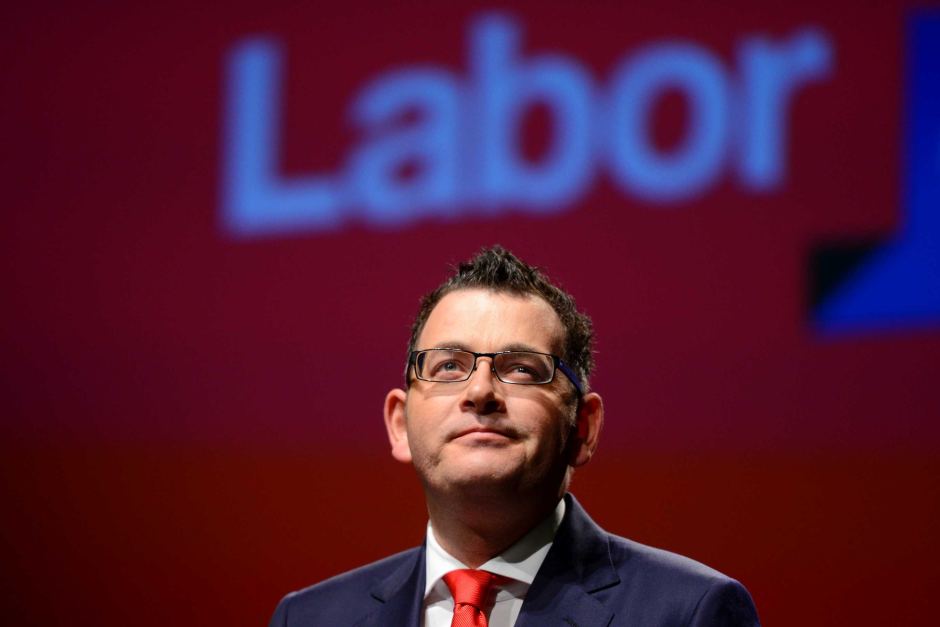
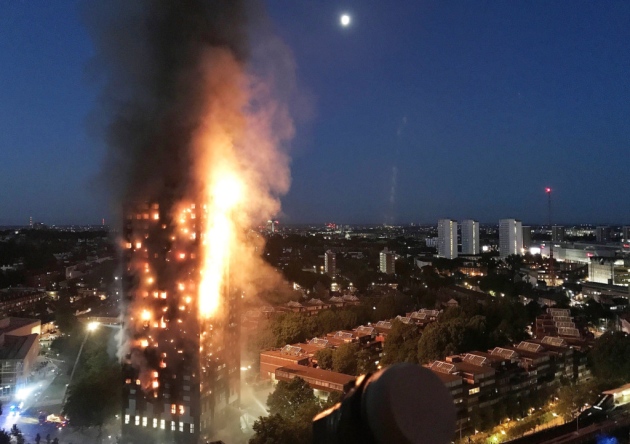
Featured image: Cambodian opposition leader Kem Sokha (Source: Wikimedia Commons)

Cambodian opposition leader Kem Sokha was recently arrested on charges of treason. While the Western media has attempted to portray the charges as politically motivated, Sokha’s treason is not only quite real, he openly, eagerly bragged about it on the Australian-based “Cambodia Broadcasting Network” (CBN).  

The Phnom Penh Post in its article, “Kem Sokha video producer closes Phnom Penh office in fear,” would quote Sokha who claimed (emphasis added):

And, the USA that has assisted me, they asked me to take the model from Yugoslavia, Serbia, where they can change the dictator Slobodan Milosevic,” he continues, referring to the former Serbian and Yugoslavian leader who resigned amid popular protests following disputed elections, and died while on trial for war crimes.

“You know Milosevic had a huge numbers of tanks. But they changed things by using this strategy, and they take this experience for me to implement in Cambodia. But no one knew about this.”

Sokha is referring to the openly admitted US-engineered regime change mechanism known as “color revolutions” and in particular the successful overthrow of Serbian leader Slobodan Milosevic in 2000.

It is also mentioned in the article that Sokha has traveled to the United States every year since 1993 to “learn about the democratization process.” A video of Kem Sokha with US Senator Ed Royce in Washington DC openly calling for the deposing of the Cambodian government has also been published by CBN.

US Regime-Change Represents Destabilization and Destruction, Not Democracy 

As admitted by the New York Times in its article, “Who Really Brought Down Milosevic,” the United States, not the people of Serbia, overthrew the Serbian government – not in favor of the Serbs’ best interests, but for Washington’s own self-serving interests.

The New York Times would write:

American assistance to Otpor and the 18 parties that ultimately ousted Milosevic is still a highly sensitive subject. But Paul B. McCarthy, an official with the Washington-based National Endowment for Democracy, is ready to divulge some details…

…McCarthy says, ”from August 1999 the dollars started to flow to Otpor pretty significantly.” Of the almost $3 million spent by his group in Serbia since September 1998, he says, ”Otpor was certainly the largest recipient.” The money went into Otpor accounts outside Serbia. At the same time, McCarthy held a series of meetings with the movement’s leaders in Podgorica, the capital of Montenegro, and in Szeged and Budapest in Hungary. Homen, at 28 one of Otpor’s senior members, was one of McCarthy’s interlocutors. ”We had a lot of financial help from Western nongovernmental organizations,” Homen says. ”And also some Western governmental organizations.”

The successful overthrow of the Serbian government by agents working on behalf of Washington served as a template for other, similar operations including the 2011 “Arab Spring” that has left North Africa and much of the Middle East ravaged by war, failed states, and human catastrophe.

In an April 2011 article also published by the New York Times titled, “U.S. Groups Helped Nurture Arab Uprisings,” it was stated:

A number of the groups and individuals directly involved in the revolts and reforms sweeping the region, including the April 6 Youth Movement in Egypt, the Bahrain Center for Human Rights and grass-roots activists like Entsar Qadhi, a youth leader in Yemen, received training and financing from groups like the International Republican Institute, the National Democratic Institute and Freedom House, a nonprofit human rights organization based in Washington.

The article would also add, regarding the US National Endowment for Democracy (NED):

The Republican and Democratic institutes are loosely affiliated with the Republican and Democratic Parties. They were created by Congress and are financed through the National Endowment for Democracy, which was set up in 1983 to channel grants for promoting democracy in developing nations. The National Endowment receives about $100 million annually from Congress. Freedom House also gets the bulk of its money from the American government, mainly from the State Department.

Those participating in overthrowing their nation’s government with foreign aid are by definition traitors – and with Cambodia’s Kem Sokha and his entire Cambodia National Rescue Party (CNRP) implicated in and admitting to an identically foreign-organized conspiracy against their own nation as took place in Serbia and across the Arab World, it seems that charges of treason are more than warranted.

Readers should take note that nations targeted by US-engineered regime change – from Serbia to Ukraine, to Georgia, Libya, Syria, Afghanistan, Iraq, and Yemen – all have suffered immeasurably since. For the Cambodian government not to follow through with uprooting Sokha and the US networks built up across Cambodia to support foreign subversion, would be the height of irresponsibility, inviting nothing less than the same sort of destabilization and destruction in Cambodia still unfolding in other nations targeted by US political interference.

Kem Sokha’s eagerness to indenture himself – and were he come to power, his entire nation – to US interests is perhaps the greatest indicator that he in no way represents the sort of democratic progress he claims to be bringing to Cambodia. Democracy – a process primarily of self-determination – cannot exist if Cambodia’s future is being openly determined in Washington D.C. instead.

This article was originally published by Land Destroyer Report.

  • Posted in English @as @as
  • Comments Off on US Sponsored “Regime Change” in Cambodia? Opposition Leader Bragged About US-backed Sedition

We Don’t Want War in Korea!

September 7th, 2017 by Bruce K. Gagnon

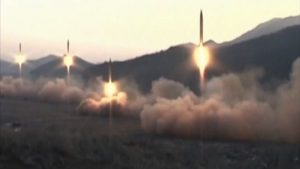
I’ve maintained for some time that the US aggressive attitude toward North Korea is a foil – a way to increase tensions in the region in order to pump-up the fear and allow the Pentagon to increase its military encirclement of China and Russia. They are the real targets.

The Pentagon knows that North Korea only has four nuclear warheads and only medium-range missiles. So despite all the hype North Korea is not a military threat to the US.

The Pentagon has 6,800 nuclear warheads and obviously has all kinds of missiles of every conceivable range. North Korea is not going to start a war – if it did the US would pulverize it in a very short time.

I got an email today from International Law professor Francis Boyle who wrote:

I have just had a look at Article 2 of the China/DPRK Mutual Assistance Treaty…. In the event the USA attacks DPRK, China is obligated to come to the Defense of DPRK and has so stated publicly and recently and repeatedly. So it appears that the USA is provoking DPRK to attack USA first, whereupon China has said it will not come to the Defense of DPRK, and it is not obligated to do so under the Treaty.

Thus North Korea has no incentive to attack the US or any of its allies unless the Pentagon hits them first. North Korea is all about survival of its regime and that is why they are developing nukes. They’ve seen what happened to Iraq and Libya and know that if they have the ability to hit back hard they will have a better chance of survival.

Now if I was asked I’d advise North Korea not to sound so belligerent which only gives the US the ability to spin things its way even more.  But easy for me to say……

North Korea was devastated during the ‘American War’ as they called it during 1950-1953. Coming out of that war the US refused to sign a peace treaty and to this day the war is technically still on. Only an Armistice (cease fire) was signed on July 27, 1953.

The US has 83 bases in South Korea that have 23,000 American troops stationed on them. The US-South Korea-Japan continually hold war games along North Korea’s border. Imagine if some other country was holding war games along our Canadian and Mexican borders. Washington would never stand for that but when we do that to others it is supposed to be acceptable.

In recent days we paid to boost the Global Network’s Keep Space for Peace Week poster on Facebook and there has been a whirlwind of comments, shares and likes. Somehow a bunch of US military soldiers got a hold of the post and many of them have been commenting. Today two of us from the Global Network had an extended discussion with one of the soldiers about the Korea issue.

US troops in South Korea and Japan would be high on the list for immediate targeting if a war started between the US and North Korea-China. American GI’s must be a bit afraid at this point and they are not likely to be hearing much opposition to war as the western corporate controlled media is non-stop promoting a US ‘decapitation’ strike.

I posted a really good Korea issues/history interview on Facebook today (see it here) and one woman commented:

I made the mistake of turning on CNN for few minutes this morning.
A bunch of warmongering, mainly women, mouthpieces. Nauseating.
Thanks for the antidote! 

I don’t know how all this will turn out but having Trump in the White House and a team of ready-to-kill military generals surrounding him is not very reassuring. At this point we all need to be speaking out loudly and often against going to war with anyone – especially not in Korea!

Bruce Gagnon is coordinator of the Global Network Against Weapons & Nuclear Power in Space. He offers his own reflections on organizing and the state of America’s declining empire.


150115 Long War Cover hi-res finalv2 copy3.jpg

The Globalization of War: America’s “Long War” against Humanity

by Michel Chossudovsky

The Globalization of War includes chapters on North Korea, Ukraine, Palestine, Libya, Iran, Yugoslavia, Haiti, Syria and Iraq as well as several chapters on the dangers of Nuclear War including Michel Chossudovsky’s Conversations with Fidel Castro entitled “Nuclear War and the Future of Humanity”.

According to Fidel: “in the case of a nuclear war, the ‘collateral damage’ would be the life of all humanity”.

The book concludes with two chapters focussing on “Reversing the Tide of War”.

“The Globalization of War” is diplomatic dynamite – and the fuse is burning rapidly.”

ISBN Number: 978-0-9737147-6-0

Pages: 240 Pages

List Price: $22.95 

Order directly from Global Research

Special Price: $15.00

America’s hegemonic project in the post 9/11 era is the “Globalization of War” whereby the U.S.-NATO military machine —coupled with covert intelligence operations, economic sanctions and the thrust of “regime change”— is deployed in all major regions of the world. The threat of pre-emptive nuclear war is also used to black-mail countries into submission.

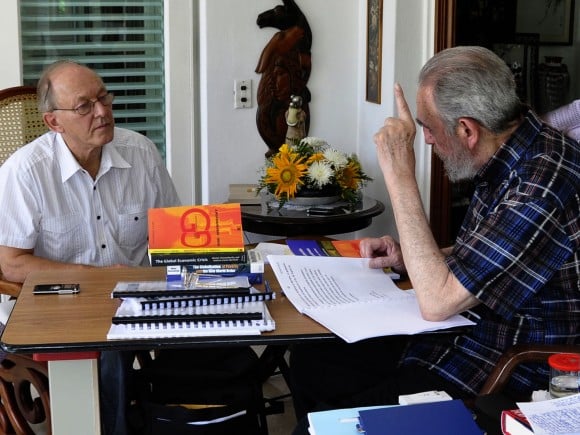
Conversations on the Dangers of Nuclear War: Fidel Castro and Michel Chossudovsky, Havana, October 2010

This “Long War against Humanity” is carried out at the height of the most serious economic crisis in modern history.

It is intimately related to a process of global financial restructuring, which has resulted in the collapse of national economies and the impoverishment of large sectors of the World population.

The ultimate objective is World conquest under the cloak of “human rights” and “Western democracy”.

Order directly from Global Research

REVIEWS:

“Professor Michel Chossudovsky is the most realistic of all foreign policy commentators. He is a model of integrity in analysis, his book provides an honest appraisal of the extreme danger that U.S. hegemonic neoconservatism poses to life on earth.”

Dr. Paul Craig Roberts, former Assistant Secretary of the U.S. Treasury

““The Globalization of War” comprises war on two fronts: those countries that can either be “bought” or destabilized. In other cases, insurrection, riots and wars are used to solicit U.S. military intervention. Michel Chossudovsky’s book is a must read for anyone who prefers peace and hope to perpetual war, death, dislocation and despair.”

Hon. Paul Hellyer, former Canadian Minister of National Defence

“Michel Chossudovsky describes globalization as a hegemonic weapon that empowers the financial elites and enslaves 99 percent of the world’s population.

“The Globalization of War” is diplomatic dynamite – and the fuse is burning rapidly.”

Michael Carmichael, President, the Planetary Movement

Michel Chossudovsky is an award-winning author, Professor of Economics, Founder and Director of the Centre for Research on Globalization (CRG)

The largest Russian bank Sberbank is planning to increase the supply of gold to China up to 10-15 tons in 2018, the head of Sberbank CIB, the bank’s investment department, told Sputnik.

“In July, our subsidiary bank in Switzerland started trading in gold in the Shanghai stock market. Under the pilot deal, we delivered 200 kilograms [440 pounds] of bars of gold to Chinese financial institutions. This year we are planning to additionally deliver about 3-5 tons of gold to China. Next year we expect the increase in deliveries to China of up to 10-15 tons. Perhaps we will even exceed this figure,” Igor Bulantsev said ahead of the third Eastern Economic Forum (EEF) in Vladivostok.

Economic analyst Peter Koenig focusses on the significance of these measures and their likely impact on both the energy and currency markets. Peter Koenig is frequent contributor to Global Research

Sputnik: Could you, please, enlighten us about what could possibly stand behind Sberbank’s plans to increase the supply of gold to China?

Peter Koenig: This is just a continuation of the economic and trade agreements between Russia and China; the first such official deal was the 2014 currency swap agreement of about US$ 25 billion equivalent, or rather 150 billion Yuan.

Let’s not forget, both currencies the ruble and the Yuan are 100% covered by gold; actually, the ruble is backed about twice by gold.

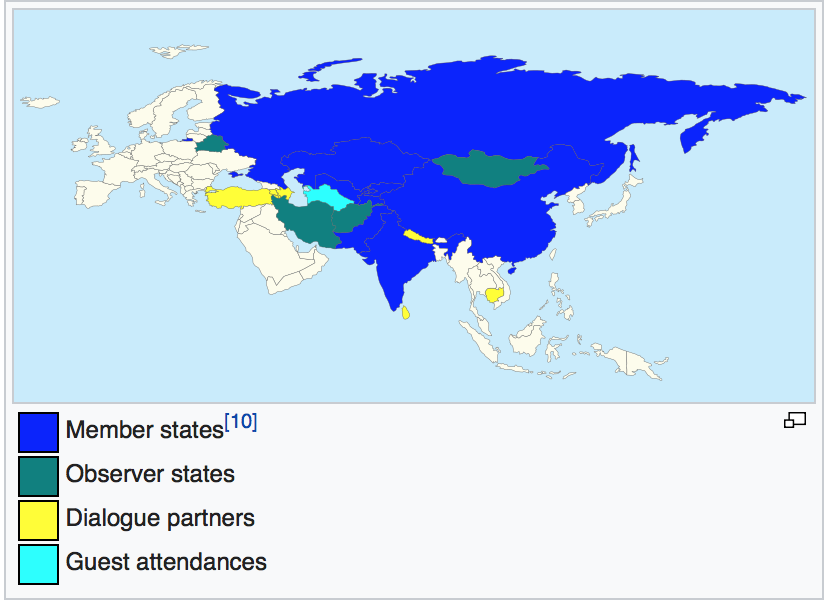
Both, the China – Russia economic cooperation and trade agreements, as well as their currencies being covered by gold is part of a larger already fairly advanced scheme of de-dollarization of their economies. In other words, Russia and China as well as the entire Shanghai Cooperation Organization (SCO), are rapidly moving out of the US dollar hegemony.

Let’s face it, the entire western monetary system is basically a fraud. It is privately made and privately owned, with the entire international payment system being controlled by the FED – which is totally privately owned – and the BIS (Bank for International Settlement, in Basle, Switzerland – also called the central bank of centrals banks). All international transfers and payments have to transit through Wall Street banks. This is the only reason why the US can “sanction” countries that do not behave according to Washington’s dictate. It is illegal, and would not stand up before any international law.

But since international courts are also controlled by Washington – there is no chance that the US will be called to account for their criminal economic actions around the world – at least not for now; at least not as long as the western dollar-based monetary system has supremacy on the world markets. But this may change rapidly. And China and Russia are moving fast towards complete independence from the western economy.

The BRICS summit that just ended in Xiamen, gave other clear signs that their enhanced economic cooperation among themselves and with the other SCO countries will be a further blow to the western monetary hegemony.

Already now, The SCO and BRICS countries contain about half of the world’s population and control one third of the world’s GDP. They truly do not need the west for survival. To the contrary. They can easily break this fraudulent dollar based ‘monopoly’. But – it has to happen prudently and gradually, because all the emerging economies that would like to join the BRICS and the SCO are still to a large degree dependent on the US-dollar; their reserves are still largely dollar-denominated.  And if the western system collapses rapidly, they would tend to lose out dramatically.

Sputnik: Follow-up: What is the reason behind China’s active enlargement of the national gold reserves? 

PK: In my opinion, this may be a temporary measure to protect their currencies – I’m talking specially about China and Russia – from a drastic last minute “dollar-rescue” action by Washington.

For example, I could imagine that as a last-ditch effort, the FED or the US Treasury could instruct the IMF to go back to some kind of a ‘gold standard’ – which may come in the form of a massive devaluation of the dollar, where all those countries who do not have gold reserves or otherwise gold-convertible currencies would end up paying the enormous US dollar debt – becoming once again slaves to a new dollar-dependence.

By increasing gold reserves, Russia and China would be protected. Also, China and Russia, the world’s largest gold producers, accounting for almost a quarter of annual gold production (3,100 tons in 2016), will be instrumental in making the international gold price.

The problem with gold today is that it is completely beholden to the western monetary system – the price of gold on the international market is quoted in US dollars.

In the medium to long run, I believe gold is no viable indicator or back-up for a monetary system. Gold is just a step better than fiat money, because the price of gold is vulnerable and can be manipulated, as we see time and again.

For example, on 25 August, Bloomberg reports a mysterious 2 million-ounce gold trade. It says – In a span of one minute, gold futures contracts equaling more than 2 million ounces traded — about 20 minutes before Federal Reserve Chair Janet Yellen was to address a gathering of policy makers in Jackson Hole, Wyoming.

The episode jolted the market after a measure of 60-day volatility on the metal touched the lowest since 2005. Gold had been in quiet mode even amid political discord in Washington, concerns about rising U.S. interest rates and tensions between the U.S. and North Korea.”

One wonders whether this clear manipulation of the price of gold has anything to do with the increased gold trade between Russia and China…..?

Sputnik: Now, China is soon expected to launch a crude oil futures contract priced in yuan and convertible into gold. How could this initiative change the rules of the global oil game? How soon do you think this landmark transition would happen? Who will profit from this initiative? 

PK: It will change everything.Already now – since about three to five years – China and Russia and other members of the SCO are trading hydrocarbons no longer in US dollars, but in their local currencies or gold.

An oil futures contract in yuan and gold is about the equivalent of an ‘oil bourse’ – or a hydrocarbon exchange in yuan and gold – where every oil producer or trader can deal in hydrocarbons in non-dollar denominated contracts.

This will be an enormous blow to the US dollar hegemony. One of the key reasons the US dollar has maintained its hegemonic nature around the globe, is that according to an unwritten agreement between the US and Saudi Arabia of the early 1970s, Saudi Arabia, the head of OPEC, was to make sure that petrol and gas are traded only in US dollars. In return, the Saudis received “US protection” – lots of US bases, from which the wars in the Middle East are directed and carried out.

Those who wanted to depart from that unwritten and completely unlawful rule had to pay dearly – i.e. Saddam Hussein, when he announced that he would trade his oil in euros instead of dollars when the ten-years sanctions regime came to an end in 2000… we know what happened to him. We also know what happened to Gaddafi, who had similar ideas – and Iran was suddenly faced with accusations of having a nuclear weapons program, when they announced in 2007 the Teheran Oil Bourse – where all hydrocarbons could be traded in other currencies than the US dollar.

This US imposed ‘rule’ – totally illegal – allowed the US Treasury to print dollars indiscriminately, because the world needed dollars to pay for their energy.

The other reason for unlimited US Dollar printing was when the Nixon Administration abandoned the gold standard in 1971, and the dollar became de facto the world’s reserve currency.  – It’s time that this fraud comes to an end. China and Russia offer an alternative.

Sputnik: Experts say that China’s decision to launch a crude oil futures contract will allow exporters such as Russia to circumvent U.S. sanctions by trading in yuan. What implications would yuan-denominated gold contracts have for Russia, in your view?

PK: Up to about 5 to 10 years ago, most international trading contracts were denominated in US- dollars, regardless whether they involved the US or not. This was also an unwritten, WTO-imposed rule. This is no longer the case.

Therefore, yes, detaching from the dollar-based western monetary system, and instead trading in Yuan, rubles or gold, or any other local currencies for that matter, will make ‘sanctions’ completely ineffective. This is already largely the case today, since Russia and China and many of the SCO countries are already trading in other than US-dollar denominated contracts.

It is through non-dollar international trade contracts that the western dollar-based monetary system will be gradually dethroned and dismantled.

Sputnik: How would these developments affect the dollar as a global reserve currency? What implications will it have on its hegemony?

PK: By dealing in other currencies than the US dollar, including in gold, world demand for the dollar will rapidly decline and so will the dollar’s significance as a world reserve currency.

Some 20 years ago, about 90% of all reserves were established in US dollar denominated assets. Today, this figure is less than 60% and shrinking. Once dollar-denominated reserves fall below 50%, abandoning the dollar as reserve currency worldwide may progress rapidly. That’s when a last-ditch effort by Washington to save the dollar hegemony may come in the form of a new gold-standard – at the cost of the countries that hold dollar reserves.

The western economy today and for the last at least 100 years has been based on a fraudulent, debt-driven privately-owned and manipulated monetary system – on fiat money. When in reality, it should be the economy of a nation or a region that makes and backs the monetary system.

If I may, I predict that in the foreseeable future, it will not be gold or other minerals that back a monetary system, but the economy itself; the strength of a country’s – or association of countries’ – socioeconomy that determines the monetary system. The strength of an economy will be determined by indicators well beyond the linear GDP; they will include societal values, such as education, health services, and behavioral values, like how a society deals with the environment, natural resources and conflict resolutions.

This is what I believe the new Eastern Economy, based on China and Russia – the Economy of Peace – will offer to the world as an alternative.

Peter Koenig is an economist and geopolitical analyst. He is also a former World Bank staff and worked extensively around the world in the fields of environment and water resources. He lectures at universities in the US, Europe and South America. He writes regularly for Global Research, ICH, RT, Sputnik, PressTV, The 4th Media (China), TeleSUR, The Vineyard of The Saker Blog, and other internet sites. He is the author of Implosion – An Economic Thriller about War, Environmental Destruction and Corporate Greed – fiction based on facts and on 30 years of World Bank experience around the globe. He is also a co-author of The World Order and Revolution! – Essays from the Resistance

Featured image is from EMerging Equity.

  • Posted in English @as @as
  • Comments Off on Gold Trade Between Russia and China – A Step Closer Towards De-Dollarization?

China has announced a “new world order” for world oil markets that could have profound effects on the global economy and the monetary order itself.

But as The Shanghai International Energy Exchange gears up for operation, it’s important to note yet again that this is another engineered conflict with the pre-determined death of the dollar system being used to bring in the new multipolar world order that the NWO has been openly working toward for decades.

.

  • Posted in English @as @as
  • Comments Off on Video: China’s New World Order: Gold-backed Oil Benchmark on the Way

The unfolding crisis in Southeast Asia’s state of Myanmar has confounded many geopolitical analysts due to its complex history and the intentionally deceptive and now contradictory coverage provided by the Western media.

The current government of Myanmar is headed by Aung San Suu Kyi and her National League for Democracy (NLD). It has ascended into power after a decades-long struggle against the nation’s military who ruled the nation for decades.

Aung San Suu Kyi is a Creation and Proxy of US and European Interests

Suu Kyi and her NLD are the recipients of tens of millions of dollars in US, British, and European aid. Entire networks of fronts posing as nongovernmental organizations (NGOs) have been created to undermine and overwrite Myanmar’s sovereign institutions.

The extent of this support and funding is covered by many of the Western organizations themselves, including the Burma Campaign UK, who in its 36 page 2006 report, “Failing the People of Burma?” (.pdf) details extensively how it and its American counterparts have built up Suu Kyi’s now impressive political domination of Myanmar.

The report states explicitly:

The National Endowment for Democracy (NED – see Appendix 1, page 27) has been at the forefront of our program efforts to promote democracy and improved human rights in Burma since 1996. We are providing $2,500,000 in FY 2003 funding from the Burma earmark in the Foreign Operations legislation. The NED will use these funds to support Burmese and ethnic minority democracy-promoting organizations through a sub-grant program. The projects funded are designed to disseminate information inside Burma supportive of Burma’s democratic development, to create democratic infrastructures and institutions, to improve the collection of information on human rights abuses by the Burmese military and to build capacity to support the restoration of democracy when the appropriate political openings occur and the exiles/refugees return.

It also reports:

Both Voice of America (VOA) and Radio Free Asia (RFA) have Burmese services. VOA broadcasts a 30-minute mix of international news and information three times a day. RFA broadcasts news and information about Burma two hours a day. VOA and RFA websites also contain audio and text material in Burmese and English. For example, VOA’s October 10, 2003 editorial, “Release Aung San Suu Kyi” is prominently featured in the Burmese section of VOAnews.com. RFA’s website makes available audio versions of 16 Aung San Suu Kyi’s speeches from May 27 and 29, 2003. U.S. international broadcasting provides crucial information to a population denied the benefits of freedom of information by its government.

Regarding the indoctrination and education of future leaders of this Western proxy political bloc, it states:

The State Department provided $150,000 in FY 2001/02 funds to provide scholarships to young Burmese through Prospect Burma, a partner organization with close ties to Aung San Suu Kyi. With FY 2003/04 funds, we plan to support Prospect Burma’s work given the organization’s proven competence in managing scholarships for individuals denied educational opportunities by the continued repression of the military junta, but committed to a return to democracy in Burma.

In regards to the Open Society and its role in interfering with Myanmar’s internal politics, the report states:

Our assistance to the Open Society Institute (OSI) (until 2004) provides partial support for a program to grant scholarships to Burmese refugee students who have fled Burma and wish to continue their studies at the undergraduate, or post-graduate level. Students typically pursue degrees in social sciences, public health, medicine, anthropology, and political science. Priority is given to students who express a willingness to return to Burma or work in their refugee communities for the democratic and economic reform of the country. 

The report, written in 2006 when another US proxy – Thaksin Shinawatra – presided over Thailand as prime minister until his ouster later that year, would detail the role Thailand was then playing to undermine and overthrow Myanmar’s political order:

Last year the U.S. government began funding a new program of the International Organization for Migration (IOM) to provide basic health services to Burmese migrants outside the official refugee camps in cooperation with the Thai Ministry of Public Health. This project has been supported by the Thai government and has received favorable coverage in the local press. Efforts such as this that endeavor to find positive ways to work with the Thai government in areas of common interest help build support for U.S.-funded programs that support Burmese pro-democracy groups.

Myanmar’s current minister of information, Pe Myint – for example – underwent training at the NED and Open Society-funded Indochina Media Memorial Foundation in Bangkok.

A US diplomatic cable made available via Wikileaks would reveal just how integral such training was in building up the US client state that now rules Myanmar.

Titled, “An Overview of Northern Thailand-Based Burmese Media Organizations,” the 2007 cable states (emphasis added):

Other organizations, some with a scope beyond Burma, also add to the educational opportunities for Burmese journalists. The Chiang Mai-based Indochina Media Memorial Foundation, for instance, last year completed training courses for Southeast Asian reporters that included Burmese participants. Major funders for journalism training programs in the region include the NED, Open Society Institute (OSI), and several European governments and charities….

…A number of active media training programs attract exiles and those from inside Burma to Chiang Mai for journalism courses ranging from one week to one year. These training programs identify would-be journalists who are active in communities inside Burma, as well as NGOs in Thailand, and help them secure reporting positions with Burmese media outfits in the region. The training programs help ensure that future generations will be able to succeed the founders of the current organizations.

The cable also links US funding to the very predictable “pro-American” attitude adopted by those receiving the benefits of such funding:

In a refreshing take for U.S. diplomats interacting with foreign media, the exile journalist community here remains steadfastly pro-American. Groups such as DVB and The Irrawaddy continually seek more input from U.S. officials and make frequent use of interviews, press releases and audio clips posted on USG websites. A live interview with a U.S. diplomat is a prized commodity, one even capable of stoking a healthy competition among rival news organizations to land a scoop. A 2006 Irrawaddy interview with EAP DAS Eric John multiplied into several articles and circulated widely throughout the exile community and mainstream media. 

USG funding plays some role in this goodwill…

Without doubt, Suu Kyi and those occupying top positions within her government, are the product of decades of US-UK and European backing, training, and indoctrination.

Saudi-backed “Rohingya Militants” No More Represent All Rohingya than ISIS Represents All Sunnis 

An unfortunate narrative is taking shape across the alternative media, portraying Myanmar’s Rohingya minority as “Islamists” taking up “jihad.”

In reality, Myanmar’s Rohingya minority have lived in Myanmar for generations. Until recently, they have lived in harmony with their Buddhist-majority neighbors across the country, including in Rakhine state.

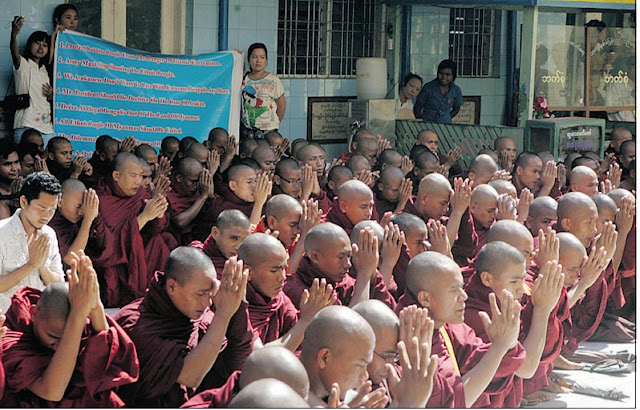
Many of the talking points now being adopted against the Rohingya are quite literally copied and pasted from US-backed extremist groups in Myanmar. Claims that the term “Rohingya” is simply made-up, that the Rohingya are actually illegal Bengalis, and that they should be expelled by force from Myanmar have been the key points of Suu Kyi’s violent “Saffron monk” supporters for years.

The increasingly empowered supporters of Aung San Suu Kyi – many of whom were present during the 2007 “Saffron Revolution” – are the primary agitators of the Rohingya crisis. While the Western media has attempted to portray the military as being behind the violence, it is often the military that intervenes to separate attacking extremists from the Rohingya villages and refugee camps they seek to slash and burn.

It was the military-led government that attempted to move forward the process of granting the Rohingya citizenship, opposed vehemently by Suu Kyi’s political party and her supporters, and ended entirely once Suu Kyi came to power.

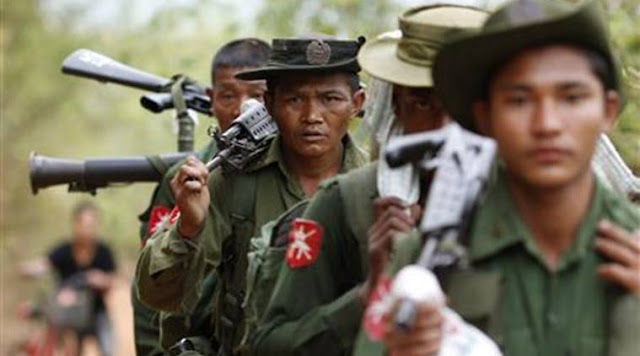
More recently, the Western media has noted the emergence of Rohingya-aligned militants who have reportedly carried out several large-scale attacks on police and military units across Rakhine state.

Of course, no militant group exists without substantial political, financial, and material support. And just as other politically-convenient conflicts have erupted in Libya, Syria, Yemen, and the Philippines, US-Saudi funding is evident among the latest outbreak of violence in Myanmar as well.

It is a combination of gasoline and fire – the tools of a single arsonist intentionally put into place to create a geopolitically convenient conflagration. 

The Wall Street Journal in a recent article titled, “Asia’s New Insurgency Burma’s abuse of the Rohingya Muslims creates violent backlash.” claims:

Now this immoral policy has created a violent backlash. The world’s newest Muslim insurgency pits Saudi-backed Rohingya militants against Burmese security forces. As government troops take revenge on civilians, they risk inspiring more Rohingya to join the fight.

The article also claims:

Called Harakah al-Yaqin, Arabic for “the Faith Movement,” the group answers to a committee of Rohingya emigres in Mecca and a cadre of local commanders with experience fighting as guerrillas overseas. Its recent campaign—which continued into November with IED attacks and raids that killed several more security agents—has been endorsed by fatwas from clerics in Saudi Arabia, Pakistan, the Emirates and elsewhere. 

Rohingyas have “never been a radicalized population,” ICG notes, “and the majority of the community, its elders and religious leaders have previously eschewed violence as counterproductive.” But that is changing fast. Harakah al-Yaqin was established in 2012 after ethnic riots in Rakhine killed some 200 Rohingyas and is now estimated to have hundreds of trained fighters.

While many causal observers note that the violence the Rohingya have been subjected to was bound to provoke a violent reaction, armed insurgencies do not spontaneously emerge. Isolated acts of violence, organized gangs with very limited capacity are possible, but the violence the Wall Street Journal is describing is not “backlash,” it is foreign-funded politically-motivated militancy operating under the cover of “backlash.”

Aung San Suu Kyi and “Rohingya” Militants: Gasoline and Fire, Not Good vs. Evil  

The current client regime presiding over Myanmar – created and perpetuated by American cash and support – is being intentionally pitted against a militancy funded and organized by America’s closest ally in the Middle East – Saudi Arabia.

It is a combination of gasoline and fire – the tools of a single arsonist intentionally put into place to create a geopolitically convenient conflagration.

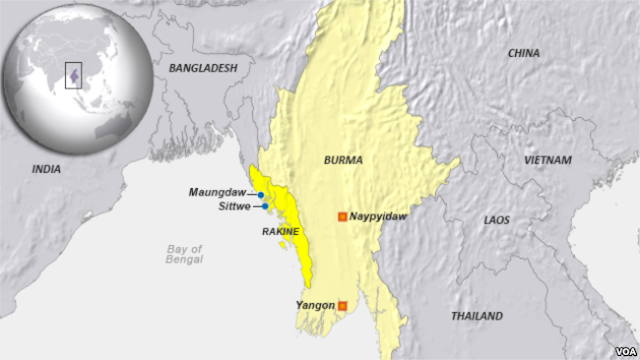
It should be noted that Rakhine state is the starting point of one of several of China’s One Belt One Road projects – connecting Sittwe Port located there to infrastructure that leads across Myanmar to China’s southern city of Kunming.

This map provided by VOA accompanies stories by the US State Department-funded media platform eagerly reporting how violence is disrupting China’s OBOR projects. 

Not only does the violence in Rakhine state threaten Chinese interests, it also helps set a pretext for direct US military involvement – either in the form of “counter-terror assistance” as is being offered to the Philippines to fight US-Saudi-backed militants from the Islamic State, or in the form of a “humanitarian intervention.”

In either case, the result will be US military assets placed in a nation directly on China’s border – in Southeast Asia, just as US policymakers have sought to do for decades.

For example, The Project for a New American Century (PNAC) in a 2000 paper titled “Rebuilding America’s Defenses” (PDF) would unabashedly declare its intentions to establish a wider, permanent military presence in Southeast Asia.

The report would state explicitly that: 

…it is time to increase the presence of American forces in Southeast Asia.

It would elaborate in detail, stating:

In Southeast Asia, American forces are too sparse to adequately address rising security requirements. Since its withdrawal from the Philippines in 1992, the United States has not had a significant permanent military presence in Southeast Asia. Nor can U.S. forces in Northeast Asia easily operate in or rapidly deploy to Southeast Asia – and certainly not without placing their commitments in Korea at risk. Except for routine patrols by naval and Marine forces, the security of this strategically significant and increasingly tumultuous region has suffered from American neglect. 

Noting the difficultly of placing US troops where they are not wanted, the PNAC paper notes:

This will be a difficult task requiring sensitivity to diverse national sentiments, but it is made all the more compelling by the emergence of new democratic governments in the region. By guaranteeing the security of our current allies and newly democratic nations in East Asia, the United States can help ensure that the rise of China is a peaceful one. Indeed, in time, American and allied power in the region may provide a spur to the process of democratization inside China itself.

It should be noted that the paper’s reference to “the emergence of new democratic governments in the region” is a reference to client states created by the United States on behalf of its own interests and in no way constituted actual “democratic governments” which would otherwise infer they represented the interests of the very people possessing the “national sentiments” that opposed US military presence in the region in the first place.

In 2000, the US had several prospective client regimes emerging – including Suu Kyi in Myanmar, Thaksin Shinawatra in Thailand, and Anwar Ibrahim in Malaysia. Since then, only Suu Kyi remains – while Shinawatra and his sister have fled abroad and Ibrahim resides in prison.

Conclusions

It is important that readers and analysts alike understand several key points regarding the crisis in Myanmar:

  1. Aung San Suu Kyi and her political party are whole-cloth creations of US and European interests;
  2. The Rohingya have lived in Myanmar for generations; 
  3. Saudi-backed “Rohingya militants” no more represent the Rohingya people than the Islamic State represents the Sunnis of Syria and Iraq; 
  4. These “militants” are admittedly supported and directed from Saudi Arabia and do not represent a legitimate “backlash” against anti-Rohingya violence and; 
  5. The US does not seek “regime change” in Myanmar, it seeks to disrupt Chinese interests, undo Chinese-Myanmar ties, and if possible, place US military assets on China’s border. 

The further from these facts analysts start out with, the further from the truth they will find themselves as the conflict in Myanmar continues to unfold. Readers and analysts should hold in suspicion narratives based on ideological rhetoric or built upon geopolitical analogy rather than actual evidence regarding finances, logistics, and socioeconomic motivations.

In Myanmar, Suu Kyi’s movement, anti-Rohingya violence, and alleged “backlash” all come accompanied with very obvious and significant foreign-footprints. It is a testament to the scale and complexity of manipulation the West is still capable of undertaking and places in jeopardy not only the majority of the people in Myanmar – Buddhist and Rohingya alike – who wish to live in peace, but the entire region as the US attempts to continue its pursuit of regional hegemony.

This article was originally published by Land Destroyer Report.

All images in this article are from the author.

  • Posted in English @as @as
  • Comments Off on Myanmar: The Rohingya, Saudi Backed ISIS Militants, Aung San Suu Kyi is a US Proxy

Cocaine, Heroin, Cannabis, Ecstasy: How Big is the Global Drug Trade?

September 6th, 2017 by Global Research News

Of relevance to the current debate on Heroin addiction in the USA.

Narcotics is big business.

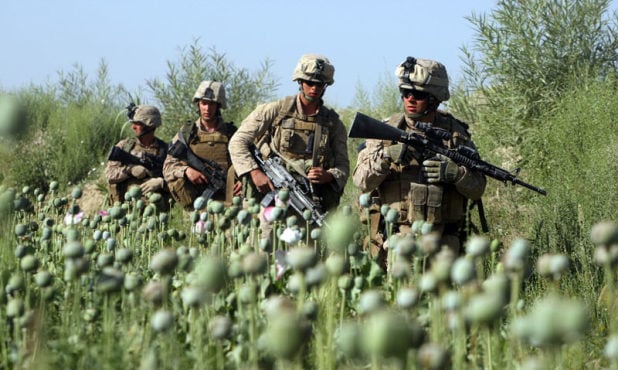
90 percent of the heroin consumed in the US comes from Afghanistan

This Graphic was first published by GR in May 2014

Drug Trade
Source: Top-Criminal-Justice-Schools.net

How Big Is the Drug Trade?

With the recent capture of “El Chapo,” the richest drug cartel leader in the world, let’s take a look at what he was known for — a global drug trade.

It’s a big question.
There’s a world of drugs out there:
Methamphetamine
Amphetamines
Cannabis
Heroin
Opium
Cocaine
Ecstasy
Hallucinogens

And a world of drug users…

Drug Users by Region:

Africa:

Cannabis Users-
Lower estimate-27,680,000
Upper estimate-52,790,000
Average-16,735,000

Opiate Users-
Lower estimate-680,000
Upper estimate-2,930,000
Average-1,805,000

Cocaine Users-
Lower estimate-1,020,000
Upper estimate-2,670,000
Average-1,845,000

Amphetamine Users-
Lower estimate-1,550,000
Upper estimate-5,200,000
Average-3,375,000

Ecstasy users-
Lower estimate-350,000
Upper estimate-1,930,000
Average-1,140,000

The Americas:
North America:
Cannibis Users-
Lower estimate-29,950,000
Upper estimate-29,950,000
Average-29,950,000

Opiate Users-
Lower estimate-1,290,000
Upper estimate-1,380,000
Average-1,335,000

Cocaine Users-
Lower estimate-6,170,000
Upper estimate-6,170,000
Average-6,170,000

Amphetamine Users-
Lower estimate-3,090,000
Upper estimate-3,200,000
Average-3,150,000

Ecstasy Users-
Lower estimate-2,490,000
Upper estimate-2,490,000
Average-2,490,000

Caribbean and South/Central America:

Cannabis Users-
Lower estimate-8,260,000
Upper estimate-10,080,000
Average-9,170,000

Opiate Users-
Lower estimate-1,000,000
Upper estimate-1,060,000
Average-1,030,000

Cocaine Users-
Lower estimate-2,550,000
Upper estimate-2,910,000
Average-2,732,500

Amphetamine Users-
Lower estimate-1,670,000
Upper estimate-2,690,000
Average-2,180,000

Ecstasy Users-
Lower estimate-550,000
Upper estimate-3,031,000
Average-1,790500

Asia:

Cannabis Users-
Lower estimate-31,510,000
Upper estimate-64,580,000
Average-48,045,000

Opiate Users-
Lower estimate-6,446,000
Upper estimate-12,540,000
Average-9,493,000

Cocaine Users-
Lower estimate-430,000
Upper estimate-2,270,000
Average-1,350,000

Amphetamine Users-
Lower estimate-4,430,000
Upper estimate-37,990,000
Average-21,210,000

Ecstasy Users-
Lower estimate-2,370,000
Upper estimate-15,620,000
Average-8,995,000

Europe:

Cannabis Users-
Lower estimate-29,370,000
Upper estimate-29,990,000
Average-29,680,000

Opiate Users-
Lower estimate-3,290,000
Upper estimate-3,820,000
Average-3,555,000

Cocaine Users-
Lower estimate-4,570,000
Upper estimate-4,970,000
Average-4,770,000

Amphetamine Users-
Lower estimate-2,500,000
Upper estimate-3,190,000
Average-2,845,000

Ecstasy Users-
Lower estimate-3,850,000
Upper estimate-4,080,000
Average-3,965,000

Global Numbers:

Cannabis Users-
Lower estimate-128,910,000
Upper estimate-190,750,000
Average-159,830,000

Opiate Users-
Lower estimate-12,840,000
Upper estimate-21,880,000
Average-17,360,000

Cocaine Users-
Lower estimate-15,070,000
Upper estimate-19,380,000
Average-17,225,000

Amphetamine Users-
Lower estimate-13,710,000
Upper estimate-52,900,000
Average-33,305,000

Ecstasy Users-
Lower estimate-10,540,000
Upper estimate-25,820,000
Average-18,180,000

Which equals A LOT of dough

Estimated annual value of global criminal markets in the 2000′s
Cocaine: $88 billion USD
Opiates: $65 billion USD

By comparison, only $1 billion in criminal firearms markets.
That’s 153 times bigger than the criminal firearms trade.
– (And that’s only counting Cocaine and Opiates)

By Value, most drugs originate in 3 nations.

Afghanistan, Colombia, and Peru manufacture a majority of cocaine and heroine.

Top destinations for Afghani Heroin:

  1. Europe
  2. Russian Federation
  3. China
  4. The Americas
  5. Africa

Top destinations for Afghani Opium

  1. Iran
  2. Europe
  3. Afghanistan
  4. Pakistan
  5. Africa

Top destinations for Peruvian and Colombian Cocaine:

  1. North America (40% of global annual users)
  2. EU
  3. South America/Central America/Caribbean
  4. Africa
  5. Asia

Once the money gets rolling…

Cocaine:
Pan-American Route:
With drugs, you pay for risk, as much as the product itself.
1 kilo = $2,000 in Colombia or Peru
1 kilo = $10,000 in Mexico
1 kilo = $30,000 in the U.S.
Or broken up into grams = $100,000 in U.S.

There’s no stopping it.

Even with a wall at the border drug traffickers use:
Catapults (to throw packages over the wall)
Planes (over the wall)
-Cesnas to 747′s.[2]
(747′s can carry 13 tons of cocaine)
(that’s $1.179 billion in cocaine once it’s in America and parceled out)
Boats (around the wall)
Tunnels (below the wall)
Sandbag Bridges (over rivers)

When your trafficking a 100 kilos, a wrecked Cesna, a sunk boat, or a broken tunnel is a cost you can deal with.

The U.S. is the single largest customer base of drugs worldwide.

Estimates for US drug expenditures:[in billions USD]
Cocaine: 28
Heroin: 27
Marijuana: 41
Meth: 13

Former Mexican President Porfirio Diaz–“Poor Mexico, so far from God and so close to the United States.” [2]

Colombian and Mexican Cartels take in $18-$39 billion from US sales each year.
$6.6 billion = Mexican Cartel gross revenue.
50% of this is made by the Sinaloa Cartel
Equals $3 billion in revenue.
About 1/2 of Facebook’s revenue
Close to Netflix’s revenue
And that’s just the cartels of two countries.

These are some massive players.
With several drug kingpins landing on Forbes richest in the world list in recent years.

Drug Kingpins:

El Chapo Guzman:[2]
Forbes billionaire list: 2009-2012
Chicago’s Public Enemy No. 1
Notable Achievements:
1st to traffic drugs through tunnel underneath border.
Known for using a catapult to throw drugs over the border.
Had a large pot farm guarded by armed guards in northern Wisconsin.
Escaped from a high security Mexican prison in a laundry basket.
Saw the future with methamphetamine, gave it away for free to establish a customer base.

Zhenli Ye Gon[2]
A Chinese-Mexican businessman believed to have sold precursors of meth to cartels.
And this is a lot of meth.
Meth ingredient seizures at ports:
22 tons in October 2009; 88 tons in May 2010; 252 tons December 2012

Zhenli is a notorious gambler. [2]
Losing so much at a casino that they gifted him a Rolls-Royce.
How much do you have to lose to be given a Rolls-Royce?
$72 million was how much Zhenli lost at one casino that year.

Pablo Escobar:[4]
At his height had a fleet of:
16 planes
1 Learjet
6 helicopters
Boats
Remote control submarines.

Largest load: sent 25 tons of cocaine on a boat.

Spent $2,500 a month on rubber bands to stack money.
Wrote off 10% of income from “spoilage” by rats nibbling at stacks of money.

This is too much money to ignore. In the drug trade, if you can make it, users will always come.

How-big-is-drug-trade

Copyright; top-criminal-justice-schools.net, 2014

Citations:

  1. http://www.forbes.com/sites/erincarlyle/2012/03/13/billionaire-druglords-el-chapo-guzman-pablo-escobar-the-ochoa-brothers/
  2. http://www.nytimes.com/2012/06/17/magazine/how-a-mexican-drug-cartel-makes-its-billions.html?pagewanted=all&_r=3&
  3. https://www.unodc.org/documents/wdr/WDR_2010/World_Drug_Report_2010_lo-res.pdf
  4. http://en.wikipedia.org/wiki/Pablo_Escobar
  5. http://www.whitehouse.gov/sites/default/files/ondcp/policy-and-research/wausid_results_report.pdf
  • Posted in English @as @as
  • Comments Off on Cocaine, Heroin, Cannabis, Ecstasy: How Big is the Global Drug Trade?

Trump Continues Failed Military Policy in South Central Asia

September 6th, 2017 by Abayomi Azikiwe

Badly damaged from the political fallout surrounding President Donald Trump’s posture towards white nationalists and neo-fascists, the forty-fifth head-of-state has now shifted his focus toward war policy in Afghanistan and Pakistan.

With the 16th anniversary of the United States and NATO occupation of Afghanistan coming up in October, Trump has sought to justify the escalation of the war in the aftermath of decades of Washington’s failure dating back to the destabilization of the Socialist government of the 1970s and 1980s. It was during this period that the U.S.-backed Islamist groups opposed the People’s Democratic Party (PDP) which oversaw social advances inside Afghanistan involving land reform, the rights of women and the maintenance of a secular state.

During Trump’s 2016 presidential campaign he suggested that the war in Afghanistan had been a total failure and would not be a priority of his administration if elected. However, on August 21, the president said that the U.S. troops stationed there would not be withdrawn. Moreover, Trump announced the deployment of 4,000 more soldiers and an escalation in the bombing which has been carried out since 2001.

Trump said that the focus of his policy on Afghanistan would not be nation building. He went on to say that all he wanted to do was kill “terrorists.” Despite the speech delivered before a military audience, this is not a departure from what has already been done over the last 16 years.

Former President Barack Obama often boasted about how many Muslim “terrorists” he had killed in targeted assassinations. Drone attacks escalated under the Obama administration while tens of thousands of additional troops were sent to Afghanistan during his two terms of office.

Consequently, the Trump administration is not making any fundamental changes in Pentagon policy towards Afghanistan and Pakistan. Trump is attempting to scapegoat the Pakistan government saying they have received billions in U.S. dollars and have not been considerate of Washington’s wishes for the region. Under Obama the airstrikes inside Pakistan accelerated. The speech on August 21 signals the potential for ongoing bombing operations inside of Pakistan.

The Consolidation of Power Among the Generals

What is never said by the Trump administration and the corporate media which criticizes the presidency around the clock is that thousands of Pentagon and NATO troops have been killed and wounded in Afghanistan since 2001. There have been untold numbers of Afghans and Pakistanis who have lost their lives. Estimates are that several million people have been displaced both within and outside of the borders of the two nations.

In light of the rapid turnover of White House functionaries close to the president, the rise of even more high-ranking military personnel has caught the attention of even the Washington Post. General John F. Kelley was recently shuffled from the director for the Department of Homeland Security (DHS) to White House Chief of Staff. The departure of chief strategist Steve Bannon on August 18 connotes the further elevation of Pentagon interests in managing the day-to-day affairs of the oval office.

The Washington Post noted in an article written by Robert Costa and Philip Rucker that:

“Inside the White House, meanwhile, generals manage Trump’s hour-by-hour interactions and whisper in his ear — and those whispers, as with the decision this week to expand U.S. military operations in Afghanistan, often become policy. At the core of Trump’s circle is a seasoned trio of generals with experience as battlefield commanders: White House Chief of Staff John F. Kelly, Defense Secretary Jim Mattis and national security adviser H.R. McMaster. The three men have carefully cultivated personal relationships with the president and gained his trust.” (Aug. 22)

Claiming the military influence on Trump serves as a “moderating” factor illustrates the blurring of lines between the apparent Democratic Party allied corporate media and the hawkish elements among the Republicans. Interestingly enough it has not been the questions of foreign policy and the waging of wars which never seem to end that have divided the two wings of the U.S. ruling class. Antagonizing relations with the Russian Federation, the Democratic People’s Republic of Korea (DPRK), the Bolivarian Republic of Venezuela, Cuba and the People’s Republic of China seem to have bipartisan support. The disagreements derive from tactical and procedural issues on how to best implement the imperialist project of Washington and Wall Street.

This same Washington Post article goes on to say:

“Kelly, Mattis and McMaster are not the only military figures serving at high levels in the Trump administration. CIA Director Mike Pompeo, Attorney General Jeff Sessions, Energy Secretary Rick Perry and Interior Secretary Ryan Zinke each served in various branches of the military, and Trump recently tapped former Army general Mark S. Inch to lead the Federal Bureau of Prisons. Together with other allies in the administration, Kelly, Mattis and McMaster see their roles not merely as executing Trump’s directives but also as guiding him away from moves that they fear could have catastrophic consequences, according to officials familiar with the dynamic.”

White Nationalism, Neo-Fascism and Militarism

A campaign speech delivered by Trump in Phoenix, Arizona on August 22 reinforced the ultra-right wing character of the administration. The president praised the role of the police, military forces and the DHS.

Although Trump read a previous press statement ostensibly condemning the racists and neo-fascists, these sentiments were very much in evidence in Phoenix. His labeling of immigrants as criminals and terrorists provides a rationale for the further implementation of repressive measures impacting the majority of people in the U.S. and internationally.

The rally was yet another attempt to mobilize a mass base for his neo-fascist agenda. Belittling his critics within the corporate media as well as the thousands of people who had gathered outside to protest his policies, Trump emboldened his followers who applauded and screamed at every outrageous assertion uttered by the commander-in-chief.

So much so that in the aftermath of the Trump speech police fired teargas canisters, pepper spray and concussion grenades to disperse peaceful demonstrators surrounding the venue to protest the rally. During his gathering Trump praised Maricopa County Sheriff Joe Arpaio who was convicted of contempt of federal court and is waiting to be sentenced. The president hinted that Arpaio will be pardoned. Trump said that the pardon would not be announced in Phoenix since it would cause too much controversy. Arpaio enacted law-enforcement measures which many people felt racially profiled and humiliated immigrants.

Capitalism Cannot End Poverty and Low-wage Labor

Despite Trump’s bragging about the 4.3 percent unemployment rate in the U.S., the growth in the second quarter of 2.3, the additional points added to the stock market and the purported creation of over a million new jobs, contrastingly the labor participation rate of approximately 62 percent and the decline in real wages paints a more accurate portrait of the actual social situation prevailing in the country. The promises of massive mining, manufacturing and infrastructural projects remain an illusion waved before the susceptible largely white political base to maintain their allegiance.

Under modern-day capitalism the desire for maximum profitability guides economic policy. The profitability is closely intertwined with the export of capital seeking low wages and minimal resistance from the workers. Therefore the disbanding of the administration’s manufacturing and business councils represents the evisceration of the illusionary promises of better conditions for the distressed population inside the U.S.

Reverting back to the methodology of warmongering and race-baiting as a diversionary tactic is nothing out of the ordinary. Successive administrations have used these ploys in an attempt to confuse the masses. The dissolution of the war machine and the ascendancy of a planned economy operating in the interests of working people and the nationally oppressed are required at this conjuncture.

Republicans and the Democrats have proved incapable of satisfying the needs of the people. It will obviously take a new political dispensation to correct the contradictions that are rising rapidly within the U.S. during this time period.

Featured image is from the author.

  • Posted in English @as @as
  • Comments Off on Trump Continues Failed Military Policy in South Central Asia

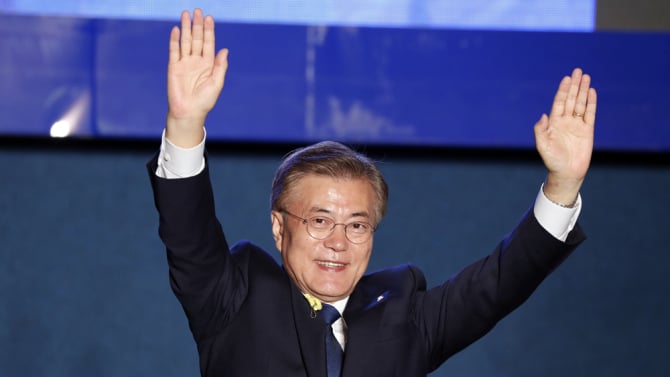
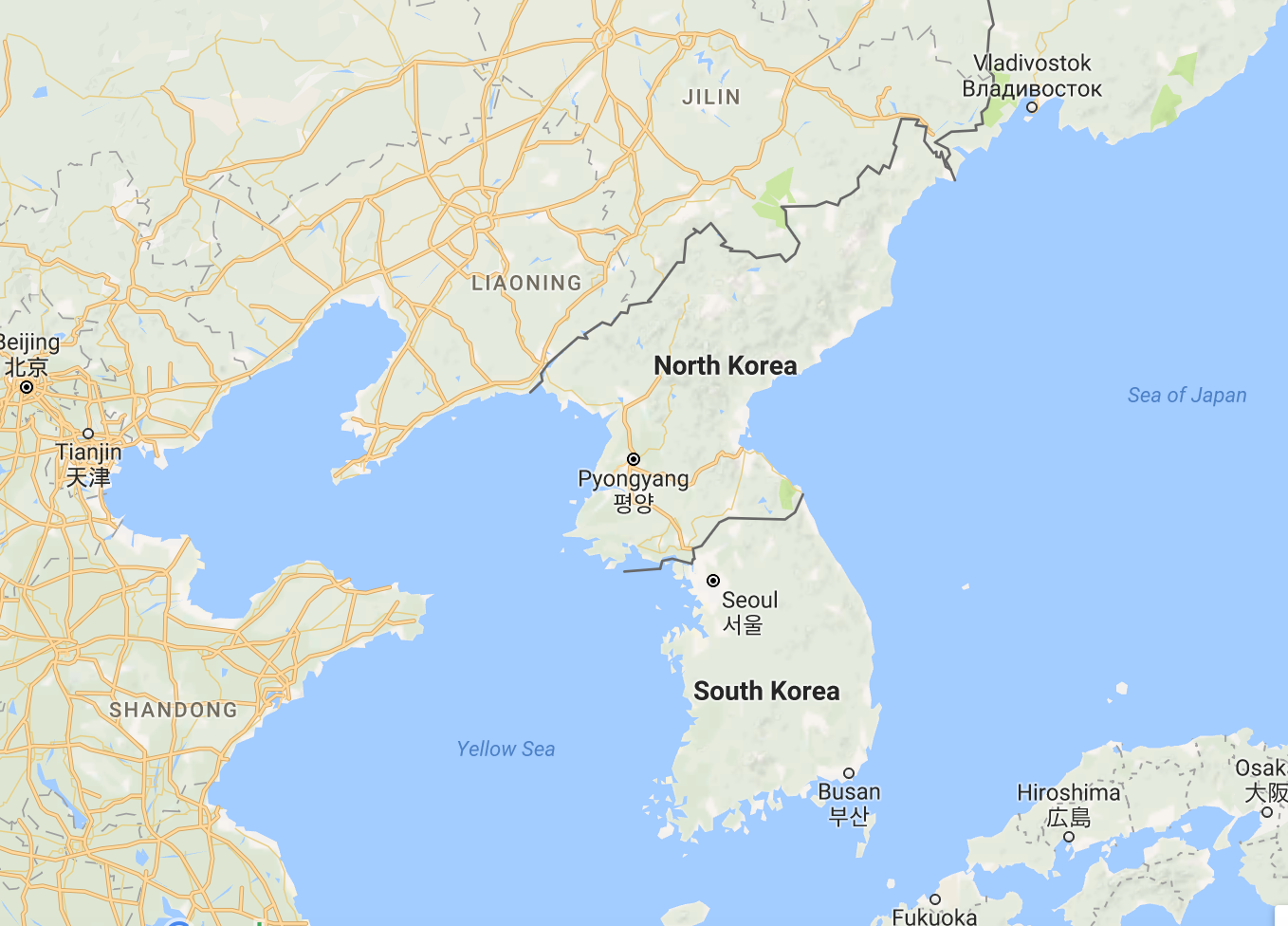
The president of South Korea Moon Jae-in is currently in Vladivostok for the East Asian Economic Summit (EEF), chaired by Russia’s president Vladimir Putin. September 6-7.

A high level North Korean delegation has also been sent to Vladivostok.  

President Moon Jae-in was slated to meet Vladimir Putin shortly after his arrival on September 5 (local time).

The holding of the Moon-Putin talks had been requested by Moscow following a prior meeting at the Blue House in Seoul between president Moon Jae-un and Nikolai Patrushev, Secretary of the Security Council of the Russian Federation (SCRF). .

The Republic of Korea’s presidential office confirmed that Patrushev also held talks with his counterpart Chung Eui-yong, director of the Blue House (Cheongwadae) National Security Office for President Moon Jae-in. 

While the Moon-Putin Vladivostok talks have been officially confirmed, in all likelihood, the two delegations (North and South Korea) will also meet behind closed doors, with president Vladimir Putin potentially playing a historic role in promoting a bilateral DPRK-ROK understanding, with a view to averting a US led war.  


UPDATE, September 7, 2017

There are no official reports of a meeting between the North and South Korea delegations and no firm evidence as to whether a meeting took place.

The head of the DPRK delegation to the EEF Minister of External Economic Relations Kim Yong-jae, said that the North Korea “will introduce strong countermeasures against the United States’ attempts to exert pressure through strong sanctions.”

President Xi Jinping had a telephone conversation with Donald Trump on September 6, urging the need for a peaceful solution through talks. (See Shanghai Daily, September 7, 2017)

At the meeting between ROK President Moon and Russia’s President Putin, the Russian head of State expressed his opposition to sanctions and an oil embargo, which had been put forth by Moon. Putin nonetheless pointed to an economic cooperation with both North and South Korea: “the two leaders devoted considerable time to bilateral economic relations and joint projects, noting that North Korea could be involved in the transit of energy resources from Russia to South Korea.” ( Russia Rossiya 1 TV “Vesti” news 1700 gmt 6 Sep 17)


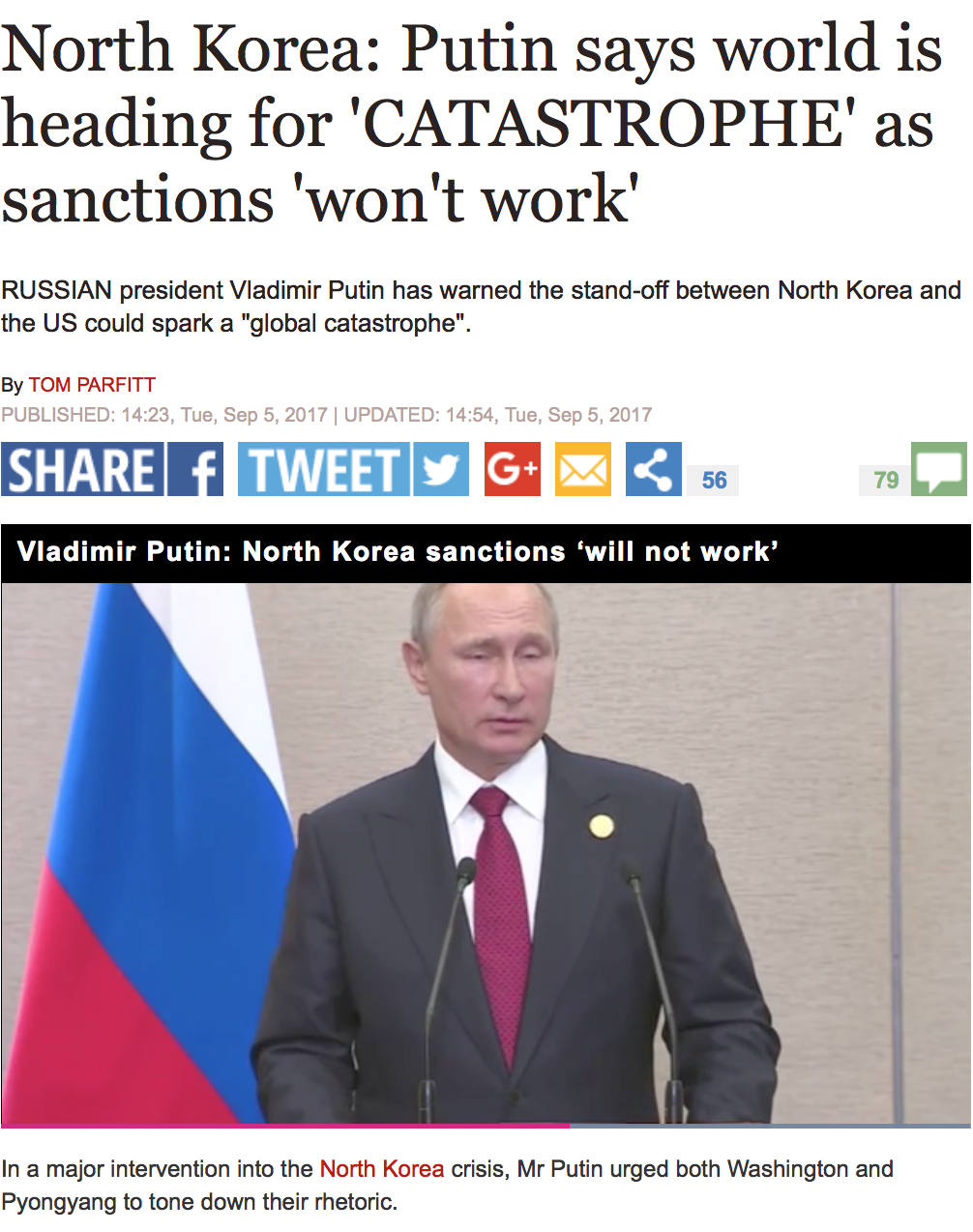
It is important to note that president Putin had previously warned the Trump administration that “continuing hostility between the US and North Korea was close to deteriorating into a “large-scale conflict” and said the only way to de-escalate tensions was through talks”. (Daily Express, September 5, 2017) 

Also of significance, Japan’s Prime Minister Abe and President Putin will also be meeting in Vladivostok on September 6, on the sidelines of the Eastern Economic Forum.

 *   *   *

Towards a Bilateral North-South Peace Treaty 

What should be envisaged is the eventual signing of a bilateral Entente between the DPRK and the ROK, with a view to establishing Peace on the Korean Peninsula. In other words, the “state of war” between the US and the DPRK (which prevails under the armistice agreement) should in a sense be “side-tracked” and annulled by the signing of a comprehensive bilateral North-South peace agreement, coupled with cooperation, trade and interchange.

In this regard, what underlies the 1953 Armistice Agreement is that one of the warring parties, namely the US has consistently threatened to wage war on the DPRK for the last 64 years.

The US has on countless occasions violated the Armistice Agreement. It has remained on a war footing. Casually ignored by the Western media and the international community, the US has actively deployed nuclear weapons targeted at North Korea for more than half a century in violation of article 13b) of the Armistice agreement. More recently it has deployed the so-called THAAD missiles, which are also directed against China and Russia.

The US is still at war with North Korea. The armistice agreement signed in July 1953 –which legally constitutes a “temporary ceasefire” between the warring parties (US, North Korea and China’s Volunteer Army)– must be rescinded through the signing of a long-lasting peace agreement.

The US has not only violated the armistice agreement, it has consistently refused to enter into peace negotiations with Pyongyang, with a view to maintaining its military presence in South Korea as well as shunting a process of normalization and cooperation between the ROK and the DPRK.

The fundamental question to be addressed is the following: How can the 1953 Armistice agreement be replaced by a Long-lasting Peace Agreement given Washington’s persistent refusal to enter into negotiations?

If  one of the signatories of the Armistice refuses to sign a Peace Agreement, what should be contemplated is the formulation  of a comprehensive Bilateral North-South Peace Agreement, which would de facto lead to rescinding the 1953 armistice.

This proposed far-reaching agreement between Seoul and Pyongyang would assert peace on the Korean peninsula –failing the signing of a peace agreement between the signatories of the 1953 Armistice agreement.

The legal formulation of this bilateral entente is crucial. The bilateral arrangement would in effect bypass Washington’s refusal. It would establish the basis of peace on the Korean peninsula, without foreign intervention, namely without Washington dictating its conditions. It would require the concurrent withdrawal of US troops from the ROK and the repeal of the OPCON agreement.

Sunshine 2.0. and the Candlelight Movement. The Demilitarization of the Korean Peninsula

Supported by the Candle Light movement, Moon Jae-in’s presidency potentially constitutes a watershed, a political as well as geopolitical landmark.

President Moon Jae-in had worked closely with president Roh Moo-hyun (who pursued the Sunshine Policy). Moon was his chef de cabinet.

President Moon has confirmed his unbending commitment in favor of dialogue and cooperation with Pyongyang, under what is being dubbed Sunshine 2.0 Policy, while also maintaining the ROK’s relationship with the US.

President Moon’s commitment to cooperation with North Korea coupled with demilitarization, will require redefining the ROK-US relationship in military affairs. This is the crucial issue.

Moreover, there are signs of internal disagreement (and conflict) within the ROK government with South Korea’s Defence Minister, Song Young-moo, openly blaming president Moon of leaning in “a direction that strengthens the military standoff,  rather than … dialogue.”

In the present context, Washington controls the ROK Ministry of Defense and has de facto control over ROK foreign policy as well as North South Korea relations. Under the OPCON (“Operational Control”) agreement, the Pentagon controls the command structure of the ROK armed forces.

Ultimately this is what has to be addressed with a view to establishing a lasting peace on the Korean peninsula and the broader East Asian region.

The Repeal of “Operational Control” (OPCON) and the ROK-US Combined Forces Command (CFC)

In 2014, the government of  President Park Geun-hye postponed the repeal of the OPCON (Operations Command) agreement “until the mid-2020s”. What this signified is that “in the event of conflict” all ROK forces are under the command of a US General appointed by the Pentagon, rather than under that of the ROK President and Commander in Chief.

It goes without saying that national sovereignty cannot reasonably be achieved without the annulment of the OPCON agreement as well as the ROK – US Combined Forces Command (CFC) structure.


As we recall, in 1978 a binational Republic of Korea – United States Combined Forces Command (CFC), was created under the presidency of General Park (military dictator and father of impeached president Park Guen-hye). In substance, this was a change in labels in relation to the so-called UN Command.

“Ever since the Korean War, the allies have agreed that the American four-star would be in “Operational Control” (OPCON) of both ROK and US military forces in wartime …. Before 1978, this was accomplished through the United Nations Command. Since then it has been the CFC [US Combined Forces Command (CFC) structure]. (Brookings Institute)

Moreover, the Command of the US General under the renegotiated OPCON (2014) remains fully operational inasmuch as the 1953 Armistice (which legally constitutes a temporary ceasefire) is not replaced by a peace treaty.

Concluding Remarks

It should be understood that a US led war as formulated by Defense Secretary Mad Dog James Mattis against North Korea would engulf the entire Korean nation.

Given the geography of the Korean peninsula, the use of nuclear weapons against North Korea would inevitably also engulf South Korea. This fact is known and understood by US military planners.

The US sponsored state of war de facto is directed against both North and South Korea. It is characterised by persistent military threats (including the use of nuclear weapons) against the DPRK. It also threatens the ROK which has been under US military occupation since September 1945.

Currently there are 28,500 US troops in South Korea. Yet under the US-ROK OPCON (joint defense agreement) discussed earlier, all ROK forces are  under US command.

What has to be emphasized in relation to Sunshine 2.0 Policy is that the US and the ROK cannot be “Allies” inasmuch as the US threatens to wage war on North Korea as well as South Korea.

The “real alliance” is that which unifies and reunites North and South Korea through dialogue against foreign intrusion and aggression.

The US is in a state of war against the entire Korean Nation.

And what this requires is the holding of bilateral talks between the ROK and the DPRK with a view to signing an agreement which nullifies the Armistice and sets the term of a bilateral “Peace Treaty”.

In turn this agreement would set the stage for the exclusion of US military presence and the withdrawal of the 28,500 US forces.

Moreover, pursuant to bilateral Peace negotiations, the ROK-US OPCON agreement which places ROK forces under US command should be rescinded.  All ROK troops would thereafter be brought under national ROK command.

Bilateral consultations should also be undertaken with a view to further developing economic, technological, cultural and educational cooperation between the ROK and the DPRK.

Without the US in the background pulling the strings under OPCON, the threat of war would be replaced by dialogue. The first priority, therefore would be to rescind OPCON.

What is presented above is a summary of a  longer text prepared in the context of  Prof. Michel Chossudovsky’s presentation at the Korea International Peace Forum’s June 10th commemoration conference, marking  the 30th anniversary of the 1987 June Democratic Uprising (6월 민주항쟁), ROK National Assembly, Seoul, June 10, 2017.

  • Posted in English @as @as, Mobile
  • Comments Off on Proposal for a Lasting Korea Peace Agreement: Signing of a Bilateral North-South Korea Peace Treaty

Media attention is directed to some minor ethnic violence in Myanmar, the former Burma. The story in the “western” press is of Muslim Rohingya unfairly vilified, chased out and killed by  Buddhist mobs and the army in the state of Rakhine near the border to Bangladesh. The “liberal human interventionists” like Human Rights Watch are united with Islamists like Turkey’s President Erdogan in loudly lamenting the plight of the Rohingya.

That curious alliance also occurred during the wars on Libya and Syria. It is by now a warning sign. Could there be more behind this than some local conflict in Myanmar? Is someone stocking a fire?

Indeed.

While the ethnic conflict in Rankine state is very old, it has over the last years morphed into an Jihadist guerilla war financed and led from Saudi Arabia. The area is of geo-strategic interest:

Rakhine plays an important part in [the Chinese One Belt One Road Initiative] OBOR, as it is an exit to Indian Ocean and the location of planned billion-dollar Chinese projects—a planned economic zone on Ramree Island, and the Kyaukphyu deep-sea port, which has oil and natural gas pipelines linked with Yunnan Province’s Kunming.

Pipelines from the western coast of Myanmar eastwards to China allow hydrocarbon imports from the Persian Gulf to China while avoiding the bottleneck of the Strait of Malacca and disputed parts of the South China Sea.

It is in “Western interest” to hinder China’s projects in Myanmar. Inciting Jihad in Rakhine could help to achieve that. There is historic precedence for such a proxy war in Burma. During World War II British imperial forces incited the Rohingya Muslim in Rakhine to fight Burmese nationalist Buddhists allied with Japanese imperialists.

The Rohingya immigrated to the northern parts of Arakan, today’s Rakhine state of Myanmar, since the 16th century. A large wave came under British imperial occupation some hundred years ago. Illegal immigration from Bangladesh continued over the last decades. In total about 1.1 million of Muslim Rohingya live in Myanmar. The birthrate of the Rohingya is said to be higher than that of the local Arakanese Buddhists. These feel under pressure in their own land.

While these populations are mixed in some towns there are many hamlets that belong 100% to either one. There is generally little integration of Rohingya within Myanmar. Most are officially not accepted as citizens. Over the centuries and the last decades there have been several violent episodes between the immigrants and the local people. The last Muslim-Buddhist conflict raged in 2012.

Since then a clearly Islamist insurgency was build up in the area. It acts under the name Arakan Rohingya Salvation Army (ARSA) and is led by Ataullah abu Ammar Junjuni, a Jihadist from Pakistan. (ARSA earlier operated under the name Harakah al-Yakin, or Faith Movement.) Ataullah was born into the large Rohingya community of Karachi, Pakistan. He grew up and was educated in Saudi Arabia. He received military training in Pakistan and worked as Wahhabi Imam in Saudi Arabia before he came to Myanmar. He has since brainwashed, hired and trained a local guerrilla army of some 1,000 Takfiris.

According to a 2015 report in the Pakistani newspaper Dawn there are more than 500,000 Rohingya in Karachi. They came from Bangladesh during the 1970s and 1980s on the behest on General Ziaul Haq’s military regime and the CIA to fight the Soviets and the government of Afghanistan:

Rohingya community [in Karachi] is more inclined towards religion and they send their children to madressahs. It is a major reason that many religious parties, especially the Ahle Sunnat Wal Jamaat, the JI and the Jamiat Ulema-i-Islam-Fazl, have their organisational set-up in Burmese neighborhoods.

“A number of Rohingya members living in Arakan Abad have lost their relatives in recent attacks by Buddhist mobs in June 2012 in Myanmar,” said Mohammad Fazil, a local JI activist.Rohingyas in Karachi regularly collect donations, Zakat and hides of sacrificial animals and send these to Myanmar and Bangladesh to support the displaced families.

Reuters noted in late 2016 that the Jihadist group is trained, led and financed through Pakistan and Saudi Arabia:

A group of Rohingya Muslims that attacked Myanmar border guards in October is headed by people with links to Saudi Arabia and Pakistan, the International Crisis Group (ICG) said on Thursday, citing members of the group.

“Though not confirmed, there are indications [Ataullah] went to Pakistan and possibly elsewhere, and that he received practical training in modern guerrilla warfare,” the group said. It noted that Ata Ullah was one of 20 Rohingya from Saudi Arabia leading the group’s operations in Rakhine State.Separately, a committee of 20 senior Rohingya emigres oversees the group, which has headquarters in Mecca, the ICG said.

The ARSA Jihadists claim to only attack government forces but civilian Arakanese Buddhists have also been ambushed and massacred. Bugghist hamlets were also burned down.

The government of Myanmar alleges that Ataullah and his group want to declare an independent Islamic State. In October 2016 his group started to attack police and other government forces in the area. On August 25 this year his group attacked 30 police stations and military outposts and killed some 12 policemen. The army and police responded, as is usual in this conflict, by burning down Rohingya townships suspected of hiding guerrilla forces.

To escape the growing violence many local Arakanese Buddhist flee their towns towards the capitol of Rankine. Local Rohingya Muslim flee across the border to Bangladesh. Only the later refugees seem to get international attention.

The Myanmar army has ruled the country for decades. Under economic pressure it nominally opened up to the “west” and instituted “democracy”. The darling of the “west” in Myanmar is Daw Aung San Suu Kyi. Her party won the elections and she has a dominant role in the government. But Aung San Suu Kyi is foremost a nationalist and the real power is still held by the generals.

Aung San in Burma National Army uniform (Source: Wikimedia Commons)

While Aung San Suu Kyi was propped up as democratic icon she has little personal merit except being the daughter of Thakin Aung San, a famous leader of the Burma Independence Army (BIA) and the “father of the nation”. In the 1940s Thakin Aung San was recruited by the Imperial Japanese Army to wage a guerrilla war against the colonial British army and the British supply line to anti-Japanese forces in China:

The young Aung San learned to wear Japanese traditional clothing, speak the language, and even took a Japanese name. In historian Thant Myint-U’s “The River of Lost Footsteps,” he describes him as “apparently getting swept away in all the fascist euphoria surrounding him,” but notes that his commitment remained to independence for Myanmar.

The ethnic strife in Rakhine also played a role in the British-Japanese conflict over Burma:

In April 1942, Japanese troops advanced into Rakhine State and reached Maungdaw Township, near the border with what was then British India, and is now Bangladesh. As the British retreated to India, Rakhine became a front line.Local Arakanese Buddhists collaborated with the BIA and Japanese forces but the British recruited area Muslims to counter the Japanese.

“Both armies, British and Japanese, exploited the frictions and animosity in the local population to further their own military aims,” wrote scholar Moshe Yegar

When the British won against the Japanese Thakin Aung San change sides and negotiated the end of British imperial rule over Burma. He was assassinated in 1947 with the help of British officers. Since then Burma, later renamed to Myanmar, was ruled by ever competing factions of the military.

Thakin Aung San’s daughter Aung San Suu Kyi received a British education and was build up for a role in Myanmar. In the 1980s and 90s she quarreled with the military government. She was given a Nobel Peace Prize and was promoted as progressive defender of human rights by the “western” literati. But she, and the National League for Democracy (NLD). she leads, were always the opposite – ultra-right fascists in Buddhist Saffron robes. The hypocrites are now disappointed that she does not speak out in favor of the Rohingya. But doing so would put her on the opposite side her father had famously fought for. It would also put her in opposition to most of the people in Myanmar who have little sympathy for the Rohingya and their Jihadi fight.

Moreover – the Chinese OBOR projects are a huge bon for Myanmar and will help with its economic development. The Saudis and Pakistani send guerilla commanders and money to incite the Rohingya to Jihad in Myanmar.  This is a historic repeat of the CIA operation against Soviet influence in Afghanistan. But unlike in Afghanistan the people of Myanmar are not Muslim they will surely fight against, not join, any Jihad in their country. The Rohingya are now pawns in the great game and will suffer from it.

  • Posted in English @as @as
  • Comments Off on The Rohingya of Myanmar – Pawns in an Anglo-Chinese Proxy War Fought by Saudi Jihadists

The harsh rhetoric from Washington and Pyongyang during recent months has exacerbated an already confrontational relationship between our countries, and has probably eliminated any chance of good faith peace talks between the United States and North Korea. In addition to restraining the warlike rhetoric, our leaders need to encourage talks between North Korea and other countries, especially China and Russia.

The recent UN Security Council unanimous vote for new sanctions suggests that these countries could help.  In all cases, a nuclear exchange must be avoided. All parties must assure North Koreans they we will forego any military action against them if North Korea remains peaceful.

I have visited North Korea three times, and have spent more than 20 hours in discussions with their political leaders regarding important issues that affect U.S.-DPRK relations.

In June 1994, I met with Kim Il Sung in a time of crisis, when he agreed to put all their nuclear programs under strict supervision of the International Atomic Energy Agency and to seek mutual agreement with the United States on a permanent peace treaty, to have summit talks with the president of South Korea, to expedite the recovery of the remains of American service personnel buried in his country, and to take other steps to ease tension on the peninsula. Kim Il Sung died shortly after my visit, and his successor, Kim Jong Il, notified me and leaders in Washington that he would honor the promises made by his father. These obligations were later confirmed officially in negotiations in Geneva by Robert Gallucci and other representatives of the Clinton administration.

I returned to Pyongyang in August 2010, at the invitation of North Korean leaders, to bring home Aijalon Gomes, an American who had been detained there. My last visit to North Korea was in May 2011 when I led a delegation of Elders (former presidents of Ireland and Finland and former prime minister of Norway) to assure the delivery of donated food directly to needy people.

During all these visits, the North Koreans emphasized that they wanted peaceful relations with the United States and their neighbors, but were convinced that we planned a preemptive military strike against their country. They wanted a peace treaty (especially with America) to replace the ceasefire agreement that had existed since the end of the Korean War in 1953, and to end the economic sanctions that had been very damaging to them during that long interim period. They have made it clear to me and others that their first priority is to assure that their military capability is capable of destroying a large part of Seoul and of responding strongly in other ways to any American attack. The influence of China in Pyongyang seems to be greatly reduced since Kim Jong Un became the North Korean leader in December 2011.

A commitment to peace by the United States and North Korea is crucial.

When this confrontational crisis is ended, the United States should be prepared to consummate a permanent treaty to replace the ceasefire of 1953. The United States should make this clear, to North Koreans and to our allies.

  • Posted in English @as @as
  • Comments Off on The Need for US-North Korea Peace Talks: Jimmy Carter. “They Want a Peace Treaty to Replace the [1953] Ceasefire”

Lacking Transparency: Israeli Drones and Australian Defence

September 5th, 2017 by Dr. Binoy Kampmark

Featured image: Marise Payne (Source: Financial Review)

“Give us the chance to compete, to see our capabilities, to compare, to see the benefit we can bring with our [drone] system.” – Shaul Shahar, Israel Aerospace Industries Vice-President, March 2, 2017

A certain part of you should go on vacation when a drone company, certainly one dedicated to killing, gets less custom to do what it does best. The only problem in this case is that the winning party will also be a manufacturer of killer drones. Where there is unscrupulous demand, a willing if soiled supplier is always happy to step in.

The Australian Defence For was already making its intentions clear earlier this year when the murderous Reaper drone made a visit to Australian soil. This spine tingling presence of a weapon responsible for the deaths of thousands caused a minor titter in local circles.

In recent years, the ADF has pondered whether to get into the grim business of robotic killing, despite its abysmal failings on the legal front. Defence Minister Marise Payne is fairly indifferent to such concerns:

“There will always be, in a remotely piloted aircraft, a human involved and that is the threshold for this capability for us.”[1]

Precisely the problem: behind the machine is a human; and behind that human is a vulnerable commander executing government policy.

The ADF, in other words, is falling for that old canard that such technologies are good, clean and strictly sanitised through a line of command. Malcolm Davis of the Australian Strategic Policy Institute throws the book of “strict rules of engagement” back at the critics. As long as the nod is given to protocols of use, there is nothing to sweat over. “We’ve worked with the US and other countries using drones, we understand about command and control.”[2]

Davis also laments Australia’s limp into a brave new world of lethal technologies.

“I’m amazed to be honest, that we haven’t got drones or more correctly, unmanned aerial vehicles by now. I mean, Australia has fallen well behind in this regard.”[3]

Whare are the options in an emerging smorgasbord of killing? General Atomics from the US offers its prize MQ-9 Reaper, and Israeli Aerospace Industries (IAI) boasts the Heron TP. The vigorous rumour whirling in the wings of drone central is not the whether the Heron discharges its job well, but whether the Reaper has an inter-operable dimension with the weapons systems of allies. To that end the usual plaudits are cast the way of the Israeli model, while the eye on the prize is already set.

The fuming Israeli representative, Shaul Shahar, was beside himself. His ultimate fear: that the decision is already cooked for the American rivals. In protest, he explained to the ABC that prospective Australian drone pilots had been training on the Heron-1 system, a “successful” one at that. Furthermore, Shahar claims that Australians were already using it in Afghanistan – for 3 years, no less. (Such a nugget of information, implicating Australian pilots in incidents where whole families become the bloody collateral of a target mission.)

Shahar smells discrimination and foul play, that awful sense of being strung along.

“With all the risk analysis, all competitive analysis, they need to do here and they didn’t done [sic] it because no one has approached us, no one has offered to put our data of the system on the table.”[4]

Minister Payne complied with cabinet protocol: avoid the grievance, keep the options open and claim that nothing was off the boardroom table. A similar option is done in appointing academic staff to faculties: you know who you want, but you want to keep up appearances by getting appropriate external candidates. To that end, the playbook of deflection ensures that no one option is ignored in favour of another, even if a decision has been made months in advance.

“Defence,” goes such weasel speak from a statement from the minister, “is considering a range of options for the future of the future Australian Defence Force armed remotely piloted aircraft system.”

Naturally, Payne makes the mandatory addition, the qualifier that suggests keen objectivity, gentle and deft consideration:

“As the evaluation process is ongoing it is not appropriate to comment.” Woe to the Israeli contractor.

The notable disdain for transparency shown by the ADF is far from unusual in the Australian defence industry. The ADF, for one, can hardly be accused of being overly patriotic when it comes to local industries, showing a drug-addicted preference for US products.

This was made clear in 2015 when Australian drone manufacturers – this time in the surveillance context – found it impossible to net contracts from the ministry of defence. The Australian forces showed greater and ultimately definitive interest in dealing with the American company AeroVironment.

This time, the pattern is set to repeat itself. Few are better in the business of drone-directed killings than the Israelis, but the Reaper has clout, a grotesque resume to back it, and the brutish swagger of made in the USA.

Dr. Binoy Kampmark was a Commonwealth Scholar at Selwyn College, Cambridge. He lectures at RMIT University, Melbourne. Email: [email protected]

Notes

  • Posted in English @as @as
  • Comments Off on Lacking Transparency: Israeli Drones and Australian Defence

Myanmar Regime Projects Rohingyas as Terrorist “Jihadists”

September 1st, 2017 by Dr. Chandra Muzaffar

The Rohingyas – or at least some Rohingyas – are now being projected as terrorists, as “Jihadists” out to kill Myanmar soldiers and civilians. Myanmar leaders including Aung San SuuKyi have spoken along these lines.

This view of the Rohingyas is being propagated by the Myanmar government with greater zeal since a small armed group called the Arakan Rohingya Salvation Army (ARSA) attacked security forces on 9 October 2016. These attacks have continued in recent weeks. In this new wave of violence it is alleged that 12 security personnel were killed while the Myanmar military and border police have killed 77 Rohingya Muslims.

The way Aung San SuuKyi and her government colleagues have framed the clashes ignores the brutal massacres committed by the military over a long period of time. The oppression and persecution of the Rohingyas by the State and other forces has been thoroughly documented by the United Nations Human Rights Council and other independent human rights groups. It is well-known that as a community the Rohingyas were stripped of Myanmar citizenship in 1982, deprived of basic human rights, tortured, imprisoned, and forced to flee their home province of Rakhine. This is why there are tens of thousands of Rohingyas living in squalid conditions in Bangladesh or struggling to survive in a number of countries from Malaysia to Saudi Arabia. They have been described by the UN itself as one of the world’s most persecuted minorities.  Simply put, the Rohingyas are the victims of a slow genocide, to quote Nobel Laureate Professor Amartya Sen.

To condemn the violence of a miniscule fraction of the Rohingyas without taking into account their massive marginalisation and severe oppression is a travesty of truth and justice. It is extreme desperation and hopelessness that has forced some of them to resort to violence. Of course, violence is not the solution. It will not help to restore the rights of the Rohingyas, especially their right to citizenship.

Our concern is that the violence will escalate. The signs are already there. Given the underlying religious connotations of the conflict — though the conflict itself is not rooted in religion per se — it is not inconceivable that the violence will spread beyond Myanmar’s borders and engulf Muslim and Buddhist communities in other parts of Southeast Asia. This would be catastrophic for ASEAN, a regional grouping in which 42% of the population is Muslim and another 40% is Buddhist.

Finding workable solutions to the Myanmar — Rohingya conflict is therefore of utmost importance. It is in this regard that the ‘Final Report of the Advisory Commission on Rakhine State’ under the chairmanship of former UN Secretary-General, Kofi Annan, deserves the urgent attention of all stakeholders. The Report announced in August 2017 calls for a review of the 1982 citizenship law and notes that

“Myanmar harbours the largest community of stateless people in the world.”

It urges the government to abolish distinctions between different types of citizens.

Other recommendations pertain to reduction of the poverty rate in Rakhine state which is 78%, improving the socio-economic condition of the people, enhancing access to health services and education, ensuring freedom of movement and encouragingpeople’s participation and representation. Though the Report is worded with a great deal of caution and diplomacy, it does send an unambiguous message to the powers-that-be in Myanmar that the status quo cannot be allowed to persist and that change has to take place. That message is significant considering that the Commission was actually initiated by the government.

Will the government take heed? So far there is no indication that it will respond positively to the Commission’s recommendations. This is not surprising. It is the harsh authoritarianism of the government embodied in the power of the military that is primarily responsible for the targeting of the Rohingya as the “ethnic other.” This is what has resulted in the genocide that we are witnessing today.

Even if the Myanmar government does not act of its own volition, the Kofi Annan Report can be used to persuade other governments to pressurise Myanmar to act. Apart from ASEAN governments, special efforts should be made by civil society groups and the media to convince Beijing, Tokyo, New Delhi, Islamabad and Washington and London that they demand that the Myanmar government protects all its citizens without discrimination. If it fails to do so, these capitals should review their economic and/or military ties with Naypyidaw.

It is with the aim of persuading the leadership in Naypyidaw to change its behaviour that the Permanent People’s Tribunal (PPT) is holding its concluding session in Kuala Lumpur on the treatment of the Rohingyas, Kachins and other minorities in Myanmar from the 18th to the 22nd of September 2017. As more and more voices plead for justice and compassion on behalf of the oppressed who knows they may eventually pierce the walls of Naypyidaw.

Dr. Chandra Muzaffar is the President of the International Movement for a Just World (JUST). 

  • Posted in English @as @as
  • Comments Off on Myanmar Regime Projects Rohingyas as Terrorist “Jihadists”

Recapitulation of the Facts of the Korean War

November 7, 1950:  “Just when there was a lull in the fighting and it looked as if peace were possible, MacArthur staged a gigantic and murderous raid directly across from the Chinese frontier, destroying most of a city in an area where bombings had been forbidden to prevent border violations.” “There were reports,” The New York Times said October 15, that General MacArthur had ordered the first bombings of North Korean cities without authorization from Washington.” “General Stratemeyer, commander of the Far East Air Forces described the attack:  ‘when fighter planes swept the area with machine guns, rockets, jellied gasoline bombs.

They were followed by ten of the superforts which dropped 1,000-pound high explosive bombs on railroad and highway bridges across the Yalu River and on the bridge approaches. After this, ‘the remaining planes used incendiaries exclusively on a two and a one-half mile built-up area along the southeast bank of the Yalu.’  The Air Force claimed that ninety percent of the city had been destroyed….There is an indifference to human suffering to be read between those lines which makes me as an American deeply ashamed of what was done that day at Sinuiju…

The mass bombing raid on Sinuiju November 8 was the beginning of a race between peace and provocation.  A terrible retribution threatened the peoples of the Western world who so feebly permitted such acts to be done in their name.  For it was by such means that the pyromaniacs hoped to set the world on fire.’” I.F. Stone, “The Hidden History of the Korean War, 1952, pages 178-179

Introduction. The Betrayal of the Founder of the United Nations, United States President Franklin Delano Roosevelt

FDR 1944 Color Portrait.tif

President Franklin Delano Roosevelt (Source: Wikimedia Commons)

All United Nations Security Council actions against North Korea are based upon an illegal and ruthless betrayal of the intent of United States President Franklin Delano Roosevelt, the founder of the United Nations, the cherished organization which he established to preserve world peace. Perhaps the most scandalous betrayal of President Roosevelt has been  the  endorsement, by the United Nations Security Council, on June 27, 1950, of the attack on North Korea, in cynical and vicious violation of Roosevelt’s trust. This is the historic context of current United Nations venal and biased actions against North Korea. President Franklin Delano Roosevelt, in conceiving the United Nations, demanded that all Security Council resolutions be adopted by consensus, and only by consensus. President Roosevelt declared it categorically imperative that both the United States and the Soviet Union be in agreement in order for any United Nations action to be legitimate. As detailed in his letter to the Security Council of July 13, 1950, Soviet Deputy-Foreign Minister Andrei Gromyko exposed the fact that “the Security Council, by its decision of 27 June, 1950 violated this most important principle of the United Nations organization.”

The consequence of this illegal resolution of June 27, 1950, and subsequent resolutions concerning North Korea  were an attempted racist genocide of the North Korean people, and brought the world to the brink of World War III.

Part I. The History, 1950-1953

July 13, 1950, Letter from Soviet Deputy Foreign Minister Andrei Gromyko to United Nations Secretary-General, Trygve Lie:

“The illegal resolution of 27 June, 1950, adopted by the Security Council under pressure from the United States Government, shows that the Security Council is acting not as a body which is charged with the main responsibility for the maintenance of peace, but as a tool utilized by ruling circles of the United States for the unleashing of war. This resolution of the Security Council constitutes a hostile act against peace. If the Security Council valued the cause of peace, it should have attempted to reconcile the fighting sides in Korea before it adopted such a scandalous resolution. Only the Security Council and the United Nations Secretary-General could have done this. However, they did not make such an attempt, evidently knowing that such peaceful action contradicts the aggressors’ plans. It is impossible not to note the unseemly role played in that whole affair by the United Nations Secretary-General, Mr. Trygve Lie. Being under the obligation, by virtue of his position, to observe the exact fulfillment of the United Nations Charter, the Secretary-General, during discussion of the Korean question in the Security Council, far from fulfilling his direct duties, on the contrary obsequiously helped a gross violation of the Charter on the part of the United States government and other members of the Security Council. Thereby the Secretary-General showed that he is concerned not so much with strengthening the United Nations Organization and with promoting peace, as with how to help the United States’ ruling circles to carry out their aggressive plans with regard to Korea.”

U.S. Air Force attacking railroads south of Wonsan on the eastern coast of North Korea (Source: Wikimedia Commons)

Criminally Ignored in this Security Council “consideration” of the crisis in Korea is the letter dated 7 December 1950, from North Korea’s Minister of Foreign Affairs, Pak Hen En, at Sinuiju, Korea, to the Security Council, describing the monstrous military slaughter to which the North Korean people were being subjected, and which was previously acknowledged by General Stratemeyer.

“They are waging war not only against armed forces but above all and chiefly against the civilian population. With the methodicalness of civilized barbarians, the American armed forces, bombing from the air, from the sea and by other means, have destroyed all the big industrial enterprises in Korea and a majority of the medium-sized and smaller enterprises, wiped small and large towns from the face of the earth, destroyed villages, and now that winter is coming on they have begun the systematic destruction of the remaining settlements. American aircraft carry out over a thousand sorties daily to bomb Korean towns and villages. Using scorched-earth tactics, the American air force drops on towns and villages in which there are no military targets of any kind an enormous quantity of incendiary and high-explosive bombs, destroying houses and private property of peaceful inhabitants, leaving millions of persons homeless and destitute. The systematic bombing of the remaining inhabited places became especially intense in the second half of October. American aircraft bombed and destroyed the towns of Sunchon, Kyachen, Gudyan, Hichen, Denchen and Koin. In November American aircraft systematically bombed and practically completely destroyed the towns of Kanggye, Sinuiju, Yideyu, Senchen, Gusen, Tmichen, Cholsan, Buktin, Kosan, Manpo, Tyungandin, Hweren and others. In the town of Kanggye out of 8,000 buildings less than 500 remain; in Sinuiju out of 12,000 buildings about 1,000 remain, in Chinnampo out of 1,500 buildings about 200 houses remain….The American interventionists are prepared to destroy every living thing, to turn Korea into a desert in order to carry out their rapacious plans for the enslavement of the Korean people.  ….The American imperialists have issued a tacit ultimatum to the Korean people, either submit to the domination of American imperialism or we will destroy every living thing in your country.”

U.S. Secretary of State Dean Rusk said that the United States bombed “everything that moved in North Korea, every brick standing on top of another.” After running low on urban targets, U.S. bombers destroyed hydroelectric and irrigation dams in the later stages of the war, flooding farmland and destroying crops, and, of course, starving and drowning vast numbers of  North Koreans.

Part II. The Current Crisis

Today, 67 years later, no peace treaty  between the US and North Korea has been signed. Various factions of the US military are now calling for “preventive war” against North Korea. North Korea is desperately attempting to protect itself from a repetition of the devastation and slaughter of the first war against the DPRK.

At the UN Security Council meeting on August 5, 2017, Chinese Ambassador Liu called for:

“the establishment of a peace mechanism based on the suspension for suspension initiative, which calls for the DPRK to suspend its nuclear and missile activities, and for the United States and the Republic of Korea to suspend their large-scale military exercises….Beefing up military deployment on the peninsula is not in the interest of realizing denuclearization there or of maintaining regional peace and stability.”

At the same Security Council meeting, Russian Ambassador Nebenzia stated:

“All must understand that progress towards the denuclearization of the Korean peninsula will be difficult so long as the DPRK perceives a direct threat to its own security. For that is how the North Koreans view the build-up in military activity in the region, which takes on the forms of frequent wide-ranging exercises and manoeuvres by the United States and allies as they deploy strategic bombers, naval forces and aircraft carriers to the region….We hope that the assurances provided by the Secretary of State of the United States were sincere, and that the United States is not seeking to dismantle the existing situation in the Democratic People’s Republic of Korea or to forcibly unite the peninsula or intervene militarily in the country….Sanctions must not be used for the economic asphyxiation of the DPRK or to deliberately worsen the humanitarian situation.  …Such sanctions may lead to the significant deterioration of the living conditions of the North Korean people –incidentally, as the United Nations humanitarian agencies are warning about.”

Resolution 2371, adopted at this meeting, can only be described as deliberate sadistic action by the drafters of the Resolution.

Resolution 2371 States:

“10. Decides that the DPRK shall not supply, sell or transfer, directly or indirectly, from its territory or by its nationals or using its flag vessel or aircraft, seafood (including fish, crustaceans, mollusks, and other aquatic invertebrates in all forms), and that all States shall prohibit the procurement of such items from the DPRK by their nationals, or using their flag vessels or aircraft, whether or not originating in the territory of the DPRK, and further decides that for sales and transactions of seafood (including fish, crustaceans, mollusks, and other aquatic invertebrates in all forms) for which written contracts have been finalized prior to the adoption of this resolution, all States may allow those shipments to be imported into their  territories up to 30 days from the date of adoption of this resolution with notification provided to the Committee containing details on those imports by no later than 45 days after the date of adoption of this resolution.”

On August 18, the Associated Press in Beijing reported:

“Furious Chinese businesspeople said Friday that Beijing’s decision to enforce U.N. sanctions on North Korean seafood imports would hobble the economy of an entire northeastern city in China, sparking a rare public protest earlier this week after the surprise move suddenly choked off border trade. Anger swept the city of Hunchin, home to hundreds of seafood processing plants, after Beijing began refusing entry Tuesday to trucks carrying tons of North Korean seafood.”

Current relentless provocations of the DPRK seem designed and determined to infuriate North Korea, and seem intent upon the perpetuation of hostilities, a pattern alarmingly reminiscent of the first Korean War, endorsed, with dubious legality, by the United Nations.

On August 16, the UN Secretary-General held a stake-out with the UN press, and began by saying that more than three million people were killed in Korea, “with a civilian death rate higher than World War II. The Korean peninsula was left in ruins.” The Reuters correspondent asked :

“Ahead of the joint military exercises next week between the US and South Korea, which North Korea tends to see as an escalation of tensions, what’s your message to the North Korean leader and to President Trump ahead of those exercises?”

The Reuters correspondent phrased the question in a balanced way, which would have given the Secretary-General an opportunity for a balanced, impartial answer. Surprisingly, the Secretary-General failed to call on all parties to respect the need for de-escalation, and instead, he replied with a one-sided attribution of blame, and he stated, erroneously:

“everything started with the build-up of a potential nuclear capacity and of a number of missiles to be able to deliver that capacity.”

His accusation that North Korea was responsible for the perilous situation on the Korean peninsula is a distortion of the facts. Is he unaware of the statement by North Korean Ambassador Pak to the Security Council on October 14, 2006:

“The Democratic People’s Republic of Korea has clarified more than once that it would feel no need to possess even a single nuclear weapon once it was no longer exposed to the United States’ threat and after that country had dropped its hostile policy towards the DPRK and confidence had been built between the two countries.”

The first of two Terminal High Altitude Area Defense (THAAD) interceptors is launched during a successful intercept test - US Army.jpg

The first of two Terminal High Altitude Area Defense (THAAD) interceptors is launched during a successful intercept test. (Source: Wikimedia Commons)

The Secretary-General’s reply to Reuters would have satisfied the US, the UK and France, but he was clearly ignoring the explicit statements by China and Russia, both of whom place equal, if not greater responsibility for this crisis upon the United States-Republic of Korea perpetual military provocations, exacerbating tensions on the peninsula, and perpetuating the state of alarm which has necessitated North Korea arming itself by all necessary means, to prevent the repetition of the horror inflicted upon it by the US, with the blessing of the UN between 1950-1953. The Secretary–General did not address the menace of the THAAD missiles which the United States has placed in South Korea, and which both Russia and China have stated, repeatedly, present an existential threat to their own survival, and which potentially destabilize the entire Eurasian continent.

For the past decades, the DPRK has repeatedly requested the Security Council to convene, on an emergency basis, meetings todiscuss  and halt the provocative US-ROK military maneuvers. All urgent requests by the DPRK have been denied by the Security Council, which holds emergency meetings called by the US so frequently that the Security Council schedule appears to be determined by the US. Although, on August 16, 2017, the Reuters correspondent provided the opportunity for the UN Secretary-General to appropriately show at least token acknowledgement and respect for the agonies of the North Korean people, who are continually terrorized by these US-ROK manoeuvers, he  failed to acknowledge the destructive and  provocative character of the US-ROK military manoeuvers, thereby tacitly endorsing these dangerous, chronic threats to the survival of North Korea.

And inevitably, under these circumstances, as the Chinese-Russian call for “suspension for suspension” is ignored with impunity by the US-ROK, and, indeed, by the Secretary-General, himself, and since, on August 21 the US-ROK, with impunity, held their military exercises, often provocatively entitled “Decapitation of Head of State,” and “Invasion of Pyongyang,” North Korea, understandably, subsequently, (and it must be emphasized, subsequently),  on August 28 launched another ballistic missile, provoked by the recalcitrant US-ROK military exercises which had instigated this vicious spiral.

Predictably, in its servile fashion, the Security Council, which failed to hold an emergency meeting condemning the US-ROK military provocations, in its melodramatic and bellicose fashion held an emergency meeting at 8PM on August 29, “condemning the August 28 ballistic missile launch by the DPRK.” Yet, in a curiously revealing, and certainly unintended way, the Security Council confessed its barbaric cruelty toward North Korea by listing its barbaric sanction resolutions, a lengthy list of torture: Resolution 1675 (2006, 1718 (2006), 1874 (2009), 2087 (2013), 2094 (2013) 2270 (2016), 2321 (2016) 2356 (2017), 2371 (2017).  In effect, when the UN Security Council is brought before the bar of history, and condemned for crimes against humanity, it will have made the investigators’ work easier by so neatly listing its attempts to strangle the life out of the North Korean people. This most recent resolution exposes the sadistic and malicious intent of these resolutions, as fish have nothing to do with construction of nuclear weapons, and the prohibition of sale of fish, one of the indispensable sources of income for the innocent people of North Korea, is one of the cruelties intended to starve the Korean people, and break their spirit. For their courage and integrity shames and condemns the opportunism, greed and psychopathology that defines the behavior of their tormenters.

Carla Stea is Global Research’s correspondent at United Nations Headquarters, New York, N.Y.

  • Posted in English @as @as, Mobile
  • Comments Off on Facts of the Korean War: UN Security Council, Instrument of US led Wars, Blatantly Biased Against North Korea

The world is now casting its eyes on Xiamen, the coastal city in China’s Fujian Province, as it will host the ninth BRICS Summit themed “deepening the BRICS partnership and opening up a brighter future” in early September.

“BRICS”, since its birth as a new concept, has evolved into a cooperative mechanism guided by the regular meeting of leaders from the five emerging markets–Brazil, Russia, India, China and South Africa.

The mechanism also involves a series of exchanges and dialogue activities, including regular ministerial meetings, business forums and think-tank forums.

Over the past decade, the BRICS bloc has transformed itself from a concept to an entity by strengthening dialogue, deepening cooperation and establishing the New Development Bank (NDB) and Contingent Reserve Arrangement (CRA).

The members, as a result, have contributed much to stimulating world economic growth, reforming and improving global economic governance and boosting democratization of international relations.

BRICS countries enjoy enormous potential for cooperation since they, being in similar development phase, share similar historical missions, development objectives, large population, huge market and highly complementary economies.

A closer relationship among the BRICS members would impact not only their own development, but the world economic growth and international order.

A community of shared interest, first of all, must be established among the BRICS countries.

The Belt and Road Initiative proposed by Chinese President Xi Jinping in 2013 has been recognized and supported by an increasing number of countries, among which Russia is an active one.

Xi and his Russian counterpart Vladimir Putin signed a joint statement on docking the Silk Road Economic Belt initiative and the Eurasian Economic Union (EAEU) construction in May, 2015.

Moreover, China and other BRICS partners are also moving forward to align their development strategies and regional cooperation plans. China’s investment and its external cooperation on production capacity can tighten the interest bonds of BRICS members and their peoples by giving a boost to their infrastructure construction and industry upgrade.

A community of actions should be set up among them as well. BRICS members, all influential nations in the region where they are located, share a strong sense of responsibility to promote the establishment of a global governance framework that can reflect the new world political and economic arena based on the principles of multipolarity.

The regular meetings between leaders can work as a platform on which the BRICS nations could exchange their views on key international and regional agendas, so that more joint actions could be launched to vindicate UN’s core status in international affairs, promote the democratization of international relations, and safeguard world peace and development.

By raising their voice and influence and sending a unified message, the five members have played a significant role in improving global governance and strengthening multilateralism.

A community of shared responsibility should also be built by the bloc.

As today’s world is still faced with rising trade protectionism, hegemonism and power politics, BRICS countries have a duty to safeguard the common interests of emerging markets and developing economies in terms of climatic change, reform of the International Monetary Fund, counter-terrorism, transnational crime, network security and other key agendas in global governance.

As big emerging markets and global stakeholders, BRICS nations have the responsibility for and the ability of providing rational solutions to address global challenges as well as more public goods for the international community on the premise of properly handling their own domestic affairs.

Li Hui is Chinese Ambassador to Russia.

This article was translated from Chinese and was originally published by People’s Daily.

  • Posted in English @as @as
  • Comments Off on From A Concept to A Partnership: BRICS Members to Build Future Through Cooperation

Video: Afghanistan – Where Empires Die

August 27th, 2017 by Adam Garrie

Nedka Babliku sits down with Adam Garrie to discuss the true meaning of Trump’s surge in Afghanistan.

Digital Divides: Where Empires Die

.

.

.

This video was published by Digital Divides.

  • Posted in English @as @as
  • Comments Off on Video: Afghanistan – Where Empires Die

BRICS and the Fiction of “De-Dollarization”

August 27th, 2017 by Prof Michel Chossudovsky

Next week in early September 2017, the member states of BRICS, will be meeting in Xiamen, Fujian Province, China.

This article was first published by Global Research in April 2015.

*    *    *

The financial media as well as segments of the alternative media are pointing to a possible weakening of the US dollar as a global trading currency resulting from the BRICS (Brazil, Russia, India, China, South Africa) initiative. 

One of the central arguments in this debate on competing World currencies hinges on the BRICS initiative to create a development bank which, according to analysts, challenges the hegemony of Wall Street and the Washington based Bretton Woods institutions.

The BRICS New Development Bank (NDB) was set up to challenge two major Western-led giants – the World Bank and the International Monetary Fund. NDB’s key role will be to serve as a pool of currency for infrastructure projects within a group of five countries with major emerging national economies – Russia, Brazil, India, China and South Africa. (RT, October 9, 2015, emphasis added)

More recently, emphasis has been placed on the role of China’s new Asia Infrastructure Investment  Bank (AIIB), which, according to media reports, threatens to “transfer global financial control from Wall Street and City of London to the new development banks and funds of Beijing and Shanghai”.

There has been a lot of media hype regarding BRICS.

While the creation of BRICS has significant geopolitical implications, both the AIIB as well as the proposed BRICS Development Bank (NDB) and its Contingency Reserve Arrangement (CRA) are dollar denominated entities. Unless they are coupled with a multi-currency system of trade and credit, they do not threaten dollar hegemony. Quite the opposite, they tend to sustain and extend dollar denominated lending. Moreover, they replicate several features the Bretton Woods framework.

Towards a Multi-Currency Arrangement? 

What is significant, however, from a geopolitical standpoint is  that China and Russia are developing a ruble-yuan swap, negotiated between the Russian Central Bank, and the People’s Bank of China,

The situation of the other three BRICS member states (Brazil, India, South Africa) with regard to the implementation of (real, rand rupiah) currency swaps is markedly different. These three highly indebted countries are in the straightjacket of IMF-World Bank conditionalities. They do not decide on fundamental issues of monetary policy and macro-economic reform without the green light from the Washington based international financial institutions.

Currency swaps between the BRICS central banks was put forth by Russia to:

“facilitate trade financing while completely bypassing the dollar. “At the same time, the new system will also act as a de facto replacement of the IMF, because it will allow the members of the alliance to direct resources to finance the weaker countries.” (Voice of Russia)

While Russia has formally raised the issue of a multi-currency arrangement, the Development Bank’s structure does not currently “officially” acknowledge such a framework:

We are discussing with China and our BRICS parters the establishment of a system of multilateral swaps that will allow to transfer resources to one or another country, if needed. A part of the currency reserves can be directed to [the new system]” (Governor of the Russian Central Bank, June 2014, Prime news agency)

India, South Africa and Brazil have decided not to go along with a multiple currency arrangement, which would have allowed for the development of bilateral trade and investment activities between BRICs countries, operating outside the realm of dollar denominated credit. In fact they did not have the choice of making this decision in view of the strict loan conditionalities imposed by the IMF.

Heavily indebted under the brunt of their external creditors,  all three countries are faithful pupils of the IMF-World Bank. The central bank of these countries is controlled by Wall Street and the IMF. For them to enter into a “non-dollar” or an “anti-dollar” development banking arrangement with multiple currencies, would have required prior approval of the IMF.

The Contingency Reserve Arrangement

The CRA is defined as a “framework for provision of support through liquidity and precautionary instruments in response to actual or potential short-term balance of payments pressures.” (Russia India Report April 7, 2015). In this context, the CRA fund does not constitute a “safety net” for BRICS countries, it accepts the hegemony of the US dollar which is sustained by large scale speculative operations in the currency and commodity markets.

In essence the CRA operates in a similar fashion to an IMF precautionary loan arrangement (e.g. Brazil November 1998) with a view to enabling highly indebted countries to maintain the parity of their exchange rate to the US dollar, by replenishing central bank reserves through borrowed money.

The CRA excludes the policy option of foreign exchange controls by BRICS member states. In the case of India, Brazil and South Africa, this option is largely foreclosed as a result of their agreements with the IMF.

The dollar denominated $100 billion CRA fund is a “silver platter” for Western “institutional speculators” including JP Morgan Chase, Deutsche Bank, HSBC, Goldman Sachs et al, which are involved in short selling operations on the Forex market. Ultimately the CRA fund will finance the speculative onslaught in the currency market.

Neoliberalism firmly entrenched

An arrangement using national currencies instead of the US dollar requires sovereignty in central bank monetary policy. In many regards, India, Brazil and South Africa are (from the monetary standpoint) US proxy states, firmly aligned with IMF-World Bank-WTO economic diktats.

It is worth recalling that since 1991, India’s macroeconomic policy was under under the control of the Bretton Woods institutions, with a former World Bank official, Dr. Manmohan Singh, serving first as Finance Minister and subsequently as Prime Minister.

Moreover, while India is an ally of China and Russia under BRICS, it has entered into a  new defense cooperation deal with the Pentagon which is (unofficially) directed against Russia and China. It is also cooperating with the US in aerospace technology. India constitutes the largest market (after Saudi Arabia) for the sale of US weapons systems. And all these transactions are in US dollars.

Similarly, Brazil signed a far-reaching Defense agreement with the US in 2010 under the government of Luis Ignacio da Silva, who in the words of the IMF’s former managing director Heinrich Koeller, “Is  Our Best President”, “… I am enthusiastic [with Lula’s administration]; but it is better to say I am deeply impressed by President Lula, indeed, and in particular because I do think he has the credibility”  (IMF Managing Director Heinrich Koeller, Press conference, 10 April 2003 ).

In Brazil, the Bretton Woods institutions and Wall Street have dominated macro-economic reform since the outset of the government of Luis Ignacio da Silva in 2003. Under Lula, a Wall Street executive was appointed to head the Central Bank, the Banco do Brazil was in the hands of a former CitiGroup executive. While there are divisions within the ruling PT party, neoliberalism prevails. Economic and social in Brazil is in large part dictated by the country’s external creditors including JPMorgan Chase, Bank America and Citigroup.

Central Bank Reserves and The External Debt

India and Brazil (together with Mexico) are among the World’s most indebted developing countries. The foreign exchange reserves are fragile. India’s external debt in 2013 was of the order of more than $427 Billion, that of Brazil was a staggering $482 billion, South Africa’s external debt was of the order of $140 Billion. (World Bank, External Debt Stock, 2013).

External Debt Stock (2013)

Brazil  $482 billion

India   $427 billion

South Africa  $140 billion

All three countries have central banks reserves (including gold and forex holdings) which are lower than their external debt (see table below).

Central Bank Reserves (2013)

Brazil  $359 billion

India:  $298 billion

South Africa $50 billion

The situation of South Africa is particularly precarious with an external debt which is almost three times its central bank reserves.

What this means is that these three BRICS member states are under the brunt of their Western creditors. Their central bank reserves are sustained by borrowed money. Their central bank operations (e.g. with a view to supporting domestic investments and development programs) will require borrowing in US dollars. Their central banks are essentially “currency board” arrangements, their national currencies are dollarized.

The BRICs Development Bank (NDB)

On 15 July 2014, the group of five countries signed an agreement to create the US$100 billion BRICS Development Bank together with a US dollar denominated  ” reserve currency pool” of US$100 billion. These commitments were subsequently revised.

Each of the five-member countries  “is expected to allocate an equal share of the $50 billion startup capital that will be expanded to $100 billion. Russia has agreed to provide $2 billion from the federal budget for the bank over the next seven years.” (RT, March 9, 2015).

In turn, the commitments to the Contingency Reserve Arrangement are as follows;

Brazil, $18 billion

Russia $18 billion

India  $18 billion

China $41 billion

South Africa $5 billion

Total $100 billion

As mentioned earlier, India, Brazil and South Africa, are heavily indebted countries with central bank reserves substantially below the level of their external debt.  Their contribution to the two BRICs financial entities can only be financed:

  • by running down their dollar denominated central bank reserves and/or
  • by financing their contributions to the Development Bank and CRA, by borrowing the money, namely by “running up” their dollar denominated external debt.

In both cases, dollar hegemony prevails. In other words, the Western creditors of these three countries will be required to “contribute” directly or indirectly to  the financing of the dollar denominated contributions of Brazil, India and South Africa to the BRICS development bank (NDB) and the CRA.

In the case of South Africa with Central Bank reserves of the order of 50 billion dollars, the contribution  to the BRICS NDB will inevitably be financed by an increase in the country’s (US dollar denominated) external debt.

Moreover, with regard to India, Brazil and South Africa, their membership in the BRICS Development Bank was no doubt the object of behind closed doors negotiations with the IMF as well as guarantees that they would not depart from the “Washington Consensus” on macro-economic reform.

Under a scheme whereby these countries were to be in be in full control of their Central Bank monetary policy, the contributions to the Development Bank (NDB) would be allocated in national currency rather than US dollars under a multi-currency arrangement. Needless to say under a multi-currency system the contingency CRA fund would not be required.

The geopolitics behind the BRICS initiative are crucial. While the BRICS initiative from the very outset has accepted the dollar system, this does not exclude the introduction, at a later stage of a multiple currency arrangement, which challenges dollar hegemony.

  • Posted in English @as @as
  • Comments Off on BRICS and the Fiction of “De-Dollarization”

US government officials have begun to spell out the meaning of Trump’s threat to punish Pakistan if it does not suppress Afghan insurgents operating from its border regions. These punishments include not just cuts to aid and payments for services rendered in fighting the Afghan war, but also encouraging India, Pakistan’s arch-rival, to play a larger role in Afghanistan, and a more pro-Indian stance on the seven-decade-old Kashmir dispute.

India has repeatedly boasted of its readiness to mount military raids inside Pakistan, even if they risk provoking all-out war between South Asia’s rival nuclear powers.

Rattled by Washington’s threats, Islamabad has turned to Beijing for support, further heightening tensions in a region where India and China are engaged in their most serious border stand-off since their 1962 border war, and Indian and Pakistani troops routinely exchange fatal artillery barrages across the Line of Control that separates Indian- and Pakistani-controlled Kashmir.

Trump insisted that Pakistan must “immediately” change course and stop “harboring criminals and terrorists” in his Monday evening speech outlining plans for a massive US escalation of the Afghan war. Elaborating on this, Secretary of State Rex Tillerson told a Tuesday press conference that Washington’s relations with Islamabad will henceforth be determined by whether it heeds US demands on the conduct of the Afghan war. Those who provide “safe haven” for terrorists have been “put on notice,” he declared, “warned (and) forewarned.”

Failure to comply, Tillerson suggested, would cost Islamabad financially and result in a further downgrading in relations, or worse. Asked what specific actions Washington might take against a recalcitrant Pakistan, he said,

“We have some leverage that’s been discussed in terms of the amount of aid and military assistance we give them; their status as a non-NATO alliance partner. All of that can be put on the table.”

Although Tillerson did not mention it, senior Trump administration officials are known to have considered threatening Pakistan with designation as a “state sponsor of terrorism.” Such a designation would automatically entail the loss of all US financial support and scrapping of all US arms sales, and likely lead to the sanctioning of government and military officials.

Lisa Curtis, who last month was named deputy assistant to the president and senior White House director for South and Central Asia, called, in a report issued by the Heritage Foundation last February, for the “terrorist state” designation to be held in reserve for use beyond the Trump administration’s “first year.”

Tillerson also indicated that the US will resume the drone strikes that have killed thousands of Pakistani civilians and terrorized the impoverished population of Pakistan’s Federally Administered Tribal Areas. The former Exxon CEO refused to directly answer a question at Tuesday’s press conference about the drone strikes, which are a flagrant violation of international law. But in sidestepping the question, he declared,

“We are going to attack terrorists wherever they live.”

The US military-security establishment, along with Democratic and Republican Party leaders, has long blamed the resilience of the Afghan insurgency on Pakistan’s reputed failure to crack down on the Taliban and its allies, especially the Haqqani Network.

The reality is that Washington and its NATO allies are waging a brutal neo-colonial war of occupation, propping up a corrupt and reviled puppet government in Kabul with night raids, drone strikes and other acts of terror.

Consequently, the Taliban, notwithstanding its reactionary Islamist ideology, is able to draw on widespread popular support. Pentagon officials themselves concede that, despite the US spending close to a trillion dollars, losing more than 2,400 troops, and raining death on one of the world’s most impoverished countries for the past 16 years, the Taliban insurgency is the strongest it has been since American forces invaded the country in October 2001.

Mentioned only in passing by Tillerson on Tuesday was the other element in Washington’s double-pronged threat to Pakistan: Trump’s call for India to become more involved in Afghanistan, especially in the provision of economic assistance.

India lost no time in welcoming Trump’s new Afghan war strategy, which includes among its core elements removing all restraints on US commanders targeting civilian areas and otherwise using the US war machine as they see fit.

“We welcome President Trump’s determination to enhance efforts to overcome the challenges facing Afghanistan and confronting issues of safe havens and other forms of cross-border support enjoyed by terrorists,” said an Indian External Affairs Ministry statement.

India’s corporate media has lauded Trump’s endorsement of India in his Afghan speech as a “key security and economic partner” of US imperialism. In an op-ed column titled, “Donald Trump’s Afghanistan policy presents India a chance to increase sphere of influence in South Asia,” Firstpost senior editor Sreemoy Talukdar termed Trump’s Afghan policy a “loud” endorsement—one that has huge implications for India in South Asia, where it jostles for influence with a mercantile China.”

To the dismay of Pakistan’s ruling elite, New Delhi has supplanted Islamabad over the past dozen years as American imperialism’s principal regional ally. With the aim of building up India as a counter-weight to China, Washington has showered India with strategic favours,

Under Narendra Modi and his three year-old Hindu supremacist Bharatiya Janata Party (BJP) government, the Indo-US strategic alliance has undergone a qualitative transformation. India has parroted Washington’s provocative stances on the South China Sea and North Korea disputes, dramatically increased its military-strategic cooperation with America’s principal Asia-Pacific allies, Japan and Australia, and thrown open its ports and bases to routine use by US warships and fighter jets.

The US establishment, be it National Security Adviser H. R. McMaster and the rest of Trump’s cabal of generals, or the liberals of the New York Times, accuse Islamabad of playing a “double game”—that is, of fighting the Pakistan Taliban and providing logistical support to the US war in Afghanistan, while surreptitiously protecting the Haqqani Network and other elements of the Taliban with close ties to Pakistan’s intelligence agencies.

This is truly a case of the pot calling the kettle black. It was the CIA that instructed the Pakistani ISI in the use of Islamist militia as proxy forces. At America’s behest, Islamabad helped organize and train the Mujihadeen who were used to draw the Soviet Union into the Afghan civil war, then to bleed it militarily for the next decade.

Moreover, the US has repeatedly employed Islamist militia and terror groups, including in regime-change operations in Libya and Syria. And it has done so while cynically claiming they are the target of the “war on terror” that successive US administrations have invoked as the pretext for military interventions in Africa, the Middle East and South Asia and for sweeping attacks on democratic rights at home.

Pakistan’s maintenance of ties with sections of the Taliban is bound up with its strategic aim of securing a major say in any political settlement of the Afghan war and its mounting anxiety over the “global Indo-US strategic alliance.”

For years, Islamabad has been warning Washington that its strategic embrace of India is fueling an arms and nuclear arms race in South Asia and encouraging Indian belligerence. But these warnings have been curtly dismissed. At most, Washington would agree to somewhat curb India’s ambitions in Afghanistan. Now even that is being set aside.

As the US has downgraded its relations with Pakistan, Islamabad has increasingly turned to its “all-weather friend,” China, to offset Indian pressure. Beijing, for its part, long sought to woo New Delhi with offers of investment, including a leading role in its One Belt-One Road Eurasian infrastructure-building scheme. But with India under Modi emerging as a frontline state in Washington’s military-strategic offensive against China, Beijing’s stance has changed markedly.

Over the past two months, Chinese government officials and the state-owned media have repeatedly threatened India with a border war unless it withdraws its troops from a remote Himalayan ridge, long under Beijing’s control but also claimed by Bhutan.

Underscoring the extent to which the US drive to harness India to its war drive against China has drawn South Asia into the maelstrom of great power conflict and is polarizing the region along India-US versus China-Pakistan lines, Beijing has given Islamabad a strong show of support in the wake of Trump’s Afghan war speech.

First, a Chinese Foreign Ministry representative came to Pakistan’s defence, saying the country had made “great sacrifices” and “important contributions” to the fight against terrorism. Then, the Chinese foreign minister, who was already in Pakistan on a previously scheduled visit, agreed in meetings with the Pakistani leadership to “maintain the momentum” of high level military-security and economic cooperation. This is to include Beijing and Islamabad enhancing policy coordination in the “emerging global and regional situation” and pressing forward with the development of the $50 billion China Pakistan Economic Corridor.

Russia has also made clear its opposition to Washington’s plans to intensify the Afghan War and bully Pakistan. Russia’s presidential envoy to Afghanistan, Zamir Kabulov, said Tuesday,

“Putting pressure [on Pakistan] may seriously destabilize the region-wide security situation and result in negative consequences for Afghanistan.”

Traditionally, Russia has enjoyed very close relations with India. But New Delhi’s alignment with Washington is placing the Indo-Russian strategic partnership under severe strain.

  • Posted in English @as @as
  • Comments Off on US Threatens Pakistan as Part of New Afghan War Drive. Islamabad Seeks Beijing’s Support

In their rush to readily promote neoliberal dogma and corporate-inspired PR, many government officials, scientists and journalists take as given that profit-driven transnational corporations have a legitimate claim to be custodians of natural assets. There is the premise that water, food, soil and agriculture should be handed over to powerful and wholly corrupt transnational corporations to milk for profit, under the pretence these entities are somehow serving the needs of humanity.

These natural assets (‘the commons’) belong to everyone and any stewardship should be carried out in the common interest by local people assisted by public institutions and governments acting on their behalf, not by private transnational corporations driven by self interest and the maximization of profit by any means possible.

Concerns about what is in the public interest or what is best for the environment lie beyond the scope of hard-headed commercial interests and should ideally be the remit of elected governments and civil organisations. However, the best-case scenario for private corporations is to have supine, co-opted agencies or governments. And if the current litigation cases in the US and the ‘Monsanto Papers’ court documents tell us anything, this is exactly what they set out to create.

Of course, we have known how corporations like Monsanto (and Bayer) have operated for many years, whether it is by bribery, smear campaigns, faking data, co-opting agencies and key figures, subverting science or any of the other actions or human rights abuses that the Monsanto Tribunal has shed light on.

Behind the public relations spin of helping to feed the world is the roll-out of an unsustainable model of agriculture based on highly profitable (GM) corporate seeds and massive money-spinning health- and environment-damaging proprietary chemical inputs that we now know lacked proper regulatory scrutiny and should never have been commercialised in the first place. In effect, transnational agribusiness companies have sought to marginalise alternative approaches to farming and create dependency on their products.

Localisation and traditional methods of food production have given way to globalised supply chains dominated by transnational companies policies and actions which have resulted in the destruction of habitat and livelihoods and the imposition of corporate-controlled, chemical-intensive (monocrop) agriculture that weds farmers and regions to a wholly exploitative system of neoliberal globalization. Whether it involves the undermining or destruction of what were once largely self-sufficient agrarian economies in Africa or the devastating impacts of soy cultivation in Argentina or palm oil production in Indonesia, transnational agribusiness and capitalism cannot be greenwashed.

Soil on a doughnut diet

One of the greatest natural assets that humankind has is soil. It can take 500 years to generate an inch of soil yet just a few generations to destroy. When you drench soil with proprietary synthetic chemicals, introduce company-patented genetically tampered crops or continuously monocrop as part of a corporate-controlled industrial farming system, you kill essential microbes, upset soil balance and end up feeding soil a limited “doughnut diet” of unhealthy inputs (and you also undermine soil’s unique capacity for carbon storage and its potential role in combatting climate change).

Armed with their synthetic biocides, this is what the transnational agritech companies do. In their arrogance (and ignorance), these companies claim to know what they are doing and attempt to get the public and various agencies to bow before the altar of corporate ‘science’ and its scientific priesthood.

But in reality, they have no real idea about the long-term impacts their actions have had on soil and its complex networks of microbes and microbiological processes. Soil microbiologists are themselves still trying to comprehend it all.

That much is clear in this article, where Brian Barth discusses a report by the American Society of Microbiologists (ASM). Acknowledging that farmers will need to produce 70 to 100 per cent more food to feed a projected nine billion humans by 2050, the introduction to the report states:

“Producing more food with fewer resources may seem too good to be true, but the world’s farmers have trillions of potential partners that can help achieve that ambitious goal. Those partners are microbes.”

Linda Kinkel of the University of Minnesota’s Department of Plant Pathology is reported by Barth as saying:

“We understand only a fraction of what microbes do to aid in plant growth.”

Microbes can help plants better tolerate extreme temperature fluctuations, saline soils and other challenges associated with climate change. For instance, Barth reports that microbiologists have learned to propagate a fungus that colonizes cassava plants and increases yields by up to 20 per cent. Its tiny tentacles extend far beyond the roots of the cassava to unlock phosphorus, nitrogen and sulphur in the soil and siphon it back to their host.

According to the article, a group of microbiologists have challenged themselves to bring about a 20 per cent increase in global food production and a 20 per cent decrease in fertilizer and pesticide use over the next 20 years – without all the snake oil-vending agribusiness interests in the middle.

Feeding the world? 

These microbiologists are correct. What is required is a shift away from what is increasingly regarded as discredited ‘green revolution’ ideology. The chemical-intensive green revolution has helped the drive towards greater monocropping and has resulted in less diverse diets and less nutritious foods. Its long-term impact has led to soil degradation and mineral imbalances, which in turn have adversely affected human health (see this report on India by botanist Stuart Newton – p.9 onward).

Adding weight to this argument, the authors of this paper from the International Journal of Environmental and Rural Development state (references in article):

“Cropping systems promoted by the green revolution have increased the food production but also resulted in reduced food-crop diversity and decreased availability of micronutrients. Micronutrient malnutrition is causing increased rates of chronic diseases (cancer, heart diseases, stroke, diabetes and osteoporosis) in many developing nations; more than 3 billion people are directly affected by the micronutrient deficiencies. Unbalanced use of mineral fertilizers and a decrease in the use of organic manure are the main causes of the nutrient deficiency in the regions where the cropping intensity is high.”

(Note: we should adopt a cautious approach when attributing increases in food production to the green revolution technology/practices).

The authors imply that the link between micronutrient deficiency in soil and human nutrition is increasingly regarded as important:

“Moreover, agricultural intensification requires an increased nutrient flow towards and greater uptake of nutrients by crops. Until now, micronutrient deficiency has mostly been addressed as a soil and, to a smaller extent, plant problem. Currently, it is being addressed as a human nutrition problem as well. Increasingly, soils and food systems are affected by micronutrients disorders, leading to reduced crop production and malnutrition and diseases in humans and plants. Conventionally, agriculture is taken as a food-production discipline and was considered a source of human nutrition; hence, in recent years many efforts have been made to improve the quality of food for the growing world population, particularly in the developing nations.”

Referring to India, Stuart Newton states:

“The answers to Indian agricultural productivity is not that of embracing the international, monopolistic, corporate-conglomerate promotion of chemically-dependent GM crops… India has to restore and nurture her depleted, abused soils and not harm them any further, with dubious chemical overload, which are endangering human and animal health.” (p24).

Newton provides insight into the importance of soils and their mineral compositions and links their depletion to the green revolution. In turn, these depleted soils cannot help but lead to mass malnourishment. This is quite revealing given that proponents of the green revolution claim it helped reduced malnutrition.

And Newton has a valid point. India is losing 5,334 million tonnes of soil every year due to soil erosion, much of which is attributed to the indiscreet and excessive use of fertilisers, insecticides and pesticides. The Indian Council of Agricultural Research reports that soil is become deficient in nutrients and fertility.

The US has possibly 60 years of farming left  due to soil degradation. The UK has possibly 100 harvests left in its soils.

We can carry on down the route of chemical-intensive (and soil-suffocating, nutritionally inferior GM crops), poisonous agriculture, where our health, soil and the wider environment from Punjab to the Gulf of Mexico continue to be sacrificed on the altar of corporate profit. Or we can shift to organic farming and agroecology and investment in indigenous models of agriculture as advocated by various high-level agencies and reports.

The increasingly globalised industrial food system that transnational agribusiness promotes is not feeding the world and is also responsible for some of the planet’s most pressing political, social and environmental crises – not least hunger and poverty. This system, the capitalism underpinning it and the corporations that fuel and profit from it are illegitimate and destructive.

These companies quite naturally roll-out their endless spin that we can’t afford to live without them. But we can no longer afford to live with them. As the UN’s special rapporteur on the right to food Hilal Elver says:

“The power of the corporations over governments and over the scientific community is extremely important. If you want to deal with pesticides, you have to deal with the companies.”

As we currently see, part of ‘dealing’ with these corporations (and hopefully eventually their board members and those who masquerade as public servants but who act on their behalf) should involve the law courts.

  • Posted in English @as @as
  • Comments Off on Soil, Monsanto and the Agribusiness Giants: Conning the World with Snake Oil and Doughnuts

The Rise of the Killer Robot

August 24th, 2017 by Dr. Binoy Kampmark

“As companies building the technologies in artificial intelligence and robotics that may be repurposed to develop autonomous weapons, we feel especially responsible in raising this alarm.” – Open Letter to the UN on Autonomous technology, August 2017, Melbourne

Do you leave the gruesome task of killing, pulverising and maiming to robots? The US Defence Department gave a portion of its report Unmanned Systems Safety Guide for DOD Acquisition (2007) to the possibility of designing functional unmanned weapons systems. Other defence departments, including the UK Ministry of Defence, also see the removal of the human element in the drone killing mechanism as a distinct possibility.

It is these points troubling those at the International Joint Conference on Artificial Intelligence in Melbourne, which opened with a letter authored and signed by 116 figures known for their prowess in the field of robotic and artificial intelligence. Among the penning luminaries were Elon Musk, taking time out from some of his more boyish endeavours to get serious. Serious, that is, about humanity.

Reading the words of the open note, oddly titled “An Open Letter to the United Nations Convention on Certain Chemical Weapons” (since when are conventions recipients?) is to be cast back into an aspirational idyll, thrown into archives of hope that humanity’s insatiable appetite for killing itself might be curbed:

“Once developed, lethal autonomous weapons will permit armed conflict to be fought on a scale greater than ever, and at timescales faster than humans can comprehend. These can be weapons of terror, weapons that despots and terrorists use against innocent populations, and weapons hacked to behave in undesirable ways.”[1]

For the artificial intelligence sage Toby Walsh, a salient figure behind the note and the 2015 open letter which first urged the need to stop “killer robots”, such weapons were as revolutionary as any since the advent of nuclear weaponry.[2] Be aware of “stupid technologies” or, as he puts it, the stupid variant of artificial intelligence.

A central point to bringing robots into the old fray of battle is the notion that machines will be used to target other machines. It is the view of John Canning of the Naval Surface Warfare Center Dahlgren Division. The people, in other words, are sparred the misfortune of death – except the clever ones who wish to continue targeting each other – while “dumb” robots are themselves neutralised or destroyed by other, similarly disposed weapon systems.

Even more direct is Ronald Arkin, who insists that robots can better soldiers in the business of warfare at first instance while also being “more humane in the battlefield than humans.” The idea of a humane machine would surely be a misnomer, but not for Arkin, who contends that robotic platforms may well have the “ability to better adhere to the Laws of War than most soldiers possibly can.”[3]

Both Arkin and Canning are merely fumbling over notions already hit upon by Isaac Asimov in 1942. Robots, he outlined in a series of robot laws in the short story “Runaround” would not injure human beings, had to obey orders given by humans, except when in conflict with the first law, and had to protect their own existence, as long as neither conflicted with the first two laws. Giddy stuff indeed.

These are not points being cheered on by Musk and Co. At the beginning of an automated robotic creature is a potential human operator; and at its end, another human, with a moral and ethical dimension of such dire consequence that prohibition is the only safe choice.

The obvious point, seemingly missed by these figures, is that the nature of automated killing, the technological distance between the trigger puller and the destroyed target, is an inexorable process that continues the alienation of humans from the technology they use.

“We do not have long to act,” comes the cry. “Once this Pandora’s Box is opened, it will be hard to close.” But this box was prized open with each technological mastery, with each effort to design a more fiendishly murderous weapon. The only limit arguably in place with each discovery (chemical and bacteriological weapons; carpet bombing; nuclear weapons) was the not-so-reliable human agent ultimately behind using such weapons.

The elimination of pathos, the flesh and blood link between noble combatants, was already underway in the last days of George Armstrong Custer and the Battle of the Little Bighorn. To win the battle, the machine imperative became irresistible. It was only a matter of time before the machine absorbed the human imperative, becoming its near sci-fi substitute.

Human stupidity – in the making and misuse of technologies – is a proven fact, and will buck any legislative or regulatory trend. Some in the AI fraternity prefer to think about it in terms of what happens if the unscrupulous get hold of such things, that the line can be drawn underneath the inconceivably horrid. But even such a figure as technology investor Roger McNamee has to concede, “bad things are already happening.”[4]

Ultimately, it still takes human agency to create the lethal machinery, to imbue the industrial killing complex with its brutish character. For that very reason, there will be those who think that it is about time machines are given their go. Let the robots, in short, sort out the mess made by human agents. But taking humans out of the business of killing would be a form of self-inflicted neutering. Killing, for all its critics, remains a true human pursuit, the sort of fun some will resent surrendering to the machine.

Dr. Binoy Kampmark was a Commonwealth Scholar at Selwyn College, Cambridge. He lectures at RMIT University, Melbourne. Email: [email protected]

Notes

Interview of China’s People’s Daily with renowned author and former foreign minister of Yugoslavia Zivadin Jovanović

As the host of this summit, what new elements can China bring to the BRICS?

ZJ: First of all, it is natural that China, one of the founders and the host country of the BRICS Summit will reaffirm remarkable achievements of BRICS cooperation and development, in the democratization of the world trade, development and financial institutions and in bringing the world economy out of recession. At the same time, China is expected to offer the best ways how to deal with new challenges in the field of global trade, investments, and rapid changes in economic structure and technology. Speaking of “new elements”, those in my opinion, may be – further expansion of the BRICS membership in line with real roles and potentials of emerging economies; timely contemplating challenges of the new industrial revolution bringing enormous development potentials but also unprecedented changes in economic, social and working force structures; reinforcing struggle for principle based international trade and investment cooperation, against autarchy, protectionism, economic, financial or any other form of confrontation.

2. What kind of role has BRICS played in the global governance? Has the role of the BRICS in the world changed in the past few years? What role should the BRICS play in the future?

ZJ: BRICS, especially China, has played crucial role in reforming global economic governance toward building up new just economic world order free of domination, exclusiveness and exploitation. BRICS is the symbol of the New Economic Order based on sovereign equality, inclusiveness, shared benefits and responsibilities, win win cooperation. Establishment of the New (BRICS) Development Bank, of Asia Infrastructure Investment Bank, Belt and Road Fund and a number of other new specialized economic, financial and monetary institutions established by BRICS, or by China as a leading member has already changed the world economy governance. This process of paramount importance is not finished. New challenges, obstacles and even open resistance to the democratization of the world economic relations do call for vigor new initiatives of BRICS and emerging economies, in general.

3. How do you assess the performance of the BRICS in the past few years? What kind of characteristics does BRICS have?

ZJ: Establishment and the role of BRICS is of historic importance for the present and for the future of the world economic relations and development. BRICS represent a turning point from the world system of domination to the world sovereign equality and equal chances for all. From the system of deepening economic and social gaps to the system of equitable distribution of wealth and human well-being centered strategies. From sewing interventionism and destabilization aimed at controlling the earth’s wealth to solidifying peace, development and sovereign control of natural wealth of every country. BRICS establishment ushered irreversible process of ending the era of domination of few the richest and opening new era of equal opportunities and inclusive sustainable development for all. BRICS is led by conviction that only equitable and sustainable development serves the interest of peace, stability and well being of mankind. What make BRICS strong, trustworthy and with bright future are its openness, equality and distinctive efficiency. New (BRICS) Development Bank, for instance, brings its decisions on credit demands solely on economic merits, free of any political conditionality.

4. China has played a leading role in the process of cooperation of BRICS. What should China do to lead the BRICS to a better future?

ZJ: Reinforcing win win cooperation which is symbol of China’s global approach to international economic cooperation, continued adherence to the principle of sovereign equality and harmonizing bilateral and multilateral approaches to the development strategy and other challenges will be the best way to lead BRICS to even better future. While remaining open for equitable cooperation with developed parts of the world, the development strategies of BRICS countries should be designed to facilitate economic exchange among themselves and among emerging economies, in general.

5. China has been the second largest economy in the world. What kind of positive influence has China made to the reform of world economic and financial system?

ZJ: China commands great potentials not only for own modern socioeconomic and cultural development but also for the growth of the global world economy. The fact that China has risen to the post of second largest economy of the world with real possibility to take the lead as the first one in not distant future, is proof by itself of unprecedented potentials and clear vision of the future of equal chances for all. Chinese strategy of reforms and opening led not only to the fastest GDP growth in the world but also to strengthening of science, innovation and green development technologies. By introducing the concept of win win cooperation and later Global multidimensional Belt and Road Initiative China in fact presented new pattern of international cooperation based on long term common objectives, not on shortsighted calculations and temporary gains. All this made China worldwide distinct, highly desirable partner in both – practical cooperation and in building New World Order.

China has gained strong international support in pursuing win win cooperation especially from developing countries. This naturally led to China’s very positive influence in promoting reforms of the world economic and financial institutions opening the door that the interest and voices of less developed parts of the world be better understood and respected. Coordination of efforts within BRICS, SCO and other integrations made China’s influence in G20, WTO, IMF and UN institutions much more visible and efficient. No doubt that China’s influence to further reform the world economic and financial systems will grow from strength to strength. China’s membership to WTO and entering of renminbi into the IMF basket of international currencies (SDR) make China’s influence stronger and stronger. Finally, the institutions which China, BRICS, or SCO have already established, such as New Development Bank, AIIB, BRI Fund and others, are pillars of the emerging new global financial and economic systems.

6. BRICS voices the interest of developing countries. How should both developed countries and developing countries enhance cooperate to boost world economic growth?

ZJ: First of all, by pursuing open, unhindered trade, investment and transfer of new technologies. Developing countries should be supported particularly in strengthening their inter-connectivity through expansion and modernization of infrastructure. To be in harmony with sustainable peace economic cooperation should be free of shortsighted geopolitical calculations characteristic of the cold war and unipolar periods. There is no way of returning back to the system of domination.

  • Posted in English @as @as
  • Comments Off on BRICS: Turning Point to the New World Economic System, China’s Crucial Role

Blackwater Founder Seeks Privatization of Afghan War

August 23rd, 2017 by Ulson Gunnar

Featured image: Drug production rates in Afghanistan have been skyrocketing every since Washington invaded that country.

In an interview titled, “Blackwater Founder Backs Outsourcing Afghan War-Fighting to Contractors,” Prince would defend his proposal for the creation of an “American viceroy” in Afghanistan, consolidating and overseeing all US operations in the country.

He would also suggest replacing US troops with private mercenaries who he claimed would operate inside Afghan units, noting that some 25,000 contractors are already present in Afghanistan. When asked if his current private military contracting company, Frontier Service Group (FSG), would be interested in bidding on contracts that might materialize out of his proposal, he responded by saying, “absolutely.”

Steve Inskeep, who conducted the interview, noted that Prince’s proposal for an “American viceroy” overseeing what is essentially a private army inside of Afghanistan resembled very closely Imperial Britain’s colonial administration of India, an administration that carved out personal fiefdoms for influential British businessmen and lords, and emptied out India’s wealth into British coffers.

Inskeep also noted that such a proposal, even before being implemented, most likely would create further resentment among Afghans.

Prince, for his part, attempted to defend the proposal, claiming that current efforts in Afghanistan have cost American taxpayers several trillions and the cost would only continue to rise. He noted that such efforts have resulted in little progress. The “progress” Prince was referring to was defeating “terrorism” and preventing the country from becoming a safe haven for organizations like Al Qaeda and the Islamic State.

Prince would claim:

There’s really three ways we can go in Afghanistan. We can pull out completely, in which case, the Afghan government would likely collapse in a matter of weeks and the terrorists would run the country. And for as hard as, you know, we may be pushing in Iraq or Syria and elsewhere to destroy the Islamic State, this would give them a victory. 

Back in Reality…

Unfortunately for Prince and others attempting to propose the privatization of the Afghan war, Afghanistan already is a safe haven for terrorists. Al Qaeda had only a nascent presence there before the US invasion in 2001. The Islamic State, in its current form, did not even exist.

Both organizations flourish not because of a lack of US troops in Afghanistan, Syria or Iraq, but precisely because US foreign policy has turned its attention toward each nation and has intentionally used both terrorist organizations as proxies.

In Afghanistan, while Al Qaeda and the Islamic State are used as a pretext for both the continued presence of US troops there and now the proposed deployment of a private army headed by an “American viceroy,” the real battle has always been against the Taliban and in favor of an obedient client state headquartered in Kabul.

In pursuit of defeating the Taliban and the creation of a sustainable client state, the extensive use of private contractors in Afghanistan has not been part of any sort of coherent solution. Instead, private contractors are one of the most central reasons attempts at rebuilding Afghanistan have failed.

Private contractors seek to maximize profits and return home, and ultimately do not care what happens in Afghanistan. In many ways, shoddy work and continued chaos ensures continued contracts and immense profits. The estimated 2.4 trillion dollars spent on Afghanistan so far have not simply “disappeared.” This immense amount of wealth has been transferred from US taxpayers to, in part, private contractors and the defense industry.

The notion of creating an “American viceroy” leading a private army in Afghanistan would give people like Erik Prince and other ambitious heads of contracting firms an entire nation to preside over and a government-subsidized budget to do it with. With the nation’s immense narcotics industry and that industry’s apparent ability to export worldwide under the nose of the US military with impunity, contractors notorious for systemic impropriety would have additional sources of revenue to tap and develop.

Toward Narco-Terror Fiefdoms 

Rather than stabilizing and rebuilding Afghanistan, contractors would ensure its perpetual slide into darkness. Instead of dealing with the Taliban, Afghans would face foreign contractors competing to carve out their own personal narco-terrorist fiefdoms. The US client regime in Kabul would have even less control over its military, with entire Afghan battalions dependent not on Kabul for support and leadership, but private contractors.

Prince and Blackwater have become synonymous with murder and mayhem for money and present yet another case study as to why dependence on mercenaries is always a dangerous liability. His proposal offers neither the American nor the Afghan people any benefits and is entertained only for the benefits it potentially offers military contractors and the immense armament industry that would provide them a steady stream of weaponry.

A look at the Late Roman Empire, and the manner in which mercenaries transformed into independent entities of their own, complete with their own territory and armies that answered only to themselves, serves as a cautionary reminder as to where Prince’s proposal ultimately leads. What this latest debate illustrates is the evolution of modern organized crime, a culmination of blood, money, guns and turf on a global scale, carried out not by states, but by corporations and private armies.

But if one is to dismiss Prince’s criminal conspiracy and take his proposal at face value, it should be remembered that if the US military with 2.4 trillion dollars and 16 years could not transform Afghanistan into an obedient client state, mercenaries certainly can’t and won’t.

Fighting Terror Starts in Ankara, Riyadh and Doha, Not Afghan Mountains 

Prince’s claims that contractors, or even the US military itself have any role to play in combating “terrorism” by remaining in Afghanistan deserves further scrutiny.

Terrorist organizations like Al Qaeda and the Islamic State depend heavily on state sponsorship, particularly from nations like Turkey, Saudi Arabia and Qatar. In turn, each of these regimes depends heavily on US support to remain in power and to exercise that power beyond their respective borders.

The United States itself, ironically, played a central role in Afghanistan, creating, honing and expanding Al Qaeda’s fighting capacity there, before it spread worldwide.

Defeating organizations like Al Qaeda and the Islamic State must then, by necessity, revolve around exposing and dismantling centers of power in nations like Turkey, Saudi Arabia and Qatar who are sponsoring both organizations as well as exposing and dismantling interests in the US propping up each of these sponsors in turn.

Al Qaeda and the Islamic State’s presence in Afghanistan is a symptom of this global web of terror sponsorship, not its source. The war in Afghanistan has dragged on for what seems an eternity, because attempting to defeat a problem by fighting its symptoms can only take an eternity.

For Prince, the US media who entertained him and the US government who will attempt to facilitate his and the defense industry’s ambitions, were they interested in truly combating terrorism, they would be raising armies outside of Riyadh, Ankara, Doha and perhaps even DC. That they seek to raise them in Afghanistan indicates that they seek not to fight terror, but to perpetually profit from it.

Ulson Gunnar, a New York-based geopolitical analyst and writer especially for the online magazine “New Eastern Outlook”.

All images in this article are from the author.

  • Posted in English @as @as
  • Comments Off on Blackwater Founder Seeks Privatization of Afghan War

Black Alliance for Peace Calls on the U.S. to End Its War in Afghanistan

August 23rd, 2017 by Black Alliance for Peace

With the announcement that the Trump administration concluded its analysis of the war in Afghanistan, the administration had an opportunity to announce a sensible solution to the longest war in U.S. history by calling on all parties to the conflict to enter into serious discussions to create a process for national reconciliation and peace. Instead, the administration committed the U.S. to an endless war in Afghanistan with no clear criterion for what the administration would define as a “win.” Moreover, by suggesting that the administration intends to play up to India, Pakistan’s bitter rival, so India can play a larger role in solving the conflict in Afghanistan amounts to a dangerous and cynical ploy that could inflame the already tense relations between the two nuclear-armed nations. Trump’s call for support for an increase to military spending was a crude and opportunistic rationalization for endless war and the squandering of the nation’s precious resources, including the lives of its young.

The policies of this administration reflect a continued commitment on the part of the U.S. oligarchy to utilize military force to advance its interests throughout the world. Members of the Black Alliance for Peace (BAP) understand that U.S. policy-makers see the continued presence of the U.S. in Afghanistan as a strategy to counter the growing cooperation between China and the Russian Federation and the Chinese “silk road” project. We also know that U.S. capitalists have their eyes on newly discovered and untapped mineral reserves of iron, cobalt, copper, gold, and lithium estimated at a value of over one trillion dollars. This increases Afghanistan’s value for the U.S. corporate and financial sector, which has no problem sending young people off to die for its narrow interests.

With the bipartisan vote in the U.S. House of Representatives to increase the military budget by $75 billion – a figure that represents more than the entire military budget of the Russian Federation – it is no longer accurate to characterize this grotesque proposal as a Trump proposal.  The commitment to Full Spectrum Dominance has always had bipartisan support, but Democrats and their liberal allies have been able to present its militarism as somehow more benevolent than the Republicans. Since the collapse of the Soviet Union and the emergence of the U.S. as the world’s predominant global power, the commitment to maintain U.S. hegemony and its predatory form of capitalism known as neoliberalism has always been a bipartisan objective.

Candidate Trump questioned the wisdom of U.S. involvement in Afghanistan seeing it as a lost cause that wasted resources and lives. Now President Trump has a different take. Joining the last two presidents before him, he adopted the agenda of military-industrial elites who see the necessity for a permanent U.S. presence in the country resulting in the U.S. and its NATO partners establishing nine permanent military bases in the country.  

The U.S. as part of the U.S./EU/NATO axis domination has been responsible for unspeakable acts of violence in every part of the world with most of the victims of U.S. state violence being the non-European peoples of the world.

In an obscene testament to U.S. vanity and the psychopathological commitment to global white supremacy, billions have already been wasted, almost three thousand U.S. lives lost and over 100,000 dead. It is time to admit defeat in Afghanistan and bring the war to an end. Justice and common sense demand that the bloodletting stop.

Featured image is from Fabius Maximus Website.

  • Posted in English @as @as
  • Comments Off on Black Alliance for Peace Calls on the U.S. to End Its War in Afghanistan

SAN FRANCISCO— The 9th Circuit U.S. Court of Appeals today affirmed the right of American and Japanese conservation groups and Okinawan citizens to sue to compel the U.S. military to fully consider the impacts of a new U.S. military base in Okinawa, Japan. The base would pave over some of the last remaining habitat for endangered Okinawa dugongs, ancient cultural icons for the Okinawan people. The lawsuit is part of a long-running controversy over the expansion of a U.S. Marine air base at Okinawa’s Henoko Bay. Preliminary construction on the base began earlier this year.

After conservation groups and Okinawan community members filed a lawsuit to challenge the U.S. government’s inadequate assessment of the proposed new military base’s impacts on the dugong — including failure to consult with the relevant stakeholders or adequately consider all possible effects on the dugong as required by law — the government argued that the district court could not consider the case because of its foreign-policy implications. The court of appeals today disagreed, holding that the plaintiffs had standing to sue, and that the fact that the case related to a project in another country did not give the government license to ignore the requirements of U.S. law.  The court remanded the case to the district court for further proceedings.

“The court today affirmed the right to sue to prevent the U.S. government from taking action that might harm an endangered species of special importance to people in another country without giving serious consideration to the possible effects of its actions,” said Martin Wagner, managing attorney of Earthjustice’s International Program. “The law is intended to respect the cultural values of the Japanese people, and requires the Defense Department to make every effort to understand and minimize the effects of this project on the dugong. Today’s decision affirms the right to ask the courts to ensure that the U.S. government complies with this law.”

Dugongs are gentle marine mammals related to manatees that have long been revered by native Okinawans, even celebrated as “sirens” that bring friendly warnings of tsunamis. The dugong is listed as an object of national cultural significance under Japan’s Law for the Protection of Cultural Properties. Under the U.S. National Historic Protection Act and international law, the United States must take into account the effect of its actions and avoid or mitigate any harm to places or things of cultural significance to another country.

“Our folktales tell us that gods from Niraikanai [afar] come to our islands riding on the backs of dugongs and the dugongs ensure the abundance of food from the sea,” said Takuma Higashionna, an Okinawan scuba-diving guide who is a plaintiff in the lawsuit. “Today, leaving their feeding trails in the construction site, I believe, our dugongs are warning us that this sea will no longer provide us with such abundance if the base is constructed. The U.S. government must realize that the Okinawa dugong is a treasure for Okinawa and for the world.”

“This ruling is a critical lifeline for the highly endangered Okinawa dugong,” said Peter Galvin, director of programs at the Center for Biological Diversity. “We are hopeful that an objective review of the project will cause the U.S. Department of Defense to rethink this environmentally and socially disastrous military base expansion plan.”

In 1997, it was estimated that there may have been as few as 50 Okinawa dugongs left in the world; more recent surveys have only been able to conclude that at least three dugongs remain in Okinawa. The Defense Department has authorized construction of the new base, despite the precariously low dugong population estimates.

“Paving coral reefs for a military airbase runway does not make us safer, but more vulnerable to planetary extinction. The Okinawa dugong, sea turtles, coral reefs and the ocean environment are the winners today in this 14-year litigation battle with Department of Defense,” said Todd Steiner, executive director of Turtle Island Restoration Network.

For years many locals have protested and opposed the base-expansion plan for Okinawa, where 20 percent of the island is already occupied by U.S. military. This lawsuit was originally filed in 2003 by Earthjustice on behalf of the U.S. organizations Center for Biological Diversity and Turtle Island Restoration Network; the Japanese organizations Japan Environmental Lawyers Federation and the Save the Dugong Foundation; and three Japanese individuals.

  • Posted in English @as @as
  • Comments Off on Court Affirms Right to Sue U.S. Military: Endangered Okinawa “Dugongs”, Ancient Cultural Icons

North Korea Is Not the Provocateur

August 16th, 2017 by Daniel Margrain

As each day passes, a major conflict between the United States and North Korea looks increasingly likely. The ratcheting-up of tensions between Washington and Pyongyang is being perpetuated by a corporate media that is reinforcing the myth that North Korea is provoking the conflict and is a barrier to peace. The solution is one that is deemed to require a military response from the Trump administration. The Council on Foreign Relations, appear to reaffirm this is the consensus position in Washington.

According to Chinese Foreign Minister Wang Yi, we’re moving toward a collision on the Korean Peninsula, that’s like two trains rushing toward each other. Furthermore, William Perry, the former defense secretary and Bill Clinton’s ambassador for North Korea in the late 1990s, also said that he thought a train wreck was coming.

The backdrop to these shenanigans was the test last month by North Korea of a intercontinental ballistic missile (ICBM). The country is being characterized as an existential threat to the US – a characterization that has been massively exaggerated for propaganda purposes.

Tim Beal adds some flesh to the bones:

“The balance of military power between the US and its ‘allies’ (the imperial alliance structure is a major part of American power) scarcely needs elaboration or documentation. South Korea on its own has a military budget perhaps 30 times that of the North, has, generally speaking, much more advanced and modern equipment (it buys more weapons from the US than even Saudi Arabia) and, according to the International Institute for Strategic Studies (IISS), can field two and a half times more troops (standing army plus reservists) than the North. Bring in the US and its allies, including especially Japan, and the imbalance is astounding: a combined military budget of roughly $1 trillion against North Korea’s $1.2 to $10 billion. The portrayal of North Korea as a threat to the US is not merely wrong, it is preposterously and diametrically at variance with reality.”

That the government in Pyongyang undertook the ICBM test against a situation in which China and North Korea offered a plan to de-escalate tensions, subsequently rejected by the US, was a scenario that had been quietly overlooked by the media. North Korean foreign minister, Bang Kwang Hyok said that unless the US fundamentally abandons its hostile policy towards his country, its weapons programme “will never be up for negotiation.”

The war of words continued a month later (August 8, 2017), after Trump promised North Korea “will be met with fire and fury like the world has never seen” in response to reports that the country had developed the ability to miniaturize a nuclear warhead so that it can be placed on a missile.

Tensions were further escalated two days later when Trump said that his ‘fire and fury’ comments were perhaps not “tough enough” and refused to rule out what he called a “preventive” strike against the country.

Historical context

The context underlying the continuing US hostility towards North Korea, stems from June, 1950 when the US imposed sanctions on the country and engaged in military exercises that involved the flying of nuclear warheads over Korean air space after the American administration had actually dropped nuclear bombs on Hiroshima and Nagasaki.

These ‘war games’ are also the context in which the US dropped napalm and white phosphorus on North Korea completely destroying it from 1950-53. Up to 4 million Koreans would have lived had not the US instigated their war of aggression.

US General Douglas MacArthur testified to Congress in 1951 that:

‘The war in Korea has already destroyed that nation of 20,000,000 people. I have never seen such devastation. I have seen, I guess, as much blood and disaster as any living man, and it just curdled my stomach, the last time I was there. After I looked at that wreckage and those thousands of women and children and everything, I vomited.” (‘Napalm – An American Biography’ by Robert Neer, Belknap Press, 2013, p. 100, quoted by Media Lens).

US Air Force General Curtis LeMay wrote:

“We burned down just about every city in North Korea and South Korea both…we killed off over a million civilians and drove several million more from their homes, with the inevitable additional tragedies bound to ensue.” (Ibid., p. 100, quoted by Media Lens).

This, and the imposition by the US of a military dictatorship on South Korea that imprisoned, tortured and killed political opponents, is also the reason why many people in Korea view Pyongyang’s relationship with the Americans from a position of defense rather than offense.

The ‘war games’ continue to be played decades later as a result of the expansion by the US of its military bases throughout the pacific region. From North Korea’s perspective, Washington’s provocation is akin to Russia or China deploying strategic nuclear weapons and thousands of their troops on the US-Mexico border and rehearsing military exercises that simulate the potential collapse of Washington.

Now is the Time for Talks with North Korea

Source: Road to Somewhere Else

Numerous other countries test their nuclear weapons – the United States included – but none elicit the kind of punishment that’s being meted out to North Korea. Pyongyang has done nothing to threaten Washington, rather the threats are the other way around. The aggressive US stance is, of course, in no way related to the probability, as Business Insider pointed out, that North Korea’s “mountainous regions are thought to sit on around 200 different minerals, including, crucially, a large number of rare earth metals… thought to be worth more than $6 trillion.

China

Trump has attempted to divert US culpability by insisting that China has not played a sufficient enough role in trying to de-escalate the situation. But China does not have the leverage to prevent North Korea from developing its nuclear weapons programme.

Writer Hyun Lee raised the legitimate point that China does not want a pro-US Korea led by the south because that would result in US troops “pushing up to the Chinese border.” North Korea has always acted as a convenient buffer state for China in much the same way that the former Soviet Union provided a counter-balance to US imperial ambitions. In other words, it makes no sense to expect China to resolve the impasse because both the US and China have very different strategic interests in the region.

From China’s perspective, a nuclear weapons-free Korea clearly presents a potential threat to its interests. It is worth reminding readers that twenty years ago North Korea didn’t possess any ICBM weapons. It was only from the Bush administration onward that tensions were once again ratcheted up between the two nations as part of Washington’s geopolitical agenda of full-spectrum dominance and the “war on terrorism” narrative that accompanied it.

Bush Doctrine

Critical in widening the focus of this narrative has, of course, been the policy of associating terrorism with states that are then presented as legitimate targets of military action. In his State of the Union address on January 29, 2002, G W Bush reaffirmed that “our war on terror is just the beginning.” In addition to attacking terrorist networks, he said, “our second goal is to prevent regimes that sponsor terror from threatening America or our friends and allies with weapons of mass destruction”, and named Iran, Iraq and North Korea as “an axis of evil”.

John Bolton subsequently extended the net, identifying Libya, Syria and Cuba as “state sponsors of terrorism that are pursuing or have the potential to pursue weapons of mass destruction.” The full scale of Bush’s “axis of evil” speech was revealed four months later in an address he made at West Point in what the Financial Times announced as “an entirely fresh doctrine of pre-emptive action.” This Bush Doctrine of (as one administration official put it) “pre-emptive retaliation” is enshrined in the National Security Strategy:

“While the United States will constantly strive to enlist the support of the international community, we will not hesitate to act alone, if necessary, to exercise our right of self-defense by acting pre-emptively.”

Central to the strategy of the US throughout the Cold War was a policy of containment – that is, the resistance by America of any attempts to extend the bloc carved out by the Soviets in Central and Eastern Europe during the latter phases of the Second World War. Containment survived the collapse of the Soviet Union.

The same logic applies to Trumps strategy in relation to North Korea. Any future Pre-emptive “retaliatory” strike by the US against the country is premised on the notion that any state foolish enough to mount a nuclear, chemical or biological strike against America would be committing national suicide. Assuming that Kim Jong Un is not insane (there is no evidence to suggest he is), therefore, makes the argument that a pre-emptive strike against Korea is imperative, somewhat redundant.

Might is right

The country learned from the experiences of Iraq and Libya and from its negotiations with Washington, that the only thing the US appears to respond to is military might and so logically determined that only the threat of nuclear weapons would deter the world’s biggest nuclear superpower from a hostile attack.

There was some hope for a lasting peaceful resolution to the conflict between the two countries following a deal brokered by former president Jimmy Carter in 1994 under the Clinton administration only for this to subsequently be scuppered by G W Bush.

Noam Chomsky provides some detail:

“George W. Bush came in and immediately launched an assault on North Korea—you know, “axis of evil,” sanctions and so on. North Korea turned to producing nuclear weapons. In 2005, there was an agreement between North Korea and the United States, a pretty sensible agreement. North Korea agreed to terminate its development of nuclear weapons. In return, it called for a nonaggression pact. So, stop making hostile threats, relief from harsh sanctions, and provision of a system to provide North Korea with low-enriched uranium for medical and other purposes—that was the proposal. George Bush instantly tore it to shreds. Within days, the U.S. was imposing—trying to disrupt North Korean financial transactions with other countries through Macau and elsewhere. North Korea backed off, started building nuclear weapons again. I mean, maybe you can say it’s the worst regime in history, whatever you like, but they have been following a pretty rational tit-for-tat policy.”

Against a situation in which North Korea continues to adopt a rational policy to defend its sovereignty from the hostile acts and sanctions of an overarching aggressor, and with a US president remaining bellicose by refusing to engage in diplomacy, it’s clear that the world is currently at the edge of a precipice.

  • Posted in English @as @as
  • Comments Off on North Korea Is Not the Provocateur

North Korea: Achievements in Health and Education

August 16th, 2017 by Prof Michel Chossudovsky

The North Korean government, according to the Western media is said to be oppressing and impoverishing its population.

According to US News and World Report, “North Korea is one of the most miserable places on earth. The standard of living has deteriorated to extreme levels of deprivation in which the right to food security, health and other minimum needs for human survival are denied,” 

“Here in the USA we have medicare, all our kids are educated, we are all literate, and “we want to live in America”.

And in the DPRK, the health system sucks, they don’t have schools and hospital beds, they are all a bunch of illiterates,  

You would not want to live there! “(Author’s paraphrase)

Beneath the mountain of media disinformation, there is more than meets the eye. Despite sanctions and military threats, not to mention the failed intent of “respectable” human rights organizations (including Amnesty International) to distort the facts, North Korea’s “health system is the envy of the developing world” according to the Director General of the World Health Organization:

“WHO director-general Margaret Chan said the country had “no lack of doctors and nurses””.

Screen shot of April 2010 BBC report

Health. DPRK vs. USA

While praising North Korea, the WHO admonishes the USA for “not having a universal health coverage”:

Screenshot CNBC Report, February 2017 quoting a study by the WHO and Imperial College London

Lets look at the figures. The Library of Congress Federal Research Division quoting official sources concurs:

North Korea has a national medical service and health insurance system. As of 2000, some 99 percent of the population had access to sanitation, and 100 percent had access to water, but water was not always potable. Medical treatment is free. In the past, there reportedly has been one doctor for every 700 inhabitants and one hospital bed for every 350 inhabitants

“In 2006 life expectancy was estimated at 74.5 years for women and 68.9 for men, or nearly 71.6 years total.”

Higher than in most developing countries. Lower than in the United States.

Can we trust official US-UN sources?

In America we have medicare.

Education: DPRK vs. USA

What about their run down schools, serving an illiterate North Korean population?

According to UNESCO, Public Education in the Democratic People’s Republic of Korea (DPRK) is universal and fully funded by the State. According to US official government sources (Library of Congress Federal Research Division):

“Education in North Korea is free, compulsory, and universal for 11 years, from ages four to 15, in state-run schools. The national literacy rate for citizens 15 years of age and older is 99 percent. (Library of Congress, Federal Research Division, p. 7)

In contrast in the USA, according to the US Department of Education Surveys, the Adult Illiteracy rate (16 and older) is of the order of 13.6% and 14.5%  depending on the criterion (2003 data).

There is a 99% percent adult literacy rate in North Korea compared to about 86% in the USA.

That sounds crazy! Who is fiddling with the data? These are all official UN-US statistics.

“The national direct estimates of the percentages of adults lacking BPLS (Basic Prose Literacy Skills) are 14.5 percent for the 2003 NAAL and 14.7 percent for the 1992 NALS. In comparison, the national direct estimates of the percentages Below Basic in prose literacy are 13.6 percent for the NAAL and 13.8 percent for the NALS. (National Center for Education Statistics)

Educational achievement measured in terms of adult literacy in the DPRK is higher than in the United States of America?

And how did they reach this performance with an economic sanctions regime extending over a period of more than 20 years?

History: Up to thirty percent of the population of North Korea was killed during the Korean War (1950-53)

Just a couple of additional statistics concerning “life expectancy” in the DPRK resulting from US led wars (1950-53), not to mention Trump’s “fire and fury”.

“After destroying North Korea’s 78 cities and thousands of her villages, and killing countless numbers of her civilians, [General] LeMay remarked,“Over a period of three years or so we killed off – what – twenty percent of the population.” (See War Veteran Brian Willson. Korea and the Axis of Evil, Global Research, April, 2002)

According to Dean Rusk, who later became secretary of state, the US bombed “everything that moved in North Korea, every brick standing on top of another.”  

It is now believed that the population north of the imposed 38th Parallel lost nearly a third its population of 8 – 9 million people during the 37-month long “hot” war, 1950 – 1953, perhaps an unprecedented percentage of mortality suffered by one nation due to the belligerence of another.” (See Brian Willson. Korea and the Axis of Evil, Global Research, April, 2002)

Even Newsweek tacitly acknowledges that the US committed extensive war crimes against the Korean people:

Screenshot Newsweek 4 May 2017

While Newsweek in this article is telling the truth, more generally the US media has failed to inform Americans regarding the extensive war crimes committed against the Korean people by successive US administrations.

Collective Memory of the People of North Korea

It is not in America’s collective memory as pointed out by Newsweek, but it is certainly in the collective memory of the people of the DPRK.

There is not a single family in North Korea which has not lost a loved one during 37 months of extensive US carpet bombing (1950-53). Put yourself in their shoes.

Pyongyang capital of North Korea, in 1953, almost entirely destroyed by U.S. bombing during the Korean War.

Pyongyang today, rebuilt.

Pyongyang today rebuilt: Dispels the myth of a backward urban society. Trump wants to reduce Pyongyang to rubble.

Do the Pyongyang towers (see image above) compete with Manhattan’s Trump Tower? Ask Donald Trump.

WE NEED AN ORGANIZED AND UNIFIED PROTEST MOVEMENT ACROSS THE LAND, NATIONALLY AND INTERNATIONALLY

SAY NO TO TRUMP’S “PR-EMPTIVE” NUCLEAR WAR AGAINST NORTH KOREA.

SAY NO TO WORLD WAR III.  

CALL FOR THE US TO SIGN A PEACE AGREEMENT WITH NORTH KOREA.

The green conscience received a setback last week with revelations that the Australian recycling industry is not what it seems. The middle class sensibility here is simple and dismissive: bin it and forget about it. Place the sorted items in the appropriate set place and let others do the rest.

Such an attitude means that the Australian recycler can been caught unaware. A glance at the general talking points of Australia’s recycling prowess shows confidence, even smugness. Planet Ark, for instance, notes that the recycling rate of 51 percent of household waste is “relatively on par with recycling rates in northern European countries and exceeding the mean recycling rate of all 28 countries in the EU of 42 percent.”[1]

The pat on the back follows. “This is quite an achievement for Australia considering the unique landscape and dispersed population that our waste services need to navigate.” (This self-congratulatory tone also works in reverse: a justification, for instance, as to why Australia’s internet rates are some of the slowest in the developed world.)

Where Australia lacks punch is the recycling of electronic waste, limping and lagging behind European states. In terms of battery recycling, for many years mandatory in Europe, the program remains in tight swaddling clothes.

The sense, then, of the conscientious recycler, is a strong one, alert and aware about doing one’s duty in environmental conservation, or, at the very least, avoiding environmental ruination. But the challenges as to how effective such behaviour has been are pronounced and problematic.

Some of this can be gathered from an ABC program which has made it an ongoing project to wage a “War on Waste” fronted by satirist and mocker-in-chief Craig Reucassel. While it has an instructional, even at points hectoring tone, the production makes valid points that burst the euphoric bubble of the recycling clan.

Image result for Planet Ark

For one thing, the proportion of what is appropriately placed in bins for kerbside collections needs challenging. Audits suggest that upwards of 10 percent of material placed for recycling – in terms of volume – should find another destination.

As Trevor Thornton explains,

“The most common ‘contamination’ items include plastic bags (both full and empty), textiles, green waste, polystyrene (Styrofoam) and general rubbish.”[2]

The first item on this ticket list – plastic – is particularly noxious, finding its way into the reject pile that is duly buried in a long, slow-decaying exile in landfill.

And, suggests Thornton in a myth-debunking tone, there is little need rinsing and cleaning the assortment of cans and containers for the recyclers, as “today’s recycling systems can easily cope with the levels of food often found in or on these containers.” Such industriousness wasted!

Then come specific items that may only be partially recyclable, with the grandest culprit being the ubiquitous takeaway coffee cup. Here, the messages vary. Place them in co-mingled and mixed paper bins, and all is dandy. Not so, claim the War on Waste fraternity, which notes that only part of the cup would qualify.

Nor is the concept of re-use necessarily high priest gospel. Be wary, for instance, of the wisdom behind reusing your ceramic cup. Paper disposable cups and Styrofoam come out ahead of the re-use facility here. According to a Canadian study by Martin B. Hocking, one ceramic cup would have to be put through the paces 39 times to make it more viable than the former, and 1,006 times when compared with the latter.[3] It all has to do with energy consumption in washing reusable cups, “a less important factor in cub fabrication.”

Even more deflating was the report by the investigative Four Corners outfit that was aired in its usual Monday segment to Australian audiences thinking that they had gotten on top of the issue of what to do with glass.

They had good reason to. Again, Planet Ark, in a glowing overview of the state of recycling in Australia, asserts that glass bottles in Australia “have generally 40 – 70 percent recycled content, which means that your bottles and jars go directly into the manufacture of new bottles and jars at an energy saving.”[4]

There’s a snag in all of this. Hundreds of thousands of tonnes of glass, rather than finding their way to the appropriate recycling points, reach stockpiles and disappear in landfill. One particular fallen angel in the business, recycling company Polytrade, decided to go public with the view that the recycling market in Australia had run its course of sustainability.

According to Polytrade Rydalmere manager Nathan Ung,

“We are back in the dark age and we don’t know what to do.”

The reason for being plunged into such darkness was one of quantity and viability, a product that had gotten ahead of itself.

“The predicament at the moment is there’s no viable market anymore, there’s nowhere for the glass to go.”[5]

The stresses are manifold. Recycling companies are feeling the pinch of falls in commodity prices. Flexibility with local councils is nigh impossible, with long-term contracts between the companies and local government lasting for as long as 10 years.

Stockpiling limits are enforced by the Environmental Protection Agencies across the country, though this, according to the Four Corners report, is a premise that must be challenged. Certainly, when it came to New South Wales, companies engaged in the task of recycling were being somewhat flexible in their reading of the regulations, behaviour inspired by a good degree of desperation. In rural and regional Australia, landfilling has become de rigueur.

A dark story, then. Behind every environmental claim to fame and cocky advance in greening the earth is a qualification, a half-step back that risks, at times, becoming a reverse canter. Well it may be that Australians are generally more aware of the need to recycle, placing their green consciousness into hyperdrive. But this is a country of vastness, insufficient regulation and scattered responses across such industries vulnerable to price changes. It remains to the participants to assure those still keen to sort out their weekly waste whether it’s all worth it.

Dr. Binoy Kampmark was a Commonwealth Scholar at Selwyn College, Cambridge. He lectures at RMIT University, Melbourne. Email: [email protected]

Notes

[1] http://recyclingweek.planetark.org/recycling-info/theworld.cfm

[2] http://www.abc.net.au/news/2017-05-29/rinsing-your-recycling-is-almost-certainly-a-waste-of-time/8563828

[3]http://www.design4x.com/misc/bus183/handouts/Hocking.SpringerVerlag.Energy%20Use%20of%205%20Different%20Cups.pdf

[4] http://recyclingweek.planetark.org/documents/doc-184-glass-factsheet.pdf

[5] http://thenewdaily.com.au/news/national/2017/08/07/recycling-tonnes-glass-cheap-imports/

Featured image is from zerowaste.sa.gov.au.

  • Posted in English @as @as
  • Comments Off on Setback of “Green Conscience”: The Australian Recycling Sham

China’s Economy Shows Strong Resilience

August 13th, 2017 by Lu Yanan

China’s better-than-expected economic performance in the first half of this year was applauded by overseas organizations who believe that China will continue to be a stabilizer of the global economy. Analysts pointed out that China’s satisfactory answer sheet on the economy is closely related to its strong resilience.

In the first half of the year, China posted a forecast-beating GDP increase of 6.9 percent, higher than the global average.

Global expectations on China’s economic performance are high. The International Monetary Fund (IMF) raised China’s 2017 growth forecast to 6.7 percent, its third increase this year. Bloomberg projected China’s GDP in the third and fourth quarters at 6.6 and 6.7 percent respectively, both projections 0.1 percent higher than its previous forecasts.

The Standard Chartered Bank revised China’s growth this year from 6.6 percent up to 6.8 percent, saying China will achieve an accelerated annual growth for the first time since 2010.

The more resilient economy results from an optimized structure bolstered by further expansion of the consumer market and the services sector. According to a report by the Boston Consulting Group (BCG), China’s consumer market is growing by 10 percent a year on average, faster than in any other country.

In the first half year, final consumption expenditures contributed 63.4 percent and the services industry contributed 59.1 percent to economic growth. The continuation of consumption’s fundamental role and the service industry’s role as a main engine of growth is vital to China’s economic resilience.

Bob Carr, director of the Australia-China Relations Institute, thinks consumption is relatively sticky and stable. Final consumption, as the largest contributor to GDP growth, has further stabilized China’s economic growth, he said.

China has a burgeoning middle class and it is estimated an additional 850 million people will join in the middle class by 2030, Carr said. By then, China’s spending will reach $14.3 trillion, accounting for 22 percent of the global total, higher than that of the US at 7 percent, he continued.

The emergence of new impetus produces economic resilience as well. The implementation of the strategy of innovation-driven development since the beginning of this year has fostered new technologies, new industries and new forms of business. The rise of new impetus represented by strategic new industries and sharing economy has become new growth drivers.

European think tank Bruegel holds that China is now speeding up to surpass many developed countries in terms of scientific innovation.

According to a recent study by Bruegel, China has already spent more on research and development, as a percentage of GDP, than the European Union, and it now produces as many scientific publications as the US and more PhDs in natural sciences and engineering.

Bruegel believes China is fully capable of becoming a leader in scientific innovation and pushing forward a multi-polarized global scientific research pattern by 2050.

China’s economic resilience cannot be achieved without sound fundamentals. As the largest developing country and the second-largest economy in the world, China is in the process of new-type industrialization, informatization, urbanization and agricultural modernization.

The country’s solid material foundation, abundant human resources and vast market potential will continue to provide a sound basis and condition for sustained economic growth.

Supply-side structural reform facilitates economic resilience as well. The reform has promoted economic transformation, stimulated vitality, defused risks and boosted confidence.

In the first half of 2017, about 16,000 new businesses were registered every day on average, more than two times before China’s business system reform, strongly driving innovation and entrepreneurship.

In the second quarter, the prosperity index among small and micro enterprises reached 96.5 percent, the highest in the past two years. A 6.9 percent increase in above-scale industrial added value was registered, the best performance since 2015, indicating that policies to support the development of the real economy have begun to yield results and the quality of development has been improved.

Deloitte said in a report that the Chinese government is proactively taking measures to meet the challenges brought by urbanization and aging of population, forging “one-hour economic circles” to strengthen transportation and trade links between rural and urban areas.

The country is also accelerating development of pension and medical services and exploring development opportunities as the population ages rapidly. In addition, it is also devoted to automation and artificial intelligence as a way to pursue the transformation from a labor-intensive goods exporter to a high value manufacturing country.

As the Forbes pointed out, “The China miracle isn’t over –It has entered its second phase.”

Translated from Chinese

  • Posted in English @as @as
  • Comments Off on China’s Economy Shows Strong Resilience

Featured image: Iranian asylum seeker Hamed Shamshiripour was found dead on Manus Island on 7 August, 2017. (Source: Stuff.co.nz)

“The only responsible and humane thing for our government to do is immediately evacuate every single man on Manus, every single family and child on Nauru to safety on Australia.” – Daniel Webb, Human Rights Law Centre, Aug 7, 2017

Murder comes in various forms. It can be directly inflicted. It can be willed and directed from afar. It can also be the consequence of conditions planned, fostered, enacted. This sequential logic results in one dark conclusion: Australian refugee policy, spearheaded by the dreary, monotone immigration minister, Peter Dutton, is murderous. At the very least, it suggests complicity in manslaughter.

The gulag recipe for treating refugees and asylum seekers was always going to be an exercise in carceral brutality, a democratic state’s totalitarian alternative. Anyone familiar with the basic texts of criminology would have had a nodding acquaintance with the effects of incarceration, notably on those who did not, in fact, commit any crime. And here, the populations on Manus Island and Nauru face the sense of being punished for crimes they did not commit.

In the case of Manus, another dimension has come into play. The imminent closure of the rogue Australian outpost, funded by the Australian tax payer and deemed illegal by the Papua New Guinea Supreme Court, has sent various asylum seekers into a state.

A situation of disturbance has been compounded, heaped upon by diplomatic machinations. The US-Australia refugee deal, mocked and derided by US president Donald Trump, haunts detainees. As does the prospect of resettlement in another country, most likely one hostile and ill-suited.

One of these broken figures was the late Hamed Shamshiripour, who on Monday was found dead in the vicinity of East Lorengau refugee transit centre on Manus Island after having gone missing on Saturday.

In the aftermath, police were already clear: the death was occasioned by suicide. But Inspector David Yapu initially confirmed that a crime scene had been declared, a point at odds with Papua New Guinea police commissioner Gary Baki. The body sported wounds, though news outlets seemed short on detail. Another outlet, news.com.au, noted that he had been “found hanging from a tree”.[1] Shamshiripour’s family, sensing another hand in this, have demanded an autopsy followed by an inquest into the cause, timing and circumstances of his demise.[2]

His state had caught the eye of those working on Manus, not to mention a few detainees themselves. The eloquent Behrouz Boochani, an Iranian refugee and journalist held in the improvised prison since 2013, emitted on Twitter that a letter had been sent to authorities “stating [Shamshiripour] needs medical treatment.” The authorities, Boochani was clear, “did not care.”

Professor George Newhouse of the National Justice Project, an entity acting for the Shamshiripour family, explained that his ailing condition “had been monitored by Border Force and was known to Comcover”. This knowledge “implicated” Australia’s leaders in the death.

Human rights advocates had been busy on the warning circuit for months, using virtually every medium imaginable in attempting to convince the Immigration Department that the late Shamshiripour was “at risk”, being in an “unstable state” and showing “erratic and unpredictable behaviour”.[3]

Case managers and guards also mucked in, observing his “erratic switching between crying, laughing, and declarations such as announcing himself as ‘King of Iran’ and then playing so in character.”[4] The tireless Dr Barri Phatarfod from Doctors for Refugees similarly reiterated that a year of warnings had passed in an effort to have Shamshiripour moved to the Australian mainland, furnishing the Australian network, SBS, with a letter of concern from August 6, 2016.[5]

Dr John Brayley, chief medical officer of that outfit of sinister import, the Australian Border Force, was privy to the steep decline in Shamshiripour’s health over a year ago.

“Thank you for your recent email correspondence indicating your concern in relation to Mr Shamshiripour’s mental health management,” wrote Brayley to an unspecified inquirer in August 2016. “We had received advice about his current health care but recent events have overtaken this.”

The matter was given a bureaucratic, rather than mental appraisal.

“Our office is seeking a copy of his file, in particular to review his mental health records.”

This is the Australian camp apparatus in glorious operation, one unswervingly dedicated to cruelty above compassion and dispensation. When caught in a fix, bury the matter. When confronted with an awful truth, review it interminably till it, hopefully, vanishes. True to form, Brayley has refused to accept interviews while the Department of Immigration and Border Protection remains stonily mute.

Left with few devices other than grief and channelled indignation, Shamshiripour’s family held a vigil in Gachsaran for their lost one. But their determination to sniff out a paper trail on accountability is clear. In Newhouse’s words,

“the family want justice and they want those responsible to be held accountable even if that goes all the way to the prime minister and the minister for immigration.”[6]

The self-proclaimed King of Iran will be avenged.

Dr. Binoy Kampmark was a Commonwealth Scholar at Selwyn College, Cambridge. He lectures at RMIT University, Melbourne. Email: [email protected]

Notes

  • Posted in English @as @as
  • Comments Off on Australia’s Refugee Transit Centre on Manus Island: The Fate of Hamed Shamshiripour

Nepal: Women’s Art and Politics

August 12th, 2017 by Barbara Nimri Aziz

Featured image: Nepal Limbu worker

Aama disappears into the darkened house to light the fire. Flames ignite from hot coals stirred out of the ash and Aama eases a pot of kodo onto the rock grill. Neither an announcement nor a spoken invitation is needed. We rise from our workplaces and move inside, seating ourselves around the hearth. Danamaya takes a ladle, stirs the brew, and pours a spoon of the steaming liquor in each brass bowl set on the ground in front of us.

Mylie follows laying small leaf plates on the ground near our bowls, then places on each plate a back, spicy sauce. I recognize this, a sharp lemony pickle– a typical popular Limbu achar that accompanies every Nepali’s meal whether we’re eating rice or vegetables or drinking liquor. Some of the workers prefer kodo; others choose raxsi, also warmed to taste.

‘I’m surprised”, I remark. “My friend Monamaya isn’t with us. She promised to help with my naugiri.”

“Monamaya will arrive soon”, murmurs Danamaya, adding “when the raxsi is warmed.”

Just then Monamaya struts into the room and seats herself beside me, gleefully accepting an immodest portion of raxsi from Aama and turning to me says, “Ah, Didi; so you’ll have your very own Limbu jewels; eh eh.” She leans closer, lifts my cigarette from my hand and holds its glowing tip to light her own.

“What a day! A sheep got loose so sisters and I spent the whole morning searching for it,” complains this unapologetic latecomer. Everyone takes a sip of their drink without comment.

Limbu Danamaya

In my presence people withhold their opinion of Monamaya. They know she and I have become friends since my arrival here and they seem to respect our closeness. Monamaya is the only unmarried woman her age that I know in Kobek. She’s the most audaciously raucous and bold, even by Limbu standards. I recognize that she’s a social oddity. She doesn’t like to work in the fields, behavior which in this rural community is interpreted as irresponsible. Like me, she doesn’t feel the need for a companion when traveling through the hills. If she needs to go to town, she fearlessly sets out alone on the three-hour walk. I was never able to discover the reason for my friend’s unpopularity and I was left to enjoy her companionship as I pleased.

After everyone has consumed at least three bowls of kodo, we return to the veranda where we’ll stay until our task is complete, now joined by Monamaya. The alcohol seems not to have reduced anyone’s capacity for the delicate work.

“Kodo and raxsi are nourishment for us,” explains my friend. “Without it we can’t work at all; drinking this we don’t need any other food.”

Our workforce is augmented by two newcomers, elderly women from Salaka lineage, thus clanswomen of my host. Buddhamaya is a tall, dry-witted lady with aristocratic features set in a heavily wrinkled face. We adjust our seating to make space for Buddhamaya on the mat; Danamaya hands her a nylon thread to which she replies, “Who is this for?”

“White Didi here,” explains my host.

“Why do you want this?” the old woman demands of me. “This is for poor farmers. You should have solid gold pieces– here, here, here,” she shouts, stroking me to indicate just where gold might encase my head and arms–like some Limbu-Aztec warrior princess. (Ugh, the thought is itself an encumbrance.)

Monamaya comes to my defense.

“No, no. white Didi is going to wear this to the Chatrapati feast next week; then she’ll take it with her to America. Everyone there will admire it. And Didi will tell Americans all about our poor land.”

I remain silent. I have already passed hours fruitlessly arguing with my hosts about my devotion to their lifestyles. I’ve had no success explaining how this necklace is an example of their art, or their beauty. They insist that my interest is only curiosity, and this naugiri will be presented outside as a curio, and will stimulate discussion of Nepal’s economy, an economy they expect to be viewed as poverty.

It’s probably true that I’m interested in the naugiri for what it might (or might not) represent about the economy here. I’ve never understood how an average hill farmer affords jewelry like the naugiri and the gold earrings, items which seem extravagant to me, yet which, while essential, are not a sign of wealth. A naugiri is the price of a valued plowing bullock. While every woman wears a naugiri, fewer than ten percent of households possess a pair of oxen.

Certainly one can’t equate the cost of this necklace to the price of an ox. A naugiri is not in the same class as animals or land. Land is highly valued and people work hard to save to buy land and prepare new paddy fields. A naugiri is hard to put a cash price on. It’s an obligatory expense for a family, like a wedding or funerary feast—an integral part of family social and economic obligations.

A Limbu naugiri embodies a whole set of sentiments which I cannot possibly untangle, identify and comprehend. It’s not a dowry. It does not in itself mark one’s marital status. My naugiri it does not reflect a personal indulgence in ornamentation. I myself wear no bangles, bracelets or earrings. (My neighbors had already noted this, with some dismay.) Nevertheless these Limbu companions really want me to take this piece of jewelry with me when I depart. Curio or art, it is a gift to me wrapped in their memories. It symbolizes our bond and the cooperative spirit of our months together.

My Limbu naugiri

As for myself? Why am I determined to have a naugiri? Well, from when I first set eyes on one, it symbolized the vigor or Limbu womanhood. I like its combination of a coarse, chunky, undazzling weightiness, and its dull gold luster. It may not be refined, but it’s nevertheless beautiful, somehow more precious because every woman owns one. It’s not for special occasions but an everyday thing she carries on her chest– as she suckles her baby, stirs pots of kodo and rice, cleans the hearth and sweeps the yard, and plants potato or millet. It’s a well made object requiring intense labor and constructed to last a lifetime.

Where is my naugiri today? Well, it seemed so precious that I made it a wedding gift to the young woman who married my son. Sadly, they divorced after only two years and I’ve lost track of both her and the necklace. I wonder what Danamaya or even Monamaya would think of its fate.

Originally published on Heresies, A Feminist Publication on Art and Politics, Jan/Feb, 1978.

All images in this article are from the author.

  • Posted in English @as @as
  • Comments Off on Nepal: Women’s Art and Politics

Writer, journalist and filmmaker Andre Vltchek granted an interview to Investig’Action to talk about his latest project: a documentary about Borneo (or Kalimantan in Indonesian), a giant island shared by three countries. After witnessing the catastrophic environmental destruction brought upon by plundering (neo)colonialist powers and conniving local elites, Vltchek is determined to spread the truth and expose the deadly consequences of savage capitalism. His work, which is very inconvenient for the elites, can be supported through this GoGetFunding campaign.

Q1: You are preparing a new documentary film about a big island, Borneo, which is shared by three Asian countries. Which was the triggering factor for making this film now?

AV: The triggering factor was a simple shock. I’m not what you’d call an environmentalist. Of course I care about our planet, about our wonderful creatures, plants, oceans, rivers and deserts. I don’t want them to suffer, to disappear. I wrote an entire book about the plight of South Pacific island nations, called “Oceania”, but that was all – I never made one single film about the environmental destruction.

But after visiting Borneo earlier this year (2017), something changed inside me. The island used to be one of the most beautiful places on earth, covered by impenetrable tropical forests, high mountains, and mighty rivers. Its many kingdoms and cultures were self-sufficient and thoroughly unique. Thousands of animal species were coexisting in harmony, sharing the living space with other creatures like birds, butterflies and rare plants, trees and flowers. It was a magic, gentle and pure world…

And it was all not so long ago. Many things are even documented by stunning old photographs…

Then, Western colonialism changed, basically ruined everything; as it had ruined everything almost everything, all over the world.

Dutch and British invaders, showing no respect and no interest in local people and their habitat, began doing here what they have been doing everywhere for centuries: plundering, stealing, cutting down trees, extracting riches from under the earth, enslaving the locals.

Later on, after semi-independence, the West corrupted local elites and introduced savage capitalism onto basically the entire island of Borneo. In Indonesia, the situation has been the most brutal, since 1965, when the pro-Western treasonous military overthrew the progressive anti-imperialist President Sukarno, putting on the throne a beast, a nitwit and a shameless collaborator, General Suharto. His barefaced money-hungry clique, together with Saudi-type religious bigots, has been running the country until this very moment.

Result: there is almost nothing left of the native forest. Indonesia has the fastest rate of tropical deforestation of any other nation on Earth. Rivers are polluted, often toxic. Hundreds of species are gone forever. Unbridled coal mining is scarring the land. Horrid palm oil plantations are replacing everything. As more and more riches are being found underground, the greater is the destruction. Indonesia is one of the most corrupt nations in the world, partially because of the shameful culture of collaboration of its ‘elites’ with the West, and with extreme capitalism.

What I saw in Borneo simply shocked me. From now on I’ll refuse to shut up. If Indonesians themselves are too scared or too programmed to address the situation, I’ll try to do it myself.

Mt. Kimabalu in Borneo, Malaysia

Mt. Kimabalu in Borneo, Malaysia

Q2: It seems that amnesia about the massive suffering of enslaved people, provoked by foreign imperialist administrations, is not the main concern of the traditional colonial powers like France, Britain or the US. For 75 years Borneo was a British ‘protectorate’. After its political independence, did UK put into practice a neo-colonial approach, aiming at keeping control of the island’s resources? If yes, what means have been used?

AV: Yes of course. Brits and Dutch, as well as others did it.

There were many well-established neo-colonial strategies implemented in Borneo.

First of all, the elites in all three countries (Indonesia, Malaysia and Brunei) are almost totally under control of the West. What is often called ‘corruption’ here is in fact nothing else other than ‘collaboration’ with the foreign powers. Colonialism never died here – in fact it is alive and well in Borneo, and almost everywhere in Southeast Asia. The local ‘elites’ are serving the interests of both European and North American powers. They are willing to rob, to impoverish their own people, so they can maintain their own profits and privileges, and fill their own coffers, as well as those of the neo-colonialists.

Education and ‘culture’ are also playing their terrible roles. Education in countries like Indonesia and Malaysia is almost fully controlled by the Western demagogues, and it is ‘sprinkled’ generously with the extreme and intolerant religious currents, predominantly imported from the Gulf and from the West. Those few writers, filmmakers and film producers who could still be found here, are producing mainly absolute rubbish, and not addressing anything rebellious, socialist or revolutionary here. Almost all of them are well remunerated from the West and expected to shut up. I described it in great details in my latest novel “Aurora”.

The situation in education is even worse: professors are chasing diplomas and PhD’s instead of fighting for their island. They are ‘pacified’, bought by the privileges and by pathetic ‘feel good’ rewards, like those fully paid trips to Europe or the United States. They are paid to travel to the lands of their former colonial masters like UK or Holland, and ‘learn’, instead of spitting into the faces of those who have been robbing them for long and horrendous centuries. After getting indoctrinated at home and abroad, teachers and professors return home and continue their destructive work, brainwashing and indoctrinating both children and youth.

The young generation is taught how to get well-paid professions, how to make money and how to serve Western imperialism and savage capitalism, instead of fighting for, or defending their country or their almost destroyed islands, like Borneo. It is thoroughly shameful! The people who are ruling Southeast Asia would be executed for treason in places like Cuba, China or Russia!

Q3: Back in 2012, Barack Obama announced a “pivot to Asia”. Is Southeast Asia already turning into the next Middle East because of the US imperialist ambitions?

AV: Good question, but it came a little bit too late. Southeast Asia and the Middle East are not all that different, anymore.

Look, in both parts of the world, the West used the most extreme religious streams, in order to enslave, brainwash and ‘pacify’ the local population. And it is not only Islam that has been used and abused by Washington, London and Paris. Every imaginable and unimaginable fundamentalist religious torrent was injected into this part of the world.

Result: this enormous part of the world does not have one single great scientist, philosopher, writer or a film director! Not one, just imagine!

The more destroyed, damaged and brainwashed this part of the world becomes, the more it is hailed by the Western mass media as ‘successful’, ‘tolerant’ and ‘democratic’. It is all just one highway robbery, a terrible, cynical joke, but it is being accepted ‘at home and abroad’, as most of the lies that are being spread by the Western indoctrinators are tolerated and embraced, as they are always well paid for.

New landscape of Kalimantan

New landscape of Kalimantan

Q4: How are you planning to produce your documentary film? Are you being funded by some organization?

AV: I have no idea… I’m not funded by anyone.

This is how I always work: I recycle what I make from my books and films into my new work, into my revolutionary struggle for survival of our planet. I often run myself into the ground; periodically I collapse. But then I collect myself, get up somehow, and try to continue my struggle, my journey.

This time I actually asked my readers for support. Borneo is a tremendous story and it may need two films: one short and one feature one. I used the fundraising system: GoGetFunding. I asked for US$20,000, which would hardly cover a half of basic expenses. So far I collected US$60. That would not pay even for a couple of memory cards. But I never give up.

As the great Chilean President Salvador Allende used to say: “Adelante Camaradas, venceremosnuevamente!”

As an internationalist, I feel that it is simply my duty to fight for Borneo, as it is my duty to fight for Afghanistan or for Venezuela.

If someone is ready to support my work and my struggle, I’ll be grateful. If no one will, I’ll do it on my own, somehow! Attempts to destroy our planet do not wait. Why should I?

Andre Vltchek is a philosopher, novelist, filmmaker and investigative journalist. He has covered wars and conflicts in dozens of countries. Three of his latest books are revolutionary novel “Aurora” and two bestselling works of political non-fiction: “Exposing Lies Of The Empire” and  Fighting Against Western Imperialism. View his other books here. Andre is making films for teleSUR and Al-Mayadeen. Watch Rwanda Gambit, his groundbreaking documentary about Rwanda and DRCongo. After having lived in Latin America, Africa and Oceania, Vltchek presently resides in East Asia and the Middle East, and continues to work around the world. He can be reached through his website and his Twitter.

All images in this article are from Countercurrents where this article was first published.

  • Posted in English @as @as
  • Comments Off on Borneo- Kalimantan: A Frontline For Survival of Our Planet

As reported by CNN, “The United Nations Security Council on Saturday [5 August 2017] passed a resolution imposing new sanctions on North Korea for its continued intercontinental ballistic missile (ICBM) testing and violations of UN resolutions.

With 15 votes in favor, Resolution 2371 was passed unanimously.

The resolution targets North Korea’s primary exports, including coal, iron, iron ore, lead, lead ore and seafood. The sanctions also target other revenue streams, such as banks and joint ventures with foreign companies.”

Resolution 2371 was imposed – by whom else? – the United States of America, the chief aggressor of the universe; the exceptional rogue nation that is never punished, never sanctioned by the very Peace Body, the UN Security Council (UNSC), for the millions of war deaths and drone murders caused by illicit and hegemonic wars, by proxies or by its own killing machine around the globe within the last 70 years – or more.

This anti-DPRK Resolution was unanimously approved by all 15 members of the UNSC, including North Korea’s only allies, China and Russia. They may have had their own strategic and selfish reasons for their lack of solidarity, for not vetoing the Resolution and instead proposing diplomatic measures – or else. Diplomatic measures which might have called to reason Washington and the Pentagon hawks, as well as stopped Trump’s monstrous warmongering, shouting nuclear threats from his golf club in Bedminster, N.J., “They will be met with fire and fury like the world has never seen.” Russia and China could have proposed a counter Resolution seeking dialogue and forcing Washington to stop its belligerence. – They didn’t. And that’s sad.

It is an outright shame to what extent literally the entire world is bending over backwards to please Washington – and, as always, its dark and deep state handlers that pull the strings on the White House puppets. Have we become a world of vassals to a dying empire?

The same military aggressors led by Washington, more than 60 years ago have destroyed North Korea to rubble, decimating its then population of 10 million by a third. The US has never allowed the signing of a Peace Agreement. Instead the Democratic People’s Republic of Korea (DPRK) under a shaky armistice pact was and is permanently threatened by Washington’s huge military bases in South Korea and Japan with fleets of war planes and vessels. The DPRK’s airspace is frequently invaded by US bombers; military maneuvers by the US armed forces with Japan and South Korea are repeated intimidations on the peaceful lives of the North Korean people. A 250 km long strictly enforced Military Demarcation Line at the 38thparallel north is keeping Korean families separated for more than three generation.

What the Kim-Jong-un regime is showing the world is nothing more than its readiness to defend the DPRK’s achievements of a marvelously rebuilt country with full social benefits of free education and health services for more than 25 million people. The nuclear deterrent is no danger to anyone, not Japan, not its Southern brother, and least the United States. And Trump knows damn well. His ‘fire and fury’ boasting is nothing more than sabre rattling, showmanship, as it pertains to a golfing multi-billionaire psychopath, who is dreaming of running a thanks-goodness faltering empire. He wouldn’t dare touching North Korea, because then, he would face the fire and fury of DPRK’s allies, Russia and China, despite their unfortunate UNSC vote.

The UN sanctions, if observed, would reduce North Korea’s annual export earnings by a third, i.e. by an estimated US$ 1 billion. It might plunge the country, already isolated by the west’s previous sanctions into extreme hardship and famine. Although it is unlikely that China, with whom North Korea deals for 90% of its external trade, would adhere to such sanctions, it is nevertheless an unfair threat.

Let’s look for a moment at the legality of the UN Sanctions Resolution in a broader context – in a context that the world’s populace has either never known or easily forgets.

Chapter VII of the United Nations Charter addresses Actions with Respect to Threats to the Peace, Breaches of the Peace, and Acts of Aggression.

These actions are governed by specifically Articles 39, 40, 41 and 42 of Chapter VII:

Article 39

The Security Council shall determine the existence of any threat to the peace, breach of the peace, or act of aggression and shall make recommendations, or decide what measures shall be taken in accordance with Articles 41 and 42, to maintain or restore international peace and security.

Article 40

In order to prevent an aggravation of the situation, the Security Council may, before making the recommendations or deciding upon the measures provided for in Article 39, call upon the parties concerned to comply with such provisional measures as it deems necessary or desirable. Such provisional measures shall be without prejudice to the rights, claims, or position of the parties concerned. The Security Council shall duly take account of failure to comply with such provisional measures.

Article 41

The Security Council may decide what measures not involving the use of armed force are to be employed to give effect to its decisions, and it may call upon the Members of the United Nations to apply such measures. These may include complete or partial interruption of economic relations and of rail, sea, air, postal, telegraphic, radio, and other means of communication, and the severance of diplomatic relations.

Article 42

Should the Security Council consider that measures provided for in Article 41 would be inadequate or have proved to be inadequate, it may take such action by air, sea, or land forces as may be necessary to maintain or restore international peace and security. Such action may include demonstrations, blockade, and other operations by air, sea, or land forces of Members of the United Nations.

Bilaterally imposed economic sanctions, the main staple of the United States slapped around the globe at will and at any nation that doesn’t lick her boots, are totally illegal and in breach of any international law.

The legality of UN imposed economic sanctions is highly questionable in most cases, and particularly in the case of North Korea, as they may affect Human Rights, or more specifically the civilian’s economic, social and cultural rights (ESCR), as adverse collateral effects may lead to a humanitarian emergency, i.e. the shortage of certain goods and services essential for the guarantee of basic standards of living (Gebs, Robin. “Humanitarian Safeguards in Economic Sanctions Regimes: A Call for Automatic Suspension Clauses, Periodic Monitoring, and Follow-Up Assessment of Long-Term Effects”. The Harvard Human Rights Journal 18 (2005), p. 173).

In the case of North Korea, such sanctions are outright farcical, if not illegal, since the main aggressor is not and has never been the DPRK, but the United States.

It would, however, never occur to any nation on this lovely planet to introduce a sanctions regime on the US of A through the foremost Peace and Security body of the United Nations. – And why not? – Because they are all afraid of US retaliations. Though, Russia and China and the block of the Shanghai Cooperation Organization (SCO) that already comprises half of the world’s population and controls one third of the globes economic output – and is clearly in the process of fully detaching themselves from the US-dollar hegemony – they should no longer fear retaliations – should they?

It is mind-boggling, how the world, the league of nation as it were, has been brainwashed to the core accepting almost without exceptions and questions Washington’s atrocities, crimes on humanity, indiscriminate killings of tens of millions of people around the world, the most vicious human rights abuse recent history has ever known, without blinking an eye. At the same time, this ‘solidary’ league of nations is ready to strangle a small brave nation, North Korea, that is merely testing its capacity of self-defense facing constant illegal threats from the world’s aggressor in-chief, the United States of America.

Peter Koenig is an economist and geopolitical analyst. He is also a former World Bank staff and worked extensively around the world in the fields of environment and water resources. He lectures at universities in the US, Europe and South America. He writes regularly for Global Research, ICH, RT, Sputnik, PressTV, The 4th Media (China), TeleSUR, The Vineyard of The Saker Blog, and other internet sites. He is the author of Implosion – An Economic Thriller about War, Environmental Destruction and Corporate Greed – fiction based on facts and on 30 years of World Bank experience around the globe. He is also a co-author of The World Order and Revolution! – Essays from the Resistance.

Featured image is from gov.uk.

  • Posted in English @as @as
  • Comments Off on North Korea: Killer Sanctions Imposed by the Foremost Institution of Peace and Justice, The UN Security Council

George W, Bush was known for his total ignorance of geography. “Dubya the Geographer: Someone Buy This Man an Atlas” appears in dubyaspeak.com, Dubya Speaks, We Record the Damage.  

Fast forward to 2017: What about Donald Trump who has his thumb on the nuclear button. What is his knowledge of geography.

What is the “damage” of ignorance among Trump’s foreign policy makers? In the words of Donald Trump:

“best not make any more threats to the United States. … [Kim Jong-un] has been very threatening – beyond a normal statement – and as I said, they will be met with fire, fury and, frankly, power the likes of which the world has never seen before.” (emphasis added)

“Trump Speaks, We Record the Damage.”  What is the “Damage” underlying Trump’s “fire, fury and power …” threats implying the preemptive use of nuclear weapons against North Korea?

And who will be around to “Record the Damage” in the wake of a world war?

Ask Trump, Where is North Korea? 

Where is the target country? 

A preventive first strike nuclear attack is now being contemplated against North Korea. And this is where Geography 101 comes in.

The distance between the centre of South Korea’s capital Seoul and the Demilitarized Zone (DMZ) marking the border with North Korea is 57 km or 35 miles, half the distance between Manhattan and New Jersey (71 miles via Interstate Highway 95S).

The  distance between Seoul and Pyongyang is about 121 miles, less than the distance between the Trump Tower in Manhattan and The Trump Taj Mahal Casino in Atlantic City (131 miles)


Trump World Tower Manhattan

Pyongyang;  Compare the towers: Pyongyang vs. NYC

South Korea’s Gimpo international airport is barely 2 miles from the border with North Korea.

The distance between Seoul and the historical city of Kaesong in North Korea is 40 miles.

A nuclear attack against the DPRK would inevitably engulf  both North and South Korea, ie. the entire Korean peninsula, depending on the size and explosive yield of the nuclear bombs.

The Geopolitical Context: China, Russia, North Korea, South Korea, Japan

Pyongyang is close to the Chinese border. The DPRK has a border with the Russian Federation. The City of Vladivostok is approximately 100km from the DPRK border.

The entire Northeast Asian region –which largely consists of five countries– would also be affected  by the nuclear blast. In a bitter irony, two of these countries, namely Japan and South Korea are staunch allies and military partners of the US.

Source: screenshot of Google maps 

What would be the nature of the unspoken “damage” resulting from a US led nuclear attack against the DPRK?

According to “scientific opinion” on contract to the Pentagon, the mini-nukes (tactical nuclear weapons) (e.g. B61-11) with an explosive yield of up to 6 times a Hiroshima bomb are, “harmless to the surrounding civilian population because the explosion is underground”.

It’s a big lie which is now embedded in the military manuals. And those lies are part of the daily intelligence briefings which are fed to president Donald Trump who as Commander in Chief has the real powers of unleashing a nuclear war.

The Hiroshima bomb on August 6, 1945 was conducive to 100,000 killed or doomed in 9 seconds. Todays bombs (including the mini-nukes) are much more powerful.

Trump’s war against the DPRK is not only a war against the entire Korean nation. Inevitably the decision to use nuclear weapons against the DPRK would be a prelude to World War III.

  • Posted in English @as @as, Mobile
  • Comments Off on Geography 101: “Get Trump an Atlas”. Trump Wants to Bomb North Korea With Nuclear Weapons. Where is the Target Country?

Afghanistan: Why Counterterrorism Combat Has Failed

August 9th, 2017 by Masud Wadan

For a moment, we will cast aside the important topics as to how terrorists are financed or the doctrine and ideology orienting gullible individuals towards terrorism and study further the root causes that form the primary grounds for promotion of terrorism.

Crises such as social destitution, ignorance, mass unemployment and a prevailing state of ignorance flash through the mind.

These are prerequisites for a nation under the evil sights of scaremongers.

Once steeped well into these crises, a nation run out of logic can become receptive and open to almost anything, no matter how absurd it is. A severely bankrupt community living off a penny would not spare embracing a violent job, be it terrorism or crimes.

World poverty is not by accident or natural, it is rather by design to push vulnerable community members into the extremist rows or for some other economic reasons.

Terrorism’s agenda include denial of minors and adults an education. It also entails dissuasion of investments and economic development by serial assassinations and abductions.

Because terrorism is a complicated phenomenon and not an organization to be led by morons, it is governed by oversee hierarchy of intellectuals. Afghanistan’s drug is a weighty factor adding fuel to terrorism. As a third most lucrative illicit substance following arms sale and oil in the world, the international drug lords influencing Afghanistan’s narcotics industry may never give it up under any circumstance.

In the context of almost no or modest government employment opportunities in lawless areas, an internally-supported batch of multinational terrorists arrive in broad daylight and bully villagers to grow poppy or team up with them as paid job. In many instances, ideology or a Jihadist belief is not driving them into armed ranks, but it is rather out of the endemic poverty and grassroots level life they live.

Moreover, a tight border patrol is an impactful precautionary measure to cease terrorists’ inflow. Afghanistan’s long unchecked border with Pakistan – where brainwashed fighters are trained to breed and spread terrorism – has been serving as an unrestrained doorstep for terrorists to Afghanistan. If the so-called “counterterrorist parties” honestly want to put an end to this drama, they should set off the crusade from the border.

Afghanistan’s population is not surprisingly high to make it inconceivable to fight rampant destitution and poor livelihood. They are the primary vacuums exposing the non-violent population to extremist and ultra-orthodox beliefs leading to terrorism. Only a fraction of Afghanistan’s natural resources could lift the nation out of rubble, if it is handled in bona-fide and scrupulously.

To invest on future rebellious generations, the terrorists nowadays set fire to hardly-earned private businesses and markets in a bid to force a businessman to quit and lay off personnel and lure those unemployed as a consequence.

The Afghan governments seemed not intended to fill the gap immediately to avoid terrorists’ reinforcement, but it does run a ridiculous scheme to welcome those surrendering Taliban members, regardless of how many they have killed.

Now a Taliban fighter’s life is placed ahead of a soldier’s life. Very often, Afghan soldiers stranded in a siege by rebels have been left to die by crooked commanders or higher authorities.

Terrorism can’t be fought when the rebels are vaguely provided with super arms and military hardware. They are often spotted with Humvees and Ford Rangers lined tidily as though they are donated externally. Terrorism also can’t be countered when, as evidences reveal, mysterious helicopters drop cases of arms to militants, yet only the Afghan government and international forces here can fly over Afghanistan’s airspace.

This is not an anti-terrorism mission when a US unmanned aircraft or fighter jet repeatedly mistakes Afghan Security Forces for militants. This is also not a war on terror when Islamic schools and seminaries operating in their thousands in Afghanistan are blatantly raising minors and teens as terrorists, which is none of the Afghan government’s business now.

This week, militants raided a village in central Afghanistan and shot dead around 40 villagers including children and women. They have not been hit back and still roam at large. These evidences leave nothing to doubt about the double-game of all internal and external parties involved in anti-terrorism war.

These relentless humans known as terrorists have no room in a hostile environment and can’t co-exist with a peace-seeking community, unless they are not pawns of very upper-hands. The global and domestic media may have succeeded in painting the picture of Taliban as a solid and unbeatable force, indeed, it is not so and all is meant to play up the menace of terrorism.

US troops in opium field in Afghanistan

The terrorist factions use concepts such as massacre of innocents in international coalition’s airstrikes on villages in absorbing new recruits which causes a stir and awakens a sense of antagonism against international forces. The foreign forces’ intrusion into public houses and dishonor to women are among haunting stories that turn villagers hostile to outsiders.

The ignorance and lack of understanding about what is good and what is evil, is destining children to an uncertain future. As a widespread example, parents send their children to sometimes distanced seminaries and religious schools for Islamic teachings, unconscious of their fate. Almost all of these students are intended for war fronts. Many parents have come to their senses too late: their children were nurtured all the way to becoming waged fighters of little worth. This contributory part of terrorism could simply be tamed by governments by freezing these religious schools and launching awareness campaign among vulnerable communities, unless there is willfulness.

On the finance and arms side, we have a handful of reports that militants enjoy compulsory benefits from locals in the form of cash or food. They get arms and weapons as a divine gift, dropped aerially, particularly to militants operating in northern Afghanistan provinces, because they are not in close contact with their heartland, Pakistan, where they get well armed.

Afghanistan’s story bears it out that terrorism is not a fight for an objective against a certain group, but shooting people to death for no reason only to send shockwaves of terror and horror across the country.

With impunity and and hamstrung judiciary branch in place, Afghanistan remains to be the most favorable jurisdiction for smooth insurgency with no grave consequences for evil-doers. Then, we should stop expecting the national and foreign governments to win the war under such circumstances.

Terrorism is a nexus of poverty, illiteracy, unemployment, religious misguidance and, at last, offer of wage and arms to volunteers. If the same cash and weapons are withheld to terrorists and poverty and ignorance is diminished under effective plans and borders are strictly watched, Afghanistan’s most crucial crisis will be resolved. These measures will not take place so far as the interests of warmongers are concerned.

  • Posted in English @as @as
  • Comments Off on Afghanistan: Why Counterterrorism Combat Has Failed

Featured image: Villagers protest about the closing of floodgates. Photograph, courtesy of the NBA movement.

International support is today pouring in for the Narmada Bachao Andolan (NBA) movement defending the interests of the people affected by several big dams in India’s Narmada valley. 

A letter signed by civil society organisations from 29 countries has been sent to Narendra Modi, India’s Prime Minister, asking him to order the reopening of floodgates closed last month. If he doesn’t act, another 192 villages inhabited by some 40,000 families will be deluged between now and the end of this month.

The NBA movement’s earlier actions resulted in the first ever withdrawal from a dam project by the World Bank – and a sense of some justice served for around 14,000 families. But things have taken a sour turn this summer.

Local authorities not only decided to unlawfully close the dam’s floodgates in order to store more water, they also arrested hundreds of peacefully demonstrating people under what the protesters claim are false charges.

The authorities issued a 31 July deadline for locals to move – thus adding around 200,000 to India’s long list of internally displaced people.

Shoddy tin sheds

In response, twelve people began an indefinite hunger strike on July 27. On Thursday last week they were joined by hundreds of others.

The vast majority of the 40,000 families who are witnessing the drowning of their homes and communities simply have nowhere to go. The few rehabilitation projects that do exist consist of shoddy tin sheds with no drinking water.

Sneha Gutgutia, an activist from Kalpavriksh, and supporter of the NBA movement, wrote:

“The government claims to respect the traditional and customary practices of the people but it doesn’t even have a plan for resettling the 385 religious sites that will be submerged. ‘If they cannot provide a block for our gods, what resettlement will they do for us?’ is the question villagers are asking.”

Medha Patkar (62), who spearheaded the NBA movement and has won several international awards for her efforts, is on hunger strike. Yesterday was her eleventh day without food and her health was clearly deteriorating.

Displaced by force

Patkar is just one of many hunger strikers. Yogendra Yadav, Sandeep Pandey, Dr. Sunilam and Alok Agarwal are other participants who have a high profile across India. The hope of the movement is that the Indian government doesn’t want to risk a national – and maybe even international – embarrassment.

To understand the motivation and risk-taking of the Indian hunger strikers, it’s important to look beyond the hundreds of thousands who have been, or are about to be, displaced by force. It’s more about the lack of real rehabilitation, compensation and the massive corruption.

The Supreme Court of India clearly stated that resettlement and rehabilitation of the affected families has to be complete before any forcible displacement is directed.

Closing the floodgates is a de facto method of forcible eviction and therefore in contradiction with the court’s order.

To make things worse, a report from the Justice Shravan Shankar Jha Commission concluded in 2016 that at least 130 to 200 million euro meant for rehabilitation ended up in the pockets of fraudulent middle-men.

It’s about more than a dam

History has shown that this struggle is about a lot more than compensation. It was the NBA movement that eventually led to the formation of the World Commission on Dams.

The NBA has raised the issues of the rights of indigenous people, advocated for environmental conservation and for the protection of centuries’ old archaeological monuments from submergence.

The NBA has also significantly contributed to the debate around ‘development’: what kind of development do people in India want – and for whom?

Amartya Sen, the Nobel Prize winning Indian economist, famously said that

“development consists of the removal of various types of unfreedoms that leave people with little choice and little opportunity of exercising their reasoned agency.”

Forced evictions only add to the list of ‘unfreedoms’.

Ashish Kothari, the chairman of Greenpeace India and a long-time NBA ally, explained that the movement is not just against dams.

He told The Ecologist:

“What the NBA stands for is an economy that ensures dignified livelihoods, social justice, and ecological sustainability, and in particular an economy that benefits the hundreds of millions of people who have been left behind or displaced by the kind of ‘development’ that the Sardar Sarovar Dam represents.”

Ashish is also part of the European research project EnvJustice, which expressed its support to the hunger strikers and demands of the NBA movement.

The way forward

The NBA has led the immediate demand to re-open the floodgates. But it has also called for a comprehensive investigation so that villagers made homeless by the dam project are rehoused and compensated before the project begins. This merely implements the orders of the Supreme Court.

The NBA also demands benefits be paid to farmers, in line with the Supreme Court orders. The movement has also called for the formation of a committee to assess the impact on the environment, rivers and forests by submergence, and also the impacts further downriver.

Noam Chomsky, the philosopher and activist, has expressed support for the NBA petition to Modi, saying action was “essential to ensure the faith of people in non-violent, democratic and constitutional governance and struggle for their rights”.

Will Modi respond? With hundreds of his citizens in a nationally – and now also globally – publicised hunger strike, we will probably soon find out.

The Ecologist contacted the Indian High Commission in London yesterday but as yet there has been no response.

Nick Meynen is the Project Officer for Global Policies and Sustainability at the European Environmental Bureau. 

  • Posted in English @as @as
  • Comments Off on Narmada Valley: Indian Authorities Accused of ‘Drowning the Homes of 40,000 Families’

L’un des résultats les plus importants de la présidence de Trump est qu’elle révèle des forces complexes  et concurrentes ainsi que les relations dans lesquelles celles-ci sont engagées pour le maintien et l’expansion du pouvoir mondial étasunien («  l’Empire »).

Les références classiques à « l’Empire » ne précisent pas les relations et les conflits entre les institutions engagées dans la projection des différents aspects du pouvoir politique américain. Dans cet essai, nous décrirons les divisions actuelles du pouvoir, les intérêts et les objectifs de ces configurations d’influence concurrentes.

L’avènement d’un Empire : des forces s’équilibrant mutuellement

« L’empire » est un concept hautement trompeur dans la mesure où il laisse entendre que l’on parle d’un ensemble homogène et cohérent d’institutions poursuivant des intérêts similaires. « L’empire » est un mot général simpliste qui couvre un vaste champ ou s’opposent les institutions, les personnalités et les centres de pouvoir ; certains alliés, d’autres dans une opposition croissante.

Alors qu’« empire » peut décrire la notion générale selon laquelle tous ces centres de pouvoir poursuivent un objectif général commun, celui de dominer et d’exploiter des pays ciblés, des régions, des marchés, des ressources physiques et humaines, sa dynamique (le moment et l’orientation de l’action) est déterminée par des forces qui se compensent l’une et l’autre.

Dans la conjoncture actuelle, ces forces ne s’équilibrent plus du tout : une configuration tente d’usurper le pouvoir en destituant une autre. Jusqu’à maintenant, la configuration de pouvoir usurpatrice n’a recouru qu’à des attaques judiciaires, médiatiques et procédurales-législatives pour modifier la dynamique politique. Cependant, sous la surface, l’objectif est de renverser un ennemi en place et d’imposer une puissance concurrente.

Qui dirige « l’Empire » ?

Ces derniers temps, les hauts fonctionnaires dirigent les empires. Ils peuvent être des premiers ministres, des présidents, des autocrates, des dictateurs, des généraux ou une combinaison de ceux-ci. Les dirigeants impériaux en grande partie « légifèrent et exécutent » des politiques stratégiques et tactiques. Dans une crise, les responsables exécutifs peuvent faire l’objet d’une mise en examen par les législateurs ou des juges opposants, ce qui entraîne une mise en accusation (un coup d’État en douceur). Normalement, l’exécutif centralise et concentre le pouvoir, même s’il peut consulter, diverger ou même tromper les principaux législateurs et fonctionnaires de la justice. À aucun moment ou dans aucun lieu les électeurs ne jouent un rôle important.

Le pouvoir exécutif est exercé par l’intermédiaire de ministères ou de secrétariats spécialisés – Trésor, Affaires étrangères (Secrétaire d’État), Intérieur et les différents services de sécurité. Dans la plupart des cas, il existe une concurrence plus ou moins forte entre ces organisations supérieures, pour les budgets, la politique et l’accès aux chefs de direction et aux principaux décideurs.

En période de crise, lorsque le pouvoir exécutif est remis en cause, cette hiérarchie verticale s’effondre. La question se pose alors de savoir qui dictera et gouvernera la politique impériale.

Avec l’accession de Donald Trump à la présidence des États-Unis, le gouvernement impérial est devenu un terrain ouvertement contesté, combattu par d’inflexibles aspirants au pouvoir qui cherchent à renverser le régime démocratiquement élu.

Alors qu’ordinairement les présidents gouvernent, aujourd’hui, la structure entière de l’État est menacée par des centres de pouvoir concurrents. En ce moment, tous ceux qui cherchent le pouvoir sont en guerre les uns contre les autres pour imposer leur domination sur l’empire.

En premier lieu, le si stratégique centre de pouvoir chargé de la sécurité n’est plus sous le contrôle présidentiel : il fonctionne en coordination avec les centres de pouvoir du Congrès, des médias et des centres de pouvoir extra-gouvernementaux comme les oligarques (entreprises, hommes d’affaires, fabricants d’armes, sionistes et lobbys).

Des groupes de fonctionnaires enquêtent sur l’exécutif, fuitant librement des rapports gênants aux médias, faussant, grossissant ou montant de toutes pièces des incidents. Ils poursuivent, à la vue du public, l’objectif évident d’un changement de régime.

Le FBI, la Sécurité intérieure, la CIA et d’autres configurations de pouvoir agissent comme des alliés cruciaux de ceux qui veulent ce coup d’État et tentent d’empêcher le président de contrôler l’empire. Sans aucun doute, de nombreuses factions au sein des bureaux régionaux regardent nerveusement, en attendant de voir si le président sera vaincu par ces centres de pouvoir opposés ou s’il survivra et purgera les administrateurs actuels.

Le Pentagone héberge des éléments favorables au pouvoir présidentiel mais aussi des anti-présidentiels : certains généraux actifs sont alignés avec les moteurs principaux poussant au changement de régime tandis que d’autres s’opposent à ce mouvement. Ces deux forces en lutte influencent et dictent les politiques militaires impériales.

Les défenseurs les plus visibles et les plus agressifs du changement de régime se trouvent dans l’aile militariste du Parti démocrate. Ils sont intégrés au Congrès et alliés avec des policiers, à l’intérieur et à l’extérieur de Washington.

Au niveau institutionnel, les conspirateurs du coup d’État ont lancé une série d’« enquêtes » pour générer une propagande médiatique et préparer l’opinion publique à favoriser, ou au moins à accepter, un « changement de régime »extraordinaire.

La coalition formée par la partie démocrate du Congrès et les médias utilise des révélations, y compris des ragots de peu de valeur pour la sécurité du pays, fuitées par l’agence de sécurité nationale, mais qui s’avèrent très pertinentes pour renverser le régime actuel.

L’autorité impériale présidentielle est divisée en fragments d’influence, répartis entre le législatif, le Pentagone et les organes de sécurité.

Le pouvoir présidentiel dépend du cabinet dans sa lutte implacable pour le pouvoir impérial, polarisant l’ensemble du système politique.

Le président contre-attaque

Le régime Trump a de nombreux ennemis stratégiques et peu de puissants partisans. Ses conseillers sont souvent attaqués : certains ont été évincés, d’autres sont soumis à enquête et font l’objet de convocations pour des auditions hystériques de genre McCarthyiste ; enfin certains peuvent être fidèles mais sont incompétents et dépassés. Ses membres du Cabinet ont tenté de suivre l’ordre du jour indiqué par le Président, dont l’abrogation de la désastreuse « Affordable Care Act » (Loi sur les soins abordables) d’Obama et le relâchement des systèmes de réglementation fédéraux, mais avec peu de succès, même si ce programme est pourtant soutenu par les banquiers de Wall Street et Big Pharma.

Les prétentions napoléoniennes du président ont été systématiquement minées par un dénigrement acharné des médias et par l’absence d’un soutien populaire marqué, après les élections.

Le président manque d’une base de soutien médiatique et doit recourir à Internet et aux messages personnels pour s’adresser au public, tweets qui sont immédiatement attaqués par les médias.

Les principaux alliés soutenant le Président devraient se trouver parmi le Parti républicain, qui forme la majorité au Congrès et au Sénat. Ces législateurs n’agissent pas comme un bloc uniforme, car des ultra-militaristes se joignent aux démocrates pour chercher à le renverser. D’un point de vue stratégique, tous les signes indiquent l’affaiblissement de l’autorité présidentielle, même si sa ténacité de bulldog lui permet de conserver le contrôle formel de la politique étrangère. Mais ses déclarations de politique étrangère sont filtrées par des médias unanimement hostiles, qui ont réussi à définir les alliés et les adversaires, ainsi que par les échecs de certaines de ses décisions.

L’épreuve de force de septembre

Le sujet du grand test sur qui détient le pouvoir sera l’augmentation du plafond de la dette publique et la continuité du financement de l’ensemble du gouvernement fédéral. Sans accord, il y aura un arrêt massif du fonctionnement gouvernemental – une sorte de « grève générale » qui paralysera les principaux programmes nationaux et étrangers – y compris le financement de l’assurance-maladie, le versement des pensions de sécurité sociale et les salaires de millions de fonctionnaires et de militaires.

Les forces pour le changement de régime (les putschistes) ont décidé de faire leur maximum pour assurer la capitulation programmée du régime Trump ou sa destitution.

L’élite présidentielle pourra choisir de statuer par décret – en fonction de la crise économique qui en résultera. Ils peuvent capitaliser sur un effondrement de Wall Street et invoquer une menace imminente à la sécurité nationale sur nos frontières nationales et nos bases à l’étranger pour déclarer une urgence militaire. Sans soutien des services de renseignement, le succès d’un tel scénario est douteux.

Les deux parties s’accuseront mutuellement de cette situation catastrophique. Les mesures temporaires d’urgence du Trésor ne sauveront pas la situation. Les médias vont entrer dans le mode hystérique, allant de la critique politique jusqu’à demander ouvertement un changement de régime. Le régime présidentiel pourrait prendre de mesures dictatoriales pour « sauver le pays ».

Les modérés du Congrès exigeront une solution temporaire : un flux de dépenses fédérales décidées d’une semaine à l’autre.

De toutes façons, les putschistes et les « bonapartistes » bloqueront tout « compromis pourri ».

L’armée sera mobilisée avec l’ensemble de l’appareil judiciaire et sécuritaire pour tenter de contrôler la situation.

L’organisation de la société civile fera appel aux configurations de pouvoir émergentes pour défendre ses intérêts. Les employés publics et privés iront manifester avec les retraités et les enseignants qui se retrouvent sans financement. Les lobbyistes, ceux des intérêts du pétrole et du gaz, jusqu’aux défenseurs d’Israël, exigeront chacun un traitement prioritaire.

Les centres de pouvoir vont bander leurs muscles, et les organes législatif, judiciaire et exécutif vont trembler sur leurs bases.

Du coté positif, le chaos interne et les divisions institutionnelles soulageront la menace croissante de guerres à l’étranger, pour un moment. Le monde poussera un soupir de soulagement. Pas tellement le monde des marchés boursiers : le dollar et les spéculateurs vont plonger. Le conflit et les indécisions sur qui régit l’empire permettra aux pouvoirs régionaux de poser leurs revendications sur les régions contestées. L’UE, le Japon, l’Arabie saoudite et Israël vont affronter la Russie, l’Iran et la Chine. Personne n’attendra les États-Unis pour décider quel centre de pouvoir va se prononcer.

James Petras

Article original en anglais :

Imperial Power Centers: Divisions, Indecisions and Civil War, publié le 24 juillet 2017

Traduit par Wayan, relu par Catherine pour le Saker Francophone.

Photo de présentation : One World of Nations

  • Posted in Uncategorized
  • Comments Off on Les centres du pouvoir impérial. Divisions, indécisions et guerre civile.

Hiroshima: A “Military Base” according to President Harry Truman

August 5th, 2017 by Prof Michel Chossudovsky

The dangers of nuclear war are not an object of debate and analysis by the mainstream media.

Public opinion is carefully misled. ” All options on the table”.  Nuclear weapons are portrayed as peace-making bombs.

Did you know that tactical nuclear weapons or so-called mininukes with an explosive capacity between one third and six times a Hiroshima bomb are considered, according to scientific opinion, on contract to the Pentagon as “harmless to the surrounding civilian population because the explosion is underground”.

It’s a lie.

The US has a vast nuclear arsenal capable of blowing up the planet several times.

The World commemorates the 72nd anniversary of Hiroshima and Nagasaki (August 6, 9, 1945)

Did you know that  Hiroshima was a “military base”, and that when the first atomic bomb was dropped on two of Japan’s heavily populated area in August 1945, the objective was, according to president Truman was to save the lives of innocent civilians.

“The World will note that the first atomic bomb was dropped on Hiroshima a military base. That was because we wished in this first attack to avoid, insofar as possible, the killing of civilians..”(President Harry S. Truman in a radio speech to the Nation, August 9, 1945).

[Note: the first atomic bomb was dropped on Hiroshima on August 6, 1945; the Second on Nagasaki, on August 9, on the same day as Truman’s radio speech to the Nation]

(Listen to Audio of Truman’s speech, Hiroshima audio video)

Unpunished crimes against humanity, “collateral damage”.

In the words of President Harry Truman:

“We have discovered the most terrible bomb in the history of the world. It may be the fire destruction prophesied in the Euphrates Valley Era, after Noah and his fabulous Ark…. This weapon is to be used against Japan … [We] will use it so that military objectives and soldiers and sailors are the target and not women and children. Even if the Japs are savages, ruthless, merciless and fanatic, we as the leader of the world for the common welfare cannot drop that terrible bomb on the old capital or the new. …  The target will be a purely military one… It seems to be the most terrible thing ever discovered, but it can be made the most useful.”

(President Harry S. Truman, Diary, July 25, 1945)


To this date, the US government has not apologized to the people of Japan, nor has the mainstream media acknowledged that Harry Truman was a liar and a criminal.

Truman’s July 25 diary entry (see above), suggests that he was not aware that Hiroshima was a city. Had he been misled by his advisers that Hiroshima was a military base and that it was ok to bomb, or was he lying to himself? Was he stupid and uneducated? Everybody in the high ranks of the military knew that Hiroshima was a populated urban area with approximately 350,000 inhabitants (1945).

The complete text of the radio address entitled Radio Report to the American People on the Potsdam Conference is contained in the  Harry Truman Library and Museum Public Papers of Harry S. Truman, University of Missouri. 

It should be noted that the reference to Hiroshima and the atomic bomb was mentioned by Truman at the very end of a long radio address largely focussing on Germany and the Potsdam Conference. It is worth noting that the US chose to drop the atomic bomb on Hiroshima at the height of peace negotiations in Berlin. The second atomic bomb was dropped on Nagasaki upon Truman’s return to Washington.

(Listen to Audio of Truman’s speech, Hiroshima audio video)

Here is the full excerpt of Truman’s radio address pertaining to the atomic bomb (emphasis added):

Truman globalresearch.caThe world will note that the first atomic bomb was dropped on Hiroshima, a military base. That was because we wished in this first attack to avoid, insofar as possible, the killing of civilians. But that attack is only a warning of things to come. If Japan does not surrender, bombs will have to be dropped on her war industries and, unfortunately, thousands of civilian lives will be lost. I urge Japanese civilians to leave industrial cities immediately, and save themselves from destruction.

I realize the tragic significance of the atomic bomb.

Its production and its use were not lightly undertaken by this Government. But we knew that our enemies were on the search for it. We know now how close they were to finding it. And we knew the disaster which would come to this Nation, and to all peace-loving nations, to all civilization, if they had found it first.

That is why we felt compelled to undertake the long and uncertain and costly labor of discovery and production.

We won the race of discovery against the Germans.

Having found the bomb we have used it. We have used it against those who attacked us without warning at Pearl Harbor, against those who have starved and beaten and executed American prisoners of war, against those who have abandoned all pretense of obeying international laws of warfare. We have used it in order to shorten the agony of war, in order to save the lives of thousands and thousands of young Americans.

We shall continue to use it until we completely destroy Japan’s power to make war. Only a Japanese surrender will stop us.

The atomic bomb is too dangerous to be loose in a lawless world. That is why Great Britain, Canada, and the United States, who have the secret of its production, do not intend to reveal that secret until means have been found to control the bomb so as to protect ourselves and the rest of the world from the danger of total destruction.

As far back as last May, Secretary of War Stimson, at my suggestion, appointed a committee upon which Secretary of State Byrnes served as my personal representative, to prepare plans for the future control of this bomb. I shall ask the Congress to cooperate to the end that its production and use be controlled, and that its power be made an overwhelming influence towards world peace.

We must constitute ourselves trustees of this new force–to prevent its misuse, and to turn it into the channels of service to mankind.

It is an awful responsibility which has come to us.

We thank God that it has come to us, instead of to our enemies; and we pray that He may guide us to use it in His ways and for His purposes.  

Support Truth in Media. Support the Worldwide movement against nuclear weapons.

More than ever we need your support.

The online search engines are intent upon undermining the independent and alternative media’s coverage of important world events.

Spread the Truth: Global Research Articles Far and Wide

Support Global Research


  • Posted in English @as @as
  • Comments Off on Hiroshima: A “Military Base” according to President Harry Truman

In a press briefing on Monday, ending China’s July Presidency of the UN Security Council, Chinese Ambassador Liu stated the firm Chinese position that the United Nations resolutions sanctioning the DPRK require all parties, not only the DPRK, to refrain from threats exacerbating tensions on the Korean Peninsula, and require all parties to engage in dialogue and negotiations to resolve the inflammatory situation in Northeast Asia.

The new U.S. travel ban, which takes effect on September 1, preventing U.S. citizens from traveling to the DPRK, is in direct and flagrant violation of the sanctions resolution requiring all parties to engage in dialogue: this unconstitutional U.S. travel ban intends precisely the opposite – escalating hostility and crushing the rich opportunity for understanding provided by direct person-to-person exchanges, which reduce deadly fear and prejudice between peoples. It is not only the DPRK that is allegedly violating U.N. resolutions by testing nuclear weapons, it is also the U.S. that is in violation of these resolutions by aggressively prohibiting dialogue between U.S. citizens and the citizens of North Korea. Resolution 1718 explicitly “encourages further the efforts by all States concerned to intensify their diplomatic efforts, to refrain from any actions that might aggravate tension.”

Repeated U.S. threats that: “all options are on the table” obviously referring to military intervention, greatly exacerbate tensions, and are provocations motivating the DPRK to increase its efforts to protect itself militarily, especially with advanced nuclear weapons. U.S. threats provoke a vicious spiral of violence, and the possibility cannot be excluded that this is intentional. The U.S. placement of THAAD missiles in the Republic of Korea destabilizes China and Russia, and is a thinly disguised assault on the national security of both these countries. And the US-ROK military exercises this month constitute an existential threat to the survival of North Korea, and raise the level of tension in the area to a tipping point intolerable to the DPRK.

Aside from the fact that this U.S. travel ban is also a brazen violation of the United States Constitution, an infringement upon the First Amendment right of freedom of association, freedom of speech, freedom of assembly and freedom of the press, this prohibition of United States citizens’ right to travel has no justification, whatsoever, and is intended deliberately to tighten the noose strangling the economy of the DPRK.

Last week the New York Times quoted numerous U.S. citizens who had traveled to the DPRK and attested to the complete safety of travel to North Korea. As usual, the U.S. will exploit the tragic death of Otto Warmbier in an effort to claim that its travel ban is intended to protect U.S. citizens. This is preposterous. United States tourists, businessmen, journalists, politicians traveling in various countries throughout the world, have occasionally (and in some places frequently) been arrested, kidnapped, tortured or murdered , and no travel ban has been enacted to prevent U.S. citizens from traveling to these often perilous areas.

There is no travel ban against any country in the Middle East or Africa, where there has been great danger to American citizens. Many American citizens, including James Foley and Steven Soloff, have been beheaded by ISIS in the Middle East, but U.S. citizens continue to enjoy unrestricted travel there. The U.S. frequently tries to justify its acts of aggression with the rationalization that it is “protecting U.S. citizens,” such as during the invasion of Grenada, which Ronald Reagan attempted to justify as “protecting” U.S. medical students studying in Grenada, despite the fact that these medical students publicly stated they were in no danger, and did not want U.S. military protection.

Any attempt to exploit the death of Otto Warmbier as “justification” for this unconstitutional travel ban is deceitful.  In early 2016 the DPRK had repeatedly sought peace talks with the United States. President Obama repeatedly refused to meet with North Korea to discuss matters of urgent mutual concern. In March, 2016 Otto Warmbier was at trial in Pyongyang. If the Obama administration was sincerely concerned with Warmbier’s life, they could have urged his release during peace talks with the DPRK. They failed to do so. The DPRK was so anxious for this meeting, to discuss substantive matters, such as the sanctions and efforts to normalize relations between the US and the DPRK, that they would have undoubtedly agreed to release Warmbier, whose detention was of less significance in a much larger crisis, the ongoing war between the two countries, locked in and frozen by the “armistice.” By contrast, Bill Clinton traveled to North Korea, and successfully obtained the release of two Americans detained there.

China is correct in stating that the “problem” of North Korea can only be resolved between the United States and the DPRK, and only a peace treaty finally agreed to by these two nations will accomplish this.

Too often, Americans and Europeans fail to place current crises in historic context. One hundred years after the slaughter of hundreds of thousands of Armenians by the Turks, Armenians still feel the rage and the raw wounds of that horror. “Operation Nemesis” by Eric Bogosian describes the masterminds of the assassination of the Turkish leaders who commanded the massacre. All the assassins were ultimately acquitted of the murders, which were acknowledged as a form of justice. Seventy years after World War Two, Jews and citizens of the former Soviet Union still remember the terror of the monstrous atrocities inflicted upon them by the nazi scourge. And the Nuremberg trials imposed the death sentence upon many of the naziwar criminals. But these are Europeans and Americans.

Why have no war crimes tribunals been established to hold to account the soldiers who perpetrated massacres against the North Korean people between 1950-1953?

It is obligatory that the horror suffered by North Koreans, the murders and tortures inflicted upon them by American soldiers be acknowledged and compensated for.

Between 3 to 4 million Koreans died during the U.S. invasion between 1950-1953. Every town in North Korea was reduced to ashes, as a result of saturation bombing, napalm and germ warfare. Korean prisoners were used as human guinea pigs to test new forms of germ weaponry, in complete violation of the Geneva conventions. (See: Thomas Powell, Biological Warfare in the Korean War: Allegations and Cover-up, Socialism and Democracy April 2017)

The massacre at Sinchon county is only one example of the savage obliteration of North Korea, and can never be forgotten.

Where is there a tribunal offering justice to the people of North Korea?

Why have no war reparations been made to the North Korean victims?

And how can they ever forget this agony inflicted upon them by American and South Korean soldiers, with UN collusion?

Citizens of the DPRK live with the foreboding terror of a repetition of the atrocity they were forced to endure between 1950-1953.

Ironically, on August 1, The New York Times op-ed section featured an editorial stating:

“Mr. Trump should drop the bluster and dispatch Secretary of State Rex Tillerson or some other high level envoy to explore whether there is any basis for negotiations. In May, the president raised the possibility of meeting the North Korean leader, Kim Jong-un, himself “under the right circumstances” to defuse tensions…..The North’s program is advanced and its leadership deeply distrustful. Talks should begin without preconditions…Are the North Koreans even interested in talks? American experts who study the issue say there have been repeated signals in recent weeks that they are. That can’t be known, however, unless someone goes and asks them.”

And ironically, more than 10 years ago, in an astoundingly moving exercise of the Right of Reply at the UN Security Council, on Saturday, October 14, 2006, North Korean Ambassador Pak Gil Yon answered every conceivable question, regarding the DPRK’s position [including nuclear weapons]:

“The delegation of the Democratic People’s Republic of Korea expresses its disappointment over the fact that the Security Council finds itself incapable of saying even a word of concern to the United States, which threatens the Democratic People’s Republic of Korea with a nuclear pre-emptive attack and aggravates tension by reinforcing armed forces and conducting large-scale joint military exercises near the Korean peninsula… The Democratic People’s Republic of Korea’s nuclear test was entirely attributable to the United States nuclear threat, sanctions and pressure. The Democratic People’s Republic of Korea has exerted every possible effort to settle the nuclear issue through dialogue and negotiations, prompted by its sincere desire to realize the denuclearization of the Korean peninsula. The Bush Administration, however, responded to the Democratic People’s Republic of Korea’s patient and sincere effort and magnanimity with a policy of sanctions and blockade. The Democratic People’s Republic of Korea was compelled to substantially prove its possession of nukes to protect its sovereignty and the right to existence from the daily increasing danger of war from the United States.”

“Although the Democratic People’s Republic of Korea conducted the nuclear test due to the United States, it remains unchanged in its will to denuclearize the peninsula through dialogue and negotiations. The denuclearization of the entire peninsula was President Kim Il Sung’s last instruction and is the ultimate goal of the Democratic People’s Republic of Korea.  …

The Democratic People’s Republic of Korea has clarified more than once that it would feel no need to possess even a single nuclear weapon once it was no longer exposed to the United States threat and after that country had dropped its hostile policy towards the Democratic People’s Republic of Korea and confidence had been built between the two countries…..The Democratic People’s Republic of Korea is ready for both dialogue and confrontation. If the United States persistently increases pressure upon the Democratic People’s Republic of Korea, my country will continue to take physical countermeasures, considering such pressure to be a declaration of war.” (emphasis added)

North Korea’s commitment to peace was flawlessly expressed in Ambassador Pak’s statement, on behalf of the people and  government of the DPRK. He presented a peace initiative both to US and the UN Security Council. Their failure to address and discuss this initiative eleven years ago was irresponsible, and has jeopardized the stability of Northeast Asia. As a result, today  the fate of the world depends upon the United States’ cooperation and respect for the right of the people of the DPRK to live securely in an economic system of their own choosing.

The first step will be dialogue and engagement. And this requires person-to-person encounters at the highest levels of government, as well as “citizen diplomacy.” It is imperative that the unconstitutional United States travel ban perpetuating groundless fear and prejudice must be immediately removed.

Carla Stea is Global Research’s correspondent at United Nations Headquarters, New York, N.Y.

  • Posted in English @as @as
  • Comments Off on Sanctions and Threats against North Korea. “All Options are on the Table”

First published on August 6, 2015

The atomic age began on August 6, 1945 in real time – after its July 16 pre-dawn open-air birth in successful Alamogordo, NM testing.

At the time, perhaps prophetically General Thomas Farrell said “(w)e were reaching into the unknown, and we did not know what might come of it.”

Called by some “the father of the atomic bomb,” Robert Oppenheimer quoted from the Bhagavad Gita saying: “Now I am become Death, the destroyer of worlds.”

August 6 marks the 70th anniversary of one of history’s great crimes, followed three days later by incinerating Nagasaki.

At least 200,000 died, many others scarred for life, future generations to this day harmed by radiologically caused birth defects and other serious health problems.

Big Lies still claim bombing both cities hastened war’s end and saved many lives. Truman informed the public deceitfully saying bombing Hiroshima “destroyed its usefulness to the enemy.”

It was to spare the Japanese people from (further) utter destruction…If they do not now accept our terms they may expect a rain of ruin from the air, the likes of which has never been seen on this earth.

Nuclear bombing both cities were two of numerous American genocides – beginning with a conquering the new world from sea to shining sea, ravaging and destroying one country after another ever since, endless wars of aggression continuing today.

Japan was defeated ready to surrender when Truman authorized testing America’s new toy in real time – twice, not once. Not to win a war already won. To show Soviet Russia America’s new might, what its leadership already knew, what might follow against its cities if Washington decided to attack its wartime ally.

US leaders always considered human lives expendable. Many thousands of Japanese victims were considered a small price to pay.

Terror bombing is an international high crime. Article 25 of the Laws of War: Laws and Customs of War on Land (1907 Hague IV Convention) states:

The attack or bombardment, by whatever means, of towns, villages, dwellings, or building which are undefended is prohibited.

Post-WW II Geneva IV protects civilians in time of war – prohibiting violence of any type against them, requiring sick and wounded be treated humanely.

The 1945 Nuremberg Principles forbid “crimes against peace, war crimes and crimes against humanity,” including “inhumane acts committed against any civilian population, before or during the war,” – notably indiscriminate killing and “wanton destruction of cities, towns, or villages, or devastation not justified by military necessity.”

In his book, “The Good War: An Oral History of World War II,” the late Studs Terkel explained its good and bad sides through people experiencing it.

The good was America “was the only country among the combatants that was neither invaded nor bombed. Ours were the only cities not blasted to rubble,” said Terkel.

The bad was it “warped our view of how we look at things today (seeing them) in terms of war” and the notion that they’re good or why else fight them. This “twisted memory….encourages (people) to be willing, almost eager, to use military force” to solve problems, never mind how they exacerbate them.

Wars are never just or good. In the nuclear age they’re “lunatic” acts – horrific by any standard.

On February 24, 1945, Japan wanted surrender, asking only to retain its emperor. Roosevelt wanted war continued. So did Truman after his April 1945 death.

The late Howard Zinn said “(t)he bombing of Hiroshima remains sacred to the American Establishment and to a very large part of the population in this country.”

It’s been falsely portrayed as an expeditious way to end war and save lives – a myth believed to this day by most Americans, ignoring appalling gratuitous mass murder by any standard.

“Hiroshima and Nagasaki were unforgivable atrocities,” Zinn explained – “perpetrated on a Japan ready to surrender…a wanton act of gargantuan cruelty (not) an unavoidable necessity.”

What “could be more horrible than the burning, mutilation, blinding, irradiation of hundreds of thousands of Japanese men, women, and children?”

And yet it is absolutely essential for our political leaders to defend the bombing because if Americans can be induced to accept that, then they can accept any war, any means, so long as the war-makers can supply a reason.

Endless US wars of aggression from summer 1945 to this day killed countless millions from conflict, subsequent violence and chaos, starvation, untreated wounds and diseases, as well as overall deprivation.

“There is endless room for more wars, with endless supplies of reasons” justifying the unjustifiable, said Zinn.

Before bombing Hiroshima and Nagasaki, Secretary of War Henry Stimson briefed Dwight Eisenhower on their imminent use, saying: “Japan was already defeated and that dropping the bomb was completely unnecessary.”

After its use, Joint Chiefs Chairman Admiral William Leahy called the atom bomb “a barbarous weapon. The Japanese were already defeated and ready to surrender.”

In mid-July, four days before Truman, Churchill and Stalin met in Potsdam to discuss post-war issues (two months after Nazi Germany’s defeat), a Japanese Foreign Minister Togo telegram to ambassador Sato in Moscow discussing negotiated surrender terms said:

“It is his Majesty’s heart’s desire to see the swift termination of the war.” Washington intercepted the message. Japanese codes were broken before war began.

At least from summer 1940, US intelligence began reading Japan’s diplomatic messages. Earlier in 1945, Japan sent peace feelers.

Two days before the February Yalta conference, General Douglas MacArthur sent Roosevelt a 40-page summary of its terms.

They were nearly unconditional. The Japanese would accept an occupation, cease hostilities, surrender its arms, remove all troops from occupied territories, submit to criminal war trials, let its industries be regulated, asking only that their Emperor be retained.

Roosevelt categorically refused. So did Truman. They wanted war continued followed by unconditional surrender.

America “was determined to drop those bombs,” said Zinn. Churchill advisor PMS Blackett called using them “the first major operation of the cold diplomatic war with Russia.”

The bombs of August are an ominous reminder that what happened to Japan can repeat whenever lunatics in Washington believe its to their advantage. Humanity may not survive their madness.

Stephen Lendman lives in Chicago. He can be reached at [email protected].

His new book as editor and contributor is titled “Flashpoint in Ukraine: US Drive for Hegemony Risks WW III.”

http://www.claritypress.com/LendmanIII.html

Visit his blog site at sjlendman.blogspot.com.

Listen to cutting-edge discussions with distinguished guests on the Progressive Radio News Hour on the Progressive Radio Network.

It airs three times weekly: live on Sundays at 1PM Central time plus two prerecorded archived programs.

  • Posted in English @as @as
  • Comments Off on Hiroshima and Nagasaki: Gratuitous Mass Murder, Nuclear War, “A Lunatic Act”

Le général John Kelly a pris ses fonctions lundi matin en tant que nouveau chef de cabinet de la Maison-Blanche. Il a affirmé son autorité immédiatement en éjectant Anthony Scaramucci, nommé directeur des communications de la Maison Blanche, seulement 11 jours avant, par le président Trump.

Le renvoi de Scaramucci a servi de démonstration publique de la suprématie de Kelly à la Maison Blanche le jour où il a prêté serment. Cela s’est produit à 9 h 30, seulement une demi-heure avant que Kelly préside sa première réunion avec le cabinet de Trump, consacrée en grande partie aux discussions des projets pour une réduction massive de l’impôt sur les sociétés américaine et les riches.

Trois hauts responsables du gouvernement, le directeur du Conseil économique national, Gary Cohn, le secrétaire au ministère des finances Steven Mnuchin et le directeur législatif de la Maison Blanche, Marc Short, ont déclaré que le président Trump considérait le plan de réduction des impôts comme la pièce maîtresse des efforts législatifs à l’avenir, après l’effondrement la semaine dernière du projet d’abrogation de la loi sur les soins abordables (Obamacare).

Le mandat de Scaramucci comme chef des communications est même plus bref que les 29 jours où le général retraité Michael Flynn occupait le poste de conseiller de la sécurité nationale. Au cours de ces 11 jours, Scaramucci a provoqué la démission de l’attaché de presse Sean Spicer et le renvoi du chef de cabinet, Reince Priebus, avant lui-même d’être renvoyé par Kelly.

La succession rapide des affectations et des départs témoignent de la crise grandissante du gouvernement Trump en place à peine depuis six mois, mais qui connaît déjà son deuxième chef de cabinet, deuxième chef adjoint de cabinet, deuxième conseiller à la sécurité nationale, deuxième attaché de presse, et le troisième (sinon le quatrième bientôt) directeur de la communication.

La lutte pour l’influence au sein de la Maison-Blanche est devenue tellement trouble que lors d’un programme d’entretiens télévisés du dimanche, quelques heures seulement avant que Kelly ne prenne ses fonctions, la conseillère de la Maison Blanche, Kellyanne Conway, a refusé à plusieurs reprises de dire si elle et d’autres haut responsables continueraient à être sous la responsabilité directe de Trump ou celle maintenant de Kelly.

Le lendemain, Kelly a rencontré le personnel de la Maison Blanche et a clairement indiqué que tout le monde, y compris Conway, le conseiller politique Steve Bannon, le beau-fils de Trump, Jared Kushner et sa fille, Ivanka Trump, rendraient compte à lui. Cette directive a été soulignée par le renvoi de Scaramucci, qui avait déclaré à plusieurs reprises aux journalistes qu’il ne rendait compte qu’à Trump, pas au chef de cabinet.

En accueillant son nouvel homme fort militaire, Trump a fait l’éloge du bilan de Kelly en tant que secrétaire du DHS (département de la sécurité intérieure). « Il fera un travail spectaculaire, je ne doute pas, en tant que chef de cabinet », a déclaré Trump. « Ce qu’il a fait en termes de sécurité intérieure est hors norme. »

De tels commentaires soulignent le caractère profondément antidémocratique du gouvernement Trump, qui rassemble des officiers militaires à la retraite, des milliardaires et des membres de la famille Trump et des copains dans une cabale nocive et réactionnaire.

Le fait politique le plus marquant dans le choix de Kelly est le soutien qu’il a reçu du Parti démocrate. Les démocrates sont restés silencieux lundi, alors que ceux qui s’y sont prononcés le week-end, comme la dirigeante minoritaire de la Chambre Nancy Pelosi, ont salué Kelly comme quelqu’un qui pourrait apporter l’ordre nécessaire à une présidence chaotique. Pelosi a déclaré dimanche qu’elle avait « hâte de travailler » avec Kelly.

En janvier, Kelly a été confirmé par 88 voix contre 11 au Sénat dans son poste précédent. Le sénateur du Vermont et le candidat à la présidentielle du Parti démocrate, Bernie Sanders, qui a voté pour la confirmation, a déclaré qu’il espérait que Kelly et le secrétaire à la défense James Mattis, un autre général à la retraite, auront une « influence modératrice » sur le gouvernement Trump.

Kelly a passé les six derniers mois à mener la persécution brutale des immigrants et des réfugiés. Il a appliqué vigoureusement l’interdiction inconstitutionnelle de Trump sur les musulmans, invalidée à maintes reprises par les tribunaux de premières instances, mais largement restaurée par un vote à 5 contre 4 de la Cour suprême. Il quitte le ministère de la sécurité intérieure (DHS), au moment où il prépare la prochaine étape de l’attaque de Trump contre les droits démocratiques, qui est la construction d’un réseau de camps de détention d’immigrants.

Les arrestations d’immigrants ont augmenté de 40 pour cent par rapport aux années précédentes, alors que la brutalité renforcée de l’ICE (douaniers) et de la patrouille frontalière a créé une atmosphère générale de peur dans les communautés d’immigrants.

Kelly a annulé les politiques antérieures consistant à accorder la priorité à la déportation d’immigrants reconnus coupables de crimes violents, en faveur d’une poursuite de tout immigrant sans papiers rencontré par le personnel du DHS. Toute « infraction pénale qui peut être poursuivie » est devenue un motif pour un traitement prioritaire, y compris des contraventions comme l’utilisation d’un faux numéro de sécurité sociale et le non-respect d’une mesure d’expulsion.

En outre, Kelly a donné libre cours aux agents de l’ICE et aux patrouilleurs frontaliers les autorisant à poursuivre tout immigrant qui « aux yeux d’un agent de l’immigration » pose un risque pour la sécurité nationale des États-Unis. Le résultat a été une série de cas dans lesquels des immigrants ayant des liens de longue date avec les États-Unis, avec des enfants et épouses citoyens américains, qui s’étaient déclarés fidèlement pendant des années aux bureaux de l’ICE, ont été interpellés et expulsés soudainement.

Kelly a également officiellement annulé le Deferred Action for Parents ofAmericans and Lawful Permanent Residents (DAPA) la suspension de la mesure d’expulsion pour les parents dont les enfants ont la nationalité américaine ou étaient éligibles au Differed Action for Child Arrival (DACA – en faveur des enfants arrivés au pays avant leur majorité). Le DAPA fut annoncé par Obama mais n’a jamais été mis en œuvre en raison des contestations en justice contre cette loi.

Le DHS évolue vers deux actions encore plus drastiques et radicales : l’abrogation de la DACA elle-même, qui touche 800 000 jeunes entrés aux États-Unis durant leur enfance ; et l’expansion du programme de déportation accéléré, en vertu de laquelle les immigrants récents appréhendés à moins de 160 km de la frontière peuvent être déportés sans procès. Dans le cadre d’un projet maintenant envisagé sérieusement, une déportation accélérée serait maintenant appliquée à tout immigrant détenu n’importe où aux États-Unis qui ne peut pas prouver qu’il réside aux États-Unis depuis plus de 90 jours.

L’élévation de Kelly à la Maison Blanche marque une étape supplémentaire dans l’érosion de traditions démocratiques telles que le contrôle civil sur l’armée. Un vétéran qui a passé 40 ans dans le corps des marines, dont des années au Pentagone et des années de commandement sur le champ de bataille, sera maintenant le responsable du personnel du commandant en chef qui est un civil.

S’il est un « non-partisan » avoué, au sens où il n’a pas de préférence entre un parti bourgeois ou l’autre – il a dit à la revue Foreign Policy l’an dernier qu’il serait prêt sans a priori à servir dans un gouvernement démocrate ou républicain – Kelly a des opinions politiques affichées, et elles sont du genre le plus réactionnaire. Il a défendu agressivement le camp de détention de Guantanamo Bay lorsque le gouvernement Obama cherchait à le fermer. Il a déclaré que Clinton et Trump trompaient le peuple américain en affirmant qu’il était possible de vaincre l’État islamique sans engager des troupes de combat américaines en Irak et en Syrie.

Kelly, qui est apparu avec Trump récemment lors d’une cérémonie de remise des diplômes de la Garde côtière, lui a offert un sabre de cérémonie et a suggéré que ce serait un instrument approprié à utiliser contre les critiques du président dans les médias. Il a également dit, en parlant de plaintes du Congrès au sujet de sa répression contre les immigrants : « Si les législateurs n’aiment pas les lois qu’ils ont adoptées et que nous sommes chargés de faire respecter, ils devraient avoir le courage et les compétences nécessaires pour modifier les lois. Sinon, ils devraient se taire et soutenir les hommes et les femmes en première ligne. »

Patrick Martin

Article paru en anglais, WSWS, le 1 août 2017

  • Posted in Uncategorized
  • Comments Off on Le bouleversement de la Maison Blanche continue alors que le général Kelly prend les rênes

On June 9, both India and Pakistan became simultaneously members of the Shanghai Cooperation Organization (SCO), a Eurasian economic, political and mutual security organization largely dominated by China and Russia. 

While the SCO with headquarters in Beijing is not officially a “military alliance”, it nonetheless serves as a geopolitical and strategic “counterweight” to US-NATO and its allies. It also plays a significant role in the development of  Eurasian trade, e.g. in support of China’s Belt and Road initiative, oil and gas pipeline corridors linking SCO member states, etc. 

In the course of the last few years, the SCO has extended its cooperation in military affairs and intelligence. War games were held under the auspices of the SCO. 

The members of  the SCO include China, Kazakhstan, Kyrgyzstan, Russia, Tajikistan and Uzbekistan. Pakistan and India are now full members since June 9, 2017. Iran is an Observer Member slated to shortly become a full member.

The SCO now encompasses an extensive region which now comprises approximately half of the World’s population.

SCO Enlargement

While the Western media casually acknowledged that India’s Prime Minister Narendra Modi and his Pakistani counterpart Nawaz Sharif had met in Astana, Kazakhstan, ahead of the SCO summit (June 9), the geopolitical implications of India and Pakistan’s full membership of the SCO was barely  addressed.

With both countries now full members of the SCO, conditions have emerged which favor the normalization of relations between Delhi and Islamabad. In the words of Pakistan’s PM Nawaz Sharif, who congratulated his Indian counterpart:

“As leaders, we should leave a legacy of peace and amity for our future generations, not a toxic harvest of conflict and animosity. Instead of talking about counter-weights and containment, let us create shared spaces for all,”

Sharif also endorsed the proposal of China’s President Xi Jinping to establish “a five-year treaty for good neighbourliness among SCO members”.

Historic Shift in Geopolitical Alignments

The simultaneous instatement of both countries as full members of the SCO is not only symbolic, it marks a historic shift in geopolitical alignments, which has a de facto bearing on the structure of economic and military agreements. Moreover, it has also a bearing on the inner-conflict between India and Pakistan which dates back to the countries’ Independence.

Inevitably, this historic shift constitutes a blow against Washington, which has defense and trade agreements with both Pakistan and India.

While India remains firmly aligned with Washington, America’s political stranglehold on Pakistan (through military and intelligence agreements) has been weakened as a result of Pakistan’s trade and investment deals with China, not to mention the accession of both India and Pakistan to the SCO, which favors bilateral relations between both countries as well as cooperation with Russia, China and Central Asia at the expense of  their historical links with US.

In other words, this enlargement of the SCO weakens America’s hegemonic ambitions in both South Asia and the broader Eurasian region. It has a bearing on energy pipeline routes, transport corridors, borders and mutual security, maritime rights.

US-Pakistan Relations

This ongoing Pak-India conflict has been carefully nurtured by Washington since the Cold War era. Moreover, Washington had envisaged a scenario of political disintegration in Pakistan for more than ten years. According to a 2005 report by the US National Intelligence Council and the CIA, Pakistan was slated to become a “failed state” by 2015.

The US –with the support of Britain had favored the geographical and political fracture of Pakistan. The separatist movement in Baluchistan had been supported covertly by British intelligence. (For further details see Michel Chossudovsky, The Destabilization of Pakistan, Global Research, December 2007).

Military scholar Lieutenant Colonel Ralph Peters writing in the June 2006 issue of The Armed Forces Journal, suggests, in no uncertain terms that Pakistan should be broken up, leading to the formation of  a separate country: “Greater Balochistan” or “Free Balochistan” (see Map below). The latter would incorporate the Pakistani and Iranian Baloch  provinces into a single political entity.

In turn, according to Peters, Pakistan’s North West Frontier Province (NWFP) should be incorporated into Afghanistan “because of its linguistic and ethnic affinity”. This proposed fragmentation, which broadly reflects US foreign policy, would reduce Pakistani territory to approximately 50 percent of its present land area. (See map). Pakistan would also loose a large part of its coastline on the Arabian Sea.

Although the map does not officially reflect Pentagon doctrine, it has been used in a training program at NATO’s Defense College for senior military officers. This map, as well as other similar maps, have  most probably been used at the National War Academy as well as in military planning circles. Michel Chossudovsky, The Destabilization of Pakistan, Global Research, December 2007)

Ralph Peters Map: The Project for the New Middle East

With the development of Pakistan’s bilateral relations with China, since 2007, the US clutch on Pakistan politics — which largely relied on America’s military presence as well as Washington’s links to Pakistan’s military-intelligence establishment– has indelibly been weakened.

Pakistan’s full membership of the SCO, its links with China and Iran should contribute to weakening secessionist movements, while reinforcing the powers of the Islamabad government.

The China Pakistan Economic Corridor (CPEC)

Pakistan and China have implemented a so-called “Economic Corridor” which is part of Beijing’s Eurasian Belt and Road trade and investment project. In many regards, the CPEC is a slap in the face for Washington and its failed Trans Pacific Partnership agreement, which sought to integrate Asia and the Pacific into a hegemonic economic project.

The CPEC is a 2400km, economic corridor (including an extensive railway system) from Kashgar in the Xinjiang Uyghur Autonomous Region of western China to the Pakistani port of Gwadar on the Arabian sea. The infrastructure of the Gwadar port was largely funded by China.

The CEPEC is part and parcel of China’s Belt and Road initiative. The CPEC was originally valued at $46 billion, it is estimated in 2017 at $62 billion. ​


Source: Interfax 

The accession of  both Pakistan and India to full SCO membership is intended to reinforce the CPEC as well as, from Beijing’s standpoint, include India in a broader corridor which will ultimately favor trade and cooperation between Pakistan and India, leading also to the negotaiation of integrated economic corridors from Iran, through Pakistan and India onto China and Central Asia.

India

With regard to India, its historical links with Russia –which prevailed during the Cold War, were undermined in the early 1990s with the assassination of Prime minister Radjiv Gandhi in 1991.

A  Congress government largely committed to neoliberal economic reforms and the “Washington consensus” was installed in 1991 (with Manmohan Singh, a former World Bank official as Finance Minister who later became Prime Minister). In recent developments, Washington has developed a comprehensive military cooperation agreement with India.

The question is how will Indian politics evolve in relation to Washington and the West, now that India is a full member of the SCO. How will the conflict between India and Pakistan evolve now that both countries are full members of the SCO.

India-Iran

At present, India’s trade corridors with with Iran avoid transit through Pakistan. They are governed by an “India, Iran, Afghanistan” tripartite agreement which bypasses Pakistan, which links the  Iranian port of Chabahar on the Arabian into a “transit hub”, which bypasses Pakistan.

In turn the underwater gas pipeline project linking the Iranian port of Chabahar to Mumbai, which was the result of bilateral negotiations between Tehran and Delhi in March 2016:

In a decision of far-reaching strategic implications, India is all set to ink a deal to have a direct undersea gas pipeline from Iran, by circumventing Pakistan. Not only this, New Delhi has approved a three-pronged push towards Iran and Central Asia.

It will fund a rail link between the Iranian port city of Chabahar and city of Zahedan, located on the tri-junction of Iran-Afghanistan-Pakistan. The rail link, when concluded, will join Chabahar port with International North-South Transport Corridor (INSTC) to provide direct access to Central Asia. (Tribune India, March 14, 2016, emphasis added)

The question is whether this bilateral project circumventing Pakistan will go through, now that both India and Pakistan are full SCO members, involved in partner relations with China, Iran and Russia.


Will that tripartite agreement signed in May 2016 prevail unchanged now that both India and Pakistan are full members of the SCO? (and Iran and Afghanistan are Observer Members of the SCO).

Screenshot Al Jazeera, May 5, 2016

Regime Change in Pakistan?  The Political Demise of Nawaz Sharif ?

Barely two months following the SCO summit in Astana on July 28, 2017, Pakistan is experiencing a deep-seated political crisis.

PM Nawaz Sharif, who had negotiated his country’s membership in the SCO was obliged to step down as prime minister following a ruling by Pakistan’s Supreme Court on corruption allegations.

Coming with less than a year to go in his term, his ouster adds to a grim and long list of civilian governments cut short in Pakistan — including two of his own previous terms as prime minister. And it will further roil the country’s tumultuous political balance, as his rivals vie to exploit his fall.

When Mr. Sharif returned to office in 2013, it was as a widely popular party leader with a deep grudge against the country’s powerful military establishment. He moved quickly to try to establish civilian authority in areas that had long been dominated by generals, especially foreign policy.

The latest reports from Pakistan confirms that parliament will elect a new interim prime minister on August 1, “Shahid Khaqan Abbasi expected to become interim leader until Sharif’s own brother is eligible.” (Independent, July 30, 2017).

What are the broad implications of this political crisis in Pakistan? What are its impacts on the SCO?

  • Posted in English @as @as, Mobile
  • Comments Off on Historic Shift in Geopolitical Alignments: India and Pakistan Join Shanghai Cooperation Organization (SCO)

The Fukushima disaster keeps unfolding. 

Tens of thousands of lives lost. Hundreds of thousands evacuated from their homes. An environment devastated by radiation — and now, TEPCO wants to dump hundreds of thousands of tonnes of radioactive water into the Pacific Ocean. 

TEPCO is the energy giant who failed to meet the basic safety requirements that might have prevented the Fukushima Daichii emergency generators from failing when the tsunami hit in 2011.

It goes without saying: the consequences of dumping more nuclear waste into the marine ecosystem would be catastrophic.

But it’s not too late to stop this impending ecocide: the Japanese government still needs to give TEPCO the green light.

After the Fukushima disaster, the Japanese government has been under constant pressure from local residents. Now, with support from around the world, we can help shine a spotlight and plead with them to stop TEPCO’s dangerous plans. 

Related image

Source: PRIS

Fragile marine ecosystems are at stake. Since the Fukushima disaster, contamination in the local marine food chain has not generally improved. 40% of species remain unfit for consumption, according to Japanese standards, which have been relaxed since the disaster.

Each day, 300 tonnes of water wash through the Fukushima reactors, cooling them down and collecting a slew of radioactive material along the way. 

While some of the contaminants can be filtered out, the water cannot be cleaned from tritium — a radioactive form of hydrogen — resulting in nearly a million tonnes of highly radioactive waste water.  

Fishermen who operate in waters off the plant say any release of radioactive material will devastate an industry that is still struggling to recover from the initial nuclear disaster.

And now TEPCO is planning to release this massive toxic dump into the ocean.  

We cannot allow the energy giant partly responsible for the biggest nuclear catastrophe since Chernobyl to continue wrecking the Pacific ecosystem — and the lives that depend on it.

Together, we stand in solidarity with communities around the world who face the most dangerous impacts of corporations’ risky behaviour. Whether it’s standing with First Nations communities in Canada against oil pipelines, environmental defenders in Peru standing up to mining corporations, or workers on palm oil plantations in Indonesia and Malaysia – we take action to amplify these struggles.

The people, industries, and ecosystems of Fukushima have already suffered so much — today, please stand with the people of Fukushima and say no to the dumping of radioactive waste in their waters.

First signers of this petition include:

Michèle Rivasi, France, Member of the European Parliament
Paul Watson, Canada, Sea Shepherd Conservation Society
Valérie Cabanes, France, End Ecocide on Earth
Claire Nouvian, France, Bloom
Michel Reimon, Austria, Member of the European Parliament
Eva Joly, France, Member of the European Parliament
Ulrike Lunacek, Austria, Member of the European Parliament
Bart Staes, Belgium, Member of the European Parliament
Claude Turmes, Luxembourg, Member of the European Parliament
Sven Giegold, Germany, Member of the European Parliament
Magrete Auken, Denmark, Member of the European Parliament
Molly Scott Cato, United Kingdom, Member of the European Parliament
Rebecca Harms, Germany, Member of the European Parliament
Benedek Javor, Hungary, Member of the European Parliament
Lamya Essemlali, France, Sea Shepherd France
Nicolas Imbert, France, Green Cross France
Ismail Sezgin, United Kingdom, Center for Izmet Studies
Carl Schlyter, Sweden, Member of the Swedish Riksdag
Keith Taylor, United Kingdom, Member of the European Parliament
José Bové, France, Member of the European Parliament
Yannick Jadot, France, Member of the European Parliament
Karima Delli, France, Member of the European Parliament
Pascal Durand, France, Member of the European Parliament
Jean-Marc Pasquet, France, NovoIdeo
François Sarano, France, Longitude181
Alienor Bertrand, France, CNRS
Jean-Pierre Goux, France, BlueTurn
Charles-Maxence Layet, France, Orbs l’autre Planète
Leina Sato, Japan, Mother Ocean

Featured image is from The Millennium Report

  • Posted in English @as @as
  • Comments Off on Fukushima, Tell the Japanese Government: Don’t Dump Radioactive Nuclear Waste into the Ocean!

Featured image: Contaminated earth storage area within the Iitate Village evacuated zone, December 2014. Photo: Eric Schultz / EELV Fukushima via Flickr (CC BY-NC-SA).

Former nuclear industry senior vice president Arnie Gundersen, who managed and coordinated projects at 70 US atomic power plants, is appalled at how the Japanese government is handling the Fukushima nuclear crisis.

“The inhumanity of the Japanese government toward the Fukushima disaster refugees is appalling,” Gundersen, a licensed reactor operator with 45 years of nuclear power engineering experience and the author of a bestselling book in Japan about the Fukushima Daiichi disaster, told Truthout.

He explains that both the Japanese government and the atomic power industry are trying to force almost all of the people who evacuated their homes in the wake of the Fukushima nuclear disaster to return “home” before the 2020 Tokyo Olympics.

This March Japan’s federal government announced the subsidies that have, up until now, been provided to Fukushima evacuees who were mandated to leave their homes are being withdrawn, which will force many of them to return to their contaminated prefecture out of financial necessity.

And it’s not just the Japanese government. The International Olympic Commission is working overtime to normalize the situation as well, even though conditions at Fukushima are anything but normal. The commission even has plans for the 2020 Tokyo Olympics to have baseball and softball games played at Fukushima.

Gundersen believes these developments are happening so that the pro-nuclear Japanese government can claim the Fukushima disaster is “over.” However, he note,

“The disaster is not ‘over’ and ‘home’ no longer is habitable.”

His analysis of what is happening is simple.

“Big banks and large electric utilities and energy companies are putting profit before public health,” Gundersen added. “Luckily, my two young grandsons live in the US; if their parents lived instead in Fukushima Prefecture [a prefecture is similar to a state in the US], I would tell them to leave and never go back.”

Reports of radiation from the Fukushima Daiichi nuclear disaster, which began when a tsunami generated by Japan’s deadly earthquake in 2011 struck the nuclear plant, have been ongoing.

Seven more people who used to live in Fukushima, Japan were diagnosed with thyroid cancer, the government announced in June. This brings the number of cases of thyroid cancer of those living in the prefecture at the time the disaster began to at least 152.

Arnie Gundersen

While the Japanese government continues to deny any correlation between these cases and the Fukushima disaster, thyroid cancer has long since been known to be caused by radioactive iodine released during nuclear accidents like the one at the Fukushima Daiichi power plant. A World Health Organization report released after the disaster started listed cancer as a possible result of the meltdown, and a 2015 study in the journal Epidemiology suggested that children exposed to Fukushima radiation were likely to develop thyroid cancer more frequently.

The 2011 disaster left 310 square miles around the plant uninhabitable, and the area’s 160,000 residents were evacuated. This April, officials began welcoming some of them back to their homes, but more than half of the evacuees in a nearby town have already said they would not return to their homes even if evacuation orders were lifted, according to a 2016 government survey.

Officials from Tokyo Electric Power Company (TEPCO), the company responsible for cleaning up the disaster, announced this February they were having difficulty locating nuclear fuel debris inside one of the reactors. Radiation inside the plant continues to skyrocket to the point of causing even robots to malfunction.

Cancer cases continue to crop up among children living in towns near Fukushima.

And it’s not as if the danger is decreasing. In fact, it is quite the contrary. Earlier this year, radiation levels at the Fukushima plant were at their highest levels since the disaster began.

TEPCO said atmospheric readings of 530 sieverts an hour had been recorded in one of the reactors. The previous highest reading was 73 sieverts an hour back in 2012. A single dose of just one Sievert is enough to cause radiation sickness and nausea. Five sieverts would kill half of those exposed within one month, and a dose of 10 sieverts would be fatal to those exposed within weeks.

Dr. Tadahiro Katsuta, an associate professor at Meiji University, Japan, is an official member of the Nuclear Reactor Safety Examination Committee and the Nuclear Fuel Safety Examination Committee of the Nuclear Regulation Authority. Truthout asked him what he was most concerned about regarding the Japanese government’s handling of the ongoing nuclear disaster at Fukushima.

“What I regard as the most dangerous, personally, is the fact that the Japanese government has chosen the national prestige and protection of electric power companies over the lives of its own citizens,” Katsuta, who wrote the Fukushima update for the World Nuclear Industry Status Report, said.

Gundersen thinks it simply makes no sense to hold the Olympics in Japan.

“Holding the 2020 Olympics in Japan is an effort by the current Japanese government to make these ongoing atomic reactor meltdowns disappear from the public eye,” Gundersen said. “I discovered highly radioactive dust on Tokyo street corners in 2016.”

According to Gundersen and other nuclear experts Truthout spoke with, the crisis is even worse.

Fukushima and Surrounding Prefectures Radioactively “Contaminated”

“The Japanese government never dedicated enough resources to trying to contain the radiation released by the meltdowns,” Gundersen said.

Gundersen said that during his first trip to Japan in 2012, he stated publicly that the cleanup of Fukushima would cost more than a quarter of a trillion dollars, and TEPCO scoffed at his estimate. But now in 2017, TEPCO has reached and announced the same conclusion, but as a result of its inaction in 2011 and 2012, the Pacific Ocean and the beautiful mountain ranges in Fukushima and surrounding prefectures are contaminated.

One of the tactics that Prime Minister Shinzō Abe‘s administration chose to deploy at Fukushima to contain radiation was an underground “ice wall.”

“As the ‘ice wall’ was being designed, I spoke out that it was doomed to fail, and was [an] incredibly expensive diversion,” Gundersen said. “There are techniques that could stop water from entering the basements of the destroyed reactors so that the radioactivity would not migrate through the groundwater to the ocean, but the Japanese government continues to resist pursuing them.”

Gundersen argues that Japan could and should build a sarcophagus over all three destroyed reactors and wait 100 years to dismantle them. This way, the radioactive exposure will be minimized for Japanese workers, and ongoing radioactive releases to the environment would be minimized as well.

Gundersen also points out that it is equally important that radioactive water continues to run out of the mountain streams into the Pacific, so a thorough cleanup of the mountain ranges should begin right now, but that is a mammoth undertaking that may never succeed.

IAEA experts depart Unit 4 of TEPCO’s Fukushima Daiichi Nuclear Power Station on 17 April 2013 as part of a mission to review Japan’s plans to decommission the facility. (Source: Greg Webb / IAEA / Wikimedia Commons)

In addition to his other roles, Arnie Gundersen serves as the chief engineer for Fairewinds Energy Education, a Vermont-based nonprofit organization founded by his wife Maggie. Since founding the organization, Maggie Gundersen has provided paralegal and expert witness services for Fairewinds. Like her husband, she’s had an inside view of the nuclear industry: She was an engineering assistant in reload core design for the nuclear vendor Combustion Engineering, and she was in charge of PR for a proposed nuclear reactor site in upstate New York.

When Truthout asked her how she felt about the Abe government’s response to Fukushima, she said,

“Human health is not a commodity that should be traded for corporate profits or the goals of politicians and those in power as is happening in Japan. The Japanese government is refusing to release accurate health data and is threatening to take away hospital privileges from doctors who diagnose radiation symptoms.”

Maggie Gundersen added that her husband also met with a doctor who lost his clinic because he was diagnosing people with radiation sickness, instead of complying with the government’s story that their illnesses were due to the psychological stress of the Fukushima Daiichi meltdowns.

M.V. Ramana is the Simons Chair in Disarmament, Global and Human Security at the Liu Institute for Global Issues at the University of British Columbia in Canada, and is also a contributing author to the World Nuclear Industry Status Report for 2016. Like the Gundersens, he is critical of the Abe administration’s mishandling of Fukushima.

“I am not sure we can expect much better from the Abe administration that has shown so little regard for people’s welfare in general and has supported the nuclear industry in the face of clear and widespread opposition,” Ramana told Truthout. “As with restarting nuclear power plants, one reason for this decision seems to be to reduce the liability of the nuclear industry, TEPCO in this case. It is also a way for the Abe administration to shore up Japan’s image, as a desirable destination for the Olympics and more generally.”

Katsuta agreed.

“Prime Minister Abe has neither the knowledge about the issue of Fukushima accident nor the interest at all,” Katsuta said. “The Abe administration has yet to clearly apologize for its responsibility for promoting the nuclear energy policy.”

Instead, according to Katsuta, the Abe administration has lifted evacuation orders in an effort to “erase the memories of the accident.”

Fukushima Evacuees “Forced” Back Home

In the immediate wake of the Fukushima Daiichi meltdowns, 160,000 people fled areas around the plant. The Abe government has been providing housing subsidies to those who were evacuated, but its recent announcement means those subsidies will no longer be provided. Many “voluntary evacuees” will be forced to consider returning despite lingering concerns over radiation.

“This is very unfortunate,” Ramana said of the withdrawal of the subsidies. “The people who were evacuated from Fukushima have already been through a lot and for some of them to be told that the government, and presumably TEPCO, does not have any more liability for their plight seems quite callous.”

He explains that, in enacting this callous move, the Japanese government is claiming that radiation exposure is now within “safe levels” for people to return home. This claim ignores the fact that levels now are even higher than before the accident, and also disregards the widespread uncertainties plaguing the measurement of radiation in the affected areas.

Katsuta expressed similar concerns.

“The lifted evacuation area has not been restored completely, as the radiation dose is still high, and decontamination of the forest is excluded,” he said. “Besides, the decontamination waste is often stored in the neighborhood, and there were many families who did not return, and then the local community collapsed.”

Katsuta added that the subsidies only amount to $1,000 per refugee, so paying them for the next 10 years is “not expensive” in order to safeguard human lives.

Given her work in PR for the nuclear industry, Maggie Gundersen had an interesting position on the Abe government’s tactics.

When she was working for the atomic power industry, she was “carefully taught” certain misinformation about atomic power reactors by industry scientists and engineers. She said she would never have done that work if she had known the “hidden truth.” She and Arnie were both taught that atomic power was the “peaceful use of the atom” — she does not support war and believes that the use of atomic weapons or depleted uranium are horrific crimes — and she explains that she never would have worked for or promoted atomic power knowing what she knows now.

“Arnie and I immediately noticed that TEPCO and the Japanese government were using the same playbook that was used at Chernobyl and Three Mile Island (and for that matter, Deepwater Horizon),” Maggie Gundersen explained. “Governments immediately minimize the amount of radiation being released, or in the case of Deepwater Horizon, the amount of oil.”

She added that in each of these cases, the mainstream press dutifully reported shortly after the crisis that there was nothing to fear, even though there was no evidence to support these assertions. The governments’ objectives were to minimize fear and chaos, and most media simply echoed officials’ claims. The responses to the Fukushima disaster are following the same pattern.

“Is the Abe regime glossing over the seriousness of the Fukushima meltdowns and ongoing radioactivity? Absolutely,” she said. “What is happening in Japan to the known and unknown victims is a human rights violation and an environmental justice debacle.”

2020 Tokyo Olympics to Be Held Amidst “Hot Particles”

Katsuta said that the Fukushima evacuees are “extremely worried” that their plight will be overshadowed by the Olympics. He believes the Japanese government is using the Olympics to demonstrate to the world that Japan is now a “safe” country and that the Fukushima disaster “has been solved.”

“In Japan, the people are really forgetting the Fukushima accident as … the news of the Olympics increases,” he said.

Arnie Gundersen doesn’t think it makes sense to have some of the Olympic venues (soccer, baseball and possibly surfing) in Fukushima Prefecture itself.

“Radioactively ‘hot particles’ are everywhere in Fukushima Prefecture and in some of the adjacent prefectures as well,” he said. “These ‘hot particles’ present a long-term health risk to the citizens who live there and the athletes who will visit.”

Ramana, too, believes that the events held closer to Fukushima “may be adding to the radiation dose of the competitors and the spectators.”

Fukushima Disaster “Will Continue for More Than 100 Years”

Maggie Gundersen pointed out that the Nuclear Regulatory Commission consistently claims it has learned lessons from Fukushima, but she doesn’t think the commission — or the Japanese government, or corporations — learned any lessons at all.

“Energy production is all about money,” she said. “After the meltdowns, many banks in Japan invested in keeping the atomic power reactors on hold until the disaster could sort itself out. Those banks and the government supporting its access to the use of the atom have a vested interest in starting the old reactors up.”

Katsuta has a dire outlook for the future of Fukushima, and said there are already numerous evacuees who have given up hope of returning because they are aware of the crisis being unsolvable by the current means of TEPCO and the Abe administration.

“Even if decontamination and decommissioning work progresses, the problem will not be solved,” he said. “We have not yet decided how to dispose of decontamination waste and decommissioning waste.”

Ramana believes Fukushima should be a reminder of the inherent hazards associated with nuclear power, and how those hazards become worse when entities that control these technologies put profits over human wellbeing.

Arnie Gundersen had even stronger words.

“The disaster at Fukushima Daiichi will continue for more than 100 years,” he explained. “Other atomic power reactor disasters are bound to occur. Chernobyl and Fukushima Daiichi should have taught everyone around the world that nuclear power is a technology that can destroy the fabric of a society overnight.”

According to him, the remains of the reactor containments at Units 1, 2 and 3 are highly susceptible to damage from another severe earthquake, and any earthquake of 7.0 or higher at the Fukushima site could provoke further severe radiation releases.

Shortly after the meltdowns, Maggie and Arnie Gundersen both spoke about Japan being at a “tipping point”: It could respond to the disaster by leading the world in renewable energy while choosing to protect people and the pristine rural environment through sustainable energy economies.

But obviously it didn’t work out that way.

“The world saw Japan as technologically savvy, but instead of moving ahead and creating a new worldwide economy, it continues with an old tired 20th century paradigm of energy production,” Maggie Gundersen said. “Look at the huge success and progress of solar and wind in other countries like Germany, Nicaragua and Denmark. Why not go energy independent, creating a strong economy, producing many more jobs and protecting the environment?”

Arnie Gundersen has plans to return to Japan later this year on a crowdsourced trip with scientific colleagues in order to teach Japanese citizen scientists how to take additional radioactive samples. Fairewinds Energy Education is currently fundraising to make this possible.

In the meantime, dramatic examples of the ongoing dangers of nuclear power in Japan abound.

In June, radioactive materials were found in the urine of five workers exposed to radiation in an accident at a nuclear research facility in Japan’s Ibaraki Prefecture. In that incident, one of the workers had a large amount of plutonium in his lungs.

Recent polls in Japan show that the Japanese public has lost faith in nuclear safety regulation, and a majority of them favor phasing out nuclear power altogether.

Meanwhile in the US, President Donald Trump has put nuclear energy first on the country’s energy agenda and has announced a comprehensive study of the US nuclear energy industry. Trump’s energy secretary Rick Perry said,

“We want to make nuclear cool again.”

Dahr Jamail, a Truthout staff reporter, is the author of The Will to Resist: Soldiers Who Refuse to Fight in Iraq and Afghanistan (Haymarket Books, 2009), and Beyond the Green Zone: Dispatches From an Unembedded Journalist in Occupied Iraq (Haymarket Books, 2007). Jamail reported from Iraq for more than a year, as well as from Lebanon, Syria, Jordan and Turkey over the last 10 years, and has won the Martha Gellhorn Award for Investigative Journalism, among other awards.

His third book, The Mass Destruction of Iraq: Why It Is Happening, and Who Is Responsible, co-written with William Rivers Pitt, is available now on Amazon.

Dahr Jamail is the author of the book, The End of Ice, forthcoming from The New Press. He lives and works in Washington State.

Copyright, Truthout. Reprinted with permission.

  • Posted in English @as @as
  • Comments Off on Japan Plans to Expose Its People and 2020 Tokyo Olympians to Fukushima Radiation

A chaque fois qu’une affreuse attaque terroriste touche l’Occident, la règle dans le monde politico-médiatique est de rejeter tout lien entre l’atrocité et les guerres occidentales menées au sein du monde arabe, une occultation s’appliquant maintenant à l’attentat à la bombe de Manchester, fait remarquer John Pilger.

Dans la campagne en faveur des élections législatives en Grande-Bretagne, voici ce qu’on ne peut pas dire : les causes de l’atrocité de Manchester, au cours de laquelle 22 personnes, pour la plupart des jeunes, ont été assassinées par un djihadiste, sont ignorées afin de protéger les secrets de la politique étrangère britannique.

Des questions cruciales, telles que celles de connaître les raisons pour lesquelles les services de sécurité intérieure MI5 ont maintenu des « agents » terroristes (c’est-à-dire des terroristes dont l’action a servi et/ou pourrait servir les intérêts des services secrets anglais, dans le cas présent en Libye, ndt.) à Manchester, et pourquoi le gouvernement n’a pas averti le public du danger auquel il était exposé, demeurent sans réponse et sont détournées par la promesse d’une « enquête » interne.

L’auteur putatif de l’attentat-suicide à la bombe, Salman Abedi, faisait partie d’un groupe extrémiste, le Groupe islamique combattant en Libye (GICL), qui s’est développé à Manchester et fut préparé et utilisé pendant plus de 20 ans par le MI5. Le GICL est interdit en Grande-Bretagne en tant qu’organisation terroriste, dont le but est l’instauration « d’un Etat islamique rigoriste » en Libye et « fait partie de la mouvance islamique extrémiste globale, telle qu’elle est inspirée par al-Qaïda ».

La preuve définitive de leur utilisation se situe à l’époque où la Premier ministre Theresa May était secrétaire d’Etat à l’Intérieur [ministre chargé de la politique intérieure, de l’immigration et de la citoyenneté, ndt.] ; les djihadistes du GICL furent autorisés à voyager sans contrainte en Europe et encouragés à se joindre au « combat » : dans un premier temps pour renverser le colonel Kadhafi en Libye, puis pour rejoindre les groupes affiliés à al-Qaïda en Syrie. L’année dernière, le FBI aurait placé Abedi sur une « liste de surveillance de terroristes » et aurait averti le MI5 de la recherche par son groupe d’une « cible politique » en Grande-Bretagne. Pourquoi n’a-t-il pas été appréhendé et son réseau empêché de planifier et d’exécuter les événements atroces du 22 mai ?

Ces questions sont soulevées en raison d’une fuite au sein du FBI, démolissant la thèse du « loup solitaire » émise à la suite de l’attaque du 22 mai – d’où l’indignation inhabituelle et paniquée de Londres à l’égard de Washington et les excuses de Donald Trump.

L’attentat de Manchester brise l’omerta de la politique étrangère britannique et révèle son pacte faustien avec l’extrémisme islamique, en particulier avec les sectes wahhabites et salafistes, dont le principal soutien et banquier est le royaume pétrolier d’Arabie saoudite, le plus important client de l’industrie britannique de l’armement.

Ces noces entre empires remontent à la Seconde Guerre mondiale et aux débuts des Frères musulmans en Egypte. L’objectif de la politique britannique était de stopper le panarabisme : des Etats arabes développant un sécularisme moderne, affirmant leur indépendance d’un Occident impérial et contrôlant leurs ressources. La création d’un Etat d’Israël rapace était un moyen de faciliter cela. Le panarabisme a depuis lors été détruit ; le but maintenant est de diviser et de conquérir.

Les « Manchester Boys »

En 2011, selon Middle East Eye, le GICL de Manchester était connu sous le nom des « Manchester Boys ». Opposants implacables à Mouammar Kadhafi, ils étaient considérés comme extrêmement dangereux et nombre d’entre eux étaient sous contrôle du département de l’Intérieur (assignés à résidence) lorsque les manifestations contre Kadhafi commencèrent en Libye, pays constitué d’une multitude de tribus rivales.

Soudainement, les ordres de contrôle ont été levés. « J’ai été autorisé à partir, sans aucune question », a déclaré un membre du GICL. Le MI5 leur a rendu leur passeport et la police antiterroriste de l’aéroport de Heathrow a été invitée à les laisser embarquer dans leurs vols.

Le renversement de Kadhafi, qui contrôlait les plus grandes réserves pétrolières d’Afrique, était depuis longtemps prévu à Washington et à Londres. Selon le renseignement français, le GICL avait fait plusieurs tentatives d’assassinat contre Kadhafi dans les années 90 – financées par les services secrets britanniques. En mars 2011, la France, la Grande-Bretagne et les Etats-Unis ont saisi l’occasion d’une « intervention humanitaire » et ont attaqué la Libye. Ils ont été rejoints par l’OTAN sous le couvert d’une résolution des Nations Unies visant à « protéger les civils ».

En septembre dernier, une enquête du Comité spécial sur les Affaires étrangères de la Chambre des communes a conclu que le Premier ministre d’alors David Cameron avait mis le pays en guerre contre Kadhafi sur une série « d’hypothèses erronées » et que l’attaque « avait mené à l’essor de l’Etat islamique en Afrique du Nord ». Le comité de la Chambre des communes a cité ce qu’il a appelé la description « lapidaire » par le président Barack Obama du rôle de Cameron en Libye : un « spectacle de merde ».

En fait, Obama a été un acteur de premier plan dans ce « spectacle de merde », poussé par sa secrétaire d’Etat belliciste, Hillary Clinton, et par les médias qui accusaient Kadhafi de planifier un « génocide » contre son propre peuple. « Nous savions […] que si nous attendions encore un jour », a déclaré Obama, « Benghazi, une ville de la taille de Charlotte, pourrait être la victime d’un massacre qui aurait retenti dans toute la région et aurait entaché la conscience du monde. »

L’histoire du massacre a été fabriquée par des milices salafistes, sur le point d’être vaincues par les forces gouvernementales libyennes. Ils ont déclaré à Reuters qu’il y aurait « un vrai bain de sang, un massacre comme nous l’avons vu au Rwanda ». Le comité de la Chambre des communes a déclaré : « La thèse selon laquelle Mouammar Kadhafi aurait ordonné le massacre de civils à Benghazi n’était étayée par aucune preuve disponible. »

Détruire la Libye

La Grande-Bretagne, la France et les Etats-Unis ont effectivement détruit la Libye en tant qu’Etat moderne. Selon ses propres statistiques, l’OTAN a lancé 9700 « frappes » dont plus d’un tiers ont touché des cibles civiles. Elles comprenaient des bombes à fragmentation et des missiles à ogives contenant de l’uranium. Les villes de Misurata et de Syrte ont été tapissées de bombes. L’UNICEF, l’organisation de l’ONU qui s’occupe des enfants, a déclaré qu’une forte proportion des enfants tués « avait moins de dix ans ».

Plus que « leur essor » – l’Etat islamique avait déjà pris racine dans les ruines de l’Irak suite à l’invasion de Tony Blair et George W. Bush en 2003 –, ces extrémistes moyenâgeux avaient maintenant pour base toute l’Afrique du Nord. L’attaque a également provoqué une fuite éperdue de réfugiés vers l’Europe.

Cameron a été accueilli à Tripoli en « libérateur », ou a imaginé qu’il l’était. Les foules qui l’acclamaient contenaient celles recrutées et formées secrètement par le SAS [Special Air Service, unité de forces spéciales britanniques] et inspirées par l’Etat islamique, comme les « Manchester Boys ».

Pour les Américains et les Britanniques, le véritable crime de Kadhafi était son indépendance iconoclaste et son plan d’abandonner le pétrodollar, un pilier du pouvoir impérial américain. Il avait audacieusement prévu de garantir une monnaie commune africaine basée sur l’or, d’établir une banque panafricaine et de promouvoir une union économique des pays pauvres ayant des ressources précieuses. Que cela ait pu ou non se réaliser, l’idée même était intolérable pour les Etats-Unis alors qu’ils se préparaient à « entrer » en Afrique et à soudoyer les gouvernements africains avec des « partenariats » militaires.

Après avoir perdu le contrôle de Tripoli, Kadhafi s’est enfui pour sauver sa vie. Un avion de la Royal Air Force a repéré son convoi et, dans les décombres de Syrte, il a été capturé et sodomisé avec un couteau par un fanatique décrit dans les informations comme « un rebelle ».

Après avoir pillé l’arsenal d’une valeur de 30 milliards de dollars de la Libye, les « rebelles » ont avancé vers le sud, terrorisant les villes et les villages. En traversant le Mali subsaharien, ils ont détruit la fragile stabilité de ce pays. Les Français toujours prêts ont envoyé des avions et des troupes dans leur ancienne colonie « pour combattre al-Qaïda », la menace qu’ils avaient aidé à créer.

Le 14 octobre 2011, le président Obama a annoncé qu’il envoyait des troupes des Forces spéciales en Ouganda pour se joindre à la guerre civile. Au cours des mois suivants, des troupes de combat américaines ont été envoyées au Soudan du Sud, au Congo et en République centrafricaine. Une fois la Libye neutralisée, l’invasion américaine du continent africain eut lieu – sans aucune médiatisation.

Vente d’armes

A Londres, l’une des plus grandes foires aux armements du monde a été organisée par le gouvernement britannique. Le buzz dans les stands était l’« effet de démonstration en Libye ». La Chambre de commerce et d’industrie de Londres avait tenu une avant-première intitulée « Moyen-Orient : un vaste marché pour les entreprises britanniques de défense et de sécurité ». L’hôte était la Banque Royale d’Ecosse, un investisseur majeur dans les bombes à fragmentation, qui ont été largement utilisées contre des cibles civiles en Libye. L’argumentaire de la présentation des armements de la banque saluait les « opportunités sans précédent pour les entreprises britanniques de défense et de sécurité ».

En avril, le Premier ministre Theresa May était en Arabie saoudite, pour vendre encore davantage d’armes britanniques, outre celles déjà achetées pour 3 milliards de livres par les Saoudiens et utilisées contre le Yémen. Basés dans des salles de contrôle à Riyad, des conseillers militaires britanniques assistent les bombardements saoudiens ayant tué plus de 10 000 civils. Il y a maintenant des signes clairs de famine. Un enfant yéménite décède toutes les 10 minutes d’une maladie évitable, a déclaré l’UNICEF.

L’attentat de Manchester du 22 mai est le produit de cette implacable violence étatique dans des endroits reculés, violence promue une grande partie par les Britanniques. Nous n’avons guère connaissance de la vie et des noms de ces victimes.

Cette vérité doit lutter dur pour être entendue, tout comme elle a eu du mal à être entendue lorsque le métro de Londres a subi des attentats à la bombe le 7 juillet 2005. Parfois, un citoyen lambda rompt le silence, comme cet habitant de l’Est londonien qui passa devant une équipe vidéo de CNN et son journaliste débitant des platitudes et lança : « L’Irak ! Nous avons envahi l’Irak. A quoi nous attendions-nous ? Allez-y, dites-le ! »

Lors d’un grand rassemblement médiatique auquel j’ai assisté, beaucoup d’invités importants ont prononcé « Irak » et « Blair » comme une sorte de catharsis pour ce qu’ils n’osaient pas dire professionnellement et publiquement. Pourtant, avant d’envahir l’Irak, Blair avait été averti par le Comité conjoint du renseignement [établissant pour le Premier ministre une synthèse des informations des services de renseignement britanniques, ndt.] que « la menace d’al-Qaïda augmentera avec le démarrage de toute action militaire contre l’Irak. – La menace mondiale d’autres groupes et individus terroristes islamistes augmentera considérablement ».

Tout comme Blair avait rapporté en Grande-Bretagne la violence de son « spectacle de merde » sanglant, le sien et celui de George W. Bush, David Cameron, soutenu par Theresa May, a aggravé son crime en Libye avec ses horribles répercussions, parmi lesquelles il faut également compter les morts et les mutilés de la Manchester Arena du 22 mai.
Les pirouettes sont de retour, sans surprise : Salman Abedi a agi seul ; c’était un criminel insignifiant, pas plus que cela ; le vaste réseau révélé la semaine dernière par une fuite américaine a disparu. Mais pas les questions.

Comment Abedi a-t-il pu voyager librement à travers l’Europe vers la Libye et revenir à Manchester quelques jours seulement avant de commettre son terrible crime ? Theresa May a-t-elle été informée par le MI5 que le FBI l’avait suivi comme membre d’une cellule islamique prévoyant d’attaquer une « cible politique » en Grande-Bretagne ? Dans la campagne électorale actuelle, le chef du parti travailliste, Jeremy Corbyn, avait fait prudemment référence à une « guerre contre le terrorisme ayant échoué ». Comme il le sait, cela n’a jamais été une guerre contre le terrorisme, mais une guerre de conquête et de subversion. Palestine. Afghanistan. Irak. Libye. Syrie. L’Iran devrait être le prochain pays. Qui aura le courage de le dire, avant qu’il n’y ait un autre Manchester ?

John Pilger

Article original en anglais : John Pilger, Libya’s Link to Manchester’s Tragedy, Consortium News, le 31/5/17

Traduit par les lecteurs du site www.les-crises.fr

John Pilger est un journaliste et réalisateur de documentaires australo-britannique. 

  • Posted in Uncategorized
  • Comments Off on Le lien entre la Libye et la tragédie de Manchester

The Logic in North Korean ‘Madness’

July 18th, 2017 by Colonel Ann Wright

Despite the rhetoric from the Trump administration about military confrontation with North Korea, the common theme of many U.S. experts on North Korea is that the U.S. presidential administration must conduct a dialogue with North Korea — and quickly. Military confrontation is not an option, according to the experts.

And most importantly, the new President of South Korea Moon Jae-in was elected in May 2017 on a pledge to engage in talks with North Korea and pursue diplomacy to finally officially end the Korean conflict. Nearly 80 percent of South Koreans support a resumption of long-suspended inter-Korean dialogue, according to a survey by a presidential advisory panel showed in late June.

On June 28, 2017, six former high-level experienced U.S. government officials from both Republican and Democratic administrations over the past 30 years sent a letter to President Trump stating that

North Korean leader Kim Jong Un. (Source: Consortiumnews)

Kim Jong Un is not irrational and highly values preserving his regime. … Talking is not a reward or a concession to Pyongyang and should not be construed as signaling acceptance of a nuclear-armed North Korea. It is a necessary step to establishing communication to avoid a nuclear catastrophe. The key danger today is not that North Korea would launch a surprise nuclear attack. Instead the primary danger is a miscalculation or mistake that could lead to war.”

The experts:

William J. Perry, 19th U.S. Secretary of Defense under the Clinton administration,

George P. Shultz, 60th Secretary of State under the Reagan administration and now Distinguished Fellow, Hoover institution, Stanford University,

Former Gov. Bill Richardson, U.S. Secretary of Energy and U.S. Ambassador to the United Nations under the Clinton administration,

Robert L. Gallucci, former negotiator in the Clinton administration and now with Georgetown University,

Sigfrid S. Hecker, nuclear weapons expert and the last U.S. official to visit the North Korea nuclear facilities and now with the Center for International Security and Cooperation, Stanford University,

— Retired U.S. Sen. Richard G. Lugar, R-Indiana, now President of the Lugar Center,

They wrote:

“there are no good military options, and a North Korean response to a US attack would devastate South Korea and Japan. Tightening sanctions can be useful in increasing pressure on North Korea, but sanctions alone will not solve the problem. Pyongyang has shown that it can make progress on missile and nuclear technology despite its isolation. Without a diplomatic effort to stop its progress, there is little doubt that it will develop a long-range missile capable of carrying a nuclear warhead to the United States.”

The experts ended their letter to President Trump calling for quick action:

“Today there is a window of opportunity to stop these programs, and it may be the last chance before North Korea acquires long-range capability. Time is not on our side. We urge you to put diplomacy at the top of the list of options on the table.”

Off Ramps to War

Two weeks earlier, on June 13, former Secretary of Defense William Perry and University of Chicago Korean War historian Bruce Cumings both strongly advocated for dialogue with North Korea at the Korean Peace Network’s conference “Off Ramps to War” at the Partnerships for International Strategies in Asia, Elliott School of International Affairs, George Washington University in Washington, DC.

“North Korean leadership may be ruthless and reckless, but they are not crazy,” Perry said, adding, “Why do we have a double standard for North Korea? We accept Saudi Arabia as it is with its human rights violations, but we do not accept North Korea as it is – a nuclear power. Refusing to listen to the North Koreans about their goals and needs has meant that in the seventeen years since the last relevant dialogue, the North Koreans have developed and tested nuclear weapons and intercontinental missiles.”

President George W. Bush’s naming North Korea as part of the “Axis of Evil” in January 2002 and the Obama administration’s “Strategic Patience” policy were not forms of diplomacy, but instead were “miserable policy failures,” according to Perry, who noted that the lack of a U.S. negotiating strategy has allowed North Korea to do what the U.S. and other major powers do not want it to do — test nuclear weapons and missiles.

Perry said that the North Korean government has three goals: staying in power; gaining international respect; and improving the economy. Perry emphasized that the North Korean government will sacrifice the last two goals — gaining international respect and improving the economy — to achieve the first goal of staying in power.

Because of the lack of listening to and acknowledging North Korean objectives on what its goals are — which include signing a peace treaty to take the place of the 50-plus-year armistice, signing a non-aggression pact, and reducing U.S.-South Korean military war games — Perry believes that the best outcome available to negotiators is to freeze the nuclear weapons and the ICBM programs, not their elimination.

Perry said he believes North Koreans would never use nuclear weapons as those weapons “are valuable only if they DON’T use them. They know the response from the U.S. would be devastating, should North Korea explode a nuclear weapon.”

Bruce Cumings, Korean War historian, author of The Korean War: A History and University of Chicago history professor, said at the symposium that the Clinton administration achieved very important goals with North Korea, including

“North Korea freezing its plutonium production for eight years (1994–2002) and, in October 2000, indirectly working out a deal to buy all of North Korea’s medium and long-range missiles — and signing an agreement with North Korean General Jo Myong-rok in a meeting in the White House stating that neither country would bear ‘hostile intent’ toward the other.”

Neocon Truculence

But the George W. Bush administration — led by Vice President Dick Cheney, Defense Secretary Donald Rumsfeld and Undersecretary of State John Bolton — “actively sought to torpedo the Agreed Framework” and succeeded in pushing aside the agreements negotiated by the Clinton administration thereby destroying the 1994 freeze and refusing to acknowledge the Clinton-Jo pledge of “no hostile intent,” particularly since the pledge was made by allowing a North Korean general inside the White House.

President George W. Bush pauses for applause during his State of the Union Address on Jan. 28, 2003, when he made a fraudulent case for invading Iraq. Seated behind him are Vice President Dick Cheney and House Speaker Dennis Hastert. (White House photo)

With President Bush’s January 2002 State of the Union speech, in which he linked North Korea to Iran and Iraq as an “axis of evil,” the Bush administration turned its back on North Korea, abrogating the “Agreed Framework” and halting shipments of American fuel-oil permanently. In response, the North Koreans withdrew from the Non-Proliferation Treaty (NPT) and restarted their plutonium-producing reactor.

Historian Cumings wrote,

“The simple fact is that Pyongyang would have no nuclear weapons if Clinton’s agreements had been sustained.”

Sheldon Richman, executive editor of The Libertarian Institute and the former senior editor at the Cato Institute, agreed with Perry that North Korean leader Kim Jung Un is not crazy. Richman wrote,

“Let us dispense, once and for all, with the idea that Kim is a madman. Brutality is not madness, and a madman wouldn’t be expected to capitulate to economic pressure. He shows every sign of wanting his regime to endure, which means he would not want the US military or nuclear arsenal to pulverize it. Assuming rationality in this context asserts only that Kim’s means are reasonably related to his ends.”

Richman underscored the rationale for the North Korean government to develop nuclear weapons against the will of the U.S. “Kim shows every sign of having learned the lesson of recent US regime-change policies toward Iraq and Libya, neither of which were nuclear states. Same with Syria, whose regime has been targeted by the U.S. government. The lesson is: if you want to deter a U.S. attack, get yourself some nukes.”

Robert E. Kelly, Associate Professor of International Relations in the Department of Political Science at Pusan National University, wrote,

“This is not a suicidal, ideological, ISIS-like state bent on apocalyptic war but rather a post-ideological gangter-ish dictatorship looking to survive. The best way to guarantee the North’s survival is nuclear deterrence. … It is a rational decision, given Pyongyang’s goals to, 1) not change internally, and 2) not be attacked externally. This is not ideal of course. Best would be a de-nuclearized North Korea. But this is highly unlikely at this point.”

Backchannel Contacts

Track 2 Diplomacy with North Korea continues Japan’s Asahi Shimbun newspaper reported recently that Robert Gallucci and Leon Sigal, director of the Northeast Asia Cooperative Security Project at the Social Science Research Council, held nuclear and missile discussions in October 2016 with North Korean Vice Foreign Minister Han Song-ryol in Kuala Lumpur, Malaysia. The North Korean envoy said North Korea had relayed its desire to negotiate directly with the U.S without involving China, to whom 90 percent of its exports go.

Another Japanese newspaper Mainichi Shimbun wrote that North Korea originally demanded Washington send to North Korea a former U.S. President as a special envoy to resolve the case of Otto Warmbier, an American student who recently died after detention in North Korea.

According to the newspaper, Choe Son-hui, head of the North Korean Foreign Ministry’s U.S. affairs bureau, notified the U.S. through its United Nations mission in May 2017. But North Korea released Warmbier in a coma after Trump refused to send a former President and sent Joseph Yun, State Department Special Representative for North Korea Policy to North Korea instead.

North Korean missile launch on March 6, 2017. (Source: Consortiumnews)

Another Track 2 group met with a North Korean delegation in early June 2017. Sue Mi Terry, a Korea expert who has worked at both the CIA and the National Security Council and now is with the Bower Group Asia spoke on June 28 to National Public Radio about meeting with North Korea officials to try to get nuclear talks back on track.

Terry said that to North Koreans, their nuclear arsenal

“is a matter of survival. North Koreans have told us even in the recent meeting – and they’ve specifically brought up Libya – Gaddafi’s case in Libya and Iraq – and said this is – nuclear weapons is the only way for us to absolutely guarantee our survival, and this is why we’re not going to give it up. We’re so close to perfecting this nuclear arsenal. This is our final deterrent against the United States. Ultimately it’s about regime survival for them, and nuclear weapons guarantees it.”

Terry said the North Koreans demand that the United States accept them as a nuclear power and there is  “absolutely no flexibility or willingness to meet to talk about ending their nuclear program.” In contrast to other experts, Terry believes it is “unrealistic for us (the U.S.) to go from where we are to talk about peace treaty and discuss formally ending the Korean War.”

She believes the solution is “continuing with maximum pressure with sanctions and trying to get China to do more. And if China does not come through, then we’ll have to pursue secondary sanctions against Chinese banks and entities and see if that can get China to rein in North Korea a little bit more.”

Ann Wright served 29 years in the U.S. Army/Army Reserves and retired as a Colonel.  She was a U.S. diplomat for 16 years and served in U.S. Embassies in Nicaragua, Grenada, Somalia, Uzbekistan, Kyrgyzstan, Sierra Leone, Micronesia, Afghanistan and Mongolia.  She resigned from the U.S. government in March 2003 in opposition to Bush’s war on Iraq.  She is the co-author of Dissent: Voices of Conscience.

  • Posted in English @as @as
  • Comments Off on The Logic in North Korean ‘Madness’

Where US interests are threatened, ISIS coincidentally appears, threatening those standing in the way. What is behind this increasingly transparent pattern of geopolitical coercion? 

As protracted warfare continues in southern Philippines between government forces and militants linked to the so-called “Islamic State” (ISIS), fears that the US is leveraging the terrorist group far beyond Syria and Iraq where it was created are rising. Nations opposing or obstructing US interests beyond America’s borders now find themselves likely targets of this covert form of armed coercion.

The United States is increasingly at odds with nations and political orders across Southeast Asia it had once counted among its closest allies in the region. Included is Thailand, a nation of nearly 70 million people, who as of 2014, ousted a US-backed client regime in a bloodless military coup.

Since then, Bangkok has definitively shifted further away from Washington’s influence, toward BeijingMoscow, and virtually any other nation-state that can provide Thailand with alternatives to Washington’s monopoly on geopolitical, economic, and military influence.

Much of Thailand’s military inventory – for decades consisting of US hardware – is now being replaced by a combination of Russian, Chinese, European, and even domestically developed weapon systems. These include orders of Chinese main battle tanks, Russian helicopters, Swedish warplanes, and both armored personnel carries and rocket artillery systems developed by local industry.

More recently, Thailand sealed a significant arms deal with China for the purchase of the Kingdom’s first modern submarines. In total, three submarines will be bought, enhancing Thailand’s naval capabilities across the region – and more specifically – drawing the navies of Thailand and China closer together in both technical and strategic cooperation.

Following Thailand, is a number of other nations including the Philippines, Malaysia, Indonesia, and even to certain degrees, Myanmar and Vietnam.

As Thailand and other members of Association of Southeast Asian Nations (ASEAN) pivot East, the US has predictably increased pressure on these states through the use of US-funded fronts posing as nongovernmental organizations (NGOs) as well as opposition parties created, backed, and directed by Washington.

In nations like Myanmar where the ruling party is already a long-supported US client regime, pressure is placed upon it through the exploitation of human rights advocacy when it is perceived by Washington to be tilting too far in Beijing’s favor.

As these methods of coercion become increasingly futile, the US has also pursued more direct means of coercion – terrorism.

US-Linked Terrorism in Southeast Asia 

In 2015, when Thailand refused to heed US demands to allow Chinese citizens wanted for terrorism to travel onward to Turkey where they would inevitably join US-backed efforts to overthrow the government of neighboring Syria, terrorists detonated a bomb in the center of Bangkok leaving 20 dead and many more maimed. Even Western analysts concluded the likely culprits were members the Turkish Grey Wolves front, created by NATO and cultivated as a means of asymmetrical warfare by the United States itself for decades.

Also increasing across ASEAN is the presence of the so-called “Islamic State” or ISIS.

As Indonesia continues its own pivot East,  it has been targeted by terrorists allegedly from ISIS. An attack in Jakarta in 2016 followed the nation’s decision to favor Chinese firms in the construction of additional national railway systems.

More recently, Malaysian security forces disrupted an alleged ISIS terror cell operating on both sides of the Thai-Malaysian border.

Armed Forces of the Philippines in Marawi City (Source: New Eastern Outlook)

In the Philippines, ISIS violence has transcended mere terrorist attacks and has manifested itself as protracted warfare over the fate of Marawi City in the nation’s south.

And while US and European media sources openly admit the expanding presence of ISIS in Asia – they categorically fail to point out the otherwise illogical nature of how they explain this expansion.

ISIS is State Sponsored Terror, But Which States?  

ISIS is – according to Western narratives – inexplicably able to maintain its fighting capacity in Syria and Iraq against a coalition consisting of Syrian and Iraqi government forces, backed by Iran, Russia, and auxiliary forces drawn from Lebanon-based front, Hezbollah. ISIS is also inexplicably able to project its militancy internationally – carrying out attacks worldwide, and building increasingly capable militant cells across Southeast Asia.

According to Western narratives, ISIS is doing this with funding drawn from hostage ransoms, black market oil, and meager revenue from “taxation” of its quickly shrinking territorial holdings in Syria and Iraq.

In reality, however, ISIS would not exist without constant and significant multinational state sponsorship. To answer which nations are providing ISIS sponsorship, one needs only to read the United States’ own intelligence reports.

The United State’s own Defense Intelligence Agency (DIA) in a 2012 report that revealed ongoing plans by an American led axis to create what it at the time called a “Salafist” (Islamic) “principality” (State).

In the DIA’s leaked 2012 report (.pdf) it stated (emphasis added):

If the situation unravels there is the possibility of establishing a declared or undeclared Salafist principality in eastern Syria (Hasaka and Der Zor), and this is exactly what the supporting powers to the opposition want, in order to isolate the Syrian regime, which is considered the strategic depth of the Shia expansion (Iraq and Iran).

To clarify just who these “supporting powers” were that sought the creation of a “Salafist” (Islamic) principality” (State), the DIA report explains (emphasis added):

The West, Gulf countries, and Turkey support the opposition; while Russia, China, and Iran support the regime.

Leaked e-mails from presidential candidate and former US Secretary of State Hillary Clinton, also revealed senior US political leaders assigning blame for the state sponsorship of ISIS on America’s closest Middle Eastern allies, including Saudi Arabia and Qatar.

The e-mail, leaked to the public through Wikileaks, stated:

…we need to use our diplomatic and more traditional intelligence assets to bring pressure on the governments of Qatar and Saudi Arabia, which are providing clandestine financial and logistic support to [ISIS] and other radical Sunni groups in the region.

If ISIS is being used as a proxy by the US and its allies to coerce – even overthrow – the government of Syria and wage proxy war on Russia, Iran, and their regional allies, it stands to reason that ISIS’ sudden presence in Southeast Asia as nations there increasingly pivot away from Washington is no mere “coincidence.”

ISIS finds itself in Southeast Asia because America’s “pivot” to Asia has unfolded as a stumble, even a retreat. Despite bold declarations of primacy over Asia, the US has found itself in an increasingly bitter struggle with not only Beijing, but a number of nations seeking to rebalance power across Asia Pacific in favor of the nations actually residing in Asia Pacific.

Waning American Influence Brings Waxing American Subversion 

Just like a waning American influence in the Middle East has triggered regional attempts by Washington to destabilize, divide, and destroy what it cannot influence and exploit, a similar campaign is underway in Asia Pacific. US meddling extends from the Korean Peninsula, to the South China Sea, across Southeast Asia, and even beyond to the mountains of Afghanistan and the western-most borders of China. The common denominator is conflict – either threatened or incrementally unfolding – either between states the US attempts to pit against one another, or internally between indigenous political institutions and those sponsored by and for Washington.

Understanding and exposing Washington’s use of terrorism as a means of geopolitical coercion and expediency is the first step in removing this abhorrent tool from Washington’s bag of geopolitical tricks. If each and every time ISIS or an associated terrorist organization carries out an attack, it only further implicates Washington and its counterproductive role in the region, it will only make America’s retreat from Asia Pacific that much faster and absolute.

What will be left for Washington is a quickly closing window of opportunity to reestablish its ties with Asian states on equitable terms respecting national sovereignty and ending the concept of “American primacy” anywhere but within America’s own borders.

Tony Cartalucci, Bangkok-based geopolitical researcher and writer, especially for the online magazine New Eastern Outlook”.

Featured image from New Eastern Outlook

  • Posted in English @as @as
  • Comments Off on US-Linked Terrorism in Southeast Asia. Where US Interests are Threatened, ISIS Coincidentally Appears…

Japan’s Legacy of War Crimes in China

July 18th, 2017 by Kim Petersen

During World War II, Japan’s imperialist military invaded Northeast China and afterward spread throughout Southeast Asia, then on to an ill-fated attack on Pearl Harbor. Japanese crimes were many during the war and included the coerced services of ianfu (comfort women) for Japanese troops, slave labor, and experimentation on living humans.

Today Japanese right-wingers clamor for a re-expansion of Japanese militarism; prime minister Abe Shinzo pays visits to a shrine venerating Japanese dead — among them war criminals; the Diet demonstrates belligerence toward North Korea, a country Japan had formerly occupied; Okinawans’ (Japanese living on the southern archipelago) call for the removal of US military bases goes unheeded; and Japanese grapple with racism still rife toward ethnic Koreans in Japan. The current status post-WWII is not pretty and does not bode well for a Japan aspiring to a permanent United Nations Security Council seat.

Chinese seem particularly well-informed about the situation in Japan albeit biased.

A few months back, a neighbor in Harbin expressed her disdain for the Japanese prime minister Abe Shinzo. This was in response to Abe having visited Tokyo’s Yasukuni shrine, which houses the kami (spirits) of Japanese war criminals. Such is the palpable acrimony still felt by many Chinese people toward Japan. The criticism of Japan is widespread, but seems especially strident among all age groups in the northeastern city of Harbin – understandably so.

Seeking a better understanding for the animosity, I boarded the 338 bus in the Nangang district of Harbin and headed south to Ping Fang on the outskirts of Harbin. I asked the bus driver to inform me when we reached the stop for the Unit 731 Museum, founded on the site where many Japanese war crimes took place. The Japanese dissembled Unit 731 as the Epidemic Prevention and Water Purification Department of the Kwantung Army (the Imperial Japanese Army of that WWII era), which was set up on secret decree from Japanese emperor Hirohito. [1]

Ruins of Unit 731 boiler room

After alighting the bus, I walked down a side street and came to a gravel field surrounded by barbed wire fencing; in the near distance stood the ruins of Unit 731’s boiler. I crossed the gravel field to see the ruins close up and then proceeded to the Exhibition Hall of Evidence of War Crimes by Japanese Army Unit 731 (Unit 731 Museum). The museum opened to the public on 15 August 2015; admission is free and translations of the evidence are available in English, Japanese, Korean, and Russian.

The museum’s darkened entrance to the exhibits features an imposing spotlighted stone wall informing the visitor that evidence of inhuman atrocities lies beyond.

I was aware of Japanese World War II crimes and atrocities in China, having visited the Nanjing Massacre Hall in 2003. There the number 300000 is on bold display for the claimed number of victims. The memorial hall’s evidence drives home the horrors that the late author Iris Chang wrote of in her book, The Rape of Nanking.

Inside the Unit 731 Museum, visitors will see evidence of biological and chemical weapons experiments that used squirrels, rats, fleas, and humans as guinea pigs. Clearly such experiments constituted insidious forms of torture. The victims were mainly Chinese, but included Koreans and Russians, and even some Americans. To the Japanese, however, their victims were not humans; they were maruta (logs).

Group photo of members from Training and Education Division of Unit 731

The physician-/torturer-in-charge was lieutenant-general Ishii Shiro whose name has not been accorded the widespread infamy of the German SS physician/torturer Josef Mengele. Proceeding further in the museum, a photo captured my attention. There were six rows of people, men and women of the Training and Education division of Unit 731. Much as one might have no difficulty envisioning horns and a piked tail attached to Ishii, the everydayness of these people quite embodies the banality of evil. These Japanese were associated with the freezing, gassing, infecting, and live vivisection of maruta.

The prisoners were infected with 29 major species of bacteria such as typhoid, plague, anthrax, and cholera. Plague rats were bred, as well as plague-bearing fleas, and these were dropped onto Chinese villages and the results recorded. At other times, prisoners were bound to wooden crosses in a clearing to which ceramic, poison gas-filled canisters were dropped from the sky.

Frost-bite experiments were often carried out in the extreme cold of Inner Mongolia

The experiments/tortures included freezing prisoners in various states of undress to determine optimal thawing methods.

Another shocking exhibit was of an airtight cubicle in which two frightened, young girls were clinging to each other. Outside the cubicle stood four Japanese observing and recording the effects of the poison gas experiment. These experiments were repeated until the victims died.

The most grotesque experiments were vivisections performed on living humans, usually without anesthesia. The victims were strapped down and their mouths were stuffed with medical gauze to stifle their screams. [2]

Despite such grotesquerie, the 731 Museum exhibits are displayed in a thoroughly restrained manner. The intent is not to shock or repulse visitors, rather it is to inform. Japanese war criminals have testified to this. Yutaka Mitsuo, formerly with a Japanese military police in Dalian, said,

“The Chinese government has adopted a merciful and lenient attitude toward Japanese war criminals – that is, to hate the crimes rather than the sinners.” [3]

Conversely, the Japanese government has endeavored to cover up the war crimes. Japan has neither acknowledged nor apologized for the war crimes committed by Unit 731.

At the end of WWII, the Japanese were forced to destroy and flee their 100 biological and chemical weapons facilities in 19 provinces, municipalities, and autonomous regions of China. [4] The razed facilities left behind a ticking time bomb of plague for the Chinese. [5]

The United States was fully complicit in the cover up of Unit 731. In exchange for turning over documentation on Unit 731’s experiments, the US agreed to protect the Japanese war criminals fromEdward Hill prosecution. , an American investigating Japanese biological warfare remarked of the research data obtained from Unit 731:

“Such information could not be obtained in our own laboratories because of scruples attached to human experimentation.” [emphasis added] [6]

Apparently such scruples did not apply to skirting justice to obtain the morbid information. The US cover-up has been criticized for “sacrificing and sabotaging the interests of China and the Soviet Union.” [7]

The Unit 731 Museum serves an educative function. The atrocities are meant to deter future war crimes and promote peace. The Unit 731 Museum is also a testament to a dark epoch in Japanese history for which the country has never taken responsibility. Having lived a number of years in Japan, my experience is that most Japanese are unaware of war crimes committed in WWII. The Japanese government’s elision of this shameful history has been effective. In 2010, a questionnaire given to Japanese medical students in Tokyo found that 62% knew nothing about Unit 731. [8] That is, these students knew nothing of the sordid history in which the Japanese medical establishment was deeply involved.

The present generation of Japanese did not commit the crimes. These sordid crimes belong to their ancestors. However, until Japanese society does what is right and just by its past victims, the war crimes will endure as a historical and present-day blight on Japan. Until Japan deals forthrightly with its unatoned-for militarism, the stain of war crimes will linger. [9]

Conclusion

Unit 731 Museum presents a conclusion, upon which I can not improve:

The exhibits of crime evidences of Unit 731 publically demonstrate the historical facts and crimes of Japanese biological warfare and Unit 731. The objective of disclosing its war crimes, responsibility and post-war damages to a full extent is to arouse awareness and remembrance of the history, from which lessons can be learnt, and deep reflection can be made about the relationship between war and medical science, war and conscience, as well as war and peace. From there, we should also learn how to respect human rights and freedom, in pursuit of peace and a civilized world.

Kim Petersen is a former co-editor of the Dissident Voice newsletter. He can be reached at: [email protected]. Twitter: @kimpetersen.

Notes

1. Yang Yanjun, Japan’s Biological Warfare in China (Beijing: Foreign Language Press, 2016): 13.

2. Ibid, 57.

3. Ibid, 50.

4. Ibid, 109.

5. Ibid, 110-112.

6. Ibid, 133.

7. Ibid, 143.

8. Ibid, 179.

9. I write as a Canadian passport holder who resides in China. The present generation of “Canadians” did not commit the ethnic cleansing and extirpation of Turtle Island’s Indigenous peoples (albeit the racist attitudes and crimes continue on a lesser scale), but the genocide still demands political and societal atonement. For elaboration, see Kim Petersen, “Biological Warfare in the Pacific Northwest,” Dissident Voice, 29 July 2013. See also Robert Davis and Mark Zannis, The Genocide Machine in Canada: The Pacification of the North (Montreal: Black Rose, 1973); Tom Swanky, The Smallpox War in Nuxalk Territory(Lulu Press, 2016); James Daschuk, Clearing the Plains: Disease, Politics of Starvation, and the Loss of Aboriginal Life (University of Regina Press, 2013).

All images in this article are from the author.

  • Posted in English @as @as
  • Comments Off on Japan’s Legacy of War Crimes in China

The case surrounding the approval of genetically modified (GM) mustard in India is coming to a head on the back of the Genetic Engineering Appraisal Committee (GEAC) recommending approval. The final decision now rests with Harsh Vardhan, minister of the environment. As India’s first commercial GM food crop, the concern is that it is in effect a Trojan horse crop and an unlawful attempt to impose GM food crops on the country. At present, the only GM crop planted in India is cotton.

The government has stated that it would await the verdict of a case currently before the Supreme Court (SC), although given how things are moving, this seems doubtful. As the lead petitioner Aruna Rodrigues has petitioned the SC to acquire “a moratorium on the release of any genetically modified organisms (GMOs) into the environment pending a comprehensive, transparent and rigorous biosafety protocol in the public domain conducted by agencies of independent expert bodies, the results of which are made public.” No such protocols are currently in place.

Image result

Dr. Harsh Vardhan (Source: Dr. Harsh Vardhan)

If GM mustard is approved, it would involve the side-lining of four high-level reports advising against the adoption of these crops in India:

  • the ‘Jairam Ramesh Report’ of February 2010, imposing an indefinite moratorium on Bt Brinjal;
  • the ‘Sopory Committee Report’ [August 2012];
  • the ‘Parliamentary Standing Committee’ [PSC] Report on GM crops [August 2012];
  • and the ‘Technical Expert Committee [TEC] Final Report’ [June-July 2013]).

Rodrigues contends that the processes surrounding the testing, assessment and now approval of GM mustard have been based on outright scientific fraud and regulatory delinquency and have been subverted as a result of serious conflicts of interest. There is much concern about why GM mustard is being pushed through in such a manner, especially as it is not wanted or needed in the first place.

On 27 May, some public sector scientists, fellows of the National Academy of Agricultural Sciences (NAAS) in India, sent a letter to Prime Minister Modi “complimenting” the GEAC for approving mustard based on “comprehensive deliberations and stringent appraisal of scientific data”, urging him to lend his weight to the required approval by the central government of herbicide tolerant (HT) mustard (hybrid) DMH 11.

Their letter is little more than pro-industry corporate-inspired spin. There have been no stringent appraisal or comprehensive deliberations. Data has been hidden, deliberations have been kept from the public and the science has been manipulated. Aruna Rodrigues has submitted an additional affidavit to the SC contending that the letter is most unfortunate and disquieting, given that the facts based on hard data and science have not just been ignored but twisted round to present the opposite case.

In their letter, the scientists argue that genetic engineering is essential to high output agriculture. They assert that this technology will be vital for ensuring sustainable higher yields, improved nutritional quality and resilience in the face of climate change.

It is alleged that GM crops have helped to alleviate poverty and conserve biodiversity. In India, they argue that Bt cotton has been a resounding success, with pesticide use having decreased and cotton production having doubled. They advocate this ‘success story’ must be repeated with other crops, not least mustard.

They also argue about the need to increase oil seed production to decrease the import bill in the face of what they argue is the slow and sluggish yields of oil seed crops in India.

The letter is a blend of wishful thinking, misrepresentations and spin. Each one of the assertions made has already been challenged and shown to be bogus (see thisthis and this). The lawyer Prashant Bhushan has expressed deep anxiety about the opaque and unscientific regulatory oversight of GM mustard. He has outlined the flawed approval for commercialisation by the GEAC.

The need for this mustard has not been proven, and, both as a GMO and a herbicide tolerant crop, it will pose serious dangers to people, soil and biodiversity. Bhushan argues that the type of regulatory delinquency (mirroring what happened in the previous case of GM brinjal) we have witnessed is not merely due to slippages, oversight or human error but is indicative of collusion of the worst kind: gross cover-up and misconduct.

Image result

GM mustard clears hurdle in India but more remain (Source: Investing.com)

Bhushan also dismisses the assertion that this GM mustard will displace imported edible oil seeds in a significant way (and reduce the oil seeds bill). Such an assertion is ludicrous, entirely lacking any semblance of logic. Moreover, the nearest equivalent to Indian mustard (brassica juncea) is rape-seed oil (canola), imported from Canada (which is essentially GMO) and represents just 2% of India’s edible oil imports.

He concludes that the stated regulatory intent is to deregulate HT DMH 11 as a policy agenda, based on no science, and to convert India’s mustard agriculture in a massive and dangerous experiment to (GM) HT hybrid mustard, (variants of DMH 11).

Professor P C Kesavan has written to the president of the NAAS outlining his concerns about its resolution to approve the commercialisation of this mustard, which underpinned its letter to the PM.

The NAAS presently comprises 625 fellows. It is noted that the resolution was adopted at the Annual General Body Meeting of the Academy on 5 June 2017.

Kesavan writes:

“There are two pertinent points: the first is that I was not informed of this important resolution that was planned by NAAS and presumably the other members were not informed either and second, how many fellows happened to attend this meeting and were a party to the resolution? I would appreciate your reply to these two points.”

In his letter to NAAS, Kesavan then proceeds to address the points raised. As far as the much-touted ‘success’ of Bt cotton is concerned, he provides a great deal of data to debunk the claim that it has been a success in India (see this as well). He states:

“I am therefore somewhat surprised that the failure of Bt cotton to perform in yield and sustainability is being converted, somehow, into a myth of its great success.”

Is the NAAS deliberately attempting to mislead the PM and political leaders? As Kesavan points out, political leaders understandably accept the authority of scientific institutions like NAAS. In other words, they would hope to receive valid information and not be misled.

Kesavan then debunks the claim that GM crops are a sustainable technology by drawing on various sources. He notes the emergence of weed resistance (superweeds), the increasing use of herbicides and a treadmill of even more toxic herbicides. He adds that glufosinate (DMH11 is designed to be resistant to this chemical) is a neurotoxin that is banned in the EU. Moreover, he states that HT crops are unsuitable in a country like India with its smallholder farming.

Apparently, such concerns are to be brushed aside. According to food and trade policy analyst and agricultural scientist Devinder Sharma:

“The GEAC has also denied that the GM Mustard is actually a herbicide-tolerant crop in disguise. It was shocking to know that some GEAC members had even told a group of civil society representatives that they know DMH-11 will push in herbicides but since the chemicals are expensive they expect farmers will refrain from purchasing the herbicides. If this is a scientific explanation, please tell me what is unscientific?”

To anyone who has been following this case, they will be aware that Kesavan is not the first to have raised these concerns. Previous submissions to the SC by Aruna Rodrigues have presented a good deal of evidence to support these assertions. Numerous other points are raised which again have been addressed by others, not least the fact that contamination of India’s mustard germ plasm is a real concern: India is a centre of genetic diversity for mustard.

Kesavan refers to the experience with the Bt brinjal biosafety dossier (Bt brinjal – what would have been India’s first GM food crop – eventually failed to make it to market). He says international experts critiqued different aspects of the raw data. Their critiques exposed deep incompetence, including regulatory incompetence and a lack of basic understanding of genetically engineered crops.

So, what should we expect from a still secret biosafety dossier on GM mustard, asks Kesavan? It’s a dossier kept out of the public domain and the critical gaze of independent scientists. The promoters of this crop have not even established the first step of need.

The NAAS’s impassioned plea to Modi to approve GM mustard gives “a wink and a nod to the regulatory delinquency that denies transparency is in contempt of the constitution, democratic polity and SC court orders,” says Keshavan, who concludes

“It is quite simply a false notion bereft of agri sense and science that we should even consider that India’s mustard agriculture be converted to hybrid DMH II and its variants.”

It might seem perplexing that the current Modi-led administration seems to be accelerating the drive for GM given that the BJP manifesto stated:

 “GM foods will not be allowed without full scientific evaluation on the long-term effects on soil, production and biological impact on consumers.”

Yet none of this has occurred.

See this to access the author’s numerous articles on the issue of GM mustard in India.

Featured image from Scientific India Magazine

  • Posted in English @as @as
  • Comments Off on In India, Ditching Science for Corporate Inspired Spin in Push for Genetically Modified Mustard

VISIT MY NEW WEB SITE: stephenlendman.org (Home – Stephen Lendman). Contact at [email protected].

On July 4, Putin and Xi Jinping concluded two days of informal and formal talks in Moscow – above all else, affirming the vitally important relationship between themselves and their countries.

Putin called Xi’s visit “a key event in terms of building bilateral relations” now and henceforth, adding:

“Economic issues have always been in the center of our attention, but we are not only dealing with this, we are taking steps to unite our efforts on the international arena, the security area, and fight against modern threats and challenges.”

China is Russia’s largest trading partner. Considerable potential remains to be developed. Each nation contributes significantly to the economic health of the other.

“President Putin and I attach great significance to trade and economic cooperation between China and Russia and (their) development,” said Xi.

“Trade and economic ties are far-reaching and offer enormous potential in practical cooperation between our countries. China maintained its status as Russia’s largest trading partner for the seventh year in a row.”

“Trade turnover amounted to $69.53 billion and grew by 2.2% compared to 2015.” During the first five months of 2017, it “surged 26%. Expectations are that trade turnover may be over $80 billion” by year-end.

A China/Russia investment fund is involved in the Far East of both countries. A Russian company floated Panda Bonds on China’s exchange for its ambitious One Belt One Road initiative.

Both leaders urge a denuclearized Korean peninsula, a freeze in Pyongyang’s ballistic missile program, provocative US-led regional war games halted, resolving issues with Pyongyang diplomatically, belligerence ruled out, respecting the DPRK’s sovereignty, and removal of so-called Terminal High Altitude Area Defense (THAAD) anti-ballistic missile systems in South Korea.

They’re more about targeting Russia and China than the DPRK. Unrelated to their stated goals, they gravely threaten the strategic security of neighboring countries. Their presence undermines regional peace and stability.

Trump and neocons infesting Washington threaten humanity. Sino/Russia ties represent a vital counterforce to the unprecedented menace they pose.

VISIT MY NEW WEB SITE: stephenlendman.org (Home – Stephen Lendman). Contact at [email protected].

My newest book as editor and contributor is titled “Flashpoint in Ukraine: How the US Drive for Hegemony Risks WW III.”

http://www.claritypress.com/LendmanIII.html

Listen to cutting-edge discussions with distinguished guests on the Progressive Radio News Hour on the Progressive Radio Network.

  • Posted in English @as @as
  • Comments Off on Sino/Russia Ties: World’s Most Important Strategic Partnership

As the Indian government considers approving the commercial cultivation of GM mustard, the Hindu reports that an alliance of biologists and activists have warned that such a move would be ill-advised.

A threat to seed diversity

Kavitha Kuruganti, convener of the Alliance for Sustainable & Holistic Agriculture (ASHA), said that GM mustard threatened the seed diversity of indigenous mustard.

Kavitha Kuruganti

She told a panel here at Anna University:

“The push for GM is coming from the commercial food industry, not from the kitchens of ordinary Indian homes”.

India can produce all mustard needed

She added that India produces sufficient mustard to meet its consumption requirements and the claim that GM mustard will reduce dependence on mustard oil imports is baseless.

Implications for health and safety of its consumers

Dr. Sultan Ahmed Ismail, a soil biologist, said that herbicides sprayed on the crop to kill weeds were potentially carcinogenic.

Prashant Bhushan

Live Law, a legal news portal, ‘set to redefine the standards of legal journalism in India’ reports that – in a letter addressed to the Minister of State for Environment, Forest and Climate – Public Interest Advocate Prashant Bhushan has set out his opposition to the commercial release of GM Mustard, one of several grounds being that the government itself admits that there’s no evidence that GM mustard will increase yields.

These organisations are amongst over 100 organisations representing farmer unions, trade unions, civil society groups, and political parties, who are urging the government not to release GM mustard.

They say the farmers’ problem is not the production of mustard but the unfair market prices.

All images in this article are from the author.

  • Posted in English @as @as
  • Comments Off on “The Push for GM Mustard Is Coming From the Commercial Food Industry, Not From the Kitchens of Ordinary Indian Homes”

Future Shock: Imagining India

June 26th, 2017 by Colin Todhunter

What might a future India look like? If current policies continue, it could mean dozens of mega-cities with up to 40 million inhabitants and just two to three hundred million (perhaps 15-20% of the population) left in an emptied-out countryside. It could also mean hundreds of millions of former rural dwellers without any work and thus anywhere decent to live in these cities.

And what about the countryside? Given the trajectory the country seems to be on, it does not take much to imagine vast swathes of chemically-drenched monocrop fields containing genetically modified plants or soils rapidly turning into a chemical cocktail of proprietary biocides, dirt and dust.

Thanks to the model of agriculture being supported and advocated by neoliberal ideologues under the banner of ‘growth’, it also does not take much to imagine a state of near-permanent droughtspiralling rates of illness throughout the population due to bad diets, denutrified food and agrochemical poisoning.

Monsanto-Bayer and other transnational corporations will decide on what is to be eaten and how it is to be produced and processed. From seed to field to plate, the corporate take-over of the food and agriculture chain will be complete. You can forget any notion of food sovereignty. The existing productive system based on livelihood-sustaining smallholder agriculture and small-scale food processing will be all but a memory as those remaining in the sector will be squeezed, working on contracts for market-dominating global seed and agrochemical suppliers, distributors and retail concerns. Independent agricultural producers and village level processors will have long been forced out of the system.

Industrial agriculture will be the norm (with all the social, environmental and health devastation and externalised costs that the models brings with it).

Since the 1990s, India seems to have decided to hitch a ride to the future by tying itself to a system of neoliberal globalisation. An unsustainablecrisis-ridden system that fuels national debt and relies on hand-outs (demonetisation) for banks and corporations. A system based on a credit/debt-based consumer economy, financial speculation, derivatives and bubbles, with nations no longer able to carry out their own policies, tied down by undemocratic trade deals, beholden to rigged World Trade Organization rules and following a path prescribed by the World Bank, regardless of any democratic will of the people. A system whereby governments are paralysed to act as both eyes are firmly fixed on ‘market confidence’ and fearful of scaring away companies.

In a future India, international corporations will have long destroyed any real notion of indigenous self-sufficiency, having made a mockery of long-forgotten sound bites about ‘make in India’. People might eventually ask, how did India let this happen to itself?

We do not have to move forward 50 years to look back to see what happened. We already have the answer to why the world has taken a wrong turn.

Economist Dani Rodrik notes how under the Bretton Woods regime nations put restrictions on the flow of capital both inwards and outwards, so that domestic firms and banks could not borrow from banks elsewhere or from international capital markets. They would ask for permission or they would not be permitted. Domestic corporations or banks could not put their money in other countries. They couldn’t simply take the money out. Domestic financial markets were segmented from international or financial markets elsewhere. Governments could run their own macroeconomic policy without being truly encumbered by monetary or fiscal policies elsewhere.

Rodrik argues that this meant governments could also have their own tax policies and own industrial policies without having to worry that capital and international capital would leave. It meant you didn’t have to try to seek market confidence for every policy or worry that if you didn’t have market confidence, capital would flee. There were also restrictions on domestic residents trading on foreign currencies.

However, the dismantling of Bretton Woods and the deregulation of international capital movement (financial liberalisation) has led to the greater incidence of financial crises (including sovereign debt) as well as their severity.

Across the world, ordinary people are reacting to the outcome of neoliberalism. From Greece to the US, people have taken to the streets to protest. In the UK, Jeremy Corbyn has tapped into the popular sentiment that enough is enough. In India, farmers are protesting on the streets.

But what can be done to prevent a future full-fledged neoliberal dystopia taking hold in India?

The authors of this piece in India’s Economic & Political Weekly argue that in agriculture long-term measures could include land reforms and correcting rigged trade that is against the cultivating class. They add:

“Far-sighted and sustained policy initiatives to provide farmers dignified livelihoods are required. In an economy driven by jobless growth, compulsive migration to cities is often a case of distress transhumance. These migrants then become the new “serfs” of the informal services and construction sector, while the existing rural and agrarian problems remain unresolved.”

If such initiatives are not forthcoming, India should look to Mexico to see what is in store. Aside from destroying the nation’s health and home-grown food supply chain, ‘free’ trade under NAFTA allowed subsidised US corn to be dumped in the country, fuelled unemployment and transformed a former productive peasantry into a problematic group.

To avoid similar outcomes, India must delink from capitalist globalisation through capital controls, manage foreign trade to suit its own interests and expand domestic production, which it can achieve by protecting and encouraging indigenous small producers, including smallholder farmers. By encouraging localisation, self-sufficiency and investing in these types of producers, meaningful work can be generated for the majority. The exact opposite of the globalisation agenda (tens of millions of livelihoods are in danger as foreign corporations move in).

Despite the state’s neglect of agriculture, hundreds of millions of people still find sustenance from farming in India. Instead of driving farmers away to the cities, an approach to development must begin by recognising the situation, skills and knowledge already possessed within the agriculture sector. It should not demand that farmers mortgage their lives and wait for decades for jobs that may never arrive. It should not listen to neoliberal dogmatists whose only role is to seek to justify corporate plunder.

Featured image: credits to the owner

Mahatma Gandhi, We Need Your Voice Today!

June 19th, 2017 by John Scales Avery

If humans are ever to achieve a stable global society in the future, they will have to become much more modest in their economic behavior and much more peaceful in their politics. For both modesty and peace, Gandhi is a useful source of ideas. The problems with which he struggled during his lifetime are extremely relevant to us in the 21st Century, when both nuclear and ecological catastrophes threaten the world.

Avoiding escalation of conflicts

Today we read almost every day of killings that are part of escalating cycles of revenge and counter-revenge, for example in the Middle East. Gandhi’s experiences both in South Africa and in India convinced him that such cycles could only be ended by unilateral acts of kindness and understanding from one of the parties in a conflict. He said,

“An eye for an eye makes the whole world blind”.

Ends and means

To the insidious argument that “the end justifies the means”, Gandhi answered firmly:

”They say that ‘means are after all means’. I would say that ‘means are after all everything’. As the means, so the end. Indeed, the Creator has given us limited power over means, none over end… The means may be likened to a seed, and the end to a tree; and there is the same inviolable connection between the means and the end as there is between the seed and the tree. Means and end are convertable terms in my philosophy of life.”

Steps towards a nonviolent world

Image result for mahatma gandhi

23rd April, 1930, Indian spiritual leader Mahatma Gandhi accompanied by Mrs. Sarojini Naidu at Dandi, India en route to breaking the Salt Laws at the end of his long march to inaugurate the Civil Disobedience campaign against the British rule in India (Source: Pinterest)

Gandhi’s advocacy of non-violence is closely connected to his attitude towards ends and means. He believed that violent methods for achieving a desired social result would inevitably result in an escalation of violence. The end achieved would always be contaminated by the methods used. He was influenced by Leo Tolstoy with whom he exchanged many letters, and he in turn influenced Martin Luther King and Nelson Mandela.

The power of truth

Gandhi was trained as a lawyer, and when he began to practice in South Africa, in his first case, he was able to solve a conflict by proposing a compromise that satisfied both parties. Of this result he said,

“My joy was boundless. I had learnt the true practice of law. I had learnt to find out the better side of human nature and to enter men’s hearts. I realized that the true function of a lawyer was to unite parties riven asunder.”

When Gandhi became involved with the struggle for civil rights of the Indian minority in South Africa, his background as a lawyer once more helped him. This time his jury was public opinion in England. When Gandhi led the struggle for reform, he insisted that the means of protest used by his followers should be non-violent, even though violence was frequently used against them. In this way they won their case in the court of public opinion. Gandhi called this method of protest “satyagraha”, a Sanscrit word meaning “the power of truth”. In today’s struggles for justice and peace, the moral force of truth and nonviolence can win victories in the court of world public opinion.

Harmony between religious groups

Gandhi believed that at their core, all religions are based on the concepts of truth, love, compassion, nonviolence and the Golden Rule. When asked whether he was a Hindu, Gandhi answered,

“Yes I am. I am also a Christian, a Muslim, a Buddhist and a Jew.”

When praying at his ashram, Gandhi made a point of including prayers from many religions. One of the most serious problems that he had to face in his efforts to free India from British rule was disunity and distrust, even hate, between the Hindu and Muslim communities. Each community felt that with the British gone, they might face violence and repression from the other. Gandhi made every effort to bridge the differences and to create unity and harmony. His struggles with this problem are highly relevant to us today, when the world is split by religious and ethnic differences.

Solidarity with the poor

Today’s world is characterized by intolerable economic inequalities, both between nations and within nations. 18 million of our fellow humans die each year from poverty-related causes. 1.1 billion people live on less than $1 a day, 2.7 billion live on less than $2. Gandhi’s concern for the poor can serve as an example to us today, as we work to achieve a more equal world. He said,

“There is enough for every man’s need, but not for every man’s greed.”

Voluntary reduction of consumption

After Gandhi’s death, someone took a photograph of all his worldly possessions. It was a tiny heap, consisting of his glasses, a pair of sandals, a homespun cloth (his only garment) and a watch. That was all. By reducing his own needs and possessions to an absolute minimum, Gandhi had tried to demonstrate that the commonly assumed connection between wealth and merit is false. This is relevant today, in a world where we face a crisis of diminishing resources. Not only fossil fuels, but also metals and arable land per capita will become scarce in the future. This will force a change in lifestyle, particularly in the industrialized countries, away from consumerism and towards simplicity. Gandhi’s example can teach us that we must cease to use wealth and “conspicuous consumption” as a measure of merit.

Gandhian economics

In his autobiography, Mahatma Gandhi says:

“Three moderns have left a deep impression on my life and captivated me: Raychandbhai (the Indian philosopher and poet) by his living contact; Tolstoy by his book ‘The Kingdom of God is Within You’; and Ruskin by his book ‘Unto This Last’.”

Ruskin’s book, “Unto This Last”, which Gandhi read in 1904, is a criticism of modern industrial society. Ruskin believed that friendships and warm interpersonal relationships are a form of wealth that economists have failed to consider. He felt that warm human contacts are most easily achieved in small agricultural communities, and that therefore the modern tendency towards centralization and industrialization may be a step backward in terms of human happiness. While still in South Africa, Gandhi founded two religious Utopian communities based on the ideas of Tolstoy and Ruskin, Phoenix Farm (1904) and Tolstoy Farm (1910).

Because of his growing fame as the leader of the Indian civil rights movement in South Africa, Gandhi was persuaded to return to India in 1914 and to take up the cause of Indian home rule. In order to reacquaint himself with conditions in India, he travelled tirelessly, now always going third class as a matter of principle.

During the next few years, Gandhi worked to reshape the Congress Party into an organization which represented not only India’s Anglicized upper middle class but also the millions of uneducated villagers who were suffering under an almost intolerable burden of poverty and disease. In order to identify himself with the poorest of India’s people, Gandhi began to wear only a white loincloth made of rough homespun cotton. He traveled to the remotest villages, recruiting new members for the Congress Party, preaching non-violence and “firmness in the truth”, and becoming known for his voluntary poverty and humility. The villagers who flocked to see  him began to call him “Mahatma” (Great Soul).

Image result for mahatma gandhi

1940, Gandhi is seen weaving thread on a spinning instrument (Source: PatnaBeats)

Disturbed by the spectacle of unemployment and poverty in the villages, Gandhi urged the people of India to stop buying imported goods, especially cloth, and to make their own. He advocated the reintroduction of the spinning wheel into village life, and he often spent some hours spinning himself. The spinning wheel became a symbol of the Indian independence movement, and was later incorporated into the Indian flag.

The movement for boycotting British goods was called the “Swadeshi movement”. The word Swadeshi derives from two Sanskrit roots: Swa, meaning self, and Desh, meaning country. Gandhi described Swadeshi as

“a call to the consumer to be aware of the violence he is causing by supporting those industries that result in poverty, harm to the workers and to humans or other creatures.”

Gandhi tried to reconstruct the crafts and self-reliance of village life that he felt had been destroyed by the colonial system.

“I would say that if the village perishes, India will perish too”, he wrote, “India will be no more India. Her own mission in the world will get lost. The revival of the village is only possible when it is no more exploited. Industrialization on a mass scale will necessarily lead to passive or active exploitation of the villagers as problems of competition and marketing come in. Therefore we have to concentrate on the village being self-contained, manufacturing mainly for use. Provided this character of the village industry is maintained, there would be no objection to villagers using even the modern machines that they can make and can afford to use. Only they should not be used as a means of exploitation by others.”

“You cannot build nonviolence on a factory civilization, but it can be built on self-contained villages… Rural economy as I have conceived it, eschews exploitation altogether, and exploitation is the essence of violence… We have to make a choice between India of the villages that are as ancient as herself and India of the cities which are a creation of foreign domination…”

“Machinery has its place; it has come to stay. But it must not be allowed to displace necessary human labour. An improved plow is a good thing. But if by some chances, one man could plow up, by some mechanical invention of his, the whole of the land of India, and control all the agricultural produce, and if the millions had no other occupation, they would starve, and being idle, they would become dunces, as many have already become. There is hourly danger of many being reduced to that unenviable state.”

In these passages we see Gandhi not merely as a pioneer of nonviolence; we see him also as an economist. Faced with misery and unemployment produced by machines, Gandhi tells us that social goals must take precedence over blind market mechanisms. If machines are causing unemployment, we can, if we wish, and use labor-intensive methods instead. With Gandhi, the free market is not sacred; we can do as we wish, and maximize human happiness, rather than maximizing production and profits.

Mahatma Gandhi was assassinated by a Hindu extremist on January 30, 1948. After his death, someone collected and photographed all his worldly goods. These consisted of a pair of glasses, a pair of sandals, a pocket watch and a white homespun loincloth. Here, as in the Swadeshi movement, we see Gandhi as a pioneer of economics. He deliberately reduced his possessions to an absolute minimum in order to demonstrate that there is no connection between personal merit and material goods. Like Veblen, Mahatma Gandhi told us that we must stop using material goods as a means of social competition. We must start to judge people not by what they have, but by what they are.

Mahatma Gandhi, Great Soul Gandhi, we need your voice today!

This article is a chapter of John Avery’s new book “We Need Their Voices Today”. Rest of the chapters can be read HERE.

John Avery received a B.Sc. in theoretical physics from MIT and an M.Sc. from the University of Chicago. He later studied theoretical chemistry at the University of London, and was awarded a Ph.D. there in 1965. He is now Lektor Emeritus, Associate Professor, at the Department of Chemistry, University of Copenhagen. Fellowships, memberships in societies: Since 1990 he has been the Contact Person in Denmark for Pugwash Conferences on Science and World Affairs.  In 1995, this group received the Nobel Peace Prize for their efforts. He was the Member of the Danish Peace Commission of 1998. Technical Advisor, World Health Organization, Regional Office for Europe (1988- 1997). Chairman of the Danish Peace Academy, April 2004. http://www.fredsakademiet.dk/ordbog/aord/a220.htm.

Featured image: Countercurrents

  • Posted in English @as @as
  • Comments Off on Mahatma Gandhi, We Need Your Voice Today!

Dreams of Detention

June 9th, 2017 by Dr. Binoy Kampmark

Detention comes in various forms, and all have a basic premise: the removal of liberty of the subject, the presence of permanent control and surveillance, the utter reduction of rights to life to obligations to the state.

The suggestion of internment of terror suspects by One Nation leader Pauline Hanson hints at a historical awareness of one thing: that rounding up citizens and keeping them under lock and key, assisted by firearms, is one way of dealing with a threat. That such an idea is dangerously flawed is not something that enters the One Nation party room.

One Nation leader Pauline Hanson (Source: ABC News via Spook Magazine)

On the Sunrise program, Hanson insisted that Yacqub Khayre’s attack in Brighton had been motivated by religion. Then came her suggestion.

“It is an ideology and with these people, you know what? Intern them. I don’t want to see one more Australian killed or one more person in far of their life or their kids lives.”[1]

In the United States, this form of internment was on practised on a massive scale during the Second World War. Citizens were held up; rights were trammelled and even muted. In Korematsu v United States, such internment was subjected to Supreme Court scrutiny.[2] Given the times, the verdict was not favourable for US citizens of Japanese ethnicity and ancestry.

While it is commonly mistaken to be a case decided solely on whether internment was legal (it had, in fact, to do with a bureaucratic matter of excluding persons from various zones on West Coast of the US), the result was not pretty.

Even by the admission of the court, exclusion and detention were knotted to begin with, and only superficially distinct. As David Cole explained, the majority in Korematsu, in upholding the legality of mass exclusion based on racial and ethnic identity, would “as a logical matter, extend to detention.”[3]

Hanson has not had a good time with the law of late, and the belligerent language in her open letter to the prime minister shows a distinct disdain for meddlesome members of the legal profession. They, she suggests, ought to be frozen out, paving the way for more robust executive action.

“It is imperative that the final decision in these cases should sit with the Minister and not with unelected lawyers and bureaucrats as is presently the case.”

Leave it to the executive – they know best.

Despite the relative insignificance of Australia in the global terror stakes (the latest attack in Melbourne hardly elevates it), Australian politicians wish to muscle in and make themselves count in the security debate. Far better to be entirely forceful, because there is always strength in unquestioning unity rather than questioning thought.

This ignores dangerous trends in law and practice that have effectively permitted the indefinite detention or monitoring of Australian and non-Australian citizens. An actuarial, risk assessment model has already been dominating penal and detention practice for some years, be it in terms of assessing paedophiles’ propensity to reoffend or the use of control orders on those who have already served their sentence. Rather than expanding such powers, these should be reined in.

It is also worth noting that Hanson is by no means the only one suggesting a vigorous pruning of civil liberties. Her extreme stances merely reflect a broader tendency in Australia’s political classes.

Victorian Premier, Daniel Andrews (Source: ABC News)

The Victorian Premier, Daniel Andrews, is suggesting what amounts to a surrender of judicial worth and wisdom: the Australian Federal Police, ASIO and the security community should be part of the decision making process on “persons of interest”. The inexorable shift to the unaccountable executive is fluttering in the wings.

This reactive jolt provides a snifter of totalitarian creep: the more cooks in the establishment attempting to make sure that a person remains in a state of permanent incarceration. The Prime Minister Malcolm Turnbull does little to disabuse us of this.

“What I want to make sure is that people with these characteristics – with a history of violence and a connection with extremism – that that is taken into account and they should not be let out on parole unless the decision is taken at a higher level.”[4]

Coming from an accomplished lawyer long engaged in arguing before gowns, grey wigs and bound volumes of legal precedent, such argument is disheartening. Sniffing the glue of populism and fear has left its mark. The only ones to profit will be deskbound bureaucrats with greater powers.

Dr. Binoy Kampmark was a Commonwealth Scholar at Selwyn College, Cambridge and lectures at RMIT University, Melbourne. Email: [email protected].

Notes

[1] http://www.news.com.au/national/politics/pauline-hanson-stands-firm-on-call-to-intern-terror-suspects-who-cant-be-deported/news-story/9aaddc154d6239a2bd31a41b80a3ae0d

[2] https://www.law.cornell.edu/supremecourt/text/323/214

[3] http://www.nybooks.com/articles/2017/06/22/how-internment-became-legal/

[4] https://www.businessinsider.com.au/pauline-hanson-wants-internment-for-australians-with-terror-links-to-neutralise-their-possible-harm-to-this-country-2017-6

Featured image: Ian Waldie / Getty Images via ABC News


This text is prepared in the context of  Prof. Michel Chossudovsky’s presentation the Korea International Peace Forum’s June 10th commemoration conference, marking  the 30th anniversary of the 1987 June Democratic Uprising (6월 민주항쟁), ROK National Assembly, Seoul, June 10, 2017.

The 1987 June Democratic Uprising was a nationwide grassroots movement in the Republic of Korea (ROK) directed against the military regime of president Chun Doo-hwan, a ROK army general who came to power in 1979  following a military  coup and the assassination of President General Park Chung-hee. 

Chun Doo-hwan (1979-1987) had announced the appointment of a new military dictator: Army General Roh Tae-woo as the next unelected president of the ROK. 

This self-proclaimed decision in defiance of public sentiment was conducive to the June 1987 mass movement in support of constitutional reform with a view to instating the holding of direct presidential elections. While the June movement put an end to unelected military rule, what was achieved was a military-civilian transition whereby General Roh-Tae-woo, was instated through the conduct of presidential elections. (In 1996, Roh was sentenced to more than 22 years in prison on bribery, mutiny and sedition charges.)

While the June movement was a landmark, it did not modify the social hierarchy, the corrupt political and corporate networks, the authoritarian nature of the leading corporate giants (Chaebols), not to mention the shadow decision making processes within the military and intelligence apparatus, conducted in liaison with Washington.  

Thirty years later, the irony of history is that another grassroots protest movement, The Candle Light Movement in part inspired by the 1987 June Uprising successfully sought the impeachment of president Park Guen-hye, daughter of  General Park Chung-hee who ruled the ROK from 1963 to 1979.  According to media reports, the mega protests gained impetus on November 12, 2016 with one million protesters, rising to 1,9 million on November 19, and culminating on December 3, with 2,3 million. “The 2.3 million mega-protest … was a critical turning point that halted Park’s last attempt to escape impeachmentUPP Rep. Lee Seok-ki.(right)

The government backlashed on grassroots organizations and the labor movement. In turn, under Mrs. Park’s presidency, the neocolonial relationship exerted by the US was reinforced with particular emphasis on expanded militarization.

Rep. Lee Seok-ki of the United Progressive Party (UPP) was accused without evidence of “plotting to overthrow the ROK government” of president Park Guen hye.

That government was indeed overthrown, by the people’s Candlelight movement, by a democratic process which was ratified by the constitutional court.
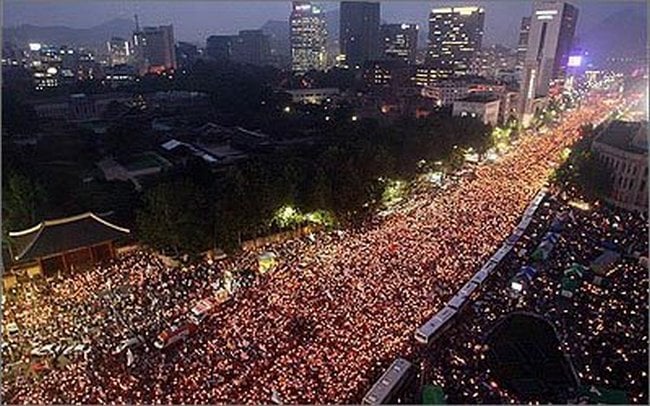
If convicted on charges of bribery, corruption, abuse of power, coercion and leaking government secrets (in a total of 18 cases), Park Guen-hye faces between 10 years to life in prison. Bear in mind, these accusations are but the tip of the iceberg, they do not include Ms. Park orders to arbitrarily arrest her political opponents and repeal fundamental civil rights.

In a bitter irony, it was the constitutional court under pressure from the Conservative Party, which ratified president Park’s baseless accusations against Rep. Lee Seok-ki, which led to his imprisonment. That erroneous decision by the Constitutional Court, which was in part upheld by the Supreme Court, invoking the 1948 National Security Act must be challenged and annulled.

Park Geun-hye at the Seoul central district court in South Korea. Photograph: Xinhua/Rex/Shutterstock

Reunification and The Sunshine Policy

The Sunshine policy initially established under the government of Kim Dae-jung with a view to seeking North-South cooperation had already been abolished by Park Guen hye’s predecessor president Lee Myung-bak (2008-2013). In turn, this period was marked by a heightened atmosphere of confrontation between North and South, marked by successive war games.

The administrations of both presidents Lee and Park were largely instrumental in repealing the Sunshine Policy which had been actively pursued during the Roh Moo-hyun administration (2003-2008), with increased public sentiment in favor of reunification of North and South Korea.  

Sunshine 2.0. The Demilitarization of the Korean Peninsula

The legacy of history is fundamental: From the outset in 1945 as well as in the wake of the Korean war (1950-53), US interference and military presence in the ROK has been the main obstacle to the pursuit of democracy and national sovereignty.

Washington has consistently played a role in ROK politics, with a view to ensuring its hegemonic objectives in East Asia. The impeached president Mrs. Park served as an instrument of the US administration.

Will the popular movement against the impeached president prevail?

It was conducive to the conduct of new presidential elections leading to the election of Moon Jae-in as president of the ROK.

Supported by the Candle Light movement, Moon Jae-in’s presidency potentially constitutes a watershed, a political as well as geopolitical landmark, an avenue towards national sovereignty in defiance of US interference, a potential break with a foregone era of authoritarian rule.

President Moon Jae-in had worked closely with president Roh Moo-hyun as his chef de cabinet. He has confirmed his unbending commitment in favor of dialogue and cooperation with Pyongyang, under what is being dubbed Sunshine 2.0 Policy, while also maintaining the ROK’s relationship with the US.
While President Moon Jae-in (left) is firmly opposed to the DPRK’s nuclear program, he has nonetheless taken a firm stance against the deployment of the US-supplied Terminal High-Altitude Area Defence Missile Defence System (THAAD).

In recent developments, the ROK Defense Ministry acting behind his back took the initiative (May 30) of bringing in four more launchers for the THAAD missile system. “President Moon said that it’s ‘very shocking’ after receiving a report” on the incident from his national security director” (Morningstar, May 30, 2017)

President Moon’s commitment to cooperation with North Korea coupled with demilitarization, will require redefining the ROK-US relationship in military affairs. This is the crucial issue.

The World is at a dangerous crossroads: How will the policies of President’s Moon’s administration affect the broader East Asia geopolitical context marked by US threats of military action (including the use of nuclear weapons) not only against North Korea but also against China and Russia?

In the present context, the US has de facto control over ROK foreign policy as well as North South Korea relations. Under the OPCOM agreement, the Pentagon controls the command structure of the ROK armed forces.

Ultimately this is what has to be addressed with a view to establishing a lasting peace on the Korean peninsula and the broader East Asian region.

The Repeal of OPCON and the ROK-US Combined Forces Command (CFC)

In 2014, the government of  President Park Geun-hye postponed the repeal of the OPCON (Operations Command) agreement “until the mid-2020s”. What this signified is that “in the event of conflict” all ROK forces are under the command of a US General appointed by the Pentagon, rather than under that of the ROK President and Commander in Chief.

It goes without saying that national sovereignty cannot reasonably be achieved without the annulment of the OPCON agreement as well as the ROK – US Combined Forces Command (CFC) structure.
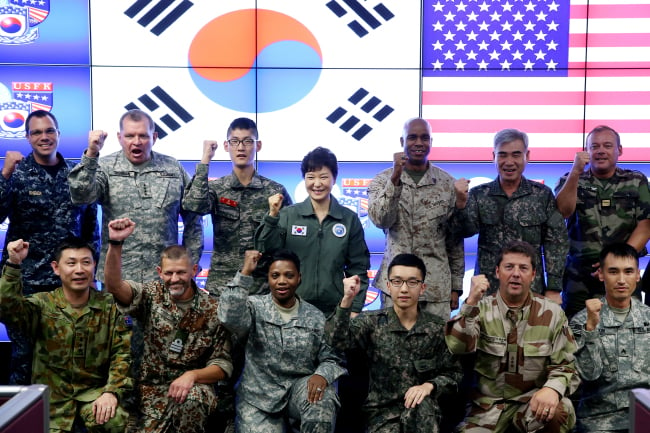
As we recall, in 1978 a binational Republic of Korea – United States Combined Forces Command (CFC), was created under the presidency of General Park (military dictator and father of impeached president Park Guen-hye). In substance, this was a change in labels in relation to the so-called UN Command.

“Ever since the Korean War, the allies have agreed that the American four-star would be in “Operational Control” (OPCON) of both ROK and US military forces in wartime …. Before 1978, this was accomplished through the United Nations Command. Since then it has been the CFC [US Combined Forces Command (CFC) structure]. (Brookings Institute)

Moreover, the Command of the US General under the renegotiated OPCON (2014) remains fully operational inasmuch as the 1953 Armistice (which legally constitutes a temporary ceasefire) is not replaced by a peace treaty.

The 1953 Armistice Agreement

What underlies the 1953 Armistice Agreement is that one of the warring parties, namely the US has consistently threatened to wage war on the DPRK for the last 64 years.

The US has on countless occasions violated the Armistice Agreement. It has remained on a war footing. Casually ignored by the Western media and the international community, the US has actively deployed nuclear weapons targeted at North Korea for more than half a century in violation of article 13b) of the Armistice agreement. More recently it has deployed the so-called THAAD missiles largely directed against China and Russia.

The US is still at war with North Korea. The armistice agreement signed in July 1953 –which legally constitutes a “temporary ceasefire” between the warring parties (US, North Korea and China’s Volunteer Army)– must be rescinded through the signing of a long-lasting peace agreement.

The US has not only violated the armistice agreement, it has consistently refused to enter into peace negotiations with Pyongyang, with a view to maintaining its military presence in South Korea as well as shunting a process of normalization and cooperation between the ROK and the DPRK.

Towards a Bilateral North-South Peace Agreement

If  one of the signatories of the Armistice refuses to sign a Peace Agreement, what should be contemplated is the formulation  of a comprehensive Bilateral North-South Peace Agreement, which would de facto lead to rescinding the 1953 armistice.

What should be sought is that the “state of war” between the US and the DPRK (which prevails under the armistice agreement) be in a sense “side-tracked” and annulled by the signing of a comprehensive bilateral North-South peace agreement, coupled with cooperation and interchange.

This proposed far-reaching agreement between Seoul and Pyongyang would assert peace on the Korean peninsula –failing the signing of a peace agreement between the signatories of the 1953 Armistice agreement. The legal formulation of this bilateral entente is crucial. The bilateral arrangement would in effect bypass Washington’s refusal. It would establish the basis of peace on the Korean peninsula, without foreign intervention, namely without Washington dictating its conditions. It would require the concurrent withdrawal of US troops from the ROK and the repeal of the OPCON agreement.

Bear in mind, the US was involved in the de facto abrogation of paragraph 13(d) of the Armistice agreement, which forecloses the parties from entering new weapons into Korea. In 1956, Washington brought in and installed nuclear weapons facilities into South Korea. In so doing, the U.S. not only abrogated paragraph 13(d), it abrogated the entire Armistice agreement through the deployment of US troops and weapons systems in the ROK.

Moreover, it should be noted that the militarization of  the ROK under the OPCOM agreement, including the development of new military bases, is also largely intent upon using the Korean peninsula as a military launchpad threatening both China and Russia. Under OPCOM, “in the case of war”, the entire force of the ROK would be mobilized under US command against China or Russia.

The THAAD missiles are deployed in South Korea, against China, Russia and North Korea.  Washington states that THAAD is solely intended as a Missile Shield against North Korea.

Similarly, the Jeju island military base is largely intended to threaten China.
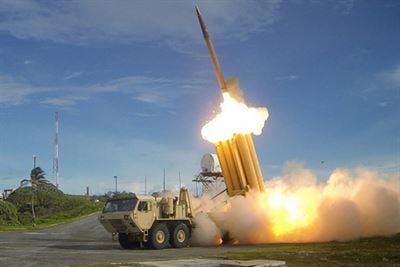
THAAD System

The Jeju island military base is also directed against China. 

Less than 500km from Shanghai
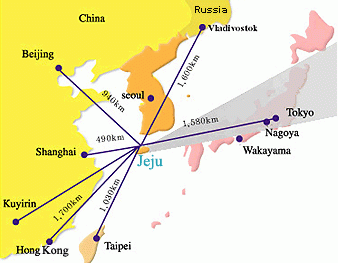
Moreover, Washington is intent upon creating political divisions in East Asia not only between the ROK and the DPRK but also between North Korea and China, with a view to ultimately isolating the DPRK.

In a bitter irony, US military facilities in the ROK (including Jeju Island) are being used to threaten China as part of a process of military encirclement. Needless to say, permanent peace on the Korean peninsula as well as in the broader East Asia region as defined under a bilateral North-South agreement would require the repeal of both the Armistice agreement as well as OPCOM, including the withdrawal of US troops from the ROK.

It is important that the bilateral peace talks between the ROK with DPRK under the helm of President Moon Jae-in be conducted without the participation or interference of outside parties. These discussions must address the withdrawal of all US occupation forces as well as the removal of economic sanctions directed against North Korea.

The exclusion of US military presence and the withdrawal of the 28,500 occupation forces should be a sine qua non requirement of a bilateral ROK-DPRK Peace Treaty.

The Republic of Korea’s Relationship with the United States

Military rule was imposed by the United States starting in the immediate wake of World War II. At the Potsdam Conference (July–August 1945), the US and the Soviet Union agreed to dividing Korea, along the 38th parallel.

There was no “Liberation” of Korea following the entry of US forces. Quite the opposite. A US military government was established in South Korea on September 8, 1945, three weeks after the surrender of Japan on August 15th 1945. Moreover,  Japanese officials in South Korea assisted the US Army Military Government (USAMG) (1945-48) led by General Hodge in ensuring this transition. Japanese colonial administrators in Seoul as well as their Korean police officials worked hand in glove with the new colonial masters.
 

While Japan was treated as a defeated Empire, South Korea was identified as a colonial territory to be administered under US military rule and US occupation forces. America’s handpicked appointee Sygman Rhee [left] was flown into Seoul in October 1945, in General Douglas MacArthur’s personal airplane

US Sponsored Military Dictatorship

The underlying model of military dictatorship applied in the ROK from 1945 to 1987 was not substantially different to what was imposed by Washington in Latin America and South East Asia.

At the same time, as of the 1980s, a major shift in US foreign policy occurred. US interventionism was geared towards the replacement of military regimes by compliant “democratic governments”, which would not in any way weaken or jeopardize America’s interference in the internal affairs of sovereign states.

Most of the US sponsored military dictatorships in the course of the 1980s were replaced by US sponsored democracies, (e.g. Chile, Argentina, Brazil, Philippines, Indonesia). Meanwhile, US increasingly intervenes in national elections, promotes political leaders and instigates “regime change”.

What has developed in many countries is a facade of democracy, what might be described as a “democratic dictatorship”.

Sweeping macro-economic reforms are often imposed. Democratically elected leaders continue to be threatened if they do not conform, heads of state are often co-opted.

What the foregoing suggests is that the repeal of authoritarian rule in the ROK, with government’s run by the military replaced by an elected president, does not necessarily imply a shift in the structure of the State.

Financial warfare directed against the Republic of Korea

As we recall, in the ROK, the democratically elected president Kim Dae jung had been instructed by Washington in no uncertain terms (prior to the elections) to implement sweeping macro-economic reforms in response to the speculative onslaught against the Korean Won in 1997 at the height of the Asian crisis.

Succumbing to political pressure, president Kim Dae-jung, a former dissident, political prisoner and starch opponent of the US backed military regimes of Park Chung-hee and Chun Doo-hwan, had caved in to Wall Street and Washington prior to his formal inauguration as the country’s democratically elected president.

In fact Washington had demanded through its embassy in Seoul that all three candidates in the presidential race commit themselves to adopting the IMF sponsored “bailout”. Kim Dae-jung was committed to democracy and national sovereignty. He had the support of the Korean people. Yet what occurred was a process of political arm twisting both prior as well as in the wake of the 1997 presidential elections. Kim Dae jung remained firmly opposed to the IMF bailout agreement. He candidly warned public opinion and accused the outgoing government of organising a massive sell-out of the Korean economy:

“Foreign investors can freely buy our entire financial sector, including 26 banks, 27 securities firms, 12 insurance companies and 21 merchant banks, all of which are listed on the Korean Stock Exchange, for just 5.5 trillion won,’ that is, $3.7 billion.” (quoted in Michel Chossudovsky, The Globalization of Poverty and the New World Order, Global Research, Montreal, 2003)

The 1997 Asian crisis was engineered. It was the result of financial manipulation. The ROK had been the object of a deliberate process of economic destabilization instigated by powerful financial institutions. Yet in the wake of the election president Kim Dae-jung was obliged to conform to Washington’s demands.

What the foregoing signifies is that a democratically elected government does not in itself ensure democracy and national sovereignty.

Reunification. The Road Ahead

America’s neo-colonial practice applied both prior and in the post World War period has been geared towards weakening the nation state. Washington seeks through military and non-military means  the partition and fracture of independent countries. (eg. Yugoslavia, Czechoslovakia, Central America, Iraq, Syria, Sudan). This foreign policy agenda focussing on fracture and partition also applies to Korea.

There is only one Korean Nation. Washington opposes reunification because a united Korean Nation would weaken US hegemony in East Asia.

Reunification would create a competing industrial and military power and nation state (with advanced technological and scientific capabilities) which would assert its sovereignty, establish trade relations with neighbouring countries (including Russia and China) without the interference of Washington.

It is worth noting in this regard, that US foreign policy and military planners have already established their own scenario of “reunification” predicated on maintaining US occupation troops in Korea. Similarly, what is envisaged by Washington is a framework which would enable “foreign investors” to penetrate and pillage the North Korean economy.

Washington’s objective is to impose the terms of Korea’s reunification. The NeoCons “Project for a New American Century” (PNAC) published in 2000 had intimated that in a “post unification scenario”, the number of US troops (currently at 28,500) should be increased and that US military presence should be extended to North Korea.

In a reunified Korea,  the military mandate of the US garrison would be to implement so-called “stability operations in North Korea”:

While Korea unification might call for the reduction in American presence on the peninsula and a transformation of U.S force posture in Korea, the changes would really reflect a change in their mission – and changing technological realities – not the termination of their mission. Moreover, in any realistic post-unification scenario, U.S. forces are likely to have some role in stability operations in North Korea. It is premature to speculate on the precise size and composition of a post-unification U.S. presence in Korea, but it is not too early to recognize that the presence of American forces in Korea serves a larger and longer-range strategic purpose. For the present, any reduction in capabilities of the current U.S. garrison on the peninsula would be unwise. If anything, there is a need to bolster them, especially with respect to their ability to defend against missile attacks and to limit the effects of North Korea’s massive artillery capability. In time, or with unification, the structure of these units will change and their manpower levels fluctuate, but U.S. presence in this corner of Asia should continue. 36 (PNAC, Rebuilding America`s Defenses, Strategy, Forces and Resources for a New Century, p. 18, emphasis added)

Washington’s intentions are crystal clear.

Concluding Remarks

It should be understood that a US led war against North Korea would engulf the entire Korean nation.

The US sponsored state of war is directed against both North and South Korea. It is characterised by persistent military threats (including the use of nuclear weapons) against the DPRK.

It also threatens the ROK which has been under US military occupation since September 1945. Currently there are 28,500 US troops in South Korea. Yet under the US-ROK OPCOM (joint defense agreement) discussed earlier, all ROK forces are  under US command.

Given the geography of the Korean peninsula, the use of nuclear weapons against North Korea would inevitably also engulf South Korea. This fact is known and understood by US military planners.

What has to be emphasized in relation to Sunshine 2.0 Policy is that the US and the ROK cannot be “Allies” inasmuch as the US threatens to wage war on North Korea.

The “real alliance” is that which unifies and reunites North and South Korea through dialogue against foreign intrusion and aggression.

The US is in a state of war against the entire Korean Nation. And what this requires is the holding of bilateral talks between the ROK and the DPRK with a view to signing an agreement which nullifies the Armistice and sets the term of a bilateral “Peace Treaty”. In turn this agreement would set the stage for the exclusion of US military presence and the withdrawal of the 28,500 US forces.

Moreover, pursuant to bilateral Peace negotiations, the ROK-US OPCOM agreement which places ROK forces under US command should be rescinded.  All ROK troops would thereafter be brought under national ROK command.

Bilateral consultations should also be undertaken with a view to further developing economic, technological, cultural and educational cooperation between the ROK and the DPRK.

Without the US in the background pulling the strings under OPCOM, the threat of war would be replaced by dialogue. The first priority, therefore would be to rescind OPCOM.

  • Posted in English @as @as
  • Comments Off on Political Transition in the Republic of Korea, Sunshine 2.0, Demilitarization and the Peace Process

These days we rush from one media story to another, trying to keep up with the latest terrorist attack. Yesterday Paris; today London; tomorrow, who knows? These attacks are tragic enough when they are acts of violence by religious extremists who have outsmarted our police and intelligence agencies. But, of course, many of them are actually violent acts facilitated by our police and intelligence agencies, directly or indirectly. The tragedy in such cases lies not only in the immediate human suffering but in the way our civil society and elected representatives are betrayed, intimidated, disciplined and stripped of their power by our own security agencies. The War on Terror, which goes by different names in different countries but continues as a global framework for violent conflict, thrives on this fraud.
But if the very agencies that should be investigating and preventing these attacks are involved in perpetrating them, what is civil society to do to protect itself? Who will step in to study the evidence and sort out what really happened? And who will investigate the official investigators? Over the years, civilians from different walks of life have stepped forward–forming groups, sharing information and methods, creating a tradition of civilian investigation.

Related image

One such investigator is Elias Davidsson (image on the right). Some readers will be familiar with his meticulous book, Hijacking America’s Mind on 9/11 or his more recent work, Psychologische Kriegsführung und gesellschaftliche Leugnung. Davidsson has now produced a book on the 2008 attacks that occurred in Mumbai, India. The book is entitled, The Betrayal of India: Revisiting the 26/11 Evidence (New Delhi: Pharos, 2017).

To remind ourselves of these attacks–that is, of the official story of these attacks as narrated by the Indian government–we can do no better than to consult Wikipedia, which seldom strays from government intelligence narratives:

“The 2008 Mumbai attacks were a series of attacks that took place in November 2008, when 10 members of Lashkar-e-Taiba, an Islamic militant organization based in Pakistan, carried out a series of 12 coordinated shooting and bombing attacks lasting four days across Mumbai. The attacks, which drew widespread global condemnation, began on Wednesday, 26 November and lasted until Saturday, 29 November 2008, killing 164 people and wounding at least 308.”

This description, however faulty, serves to make clear why the events were widely portrayed as a huge crime—India’s 9/11. When we bear in mind that both India and Pakistan are armed with nuclear weapons, and when we consider that these events were widely characterized in India as an act of war supported by Pakistan (Davidsson, 72-74; 511 ff.; 731 ff.), we will understand how dangerous the event was for over a billion and a half people in south Asia.

We will also understand how easy it was, on the basis of such a narrative, to get a bonanza of funds and equipment for the Mumbai police (735-736) and why it was possible, given the framing of the event as an act of war, for India’s armed forces to get an immediate 21% hike in military spending with promises of continuing increases in subsequent years (739 ff.).

Wikipedia’s paragraph tells a straightforward story, but the straightforwardness is the result of much snipping and smoothing. Both Pakistan and Lashkar-e-Taiba denied responsibility for the attacks (65; 513) and, Davidsson argues, they did so for good reason.

In his Conclusions at the end of the book Davidsson encourages us to assess separately the actual attacks and the Indian state’s investigation of the attacks (865 ff.) It is “highly plausible,” he says, “that major institutional actors in India, the United States and possibly Israel, were complicit in conceiving, planning, directing and executing the attacks of 26/11” (873); but the evidence of a deceptive investigation is even stronger:

“The first definite conclusion of this book is that India’s major institutions, including the Central government, parliament, bureaucracy, armed forces, Mumbai police, intelligence services, judiciary and media, have deliberately suppressed the truth regarding 26/11 and continue to do so. I could discover no hint of a desire among the aforementioned parties to establish the truth on these deadly events (865).”

This distinction is useful for civil society investigators. We will frequently find it easier to prove that an investigation is deceptive, and that it is obscuring rather than illuminating the path to the perpetrators, than to directly prove the event itself to have been fraudulent. And there are two good reasons to pay attention to evidence of a cover-up. First, to cover up a crime is itself a crime. Second, those covering up a crime implicate themselves in the original crime. If they were not directly involved in the commission of the crime, they are at least accessories after the fact. To begin by exposing the fraudulent investigation, therefore, will often be wise. When this has been done we shall often find that we can begin to discern the path to the attack itself.

Davidsson gives a wealth of evidence about both the attacks and the investigation, but for this brief review I shall focus on the investigation.

Here are three recurring themes in his study that may serve to illustrate the strength  of the cover-up thesis.

(1) Immediate fingering of the perpetrator

When officials claim to know the identity of a perpetrator (individual or group) prior to any serious investigation, this suggests that a false narrative is being initiated and that strenuous efforts will soon be made to implant it in the mind of a population. Thus, for example, Lee Harvey Oswald was identified by officials of the executive branch as the killer of President John F. Kennedy–and as a lone wolf with no associates–on the afternoon of the assassination day, long before an investigation and even before he had been charged with the crime. And we had major news media pointing with confidence, by the end of the day of September 11, 2001, to Osama bin Laden and his group–in the absence of evidence.

In the Mumbai case the Prime Minister of India implied, while the attack was still in progress, that the perpetrators were from a terrorist group supported by, or at least tolerated by, Pakistan (65; 228; 478; 512; 731).

Image result for Taj Mahal Palace Hotel in Mumbai

The Taj Mahal Hotel burning after the terrorist attacks in Mumbai (Source: Haunted India)

Likewise, immediately after the attacks Henry Kissinger attempted to implicate Pakistan. Three days prior to the attack on the Taj Mahal Palace Hotel in Mumbai, one of the main attack sites, Kissinger had been staying in the hotel. He “sat with top executives from Goldman Sachs and India’s Tata group in the Taj to ‘chat about American politics'” (331). Kissinger’s presence on the scene with Indian elites (the Tata family is one of India’s wealthiest, and the Tata Group owns the Taj) would be peculiar enough to cause raising of the eyebrows, but when combined with his immediate fingering of Pakistan it becomes extremely suspect. As Davidsson shows, what investigation there was came much later, and even today the case against Pakistan remains full of contradictions, unsupported allegations, and absurdities.

(2) Grotesque failure by official investigators to follow proper procedures

Incompetence is a fact of life, but there are times when the incompetence theory is strained to the breaking point and it is more rational to posit deliberate deception.  In the case of the Mumbai investigation, Davidsson depicts its failures as going well beyond incompetence.

  • Neither the police, nor the judge charged with trying the sole surviving suspect, made public a timeline of events (188-189; 688-689). Even the most basic facts of when a given set of attacks began and when they ended were left vague.
  • Key witnesses were not called to testify. Witnesses who said they saw the terrorists commit violence, or spoke to them, or were in the same room with them, were ignored by the court (e.g., 279 ff.).
  • Contradictions and miracles were not sorted out. One victim was apparently resurrected from the dead when his testimony was essential to the blaming of Pakistan (229-230). A second victim died in two different places (692), while a third died in three places (466). No one in authority cared enough to solve these difficulties.
  • Eyewitnesses to the crime differed on the clothing and skin color of the terrorists, and on how many of them there were (328-331). No resolution was sought.
  • At least one eyewitness confessed she found it hard to distinguish “friends” from terrorists (316). No probe was stimulated by this odd confusion.
  • The number of terrorists who committed the deeds changed repeatedly, as did the number of terrorists who survived (29 ff.; 689).
  • Crime scenes were violated, with bodies hauled off before they could be examined (682-683).
  • Identity parades (“line-ups”) were rendered invalid by weeks of prior exposure of the witnesses to pictures of the suspect in newspapers (101; 582).
  • Claims that the terrorists were armed with AK-47s were common, yet forensic study of the attack at the Cama Hospital failed to turn up a single AK-47 bullet (156).
  • Of the “hundreds of witnesses processed by the court” in relation to the attacks at the Café Leopold, Taj Mahal Palace Hotel, Oberoi-Trident Hotel or Nariman House, “not a single one testified to having observed any of the eight accused kill anyone” (40).
  • Indian authorities declined to order autopsies on the dead at the targeted Jewish center in Nariman House. The dead, five out of six of whom were Israeli citizens (427), were instead whisked back to Israel by a Jewish organization based in Israel, allegedly for religious reasons (453). Religious sensitivity seems to have extended to a large safe at the crime scene, which the team also transported to Israel (454).

(3) Extreme secrecy and the withholding of basic information from the population, with the excuse of “national security”

  • The surviving alleged terrorist had no public trial (661).
  • No transcript of his secret trial has been released (670).
  • One lawyer who agreed to defend the accused was removed by the court and another was assassinated (670).
  • The public was told there was extensive CCTV footage of the attacks, despite the mysterious malfunctioning of the majority of CCTV cameras on the days in question (97-98; 109 ff.; 683 ff.); but only a very small percentage of the claimed footage was ever released and it suffers from serious defects–two conflicting time-stamps and signs of editing (111).
  • Members of an elite Indian commando unit that showed up with between 475 and 800 members to battle eight terrorists (534) were not allowed to testify in court (327; 428-429).
  • The “confession” of the suspect, on which the judge leaned heavily, was given in secret. No transcript of this confession has been released to the public and the suspect later renounced the confession, saying he had been under threat from police when he gave it (599 ff.; 681).
  • The suspect, after being convicted and sentenced to death, was presumably executed, but the hanging was done secretly in jail and his body, like the bodies of the other dead “terrorists,” was buried in a secret place (37; 623).

It is difficult to see how the investigation described above differs from what we would expect to see in a police state. Evidently, the “world’s largest democracy” is in trouble.

Meanwhile, motives for the “highly plausible” false flag attack, Davidsson notes, are not difficult to find. The attacks not only filled the coffers of national security agencies, creating as they did the impression of a permanent threat to India, but also helped tilt India toward those countries claiming to take the lead in the War on Terror (809 ff.; 847). The FBI showed great interest in the attacks from the outset. It actually had a man on the scene during the attacks and sent an entire team directly after the event (812 ff.). The Bureau was, remarkably, given direct access to the arrested suspect and to his recorded confession (before he even had a lawyer), as well as to eyewitnesses (651-652; 815). The New York Police Department also sent a team after the conclusion of the event (816-817), as did Scotland Yard and Israeli police (651; 851). There seems to have been something of a national security fest in relation to Mumbai as ideas of closer cooperation in matters of security were discussed (e.g., 822).

In case Israel seems too small to belong with the other players in this national security fest, Davidsson reminds us that India is Israel’s largest customer in defense sales (853).

So, what can we learn from Davidsson’s book? For patient readers, a great deal: this 900-page study is as free of filler and rhetoric as it is rich in detail. (In correspondence the author told me that he was determined to produce a work dense with primary source material so that it could be of maximum help to activists in India striving for an official inquiry.) For readers with less patience, Davidsson has provided regular summaries. And both sets of readers will find that the book discusses not only details of the Mumbai attacks, but patterns of deception common in the War on Terror.

For all these reason, this book is a highly significant achievement and is of objective importance to anyone interested in the War and Terror–the structure and motifs of its ongoing fictions and the methods through which civil society researchers can lay bare these fictions.

Dr. Graeme MacQueen is the former Director of the Centre for Peace Studies at McMaster University in Canada. He was an organizer of the Toronto Hearings on 9/11, is a member of the Consensus 9/11 Panel, and is a former co-editor of the Journal of 9/11 Studies.

Featured image: Amazon

  • Posted in English @as @as
  • Comments Off on The Betrayal of India: A Close Look at the 2008 Mumbai Terror Attacks

The ongoing Belt and Road Forum for International Cooperation will make future-oriented plans for cooperation and push forward the construction of the routes on a new starting point, said a commentary published by People’s Daily on Sunday, the same day the two-day event opened in Beijing.

The following is an abstract translation of the article:

A total of 29 heads of state and governments, over 70 leaders of international organizations, and 1,500-plus representatives from worldwide attended the Belt and Road Forum for International Cooperation being held in Beijing.

As the highest-level Belt and Road international meeting since the initiative was firstly put forward, the historical event will definitely usher countries around the world into a new chapter to build it together.

Better than expected, progress and achievements have been scored by the efforts to construct Belt and Road. So far, more than 100 countries and international organizations have responded to the initiative, with 40 of them signing agreements of cooperation with China.

These accomplishments obtained in such a short period of time indeed indicated the initiative’s conformity with the trend of international peaceful development and the demand of Eurasian countries for cooperation and development.

The Belt and Road initiative is for China, but more importantly, it is for the world.

Now the world economy is still in a gloom, with rising tide of protectionism and anti-globalization. The conflicts between openness and conservatism, reform and fogyism economic integration and fragmentation have emerged as well.

Amid such background, the Belt and Road development provides a new engine to boost trade growth and accelerate the reform of global economic governance.

Fruitful harvests have been reaped from the endeavor to build the routes. The “Belt and Road” countries, for instance, have aligned their development strategies and construction plans, while investment and financing platforms such as Asian Infrastructure Investment Bank and Silk Road Fund have been set up.

The infrastructure projects like Jakarta-Bandunghigh speed rail and Gwadar Port are underway as well.

Photo taken shows a terminal of the Gwadar Port in Pakistan. (Photo by MengXianglin from People’s Daily)

These have not only accelerated China’s process to open up in an all-round way, but also brought development opportunities and tangible benefits for the countries and regions along the routes. The contribution of all involved countries was rewarded.

Such common actions are pushing the world toward an innovative, invigorated, interconnected and inclusive economy.

Chinese President Xi Jinping once pointed out that

“the world will be a better place only when everyone is better off”.

To put Xi’s words into practice, Chinese enterprises have established 56 economic cooperation zones in Belt and Road countries during the last 3 years, creating nearly $1.1 billion tax revenue and 180,000 jobs. In addition, China’s direct investment in these countries reached $14.5 billion in merely 2016.

China is implementing the initiative and devoting to economic globalization with maximum sincerity and firm actions.

Xi stressed that the Silk Road is a common treasure for people all over the world. The continuous promotion of the initiative will not only effectively deepen the cooperation between China and the Belt and Road countries, but also deliver them and the world at large the conception to build a community of shared interests and future for the mankind.

The achievements in the past 3 years have made the Belt and Road initiative important international public product goods. The forum will determine the key cooperation areas for the next phase through consultation, make future-oriented plans for cooperation, and promote the construction of the Belt and Road on a new starting point, in a bid to further build consensus, set direction and plan visions.

The forum is not about empty talks. It will make itself into a highly-efficient global cooperation platform to encourage connectivity.

Closer alignment, effective implementation and other concrete actions will be taken to convert consensus into development engines and welfare for the public, so that the Belt and Road initiative will be strong enough to carry the hope and dream of the people from en-route countries.

  • Posted in English @as @as
  • Comments Off on China’s Belt and Road Initiative Contributes to Open, “Win-Win New World”. President Xi Jinping

Vers une Europe militaire ?

May 13th, 2017 by Defend Democracy Press

On a souvent comparé la construction européenne à un cycliste : s’il n’avance pas, il se trouve en équilibre instable et il tombe à terre. Les dirigeants des Etats et des institutions de l’Union européenne (UE) doivent en effet donner en permanence aux citoyens des raisons d’être ensemble. C’est même la principale activité de la Commission européenne qui produit à jet continu des projets d’actes législatifs baptisés « avancées ».

Le problème se complique lorsqu’il n’y a pas un, mais 28 cyclistes ne pédalant pas tous dans le même sens, et cela dans un environnement international de tous les dangers. Dans un tel cas, la méthode est bien connue : faute de trouver un accord sur les dossiers existants, on en ouvre un nouveau sur lequel des « avancées » seraient possibles et fourniraient le carburant nécessaire à une nouvelle « relance » du projet européen.

Ce dossier est celui de la perspective d’une Europe militaire. La conjoncture est favorable à un tel projet dans la mesure où il peut être présenté aux opinions publiques comme un outil pour se protéger du terrorisme et des autres retombées des conflits armés en cours au Proche-Orient, ainsi que pour faire face aux ambitions prêtées à la Russie.

L’Europe de la défense n’est pas une question nouvelle. Elle s’est posée dès le lendemain de la seconde guerre mondiale, dans le contexte de la guerre froide. Deux problématiques ont structuré les débats à son sujet : quelle implication des Etats-Unis dans la sécurité de l’Europe ? quel mode de décision – intergouvernemental ou supranational – dans un éventuel dispositif militaire européen ?

En fait, il n’a jamais existé de projet consensuel d’une défense européenne qui serait assurée exclusivement par les Européens. Tous les gouvernements, à l’exception de ceux du général de Gaulle (1958- 1969), ont considéré que l’Organisation du traité de l’Atlantique Nord (Otan), créée par le traité de Washington (1949), constituait une assurance tous risques contre l’Union soviétique.

La première tentative d’intégration militaire fut la Communauté européenne de défense (CED) sur le modèle supranational de la Communauté européenne du charbon et de l’acier (Ceca), et elle fut rejetée par le Parlement français en 1954. Elle est encore aujourd’hui abusivement étiquetée « européenne » alors qu’elle plaçait une éventuelle armée européenne sous la tutelle du commandant en chef de l’Otan, un général américain nommé par le président des Etats-Unis.

L’échec de la CED a durablement marqué les esprits et il a tracé la « ligne rouge » de toute initiative en matière de défense européenne : pour Londres et pour la quasi totalité des membres de l’UE, le seul véritable outil de défense européenne est l’Otan [1], et toute nouvelle organisation militaire doit être compatible avec cet impératif. Mais l’élection de Donald Trump a brutalement rebattu les cartes en raison de ses déclarations contradictoires au sujet de l’Otan. La confiance des dirigeants européens dans le lien transatlantique s’est érodée. D’où, pour combler un vide et, en même temps, pour « relancer » l’UE, les propositions franco-allemandes de réalisations concrètes (notamment en matière de recherche militaire et de développement de matériels communs). Additionnées, elles finiraient par constituer une politique européenne comme les autres. La grande faiblesse de ce projet est qu’il ne dit pas quelle est la menace à laquelle il est censé répondre. Ce qui, en première priorité, obligerait l’UE à choisir le statut qu’elle assigne à la Russie dans sa doctrine stratégique : partenaire, alliée ou adversaire ?

Defend Democracy Press

“Tiananmen Square “Massacre”? The Power of Words vs. Silent Evidence“, an e-book by Australian-based author Wei Ling Chua

Wei Ling Chua’s E-book can be  downloaded here.

Excerpt from Kim Petersen’s book review:

“Chua has pulled together the western media threads, the disinformation, the recantations, and the biases in a campaign to demonize China – a fast-rising challenger to the hegemony of western capitalism. It is a must-read book for people wanting a perspective outside the controlled negative western media portrayal.

After reading Tiananmen Square “Massacre”?: The Power of Words vs. Silent Evidence, the second book in the The Art of Media Disinformation is Hurting the World and Humanity series by Chua — I immediately knew I had to read the first book in the series.” Kim Petersen, 9th June 2014

Excerpt from Preface:

The so-called Tiananmen Square “Massacre” is one of the most misleading events the US government and the Western media have used to demonize the Chinese government each and every year since 1989. There was ample silent evidence in the images produced by the Western media that told the story of a highly restrained Chinese government facing a protest similar to those in the West at various stages of their economic development.

However, the West capitalized on the situation in 1989 to fuel the public’s anger, intending to overthrow a CCP government.

How the Western media lied about a massacre given the silent evidence that suggests otherwise, and the moral implications of Western powers making use of common pain and dissatisfaction within an economic cycle of a society to justify the overthrowing of governments across the globe are issues that this book is structured to explore.

The concept of good governance, human rights and freedom is a complex one. Incidents of government crackdowns on protesters are as frequent in the West as anywhere else. The only difference is that the West has a highly sophisticated, well-funded, well-established and well-controlled media industry run by a handful of big corporations with an agenda. Without their agenda-based support, victims of government oppression in the West will hardly ever be noticed by the wider Western community and the world.

To prove such a point, I have included in my analysis the history of protest management in the US and the creative techniques used by the US authorities against the Occupy Wall Street protesters.
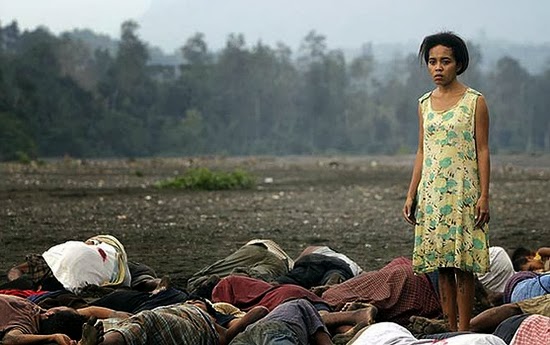
One should always bear in mind that the concepts of good governance, human rights and freedom can only be objectively assessed through the power of comparison. The truth can only be found through filtering the indoctrinated messages propagated by the mainstream media. It is important for one to always think for themselves, and to observe the logic and images beyond the media rhetoric.

Can you tell what’s wrong with the following image and narration?


Atlantic 2012 pic 21


Tiananmen Square “Massacre”?: 
The Power of Words vs. Silent Evidence

by Wei Ling Chua 


Click here to download the book.

“Tiananmen Square “Massacre”? The Power of Words vs. Silent Evidence“, an e-book by Australian-based author Wei Ling Chu

  • Posted in English @as @as
  • Comments Off on The 1989 Tiananmen Square “Massacre”. What Happened?

The Universal Lesson of East Timor

May 8th, 2017 by John Pilger

Filming undercover in East Timor in 1993 I followed a landscape of crosses: great black crosses etched against the sky, crosses on peaks, crosses marching down the hillsides, crosses beside the road. They littered the earth and crowded the eye. 

The inscriptions on the crosses revealed the extinction of whole families, wiped out in the space of a year, a month, a day. Village after village stood as memorials. 

Kraras is one such village. Known as the “village of the widows”, the population of 287 people was murdered by Indonesian troops.

Using a typewriter with a faded ribbon, a local priest had recorded the name, age, cause of death and date of the killing of every victim. In the last column, he identified the Indonesian battalion responsible for each murder. It was evidence of genocide. 

Image result for kraras

Kraras massacre

I still have this document, which I find difficult to put down, as if the blood of East Timor is fresh on its pages. 

On the list is the dos Anjos family. 

In 1987, I interviewed Arthur Stevenson, known as Steve, a former Australian commando who had fought the Japanese in the Portuguese colony of East Timor in 1942. He told me the story of Celestino dos Anjos, whose ingenuity and bravery had saved his life, and the lives of other Australian soldiers fighting behind Japanese lines. 

Steve described the day leaflets fluttered down from a Royal Australian Air Force plane;

“We shall never forget you,” the leaflets said.

Soon afterwards, the Australians were ordered to abandon the island of Timor, leaving the people to their fate.

When I met Steve, he had just received a letter from Celestino’s son, Virgillo, who was the same age as his own son. Virgillo wrote that his father had survived the Indonesian invasion of East Timor in 1975, but he went on:

“In August 1983, Indonesian forces entered our village, Kraras. They looted, burned and massacred, with fighter aircraft overhead. On 27 September 1983, they made my father and my wife dig their own graves and they machine-gunned them. My wife was pregnant.” 

The Kraras list is an extraordinary political document that shames Indonesia’s Faustian partners in the West and teaches us how much of the world is run. The fighter aircraft that attacked Kraras came from the United States; the machine guns and surface-to-air missiles came from Britain; the silence and betrayal came from Australia. 

The priest of Kraras wrote on the final page:

“To the capitalist governors of the world, Timor’s petroleum smells better than Timorese blood and tears. Who will take this truth to the world? … It is evident that Indonesia would never have committed such a crime if it had not received favourable guarantees from [Western] governments.” 

As the Indonesian dictator General Suharto was about to invade East Timor (the Portuguese had abandoned their colony), he tipped off the ambassadors of Australia, the United States and Britain. In secret cables subsequently leaked, the Australian ambassador, Richard Woolcott, urged his government to

“act in a way which would be designed to minimise the public impact in Australia and show private understanding to Indonesia.”

He alluded to the beckoning spoils of oil and gas in the Timor Sea that separated the island from northern Australia.

Image result for general suharto

General Suharto 

There was no word of concern for the Timorese.

In my experience as a reporter, East Timor was the greatest crime of the late 20th century. I had much to do with Cambodia, yet not even Pol Pot put to death as many people – proportionally — as Suharto killed and starved in East Timor. 

In 1993, the Foreign Affairs Committee of the Australian Parliament estimated that “at least 200,000” East Timorese, a third of the population, had perished under Suharto. 

Australia was the only western country formally to recognise Indonesia’s genocidal conquest. The murderous Indonesian special forces known as Kopassus were trained by Australian special forces at a base near Perth. The prize in resources, said Foreign Minister Gareth Evans, was worth “zillions” of dollars.

Image result for Death of a Nation: the Timor Conspiracy

In my 1994 film, Death of a Nation: the Timor Conspiracy, a gloating Evans is filmed lifting a champagne glass as he and Ali Alatas, Suharto’s foreign minister, fly over the Timor Sea, having signed a piratical treaty that divided the oil and gas riches of the Timor Sea. 

I also filmed witnesses such as Abel Gutteras, now the Ambassador of Timor-Leste (East Timor’s post independence name) to Australia. He told me,

“We believe we can win and we can count on all those people in the world to listen — that nothing is impossible, and peace and freedom are always worth fighting for.” 

Remarkably, they did win. Many people all over the world did hear them, and a tireless movement added to the pressure on Suharto’s backers in Washington, London and Canberra to abandon the dictator. 

But there was also a silence. For years, the free press of the complicit countries all but ignored East Timor. There were honourable exceptions, such as the courageous Max Stahl, who filmed the 1991 massacre in the Santa Cruz cemetery. Leading journalists almost literally fell at the feet of Suharto. In a photograph of a group of Australian editors visiting Jakarta, led by the Murdoch editor Paul Kelly, one of them is bowing to Suharto, the genocidist. 

From 1999 to 2002, the Australian Government took an estimated $1.2 billion in revenue from one oil and gas field in the Timor Sea. During the same period, Australia gave less than $200 million in so-called aid to East Timor. 

In 2002, two months before East Timor won its independence, as Ben Doherty reported in January,

“Australia secretly withdrew from the maritime boundary dispute resolution procedures of the UN convention the Law of the Sea, and the equivalent jurisdiction of the International Court of Justice, so that it could not be compelled into legally binding international arbitration”. 

The former Prime Minister John Howard has described his government’s role in East Timor’s independence as “noble”. Howard’s foreign minister, Alexander Downer, once burst into the cabinet room in Dili, East Timor, and told Prime Minister Mari Alkatiri,

“We are very tough … Let me give you a tutorial in politics …” 

Today, it is Timor-Leste that is giving the tutorial in politics. After years of trickery and bullying by Canberra, the people of Timor-Leste have demanded and won the right to negotiate before the Permanent Court of Arbitration (PCA) a legal maritime boundary and a proper share of the oil and gas. 

Australia owes Timor Leste a huge debt — some would say, billions of dollars in reparations. Australia should hand over, unconditionally, all royalties collected since Gareth Evans toasted Suharto’s dictatorship while flying over the graves of its victims. 

The Economist lauds Timor-Leste as the most democratic country in southeast Asia today. Is that an accolade? Or does it mean approval of a small and vulnerable country joining the great game of globalisation? 

For the weakest, globalisation is an insidious colonialism that enables transnational finance and its camp-followers to penetrate deeper, as Edward Said wrote, than the old imperialists in their gun boats. 

It can mean a model of development that gave Indonesia, under Suharto, gross inequality and corruption; that drove people off their land and into slums, then boasted about a growth rate. 

Related image

The people of Timor-Leste deserve better than faint praise from the “capitalist governors of the world”, as the priest of Kraras wrote. They did not fight and die and vote for entrenched poverty and a growth rate. They deserve the right to sustain themselves when the oil and gas run out as it will. At the very least, their courage ought to be a beacon in our  memory: a universal political lesson. 

Bravo, Timor-Leste. Bravo and beware.

On May 5, John Pilger was presented with the Order of Timor-Leste by East Timor’s Ambassador to Australia, Abel Gutteras, in recognition of his reporting on East Timor under Indonesia’s brutal occupation, especially his landmark documentary film, Death of a Nation: the Timor Conspiracy. 

  • Posted in English @as @as
  • Comments Off on The Universal Lesson of East Timor

While the new resident of the White House has been acquiring a taste for military adventures overseas, the prime minister of Japan, Shinzo Abe, visited Moscow last Thursday for his 17th talk with Vladimir Putin. But of course their normal economic agenda, intended to hammer out the final details of some painful bilateral issues, was powerfully affected by events in North Korea. So what’s the real political equation in the Eurasian Far East these days?

The memorable dinner hosted by Pres. Trump for Chairman Xi and served up with the added flourish of a missile strike on a Syrian air base was hardly a diplomatic success for the new administration. The Chinese leader has apparently turned a deaf ear to the president’s demands to revalue the yuan and thus financially offset the enormous US trade deficit with its biggest economic partner. But one of the few advantages of having a businessman in the Oval Office is that he always has a non-business argument when trapped in any sort of business quagmire. Teasing a limitrophe that is loyal to your adversary is the first-choice option in such cases.

Nearly 63 years after the end of the Korean War, during which the United States Air Force dropped more conventional and napalm bombs onto North Korea than did all the Allies onto Germany during the WWII, Washington is still officially in a state of war with Pyongyang.  And it is precisely this powerful factor of ambiguity that drives the awkward nuclear ambitions of a small and stalemated nation. A safe and manageable bogey-state offers a convenient pretext for the US to stretch a vengeful hand toward the coastline of a key economic “partner” whenever the time is right – which is almost a dream come true for US strategists. So far, this most recent “North Korean escalation” has had a single tangible result – the US THAAD anti-missile systems that monitor eastbound Chinese rockets are being deployed in South Korea and will reportedly “be operational within days.

The only problem is that this game is not being played in a geopolitical vacuum. A symptomatic WP commentator – periodically venting his spleen against the “hermit kingdom” of North Korea – lets slip one notable point:

If the crisis deepens, the possibility arises of South Korea and, more importantly, Japan going nuclear themselves.

The best way to label the prevailing mood among Japanese foreign-policy officials at the dawn of the Trump era would be that of “ill-concealed anxiety.” Tokyo is justifiably concerned that it might be dragged into an unpredictable, hot regional military conflict (the American bases on Okinawa are the highest-priority targets for the North Korean missiles) or that Washington and Beijing might reach a long-term consensus at the expense of the interests of the neighboring countries. In both scenarios Japan would be the weakest chain in the regional string.

The first problem is the burden of history. At one time or another all its neighbors have been the victims of horrific war crimes at the hands of the Japanese military, with some suffering on multiple occasions. Most nations in the region share the common denominator of anti-Japanese prejudices that are unconscious for the most part, yet still potent. What makes matters worse is that Japan alone is denied the right to its own army.

The second problem is that despite impressive economic and technological breakthroughs, Japan, like Germany, is still stuck in the position of a crypto-colony of the United States, unable to make sovereign military and foreign-policy decisions. This situation is made worse by the acute shortage of mineral resources on their islands.

Is Japan eager to escape this vicious circle and reclaim its full sovereignty? Without question. This is why PM Abe visits Pres. Putin.

PM Abe and Pres.Putin giving press-conference after talks in Moscow, April 27, 2017

Of course Mr. Abe’s rise to the peak of Japan’s political Olympus was not serendipitous. His maternal grandfather, the former prime minister Nobusuke Kishi, was a close associate of the top commanders in the Kwantung army and in October 1941 became a member of the militaristic government cabinet in Tokyo. After the capitulation of Japan he was arrested by the Allies and held as a war criminal for three years. Once he adopted America’s visions and demands for post-war Japan, he was released and eventually became the prime minister of a pro-American Japanese government. Although Kishi held no trump cards in his hands, he did everything in his power to strengthen and re-militarize Japan.

His grandson aspires to the same goal – to rid his home of an unwelcome guest. He understands that he must overcome the military restrictions of the capitulation act and obtain independent access to sufficient natural resources. But unlike his grandpa, he holds some trump cards. Agreeing to abandon the futile dispute over the “northern territories” in exchange for a broad partnership with Russia might be the only way for Japan to emerge from this troubled time with some long-sought benefits.

  • Posted in English @as @as
  • Comments Off on Japan Seeks to Restore Its National Sovereignty. Japan-Russia Relations

Given the continued escalation of tensions on the Korean Peninsula over the past months, all concerned parties should implement the resolutions adopted by the UN Security Council in a more strict manner and return to peaceful negotiations, the People’s Daily said in an editorial published on Sunday.

The commentary came after Friday’s ministerial meeting on the nuclear issue of the Korean Peninsula hosted by the UN Security Council at the UN headquarters in New York.

The latest developments on the peninsula highlighted an imperative need for all parties to intensify their efforts to bring stakeholders to dialogue table, added the commentary published under the pen name Zhong Sheng, which is often used to express the paper’s views on foreign policy.

It is reasonable for the DPRK to pursue its own security, but its nuclear and missile ambitions have put itself and the whole region into dire peril, stressed the article titled “Responsible actions are needed to ensure peace of Korean Peninsula”.

The country has been immersed itself into a strong sense of insecurity given historic reasons and reality, the paper added.

The DPRK must not be obsessed in a wrong path of repeated nuclear tests and missile launches that resulted in rounds of sanctions, the commentary said, calling on the country to respect and comply with the relevant Security Council resolutions.

The article pointed out that the Republic of Korea(ROK) and the US also added fuel to the escalated tensions since the two allies, who have been maintaining a high-handed pressure on the nuclear issue of the Korean Peninsula, revealed a strategic intention to crush the DPRK.

It is almost impossible to ease the crisis on the peninsula if the ROK and the US continue their fantasy to settle the problem with more military actions but turn a blind eye to reasonable appeals of the DPRK, the paper stressed.

China is not a directly-concerned party of the peninsula crisis, and it does not hold the key to solving the nuclear issue on the peninsula, the commentary admitted.

But it emphasized that no matter what happens, China will never waiver in its clear-cut position regarding the nuclear issue on the Korean Peninsula, which means it will stay committed to the goal of denuclearization as well as the path of dialogue and negotiation.

In the next step, the DPRK should refrain from further nuclear test or missile launches, the article urged, adding that the ROK and the US, for their part, also need to stop launching or expanding their military drills or deployment against the DPRK.

All stakeholders need to comprehensively understand and fully implement the DPRK-related resolutions adopted by the Security Council, the paper said. The international community needs to step up their anti-proliferation efforts against the DPRK action. Meanwhile,all parties also need to do more to persuade stakeholders back to peaceful dialogues, it added.

China will, with its utmost sincerity and efforts, safeguard the peace and stability of Northeast Asia and realize the goal to denuclearize the Korean Peninsula along with relevant parties, the paper vowed, stressing that though a peace lover, the country is fearless of any provocations or tests.

China has proposed the “dual-track approach” and “suspension for suspension” plan for peaceful settlement of the issue, in an attempt to help the parties breakout of the security dilemma and return to the negotiating table.

The objective, reasonable and feasible proposals, according to the editorial, not only conform to the requirements of the UN resolutions, but also meet the fundamental interest of all parties including the US and the DPRK.

Translated from Chinese, People’s Daily, April 2017.

  • Posted in English @as @as
  • Comments Off on Responsible Actions Needed to Ensure Peace on the Korean Peninsula