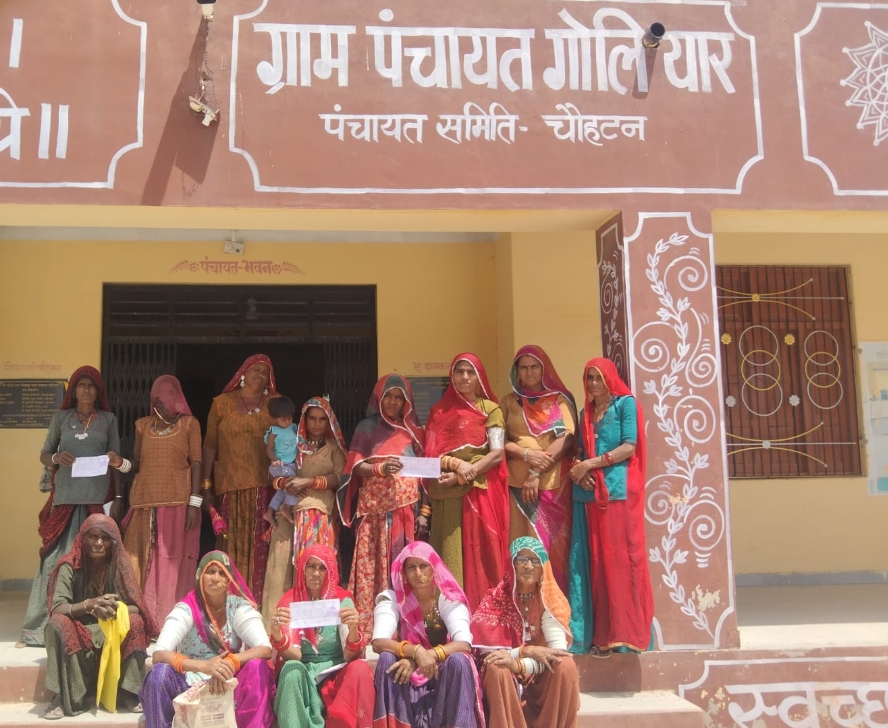
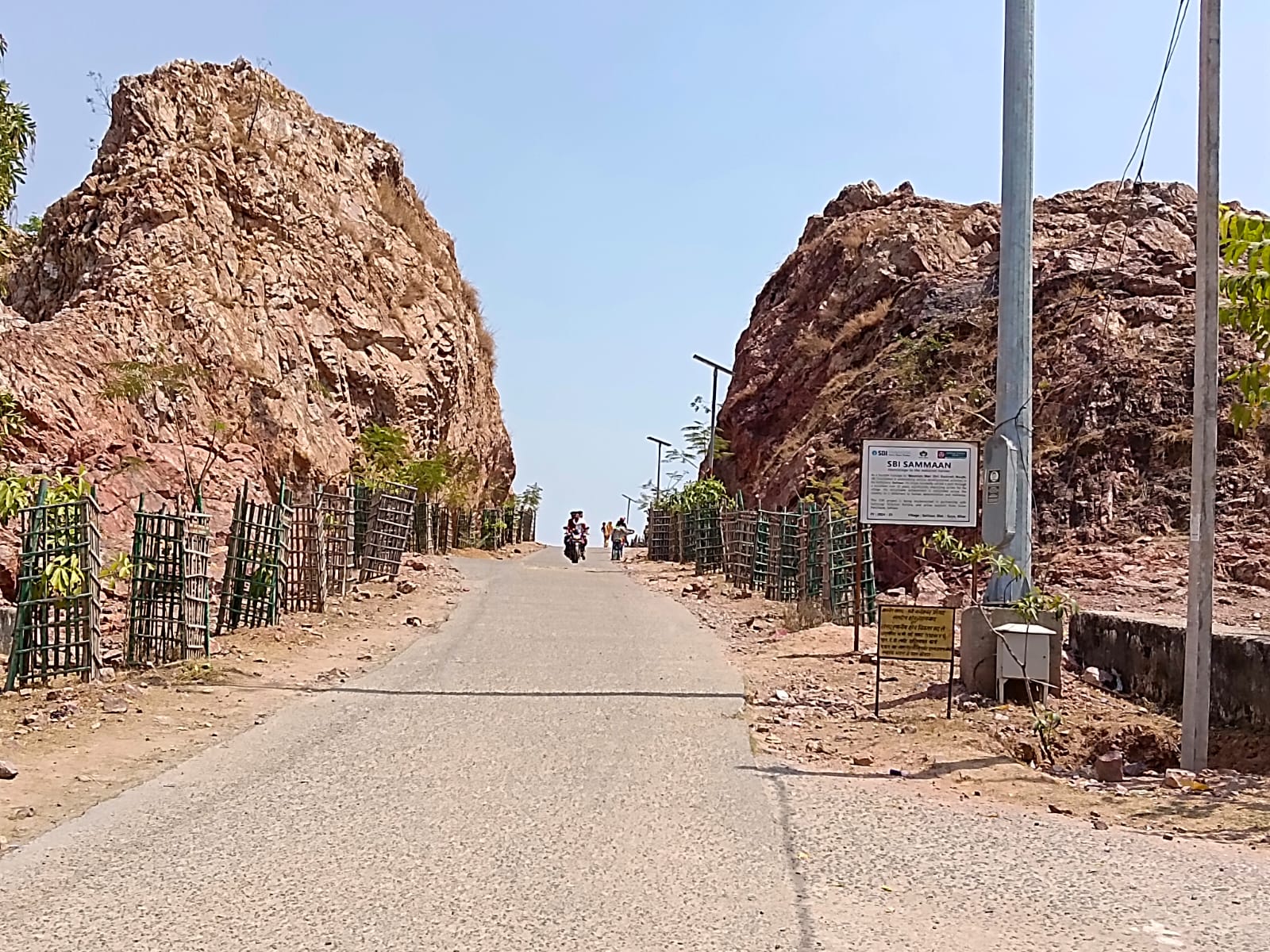
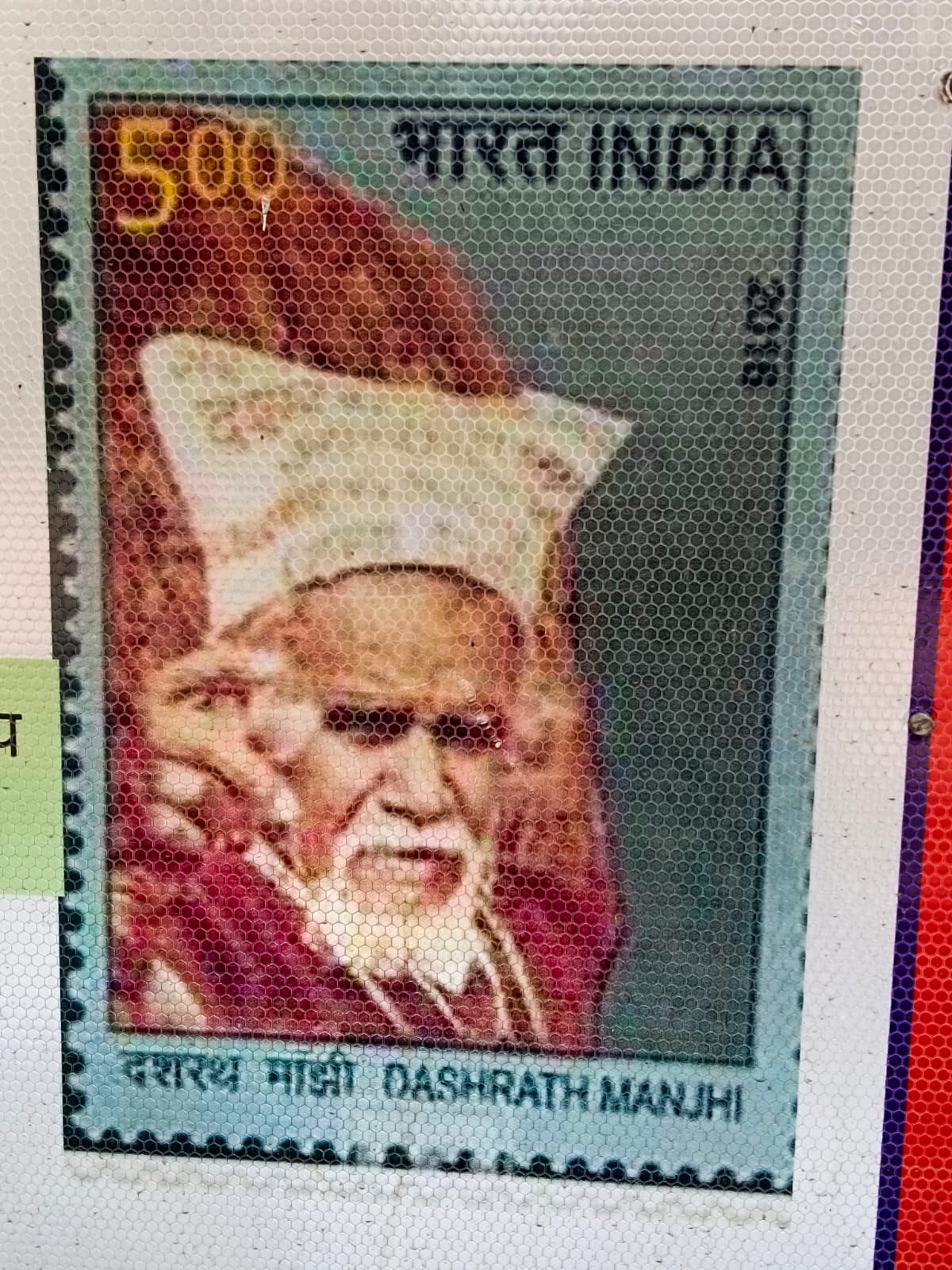
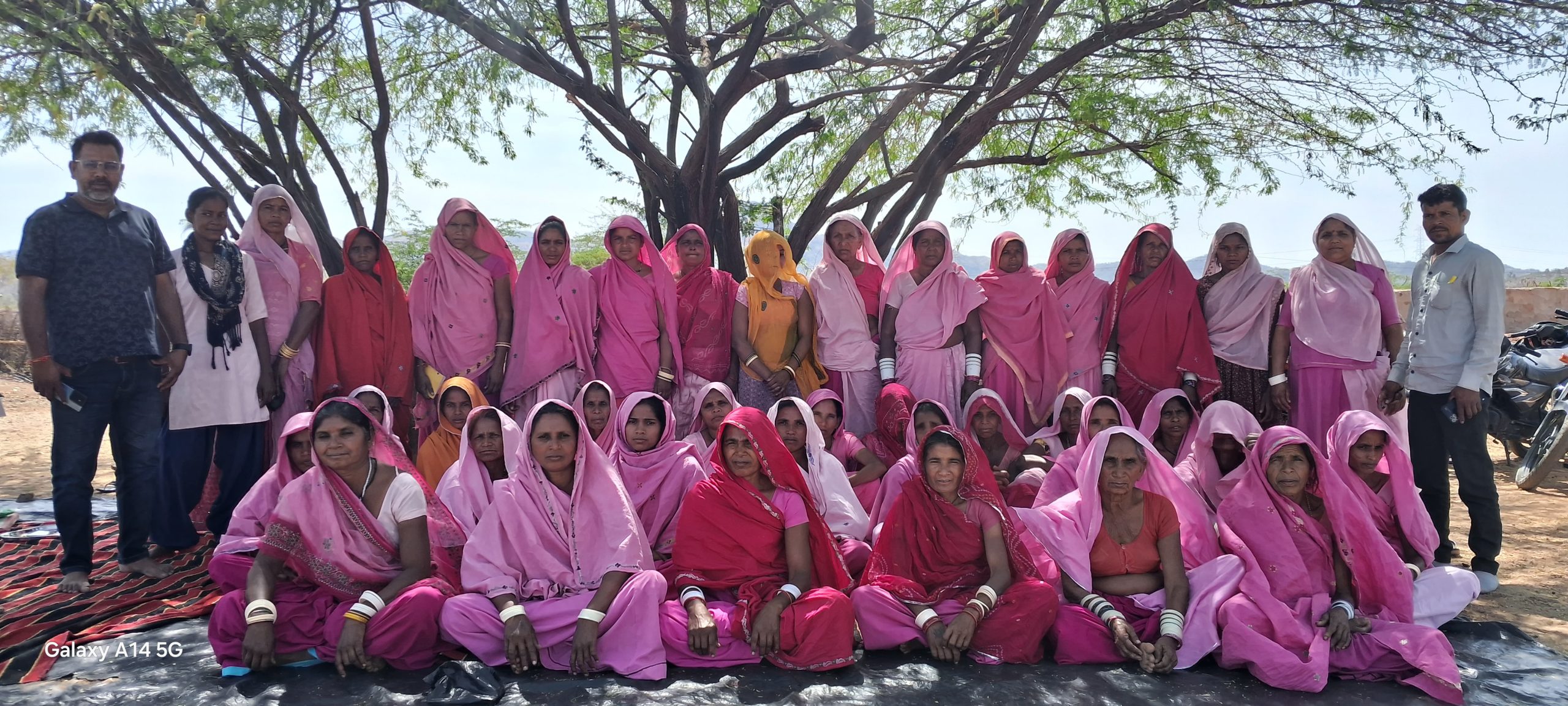
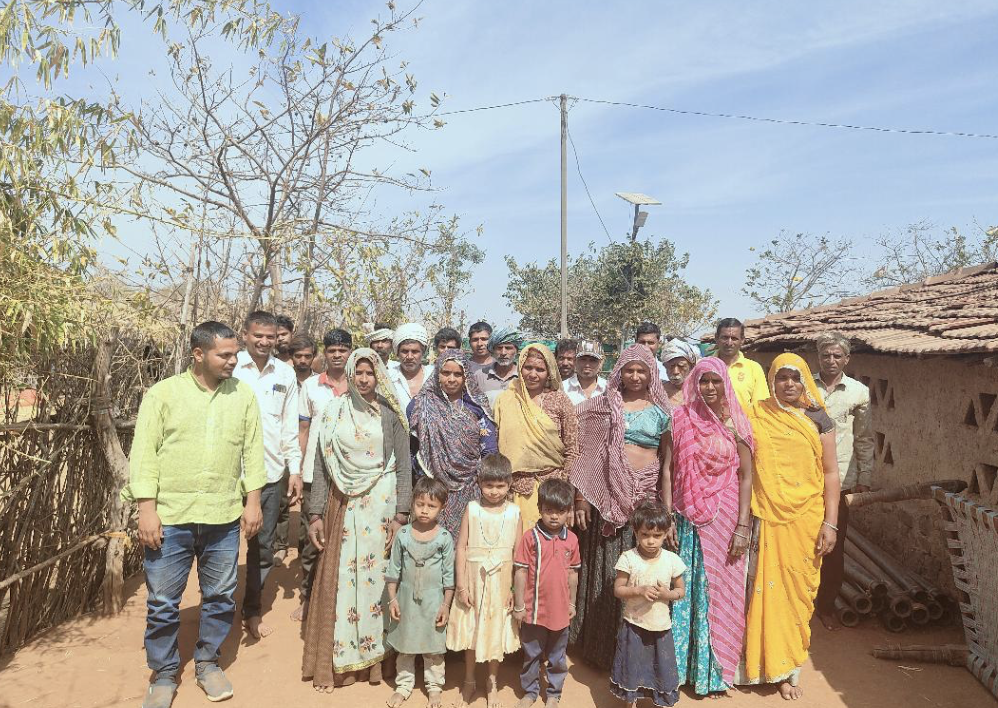
Dheera Ram Kapaya was raised in such a poor family that even when he could not join school himself, he used to carry another boy’s heavy school bag for five km just to get a scoop of daliya (porridge). Belatedly when he could start his school, he had to leave after class five and join other adolescent workers. However as soon as he got some opportunities, he joined community efforts for forest protection, adult literacy and other constructive work. In the course his hidden talents for writing also emerged and he became known for the songs and street play scripts he wrote for forest protection, for preventing child marriages and for taking forward other social reforms.

Bhurki Bai could never go to school and after an early marriage being imposed on her, she was the mother to four children at the age of 19. Then an accident disabled her husband for life. It was in the middle of such seemingly unsurmountable difficulties that Bhurki somehow clutched at the few opportunities that had suddenly appeared in her remote village in the form of a self-help group. At times carrying her youngest child to meetings, she emerged in a leadership role in the village, first mobilizing women for repairing an irrigation source and then for protecting a pasture and planting trees.

When Devi Lal lost his father at the age of 12 years, this was also the time he had to leave school as he accompanied his mother and sister to work in a city to toil at a wage of Rupees 10 per day. However making use of some opportunities back in village, Devi Lal could emerge in leadership roles to protect pastures and lead struggles for forest produce rights.

Uday Lal Suthar had to go to toil in cities as a teenager on a more permanent basis, moving finally to Mumbai where in later years he could set up a carpentry business. On a visit to his village he attended a meeting where he appeared to find his true calling in protecting forests and pastures. Devoting himself to this work, he courageously fought battles against influential outsiders who were encroaching on community forest and pasture land.

What is common to all these four inspiring stories concerning persons with potential leadership talent for taking forward social concerns is that many difficulties were keeping them tied down, but as soon as they got some opportunities they made full use of these to realize their so-far hidden potential. How did these opportunities arise? The other common link in these stories is that such opportunities arose in these villages of Udaipur district (Rajasthan) because of the various constructive activities taken up by a voluntary organization Seva Mandir. Whether this was in the form of a center for adult literacy or the organization of a self-help group of women or the starting of a campaign to protect village commons including community forests and pastures, these various activities, apart from achieving other desirable results, provided an entry or contact point for those with a lot of pent-up desire as well as talent for various kinds of community welfare and protection work, with special emphasis on protecting and regenerating degraded forests and pastures.

What further helped the emergence of these community leaders was the understanding and solidarity shown by various members of the Seva Mandir family in helping and encouraging these emerging grassroots leaders, so that adequate opportunities could be opened up and at the same time a helping hand was always available in difficult times, such as at the time of struggles against powerful encroachers and forest produce smugglers.

Ten such inspirational stories of community leaders who overcame very heavy odds to become saviors of forests and pastures at the grassroots have been related in such a compelling way in a recent book titled ‘Being Earth—Portraits of Militant Nonviolence’ by the author Amrita Nandy, a senior academic, that this book is full of important learning experiences while at the same time reading like very interesting personal stories. Each one of the ten community leaders covered in this book lives on in our memory for a long time as we keep thinking about their eventful life, the challenges they faced and how they overcame them with grit, determination, patience and wisdom.

A note on the work of Seva Mandir by Narendra Jain and Ronak Shah provides a wider framework in which these inspiring stories can be better understood. A thought-provoking foreword written by Suraj Jacob provides valuable insights and also places these experiences in the broader framework of several development debates and concepts. One of his interesting observations relates to seeing these experiences as a combination of struggles (sangharsh) and various kinds of constructive work (nirman). Jacob also recalls the emphasis on combining ‘sangharsh’ aur (and) ‘nirman’ in the course of the inspirational work of the great leader of workers Shankar Guha Niyogi and, in fact, the combination goes back to the days of Mahatma Gandhi’s efforts, which too are recalled by Jacob as an inspiration source for the efforts and initiatives described in this book.

*

Click the share button below to email/forward this article. Follow us on Instagram and X and subscribe to our Telegram Channel. Feel free to repost Global Research articles with proper attribution.

Bharat Dogra is Honorary Convener, Campaign to Save Earth Now. His recent books include Saving Earth for Children, Planet in Peril, A Day in 2071 and Man over Machine—The Path to Peace. He is a regular contributor to Asia-Pacific Research.


Global Research is a reader-funded media. We do not accept any funding from corporations or governments. Help us stay afloat. Click the image below to make a one-time or recurring donation.

  • Posted in Mobile
  • Comments Off on Community Leaders Overcome Many Obstacles to Protect Forests and Pastures in India’s Remote Villages
  • Tags:

There are many talented children with great enthusiasm for studying who cannot continue their education due to economic compulsions of their families. There are many others who somehow manage to continue education but their achievements are affected very adversely due to the severe economic constraints faced by them and their families.

A thoughtful and caring effort called the Udayan Shalini Fellowship Program (USFP) has been trying for several years to help thousands of talented girl students facing difficulties to continue their education and improve their performance in 38 locations in various parts of India. This program has been taken forward by Udayan Care, a Delhi-based voluntary organization. A recent review of Udaipur chapter of this program based on conversations with closely involved volunteers and coordinator brought out several heartwarming achievements of this initiative, achieved within a relatively short time and made possible by the close involvement of several dedicated volunteers and mentors.

.

.

Udayan Care makes available a monthly scholarship to carefully selected girl students of class eleven of several government schools who are selected on the basis of two basic criteria. Firstly, they must be hard-working and sincere students as also revealed in their performance so far. Secondly, they must be from a social or family background in which difficult conditions become a serious problem either for continuing education or for achieving good results in higher education.

The local coordinator of the program Chandani Mali visits several government schools to spread awareness regarding the program and to encourage girl students to apply. Then several volunteers, some of them closely involved with educational work in various capacities, help to make a selection on the basis of a written test, interview and home visits. Visiting homes helps the volunteers to establish a rapport with parents so that they too can be convinced of the desirability of continuing education of the student, while at the same time those most in need of this help and support can be identified in more convincing ways.

Most of the students selected on this basis belong to ST/SC/OBC/Minority communities, but some are also from those general category households who are facing exceptionally difficult circumstances, including sometimes early death of the main breadwinner of the family.

While the selected students get a scholarship of Rupees one thousand per month in class eleven and twelve, this amount is increased somewhat during the post-school years, and there is some provision also for meeting extra expenses in case of any special need as in the case of professional courses. The economic support continues generally for five years, and emphasis is placed on ensuring that the student is ready and well-equipped for reasonably good employment prospects by the time this support period ends.

Towards this end several volunteers are associated with this program as mentors and they guide the selected students in various ways such as guidance regarding employment and career choices and the kind of educational courses that would be most helpful in this. Sometimes the mentoring part of this program proves even more beneficial for the students compared to the economic support. Veenu Gupta, a former additional chief secretary of Rajasthan who looks after the Rajasthan chapters of USFP, says, “ There are many scholarship schemes, but what makes this special is the strong mentoring effort which has proved useful for the girls.”

A core committee of volunteers from Udaipur has been created. They as well as mentors are active in providing these students several opportunities for improving language and public speaking skills. In particular some students need help for improving their English.

While this pattern is common to most places where the USFP is implemented, the Udaipur unit, despite being a relatively younger unit, has added its own special contributions such as a special summer vacation educational and skill improvement program as well as arranging for the support of additional students using local fund-raising.

Conversations with volunteers, core-team members and the local coordinator revealed that they have reasons to be satisfied with the heartwarming progress of several of these girl students who are continuing their education in very difficult economic conditions. Zuleikha Khatun has excelled in extra-curricular activities, public speaking and has shown several glimpses of emerging leadership qualities.  Deepti Rajput has been able to secure 96% marks in class 12 board exams. Gauri Luhar is preparing for NEET exam after taking a break. Nazneem Banu, who comes from a poor artisan household, has done well in English language and in overall academic performance, scoring 92% marks in arts and humanities branch in board exam.

Veenu Gupta adds, “ Some of the girl students who received this support at another Rajasthan center in Jaipur are now studying for medical, engineering and CA.” While the results of this initiative have been very encouraging, some of the closely involved supporters feel that with the inflation of recent years, the scholarship amount should be increased. Secondly, while selecting students for this, the criteria relating to the academic performance or marks achieved should be relaxed if teachers recommend that some students who could not get the desired marks are otherwise very promising and sincere n their education.

*

Click the share button below to email/forward this article. Follow us on Instagram and X and subscribe to our Telegram Channel. Feel free to repost Global Research articles with proper attribution.

Bharat Dogra is Honorary Convener, Campaign to Save Earth Now. His recent books include A Day in 2071, Saving Earth for Children, Man over Machine and Planet in Peril. He is a regular contributor to Asia-Pacific Research.

All images in this article are from the author


Global Research is a reader-funded media. We do not accept any funding from corporations or governments. Help us stay afloat. Click the image below to make a one-time or recurring donation.

  • Posted in Mobile
  • Comments Off on Promoting Inclusiveness in Education—A Helping Hand for Talented Students in Difficult Conditions in India
  • Tags: ,

The Philippines is a country where education is highly valued, at least in theory. Across the archipelago, educational attainment is considered a source of pride, a pathway to success, and a mark of prestige. On paper, the nation appears to be teeming with learned professionals. Among them, tens of thousands hold the title of Doctor of Education (EdD), supposedly signaling a high level of academic achievement and authority in the field of teaching and educational leadership.

Yet, paradoxically, the country’s educational standards remain dismally low. Year after year, the Philippines performs poorly in global assessments such as PISA (Programme for International Student Assessment), TIMSS (Trends in International Mathematics and Science Study), and other international benchmarks. This contrast between credentialed abundance and educational underperformance raises a pressing question: What, if anything, do these titles and degrees actually signify?

A Flood of EdDs, a Drought of Educational Progress

In the Philippines, the pursuit of doctoral degrees, especially in the field of education, has surged over the past decade. Earning an EdD (Doctor of Education) is no longer the exclusive domain of elite scholars or seasoned educators. Instead, it has become a relatively accessible credential, offered by dozens of universities across the country. Many of these institutions, often regarded as second- or even third-tier, aggressively market their programs as gateways to professional advancement, prestige, and higher salaries. The pitch is simple and compelling: earn the title “Doctor,” and unlock promotions, leadership roles, and societal respect.

With demand steadily growing, the supply chain of degrees has adapted efficiently. Weekend classes, modular learning, and online components make it easier than ever for working professionals to enroll. Program structures are designed for convenience, not necessarily for academic rigor. The result is a fast-track pipeline churning out EdD holders at an unprecedented rate.

However, this rapid proliferation of education doctorates has not translated into meaningful improvements in the country’s educational outcomes. Rather than acting as catalysts for innovation, reform, or research-driven practice, many EdD graduates find themselves ensconced in bureaucratic or administrative roles that have little influence on classroom instruction, curriculum design, or teacher training. Their presence does little to challenge outdated pedagogies or policy stagnation. In many cases, the degree serves primarily as a decorative badge, i.e., an academic ornament more than a transformative qualification.

This disconnect stems not only from how the degree is used, but from how it is conferred. A closer examination of many EdD programs reveals systemic flaws. Curricula are often overloaded with abstract theoretical frameworks, with scant attention given to current issues in pedagogy, data analysis, or educational leadership. Admission standards have been lowered to accommodate the influx of enrollees, mentorship is frequently superficial or absent, and there is little to no institutional pressure to produce research that could inform national or local education policy. Where dissertations exist, they are often formulaic, under-researched, and rarely disseminated or published in credible journals.

In effect, the Philippine education system is witnessing the emergence of a credentialed elite that lacks both the training and the incentive to drive educational change. This is not just a missed opportunity but a troubling trend. The purpose of an EdD should be to develop thought leaders, reformers, and innovators in education. Instead, the degree is too often reduced to a career stepping stone devoid of intellectual or social utility.

If the country hopes to raise the quality of its education system, it must critically examine how it prepares its supposed educational leaders. Elevating standards for EdD programs, strengthening research culture, and aligning doctoral training with real-world educational challenges are essential first steps. Without these reforms, the growing number of “doctors” in education will remain little more than a symbol of systemic dysfunction characterized by a flood of titles amid a drought of true progress.

English Proficiency: A National Myth

In the Philippines, fluency in English is often worn as a badge of national pride. From government officials to corporate leaders, there is a prevailing belief that the country’s English-speaking population holds a competitive edge in the global economy. This narrative is embedded in the education system, where English is the medium of instruction in many universities, and reinforced in sectors such as business, law, medicine, and international outsourcing. It is a convenient and comforting notion that Filipinos, by virtue of historical circumstance and cultural adaptation, are naturally adept in the English language.

Yet beneath this self-assured narrative lies a disconcerting reality: the level of actual English proficiency across the population is far less robust than advertised. While many Filipinos possess functional conversational skills, true academic and professional fluency is far more elusive. When placed under scrutiny, the nation’s supposed command of English reveals itself to be patchy, performative, and often inadequate for the demands of serious intellectual or professional engagement.

At the university level especially within graduate and postgraduate programs, this gap becomes especially apparent. Students frequently struggle with the fundamentals of academic writing. Research papers and theses are marred by grammatical errors, vague formulations, poorly developed arguments, and inappropriate use of technical vocabulary. Citations are misapplied, abstracts are confusing, and logical coherence is frequently sacrificed for surface-level formality. In oral defenses and classroom presentations, students often rely on memorized scripts, reading verbatim from slides or cue cards, resulting in stilted, unnatural delivery that lacks spontaneity and depth.

This widespread struggle with English proficiency has far-reaching implications. Academically, it undermines the credibility of scholarship and limits participation in international research communities. Filipino scholars are often sidelined in global conferences or publishing networks, not because of a lack of insight or knowledge, but because of inadequate linguistic tools to express complex ideas persuasively and precisely. Professionally, the issue is just as concerning. Poor command of English in writing and speaking diminishes the effectiveness of communication in multinational workplaces, and by extension, tarnishes the global reputation of Filipino professionals.

Moreover, the problem is not confined to students or young professionals. Many educators themselves who are tasked with teaching in English exhibit limited fluency. Lectures can be riddled with awkward phrasing, mispronunciations, or outright grammatical mistakes. This creates a feedback loop in which both the instruction and assessment of English competence are compromised. Despite the institutional use of English, the depth of engagement with the language often remains superficial.

The crux of the issue lies in the disconnect between exposure and mastery. English is omnipresent in the Philippines on television, in signage, in classrooms but the quality of that exposure is uneven and rarely leads to deep linguistic competence. English is often learned passively, through imitation and code-switching, rather than through rigorous training in grammar, critical thinking, and expression. This creates a veneer of fluency that masks real deficiencies.

If the Philippines is to maintain and genuinely develop its standing as an English-proficient nation, it must first acknowledge the uncomfortable gap between perception and reality. Language proficiency is not a birthright, nor a colonial inheritance to be taken for granted but a skill that demands sustained, structured effort to develop. Reforms must begin with teacher training, curriculum design, and realistic assessments of students’ communicative competence. Without these, the myth of English fluency which is comforting, convenient, but ultimately hollow will continue to persist.

Theses and Dissertations: Academic Dead Ends

One of the most telling indicators of the crisis afflicting Philippine higher education is the dismal state of graduate and postgraduate research. In principle, a thesis or dissertation should stand as the capstone of a scholar’s academic journey, i.e., a rigorous, original contribution to the field that pushes the boundaries of knowledge or provides practical insights into real-world problems. Ideally, it is a work that not only showcases the intellectual maturity of the student but also feeds into the broader academic and professional discourse.

In practice, however, this ideal is rarely realized. Across countless universities in the Philippines particularly outside the country’s top-tier institutions, graduate research has become a mechanical exercise rather than a meaningful intellectual endeavor. Students often choose topics that are either excessively broad, conceptually vague, or strikingly redundant. Many research titles are recycled year after year, altered only slightly to satisfy formal requirements. There is little emphasis on originality, feasibility, or relevance. Instead of pursuing questions that address current social, educational, or scientific issues, students often default to safe, formulaic topics that offer minimal risk and minimal value.

This lack of rigor extends throughout the research process. Literature reviews tend to be superficial, relying on outdated or tangentially related sources. Methodologies are frequently poorly designed, with insufficient attention paid to sampling, instrumentation, or data analysis. Ethical considerations are often treated as an afterthought, and theoretical frameworks are rarely integrated meaningfully into the interpretation of findings. The resulting theses and dissertations are, more often than not, bloated documents filled with jargon, generalizations, and unsubstantiated claims.

Crucially, the output of this system rarely leaves the confines of the university. Very few graduate papers are submitted to academic journals or presented at conferences. Fewer still undergo peer review, achieve publication, or are cited by other researchers. The vast majority of these works are deposited in institutional libraries, where they gather dust unread, unexamined, and unutilized. They are neither challenged by scholarly critique nor translated into usable knowledge for classrooms, communities, or policymakers.

This academic stagnation reflects a deeper cultural and structural problem. In many institutions, research is treated less as an intellectual pursuit and more as a bureaucratic requirement which is a hoop to jump through en route to graduation or promotion.

Faculty members tasked with supervising research often carry heavy teaching loads, leaving little time for mentorship. Review panels may prioritize formatting and completeness over conceptual clarity and analytical depth. In some cases, institutional pressure to increase graduation rates results in the lowering of research standards altogether.

The consequence is a generation of degree holders whose capstone projects fail to live up to the very premise of higher education: the creation and dissemination of knowledge.

Rather than serving as foundations for further study or innovation, these academic works become dead ends that are forgotten as soon as they are filed, contributing nothing to their respective fields or to society at large.

Reversing this trend requires more than cosmetic reforms. It demands a radical reorientation of how research is taught, supervised, and evaluated. Students must be trained not just to follow templates, but to ask meaningful questions, engage with existing scholarship critically, and design studies that are methodologically sound and socially relevant. Faculty must be given the time, training, and incentives to mentor rigorously.

And institutions must foster a culture where research is seen not as a final requirement, but as an ongoing conversation that has the power to challenge assumptions, improve practice, and influence policy.

Until then, Philippine graduate research will remain largely ornamental, being ambitious in form, but hollow in substance; abundant in quantity, but impoverished in impact.

Pretensions Without Substance: The Academic Delusion

One of the more insidious challenges facing Philippine higher education today is the widening gulf between academic self-perception and scholarly reality. In many universities, particularly those outside the country’s most prestigious institutions, there is a growing culture of academic posturing: a performance of intellectualism unmoored from the demands of actual scholarship. Titles are claimed, accolades are worn, and institutional affiliations are proudly brandished, yet these symbols of academic stature often conceal a disturbing lack of meaningful academic output.

This delusion is not merely harmless vanity but symptomatic of deeper structural and cultural failings. In many academic settings, faculty members are celebrated as scholars not for the originality or impact of their work, but for their tenure, attendance at conferences, or accumulation of postgraduate degrees. The bar for what constitutes “scholarship” has been quietly lowered, replaced by performative gestures that require little intellectual rigor or critical engagement. Publications are often confined to low-impact or predatory journals, filled with recycled ideas and devoid of methodological soundness.

This culture of self-congratulation is allowed to thrive largely because of a conspicuous absence of scrutiny. Unlike in research-intensive environments where peer review, citation indices, and academic discourse serve as checks on scholarly legitimacy, many Philippine universities lack the institutional mechanisms to distinguish serious academic work from hollow credentialism. There is little emphasis on publication in reputable journals, minimal engagement with global research communities, and often no incentive to pursue difficult, original lines of inquiry. Faculty evaluations are rarely tied to the quality or influence of one’s research, teaching effectiveness, or mentorship. Instead, career advancement is often determined by bureaucratic metrics: years served, seminars attended, administrative participation, or loyalty to the institution.

As a result, an illusion of scholarship takes root where such is reinforced by titles, ceremonies, and institutional rituals, but unsupported by intellectual merit. This illusion breeds complacency. In a space where peer critique is unwelcome and where dissent is seen as disrespect, critical thought becomes stifled. Innovation is not only discouraged but often viewed with suspicion, as it threatens to expose the inertia and mediocrity that have become entrenched. Over time, this intellectual stagnation becomes normalized. The university ceases to be a site of inquiry and becomes instead a silo of professional convenience.

Worse still, this façade has consequences far beyond the university gates. The graduates produced by such institutions absorb the same values. They inherit an understanding of academic success that prioritizes appearances over substance, obedience over originality, and formality over depth. When these graduates go on to teach, to lead, or to legislate, they carry with them a diluted sense of what intellectual work entails, thus perpetuating a cycle of low expectations and shallow engagement.

To disrupt this cycle, Philippine higher education must undertake a candid reckoning with its internal culture. This begins with reestablishing rigorous standards of academic excellence, not as abstract ideals but as enforceable expectations. Promotion and recognition should be tied to demonstrable scholarly contributions, not simply to longevity or formal qualifications. Institutions must invest in a culture of research, critical debate, and international engagement.

Faculty members should be supported, but also held accountable to their students, to their disciplines, and to the larger society they claim to serve.

Above all, the country must resist the comfort of academic pretension and embrace the discomfort of intellectual honesty. Without this, no amount of titles, conferences, or diplomas can conceal the truth: that substance, not show, is the true measure of scholarship and that progress will remain elusive so long as we confuse the performance of knowledge with its pursuit.

Breaking the Cycle: Toward Meaningful Reform

To lift Philippine education out of its stagnation, a cultural and institutional overhaul is imperative. Here are some urgent priorities:

  1. Raise the Bar for Doctoral Programs

Doctoral degrees must return to their original purpose: the creation and dissemination of new, meaningful knowledge. This means stricter admission criteria, stronger research training, better faculty mentorship, and rigorous evaluation of dissertation quality.

  1. Reassess English Language Instruction

English proficiency must be taught with depth, not just form. Critical thinking, clarity, and coherence should be emphasized in both spoken and written English. Universities must invest in stronger language support and writing centers.

  1. Reform Research Standards

Universities should incentivize high-quality, impactful research that addresses real-world problems. Peer review, publication, and interdisciplinary collaboration must be central to graduate work, not afterthoughts.

  1. Hold Academics Accountable

Faculty performance should be tied to demonstrable outputs: peer-reviewed publications, conference presentations, policy contributions, or community engagement. Titles and tenure should be earned, not assumed.

  1. Promote Intellectual Humility

Perhaps most importantly, there must be a cultural shift toward intellectual humility. The willingness to admit gaps, seek critique, and continuously learn is the hallmark of true scholarship.

Conclusion: Rethinking What It Means to be Educated

The crisis in Philippine education runs deeper than low test scores, outdated textbooks, or underfunded schools. At its core, it is a crisis of what it truly means to be “educated.” For too long, the country has operated under a dangerously narrow definition of education, one that equates credentials with competence, and titles with intellect. This confusion has bred a culture more invested in appearances than in actual achievement, more concerned with ceremony than substance.

In this system, academic success is too often measured by the accumulation of degrees rather than the demonstration of critical thinking, creativity, or civic responsibility. Classrooms reward memorization over understanding, conformity over curiosity. Universities, rather than being crucibles of inquiry and dissent, often become factories of credentials, churning out graduates armed with diplomas but lacking in both the skills and the disposition to question, to innovate, or to lead.

The result is an educational structure that appears productive on paper where millions enrolled and thousands graduating but which produces limited intellectual, cultural, or social impact.

This illusion of education is not just misleading; it is harmful. It legitimizes mediocrity and institutionalizes complacency. It allows unqualified individuals to rise through academic and professional ranks, not because of what they know or contribute, but because of the symbols they carry: certificates, titles, affiliations. It fosters a society where status is mistaken for substance, and where meaningful intellectual work is often undervalued, even ridiculed.

If the Philippines is to confront this crisis honestly, it must begin by reimagining education not as a path to prestige, but as a lifelong commitment to personal and public betterment. This redefinition requires cultural transformation more than curricular reform. Academic institutions must be places where questions are encouraged, where failure is part of learning, and where education is not something one finishes, but something one continually pursues.

Degrees must cease to function as mere badges of social mobility or bureaucratic advancement. Instead, they must symbolize the ability to think critically and act ethically; a record of meaningful work that improves one’s field or community; and a commitment which reflects a dedication to the principles of truth, justice, and public service. Until the country holds its education system to these higher standards, it will continue to produce graduates who are literate but not learned, credentialed but not competent.

Ultimately, the goal of education must be more than employability. It must be the cultivation of minds and spirits capable of building a just, creative, and resilient society. That vision remains far from reality. And until it is realized, the Philippines will remain a nation rich in diplomas but poor in education, celebrated for its formal attainments, yet starved of the very wisdom and integrity those attainments are meant to signify.

*

Click the share button below to email/forward this article. Follow us on Instagram and X and subscribe to our Telegram Channel. Feel free to repost Global Research articles with proper attribution.

Prof. Ruel F. Pepa is a Filipino philosopher based in Madrid, Spain. A retired academic (Associate Professor IV), he taught Philosophy and Social Sciences for more than fifteen years at Trinity University of Asia, an Anglican university in the Philippines. He is a Research Associate of the Centre for Research on Globalization (CRG).


Global Research is a reader-funded media. We do not accept any funding from corporations or governments. Help us stay afloat. Click the image below to make a one-time or recurring donation.

China Strikes Diabetes

July 10th, 2025 by Bhabani Shankar Nayak

The International Diabetes Federation (IDF)’s Diabetes Atlas reports that 589 million adults (aged 20–79) are currently living with diabetes—equivalent to 1 in 9 adults worldwide. This number is projected to rise to 853 million by 2050. The report also states that diabetes was responsible for 3.4 million deaths in 2024, equating to one death every nine seconds. Additionally, diabetes accounted for at least USD 1 trillion in health expenditures, representing a 338% increase over the past 17 years. The report further predicts that diabetes-related health spending will continue to rise, exceeding USD 1.054 trillion by 2045.

Diabetes is a silent epidemic, causing death and suffering on an unimaginable scale. However, for pharmaceutical corporations, insurance companies, and private healthcare providers, it represents a highly profitable business opportunity. The commercialization of illness lies at the heart of capitalism, particularly in the healthcare models practiced by many large corporations based in the United States and Europe. The pharmaceutical industry manages diabetes through ongoing treatment but rarely invests in a cure—treating the disease as though it were incurable.

However, this long-standing dream of capitalist corporations and their multi-billion-dollar pharmaceutical “business of sickness” is facing disruption. Chinese scientists have discovered a method to reverse both Type 1 and Type 2 diabetes using stem cell therapy based on induced pluripotent stem cell (iPSC) technology. This technique involves reprogramming adult cells to behave like embryonic stem cells. In this breakthrough, Chinese researchers use a patient’s own fat cells to generate insulin-producing islet cells, which are then injected under the anterior rectus sheath of the abdomen. Once implanted, these cells begin to regulate blood sugar levels naturally by producing insulin—just as a healthy pancreas would. Initial trials conducted at Tianjin First Central Hospital have shown remarkable results: patients with Type-1 diabetes were able to stop insulin use entirely within seventy-five days, while those with Type-2 diabetes achieved the same outcome in just eleven weeks. The European Medical Journal described the development as a milestone, stating, “Stem-Cell Therapy success in China marks a milestone in Type-1 Diabetes treatment”.

The Chinese National Medical Products Administration (NMPA) is fast-tracking the next phase of clinical trials, aiming to address this global epidemic within the next three years. With this breakthrough, China is poised to transform the global healthcare industry. It marks a significant step toward ending the silent epidemic of diabetes and alleviating the suffering of millions around the world. This development also poses a major challenge to profit-driven pharmaceutical corporations and healthcare industries that have long relied on the continuous demand for insulin, diabetes medications, and related medical equipment.

The rise of medical technology, innovations in medical science, and advancements in health research in China are not accidental. They are the result of deliberate policy decisions and strategic investments by the People’s Republic of China, under the leadership of the Communist Party of China. The Chinese government has been actively deepening health research and reforming its healthcare system, which led to the development of the “Shanghai Integration Model” (SIM). This model fosters efficiency and synergy between public health initiatives and research-driven medical services. Fundamentally, it stands in opposition to the privatization of healthcare and the commercialisation of illness. These forward-thinking health policies have also contributed to major medical breakthroughs, including treatments for AIDS and obesity developed by Chinese scientists.

All major Chinese universities offer medical science and health-related programs, supported by dedicated research institutes and centers. These programs, offered by public universities, are grounded in the principle of public health over profit. At their core is the goal of freeing people from curable, preventable, and life-threatening diseases. The focus is on using knowledge to empower humanity and promote health and well-being. This mission aligns with the broader vision of the Chinese Communist Party–led government, which prioritizes human welfare, health, and happiness through science-driven public policy.

While imperialism—led by the United States—continues to manufacture conflict and invest heavily in high-tech weaponry to sustain the highest stage of capitalism through violence, destruction, and control, China is taking a different path. It is investing in life-saving medicines and medical technologies aimed at improving human health and well-being. In the midst of ongoing anti-China propaganda campaigns, the contrast is stark. The alternatives are clear: a world driven by war and profit, or one focused on health, innovation, and the collective good. 

It is impossible to overlook the scale of people-centered development in China, where the state and government prioritise the well-being of the working masses. In contrast, governments in the United States and Western Europe often serve corporate interests, particularly in the healthcare sector, where profit is placed above public health. As a result, health corporations in these countries thrive financially—often at the expense of human lives and well-being. 

Therefore, it is imperative to expose the hypocrisy embedded in Western systems—where profit is prioritised over people—while defending China and its working-class-driven innovations that advance human health and happiness. In a world shaped by competing models of development, China’s approach stands as a powerful alternative rooted in collective welfare, scientific progress, and the dignity of life.

*

Click the share button below to email/forward this article. Follow us on Instagram and X and subscribe to our Telegram Channel. Feel free to repost Global Research articles with proper attribution.


Global Research is a reader-funded media. We do not accept any funding from corporations or governments. Help us stay afloat. Click the image below to make a one-time or recurring donation.

Defeat for Israel Lobby in Australia

July 10th, 2025 by Joe Lauria

A judge in a federal court in Sydney, Australia has ruled against the Australian Broadcasting Corporation (ABC) for wrongly dismissing a radio presenter after she shared an instagram post from Human Rights Watch that accused Israel of using starvation as a weapon in Gaza. 

Judge Darryl Rangiah awarded journalist Antoinette Lattouf AU$70,000 and possibly more in damages on Wednesday in a case that undermines an organized campaign in Australia, like in many countries today, that is attacking legitimate critics of Israel’s conduct in Gaza as being anti-semitic.  

Senior ABC executives had testified at trial that they had been flooded with complaints — even though none of the contested content had been discussed on air — and that pressure had mounted to get rid of the presenter, which they did.

The Sydney Morning Herald and The Age newspapers later revealed that the flood of complaints was the result of a coordinated campaign by pro-Israel lobby groups via WhatsApp. The campaign targeted the ABC’s chair and managing director to have Lattouf sacked. The Australian journalists union MEAA stood behind Lattouf, questioning the national broadcaster’s independence from outside influence.

.

Antoinette Lattouf arriving in federal court in Sydney on Wednesday morning. (Mary Kostakidis)

.

The judge’s decision on Lattouf’s wrongful dismissal suit was based on the question of whether she was terminated because of her political opinions. ABC argued that Lattouf, who had been hired for one week as a fill-in presenter, was not terminated, but rather had her work hours reduced to zero for the remaining two days of her five-day contract.

That decision to effectively fire her was taken after ABC executives determined that Lattouf held anti-semitic views, the judge told the court.  The judge found that ABC violated the Fair Work Act by ending Lattouf’s employment because “she held political opinions opposing the Israeli military campaign in Gaza.” 

He said: “I reject [ABC executive Christopher] Oliver-Taylor’s evidence that his decision to terminate Lattouf had nothing to do with her political opinions.” Judge Rangiah rejected Latouff’s allegations of discrimination based on her ethnicity. She is of Lebanese origin.

The judge said pro-Israel lobbyists created an “orchestrated campaign” against Lattouff by writing to the ABC complaining that she had “expressed anti-Semitic views, lacked impartiality and was unsuitable to present any program for the ABC.”

“The complaints caused great consternation amongst the senior management of the ABC,” he said. But he found Latouff was given no direct order not to post controversial matter on social media but “was merely provided with advice that it would be best not to post anything controversial about the war.”

During her one-week stint at the ABC, Latouff simply shared the Human Rights Watch instagram post on Dec. 19, 2023, with the words “HRW reporting starvation as a tool of war.”

Outside the court after the ruling Latouff told reporters that the court found that “punishing someone for sharing facts” about “war crimes” is not legal. “I was punished for my political opinion,” she said.

Her attorney, Josh Bornstein, told reporters:

“The court has decisively upheld her claim the ABC illegally dismissed her from her employment. The court has made important findings that in doing so it capitulated to a campaign of lobbying. Organisations like the ABC that fold in the face of bad faith complaints about the Israel-Gaza conflict ultimately end up facing perverse consequences or in perverse situations.”

Bornstein said the ABC had refused to settle for AU$85,000 and instead spent AU$1.1 million of taxpayer money defending the case.

*

Click the share button below to email/forward this article. Follow us on Instagram and X and subscribe to our Telegram Channel. Feel free to repost Global Research articles with proper attribution.

Joe Lauria is editor-in-chief of Consortium News and a former U.N. correspondent for The Wall Street Journal, Boston Globe, and other newspapers, including The Montreal Gazette, the London Daily Mail and The Star of Johannesburg. He was an investigative reporter for the Sunday Times of London, a financial reporter for Bloomberg News and began his professional work as a 19-year old stringer for The New York Times. He is the author of two books, A Political Odyssey, with Sen. Mike Gravel, foreword by Daniel Ellsberg; and How I Lost By Hillary Clinton, foreword by Julian Assange. 

Featured image: Lattouf speaking to reporters outside court after her victory. (Cathy Vogan for CN)


Global Research is a reader-funded media. We do not accept any funding from corporations or governments. Help us stay afloat. Click the image below to make a one-time or recurring donation.

In a democracy, the ballot is both a symbol of freedom and a tool of power. The act of voting allows citizens to shape their nation’s future, choose leaders, and define the country’s moral and political direction. But what happens when elections consistently produce leaders who are corrupt, incompetent, or authoritarian? When the democratic process yields undemocratic results, who is ultimately responsible?

The natural inclination is to blame the leaders themselves and rightly so. They hold the reins of power, make the decisions, and bear the responsibility for the outcomes. Yet in a democracy, those leaders do not appoint themselves; they are elected by the people. This reality forces us to confront a more uncomfortable but necessary question: To what extent does the electorate bear responsibility for the leaders it chooses?

This dilemma is not unique to any one country, but it resonates with painful clarity in the Philippines. Here, the cycle of political disillusionment, populist resurgence, and historical amnesia has become all too familiar. The core of the problem is not just flawed individuals, but a flawed system of civic preparation. At the heart of this system lies a neglected foundation: education.

The Mirror of Philippine Democracy

Democracy, it has often been said, is a mirror. It reflects not only the will of the people but also the values, aspirations, and, at times, the collective flaws of the society that sustains it. In the Philippines, this mirror has long reflected troubling images that point not simply to the failures of individual leaders, but to deeper structural and cultural issues within the democratic process itself.

Image: Ferdinand “Bongbong” Marcos Jr.

One of the most glaring examples of this phenomenon is the political resurgence of the Marcos family. Decades after the ousting of Ferdinand Marcos Sr. through the 1986 People Power Revolution, a movement that symbolized the triumph of democracy over authoritarianism, his son, Ferdinand “Bongbong” Marcos Jr., won the presidency by a wide margin in the 2022 elections. This return to power not only shocked observers but raised difficult questions: How could a society that once rose up against dictatorship now welcome back its most prominent symbol?

The answer lies partly in the way Philippine democracy has evolved, or failed. Over the years, elections have become less about platforms and policies, and more about personalities and performance. Figures like Joseph “Erap” Estrada, a former movie star, and Rodrigo Duterte, a strongman mayor with a flair for controversial rhetoric, captured the public imagination not through detailed governance plans but through their populist appeal. In both cases, voters seemed drawn not to ideas but to the perception of authenticity, strength, or familiarity. These elections were won not in debates or policy forums, but in soundbites, staged spectacles, and social media memes.

In the 2022 campaign, this trend reached new heights. Bongbong Marcos’ team executed a highly coordinated and well-funded social media strategy, one that weaponized disinformation and historical revisionism. Platforms like Facebook, YouTube, and TikTok were flooded with content portraying the Marcos era not as a time of martial law and economic collapse, but as a golden age of order and prosperity. Many young voters, lacking first-hand experience of that era and facing a broken education system, were particularly vulnerable to these narratives. The line between myth and memory became increasingly blurred.

This brings us to a sobering realization: the erosion of truth in public discourse is not merely the result of manipulative campaigns but also a reflection of a citizenry ill-equipped to resist them. Years of underinvestment in education, the marginalization of critical media, and the normalization of political patronage have left many Filipinos with limited access to reliable information. Moreover, the structural inequalities that pervade society such as poverty, lack of opportunity, and dependence on local power brokers make it difficult for voters to prioritize long-term reforms over immediate, tangible benefits like cash handouts, jobs, or favors.

Image: Rodrigo Duterte

Thus, the core issue is not just who is elected, but why they are chosen. When democratic choices are made in an environment of misinformation, economic desperation, and emotional manipulation, can they still be called free and informed? The mirror of Philippine democracy does not lie but shows us a society where institutions remain weak, accountability is elusive, and historical amnesia is politically profitable.

Yet all is not lost. To strengthen democracy, Filipinos must confront these uncomfortable truths. Civic education, independent journalism, and grassroots political organizing remain essential pillars in rebuilding a more informed and empowered electorate. Until then, the mirror will continue to reflect what it sees: not the democracy we aspire to, but the one we have allowed to take root.

The Crisis in Civic Education

At the heart of the Philippines’ democratic malaise lies a long-standing and deeply rooted problem: a failure in civic education. While elections are held regularly and institutions nominally function, many citizens lack the foundational knowledge and critical thinking skills needed to engage meaningfully with democratic processes.

This is not simply a matter of disinterest or apathy; it is the result of an education system that has systematically failed to prepare its people for the responsibilities of citizenship.

For decades, Philippine schools have emphasized rote memorization at the expense of analytical thinking. Students are taught to recall names, dates, and events from history, but rarely are they encouraged to interrogate these facts, understand their significance, or connect them to the present. As a result, history becomes a static subject, an exercise in repetition rather than reflection. The lives of national heroes are reduced to sanitized anecdotes, while the deeper structural forces that shaped Philippine society such as colonialism, authoritarianism, inequality are glossed over or ignored.

Civic education, when it exists in the curriculum, is often shallow and procedural. Students may learn how to register to vote or what the three branches of government are, but they are seldom taught why participation matters, how to think critically about campaign promises, or what democratic values actually mean in practice. There is little space in the classroom for debate, dissent, or exploration of contemporary political issues. This creates a citizenry that may know the mechanics of democracy, but not its meaning.

Compounding this issue is the alarming lack of media and digital literacy. In a country where social media is the dominant and often sole source of information for a majority of citizens, the inability to evaluate sources, detect bias, or identify fake news has devastating consequences. The algorithms that shape online content feeds do not prioritize truth or context; they amplify emotion, outrage, and virality. In such an environment, misinformation spreads quickly and sticks easily, especially when it reinforces pre-existing beliefs or appeals to nostalgia, fear, or anger.

Filipinos, particularly the youth, are thus caught in an echo chamber of manipulated narratives, historical distortion, and political propaganda. Falsehoods become familiar, and familiarity breeds acceptance. Without the tools to question what they see or read, many come to accept distorted versions of history and reality in which authoritarianism is recast as order, corruption as pragmatism, and democratic decay as necessary discipline.

But it is crucial to recognize that this civic illiteracy is not a reflection of individual failure. It is the consequence of systemic neglect. For years, the education sector has been underfunded and undervalued. Teachers are overworked and underpaid, classrooms are overcrowded, and basic learning materials are often outdated or unavailable. The implementation of reforms, such as the K-12 program, has been marred by logistical challenges and insufficient training. In many schools, especially in rural or marginalized communities, even the most basic infrastructure is lacking, let alone resources for robust civic instruction.

This neglect has led to a generation that is technologically savvy but politically disengaged, socially connected but civically disconnected. In the absence of sustained investment in democratic education, citizens are left unprepared for the complexities of political life in the digital age.

Addressing this crisis requires more than curriculum tweaks. It demands a national commitment to rethinking the role of education in a democracy. Civic learning must be made relevant, dynamic, and integrated across subjects and not simply confined to a single textbook or semester. Teachers must be empowered and trained not just as instructors, but as facilitators of democratic discourse. Students must be challenged not just to memorize, but to question, debate, and reflect.

Democracy cannot survive without democrats and democrats are not born, they are made. If the Philippines is to reclaim its democratic promise, it must begin by cultivating a citizenry capable of critical thought, historical awareness, and moral courage. That work begins in the classroom.

Inequality and the Cycle of Misgovernance

The crisis in civic education does not exist in a vacuum. It is deeply intertwined with the persistent structural inequalities that plague the Philippines, creating a feedback loop that undermines democratic progress. Public education, especially in rural areas and marginalized urban communities, remains chronically under-resourced. Schools in these regions often lack the most basic necessities: qualified and motivated teachers, adequate learning materials such as textbooks, stable electricity, and internet connectivity. Without these fundamental supports, many students struggle not only to absorb knowledge but even to attend school regularly. Dropout rates are disproportionately high in poorer communities, perpetuating a cycle where the most vulnerable are deprived of the critical skills necessary for active and informed citizenship.

This educational deprivation has far-reaching political consequences. When citizens grow up without the tools to analyze information critically or to understand their rights and responsibilities as voters, they become especially susceptible to transactional politics. In many localities, political power is maintained through the exchange of votes for immediate, tangible rewards like cash handouts, food packs, infrastructure projects, or patronage favors. These transactions are short-term and often fail to address the deeper needs of communities, but they are effective in winning electoral support. Politicians, recognizing this dynamic, are incentivized to focus on spectacle and emotional appeal rather than on substantive policy proposals or institutional reform.

This pattern fosters a vicious cycle. Uninformed or disempowered voters, constrained by poverty and lack of access to information, elect populist leaders who thrive on charisma and patronage networks. Once in office, these leaders frequently weaken democratic institutions by undermining checks and balances, controlling media narratives, and co-opting bureaucracies to consolidate their power. This further restricts public access to truthful, unbiased information, making it even harder for the electorate to make informed decisions in future elections. The cycle feeds on itself: educational and economic inequalities breed political vulnerabilities, which in turn perpetuate misgovernance and deepen inequality.

Ultimately, the problem of bad governance in the Philippines is not solely a political failing but also a profound educational and social failure. Without addressing the root causes by investing in equitable, quality education and bridging the digital divide, the country will continue to struggle with leaders who prioritize personal gain over public service and voters who choose short-term benefits over long-term democratic health.

Breaking this cycle requires a holistic approach. It means improving educational infrastructure nationwide, especially in underserved areas, and ensuring that civic and digital literacy become integral parts of the learning experience. It also means empowering communities with access to transparent information and creating avenues for genuine political participation beyond mere vote-buying. Only through such comprehensive efforts can the Philippines hope to dismantle the entrenched structures of inequality and misgovernance, and foster a democracy that truly reflects the aspirations and dignity of all its people.

Breaking the Cycle: Reform Starts in the Classroom

To repair Philippine democracy, we must start where the problem begins: in the classroom. Reforming civic education is neither a quick fix nor a silver bullet, but it is the most sustainable path forward. This means:

  • Reimagining civic education as a lifelong pursuit, integrated not only in basic education but in community programs, adult learning, and public discourse. This includes fostering an understanding of democratic institutions, the rule of law, human rights, and the responsibilities of citizenship beyond just casting a ballot.
  • Investing in media and digital literacy to help citizens navigate the flood of online misinformation and resist manipulative narratives. This should equip individuals with the skills to critically evaluate sources, recognize logical fallacies, and understand the algorithms that shape their online experience.
  • Promoting critical thinking across all subjects, so students are trained to ask questions, analyze claims, and form reasoned judgments. These are skills essential to both democracy and life. This goes beyond memorization and encourages intellectual curiosity and independent thought.
  • Empowering educators with the resources, training, and freedom to teach complex, often politically sensitive topics with nuance and integrity. Teachers are on the front lines of civic formation and need the support to foster open dialogue and critical inquiry in their classrooms.
  • Ensuring equitable access to quality education across all socioeconomic groups, so no community is left behind in the democratic project. This includes addressing disparities in funding, teacher quality, and access to technology and learning materials.
  • Engaging civil society organizations and community leaders to bridge the gap between formal education and real-world civic engagement. These groups can offer practical experiences, mentorship, and opportunities for citizens to participate in local governance and advocacy.

Education, ultimately, is about more than economic mobility. It is about forming citizens who are capable of sustaining a democratic society. It’s about equipping individuals with the discernment to see beyond superficial charm and the courage to demand accountability.

A Shared Responsibility

The failure of democracy is rarely the fault of any one person or institution. It is the consequence of a collective breakdown of systems that were not maintained, of institutions that were hollowed out, and of priorities that shifted away from the public good. In the Philippines, this failure is especially insidious because it often hides behind the façade of democratic rituals. Elections are held, ballots are cast, and leaders take office. Yet behind this appearance of legitimacy lies a pattern of democratic erosion: one where power is centralized, institutions are weakened, and public trust is gradually corroded.

In this context, the need for a widespread civic awakening is not just urgent but existential. The health of Philippine democracy depends not only on holding elections, but on the strength of the culture that surrounds them: a culture of truth, accountability, historical awareness, and civic engagement.

Assigning blame is easy and often cathartic. It allows people to vent their frustrations, to point fingers at corrupt politicians, uninformed voters, or complacent institutions. But blame alone does not solve problems. What is more difficult but far more productive is to embrace responsibility. If democracy is a shared project, then so too must be its restoration.

The Department of Education bears a profound responsibility. It must move beyond preparing students merely for employment and economic productivity. It must prepare them for citizenship. This means embedding civic and historical education across disciplines, training teachers to foster critical thinking, and updating curricula to reflect the realities of digital life and democratic participation. Education must not be neutral in the face of injustice or authoritarianism; it must equip students with the tools to recognize and resist them.

Media platforms, both traditional and digital, must also act with responsibility. In a society where vast amounts of information are consumed online, media organizations and tech companies play a central role in shaping public opinion.

Algorithms should not favor engagement at the expense of truth. There must be stronger efforts to moderate content, promote verified information, and support initiatives in media literacy. Journalism, too, must hold firm to its mission of truth-telling, even in the face of political pressure or public fatigue.

Political leaders, meanwhile, must be held to a higher standard. Their words and actions set the tone for public discourse. When they distort facts, enable corruption, or weaponize disinformation, they do more than undermine opponents but damage the very foundations of democratic society. True leadership requires more than popularity; it demands integrity, humility, and a commitment to the public good, even when it is inconvenient or unpopular.

Finally, citizens themselves must take responsibility not only by voting, but by participating actively in civic life. This means staying informed, holding leaders accountable, resisting cynicism, and refusing to normalize wrongdoing. It also means looking inward: interrogating our own biases, breaking free from apathy, and recognizing the power we have not just as voters, but as members of a shared political community.

A healthy democracy is not just something we inherit but a legacy we must continually build, defend, and improve. That work does not begin and end at the ballot box. It begins in the classroom, in the newsroom, in our homes, and in everyday conversations. It continues in protest marches, community meetings, online forums, and public service. It is a lifelong task, one that demands patience, vigilance, and courage.

If the Philippines is to break free from the cycle of misgovernance and misinformation, it must reimagine civic education as the foundation of national renewal. The challenge is immense but so is the opportunity. A generation that is educated, engaged, and empowered can reclaim democracy not just in theory, but in practice.

What, then, are the most critical steps forward? Reforming civic education in the Philippines requires:

  1. Curriculum overhaul – Modernize civic and historical education to emphasize analysis, ethics, and real-world relevance, not just memorization.
  2. Teacher training – Equip educators with the tools, training, and freedom to teach civic concepts critically and creatively.
  3. Media literacy integration – Make digital and media literacy a core component of the education system from early grades onward.
  4. Community engagement – Encourage schools to collaborate with civil society and local communities to make civic learning experiential and participatory.
  5. Policy and funding support – Increase public investment in education, especially in underserved areas, to ensure equal access to high-quality civic instruction.

Democracy is everyone’s responsibility and the work of renewal starts now.

*

Click the share button below to email/forward this article. Follow us on Instagram and X and subscribe to our Telegram Channel. Feel free to repost Global Research articles with proper attribution.

Prof. Ruel F. Pepa is a Filipino philosopher based in Madrid, Spain. A retired academic (Associate Professor IV), he taught Philosophy and Social Sciences for more than fifteen years at Trinity University of Asia, an Anglican university in the Philippines. He is a Research Associate of the Centre for Research on Globalization (CRG).

Featured image is from rawpixel.com / US Agency for International Development


Global Research is a reader-funded media. We do not accept any funding from corporations or governments. Help us stay afloat. Click the image below to make a one-time or recurring donation.

As millions of his admirers in India and elsewhere observe the birth centenary of the great Hindi filmmaker Guru Dutt on 9 July, their celebration of his great cinematic achievements will be mingled with deep regret at the many personal tragedies of his life which resulted in his early death, following earlier suicide attempts, at the age of only 39 (in 1964).

The deep sadness over his tragic life will be further aggravated by deeply troubling memories that in some ways this ran parallel to the extremely sad life of his highly talented singer wife Geeta Dutt.

Those who have seen Guru’s films say that there was no other filmmaker quite like him. Those who have heard Geeta’s songs say that there was never a singer quite like her. If you have been listening to Geeta Ji’s songs, you can immediately identify her voice in the middle of a hundred other songs. Both of them brought something that was new, almost unique and extremely valuable to their chosen artistic fields. Their artistic collaboration was bound to result in very beautiful work, and it did. But personal tragedies struck in very cruel ways to cut short this period of great creativity. Many of Guru Dutt’s admirers have been left wondering how much more could have been achieved in terms of truly great cinematic work if Guru had not died at the age of only 39, meaning a cinema career of less than two decades.

Image is licensed under Fair Use

undefined

What Guru Dutt achieved in this short time was truly a huge achievement, giving us many memorable films like Sahib Bibi Aur Ghulam, Chaudhavin Ka Chaand, Mr. and Mrs. 55 and Aar Paar, not to mention the many films, like Sanjh Aur Savera, in which he contributed only as an actor. However his cinematic greatness rests most prominently on his two never-to-be-forgotten films ‘Pyasa’ and ‘Kagaz ke Phool’, particularly the former, which over the years has brought him increasing admirers in many parts of the world including the west.

Literally Pyasa means thirsty and this Hindi word is used in this film to convey the deeper thirst of a highly sensitive poet to find understanding and meaning in a highly materialist world which is at odds with his yearnings and feelings. One commonly felt desire of a struggling artist, writer or poet is to find some recognition for his (her) work in a difficult and hostile world, but even when recognition comes and with it the prospects of fame and wealth, the poet or the artist may still remain ‘thirsty’—pyasa—because deep within his soul needs not just recognition but also a deeper understanding—the kind of understanding which does not need explanation of why the poet feels impelled to reject fame and wealth when these are finally his for the asking.

The story to some extent parallels that of Guru Dutt for he too attained stardom at a young age but his thirst was not satiated. However the comparison ends here. For while the protagonist in the film finds solace as there is someone to whom he can go after rejecting the option of receiving fame and wealth from an uncaring and opportunist world, in real life Guru cannot somehow find this deeper solace and is driven towards self-destruction, his ‘thirst’ or ‘pyaas’ unquenched in the middle of all the fame and glory.

In a world that is increasingly rejecting ideals and idealism and treats any quest for a life based on these with crass insensitivity, Pyasa still finds deep resonance with sensitive and caring audiences all over the world who identify with the rebel poet and get deeply absorbed in his many struggles, sorrows and predicaments.

Guru Dutt wrote the basic story of this film at a time of his own struggles early in life. Before he died suddenly, he was working on a film on the struggles of an idealist journalist, as well as exploring the idea of a film adaptation of Oliver Twist.

Apart from being a great film-producer, director and actor himself, Guru Dutt contributed a lot to Hindi cinema by bringing together a very talented team and providing important breaks to several highly talented artists, including Waheeda Rehman. He could establish a successful film company at a very young age, despite all the difficulties involved in such an attempt for someone who was an outsider in the film industry. His film company remained committed to making socially relevant good quality films.

*

Click the share button below to email/forward this article. Follow us on Instagram and X and subscribe to our Telegram Channel. Feel free to repost Global Research articles with proper attribution.

Bharat Dogra is Honorary Convener, Campaign to Save Earth Now. His recent books include Hindi Cinema and Society, Navjeevan (Hindi short stories), A Day in 2071 (English short stories and novellas) and Ummeed Mat Chhorna) (Hindi poems and songs). He is a regular contributor to Asia-Pacific Research.

Featured image: Dutt on a 2004 Indian stamp. (GODL-India)


Global Research is a reader-funded media. We do not accept any funding from corporations or governments. Help us stay afloat. Click the image below to make a one-time or recurring donation.

  • Posted in Mobile
  • Comments Off on Birth Centenary of a Great Filmmaker — Achievements and Tragedy of Guru Dutt
  • Tags: ,

What’s Going on in Thailand? Brian Berletic

July 3rd, 2025 by Brian Berletic

Thailand in Southeast Asia – is at the center of BRICS – a key ally of China, a central hub for the Belt & Road Initiative, and its stability a factor in either enabling the rise of Asia or disrupting it.

As protests take place in the streets of the capital of Bangkok, it is important to follow the money, identify the parties involved, and understand what has led up to this point.

Do not jump to conclusions until you have sufficiently identified the groups funded by the US government (via NED/USAID) and those who have fought against them.

Yesterday’s protests were carried out by those opposing US interference – and the current government they oppose is a nominee/daughter of a long-time US proxy.

For more details see below…

Image: Paetongtarn Shinawatra (CC BY 4.0)

undefined

The current PM is the daughter of US proxy and billionaire Thaksin Shinawatra whose critics often end up in jail or dead – I am based in Thailand, hence why I have been quiet regarding developments since elections in 2023.

The Thai military has twice ousted Thaksin and his nominees from power (2006 & 2014).

It was a government installed into power by the Thai military following 2014 which signed high speed rail deals with China (which US-backed opposition tried to delay/stop), began replacing US weapons with Chinese and Russian systems (which US-backed groups also tried to stop), and have gradually pivoted Thailand away from status as a US proxy to a close ally of China over the past several years.

Elections in 2023 returned US-backed proxies into power – including the daughter of Thaksin Shinawatra – and an uneasy stalemate has existed since.

Recently, mismanagement regarding the Thai-Cambodia border and violence in the deep south -both connected to US interference – have created growing tensions.

.

Source: TheAltWorld

.

Current protests in Thailand against the government are NOT NED-backed, but the groups used to carry out successful counter-color revolutions in previous years.

For a detailed look into the background of all of this, please check this guide to US interference in Thailand:

NOTE: This was published in 2020 when US-backed student protests were taking place – the 2023 election saw the parties behind these protests take office: see this.

Before seeing protests and rumors of coups and just assuming it is the US behind it – you need to follow the actual money and connections. Luckily I provide all of it to you in the above link.

*

Click the share button below to email/forward this article. Follow us on Instagram and X and subscribe to our Telegram Channel. Feel free to repost Global Research articles with proper attribution.

Brian Joseph Thomas Berletic, is an ex- US Marine Corps independent geopolitical researcher and writer based in Bangkok, writing under the pen name “ Tony Cartalucci ” along with several others.


Global Research is a reader-funded media. We do not accept any funding from corporations or governments. Help us stay afloat. Click the image below to make a one-time or recurring donation.

  • Posted in Mobile
  • Comments Off on What’s Going on in Thailand? Brian Berletic
  • Tags: ,

A number of factors have combined together to emphasize the need for a careful re-look at not just the policies relating to tribal communities and regions but indeed even at the objectives that are sought to be achieved.

Some of these factors have in fact earlier also been emphasized by several senior government officials with valuable first-hand experience of these issues. They noticed that the existing policies did not work out well in several tribal regions and even after the implementation of what were seen as ambitious development projects sometimes the difficulties faced and discontent voiced or experienced by people had increased. This led to a clearly felt need for changes by not just the people but also by several senior officials and academics.

Thus while partly the need for change arises from a desire or motivation to correct past mistakes and distortions in policy, in addition the urge for change also comes from the increasing realization that tribal communities have inherent strengths to take forward new tasks of environment protection and regeneration, including climate change mitigation and adaptation. This can be done in ways which strengthen and improve the prospects of sustainable livelihoods.

This aspect of integration of local livelihoods and environment protection is very important, as at some places climate agenda has been taken forward in a highly distorted way which displaces a large number of people. Recently the Oakland Institute, USA, has published several reports from African countries in which a distorted climate agenda supported by huge funds led to disruption and displacement.

So we must carefully find ways and means of carrying forward the tasks of climate mitigation and adaptation in ways which strengthen local sustainable livelihoods without causing displacements and disruptions. Tribal communities generally have strong traditional strengths for taking forward protection of forests and planting and nurturing indigenous species of trees much along the lines of a natural forest, as well as for soil and water conservation and for natural mixed farming systems which avoid fossil fuel based inputs. 

All this can be very well achieved in systems of gram swaraj, a concept respected in India and associated with the thinking of Mahatma Gandhi, which means growing self-reliance of village communities in meeting their needs, and all-round strengthening of community life based on this. These ideas, although relevant for most villages, sit particularly well with the thinking of many tribal communities which emphasize self-reliance that can also help to avoid undue outside influences of a kind that are hurtful for valued traditions and sensitivities of tribal communities.

So what government policy should emphasize is that sustainable livelihoods integrated with various aspects of environment protection (including well-thought out aspects of climate mitigation and adaption) will be promoted in highly creative and participative ways. This should be achieved within conditions of increasing gram swaraj and self-reliance.

When it comes to conservation and wild-life protection projects, these are often taken up at present in ways which cause disruptions and difficulties for people. Hence future policy should be to integrate wild-life protection and conservation work with the sustainable livelihoods of local tribal people who with their rich knowledge of local conditions are the most suitable persons for taking forward this work in ways that are well integrated with the welfare of tribal communities. In fact many leading conservationists have also been advocating this approach as it is realized that without the participation of local people, it becomes difficult to protect wild life from poachers to achieve several other conservation objectives. Similarly as we need new water conservation works in forests which can help to quench the thirst of wild animals, at a time when several water sources in forests are drying up, this is best taken forward with the better understanding of villagers of local conditions.    

However a more troubling question can be asked regarding the utilization of the mineral wealth or other resources often found in tribal regions whose large-scale exploitation in the past has led to huge displacement and disruption in some areas, leading to increasing discontent.

Here we must point out firmly that other ways of utilizing minerals, forest or other resources can be found which are not disruptive for local people. The problem often is not with utilization per se, but rather with highly exploitative approach aimed at plundering resources as early as possible or maximizing earnings within a short time. There can be different approaches evolved in consultation with local people which can result in slow, gradual utilization of resources on a smaller scale over a longer period of time, using methods which are not destructive towards environment and can also provide local livelihoods. In the Dalli Rajhara iron-ore mines in Chattisgarh once there was discontent over excessive mechanization and then with the support and suggestion of workers the management of Bhilai Steel Plant could reach an agreement for an intermediate technology which introduced some mechanization but also protected many livelihoods. With this kind of concerns and participative decision making, the worst exploitative practices can easily be avoided.

*

Click the share button below to email/forward this article. Follow us on Instagram and X and subscribe to our Telegram Channel. Feel free to repost Global Research articles with proper attribution.

Bharat Dogra is Honorary Convener, Campaign to Save Earth Now. His recent books include Saving Earth for Children, Planet in Peril and A Day in 2071. He is a regular contributor to Asia-Pacific Research.

Featured image is from the author


Global Research is a reader-funded media. We do not accept any funding from corporations or governments. Help us stay afloat. Click the image below to make a one-time or recurring donation.

  • Posted in English @as @as, Mobile
  • Comments Off on Redefining Objectives and Policies for Sustainable Development of Tribal Communities and Regions in India

While protection of natural forests has always been a very important part of the efforts to protect environment and biodiversity, its importance has increased further in times of climate change, from the perspective of mitigation as well as adaptation. Further the experience worldwide has been that the protection of existing natural forests in good condition can be best achieved on sustainable basis with the close involvement of rural communities of neighboring areas. Tribal communities are found closer to forests in India and elsewhere and traditionally, their life has been more closely inter-linked with natural forests of their area compared to other people. They also have much better and deeper knowledge and understanding of forests, their ecology and biodiversity, and of the wild-life living in and belonging to forests.

Traditionally there has been a close protective relation between tribal communities in particular (as well as other rural communities) and the forests existing close by. Unfortunately during colonial times the integrity of the protective relationship between people and forests came under enormous strain as arbitrary decisions relating to violations of needs and rights of communities were taken. Even after independence the injustice done to tribal communities was not undone adequately, despite efforts being made in this direction, while some new threats also appeared. Regrettably, even conservation projects were often planned in such a way that instead of tribal communities being involved in protection of forests they were either displaced or their forest rights were severely restricted.

Some eminent conservationists have warned that this is a highly distorted approach which is harmful for tribal communities as well as for conservation work. Salim Ali, the great ornithologist, had warned against such a short-sighted, one-sided approach and appealed to fellow-conservationists to be much more considerate of the needs and viewpoints of villagers living close to forests. In Bharatpur Park area in Rajasthan some years back, an arbitrary decision to ban grazing led to protests and subsequent police firing on protesters which led to the death of seven villagers. However a study by the Bombay Natural History Society later revealed that buffalo grazing was “an integral part of the ecosystem, helping to counter the tendency of the wetland to turn into grassland.” In some other cases also , including the famous Valley of flowers in Himalayan region, bans on traditional grazing practices had a negative impact on diversity and required a re-introduction of grazing or grass-cutting.

It is much better to involve the nearby rural and tribal communities, including nomadic and semi-nomadic ones, in deciding sustainable patterns of use while at the same time securing their help in protecting forests. Work such as extinguishing forest fires (which have been increasing in times of climate change) and rainwater harvesting and water conservation in and near forests is best taken up with the help of rural and tribal communities of areas close by. Again these communities can play the most useful role in protecting wild life from poachers or protecting trees from illegal loggers and smugglers.

The regeneration of degraded forest land is a very important task which again is most likely to succeed when taken up with the involvement of local people. This is very different from monoculture plantations. Instead the effort should be try to mimic nature and natural forests, in terms of local conditions and biodiversity, as much as possible. One way forward is to give the responsibility to a group of poorest villagers for a certain area. They can fence this area, using wages under various government schemes, providing a temporary rest to the land to allow it to regenerate. This is very different from arbitrarily imposed longer-term or forever grazing bans. Soil and water conservation work is also taken up, utilizing schemes like rural employment guarantee scheme. Once forest has regenerated adequately, grazing can be gradually re-introduced. While the group of villagers who helped in this regeneration gets wages initially, over a longer-term they get rights over non-timber forest produce of the regenerated forest, to be harvested or used on sustainable basis.

Such ideas, or their variants, can be used to take forward regeneration of forests at many places, while also increasing green employment steadily and paving the way for more permanent forest based livelihoods to increase as well. The various jobs that are available for protection of forests, biodiversity and wild life can also be gradually given more to more such local people, particularly those from tribal communities (others too). Thus to protect forests and increase forest area as well as to protect wild-life, local people are not displaced; instead their life and livelihood is better integrated with increase of forest cover, which in turn contributes to climate mitigation as well as adaptation, and in addition contributes also to reduction of disasters like floods and landslides.

*

Click the share button below to email/forward this article. Follow us on Instagram and X and subscribe to our Telegram Channel. Feel free to repost Global Research articles with proper attribution.

Bharat Dogra is Honorary Convener, Campaign to Save Earth Now. His recent books include Saving Earth for Children, Planet in Peril, Man over Machine and A Day in 2071. He is a regular contributor to Asia-Pacific Research.


Global Research is a reader-funded media. We do not accept any funding from corporations or governments. Help us stay afloat. Click the image below to make a one-time or recurring donation.

  • Posted in Mobile
  • Comments Off on Protection of Forests and Regeneration of Degraded Forests in India Is Best Achieved with Community Support
  • Tags:

Heat waves have been intensifying over vast areas of India in recent days and there are also many reports of water scarcity making the conditions worse for people. However the situation can differ significantly in various villages depending on whether or not significant water conservation efforts have been made. In recent years I have visited several villages of good water conservation efforts where I noticed that even at the time of adverse weather conditions, people of these villages as well as farm and other animals feel important relief in terms of access to adequate water. Due to water and moisture conservation, conditions of farms and pastures is also much better. What is more, with the participation and involvement of people, even quite low budgets have been utilized well to achieve very useful and durable results.     

One village I particularly remember is because of the great enthusiasm and happiness I saw among the people, particularly women, due to the recently taken up water conservation efforts which had improved their life in a very significant ways. This is Markhera village of Tikamgarh district (Madhya Pradesh) in Central India. People of this village had been facing increasing difficulties due to water shortages. Water table was declining and water level in wells was going down too. Hand pumps were often reduced to just a trickle. As women here bear most water related responsibilities, their drudgery in fetching water from more distant places increased. Many of them had back ache from drawing water which was too low down in wells.

It is in this condition that a social activist named Mangal Singh contacted villagers. He told them that the organization he belonged to (SRIJAN) had a program of digging saucer shaped structures in water courses or seasonal water flows so that some of the rain water would remain in them for a much longer time for the dry season. As this is exactly what the villagers needed, they agreed readily.

When this work was taken up, villagers could also take the silt that was taken out and they carried it away for bund construction in their fields. The main benefit from the conservation of water in the newly constructed structures, called dohas, started being visible all too soon. Soon the demand for more dohas upstream and downstream came up. These benefited more and more farmers including those in neighboring villages.

While this work was being taken up the activists developed a closer relationship with the community and together they reached an understanding that to get fuller benefits, several broken structures, like check dam gates, of water conservation work taken up by the government in the past also needed to be repaired. Here again the initial results were so encouraging, with substantial benefits of increased water availability resulting from an expenditure of just INR 20,000 (about 250 US dollars) at one repair site, that there were demands for repairing other structures upstream and downstream of this. When this work was also completed, the water scene of the village changed from one of acute scarcity to abundance.

As I learnt from several villagers, many more farmers are now able to irrigate their farms properly and crop yield has increased for several of them by about 50% or so. Some of them are able to take an additional crop as well. The water level in wells and hand-pumps has risen so that drinking water too can be obtained more easily. Women do not have to spend much time in getting essential supplies of water, nor do they have to take up very tiring work. It has even been possible to obtain the water needed for creating a beautiful forest, not far from the water course and the main repair work site, which in turn would also contribute to water conservation. As a young farmer Monu Yadav said, the benefits have been many-sided and far reaching. One of the less obvious but nevertheless important gains in fact relates to increased cooperation for tasks of common benefit. As the benefits of dohas would be lost after a few years if these are not cleaned and not maintained properly, groups of farmers have been formed with farmers closest to a doha being made collectively responsible for maintenance work.

Such small-scale water conservation work can be very cost effective. The entire work of repairs and pits at this place has cost just around INR 400,000 (about 5000 US dollars) or so while many-sided and durable benefits have spread to several villages. In fact in its entire planning for water conservation work SRIJAN has emphasized low-cost works such as doha pits as well as repair and renovation of already existing structures. In neighboring Niwari district, the experience of dohas dug in Gulenda village water-channel has been particularly encouraging. 

Another benefit of such small scale water conservation works is that in such cases the prospects of involving the community in planning and implementation and benefitting from their tremendous knowledge of local conditions are immense and therefore such small water conservation schemes are invariably more creative and successful compared to big, costly, centralized ones.

Till just about five years ago, in Nadna village of Shivpuri district (Madhya Pradesh) the situation for most households was quite distressing. As several women of this village related recently in a group discussion, most of the rainwater rapidly flowed away from the village quite rapidly on sloped land, leaving hardly anything for the longer dry season ahead and contributing very little to water recharge. What is more, on the sloped land the rapid water torrents carried away a lot of the fertile topsoil as well.

With all the rainwater being lost quickly and even carrying away fertile soil, the farm productivity in the village was very low, and in fact very little could be grown in the season devoid of monsoon rains. Some of the land even remained uncultivated. In this village located in Pichore block, water scarcity remained a constraint not just for farming but also for animal husbandry. Not just villagers and their animals, but wild life also suffered due to water scarcity.

Due to low development prospects in farm and animal husbandry based livelihoods, people of this village, particularly those from poorer households, were becoming heavily dependent on migrant labor. The work which most of the migrants from here could get was frequently exploitative and also uncertain, but due to lack of alternatives, villagers had to resort to this as a survival mechanism despite all the distress and difficulties they suffered. 

However about four years back a number of water conservation steps were initiated in this village. These included the creation of bunds and digging of small ponds in fields and construction of a gavian structure to keep a good part of rainwater in the village. In the two nullahs which drain the rainwater, about 80 spots were selected in consultation with the local villagers for digging dohas.

All this helped to conserve rainwater at many places but in addition also increased the overall water level in the village and its wells so that it has become possible to get more water more easily from wells and hand-pumps. Now farm animals as well as wild animals can find more water to drink even in dry months. Moisture conservation has resulted in the sprouting of more grass and related greenery, resulting in better grazing for animals.

At the same time, farm productivity has gone up. Now there is more cultivation of non-monsoon crops like wheat and in addition some of the land left more or less uncultivated earlier has also been brought under cultivation now. With soil erosion being checked too, soil quality is getting better. As a result of all this the dependence of villagers on exploitative migrant labor has reduced considerably.

The situation in Umrikhurd village in this district has also changed in a somewhat similar way, thanks to the digging of farm ponds and dohas as well as the creation of bunds in farms. An additional livelihood of pond fisheries has also emerged. As women related happily in a recent group discussion, now you can find water at several places where earlier it used to be dry by now. 

These initiatives in the two villages of Shivpuri district were taken up by SRIJAN voluntary organization with support from Axis Bank Foundation and IndusInd Bank.

The trust and involvement of these communities is also evident from their willingness to contribute their share of voluntary work as well as some economic resources. 

In many villages of Bundekhand region of Central India, SRIJAN implemented a special program called BIWAL (Bundelkhand Initiative for Water, Agriculture and Livelihoods), also involving other leading voluntary organizations of the region in its implementation. In this initiative water conservation has been well integrated to improvement of soil and increase of farm yield by mobilizing the village community for a simple program. 

In Bundelkhand region, comprising 14 districts of Uttar Pradesh and Madhya Pradesh states, a very important contribution to water conservation has been made historically by well-constructed water tanks some of which go back to about 1000 years or even more. The ABV Institute of Good Governance has identified nearly 1100 such tanks. However several of them have become heavily filled with silt due to cleaning and de-silting work having been neglected for years. In this situation SRIJAN offered to arrange the de-silting work while farmers volunteered to carry away the mounds of highly fertile silt taken out from the tanks to their fields. As silt was taken out, the capacity of tanks to retain more rainwater increased. As more fertile silt was deposited in farms, the chances of making a success of natural farming, without using chemical fertilizers, increased.  Hence both the tasks of water conservation and farm improvement were well integrated. While SRIJAN and Arunodaya organizations initiated this work in Baura village of Mahoba district (Uttar Pradesh), a community organization was formed to take this forward and later the community came forward to take to take up the de-silting work on its own.

This approach was particularly useful in Karauli district (Rajasthan) where in the rocky land of Makanpurswami village, deposition of a lot of fertile silt led to many acres of unproductive land becoming cultivable, again providing a great example of linking water conservation and improvements in farming. Here the villagers had initiated water conservation work on their own but the arrival of SRIJAN helped and motivated them to take it up on a much bigger scale.

In Teen Pokhar village land and soil conditions are difficult and wild animals also disrupt farming, but several farmers are hopeful even in these difficult conditions as SRIJAN and other voluntary organizations have created several new pokhars or ponds in the village apart from repairing earlier ones. Several of these are linked to each other so that excess of one can flow to another. In Rawatpura village of this district, the once difficult situation is now looking even more hopeful as the creation of several new ponds has made it possible to take farming to more and more land that could not be cultivated earlier.

These are examples of villages where proper utilization of relatively quite low budgets led to very significant improvements in water conservation, bringing many-sided benefits to villagers and in some cases changing the situation of villagers from despair to hope. These achievements of water conservation are also very useful in terms of contributing to climate change adaptation.         

*

Click the share button below to email/forward this article. Follow us on Instagram and X and subscribe to our Telegram Channel. Feel free to repost Global Research articles with proper attribution.

Bharat Dogra is Honorary Convener, Campaign to Save Earth Now. His recent books include Man over Machine, Protecting Earth for Children, Planet in Peril and A Day in 2071. He is a regular contributor to Asia-Pacific Research.

Featured image is from iStock


Global Research is a reader-funded media. We do not accept any funding from corporations or governments. Help us stay afloat. Click the image below to make a one-time or recurring donation.

  • Posted in Mobile
  • Comments Off on As Heat Waves Intensify in India, These Inspiring Examples Show How Small Budget Efforts to Conserve Water Made Big Contributions
  • Tags: ,

There has been a lot of thoughtful discussion on policies relating to promoting welfare and sustainable progress of tribal communities in India which is also of much wider relevance at world level. In addition there are also concerns relating to the extent to which actual implementation diverges from policy formulation based on accepted welfare objectives.

Coming to policy formulation first, there are a number of desirable objectives which need integration and convergence at several levels.

The more frequent discourse in official circles understandably emphasizes the more readily accepted goals of policy including reduction of poverty and improvement of various human development indicators such as those relating to education, health and nutrition, gender based equality etc.

While there is common acceptance regarding this, other important aspects also need to be brought in. 

Can this be achieved only in terms of better and wider implementation of some government development programs or schemes? While improved implementation and curbing corruption are certainly needed, at the same time there is need for reducing inequalities and for placing curbs on exploitative elements which have a dominating presence in some areas. The extractive approach which places more importance on minerals or other such resources should be given up and the welfare of people should be sincerely placed at the top of priorities.   

Secondly, for sustainable progress and for gaining important insights on much-needed alternative development paradigms, it is also important to take forward the strengthening of community life based on increasing self-reliance of communities. While this can be said more generally regarding several other rural communities as well, this may be of greater significance regarding tribal communities which may place more emphasis on some of their traditions which again may be more conducive in terms of self-reliance and stronger community life. 

From the point of view of promoting overall better social development also the protection and strengthening of some of these traditions may be of great value as a world searching for new and better living and thinking patterns and better value systems may be able to learn something of great value from tribal communities. 

At the same time this does not mean that there should be a tendency to overly romanticize something or that there should be denial of the need for reforming some harmful aspects of traditions. In fact social movements which received great support within tribal communities, such as the movements initiated by Govind Guru within Bhil tribal communities of Rajasthan and neighboring areas during colonial times, were based not just on resisting exploitation but also on internal reform, as they realized that some reforms can strengthen the tribal communities and hence prepare them better for resisting injustice. Hence internal reform for desirable change can be a widely accepted part of increasing self-reliance and strengthening of tribal communities.

Thirdly, there are wider and very important concerns relating to emerging serious environmental problems at world level. There are about a dozen serious environmental problems at world level, perhaps led by climate change but certainly not confined to climate change. There are many serious concerns relating to land-use changes, deforestation, soil and water crisis etc. What can be of great value is to integrate the sustainable development and self-reliance path of tribal communities in ways which are protective towards environment as well as livelihoods and welfare of tribal communities. A practical beneficial aspect of this can be that better and more funding can be available for taking forward the welfare of tribal communities in these ways, at the same time taking care to avoid those projects and programs which are falsely being used by narrow selfish interests in the name of climate mitigation and other desirable objectives.

If these three objectives can be integrated in sincere, honest, thoughtful and creative ways, then something very beneficial can be achieved in a win-win kind of situation.

There are some voluntary organizations and groups working with such an understanding among tribal communities that combine several desirable objectives. One such organization is Vaagdhara in Central India. Its efforts, successes, difficulties, learnings can be useful. Similarly there are several other such efforts which can contribute such learnings and can also learn from each other. Earlier this year, in January 2025, there was a bigger such effort of dialogue called Swaraj Samvad involving Vaagdhara and many other organizations and groups involved in such efforts to share such ideas and experiences.

Several government schemes when properly implemented can be very helpful in taking forward this work. The rural employment guarantee scheme can be used in very important ways to really take forward water conservation and regeneration of degraded forest land in a very big way, at the same time providing substantial short-term wages in tasks relating to improving local conditions and also paving the path for more sustainable livelihoods, contributing at the same time to climate mitigation and adaptation and reducing the water crisis and providing better protection from various disasters. Then there are various other government schemes also which can be thought out and implemented in better ways. The government has also been keen to plan the convergence of several such schemes and programs, implemented by different departments, to achieve better results. Voluntary organizations can also be helpful in this. At the same time convergence between government schemes and some programs of voluntary organizations can also be planned. Of course all this will take us forward only if there is honesty and sincerity on all sides.

*

Click the share button below to email/forward this article. Follow us on Instagram and X and subscribe to our Telegram Channel. Feel free to repost Global Research articles with proper attribution.

Bharat Dogra is Honorary Convener, Campaign to Save Earth Now. His recent books include Saving Earth for Children, A Day in 2071, Man over Machine and India’s Quest for Sustainable Farming and Healthy Food. He is a regular contributor to Asia-Pacific Research.


Global Research is a reader-funded media. We do not accept any funding from corporations or governments. Help us stay afloat. Click the image below to make a one-time or recurring donation.

  • Posted in Mobile
  • Comments Off on Convergence and Integration of Several Objectives Needed for Policy on Tribal Communities in India
  • Tags:

The political maturity of an electorate may be broadly conceptualized along a continuum comprising three distinct levels: personality politics, party politics, and platform politics. These stages reflect a progressive evolution in civic consciousness and engagement, ranging from the rudimentary to the highly sophisticated.

At its most elementary, personality politics is characterized by voter allegiance driven primarily by personal appeal, charisma, or notoriety of individual leaders, often irrespective of ideology or policy substance.

Advancing to party politics, the focus shifts to loyalty toward political organizations, where support is grounded in historical affiliations, identity, or partisan alignment, yet may still lack critical evaluation of policy propositions.

The most mature form, platform politics, entails a discerning electorate that prioritizes substantive policy agendas, ideological coherence, and long-term national interests over personality or party loyalty. This trajectory not only illustrates the deepening of democratic engagement but also significantly shapes the quality of governance and the robustness of a political system.

Personality Politics: The Lowest Level of Political Maturity

Personality politics is typified by an electorate’s preoccupation with the charisma, personal appeal, and media visibility of individual political figures, often at the expense of substantive policy discourse or coherent ideological alignment. In this paradigm, the political arena becomes a stage upon which image, style, and narrative eclipse competence, governance acumen, and principled vision. Leaders are evaluated not for the depth of their policy frameworks or their capacity to address systemic challenges, but for their ability to captivate public attention and craft compelling personal stories. This mode of political engagement frequently reflects a nascent or underdeveloped stage of democratic maturity, wherein voters are more susceptible to emotional resonance, celebrity culture, and superficial traits than to rigorous scrutiny of political agendas or institutional accountability. As a result, electoral outcomes tend to be driven by popularity metrics and spectacle rather than by informed deliberation or long-term strategic thinking.

The Philippine Context: A Nation Trapped in Personality Politics

In the Philippines, the prevailing political culture remains largely entrenched in the paradigm of personality politics. The electorate has consistently demonstrated a proclivity for supporting candidates whose public appeal, celebrity status, or charismatic presence overshadows substantive policy credentials or ideological coherence. This phenomenon is not merely a contemporary trend but one deeply rooted in the nation’s historical trajectory. Prior to the declaration of Martial Law by President Ferdinand Marcos, Sr. in 1972, there existed a relatively more programmatic political climate in which party affiliation, ideological alignment, and platform-based campaigning played a more significant role in shaping electoral outcomes.

However, the authoritarian rupture imposed by Martial Law marked a critical inflection point. The dismantling of institutional checks and the suppression of political pluralism under Marcos engendered a breakdown of party structures and eroded the electorate’s engagement with policy-driven politics. In the aftermath of this period marked by political instability, disillusionment, and democratic retrenchment, the political landscape regressed into a more personality-centric model. Political legitimacy increasingly became contingent on name recall, emotional resonance, and mass appeal rather than on qualifications, governance track records, or coherent policy visions.

This regressive shift has endured across successive generations, creating a self-perpetuating cycle wherein electoral contests are dominated by showbiz personalities, sports icons, and other high-profile figures who, while often lacking administrative competence or relevant political experience, are propelled into office by virtue of their visibility and populist allure. The long-term consequence of this dynamic is a weakened democratic fabric where public discourse is diluted, accountability mechanisms are compromised, and the electorate remains disengaged from the structural and policy challenges that underpin national development.

The Consequences: Infantile Political Conditions and Governance Challenges

The enduring dominance of personality-driven politics has left the Philippine political system mired in a state of developmental stagnation that may aptly be described as political infantilism. Rather than fostering a mature democratic culture grounded in merit, competence, and policy acumen, the electoral process often privileges superficial attributes such as charm, celebrity, and name recognition.

Consequently, individuals who ascend to public office from grassroots positions such as barangay captains to the highest echelons of national leadership are frequently perceived as lacking the requisite qualifications, experience, or strategic vision to govern effectively. The result is a governance apparatus that is persistently hampered by inefficiency, administrative weakness, and a deficit in technocratic competence.

Moreover, such leaders, having secured office through personal appeal rather than substantive accountability, often exhibit a predisposition toward self-serving behavior. Public office becomes a vehicle not for public service, but for personal enrichment, political patronage, and the consolidation of influence. Rather than articulating and implementing policies that respond to the collective aspirations and material needs of the citizenry, these officials tend to champion parochial interests, advance transactional loyalties, and cultivate patron-client relationships that entrench their power bases.

This pattern of governance not only corrodes institutional integrity but also deepens the electorate’s disengagement from issue-based politics. In such an environment, politics is reduced to performance and pageantry where spectacle supplants substance and the metrics of popularity eclipse those of public service. The cyclical nature of this dynamic reinforces a collective political immaturity, inhibiting the development of a more discerning and policy-literate electorate, and ultimately stunting the nation’s democratic and developmental potential.

Implications: A Hopeless Political Cycle and Enduring Suffering

In light of this entrenched context, the prospects for advancing the political maturity of the Filipino electorate remain discouraging. Without a fundamental shift toward party or platform-based politics where political engagement is anchored in coherent ideologies, policy agendas, and principles of accountable governance, the prevailing paradigm of personality politics is poised to persist with little disruption. The electorate, conditioned to prioritize charisma over competence and image over substance, remains ensnared in a cycle that rewards performative leadership rather than visionary statesmanship.

This stagnation reinforces a broader pattern of systemic dysfunction, wherein governance is routinely marked by ineffectiveness, institutional fragility, and endemic corruption. In turn, this perpetuates widespread public disillusionment and civic disengagement, as the promise of democratic participation yields little in the way of tangible progress or socio-economic upliftment. The consequences are acutely felt by the Filipino populace, whose enduring struggles with poverty, inequality, and underdevelopment are symptomatic of a political order that has failed to evolve beyond its adolescent stage.

Ultimately, the refusal or incapacity of the political system to transition toward a more mature, issue-based democratic culture continues to obstruct the nation’s path toward inclusive and sustainable development. Until such a transformation occurs, the Philippine polity risks remaining trapped in a vicious cycle where democratic forms are preserved, but democratic substance is continually undermined.

Conclusion

The Philippine political landscape serves as a paradigmatic example of a democracy entrenched in the most rudimentary stage of political maturity namely, personality politics. In this prevailing framework, electoral outcomes are shaped less by ideological conviction or policy substance than by the charisma, popularity, and media-driven personas of individual candidates. This enduring emphasis on personal appeal over principled leadership has become a defining feature of the nation’s political culture, impeding the development of a more deliberative, policy-oriented democratic process.

Breaking free from this deeply ingrained cycle necessitates a comprehensive and multifaceted transformation. At its core, such a shift requires a significant elevation of public political consciousness through sustained voter education, civic engagement, and the cultivation of critical thinking among the electorate.

Simultaneously, institutional reforms must be undertaken to strengthen political party systems, promote transparency, and incentivize platform-based governance over populist spectacle. Only by embedding these structural and cultural changes can the political arena evolve into one where policy discourse, ideological clarity, and programmatic vision take precedence.

Without such a transformation, the dominance of personality-driven politics is likely to remain unabated. In turn, this will continue to undermine the efficacy of democratic institutions, hinder socio-economic progress, and perpetuate a cycle of disillusionment and disenfranchisement among the Filipino people. Meaningful and lasting progress will remain an elusive ideal, and the broader aspirations for systemic reform will be continually deferred, leaving the nation locked in a state of political inertia.

*

Click the share button below to email/forward this article. Follow us on Instagram and X and subscribe to our Telegram Channel. Feel free to repost Global Research articles with proper attribution.

Prof. Ruel F. Pepa is a Filipino philosopher based in Madrid, Spain. A retired academic (Associate Professor IV), he taught Philosophy and Social Sciences for more than fifteen years at Trinity University of Asia, an Anglican university in the Philippines. He is a regular contributor to Global Research.

Featured image is from the author


Global Research is a reader-funded media. We do not accept any funding from corporations or governments. Help us stay afloat. Click the image below to make a one-time or recurring donation.

On 10 June 2025, the Philippine Senate convened in solemn ceremony to begin its role as an impeachment court, donning Oxford robes to signify their constitutional mandate as Senator-Judges. The occasion marked the formal receipt of the impeachment case against Vice President Sara Duterte, transmitted by the House of Representatives. However, what unfolded in the hours that followed was a stunning abdication of constitutional duty and a revealing moment in the country’s political history.

Despite the clear directive of the 1987 Philippine Constitution which mandates that impeachment cases transmitted by the House must be tried by the Senate “forthwith,” or immediately, the Senate majority instead voted to remand the case back to the House, essentially halting the process before it could even begin. With 18 senators voting in favor and only five dissenting, the decision was carried through a simple raising of hands which is an act symbolic not of democracy at work, but of its quiet retreat.

This motion and its approval defied both legal precedent and constitutional intent. Rather than engage with the charges, examine the evidence, and allow due process to take its course, the Senate’s move sent a chilling message: that political convenience and allegiance trump accountability and the rule of law.

Far from acting as impartial arbiters, the majority of the Senate instead exposed themselves as political vassals of the Duterte family, lacking both the will and the intellectual rigor to fulfill their duties. In doing so, they may have permanently damaged the institutional credibility of the Senate as a check on executive power.

While the impeachment was ostensibly halted, the action speaks volumes about the composition and character of the upper chamber. Senators such as Ronald “Bato” Dela Rosa, Bong Go, Robin Padilla, and Imee Marcos are figures closely allied with the Dutertes. They epitomize the erosion of reasoned, independent thinking within the Senate. Though many senators hold legal credentials, it has become clear that the practice of law without logic, and argument without integrity, now characterizes much of the chamber’s proceedings.

Some may interpret this move as a strategic effort to delay. Others see it, more bleakly, as a blatant attempt to quash the impeachment case altogether, ensuring that no public scrutiny—much less conviction—would touch the Vice President. In reality, it is a dual betrayal: of the Constitution and of the people’s trust in democratic institutions.

Still, there is a silver lining to this debacle. The Senate’s action has removed all pretense and revealed the stark reality: that true justice for any alleged crimes committed by Vice President Duterte cannot and should not be entrusted to a Senate dominated by partisan actors. In this light, the impeachment trial’s collapse is not the end, but a necessary unveiling.

It is now incumbent upon the Supreme Court, and perhaps even international legal bodies, to ensure that constitutional norms are upheld and that public officials, no matter how powerful, are held accountable.

In the final analysis, what happened on June 10 was not merely a legislative maneuver but an act of constitutional sabotage, one that will be remembered as a moment when the Philippine Senate chose subservience over service, and convenience over courage.

*

Click the share button below to email/forward this article. Follow us on Instagram and X and subscribe to our Telegram Channel. Feel free to repost Global Research articles with proper attribution.

Prof. Ruel F. Pepa is a Filipino philosopher based in Madrid, Spain. A retired academic (Associate Professor IV), he taught Philosophy and Social Sciences for more than fifteen years at Trinity University of Asia, an Anglican university in the Philippines. He is a regular contributor to Global Research.

Featured image: Senate President Francis Escudero takes his oath as presiding officer of the impeachment trial of Vice President Sara Duterte on June 9, 2025. The oathtaking, administered by Senate Secretary Renato Bantug Jr. (Public Domain)


Global Research is a reader-funded media. We do not accept any funding from corporations or governments. Help us stay afloat. Click the image below to make a one-time or recurring donation.

A great relief for villagers in India, particularly the economically weaker sections, exists in the form of the National Rural Employment Guarantee Act (NREGA). Under this law villagers who need employment can obtain 100 days employment in a year at a fixed wage rate on various development works (such as water conservation works). 

When well-implemented this is very useful for earning enough to meet basic needs particularly in months when other employment is difficult to obtain. Rural women in particular have been very keen to make use of the provisions of this law in many places.

However a big problem that has come up in actual practice in many villages is that even when villagers follow proper procedures such as filling up forms, depositing them and collecting receipts they encounter problems. Hence in many villages the potential of NREGA to provide much-needed and timely relief to people is not realized. Such situations of disappointment have been seen in several villages.

A recent example is that of several women mobilized by an organization called Mahila Sangathen (MS) in Barmer district of Rajasthan. As they needed employment desperately recently but did not get any employment from April 2025 onwards, they have been repeatedly going to local officials with their forms for demanding work, but although all procedures have been followed by them (and they have past experience of demanding and obtaining work) they were not given proper receipts. When they went to somewhat higher officials they promised to take remedial actions as receipts must be given as per law. However today on June 10 when these women went again to local concerned officials they were not given receipts. If there is not even an acknowledgment of their demand for work in the form of a receipt, they do not have any hope of getting employment under NREGA at a time when they really need this. They have therefore announced that if this attitude persists then they’ll start a protest dharna (sit-in). 

This unhelpful attitude has been encountered despite these women and their organization having a lot of experience in the proper implementation of NREGA. In fact their effort attracted wide attention some time back in the context of receiving compensatory payment. NREGA has a provision that if after demanding employment as per procedure stated in the law, people demanding work cannot be provided employment by the local government authorities, then a compensatory payment must be given to them. In practice it has generally been very difficult to get this payment. However thanks to the efforts of the Mahila Sangathan, women of these villages could get compensatory payment not once but thrice and this led to MS and its members receiving much appreciation for their tireless efforts.

.

.

However now a different question is being raised that when even rural women who are helped by such an experienced organization are being denied receipts for their forms demanding employment, then how much chance ordinary villagers will have of getting employment without the help of such experienced organizations.

Hence activists who work at a wider provincial or national level have been raising demands for improving the implementation of NREGA. These demands include improving the budgetary allocations for NREGA so that these come closer to the amounts that are actually needed, which can be estimated on the basis of the past experience. Other demands include implementing NREGA in more participative ways, particularly involving poorer sections and women, conducting proper social audits and curbing corruption. The tendency to use labor-displacing machinery for earth work should be avoided so that the real objective of generating employment for those who need this can be achieved. There should be better planning so that works taken under NREGA are those which are most needed by villagers.

*

Click the share button below to email/forward this article. Follow us on Instagram and X and subscribe to our Telegram Channel. Feel free to repost Global Research articles with proper attribution.

Bharat Dogra is Honorary Convener, Campaign to Save Earth Now. His recent books include Man over Machine, When the Two Streams Met and India’s Quest for Sustainable Farming and Healthy Food. He is a regular contributor to Asia-Pacific Research.

All images in this article are from the author


Global Research is a reader-funded media. We do not accept any funding from corporations or governments. Help us stay afloat. Click the image below to make a one-time or recurring donation.

As the Philippine Senate embarks on the impeachment trial of Vice President Sara Duterte, the nation stands at a critical juncture. What should have been a solemn and principled occasion as an opportunity for the Senate to affirm its commitment to justice, fairness, and the rule of law has instead become a mirror reflecting troubling biases and conflicts of interest among some key senators. The integrity of the entire process depends on whether those tasked with judging the case are truly impartial.

The principle of judicial impartiality is not merely a procedural formality; it is the cornerstone of credible and legitimate legal proceedings. An impartial tribunal ensures that justice is administered without favoritism, prejudice, or undue influence. When senators act as judges, they undertake a serious responsibility: to evaluate evidence objectively and render a verdict based solely on facts and the law. Failing to do so compromises the legitimacy of the trial and diminishes public trust in our democratic institutions.

Regrettably, several senators namely, Ronald “Bato” dela Rosa, Bong Go, Robin Padilla, Imee Marcos, and Alan Peter Cayetano, have demonstrated overt political loyalties and personal ties that cast doubt on their ability to judge fairly. Whether through longstanding alliances, shared political ambitions, or personal relationships with Vice President Duterte, their continued participation raises serious questions. Their presence in the courtroom risks turning the impeachment into a political spectacle rather than a genuine pursuit of justice.

To draw a parallel, when a judge has a clear conflict of interest, recusal is mandatory. It is not a punishment but a moral and legal obligation to prevent bias from tainting the proceedings. The same principle applies here. Senators who have demonstrated allegiance or closeness to Duterte cannot reasonably claim to be impartial arbiters. Their active participation in the trial undermines the very foundation of justice and diminishes the credibility of the process.

Furthermore, insisting that these senators remain part of the tribunal despite their biases is akin to asking a judge to preside over a case involving a close family member which is an obvious conflict that should disqualify them from judging. Expecting the public to accept a verdict handed down by senators with known loyalties to the accused is to insult their intelligence and dismiss the principles of fairness that underpin democracy.

Recusal, therefore, must be viewed as a duty, not an option. Senators with demonstrable conflicts of interest should voluntarily step aside to uphold the integrity of the trial. If they refuse, the Senate itself must take decisive action either through moral persuasion or formal procedures to ensure that only impartial members are part of the process. Anything less risks turning the impeachment into a sham, eroding public confidence and tarnishing the reputation of our democratic institutions.

This trial is not merely a political maneuver or a media spectacle. It is a litmus test of whether the Senate can uphold the rule of law amidst pressures and political loyalties. The outcome will influence how Filipinos perceive justice and whether our institutions can withstand the temptations of partisanship.

Allowing a trial conducted by senators with known biases to proceed unchallenged will inevitably cast a shadow over whatever verdict is ultimately reached. The process itself will be viewed with suspicion, and the legitimacy of the outcome will be forever questioned. Such a scenario risks undermining the very foundation of justice and democracy in the Philippines.

The clear course of action is straightforward: Senators who have demonstrated personal or political biases must recuse themselves either voluntarily, out of a sense of duty and integrity, or through formal mandates if necessary. The integrity of the trial and the trust of the Filipino people depend on this.

Anything less than complete impartiality is not justice; it is a betrayal of the oath these senators took to serve the Filipino people and uphold the Constitution. The nation deserves a process that is transparent, fair, and rooted in genuine impartiality. Only then can we hope that the verdict reflects the truth and the rule of law, rather than the whims of political loyalty.

*

Click the share button below to email/forward this article. Follow us on Instagram and X and subscribe to our Telegram Channel. Feel free to repost Global Research articles with proper attribution.

Prof. Ruel F. Pepa is a Filipino philosopher based in Madrid, Spain. A retired academic (Associate Professor IV), he taught Philosophy and Social Sciences for more than fifteen years at Trinity University of Asia, an Anglican university in the Philippines. He is a regular contributor to Global Research.

Featured image: Duterte during the 2nd PSHS-ZPRC Commencement Exercises in Dipolog on June 6, 2023 (Public Domain)


Global Research is a reader-funded media. We do not accept any funding from corporations or governments. Help us stay afloat. Click the image below to make a one-time or recurring donation.

Despite all hostilities of the past, South Asia as a region really needs the path of peace-based progress, and those who sincerely wish for the welfare of people should certainly strive to keep alive the possibilities of peace even in adverse conditions.

It needs to be recognized at a deeper level that South Asia has very serious and almost unique development challenges. This region comprising eight countries (India, Pakistan, Bangladesh, Afghanistan, Nepal, Sri Lanka, Bhutan and Maldives) is spread over three per cent of the world’s land area. However with just 3% of the world’s land area South Asia has about 25% of the world’s population. Its natural resources (particularly in the context of more valuable ones like oil and gas or rare earths or precious metals) are not rich and the region depends on substantial imports of most of this. In terms of climate change, this region’s long coastline, Himalayan ranges, vast deserts and river-bank areas are particularly vulnerable. Vast areas are affected by water scarcity and soil degradation.

Over the greater part of the region colonial rule exercised a very baneful impact for almost two centuries, plundering the land and people at a time when Europe and some other countries were surging fast ahead with rapid economic growth. Colonial regimes also pursued a policy of divide and rule, so that state power was deliberately used for a long time to promote hostilities among people of different communities in organized ways. Those truly great leaders who stood for unity of people were jailed and victimized at crucial times, while those who stood for divisions and for opportunism were supported and given a free hand. This resulted in partition, killing and displacing millions, and created the base for unending hostilities which have continued to this day. Other countries or territories of the region, which did not directly go under colonial rule, also suffered from its extended adverse impacts. Even in the last years of the colonial rule millions died in extended man-made famines to serve very narrowly defined colonial interests.

Thus development challenges in this region are immense and the region can progress best only in conditions of peace, away from the shadow of war. Such dangers have increased further after two countries of the region have acquired nuclear weapons and in addition there has been a big increase in the acquisition of other arms in the region.

If only the region can learn to live in peace on durable basis, it has important strengths on the basis of which to progress well and to unitedly acquire a very strong presence in the world which in turn is used to serve the wider cause of peace and inter-faith harmony at world level. This region may comprise only 3% of the world’s land area, but historically it has contributed in disproportionately great terms. This is the birthplace of at least four great religions of the world—Hinduism, Buddhism, Sikhism and Jainism. Even today, South Asia has the highest presence of people from at least four leading religions—Hindus, Muslims, Sikhs and Jains. While Muslims are most often discussed in the context of the Middle East and North Africa (MENA) region, it is not often not realized that the number of Muslims in South Asia is almost double the number of Muslims in MENA region (over 600 million in South Asia compared to a little over 310 million in MENA). South Asia is also the region of some of the greatest social reformers and spiritual leaders who gave the message of the kind of spiritual greatness which overcomes all narrow inter-faith divides, while at the same time emphasizing justice and compassion– as seen in the teachings of Guru Nanak, Sant Kabir, Sant Ravidas, Garib Nawaz and several great sufi saints, preceded much earlier by the teachings of Gautam Buddha and Mahavir Jain. Christianity came to South Asian shores in ancient times, as did Judaism, and grew firm roots here. Faiths born elsewhere like those of the Zoroastrian and the Baha’i communities came here and flourished. Various adivasi religions and faiths have an important presence and following here. There have been rich traditions of agnosticism as well as atheism. 

People speaking well over 100 languages and over 1000 dialects live here, each with its rich literature and folk-songs and stories.

Hence South Asia must re-discover and re-strengthen its basic identity as a meeting ground of various cultures, languages, religions and faiths, guided by bhakti and sufi movements and also strengthened by more modern concepts of democracy, secularism, equality and human rights for all.

South Asia imagined and re-built on the basis of such unity would be able to transcend any land boundaries of countries so that people of all countries and faiths can live in peace with each other.   

During freedom movements, leaders who got the greatest and most enduring support of all people, cutting across all narrow boundaries of faith, were those who emphasized unity, inter-faith harmony, justice and rights of women. These included internationally acclaimed names like Mahatma Gandhi, Badshah Khan and Bhagat Singh. The enduring vast popularity and great respect for such leaders indicates that an agenda based on peace, unity, inter-harmony, democracy and justice has appealed to the majority of people over long periods of time, and the problems really came in a big way when the narrow forces of fanaticism and fundamentalism tied to authoritarian trends were unleashed time and again first by colonial rulers, later by other external and imperialist forces as well as their collaborators and internal powerful forces.

South Asia must strive to achieve a strong presence at world level that stands firmly for justice, peace, democracy and protection of environment, but it can achieve this only on the basis of first internally promoting the same precepts and also opposing forces of fanaticism and intolerance, as well terrorism and violence linked to them. There should be continuing commitment to strengthening peace with all neighboring countries, protection of all minorities and also to broader peace-based unity in the South Asian region. 

When we live like this, we’ll be also to fully enjoy the great music and movies of all countries of the region, their great food and cuisine, their great poetry and other literature. We’ll be able to together enjoy the beauty and flow of Urdu language, while at the same re-discovering together the greatness of Sanskrit.     

*

Click the share button below to email/forward this article. Follow us on Instagram and X and subscribe to our Telegram Channel. Feel free to repost Global Research articles with proper attribution.

Bharat Dogra is Honorary Convener, Campaign to Save Earth Now. His recent books include Saving Earth for Children, Planet in Peril, A Day in 2071 and Man over Machine—A Path to Peace. He is a regular contributor to Asia-Pacific Research.


Global Research is a reader-funded media. We do not accept any funding from corporations or governments. Help us stay afloat. Click the image below to make a one-time or recurring donation.

  • Posted in Mobile
  • Comments Off on Despite Recent Setbacks, True Progress in South Asia Must be Based on an Agenda of Peace
  • Tags:

In a report released on June 5,  2025 GRAIN, an international organization that has consistently researched and campaigned for food security and sovereignty of global south and its communities, has exposed the recent and ongoing efforts by powerful interests in Pakistan to grab land and water resources to serve corporate and foreign interests. A note by the GRAIN team accompanying this report states,

“Pakistan is rolling out the red carpet for Gulf investors. It’s all part of the Green Pakistan Initiative, spearheaded by a powerful military-backed body designed to do whatever it takes to streamline corporate farming. Saudi Arabia and the UAE have jumped at the opportunity, pouring billions into transforming Pakistan’s agricultural landscape.”

The Saudis acting through their agribusiness companies, this note states, are securing vast tracts in Pakistan for massive cattle farms and dairy operations, while the Emiratis are also deploying their “seasoned farmland grabbing companies —fresh from amassing nearly a million hectares of foreign soil worldwide.”

However all this is challenged by fierce opposition across Punjab and Sindh. As GRAIN explains,

“local farmers’ organisations denounce that the government is using corporate farming as a smokescreen for land grabs in favour of corporate mafias. Critics warn that the water meant to serve these new mega-farms, could spell disaster for downstream regions already parched by drought. They’re also not buying the promises of promoting the country’s food security. They see cash crops that, if any, will end up fulfilling other countries’ food security but not Pakistan’s.”

Further GRAIN says in its note,

“the parallels to the troubled China-Pakistan Economic Corridor experience loom large, with many fearing these new investors will follow the same pattern—extracting wealth while leaving broken livelihoods and environmental devastation behind.” 

The original report titled ‘Gulf investors in, locals out—Pakistan’s corporate farming agenda’ has been prepared in collaboration with local organizations opposed to land-grab. This report says that nearly 400,000 hectares of land has already been allocated to private investors. Chinese companies have also moved in with agricultural projects that can be very harmful for local food security. One of these relates to introduction of genetically-modified cotton, while another one relates to export-oriented peanut monocultures.

All this is being widely resisted by farmer organizations and others who say that such policies will lead to displacement of small farmers while other farmers and herders will be cut off from water and land. The lack of transparency in land auctions and other deals has also faced criticism as people are not aware on what terms land is being handed over to corporate interests or mafias. There is a tendency on the part of the promoters of these projects to classify diverted land as wasteland so as to avoid criticism. But people refute this and it appears highly unlikely that corporate interests will bring in investments just for ‘wasteland’. 

At a time when water stress already exists for local farmers over wide areas, people fear that the big corporate projects supported by military and other powerful interests will grab a lot of water while the water scarcity for others will be accentuated further. It was in this context that there was very fierce opposition to new canals being planned to take water to these corporate water-intensive projects in Cholistan and other regions. Keeping in view this intense opposition, these canal projects have been suspended for the time-being. However this issue can arise again as after all water for water-intensive new projects on vast areas of land has to be found somehow.

There is increasing concern on this issue in recent times which is also related to the increase in local food insecurity following the pandemic as well as very devastating floods in the country. These two factors had led to serious deterioration in the food security of the country in recent times. In such conditions according high priority to local food security should obviously get the highest attention, but powerful interests are taking the farming priorities elsewhere.

*

Click the share button below to email/forward this article. Follow us on Instagram and X and subscribe to our Telegram Channel. Feel free to repost Global Research articles with proper attribution.

Bharat Dogra is Honorary Convener, Campaign to Save Earth Now. His recent books include Planet in Peril, Saving Earth for Children and A Day in 2071. He is a regular contributor to Asia-Pacific Research.

Featured image: Wheat Fields in Punjab, Pakistan (CC BY-SA 3.0)


Global Research is a reader-funded media. We do not accept any funding from corporations or governments. Help us stay afloat. Click the image below to make a one-time or recurring donation.

In traditional farming one of the most important tasks and responsibilities was that of selecting, saving and conserving seeds. In several rural communities women farmers had an important role in this as well as special skills and understanding related to this. Several tribal communities were particularly known for their seed conservation efforts.

While this has been well recognized for a long time, what is often not appreciated adequately is the extent to which the skills and wisdom of several traditional communities was advanced in matters relating to seeds conservation.

Dr. R.H.Richharia, former Director of the Central Rice Research Institute of India, was among those few senior scientists who mingled up very well with communities of very remote villages and with tribal communities and this enabled him to have an understanding of seed conservation strengths of rural and tribal communities. It was this people-based and community-based work of this senior scientist and his colleagues which led him to prepare a great compilation of over 17,000 cultivars of rice grown in India. As he told me, he was particularly impressed by the ability of tribal communities to remember and pass from generation to generation knowledge concerning the characteristics of hundreds of rice varieties and cultivars, the suitability of different varieties for various kinds of land, their water requirements or drought resistance, their different cooking qualities, their different aromas and even medicinal properties etc. Most of this realization was in the context of farmers of Chattisgarh region including Bastar where the tendency of most other experts has been to dismiss tribal communities as being very backward.

However Dr. Richharia on the basis of his own deeper understanding was able to better appreciate the richness of the knowledge of tribal communities and he also encouraged his co-workers to do so, as I could also understand when I met some members of his team later. Dr. Richharia, who was one of the earliest and youngest scientists from India to get a doctorate in Botany from Cambridge while studying in the middle of great resource constraints in Britain, told me that some farmers including women farmers were particularly well-skilled in this and took a very keen interest too. However as not all farmers could be expected to have equal skills and ability regarding this, some of the learnings were sought to be captured in the form of some rituals which could be more easily observed as a part of daily life by most community members and farmers.

While traditional skills of farming communities for seed conservation needed to be valued greatly and constantly strengthened and encouraged, unfortunately exactly the reverse has happened due to a number of adverse factors.

From mid-1960s onwards the strategy of farm development based on new exotic green revolution varieties and seeds was based largely on uprooting the greater diversity of existing crop-varieties grown in time honored systems of mixed farming and rotations on the basis of the accumulated wisdom and experience of many generations of farmers relating to local agro-ecological conditions.

While this sudden change was inherently wrong and harmful, the situation worsened further as powerful corporate interests, including multinational companies and the research institutes allied to them,   made seeds the main source of trying to forever increase their profits as well as their control over farming and food. Towards this end they exerted huge pressure to realize the monster objective of patents and IPRs over life forms and plant varieties, as well as to promote highly harmful technologies that could facilitate this. Hence what started happening was that as crop and seed diversity was vanishing from the fields of farmers, it was being concentrated in the labs and gene banks controlled or accessed more readily by the big corporates who then used and stole the accumulated work of generations of farmers to release ‘their’ patented varieties, sometimes after manipulating them genetically to increase their control and monopoly over them. All this was sought to be promoted under the name of ‘science’ and ‘development’, with awards being given for this.

It took some time for communities to recover from this horrible deception and shock. Once more of them started realizing the extent of the harm being caused, they started assuming the responsibility of again strengthening their seed conservation efforts.

As the displacement of farm and seed diversity was far from complete particularly in the more remote villages, several communities could still take up the task of conserving seeds. These communities noted that some disruption and harm had been caused, and legal changes had also created problems, but if the farmers and their communities acted with increasing unity and wisdom to protect their seeds diversity and sovereignty, still the diversity of seeds could be saved and protected on the fields of farmers.

Hence in recent years we have seen several communities taking up the task of protecting seeds diversity and sovereignty with a renewed and increasing sense of urgency, in India and in many other countries. I was present at a recent such effort in the form of a seed festival organized by a voluntary organization Vaagdhara in parts of three states in Central India. The mostly young men and women members of this organization mobilized themselves very enthusiastically to organize nearly 90 gatherings of tribal communities, in turn reaching out to people of about a thousand villages and hamlets. At these gatherings people of various villages assembled with their collections of various seeds which have become more difficult to find in recent times, so that these and/or the knowledge relating to these cold be shared with farmers of other villages. Visiting such gatherings, I could see that the villagers assembled here were so happy and enthused by this entire effort that they wanted such seed festivals to be organized very regularly. Women in particular were very enthusiastic participants.

This could not have been such a big success if earlier efforts had not been made to prepare a strong base for seed conservation as an integral and important part of the many-sided development efforts initiated in this region by Vaagdhara in recent years. This has helped to strengthen the earlier inclinations of these tribal communities for seed conservation, although some disruption had appeared earlier to disturb the continuity of this effort.

.


.

Earlier in the course of my work in the Himalayan region, particularly in villages of Garhwal, I could learn much from the efforts of Beej Bachao Aandolan (Save the Seeds Movement). The efforts of this movement led to much better appreciation of seed diversity saved on the farms on the basis of traditional mixed farming systems like ‘barahanaja’ ( growing 12 or more crops together on a small plot of land to ensure balanced nutrition and self-reliance in food). Before this effort, some locally posted officials and even ‘scientists’ were speaking in terms of uprooting such excellent traditional systems declared to be backward by them, much in tune with the terrible trends of the ‘green revolution’. The Save the Seeds Movement helped to confront and change this highly distorted thinking. The movement organized several foot marches in which marchers went from one village to another, carrying with them those seeds which had been getting rare to find. They provided some of these seeds to those farmers in the visited villages who wanted them. At the same time they collected information on the seeds which had been preserved and saved in this village. In very joyful ways a lot of information on diversity of traditional seeds was collected and in addition farmers could also exchange seeds. The valuable contributions made by women farmers were also highlighted in the course of these important initiatives.

Clearly there is need for many more such efforts as well as for protecting the seeds sovereignty of farmers, their rights to conserve, protect, grow and exchange their seeds without any obstructions being placed in this.

*

Click the share button below to email/forward this article. Follow us on Instagram and X and subscribe to our Telegram Channel. Feel free to repost Global Research articles with proper attribution.

Bharat Dogra is Honorary Convener, Campaign to Save Earth Now. His recent books include India’s Quest for Sustainable Farming and Healthy Food, Saving Earth for Children, Man over Machine and A Day in 2071. He is a regular contributor to Asia-Pacific Research.

All images in this article are from the author


Global Research is a reader-funded media. We do not accept any funding from corporations or governments. Help us stay afloat. Click the image below to make a one-time or recurring donation.

In recent years efforts of Vaagdhara voluntary organization in Central India have been attracting increasing attention in view of the wider appeal of its work related to strengthening the self-reliance of rural communities, particularly tribal communities. This self-reliance approach can provide increasing confidence and resilience to rural communities by making it possible to meet more of their needs in healthy ways on the basis of sustainable livelihoods without incurring high expenses and debts, and at the same time the self-reliant system which minimizes waste, pollutants and fossil-fuels is also protective for environment.

This is linked closely to the concept of gram swaraj or village self-reliance which was very important for Mahatma Gandhi’s struggles against colonial rule. This concept was also aligned to finding alternative development pathways. 

Several disciples of Mahatma Gandhi kept alive this concept in the post-independence period in some important although limited ways. However, in times of globalization it became difficult to keep alive the true spirit of this concept. One saving grace was that even in these times this concept of self-reliant rural communities remained close to the thinking of several tribal communities in particular.

Vaagdhara works with many such communities in the tri-junction zone of three states (Rajasthan, Madhya Pradesh and Gujarat) and strengthening self-reliance of communities has been an important base around which it has planned and implemented a number of creative initiatives relating to farming, water, afforestation, education, childhood, health, nutrition and other related issues. This work has attracted national attention and earlier this year Vaagdhara was in the forefront of organizing a national dialogue on gram swaraj and swaraj sandesh (message of swaraj).  

At a time of worsening many-sided environmental crisis, concerned people worldwide are looking beyond quick-fix solutions to find alternative ways of thinking, and actual living based on this thinking, which prevail among several communities and trying to learn from this to find at least a part of the answer, a more durable and sustained answer, for avoiding the worst of the environment crisis. 

It is as a part of this wider quest and search that the work with tribal communities in India and elsewhere which is based on a better understanding of community strengths has a wider and important appeal and relevance.

Some groups and persons approach this work with a patronizing attitude. These efforts are unlikely to go very poor. It makes much more sense to approach this task with some humility and a sincere desire to learn from communities. This sincere learning can then be followed by help to strengthen communities. It is important to emphasize that such help is also important.

These communities suffered erosion and even disruption of their integrated, inter-related systems under the onslaught of colonial rule and its collaborators for a long time. Then there were other outsider exploiters who tormented them. So weakened, several communities were less able to cope with droughts and other increasingly adverse weather conditions. This turned several of them into migrant workers for survival. This further eroded their bonds with community and inheritance of it traditions and learnings.

So while basic community existence remains in place in most villages, it would be unreasonable to expect that several community strengths have not been weakened. This is why a process based on first understanding communities and then helping to strengthen them is desirable.

Vaagdhara’s members approach communities with this spirit of learning and understanding. This spirit has enabled them to understand the many virtues of the ways in which community land use and farming practices are planned, keeping in view local conditions, strengths as well as constraints. Based on this understanding they are better able to appreciate what kind of helpful activity should be taken up and what kind of interference should be avoided.

It is with this kind of understanding that several households who had become dependent on migrant work in distant cities were approached by Vaagdhara members to explore whether they were keen to return to their neglected farmland and if yes, what kind of help they’ll require during the transition period. Amritlal wanted seeds, saplings and some guidance, and some hand holding to withstand any temporary crisis due to his denial of wages as a migrant worker. Once the first year of transition was completed, there was no going back. Amrit Lal now grows a diversity of grains, vegetables, fruits, spices and other crops, following natural farming methods. His farm and its boundary have plenty of trees and he has received an award for motivating villagers to grow thousands of trees. He has come a long way back from struggling in many places as a migrant worker to returning to his family farm in Bhundri village of Banswara district. His wife Surta is very happy with the family living together again and working together in very creative ways.

After meeting this family I went to meet a women’s group, called Saksham Samooh, in Nagli Sera village of the same district. Almost all these women had stories to relate about their ability to improve their economic condition based on increasing cooperation and self-reliance approach, growing a diversity of mixed crops with emphasis on their food needs. Susheela said, with the exception of salt and edible oil, I am able to produce all the food I need in my farm.

The ability of small farmers to meet most of their food needs on small farms, without using chemical fertilizers and pesticides for the most part, is enhanced by ability of people to meet their many other  needs from forests and wildly growing trees, bushes and plants.

Saving traditional seeds of great diversity must be an important part of this self-reliance. Apart from this being encouraged at village-level, Vaagdhara has recently organized seeds protection festivals where people gathered at about 90 places for meetings to share information about diverse kinds of seeds and also brought seeds with them to share and exchange with others. Similarly food festivals are also organized to share information about traditional nutritious foods which have been getting rare. In addition recipes are shared and delicious dishes are also cooked and shared here, much to the delight of children.

Educational efforts of Vaagdhara emphasize that children should not be alienated from their communities as they grow up, and it is hope that as they acquire more learning they can come back to their communities to help as teachers or doctors in other ways.

While villages have swaraj groups and saksham groups, at a wider level there is a forum for tribal community development initiatives (janjati vikas manch) which takes up wider mobilization tasks.

Working with this spirit of understanding traditional strengths of communities and then trying to revive and improve them in difficult times can be a valuable contribution not just at the local level, but also fulfills the wider need of keeping alive thinking and living and livelihood patterns that are much more in tune with protection of environment and sustainable livelihoods.

*

Click the share button below to email/forward this article. Follow us on Instagram and X and subscribe to our Telegram Channel. Feel free to repost Global Research articles with proper attribution.

Bharat Dogra is Honorary Convener, Campaign to Save Earth Now. His recent books include Planet in Peril, Saving Earth for Children and Man over Machine—A Path to Peace. He is a regular contributor to Asia-Pacific Research.

Featured image is from the author


Global Research is a reader-funded media. We do not accept any funding from corporations or governments. Help us stay afloat. Click the image below to make a one-time or recurring donation.

  • Posted in Mobile
  • Comments Off on Vaagdhara’s Efforts to Strengthen Self-Reliance of Indian Rural Communities Have Wider Appeal and Relevance
  • Tags: ,

The West has long been making every effort to spark a color revolution in Myanmar, an important partner of both Russia and China in Southeast Asia. Western forces appear determined to repeat the “Syrian case” in the Buddhist country by financing dozens of terrorist and separatist groups. Preventing such a scenario should guide the policies of Eurasian powers in their relations with Myanmar.  

To understand the current situation of the Republic of Myanmar — the small, majority-Buddhist nation located in the northern part of Southeast Asia — as well as the West’s obsession with regime change there, one must first grasp its regional strategic importance.  

Myanmar is home to one of the most critical junctions of China’s New Silk Road, materialized through the China-Myanmar Economic Corridor (CMEC), a major infrastructure interconnection project between the two countries. It allows Beijing to bypass the contested South China Sea and the Strait of Malacca, enabling more direct and intense geopolitical and economic ties between Asia and Africa.  

The CMEC’s value extends even further. Considering its potential integration with the ports of Sittwe (Myanmar), Hambantota (Sri Lanka), and Gwadar (Pakistan) — as well as Beijing’s interest in extending the China-Pakistan corridor into Afghanistan — recent multipolar efforts to stabilize Myanmar become increasingly understandable.  

But China isn’t the only one with vital interests in Myanmar. Facing Western sanctions and in search of new strategic routes, Russia has also strengthened its ties with the country. Since the beginning of the Special Military Operation, Myanmar has become part of an important route that allows Russia to transport oil to Beijing while circumventing Western sanctions on its energy exports.  

Similarly, in February this year, both countries signed a memorandum regarding investments in the Dawei Special Economic Zone, including plans to build a port, a coal-fired power plant, and an oil refinery in the area.  

Naturally, Eurasian and Western interests collide in Southeast Asia. The West, in its effort to halt the inevitable decline of the unipolar order, is acting in the region as if attempting to form a kind of “Pacific NATO,” based on the idea of building a sanitary cordon of naval bases to practically encircle China.  

Within this global dispute, the West has sought to influence Myanmar’s domestic politics, as seen during the previous government of Win Myint and Aung San Suu Kyi, which was marked by the proliferation of NGOs spreading Western ideals — a common feature of Western hybrid warfare strategies in Asia.  

Aung San Suu Kyi herself met at least four times with the speculator George Soros between 2014 and 2017, and at least six times with his son Alexander Soros from 2017 to 2020. It is worth noting that the West has invested substantial resources in this “champion of democracy and human rights” since the early 2000s.  

The theoretical “return” on these investments was supposed to be the weakening of Myanmar’s ties with China and Russia.  

But things didn’t go quite as the collective West had planned.  

The situation changed drastically with the 2021 military uprising, which broke with the pro-Western line and reoriented the country’s foreign and security policy. This was a major blow to Atlanticist plans for Myanmar. After highly contentious elections marked by strong suspicions of fraud and Western interference, the Armed Forces removed the National League for Democracy from power and began sweeping reforms.  

One of the new military government’s first actions was to shut down bank accounts linked to the Open Society Foundation in Myanmar, which made it possible to investigate suspicious financial transactions made by NGOs during the previous administration.  

Failing to achieve institutional co-optation, the West then began supporting more direct means of destabilization, including technological and financial support to ethnic insurgent militias.  

A lesser-known fact about these ethnic militias is their involvement in national and international drug trafficking — such as the United Wa State Army (UWSA), which was named in U.S. Treasury Department reports as one of the “largest and most powerful drug trafficking organizations in Southeast Asia.”  

The entire scenario closely resembles the strategy used by the West to destabilize Syria: financing terrorists, ethnic insurgents, and drug trafficking groups of the most heterogeneous nature — united only by their “common enemy.”  

The Current Situation  

Until a few years ago, the rebel groups were rudimentary in their tactics, relying on improvised technology and ineffective techniques. But this has started to change.  

To better illustrate the shift: recently, rebels from the Kachin Independence Army shot down a government Mi-17 helicopter using a fiber-optic FPV drone.  

This is no small feat. That ethnic insurgents were able to down a military helicopter using a fiber-optic FPV drone indicates a significant leap in their technological capabilities, and shows they are closely watching modern global conflicts.  

Compared to the improvised devices of the past, these drones can bypass electronic warfare systems and hit mid-range targets with considerable reliability. If rebel anti-air capabilities continue to advance, air support in the region may become seriously compromised, as military forces defending the city of Banmo rely heavily on air supply deliveries.  

In addition, the rebels are actively employing guerrilla tactics and asymmetric warfare, which the Tatmadaw is simply not well-prepared to counter. Parts of Rakhine State have already fallen to insurgent militias, and vital facilities in Bago and Magway are also under threat.  

This situation is partly due to the Armed Forces’ failure to adapt quickly to new warfare tactics and their prolonged underestimation of the importance of drones in modern warfare, continuing to rely heavily on outdated heavy equipment and obsolete strategies. If not addressed, the risk of a Syrian-style outcome reappearing in yet another key Eurasian-aligned country is real.  

Before it’s too late, Myanmar should intensify its exchange of military technology and know-how with Russia, which has not only made significant advances in drone development and cutting-edge military tech, but also has extensive experience dealing with asymmetric guerrilla warfare throughout the Special Military Operation.  

Some promising steps have already been taken in this regard — such as the recent Russian delivery of high-performance Su-30 multirole fighter jets to Myanmar — but it is vital for this cooperation to deepen and diversify, especially in the areas of electronic warfare, mobile air defense, autonomous military vehicles, and counterinsurgency.  

Given the deteriorating military situation and the increasing sophistication of insurgent tactics, Myanmar stands at a decisive crossroads. The country’s stability — and, consequently, the stability of the entire Southeast Asian region — will depend on its ability to adapt to the new reality of modern warfare.  

The intensification of technological exchange and military training with Russia is not just desirable, but essential. Moscow has the practical experience and technical means necessary to help the Tatmadaw face this new type of threat — one defined by drones, irregular warfare, and constantly shifting battlefields.  

Ultimately, a stronger strategic partnership between Russia and Myanmar will not only help contain external attempts to fragment the country internally, but also consolidate a pillar of stability and sovereignty in the heart of the Indo-Pacific.  

*

Click the share button below to email/forward this article. Follow us on Instagram and X and subscribe to our Telegram Channel. Feel free to repost Global Research articles with proper attribution.

Bernardo Frensel Lobo, journalist, geopolitical analyst. Columnist at Geopolitika.ru, Nova Resistência. Co-host of the Portuguese language Brazilian podcast “Semanário Geopolítico” (Weekly Geopolitics). You can follow Frensel Lobo on X (former Twitter) and Telegram.  

Featured image is from the author


Global Research is a reader-funded media. We do not accept any funding from corporations or governments. Help us stay afloat. Click the image below to make a one-time or recurring donation.

India: Vision of an Alternative Foreign Policy

May 29th, 2025 by Sandeep Pandey

If Socialist Party (India) would have been in power it would have pursued a completely different foreign policy. It would have not wasted any more time in trying to prove that Pakistan is a patron of terrorism.

Narendra Modi has already tried it for the 11 years he has been in power. He has probably visited every country on earth and the prominent ones a number of times. He has left no opportunity to label Pakistan as a source of terrorism. But the world is not convinced of that. United States after suffering a major terrorist attack in 2001 took ten years to track down Osama bin Laden and killed him in Pakistan but it didn’t hold the Pakistani state responsible for it. On the contrary recently US has facilitated a $1 billion loan to Pakistan through IMF. Donald Trump has, while congratulating leaders of both countries for arriving at cease-fire, addressed both of them as great nations. Other important countries like China, Russia and Turkey are also supporting Pakistan. We must introspect why? Is it because they consider Pakistan a victim of terrorism rather then its patron? If we consider the number of killings inside Pakistan by terrorist organizations it far exceed the deaths in India caused by them.

Hence, it was futile to send seven delegations to different parts of the world in trying to make India’s point of view clear. The world already knows it. Socialist Party (India) would have sent a delegation to Pakistan instead or invited one from there to India and initiated a process of dialogue. It would have picked up from where Manmohan Singh government left.

Image: Manmohan Singh, Former Prime Minister of the Republic of India (Licensed under GODL-India)

A portrait photograph of a bespectacled Indian man with a dark grey beard, a blue turban, and a white button-down suit with blurred background.

Manmohan Singh had faced a bigger terrorist attack in Mumbai compared with Pahalgam. He was also under pressure, especially from the right wing, to attack Pakistan. However, he resisted the temptation. Any war which would have ensued would have taken toll on lives and properties of common citizens on both sides. Hence he merely suspended diplomatic relations. After a gap of about a year the process of dialogue began. But Manmohan Singh government did not stop the Jodhpur-Karachi rail link, which was revived by him in 2006 after 41 years, and neither did he stop the Samjhauta Express between Delhi and Lahore. Earlier he won accolades when he started the Srinagar Muzaffarabad bus service in 2005 as part of his vision to make Kashmir borderless so that people on two sides of LoC could easily meet. All these train and bus services, including the Delhi Lahore bus service initiated by Atal Behari Vajpayee were suspended after India’s decision to dilute Article 370 applicable to J&K, bifurcate J&K and reduced the status of both J&K and Laddakh to Union Territory in 2019.

Socialist Party (India) would open all possible train and bus links to Pakistan immediately and make it easier for people to travel across the border. In addition it would open a corridor from Pakistan to Ajmer Sharif dargah for pilgrims to be able to travel without visa in a reciprocal gesture to Pakistan having opened Kartarpur Sahib corridor in 2019. This move alone will win tremendous goodwill for India inside Pakistan.

In the long run Socialist Party (India) would revive South Asian Association for Regional Cooperation and along with the other countries of the forum create a passport-visa free travel regime across all countries in South Asia. Needless to say all trade restrictions would be removed. If we can double our import-export deficit with China even though China has killed 20 Indian soldiers and captured 4,000 sq. km. of our territory why should we put any restrictions on trade with other countries in the neighbourhood?

Students would be allowed to study in academic institutions, artists will be able to perform, players will be able to play and patients will be able to get treatment across the border freely. South Asia Union would work like a block for the common interest of the people residing in the region.

India and Pakistan by an agreement would give up their nuclear weapons so that South Asia can be declared a Nuclear Weapons Free Zone like five other regions which exist in the world presently – Latin America and the Caribbean, Africa, Southeast Asia, countries of the South Pacific region and Central Asia in addition to Mangolia which has declared itself to be nuclear weapons free country. The number of such countries all together is over 125. Hence, the majority of the world wants to be nuclear free. India and Pakistan should join this club rather than the aggressor domineering nations. Palestinians have shown how a brave people can take on a nuclear armed bully valiantly.

All countries of South Asia will reduce their defence budgets and armies will be moved away from borders. The fence built either on the India Pakistan border or the India Myanmar border would be dismantled. Ultimately, if China wishes it can join this Union too. When all countries have joined some such regional unions we’ll arrive at the possibility of a world government, a concept envisioned by scholar Rahul Sankrityayan in his book ‘22nd century’.

All regional aspirations like in Kashmir, Baluchistan, Nagaland, etc. will be accommodated in the South Asian Union by ensuring these provinces maximum possible autonomy. When the borders between countries would become irrelevant disputed territories like Kashmir will yield to solution easily. The two Punjabs and Bengals on either side of Indian and Pakistani borders may coalesce into cohesive units giving its citizens a richer socio-cultural environment to enjoy. Such a scenario should be desirable for all countries in South Asia because it’ll weaken the forces of religious nationalism which have become a problem for various member countries today. It is sad that present restrictions have shut off all social, cultural, games and sports, educational exchanges preventing citizens of various countries from tremendous opportunities which can be unleashed by merely removing these artificial barriers. It doesn’t really make any sense to prevent people with shared backgrounds from interacting. World has seen how the people on both side of Germany borders, East and West, themselves dismantled the border because of this urge to be one. Unfortunately the political leadership of South Asian countries has demonstrated very little vision to unite their people. But politics of division will last only so long as people allow it. Once people are awakened the governments will have to follow people’s mandate. Socialist Party (India) will work towards unraveling this potential which opens up the possibility of a peaceful and prosperous South Asia and ultimately the world. It has already organized two online meetings of activists and youth from India and Pakistan with such a shared destiny after the Pahalgam attack.

*

Click the share button below to email/forward this article. Follow us on Instagram and X and subscribe to our Telegram Channel. Feel free to repost Global Research articles with proper attribution.

Sandeep Pandey is General Secretary of Socialist Party (India). E-mail: [email protected]


Global Research is a reader-funded media. We do not accept any funding from corporations or governments. Help us stay afloat. Click the image below to make a one-time or recurring donation.

Various tribal communities constitute about 8.6 per cent of the population of India. Nearly 700 tribal communities with a total population of over 110 million are spread all over the country with their more dense habitation on about 15% of the land area. 

The tribal communities have been known for long for their more self-reliant life patterns integrated closely with forests and their protection. However they suffered heavily during colonial rule in terms of introduction of new exploitative practices, assault on their life and livelihood pattern and the resource base which sustained it. Subsequently there were several revolts against colonial rule and its collaborators. Apart from some of the better-known struggles such as those led by the valiant Birsa Munda, there were several less known but also no less important struggles such as those led by Govind Guru among the Bhils and related tribal communities in Central India. The extent of repression by colonial forces and their close collaborators here was also very extreme, perhaps even more than some of the widely known events of extreme repression such as the Jalianwala Bagh massacre.

In the post-independence period it was a well-recognized aspect of government policy that tribal communities constitute a particularly vulnerable group and special efforts for ensuring a fair deal to them should be made. This led to several development initiatives aimed particularly at benefiting tribal communities, while of course there are other schemes and programs open to all sections which benefit tribal communities as well. There are reservations for scheduled tribes in jobs as well as in other aspects. Above all, there is recognition of their more autonomous path of development in keeping with their traditions and life-patterns, and a special law PESA (Panchayati Raj Extension to Scheduled Areas) has been enacted in recognition of this, also protecting the rights of tribal communities over resource base in several ways.

However at the implementation level, the admirable aims of protecting tribal communities and their rights and interests could not be achieved to the desirable extent. In several areas tribal communities have been displaced on a very large scale or their life has been disrupted very badly by ecologically destructive projects. It is clear by now that several distortions and mistakes need to be corrected.

This is all the more important in view of several fast emerging new factors that are re-emphasizing the importance of strengthening tribal communities and sustainable livelihoods of tribal communities by integrating this task more closely with protection of environment. In this fast emerging thinking based on relatively new understanding, the progress of tribal communities is seen not in terms of individual beneficiaries, but in terms of more holistic strengthening of tribal communities and their sustainable livelihoods in ways that are at the same time very helpful in reducing very serious environmental problems.

In recent years there has been increasing evidence-based recognition that a number of environmental problems led by but not confined to climate change are becoming serious enough to emerge as a survival crisis. In fact in the context of several vulnerable communities this survival crisis can already be seen. Along with climate change, related local problems of deforestation, changing land-use and resource use patterns including emergence of highly destructive ones, increasing water scarcity and threatened water sources are seen as parts of this survival crisis.

As a part of the sincere efforts for mobilizing an adequate, credible, hope-giving and sustainable response to this emerging crisis, among more enlightened sections there is a refreshing trend to question the dominant development paradigm which has resulted in this deeply worrying crisis. This enlightened viewpoint argues that there is increasing need to give more importance to alternative patterns of thinking and living (on that basis) which can give much greater hope for protection of environment. In this context the commitment and capability of several tribal communities to have a life-pattern integrated closely with forests and protection of forests has attracted much attention. On deeper inquiry, several of these communities are found to be making much more careful and sustainable use of resources to meet their needs in ways which minimize waste and are more self-reliant in terms of satisfying needs on the basis of well-informed utilization of local resources, including sustainable , protection-based, careful use of forests and other bio-diversity.

Hence it is increasingly realized that these communities, their life-pattern, world-view and thinking can contribute a lot to protection of environment. Despite there being increasing evidence of this, the bigger conservation projects even in the areas inhabited by such communities are often based on the displacement of these communities or on disrupting their life-pattern based on close integration with forests. This comes on top of other kinds of displacements and disruptions caused by various ‘development’, mining and other projects supported by powerful interests.  

There is thus a clear need to bring suitable changes in the existing policy framework to give the highest importance to strengthening tribal communities and their sustainable livelihoods and integrating this task with a wider vision of protecting environment. This would be a great way forward for taking forward the welfare of tribal communities and at the same time achieving significant success in environment protection on a firm base with community involvement, the kind of success that would be welcomed and admired all over the world.

*

Click the share button below to email/forward this article. Follow us on Instagram and X and subscribe to our Telegram Channel. Feel free to repost Global Research articles with proper attribution.

Bharat Dogra is Honorary Convener, Campaign to Save Earth Now. His recent books include Protecting Earth for Children, Planet in Peril and A Day in 2071. He is a regular contributor to Asia-Pacific Research.


Global Research is a reader-funded media. We do not accept any funding from corporations or governments. Help us stay afloat. Click the image below to make a one-time or recurring donation.

  • Posted in Mobile
  • Comments Off on Strengthening Tribal Communities and Protection of Environment
  • Tags:

Along with growing realization of the various adverse consequences of climate change, there is increasing concern regarding the communities that are more vulnerable and are likely to be more severely impacted by climate change.

This calls for multi-dimensional analysis as we need to explore which areas are more vulnerable to increasing heat or increasing disasters like floods, which communities are poorer and have less social security, whose livelihoods are more susceptible to climate change, what is the housing condition of people and what is the disaster-preparedness of people. At the same time how the response to climate change can be improved at community level to reduce adverse impact also has several dimensions. This involves improving the resilience of the community in several ways as well as improving the kind of government assistance that is needed the most.

Tribal communities are often identified to be among the more vulnerable communities. In a recently published (2025) paper Amit Kumar and T. Mohanasundari have stated that in terms of their own perceptions tribal community members in very large numbers are confirming the manifestation of climate change in their communities and villages. In this paper titled ‘Assessing Climate Change Risks and Vulnerabilities among Bhil and Bhilala Tribal Communities in Madhya Pradesh, India’, the authors mention the percentage of Bhil community members who confirm the increasing impact of climate change in term of their living experience. 97% of respondents agreed that there is increasing irregularity of rain. 98% said there are increased summer hot days. 85% said there is decrease in number of rainy days. 97% said there is overall increase in temperature.

Another study by S.K. Das and J.P. Basu found the vulnerability of Lodha tribal community in W. Bengal to be particularly acute and serious. In yet another study for Tripura, N. Roy and A. Debnath looked at communities in terms of intensity of hazards and risks, sensitivity and exposure, and found that tribal communities have much greater vulnerability and exposure compared to non-tribal communities.

While all this confirms the urgency of making more extensive and well-thought out efforts for better protection of tribal communities and their adaption to climate change, there is another aspect, more on the positive side, which also needs to be emphasized.

In terms of their traditional strengths, tribal communities are well-endowed in several respects which have a new relevance in terms of climate change adaption and resilience. They have been practicing water conservation in ways which are very well suited to local needs. They have their own local systems, in terms of nutrition, housing, gardens, medicines etc. of coping with heat stress. They have mixed farming and tree systems which can give protective food yield even in times of below normal rainfall. Keeping in view also their ability to meet several needs from forests and wildly growing trees, based on their rich knowledge of biodiversity, they have more self-reliant communities. They are in a better position to mobilize communities for collective or shared tasks and responsibilities. Many tribal communities are in a better position to save a diversity of traditional seed varieties.

All these are important traditional strengths which can be very useful in terms of climate change adaption too. With proper recognition of the importance of these traditional strengths, present-day efforts can build further on these strengths to have a stronger climate adaption capability in place.

What is more, several strengths of tribal communities are important not just for climate change adaption, but in addition also for climate change mitigation. If we go back to the traditional ways of several tribal communities, these would be found to have very useful systems of protecting forests, using them in very sustainable ways, increasing the green cover in ways which are in tune with natural ways and having farming systems which conserve soil very well. All this would be very important today in terms of climate change mitigation as well.

This is not to say that all the traditional strengths can still be found everywhere. These have suffered erosion due to several factors. Due to exploitative practices of outside forces, the resilience of tribal communities suffered. As several members became more dependent on migrant labor, the traditional skills could not always be passed from one generation to another, and regeneration and restoration work done by the community together also suffered.

Hence a lot of efforts are needed so that tribal communities can firstly get back the traditional strengths which, quite apart from their intrinsic usefulness, have an increasing new relevance in the form of what they can contribute in various ways to climate change adaption and mitigation. Secondly, a lot can also be done in numerous very creative and beautiful ways to and further to this traditional strength and to build further on this on the basis of its proper and participative understanding and cooperation.

*

Click the share button below to email/forward this article. Follow us on Instagram and X and subscribe to our Telegram Channel. Feel free to repost Global Research articles with proper attribution.

Bharat Dogra is Honorary Convener, Campaign to Save Earth Now. His recent books include Saving Earth for Children, Planet in Peril and A Day in 2071. He is a regular contributor to Global Research.

Featured image is from the author


Global Research is a reader-funded media. We do not accept any funding from corporations or governments. Help us stay afloat. Click the image below to make a one-time or recurring donation.

On Friday last week, the Supreme Court refused to pass interim orders to halt deportation of Rohingyas from India and called a writ petition alleging forcible deportation of 43 Rohingyas, including elderly, women and children to Myanmar by throwing them into international waters as a “beautifully crafted story”. Such incredulity expressed by the apex court not only makes little sense when evidence of a prima facie case exists, but is also unreasonable and deeply unconstitutional.

When Senior Advocate Colin Gonsalves, appearing for the petitioners, opted to present reports, photographs and tape recordings from Myanmar, the Supreme court noted that “foreign reports cannot override Indian sovereignty.” In another plea by a Sri Lankan Tamil seeking asylum in India, the Court observed that India is not a “dharmashala” that has to put up all the refugees in the world.

Though India is not signatory to the 1951 UN Refugee Convention, the principle of non-refoulement which is part of customary international law, has been judicially recognized in cases such as Ktaer Abbas Habib Al Qutaifi And Anr. vs Union Of India. The right to settle in India is only provided to citizens, and any constitutional right accorded to foreigners is limited to Article 21. 

The petitioners have claimed that a number of refugees detained by the Delhi Police under the pretext of biometric testing were subsequently flown to Port Blair. They were eventually transported to international waters and stranded there with life jackets, forced to swim to the Myanmore shore. Two images have featured alleged physical mistreatment by the Delhi Police. 

The standard of proving beyond a reasonable doubt is essentially reserved for criminal trials. The mere fact that the origin of prima facie evidence is ‘foreign’ is not a reasonable ground for blanket denial of the cause. The constitution does not impute legality of evidence originating outside the country and to disregard material solely on such ground does not render any compliance. Rather it reflects the Court’s evasion of duty to assess relevant information, shrouded in the veil of security. In the post-truth era, selective treatment of some facts as gospel and others as baseless fabrication cannot come at the cost of testing the veracity of these claims. 

The question of a refugee’s right to settle and residence in India and the other of forcibly risking their lives – such as tying them up and throwing elderly and children into the waters with only life jackets for support are two distinct areas of constitutional inquiry and do not overlap. Granting permanent status as Indian citizens to the refugees solely on grounds of persecution could possibly downplay the role played by persecutor states and is part of a larger discourse on humanitarian and immigration concerns. On a similar note, the alleged forcible deportation of Rohingyas crosses the line of lawful state action and is a flagrant disregard to protections imbued in Article 21 of the constitution. The fact that Rohingyas are a stateless population and extensive reporting of arbitrary treatment in detention camps exists, imparts considerable gravity to this issue. 

A chance opportunity is also bestowed upon the Apex court to scrutinize India’s undefined refugee policy and inconsistent legal rulings on the same. Some studies have cited that India is host to more than 200, 000 refugees not bound by any domestic refugee policy or international safeguards. India has been a generous home to refugees and asylum seekers historically, but the absence of any formal framework has often allowed the state to deal with them in an ad-hoc manner. 

Refugee International has found evidence of severe mental health and physical ailments suffered by Rohingya refugees in detention camps that have no relief and lack proper sanitation and ventilation. There looms a constant threat of arbitrary arrest on the Rohingyas in spite of them holding UNHCR cards. Thousands of undocumented Rohingya refugees stay in detention camps and slums across Jammu, Hyderabad and Delhi. Prior to their escape from Myanmar, they were subjected to military campaigns of rape, massacre and restrictions on marriage, employment and freedom of movement. Till date no one has been held accountable for ethnic cleansing and these gross human rights violations. 

The mass expulsion and crackdown on the Rohingyas by Myanmar has been cited by the UN as a “textbook example of ethnic cleansing.” 

The fallout of authoritarianism in 2011 did not pave the way for democracy to take root in Myanmar. The military continues to retain control through genocidal violence, severe socio-political repression and perpetuation of poverty. 

In 2017, the Government of Myanmar under the pretext of eliminating a terrorist organisation called the Arakan Rohingya Salvation Army (ARSA) from Rakhine, unleashed brutal military attacks forcing thousands of Rohingyas to leave Myanmar. 

Gambia has alleged Myanmar of violating the Genocide Convention in the International Court of Justice. Last year the Court found interventions in Myanmar admissible within Article 63 of the Court’s Statute. 

The Union Ministry of Home Affairs has set a deadline of 30 days to identify illegal immigrants of Bangladesh and Myanmar to States and UTs following which to initiate their deportation. In light of this order, it needs to be reiterated that state protocol must respect due process and protection of life and liberty. The most the Court could do is not add insult to the injury of a victimized population by dismissing concerns without a firm legal footing. 

*

Click the share button below to email/forward this article. Follow us on Instagram and X and subscribe to our Telegram Channel. Feel free to repost Global Research articles with proper attribution.

Taniya Basu is a writer and a third-year student of B.A. LLB at the West Bengal National University of Juridical Sciences. She writes through the intersection of power structures in society and rights. Her curiosity lies in legal journalism as a means to promote accountability and empowerment for the ones most frequently left behind.


Global Research is a reader-funded media. We do not accept any funding from corporations or governments. Help us stay afloat. Click the image below to make a one-time or recurring donation.

Singapore’s ruling centre-right People’s Action Party (PAP) won the May 3 general election, gaining 65.5% — a swing of 4.3% from the 2020 result. PAP won 87 out of the 97 parliamentary seats.

While this outcome was expected, the vote share told a different story.

The PAP government, which has ruled since 1959, used various tactics to cripple the opposition parties and maintain its supermajority, in the lead up to the election. Gerrymandering, conveniently timed subsidies and vouchers for citizens and control of the mainstream media were just some examples.

Gerrymanders and Handouts

Electorates are divided into Single Member Constituencies (SMC) and Group Representative Constituencies (GRC), where parties must stand teams of 3–5 people.

Ostensibly marketed as ensuring minority representation, in practice, the GRC system is used to disadvantage opposition parties and parachute new and unpopular candidates into GRCs that are calculated as being “safe”.

Meanwhile, the PAP gerrymanders the country’s electoral boundaries to its advantage. Often SMCs are absorbed into GRCs, or SMCs are carved out of GRCs. This process is carried out by Singapore’s Electoral Boundaries Review Committee (EBRC), which is convened by the Prime Minister’s Office.

Singapore’s Online Citizen website reported on May 4 that the EBRC released its report on the new electoral boundaries less than two months before polling day, which resulted in GRCs such as Marine Parade-Braddell Heights being redrawn with awkward and peculiar borders. This change left little time and almost no recourse for opposition parties to reorganise their campaigns.

These newly created areas merged dissimilar neighbourhoods into unfamiliar blocks. Along with drawing a popular candidate from a neighbouring SMC, the redrawn electoral boundaries led the social democratic Workers’ Party (WP) to withdraw from contesting Marine Parade–Braddell Heights GRC, leading to a PAP walkover. This was much to the disappointment of many residents who had hoped for continued opposition presence.

Among the organisations that have been embedded into the lives of everyday Singaporeans are the People’s Association (PA), the Residents’ Committee (RC), and the National Trade Unions Congress, which are managed by public funds.

When PAP candidates lose an electoral contest, they are given the title of “Grassroots Adviser” in opposition constituencies where they claim credit for community activities organised by the PA and RC and control community centres throughout the country. This enables the PAP to link the activities of their PA, RC and grassroots leaders to the PAP government and ensure political loyalty from Singaporeans.

A key example of how the PAP was able to use its control of these institutions to their advantage was the recent rollout of heavily subsidised “S$1 deals”, such as cheap hawker meals, eggs, public transport rebates and basic health check-ups. These handouts were distributed through grassroots channels and town council communications, with ruling party members often acting as the public faces of these schemes.

While claiming these measures are meant to ease cost-of living burdens, the timing of these schemes came suspiciously close to the general election announcement. The timing of the handouts aligned conspicuously with the election campaign and is believed to have helped the PAP increase its vote share.

Speaking to the Online Citizen on May 4, Singapore Democratic Party (SDP) spokesperson Dr Paul Tambyah said that while many Singaporeans supported the opposition, they felt compelled to vote for the PAP, saying:

“We like you. We think Singapore needs to change. But frankly, I need that $1 deal.”

By doing this, PAP has been able to offer immediate relief, while framing political alternatives as risky.

Democratic Space

Prime Minister Lawrence Wong, who took over in May last year, also used PAP’s control of the media to tout the importance of a strong and stable government and conduct fearmongering about rising geopolitical tensions and their potential effects on Singapore.

In the run up to the election, PAP candidates were not subjected to the same level of scrutiny in debates and media coverage as opposition parties. For example, PAP candidates were given four minutes to answer questions in roundtable discussions and debates, while opposition candidates only got one minute, while being endlessly fact-checked and scrutinised.

Meanwhile, mainstream newspaper, the Straits Times, targeted the WP with feature spreads on GRCs that the WP were holding onto or threatening to wrest from the PAP. These were biased in favour of the PAP.

While the PAP will claim that this election has given it a strong mandate, the reality is a lot more complicated, with the results showing that the country is divided.

While the PAP brand is recognisable, most Singaporeans aren’t aware of the opposition parties. The WP, Singapore Democratic Party (SDP) and Progress Singapore Party (PSP) concentrated their campaigning efforts in the country’s east, north and west, respectively.

The PAP’s political strategy was effective, and it gained more than 75% of the vote in some constituencies. It also improved its performance against opposition candidates in most of the country, except the east.

This was a bitter pill to swallow for the opposition parties, especially the SDP and PSP, which have been working on the ground for years.

Workers’ Party

In the east, the WP — with a reputation for being a credible and responsible opposition party — held onto their existing seats of Hougang SMC, Aljunied GRC and Sengkang GRC. However, the party was unable to win any new GRCs and SMCs, losing in close contests with the PAP by a small margin.

In Hougang SMC — which the WP has held since 1991 — Dennis Tan gained 62%, a 1% increase from 2020. In Aljunied GRC, headed by WP Secretary-General and Opposition leader Pritam Singh, the WP gained more than 59% of the vote. The WP also managed to defend the Sengkang GRC — which it won in 2020 — increasing its vote from 52% to 56%.

The WP also managed to gain more than 40% of the vote in the four other GRCs and SMCs it ran in, with its most notable results being 48.53% in Jalan Kayu SMC and 47.37% in Tampines. These two results were the highest runner up tallies, giving the WP two non-constituency members of parliament (NCMPs) and 10 MPs, making them the only opposition party in the parliament.

Long-time SDP stalwart Chee Soon Juan managed to gain 46.81% in Sembawang SMC, narrowly missing out on the second NCMP seat. The highest vote for the PSP was 39.99% in the West Coast-Jurong GRC. However, they lost both the NCMP seats that they gained at the 2020 general election and suffered a 4.89% swing against them.

A notable result was that of independent candidates Jeremy Tan and Daryl Lo, who campaigned extensively on social media and at the grassroots. Tan gained 36.16% in Mountbatten SMC, the highest vote for an independent candidate since 1972. Meanwhile, Lo gained 23.47% in Radin Mas SMC. In an interview with Online Citizen on May 7, both candidates vowed to remain active in political discourse and community engagement.

The election results reveal a few things. PM Wong will be able to claim the result vindicates his call for a strong mandate in uncertain times.

Second, the PAP brand is recognisable and was useful in an election that was largely about branding rather than the calibre of candidates.

Third, younger voters, while espousing the desire for a robust parliament, are willing to compromise their idealism in times of perceived hardship.

The PAP’s appeal for a strong mandate gained it a 4.3% swing, while the WP maintained its status as the official opposition. While the WP held its ground, for all the opposition parties the election was a setback, with no other opposition parties able to enter parliament.

Reacting to the disappointment about the election outcome, Singaporean activist Elijah Tay told Green Left he shared the frustrations of many Singaporeans and said:

“But democracy cannot and will never exist solely at the ballot box.

“Every day, the PAP gets involved in our lives — when we spend $7 on chicken rice, when we work overtime without pay, when housing prices rise to the millions — that is the PAP exercising their power over us.”

Tay encouraged people to continue to remain active:

“I hope that you will give yourselves the permission to keep these feelings and actions alive beyond these two weeks; I hope to see you at grassroots rallies, such as the upcoming independent Labour Day Rally on May 25, and I hope to organise with you on the ground.”

*

Click the share button below to email/forward this article. Follow us on Instagram and X and subscribe to our Telegram Channel. Feel free to repost Global Research articles with proper attribution.

Featured image is from Green Left


Global Research is a reader-funded media. We do not accept any funding from corporations or governments. Help us stay afloat. Click the image below to make a one-time or recurring donation.

While the tragic death of about 23 persons in Amritsar district of Punjab and the serious condition of several others has understandably evoked a lot of concern, this must be seen as only a partial although very tragic reflection of a much wider and steadily worsening multi-dimensional tragedy of alcohol-related deaths, ailments and social disruption in India.

The total number of alcohol-related deaths in India in a year was estimated by the WHO to be around 260,000 (2.6 lakh) in 2018. This excludes some kinds of liquor-related deaths which can be quite high. What is more, the number must have increased considerably since then as alcohol consumption has been steadily increasing. Taking a very conservative estimate, or rather under-estimate, of about 3.6 lakh deaths in a year now in India (compared to 26 lakh alcohol-related deaths annually in world), in India about 30,000 people die in a month, about 1,000 in a day and 42 die every hour due to alcohol consumption-related factors. 

Hence while the problem of spurious liquor deaths is certainly serious, the overall tragedy of increasing alcohol-related deaths is a much, much bigger problem. What is more alcohol causes much more domestic violence and all forms of violence as well as family and social disruption compared to any other intoxicant, legal or illegal. The bigger, wider aspects of the alcohol problem are often neglected as very powerful interests are linked to the fast increasing alcohol consumption. As the latest available (2025) data (from IWSR—international wine and spirits records) indicate, unlike several other leading liquor consuming countries which are reducing their consumption of alcohol due to health campaigns and other factors, India is among those countries where alcohol consumption is increasing at a fast pace.

One of the main reasons for this is that very healthy social traditions which discouraged liquor consumption are being allowed to die, and instead a very wrong version of modern living, which includes not just overemphasis on consumerism but also on instant gratification including that based on substance abuse is being promoted. In some Punjabi and Bhojpuri songs one can see shocking celebration of alcoholism. The problem is particularly huge and increasing in some states including Punjab. What is more when governments embark on nasha mukti or campaigns against intoxication they focus mainly on  addiction to illegal drugs and supply side of these drugs and leave out alcohol, even though the number of deaths, domestic violence and social disruption caused by legally available liquor is the highest. Despite this, the same governments which claim to be carrying out nasha mukti go on opening more and more liquor vends in villages, something which is opposed strongly by women but they find themselves helpless in most situations although at some places they have been coming forward to oppose these vends and at times have succeeded in driving these away.

In my small way, I have been carrying out a campaign in many places and our approach is that we try to create conditions in which people are encouraged to give up all kinds of intoxicants, including various forms of liquor and tobacco and various drugs. Almost everywhere when I have spoken, the response of villagers particularly women has been very good and they ask that this effort should continue.

The increasing tragedy of liquor consumption is also related to those who seek to derive excessive legal and illegal profits from the manufacture and sale of liquor (again including illegal and legal liquor). Since this is seldom admitted at the official level, it is important to hear what a very senior retired official of Punjab had to say on this issue soon after the Amritsar tragedy.

Former Chief Secretary of Punjab Suresh Kumar has written an article published in The Tribune on 16 May in which he has stated,

“One of the most formidable barriers to reform is the monopolization of Punjab’s liquor trade. Over the past decade, a handful of persons —many linked to both ruling and opposition parties— have cornered the right to liquor manufacturing and distribution. These monopolies, solidified through opaque auctions and manipulated licensing processes, stifle competition and accountability. In many districts the police serve less as enforcers of the law and more as protectors of the liquor empire. Excise inspectors, often silenced by fear or complicity, remain ineffectual. Even honest officials find themselves powerless within a system fortified by money, muscle and political influence.” 

Further this review by a well-informed senior official states,

“The tragedy is exacerbated by warped economic incentives. Punjab rakes in over Rs. 10,000 crore (1 crore=10million) annually through liquor excise, making it the state’s second largest source of non-debt revenue. This fiscal dependency breeds a wilful blindness. When both legal and illegal profits flow upward through the same shadowy networks, the state becomes a silent accomplice in the slow poisoning of its people.” 

*

Click the share button below to email/forward this article. Follow us on Instagram and X and subscribe to our Telegram Channel. Feel free to repost Global Research articles with proper attribution.

Bharat Dogra is Honorary Convener, Campaign to Save Earth Now. His recent books include Man over Machine—Gandhian Path to Peace, Protecting Earth for Children, A Day in 2071 and Planet in Peril. He is a regular contributor to Asia-Pacific Research. 


Global Research is a reader-funded media. We do not accept any funding from corporations or governments. Help us stay afloat. Click the image below to make a one-time or recurring donation.

  • Posted in Mobile
  • Comments Off on Amritsar Liquor Tragedy Is Just the Tip of a Wider and Worsening Tragedy of Alcohol-Related Deaths in India
  • Tags: , , ,

Abstract

This is a conversation between Japanese artist Mio Okido and art historian Asato Ikeda, centered on Okido’s exhibition Remembered Images Imagined (Hi)stories—Japan, East Asia, and I at the Museum of Asian Art in Berlin. The dialogue examines Okido’s exploration of imperialism, nationalism, and cultural identity through works such as Ghosts, Holy Person from Hiroshima, and Viewing. Okido discusses her critical engagement with historical narratives, aesthetics as propaganda, and the systemic frameworks shaping art and memory.

***

Mio Okido (b. 1986) is a contemporary Japanese artist who lives and works in Berlin.[1] She earned a Bachelor of Arts degree from Tokyo University of the Arts and a Master of Arts degree from Berlin University of the Arts. Her work explores conflicts between people, particularly those arising from differences in social class, ideology, nationality, and cultural and political identity. She employs a variety of media and techniques, including two-dimensional art, installation art, and action pieces. Most recently, her works were featured in Remembered Images Imagined (Hi)stories—Japan, East Asia, and I at the Museum of Asian Art in Berlin, part of the Humboldt Forum. This exhibition, which ran from September 2024 to February 2025, was the artist’s first institutional solo exhibition. It took place in one of the semi-permanent galleries of Japanese and other Asian art.

Ikeda: How long have you been living in Germany, and why Germany?

Okido: I briefly studied in Germany in 2013 while still affiliated with Tokyo University of the Arts, but I returned to Japan afterward. I moved to Berlin more permanently in 2015. My primary interest was in understanding how postwar German history differed from that of Japan. During the Cold War, Germany was divided into two spheres—Western capitalist and Eastern communist—while Japan was not. I come from Sado Island in Niigata Prefecture, which is geographically close to Russia. My grandfather, who was stationed in China as a soldier during the war and later sent to Siberia as a prisoner of war, spent some time in Russia. Despite this physical proximity, Japan has been diplomatically and culturally distant from Russia on the official level, which has always felt like a “black box” to me. I found that very intriguing, and Germany’s unique relationship with Russia was one of the reasons I chose to live there.

Ikeda: I’d like to ask about the works currently displayed at the Museum of Asian Art in Berlin, particularly those related to Japan and the Second World War. Could you first talk about how the exhibition came about?

Okido: The exhibition was curated by Kerstin Pinther (curator for modern and contemporary art in a global context) and Alexander Hofmann (curator for arts of Japan).[2] In 2023, I became a fellowship holder for the project Collaborative Museum at the Ethnological Museum of Berlin and the Museum of Asian Art, both of which are located at the Humboldt Forum in Mitte. These museums house over 500,000 objects, making them one of Europe’s largest collections of non-European art and culture.

The Humboldt Forum and its authoritative presence in central Berlin have been a focal point of critical debate about decolonization. The museums launched this project to collaborate with contemporary artists who are critical of the state’s colonial legacy, reframing the collection to challenge colonial structures and existing power dynamics. The aim is to promote diversity, accessibility, and a reimagined relationship with the collection, even though the content of the collection itself cannot be changed easily.

Ikeda: There are five works displayed in the exhibition Remembered Images Imagined (Hi)stories—Japan, East Asia, and I. Let’s start with Ghosts (2024) (Figure 1). This piece consists of seven works and incorporates, via silk-screen, seven works that were displayed at the 1931 “Japanische Malerei der Gegenwart (Contemporary Japanese Painting)” in Berlin, which exclusively featured Japanese-style Nihonga paintings: Kaburagi Kiyokata’s Sound of Water, Takeuchi Seihō’s Fish and Vegetables, Yamamoto Shunkyō’s Clear Waters of Hozu River, Kawai Gyokudō’s Late Autumn in the Mountains, Hayami Gyoshū’s Snow at Night, Yokoyama Taikan’s Crested Myna on a Fig Tree, and Nishimura Suishō’s Hungry Ravens.[3] Four of these original paintings are displayed in the same gallery space for arts of Japan at the museum (Figure 2).

.

Figure 1. Mio Okido, Ghosts (2024), Screen Prints on Silk. Copyright: Mio Okido.

.

Figure 2. The 2025 installation of Japanese-style paintings from the 1931 Japanese painting exhibition in Berlin. The Museum of Asian Art, Berlin. Copyright: Asato Ikeda.

.

Okido: Japanese paintings—including those from the modern period—are often presented as examples of the country’s “traditional” art in museum settings. However, the history of how these works came to Europe is often overlooked. While art from other non-Western regions is often contextualized within narratives of European imperialism and colonialism, Japan’s imperialist history is less acknowledged.

The paintings were displayed in Berlin in 1931 as part of Japan-German cultural diplomacy and served as national propaganda, shortly before the Manchurian Incident took place. These works were intended to portray Japan as a nation of art and beauty, even as its militaristic ambitions grew. Through my work, I aimed to bring attention to the collection history of these paintings.

My work incorporates photographs published in The Manchurian Incident Photographic Collection (Manshū jihen shashin chō) in 1932. Both the paintings and photographs served propagandistic purposes, and I tried to juxtapose militaristic and “beautiful” Japan. In my work, I removed the central elements of the original 1930s paintings and inserted photographic images of the Japanese flag and soldiers holding weapons. This contrast highlights the dual narratives of Japan during that time.

The title of the work, Ghosts, is translated as Geister in German, a word that also resonates with the German Geist (spirit), as in zeitgeist. When studying the 1930s in Germany, it’s hard to comprehend how such events unfolded, yet they were driven by the “spirit” or atmosphere of the time. Similarly, we live within today’s zeitgeist, which future generations may struggle to understand. This idea—that our actions are shaped by the systems and spirits of our time—is central to my work. These images and paintings from the 1930s existed within Japan’s imperialist framework, and my work reflects on their haunting legacy.

Ikeda: In the brochure produced in conjunction with the exhibition, you write that “In Japanese art, ‘beauty’ is sometimes associated with cultural and national identity…I am not an artist who simply creates beautiful things and loves them uncritically. I am rather a ‘schizophrenic’ artist who believes in and yet doubts the beauty of art, who appreciates and yet doubts its existence. In this exhibition, I contemplated the dangers of the ‘beauty of Japanese art’ and its modern history.”[4] Among the five works displayed in the exhibition this time, Ghosts most directly addresses the issue of Japan and beauty and the production of soft power.

Okido: Japanese-style painting (Nihonga) developed as a counterpart to Western-style painting (yōga). While it aimed to reinterpret and reconstruct the traditions of premodern East Asian and Japanese art, it was also influenced by Western painting and modernism. However, during the era of militarism in the 1930s, the works that were endorsed by those in power were those that embodied nationalism.

Ikeda: And of course, these works were received through a white Orientalist lens that would reinforce and reconfirm Japan’s self-Orientalizing presentation.

Okido: In the history of modern Japanese art, Western-style oil paintings (yōga) were as important as Nihonga, but Japanese oil paintings never received attention in the West. More than modern Nihonga, what was popular in Europe was ancient Japanese art. There was a large ancient Japanese art exhibition in 1939 in Berlin, which Adolf Hitler famously visited.

Ikeda: Do you think Japan is associated with beauty still today?

Okido: Absolutely. It’s quite obvious if you look at how many foreign tourists are coming to Japan now. It’s not just that foreign tourists are interested in Japan. The Japanese side is intentionally creating an image that Japan is an attractive place. It’s part of “Japan, the beautiful country” (Utsukushii kuni Nihon) and, more recently, Cool Japan.

As an artist, I think it’s important to be aware of the systemic and political framework we work in. “Japanese” is a concept that was created in the process of modernization from the beginning of the Meiji period onward, and Japanese art was also constructed in the process of the idea of “art” being introduced from the West. As an artist, I want to always be critical about the framework of “beauty.”

Self-critical thinking is encouraged in some cultures. Being self-critical has been a very important part of German culture, especially after the Second World War and during the student protest movement in the 1960s. In Japan, independent thinking is generally not encouraged.

Ikeda: When visitors start the gallery visit by seeing Ghosts, the next work they would encounter is Holy Person from Hiroshima (2021), which is a relatively small work displayed on a big wall, but its shining quality can draw attention (Figure 3).

.

Figure 3. Mio Okido. Holy Person from Hiroshima (2021). Brass plate and rhinestones. Copyright: Mio Okido.

.

Okido: Hiroshima and Nagasaki are important parts of Japan’s war memories. The stories regarding the violence inflicted by the atomic bombing must be narrated and continue to be passed on. If the memories about the atomic bombings are narrated in the framework of humanism, that is most ideal, but they are often associated with narratives that promote national identity and reinforce the idea of the nation-state. There were Korean victims, for example, but they are underrepresented.

I come from eastern Japan, so I do not have any family or relatives who were directly affected by the atomic bombings. I think we grow up often fed by secondary information without having direct access to the primary sources.

Ikeda: I agree. I am also not from Hiroshima or Nagasaki, and when the atomic bombings are discussed in the framework of “Japan” and I am not actually part of it, I feel awkward. This doesn’t have to be about the war. When the earthquake, tsunami, and nuclear meltdown happened in northeastern Japan, it was often discussed as a “Japanese” disaster, but I was not from that area, and I was not a victim.

Okido: The memorial events in Hiroshima and Nagasaki often have political tones, with Japanese flags everywhere. When I lived in Tokyo, I had a friend who was a third-generation victim. But he was not able to make that public because often his parents and grandparents came from the generation where atomic victims were often discriminated against within Japan because of their exposure to radioactive materials. That’s when I learned what it was really like to be a victim of atomic bombs. They were bombed and then discriminated against even when they survived, while being iconized as the symbol of the country’s suffering within the narrative of the nation-state by those who might not have necessarily experienced the suffering or understood the depth of the victims’ plight and hardship.

Ikeda: What is the material used here? What does the image show? It looks very shiny and beautiful on the surface, but it is hard to see what kind of image we are looking at.

Okido: I used rhinestones. The photograph shows a person lying down, and the person’s skin has been burned. I am not sure if the victim is still alive or has already died, but it was taken right after the bombing. The image comes from Getty Images, so this is something you can “purchase,” so to speak. It is a “commodity.”

I grew up in a generation where girls used rhinestones to decorate their belongings, like cellphones. I wanted to use kitschy materials like rhinestones. They are shiny and decorative, but they are only imitations of diamonds and cannot be “authentic.” I placed hundreds of rhinestones by hand, and it was labor-intensive work. As I spent more time creating this work, I also came to understand the weight of the image. But the disconnect between how the victim is represented and aestheticized here with the rhinestones alludes to how their stories become disconnected from the victims themselves and beautified by the nation-state with a sense of patriotism. The title Holy Person from Hiroshima refers to how the victims are often “worshipped” in the postwar narrative of the war.

In principle, if we are touched by the experiences of victims in Hiroshima and Nagasaki, we should be able to renounce violence in general regardless of nationality or ethnicity, and we should not have any problem empathizing with the Asian victims of Japanese militarism. There is a movement by activists in Hiroshima to address this point, but this is not the kind of perspective shared on a national level in Japan. The nation-state comprises an imagined community that is intangible, and often the memory, culture, and history of the nation are constructed in that context, which can be dangerous.

Ikeda: Two side walls that “sandwich” Holy Person from Hiroshima display Human Relationships (2024), which consists of brass plates that have German words on them (Figure 4). As I understand it, the work is about how language can govern the way we think, and it explores German grammar involving the verb “to kill” (töten).

.

Figure 4. Human Relationships (2024) Wall-based textual art, engraved brass plates. Copyright: Mio Okido.

.

Okido: I am often asked why I used German, not English—a more accessible language—here. I chose German because that’s the language in which I learned about the cultural and artistic importance and discourse around war memories and postwar history. I used brass plates because they are often used throughout German cities as Stolpersteine (“stumbling blocks”) on streets, with inscriptions that explain histories related to Jewish victims under Nazi rule.

The verb describes a basic action. Here, I chose the verb “to kill” and displayed the table of possible conjugations often seen in German language textbooks. Depending on how we conjugate, we can change the tense—killed, kill, or will kill—and the probability of the action—will kill, may kill, must kill, etc. The verb can also be passive or active—to be killed or to kill. There are different variations depending on combinations of tense, probability, and active/passive voice. German conjugation tables can be different from their English counterparts as it has more types of subjects than English, and the auxiliary verbs used to express the future and intention are distinct. Also, there are expressions that theoretically exist but not commonly used.  

This work was inspired by contemporary events, such as the Russia-Ukraine War, October 7th, and Palestine. I thought my art would not make sense unless the war and imperialism in East Asia were seen in a global context. This work was conceived as a bridge between the military conflicts in East Asia in the past and those in the world today. I think it’s meaningless to talk only about East Asia; I wanted to address global history, connecting different local histories. It’s relatively easy for Germans or Americans to criticize Japan and Japanese discourses on war memories. It’s much more difficult for them to address more relevant contemporary issues like Palestine.

Ikeda: Yes. I’ve spent time in and traveled to places like Copenhagen, Tokyo, Berlin, and New York. By far, it’s easiest to talk about Palestine in Japan. I found that interesting.

Okido: I agree. It’s ironic that we can say or do things about Japanese imperialism now in Germany but not in Japan, and we can say or do things about Palestine in Japan but not in Germany. What we can talk about heavily depends on our system of economic profit and political agenda.

Ikeda: Do you think German audiences understood what you had in mind about this work being a bridge between Japan’s imperialism in East Asia and ongoing military conflicts today, especially regarding Palestine? In the brochure, I did see the Shoah (the Holocaust) mentioned but not Palestine.

Okido: That reflects the “local” discourse in Germany. Coming to terms with the Shoah was the most important event in postwar Germany. Offering sincere apologies to Jewish victims was foundational to the construction of postwar German society on a psychological level. It would be ideal to discuss both the Shoah and Palestine, but on an official level, that is not currently possible. This might not make sense logically, but many people in Germany have an emotional and political investment in how postwar Germany critically reflected on its actions during the Second World War. Both logic and emotion are important parts of being human, so I am not in a position to criticize them.

Ikeda: Another work you present in the ongoing exhibition is Facial Façade (2024), located behind the wall that displays Holy Person from Hiroshima (Figure 5) It’s a larger-than-life-size photographic “banner” of your face, wearing a necklace-like chain that has smaller photographic images of Meiji-period Japanese men, like Fukuzawa Yukichi, Shibusawa Eiichi, Inoue Kaoru, and Ito Hirobumi.

I wonder about the relationship between yourself as a female artist and all these modern Japanese pioneers. Are you being “effaced” by them? Are they “imposing” something on you?

.

Figure 5. Facial Façade (2024) Print on fabric. Copyright: Mio Okido.

.

Okido: I see this as a kind of collage. Their faces intersect with mine. These are the Japanese men who pioneered the country’s path in the global world, and I benefit from their work. I have privilege thanks to them. These Japanese men were the first “Asian” men to imitate white men. As a Japanese woman, I’m also a privileged kind of Asian woman compared to other people from Asia. I can easily obtain a visa to stay in Europe, for example.

Ikeda: That’s interesting. I thought these men were “oppressing” you as a woman. Now the title of your work, Façade, makes sense. You exist as part of the same structure.

The gender component of the work interests me. There is clearly a contrast between the genders, but your head is shaven. You look quite rebellious, but you clearly put on makeup, especially around your eyes. I saw this work reproduced in the brochure, but the actual work, since it is so monumental, captures the raw texture of your skin and hair in a striking way.

Okido: I shaved my head for this work. It might sound paradoxical, but I think after getting rid of certain decorative attributes like long hair that are supposedly “feminine,” you actually see the real femininity in my face. Also, I thought having long hair and wearing makeup would be visually too much.

Ikeda: Because you present yourself in such a direct way in this work, I think this piece might have the most visual impact among the five.

Okido: This work indeed garnered a lot of attention from certain people, but for a different reason. When I had a group of Korean visitors see my exhibition, this piece elicited the most emotional response from them. In Japanese textbooks, these Japanese men are important historical figures who contributed to the modernization of the country. But for the Koreans, these men, especially Ito Hirobumi, are infamous figures, being colonists and oppressors. There are historical figures who are remembered rather differently depending on where you are from. Toyotomi Hideyoshi is another good example. The violence they inflicted outside Japan is often not taught in Japan.

Ikeda: Displayed close to Facial Façade is Viewing (2024), a video installation displayed on two facing walls. The installation consists of about one hundred small monitors, which look like a grid (Figure 6, 7).

.

Figure 6, 7. Mio Okido, Viewing (2024) Two-channel video installation. Copyright: Mio Okido.

.

Okido: The work is a video of myself blinking every eight seconds, filling each wall, and still photographic images from South Korea and Japan, filling each monitor. One wall is dedicated to photographs from Korea, and the other to Japan. Every time I blink, the number of images from Japan and South Korea changes. When there are more Japanese images, fewer images from South Korea are shown, and vice versa. I spent two weeks in South Korea photographing important war-related monuments and sites. My eye and blinking represent the contemporary gaze at the two sides of history.

Facial Façade and Viewing are displayed behind the arts of Korea gallery. This Korea gallery is very small compared to the galleries of Japan and China. I guess this reflects the collecting history of Korean art in the twentieth century. As Korea was a colony of Japan, their art was not ardently collected in Europe compared to other Asian countries. Important Korean artworks are sometimes found not in the West, but in Japan, the former colonial ruler.

In the video, for the Japan side, there are photographs of Japanese flags, amulets for soldiers, Shinto shrine gates, the Meiji Memorial Hall, Tokyo Station, Kamikaze armbands, among others. Some of the photographs are related to Korean laborers who were forced to work in the Sado gold mines (Kinzan) in Niigata, where I am from. There were Korean laborers throughout the country in the early twentieth century, and many in Niigata as well. But often, these stories have not been made into “history” and are underrepresented in historical narratives. The Sado mines became a UNESCO World Heritage Site in 2024, but the dark history of Korean laborers has not been sufficiently acknowledged.

For the Korea side, there are photographs related to the comfort women system—such as images of surviving women, comfort women statues, condoms distributed by the Japanese army to their soldiers—and the independence movement. Some of the postwar South Korean monuments about their independence have patriotic and nationalistic tones, and their education can be biased, but I am not entitled to criticize it. I never experienced living in a country whose sovereignty was deprived.

Living in Germany, I interacted a lot with Koreans as we were both considered “Asians.” That’s when I learned that our narratives about the war were very different. We have a shared history, but our perspectives are distinct.

With this work, I wanted to show how we look at the same history from different sides and that our narratives are parallel and never really merge. Of course, it would be ideal if our narratives reconciled, but I am skeptical about that possibility. It’s a big step just to be able to acknowledge that there are different narratives to the same history. That acknowledgment allows us to go beyond “us” and “them.”

*

Click the share button below to email/forward this article. Follow us on Instagram and X and subscribe to our Telegram Channel. Feel free to repost Global Research articles with proper attribution.

Notes

  1. For more on Okido’s work, see https://www.miookido.net
  2. Asato Ikeda would like to thank Dr. Alexander Hofmann for kindly introducing her to the artist. This written piece combines two interviews that took place in Tokyo, December 2024 and at the Museum of Asian Art in Berlin, January 2025.
  3. For more on the collection and the exhibition, see Sato Dōshin, “Berurin Nihonga tenrankai” [Japanese-style Paintings Exhibition in Berlin,” Hizō Nihon bijutsu taikan: vol. 7 Berurin Tōyō bijutsukan [Secret Japanese Art Conpedium, volume 7: Oriental Museum in Berlin], edited by Hirayama Ikuo and Kobayashi Tadashi (Tokyo: Kōdansha, 1992), 275-283.
  4. The brochure is accessible through the museum website: https://smart.smb.museum/media/exhibition/82712/Brochure-Mio-Okido.pdf

Global Research is a reader-funded media. We do not accept any funding from corporations or governments. Help us stay afloat. Click the image below to make a one-time or recurring donation.

India has a good record of standing up for safety of food by opposing GM crops, particularly in the context of food. This is why despite relentless lobbying by powerful corporate groups to introduce GM varieties for food crops like mustard and brinjal, this could be avoided so far and GM crops remained confined in India to cotton (even in the context of GM cotton several false claims have been exposed from time to time). However the authorities have now tried to get over this opposition by introducing gene edited food crops instead but it is unlikely that this tactic will find any takers as in the course of opposition to GM crops it has already been made clear several times that gene edited crops also need to be opposed on substantially similar grounds. 

Hence it is hardly a surprise that soon after the government announced its decision regarding the release of gene-edited rice varieties opposition to this has been picking up. Within a day of the government announcing the release of two gene-edited rice varieties in India on April 4, the Coalition for GM Free India issued a strong statement voicing their opposition to these two rice varieties (Kamala and Pusa DST Rice 1). The Coalition has also demanded that the government should bring gene editing under the purview of rigorous regulation. 

While issuing a detailed evidence-based critique of the decision of the government to release two gene-edited rice varieties, this coalition has argued that these have the potential to harm human beings and cause irreversible damage to environment, in addition to threatening our seed sovereignty. The coalition has emphasized that it is essential to follow the precautionary approach in this context to avoid serious and irreversible harm. In view also of the threat to gene pool and the diverse indigenous varieties of rice, the coalition has stated that public spirited scientists and citizens will together oppose this decision in the days to come. 

It is particularly tragic that such a decision has been taken in the context of rice, which is the most important food crop of India and India is famous for a very rich diversity of indigenous varieties. Dr. R.H. Richharia, India’s most senior rice scientist had worked very closely with farmers of remote villages, including villages of tribal communities in regions like Bastar, to collect and catalogue thousands of indigenous rice varieties and cultivars. If only a proper and detailed study of these thousands of indigenous varieties and cultivars is made, it will be possible to find varieties which can be extremely useful for meeting various desired objectives and characteristics, instead of resorting to the highly uncertain and hazardous techniques of gene modification and editing.

Even from a purely economic perspective, India’s interests are best served as a leading center from where healthy and GM-free rice can be obtained. Understanding this some rice exporters from India have also been keen to oppose to oppose GM-gene editing lobby, as I found them in meeting held to oppose these hazardous technologies. However some powerful foreign interests do not want India to flourish as a center for such healthy, non-GM and diverse rice varieties, and it is under the pressure of such lobbies that such harmful decisions are being taken.   

What is the real game of those lobbying for gene edited crops? As consciousness regarding the many-sided adverse impacts and high hazards and risks of GM crops has grown, some promoters allied to the same big business interests and multinational companies directly and indirectly have instead started trying to push for gene editing technologies but as these too have similar adverse impacts and risks to a large extent therefore these too must be rejected. This is supported by scientific research as well as court decisions. 

In a study published in Nature Biotechnology, scientists from the Wellcome Sanger Institute in the UK found that new genetic engineering techniques like CRISPR may cause ‘genetic havoc’. Researchers found large deletions and rearrangements of DNA near the target site that were not intended. Earlier studies also found that gene-edited plants such as soybeans had off-target effects in which gene-editing occurred at unintended locations. Friends of the Earth found on the basis of the actual applications of these techniques that this was in the direction of further increasing chemical intensive approach to agriculture. 

Gene-editing can also be used to construct ‘gene drives’ which aim to spread genetically-modified genes across wild populations faster than normal inheritance allows. Once released, gene drive organisms cannot be recalled. This can have very adverse impacts and there have been several demands for moratorium on this. Use of this technology on mosquitoes and insects has proved very controversial and there have been several adverse impacts and high risks reported regarding this.        

In fact the entire trend and tendency of big business interests and multinational companies gaining control over seeds and agriculture must be firmly opposed by farmers, health and environment activists all over the world because big business operates in ways that are harmful for sustainable livelihoods of small farmers, for environment and health. On the one hand they try to spread inherently unstable, unreliable, disruptive and dangerous technologies like GM and gene-editing and on the other also market herbicides and agro-chemicals that are expensive as well as harmful for health and environment.

One of the most eminent scientist of India on this subject Dr. Pushpa Bhargava has clearly stated that the available evidence is overwhelmingly against GM crops. Dr. Pushpa M. Bhargava was the founder of the Centre for Cellular and Molecular Biology and in addition he was also the Vice Chairperson of the National Knowledge Commission. He had been appointed by the Supreme Court of India as an observer in the Genetic Engineering Appraisal Committee as he was widely perceived to be not only a very accomplished expert on this issue and that too of the highest integrity but in addition he was also seen on the basis of his past record as a very strong and persistent defender of public interest.

Therefore it is very useful and interesting to see what this very senior scientist with a comprehensive understanding of this issue had to say about GM crops in an article written for a leading newspaper The Hindustan Times.  He wrote,

“There are over 500 research publications by scientists of indisputable integrity, who have no conflict of interest, that establish harmful effects of GM crops on human, animal and plant health, and on the environment and biodiversity. For example, a recent paper by Indian scientists showed that the Bt gene in both cotton and brinjal leads to inhibition of growth and development of the plant. On the other hand, virtually every paper supporting GM crops is by scientists who have a declared conflict of interest or whose credibility and integrity can be doubted.”

In addition, in a review of recent trends titled ‘Food Without Choice’ (published in another leading newspaper The Tribune) Prof. Pushpa  Bhargava  drew pointed attention to the “attempt by a small but powerful minority to propagate genetically modified  crops to serve their interests and those of multinational corporations  (read the US), the bureaucracy, the political set-up and a few unprincipled and unethical scientists and technologists who can be used as tools.” Further he warned,

“The ultimate goal of this attempt in India of which the leader is Monsanto, is to obtain control over Indian agriculture and thus food production. With 60 per cent of our population engaged in agriculture and living in villages, this would essentially mean not only a control over our food security but also over our farmer security, agricultural security and security of the rural sector.”

The strong stand of Dr. Bhargava against GM crops is supported by other eminent scientists in various parts of world. A group of eminent scientists organized under the Independent Science Panel have stated in very clear terms,

“GM crops have failed to deliver the promised benefits and are posing escalating problems on the farm. Transgenic contamination is now widely acknowledged to be unavoidable, and hence there can be no co-existence of GM and non-GM agriculture. Most important of all, GM crops have not been proven safe. On the contrary, sufficient evidence has emerged to raise serious safety concerns, that if ignored could result in irreversible damage to health and the environment. GM crops should be firmly rejected now.”

A lot of these high risks exist also in the context of gene-edited crops. The enormously powerful billion dollar GMO multinationals, known for innumerable deceptions and falsehoods, tried again to introduce confusion and uncertainty in public mind by coming up with the concept of gene-edited crops and claiming that these should not be subject to the same restrictions as GM crops. However in July 2018 the highest court in Europe ruled that gene-edited crops should be subject to the same strict rules and regulations as GM crops.

Earlier a review of the legal and scientific facts surrounding this debate by Dr. Janet Cotter and Dr. R. Steinbrecher (published in the Ecologist) had concluded,

“It is clear that gene-edited crops and animals need to be assumed as GMOs in the same way as current GM crops.”

The court verdict is along similar lines.

With gene editing researchers can add, delete or modify bits of an organism’s genome. The European Court said that any crops edited using CRISPR or other gene-editing techniques must abide by the same laws restricting the use of GMOs. More specifically the Court  concluded it

“considers that the risks linked to the use of these new mutagenesis techniques might prove to be similar to those that result from production and release of a GMO through trans-genesis ,since the direct modification of the genetic material of an organism through mutagenesis makes it possible to obtain the same effects as the introduction of foreign gene into the organism (trans-genesis) and these new techniques make it possible to introduce genetically modified varieties at a rate out of all proportion to those resulting from the application of conventional methods of mutagenesis.”   

Welcoming the court verdict Franziska Achterberg, Greenpeace EU’s food policy director, said,

“Releasing these new GMOs into the environment without proper safety measures  is illegal and irresponsible, particularly given that gene editing can lead to unintended side-effects… The European Commission and the European governments must now ensure that all new GMOs are fully tested and labeled, and that any field trials are brought under GMO rules.”

A spokesperson of Friends of the Earth said,

“We applaud the European Court of Justice for this forward looking decision.” 

*

Click the share button below to email/forward this article. Follow us on Instagram and X and subscribe to our Telegram Channel. Feel free to repost Global Research articles with proper attribution.

Bharat Dogra is Honorary Convener, Campaign to Save Earth Now. His recent books include India’s Quest for Sustainable Farming and Healthy Food, Man over Machine, Protecting Earth for Children and A Day in 2071. He is a regular contributor to Asia-Pacific Research.

Featured image: Union Agriculture Minister Shivraj Singh Chouhan launched two genome-edited rice varieties on 4 May, 2025 | Ministry of Agriculture & Farmers Welfare (Source)


Global Research is a reader-funded media. We do not accept any funding from corporations or governments. Help us stay afloat. Click the image below to make a one-time or recurring donation.

The UK-India Free Trade Deal: A Corporate Coup

May 7th, 2025 by Bhabani Shankar Nayak

It’s a charming British summer for corporations, following the long-awaited UK-India trade deal signed after three years of negotiation. The Labour Party-led British government has hailed the agreement as “the best deal India has ever agreed to, providing businesses with security and confidence to trade,” and describes it as “a deal for growth.” British Prime Minister Sir Keir Starmer stated that the deal would “deliver for British people and business” by boosting the UK economy. Using the Computable General Equilibrium (CGE) model known as the Global Trade Analysis Project (GTAP), the Department for Business and Trade (DBT) projects that UK exports to India will increase by 59.4%, adding £15.7 billion to the British economy and increasing bilateral trade with India by £25.5 billion.

The same DBT modelling reveals that the deal will result in a meagre 0.2% increase in real wages in Britain. As such, it offers little to no tangible benefit for working people in the UK. The agreement includes a provision exempting Indian and British workers from social security payments for three years—a modest gesture that has nonetheless been branded “an unprecedented achievement.” The deal also claims to improve living standards in India. But how? There appears to be little, if anything, in the agreement for Indian workers. Despite this, Indian Prime Minister Narendra Modi has described the trade pact as “ambitious and mutually beneficial.” Neither the Indian nor British prime ministers have acknowledged that this trade deal primarily serves corporate interests, offering substantial gains to businesses while leaving ordinary workers on both sides largely untouched. The UK India trade deal is a corporate coup.

Corporate leaders are hailing the UK-India Free Trade Agreement as pathbreaking. From Chivas Brothers Ltd. and Diageo to Mark Kent, Chief Executive of the Scotch Whisky Association, many have welcomed the deal as “transformational,” particularly in light of opportunities in India’s whisky market. Across sectors—ranging from biomedical corporations and food corporations to luxury knitwear brands, banking institutions, and even the sports industry led by the Premier League—businesses are celebrating the deal, eyeing India’s 60 million-strong middle class, which is projected to grow to a quarter of a billion by 2050. According to the International Monetary Fund’s (IMF) World Economic Outlook published in April 2025, India is expected to become the world’s third-largest economy within the next three years. Such a lucrative market has compelled British corporate leaders to swallow the pride and set aside colonial-era prejudices, embracing a trade reality in which “dogs and Indians” now can walk side by side in a racialised capitalist system where white supremacy continues to thrive.

Even the section titled “Protecting Our Values in the trade agreement carries a condescending tone that echoes British colonial attitudes. It reads:

“Throughout the negotiations, we have championed our values—securing India’s first-ever chapters on anti-corruption, consumer protections, labour rights, the environment, gender equality, and development. We have protected the NHS, defended the UK’s interests, ensured the points-based immigration system is not affected, upheld our high food standards, and maintained our animal welfare commitments throughout. This deal demonstrates our commitment to both workers and businesses, staying true to our values while driving economic growth.”

The language in this paragraph implies as if India lacked principles before this agreement—a patronising assertion that masks deeper, dominant and inherent colonial reminiscences. These lofty declarations serve as rhetorical cover for a deal crafted not by visionary leaders but by shopkeepers—those who focus on trade margins and tariffs rather than social transformation. True transformational leadership seeks social progress through trade, business, and politics. This agreement, however, is a deal by shopkeepers, for shopkeepers. It offers nothing of substance to the working people of India or Britain, serving instead the entrenched interests of corporate elites in both nations.

In “An Inquiry into the Nature and Causes of the Wealth of Nations” by Scottish economist and moral philosopher Adam Smith defined Britain during his time as “a great empire for the sole purpose of raising up a people of customers, may at first sight, appear a project fit only for a nation of shopkeepers. It is, however, a project altogether unfit for a nation of shopkeepers, but extremely fit for a nation whose government is influenced by shopkeepers. Such statesmen, and such statesmen only, are capable of fancying that they will find some advantage in employing the blood and treasure of their fellow-citizens, to found and maintain such an empire” (p. 498). These words were written in the late 18th century and published on March 9, 1776, yet they echo unmistakably in the UK-India trade deal of May 2025. The British empire is dead, but its spirit continues to guide its governing elites and their shopkeeper mentality where people are treated as customers and nation-states reduced to mere markets. The celebration of the UK-India trade deal is merely a reflection of this ideological framework, where a corporate coup is presented as mutually beneficial, all while sidelining the interests of working people.

*

Click the share button below to email/forward this article. Follow us on Instagram and X and subscribe to our Telegram Channel. Feel free to repost Global Research articles with proper attribution.

Bhabani Shankar Nayak is a political commentator. 

Featured image: Prime Minister of India, Narendra Modi meets Keir Starmer, Prime Minister of the United Kingdom, on the sidelines of the G20 summit in Rio de Janeiro, Brazil on 11 November 2024. (Licensed under CC BY 2.0)


Global Research is a reader-funded media. We do not accept any funding from corporations or governments. Help us stay afloat. Click the image below to make a one-time or recurring donation.

On April 22, 2025, in the Indian-administered part of Kashmir, unidentified people who emerged from the forest in the vicinity of the city of Pahalgam shot a group of civilians, including tourists, with machine guns. According to estimates by the Indian side, 27 people were killed and dozens more injured. A little-known group, the Kashmiri Resistance Front (TRF), claimed responsibility for the attack.

New Delhi, however, accused Pakistan of the attack and immediately retaliated by expelling Pakistani diplomats, closing the main land border (the only land checkpoint Wagah operates between Lahore and Amritsar) and canceling visas for all Pakistani citizens. In addition, The Indus Waters Treaty was suspended, which obliges the parties not to limit river flows – the Indus, Jhelum, Ravi and Chenab flow into Pakistan from India. In addition, India has deployed counter-terrorism measures in the Kashmir Valley and along the line of control.

Pakistan, for its part, stated that such accusations are unfounded and violate bilateral agreements, as well as UN Security Council resolutions, similarly declared Indian military advisers in Pakistan persona non grata, cancelled visas for Indian citizens, put the armed forces on alert, closed the airspace for Indian aircraft and completely stopped economic cooperation, including contacts. through third countries. The office of the Prime Minister of Pakistan also issued a statement that if India restricts the water flows to Pakistan, it will be considered as military action and any means available to the state can be used in response. And the Pakistani stock exchange saw a sharp drop in its value due to the incident.

.

Security personnel patrol a street the morning after militants indiscriminately opened fire on tourists near Pahalgam in Indian-controlled Kashmir, April 23.

.

The escalation is evident, although its real causes are clearly politicized by the Indian side, since Pakistan has also been suffering from the actions of various extremist and separatist groups for many years, and the annual number of victims in Pakistan itself is significantly higher than in India. But mutual accusations and the appointment of the secret services of the opposing country as guilty are commonplace, since the two states have been at war since the very beginning of independence from Britain in 1947.

Putting aside historical claims, the most pressing question will be how India, which is much stronger than Pakistan economically and militarily, will behave. But since Pakistan possesses nuclear weapons, there is a risk of further escalation. It is no coincidence that, year after year, Western experts have referred to Kashmir as a potential hotbed of regional war.

Assuming that New Delhi will act according to the logic of previous precedents, India may well launch a limited retaliatory strike. The only question is where and for whom. In February 2019, the last major terrorist attack was in Pulwama in southern Kashmir, when a suicide bomber drove a car up to a police convoy and detonated an explosive device. More than forty people were killed. At that time, the Pakistan-based Jaish-e-Mohammed. group claimed responsibility for the attack. And India has attacked the territory of Azad Kashmir (AJK), a nominally independent quasi-state, but under the protection of Islamabad. According to the ironic comment of the Pakistani side, then “the trees were damaged” by this strike. Although, according to India, precise weapons were used to attack the terrorist training camp, there were no casualties on the other side of the Line of Control.

As for the Indian-administered territory of Kashmir (in addition to the Pakistani part, another historical part of this former principality is under the control of China, an ally of Pakistan), a special status has been revoked there since 2019, which led to the loss of some of its rights by its indigenous inhabitants.

As an act of revenge for the revocation, which led to a change in the demographic balance, the Kashmiri Resistance Front (TRF) called its campaign. And, probably, the dissatisfied will continue to try to somehow resist the pressure of New Delhi.

.

JD Vance India Visit.

.

Although in this case there are interesting nuances that are worth paying attention to. Firstly, the Indian part of Kashmir is one of the most militarized zones in the world, with 700,000 Indian military, police and security personnel stationed on its territory. If they managed to footle away this terrorist attack, then this is a serious failure, and in addition to the repressive measures promised by Prime Minister Narendra Modi, some cabinet reshuffles should follow. Secondly, the terrorist attack occurred during the visit of US Vice President JD Vance, who publicly called on India to buy more American weapons. In Pakistan itself, they fear that the terrorist attack was nothing more than a false flag operation in order to carry out some radical measures, like those that Israel did in the Gaza Strip. The narrative of “Islamic fundamentalism,” taking into account the historical US war on terrorism and the current position of the White House, could contribute to this. And India could benefit not only from the diplomatic solidarity of the United States and Israel, but also from their military assistance.

On April 24, a military transport aircraft took off from the US Air Force base in Doha for India, which Pakistan also regarded as part of some kind of secret plan directed against Pakistan, and possibly China. It should also be noted that now the military leadership in Pakistan is closely linked to the British lobby, which is quite critical of the administration of Donald Trump.

Meanwhile, the discourse about “Islamic terrorism”, which, according to New Delhi, is sponsored by Pakistan, clearly does not correspond to reality in India.

Other than the long-standing problem in Kashmir itself, India has other critical points. One of them is Punjab, where some Sikhs are interested in creating an independent state of Khalistan. The other is the central and eastern parts of India, where the so-called Naxalite belt (known as the “Red Corridor”) stretches from south to north, where armed groups of Maoists operate, against which the government is fighting. And while a counter-terrorism operation is underway in Jammu and Kashmir, a similar one is underway in another part against the Naxalites. And according to official data, in the Bastar region of the small central state of Chhattisgarh alone, 1,623 civilians were killed by Maoists between 2021 to 2024, and another 228 were killed by explosive devices, while 1,292 security personnel were killed in several incidents of encounter, ambush and IED blasts.

Based on these data alone, it can be concluded that there were much fewer violent deaths in Kashmir.

And at least India does not officially accuse China or any other countries with leftist governments of supporting these groups.

Presumably, the historical memory of the first (1947-1949) and second (1965) Indo—Pakistani wars over Kashmir, as well as the Kargil War (1999), causes the Indian leadership to overreact. And, taking advantage of its status and position, including through cooperation with Russia, and being a member of the BRICS and SCO, India will use such incidents to its geopolitical interests.

*

Click the share button below to email/forward this article. Follow us on Instagram and X and subscribe to our Telegram Channel. Feel free to repost Global Research articles with proper attribution. 

All images in this article are from the author


Global Research is a reader-funded media. We do not accept any funding from corporations or governments. Help us stay afloat. Click the image below to make a one-time or recurring donation.

  • Posted in Mobile
  • Comments Off on Kashmir Terrorist Attack: India Politicizes Domestic Issues
  • Tags: ,

Who Is Behind the Deadly Kashmir Attack on Tourists?

April 28th, 2025 by Steven Sahiounie

The Resistance Front (TRF) has denied involvement in the deadly attack on April 22, which left 26 tourists dead in the popular Baisaran meadow in Kashmir’s Pahalgam.

In a post on X, TRF stated,

“Any attribution of this act to TRF is false, hasty, and part of an orchestrated campaign to malign the Kashmiri resistance.”

“Shortly after the attack in Pahalgam, a brief and unauthorized message was posted from one of our digital platforms. After an internal audit, we believe it resulted from a coordinated cyber intrusion – a familiar tactic in the Indian state’s digital warfare arsenal.” 

TRF is pointing to a cyber-hack that led to the group being blamed for the attack, which has prompted a massive crackdown in Kashmir, including arrests, and razing of family homes, and India has revoked Pakistani visas and ordered Pakistani nationals to leave Indian territory before April 27.

Malik Ayub Sumbal, a geopolitical analyst and broadcaster, said:

“Indeed, it’s a severe security lapse by the Indian security forces. The accusation against anyone else is the second thing, but first, India should find the security lapse, and the concerned politicians must resign.”

“India and Pakistan are both nuclear states, so the nuclear deterrence on both sides may not ignite a full-fledged war. India has already made some announcements, and that’s the maximum they can do. However, India cannot withdraw from the Indus Water Treaty unilaterally,” Sumbal added.

“The Pulwama attack also hints at the India RSS-led agenda to politicize the elections in some states with anti-Muslim rhetoric, and the current tone of the Indian government is major proof of this,” said Sumbal.

Pakistan’s Prime Minister Shehbaz Sharif said on April 26, that he was ready for a “neutral” investigation into the attack. India blames Pakistan for supporting “cross-border terrorism”, but Islamabad denies involvement.

India’s Prime Minister Narendra Modi cut short his trip to Saudi Arabia, returning to India and vowing to hunt down all those responsible for the attack.

The Indian government has taken punitive measures, including downgrading diplomatic ties, expelling Pakistani diplomats, and suspending the Indus Waters Treaty, a critical water-sharing agreement between the two nations.

The recent attack occurred in a popular tourist spot in the Himalayan territory of Kashmir, often called “Paradise on Earth” due to its breathtaking scenery.  The region is lush with green valleys, snow-capped mountains, beautiful lakes, and picturesque landscapes that evoke a sense of paradise.

Springtime in Kashmir beckons tourists and authorities say about 1,000 people were in the area when the militants opened fire. The victims were male Indians and one Nepalese.

Pakistan has previously denied India’s allegations that it helps Islamist separatists in Kashmir, saying it only provides moral and diplomatic support to Kashmiris seeking self-determination. 

However, Pakistan has a long history of being supportive of Islamic terrorists, including those in neighboring Afghanistan, going back to the advent of Al Qaeda there.

Pakistan, Saudi Arabia, and the Arab Gulf monarchies all had their past involvement in Radical Islam. Saudi Arabia, the UAE, and others have radically changed their position and have banned the Muslim Brotherhood and all other terror groups. 

Pakistan has condemned the attack and expressed sorrow for the loss of lives but has criticized India’s immediate attribution of blame without concrete evidence. Pakistani officials have labeled India’s actions, such as the suspension of the water treaty, as “illegal” and “cowardly,” warning of a tit-for-tat response.

This latest episode is a grim reminder of the unresolved issues that have plagued India-Pakistan relations since their partition in 1947. The Kashmir region remains a flashpoint, with both nations claiming it. Previous incidents, such as the Pulwama attack in 2019, have similarly escalated into diplomatic and military confrontations.

India and Pakistan had been occupied by Britain for 300 years and won their independence in August 1947. 

Under a partition plan provided by the Indian Independence Act, Kashmir was free to accede to either India or Pakistan.

Hari Singh, the local ruler, initially wanted Kashmir to become independent, but in October 1947 chose to join India, and the land dispute began.

In July 1949, the UN established a ceasefire which both India and Pakistan signed, and the region became divided.

In 1965, a war broke out between the sides, and again in 1999, India battled with Pakistani-backed forces.

India and Pakistan had both declared themselves to be nuclear powers in the meantime.

Delhi and Islamabad both claim Kashmir in full, but control only parts of territories recognized internationally as “Indian-administered Kashmir” and “Pakistan-administered Kashmir”.

Article 370 of the Indian constitution preserved Indian-administered Kashmir with significant autonomy, including its own constitution, a separate flag, and independence over all matters except foreign affairs, defense, and communications.

But Modi’s Hindu nationalist BJP revoked the privileged status as promised in his 2019 election campaign.

Telephone networks and the internet were cut off in the region in the days, public gatherings were banned, and thousands of troops were sent in, as tourists were warned to leave Kashmir under terror threats.

Religion plays a huge role in the conflict, as Jammu and Kashmir are more than 60% Muslim, making it the only state within India where Muslims are the majority.

Critics of the BJP said the move was designed to change the state’s demographic makeup by giving people from the rest of the country to right to acquire property and settle there permanently.

Feelings of disenfranchisement have been aggravated in Indian-administered Kashmir by high unemployment, and complaints of human rights abuses by security forces battling street protesters and fighting insurgents.

In 2018, more than 500 people were killed, including civilians, security forces, and militants, marking the highest death toll in a decade.

On February 14, 2019, more than 40 Indian soldiers were killed in a suicide attack, with India blaming Pakistani-based militant groups for the deadliest attack on Indian soldiers since the insurgency began three decades ago.

While both nations have expressed a desire for peace in the past, the current situation underscores the fragility of their relationship. International mediation and a renewed focus on dialogue could be potential pathways to de-escalation. However, the deeply entrenched mistrust and political pressures on both sides make this a challenging prospect.

As the world watches, the hope remains that cooler heads will prevail, steering the region away from the brink of further conflict. Analysts suggest a third-party broker, perhaps China, could urge negotiations to decrease tensions. 

*

Click the share button below to email/forward this article. Follow us on Instagram and X and subscribe to our Telegram Channel. Feel free to repost Global Research articles with proper attribution.

This article was originally published on Mideast Discourse.

Steven Sahiounie is a two-time award-winning journalist. He is a regular contributor to Global Research.

Featured image is from MD


Global Research is a reader-funded media. We do not accept any funding from corporations or governments. Help us stay afloat. Click the image below to make a one-time or recurring donation.

On April 16, 2025, India experienced a deadly terrorist attack in the Pahalgam area of the broader Jammu and Kashmir region, with authorities suspecting that the perpetrators may have passed through Kishtwar to Tajmou and reached Baisaran via Kokernag in southern Kashmir, carrying out one of the most lethal attacks on civilians in the valley in recent years.

The Resistance Front, a splinter group of Lashkar-e-Taiba, has claimed responsibility for the terrorist attack in Pahalgam that has cost the lives of 26 citizens, including two foreigners. This terrorist attack occurred a few days after the chief of the Pakistan army, General Asim Munir, described Kashmir as the “jugular vein” of his country, using this analogy to imply that Pakistan considers Kashmir an integral geographical and cultural part of its territory, a part that slightly protrudes from the main body of the country but is essential for the country to continue to have a voice. The voice from which Pakistan seeks to draw political and religious power.

Of course, the Indian people found Asim Munir’s statement provocative and inappropriate. However, the chief of the Pakistani army continued undeterred with his hate rhetoric against India, stating that Pakistan would continue to stand by the people of Kashmir in their struggle against Indian occupation. Additionally, he called on Pakistani citizens to tell stories to their children so that they do not forget that “they are different from Hindus.”

On April 17, Randhir Jaiswal, the official spokesperson of the Ministry of External Affairs of India, dismissed Pakistan’s statement that it considers Kashmir its jugular vein, asking “how can the jugular vein be in a vein that someone is deliberately cutting, making it bleed continuously.”

The relations between India and Pakistan have never been friendly and worsened after the abrogation of Article 370 of the Indian Constitution on August 5, 2019, which revoked the special status of Jammu and Kashmir and divided the region into two parts.

The issue that arises now is what is really happening with the Pakistani army, which constantly creates turmoil in its neighboring countries, as it is not only responsible for these incidents in Kashmir but has also been continuously organizing attacks for many years, sometimes taking responsibility for them and sometimes not, both in Bangladesh and Afghanistan.

Regarding the battles it has initiated against its neighbors, the Pakistani army has engaged in four wars with India: first in 1947-48, second in 1965, third in 1971, and fourth in the Kargil War in 1999. Pakistan has lost all four wars. For the first time, the Pakistani army took responsibility for the Kargil War against India. The army chief, General Asim Munir, in a speech given on September 7, 2024, during an event for Pakistan’s defense day, made special mention of the Pakistani soldiers who had died in various conflicts with India, including the Kargil War, a topic he had carefully avoided in official statements for over two decades. However, this time Munir did not hesitate to state that “the Pakistani community is a community of brave men who understand the importance of freedom and its cost. For this reason, in 1948, 1965, 1971, and in the Kargil War in 1999, thousands of soldiers sacrificed their lives for the country and Islam.” Unlike his predecessor, the humble pragmatist General Qamar Javed Bajwa, Asim Munir, known for his aggressive stance and appetite for risk, seems to be reviving the doctrine of “managed escalation,” a strategy that uses carefully calculated acts of violence as a tool of political pressure.

To understand why Pakistan resorts to such actions, we must examine the internal situation of the country at this moment. Pakistan today is a deeply unstable state. It is economically paralyzed, politically nebulous, and socially fragmented. In this context, the adventurism of the Pakistani army in Kashmir becomes a political tool as it serves as a means for the army to divert the people’s dissatisfaction from the socioeconomic situation of the country. Very often, the influence of the Pakistani army extends beyond its constitutionally defined responsibilities. There have been many instances in Pakistan’s history where the army has intervened in the country’s political affairs, suspending democratic governance and acting as a powerful force within the state, a “semi-autonomous state within a state.”

Additionally, the Pakistani army has engaged in numerous border conflicts with Afghanistan along the Durand Line, as well as numerous attacks on civilians in Balochistan, often in coordination with Iranian security forces. Furthermore, the Pakistani army has participated in international military engagements and terrorist attacks.

Since the 1960s, the Pakistani army has supported Arab states during Arab-Israeli conflicts. Additionally, it collaborated with the United States during the first Gulf War in the early 1990s. Regarding the atrocities committed by the Pakistani army in Bangladesh, Bangladesh demanded that Pakistan issue an official apology for the genocide it perpetrated against the people of Bangladesh in 1971, a genocide in which three million people were killed according to Bangladeshi authorities. Of course, Pakistan usually attempts to distort reality as it reports only 26,000 civilian casualties. The genocide in Bangladesh is the only genocide in modern times that stemmed from a deliberate policy of suppressing the democratic aspirations of the people. Now, Pakistan and Bangladesh have experienced significant improvement in bilateral relations since the transitional government, led by Nobel laureate Mr. Yunus, took power in Bangladesh after protests that forced former Prime Minister Hasina to take refuge in India in 2024. It is now clear that Pakistan and Bangladesh find common political ground in the dominance of Muslims over Hindus in the region.

Subsequently, regarding the actions of the Pakistani army in Afghanistan, on December 25, 2024, the Pakistani army carried out airstrikes before dawn on multiple targets in the Paktika province of Afghanistan. Afghan officials stated that the attacks killed at least 47 terrorists and injured another 23.

“The Pakistani side must understand that such arbitrary measures are not a solution to any problem,” wrote Enayatullah Khorasani, spokesperson for the Afghan Ministry of Defense, on the social media platform X. “The Islamic Emirate will not leave this cowardly act unanswered and considers the defense of its territory an inalienable right,” he added, referring to Afghanistan by the name given by the Taliban government.

Members of the Pakistani army often violently abduct young boys, at the onset of their teenage years, from their families who lose all trace of them. Subsequently, while the boys are vulnerable, exposed in some desolate location far from their homes, they are continuously raped, destroying their dignity, sense of self-respect, and hope for a future. When all hope is lost and the young person is ready to commit suicide, the Mullah appears, presenting Allah and faith in the Quran as a lifeline for the shattered individual. The military personnel, along with the religious officials, play a role in violently destroying the individual’s psyche, using the two sides of the same coin: despair and faith. The individual who had just lost everything now finds a new purpose in existence: to kill infidels in the name of Allah, without any fear or rational restraint about dying themselves in the process. Why does this extreme method of rape remain a taboo subject in the Pakistani army, which many know about but no one speaks of? For the same reason that no one denounces the rapes occurring to women in the North Korean army. Because we are talking about people who, due to the trauma they have suffered, are now empty human vessels who have lost all sense of humanity and can now carry out functions indiscriminately.

Concluding the analysis of the Pakistani army, it is difficult to be optimistic that it will not commit atrocities again since it is an entity formed against the concept of human respect. And before we consider that such a thing happens only to desperate, poor, provincial youths who are recruited to staff the Pakistani army, let us also think of the European girls who voluntarily go to Dubai to participate in party boats. The most dangerous thing that turns a person into either an empty vessel or a war machine is the loss of self-consciousness, and unfortunately, both materialism and religious fanaticism achieve this loss of consciousness in the best way possible.

*

Click the share button below to email/forward this article. Follow us on Instagram and X and subscribe to our Telegram Channel. Feel free to repost Global Research articles with proper attribution.

Featured image is licensed under CC BY 4.0


Global Research is a reader-funded media. We do not accept any funding from corporations or governments. Help us stay afloat. Click the image below to make a one-time or recurring donation.

On April 22 in one of the most inhuman terrorist attacks seen in India, terrorists killed 26 entirely innocent tourists and injured several others in the tourist resort of Baisaran Meadow, located in the famous Pahalgam area of Kashmir.

While the terrorists fired indiscriminately initially, it soon became clear that they were targeting tourists in particular, and among them they were more specifically targeting Hindu men.

In such a situation the local Muslim people may have stayed back quietly, considering that their position was safe, but this is not the way Sayyad Adil Hussain looked at the situation. A local youth from a remote village who earned his livelihood from providing mules to tourists, Adil just could not bear to see innocent people being killed in such a cruel way. Forgetting the threat to his own life, in anguish he shouted at the terrorists—why are you killing innocent persons. The terrorists responded by shooting at him too and he died on the spot.

However some eye witness accounts have stated that Adil went much beyond merely raising his voice. A woman tourist said that he had started fighting the terrorists despite being unarmed himself and according to another account he tried to snatch the gun of one of the terrorists (see report in Dainik Tribune, April 24).

Omar Abdullah, Chief Minister of Jammu and Kashmir, went to attend the last rites of Adil and to console the family. He praised the exceptional courage and deep humanity of Adil. Despite the terror conditions, hundreds of people gathered to pay their homage to the brave youth. 

While Adil made the supreme sacrifice, several other local (Muslim) persons also took risks to rescue endangered tourists and provide shelter to them. An elderly tourist from Gujarat told the reporter of Dainik Bhaskar newspaper that in the midst of firing local shopkeepers and mule-owners appeared like angels to rush injured persons to hospital. Another family from Maharashtra told the newspaper that at the time of the attack a taxi driver, also named Adil, provided them shelter and later arranged for food. A trader from Chattisgarh had come with an 11 member group, including children, for a holiday. He told the newspaper that a local trader Nazakat Ali had rescued them from a dangerous situation at the time of firing. At the same time, several mosques had opened their doors and arranged food for stranded tourists and other passengers in the aftermath of the terror attack (see Dainik Bhaskar April 24).

All over Kashmir protests and shutdowns have been organized to condemn the terrorist attack and to express grief for the victims of the tragedy. Candles were lit at several places to honor the memory of the innocent people who had been killed so suddenly and in such a cruel way. At Makka Market the Union President said,

“There is mourning in the whole of Kashmir. Our guests have been killed.” 

Another protester in Kashmir said,

“Imagine the trauma of a child whose father was killed in front of him.”

He said what distressed him most was that the attackers used the name of religion and Kashmir in the attack.

There is some evidence that this terrorist attack has a wider aim of not just disrupting peace and tourism (a leading source of livelihood here), but in addition disrupting inter-faith harmony in India. Just a few days before the attack, on April 16 the Pakistan army chief Gen Asim Munir had gone out of his way to make highly controversial and inflammatory remarks on big dividing lines between Hindus and Muslims and their alleged inability to live together in harmony.

Hence this is a particularly important time in India to protect inter-faith harmony, and all those Muslim residents of Pahalgam who rushed to the rescue of threatened Hindu tourists, in at least one case the rescuer even sacrificing his own life for the cause, have shown the way forward for maintaining inter-faith harmony. The people of Kashmir have also come out in large numbers to voice their strong opposition against violence in the name of religion. By rejecting those who are trying to provoke violence and disharmony, and by strengthening inter-faith harmony and peace, people of the entire country can give a befitting reply to those enemies of humanity who are trying to provoke disharmony and violence.

*

Click the share button below to email/forward this article. Follow us on Instagram and X and subscribe to our Telegram Channel. Feel free to repost Global Research articles with proper attribution.

Bharat Dogra is Honorary Convener, Campaign to Save Earth Now. His recent books include When the Two Streams Met, Protecting Earth for Children, A Day in 2071 and Man over Machine—The Path to Peace. He is a regular contributor to Asia-Pacific Research.

Featured image: Security personnel near the site of the Pahalgam terror attack, in Anantnag district, Jammu and Kashmir, Wednesday, April 23, 2025. At least 26 people were killed in the terrorist attack on Tuesday. (PTI Photo)


Global Research is a reader-funded media. We do not accept any funding from corporations or governments. Help us stay afloat. Click the image below to make a one-time or recurring donation.

  • Posted in Mobile
  • Comments Off on In Kashmir Terrorist Attack, Local Rescuers from Pahalgam Show the Path for Maintaining Inter-Faith Harmony in India
  • Tags: , , ,

Since Myanmar’s 2021 coup, lead mining in the country’s southern Tanintharyi region has exploded, with the number of mining sites more than doubling as lawlessness enables rapid expansion.

The environmental impact has been severe, with polluted rivers, dying crops, and communities losing access to clean water.

Armed groups and junta officials profit from the boom by collecting bribes and taxes, turning mining into a revenue source across all control zones.

Environmentalists warn that without immediate action and sustainable planning, the region’s ecosystems and natural resources may be permanently lost.

*

In July 2024, Maung Tu, 40, a manager at a mining company, purchased a betel nut farm of 2.4 hectares, or 6 acres, near the southern tip of Myanmar for nearly seven times the market price, paying approximately 200 million kyat (about $50,000 at the unofficial exchange rate).

He has little interest in the cash crop, despite the long-held cultural tradition of chewing betel nuts in the country. Instead, his focus is on extracting lead from the land.

“If the price of lead is good, the land price is good. They are directly proportional. If I am confident about the land’s potential, I will pay whatever price they ask,” Maung Tu said.

This is because while mining lead is more dangerous, the profit margin is staggeringly high compared to farming. Once mined, the raw materials are transported to Thailand, where the lead is cleaned and processed, and then on to China, which has long imported lead ore from Myanmar. Globally, the vast majority of lead consumption is for use in the production of lead-acid batteries, but local sellers said they don’t know who the eventual Chinese buyers are or what the lead is used for — but said armed groups in Myanmar and Thai traders are involved.

In the past, exporters had to contend with both community protests and a complex licensing process. Since the February 2021 coup, though, these obstacles have disappeared.

This has led to a mining boom in Tanintharyi, Myanmar’s southernmost region. Since the coup, orchards, farmland and rubber plantations have been transformed into mining operations, many of them illegal. Polluting and dangerous extractive activities that were once confined to riverbanks and streams have now expanded into gardens, residential areas, and even next to a police station.

.

Mining site in Ye Phyu Township, Tanintharyi, photographed in late 2024. Image by Aung Ban.

.

Our analysis of satellite imagery from Copernicus and Google Earth, verified by on-the-ground reporting and interviews with activists and community members, found that since 2021, the number of mining sites has doubled and the amount of land being mined has more than tripled. Taking advantage of general lawlessness and political instability across the country, the mines have devastated farmland, degraded soil, and killed aquatic life in rivers and streams.

Prior to the coup, the region held 30 mines covering approximately 3,108 hectares (7,680 acres).  Satellite images from April 2024 showed there are at least 65 sites in the region, covering more than 10,120 hectares (25,000 acres), equivalent to about 14,200 soccer pitches. The distinctive markers of these sites — scoured yellow earth, tailings ponds, potholes —  now riddle the province.

.

Changes in Mining Area by Township (Acres)

.

Lead, a toxic metal identified as “one of 10 chemicals of major public health concern” by the World Health Organization, is the main metal being mined, but some are also digging for gold.

Many of the sites we investigated are operated by opportunistic local businessmen or outsiders who reportedly pay the various armed groups present in the region — the military junta and its proxy militias, the pro-democracy forces, and ethnic armed organizations — to access these resources.

As in many parts of Myanmar where armed clashes have become near-daily occurrences, Tanintharyi now has three distinct zones: areas controlled by the military, areas controlled by pro-democracy forces, and contested areas where both are vying for control. Mining is booming across all three zones, and if left unchecked, could lead to total destruction of the environment and natural resources, environmentalists said.

Already, mine sites have become barren, streams and water sources have become polluted, and farms along waterways have lost their betel nut, rubber and durian trees after sediment from the mines caused the trees to wither and die. The accumulation of sediment has also caused streams and the Dawei River to become silted in some parts, making the riverbed shallower and obstructing the natural water flow. Environmentalists warn this can eventually lead to flooding.

“If the environment is destroyed it can’t be restored,” said Mae Su, head of the MAGGA Initiative, which monitors natural resource extraction in the Tanintharyi region.

.

Image of wooden structures on a mining site.

Mining site near Myay Kanti and Taung Phila villages in the forested area in eastern Dawei, photographed in October 2024. Image by Bo Peter.

.

A Sign of Lawlessness

Small-scale miners have always been active in Tanintharyi, even before the most recent political takeover, extracting lead from rivers and the areas surrounding company mining sites. But the scale is now unprecedented.

Mining has become so pervasive in Tanintharyi that one site now hugs the back fence of the police station in the Kanbauk village tract in Ye Phyu township. That mine is operated by the Delco company, owned by Zahkung Ting Ying, also translated as Ding Ying, a leader of the New Democratic Army–Kachin, a border guard force under the military junta. The Kanbauk mine site is roughly 64 kilometers (40 miles) north of the regional capital, Dawei, and in an area that has been mined for metals since the time of the British colonial administration, more than a century ago. The area is also known for exporting natural gas to Thailand.

That a symbol of law enforcement now stands as an ironic witness to the growing lawlessness in the region shows how bad the situation is, said Aung Pan, a resident and former member of a community watchdog group under the previous civilian government.

“There is absolutely no rule of law at the moment. It’s not surprising that the very people meant to uphold the law are contributing to its decline. These are the times we live in,” said Aung Pan, who has been working on this issue for 12 years.

Data released by the central government’s Department of Mines in November 2021 showed that three companies held mining permits in this area: Delco with 845 hectares (2,087 acres); Poppa L with 15 hectares (37 acres), and Aung Hein Bo Win with 18 hectares (45 acres).

.

Comparison of Mines in Kanbauk Region: December 2024 vs. January 2021 Google Earth Engine Timelapse, Sentinel-2 L2A

.

Up until January 2021, satellite images show that mining operations were limited to approximately 148 hectares (365 acres). However, images from April 2024 reveal a stark change: mining has expanded to nearly 405 hectares (1,000 acres), thanks to Delco expanding its operations and the arrival of new, individual entrepreneurs.

Delco did not respond to emails seeking comment.

Kanbauk is home to the Myanmar military’s Mawrawaddy naval base, which means most of the area is under the junta’s control. Here, businesses that want to dig for lead pay tens of millions of kyat in bribes to various branches of the junta, including the police and the administrators appointed by the military, according to both activists and businessmen.

“There’s no problem with mining as long as you have a good relationship with the military council-appointed administrators. You just need to be on good terms with them and pay them,” Aung Pan said.

Maung Tu, who said he hopes to reap the rewards from his small betel nut farm-turned-lead-mine, said he pays at least 3 million kyat (about $700 monthly) to Pyithusit, or the People’s Army, a proxy militia group for the junta, and local administrators.

“[Pyithusit] takes their share, the village authorities take theirs. They demand as much as they want, and we have no choice but to pay,” Maung Tu said.

Po In, a resident of Myeik, another major township in Tanintharyi, said the same thing is happening in his area, where the military has also retained control. Po In is also in charge of the Natural Resources and Environment Department of the 88 Generation Peace and Open Society, a pro-democracy group set up by former student leaders.

Areas under military control are currently limited to district towns with military bases and the strongholds of Pyithusit, where competition for mining operations is increasingly fierce, sources said.

.

Mining sites in the Tanintharyi Region as of December 2024. Image by Dawei Watch. (Click for full map.)

.

Power Vacuum Encourages Mining Boom

Satellite images and reports from the ground reveal that unregulated mining is also taking place in areas held by ethnic armed groups and pro-democracy forces, including the Karen National Union (KNU), the exiled National Unity Government (NUG), the People’s Defense Forces (PDF), and local PDF units.

There are at least 17 mining sites in the forested area of eastern Dawei alone, covering an estimated 1,780 hectares (4,400 acres) in an area that serves as a base for multiple armed groups.

In many of these areas, lead mining operations are mainly overseen by the KNU, Myanmar’s oldest ethnic armed group, and groups that emerged to fight the military regime, including the Kawthoolay Army (KTLA), local sources said.

They collect fees from mining businesses and manage the transportation of extracted lead, according to Peter, joint revenue officer for the Dawei Public Administration Council under the NUG.

“Nowadays, there is widespread cooperation between the mining companies and the armed groups,” Peter said.

In one instance, small-scale miners working under the KTLA in Hinda, where mining dates back to the British colonial era, even dug up the village road, claiming there were valuable minerals  underneath, according to residents, who were unable to travel and transport goods as a result.

At a time when the NUG and the ethnic armies are fighting against a common enemy — the Myanmar junta — the NUG does not want to confront ethnic armed groups such as the KNU and KTLA for their roles in the mine sites, sources said.

“There are times when we have to be very careful when talking about [the mine issues] between us [and] armed groups,” Peter said.

The commander of KNU Brigade 4, which oversees this area, did not reply to a detailed list of questions.

To regulate the increase in mining activities, the NUG began collecting taxes on their operations in July 2024, with rates set based on the power of the mining equipment being used. The monthly rates, set by the NUG’s Ministry of Natural Resources, comes up to 100,000 kyat (about $23) for a single engine, with prices increasing proportionally for each additional engine.

Despite these taxes, environmental observers report that mining activities continue largely unabated.

However, the impacts of mining are even more severe in areas where there is a power vacuum.  These areas frequently experience clashes between the resistance groups and the military. When the military advances, conflicts erupt, but after they retreat, revolutionary forces often take over.

Such areas are scattered throughout the Tanintharyi region, and attract both local entrepreneurs and outsiders, local sources said, making the region a Wild West.

The gold mining site at Zimbar Creek in Ye Phyu township serves as a stark example. Located within Tanintharyi Nature Reserve, Zimbar Creek, which originates near the Thai border and runs 26 km (16 mi), has suffered devastating destruction in a remarkably short time since the coup as a result of illegal gold mining operations.

.

Comparison of Mines in Zinbar Chaung Hpyar: December 2024 vs. January 2021 Google Earth Engine Timelapse, Sentinel-2 L2A

.

The creek, which is an important source of water for both drinking and washing for some downstream communities, now looks like the surface of the moon. The water still flows but it is often very muddy and locals who continue to use it said they have developed skin rashes, and that fish catches have declined. Residents also express concerns about the health and environmental impacts of mercury, which is commonly used in small-scale gold mining.

The nature reserve area surrounding Zimbar Creek falls under the control of multiple factions, including the KNU, the military junta, and various revolutionary forces.

.

heavy machinery at a gold mining site

Gold mining site at the mouth of Zimbar Creek, photographed in the first week of December 2024. Image by Dawei Watch.

.

Urgent Action Plan Needed

Nearly all of the lead ore mined in the Tanintharyi region is exported to Thailand, primarily through the porous land border, four sources told Dawei Watch. But lead is also transported via waterways to Ranong, a Thai province bordering the town of Kawthaung. Key export pathways include Htee Khee in Dawei district and border crossings in the Maw Taung area of Tanintharyi township.

The trade through land crossings involves armed groups working together with businesses, sources said.

“As far as I know, tons of it comes in from Kawthaung by cargo boats. When it reaches this side, someone with a Thai metal trading license buys it at the boatyard. Then they stamp it with the ‘Made in Thailand’ stamp,” said a trader in Ranong who did not want to be named.

The lead is then sent to Phuket, a tourist magnet better known for its sandy beaches and famous islands, where Chinese buyers then take possession of it, the trader added.

The mining boom has also led to land speculation, driving land prices to unprecedented heights. Some landowners have engaged in deceptive practices, such as burying lead on their land, to get higher prices.

Along with the environmental impacts, this means farmers are no longer able to cultivate crops along the rivers and waterways, locals have to find alternative sources of drinking water, and many of those who come into contact with the polluted waters have developed skin rashes.

.

workers in a mine pit in Tanintharyi township, Myanmar

Mine in Tanintharyi Township, photographed in early March 2025. Image by Dawei Watch.

.

A local aid worker helping displaced people in Tanintharyi township said, “Until around 2023, the locals along the Tanintharyi River used it for drinking water. By 2024 and 2025, nobody was doing that anymore.

“Previously, people relied on the Tanintharyi River for everything. Now, they only rely on water from wells and lakes,” he added.

Crops no longer grow on sand dunes on the river either, although locals are unclear why.

“Although skin rashes are seasonal and appear in the rainy season, many cases are occurring in the summer. I think it is not possible to say whether it is due to lead poisoning or not,” he said.

Yet some say such concerns take a back seat to the revolution against military dictatorship, a perspective environmentalists argue is short-sighted.

“If we continue to ignore environmental degradation, we will leave behind a legacy of destruction rather than one of value for future generations,” said Mae Su, head of the MAGGA Initiative, the monitoring group in the region.

Po In echoed this sentiment. He urged revolutionary forces to address environmental protection promptly and said they should educate local communities about sustainable resource management for long-term benefit.

Ignoring environmental issues during this critical period could result in irreversible harm, making it much harder to rebuild the region’s ecological and economic foundation in the future, he said.

A coordinated resource management plan between the NUG and the KNU is crucial to ensure sustainability, he added.

This interim management plan could be developed through dialogue with political leaders and decision-makers in the region to mitigate further harm, Mae Su said.

“If we don’t use these resources sustainably or take actions that benefit us in the long term, there will be nothing left for us to depend on once the liberation struggle succeeds,” Po In said.

*

Click the share button below to email/forward this article. Follow us on Instagram and X and subscribe to our Telegram Channel. Feel free to repost Global Research articles with proper attribution.

Dawei Watch is an independent news outlet established in 2012, with a special focus on covering southern Myanmar.

Featured image: Mining site in Ye Phyu Township, Tanintharyi, photographed around October 2024 by Aung Ban.


Global Research is a reader-funded media. We do not accept any funding from corporations or governments. Help us stay afloat. Click the image below to make a one-time or recurring donation.

  • Posted in Mobile
  • Comments Off on Armed Groups and Junta Profit as Toxic Mines Devour Southern Myanmar
  • Tags: ,

This study examines recent massacres (April, 22, 2025) in Kashmir through the lens of Quranic teachings, particularly its foundational principles of non-violence, justice, and peace. The Quran unequivocally condemns terrorism, violence against civilians, and unlawful killings, offering an ethical framework to analyse the Kashmir conflict. Employing a hermeneutic approach, this research advocates for pacifism, dialogue, and restorative justice, drawing on relevant Quranic verses alongside classical and contemporary exegesis to address the complexities of the situation.

The Kashmir Context and Quranic Relevance

The Kashmir conflict, marked by recent massacres involving innocent civilians, presents a profound moral and humanitarian crisis. Violence—whether perpetrated by militant groups targeting civilians or security forces engaging in excessive repression—has led to significant loss of life and suffering. This study applies a Quranic lens to condemn such acts, advocate for peace, and propose a path toward justice. The Quran’s universal principles, emphasizing the sanctity of life (5:32), the prohibition of oppression (2:191), and the prioritization of peace (8:61), provide a normative framework for analysing the conflict and advocating non-violent solutions.

This study adopts a pro-pacifist hermeneutic, meaning it prioritizes non-violence and dialogue over armed resistance, even in cases of oppression, unless strictly justified under specific Quranic conditions (e.g., 22:39-40). It engages with classical tafsir (exegesis), hadith, and contemporary ethical considerations to ensure a comprehensive interpretation.

Quranic Principles: Core Themes

The Quran establishes an ethical framework that profoundly shapes Muslim responses to conflict, emphasizing the sanctity of human life, the rejection of oppression, and the imperative of justice. At its core is the inviolable principle that life is sacred: the unjust killing of a single person is equated to the annihilation of all humanity (5:32), a stark condemnation of violence against civilians. This extends to an explicit prohibition of terrorism and aggression; any act targeting non-combatants—whether perpetrated by militants or state forces—is deemed haram (forbidden) (2:190, 6:151).

Image: This is a photo of one of the first Qurans ever made, it is written by Ali ibn Abi Talib the close companion of Prophet Muhammad and first Shia Imam. This photo was taken in Mashhad, Iran where this Quran is kept. (Licensed under CC BY-SA 3.0)

undefined

Central to this moral vision is the Quran’s condemnation of zulm (oppression), which encompasses both state repression and militant extremism. The text warns that systemic injustice (zulm) is spiritually and morally graver than killing itself (2:191), challenging all parties to confront cycles of violence. Crucially, the Quran mandates peace as the default pursuit: even in warfare, reconciliation and dialogue must be prioritized when adversaries incline toward peace (8:61), and disputes should be resolved through restorative justice (49:9).

Underpinning these injunctions is justice (‘adl) as a universal obligation—one that demands impartiality even when it conflicts with personal or communal interests (4:135). In the context of Kashmir, these principles collectively reject indiscriminate violence, call for accountability for atrocities, and insist on equitable solutions rooted in dialogue and ethical governance.

Key Quranic Verses and Their Interpretation

Below, we analyse relevant Quranic verses, their classical exegesis, and their application to the Kashmir massacres.

1. Absolute Ban on Killing Innocents

“Whoever kills a soul unless for a soul or for corruption [fasad] in the land—it is as if he had slain mankind entirely. And whoever saves one—it is as if he had saved mankind entirely.” (Quran 5:32)

Classical Islamic exegesis profoundly emphasizes the sanctity of life. Tafsir al-Jalalayn highlights this principle by drawing upon Jewish tradition (Sanhedrin 4:5), while universalizing its moral imperative for all humanity. Ibn Kathir further clarifies that “fasad” (corruption) in this context refers specifically to grave crimes like armed rebellion, banditry, or terrorism—acts destabilizing society—rather than peaceful dissent or personal beliefs.

Applying this to Kashmir, the verse’s condemnation takes on urgent relevance. Massacres targeting civilians—whether by militant groups (e.g., bombings in public spaces) or state forces (e.g., excessive violence against protesters)—directly violate this sacred principle. The verse’s potent language (“as if he killed all mankind”) underscores the gravity of such acts, categorizing them as major sins (kabira). Importantly, no political grievance, including oppression, can justify killing innocent lives.

This verse carries a profound pacifist implication: it mandates non-violence toward civilians and prioritizes preserving life above all else. In Kashmir, this moral injunction demands that all parties immediately cease attacks on non-combatants, recognizing that indiscriminate killing is not only a crime against individuals but an affront to all humanity.

“Do not kill the soul which God has made sacred, except by right of justice.” (Quran 6:151, 17:33)

Classical exegesis, such as Al-Tabari’s, interprets “right of justice” as strictly limited to state-administered punishments (lawful retribution after due judicial process) or combat against active aggressors in a legitimate conflict. Any killing outside these sanctioned boundaries constitutes a grave transgression against the divine sanctity of life.

This principle has profound implications for Kashmir. Extrajudicial killings—by security forces or militants—fall outside the “right of justice” and are unequivocally haram (forbidden). Examples include targeting civilians in indiscriminate crossfire or deliberate attacks like grenade assaults in crowded markets, which flagrantly violate Islamic ethical standards.

This verse underscores the necessity of judicial restraint and non-violent conflict resolution. Rather than resorting to unlawful violence, all stakeholders must prioritize legal accountability and diplomatic engagement. True justice requires lawful means, upholding the sacredness of human life.

2. Rules of Engagement: No Terrorism

“Fight in the way of God those who fight you but do not transgress. Indeed, God does not like transgressors.” (Quran 2:190)

Classical scholarship, articulated by interpreters like Al-Qurtubi, provides a rigorous ethical framework for warfare, restricting legitimate fighting only to combatants actively engaged in hostility. The verse explicitly prohibits transgression (‘udwān), encompassing targeting non-combatants, destroying civilian infrastructure, and using disproportionate force. It establishes clear principles of proportionality and restraint—core tenets of Islamic just-war ethics.

These principles bear directly on Kashmir. Militant attacks against civilians or soldiers in non-combat situations (e.g., assaults on off-duty personnel) are clear transgressions. Similarly, state forces employing excessive or indiscriminate repression (e.g., pellet guns against protesters) breach the Quranic injunction against disproportionate force. The ethical imperative is unambiguous: hostilities must be confined strictly to active combatants, sparing non-combatants and civilian spaces.

Beyond regulating warfare, the verse carries a deeper pacifist implication: it actively discourages escalation, prioritizing de-escalation as a moral obligation. By framing transgression as a grave ethical breach, the Quran supports minimizing violence. In Kashmir, this underscores the urgent need for all parties to step back from retaliation cycles and seek dialogue and restraint.

“If they incline to peace, then incline to it [also] and rely upon God.” (Quran 8:61)

The Quranic injunction to accept peace offers, as elucidated by scholars like Ibn Abbas, establishes reconciliation as a divine imperative, even with adversaries. This tradition underscores the Quran’s preference for conflict resolution over protracted hostility, framing peace-making not merely as pragmatic but as a theological obligation.

In Kashmir, this principle lends sacred legitimacy to ceasefire agreements, diplomatic dialogue, and negotiated settlements (bilateral talks or grassroots initiatives). Conversely, rejecting peace efforts for vengeance or political dominance violates Quranic ethics, which elevates preserving life and societal harmony above triumphalism.

This verse is a cornerstone of pro-pacifist Quranic hermeneutics, challenging conflict parties to transcend violence cycles. Mandating receptivity to peace calls upon state actors, armed groups, and civil society to prioritize diplomatic engagement and institutional peacebuilding, recognizing true victory lies in reconciliation.

Hadith Support (Sahih Muslim 1731): “Do not betray, do not be excessive, do not kill a new-born child.”

This hadith reinforces prohibitions against treachery (e.g., attacking under false pretences) and killing non-combatants, directly condemning tactics like suicide bombings or ambushes in civilian areas.

3. Condemnation of Oppression (Zulm)

“Oppression [Fitna] is worse than killing.” (Quran 2:191)

Classical exegetes like Al-Razi interpret zulm (often linked conceptually to Fitna – persecution, sedition, trial that disturbs faith and order) not just as individual wrongdoing but as systemic oppression—denial of fundamental rights, persecution, tyrannical rule. The Quranic imperative is clear: addressing structural injustice takes precedence over reactive violence, positioning justice as the foundation for lasting peace.

This framework finds urgent relevance in Kashmir, where zulm manifests multiply. State policies (revocation of Article 370, heavy militarization) are widely perceived locally as systemic oppression. Militant violence targeting non-combatants also constitutes zulm, perpetuating suffering. The Quran unequivocally condemns both forms as violations of its moral code.

The verse’s pacifist implication is transformative: it rejects the “oppression justifies violence” cycle, advocating systemic reform through institutional justice and inclusive dialogue (Quran 49:9). Rather than legitimizing armed resistance, the Quran prescribes nonviolent struggle, calling on governing powers to rectify injustice legally and politically, and urging dissenting groups towards peaceful advocacy. This means rejecting militarized solutions (state repression or militant retaliation) in favour of truth, reparations, and participatory governance.

“God does not guide the wrongdoing (zalimeen) people.” (Quran 6:144)

Scholars like Al-Baghawi clarify that zalimeen (wrongdoers) encompass not only overt oppressors but also those perpetuating injustice along ethnic, religious, or political lines—through systemic discrimination or retaliatory violence. This broad ethical categorization warns that injustice is defined by actions and consequences, not just one’s position in a conflict.

In Kashmir, this applies multi-dimensionally. State practices singling out Kashmiris for suspicion or persecution (profiling, arbitrary detentions, collective punishment) constitute zulm. Militant groups retaliating with indiscriminate attacks targeting non-Kashmiri civilians or minorities similarly fall into the zalimeen category. The Quranic verdict is unambiguous: both distort justice and alienate perpetrators from divine guidance.

The pacifist implication is profound. It calls for moral introspection and disciplined restraint, not vengeance or armed resistance. It challenges oppressed communities to resist non-violently—affirming rights without replicating dehumanization—while demanding governing powers abandon repression for accountability and redress. This ethic necessitates breaking from cyclical violence, recognizing justice cannot be achieved by mirroring oppression.

4. Conditions for Armed Resistance

“Permission [to fight] is given to those who are being fought, because they have been wronged… [those] who have been expelled from their homes unjustly only because they said, ‘Our Lord is God.’” (Quran 22:39-40)

The Quranic stance on armed resistance, as explained by interpreters like Ibn Kathir, establishes a strictly conditional framework: defensive fighting is permitted only against unambiguous tyranny (genocide, forced expulsion, systematic denial of religious worship). Even then, resistance remains bound by stringent ethics: absolute prohibition against harming non-combatants (2:190) and requirement to first exhaust peaceful avenues (4:90). This delineates a narrow, exceptional justification within Islam’s dominant ethic of restraint.

In Kashmir’s complex conflict, this framework raises difficult moral questions. While Kashmiri Muslims facing systematic persecution might theoretically meet the threshold for permissible defensive resistance, most contemporary militant actions fail the test of Islamic legitimacy. Deliberate targeting of civilians, terror tactics, and disregard for proportionality render such violence religiously impermissible (haram). Similarly, state forces undermine their lawful authority when employing collective punishment, indiscriminate force, or extrajudicial measures—violating the same Quranic principles.

The profound pacifist implication emerges in its hierarchical prioritization: nonviolent resistance is the mandatory first recourse; armed defence is a last resort against existential threats. By setting such a high bar for legitimate violence, embedded within rigorous ethical safeguards, the Quran reinforces a pro-pacifist hermeneutic. For Kashmir, the burden of proof lies with advocates of armed struggle to demonstrate both extreme oppression and method purity—a standard current militant groups patently fail. Meanwhile, the verse equally delegitimizes state repression, creating a dual imperative to desist from violence and return to political dialogue and rights-based resolution.

“If they withdraw from you and do not fight you and offer you peace, then God has not made for you a cause [for fighting] against them.” (Quran 4:90)

Al-Tabari’s interpretation establishes a clear ethical framework: peace offers must be honoured; armed engagement is strictly limited to immediate self-defence against active combatants. This creates a powerful Islamic legal precedent privileging reconciliation over retaliation, strictly prohibiting violence outside these narrow parameters.

In Kashmir, this injunction exposes ethical violations. Militant groups persisting in attacks despite genuine peace overtures (amnesty programs, ceasefires) contravene this mandate. State security forces undermine their moral standing when targeting non-combatants with disproportionate force, arbitrary detentions, or collective punishment. The verse renders both forms of violence religiously illegitimate, demanding good faith in de-escalation.

This Quranic teaching embodies a profound pacifist imperative. By making peace-making obligatory, it aligns with nonviolent conflict resolution principles. It challenges all stakeholders to transcend retaliation cycles and embrace their sacred responsibility to pursue dialogue, offering a theological foundation for sustainable peacebuilding grounded in Islamic ethics. Fidelity requires replacing bullets with negotiation, vengeance with restorative justice.

5. Justice and Dialogue as Solutions

“If two factions among the believers fight, then make peace between them… with justice, and be fair.” (Quran 49:9)

Interpretations like Al-Jalalayn emphasize mediating conflicts impartially, prioritizing reconciliation over partisanship. In Kashmir, this suggests third-party mediation (neutral international bodies or civil society) is necessary to address grievances between Kashmiri groups, militants, and the state. Meaningful dialogue requires focusing on justice—addressing human rights abuses and acknowledging political aspirations. The verse explicitly favours negotiation over violence, reinforcing a pacifist hermeneutic.

“God commands you to render trusts to whom they are due and when you judge between people to judge with justice.” (Quran 4:58)

According to commentators like Ibn Abbas, this verse underscores rulers’ obligation to uphold justice and protect all individuals’ rights, regardless of affiliation. In Kashmir, this implies the state must prioritize equitable governance, addressing long-standing grievances like political disenfranchisement. Simultaneously, militant groups must abandon violence for legitimate advocacy. Both parties must uphold their “trusts,” including ensuring civilian safety and adhering to the rule of law. The Quranic solution lies in governance and dialogue, not violence.

Applying the Hermeneutic to Kashmir Massacres

The recent massacres in Kashmir—whether militant attacks on civilians or state forces’ excessive responses—violate core Quranic principles.

Militant Violence: Attacks on civilians (bombings in markets, targeting non-Kashmiri workers) directly violate Quran 5:32, 2:190, and 6:151. These acts constitute fasad (corruption) and terrorism, strictly haram. Aligning with pacifist interpretations, militants must cease targeting innocents and adopt non-violent advocacy (political activism, international appeals). Quranic resistance is permissible only against clear tyranny under strict rules (22:39-40), criteria most militant actions fail.

State Repression: Excessive force (pellet guns blinding protesters, extrajudicial killings) violates Quran 5:32, 6:144, and 2:191. Collective punishment and systemic oppression (communication blackouts) are forms of zulm. The state is obligated to pursue justice (4:58) by addressing Kashmiri grievances, ensuring accountability for abuses, and engaging in dialogue (49:9). Military de-escalation and protecting human rights align with Quranic ethics.

Vulnerable Populations: The Quran prioritizes protecting the vulnerable (4:75) and condemns actions harming civilians caught in crossfire. The sanctity of life (5:32) demands humanitarian intervention. Civil society, NGOs, and international actors should facilitate aid, mediation, and peacebuilding, fulfilling the Quranic call for justice and reconciliation (49:9, 8:61).

Pro-Pacifist Recommendations

Based on this Quranic hermeneutic, the following recommendations address the Kashmir crisis:

1. Cease Violence: All parties must halt attacks on civilians, adhering to 5:32 and 2:190. Militants should abandon terrorism; state forces must avoid disproportionate force.

2. Prioritize Dialogue: Stakeholders (government, Kashmiri leaders, civil society) must engage in inclusive negotiations, mandated by 49:9 and 8:61. International mediation may help ensure impartiality.

3. Uphold Justice: The state must address grievances (political rights, human rights abuses) to fulfil 4:58. Militants must channel resistance into non-violent advocacy to align with 4:90.

4. Humanitarian Focus: Protect civilians through aid, safe zones, and de-escalation, reflecting the Quran’s emphasis on saving lives (5:32).

5. Moral Accountability: Both sides must introspect, as 6:144 warns that oppressors lose divine guidance. Public campaigns can promote Quranic ethics of peace and justice.

Hermeneutical Errors Underpinning Violence Justified in Islam’s Name

The violence condemned above, particularly acts of terrorism committed in the name of Islam, represents not only a devastating assault on human life but also a profound distortion of the faith. Groups perpetrating such violence often claim Quranic justification, weaving a narrative of divine sanction. However, a rigorous hermeneutical analysis grounded in established Islamic interpretive principles (Usul al-Tafsir) reveals this justification rests upon a fundamentally faulty theology, characterized by de-contextualization, selective reading, and disregard for the scripture’s overarching ethos. Key errors include:

1. The Neglect of Context (Asbab al-Nuzul):

A cornerstone of sound Quranic interpretation is understanding the historical context (occasions/circumstances of revelation) of specific verses. Many verses cited by extremists pertain to specific historical situations, primarily the early Muslim community’s struggles against persecution and aggression in 7th-century Arabia (e.g., Quran 9:5, revealed during active warfare following treaty violations by specific hostile groups). Extremist hermeneutics commits a grave error by stripping these verses of their context, universalizing commands meant for particular circumstances of self-defence against declared belligerents and applying them indiscriminately to contemporary civilians in vastly different global contexts. This ignores qualifying principles like Quran 2:190 (“Fight… those who fight you, but do not transgress…”), which forbids harming non-combatants. Terrorism inherently transgresses these limits.

2. The Violation of the Sanctity of Life:

The Quran places immense emphasis on life’s sanctity (5:32: “…whoever kills a soul… it is as if he had slain mankind entirely…”). While extremists seize upon exceptions (“unless for a soul or for corruption”), established Islamic jurisprudence (Fiqh) strictly limits these to judicial processes or legitimate warfare under specific conditions. Terrorism flagrantly violates this by engaging in extrajudicial killing, targeting innocents, and spreading “corruption in the land” (fasad fi al-ard) through fear and chaos—the very thing the verse condemns. It ignores the verse’s overwhelming weight on preserving life, focusing myopically on exceptions to justify indiscriminate slaughter.

3. Ignoring the Principles of Justice (Adl) and Proportionality:

Justice (Adl) is fundamental (4:135, 5:8). Terrorism is the antithesis of Adl, operating on collective punishment, hatred, and disproportionate retribution. It fails to distinguish between combatants and non-combatants, violating just war principles derived from Quranic injunctions and Prophetic practice (Sunnah). Targeting civilians and infrastructure demonstrates a complete lack of proportionality and rejects the Quranic demand for justice, even towards adversaries. Furthermore, terrorism often engenders Fitna (sedition, chaos), strongly condemned in the Quran (e.g., 2:191, 2:217).

4. The Suppression of Mercy (Rahmah) and Compassion:

The Quran constantly emphasizes God’s mercy (Ar-Rahman, Ar-Rahim) and describes Prophet Muhammad as a “mercy to the worlds” (21:107). Forgiveness, patience, and compassion are repeatedly encouraged. Extremist theology actively suppresses this dominant theme, saturating discourse with vengeance and cruelty, portraying a God primarily of wrath. This ignores verses permitting kindness towards non-belligerent non-Muslims (60:8-9). Terrorism’s inherent brutality starkly contrasts with the Quranic emphasis on Rahmah.

5. Atomistic Reading vs. Holistic Interpretation:

Perhaps the most significant hermeneutical failing is the atomistic approach: isolating verses from the whole Quranic message. Sound interpretation requires holistic reading, understanding how verses qualify, explain, or balance each other. Extremists “cherry-pick” verses appearing to support violence while ignoring the vast body emphasizing peace, reconciliation, dialogue, and coexistence. They disregard the hierarchy of principles, elevating context-specific conflict verses above universal principles like life sanctity and justice. This often bypasses centuries of Islamic scholarly tradition (Usul al-Fiqh, Usul al-Tafsir) and consensus (Ijma) favouring simplistic, literalist interpretations serving violent agendas.

From Misinterpretation to Mercy

The Quran’s pro-pacifist framework condemns the recent Kashmir massacres as violations of divine principles. Verses like 5:32, 2:190, and 8:61 establish an ethical blueprint: life is sacred, violence against innocents is haram, and peace must be pursued. This hermeneutic rejects both militant terrorism and state oppression, advocating dialogue, justice, and non-violence.

Terrorism carried out in Islam’s name is rooted not in authentic Quranic teaching but in a dangerous, faulty theology built upon severe hermeneutical errors like ignoring context, violating life’s sanctity, rejecting justice, suppressing mercy, and atomistic readings. These distort the Quranic message beyond recognition. A faithful, contextual, holistic engagement with the Quran reveals a worldview centred on justice, compassion, and the profound value of human life – principles fundamentally incompatible with indiscriminate violence. Countering extremist narratives requires robust promotion of sound Quranic hermeneutics. By aligning with core Quranic values of peace and justice, stakeholders can address the Kashmir crisis, honour the sanctity of life, and build a just, peaceful future.

*

Click the share button below to email/forward this article. Follow us on Instagram and X and subscribe to our Telegram Channel. Feel free to repost Global Research articles with proper attribution.

V.A. Mohamad Ashrof is an independent Indian scholar specializing in Islamic humanism. With a deep commitment to advancing Quranic hermeneutics that prioritize human well-being, peace, and progress, his work aims to foster a just society, encourage critical thinking, and promote inclusive discourse and peaceful coexistence. He is dedicated to creating pathways for meaningful social change and intellectual growth through his scholarship. He can be reached at [email protected]

Featured image is from Countercurrents


Global Research is a reader-funded media. We do not accept any funding from corporations or governments. Help us stay afloat. Click the image below to make a one-time or recurring donation.

A very important and much needed rural reform is getting increasingly neglected. This relates to the need for all rural households to have at least some farmland.

While this is being written here mainly in the context of what I have seen in the context of my visits to villages of India over several decades, this is likely to be relevant for several other countries as well.

What I have seen over the decades in many villages is that while there is clearly urgent need for all rural poor landless families to have some land, the number of landless families has been increasing. While partly this is due to division of family land over generations, it is also to a significant extent due to loss of land by indebted farmers due to distress sale of land, or due to land grab by the powerful persons using various legal and illegal methods. More vulnerable households, such as single woman households, can face increasing difficulty in retaining their small land holding. 

As following the spread of green revolution expensive inputs, machinery and technologies were imposed on farmers, these high expenses and the resulting debts became a big cause of loss of land. 

In several cases landlessness is also caused in addition by displacement related to various projects and inability to provide alternative land in place of this. 

Land loss caused by river erosion, floods, landslides or more gradual degradation over a number of years has also been increasing. 

On the other hand rich and powerful persons in many villages own or control increasing tracts of land, using various devices to get over any legal limits.

Sometimes the poorest farmers are also evicted by government agencies claiming that the land being cultivated belongs to them and has been illegally encroached upon. At the same time encroachments by some powerful persons remain in place.  

According to the available data, there were 127.3 million landowning farmers in India in 2001 and this number decreased to 118.7 million in 2011. In other words, within ten years this number fell by about 8.6 million, which works out to about 72,000 farmers becoming landless in one month, or about 2400 in a day, or about 100 small farmers becoming landless every hour, or about two every minute.

There are two aspects of land security which are very important for the poorer or weaker households in rural areas. One is that the land on which their house is located should clearly belong to them. Due to linkages to feudal past, in several villages the most powerful landowners sometimes claim that the land on which some of the poorest households are settled belongs to them and were given to those working for them in old times temporarily. The government is supposed to have settled this matter a long time back by settling such land in favor of those actually living here, but visiting some villages even in very recent times this writer has come across cases of members or agents of powerful landowners asserting ownership of such land and forcibly collecting payments from the poorest under the threat of evicting them.

So one aspect of the problem that should be clearly settled beyond doubt is that all inhabitants of a village should have housing rights (with proper rights to a land holding of a certain size) and there cannot be any eviction from a place where any family has been staying traditionally, or where there is a settlement of several poor families living together. While no one can be removed by a private party, if the government for urgent development needs requires anyone to be displaced for a house, then better living place will have to be arranged and resettlement expenses provided before any eviction is caused.  

In India there is an ongoing nationwide scheme of the government which can be used further to improve the housing of the poor, but the implementation of the scheme, which has substantial budgetary support and is conceptually a very good scheme, should be improved to ensure that the new houses are in keeping with local needs and secondly, that these do not lead to further indebtedness of these households, which often happens in the process of arranging their share of the expenses as well as the payments made to corrupt officials.  

Secondly there is the question of farmland. In a rural area, it is extremely important for a family to have at least some farmland for economic security, for food security and to have a base in the village.

The authorities often say that there is no land available to be given to the landless so from where can we give land. However if the same authorities are asked to find several hundred acres for a big industrialist or some other big project then they readily do so. When it is a question of finding much lesser land for the landless, then they say there is no land. If there is no land for the landless, how is there so much more land in the hands of the richest and most powerful persons of villages, or increasingly also in the hands of many rich persons based in cities who are keen to buy farmland in addition to their urban property?

If there is a will there will be ways to find at least some minimum land for the landless in most villages. Even in areas where finding land is really difficult, this writer has been suggesting alternatives like regeneration of unused land lying vacant close to villages with afforestation schemes and then providing sustainable, ecologically friendly livelihoods, with land ownership, on the basis of non-timber produce of these trees, supplemented with some inter-cropping, kitchen gardens, dairying etc. In a single such settlement, about 50 or more landless households can get sustainable livelihoods based on ownership rights of land, with active government support. This also helps in the objective of increasing tree cover of indigenous species.

So a very important objective of rural development in the next decade should be to provide farmland to all rural landless persons, along with extending other necessary support like minor irrigation to them.

*

Click the share button below to email/forward this article. Follow us on Instagram and X and subscribe to our Telegram Channel. Feel free to repost Global Research articles with proper attribution.

Bharat Dogra is Honorary Convener, Campaign to Save Earth Now. His recent books include India’s Quest for Sustainable Farming and Healthy Food, Protecting Earth for Children, A Day in 2071 and Man over Machine—A Path to Peace. He is a regular contributor to Asia-Pacific Research. 

Featured image source


Global Research is a reader-funded media. We do not accept any funding from corporations or governments. Help us stay afloat. Click the image below to make a one-time or recurring donation.
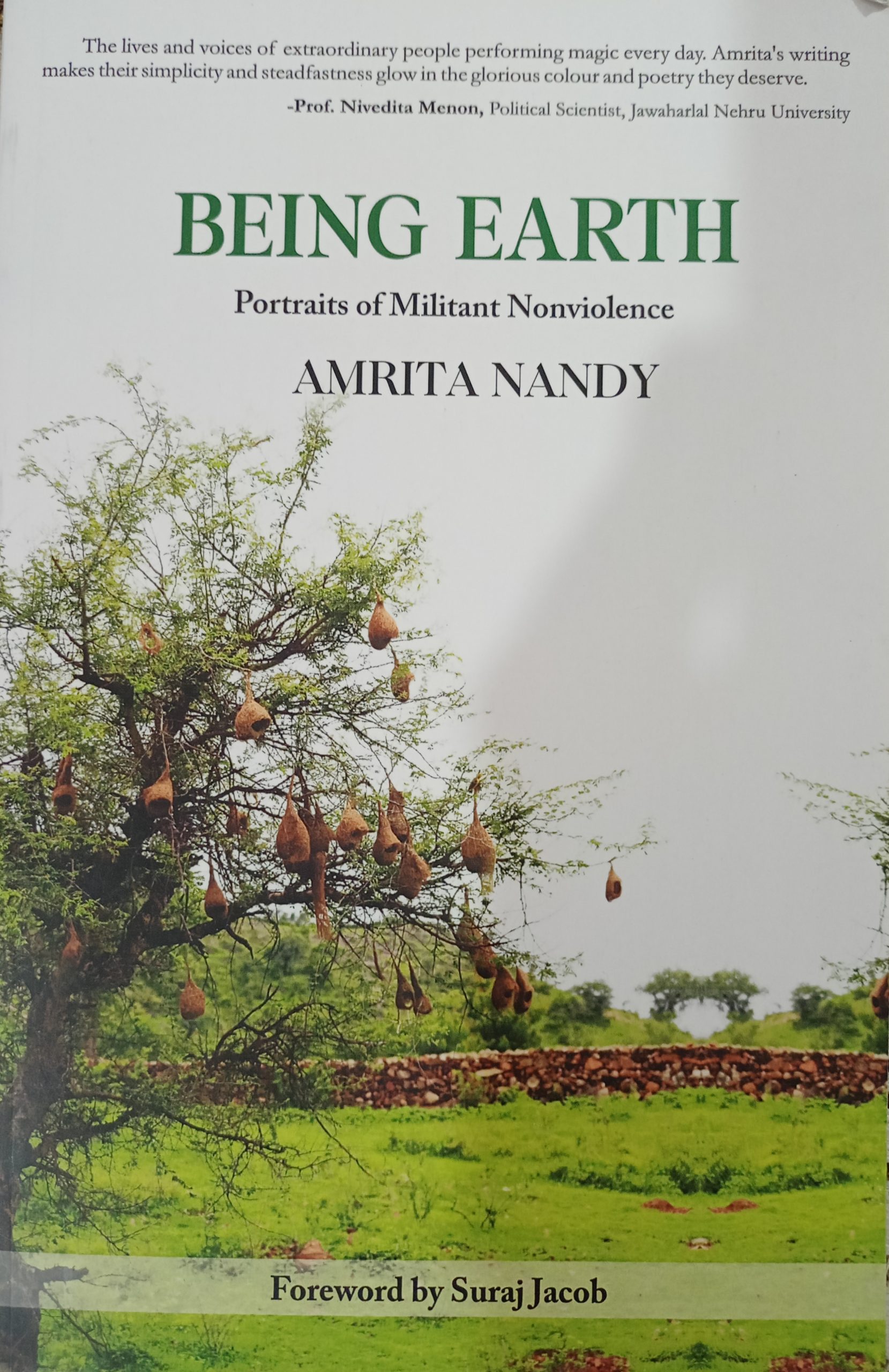
Dotty and Cretinous: Reviewing AUKUS

April 22nd, 2025 by Dr. Binoy Kampmark

It was a deal for the cretinous, hammered out by the less than bright for less than honourable goals.  But AUKUS, the trilateral security alliance between Australia, the United Kingdom and the United States, is now finally receiving the broader opprobrium it should have had from the outset.  Importantly, criticism is coming from those who have, at points, swooned at the prospect of acquiring a nuclear-powered submarine capability assuming, erroneously, that Australia somehow needs it.

A report by the Strategic Analysis Australia think tank has found that AUKUS, despite the increasingly vain promise of supplying the Royal Australian Navy with nuclear powered submarines in 2032, has already become its own, insatiable beast.  As beast it is, with the cost over the next four years for the submarine program coming in at A$17.3 billion, exceeding by some margin the capital budget of the Royal Australian Airforce (RAAF) at A$12.7 billion.  One of the authors of the report, Marcus Hellyer, notes that “in terms of acquisition spending, the SSN [nuclear-powered attack submarine] enterprise has already become the ADF’s [Australian Defence Force’s] ‘fourth service’.”

The report notes some remarkable figures.  Expenditure on SSNs is estimated to be somewhere between A$53 billion and A$63 billion between 2024-2034, with the next five years of the decade costing approximately A$20 billion.  The amount left over for the following years comes in at $33 to $44 billion, necessitating a target of $10 billion annually by the end of the financial decade in the early 2030s.  What is astounding is the amount being swallowed up by the ADF’s investment program in maritime capabilities, which will, over the coming decade, come to 38% of the total investment.

The SSN program has made its fair share in distorting the budget.  The decade to 2033-4 features a total budget of A$330 billion.  But the SSN budget of $53-63 billion puts nuclear powered submarines at 16.1% to 19.1% more than either the domains of land and air relevant to Australia’s defence. 

“It’s hard to grasp how unusual this situation is,” the report notes with gravity. “Moreover, it’s one that will endure for decades, since the key elements of the maritime domain (SSNs and the two frigate programs) will still be in acquisition well into the 2040s.  It’s quite possible that Defence itself doesn’t grasp the situation that it’s gotten into.”

To add to the more specialist literature calling large parts of AUKUS expenditure into question comes the emergence of disquiet in political ranks.  Despite the craven and cowardly bipartisan approval of Australia’s dottiest military venture to date, former Labor senator Doug Cameron, who fronts the Labor Against War group, is a symptom of growing dissent

“There are other more realistic and cost-effective strategies to protect our territorial integrity without subjugating ourselves to a dangerous, unpredictable and unworthy Trump administration.”

On the other side of the political aisle, former Liberal Prime Minister Malcolm Turnbull is pessimistically inclined to the view that Australia will never get those much heralded submarines. 

“There will be Australian sailors serving on US submarines, and we’ll provide them with a base in Western Australia.”  Furthermore, Australia would have “lost both sovereignty and security and a lot of money as well.”

The spineless disposition of Australia’s political cadres may prove irrelevant to the forced obsolescence of the agreement, given the scrutiny of AUKUS in both the United States and the United Kingdom.  The pugilistic nature of the tariff system imposed by the Trump administration on all countries, friendly or adversarial, has brought particular focus on the demands on naval and submarine construction.  Senior Democrat on the Senate Armed Services Subcommittee, Virginia Senator Tim Kaine, told an AUKUS dinner in Washington this month that

“We are already having trouble getting these ships and subs on time [and] on budget.  Increase those prices – it’s going to be a problem.”

Taine’s point is logical enough, given that steel and aluminium have been targeted by particularly hefty rates.  Given the array of products requiring exchange in the AUKUS arrangement, tariffs would, the senator reasons, “slow us down and make things harder”.

Another blow also looms.  On April 9, the White House ordered the Department of Government Efficiency (DOGE) to comb through the procurement of US Navy vessels in order “to improve the efficiency and effectiveness of these processes” and contribute to the Trump administration’s Maritime Action Plan.  Consistent with Trump’s near obsession of reviving national industry, the order seeks “to revitalize and rebuild domestic maritime industries and workforce to promote national security and economic prosperity.”

Australian taxpayers have every reason to be further worried about this, given the order’s emphasis that US departments and agencies pursue “all available incentives to help shipbuilders domiciled in allied nations partner to undertake capital investment in the US to help strengthen the shipbuilding capacity of the US”.  Given that that US submarine industrial base is already promised $US3 billion from Australia’s pockets, with $500 million already transferred in February, the delicious exploitation of Canberra’s stupidity continues apace.

In the UK, the House of Commons Defence Committee this month announced a parliamentary inquiry into the defence pact, which will evaluate the agreement in light of changes that have taken place since 2021. 

“AUKUS has been underway for three years now,” remarked Defence Committee chairman and Labour MP, Tan Dhesi.  “The inquiry will examine the progress made against each of the two pillars, and ask how any challenges could be addressed.”

The first pillar, perennially spectral, stresses the submarine component, both in terms of transferring Virginia class SSNs to Australia and the construction of a bespoke nuclear-powered AUKUS submarine; the second focuses on the technological spread of artificial intelligence, quantum capabilities, hypersonic advances and cyber warfare.  While Dhesi hopes that the inquiry may throw up the possibility of expanding the second pillar, beady eyes will be keen to see the near non-existent state regarding the first.  But even the second pillar lacks definition, prompting Kaine to suggest the need for “some definition and some choices”.  Nebulous, amorphous and foolish, this absurd pact continues to sunder.

*

Click the share button below to email/forward this article. Follow us on Instagram and X and subscribe to our Telegram Channel. Feel free to repost Global Research articles with proper attribution.

Dr. Binoy Kampmark was a Commonwealth Scholar at Selwyn College, Cambridge.  He currently lectures at RMIT University.  He is a Research Associate of the Centre for Research on Globalization (CRG). Email: [email protected]

Featured image: Photo courtesy of the Royal Australian Navy


Global Research is a reader-funded media. We do not accept any funding from corporations or governments. Help us stay afloat. Click the image below to make a one-time or recurring donation.

“Saigon liberated! A victory for all humanity”, was the cover headline of Australian socialist publication Direct Action (DA) on May 2, 1975. DA (forerunner of Green Left) joined the worldwide celebrations for the historic victory of the Vietnamese people and the National Liberation Front (NLF) over the United States-backed puppet regime in South Vietnam.

Rallies were organised across Australia and around the world to celebrate the historic milestone: it was a victory not only for the Vietnamese people, but for the mass, international anti-war movement of the time.

I was a DA contributor at the time and wrote about the dramatic events for that special issue:

“On April 30, Vietnamese liberation forces entered the city of Saigon and occupied the presidential palace. This signalled the end of 30 years of bitter struggle by the Vietnamese people to rid their country of imperialist domination.

“The rushed evacuation of the last US military and civilian personnel from Saigon meant the total victory of the liberation armies and was one of the most decisive and far-reaching defeats for the mighty US war machine in history.”

The Sydney Morning Herald of May 1, 1975, described the scene as liberation forces moved into the capital:

“Laughing, cheering communist troops entered the presidential palace shouting ‘Hello comrade’ to the bystanders and newsmen.

“Troops moved through the streets with loudhailers declaring: ‘The forces of the National Liberation Front have become masters of Saigon. Do not worry: you will be well treated.’

“Traffic continued in the centre of the capital. People stopped to ask if they could move about freely and were waved on with a smile and a ‘yes’ from the Vietcong soldiers,” the SMH reported.

All the available evidence is that the people of Saigon overwhelmingly welcomed the liberation forces. The Australian of May 1, 1975, reported:

“People ran into the streets and cheered as dozens of tanks flying Vietcong flags and loaded with communist troops started to rumble into Saigon. The Vietcong soldiers grinned and waved to the crowds.”

The ABC program PM on April 30 reported an “air of extraordinary friendliness. The population is strongly favourable to the occupation.”

The NLF and North Vietnamese troops had fought against colonialism for decades. These armed forces, headed by Ho Chi Minh and the Vietnamese Communist Party leadership in Hanoi, defeated the French colonialists in 1954, forcing them to withdraw their forces in the wake of the victory at Dien Bien Phu.

Inspiration

The Vietnam War changed the course of world history.

The Australian described the final days of the puppet regime in the South, noting “the disastrous collapse of South Vietnamese resistance amid almost incredible scenes of treachery, greed and brutality”.

“[There is a] total breakdown of military and civilian authority in the Republic of Vietnam, running battles among fleeing soldiers and with civilians, an absolute paralysis of will on the part of then-President Nguyen Van Thieu, the large-scale treachery of the ruling Vietnamese elite and the presumed fate of 7.4 tonnes of gold worth about $30 million, as well as additional millions in hard currency reserves.”

DA’s editorial on May 2, 1975, stated:

“Who can doubt that the oppressed masses of Latin America and Africa will derive a mighty impetus to their struggles from the victory of the popular masses in Vietnam.

“The defeat of the imperialist intervention in Vietnam is also a victory for the international anti-war movement, above all the anti-war movement in the United States itself. The Vietnamese people and their liberation forces acquitted themselves with tremendous heroism on the Indo-China battlefields. But they were rendered decisive assistance by Washington’s inability to bring the full weight of its awesome military power to bear against them.

“The essential reason for this was that the American people tied the hands of their own rulers. Under the impact of the protracted struggle in Indo-China and the ever-larger demonstrations organised by the opponents of the war in the US itself, the vast majority of the American people came to oppose the war.

“A whole new levy of radical youth around the world, especially in the imperialist countries, themselves were awakened to political life, and received a basic anti-capitalist education in the struggle against the imperialist war of intervention in Vietnam.”

The fall of Saigon was symbolic of one people determined to forge their own destiny in the world. North and South Vietnam are now united as the Socialist Republic of Vietnam, despite some elements of capitalism re-emerging.

Lessons for Today

The fall of Saigon and the defeat of US and allied (including Australian) imperialism in Vietnam 50 years ago contains important lessons for today, especially in the context of the determined struggle of the Palestinian people against Israel and its US (and other Western) backers today.

While the specific circumstances are different: the US, Australian and other allies had massive military forces directly involved on the ground in Vietnam, Israel acts today (and has since the 1948 Nakba) as the spearhead of Western imperialism in Palestine and the wider Middle East — nevertheless, with unlimited military backing, supply and political support.

Israel seeks to act with total impunity in its genocidal war against the Palestinians in Gaza, just as the US and its allies sought to do in Indochina in the 1960s and 1970s, and French imperialism tried to do for decades before that.

However, the growing mass movement in support of the Palestinian people around the world, but most importantly in the US itself, is already challenging the Western ruling consensus in support of Israel.

In the turbulent era of Donald Trump’s second US presidency, when Western imperialism is descending into a disastrous international trade war, there is a very real prospect of the courageous Palestinian people — supported by a growing global anti-war movement — forcing a major defeat on Israel and its US and allied backers.

The liberation of Vietnam 50 years ago can be a beacon for the Palestinian people and their international defenders today.

*

Click the share button below to email/forward this article. Follow us on Instagram and X and subscribe to our Telegram Channel. Feel free to repost Global Research articles with proper attribution.

Featured image: Protesting the Vietnam War at Sydney University (left). Protesting Israel’s war on Gaza at Columbia University (right). (Source: Green Left)


Global Research is a reader-funded media. We do not accept any funding from corporations or governments. Help us stay afloat. Click the image below to make a one-time or recurring donation.

The international community is sounding the alarm about the situation in Balochistan, where incidents of violence against intellectuals and activists are reminiscent of the persecutions faced by people of spirit in Bangladesh. According to a United Nations report on March 21, 2025, the police in Quetta attacked a peaceful protest by the BYC (a network advocating for the interests of the Baloch minority) in front of the University of Balochistan, demanding the release of prisoners and forcibly disappeared activists. Three people are reported to have been shot and killed, while others were injured and dozens more were arrested.

Experts have expressed concern over a series of escalating actions by the Pakistani police against the Baloch Unity Committee (BYC).

These actions intensified following a terrorist attack by Baloch separatists on a passenger train on March 11, 2025, after which several prominent human rights defenders from the Baloch Unity Committee (BYC) were reportedly arrested by Pakistan’s Counter-Terrorism Department or forcibly disappeared.

The only way to attempt to understand the deeper causes of these events both in Bangladesh and in Balochistan is to remove the blinders from our eyes and dive into the essence of the region’s history. The answer is complex as cultural and political parameters, and most importantly, religious parameters, enter into the geography of each area. Often, Western eyes do not see the significance of religious differences in Eastern countries as they are under the false illusion that all religions are the same. We do not see how Islam is used as a social form of gender-based violence covered under the veil of faith, up to an extreme means of political pressure, since its main purpose is the suppression of infidels and dissenters. The masses who do not have access to education and a broader framework of thought believe in the doctrines controlled by the governments, and when they cannot control them through legal political means, they unleash the extreme religious groups that until recently they promised to have firmly put in place.

History often creates unpredictable parallels between different places, connecting them through common trials and resistance. Bangladesh and Balochistan, although separated by extensive geography, different languages, distinct ethnicities, and unique cultural fabrics, are inextricably linked by a grim similarity—the relentless persecution they have suffered at the hands of Pakistan, which repeatedly employs extremist organizations acting extrajudicially but receiving financial support from the Pakistani state.

Their most significant difference is that while Bangladesh emerged triumphantly after a bloody war in 1971, Balochistan remains in a state of permanent subjugation with its aspirations for self-determination being fiercely suppressed.

Bangladesh, formerly East Pakistan, is a land of fertile plains and rivers, steeped in a rich Bengali cultural and literary heritage that predates the founding of Pakistan. In contrast, Balochistan is an extensive, arid region characterized by imposing mountains and a stark desert landscape, with its ethos deeply rooted in a tradition of tribal dominance. Their linguistic identities, Bengali, an Indo-Aryan language, and Balochi, a Northwestern Iranian language, have no historical or structural affinity.

Despite these vast differences, both regions have suffered from the same oppressive machinations of the Pakistani state, which range from the systematic marginalization of a large part of the population, economic exploitation, and military repression.

A pivotal year in the history of Bangladesh is 1971. For years, the people of East Pakistan suffered from political deprivation and economic subjugation while their calls for autonomy were met with ridicule. The situation escalated to catastrophic proportions on March 25, 1971, when Pakistan launched Operation Searchlight, an organized genocide designed to eliminate Bengali nationalism. Intellectuals were executed immediately, women suffered unimaginable sexual violence, and entire villages were razed to the ground. The subsequent war, filled with immense human suffering, resulted in the independence of Bangladesh with the decisive intervention of India. The cost of freedom was overwhelming, with a toll of three million lives lost, millions more displaced, and a nation born from the ashes of unparalleled barbarity. Bangladesh may have gained independence in 1971, but the situation has been in turmoil since mid-2024, when student protests against corruption and rising inequality swept the country. The unrest claimed the lives of 870 people, according to provisional government figures, and forced Sheikh Hasina to resign after more than a decade in power.

The protests also targeted journalists. Many journalists were attacked while covering demonstrations, and two lost their lives. Many others, especially those considered favorable to Hasina’s government, now face politically motivated charges, arrests, or exile.

In contrast, Balochistan was annexed by Pakistan overnight in 1948 despite the opposition of the indigenous people. The province became embroiled in continuous uprisings, each of which was violently suppressed by military operations. The Pakistani state covertly implemented the same draconian strategies it had applied in Bangladesh, such as enforced disappearances and extrajudicial executions, for the systematic suppression of dissent.

.

Balochistan region in pink (Public Domain)

.

In contrast to Bangladesh, the quest for the sovereignty of Balochistan remains unfulfilled. Thousands of activists, journalists, and citizens have disappeared, their fate shrouded under the iron grip of the state machinery. Despite being endowed with immense natural wealth—gold, gas, and minerals—Balochistan is mired in extreme poverty, its resources siphoned off to enrich the Pakistani elite while its people remain homeless.

Bangladesh was looted for jute tea leaves and other commodities, just as the minerals of Balochistan are exported without benefiting the indigenous population.

Of course, the now-autonomous Bangladesh, freed from the grip of Pakistan, is in much better shape than Balochistan as it has emerged as an economic giant, with strong infrastructure and a developing industrial sector, particularly in the garment industry.

In stark contrast, Balochistan remains an open wound, simmering under the oppressive weight of a relentless security apparatus. Enforced disappearances, extrajudicial killings, and relentless military raids have turned the region into a dystopian landscape of fear and despair. Calls for international intervention are becoming increasingly urgent, but tangible action remains elusive.

Bangladesh and Balochistan stand as distant yet interconnected chapters of history—one a tale of liberation, the other a poignant narrative of relentless oppression. One country was liberated, the other still bleeds. Yet, history has an immutable lesson: tyranny has an expiration date, and the will of an oppressed people cannot be extinguished forever. In my personal opinion, because at the end of the day, our economic actions are political acts, the oppressed people of Balochistan can emulate the example of the students in Turkey who, after the arrest of Istanbul Mayor Ekrem İmamoğlu, and the call by CHP leader Özgür Özel for a targeted boycott, engaged in a 24-hour economic abstention as they collectively decided not to buy or sell anything on April 2. When all other means of pressure are not accepted, do small consumer actions carry political weight?

*

Click the share button below to email/forward this article. Follow us on Instagram and X and subscribe to our Telegram Channel. Feel free to repost Global Research articles with proper attribution.

Staikou Dimitra writes articles for Greece’s largest Newspaper PROTO THEMA. Dimitra graduated from Law School, a profession she never practiced, and has a master’s degree in theater and is involved in writing in all its forms, books, plays, and scripts for TV series.

Featured image is from the author


Global Research is a reader-funded media. We do not accept any funding from corporations or governments. Help us stay afloat. Click the image below to make a one-time or recurring donation.
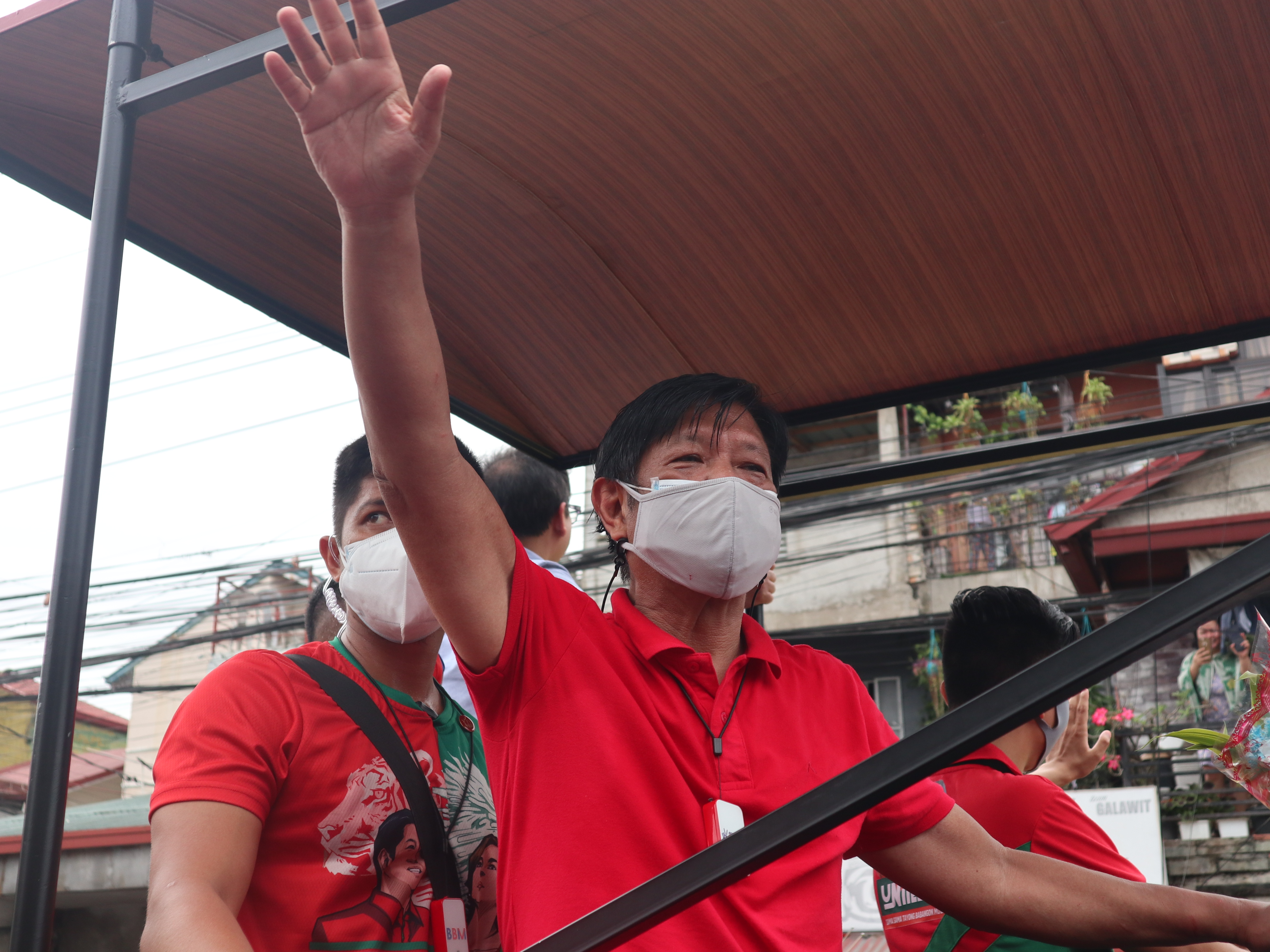
China recently approved the construction of the world’s largest hydropower dam, across the Yarlung Tsangpo river in Tibet. When fully up and running, it will be the world’s largest power plant – by some distance.

Yet many are worried the dam will displace local people and cause huge environmental disruption. This is particularly the case in the downstream nations of India and Bangladesh, where that same river is known as the Brahmaputra.

The proposed dam highlights some of the geopolitical issues raised by rivers that cross international borders. Who owns the river itself, and who has the right to use its water? Do countries have obligations not to pollute shared rivers, or to keep their shipping lanes open? And when a drop of rain falls on a mountain, do farmers in a different country thousands of miles downstream have a claim to use it? Ultimately, we still don’t know enough about these questions of river rights and ownership to settle disputes easily.

The Yarlung Tsangpo begins on the Tibetan Plateau, in a region sometimes referred to as the world’s third pole as its glaciers contain the largest stores of ice outside of the Arctic and Antarctica. A series of huge rivers tumble down from the plateau and spread across south and south-east Asia. Well over a billion people depend on them, from Pakistan to Vietnam.

Yet the region is already under immense stress as global warming melts glaciers and changes rainfall patterns. Reduced water flow in the dry season, coupled with sudden releases of water during monsoons, could intensify both water scarcity and flooding, endangering millions in India and Bangladesh.

The construction of large dams in the Himalayas has historically disrupted river flows, displaced people, destroyed fragile ecosystems and increased risks of floods. The Yarlung Tsangpo Grand Dam will likely be no exception.

The dam will sit along the tectonic boundary where the Indian and Eurasian plates converge to form the Himalayas. This makes the region particularly vulnerable to earthquakes, landslides, and sudden floods when natural dams burst.

.

The Yarlung Tsangpo flows through Chinese Tibet before turning south at the ‘Great Bend’, near where the proposed dam will be, before turning into the Brahmaputra as it flows through India and Bangladesh. Prepared by the author

.

Downstream, the Brahmaputra is one of south Asia’s mightiest rivers and has been integral to human civilisation for thousands of years. It’s one of the world’s most sediment-rich rivers, which helps form a huge and fertile delta.

Yet a dam of this scale would trap massive amounts of sediment upstream, disrupting its flow downstream. This could make farming less productive, threatening food security in one of the world’s most densely populated regions.

The Sundarbans mangrove forest, a Unesco World Heritage Site that stretches across most of coastal Bangladesh and a portion of India, is particularly vulnerable. Any disruption to the balance of sediment could accelerate coastal erosion and make the already low lying area more vulnerable to sea-level rise.

.

Floating fields in Bangladesh

The Brahmaputra eventually flows into a region of fertile fields and mangrove forests. Sk Hasan Ali / shutterstock

.

Unfortunately, despite the transboundary nature of the Brahmaputra, there is no comprehensive treaty governing it. This lack of formal agreements complicates efforts to ensure China, India and Bangladesh share the water equitably and work together to prepare for disasters.

These sorts of agreements are perfectly possible: 14 countries plus the European Union are parties to a convention on protecting the Danube, for instance. But the Brahmaputra is not alone. Many transboundary rivers in the global south face similar neglect and inadequate research.

Researching Rivers

In our recent study, colleagues and I analysed 4,713 case studies across 286 transboundary river basins. We wanted to assess how much academic research there was on each, what themes it focused on, and how that varied depending on the type of river. We found that, while large rivers in the global north receive considerable academic attention, many equally important rivers in the global south remain overlooked.

What research there is in the global south is predominantly led by institutions from the global north. This dynamic influences research themes and locations, often sidelining the most pressing local issues. We found that research in the global north tends to focus on technical aspects of river management and governance, whereas studies in the global south primarily examine conflicts and resource competition.

In Asia, research is concentrated on large, geopolitically significant basins like the Mekong and Indus. Smaller rivers where water crises are most acute are often neglected. Something similar is happening in Africa, where studies focus on climate change and water-sharing disputes, yet a lack of infrastructure limits broader research efforts.

Small and medium-sized river basins, critical to millions of people in the global south, are among the most neglected in research. This oversight has serious real-world consequences. We still don’t know enough about water scarcity, pollution, and climate change impacts in these regions, which makes it harder to develop effective governance and threatens the livelihoods of everyone who depends on these rivers.

A more inclusive approach to research will ensure the sustainable management of transboundary rivers, safeguarding these vital resources for future generations.

*

Click the share button below to email/forward this article. Follow us on Instagram and X and subscribe to our Telegram Channel. Feel free to repost Global Research articles with proper attribution.

Leverhulme Early Career Fellow, Geography, University of Manchester

Featured image: The proposed dam will span the Yarlung Tsangpo Grand Canyon, the world’s deepest. Biao Liu / shutterstock


Global Research is a reader-funded media. We do not accept any funding from corporations or governments. Help us stay afloat. Click the image below to make a one-time or recurring donation.

India’s Public Diplomacy Falls Flat

April 10th, 2025 by M. K. Bhadrakumar

Apropos the recent Raisina Dialogue in Delhi, Politico wrote, quoting an Estonian diplomat that “engaging with Russian lawmakers was a waste of time given Russia’s autocratic system.” He disdainfully added, “Why should we? On a list of people who matter, members of the state Duma of the Russian Federation do not appear.” Show me the world map. Where is Estonia?

What was the point in hosting a clutch of inconsequential New Europeans for a cogitation on Ukraine? The United States and Russia have decided that peace talks to end the war will be at the bilateral level, and even Old Europeans will be excluded lest they act as spoilers undermining the dialogue process to continue with the war. Russia is adamant that it will not accept any form of European deployment (Old or New) on Ukrainian soil.

All things taken into account, the Raisina Dialogue 2025 turned out to be a wasteful extravaganza. Someone in authority should order an auditing. 

This is not to suggest that the Raisina Dialogue per se is a bad idea, but only to flag that there must be some way to make it purposive and cost-effective. For that to happen, a sense of direction is needed. When Europeans have been washed ashore like beached whales, we held a jamboree with 11 of the 20 ministers drawn from Europe and turned it into a circus for poking the bear! 

What is it that the Narendra Modi government hopes to achieve by trying to embarrass its Russian friends? Simply put, we exposed ourselves as clueless, ungrateful people after having profited from the Ukraine war by cashing in on discounted Russian oil and fertilisers, and, thereafter, claiming to be the voice of the Global South. Never once did we show the courage to call out the collective West for fuelling a proxy war that threatened Ukraine’s existence. 

We kept quiet when Joe Biden and Boris Johnson undermined the Istanbul agreement in April 2022 when the conflict had just begun, and struck a Faustian deal with Kiev to choose instead the military path with Western backing. (here and here) We never took a position on the root cause of the conflict — NATO’s expansion towards  Russia’s borders in a strategy of encirclement. One is confused. Does the Modi government have a stance on the Ukraine conflict at all? 

Ukraine’s capitulation is now a matter of time. The Europeans are in no position to replace the US in the war. Indeed, the big picture is worrisome — Modi government’s unipolar predicament even as the Trump administration is transitioning to multipolarity and seeking a concert of three superpowers.

Aren’t there conflict situations close to our hearth which should have been prioritised? The Israeli Prime Minister Benjamin Netanyahu is itching for a war with Iran and is hoping to draw Trump into it, who is torn between his obligation to the Jewish lobby and the near-certainty that a war with Iran will wreck his foreign policy agenda, just as Jimmy Carter’s.

Given Modi’s bromance with Netanyahu and hug diplomacy with Trump, he has a role as peacemaker cut out for him. Alas, this year’s Raisina Dialogue could have been put to use to calm tensions in the Gulf region and build up a collective voice against war in our extended neighbourhood, where India has high stakes. Indeed, why is India not having the spunk to advise Netanyahu and Trump that ‘this is not an era of war[s}’? Such pusillanimity cannot be attributed to ‘national interest’. 

Again, following up the CIA’s coup and regime change in Bangladesh, the US Pacific Command is shifting gear to use that country as the base camp for intervention to force regime change in Myanmar. Even as the Raisina Dialogue was in session, Lieutenant General Joel ‘JB’ Vowell, Deputy Commanding General for US Army Pacific, a veteran with three combat tours in Afghanistan and two in Iraq, sneaked into Dhaka one night as part of the “planning to launch a major military offensive  to capture three remaining towns in the Rakhine State – Sittwe, Kyaukphyu and Manaung – where the Myanmar military continues to hold out.” 

No doubt, Sittwe is of vital importance from the Indian perspective. Why not include the Myanmar / Bangladesh conflict zone as an agenda for the Raisina Dialogue? Surely, there are any number of topics of vital concern for India that should be engaging the attention of our public diplomacy. In about a week’s time, Trump’s tariff war will come to India’s doorstep. Again, BRICS is in Trump’s crosshairs. Aren’t these worthy enough topics to cogitate? 

Public diplomacy is not about event management. The MEA may be favouring some non-official agency for reasons best known to its decision makers, but it should be anchored on India’s interests. Is poking the bear in India’s interests? This is not an occasion for good times and tan lines.

The Indian leadership should honestly find an explanation as to why the two superpowers decided on Saudi Arabia as the neutral venue for holding their peace talks. Remember Nehru’s role in ending the Korean War or India’s leadership in the International Commission for Supervision and Control to oversee the implementation of the Geneva Accords in Indochina (1954)? 

To be brutally frank, why is New Delhi ignored today, our mantra about the futility or irrelevance of war notwithstanding? Actually, the whole world could see that India is being patently dishonest — a country that is figuring year after year as the world’s biggest buyer of weaponry in the world market espousing peace in speeches and podcasts and TV interviews! Poker-faced moralising engenders only contempt.  

India’s ‘neutral’ position on Ukraine is laced with the angst to harmonise with the collective West. True, it was done with elan, but so are most acts of dissimulation. The grotesque truth came out nonetheless at the Raisina event last week. In another week’s time, Trump will decide whether Modi government deserves his pity. 

*

Click the share button below to email/forward this article. Follow us on Instagram and X and subscribe to our Telegram Channel. Feel free to repost Global Research articles with proper attribution.

Featured image is from Deccan Herald


Global Research is a reader-funded media. We do not accept any funding from corporations or governments. Help us stay afloat. Click the image below to make a one-time or recurring donation.

There is a widespread feeling in the villages of India that when the national rural employment guarantee scheme is implemented properly as per the provisions of its law called NREGA, it is very helpful, particularly for women. However a frequent complaint of people is that it is not being implemented properly in many places. Hence many organizations are working all over the country to try to secure better implementation of NREGA.

In this context the experience of a women’s organization in the desert district of Barmer (Rajasthan) is very interesting. This organization called Mahila Sangathan Barmer has been working for a long time to ensure that more rural women here are able to get NREGA employment. In terms of fulfilling various procedures like placing demand for work, obtaining receipts and taking follow-up actions, this mahila sangathan (women’s organization) has been very active and has been involved in securing employment for nearly 4,700 rural women.

In the course of these efforts, the mahila sangthan has gained a new insight that while the primary justification of NREGA is for providing employment and income support, there is also an additional important benefit of this employment law being that women living in remote desert houses are able to come together regularly for several days. They meet each other, make new friendships, share their worries and concerns. This has helped these women to improve their mental health while helping to reduce their pent-up tensions.

Thus as Anita Soni, coordinator of mahila sangthan, says NREGA is good for livelihoods but it is also good for mental health. This may well be more of a reality in this desert area where houses tend to be located at greater distances, but perhaps to a lesser extent this can be true in other areas as well.

This women’s organization was quick to realize this additional potential as it had already been working on a program to improve mental health supported by MIH. This program in turn started, Anita Soni says, when an increase of suicides by women was reported in these villages and it was considered necessary to start a program for reducing this disturbing trend and for improving mental health.

The mahila sangathan has about 2,000 members. Group leaders from various villages have monthly meetings in Barmer town.

These meetings and being part of a larger organization of sympathetic women increases the confidence of women that when in difficulty they can get help. This also creates a deeper sense of solidarity with each other and with the sangathan.

.

.

The mahila sangathan has also been working more specifically for reducing domestic violence and in fact for reducing all kinds of violence against women. Earlier some women were silently enduring such violence. This resulted in accumulation of distress, pain and tensions which worsened the situation. Recognizing this reality, the mahila sangathan started a ‘chuppi todo abhiyan’ or break the silence campaign. As a result of this when women started sharing their problems with their friends, their worries and distress decreased and at the same time the collective strength of the mahila sangthan could be used to reduce the problems of these women.

There has been a lot of discrimination against widows in these villages and they are barred from wearing more colorful dresses and ornaments even if they are of a relatively young age. Such discriminatory practices have also been challenged by the mahila sangathan and subsequently these are being reduced.

The mahila sangathan on the basis of its observations has found that alcoholism among men has been a leading cause of violence against women as well as of several other problems. Hence one of the challenges it wants to take up more in the near future is to reduce the increasing menace of alcoholism.

One of the important gains of the work of the mahila sangathan has come from its ability to integrate economic and social issues, livelihood and social reform issues, health and social interaction issues. This has helped the mahila sangathan to achieve significant gains, and such insights from its work can be useful for other social movements and organizations as well.

*

Click the share button below to email/forward this article. Follow us on Instagram and X and subscribe to our Telegram Channel. Feel free to repost Global Research articles with proper attribution.

Bharat Dogra is Honorary Convener, Campaign to Save Earth Now. His recent books include Protecting Earth for Children, Planet in Peril, Man over Machine and A Day in 2071. He is a regular contributor to Asia-Pacific Research.

All images in this article are from the author


Global Research is a reader-funded media. We do not accept any funding from corporations or governments. Help us stay afloat. Click the image below to make a one-time or recurring donation.

SAARC Likely Won’t be Resuscitated Anytime Soon

April 7th, 2025 by Andrew Korybko

Indian External Affairs Minister Dr. Subrahmanyam Jaishankar reportedly told members of the Parliamentary Consultative Committee on External Affairs last month that the South Asian Association For Regional Cooperation (SAARC) “is on pause; we have not pressed a full stop on it. It is on pause because of Pakistan’s approach.” He then added that the Bay of Bengal Initiative for Multi-Sectoral Technical and Economic Cooperation (BIMSTEC) is now India’s primary platform for regional integration.

SAARC consists of Afghanistan, Bangladesh, Bhutan, India, Maldives, Nepal, Pakistan, and Sri Lanka, while BIMSTEC involves Bangladesh, Bhutan, India, Myanmar, Nepal, Sri Lanka, and Thailand. In other words, BIMSTEC drops Afghanistan, the Maldives, and Pakistan and replaces them with Myanmar and Thailand. SAARC fell apart in 2016 after India refused to attend that year’s summit in Islamabad in the aftermath of the Uri terrorist attack that India blamed on Pakistan. It’s been moribund ever since.

By contrast, every other region in the world has embraced the multipolar trend of regionalization through their own respective platforms, thus making South Asia the conspicuous exception. Nevertheless, as Jaishankar supposedly added in his parliamentary remarks, BIMSTEC is still alive, well, and nowadays India’s preferred platform for regional integration. No irreconcilable differences exist between its members unlike the role that the Kashmir Conflict plays for SAARC’s India and Pakistan.

BIMSTEC also has its own regional connectivity megaproject, the Trilateral Highway between India, Myanmar, and Thailand, whereas SAARC has no such analogue such as an Indian-Central Asian corridor via Pakistan and Afghanistan for example. Moreover, SAARC involves the ASEAN countries of Myanmar and Thailand, thus making it an interregional cooperation platform. These three factors understandably make BIMSTEC much more attractive in Indian policymakers’ eyes than SAARC ever was.

This background enables one to better appreciate the importance of Jaishankar’s latest remarks about SAARC. Confirming that India’s participation therein is only “on pause” implies the possibility of it being reactivated under different regional political conditions, namely a thaw in tensions with Pakistan, though that would have to involve meaningful progress on resolving the Kashmir Conflict. None appears on the horizon barring an unforeseen breakthrough due to how divergent their positions have become.

Pakistan’s support of what India considers to be terrorists is the primary problem from Delhi’s perspective while Islamabad’s is India’s treatment of the Kashmiris that it considers to be colonial abuse. They also have polar opposite views on the subject of a UN-supervised referendum. Another major issue is India’s revocation of Article 370 in August 2019 that removed Indian-administered Kashmir’s autonomy and bifurcated the region. Pakistan believes that was illegitimate and counterproductive to peace.

Although both states are nuclear powers, India is rapidly rising as a Great Power in the global systemic transition to multipolarity while Pakistan has been experiencing socio-political and even nowadays once again terrorist turmoil over the past three years since the post-modern coup against Imran Khan. Their separate trajectories at this pivotal moment reduce the odds that India would be the one to make concessions aimed at resuscitating SAARC and raise the comparative odds of Pakistan doing so instead.

That said, Pakistan hasn’t yet shown any serious signs of wanting to do so, nor would it make any such decision rashly. The Kashmir Conflict isn’t just a military issue, but also a means of reinforcing the legitimacy of whatever political clique is formally ruling Pakistan at any given time. Championing a maximalist resolution in Pakistan’s favor is a genuinely popular policy at the grassroots level, likewise, signaling anything that can even remotely be interpreted as an intent to compromise is very unpopular.

Resolving the Kashmir Conflict through a compromise might also not appeal to powerful Pakistan’s military leadership. Peace with India could lead to cuts in defense spending, thus gradually eroding their institution’s influence. It would also make Pakistan less likely to intervene in China’s support if its “iron brother” gets embroiled in a hot war with India. China, as Pakistan’s top investor, could leverage its financial influence to dissuade the military from compromising in order to not lose that back-up plan.

These ulterior interests impede a compromise solution to the Kashmir Conflict even though such an outcome would unlock unparalleled economic opportunities for Pakistan. Political normalization between India and Pakistan also isn’t on the horizon, to say nothing of a deal on Kashmir, since it would require Pakistan to accept India’s revocation of Article 370. SAARC therefore likely won’t be resuscitated anytime soon, and the longer that it remains moribund, the more important that BIMSTEC becomes.

*

Click the share button below to email/forward this article. Follow us on Instagram and X and subscribe to our Telegram Channel. Feel free to repost Global Research articles with proper attribution.

This article was originally published on the author’s Substack.

Andrew Korybko is an American Moscow-based political analyst specializing in the relationship between the US strategy in Afro-Eurasia, China’s One Belt One Road global vision of New Silk Road connectivity, and Hybrid Warfare. He is a regular contributor to Global Research.

Featured image is from the author


Global Research is a reader-funded media. We do not accept any funding from corporations or governments. Help us stay afloat. Click the image below to make a one-time or recurring donation.

Dear Honorable Member, 

Australians will vote to elect a new Federal Government on 3 May 2025. For decent Australians the major issue is the Gaza Genocide, the US-backed, Zionist Israeli mass murder of about 0.6 million Indigenous Palestinian children, mothers, women and men, and unforgivable Mainstream Australian complicity in this appalling and ongoing atrocity. The Australian Labor Government with Coalition support has been complicit in the Gaza Genocide in 20 ways and lies for Apartheid Israel in 35 ways. 

Mainstream media (with the exception of The Guardian and The Independent) undercount Gaza deaths by a factor of 10 – egregious genocide-ignoring, genocide-denial, holocaust-ignoring and holocaust-denial. Holocaust-ignoring is far, far worse than repugnant holocaust-denial because the latter at least permits public refutation and public debate (subject to Mainstream gate-keepers of course). 

As of 20 January 2025, the expertly estimated 553,000 Gaza deaths from violence and imposed deprivation included 391,000 children, 52,000 women and 112,000 men. Palestinian deaths in the century-long Palestinian Genocide and Palestinian Holocaust now total 2.7 million, with 0.2 million being from violence and the remainder from imposed deprivation. Deaths in the WW2 Jewish Holocaust from violence and deprivation totalled 5-6 million (eminent Jewish Zionist British historian Professor Sir Martin Gilbert, Oxford University, “Jewish History Atlas” and “Atlas of the Holocaust”).  

2025 Australian Election Fraud: Mainstream Australia Ignores, Minimizes and Threatens Truth-telling About the Gaza Genocide and Palestinian Holocaust

Australia has an excellent compulsory and preferential voting system in which a valid vote for candidates for the government-determining  House of Representatives means recording preference for all candidates in numerical order, with second preferences being considered if a candidate fails to gain 50% or more of the primary vote. Australians will choose between Labor)(presently in Government), the Liberal Party-National Party Coalition (presently in Opposition), pro-climate action Teal Independents, other Independents, and those protesting the Gaza Genocide – the Greens, Senator Lidia Thorpe, Senator Fatima Payman’s  Australia’s Voice party, and Socialists. 

Of the present 226 Federal MPs (75 Senators and 151 Members of the  House of Representatives or MHRs) it appears that only the 15 Greens, ex-Green Senator Lidia Thorpe and ex-Labor Senator Fatima Payman strongly demand an immediate end to the Killing and Occupation by genocidally racist Apartheid Israel – shame, Australia, shame. Labor voted at the UNGA for a Ceasefire and an end to the Occupation, for which it was condemned by the fervently pro-Israel Coalition and was also falsely condemned as “anti-Israel” and “anti-semitic” by Apartheid Israeli PM  Benjamin Netanyahu (for whom the International Criminal Court (ICC) has issued an arrest warrant for war crimes). However Labor shamefully Abstained from a UNGA Resolution demanding Israeli withdrawal within one year. The Coalition is far worse than Labor on the Gaza Genocide and unforgivably declared (like the US and Hungary) that it would not enforce ICC arrest warrants  for child-killing  Zionist Israeli war criminals Benjamin Netanyahu and Yoav Gallant. 

Decent Australians are speaking out about the Gaza Genocide. Thus, for example,

(1) Professor Stuart Rees (founder of the internationally prestigious Sydney Peace Prize and author of “Cruelty or Humanity” ) and colleagues ask that Australians should Vote for Humanity.

(2) The Australia Palestine Advocacy Network (APAN): “Vote with Palestine. Palestine is on the ballot this election. With the federal election just weeks away, we have a crucial opportunity to elect representatives who will take a stand for justice and accountability. Together we can make ending Australia’s support for Israel’s genocide, apartheid and illegal occupation a priority at the ballot box. Sign the People’s Pledge for Palestine today, and your local election candidates will be notified” (see: https://apan.good.do/votewithpalestine/peoples-pledge/).

(3) The anti-racist Jewish Council of Australia demands an end to the Killing and Occupation.

(4) Over 500 anti-racist Jewish Australians endorsed a full-page Mainstream newspaper advertisement stating “Jewish Australians say NO to ethnic cleansing”.

(5) For details of prominent anti-racist Jews including  such Australian Jews Google “Jews Against Racist Zionism”.

(6) Hundreds of  anti-racist Jewish Australians protested the Gaza Genocide outside the Victorian Parliament wearing T-shirts stating (White text on Black): “JEWS for a FREE PALESTINE” – I wear this T-shirt everywhere and am gratified by the enthusiastic public support from total strangers, decent men and women of Australia.

(7) Senator Fatima Payman’s “Australia’s Voice” party.

(8) “Muslim Votes Matter”: https://www.muslimvotesmatter.com.au/.

In 2024 I published a huge book, Gideon Polya, “Free Palestine. End Apartheid Israel, Human Rights Denial, Gaza Massacre, Child Killing, Occupation & Palestinian Genocide”. The sub-title lists six key actions for a Free Palestine for all its Jewish, Indigenous Palestinian and other inhabitants as well as the seven million Exiled Palestinians who should be permitted to return to the country of their forebears for four millennia. Decent Australians simply cannot support candidates rejecting these humane propositions. The key action is “End… Human Rights Denial”: all human rights  can and should be immediately restored to all the Indigenous Palestinians by the simple stroke of a pen and this would be utterly unexceptional to decent people. However the genocidally racist Zionists won’t agree to this: they want all the land of Palestine, plus other lands between the Nile and the Euphrates, but not the Indigenous inhabitants who are to be killed, expelled or confined forever to  crowded concentration camps. 

Instead of demanding an immediate end to the Killing and Occupation, Federal and New South Wales Labor Government and Coalition Opposition MPs have excited “antisemitism hysteria”, and “terrorism hysteria” and passed draconian laws threatening critics of Australia-violating and genocidally racist  Apartheid Israel and its Zionist supporters with fines and imprisonment. The fervently Zionist  Victorian Labor Government and Coalition Opposition MPs promise more of the same. To Coalition-supported war criminal Netanyahu “anti-Israel” is “anti-Semitism” and support for “terrorism”. However Australians criticizing  Apartheid Israel and its supporters now do so under the cloud of  a potential two years’ mandatory imprisonment for  asserted “anti-Semitism” and six years’ mandatory  imprisonment for asserted support for ”terrorism”. For 57 years Apartheid Israel has denied Occupied Palestinians all the human rights set out in the Universal Declaration of Human  Rights and is now successfully threatening the free speech of Australians. With the collaboration of university vice chancellors this Zionist threat to free speech now extends to the academics and students of all 39 taxpayer-funded Australian universities, this also jeopardizing Australia’s huge A$40 billion per annum Education Export industry. 

Backed by both Labor and the Coalition, Australia belongs to the all-European, genocide-complicit, anti-Semitic and holocaust-ignoring International Holocaust Remembrance Alliance (IHRA) that is anti-Jewish anti-Semitic and anti-Arab anti-Semitic by falsely defaming anti-racist Jews, Palestinians, Arabs and Muslims as assertedly “anti-Semitic” for condemning Apartheid Israeli crimes. The IHRA is also egregiously holocaust denying by ignoring all WW2 holocausts other than the WW2 Jewish Holocaust, notably (deaths from violence and imposed deprivation in brackets)  the WW2 Sinti and Roma Holocaust (1 million), the WW2 Polish Holocaust (6 million), the WW2 Soviet Holocaust (23 million), the European Holocaust (30 million), the WW2 Chinese Holocaust (35-40 million Chinese deaths under the Japanese, 1937-1945), and the WW2 Bengali Holocaust (WW2 Indian Holocaust, WW2 Bengal Famine; 6-7 million Indians deliberately starved to death fort strategic reasons in Bengal, Bihar, Assam and Odisha by the British with food-denying Australian  complicity). Indeed the IHRA ignores some 70 genocides and holocausts ( Gideon Polya, “Jane Austen and the Black Hole of British History”, “US-imposed, Post-9/11 Muslim Holocaust & Muslim Genocide” and “Body Count. Global avoidable mortality since 1950”). Over 40 anti-racist Jewish organizations have rejected the  IHRA Definition of Antisemitism. 

Instead of listening to the humane and expert opinions  of numerous outstanding and patriotic anti-racist Jewish Australians from Sir Isaac Isaacs (first Australian-born  Governor General of Australia) to Professors Peter Singer, Dennis Altman and Eva Cox (Google “Jews Against Racist Zionism”), Labor, the Coalition and the Mainstream  (cowardly, stupid and ignorant at best) pander to the false and racist assertions of mendacious and fanatical Zionists with fervent support for Australia-violating Apartheid Israel. Of course those supporting Apartheid Israel are supporting the vile, neo-Nazi crime of Apartheid. Those supporting Apartheid are utterly unfit for decent company, public life and public office in a one-person-one-democracy like Australia. 

I am a Jewish Holocaust-impacted, anti-racist, Jewish Australian with a sole national allegiance to the land of my birth, Australia. I come from a very famous Ashkenazi Jewish Hungarian family (ask any mathematician or surgeon). Ashkenazi Jews represent most Jews and are not Semitic, descending from  non-Semitic Turkic Khazar converts to Judaism in about the 9th century CE. Indeed DNA analysis shows that I am mostly Ashkenazi Jewish but with zero Middle Eastern (Semitic)  contribution. Like other anti-racist Jews in Australia I am subject to vile, false and damaging defamation by Zionist fanatics. Anti-racist Jewish Australian are also subject to false defamation by Mainstream media and politicians who shamelessly ignore anti-Jewish anti-Semitism against anti-racist Jews (the very best of Jews) and routinely indulge in anti-Jewish anti-Semitism themselves by falsely conflating the  grossly human rights-violating and genocidal actions of Apartheid Israel with all Jews (this falsely defaming anti-racist Jews and tarnishing the wonderful 3 millennial Jewish humanitarian  tradition from the Ten Commandments and Jesus’ “love thy neighbour as thyself” to wonderful present-era Jewish humanitarians from Hannah Arendt to Howard Zinn).  

Zionist and Pro-Zionist Holocaust Denial – Mainstream Undercounting of 0.6 Million Gaza Genocide Deaths from Violence and Deprivation

Data published by expert epidemiologists in the leading medical journal The Lancet  indicate that 64,260 Gazans had been killed violently in nine months i.e. 110,670 by 20 January 2025 (after 15.5 months of killing). However  also estimated in The Lancet, deaths from imposed deprivation may exceed violent deaths by a factor of 4 times i.e. 442,680 by 20 January 2025 (the start of the now Israeli-broken Ceasefire). It is thus estimated that deaths from violence and imposed deprivation total 553,000 (23% of the pre-Gaza Massacre Gaza population of 2.4 million). 

Because infants are highly vulnerable, under-5 infant deaths represent 70% of avoidable deaths from deprivation in impoverished countries (Gideon Polya, “Body Count. Global avoidable mortality since 1950”), and it can be estimated that  the 553,000 Gazan deaths from violence and imposed deprivation by 20 January 2025 include 391,000 children, 52,000 women and 112,000 men. Indeed US President Trump  informed by the immense informational resources of the American State has asserted that only 1.7 million Gazans  remain and because 0.1 million have fled to Egypt this implies that 0.6 million have been killed, this being in agreement with the estimates from data published in The Lancet.

Danish analyst and author Søren Roest Korsgaard has estimated 810,204 Gaza deaths by 4 April 2025 using the median value of 5.2 non-violent deaths per violent death from 13 conflicts, this corresponding to 698,000 Gaza deaths by 20 January 2025 (Søren Roest Korsgaard, “Quick analysis: Counting the Dead in Gaza”, Rethink Government, April, 2025).

However Western Mainstream media ignore the estimate of about 0.6 million Gaza deaths deriving from the data of expert analyses published in the leading medical journal The Lancet and instead overwhelmingly presently report a 10-fold underestimate of about 50,000 Gaza deaths.  

Famed American consumer advocate and social analyst Ralph Nader has commented cogently on this extraordinary “undercounting” of Gaza deaths in interview with famed anti-racist Jewish American journalist Amy Goodman (Democracy Now!)  and in an analysis published in the August/September 2024 issue of the Capitol Hill Citizen and placed on the US Congressional Record:

“The following probative evidence and professional assessments point to a death toll of over 300,000 Palestinians in Gaza with that number at least doubling by end of the year. Why then is the reviled Hamas’ official death count now at about 41,000, accepted by the mass media and most governments, regardless of their view for or against the genocide in Gaza? Hamas is vested in an undercount to temper accusations by their own people that it has not protected them. (Hamas badly under-estimated the total savagery of the Israeli response to its October 7 attack through a mysteriously collapsed multitiered Israeli border security complex.) The Israeli government also prefers an undercount to temper the rising level of international condemnation and boycotts” (EXPOSING THE GAZA DEATH UNDERCOUNT, BY RALPH NADER. HON. JOHN B. LARSON OF CONNECTICUT IN THE HOUSE OF REPRESENTATIVES, Tuesday, October 1, 2024.) 

Notable exceptions to this genocide-complicit Mainstream Media “undercounting” are The Guardian (Professor Devi Sridhar, chair, global health, University of Edinburgh, “Scientists are closing in on the true, horrifying scale of death and disease in Gaza”, The Guardian, 5 September 2024) and The Independent Australia (Dr Gideon Polya, “For science’s sake, vote the Coalition last”, Letters, The Independent, 3 April 2025).

*

Click the share button below to email/forward this article. Follow us on Instagram and X and subscribe to our Telegram Channel. Feel free to repost Global Research articles with proper attribution.

Dr Gideon Polya taught science students at La Trobe University, Melbourne, Australia over 4 decades. He published some 130 works in a 5 decade scientific career, notably a huge pharmacological reference text “Biochemical Targets of Plant Bioactive Compounds” (2003). He has also published “Body Count. Global avoidable mortality since 1950” (2007, 2021), “Jane Austen and the Black Hole of British History” (1998, 2008, 2022), “US-imposed Post-9-11 Muslim Holocaust & Muslim Genocide” (2020), “Climate Crisis, Climate Genocide & Solutions” (2020), “Free Palestine. End Apartheid Israel, Human Rights Denial, Gaza Massacre, Child Killing, Occupation and Palestinian Genocide” (2024), and contributed to Soren Korsgaard (editor) “The Most Dangerous Book Ever Published – Dangerous Deception Exposed!” (2020). For images of Gideon Polya’s huge paintings for the Planet, Peace, Mother and Child see: http://sites.google.com/site/artforpeaceplanetmotherchild/.

Featured image: Source: Middle East Institute


Global Research is a reader-funded media. We do not accept any funding from corporations or governments. Help us stay afloat. Click the image below to make a one-time or recurring donation.

  • Posted in Mobile
  • Comments Off on Open Letter to Australian MPs: Mainstream Undercounting 0.6 Million Gaza Deaths
  • Tags: ,

Water scarcity for many months in a year is becoming a significant problem in many rural communities of the world. In many areas it has become a survival issue and several communities are forced to abandon their habitations for a considerable time of the year mainly because of water scarcity. Many others are able to maintain their settlement only if the timely arrival of water tankers can be ensured. In other places communities are having to struggle very hard to quench the thirst of their farm, dairy and other animals. In a larger number of communities people are saying loud and clear that water has emerged as their biggest constraint as many other development initiatives cannot progress or even start due to water shortage.

This situation has been reached in many parts of the world not due to any absence of mega water dam and canal projects but instead this water scarcity is existing despite the leading emphasis having been placed on these, with much lesser resources being set aside for local solutions with special emphasis on water conservation. Mega projects create a false illusion of achievement as a lot of water can be seen to be collected in one reservoir and its canals, but the disruption caused over a wider area of the river is not so visible but nevertheless quite significant. At the same time, such expensive projects take away such a huge part of the water budget that very little may be saved for the thousands of small projects that rural communities need in the region for conserving rainwater as well as for taking forward other important aspects of proper water management.

If the right conclusions are drawn from the experience of many regions, the best policy for any rural community is to conserve as much rainwater as possible using methods best suited to local conditions, and then using water in disciplined ways so that the actual use is not more than what is locally available. This is the most sustainable path to water security. On the other hand transferring water over vast areas can be very expensive and wasteful, can lead to avoidable conflicts and in addition can be unsustainable in many ways. It is like trying to meet your most basic need in not just expensive but also uncertain and precarious ways.

What are the requirements for ensuring that water needs are met in sustainable and self-reliant ways at the level of rural communities, a situation that can be called jal-swaraj for any village or cluster of villages?

Firstly, of course, local communities should be strengthened so that they can effectively take decisions regarding what is the best way of ensuring water security and self-reliance at the local level. They must be able to access a reasonable budget for this. Within the community the voice of weaker sections and of women must get adequate attention. There should be a spirit of volunteerism to take up community work or contribute to it. There should be an understanding of traditional wisdom relating to the best methods of conserving rainwater and other aspects of water management and various water sources. Of course new ideas for taking this forward in even better ways are always welcome; it is only ecosystem disrupting projects and schemes that should be avoided. There should be community discipline regarding avoiding excessive and wasteful use of water, and there should be community strength for preventing outsiders from misusing water and harming basic water sources like rivers and ponds.

Many rural communities are not in this position as rivers and sometimes even tanks are being harmed by outside forces against whom they find themselves to be quite powerless at present. The harm done by sand mining to many rivers has been massive, and in addition there are serious pollution issues. What is more, the more powerful persons tend sometimes to overuse scarce water in highly excessive and wasteful ways beyond the local carrying capacity, thereby reducing the access that more ordinary people and weaker sections can have to water, and harming sustainability prospects as well.

On the other hand, if we have communities based on justice and equality and they are given the task of managing water on the basis of sustainability then the basic requirement of sustainable and justice/equality based management of water in rural areas would be achieved.

In fact if any wider region is mainly inhabited by such communities, then the water plans and the budgets devoted to them are likely to truly reflect the needs of these people and their communities. In such a situation the objectives of conserving rainwater as well as making careful, non-wasteful use of it in justice-based would be realized and people as well as animals would be able to meet their water needs without any resort to water transfers across vast areas, at the same time raising the water –table and achieving better adaptation to climate change.

Several such initiatives for moving in the direction of jal swaraj are taking place in various parts of the country to varying extent, and as there are several problems the progress at times cannot go beyond a certain stage in keeping with the constraints of the existing systems. Nevertheless whatever progress has been achieved by these efforts should be appreciated and further efforts in the same direction should be encouraged. Keeping alive the thinking of jal swaraj within the broad thinking and development philosophy of Mahatma Gandhi, is itself an important task as this can keep alive the hope of saving us from many wasteful and disruptive projects, while at the same time bringing us closer to careful use of existing resources for genuinely helpful and sustainable efforts.

Among those efforts which have received much appreciation in recent years there is the well-known initiative of jal sahelis or women water volunteers in rural areas of Bundelkhand region who have provided a fine example of community participation for improving water conservation and management. They have been involved among other things in restoration of many ponds and even rejuvenation of some small rivers. A jal saheli like Imarti Bai mobilized fellow women to repair a well in a rocky area to find better water supply for several dalit households, while a student Babita Rajput mobilized students and other women to dig a canal from a mountainous area in even more difficult conditions. Following such inspiring work this effort has been steadily growing and early this year there was a further big boost with a 300 km foot march in which nearly 300 jal sahelis participated. This has raised the collective strength of the water volunteers to a point where they can start going beyond merely village-level initiatives to ask for policy changes that would be more supportive of community-based water initiatives. Moving in this direction, Parmarth voluntary organization, which started this important initiative, with the help of jal sahelis has prepared a charter of demands and jal sahelis and Parmarth members have been meeting various authorities and decision takers so that several demands which emerged in the course of the yatra or the foot-march can be taken further. These include preparing a working plan for the restoration of traditional water sources particularly ponds/tanks, setting up a center for restoring these tanks and a center for jal sahelis, making the implementation of Atal groundwater scheme more participative and creating more support for community participation in the planning for water and soil conservation works. These demands include giving priority to the rejuvenation, protection and cleaning of several small rivers. Planting of trees, particularly in the catchment areas of rivers and other water sources and raising of more community nutrition gardens has also been demanded. 

At several points in the yatra the participants along with local villagers took pledges to work for the protection of rivers, tanks and other water sources they encountered on their way and which were found to be suffering from serious problems and threats. As the participants carried a kalash or traditional water carrying utensil with drops of water from all these sources all along the yatra a deep emotional bond of protection was created towards these water sources. As details of what needs to be done to protect these water sources have been collected in the course of the march there is now a big opportunity for speeding up this work and also doing it in better ways, as contacts with a lot of local people devoted to taking up such work have also been established. The government should also utilize the opportunities that have been created by this yatra and related efforts for speeding up protective work relating to these water sources. The yatra imparted a special spiritual and emotional strength to such initiatives with its various pledges and kalash and other ceremonies, and one hopes that this movement of strength and raised awareness and inspiration can be seized upon to rapidly take forward many protective and conservation efforts. The yatra has also pointed out where the Jal Jeevan Mission is lagging behind and this information can also be utilized to take up remedial steps with a sense of urgency.                                   

*

Click the share button below to email/forward this article. Follow us on Instagram and X and subscribe to our Telegram Channel. Feel free to repost Global Research articles with proper attribution. 

Bharat Dogra is Honorary Convener, Campaign to Save Earth Now. His recent books include Protecting Earth for Children, Planet in Peril, Man over Machine and A Day in 2071. He is a regular contributor to Asia-Pacific Research.

Featured image is from the author


Global Research is a reader-funded media. We do not accept any funding from corporations or governments. Help us stay afloat. Click the image below to make a one-time or recurring donation.
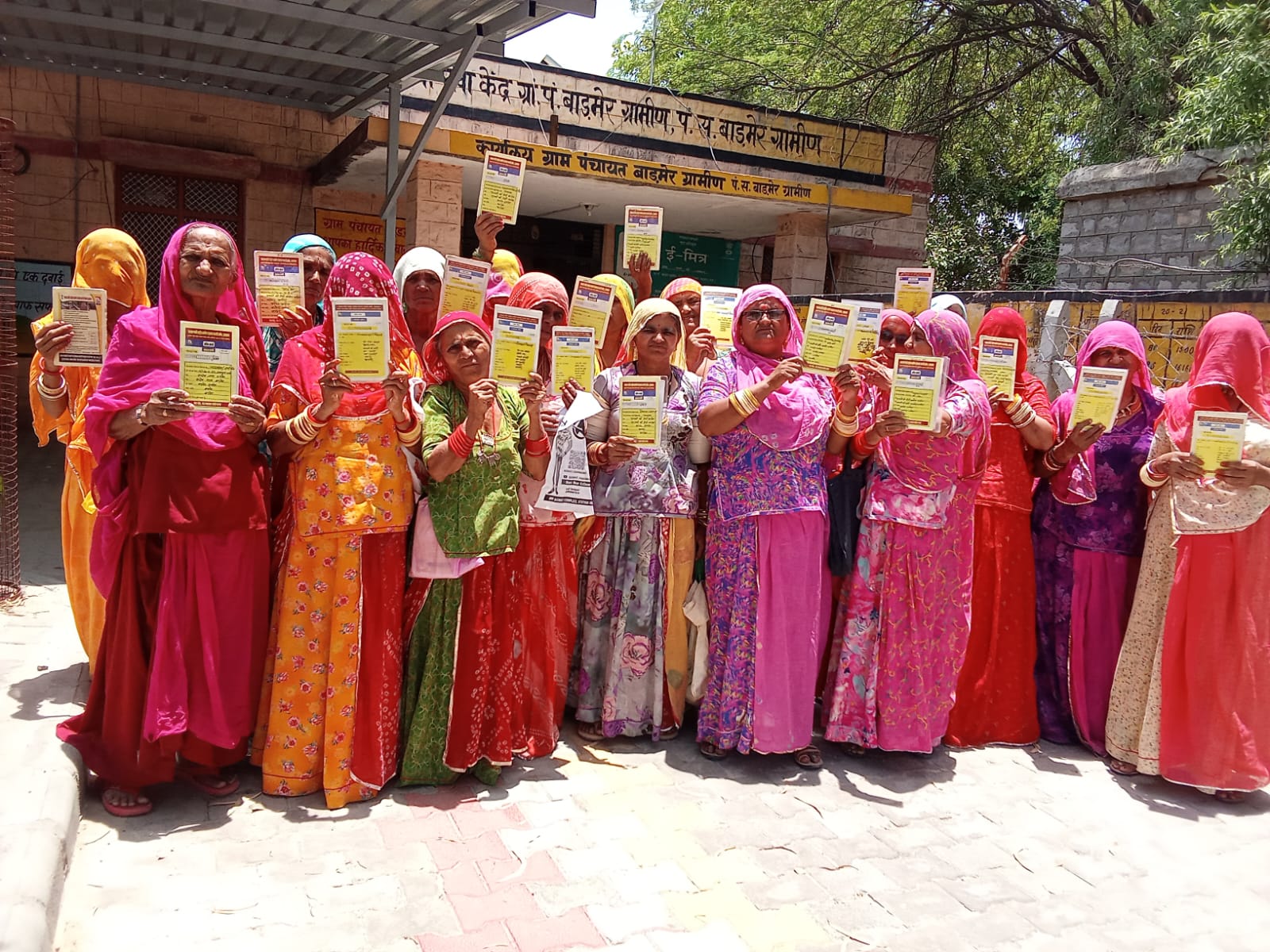
SRUTI, associated with several highly creative and useful initiatives for social justice and empowerment of communities through collective action, has recently completed four decades of its eventful existence. 

To coincide with entering its fifth decade, SRUTI (Society for Rural, Urban and Tribal Initiative) organized an event appropriately called ‘Journeys of Hope and Change’ on March 30 in Delhi which brought together an amazing gathering of social activists from many parts of the country, as well as artists, musicians, writers and others, all linked with similar concerns of social justice and empowerment of communities with special emphasis on weaker sections.    

SRUTI has been supporting social justice initiatives mainly through its flagship fellowship program which is committed to “empowering marginalized people lead a dignified life with access to livelihoods, resources, rights and justice.”

SRUTI fellows (or sathis) work on a wide range of issues—food security, education, livelihoods, labor and land rights– and involve organization of communities, perspective and capacity building, documentation and other initiatives including outreach for getting wider support for various social justice issues and initiatives. These various activities aim to result in collective social action that is based on community needs and community understanding of problems and their solutions. Over the years this approach has proved effective in getting much better results than any top-own efforts can hope to achieve. 

SRUTI Fellows have also been contributing to strengthening and reform of decentralized democratic governance including important aspects of panchayati raj institutions with special emphasis on gram sabhas and ward sabhas.

SRUTI carries with it the strength of three generations of Fellows working on these important issues. At present it supports 37 Fellow groups across 15 states. The current reach of SRUTI Fellows is over 7300 villages and 250 urban clusters covering about 3.4 million people.

Apart from establishing links with institutional donors, SRUTI has also explored innovating fund raising ideas to support its work—ranging from working with youth in colleges and schools to even asking people to donate in the form of their scrap. People are contacted to collect their scrap at a mutually convenient time, and even receipts are issued for this. By utilizing this scrap in creative ways, the cause of waste recycling is promoted and at the same time the earnings are used to promote such causes as education in remote villages, helping the poor to secure better access to government schemes and promote justice and rights for various vulnerable communities. Creative and careful use of scrap has led to the raising of nearly 25 million rupees so far for such worthy causes.

.

.

In keeping with such inspiring creativity of SRUTI’s work, the celebration of its 40 years organized in Delhi also had much to offer to those looking for thoughtful learnings for creating a better world. The highlight of the event was an exhibition on the work of various SRUTI Fellows present and past. Here one could learn a lot about several important struggles and initiatives for justice, reform and empowerment of communities. Some issues that were highlighted more included efforts for education reform and for alternative education, issues relating to most marginalized and neglected sections of workers including migrant workers, people’s access to land, forests and water sources (Jal, Jangal, Jameen). 

It was particularly thoughtful on the part of organizers to have a small section also on those Fellows who have passed away in recent years, among whom I could find the names of some of my friends too.

Apart from telling us about the work of SRUTI Fellows, this exhibition also had important educational material on the wider heritage of struggles for justice and social reform in India.

Thus the archive material exhibited here has a wider educational role, even though some of this important material was lost earlier in Delhi floods.

In addition to the exhibition of course this celebration had its share of captivating music, songs and other performances, not to forget the exhibitions of organic food, artisan products and crafts.

The Delhi celebration was preceded by smaller events in Bhopal, Lucknow, Ooty and Ranchi.

*

Click the share button below to email/forward this article. Follow us on Instagram and X and subscribe to our Telegram Channel. Feel free to repost Global Research articles with proper attribution. 

Bharat Dogra is Honorary Convener, Campaign to Save Earth Now. His recent books include Man over Machine—A Path to Peace, Planet in Peril, Protecting Earth for Children and A Day in 2071. He is a regular contributor to Asia-Pacific Research.

All images in this article are from the author


Global Research is a reader-funded media. We do not accept any funding from corporations or governments. Help us stay afloat. Click the image below to make a one-time or recurring donation.
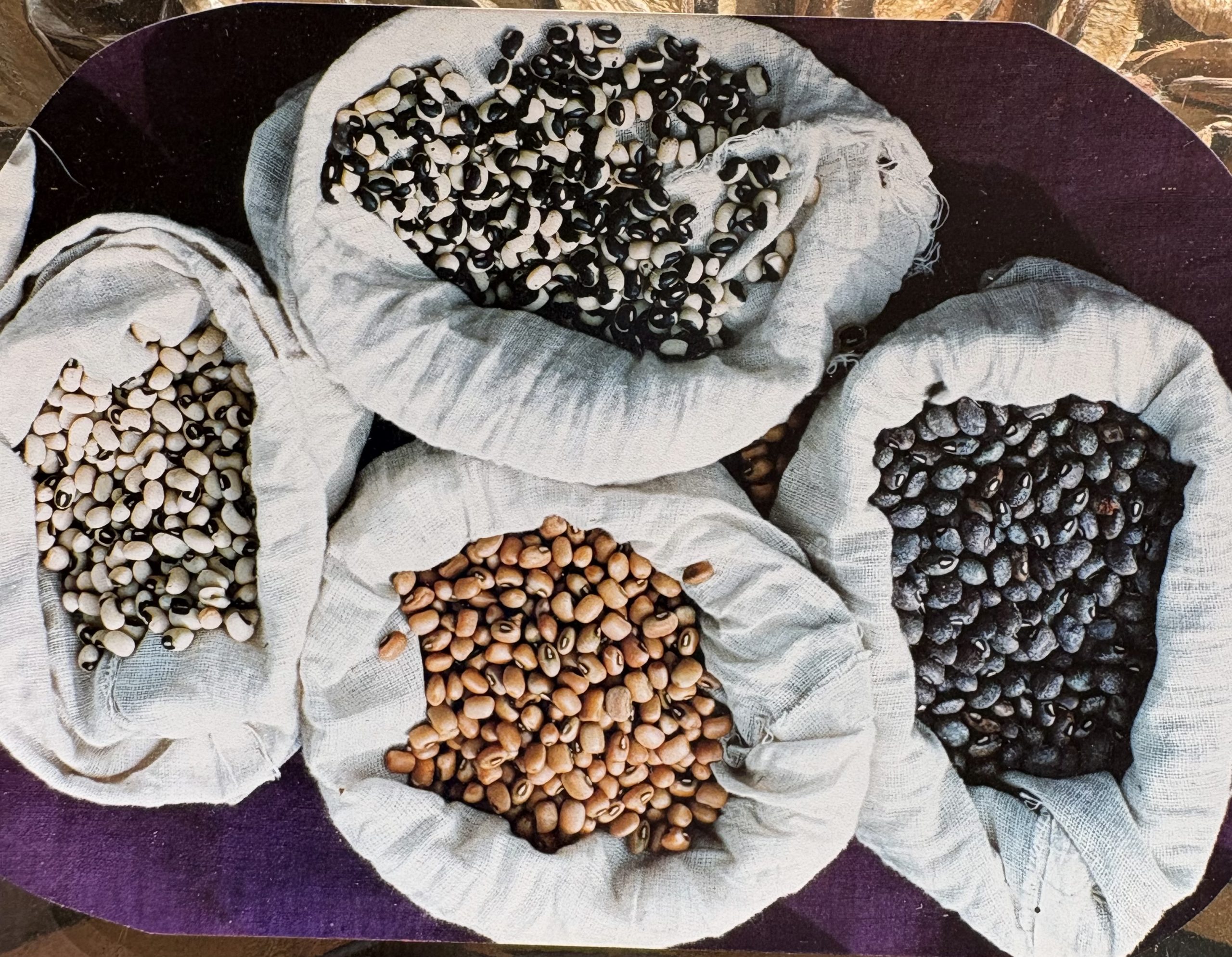
  • Posted in Mobile
  • Comments Off on SRUTI: Celebrating 40 Years of Support for Initiatives of Social Justice and Change in India
  • Tags: ,

Kindly consider these three facts, also try to imagine the real life situations based on these:

  • At the age of 26 a youth from the poorest landless community took upon himself the impossible looking task of breaking a huge mountain to the extent of carving out a life-saving path that thousands of villagers needed urgently.
  • He toiled tirelessly for 22 years, yes 22 (1960-82), no less, and finally succeeded in his objective.
  • Acclaim followed, but instead of just basking in glory he undertook an 800 km journey on foot to Delhi to mobilize efforts for resolving various problems of his village and nearby areas.

This brief summary of the work of Dashrath Manjhi, also called the Mountain Man, may give an indication of his deep determination and social commitment which won admiration at the highest levels in India, but by itself this does not do full justice to the nobility of his ideas and life, as this writer discovered during a recent visit to his village and work-area in Gaya district of Bihar.

I located elderly persons who had known him and seen him at work, and the picture that emerged from these discussions is that he was a follower of Sant Kabir, the bhakti movement’s famous poet-saint of medieval times, who has remained one of the strongest and most revered voices since then of spirituality based on justice, truth, non-violence, being helpful to others and leading a simple and pious life free from all hypocrisy and falsehoods. Sant Kabir remained true to his principles, convictions and truth in the middle of many difficulties, attacks and threats. His poetry and teachings inspire his followers to continue their noble work even in the middle of other people discouraging or even ridiculing them, and to maintain the steadfastness and continuity of their work and mission in the middle of all the ups and downs.

All this this can be seen in the life and work of Dashrath Manjhi. Born in 1934, he lived in Gehlaur village of Mohra block. As Satyanarain, who had known Dashrath well, told me

“Dashrath was very polite to others but at times when needed he could tell some bitter truths of life without being rude.”

People from manjhi community, when I spoke to them, said that whenever they went to mountains they found him at work just carrying some sattu in his jhola (bag), a legume-based powder which could give some energy and coolness when taken mixed with water, something he would have really needed while working in the mountains here which can become very hot in the summer.

.

.

In 1960 Dashrath had gone to work on the mountain and his wife Phalguni Devi injured herself badly while carrying food and water for him. Looking at her injuries, he took a pledge to create a path in the mountain that may become a life-saver for many people. This would give a safe path to everyone going to the other side, and in addition would bring much closer the health, educational and other facilities of the nearest town to the people on this side of the mountain (the distance could come down from about 55 km to just about 15 km or so).

Contrary to some publicized accounts, several villagers told me that Phalguni Devi did not die from these injuries but instead continued to be very helpful to her husband and the pledge he had taken. She died some years later.

Using the simplest tools like hammer and chisel, Dashrath embarked on his great journey that was to be completed in 22 years. Initially people ridiculed him and some even called him ‘mad’ to take up such a huge task and to work so devotedly for this. Undaunted, Dashrath continued this work regularly on a daily basis.

Here we must not forget that he came from the poorest community, called mahadalit in Bihar, and had to also earn his livelihood to support his four-member family (which included a son and a daughter). 

Initially most villagers had ridiculed or neglected Dashrath, but once his work of a few years started showing some signs of leading to success, some villagers also started lending a helping hand now and then.

Finally in 1982 Dashrath succeeded in creating a path which was wide enough for a bullock-cart to pass. Later the government helped to widen this and build a proper road.

Dashrath now decided to go and meet big government officials in Delhi to take up several development works much needed by his village and neighboring communities. Education and health were emphasized by him.

However as he could not buy a rail ticket he was asked to get down from the train after covering a short distance. He now decided to walk to Delhi along the railway track, hoping that this would perhaps draw even more attention to his objectives of promoting development work in his village and neighboring villages.

An elderly farmer of a neighboring village told me that Dashrath had managed to meet the then Prime Minister Mrs. Indira Gandhi and had shared with him a press clipping of this.

Later Dashrath also went to meet the Chief Minister of Bihar Mr. Nitish Kumar who gave him a lot of respect.

However at the time of his increasing fame, Dashrath retained his simplicity. A local teacher Virendra Paswan told me that when he was in a train word spread that Dashrath Manjhi is in the same coach and there was a rush of people just to catch a glimpse of Dashrath. However, Paswan said, even at that time Dashrath was wearing dress made from a jute sack, as he often did earlier too.

In 2007 Dashrath was admitted to AIIMS hospital in Delhi where he breathed his last on August 17. A memorial as well as gates were constructed in his village in his honor.

At the same time, however, the people of the Manjhi community and other landless and poorest dalit community members continue to live in this village in great poverty and several of them told me that even their housing situation is precarious. The government needs to do much more to help them with a sense of urgency. 

Meanwhile the SBI Foundation has taken up an admirable initiative called SAMMAAN with implementation assistance of Sahbhagi Shikshan Kendra to honor the memory of Dashrath Manjhi in the form of many-sided efforts in his village to improve education, health, infrastructure and livelihoods that have been widely appreciated here.  

*

Click the share button below to email/forward this article. Follow us on Instagram and X and subscribe to our Telegram Channel. Feel free to repost Global Research articles with proper attribution.

Bharat Dogra is Honorary Convener, Campaign to Save Earth Now. His recent books include Protecting Earth for Children, Planet in Peril, Man over Machine and A Day in 2071. He is a regular contributor to Asia-Pacific Research.

All images in this article are from the author


Global Research is a reader-funded media. We do not accept any funding from corporations or governments. Help us stay afloat. Click the image below to make a one-time or recurring donation.
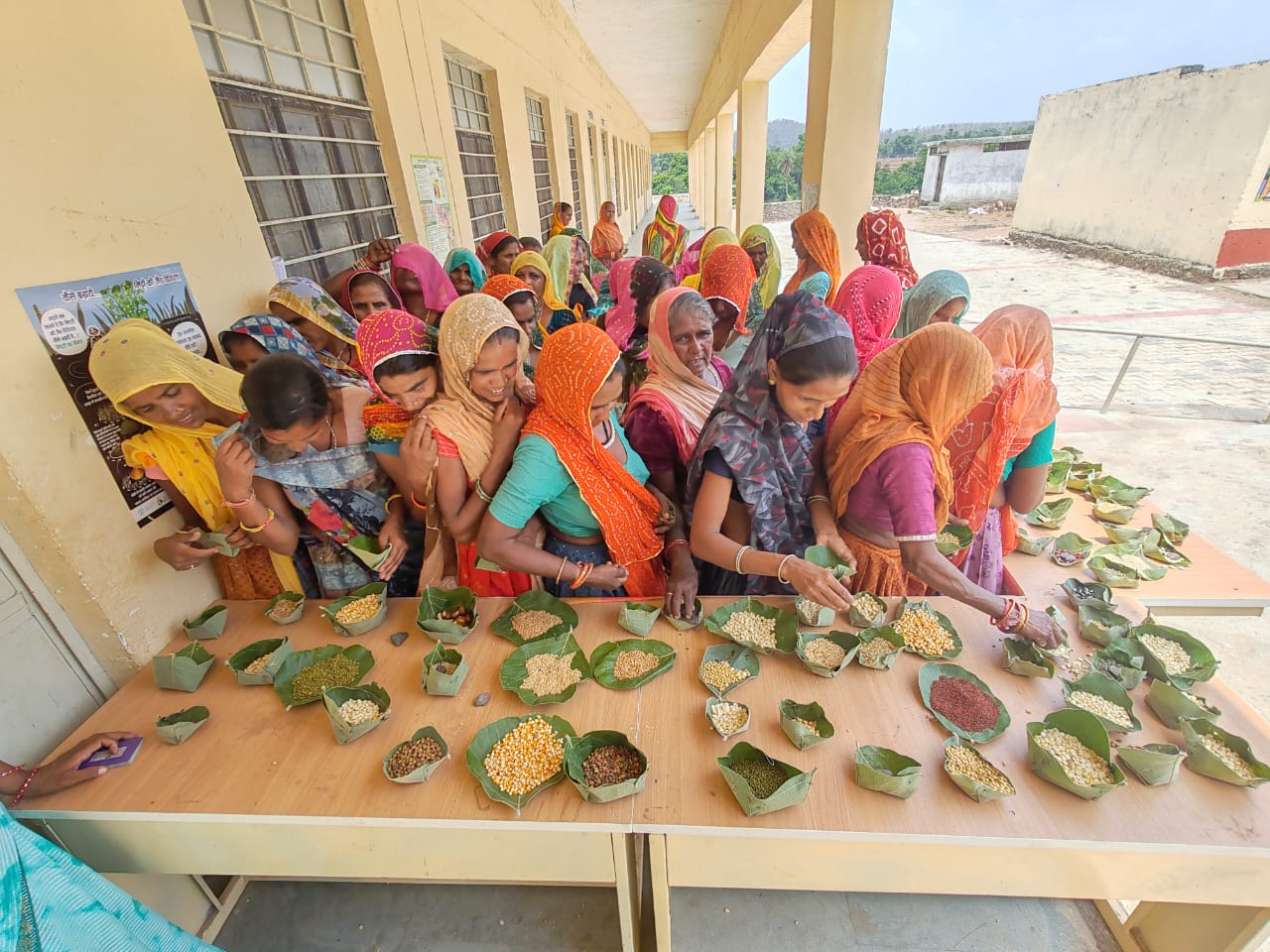
Hegseth’s Visit to the Philippines Meant to Advance US War Agenda in the Indo-Pacific

March 25th, 2025 by National Democratic Front of the Philippines

The upcoming visit of newly appointed US Defense Secretary Pete Hegseth to the Philippines on March 28-29 undeniably exposes Marcos Jr. as the preferred puppet of US imperialism in advancing its Indo-Pacific Strategy. Hegseth’s visit is not a benign gesture – it is a calculated move in Washington’s ongoing campaign to contain and provoke China, setting the stage for an inevitable escalation of conflict that will drag the Philippines into a war that ultimately serves US interests. Notably, the US chose to begin its Indo-Pacific tour in the Philippines – skipping the customary visit to South Korea – which clearly signals the Trump administration’s plans to continue the same warmongering policy of his predecessors against China.

This visit is part of an expansive military agenda that includes the resumption of the Balikatan exercises on April 21 – May 9 this year. The Balikatan exercises 2025 are scheduled to take place in key strategic locations: Northern Luzon, territories nearest to Taiwan, and the West Philippine Sea, where longstanding maritime tensions with China have persisted. Additional exercises are set to take place in Bulacan, Zambales and in Nueva Ecija. By staging these operations in strategic areas, Washington intends to send a provocative signal to Beijing, further escalating tensions.

Just days ahead of the US Defense secretary’s visit, the Philippine and US militaries launched joint military exercises with 5,000 troops laying bare the aggressive nature of Hegseth’s agenda. This weeks-long operation serves as an opening salvo to the Balikatan exercises. Contrary to US claims, these military drills are not about safeguarding the Philippines’ territorial integrity, but about advancing US warfighting capabilities and establishing a permanent military foothold in the Indo-Pacific. Hegseth’s itinerary also includes meetings with his counterpart Gilberto Teodoro in Manila, and visits to treaty ally Japan.

This year’s Balikatan exercises will see the participation of 10,000 US troops alongside 6,000 soldiers from the Philippines, Australia, and Japan, with additional forces from Canada, France, South Korea, and the United Kingdom. While the overall troop count is slightly lower compared to the 17,600 seen in 2023, the focus of the drills this year has shifted towards showcasing greater military firepower. The Philippine Air Force is set to deploy its recently acquired Spyder mobile air defense systems from Israel, while the Philippine Navy is slated to test an array of advanced munitions—including the Rafael Spike NLOS, South Korean C-Star surface-to-surface missiles, and French-made Mistral 3 surface-to-air systems—in a full battle test that features live-fire missile trials and the deliberate sinking of a decommissioned World War II vessel.

Hegseth’s visit also seeks to push for the “modernization” of the Armed Forces of the Philippines. In reality, this is part of a broader strategy to transform the AFP into an auxiliary force of the US military in the event of an all-out war with China. While the maritime dispute with China remains fundamentally a territorial and resource issue, it pales in comparison to the pervasive US control over Philippine economy, culture, politics and military which poses a far more insidious threat. Hegseth’s plans to deepen security ties with the Philippine reactionary government not only further entrenches US control over the country’s defense but also further implicates the US in Marcos Jr.’s ongoing war crimes, including indiscriminate bombings and military attacks on civilian communities under the guise of “counterinsurgency” operations.

The NDFP stands with the Filipino people in opposing Hegseth’s visit and against the continued subjugation of the Philippines to US military interests.  Allowing US troops to conduct military operations disguised as training on Philippine soil is unacceptable. Amidst these war exercises, revolutionary forces will continue to defend civilian communities affected by these military operations.  We call for the rejection of all US military agreements, the removal of foreign troops and bases, and an end to the use of the country as a pawn in a brewing inter-imperialist war.

*

Click the share button below to email/forward this article. Follow us on Instagram and X and subscribe to our Telegram Channel. Feel free to repost Global Research articles with proper attribution.

Featured image: Army Vice Commander Maj. Gen. Leodevic B. Guinid discusses activities for SABAK 2025 with 25th ID Deputy Commander USARPAC Brig. Gen. Jonathan A Velishka and U.S. Army counterparts during the joint opening ceremony of SABAK 2025 at Fort Magsaysay, Nueva Ecija on March 24, 2025.


Global Research is a reader-funded media. We do not accept any funding from corporations or governments. Help us stay afloat. Click the image below to make a one-time or recurring donation.

The Cake: Australia’s Birth Certificate Bond

March 25th, 2025 by Jeff Witzeman

I had the good fortune last week to sit in with a Common Law group in Australia called The People’s Lore of Terra Australis. They wanted to hear what I was doing in the States and share with me what they were learning in Australia. I was impressed to find that they have made some inroads down under that we had not made here and that quite possibly they are making some breakthroughs that are going to affect all countries touched by the Commonwealth or Crown of England.

The smoke and mirrors for the Commonwealth countries is this fictitious corporate entity that claims to have any authority with a made up fictional law of the sea over people they have contracted with in secret by virtue of the Birth Certificate being used to squeeze the living man or woman into a commodity that can be sold and traded. The good folks in Australia claim to be making progress on exposing the fraud that has been committed by virtue of pulling back the curtain on who is actually working the levers, very similar to Toto exposing the Wizard of Oz.

A gentleman named Uluki (beginning at 30 minutes in, watch below) shares that as early as this week evidence will come out as to who the Crown of England really is vs. the Agents who have been acting under the Corporation and that through this exposure the Birth Certificate Bond is going to be revealed as well as the fictional law that defends it. There will then be two laws in effect with Common Law actually making a return to the courtroom where people will have the option to operate in either Common or Maritime Law (Common Law winning out eventually). But the difference here is that anybody who knows Common Law will be able to challenge the judge to find out who he is serving thereby forcing a remedy. The Common Law man or woman will be able to identify in a way that indicates they are not part of the corporate fiction. The Birth Certificate Bond will start to be disseminated in the form of forgiveness of loans and credit. To that end, a gentleman with the Terra Australis group by the name of Alex who has made numerous documentary films on the Pyramids of Giza, shared with me the paperwork they have created to establish themselves as Executor of their Estate, a power they claim is more powerful than Secured Party Creditor because it doesn’t just state a claim within the UCC commercial law structure, but goes beyond that to then force anyone in the corporate structure who is acting as Trustees for the Birth Certificate Trust to perform their duties.

The rub has always been enforcement…as in how do you get the criminals to enforce the real law that exists outside of their fictional structure. And when asked this question regarding the curtain that is going to be pulled back this week, Uluki said that the enforcement mechanism was a secret. And I do appreciate his saving that bit of information until it has been performed.

As many of you know, my experience is that we get enforcement from the IRS. They have the ultimate power because they can instantly expose the fraud of anyone taking money from the Birth Certificate account and not paying taxes on it. Once you find this lynchpin the whole house of cards comes tumbling down. That’s why I actually hold optimism for Uluki and his band of warriors that are peacefully undermining the system because the reality of this universe is that nobody gets away with anything. The only thing we have lacked is the consciousness to be able to see the lynchpin that is keeping the fraud alive.

This has been going on for quite a while by the way, all behind the scenes, in secret from multiple angles with the Australians not being the only warriors. Trump has even said cryptically that we should get this whole thing resolved by Easter and what he is referencing in my understanding is this exposure that starts the process of a financial re-arrangement as well as a shift in law application. And because 90% of the world has no clue on how to assert their rights, there is a good chance that the old system will continue to operate in some form, while a new system will slowly take shape.

So now you begin to realize that the icing on the cake is getting money back from our birth certificate trust account. The cake is the ability to get out of the fiction and into the truth. The cake is the ability to tell Satan to go to hell. The cake is the ability to expose any demon in the moment and say I’m onto you and now you must perform the duties that the universe demands you perform. In the case of our interactions with banks and the government, it’s the ability to say you are the trustees I am the beneficiary, start doing your job. This requires a shift in understanding who we are and how to align ourselves so we can create heaven on earth at will.

I got a great call this week from a friend who is using The American State Assembly to inform him on how to address his child custody case that was incorrectly ruled in his ex wife’s favor. My friend is doing all his work in court himself, not represented by an attorney and going through the steps to call out the fraud and force the judges hand thereby getting custody back of his daughter. But maybe the most interesting part of the conversation was him corroborating evidence by virtue of his residence in Nevada, that Las Vegas has been quietly closing their casinos, providing more evidence that the great financial reset may happen as early as this week or next.

I know, it sounds crazy, but there you have it…we really are making a massive shift in the way planet earth operates, all being led by consciousness and exposing the lies. We don’t have to be perfect or know everything or be “Executor of our Trust” yet. We just have to be on the path and learning more every day. Because there is no way to understand or grasp all of this in one sitting. And we’ve got the rest of our lives to get this right. This is the shift in paradigm that counts…not finding a political party, not fulfilling the American Dream, not accomplishing an agenda…but establishing ourselves as the connected souls we are, transcending the 3D trap.

My wife appeared in my friend’s dream the other day, can you believe it? She told him specifically to tell me that I’m doing great and that everything is going to be OK.

Hilarious.

I’m going with that one for now since it came from the other side of the spiritual realm.

Song of the Week: Help Me Begin by Chris Trapper.

*

Click the share button below to email/forward this article. Follow us on Instagram and X and subscribe to our Telegram Channel. Feel free to repost Global Research articles with proper attribution.

Jeff Witzeman is an award winning filmmaker, musician, speaker and writer.

Featured image source


Global Research is a reader-funded media. We do not accept any funding from corporations or governments. Help us stay afloat. Click the image below to make a one-time or recurring donation.

Recently when I was speaking to a group of socially active women from remote villages in Niwari district (Madhya Pradesh) regarding the need for a campaign to reduce consumption of liquor and in fact all intoxicants, one of the women got up to say—We are fully supportive for such a campaign which is really needed, but in addition you should also include in this campaign the urgency of checking mobile phone gambling which is really ruining the life of our children.

This lady immediately got strong support of other women present at the meeting who were so taken up by the new issue that for some time they forgot about the original discussion and started sharing their experiences regarding the highly disruptive and destructive impact of online gambling in their hamlets or even in their families, with children and adolescents being badly affected in particular.

One woman said that she was so fed up with the online gambling addiction of her son that one day in desperation she even threw and broke the mobile phone he was using, but still the addiction of the boy has not gone away entirely, she said. Another woman related how a boy stole money from his own parents to gamble and this led to a crisis situation in the family.

Women related that children and adolescents who take up gambling become very stressed due to the money they lose, online abuse they suffer at times and due to the necessity they feel of hiding all this from their family members. They also become very irritable and get into heated arguments with their near and dear ones all the time. They may even be driven towards situations of even greater desperation without realization among family members regarding what really is causing this. This situation can thus result ultimately in violence and self-violence.

These women were very unhappy that familiar games like cricket and ludo are being converted into means of gambling. Others stated that in some games at the starting point there may be no element of gambling, but once a child has been initiated at a certain stage the gambling element is introduced. Some women added that even if the element of gambling is not there and a game is very stressful and violent, this should be checked as this also can cause a lot of mental stress and imbalance. Others drew attention to the increasing use of mobile phones for accessing various kinds of pornography and expressed the apprehension that this can lead to increase of sexual violence even in remote villages.

Coming back to gambling, however, the apprehensions expressed by these women are supported by studies and expert opinion. A report by the Digital India Foundation revealed recently that digital platforms recorded 1.6 billion (1600 million or 160 crore) visits in just three months across four major websites (reported in The Times of India March 15, report titled ‘India sees explosive rise in online gambling’). 

The Diplomat reported last year that India’s online gambling market is estimated to have about 12 million users and it is rapidly growing.

The report by Digital India Foundation has stated, “Despite repeated government actions, including website blocking and advisories, illegal operators continue to thrive, leveraging advanced digital marketing tactics, seamless payment processing and mirror websites to evade enforcement.”

A study by Richard Armitage published in The Lancet and titled ‘Gambling among Adolescents—An Emerging Public Health Problem’ has concluded that problem gambling in the early years of life is likely to be profoundly detrimental to the mental, emotional and social health of children, to negatively impact on development and school performance, and to increase the risk of acquiring other addictions.  These consequences may extend well beyond childhood and cause adverse health, social and economic impacts in adult life, this study has stated.

Keeping in view all these factors, clearly there is a strong case for effective steps at several levels to check the highly harmful and disruptive impacts of online gambling, which are now spreading even in remote rural communities and ruining the life of several children and adolescents in particular.

*

Click the share button below to email/forward this article. Follow us on Instagram and X and subscribe to our Telegram Channel. Feel free to repost Global Research articles with proper attribution.

Bharat Dogra is Honorary Convener, Campaign to Save Earth Now. His recent books include Protecting Earth for Children, Man over Machine, A Day in 2071 and When the Two Streams Met. He is a regular contributor to Asia-Pacific Research.

Featured image is from HeadSpin Flickr


Global Research is a reader-funded media. We do not accept any funding from corporations or governments. Help us stay afloat. Click the image below to make a one-time or recurring donation.

Former Philippine President Rodrigo Duterte is now facing the most serious legal battle of his life, detained in The Hague after being arrested by Interpol in the Philippines on the basis of an arrest warrant issued by the International Criminal Court (ICC). While his supporters, particularly the Diehard Duterte Supporters (DDS), see this as an unjust persecution, the reality is far more complex than mere political allegiance. The impending trial presents both formidable legal challenges and an international reckoning with justice.

The Legal Defense: Atty. Nicholas Kaufman

Duterte’s legal team has secured the expertise of internationally renowned attorney Nicholas Kaufman, a seasoned lawyer with extensive experience in international criminal law. Kaufman’s initial legal strategy appears to focus on questioning the legality of Duterte’s arrest, a move that aims to weaken the ICC’s jurisdiction over the case. However, in the grand scheme of things, this argument may be inconsequential, as the primary charge Duterte faces is CRIME AGAINST HUMANITY.

Kaufman, being a highly competent legal counsel, is well aware of the legal principle of male captus, bene detentus—which essentially means that even if an individual is unlawfully captured, they can still be lawfully tried. This doctrine has been upheld in numerous international cases, which suggests that his challenge to the arrest’s legality may not hold much weight in the final proceedings.

The Other Side: A Formidable Prosecution Team

While Duterte has a distinguished lawyer on his side, the prosecution is equally, if not more, formidable. The ICC has assembled a panel of at least three seasoned international prosecutors, each with extensive experience in handling crimes against humanity cases. Their focus is on presenting irrefutable evidence, including testimonies from victims and documented human rights violations under Duterte’s infamous war on drugs.

This legal battle is not merely about technicalities or political narratives—it is about justice for thousands of extrajudicial killings and alleged human rights abuses. The prosecution’s case is likely to be robust, relying on years of investigative work and testimonies that paint a grim picture of Duterte’s presidency. The trial will test not only the resilience of Duterte’s defense team but also the international community’s commitment to accountability.

A Tough Road Ahead for Duterte

For Duterte and his supporters, the road ahead will not be easy. While many in the Philippines view him as a strongman who effectively tackled crime and drugs, the ICC sees a leader accused of orchestrating widespread human rights violations. The international community’s stance on crimes against humanity has historically been unwavering, and past trials of leaders accused of similar offenses suggest that Duterte’s case will be a hard-fought battle with serious consequences.

At the end of the day, Atty. Kaufman will have to face the reality that legal maneuvering alone may not be enough to shield Duterte from the weight of international justice. While his expertise is invaluable, history has often favored justice over technical legal defenses. Duterte’s trial is set to be a landmark case, and there is a strong possibility that his name will be etched into history—not as a nationalist hero, but as a leader held accountable for his actions.

In the final analysis, it is not just about which legal team is more skilled; it is about whether the ICC’s pursuit of justice will prevail over political narratives. Duterte’s fate now rests in the hands of an international court that has been established precisely to deal with cases like his. The world is watching, and the outcome of this case will undoubtedly shape global conversations on justice and human rights for years to come.

*

Click the share button below to email/forward this article. Follow us on Instagram and X and subscribe to our Telegram Channel. Feel free to repost Global Research articles with proper attribution.

Prof. Ruel F. Pepa is a Filipino philosopher based in Madrid, Spain. A retired academic (Associate Professor IV), he taught Philosophy and Social Sciences for more than fifteen years at Trinity University of Asia, an Anglican university in the Philippines. He is a regular contributor to Global Research.


Global Research is a reader-funded media. We do not accept any funding from corporations or governments. Help us stay afloat. Click the image below to make a one-time or recurring donation.

The influencer might be defined as a modern, junked cretin of arrested moral and ethical capacity – with specific skills.  Such an individual, for instance, is often able to use technological platforms with aptitude for two mundane purposes: to manipulate the gullible and rake in the cash.  The essence of this effort lies in the technology.  Drone drumming feeds, instant imaging, updates on the guff and drivel of a visit (probably false) to some venue or location, a product’s claimed merits (almost certainly false) and some scientific proposition (absolutely false).

Sam Jones, who claims to be such an influencer, and a wildlife biologist and environmental scientist to boot, thought it wise to pick up a young wombat, thereby separating it from its distressed mother.  The whole episode was, unnaturally, filmed.  Even for someone of Jones’s sparse intellect, she at least observed the following: “Momma’s right there and she’s pissed.  Let’s let him go.”  She makes some effort to beef up her credibility by claiming the following: “I ran, not to rip the joey away from its mother, but from fear that she might attack me.”  At the end of the now deleted video, she claims that she did reunite the mother and joey, though did so by essentially making them potential roadkill victims. 

Her account remains inconsistent and contradictory, something not helped by her record of images on Instagram displaying an evident, bloodthirsty delight for the hunt.  Carcasses of slain animals feature, suggesting a desire to accumulate trophies rather than promoting any keen environmental interest.  Jones remains, in that sense, rather traditional: the exotic, the bizarre or the dangerous shall be killed, snapped by camera or just teased for social media purposes.  There is no evident awareness about the cruelty inherent in these measures.

The response to Jones in Australia proved heated.  A petition seeking deportation was launched, receiving over 40,000 signatures.  The Wombat Protection Society expressed shock at the “mishandling of a wombat joey in an apparent snatch for ‘social media likes’.” 

Even the Prime Minister, Anthony Albanese, thought it worth mentioning.  “It’s a shocker.  You know, a wombat is a slow moving, peaceful animal, and to take a baby wombat from its mum was distressing, quite clearly,” he spoke in a radio interview.  He also claimed to have found the video “really distressing”, wondering “what the hell this woman thought she was doing.”  Jones herself claims to have been threatened by “thousands” of the irate.

A number of academics from Australian universities tell us, in tepid language via The Conversation, that this sort of behaviour is becoming ever more frequent. 

“Unfortunately,” they lament, “we are seeing a rise in people directly interacting with wildlife through feeding them or taking risks to get close to them, often driven by the pursuit of social media attention.  These interactions can hurt wildlife in many different ways.” 

They also note that Jones was fortunate not to receive injuries, given that wombats can “weigh up to 40 kilograms and have teeth and claws they can use for defence.”  Furthermore, she might (here, the delight is barely concealed) have gotten scabies, given the mange many wombats have caused by the relevant parasitic mite.

The incident does give us some room for pause.  Mighty moralism about Australia’s treatment of animals is certainly something to question from the start.  Foamy indignation at the behaviour of a visitor offers mighty distraction given Australia’s less than comfortable relationship with its various species.  Jones herself alludes to this by pointing out the “treatment of its native wildlife”, which includes the expenditure of “millions of your tax dollars to mass slaughter native Australian animals, as well as Snowy River and Kosciuszko brumbies, wild pigs and numerous deer species.”

Peter Singer, the noted Australian bioethicist and author of the seminal tract Animal Liberation, feels that Jones is on some sensible ground.  He takes particular issue with harvesting kangaroos for commercial profit and reducing their numbers as competitors for pasture.  He also notes, however, that the destruction of wombats remains less widespread, while also grudgingly conceding that culling pest species that pose a threat to native habitats and wildlife may be necessary. 

Jones could also count on partial agreement from Tania Clancy of Wombatised, a volunteer wildlife rescue and rehabilitation group. “Thousands [of wombats] each year are shot, poisoned to suffer, and trapped legally,” she notes.  “Landowners rip up wombat burrows with heavy machinery, poison them with fumigation and shoot them whenever they can.”

For a continent that tops the league table of species extinction, indignation at such acts of stupidity and exploitation requires some cooling.  The animals of Australia are superficially revered for their singular qualities but their treatment by the human populace has been less than admirable.  Be it debatable culling practices, expansive land clearing, the ongoing and insatiable hunger for exporting commodities and the unshakeable power of the mining industry in politics, Mother Nature Down Under has been, and continues to be roughed and violated. 

The current federal government also demonstrated an almost head-high contempt in abandoning the creation of an Environmental Protection Agency, something that arose, in large part, from state premiers worried about a puncture in mining profits.  Besides, animal species don’t tend to go to the ballot box.

At the very least, the insufferable, trophy craving simpleton who took that wombat joey from its mother for sporting shots brought some attention to the fraught relationship between humans and Australia’s beleaguered animal species.    

*

Click the share button below to email/forward this article. Follow us on Instagram and X and subscribe to our Telegram Channel. Feel free to repost Global Research articles with proper attribution.

Dr. Binoy Kampmark was a Commonwealth Scholar at Selwyn College, Cambridge.  He currently lectures at RMIT University.  He is a Research Associate of the Centre for Research on Globalization (CRG). Email: [email protected]

Featured image: Sam Jones with the baby wombat. The US influencer flew out of Australia on Friday morning. Photograph: samstrays_somewhere/Instagram


Global Research is a reader-funded media. We do not accept any funding from corporations or governments. Help us stay afloat. Click the image below to make a one-time or recurring donation.

The recent arrest of former Philippine President Rodrigo Duterte, executed under a warrant issued by the International Criminal Court (ICC) and facilitated by the International Criminal Police Organization (Interpol), has ignited significant political unrest in the Philippines.[1] Duterte, known for his hardline stance on drugs during his presidency from 2016 to 2022, faces charges of crimes against humanity related to his administration’s controversial anti-drug campaign.

The Arrest and Its Immediate Aftermath

On March 11, 2025, Duterte was apprehended at Manila’s Ninoy Aquino International Airport upon returning from Hong Kong. The arrest was carried out by Philippine authorities in coordination with Interpol, acting on the ICC’s warrant. Subsequently, Duterte was extradited to The Hague, The Netherlands, to face the charges levied against him.[2]

Public Reaction and the Rise of a ‘Martyr’ Narrative

The arrest has polarized public opinion in the Philippines. Duterte’s ardent supporters, collectively known as Duterte Diehard Supporters (DDS), have taken to the streets in mass rallies and demonstrations.[3] They accuse the current administration of President Ferdinand Marcos Jr. of complicity in Duterte’s arrest, alleging political persecution. The DDS, who have historically portrayed Duterte as a morally impeccable leader, now depict him as a victim of injustice, potentially elevating him to a martyr-like status.

Criticism of Duterte’s Supporters

Critics argue that the DDS have consistently overlooked the darker aspects of Duterte’s presidency, particularly the thousands of extrajudicial killings targeting alleged drug users and dealers under the government’s Oplan Tokhang initiative.[4] Human rights organizations have long condemned these actions, citing a blatant disregard for due process and the rule of law.

Religious Undertones in the Protests

In a twist of irony, many DDS members are now invoking religious sentiments in their protests, fervently praying for Duterte’s release. This is notable given Duterte’s previous controversial remarks about religious institutions during his tenure.

Implications for the Marcos Administration

The unrest poses a significant challenge for President Marcos Jr.’s administration. Balancing the enforcement of international law with maintaining domestic stability is proving to be a delicate task. The administration faces criticism from both domestic and international observers, with some accusing it of undermining national sovereignty by cooperating with the ICC, while others commend its commitment to accountability and justice.

Looking Ahead

As Duterte awaits trial in The Hague, the Philippines stands at a crossroads. The situation underscores the deep divisions within Filipino society and raises questions about the country’s commitment to human rights and the rule of law. The outcome of this legal and political saga will undoubtedly have lasting implications for the nation’s future trajectory.

*

Click the share button below to email/forward this article. Follow us on Instagram and X and subscribe to our Telegram Channel. Feel free to repost Global Research articles with proper attribution.

Prof. Ruel F. Pepa is a Filipino philosopher based in Madrid, Spain. A retired academic (Associate Professor IV), he taught Philosophy and Social Sciences for more than fifteen years at Trinity University of Asia, an Anglican university in the Philippines. He is a regular contributor to Global Research.

Notes

[1] Philippines sends ex-President Duterte to ICC over ‘drugs war’ killings | Reuters

[2] Philippine’s ex-President Rodrigo Duterte arrested on ICC warrant | AP News

[3] Police fear protests as Rodrigo Duterte flown to Hague over drug killings

[4] Arrest of Former Philippines President Duterte Tests Divisive Legacy of War on Drugs – WSJ

Featured image: President Rodrigo Duterte presents a chart illustrating a drug trade network of high level drug syndicates in the Philippines during a press conference, July 7, 2016 (Public Domain)


Global Research is a reader-funded media. We do not accept any funding from corporations or governments. Help us stay afloat. Click the image below to make a one-time or recurring donation.

By pooling their savings on a regular basis every month self-help groups (SHGs) in many parts of India have improved their economic and social security. However such efforts, particularly of rural women, have been able to achieve more when they have combined this with wider initiatives for social reform. In Bali block of Pali district (Rajasthan) this combination of economic and social initiatives has given very encouraging results, as became evident in recent conversations with several members of these groups. Most of these women are from garasia tribal or adivasi community.

Various small SHGs here merged to create a village or panchayat level wider group, also called sankul group, while many sankul groups merge to form a federation, named Ghoomar Mahila Samiti. This federation has about 5,000 members in 32 villages in Pali and Udaipur districts. 

At another level there are several women producer groups involved in collection and processing of minor forest produce and these also have got together to form a producer company Ghoomar Mahila Producer Company. In Gordhanpur village members of several SHG members belonging to Warliya Mahadev sankul group were holding their monthly meeting. Sanibai said—earlier we had to borrow at a high interest from private moneylenders where we also had to pledge our ornaments and sometimes even land. Now due to savings our groups make this dependence on private moneylenders has been replaced by a confidence that we can get a loan on much easier terms whenever we have such a need.

Others explained that initially the rich moneylenders had opposed such attempts of group formation, but when they were told that all their land grab and exploitative practices will be exposed, they stopped opposing the groups.

.

.

Now members of groups not only avoid pledging their land or ornaments and pay a much lower interest, in addition whatever interest they pay remains within their group, in a sense adding to their own economic strength and savings. The corpus fund of this particular group of Warlia has gradually grown to Rs. 1.2 million. In addition the group has linkages with banks so that its capacity to arrange low interest loans for its members is even higher.

To questions regarding the utilization of loans the women gathered here responded enthusiastically that these have helped them to improve farming and irrigation, purchase dairy animals and start small shops and enterprises (for example small-scale flour mill). No less important for them is the fact that they could arrange for the medical treatment of family members, or meet wedding expenses, without getting caught in high-interest debt.

Another important contribution that these easy loans could make was to provide the means for better and higher education. The group meetings are venues not just for discussing savings and loans but also for taking forward various social concerns. One important concern has been to reduce child marriage and domestic violence. Another and related concern has been to promote education with special emphasis on the education of girls and women.

Kamli Bai, an assertive member of this group, says with well-deserved pride that she is not only sending her daughter to college, in addition she is also sending her two daughters-in-law Rashmi and Reena to college. A few years back it would have been much less likely to hear about daughter-in-law being sent for college education, and this change is a part of the wider social changes here in which these women groups have played an important role. While earlier it was difficult for women to go for social meetings, now they go unhindered to group meetings or other meetings, and some of them were even called for pre-budget consultation by government authorities.

In another such group in Thandi Beri village, members of Bharat Mata Sankul group told about similar progress in their area. Kheemi said that earlier the economic condition of her family was quite precarious. However she worked hard to finish her BA, and then she took up some work and also helped by a loan from the group, she was able to arrange for the education of her husband so that he could finally become a teacher in a school. This has helped the family to significantly improve its economic condition.

In this group several members are now getting more work in non-timber forest produce related work and this has also improved their economic status.

Women of these groups have also worked to check the increase in alcoholism in their communities.

Women of these groups are now participating more actively in gram panchayat and gram sabha activities and meetings. Now they have a wider inter-action with various institutions including banks and are learning to be more assertive so that they can handle the work here. Recently their work was neglected by some bank officials who felt that they brought less business but crowded the bank. When officials were rude to them the women acted with unity and said they will lot enter the bank till the officials come to them politely. The officials made haste to correct their mistake and after this were polite to them. Several such small incidents indicate the growing assertiveness and capability of these women from adivasi/tribal communities in accepting and carrying out new responsibilities.

The initial mobilization and capacity building work for this entire effort was carried out by a voluntary organization called SRIJAN. After significant progress had been achieved, SRIJAN followed its well-thought out exit policy so that the community organization could be on its own. As Deepak Saini, project leader of SRIJAN, says—we felt that a time had come for the community organization to be on its own as it had gained adequate strength and experience, but of course SRIJAN continues to be deeply engaged with its progress and we are always there whenever any technical or other support is needed.

Saddam Husain Chisti, the CEO of Ghoomar Mahila Samiti, is full of ideas and drive for further progress of the federation and its members, aiming also to increase membership significantly and improve the social and economic footprint in numerous ways. He is also well-informed of the initiatives of the producer company that supports many economic and livelihood activities and is keen that there should be growing convergence of these sister organizations. He is also appreciative of support from helpful government officials programs.

*

Click the share button below to email/forward this article. Follow us on Instagram and X and subscribe to our Telegram Channel. Feel free to repost Global Research articles with proper attribution.

Bharat Dogra is Honorary Convener, Campaign to Save Earth Now. His recent books include Protecting Earth for Children, Planet in Peril, Man over Machine and A Day in 2071. He is a regular contributor to Asia-Pacific Research.


Global Research is a reader-funded media. We do not accept any funding from corporations or governments. Help us stay afloat. Click the image below to make a one-time or recurring donation.

  • Posted in Mobile
  • Comments Off on Rural Women Groups in India Combine Economic Progress with Social Reform
  • Tags:

Australia’s 39 taxpayer-funded universities have endorsed a highly controversial new definition of antisemitism that was drafted by leaders from the Group of Eight (GoE), Australia’s top universities, and is expected to be enforced on all campuses. It is likely that the several private Australian universities will follow suit. This despicable Action threatens the free speech of academics and students that is the core ethos of decent universities. 

The essence of  the definition adopted by Australia’s universities is as follows:

“Antisemitism is discrimination, prejudice, harassment, exclusion, vilification, intimidation or violence that impedes Jews’ ability to participate as equals in educational, political, religious, cultural, economic or social life. Criticism of Israel can be antisemitic when it is grounded in harmful tropes, stereotypes or assumptions and when it calls for the elimination of the State of Israel or all Jews or when it holds Jewish individuals or communities responsible for Israel’s actions. For most, but not all Jewish Australians, Zionism is a core part of their Jewish identity. Substituting the word ‘Zionist’ for ‘Jew’ does not eliminate the possibility of speech being antisemitic.”

This false, censoring and intimidating Action threatens the free speech of academics and students, and impacts negatively on the reputations of all past, present and future staff and students of Australia’s 39 taxpayer-funded universities. Indeed it threatens Australia’s A$40 billion per annum Education Export Industry that is crucial for the funding of Australia’s universities.

(A) Condemnation of the Action by Some Anti-racist Jewish and on-Jewish Australians

(1) The Jewish Council  of Australia (JCA):

“Today, Australia’s 39 Universities endorsed a dangerous and politicised definition of antisemitism which threatens academic freedom, will have a chilling effect on legitimate criticism of Israel, and risks institutionalising anti-Palestinian racism.”

(2) Sarah Schwartz (JCA):

It degrades the very real fight against antisemitism for it to be weaponised to silence legitimate criticism of the Israeli state and Palestinian political expressions. It also risks fomenting division between communities and institutionalising anti-Palestinian racism.”

(3) Naama Blatman (JCA):

“As a Jewish-Israeli academic who researches and teaches in the area of settler-colonialism and Israel/Palestine, this definition will have a chilling effect on scholarly work criticising the state of Israel and the political ideology and impacts of Zionism. This definition could very well be weaponised to silence the crucial work of academics in this area, including my own.”

(4) The Australia Palestine Advocacy Network (APAN):

“[APAN] unequivocally condemns the adoption by Universities Australia and its 39 universities of a new definition of antisemitism that dangerously conflates criticism of Israel with discrimination against Jewish people. This move manipulates genuine concern about antisemitism to silence political dissent, shield Israel from accountability and shut down Palestinians and their allies.”

(5) Nasser Mashni (APAN President):

“By adopting this definition of antisemitism, Australian universities have sacrificed their integrity, turning institutions of higher learning into obedient tools for political censorship and the shielding of genocide and apartheid.”

(6) Sawsan Madina (formerly Head of Australia’s multicultural SBS Television):

“Now it would be helpful to have a prescriptive list of what one can say about Israel without being smeared as an anti-Semite… it would be greatly appreciated by all those who are morally caught between the need to speak up against a genocide and the fear of losing their livelihoods and reputations… “Once, an ‘antisemite’ was someone who hated Jews. Today, an ‘antisemite’ is someone the Jews hate”.”

Summarized below are 25 key objections to this false, authoritarian, anti-intellectual and dangerous Action by Australian universities that threatens academic and student free speech and scholarship.  

(1) The Action is intrinsically racist by singling out alleged verbal abuse towards one group (Jewish Zionists) thereby ignoring real racism against many other Australian groups (notably Indigenous Australians, Muslims, Chinese and non-Europeans).

(2) The Action arose to counter opposition to the Gaza Genocide, assist Zionist lying and hide the horrific genocide.

(3) The Action ignored the opinions of eminent anti-racist Jews and non-Jews opposed to racist Zionism, instead taking advice from genocidally racist Zionists.

(4) The Action entrenches real anti-Jewish anti-Semitism  in Australia through false conflation of Apartheid Israel and its awful crimes with all Jews including anti-racist  Jews (the very best of Jews).

(5) The Action contributes to the racist Zionist trashing of the 3 millennium humanitarian Jewish tradition from the Ten Commandments and Jesus’ “love thy neighbour as thyself” to wonderful present era humanitarians.

(6) The Action ignores the reality that anti-Semitism occurs in 2 equally repugnant forms, anti-Jewish anti-Semitism and anti-Arab anti-Semitism (including Islamophobia).

(7) The Action ignores the reality that most Jews are non-Semitic Ashkenazi Jews (like me) who as attested by DNA analysis descend from non-Semitic Turkic Khazar converts to Judaism in about the 9th century CE.

(8) The Action is anti-Jewish anti-Semitic and anti-Arab anti-Semitic by falsely smearing anti-racist Jewish, Palestinian, Arab, and Muslim critics of Apartheid Israel as assertedly “antisemitic”.

(9) The Action robs decent, anti-racist Jews and non-Jews of agency in protesting horrific Zionist crimes such as the Jewish Israeli-imposed Gaza Genocide. Silence is complicity.

(10) The Action’s Zionist proponents preferred adoption of the anti-Semitic and holocaust-denying International Holocaust Remembrance Alliance (IHRA) Definition of Antisemitism rejected by over 40 anti-racist Jewish organizations.

(11) The Action was impelled by Zionists assertedly suffering  “fear” and “intimidation” from  on-campus and other pro-Palestinian human rights demonstrations, yet anti-racist Jews are warmly welcomed participants in such humanitarian events.

(12) The Action in seeking to constrain and punish expression of humanitarian views represents an attack on informed democracy and on both Kindness and Truth that constitute  the core ethos of decent Humanity.

(13) The Action violates the core academic ethos of unfettered free speech. Censorship is antithetical to scholarship, teaching and communication of ideas. Gideon Polya in “Current Academic Censorship and Self-Censorship in Australian Universities” (2001):

“Finally, we should publicly insist that universities that constrain free speech are not fit for our children”.

(14) The Action violates Kindness and Truth that represent the core ethos of decent Humanity and pressures academics and indeed students to lie by omission and commission to students, academics and the public under dire threat.

(15) The Action unforgivably oppresses anti-racist Jews inescapably bound by the key WW2 imperatives of “zero tolerance for lying”, “zero tolerance for racism”, “bear witness” and “never again to anyone”.

(16) The Action hides 553,000 Gaza deaths, including 111,000 violent deaths, 443,000 dying  indirectly from imposed deprivation, and the deaths of 393,000 children, 51,000 women and 113,000 men (The Lancet).

(17) The Action silences anti-racist  Jews and non-Jews  protesting the century-long Palestinian Genocide and Palestinian Holocaust (2.5 million Palestinians killed by violence, 0.1 million, and imposed deprivation, the remainder).

(18) The Action threatens that science-informed reportage on the horrendous death toll in the Gaza Genocide  may be punished as asserted “hate speech” and “antisemitism” directed against Zionist Jews.

(19) The Action represents a fundamental neoliberal and corporatist rejection of the collegiate idea of the university as its past, present, and future academics and students.

(20) The Action by Australian universities  in the interests of Zionists and of Australia-violating Apartheid Israel tarnishes the achievements and integrity of all Australian university graduates past, present and future (notably at job interviews).

(21) The Action comes on top of and lends university weight to existing Australian Federal laws that punish alleged “terrorism” and “antisemitism” offences with mandatory imprisonment  for 6 years and 1 year respectively.

(22) The Action ignores Australian complicity in horrendous US Alliance and Apartheid Israeli crimes and instead uses “antisemitism hysteria”  to threaten anti-racist Jewish and non-Jewish truth-tellers.

(23) The Action as a party to Zionist “antisemitism hysteria” hides the  horrific Gaza Genocide,  threatens  those exposing it, ignores real antisemitism directed by Zionists against  anti-racist Jews, and ignores horrific violence  against women.

(24) The Action commits Australia’s universities, staff and students to egregious lying by commission and omission in gross violation of the core academic ethos of Truth.

(25) The Action may well deter, ban or  severely punish numerous sensible, humane and informed commentaries and conclusions e.g.  pro-Apartheid Israel means pro-Apartheid and unfitness for public life and public office, and Gideon Polya, “Free Palestine. End Apartheid Israel, Human Rights Denial, Gaza Massacre, Child Killing, Occupation and Palestinian Genocide” (761 pages, 2024).

*

In summary, the core ethos of academia is free speech but this has been grossly violated by Australian universities threatening anti-racist Jewish and non-Jewish students and academics critical of the appalling crimes of genocidal Apartheid Israel. This Action damages all past, present and future academics and students associated with Australian universities,  threatens Australia’s A$40 billion per year Education Export Industry, and trashes Australia’s reputation. This Action must be urgently reversed by universities, governments and the people, and the perpetrators of this national sabotage held to account.

*

Click the share button below to email/forward this article. Follow us on Instagram and X and subscribe to our Telegram Channel. Feel free to repost Global Research articles with proper attribution.

Dr Gideon Polya taught science students at La Trobe University, Melbourne, Australia over 4 decades. He published some 130 works in a 5 decade scientific career, notably a huge pharmacological reference text “Biochemical Targets of Plant Bioactive Compounds” (2003). He has also published “Body Count. Global avoidable mortality since 1950” (2007, 2021), “Jane Austen and the Black Hole of British History” (1998, 2008, 2022), “US-imposed Post-9-11 Muslim Holocaust & Muslim Genocide” (2020), “Climate Crisis, Climate Genocide & Solutions” (2020), “Free Palestine. End Apartheid Israel, Human Rights Denial, Gaza Massacre, Child Killing, Occupation and Palestinian Genocide” (2024), and contributed to Soren Korsgaard (editor) “The Most Dangerous Book Ever Published – Dangerous Deception Exposed!” (2020). For images of Gideon Polya’s huge paintings for the Planet, Peace, Mother and Child see: http://sites.google.com/site/artforpeaceplanetmotherchild/.


Global Research is a reader-funded media. We do not accept any funding from corporations or governments. Help us stay afloat. Click the image below to make a one-time or recurring donation.

Chittodia village, located in Suhagpura block of Pratapgarh district (Rajasthan), is finding sustenance increasingly difficult because of water scarcity during the first half of the year, before the advent of the monsoon rains. It is not just a matter of shortage of irrigation water, even drinking water is increasingly difficult to access for people as well as farm and dairy animals.

As Gangabai, one of the women gathered at a group meeting, told me—There is only one working hand pump for the scattered settlement of nearly 80 Meena adivasi (tribal community) households in this remote village. As the summer nears, even this will yield water only haltingly and queues at the hand pump will increase. There are other hand pumps but due to decline of water table these do not yield water during these difficult months.

As a result of this situation, another woman Kesarbai added, a typical woman has to walk for a kilometer to the hand pump five to six times a day to get drinking water. She has to do this even in extremely hot weather, when waiting time at the tap can also increase. At times a woman is close to collapsing or even losing consciousness as a result of walking time and again with pitcher in hot weather. While generally a woman carries one pitcher, at times she may be carrying two pitchers.

At the same time, water for farm and dairy animals also has to be arranged, and this is obtained from a tanker costing Rs. 400 which lasts at most four days, forcing very poor households to spend Rs. 100 per day on this.

As they have very less land and irrigation is even more scarce, these difficulties in meeting the most basic daily need of water forces more and more young men to migrate to various cities in Rajasthan and Gujarat in search of some earning. As they are desperately in need of work, they often accept high risk and exploitative work. People here tell about young men of village who died or were disabled in high risk work, or were cheated of their earnings in distant places.

.

.

Meanwhile during the harvesting season the women who have stayed behind in the village daily leave before sunrise for more prosperous villages in terribly overloaded tempos to toil all day and return late at night, earning about Rs. 300 per day in the process.

A voluntary organization SRIJAN brought a ray of hope in the form of orchards and improved natural farming methods. These brought good results, but the problem of water remained. So SRIJAN took up the work of deepening of traditional wells here so that the water in them can increase and can be available during the scarcity months. This has brought some badly needed relief to people, but as the villagers say clearly this is not adequate and more needs to be done as early as possible to help the entire village community by improving its water access as well as the overall moisture and recharge conditions.

There is an old anicut which needs repairs to the extent that the repair and renovation costs amount to almost a new construction. However stopping the rainwater at this place and conserving it for the village can bring really significant relief and the costs can be brought down if the villagers can contribute some voluntary labor too to contribute to the project. Thus just about a million rupees, the villagers estimate, can help to bring significant relief to people in terms of reducing their water scarcity, and providing helpful conditions of recharge and moisture, so that the water level for existing traditional wells and hand pumps can also improve. If taken up in a participatory way with the cooperation of people and making full use of their knowledge and understanding of local conditions, such work can be very useful for this village and must be taken up soon. In addition, creating some farm ponds will also be helpful.

However in terms of ‘har ghar jal’ or government’s ambitious program of water taps for all village households, this has not yet taken off in this village and what is more, villagers here wonder that even if the taps come tomorrow, where is the water source from which water can be obtained regularly for these taps. Hence it is water conservation at the village level which must get top priority.

Somewhat similar is the situation in the next village that I visited—Bari Ambeli village located in the same block. Here also there is extreme water scarcity that is increasing the burden of women and driving men to migrant work. Here also the taps have been elusive and there is lack of knowledge regarding the water sources to feed these taps and pipelines sustainably when these are installed. At the same time villagers point out the place at Simaliya nullah where if anicut is constructed for water conservation then water scarcity in the village can end considerably and in addition about five other nearby villages will also benefit to some extent or the other.

.

.

In Kanpuriya village of this block the water conservation work has already made some significant progress, thanks to the work taken up by SRIJAN for creating new anicuts and bunds as well as repairing existing damaged ones. However villagers point out that as this is a bigger village, the work needs to be extended further to rainwater flows in the upper parts. If this work, which is likely to be somewhat more expensive, can be taken up, then the villagers are confident that the problems relating to the water scarcity of the entire village community can be reduced to a significant extent. As Premnath Yogi, team leader of SRIJAN asserts, rainfall in normal years in Suhagpura is adequate, the challenge is of conserving enough of this rainwater.

Hence it is clear that water conservation remains the biggest need of most villagers here and this should also be reflected in the development priorities for such villages. If water conservation works taken up at a budget of Rs. 1 to 10 million can improve the development, environment protection and welfare scene in an entire village or settlement in sustainable ways, then such projects remain a very cost effective way of rural development and welfare, and their contribution to increasing greenery and climate change adaptation is also very significant. When special care is taken to link these benefits to weaker sections and women (as in the case of SRIJAN working with women from Meena tribal community members) then the benefits of such projects are even more significant.

*

Click the share button below to email/forward this article. Follow us on Instagram and X and subscribe to our Telegram Channel. Feel free to repost Global Research articles with proper attribution.

Bharat Dogra is Honorary Convener, Campaign to Save Earth Now. His recent books include India’s Quest for Sustainable Farming and Healthy Food, Man over Machine, Planet in Peril and A Day in 2071. He is a regular contributor to Asia-Pacific Research.


Global Research is a reader-funded media. We do not accept any funding from corporations or governments. Help us stay afloat. Click the image below to make a one-time or recurring donation.

  • Posted in Mobile
  • Comments Off on Experience of Suhagpura Villages in India Shows Water Conservation Must Get the Highest Priority
  • Tags: , ,

The People of Okinawa Stand Up for Women’s Rights and Peace

February 25th, 2025 by Yoshikawa Hideki

Abstract

2,500 noble citizens came together on the 22nd of December in Okinawa Prefecture, Japan to raise their voices against the recent increase in sexual crimes committed by U.S. military personnel against local women and children, members of a community that U.S. soldiers are supposed to defend. The rally arguably marked a significant day in Japan for the women’s rights movement, a movement that protects women and children by sounding the alarm and ending the silence that has surrounded sexual assault. The day should also be remembered as an interesting moment in Okinawa’s lively peace movement. Given that only a few Japanese journalists reported about the action that day in English, and while U.S. journalists maintained their usual silence about their compatriots’ crimes, it is important that we have this report from the diligent peace and human rights defender Yoshikawa Hideki documenting the struggle for the traumatized victims and for the future safety of people in Okinawa and in Japan generally.

*

I attended a rally for women’s rights and peace on Sunday the 22nd of December in Okinawa against the series of sexual assaults that U.S. military personnel committed in 2024 against women and girls.[1]

2,500 people participated at the Okinawa City Civic Center.  Many others participated in satellite rallies held on the islands of Ishigaki and Miyako, as well as in Tokyo, Osaka, and other cities.

Since the hall at the Okinawa City Civic Center was not large enough to hold all the people who gathered to listen and participate, many people had to stand in the lobby watching and listening to the speeches via a screen. Douglas Lummis, who is a former professor at Tsuda College, scholar of political science, and former U.S. Marine, and I were outside the hall, listening to the speeches via a speaker or watching the rally on our smartphones, along with many others.

The Okinawa Interest Group’s message was posted in the lobby, and many people stopped to carefully read it. (The Group’s message appears in English and Japanese below). There were two other interesting statements posted in the lobby, one from the Okinawa Peace Seminar of High School Students and another from the Nagano Prefectural Teachers Union.

I appreciated the message from the Okinawa Peace Seminar of High School Students. It strongly condemned the sexual violence committed by U.S. military personnel against the people of Okinawa. It also made a critical observation about the current attitudes of the Okinawan people toward these crimes, as well as their relationship with the U.S. military and the Japanese government.

Their message warned that “the reaction by Okinawan society to this seems to be less strong than in the past” and that “there is a feeling of hesitation in society today to even raise our voices to protect peace and human rights. It seems as if the U.S. military and the Japanese government are waiting for us to stop speaking out.” 

I believe that it is essential for adults in Okinawa to take this message to heart so that we can be more vocal and more visible, and so that younger people will speak out.

.

Figure 1. Many people were standing outside the hall due to the fact that the number of attendees greatly exceeded the maximum seating capacity.

.

Figure 2. Attendees read about the history of sexual assaults and other types of crimes committed by U.S. military personnel and took photos. 

.

Figure 3. The text on the left tells some of the history of crimes committed by U.S. military personnel against people in Okinawa, especially sexual assaults. On the right we see two photos, one of a U.S. military base and the other of a girl who was killed when she was struck by a U.S. military truck.

.

Figure 4. One of the papers on the right is the statement from the Okinawa Interest Group in English and another is the statement in Japanese. On the left are messages such as “Protect human rights” that junior high school students wrote on yellow, green, orange, and pink paper.

.

Figure 5. The red flag on the right is a nobori flag of the New Japan Women’s Association (Shin Nihon Fujin no Kai). The green and white flag in the middle is the Okinawa University Student Union (jichi kai). The banner between these flags is for the Korean people fighting against the administration of South Korean President Yoon Suk Yeol and his declaration of martial law. The banner to the left of the green and white flag calls for solidarity with South Korean people to break the Japan-U.S.-South Korea military alliance and stop any military invasion of China. 

.

Figure 6. The nobori flag in the center of this photo was raised outside the civic hall and it is from Iejima Island’s Wabiai no Sato Foundation, who run the museum Nuchidou Takara no Ie (“The House of ‘Life is a Treasure’”) that the “Gandhi of Okinawa,” Ahagon Shoko (1901-2002), established. The flag reads, “The biggest enemy of peace is indifference, and the biggest friend of war is also indifference.”  

.

Figure 7. This is a photo of the last page of the Okinawa Times that was bravely issued on 23 December 2024, the day after the rally. It is a list of heinous crimes, rapes, sexual violence, and murders committed by U.S. military personnel against Okinawans, Japanese, and others in Okinawa from 1945 to 2024. 

.

Author Hideki Yoshikawa and editor Joseph Essertier are both members of the Okinawa Interest Group, whose statement is below.

Statement in English

Message for Kenmin Taikai 22 December 2024

Today we send this message to you as members of the Okinawa Interest Group. We publish articles about Okinawa, translate Okinawan literature, and take actions to stop the U.S. and Japanese military buildup in Okinawa. In 2024, we held two international webinars on Okinawa—one about the ongoing military colonization of Okinawa, and one about sexual crimes committed by U.S. military personnel in Okinawa and these crimes being covered up. 

The most recent sexual assaults by U.S. forces, including one on a child a few months ago, are just the latest in a never-ending series dating back to the arrival of the U.S. military in Okinawa in 1945. In 1995 a child was kidnapped and gang-raped; and in 2016a 20-year-old woman was abducted, raped, and murdered.

The sole reason for these continuing atrocities is the grossly disproportionate American military presence that has remained in Okinawa for eight decades and continues to this day.

The cosmetic responses of U.S. commanders to these heinous crimes, such as confining soldiers to their bases for a few days or restricting their alcohol consumption, have been completely ineffective.

The only solution is to reassign most of them out of the prefecture.

The vast majority are Marines. They are here not to defend Japan, but to train. Currently, of the approximately 15,000 Marines in Okinawa, only one brigade, about 2,000, are capable of rapid deployment in a regional crisis. The rest conduct general-purpose training exercises they could just as well carry out at bases in the United States.

Over the years U.S forces have trained and stored weapons in Okinawa for America’s tragically misguided wars in Korea, Vietnam, Afghanistan, and Iraq. Now their targets are China and the DPRK. Far from “defending” against or “deterring” war, this massive presence is much more likely to bring catastrophic devastation to these islands once again.

We reach out today to declare our solidarity with those attending the rally and protesting incidents of sexual violence by the U.S. military.

Japanese translation of statement

米兵による少女暴行事件に対する抗議と再発防止を求める県民大会実行委員会様

私たち海外の沖縄関心グループ(Okinawa Interest Group) のメンバーから、12月22日の「米兵による少女暴行事件に対する抗議と再発防止を求める沖縄県民大会」に、今日このメッセージをお送りします。私たちのメンバーは日々情報交換を行い、沖縄に関する記事を発表したり、沖縄の文学作品を翻訳したり、沖縄における軍備増強を阻止するための行動を起こしたりしています。2024年には、沖縄に関する2つの国際ウェビナーを開催しました。1つは、現在進行中の沖縄の軍事植民地化に関するもの、もう1つは、沖縄における米軍関係者による性犯罪と、それらの隠蔽に関するものでした。

2023年に起こった16歳未満の子どもに対する性暴力は今年の3月に起訴されて初めて明るみになりました。1945年の米軍による沖縄侵攻以来、米軍による性暴力は終わることなく連綿と続いている。1995年には子どもが誘拐され集団暴行されました。2016年には20歳の女性が誘拐、暴行され殺害されました。

このような残虐行為が続いている唯一の理由は、80年間も沖縄に駐留し、今日まで続いている、著しく不均衡な米軍の存在にあります。

こうした凶悪犯罪に対する米軍司令官の対応は、兵士を数日間外出禁止にするとか、飲酒を制限するといった表面的なもので、まったく効果がありません。

唯一の解決策は、在沖米軍を沖縄の外に配置転換すること思います。

在沖米軍の過半数は海兵隊員です。現在、沖縄にいるといわれる約15,000人の海兵隊員のうち、地域の危機に迅速に展開できるのは一部隊、約2,000人のみです。 大多数の海兵隊員は、一般的な訓練を行っており、米国内の基地でできることです。

米軍は長年にわたり、朝鮮戦争、ベトナム戦争、アフガニスタン戦争、イラク戦争というアメリカの悲惨な誤った戦争のために、沖縄で訓練を行い、武器を貯蔵してきました。 そして今、米国の標的は中国と朝鮮民主主義人民共和国となっています。 戦争を「防御」したり「抑止」したりするどころか、この巨大な米軍が存在する限り、再びこの島々に壊滅的被害をもたらしかねません。

私たちは今日、遠くからではありますが、沖縄で米軍による性暴力事件に抗議する皆さんと共にありたいと思います。自分たちの場所で自分たちにできることをやっていきます。

*

Click the share button below to email/forward this article. Follow us on Instagram and X and subscribe to our Telegram Channel. Feel free to repost Global Research articles with proper attribution.

Yoshikawa Hideki is an anthropologist at Meio University and the University of the Ryukyus, International Director of the Save the Dugong Campaign Center, and Director of the Okinawa Environmental Justice Project. He is the author of several major articles at The Asia-Pacific Journal. He resides in Nago City.

All images in this article are from APJJF


Global Research is a reader-funded media. We do not accept any funding from corporations or governments. Help us stay afloat. Click the image below to make a one-time or recurring donation.

Never allow intelligence chiefs to speak publicly.  Their prerogative lies in lying, their reassurance, cool deception.  While the attractions of transparency are powerful, the result of a garrulous spook is always going to be unreliable.

In Australia, a comically looking individual by the name of Mike Burgess terrorises and terrifies the local populace as head of the Australian Secret Intelligence Organisation (ASIO), the domestic spy agency.  It will surprise no one familiar with this approach that it resembles several that have come before.  Keep them frightened, soften them for the next encroaching round, and await ever larger budgets for the already fattened calf known as the national security state.

In his 2025 threat assessment, the chief tries to be bracingly calm and reassuring, even as he delivers the frightening blows.  “Fortunately, I was born with the glass-half-full gene.”  He tells us the agency is “always looking ahead”, which is encouraging.  Prior to making that point, he says that he had “focused on past and present threats.”  With pointless contradiction assured, the theme is set for clotting clichés, grammatical torments and trying formulations. “This year’s Assessment is future focused.  And I think it’s fair to say it’s the most significant, serious and sober address so far.”

Those wishing to waste their unrecoverable time listening to the address then realise that the agency has become a victim of public relations capture and trend shopping.  Sections have been created that would make your run of the mill moronic university manager sigh.  There is, for instance, a “Futures Team” (think “Future Fellows” or “Deans of the Future” – their reality is never the now but always deferred) that supposedly “pours over classified intelligence, reviews open source information, consults experts and uses structured analytical techniques to develop in-depth assessments about future trajectories and vulnerabilities.”

The only thing missing from this froth is the use of artificial intelligence (appropriate for ASIO), which is bound to do the job as competently as any in the “Futures Team”.  For all we know, this is already being done, the machine component triumphant, the human minds lazily tempted.

The predictable banalities follow in the Burgess show.  “Australia has entered a period of strategic surprise and security fragility.”  If so, Australia has been entering for a very lengthy period, given the number of addresses Burgess has given.  Like an academic who rises to the top on the strength of one idea and one paper eternally rewritten, the director can be relied upon to bore with ideas that have come before, ribboned and stringed for effect.  “Over the next five years, a complex, challenging and changing security environment will become more dynamic, more diverse and more degraded.”

The Australian public, it would seem, is not playing along with the authorities.  How dare they question and debate the norms they have been told are so sacred to servile stability?  “Social cohesion” – a vacuous term – is apparently eroding.  Institutions are no longer trusted, while intolerance grows.  Truth is being assailed (Burgess is a true comic as spy chief), “undermined by conspiracy, mis- and disinformation.”  For an entity that specialises in all three, this is fabulously funny.

The terrifying world, it would seem, is replete with “multifaceted, merging, intersecting, concurrent and cascading threats.”  He is concerned “about young Australians being caught up in webs of hate, both religiously and ideologically motivated”.  There is a sense that individuals are seeking “hybrid beliefs”, cherry-picked from a garden of tempting varieties.  Environmentalists of the left commune with Hitler in their beliefs.  Islamic State propaganda converses with neo-Nazi dogma.  Students of history will hardly find these couplings odd, but looking ahead will do that to you.

In terms of concrete threats, one is singled out as numinous.  One can only cringe at the identification of what Burgess calls “the A-team”.  This mysterious “Australia team” is supposedly dedicated to combing “professional networking sites for Australians with access to privileged information, and then use false, anglicised personas to approach their targets.”  Their targets are offered “consulting opportunities” and generous sums for reporting on Australian trade, politics, economics, foreign policy, defence and security.  This does really sound like money poorly spent by the “A-team”, but who are we to judge?  Some people are evidently living it up.

Magical thinking also figures in domestic spy land.  We find that questioning the imbecilic foreign policy decision by Australian governments to purchase and construct fantasy nuclear-propelled submarines as servitors of the US empire is bound to be the product of “foreign interference”.  The agency “has identified foreign services seeking to target AUKUS to position themselves to collect the capabilities, how Australia intends to use them, and to undermine the confidence of our allies.”

In his 2024 address, Burgess quotes the words of Labor Prime Minister Ben Chifley to the Australian Parliament after establishing ASIO: “It is not usual to discuss the detailed activities of a security service.  Much of the value of such a service lies in the fact that it works quietly. Members of the organisation should not be unduly prominent at cocktail parties, but should devote themselves to the tasks allotted to them.”

Burgess, ever the funny man, then takes a stab at humour, claiming to be more permissive than the former Australian PM: “given the work my people do, I would never begrudge them the odd cocktail party now and then”.  If only his agents, and Burgess, spent more time at such events and less time babbling on the stage, we would all be better off.

*

Click the share button below to email/forward this article. Follow us on Instagram and X and subscribe to our Telegram Channel. Feel free to repost Global Research articles with proper attribution.

Dr. Binoy Kampmark was a Commonwealth Scholar at Selwyn College, Cambridge.  He currently lectures at RMIT University.  He is a Research Associate of the Centre for Research on Globalization (CRG). Email: [email protected]

Featured image: Mike Burgess in 2023 (Licensed under CC BY-SA 4.0)


Global Research is a reader-funded media. We do not accept any funding from corporations or governments. Help us stay afloat. Click the image below to make a one-time or recurring donation.
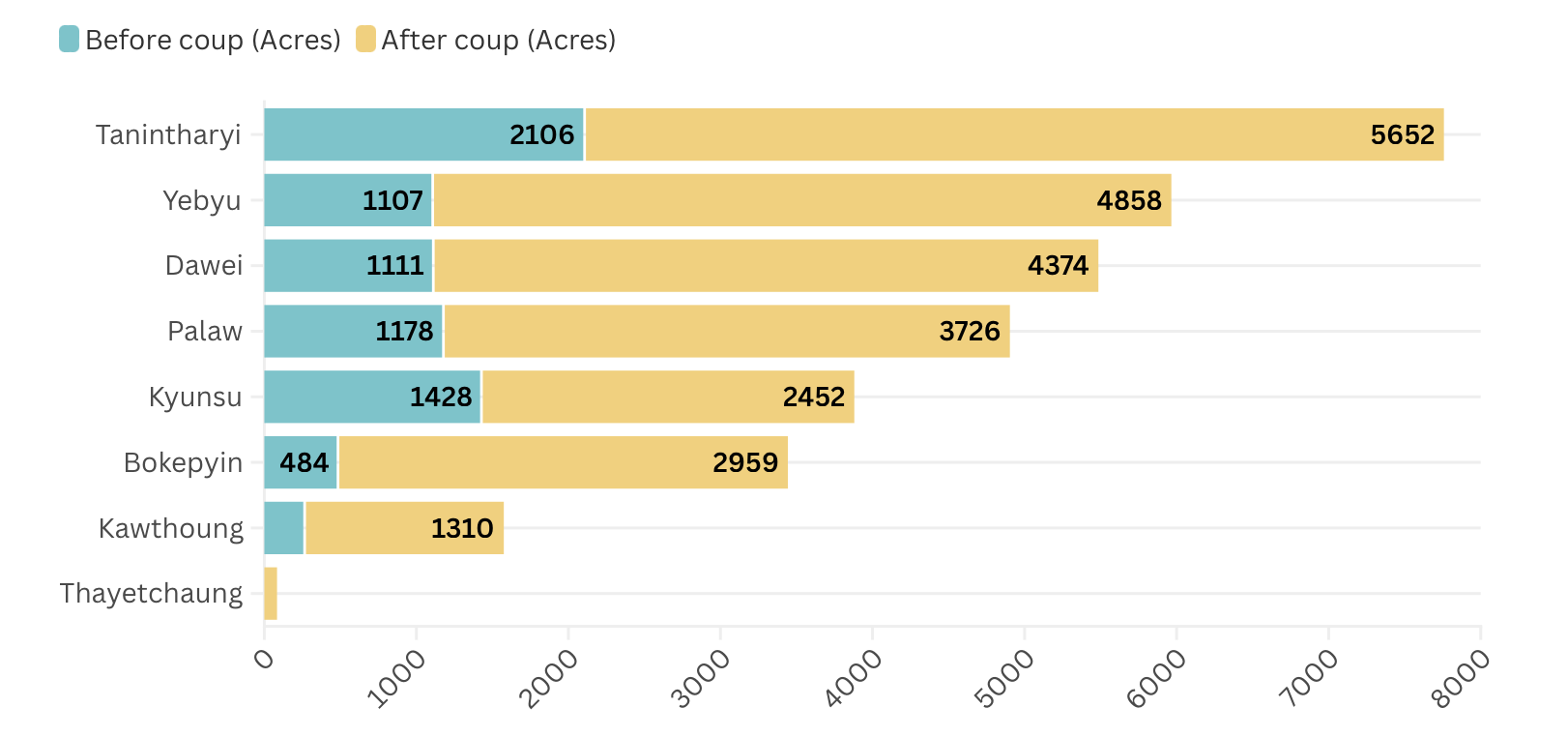
Probably the most ecologically sensitive area in India, also known for its great cultural and spiritual heritage, is the Uttarkashi-Gangotri area near the origin of the Ganga River in the Himalayas. This is also close to the Gaumukh glacier. It is of the highest importance to protect trees and other precious vegetation and herbs of this area. Today as thousands of trees are threatened by excessive highway widening in this eco-sensitive zone and local people are raising the demand for saving these trees, the government authorities too must respond by doing all they can to save these trees.

Solutions are available, if only the highway authorities agree to work in cooperation with local people who have much more detailed knowledge of local conditions and so can suggest alternatives which can protect trees. 

The Raksha Sutra (Threads of Protection) movement, which traces its legacy to the Chipko (hug the trees) movement, and others have in fact suggested an alternative possibility in the form of a new road which will cause minimal loss of trees while at the same time improving the connectivity of several remote villages. This new road can take some of the traffic burden and hence the need for excessive widening of the highway, which is threatening thousands of trees, can be avoided.

On the other hand if the government goes ahead with the excessive widening of the highway leading to the felling of a very large number of trees, then the environmental harm will be on a huge scale. The promises of planting these threatened trees elsewhere is least likely to be realized as natural forests cannot be re-created in this way. While generally it is being said that about 6,000 and odd trees (mostly deodar trees) have been marked for felling, the past experience has shown clearly that when a big tree is felled several nearby smaller trees, plants, herbs etc. are also uprooted and ruined. 

All possibilities to avoid this ecocide should be explored in close cooperation with local villagers particularly women, panchayats (local elected village councils) and social and environmental organizations.

In a region which has witnessed highly destructive floods and landslides leading to the loss of many precious human lives in recent years as well as other large-scale harm, people are understandably worried regarding the impact of the felling of so many trees and the destruction of so much vegetation. In fact people here, as in several parts of the Himalayan region, are very apprehensive regarding the overall impact of several big construction projects including dams, tunnels and excessively wide highways, particularly when the due precautions are not exercised in the construction work. The construction rubble and waste thrown in rivers increases their capacity to cause destruction in a big way but after the floods have passed, all this is forgotten and precautions are ignored again. Common people, small shopkeepers and villagers are also troubled and worried regarding the impact of such indiscriminately taken up work on their farms, springs, irrigation channels, other water sources and small shops or vending spaces.

In addition there is also the impact of tree felling and related environmental harm on glaciers, as well as in downstream areas, as the excess as well as scarcity of water in different seasons in the densely populated plains below is also influenced by what happens in the ecologically crucial catchment areas of the Ganga river and its various tributaries. 

The government authorities can still act wisely even at this late stage to work out alternative arrangements in cooperation with the local people in such a way that massive environmental harm can be avoided and the base of sustainable livelihoods is protected instead of being harmed.     

*

Click the share button below to email/forward this article. Follow us on Instagram and X and subscribe to our Telegram Channel. Feel free to repost Global Research articles with proper attribution.

Bharat Dogra is Honorary Convener, Campaign to Save Earth Now. His recent books include Man over Machine, Protecting Earth for Children and A Day in 2071. He is a regular contributor to Asia-Pacific Research. 

All images in this article are from the author


Global Research is a reader-funded media. We do not accept any funding from corporations or governments. Help us stay afloat. Click the image below to make a one-time or recurring donation.

  • Posted in Mobile
  • Comments Off on Deforestation in India: Government Must Join Hands with Local People to Save Thousands of Threatened Trees Near Gangotri in the Himalayas