The Rohingya refugee crisis remains one of the most urgent humanitarian challenges of our time. Since the mass exodus of Rohingya Muslims from Myanmar in 2017, Cox’s Bazar in Bangladesh has become the epicentre of the world’s largest refugee settlement, housing more than a million forcibly displaced people.

The sprawling camps, densely packed into a fragile landscape, are a harrowing testament to the ongoing suffering of the Rohingya people. Life in the camps is defined by extreme overcrowding, chronic insecurity and insufficient access to basic necessities. The camps’ residents are not aware of how to report problems or access aid and support, there is no vehicle access in or out of the camps and refugees face an uncertain future.

Persecution, Statelessness

For decades, the Rohingya, a Muslim ethnic group from Myanmar’s Rakhine region, have endured systematic persecution, forced displacement and statelessness while struggling to gain recognition and protection from the international community. Stripped of citizenship under Myanmar’s 1982 Citizenship Law, they have been deprived of fundamental rights and subjected to apartheid-like restrictions on movement, education and employment.

Systematic discrimination by successive Myanmar governments led to arbitrary arrests, forced labour, land seizures and severe military crackdowns. The situation escalated into genocide in August 2017 when Myanmar’s military, the Tatmadaw, launched a ruthless “clearance operation” following an attack by the Arakan Rohingya Salvation Army.

What followed was one of the worst humanitarian crises of the 21st century. Tens of thousands of Rohingya were massacred, entire villages were burned to the ground and women and girls were subjected to mass sexual violence as a weapon of war. Infants were slaughtered, some thrown into fires, while the elderly and disabled were burned alive in their homes.

Myanmar’s security forces carried out extrajudicial killings, arbitrary detentions, and the destruction of property on an unprecedented scale, forcing entire communities to flee with no food, water or medical care. Families were ripped apart in the chaos, parents watched their children die in front of them, children were left orphaned and wandering in terror. The United Nations later declared these crimes bore “genocidal intent. Satellite images confirmed the obliteration of Rohingya villages, effectively erasing generations of their existence from Myanmar’s landscape.

A Treacherous Escape

The more than one-million-strong Rohingya exodus to Bangladesh in 2017 was a perilous journey to join the hundreds of thousands who had escaped previous waves of persecution.

People endured weeks of exhausting travel, with families trekking barefoot through jungles, mountains and rice paddies, carrying children and the elderly while enduring starvation.

Many attempted to cross the Naf River in overcrowded boats, only to capsize, resulting in tragic mass drownings, or to be shot at by Myanmar security forces. Many lost their entire families while crossing the river.

With no access to food or water, refugees suffered from severe dehydration, hunger and disease. Some collapsed and died from exhaustion, their bodies left behind as others had no choice but to keep moving. Pregnant women gave birth on the roadside, alone and without medical care — their newborns arriving into a world of suffering.

Survivors arrived in Cox’s Bazar physically, emotionally and mentally broken. The sprawling refugee camps, now home to nearly a million Rohingya refugees, became a place of refuge and despair.

Overcrowded bamboo shelters offered little protection from extreme weather, and a lack of clean water and sanitation led to deadly outbreaks of cholera, diphtheria and other diseases. Hunger and malnutrition ravaged families as humanitarian aid dwindled, leaving many to beg or scavenge for food. Fires, both accidental and deliberate, ripped through the camp, turning what little its residents had into ashes.

Women and children, already traumatised by past horrors, faced new dangers: human trafficking, sexual violence and exploitation.

Life in the Refugee Camps

The conditions in the camps remain harsh and inhumane, forcing people into a relentless struggle for survival. The camps, particularly Kutupalong and Balukhali, are among the largest and most densely populated refugee settlements in the world.

Shelters are cramped, fragile and barely liveable. Families of six to 10 people are often squeezed into 10 square metre spaces; constructed from bamboo, tarpaulin and plastic sheets. These makeshift homes offer little protection from the elements.

During monsoons, heavy rains flood the camps, turning pathways into mud and washing away shelters. Contaminated water sources lead to outbreaks of waterborne diseases, while damaged infrastructure hampers the delivery of food and medical supplies.

In summer, the heat inside the plastic-covered huts becomes unbearable.

Fires are a constant threat, rapidly spreading through the tightly packed shelters, leaving many homeless overnight. In March 2021, a massive fire destroyed more than 10,000 shelters, leaving 50,000 homeless. Another fire burned down schools, mosques and homes in January 2022. A fire killed several refugees and displaced thousands more in March, 2023, and last December a fire burnt down 546 shelters, killing two refugees.

Each fire exacerbates the already dire living conditions, leaving refugees with even fewer resources and greater uncertainty.

Healthcare is woefully inadequate, with limited access to proper medical facilities, leaving many refugees suffering from malnutrition, tuberculosis, waterborne diseases and untreated injuries. Mental health issues are widespread, with trauma, anxiety and depression affecting countless refugees who have witnessed unimaginable horrors.

Education remains a distant dream for most children, as formal schooling is banned. The few learning centres available offer only basic education, leaving the younger generation without opportunities for growth. Without proper education, an entire generation is at risk of being left without a future.

Security concerns add another layer of suffering. Criminal gangs, human traffickers and armed groups operate freely, spreading fear among residents. Women and children are particularly vulnerable, facing gender-based violence, abduction and exploitation. The reduction of food rations due to funding shortages has worsened the crisis, forcing many into desperation and risky choices to survive.

Facing Torture, Violence in Myanmar

Since last year, the livelihoods of Rohingya remaining in Myanmar have further deteriorated. There have been reports of abuses perpetrated by various armed groups, including the Arakan Army (AA). The AA, an ethnic Rakhine insurgent group, has been implicated in harrowing acts against the Rohingya, including torture, killings and sexual violence.

Many families, under extreme duress, have been forced to flee their homes once again, attempting perilous crossings into Bangladesh. Tragically, numerous individuals have perished during these journeys, with entire families drowning in treacherous river crossings.

In addition to abuses by the AA, the Myanmar military has forcibly recruited more than a thousand Rohingya men and boys since February last year, deploying them to frontline combat roles where many have been killed or injured. This forced conscription has been accompanied by false promises of citizenship and financial compensation, further exploiting the vulnerable Rohingya population.

These recent developments underscore the ongoing vulnerability of the Rohingya within Myanmar, as they continue to face multifaceted threats from both state and non-state actors.

Urgent Need for International Action

The Rohingya crisis demands immediate and sustained global intervention. The following actions are critical to addressing the plight of the refugees:

Justice and accountability: Perpetrators of genocide and crimes against humanity must be held accountable by international legal mechanisms.

Increased humanitarian aid: Additional funding is urgently needed to provide food, healthcare, education and shelter for the refugees.

Enhanced protection and security: Stronger measures are required to curb violence, protect vulnerable groups and dismantle criminal networks operating in the camps.

Safe and dignified repatriation: A just and voluntary repatriation process, overseen by international organisations, must be established to ensure the safe return of refugees to Myanmar with full citizenship rights and guarantees of safety.

The international community must stand in solidarity with the Rohingya, advocating for justice, security and a dignified future. The world cannot afford to look away; the time to act is now.

*

Click the share button below to email/forward this article. Follow us on Instagram and X and subscribe to our Telegram Channel. Feel free to repost Global Research articles with proper attribution. 

Noor Sadeque is a student activist who was among the Rohingya refugees who fled Myanmar in 2017. He has been a resident of Cox’s Bazar for eight years. His supporters in Australia have established a fundraising campaign in solidarity with Noor to help him rent a safe house after he was targeted by armed gangs for his activism, and to help pay for his mother’s medical treatment.

Featured image: Inside Cox’s Bazar refugee camp. Source


Global Research is a reader-funded media. We do not accept any funding from corporations or governments. Help us stay afloat. Click the image below to make a one-time or recurring donation.

Vimla Bahuguna, who dedicated herself at a very young age to leading her life in accordance with Mahatma Gandhi’s teachings of serving people, breathed her last at her home in Dehradun on February 14. She was 92. She leaves behind her daughter Madhu Pathak and sons Rajeev and Pradeep. Her husband, the famous environmentalist Sunderlal Bahuguna, had died in 2021 at the age of 94.

Although often remembered by people for her work taken up in close partnership with Sunderlal, Vimla was a great social reformer, advocate of justice based concerns and an environmental activist in her own right. She herself participated actively in Chipko (hug the trees to save them) movement in remote forests as well as in anti-liquor and other social reform movements.

A firm believer in the rights of landless people, she started her social activism, under the guidance of Sarla Behn, as a bhoodan (gift of land movement) activist, going from one remote village to another to get land for landless people.

Vinoba Bhave, the famous leader of Bhoodan movement, had closely observed the way Vimla used to work in these early days and the impact she was creating in remote villages which she was visiting for the first time sometimes in very hostile conditions to collect land gift commitments. Vinoba’s secretary wrote to Sarla Behn conveying these feelings,

“I have not seen a girl activist like her. She is not just a girl from the hills, she is a devi (angel) from the hills.”  

Sarla Behn also mentions on the basis of her feedback from these villages that despite working in a new area Vimla would often spontaneously get the leadership role in her group which included more experienced local male members.   

A firm believer in equality of women, Vimla held her ground firmly at the time of her proposed marriage to Sunderlal, who was at that time the rising star of provincial politics, saying that she would agree to marriage only if Sunderlal agreed to give up political party membership in favor of Mahatma Gandhi’s path of serving people directly.

She had her way. Sunderlal gave up all political ambitions. Soon after their marriage the young couple worked hard to build themselves a very modest Ashram in Silyara, a remote village in Tehri Garhwal (now in Uttarakhand state).

Here she became a support and inspirational figure for a generation of social activists who worked for protecting rivers and forests, for equal rights of dalits, against the increasing problems of alcoholism and also promoted a host of constructive activities.

When an earthquake destroyed a substantial part of the Silyara ashram Vimla courageously faced the difficult times till some reconstruction could be taken up.

The most difficult and prolonged struggle was the one against the Tehri Dam Project. In the course of the struggle Sunderlal took a vow to live in a hut on the banks of the river near the dam site. Inseparable companions that they were, Vimla joined him even there.

I met Vimla Ji first when, as a 22 year old journalist writing on Chipko movement and related issues, I visited the Silyara ashram around 1977 or so.  She soon became an inspirational figure for our family. Till the last days we continued to speak on phone and she was very happy when I visited their home to present my new book on her and Sunderlal ji to them.

Whenever I visited her home or ashram, I was impressed by her keen interest in not just national but also international affairs. She used to be very involved in catching up with recent developments and getting my opinion on these issues, and of course providing her comments and perspective also.

Hers was a life of truly great commitment to creating a better world and she never wavered from her path no matter how great the difficulties.

Rest in peace Vimla Ji. Your work will continue to inspire people for a very long time.           

*

Click the share button below to email/forward this article. Follow us on Instagram and X and subscribe to our Telegram Channel. Feel free to repost Global Research articles with proper attribution.

Bharat Dogra has been involved with several concerns and efforts of Vimla and Sunderlal Bahuguna for nearly 46 years. His books include ‘Vimla and Sunderlal Bahuguna—Chipko Movement and Struggle against Tehri Dam Project in Garhwal Himalaya’ and ‘Planet in Peril’. He is a regular contributor to Asia-Pacific Research. 

All images in this article are from the author


Global Research is a reader-funded media. We do not accept any funding from corporations or governments. Help us stay afloat. Click the image below to make a one-time or recurring donation.

  • Posted in Mobile
  • Comments Off on Vimla Bahuguna, Environment Activist and Social Reformer, Is No More
  • Tags: ,

Khudai Khidmatgar, an organization founded in memory of Khan Abdul Ghaffar Khan in India in 2011, has been organizing several meetings for inter-faith harmony in various parts of the country in collaboration with various like-minded organizations with continuity. 

Important roads and markets named after him still remind us of the invaluable legacy of Khan Abdul Ghaffar Khan in India. Also called Badshah Khan and Frontier Gandhi by his admirers and followers to convey their affection and respect, Ghaffar had set up the original Khudai Khidmatgars (KK) in 1929 in and around Peshwar. The name of this organization means ‘those who serve God or the creation of God in the form of humanity’. An interesting part of the understanding of KK which links secular and religious thoughts goes something like this—it is our duty to serve God but God does not really need our service so the best we can do is to serve his creations (human beings and all forms of life) and particularly those who being in distress need this most.  KK soon established a well-established reputation of serving the poorest and most distressed people, and made a very impressive contribution to the various constructive programs started by Mahatma Gandhi. The same high commitment was visible in their participation in the freedom movement. When Mahatma Gandhi visited the KK area in and around Peshawar, he was so impressed by the commitment of KK volunteers that he said—this area is like a place of pilgrimage for me where I’ll like to come again and again.

Badshah and KK volunteers continued to have many admirers in India and it is not surprising that over the decades several efforts to revive his legacy were made. One such effort had its formal beginning at a function at a Gandhian institution in Delhi in 2011 when Tara Gandhi, granddaughter of Mahatma Gandhi, administered membership to about 50 KK volunteers. As Faisal Khan, the convener of this effort explained, the mobilization efforts had started much earlier. I became involved in this at an early stage when along with my daughter Reshma Bharti I was asked to prepare some literature for this effort. We also donated several of our other books also for this effort which attracted a lot of readers at the various meetings organized by KK. 

Following this I tried to remain in touch and after every few days I would hear of some meeting or some initiative of KK for inter-faith harmony. Some of these were bigger meetings and some were quite small ones but even small steps in the right direction are welcome.

Such efforts are continuing at present too. Thus recently there was one meeting on the occasion of the martyrdom day of Mahatma Gandhi in Bhopal, then a meeting on the birth anniversary of Badshah Khan, another gathering in Saharanpur followed by more meetings in and around Tamil Nadu, all devoted to spreading the message of inter-faith harmony. The Bhopal meeting was organized with the help of Madhya Pradesh Sarvodaya Mandal who along with KK organized “Sadbhavna Samvad” on the day of Gandhi Shahadat Diwas 30 January 2025 at Gandhi Bhawan. This samvad (dialogue) began with Kabir’s bhajans by Youth of Bhopal. Khudai Khidmatgar National Convener Faisal Khan expressed his views on the need to promote humanity and harmony. He paid homage to Mahatma Gandhi’s commitment towards the cause even at the cost of his life. Gandhiji always stood for truth with his uncompromising stand of satyagraha and now in these difficult times we need to stand un-compromised with and spread the “satya” ie truth of unity, diversity and love. The infinite power of our light is only experienced during the time of darkness. Today we all need to carry light of compassion and harmony in our normal lives, Faisal said, wherever we go and in everything we do, keeping in view that hate can only be countered with love.

Khudai khidmatgar leader Kripal Singh Mandloi said “humanity is natural to human beings, not hate.” In 1857 British rulers pledged a lot of money just to create disharmony between Hindus and Muslims after revolt in Meerut. They saw unity as big challenge to their “raj”. Now in present times we again see that big money is being used to spread disharmony. Any fake or unnatural thing won’t last long as we all have tendency to return to our natural being in a very short span. So all in all we just need to be natural “human beings” filled with humanity to be stalwarts for peace and harmony.

Ankit Mishra from Madhya Pradesh Sarvodaya Mandal said that youth are the future of the country and have a very important role in making inter-faith harmony stronger. He reminded people about what Mahatma Gandhi had stated “if there’s one cause for which I can give my life it would be Hindu Muslim unity” and he actually sacrificed his life for this.

The program was concluded with all religion prayer and observance of 2-min silence at 5:17 pm time when Mahatma Gandhi was shot.

Eminent editor Nikhil Chakravartty had once stated that during the freedom movement several small gatherings and meetings had appeared to be not so significant in themselves but taken together they helped to create very significant momentum for the freedom struggle. One hopes that many such small or big efforts for inter-faith harmony will continue and help to create a much stronger base for harmony, non-discrimination and unity.

*

Click the share button below to email/forward this article. Follow us on Instagram and X and subscribe to our Telegram Channel. Feel free to repost Global Research articles with proper attribution.

Bharat Dogra is Honorary Convener, Campaign to Save Earth Now. His recent books include When the two streams met, Man over Machine, A Day in 2071 and Earth without Borders. He is a regular contributor to Asia-Pacific Research.


Global Research is a reader-funded media. We do not accept any funding from corporations or governments. Help us stay afloat. Click the image below to make a one-time or recurring donation.

  • Posted in Mobile
  • Comments Off on Khudai Khidmatgar — Taking the Message of Inter-faith Harmony to More and More People
  • Tags: ,

The recent announcement that the Philippines is ramping up its military spending[1] has sparked a mixture of concern, intrigue, and heated debate. At the heart of this decision is the nation’s increasingly volatile geopolitical situation, especially in light of its longstanding tensions with China over territorial disputes in the South China Sea. Many observers have expressed worry that this move could unintentionally open the door for the Philippines to become embroiled in a larger proxy war, one that pits the United States and China against each other on Philippine soil or within its maritime boundaries. These concerns draw a striking parallel to the ongoing situation in Ukraine, where global superpowers have become entrenched in a fierce struggle for influence, leaving smaller nations caught in the crossfire.

In many ways, the Philippines finds itself positioned in a similarly precarious situation, where the balance of power between the U.S. and China has the potential to greatly affect the country’s fate. The Philippines has long been a key ally of the United States in the Asia-Pacific region, yet its proximity to China and the ongoing territorial disputes, particularly in the South China Sea, create a delicate diplomatic environment. While the Philippines has every right to bolster its defense capabilities in response to the growing threat posed by China’s assertive actions, it must also weigh the broader implications of such an increase in military readiness. The critical question remains: how can the Philippines navigate these murky waters, ensuring it strengthens its national security while avoiding entanglement in a geopolitical power struggle that could undermine its sovereignty and regional stability?

China’s tactics, often described as aggressive and coercive, are undeniably a driving force behind the Philippines’ growing desire to enhance its defense posture. Beijing’s expansionism in the South China Sea—referred to by many as “bullying”—has taken a toll on the region’s stability, with China asserting control over disputed waters and building artificial islands, all while disregarding international rulings such as the 2016 arbitral ruling that invalidated China’s claims. In this context, it’s no surprise that the Philippines feels compelled to strengthen its military forces to ensure the protection of its territories and its maritime resources. With China’s growing economic, political, and military power, it is understandable that the Philippines sees the need to invest in defense to avoid becoming vulnerable to further territorial encroachment.

However, while security concerns are paramount, the Philippines must be mindful of the long-term consequences of its military build-up. The U.S., as a traditional ally, has expressed support for the Philippines in the face of China’s growing influence. However, the Philippines must tread cautiously, being careful not to become a pawn in a larger geopolitical game. The ongoing U.S.-China rivalry poses a complex challenge for the Philippines, as Washington and Beijing vie for dominance in the region. There are legitimate fears that the Philippines could inadvertently become entangled in a broader conflict between the two global superpowers, as tensions over issues like Taiwan, trade, and regional security continue to simmer. Such a scenario would not only put the Philippines at risk but also compromise its ability to assert itself as an independent, sovereign nation with the power to chart its own course.

The Philippines’ path forward requires careful diplomacy and an unwavering commitment to safeguarding its national interests. Defense capabilities must be strengthened but this should not come at the expense of diplomatic engagement and cooperation with other nations in the region. The Philippines must explore strategies that allow it to build strong regional partnerships, particularly with ASEAN nations, to ensure collective security without becoming overly reliant on any one external power. A multilateral approach to security—one that balances military preparedness with open dialogue and collaboration—can provide a counterbalance to China’s growing influence while preserving the Philippines’ autonomy.

The Philippines faces the complex task of balancing its national defense needs with its desire to avoid deeper involvement in the geopolitical struggles between major powers. The country’s actions must be guided by strategic foresight and a keen understanding of its role in the broader regional and global context.

Strengthening its defense is crucial, but it must be done in such a way that does not drag the Philippines into a larger, more dangerous conflict. At the same time, the Philippines must take every opportunity to engage in diplomatic efforts, reaffirming its commitment to peaceful dispute resolution and regional cooperation. Only through a well-calculated and balanced approach can the Philippines ensure its sovereignty, protect its people, and maintain its stability in the face of an increasingly complex and volatile global landscape.

Raising the Stakes: Military Investment and the David versus Goliath Dilemma

At the heart of this debate lies a potent image of David versus Goliath: Can the Philippines, with its relatively modest military, truly stand up against the sheer military might of China? As the Philippines looks to increase its defense budget, the primary concern is how effective this spending will be in the long run. China, with its vast resources and cutting-edge military technology, is far ahead in terms of raw military power. Even with an increase in spending, the Philippines’ capacity to match China fire-for-fire is virtually unattainable, especially in a full-scale war scenario.

The crux of the matter, however, may not lie in attempting to outgun China, but rather in creating a credible deterrent. This involves investing in strategic capabilities such as advanced air defense systems, naval assets, and cybersecurity—tools that can make any potential aggressor think twice before engaging in hostile actions. The true aim for the Philippines should be to develop defense mechanisms that raise the costs of aggression, making any military action against it an unattractive option, rather than pursuing an arms race that could result in an unsustainable military posture.

The Geopolitical Tightrope: Avoiding the Pitfalls of Entanglement

While bolstering military defenses may appear essential in the face of Chinese expansionism, the Philippines must walk a delicate line in the broader geopolitical context. It is a given reality that the Philippines has long been a close and subservient vassal of the United States, and its security ties with Washington can be considered a key element of its defense strategy. Having this in mind, an offhand notion that the U.S. can provide the Philippines with a strategic military advantage is not a far-fetched option to bolster the nation’s defense in times of crisis. However, the Philippines must exercise extra caution about becoming too deeply entangled in any conflicts, particularly those involving the United States and China.

The risk of becoming a pawn in a larger geopolitical game is ever-present. While American support may be viewed as valuable, it should not come at the expense of the Philippines’ independence in decision-making or its sovereignty. The goal should be to ensure that whatever international alliance is forged, it should be balanced by an independent, non-aligned approach that prevents the Philippines from being drawn into a broader conflict. A defense strategy based on autonomy and flexibility should be prioritized, ensuring that the country remains the architect of its own destiny rather than being thrust into unwanted confrontations.

Diplomatic Solutions: Building Bridges, Not Just Walls

The Philippines should give high priority to exploring diplomatic avenues that promote peace and regional cooperation over and above the military option. In the face of Chinese aggression, multilateral dialogue is a critical tool that must not be overlooked. Engaging with international forums such as the United Nations, the Asia-Pacific Economic Cooperation (APEC), and, most notably, the Association of Southeast Asian Nations (ASEAN) could help the Philippines forge a regional coalition that promotes collective security and diplomatic solutions.

By fostering solidarity among ASEAN nations, the Philippines can create a united front that discourages unilateral actions in the region, such as China’s encroachments into disputed maritime territories. Economic partnerships, cultural exchanges, and confidence-building measures can go a long way in decreasing tensions, building trust, and promoting regional stability. Through these efforts, the Philippines can actively engage with its neighbors to ensure that the region remains a zone of peace and cooperation, rather than one dominated by power struggles.

A Dual Approach: Defense and Diplomacy for Lasting Peace

As the Philippines reasonably strengthens its defenses, the ultimate challenge will be how to balance the imperatives of military preparedness with the desire for lasting peace. The country’s strategic position requires a well-thought-of approach, one that avoids the extremes of aggressive militarization or total appeasement. A balanced strategy that integrates military readiness with a stronger commitment to diplomacy could provide the Philippines with the best chance to safeguard its interests while promoting regional peace.

This approach requires wisdom, foresight, and a commitment to long-term stability, as well as the ability to adapt to changing dynamics. The Philippines must carefully weigh the risks and rewards of military engagement, recognizing that defense is not only about deterrence but also about ensuring the conditions for diplomacy to thrive. By focusing on national sovereignty, resilience, and mutual respect with other nations, the Philippines can develop a strategy that secures its future without falling prey to external pressures or larger geopolitical machinations.

Charting a Path Forward: A Vision of Sovereignty and Peace

History has demonstrated the difficulty of navigating such turbulent geopolitical waters. However, with a balanced strategy, the Philippines can stand firm in its pursuit of national sovereignty while ensuring the safety and prosperity of its people. The key is not to be drawn into the destructive patterns of past colonial and imperial ambitions, but to foster a future where the nation remains strong, independent, and free from the looming shadows of conflict.

The task ahead is undeniably daunting, but it is also one filled with opportunity—an opportunity for the Philippines to assert itself as a leader in Southeast Asia, unyielding in its defense of sovereignty and unshakeable in its pursuit of peace. The path forward will require unwavering resolve, strategic brilliance, and a steady hand in both defense and diplomacy. In doing so, the Philippines can position itself as a beacon of stability in a volatile region, ensuring that its future is one of independence, peace, and prosperity for generations to come.

*

Click the share button below to email/forward this article. Follow us on Instagram and X and subscribe to our Telegram Channel. Feel free to repost Global Research articles with proper attribution.

Prof. Ruel F. Pepa is a Filipino philosopher based in Madrid, Spain. A retired academic (Associate Professor IV), he taught Philosophy and Social Sciences for more than fifteen years at Trinity University of Asia, an Anglican university in the Philippines. He is a regular contributor to Global Research.

Note

[1] “Philippines shores up defenses with increased military spending” by Gordon Arthur

Featured image is from Wikimedia Commons


Global Research is a reader-funded media. We do not accept any funding from corporations or governments. Help us stay afloat. Click the image below to make a one-time or recurring donation.

Indonesia officially joined the BRICS (Brazil, Russia, China and South Africa consortium) on January 6 — marking a significant milestone in its foreign relations. In a statement released on January 7, the Indonesian Ministry of Foreign Affairs emphasised that this membership reflects Indonesia’s dedication to strengthening multilateral cooperation and its growing influence in global politics. The ministry highlighted that joining BRICS aligns with Indonesia’s independent and proactive foreign policy, which seeks to maintain balanced relations with major powers while prioritising national interests.

This pivotal move showcases Jakarta’s efforts to enhance its international presence as an emerging power within a select group of global influencers. Traditionally, Indonesia has embraced a non-aligned stance while bolstering its military and economic strength through collaborations with Western and Eastern nations, including the United States, China and Russia. By joining BRICS, Indonesia is clearly signalling a shift from its non-aligned status, aligning itself with a coalition of emerging powers poised to challenge and redefine the existing global geopolitical landscape dominated by a Western neoliberal order led by the US.

Supporters of a multipolar world, championed by China, Russia and their allies, may view Indonesia’s entry into BRICS as a significant victory. In contrast, advocates of the US-led unipolar world, often referred to as the “rules-based international order”, might see Indonesia’s decision as a regrettable shift that could trigger retaliatory actions from the US.

The future will determine how Indonesia balances its relations with these two superpowers. However, there is considerable concern about the potential fallout for Indonesia from its long-standing US allies.

The smaller Pacific Island nations, which Indonesia has been endeavouring to win over in a bid to thwart support for West Papuan independence, may also become entangled in the crosshairs of geostrategic rivalries, and their response to Indonesia’s membership in the BRICS alliance will prove critical for the fate of West Papua.

Critical Questions

The crucial questions facing the islanders are perhaps pertaining to the loyalties of these Pacific nations: are they aligning themselves with Beijing or Washington, and in what ways could their decisions influence the delicate balance of power in the ongoing competition between great powers, ultimately altering the destiny of the Papuan people?

For Papuans, Indonesia’s membership in BRICS, or any other global or regional forums, is irrelevant as long as the illegal occupation of their land continues driving them toward extinction.

The pressing question for Papuans is which force will ultimately dismantle Indonesia’s unlawful hold on their sovereignty. Will Indonesia’s BRICS alliance open new paths for Papuan liberation fighters to reengage with the West in ways not seen since the Cold War? Or does this membership indicate a deeper entrenchment of Papuans’ fate within China’s influence — making any dream of Papuan independence almost impossible?

While forecasting the future with certainty is difficult, nevertheless, it is critical to contemplate this new complex geopolitical landscape, as the ultimate fate of West Papua is what is truly at stake here.

Indonesia’s membership in BRICS could augment Indonesia’s capacity to frame the West Papuan issue as an internal matter among BRICS members within the principle of non-interference in domestic affairs. Such backing could provide Jakarta with a cushion of diplomatic protection against international censure, particularly from Western nations regarding its policies in West Papua.

However, it is also crucial to note that for more than six decades, despite the Western world priding itself on being a champion of freedom and human rights, no nation has been permitted to voice concerns or hold Indonesia accountable for the atrocities committed against Indigenous Papuans.

The pressing question to consider is what or who silences the 193 member states of the United Nations from intervening to save the Papuans from potential eradication at the hands of Indonesia. Is it the US and its allies, or is it China, Russia and their allies, or the UN itself?

Double Standards and Hypocrisy

Indonesia’s support for Palestine bolsters its image as a defender of international law and human rights on global platforms like the UN and the Organisation of Islamic Cooperation. This commitment was notably highlighted at the BRICS Summit in October, where Indonesia reaffirmed its dedication to Palestinian self-determination and called for global action to address the ongoing conflict in line with international law and UN resolutions, reflecting its constitutional duty to oppose colonialism.

Nonetheless, Indonesia’s self-image as a saviour for the Palestinians presents a rather ignoble facade being promoted in the international diplomatic arena, as the Indonesian government engages in precisely the same behaviours it condemns Israel for in Palestine.

Moreover, Indonesia’s interaction with Pacific nations serves to perpetuate a facade of double standards — on one hand, it endeavours to portray itself as a burgeoning power and a champion of moral causes concerning security issues, human rights, climate change and development; on the other, it distracts the communities and nations of Oceania, particularly Vanuatu and the Solomon Islands, which have long upheld the West Papua independence movement, from holding Indonesia accountable for its transgressions against their compatriots in West Papua.

Indonesian Defence Ministry official Brigadier General Mohamad Nafis unveiled a strategic initiative on October 10, intended to assert sovereignty claims over West Papua. This plan purports to foster stability across the Pacific Islands through enhanced defence cooperation and safeguarding of territorial integrity.

The efforts to expand influence are characterised by joint military exercises, defence partnerships and assistance programs, all crafted to address common challenges such as terrorism, piracy and natural disasters. However, most critically, Indonesia’s engagement with Pacific Island nations aims to undermine the regional solidarity surrounding West Papua’s right to self-determination. This involvement encapsulates infrastructure initiatives, defence training and financial diplomacy, nurturing goodwill while aligning the interests of Pacific nations with Indonesia’s geopolitical aspirations.

Military Occupation

As Indonesia strives to galvanise international support for its territorial integrity, the military presence in West Papua has intensified significantly, instilling widespread fear among local Papuan communities due to heightened deployments, surveillance and restrictions. Indonesian forces have been mobilised to secure economically strategic regions, including the Grasberg Mine, which holds some of the world’s largest gold and copper reserves. These operations have resulted in the displacement of Indigenous communities and substantial environmental degradation.

As of December, approximately 83,295 individuals have been internally displaced in West Papua due to armed conflicts between Indonesian security forces and the West Papua Liberation Army (TPNPB). Recent reports detail new instances of displacement in the Tambrauw and Pegunungan Bintang regencies following clashes between the TPNPB and security forces. Villagers have evacuated their homes in fear of further military incursions and confrontations, leaving many in psychological distress.

The significant increase in Indonesia’s military presence in West Papua has coincided with demographic shifts that jeopardise the survival of Indigenous Papuans. Government transmigration policies and large-scale agricultural initiatives, such as the food estate project in Merauke, have marginalised Indigenous communities.

These programs, aimed at ensuring national food security, result in land expropriation and cultural erosion, threatening traditional Papuan lifestyles and identities. For more than 63 years, Indonesia has occupied West Papua, subjecting Indigenous communities to systemic marginalisation and brink of extinction. Traditional languages, oral histories and cultural values face obliteration under Indonesia’s colonial occupation.

Glimmer of Hope?

Despite these formidable challenges, solidarity movements within the Pacific and global communities persist in their advocacy for West Papua’s self-determination. These groups, united by a shared sense of humanity and justice, work tirelessly to maintain hope for West Papua’s liberation. Even so, Indonesia’s diplomatic engagement with Pacific nations, characterised by eloquent rhetoric and military alliances, represents a calculated endeavour to extinguish this fragile hope for Papuan liberation.

Indonesia’s membership in BRICS will either amplify this tiny hope of salvation within the grand vision of a new world re-engineered by Beijing’s BRICS and its allies or will it conceal West Papua’s independence dream on a path that is even harder and more impossible to achieve than the one they have been on for 60 years under the US-led unipolar world system.

Most significantly, it might present a new opportunity for Papuan liberation fighters to reengage with the new re-ordering global superpowers — a chance that has eluded them for more than 60 years.

From the 1920s to the 1960s, the tumult of the First and Second World Wars, coupled with the ensuing cries for decolonisation from nations subjugated by Western powers and Cold War tensions, forged the very existence of the nation known as “Indonesia”.

Regardless of the consequences of Indonesia’s BRICS membership, the fundamental existential question for the Papuans is whether they, along with their global solidarity networks, can reinvent themselves while nurturing the fragile hope of restoring West Papua’s sovereignty in a world rife with change and uncertainty.

*

Click the share button below to email/forward this article. Follow us on Instagram and X and subscribe to our Telegram Channel. Feel free to repost Global Research articles with proper attribution.

Ali Mirin is a West Papuan academic and writer from the Kimyal tribe of the highlands bordering the Star Mountain region of Papua New Guinea.

Featured image: Houses burning in Mangoldogi Village, Kiwirok District, after armed clashes between TPNPB and Indonesian security forces in September 2021. Photo: humanrightsmonitor.org


Global Research is a reader-funded media. We do not accept any funding from corporations or governments. Help us stay afloat. Click the image below to make a one-time or recurring donation.

The Albanese government is banning DeepSeek – the Chinese artificial intelligence model – from all government systems and devices on national security grounds.

It says this is in line with the actions of a number of other countries and is based on “risk and threat information” from security and intelligence agencies.

The Chinese platform TikTok is already banned from government systems and devices.

Under the decision, announced by Home Affairs Minister Tony Burke, government bodies must immediately remove all DeepSeek products, applications and services from systems and mobile devices. No new installations are allowed.

But politicians can still have DeepSeek on their personal non-government devices. This presently happens with TikTok – for example opposition leader Peter Dutton has a TikTok account.

While the direction only applies to official systems and devices, the government is also urging all Australians to inform themselves about how their data can be used online and to carefully review a company’s privacy policy on how customer data is managed.

Burke said: “The Albanese government is taking swift and decisive action to protect Australia’s national security and national interest.

“AI is is a technology full of potential and opportunity, but the government will not hesitate to act when our agencies identify a national security risk.

“Our approach is country-agnostic and focused on the risk to the Australian government and our assets.‘

The NSW Department of Customer Service acted late last month to ban DeepSeek from official devices and systems.

The department told Cyber Daily it had “taken a precautionary approach to restrict corporate access to DeepSeek AI, consistent with the approach taken for many new and emerging applications, systems and services”.

Commenting on the NSW department’s decision Dana Mckay, Senior Lecturer in Innovative Interactive Technologies at RMIT, said:

“The reason Chinese-made and-owned tools are being banned is that the data they collect is available to the Chinese government not just when a crime has been committed, but also for economic or social reasons.

“DeepSeek even collects keystroke patterns, which can be used to identify individuals, potentially allowing them to match in-work searches with leisure time searches, potentially leading to national security risks,” she said.

“It is fair to ask whether DeepSeek is more dangerous to Australian national security than, say, OpenAI which collects similar data: the difference is that OpenAI will only give data to government to comply with relevant laws, and this typically means where a crime may have been committed.

“Whether governments should be concerned about the level of data collected by commercial companies, such as OpenAI and Google, is still a significant question, but one that is separate to the national security concerns raised by China’s data sovereignty laws.”

Among those banning Deepseek are the Pentagon, the United States Navy, NASA, Italy and Taiwan.

*

Click the share button below to email/forward this article. Follow us on Instagram and X and subscribe to our Telegram Channel. Feel free to repost Global Research articles with proper attribution.

, Professorial Fellow, University of Canberra

Featured image: Deepseek mobile interface. Credit: DeepSeek / CC BY-SA 2.0


Global Research is a reader-funded media. We do not accept any funding from corporations or governments. Help us stay afloat. Click the image below to make a one-time or recurring donation.

  • Posted in Mobile
  • Comments Off on Albanese Government Bans DeepSeek from Official Devices on Security Grounds
  • Tags: ,

Peace as a Way of Life

February 4th, 2025 by David Andersson

The White-West notion of peace is largely associated with the absence of war. Even the origins of the peace symbol stem from the denuclearization movement. But what do we mean when we talk about peace?

*

If someone were to ask you, “Are you at peace with yourself today?” or “Are you at peace with your neighbors, your family, at work, or in your community?”—how would you respond? Do you know any truly peaceful individuals? Have you encountered any organizations that embody peace beyond simply opposing war? And how much time do you actually spend cultivating peace in your daily life?

Our societies have well-defined concepts for religion, economics, politics, and art, with entire institutions dedicated to their study and preservation. Yet, we lack a substantial, widely understood framework for peace. Even the Nobel Peace Prize was established by Alfred Nobel, an industrialist and arms manufacturer, highlighting contradictions embedded in our narratives of peace.

Much of what we know about peace is framed in relation to war, almost as if peace is merely its opposite. Worse, it is often treated as an expression of guilt, a form of compensation for past mistakes, or a strategic tool for appeasement while exploitation continues. Why, for example, are the largest peace movements concentrated in the West—the very nations that have historically waged wars and continue to profit from the global arms trade?

Could you imagine a politician being elected on a platform centered on peace—not as national security, but as social well-being and collective harmony? Unlike money, peace cannot be hoarded for oneself at he expense of others. Peace is an integrated circuit—flowing from the personal to the social and vice versa. And yet, how many people remain in relationships devoid of love, endure jobs they despise, or live in communities rife with unspoken tensions? Where is the peace in that?

For much of our lives, we exist under the tyranny of fear—at work, within political and economic systems that dictate our futures, and in international relations shaped by coercion and dominance. How can eight billion people share a planet without a deeper, collective understanding of peace? How do we build lives that actively expand peace, develop tools to nurture it, and create the knowledge needed to sustain it?

In many Asian traditions, peace is more than just the absence of war—it is a way of life, rooted in inner harmony, social balance, and respect for nature. Different cultures have developed unique perspectives on peace, shaping both personal and societal values:

  • Buddhism: Peace (Shanti) begins within. The Buddha’s teachings emphasize ahimsa (non-violence) and the Eightfold Path, guiding individuals toward inner tranquility as a foundation for a harmonious society.
  • Confucianism: Peace (hé, 和) is achieved through ethical relationships, respect, and social harmony. Confucius taught that a just society depends on ren (humaneness) and li (ritual propriety).
  • Taoism: Peace is living in harmony with nature (Dao). The concept of wu wei (effortless action) suggests that forcing control leads to disharmony, whereas balance and simplicity create lasting peace.
  • Hinduism: Peace (Shanti) exists on multiple levels—personal, social, and cosmic. Ethical living (Dharma) and non-violence (ahimsa) cultivate peace, while spiritual practices seek harmony with the universe.
  • Japanese Culture: The concept of wa (harmony) is central to relationships and society. The art of Kintsugi—repairing broken pottery with gold—symbolizes that true peace comes from healing and embracing imperfections.
  • Islamic and Sufi Traditions: Peace (Salaam) is submission to divine will, fostering inner peace and justice. The Sufi ideal of sulh-i-kul (universal peace) promotes love and unity beyond divisions.
  • Indigenous and Folk Traditions: Many Asian indigenous cultures emphasize communal peace. The Filipino concept of Kapwa (shared identity) and Bangladesh’s idea of social harmony highlight coexistence and collective well-being.

Unlike Western perspectives that often frame peace as a political or legal agreement, many Asian traditions see peace as a continuous process—an integration of inner, social, and environmental harmony. Peace is not just a goal but a way of living.

We have all the elements needed to develop a meaningful concept of peace. The challenge now is not just to understand it, but to embed it in our institutions, communities, and daily lives.

*

Click the share button below to email/forward this article. Follow us on Instagram and X and subscribe to our Telegram Channel. Feel free to repost Global Research articles with proper attribution.

This article was first published on Pressenza.

David Andersson is a French-American journalist, photographer, and author who has lived in New York for over 30 years. He co-directs Pressenza International Press Agency and is the author of The White-West: A Look in the Mirror, a collection of op-eds examining the dynamics of Western identity and its impact on other cultures. https://www.pressenza.com/author/david-andersson/


Global Research is a reader-funded media. We do not accept any funding from corporations or governments. Help us stay afloat. Click the image below to make a one-time or recurring donation.

  • Posted in Mobile
  • Comments Off on Peace as a Way of Life
  • Tags:

India Should Adopt Protective Himalayan Policy

January 28th, 2025 by Bharat Dogra

Civil Society magazine has recently published a series of interviews with eminent persons who are very well-informed regarding the Himalayan region. One of them, Sonam Wangchuk, the famous environmentalist from Ladakh, told the magazine how even really needed steps like renewable energy can create problems if these are not implemented in tune with an understanding of local conditions.

Wangchuk said,

“I am a fan of solar power. But the way it’s being done is what I have problems with. No local people are consulted. Land is just getting earmarked because it looks like flat wasteland. But what meets the eye is not the reality. These seeming wastelands are the source of food for tens of thousands of groups. Sheep. Yaks. They don’t know that this is how life survives in Ladakh. It’s not like lush green pastures. The pastures in Ladakh are very different.”

He added,

“They think that these are all easily available for solar power plants. If the locals had been asked, they would have shown other places where animals don’t graze. If I had been asked, I would have shown them how to take solar power from the top of mountains and leave the pastures to the goats and sheep below. It would have been a win-win situation where the local herders would get twice their fodder and the nation solar power.”

Such experiences have convinced Wangchuk of the urgent need for decentralization so that development takes place in accordance with real needs of people and specific local conditions best understood by them. In his own words,

“For the Himalayas as a whole I think there should be special provisions that give local elected bodies powers to take stewardship of their areas, mostly environmentally and culturally, because these cultures have kept the Himalayas alive and safeguarded…Now these policies have to be framed, but in the case of Ladakh there is already one and that’s the Sixth Schedule of Article 244 of the Indian Constitution which gives indigenous tribal communities more control over of how the region is managed through the public representatives who have law-making powers as regards to their areas, environment, land, forests, customs…”.

Regarding some disturbing recent trends Wangchuk said,

“Corporation squeeze and extract their profits in a decade or two and then leave the place. It is a use-and-throw style.”

Civil Society magazine also spoke to Ravi Chopra, Founder of People’s Science Institute who has headed environment committees of the Supreme Court in the past. Emphasizing the importance of being very cautious in these times, he told the magazine,

“My primary concern is that we are standing at the very edge of a tipping point, beyond which are catastrophic impacts and possibly irreversible climate change.” 

Referring to increasing disasters he said that when the western disturbance collides with the summer monsoon clouds, it produces disasters but we are not prepared adequately for this. The probability of GLOFs (glacial lake outburst floods) is increasing too. In the 1500-2000 meters altitude belt, where most hill stations are located, many water springs are drying up fast. Plans to cut 65,000 trees in Doon Valley have been approved, he said.

P.D.Rai, a former Member of Parliament and founder-member of Integrated Mountain initiative told Civil Society magazine that the Planning Commission had agreed to set up a separate group for the mountains but then the Commission itself was dissolved.

Pointing to the devastating impact of a single GLOF in Sikkim dated October 3, 2023 on this state Rai stated,

“One GLOF has crippled our hydel power generation. It has destroyed our road infrastructure. Hotels are empty because the tourists have stopped coming. As a result, livelihoods are on the line. With power generation affected, the government is not earning and having difficulties even in paying salaries.”

What all these interviews (for the entire text see Civil Society Magazine issues of November and December 2024) bring out is the compelling need for a more protective policy for the Himalayan region based on sustainable livelihoods, protection of environment and empowered, more self-reliant rural communities, functioning in very creative ways in conditions of decentralization, at the same time also protecting national defense interests in border area and strategically important areas, with very friendly relations existing between national policy makers and defense forces on the one hand and the local empowered communities on the other hand.

The Indian Himalayas stretch majestically for nearly 2500 km across 13 states and union territories. Nearly 50 million people live here, but the number of people whose life is closely influenced by the Himalayas is many times more, with a heavy concentration in the densely populated Gangetic plains.

For all their outward grandeur, the Himalayas are geologically young and fragile formations, prone to disturbances and landslides. Most of this region falls in the highest seismicity zone. Hence policies for this region should take extra care to be protective towards the environment, particularly forests and rivers, towards the people living here and the much larger number influenced by what happens in the Himalayan region.

At the national level, people tend to discuss the Himalayan region in terms of tourism and pilgrimage destinations, but greater attention should be given to the lives and livelihoods of common people living in the Himalayan region as well as the need to protect environment in such ways that the impact of Himalaya locally and more widely remains protective. Cooperation with other Himalayan countries should also be based on sharing such concerns with them and minimizing conflict to the extent possible given the geopolitical realities.  

The Himalayas with their varying heights and slopes, peaks and valleys are suitable for preserving rich biodiversity. The traditional farming practices have made good use of this to provide a diversity of nutritious food, which is particularly rich in millets and herbs. Some farm scientists who were trained in green revolution monocultures could not appreciate these strengths and so very disruptive new crops and technologies were introduced at some places. Fortunately this mistake is being realized at several places. There are several initiatives to base farming more on organic and natural methods which are led by Sikkim but can be seen also in other places. This is welcome, but often a holistic approach of natural farming is missing in official efforts.

Forests are crucial for protecting Himalayan ecology, but with due care and understanding, they can also play the most important role in supporting sustainable livelihoods of local people. This would be based on providing people livelihoods in protecting forests and biodiversity, regenerating mixed natural forests with due place for more soil and water conserving trees like the oak, and giving people much better rights over sustainable use of minor forest produce. A rural economy based on such protective livelihoods, fruits and dry fruits, organic farm produce in raw and processed forms, supported further by eco-friendly tourism and pilgrimage can provide a firm livelihood base without endangering environment.

Unfortunately not just tourism but even pilgrimages are getting highly commercialized, with record numbers of helicopter sorties bringing pilgrims to their favored shrines. Instead of allowing all this to be guided mainly by commercial factors, we must bring in important factors like protecting environment and promoting livelihoods of common hill people. 

There has been a lot of controversy around several big development projects, particularly dam and highway projects. A time has come when the government should make room for a completely unbiased evaluation of the overall impact of these projects so that future policy is guided entirely by the most unbiased conclusion that can be drawn from the experiences so far. There are several concerns—loss of forests and trees, destabilization of slopes and land-slides, displacement of people among them—but a particularly serious concern is that of avoiding any massive disasters.

The role which hydel projects had played in aggravating the highly disastrous floods in Uttarakhand in 2013 has been widely discussed and even a committee appointed at the initiative of the Supreme Court had drawn attention to this. We cannot forget that about 6,000 human lives were lost in these floods, perhaps more. A big priority should be to avoid this kind of big disasters. More than one officially appointed committee has drawn attention to very serious risks associated with the Tehri Dam Project in Uttarakhand, for instance, and we should not ignore or neglect such well-documented warnings, supported by scientific evidence and voiced by eminent experts. The planned Chinese biggest hydel project in Medog region in Tibet Autonomous area is surely a disaster in the making and should be given up.

Sunderlal Bahuguna had devoted his life to protecting Himalayan ecology as well as sustainable livelihoods. He used to say—Ecology is permanent economy. He went on long foot marches to hundreds of villages to find practical ways of applying this principle. He as well as his companions contributed much in this direction.

They emphasized that ecological tasks cannot be taken up in social isolation. Hence they placed equal emphasis on justice for women and pleaded for wider social roles for them. Women have justified this trust by playing very important role in the chipko movement, anti-liquor movements and peace initiatives.

These activists also emphasized equal opportunities and empowerment of dalits as well as inter-faith harmony. Their work is a valuable guide for evolving a socio-economic and ecological agenda for the Himalayan region, integrating many-sided justice with environmental concerns.

*

Click the share button below to email/forward this article. Follow us on Instagram and X and subscribe to our Telegram Channel. Feel free to repost Global Research articles with proper attribution.

Bharat Dogra is Honorary Convener, Campaign to Save Earth Now. His recent books include Planet in Peril, Man over Machine, Protecting Earth for Children and A Day in 2071. He is a regular contributor to Asia-Pacific Research.


Global Research is a reader-funded media. We do not accept any funding from corporations or governments. Help us stay afloat. Click the image below to make a one-time or recurring donation.

  • Posted in Mobile
  • Comments Off on India Should Adopt Protective Himalayan Policy
  • Tags:

High Risks of Large Dam Projects in the Himalayas

January 24th, 2025 by Bharat Dogra

Various countries are building large dams on Himalayan rivers. Apart from local factors this often gets discussed in terms of the conflicting interests of various countries. In the process the wider reality of dams in Himalayan region being inherently risky ventures gets neglected. The wider reality is that many uncertainties and risks are involved in building and managing large dams in the Himalayan region, uncertainties which are increasing further in times of climate change. 

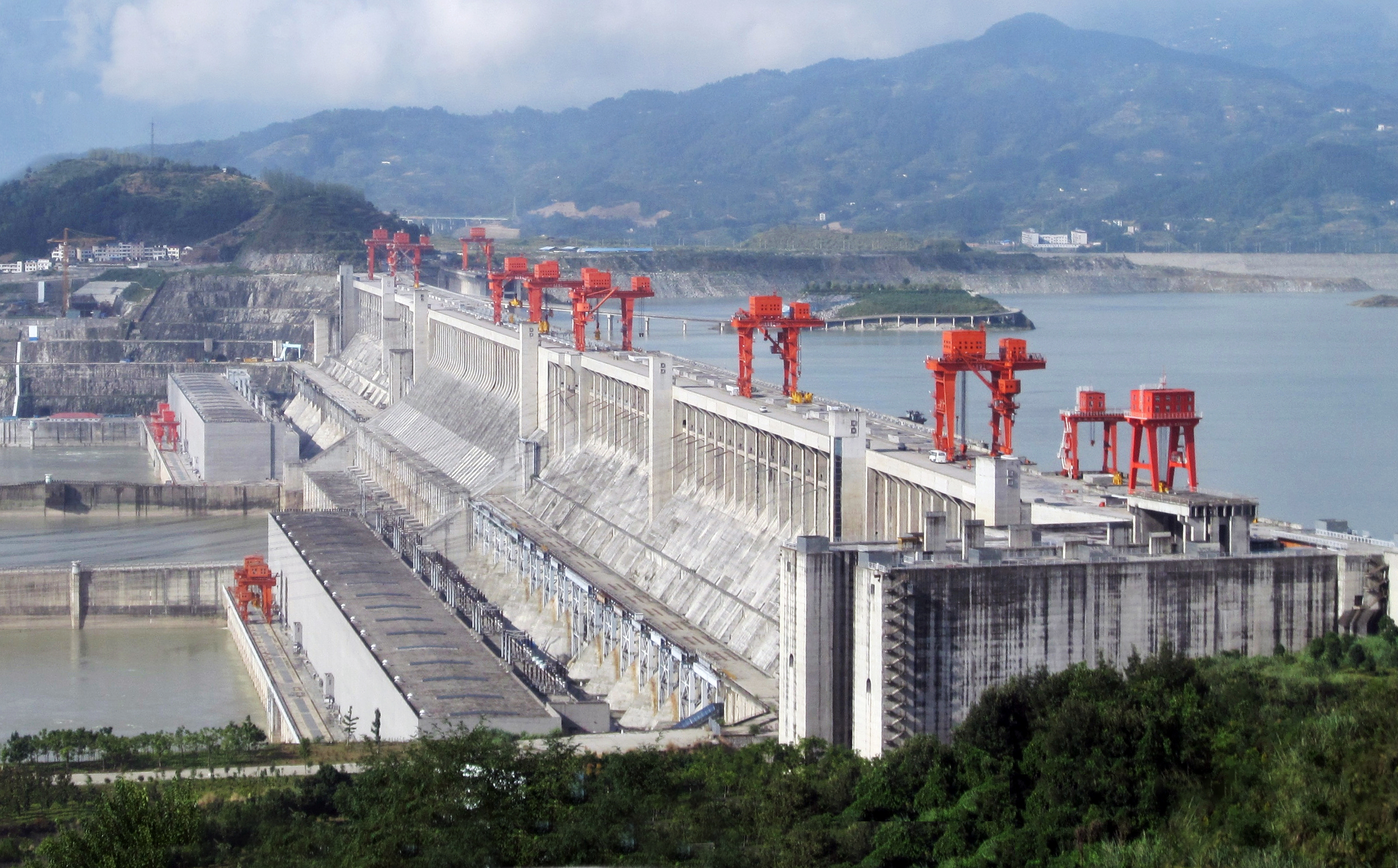
Hence when one hears that China is planning to build such a huge structure in Medog on the part of the Brahmaputra river that flows in Tibet (where the river is known as Yarlung Tsangpo) that its planned hydropower is being estimated at more than 2.5 times the power generation capacity of the present-day biggest dam of Three Gorges, then of course one must worry regarding its adverse and, in certain situations, highly catastrophic impact on India, Bangladesh and Bhutan, but in addition one must also warn that the project is inherently too high risk to be feasible and should be given up at the outset. 

.

undefined

The Three Gorges Dam on the Yangtze River, China. (Licensed under CC BY 2.0)

.

The Himalayan region is characterized by two contradictory features. In engineering terms, it has a very huge potential for producing hydropower. However in ecological and geological terms, the building of dams and hydro-electricity projects involves very serious disruptions and safety risks in this inherently fragile region of high seismicity which in geological terms is still in its formation stage.

These contradictions came to the fore in the course of one of the most controversial and difficult dam projects —the 260.5m high Tehri Dam Project (TDP) in Uttarakhand state of India. As Y.K.Murthy, former Chairperson of Central Water Commission of India has stated, this dam was planned not just as one of the highest structures of its kind in a region of known high seismicity, it also called for tackling of “complex technical problems involved in a rockfill dam of such a height for which there was very little precedence available elsewhere in the world.”

The TDP faced much opposition, and in 1980 the then Prime Minister Mrs. Indira Gandhi ordered a review. The Experts’ Group which conducted the review asked for stopping the project. The project authorities managed to continue the project somehow. In 1990 the Environment Appraisal Committee (EAC) made an more more damning indictment of the project, denying it clearance on the ground of the very high risks  to the dam structure in the event of an earthquake of high intensity likely to occur in this highly seismic zone, exposing millions of people and pilgrims in downstream areas (including the most holy cities of Haridwar and Rishikesh) to unacceptably highly risks. The EAC also mentioned several other hazards, including reservoir-induced seismicity and land-sliding towards reservoir after impoundment of water and changes in its level.

In 1991, there was an earthquake in Uttarakhand. It was noticed that damage was particularly acute in the villages located close to hydro-electricity projects, like Jamakh village close to Maneri Bhali project, upstream of TDP. This was attributed by local people to blasting work which had shaken up the fragile geological formations. In 2013, devastaing floods killed around 6,000 people in Uttarakhand. An Experts Body appointed at the initiative of the Supreme Court, chaired by Dr. Ravi Chopra, pointed out that the damage had been particularly acute near hydro-electicity projects. Poor muck management and neglect of catchment area treatment came in for special criticism by these experts. Yet again at the time of destructive floods in 2021, hydro-electricity projects were blamed for aggravating the disaster.

The Experts Group of 2013 stated that it was not just a question of individual projects seen in isolation but also of the series of projects taken up at short distances on a river, disrupting the entire ecology and biodiversity of the river. Also there was the question of the saturation point or bearing capacity of a fragile region. The report pointed that in the western Himalayan state of Uttarakhand extensive hazards, ecological and social disruptions had appeared already when 92 projects with a total installed capacity of 3624 MW had been completed, while the eventual planning was for 450 projects with 27039 MW installed capacity. In the eastern state of Arunachal Pradesh the potential of hydro electricity is stated to be even higher. Both states have a border with China, which has even more ambitious hydro-electricity plans.

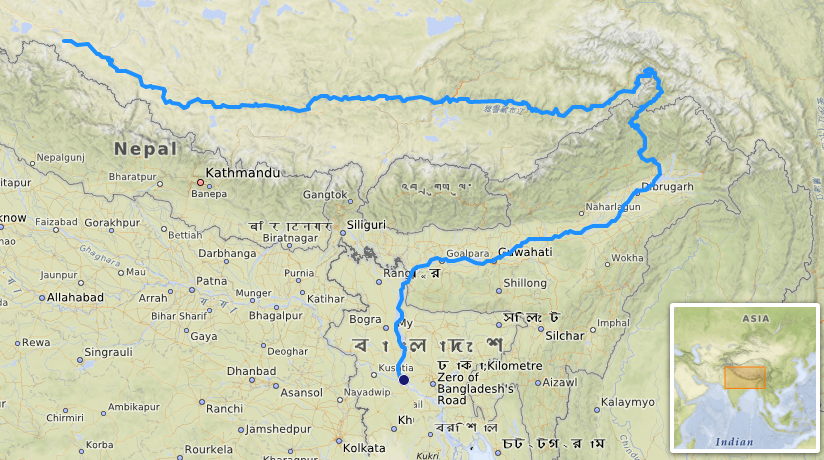
In fact, now a much bigger safety and ecological risk has appeared on the Chinese side of the eastern border where China has embarked on a biggest of them all mega-project in Medog in Tibet Autonomous Region. The Brahmaputra river, life-line for a significant part of India and Bangladesh, originates in Tibet before flowing into Arunachal Pradesh and other states of India, flowing further to Bangladesh before merging into the Bay of Bengal. 

.

undefined

Path of the Brahmaputra River (Licensed under CC BY-SA 4.0)

.

China has already built some projects on the stretch of this river flowing in Tibet, where it is known as Yarlung Tsangpo, but its much bigger ambition is to tap the enormous potential at a place, close to the border, where the river has a 2,000-meter drop. This mother of all such projects, it is claimed, will have an installed hydropower potential over 2.5 times that of the Three Gorges Dam, the highest capacity project at present.

Clearly a project of this scale, located very close to the Indian side of the border, can also be much more hazardous than previous Himalayan projects, and many risks will spill over first to India and further down to Bangladesh, while Bhutan too is affected. This can be in the form of flash floods, reservoir-induced seismicity and other factors. At the same time, the lean season flow may reduce, as also the deposition of fertile silt.

What is more, the relatively more free debate which allows the various risks to be exposed and discussed in India may not take place in China, particularly regarding the hazards to the Indian side. China may not share all relevant data with India, despite clams to the contrary.

Hence the risks and hazards of Himalayan dams and hydro-electricity projects are set to increase, despite all the warnings voiced by many concerned experts. To avoid catastrophic harm in future, voices for a more cautionary approach are much needed before it is too late.

While India is well-justified in raising its concerns with China relating to the planned largest dam project, at the same time India must also show much greater caution regarding the risks and adverse impacts of large dams in the Himalayan region. The same holds true for other countries like Nepal, Bhutan and Pakistan.

*

Click the share button below to email/forward this article. Follow us on Instagram and X and subscribe to our Telegram Channel. Feel free to repost Global Research articles with proper attribution.

Bharat Dogra is author of several books/booklets on this issue, the latest being Vimla and Sunderlal Bahuguna—Chipko Movement and the Struggle against Tehri Dam Project in Garhwal Himalaya. His other recent books include Protecting Earth for Children, Planet in Peril and Man over Machine-A Path to Peace. He is Honorary Convener, Campaign to Save Earth Now.


Global Research is a reader-funded media. We do not accept any funding from corporations or governments. Help us stay afloat. Click the image below to make a one-time or recurring donation.

As 2025 ASEAN Chair, Malaysia faces significant challenges, including Myanmar’s crisis, South China Sea tensions and geopolitical shocks from the US–China rivalry. To ensure ASEAN makes it through the year not only unscathed but even stronger, Malaysia should use its chairmanship to drive deeper regional economic integration, further develop economic instruments like the ASEAN-China Free Trade Agreement 3.0 and promote diplomatic solutions to ASEAN members states’ deep divisions.

*

The new normal for any ASEAN Chair is the expectation of having to manage a crisis, if not multiple crises, amid an increasingly hostile geopolitical environment. The Myanmar conflict and South China Sea crisis will have repercussions for ASEAN throughout 2025.

The Myanmar crisis is the most severe test of ASEAN’s internal unity to date. In the absence of a common position, the grouping’s approach to the crisis remains its most divisive issue, with some members keen to bring Myanmar back into the fold as quickly as possible, while others insist on staying true to a ‘Myanmar-owned, Myanmar-led’ process. Given the divergent interests of ASEAN member states and that of key external partners — such as China’s — support for the junta’s election plans, as the 2025 ASEAN Chair, Malaysia would need to carefully balance and engage stakeholders with parity.

The South China Sea is becoming a serious potential flashpoint for ASEAN, with severe repercussions for global security and trade. 2024 was marked by episodes of heightened tensions and provocations between China and the Philippines which are likely to continue in 2025 and possibly worsen.

Malaysia should use its chairmanship to elevate confidence-building measures and preventive diplomacy at the ASEAN–China level to reduce the risk of conflict in the South China Sea. As a claimant state, Malaysia has direct stakes and would be well-placed to start the ball rolling. But given Malaysia’s significant trade relations with China, it remains to be seen how much leverage Malaysia has. Malaysia’s best course of action will be to keep the South China Sea Code of Conduct negotiations channel open.

As 2025 ASEAN Chair, Malaysia faces heightened geopolitical tensions, increased economic fragmentation, rising protectionism, nationalism, revisionism and consequences of the growing China–US rivalry in the region.

Of these issues, the most concerning is the United States’ unpredictable turn towards insularism and increasingly protectionist measures. Trump’s ability to disrupt the liberal international order is alarming for many moderate countries of the Global South that are used to operating in a stable global order that respects international law and promotes free trade.

But Malaysia–US bilateral relations have been tense under Prime Minister Anwar Ibrahim largely due to the US position on the Gaza war which runs counter to Malaysia’s support for the Palestinian cause. This is juxtaposed with the excellent relationship that Malaysia currently enjoys with China. With Malaysia as Country Coordinator for ASEAN-China relations until 2027, it is likely that Malaysia may place more emphasis on ASEAN–China relations and less on developing ASEAN–US relations at a time when the incoming Trump administration is showing signs of disinterest.

Malaysia has formally invited China to attend the ASEAN–Gulf Cooperation Council (GCC) Summit in May 2025. This proposal took observers by surprise as the first ASEAN–GCC Summit was only in October 2023. It is unclear what China’s role will be at the second ASEAN–GCC Summit, but the rationale behind this proposal could be to build on China’s deep economic linkages with both regions to find greenfield opportunities. This summit will also give Anwar an opportunity to showcase Malaysia’s leadership in South–South cooperation, as evident in Malaysia’s stated ambitions to join BRICS.

Malaysia’s best bet is to continue to drive deeper regional economic integration. Notwithstanding Trump’s threats to impose tariffs on friends and foes alike, an economically integrated ASEAN yields many benefits. To ASEAN’s credit, despite the challenges of the COVID-19 pandemic and economic shocks in recent years, ASEAN has continued with key upgrades to make ASEAN’s economic instruments fit-for-purpose. These upgrades include the ASEAN–China Free Trade Agreement 3.0, the ASEAN Trade-in-Goods Agreement and the expansion of the ASEAN Single Window with key trading partners.

Under Malaysia’s watch, the region will see the adoption of the ASEAN Community Vision 2045 at the 46th ASEAN Summit in Kuala Lumpur in late 2025. This will set ASEAN’s strategic direction for the next 20 years. There is much at stake for Malaysia as the co-Chair of the High-Level Taskforce on ASEAN Community’s Post-2025 Vision. It is incumbent on Malaysia to ensure that the final ASEAN Community Vision 2045 is able to future-proof ASEAN.

The second major milestone in 2025 is the conclusion of the ASEAN Digital Economy Framework Agreement (DEFA). Negotiations have been fast-tracked and are expected to conclude by the end of the year. The Agreement will be the world’s first regionwide digital agreement that offers a comprehensive roadmap to accelerate digital trade in services, e-commerce, digital payment systems and more. The DEFA is projected to value-add some US$2 trillion to ASEAN’s economy by 2030 and pave the way for ASEAN to facilitate a greater volume of digital trade with its dialogue partners.

But ASEAN may run the risk of deepening the digital divide in the region. As part of the ASEAN digital community discussions, Malaysia can bridge this divide with a focus on enhancing digital education and access across the region.

Malaysian Prime Minister Anwar Ibrahim has already set the stage for Malaysia’s ASEAN Chairmanship by announcing the appointment of informal personal advisers. These advisers include former Thai prime minister Thaksin Shinawatra, former Indonesian foreign minister Retno Marsudi and former Singaporean foreign minister George Yeo. There remains much scepticism about Anwar’s ‘ASEAN study group’, with some observers seeing this advisory team as performative on Anwar’s part.

For the last 50 years, ASEAN has been a beneficiary of a free, stable global environment. But with the changes Trump’s presidency will usher in, the biggest challenge for Malaysia, as Chair of ASEAN, will be figuring out how to navigate these changes and find opportunities for ASEAN to continue to thrive in unfamiliar territory.

*

Click the share button below to email/forward this article. Follow us on Instagram and X and subscribe to our Telegram Channel. Feel free to repost Global Research articles with proper attribution.

Sharon Seah is Senior Fellow and Coordinator at the ASEAN Studies Centre and the Climate Change in Southeast Asia Programme, ISEAS–Yusof Ishak Institute, Singapore.

This article is part of an EAF special feature series on 2024 and the year ahead.

Featured image is from EAF


Global Research is a reader-funded media. We do not accept any funding from corporations or governments. Help us stay afloat. Click the image below to make a one-time or recurring donation.

  • Posted in Mobile
  • Comments Off on ASEAN Should Hope for the Best But Prepare for the Worst in 2025
  • Tags:

The forests around the ancient Lake Poso in Indonesia’s Central Sulawesi province are being lost to mining, oil palm plantations and smallholder farm expansion, threatening both unique species and local residents.

The lake and its surroundings are designated as an Alliance for Zero Extinction site, hosting several threatened species found nowhere else on Earth, including a unique crab species and various fish, though scientists warn research on the ecosystem remains limited.

Historical religious conflict and a controversial hydropower project have complicated environmental protection efforts, with the dam disrupting traditional fishing practices and contributing to increased flooding that affects local farming.

Community groups are working to protect the ecosystem while balancing development needs, though the loss of forest buffer systems threatens to overcome the lake’s natural resilience.

***

Over the course of just eight years, the forests surrounding Indonesia’s Lake Poso, an ecological and evolutionary “gem” on the island of Sulawesi, have been whittled away, satellite data and imagery show, while flooding has intensified, and traditional livelihoods suffer.

Lake Poso is Indonesia’s third-largest lake, 32 kilometers long by 16 wide (20 by 10 miles), and lies in Poso district in the province of Central Sulawesi. The lake harbors many unique species found nowhere else on Earth, leading to its designation as an Alliance for Zero Extinction (AZE) site.

Satellite data from Global Forest Watch reveal ongoing encroachment into the Pamona Nature Reserve at the lake’s southeastern edge, with 681 hectares (1,683 acres) of humid primary forest lost within the AZE site between 2002 and 2023. This represents 48% of total tree cover loss during the period.

.

.

Data from the national statistics agency show forest cover Poso district decreased from 514,651 hectares (1.27 million acres) in 2014 to 358,828 hectares (886,680 acres) in 2021, a loss equivalent to the size of London in just eight years.

Sunardi Katili, head of the Central Sulawesi chapter of Walhi, Indonesia’s leading environmental NGO, identified three primary drivers of deforestation: nickel mining, oil palm plantations, and smallholder farm expansion.

“The demand for natural resources in the form of nickel for the electric car battery industry and stainless steel for household appliances has created high market demand,” Katili told Mosintuwu media journalist Pian Siruyu in May 2024.

Cultural Significance and Community Impact

Lake Poso supports approximately 60,000 people in surrounding districts, and is located some 260 kilometers (162 miles), an eight-hour drive, from Palu, Central Sulawesi’s provincial capital. For Indigenous communities, the lake holds deep cultural significance.

“The indigenous people of Lake Poso refer to Lake Poso using the third person singular pronoun: he/she. This shows the respect and perspective that the lake is life,” Lian Gogali, founder of Institute Mosintuwu, a local organization that supports conflict survivors, told Mongabay in an email.

Traditional communities maintain rice fields, plantations and water buffalo grazing grounds along the shoreline, while local fishers preserve centuries-old fishing practices. However, these traditional ways of life are facing challenges. The region experienced 12 major floods in just the first five months of 2024, more than all the floods in the previous year.

.

Structures for Wayamasapi, a tradtional eel fishing method, near Tentena town at the mouth of Lake Poso. Image by Ian Morse for Mongabay.

.

Historical and Hydroelectric Context

From 1998 until 2000, Poso was the site of deadly sectarian violence between local Muslim and Christian communities. Hundreds of people were killed in the conflict and thousands more were forced to leave their homes, according to U.S.-based watchdog organization Human Rights Watch.

“At the time of the violent conflict, communities in Poso district fled their lands and farms (some sold them), [and] when they returned they were powerless to fight for their lands together because they were segregated based on religious or tribal identity,” Gogali said.

Now, Lake Poso faces pressure from a controversial 515-megawatt hydropower project operated by PT Poso Energy. According to interviews for a 2020 Mongabay article, after the period of sectarian conflict, many local officials welcomed the $700 million dam project in 2005, hoping it would bring vying religious communities together for progress on the island.

However, Freddy Kalengke, a local fisher quoted in The Jakarta Post,  said eel catches have drastically declined.

“We caught a lot of sugiri [the local word for the eels] with fish traps. We used to catch 20, 30 even 40 kilograms [44-88 pounds] each night,” Kalengke said. He added he “would count himself lucky these days if he could catch 5 kg [11 lbs] of eels in one night, a rare event now.”

The decline began in 2019 when Poso Energy built the dam, blocking the migratory patterns of the eels, according to Kalengke. The company also dredged the bottom of the lake and river to increase water flow into the hydropower plant dam.

Poso Energy’s environmental manager, Irma Suriani, told The Jakarta Post the company had compensated villagers for harvest losses and livestock deaths during trial periods and that the river improvement process was 85% complete. The company also told The Jakarta Post that it had installed fishways to help conserve the local eel population, though local fishers report significant declines in their catches since the dam’s construction.

“As a source of renewable energy, the hydropower plant produces fewer carbon emissions than a fossil-fuel powered plant with the same capacity” and will help the government achieve its net-zero carbon emission goals, Suriani told The Jakarta Post. Indonesia aims to reduce its emissions by 31.9% independently by 2030, with the energy sector expected to contribute a 15.5% reduction.

Poso Energy didn’t respond to Mongabay’s requests for comment on this story.

.

Women lead a protest against PT Poso Energy construction on Lake Poso in 2022. Photo courtesy of Mosintuwu/Ray Rarea.

.

Forest Loss Threatens an Ecological Gem

Lake Poso was formed around 2 million years ago by tectonic activity and has evolved into what scientists consider a “natural laboratory” for studying evolution. Long-lived lakes are valuable research sites for scientists studying biodiversity, evolution and geological processes. However, unique, range-restricted species make places like Lake Poso susceptible to environmental disruption, according to researchers.

“I think the big issue with Poso is the almost complete lack of information,” Doug Haffner, an emeritus professor of limnology at the University of Windsor, Canada, who calls the lake a global “gem” and has studied it for more than 25 years, told Mongabay in 2020. “No one has really worked on Lake Poso. I think we are the only group with information on lake physics, chemistry, and biology, and that is a very limited data set for one of the most important lakes in Indonesia.”

Lake Poso hosts several threatened species found nowhere else. The lake’s exceptional biodiversity is particularly evident in its invertebrates, with high endemism among mollusks and shrimps. Notable among these unique species are the endangered Migmathelphusa olivacea crab and Sarasin’s goby (Mugilogobius sarasinorum), which exist only in these waters.

“There are not that many ancient systems around, and we recognize them as real harbors of biodiversity,” Haffner said.

.

Unique and endemic species have evolved in Lake Poso, which was formed over 2 million years ago. Image by Ian Morse for Mongabay.

.

The rapid forest loss around the lake threatens more than just the trees. Forests help to protect Lake Poso’s delicate ecosystem by acting as a natural filter. Their root systems prevent erosion and trap sediments that would otherwise flow into the lake, while the forest floor purifies water as it moves through the soil. Forest cover also helps maintain stable water temperatures through shade and regulates water flow into the lake — functions that become clear in their absence, as evidenced by the region’s increasing flood frequency.

A 2023 study by authors from the Indonesian government’s National Research and Innovation Agency recommended preserving forests along the shoreline to maintain water quality. While a 2024 study by researchers at the University of Bern, Switzerland, found that Lake Poso’s water chemistry has remained surprisingly stable despite development pressures, scientists warn this resilience may not last.

Community Strength

The human cost of environmental degradation is evident in local testimonies. According to The Jakarta Post, nearly 100 hectares (250 acres) of rice fields were affected by the flooding from the hydroelectric plant in 2023, impacting as many as 114 farmers.

“The most heart-broken were the women in the village,” Dewa, a local resident, told the newspaper. “They were distraught about the future of the children. When the rice fields turned yellow [from flooding] and we couldn’t harvest, many started to cry as they saw their hopes drowned by the water.”

In response, community members and grassroots organizations are working to protect the lake. Women have emerged as key environmental defenders through the Alliance of Lake Poso Guardians, working to protect forests and maintain traditional farming practices — in the hopes of preserving both lake and livelihood.

*

Click the share button below to email/forward this article. Follow us on Instagram and X and subscribe to our Telegram Channel. Feel free to repost Global Research articles with proper attribution.

Liz Kimbrough is a staff writer for Mongabay and holds a Ph.D. in Ecology and Evolutionary Biology from Tulane University, where she studied the microbiomes of trees. View more of her reporting here.

Sources

Kaban, S., Ditya, Y. C., Makmur, S., Fatah, K., Wulandari, T. N., Dwirastina, M., … Samuel, S. (2023). Water quality and trophic status to estimate fish production potential for sustainable fisheries in Lake Poso, Central Sulawesi. Polish Journal of Environmental Studies32(5), 4083-4093. doi:10.15244/pjoes/168102

Damanik, A., Janssen, D. J., Tournier, N., Stelbrink, B., Von Rintelen, T., Haffner, G. D., … Vogel, H. (2024). Perspectives from modern hydrology and hydrochemistry on a lacustrine biodiversity hotspot: Ancient Lake Poso, Central Sulawesi, Indonesia. Journal of Great Lakes Research50(3), 102254. doi:10.1016/j.jglr.2023.102254

Featured image: Indigenous women protests against PT Poso Energy construction on Lake Poso in 2022. Photo courtesy of Mosintuwu / Ray Rarea.


Global Research is a reader-funded media. We do not accept any funding from corporations or governments. Help us stay afloat. Click the image below to make a one-time or recurring donation.

No one can say with confidence what’ll happen other than predict that the conflict might pass a turning point later this year, though it’s unclear whether that would be in the Tatmadaw’s or the anti-government forces’ favor.

President of Myanmar’s “National Unity Government” (NUG) Duwa Lashi La requested Ukrainian-like military aid in a recent interview:

“We really need effective weapons, like antiaircraft missiles. But there are many limitations to obtaining such military weapons. It’s possible if there’s a will – take Ukraine, for example. We are confident to take the whole military down within six months if we are provided with such weapons. If we could ever get support like Ukraine, this struggle would end immediately.”

His country could become the next New Cold War battleground as the US “Pivots (back) to Asia” under Trump 2.0 in order to more muscularly contain China. Readers can learn more about the latest phase of the world’s longest-running civil war here, while this analysis here elaborates on China’s interests therein. In brief, it began as something more complex than Western-backed rebels fighting a jointly Chinese- and Russian-backed military government, but it’s now finally taking on these contours.

The NUG leader also told Al Jazeera during his interview with them that he hopes to see Myanmar replicate last month’s lightning-fast regime change in Syria last month, to which end “international intervention is essential”, whether it’s political/legal and economic pressure or armed support. He then called on “the world’s superpowers, neighbouring countries and ASEAN countries” to “ensure the military’s departure from politics.”

China and Russia were alluded to when Duwa Lashi La said that the international community should stop purchasing Myanmar’s natural resources as well as to stop giving the armed forces jet fuel and arms. He elaborated more on the Chinese vector by promising to safeguard its investments and pledging better economic cooperation with the People’s Republic than the military government presently has. For that to happen, however, China must stop supporting the Tatmadaw (Myanmar’s armed forces).

On the domestic front, he acknowledged that some ethnic armed organizations (EAOs) “don’t exactly recognize the NUG as a central government” despite him claiming that it functions as one, which he attributed to preexisting mistrust that’s somewhat attributable to their differing historical legacies. He hopes to organize all willing EAOs under a joint chain of command with a view towards establishing a federal armed forces in the event that military government is overthrown.

Duwa Lashi La didn’t openly say so, but his remarks about not wanting to rush amendments to the 1982 Citizenship Law that deprived the Rohingya of full citizenship rights suggest an unwillingness to worsen relations with the Arakan Army (AA), which isn’t aligned with the NUG and wants their own state. The AA is part of the “Three Brotherhood Alliance” (3BA) that led the anti-government forces’ nationwide counteroffensive from October 2023 till now and is therefore indispensable to continuing the conflict.

That group also just seized control of the Bangladeshi border, the possible consequences of which were analyzed here, and might even capture Kyaukphyu port later this year which serves as the terminal point of the China-Myanmar Economic Corridor’s (CMEC) oil, gas, and logistics routes. Even though the NUG leader declared that “we are seeking the end game” to the conflict in 2025, Asia Times’ David Scott Mathieson compellingly argued that “Myanmar’s NUG cooks the books on resistance success”.

This is because “Exiled government’s military progress report takes credit for war wins and gains by armed groups it neither commands nor controls”. Its call for “international intervention” as far as Ukrainian-like military aid (including antiaircraft missiles) might accordingly not amount to anything since the NUG isn’t the one responsible for the anti-government forces’ victories over the past 15 months. If any is sent, such aid might be funneled to those that are actually doing the fighting, not to the NUG.

In pursuit of that, the media might revive last winter’s claims about nuclear smuggling in Myanmar and/or last summer’s ones about the alleged international threat posed by that country’s organized crime networks to generate public support for this policy, all with the intent of masking its anti-Chinese motives. The narrative could be manufactured that the West should arm comparatively more responsible groups against their less responsible counterparts in order to manage these threats by proxy.

Other claims could be made about the need to support the aforesaid groups’ governance in the territories under their control as a step towards further “balkanizing” this resource-rich country. The NUG might still remain useful to the West as an umbrella group under whom most EAOs could later be pressured to assemble if the Tatmadaw is defeated in order to more easily formalize the country’s “balkanization” through post-war federalization. That might be a prolonged political process though.

It can’t be taken for granted either since the Tatmadaw’s latest Russian fighter jet and helicopter acquisitions (six and six each) might change the tide of the conflict if the US doesn’t give EAOs the antiaircraft missiles that the NUG just demanded for its own forces. The earlier hyperlinked analysis about China’s interests in the latest phase of the world’s longest-running civil war also drew attention to reports about the possibility that it might deploy PMCs to protect BRI projects if the fighting worsens.

All of this could lead to the possibility that more Russian air support for the Tatmadaw is exploited by the hawks in Trump 2.0 as the pretext for transferring antiaircraft missiles to Myanmar’s EAOs, which could keep their offensive going and thus potentially trigger a Chinese PMC intervention. In that event, Myanmar would truly become the next New Cold War battleground, but this scenario can be averted if the US either doesn’t have enough missiles anymore to give away or Trump decides against this.

No one can say with confidence what’ll happen other than predict that the conflict might pass a turning point later this year, though it’s unclear whether that would be in the Tatmadaw’s or the anti-government forces’ favor. It also can’t be ruled out that a stalemate sets in, but that’s unlikely since both sides’ foreign backers might want to help their partners overcome that in order to finally win, with any more aid to that end worsening their security dilemma and escalating this New Cold War crisis.

*

Click the share button below to email/forward this article. Follow us on Instagram and X and subscribe to our Telegram Channel. Feel free to repost Global Research articles with proper attribution.

This article was originally published on the author’s Substack.

Andrew Korybko is an American Moscow-based political analyst specializing in the relationship between the US strategy in Afro-Eurasia, China’s One Belt One Road global vision of New Silk Road connectivity, and Hybrid Warfare. He is a regular contributor to Global Research.

Featured image: Duwa Lashi La (Public Domain)


Global Research is a reader-funded media. We do not accept any funding from corporations or governments. Help us stay afloat. Click the image below to make a one-time or recurring donation.

Justifying the Egregious: John Howard and Spying on East Timor

January 21st, 2025 by Dr. Binoy Kampmark

Bugging, in the context of intelligence, is natural for the buggee.  Those who approve it and engage in such a practice, however, get riled when the favour is returned in all its rich naturalness.  In the murky stock exchange of espionage, deception and surveillance, agencies are expected to lie and spy for their country. The ultimate responsibility for their services, like any employee in service, lies with those who employ them.

It is, however, not beyond comment to note that these are matters of degree.  National security threats warrant surveillance and judicious monitoring, the obvious candidates being terrorism, vast criminal enterprises, and the threatening military capabilities of one’s opponent.  Thieving economic secrets also features, though some states claim to do it less than others.  The matter gets a bit less noble, and more debatable, when it comes to breaching the protocols of confidentiality between diplomatic services of supposedly friendly states.  Is it appropriate for one party to pry into the affairs of another when negotiating an important deal on sharing natural resources, for instance?  Do you spy on vulnerable friends to steal an advantage at the negotiating table?  The answer, very often, would seem to be yes.

This issue presented itself in 2004 when a spying operation conducted by the Australian Secret Intelligence Service (ASIS) led to the bugging of cabinet offices occupied by officials of the Timor-Leste (East Timor) government.  The office was being used by officials charged with negotiating the terms of access to the rich oil and gas reserves with Australia that would be indispensable to a fledgling, impoverished state. The Australians, despite offering sweet words of encouragement to a land ravaged by Indonesian occupation, sensed a chance to stalk some prey.

Showing itself to be a mere servitor to the corporate interests of the mining and resource sector, the Howard government deployed its intelligence services to monitor what East Timor’s negotiators might give away.  Doing so would place the Australians at a distinct advantage on what Timor-Leste’s negotiating team would do, be it their tactical sense or their expectations.

The subsequent treaty proved criminally lucrative to Australia and disconcertingly uneven to Timor-Leste.  The spoils of the Greater Sunrise fields were shared evenly, delighting the hungry multinationals led by Woodside. The illegal incident would have remained buried but for the actions of a former operative of ASIS, Witness K, and his defence lawyer and impeccably principled advocate, Bernard Collaery.  When light of the bugging took place, it suitably enraged Timor-Leste’s hired chief negotiator and US diplomat Peter Galbraith.

“It was outrageous,” he told Guardian Australia in 2019.  “I’d taken protective measures against Australian espionage, which I thought would be based on cell phones and internet, but I thought it was pretty crude to be bugging the prime minister’s offices.”

Both men subsequently offered their invaluable insight on the operation to East Timor’s petitioning efforts in the Permanent Court of Arbitration in the Hague.  The intervention proved crucial in pushing Australia towards mediation on the disproportionately large share of access to the oil and gas fields it had effectively afforded itself in the original negotiations.  In the process, Canberra came across as bullying and uncharitable, its manipulation nothing less than, in the view of East Timor’s former Prime Minister Rui Maria de Araújo, a moral crime.

For his deeds in revealing this disgraceful operation, Witness K was charged and convicted, effectively condemned to principled anonymity.  Collaery faced five charges alleging that he communicated information to journalists from the ABC prepared by or on behalf of ASIS and allegedly conspired with Witness K to communicate that same information to the Government of Timor-Leste.

This scandalous prosecution, which was also threatened to be held in secret, was considered too richly oppressive even by the standards of the current Labor government.  In 2022, the Attorney General, Mark Dreyfus, did something he has refused to do with other disclosers of illegalities and misdemeanours: drop the case.  The decision to do so was, according to Dreyfus, “informed by the government’s commitment to protecting Australia’s national interest, including our national security and Australia’s relationships with our close neighbours.”

With the thick stain of poor repute smeared over Australian diplomatic and espionage efforts, former Prime Minister John Howard had a chance to reflect on the matter ahead of the January 1 release of the 2004 cabinet documents.  In an interview with SBS, he expressed “such confidence in our intelligence agencies […] they would always act in a manner that promoted Australia’s national interest.”  When asked whether the bugging incident fell within that measure of promotion, Howard preferred to be enigmatic.  “Well, I said, what I said, I always thought they adhere to the national interest.”  Conveniently, the issue of direct responsibility was thereby eschewed.

While thousands of pages of documents were released, there was one omission: a cabinet submission about the East Timor maritime boundary.  When asked whether his ministers discussed the intelligence operation against Timor-Leste, Howard used the selective memory defence. “I’ve got a good memory, but not that good.”

The best assessment offered of this sordid episode in Australian history comes from Galbraith: both Howard and his foreign minister, Alexander Downer, had shown themselves to be mere “shills for the corporations”.  This amoral, piratical approach towards a supposedly friendly country in dire need undercut the nonsense about rules-based orders in international relations.  The bugging breached several laws – Australian and local.  It also produced a response most venal by targeting those responsible for revealing its existence.  In East Timor, they are lionised; in Australia, they were institutionally demonised.  The notion of the “fair go” remains, at the end of the day, just a notion.

*

Click the share button below to email/forward this article. Follow us on Instagram and X and subscribe to our Telegram Channel. Feel free to repost Global Research articles with proper attribution.

Dr. Binoy Kampmark was a Commonwealth Scholar at Selwyn College, Cambridge.  He currently lectures at RMIT University.  He is a Research Associate of the Centre for Research on Globalization (CRG). Email: [email protected]

Featured image: Australian Prime Minister John Howard (DoD photo by R. D. Ward.  (Released))


Global Research is a reader-funded media. We do not accept any funding from corporations or governments. Help us stay afloat. Click the image below to make a one-time or recurring donation.

Patha,  the plateau  area of Chitrakut district in Uttar Pradesh, is an area that has been often in news due to water scarcity. When I visited this area over four decades back at the time of a severe drought there was extreme distress in the widely scattered hamlets of weaker sections, and it was clear that an ambitious and expensive project with generous foreign aid had failed to provide much needed relief from thirst and water scarcity. 

However in subsequent years the water conservation and minor irrigation work taken up by a voluntary organization ABSSS brought very significant relief to several villages at a much lower cost promoting sustainable farming and quenching the thirst of people, farm animals as well as wild life. In fact these projects won wide acclaim and received the prestigious FICCI Award for water conservation. These became widely known for their cost-effective ways of realizing significant results, achieving significant gains at low budgets. This was possible because of close participation of communities including weaker sections, and transparent functioning to ensure honest implementation of project work. It was a win-win situation for community members particularly weaker sections as most of the project expenditure was in the form of wage payments for works which would improve their livelihoods on sustainable basis.

However perhaps the most promising feature of this water conservation work was that it was accompanied or more often preceded by land distribution work among the landless households that was greatly facilitated by a strong and courageous campaign of the ABSSS. This enabled some of the poorest households to also benefit from the water conservation and minor irrigation work taken up by the voluntary organization.

This water conservation of the ABSSS started with some small projects of constructing check dams with support from leading development organizations like Action Aid and Oxfam. This was followed by three more broad-based watershed projects taken up in Mangavaan, Ittwa and Tikariya panchayats with the support of Dorabji Tata Trust, NABARD and District Rural Development Agency. Committees of villagers were constituted with representation of all sections to ensure that their advice based on understanding of local conditions would guide the projects and these committees ensured using the project funds in transparent and efficient ways, also ensuring that most of the funds actually reached the local workers from weaker sections in the form of wage payments. The then director of ABSSS Bhagwat Prasad contributed very significantly to these efforts with his exemplary planning and management skills.

The workers in these projects were employed in highly labor-intensive work of creating bunds and contour-bunds, contour trenches, digging new tanks and repairing or restoring old ones, digging farm ponds, constructing check dams, gully plugs, land-leveling and tree-planting with the aim of conserving and harvesting rainwater.

Broadly the aim of all this work is to slow down and check the rain water as it flows down plateau slopes, so that more and more of this can be retained for groundwater recharge as well as for helping villagers and local animals. As mostly manual methods were used, nearly 60% of the funds reached the villagers, particularly weaker sections, in the form of wage payments.

As a result of this work water-table in the wells in and around these villages increased bringing relief from water scarcity. Earlier the ABSSS had helped to improve the drinking water supply for several remote hamlets in another way. Some natural water sources of hills were providing reasonably clean drinking water but due to the surroundings being open there was the danger of contamination. By constructing small structures around them, the cleaner water supply could be ensured. 

Thanks to the watershed development work, there was more water now in ponds and tanks for farm animals, stray animals, wild animals and birds to quench their thirst.  

Prospects of sustainable livelihoods for villagers improved in terms of farming, animal husbandry and planting of trees.

In Tikariya panchayat, a tribal peasant Sitaram Mavaiya told me,

“Earlier all the rain rushed down the slopes without giving us any benefit. Now most of this water is retained by a series of four check dams and related structures. The irrigation obtained in this way mostly benefits smaller farmers like me. The tanks which existed earlier were badly damaged so that most of the water was lost to seepage, Now these have also been repaired adding to irrigation as well as to quenching the thirst of farm animals.”

Kallu Prasad, another farmer told me,

“Earlier the people here were reluctant about bund making and other water-conservation work. The reason is that they got few benefits but got loan notices for the work done. But the work done by the ABSSS has been so good that the farmers have much more confidence now. Now people can see clearly the benefits of water conservation and moisture retention and the resulting rise in productivity.”

In fact several farmers to whom I talked at that time said that uncultivated land has been brought under cultivation thanks to the availability of irrigation even to remotely located farms and at the same time, farms on which only one crop was being taken are able to grow two crops in a year. The per acre yield also increased.     

Later ABSSS also worked with SRIJAN voluntary organization to remove the excessive silt from many tanks. While this helped to enhance the water retention and conservation capacity of several tanks, at the same time the removed silt could be used to enhance the fertility of many farms.  A special government campaign also enabled these organizations to extend this work to more tanks.

In some places when weaker section farmers increase productivity with new access to irrigation, they face more risks of land grab from powerful persons. However due to the mobilization of weaker sections for their rights by the ABSSS the poorer sections of society here have been in a better position to protect their rights.

Clearly the water conservation efforts of ABSSS have provided an inspiring example of cost-effective ways of reducing water scarcity while at the same ensuring water access to smaller and more neglected farmers.

*

Click the share button below to email/forward this article. Follow us on Instagram and X and subscribe to our Telegram Channel. Feel free to repost Global Research articles with proper attribution.

Bharat Dogra is Honorary Convener, Campaign to Save Earth Now. His recent books include Man over Machine, Planet in Peril, Navjeevan and India’s Quest for Sustainable Farming and Healthy Food. He is a regular contributor to Global Research and Asia-Pacific Research. 

Featured image is from the author


Global Research is a reader-funded media. We do not accept any funding from corporations or governments. Help us stay afloat. Click the image below to make a one-time or recurring donation.

China Continues to Shift Exports to Global South

January 16th, 2025 by David P. Goldman

China’s exports grew 10.7% year-on-year in December, outpacing November’s 6.7% gain and beating analyst forecast of 7.3% growth.

Restocking in anticipation of tariffs accounted for a small part of the gain, but the main driver of Chinese exports remains the Global South, especially to countries where China is building infrastructure. China’s exports to the Global South exceeded its shipments to all developed markets in 2023, and the shift toward the developing world continues.

Exports to the US now comprise just 15% of China’s total shipments, down from 20% in 2018. In December, China sold US$137 billion in goods to the Global South, compared with just $108 billion to all developed markets.

.

Graphic: Asia Times

.

The biggest year-on-year gain in December came from Indonesia, whose purchases from China were up 50% on the previous December. China is building high-speed rail and telecom infrastructure in Southeast Asia’s largest country.

.

.

The chart above shows the change in total exports for 2024 vs. total exports for 2023. Brazil and Indonesia, which together have almost half a billion people, both rose by 18% over the period, along with Vietnam. Kazakhstan, the largest economy in Central Asia, also increased its purchases from China by nearly 20%. By contrast, gains in exports to the US and Europe were small, and Japan showed a small decline.

The US in December took only 15% of China’s exports, down from a peak of 20% in 2018.

.

Graphic: Asia Times

.

Washington’s ability to pressure China through tariffs or other import restrictions has diminished as the center of gravity of China’s trade shifted to the Global South.

Indonesia is a standout in China’s export profile. Its purchases from China have tripled during the past four years to $9 billion a month, or an annual rate of $108 billion.

The Carnegie Endowment wrote in December 2023, “Over the past decade, China has made massive investments in Indonesia through Belt and Road, spanning various sectors such as infrastructure and mining. The BRI framework has solidified China’s position as one of Indonesia’s largest trading partners…. Chinese investments have the potential to bolster Indonesia’s economic growth, particularly when directed toward infrastructure development.”

.

Graphic: Asia TImes

.

Chinese investments in Indonesia include the Jakarta-Bandung high-speed railroad, a national 5G broadband network, container ports and automated warehouses. Its GDP growth during 2023 and 2024 was among the highest in the region at 5%.

The long-term viability of China’s Belt and Road Initiative and the prospects for its export trade with the Global South depend on whether its trading partners can use imports to foster future growth. There are any number of failures in the Belt and Road portfolio, but Indonesia appears to be succeeding.

*

Click the share button below to email/forward this article. Follow us on Instagram and X and subscribe to our Telegram Channel. Feel free to repost Global Research articles with proper attribution.

Featured image is from Asia Times / iStock


Global Research is a reader-funded media. We do not accept any funding from corporations or governments. Help us stay afloat. Click the image below to make a one-time or recurring donation.

The roots of the agricultural crisis in India lie in a variety of factors that collectively make the situation more challenging for the country’s farmers. Despite agriculture being the backbone of the Indian economy, it often receives inadequate attention. The issues in agriculture are not merely short-term but have long-term implications as well. Over the past three decades, neoliberal policies have accelerated this crisis.

India’s agricultural sector is currently undergoing a significant crisis. Although almost 50% of the population depends on agriculture, the sector’s contribution to the economy has been steadily declining. The roots of this crisis are embedded in neoliberal policies, globalization, unpredictable weather conditions, and unscientific government policies. In this situation, it is imperative to find sustainable solutions to address both the immediate and long-term challenges faced by farmers.

Although agricultural production in India has increased, the positive impact on farmers’ lives is not visible. Recent reports indicate that falling prices for agricultural commodities, rising production costs, and crop losses have burdened farmers with increasing debts. According to a report by the National Sample Survey (NSS), the average monthly income of an Indian farmer is ₹10,218, which is grossly inadequate compared to their expenses.

The National Crime Records Bureau (NCRB) reports that since 1995, more than 10,000 farmers have committed suicide annually. The main reasons for these suicides include debt burdens, crop losses, and the lack of minimum support prices (MSP). Compared to the 1980s, public investment in agriculture has significantly declined. The country’s irrigation infrastructure remains underdeveloped, with only 49% of cultivated land under irrigation.

The historic year-long protest against the three farm laws introduced by the central government in 2020-21 was a significant expression of farmers’ discontent. During the protests, more than 700 farmers lost their lives. Moreover, as per World Trade Organization (WTO) regulations, India has started reducing subsidies on agriculture. Consequently, markets have increasingly fallen under corporate control, making it difficult for farmers to receive fair prices for their produce. Climate change has also severely affected crop yields, with droughts in Maharashtra, excessive rainfall in northern India, and cyclones in the southern region causing extensive losses. Farmers from many regions have reported that they are unable to secure MSP for their crops. In the absence of guaranteed prices, farmers in some areas are forced to sell their produce at extremely low rates.

The absence of long-term policies, an inefficient distribution system, and a lack of investment in agriculture are major challenges for farmers. Temporary measures to address agricultural issues have only intensified the crisis. Poor water management, market instability, and a declining agricultural workforce have all contributed to reduced productivity.

The impact of neoliberal policies has forced farmers to bear significant losses. These policies have led to the corporatization of agriculture. While the intent of these policies is to boost economic growth, they have adversely affected farmers. The three controversial farm laws highlighted this risk. Although these laws were repealed after widespread protests by farmer organizations, there remains the possibility of their reintroduction in some form in the future.

Both central and state governments have announced several schemes for farmers’ welfare, but these initiatives often fail to deliver long-term benefits. Measures like loan waivers, subsidized loans, and MSP assurance provide temporary relief, but they do not address the need for robust infrastructure necessary for sustainable development.

Water, land, and forest conservation are critical for Indian agriculture. However, mismanagement of resources has created additional challenges for farmers. Instead of improving irrigation systems, large-scale irrigation projects are prioritized, many of which remain incomplete. The neglect of eco-friendly farming practices has degraded soil quality, reduced water resources, and threatened biodiversity.

The hunger strike by Jagjit Singh Dallewal has exposed strategic weaknesses in farmer movements. Farmer organizations need to move beyond protests and incorporate long-term solutions into their strategies. It is crucial for these organizations to consolidate leadership and engage in constructive dialogue with the government to address the crisis effectively.

Long-term measures are essential to resolve the agricultural crisis. These include promoting eco-friendly farming, encouraging organic farming, adopting advanced irrigation technologies, and developing infrastructure. Technical assistance, market stability, and guaranteed MSP for farmers are also critical steps.

While corporate farming has achieved some success in the United States and Europe, even there, farmers have had to protest for their rights. Directly replicating such models in India is not feasible. India needs policies tailored to its unique resource availability, farmers’ economic conditions, and climatic conditions. It is essential to maintain the local nature of Indian agriculture while achieving a balance with technological advancement.

To design sustainable policies for Indian agriculture, collaboration between the government, farmer organizations, and civil society is crucial. Achieving sustainability in agriculture requires a balance between environmental conservation and technological progress. Additionally, empowering farmers politically and shaping their demands into effective policies is necessary.

Addressing India’s agricultural crisis requires long-term solutions. Instead of relying on temporary measures, efforts should focus on building a sustainable agricultural system. Since agriculture is the backbone of the country’s economy, addressing its crisis is the need of the hour at all levels.

*

Click the share button below to email/forward this article. Follow us on Instagram and X and subscribe to our Telegram Channel. Feel free to repost Global Research articles with proper attribution.

Vikas Parsaram Meshram is a journalist.

Featured image is from Countercurrents


Global Research is a reader-funded media. We do not accept any funding from corporations or governments. Help us stay afloat. Click the image below to make a one-time or recurring donation.

Over the past few months China has achieved several breakthroughs in terms of military power in both quantity and quality including the introduction of new aircraft, increased production rates of existing aircraft, and the launching of a new amphibious assault ship proposed as recently as 2020, demonstrating a rapid progression from drawing board to dockside all within China’s already vast shipbuilding capacity.

The implications of these recent developments impact ongoing US encroachment in the Asia-Pacific and the looming prospect of an Ukraine-style war the US appears eager to launch against China. However, just as the US has demonstrated elsewhere, what it lacks in military and industrial power, it makes up for in political influence and its asymmetrical capacity to destabilize and destroy entire regions of the planet.

China’s Expanding Air Force

At the Zhuhai Airshow in November 2024, China unveiled its twin-engine Shenyang J-35 fifth-generation fighter. Defense News would note that the J-35’s introduction together with the mass-produced Chengdu J-20 makes China only the second nation in the world to field two types of fifth-generation warplanes besides the US with its F-22 and F-35 fighters.

While many attempts have been made to dismiss China’s fifth-generation warplanes as cheap copies of American warplanes, both the J-35 and J-20 represent entirely different designs fulfilling entirely different requirements, and mass-produced with flexible and rapidly updated manufacturing techniques quickly closing the fifth-generation fighter gap with the US.

Not only does this mean China will possess at least as many fighter planes as the US, it also means China will be able to rapidly replace lost aircraft in the event of any peer or near-peer conflict, including with the United States.

In 2022, South China Morning Post reported that China was speeding up production of its J-20 warplane, often seen as China’s answer to the US F-22. At the time, it was estimated China had produced up to 200 J-20s, a comparable number to the current number of F-22s the US operates.

By 2024, Air & Space Forces Magazine would report that China may be building up to 100 J-20 airframes per year – all of which are for use by China’s armed forces. While the US produces 135 F-35s a year (with 1,000 produced in total), most of these aircraft are for export to US allies.  Because Chinese production of the J-20 has increased since its introduction, it cannot be ruled out that China will continue producing these aircraft at an accelerated rate.

With the introduction of the J-35 last November, a similar production rate may follow.

US airpower has been the central factor in upholding US and Western military supremacy since the end of the Cold War. More recently, the impact of Western military aviation has been blunted by the proliferation of advanced air defense systems, a field the US and Europe neglected throughout the Cold War and has fallen even further far behind since.

China possesses one of the largest and most advanced integrated air defense networks in the world, including proven Russian air defense systems as well as indigenous systems based on proven Russian designs.

Together with China’s expanding fleet of warplanes, China is gradually establishing a two-fold advantage within and along China’s borders and shores. While the US still has a larger air force than China, it should be noted that US warplanes are dispersed across the planet among the hundreds of military bases the US maintains stretching from the US itself, across Europe, Africa, the Middle East, and of course, the Asia-Pacific.

It is unrealistic for the US to concentrate all of its warplanes in any potential conflict with China without conceding military domination elsewhere around the globe. Likewise, deeply investing in conflicts against Russia or Iran directly means expending limited warplanes and munitions the US wants to preserve for potential conflict with China.

China’s Expanding Navy 

The US government and arms industry-funded Center for Strategic & International Studies (CSIS) published a June 2024 article titled, “Unpacking China’s Naval Buildup.” In it, CSIS admits China’s large and growing advantage in terms of shipbuilding while also acknowledging a growing crisis across what remains of American shipbuilding capacity.

It admits that, “the decline of U.S. naval dominance will be difficult to reverse,” admitting that it constitutes a process that has “spanned decades” and “rests on slow-moving economic and industrial trends.”

It paradoxically concludes that:

…the United States can still maintain superiority by investing in smaller surface combatants like corvettes, frigates, and unmanned naval systems paired with alternative platforms like aircraft or ground-based missile launchers; deepening its partnerships with Pacific nations like Japan and South Korea; and investing more in its domestic shipbuilding industry—particularly the highly specialized submarine industrial base.

However, China is likely just as capable of outproducing the US in terms of smaller vessels, unmanned systems, aircraft, and missiles as it is in terms of larger warships.

Beyond just quality and quantity, China’s ability to rapidly design, build, and launch warships at rates many times faster than the US lends an additional advantage to China.

Its most recent Type 076 amphibious assault ship was proposed sometime in mid-2020 and launched late last year. In less than 4 years China proposed, designed, and launched a modern amphibious assault ship. It takes the US 6 years just to produce an America class amphibious assault ship – the initial development process having taken up to 7 years.

The same CSIS report admits:

The United States probably faces insurmountable obstacles to meaningful increases in shipbuilding in the coming decade, but it might be able to reduce China’s advantage through its relationships with Japan and South Korea. These U.S. partners accounted for 26 and 14 percent of global ship deliveries in 2023, respectively. The U.S. Navy plans to repair ships at international shipyards in 2025 on a trial basis, which could reduce the maintenance backlog, but actually constructing U.S. ships using foreign shipbuilders is unlikely due to U.S. legal restrictions. The only long-term answer is probably an industrial strategy that supports the broader U.S. shipbuilding sector for decades.

Thus, the US is unable to rectify this growing gap. Its strategy depends on “partners” like South Korea and Japan, both hosting US military bases but counting China as their largest and most important trade partner.

Conventional Military Power vs. Asymmetrical Military Power 

As the ongoing US proxy war against Russia in Ukraine has demonstrated, the US together with its “partners” are unable to match even Russia’s military industrial production, let alone China’s.

The prospect of the collective West significantly expanding production is hindered by private enterprise and its prioritization of profits over any actual purpose on the battlefield. Without nationalizing military industrial production, additional funds made available to the collective West’s arms industry will simply be transformed into additional profits, not shells, airframes, or ship hulls.

Another significant obstacle to expanding military industrial production (including aircraft and ship production) is access to a skilled workforce. China’s vast industrial base and equally vast workforce enables China’s increasingly superior quantities and quality. Efforts to close the gap across the collective West would require significant educational reforms that would span the better part of a generation – if such reforms were even pursued in the first place – which they are not.

Thus, in order for the US to maintain the primacy of its “international rules-based order,” it must apply asymmetrical military power against targets of its aggression, including Russia, Iran, and China. This includes politically capturing and turning nations against US adversaries as the US has done with Ukraine vis-à-vis Russia, the use of Türkiye, Israel, Jordan, and Saudi Arabia against both Syria and Iran, and nations like South Korea, Japan, and more recently the Philippines against China.

The US maintains a vast global network, investing in political sedition toward the political capture and pivoting of additional nations against its adversaries. Through the US National Endowment for Democracy (NED[1]), the US is attempting to infiltrate the media, education, legal, and political systems of targeted nations around the globe and poison them against nations labeled US adversaries – even at the expense of each nation’s own best interests.

The NED[1] is heavily active in Southeast Asia in an attempt to poison the population against China – the region’s largest, most important trade partner, investor, source of tourism, and infrastructure partner. While China objectively represents greater peace, stability, and prosperity for Southeast Asia than subordination to the US as a proxy pivoted against China, the nature of US political capture and propagandization makes it possible to exploit and manipulate populations emotionally, short-circuiting reason and logic. .

The US has demonstrated the ability to turn entire populations against their own objective best interests, as it has done in Ukraine. There, the US convinced the Ukrainian population that not only is it an entirely separate entity from Russia despite centuries of shared language, history, culture, and religion, but that Russia posed an existential threat Ukrainians were required to militarize and array themselves against.

The resulting proxy war is now in the process of destroying Ukraine economically, politically, and literally.

A similar process has taken place across Asia including within Chinese territory itself. This includes Hong Kong and the island province of Taiwan.

The population of Taiwan has been convinced – despite being ethnically, linguistically, historically, and recognized under international law as Chinese – they are “not” Chinese and that China represents an existential threat the island province must militarize and array itself against in what will be a predictably Ukraine-style conflict that will result in predictable Ukraine-style self-destruction.

Beyond Washington’s ability to asymmetrically disfigure geopolitical relations along China’s periphery and even within its borders, the US plans on deploying its own military force in an asymmetrical manner.

Rather than fighting China head-on, the US has reconfigured its military forces, including the entire US Marine Corps for interdicting Chinese maritime travel. While this is advertised as targeting Chinese military vessels, long-standing US policy seeks to target and strangle Chinese maritime trade as well.

Washington’s obsession with “freedom of navigation” in the South China Sea, where the same CSIS mentioned above admits is primarily trade coming from and going to China – isn’t to protect it – but to undermine and utterly strangle it.

While the US may not be able to concentrate its global-spanning military forces to confront China along its own shores in a head-on battle – because China likewise is unable to project military power globally – the US would be able to impose a maritime blockade on China by simply stopping its ships beyond the reach of China’s military forces in Asia-Pacific.

This means interdicting or shutting down the flow of hydrocarbons from the Middle East to China and Chinese trade through the Panama and Suez Canals.

An example of such US policies laid out in detail is the 2013 Carnegie Endowment for International Peace piece titled, “Stranglehold: The Context, Conduct and Consequences of an American Naval Blockade of China.” It lays out a policy of not only blockading Chinese maritime shipping by convincing or coercing its neighbors to isolate it, it discusses using military force to strike at what is now referred to as Belt and Road Initiative (BRI) infrastructure.

At one point, it claims:

…the United States would mix political-military coercion with economic incentives to bully and cajole China’s neighbors into imposing embargoes on China. In some cases, the United States might be able to do so with relative ease. Countries like India and Vietnam have a checkered military history with China, and they both fear China’s rise as a regional hegemon. In other cases, the United States might be willing to use military force to interdict lines of supply into China. For instance, if Burma refused to cooperate, the United States might strike the Sino-Burmese oil and natural gas pipeline or even extend the blockade to Burmese ports.

Since then, the US has already begun attacking the Sino-Burmese pipeline through armed proxies it has built up over decades through extensive NED[1], USAID[1], and other forms of financial, military, and political support. The US NED[1]-funded “Irrawaddy” reported as recently as August 2024 that US-backed armed groups seized guard posts protecting the pipeline. Armed attacks on the pipeline itself have also been reported.

Likewise, US-backed militants regularly attack Chinese BRI infrastructure across Pakistan, including as recently as October last year, the BBC reported.

In other words – the US blockade and isolation of China is not a proposed policy for some far-off future conflict – it is already a work-in-progress with Washington constantly summoning what resources it has to enhance efforts to strangle China’s economy covertly, as successive US sanctions attempt to do overtly.

Despite China building up sufficient military power to deter or even defeat a head-on conflict with encroaching US forces in the Asia-Pacific and having secured its own information and political space at home, its periphery is still vulnerable and in the process of being transformed into a united front against it. The crisis the US faces militarily and industrially is offset by its expert and proven method of politically capturing and using nations to advance US foreign policy through non-military or “near-military” means.

China’s close relationship with Russia and Russia’s ability to offset the impact of US attempts to strangle it economically – at least in terms of importing resources – helps explain the urgency with which the US is attempting to overextend, collapse, and remove the current political order in Moscow.

The 2013 Carnegie Endowment for International Peace article even stated:

Russia is remarkably well-positioned to alleviate the blockade’s effects on China. Russian trade would be immune to American interdiction, since Russia’s nuclear arsenal and significant conventional assets preclude any serious American attempts at military coercion. If the United States were unwise enough to try, the Kremlin would be incensed and might enter the fray on the Chinese side. But on the other hand, China’s northern neighbor could also sound the death knell for China’s ability to resist a blockade.

So far, attempts by the US to compel Russia to “sound the death knell for China’s ability to resist a blockade,” have failed, but continued efforts by the US toward this end should not be underestimated.

Until China (along with Russia and Iran) can protect its partners from America’s ability to “bully and cajole” them, Washington’s asymmetrical tools of empire will remain an existential threat to China, no matter how significant its conventional military power may be.

*

Click the share button below to email/forward this article. Follow us on Instagram and X and subscribe to our Telegram Channel. Feel free to repost Global Research articles with proper attribution.

Brian Joseph Thomas Berletic, is an ex- US Marine Corps independent geopolitical researcher and writer based in Bangkok, writing under the pen name “ Tony Cartalucci ” along with several others.

Note

[1] Banned in Russia


Global Research is a reader-funded media. We do not accept any funding from corporations or governments. Help us stay afloat. Click the image below to make a one-time or recurring donation.

  • Posted in Mobile
  • Comments Off on Chinese Military Might vs Washington’s Asymmetrical Tools of Empire
  • Tags: , ,

Making Sense of South Korea’s Senseless Martial Law Declaration

January 15th, 2025 by Prof. Benjamin A. Engel

Abstract

On 3 December 2024, South Korean President Yoon Suk Yeol declared martial law, the first time such an order had been given since the country democratized in 1987. Koreans and international observers alike are puzzled as to why Yoon would take such a drastic measure. This article argues that competing visions of the history of South Korea’s military dictatorship era, in which the Korean right views the left as pro-North Korea and the left views the right as Japanese collaborators and an obstacle to democratization, contributed to an atmosphere in which cooperation among the two major political parties is near impossible. Within this setting, Yoon in particular worked closely with New Right academics who seek to justify previous military dictators and seemingly became taken with contemporary far-right election fraud conspiracies. As a result, Yoon came to see martial law as a legitimate means to advance his agenda.

The Unthinkable Happened

On 3 December 2024, South Korean President Yoon Suk Yeol did something most Koreans thought was no longer possible: declared martial law. While thankfully there was no bloodshed, many worried that the outcome would be messy as South Koreans recalled other infamous dates in their history such as 4.3 (Jeju Uprising), 5.16 (Park Chung Hee’s military coup), 12.12 (Chun Doo Hwan’s military insurrection), and, perhaps most pointedly, 5.18 (the Gwangju Democracy Movement). On 17 May 1980, the Chun Doo Hwan-led military government declared martial law and between 18 and 27 May violently repressed democracy protests in the southwestern city of Gwangju. Park Chan-dae, floor leader of the opposition Democratic Party, during his 14 December remarks before the vote on Yoon’s impeachment, invoked Nobel Laurate Han Kang’s novel Human Acts about the Gwangju Democracy Movement and declared that the memories of May 1980 had safely steered South Korea through December 2024 (Kang 2024).    

By now most are familiar with the course of events of that night: Yoon declared martial law at roughly 10:30 pm on 3 December; just after 1:00 am on 4 December, the National Assembly unanimously passed a motion demanding the repeal of martial law; and at roughly 4:30 am Yoon made a brief televised statement saying the martial law order would be rescinded (Kim and Park 2024). At first glance Yoon’s martial law declaration seemed a clumsy attempt at a self-coup, but as more details emerge it is becoming clear that South Korea’s democracy barely survived. Troops of South Korea’s Special Warfare Command were deployed to the National Assembly and told by Yoon himself to block the National Assembly vote to lift martial law. The Speaker of the National Assembly, Woo Won-shik, had to climb a wall just to enter the building. Leaders of both major political parties, including Yoon’s own People Power Party (PPP), were supposed to be arrested. Soldiers and police with weapons drawn confronted angry but unarmed citizens and staff of the National Assembly. Seemingly the self-restraint exercised by the military is the only thing that prevented Yoon from securing a wholesale take over.

Yet the brevity of martial law and its relatively peaceful passing does not mean the shock and anxiety has subsided in South Korea. Nor does the narrow margin by which impeachment passed on 14 December (204 out of 300 members voted in favor; a two-thirds majority is required) reflect the near universal disapproval of Yoon’s actions (85 percent according to a poll released on 13 December) (Korea Times 2024).

Most people in South Korea on 3 December, including myself, were completely shocked when our smartphones lit up with news alerts that the president had declared martial law. Why? What does this mean for our futures? How could he do this? These questions, and a variety of derogatory epithets, were on the lips of many South Koreans as the events unfolded, save those who luckily slept through martial law that night. Now that the immediate danger is (hopefully) behind us, Korean friends, colleagues, and students have mostly been expressing a sense of embarrassment. Several times I have heard various versions of, “It’s 2024. How could this happen in South Korea today? I’m so embarrassed.” Yet we are still left grappling with the questions of: why did this happen, and what does it mean for the future of Korean democracy and politics?

Stage Set Before Yoon Takes Office

Almost no one in South Korea, not this author nor international observers of the country, saw martial law coming. In August 2024, Democratic Party lawmaker Kim Min-seok’s warning that a martial law declaration was imminent was mostly pushed aside as partisan banter (Yoon 2024). And for good reason. South Korea displayed, and arguably still displays, many indicators of an established and consolidated democracy. Since democratization in 1987, Freedom House (2024) has consistently ranked South Korea among the “free” countries of the world. South Korea passed the Huntington (1991: 266) “two-turnover test” of democratic consolidation when Kim Dae Jung became the first opposition party candidate to win the presidency in 1997 and then power was returned to the conservatives in 2007. And Yoonkyung Lee (2017) was certainly not alone in thinking, or at least hoping, that the impeachment of Park Geun-hye in 2017 displayed “dramatic people power” which would “undergird South Korean democracy in the future and mark a departure from previous politics.”

In hindsight, there were warning signs. Political scientists have lamented South Korea’s weak party system (Shin 2020) and deepening polarization (Cheong and Haggard 2023). Aram Hur and Andrew Yeo (2024) argue that South Korea’s polarization is characterized by competing nationalisms embodied in the conservative and progressive political parties, respectively, resulting in a competition to capture the state by whatever means necessary and, consequently, a ceiling to democratic consolidation. The nationalisms of the Korean left and right were defined during the Cold War era in which consecutive right-wing authoritarians justified their rule in the name of anti-communism whereas the Korean left challenged the right by highlighting its legacy as collaborators with Japanese colonialism and role in perpetuating the division of the Korean Peninsula. South Korea’s negotiated, elite-led democratization process in the late 1980s resulted in a “conservative democracy” with neither side’s nationalism being universally accepted (Choi 2012).

Time has certainly not tamed the mutual hostility between the left and right in Korea. After the Asian Financial Crisis of 1997 wrecked the Korean economy, a wave of authoritarian nostalgia known as the “Park Chung Hee syndrome” washed through South Korea as older South Koreans remembered fondly the years of rapid economic growth during Park’s developmental dictatorship (Kang 2010). This syndrome helped elevate Park’s daughter, Park Geun-hye, into the presidency in 2012. Simultaneously, an academic and political movement known as the “New Right” emerged. New Right scholars sought to redefine South Korea’s contemporary history by portraying authoritarians Park Chung Hee and Syngman Rhee as the fathers of South Korea’s economic and political success rather than tyrants that were overthrown. Nuance was pushed aside for simplified clarity and choosing a “side.”   

To be certain, there were policy differences between the left and right, particularly when it came to North Korea. But this Manichean view of history led the two major parties to view the other as illegitimate and compromise became increasingly difficult. During her presidency, Park Geun-hye sought to nationalize the writing of history textbooks to make the New Right and conservative perceptions of history the official position (Choe 2015), a move seen by the opposition Democratic Party as an attack against their founding political narrative. Following Park’s impeachment, Moon Jae-in adopted the phrase “eradication of deep-rooted evils” (적폐청산) as a campaign pledge. First used by Park Geun-hye in 2014, the phrase originally connotated rooting out corruption in South Korean society such as the loose enforcement of regulations that led to the sinking of the Sewol in April 2014. However, Moon’s continued use of the phrase in conjunction with prosecution and imprisonment of both former presidents Lee Myung-bak and Park Geun-hye during his term led to the impression he was persecuting or seeking to “eradicate” the conservative party rather than partner with them as a legitimate opposition party. As a result, numerous analyses argued democracy was deteriorating under Moon’s watch (Shin 2022; Shin and Kim 2022).

Seen with this long yardstick, Yoon’s declaration of martial law was extreme, but not completely out of character in South Korea’s contentious democracy. In fact, it was not even the first time South Korea has had a brush with martial law since democratization in 1987. During the final days of the Park Geun-hye administration, a plan for martial law was drafted and it included similar points emphasized by Yoon during his plot such as preventing the National Assembly from reaching a quorum to nullify the declaration (Kim N. 2024). However, this historical context only set the stage; Yoon’s unique political vulnerability combined with an apparent taste for right-wing conspiracy theories seem to be the immediate catalysts.

Yoon Suk Yeol and the Korean Far Right

Yoon Suk Yeol bested Lee Jae-myung in the 2022 presidential election by a mere 247,000 votes. Following Yoon’s inauguration on 10 May 2022, his approval rating dipped below 50 percent in mid-June and then below 40 percent in mid-July and would never recover. His approval rating has not topped 30 percent since March 2024 (Gallup Korea 2024). 

In short, Yoon has never had a strong mandate, but you would not know it from his ruling style. Yoon has been described by many as an obstinate political novice who is out of touch with the people (Park 2024). He was famously mocked by voters bringing spring onions to polling stations during the 2024 general election, a nod to his clueless remark about the price of groceries (Mackenzie 2024). Until he declared martial law, the most significant political battle was over his wife, Kim Keon Hee, who has been accused of plagiarizing her doctoral dissertation, stock manipulation, and accepting a bribe in the form of a Dior handbag. Yoon tried to stem the criticism with an apology and lengthy press conference in early November 2024, but to no avail. Yoon himself has claimed in his speeches regarding martial law that he has been under constant political attack from the opposition Democratic Party. Being backed into a political corner does not justify declaring martial law, but it does help us to understand Yoon’s perspective.

Still, why would Yoon make such a drastic decision? Yoon was not always seen as a far-right, authoritarian president. During his campaign for the presidency, Yoon emphasized “pragmatism” and established a “Saesidae (New Era) Preparatory Committee” (Noh 2021). Immediately after his inauguration, Yoon took nearly all members of the ruling PPP to Gwangju to participate in a ceremony commemorating the May 18 Gwangju Democracy Movement of 1980, a significant signal that Yoon was aiming to move beyond the authoritarian legacy of the conservative party (Kim 2022). Yoon seemed to be signaling he wanted to build a new legacy for conservatives. He famously repeated his belief in the universal values of liberal democracy and human rights. But two and a half years later, Yoon had not only failed to move beyond the politics of the past but had seemingly dragged Korea back to 1980.

Despite these early signs Yoon would take the conservative party in a new direction, there were numerous counter signals that conservative politics were still trapped in the past. In December 2022, Yoon appointed Kim Kwang-dong to lead the Truth and Reconciliation Commission, an independent body that investigates human rights violations associated with various periods of Korean modern history including the Japanese colonial era, Korean War, and democratization movement. Kim is a New Right academic who participated in writing of the Park Geun-hye administration’s official history textbook and has dabbled in history conspiracy theories such as North Korean involvement in the May 18 Gwangju Democracy Movement (Engel 2023). In June 2023, Yoon appointed another New Right figure Kim Yung-ho to be his new Minister of Unification (Lee 2023). Kim also moonlighted as a far-right YouTuber, a detail that has recently grown in importance.

Yoon’s decision to draw upon New Right academics to fill political posts was initially a curious oddity to those who monitored Korea’s history wars, but in hindsight it was a harbinger of what was to come. Borrowing ideas from modernization theory, the core of the New Right argument is that authoritarian rule was justified in that it produced South Korea’s rapid economic rise, laying the foundation for democratization, and also protected South Korea from being consumed by the communist North (Yang 2021). In other words, authoritarianism or authoritarian acts are justified if it is in the long-term interest of the nation. Yoon seemingly drew upon these arguments in his declaration justifying martial law on 3 December:

Our National Assembly has become a den of criminals, paralyzing the nation’s judicial and administrative systems through legislative dictatorship and planning for the overthrow of our liberal democracy…I declare martial law to protect the Republic of Korea from the threats of North Korean communist forces, to immediately eradicate the unscrupulous pro-Pyongyang anti-state forces that pillage the freedom and happiness of our people and to protect the free constitutional order…[Martial law] is an inevitable measure to guarantee the people’s freedom, safety and national sustainability against the actions of anti-state forces seeking to overthrow the system. (Chea 2024)      

Yoon was reaching back to the authoritarian tradition of justifying his actions in the name of the greater good. The speech echoes closely that given on 17 May 1980 by Choi Kyu Ha, the acting president after Park Chung Hee’s assassination who was quietly controlled by Chun Doo Hwan after his military insurrection in December 1979:

It is expected that armed agents of the North Korean communist group will continue to infiltrate our country for the purpose of creating social chaos in our society to advance the goal of communizing South Korea, and this danger is increasing day by day as social unrest continues… Social unrest is growing worse as leading politicians, who should be taking the lead in restoring order are instead instigating social instability, and turning a blind eye to the government’s efforts to maintain order…As a result, the government was forced to take significant action to protect the country and the right of the survival of the 37 million Korean citizens after considering the wishes of the majority of people. (Kyunghyang Shinmun 1980)

Both speeches highlight how political groups in South Korea opposing government policies or actions are both a minority and associated with North Korea, and that martial law is justified in the name of protecting the majority. Although it is difficult to know at this time, hopefully the ongoing investigation into Yoon’s martial law declaration will reveal more about whether Yoon was influenced into adopting this position by advisors in his administration or if it was a belief he carried into the presidency.  

However, it is important to note that this decades-long ideological battle between Korea’s left and right was not the only far-right influence weighing on Yoon during his decision to implement martial law. Understandably ignored amid the battle over the National Assembly on 3–4 December was the fact that troops had been deployed to the National Election Commission (NEC). Not only that, but more troops in total were deployed to three NEC buildings than to the National Assembly building to stop the vote on martial law.1

It was quickly revealed that troops had been ordered to the NEC by Yoon to secure evidence of election fraud in previous elections (Yang 2024). Far-right accusations of election fraud have been stirring in South Korea since the 2020 general election, but they had been limited to the fringes of the political world with sitting lawmakers refusing to dabble in conspiracy. Yoon had never publicly endorsed baseless rumors of election fraud, but, in his televised 30-minute speech on 12 December justifying his martial law declaration, Yoon leaned into the conspiracy theory stating he had received evidence the NEC was hacked by North Korea and was unable to conduct a proper investigation due to the NEC’s independent nature (Choi 2024).

Where did Yoon get the idea that the NEC was corrupt or that elections were fraudulent? Was it a real concern based on intelligence? It’s impossible to answer these questions definitively at the moment. But that has not stopped the Korean media and people from speculating that Yoon was swallowed by the YouTube algorithm and became a binge watcher of far-right YouTube videos. “Producer’s Note” (PD수첩), an investigative journalism program on MBC, aired a review of Yoon’s relationship with far-right YouTube and the election fraud conspiracy theories on 9 December. Yoon’s former head of policy coordination during his presidential election campaign revealed a document from 29 December 2021 which showed Yoon and his advisors had been concerned about electoral fraud in the 2020 general election since before Yoon took office. And a former colleague of Yoon’s at the prosecutors’ office stated Yoon participated in far-right political protests and consumed large amounts of far-right YouTube content (Kim S. 2024).

Whether or not Yoon came into the office a secret consumer of right-wing media or was influenced by it later is less important than the clear impact election fraud conspiracies are having on South Korean politics. Nor should we assume that these new right-wing conspiracies will remain distinct from the New Right and the old ideological battle described above. In August 2024, a banner promoting the conspiracy theory that North Korea had been the force behind the May 18 Gwangju Democracy Movement of 1980 was reported to the police. This banner was hung by a group led by former National Assembly lawmaker Min Kyung-wook who has been a leader in the election fraud conspiracy circles since 2020 (Kim Y. 2024). In other words, Yoon seems to be bridging various facets of Korean far-right politics from the academic movement of the New Right to far-right election fraud conspiracy theories.  

Future of Korean Democracy

The resistance to Yoon’s declaration of martial law on 3 December has reaffirmed the Korean people’s passion for democracy. The few who rushed to the National Assembly that night were reinforced by hundreds of thousands of protesters on 7 December and 14 December when the votes on the impeachment motion were held. I have no doubt that had Yoon succeeded in stopping the National Assembly from voting on 3 December that the people would have forced an end to martial law in the following days or weeks.

But we should be careful not to declare a victory for people power as may have been done by too many after Park Geun-hye’s impeachment. The forces and institutions that led us to 12.3 remain in place. Korean politics are still polarized. YouTube algorithms will continue to funnel viewers into echo chambers. And it is unclear if this will finally be the moment that the Korean Constitution is amended to weaken the imperial presidency.

Is there hope for a better tomorrow? I think so. On 7 December, as the National Assembly held the first vote on impeachment which ultimately failed to reach a quorum, PPP lawmaker Kim Sangwook, seemingly on the verge of tears, gave a passionate speech calling for his colleagues to vote on impeachment to fulfill their duty to the people (YTN 2024). After Yoon had been impeached a week later, Kim gave a damning indictment of his party: “Within the PPP there is a mix of rational conservatives and far-right members who defend military dictatorship and the emergency martial law declaration and who only seek opportunities to seize power.” He went on to call for his party to embrace a political base of moderate “rational” conservatives rather than “violent” extremists.

Kim is only a single lawmaker, but his message is a clear and powerful call for the main conservative party of Korea to finally sever its linkage with the military dictators of a bygone era, just as the Korean people have done. If they do not, the “liberal democracy” they claim to be defending will cease to exist.

*

Click the share button below to email/forward this article. Follow us on Instagram and X and subscribe to our Telegram Channel. Feel free to repost Global Research articles with proper attribution.

Benjamin A. Engel is a Visiting Professor at Dankook University. He received his Ph.D. in International Studies from the Graduate School of International Studies, Seoul National University. His recent academic publications include “Koreagate Revisited: ROK Government Lobbying on the Human Rights Issue” in Cold War History and “Aiding and Abetting: Role of Foreign Missionaries in the South Korean Democracy Movement” in Korea Observer. Originally from the United States, he has been living and researching in South Korea since 2010.

Sources

Chea, Sarah. 2024. “Transcript: President Yoon Suk Yeol’s Speech to Declare Emergency Martial Law.” Korea JoongAng Daily, 4 December. https://koreajoongangdaily.joins.com/news/2024-12-04/national/politics/Transcript-President-Yoon-Suk-Yeols-speech-to-declare-emergency-martial-law-/2191990.

Cheong, Yeilim, and Stephan Haggard. 2023. “Political Polarization in Korea.” Democratization 30, no. 7: 1215–1239.

Choe, Sang-Hun. 2015. “South Korea to Issue State History Textbooks, Rejecting Private Publishers.” New York Times, 12 October. https://www.nytimes.com/2015/10/13/world/asia/south-korea-to-issue-state-history-textbooks-rejecting-private-publishers.html.

Choi, He-suk. 2024. “Full Text of South Korean President Yoon Suk Yeol’s Address to the Nation on Thursday.” Korea Herald, 12 December. https://news.koreaherald.com/view.php?ud=20241212050073.

Choi, Jang-Jip. 2012. Democracy after Democratization: The Korean Experience. Stanford, CA: Walter H. Shorenstein Asia-Pacific Research Center.

Engel, Benjamin A. 2023. “Reframing South Korea’s History: Yoon’s Dance with the New Right.” KoreaPro, 18 August. https://koreapro.org/2023/08/reframing-south-koreas-history-yoons-dance-with-the-new-right/.

Freedom House. 2024. “Freedom in the World.” Accessed 16 December. https://freedomhouse.org/report/freedom-world#Data.

Gallup Korea. 2024. “데일리 오피니언 제606호 (2024년 12월 2주)” [Daily Opinion Number 606 (Week 2 of December 2024). 12 December. https://www.gallup.co.kr/gallupdb/reportContent.asp?seqNo=1525.

Huntington, Samuel P. 1991. The Third Wave: Democratization in the Late Twentieth Century. Normal, OK: University of Oklahoma Press.

Hur, Aram, and Andrew Yeo. 2024. “Democratic Ceilings: The Long Shadow of Nationalist Polarization in East Asia.” Comparative Political Studies 57, no. 4: 584–612.

Kang, Ji-won 강지원. 2024. “1980년 5월 광주가 2024년 12월 이끌었다’… 尹탄핵안 연설에 등장한 한강” [‘May 1980 Gwangju Guided December 2024’…Han Kang Makes an Appearance in Speech at Yoon’s Impeachment]. 한국일보 [Hankook Ilbo], 15 December. https://www.hankookilbo.com/News/Read/A2024121513290003630

Kang, Won-Taek. 2010. “Missing the Dictator in a New Democracy: Analyzing the ‘Park Chung Hee Syndrome’ in South Korea.” Journal of Political & Military Sociology 38: 1–25.

Kim, Jeongmin, and Joon Ha Park. 2024. “Timeline: The Swift Rise and Fall of Martial Law in South Korea.” KoreaPro, 5 December. https://koreapro.org/2024/12/timeline-the-swift-rise-and-fall-of-martial-law-in-south-korea/.

Kim, Nam-il. 2024. “Lee’s Raising of Suspicions of Martial Law Plans Isn’t Baseless—Just Look Back to 2017.” Hankyoreh, 3 September. https://english.hani.co.kr/arti/english_edition/e_national/1156787.html.

Kim, Sarah. 2022. “Yoon Suk-yeol Goes to Gwangju, Signs Anthem, to Unify.” Korea JoongAng Daily, 18 May. https://koreajoongangdaily.joins.com/2022/05/18/national/politics/Korea-Yoon-Sukyeol-May-18-Gwangju-Democratization-Movement/20220518163430770.html.

Kim, So-yeon 김소연. 2024. “尹, 부정선거 음모론에 심취’ (‘PD수첩’)” [Yoon Infatuated with Election Fraud Conspiracy Theories’ (‘Producer’s Note’)]. 매일경제 [Maeil Gyeongje], 10 December. https://www.mk.co.kr/news/broadcasting-service/11190541.

Kim, Yong-hui 김용희. 2024. “광주 시내에 ‘5.18 북한개입’ 펼침막, 민경욱 전 의원 고발 당해” [Banner Stating ‘North Korea Intervened in 5.18’ Found in Downtown Gwangju, Former Lawmaker Min Kyung-wook Reported to Police]. 한겨레 [Hankyoreh], 27 August. https://www.hani.co.kr/arti/area/honam/1155564.html.

Korea Times. 2024. “Yoon’s Approval Rating Sinks to All-Time Low of 11%: poll.” 13 December. https://www.koreatimes.co.kr/www/nation/2024/12/113_388364.html.

Kyunghyang Shinmun 경향신문. 1980. “최 대통령 특별성명 전문” [Transcript of President Choi’s Special Statement]. 18 May.

Kyunghyang Shinmun 경향신문. 2014. “문건 유출-내부 암투-인사 전횡-책임 회피…청와대가 ‘공직 적폐’ 온상” [Documents Leaked, Internal Struggles, Personnel Abuse, and Deflecting Responsibility…The Blue House is a Hotbed of ‘Deep-rooted Public Evils]. 4 December. https://www.khan.co.kr/article/201412040600075.

Lee, Hyo-jin. 2024. “Scandals Surrounding First Lady Contributed to Yoon’s Downfall.” Korea Times, 16 December. https://www.koreatimes.co.kr/www/nation/2024/12/113_388567.html.

Lee, Seung-hun 이승훈. 2024. “김상욱 ‘국민의힘, ‘극우 파시즘 위헌정당’과 ‘정통 보수정당’ 갈림길” [Kim Sangwook, the PPP is a ‘far-right fascist unconstitutional political party’ and has diverged from a ‘traditional conservative party’]. 민중의소리 [Voice of the People], 16 December. https://vop.co.kr/A00001665186.html.

Lee, Yookyung. 2017. “Popular Reset: South Korean Democracy in the Post-Park Era.” Global Asia 12, no. 2 (June). https://www.globalasia.org/v12no2/cover/popular-reset-south-korean-democracy-in-the-post-park-era_yoonkyung-lee.

Mackenzie, Jean. 2024. “Yoon Suk Yeol: Was South Korea’s President Thwarted by a Spring Onion?” BBC, 11 April. https://www.bbc.com/news/world-asia-68786178.

Noh, Seok-jo 노석조. 2021. “윤석열 ‘우린 실용주의…중도-합리적 진보 인사 모시겠다” [Yoon Suk Yeol ‘We will be pragmatic…bring in moderate, rational progressives]. 조선일보 [Chosun Ilbo], 13 December. https://www.chosun.com/politics/assembly/2021/12/13/HOS2FADXMNC6RC3KKMDIR3WEGE/.

Park, Chan-kyong. 2024. “He Won’t Budge an Inch’: South Korea’s Humbled yet Defiant Yoon Ploughs on Despite Electoral Drubbing.” South China Morning Post, 16 April. https://www.scmp.com/week-asia/politics/article/3259163/he-wont-budge-inch-south-koreas-humbled-yet-defiant-yoon-ploughs-despite-electoral-drubbing.

Shin, Gi-wook. 2022. “In Troubled Waters: South Korea’s Democracy in Crisis.” Walter H. Shorenstein Asia-Pacific Research Center, 3 May. https://aparc.fsi.stanford.edu/news/troubled-waters-south-korea%E2%80%99s-democracy-crisis.

Shin, Gi-wook, and Ho-Ki Kim. 2022. South Korea’s Democracy in Crisis: The Threats of Illiberalism, Populism, and Polarization. Stanford, CA: Walter H. Shorenstein Asia-Pacific Research Center.

Shin, Soon-ok. 2020. “The Rise and Fall of Park Geun-hye: The Perils of South Kora’s Weak Party System.” The Pacific Review 33, no. 1: 153–183.

Yang, Myungji. 2021. “The Specter of the Past: Reconstructing Conservative Historical Memory in South Korea.” Politics & Society 49, no. 3: 337–362.

Yang, Seung-shik. 2024. “Soldiers Deployed to NEC amid Election Fraud Allegations.” The Chosun Daily, 6 December. https://www.chosun.com/english/national-en/2024/12/06/IMMBRJZMZZBS5KV46USG4O4DVE/.

Yoon, Min-sik. 2024. “Tuesday’s Developments Confirm Lawmakers’ ‘Martial Law Predictions.’” The Korean Herald, 4 December. https://news.koreaherald.com/view.php?ud=20241204050058.

YTN. 2024. “‘나는 보수입니다.’ 눈물 흘림 세 번째 이탈자 김상욱” [‘I’m a Conservative.’ The Third Defector Kim Sangwook Tears Up]. 7 December. https://www.ytn.co.kr/_ln/0101_202412071944575666.

Note

1. Some have argued that the small number of troops deployed to the National Assembly is evidence that Yoon never intended to subvert democracy and he was merely giving a “warning” to the country about the threat posed by the opposition party to South Korea’s democracy and livelihood. I do not find such arguments valid, however, given testimony that Yoon ordered the arrest of leading politicians and instructed military commanders to halt the vote.

Featured image is from APJJF


Global Research is a reader-funded media. We do not accept any funding from corporations or governments. Help us stay afloat. Click the image below to make a one-time or recurring donation.


Viswamitra sage: (Addressing Beas and Satluj rivers)—You move like chariots to the sea, through the power of Indira. You are full of water and wish to unite with each other.

The rivers: we, who are full of water, move along the path the gods have made for us.

—The Rigveda

Rivers flowing along their natural paths meet at confluence sites which are revered in many cultures, particularly in India where these are regular sites for religious and cultural fairs. However now India is well on its way to engineering artificial meeting points of rivers —by recent accounts as many as 29 such points involving 37 rivers. This is supposed to be achieved under a National River Links Project which has been off and on for a long time in its various versions. Under the previous UPA regime this was pushed back largely on environmental and social grounds, but has been revived with much enthusiasm under the post-2014 NDA ruling regime.

In the recent official publicity campaign launched at the time of the foundation stone laying ceremony of one of the first such projects it has been stated that this project has been taken up under the wider National Perspective Plan (NPP) which has been prepared to transfer water from water-surplus basins to water-deficit basins for tackling the problem of water scarcity. The NPP comprises two components—firstly the Himalayan Rivers Development and Secondly the Peninsular River Development. 16 projects are planned under the Peninsular River Development component alone.

The cost of the scheme was stated by the union water resources minister to be around Rs. 11 lakh crore (about 160 billion US dollars) in 2016 and would be closer now to around one and a half times of this. However the ecological and social costs may easily outstrip the economic ones.  

Rivers have found their current paths on the basis of flows over thousands of years, all the time creating a balance with the other changes taking place in nature. To force different and artificial, human-designated paths on them within the space of a few years would involve forcing simply too many changes in environment within a very narrow timespan, without really understanding all the possible adverse impacts on environment and various forms of life, including human beings. When this is done more or less simultaneously for 37 rivers this may amount to creating a massive mess that is much easier to enter than to withdraw from. To attempt this at a time when weather extremes and worsening disasters are anyway creating very uncertain conditions is all the more risky.

Different forms of life flourish in different rivers, related also to differences in water quality and different kinds of vegetation and minerals which the river absorbs along its flow. How the various life-forms from fish to water birds are affected when waters of two rivers are merged artificially cannot be predicted precisely even by decades of careful research, but the authorities are plunging ahead nevertheless.

Water-transfer paths are drawn up much more easily on paper than implemented on land—on real villages and forests, plateaus and hills. The costs in terms of millions of trees felled and hundreds of thousands of people displaced may turn out to be simply too high. In addition the economic and energy costs of lifting water over highlands may be enormous.

A recently discussed case has been that of the Par-Tapi-Narmada link which threatens to displace several tribal communities in western parts of the country. As the project started gathering pace around the year 2022, there were so many protests led by tribal communities that the government had to suspend the project for the time being. Another initial project Ken-Betwa has also faced fierce criticism related to a host of factors.

These experiences with initial sub-projects are likely to be repeated in most of the nearly 29 such sub- projects of the National River-Links Project. These early warnings must be heeded to reconsider the entire massive project which is likely to involve unbearable ecological, social and economic costs.        

*

Click the share button below to email/forward this article. Follow us on Instagram and X and subscribe to our Telegram Channel. Feel free to repost Global Research articles with proper attribution.

Bharat Dogra is Honorary Convener, Campaign to Save Earth Now. His recent books include Protecting Earth for Children, A Day in 2071, Man over Machine and Planet in Peril. He wrote the chapter on India for the most detailed study on Social and Ecological Costs of Large Dams, edited by Edward Goldsmith et al. He is a regular contributor to Global Research.

Featured image: Rivers Inter-Link, Himalayan and Peninsular Components (Licensed under CC BY-SA 3.0)


Global Research is a reader-funded media. We do not accept any funding from corporations or governments. Help us stay afloat. Click the image below to make a one-time or recurring donation.

  • Posted in Mobile
  • Comments Off on India’s Massive River Links Project Can Disrupt River Ecology Like Never Before
  • Tags: ,

2025 Might be a Tumultuous Year for South Asia

January 9th, 2025 by Andrew Korybko

The future of Indo-US relations under Trump 2.0 will ultimately play the largest role in determining the degree of tumult that South Asia experiences next year.

South Asia is generally thought of as a comparatively stable region whose primary problems are socio-economic development, which shouldn’t be underestimated but isn’t the same as the geopolitical turbulence that West Asia and Europe have recently experienced. That might be about to change. From Afghanistan to Myanmar, the latter of which can be included in South Asia due to its former role in the British Raj, the entire region is bracing itself for a tumultuous 2025.

Beginning with Afghanistan, the latest tit-for-tat attacks between the Afghan Taliban and Pakistan across the Durand Line bode ill for the future of their bilateral relations. Kabul never recognized the British-imposed border between Afghanistan and what later became Pakistan. It’s also accused by Islamabad of harboring the Tehrik-i-Taliban Pakistan, also known as the “Pakistani Taliban”, which is a designated terrorist group. The Afghan Taliban, meanwhile, accused Pakistan of killing civilians in its latest strike.

At the same time, Pakistan’s relations with the US are also deteriorating. The Biden Administration imposed new sanctions on its ballistic missile program, unprecedentedly targeting a state agency, while the State Department just condemned a military court’s conviction of 25 civilians. Returning US President Donald Trump’s envoy for special missions Richard Grenell is also advocating for the release of imprisoned former Pakistani Prime Minister Imran Khan. Ties will likely become more complicated.

India’s found itself in a similar situation. A former Indian official was charged in October with organizing the attempted assassination of a Delhi-designated terrorist with dual American citizenship on US soil in summer 2023. Earlier this year, Russia gave voice to Indian suspicions that the US meddled in its general election, while some Indians believe that the US’ charges against billionaire business Gautam Adani are politically motivated. Others accuse the US of overthrowing the friendly government in Bangladesh too.

On that topic, ties between these neighbors took a huge hit after former Prime Minister Sheikh Hasina fled her country during increasingly riotous protests over the summer. The new ruling arrangement in Bangladesh has adopted an ultra-nationalist position towards India, while India accuses it of turning a blind eye to retributive mob violence against the Hindu minority. Dhaka earlier accused Delhi of playing a role in August’s floods. This rising mutual distrust might soon have regional security consequences.

And finally, Bangladesh would do well to a closer eye on Myanmar than on India, where the Buddhist nationalist Arakan Army just seized control of their narrow border and reportedly reaffirmed its prior accusations that Dhaka backs jihadist Rohingya groups. The speed at which rebels swept across the country since the start of their 1023 offensive in October 2023, which has since led to them reportedly capturing over half of the country, raises concerns that Myanmar might soon follow in Syria’s footsteps.

As can be seen, socio-economic developmental problems are no longer South Asia’s greatest challenge, with geopolitical issues now coming to the forefront of policymakers’ attention instead. Three of them concern worsening inter-state relations between Afghanistan-Pakistan, India-Bangladesh, and Bangladesh-Myanmar, which add to exiting tensions between India-Pakistan. If there’s any geopolitical silver lining from the past year, it’s that India and China are now trying to patch up their problems.

Prime Minister Narendra Modi and President Xi Jinping met on the sidelines of the latest BRICS Summit in Russia’s Kazan in late October. This followed the announcement that their countries had reached a long-awaited deal to mutually de-escalate their border crisis that led to lethal clashes in summer 2020. Provided that their incipient rapprochement remains on track, then it could alleviate their security dilemma, which would reduce military pressure along India’s northern border.

On the flip side, however, the returning Trump Administration might disapprove of any meaningful improvement in Sino-Indo relations due to expected prioritization of containing China. This might lead to the US trying to incentivize India into slowing the pace of its rapprochement with China in exchange for relief from some of the pressure that the Biden Administration previously placed upon it. The existing charges would have to run their course, but there might be an informal agreement to not hype them up.

India is the most important country in the region due to its demographic, economic, and military weight, which makes it a rising Great Power in what’s been described as the emerging multipolar world order, so its balancing act (known in Indian parlance as “multi-alignment” between other major players can have an outsized role on the region. In particular, this concerns its relations with the US, China, and Russia. Ties with Russia are excellent, they’re improving with China, while they remain complicated with the US.

Trump is expected to bargain hard for American trade and investment interests the world over, and he criticized India for its high tariffs just several months ago, so he’s unlikely to propose any related concessions for incentivizing India to decelerate its rapprochement with China. What he can do, however, is pressure Bangladesh’s new ruling arrangement on the issue of minority Hindu rights and holding truly free and fair elections as soon as possible, which would be deeply appreciated by Delhi.

Worsening US-Pakistani ties over the issue of the latter’s ballistic missile program, which Deputy National Security Advisor Jon Finer said could one day reach American soil, and Khan’s imprisonment would obviously be smiled upon by India but might not be enough to reach a deal on China. That’s why the aforementioned Bangladesh proposal would be a more realistic means to that end, but even if something is agreed to, India is unlikely to turn against China and become a US proxy.

The most that it’ll do is slow down the pace at which their ties are improving in the hopes that more American pressure on the People’s Republic in the coming future, which would follow Trump’s plans to broker a ceasefire, armistice, or peace deal between Russia and Ukraine, could improve its hand. If India can once again position itself as the US’ top regional partner, which it was during the Obama years and Trump’s first term, then it’ll be much better placed to manage any forthcoming regional turmoil.

Bangladesh and Pakistan don’t have anywhere near the importance for the US’ geostrategic interests as India does since they can’t serve as a partial counterweight to China like it can. Trump, who’s known to favor transactional deals, might thus privilege its regional interests so long as he can get something in return to justify this. Bangladesh might therefore be pressured to hold truly free and fair elections as soon as possible while Pakistan might be coerced into releasing Khan and then doing the same.

From India’s perspective, it’s imperative to ensure that relations with Bangladesh’s new ruling arrangement don’t worsen, which the US can help it with. India also wants to contain the consequences of any Syrian-like collapse in Myanmar instead of risk having them spill over into its historically unstable Northeast States. The US can’t help as much in that regard, but some rebel groups are considered US-friendly and politically backed by the US, so it might be able to exert some positive influence on them.

Another thing that India wants is a relief in American political pressure, including acceptance of the role that India and Russia play in each other’s complementary balancing acts vis-à-vis China, which meets US interests despite this not yet being widely acknowledged. The future of Indo-US relations under Trump 2.0 will ultimately play the largest role in determining the degree of tumult that South Asia experiences next year. A noticeable improvement would greatly reduce the scope of regional turmoil next year.

*

Click the share button below to email/forward this article. Follow us on Instagram and X and subscribe to our Telegram Channel. Feel free to repost Global Research articles with proper attribution.

This article was originally published on the author’s Substack.

Andrew Korybko is an American Moscow-based political analyst specializing in the relationship between the US strategy in Afro-Eurasia, China’s One Belt One Road global vision of New Silk Road connectivity, and Hybrid Warfare. He is a regular contributor to Global Research.


Global Research is a reader-funded media. We do not accept any funding from corporations or governments. Help us stay afloat. Click the image below to make a one-time or recurring donation.

China’s Metal Storm Poised to Shred Hypersonics

January 9th, 2025 by Gabriel Honrada

China has unveiled a hyper-fast machine gun that could revolutionize defense against hypersonic missiles, posing a bold challenge to conventional missile defense systems.

This month, South China Morning Post (SCMP) reported that Chinese scientists are developing a groundbreaking machine gun, dubbed the “Metal Storm,” capable of firing bullets at an unprecedented rate of 450,000 rounds per minute per barrel.

SCMP notes that the weapon, which could become the most powerful machine gun in history, features five or more barrels and is designed to intercept hypersonic missiles traveling at speeds exceeding Mach 7.

According to the report, the project, led by Lu Xutao, an associate professor at the North University of China, employs a novel box-type rotary firing technology with replaceable magazines filled with disposable barrels. This innovation addresses the challenge of refilling ammunition for a weapon that consumes millions of bullets per minute. The electronic trigger system, developed by Lu’s team, uses coils to create a high-energy metal jet that ignites the explosive, achieving a firing time of just 17.5 microseconds.

SCMP mentions that Australian inventor Mike O’Dwyer proposed the Metal Storm concept in the 1990s, but his company declared bankruptcy in 2012. It says that China’s continued investment in this technology aims to surpass the Western prototype by at least ten times in firing rate, making it essential for defending territorial waters and airspace in future conflicts.

Gun-based defenses such as China’s “Metal Storm” have a key advantage over missile defense systems in the sense that they have faster reaction times – they can begin firing almost instantaneously at an incoming threat’s general direction, in contrast to missile-based defenses that take time to detect, identify, track, and engage targets.

However, unlike missile defense systems, gun-based defenses have a very short range – just 5 to 9 kilometers in the case of the US Navy’s Phalanx close-in weapons system (CIWS), limiting their use to point defense scenarios.

Click here to read the full article on Asia Times.

*

Click the share button below to email/forward this article. Follow us on Instagram and X and subscribe to our Telegram Channel. Feel free to repost Global Research articles with proper attribution.

Featured image: The machine gun’s rapid fire can stop missiles traveling faster than Mach 7. Representational image: We Are the Mighty (Source: Asia Times)


Global Research is a reader-funded media. We do not accept any funding from corporations or governments. Help us stay afloat. Click the image below to make a one-time or recurring donation.

Towards Comprehensive Food and Farming Policy

January 8th, 2025 by Bharat Dogra

There is increasing realization that while various countries have varying levels of success in their food and farming policies, on the whole, at world level, the existing farming and food system is going more and more under the control of big corporate interests in such ways that the most desirable objectives of welfare of farmers, the sustainability of their livelihoods, protection of environment and biodiversity, welfare of animals and above all the sustainable production of safe and healthy food are being increasingly sacrificed and neglected. 

These highly undesirable and high risk tendencies are being pushed by very powerful and resourceful multinational companies which are at present concentrated largely in western countries although they have subsidiaries and partners all over the world and may be joined, perhaps are already being joined, by very big companies from elsewhere too. These companies generally have the support of their governments. The authorities of some of the most powerful countries regard food and farming as a powerful means of securing their influence and control on other countries and societies and some of the more objectionable things these authorities cannot achieve on their own are sought to be achieved through these huge multinational companies.  

The reason why they are pushing very harmful and risky technologies is that they aren’t really interested in safe and sustainable food availability based on secure and sustainable livelihoods. Their main aim is instead to increase their profits and what is even more important for them is to increase their control which is the gateway to longer-term high profits and domination. Thus these powerful companies and the authorities supporting them are in conflict at very basic levels with the desirable objectives of safe and healthy food based on secure and sustainable livelihoods, protection of environment and biodiversity.

Nevertheless for the sake of expanding their empire and influence they have to claim that they are promoting desirable objectives. As these powerful companies and the authorities supporting them have enormous resources, they can use these resources to endlessly spread their lies and half-truths, to bribe and to threaten. 

Hence it is very important to examine carefully alternative policies from the perspective of ensuring secure livelihoods of small and medium farmers, production and availability of safe and healthy food, elimination of hunger and malnutrition, protection of environment and protection/compassion for all forms of life. Increasingly it is necessary to explore and advance the huge true potential of ecologically protective farming systems to contribute to climate change mitigation and adaptation, instead of getting carried away by the attempts of big corporate interests to falsely present their ecologically harmful and disruptive technologies as a solution for climate change. 

Here we examine the most important aspects of a desirable food and farming system.

1. Production of Safe, Nutritious, Healthy and Adequate Food for All on Sustainable Basis

Policies should be directed towards mixed cropping systems and rotations which give top priority to production of adequate, nutritious and safe food for all now and in future. More specifically, we need adequate amounts of grains, millets, legumes, vegetables, nuts, fruits and fodder combined with moderate amounts of salt, spices, sugar, milk, milk products, edible oils, tea, coffee, eggs, chicken and fish. Red meat and beef should be reduced as much as possible. The consumption and production of high sugar, high fat, high-salt, highly processed foods should be greatly reduced. Tobacco, alcoholic drinks and intoxicants should be curtailed to an even greater extent, supported by a continuing campaign to reduce their consumption as much as possible. In fact the aim should be to reduce the consumption of tobacco in all forms and all kinds of alcoholic drinks by about 80 per cent or so. All this has to be achieved by strong policy measures and even stronger campaigns within a strong democratic framework where all voices are heard.

The highest priority should be for ensuring safe drinking and cooking water to all people, while also emphasizing water conservation and water saving practices. In addition ensuring safe and easy, healthy and environment friendly cooking fuel should be emphasized.

All the food should be safe. This should be ensured by production and processing methods, legal provisions and educational campaign. In particular food should not be affected and contaminated by dangerous agro-chemicals harmful for health. Food should not come from genetically modified (GM) crops. All GM crops should be banned.

Some of the restrictive policies suggested are in keeping with the needs of health and environment protection at world level as well as requirements of animal welfare. This recommendations may differ for certain climate and geographical zones. The recommendation here is for broad worldwide trends. 


First priority in farmland use is for the production of safe, healthy and nutritious food. Second priority is for growing essential raw materials like cotton (non-GM). Any other priority can be considered only after these two needs have been met.

Public distribution system for providing healthy food at subsidized price to all those who need this subsidy, as well as special nutrition schemes play an important role in reducing hunger and malnutrition and should be adequately supported.

2. Ensuring Sustainable and Satisfactory Livelihood for Small Farmers, Family Farms and Landless Farm Workers

Small and middle-level farmers should be highly respected and honored in their capacity as the providers of safe and nutritious food. The prevailing attitude in many countries that their number should be necessarily reduced in the course of time should be given up. Their livelihood based on production of safe, healthy and nutritious food should be strengthened in various ways. All the world’s farmland should belong to small and middle-level farmers or their cooperatives. Land in excess of what can reasonably be cultivated by small and middle-level farmer households should be distributed among those landless farm workers and rural people who are willing to practice sustainable farming for producing safe food. Hence present-day farm workers can also become small farmers.  Till this happens other steps to improve their livelihood and welfare should be taken by the government and communities. A fair wage should be ensured to farm workers. They should have a place of honor. Landless persons who provide support to sustainable farming in artisan and ancillary activities should get the same respect as farmers and their welfare and sustainable livelihoods should be ensured.

All those who produce safe food using sustainable methods should be assured of satisfactory selling price and marketing opportunities, including government procurement as well as direct sales to consumers, and this should be strongly helped by public policy and community action. Small and medium traders who play non-exploitative and helpful role, providing useful services based on experience, should be accepted as integral parts of marketing system, but exploitative and speculative traders and big corporate interests should be kept away.

Rural livelihood opportunities in healthy and nutritious food processing should also exist in villages. This can be supported initially by public funds. Suitable small-scale technology for this should be supported. Self-help groups and cooperatives can also take up this work.

Rural livelihood opportunities in diverse areas which do not harm local environment should be promoted widely so that members of farmer and farm worker households have access to supportive additional livelihoods in or near their villages. In particular livelihoods in decentralized renewable energy, water conservation, afforestation, cottage-scale industry and information technology can be promoted but such efforts should be additional to and supportive of prioritizing production of safe and nutritious food. Also farm livelihoods should be made sustainable for future generations by protecting the basic natural resource base (in the form of soil, soil-organisms, water, greenery, supporting other forms of life and knowledge base (particularly traditional knowledge of farming, seeds and related issues).

Farmers who practice natural farming should not be asked to pay anything for certification etc. of their produce as organic. They should be fully supported and not harassed or burdened in any way.

3. Protection of Soil, Saving Fertile Land for Producing Safe Food

Land has been degraded very badly and natural fertility has been eroded over vast areas due to several factors including harmful farming practices and inputs, deforestation, soil erosion, harmful activities in nearby areas, waterlogging, salinization, spread of desert and other factors. Fertile land has been lost to land erosion by rivers, brick-kilns, mines and quarries as well as to industrial and urban use on a massive scale. Fertile land should be protected as much as possible for producing safe food on sustainable basis.

Farm practices which are able to protect and/or restore natural fertility and organic matter should be followed. Maintaining and improving organic content of soil, based on local on-site decomposition of biological material, is crucial.  Steps should be taken to prevent water logging and salinity and to reclaim land for farming if possible. Loss of fertile farmland to other uses should be minimized. Use of chemical fertilizers and poisonous, harmful pesticides and other agro-chemicals should be minimized or avoided altogether.

Mixed-farming and crop rotations in keeping with sustaining farm fertility should be encouraged. On land not suitable for agricultural crops as well as on degraded forest land, efforts for tree and bush growth of indigenous species, imitating local natural forest, can be taken up in a big way in ways which provide sustainable livelihoods to landless people in particular. 

Anything that results in displacement of farmers from their fertile land and water sources should be avoided as much as possible, and should be completely banned if farmers are practicing natural farming or ecologically protective farming.

4. Conserve Water and Ensure Clean Drinking Water

High priority should be given to protect this most needed and most essential resource base of farmers and villagers. Rain harvesting and water conservation with community effort should get high priority to maintain proper water table. Highly water-intensive cropping systems or diversion for industrial or other uses beyond the carrying capacity of a region should be checked by public policy and community action before it is too late. Highest priority should be for ensuring clean drinking and cooking water to all people. Next priority should be to provide for hygiene needs and drinking water needs of all animals. Third priority should be for meeting needs of sustainable farming for producing safe food. All wasteful and non-essential excessive uses of water should be discouraged by public policy and community effort.

5. Protecting Traditional Seeds and Biodiversity, including Forest Food

A great diversity of seeds of food crops and trees, as well as other useful crops and trees, has flourished on earth, nurtured by over a hundred generations of farmers. Much of this has been lost in more recent times which emphasized monocultures of a very narrow genetic base. The rich diversity of traditional seeds should be saved and grown on ordinary farms. These should be widely encouraged among farmers. After a few years of such efforts most farmers will not have to buy any seeds from commercial market. Such efforts should be strongly supported and rewarded by public policy. Free food received from nature, particularly from natural forests, should be highly valued and protected. The knowledge of local communities of this food should be valued, respected and saved.

6. Low-Cost and Low External Input Use Technology

Farm technology should avoid or minimize external inputs such as chemical fertilizers, pesticides, herbicides. There should be efforts based in local innovations to reduce use of expensive machinery and diesel to the extent possible. For example a farmer’s innovation Mangal Turbine (in India) can help greatly to reduce diesel use. Farm animals can contribute greatly even now to reduce costs and external inputs. Dependence on commercial market for seeds can be minimized. The effort should be to continue efforts to reduce costs and increase self-reliance and protect environment.

7. Reducing Greenhouse Gas Emissions

Increasing organic content of soil helps in absorption of carbon dioxide. Increasing green cover, protecting forests and creating new forests of indigenous species which seek to imitate natural forests will help in absorbing greenhouse gas emissions. Reducing chemical fertilizers and pesticides helps greatly in reducing emissions of carbon dioxide and nitrous oxide (including emissions in manufacture and farm use). Diesel and machinery use should be reduced whenever possible. Long-distance marketing and wasteful packaging should be discouraged.

8. Adapt to Climate Change

Self-reliant farming systems which are also low-cost and low external use systems will find it much easier to adapt to climate change. Learning from traditional knowledge, protecting traditional seeds and bio-diversity will further improve this ability.

8. Ban GM Crops

All genetically modified crops (or so called variations in the form of gene-edited crops) should be banned as there are harmful for human and animal health and can be very disruptive ecologically.

9. Protecting Animal, Bird, Insect and Micro-organism Friends of Farmers

A special effort should be made to protect pollinators, also all birds and insects who help farmers in various ways. Farm animals should be protected with concern for their welfare. Bullocks can still play an important role in ploughing and other farm activities. Mechanization is not inevitable and should be adopted only when it appears essential and that too in a restrictive and careful way. Dairy and poultry activities should be taken up in an integrated way with farming whenever possible and should give adequate care to welfare of animals and birds as well. Earthworms should be valued greatly and protected, along with other soil-organisms which enrich soil.

10. Observe Nature and Try to Live with Nature’s Ways Instead of Disrupting Them

Perhaps the best way of promoting sustainable farming and sustainable growth of safe food is to observe carefully the ways of nature and carry out farming in tune with nature’s ways, without trying to disrupt them. Exactly the opposite of this happened while promoting industrial-style agriculture and this is how most of the damage to health and environment (as well as to sustainability of farms) was inflicted. We now need to get the basics right.

11. There Is No Single Formula or Single Person to Follow

Millions of farmers of world have contributed and are contributing to sustainable production of safe and nutritious food. Several scientists have also contributed to this. There is no single formula, or single leader. The entire effort should be to learn from and build on the contribution made by millions of farmers and some scientists. Region-specific solutions are necessary, so a highly decentralized approach will be needed.

12. Decentralized Approach to Research and Extension

A highly decentralized and participative approach involving close cooperation of rural communities is needed. Farm scientists can certainly help but they should also be willing to learn from farmers, including the work of previous generations of farmers. Above all they should accept the basic perspective of sustainable and self- reliant farming for safe food in which external inputs are extremely low. Farmers’ visits  to areas of promising work, their grassroots seminars, workshops, fairs and get-togethers should be encouraged by public policy and community efforts.

13. Less Food Miles

Efforts should be to link local markets with farmers while avoiding very long-distance marketing except in case of special needs. Decentralized procurement by government to procure a part of food crops within a village to support public distribution system and nutrition schemes within the village should be encouraged. 

Public policy should encourage and help in promoting close links of farmers with neighboring urban consumers of safe and nutritious food. The government should pay a fair price to purchase safe and nutritious food from farmers to supply to public distribution system and nutrition programs.

14. Promote Nutrition Schemes and Kitchen Gardens

Nutrition schemes to end hunger and malnutrition should get adequate support. Kitchen gardens, particularly among the poorest sections who suffer more from hunger, should be promoted. Food should not travel a very long distance except in case of special needs. The emphasis should be on linking local needs and production.

15.  Check That Part of International Trade Which Exploits Farmers and Harms Environment, Cancel Land-Grabs

Trade and other agreements which are detrimental to sustainable production of safe foods, and livelihoods based on this, should not be pursued, or where these already exist, these should be cancelled.

Various agreements of land grab which have captured or try to capture the land and water sources necessary for sustaining rural communities should be cancelled. There should be a big public campaign for this.

*

Click the share button below to email/forward this article. Follow us on Instagram and X and subscribe to our Telegram Channel. Feel free to repost Global Research articles with proper attribution.

Bharat Dogra is Honorary Convener, Campaign to Save the Earth Now. His recent books including India’s Quest for Sustainable Farming and Healthy Food, Man over Machine, Protecting Earth for Children and A Day in 2071. He is a regular contributor to Global Research.


Global Research is a reader-funded media. We do not accept any funding from corporations or governments. Help us stay afloat. Click the image below to make a one-time or recurring donation.

  • Posted in Mobile
  • Comments Off on Towards Comprehensive Food and Farming Policy

Victorian Premier Jacinta Allan’s announcement on December 17 of “strong action” supposedly needed “to fight hate” is a declaration of war against all supporters of free speech and the right to protest.

It is the latest in Victorian Labor’s attempt to repress the Pro-Palestine movement. In September, it authorised police to use excessive force against protesters during the anti-war protests at the Land Forces weapons’ conference.

Allan claims Victoria needs new laws to protect “social cohesion”. She said “strong action to confront “antisemitism, deal with dangerous and extreme demonstrations protect religious worship and [and] restore social cohesion” were needed.

In asserting this, Allen is conflating the reprehensible firebombing of the Adass Israel Synagogue with the weekly peaceful pro-Palestine protests.

Labor’s proposed laws follow remarks by antisemitism envoy Jillian Segal who described the weekly pro-Palestine rallies as “intimidatory” and called for restrictions on where they can take place.

Rights organisations and pro-Palestine movement organisers have condemned the government’s move to hand police more powers, including to be able to make arrests if someone does not remove their face mask at a protest.

David Mejia-Canales, from Human Rights Law Centre, said the wide-ranging discretionary powers for the police could be used against other protest movements.

Liberty Victoria said the proposed new laws “may result in the introduction of a permit system by stealth” and are unworkable.

As Victorian Trades Hall secretary Luke Hilakari said, protests “hold the powerful to account in a physical, visible way, fostering solidarity”.

Most people do not have access to the halls of power, but “we all have access to the streets”, he said. Inconvenience is a “small price to pay for everyone to have a voice”.

Other draconian measures include the display of “prohibited” flags and possessing glue, ropes or locks. This is aimed at those wanting to undertake disruptive protests — which to date have mostly been related to the climate emergency.

Glue, ropes and locks are commonplace items, meaning that a ban on possessing them at a protest would potentially criminalise people who have done nothing wrong.

The government also wants to restrict protests around places of religious worship, such as churches, temples, mosques and synagogues.  This comes after Prime Minister Anthony Albanese urged the states to enact such restrictions.

Survivors of clergy abuse and supporters of abortion rights are just some of those who have held protests against the institutional cover-up of sexual abuse and the church’s hypocrisy over the sanctity of life. 

It would mean that protests in Ballarat and on Gadigal Country in Sydney where people tied ribbons on the front of the church calling for justice would be outlawed.

These restrictions also open the door to abuse by authorities who may arbitrarily decide to restrict a protest because it has marched past a religious place of worship, of which there are many.

What about if the main protest square happens to be next to a place of worship, such as the Sydney Town Hall square?

And what about the protests in front of Flinders Street train station in Naarm/Melbourne? Would that be banned because it is diagonally opposite Saint Paul’s Cathedral?

There is a lot missing from the mainstream commentary about the rise of antisemitism.

Antisemitism had largely disappeared from Australia until the far right and neo-Nazis started mobilising to promote racial hatred, including antisemitism.

These far-right and neo-Nazi groups were actively promoted by right-wing and reactionary MPs in the Liberal and National Parties and in the Pauline Hanson One Nation Party. Labor politicians tended to turn a blind eye to it.

It is this mainstream support for the far right that has given new life to racist and prejudicial views about Jewish people or Judaism as a religion.

Israel’s bloodthirsty genocide in Gaza has also generated antisemitism, unfortunately.

 The pro-Palestine movement has worked to prevent its spread by consciously opposing it and educating people about the difference between Zionism and Judaism.

Anti-Zionist Jews, including Jews who practice their faith, are an important part of the pro-Palestine movement.

The idea that authorities can make decisions on where and when protests are allowed to take place is a fundamental attack on the democratic right to protest.

The very act of protesting is the only public way of expressing dissatisfaction and disagreement with the powers-that-be. It is a fundamental right in a democracy.

Labor’s refusal to impose sanctions and cut weapons ties with Israel, after more than a year of genocide in Gaza, is only going to prompt more people to join the protests.

This is likely what most governments fear. It is the reason we have to continue to protest for Palestine and oppose the authorities’ clamp-down on our civil rights.

*

Click the share button below to email/forward this article. Follow us on Instagram and X and subscribe to our Telegram Channel. Feel free to repost Global Research articles with proper attribution. 

Sue Bolton is a member of the Socialist Alliance National Executive.

Featured image: Supporters for a free Palestine march in the weekly protest on December 15 in Naarm/Melbourne. Photo: Conor MacCleod


Global Research is a reader-funded media. We do not accept any funding from corporations or governments. Help us stay afloat. Click the image below to make a one-time or recurring donation.

US-India: Diamonds Are Not Forever. Modi’s Gift to Biden

January 7th, 2025 by M. K. Bhadrakumar

The US state department disclosed on Thursday in an accounting of gifts received from foreign leaders during 2023 that Prime Minister Narendra Modi’s was the “priciest” gift that President Biden received, rather, his wife Jill Biden received — a diamond valued at $20,000 (over Rs. 17 lakh.) 

To an observer of the US political culture, it would invoke the analogy of a Middle Eastern sheikh from the Gulf region kow-towing to curry favours from the White House. Indeed, troubling questions do arise. 

Touched to the quick, Delhi reacted immediately to put the record straight — that it was an artificial lab-grown diamond with a cost price between Rs. 15000-25000, which would put the value of the gift between Rs. 1.1-1.9 lakh only. 

What Delhi didn’t say, or more likely its bureaucrats didn’t know, is that while real diamond has no limits on its shelf life, a lab-grown diamond may look the same, but has zero resale value. Suffice to say, the brilliance of the relationship may be gone, but the stone won’t lose its lustre and doesn’t get worn out with time. 

Delhi’s clumsy clarification, unattributed of course, makes things worse. Actually, none of the three famous people looks good in this controversy. It makes Jill Biden who apparently took the gift seriously and retained it for official use, somewhat foolish. 

A lavish edition of Mahabharata, the great epic that tells a millennia-old tale about the futility of war would have probably made a more appropriate gift from Modi to Biden who poked his nose into a fratricidal strife in distant Eurasia, undermined a nascent peace treaty between two brothers, and coaxed the impetuous kid brother to instead go into a futile proxy war that ultimately caused the death of hundreds of thousands of his subjects and destroyed his kingdom. 

Biden is still unrepentant. Earlier this week, columns of American military vehicles loaded with weaponry were crossing border from Iraq into Syria in anticipation of some war in the making just 4 years after the old one ended.

However, the good part is that the diamond controversy is emblematic of the matrix of US-Indian relationship beneath the rhetoric. Some sixteen months after gifting the diamond, BJP accused the Biden administration of conspiring to overthrow Modi government. Which means that the estimation of Jill Biden being a ‘silvery influencer’ in the White House was a wrong notion. 

The Biden administration is no longer believing that in Modi government it has a potential ally to curb China’s rise as superpower that would spell doom for the 5-century old Western hegemony in the world order. The Biden Team belatedly realised that Delhi was not only boosting the ties with Russia but also had a master plan to engage with China bilaterally and work out the guard rails of co-habitation as immediate neighbours.

The common refrain is that constraints in India’s development path forced the government, under pressure from the industry and business, to ease the tensions with China to attract investments and boost trade. But that is not the whole story. Chinese commentaries are stressing that the two countries have a higher destiny that is easier to realise if they cooperate rather than undercut each other. There is much truth in this, as the colonial history would testify. 

At any rate, the defining moment in the US-Indian relationship came with the G20 Summit, which Modi hosted in the third quarter of 2023, when Biden came to Delhi and in tandem with his Canadian counterpart Prime Minister Justin Trudeau took up with Modi the report of the Five Eyes (US, Canada, UK, Australia and New Zealand) that India was involved in trans-national crimes in North America. 

The whiplash, albeit administered in private, came as a bolt from the blue when Indian diplomacy was riding high — oil trade with Russia going hand in hand with the “consequential” partnership with the US. The entire delusional foreign-policy matrix began unravelling. And a cat-and-mouse game began, culminating in the Biden administration installing a hostile regime in Bangladesh. It was a stark reminder that diamonds are not forever.

Indeed, there are heartrending tales in literature of young love and passion turning into betrayals, vendetta, revenge and marginalisation, and an entire world tumbling down around diamonds. 

Fortunately, the sordid chapter is ending as the Trump presidency begins on Jan. 20. The big question is what conclusion Trump would have drawn by now. Perhaps, External Affairs Minister S. Jaishankar is doing the right thing by reminding the Trump Team tirelessly that their boss holds the patent for Quad.

But, a rearguard course correction is already being advocated in the US intellectual discourses. The prestigious DC-based Stimson Centre addressed two back-to-back policy briefs on the Indo-Pacific in quick succession to the new administration no sooner than Trump was elected on November 5:  

  1. Revive the South Asia Strategy by Elizabeth Threlkeld  •  Elizabeth Zazycki dated November 26, 2024, which argues that “The next administration should craft a standalone South Asia strategy to address regional complexities while aligning with Indo-Pacific priorities”, and, 
  2. Think Small to Win Big in the Indo-Pacific by Kelly A. Grieco  •  Evan Cooper dated November 21, 2024, which argues that “The next administration should lean into smaller, more flexible alignments and issue-based coalitions and lead more with economics and diplomacy rather than military and security policies.”

Succinctly put, the thesis advanced by these policy wonks in a think tank known to be leaning toward the Democratic Party, is, paradoxically, what Jaishankar also has been espousing — multi-alignment as India’s foreign-policy doctrine. 

There is a saying that our dreams ought to be what define our individuality. As the English poet and philosopher William Blake put it in sharper focus, ‘No bird soars too high if he soars with his own wings’. But the Modi Government’s diplomacy leaps out of Kautilya’s Arthashastra, the ancient Indian Sanskrit treatise on statecraft, politics, economic policy and military strategy which overlooks that this is an era of Internet and Artificial Intelligence.

Delusional mantras still continue — ‘There is a bipartisan consensus in America for relations with India; so-and-so in Trump Team has been in the India Caucasus; we got along fine with Trump, etc.’ From available indications, however, Trump 2.0 can be radically different.

Trump has no more elections to fight and his soaring ambition, which is no secret, will be to carve out a presidential legacy that outshines by far all his mediocre predecessors. Trump’s turnaround on H-1B visa debate shows that he can take tough decisions and there are no holy cows in his domain.

Then, there is the X factor, the known unknown, while navigating his compass. By the way, I go along entirely with the incisive opinion of Mick Mulvaney, who served as Trump’s second chief of staff, when he told the Times, “What makes (Elon) Musk such a valuable adviser is that he has enough money — and enough other things to do — that he is uniquely situated to be the bearer of honest news. More than perhaps anybody else on the planet, he doesn’t need the job.”

*

Click the share button below to email/forward this article. Follow us on Instagram and X and subscribe to our Telegram Channel. Feel free to repost Global Research articles with proper attribution.

Featured image: Elon Musk, CEO of Tesla, meeting with Chinese Premier Li Qiang, Beijing, Sunday, April 28, 2024 (Source)


Global Research is a reader-funded media. We do not accept any funding from corporations or governments. Help us stay afloat. Click the image below to make a one-time or recurring donation.

The largest number of workers in Delhi are construction workers. Women are also employed in construction work in significant numbers. However their presence in more skilled work like that of masons is negligible.

Recent interviews with several construction workers in Delhi revealed that the overwhelming majority of them are involved in a constant struggle to meet their basic needs. Typically if husband and wife both are employed then the household earning on an average day may be INR 900 to INR 1000, while in case of only an adult male working the earning can be INR 500 to INR 700. In a month of good employment, employment of about 22 days may be available and hence, if all remains well, then monthly earning can range from INR 22,000 to INR 11,000, or lower still for a single woman.

However this is true only for a good month. This work can be very tiring and risky and there can be prolonged inability to work due to illness or injury. During winter months the work is stopped for several weeks as part of pollution prevention steps. On days of heavy rains also work is often not available. Workers sometimes have to go to their villages for family responsibilities. Due to all these factors the actual average monthly earning can be less than what has been mentioned above.

Some significant relief is obtained by the availability of free food grain up to 5kg per family member per month. However in the case of many households not all family member names are listed. If there is a six-member family and only three names appear in the ration card, then this family gets 15kg free food grain instead of 30kg. Some of the poorest households including relatively new migrants do not have ration cards and hence do not get free food grain. However it is important to remember that even those who get the full quota can meet their needs for only half a month and for the remaining part they have to purchase from the open market where the price of wheat, the most commonly consumed grain, has increased significantly.

The economics of meeting basic needs worsens for those who have to pay rent. Here again the poorest households and new migrants, still unsettled, face a more adverse situation by having to pay relatively high rent even for precarious housing. Electricity may be free in Delhi for many others living in their own homes but the landlord is likely to charge them for electricity too.

Many construction workers have to incur significant transport expenses for commuting to work as several of the inner city area slums have been shifted over the years to outer areas. As work is more likely to be available in the main city area, the employment opportunities for workers have decreased while their transport costs have increased. These transport costs must be deducted to find the net income of workers. For women workers this burden is decreased somewhat by free bus transport but the bus service is generally not good.

So if we add up all these factors the condition that emerges is that just to meet the most basic needs is a constant struggle. So if anything unfortunate happens or for any other reason loan has to be taken, indebtedness can drag on for a long time, also considering that loan is often obtained with considerable difficulty at a rate of 10 per cent per month.

In addition workers repeatedly speak of the high burden of inflation including high price of staple food items. Wage rise has been more limited compared to rise in cost of living, they say. The legal rise in minimum wages rates is not reflected in same wage hike in actual practice. Sometimes workers do not get a part of the wages due to them due to some disruptive factor or the other, or deliberate cheating by employer or contractor.

Conditions in the colonies where most construction workers live can be extremely dirty and the arrangements for several basic facilities leave much to be desired. Heat levels in the prolonged summer are getting higher than before. A relaxed sleep at the end of a very hard work is by no means assured, given the lack of basic facilities as well as exposure to extreme weather in residential areas.

Such conditions increase the possibility of the consumption of liquor by male workers which adds further to the woes of women.

A relatively small number of construction workers, more likely those coming from a better economic base, succeed in improving their prospects somewhat by becoming petty contractors. Those construction workers living in inner areas can have relatively better opportunities. However for the great majority of construction workers in Delhi, who in turn constitute the largest segment of Delhi’s work force, life remains a very tough struggle to somehow meet basic needs, and at times even this is not possible, resulting in hunger or very limited access to food, denial of essential medical care, prematurely ending education of children and great tension due to inability to clear debt.

*

Click the share button below to email/forward this article. Follow us on Instagram and X and subscribe to our Telegram Channel. Feel free to repost Global Research articles with proper attribution. 

Bharat Dogra is Honorary Convener, Campaign to Save Earth Now. His recent books include Man over Machine, When the Two Streams Met, Navjeevan and A Day in 2071. He is a regular contributor to Global Research.

Featured image source


Global Research is a reader-funded media. We do not accept any funding from corporations or governments. Help us stay afloat. Click the image below to make a one-time or recurring donation.


Driving Hindutva and Culture of Commodification of Identity

January 6th, 2025 by Bhabani Shankar Nayak

In the 1959 Hindi movie “Dhool Ka Phool” (Flowers of the Dust), there is a song written by Sahir Ludhianvi and sung by Mohammad Rafi, which can be translated as: “you will neither become a Hindu nor a Muslim; you will become a human being, a child of humanity.” Similarly, in the 1976 Hindi movie “Maha Chor” (The Great Thief), another song conveys a similar sentiment and can be translated as: “I am neither Hindu nor Muslim; I don’t know my religion, but I know that I am a human being.” This song was written by Anand Bakshi, with music composed and directed by R. D. Burman, and was memorably sung by the evergreen singer Kishore Kumar. There are thousands of such examples of songs and movies that not only represented the progressive popular culture of that era but also celebrated the promise of a secular, post-colonial India.

Odisha was no different. Hindus, Muslims, Christians, Buddhists, Jains, followers of other religious sects and spiritual cults, as well as atheists, lived together in peace and harmony. Odia people continue to observe their respective religions quietly, without overt public displays of their religious practices. The Car Festival in Puri has long been a mass celebration symbolising the deep-rooted secular values of the state. However, the socio-political landscape is changing with the forward march of Hindutva politics, where even cars are becoming Hindu. Such advertisements and the association of cars with Hindu identity are part of the commodification of culture and materialisation of identity driven by capitalism and accelerated by the influence of Hindutva politics.

On January 2nd, 2025, the logo of a Honda car bearing Hindu identity was prominently displayed on the national highways of Bhubaneswar. Such an unusual sight would have been unimaginable just a few years ago. The slow but steady advance of Hindutva politics in the state has finally seized state power, working relentlessly to reshape Odisha’s historically secular culture into a divisive Hindutva line. This transformation is being facilitated through the commodification of human identity, narrowing it along rigid religious lines.

All forms of human identity emerge from self-reflection, material and non-material conditions, and individual choices. These personal individual identities often evolve into collective or group identities, shaped by individuals’ interactions and socialisation within one or multiple value systems, practices, and environments. As a result, both individual and group identities are inherently fluid. These fluidities were transformed into permanent structures in society with the help of religious, political, cultural, economic, and social ideologies. These ideologies are constructed in ways that either promote connection or create exclusionary practices, depending on the mutual convenience of governing elites. Political patronage of identity—whether through access to resources or discrimination in everyday lives—determine whether identity politics becomes progressive or regressive. The dominant identity politics of white supremacists or Hindutva represents a regressive form of dominant identity politics, while identity politics centered on caste, race, gender, and sexual orientation is progressive and emancipatory identity politics.

Emancipatory identity politics, or identity consciousness, poses a challenge to the growth of capitalism and its popular culture. Therefore, it becomes essential to transform and commodify dominant identities in order to undermine the emancipatory politics of marginalised communities. This is achieved by promoting a dominant popular culture centered on the commodification of human identity, where an individual’s worth and identity are determined by possessions such as brand of cars, size of houses, or price of accessories. Hindutva politics across India has accelerated this reactionary political and cultural process. Writing “Hindu” on a car is not merely an advertisement for Hindutva politics; it is part of a broader capitalist strategy aimed at consolidating commodified individual identities through consumer goods.

Labelling cars as Hindu, Muslim, Christian, Chinese, American, German, Indian, or Italian does nothing to improve wages for workers in car factories, garages, or showrooms. The branding of cars with a specific religious or political ideology does not alter the exploitative working conditions faced by these workers. However, the creation of a commodity identity through Hindutva politics has accelerated a culture of commodity fetishism, where objects are imbued with political meanings to shape social and economic relations in line with the needs of capitalism and its mass culture. This process marginalises the working-class culture, which is rooted in both material and non-material realities, by replacing it with a consumer-driven identity politics that serves capitalist interests. It promotes a mass culture where both producers and consumers are marginalised, driven into an environment of perpetual insecurity.

The glorification of one’s identity, driven by dominant political narratives, ultimately erodes the collective foundations of identity built on solidarity and its social meanings over time. Therefore, Hindutva politics and its cultural values align with the demands of capitalism and its culture of commodity identity. In contrast, these ideologies are in direct opposition to the core values of our society, which are rooted in human connections and everyday needs that extend beyond objects and commodities in the capitalist market.

This cultural project of Hindutva capitalism is neither accidental nor new. A similar transformation is depicted by Charles Dickens in his novel Great Expectations, published in 1861. Set in 19th-century Victorian England, the novel explores the transformation of life and society in Kent and London. The making of identity into a commodity for all forms of market is a social, cultural, and economic project. Hindutva politics in India follows a similar path, creating a pathologically restless society where insecurity and dominant identity politics breed political dividends for the governing elites who serve capitalism. In this way, Hindutva politics is not an Indian ideology, and it has no place in Odisha. 

The defeat of Hindutva politics depends on the dismantling of its mass culture of commodification, capitalist alienation, and fear mongering. In this context, it is crucial to pursue alternative politics where commodities like cars do not define human identity but instead serve humanity, promoting health and happiness.

*

Click the share button below to email/forward this article to your friends and colleagues. Follow us on Instagram and Twitter and subscribe to our Telegram Channel. Feel free to repost and share widely Global Research articles.

Bhabani Shankar Nayak is a political commentator. 

Rodrigo Duterte’s presidency (2016–2022) marked one of the darkest periods in modern Philippine history. His aggressive war on drugs, touted as a necessary step to save the nation from the clutches of narcotics, left an indelible mark of violence and controversy. Behind the veneer of a strongman’s crusade to rid the country of drugs lay a sinister reality: a systematic effort to eliminate competition in the drug trade while consolidating power and resources for Duterte’s inner circle.

Historical Context: Setting the Stage

The Philippines has long grappled with issues related to narcotics, a problem exacerbated by poverty, corruption, and weak law enforcement. By 2016, drug addiction and trafficking had become prominent concerns among citizens, creating fertile ground for a populist leader like Duterte to capitalize on public fears.

Riding a wave of anti-crime rhetoric, Duterte ascended to the presidency, promising a “bloodless campaign” to eradicate drugs within six months.

However, his tenure as mayor of Davao City—a period marked by the rise of vigilante death squads—foreshadowed the violence that would engulf the nation during his presidency.

The Human Cost of the Drug War

The war on drugs was brutal from the outset. In urban slums across the country, nightly police raids resulted in countless deaths. Witnesses reported summary executions, often with little to no evidence of drug involvement. The government’s narrative framed these deaths as necessary sacrifices, dismissing casualties as collateral damage or criminals “resisting arrest.”

Human rights organizations estimate the death toll to be between 12,000 and 30,000, with some of the most vulnerable populations—urban poor and marginalized communities—bearing the brunt of the violence. Mass graves, bullet-riddled corpses, and weeping families became emblematic of Duterte’s Philippines.

Yet, amidst this carnage, the campaign’s failure to arrest or kill high-profile drug lords raised suspicions. Investigative journalists and whistleblowers began to uncover inconsistencies, suggesting a deliberate targeting of small-scale offenders while shielding powerful figures within the drug trade.

Revelations from the Quad Committee Investigations

By 2024, public pressure and growing evidence compelled the Philippine House of Representatives to form a quad committee to investigate Duterte’s anti-drug campaign. The findings were damning. Far from being a legitimate war on drugs, the campaign was revealed to be a smokescreen designed to protect the true drug lords—many of whom were deeply connected to Duterte’s political and personal network.

Key Findings:

  1. State-Sponsored Violence: Testimonies detailed how police forces received monetary rewards for each “kill” linked to drug operations. This incentivized extrajudicial killings and created a culture of impunity within law enforcement.
  2. High-Level Collusion: Duterte’s son, Paolo “Pulong” Duterte, and son-in-law, Manases “Mans” Carpio, were identified as key players in smuggling operations. Evidence linked them to multi-million-peso shipments of illegal drugs, facilitated by corrupt customs officials.
  3. Propaganda Machinery: Senator Christopher “Bong” Go, Duterte’s former aide, was exposed as a central figure in managing propaganda campaigns. His efforts ensured the narrative of a righteous war on drugs dominated public discourse, obscuring the administration’s ulterior motives.
  4. Operational Protection: Senator Ronald “Bato” dela Rosa, the former Director General of the Philippine National Police (PNP), was accused of enforcing a policy that deliberately avoided targeting major drug syndicates. Instead, operations were directed at eliminating low-level operatives who posed no threat to the larger drug network.
  5. Chinese Connections: A network of Chinese nationals reportedly maintained close ties to Duterte’s administration, acting as financiers and facilitators of drug shipments. This raised concerns about foreign influence in domestic affairs and Duterte’s apparent willingness to prioritize these relationships over national interests.

The Fallout: Domestic and International Repercussions

The quad committee’s revelations triggered a political firestorm. Activists, opposition leaders, and international human rights organizations demanded accountability. The International Criminal Court (ICC), which had already initiated a preliminary investigation into Duterte’s administration for crimes against humanity, accelerated its efforts.

Implications for Duterte and his allies:

  • Legal Challenges: The committee recommended filing criminal charges against Duterte, his family members, and key allies, including Senators de la Rosa and Go. These charges ranged from corruption and drug trafficking to mass murder.
  • Political Fallout: Vice President Sara Duterte, though not directly implicated, faced intense scrutiny due to her familial ties. Public confidence in the Duterte political dynasty plummeted, threatening their long-standing grip on power.
  • Global Response: Governments and international bodies condemned the findings, with several nations calling for sanctions against implicated officials. The ICC’s pursuit of Duterte also placed the Philippines at the center of a global debate on accountability for human rights violations.

Societal Ramifications and Lessons Learned

The Duterte administration’s actions left deep scars on Philippine society. Trust in law enforcement and government institutions eroded as revelations of systemic corruption and violence came to light. Families of victims continued to demand justice, organizing into grassroots movements that drew attention to the long-term impacts of state-sponsored killings.

However, the situation also underscored the resilience of civil society. Journalists, human rights defenders, and ordinary citizens played pivotal roles in exposing the truth, often at great personal risk. Their efforts highlighted the importance of a free press, an independent judiciary, and robust oversight mechanisms in safeguarding democracy.

The Path Forward

As the Philippines grapples with the legacy of Duterte’s presidency, the challenge lies in ensuring that such abuses are never repeated. Reforms in law enforcement, judiciary independence, and anti-corruption measures are critical to restoring public trust.

The ICC investigation represents a potential turning point. Should Duterte and his allies face accountability on the global stage, it would set a powerful precedent, signaling that no leader is above the law.

Conclusion: A Legacy of Infamy

Rodrigo Duterte’s war on drugs will likely be remembered as one of the most controversial chapters in Philippine history. What began as a campaign to eradicate drugs devolved into a deadly facade, masking the exploitation of power for personal and political gain. For the victims, justice remains elusive, but their stories serve as a stark reminder of the consequences of unchecked authority.

As the nation looks to the future, the lessons of Duterte’s presidency underscore the need for vigilance, accountability, and an unwavering commitment to human rights. Only through these efforts can the Philippines hope to heal and move forward.

*

Click the share button below to email/forward this article to your friends and colleagues. Follow us on Instagram and Twitter and subscribe to our Telegram Channel. Feel free to repost and share widely Global Research articles.

Global Research’s Holiday Fundraiser 

Prof. Ruel F. Pepa is a Filipino philosopher based in Madrid, Spain. A retired academic (Associate Professor IV), he taught Philosophy and Social Sciences for more than fifteen years at Trinity University of Asia, an Anglican university in the Philippines. He is a regular contributor to Global Research.

Featured image: Former president Rodrigo Duterte attends an inquiry on his administration’s war on drugs at the House of Representatives on Nov. 13, 2024. The House Quad Committee on Wednesday (Dec. 18) recommended the filing of crimes against humanity charges against Duterte, Senators Christopher Lawrence Go and Ronald Dela Rosa, and other police officials in connection with the alleged extrajudicial killings (EJKs) during the previous administration’s drug war. (Photo courtesy of House of Representatives Press and Public Affairs Bureau)

Jesting on the Environment: Australian Mining Gets a Present

December 26th, 2024 by Dr. Binoy Kampmark

Mining magnates seem to have it all.  Far more significant than royalty, such figures are the unelected captains of industry who know that governments will do whatever they can to accommodate their wishes and whims.  True, the official rhetoric might sometimes be sharp and seemingly at odds, especially when it comes to that great irritation known as climate change, but the business of such countries as Australia is mining, and so it remains.

For that reason, the portfolio of Environment Minister has been a misnomer, hovering between invisible non-entity and irritating court jester.  Mimicking those climate change conferences that take place in oil and gas producing states, such an official’s role is to manage continuing mine approvals and their extensions while proclaiming the march of renewable sources of energy toward a decarbonised economy.

Australia’s current Environment Minister, Tanya Plibersek, has gone the way of others, slipping in a few more mining approvals before the festive season in the hope that few would notice.  The manoeuvre only makes sense by understanding that an Australian environment minister tends to be fossil fuel’s closeted defender in government, the emissions protector at the cabinet meeting, the shield to respectable polluting.  Those appointed to that role know the prime minister thinks little of them.  The minister, in turn, also knows that the machinery at the disposal of the office is about as impressive as the country’s rickety broadband system.

What makes Plibersek’s behaviour particularly galling of late is her willingness to jest more than usual.  This may have been aggravated by last month’s personal intervention by Prime Minister Anthony Albanese to sink a deal she personally brokered with the Greens and independent Senator David Pocock to create a federal environment protection agency.

In a late November press release, we have her trumpeting Australia’s move “from the margins of international environmental leadership – right to the front.”  (Front of whom and what, one asks?)  There are party political statements aplenty, the trimming of superfluity.  The Albanese government was “helping nature thrive.”  Greater protections were being afforded the environment.  The Kunming-Montreal Global Biodiversity Framework had been agreed upon.

Plibersek’s inner jester was again manifest on December 19, posting on the X platform that the Labor government was “turning Australia into a renewable superpower.”  What really suggested that the minister had taken leave of her senses was another post mocking former Liberal Prime Minister Tony Abbott, standing beside the current Opposition Leader, Peter Dutton, in a 2014 shot with this disciplinary caption:

“It’s 2014. These guys approved 8 new coal mines and were laughing about climate change.” She goes on to “fast forward” matters a decade.  “In 2024, Labor has approved 0 new coal mines.”

.


Read on X

.

This was a jest with little purchase. For one, Plibersek had approved three coal mine expansions in September this year, a move she suggested in lawyerly fashion could not be regarded as “new projects” so much as extensions.  These decisions, she justified curtly, had been made “in accordance with the facts and the national environment law.” The Australian Conservation Foundation (ACF) preferred to remind her that the three projects, all based in New South Wales, would generate over 1.3 billion tonnes of greenhouse gas emissions in the course of their operation.

These extensions, it is also worth considering, are not recommended by the International Energy Agency if global warming is to be limited to the magic figure of 1.5°C.  In its 2021 report, the agency envisages a “Net-Zero Emissions Scenario (NZE) by 2050” in which fossil fuel use will fall “drastically”.  There would be no need either for new oil and natural gas fields beyond current approvals, or new coal mines or mine extensions.  Dare one but dream.

What made matters even worse was that December 19 was a day that saw the approval of three mining projects: the Caval Ridge Horse Pit Extension at the Bowen Basin in Queensland; the Lake Vermont Meadowbrook Coal Mine Project, also in Queensland; and the New South Wales Boggabri Coal Mine, given a State Significant Development (SSD) status.

The measure enraged the Australia Institute think tank sufficiently to encourage the start of a glum petition

“While our leaders claim that Australia is on track to meet its climate targets of 43% emissions reduction by 2030, and net zero by 2050, Australia Institute research shows that when land sector emissions are removed from the modelling, Australia’s emissions are actually increasing.”

In a media release, the institute pointed out that the three mines, in the current state of operation, “were already so large that they could almost cover greater Sydney, or most Australian cities.”  The body’s research director, Rod Campbell, found it all distasteful. “Putting this out just before Christmas is a classic ‘taking out the trash’ tactic.  While Australians are trying to enjoy the end of the year, the Minister is doing the bidding of multinational coal companies.”

The Climate Council was also baffled.  Climate Councillor Lesley Hughes, with mighty authority, condemned the decision. 

“Our atmosphere doesn’t care if this coal is for steel or power – it’s all heating our planet and driving climate pollution.  Burning coal fuels the climate crisis, worsening bushfires, floods and heatwaves that devastate our communities.  This decision flies in the face of science, common sense, global responsibility and our duty to protect our kids’ future.”

Minister Plibersek is unlikely to be ignorant of any of this.  But like her predecessors, she conducts policy within a cage of constraint, a hamstrung clerk bound by a limited brief.  When so stifled and confined, the options narrow: to vanish, or become a jester.  And jester she has become.

*

Click the share button below to email/forward this article to your friends and colleagues. Follow us on Instagram and Twitter and subscribe to our Telegram Channel. Feel free to repost and share widely Global Research articles.

Global Research’s Holiday Fundraiser   

Dr. Binoy Kampmark was a Commonwealth Scholar at Selwyn College, Cambridge.  He currently lectures at RMIT University.  He is a Research Associate of the Centre for Research on Globalization (CRG). Email: [email protected]

  • Posted in Mobile
  • Comments Off on Jesting on the Environment: Australian Mining Gets a Present
  • Tags: ,

Revolutionising the Self. Colin Todhunter

December 19th, 2024 by Colin Todhunter

Bindu Art School in Chengalpattu, a couple of hours by road from Chennai in South India, was set up in 2005 in the Bharatapuram leprosy colony. It was started by Austrian artist Werner Dornik and activist Padma Venkataraman

Werner, a multimedia artist from Bad Ischl in Austria, was 18 on his first visit to India in 1977, when he saw lepers begging on the streets. You can still see that today in Chennai.

After his first visit to India, he began to send donations to a leprosy home and, in 1981, contributed the proceeds of his photo exhibition in Austria to other leprosy homes in India. A chance meeting in 1995 in Vienna with Padma (daughter of former president of India R Venkataraman) eventually set things in motion.

On one of his visits to the Bharatapuram colony, Werner was impressed with the traditional Indian ‘kolams’ that were being drawn by people whose fingers were deformed and reduced to stubs. Werner thought that using art as a therapy would be a good idea. But as some of the elderly residents of the colony had hands that looked like claws, Werner taped paintbrushes to their fists and started them out with just two colours, black and blue. At first, the general mood of the painters resulted in art that was dark and depressing.

.

Kolam creation on the streets of Chennai from the author’s online book Life in the Lanes: Documenting Chennai 

.

Werner once told me:

“There’s no teaching here. The aesthetics are all their own. Students start with black and white, before they move on to colours. When they finally get to use all the colours, there’s an unrestrained explosion of life: forests, pink sunsets and even a hospital lined with patients that’s a kaleidoscope of colour and honesty but no pain.”

He added:

“There were no rules or any such thing as good or bad. Nor did I go into any technical details of art. The students were free to paint anything.”

In March 2006, some paintings were exhibited in Chennai.

Things have moved on since that first exhibition. The painters have subsequently had their work shown in trendy galleries from Vienna and London to Washington and Tokyo. Some of the paintings have sold for more than 200 euros. One of the four painters who made the trip to Vienna told an interviewer that he had received so much love and respect there that he almost forgot he had leprosy. Quite a statement for someone who had been labelled for most of his life as an illiterate ‘untouchable’.

The ethos of Bindu Art School is that of communal living, self-help, fellowship, dignity and independence. Werner Dornik’s personal outlook and his own art projects seek to make people aware that capitalism, crass materialism and consumerism are a deadening and ultimately self-destructive burden for humanity.

Werner states that his politics is ‘love’.

In a short film about Bindu Art School, Padmanabhan Krishna, a professor of physics, says the following:

“The real beggar is honest. He puts his hat in front of him and says, ‘I need money. Please give me money, if you can.’ And we are also beggars. But we are dishonest beggars because we have invisible bowls, which we carry around. One bowl says, ‘Give me appreciation.’ Another bowl says, ‘Give me pleasure.’ Third one says, ‘Agree with me… support me.’ Fourth one says, ‘Give me security.’

“And when somebody puts something in that bowl, we say, ‘Friend. Very good man.’ And when he takes out of your bowl, you are angry, you create enemy. When you approach life like that, that means you approach it egotistically, and you will always create enemy.”

What he says encapsulates a fundamental flaw of modern society: an egocentric mindset that drives conflict and rivalry.

Revolutionary acts may take many forms. Bindu Art School being a point in case.

Arguably, the most effective acts often stem from a feeling of empathy, not anger, and camaraderie, not hate. Developing an appropriate mindset is easier said than done, however, especially in today’s world, where much of humanity is at the mercy of an increasingly globalised elite, whose policies of subjugation are driven by ego and fuelled by a relentless pursuit of power and wealth.

Many writers and thinkers have put forward solutions for building a better world. And over the years, so-called ‘model’ societies have been created, both large scale and small scale and for better or worse. But have these experiments solved humanity’s (self-inflicted) problems?

Humans have developed technologically, but, collectively, our mindset remains stuck. While physical evolution has occurred over millions of years, psychological evolution is a different matter. The ‘ego’ or ‘self’ cannot evolve in the same linear manner as physical forms because it is rooted in conflict and division.  

The late Indian philosopher Jiddu Krishnamurti believed that an inner revolution is necessary for humanity to realise its full potential and to live in harmony with the totality of life. Individuals need to abandon their past conditioning, ambitions and accumulated psychological baggage. This process allows for a fresh and innocent mind, free from the constraints of previous experiences and societal conditioning. 

He argued that total awareness is crucial for freeing the mind from self-imposed limitations. By bringing unconscious patterns to light, individuals can transcend habitual responses driven by fear and insecurity.  As a result, humanity’s future hinges on its ability to transcend the ego and embrace a collective consciousness that recognises interconnectedness rather than division.

On an individual level, overcoming perhaps decades of conditioning may seem a tall order. It is not impossible, but humanity’s future rests with the young.

Jiddu Krishnamurti viewed education not merely as a means to acquire knowledge or skills but as a transformative process aimed at cultivating a deeper awareness of oneself and one’s relationship with the world. In effect, education should help students become aware of their conditioning and biases, allowing them to grow without fear and develop their capacities fully. 

Krishnamurti emphasised cooperation over competition, arguing that the latter fosters jealousy, conflict, rivalry and a fear-driven mindset among students. When students are pitted against each other, they become more focused on outperforming their peers rather than on genuine learning and self-discovery. 

Instead of nurturing individual talents, competitive environments often lead to conformity, where students feel pressured to fit into predefined moulds. Krishnamurti envisioned an education system devoid of competition, where learning is seen as a shared exploration rather than a race for grades or accolades. He believed that such a paradigm would cultivate not only knowledgeable individuals but also compassionate and responsible members of society.

Those who are familiar with the work of Ivan Illich (especially on the issue of ‘deschooling society’) will probably see similarities here. Both thinkers’ discussions often revolved around the nature of education and structures of authority in shaping human consciousness.

Krishnamurti emphasised the importance of understanding and transforming the self to achieve genuine change. He argued that the self is an illusion, constructed through memories and desires, which leads to a hardened identity (a sense of permanence) that perpetuates conflict and suffering. To achieve true transformation, individuals must recognise the impermanence of the self and detach from their identity tied to possessions, beliefs and societal roles.

It follows that genuine change can only occur when one understands the nature of this illusion, as it drives self-interested desires that further entrench the individual in a cycle of striving and suffering.

But what are the material underpinnings of this illusion in today’s world?

Karl Marx focused on the economic dimensions of power and how they shape individual identities within a capitalist framework. For Marx, power is primarily exercised through economic relations and class structures, which dictate individuals’ experiences and opportunities. This economic power creates a ‘fixed capital’ mentality where individuals are seen as cogs in a machine, limiting their capacity for self-realisation and transformation.

In developing this line of thought, philosopher Louis Althusser explored the concept of the subjectification of the self. Althusser introduced the idea that individuals are ‘hailed’ into existence as subjects through ideological processes that prompt them to recognise themselves within a particular identity or social role. For Althusser, this recognition is crucial for the formation of the subject, as it signifies an acceptance of one’s position within the social order.

Althusser argued that ideology is not merely a set of beliefs but a material practice that shapes how individuals perceive themselves and their relationships with others. Ideology operates through institutions such as education, religion and family, which reinforce specific identities, social norms and structures of power.

He challenged traditional notions of self-consciousness by suggesting that the self is not a pre-existing entity but is constructed through ideological processes. The subject is thus seen as a product of external social forces rather than an autonomous individual.

The French Philosopher Michel Foucault looked at disciplinary power. He argued that power is not merely repressive but productive; it shapes knowledge and identities in ways that individuals internalise. This concept implies that individuals actively participate in their own subjection by adhering to societal norms and expectations, which can hinder their ability to transform themselves as envisioned by Krishnamurti.

The interplay between Krishnamurti’s insights on self-transformation and analyses of power grounded in everyday material conditions reveals significant barriers to personal change. Power dynamics are internalised within individuals, leading them to perpetuate their own limitations. This internalisation creates resistance against recognising the illusory nature of the self as described by Krishnamurti.

While Krishnamurti advocates for a deep understanding of the self as a means to break free from societal constraints, other thinkers provide critical frameworks for understanding how those constraints operate through economic systems and disciplinary practices.

All very interesting. But as Marx implied, it is not enough to know the world; the point is to change it.

It has almost become a cliché that to change the world we must first change ourselves, free ourselves from conditioning and propaganda and reinvent ourselves. But is that realistic or possible? And what type of material conditions might be best suited for liberating the self and bringing about positive change?

My recent online book Power Play: The Future of Food (read here) sheds light on these two final questions and calls for reestablishing humanity’s (spiritual) connection to the land and nature and encouraging communities based on cooperative labour, fellowship, self-determination and local control over productive resources.

*

Click the share button below to email/forward this article to your friends and colleagues. Follow us on Instagram and Twitter and subscribe to our Telegram Channel. Feel free to repost and share widely Global Research articles.

Global Research’s Holiday Fundraiser   

Renowned author Colin Todhunter specialises in development, food and agriculture. He is a Research Associate of the Centre for Research on Globalization (CRG).  

  • Posted in Mobile
  • Comments Off on Revolutionising the Self. Colin Todhunter
  • Tags:

This being the birth centenary year of Raj Kapoor many writings remembering his contributions have appeared recently and the most frequent tribute paid to him has been to remember him as the greatest showman of the Hindi film industry. In the process, however, attention has been diverted from some of the most memorable and artistic films Raj Kapoor and RK Films gave us (which may not have been his biggest successes at the box office). In fact, perhaps the most remarkable aspect of Raj Kapoor’s and RK Films’ contribution is that at the peak of their creativity, they gave us four all-time great films within a time-span of just six years 1954-60, something that few if any film-makers can match.

These four all-time great films are—Boot Polish, Jagte Raho, Shri 420 and Jis Desh Mein Ganga Behti Hai. Raj Kapoor was the hero in the last three films. He directed only one of these films, Shri 420.

Image: Shree420 Poster (Licensed under Fair Use)

undefined

If the essence of Raj Kapoor’s greatness is to be captured in just two statements, then these are as follows.

Firstly, take up an important social theme, but present it in a very entertaining way with superb songs and dances, trying to reach as many people as possible.

Secondly, try to collect the best talent in your film unit, giving big breakthroughs even to those from humble background, respecting their talent and providing them conditions in which their exceptional talent can flower. 

Thus it is that at a very young age Raj Kapoor could assemble some of the most talented lyricists, composers, playback singers, actors, cinematographers, technicians and story and dialogue writers in RK films. Thus it is that he could assign some of his most promising films to other directors considered more suitable for these films, despite his own undoubted talents as a director. If only Raj Kapoor’s contribution to supporting the emergence of Shailendra as a lyricist in Hindi films is considered, this just by itself is such a great contribution as this resulted in some of the most memorable songs ever written for Hindi cinema.

Shri 420 is about the problems of homeless people on the one hand, and the clash between honesty and ‘getting ahead somehow’ tendency at another level. Its songs including the title song “Mera joota hai japani, ye patlun Inglishstani, sar pe lal topi roosi phir bhi dil hai hindustani’ have been a big hit ever since. Raj Kapoor and Nargis in leading roles were simply superb.

‘Jis Desh Mein Ganga Behti Hai’ (The country in which the Ganges river flows), directed by Radhu Karmakar, is about a simple street singer getting caught in a dacoit gang and then making efforts for them to return to a life of peace. It was inspired by the real life efforts of some Gandhian activists for the surrender of Chambal valley dacoits. The lead character played by Raj Kapoor to perfection is one of the most memorable characters ever created on Hindi film screen—a very simple homeless man who can endanger his life, go to any lengths for love and peace. He wears strange dresses, the most unlikely dresses ever worn by a Hindi film hero, yet looks most adorable and even handsome.

Jagte Raho (Stay Alert) film, directed by Amit Maitra and Sombhu Mitra, is about a migrant worker who does not have a place to sleep when night falls and searches around a lot for some water to drink. When trying to quench his thirst in an apartment block he is mistaken for a thief and chased. What follows is insightful, poignant comment on urban social norms which has its moments of humor and fun as well. The film ends on a note of hope, with Nargis making a short but memorable appearance, her last in an RK film. Raj Kapoor has played a great role in this film which is entirely and far removed from any signs of glamor. No other superstar of Hindi films would have agreed to play the role of a migrant worker dressed in rags all through the film, and this further confirms that Raj Kapoor is much more than a showman.

Boot Polish, directed by Prakash Arora, is about two children thrown into very difficult circumstances on the streets of Bombay, and their search for a life of dignity. This film has a very memorable role by David, and the two child actors Baby Naaz and Master Ratan are superb.

Even before these films were made Raj Kapoor had shown his great talent by his earliest films like Aah, Aag, Barsaat nd Awara, the last two achieving great box-office success. Awara in fact also came quite close to being an all-time great film. He worked very hard in his youth to learn various aspects of film-making and then to set up his film unit RK Films which has a very important place in the history of Hindi cinema.

Coming to his later films, Mera Naam Joker is great but only in some parts. His last film Henna is also very good but he died before completing this. His sons did a great job in taking it ahead and completing it. Some of the films which he did not produce but instead contributed only with his lead roles are also remembered as very good films as well as for his acting, including Anari and Phir Subah Hogi (based on ‘Crime and Punishment’).

*

Click the share button below to email/forward this article to your friends and colleagues. Follow us on Instagram and Twitter and subscribe to our Telegram Channel. Feel free to repost and share widely Global Research articles.

Global Research’s Holiday Fundraiser 

The writers have worked together on popular culture and recently written a book ‘Hindi Cinema and Society’.            

Bharat Dogra is Honorary Convener, Campaign to Save Earth Now. His recent books include India’s Quest for Sustainable Farming and Healthy Food, Man over Machine and A Day in 2071. He is a regular contributor to Global Research and Asia-Pacific Research.

Featured image: Raj Kapoor 2001 stamp of India (Licensed under GODL-India)

  • Posted in Mobile
  • Comments Off on Not Just a Showman: Raj Kapoor Gave Us Four All-time Great Films Within Six Years
  • Tags: ,

China, Pakistan, and the US could take advantage of this to expand their military influence in Bangladesh at the expense of India’s legitimate national security interests.

Lost amidst the news of Syria’s epic collapse was the Arakan Army’s (AA) capture of the Myanmarese-Bangladeshi border last week, which is the first full frontier to fall to rebel forces since the latest phase of the world’s longest-running civil war began in early 2021. Readers can learn more about this conflict’s context here, which links to nine analyses over the past year. It also follows summer’s US-backed regime change in Bangladesh and its worsening ties with India, which can be read about here and here.

The reason why this development is so significant is because the AA previously accused Bangladesh of backing jihadist Rohingya terrorists against their home region’s Buddhists, which a source reiterated in comments to The New Indian Express after taking control of the border. The AA is comprised of Buddhists while the Rohingya are a Muslim minority in Myanmar’s Rakhine State (considered by the AA to be Arakan) who originated from Bangladesh. Their conflict is a thus “clash of civilizations” in a way.

The AA is also regarded as one of the most heavily armed and experienced rebel groups fighting against the Myanmarese military (Tatmadaw), which itself is heavily armed and experienced, thus making its latest victory all the more impressive and posing an even greater latent security threat to Bangladesh. After all, with the Bangladesh Armed Forces (BAF) distracted by the faux threat that they imagine India presents, the AA might consider cross-border strikes against alleged Rohingya terrorist camps.

At the very least, there’s no longer any politically feasible possibility of repatriating the Rohingya so long as the ultra-nationalist AA rules Rakhine State since there are credible fears for Muslim civilians’ safety, all of which could lead to this issue once again attracting international attention in the coming future. It’s highly emotive due to the civilian toll that the Tatmadaw’s prior anti-terrorist crackdowns caused, which critics condemned as ethnic cleansing and genocide, and the public can easily be reminded of it.

Bangladesh’s new US-backed rulers could also exploit this southern border crisis, even just the perception thereof, as the pretext for justifying more high-tech weapons purchases from China and comprehensively expanding cooperation with Pakistan, both of which are India’s traditional rivals. Any eruption of conflict between AA and BAF, including limited cross-border shelling and low-level raids, could also turbocharge Bangladesh’s military ties with the West and the US in particular.

Former Bangladeshi Prime Minister Sheikh Hasina claimed that one of the reasons for her foreign-backed ouster was that an unnamed Western country wanted to punish her for refusing to allow it to open up a military base. Most observers intuited that she was referring to the US. An exacerbation of Bangladesh’s southern border crisis with the AA, possibly spun by Dhaka as “unprovoked genocidal aggression by a Myanmarese-based terrorist group”, could accelerate talks on a US base for “self-defense” purposes.

India would therefore do well to closely monitor developments in this corner of its region since this seemingly minor event in Myanmar’s ongoing conflict could come to have outsized consequences for its security if it’s taken advantage of by China, Pakistan, and the US to expand their military influence there. Such an outcome could lead to more serious Bangladeshi-emanating threats to its Northeastern States with time, thus posing even greater challenges to its territorial integrity and sovereignty.

*

Click the share button below to email/forward this article to your friends and colleagues. Follow us on Instagram and Twitter and subscribe to our Telegram Channel. Feel free to repost and share widely Global Research articles.

Global Research’s Holiday Fundraiser 

Andrew Korybko is an American Moscow-based political analyst specializing in the relationship between the US strategy in Afro-Eurasia, China’s One Belt One Road global vision of New Silk Road connectivity, and Hybrid Warfare. He is a regular contributor to Global Research.

Featured image: Young Arakan Army soldiers, 2021 (Licensed under CC BY-SA 4.0)

The “China Threat” Theory and Okinawa

December 17th, 2024 by Izumikawa Yuki

Abstract

In this article Izumikawa Yuki, an international relations expert, dispels two core misconceptions undergirding the notion that China is a particularly belligerent state that unilaterally engages in aggressive behavior threatening the national security of Japan. The first is that the Senkaku Islands, or Diaoyu Islands as they are known in China, are Japan’s territory, on which China has been illegally or unfairly encroaching. The other misconception is that if and when China violently grabs Taiwan for itself, preventing Taiwan from gaining independence in some kind of “Taiwan contingency,” Japan will have the duty and the right to defend Taiwan’s independence. Even only equipped with a simple map of Taiwan showing the Senkaku/Diaoyu islands close by, and having the knowledge that Taiwan was originally taken away from China by the Empire of Japan during the war of aggression known as the First Sino-Japanese War (1894-95), would make one suspicious of the “China threat theory,” but Izumikawa provides readers with some neglected facts concerning international law and history, and pokes holes in the narrative that is broadcasted daily by the mass media.

*

Part 1

Introduction

On May 7, 2024, I gave a lecture on “The China Threat and Japan-China Economic Cooperation” at Okinawa International University, my alma mater. In September 2012 relations between Japan and China deteriorated in the wake of the “nationalization of the Senkaku Islands” [Diaoyu Islands in Chinese] by Japan, and during the intervening years between then and now, that deterioration of relations has had various impacts. That was 12 years ago. Many of the students who attended my May 7 lecture must have been elementary school students back then. For that generation, rocky Japan-China relations may seem quite normal.

But in fact, the relationship between Japan and China in the past was not so bad. For example, when I was a university student in 1999, there was a flood of students lining up to take Chinese classes. When Premier Wen Jiabao visited Japan in April 2007 and delivered a speech to the Diet, he garnered thunderous applause despite his touching on sensitive historical issues and the Taiwan issue in a frank fashion. In December of the same year, Prime Minister Fukuda Yasuo visited China and played catch with Premier Wen Jiabao wearing baseball uniforms to promote friendship, and when President Hu Jintao came to Japan in May 2008, he played table tennis with [Japanese table tennis player] Fukuhara Ai and worked up a sweat. Compared to that time when relations between Japan and China were so good, one is confronted by the fact that the current relationship between the two countries is quite abnormal, and both sides are being asked how to return the relationship to the way it should be.

The biggest factor contributing to the strained Japan-China relationship is the growing momentum of the so-called “China threat theory,” which is the perception, especially in Japanese political circles and the media, that a politically, economically, and militarily powerful China has become a threat to Japan’s security and to the international social order. This perception has led to a shift in Japan’s national security policy, and we are seeing the promotion of a “southwest shift” of the Self-Defense Forces toward a larger presence on Ryūkyū Islands, revision of the “Three Security Documents” that involved major changes in Japan’s national security policy in December 2022, and the acceleration of the “operational integration of the Self-Defense Forces and U.S. forces.”  Okinawa has been the most affected by all of this. And that is why it is so extremely important for Okinawa that this “China threat theory” be dispelled and that relations with China be improved. Rather than relying on abstract expressions lacking specificity such as “the security environment surrounding our country is becoming increasingly severe,” as the government repeatedly claims, this article goes back to the start and, based on cold facts and data, examines the so-called “Senkaku Islands issue” and the notion of “Taiwan contingency” that are at the root of the “China threat theory” of Japan-China relations.

.

undefined

Uotsuri-shima / Diaoyu Dao (Blue, west end and nearly south end, 25°44′33″N 123°28′17″E at Mount Narahara), Kuba-shima / Huangwei Yu (Yellow, north end, 25°55′24″N 123°40′51″E at Mount Chitose), Taishō-tō / Chiwei Yu (Red, east end, 25°55′21″N 124°33′36″E at the peek) referenced on Geospatial Information Authority of Japan and distances referenced on Ministry of Foreign Affairs of Japan. Every distances of the map show coast to coast, but distances of the coast of Okinawa Island and Naha City, and the coast of Ishigaki-Island and Ishigaki City are quite near on the map. (Licensed under CC BY-SA 3.0)

.

The “Senkaku Issue,” Fact and Fiction

The ocean is divided into “territorial waters,” “contiguous zones,” and “exclusive economic zones (EEZs),” in order of proximity to the territory. The basis for the establishment of territorial waters and contiguous zones under international law is the Convention on the Territorial Sea and the Contiguous Zone, while the basis for establishing EEZs is the United Nations Convention on the Law of the Sea. Territorial waters are under the jurisdiction of the state. In contrast, both contiguous zones and exclusive economic zones are areas established “on the high seas,” and states have only limited rights in those areas, rights that can be exercised to a limited extent under international law. Since foreign vessels are allowed to sail in such zones, just as they can anywhere else on the high seas, there is no basis under international law for Japan to exercise control over Chinese government vessels that sail in contiguous zones or EEZs of the Senkaku Islands.

In addition, the New Fisheries Agreement between Japan and China that came into force in June 2000 applies to the EEZ around the Senkaku Islands. Under that agreement, the China Coast Guard (CCG) is supposed to clamp down on any illegal operations of Chinese fishing vessels and the Japan Coast Guard (JCG) is supposed to clamp down on any illegal operations of Japanese fishing vessels. Therefore, there is no problem with Chinese government vessels navigating the contiguous zones and EEZs around the Senkaku Islands. This is not an emotional argument. It is an actual convention that is based on international law and bilateral agreements. Both Japan and China are adhering to this framework; this is how order is maintained in the waters concerned.

Some media outlets often report that “Chinese government vessels have been navigating the contiguous zones for XX days in a row,” as if this were a problem. If this is a problem that is particularly worthy of a report in the media, it is necessary to clarify which international law is being violated. It would be too dishonest for a news organization to simply evade this duty by saying, “We are not saying it is illegal,” or “We are just reporting the government’s announcement.”

What about territorial waters? In response to the “Tokyo Senkaku Islands Purchase Plan” announced by Tokyo Governor Ishihara Shintarō at the Heritage Foundation in the United States, the Japanese government decided to take the plunge with the so-called “Senkaku nationalization” in September 2012 on the premise that the Senkaku Islands would be under stable management. This led to a fierce protest from China, which had known that the dispute had been “shelved” during the summit talks at the time of the normalization of diplomatic relations between Japan and China. After this “nationalization,” Chinese government vessels began to enter the territorial waters frequently. Tensions continued for a while, but in November 2014, the Japanese and Chinese governments announced a “four-point agreement” under which they agreed that on the issue of the Senkaku Islands, both sides recognize that their views differ; that through dialogue and consultation, they would prevent the situation from worsening; and that in order to avoid the occurrence of unforeseen circumstances, they would build a mechanism for crisis management. As a result, the situation became tranquil. As of the publication of this article, the number of times a month that Chinese government vessels enter the territorial waters of their own volition has been reduced to once a month for about two hours. So far this year [as of the publication of this article], they have entered those waters six times, on January 11, February 6, March 20, April 12, May 8, and June 7, for a period of about two hours on all six of those occasions. Other cases include when Ishigaki Mayor Nakayama Yoshitaka went to the Senkaku Islands on a survey ship with a Diet member, and when a xenophobic group, loudly claiming that the Senkaku Islands will be taken over if nothing is done, ignored diplomatic efforts between Japan and China and dared to go fishing in the territorial waters of the Senkaku Islands, triggering a reaction from a Chinese government vessel.

Despite the objections of these non-government groups, the governments of Japan and China discussed various concerns, including the issue of the Senkaku Islands, as part of the “Japan-China High-Level Consultations on Maritime Affairs,” and on May 16, 2023, the defense authorities of the two countries began operating a hotline. This is the reality of the issue surrounding the Senkaku Islands. At his final press conference on March 30, 2023, Ichijō Masahiro, Commander of the 11th Regional Coast Guard Headquarters, which has jurisdiction over the waters surrounding the Senkaku Islands, testified that “from where I stand in the field, there have not been any examples of what I would characterize as escalation,” and “The behavior of our counterparts is highly dependent on the weather and the movements of Japanese fishing vessels. I don’t think they make decisions about where to go without considering such factors.”

These facts tell us that the issue of the Senkaku Islands, which makes up one piece of the “China threat theory,” has been under reasonable control thanks to the fact that diplomacy is functioning between Japan and China. It is the “unknown,” more than anything else, that creates the “threat” in one’s mind. (Continued in Part 2)

Part 2

The Falsehood That a “Taiwan Contingency Would be a Japan Contingency

In Part 1, I focused on the issue of the Senkaku Islands, one part of the “China threat theory,” and noted that diplomatic efforts on the part of the Japanese and Chinese governments have at least brought a certain level of restraint to the situation. Here, I discuss the notion that a “Taiwan contingency would be a Japan contingency,” which is the other root of the “China threat theory.”

Although there is no clear definition of the term “Taiwan contingency,” I will define it herein as “a conflict caused by China’s use of force against Taiwan in order to prevent Taiwan’s independence.” In light of this definition, the meaning of “a Taiwan contingency would be a Japan contingency” (a statement from Prime Minister Abe Shinzo at an event held in Taiwan in December 2021) is “an armed conflict with China caused by Japan intervening to deal with a conflict that has occurred in Taiwan.” To prepare for such a [situation where] a “Taiwan contingency would be a Japan contingency,” the government is strengthening the deployment of the Self-Defense Forces and establishing a system based on a “Resident Evacuation Plan,” in anticipation of the possibility that Okinawa, especially Miyako and Yaeyama Islands, become battlefields.

Many experts have already pointed out that the “Taiwan contingency” has emerged as an attempt by the United States to force Japan to take on a greater military role in an environment where there is U.S.-China conflict, as the U.S. seeks to form a “China containment network.” That is why in this article, I would like to consider this notion that a “Taiwan contingency would be a Japan contingency” by reviewing how Japan and China have conducted their diplomacy on the “issue surrounding Taiwan.” The diplomatic records and statements of politicians presented in this paper are taken from the Collection of Materials on Japan-China Relations (Nitchū kankei shiryōshū) in the “World and Japan” database compiled by the National Graduate Institute for Policy Studies (GRIPS).

Taiwan was ceded to Japan from the Qing Dynasty under the Treaty of Shimonoseki(1895), which was concluded as a result of the First Sino-Japanese War that broke out in 1894. Japan ruled Taiwan as a colony from 1895 to 1945. With Japan’s defeat in the Second Sino-Japanese War and the Pacific War, Japan relinquished its claim to Taiwan without specifying to whom it was to be returned. The Republic of China, the successor government to the Qing Dynasty, took the position that Taiwan had been returned to the Republic of China based on the Potsdam Declaration, which Japan accepted at the time of its surrender, as well as the preceding Cairo Declaration.

The Peace Conference to determine the postwar settlement between the Allied Powers and Japan was held in San Francisco in September 1951. At the time, China was in the midst of a civil war between the Guomintang (Nationalist Party) and the Chinese Communist Party (CCP). That war resulted in victory for the CCP. The CCP declared the founding of the “People’s Republic of China” on October 1, 1949 in Beijing, and the “Republic of China,” led by the Guomintang, fled to Taiwan. This is why “two Chinas” formally came into existence. Consequently, the question arose as to which of the two Chinas should be allowed to attend the peace conference with Japan as the de jure China, but countries could not reach an agreement, and in the end, neither country attended, and Japan would handle the postwar situation with “China” on its own.

In 1952, Japan concluded the Treaty of Peace between the Republic of China and Japan[Treaty of Taipei] with the Republic of China (ROC), who only controlled Taiwan. The People’s Republic of China (PRC), which claimed to have taken over all of the ROC’s rights and interests, including Taiwan, vehemently opposed the Treaty, insisting that it was “illegal and invalid.” Furthermore, regarding the scope of the application of the treaty, the “Exchange of Notes No.1 concerning the Treaty of Peace between Japan and the Republic of China” states that [the terms of the Treaty] shall “be applicable to all the territories which are now, or which may hereafter be, under the control of its Government.” This shows that Japan believed that the division of the Chinese mainland and Taiwan was the result of a “civil war within China” and that there was a possibility that the ROC would recapture the mainland in the future. Therefore, the logic that “China and Taiwan are unrelated and separate states” does not hold true in light of these governments’ diplomatic records. This is not a matter of [a difference in] “values” or “political systems” such as “Taiwan is democratic and thus is different from the People’s Republic of China” but a fact, deduced from the historical circumstances.

Subsequently, as the international situation changed, the view that the People’s Republic of China should be recognized as the legitimate China grew stronger in Japan, and in September 1972, Prime Minister Tanaka Kakuei, Foreign Minister Ōhira Masayoshi, Chief Cabinet Secretary Nikaidō Susumu, and others visited Beijing, and on the 29th of the same month the “Japan–China Joint Communiqué” was announced, thus achieving the normalization of diplomatic relations between Japan and China, and the “Treaty of Peace between Japan and China” with the ROC officially became invalid.

During the negotiations over normalization, Foreign Minister Ōhira explained the Taiwan issue to Premier Zhou Enlai in the following way:

As a result of the normalization of diplomatic relations between Japan and China, diplomatic relations between Japan and the government that currently controls Taiwan will be terminated. This should be obvious, but I would like to make this clear. The government of Japan will not take the position of ‘two Chinas’ in the future and has absolutely no intention of supporting the ‘Taiwan independence movement,’ nor does it have any ambitions toward Taiwan. In this regard, we ask that you trust the Japanese government.

After these explanations, the following words were included in the joint statement: “The Government of Japan recognizes that Government [sic] of the People’s Republic of China as the sole legal government of China”; “The Government of the People’s Republic of China reiterates that Taiwan is an inalienable part of the territory of the People’s Republic of China. The Government of Japan fully understands and respects this stand of the Government of the People’s Republic of China, and it firmly maintains its stand under Article 8 of the Potsdam Declaration.” As for relations with Taiwan after the normalization of diplomatic relations with the PRC, they were to be “practical relations between non-governmental entities.”

Thus, Japan, which had taken Taiwan by force in the First Sino-Japanese War and had inflicted enormous damage on the Chinese people through the Second Sino-Japanese War (from the Manchurian Invasion in 1931 until Japan’s defeat in 1945), put an end to the state of war and the abnormal situation. That is to say, for Japan the “Taiwan issue” is closely related to its handling of the war of aggression that it started [against China], and moreover, to its prior colonial rule [of Taiwan]. When Japanese leaders say that a “Taiwan contingency would be a Japan contingency,” they must remember the serious promise that Japan made to China at the time of the normalization of their diplomatic relations, and that such a statement would be a violation of that promise.   

In 1978, six years after the normalization of diplomatic relations, Japan and China concluded the “Treaty of Peace and Friendship between Japan and the People’s Republic of China,” which states that Japan and China “shall in their mutual relations settle all disputes by peaceful means and shall refrain from the use or threat of force.” Since then, the two nations have produced numerous other joint documents and bilateral agreements. Understanding and supporting such diplomatic history between Japan and China will ultimately dispel the “China threat theory,” prevent a so-called “Taiwan contingency,” a war that would involve Japan, and ensure that Okinawa never again becomes a battlefield.

*

Click the share button below to email/forward this article to your friends and colleagues. Follow us on Instagram and Twitter and subscribe to our Telegram Channel. Feel free to repost and share widely Global Research articles.

Global Research’s Holiday Fundraiser 

This article is a translation of a two-part series article published in the Okinawa Times on June 19 and 20, 2024.

Izumikawa Yuki, born in 1979 in Tomigusuku, Okinawa, is Director Secretary-General of the Association for the Promotion of International Trade, Japan, and a researcher at Okinawa University Institute for Regional Studies.

The Philippine Congress, composed of the Senate and the House of Representatives, has long been a pivotal institution in shaping the country’s laws and policies. Yet in recent decades, the composition of its members has raised serious concerns about the political maturity of the Filipino electorate. A growing trend has emerged: the election of showbiz and sports personalities to the legislature. While these individuals may have excelled in their respective fields, their qualifications for legislative work—crafting, debating, and enacting laws—are often dubious at best.

This phenomenon reveals a troubling blurring of the demarcation line between politics and entertainment.

A Case of Misplaced Popularity

Actors, athletes, and other public figures have undeniable charisma and widespread recognition. Their visibility in media, coupled with their perceived relatability, makes them appealing candidates to a public that often equates popularity with competence. Unfortunately, this simplistic view ignores the fundamental responsibilities of a legislator. Drafting effective laws and policies requires a deep understanding of legal frameworks, governance, and socio-economic issues—skills typically gained through formal education and political experience.

Regrettably, many of these celebrity legislators lack the necessary qualifications, particularly in legal or policy-related fields. The task of crafting laws and debating national issues demands a level of expertise that is seldom acquired on film sets or sports arenas. While some of these personalities may possess genuine intentions to serve, their limited preparation often results in lackluster legislative performance, leaving much to be desired in terms of policy outcomes.

The Consequences of Electing Unqualified Legislators

The presence of unqualified celebrity legislators has several detrimental effects on the Philippine legislature. First, it deprives more capable and qualified individuals—those with a solid background in law, public administration, or economics—of opportunities to serve. The legislative chambers, which should be seats of intellectual debate and policy-making, risk devolving into a theater of spectacle, diluting the dignity of the institution.

Moreover, this trend reinforces a culture of mediocrity in governance. When individuals without the requisite skills occupy key legislative positions, the quality of laws suffers. Critical issues that require nuanced understanding and strategic solutions are often sidelined in favor of populist rhetoric or

superficial initiatives designed to maintain public appeal. This ultimately hinders national development and erodes public trust in government institutions.

Political Immaturity and Its Perpetuation

At the heart of this issue is the political immaturity of the Filipino electorate. Many voters continue to base their choices on name recall, celebrity status, or fleeting emotional connections rather than a critical assessment of a candidate’s qualifications and platforms. This mindset perpetuates a vicious cycle: as more unqualified celebrities enter the legislature, the standards for public office are lowered, making it even easier for future entertainers and athletes to follow suit.

The upcoming 2025 elections are poised to bring another wave of celebrity candidates, eager to capitalize on their fame to secure legislative seats. If this trend persists, the Philippine Congress, already criticized as a political circus, may further degenerate, compromising its ability to address the country’s pressing issues effectively.

Breaking the Cycle

Breaking this cycle requires a cultural shift toward political awareness and maturity. Educational initiatives must emphasize the importance of electing competent leaders and the role of legislators in governance. Civic education programs, voter empowerment campaigns, and greater scrutiny by the media and civil society can help steer the electorate away from personality-based politics.

Additionally, reforms to the electoral system, such as stricter qualifications for candidates, may serve as a safeguard against unprepared individuals entering public office. While these measures may face resistance, they are essential to restoring the legislature’s credibility and elevating the standards of governance.

Conclusion

The Philippine legislature’s increasing composition of showbiz and sports personalities highlights a deeper societal issue: the electorate’s tendency to prioritize popularity over competence. While these celebrities and athletes may bring enthusiasm and good intentions, their lack of preparation often undermines the institution’s effectiveness. As the 2025 elections approach, it is imperative for voters to recognize the critical role of legislators and demand higher standards from their candidates. Only by addressing the root causes of this political immaturity can the Philippines hope to elevate its legislature and achieve lasting progress.

*

Click the share button below to email/forward this article to your friends and colleagues. Follow us on Instagram and Twitter and subscribe to our Telegram Channel. Feel free to repost and share widely Global Research articles.

Global Research’s Holiday Fundraiser 

Prof. Ruel F. Pepa is a Filipino philosopher based in Madrid, Spain. A retired academic (Associate Professor IV), he taught Philosophy and Social Sciences for more than fifteen years at Trinity University of Asia, an Anglican university in the Philippines. He is a regular contributor to Global Research.

Featured image: Senators Padilla (right) and Ronald dela Rosa (left) during a public hearing on September 6, 2024, looking into alleged abuses committed by the Philippine National Police in its operation against Quiboloy. (From the Public Domain)

Several small farmers of an OBC community in Mahuari village have formed a group called Pragtisheel (translated as progressive). In the course of just three years or so they have achieved significant increase in income and yield and also experimented with several new methods.

As a conversation with a group of several farmers here revealed, a significant part of the increase has come from the adoption of SRI (System of Rice Intensification) and to a lesser extent SWI (System of Wheat Intensification). As farmers here say, initially they had some hesitation in adopting these changes, but once significant gains became apparent, they were quick on the uptake and this made them more open to further experimentation as well, particularly in terms of growing crop diversity.

Productivity and income of several farmers here increased significantly with the arrival of a new bore well equipped with a solar pumping set. This solar pumping set has been brought here under HRIDAY development project being implemented by a voluntary organization Sahbhagi Shikshan Kendra with support from LIC Housing Finance Limited. While making good use of this new source of irrigation farmers are able to grow two and sometimes even three crops in a year, and the rabi or winter crop in particular has become more substantial. Apart from the traditional main crop of paddy, there is substantially more production of wheat, pulses, oilseeds and vegetables. 

What is more, this is achieved without the cost of diesel, thanks to solar pump. Instead members of the farmer group have decided to make a modest contribution regularly so that a fund is created for repair and maintenance. Farmers who are not members of the group but use this irrigation have to pay a somewhat higher but affordable amount.

Several of these farmers are also keen to move towards natural farming and reduce their dependence on chemical fertilizers and pesticides. However, as Sudarshan, the group head, explains, they wish to do so gradually, avoiding any sudden disruption. To the extent that they have experimented in this direction, they are happy with the improved quality of their produce. Introduction of traditional varieties of paddy like Kala Namak with their fragrance and good cooking quality is also fondly recalled by them. One farmer Jagnarain has been particularly keen on adopting vermicomposting. 

Small farmers often need mid-way or intermediate technology instead of getting indebted by purchasing expensive machinery. HRIDAY has kept such implements with farmers which can be adapted and modified for different uses and can be shared by farmers as per needs. 

These low resource base small farmers tend to be cautious in their approach, and think a lot before giving up any prevailing norm or adopting anything new. In some hamlets here farmers have given up the use of bullocks after the advent of tractors, but these farmers of Pragtisheel group do not want to lose bullocks entirely even though they use tractors. As Sudarshan explains,

“If suppose there are four families, two of them can share the expenses of keeping one bullock each, and all four can benefit from having bullocks in their midst.”

The fact that these cautious farmers have also welcomed the changes introduced under HRIDAY project suggests that these changes were introduced only after carefully considering the local situation.

In Basari village there is another farmer group called ‘Unnat’ (which is translated as well-developed or prosperous). Here farmers have a somewhat higher resource base and better existing irrigation facilities. These farmers also associate HRIDAY project with significant increase in production through introduction of SRI and SWI, increased opportunities of cultivating legumes and vegetables and increased availability of better quality seeds in particular.

Nawal Kishore is a farmer but also a Krishi Mitra or extension official. He has achieved significant increase in production of moong pulse and vegetables. From one kg. moong seed I could get one quintal yield, he says.

Vishwanath is a farmer known for his big success with multi-layer vegetable farming. When he says that he can improve even more with proper soil testing, Nawal Kishore responds that he is in the middle of arranging this for several farmers.

There is a growing tendency of farmers to share ideas and possibilities with each other and HRIDAY works further to take this further with better linkages with some of the more relevant government schemes and with exposure visits.

Farmer groups hold regular meetings and contribute monthly savings of about Rs. 100 per month per member which accumulate and enable members to borrow at a low interest whenever any need arises. 

In the case of marginal and scattered farmers with very inadequate land holdings, where groups could not be formed, help has been extended in more sporadic ways. Pinky Devi, a dalit woman of Basari village, says that her farmland is extremely small but yes, she too could get a higher yield by practicing SRI and using better seeds.

Apart from supporting farming based livelihoods, HRIDAY has extended livelihood support at several other levels to women and youth in various social skills, striving to link emerging needs with new employment opportunities in villages or very close to villages. To give an example, there is growing demand in the village for facilities like photocopying, computer related work, money transfers and for various formalities related to availing government schemes and applying for jobs. Going to the city tine and again for this was very cumbersome, and so HRIDAY helped a talented youth Gautam Kumar to start a shop which could provide these services. This has proved to be a success and attracts rural customers all the time, so much so that Gautam has been able to start a second unit on the strength of his own resources. He says, “HRIDAY’s help started me on this journey, now I have the capacity to progress further on my own.”   

*

Click the share button below to email/forward this article to your friends and colleagues. Follow us on Instagram and Twitter and subscribe to our Telegram Channel. Feel free to repost and share widely Global Research articles.

Global Research’s Holiday Fundraiser 

Bharat Dogra is Honorary Convener, Campaign to Save Earth Now. His recent books include India’s Quest for Sustainable Farming and Healthy Food, Man over Machine and A Day in 2071. He is a regular contributor to Global Research and Asia-Pacific Research.

Any visitor to Dihri school, located in a remote village of Hussainabad block of Palamau district, is in for a surprise. There are big-screen TV sets in some classrooms with inverters and one can easily connect to any lesson of any subject on the TV screen in a matter of minutes. There is a separate library room well-stocked with books. The classrooms are brightly painted with pictures relevant to lessons of various classes. The water-station and toilets have been improved. The kitchen where the mid-day meal is cooked has been re-furnished and the stock of utensils has increased.

Move over to the nearby Mahuari school, and again you find the same bright surroundings, with the added provision that this school also has a baal sansad or child parliament. Shriya, the girl elected as Prime Minister, says she, well, looked after the school to ensure things are OK, while the deputy PM says that she helped the PM do her job properly. 

The school in Lotaniyta village is also well-equipped with all this and has better facilities for playing. A college-going girl Nikki compares her days in this school with the situation prevailing when she went to this school about five years back—overall conditions in the school were very dull then. When I see the school now I tell myself—wow how I wish all this had happened earlier in our time. 

These changes have been introduced in the course of the last three years of a development project HRIDAY which has been implemented by a voluntary organization Sahbhagi Shikshan Sansthaan with financial support from LIC-Housing Finance Limited.

Such changes have been introduced to a slightly lesser or greater extent in almost all the ten villages of the area covered by HRIDAY. Clearly the students are happier and are able to learn better in more cheerful surrounding, supported by digital methods and libraries. Steps have also been taken to improve the functioning of village level school committees.

Still it cannot be stated that all needs of schools have been satisfactorily met. Within its resources HRIDAY has done its best, but such a development project can only make those improvements that are in its range and obviously cannot solve all the problems.

As the teachers of some schools complained, there are just two or three teachers to teach 8 to 10 classes. In addition these teachers are saddled with a lot of paper work which has to be completed in time as a priority. Then there are also problems related to maintaining quality of mid-day meals. A teacher after examining some papers said that only Rs. 5.45 are available per mid-day meal served to a child so how can we ensure quality. The cooks engaged for preparing these meals are paid only Rs. 2000 per month and this payment is often delayed.

So while the many-sided improvements under this project are appreciated by teachers, students and community members, there are also other wider issues relating to the improvement of these schools that deserve attention.

Nevertheless the important contribution made by HRIDAY for improving basic facilities as well as brightening up these schools deserves support and praise. As a result of the efforts of this project the learning possibilities in these schools have certainly improved in brighter conditions.

In addition there has been a literacy campaign among women while groups have been organized for adolescent girls and youth, contributing to their increasing involvement in health and social issues. Vocational skills have been imparted in several special educational courses of this project. Coaching classes have been organized for students to improve their learning levels further. 

An effort which was particularly important in the initial stage of the project was to arrange special classes for those children who had not been able to go to school or else had dropped out at a very early stage. These functioned as a kind of bridge school which equipped these students to later join mainstream schools.

However the educational impact of HRIDAY has also extended to a higher level as its various activities and mobilization with special emphasis on weaker sections have led to weakening of discriminative practices and more frequent mingling and interactions of various social groups. This has a very positive impact on social life generally and also provides children and teenagers opportunities of growing up in a more equal and non-discriminating world.

*

Click the share button below to email/forward this article to your friends and colleagues. Follow us on Instagram and Twitter and subscribe to our Telegram Channel. Feel free to repost and share widely Global Research articles.

Global Research’s Holiday Fundraiser 

Bharat Dogra is Honorary Convener, Campaign to Save Earth. His recent books include A Day in 2071, Protecting Earth for Children and Man over Machine. He is a regular contributor to Global Research and Asia-Pacific Research.

Regulating speech at law is much like regulating breath.  At what point is an intake of air deemed inappropriate to the body and worthy of rationing?  When will exhalation be allowed?  The very idea that speech requires ordering and control is the first step to preventing its exercise.  Death, in this case to freedom of thought and political expression, is bound to follow.

Unfortunately, the rationing of speech and its exercise is a favourite of governments the world over, even in liberal democratic countries.  As it’s the only genuine way one can address the gross inequality between the power of the citizenry and the governing authorities exercising such a right is bound to strike terror in the hearts of those who shun accountability and criticism.  Importantly, it also points to the possibility of losing control, be it over official narratives or myths deemed palatable to those in power.

Much of this was evident in the recently ditched Communications Legislation Amendment (Combating Misinformation and Disinformation) Bill 2024 proposed by Australia’s Albanese government.  It was a bill that had already made its debut in a previous iteration but had been revised and redressed for parliamentary consumption.  The revision, and redressing, failed to impress.

In Australian Senate hearings on the bill, the edifice began to crumble.  Nationals Senator Ross Cadell, in a question to the Communications Department, wondered why there wasn’t a single witness not a member of the government agency who “says this bill should pass as it is”.  On November 22, the Greens demanded that the government pull the draft, arguing that it exempted such media titans as Rupert Murdoch while shifting the responsibility “to tech companies and billionaires like Elon Musk to determine what is true or false under ambiguous definitions.”

Facing certain defeat, the Albanese government revealed its position a few days later.  “Based on public statements and engagements with senators, it is clear that there is no pathway to legislate this proposal through the Senate,” conceded Communications Minister Michelle Rowland.

On its demise, former deputy prime minister and Nationals MP Barnaby Joyce was characteristically colourful:

“This shabby, decrepit, blanket over democracy is not even going to make it to the Vinnies bin, […] it’s going straight to the tip where it will be burnt.”

Why, then, was this bill so problematic?  For one, it proposed adding schedule 9 to the Broadcasting Services Act 1992 (Cth), imposing core obligations on digital platforms to make their own risk assessments regarding misinformation and disinformation on their platforms, and publishing their findings on the matter; publish their policy or policy approach regarding how misinformation and disinformation is managed; and publish what an oddly named “a media literacy plan” that would outline the measures that the platform will take to enable users to identify misinformation and disinformation.

In first placing the onus on digital tech giants to effectively police content supposedly deemed by Australian government regulators to fall foul of the “mis-disinformation” bar, the warning shot to information exchange was being made with a clamour.  But just to add another layer of stifling, rough and ready regulation, the Australian Communications and Media Authority (ACMA) would have been empowered to do a number of things.  Its powers would have included obtaining documents and information regarding such misinformation and disinformation from the platforms, make rules regarding their recording and retaining of records on the same, even if disallowable by Parliament; approve and register misinformation codes, even if disallowable by Parliament; and determine misinformation standards in cases where the misinformation codes supposedly did not protect the Australian community.

When it comes to the relevant meanings, misinformation, for instance, is described in subclause 13(1) as content containing information “reasonably verifiable as false, misleading or deceptive.”  Expansively, and chillingly, this intended to include opinions, claims, commentary and invective.  Indeed, the Explanatory Memorandum is damning in noting, with approval, such a provision, warning that “experience from around the world suggests that misinformation and disinformation of this nature can influence public opinion and sway voter behaviour to such an extent that the outcome of an electoral process can no longer be said to represent the free will of the electorate.”

Disinformation, subclause 13(2), shifts the focus to intention, namely, the “grounds to suspect that the person disseminating, or causing the dissemination of, the content intends to deceive another person”.

The concept of serious harm in the bill was critical.  Not only would it cover such instances as information on public health, but also “harm to the operation or integrity of a Commonwealth, State, Territory or local government electoral or referendum process”.  Doing so would effectively vest ACMA with powers to comb through information shared during an electoral or referendum process, even if it was a mere opinion, true or false.  Political speech becomes the object.

The Bill was also not intended to cover the dissemination of “professional news” – which more than suggests a threat to independent media outlets not officially approved as appropriate outlets for journalism.

In the US, we can at least rely on constitutional protections that saw the sinking of the absurd Disinformation Government Board, established in 2022 to guide the Department of Homeland Security (DHS) in targeting the deliberate dissemination of false information.  The advisory body, while lacking, according to the DHS, “operational authority or capability”, was advertised as a council of wise creatures, working “in a way that protects Americans’ freedom of speech, civil rights, civil liberties, and privacy.”

The Board was swiftly, to cite a word common in press coverage at the time, “paused” after a mere three weeks on suspicions that it would be unworkable and unconstitutional.  “Legally, it is rarely permissible for the US government to be the arbiter of truth,” wrote Jill Goldenziel for Forbes in May 2022.  “The name suggested that it would do just that – despite DHS officials’ protests that it was designed to protect free speech.”

Despite these failings, the Board’s former chair, Nina Jankowicz, has been busy promoting its ideas abroad, notably on the issue of electoral interference.  Jankowicz, who markets herself as a disinformation expert, did her best in a visit to Australia to warn about malicious agents attempting to meddle in the Australian electoral system.  On Radio National’s Saturday Extra, she was unequivocal that the triumph of the “No” vote in the 2023 referendum held to decide whether an indigenous voice should be constitutionally enshrined, had been driven by some 9,000 digital accounts based in China.  Never mind that the voters convincingly rejected the proposition.  Despite admitting that one should still look “at the data” to verify her case, breezy speculation abounded.  An indigenous voice to parliament could have threatened Chinese mining rights.

Joyce is only partly correct in assuming that this hideous bill perished in a fiery tip reserved for bad legislation.  Its remains will be revived and reincarnated in due course, along with the justifications of danger, instability and chaos that arise when citizens traverse the World Wide Web unsupervised.  And it is impossible to imagine a Coalition government, certainly one run by the paranoid Peter Dutton, resisting the temptations of restricting thought, content and communications expressed online.

*

Click the share button below to email/forward this article to your friends and colleagues. Follow us on Instagram and Twitter and subscribe to our Telegram Channel. Feel free to repost and share widely Global Research articles.

Global Research’s Holiday Fundraiser 

Dr. Binoy Kampmark was a Commonwealth Scholar at Selwyn College, Cambridge.  He currently lectures at RMIT University.  He is a Research Associate of the Centre for Research on Globalization (CRG). Email: [email protected]

  • Posted in Mobile
  • Comments Off on Ding Dong, Australia’s Misinformation-Disinformation Bill Is Dead
  • Tags:

Last month, US Republican lawmakers renewed calls to sanction officials of the International Criminal Court (ICC) in retaliation for the arrest warrants it issued against Israeli Prime Minister Benjamin Netanyahu and former Defence Minister Yoav Gallant.

In contrast, Australian Foreign Minister Penny Wong reiterated the need to respect the “independence of the ICC and its important role in upholding international law”.

These divergent responses highlight a core problem with Australia’s current approach to sanctions, which is the topic of an ongoing Senate inquiry.

Shadow Foreign Affairs Minister Simon Birmingham initiated the review to seek ways to better align Australia’s sanctions with those of allies like the US.

Instead, the review should be an opportunity to reset this flawed principle of alignment in favour of an approach grounded in core principles of international law.

Australia’s History of Sanctions

Sanctions are official measures that prohibit trade and economic relations with particular states or individuals for a range of reasons. These can include to pressure a state to change its behaviour, enforce international norms or isolate individuals for unlawful behaviour.

Australia’s sanctions regime is made up of two categories:

  • sanctions that implement decisions of the UN Security Council
  • “autonomous” sanctions that Australia applies unilaterally.

Historically, Australian sanctions have at times preceded Security Council action. In the mid-1960s, Australia followed the United Kingdom in sanctioning the white supremacist rule in Rhodesia (now Zimbabwe) before the council adopted sanctions.

Australia also sanctioned apartheid-era South Africa in the mid-1980s in the absence of Security Council action – and in the face of initial opposition from the UK and US.

Since 2011, Australian legislation grants the foreign minister broad discretionary powers to impose unilateral sanctions on other countries. This system has recently been expanded to include sanctions of individuals engaged in corruption and serious abuses of human rights.

Australia now imposes a range of sanctions autonomously, including travel bans and freezing of financial assets. This includes sanctions on the political and military leaders of Myanmar, Zimbabwe and Russia.

.

Read on X

.

In practice, Australia has a policy of aligning its nominally “autonomous” sanctions decision-making with its so-called like-minded partners, such as the US.

For example, Australia has so far decided not to unilaterally impose sanctions on Israel’s political and military leadership. This is despite sustained civil society pressure and a historic ruling of the International Court of Justice.

Foreign Minister Penny Wong defended the decision on the basis that “going it alone gets us nowhere”.

When Australia applies sanctions, we coordinate with partners. That’s what makes them effective.

Dangers of a ‘Like-minded Partners’ Approach

Yet, this rhetorical appeal to alignment with “like-minded partners” fails to recognise the dangers of such an approach.

For one, it risks drawing Australia further into the geostrategic competition between the US and China, in which sanctions are fast becoming a central tool. The US is increasingly using sanctions to punish China (and other adversaries) or stymie their development, while blocking attempts to sanction its friends, notably Israel.

.

Read on X

.

The US is overwhelmingly the world’s biggest user of unilateral sanctions. Between 2001-21, it increased its sanctions designations by a stunning 933%.

The proliferation of US sanctions has only intensified since then. In 2023, the US added a total of 2,500 entities and individuals to its “Specially Designated Nationals and Blocked Persons” list. This is a significant increase from its annual average of 815 people in previous years.

.

Read on X

.

Australia lacks the resources to adequately investigate this volume of sanctions designations. In practice, alignment often amounts to simply copying sanctions from the US, UK or European Union.

The commitment to aligning sanctions with those of allies also puts Australia at odds with some of our neighbours. Many Asian countries view US unilateral sanctions as unlawful coercion that infringes on their sovereign rights.

In April, diplomats from 32 states, including China, India, Indonesia, Malaysia, and Vietnam, supported a motion in the UN Human Rights Council that urged states to refrain from imposing unilateral sanctions in ways that are not consistent with international law. It said:

they are contrary to the [UN] Charter and norms and principles governing peaceful relations among states.

The UN General Assembly has also passed numerous resolutions criticising the imposition of certain unilateral sanctions. This shows the US reliance on sanctions is the global outlier.

This is perhaps clearest regarding the US embargo of Cuba, in place since 1960. Last month, the UN General Assembly passed a resolution renewing its long-standing call for the US to lift the embargo. It got near-unanimous support, with 187 states, including Australia, voting in favour. Only two states, the US and Israel, voted against. One abstained (Moldova).

.

Read on X

.

What Trump Is Likely to Do

While Trump has recently claimed he would like to use sanctions “as little as possible”, this is doubtful given his previous record.

The first Trump administration made economic sanctions its “foreign-policy weapon of choice”.

In addition to imposing sanctions against China, Iran and Venezuela (among others), the administration also sanctioned ICC officials for investigating US military personnel for alleged war crimes in Afghanistan.

Trump’s pick to be his new secretary of state, Marco Rubio, is a sanctions hawk. Following the Biden administration’s ending of ICC sanctions, he co-sponsored a bill in Congress to impose new sanctions on ICC employees and their families if they investigated the US or Israel.

Rubio has also made clear his opposition to sanctioning Israeli nationals. When the Biden administration sanctioned an Israeli entity and individual for “extremist settler violence” in the occupied West Bank, Rubio accused Secretary of State Antony Blinken of acting “to undercut our ally, Israel”.

Given this, we can assume the new Trump administration will revoke these sanctions against Israelis. We can also anticipate there will be pressure on Australia to remove the already limited sanctions it has imposed on a handful of Israeli settlers, to realign Australia’s approach with that of the new US administration.

A New Approach

We recently co-authored a submission to the Senate inquiry that recalled Australia’s history of supporting anti-apartheid sanctions.

And we recommended that Australian sanctions law and decision-making be reoriented towards recognising core principles of international law, including the right of all people to self-determination.

This could be done through “a trigger mechanism” that automatically implements sanctions in accordance with decisions of the International Court of Justice concerning serious violations and abuses of human rights.

As the Trump administration potentially gears up to strengthen sanctions against perceived enemies while exempting friends, Australia should consider a different path.

*

Click the share button below to email/forward this article to your friends and colleagues. Follow us on Instagram and Twitter and subscribe to our Telegram Channel. Feel free to repost and share widely Global Research articles.

Global Research’s Holiday Fundraiser

Senior Lecturer, International Migration and Refugee Law, University of Technology Sydney

Scientia Associate Professor of Philosophy and ARC Future Fellow, UNSW Sydney

Featured image is licensed under CC BY-SA 3.0

US Decline, APEC and Geo-Economics the Chinese Way

December 3rd, 2024 by Leonid Savin

The 35th summit of the Asia-Pacific Economic Cooperation, which consists of 21 countries from the Americas and Southeast Asia, held last week in Peru, showed that the balance of power is changing rapidly. It is noticeable that the U.S. is losing its influence, although it is trying various methods to retain its hegemony.

APEC itself is a platform that falls well within the description of classical liberalism. In fact, even if one reads the declarations and statements adopted, they may also fit the statements of the US leadership.

For example, the general ministerial declaration reflects that

“we recognize the important role of an enabling, open, fair, non-discriminatory, safer and inclusive digital ecosystem that facilitates trade, as well as the importance of building confidence and security in the use of information and communication technologies (ICTs). We encourage countries to intensify efforts to advance digital transformation. Under the agreement with AIDEN, we will work together to facilitate the flow of data, recognizing the importance of privacy and protection of personal data, and building consumer and business confidence in digital transactions.”

Quite the White House Style

On November 16, the Machu Picchu Declaration came out, bearing the signatures of leaders of participating nations, including rival powers like the U.S. and China.

It also spoke of the need for fair, transparent and predictable trade without discrimination and promoting the interconnectedness of the region at various levels. It also decided to hold the next summits from 2025 to 2027 in Korea, China and Vietnam respectively, which shows the role of Southeast Asia in APEC affairs for the next three years.

However, there are nuances. Tellingly, the B3W (Build Back Better World) initiative launched by Joe Biden in 2021 was not mentioned at all in the summit documents. Although its stated goals are quite close to the APEC program documents.

This once again confirms that this U.S. geo-economic project has failed miserably, although representatives of the White House and the State Department occasionally try to use this narrative to exercise influence both in Latin America and the Indo-Pacific region.

China, on the other hand, looked like a clear leader and constructive actor. It was not just the symbolic photo of the leaders of the countries, with Xi Jinping standing in the middle of the first row next to forum hostess Dina Boluarte, and U.S. President Joe Biden modestly tucked away on the edge of the second row. On November 15, the presidents of Peru and China inaugurated the large port of Chancay on the Pacific coast, 70 kilometers from Lima.

.

undefined

Family photo at the APEC Leaders’ Retreat, Saturday, November 16, 2024, in Lima, Peru. (Official White House Photo by Adam Schultz)

.

The share of the Chinese logistics company, COSCO Shipping, in this project is 60 percent. That is, China owns a controlling stake. And the total investment is $3.4 billion.

The design capacity of the new port is 1 million TEU (twenty-foot equivalent unit—a conventional unit of measurement of cargo transport capacity) per year in the short term and 1.5 million TEU in the long term. According to Global Times, construction of the main dock structures was completed earlier this year, with more than 80 percent of the project completed.

For China, the emergence of a new transportation hub in Latin America can significantly reduce logistics costs (up to 20 percent) and delivery time (will be 23 days). Previously, cargoes from China were shipped to Mexico or Panama, from where they reached South America. Now China has the opportunity to deliver directly to South America, and Peru becomes an additional transit zone for neighboring countries in the region—Ecuador, Colombia, Bolivia, Chile and Brazil, and through these countries to Argentina, Paraguay and Uruguay.

In addition to goods from China, Peru will also be able to increase its exports, which have grown significantly in recent years. Last year, Peru sold $23 billion worth of goods to China, a fourfold increase in revenue compared to 2009. This means increased production, more employment and more foreign exchange to buy the goods it needs. About 90% of what Peru exports to China consists of minerals.

And China is now interested in increasing their volumes. It should be noted that Peru and Chile are leaders in copper mining. And neighboring Bolivia has large reserves of lithium.

Overall, the category of major export items from Peru to China includes ore slag and ash ($19.8 billion), copper ($1.18 billion), food processing waste and animal feed ($733.5 million), and copper ($1.18 billion), fish, crustaceans, mollusks, aquatic invertebrates ($336.9 million), edible fruits, nuts, citrus peels, melons ($282.3 million), mineral fuels, oils, distillation products ($258.8 million) – data for 2023.

Obviously, such a breakthrough by China’s Belt and Road Initiative goes against Washington’s desire to pursue its own policy and tell Latin American countries with whom to trade. That is why they immediately began criticizing the project there.

Laura Richardson, a retired general who recently headed the U.S. Southern Command, expressed concern that the port could be used to berth Chinese warships. Richardson also opposed a proposal to build a Chinese port in southern Argentina.

Foreign Policy also quotes anonymous Peruvian analysts as saying the port raises more serious concerns than competition from great powers. Allegedly, construction of the roads and railroads needed to bring cargo to the port is lagging behind.

But it is quite obvious that these problems are solvable and China, together with Peru, will deal with them. And the port itself, as a new hub, will be an example for other countries to see what China can do and compare it to what the US is doing.

What is interesting is that China is using a purely geo-economic approach, which the U.S. itself has previously promoted. Only it does not have ideology and hard power attached to it, which is practiced by Washington. Beijing’s approach is both pragmatic and without imposing any additional political demands, which makes it more attractive than the United States.

*

Click the share button below to email/forward this article to your friends and colleagues. Follow us on Instagram and Twitter and subscribe to our Telegram Channel. Feel free to repost and share widely Global Research articles.

Global Research’s Holiday Fundraiser

Leonid Savin is Editor-in-Chief of the Geopolitika.ru Analytical Center, General Director of the Cultural and Territorial Spaces Monitoring and Forecasting Foundation and Head of the International Eurasia Movement Administration. This article appears through the kind courtesy of Geopolitika

Featured image: Family photo at the APEC Leaders’ Retreat, Saturday, November 16, 2024, in Lima, Peru. (Official White House Photo by Adam Schultz)

Fencing the Ocean: Australia’s Social Media Safety Bill

November 25th, 2024 by Dr. Binoy Kampmark

The Australian government is being run ragged in various quarters. When ragged, such a beast is bound to seek a distraction. And what better than finding a vulnerable group, preferably children, to feel outraged and noble about?

The Albanese government, armed such problematic instruments as South Australia’s Children (Social Media Safety) Bill 2024, which will fine social media companies refusing to exclude children under the age of 14 from using their platforms, and a report by former High Court Chief Justice Robert French on the feasibility of such a move, is confident of restricting the use of social media by children across the country by imposing an age limit.

On November 21, the government boastfully declared in a media release that it had officially “introduced world-leading legislation to enforce a minimum age of 16 years for social media.”  The proposed legislation, known as the Online Safety Amendment (Social Media Minimum Age) Bill 2024, is supposedly going to “deliver greater protections for young Australians during critical stages of their development.”

The proposed legislation made something of an international splash.  NBC News, for instance, called the bill “one of the toughest in the world”, failing to note its absence of muscle.  To that end, it remains thin on detail.

These laws constitute yet another effort to concentrate power and responsibilities best held by the citizenry in the hands of a bureaucratic-political class governed by paranoia and procedure.  They are also intended to place the onus on social media platforms to place restrictions upon those under 16 years of age from having accounts.

The government openly admits as much, seemingly treating parents as irresponsible and weak (their consent in this is irrelevant), and children as permanently threatened by spoliation.  “The law places the onus on social media platforms – not parents or young people – to take reasonable steps to ensure these protections are in place.”  If the platforms do not comply, they risk fines of up to A$49.5 million.

As for the contentious matter of privacy, the prime minister and his communications minister are adamant.  “It will contain robust privacy provisions, including requiring the platforms to ringfence and destroy any information collected to safeguard the personal information of all Australians.”

The drafters of the bill have also taken liberties on what is deemed appropriate to access.  As the media release mentions, Australia’s youth will still “have continued access to messaging and online gaming, as well as access to services which are health and education related, like Headspace, Kids Helpline, and Google Classroom, and YouTube.”

This daft regime is based on the premise it will survive circumvention. Children, through guile and instinctive perseverance, will always find a way to access forbidden fruit.  Indeed, as the Digital Industry Group Inc says, this “20th Century response to 21st Century challenges” may well steer children into “dangerous, unregulated parts of the internet”.

In May, documents uncovered under Freedom of Information by Guardian Australia identified that government wonks in the communications department were wondering if such a scheme was even viable.  A document casting a sceptical eye over the use of age assurance technology was unequivocal: “No countries have implemented an age verification mandate without issue.”

Legal challenges have been launched in France and Germany against such measures.  Circumvention has become a feature in various US states doing the same, using Virtual Private Networks (VPNs).

While this proposed legislation will prove ineffectual in achieving its intended purpose – here, protecting the prelapsarian state of childhood from ruin at the hands of wicked digital platforms – it will also leave the apparatus of hefty regulation.  One can hardly take remarks coming from the absurdly named office of the eSafety Commissioner, currently occupied by the authoritarian-minded Julie Inman Grant, seriously in stating that “regulators like eSafety have to be nimble.”  Restrictions, prohibitions, bans and censorship regimes are, in their implementation, never nimble.

For all that, even Inman Grant has reservations about some of the government’s assumptions, notably on the alleged link between social media and mental harm.  The evidence for such a claim, she told BBC Radio 5 Live, “is not settled at all”.  Indeed, certain vulnerable groups – she mentions LGBTQ+ and First Nations cohorts in particular – “feel more themselves online than they do in the real world”.  Why not, she suggests, teach children to use online platforms more safely?  Children, she analogises, should be taught how to swim, rather than being banned from swimming itself.  Instruct the young to swim; don’t ringfence the sea.

Rather appositely, Lucas Lane, at 15 something of an entrepreneur selling boys nail polish via the online business Glossy Boys, told the BBC that the proposed ban “destroys… my friendships and the ability to make people feel seen.”

Already holed without even getting out of port, this bill will serve another, insidious purpose.  While easily dismissed as having a stunted moral conscience, Elon Musk, who owns X Corp, is hard to fault in having certain suspicions about these draft rules.  “Seems like a backdoor way to control access to the internet by all Australians,” he wrote to a post from Albanese.  One, unfortunately, among several.

*

Click the share button below to email/forward this article to your friends and colleagues. Follow us on Instagram and Twitter and subscribe to our Telegram Channel. Feel free to repost and share widely Global Research articles.

Don’t Miss Out on Global Research Online e-Books! 

Dr. Binoy Kampmark was a Commonwealth Scholar at Selwyn College, Cambridge.  He currently lectures at RMIT University.  Email: [email protected]

Featured image is from TruePublica

I recently travelled in the rural area of Atarra (in Banda district of Uttar Pradesh) at a time when paddy harvest was in full swing. Although mechanization of harvesting has started in this region with some harvesters being brought here all the way from distant places, most of the harvesting is still done manually and in the place where I was staying all the harvesting was being done manually. 

I noticed that for most of the landless workers this was the highest priority work during the harvesting season and they were declining to go for other work. Most of them were eager to take up this work compared to any other work. The reason was clearly that this contributes a lot to food security as workers are paid in kind (a part of the harvested crop).

I learnt that by harvesting the crop on one bigha of land (one acre is equal to 2.5 to 3 bighas) it is possible to earn about 50 kg of paddy which works out to about 30 kg of rice. Husband and wife team often working together is generally able to harvest one bigha in three days. Now harvesting season may last for almost a month but typically a couple may get employment on only 15 out of 30 days. Nevertheless, for 15 days work this couple will get 150 kg of rice (good quality local rice), which they consider very important for their food security. In addition there would be other means of earning like carrying/gathering the harvested paddy. 

In the case of harvesting wheat, a couple is more likely to harvest a bigha in two days and get about 37 kg from a bigha. So on the basis of 15 days work and harvesting about 7.5 bighas, they are likely to get 277 kg of wheat.

Adding what is earned from paddy and wheat harvesting, the food security in terms of food grain needs only is assured to a large extent (while of course a lot of other produce like pulses, vegetables are also needed for food security).

Keeping in view this important role of employment obtained in manually carried out paddy and wheat harvesting for landless farm workers, the relentless increase of mechanization of crop harvesting should be questioned. In the areas where I was making my inquiries it was clear that if crop harvesting is mechanized the employment and food security of farm workers will be affected very adversely.

In the area where manual harvesting is still taking place, even if the paddy-wheat rotation is followed, there is no problem of parali burning.

On the other hand in those villages of this region where harvesting is being mechanized, the problem of parali burning has also started appearing.

The policymakers should be well-aware of the implications of following policy of relentless mechanisation of harvesting to avoid very adverse impacts. 

*

Click the share button below to email/forward this article to your friends and colleagues. Follow us on Instagram and Twitter and subscribe to our Telegram Channel. Feel free to repost and share widely Global Research articles.

Don’t Miss Out on Global Research Online e-Books! 

Bharat Dogra is Honorary Convener, Campaign to Save Earth Now. His recent books include ‘India’s Quest for Sustainable Farming and Healthy Food’ and ‘Man over Machine’. He is a regular contributor to Global Research.

Featured image is from the author

The Philippine Senate and House of Representatives are currently embroiled in intense investigations into the “war on drugs” carried out during the presidency of Rodrigo Duterte. These hearings aim to shed light on the brutal campaign that left over 30,000 individuals dead, many of whom were innocent victims—including local government officials tagged as “drug lords” without credible evidence. Now a private citizen, Duterte’s defiant and arrogant demeanor has not wavered, as he faces allegations that paint a grim picture of his leadership.

Senate Divisions and Deference

In the Senate, proceedings have been hindered by a faction of Duterte loyalists who continue to shield him from accountability. Senator Ronald “Bato” dela Rosa, a former national police chief who spearheaded the drug war, remains one of Duterte’s staunchest defenders. During Senate sessions, dela Rosa has consistently deflected criticism and rationalized the extrajudicial killings (EJKs) that defined the campaign. Critics argue that this loyalty undermines the integrity of the investigation, as key senators seem more intent on protecting Duterte than uncovering the truth.

House of Representatives: A More Serious Pursuit of Justice

In contrast, the House of Representatives has taken a more rigorous and impactful approach. The Quadruple Committee (Quad Com) has emerged as a serious force in the quest for accountability. Representative Jinky Luistro has been particularly instrumental in cornering Duterte, exposing his direct involvement in unlawful orders to murder suspected drug offenders without due process. In one explosive session, Duterte even admitted to giving illegal directives, a rare moment of vulnerability from the former president.

Former Senator Antonio Trillanes IV further strengthened the case against Duterte by presenting damning evidence that the so-called war on drugs was a smokescreen. Trillanes revealed bank records linking Duterte to financial transactions with powerful drug lords, suggesting that the campaign was less about eradicating drugs and more about eliminating small-time pushers while protecting large-scale narcotics operators under his patronage.

Duterte’s Legacy of Violence

Duterte’s penchant for violence did not start with his presidency. During his tenure as mayor of Davao City, Duterte was accused of operating death squads that targeted both criminals and political opponents. His leadership style, marked by machismo and brutality, has turned the Philippines into what many describe as a “killing field.”

The testimonies and evidence presented at the House investigations have shattered the narrative that the drug war was a legitimate anti-narcotics campaign. Instead, it appears to have been a facade for consolidating power and protecting Duterte’s allies in the drug trade.

The Marcos Administration’s Calculated Silence

Meanwhile, the administration of President Ferdinand “Bongbong” Marcos Jr. has remained conspicuously silent throughout these proceedings. Analysts suggest that this silence may indicate tacit approval for Duterte’s potential indictment, possibly even supporting a move to hand him over to the International Criminal Court (ICC). Such a move could distance Marcos from the atrocities of the Duterte administration while signaling a return to adherence to international norms.

The Path to Justice

As the investigations unfold, a clearer picture emerges of a campaign built on bloodshed, lies, and impunity. The evidence suggests that Duterte’s “war on drugs” was not about justice but about silencing dissent, eliminating perceived enemies, and consolidating power.

While the Senate’s investigation remains mired in partisanship, the House of Representatives, led by figures like Rep. Luistro and bolstered by evidence from whistleblowers like Trillanes, has become a beacon of hope for those seeking justice. The question remains: will the Marcos administration allow accountability to prevail, or will Duterte’s allies succeed in shielding him from the consequences of his actions?

As the nation awaits the conclusion of these investigations, one truth stands starkly clear: the Duterte era was one of blood and betrayal, leaving a dark stain on the country’s history. For the families of the victims, justice remains overdue, and the world watches to see if the Philippines will finally hold Duterte to account.

*

Click the share button below to email/forward this article to your friends and colleagues. Follow us on Instagram and Twitter and subscribe to our Telegram Channel. Feel free to repost and share widely Global Research articles.

Don’t Miss Out on Global Research Online e-Books! 

Prof. Ruel F. Pepa is a Filipino philosopher based in Madrid, Spain. A retired academic (Associate Professor IV), he taught Philosophy and Social Sciences for more than fifteen years at Trinity University of Asia, an Anglican university in the Philippines. He is a regular contributor to Global Research.

The poorest and most vulnerable sections of the population living in remote villages frequently face injustice and sometimes even violence. Those responsible for this injustice and violence use their resources and influence to try to turn the scales of justice against the victims. In such circumstances the role of those social activists who sincerely try their best to help these victims, to make available legal help to them and to ensure that truth prevails and justice is done becomes very important.

However the powerful persons and forces try to hit back against these protectors in various ways, as they feel that as long as these persons or organizations remain active they will continue to oppose the arbitrary exercise of power by them. In such conditions, it is important for the administration to come to the timely help and rescue of these protectors. Such honest and sincere persons willing to work in difficult and adverse conditions in remote areas for bringing justice-based change in peaceful ways can also be of considerable help to the administration for improving the implementation of various pro-poor and welfare schemes.

An organization which has been playing such a protective role in Banda district of Uttar Pradesh is Vidya Dham Samiti (VDS) which has been the local partner for some prestigious social organizations over the years. They as well as several respected local teachers, lawyers, activists and hundreds of community members, particularly the poor and women, whom I have met in the course of my travels in the area as a journalist and development consultant, have spoken repeatedly in praise of the important protective role performed by VDS, its sister organization Chingari and particularly by the VDS coordinator Raja Bhaiya.

.

.

This fact has been recognized by several senior officials of the region, as well as by the National Human Rights Commission which came to Raja Bhaiya’s help at a very difficult time. From earlier times I remember that the support of senior local officials was important for the success of the efforts initiated by the VDS to enable those landless dalits (for example in Bhanwarpur village) who had been given land pattas without getting possession, to actually occupy the land and cultivate it. The public hearing held by VDS and attended by the then Commissioner  Sobran Singh Yadav was remembered by people for a long time for the on-the-spot decisions taken at that time which proved very helpful for the poorest people. At another public hearing in the presence of DM Mukesh Meshram and DIG R.P. Singh very helpful decisions were taken. A campaign against corruption could get considerable relief for adversely affected poor people thanks to the prompt hearing provided by former Commissioner V.S. Pandey. VDS along with Chingari has been working for the empowerment of women and among its efforts to draw attention to the problems of many women who have been victims of violence and injustice, a public hearing was very helpful particularly because of the highly supportive presence of the present Member of Parliament Krishna Patel. Her support for the cause of justice to these women was helpful and encouraging for VDS as well as for Chingari.

These are only a few examples of the several encouraging examples of working together of activists with helpful senior officials and elected representatives which ultimately benefits the poorest people in terms of resolving their many pending problems and issues. Unfortunately despite such efforts being made with a record of commitment to peaceful and constitutional methods for achieving justice, these efforts are being obstructed time and again by powerful forces. Raja Bhaiya has been most frequently exposed to such threats and conspiratorial actions by powerful persons to implicate him in false cases. In one such particularly difficult situation, it was only the prompt response of the National Human Rights Commission to help him which came to his rescue. It was hoped that after this initiative by the NHRC, such efforts to harass and threaten a leading social activist for justice with peace will stop but these are still continuing. 

Some other activists too face similar problems. Vijay Bahadur is a former Pradhan of Harahamafi village who had done exemplary work in a very honest way for meeting the housing and other needs of villagers. He is known to reach many places where any injustice takes place and tries to arrange relief for the suffering people. He has exposed corruption cases providing a lot of evidence. For all this he has been implicated in false cases and his pension after serving for nearly 25 years is not being paid, he complained with a lot of anguish. He says that his being a dalit has become a cause for denying justice and for misbehavior against him, instead of respecting his work. Vijay Bahadur has also been helping Chingari organization. A leading activist of Chingari Mobina Khatun known for her courageous stand on several issues of injustice to women has also faced harassment from time to time.

Apart from helping to take justice to the poor and women victims of violence, VDS and Chingari have also taken up several constructive works relating to education, health and social reform, and all of it benefits and is appreciated by thousands of villagers, particularly the poor. Hence if frequent and serious harassment of these activists is stopped, it will be helpful not just for these activists but what is more important is that  if the protectors are protected then they will be able to carry out their protective role in these villages in a much better way.

Some years back this writer also functioned as a member in a team sent by the National Human Rights Commission to Bundelkhand along with a senior retired police official Sh. Chaman Lal who had joined the NHRC. This team also found several instances of exploitation and injustice which were being reduced effectively by the intervention by social activists. If such social activists are not helped and instead face constant harassment, then an important strength of democracy to reduce injustice in peaceful ways will be considerably reduced and harmed.

*

Click the share button below to email/forward this article to your friends and colleagues. Follow us on Instagram and Twitter and subscribe to our Telegram Channel. Feel free to repost and share widely Global Research articles.

Don’t Miss Out on Global Research Online e-Books! 

Bharat Dogra is Honorary Convener, Campaign to Save Earth Now. He has received 18 prestigious journalism awards. His recent books include Planet in Peril, Protecting Earth for Children and A Day in 2071. He is a regular contributor to Global Research.

Trump-proofing the East Asia Economy Through Elusion

November 12th, 2024 by Adam S. Posen

East Asia could stand to gain in the short term from protectionist measures that US President-elect Trump is anticipated to level against China and Mexico. But long-term benefits will only come to East Asian economies if they proactively assert themselves as an independent force rather than instruments in the US–China battle for economic supremacy. Stronger cooperation between East Asian economies can champion the agency of third nations and strengthen open markets on the global stage.

*

US President-elect Trump will put tariffs up across the board, even if only initially as a negotiating tactic. He will increase bilateral tariffs on China and Mexico. The US Congress is likely to withdraw ‘Permanent Normal Trading Relations’ — that is, Most Favoured Nation treatment — from China, which would be even more aggressive, with even worse consequences.

All else being equal, Trump’s tariff increases could yield an economic gain for East Asia in the short term. US exports are likely to become increasingly uncompetitive, while offshoring would continue to flow into the region from China, Europe and the United States — especially if US–Mexico tensions escalate.

But the longer-term damage his policy tactics will do in undermining the open world economy — and the likely political pressures from both China and the United States to choose sides — will quickly overwhelm any benefits. This will increase uncertainty for businesses and governments in the region and right around the world.

East Asia needs to band together and resist the temptation to play the game that Trump instigates with Xi. The region has advantages in creating its own open markets tied to the rest of the world, both inherently and as an attractive alternative to China and the United States, that it would be well-advised to pursue.

This strategy would emphasise institutional processes and openness, as opposed to doggedly pursuing outcomes in specific industries or trying to cut deals with one or the other of the big powers. In contrast to the self-sufficiency driving both Chinese and US industrial policy, this approach would take the agency and markets of third nations seriously, in the region’s enlightened self-interest.

There are both low-hanging fruits and perennial crops to be harvested from East Asia differentiating its approach from that of the two big powers. In the short term, allowing foreign direct investment in from all comers (with extremely narrow national security restrictions) and encouraging cross-border investment in developing economies would rapidly grant a competitive advantage over rivals who restrict technology transfer. East Asia’s supply chains would stand out for their efficiency and resilience.

If the region foregoes the race to high tariffs or rapidly negotiates them into cross-border investment and integration of production, it would increase the purchasing power of both its households and businesses, while the United States and China would lose price competitiveness in the industries they wish to dominate.

Longer-term, the returns to East Asian economies are even larger from separate, more open strategies than those of the United States and China. Those two economies are already on the way to destroying their own competitiveness by reducing economies of scale; by limiting their competition around protected champions; by supporting ‘critical industries’ chosen by backward-looking bureaucrats blinded by national security concerns; and by hobbling their ability to invest in research and other public goods by massive escalation of subsidies to production.

An ASEAN coalition around or with the full membership of the Comprehensive and Progressive Agreement for Trans-Pacific Partnership (CPTPP) that sustains a policy of strategic openness would exert a greater influence over the standards and networks that are essential to today’s technology-based trade and consumption.

The vast majority of third nation governments would prefer to play a part in the standards they accept rather than being forced into one or another rival camp. More collaboratively developed standards and functionally interoperable networks can emerge by reaching out to Europe and India or working through plurilateral processes at the World Trade Organization.

Of course, there are other goals that matter for foreign and industrial policy beyond exports or manufacturing employment. On all these scores though, the alternative approach to that of China and the United States is clearly superior. More open sourcing of green tech components as well as final products would accelerate the green transition and make it far more accessible to the rest of the world.

The United States and China could end up repeating the self-defeating economic arms race of only paying attention to third nations when the other rival does. This neglect presents not only an opportunity for East Asian foreign policy, but a need for the region’s governments to work with like-minded counterparts on supplying public goods, such as rapid transition to a carbon neutral economy, that are increasingly under-supplied.

Sometimes, one cannot beat another at their own game. A better strategy is to choose to do something different. East Asian economies cannot win, either in the narrow sense of achieving industrial parity or in the more meaningful sense of shaping the world’s relationship with new technologies, by emulating current US and Chinese trade and industrial policies.

The region simply does not have the fiscal resources, military capacity or ability to make enemies that the United States and China have. Thankfully, there is an alternative strategy, as the bastions of open trade and investment strategies, that will benefit the East Asian region and the globe.

*

Click the share button below to email/forward this article to your friends and colleagues. Follow us on Instagram and Twitter and subscribe to our Telegram Channel. Feel free to repost and share widely Global Research articles.

Don’t Miss Out on Global Research Online e-Books! 

Adam S. Posen is President of the Peterson Institute of International Economics. 

Featured image is from East Asia Forum

Myanmar’s Rakhine State Faces Famine, Says UN

November 12th, 2024 by Roger McKenzie

Myanmar’s Rakhine state, which is home to the Rohingya minority and engulfed in a conflict between government forces and a powerful ethnic group, could face an imminent acute famine, the United Nations Development Programme (UNDP) has warned.

In a damning report published on Thursday, the UN agency says that “a perfect storm is brewing” that has put western Rakhine “on the precipice of an unprecedented disaster.”

The report, titled: Rakhine: A Famine in the Making, points to a chain of interlinked developments, including restrictions on goods from elsewhere in Myanmar and from neighbouring Bangladesh, an absence of income for residents, hyperinflation, significantly reduced food production and a lack of essential services and a social safety net.

As a result, UNDP says, “an already highly vulnerable population may be on the brink of collapse in the coming months.”

Many members of Myanmar’s Buddhist majority consider the Rohingya Muslim minority to be Bengalis from Bangladesh, even though their families have lived in the country for generations.

In August 2017, attacks by a Rohingya insurgent group on government security personnel triggered a brutal campaign by the military that led at least 740,000 Rohingya to flee to Bangladesh.

The military is accused of mass rape, killings and burning thousands of homes.

Since Myanmar’s military seized power in 2021 from the elected government of Aung San Suu Kyi, pro-democracy guerillas and ethnic minority armed groups have been attempting to topple the military junta.

Last November, the Arakan Army, which seeks autonomy from the central government, began an offensive against the military in Rakhine and has gained control of more than half of its townships.

With domestic and international markets no longer accessible because of blockades, UNDP says that people’s incomes are collapsing because they can’t export goods, with agricultural jobs disappearing for the same reason.

“Rakhine could face acute famine imminently,” the report warns.

“Internal rice production is plummeting due to a lack of seeds, fertilisers, severe weather conditions, a steep rise in the number of internally displaced people who can longer engage in cultivation, and escalating conflict.”

“This will leave over two million people at risk of starvation,” the UN agency says.

UNDP called for immediate action to allow goods and humanitarian aid into Rakhine, enable unimpeded access for aid workers and ensure their safety and urgently provide financial resources to enable the agricultural sector to recover.

“Without urgent action, 95 per cent of the population will regress into survival mode, left to fend for themselves amid skyrocketing prices, widespread unemployment and heightened insecurity,” the report warns.

*

Click the share button below to email/forward this article to your friends and colleagues. Follow us on Instagram and Twitter and subscribe to our Telegram Channel. Feel free to repost and share widely Global Research articles.

Don’t Miss Out on Global Research Online e-Books! 

The Musings of Shigeru Ishiba: Visions of an Asian NATO

November 12th, 2024 by Dr. Binoy Kampmark

Japan’s new prime minister, Shigeru Ishiba, is stirring the pot – notably on regional security matters.  He has proposed something that has done more than raise a few eyebrows in the foreign and defence ministries of several countries.  An Asian version of NATO, he has suggested, was an idea worth considering, notably given China’s ambitions in the region. 

“The creation of an Asian version of NATO is essential to deter China by its Western allies,” he revealed to the Washington-based Hudson Institute in September.

During his campaign for office, Ishiba had mooted changes to the deployment arrangements of the Japan Self-Defence Forces and the need to move beyond the purely bilateral approach to regional security anchored by US agreements with various countries, be it with Japan, South Korea, the Philippines and others.

Ishiba’s suggested changes to Japan’s self-defence posture builds on a cabinet decision made during the Abe administration to reinterpret the country’s constitution to permit exercising the right of collective self-defence.  It was a problematic move, given the pacifist nature of a text that renounces the use of force in the resolution of international disputes.

In September 2015, then Prime Minister Shinzo Abe convinced the Diet to pass a package of security bills known as the Legislation for Peace and Security, thereby allowing Japan to participate in limited forms of collective self-defence.  Opponents warned, understandably, that the legislation paved the way for Japan to attack a country in concert with another on the premise of collective self-defence, despite not itself being directly attacked.  They have every reason to be even more worried given Ishiba’s recent meditations.

The intention to broaden the remit of how Japan’s armed forces are deployed is also a reminder to the United States that Tokyo is no longer interested in playing a subordinate role in its alliance with Washington.

“The current Japan-US security treaty,” complains Ishiba, “is structured so that the US is obligated to ‘defend’ Japan, and Japan is obligated to ‘provide bases’ to the US.” 

He suggests “expanding the scope of joint management of US bases in Japan”, a move that would reduce Washington’s burden, and revising the Japan-US Security Treaty and Status of Forces Agreement to permit the stationing of Japanese forces on Guam.

What makes his suggestions disconcerting is not merely the establishment of a power bloc bound by the glue of collective self-defence – an arrangement that has much to do with defence as a growling provocation.  Ishiba is intent on being even more provocative in suggesting that any such “Asian version of NATO must also specifically consider America’s sharing of nuclear weapons or the introduction of nuclear weapons into the region.”

Were such a move taken, it would, at least from a Japanese perspective, fly in the face of a doctrine in place since December 1967, when Prime Minister Eisaku Sato articulated the three non-nuclear principles of “not possessing, not producing and not permitting the introduction of nuclear weapons, in line with Japan’s Peace Constitution.”

As with so many in the business of preaching about international security, false paradigms and analysis are offered from the pulpit.  The Japanese PM, much like neoconservative hawks in Washington and Canberra, prove incapable of seeing conflict in generic, transferrable terms. 

“Ukraine today is Asia tomorrow,” he falsely reasons.  “Replacing Russia with China and Ukraine and Taiwan, the absence of a collective self-defense system like NATO in Asia means that wars are likely to break out because there is no obligation for mutual defense.”

Ergo, he reasons, the need for an Asian version of NATO.

Ishiba’s suggestions have yet to gather momentum.  Daniel Kritenbrink, US assistant secretary of state for East Asia and the Pacific, told a forum on Indo-Pacific security at the Stimson Center in September that he preferred the current “latticework” approach to US regional alliances featuring, for instance, the Quadrilateral Security Dialogue involving Japan, India and Australia, and AUKUS, featuring Australia and the UK.  “It’s too early to talk about collective security in that context, and [the creation of] more formal institutions”.  It was far better to focus on “investing in the region’s existing formal architecture and continuing to build this network of formal and information relationships.”

Kritenbrink’s analysis hardly gets away from the suspicion that the “latticework” theory of US security in the Indo-Pacific is but a form of NATO in embryo.  As Chinese Foreign Minister Wang Yi said with tartness in 2022,

“The real goal for the [US] Indo-Pacific strategy is to establish an Indo-Pacific version of NATO.  These perverse actions run counter to common aspirations of the region and are doomed to fail.”

From New Delhi, the view towards such an alliance is not a glowing one.  On October 1, at an event held by Washington’s Carnegie Endowment for International Peace, Indian Foreign Minister Subrahmanyam Jaishankar proved dismissive of any NATO replication in Asia. 

“We don’t have that kind of strategic architecture in mind.”  India had “a different history and different way of approaching” its security considerations.

With the return of Donald Trump to the White House, the collective defence hawks so keen on adding kindling to conflict will have their teeth chattering.  Ishiba’s ideas may well have to be put back into cold storage – at least in the interim.  And as luck would have it, his own prime ministerial tenure already looks threatened.

*

Click the share button below to email/forward this article to your friends and colleagues. Follow us on Instagram and Twitter and subscribe to our Telegram Channel. Feel free to repost and share widely Global Research articles.

Don’t Miss Out on Global Research Online e-Books! 

Dr. Binoy Kampmark was a Commonwealth Scholar at Selwyn College, Cambridge.  He currently lectures at RMIT University.  He is a Research Associate of the Centre for Research on Globalization (CRG). Email: [email protected]

Featured image is licensed under CC BY 4.0

Samoan residents are calling for compensation from the government of Aotearoa New Zealand, following the sinking of a NZ Navy vessel in their waters last month.

The HMNZS Manawanui, a NZ Defence Force (NZDF) ship, ran aground off the southern coast of the island of Upolu on October 5. The vessel — carrying 950 tonnes (1.1 million litres) of diesel — caught fire, capsized and sank hours after it hit the Tafitoala Reef in treacherous winds and seas.

The research vessel was conducting a reef survey when the incident occurred. All 75 crew and passengers were rescued by Samoan emergency services in coordination with the NZ Rescue Coordination Centre.

A local who witnessed the vessel sailing close to the reef just before it ran aground said:

“It bewilders me as to why he was there. I know it’s a scientific research boat but he shouldn’t have been that close to the reef. There’s no reason to be that close to the reef, not with the amount of swell that was around.”

NZ Defence Minister Judith Collins initially described the amount of fuel coming out of the wreck as “a little trickle”. Later, the NZDF was forced to admit that fuel was leaking from three locations on the Manawanui’s underside.

Samoa’s Marine Pollution Advisory Committee (MPAC) estimates that 200,000 litres of diesel have spilled from the Manawanui since it sank. After initially agreeing with this assessment, the NZDF backtracked and claimed that the amount is less than this.

Nevertheless, villagers on the south coast of Upolu have been barred from fishing and other water activities due to the risk of contamination. MPAC chairperson Fui Tupai Mau Simanu told people to “refrain from fishing there for the moment [while] testing is being carried out. Just because there’s no oil washing on the shores doesn’t mean that the water is not contaminated.”

These restrictions are causing hardship for locals. A resident was quoted as saying that families were left eating coconut cream and taro because they could not fish to feed themselves.

Many Samoans practice a subsistence-based lifestyle, living off food caught from the sea. The local economy relies heavily on the ocean, too — fishers sell their catch in villages and markets, and tourism operators offer surfing, fishing and sightseeing excursions. These operators have seen a sharp decline in bookings since the incident.

Aotearoa NZ’s government has dubbed its recovery and clean-up efforts “Operation Resolution”. After the sinking, three shipping containers washed up on the reef, leading to fears the vessel was being further damaged by ocean currents. They were eventually removed by the NZDF in mid-October. 

Salvaging the fuel tanks is expected to start in mid-November and will take around 20 days, weather permitting. It is less certain when the wreck will be extracted. Simanu said it could take until April or May next year. The cyclone season typically starts in November and is likely to cause delays.

Clean-up and recovery work was put on hold for a week last month while Samoa hosted the biennial Commonwealth Heads of Government Meeting

The delay generated anger amongst locals, whose way of life and livelihoods continue to hang in the balance. Representatives of village communities met with government officials and a team from the NZ High Commission on October 17 and expressed their anger at the lack of support from both governments.

Reverend Feata Perelini, from the village of Lotofaga, said he was disappointed by government claims that the oil spilling from the wreck has been relatively harmless, pointing out that coral reefs were substantially damaged. He said that the wreckage will have a lifelong impact on the local communities who depend on the sea: “If it is long term then people will become poor and it affects families.”

Questions were also asked about what support both governments would provide families who depend on the sea as a source of income and to feed their children. 

The NZDF has launched a formal court of inquiry into how the Manawanui ended up on the reef. That process will take up to two months.

However, local representatives have publicly questioned the independence of a NZ government inquiry, and called for a third party to investigate the incident and the potential long-term impact on the marine ecosystem.

*

Click the share button below to email/forward this article to your friends and colleagues. Follow us on Instagram and Twitter and subscribe to our Telegram Channel. Feel free to repost and share widely Asia-Pacific Research articles.

Don’t Miss Out on Global Research Online e-Books! 

Featured image: The HMNZS ‘Manawanui’ last year. Photo: nzdf.mil.nz

Malaysia Works on Draft Resolution to Expel Israel From the UN

November 7th, 2024 by Quds News Network

Malaysian Prime Minister Anwar Ibrahim said his country, among others, is drafting a resolution proposing Israel’s expulsion from the UN “should there be a violation of laws, rules and decisions in issues involving Palestine.”

Anwar told the Malaysian parliament on Monday that the draft resolution, which is to be submitted to the UN General Assembly, calls for an advisory opinion from the International Court of Justice over Israel’s obligations to allow the UN to operate in occupied Palestinian territory.

“The draft resolution is in the negotiation process and we will study if Israel can be removed as a member of [the] UN if there is violation of international laws,” he said.

“Malaysia will ensure that the agenda is heard and given attention so that the atrocities of the Israeli regime can be stopped, besides allowing critical aid to reach the Palestinian people at a time when the massacre continues to worsen,” he added.

The move comes as international condemnation grows over Israel’s decision to ban UNRWA.

Israeli Parliament last week passed a bill banning UNRWA from operating, which would eventually affect its work in the Gaza Strip, the occupied West Bank and East Jerusalem. The legislation will take effect in 90 days.

Once approved, Anwar said, the resolution is expected to be a legal basis for the UN Relief and Works Agency for Palestine Refugees in the Near East (UNRWA) to continue providing basic services, including education, health treatment and humanitarian aid.

*

Click the share button below to email/forward this article to your friends and colleagues. Follow us on Instagram and Twitter and subscribe to our Telegram Channel. Feel free to repost and share widely Asia-Pacific Research articles.

Don’t Miss Out on Global Research Online e-Books! 

Featured image is from Countercurrents

Introduction

The Philippines, a nation rich in culture and history, also bears the weight of an enduring political reality that has marred its government and hampered societal progress: political dynasties and nepotism. These two forces are deeply embedded within the country’s political structure, fostering an environment where power remains concentrated within a select few families. This pattern has created significant obstacles to equitable governance, economic reform, and the strengthening of democratic institutions.

Political Dynasties in the Philippines: A Brief Overview

Political dynasties are family-led power structures where members from the same lineage occupy influential government positions. In the Philippines, political families have controlled the landscape for generations. Over 70% of elected positions are dominated by these dynastic families, a phenomenon exacerbated by the lack of legal safeguards that limit successive family members from holding office. From national government to local councils, this form of governance has entrenched personal allegiances and patronage politics into the Philippine system, severely affecting impartial governance and policy reform.

The Mechanisms of Nepotism in Government

Nepotism refers to the practice of favoring family members in appointments or promotions, often at the expense of more qualified candidates. Nepotism entrenches underqualified individuals into crucial roles, undermining government performance and depriving the Philippines of highly competent leadership. Positions of power are used not to further public interest but to safeguard family interests, turning public offices into personal fiefdoms. This institutionalized favoritism discourages merit-based recruitment, leading to the appointment of individuals who lack the skills to address pressing issues effectively.

The Detrimental Effects of Political Dynasties and Nepotism

1. Weakening of Democratic Institutions

Political dynasties and nepotism dilute democracy by restricting electoral choices, resulting in elections that become competitions among family names rather than ideals and platforms. Political leaders have manipulated the voting system, weakened checks and balances, and eroded institutions designed to uphold democratic values. Dynastic officials are often motivated to protect their family’s interests above national interests, leading to corruption, nepotism, and entrenched inequalities that erode democratic foundations and foster authoritarian tendencies.

2. Perpetuation of Corruption

Dynasties thrive in an environment of secrecy and loyalty, which enables the persistence of corruption. Corruption cases involving Philippine political figures are widely documented and often involve nepotistic dealings, such as unmerited government contracts, funds misallocation, or bribes for favorable policies. Scandals involving misuse of public funds, such as the Priority Development Assistance Fund (PDAF) scam, illustrate how entrenched political families manipulate resources for personal gain. These instances rob the state of resources essential for development, healthcare, education, and poverty alleviation.

3. Socioeconomic Inequality

Political dynasties maintain and exacerbate economic disparities by consolidating wealth and power. With limited access to government services, education, and health resources, the lower classes remain economically marginalized, while elite families reap the rewards of nepotistic policies and exclusive contracts. Dynastic politicians have often used their power to manipulate local economies, influencing employment, agricultural policies, and infrastructure investments to their advantage. This reinforces socioeconomic inequality and perpetuates a cycle where only the wealthy have access to political power.

4. Obstruction of Genuine Reforms

Political dynasties create significant barriers to reforms that would enhance transparency, accountability, and government responsiveness. For example, the proposed Anti-Political Dynasty Bill, which has been repeatedly stalled in Congress, aims to restrict the concentration of political power within families. Dynastic lawmakers, fearing a reduction in their influence, are often the strongest opponents of such reforms. This aversion to meaningful change obstructs policies intended to empower citizens and improve governance, preventing progress toward a more equitable and democratic Philippines.

5. Erosion of Meritocracy and Competence

Nepotism undermines meritocracy, resulting in an incompetent bureaucracy where positions of authority are filled based on relationships rather than ability. This approach hampers effective governance as crucial roles are filled by those who may lack the requisite skills or experience. When political positions are reduced to family legacies, it becomes nearly impossible for qualified professionals to serve the public effectively. This weakens institutional performance across sectors, from education to healthcare, exacerbating problems that require technical expertise and informed leadership.

6. Cultivation of Political Violence and Social Division

The concentration of power within political families leads to intense competition among rival dynasties, sometimes resulting in violence and political assassinations. Political rivalry within regions often escalates into violence, especially in local politics, where power dynamics are deeply personal and territorial. These violent encounters destabilize communities and sow mistrust within local governance structures, undermining the social fabric and creating fear and disillusionment among the citizenry.

The Path Forward: Challenges and Recommendations

1. Institutional Reforms

Key among potential solutions is legislative reform aimed at weakening the influence of political dynasties and enforcing meritocracy. Passing a strengthened Anti-Political Dynasty Law is essential. Additional measures, like imposing term limits and transparency in public office appointments, would prevent political power from consolidating within a few families.

2. Empowering Civil Society

A politically aware and proactive civil society is critical to challenging dynastic rule. Civil society organizations, media, and academic institutions can educate citizens about the importance of governance reforms and hold public officials accountable. Empowered citizens who actively participate in the democratic process are essential to building a fairer and more transparent political landscape.

3. Implementing Anti-Corruption Policies

Strengthening anti-corruption frameworks and enhancing transparency within the Philippine government can address some adverse effects of nepotism. Mandatory public disclosure of government contracts, appointments, and financial records would foster accountability, reduce illicit dealings, and make it harder for politicians to misuse their power.

4. Promoting Meritocracy in Government Positions

Prioritizing merit-based recruitment for public office appointments could shift the focus back to competence. By implementing competitive recruitment and development programs for public servants, the government can ensure that crucial roles are filled by qualified, dedicated professionals.

Conclusion

Political dynasties and nepotism have become chains that bind the Philippines, restricting progress, entrenching inequality, and undermining democratic principles. Although deeply rooted, addressing these issues is essential to create a government that genuinely serves the Filipino people. Through informed, collective action and structural reforms, the Philippines has the potential to break free from the grip of dynasties and cultivate a government built on principles of transparency, meritocracy, and public service. Only then can the country move toward a future that reflects the aspirations of all its citizens, not just a privileged few.

*

Click the share button below to email/forward this article to your friends and colleagues. Follow us on Instagram and Twitter and subscribe to our Telegram Channel. Feel free to repost and share widely Global Research articles.

Don’t Miss Out on Global Research Online e-Books! 

Prof. Ruel F. Pepa is a Filipino philosopher based in Madrid, Spain. A retired academic (Associate Professor IV), he taught Philosophy and Social Sciences for more than fifteen years at Trinity University of Asia, an Anglican university in the Philippines.

Featured image source

A month after the UK suspended 30 arms licences out of 350 on account of the weapons being used in violation of international law in Gaza, Australia has announced its own review of its arms sales to Israel. Australia says that it has not supplied weapons to Israel since the genocide started last October; indeed, it has not done so for the past five years.

However, in questions addressed to the Department of Defence in Canberra in June this year, it emerged that the Australian government approved eight other permits which it says are related to items required by the Australian Defence Force. Guardian Australia reported that 12 export permits to Israel have been issued since October 2023. Export permits were issued “for items other than weapons or ammunition, and this goes to, for example, dual-use technologies and components.”

Out of 247 permits since 2019, 66 have remained active which are now under scrutiny. In response to questions asked during a parliamentary session regarding the nature of the permits approved since October 2023, Australia’s Deputy Defence Secretary Hugh Jeffrey stated,

“We don’t go into the individual content of the permits themselves,” and maintained that the permits are related to exports.

Chris Deeble, Deputy Secretary of the Capability Acquisition and Sustainment Group (CASG) then went on to expound on Australia’s reliance on Israeli military technology.

“We do so because they provide world-leading and world-class capability and we want to ensure that our soldiers, sailors and aviators get the best capability,” he said.

No mention was made, of course, about how Palestinians are the collateral damage when such weapons are “field-tested” in occupied Palestine, and how Australia’s reliance on Israeli technology is thus also a reliance on Israel’s genocide in Gaza.

Australia is part of the network that provides parts for the F-35 aircraft which Israel is using in its genocidal bombing of Gaza.

In its assessment of arms licences, the UK excluded the F-35 parts so that the global supply chain would not be affected. When asked if the Australian weapons parts were used on the F-35 jets used to bomb Gaza, Jeffrey answered,

“We can’t speak for the IDF [Israel Defence Forces] and how it engages in force employment.” 

According to Jeffrey, the Memorandum of Understanding regarding the F-35 programme “requires Australia to provide those contributions in good faith.”

In keeping with its usual secrecy in the name of national security, the Australian government’s report for 2023-2024 does not indicate the countries with which it has weapons export permits, only the continents. Nor does Australia specify the military supplies in its report.

While Australia may not be a major weapons arms supplier to Israel, the fact remains that it still maintains agreements with a settler-colonial entity that is committing genocide against the Palestinian people, which makes Australia complicit in the genocide, along with other countries.

Australia itself, of course, is a settler-colonial entity, so none of this is too much of a surprise.

Nevertheless, to rely upon feigned ignorance of any part of the weapons supply chain, on good faith and on wanting the Australian military to benefit from “the best capability” only shows Australia to be actively pursuing violence, just like other countries that have military and weapons agreements with Israel.

If civilians around the world can see the truth and call it a genocide, governments should have led the way earlier in calling out Israel rather than supporting the annihilation of Palestinians in Gaza. Former colonialist countries supporting the current colonisers only illustrates that the world operates on the same politics of extermination as it has done for the past few centuries.

*

Click the share button below to email/forward this article to your friends and colleagues. Follow us on Instagram and Twitter and subscribe to our Telegram Channel. Feel free to repost and share widely Global Research articles.

Don’t Miss Out on Global Research Online e-Books!

Ramona Wadi is an independent researcher, freelance journalist, book reviewer and blogger. Her writing covers a range of themes in relation to Palestine, Chile and Latin America.

Featured image source

India-China Cooperation and the End of QUAD’s Imperialist Agenda

October 30th, 2024 by Bhabani Shankar Nayak

The simmering border conflict between India and China in the Himalayan region has come to an end, with both nations committing to cooperate in resolving their border disputes. Both countries recognise that such conflicts hinder the progress of peace and prosperity in the region, posing obstacles to establishing a multipolar world and the democratisation of global geopolitics. This diplomatic achievement has disrupted the agenda of imperialist blocs that sought to escalate the conflict into a full-blown war between India and China, threatening peace, stability, and prosperity in both countries and around the world.

The border conflict between India and China acted as a key catalyst for reviving NATO’s waning influence by promoting the establishment of an “Asian NATO” through the Quadrilateral Security Dialogue (QUAD), comprising Australia, Japan, India, and the United States. The QUAD considers itself as ‘a force of good’ for regional peace and security. In reality, the QUAD is neither designed to promote peace in Asia nor to promote mechanisms for resolving colonial-era border conflicts within the region. India was drawn into this desperate attempt to establish the QUAD, which aims to contain both India and China, facilitating continued imperialist and neo-colonial exploitation of Asia’s natural resources and people while expanding hegemonic imperialist control over world. So, the India-China cooperation and the decline of QUAD are positive developments for peace in Asia and the world.

Trilateral military and security alliances such as AUKUS and JAUKUS, involving Japan, Australia, the UK, and the US, are designed not only to contain China but also to contain India in the future. The containment of China is not a policy specific to China, but rather a strategy employed by imperialist Western countries led by the US to undermine all post-colonial nations and their efforts to free themselves from various forms of colonialism. The imperialist and colonial bloc led by these countries is intolerant of peace and prosperity in Asia, Africa, Middle East and Latin America. The strategies of wars, conflicts and containments are central to their imperialist and colonial hegemony, as well as the exploitation of natural and human resources. The military-industrial complex continues to serve as the foundation of all imperialist ventures aimed at upholding the interests of corporate capitalism in its various forms. It undermines cooperation and human solidarity, transforming these values into conflicts in the name of democracy, religion, culture, territory, and the sovereignty of the nation-states.

The Westphalian ideology and its narratives surrounding territorial national interests serve the corporate interests promoted by imperialist countries led by the US. India-China cooperation must move away from narrow territorial national interests and instead prioritise the interests of the people beyond borders. This approach can offer alternatives to the militarised capitalism perpetuated by European and American ruling and non-ruling hegemons. There is no alternative to be found within European and American exceptionalism. It only perpetuates wars and conflicts in the name of democracy and human rights while keeping people marginalised and deprived of a dignified life.

In the context of the broader interests of working people, cooperation between India and China must embrace an internationalist outlook that extends beyond merely resolving border disputes. It should aim to establish long-term mechanisms that promote anti-imperialist and anti-colonial global institutions, to ensure the democratisation of international politics and the consolidation of global peace and stability. As imperialist powers fuel wars and conflicts to conceal their failures and sustain their dominance, people worldwide continue to suffer. Working people in Europe and the United States are increasingly experiencing the impacts of corporate-driven imperialist hegemony and exploitation. Therefore, major countries like India and China have a shared responsibility to collaborate in pursuit of global peace and the prosperity of all working people.

*

Click the share button below to email/forward this article to your friends and colleagues. Follow us on Instagram and Twitter and subscribe to our Telegram Channel. Feel free to repost and share widely Global Research articles.

Don’t Miss Out on Global Research Online e-Books!

Bhabani Shankar Nayak is a political commentator. 

Featured image: Chinese President Xi Jinping and India Prime Minister Narendra Modi meet on the sidelines of the BRICS summit [China Daily via Reuters]

North Korea has recently warned against the use of drones over its sovereign airspace to spread subversive propaganda.

CNN in its October 11, 2024 article, “North Korea accuses South of flying drones over Pyongyang,” reported,

“North Korea accused South Korea of flying propaganda-filled drones over Pyongyang and threatened “retaliation,” state media reported.” 

The same article admits that 

“South Korean activists and North Korean defectors have sent balloons to the North, loaded with propaganda material criticizing leader Kim Jong Un, along with USB sticks filled with K-pop songs and South Korean television shows.” 

What the article omitted is that this campaign is not an organic activity carried out by independent activists, but a campaign of subversion organized and funded by the US government.

A US State Department Provocation… 

As early as 2014, the Western media promoted what was called, “Thumb Drives for Democracy,” a campaign organized by the New York-based Human Rights Foundation (HRF).

The Atlantic published an article in early 2014 titled, “We Hacked North Korea With Balloons and USB Drives,” by HRF founder Thor Halvorssen, which admits its balloons carry “subversive information” meant to undermine the North Korean government. It also admits that before HRF began its campaign, “the U.S. government provided support for these groups through the National Endowment for Democracy[1] and the State Department’s DRL [The Bureau of Democracy, Human Rights and Labor Affairs] programs.”

The balloons were just one part of a much wider campaign of subversion and ultimately regime change.

HRF also organizes the annual “Oslo Freedom Forum” (OFF) funded in part by the Freedom Fund, which includes the US State Department as a key investor.” The OFF is a continuation of US State Department-funded training programs gathering agitators from around the globe, training, funding, and equipping them to then return to their respective nations and attempt to overthrow them.

The New York Times in its 2011 article, “U.S. Groups Helped Nurture Arab Uprisings,” admits the US government prepared years ahead of the so-called “Arab Spring,” backing the core organizations that ultimately carried it out across the Middle East and North Africa. The article explicitly states:

A number of the groups and individuals directly involved in the revolts and reforms sweeping the region received training and financing from groups like the International Republican Institute, the National Democratic Institute and Freedom House, a nonprofit human rights organization based in Washington, according to interviews in recent weeks and American diplomatic cables obtained by WikiLeaks.

Clearly, HRF serves as an intermediary continuing US government-funded sedition around the globe in a way more difficult to trace directly back to the US government itself. Its objectives nonetheless remain to undermine, divide, destabilize, and overthrow nations targeted by the US State Department for regime change, including North Korea.

More Than Just Balloons… 

Considering the aftermath of the admittedly US-engineered “Arab Spring” which included the full-scale destruction of Libya, a deeply divided Egypt, and a nearly destroyed Syria, North Korea’s concerns regarding similar US government-sponsored activities being aimed at it falls far short of an overreaction.

The CNN article reporting on North Korea’s recent warning notes that previous South Korean governments prohibited the use of balloons to spread subversive information across North Korea, recognizing the role it plays in damaging relations and raising tensions. This decision has since been reversed by a client regime more obedient to Washington.

This years-long campaign of subversion aimed at North Korea eventually prompted North Korea itself to respond with its own balloons laden with garbage. The collective Western media depicted this action out of context, omitting the US government-sponsored program targeting North Korea for over a decade, or that the ultimate goal of the campaign is “Arab Spring-style” regime change.

In 2023, when a Chinese weather balloon flew off course across the continental United States, headlines were undulated with hysteria and hostility toward China. The US Department of Defense, without providing evidence, identified it as a “high-altitude surveillance balloon,” implying it was spying on American territory. F-22 fighter jets were eventually deployed, launching air-to-air missiles at the balloon, destroying it off the eastern US coast.

Clearly, the US government itself desires other nations to respect its airspace, considering the unauthorized flight of any object, including balloons, as a potential danger to both national security and public safety. Yet, it is funding a program admittedly designed to subvert the government of a sovereign nation by flying balloons and now most likely drones into its airspace, obviously endangering both national security and public safety.

South Koreans may be convinced that the greatest obstacle to peace on the Korean Peninsula lies across the northern border, but the US has repeatedly demonstrated that it itself obstructs peace for the Korean people, and deliberately so. Continued tensions allows the US to perpetually justify the presence of its military on the Peninsula – not to defend South Korea from North Korea – but to encircle and threaten South Korea’s largest trade partner – China.

While Washington has appointed itself underwriter of stability on the Korean Peninsula, peace cannot be achieved as long as this deliberate obstruction to it remains stubbornly entrenched upon it.

*

Click the share button below to email/forward this article to your friends and colleagues. Follow us on Instagram and Twitter and subscribe to our Telegram Channel. Feel free to repost and share widely Global Research articles.

Don’t Miss Out on Global Research Online e-Books!

Brian Joseph Thomas Berletic, is an ex-US Marine Corps independent geopolitical researcher and writer based in Bangkok, writing under the pen name “ Tony Cartalucci ” along with several others.

Note

[1] Banned in Russia

Punjab has an exceptionally pervasive environmental crisis which can be seen in acute form even in relatively remote villages. In future the big steps towards enhancing welfare and sustainable well-being of people must be based in environmental protection and regeneration. What is more, the understanding of environmental protection must be people based, so that environmental protection is closely related to protection and strengthening of creative livelihoods, while elitist and alienating interpretations of environmentalism must be avoided. 

If taken up in the proper pro-people context, environmental protection can receive powerful support from the deeply rooted and rich cultural ethos of Punjab as well as the great legacy of its many great persons, right from the great gurus to the great freedom fighters. Such a social-cultural awakening, with its roots in justice, equality, harmony and democracy, can provide such great opportunities for the outpouring of creativity that social frustration, lack of direction and the harmful addictions related to this can become a thing of the past. 

Several regions of the world including India have suffered from environmental deterioration in recent decades. However what makes the situation in Punjab something special and more serious is the status of this state of India as the one which was the earliest to adopt the green revelation technology (with its emphasis on growing vast monocultures with huge inputs of agro-chemicals) and maintained a leadership role in it. Hence the adverse impacts on soil, water and health related to this technology have been experienced more in Punjab. This is in addition to the more common pattern of environmental pollution including air and water pollution and loss of biodiversity in India.

Hence in the case of Punjab vehicular, industrial and dust-related air pollution is enhanced further by stubble burning and hence gets aggravated at regular even in remote villages as well. The problem of water scarcity and contamination is aggravated by the excessive rapid depletion of groundwater and its contamination by agro-chemicals. Soil too is devastated by unbalanced and excessive use of agro-chemicals as well as by heavy machinery. Bio-diversity loss is huge not just in the context of loss of traditional crops and seeds well-adapted to local conditions, but also in the context of loss of such selfless servers of humanity as earthworms, other soil organisms and various pollinators particularly bees. By reaching the remotest villages, which have very little greenery and water or moisture conservation efforts and sources, the environmental crisis becomes very widely pervasive and overwhelming in Punjab. Hence it is important to realize that any effort to improve welfare on sustainable basis must have a very strong component of environment protection and regeneration.

The environment report (2007) brought out by the Punjab State Council for Science & Technology has brought together many dimensions of this crisis,

“Over-intensification of agriculture over the years has led to water depletion, reduced soil fertility and micronutrient deficiency, non-judicious use of farm chemicals & problems of pesticide residue, reduced genetic diversity, soil erosion, atmospheric and water pollution and overall degradation of the rather fragile agro ecosystem of the state. …In an effort to produce more grain the state has been overexploiting its land and water resources by changing traditional cropping patterns and resorting to high input agriculture (instead of low input, ecologically friendly farming practices) with higher demands of water, nutrients, energy, etc. By lowering cultivation of legumes and switching over from organic to chemical fertilizers, the soil is deprived of natural replenishment of both, micro and macro nutrients leading to lowering of its productive potential. Lack of fallowing period (due to increased cropping intensity) also deprives soil from rejuvenating itself. Further, resorting to high water requiring crops has put undue pressure on the state’s surface and ground water resources, the effects of which are increasingly being felt and warrant immediate action for mitigation”.

Punjab’s Environment Report (PER) places special emphasis on the many sided degradation of soil.

“With nutrient deficiency, loss of fertility and decline in organic matter soil quality has become a serious challenge in the agriculture sector of Punjab…The policy of subsidy on fertilizers encourages the farmers for excessive use of nitrogenous fertilizers with relative under-utilization of other fertilizers and micronutrients. Unbalanced fertilizer use does not lead to immediately visible harmful effects but it adversely affects soil quality over time. Moreover, the injudicious use of fertilizers can practically cause all forms of pollution i.e. of soil, air and water. The soil pollution load further increases due to their reaction products and residues. Some of the reaction products such as nitrates and phosphates find their way to surface waters and aquifers. The enrichment of surface waters with these nutrients by runoff from agriculture fields and by leaching causes eutrophication…Moreover, partial factor productivity of NPK in Punjab has also dropped from 80.9 in 1966-67 to 16.0 in 2003-04. Hence, farmers in the state have been applying higher and higher doses of major nutrients, especially nitrogen for sustaining adequate production level…Organic carbon content has been reduced to very low and inadequate levels in the state, because of very low or limited application of organic manures and non-recycling of crop residues. Analysis of more than 180 thousand soil samples at PAU, Ludhiana during 1981-1992 reported that 78% soils of Punjab were low (<0.4% SOC) in organic carbon, 21 % medium (0.4%-0.75% SOC) and 0.5% high (>0.75% SOC) in soil organic carbon. The districts of Bathinda, Faridkot, Sangrur, Hoshiarpur and Amritsar had more than 80% samples in low categories”.

Data analysis by the Punjab Agriculture University reveal that within a very short period 1981-86 to 1996-2001 the number of soil samples in low Phosphorous (P) increased from 45 per cent to 71 per cent. The exploitive green revolution technology has rapidly depleted several precious micronutrients. A survey conducted in 1990 by PAU revealed that 49 per cent of soils in Punjab were deficient in Zinc. Burning of wheat and rice straw has also contributed to loss of soil fertility apart from causing air pollution. According to estimates this leads to a huge loss of NPK from soil. Higher than justified levels of chemical inputs as well as farm machinery have raised cost of farming while also inflicting massive damage on agro-ecology particularly soil health. The consumption of chemical fertilizer increased more than 8 times in 35 years from 213 nutrient thousand tons in 1970-71 to 1694 nutrient thousand tons in 2005- 06. Punjab consumes about 17 percent of total pesticides used in India. Excessive use of tractors also damages soil, particularly where puddling is done for rice cultivation. Soil compaction by agricultural machinery is also harmful for fertility and stability of soil. Use of harvester combines leaves uncut straw and stubble in the fields, which is often burnt, causing air pollution apart from declining soil fertility (PER).

The groundwater assessment in November 2022, as reported in The Times of India, revealed that Punjab is extracting 166% of its extractable groundwater resources with 76% of its blocks turning overexploited. This report mentions that when rice is grown in conditions not naturally suited to its growth here, 5000 litres may be pumped out to get 1 kg. of rice. According to another report in the Economic Times, in year 2020 133 blocks out of 150 were overexploited, 6 of these being critical, while only 17 were in the safe zone. 

However the situation was serious even in 2007 when PER stated —

“all the blocks of various districts like Amritsar(16 blocks), Jalandhar (10 blocks), Moga (5 blocks), Kapurthala (5 blocks), Sangrur (12 blocks), Fathegarh Sahib (5 blocks), Patiala (8 out of 9 blocks) and Ludhiana ( 9 out of 10 blocks) have been found to be over-exploited leading to sharp depletion of the water table in these districts…Whereas on an average the water table has receded at an annual rate of 55 cm across the state (between1993-2003), however, the central districts (like Amritsar, Jalandhar, Kapurthala, Ludhiana, Patiala, etc.) recorded a fall of 75 cm. Further, districts like, Moga, Sangrur, Patiala, Jalandhar, Ludhiana and Kapurthala, are the worst hit as the water table depletion beyond 10 m increased from 3 percent area in 1973 to 95 percent area in 2005. Furthermore, it is predicted that in about 66 percent area of the central districts the depth of water table would recede to 50 m by the year 2030.” 

Apart from depletion of ground water there are also reports of pollution of ground water as well as surface water sources. Heavy use of agro chemicals has led to ground water being contaminated by these. In addition, ground water contamination is also caused by industrial chemicals and effluents. Surface water pollution is no less serious. In October 2013 a review in The Tribune concluded,

“The Sutlej continues to be a major victim, Ghaggar is a repository of chemical wastes, as toxins are dunked into the subsoil water at various places. The result is stark– most rivers and choes remain polluted.”

Pollution of water has been linked not just to skin diseases but also to cancer.

“Intake of polluted water is said to be the main cause behind rising number of cancer cases in many areas…Tumour and cancer cases, besides stomach, eye, skin and respiration problems are common among residents of Jalandhar villages that fall in the vicinity of Kala Sanghian Drain.”

In Mahal village of Amritsar district at least 8 persons died because of contaminated water in 1994. Other villagers have complained of birth deformities in their children.

“The PGIMER research wing has warned that areas along the Tung Dhab drain may see children born with congenital diseases. The Guru Nanak Dev University’s chemistry department carried out clinical experiments on 11 vegetables grown along the drain. It found a high quantity of heavy metals much beyond the permissible level in each of these. The Genetics Department of the university found that women living in areas close to the Tung drain, such as Mahal village, are susceptible to DNA damage which could lead to cause premature ageing and cancer.” (report by G.S.Paul in The Tribune, 2013) 

Another report on the shocking pollution levels of Buddha Nullah and its impact on people in Ludhiana district stated,

“A study conducted by the Punjab Agricultural University (PAU), Ludhiana, has found traces of heavy metals in vegetables and crops grown in fields near to the drain. As the nullah emanates unbearable stench, people living around the drain are prone to various diseases, including those affecting the respiratory system. Water-borne diseases like hepatitis, diarrhea and typhoid too are common. Instances of skin diseases and even cancer have been found. Another PAU study had found dangerous pathogens, including faecal coliform, listeria, yersinia and klebsiella, which cause various gastrointestinal diseases, in high concentration in the Budha Nullah water. The presence of these pathogens in fruits and vegetables grown near the drain is most worrisome.” (G. Singh’s report in The Tribune, 2013)

A report on several villages around Ghaggar river in Patiala district says,

“Lacking treatment plants, several civic bodies in areas situated upstream the Ghaggar release waste into the river before it enters Patiala district. Emerging from Sirmaur in Himachal Pradesh, the river carries pollutants from the hill state as well as from Haryana before it enters Punjab. The rising pollution has been a bone of contention between the three states, with Punjab blaming its neighbours for the menace. But ironically, Punjab’s own industry too has been discharging effluents into the river. Diseases like cancer and hepatitis have become common among the residents here. Almost every third house in Samana, Ghanaur and Patran has lost a member, or has a patient, to some type of cancer, say villagers.” (report by A. Sood in The Tribune, 2013).

Alarming reports have appeared about the presence of uranium and arsenic in Punjab’s ground water. As The Hindu reported,

“ever since some environmentalist raised the issue, water from 2462 tubewells was collected from across Punjab. Of the 1642 results available so far, at least 1142 tested positive for presence of uranium. While most of the water was from the cotton belt in the south-western districts of the Malwa region of Punjab, Gurdaspur from the Majha belt reported the presence of arsenic in ground water.” (2012).

Another report on this issue in The Tribune on Bhatinda district stated,

“low to very high traces of uranium were detected in water samples taken from tubewells in 43 villages in Bhagta Bhai Ke, Mour, Nathana, Phul and Rampura blocks of the district. The samples, taken by a government lab, were analysed by the Bhabha Atomic Research Centre (BARC), Mumbai. High cases of cancer have already been reported from these villages… Union Rural Development Minister Jairam Ramesh had recently stated in Mohali that groundwater contamination in Punjab was 50 per cent more than the WHO standards. The BARC report, however, reveals that the contamination is many times more than that.” (2012). 

The Times of India has reported very recently, (September 1 2024),

“High levels of arsenic, uranium, iron and nitrate have contaminated groundwater in the Amritsar and Taran Taran areas of Punjab’s Majha region. The joint research of Pondicherry’s University’s earth sciences department and Fatehgarh Sahib’s World University has revealed alarming indicators for public health. . . The research has concluded that arsenic and nitrate doses in groundwater (among various studied areas) are the highest in Amritsar, so the risk to this district’s population is also the gravest.”   

Last 50 years or so have witnessed perhaps the worst ever loss of biodiversity in the history of Punjab going back to thousands of years. Agricultural fields have been reduced to monocultures of a few crops with a very narrow genetic base while a huge variety of traditional seeds and crop varieties incorporating the wisdom and efforts of several generations of farmers have been displaced from fields and in the absence of any large scale efforts to preserve them this invaluable heritage may be lost forever (except perhaps in gene banks which are often more controlled by corporate interests). Precious traditional knowledge is no longer passed from one generation to another. Due to the spread of poisonous agro chemicals, a ‘silent spring’ has dawned in Punjab in which the sweet chirping of birds is becoming more and more rare. Whether it is the friendly sparrow or highly useful pollinating birds and insects, a huge decline can be seen in Punjab. Aquatic life has suffered to an alarming extent in rivers and ponds. The oldest friends of farmers- bullocks –can hardly be seen now in villages. Indigenous breeds of most farm animals have suffered heavily. Much of this loss could have been avoided. 

PER has summarized some aspects of this tragic and avoidable loss of biodiversity in Punjab.

“Considerable varietal changes have taken place since the introduction of green revolution in the state. The introduction of new High Yielding Varieties has led to loss of natural varieties and diversity of the indigenous agricultural system (which had contributed to ecological stability and ecosystem productivity) due to shift from multiple cropping pattern to monoculture. Modern varieties are the outcome of scientific breeding and characterised by a high yield and a high degree of genetic uniformity. In contrast, farmer’s varieties (landraces) are the product of breeding or selection carried out by farmers and represent higher levels of genetic diversity…Prior to the green revolution, 41 varieties of wheat, 37 varieties of rice, four varieties of maize, three varieties of bajra, 16 varieties of sugarcane, 19 species/varieties of pulses, nine species/varieties of oil seeds and 10 varieties of cotton were reported to be in use in Punjab and propagated through pure line selection by various workers. However, the number of varieties in use by farmers has decreased since then.”

Further this report says regarding farm and dairy animals,

“Data indicates that the total livestock in the state has decreased from 9.85 million to 8.60 million during the inter-census period of 1997 to 2003 and shown an overall decrease of 12.7%. The crossbred cattle has decreased by 16.3% (from 1.828 million in 1997 to 1.53 million in 2003) and indigenous cattle decreased by 37.3% (0.80 million in 1997 to 0.57 million in 2003). Thus an overall decrease of 22.7% has been recorded in total cattle population between 1997 and 2003 (Source: Department of Animal Husbandry, Punjab). The buffalo population has also shown a decline of 2.9% during the period. The population of sheep, goats and pigs has also decreased by 49.5%, 32.9% and 69.8% respectively…Only one Desi breed of cow has been reported by the Animal Husbandry Deptt in the state. However, the pure Desi breed is now not available in most of the districts (except the breed ‘Sahiwal’ which is still reported in certain areas of districts Bathinda, Mansa, and Moga) as it has been cross bred with Jersey and Holstein breeds (exotic) in an effort to increase the fat and milk content respectively.”

PER adds regarding village water sources,

“The village ponds commonly known as ‘chhapper’ or ‘tobas’, which once used to be the centre of thriving rural environment have been disappearing fast throughout the state. Presently most of the village ponds in the state have either silted or are filled up, encroached upon or being used for disposing village sewerage. The sewerage dumped in ponds has been further polluting the groundwater in their surrounding areas. Further, the filling of village ponds have reduced the natural recharging of underground aquifers in the state. According to an estimate, more than 90 percent of the state’s ponds have been encroached upon”.

Is it not shocking that despite the urgency of water conservation and water recharge, most village ponds have been lost and 90% have suffered from encroachments? This is just one aspect of the many-sided environmental ruin and degradation that has been taking place without attracting much attention and concern. This must change and in future Punjab’s development planning must be based very strongly in ecological regeneration and environment protection, linked to strengthening sustainable livelihood and emphasizing aspects like biodiversity protection and increasing green cover in the form of mixed indigenous species of trees in a big way, much more emphasis on spread of natural farming, water conservation and recharge, protecting water sources and rivers, protecting and conserving soil, reducing air pollution. Much of this will be helpful for climate change mitigation and adaption and this can also be an additional source for funding such a green program linked to creative and sustainable livelihoods. The government must provide adequate funds for supporting various such initiatives, and with improved planning much better use should be made of existing government schemes and programs for this, such as NREGA related works.

*

Click the share button below to email/forward this article to your friends and colleagues. Follow us on Instagram and Twitter and subscribe to our Telegram Channel. Feel free to repost and share widely Global Research articles.

Birds Not Bombs: Let’s Fight for a World of Peace, Not War 

Prof. Jagmohan Singh is Chairperson of Shaheed Bhagat Singh Centenary Foundation.

Bharat Dogra is Honorary Convener, Campaign to Save Earth Now. His recent books include Planet in Peril and A Day in 2071. He is a regular contributor to Global Research.

Featured image is by P. Casier (CGIAR). Licensed under CC BY-NC-SA 2.0

In 2023, the United States started a series of “temporary” deployments across the increasingly contested Asia-Pacific region, sending virtually every major branch of its military to “contain” China (the usual euphemism used by the Pentagon planners to describe their crawling aggression in the area). Expectedly, Beijing didn’t take this too kindly, as the missile systems America deployed (previously banned by the INF Treaty) could reach deep into the Chinese mainland. Namely, these medium and intermediate-range weapons include the land-based version of the “Tomahawk” cruise missile with a range of approximately 1,600 km. It’s deployed as part of the “Typhon” Weapon System, a modular platform that can also fire land-based SM-6 multipurpose missiles.

The “Tomahawk’s” ability to carry the W80 thermonuclear warheads means that the old GLCM (Ground Launched Cruise Missile, officially designated as the BGM-109G “Gryphon”) is effectively resurrected, while the very usage of the name “Typhon” indicates that the system is a successor to the “Gryphon”. The multipurpose SM-6 missiles have a range of up to 500 km and effectively play the role of SRBMs (short-range ballistic missiles). Satellite imagery shows that the location where the “Typhon” is deployed is the Laoag International Airport in the homonymous capital city of the Ilocos Norte province. The area is on the northwestern tip of Luzon, the largest and most populous island in the Philippines, containing over half of the country’s population (around 65 million).

It’s important to note that China will certainly not sit idly while nuclear-capable missiles are being deployed in the vicinity of its borders. This is putting the lives of millions of Filipinos at unnecessary risk. Manila has little to gain from becoming a US missile platform. Quite the contrary, it stands to lose a lot, as Beijing will certainly consider the Philippines a legitimate target if American weapons deployed there can alter the strategic balance of power. From Laoag, “Tomahawk” cruise missiles can reach some of China’s most important cities, including Hong Kong, Guangzhou and Shanghai. This is absolutely unacceptable for Beijing, particularly as most of central China would also be in range, although it would be somewhat easier to defend those areas, unlike the aforementioned coastal cities.

However, things are actually a lot worse when considering the Pentagon’s plans to deploy the “Typhon” in Japan, which would put the rest of mainland China in range, including the capital city of Beijing, with the Japan-based missiles having an overlapping radius with those deployed in the Philippines. This is an extremely disturbing prospect for the Asian giant, as it would give Washington DC a massive strategic advantage without the need to increase its strategic arsenal. On the other hand, China can reach the US mainland only by making more ICBMs (intercontinental ballistic missiles) and nuclear-powered submarines armed with SLBMs (submarine-launched ballistic missiles), which is a lot more expensive and time-consuming. The only logical consequence of this would be an arms race.

Obviously, this is precisely what the warmongering oligarchy in Washington DC wants, as it would force Beijing to militarize, and thus, invest far more into its armed forces. The cumulative effect of this would be that the US could then whine about “growing Chinese military power undermining freedom and democracy in the Asia-Pacific region” and ensure more contracts for the struggling American Military Industrial Complex (MIC). The Pentagon certainly wouldn’t mind, as it would get even more resources. Something similar is unfolding in Europe, where Washington DC also keeps antagonizing Russia using the same weapon systems and even trying to deploy hypersonic missiles (although this is problematic due to America’s inability to make a single functioning weapon).

And while the US is looking for new ways to get the planet blown up, the actual world is trying to connect everyone and build up. Namely, the BRICS Summit in Kazan demonstrated that around 80% of the globe stands united, seeking to establish a fairer world order (meaning not the so-called “rules-based” one where the powers of the political West get to make up the said rules as they go, obviously without those applying to them). Thus, the US and NATO are expanding their aggression against the entire world, because they see BRICS as a critical threat to their highly exploitative (neo)colonial system. However, as this belligerence by the political West escalates, multipolarity accelerates. This is about the only positive development coming from US/NATO expansionism.

It should also be noted that the Pentagon is deliberately ambivalent about the length of the “Typhon” deployment in both the Philippines and Japan. While some sources claim that they would eventually be withdrawn (allegedly in April 2025), others insist the missiles are there to stay. The only consequence of this is more uncertainty, and thus, more tensions, both in terms of Sino-American relations and China’s relations with its two neighbors.

It’s impossible to even imagine that Washington DC didn’t anticipate such developments, meaning that the only logical conclusion is that this was its intention all along. Worse yet, some US officials are directly saying the “Typhon” will stay regardless of how Beijing feels about it, likely “forever”, as they claim, which effectively boils down to taunting China.

*

Click the share button below to email/forward this article to your friends and colleagues. Follow us on Instagram and Twitter and subscribe to our Telegram Channel. Feel free to repost and share widely Global Research articles.

Birds Not Bombs: Let’s Fight for a World of Peace, Not War 

This article was originally published on InfoBrics.

Drago Bosnic is an independent geopolitical and military analyst. He is a regular contributor to Global Research.

Featured image: US Army Typhon Medium-range capability missile system (From the Public Domain)

In the latest escalation of tensions on the Korean Peninsula, the Democratic People’s Republic of Korea (DPRK) placed artillery units along the border on high alert after accusing South Korea of launching drones over Pyongyang to disseminate anti-North leaflets, calling it a military provocation and violation of its sovereignty.

The latest exchange of bellicose rhetoric between Pyongyang and Seoul is the result of “another US-backed provocation geared to escalate tensions on the Korean Peninsula,” geopolitical analyst and former US Marine Brian Berletic told Sputnik.

It is also a ruse to maintain “a justification for the long-standing US military presence on the peninsula not only to continuously threaten peace there, but to also allow the US military to continue threatening nearby China,” he said.

North Korea put its army “on standby to open fire” after South Korean drones flew over its capital, prompting South Korea’s National Security Director Shin Won-sik to warn it would be “suicidal” for North Korea to “start a war.”

.

.

.

“The drones allegedly dropping propaganda over the capital of North Korea is a continuation of a US State Department-funded project called “thumb drives for freedom” conducted by New York-based Human Rights Foundation. Earlier this year, the US State Department itself voiced support for efforts to physically spread propaganda using balloons over North Korean territory. The use of drones which have longer ranges and can deliver propaganda more accurately would be the next logical step in this US government-backed campaign of subversion,” said Berletic.

The soaring tensions demonstrate “how the US is driving some of the most dangerous tensions and potential conflicts on Earth – not only in Ukraine and across the Middle East, but in East Asia as well, including on the Korean Peninsula,” he argued.

The analyst recalled Washington’s hysterial reaction to the “benign Chinese weather balloon” that flew over the continental US in February 2023, when jet fighters were scrambled to shoot it down and confrontational rhetoric was aimed at Beijing “to justify a more aggressive policy toward China.”

“With this in mind, North Korea’s reaction seems to fit into the ‘norms’ the US itself has established, Berletic stressed.

Pyongyang, despite its rhetoric, deserves praise for displaying “infinite restraint in response to serial US provocations including US state-sponsored sedition aimed at destabilizing and overthrowing the North Korean government,” the analyst said.

“It is likely that North Korea will maintain this pattern of protesting loudly while demonstrating military restraint, and hopefully enhancing security to deal with the ongoing violation of its air space encouraged by Washington,” said Berletic.

*

Click the share button below to email/forward this article to your friends and colleagues. Follow us on Instagram and Twitter and subscribe to our Telegram Channel. Feel free to repost and share widely Global Research articles.

Birds Not Bombs: Let’s Fight for a World of Peace, Not War 

Brian Joseph Thomas Berletic, is an ex- US Marine Corps independent geopolitical researcher and writer based in Bangkok, writing under the pen name “ Tony Cartalucci ” along with several others. 

Featured image is licensed under CC BY 4.0

Why the Once Fabled Health of Punjabis Is in Decline

October 24th, 2024 by Prof. Jagmohan Singh

A widespread tendency in India used to be to identify Punjab’s villages and Punjabi farmers with good health and strength but in recent years a lot of news from rural areas of Punjab relates to a range of serious health problems including increase of cancer. What happened? Good health is to a large extent related to good nutrition and in this context the reputation of the Punjabi village as a provider of high nutrition has suffered.   

Loss of biodiversity is generally also reflected in a loss of nutrition. Pulses constitute the most basic source of protein for villagers but as traditional mixed farming and crop rotations were disrupted by the green revolution, the cultivation of pulses declined very steeply, something that was very harmful for soil health as well as human health. Of course people here could still buy pulses from the market, but this is not the same as much healthier self-cultivated crop, and with increasing price of pulses many of the poorer people can also afford to buy much less of pulses from the market. Similarly, even the most delicious and nutritious dish of Punjab makki ki roti and saag suffered in terms of decline of quality and availability as the cultivation of maize and mustard was reduced significantly and their availability as self-cultivated high quality foods declined greatly, while the availability of home-made ghee, butter and lassi (milk-based products) also declined. 

When a wide diversity of crops are grown in villages then it is more likely that more balanced nutrition will be available to villages without incurring cash expenditures. On the other hand monocultures are likely to be associated with loss of balanced nutrition, particularly for those small farmers with limited capacity to meet balanced nutrition needs using cash purchases. Similarly, overall reduction of indigenous trees and other greenery in villages is also associated with loss of nutrition particularly for weaker sections. 

Image: Pulses for sale in a Darjeeling market (Licensed under CC BY-SA 2.0)

undefined

The Punjab Environment Report (2007) has pointed out significant decline in important nutrition crops like pulses and oilseeds in Punjab. To quote,

“the production of sugarcane (in term of Gur or jaggery) decreased from 527 th MT in 1970-71 to 486 th MT in 2005-2006 registering a decrease of 8%. The production of oil seeds and pulses have shown a decreasing trend from 233 th MT and 305 th MT in 1970-71 to 92 th MT and 26 th MT in 2005-06, registering decrease in production by 60% and 90%, respectively. The production of other cereal (and millet) crops in the state like maize, bajra, barley and jowar have been decreasing sharply mainly due to decrease in the area under these crops.” 

In the context of the alarming reduction in the cultivation of pulses here it is useful to know that a cereal pulse combination (daal-roti in this context) is of great importance in improving overall nutrition. As Frances Lappe and Joseph Collins have pointed out in their development classic ‘Food First’,

“These combinations create more biologically usable protein than if the diet centered on only one food. When eaten together, the two foods, because of contrasting amino acid patterns (the building blocks of protein), make up for each other’s weaknesses. Thus, if Green Revolution grain displaces legumes in the traditional diet, not only does the overall protein intake fall, since legumes have two to four times the protein content of grain, but just as critical, the balanced combination of grains and legumes that improves the biological usability of protein is also undercut.” 

High and imbalanced use of agro chemicals also results in serious nutrition problems. As pointed out by prominent nutritionist C. Gopalan, micronutrient deficiencies “are likely to be eventually reflected in impaired nutritive value of food grains grown in such soils.” In addition, high amounts of nitrate in crops can create serious health problems. Richard Douthwaite has written in his widely discussed book ‘The Growth Illusion’,

“Nitrogenous fertilizers can raise the amount of nitrate in the final crop to four or five times the level found in the compost-growing equivalent, while at the same time cutting vitamin C and dry matter levels. This change is potentially serious, since nitrates can be turned into powerful carcinogenic nitrosamines by bacteria found in the mouth, while vitamin C has been shown to protect against cancers.” 

Similarly, excessive use of pesticides has led to serious contamination of food and the resulting health hazards. A comparison of per hectare usage of pesticides with other Indian states indicates that Punjab is ahead of most states in reporting high pesticide use.

“The problem, however, is that of mismanagement and non-judicious use resulting in adverse environmental impacts. Pesticides not only contaminate the ecosystem but also bio-accumulate in the food chain and can be traced in plant and animal tissues causing serious health hazards. As per World Health Organization estimates, pesticides lead to one million pesticide poisoning cases and 20,000 deaths every year globally. Results of various studies conducted in Punjab indicate residues of chemical pesticides in human beings, milk, water, vegetables and other food products at levels, which are dangerous for human health.”

Activists of Kheti Virasat found high levels of pesticide related health risks including cancer in the cotton belt of Malwa using excessive pesticides, and these serious health problems were later confirmed by others including the Post Graduate Institute of Medical Research. This research has indicated the prevalence of serious health problems including reproductive disorders and birth of mentally retarded children, apart from cancer. Tap and ground water laced with carcinogenic chemicals and high levels of arsenic, iron and chromium was found. Serious health problems like neurotoxicity and immune-toxicity were identified.

Thus with cultivation of several healthy food crops declining steadily and with the staple foods getting less nutritious due to being grown in highly depleted soil and then also getting contaminated by agro-chemicals, the nutrition was bound to suffer and the nutrition base was also bound to suffer, and this is what has happened. In addition with fall in water table and with contamination of water sources, decline of water quality has been a serious problem in many villages. In research taken up by Dr. Paramjit Kaur Gill and Sukhdarshan Singh in Mansa district 94% of the respondents said that the water quality has changed in recent times. So if water used for drinking, cooking and irrigation has suffered a decline of quality, then this is likely to have an adverse impact on health.

Key indicators for Punjab from National Family Health Survey (NFHS) tells us that according to NFHS-3, 28 per cent of the children were stunted, 9 per cent were wasted and 27 per cent were under-weight. Between NFHS-2 and NFHS-3 the percentage of wasted children went up from 7 to 9 while the vaccination coverage decreased from 72 per cent to 60 per cent. In 2015-16 the proportion of women with anaemia (with haemoglobin levels below 10.9 g/dI) was 53% while by 2019-21 this had increased further to 59%. The rate of severe anaemia among women (haemoglobin levels below 7g/dI) increased during 2015-16 to 2019-21 from 0.5% to 3%. Among children less than 5 years of age, during 2015-16 to 2019-21, those having anaemia went up from 57% to 70% while those having severe anaemia up from 1.3% to 5%.    

To determine the prevalence and risk factors of under-nutrition amongst under-five children living in an urban slum of Ludhiana, a cross-sectional survey of 200 randomly selected under-five children was carried out on the basis of selected samples taken out of the total 1450 children living in Field Ganj, an urban slum area of Ludhiana, Punjab. “The findings reveal that 74 per cent of the children were found to be stunted, 42 per cent of them wasted and 29.5 per cent of them were under-weight. Female children, children aged 48-59 months, children born to older mothers aged 30-49 years, children with >3 siblings, low birth weight, those exclusively breast-fed for >6 months or <4 months, having an illiterate mother or unskilled labourer father were observed to be at the highest risk of being under-nourished.” 

At the same time health data of Punjab reveals other kind of unhealthy trends also such as increase of obesity, increase of mental health problems and very high levels of various kinds of substance abuse.

A particularly disturbing aspect of the health situation in Punjab in recent times has been the increase in the incidence of serious diseases particularly cancer. As The Indian Express reported,

“Confirming Punjab government’s worst fears, a door-to-door survey of the health department — covering almost 98 per cent of the state’s population — has found that the incidence of cancer in Punjab is higher than the accepted national and the international average.”

Another report in The Tribune filed from Bathinda stated,

“Yet another year has passed but the number of patients boarding from here the infamous “cancer train” to Bikaner in Rajasthan for the treatment of the disease has increased… Besides cancer, other diseases have also taken roots in the area because of contaminated groundwater. The disease is not only confined to Bathinda but has also over the years spread its tentacles in the entire Malwa belt consisting of the districts of Muktsar, Faridkot, Moga, Barnala, Mansa and Ferozepur… The area has emerged as the epicentre of the disease and has come to be known as the cancer belt of Punjab…A series of studies conducted by the Chandigarh-based PGI, Bhabha Atomic Research Centre (BARC) and various other reputed institutions have indicated that drinking water being supplied particularly in the Malwa belt was a cancer cocktail as it was a combination of pesticides, heavy metals and fluoride. Besides cancer, this was causing serious deformities among children. Residents of the Malwa belt believe that many people in the area became prone to cancer only after the Green Revolution was launched followed by the introduction of Bt cotton for which farmers indulged in an excessive use of pesticides and insecticides badly contaminating groundwater.” (report published in year 2010)

Apart from increasing burden of some serious diseases like cancer, accidents are also increasing at a fast pace including road accidents, occupational accidents, accidents involving hazardous substances and implements as well as intoxicants, increasing the burden of injuries and disabilities apart from resulting in many deaths.

Despite increasing health problems, public health facilities and infrastructure have remained very inadequate. According to statistics of the Union heath ministry ( Health dynamics of India, infrastructure and human resources 2022-23), ( as reported in The Times of India, September 16 2024),  Punjab’s urban areas with a population of 12.9 million need 258 primary health centres  but have only 124.  Punjab’s rural areas with a population of 17.8 million people in 12,784 villages need 3575 sub-centres but have only 2857. There are 397 functional PHCs against the need for 595. 148 community health centres are needed but only 84 are available. Urban PHCs have 119 specialist doctors against sanctioned posts of 336. Urban PHCs have 161 medical officers against sanctioned posts of 236.Rural CHCs have only 55 specialists against the need for 336.  Specialist doctor vacancies decreased by 45% in rural CHCs during 2005-2023. Rural CHCs have only 17 paediatricians against 84 positions and 8 physicians against 84 positions. Among 397 functional PHCs in rural areas only 184 have round the clock services, 13 have an operation theatre and 193 have at least four beds. Only 881 out of 2857 sub-centres have separate toilets for male and female patients. ( report by Vinod Kumar titled ‘It’s not just doctors, pb. health facilities are inadequate too’)

Despite increasing health problems, share of health and family welfare in the Punjab budget declined from 6.15 per cent in 1998-99 to 3.62 per cent in 2010-11. As Sucha Singh Gill observes,

“Since 1981, there is no expansion of health infrastructure both in urban as well as in rural areas… As the government has decided not to expand public health care in the state, the private sector has been allowed to open five star modern hospitals in the urban areas. There are also proposals to open some hospitals under public private partnership (PPP) mode. The decision to allow expansion of private health care is accompanied by deterioration in public health care in the state. This is reflected in the shortage of manpower in rural health service institutions. In rural health service there is a shortage of 58.6 per cent doctors in primary health centres and community health centres, 67.2 per cent shortage of health assistants/auxiliary nurses and 55.7 per cent shortage of lab technicians…Although the state has a very good rural health infrastructure but it remains non-functional. There are glaring deficiencies in machinery, equipment, appliances, buildings and residential accommodation.” (CRRID, 2013).

An important cause of declining health in Punjab relates to big increase of substance abuse of various kinds and this as well as other aspects of mental health problems need more attention and better attention, based on more thoughtful response. 

Health improvement needs effective steps at several levels. Public health facilities must expand and improve in significant ways, exposure to hazardous substances and intoxicants  must be checked, nutrition must be improved, environment protection must get much more attention and farming must move more and more towards natural farming with big benefits of protecting environment and health. The poorest sections including rural landless workers should get much more justice based opportunities and the health needs of migrant workers must also get the due attention.

*

Click the share button below to email/forward this article to your friends and colleagues. Follow us on Instagram and Twitter and subscribe to our Telegram Channel. Feel free to repost and share widely Global Research articles.

Birds Not Bombs: Let’s Fight for a World of Peace, Not War 

Prof. Jagmohan Singh is Chairman, Shaheed Bhagat Singh Centenary Foundation.

Bharat Dogra is Honorary Convener, Campaign to Save Earth Now. His recent books include Protecting Earth for Children and Planet in Peril. He is a regular contributor to Global Research. 

Featured image: A selection of dried pulses and fresh legumes (From the Public Domain)

On 27 February 2022, the Millennium Challenge Corporation (MCC) Compact was ratified by the Nepal Parliament following a motion proposed by the Prime Minister of the coalition government, Sher Bahadur Deuba, leader of Nepali Congress Party and a staunch supporter of the MCC. The MCC was created by the United States government in 2004 as a development agency. However, US national security strategy papers suggest its primary aim is to further the US national security agenda.

*

The Drama and the Fig Leaf

On 27 February 2022, the Millennium Challenge Corporation (MCC) Compact was ratified by the Nepal Parliament following a motion proposed by the Prime Minister of the coalition government, Sher Bahadur Deuba, leader of Nepali Congress Party and a staunch supporter of the MCC. The motion was supported by two major communist parties in the ruling coalition: the Communist Party of Nepal – Maoist Centre (CPN-MC) and the Communist Party of Nepal – United Socialist (CPN-US), who, until then, appeared to be fiercely opposed to the MCC Compact both in the parliament and in the streets. The Communist Party of Nepal – Unified Marxist Leninist (CPN-UML), the leading opposition party at the time, had also previously pushed for ratification when it led the government as a single communist party.

The MCC was created by the United States government in 2004 as a development agency. However, US national security strategy papers suggest its primary aim is to further the US national security agenda. The government of Nepal signed the MCC Compact in September 2017 during Deuba’s previous tenure as prime minister from 2017 to 2018; however, that Compact did not have the force of law. Most Nepali political parties, mainly the left, rejected the MCC Compact from the beginning, calling it a violation of the country’s sovereignty. In a dramatic turn of events, CPN-MC and CPN-US pressured their parliamentarians to vote in favour of the MCC Compact after an agreement to endorse the Twelve Point Interpretative Declaration (12ID).

The 12ID, tabled by the Nepal government concurrently with the MCC Nepal Compact, asserted that the Compact would immediately be null and void if it did not abide by the stipulated terms. This one-sided declaration, as it turned out, was nothing more than a fig leaf attempting to provide cover for parliamentarians who had previously opposed the deal, as they voted for the Compact against the wishes of their constituents. This was particularly true for the two communist parties, as they volte-faced at the most decisive moment while others were protesting in the streets. Even after two years of ratification, there is no evidence that the Nepal government has received an official letter from the MCC endorsing the 12ID. MCC CEO Alice Albright only verbally acknowledged it in response to a journalist’s question in October 2023.

At stake was a $500 million grant that the MCC Compact provided for Nepal to enhance its energy infrastructure on the condition that Nepal invests an additional $130 million in the project. The funds are intended to be used to build a 315 kilometre long 400 kilovolt (kV) transmission line and maintain the road that would run beside it.[1]

The proposed electricity line would connect Nepal’s electricity grid to India’s electricity grid, thus enabling Nepal to sell the surplus electricity it generates over the next five years. In May 2023, Nepal contributed an additional $67 million to the project, bringing its total contribution to $197 million – 39% of the project’s total costs.[2]

This is the largest financial contribution made by any of the fifty-one MCC recipient countries in the programme’s history.

.
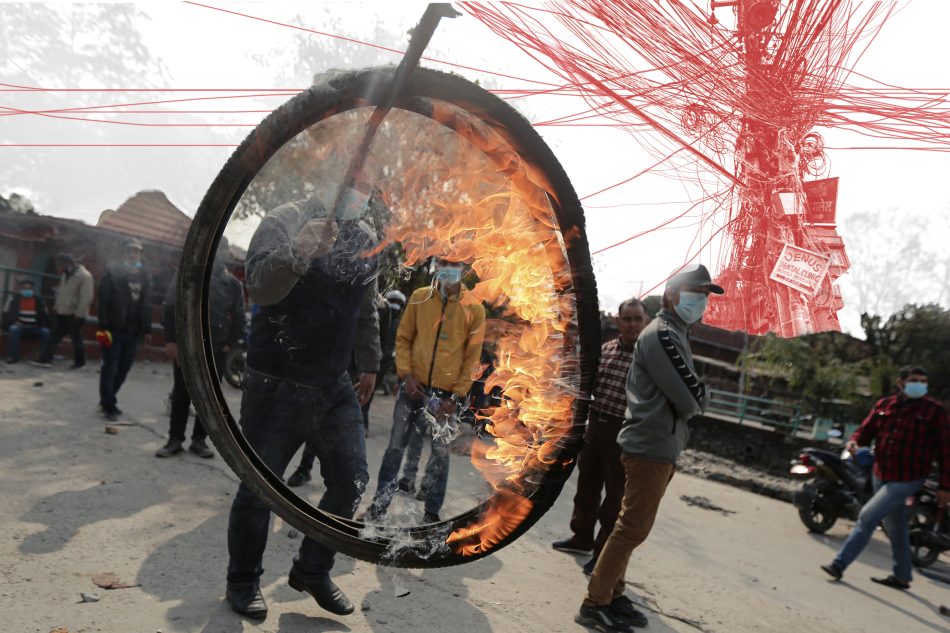
Burning tyres in the street by Nepalese youths protesting against MCC. Source: Amit Machamasi

.

The MCC’s Origins and Its Impact on US National Security Strategy

Shortly after the US began its Global War on Terror (2001) and the war of aggression on Iraq (2003), the US Congress passed the Millennium Challenge Act in January 2004, establishing the MCC project. As former Nepali minister Dipak Gyawali observed, the MCC and other related US government institutions ‘accelerated the process of weaponizing foreign aid in particular and foreign assistance by [the] US and its allies in general’.[3]

Even before the US Congress passed the Millennium Challenge Act, this strategy had been made clear in US President George W. Bush’s introduction to the National Security Strategy (2002):

The events of September 11, 2001 taught us that weak states, like Afghanistan, can pose a great danger to our national interest as strong states. Poverty does not make poor people into terrorists and murderers. Yet poverty, weak institutions, and corruption can make weak states vulnerable to terrorist networks and drug cartels within their borders. … Free trade and free markets have proven their ability to lift whole societies out of poverty… The United States will deliver greater development assistance through the New Millennium Challenge Account to nations that govern justly, invest in their people, and encourage economic freedom.[4]

While the US was focused on Afghanistan during this period, its orientation to ‘reduce’ poverty in low-income countries in order to prevent the growth of terrorist networks and drug cartels extended across the world. The MCC was conceived as part of the US’s national security strategy both to tackle poverty and to yoke in the political elites in small, low-income countries. Similar to other U.S. government programmes like the National Endowment for Democracy, the Compact was to be carried through the disbursement of funds, which it used as an instrument to enforce the ideas of free markets and representative democracy. Along these lines, the US Congress established the MCC as an independent government entity, which is nonetheless intimately linked to the US Departments of State and the Treasury as well as the US Agency for International Development (USAID). The MCC board of directors is chaired by the US secretary of state, and its vice chair is the secretary of the treasury. The rest of the board is composed of US government officials, including a representative of USAID and the CEO of the MCC, along with four individuals from the private sector appointed by the President of the United States and drawn from a list submitted by the US Senate.

Eight months after the MCC was ratified by the Nepali Parliament, the US released its 2022 National Security Strategy. The document highlights the centrality of the Indo-Pacific region, affirming that ‘No region will be of more significance to the world and to everyday Americans than the Indo-Pacific’.[5]

Not long after, the North Atlantic Treaty Organisation (NATO) released a report on the Indo-Pacific region that reiterates the importance of the Indo-Pacific and echoes US concerns about the rise of China as the West’s primary concern. It states: ‘The challenges posed by China to Euro-Atlantic security will remain a matter of attention for allies and partners going forward’.[6]

.
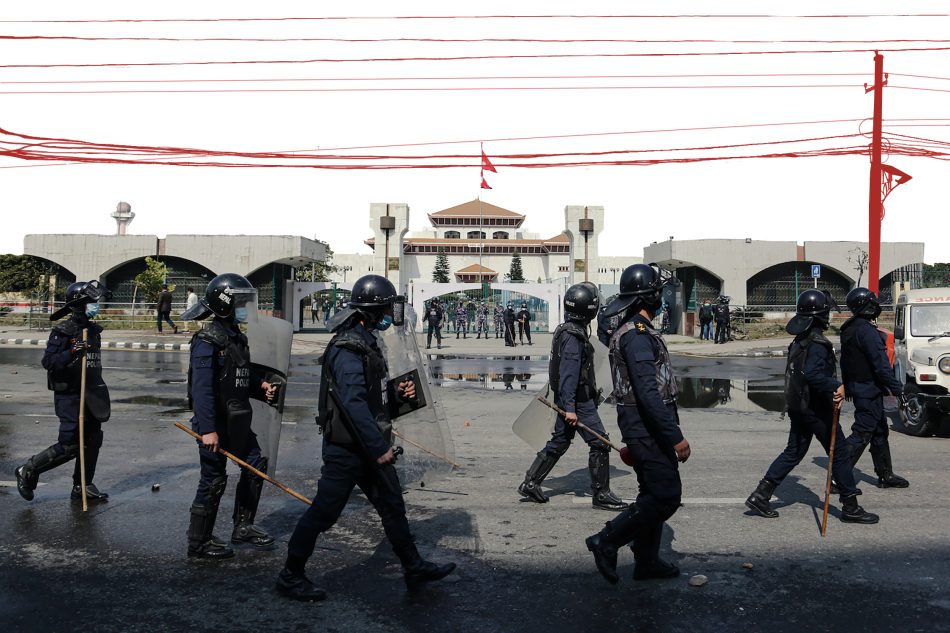
The police force  deployed in front of the Parliament House in order to contain the protest against MCC. Source: Amit Machamasi

.

How the MCC Impacts Nepal’s Neighbours

In December 2011, the MCC selected Nepal for a smaller grant under its ‘threshold programme’, which would be upgraded to a five year Compact in 2014. The grants were primarily meant to address the country’s inadequate electricity supply, particularly during the winter, when hydroelectric power generation decreases.[7]

There is no denying the severity of the electricity shortage facing the country, nor its impact on the population. In 2022–23, Nepal’s per capita electricity consumption was 380 kilowatt hours (kWh) – fourteen times lower than the consumption in nearby Bhutan (5,514 kWh). However, while the proponents of the MCC Nepal Compact claim that the new electricity corridor would benefit twenty-three million people (three-quarters of Nepal’s population), this aspiration does not account for the fact that most of the additional electricity generated is intended to be sold to India.[8]

This is evidenced, for instance, by the agreement signed by the Power Grid Corporation of India and the Nepal Electricity Corporation in September 2023 for a 130-km-long 400-kV transmission line extending from the Birgunj district of Nepal to the Gorakhpur District of India. Within months, on 4 January 2024, India’s External Affairs Minister S. Jaishankar and Nepal’s Foreign Minister N. P. Saud signed an agreement under which Nepal will provide India with 10,000 megawatts of power over the next ten years. This agreement will remain in force for 25 years and will be extended for every ten years unless terminated by either party with a six months’ notice.[9]

The rationale given for the MCC grant – to increase the production of electricity for domestic consumption – did little to hide the MCC’s ulterior motives to draw Nepal into furthering the US strategy in the region and deepen Nepal’s dependence on India. It is worth noting, towards this end, that the Compact was not drafted by Nepal alone; as the MCC notes, it was developed with USAID, the US Department of State, and the government of India, as well as ‘a variety of development partners’.[10]

India’s foreign policy has partly been to use the US presence in the region as a balance against the influence of China, with whom it nonetheless seeks to maintain its ties.[11]

In 2007, the United States brought Australia, Japan, and India into the Quadrilateral Security Dialogue (the Quad), although it did not become active at the time due to the presence of the social democratic government that was in power in India. With a change in the political situation in India, the Quad was revived around the time that National Security Strategy (2017) brought India into the US military’s focus on East Asia and the name of the military theatre changed from ‘Asia-Pacific’ to ‘Indo-Pacific’. The following year, the US renamed its regional military structure from the Pacific Command (as it had been known since 1947) to the Indo-Pacific Command.

Though India is part of the US’s Indo-Pacific Strategy, it is wary of the growing US presence on Nepali soil and the increased diplomatic relations between the two countries, which circumvent India’s role as a mediator. Nonetheless, India has supported the MCC Compact – and was even involved in its drafting – because it stands to benefit from the cheap electricity sales from Nepal that the Compact would likely generate. For this reason, India has largely been willing to overlook its concerns about the political consequences of the Compact, such as its diminishing influence as an arbiter of US-Nepal relations.[12]

China’s response to the MCC, amidst US pressure, is also noteworthy. Over the past decade, the US government has used the MCC Compact to contest and undermine China’s Belt and Road Initiative.

However, China has refrained from succumbing to US provocations. In 2020, China’s ambassador to Nepal, Hou Yanqi, stated,

‘We welcome any international assistance to Nepal if it is for economic cooperation. We would like to see the ratification process of the MCC, and the Nepal government take a positive decision for its interest’.[13]

Nevertheless, over the two years since Hou Yanqi’s comments, the US has escalated tensions in the region by exerting undue pressure on Nepal to ratify the MCC in parliament and support its agenda towards China. For instance, US officials visited Tibetan refugees in Nepal without obtaining approval from the Ministry of Foreign Affairs. On another occasion, US officials blamed China for the delay in ratifying the MCC, prompting China to describe US relations with Nepal as ‘coercive diplomacy.’[14]

 As Hua Chunying, the spokesperson for Chinese foreign ministry, said in February 2022:

The US Embassy in Nepal described the USD 500 million MCC grant as ‘gift from the American people to Nepalis’. I wonder, since when does a gift come with the package of an ultimatum? How can anyone accept such a ‘gift’? Is it a ‘gift’ or Pandora’s box? I’m afraid it will turn out like a Nepalese saying: It looks good, but you will find the meat difficult to chew … [T]here should be no interference in any country’s domestic affairs, no political strings attached, no coercive diplomacy, and certainly no infringement on other countries’ sovereignty and interests for selfish gains.[15]

.
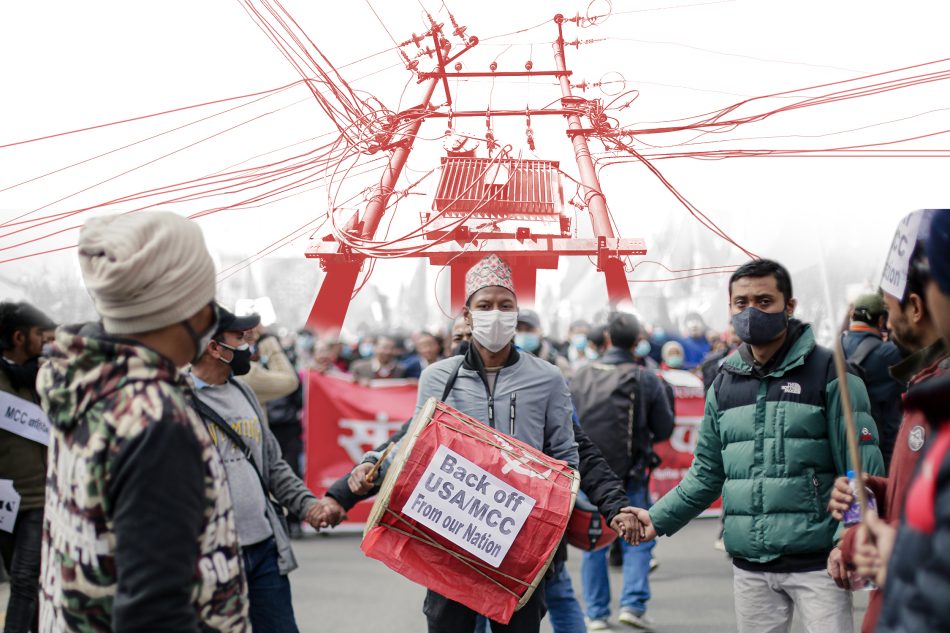
The combined demonstration against the MCC at Kathmandu Street by left-wing parties and their several fronts /
Youths in Kathmandu Street, together with back off MCC play cards and demonstration  by thumping an ethnic traditional drum.  Source: Amit Machamasi

.

The Debate in Nepal

The MCC Compact has sparked heated debate within Nepal since its proposal in 2017, which has only intensified following its ratification in parliament.

Proponents argue that the Compact would benefit Nepal in at least four ways:

  1. The sale of excess electricity to India, estimated to generate $1 billion annually, would provide the government with lucrative foreign exchange earnings.
  2. The involvement of US energy experts would provide employment opportunities and the transfer of skills for Nepalis.
  3. The Compact would strengthen relations between Nepal and the United States.
  4. The Compact would provide Nepal a mechanism to balance its position between its two large neighbours, India and China.

Opponents of the MCC point to at least three contentious clauses in the Compact and the perils of its ratification in parliament:

  1. The Compact infringes upon Nepal’s sovereignty, since the parliament granted it the legal status of an international agreement with the power to override Nepal’s domestic laws if these conflict with the project’s requirements, as well as to bypass state institutions such as the Nepal Electricity Authority (NEA).
  2. The construction of the electricity line and road project under the MCC Compact will be detrimental to Nepal’s economy in at least four ways:
    1. The estimated cost of building the 400-kV transmission line, according to the Ministry of Corporate Affairs, is four times higher than the budget proposed by the NEA ($38,000 to $150,000). This means that if Nepal had constructed the transmission line through the NEA, there would have been no need for MCC funds.[16]
    2. The MCC project side-lined an NEA plan that would have upgraded an existing 132-kV grid to a 400-kV grid along Nepal’s lowlands.[17]
    3. The inflated budget for the MCC project has led to an inflated contractor’s bid for the line, even exceeding the MCC’s budget. This precedent of the inflated MCC cost and bidding process is likely to create inflation in future infrastructure projects, a realisation that recently led the government to cancel the contract procedure and call for a new bid application.
    4. USAID study revealed that using electricity in Nepal would generate a value equivalent to 86 cents through its use in domestic industries. However, Nepal sells electricity to India at around 6 cents per unit, which means that it incurs a loss of 80 cents per unit through these sales.[18]
  3. Through the MCC Compact, the US has drawn Nepal into the controversy of its involvement in the US-run Indo-Pacific Strategy in its attempts to contain China and Russia.

Nepal is a landlocked country that borders China and India. It has sought to maintain good relations with all nations, particularly its neighbours, while defending its sovereignty and avoiding being used as a tool to further foreign interests. However, the MCC has drawn Nepal into the US’s New Cold War against China.[19]

Despite the US embassy in Kathmandu and the MCC team claiming that the MCC is not part of the US’s Indo-Pacific Strategy, US officials’ statements suggest otherwise. For instance, in 2017, US Assistant Deputy Secretary of State Alice Wells told the US Congress that Nepal ‘has been selected for one of the United States’ most high-profile projects to increase regional connectivity within the Indo-Pacific’.[20]

This position was reinforced by US Acting Deputy Assistant Secretary of State for South Asia, David J. Ranz, when he openly said that the MCC is an integral part of the Indo-Pacific Strategy during his visit to Nepal in May 2019. Furthermore, the US State Department report titled A Free and Open Indo-Pacific (November 2019) stated the MCC is an ‘economic pillar’ of the Indo-Pacific Strategy.[21]

The US’s intentions to drag Nepal in its plans for the Indo-Pacific region is not only clear through statements, but also through its actions, such as the controversy that broke out about Nepal’s role in the US State Department’s State Partnership Programme (SPP), a military-to-military cooperation programme, immediately after the parliament ratified the MCC. Nepal temporarily joined the SPP as a part of a disaster management partnership in the aftermath of an earthquake in 2015 that killed nearly 9,000 people, injured more than 22,000, and affected over a quarter of the country’s population.[22]

However, four years later, in June 2019, the US Defence Department’s Indo-Pacific Report listed Nepal as a full member of the SPP.[23]

It is worth noting that many European countries that joined the SPP in this manner later went on to become members of NATO. In 2022, when there was talk about an Asian NATO, Nepal appeared to be prepared to join the SPP, sparking nationwide protests against the SPP. As a result, the government retreated from its decision to join this programme.[24]

The contradictory claims and actions of the US government and MCC officials have provided no assurance to the Nepali public. Even the right-wing Rastriya Prajatantra Party, which is close to the deposed monarchy, stood against the MCC Compact. Protests across the political spectrum pushed Nepal’s government to write to the MCC in September 2021 and ask for clarification on some of these issues. The letter, written by Finance Minister Janardhan Sharma and sent before Parliamentary ratification, posed seventeen questions about several clauses in the MCC Compact, such as section 7.1, which states that ‘The parties understand that this Compact, upon entry into force, will prevail over the domestic laws of Nepal’.[25]

The MCC’s response dodged the question. Instead, they stated that ‘the Ministry of Law, Justice, and Parliamentary Affairs (MoLJPA) reviewed all terms of the MCC Nepal Compact, including the section 7.1, and concluded that Compact provisions do not conflict with the laws of Nepal’.[26]

However, this raises a point: If there’s truly no conflict, then why is there a clause stating that the ‘compact … will prevail over the domestic laws of Nepal’?

Question 10 of the clarification letter asked why the Compact needed parliamentary ratification, which would raise the Compact to the status of international law:

Many agreements related to development, construction and investment do not seem to require parliamentary ratification. Why does this particular agreement need parliamentary ratification? After parliamentary ratification, an agreement becomes a law. All the conditions mentioned in it become the law. As long as that law exists, the MCC has a statutory right to maintain control in influencing treaties, agreements, economic investments, development models, and state affairs of Nepal. Is it not for the purpose of maintaining that control, as per Article 5.5 of the agreement, the parliamentary ratification has been proposed?[27]

The MCC’s response contradicts their earlier claim in Section 7.1 that the ‘compact provisions do not conflict with the laws of Nepal.’ The MCC shifted the blame to MoLJPA for seeking parliamentary ratification. This necessitates MoLJPA’s conclusion that parliamentary ratification is required to override domestic laws:

During compact development, [the] MCC asks each partner government what their country’s domestic law requires in order for the compact to have the status of an international agreement and that will avoid any specific conflicts with domestic law. For Nepal, the government, through Nepal’s Ministry of Law, Justice, and Parliamentary Affairs, concluded that, under Nepali law, parliamentary ratification is required for the compact to be such an international agreement.[28]

One of the questions in the letter is especially germane:

From 2001 onward, the USA replaced its previous USAID strategy by adopting the strategy of mobilising the aid only under US national security strategy. The National Security Strategy of December 2017, National Security Strategy Report of June 2019, and Indo-Pacific report of November 2019 state that military and non-military alliances in the Indo-Pacific region would be strengthened and assistance including MCC would be mobilised under Indo-Pacific Strategy. Can’t it be said that the agreement is under the Indo-Pacific Strategy?[29]

The United States’ response was evasive. It avoided directly rejecting the question or denying its implications. Instead, it simply stated that the ‘MCC-Nepal Compact is a non-military agreement… [it] is not, and never has been, a deliverable of the Indo-Pacific Strategy’.[30]

 This answer failed to address the concerns of the Nepali people. Protests continued, compelling the government to issue the twelve-point interpretative declaration, which begins by stating:

Nepal declares that being a party to the compact, Nepal shall not be a part of any United States’ strategy, military, or security alliance including the Indo-Pacific Strategy.[31]

Yet, as we explained earlier, this fig leaf holds no weight, nor does it have a legal standing or any way of being enforced.

On the day that the MCC Compact entered into force (EIF) in August 2023, The then opposition leader and current Prime Minister K. P. Oli, who had previously pushed the bill through parliament, said that the interpretative declaration was a ‘lie’ and that ‘the MCC does not accept this’ declaration. The MCC Compact, he said, ‘will be implemented as it has been approved by parliament’, with no amendments.[32]

Six weeks later, MCC Chief Executive Officer Alice Albright visited Nepal, she stated, ‘We have accepted [the declaration]’. However, the Nepali government has yet to make public a formal written response from the United States government that accepts this declaration, if one exists.[33]

Though the US Embassy acknowledged in an interview with The Kathmandu Post that: ‘We agree with the interpretative declaration and consider it to be consistent with our understanding of the terms of the compact, including the prevalence of the Constitution of Nepal over the MCC Nepal Compact’, this admission cannot supplant an official communiqué to the government and lacks a clear legal standing.[34]

It is important to remember that Nepal’s parliament passed the 12ID and deserves an official response, not just a verbal comment.

While Nepal claims that the compact would be immediately declared null and void if it violates the declaration, for this to be the case, the US government would have to issue legally binding documentation stating as much. If the MCC has no objection to the declaration, then why has there been no such official communiqué, and if there is, why has the Compact not been revised accordingly? As it stands, two contradictory stances define US-Nepal policy, one that suggests that the MCC Compact can override Nepali law and the other that says that this is not so.

Following the MCC’s response to Finance Minister Sharma’s questions, several high-ranking officials from the United States visited Nepal. In September 2021, MCC Vice President Fatema Sumar came to Nepal and met with most of the high-level Nepali political leaders and government officials. This was followed by a visit from US Assistant Secretary of State for South and Central Asia Donald Lu. During his visit, Lu met with the then Prime Minister Sher Bahadur Deuba, CPN-UML chair KP Oli and CPN (MC) chair Pushpa Kamal Dahal and issued an ultimatum: if Nepal did not ratify the compact, Lu would return to Washington and recommend a review of US relations with Nepal.[35]

This marked a significant shift in tone, as such a forceful language had not been used in the seventy-six years of US-Nepal relations.

As part of the broader pressure campaign against Nepal, Lu hinted that if the country refused to ratify the MCC Compact, the US would blame this on China, drawing Nepal firmly into the US-imposed New Cold War on China. There should be no confusion: US foreign policy defines the MCC as a developmental arm of its national security strategy. Not only is the MCC economically unviable, but it also drags Nepal into the dangerous waters of the New Cold War imposed by the US on Asia.

It is worth pointing out that Sri Lanka, the only other South Asian country to be offered an MCC grant, refused to sign an MCC Compact in 2020 based on a report of the Sri Lankan Expert’s Committee on the matter. The report, which stated that ‘the current status of countries which had implemented MCC is tragic’, also noted that if the Sri Lankan Parliament adopted the compact, it would not be able to revise it during the course of the project.[36]

In Nepal, which voiced the same concern about the binding nature of the compact, a committee chaired by former Prime Minister Jhala Nath Khanal of the CPN-US presented a detailed analytical report that suggested that the compact be amended. However, MCC officials initially downplayed these concerns, but later contradicted themselves by denying that there had been any such suggestion for emendation.[37]

.
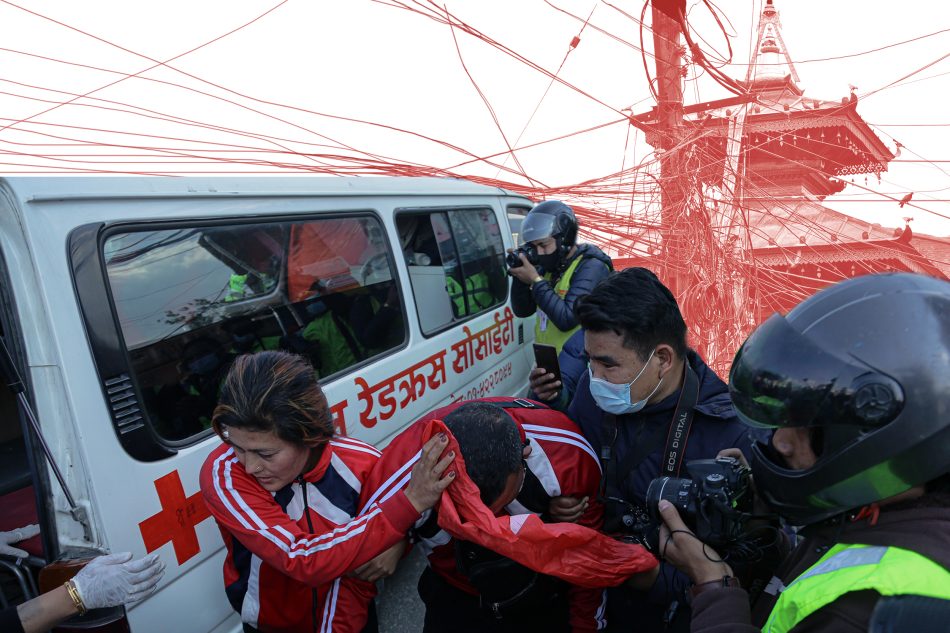
An injured young demonstrator from the student front being rescued for treatment by the Red Cross rescue crew.  Source: Amit Machamasi

.

Conclusion

It took a decade for the MCC Compact to be ratified in the parliament and another year and a half for it to enter into force. The countdown has now begun to finish the construction by 2027. If this is not achieved within the project period, the MCC can withdraw, shifting the financial burden to finish the project onto the recipient country. Furthermore, under section 5.3 of the Compact, ‘MCC has right to receive refund and even interest could be levied if the refund is delayed for violation of any covenant’. The project is already facing problems, making it unlikely to be completed on time.

There is a clear paper trail documenting the MCC’s role in the United States’ national security strategy. What is not clear, however, is why Nepal applied for the MCC Compact grant and why it participated in writing a Compact that is against its own interests, at minimum by:

  1. undermining the country’s parliament and compromising its sovereignty.
  2. trapping the country in an expensive transmission line project that – if not completed on time – will have to be paid for by Nepal and will further indebt the country. The cancellation of the previous procurement bid has already caused a significant one-year delay in opening another bid, making it nearly impossible to complete the project within five years.
  3. drawing Nepal into a project that is tied up in the United States’ geopolitical plans for Asia, setting a precedent that will continue even if the MCC grant is withdrawn.

Why did the United States, a country with the largest military in the world, pressure a poor country to accept a ‘free’ grant that has provoked immense backlash from its population? Why did the United States refuse to amend the compact and threaten to cut its bilateral ties if the grant was not ratified by parliament? Why did the United States drag China into this controversy by claiming that the Chinese government was holding up the ratification of the MCC, when it is clear that the ‘hold up’ was the resistance of the Nepali people?

The rationale for the MCC grant is that Nepal needs to enhance its electricity infrastructure and export electricity to earn precious foreign exchange. But the grant comes at a high economic and political cost, and its proponents ignore a key factor: that such a project could have been built by the Nepali state at a much lower cost, with the money it is contributing to the MCC project ($197 million) and without the geopolitical entanglements of the MCC. The protest against MCC continues, and as the MCC project advances, its inherent contradiction will also surface. To preserve its sovereignty and avoid compromising it further, Nepal should prioritise building the necessary transmission line itself, even if it requires funding entirely from its own coffer. As per Section 5.1 Nepal has the right to call off the agreement with a 30 days’ notice.

.
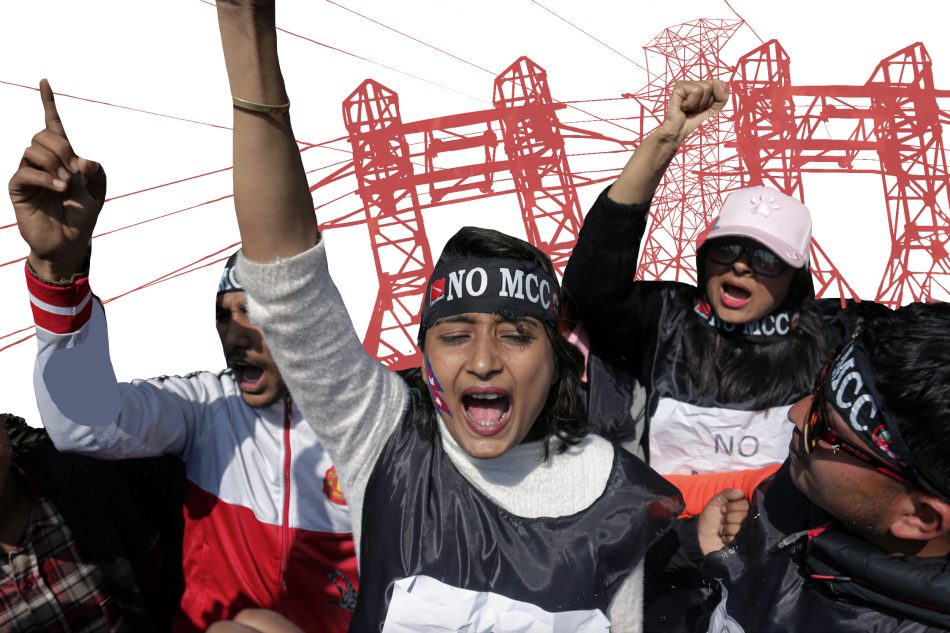
Youth chanting “Back Off” and “No MCC” in front of Parliament Source: Amit Machamasi

*

Click the share button below to email/forward this article to your friends and colleagues. Follow us on Instagram and Twitter and subscribe to our Telegram Channel. Feel free to repost and share widely Global Research articles.

Birds Not Bombs: Let’s Fight for a World of Peace, Not War 

This essay was produced in collaboration with Bampanth and written by its chief editor, Dr Mahesh Maskey. He was formerly the chair of the Government of Nepal’s Health Research Council and Ministry of Health and Population’s High-Level Health Policy Advisory Committee. Dr Maskey also served as Nepal’s ambassador to China from 2012 to 2016.

The photographs in this essay are by Nepali photojournalist and visual artist Amit Machamasi, documenting a protest in February 2022 against the Millenium Challenge Corporation in New Baneshwor, Kathmandu. The photographs were modified by the art department of Tricontinental: Institute for Social Research into collages that highlight the crisis of energy supply for the Nepali people.

Notes

1 US Congressional Research Services, ‘Millennium Challenge Corporation: Overview and Issues’, RL 32427, 3 October 2019, https://sgp.fas.org/crs/ row/RL32427.pdf, 28; Gwayali, ‘MCC and the Weaponisation of Aid’; M.B. Shrestha, ‘MCCma Rashtriya Hita Viparitaka Pravadhanaharu Chan’, Bampanth, 6 January 2022.

2 ‘Nepal Commits Extra Funds to MCC-Funded Transmission Line Projects’, The Kathmandu Post, 29 May 2023, https://kathmandupost.com/national/2023/05/29/nepal-commits-extra-funds-to-mcc-funded-transmission-line-projects.

3 Dipak Gwayali, ‘MCC and the Weaponisation of Aid’, Spotlight Nepal, 2 March 2022, https://www.spotlightnepal.com/2022/03/02/mcc-and-weaponization-aid/.

4 George W. Bush, ‘Introduction’, National Security Strategy (Washington, D.C.: The White House, 2002), https://georgewbush-whitehouse.archives. gov/nsc/nss/2002/nssintro.html.

5 National Security Strategy 2022, 38.

6 North Atlantic Treaty Organisation, ‘Regional Perspectives Report on the Indo-Pacific’ (Brussels: NATO, 2022), https://www.act.nato.int/wp-con- tent/uploads/2023/05/regional-perspectives-2022-07-v2-1.pdf, 1.

7 ‘Millennium Challenge Compact Between the United States of America Acting Through the Millennium Challenge Corporation and the Federal Democratic Republic of Nepal Acting Through the Ministry of Finance’, Millennium Challenge Corporation, 14 September 2017, https://assets. mcc.gov/content/uploads/compact-nepal.pdf.

8 ‘Agreement Between the Government of Nepal and the Government of Republic of India on Long-Term Power Trade Agreement’, January 2024.

9 Anil Giri, ‘Nepal and India Review Relations, Sign 10,000 MW Power Export Deal’, The Kathmandu Post, 5 January 2024 https://kathmandupost.com/national/2024/01/05/nepal-and-india-review-relations-sign-10-000mw-power-export-deal

10 ‘Millennium Challenge Compact’.

11 Rahul Roy-Chaudhury, ‘India’s “Inclusive” Indo-Pacific Policy Seeks to Balance Relations with the US and China’, International Institute for Strategic Studies, 6 July 2018, https://www.iiss.org/online-analysis/on- line-analysis//2018/07/india-inclusive-indo-pacific-policy-china-relations.

12 Naresh Kumar, ‘Nepal, MCC, and the US’ Indo-Pacific Strategy’, Indian Council of World Affairs, 29 October 2021, https://www.icwa.in/show_ content.php?lang=1&level=3&ls_id=6519&lid=4480&kval=naresh%20 kumar.

13 Binod Ghimire, ‘China Says It Welcomes Any Foreign Economic Sup- port – Even the MCC – to Nepal’, The Kathmandu Post, 3 January 2020, https://kathmandupost.com/national/2020/01/03/china-says-it-wel- comes-any-foreign-economic-support-even-the-mcc-to-nepal.

14 ‘Is It Gift or Pandora’s Box, Asks China on US Grant Aid to Nepal’, The Print, 25 February 2022, https://theprint.in/world/is-it-gift-or-pandoras- box-asks-china-on-us-grant-aid-to-nepal/847177/.

15 ‘Is It a Gift or Pandora’s Box’.

16 Gwayali, ‘MCC and the Weaponisation of Aid’; M.B. Shrestha, ‘MCCma Rashtriya Hita Viparitaka Pravadhanaharu Chan’, Bampanth, 6 January 2022.

17 Gwayali, ‘MCC and the Weaponisation of Aid’.

18 R. S. Shrestha, ‘Economic and Financial Assessment of MCC’, SPOT- LIGHT, 5, December, 2021.

19 Hari P. Chand, ‘Nepal’s Engagement in BRI and MCC: Implications on Nepal’s Geopolitics and Foreign Policy’, Journal of Political Science 21, Special Issue (August 2021), 10.3126/jps.v21i1.39288; Jagdish Kharel, ‘Millennium Challenge Corporation (MCC), Media, and Security Impli- cations in Nepal’, Contemporary Social Sciences 31, no. 4 (October–December 2022), https://jndmeerut.org/wp-content/uploads/2023/01/Vol.

20 Biswas Baral, ‘Nepal’s Fierce MCC Debate’, The Diplomat, 8 February 2022, https://thediplomat.com/2022/02/nepals-fierce-mcc-debate/. Alice Wells’ statement was made at the House Foreign Affairs Subcommittee on Asia and the Pacific hearing on ‘Maintaining US Influence in South Asia: The FY 2018 Budget’, 7 September 2017, https://docs.house.gov/ meetings/FA/FA05/20170907/106375/HHRG-115-FA05-Wstate- WellsA-20170907.pdf, 8.

21 Bureau of East Asian and Pacific Affairs, US Department of State, A Free and Open Indo-Pacific: Advancing a Shared Vision (Washington, D.C.: The White Hours, 4 November 2019), https://www.state.gov/a-free-and- open-indo-pacific-advancing-a-shared-vision/, 14.

22 https://www.oxfamamerica.org/explore/emergencies/past-emergencies/ nepal-earthquake/.

23 US Department of Defence, Indo-Pacific Strategy Report: Prepared- ness, Partnerships, and Promoting a Networked Region (Washington, D.C.: The White Hours, 1 June 2019), https://media.defense.gov/2019/ Jul/01/2002152311/-1/-1/1/DEPARTMENT-OF-DEFENSE-IN-DO-PACIFIC-STRATEGY-REPORT-2019.PDF, 38.

24 P. K. Balachandran, ‘Nepal Backs Away from US State Partnership Pro- gramme’, The Diplomat, 22 June 2022, https://thediplomat.com/2022/06/ nepal-backs-away-from-us-state-partnership-program/.

25 ‘Millennium Challenge Compact’, 13.

26 Sanjib Bagale, ‘Preparations to Ratify MCC Compact Today Itself’, Setopati, 27 February 2022, https://en.setopati.com/political/158030.

27 Bagale, ‘Preparations’.

28 Bagale, ‘Preparations’.

29 Janardan Sharma, ‘Letter Requesting Clarifications on the MCC Nepal Compact’, unpublished, 8 September 2021.

30 US Embassy, Kathmandu, ‘The MCC-Nepal Compact Top Ten Facts’, 3 March 2022, https://np.usembassy.gov/mcc-in-nepal-top-ten-facts/.

31 ‘What’s in 12-Point Interpretative Declaration on MCC?’, Setopati, 27 February 2022, https://en.setopati.com/political/158036.

32 ‘12-Point MCC Interpretative Declaration Is a Lie: Oli’, Pardafas, 30 Au- gust 2023, https://english.pardafas.com/12-point-mcc-interpretative-dec- laration-is-a-lie-oli/.

33 Kosh Raj Koirala, ‘MCC CEO Alice Albright: “We Agree With and Have Accepted” the 12-Point Explanatory Note’, My Republica, 3 October 2023, https://myrepublica.nagariknetwork.com/news/mcc-ceo-alice-albright-we-agree-with-and-have-accepted-the-12-point-explanatory-note/.

34 Prithvi Man Shrestha, ‘Nepal’s Declaration on MCC Compact Gets US Nod’, The Kathmandu Post, 30 August 2023, https://kathmandupost.com/national/2023/08/30/nepal-s-declaration-on-mcc-compact-gets-us-nod.

35 Anil Giri, ‘Top American official Says US Will Review Nepal Ties If MCC Compact Is Not Ratified’, The Kathmandu Post, 10 February 2022, https:// kathmandupost.com/national/2022/02/10/top-american-official-says-us-will-review-nepal-ties-if-mcc-compact-is-not-ratified.

36 Sri Lanka Presidential Secretariat, ‘Final Report of the MCC Review Ac- cessible for Public via 3 Websites’, Sri Lanka President’s Office, 28 June 2020, https://www.presidentsoffice.gov.lk/index.php/2020/06/28/final-report-of-the-mcc-review-accessible-for-public-via-3-websites/.

37 One member of this committee was the then foreign minister Pradeep Kumar Gyawali who differed with the analysis and recommendation of the report and registered his opinion in the report. J. N. Khanal’s report is in Mahesh Maskey (ed) MCC: Illusion or Reality, appendix 1.


Appendix

The Twelve-Point Interpretative Declaration (February 2022)

  1. Nepal declares that being a party to the Compact, Nepal shall not be a part of any United States’ strategy, military, or security alliance including the Indo-Pacific Strategy.
  2. Nepal declares that the Constitution of Nepal, being the fundamental law of the land, shall prevail over the Compact and other associated agreements.
  3. With reference to Section 2.7, Section 5.1 (b) (iii), Section 5.1 (b) (iv) of the Compact, Nepal understands that these sections are intended to apply only for the use of the MCC Funding and Programme Assets and that the provisions do not and shall not obligate Nepal to comply with the current or future United States’ laws or policies for any purpose other than the use of the MCC Funding.
  4. With reference to Section 3.2 (b) of the Compact, Nepal declares that the conduct of activities of the Millennium Challenge Account Nepal Development Board (the MCA-Nepal) shall be governed by the laws of Nepal and regulated by the provisions of the Compact.
  5. With reference to Section 3.2 (f ) of the Compact, Nepal declares that [the] MCC shall not have ownership over the Intellectual Property and that Nepal shall own and fully enjoy all the Intellectual Property created under the Compact programme.
  6. With reference to Section 3.5 of the Compact, Nepal declares that Implementation Letters under the Compact shall be implemented within the scope of the Compact.
  7. With reference to Section 3.8 (a) of the Compact, Nepal declares that, in addition, the audits of all the activities and funds of MCA-Nepal [the Ministry of Corporate Affairs] shall be conducted by [the] Office of the Auditor General in accordance with [the] prevailing laws of Nepal.
  8. With reference to Section 5.1 (a) of the Compact, Nepal declares that in addition to Nepal’s right to terminate the Compact without cause by giving thirty (30) days’ prior notice, Nepal has the right to terminate the Compact by giving thirty (30) days’ prior notice in case the activities/programme under the Compact violate Nepal’s laws or policies.
  9. With reference to Section 5.5 of the Compact, Nepal declares that provisions under the Compact which survive after the expiration, suspension, or termination of the Compact shall only relate to the Compact programme and the use of MCC Funding, including for evaluation of the projects under the Compact, audits, and settlement of taxes.
  10. With reference to Section 7.1 of the Compact, the programmes under the Compact shall be implemented by complying with the Compact and in accordance with the domestic laws of Nepal.
  11. With reference to Section 8.1 of the Compact, Nepal declares that the Electricity Transmission Project, including all movable and immovable assets and land associated with the project, shall be owned by the Government of Nepal or entities of the Government of Nepal.
  12. With reference to the letter dated September 8, 2021 perceived by Nepal from the Millennium Challenge Corporation, Nepal understands that the responses in the said letter shall aid in the interpretation and the implementation of the Compact.


The 2024 Nobel peace prize has been awarded to Nihon Hidankyo, a Japanese grassroots organisation created by survivors of the two US atomic bombs that were dropped on the cities of Hiroshima and Nagasaki in August 1945.

The Norwegian Nobel committee recognised the organisation “for its efforts to achieve a world free of nuclear weapons and for demonstrating through witness testimony that nuclear weapons must never be used again”.

Discussion of the bombings, which killed more than 100,000Japanese people, was largely a taboo in the immediate post-war period. This was, in part, thanks to American press censorship in occupied Japan.

But, in 1954, an American nuclear weapons test at Bikini Atoll in the Pacific Ocean produced such extensive radioactive fallout that it affected a Japanese fishing boat, the Lucky Dragon, causing one death from radiation poisoning.

The Lucky Dragon incident prompted many of the atomic bomb survivors, who are known as the hibakusha, to speak out about their experiences. And it was within this context that Nihon Hidankyo was created in 1956.

Since then, the hibakusha have played an immeasurable role in activism against nuclear weapons worldwide. Their testimony, the Nobel committee said, has “helped to generate and consolidate widespread opposition to nuclear weapons around the world”.

.

The destroyed city of Hiroshima after it was bombed in 1945.

The US detonated an atomic bomb over the Japanese city of Hiroshima on August 6 1945. (Source: Shutterstock)

.

In 1975, for example, a group of hibakusha that included Setsuko Thurlow, a member of Nihon Hidankyo and a globally renowned campaigner against nuclear weapons, organised an exhibition on the atomic bombings at the Toronto public library.

This helped trigger the development of a significant anti-nuclear movement in Canada. By the early 1980s, tens of thousands of Canadians regularly demonstrated against their government’s support for US nuclear weapons.

Then, in 1984, another survivor of the Hiroshima bombing called Takashi Morita co-founded a hibakusha organisation based in São Paulo to share their stories and raise awareness in Brazil of the devastating consequences of nuclear weapons.

Growing awareness of the experiences of the hibakusha throughout the 1980s inspired Europeans to protest against the deployment of new nuclear missiles in their countries. The phrase “no Euroshima!” became a popular slogan for the European peace movement.

Nihon Hidankyo’s efforts have focused not only on sharing the experiences of hibakusha, but also using them to gain support for the abolition of nuclear weapons worldwide.

The organisation has been a key supporter of the UN treaty on the prohibition of nuclear weapons. This treaty, which entered in force in 2017 and has been signed by 94 countries, prohibits states from participating in any nuclear weapon activities.

The International Campaign for the Abolition of Nuclear Weapons – in which Setsuko Thurlow is a leading figure – was awarded the Nobel peace prize in 2017 for its efforts to achieve this legally binding prohibition of such weapons.

Still Work to Do

Within Japan, Nihon Hidankyo has worked to challenge the government’s position on nuclear weapons. The Japanese government is supportive of American nuclear weapons, despite the horrors witnessed in Hiroshima and Nagasaki, and depends on them as a deterrent against its several nuclear-armed neighbours.

Successive Japanese governments have insisted on the importance of nuclear weapons for the country’s national security. But it remains a controversial stance for many in Japan. Every Japanese school child typically visits Hiroshima or Nagasaki to learn about the nightmarish consequences of nuclear weapons.

The decision to award the Nobel peace prize to Nihon Hidankyo is particularly timely. In 2023, the world’s nine nuclear powers spent over US$91 billion (£69.5 billion) on nuclear weapons. And since Russia’s invasion of Ukraine in 2022, Russian president Vladimir Putin has repeatedly threatened to use his nuclear arsenal.

These concerning developments were acknowledged by the Nobel committee. When awarding Nihon Hidankyo with the prize, the committee said it was “alarming that today this taboo against the use of nuclear weapons is under pressure.”

The world’s nuclear powers – especially China and the US – are expanding and modernising their arsenals. North Korea is continuing to develop its nuclear weapons programme. And tensions are fast escalating between nuclear-armed Israel and near-nuclear Iran.

The threats posed by nuclear weapons are more apparent now than they have been at any time since the cold war. With barely 100,000 hibakusha alive today, it is imperative that we listen to their voices and their warnings.

*

Click the share button below to email/forward this article to your friends and colleagues. Follow us on Instagram and Twitter and subscribe to our Telegram Channel. Feel free to repost and share widely Global Research articles.

Birds Not Bombs: Let’s Fight for a World of Peace, Not War 

Senior Lecturer in Contemporary History, University of Sheffield

, Senior Lecturer in Contemporary International History, The Open University

Featured image: Nihon Hidankyo’s secretary general Terumi Tanaka speaking to youth about surviving the atomic bombing of Nagasaki at a UN event in Vienna in 2007 (From the Public Domain)

The rural discourse in Punjab has not given the due attention to a very significant share of the population—the rural landless sections including farm workers who have the least resource base and hence constitute the most vulnerable and poorest segment of the population. In keeping with the principle of giving the most attention to the most vulnerable and poorest sections of society, they should have got the most attention, but in reality their needs and aspirations have been neglected by successive governments to a large extent. 

Several marginal farmers also toil as farm workers. In addition, several small and marginal farmers have been forced by indebtedness and economic distress to leave their land and turn into farm workers. This can be a traumatic experience for them as family honour can be very closely linked to land ownership. Studies have revealed that 14.4 per cent of Punjab’s farmers have left farming since 1991. Among those who left farming 82 per cent were small and marginal farmers. 28 per cent of the farmers who left farming started earning their livelihood as labourers in the farm sector as well as the non-farm sector (EPW, Paper by Singh and Bhogal 2014 on Punjab’s Small Peasantry).

Excessive mechanization and increasing presence of a large number of migrant workers has reduced the farm employment opportunities of local farm workers while at the same time creative and satisfactory alternative employment opportunities have not emerged for them, despite the potential for this.

Unnecessarily high mechanization not related to the real needs of Punjab’s villages has led to high levels of unemployment among farm workers, apart from creating other problems, including ecological problems. As a report of the Punjab State Council for Science and Technology admits,

“the state has double the number of tractors it requires. The average use of tractors per annum in the state is barely 450 hours, which is much below the minimum 1,000 hours of productive use in agriculture. This is leading to over capitalisation in farm mechanisation and its under-utilisation due to decrease in farm size. This leads to higher cost of production and lower net income to farmers, making it economically unviable. As per 2004 estimates of Department of Agriculture, Government of India, 14% of total population of tractors in India ploughs the fields in Punjab”.

Another study (2007, Ghuman and Singh, Punjabi University Patiala)) points out that the overall economic condition of farm workers has been worsening, (the wage data must be seen be in the context of the time of the study)

“The low wage rate, along with the lesser number of employment days, has worsened the economic plight of agricultural labourers.  It is important to note that no casual labourer in agriculture is earning more than Rs. 1500 per month, on an average.  Even in the case of family earnings, nearly 67 per cent families end up with a monthly income of less than Rs. 1500.  Even in non-agricultural activities, 91 per cent casual labourers are earning less than Rs. 1500 per month. There is, thus, an urgent need to address this phenomenon by way of empowering workforce with skill and other measures…As a result of low wages, low availability of work and low family earnings, more than 70 per cent of the casual labourers are under loan.  They had taken loan from non-institutional sources at a very high interest rate.  The fact of the matter is that a very high proportion of labourers take loan to meet household expenses, health, care and social commitments.  These labourers are in a debt-trap.” 

The working of the prevailing power structure both at the village level and at the wider policy level is such that the aspirations of farm workers either for better wages or for a share of the land are generally curbed with a heavy hand. As Sukhpal Singh has noted, the increase in real wages in Punjab has been lower than the all India level. There have been examples, as in Ferozepur, when big farmers used heavy handed methods to lower wages for paddy transplantation. In 2009 when farmers agitated for homestead land rights and better implementation of National Rural Employment Guarantee Act, over 1300 agricultural workers and labour leaders were arrested.  Farm workers have been denied even that land which should be leased to them according to the governments own policies. As a result of all these denials, “employment in agriculture is casual, intermittent and uncertain and labourers find it most difficult in making both ends meet at this consistently low level of living. The major reasons behind the “casualization” of farm labour in the state have been mechanisation of major farm operations, inflow of migrant labour, slowdown of agricultural growth, and non-viability of small and marginal holdings”. Out of the 2890 suicides reported in the study on Bhatinda and Sangrur 39 per cent were those of agricultural labourers. (paper by S. Singh, EPW, 2009).

With the changes in technology farm workers have been exposed to increasing health hazards and injuries. In particular the health hazards caused by high levels of exposure to toxic agro-chemicals have been very severe.

The landless sections also need at least some land base. If even small plots of land can be provided to them along with support for water conservation and irrigation then using low-cost natural farming methods, kitchen gardens, multi-layer vegetable gardens they too can have at least some food security. In the recent past when they could access some land the model of collectively growing fodder crops to promote dairying related livelihoods has also proved useful. As they have very little access to land, they should be given more opportunities in various village level schemes of cottage and small-scale industries including agro-based industries. 

As work of water conservation and recharge, cleaning and clearing of water sources, improving soil health etc. needs to be taken up on a large scale, significant opportunities for the landless should be created under NREGA based schemes and other schemes. The greening of Punjab in the form of planting mixed indigenous species should be taken up in a big way and this can become another important source of short-term wage employment as well as long-term self-employment for landless workers. Certain patches of degraded community land and forest land can be given to groups of landless persons for greening with mixed indigenous species, trying to imitate a natural forest of the region. They can be given proper wages for this work for some years. When the trees are grown up, they can be given the rights to obtain minor forest produce from them, while at the same time taking care to protect trees.   

A large number of migrant workers particularly from Bihar and eastern UP have come to work in the villages (as well as cities) of Punjab. They have worked hard in adverse conditions far away from home to contribute to the completion of intensive agricultural operations with tight seasonality and time schedules. However their welfare needs have also been often neglected as they generally do not have essential facilities and access to government schemes in the way they would have in their home villages. They do not have unions and organizations to assert their needs and rights even though they may be placed in the most vulnerable position. Their welfare needs also need much more attention.

At some places efforts of farm workers to unionize have led to good results but on the whole, much more remains to be done for better and stronger organization of farm workers in Punjab so that their needs can be met and their rights can be protected in much better ways. 

*

Click the share button below to email/forward this article to your friends and colleagues. Follow us on Instagram and Twitter and subscribe to our Telegram Channel. Feel free to repost and share widely Global Research articles.

Birds Not Bombs: Let’s Fight for a World of Peace, Not War 

Prof. Jagmohan Singh is Chairman of Shaheed Bhagat Singh Centenary Foundation.

Bharat Dogra is Convener, Campaign to Protect Earth Now. His recent books include Man over Machine and Protecting Earth for Children. He is a regular contributor to Global Research.

  • Posted in Mobile
  • Comments Off on Don’t Neglect Rural Landless and Farm Workers of Punjab. They Need Justice.
  • Tags: , ,

The warning signs of the Australian National Anti-Corruption Commission’s ineffectiveness were there from the start. The enacting legislation that brought it into existence, for instance, limit public hearings to “exceptional circumstances”, a reminder that the authorities are not exactly happy to let that large expanse of riffraff known as the public know how power functions in Australia.

Then came its first major decision on June 6. Pundits were on tenterhooks. What would this body, charged with enhancing the “integrity in the Commonwealth public sector by deterring, detecting and preventing corrupt conduct involving Commonwealth public officials” do about referrals concerning six public officials from the Royal Commission into the Robodebt Scheme? The spiritually crushing automated debt assessment and recovery program, had, after all, been responsible for using, in the words of Commission report, “patently unreliable methodology as income averaging, without other evidence, to determine entitlement to benefit”.  From its inception as a pilot program in 2015 till its conclusion in May 2020, a reign of bureaucratic terror was inflicted on vulnerable Australians.

The answer from Australia’s newly minted body was one of stern indifference. While the NACC was aware of the impact of the scheme “on individuals and the public, the seniority of the officials involved, and the need to ensure that any corruption issue is fully investigated” the commission felt that “the conduct of the six public officials in connection with the Robodebt Scheme has already been fully explored by the Robodebt Royal Commission and extensively discussed in its final report.”

In other words, there would be no consequences for the individuals in question, no public exposure of their misdeeds, no sense of satisfaction for victims of the scheme that their harms had been truly redressed. In refusing to act on the referrals, the NACC had, in the words of former NSW Supreme Court Judge Anthony Whealy KC, now chair for the Centre for Public Integrity, “betrayed a core obligation and failed to fulfil its primary duty.”

An absurd spectacle ensued. The inspector of the NACC, Gail Furness, found herself being called upon rather early in her tenure to investigate the very entity that had been created to expose maladministration and corrupt conduct after receiving 900 complaints about the NACC’s own alleged corrupt conduct.  In the mess of not pursuing the Robodebt officials, it also transpired that Commissioner Paul Brereton had delegated, rather than recused himself, from the process given a conflict of interest. By merely delegating the role of reaching the final decision to a Deputy Commissioner, however, Brereton had not entirely precluded his part in the drama.

Two recent incidents confirm how the NACC is intended to (mal)function – at least in the eyes of Canberra’s secrecy-drugged political establishment. Far from being effective, the body’s role is intended as impotently symbolic, an annexure of the corruption consensus that rots at the capital’s centre.

The first came in the defeated efforts of Senators David Pocock and Jacqui Lambie to introduce an amendment directing the NACC Commissioner to hold public hearings if “satisfied that it is in the public interest to do so.” As Pocock explained to the Senate, the committee process into examining the NACC Act revealed “evidence from commissioners from state integrity commissions that … there should be a presumption towards having public hearings.”  The current legislation, as shaped by Labor and the Coalition, was designed “in a way that we have no real oversight of what is happening in the NACC.” And that is exactly how that same unholy alliance hoped matters would remain, with both Labor and the Liberal-Nationals voting down the amendment.

In justifying that craven move, Labor Senator and Minister for Employment and Workplace relations Murray Watt held out feebly that the “appropriate balance” between holding public hearings, and considering whether they might “prejudice criminal prosecution, reputations, safety, privacy, wellbeing or confidentiality” had been struck.  Any attentive student of secrecy in politics will be mindful that any balance between public interests and exceptional circumstances will always favour the pathway of least transparency.  In Australia, public interest tests are almost always read down to favour opacity over openness.

In keeping with the disease of closed power, the second matter concerned revelations by the NACC about certain operational details regarding Operation Bannister.  The investigative effort was established to investigate whether a Home Affairs employee’s “familial links” to contracted service provider and Paladin founder Craig Thrupp, had instanced corruption.

Paladin Holdings has handsomely profited from the Australian taxpayer, raking in over half a billion dollars to manage the brutal Manus Island detention centre between 2017 and 2019. The senior executive in question, pseudonymised as Anne Brown, received $194,701.10 from Paladin for “management and consulting services” in 2017. The money was transferred to her home loan account to assist full repayment, though she denied undertaking any work for Paladin or assisting them with the tender to Home Affairs in securing the contract.

Browne’s partner, retired Home Affairs executive pseudonymised as Carl Delaney, directly aided Paladin in securing the lucrative tender. He joined Paladin’s board of directors in 2019 and was remunerated to the sum of $5,000 for his efforts.

Thrupp also purchased another apartment for Brown and Delaney in the same complex worth $920,000, along with accompanying furniture. Two months later, it was rented back to Paladin for $1,000 per week, though eventually sold in 2020, with Brown and Delaney pocketing the proceeds.

The question being investigated was whether the failure by Brown to disclose the aforementioned events (she thought she had no obligation to do so from April 2018 when she was on long-service leave pending retirement) had affected her suitability to hold a security clearance.  These included the evolving nature of her relationship with Delaney and the money and property lavished on them from Thrupp. Even Commissioner Brereton acknowledged that “she should have at least known that at least her relationship with Delaney ought to have been reported” though inexplicably thought the non-disclosure “understandable” and not actuated by intent, dishonesty or corruption.

The investigation had initially begun as a joint investigation by the Australian Commission into Law Enforcement Integrity (ACLEI) and the Department of Home Affairs.  It then fell to the NACC from July 1, 2023 to finalise matters.  On October 9, the report by Commissioner Brereton was released. The allegation that Brown had abused her office as a Home Affairs employee “to dishonestly obtain a benefit for herself or to assist Paladin to secure the garrison services contract is unsubstantiated.” She had not failed to disclose a potential conflict of interest between herself and Thrupp (“a close relative”), and her partner Delaney, in their links to Paladin, “in accordance with Home Affairs procedures”.

The report does not find Brown’s failure to report the “change of her circumstances to Home Affairs and AGSVA [Australian Government Security Vetting Agency]” remarkable, as it “does not appear to have been intentional”.  Failure to do so was insufficient to “bring it to the notice of the head of the relevant agency.”

For a body that offered so much promise, the NACC has failed to impress.  Instead of restoring trust in the public service and politics, the Commission has shown a lack of appetite to pursue its broader remit, preferring a stymying caution. The status quo remains, distinctly, intact.

*

Click the share button below to email/forward this article to your friends and colleagues. Follow us on Instagram and Twitter and subscribe to our Telegram Channel. Feel free to repost and share widely Global Research articles.

Birds Not Bombs: Let’s Fight for a World of Peace, Not War 

Dr. Binoy Kampmark was a Commonwealth Scholar at Selwyn College, Cambridge.  He currently lectures at RMIT University.  He is a Research Associate of the Centre for Research on Globalization (CRG). Email: [email protected] 

Featured image source

Introduction

Warlordism in the Philippines is a deeply entrenched issue that pervades not just rural areas but also influences the national political landscape. Often characterized by strongman rule, patronage politics, and violent enforcement of authority, warlordism has distorted the country’s path towards genuine democracy. The persistence of warlordism not only threatens political stability but also exacerbates economic inequality, hindering sustainable development. Despite efforts at reforms, warlords continue to exploit the country’s sociopolitical weaknesses, notably the docile nature of many Filipinos, to maintain their grip on power.

This article delves into the roots of warlordism in the Philippines, examines its manifestation in both local and national contexts, and assesses its impact on the country’s democratic institutions and economic performance.

The Roots of Warlordism in the Philippines

The origins of warlordism in the Philippines can be traced back to the colonial era, when local chieftains and datus exerted control over villages and small territories. Under Spanish and American colonization, these local elites were co-opted into a new political order as caciques, maintaining control over local politics while serving as intermediaries between the colonizers and the Filipino masses. This laid the groundwork for a political culture centered around patronage, coercion, and control, elements that continue to define warlordism today.

With the establishment of a democratic republic following independence, warlordism did not disappear. Instead, it adapted to the new political framework, blending local strongman rule with the democratic process. Elections became tools through which warlords consolidated their power by engaging in vote-buying, electoral fraud, and intimidation. In rural areas, warlords employed private armies to suppress opposition and maintain order, often becoming the de facto law.

Manifestation of Warlordism in Local and National Politics

Local Warlordism

In rural and less developed regions of the Philippines, particularly in areas like Mindanao, warlordism is most visible. Here, political dynasties operate with impunity, supported by private militias that intimidate voters and rival candidates. The infamous Ampatuan massacre of 2009, where 58 people—including journalists—were killed by the private army of the powerful Ampatuan clan, epitomized the violent nature of warlordism in local politics. This massacre highlighted how certain regions remain outside the reach of state authority, governed instead by entrenched political families that have ruled for generations.

.

undefined

Monument, National Press Club of the Philippines (Licensed under CC BY-SA 3.0)

.

These local warlords wield substantial influence over resources, controlling everything from land distribution to business permits. They exploit the socio-economic vulnerabilities of the rural poor by offering them protection or favors in exchange for political loyalty. This exchange solidifies a feudal system that hampers development and perpetuates poverty, as resources are monopolized by a few elites, leaving the majority disenfranchised.

National Warlordism

Warlordism is not confined to the countryside. Its presence is also felt at the national level, where political dynasties and influential families with regional strongholds often dictate the outcome of national elections. Members of warlord families frequently ascend to national offices, including the Senate, House of Representatives, and even the presidency, making it difficult to distinguish between legitimate political authority and the coercive power of warlords.

Moreover, many politicians rely on the support of these warlords to win elections, creating a symbiotic relationship between national political figures and local strongmen. This dynamic fosters a culture of impunity, as politicians are hesitant to crack down on warlordism for fear of losing valuable political support. In some cases, warlords themselves transition from local to national figures, using their wealth, private armies, and local networks to amass greater political influence.

Warlordism and the Failure of Democracy

Warlordism in the Philippines presents a significant barrier to the realization of genuine democracy. The democratic process, particularly elections, is subverted by warlords who use violence, intimidation, and corruption to secure their positions. The rule of law, a fundamental aspect of democratic governance, is often undermined by these powerful figures who operate with near-total impunity. When political power is concentrated in the hands of a few warlords and dynasties, the people’s voice is stifled, and the principle of representative governance is compromised.

In this context, Filipinos are often left with little choice during elections, as many candidates are either warlords themselves or beholden to warlord-backed political machines. This monopolization of power ensures that meaningful political reforms, which could democratize local governance and break the hold of these strongmen, are rarely implemented. Instead, the cycle of violence, patronage, and dynastic control continues, marginalizing ordinary citizens and preventing the development of a robust, participatory democracy.

Economic Implications of Warlordism

The economic impact of warlordism in the Philippines is profound. Warlordism creates a system where resources are concentrated in the hands of a few elites, while the majority of the population remains impoverished. These warlords control not only political offices but also vast tracts of land, businesses, and other key economic assets. The result is a feudal-like economy where a small oligarchy benefits from wealth and development, while the rest of the population struggles to access basic services and economic opportunities.

Warlords often use their political power to secure economic concessions and monopolies in their regions, stifling competition and discouraging investment. The lack of economic diversification, particularly in rural areas, perpetuates poverty and slows development. The infrastructure needed for economic growth, such as roads, schools, and healthcare facilities, is often neglected or underfunded, as warlords prioritize projects that reinforce their political control rather than promote public welfare.

Moreover, the culture of impunity and corruption that warlordism fosters further discourages foreign investment, as investors are wary of regions where the rule of law is weak and political violence is common. This exacerbates the gap between the rich and the poor, as the warlords continue to amass wealth while the majority of Filipinos remain excluded from the benefits of economic growth.

The Role of Filipino Society

One reason warlordism has persisted is the so-called “docile” character of many Filipinos. Historically, Filipino society has been characterized by deference to authority and a strong sense of community hierarchy. This cultural trait, while not inherently negative, has allowed warlords to exploit and manipulate their constituencies, presenting themselves as protectors and benefactors. Many rural Filipinos, particularly those living in impoverished areas, feel indebted to warlords who provide them with basic necessities in exchange for political loyalty.

However, this docility should not be mistaken for complacency. In recent years, there has been a growing recognition among Filipinos of the need to challenge the entrenched power structures that enable warlordism. Civil society groups, investigative journalists, and reform-minded politicians have been pushing for reforms that could break the hold of warlords on local and national politics. Despite these efforts, significant obstacles remain, as warlords and their political allies continue to dominate the political arena.

Conclusion

Warlordism in the Philippines represents a fundamental challenge to the country’s pursuit of democracy and economic equality. By subverting the democratic process and concentrating economic resources in the hands of a few, warlords have distorted the country’s political and economic landscape, perpetuating cycles of poverty and violence. The persistence of warlordism is not only a political problem but also a cultural and societal one, rooted in centuries of feudalism and patronage politics.

Addressing warlordism requires a multifaceted approach that includes strengthening the rule of law, promoting genuine political competition, and fostering economic development that benefits all Filipinos, not just the elites. Only through such efforts can the Philippines hope to overcome the warlord-dominated politics that have long held back its democratic and economic progress.

*

Click the share button below to email/forward this article to your friends and colleagues. Follow us on Instagram and Twitter and subscribe to our Telegram Channel. Feel free to repost and share widely Global Research articles.

Birds Not Bombs: Let’s Fight for a World of Peace, Not War 

Prof. Ruel F. Pepa is a Filipino philosopher based in Madrid, Spain. A retired academic (Associate Professor IV), he taught Philosophy and Social Sciences for more than fifteen years at Trinity University of Asia, an Anglican university in the Philippines.

Sources

Abinales, P. N., & Amoroso, D. J. (2005). State and Society in the Philippines. Rowman & Littlefield Publishers.

McCoy, A. W. (1993). An Anarchy of Families: State and Family in the Philippines. University of Wisconsin Press.

Quimpo, N. G. (2008). Contested Democracy and the Left in the Philippines after Marcos. Ateneo de Manila University Press.

Reyes, C. M., et al. (2011). Poverty and Politics in the Philippines: Public Policy and Governance for Sustainable Development. Philippine Institute for Development Studies.

Featured image: Mike Gonzalez (TheCoffee) (Licensed under CC BY-SA 3.0)