The Uyghur Issue: How Can the U.S. Dare Lecturing China About the Rights of the Muslims?
December 12th, 2019 by Andre Vltchek
December 12th, 2019 by Andre Vltchek
December 12th, 2019 by Tomasz Pierscionek
December 12th, 2019 by Larry Romanoff
December 10th, 2019 by Great Game India
December 10th, 2019 by Dr. Binoy Kampmark
It might have come across as written by a killjoy, but geographer Amy Donovan’s observations on “volcano tourism” in Geo, published by the Royal Geographical Society in 2018, remain timely. Be wary, her study suggests, of this particular brand of commodified, risky behaviour. Those with volcanophilic tendencies, she warns, were putting themselves at unnecessary risk. In July, such daring tourism claimed a life in Stromboli in Italy, while 40 hikers were killed by an explosion from Mount Ontake in Japan in 2014.
As with other elements of extreme tourism, marketed as borderline, mad and tinglingly existential, the theme is clear. According to Donovan, specifically describing the case of visiting a volcano,
“You can breathe the gas, hear the sounds the earth is making. They want to get closer to feel the power of the earth.”
Those who perished on New Zealand’s White Island (Whakaari) in the Bay of Plenty before the belching plumed eruption did more than merely breathe that gas and hear the sounds of the earth. Within a short time, five of the 47 individuals on the island were dead. The volcanologists from GeoNet described the eruption as one of some violence, “an impulsive, shortlived event [that] affected the crater floor. Activity appears to have diminished since the eruption.” Ash plume had risen to heights approximately 12,000 feet above the vent.
One did not have to be gifted clairvoyant to note that something was afoot in on Whakaari. Small earthquakes had been registered; sulphur dioxide emissions had peaked, pushing record levels. Magma, in short, seemed to be on the move into island. But the speculation about this lethal blast was different, caused by, according to Erik Klementi in Discover, “a phreatic, or stream-driven, eruption. Water from the surface or crater lake that percolated into the rocks may have gotten hot enough to flash into steam, creating an explosion that sent an ash-and-steam plume over 12,000 feet (3.6 kilometres) upwards.”
The point about such phreatic explosions is their inscrutable nature. The risk might well be there, but they can be sudden, unpredictable, and violent. Earth sciences academic Shane Cronin based at the University of Auckland paints a dramatic picture of scale. “The expansion of water into steam is supersonic in speed and the liquid can expand to 1,700 times its original volume.” As a species, suggests Cronin, we remain ignorant to the triggers of hydrothermal eruptions. “The warning periods, once an event gets underway, are likely in the order of seconds to minutes.”
This lack of certainty is an ill-match for the intrepid tourist keen to get up close to natural and dangerous phenomena. The eruption of Iceland’s Eyjafjallajökull volcano is often deemed the one responsible for a rise in volcano tourism. On the face of it, it seemed catastrophic, producing ash so thick it forced the cancellation of a hundred thousand flights and the most significant airspace closure since the Second World War. Coupled with Iceland’s economic woes stemming from the global financial crisis of 2008, the two crises met in nightmarish union.
The government ignored the doomsday types, and enlisted the consulting firm Brooklyn Brothers to piece together what seemed a tattered image. Tourism had fallen by 72 percent in seven days. An overall 22 percent decline in tourist numbers was predicted. But, in a very conspicuous nod to Oscar Wilde’s wisdom that the only thing worse than being talked about is not being talked about at all, the publicity machine capitalised. An umbrella body merging the Trade Council of Iceland, Invest in Iceland and the Icelandic Tourist Board called Promote Iceland harvested the attention.
Social media was employed with feverish enthusiasm. Citizens were encouraged in June 2010 for 60 minutes in the Iceland Hour campaign to post images, pictures and videos about their country. Between the months of June and August, live webcam footage of Iceland achieved some 60 million views. A disaster had effectively become a mobilised opportunity. By the end of 2017, Iceland had welcomed over two million tourists, making tourism the country’s main earner. Its unruly nature had become a capitalist boon and an environmental nightmare.
The emergence of niche volcano tourism also produced a particular type of danger seeking customer. (To brave a visit to an active volcano is to entertain the prospect of death from no shelter, ash inhalation or flying debris.) The 2014-5 eruptions at Holuhraun in Iceland supplied a textbook case of unflinching stupidity in the face of state regulation. Iceland’s civil protection authorities had taken interest in the conduct of tourists near active volcanoes, resulting in the imposition of bans.
That did not deter some tourists and local operators keen to fill their pockets, and certainly not the dozens of scientists who had flocked to the area as part of the European-Commission FUTUREVOLC project. A natural show had been created; while enforcing road blocks was an easier prospect, preventing clandestine helicopter visits by night proved a more formidable proposition. As long as the helicopters did not land, the flights would be considered legal.
As Donovan notes,
“The helicopter pilots clearly took advantage of the situation for economic reasons, but many of those taking the flights were also photographers – equally dependent for their livelihood on the spectacular sights of Holuhraun.”
Geotourism, as it is now termed, plays on a range of emotions and incentives. While the authorities and tour operators count the profits from visitors in what they badge as sustainable development (this element itself is being brought into question), they can also claim to be bringing humans closer to the earth even as they monetise that danger. The question arising here is also one of human cost: at what point is life worth forfeiting for the ecstasy of danger, preserved by a snap of social media?
*
Note to readers: please click the share buttons above or below. Forward this article to your email lists. Crosspost on your blog site, internet forums. etc.
Dr. Binoy Kampmark was a Commonwealth Scholar at Selwyn College, Cambridge. He lectures at RMIT University, Melbourne. He is a frequent contributor to Global Research and Asia-Pacific Research. Email: [email protected]
Featured image is from Wikimedia Commons
November 18th, 2019 by Dr. Binoy Kampmark
Education has always been a political matter, whatever the apolitical advocates of it think it is. In Australia, it has proven sectarian, ideological, and skewed, often on the issue of funding. At the schooling level, private institutions receive more worldly goods from the taxpayer than state institutions. It is an absurdity that has become commonplace and unchallengeable.
At the university level, Australia’s increasingly muddled and confused institutions are facing various crises in terms of an over reliance on foreign student numbers and, it must be said, an encroachment upon academic freedoms. The hoodwinked within these places assume that the threat is external: the personal interference of education ministers, for instance, in the awarding of grants.
Now, the political interference engineered by other states if figuring heavily in discussions that serve only one purpose: the greater regulation of academic life. In August this year, Education Minister Dan Tehan established the grandly named University Foreign Interference Taskforce “to provide better protection for universities against foreign interference.”
The one state that loomed large shadowing the entire affair was the People’s Republic of China, though the bureaucratic scribblers have been careful to avoid any direct finger pointing. In recent months, Beijing’s influence, actual or purported, has been alleged on Australian university campuses. Much publicity has been given to clashes between pro-democracy Hong Kong protesters and pro-mainland opponents. In July, a particularly violent encounter took place in the Great Court of the University of Queensland, featuring a range of attacks including acts of vandalism on the so-called Lennon Wall of solidarity. Such campus encounters have had the legs to make it on the US news circuit, figuring both in the Washington Post and Vice. Australia’s main ally, in other words, has taken note.
Australian universities have also been targets of cyber attacks. In November 2018, an email was sent to a senior staff member working at the Australian National University. Opening the email resulted in the attaining of access to the ANU network. The university subsequently decided that some 15 individuals have been involved in the operation deemed, in the words of ABC reporter Stephanie Borys, “so sophisticated” as to leave “the nation’s leading security experts shocked.” While ANU tiptoed around the issue of attribution, Tom Uren of the Australian Strategic Policy Institute (ASPI) nailed his colours to the mast. “It’s likely to be China, frankly, they’ve got strong interests in Australia for a number of different reasons.”
China continues to remain Australia’s Big Yellow Bogeyman, keeping watchful eye and occasionally mauling cybersecurity. Universities in Australia have also been accused of providing shelter for research that has been put to rather invidious ends. Both the University of Technology Sydney and Curtin University announced reviews on funding and research approval procedures in July after links with the PRC-owned CETC, a military tech company, were scrutinised. CETC, it transpires, had developed an app for the benefit of Chinese security forces to target Uighur citizens in Xinjiang.
In August, Alex Joske of the APSI teased out the implications of links between Koala AI Technology, a Chinese artificial intelligence start-up staffed by Australian-educated scientists, and the University of Queensland. The broader lesson here, he argues is that “Western universities and even government funding may be used to help carry out research as well as train, fund and recruit AI-enabled state surveillance.”
The problems in pursuing such regulations are evident from the start. What constitutes measurable interference? An audacious cyber-hack is one thing; but research that crosses boundaries and disciplines are not so easily assessed. Numerous cross-collaboration ventures between university staff in Australia and those in other countries take place. The measure, then, of what constitutes an unwarranted intrusion is hard to make. Given that much technology serves a dual-use purpose, the problems become even more pressing. According to the Vice-Chancellor of University of Sydney Michael Spence, “you don’t stop making kitchen knives just because they can be used to murder someone.”
Besides all that universities, certainly those based upon the US-model, have served to be annexes and extensions of the military industrial-corporate complex, making a mockery of the very idea of interference as a viable concept. What matters is whose complex one is feeding and who is permitted that degree of meddling.
The Taskforce’s role was to investigate four areas of interest: cyber-security in terms of boosting resilience against “unauthorised access, manipulation, disruption or damage”; the deterrence of “undue influence, unauthorised disclosure or disruption to our research, intellectual property, and research community, while protecting academic freedom”; the issue of foreign collaboration to ensure transparency, “undertaken with full knowledge and consent, and in a manner that avoids harm to Australia’s interests”; and culture and communication “to foster a positive security culture” regarding “research and cyber resiliency”.
The guidelines were released this month, and give the reader a set of hashed observations. “These guidelines recognise university autonomy. They are not intended to be prescriptive.” Not exactly persuasive, that. The authors acknowledge that the universities already have a pre-existing structure in place “to ensure a positive security culture.” (Why bother, then?) But the guidelines note that universities should “outline the requirements for staff, students, contractors and honorary staff engaging in international collaboration, proportionate to the risk.” Foreign interference threats are to be incorporated into existing frameworks, with necessary authorities overseeing “security risks and are responsible for risk mitigation strategies.”
Universities are encouraged to do their homework on the background of research partners and their links with foreign governments. Research, for instance, might be manipulated or altered “into particular areas”. Greater scrutiny of funding sources is also suggested. Reporting mechanisms designed to prevent a subversion of freedom of speech are advanced as necessary precautions. The policing of student populations is also outlined as a problem worth targeting.
What this particular circus of political indulgence does is ignore far more critical problems within the university, which has bred its own threats that have little to do with Beijing, Moscow or any interfering aspirant. From the Vice-Chancellors to underqualified heads of department, ideas are being murdered in the cradle. Expression is being drowned by a mindless form of spread-sheet fascism: if you cannot reduce the intellect to power points, dots of merciless mediocrity, you simply won’t cut the mustard. You are a threat to be silenced, forced to eat the sludge of a bumpkin class.
The guidelines have provided management gluttons a perfect chance to expand. It is worth noting that the guidelines were themselves developed with the acknowledged assistance of managerial heavy weights and cerebral lightweights: Vice-Chancellors from University of Newcastle, La Trobe University, University of Queensland and RMIT University and a range of grey suits in the guise of the CEO of Universities Australia Catriona Jackson and Chief Executive Vicki Thompson of the Group of Eight.
The agitprop has already been drizzling from various university bureaucrats. Vice-Chancellor of Curtin University Deborah Terry provides a fine example of this. “The intent is not to add to the regulatory or compliance burden of universities, nor to contravene university autonomy – but to enhance resources and intelligence to further safeguard our people, research and technology.”
The prospect for needless, wasteful employment in universities is very much in the offing. With such guidelines come job creation opportunities: the need for a team comprising a vacuous pro-vice chancellor who, in turn needs equally vacuous deputies and deputy deputies. Such ventures only bleed funding and serve no purpose other than self-aggrandizement on the part of management, much of which can be done away with at the stroke of a pen. No one, apart from happy accountants, would notice the difference.
If the education minister can be thankful for one thing, the guff about interference will serve to create employment in the worst monstrosities of the tertiary sector. With a fall of student numbers, Australian universities will face another deserved crisis, much of it of their own making. In the meantime, fortifying universities against the terror of external interference will be embraced with fatuous reverence.
*
Note to readers: please click the share buttons above or below. Forward this article to your email lists. Crosspost on your blog site, internet forums. etc.
Dr. Binoy Kampmark was a Commonwealth Scholar at Selwyn College, Cambridge. He lectures at RMIT University, Melbourne. He is a frequent contributor to Global Research and Asia-Pacific Research. Email: [email protected]
November 12th, 2019 by medianet
November 3rd, 2019 by Great Game India
November 3rd, 2019 by Dr. Binoy Kampmark
The Prime Minister of Australia is fuming. Having made his mark on Australian politics by being the mining sector’s most avid defender, Scott Morrison was disturbed by the week’s events in Melbourne that saw clashes between police and protesters outside the sixth annual international mining and resources conference.
It made sense for the protesters to kick up a fuss at the big ticket event. IMARC, as the site states, “is where the global mining leaders connect with technology, finance and the future. It is Australia’s largest mining event bringing together over 7,000 decision makers, mining leaders, policy makers, investors, commodity buyers, technical experts, innovators and educators from over 100 countries to Melbourne for four days of learning, deal-making and unparalleled networking.”
The welcoming note from Victorian Premier Daniel Andrews was enthusiastic and distinctly not green in colouring. This was a chance to celebrate what Australians do best; no, not sustainable energy, nor technologies of ecological soundness, but boast “world class talent in the resources field”, “a sector that continues to grow and provide jobs for many Victorians, especially in country areas.” The Australian economy was inseparable from the resources sector, “creating jobs and driving investment”.
An ideal opportunity had presented itself for climate change protesters who converged on the Melbourne Convention Centre. By the third day, the patience of the cordoning police had worn thin. The blood was rushing, the red haze had descended. Batons and capsicum spray were deployed. Over sixty protesters were arrested. “I haven’t seen this kind of aggression before,” observed Emma Black, a self-proclaimed seasoned veteran of the protest scene. Channel 7 journalist Paul Dowsley was more than bemused by being jostled by officers. “Incredible. I was obeying their direction to move to another area. I’m stunned.”
The response from Victoria Police was dismissive: “In this case, the reporter involved did not follow police instructions to move away from the area. This was a safety issue and Victoria Police believes an appropriate amount of force was used to move the reporter from the area.”
On Thursday, the anti-mining protesters turned their attention to the PwC’s Southbank offices. The conduct on the part of officers preventing disruptions to arriving delegates had been zealous enough to pique the interest of the Professional Standards Committee. In the words of a police spokesman, “Protesters have raised several concerns in relation to the police response during the protest. These concerns have been noted and are being assessed by our Professional Standards Committee.”
A sense about where that investigation will go can be gathered by the next remark. “A number of groups have engaged in more deliberate tactics including blocking disabled access… and ignored police directions. These protesters have been dealt with swiftly and effectively by the police.”
Another police statement addressing the second day of the blockade stressed that, “Whilst we respect the rights of people to peacefully protest, the unlawful action taken today is a drain on police resources from across the greater Melbourne.
The protesters proved sufficiently disruptive for Prime Minister Morrison to suggest a dark force at work: the “Quiet Australian”, that fictional confection he never tires of, is under siege. But what from?
In a speech to the Queensland Resources Council on Friday, Morrison suggested that a “new breed of radical activism” was harrying those in mining and businesses associated with it. “I am very concerned about this new form of progressivism… intended to get in under the radar but [which] at its heart would deny the liberties of Australians.” This breed of activism was “apocalyptic in tone, brooks no compromise, all or nothing, alternative views not permitted – a dogma that pits cities against regional Australia, one that cannot resist sneering at wealth creating and job creating industries, and the livelihoods particularly of regional Australians including here in Queensland.” The wedge politician par excellence.
Morrison was a touch too keen to inflate the level of threat posed by such groups, who are “targeting businesses of all sizes, including small businesses, like contracting businesses in regional Queensland.” This was far more serious than a “street protest”. (The distinction in Australian law and policy is rarely made, in any case.)
His suggestion was as simple as it was authoritarian: protesters seeking to disrupt the chain of supply should be punished as saboteurs. They, he stressed, were the undemocratic ones, the silencers. His government, he explained on Melbourne radio 3AW, had “already taken action against their cousins who want to invade farms and we put legislation through to protect our farmers from that type of economic vandalism.” Instead of taking credit for having sparked interest in such protests, indifferent as he is to those obscene and rarely said words “climate change”, he was going to take credit for crushing the dissent, putting the outrage to bed.
It was enough to disturb Katharine Murphy of The Guardian. “As he rails against activism, Scott Morrison is turning a bit sinister, a bit threatening.” The prime minister had treated Australians to a spectacle of complaint “against intolerance while in the same breath foreshadowing his own bout of government sanctioned intolerance – the type where police might be involved, and people might be bundled away in vans.”
As in other countries where fossil fuels and natural resources reign, Australia is hamstrung, an aspiring banana republic in the deceptive guise of a first world country. Environmental pressure to alter their influence is not just seen as a matter of dissent but a threat. To go green is to turn gangrenous. To worry about environmental ruin and human causes is to be, in Morrison’s view, “indulgent and selfish” rather than responsible and cognisant. A true upending of logic, and a potentially imperilling one. Rather than confronting it, Morrison’s solution is drawn from the tradition and precedent of history: to protect resource industries, call in the police.
*
Note to readers: please click the share buttons above or below. Forward this article to your email lists. Crosspost on your blog site, internet forums. etc.
Dr. Binoy Kampmark was a Commonwealth Scholar at Selwyn College, Cambridge. He lectures at RMIT University, Melbourne. He is a frequent contributor to Global Research and Asia-Pacific Research. Email: [email protected]
October 24th, 2019 by Andrew Korybko
The nationwide outrage that erupted following the mob lynching of a student who criticized his Indian-backed government’s recent lopsided deals with New Delhi earlier this month and the Bangladeshi military killing a member of the Indian “Border Security Force” in self-defense last week suggest that Bangladesh’s neo-colonial bondage to India is at risk of breaking, but it’ll still take more than just these two incidents if the country is to ever reverse its policies and regain the sovereignty that it voluntarily surrendered to its much larger neighbor over the past couple of years.
***
It’s unpopular to talk about and even outright dangerous to say if one’s in Dhaka, but Bangladesh has basically been transformed into a neo-colonial appendage of India over the past few years during the ongoing rule of Sheikh Hasina‘s Indian-backed “Awami League”, but this bondage is at risk of breaking if two recent events are anything to go by. Nationwide outrage erupted following the mob lynching of a student who criticized his government’s lopsided deals with New Delhi earlier this month, especially concerning the issue of water-sharing rights that directly affect the survivability of the world’s most densely populated country of significance. Scroll.in, an Indian-based online information outlet, published a surprisingly objective piece about this titled “In Bangladesh, a student’s murder opens a window on rising anti-India sentiment across the border“, which explained how the population is becoming increasingly discontent with the ruling party’s subserviance to Indian strategic objectives that infringe on their national pride and dignity by insultingly portraying their country as their much larger neighbor’s ‘junior partner’.
It also doesn’t help any that the “Awami League” has become extremely totalitarian as of late in cracking down on any opposition to it, which is never criticized by the world’s self-professed “world’s largest democracy” because this policy actually mirrors the approach of the BJP. In fact, one can even say that India has exported the so-called “Modi Model” to Bangladesh whereby it supports one-party authoritarian rule in its new neo-colonial holding upheld by anti-democratic restrictions on the opposition and the unleashing of lynch mobs against dissidents who aren’t intimidated into self-censoring their views. Just like in India, Bangladesh believes that it can “buy stability” by ensuring high growth rates that its leadership hopes will distract the population from paying attention to political issues, though socio-economic inequality is still a tremendous problem in both countries and is leading to a lot of resentment that’s in turn being forcibly put down, thus leading to an incipient cycle of destabilization that poses a serious threat to their stability in the medium-term.
Just last week, India and Bangladesh had their worst-ever border clash in recent memory after New Delhi’s “Border Security Force” tried to forcibly free one of its citizens who was detained for illegal fishing in his neighbor’s waters, which resulted in the defenders returning fire in self-defense and killing one of the Indian forces who illegally trespassed on their territory. The international fallout of this situation is being managed at the state-to-state level, but the soft power consequences are uncontrollable since Bangladeshis now see that that the Indian government truly does treat their country as a neo-colonial appendage after unsuccessfully attempting an armed raid into their country to free a captured criminal because they believed that there wouldn’t be any reaction. These two incidents — the mob lynching of the student who innocently criticized his country’s opaque water-sharing agreement with India and the killing of a member of India’s “Border Security Force” who illegally attempted an armed raid in their territory — are triggering previously unseen levels of anti-Indian sentiment in Bangladesh.
It should also be added that India’s “National Register of Citizens” (NRC) in the border state of Assam excluded 1.9 million people who the government regards as being in the country illegally, and practically all of these are Muslims of Bangladeshi heritage, some of whom fled to the country as refugees during the tumultuous events of 1971 when the Indian-backed “Mukhti Bahini” waged a violent separatist war against Islamabad over then-East Pakistan’s secession as modern-day Bangladesh. India’s Hindu fundamentalist rulers are already building large-scale “detention camps” for rounding up these people prior to their forcible “repatriation” to Bangladesh, the latter of which doesn’t have the capability to handle such a massive reverse influx of reverse-“Weapons of Mass Migration” but will probably accept them anyhow seeing as how the government is unable to deny its foreign patron’s demands. With anti-Indian sentiment already at a high level as a result of this month’s events, the situation could become explosive in that scenario, which is why New Delhi might seek to undertake a “phased repatriation” in order to avoid putting more pressure on Dhaka and provoking the populace.
Altogether, it appears as though Bangladesh’s neo-imperial bondage to India is at risk of breaking, but that probably won’t happen anytime soon since it would require a regime change to institutionalize, which is impossible to pull off with “legal” means but also is way too dangerous to attempt illegally through a Color Revolution since the state won’t hesitate to use lethal force to secure its interests. The end result is that the growing number of discontented individuals will probably be forced to “go underground”, which by its very nature could predispose them to militancy and possibly even terrorism, thus worsening the security situation there that’s already under strain from Daesh threats. The dilemma is that the government needs to gradually liberate itself from Indian tutelage in order to avoid what appears to be the looming (but not necessarily impending) crisis that could otherwise push the state to the edge of collapse, but it won’t remain in power if it does and is thus refusing to take such sensible steps. As such, the impending failure of the “Modi Model” in Bangladesh could turn this country of over 160 million people into a failed state and trigger serious consequences for regional security, first and foremost within India itself.
*
Note to readers: please click the share buttons above or below. Forward this article to your email lists. Crosspost on your blog site, internet forums. etc.
This article was originally published on OneWorld.
Andrew Korybko is an American Moscow-based political analyst specializing in the relationship between the US strategy in Afro-Eurasia, China’s One Belt One Road global vision of New Silk Road connectivity, and Hybrid Warfare. He is a frequent contributor to Global Research.
Featured image is from OneWorld
October 22nd, 2019 by Dr. Binoy Kampmark
It was always a probable fact: the dark consequences of having what is termed in Australia a “racing” industry, where breeds do battle on the track, sponsored and watered by the money of an industry that sees no sign of contracting. Curiously, most states within the Australian Commonwealth boast a racing minister to mind the industries in which punters, animal owners and investors partake. From greyhounds to horses, a lingering question remains: Where to with the animals once they have done their dash?
The answer came last Thursday in an ABC 7.30 Report, showing the grizzly reality facing horses once they have performed their valiant duty on track. The footage featured the mistreated beasts in their thousands, brutalised, shocked and dragged to their imminent death. Racing broadcaster Bruce McAvaney had his mind on the footage, even as he was celebrating race meets at Caulfield and Randwick. “Thursday night’s ABC expose of what happens to some retired racehorses calls for immediate action.”
There have been tears, distress and the sense of being unable to view the procession of cruelty. Queensland Premier Annastacia Palaszczuk claimed being “sickened and appalled”. Her minister for agriculture and minister for racing were likewise “deeply concerned about the allegations of animal abuse that surfaced.”
But such grieving critics have also cultivated a sense of denial over the years, nursing romantic notions that racehorses find their plot of acreage and enjoy a life of well-fed retirement. McAvaney, for one, sees,
“The nurturing of our racehorses in retirement as just as important as the care and training given to a yearling for a four-year old champion.”
The ugly, yet obvious point, has been avoided. Not all horses in the racing industry rise to the level of feted aristocracy. Many are the unknowables and even the untouchables. Viewed as assets, the racing horse who does not race, or races poorly, depreciates. Many end up at places such as the Meramist abattoir, purchased by kill buyers such as Peter Loffel, who is on record suggesting the industry’s complicity.
This squeamishness about horse slaughter is inconsistent in one sense. It suggests a privileged sentimentality: the noble animal, butchered in industrial fashion and unable to live out its days in admired splendour, should strike a person as exceptionally appalling. Then again, other animals are just as readily industrially slaughtered. In Calla Wahlquist’s words,
“while the slaughter of horses through methods identical to those used to slaughter cattle or sheep is ethically no different, it has caused significantly more upset.”
If only cattle and sheep could race.
It should be noted that the slaughter of horses is legal under Australian law, though these are regulated by national standards, animal welfare legislation passed at the state level, and industrial codes of practice. A publication outlining the relevant standards is matter-of-fact in tone.
“The focus is on essential health and hygiene issues and provides for standards that are consistent with the principles and objectives of the world standards contained in Codex Alimentarius, Volume 10 (1994).”
Hardly a moving document, the focus here being on the guarantee of “wholesomeness”.
On the issue of figures, stubbornness prevails. The national broadcaster has questioned suggestions by industry stalwarts that a mere one percent of horses who retire from racing find their way to an abattoir or knackery. But the cold reality remains that horses who have left the racing fold no longer come within the purview, one might even say interest, of the industry.
A study done in 2008 by the School of Animal Studies and the Centre for Animal Welfare and Ethics at the University of Queensland made the point that “the subject of horse slaughter can be emotive as the horse is considered, by many, to be a companion animal. Information concerning the industry is therefore limited and because of this, little is known regarding the demographics and condition of horses relinquished to either abattoirs or knackeries.” That research came to the rather glum finding that some 40 percent of those ending up being slaughtered were thoroughbreds.
Then there is the economic incentive. Animals, however elevated in the imagination, are ultimately expressions of lucre. The callings of the racing industry take precedence over the calling of kindness or ethical worth. Barry O’Farrell’s 2018 report, for instance, is celebratory about thoroughbred racing in Australia, seeing as it contributes $9,152.2 million to the economy, $800 million in State and federal taxes while keeping some 71,937 people in jobs.
Those in the interest of animal welfare have various, mixed suggestions on how to approach this. There is an accounting approach: the establishment of a national horse traceability register, for instance. The Australian Senate is on the task and set to release the findings of an inquiry into the subject in December. Till then, there are only brief spikes of rage when the next figure or statistic is published showing the bloody end of racehorses. (In June, The Guardian noted that some 30 percent of Australian race horses imported by South Korea over a five-year period have ended up being butchered.)
One chance to avoid the slaughterhouse is to prolong the durability of the racing animal. “If we come to value durability as much as other performance traits,” suggest Paul McGreevy, Bidda Jones and Cathrynne Henshall, “we can reward breeders who select for long racing careers alongside other attributes.” Another suggestion, albeit starker and one draining on the industry racket, is to have fewer horses. Reducing the scale will reduce the harm. But those besotted by the mighty dollar would have something to say about that. First comes the investment, then come the morals.
*
Note to readers: please click the share buttons above or below. Forward this article to your email lists. Crosspost on your blog site, internet forums. etc.
Dr. Binoy Kampmark was a Commonwealth Scholar at Selwyn College, Cambridge. He lectures at RMIT University, Melbourne. He is a frequent contributor to Global Research and Asia-Pacific Research. Email: [email protected]
October 20th, 2019 by Yuki Tanaka
Introduction
At the New Year’s public opening of the Imperial Palace on January 2 1969, a Japanese war veteran by the name of Okuzaki Kenzō (1920–2005) fired three pachinko pinballs from a slingshot aimed at Emperor Hirohito who was standing 26.5 meters away on the veranda greeting about 15,000 visitors. All three hit the bottom of the veranda, missing Hirohito. Not many people seemed to notice that it was Okuzaki who fired them. Okuzaki then shot off one more, calling to the ghost of his war comrade, shouting, “Yamazaki, Shoot the Emperor (Hirohito) with a pistol!” Again he missed. Policemen on guard duty searched frantically for the perpetrator but could not identify him in the crowd. It was not certain whether Hirohito himself noticed the pinballs hitting the bottom of the veranda. Together with Hirohito, his wife Empress Ryōko, his two sons – Princes Akihito and Masahito – as well as their respective wives were also standing on the veranda, but it remains unclear whether any of them were aware of this incident.
Okuzaki approached one of the policemen frantically moving around the crowd and grabbed his arm, telling him, “It is me who shot the pinballs. Let’s go to the police station.” Obviously he did this intentionally, hoping to be arrested on the spot. Later he confessed that yelling “Yamazaki, Shoot the Emperor with a pistol!” was his tactic to attract police attention. He expected that the word “pistol” would immediately alert the police to the possibility of danger and that he would be arrested forthwith. Yet, disappointingly, this did not happen and therefore he had to ask a policeman to arrest him.1

Scene of the Pachinko Ball Attack, Emperor Hirohito at the Imperial Palace, New Year 1969

Okuzaki took this bizarre action in order to be arrested so that he could pursue Hirohito’s war responsibility in the Japanese court system. In his trial, Okuzaki argued that Chapter 1 of Japan’s Constitution (The Emperor), in particular Article 1, is unconstitutional.2 Yet the judges of the Tokyo High Court, and subsequently the Supreme Court, ignored Okuzaki’s argument. As far as I know, Okuzaki is the only person in Japan’s modern history to legally challenge the constitutionality of the emperor system, and indeed to provide a compelling analysis.
This paper investigates how Okuzaki Kenzō, a survivor of the New Guinea Campaign of the Japanese Imperial Army, legally challenged Emperor Hirohito and his constitutional authority by pursuing his war responsibility in court. It particularly examines Okuzaki’s legal claim that Chapter 1 (The Emperor) in Japan’s postwar Constitution is incompatible with the fundamental principle of the Constitution elaborated in the Preamble.
Okuzaki’s Personal Background Prior to the New Guinea Campaign
In order to understand the above-mentioned bizarre incident, it is necessary to look into Okuzaki’s personal background and war experience, as well as his immediate post-war life.
Okuzaki was born on February 1, 1920 in Akashi City of Hyogo Prefecture. In1930, when he was 10 years old, Japan was hit by a severe economic slump triggered by the Great Depression, which began in the U.S. in October 1929. Consequently, in the first half of the 1930s 2.5 million workers in Japan lost their jobs.3 One was Okuzaki’s father. Because of the acute poverty of Kenzo’s family, he had to start work as soon as he finished his 6 years of elementary schooling. Unable to find a permanent job, he did odd jobs, mainly as a shop-boy at different shops in Kobe, Ashiya, and Nishinomiya. He also worked as a trainee seaman for two years.
It seems that he had a strong appetite for knowledge, and when he had some spare time he read many books including the Bible. He also attended church services for a short period.4 His interest in Christianity seemed to have contributed to creating his strong sense of justice and to formulating the unique idea of “god” he developed in the latter part of his life.
In March 1941, he was drafted into the Engineering Corps in Okayama, and as a member of a group of 60 newly conscripted soldiers he was sent to the Engineering Division in Jiujiang in Central China. Here they received training for three months, after which they engaged in construction of bridges and roads in the occupied territories as well as occasional combat fighting against Chinese troops.
At the end of January 1943, twenty soldiers including Okuzaki were transferred to the 36th Independent Engineering Regiment (hereafter the 36th IER), and Okuzaki became one of 350 members of the 2ndCompany of this Regiment. In late February of the same year, the 36th IER left China for Hansa on the north coast of East New Guinea on a convoy of transport ships, via Takao (Kao-hsiung) in Taiwan, Manila in the Philippines and the Palau.5
Historical Background of the New Guinea Campaign


It is necessary to briefly look at the historical background of the Japanese Imperial Forces’ campaign in New Guinea in order to understand Okuzaki’s long and agonizing struggle for survival in this campaign.
Japanese war leaders, feeling exhilarated by an unexpected series of victorious battles in the first four months of the Pacific War after the Pearl Harbor Attack in December 1941, became overconfident. They swiftly expanded their war operation zone far beyond their capability to dominate it, leading eventually to the complete self-destruction of Japanese Imperial Forces.
As soon as Japan seized the entire southwest Pacific, the Navy leaders, who were initially cautious of expanding the war zone, began seriously contemplating invading Australia, believing that occupation of Australia was essential for defending the Pacific war zone. The Army leaders, preferring to save manpower and reinforce their operational capability for the future war against Soviet forces, strongly objected. As a compromise, the Navy and Army agreed to jointly carry out the Operations MO and FS in order to cut off the transportation line between the U.S. and Australia. Operation MO was designed to capture Port Moresby on the southeast coast of New Guinea by May 1942, and Operation FS was intended to seize Fiji, Samoa and New Caledonia by July that year.6
However, as a result of Japan’s successive defeats in the battles of the Coral Sea, Midway, Guadalcanal, the Solomon Sea and the southwest Pacific between May and the end of 1942, the Imperial Headquarters called off Operation FS as well as the land attack on Port Moresby.
Yet, the Imperial Headquarters still had not given up on capturing Port Moresby. It drew up a new plan to send a large contingent of troops to Buna on the northeast coast of East New Guinea, and force them to march 360 kilometers to Port Moresby through dense jungle and the Stanley Mountains, which are 4,000 meters above sea level. For this plan, in mid-August 1942, about 15,000 soldiers from the South Seas Army Force (SSAF) and the 41st Infantry Regiment were sent to Buna. The food supply ran out within one month and the plan was a complete failure. When it was finally decided to withdraw the forces in January 1943, only 3,000 were rescued: more than 70 percent of the men had perished from starvation and tropical disease.7
Despite this series of colossal strategic failures of the Japanese military leaders and the resulting heavy casualties, less than a year after the opening of the war no one assumed responsibility. In fact neither the Army nor the Navy ever conducted serious studies designed to find reasons for those failures, and they made no effort to learn from them. On the contrary, Imperial Headquarters continued to provide false information to the nation regarding the state of the war. This total lack of a sense of responsibility on the part of the Japanese Imperial Forces was closely intertwined with the emperor system. Under the Imperial Constitution, the emperor, grand marshal of the Imperial Forces, was completely free from mundane responsibilities, being “sacred and inviolable.” Because the head of state and the military were free from any war responsibility, no one else accepted responsibility either.8
Despite the disastrous failure of the plan to capture Port Moresby, the Imperial Headquarters came up with a new plan, this time to recapture Buna and seize Lae and Salamaua (Salus). Taking these three places would allow the Japanese to advance to Kerema on the south coast of New Guinea, 200 kilometers northeast of Port Moresby. After surrounding and occupying Kerema, the Japanese would then proceed to their final destination, Port Moresby. However, in order to complete even the first half of this expedition, the troops would have to march several hundred kilometers from the northeast coast to Kerema through dense jungle and mountains.
The plan was prepared by staff officers of the Imperial Headquarters in Tokyo who had no knowledge of the topography of New Guinea. They drew it up based on their own experience of warfare conducted in China, i.e., on battlefields of flat, wide and open plains. Many soldiers mobilized for this operation were also sent from Manchuria. They were utterly unfamiliar with combat in the tropical jungle environment.9
To carry out this inept and futile plan, from March 1943, many troops of the 18th Army landed on the northeast coast of New Guinea. Eventually as many as 148,000 soldiers were mobilized for the campaign including 1,200 soldiers of the 36th IER to which Okuzaki belonged. Most of these men wandered aimlessly about in the jungle, constantly pursued by Australian and American troops, while hovering between life and death due to lack of food, water, medicine and ammunition. Many of them even turned to cannibalism in order to survive. Eventually 135,000 men perished, mainly due to starvation and tropical diseases such as malaria and dysentery, and only 13,000 survived – the death rate was 91 percent.10
On the other hand, the Australian and U.S. forces had conducted a close study of the geographical features of New Guinea and decided to fully utilize aircraft and battleships to counterattack the Japanese troops. They avoided as much as possible sending their own troops into dense jungle, being clearly aware of the dangers of jungle fighting. Instead they adopted the strategy called “leapfrog” or “stepping-stones,” by which they captured and occupied only the vital strategic places on the north coast of New Guinea such as Madang, Wewak, Aitape and Hollandia. By doing so, the Australian and U.S. forces chased the Japanese troops towards the northwest coast of New Guinea by continuously conducting aerial bombing and naval bombardment. Many Japanese troops were caught between the Allied troops stationed at these places, and, while hiding in the jungle they starved to death.11
Okuzaki’s Desperate Struggle for Survival in New Guinea
The 36th IER, which landed at Hansa in early April, moved towards the east down to Alexishafen, where they were assigned to build an airfield. Being the rainy season, it took three months to transport all the heavy construction gear on wagons 200 kms along the trackless seacoast. By the time they arrived at Alexishafen, many soldiers were suffering from malaria and could not work. Although they managed to complete the construction of the airfield within the following few months, the Allied forces gained command of the air in this area before the end of 1943 and started bombing the airfield. The 18th Army headquarters’ base on the mountain called Nagata located between Alexishafen and Madang also became the target of Allied bombing. In December 1943, the Japanese forces therefore decided to retreat to the base in Wewak, 400 kms west of Alexishafen.12
A long and desperate struggle for survival by Okuzaki and his fellow soldiers of the 36th IER and other troops of the 18th Army began at this point. When they reached Wewak in January 1944, they were ordered to retreat further west to Hollandia in West (Dutch) New Guinea, 400 kms from Wewak. There was a Japanese base in Aitape, which was located almost half way to Hollandia. Yet, as mentioned above, the Japanese bases in Aitape and Hollandia were attacked and taken over by the Allied forces well before the Japanese troops even reached Aitape.13

A picture drawn by one of the surviving soldiers in New Guinea
While walking in bush near Hollandia, Okuzaki was shot by a small group of Allied soldiers. His right thigh was wounded and the little finger of his right hand was severely injured. Yet, he managed to escape and still kept wandering around Hollandia for a few more days, searching for a passage towards Sarmi, a further 400km west of Hollandia. Eventually he realized that he did not have the strength to keep walking any longer and thus chose to be killed by enemy bullets. He boldly walked into Hollandia and surrendered, but he was taken prisoner and unexpectedly was treated well. From there he was sent to a POW camp in Australia where he remained until the end of the war.15Walking in the jungle and taking the long way around the Allied bases, it took Okuzaki 10 months to reach Hollandia, while most of his fellow soldiers perished in the jungle. Out of 350 members of the 2nd Company of the 36th IER, only Okuzaki and one other man survived – the survival rate was less than 0.006%. The number of survivors out of 1,200 men of the entire 36th IER was a mere six – the chance of survival was 0.005%.14
It seems that there are at least a couple of important reasons why Okuzaki survived. First, it was because he was selected as one of about 20 men on the reconnaissance patrol of the Regiment – i.e., four or five men from each Company. Their primary mission was to locate the Japanese food deposits, most of which were in the territories already occupied by the Allied forces, and to retrieve as many provisions as possible from them.16 It was quite a dangerous assignment, but by undertaking this task Okuzaki was able to gain sufficient food for himself from time to time. As time passed, Okuzaki and other members of this reconnaissance patrol became gradually separated from the rest of the troops as the patrol walked well ahead of them.
Eventually they were completely isolated from the many sick and starving soldiers left behind. As time passed, friction between the members of the reconnaissance patrol from different Companies also developed and eventually the patrols ceased to act in any cordinated fashion. For this reason, Okuzaki was not clearly aware at the time that cannibalism had become a widespread problem among the Japanese solders left behind in the jungle. It was not until 1982-1983, during the production of the documentary film “Yuki Yuki te Shingun (Onward Holy Army),” that he learned what had really happened among those starving fellow soldiers he had left behind.17
Another important factor for his survival was his personal character – a strong sense of justice and deep anger at unfairness. It is well know that, in the Japanese Imperial Forces, ill-treatment of soldiers by their officers and NCOs was endemic. Bentatsu (routine striking and bashing) was regarded by officers as a form of “spiritual training” for the soldiers. Defiance or mutiny by soldiers against their officers was severely punished, often brutally. Yet Okuzaki frequently resisted orders given by his superiors if he found them “unreasonable” or “unfair,” and he did so even by resorting to violence. Surprisingly, his officers and NCOs did not punish Okuzaki for his behavior. It seems that, because officers and NCOs felt ashamed to publicize the fact that they were beaten by a rank-and-file soldier like Okuzaki, they remained silent. Whatever the reason, Okuzaki soon became regarded an eccentric and his “temperamental behavior” went unpunished within his own unit. Okuzaki’s ability to distance himself from ironclad military rules and to maintain his independence was an important factor for his survival in the horrendous conditions of jungle warfare.
In 1969, while waiting for the trial of his “pinball incident” crime, Okuzaki wrote a long statement in preparation for the trial. He was at the time locked up in detention for many months. This statement can be called an “autobiography”; Part I is predominantly the detailed description of his horrific experience in New Guinea, and Part II is about his post-war life up to the “pinball incident” and the reasons for his action against Emperor Hirohito.18
Okuzaki’s depiction of the one and a half years long struggle for survival in New Guinea is strikingly graphic. Despite a 24-year time lag, his memories of what happened in New Guinea were so vivid that he could describe them as if they had happened yesterday. In other words, those memories were so powerful that it was impossible to eliminate them from his mind. He wrote of incidents such as a wild pig biting a sick soldier who could no longer stand up; a fellow soldier who had lost his mind due to an attack by a local villager with a poisoned arrow and could not stop calling Okuzaki’s name for help because of acute pain and deep fear of death; a soldier suffering from malaria and starvation begging Okuzaki to shoot and kill him (Okuzaki had walked away and left him behind); his own sense of shame for having blackmailed members of the reconnaissance patrol from a different Company in order to secure food provisions for the soldiers of his own Company; one of his comrades, Yamazaki, perishing in the jungle despite his strong desire to go home and his humane concern about his fellow soldiers’ fate.
In short, this statement is not a simple historical or intellectual account of the Japanese military campaign in New Guinea. Rather it is an intense and compelling accusation of the victimization of Japanese soldiers by their own military leaders led by the Grand Marshal, Emperor Hirohito. Although Okuzaki did not clearly express it in this statement, he was in fact suggesting that prosecutors and judges at the court, who would examine the “pinball incident,” must take “responsibility for this war victimization,” if they choose to condemn Okuzaki’s conduct against Hirohito. In other words, the heart of his argument was the absurdity of the warimposed upon millions of Japanese men by the nation and the ultimate liability that Hirohito had as the head of the state and its military forces.
The Postwar Life of Okuzaki
In Part II of the statement, Okuzaki explains how hard he worked in order to survive in the immediate post-war economy and society. Initially he worked as a coal miner but nearly died because of an accident in the mine. Then he worked as a factory worker, and married a young widow, who was working as a caretaker of the factory’s dormitory. He gradually set up a business selling car batteries.19 Undoubtedly he was diligent, yet it seems that his long and harsh war experience made him deeply distrustful of Japanese society, in particular people who abuse their power and exploit others.
In 1951, he opened a business selling car batteries and second-hand cars in a small shop in Kobe. The business prospered, benefiting from the Korean War special procurement boom of the 1950’s. As he needed larger premises for the shop, in early 1956 he decided to buy a house where he and his wife could live and run the business in the same building. He tried to secure a property through a real estate broker by the name of Nobuhara. However, Nobuhara was an infamous broker closely linked with yakuza gangsters. He made off with Okazaki’s money and Okuzaki was unable to secure the property.20
Infuriated, Okuzaki decided to attack Nobuhara. As he told his wife, he was prepared to go to jail for a short period but he had no intention of killing Nobuhara. In fact he gave his wife some money and asked her to pay for Nobuhara’s medical treatment if necessary. One day, Okuzaki went to see Nobuhara and stabbed him with a knife. Then he immediately took a taxi to a police station and confessed to the crime. About one hour later, while being investigated at the police station, Okuzaki was shocked learn that Nobuhara had died in hospital. Naturally he was immediately arrested.21
It was clearly a case of “bodily injury resulting in death,” in other words “manslaughter,” and according to Article 205 of the Criminal Law of Japan at the time, it was punishable by “more than two years’ imprisonment.” Considering the fact that Okuzaki voluntarily surrendered to the police, the prosecutors and the judge should have been lenient with him. Yet, the prosecutors accused Okuzaki of attacking Nobuhara with a clear intention of homicide. Okuzaki’s lawyer advised him to accept the prosecution’s charges and express his “remorse and repentance.” The solicitor said that such a humble attitude would bring a lenient judgment. In Japanese criminal trials, offenders’ sincere expression of “remorse and repentance” is deemed an important factor, often leading to a lenient judgment.
Yet, Okuzaki not only refused to compromise, but sent a statement to the prosecutors and the judge claiming that “this trial is a farce or a burlesque. Prosecutors should see the real world more clearly.” He was sentenced to 10 years’ imprisonment, the maximum punishment for such a crime. It is obvious that his anti-authority behavior did not help him to receive a fair trial. Over the following ten years, Okuzaki submitted a request for a retrial numerous times from prison, but to no avail.22
Development of Okuzaki’s Ideas on Japanese Society and the Emperor System While in Prison
As a result of his defiance of the prison authorities, he spent ten years in solitary confinement in Osaka Prison. He used this state of forced isolation to read numerous books and reflect on his life, as well as to think about various social and political issues. Soon he realized that there are many “enemies of the people” like Nobuhara, yet punishing such people or eliminating them would not solve the problem. He concluded that the real “enemy of the people” is the social structure, which keeps reproducing bad people and social problems including war.23
That social structure is, he believed, hierarchical, with the emperor residing at the top and every corner tainted with emperor ideology. In his eyes, this fundamental nature of Japanese society had not changed after Japan’s defeat in the war. Law, politics and religion still played vital roles in maintaining the inhumane social structure of the nation-state. He concluded that lawyers, politicians and religious leaders were obedient servants of the state and did not protect common people like Okuzaki. Thus he became deeply skeptical of the existing legal and political system.
Not long after he was imprisoned, he tried to gain permission from the head of the prison to send a telegram to the Minister of Justice, asking him to suspend the executions of all prisoners on death row. Following the telegram, he sought to send a statement to the Minister to explain his argument against capital punishment. He received no response to this request. Instead, he was examined by a psychiatrist, who diagnosed Okuzaki with “paranoia.”24
He was convinced that the problem lay with the vicious structure of the Japanese nation-state that mobilized tens of thousands of men for war and sent them to their death. Yet Hirohito, the person most responsible for this national tragedy, was not only free at large but admired by many Japanese. For Okuzaki, the same Japanese social structure constantly produced soial problems inluding crime, industrial pollution, unhappiness. He believed that it was imperative to destroy this venomous social structure based on the emperor system in order to create a new world, in which all could live happily and humanely. The new world should be constructed in accordance with “god’s will,” based on the principle of universality, equality and absolute truth. It is not clear what he really meant by “god,” as he did not elaborate upon this. He rejected state power, represented by the emperor, and claimed that people should be ruled by the principle of universality, equality and absolute truthfulness, not by the state. He did not elaborate upon “the principle of universality, equality and absolute truthfulness” either. However, here we can see a unique mixture of utopian anarchism and a vaguely Christian religious idea.25
It is interesting to note that Okuzaki tried to show continuity between the wartime “Emperor Fascism” and Japan’s so-called “post-war democracy.” He denounced post-war Japanese society, saying that it was not democratic at all. His claim was that “democracy” by nature was not compatible with “the emperor system.” He did not understand why Japanese people failed to realize this fact, which seemed self-evident to him.
The problem was that he could not articulate it lucidly, analytically or theoretically. It must have been extremely difficult to live for ten years without communicating with other people, except for a few prison guards. Although he had ample time to read, think, and write,26 solitary confinement prevented him from discussing his ideas with other people and re-examining his own thoughts from the perspective of others. He had no one to guide his private research towards more intellectual and constructive thinking.
It is therefore not surprising that, as time passed, he became more and more firmly convinced that his own ideas on such issues as society, politics, law, religion and the emperor system were absolutely correct. Based on his uncompromising belief that Japanese society had to be completely changed, he tried to take legal action 93 times from his prison cell, petitioning the Japanese government on numerous issues over ten years. Among those issues were cases involving the abolition of capital punishment, the unconstitutionality of the Self Defense Forces and the abolition of the emperor system. Indeed he submitted six petitions against the emperor system during his prison term.27 Although it was ironic that an anarchist like Okuzaki, who refused to recognize state power, submitted so many petitions to the government, it clearly demonstrates how deeply he felt about “injustice” in society. Sadly, however, the more obstinate his self-belief became, the more eccentric he was seen to be. This became a vicious cycle, particularly in his later life.
After his release from prison in August 1966, Okuzaki quickly re-established his business selling car batteries, working hard together with his wife. However, he was determined to disseminate as widely as possible the ideas that he had developed in prison. In pursuit of this aim, he attached banners to his business truck criticizing Hirohito as a war criminal and political statements such as “The real nature of the military and police force is violence! Nothing can be protected by violence!” Surprisingly many people expressed moral support for Okuzaki’s action. Encouraged by this, he contemplated taking some kind of “non-violent” action against Hirohito in order to publicize his idea of abolishing the emperor system and establishing a new society. At the end of December 1968, two years four months after his release from prison, he told only his wife of his plan, saying that there was no need to worry, as he had no intention to harm Hirohito.28
Okuzaki’s Solitary Battle Against Hirohito and the Emperor System
Okuzaki reasoned, however, that “because the emperor is the symbol of evil in modern society . . . , killing Hirohito per se would not solve the problem unless the current form of society, which keeps producing new emperors as well as imperial features in various places in society, would be fundamentally reformed.” Therefore he was not prepared to sacrifice his own life for such a futile act as killing Hirohito. His goal was to be arrested and have a chance to let the Japanese people know about his “idea of a new world without the emperor system.”29He knew that there was little likelihood that the pinballs aimed at Hirohito from a distance were likely to hit him. Even if they hit him, he thought it unlikely that Hirohito would be seriously injured. He nevertheless believed that “Hirohito deserves capital punishment for his crime of driving hundreds of thousands of Japanese men to their death in war.” He wrote that he would not mind killing Hirohito and even consequently receiving capital punishment himself “if that would bring truly eternal peace, freedom, and happiness to us.”

He succeeded in being arrested, yet, as mentioned above, few people around him noticed what Okuzaki had done while they were happily greeting the emperor and his family. Moreover, not even many among the 2,000 policemen standing guard became aware of what was happening at the time. The following day, all major national newspapers reported the incident, but all claimed that it was an act committed by a man suffering from paranoid personality disorder and amnesia, who had a criminal record of murdering a real estate broker. The Mainichi Newspaper was the only one to mention that Okuzaki was a survivor of the New Guinea Campaign in the Asia-Pacific War and that he had submitted six petitions holding the emperor responsible for the deaths of Japanese soldiers and calling for the abolition of the emperor system.30 Therefore, Okuzaki’s intention of politicizing his action against Hirohito and propagating his idea of establishing a new society miserably failed. In this sense, it was not Okuzaki but the majority of the Japanese population who were suffering from amnesia – i.e., remaining oblivious to the wartime suffering and the responsibility for it.
Shortly after Okuzaki’s arrest, he was sent to a psychiatric hospital for about two months. It seems that the prosecutors were trying to dismiss the case by handling it as “an act committed by a person suffering from paranoia and amnesia” in order to avoid a trial. The prosecutors may have realized that the trial of Okuzaki could become politically sensitive because it directly involved the person of Emperor Hirohito. Yet, since medical specialists did not diagnose Okuzaki as “psychopathic,” he was deemed capable of standing trial and so the trial had to be conducted.
The trial began in mid January 1970. In a minor assault case in which no injury occurs, the accused is usually released on bail prior to the trial. In fact, the Tokyo District Court accepted Okuzaki’s application for bail on January 24 1971, more than a year after he was arrested. However, the Tokyo High Court overruled it and therefore Okuzaki was not released until his second trial was completed on October 7, 1971. He was therefore detained for one year and ten months including two months in a psychiatric hospital.
Okuzaki’s Court Battle Against Hirohito
It seems that such harsh treatment of Okuzaki was due to the fact that the target of Okuzaki’s act of violence was not a common citizen but the emperor. If so, this was a violation of Article 14 of the Constitution of Japan, which guarantees the equality of all Japanese citizens under the law and forbids discrimination in political, economic or social relations because of race, creed, sex, social status or family origin. In other words, even the emperor must be treated equally as a Japanese citizen, otherwise Japanese citizens would be discriminated against on the grounds of “social status and family origin.” It seems that prosecutors and judges in the late 1960th were still under the influence of the old-fashioned concept of lese majesty (fukeizai, the crime of violating majesty, an offence against the dignity of a reigning sovereign) of the former Meiji Constitution.31 It can be said that, even before the trial actually started, the Okuzaki case clearly reflected an idea expressed by George Orwell’s phrase in Anima Farm, “All animals are equal but some animals are more equal than others.”
This trial is apparently the first and thus far the only case to involve the emperor personally under the new Constitution and after abolition of lese majesty in 1946. The prosecutors accused Okuzaki of committing a crime of assault against the emperor. A crime of assault is legally defined as a crime committed against “a natural person,” and therefore the emperor should also be regarded as a natural person, i.e., an individual, equal to all other Japanese citizens. Otherwise, as mentioned above, it would be a violation of Article 14 of Japan’s Constitution. Yet, in the indictment, the emperor’s personal name “Hirohito” was never mentioned, and only the term “Emperor” was used. In other words, the emperor was considered as some kind of “divine creature” and not as “a natural person.” It was and still is a custom in Japan not to mention the emperor’s personal name in public including newspapers and magazines because calling the emperor by his personal name is regarded discourteous.
Okuzaki and his lawyer strongly argued that “the crime victim” must be clearly identified as an individual in order to clarify the nature of the crime. Judge Nishimura Nori was sympathetic with this argument and advised the prosecutors to use the emperor’s individual name. The prosecutors refused to accept the judge’s advice. They appeared to see it as taboo to use the emperor’s personal name. Indeed, they claimed that the crime victim was “the emperor as a natural person, who is in the position of emperor,” and “there is no need to clarify his name as everyone knows who he is.”32 If that logic were followed it would mean that personal names of all the public figures such as Prime Minister, the Governor of Tokyo, and Vice Chancellor of Tokyo University would not be required in court cases. Clearly, the intention of the prosecutors was to preserve the special position of the emperor as opposed to Japanese citizens.
It was also extraordinary that the prosecutors presented no testimony of the crime victim, indeed, no evidence at all. It was and still is unimaginable to conduct the trial of a crime of assault without the victim’s testimony concerning the crime as well as his/her personal feeling as a victim. A crime of assault may provoke in a victim fear, anxiety or anger toward the perpetrator, even when no injury occurs. Thus it is essential to examine the experience and the feelings of the target of the assault. Without examining such essential matters, it cannot be proved that a crime of assault actually took place, and the court cannot assess the seriousness of the crime or the appropriate penalty. Nevertheless, the court heard only a limited number of eyewitnesses – several people from the crowd and a policeman whom Okuzaki approached after he shot the pinballs. No one testified against Okuzaki identifying him as the perpetrator of the assault and not a single affidavit was submitted. Indeed, the prosecutors did not even try to obtain Hirohito’s affidavit.33
Okuzaki requested that Hirohito appear as a witness, claiming that he had a right to a fair trial and to summon all the witnesses he required. He also submitted the following questions he wished to ask Hirohito during cross-examination.34
The prosecutors opposed Okuzaki’s request to cross-examine Hirohito without explanation. Judge Nishimura also rejected the request, simply claiming “there is no necessity to do that.” When his request for summoning Hirohito was rejected, Okuzaki dismissed his lawyer and from this point the trial continued without a lawyer for the defense. By dismissing his lawyer, Okuzaki probably wanted to show his strong disapproval of the exercise of state power and the legal authority of the state. He might have thought that even his lawyer was part of the legal authority and thus of the state apparatus.35
As a result of this unexpected action by Okuzaki cross-examinations of witnesses including Hirohito – scholars, writers, war veterans, and relatives of the soldiers killed in action – were not conducted at all. It seems that Okuzaki could not organize those witnesses without his lawyer’s assistance. Thus the trial was concluded without identifying the name of the crime victim, without presenting the testimony of the victim, and without cross-examining the witnesses the accused requested. In other words, this was an extraordinary trial case, which can be called a quasi-trial of lese majesty. Strictly speaking, it appears to have been an unconstitutional trial, in which prosecutors tried to punish Okuzaki by applying lese majesty, despite the fact that such crime had been abolished in 1946.
It was also extraordinary that the prosecutors demanded three years imprisonment for the accused when the maximum punishment for a crime of assault at that time was two years imprisonment. Although, in the judgment handed down on June 8 1971, Judge Nishimura acknowledged that Okuzaki’s motivation for his action against Hirohito was to condemn Hirohito’s war responsibility, he did not discuss whether Hirohito himself was partly accountable for inducing Okuzaki’s crime. Judge Nishimura claimed “considering relevant matters directly related to the case in question such as the motivation of the accused, circumstances, behavior as well as the purpose of Article 14 of the Constitution, it is improper to impose a sentence that exceeds the punishment stipulated by Article 208 of the Criminal Law, which the prosecutors demand ……”36
Thus Okuzaki was sentenced to one and a half years imprisonment with credit for the 180 days spent in detention, although he had already spent more than one year in detention by then. This gave the impression that Judge Nishimura paid attention to Article 14 of the Constitution and thus treated Okuzaki and Hirohito equally as “natural persons.” Yet in the same judgment he discriminated against Okuzaki by treating Hirohito preferentially, stating that it was “a well prepared and planned crime carried out against the Emperor, ….. therefore the criminal liability of the accused is serious.”37 Moreover, as already noted, the way that the trial was conducted as a whole appears to have been unconstitutional.
On June 8, 1970, i.e., the same day the judgment was handed down, both Okuzaki and the prosecutors’ office appealed to the Tokyo High Court. This second trial, which was conducted by three judges – Chief Justice Kurimoto Kazuo, Judge Ogawa Izumi and Judge Fujii Kazuo, concluded on October 7, 1970. Okuzaki was found guilty again, and in the final judgment the judges strongly agreed with the prosecutors’ opinion that “the case in question is a crime committed against the Emperor, who is the symbol of the state and of the unity of the people as defined in the Constitution of Japan, and therefore it is a crime of a vicious nature with serious impact on society.”38
In other words, the judges condemned Okuzaki’s act a crime violating Article 1 of the Constitution. Yet, there is no such “crime against the symbol of the state and of the unity of the people” defined by present Japanese criminal law. As lese majesty was abolished in 1946, Okuzaki’s act could not be regarded as a criminal act except as a “crime of assault” under the current law. Therefore, as noted above, it is undoubtedly a violation of Article 14 of the Constitution to regard an act of assault against the emperor as particularly grave and serious in comparison with the same act committed against an ordinary Japanese citizen. Indeed, in this final judgment, unlike the judgment of the first trial, there was no reference at all to Article 14 of the Constitution. This judgment thus appeared a stronger application of lese majesty in comparison with the judgment of the first trial, and thus unconstitutional.
Nevertheless, as far as the actual penalty imposed upon Okuzaki was concerned, the final judgment supported the judgment of the first trial, i.e., one and a half years imprisonment, and rejected the prosecutors’ demand for three years imprisonment as an excess over the legally specified maximum punishment. Furthermore, it gave credit for one and a half years spent in detention instead of 180 days. That allowed Okuzaki to be released immediately.39 In this way, the reaction of the judges of the Tokyo High Court to this first criminal case committed against the emperor after the war was a strange mixture of the old fashioned idea of lese majesty and respect for the Criminal Law formulated under the new post-war Constitution promulgated in 1946.
Okuzaki’s Denunciation of Article 1 of the Constitution of Japan defining the position of the Emperor
Interestingly, Okuzaki’s struggle against Hirohito and the emperor system did not stop here. Soon he appealed to the Supreme Court. In his appeal, he stated:
Both the prosecutors and judges, who indicted or sentenced me at the first and second trials, respect the person, whom they regard as a victim of the case in question, as the Emperor. However, according to the Preamble of the Constitution, “we reject and revoke all constitutions, laws, ordinances, and rescripts in conflict” with the “universal principle of mankind.” It is our clear common understanding that the existence of the emperor is in conflict with the “universal principle of mankind.” The emperor’s authority, value, legitimacy and life are only temporary, partial, relative and subjective.Therefore, the fundamental nature of the emperor is absolutely, objectively, entirely and permanently depraved. Hence, Articles 1 to 8 of the current Constitution, which endorse the existence of the emperor, are definitely invalid. For a person with normal discernment and mind, those Articles are nonsensical, obsolete and foolish …… (emphasis added)40
This is an extremely powerful and logical argument, and as far as I know, so far no one has ever deliberated such a compelling denunciation of Chapter 1 (Articles 1 – 8) “The Emperor” of the Constitution of Japan. In the same appeal, Okuzaki also stated that both of his previous trials were violations of Article 14 and Article 37. Article 37 guarantees Japanese citizens’ right to a fair trial.41
On April 1 1971, the Supreme Court (Chief Judge Ōsumi Kenichirō, Judge Iwata Makoto, Judge Fujibayashi Masuzō, and Judge Shimoda Takezō) dismissed Okuzaki’s appeal in a very short statement (five lines). It claimed that Okuzaki’s argument on the invalidity of Articles 1 to 8 of the Constitution was “irrelevant to his case pertaining to Article 405 of the Criminal Law,” and that his condemnation of the violation of Articles 14 and 37 is simply due to his “misunderstanding of fact.” It gave no explanation whatsoever as to why Okuzaki’s argument was irrelevant, or what he had misunderstood.42
Such an abrupt statement by the judges gives an impression that they did not take Okuzaki’s case as a serious legal challenge to the Constitution. Or it could be speculated that Okuzaki’s argument was so forceful and compelling that they were incapable of refuting it. In fact, during the second trial, Okuzaki presented a similar argument on the denunciation of Article 1 of the Constitution of Japan, but the judges of the Tokyo High Court claimed that Article 1 explains that the emperor’s position derives “from the will of the people with whom resides sovereign power” and therefore it does not contradict the Preamble.43 It is obvious, however, that the judges of the Tokyo High Court also avoided discussing the crucial issue, i.e., the contradiction between the universal principle of mankind and the emperor system that Okuzaki had sharply pointed out.
In order to truly understand Okuzaki’s discussion of the relationship between the universal principle of mankind and the fundamental nature of the emperor system, we need to read the entire first paragraph of the Preamble including the part Okuzaki used in his appeal to the Supreme Court.
“We, the Japanese people, acting through our duly elected representatives in the National Diet, determined that we shall secure for ourselves and our posterity the fruits of peaceful cooperation with all nations and the blessings of liberty throughout this land, and resolved that never again shall we be visited with the horrors of war through the action of government, do proclaim that sovereign power resides with the people and do firmly establish this Constitution. Government is a sacred trust of the people, the authority for which is derived from the people, the powers of which are exercised by the representatives of the people, and the benefits of which are enjoyed by the people. This is a universal principle of mankind upon which this Constitution is founded. We reject and revoke all constitutions, laws, ordinances, and rescripts in conflict herewith”. (emphasis added)
As elaborated in the second paragraph of the Preamble, this universal principle of mankind also includes “the preservation of peace; the banishment of tyranny and slavery, oppression and intolerance for all time from the earth; and the right to live in peace, free from fear and want.” In Okuzaki’s mind, if we have truly “resolved that never again shall we be visited with the horrors of war through the action of government,” why is the person most responsible for causing “horrors of war” still free from punishment for his role as commander in chief in the Asia-Pacific War? If we have decided that we abide by the principle of mankind, why does such an irresponsible person, who destroyed peace, created tyranny, slavery, oppression and intolerance, and violated the right of many Japanese and Asian people to live in peace, free from fear and want, still enjoy the prestige defined by the Constitution supposedly established upon the universal principle of mankind?
In other words, Okuzaki was clearly pointing out the inherent contradiction between the basic philosophy of the Constitution and its Article 1 “The Emperor.” Although Okuzaki did not discuss the source of this contradiction, it was undeniably created by the GHQ of the US Occupation Forces of Japan which decided to acquit Hirohito of his war crimes in order to politically exploit his majesty for the smooth control of post-war Japan, and to present him as a symbol of “peaceful post-war Japan” for the purpose of American benefit.44
As mentioned above, no one except Okuzaki has challenged the constitutionality of the emperor so vigorously and persistently. Post-war Japan produced many eminent writers, who produced novels and semi-autobiographies based on their own experiences as Imperial soldiers. Among them are Ōoka Shōhei, Noma Hiroshi, Gomikawa Jumpei, and Shiroyama Saburō, who conveyed strong anti-war sentiment thorough their moving stories. Some former soldiers, in particular those returned from China several years after the war, having been re-educated by the Chinese communist government, published honest and critical accounts of atrocities they themselves committed.45 Yet, they hardly discussed Emperor Hirohito’s war responsibility, and virtually none of them questioned the post-war constitutionality of the emperor.
Watanabe Kiyoshi, a survivor of the battleship Musashi destroyed and sunk by the U.S. forces in the Battle of Leyte Gulf in October 1944, wrote excellent essays for many years after the war, criticizing Hirohito’s performance during and after the war. As far as I know he was the only former soldier, who sent a long open letter to Hirohito in 1961, harshly questioning him about his involvement in decision-making in various stages of the Asia-Pacific War. It is an excellent historical analysis of Hirohito’s war responsibility based on Watanabe’s thorough research of military and other official records. At the end of this open letter, however, Watanabe demanded that Hirohito abdicate the throne in order to show sincerity for his war responsibility, but did not question the constitutionality of Hirohito’s status as the emperor.46
Furthermore, as far as I know, no constitutional scholar in Japan has ever discussed the issue of the constitutionality of the emperor. We Japanese need to ask ourselves why we have failed to question such a crucial matter. It surely has to be faced if we are to establish a democratic society based upon a genuinely democratic constitution.
Conclusion: Who is Responsible for Creating an “Eccentric Person” like Okuzaki?
It is sad to see that Okuzaki, who had such a sharp mind, strong will and fervent sense of justice, broke down as a human being after the failure of this legal battle, which was fought for the purpose of promoting his bold idea of establishing “a happy and peaceful society without the emperor system.” The more people viewed Okuzaki as eccentric with extreme ideas, the more self-righteous and anti-authority he became, in particular toward lawyers and politicians. Okuzaki not only verbally condemned all who disagreed with him, but often resorted to violence in order to compel others to accept his ideas.
This is clear when we view his performance in the documentary film “Yuki Yuki te Shingun” produced between 1982 and 83. The dilemma and irony for viewers of this documentary film is that, without using violence to make former officers confess, Okuzaki probably could not reveal the fact that two of his comrades were executed by their officers 23 days after Japan officially surrendered to the Allied forces. Although they were executed on the excuse of “desertion in the face of the enemy,” the real reason was that they had refused to participate in group-cannibalism in New Guinea during the war. Officers wanted to silence them to cover up this dreadful fact.
Okuzaki believed that his idea was absolutely and always right, and eventually he saw himself as a martyr, who had a duty to follow a sacred calling from his “god” – a calling to establish a free, egalitarian and happy society like the utopia that Thomas More described, in which no one is controlled or exploited by anyone else. In December 1983, he committed manslaughter again – killing a son of former officer Muramoto Masao, who gave an order to execute the above-mentioned two soldiers. For this crime he was imprisoned again for 12 years.
Undoubtedly war, in particular, war of aggression, is an act of madness. Regardless of the official reason for the war, one cannot kill so many people without deadening the conscience of society. At the same time, one cannot be prepared to be killed unless one is prepared to kill others. For Okuzaki, who was forced to experience the madness of war and saw many people dying in front of his eyes, it was unimaginable that the person, who was most responsible for creating such madness and driving hundreds of thousands of fellow human beings to their deaths, seemed to have no conscience and no sense of accountability at all. Equally unimaginable to Okuzaki was the fact that society shielded the emperor from responsibility for the deaths of millions.
Indeed, while Okuzaki’s acts of violence against a few individuals bore opprobrium in postwar Japan, the person who created the madness of war that took the lives of millions continued to be venerated by the people as the symbol of a peaceful nation. For Okuzaki, this situation itself was mad. It must have been extremely difficult for him to encounter this madness, particularly to accept the fact that the large majority of his fellow citizens, including many former soldiers who had experienced that madness and saw their comrades die in vast numbers even as they barely survived themselves, saw this as neither “mad” nor “absurd.”
For Okuzaki, people who considered him eccentric and appalling had failed to understand the madness of war. “How could you forget this madness?” We can vividly feel Okuzaki’s intense anger when we read his appeal to the Supreme Court, or see the documentary film “Yuki Yuki te Shingun.”

“How could you forget this madness?” Okuzaki’s anger is palpable. But so engrossed did he become in pursuing Hirohito’s war responsibility that he lost the ability to remember his own responsibility to respect the lives and basic human rights of others.
The problem was, however, because he was so engrossed in pursuing the war responsibility of Hirohito and others that he lost the sanity of remembering his own responsibility to respect the lives and basic human rights of others. Indeed, he paid little attention to the fact that the war victims were not only Japanese soldiers but also many civilians, in particular those killed by indiscriminate bombings conducted by the US forces in the final stage of the war. Similarly, he hardly commented on the deaths of millions of Asian people, i.e., the victims of Japan’s atrocious war conduct. In other words, he was not really capable of internalizing the pain of war victims other than his own fellow soldiers.
Therefore, we need to remember that we Japanese including Hirohito, who have failed to internalize the pain of war victims as our own and to carefully pursue Japan’s war responsibility, are indeed responsible for creating a contradictory, complex and difficult person like Okuzaki Kenzō.
We may need to learn from Okuzaki’s life that we should not forget that the madness of war actually paralyzes our sanity to understand how mad and absurd all wars are.
*
Note to readers: please click the share buttons above or below. Forward this article to your email lists. Crosspost on your blog site, internet forums. etc.
Yuki Tanaka is an historian and political critic, and an editor of The Asia-Pacific Journal.
Notes
1 Okuzaki Kenzō, ‘Chinjyutsu Sho (Statement for the Preparation of the Trial)’ (hereafter, Okuzaki’s Statement) in Yamazaki Tennō o Ute (Shinsen-sha, Tokyo, 1987) pp.205-207.
2 Chapter I The Emperor of Japan’s Constitution:
Article 1. The Emperor shall be the symbol of the State and of the unity of the People, deriving his position from the will of the people with whom resides sovereign power.
Article 2. The Imperial Throne shall be dynastic and succeeded to in accordance with the Imperial House Law passed by the Diet.
Article 3. The advice and approval of the Cabinet shall be required for all acts of the Emperor in matters of state, and the Cabinet shall be responsible therefor.
Article 4. The Emperor shall perform only such acts in matters of state as are provided for in this Constitution and he shall not have powers related to government. The Emperor may delegate the performance of his acts in matters of state as may be provided by law.
Article 5. When, in accordance with the Imperial House Law, a Regency is established, the Regent shall perform his acts in matters of state in the Emperor’s name. In this case, paragraph one of the preceding article will be applicable. Article 6. The Emperor shall appoint the Prime Minister as designated by the Diet. The Emperor shall appoint the Chief Judge of the Supreme Court as designated by the Cabinet.
Article 7. The Emperor, with the advice and approval of the Cabinet, shall perform the following acts in matters of state on behalf of the people:
Promulgation of amendments of the constitution, laws, cabinet orders and treaties.
Convocation of the Diet.
Dissolution of the House of Representatives.
Proclamation of general election of members of the Diet.
Attestation of the appointment and dismissal of Ministers of State and other officials as provided for bylaw, and of full powers and credentials of Ambassadors and Ministers.
Attestation of general and special amnesty, commutation of punishment, reprieve, and restoration of rights.
Awarding of honors.
Attestation of instruments of ratification and other diplomatic documents as provided for by law.
Receiving foreign ambassadors and ministers.
Performance of ceremonial functions.
Article 8. No property can be given to, or received by, the Imperial House, nor can any gifts be made therefrom, without the authorization of the Diet.
3 Mori Takemaro, Ajia Taiheiyō Sensō (Syuei-sha, Tokyo, 1997) pp.50-52.
4 Okuzaki’s Statement, pp.5-6.
5 Ibid., pp.7-10.
6 Mori Takemaro, op.cit.,p186.; Fujiwara Akira, Gashi-shita Eirei-tachi (Aoki-shoten, Tokyo, 2001) pp.35-37.
7 Fujiwara, op.cit., pp.41-47. Around the same time, the Japanese Imperial Army made a similar grave error on Guadalcanal Island. In early July 1942, the Imperial Navy sent approximately 3,000 troops plus 2,200 Korean forced laborers and Japanese construction specialists to build a large airfield at Lunga Point on Guadalcanal Island of the Solomon Islands – a vital point for the Allied forces to connect the U.S. and Australia. On August 7, shortly before the completion of the airfield, 11,000 U.S. Marines suddenly landed on Guadalcanal, capturing it as well as the nearby island of Tulagi. In repeated attempts to recapture Guadalcanal in the following six months, the Japanese continued to send lightly equipped troops without gathering sufficient information about the strength and activities of U.S. forces on the island. In addition, given US supremacy in the air and at sea in this region, the Japanese could not transport adequate ammunition, food and medical supplies to support their troops. By the time the Japanese abandoned Guadalcanal in February 1943, 20,860 of the 31,400 soldiers sent there had perished: about 15,000 of this total death toll were victims of starvation and tropical disease. For more details on the Battle of Guadalcanal, see Eguchi Kei-ichi, 15 Nen Sensō Shō-shi (Aoki Shoten, Tokyo, 1991) pp.191-193.
8 Concerning the inter-relationship between the lack of a clear sense of responsibility among Japanese military leaders and the emperor system, see Yuki Tanaka, Kenshō Sengo Minshu-shugi: Naze Watashi-tachi wa Sensō Sekinin Mondai o Kaiketsu dekinai no ka (Sanichi- Shobo, Tokyo, 2019) pp.139-145.
9 Fujiwara Akira, op.cit., pp.52-54.
10 Ibid., p.51.
11 Peter Charlton, War Against Japan 1942-1945 (Time-Life Books Australia, Sydney, 1989) Chapter 4 ‘Taking the Huon Peninsular,’ pp.112-129.
12 Okuzaki’s Statement, pp.12-14.
13 Ibid., pp.17-19.
14 Ibid., p.100.
15 Ibid., pp.64-102.
16 Ibid., p.30.
17 The film revealed that two soldiers of the 36th IER were executed for the crime of “desertion in the face of the enemy” 23 days after the official surrender of Japan. The film implied that the two men were killed by their officers because they ran away in order to avoid participating in group cannibalism. For details of widespread cannibalism among Japanese soldiers in New Guinea, see Yuki Tanaka, Hidden Horrors: Japanese War Crimes in World War II Second edition (Rowman & Littlefield, 2017) Chapter 4 ‘Judge Webb and Japanese Cannibalism.’
18 Okuzaki’s Statement, Part I, pp.5-123, and Part II, pp.125-207.
19 Ibid., pp.125-139.
20 Ibid., pp.139-143.
21 Ibid., pp.144-154.
22 Ibid., pp.162-164.
23 Ibid., pp.166-168.
24 Ibid., p.177.
25 Ibid., pp.168-176, 184-192.
26 In ten years, he wrote down numerous ideas, comments and thousands of short poems in 36 thick notebooks. Some of these writings were truly remarkable; e.g., “It is much more courageous to become a POW rather than to be killed on a battlefield, controlled by confused mass psychology. Indeed, becoming a POW is a far more respectable human action. However, the most courageous thing to do is to absolutely refuse to go to war and kill enemies.” “I am prepared to sacrifice myself for eliminating the emperor but not for the emperor.” “Sadly human beings are controlled by the environment that they themselves create.” “Happiness gained at the sacrifice of oneself or others is relative, improper, unsuitable, unnatural, impious, anti-social, irrational, emotional, beastly, and inhumane. Therefore it does not last very long, and sooner or later it turns into unhappiness for everyone. As any happiness in an unequal society is directly or indirectly created at the sacrifice of oneself or others, it is momentary, finite, toxic, and numbing.” Some of these texts are reproduced in his book Yuki Yuki te Shingun no Shisō (Shinsen-sha, Tokyo, 1987)
27 Ide Magoroku, ‘Okuzaki Kenzō ni kansuru Oboegaki’ in Okuzaki Kenzō, Yamazaki Tennō o Ute, p.245.
28 Okuzaki’s Statement, p.202.
29 Ibid., pp.168-174.
30 Mainichi Shimbun, January 3, 1969.
31 Fukeizai, the crime of violating lese majesty, was officially abolished when Japan’s new constitution took effect in May 1947. According to Fukeizai defined by Article 74 of the Meiji Criminal Law established in 1880, a person who committed an insulting or disrespectful act against the emperor, another member of the royal family or a shinto shrine belonging to the royal family was punishable for a maximum penalty of 5 years in prison. However, GHQ had regarded this law as extremely undemocratic and cruel, so already in May 1946 it instructed the Japanese government not to apply it to any legal case. In fact the judges of the Tokyo District Court contemplated punishing Matsushima Matsutaro with fukeizai, for participating in a mass political demonstration on May Day 1946 held near the Imperial Palace, holding a placard condemning Hirohito personally. The placard said that Hirohito was eating plentifully when the rest of the nation was starving. The judges tried Matsushima and pronounced him guilty of “defamation” of Hirohito, not of fukeizai. For details of the trial of Matsushima, see Yuki Tanaka, op.cit., pp.271-274.
32 Okuzaki Kenzō, Yamazaki Tennō o Ute, pp.214-215.
33 Ibid., pp.215-216.
34 Ibid., pp.216-218.
35 Ibid., p.219.
36 Okuzaki Kenzō, Yamazaki Tennō o Ute, p.230; Hoshino Yasusaburō, ‘Tenno-sei Hantai Jiken’ in his book, Zoku Nippon no Kenpō Hanrei: Sono Kagakuteki Kentō (Tokyo Keibundō, Tokyo 1972) p.278.
37 Hoshino Yasusaburō, op.cit., p.278.
38 Ibid., 279.
39 Ibid., p.280.
40 Ibid., p.280-281.
41 Ibid., p.281. Article 37 of the Constitution of Japan: ‘In all criminal cases the accused shall enjoy the right to a speedy and public trial by an impartial tribunal. He shall be permitted full opportunity to examine all witnesses, and he shall have the right of compulsory process for obtaining witnesses on his behalf at public expense. At all times the accused shall have the assistance of competent counsel who shall, if the accused is unable to secure the same by his own efforts, be assigned to his use by the State.’
42 Okuzaki Kenzō, Yamazaki Tennō o Ute, p.238. The Supreme Court judges did not even bother to utilize a minority argument that the Preamble is not formally part of the Constitution or law but simply a basic idea or philosophy embodying the Constitution.
43 Okuzaki Kenzō, Yamazaki Tennō o Ute, p.233.
44 For a more detailed analysis of the deep contradiction between the basic philosophy of Japan’s Constitution elaborated upon in the Preamble and Article 1 “Emperor,” and of the historical reason why such illogicality was embedded in the Constitution, see Yuki Tanaka, op.cit., Chapter 3, pp.169-230.
45 Some testimonies written by these former Japanese soldiers stationed in China are available, for example, in the book, Arai Toshio and Fujiwara Akira ed., Shinryaku no Shōgen: Chugoku ni okeru Nippon-jin Senpan Jihitsu Kyōjyusho (Iwanami Shoten, Tokyo, 1999).
46 Watanabe Kiyoshi, ‘Tennō Hirohito e no Kōkai Shokan’ in his book, Watashi no Tennō Kan (Keisō Shobō, Tokyo, 1981) pp.21-72.
All images in this article are from APJJF unless otherwise stated
October 3rd, 2019 by Pinar Temocin
Abstract
Aotearoa New Zealand provides an important example of successful citizen activism in the form of anti-nuclear peace advocacy. The collective efforts by peace actors over several decades resulted in the successful demand for a nuclear-free nation. This paper highlights the widespread participation and political support that facilitated the process and assesses its achievements.
Introduction
New Zealand, a small and isolated country, is a rare example of a nation achieving nuclear-free status. The peace-seeking nation unified around an anti-war narrative, and moved from activism based on public awareness and engagement to the passage of laws that eliminated nuclear weapons through a number of stages: from the first generation of movements against the atomic bomb after 1945 to the response to French nuclear testing in the late 60`s to US and UK nuclear warship visits in the 70`s and the early 80`s. As part of this shift, the US-led military alliance with Australia and New Zealand (ANZUS) was redefined by New Zealanders from a guarantee of security to a threat that posed a security dilemma. As this essay shows, social consciousness and activism was ultimately successful in bringing fundamental change. The Labor Party, in particular, played a critical role in translating strong public participation on the part of a broad section of the population into a significant policy outcome: `the creation of a peaceful and nuclear-free nation`.
This mobilization involved persistent and substantial public pressure over decades. Public pressure to change the nation’s foreign policy also included opposition to involvement in the United States-led coalition in the Korean and Vietnam wars. As these wars came to an end, the matter of nuclear testing became a hot-button election issue forcing each political party to adopt a policy on nuclear weapons. The anti-nuclear argument was placed within a broader moral vision. New Zealand peace advocates problematized the threatening conditions and demanded a solution under the narratives of a `democratic, egalitarian, decolonized, independent, non-violent, non-militarist nation which is intrinsically based on `a peaceful nation`. A peaceful nation for them required a nuclear-free approach in its domestic and foreign policies. To achieve this, they organized actively, coordinated professionally, sustained effective campaigns, and engaged in the policy-formation and shaping process.
Since the end of the 60s, successful protest movements have established new modes of political participation in advanced democracies.1 In some democratic societies including New Zealand, social movements have benefitted from tolerant political structures. Their success depends further on specific configurations of resources, trustworthy institutional arrangements, and historical precedents for social mobilization that facilitate the development of protest movements.2
Strong democracies are conducive to positive engagements and interactions between citizen and the state. The strengthening of practices of participation, responsiveness to a majority, and the development of inclusive and cohesive societies are powerful components of the democratic decision-making process. Therefore, citizen participation in governance with a responsive, open, and tolerant state can produce positive effects based on popular consensus.
Peace Activism and Citizen Participation in New Zealand: Emergence, Development, and Outcomes
New Zealand civil society has been deeply concerned with peace issues in response to controversies over the country’s involvement in major wars including the two world wars, the Korean War, Vietnam War, and various conflicts associated with the Cold War. The initial mobilization of anti-nuclear forces followed the atomic bombing of Hiroshima and Nagasaki in 1945. This encouraged the formation of small local groups. By the 1950s, these were transforming into a broader vocal and well-organized anti-militarist struggle. This went beyond the moral obligation to protect human lives or emotional issues such as sympathy toward Hiroshima and Nagasaki survivors and concern about radiation in the environment. The spread of nuclear weapons came to be understood by many as a nationwide threat. In the 1960s, anti-war slogans and messages spread over the major cities through rallies, marches, demonstrations, and sometimes riots. The Vietnam War gave rise to new levels of coordination of protests and demonstrations. Opposition to the war was rooted in criticism of New Zealand’s participation between 1965 and 1972 as a member of the ANZUS alliance binding Australia, New Zealand, and the US. This resonated as a political crisis with widespread condemnation of government war policies. Individual actors of civil society unified to protest the war and call for New Zealand soldiers to return home. Protesters criticized the government for succumbing to US pressure and participating in the war. The anger generated toward the US continued after the war with a government decision to allow US warships to port in New Zealand.
During the 60`s, the conservative pro-American National Party held power in NZ. When the anti-Vietnam War movement together with anti-nuclear dissidents gained momentum across the country, the Labor Party called for the withdrawal of New Zealand troops from Vietnam.3 The Labor Party won the 1972 election and ended NZ’s participation in the Vietnam War. Attention then shifted to French nuclear testing in the Pacific atolls. The anti-nuclear movement was fueled by the fact that New Zealand (as well as Australia) was affected by nuclear fall-out, sparking public concern about its effect on both personal health and the environment.4 The Pacific People’s Anti-Nuclear Coalition was formed to confront nuclear testing. Greenpeace vessels were also sent to the test site causing delay in testing. And in 1973, the Labor government under anti-nuclear leader Norman Kirk challenged the legality of nuclear testing in the Pacific and filed suit in the International Court of Justice.5
Following the sudden death of Norman Kirk, the National Party won the 1975 election and invited port visits by US, French and UK nuclear warships. This prompted the formation of Peace Squadron, which sought to block all channels for the entry of the ships. Peace Squadron (sometimes employing civil disobedience) gained media attention and helped raise awareness through mass protests. Public opposition to nuclear testing was part of a broader peace narrative, which won support of churches, community organizations, trade unions, and student and youth organizations `in a vigilant democratic society`.6

Peace Squadron, Auckland Harbour,“ Te Ara, The Encyclopedia of New Zealand. A Peace Squadron action to prevent the entry of US nuclear warships in Auckland.
The 70`s also witnessed new forms of peace activism (sometimes in radical ways). New groups formed a national coalition including (but not limited to) the Campaign for Nuclear Disarmament New Zealand (CNDNZ), Women`s International League for Peace and Freedom (WILPF), Peace Squadron, Greenpeace, The Peace Media, The Peacemaking Association, The Society of Friends (Quakers), United Nations Association of New Zealand (UNANZ), Progressive Youth Movement, The Christian Pacifist Society (CPS), The Foundation for Peace Studies, Friends of the Earth (FoE), Environmental Defense Society (EDS) and Ecology Action.7 In other words, New Zealand peace activism was integrated into world peace and anti-nuclear movements.
Furthermore, over the 70`s, the New Zealand Values Party (the first environmental political party in the world) and The Social Credit League (the Democratic Party now) declared themselves anti-nuclear parties, a position that was later adopted by the New Zealand Party. The position of the Labor Party was already clear with its unconditional anti-nuclear stance and opposition to the ANZUS alliance.8 Movement actors collaborated closely with this growing group of leftist parties. The outcome was a united front of Labor, Values, and Social Credit parties with the aim of ending visits of nuclear-powered and armed ships. The political coalition prioritized nuclear issues in its agenda. In this way, the anti-nuclear peace movement gained recognition.
New Zealand responded to a number of crucial events in the mid-80s. These included continued French underground testing in the South Pacific (after ending atmospheric testing in 1975) as well as ongoing concern over a potential nuclear war as the Cold War intensified. Terrifying images of the nuclear arms race and war provided a strong stimulus for anti-nuclear forces. In this regard, disaster-related movies of the 80`s, including `The China Syndrome`, `The Day After` and `When the Wind Blows`9, directed popular attention to nuclear threats, raising fears of nuclear doom. Overwhelming public opinion made it possible for the Labor Party to work together with more radical opposition forces to call for a nuclear-free zone.

This photo highlighting the peace symbol appeared in The New Zealand Herald on the recommendation of peace activist Laurie Ross on the anniversary of Hiroshima bombing in 1983.
Many workplaces, schools, homes and later councils and cities declared themselves nuclear-free zones. By the 1984 election, over 66% of the population lived in locally declared nuclear free zones.10 With this growing public participation, small-scale grassroots challenges grew into a widespread anti-nuclear peace movement rooted in a social and political network including 300 local groups.11
This rise in public activism rested on an increasingly sophisticated communication and organizational effort. Activists established personal contact with key people around the country in the early 80`s, encouraging them to form neighborhood peace groups and lobby local politicians for a New Zealand Nuclear-Free Zone Committee (NZ NFZ). The committee focused on campaign strategies, public education, numerous policy petitions to the parliament, lobbying, production and distribution of information on the nuclear threat from authoritative sources, popular merchandise for promotion, and advertising (such as financing badges, stickers and leaflets,) The movement provided extensive documentation on the dangers of nuclear weapons and alternatives to warfare, and progress reports on the campaigns. All of these were significant in raising awareness of the multifaceted growing New Zealand Peace Movement that included all parts of society.12
The actors in the movement focused on conscious-raising activities through organizing speaker events and inviting scientific experts (such as Dr. Helen Caldicott, a prominent internationally known anti-nuclear activist) and providing educational materials from The Peace Foundation, Greenpeace, etc., and Larry Ross, the founder of the New Zealand Nuclear Weapon Free Zone Committee, who organized the first New Zealand Nuclear Free Zone Campaign Tour 1982 where he presented plans to small town meetings throughout the country. Peace education mobilized students and teachers in schools under the network called `Youth Peace` focusing on teaching disarmament and organizing cultural events. The Peace Education Van of Jim Chapple and later Alyn Ware visited schools throughout the country to educate students on the danger of nuclear armament.13
Art was also an effective tool for the promotion of peace. Photographers, street artists, theater players and filmmakers creatively provided visuals for opposing nuclear development and responded to the events that took place in the context of nuclear politics and war.

Photo from the archive of Laurie Ross. In the 80`s, the poster parodying the classical movie of 1939, Gone with the Wind, was iconic and powerful in New Zealand with its depiction of mushroom clouds.
The other actors were from the scientific community. Expert knowledge provided by university professors and groups such as Scientists Against Nuclear Arms and Engineers for Social Responsibility cooperated and provided `Fact Sheets` that were distributed in the 80`s and helped increase the credibility of anti-nuclear campaigns. Additionally, faculty at the University of Auckland wrote and spoke extensively against nuclear weapons/defense ideologies and about the consequences of nuclear war calling for a New Zealand Nuclear Free Zone.
In this context the Labor Party pledged to pass nuclear-free legislation when elected. In the snap election of 1984, the Labor Party led by David Lange was the victor, largely on the basis of anti-nuclear votes. The resulting government introduced the Nuclear-free New Zealand Bill outlawing both nuclear weapons and nuclear power, as a legal and legislative outcome of all peace-related activities.14 A year later in February 1985, a new era started when the nuclear-capable American vessel USS Buchanan was refused access to New Zealand ports.
A major new element was introduced with the bombing of the Greenpeace ship Rainbow Warrior by French secret service agents that same year. Many felt it was time to take practical action toward France and the US. The Peace Movement called for withdrawal from the ANZUS treaty and its replacement with a new peacemaking autonomous foreign policy and separate identity for New Zealand.15 As a result, ANZUS security obligations were suspended during the Labor era from the mid 80`s to 1990. In addition, after the sinking of the Rainbow Warrior, France was condemned and obliged to pay reparations. The compensation was allocated partly to establish the Peace and Disarmament Education Trust and was used to invite visiting experts as speakers on arms control.16
To sum up these observations, the seeds of cooperation and coordination for peace actions were sown; the result was an influential majoritarian political and legal struggle culminating in a significant policy achievement. The mobilization highlighted important issues of defense and security, progressed over time, and gave rise to a national consensus based on the prioritization of peace and anti-nuclear policies.17
Discussion
An important outcome of the social and political struggle described above is that the meaning of `peace` for New Zealanders came to transcend the conventional definition of absence of violence. It includes disarmament and anti-militarism, egalitarianism and inclusiveness, social justice for all, indigenous and human rights. Although other factors have contributed to this outcome such as national identity, environmental sensitiveness and consciousness, we have seen that anti-nuclear peace advocacy was central to this understanding.
The movement extended from the response to the atomic bombing of Hiroshima and Nagasaki in 1945 to the creation of a New Zealand Nuclear Free Zone and the Disarmament and Arms Control Act of 1987. The result was the transition from a grass roots political movement to wider social awareness by New Zealand citizens acknowledged by government officials to fundamental political change in nuclear and alliance policy. In the end, the interaction between civil society peace activists and politicians strengthened both, allowing them to become political allies that produced a peace-oriented policy achievement that gained legal status in 1987.
All spheres of society played a significant role in the process. This included pacifists, students, youth, artists, lawyers, teachers, scientists, women, Christians and non-religious people, indigenous people (The Maori), peace researchers, and opposition party politicians who mobilized through lobbying, petitions, media channels, education, reaching out to local councils, inviting overseas experts, and more. The sustained movement with numerous protests and demonstrations generated media interest and public attention and awareness. It was vital for New Zealand to create visual and deliberate actions and ‘an experience’ of ‘togetherness’ of the people in high energy that helped in the creation, development, and protection of a ‘Peace Culture’.
Thanks to this anti-nuclear victory, it can fairly be said that, since 1987, New Zealand has created a national identity based on anti-nuclear, disarmament-focused, and peaceful principles. Such a tiny nation (with over 4 million people) demonstrated an abiding commitment to disarmament with an effective civil society. Over the next three decades, they extended peace education using French government reparations to fund applications for peace and disarmament education projects by Peace Groups.18 New Zealand has been active not only domestically but also globally. It immediately signed and ratified the Nuclear Ban Treaty in 2017. That same year New Zealand commemorated the 30th anniversary of one of the strongest anti-nuclear weapons domestic legislation programs in the world.19 It has led the way for other nations as well. New Zealand provided assistance to other States in their ratification process and called on others to participate in the 2018 UN High-Level Conference on Nuclear Disarmament.20
The case of New Zealand’s anti-nuclear peace advocacy shows that persistent advocacy can gain success in democracies through pacifist approaches, ethical consideration of foreign policy, and strong commitment by all parts of society through open political discussion, scientific evidence, protest art, educational tools, and other approaches. It can be sustainable over time when the narrative of `power-to-the-people` is effectively applied. And it can offer a history lesson for other States that exclude the public from decision-making and are closed to nuclear debate.
Conclusion
What distinguishes the New Zealand outcomes from many others in the pro-peace and anti-nuclear camp is that a morally-driven opposition to militarism was transformed into a nationwide social struggle against nuclear weapons that unified the vast majority and brought a new government to power. This led to strong feelings of national pride in the achievements of the movement that spanned decades, making the process widely accepted, credible, and respectable. Anti-nuclear activism became a mainstream sentiment.
The New Zealand peace movement was transformed from a small movement initially focused on the atomic bombing of Hiroshima and Nagasaki into a broader anti-nuclear movement that successfully combined opposition to French nuclear testing and US nuclear warship visits with security concerns to create a coherent peace narrative and New Zealand’s withdrawal from the American war agenda as defined by ANZUS.
Citizen activism with the inclusion of all spheres of society was effective when it combined active participation through multiple channels such as campaigning, lobbying, demonstrations, civil disobedience, conscious-raising, activist art, and speaker events. The transition from social to political action was made possible when these issues began receiving political support from the opposition parties especially from the Labor Party. This culminated in the election of 1984 when the Labor Party won and adopted the Nuclear-free law that made New Zealand a nuclear-free country.
*
Note to readers: please click the share buttons above or below. Forward this article to your email lists. Crosspost on your blog site, internet forums. etc.
Pinar Temocin is a Ph.D. student at Hiroshima University, Japan, majoring in Development Science and Peace Studies.
Noriyuki Kawano is a professor in the Graduate School for International Development and Cooperation (IDEC), Hiroshima University.
Notes
1 Herbert P., Kitschelt “Political Opportunity Structures and Political Protest: Anti-Nuclear Movements in Four Democracies,“ British Journal of Political Science, Vol. 16, No. 1 (1986): 57-85.
2 Ibid.
3 ``Anti-Vietnam War Protests in New Zealand,`` accessed July 8, 2018.
4 Alex Boyd, “Anti-Nuclear New Zealand: A report on the decline of anti-nuclear sentiment within the New Zealand public national identity“, the Peace Foundation, New Zealand (2016).
5 “World Court condemns French nuclear tests,“ New Zealand History, accessed April 8, 2018.
6 Elsie Locke, Peace People: A History of Peace Activities in New Zealand (Hazard Press, Christchurch, 1992).
7 Interview, Laurie Ross, (Peace Activist), July 2018.
8 Kevin Clements, “New Zealand’s Role in Promoting a Nuclear-free Pacific,“ Journal of Peace Research, Vol. 24, no.4 (1988).
9 Interview, Alyn Ware (Peace educator and nuclear disarmament consultant), April 2018.
10 Kate Dewes, “Legal Challenges to Nuclear Weapons From Aotearoa/New Zealand,“ British Review of New Zealand Studies, Number 12 (1999).
11 ``New Zealand Historical Peace Dates-A Short List,`` Disarmament & Security Center, accessed March 14, 2019.
12 Interview via email, Laurie Ross (Peace activist), July 17, 2018.
13 Interview, Alyn Ware (Peace educator and nuclear disarmament consultant), April 2018.
14 ``New Zealand Nuclear Free Zone, Disarmament, and Arms Control Act 1987,`` New Zealand Legislation Parliamentary Counsel Office, accessed May 23, 2018.
15 Amy Catalinac, “Why New Zealand took itself out of ANZUS: Observing ‘Opposition for Autonomy’ in Asymmetric Alliances,“ Foreign Policy Analysis 6 (2010): 317-338.
16 Trust and Fellowship Grants, Department of Internal Affairs, accessed June 11, 2018.
17 Wade Huntley, “The kiwi that roared: Nuclear-free New Zealand in a nuclear-armed world,“ The Nonproliferation Review 4 (1996): 1-16,
18 Interview with Laurie Ross on July 17, 2018.
19 “8 June 2017 is the 30th anniversary of New Zealand’s iconic nuclear free zone law“, nuclearfreenz.org.nz, accessed on September 18, 2019.
20 ``New Zealand and the new treaty to prohibit nuclear weapons``, Alyn Ware Official Website.
September 27th, 2019 by Sunanda Sen
The remedial measures announced by the government in and after the 2019–20 budget reflect its limited understanding of the economy as the performance of the fi nancial markets alone. But, to revive the decelerating real economy, the state needs to act upon expansion of public investments towards employment and other basic social goals.
***
That the Indian economy is currently experiencing a slowdown has been rather evident, both with the deliberations in different private circles and in the official statements signalling a series of remedial measures, mostly focused on the ailing financial sector! However, as we point out, the ailing Indian economy has concerns that go beyond flagging the gross domestic product (GDP) growth and the ailing financial sector.
Downturn in the Economy
As for the downturn, the country’s GDP growth rate has plunged into a low of 5% in the first quarter of the current financial year 2019–20. The drop has been accompanied by sharp decelerations in the manufacturing output and a sluggish growth of agricultural output. Matching both, “consumption growth” has also been weak.
But a fact that remains less highlighted in current official concerns includes unemployment, at 7.1% of the labour force during September–December 2018 as reported in the Labour Force Periodic Review. Unemployment has been even higher for urban youth during the period, at 23.4% (GoI 2019; Abraham 2017). Information as is available indicates the ongoing spread of job cuts in different manufacturing units and wide-ranging distress in rural areas with farmer suicides, which are of added concern. There are also recent reports of a shrinkage in labour force participation ratio (the proportion of people who are willing to work), indicating tendencies of withdrawal syndromes on the part of the unemployed—which have been largely in response to the grim employment prospects (Economic Times 2019). Distress is further manifested in the large number of poverty-stricken people—both in rural and urban areas—ranging from 22% to 29% of the aggregate population according to different estimates.1
The grim facts relating to unemployment and poverty in the real economy of India make it evident that a drop in GDP growth is not just a matter concerning the dampened financial markets and their volatility. Downturns also speak of the real sector—of the dearth of sustainable jobs and the related poverty.
Looking at the prevailing concerns in India for the stagnating economy, analysts often ruminate on the steep drop in stock prices in India’s secondary market, which started with the end of the temporary euphoria when the national election concluded in May 2019. One may recall the shooting up of the Sensex beyond 40,000 on 4 June 2019, far surpassing 37,000 on 13 May. The index, of late, has slumped back, touching 36,855 on 30 August (BSE 2019). The immediate causes cited include net outflows of foreign portfolio investments (FPI) at ₹3,700 crore or above in a single month of July 2019, reversing the usual trend for net inflows in previous months. One also notices the simultaneous drop in India’s foreign exchange reserves by nearly $1 billion between 20 July and 26 July 2019 (RBI 2019).
Announced Policy Measures
Concerns relating to the stagnating GDP growth and financial markets in the country prompted the government to announce a series of measures over the last few weeks of August 2019. Those include the scrapping of surcharges on long and short-term capital gains—as were proposed in the last budget—in a bid to help inflows of foreign portfolio investments.
Among the few stimulant measures proposed, is an investment package of ₹100 lakh crore on infrastructure, a ₹70,000 crore liquidity injection to recapitalise banks and cheaper loans to facilitate property market and auto sector, along with a promise of additional purchases by the government departments in the auto market. Corporates are also assured of a no penalty clause if they fail to comply with the corporate social responsibility (CSR) clause, originally designed to help the underprivileged. Included in the package are also additional rollbacks of taxes on the “super-rich” in the income slabs of ₹2 crore to ₹5 crore and beyond, which were introduced in the 2019 budget declared only a couple of months ago.
Government announcements, in the next round, have relaxed several rules on single-brand retail, contract manufacturing, coal mining and digital media for foreign direct investments (FDIs). Another important measure is the dilution of the current 30% domestic sourcing norms for single-brand retail trading in the country.
The more recent of the official announcements relate to the mergers of public sector banks (PSBs), by combining the “bad” ones with others, thus reducing the total number of PSBs to 12. The move is supposed to coordinate with the promised recapitalisation plan of ₹70,000 crore.
Remedies and Economic Revival
Sops as above can provide tax relief to portfolio investors within and outside the country and are potentially effective in temporarily stimulating the secondary stock market. But these may not work to reverse the tendencies for the stagnation even in the financial sector, let alone in the overall real economy. Thus, contrary to the expectations, the response of the stock market has been rather non-committal. Absence of response is continuing further in the real sector of the economy in terms of output, investment and employment.
The stark realities of the diverse spheres of the real and the financial economy reflect in the low value of the initial primary offers (IPOs) that indicate new physical investments as compared to the transactions of shares in the secondary stock market. A revival of the stagnating real economy demands additional investments in physical terms with related expansions in jobs. Little of those are likely to be fulfilled by a boom in the secondary market of stocks and the related gains on speculative and short term investments.
Also in terms of simple national accounts, capital gains or losses relating to the portfolio investors in the secondary stock markets are always treated as “transfers” between parties, and as such not even considered in calculating the GDP in their first round. Possibilities, however, remain of injections/withdrawals of demand by agents in markets, who face capital gains/losses, as opposed to their underlying inclinations to further speculate in the market.
The proposed tax benefits for the super-rich will further widen the inequalities within the country, and little of the tax-exempted income will be channelled beyond the speculative zone of stock markets and real estates. Additions to savings, if achieved, again, will not generate real investments unless demand for the latter is forthcoming in the market. This comes as the home truth that Keynes had spelt out more than 80 years ago in the context of the Great Depression of 1929–30! Sops to speculation in the market and the lenient tax breaks for the super-rich may only help to invigorate the current spate of speculation further.
Some concerned measures for the PSBs, as offered, were more than deserving for the banking sector, given the issues with the near bankrupt non-banking financial companies (NBFCs) (or shadow banks) like the Infrastructure Leasing and Financial Services (IL&FS) which availed of the easy access to the formal banking sector. The process also generated the ongoing non-performing assets (NPAs). Also corporates, and not to mention the corrupt/fugitive clients of banks, have made use of credit from banks to make good their earnings on investments in the financial sector and have often taken recourse to bankruptcy while adding on to the NPAs held by banks. Also there remain the corrupt clients of banks who could run away, a process contributing further to NPAs held by any banks. One wonders if the change in governance as suggested by the recent mergers—aiming to combine the weak banks with those that are strong in terms of current performance—will help in lifting the PSBs from the current mess. In our judgment, the vacuum already created with shrinking banking facilities and branches along with the total absence of development banks will continue to provide space to the NBFCs and their malfunctionings.
Incidentally, the soft-pedalling by the Reserve Bank of India (RBI) with four consecutive cuts in the repo rates, while signalling a nod to expansionary monetary policies, will work to lower the lending rates of banks only if there will be a pick-up of credit demand from the public. And, this calls for investment/consumption demand, especially from the real (rather than the financial) sector, because the growth of credit supply is determined by credit demand and not the other way round! This does not rule out possibilities of additional borrowings at the lower rates to finance speculation in financial markets, which will not help revival of the real economy.
Stagnation in Real Economy
As already emphasised in the preceding sections of this article, a country’s GDP growth alone hardly indicates the country’s level of development, which include employment, social security and absence of poverty. Recognising above is important in the context of the ailing Indian economy that is currently subject to more pressing concerns than the plunging financial sector.
The employment situation currently prevailing in the economy includes 90% or more people struggling to eke out a survival in the informal sector, while the organised formal sector of industry and services offers only 10% or less of jobs, thus pushing the majority of the working population to the dark terrains of the unorganised and informal jobs (EPW 2017). Mention can be made here of the structural changes in the Indian economy, with changing relative contributions of its three major sectors. Those include the share for services moving up to 50% and above since the early 1990s and the respective industry and agriculture shares stalling around 25% and 19% or less since then (Kapoor 2017). As for the sectoral pattern of employment, agriculture has remained the largest provider of occupations, at 48.9% of aggregate employment in the economy during 2011–12.2 Almost all of the latter are purely in an informal capacity, thus fetching little of the benefits usual for labour formally recruited.
As for jobs available in the industrial sector, the organised sector (dealing with the registered factories) provides less than 11% of the aggregate employment in the country, of which more than four-fifths are employed on a purely contractual or temporary basis (Kannan and Breman 2013). These offer none of the benefits that normally accompany formal jobs. A recent estimate points at the low employment elasticity of aggregate output at 0.08%, which today is even lower than 0.18% during 2009–11 (Azim Premji University 2014; Suresh and Misra 2014). Much of the above is because of the lower absorption of labour in the production process due to the use of capital-intensive technology. In addition, growth rates are found to be higher for capital as well as the skill-intensive products as compared to the average growth of industry.
The service sector, currently providing more than one-half of the GDP, has only a marginal contribution in employment. Data available from the Labour Bureau indicates that of an aggregate 140–150 million jobs in the services sector during 2015, only 26 million were with the organised sector. The remaining jobs, mostly in petty production units and self-employment in the informal sector, include large numbers, which in our view, reflect of disguised unemployment. However, services in the organised sector also include the “sun-rise sector” of the Information Technology–Business Processing Organisations (IT–BPO). Their contribution to jobs has been rather minimal, as can be expected in terms of their use of capital and skill-intensive technology.
Growth in India’s services sector is concentrated in activities related to finance, insurance, real estate and business services (FINREBS). It needs to be noticed that the FINREBS has a rising share, both in the service sector contribution to GDP as well as in the GDP. In fact, such shares have not only escalated over time, but have continued to rise even with declining GDP growth rates (Bose and Kumar 2018). Thus growth of the FINREBS, as can be expected, while contributing to GDP growth, have failed to contribute much in terms of employment or real activity. This aspect helps one to understand the underlying paradox of high GDP growth with unemployment.
The sectoral contributions as above brings home an explanation of the slow growth in jobs and related poverty—and that too for the majority of the labour force, who are employed in informal sector and denied sustainable wages and benefits as well as job security.
Need for Expansionary Policy
While there is an urgent need for public expenditure as investments, as well as for social sector expenses, the government abides by its self-imposed limits of the fiscal deficit to GDP ratio, which restrains additional public expenditure. The dictum is provided by the Fiscal Responsibility and Budget Management Act (FRBMA) of 2003, which was voluntarily enacted by the then ruling government. Given that the theory of “austerity” as a measure of investment revival by controlling inflation is much discredited at levels of analysis and policies, there is no reason why the country should continue to stick to such measures (Sen and Dasgupta 2014).
It needs to be recognised that official expenditure remains a prerequisite to stimulation of private spending, especially in the current context of a demand deficient domestic economy. A departure, thus effected, from the ineffective policy prescriptions of the mainstream economic theories of fiscal restraint, can be expected to generate a climate of expansion within the country.
Considering the gravity of the situation, this is the moment for a call to the state to “act” and not just “protect” the interests of stock market speculators, the disgruntled super-rich who threaten to move offshore if imposed by surcharges on higher income slabs, and bankers who misallocate funds in search of quick and illegitimate gains, or “defend” the corporate sector’s negligence towards the only paltry act of benevolence that they were subjected to by their CSR obligations.
It will be a limited exercise on part of the officialdom to view the financial market performance as a true gauge of performance of the economy as a whole. The Indian economy is indeed in the need for an alternate course of action. The state must focus and restore the real economy with channels to revive investment, employment and other social goals for the majority.
*
Note to readers: please click the share buttons above or below. Forward this article to your email lists. Crosspost on your blog site, internet forums. etc.
Sources
Abraham, Vinoj (2017): “Stagnant Employment Growth: Last Three Years May Have Been the Worst,” Economic & Political Weekly, Vol 52, No 38, 23 September.
Azim Premji University (2014): State of Working in India 2018: State of Sustainable Employment,viewed in July 2018, https://cse.azimpremjiuniversity.edu.in/.
Bose, Sukanya and Abhishek Kumar (2018): “Financialisation in Contemporary Capitalism: An
Intersectoral Approach to Trace Sources of Instability in Finance and Business Services in India,” The Changing Face of Imperialism: Colonies to Contemporary Capitalism, Sunanda Sen and Cristina Marcuzzo (eds), Routledge, pp 271–74.
BSE (2019): “Historical Data 9 September,” https://www.bseindia.com/market_data.html, viewed on 1 September 2019.
Economic Times (2019): “50% of India’s Working-Age Population Out of Labour Force, Says Report,” 4 February, https://economictimes.indiatimes.com/jobs.
EPW (2017): “Rural Construction Employment Boom during 2000–12: Evidence from NSSO Surveys,” Economic & Political Weekly, Vol 52, No 52, 30 December.
GoI (2019): “Periodic Labour Force Survey (PLFS), July 2017–June 2018,” Annual Report, May, Government of India, http://www.mospi.gov.in/sites/default/files/publication_reports/Annual%2…, viewed in June 2019.
Kannan, K P and Jan Breman (2013): The Long Road to Social Security, Delhi: OUP.
Kapoor, Radhicka (2017): “Waiting for Jobs,” ICRIER Working Paper No 248, November.
NSSO (2014): Employment and Unemployment Situation in India 2011–12, NSS 68th Round Report No 554, http://mospi.nic.in.
RBI (2019): Weekly Statistical Supplement, August, Reserve Bank of India, https://m.rbi.org.in/Scripts, viewed on August 2019.
Sen, Sunanda and Zico Dasgupta (2014): “Economic Policies in India: For Economic Stimulus or for Austerity and Volatility?” PSL Quarterly Review, Vol 67(271), pp 423–45.
Suresh, Anoop K and Sangita Misra (2014): “Estimating Employment Elasticity of Growth for the Indian Economy,” RBI Working Paper Series, No 6.
Notes
1 Data.gov.in, https://data.gov.in/keywords/poverty-estimates.
2 Statisticstimes.com/economy/sectorwise-gdp-contribution-of-india.php http://m.statisticstimes.com/economy/sectorwise-gdp-contribution-of-india.php, viewed on February 2019.
September 24th, 2019 by Dr. Binoy Kampmark
The protestor of school age sported a placard featuring a distorted caricature of Australian prime minister, Scott Morrison: “Scomo was liking it hot”. A glorious spring day, and a gathering was already fussing and buzzing outside the Victorian State Library and students were striking. The placard image was one that toasted both ways – looking “hot” for the purposes of appearance – the lace underwear, the high-heels; and also observing a climate heating the earth to a state of cooked oblivion.
Australia’s Pentecostal Prime Minister was thousands of miles away in Washington DC, spending time with the Big Man Uncle Sam, journeying there happy to be amongst friends (mates, as he would say), fairly indifferent to the climate change protests that have registered across the globe. He had, after all, been elected on a platform sympathetic to renting the earth.
Morrison’s life is sorted in God’s grand if erratic plan, which tends to ignore matters of an environmental nature. Climate change is best left to the hysterics; that’s their business. God’s business is to forgive and move a bit of furniture around in anticipating the admission of more souls to the Kingdom of Heaven. Till that happens for the Bible Bashing here-and-now, coal and other fossil fuels are to be worshipped.
How countries have managed to cope with climate change is a smorgasbord of conflict and desperation. Since 2018, another message, sometimes shrill, sometimes steely and sober, has entered the debate: Extinction Rebellion, a movement that began in the United Kingdom and remains focused on the message of climate emergency and immediate action. From being outré, it is now chic, the subject of petitions. We are frying, goes this message from the children, so listen. Embrace, then, such methods as non-violent direct action (NVDA) encouraged by one of the XR founders Roger Hallam. Embrace a platform, if at all possible, beyond politics.
Within months, the XR movement had made sufficient ripples to impress the Metropolitan Police commissioner, Cressida Dick, London’s Mayor Sadiq Khan, and various members of the House of Commons. In June, MPs yielded to a core demand of the protest group: convening a citizens’ assembly made up of representative samples of the British population to discuss climate change.
Academics, for one, have hopped onto the bandwagon of children driven protest centred on Swedish activist Greta Thunberg, suggesting that civil disobedience is something worthwhile. This is a good thing for some, given that many have suffered what Christian Smith described in The Chronicle Review as a distinctly cloacal condition, the academic as a bullshit submerged citizen.
“BS is the university’s loss of capacity to grapple with life’s Big Questions, because of our crisis in faith in truth, reality, reason, evidence, argument, civility, and our common humanity.”
While a clear view on non-violent protest is absolutely tenable from a moral and ethical perspective, it is worth considering who tends to be roped into such measures. Henry David Thoreau’s 1849 essay on civil disobedience remains a canonical text for the effectual protester; it is not sufficient to be merely against a condition or state of society (slavery or war). A platform of activism is needed to “quietly declare war with the State”.
Many academics have no such compunction in battling it out with the State. Middle class welfare discourages that sort of thing. The first bastion of capitulation in most developed societies is the academic class. Its members are, all too frequently, the accommodators, the conciliators and the surrendering segment of society keen to prevent dissent in choppy waters. They are practitioners of sloth; skivers and shirkers, shifting workloads to adjuncts and sessional staff. Failed academics become, in time, failed managers.
When it comes to the thinking and Thoreau-like matters of disobedience, the heavy lifting, running, and all-round angst is best left to students, however salad-like they might seem. Otherwise, the focus tends to be confined to collective signatures that never go much further than a round robin email of conceited smugness and organisational dullness.
In Australia, an open letter signed by some 250 or so researchers and those loosely defined as members of the academic fraternity (the context is now so diluted as to be meaningless) have expressed their “support or the Extinction Rebellion (XR) movement and the global week of non-violent civil disobedience and disruption planned for October.” The language is a bit Johnny-come-lately, an after-party intervention that sounds like the bore who cheered after the fact. “We stand behind XR’s demands for the Australian government to declare a climate emergency and to establish a citizens’ assembly to work with scientists on the basis of current evidence to develop a credible and just plan for rapid total decarbonisation of the economy.”
Important to also note here is the tribalism behind the note: university disciplines chirping and bleating in an effort to identify some fictional solidarity lurking behind the impotence. The children had saved them; they could be relevant!
Given that the modern university is heaving and suffering under siloed hyper-specialised irrelevance, this must have come as a golden opportunity for ineffectual hivers keen to boost their presence and their value before the unalerted public eye. It gave managers a chance to leave their spreadsheets and signatures; it gave the lazed and the crazed a chance to rope in a protest march and badger high school students.
It was also a chance to be righteous, encouraging, in the words of the open letter, “all Australian universities and other major institutions to immediately divest funds from all fossil fuel and other industries which are contributing to the climate crisis, and to redirect investments urgently towards the renewable energy sector and other climate enhancing technologies.” (Climate is already being “enhanced” enough as it is; what is needed, surely, are technologies that moderate that enhancement.)
The protests on this September 20, filled as they are with children, many tenaciously bright, do leave one with a sense of returned relevance: the civil disobedient class as resurgent, the activist as debater. But history shows that the students are best left alone to inspire and convince: despots, instructors and the military will eventually follow.
*
Note to readers: please click the share buttons above or below. Forward this article to your email lists. Crosspost on your blog site, internet forums. etc.
Dr. Binoy Kampmark was a Commonwealth Scholar at Selwyn College, Cambridge. He lectures at RMIT University, Melbourne. He is a frequent contributor to Global Research and Asia-Pacific Research. Email: [email protected]
Featured image is from Pixabay
September 18th, 2019 by Dr. Binoy Kampmark
The pigeon flapped in desperation, moving across Melbourne’s lavish Capitol Theatre in fits and starts. It was more alarmed than anything else at the address being given by former Australian football (soccer to some) player Craig Foster. Foster has been beating the drum on one particular message for some time now: that sports can change the dimension of human rights, becoming, as it were, a fertilising agent.
At the Capitol, he made the point with various reiterations, reminding his audience about the fortunate Hakeem al-Araibi, who became his inspired subject of humanity. Al-Araibi was not merely a Bahraini refugee who had been detained for supporting fellow footballers who had protested during the Arab Spring, but a member of Melbourne’s Pascoe Vale Football Club. On a trip to Thailand as an accepted refugee, he found himself in Thai captivity facing the prospect of extradition to his homeland.
Foster’s very public campaign seeking his release from Thai prison demonstrated an unequal law of favouritism in this field: had the Bahraini national not been a footballer, a sports figure of some merit, there is little to suggest that he would have received such furious and tenacious attention. As Foster said at the time of al-Araibi’s release in February,
“This is a man, probably the most famous young man in Australia right now, a courageous young man, a human rights defender… we’re so proud of all of Australia to have fought so hard to bring [him] back home”.
Currently, refugees on Nauru and Manus Island, detained at the behest of Australian foreign and domestic policy, are distant, faceless subjects of legal purgatory. Attention and sympathy is heavily rationed; not even the occasional gruesome death can spur the Australian citizen to storm the immigration offices. Such a point is acknowledged by Foster. When it came to garnering international support for al-Araibi’s case, critics pointed their fingers at Australia’s own venal refugee policy, one strong on outsourced mandatory detention. “Nor was it lost on any of us fighting so hard against two governments and monarchies and in urging FIFA, the Asian Football Confederation and the International Olympic Committee to uphold their human rights obligations that we are failing to uphold our own.”
Foster also notes that such matters should not be lotteries of fate. To his Capitol audience, he observed a certain luck of the draw in al-Araibi’s case: that being a registered footballer gave him more rights than standard citizens designated as refugees. FIFA, a governing organisation famed for habitual corruption, does at least boast of a commitment to respect “all internationally recognised human rights” while striving “to promote the protection of these rights.” The grim logic of this is clear: if you are going to have your rights infringed and impeded, best suffer as the practitioner of a certain sport.
Another take is also offered by in this regard, one that shows Foster to be, like his colleagues in the field of human rights, a figure conscious of brand and reputation. Never ignore the power of cash and sponsorship. Never discount vulgar pragmatism when protecting human rights. Linking their observance with image can be the stuff of financial prudence.
“If countries are acquiring Formula One, football tournaments and the like in order to ‘sportwash’ their image,” observed Foster on a panel event at the UTS Centre for Business and Social Innovation this year, “then surely there is a responsibility from sport inherently to make sure that human rights abuses aren’t occurring on that very basis.”
Well, yes, but not always.
The focus on sports and rights is a field that is becoming verdant with well-wishers and talking heads. The big sporting event comes with broader social implications. With such endeavours come buildings, equipment and due exploitation. As Guy Ryder, Director-General of the International Labour Organisation notes,
“the industry not only depends on star athletes – who also have rights – but on the work of millions who build the sport parks, construct the stadia, manufacture the panoply of sporting goods and provide the services and catering that make mega-sporting events possible.”
Unfortunately, such realisations have not seen states such as Qatar deprived of their hosting rights of the 2022 World Cup. That particular country boasts a particularly crude system of binding migrant employees to a single employer with considerable control, known as kafala. Invariably, it is one rife with exploitation. This, despite claiming its abolition in 2016.
The Centre for Sports and Human Rights in Geneva was recently opened to study the relationship between rights and sports, though it remains to be seen whether it becomes an institution of weight rather than a laundering body for states with less than scrupulous human rights records. The optimists are currently out in force, given the record of the Centre’s inaugural chair, former UN High Commissioner for Human Rights, Mary Robinson. “Our collective vision is a world of sport that fully respects human rights.”
Where to, then, with such disagreements about rights? The avenues are few and far between in instances where repression abounds. The modern refugee has few guarantees, facing the eternal drawbridge that might, at any given moment, be lifted. As far as the sporting character, Foster suggests a regulatory chamber for sports, a global body that will adjudicate and dispense justice. The underpinning rationale here is the acknowledgement that human rights transcend sporting rights.
This view on talismanic sports figures being human rights standard bearers can come across as a bit green, fanned by an enthusiastic naivety that accompanies certain sports players. Sports figures are not merely the bearers of rights, but their promoters. The sporting fraternity must never shy way from the critical issues of the day. But the other, oft neglected side in such discussions is that sports figures are also there to be manipulated, to be drugged, stressed and watered by unscrupulous state bureaucrats. Inadvertently, such figures also serve ends they might be oblivious too. Be that as it may, Foster’s points, maturing within the legal framework he is developing as an incipient lawyer, are valid ones: the sporting character, by virtue of being one, also has fundamental human rights.
*
Note to readers: please click the share buttons above or below. Forward this article to your email lists. Crosspost on your blog site, internet forums. etc.
Dr. Binoy Kampmark was a Commonwealth Scholar at Selwyn College, Cambridge. He lectures at RMIT University, Melbourne. He is a frequent contributor to Global Research and Asia-Pacific Research. Email: [email protected]
Featured image is from Flickr
September 17th, 2019 by James Brown
September 16th, 2019 by Andrew Korybko
The draconian controls imposed in contemporary Kashmir and the slow-motion ethnic cleansing taking place there in response to its indigenous people’s popular self-determination movement were first pioneered by what India did in Punjab 35 years ago when attempting to suppress the Khalistan movement, and a remembrance of those terrible times could prove informative for predicting what might happen next in Kashmir.
India’s unilateral “Israeli”-like moves in Kashmir are being described as unprecedented, and in the administrative-territorial sense, they certainly are because an internationally recognized disputed territory hasn’t ever had one of the parties partition the area under their control. That said, the draconian controls imposed in Indian-Occupied Kashmir (IOK) and the slow-motion ethnic cleansing taking place there in response to the indigenous people’s popular self-determination movement were actually first pioneered by what India did in Punjab 35 years ago when attempting to suppress the Khalistan movement. What’s being referred to here isn’t the increasingly well-known “Operation Blue Star” when Indian forces attacked the holiest site of the Sikh religion and slaughtered both separatists and civilians alike who took shelter within that shrine, but the much lesser-known “Operation Woodrose” that took place soon thereafter and terrorized the region’s inhabitants through arbitrary arrests and even extrajudicial executions, with these human rights abuses being kept hidden from the world by India’s prohibition on independent journalism in that part of the country during those events.
There was one notable exception, however, and that was Brahma Chellaney, a reporter for the Associated Press news agency whose story was referenced in the online Indian information outlet LiveMint’s 2014 article about “Operation Blue Star, when the army controlled Indian media“. The authors rightly raised awareness about his plight at the time by pointing out how he was charged with “violating Punjab press censorship, two counts of fanning sectarian hatred and trouble, and later with sedition” for accurately reporting on the extrajudicial execution of several Sikhs during “Operation Blue Star” and his conclusion that at least twice as many people were killed during that siege than the government officially admitted. All charges against him were later dropped the year afterwards, but the example that the state made out of him had a chilling effect in deterring other journalists from reporting about the truth of what happened during that attack and the subsequent “Operation Woodrose” that followed. This is very similar to what’s happening in modern-day Kashmir where the occupying authorities won’t even allow opposition members of the government to visit the region, let alone international journalists.
Just like Kashmiris are nowadays “disappeared” by the government without a trace, so too have Sikhs been experiencing this terror for the past three and a half decades.
The Indian government in both regions selectively targets minorities in order to instill fear within those communities at large, wantonly killing those who are supposedly suspected of harboring separatist sentiments even if some of the victims never had such a thought to begin with. While the state-sponsored violence in Punjab has died down since its climax in the 1990s (which represented the unofficial continuation of the “Operation Woodrose” modus operandi throughout that period), the region is once again at risk of destabilization as the state prepares to crack down more forcefully against all Sikhs as part of its brutal plan to prevent them from participating in the Sikhs For Justice‘s (SFJ) peaceful Referendum 2020 campaign for an independent Khalistan. Interestingly, whereas in the past it was the rebellion in Punjab that eventually spread to Kashmir (although due to completely different triggers but nevertheless sharing the same commonality of being responses to Indian state oppression), now it might be the one in Kashmir that spreads to Punjab (again, due to different triggers but sharing the same commonality).
A better understanding of these sister struggles can help inform observers about what to expect next, which if the Punjabi case is relied upon as the precedent, then it suggests that the government might turn a blind eye to the spread of narcotics into Kashmir in order to accelerate the slow-motion genocide there.
In addition, it can be expected that the ongoing cultural genocide in Kashmir will speed up just like it did in Punjab against the Sikhs. With no independent journalists allowed in the region to document what’s really happening there, the risk is extremely high that many Kashmiris will be killed and their culture put under unprecedented pressure just like what’s been happening for years already with the Sikhs. Going a step further with this comparison, any high-profile retaliations by the Kashmiris (whether objectively occurring or false flags) could trigger nationwide pogroms against their diaspora in India and even against Muslims more broadly just like the assassination of Indira Gandhi by two of her Sikh bodyguards led to similar horrific violence being committed against that community at the time. Whatever ends up happening, it shouldn’t be forgotten that India’s atrocities in Punjab from 1984 onward set the precedent for its current actions in Kashmir, proving that India has always carried out crimes against its non-Hindu minorities regardless of whether Congress or the BJP were in power.
*
Note to readers: please click the share buttons above or below. Forward this article to your email lists. Crosspost on your blog site, internet forums. etc.
This article was originally published on geopolitica.ru.
Andrew Korybko is an American Moscow-based political analyst specializing in the relationship between the US strategy in Afro-Eurasia, China’s One Belt One Road global vision of New Silk Road connectivity, and Hybrid Warfare. He is a frequent contributor to Global Research.
Featured image is from geopolitica.ru
September 9th, 2019 by Dr. Binoy Kampmark
Like Timor-Leste, West Papua, commonly subsuming both Papua and West Papua, remains a separate ethnic entity, acknowledged as such by previous colonial powers. Its Dutch colonial masters, in preparing to leave the region in the 1950s, left the ground fertile for a declaration of independence in 1961. Such a move did not sit well with the Indonesian desire to claim control over all Dutch Asia Pacific colonies on departure. There were resources to be had, economic gains to be made. The military duly moved in.
The New York Agreement between Indonesia and the Netherlands, brokered in 1962 with the assistance of the United States, saw West Papua fall under United Nations control for the duration of one year. Once passing into Indonesian control, Jakarta would govern the territory “consistent with the rights and freedoms guaranteed to the inhabitants under the terms of the present agreement.” Education would be a priority; illiteracy would be targeted, and efforts made “to accelerate participation of the people in local government through periodic elections.”
One article stood out: “Indonesia will make arrangements, with the assistance and participation of the United Nation Representative and his staff, to give the people of the territory the opportunity to exercise freedom of choice.” In 1969, a ballot was conducted in line with the provision, though hardly in any true, representative sense. In the rich traditions of doctored representation and selective enfranchisement, 1,026 individuals were selected by Indonesian authorities to participate. Indonesia’s military kept an intimidating watch: the vote could not be left to chance. The result for Indonesian control was unanimous; the UN signed off.
Unlike Timor-Leste, the historically Melanesian territories of Papua and West Papua remains under thumb and screw, an entity that continues to exist under periodic acts of violence and habitual repression from the Indonesian central authorities. A policy of transmigration has been practiced, a point argued by scholars to be tantamount to genocide. This has entailed moving residents from Java and Sulawesi to West Papua, assisted by Jakarta’s hearty sponsorship.
The Indonesian argument here has been ethnic and political: to confect a national identity through assimilation. Under President Joko Widodo (“Jokowi”), one keen to push the idea of “Indonesia Maju” (“Advanced Indonesia”), renewed stress is being placed on infrastructure investment, economic growth and natural resources, of which Papua features heavily.
The indigenous populace has had to, in turn, surrender land to those transmigrants and appropriating authorities. “The rights of traditional law communities,” notes Clause 17 of Indonesia’s Basic Forestry Act of 1967, “may not be allowed to stand in the way of transmigration sites.”
Appropriations of land, the relocation of residents, and the odd massacre by Indonesian security forces, tend to fly low on the international radar of human rights abuses. West Papua lacks the cinematic appeal or political heft that would encourage around the clock coverage from media networks. Bureaucratic plodders in the various foreign ministries of the world prefer to render such matters benign and of little interest. Geopolitics and natural resources tend to do most of the talking.
In late 2015, for instance, Scott Busby, US deputy assistant secretary of the Bureau of Democracy, Human Rights, and Labor, and James Carouso, acting deputy assistant secretary for Maritime and Mainland Southeast Asian affairs, ducked and evaded anything too compromising in their testimony before the Senate Foreign Relations Committee on East Asia, the Pacific, and International Cybersecurity Policy. The consequences of demographic policies directed by Jakarta were assiduously ignored. Massacres and institutional accountability in the territory were bypassed, as were Indonesian efforts to prevent scrutiny on the part of human rights monitors, the UN Special rapporteur and journalists.
This year, more instances of violence have managed to leach out and gurgle in media circles. It took a few ugly incidents in the Javanese city of Surabaya to engender a new wave of protests which have had a rattling effect on the security forces. Last month, pro-Indonesian nationalist groups, with reported encouragement from security forces, taunted Papuan students with an array of crude insults in East Java. (“Dogs”, “monkeys” and “pigs” were part of the bitter mix.) The fuse was lit, notably as arrests were made of the Papuans themselves. “Papuans are not monkeys”, proclaimed banners being held at a rally in Central Jakarta on August 22.
Government buildings have been torched in Jayapura. Additional forces have been deployed, and internet access cut. There are claims that white phosphorous has been used on civilians; prisons are being filled. There have even been protests in Indonesia’s capital, with the banned Morning Star flag being flown defiantly in front of the state palace. (Doing so is no mild matter: activist Filep Karma spent over a decade of his life in prison for doing so.)
The struggle for independence, at least in the international eye, has been left to such figures as Benny Wenda, who lobbies governments and groups to back the “Free Papua” campaign. He is particularly keen to take the matter of the Free Choice vote of 1969, that nasty instrument that formalised Indonesian control, to the United Nations General Assembly. Last month, he had to settle for taking the matter to the Pacific Islands Forum as a representative of Vanuatu’s delegation. In January, he gifted the UN Human Rights Chief Michelle Bachelet a petition with 1.8 million signatures seeking a new referendum for the territory.
The response from an Indonesian government spokesman was emphatic, curt, and conventional. “Developments in Papua and West Papua province are purely Indonesia’s internal affairs. No other country, organisation or individual has the right to interfere in them. We firmly oppose the intervention of Indonesia’s internal affairs in whatever form.”
The hope for Jokowi and the Indonesian authorities will be simple: ride out the storm, conduct a low-level suppression of protests, and place any talks of secession on the backburner. In this, they can count on regional, if hypocritical support. In the words of a spokesman for the Australian Department of Foreign Affairs and Trade, “Australia recognises Indonesia’s territorial integrity and sovereignty over the Papua provinces. Our position is clearly defined by the Lombok Treaty between Indonesia and Australia.”
*
Note to readers: please click the share buttons above or below. Forward this article to your email lists. Crosspost on your blog site, internet forums. etc.
Dr. Binoy Kampmark was a Commonwealth Scholar at Selwyn College, Cambridge. He lectures at RMIT University, Melbourne. He is a frequent contributor to Global Research and Asia-Pacific Research. Email: [email protected]
Featured image: Street art in West Papua. (Garry Knight/Flickr)
September 9th, 2019 by Andrew Korybko
September 5th, 2019 by Asad Ismi
September 2nd, 2019 by Okuaki Satoru
September 1st, 2019 by Dr. Binoy Kampmark
Cringe worthy, a touch molesting in sentiment: this was the celebratory occasion of the gathering of Australian Prime Minister Scott Morrison with his East Timorese counterparts. During the course of its history, the state has been pillaged and bombed, its residents massacred and its politicians spied upon. The exposure of that seedy little matter of espionage came in December 2013, when it was revealed that an Australian intelligence officer known as Witness K had spilled the beans on how his masters were attempting to undercut the East Timorese in their 2004 negotiations for a maritime boundary. The Australian delegation had eyes on underwater oil and gas revenue; nothing would be left to chance.
Because of such cheery sentiment, the cabinet offices of the East Timorese were bugged by agents of the Australian Secret Intelligence Service (ASIS).
“It was outrageous,” recalled the lead negotiator on behalf of the East Timorese, the seasoned US diplomat Peter Galbraith. “I’d taken protective measures against Australian espionage, which I thought would be based on cell phones and internet, but I thought it was pretty crude to be bugging the prime minister’s offices.”
In Galbraith’s view, Australian politicians had been accessories to corporate greed (a condition familiar to the US political classes).
Witness K initially took the matter to the Inspector General of Intelligence and Security, and obtained approval to consult Bernard Collaery, barrister and former attorney general of the Australian Capital Territory. This put into motion an effort, led by Collaery, to challenge the validity of the treaty, which had granted the Australians a distinctly generous equal share of the revenue.
The revelations also armed East Timor with modest ammunition to trigger the UN conciliation process, retrospectively praised by embarrassed Australian politicians as revolutionary. Deemed heroes by former Timor-Leste president José Ramos-Horta for their “conscience and courage”, both Witness K and Collaery have been prosecuted in the finest traditions of the Australian national security state: those two will forever be associated with foiling Australian efforts of corporate plunder.
The bugging affair was merely symptomatic of a broader sociopathic tendency shown towards the territory. The intervention of an Australian-led force in September 1999 has been taken as a cathartic act of history. But the muse of history tells a different story. Australia was deeply reluctant to send forces, taking issue with a prevailing view in some circles of the US State Department that something should be done. Foreign Minister Alexander Downer was keen to avoid agitating Indonesia, despite the murderous antics of pro-Jakarta supporters running riot in the aftermath of the independence referendum.
When such reluctance was reported in the Sunday Age on August 1, 1999. Downer saw off such claims, which involved a said meeting between Ashton Calvert, head of the Department of Trade and Foreign Affairs, and Stanley Roth, US assistant secretary of state for East Asia and Pacific Affairs, as “completely false”. Roth, it transpired, felt the need for an international presence to arrest escalating violence. Downer preferred another approach: plugging leaks and concealing Australia’s role in rejecting US offers for a coordinated deployment in East Timor.
The fear of precipitating showers of Indonesian indignation was not new. In 1975, the Prime Minister Gough Whitlam, lionised by the Australian Labour Party as a doyen of progressive enlightenment, gave the nod to Indonesia’s bloodthirsty president Suharto that the territory could be annexed without much fuss. While it was never for Australia to agree or disagree with the expansionist move, the bend-over-backwards assurance was needlessly ingratiating, assisted by the paternalistic view that an independent East Timor was simply not viable, politically or economically. Whitlam would subsequently reassure himself that the Indonesian military might have been benevolent occupiers, a spectacularly foolish assumption.
Now, Australia has expressed undying fraternal support, loftily insisting it was generous in letting an impoverished Timor-Leste receive a 70 percent share of future revenue from the Great Sunrise gas-field. In Dili to ratify a new maritime boundary treaty with East Timor’s Taur Matan Ruak, not all was calm in the ceremonial mood. East Timor prefers processing the gas for export in Dili; the Australians and project developer Woodside have opted for a more self-beneficial floating platform.
Nor has the Morrison government been open to suggestions that Australia compensate Dili for billions of dollars obtained in gas royalties under the previous maritime border agreement.
“What we have been doing in the last 20 years,” deflected Morrison, “has been investing as the principal development partner in Timor-Leste. Australia has invested some $1.7 billon directly through our various programs and we continue to invest now over $100 million.”
Never you mind that this is dwarfed by the $5 billion amount being suggested to right the imbalance.
Whether it is natural resources or the matter of regional security, Timor-Leste has again made a mark on Canberra’s radar. The usual culprits insisting on Australian rough riding in the region have come out with blazing enthusiasm. Such places require Canberra’s attention lest the devil that is Beijing creep up on Australia’s interests.
“While Australia has been focused on the Pacific ‘step-up’,” writes The Australian, “East Timor had until recently dropped off the radar.” The views of former Victorian premier Steve Bracks, are noted in the paper. “Every time I go to Timor now I see Chinese delegations. I don’t see any Australians.”
The neo-colonial footprint has been easing off, leaving the strategists worried. It was left to Morrison and his foreign minister, Marise Payne, to announce what was advertised as a “new maritime security package” featuring the gifting of two patrol boats from Australia in 2023 and funding to modernise a current naval base. A promise to back an underwater fibre optic cable, intended to connect Timor-Leste to the North-West Cable System between Darwin and Port Headland, was also thrown in. If wise heads prevail in Dili, money and investment from both Australian and Chinese sources will be pouring in. Juggling their influences would be a fitting rebuke to the marked callousness that has characterised Australian foreign policy.
*
Note to readers: please click the share buttons above or below. Forward this article to your email lists. Crosspost on your blog site, internet forums. etc.
Dr. Binoy Kampmark was a Commonwealth Scholar at Selwyn College, Cambridge. He lectures at RMIT University, Melbourne. He is a frequent contributor to Global Research and Asia-Pacific Research. Email: [email protected]
Featured image is from Wikimedia Commons
August 31st, 2019 by Dr. Binoy Kampmark
Australian immigration laws have tended to be at the mercy of political, not legal, considerations. Those arriving are at the historical mercy of the minister with that portfolio, one ever motivated by the expediency that position brings. Judges, as far as possible, tend to be excluded; ministers on brief appointments make the running in laws that are arbitrary and often shallow in application.
The bill proposed (to be more accurate, revived) last month by Peter Dutton, known as the Counter-Terrorism (Temporary Exclusion Orders) Bill 2019, was merely another one to add to 75 pieces of legislation that already hang heavily on the shelves of lawmakers and the shoulders of citizens. As Sangeetha Pillai has noted on this conspicuous act of over larding,
“the government has not made it clear how the bill would fill an identified gap in Australia’s already extensive national security regime.”
Dutton’s pet project is security over-egging. Having no vision in a portfolio that, admittedly, tends to resist the liberal and laterally minded, he does what he knows best: propose more security measures, increasingly draconian and increasingly ineffective in their purpose. Despite lapsing in April this year prior to the election, the Temporary Exclusion Orders bill was revived and returned for reconsideration in the new parliament. There was little need for it, but Labor was raw and ripe for capitulation after their election loss. Opposition would be seen as softness towards terrorism, weakness before returning jihadis.
The basis of the TEO law is unabashedly ideological, a statement of Australia’s commitment against those who it claims are fighting against its interests, and those of its allies, in Syria and Iraq. It broadness is such that it could be used, as Greg Barns rightly observes, against the press. Its immediate and odious application is against Australian citizens, preventing them, courtesy of executive fiat, returning for up to two years at a time. Keep out the bad, radicalised eggs, goes the presumption, at least for a time.
While the TEO is in place, the subject person would only be able to return to Australia on the issue of a return permit, again subject to ministerial discretion. That return order is also the subject of conditions on when and how the person is to arrive in Australia. Breaches of both the TEO and the return order can lead to imprisonment for up to two years.
The act brings in the usual, shoddy efforts that ride roughshod over matters of citizenship. Ministerial discretion is involved (reasonable suspicion, as if that was ever reliable, that the TEO would prevent terrorism-related acts) and ASIO’s involvement. ASIO, naturally, does not need to abide by any evidential burden in its assessments, given free rein on what might constitute a security risk.
Labor, as has become the norm, decided to murmur with some irritation, simulate the taking of a strong stance in abject defiance, then acceded to the wishes of the Coalition, a white flag shown to all. The proviso for caving in in passing the bill in the lower house was an attempt to reroute it back to the Joint Committee on Intelligence and Security or move amendments reflecting the 18 recommendations of that committee. (Students of the JCIS will be familiar that many of its recommendations are rarely worth the screen gazing time on a computer when it comes to balancing liberty and security.) As Labor’s increasingly unimpressive shadow home affairs minister Kristina Keneally put it,
“some of these people affected by [this bill] represent a threat to the Australian community.”
The upshot of this is the realisation that Keneally is not an opposition spokesman on the subject so much as Dutton’s actual shadow.
The proposed amendments by the JCIS did, to a modest extent, soften the beastly nature of the bill. One suggested that any temporary exclusion order can only be issued by a judge, retired judge, or a senior member of the Administrative Appeals tribunal on application of the Minister. Another proposed that prosecution for breaching the provisions of the law requires proof (the degree is not stipulated) that the defendant had knowledge of the existence of the TEO or of the relevant return permit condition.
As matters transpired, the JCIS, for the most part, was ignored, prompting concerns from the Law Council of Australia that an important body in the political process had been marginalised. The ministerial monopoly on determining whether returning individuals from Syria and Iraq are foreign fighters remained intact.
On July 25, the consequential bill intended “to review the operation, effectiveness and implications of the temporary exclusion orders scheme”, along with the main TEO legislation, passed both Houses, being assented to on July 30. The bill has, in its attachment, a fairly meaningless, procedurally heavy “statement of compatibility with human rights”. Reading it gives little reason for optimism that Australia’s parliamentarians have seen any liberating light. “The consequential amendments in this Bill do not directly engage any specific human rights or freedoms. Rather, the broad oversight mechanism that the Bill introduces provide additional protections to ensure that any limitations placed on the human rights by the TEO scheme are reasonable, necessary and proportionate.” Some fine and fairly empty words.
A nasty little case of over-legislation in the name of fighting spectral threats, these are unlikely to be removed any time too soon. The security mindset is in the ascendency, and it remains to be seen whether the measures to prevent a constitutional challenge to the law have been adequate. As the Law Council of Australia President, Arthur Moses, SC, has noted with concern,
“A ministerial decision to grant a TEO is arguably punitive, and arguably invalid. In granting a TEO, a minister is effectively determining and imposing punishment for a citizen’s alleged conduct – or prospective offence – in the form of an order preventing re-entry.”
Such approaches show a dogmatic streak in the nature of Australian lawmaking. Apart from its latent authoritarianism, it is ahistorical. Foreign fighters, and their impedimenta, are easily packaged by state demonology, but their history is varied, circumstances distinct. Not all will return mad, bad, and best incarcerated or subject to control orders. As Nir Arielli of the University of Leeds poses,
“Historically, foreign war volunteers, whether in Spain or in other conflicts, have never been homogenous in terms of their motivations, commitment and postwar trajectories.”
Volunteers are also driven by various motivations and triggers for radicalisation: they are to be treated as subjects of reform, not merely punishment. Such points of subtlety will not emerge in this debate; in most quarters, it has ceased to even be one. Senator Rex Patrick of the Centre Alliance was certainly correct in calling the TEO Bill “an extraordinary piece of legislation”. Extraordinary, and brutish.
*
Note to readers: please click the share buttons above or below. Forward this article to your email lists. Crosspost on your blog site, internet forums. etc.
Dr. Binoy Kampmark was a Commonwealth Scholar at Selwyn College, Cambridge. He lectures at RMIT University, Melbourne. He is a frequent contributor to Global Research and Asia-Pacific Research. Email: [email protected]
August 28th, 2019 by Joseph H. Chung
August 19th, 2019 by Dr. Binoy Kampmark
It was predictably ugly: in tone, in regret, and, in some ways, disgust. Australia emerged from the Pacific Islands Forum Leaders Meeting isolated, the true spoiler of the party which saw 17 states facing the obstinacy of one. It had taken place on Tuvalu, some two hours flight north of Fiji. The capital Funafuti is located on vanishing land; the island state is facing coastal erosion, the pressing issue of salinity, the very crisis of its existence.
Pacific Island leaders were already wise to the accounting cosmetics of Canberra’s accountants prior to the Forum. It reeked, for instance, of a gesture for permissive pollution to the tune of $500 million: we give you money to boost “resilience” and sandbag your countries against rising water levels; we will keep polluting and emitting with expanded fossil fuel projects because that is what we are good at.
Alex Hawke, Australia’s Minister for International Development and the Pacific, called the cash promise the “most amount of money Australia has ever spent on climate in the Pacific”. As Tuvalu Prime Minister Enele Sopoaga explained,
“No matter how much money you put on the table, it doesn’t give you the excuse not to do the right thing.” That right thing was a reduction in emissions, “including not opening your coal mines”.
The PIF leaders were also aware about what disruptive role Australia was going to play. Australian politicians of the past and present have done little to endear themselves to a forum they have only recently felt more interest in because of China’s increasingly conspicuous presence. In 2015, when Tony Abbott held the reins of power, his culturally challenged immigration minister Peter Dutton, in conversation with the prime minister, quipped rather darkly that “time doesn’t mean anything when you’re about to have water lapping at your door.” The remark was a response to a meeting on Syrian refugees which had been running late, or on “Cape York time”, as he put it.
Ahead of the leaders’ forum, an annotated draft of the Pacific Islands Forum declaration revealed a sprinkling of qualifications, repudiations and rejections on the part of the Australian delegation. The comments from August 7 sought to restrict any total decarbonisation, bans on the future use of coal power plants, opt out clauses for the 1.5C limit in temperature rise, phasing out fossil fuel subsidies and the very mention of the term climate change.
When it came to proceedings, Prime Minister Scott Morrison showed his true garish colours: Australia was a small contributor to emissions; it was a global problem, and so others had to do more. In short, the weak excuse of any emission producing state. Besides, he kept trumpeting, Australia was a leading investor in the sector of renewables.
Back in Australia, the Australian broadcaster and regular vulgarian Alan Jones was busy attacking the leaders of the gathering, most notably New Zealand prime minister Jacinda Ardern, who had suggested that Australia “had to answer the Pacific” on the climate change issue. A sock, he suggested, should have been strategically placed down her throat. He subsequently suggested that this was a “wilful misrepresentation of what I said obviously distract from the point that she was wrong about climate change and wrong about Australia’s contribution to carbon dioxide levels.”
Fiji’s Prime Minister Frank Bainimarama was sickeningly unimpressed, having expressed open admiration for New Zealand’s efforts to combat climate change.
“Easy to tell someone to shove a sock down a throat when you’re sitting in the comfort of a studio. The people of the Pacific, forced to abandon their homes due to climate change, don’t have that luxury. Try saying it to a Tuvaluan child pleading for help.”
Michael McCormack, Australia’s Deputy Prime Minister, added the most revealing touch on Australia’s position at the PIF during a revealing business function in the rural town of Wagga Wagga on Friday. (McCormack, it should be noted, is on record as disputing evidence of an increase in global temperatures.) With an address heavy with bruising paternalism, he thought the PIF leaders were bellyaching, needlessly lamenting their fate. He admitted “getting a bit annoyed when we have people in those sorts of countries pointing the finger at Australia and saying we should be shutting down all our resources sector so that, you know, they will continue to survive.” He had little doubt they would continue to do so, due to the “large aid assistance from Australia” and “because their workers come here and pick our fruit, pick our fruit grown with hard Australian enterprise and endeavour and we welcome them and we always will.” The only think lacking in the statement was a Boris Johnson-styled garnish: a reference to cannibalism, or the toothy water melon smiles.
A neat summary of the entire encounter between the Pacific Island leaders and Australia was provided by Tuvalu’s Sopoaga.
“You [Scott Morrison] are concerned about saving your economy in Australia… I am concerned about saving my people in Tuvalu.”
The final communique proved lukewarm and non-committal, a feeble reiteration of existing understandings that climate change was a serious matter. Bainimarama supplied an acid opinion on the final text. “We came together in a nation that risks disappearing to the seas, but unfortunately, we settled for the status quo of our communique. Watered-down climate language has real consequences – like water-logged homes, schools, communities, and ancestral burial grounds.” Sopoaga was even more dramatic in assessing the response to the weakened language of the communique. “There were serious arguments and even shouting, crying, leaders were shedding tears.”
Sadly, the main Australian opposition party would not have done much better. Efforts on the part of Senator Penny Wong to claim a drastically different Labor approach must be put to rest. This is a party torn on the subject of King Coal, energy costs and renewables.
The hysterical aspect to PIF is that Australia’s denuding contribution will only serve to damage its own interests. In the short-term, Chinese diplomats will be delighted by the self-sabotaging efforts of the Morrison government. Beijing’s Special Envoy to the Pacific, Ambassador Wang Xuefeng, was on hand to tell the forum that “no matter how the international situation evolves, China will always be a good friend, partner and brother of Pacific Island Countries.” Expect a surge of interest towards the PRC in the forthcoming months.
A longer term consequence is also impossible to ignore. Fine to joke about having refugee islanders pick the fruit of your country, but to do so requires places to grow fruit. Rising sea levels may will cause the dreaded vanishing of the island states, but it will also submerge a good deal of Australia’s precariously placed coastal cities. What a bitter, if not deserved outcome that would be.
*
Note to readers: please click the share buttons above or below. Forward this article to your email lists. Crosspost on your blog site, internet forums. etc.
Dr. Binoy Kampmark was a Commonwealth Scholar at Selwyn College, Cambridge. He lectures at RMIT University, Melbourne. He is a frequent contributor to Global Research and Asia-Pacific Research. Email: [email protected]
Featured image is from UNIDO/Flickr
August 8th, 2019 by Colin Todhunter
August 8th, 2019 by Andrew Korybko
The Sikhs For Justice’s legal advisor Gurpatwant Singh Pannun released a video in which he reaffirmed his organization’s support for the Kashmiris’ self-determination struggle and called on all Sikhs in the Indian Army to refuse any orders they may be given to kill innocent Muslims in the same coldblooded way as their own people were killed during India’s 1984 “Operation Blue Star”.
The Sikhs For Justice (SFJ) are standing up for the Kashmiris after India unilaterally rescinded the occupied majority-Muslim region’s relative “autonomy” and imposed a draconian curfew enforced by a heightened military presence. Their legal advisor Gurpatwant Singh Pannun released a video reaffirming his organization’s support for this oppressed minority’s self-determination struggle and called on all Sikhs in the Indian Army to refuse any orders they may be given to kill innocent Muslims in the same coldblooded way as their own people were killed during India’s 1984 “Operation Blue Star“. Earlier this year, Lt. Gen. Kanwal Jeet Singh Dhillon declared that “anyone who has picked up a gun in Kashmir will be eliminated unless they surrender”, which in Indian political parlance insinuates that more civilians might be slaughtered in extrajudicial executions on the supposed pretext that they were engaged in so-called “encounters” with the armed forces.
This euphemism refers to India’s notorious practice of waging campaigns of terror against ethnic, religious, and political minorities on the basis that it was the victims who attacked the state first, even though paramilitary, police, and military forces routinely kill unarmed civilians and then plant evidence purporting to prove that this was allegedly done in “self-defense”. The region of Punjab that the SFJ’s Referendum 2020 campaign is peacefully seeking independence for suffered from these so-called “encounters” for decades already, which is why its people sympathize with their fellow Kashmiri victims. Both areas deserve the right to democratically decide their own political futures in accordance with the UN Charter after the countless abuses committed by the Indian government against them over the years severed the trust between society and the state, but thus far, only the Kashmiris have received UN support for a plebiscite shortly after their conflict first began.
India has hitherto refused to abide by international law in holding the mandated vote on the region’s political future, and its unilateral revocation of its relative “autonomy” leaves no doubt to the fact that its military is now officially occupying the disputed region. It also dismantles the narrative that it’s possible to obtain and maintain “autonomy” in India since the central government will eventually abrogate whatever agreements it previously reached with whichever region it may be in order to strengthen its top-down control of minority-majority areas. The anti-democratic model being forced on Kashmir right now might eventually be exported elsewhere if India’s use of the so-called “Unlawful Activities (Prevention) Act” (UAPA, and its recently proposed amendments to empower the government to label anyone a “terrorist” without due process) against the Sikh community is a prelude to the imposition of the infamous “Armed Forces (Special Powers) Act” in part or all of Punjab.
India will do all that it can to prevent the planned plebiscite from taking place next year because it fears that it would prove to the rest of the world that the majority of people there want to be part of the independent country of Khalistan, which could in turn internationalize this separatist cause if the Western-based Sikh diaspora communities successfully pressure their new influential homelands to support this issue at the UN. As such, it can be expected that India might ramp up its brutality against the Sikhs just like it’s currently doing against the Kashmiris, meaning that they too might find themselves under curfew and a heightened military occupation the closer that Punjab gets to next year’s referendum. It’s because of their shared struggle for self-determination that the SFJ urge their supporters to stand together with the Kashmiris during this dark time, knowing that their partners will do the same for them if something similar happens in the worst-case scenario.
*
Note to readers: please click the share buttons above or below. Forward this article to your email lists. Crosspost on your blog site, internet forums. etc.
This article was originally published on Eurasia Future.
Andrew Korybko is an American Moscow-based political analyst specializing in the relationship between the US strategy in Afro-Eurasia, China’s One Belt One Road global vision of New Silk Road connectivity, and Hybrid Warfare. He is a frequent contributor to Global Research.
Featured image is from Flickr
August 8th, 2019 by Andrew Korybko
India’s revocation of Kashmir’s relative “autonomy” embodies everything that its new “Israeli” ally wishes it could do to Palestine such as eliminating its separate political status and giving non-residents of the UNSC-recognized disputed territory the right to buy property there as part of its long-term plan to wage demographic warfare against the locals, yet few around the world seem to care even though the global activist community would be in an uproar if the self-professed “Jewish State” even talked about doing what the Hindu extremist-led one just did in real life.
The Only Real Difference Between India & “Israel”
India and its new “Israeli” ally have a lot in common with one another that makes them “perfect partners”. Both are led by religious extremists and each of them have also occupied the territory of an indigenous Muslim minority for over seven decades in what’s recognized by the UNSC as two of the world’s longest-running unresolved conflicts. One would think that they’d therefore be equally notorious in the international community, but it’s here where the main difference between them is seen. Practically everyone on the planet is aware of the “Israeli”-Palestinian conflict, yet few know anything about the Kashmir one other than it involves nuclear-armed neighbors India and Pakistan.
Similar Conflicts, But Double Standards
Worse still, while “Israel’s” knee-jerk reaction of smearing all criticism of it as “anti-Semitic” hasn’t succeeded in getting many activists to self-censor, India’s variation of this exact same technique has been much more successful in getting people to shut up out of fear of being labeled “Hinduphobic”. Accordingly, more people consider the Kashmiris to be “terrorists” like the state’s narrative alleges than they think the same about the Palestinians, which is problematic to say the least because both Muslim minorities are in the exact same situation vis-a-vis their occupiers and in the eyes of international law. Well, they were in the same situation, up until Monday when India took the dramatic step of unilaterally revising the Kashmiris’ political status.
Home Minister Amit Shah, who also serves as president of the ruling BJP party of Hindu extremists, revoked Articles 370 and 35A of the Indian Constitution that had granted relative “autonomy” to the disputed territory and prevented non-residents from purchasing property there, respectively. Not only that, but he also decreed that the sparsely populated eastern region of Ladakh would become its own separate union territory. This move coincided with the imposition of yet another curfew in Kashmir, which also saw the banning of all political meetings, the arrest of the region’s leaders, and the restriction of internet and phone services. Furthermore, amendments were recently passed to a security law allowing the government to label anyone a “terrorist”.
Highlighting The Hypocrisy
Suffice to say, if “Israel” dared to do any of this to Palestine, there’d be a global uproar, but instead there’s nothing but silence for the Kashmiris except for the political support that Pakistan has traditionally given them. Most activists don’t dare to speak up for the Kashmiris because they’re afraid of being accused of “Hinduphobia”, “supporting terrorism”, and “undermining” the self-professed “world’s largest democracy” that Bollywood has indoctrinated them into thinking is a “paradise on earth”. Interestingly, these same activists usually aren’t deterred by “Israel’s” accusations that they’re “anti-Semitic”, “supporting terrorism”, and “undermining” the Mideast’s self-professed “only democracy” whenever they publicly defend Palestine.
It can’t be known for certain because each individual case of double standards is different, but the most likely explanations for this blatant hypocrisy in supporting one Muslim minority while caring less about the second despite them both being in the same international legal situation is either a lack of knowledge in the “best-case” scenario or an unhealthy obsession with virtual signaling criticism of “Israel” just “for the sake of it” in the “worst-case” one. Optimistically (and possibly even somewhat naively) giving people the “benefit of the doubt”, it would follow that raising awareness of Kashmir should naturally lead to Palestine’s innumerable international supporters embracing that cause too.
Kashmir Is India’s Palestine, Palestine Is “Israel’s” Kashmir
Should that expectation hold true, then it would mean that India’s latest moves might be extremely counterproductive for it in the soft power sense because they could galvanize the international activist community in opposition to it. What India is doing to Kashmir would be the same as if “Israel” already had over half a million troops in the Palestinian Authority, imposed a curfew there prior to arresting its leaders, removed its relative “autonomy”, and then unilaterally decoupled the Gaza Strip from the West Bank by making them separate administrative districts. Not only that, but the revocation of Article 35A in Kashmir is tantamount in the Palestinian context to opening the floodgates of unrestricted Jewish settlement of the West Bank.
“Israel” would certainly be condemned for resorting to “Weapons of Mass Migration” as part of its demographic warfare against the Palestinians in that case, yet few are saying anything about India actually doing the same to the Kashmiris in real life as part of its long-term plan to change the composition of this UNSC-recognized disputed territory. The entire world was so worried about the so-called “Deal of the Century’s” possible consequences for Palestine that they barely paid any attention to India imposing its own conflict settlement terms on the Kashmiris, yet the international reaction (or lack thereof) to what New Delhi just did will directly influence Tel Aviv’s actions in the future, which is another reason why this is so important.
Ending The Culture Of International Impunity
If India gets a “free pass” and escapes from international criticism (to say nothing of not having any sanctions promulgated against it for violating a UN Resolution) after taking serious steps to create its envisaged “Hindu Rashtra” of “Akhand Bharat” (a fundamentalist Hindu state of “Greater India”), then that’ll be the signal that its “Israeli” ally needs to do the exact same thing in Palestine as regards the spreading of Zionism across the territory of so-called “Greater (‘Promised’) Israel”, which largely overlaps with the countries destabilized by the Yinon Plan. It’s through this strategic symbiosis that Kashmir and Palestine are inextricably linked despite their respective occupiers claiming that no such connection exists in that sense.
The fact of the matter, however, is that the international community’s response to India’s latest moves in Kashmir will directly impact on “Israel’s” forthcoming ones in Palestine. It might not be possible for anyone other than these occupied people themselves to remove their oppressors, but it would go a long way towards maintaining preexisting norms regarding international law and the right to self-determination if the UN or a “coalition of the willing” enacted sanctions against India as both punishment for its violations and as a symbolic deterrent to “Israel” following in its footsteps. To facilitate that happening, activists all across the world must first rally in support of the Kashmiri cause, because if Kashmir is lost, then Palestine won’t be that far away too.
*
Note to readers: please click the share buttons above or below. Forward this article to your email lists. Crosspost on your blog site, internet forums. etc.
This article was originally published on Eurasia Future.
Andrew Korybko is an American Moscow-based political analyst specializing in the relationship between the US strategy in Afro-Eurasia, China’s One Belt One Road global vision of New Silk Road connectivity, and Hybrid Warfare. He is a frequent contributor to Global Research.
August 8th, 2019 by Andrew Korybko
India celebrates its Independence Day on 15 August every year, but that occasion isn’t seen the same way by its Sikh minority, which found itself victimized by the state ever since and even subjugated to a campaign of genocide against them.
Indians all across the world celebrate Independence Day on 15 August every year, but the Sikh minority has an altogether different interpretation of events and doesn’t see that day the same way at all. At its inception, the idea of India was sold as a multicultural, plurinational, and polyconfessional democracy that would be established over most of the territory of the former British Raj, but the reality turned out to be the opposite as its many non-Hindu citizens soon found out. Even the name “India” is just as fake as the dream behind it since it’s based off of the Indus River, the majority of which is located in modern-day Pakistan and which the locals call Sindhu. That in and of itself should have suggested that they were being misled, but the Sikhs who joined India unfortunately found out the hard way after it was too late.
Instead of embracing the inspirational values that it was purportedly founded upon, India revealed itself to just be the name of the hastily rebranded power structure that the Hindu majority inherited from their former colonizers, but they went a step further and intensified the state’s oppression of its minority groups. One of the first signs for the Sikhs that something was very wrong should have been with the promulgation of the Indian Constitution in 1950, which doesn’t recognize their faith as separate from Hinduism per Explanation II to Article 25(b) of the Indian Constitution, thus forcing them to follow legal traditions other than their own. It’s therefore understandable why the community eventually began to demand autonomy for Punjab through the revolutionary 1973 Anandpur Sahib Resolution, but it wasn’t until the 1980s that outright separatism took off.
The Indian military attacked one of Sikhism’s holiest sites, the Harmandir Sahib (popularly known abroad as the Golden Temple), during its 1984 “Operation Blue Star” to kill religious leader Jarnail Singh Bhindranwale. Thousands of pilgrims were massacred during the onslaught and the Sikh Reference Library, which housed an irreplaceable collection of materials related to Sikh history, was destroyed. The Sikhs therefore considered this attack to be an assault against their religion and punishment for some of its followers embracing the Khalistani cause of independence for Punjab, which naturally led to the irreversible ruining of relations between this community and the Indian state. It also didn’t help any that the Indian military commenced “Operation Woodrose” right afterwards and began detaining and even executing innocent Sikhs in a campaign of terror.
A few months later, two of Prime Minister Indira Gandhi’s Sikh bodyguards assassinated her in relitation, and a subsequent state-supported genocide against the Sikhs commenced. Tens of thousands of them were killed over several days, which showed the Sikhs that they can’t ever be truly safe as long as their homeland remains part of India. Hundreds of thousands of them later fled and joined diaspora communities in Canada, the UK, and the US, but it was from that point onward that the struggle for Khalistan actively began. The ensuing decades saw India try to stamp out this self-determination movement with ruthless force, but it’s impossible to apply a military solution to a political problem, and the government hasn’t succeeded in its attempt to kill this ideology. In fact, the Khalistani cause has only grown stronger since then and is about to climax next year.
The Sikhs For Justice (SFJ) are organizing the Referendum 2020 campaign to hold a peaceful plebiscite on the issue of Punjab’s independence, but India fears the upcoming vote because it’s afraid of internationalizing the issue and drawing attention to its atrocious treatment of the Sikh minority ever since independence that’s responsible for sparking this movement in the first place. Over the past month, India banned the SFJ on the false pretext that it’s allegedly a “Pakistani-backed terrorist group” and authorized eight states to utilize the so-called “Unlawful Activities (Prevention) Act” (UAPA) to crack down on the entire Sikh community as part of its disproportionate response to the Referendum 2020 plans. It should be noted that an amandment to the UAPA was just passed that would give the government the right to declare anyone a “terrorist” if it enters into law.
These very disturbing moves hint that India might be preparing to impose the dreaded “Armed Forces (Special Powers) Act” (AFSPA) in part or all of Punjab ahead of next year’s vote, which proves that the Khalistani cause is much more popular than the government admits and poses a serious challenge to the rampant Hindu supremacy that’s existed since the country’s inception but become undeniable after Modi’s rise to power in 2014. Given the fast-moving events of the past month and the history of the Sikhs in post-independence India in general, it makese sense that the community doesn’t regard 15 August as their Independence Day, but as the beginning of a nightmare that continues to this day and won’t end until their own independence from India, the cause of which will be greatly advanced following next year’s planned vote.
*
Note to readers: please click the share buttons above or below. Forward this article to your email lists. Crosspost on your blog site, internet forums. etc.
Andrew Korybko is an American Moscow-based political analyst specializing in the relationship between the US strategy in Afro-Eurasia, China’s One Belt One Road global vision of New Silk Road connectivity, and Hybrid Warfare. He is a frequent contributor to Global Research.
August 8th, 2019 by Andrew Korybko
The self-professed “world’s largest democracy” is rapidly descending into fascism after the lower house of the Indian parliament passed a bill granting the government the right to declare anyone a “terrorist” without due process, with the potential promulgation of these proposed legal changes to the “Unlawful Activities (Prevention) Act” amounting to an unprecedented campaign of intimidation against the country’s countless critics and even their possible lynching by the “ModiMob”.
Silencing Dissent
Most of the world views the US’ post-9/11 promulgation of the “Patriot Act” as the granting of excessive rights to the American government in the name of fighting terrorism, yet scarcely anyone outside of India is aware that the self-professed “world’s largest democracy” is startlingly on the brink of enacting something just as controversial after the lower house of parliament passed a bill enabling the authorities to declare anyone a “terrorist” without due process. The piece of legislation in question is a set of amendments to the 1967 “Unlawful Activities (Prevention) Act” (UAPA) that specifically stipulate that an individual who “promotes or encourages terrorism, or is otherwise involved in terrorism” (among other much more obvious actions such as committing terrorist acts or preparing for them) can be designated as a “terrorist” by the state, with this very vague description raising serious concerns in the country that it’ll be abused in order to silence dissent.
“Civil Death”
The online Indian legal reporting outlet Live Law noted that existing legislation is already more than sufficient for dealing with members, supporters, and financiers of proscribed terrorist groups, though President of the ruling Hindutva BJP and Indian Home Minister Amit Shah explained that stopping the spread of “terrorist literature”, “terrorist theory”, and “propaganda” is behind his motivation to amend the law and even vowed that “those who work for Urban Maoists will not be spared” either. The website cited several Supreme Court cases proving that “to label a person ‘terrorist’ merely on the basis of speech and thoughts goes against the basic Constitutional canon that speech can be punished only if it gives rise to direct and imminent violence” (italics are the website’s own), suggesting that the real intent behind this move is to cause someone’s “civil death”, “with social boycott, expulsion from job, hounding by media, and perhaps attack from self-proclaimed vigilante groups following.”
The “ModiMob”
Important attention should be paid to the last-mentioned possibility since the “ModiMob” of violent Hindutva “vigilantes” has already been responsible for the lynching of dozens of people, to say nothing of the hundreds (or according to some counts, even thousands) that were killed in the streets during the 2002 Gujarat riots when Modi was the state’s Chief Minister. It’s because of the “inspirational” influence that he has on these thugs that one can accurately describe them as the “ModiMob”, seeing as how they embody the most extreme vision of the country that their leader is pursuing. Live Law therefore has legitimate reasons to fear that innocent civilians designated as “terrorists” by their government without their right to due process might end up as victims of those ultra-jingoist and religiously radicalized forces. Their horrifying lynching, it should be remembered, would only be because they were accused of spreading “terrorist literature”, “terrorist theory”, and “propaganda” without the right to defend themselves prior to being publicly condemned by their government as “terrorists”.
A Response To Referendum 2020?
Without a doubt, the proposed amendments to the UAPA amount to an unprecedented campaign of intimidation against the country’s many critics, including the diaspora and self-imposed political exiles abroad. Those inside the country risk being killed by the ModiMob, while those abroad might find out that India has requested a “Red Corner Notice” against them from Interpol like they recently tried in vain to do to Gurpatwant Singh Pannun, the legal advisor of the Sikhs For Justice’s Referendum 2020 campaign for the peaceful independence of Indian Punjab. In fact, the growing support for the Khalistan cause inside India and abroad might have played a key role in the Home Minister’s decision to put forth the proposed amendments given how much his government fears the movement for the possibility that its revolutionary 1973 Anandpur Sahib Resolution might eventually form the core of a alternative nationwide vision to the current Hindutva one upon experiencing a resurgence in popularity ahead of next year’s planned plebiscite. That would also explain why his explanation about “terrorist theory”, “terrorist literature”, and “propaganda” was so deliberately vague, too.
The Way Forward
Whichever of India’s countless critics these proposed amendments end up targeting if they enter into law, the fact of the matter is that few outside of the country are even aware of this egregious anti-democratic violation of its over one billion citizens’ fundamental human rights. Activists inside of India and abroad should therefore prioritize raising awareness about this issue with international media and the UN, possibly with the support of their elected representatives (which is more applicable in this case for the Western-based diaspora). It’s entirely conceivable that this could eventually succeed to the point of putting serious pressure on the Indian authorities to not abuse the provisions contained in these amendments if they’re put into practice since the rest of the world would be watching very closely, especially if the said activists are continuously working through foreign platforms in order to keep up the heat.
*
Note to readers: please click the share buttons above or below. Forward this article to your email lists. Crosspost on your blog site, internet forums. etc.
This article was originally published on Geopolitica.RU.
Andrew Korybko is an American Moscow-based political analyst specializing in the relationship between the US strategy in Afro-Eurasia, China’s One Belt One Road global vision of New Silk Road connectivity, and Hybrid Warfare. He is a frequent contributor to Global Research.
August 2nd, 2019 by Reiwa Shinsengumi for the World
Taro Yamamoto: A young, unconventional, new politician has appeared in Japan, becoming the eye of a typhoon, just as Bernie Sanders, Ocasio-Cortez and Jeremy Corbyn did.
He clearly stands for anti-globalism, anti-austerity, and anti-government, set out with 10 candidates, and is challenging the July 21 House of Councillors (Upper House) elections.
Because he is leading a new political party, and because the incumbent government has put pressure on the media by the self-censoring and unlawful coverage rule, he and his party, the opposition and an emerging force, do not appear in the mass media at all. It is completely unfair and disappointing. Still, mainly via social media, they have gained momentum to collect a broad audience at street rally and donations of nearly 300 million yen in less than three months. It is a case that should be given global attention as a new trend in Japan.
Their main foci are anti-poverty and anti-globalism. Also, at the top of their proportional representation list, there are two severely disabled people. Such people have never stood as candidates in Japan until today. So if they, who are said to have a good chance of being elected, were to have a seat in the National Diet, the Diet will be urged to take numerous measures such as barrier-free operation, etc. Although that is a natural response before the Paralympics scheduled to be held next year, since Japan has a history of isolating people with disabilities, it will be a landmark event with a tremendous impact. Apart from them, there are highly talented and unique candidates who are keen to expose the deep state of Japan such as TEPCO, Seven-Eleven, Heizo Takenaka, the SGI, and the “Special Account.” It is not only a revolt: almost no one could have imagined in Japan where ostrich policies have long been practiced but also affection for the minorities and the eye of a typhoon not covered by the media.
We hope those new stars who are linked to the global anti-globalism movement are given a fair opportunity to hold a press conference. Only you, FCCJ can make it happen.
What’s?
REIWA SHINSENGUMI is a new political party which is nominating ten candidates for the House of Councilors elections taking place on Sunday, July 21. The party is led by Sen. Taro Yamamoto, an incumbent at the House of Councilors and former co-representative of JIYUTO (the Liberal Party) headed by Ichiro Ozawa. On April 10 this year, however, Sen. Yamamoto launched a new party himself.
The nine candidates who gathered under Yamamoto have been active as a concerned stakeholder, appealing political issues in their respective fields.
Yoshimasa Nohara, member of the senior segment of Okinawa SGI appealed for its reform and got ostracized.
Ayumi Yasutomi, a professor at the University of Tokyo, appealed that protecting children should be at the core of the basic principle of politics.
Eiko Kimura has been supporting independence of people with disabilities despite having severe disability herself.
Yoshifumi Mitsui revealed and questioned the realities of the exploitation of convenience store franchise as former owner of 7-Eleven store.
Toru Hasuike has appealed the dangers of nuclear power plants based on his experience as a former TEPCO employee.
Chihiro Tsujimura, a staff member of an environmental protection NGO, kept raising questions on excessive economic growth that involves destruction of nature.
Tsuneki Onishi has nailed the lies about the lack of financial resources claimed by the government, based on his experience in the finance industry.
Yasuhiko Funago wears two hats as a company manager and a guitarist while having the incurable disease ALS.
Teruko Watanabe is a former temporary worker and a single mother, who has devoted herself to unfair dismissal and women’s labor issues.
Our Commitment
Protecting our nation begins by protecting you, the citizens.
Protecting you requires uncompromising political efforts to ensure that you are free of concerns for tomorrow’s livelihood, that you may live your life with confidence and dignity.
This requires a political force to stand at the front line, against the injustices cast upon you, so that we may build a society in which you are given an abundance of opportunities to rise again.
We need to radically enhance the lives of the people oppressed from 20 years of deflation, including the lives of the “Lost Generation” from the employment ice age of the 90’s and 2000’s.
We will build a society where all citizens may live without needing to fear for their future. “All citizens” includes those without high school diplomats or college degrees, those who are temporary workers or are unemployed, and those with disabilities or with medical difficulties.
We are here to serve all the people who live in this country.
That is the mission of Reiwa Shinsengumi.
8 Urgent Policies
1) Abolish consumption tax:
Consumption tax which artificially raises commodity prices should be reduced to 0%. Prices will fall, real wages will rise, and economy will be boosted. Estimation conducted by House of Councilors Research Data Office shows that 、わannual income per capita will increase by 440,000 yen within 6 years after abolishment of consumption tax.
2) Nation-wide wage of 1500 yen with government subsidy:
Nation-wide minimum wage of 1500 yen for the time being with government subsidies for businesses in deficit. Ultimate solution for rural revitalization, national economic recovery, and deconcentration of Tokyo Metropolitan Area. Simultaneously, social welfare criteria will be raised in accordance with minimum wage. Aiming for zero households with annual income below 2 million yen.
3) Student loan exception decree: Debt relief for 5.55 million people struggling with student loans.
4) Increase Civil Service Workers:
Incorporate childcare, nursing, assistance for disabled persons, Fukushima nuclear plant relief work into the public sector. These fields facing severe budget cuts have great potential for growth. For every 10,000 citizens, the number of civil servants in Japan is a third of that in the UK and half of that in the US. Increase civil servants. Provision of stable employment is an effective economic strategy.
5) Household income subsidy for primary sector workers:
Food security is the most vital component of our national security. Radical reformation needed to increase our food self-sufficiency ratio from its current low level up to 100% self-sufficiency. Primary sector workers will be ensured financial security with government subsidy per household income.
6) Revision and abolishment of “Unacceptable Laws”
TPP Agreement, Act on Promotion of Private Finance Initiatives (PFI), Water Utility Act, Casino Implementation Act, Fisheries Act, Immigration Control Act, Abolishment of Seed Act, Secret Information Protection Act, National Strategic Special Zone Act, partial revision of Income Tax Act, Temporary Agency Work Act, “Peace and Security Preservation” (Military) Legislation, Criminal Procedure Code, Anti-conspiracy legislation, etc.
7) Cessation of new base construction in Henoko Bay, Okinawa
8) Immediate prohibition of nuclear power to prevent radiation exposure
Continued and extended support for afflicted people and victims of TEPCO nuclear disaster.
Taro Yamamoto
He is the leader of the emerging new party.
See how he was back then:
And see where he is now.
Message of Taro Yamamoto, a Japanese Rebel politician with English subtitle. Listen and watch this and this.
*
Note to readers: please click the share buttons above or below. Forward this article to your email lists. Crosspost on your blog site, internet forums. etc.
August 1st, 2019 by Patricia Mallam
A ‘climate crisis’ has been declared in a special session during the 5th Pacific Islands Development Forum (PIDF) Leaders’ Summit and first Conference, echoing the global movement declaring ‘climate emergency.’
***
A ‘climate crisis’ has been declared in a special session during the 5th Pacific Islands Development Forum (PIDF) Leaders’ Summit and first Conference, echoing the global movement declaring ‘climate emergency.’
The PIDF Leaders’ Summit had representation from 10 of the 14 member states, which are most at risk to climate breakdown such Fiji, the Solomon Islands, and Timor Leste – in addition to regional institutions such as the Pacific Islands Association of NGOs, the Pacific Islands Private Sector Organisation (PIPSO) and the University of the South Pacific (USP).
“This declaration makes clear that the current scale of the climate crisis calls for urgent action to phase out coal and other fossil fuels.,” said Fenton Lutunatabua, Regional Managing Director of 350.org in the Pacific.
“This visionary Declaration is a testament to the will of the Pacific people who have moved their politicians to show committed actions in confronting the climate crisis.”
“The collective futures of Pacific peoples depends on us being able to pushback against the fossil fuel industry fuelling this climate crisis, and towards equitable and just solutions centered on people – this is what is at the heart of this important international statement.”
The Nadi Bay Declaration on the Climate Change Crisis in the Pacific was tabled to members and outlined proposed actions to urgently increase efforts to respond to the climate crisis.
It “Recognize[s] the urgent responsibility and moral obligation of fossil fuel producers to lead in putting an end to fossil fuel development and to manage the decline of existing production and the need to ensure the phase-out of coal power to achieve the Paris climate goals…”
It calls on:
Read the full declaration here: Nadi Bay Declaration on the Climate Change Crisis in the Pacific
Watch Bill McKibben’s Video Message.
*
Note to readers: please click the share buttons above or below. Forward this article to your email lists. Crosspost on your blog site, internet forums. etc.
Featured image is from 350.org
July 31st, 2019 by Andrew Korybko
The Hindu, one of India’s leading newspapers, reported that an unnamed Vietnamese diplomatic source briefed New Delhi about their country’s latest bilateral dispute with China in the South China Sea. The outlet has a history of publishing unconfirmed statements but is generally regarded as credible insofar as they’re not known to invent news out of thin air. Standard journalistic ethics demand that they verify the identity of their source prior to publishing their words in order to ensure that they’re not being manipulated by a random person, though they of course have no way of knowing for sure whether the said report they release is accurate or not.
Based on that understanding, it can be assumed that there’s probably some credibility behind The Hindu’s latest article titled “Vietnam briefs India on standoff with China in South China Sea“, which asserted that the unnamed Vietnamese diplomatic source said that
“We have briefed the Ministry of External Affairs (MEA) about the incident. We are waiting for an official statement. We have been asked to seek countries which have interest in the region and seek their support. It is the moment for Quad to play its part.”
Screenshot from The Hindu
If that’s really the attitude of Vietnamese officials, then it would ultimately be counterproductive for India if it got involved.
It’s one thing for countries to casually brief one another about various issues just for the sake of it, and another to do so with the intent of receiving their political (and possibly even military) support. Vietnam’s dispute with China in the South China Sea is a strictly bilateral affair, though one that the US has been trying to multilateralize for quite a while. This was most recently proven by its aggressive statements about the latest developments there that appear to have been guided by the Pentagon’s “Indo-Pacific Strategy Report” that some observers are concerned is all about “containing” China.
The latest trend in International Relations has seen many countries trying to “balance” against others in a zero-sum way, which is what Vietnam might be trying to do in this case if it really did seek India and the rest of the Quad’s support. India proudly practices its own version of this strategy that its officials call “multi-alignment”, so it’s entirely conceivable that Hanoi and New Delhi might believe that they have common ground with one another vis-a-vis “balancing” Beijing. India should realize, however, that any statements of support for Vietnam — let alone participating in provocative “Freedom Of Navigation Patrols” — might harm its relations with China.
Bilateral ties between the world’s two most populous countries have been rapidly improving over the past year, but India would be jeopardizing their promising future and fulfilling the US’ divide-and-rule strategy for Asia if it started criticizing China’s activities in the South China Sea at Vietnam and their shared American partner’s behest. That would detract from the spirit of friendship that was forged between their two leaders after last spring’s Wuhan Summit, which might in turn affect the outcome of President Xi’s upcoming visit to India this October if he has to take valuable time out of his schedule to discuss this instead of focusing on win-win issues.
Furthermore, many experts believe that India is also trying to “balance” the US through its reinvigorated partnerships with fellow BRICS members China and Russia, especially after Trump’s controversial comment at the end of July during his press conference with Pakistani Prime Minister Khan that Indian Prime Minister Modi allegedly asked him to mediate in Kashmir, but it obviously wouldn’t be able to maintain this delicate act if it took Hanoi’s side over Beijing’s. It’s therefore in India’s best interests to remain neutral in this dispute otherwise its policy of “multi-alignment” might start transforming into one of “pro-American alignment”.
*
Note to readers: please click the share buttons above or below. Forward this article to your email lists. Crosspost on your blog site, internet forums. etc.
Andrew Korybko is an American Moscow-based political analyst specializing in the relationship between the US strategy in Afro-Eurasia, China’s One Belt One Road global vision of New Silk Road connectivity, and Hybrid Warfare. He is a frequent contributor to Global Research.
July 31st, 2019 by Andrew Korybko
The planned deployment of 20,000 more paramilitary forces in occupied Kashmir has raised serious concern among the locals that India is preparing to rescind Article 35A ahead of the country’s upcoming independence day celebrations next month, which would allow non-residents to purchase property in the region and possibly lead to the disruptive large-scale influx of foreigners along the lines of Ivy League scholar Kelly M. Greenhill’s “Weapons of Mass Migration” model.
A Military Deployment For Political Ends
The indigenous population of Indian-occupied Kashmir is becoming seriously concerned that New Delhi is preparing to rescind Article 35A ahead of the country’s upcoming independence day celebrations next month following the planned deployment of 20,000 more paramilitary forces to the region. The aforementioned provision bars non-residents from purchasing property there, which was thought at the time to be a clever tactic for quelling pro-independence unrest following India’s occupation of the formerly independent country. Popular international political commentator and former Indian diplomat Melkulangara Bhadrakumar, however, revealed in a recent op-ed curiously published just a few days before the phased deployment began that “the Modi government plans to integrate J&K by divesting or eroding some of its so-called ‘special status’”, hinting that there might be some credence to the locals’ concerns given that such a well-connected individual as Mr. Bhadrakumar himself thought it fitting to publicly make his “reasonable guess” at such a coincidental time.
No Comparison To China
The Khalistan Factor
A Dangerous Mistake
As the Modi government has been prone to do over the past half-decade, this speculated policy would represent yet another massive mistake if it’s ever implemented. Not only has the planned military deployment already generated intense talk about occupied Kashmir’s “autonomy” — thus negating the possible purpose of keeping such discourse out of the national discussion following the revival of the Khalistan movement — but it could also lead to more forceful resistance from the locals who fear an impending demographic invasion of ‘Weapons of Mass Migration”. Modi clearly wants to deliver on his party’s recent election promise to eliminate Articles 370 and 35A granting “autonomy” to Kashmir and the right to residents to be the sole purchasers of property in the occupied region respectively, but the blind devotion to electioneering rhetoric could prove to be extremely dangerous in this context because of the high likelihood that it’ll backfire by drawing intense international condemnation and possibly even provoking uncontrollable violence.
*
Note to readers: please click the share buttons above or below. Forward this article to your email lists. Crosspost on your blog site, internet forums. etc.
This article was originally published on Eurasia Future.
Andrew Korybko is an American Moscow-based political analyst specializing in the relationship between the US strategy in Afro-Eurasia, China’s One Belt One Road global vision of New Silk Road connectivity, and Hybrid Warfare. He is a frequent contributor to Global Research.
July 28th, 2019 by Andrew Korybko
Indian media reported that New Delhi has given eight states the authority to utilize the so-called “Unlawful Activities (Prevention) Act” in order to counteract the influence that the Sikhs For Justice’s Referendum 2020 campaign is having on their Sikh communities, which sets the stage for a massive crackdown against this minority religious group ahead of next year’s planned plebiscite on Punjabi independence.
Storm clouds are gathering all across India over the Sikhs For Justice’s (SFJ) Referendum 2020 campaign to hold a peaceful plebiscite on Punjab’s independence next year, something that scares New Delhi to no end because of the fear that it instills within the so-called “powers that be” that the Sikhs’ revolutionary 1973 Anandpur Sahib Resolution will become more popular as a result and therefore possibly inspire the most viable alternative vision yet for challenging the ruling Hindutva fascists. The state has thus far tried to smear the organization and its legal advisor Gurpatwant Singh Pannun as “Pakistani-backed terrorists“, but that hasn’t succeeded in reversing the groundswell of grassroots support that they have within Punjab and beyond. Nor, for that matter, has Big Tech’s social media censorship of the Khalistani movement been successful either, ergo why the Chief Minister of Indian Punjab recently requested the deployment of five companies of central security forces in what ominously appears to be a precursor to the probable imposition of the feared “Armed Forces (Special Powers) Act” (AFSPA) in part or all of his region ahead of next year’s vote.
New Delhi is so nervous about the strategic consequences of losing the battle for the Sikhs’ hearts and minds that it now empowered eight states to utilize the so-called “Unlawful Activities (Prevention) Act” (UAPA) in order to counteract the influence that the SFJ’s Referendum 2020 campaign is having on their Sikh communities. India’s “Economic Times” media outlet quoted an unnamed senior Home Ministry official as saying that “This notification deals with only those states which have a sizeable Sikh population and where the organisations like SFJ can play foul and try to brainwash Sikh community in favor of the Khalistan movement, through various means”, which hints that much more muscular “legal”, informational (i.e. propagandistic), and possibly even forceful means will be pursued as part of the government’s desperate struggle to contain the surging popularity of the Khalistani cause. Seeing as how many supportive social media accounts are already censored or will likely be soon enough, there’s a risk that the rest of the world won’t easily find out about the state’s abuses against this religious minority, which could embolden the government to use excessive means.
Even worse, the singling out of the entire Sikh community as the target of this latest crackdown confirms that the state is now openly practicing a policy of prejudiced profiling against them after having secretly done as much since India’s inception, something that has also long been applied against the country’s hundreds of millions of Muslims and the ethnic minorities of the perennially restive Northeast too. This newfound approach unquestionably contradicts India’s claims of being the self-professed “world’s largest democracy” and proves that it’s becoming more of a “prison” of nations instead a “patchwork” of them like it publicly presents itself. The greatest difference between the state’s targeting of the Sikhs as opposed to the many Muslims across India and the ethnic minorities of the Northeast is that the first-mentioned have formed prominent diaspora communities in the West and are therefore better positioned to raise global awareness of their people’s plight back home in some of the most influential countries on the planet. In fact, it’s partially because the SFJ are based in the US that India is so viciously targeting them out of fear that they’ll influence American policy.
It’ll remain to be seen to what extent India will go in its seemingly impending crackdown against its Sikh religious minority, but it can be expected that any and all forthcoming abuses will eventually be made known. Political problems cannot be resolved through military solutions unlike what the Indian state might falsely believe, and its menacing hints of a forthcoming forceful response to the SFJ’s Referendum 2020 campaign will inevitably backfire by galvanizing the Sikh community even more than they already are in their support of the Khalistani cause. India is literally doing the exact opposite of what it should do to de-escalate the situation, which is to allow the referendum to peacefully proceed and then discuss the outcome with all of the relevant stakeholders. Instead of taking responsibility for its own policy shortcomings that inspired the quest for Khalistan in the first place, India is doubling down and only making everything worse by getting Sikhs scared that they might soon witness a 21st-century repeat of the infamous state-backed genocidal riots that were carried out against them in late-1984, which only leads to New Delhi losing even more hearts and minds.
*
Note to readers: please click the share buttons above or below. Forward this article to your email lists. Crosspost on your blog site, internet forums. etc.
This article was originally published on Eurasia Future.
Andrew Korybko is an American Moscow-based political analyst specializing in the relationship between the US strategy in Afro-Eurasia, China’s One Belt One Road global vision of New Silk Road connectivity, and Hybrid Warfare. He is a frequent contributor to Global Research.
July 28th, 2019 by Andrew Korybko
The Chief Minister of Indian Punjab recently requested the deployment of more national military forces to suppress the peaceful Referendum 2020 campaign that aims to hold a forthcoming plebiscite on the region’s independence, which indicates that previous claims by Indian officials alleging that the Khalistan movement has no grassroots support were just a psychological warfare tactic against the local population to deceive them into thinking that their compatriots are disinterested in the Khalistani cause.
The age-old aphorism that “actions speak louder than words” was upheld as accurate after the Chief Minister of Indian Punjab recently requested the deployment of more national military forces to suppress the Referendum 2020 campaign for an independent Khalistan that other Indian officials previously claimed doesn’t enjoy any grassroots support. Former Indian diplomat Ashok Sajjanhar said earlier this week that he doesn’t think that there’s any “mass support” behind the movement, instead repeating the conspiracy theory that the idea to hold a plebiscite on this issue next year is part of an insidious plot by Pakistan’s ISI intelligence agency. If that was really the case, then Chief Minister Amarinder Singh wouldn’t have written to Union Home Minister Amit Shah seeking the deployment of five companies of central security forces in his state. Evidently, the Khalistani cause actually does enjoy much more popular support than the Indian government cares to publicly admit, hence why the Chief Minister of Indian Punjab wants a more visible security presence in the region.
The formal basis for this request is that supporters of the Referendum 2020 campaign are “foreign-backed terrorists” even though their Sikhs For Justice (SFJ) organizers vehemently condemn the use of violence on principled grounds and repeatedly committed to only using peaceful means to achieve their political vision. In spite of the SJF’s Gandhian approach, Twitter blocked the account of the group’s legal advisor Gurpatwant Singh Pannun last September in response to a request from the Indian government, showing that it’s enough for New Delhi to allege without any evidence whatsoever that someone is engaged in “terrorism” to get American Big Tech companies to censor targeted individuals. Earlier this year, India promulgated a new law mandating that social media companies remove accounts that post so-called “unlawful content”, thus representing an attempt to impose extraterritorial jurisdiction, one that the Big Tech giants are likely to abide by out of fear of losing access to what’s poised to become one of the world’s largest markets if they don’t.
Most Indian youths are connected to social media in one way or another, and the Sikhs of Indian Punjab aren’t any different in this respect, so it can be expected that countless pro-Khalistan accounts might soon be censored en masse if they haven’t been so already. New Delhi thinks that this will stop the spread of grassroots support for Referendum 2020, but that hasn’t happened no matter the “wishful thinking” that some officials cling to about this. It’s for that reason why the Indian Punjabi Chief Minister wants to intensify the state’s suppression against this campaign by requesting the deployment of five companies of central security forces, which ominously hints at something much more sinister speculatively being in the works. Every single time that the Indian state has felt threatened by a grassroots socio-political movement, it’s imposed the feared “Armed Services (Special Powers) Act” (AFSPA) that’s been abused for over half a century to carry out crimes against civilians all across the country such as arbitrary arrests and even extrajudicial executions.
It’s a very disturbing sign of what might soon come that the Indian Punjabi Chief Minister wants a more muscular military presence in his state, and considering the conspiracy theory about the SFJ supposedly being a “foreign-backed terrorist organization”, the government might be preparing to make the case that it’s necessary to impose the AFSPA in part or all of the region ahead of next year’s vote if grassroots support for the plebiscite continues to swell. Any militant overreaction on the Indian state’s part to the SJF’s campaign is bound to backfire by increasing support for the referendum, exactly as has happened in dozens of other similar cases elsewhere across the world whenever governments made the mistake of thinking that problem problems require military solutions. The frightening irony is that while the SJF are pursuing self-determination through the ballot and not the bullet, India might be readying to do the opposite by using the bullet to stop the ballot.
*
Note to readers: please click the share buttons above or below. Forward this article to your email lists. Crosspost on your blog site, internet forums. etc.
This article was originally published on Eurasia Future.
Andrew Korybko is an American Moscow-based political analyst specializing in the relationship between the US strategy in Afro-Eurasia, China’s One Belt One Road global vision of New Silk Road connectivity, and Hybrid Warfare. He is a frequent contributor to Global Research.
July 26th, 2019 by Dr. Binoy Kampmark
Lush mangroves, the spray of emerald water from the Timor Sea, the sense of the untainted: the journey to the Tiwi Islands, some 80 kilometres north of Darwin, was crudely advertised as one of the Things to Do in the Northern Territory. “Take the opportunity to have a truly fantastic day out. Visit Bathurst Island for this special day and a chance to view and buy Tiwi Island artwork and watch the grand footy final.”
The ferry service seemed a sloppy operation. Locals heading back to the Tiwi Islands new something visitors did not: do not bother pre-purchasing tickets. Do them on the day itself, and avoid the queue. On getting to Bathurst Island, the elegant wooden structure that is St. Therese’s Church is swarming with worshippers and guests: a wedding is about to take place.
Background reading on the Tiwi Islands lends one to squirming discomfort. They are glossily advertised as singular in their indigenous quality. But this count soon unravels. The populace on both islands, Bathurst and Melville, became witness to both the Catholic Church and the obtrusive efforts of roughing pioneers of the British Empire.
One such figure was Robert Joel Cooper, a figure who looks like a man who killed everything he came across. Anybody termed a pioneer in this particularly harsh environment would have to have a certain acquisitive tendency. What was seen, witnessed and met had to be possessed. His grave stone in Darwin’s ill-kept Gardens Cemetery suggests the flavour, reminding us of his known title of “King Joe of Melville Island”, “a man of courage and love for everyone”.
He had all the attributes of the ruthless frontiersman: patriarchy, a tendency to sow his not-so-royal oats, a capacity for a certain work regimen, a firm disciplinarian. He established the buffalo industry on Melville Island, extracting some thousand hides a year. He took an Aboriginal wife, Alice, in what seemed like a primordial gesture. One of his brood, Rueben, became a figure of sporting repute, adept and talented across a range of codes and ultimately minting history as a formidable player of Australian Rules Football, known colloquially in these parts as “footy”.
Cooper’s resume reads like that of any figure of conquest deemed important after the fact. His entry in the Australian Dictionary of Biography shows suitable wildness, with hints of admiration from the authors. Along with this brother George Henry (Harry) Cooper and pastoral lessee E. O. Robinson, he ventured to Melville Island “despite hostile Aborigines”. He did not seem discouraged in being speared in the shoulder; if anything, it emboldened him to “to abduct four Tiwi Aboriginals”. While such acts might well have been seen as those of a traditional looter of specimens and possessions, the authors of the entry condescend to suggest that he “treated his captives kindly and learned their language.” (The rough pioneer as accomplished linguist? Go figure.) In 1905, Cooper became the first “settler” since Ford Dundas was abandoned in 1828, using twenty Port Essington Aborigines to allay the fears of any locals as to what his intentions might have been. The ruse worked; he established his name.
Cooper’s profile matched like attitudes adopted to the indigenous populace more broadly speaking. They were there to be used, abused and infantilised, their autonomy relegated to the level of trinket exotica. Indigenous parenting was effectively disregarded: the Chief Protector in the Northern Territory, by virtue of the Northern Territory Aboriginals Act 1910, became the “legal guardian of every Aboriginal and every half-caste child up to the age of 18 years” irrespective of whether the child had parents or other relatives. This came with the power to confine “any Aboriginal or half-caste” to a reserve or Aboriginal institution. In the Aboriginal Ordinance of 1918, the clutches of the Chief Protector were extended to Aboriginal females from birth to death unless married and living with a husband “who is substantially of European origin”.
Cooper the hunter was also Cooper the connected figure. The Catholic Church, through the figure of Father Francis Xavier Gsell, was convinced by him to focus on neighbouring Bathurst Island to set up a Catholic mission. The good Father got to work, landing on Bathurst Island in 1911 and buying rights to marry Tiwi girls. Fiancées and fathers were won over (again, the message of seduction and appropriation are never far) with cloth, flour and tobacco. With due boastful extravagance, Gsell would recall his time on the island in his memoir, Bishop With 150 Wives.
The influence of Gsell and the church has become part of a formidable public relations exercise executed by the Vatican, masking the effects of what came to be known as inculturation. Publications of praise such as Australia: The Vatican Museums Indigenous Collection, conveys the impression of church guardianship and preservation of Tiwi tradition. No tincture of irony is present in the work. The collection itself boasts an early set of Pukamani poles (tutini) from the islands, grave posts that had made their way into church possession.
Anthropologists were not be left out of the stealing game, and German anthropologist Hermann Klaatsch, the first anthropologist to successfully make his way to Melville Island on September 20, 1906, recounted several feats of theft of Pukamani poles, lamenting that, “due to the smallness of my boat I could not transport more examples.” The penny, he was relieved, never dropped. “Luckily, we remained unnoticed by the blacks in our grave violating enterprise.”
The account might have been somewhat different. A certain Harry Cooper, no less the brother of Joe, may well have distracted the islanders by firing shots over their heads while Klaatsch did his deed. “There, that sounds more like it,” wrote Marie Munkara acidly.
The lingering Catholic presence, through immersion with Tiwi custom as both imposition and adjustment, has left its own traumas. The missionaries used “psychological warfare”, insists Munkara, a process which “corroded our ancient beliefs.” And much more besides.
Having assumed the role of converters and educators, the Church mission on Bathurst Island would eventually be shown in its ghastly manifestations. Protectors, whether religious or secular, became ready abusers. In 1993, claims that some 40 children who had been to St. Xavier’s Boys’ School on Bathurst Island had been sexually abused by Brother John Hallett were reported. Two years later, he received a five year jail sentence, one quashed five months later by the Northern Territory Court of Criminal Appeal.
Cooper’s circle of intimates supplies a direct line to the spoliation of the Tiwi Islands, but more broadly, the indigenous population in the Northern Territory. Professor W. Baldwin Spencer, the anthropologist who became Chief Protector in 1912, stayed with the King of Melville Island at stages in 1911 and 1912 as he was conducting his own investigations. There was a meeting of minds: one appropriator to another.
Spencer’s 1912 report furnished the natives with a terrifying vision, executed with brazen cruelty towards children who had, by law, been executively entrusted into his care. “No half-caste children should be allowed to remain in any native camp, but they should all be withdrawn and placed on stations.” The mother should, as a matter of necessity, accompany the child “but in other cases, even though it may seem cruel to separate the mother and child, it is better to do so, when the mother is living, as is usually the case, in a native camp”. Unsurprisingly, Cooper, having obtained the confidence of Spencer, would himself be deputised in this less than protective role.
Visiting the Tiwi Islands has the discomforting effect of moving around in a historical zoo. The islands are haunted by Church, the Coopers, and civilizational predations. While the idea of the reserve is now regarded as a vestige of administrative barbarity, the Tiwi message and advertisement is one of false purity and the deceptively unspoilt. This has the effect of a museum feel with damaged artefacts. The wondering tourists with heavy wallets, backpacks, hats and sunscreen resemble the plundering pioneers of old. This time, instead of abducting native residents and doing a spot of grave robbing, they prefer to purchase the art.
Idealisation becomes hard to ignore; the spectator and viewer effectively participate in an exercise of unwarranted elevation and the words of Klaatsch in his Ergebnisse meiner australischen Reise (1907) come to mind. “When you see the black man walking by, with his erect posture, his head decorated with feathers, with the spear in his right hand, then who cannot help form the impression that you have a ‘savage gentleman’ in front of your eyes, a king in the realm of the surrounding nature, to which he is so well adapted.”
The brochure language does little by way of improvement on Klaatsch’s observation. In fact, it replicates it as a timeless fib, a gallery caption. Instead of the “Island of Smiles”, you are greeted by dazed wanderers of the walking wounded playing out a distorted cultural play. In 1999, attention was brought to the fact that the Tiwi Islands was facing a suicide epidemic. The then resident medical practitioner, Chris Harrison, noted a number of instance: 100 attempts, meaning that 1 in 16 or 1 in 20 on the islands had attempted some form of suicide. Nothing to smile at, let alone induce cheer.
When suggestions were made that such rates might be attributed to the influences, amongst other things, of the Church and its predatory practices, officialdom fumed. As then Bishop Ted Collins explained with irritation, “I think they’re trying to put the blame somewhere outside the people rather than acknowledge that it’s happening within the people.” How ungenerous of them to think otherwise.
Beside the Bathurst Island cemetery are two men, seemingly hypnotised, finding shelter under a lonely eucalypt. They gaze aimlessly at a billy boiling over a roughly made fire. There are no fragrant smells of cuisine, no sense of culinary wonder. Instead, there is a distinct sound of eggs clanking against the rim, no doubt hard boiled to oblivion. On the island, there are no food markets or stalls of fresh produce. Food items, canned and frozen, are imported. It is the afternoon, and the islanders migrate from their homes to the various shady spots under suitable vegetation. Lit fires across the island send their bluish plumes towards the sea. The church, in its wooden majesty, is quiet but for the whirring fans. The guests have left, the singing done. We leave Bathurst Island with a sense of loss, and not a smile in sight.
*
Note to readers: please click the share buttons above or below. Forward this article to your email lists. Crosspost on your blog site, internet forums. etc.
Dr. Binoy Kampmark was a Commonwealth Scholar at Selwyn College, Cambridge. He lectures at RMIT University, Melbourne. He is a frequent contributor to Global Research and Asia-Pacific Research. Email: [email protected]
Featured image: Robert Joel Cooper, buffalo hunger and King of Melville Island (Source: Fay Berry – My Ferry)
July 26th, 2019 by Andrew Korybko
Last Sunday’s Japanese elections saw Prime Minister Abe’s ruling bloc lose its two-thirds parliamentary supermajority needed to change the country’s pacifist constitution, which could seriously slow down the US’ “Indo-Pacific” strategy, especially regarding the formation of an anti-Iranian naval coalition in the Gulf and the possible military expansion of the joint Indo-Japanese “Asia-Africa Growth Corridor”.
***
Prime Minister Abe’s ruling bloc indisputably won last Sunday’s elections, but lost its two-thirds parliamentary supermajority needed to change the country’s pacifist constitution like he’s promised to do for so long. The issue is extremely sensitive in Japanese society and is also ultra-controversial in International Relations too since the former Empire of Japan was one of the aggressor states that started World War II and also lost it, hence why it was prohibited by the post-war international community from maintaining a military ever again. The country has since exploited a loophole to create what it calls the “Self-Defense Forces”, which even opened up their first-ever foreign military base in Djibouti in 2011 under the pretext of fighting regional piracy, but Japan’s military capabilities are still far below what many objectively consider to be commensurate with its status as one of the world’s leading Great Powers.
PM Abe wants to change that because he feels that it uniquely disadvantages his country vis-a-vis China, though that’s precisely why the People’s Republic is so concerned since it knows better than anyone else in Asia what happened the last time that Japan controlled the region’s strongest military. This security dilemma is being masterfully exploited by the US, which recently declared its alliance with Japan to be “the cornerstone of peace and prosperity in the Indo-Pacific” in the Pentagon’s recently released strategy report about this transoceanic mega-region. To get anywhere near the strategic trajectory that the US envisions for it, Japan will have to change its pacifist constitution and in the process revise the internationally recognized outcome of World War II. With America solidly behind it, however, it’s unlikely that this unilateral abrogation of one of the post-war foundations of the international order will result in any tangibly punitive action by the other members of the UN Security Council no matter what they might say.
The only thing stopping this from happening, at least for now, is the Japanese people themselves, who deprived PM Abe of the two-thirds supermajority needed to make these constitutional changes. They were evidently more concerned about maintaining the status quo than changing it, but their leader still vowed to press ahead with gaining the support needed to carry out his vision regardless. For now, though, the US’ “Indo-Pacific” strategy has slowed down sine America can’t rely on Japan to speedily take on the transregional “Lead From Behind” role that it’s intending to delegate its ally, which is seen most clearly by PM Abe’s reluctance to commit to joining the US’ anti-Iranian naval coalition in the Gulf. Speaking to reporters on Sunday, he said that
“We’ve started to hear the United States’ thinking on this and we want to keep listening carefully. At the same time, Japan also has friendly ties with Iran.”
His position is understandable for two reasons — pledging support for the coalition might have scared away voters, and joining it would be seen as a hostile move by Iran.
It’s this second-mentioned observation that’s extremely important because it implies that a crack is emerging between the US’ two “Indo-Pacific” pillars of India and Japan on the issue of joining the Gulf coalition. The South Asian state had no compunctions about dispatching its naval and air assets to the region despite how concerned Japan is that Iran would negatively react to such a move. Although India denies joining the US-led coalition, it’s admitted to receiving fuel and logistics support from the US Navy as part of the LEMOA military pact that it clinched with it a few years ago, thus essentially making it part of this regional grouping. If the US had its way, India and Japan would both be active in the Gulf coordinating their naval and other activities with American support as a major first step towards their collective military interoperability in a real-life operational context. The end goal is to eventually militarize the nascent Indo-Japanese “Asia-Africa Growth Corridor” (AAGC) and hypocritically do the exact same thing that the US has fearmongered China would do with BRI.
At the moment, these grandiose strategic goals are frozen after the Japanese elections saw PM Abe lose the easiest “legal” way to revise his country’s pacifist constitution and set this chain reaction of military-related events into motion. That doesn’t mean that the US’ “Indo-Pacific” vision is defeated, but just that it’s rolling out has been slowed down for the time being until and unless Japan finds yet another workaround to “justify” its de-facto revisionism of World War II’s outcome. Given the enormous momentum behind such a move even in spite of it being against the will of the Japanese people, it’ll probably realistically happen sooner or later, but in any case, the latest elections made this more difficult to “legally” pull off than ever before. At the same time, it also shows that Japanese society isn’t as firmly behind the Pentagon’s “Indo-Pacific” straegic role for their country as their Indian counterparts are, which might ultimately lead to the US eventually considering the South Asian state to be the true cornerstone of its transregional vision for “containing” China.
*
Note to readers: please click the share buttons above or below. Forward this article to your email lists. Crosspost on your blog site, internet forums. etc.
Andrew Korybko is an American Moscow-based political analyst specializing in the relationship between the US strategy in Afro-Eurasia, China’s One Belt One Road global vision of New Silk Road connectivity, and Hybrid Warfare. He is a frequent contributor to Global Research.
Featured image is from Oriental Review
July 26th, 2019 by Andrew Korybko
The Khalistani quest to create an independent country out of India’s majority-Sikh state of Punjab isn’t about “Sikh supremacy”, but about sustainably ensuring the community’s fundamental human rights in the face of the national government’s decades-long policy of Hindu supremacy against them, which could also inspire revolutionary constitutional reform in the rest of rump India if it ever succeeds.
The Khalistan movement is increasingly becoming an issue of widespread international attention after India’s suppression of its upcoming Referendum 2020 campaign and the banning of its Sikhs For Justice (SFJ) organizers has begun to backfire by shining a spotlight on the Sikh community’s many grievances against the Indian state. New Delhi is preemptively trying to deflect any criticism of its discriminatory policies that led to the creation of the Khalistani movement in the first place by smearing this self-determination struggle as nothing more than a “Pakistani plot”, which shows that it doesn’t have any constructive solution for resolving this issue and is instead likely preparing for an intensified campaign against its many supporters ahead of next year’s vote. It’s with this in mind that the scenario of additional defamatory allegations being made against the Sikhs’ quest for Khalistan can’t be discounted, such as the predictable but false claim that it represents “Sikh supremacy”, hence why it’s important to preempt the aforesaid by explaining the real motivations behind this movement.
India has done everything in its power since partition to project the false image that it’s a “secular democracy”, when in reality it’s always been a religiously fascist state even before Modi’s 2014 rise to power made it obvious to all that the previously fringe and briefly outlawed Hindutva-driven “Rashtriya Swayamsevak Sangh” (RSS) is now calling the shots in the country. Whether led by Congress or the BJP, India has never been a friendly place for the Sikh community because the country’s so-called “Hindu Personal Laws” regard the world’s fifth-largest religion as part of Hinduism per Explanation II to Article 25(b) of the Indian Constitution. What this means in practice is that Sikhs are forced to follow Hindu laws pertaining to marriage, inheritance, and other personal issue despite being a clearly defined religion with their own separate set of traditions. This little-known fact therefore contradicts the claim that India is a “secular democracy’, though it’s not widely known since India has been largely successful in deceptively branding itself as the self-professed “world’s largest democracy”.
There are many reasons why that title is terribly inaccurate, but in the context of this analysis, the post-partition Indian state actually reduced many of the rights of the Sikh community that were previously upheld by the British after they occupied their empire in the middle of the 19th century. In other words, India not only replaced the colonial-era power structure, but importantly made it much more oppressive against the Sikhs by “legally” subsuming them under the umbrella of Hinduism in an unprecedented suppression of their identity that continues to this day in contravention of all international norms. It was this Hindu supremacy, not the “Sikh supremacy” that New Delhi might begin to fearmonger is behind the movement, that inspired the revolutionary 1973 Anandpur Sahib Resolution that articulated the clearest alternative vision yet to India’s centralizing fascism by emphasizing the principles of decentralization and democracy that ultimately set the basis for the Khalistani struggle.
The founding fathers of this movement realized that the only way for India’s many people to live in harmony with one another is “to have the Indian Constitution recast on real Federal principles with equal representation at the Centre for all the States”, and while this vision is still the most viable for most of the country’s minorities today, it’s no longer relevant for the Sikhs. The government’s deadly 1984 “Operation Blue Star” against one of their holiest places of worship, and the subsequent state-supported genocidal riots in November of that year following Indira Gandhi’s assassination by two of her Sikh bodyguards in retaliation for her ordering that vicious attack, forever ruined the relationship between the Sikhs and the state, hence why outright separatism began to be pursued. Even though Punjab is majority-Sikh, that doesn’t mean that “Sikh supremacy” would replace Hindu supremacy in the event of independence since the decentralizing and democratic principles of the Anandpur Sahib Resolution could be used as the basis for ensuring the rights of this new country’s minorities.
The peaceful inter-communal relations that would follow could serve as the most powerful example for proving why the Anandpur Sahib Resolution’s principles should be applied across the rest of rump India, though it’s precisely because of the demonstration effect that Khalistan could have that New Delhi is so firmly against it. India’s rulers — be they from Congress or BJP — know that this administrative-territorial revolution would result in a chain reaction of other reforms that would completely change the nature of power relations in the state, thus potentially leading to the end of these legacy parties’ control over the country and the emergence of new political movements, hence their self-interested stake in retaining the current system of governance in spite of its many shortcomings. Ironically, the more that the Indian state tries to suppress the Referendum 2020 campaign in order to maintain its hold on power, the more likely it is that this will backfire by leading to increased publicity for the Khalistan movement and the subsequently widespread debunking of the many Bollywood-like myths about post-partition India such as its claim of being the “world’s largest democracy”.
*
Note to readers: please click the share buttons above or below. Forward this article to your email lists. Crosspost on your blog site, internet forums. etc.
This article was originally published on Eurasia Future.
Andrew Korybko is an American Moscow-based political analyst specializing in the relationship between the US strategy in Afro-Eurasia, China’s One Belt One Road global vision of New Silk Road connectivity, and Hybrid Warfare. He is a frequent contributor to Global Research.
July 21st, 2019 by Andrew Korybko
The Khalistan national liberation movement should emphasize the 1973 Anandpur Sahib Resolution’s decentralizing and democratic principles in order to become the core of a new nationwide opposition movement that inspires India’s diverse population to unite in challenging the centralizing and fascist tendencies of the country’s current Hindutva rulers.
The Roots Of India’s Fear
India’s Hindutva rulers are deathly afraid of the Khalistan national liberation movement, though not so much for the separatism that it supports but because of the decentralizing and democratic principles enshrined in its 1973 Anandpur Sahib Resolution. That revolutionary document could enable the movement to become the core of a nationwide opposition movement to the BJP’s vision of creating a Hindu Rashtra, but only if the country’s diverse population becomes aware of it in the first place. New Delhi has been doing all that it can over the decades to suppress any serious discussion about the constitutional reforms contained in that manifesto, which is why the Khalistan movement should prioritize spreading its details far and wide in order to counter the state’s de-facto censorship of their proposals.
Making The Best Of Bad Developments
India is already extremely worried about the political consequences of the Kashmiri national liberation movement‘s recent successes in raising awareness about their cause, so the Khalistani one would do well to emulate its informational tactics in order to achieve a similar level of global renown. The Sikhs For Justice’s Referendum 2020 plans to hold a vote on Punjab’s independence are a step in the right direction, and the India’s recent banning of this peaceful group could be taken advantage of to bring even more attention to their goals, as could Twitter’s scandalous suspension of the account held by the organization’s lawyer at New Delhi’s demand. The contemporary zeitgeist is such that people all across the world are suspicious of states banning peaceful groups and Big Tech companies shutting down activist accounts, so that all works in Khalistan’s favor.
The movement should capitalize on both of these developments by reaching out to other peaceful organizations within India and abroad that have been banned by their countries and/or Big Tech companies for political reasons. This strategy could allow the Sikhs For Justice to expand their network of supporters and possibly even gain access to other media platforms, which would further the goal of popularizing the decentralizing and democratic principles articulated in the Anandpur Sahib Resolution. The international community would become more sympathetic to the Khalistan cause if they were made aware of its political foundations, while a new Indian opposition movement could coalesce around its revolutionary vision and ultimately pose the greatest challenge to the country’s Hindutva rulers.
Dismantling The Bollywood Myth About India
It’s that latter development that could change India forever if it succeeds, but there would have to be additional informational components to this strategy in order to make it more viable, especially in the realm of international public opinion. It’s not enough for the average person to know what the Khalistan national liberation movement is, but for influential ones (especially in social media and NGOs) and foreign government officials to be aware of it too. Once people hear about it, they should also be informed of India’s 1984 “Operation Blue Star” against the Harmandir Sahib, one of Sikhism holiest places. Speaking of which, many people don’t even know that Sikhism is its own separate religion and wrongly think that it’s a sect of Hinduism, so that misperception should be corrected whenever possible.
That’s very important since Khalistan’s case would engender more international sympathy — and consequently, pressure on the Indian government — if people learned that New Delhi doesn’t even recognize the religion’s separate standing which is one of its adherents’ many grievances against the Indian government. The other more obvious one is “Operation Blue Star”, the legacy of which continues to poison the Sikhs’ relations with the state and explains why the decision was made to pursue separatism as opposed to the federal principles originally proposed in the Anandpur Sahib Resolution. It also powerfully contradicts the notion that India is a peace-loving country that wouldn’t dare kill its own people like other ones with much worse international reputations have done before on a similar scale to near-unanimous global condemnation each time.
Closing Down The “Prison Of Nations”
Dismantling the Bollywood myth about India reveals that the contemporary civilization-state is actually a “prison of nations” like the USSR was once described, though one in which its many linguistic, ethnic, religious, and regional minorities are regularly oppressed without barely anyone abroad uttering a word of support on their behalf. While the Kashmiri struggle is the most well-known one in India today, the state has succeeded in discrediting it to a certain extent because of the militant tactics that some of its members have resorted to out of desperation, but the Sikhs For Justice’s purely peaceful approach to Referendum 2020 means that it’s not at risk of having its international reputation tarnished on that basis. That said, the organization would do well to raise the concern that India might be planning a brutal crackdown against it in the coming future.
Referendum 2020 will still happen in spite of India banning the group, but the state could exploit its “unlawful” designation as a pretext for using force against it in order to stop the vote. Depending on how much the Sikh majority of Punjab publicly expresses its support for this plebiscite in the run-up to the event, the authorities might declare part or all of the region a “disturbed area” in line with the controversial 1958 Armed Forces (Special Powers) Act (AFSPA) that’s been abused for over half a century to carry out crimes against targeted populations all across the country that include arbitrary arrests and even extrajudicial executions. The Sikhs For Justice should warn the world about this dangerous scenario ahead of time in the hopes that foreign pressure could be put upon India to eschew this course of action.
Fleshing Out The Future Vision Of Federalism
Unlike the Kashmiris, many Sikhs live in the influential Western countries of the US, UK, and Canada, where they’re sometimes prominent members of their communities who command a lot of respect. This preconditions the citizens of those countries to having sympathy for the Khalistani cause, which could be furthered by those individuals using local, regional, and national media to advance the aforementioned informational strategy. What’s most important is to bring this issue to a high level of discourse that succeeds in breaking through the Indian state’s censorship about it within the country, thereby inspiring all Hindutva opponents — and especially minority groups with similar ambitions as Khalistan’s and/or who would benefit the most from decentralization — to unite in presenting an alternative national vision based on the 1973 manifesto.
The proposals for decentralization and democracy shouldn’t just be kept at the level of slogans, however, but should be elaborated upon in a detailed fashion for their intended domestic audience and interested members of the international one who want to know more about what exactly it entails. It might be helpful to learn from the Kurds’ system of “democratic confederalism” that they adapted from the late anarchist thinker Murray Bookchin’s theories about “Communalism” since their vision broadly aligns with the one expressed in the Anandpur Sahib Resolution. That could add some substance to how they envision the New India functioning if the opposition movement that they might inspire ever ends up coming to power, as well as importantly give voters a sense of exactly how different it would be than the current centralized and fascist status quo.
Concluding Thoughts
All in all, the Khalistan movement must appreciate the importance of perception management and media messaging in spreading awareness of its goals across India and the rest of the world. Conceiving of itself as the core of a new nationwide opposition to Hindutva based on the decentralizing and democratic principles of the Anandpur Sahib Resolution would imbue the government’s many opponents with a much-needed sense of vision to fill the void left by Congress’ lack thereof, which could therefore transform the rest of rump India for the better in the event of Khalistan’s eventual secession. Even prior to the scenario of its national liberation campaign succeeding, the Sikhs can still play a leading role in national affairs by following this strategy.
*
Note to readers: please click the share buttons above or below. Forward this article to your email lists. Crosspost on your blog site, internet forums. etc.
This article was originally published on Eurasia Future.
Andrew Korybko is an American Moscow-based political analyst specializing in the relationship between the US strategy in Afro-Eurasia, China’s One Belt One Road global vision of New Silk Road connectivity, and Hybrid Warfare. He is a frequent contributor to Global Research.
July 19th, 2019 by Peter Matanle
Introduction
Following the Great East Japan earthquake, tsunami and nuclear disaster of 11 March 2011, in 2012 the Japanese government began constructing a series of 440 seawalls along the north-eastern coast of Honshu. Cumulatively measuring 394.2 km (Table 1), they connect with natural formations along the coast of the three eastern prefectures of Tōhoku – Iwate, Miyagi and Fukushima – to form a single barrier against destructive tsunami that frequently strike the region.1 In 2011, for example, the majority of casualties and damage were due not to the earthquake, but the tsunami that struck approximately forty minutes later, as existing defences were overwhelmed, and communities swept away (Box 1). Nationwide a total of 18,440 people have been declared dead or missing, with 121,852 buildings totally destroyed and 281,042 half-destroyed (NPA, 2016).2
We present a case study of the new tsunami defences taking shape in Tarō in Iwate Prefecture,3 a town which had previously constructed 2.4 kilometres of seawall of between 10 and 13.7 metres in height in the wake of two tsunami in 1896 and 1933, which was destroyed in 2011. Tarō’s example is significant because its experience prior to 2011 informs post-2011 reconstruction plans and their rationales in Tōhoku. Though, as we argue below, climate change4 is a present-day reality worldwide and all coastal regions need to consider whether and how they adapt to the particular risks facing their communities.
Despite the accumulation of research into the 2011 disaster in Japan, perhaps due to Tarō’s small size and merger into Miyako City, with the notable exceptions of Smits’ (2014: 51-52, 174-75), Strusińska-Correia’s (2017), and Takezawa’s (2016: xix, 178) mentions of the town within the context of larger studies, there has been no detailed scholarly analysis in English about this town’s experience of tsunami. Moreover, few studies in English provide a close examination of specific local infrastructures; and those researchers who do examine local structures rarely frame their descriptions within a broader contextual analysis. Furthermore, although excellent overview analyses of post-2011 tsunami defence infrastructure in Japan are available (See: Strusińska-Correia, 2017 and Suppasri et al, 2016), we know of no case study in English which situates post-tsunami settlement reconstruction and defence along the Tōhoku coastline within the context of Japan’s historical development and experience with tsunami, and which simultaneously addresses the twin 21st century challenges of depopulation and climate change, in particular global warming driven sea level rise.
Below we provide a detailed empirical study of the history of Tarō’s tsunami experiences, an analysis of the reconstruction of the town and its seawall since 2011, and we situate these within Tōhoku’s and Japan’s 20th and 21st century contexts. Significantly, we take careful note of the consequences of global warming driven sea level rise for presenting a new contextual environment requiring transformative adaptation in tsunami disaster risk reduction.
Our study employs a multi-disciplinary and multi-methods approach for triangulation, depth, and rigour, including inductive and deductive information gathering and cycling, in accordance with case study analysis for sustainability research in critical human geography (Yin, 2004; Fahy & Rau, 2013; Graham, 1999; Madsen & Adriansen, 2004). Our research is therefore significant for informing resilience building in post-growth settings worldwide in an era of climate change, wherever coastal communities are under threat of tsunami inundation. The study includes:
In this research we inquire into the necessity of the reconstructed tsunami defences at Tarō, given that Tarō’s population is shrinking, residential zones are being relocated to higher ground, and escape routes improved. Indeed, as we shall see, the wall may be counterproductive to efficient and rapid escape to higher ground. Second, we ask how effective these defences will be against future tsunami. All but one of the manmade tsunami defences built in Tōhoku failed in 2011, with just Fudai Village’s massive wall and gate, which lie inland and are thus more effective, surviving intact while allowing overtopping, resulting in just one death (Normile, 2012; Suppasri et al, 2013; Takezawa, 2016). Significantly, none of the government’s published post-2011 recommendations imagine the potential scale of future tsunami by including global warming driven sea level rise as a transformative change in the local risk environment. We ask, therefore, whether the government’s rationale for the wall is sufficient and whether it has properly imagined the next disaster.
Although DeWit (2014; 2016a; 2016b) argues for Japan’s success with post-Fukushima energy resilience and climate change mitigation (in the service of a growth-first neo-liberal political economy),5 rather than adopting a necessarily transformative policy of adaptation to climate change by strengthening coastal community resilience and sustainability for an era of depopulation, global warming, and increasing severity of ‘mega disasters’ – as is the government’s stated objective (MLIT, 2014 & 2015) – we contend that the seawall represents an incremental improvement on pre-2011 defences. The wall is thus more aptly understood as a continuation of the 20th century Japanese Construction State and its habitual deployment of concrete infrastructure to correct for an assumed dangerous and defective nature (See: Bird, 2013; Takezawa, 2016) We conclude by arguing against preparing for the past by failing to imagine the future, and we invoke the philosophy of Tanaka Shōzō, father of Japan’s modern environmental movement, who urged Japanese to live within and adjust to the flow (nagare) of nature, rather than fight against it, lest they are undone by the force of its backflow (gyakuryū) (Stolz, 2007; 2014; Tanaka, 2004 & 2005).
Before describing the historical context of Tarō’s decision to build its wall, we need to clarify three issues. First, we are as concerned as anyone about the levels of greenhouse gasses (GHG) in the Earth’s atmosphere, which passed 415ppm of carbon dioxide concentration for the first time in human history on 12 May 2019 (Scripps Institution, 2019). Japan bears a heavy responsibility both as the world’s third largest economy and its accumulated historical emissions as the earliest industrialised country in Asia. Nevertheless, this article is about coastal adaptation to the actual or expected outcomes of climate change, and discussion of mitigation measures is beyond our scope. Second, we do not wish to single out Japan as exceptionally unresponsive to climate change. Rather, nearly all countries are doing considerably less than necessary to acknowledge, prepare for, and adapt to sea level rise, among many other outcomes of global warming. Third, our research is rooted in the perspectives of critical human geography and we do not offer alternatives or solutions, which again would be beyond our scope and a distraction from our focus on the reconstruction of Tarō and its tsunami defences.
.png)
Tarō and Sanriku on 11 March 2011
Tarō is located in the northern part of the Sanriku region of Iwate and Miyagi Prefectures (Box 1); located approximately 130km west of the Japan Trench tectonic subduction zone. The area is famous for its picturesque ria coastline (Photo 1),6 with settlements built on narrow alluvial fans nestled between steep forested mountainsides at the head of each ria. Tarō is one such town.
Photos 1-4,7 Click on the hyperlinks for a Google Earth view.
Sanriku is a known tsunami disaster zone. Despite efforts to discourage settlement in vulnerable locations, regular disaster drills, and the construction of massive concrete coastal defence infrastructure, loss of life occurs repeatedly when tsunami strike. Indeed, humanity has yet to prove capable of defending against tsunami of the size and power that struck Tōhoku on 11 March 2011. The disaster was notable due to many towns having constructed advanced sea defences, which may have provided a false sense of security, since all but those in Fudai were either destroyed or damaged (Furuta & Seino, 2016; Onishi, 2011). Stretching from northern Iwate to the Ōtsuchi Peninsula in Miyagi, the ria topography itself contributes to disaster severity by funnelling advancing tsunami, raising their height and amplifying their power (Hayashi, 2012).
Tarō was its own municipality until 2005, when it and neighbouring Niisato Village were absorbed into Miyako City under the ‘Heisei gappei’ municipal mergers.8 The population of Tarō has been reduced by more than half since the 1960s, with accelerating ageing and depopulation (Figure 1). Miyako too is shrinking, losing more than a quarter since 1960. Tarō shows the classic characteristics of Japan’s shrinking regions, and the recent acceleration in depopulation is not only due to the tsunami but the town’s increasing death rate as ageing intensifies, a decreasing birth rate as the number of adults of child-bearing age declines and low fertility continues,9 and out-migration by younger adults seeking educational, employment, and social opportunities in urban areas (See: Matanle, 2006; Matanle & Rausch et al, 2011; MIC, 2018). Significantly, in 2008 the Japanese population as a whole began shrinking, rendering expectations for growth in Tarō unrealistic, and post-tsunami long-term reconstruction planning challenging; since under a conventional reconstruction scenario new housing and infrastructure may in future decades become underutilised as the town continues to shrink.

Older people are especially vulnerable to disasters (McMillan, 2014; Ngo, 2012). During Hurricane Katrina in New Orleans and the Gulf coast nursing home residents were unable to evacuate independently and triage protocols prevented treatment for chronic conditions. There, 71% of deceased victims were over 60 years old and 47% over 75, exceeding their 15% of the resident population (Klein and Nagel, 2007). Similarly, in 2010, 30.9% of Miyako’s and 33.0% of Tarō’s populations were aged 65 or over, comfortably qualifying as hyper-aged communities, defined as 21% or more of the population over 65 (Coulmas, 2007: 5). In Tōhoku, of the 13,135 people assigned a cause of death by 11 April 2011, 65.2% were 60 or over and 92.5% had drowned (Japan Times, 2011). Mainly for mobility reasons many older people were unable to reach safety and we can assume that many disabled – who are often older – also fell victim. Tarō and other hyper-aged communities in coastal Tōhoku are therefore especially vulnerable to tsunami.
Ageing and depopulation are global phenomena, and Japan is in the vanguard in Asia. Indeed, nearly half of the world’s countries are now experiencing below-replacement fertility, and more than 30 countries have shrinking populations (GBD 2017 Causes of Death Collaborators, 2018). China, South Korea, and Taiwan are rapidly ageing and expect to begin depopulating soon. Even relatively youthful Anglophone societies with higher rates of immigration such as New Zealand are experiencing ageing and depopulation processes sub-nationally and in disaster prone areas (Jackson and Brabyn, 2017; Jackson and Felmingham, 2002; McMillan, 2014). All these countries are located on the Pacific Ring of Fire and experience frequent tectonic events. Beyond building resilience at home, therefore, Japan’s significance lies in how disasters and their human responses inform other countries as they enter their own post-growth pathways, particularly in disaster-prone regions of East and Southeast Asia (Matanle, 2013). Then there is climate change and its transformative contribution to the dynamics of human-environmental interactions.

NOAA (2019)10 lists 134 known fatal11 tsunami in Iwate since the Mw8.6 Jōgan earthquake in 869CE, which killed an estimated 1,000 people. Of these, 85 had parent earthquakes in the Japan Trench. Eleven of the most powerful are shown in Figure 2. Among NOAA’s listed tsunami, 17 note runup occurring at Tarō, beginning with the 1611CE Mw8.1 Keichō Sanriku earthquake, whose tsunami advanced 1.2km inland with a maximum run-up of 25m, and killed approximately 5,000 people nationwide (NOAA, 2019). This earthquake occurred six years after the Keichō Nankaidō earthquake, whose tsunami killed more than 5,000 people in central Honshu, and just two and a half months after the Aizu earthquake, which killed approximately 3,700 people in central Tōhoku. The unpredictability of earthquakes is underlined by Smits (2014) in his detailed history of earthquakes in Japan, and reinforced by Lay (2015), who demonstrates a surge in the number of great earthquakes worldwide in the decade 2004-14, by 265% compared to 1900-2004.
Hence, although earthquakes along the Japan Trench can occur in a regular sequence, unexpected combinations of events also occur. Drawing on the example of 2011, which included a serious accident at the Fukushima Daiichi nuclear power plant, in the 21st century it is reasonable to assume that powerful earthquakes and tsunami are likely to intersect with other risk vectors – climate change and industrial infrastructure – to generate compound techno-environmental events of great complexity and severity (Matanle, 2011).
Of the 27,122 people killed in the 1896 Meiji Sanriku tsunami, Tarō lost 1,867, or 83.1% of the town’s population, and all registered buildings were destroyed (Table 2) (Yamashita, 2003; Hayashi 2012). The 1933 Shōwa Sanriku tsunami also had a devastating impact, destroying 500 of 559 buildings, and killing 32% of Tarō’s 2,773 population (Yamashita, 2003). Hence, in 1934 the townspeople began to build a huge defensive seawall.

Completed in 1978, Tarō’s pre-2011 physical tsunami defence infrastructure was mainly comprised of three walls forming an X shape (Figure 3). This was in addition to port breakwaters and a bank of concrete tetrapods at the mouth of the ria facing east towards the Japan Trench for advance protection (Figure 3; Photo 1). In total 2,433m of seawall at a height of 10.0-13.7m was constructed between 1934 and 1978, forming what was considered the most comprehensive tsunami barrier in Japan; this was superseded in 2009 by the world’s deepest breakwater at Kamaishi (USD1.5 billion), which also failed in 2011 (Ogasawara and Sakai, 2012; Yamashita, 2003).
Due to their overwhelming stature dominating the surrounding town, Tarō’s seawalls became known as the Nihon no Banri no Chōjō [The Great Wall of Japan] (Nikkei, 2011), and the town earned the nickname Tsunami Tarō [Tsunami Boy] (Inoue, 2013). On the seventieth anniversary of the Shōwa Sanriku tsunami in 2003, Tarō Town Office published its ‘Tsunami Prevention Town Declaration’ (Tsunami bōsai no machi sengen), which described the walls as a symbol of the resilience of Tarō in defending against tsunami (Yamashita, 2003). The declaration acknowledged the fear unleashed, and declared the walls representing the townspeople’s defiant courage (chōsen suru yūki) (Photo 2). Though the walls became symbolic of Tarō’s identity and pride, in 2011 they did not protect the town as effectively as those who drafted the declaration had hoped (Figures 3 & 4).


Prior to the construction of Tarō’s pre-2011 walls the two most destructive recent tsunami had been the 14.6m Meiji Sanriku and 10.1m Showa Sanriku tsunami (Hayashi, 2012). Subsequent to beginning construction, four tsunami had struck Tarō between 1934 and 2011, causing minimal damage (Hayashi, 2012; Inoue, 2013). This included the 1960 Mw9.5 Valdivia earthquake near Chile, whose tsunami killed 53 people in Ōfunato and 41 in Minamisanriku, Iwate. Since the walls prevented damage from relatively common smaller tsunami, they were assumed to be sufficient.
The Failure of Tarō’s Seawalls
Shortly after 3.00pm on 11 March 2011 the tsunami broke through the tetrapods, destroyed the port breakwaters, and overcame all three seawalls, demolishing the newer second seawall (Figures 3 & 4 – Area D), killing 166 people and demolishing 979 buildings. The tsunami’s officially recorded height in Tarō was 15.75m, 1.1m higher than in 1896, and around 5.3m higher than the existing seawalls. The Tarō Fishing Cooperative’s port tower registers the tsunami reaching 17.3m (Photo 3), or 6.9m higher than the wall. The first wall survived structurally intact; but massive overtopping caused damage to buildings behind (Figures 3 & 4 – Area A).
The main reason for the infrastructure failure was over-confidence in predicting the maximum magnitude of future earthquakes as well as the height and strength of associated tsunami. Seventy-four per cent of seawalls in Tōhoku were built on assumptions of an Mw8 earthquake triggered tsunami, not the Mw9.0 quake of 2011 (Cyranoski, 2012). Despite this, Davis et al (2012) suggest that 3/11 was a ‘missed opportunity’ for disaster preparedness, because a powerful undersea quake with a giant tsunami occurring within the foreseeable future had been anticipated. In 2001, they had identified with a 70% certainty that an Mw8+ earthquake would occur. Furthermore, Satake et al (2007) assumed a 99% probability of an Mw8.1-8.3 earthquake occurring within 30 years. Neither of these studies, however, anticipated the Mw9.0+ event. Indeed, Smits (2014: 22-23) argues that the change from using the Richter scale to moment magnitude as a method for measuring earthquake strength from the late-1970s onwards, and historical earthquakes’ subsequent re-classification, may in part have contributed to the lack of studies predicting a Mw9.0+ earthquake for the Japan Trench region.
Secondly, initial warnings underestimated the tsunami’s size (Nakahara, 2011) (Table 3), and residents’ behavior during the preceding minutes suggests the seawalls gave a false sense of security. Three minutes after the earthquake, Iwate Prefecture announced a 3m+ tsunami warning. This was standard for Mw8.0+ earthquakes and, according to drills, residents should have evacuated. Then, 44 minutes after the earthquake, the announced height was upgraded to 10m+. Possibly this did not provide enough evacuation time for some of those who had been slow respond to the initial warning. Significantly, the Japan Meteorological Association’s observed wave heights were recorded using floating buoys, some of which ceased data collection, having been damaged by the very tsunami they were designed to measure (Ozaki, 2011).

Thirdly, eyewitness Itō Satoshi, owner of the Tarō Kankō Hotel, who observed the tsunami from the fourth floor of his hotel (Photo 4), recounts people milling around behind the walls, apparently unaware of the danger, despite broadcasted warnings. He suggested that, although they had felt the earthquake, the high walls prevented them from seeing the approaching wave, nor were they rushing to evacuate due to their sense of safety behind the walls. Itō called out to warn them and filmed the wave. According to Itō, the areas immediately behind the seawalls had the highest mortality, compared to other areas where people had seen the advancing wave and quickly moved to higher ground along evacuation routes (Shifleen, 2015).
Although the proportion of casualties in 2011 was lower than in the two most serious recent tsunami, at 3.9% of the town’s population (Table 2), suggesting that the wall saved many lives, additional factors may also have contributed to reduced mortality.
Further, an alternative explanation is emerging from Tōhoku of the relative effectiveness of hard defence infrastructure. Aldrich (2019; Aldrich & Sawada, 2015) compared mortality for different communities along the entire coast of the three most affected prefectures and found that social capital stocks were a more significant predictor, and that differential mortality rates were also due to the pace of evacuation. Importantly, his research shows that social capital is also a better predictor for post-disaster survival and recovery, with communities possessing higher levels of capital recovering more rapidly (2019). Finally, the failure of seawall 2 (Figure 3) may have had a negative impact on survival. It is sensible to assume tsunami defences are more effective if they remain standing. The collapsing wall probably caused a water surge, much like a dam failure, accelerating the wave’s velocity and increasing its destructive power (Kanda, 2016).
Tarō’s experience with seawalls is significant because the townspeople’s decision to build what was considered long-term protection was in response to the 1896 and 1933 disasters and is a cautionary example for the post-2011 decision to build a comprehensive barrier along the coastline of Iwate, Miyagi, and Fukushima prefectures. Among the additional 100km of seawall nearing completion in Tōhoku, 49.5 km of which is over 10m in height, the new defences at Tarō will be 14.7m high (Reconstruction Agency, 2015), 2.6m lower than the height of the 2011 tsunami as measured on the Fishing Cooperative’s port tower. Assuming the continuation of current conditions and the successful experience of Fudai Village in 2011 with overtopping, the new seawall will likely save considerable life and damage. We now proceed to analysing the new defences and their emerging 21st century context.
Reconstructing Tarō and its Tsunami Defences
Tarō
On 1 June 2011 Miyako City began formulating its basic reconstruction plan and, after a series of open meetings on matters such as housing, education, health, transportation, and industry, presented a basic plan to citizens on 14 October. Citizens had four days to respond before the City Office finalised the plan on 31 October. Since then the City Office has regularly consulted residents about their reactions to current progress and delivery, though the extent to which citizen voices are genuinely incorporated into plans, or whether local authorities have sufficiently communicated their rationales to citizens, is contested.12 Indeed, residents in Tarō and along the Tōhoku coast expressed concern that they wanted a greater say in post-tsunami reconstruction planning, which is corroborated by Strusińska-Correia (2017).

Figure 5 shows a Google Earth image of Tarō taken on 9 January 2016 with the town’s basic reconstruction plan superimposed. Noteworthy aspects are:
As the photos show, there is much to do and it is possible the plans are unrealistically costly in reconstructing what is already an ageing and shrinking community which in future decades, and in all likelihood, will not require all of the housing, services, and infrastructure being built under the present plans (Matanle, 2013).
Photos 5-11
Concrete seawalls are built for primary defence against storm surges, tsunami and coastal erosion, and may be used in conjunction with breakwaters, natural reefs, sand beaches, lagoons, forests, canals, levees, manmade banks, and road embankments (Tokida & Tanimoto, 2014; Koshimura et al, 2014). Built-up areas close to the coast often rely on a seawall alone, or a harbour with breakwaters. Tetrapods are also deployed either onshore or near-shore. Throughout Tōhoku on 3/11, including Tarō, each of these suffered damage or destruction (Mikami et al, 2012). Although Strusińska-Correia (2017) analyses the government’s overall tsunami defence strategy for Tōhoku in great detail, including mention of Tarō, it is worth reviewing this issue before proceeding to an analysis of the importance of addressing the challenges from the perspective of climate change.
Tarō’s Seawalls
Tokida and Tanimoto (2014) examined combined sea defences’ effectiveness, suggesting that the flow and force of the tsunami can be reduced most effectively with a seawall, forested embankment, and manmade canal. This incorporates the government’s new two-level tsunami classification system, introduced in response to the failure of 2011 (Kanda, 2016; MLIT, 2011; Raby et al, 2015; Shibayama et al, 2013). Level 1 events are considered tsunami protection events and assumed to occur every 50-60 to 150-160 years, with inundation depths of less than 7-10m. Level 2 are evacuation events of 10m+ inundation depth and assumed to occur every few hundred to a few thousand years apart. The 2011 tsunami is classified Level 2, resembling the 869CE Jōgan tsunami (Minoura et al, 2001; Shibayama et al, 2013).
Under this classification, post-2011 defences are designed to contain Level 1 events and allow Level 2 events to overtop walls without destroying them, as happened in Fudai in 2011, with overtopping seawater being collected in a land side canal running parallel (Raby et al, 2015). In addition, the specifications prevent land-side scouring caused by retreating waters pulling seaward, allowing subsequent waves to flow through destroyed defences. The wall’s slope is 2:1 on both sides, meaning a 10m wall, with a 3m flat top is altogether 43m across (Figure 6), which is devastating for sensitive coastal ecologies. Government literature addresses this but frames the choice as a question of positioning rather than expediency (Bird, 2013; MLIT, 2011; NACS-J, 2013). The original pre-2011 X-shaped walls constructed in Tarō closely resemble this design but were too small and lacked the land-side canal. Under these new recommendations the defences at Tarō are therefore being modified with an inner port wall of 14.7m and the original wall partially reconstructed and strengthened to a height of 10-12m (Photos 12-15; Miyako City, 2011), which will provide a base of more than 40m width. In addition, the harbor breakwaters and near-shore tetrapods are being strengthened, replaced and expanded in size and scope, giving the town four lines of concrete defence, as opposed to three in 2011. Concrete defences in Tōhoku have an anticipated effective lifespan of approximately 80-100 years, or until 2100-2120.

Photos 12-15 (July 2017). Click on the hyperlinks for a Google Earth view.
(Un)Imagining the Future? Climate Change and Tsunami Size
The reduction in Taro’s death rate from 83.9% of its population in 1896, through 32.5% in 1933, to 3.9% in 2011 (Table 2), indicates significant improvements in disaster risk reduction, and in combining physical sea defences with soft-infrastructure. Nevertheless, questions arise as to whether, by constructing defences to prevent a recurrence of the previous disaster, the authorities are adequately imagining and preparing for a changing future. Indeed, there is already evidence of a public trust deficit in the effectiveness of the reconstruction (Aldrich, 2017; Aldrich & Sawada, 2015; Bird, 2013; Strusińska-Correia, 2017).
In the aftermath of the 2011 disaster, the word sōteigai (‘beyond expectations’; ‘unimaginable’) was deployed by the government and Tokyo Electric Power Company to explain their failure to prevent the nuclear disaster (Samuels, 2013, 104). Significantly, the Japanese government acknowledges the relationship between anthropogenic climate change and rising sea levels. Japan is a member of the United Nations Framework Convention on Climate Change (UNFCCC), was host to COP3, which produced the Kyoto Protocol, and is signatory to the 2015 COP21 Paris Agreement, ratified into Japanese law on 8 November 2016 (UNFCCC, 2017), legally committing itself to climate mitigation and adaptation. Here we ask whether authorities are adequately ‘imagining’ the next tsunami.

Between 869 and 2017 an earthquake in the Japan Trench leading to a fatal tsunami in Iwate Prefecture has occurred on average every 104 years (Table 4). Five have resulted in more than 1,000 deaths, killing approximately 55,963 people; on average, they occurred every 296 years. However, the timing of the 1896, 1933 and 2011 tsunami shows that earthquakes involving mass fatalities are not temporally equidistant (See: Lay, 2015; Smits, 2014). Hence, while it could be argued the 2011 earthquake was unexpected, it was not unimaginable. It was the fourth most powerful on Earth since modern records began in 1900, came less than seven years after the Mw9.1 Indian Ocean earthquake whose tsunami killed nearly 230,000 people, and two other Mw9.0+ earthquakes have occurred in the Pacific Rim since 1960.13
Before 2011, Rahmstorf (2007) estimated sea level will rise 0.5-1.4m by 2100 compared with 1990 and warned that rises could be greater. Even so, estimates of the rate of sea level rise are regularly revised, usually upwards, as knowledge of ice sheet melting and analogous paleoclimatic conditions accumulates and scenario modelling improves. While disagreement remains over the rate of sea level rise, it is occurring, and likely more rapidly than at any period in the Earth’s history (Hansen, 2009). Indeed, IPCC AR4 estimated a global average rise of 0.18-0.59m by 2090-99 compared with 1980-99; seven years later AR5 estimates a rise of 0.26-0.82m by 2081–2100 relative to 1986–2005 (IPCC, 2007: 8; 2014: 13).
Some argue that IPCC projections are too cautious. Schaefer et al (2014) state that ‘[C]limate projections in … (AR5) … do not adequately account for emissions from thawing permafrost’. Hansen et al (2016) assert that a global average 2ºC surface temperature increase may result in rises ‘reaching several meters over a timescale of 50–150 years’, due to ‘amplifying feedback processes’; concluding that humanity is experiencing ‘a global emergency’ (2016: 3801). One of these is the potential for ice-cliff instability contributing more than a metre extra to current sea level rise predictions by 2100 (DeConto & Pollard, 2016). Furthermore, although the ‘Paris Agreement’s central aim is to … pursue efforts to limit the temperature increase even further to 1.5 degrees’ (UNFCCC, 2017), assessments of its achievability are pessimistic (Reilly et al, 2015; Rogelj et al, 2016). Recent studies confirm that ice-melt and sea level rise are accelerating (IMBIE Team, 2018; Nerem et al, 2018), and that IPCC projections underestimate future change.
The IPCC (2014) anticipates that current GHG emissions trajectories require significant coastal remodelling worldwide this century, and the Paris Agreement mandates adaptation and mitigation into national laws (UNFCCC, 2017). In the USA this includes new infrastructure, land use modifications, and repair and retrofitting of coastal facilities (EPA, 2017). Recently adaptation there has begun to include nature-based features (NNBFs) within a mix of hard, soft, and green infrastructure (Hill, 2015; Bridges, 2015).14
Climate change adaptation is usually incremental. Hinkel et al’s (2018) research in six locations worldwide concurs with this in shorter timescales; and it is sensible to assume that ongoing incremental change may accumulate into a transformational adaptation. Nevertheless, where human systems may be suddenly overwhelmed, where longer timescales are involved, or where incrementalism is insufficient, transformational adaptation may be required. Kates et al (2012) argue that these ‘may be difficult to implement because of uncertainties about climate change risks and adaptation benefits, the high costs of transformational actions, and institutional and behavioural actions that tend to maintain existing resource systems and policies’; what Hinkel et al (2018) refer to as social conflicts, economic and financial barriers, and technological limits. They describe transformational adaptations as those ‘adopted at a much larger scale or intensity, those that are truly new to a particular region or resource system, and those that transform places and shift locations’, and they can be responsive or anticipatory. Moreover, they set two conditions for implementation; whether there is large vulnerability in certain regions, populations, or resource systems; and whether climate change threatens to overwhelm even robust human systems.
The eastern coast of Tōhoku fulfils Kates et al’s criteria for transformative adaptation. Ageing and depopulation are increasing community vulnerability and, because these settlements are permanently at risk from tsunami, climate change driven sea level rise has potential to contribute to suddenly overwhelming defence infrastructure. Consequently, it is reasonable to ask whether and how government planning anticipates sea level rise in settlement (re)construction in Tōhoku in preparation for the next giant tsunami.
We analysed 181 post-3/11 basic reconstruction plans, plus updates and supplementary documentation, from the websites of the Reconstruction Agency; Iwate, Miyagi and Fukushima Prefectures; and all 36 coastal municipalities in eastern Tōhoku (Table 5). Using NVivo 11 we coded for Japanese language terms and synonyms15 for climate change, global warming, greenhouse effect, sea level rise, seawall, and tidal breakwater, looking for mentions in combination to find whether authorities were incorporating climate change driven sea level rise into reconstruction planning.
We found one mention of climate change driven sea level rise in reference to protecting Matsushima Bay’s natural beauty and ecology. There were 96 mentions of global warming and synonyms in 19 documents, with the most numerous in Miyagi and Iwate Prefectures’ plans. None associated climate change with sea level rise, and there were no references to sea level rise as an additional hazard for tsunami defence infrastructure.

Although combined scenario modelling of sea level rise and tsunami risks is still rare, the scientific literature now takes it seriously. Gica and Reynolds (2012) demonstrate an increased risk of coastal inundation at Midway from combined sea level rise and Mw8+ tsunami occurring in the northwestern Pacific. And Ramanamurthy et al (2005: 1740) advise that:
… for long-term human settlement planning, safe elevations along with distances from the coast or vulnerability lines for human settlement, especially in low-lying areas need to be determined taking in to account other future probabilistics such as occurrence of epicentre of tsunamigenic earthquake … anticipated sea level rise due to global warming … etc.
Probabalistic Tsunami (Multi-)Hazard Assessment (PTHA) is an important development in disaster risk reduction science, with most studies appearing after the 2004 Indian Ocean tsunami. Its purpose is to understand tsunami hazard to inform risk reduction activities by generating hazard maps or curves which estimate ‘the probability of exceeding specific levels of tsunami intensity metrics (e.g., runup or maximum inundation heights) (Grezio et al, 2017: 1158). Despite some criticism of its validity (Mulargia, Stark & Geller, 2017; Stein, Geller & Liu, 2012), PTHA is widely used for tsunami defence planning because it is globally applicable to tsunami with differing generating sources and return periods, and can incorporate epistemic variation, such as forecasts for sea level rise (Grezio et al, 2017; Dall’Osso et al, 2014). Even so, ‘tsunami risk assessments have mostly failed to take in to consideration future sea level rise associated with enhanced anthropogenic climate change. As such, future tsunami may well be even worse than our current best estimates as inundation may change markedly as sea level rises’ (Dominey-Howes & Goff, 2013).
Although PTHA for eastern Tōhoku have been conducted for retrospective modelling and methodological development (Goda et al, 2015; De Risi & Goda, 2016) to date we are unable to locate studies where climate change driven sea level rise has been included as a risk variable. Moreover, four officials from the Reconstruction Agency confirmed in an interview that the government had not included climate change driven sea level rise among its variables for advising prefectures and local governments in Tōhoku on coastal defence infrastructure ‘because sea level is only rising very slowly’. This begs the question whether Japanese authorities should build estimates for sea level rise into their scenario modelling and/or reconstruction and tsunami resilience planning in Tōhoku.
Internationally, acknowledgement of climate change as an additional risk for tsunami vulnerability is increasing (See: Hinkel et al, 2018). For example, Dall’Osso et al (2014) suggest that Sydney’s ‘existing exposure to earthquake-generated tsunamis is relatively low but would increase significantly under higher sea level conditions caused by combinations of tide and/or sea level rise’. In New Zealand, Tonkin and Taylor Ltd.’s consultancy report for Wellington City Council (Tonkin & Taylor Ltd., 2013: 63) assumes increased risk exposure and that ‘[I]ncreased sea levels may also mean greater water depths closer to the shore that can increase near shore wave heights and may also modify tsunami impacts’ (2013: 10). In 2004 Otago Regional Council collected LiDAR data which ‘enabled a detailed hydrodynamic model study to be undertaken of the risk of tsunami and storm-related inundation for the entire region, including an assessment of the potential effects of future sea level rise’ (NZME, 2009: 15). Indeed, New Zealand’s government is moving from deterministic perspectives of disasters as single events, towards an approach that understands disasters within a dynamic system of sudden events and long-term processes (NZME, 2009). As an ageing and shrinking society prone to tsunami, Tōhoku suits this approach.
Among PTHA performed in regions in Asia with similar physical characteristics to Tōhoku that do include sea level rise, Li et al (2018) conducted 1,886 scenarios for Macao, which is vulnerable to tsunami generated by megathrust earthquakes originating in the Manila Trench. Their results indicate a sea level rise of ‘0.5m (by 2060) and 1m (by 2100) would dramatically increase the frequency of tsunami-induced flooding incidences by a factor of 1.2 to 2.4 and 1.5 to 4.7, respectively’. Li et al also found that ‘inundation depths increase significantly’, noting depths of up to ‘0.2 to 0.5m greater than the 0.5 and 1m increased sea level’. Their ‘worst case scenario’ modelled a Mw9.3 rupture across three earthquake zones along the Manila Trench, describing its similarity to the 2011 Tōhoku earthquake, showing extensive inundation. Finally, Li et al emphasise that they use conservative estimates for sea level rise – that current research suggests a 1.5m rise by 2100 for Macau – and that they used mean high-water as their tidal variable, stressing that coastlines with a larger tidal range might have a vulnerability greater than their scenarios suggest. The ria coastline of Iwate Prefecture is one such coastline.
The Tarō Fishing Cooperative’s port tower measures the Shōwa Sanriku, Meiji Sanriku, and 2011 tsunami at 10.0, 15.0, and 17.3m. Tarō has therefore experienced two, possibly three, Level 2 tsunami causing mass fatalities within 124 years. The Japanese authorities have not included estimates for the effects of climate change on sea levels and future tsunami height and frequency, despite scientific research emerging that sea level rise places coastal communities at elevated risk. It is possible that, not only will Tarō experience an increased incidence of tsunami, including Level 2 tsunami, within the next 50-100 years, but that earthquakes which in the past would have caused a Level 1 tsunami of 7-10m may in future create Level 2 events greater than 10m. In turn, Level 2 tsunami likely may be higher than current estimates for safe overtopping of sea defences, increasing the risk of a repeat of 2011 when the majority of tsunami defence infrastructure was ineffective, with disastrous consequences for vulnerable ageing and shrinking communities like Tarō. Using Li et al (2018) and the Tarō fishing cooperative’s measures as a base, it is possible to anticipate that a Mw9.0 earthquake as occurred in 2011, with the addition of 1.5m in sea level within the next 100 years, would generate a 19+m Tsunami in Tarō, overtopping the highest point of the new sea defences by more than 4m.
Concluding Discussion
The defences nearing completion in Tarō are stronger than previously. In the event of a Level 1 tsunami they will likely prevent considerable damage and save lives. Tarō’s new layout is also safer and some transformational adaptation to living space is being implemented, but this is not in response to climate change. Notwithstanding, we have shown that it is not unimaginable for sea level to rise such that some Level 1 tsunami events will become Level 2, and for Level 2 events to become large enough potentially to overwhelm defences, just as the ‘unimaginable’ tsunami of 11 March 2011 overwhelmed what were then the strongest defences ever built in Tarō and Kamaishi. Consequently, we argue that the government’s rationale for the construction of the wall is potentially insufficient, given the accumulated risks of another powerful undersea earthquake occurring in the region, global warming driven sea level rise changing the dynamics of tsunami in unpredictable ways, and coastal communities will be considerably different in their size and composition in the decades to come. Nevertheless, important though the social capital perspective is in demanding the development of systems of mutual aid in local communities at risk of disaster, it is necessarily one part of implementing a disaster prevention strategy that responds to the whole spectrum of risks involved in complex techno-environmental events and acknowledges the need for transformational adaptation to the impacts of climate change.
At the start of this article we argued that discussions of climate change mitigation are beyond our scope. In many respects, however, mitigation is necessarily part of any truly transformational adaptation strategy since, for example, climate change requires radical decarbonisation in response. Indeed, does not transformational adaption therefore require a reconfiguration of the social and economic system beyond removing fossil fuels towards a deprioritisation of growth in favour of resilience and sustainability? Hence, instead of understanding depopulation as a problem in search of more people, even a social crisis, isn’t it time that Japan looks to the opportunities it presents in imagining a different future – a ‘depopulation dividend’ (Matanle, 2017)?
In April 2011, then Prime Minister Kan Naoto appointed the Reconstruction Design Council to produce a ‘grand vision’ for Tōhoku’s reconstruction which would not be ‘stuck within a traditional framework’ and would be ‘highly regarded in history’. Moreover, plans should have local ownership and result in creative outcomes, should emphasise ‘harmony among nature, human beings and technology’, provide ‘clean energy’ solutions, and they should inspire hope for the future (Prime Minister’s Office, 2011). This was a call for transformational adaption both of coastal communities in Tōhoku, where incrementalism had been insufficient in preventing mass fatalities, as well as Japan’s energy system towards one that is less centralised, is ecologically sustainable, and which would be resilient to disasters. Five months later Kan was forced to resign.
Ever since the Meiji period (1868-1912), the use of concrete infrastructure to resolve contradictions between the logic of modern development and the perceived constraints of nature has been deeply institutionalised in Japan. In response to the remodelling of the Tone and Watarase River basins as a result of the Ashio Copper Mine disaster (1880), the founder of Japan’s environmental movement, Tanaka Shōzō, criticised the government’s lack of imagination by arguing that it was not nature that was defective, and which needed correcting with the application of modern technocratic rationalism, but modern developmentalism, which placed humanity outside nature and, as others have also argued, at war with it (Carson, 1962: 7; Foster et al, 2010; Marcuse, 1972: 52). In so doing Tanaka placed humanity within nature and urged modern Japanese to adjust to its flow (nagare), rather than attempt to defend against it, lest they are undone by the force of its backflow (gyakuryū) (Littler, 2017; Stolz, 2007; 2014; Tanaka, 2004 & 2005).
Through the ages a common strategic error has been to prepare for the past by failing to imagine the future. European schoolchildren are taught France’s catastrophic mistake in constructing the Maginot line in the 1930s, for example, which was built to defend against the type of assault by Germany that had occurred in 1914, but resulted in the encirclement and near annihilation of the allied forces at Dunkirk, and effectively allowed France’s defeat and occupation. Nearly a century later and facing the twin 21st century challenges of depopulation and global warming, Japan is potentially in the vanguard of a transformation to a sustainable post-growth order in Asia (See: DeWit, 2015; Matanle, 2017). However, by adopting an incremental approach to disaster prevention in Tōhoku and its reluctance to imagine the consequences of climate change, the Japanese state demonstrates that it is yet to seize that opportunity. Instead, the Construction State (Feldhoff, 2002; McCormack, 2002) and its logic of modern developmentalism as a defensive bulwark against the assumed destructive encroachments of nature remains in place.
Sea-levels will likely rise more rapidly and higher than much of the science on climate change at present suggests. Recent discoveries in the arctic permafrost show thawing ‘exceeding modelled future thaw depths for 2090 under IPCC RCP 4.5’ (Farquharson et al, 2019), in other words 70 years in advance of that projected by the United Nations official documentation on which are based the international treaties that Japan has signed into law and relies upon to help guide its adaptation policy. Consequently, even the most highly regarded coastal defence projects, such as those in the Netherlands and Venice, may have shorter lives than publicly acknowledged due to the rapid onset of climate change and its impacts on human-environmental relationships.
It is disconcerting for us to observe the lack of acknowledgement of sea level rise among governments and engineers, whilst planning projects intended to last for more than 50 years. Humanity has a limited time window to mitigate and adapt to the impacts of global warming. We have known for many decades, if not a century or more, that environmental systems are sensitive to human activity, and that positive feedback loops can exacerbate and accelerate changes already under way. At the time that Tanaka Shōzō was campaigning to save his village, Yanaka, from the Japanese government’s remodelling of the Kanto watershed, and building on the 19th century work of Fourier, Pouillet, Foote, and Tyndall, in 1896 Swedish scientist Svante Arrhenius made the first quantitative prediction of global warming under a doubling of atmospheric carbon dioxide (Arrhenius, 1896). In the 21st century, as younger people imagine a much-altered future for themselves (Thunberg, 2019), we would all do well to heed Tanaka’s words.
*
Note to readers: please click the share buttons above or below. Forward this article to your email lists. Crosspost on your blog site, internet forums. etc.
Peter Matanle is Senior Lecturer and Director of Research and Innovation at the School of East Asian Studies, University of Sheffield, UK. His research and teaching interests are in the social and cultural geography of the Asia-Pacific, focusing on Japan.
Joel Littler is Lecturer at Mahidol University in Thailand and a graduate of the School of East Asian Studies, University of Sheffield (BA, Japanese Studies, 2016), and Pembroke College, University of Oxford (MSc with Distinction, Japanese Studies, 2017).
Oliver Slay is a PhD candidate in the Department of Bioscience and Chemistry, Sheffield Hallam University, UK. He is a graduate of the School of East Asian Studies, University of Sheffield (BA, Japanese and Korean Studies, 1993). After following a 20-year career in IT administration and software development (bespoke GIS/mapping software), he completed a BSc and MSc (Hallam) in Molecular and Cell Biology
Sources
AIJ (Architectural Institute of Japan). 2012. Hisai 3 ken no kaigan teibōkō no settei jōkyō [Information on the plans of the coastal embankment heights in the disaster hit 3 prefectures], Tokyo: Architectural Institute of Japan. Online. (Japanese).
Aldrich, D.P. 2017. Trust deficit: Japanese communities and the challenge of rebuilding Tohoku, Japan Forum, 29 (1), 39-52.
Aldrich, D.P. 2019. Black Wave: How Networks and Governance Shaped Japan’s 3/11 Disasters, Chicago, IL: Chicago University Press.
Aldrich, D.P. & Sawada, Y. 2015. The physical and social determinants of mortality in the 3.11 tsunami, Social Science and Medicine, 124, 66-75.
Aldrich, D.P., Lipscy, P.Y. & McCarthy, M.M. 2019. Japan’s Opportunity to Lead, Nature Climate Change, 9 (July), 492.
Arrhenius, S. 1896. On the Influence of Carbonic Acid in the Air upon the Temperature of the Ground, Philosophical Magazine and Journal of Science, 5 (41) 251, 237-276. Online at the Royal Society of Chemistry website.
Bird, W., 2013. Post-Tsunami Japan’s Push to Rebuild Coast in Concrete, The Asia-Pacific Journal: Japan Focus, 11 (2), 1. Online.
Bridges, T.S. et al. 2015. Use of Natural and Nature-based Features for Coastal Resilience. Washington, DC: US Army Corps of Engineers. Online.
Carrington, D. 2019. Why the Guardian is changing the language it uses about the environment, The Guardian. 17 May. Online.
Carson, R. 1962. Silent Spring. New York: Houghton Mifflin.
Coulmas, F. 2007. Population Decline and Ageing in Japan: The Social Consequences, London: Routledge.
Cyranoski, D. 2012. After the Deluge: Japan is Rebuilding its Coastal Cities to Protect People from the Biggest Tsunamis, Nature, 483, 141-143.
Dall’Osso, F., Dominey-Howes D., Moore C., Summerhayes S., & Withycombe G. 2014. The exposure of Sydney (Australia) to earthquake-generated tsunamis, storms and sea level rise: a probabilistic multi-hazard approach, Scientific Reports, 4, 7401, DOI:10.1038/srep07401.
Davis, C., Kelis-Borok, V., Kossobokov, V. and Soloviev, A. 2012. Advance prediction of the March 11, 2011 Great East Japan Earthquake: A missed opportunity for disaster preparedness, International Journal of Disaster Risk Reduction, 1, 17-32.
DeConto, R.M, and Pollard, D. 2016. Contribution of Antarctic to Past and Future Sea level Rise, Nature, 531, 591-597.
De Risi, R. & Goda, K. 2016. Probabilistic Earthquake–Tsunami Multi-Hazard Analysis: Application to the Tohoku Region, Japan, Frontiers in Built Environment, 2 (19), 1-19.
DeWit, A. 2014. Japan’s Resilient, Decarbonizing and Democratic Smart Communities, The Asia-Pacific Journal: Japan Focus, 12 (50), 3. Online.
DeWit, A. 2015. Japan’s Bid to Become a World Leader in Renewable Energy, The Asia-Pacific Journal: Japan Focus, 13 (40), 2. Online.
DeWit, A. 2016a. Japan’s “National Resilience” and the Legacy of 3-11, The Asia-Pacific Journal: Japan Focus, 14 (6), 1. Online.
DeWit, A. 2016b. Hioki’s Smart Community and Japan’s Structural Reform, The Asia-Pacific Journal: Japan Focus, 14 (15), 10. Online.
Dominey-Howes, D. & Goff, J. 2013. Tsunami Risk Management in Pacific Island Countries and Territories (PICTs): Some Issues, Challenges and Ways Forward, Pure and Applied Geophysics, 170, 1397-1413.
EPA (United States Environmental Protection Agency). 2017. Climate Change Adaptation Resource Center (ARC-X). Online. Available from here.
Farquharson, L.M., Romanovsky, V.E., Cable, W.L., Walker, D.A., Kokelj, S.V., & Nicolsky, D. 2019. Climate change drives widespread and rapid thermokarst development in very cold permafrost in the Canadian High Arctic, Geophysical Research Letters, 10 June. DOI: 10.1029/2019GL082187.
Fahy, F. & Rau, H. 2013. Researching Complex Sustainability Issues: Reflections on Current Challenges and Future Developments. In: F. Fahy and H. Rau (eds.) Methods of Sustainability Research in the Social Sciences, London: Sage, 193-208.
Feldhoff, T. 2002. Japan’s Construction Lobby Activities – Systemic Stability and Sustainable Regional Development, ASIEN, 84, 34-42.
Foster, J.B., Clark, B., & York, R. 2010. The Ecological Rift: Capitalism’s War on the Earth, London: Monthly Review Press.
Furuta, N. & Seino, S. 2016. Progress and Gaps in Eco-DRR Policy and Implementation After the Great East Japan Earthquake. In F.G. Renaud, K. Sudmeier-Rieux, M. Estrella & U. Nehren (eds.) Ecosystem-Based Disaster Risk Reduction and Adaptation in Practice, Switzerland: Springer, 295-314.
GBD 2017 Causes of Death Collaborators. 2018. Global, regional, and national age-sex-specific mortality for 282 causes of death in 195 countries and territories, 1980–2017: a systematic analysis for the Global Burden of Disease Study 2017, The Lancet, 392: 1736–1788.
Gica, E., & Reynolds, M. 2012. Incorporating Tsunami Projections to Sea Level Rise Vulnerability Assessments – A Case Study for Midway Atoll, American Geophysical Union, Fall Meeting 2012, abstract #NH23C-07, December.
Goda, K., Li, S., Mori, N., & Yasuda, T., 2015. Probabilistic Tsunami Damage Assessment Considering Stochastic Source Models: Application to the 2011 Tohoku Earthquake, Coastal Engineering Journal, 57 (3), DOI: 10.1142/S0578563415500151.
Graham, E. 1999. Breaking Out: The Opportunities and Challenges of Multi-Method Research in Population Geography, The Professional Geographer, 51 (1), 76-89.
Grezio, A. et al (2017) Probabalistic Tsunami Hazard Analysis: Multiple Sources and Global Applications, Reviews of Geophysics, 55, 1158-1198.
Hansen, J. 2009. Storms of My Grandchildren: The Truth About the Coming Climate Catastrophe and Our Last Chance to Save Humanity, London: Bloomsbury Press.
Hansen, J.E. et al. 2016. Ice Melt, Sea Level Rise and Superstorms: Evidence from Paleoclimate Data, Climate Modeling, and Modern Observations that 2ºC Global Warming Could be Dangerous, Atmospheric Chemistry and Physics, 16, 3761–3812.
Hayashi, N. 2012. Jishin tsunami ni yoru Tarō-chō no higai [The effects of the earthquake and tsunami on Tarō Town], Tōkyō Rigaku Daigaku, Tsujimoto Kenkyūshitsu [Tokyo Science University, Tsujimoto Research Centre], 5109421. (Japanese).
Hill, K. 2015. Coastal Infrastructure: a Typology for the Next Century of Adaptation to Sea-level Rise, Frontiers in Ecology and the Environment, 13 (9), 468-476.
Hinkel, J. et al. 2018. The Ability of Societies to Adapt to Twenty-First-Century Sea-level Rise, Nature Climate Change, 8 (7), 570-578.
IPCC (Intergovernmental Panel on Climate Change). 2007. Climate Change 2007: Synthesis Report, Summary for Policymakers, Geneva: IPCC. Online.
IPCC (Intergovernmental Panel on Climate Change). 2014. Climate Change 2014: Synthesis Report, Summary for Policymakers. Online. Available from here.
IMBIE Team (The). 2018. Mass balance of the Antarctic Ice Sheet from 1992 to 2017, Nature, 558, 219-222.
Inoue, T. 2013. Tarō chō ni okeru bōchōtei to shumin no shibōritsu [The effect of the seawall on the death rate of the residents of Tarō-chō], Tōkyō Rigaku Daigaku, Tsujimoto Kenkyūshitsu [Tokyo University of Science, Tsujimoto Research Centre], 5109354. (Japanese).
Jackson, N. & Brabyn, L. 2017. The Mechanisms of Subnational Population Growth and Decline in New Zealand 1976-2013, Policy Quarterly, 13 (Supplementary Issue), 22-36.
Jackson, N. & Felmingham, B. 2002. As the Population Clock Winds Down: Indicative Effects of Population Ageing in Australia’s States and Territories, Journal of Population Research, 19 (2), 97–117.
JMA. 2011a. Tsunami jōhō: tsunami tōtatsu yosō jikoku to yosōsareru tsunami no takasa ni kansuru johō [Tsunami Information: Estimated Tsunami arrival time and Height] (Issued at 14:46 JST, 11 March 2011). Tokyo, Japan: Japan Meteorological Agency. Online. (Japanese).
Japan Times. 2011. 90% of Disaster Casualties Drowned. Japan Times Online, 21 April. Online.
JMA. 2011b. Tsunami jōhō: tsunami tōtatsu yosō jikoku to yosōsareru tsunami no takasa ni kansuru johō [Tsunami Information: Estimated Tsunami arrival time and Height] (Issued at 15:31 JST, 11 March 2011). Tokyo, Japan: Japan Meteorological Agency. Online. (Japanese).
Kanda, J. 2016. Consideration for Effective Height of Sea Walls against Tsunami, Structure and Infrastructure Engineering, 12 (4), 484-489.
Kates, R.W., Travis, W.R., & Wilbanks, T.J. 2012. Transformational Adaptation when Incremental Adaptations to Climate Change are Insufficient, Proceedings of the National Academy of Sciences, 109 (19), 7156–7161.
Klein, K.R. & Nagel, N.E. 2007. Mass Medical Evacuation: Hurricane Katrina and Nursing Experiences at the New Orleans Airport, Disaster Management & Response, 5 (2), 56-61.
Koshimura, S., Hayashi S. & Gokon, H. 2014. The Impact of the 2011 Tohoku Earthquake Tsunami Disaster and Implications to the Reconstruction, Soils and Foundations, 54 (4), 560-572.
Lay, T. 2015. The Surge of Great Earthquakes from 2004 to 2011, Earth and Planetary Science Letters, 409, 133-146.
Li, L., Switzer, A.D., Wang, Y., Chan, C-H., Qiu, Q. & Weiss, R. 2018. A modest 0.5-m rise in sea level will double the tsunami hazard in Macau, Science Advances, 4 (8), DOI: 10.1126/sciadv.aat1180.
Littler, J., 2017. The Making of an Alternative Religion in Late-Meiji Japan (1899-1912), A Study of Arai Ōsui (1846-1922), Unpublished MSc Dissertation, University of Oxford.
Madsen, L.M. & Adriansen, H.K. 2004. Understanding the Use of Rural Space: The Need for Multi-Methods, Journal of Rural Studies, 20 (4), 485-497.
Marcuse, H. 1994 [1972]. Ecology and Revolution. In C. Merchant (ed.) Ecology: Key Concepts in Critical Theory, Atlantic Highlands, NJ: Humanities Press.
Matanle, P. 2006. Organic Sources for the Revitalization of Rural Japan: The Craft Potters of Sado, Japanstudien, 18, 149-180.
Matanle, P. 2011. The Great East Japan Earthquake, Tsunami and Nuclear Meltdown: Towards the (Re)construction of a Safe, Sustainable, and Compassionate Society in Japan’s Shrinking Regions, Local Environment, 16 (9), 823-847.
Matanle, P. 2013. Post-disaster recovery in ageing and declining communities: the Great East Japan disaster of 11 March 2011, Geography, 98 (2), 68-76.
Matanle, P. 2014. Ageing and Depopulation in Japan: Understanding the Consequences for East and Southeast Asia in the 21st Century. In H. Dobson (ed.) East Asia in 2013: A Region in Transition, White Rose East Asia Centre and Foreign and Commonwealth Office Briefing Papers, Sheffield: WREAC: 30-35.
Matanle, P. 2017. Towards an Asia-Pacific ‘Depopulation Dividend’ in the 21st Century: Regional Growth and Shrinkage in Japan and New Zealand, The Asia-Pacific Journal: Japan Focus, 15 (6), 5. Online.
Matanle, P., Rausch, A.S., with the Shrinking Regions Research Group. 2011. Japan’s Shrinking Regions in the 21st Century: Contemporary Responses to Depopulation and Socioeconomic Decline. Amherst: Cambria Press.
McCormack, G. 2002. Breaking the Iron Triangle, New Left Review, 5-23.
McMillan, R. 2014. A Disaster Waiting to Happen? Elderly People and Population Ageing in at Risk Locations. Presentation to the Australian Population Association, Hobart, 3-5 December, Online.
MIC (Ministry of Internal Affairs and Communications). 2018. Japan Statistical Yearbook 2018, Statistics Bureau. Online.
Mikami, T., Shibayama, T., Esteban, M. & Matsumaru, R. 2012. Field Survey of the 2011 Tohoku Earthquake and Tsunami in Miyagi and Fukushima Prefectures, Coastal Engineering Journal, 54 (1), 1–26.
Minoura, K., Imamura, F., Sugawara, D., Kono, Y. & Iwashita, T. 2001. The 869 Jogan Tsunami Deposit and Recurrence Interval of Large-scale Tsunami on the Pacific Coast of Northeast Japan, Journal of Natural Disaster Science, 23, 83–88.
Miyako City. 2011. Tarō chiku fukkō machizukuri keikaku [Tarō District reconstruction and town-making plan], Miyako City Office, 21 December. Online. (Japanese).
MLIT (Ministry of Land, Infrastructure and Transportation). 2011. Kasen, kaigan kōzōbutsu no fukkyū ni okeru kaikan hairyo no tebiki [For the restoration of waterways and coasts, guidance on considering the scenery]. Tokyo, Japan: Ministry of Land, Infrastructure and Transportation. (Japanese).
MLIT (Ministry of Land, Infrastructure and Transportation). 2014. Grand Design of National Spatial Development towards 2050, Japan Creation of a country generating diverse synergies among regions. Tokyo, Japan: Ministry of Land, Infrastructure and Transportation. Online.
MLIT (Ministry of Land, Infrastructure and Transportation). 2015. National Spatial Strategy (National Plan), August 2015. Tokyo, Japan: Ministry of Land, Infrastructure and Transportation. Online.
Mulargia, F., Stark, P.B. & Geller, R.J. 2017. Why is Probabalistic Seismic Hazard Analysis (PSHA) Still Used? Physics of the Earth and Planetary Interiors, 264 (March), 63-75.
Muramatsu, H., Ando, A., Igarashii, H. & Akatani, R. 1991. The construction of tsunami control embankments and the enlargement of an urban area – In the case of Taro Town located on Sanriku coast at Iwate prefecture which is often attacked by tsunamis, Historical Studies in Civil Engineering, 11, 85-94.
NACS-J (Nature Conservation Society of Japan). 2013. Kono mama de ii-no-ka? Bōchōtei keikaku [Is this way OK? Seawall plans], Shizen Hogo, 534, 2-14. (Japanese).
NASC (National Association of Sea Coast). 2014. Kaigan wo meguru genjō to kadai [Current Issues and Situation of the Coastline]. Tokyo, Japan: National Association of Sea Coast. Online. (Japanese).
Nakahara, S. 2011. Lessons Learnt from the Recent Tsunami in Japan: Necessity of Epidemiological Evidence to Strengthen Community-based Preparation and Emergency Response Plans, Injury Prevention, 17 (6), 361-364.
Nerem, R.S., Beckley, B.D., Fasullo, J.T., Hamlington, B.D., Masters, D. & Mitchum, G.T. 2018, Climate-change–driven Accelerated Sea level Rise Detected in the Altimeter Era, Proceedings of the National Academy of Sciences, 115 (9), 2022-2025.
New York Times (2019) Where the Climate Change Action is, 19 June. Online.
Ngo, E.B. 2012. Elderly People and Disaster. In B. Wisner, J.C. Gaillard, & I. Kelman (eds) The Routledge Handbook of Hazards and Disaster Risk Reduction, London: Routledge, 413-423.
Nikkei Shimbun. 2011. Banri no chōjō ha nokotta ga… [The Great Wall of Japan remains, but…], Nihon Keizai Shimbun, 4 April. Online. (Japanese).
NOAA (National Oceanic and Atmospheric Administration). 2019. NGDC/WDS Global Historical Tsunami Database. Online.
Normile, D. 2012. One Year After the Devastation, Tohoku Designs Its Renewal, Science, 335 (6073), 1164-1166.
NPA (National Police Agency). 2016. Heisei 23-nen (2011-nen) Tōhoku chihō Taiheiyō oki no higai jōkyō to keisatsu sochi [Police Report of the Damage Situation off the Pacific Coast of Tōhoku]. NPA, 9 December. Online. (Japanese).
NZME (New Zealand Ministry for the Environment). 2009. Preparing for Coastal Change: A Guide for Local Government in New Zealand, Ministry for the Environment, ME 907, Wellington: New Zealand Government.
Ogasawara, T. & Sakai, S. 2012. Characteristics on Damages of 2011 Tohoku Tsunami on Iwate Coast, Japanese Journal of Multiphase Flow, 26 (1), 28-35. (Japanese).
Onishi, N. 2011. In Japan, Seawall Offered a False Sense of Security, New York Times. Online.
Ozaki, T. 2011. Outline of the 2011 off the Pacific Coast of Tohoku Earthquake (Mw 9.0) Tsunami Warnings, Advisories and Observations, Earth Planets Space, 63, 827-830.
Prime Minister’s Office. 2011. Press briefing at the Prime Minister’s Office for Members of the Foreign Press, Prime Minister’s Office, 14 April. Online.
Raby, A., Macabuag, J., Pomonis, A., Wilkinson, S., & Rossetto, T. 2015. Implications of the 2011 Great East Japan Tsunami on Sea Defence Design, International Journal of Disaster Risk Reduction, 14 (4), 332-346.
Rahmstorf, S. 2007. A Semi-Empirical Approach to Projecting Future Sea level Rise, Science, 315 (5810), 368-370.
Ramanamurthy, M.V., Sundaramoorthy, S., Pari, Y. & Rao V.R. 2005. Inundation of Sea Water in Andaman and Nicobar Islands and Parts of Tamil Nadu Coast during 2004 Sumatra Tsunami, Current Science, 88 (11), 1736-1740.
Rausch, A.S. 2012. A Framework for Japan’s New Municipal Reality: Assessing the Heisei gappei Mergers, Japan Forum, 24 (2), 185-204.
Reconstruction Agency. 2015. Kōgyō keikaku (Iwate-Ken, Miyako-Shi) (Reconstruction plan, Iwate Prefecture, Miyako City), Tokyo, Japan: Reconstruction Agency. Online. (Japanese).
Reilly, J., et al. 2015. Energy & Climate Outlook: Perspectives from 2015, MIT Joint Program on the Science and Policy of Global Change. Online.
Rogelj, J., et al. 2016. Paris Agreement Climate Proposals Need a Boost to Keep Warming Well Below 2°C, Nature, 534, 631–639.
Samuels, R.J. 2013 Japan’s Rhetoric of Crisis: Prospects for Change after 3.11., Journal of Japanese Studies, 39 (1), 97–120.
Satake, K., Sawai, Y., Shishikura, M., Okamura, Y., Namegaya, Y., & Yamaki, S. (2007) Tsunami source of the unusual AD 869 earthquake off Miyagi, Japan, inferred from tsunami deposits and numerical simulation of inundation [online]. American Geophysical Union, Fall Meeting 2007, abstract no. T31G-03. Available from: http://adsabs.harvard.edu/ abs/2007AGUFM.T31G..03S [Accessed 30 March 2016].
Schaefer, K., Lantuit, H., Romanovsky, V.E., Schuur, E.A.G., & Witt, R. 2014. The Impact of the Permafrost Carbon Feedback on Global Climate, Environmental Research Letters, 9 (8). Online.
Scripps Institution. 2019. The Keeling Curve Hits 415 PPM. Scripps Institution of Oceanography Youtube Channel. Online.
Shibayama, T. et al. 2013. Classification of Tsunami and Evacuation Areas, Natural Hazards, 67, 365-386.
Shifleen, A. (2015) The ‘Great Wall’ of Japan – a Shield against Tsunamis. Haveeru Online, 2 October. Archived by Sanriku Fukkō, Deutsch-Japanisches Synergie Forum (DJSF). Online.
Smits, G. 2014. When the Earth Roars: Lessons from the History of Earthquakes in Japan, Lanham, MD: Rowman & Littlefield.
Stein, S., Geller, R.J., & Liu, M. 2012. Why earthquake hazard maps fail and what to do about it, Tectonophysics, 562-563 (August), 1-25.
Stolz, R. 2007. Remake Politics, Not Nature: Tanaka Shozo’s Philosophies of ‘Poison’ and ‘Flow’ and Japan’s Environment, Asia Pacific Journal: Japan Focus, 5 (1) 2 January. Online.
Stolz, R. 2014. Bad Water: Nature, Pollution and Politics in Japan, 1870–1950, Durham, NC: Duke University Press.
Strusińska-Correia, A. 2017. Tsunami mitigation in Japan after the 2011 Tōhoku Tsunami, International Journal of Disaster Risk Reduction, 22, 397-411.
Suppasri, A., Shuto, N., Imamura, F., Koshimura, S., Mas, E. & Yalciner, A.C. 2013. Lessons Learned from the 2011 Great East Japan Tsunami: Performance of Tsunami Countermeasures, Coastal Buildings, and Tsunami Evacuation in Japan, Pure and Applied Geophysics, 170, 993-1018.
Suppasri, A. et al. 2016. Improvement of Tsunami Countermeasures Based on Lessons from The 2011 Great East Japan Earthquake and Tsunami — Situation After Five Years, Coastal Engineering Journal, 58 (4), DOI: 10.1142/S0578563416400118.
Takezawa, S. (2016) The Aftermath of the 2011 East Japan Earthquake and Tsunami: Living among the Rubble, Lanham, MD: Lexington Books.
Tanaka, S. 2004 & 2005. Tanaka Shōzō Bunshū (Collected Writings of Shozo Tanaka) (Vols. 1 & 2). M. Yui & Y. Komatsu (eds.), Tokyo: Iwanami Shoten.
Tokida, K. & Tanimoto, R. 2014. Lessons for Countermeasures Using Earth Structures against Tsunami Obtained in the 2011 Off the Pacific Coast of Tohoku Earthquake, Soils and Foundations, 54 (4), 523-543.
Tonkin & Taylor Ltd., 2013. REPORT: Wellington City Council: Sea Level Rise Options Analysis, Wellington: Wellington City Council. Online.
Thunberg, G. 2019. No One is Too Small to Make a Difference, London: Penguin.
UNFCCC (United Nations Framework Convention on Climate Change). 2017. Paris Agreement – Status of Ratification, 21 April. Online.
Yamashita, F. 2003. Sanriku kaigan, Tarōchō ni okeru ‘tsunami bōsai no machi sengen’ to daibōchōtei no ryakushi [Sanriku Coast, Tarō Town. A short history of the huge seawall in the town declared tsunami-proof], Rekishi Tsunami, 19, 165-171. (Japanese).
Yin, R.K. 2004. The Case Study Anthology, London: Sage.
Notes
1 Japan’s whole eastern coastline is undergoing redevelopment of its tsunami defence infrastructure (NASC, 2014). Tōhoku (lit. East-North – 東北) includes the six northernmost prefectures of Honshu: Aomori, Akita, Iwate, Yamagata, Miyagi, and Fukushima.
2 See Matanle (2011) for a description of the disaster and its immediate aftermath.
3 As of writing in 2018, these structures are nearing completion.
4 There is a long-running semantic debate as to the correct terminology to describe the greenhouse effect and the Earth’s climate. ‘Climate change’ and ‘global warming’ are both contested terms, though they are currently the most commonly used. Increasingly, terms such as ‘climate breakdown’, ‘climate emergency’ and ‘climate crisis’ are being used to refer to the former, and ‘global heating’ for the latter. In this article we use ‘climate change’ and ‘global warming’, though we prefer the newer terms. We do so from the perspective of not wanting semantic discussions to distract from the core message of our research. See Carrington (2019) for a deeper discussion of these terms’ usage.
5 Recently Aldrich et al (2019) have been rather less enthusiastic about Japan’s success with climate change mitigation.
6 A ria coastline comprises several roughly parallel inlets separated by mountain ranges. Unlike fjords, which are U-shaped inundated valleys scoured by glaciation, rias are unglaciated river valleys that subsequently flooded when the ice retreated and sea-level rose at the end of the last ice age. Consequently, they often have low-lying and sheltered alluvial fans at their head which are attractive for human settlement. Other examples include the western coast of Galicia, Spain, and the Marlborough Sounds at the northern end of South Island, New Zealand.
7 All photographs in this article © Peter Matanle.
8 See Rausch (2012) for a summary analysis of the Heisei municipal mergers.
9 The crude birth rate measures the average number of children born per 1,000 population, and the total fertility rate the average number of children born per woman over her lifetime. Currently in Japan the birth rate is falling, because the total number of women giving birth has dropped precipitously, even as the fertility rate has risen slightly.
10 National Oceanic and Atmospheric Administration.
11 Defined as a tsunami causing at least one fatality in Japan.
12 Information on public meetings and published planning documentation produced by Miyako City Office can be found on the City’s website here. Information specific to the reconstruction of Tarō District is archived by Miyako City here.
13 1960 Valdivia, Chile (Mw9.5); 1964 Prince William Sound, Alaska (Mw9.2).
14 Despite the Trump administration’s disavowal of the 2015 Paris Agreement, and its policy of undoing the previous Obama administration’s actions on climate change, considerable activity in climate mitigation and adaptation is accelerating at state and municipal levels, among some federal institutions, and some private and third sector organisations (See, for example, New York Times, 2019).
15 Weblio Thesaurus was used to generate the following terms: Warming: 温暖化, 温室効果; Climate change: 気候変動, 気候変更, 気候変化, 異常気象; Sea level rise: 海面上昇, 水面上昇, 海水準変動, 海面水位変化, 海面変化; Sea wall: 防潮堤, 防波堤, 海壁, 波除, 波戸, 波止.
All images in this article are from APJJF unless otherwise stated
July 19th, 2019 by Dr. Binoy Kampmark
It could be called a gulag mentality, though it finds form in different ways. In the defunct Soviet Union, it was definitive of life: millions incarcerated, garrisons of forced labour, instruments of the proletarian paradise fouled. Gulag literature suggested another society, estranged and removed from civilian life, channelled into an absent universe. Titles suggested as much: Gustaw Herling’s work was titled A World Apart; Aleksandr Solzhenitsyn’s Gulag Archipelago likewise suggested societies marooned from the broader social project. But these were intrinsic to the bricks and mortar, in many cases quite literally, of the Soviet state.
In the case of countries supposedly priding themselves in the lotteries of exaggerated freedom, the influence of this carceral mentality is less obvious but still significant. In Australia, where offshore processing of naval arrivals and its own offerings of gulag culture were made, six years has passed since Nauru and Manus Island became outpost of indefinite detention.
During the years, legislation has been passed encasing these outposts in capsules of secrecy, superficially protected by island sovereignty. Whistleblowing has been criminalised; concerned doctors have been expelled; suicides, sexual assault and psychological mutilations have been normalised in the patchwork monstrosity that involves compromised local officials, private security firms and funding from the Australian tax payer.
A most obvious consequence of this is the cultivation of a thuggish lack of accountability. Australian politicians keen to visit the handiwork of their government have been rebuffed. Greens Senator Nick McKim had been trying to splash out some publicity on the anniversary, paying a visit to Manus Island. He noted a deterioration in conditions since his 2017 visit.
On Thursday, he was approached by two immigration officials who informed him that he would be deported. He had been attempting to see East Lorengau camp, was denied entry, and his passport confiscated. To SBS News, he expressed his disappointment “that they are threatening to deport me because I am here to expose the truth about the treatment of refugees, to lift the veil of secrecy that’s been draped over Australia’s offshore detention regime.”
A mistake is made in assuming clear dates of commencement in terms of a distinct Australian approach. Australia was, after all, itself a penal colony, an experiment in distant punishment and obsessive control. It made, in turn, prisoners of the indigenous population. Brutally, its various authorities relocated individuals to missions, camps and compounds. A paternal mentality, one that has never left, took hold: we know what is best for you, be it the Bible or the dog tag. Infantilism, exploitation and dispossession thrived as mentalities.
Despite being an active participant in the post-war movement to establish an international refugee regime protecting human rights, Australian approaches have remained, as immigration law specialist Mary Crock puts it, “controlled and highly selective.” For decades, Australian administrators and decision makers remained unperturbed by jurisprudence relevant to the UN Refugee Convention of 1951. The country’s isolation, its continental expanse, and not sharing land borders, have offered governments an unparalleled luxury: “the ability to achieve near perfect control of immigration.”
During the 1960s, Manus Island was set up to take refugees from West Papua. Salasia Camp, located near the current Lombrom detention centre, was established to isolate a certain number of West Papuan notables who had irked the Indonesian state’s efforts in claiming the former Dutch New Guinea colony. Australia, not wanting to aggravate their Indonesian counterparts in providing safe havens for West Irian rebels, kept matters quiet, sometimes turning back refugees while offering “permissive residence” visas to others.
Not that the officials of Papua New Guinea were thrilled: thousands of West Papuans who made their way fleeing conflict between the rebels of the Organisasi Papua Merdeka (West Papua Freedom Movement) and the Indonesian military were left without PNG citizenship for five decades.
The arrival of Vietnamese “boat people” fleeing in the aftermath of the country’s re-unification in the 1970s saw Australian officials flirt with variants of offshore processing. The 1978 system established in response to these arrivals ensured a monopoly on the part of the immigration minister to determine the refugee status of arrivals. Lawyers and advisors were given a distant second billing in the role. In the words of Professor Crock,
“The regional processing regime established right across Southeast Asia was predicated on an offshore processing-type idea; stopping asylum seekers where they are, processing them there, and distributing them in an orderly fashion.”
There was the Tampa-Pacific solution orchestrated by Prime Minister John Howard in 2001; there was the re-commencement in fits and starts under dysfunctional, catty Labor governments: the Gillard administration reinstated offshore processing in 2012, while Kevin Rudd added his icing by insisting that no asylum seeker arriving by boat would ever be settled in Australia. But the earth had already been disturbed, the mind oriented, towards cruelty in the name of necessity.
While refugees tend to be the fodder of periodic periods of demonization, there are many reminders about a condition that Australia has made its own. Some of this features in the talismanic, urgently desperate writing of the Iranian-Kurdish refugee Behrouz Boochani. In 2018, Hoda Afshar snapped a picture showing Boochani as a Christ-like figure, seemingly awaiting crucifixion. Her subject chose to see it differently.
“I only see a refugee, someone whose identity has been taken from him. Just bare life, standing beyond the borders of Australia, waiting and staring.”
The Australian Book Review has offered a Behrouz Boochani Fellowship worth $10,000, funded by lawyer and philanthropist Peter McMullin. In of itself, it suggests the absurd condition that is offshore processing, a state of mind that now draws funding for analysis, for commitment, for understanding. Having become as ordinary as the insufferably ugly Australian Hills Hoist, or bountiful cask wine, it will not be leaving any time too soon, itself a disfigurement rendered natural.
*
Note to readers: please click the share buttons above or below. Forward this article to your email lists. Crosspost on your blog site, internet forums. etc.
Dr. Binoy Kampmark was a Commonwealth Scholar at Selwyn College, Cambridge. He lectures at RMIT University, Melbourne. He is a frequent contributor to Global Research and Asia-Pacific Research. Email: [email protected]
July 19th, 2019 by Dr. Binoy Kampmark
Australian society relishes secrecy and surveillance. Forget the laid-back, relaxed demeanour that remains the great fiction of a confected identity; like all such creations, the trace should not be mistaken as the tendency. The political culture of Australia remains shaped by penal paranoia and an indifference to transparency. The citizen is not to be trusted; rather, the subject is to be policed and regulated into apathetic submission.
The statute books of the federal parliament are larded with provisions of secrecy that make doing credible journalism in the country nigh impossible. Journalists are left to their own devices, inventive as these might be, assisted by the odd prized leak.
The Australian Federal Police raids executed last month on the home of a News Corp journalist and the Sydney headquarters of the ABC had, for the clandestine community operating in the capitals of Australia, a surprise. A usually divided fraternity came together in one voice, attempting to challenge the warrants and seek reform on matters related to press freedoms.
Media organisations would like to see parliament perform its functions, namely in the field of passing legislation that would enhance Freedom of Information provisions, arm press outlets with the means to contest warrants aimed at journalists, furnish whistleblowers with credible protections, and tilt the balance away from the national security grand inquisitor that seems to prevail in Canberra.
Understanding Canberra and the public service, however, is to understand a form of studied stasis, an effort to stymy change. Ideas tend to go there to find cold storage if not expire altogether. The way to keep them in cold storage and throw away the key is to set up an inquiry, with all the baubles and tinsels of cheap accountability.
This is the preferred approach of the Morrison government, knowing that such an inquiry will be guaranteed to kill off any reform drive. (Four months should do it: the inquiry is due to report on October 17.) In his letter to the opposition leader Anthony Albanese, Prime Minister Scott Morrison informed is counterpart that,
“The Government is committed to ensuring our democracy strikes the right balance between a free press and keeping Australians safe – two fundamental tenets of our democracy.”
Knowing the hostility this government, and its predecessors, have had to the only press freedom that matters – exposing abuses of state and corporate power – the limitations have already been inked.
One way of ensuring a smidgen of reform, if at all, is to use the Parliamentary Joint Committee on Intelligence and Security (PJCIS), a body of approved politicians who can be trusted to do the right thing by secrecy and security. Independents are excluded; contrarians are barred. Morrison claims the PJCIS is “well placed to conduct this inquiry given its responsibility for, and experience in, handling issues concerning national security information and legislation”. Whatever qualifications the sitting members will have, their most valued pre-requisite is the capacity for premature adjudication of the problem, adjusted to satisfy the security apologists.
Andrew Wilkie, the independent MP more qualified than most to sit on the committee, makes the point starkly.
“The Labor and Liberal-dominated PJCIS is part of the problem because it’s signed off on every unnecessary security reform in recent history.”
To permit the committee the means and latitude to decide that balance on press freedom and security would be the equivalent of granting full powers of determination to a taxidermist over your favourite pet. Denis Muller sees this as foxes guarding henhouses or poachers overseeing game-keeping.
The PJCIS has been one of the most important entities behind approving the shabby Australian national security state, a clumsy creation that does nothing to improve security let alone preserve freedoms. Its members are terrified by technology and the Internet, and see any effort to restrain their reach as necessary to protect Australians.
Wilkie reminds us of the dubious resume of the PJCIS.
“Who could forget the controversial data retention bill of 2015 and just last year the encryption bill? In both cases the PJCIS recommended some tweaks around the edges, but… recommended the bills be passed, despite the serious concerns about both.”
While the European Union makes strides against such inefficient and dangerous policies as data retention, Australian governments embrace them with a relish for anachronism.
The inquiry hopes to assess, in part,
“Whether and in what circumstances there could be contested hearings in relation to warrants authorising investigative action in relation to journalists and media organisations; (and) the appropriateness of thresholds of law enforcement for law enforcement and intelligence agencies to access electronic data on devices used by … media organisations.”
A full agenda for reform is guaranteed to be avoided.
Labor, in turn, is trying to shore up its poor parliamentary performance of late in attempting to set up a second, separate inquiry free of the clutches of the PJCIS. That inquiry makes explicit reference to the “public’s right to know and press freedom”. Senator Kristina Keneally, shadow minister for home affairs, notes a prevailing “culture of secrecy and perverting the public’s right to know that has been making its way through this government for too long.” In unwittingly casting such stones in the glass house, she ignores the record of previous Labor governments with similar leanings towards the national security state.
The parliamentary committee has its defenders in the Canberra set, relieved that the matter will be contained. Jacinta Carroll, as director of national security policy at the National Security College at ANU, can be relied upon to sing the appropriate, pro-secrecy tune.
“The PJCIS is the appropriate body to undertake this review, as it’s made up of elected representatives of the people in Australia, and it’s also an established and expert body in the matter at hand.”
Any praise for such committees should be met with scepticism, and her willingness to accept the supposedly useful function it performs suggests capitulation rather than engagement.
Carroll’s they-know-best tone is schoolmarmish and characterises the befuddlement of the security hacks. She accepts, in tokenistic fashion, that, “A functioning and vibrant democracy is characterised by engaged civil society and informed debate.” As Australian democracy is not vibrant, and lacks oxygen for a civil society struggling to fend off the regulators and spooks, her observation has little bearing on reality.
Given all that, she still insists, as the inquiry takes place, that all “maintain the focus on being informed about the complexities, nuances and competing interests at play, and not be lured into an oversimplified debate.” Read: let bought parliamentarians seduced by national security briefs and their promoters dictate the balance. The parents know best.
*
Note to readers: please click the share buttons above or below. Forward this article to your email lists. Crosspost on your blog site, internet forums. etc.
Dr. Binoy Kampmark was a Commonwealth Scholar at Selwyn College, Cambridge. He lectures at RMIT University, Melbourne. He is a frequent contributor to Global Research and Asia-Pacific Research. Email: [email protected]
July 19th, 2019 by Leisa Woodman
Let’s assume that the Australian Medical Board and AHPRA are acting in good faith with their public consultation process on the future of complementary medicine, found here. Unfortunately, even in such a best-case-scenario, the process seems to stem from a series of misunderstandings about the patient body, chronic illness, and the services integrative therapists provide.
Chronic illness can be a hard nut to crack, draining years of energy and finances and taking a toll on personal relationships. The image of the chronic illness journey presented to the public by the mainstream media and AHPRA is that it is prolonged by a sub-culture of irresponsible “quacks” prescribing baseless, complex and absurd treatments and procedures, before the patient finally comes to their senses and finds their way to a conventional practitioner for a ten dollar packet of pharmaceutical pills.
I ask you, how likely is this scenario, really?
People always take the cheap, easy way first and indeed I can report that the medical rubric is the other way around: patients seek integrative and complementary practitioners because they have exhausted the regular system and are still not well. In the case of chronic illness, such as CIRS (mould exposure) or PANS or tick-borne infection, anywhere between 2 and 30 doctors before making the switch has been known. Sometimes, the difference between the two systems that makes changing worthwhile is not even the chemical solution (which can be identical, since integrative doctors use pharmaceuticals too) but the attitude: what can really be solved in a ten minute GP appointment, if someone has been sick for five years? In this time slot, the patient themselves is forced to more or less “sell” their own symptoms and Googled self-diagnosis, and a bad sell will land them with a pack of anti-depressants — nothing more.
What AHPRA does not consider is that patients who have chronic, new and emerging conditions, and conditions with environmental factors, are falling through the cracks of conventional medicine and are being picked up in complementary healthcare, which is uniquely equipped to get to the bottom of lifestyle factors. They assume perfection on the part of the conventional system, when none exists. One only need look at statistics regarding mainstream medicine as a cause of death, or some of the other recent articles being published about the state of our healthcare to see that for the good of our society and well-being, we need to release ourselves from a medicine which is clearly, to those who can see past the undeserved hero-god archetype, an uncompassionate multi-billion dollar drug business structured around individual symptom suppression. We must move intelligently and creatively towards holistically treating the individual. Anti-depressants cause suicidal thoughts, statins drain life-giving enzymes, antibiotics destroy the microbiome, estrogen has been linked to breast cancer and painkillers cause life-shattering addictions. Why pretend that there couldn’t possibly be a better way?
If one is considering herbalism or plant medicine specifically — of any tradition — one again detects intellectual dishonesty in the proposal. Most of these compounds have been studied, some more widely so than pharmaceuticals, but there is generalisation and a lack of nuance in the language when it comes to the definition of “complementary”. It simply means not corporate. How is this treating patients and practitioners like free-thinking adults in an open, capitalist society? It would be anti-science, if I could endorse such a term, but I prefer unscientific, illogical, counter-productive and anti-competition. The sad truth is, these ancient medicines are a lifeline for patient cohorts who are waiting for grindingly slow academic processes to fund, then come up with, a cure, to which they are in no way ideologically opposed, though that is often the suggestion.
Of course, if one was feeling cynical, one could suspect very little good faith in a process which has shown itself in the past to be unyielding to plain forces of global profit and the limited, unworkable and disembodied epistemology they encourage and allow. One only hopes, such fears are irrational, this time.
*
Note to readers: please click the share buttons above or below. Forward this article to your email lists. Crosspost on your blog site, internet forums. etc.
Leisa Woodman is a journalist, filmmaker and activist from Adelaide, Australia.
July 19th, 2019 by Dr. Binoy Kampmark
The Adani conglomerate should be best described as a bloated gangster, promising the earth even as it mines it. Like other corporate thugs of such disposition, it will do things within, and if necessary outside, the regulatory framework it encounters. Where necessary, it will libel detractors and bribe critics, speak of a fictional number of as yet non-existent jobs, and claim that it is green in its coaling practices. It will also hire legal firms claiming to be trained attack dogs and hector the national broadcaster to pull unflattering stories from publication and discussion.
As a marauder of the environment, the Indian mining giant has left little to chance. It has politicians friendly to its cause in Australia at both the state and federal level, but it faces an environmental movement that refuses to dissipate. It also has a problem with environmental science, particularly in the area of water management. Conditional approvals have been secured, albeit hurried in the aftermath of May’s federal election, and even here, further testing will have to be done.
Given the inconveniences posed by scientists wedded to methodology and technique, the company did not surprise in freedom of information findings by the environmental group Lock the Gate that it had asked the federal environment department for “a list of each person from CSIRO and Geoscience Australia involved in the review” of the Groundwater Dependent Ecosystem Management Plan (GDEMP) and Groundwater Monitoring and Management Plan (GMMP).
In a bullying note to the Department of Environment and Energy (DOEE) in January 25 this year, Hamish Manzi, head of the company’s environment and sustainability branch officiously gave a five day limit to the request, claiming that it “simply wants to know who is involved in the review to provide it with peace of mind that it is being treated fairly and that the review will not be hijacked by activists with a political, as opposed to scientific, agenda.” Manzi had noted “recent press coverage regarding an anti-coal and/or anti-Adani bias potentially held by experts reviewing other Adani approvals.” For Manzi, the only expert worthy of that name would have to be sympathetic to the mining cause.
The corporate instinct is rarely on all fours with that of the scientific one. The former seeks the accumulation of assets, profits and dividends; the latter tests hypotheses using a falsification system, a process that can only ever have fidelity to itself. The corporate instinct is happy to forget troubling scientific outcomes, and, where necessary, corrupt it for its ends. Where the science does not match, it is obviously the work of ill-motivated activists or those inconvenienced by conscience.
The Union of Concerned Scientists in February 2012, through its Scientific Integrity Program, supplied readers with a list of fields where science, and scientists, have been attacked or compromised. More importantly, it notes how governments become the subject of influence, their decisions ever vulnerable to wobbling.
“Corporations attempt to exert influence at every step of the scientific and policy-making processes, often to shape decisions in their favour or avoid regulation and monitoring of their products and by-products at the public’s expense. In so doing, they often attempt to fundamentally alter the decision-making process.”
The methods of corrupting science are not exhaustive, but the UCS report suggests a view tried ones. Research, for instance, is either held up by the company in question or terminated. Scientists are intimidated or coerced through threats to job security, defunding and litigation. Defective methodologies in testing and research are embraced. Scientific articles are ghost written, with corporate sponsorship blurred. Negative results are slyly underreported; positive results are glowingly celebrated. And never forget good old fashioned vilification.
The FOI documents regarding Adani’s conduct show the company as a witchdoctor wooing the federal government into timed releases of information and an obsession with preventing a broader public discussion of findings. A January 9 email from Adani to DOEE demanded that CSIRO/GA reports not be circulated to third parties or the public. The next day, the department obligingly informed the company that it would only share advice with Queensland’s Department of Environment and Science.
The uncovered documents also show a certain degree of cyber stalking at play. On January 15, a staff member of Geoscience Australia wrote to DOEE expressing concern that the company had viewed LinkedIn profiles of employees. Such concerns did little to ruffle the growing accord between the department and the company.
The abdication of government to the corporate sector is one of the more troubling features of this tawdry chapter in Australian non-governance. Corporate giants know they must enlist the support of representatives who they can trust to be of sound mind. History is replete with successful lobbying efforts in the name of corrupted science.
In 2007, ReGen Biologics, a New Jersey company, faced a sceptical Food and Drug Administration (FDA) concerned with Menaflex, a device intended to replace knee cartilage. With the FDA’s rejection came a mobilisation effort. Politicians were sought and cultivated. In December that year, Senators Frank Lautenberg and Robert Menendez, and Rep. Steve Rothman all wrote to FDA Commissioner Andrew von Eschenbach. The Commissioner’s ear had been bended sufficiently to lead to a new review headed by Dr Daniel Schultz, head of the FDA’s medical devices division. Scepticism vanished; the product was approved. In 2010, a shamefaced FDA had to concede that it had erred and duly revoked approval.
Instead of defending practices of departments and professionals engaged in the task of assessing the merits of such ventures, individuals such as the Australian deputy prime minister suggest that Adani might have a point in is heavy-handed enthusiasm to root out contrarians. In Michael McCormack’s view, Adani “were made to jump through more environmental hoops than perhaps any previous project in the nation.” They merely “wanted to determine… that those arguing against their proposals were not just some quasi anti-development groups or individuals.” The thug’s narrative has found a home in the hearts of the anti-scientific representatives that currently rule the Canberra roost. Scientists have been warned.
*
Note to readers: please click the share buttons above or below. Forward this article to your email lists. Crosspost on your blog site, internet forums. etc.
Dr. Binoy Kampmark was a Commonwealth Scholar at Selwyn College, Cambridge. He lectures at RMIT University, Melbourne. He is a frequent contributor to Global Research and Asia-Pacific Research. Email: [email protected]
July 1st, 2019 by Jovita Aranha
This article was originally published in December 2018.
Peera Ram Bishnoi is a mechanic who earns his livelihood working at his small puncture repair shop near National Highway-65. But there’s something extraordinary about the story of this ordinary man.
In the last decade, he has saved over 1,180 injured and distressed wildlife!
When I ask him what keeps him going, he reiterates the words of slain Amrita Devi Bishnoi that every Bishnoi child is asked to memorise from the time they start to speak.
‘सर सान्टे रूख रहे तो भी सस्तो जाण’
(If a tree is saved even at the cost of one’s head, it is worth it.)
Amrita Devi had yelled at the kingsmen of Marwar in 1730, as she and her three daughters (Asu, Ratni, and Bhagu) and 300 other Bishnois were beheaded, while they clung to the Khejri trees to prevent their felling.
“‘Jeev Daya Palani’–Be compassionate to all living beings and ‘Runkh Lila Nahi Ghave’–Do not cut green trees–these were philosophies that I was not only taught as a Bishnoi child but also encouraged to live.”
Peera Ram was born to marginal farmers in a border village of Western Rajasthan, with Gujarat on one side and Pakistan on the other.
As a child, when he toiled with his parents on the farm, he often saw peacocks, rabbits, deer, and other wildlife enter their fields from the forest areas. They would run around the fields, devour the crops and sometimes just rest there with careless abandon.
“I remember asking my parents, ‘These wildlife species are damaging our crops, why do we let them? Can’t we drive them away?’ And my father had said, ‘It isn’t the wildlife that causes damage to humans, it is the other way around. The existence of the entire universe is dependent upon the Pancha Maha-Bhoota, (five great elements)–earth, sky, wind, fire, and water. And every living being that co-exists with us, has to be protected. If they dwindle into extinction, how will humans survive?’”
Through a decade of experience, Peera Ram rescued rare species like the Chinkara, Blackbuck, Hanuman Langur, Indian Hare, Migratory Demoiselle Crane, Common Crane, Small Indian Civet, Peacock, and Desert Fox among others.
Trudging down memory lane, the humble mechanic recalls the incident that triggered his journey into wildlife rescue.

“When I would run my tire puncture shop close to the highway, several drivers would tell me how wildlife crossing the road would often be run over or killed by speeding motorists, four-wheelers, and heavy-duty vehicles. A 300-km radius around my shop which was close to the forest area had no guards or authorities to keep a check. But back then, I often felt helpless. How could one man stop it?”
But the Bishnoi blood in his veins was running strong.
It was a regular day when Peera Ram was travelling from his home towards the highway when a speeding motorist ran over a chinkara.
“The chinkara was severely hurt and dragged itself across the road before collapsing. I saw it gasp for breath, cry in pain for help. My heart shivered. I ran to the spot, picked the distressed animal in my lap, hailed a vehicle and took it to the veterinary hospital.”
He paid for the treatment from his own pocket, and when the hospital asked him to take the treated animal to a shelter, he decided to take it home.
For the next five years, the work continued, where he took all kinds of distressed animals and birds home, nursed them back to health with home remedies. His family, animal lovers themselves, extended their complete support to him.
While he couldn’t register for an NGO independently, he set up the ‘Shri Jambheswar Paryavaran evam Jeev Raksha Pardes Sanstha’ on June 5, 2012 (World Environment Day), along with four different activists.
His work inspired people around his village of Dhamana and neighbouring villages to bring him any casualties. But it also drew ire from hunters, poachers, and trophy hunters. Some of whom complained to the forest authorities that he was keeping wildlife within the confines of his home against the law and not taking good care of them.
He shares, “The forest authorities and the police arrived at my home with their team with the intention of arresting me, but when they met me and looked at the love with which my family and I took care of the animals, they congratulated me. I showed them my membership as part of the larger organisation conserving wildlife, and they decided to help me. They helped us acquire government land. While we did not get any financial help from the government, we set up a small centre to treat distressed wildlife. My opposers were either unsatisfied by the work or wanted to sabotage it.”
The forest department ensured that he was given guards to patrol the sensitive area regularly.
But that was not all.
He also faced a few threats on his life. Was he scared, I ask him.
“If I watch someone shoot wildlife, I’d rather die protecting it than watch that brutal massacre. I will not bow down to these hunters and poachers. We have a legacy of sacrificing our lives to defend trees and animals. These species are more precious than our own lives. Recently, about 365 km away, one of our activists was shot by a few Rajputs while trying to protect an injured deer. Despite the attempt on his life, he managed to save the deer and get one of the hunters caught as the other two escaped.”
Whether it was 25-year-old Bhinya Ram Bishnoi who chased poachers to save blackbucks or 38-year-old Gangaram who was killed while saving deer, hundreds of Bishnois have been martyred for the cause of protecting the environment and the wildlife, says Peera Ram.
When they began a 50×50 ft shelter, Peera Ram put in his own money to the construction, facilities, medicines, and food for the animals. But it is the goodwill of his well-wishers that has helped the shelter in its functioning over the years. They have donated fodder, medicines and water tankers, among other things.
The shelter, which is a lush farm, is now spread across 2.5 hectares, where 450 animals are cared for. It requires Rs 1 lakh every month. And his group has 2,000 people.
In the last five years, he has saved over 1,180 animals, of which 100 were released into the forests after full recovery.

“When an injured animal is brought in, it is very difficult for them to recover fully. We try our best. Our survival rates at 45 per cent are higher than the veterinary hospitals, which are as low as 11 per cent. Sometimes with fractures in the neck, limbs do not heal completely, rendering them dependent on lifelong care. But finding their own species or families in the shelter help many of them heal faster.”
I ask him about the difference in the care at his shelter and a veterinary hospital.
He answers,
“In government veterinary hospitals, people work in shifts and for salaries. Our work, however, is ruled by emotions, is straight from the heart and round-the-clock. Many times, wildlife do not get follow-up treatments in hospitals, but here, we keep a strict check on their progress.”
Peera Ram was recently bestowed the Earth Heroes Award by the Royal Bank of Scotland Foundation at the eighth edition of the award.

Speaking to The Better India about the award, N Sunil Kumar, Head of RBS Foundation, says,
“Peera Ramji is an example of how an individual has brought his passion to an extent where he is not only putting in a significant amount of time and resources but has also managed to build a community around it. Conservation and compassion are two different things. And Peera Ramji’s work is taking compassion to an institutional level.”
“If a farmer’s son can rescue over a thousand wildlife, imagine the work we could do together if we all join hands. Devote your time and energy. At several times, rescuers working on the ground don’t have the financial backing to sustain their work. If privileged people back them up financially to make a replicable model, we could make the world a more compassionate place,” Peera Ram signs off.
If this story inspired you, get in touch with Peera Ram on [email protected]
*
Note to readers: please click the share buttons above or below. Forward this article to your email lists. Crosspost on your blog site, internet forums. etc.
Jovita Aranha is a lover of people, cats, food, music, books & films. In that order. Binge-watcher of The Office & several other shows. A storyteller on her journey to document extraordinary stories of ordinary people.
July 1st, 2019 by Andrew Korybko
The confluence of environmental factors and economic policies will probably trigger the large-scale migration of India’s hundreds of millions of mostly small-scale farmers and their families to the cities, completely upending the country’s social fabric and presenting the unique opportunity to finally change the system once and for all if the opposition can skillfully exploit this crisis to that end.
India faces a looming agricultural crisis brought about by the confluence of environmental factors and economic policies, one which could result in forever changing the face of what will soon be the world’s most populous country. Severe water shortages and scorching droughts are imperiling the livelihoods of India’s hundreds of millions of mostly small-scale farmers, and the recently re-elected Modi government‘s promised “Big Bang” hyper-neoliberal reforms might eventually end in a free trade deal with the US that sees American agricultural products flooding the country’s marketplace and putting its farmers out of business.
The predictable displacement of these over quarter-billion people would trigger a large-scale migration into the country’s already densely populated urban areas, compounding existing infrastructural and socio-economic problems there but with the macroeconomic “benefit” of providing low-wage labor to international corporations eager to take advantage of this trend under the cover of supporting the “Make in India” domestic manufacturing program. This would be even more so the case in the event that the so-called “trade war” encourages more Chinese-based companies to re-offshore to India, enticed by the perks that it provides.
In fact, predicting a shortage of labor that would make the “Make in India” program impossible to pull off (agriculture is the primary source of livelihood for about 58% of India’s population), it could be cynically put forth that the government’s controversial policy of so-called “demonetization” in late 2016 was designed to force the population to open up bank accounts and therefore prepare its rural majority for their eventual migration to the cities in search of work at the many international manufacturing centers that it hopes to attract within the next decade at precisely the point when the agricultural crisis is predicted to begin.
Concurrent with that, India is expecting to rely on “Israeli” expertise to assist with the hydrological aspect of this crisis while possibly replacing its domestic agricultural production with US and African imports, seeing as how the latter has 60% of the world’s uncultivated land and therefore enormous potential to feed the world if properly utilized. What this means is that India might be able to weather the physical consequences of the agricultural crisis if it succeeds in ensuring its population’s access to water and affordable foodstuffs through “Israeli” and US-African assistance respectively, thus leaving the question of what to do with the farmers.
Put another way, India’s leaders might be of the opinion that this mass migration is inevitable, so the best that they can do is try to responsibly manage it by facilitating these former farmers’ reintegration into the labor force by making it easier for them to get jobs at the international companies that they expect to flock to the country as a result of the “Make in India” program, the “trade war”, and a possible free trade deal that it might clinch with the US. The problem with this policy, however, is that it overlooks the immense social disruption that the possibly uncontrollable influx of former farmers might have on the cities that they flee to.
Despite portraying itself on the world stage as the peaceful land of yoga and Bollywood, India is actually rife with countless identity fault lines pertaining to caste, religion, ethnicity, regionalism, and linguistic nationalism, all of which could easily be exacerbated by these “Weapons of Mass Migration” and the unpredictable consequences that they could have on this already very fragile balance in the country’s cosmopolitan cities. Nevertheless, the chaos of an ultra-diverse rapidly urbanizing population that will increasingly be comprised of the proletariat in the classical Marxist sense provides a unique chance to change the entire system.
Should the opposition be skillful enough in exploiting events, this “New India” doesn’t necessarily have to turn into the Hindu Rashtra of Akhand Bharat that the ruling BJP envisions but could end up being a more egalitarian society that gets along well with its neighbors if the country’s (and more broadly, one of history’s) largest-ever social transformation is properly managed to prioritize workers’ interests and equitable development. Any efforts to reform India’s fascist economic model will be fiercely opposed by its fascist social cohorts in the streets, however, which could trigger an entirely new conflict that encompasses all the existing ones.
The broad contours of this clash would essentially be religiosity/corporatism vs. secularity/class as epitomized by the Hindu fascists and labor activists respectively, thus becoming the frame of reference through which all of the country’s many other conflicts could be understood in this future context. Should the agricultural crisis come to pass and catalyze the expected large-scale migration of former farmers to the cities, then it’s all but inevitable that the aforesaid scenario will eventually transpire too so long as the state continues along its fascist socio-economic path, but that also presents the unique opportunity to change the system once and for all.
*
Note to readers: please click the share buttons above or below. Forward this article to your email lists. Crosspost on your blog site, internet forums. etc.
This article was originally published on Eurasia Future.
Andrew Korybko is an American Moscow-based political analyst specializing in the relationship between the US strategy in Afro-Eurasia, China’s One Belt One Road global vision of New Silk Road connectivity, and Hybrid Warfare. He is a frequent contributor to Global Research.
June 29th, 2019 by Masood Rezvi
Central banks have invariably been used by their governments to create money for war funding. Britain, in fact, was able to maintain its edge over its rivals like France in the 17th – 18th Century because it had a money-creating central banking institution the Bank of England, which others lacked. The official website of the Bank of England tells us that “It was primarily founded to fund the war effort against France.” The secret of Britain’s edge over France was quickly discovered by the latter. Thus, Fond Montyon, a senior civil servant in the French Finance Ministry, recommended in 1770 that France should adopt a similar mechanism by espousing the same institution.
“Great Britain finances by taxation neither all nor part of the costs of war, it finances them by loans and increases the annual tax burden only by the amount necessary to face the interest and redemption of the loan. That is the regime that France must adopt,” said Montyon.
In the same period the kings in the Indian subcontinent, fiercely resisting the increasing power of the British East India Company, mainly depended on the traditional methods of collection of taxes, gifts, and donations. They remained either oblivious of or abhorrent to the introduction of a central banking institution of their own and were thus beaten at the hands of the Company. Americans, on the other hand, established their first de facto central bank, the Bank of North America, in Philadelphia in 1781, and the war of independence, they were fighting against the British, settled in their favor in two years.
When and why was the first bank established in India?
Up until the British interventions, plenty was evident in India everywhere, especially in the eastern province of Bengal (Now Bangladesh and the Indian states of Bengal, Bihar, and Odisha), which later had to become the first seat and stronghold of the British in the subcontinent. “This was a time when India accounted for around a quarter of all global manufacturing. In contrast, Britain then contributed less than 2% to global GDP,” according to William Dalrymple. About Bengal, Madhusree Mukerjee reports on the authority of physician François Bernier who arrived there in late 1665 that Its rice traveled to Sri Lanka (called Ceylon by the British), and the Maldives, its sugar to Arabia and Mesopotamia, and its silks to Europe; ships at its ports were loaded with such exports as wheat biscuits and salted meats, opium, varnish, wax, musk, spices, preserved fruits and clarified butter. The currency in circulation was the silver coin Sikka, but before the British rule, the Moghul king’s viceregent, the Nawab of Bengal used to collect taxes as a proportion of the produce, in kind, not in currency. This meant that if due to vagaries of nature, the peasants produced less, they had to pay proportionately less tax. If they could grow nothing, the government would support them from the produce of the charitable farms attached to temples and mosques.
Things changed utterly, once the East India Company took over Bengal. They were now, not allowed to pay their taxes in kind as a portion or percentage of their produce. They were required to pay a “fixed rent” in silver. The demand for silver coins during the revenue collection season resulted in complete drains of the available currency. The peasants had plenty, in the form of grains but were unable to pay the revenues. Default in timely payment of taxes now was fraught with severe consequences. The Company’s revenue collectors, would strip naked their wives, drag them from their homes, “put the nipples of the women into the sharp edges of split bamboos and tore them from their bodies” as Burke stated in some of the most sensational testimonies of the time. As a result, the farmers had no option, but to sell their produce at a throwaway price for silver coins to middlemen, which then supplied it to the British, getting the reward for their service in the form of some profit. The British still got the produce extremely cheap, and even an ordinary British soldier was able to make a personal fortune in India.
Currency, however, in the collection season remained a scarce commodity even for the traders, to purchase the farmers’ products. Thus, to remedy the situation arising from the contraction of the currency in circulation at the time of the collection of revenues, Warren Hastings, the governor of Bengal, proposed the ‘General Bank of Bengal and Bahar,’ in the year 1773. A meeting of the Council of Revenue was held at Fort William in Calcutta (now, Kolkata), on April 13, 1773. The proceedings of the conference containing the ‘Plan’ for the establishment of the ‘General Bank in Bengal and Bahar’ recorded that: “[T]he great complaints which are made from all the northern districts of the two provinces, of the inability of the Farmers to pay their rents, on account of the uncommon plenty and cheapness of grain, are primarily owing to the great drains, which have been made of the current coin in the districts by the collections.” This is recognized as the first systematic effort for the establishment of a central banking institution in India, and its purpose was to help the British occupant rulers smoothly fleece the ordinary Indian people.
The Reserve Bank of India
A crushing defeat of Indian freedom seeking forces in 1857 at the hands of the East India Company in what the British call the Sepoy Mutiny, culminated into the transfer of administration of India to the Crown through the India Office. This direct rule of the Crown is known as the British Raj. The Raj, through its subtle machinations, tweaked the Indian monetary standards from its freely convertible silver standard to a paper currency standard, expandable as per their perceived “requirements of the public.” They debated for long about the form, type, and control of the central banking institution for India, separate from the Bank of England. Especially after the conclusion of the WW1, they urgently wanted it, so that they might create money in India to get access to its resources, supply as well as soldiers, without casting shadows of the monetary expansion on the British economy. They wanted the institution in India, but not under Indian control. In a cabinet meeting Neville Chamberlain, the Chancellor of Exchequer in November 1932 thus said likening the bank to a “knife,” and the Indians to “a spoilt, willful, naughty child” that the problem was “so to present the knife to the child that it shall be satisfied that it has a knife, and yet it shall not be able to open it.”
India’s central bank, the Reserve Bank of India (RBI), finally came into being, commencing its business on April 1, 1935. It served the purpose for which it was formed well, acting like a big suction pump sucking Indian wealth, especially gold to England, up to 1947 when India gained independence.
This bank, in fact, remained the primary source of British finances for the second world war as becomes glaringly evident by a comparative study of its assets and liabilities before the beginning of the war and after its end. For example, the RBI expanded the currency notes in circulation in India 6.57 times during the war, while the FED stretched the bills supply in the USA 3.69 times, and the Bank of England expanded the notes circulating in England 2.56 times only, over the same period.
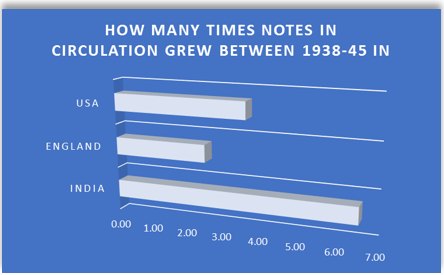
Comparative growth in bank notes during WW 2 in the USA, England, and India. Image Source: Promise to Pay (Vol I): Banks, Battles & Bellies |Masood Rezvi
The balance sheet total of the RBI expanded 17.29 times during the war, while the balance sheet total of the Bank of England swelled 2.21 times only. The gold reserve of the RBI though appeared to remain the same expressed in terms of Indian Rupees, its worth in terms of Sovereigns, in fact, dwindled from 18.55 million Sovereigns before the war to 7.83 million Sovereigns only, at the end of the war.
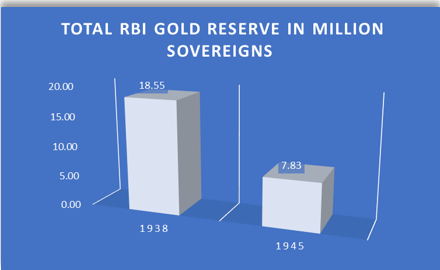
Promise to Pay (Vol I): Banks, Battles & Bellies |Masood Rezvi
This is how the Raj used the RBI, the ‘sheathed weapon’ to provide inflationary purchasing power, to swindle not only the Indian markets of all necessities of life which caused famine in India but also helped the Crown procure war supplies from elsewhere too.
*
Note to readers: please click the share buttons above or below. Forward this article to your email lists. Crosspost on your blog site, internet forums. etc.
Masood Rezvi, a freelance author, based in Lucknow, India has authored two books “Promise to Pay (Vol. I): Banks, Battles & Bellies” and “Tightening Noose of Poverty” and many articles and essays on social justice, economics, and politics. He has also compiled the compendium of the papers presented at the seminar “Growth with Justice.” He can be contacted on email at [email protected] and on Twitter at @RezviMasood. His articles are available on his Facebook page.
June 29th, 2019 by Andre Vltchek
You will never read about it, but Dayak people, the “First Nation” of the enormous island of Borneo, are broken, robbed and brainwashed.
“Unity in diversity” it says; the motto of Indonesia. But it could be argued that the opposite is true. There is very little unity, and less and less diversity, as the country is controlled from Jakarta, an enormous, overpopulated stinky and sinking megapolis which is located on the island of Java.
Jakarta does not want to allow any dissent. For half a century it has made sure that everyone on this huge and unfortunate archipelago thinks the same, while desiring no improvement. Here, everyone is religious, everyone anti-Communist and fanatically pro-capitalist. The result is: the country collapsed, a long time ago, but ‘no one noticed’. While the Western media is paid ‘not to notice’.
“It is a modern-time colonialism”, I heard thousands of times. Java is perceived by many who are living on those proverbial thousands of islands (the Indonesian archipelago has over 17 thousand isles which are spread over a great area), as a colonialist, aggressive and morally corrupt entity. No wonder: after independence from Netherlands, the country was formed, generally, along the old colonial boundaries.
During the era of the progressive anti-imperialist President Ahmed Sukarno, Indonesia was at least a co-founder of the Non-aligned Movement. It nationalized its natural resources, while building an enlightened socialist motherland.
That did not last very long. Following the West-sponsored brutal military coup of 1965, socialism was destroyed, Communists and atheists murdered, and the US-style neo-colonialist rule managed to smash all hopes for a better future.
Ever since, most of the islands have been run as colonies: pillaged, and oppressed. The ‘transmigration’ policy has been turning local people into a minority, at least in the various ‘strategic’ areas. Those have literally been flooded with state-sponsored immigrants from Java, Southern Sumatra, and other densely-populated Sunni Muslim parts of the country.
Logging in Kalimantan
Modern-day Indonesia has lived through three cruel genocides in its modern history: one triggered during and after the fascist coup (1965/66), then one that was perpetrated in (formerly) occupied East Timor, and the one, on-going one, in the conquered West Papua. But that is not all: terrible inter-ethnic and inter-religious conflicts have been shaking Indonesia for decades: from Aceh to Sulawesi, Ambon, Kalimantan (Borneo), to name just a few. Anti-Chinese pogroms have been common for centuries.
If there was to be a referendum, most of the islands, including the tourist island of Bali, would opt for independence. But that is a hushed fact, as it would never be allowed. The unproductive and depressingly over-populated island of Java virtually lives off the plundering of the riches of the entire archipelago. Indonesia’s ‘wealth’ mainly comes from commodities; from unbridled plundering of the outer islands.
That of course is true about one of the biggest booty – the enormous Kalimantan.
Many of the filthy rich Javanese families are connected to the plunder. Their wealth comes directly from destruction of the archipelago. The five-star hotels surrounded by Jakarta’s slums, malls with overpriced European brand names, and tasteless villas in gated communities, are built on blood and robbery.
*
The island of Borneo is the third largest island on earth, after Greenland and Papua. It is shared by Indonesia (where it is known as Kalimantan), and also by Malaysia and Brunei Darussalam. And it has, or more precisely, it used to count on all kinds of imaginable treasures, from oil to coal, gold, uranium and timber.
It also used to be one of the most pristine and stunning parts of the world, covered by plush native forests, which grew all along the mighty and clean tropical waterways.
Borneo’s native people, the Dayaks, used to live in true symbiosis with nature. Whatever their internal problems were, they never tried to conquer other islands.
But this self-contained paradise had been brutally penetrated and eventually destroyed; first by the Dutch colonialists, and later by the legendary Javanese greed united with Western multi-national companies.
Today, Borneo, or at least its Indonesian part, is almost entirely ruined. Most of its forests have been cut down, giving way to the endless and toxic oil palm plantations. Rivers where gold is being mined both legally and illegally, are poisoned by mercury, while entire mountains are levelled by local and foreign mining companies. Coal mines are of tremendous proportions, and expanding.
The wisdom of the local people is still alive, but only deep in what is left of the native forests. Most of the ‘modern-day’ Dayak people have been cannily incorporated by the regime into the system which thrives on plundering of the land and of all that nature holds above and below the surface.
Palm oil
*
Mr. Krisusandi, the chief of “Dayakology Institute” located in the city of Pontianak, West Kalimantan, does not hide his frustration, when he sits across the table from us, in his office:
“West Kalimantan has more than 150 ethnic groups of Dayaks. Each has its own language and culture… and that’s only in the area of West Kalimantan! To call them all by the same name – Dayak – is derogatory, inaccurate.”
“Local people used to inhabit some of the richest lands on earth, in terms of natural resources,” I suggest. Mr. Krisusandi agrees:
“Precisely. And this is precisely the curse; the key to understanding why, compared to other indigenous societies, the oppression of Dayaks is the worst.”
“During Suharto’s ‘New Order’, the regime developed stigmas and stereotypes, belittling and humiliating Dayaks; like that they are ‘backward’, ‘primitive’ and ‘uncivilized’. The military, the fascists, got used to judging Dayaks as forest dwellers and destroyers. The result: Dayak society got discriminated against, losing its culture, independence, and even began feeling shame for being what it is.”
“Because of that shame, Dayaks have been lulled into converting to Islam, or to Christianity. And after that, they were not Dayaks, anymore! Consequently, they were forced to accept the centralized education system, which has been totally ignoring the local knowledge.”
That was, of course, not all. The so-called ‘New Order’ of Suharto’s pro-Western cronies and collaborators, was determined to liquidate all left-wing beliefs. That’s what it was ordered to do by Washington. And Indonesian culture before 1965 was at least ‘communitarian’, if not out rightly Communist. The cultures of Dayak people were no exception.
Mr. Krisusandi confirmed, readily:
“’New Order’ believed that it had hegemony on ‘modernization’. And they saw even traditional ‘longhouses’ as something ‘Communist’. They used to call them ‘filthy’, or even ‘fire hazards’. The regime was totally anti-Communist, and it branded all Dayaks as ‘Communists’. Actually, it went to such an absurd extreme that each and every person who refused to abandon his or her longhouse and traditional way of living, was branded as a Communist.”
To be a ‘Communist’ was, for decades, synonymous with the highest crime, punishable by death.
“It was terrible suffering to be a Dayak then, and in many ways, it still is now. On top of it, all this was accompanied by the theft of land.”
“As I mentioned before, most of the Dayaks were forcibly converted to Islam, or Christianized. For some, it was the only way how to get ahead. Those who accepted Islam were registered as ‘Malays’, and as a ‘reward’, some were even allowed to became government officials.”
*
Julia, a female activist and researcher from West Kalimantan, now a PhD student at Bonn University in Germany, gave a similar testimony as Mr. Krisusandi’s:
“The marginalization and stigmatization of Dayak people in West Kalimantan during the New Order era occurred in a structured and in a systematic way. For example, at the beginning of the New Order period, there was a massive demolition of longhouses, Dayak traditional settlements, in West Kalimantan. Only few survived, and those that remained were only in the inland areas, such as Kapuas Hulu. Infrastructure facilities (mainly roads) to access Dayak settlements in remote areas were also very far behind, with the consequences such as the lack of access to education, health services, etc. The social stigma was created: Dayaks were perceived as backward, stupid, and primitive. Most of Dayak people have been feeling embarrassed to be associated with their Dayak identity. There were even attempts made to rename “Dayaks”, calling them “Daya”.”
Ms. Fidelia, a retired schoolteacher, who lives in Singkawang, West Kalimantan:
“Based on my experience as a primary school teacher during the 1980s, I felt that compared to the other students, my Dayak pupils found it relatively more difficult to grasp knowledge. Most of the Dayaks live in the interior of Borneo. For more than three decades, Suharto’s government made the conditions of the rural Kalimantan very tough; the interior of the island remained underdeveloped and very hard to access. Because of this isolation, people have been experiencing lack of basic services and facilities, such as education.”
Misery in rural Kalimantan is widespread. Enormous palm oil plantations turned huge areas into monocultures. Local people who stayed, are now forced to basically import everything from outside. Life has become extremely expensive. Thousands of villages are literally surrounded, choking by commercial entities. The traditional, natural way of life is totally ruined.
Mines in Borneo
*
To obtain any substantial information in the cities and villages of Kalimantan, is almost impossible. That is why the tragedy of this plundered island is almost ‘undocumented’.
People are scared to talk, or they do not comprehend their own conditions and their position in the Indonesian and global context.
In Banjarmasin, Palangkaraya, Pontianak and in other urban and rural areas of Kalimantan, people who live in absolute destitute, are refusing to even admit that they are poor. The inhabitants of filthy and hopeless slums lacking almost all basic services, consider their life ‘normal’, and most of them describe their state as ‘pasrah’, which means ‘abandoning, surrendering their lives to fate and God’.
Just as in the rest of Indonesia, oppressive forms of religion (mainly Saudi-style Wahhabi Sunni Islam) have already managed to take full control over the population. Under such conditions, no rebellion is possible. This is of course a brilliant arrangement for savage capitalism and for the bunch of corrupt captains of the Indonesian regime.
Since 1965, the logic of pro-Western rulers was simple and effective: ‘Do not allow the arts, philosophy and creativity to ‘pollute’ people’s minds. Kill everything socialist and communist. Make Indonesian citizens simple, pious, uniformed, and uninformed. Smash everyone who is different.
Native people in the resource-rich parts of the archipelago (such as Kalimantan) were the most affected. They have been treated precisely as the South Americans were treated by their Spanish or Portuguese colonialist masters and tormentors: all the resources have been stolen, while local beliefs and languages smashed. Simultaneously, totally foreign religious concepts have been pushed down their throats. Those who were willing to collaborate, were given important government and academic positions, ridiculous titles, and at least some cut from the loot.
The price was terrible: the destruction of both land and the original population. The ‘primitive people of the forest’ were actually much more advanced than their conquerors. They knew how to live with their nature, their environment. Before colonialism, rivers and forests, mountains and villages were intact and thriving. The destruction of local culture led to the collapse of the environment, and in the case of Borneo, of the entire island.
*
I am making a long documentary film here: about this damaged culture, and about the whole island that used to be much closer to ‘paradise’, than any other place on Earth. As I film, in all the corners of Borneo, I feel terrified. What I see is indescribable. I have to use visuals, images, to prove the point. Words are not enough. It often feels that the destruction is unreal; that all this is just a nightmare, that I will wake up, that the horror will go away. But it is real; nothing goes away. People, their greed, are capable of ruining anything, even the most stunning places on our planet.
Mr. Krisusandi speaks about his Institute of Dayakology with pride: “We established it, in order to return dignity to our people.”
Then he recalls the terrible on-going struggle:
“In the beginning, when the destruction of the longhouses began, there was a fight. But the government was canny; it introduced so-called logging concessions. It also accelerated trans-migration from several over-populated parts of Indonesia, predominantly from Java. In the name of ‘development’, government took over all land, and sold it to companies that began planting palm oil, or introducing indiscriminate mining. Dayaks could do nothing. They became powerless; coolies on their own land.”
“During the so-called ‘reform period’, after Suharto stepped down, the situation marginally improved; but by then, the Dayaks had almost no intellectuals. And those who were ‘educated’ during ‘New Order’, had typical ‘developmentalist’ mindsets. They sold out; they even began oppressing their own people.”
A prominent educator from West Kalimantan, who did not want to be identified out of fear of losing his job, clarified:
“On my island, being so-called educated could lead to something negative. A Dayak person who goes through the formal Indonesian education system, could and usually would end up following only his or her own mercantile interests, and consequently do harm to both community and nature.”
What he meant is that the person often chooses to work for the companies or the government, that are intensively ruining the Borneo island, while further indoctrinating and disempowering local population.
While deep in Borneo, one year ago, we visited a longhouse, where we were told by Mr. Paulus, the elder in a traditional Bali Gundi longhouse in the Putusibau area:
“People who go to school; they get smarter and cannier and then they work for the government and companies, they forget to help their villages and hometowns. As long as they get money they do not care anymore.”
Recently, President Jokowi decided to at least give some land back to the Dayak people. It was a symbolic gesture, but practically, nothing changed, and almost nothing was returned to the native people.
As confirmed by Mr. Krisusandi:
“It is now actually almost impossible to give anything back to the people. West Kalimantan consists of roughly 12 million hectares of land. Concessions, those for palm oil, mining and other commercial activities, were already given 13 million hectares. With national parks, a total of 16 million hectares is already committed. So, just calculate: it is 4 million hectares more than total area of West Kalimantan!”
I think about those once mighty and pure rivers, endless tropical forests, deep and ancient cultures of local people. I close my eyes, trying to imagine hundreds of already vanished species of fauna and flora. Then, I imagine the huge, repulsive, kitschy dwellings of local ‘elites’, in Jakarta and Surabaya. I imagine European and North American cities built from the loot of places such as Kalimantan.
“Will Dayak people fight for their rights?” I asked.
“Maybe the next generation will,” comes the hesitant reply. “But not this one. Definitely not this one.”
In Palangkaraya city, we spoke to one of the most prominent Dayaks, an author J.J. Kusni, a man who spent long years in France, but finally returned to his native land.
I filmed his long, passionate testimony, in which he expressed sadness, even outrage over the state into which the Dayak people were reduced.
“Philosophically, a Dayak is a fighter,” he said.
But the spirit of Dayak people was obviously smashed. Most of them have become victims, while others were convinced to convert themselves into collaborators. The entire Indonesian part of the Island of Borneo is now burned down, poisoned and logged out. There are few ‘protected parks’, but even in the middle of them, commercial activities are now detectable. Entire original cultures here are humiliated. People are confused. Most of them gave up, accepted, resigned.
Destruction and thorough ruin are being propagated as ‘progress’, by the Indonesian regime. Brainwashing is passed as ‘education’.
“Through the national and even village government structures established by Suharto, everything in Kalimantan became “Javanized”,” explained J.J. Kusni.
“So, what are the Dayak people doing?” I asked.
“They are crying,” he replied curtly.
*
Note to readers: please click the share buttons above or below. Forward this article to your email lists. Crosspost on your blog site, internet forums. etc.
This article was originally published on New Eastern Outlook.
Andre Vltchek is a philosopher, novelist, filmmaker and investigative journalist. He has covered wars and conflicts in dozens of countries. Four of his latest books are China and Ecological Civilizationwith John B. Cobb, Jr., Revolutionary Optimism, Western Nihilism, a revolutionary novel “Aurora” and a bestselling work of political non-fiction: “Exposing Lies Of The Empire”. View his other books here. Watch Rwanda Gambit, his groundbreaking documentary about Rwanda and DRCongo and his film/dialogue with Noam Chomsky “On Western Terrorism”. Vltchek presently resides in East Asia and the Middle East, and continues to work around the world. He can be reached through his website and his Twitter. His Patreon
All images in this article are from the author
June 18th, 2019 by Dr. Binoy Kampmark
It has been a history of turns and the occasional betrayal, but Hong Kong’s experiment with democracy, incubated within the Special Administrative Region, was always going to be contingent on some level. Its colonial past is a poke, a reminder of British bullying, the corruptions of opium and a time when Qing China was torn and a compulsive signer of unequal treaties. The 99-year lease over the New Territories, along with some 235 islands arose from the second Convention of Peking, signed on June 9, 1898 by Li Hung-chang under the official gaze of British interests. It was never recognised either by the Nationalist government of Chiang Kai-shek nor Mao Zedong’s victorious communists.
In 1993, former UK Prime Minister Margaret Thatcher revealed how China’s reformist Deng Xiaoping had been more than forthcoming about threats regarding Hong Kong in their September 1982 meeting in the Great Hall of the People. In The Downing Street Years, Thatcher recalls how an “obdurate” Deng “said that the Chinese could walk in and take Hong Kong back later today if they wanted to.”
Thatcher’s retort was one of admission and promise: the British would not be able to stop them but “this would bring about Hong Kong’s collapse. The world would then see what followed a change from British to Chinese rule.” Deng, despite this threatening account from Thatcher, was happy to entertain an idea that would become the basis of arrangements after 1997, namely, the principle of one country, two systems. The official Chinese account of the meeting is naturally more tepid, with Deng merely suggesting that Beijing might “reconsider the timing and manner of the takeover” should the road leading to the takeover prove rocky.
Thatcher never quite understood the reality that Hong Kong’s continued existence under British rule till the handover date was very much, as the veteran journalist Murray Sayle noted, a case of approval from Beijing precisely because it was in its interests. Mainland China and Hong Kong were entwined in a way the mainland and Taiwan were not.
The subsequent Joint Declaration in 1984 between the PRC and Britain came with the proviso that China’s takeover of Hong Kong in 1997 would abide by certain conditions, including the retention of certain democratic structures and an independent judiciary. The expiry of those arrangements is set for 2047.
Hong Kong’s fragile independence has had prodding reminders from Beijing’s ever suspicious functionaries. In 2015, Chinese security agents whisked off five men involved with the Causeway Bay Books store. Its name had been made on the sales of books describing the risqué private lives of Communist Party officials.
Each of the abductees duly appeared on Chinese television to confess to a range of crimes, the usual potpourri of violations expected from a repressive apparatus. A statement had been made, though the owner and manager of Causeway Bay Books, Lam Wing-kee, continues to play the game of smuggling everything from smut to history, hoping that officials on the mainland will be able to turn a blind eye when needed. And a large eye it has to be, given the range of items deemed contraband by the Communist Party’s Central Leading Group for Propaganda and Ideology.
None of this is to say that mass protest has not had its gains, though suggesting that Hong Kong has a history of obstreperous civil dissent is pushing it a bit far. The attempt to implement a national security law in 2003 by then Chief Executive Tung Chee-hwa promising life sentences for treason, secession, subversion and sedition resulted in its indefinite suspension after half-a-million protesters turned out to vent their anger. This was despite the troubling existence of Article 23 in Hong Kong’s Basic Law which expressly authorises the Special Administrative Region to pass laws prohibiting treason, secession, sedition and subversion. Subsequent Chief Executives Donald Tsang Yam-kuen and Leung Chung-ying had little stomach to push through legislation under the section. Carrie Lam Cheng Yuet-ngor is biding her time, waiting for a “suitable climate”.
The latest round of mass protests have suggested that the climate in question is some way off in forming, though it is fearful of the authoritarian winds coming from President Xi’s mainland. Xi’s speech on his 2017 visit for Lam’s swearing in was prickly and threatening: “Any attempt to endanger China’s sovereignty and security, challenge the power of the central government… or use Hong Kong to carry out infiltration and sabotage activities against the mainland is an act that crosses the red line and is absolutely impermissible.”
The current crop of protests have a fundamental object: taking the Extradition Bill off the books. The bill, should it become law, would see local and foreign criminal suspects make their way into the labyrinth of mainland justice, puncturing the one nation, two systems principle. The protesters, numbering some 2 million over the weekend, did witness the unusual spectacle of Chief Executive Lam issuing an apology, though the bill remains suspended. Nothing less than her resignation is demanded, though she retains the backing of the power that counts.
The democratic movement in Hong Kong has, in short, been one of fits and starts, often discouraged, an erratic example of changing attitudes both in Britain and the PRC. British officials have not always been allies to the democratic cause, preferring to smother it at points before the liberal incarnation encouraged by the last governor, Christopher Patten. Even then, Hong Kong still had more in common with the governing commercial structure of the Italian city state of Venice than Westminster. Mainland China, taking a view to the horizon, continues to gnaw and nibble at existing protections, as is to be expected.
Thatcher’s prognostication that China could not continue to reap “the benefits of a liberal economic system […] without a liberal political system” proved, like certain assessments by the Iron Lady, off the mark, if not off the park. This leaves the protesters with much to do. Beijing, in the meantime, simply waits, and those with elephantine memories will recall Thatcher’s tripping on the stairs leaving the Great Hall of the People in 1982. “Bobbling her handbag,” writes Paul Theroux of this episode in his pungent Letter from Hong Kong, “her pearls swinging, and with her arse in the air and her face flushed with fear, the prime minister of Great Britain appeared to be kowtowing to Mao in his nearby mausoleum.” Such is the cunning, if vulgar turn, of history.
*
Note to readers: please click the share buttons above or below. Forward this article to your email lists. Crosspost on your blog site, internet forums. etc.
Dr. Binoy Kampmark was a Commonwealth Scholar at Selwyn College, Cambridge. He lectures at RMIT University, Melbourne. He is a frequent contributor to Global Research and Asia-Pacific Research. Email: [email protected]
Featured image is from Nikkei Asian Review
June 17th, 2019 by Han Gil Jang
It has been almost twenty years since allegations of war crimes committed by South Korean troops during the Vietnam War were first featured in South Korean media in the 1990s.1 The public discussion that followed decades later was formed around the issue of “truth and reconciliation,”2 which, reverberated around the 2018 People’s Tribunal on War Crimes by South Korean Troops during the Vietnam War.
A People’s Tribunal was held between April 21 and 22, 2018 at the Oil Tank Culture Park in Seoul, in conjunction with an academic conference a day earlier organized around the theme of what it means to be a perpetrator of atrocities. In light of the fact that no meaningful action had been taken by the South Korean government in the past twenty years, the People’s Tribunal aimed to re-publicize the issue of massacres committed by South Korean troops during the Vietnam War and to urge the South Korean government to take meaningful reparatory actions for the survivors in legal terms. The year 2018 marked not only the 50th anniversary of massacres committed in Phong Nhị, Phong Nhất and Hà My hamlets of Vietnam, but also the 70th anniversary of the Jeju uprising, bolstering the felt necessity of coming to terms with the nation’s unresolved past.
To contextualize the People’s Tribunal and assess the significance of its contribution, this paper attempts to trace not only the course of the People’s Tribunal but also the contours of academic literature and public discussion around South Korea’s “Vietnam question”, leading up to the People’s Tribunal. A small but significant step forward in grasping the full measure of this issue between the two nations, the People’s Tribunal’s accomplishment would not be properly appreciated without examining previous contributions on this subject.

South Korean soldiers in the Vietnam War
Publicization of the Vietnam Question in South Korea
South Korea’s “Vietnam question”, like America’s My Lai, was introduced to Western readers by Charles K. Armstrong’s “America’s Korea, Korea’s Vietnam”3 following reportage in South Korea led by the progressive daily newspaper Hankyoreh and its sister weekly Hankyoreh 21 , which began treating this issue in 1999 drawing on the research of Ku Su-jeong4, a graduate student then writing a thesis on the South Korean legacy during the Vietnam War at the University of Social Sciences and Humanities, Vietnam National University, Ho Chi Minh City. Initially, the Hankyoreh articles drew primarily on official documents available in socialist Vietnam—to which even Ku and other Vietnamese scholars had very limited access, as her then-advisor Hà Minh Hồng testified5—complemented by eyewitness accounts of massacres from both Vietnam War veterans in South Korea and Vietnamese survivors. These were documented not only by Hankyoreh but also by a number of social activist groups—Nawauri being the best known.6
As many of their titles indicate, much of Hankyoreh’s work pertaining to the Vietnam question was done in the style of exposé. In the era when various projects under the banner of “truth and reconciliation” proliferated,7 Hankyoreh’s approach seemed effective in attracting public attention to the Vietnam question. One of their most remarkable moments was in April 2000 when they published several articles based on the testimonies given by Kim Ki-tae, the former commander of the Seventh Company, Second Battalion, “Blue Dragon” ROK Marine Brigade. The report described how Kim, on November 15, 1966, oversaw the murder of twenty nine unarmed Vietnamese men, who, according to his testimony, probably “were just farmers”. It also reported that sixty eight residents, including women and children, of Binh Tai village in Phuoc Binh district were massacred on October 9, 1966.8 Confirmed by Hankyoreh’s on-site investigation in Phuoc Binh, this report, according to Armstrong, was the “most sensational and extensively detailed,” a watershed moment that foresaw numerous similar testimonies from other veterans.9
Another momentous work, titled “Chamjadŏn chinshil 30nyŏnmane kkaeŏnada [Hidden Truth, Revealed at Last after 30 Years]”, was published in the 334th issue of Hankyoreh 21 on November 15, 2000. It was based on U.S. military reports declassified in June 2000 and made available at the National Archives at College Park, Maryland.10 The reports contained detailed accounts and, most importantly for Hankyoreh’s purpose, photographic documentation of the Phong Nhị and Phong Nhất massacres, collected and compiled by the Military Assistance Command, Vietnam (MACV), Inspector General’s Office. The reports provided some of the most compelling evidence of South Korean atrocities to date, along with the American Friends Service Committee’s America’s Rented Troops: South Koreans in Vietnam.11 The cover image of the aforementioned issue of Hankyoreh 21 was a photograph of a dying Vietnamese victim who had her breasts cut out and was left to die after being shot by South Korean soldiers. In addition to the shocking visuals, the article presented a compelling account of how the South Korean marines swept through the hamlets killing seventy four women, children, and elders, as well as their livestock, and set their houses on fire. The article also revealed that William Westmoreland, the commanding officer of the Military Assistance Command Vietnam (MACV), forwarded the inquiry concerning the massacres to Chae Myung-shin, then-commander of ROK Forces in Vietnam, who responded with a report which concluded that the casualties were caused by “Viet Congs disguised in [ROK] camouflaged uniforms.”12 Hard-pressed by the ostensible absurdity of this report and concrete evidence that suggested otherwise, Chae Myung-shin, who had remained silent to this point, agreed to an interview in which he admitted that he had received a letter from Westmoreland, but repeated the conclusion of his report.13
Hankyoreh’s extensive coverage, together with the efforts of various social activists who organized reconciliation campaigns and peace camps,14 garnered not only public attention but scholarly interest as well. In disciplines ranging from anthropology, sociology and history to political science, both within and outside of South Korea, a number of scholars began addressing the issues. Detailed accounts of political and historical context were provided in Han Hongkoo and Kwak Tae Yang’s papers.15 Of particular interest to the South Korean academic community, however, was the theme of contested memories concerning South Korean participation in the Vietnam War as taken up by numerous scholars including Park Tae Gyun, Shim Juhyung and Yoon Chung Ro, especially given the fact that Vietnam War veterans themselves were unable to have their voice recorded until the South Korean military dictatorship came to an end in the early 90s.16 Heonik Kwon, in his influential book After the Massacre: Commemoration and Consolation in Ha Mi and My Lai, wrote on the commemoration and the massacre that took place in Hà My hamlet, where, on February 25, 1968, ROK marines killed 135 women, children and elders, and bulldozed and burned their bodies.17
However, even to this date, no comprehensive investigation and analysis of the massacres has taken place. The South Korean Ministry of National Defense and the National Intelligence Service still refuse to allow researchers access to the relevant documents, making it virtually impossible for scholars or activists to fully document the massacre.18 Unlike, for example, Bernd Greiner’s War Without Front: The USA in Vietnam, which makes extensive use of various records, including the de-classified records of the Vietnam War Crimes Working Group, to produce a comprehensive and detailed account of the war crimes committed by U.S. troops during the Vietnam War19, much of the literature pertaining to the South Korean atrocities in Vietnam does not provide a comprehensive account of the subject, and instead covers specific topics such as the politics of memory around the wartime massacres.
The People’s Tribunal
The two consecutive conservative presidencies from 2007 to 2016 saw the development of political tendencies that put aside the history of atrocities committed by the authoritarian and colonial regimes while highlighting South Korea’s linear developmentalist narrative. These tendencies to erase “unpleasant” history from the public memory were best exemplified by the issue of history textbook selection, in which both the Lee Myung-bak and Park Geun-hye administrations produced a revised Korean history textbook by a conservative New Right organization and pressured school principals to adopt the textbook.20 The issue of South Korean atrocities during the Vietnam War was nowhere to be found in the new textbooks, or in the permanent exhibitions on South Korean participation in the Vietnam War at the National Museum of Korean Contemporary History or the War Memorial of Korea. Only the economic gains from the war and sentimental aspects of Korean participation were emphasized.21 Furthermore, according to the list compiled by Lawyers for a Democratic Society (Minbyun) on Korean public media pertaining to South Korean atrocities in Vietnam, the number dwindled significantly after 2007, indeed, no such article was published between June 2007 and September 2013.22
In spite of the unfavorable political climate, several members of Minbyun’s Asian Human Rights Team participated in the 2015 Korea-Vietnam peace camp led by Ku Su-jeong, after which they proposed to Minbyun a project to demand a thorough investigation and proper reparations from the South Korean government. After over a year of gathering materials, holding seminars and conducting site visits, Minbyun held a tribunal, in collaboration with the Korea-Vietnam Peace Foundation, where Ku Su-jeong was a board member, and Medics for Vietnam and Peace, a non-profit organization that has provided dental and traditional Korean medicinal treatment in areas affected by the Vietnam War since 2001. They organized a preparatory committee and began recruiting participants.
Although not legally binding, tribunals are a format frequently employed by social activist groups in South Korea to publicize important social and political issues. While examples range from the 2002 Tribunal on Chosun Daily’s Anti-Reunification Activities and 2004 Tribunal on Chosen Daily’s Collaborationist Activities to a 2004 Tribunal on Bush-Blair-Roh’s War Crimes in Iraq, the Minbyun members were particularly inspired by the Women’s International War Crimes Tribunal on Japan’s Military Sexual Slavery held in Tokyo between December 8 and 12, 2000. During the presentation by the preparatory committee on September 22, 2017, the presenter from Minbyun highlighted the facts that (1) the Women’s International War Crimes Tribunal was held for the sake of the victims; (2) the final judgment was completely up to the judges; (3) the tribunal’s format and procedures adhered as strictly as possible to that of an actual trial; and (4) it maintained a very high standard for the quality of final statement, as the organizers hoped that it would be widely cited in international law.23 To meet these conditions, the preparatory committee undertook an extensive legal examination of the existing evidence as well as acquisition of new evidence, following the approach of the Women’s International War Crimes Tribunal that had an investigation team collecting and discovering relevant materials, which were then sorted out by the legal team.
As the investigation team was being recruited, the committee, which was restructured into the executive committee of the People’s Tribunal, consisting of legal, IR and PR teams, decided to focus exclusively on the two cases on which substantial resources were publicly available: the Phong Nhị and Phong Nhất massacre, and the Hà My massacre. These resources were waiting to be assessed in terms of legal validity. Furthermore, Ku and her fellow activists had already built strong relations with the surviving villagers. As for Hà My, the same applied in terms of Ku’s fieldwork, and the incident has received a fair amount of academic treatment.24 In June 2017 and February 2018 the committee organized on-site investigations at Phong Nhị, Phong Nhất and Hà My hamlets to secure plaintiffs for the People’s Tribunal and to cross-check testimonies from the survivors to ensure their legal efficacy.
The investigation team for the People’s Tribunal was recruited around November 2017. An interesting feature of the team is that it consisted mainly of young researchers and activists who had experience in working on “comfort women” issues. Consequently, most of them were familiar with the limits of relying on legal approaches that inevitably emphasized structural state-level violene and exploitation of the “comfort women” by downplaying their individual agency.25 The People’s Tribunal was held in conjunction with the academic conference.
The People’s Tribunal was held on April 21 and 22, 2018 as a civil court in which the plaintiffs and their legal representatives filed a state compensation suit—albeit non-binding—against the South Korean government.26 The plaintiffs were two survivors who, coincidentally, were both named Nguyễn Thị Thành. Nguyễn Thị Thành from Phong Nhị was eight years old at the time of the massacre, where she received a bullet wound in her lower abdomen and lost her family members. The other Nguyễn Thị Thành was ten years old at the time of the Hà My massacre. Her left leg and ear were injured and she also lost her family. Their live testimonies in Vietnamese, often emotional and heartbreaking, were translated by the tribunal interpreter, who at times could not help shedding tears. The testimonies of other survivors who could not make it to Seoul were were presented as video clips, including one given by a former ROK marine who witnessed the Phong Nhị and Phong Nhất massacre. The judges were Kim Young-ran, a former Supreme Court Justice, Yang Hyunah, a former prosecutor of the North-South Korea joint team at the International Women’s Tribunal, and Lee Seog-tae, a current Justice of the Constitutional Court. On April 22, the judges pronounced the final judgment in which they demanded that the South Korean government compensate for the plaintiffs’ losses, launch an investigation into South Korean atrocities committed between 1964 and 1973, and correct all forms of public memorial pertaining to South Korean participation in the Vietnam War, especially the exhibition at the War Memorial of Korea.
Aftermath
Despite lacking legal authority, the People’s Tribunal garnered public attention, its proceedings and findings being covered by almost all of the major Korean TV channels including KBS, SBS, MBC, JTBC, YTN, as well as news outlets, both digital and print, such as Hankyoreh, Kyunghyang, Pressian, Sisain andOhmynews. Ohmynews live-streamed the entire tribunal online.
The People’s Tribunal was most significant in launching a series of legal battles that could prompt governmental actions to expand the scope of further research and legal actions. These two—further research and legal battles—are inseparable, especially since the validity and the quantity of evidence provided at the People’s Tribunal still seemed insufficient for winning an actual trial. Most important was the testimony from eyewitnesses and victims of the Phong Nhị and Phong Nhất massacres, which illuminated the South Korean documents, especially the heavily censored classified reports of the Korean Central Intelligence Agency in 1969.27 The ongoing legal battles for information disclosure against the Ministry of National Defense and National Intelligence Service, made possible by the publicity from the People’s Tribunal, opens the possibility for further research whose scope and size might be comparable to that of the scholarship on the My Lai massacre.
To that end, it is unfortunate that no funds were allotted for research trips to the National Archive at College Park, Maryland, even though the investigation team contacted some researchers there. Furthermore, interaction was rare between the investigation team’s young members and the senior members who started the movement in South Korea in the late 90s. As a result, not much significant commentary or assessment of information secured in the early phase of researching the “Vietnam question” was transmitted. Rather, the investigation team spent most of its time and resources re-analyzing the existing data.
The lack of interaction between the Tribunal’s new investigators and their predecessors led to an interesting divide. As the title of the conference suggested, the investigation team focused on a very different set of problems than that of their predecessors, whose contributions relied mostly on sensationalism and style of exposé. Pivoting on the theme of what it means to be the perpetrator, Fujii introduced the case of the Association of Returnees from China to Japan as a possibility that the South Korean people as “perpetrators” could learn from in their lifelong efforts to make known the nature of Japanese military atrocities in the years 1931-45.28 Interestingly, whereas people in the 2000s often invoked the Nogunri massacre by US forces during the Korean War,29 a number of people who attended the conference alluded more frequently to the “comfort women” issue when they tried to relate to the issue of South Korean atrocities in Vietnam. The collective experience of coming to terms with the nation’s colonial and authoritarian past developed in interesting ways.
In Shim’s presentation on Vietnam’s post-war generations and their “memory-scape” of the war, I was reminded of the lack of interaction between South Korean and Vietnamese activists30 when he pointed to the dangers in approaching the issue of South Korean atrocities without considering the contemporary nature of Vietnamese society and the radical changes that have occurred over the past fifty years. Without proper understanding of how this issue may be addressed in contemporary Vietnamese society, the movement in South Korea runs the risk of becoming ineffective and self-serving, given the Vietnamese public’s very limited exposure to the issue and the divided nature of “memory-scape” of the Vietnam War among different regions and age groups in Vietnam and the Vietnamese diaspora.31
In spite of all the Tribunal’s shortcomings, the sentencing statement, pronounced by Kim Young-ran, can serve as a crucial reference point for further discussion, and also an important contribution to Minbyun’s agenda to file a legally binding lawsuit against the South Korean government on behalf of the survivors. As the tribunal’s organizers seek to compel the South Korean government to declassify NIS documents and form an official task force to investigate the matter, the truth and reconciliation efforts into South Korea’s “Vietnam question” seem to have just begun.
*
Note to readers: please click the share buttons above or below. Forward this article to your email lists. Crosspost on your blog site, internet forums. etc.
Han Gil Jang is a member of the Investigation Team. [email protected]
Sources
Armstrong, Charles K. “America’s Korea, Korea’s Vietnam.” Critical Asian Studies 33, no. 4 (2001): 527-540.
Baldwin, Frank, Diane Jones, and Michael Jones. America’s Rented Troops: South Koreans in Vietnam. American Friends Service Committee, 1975.
Fujii, Takeshi. “Kahae kyŏnghŏmŭl marhandanŭn kŏt: ilbon chunggukkwihwanjayŏllak’oeŭi sarye [Speaking the Experience of Perpetrator: the Case of Japan’s Association of Returnees from China].” Paper presented at the People’s Tribunal on War Crimes by South Korean Troops during the Vietnam War Conference, Seoul, South Korea, April 20, 2018.
Greiner, Bernd. War without Fronts: the USA in Vietnam. Random House, 2010.
Hà, Minh Hồng. “Nogŭlliŭi kiŏgesŏ pet’ŭnam chŏnjaengŭi chinshirŭl saenggak’ada [Contemplating the Truth of the Vietnam War in the Memory of Nogunri].” Opening statement presented at the People’s Tribunal on War Crimes by South Korean Troops during the Vietnam War Conference, Seoul, South Korea, April 20, 2018.
Han, Hongkoo. “Han’gukkwa pet’ŭnamjŏnjaeng [South Korea and the Vietnam War].” Naeirŭl yŏnŭn yŏksa4. (2001. 1): 115-126.
Kern, Thomas, and Sang-hui Nam. “The Korean Comfort Women Movement and the Formation of a Public Sphere in East Asia.” In Korea Yearbook (2009): Politics, Economy and Society. Edited by Frank Rüdiger, Jim Hoare, Patrick Kölner, and Susan Pares. Brill, 2009. 227-256
Kim, Aram. “Sŏngjangshinhwae kach’in pangmulgwan—che3, 4chŏnshishil(1961nyŏn ihu) [Museum Caught in the Developmentalist Myth: Exhibition Room 3 and 4 (After 1961)].” Yŏksabip’yŏng[Critical Review of History] 104. (2013): 174-192.
Kim, Dong-choon. “The Truth and Reconciliation Commission of Korea: Uncovering the Hidden Korean War”, The Asia-Pacific Journal, Vol. 8. Issue 9. No. 5. (March 1, 2010).
Kim, Hyun Sook. “Korea’s “Vietnam Question”: War Atrocities, National Identity, and Reconciliation in Asia.” positions 9, no. 3 (2001): 621-635.
Kwak, Tae Yang. “The Anvil of War: The Legacies of Korean Participation in the Vietnam War.” PhD diss., Harvard University, 2006.
Kwon, Heonik. After the Massacre: Commemoration and Consolation in Ha My and My Lai. Univ. of California Press, 2006.
—“Anatomy of US and South Korean Massacres in the Vietnamese Year of the Monkey, 1968.” The Asia-Pacific Journal, Vol. 5. Issue 6. (June 4, 2007).
Minear, Richard and Franziska Seraphim. “Hanaoka Monogatari: The Massacre of Chinese Forced Laborers, Summer 1945.” The Asia Pacific Journal, Vol. 13 Issue 25 (June 29, 2015).
Park, Tae Gyun. “Han’gukkunŭi pet’ŭnam ch’amjŏn [Between Memory and Oblivion: The Dispatch of Korean Combat Troops to Vietnam].” Yŏksabip’yŏng[Critical Review of History] 80. (2007. 8): 288-311
Sakamoto, Rumi. “The Women’s International War Crimes Tribunal on Japan’s Military Sexual Slavery: A Legal and Feminist Approach to the ‘Comfort Women’ Issue.” New Zealand Journal of Asian Studies 3, no. 1 (2001): 49-58.
Shim, Juhyung. “Pet’ŭnamjŏn ch’amjŏne taehan kiŏgŭi chŏngch’i [The Politics of Memory Surrounding Participation in the Vietnam War].” Master’s thesis, Seoul National University, 2003.
—“Pet’ŭnam chŏnjaengŭi tongshidaesŏng: pet’ŭnam saeroun sedaeŭi chŏnjaenggiŏk [The Contemporaneity of the ‘Vietnam War’: the New Generation’s Memory of War in Vietnam]”. Paper presented at the People’s Tribunal on War Crimes by South Korean Troops during the Vietnam War Conference, Seoul, South Korea, April 20, 2018.
Suh, Jae-Jung. “Truth and Reconciliation in South Korea: Confronting War, Colonialism, and Interventions in the Asia-Pacific.” In Truth and Reconciliation in South Korea: Between the Present and Future of the Korean Wars. Edited by Jae-Jung Suh. Armonk, NY: Routledge, 2012. 1-18.
Turse, Nick. “A My Lai a Month: How the US Fought the Vietnam War”, The Asia-Pacific Journal, Vol. 6. Issue 11. (November 1, 2008).
Yang, Hyunah. “Chŭngŏn’gwa yŏksassŭgi—han’gugin ‘kun wianbu’ŭi chuch’esŏng chaehyŏn [Testimony and Writing History: Representing the Subjectivity of Korean ‘Military Comfort Women’]” Sahoewa yŏksa[Society and History] 60. (2001. 12): 60-96
Yoon, Chung Ro. “Pet’ŭnamjŏnjaeng ch’amjŏn’guninŭi chip’apchŏk chŏngch’esŏng hyŏngsŏnggwa chibae ideollogiŭi chaesaengsan [Reproduction of the Ruling Ideology and Formation of Vietnam Veterans’ Collective Identities].” Kyŏngjewasahoe[Economy and Society] 76. (2007): 196-221
—“Kusurŭl t’onghae pon pet’ŭnamjŏnjaeng -ch’amjŏn’guninŭi chŏnjaeng kyŏnghŏmgwa kiŏkŭl chungshimŭro- [Vietnam War Through Oral Testimonies: Focused on the Experiences and Memories of the War with Veterans].” Sahoegwahakyŏn’gu[Social Science Studies] 17. (2009. 1): 228-263
—“Han’gugŭi pet’ŭnamjŏnjaeng kinyŏmgwa kiŏgŭi chŏngch’i [The Politics of Memory and Commemoration of the Vietnam War in Korea].” Sahoewa yŏksa 86. (2010): 149-80
— “Han’gugŭi pet’ŭnamjŏnjaeng kiŏgŭi pyŏnhwawa chaegusŏng—1999nyŏn 『han’gyŏre21』k’aemp’ein’gwa kŭ ihu pyŏnhwarŭl chungshimŭro [Changes and Reconstruction in the Vietnam War’s Memories of Korea: Focused on Changes in the Campaign of Hangyere 21 since 1999].” Sahoewa yŏksa 105. (2015): 7-40.
Notes
1 Voice of the People, July 1990, 92-99; Chosen Monthly, April 1 1992.
2 The year 2000 saw a proliferation of truth and reconciliation committees attempting to confront and investigate the atrocities committed by various governmental agencies during the colonial era and authoritarian rule such as the Nogunri massacre, the Jeju uprising, the Gwangju Democratic Movement and the “comfort women” issue, culminating in the establishment of the Truth and Reconciliation Commission in 2005. See Jae-Jung Suh, “Truth and Reconciliation in South Korea: Confronting War, Colonialism, and Interventions in the Asia-Pacific,” in Truth and Reconciliation in South Korea: Between the Present and Future of the Korean Wars, ed. Jae-Jung Suh (Abingdon, Oxon: Routledge, 2012), 7-8, especially footnote 15. Unfortunately, these efforts were weakened during Lee Myung-bak’s presidency, between 2007 and 2012. See Yeon Cheol Seong, “Shinjiho ŭiwŏn t’rkwagŏsawi t’ongt’pp’yehapt’ pŏban parŭi[Shin Ji-ho Proposes Bill to Merge Truth-finding Commissions into One],” Hankyoreh Sinmun, November 20, 2008. Shin Ji-ho was a lawmaker from the conservative Grand National Party.
3 Charles K. Armstrong, “America’s Korea, Korea’s Vietnam,” Critical Asian Studies 33, no. 4 (2001): 527-540. Armstrong’s article focused on the emerging public debate around the issue of war crimes committed by the South Korean troops during the Vietnam War. For earlier work on the issue prior to the formation of public discussion in South Korea, see Frank Baldwin, Diane Jones, and Michael Jones, America’s Rented Troops: South Koreans in Vietnam (American Friends Service Committee, 1975).
4 Ku then began working as a Hankyoreh special correspondent. Three of her articles were published in Hankyoreh 21 on September 2, 1999. On the history of Hankyoreh and a detailed account of its role in publicizing South Korea’s Vietnam question, see Armstrong, “America’s Korea, Korea’s Vietnam,” 529, 536-7.
5 See Minh Hồng Hà, “Nogŭlliŭi kiŏgesŏ pet’ŭnam chŏnjaengŭi chinshirŭl saenggak’ada [Contemplating the Truth of the Vietnam War in the Memory of Nogunri],” (presentation, People’s Tribunal on War Crimes by South Korean Troops during the Vietnam War Conference, Seoul, South Korea, April 20, 2018).
6 For detailed information on Nawauri, see Thomas Kern and Sang-hui Nam, “The Korean Comfort Women Movement and the Formation of a Public Sphere in East Asia,” in Korea Yearbook (2009): Politics, Economy and Society, ed. Rüdiger Frank, Jim Hoare, Patrick Kölner, and Susan Pares (Brill, 2009), 227-256.
7 Truth and Reconciliation Commission, proliferation of literature pertaining to Nogunri, and the Comfort Women issue. See Dong-Choon Kim, “The Truth and Reconciliation Commission of Korea: Uncovering the Hidden Korean War,” The Asia-Pacific Journal, Vol. 8 Issue 9 No. 5, March 1, 2010. Also, see footnote 2 in Hyun Sook Kim, “Korea’s “Vietnam Question”: War Atrocities, National Identity, and Reconciliation in Asia,” positions 9, no. 3 (2001): 634.
8 Hankyoreh Sinmun, April 19, 2000, 1; Hankyoreh 21, April 27, 2000, 34-37.
9 See Kyoung Tae Koh, “Haksarŭl charanghal ttae kyŏndil su ŏpsŏtta [I Couldn’t Bear It When They Bragged About Massacres],” Hankyoreh 21, May 11 2000, and Hwang, Sang Chul, “Han k’illŏjungdaewŏnŭi ch’amhoe[Confession from One Killer Company Veteran],” Hankyoreh 21, June 1, 2000.
10 Kyoung Tae Koh, “Chamjadŏn chinshil 30nyŏnmane kkaeŏnada,” Hankyoreh 21, November 15, 2000.
11 Frank Baldwin, Diane Jones, and Michael Jones. America’s Rented Troops: South Koreans in Vietnam,(American Friends Service Committee, 1975).
12 Koh, “Chamjadŏn chinshil.”
13 Chang Suk Kim, “Han’gukkundo mani tanghaetta [South Korean Soldiers Too Had Their Share],”Hankyoreh 21, November 15, 2000.
14 Examples range from the activities of the I’m Sorry Vietnam movement and the Truth Commission on Civilian Massacres during the Vietnam War to peace camps and exchange programs organized by NawaUri. For detailed assessment of their contribution, see Chung Ro Yoon, “Han’gugŭi pet’ŭnamjŏnjaeng kiŏgŭi pyŏnhwawa chaegusŏng—1999nyŏn『han’gyŏre21』k’aemp’ein’gwa kŭ ihu pyŏnhwarŭl chungshimŭro [Changes and Reconstruction with the Vietnam War’s Memories of Korea: Focused on the Changes with the Campaign of Hangyere 21 since 1999],” Sahoewa yŏksa 105 (2015): 7-40.
15 See Hongkoo Han, “Han’gukkwa pet’ŭnamjŏnjaeng [South Korea and the Vietnam War],” Naeirŭl yŏnŭn yŏksa 4 (2001. 1): 115-126, and Tae Yang Kwak, “The Anvil of War: The Legacies of Korean Participation in the Vietnam War,” PhD diss. (Harvard University, 2006).
16 See Tae Gyun Park, “Han’gukkunŭi pet’ŭnam ch’amjŏn [Between Memory and Oblivion: The Dispatch of Korean Combat Troops to Vietnam]” Yŏksabip’yŏng 80 (2007. 8): 288-311; Juhyung Shim, “Pet’ŭnamjŏn ch’amjŏne taehan kiŏgŭi chŏngch’i [The Politics of Memory Surrounding the Participation in the Vietnam War].” Master’s thesis (Seoul National University, 2003); and Yoon, “Pet’ŭnamjŏnjaeng ch’amjŏn’guninŭi chip’apchŏk chŏngch’esŏng hyŏngsŏnggwa chibae ideollogiŭi chaesaengsan [Reproduction of the Ruling Ideology and Formation of the Vietnam Veterans’ Collective Identities],” Kyŏngjewasahoe 76 (2007): 196-221, and “Kusurŭl t’onghae pon pet’ŭnamjŏnjaeng -ch’amjŏn’guninŭi chŏnjaeng kyŏnghŏmgwa kiŏkŭl chungshimŭro- [Vietnam War in Oral Testimonies—Focused on the Experiences and Memories of the War with Veterans],” Sahoegwahakyŏn’gu 17 (2009. 1): 228-263.
17 Heonik Kwon, After the Massacre: Commemoration and Consolation in Ha My and My Lai, (Univ of California Press, 2006), and “Anatomy of US and South Korean Massacres in the Vietnamese Year of the Monkey, 1968,” The Asia-Pacific Journal, Vol. 5, Issue 6 (June 4, 2007).
18 Minbyun initiated a legal battle for access to material on Korean atrocities in Vietnam, against the National Intelligence Service, based on the Information Disclosure Act, and won the initial case in July 2018 and the appeal in November 2018. After the second loss, the NIS again refused to open access to these materials on the basis that they contain personal information.
19 Bernd Greiner, War without Fronts: the USA in Vietnam (Random House, 2010).
20 See Bruce Cumings, interview by Hankyoreh, “Lee Administration is Trying to ‘Bury All the New History We Have Learned: Bruce Cumings.’” November 26, 2008; and Sang-Hun Choe, “South Korea’s New Leader Abolishes State-Issued History Textbooks”, The New York Times, May 12, 2017. These attempts to suppress information were halted when the Democratic Party seized power with the election of Moon Jae-in in 2017.
21 See Aram Kim, “Sŏngjangshinhwae kach’in pangmulgwan—che3, 4chŏnshishil(1961nyŏn ihu) [Museum Caught in the Developmentalist Myth—The Exhibition Room 3 and 4 (After 1961)],” Yŏksabip’yŏng 104 (2013): 174-192, and the War Memorial of Korea’s special exhibition on overseas deployment.
22 This is based on the unpublished archive produced by Minbyun’s Vietnam War Study Group, which contains a list of articles published in South Korea on the subject of civilian massacres during the Vietnam War.
23 For a detailed account of the Women’s International War Crimes Tribunal on Japan’s Military Sexual Slavery, see Rumi Sakamoto, “The Women’s International War Crimes Tribunal on Japan’s Military Sexual Slavery: A Legal and Feminist Approach to the ‘Comfort Women’ Issue.” New Zealand Journal of Asian Studies 3, no. 1 (2001): 49-58.
24 For example, Kim, “Korea’s ‘Vietnam Question,’” pp. 623-7; Kwon, After the Massacre, pp. 28-59, and Yoon, “Han’gugŭi pet’ŭnamjŏnjaeng kinyŏmgwa kiŏgŭi chŏngch’i [The Politics of Memory and Commemoration of the Vietnam War in Korea],” Society and History 86, (2010): 161-8.
25 For further discussion on the “comfort women” issue of the Japanese imperial army, see Hyunah Yang, “Chŭngŏn’gwa yŏksassŭgi—han’gugin ‘kun wianbu’ŭi chuch’esŏng chaehyŏn [Testimony and Writing History: Representing the Subjectivity of Korean ‘Military Comfort Women’],” Sahoewa yŏksa 60 (2001. 12): 60-96. Yang also participated as a judge for the Tribunal.
26 A civil court is rare among tribunals, most of which have adopted the format of a criminal court. Minbyun chose this route because it considered the People’s Tribunal a preparatory step to filing an actual state compensation lawsuit against the South Korean government in the near future.
27 These types of legal battles to gain access to the Vietnam War crime documents would be crucial not only in Korea but also in the U.S. and Vietnam. For example, in 1969, the Pentagon set up a task force named Vietnam War Crimes Working Group in the wake of My Lai Massacre, which produced “Pentagon’s institutional memory for all war-crime matters” in Vietnam during its four-year activity. These documents were relocated to the public shelves at the National Archive in 1994, but a substantial portion of them became reclassified or were blocked for containing personal information in 2002, before which Nick Turse managed to copy about one third of the whole document and used the material to show how extensive the atrocities were. See Greiner, War without Fronts, 11, and Nick Turse, “A My Lai a Month: How the US Fought the Vietnam War,” The Asia-Pacific Journal, Vol. 6 Issue 11 (November 1, 2008).
28 Takeshi Fujii, “Kahae kyŏnghŏmŭl marhandanŭn kŏt: ilbon chunggukkwihwanjayŏllak’oeŭi sarye [Speaking the Experience of the Perpetrator: the Case of Japan’s Association of Returnees from China],” (presentation, the People’s Tribunal on War Crimes by South Korean Troops during the Vietnam War Conference, Seoul, South Korea, April 20, 2018). The Association of Returnees from China, or Chūgoku kikansha renrakukai, consisted of former Japanese soldiers and officers who were captured in China during WWII and, after re-education, were freed and sent back to Japan after the war. Over subsequent decades, these men gave testimony about their experience of witnessing and committing war crimes such as the Nanjing Massacre and the “comfort women”, criticized Japanese right-wing nationalists and colonial apologists, and created a museum documenting atrocities. For another case in which Japanese people tried to come to terms with their colonial atrocity known as the Hanaoka Incident, see Richard Minear and Franziska Seraphim, “Hanaoka Monogatari: The Massacre of Chinese Forced Laborers, Summer 1945,” The Asia Pacific Journal, Vol. 13 Issue 25 (June 29, 2015).
29 Even Hà Minh Hồng reflected on Nogunri in his opening statement of the conference, “Nogŭlliŭi kiŏgesŏ pet’ŭnam.”
30 In fact, one of the gravest shortcomings of the movement in South Korea has been an utter lack of exchange with any Vietnamese organization formed around this issue, let alone those from the Vietnamese diaspora. Another limitation of the investigation team was that not a single member of the team was fluent in Vietnamese.
31 Shim, “Pet’ŭnam chŏnjaengŭi tongshidaesŏng: pet’ŭnam saeroun sedaeŭi chŏnjaenggiŏk [The Contemporaneity of the ‘Vietnam War’: the New Generation’s Memory of War in Vietnam],” (presentation, the People’s Tribunal on War Crimes by South Korean Troops during the Vietnam War Conference, Seoul, South Korea, April 20, 2018).
June 17th, 2019 by Dr. Binoy Kampmark
“When a company wields such power that it can cause a Minister to rush an approval process, cut corners and make significant errors, it is cause for serious concern.” — Kelly O’Shanassy, Australian Conservation Foundation, June 12, 2019
While the proposal is of a diminished monster, the travails over Adani’s efforts to open up the Galilee Basin in Queensland to mining have yielded fruit. Brute corporate strength, and the customary cowering of politicians, has seen an Indian mining giant gain approval for the construction of the Carmichael mine. Many a stick and carrot were procured in the endeavour, and the outcome of the ballot box in May, returning a pro-coal Coalition government, was always going to have some propulsion.
The environmental aspects of the case have been gradually sidelined and placed in storage. Prior to the federal election, Queensland’s Labor government was expressing reservations, suggesting stonewalling and vacillation. A divide between the metropolitan centre and the rural areas was being teased at the federal level: areas where a mining development might create jobs was touted as a drawcard; the metropolitan centre was deemed indulgently green, coffee-sipping and distant.
The drawcard aspect was trumpeted by the Queensland Resources Council: “The Adani Carmichael mine is one of six in the Galilee Basin that could create tens of thousands of jobs in construction and operation and deliver billions of dollars in royalties over their working lifespan.” At the same time, there were concerns about irreversible environmental damage, the sort that could only be dealt with by means of management plans. The versions, and delays, proliferated.
This left the state Palaszczuk government, despite a fear of wobbling, still keen to let the Queensland environmental regulator decide, a vain attempt to keep politics out of the equation. The season was not a good one for the thorough minded. The federal government had essentially muzzled the then Environment Minister Melissa Price prior to the election, weighing upon her to approve aspects of the project. It was then left to the state government to consider the water management plans.
All sense of permitting the regulator to engage in its quest unmolested were banished by Premier Annastacia Palaszczuk. The electoral outcome at the federal level had unhinged her. She was “fed up” at delays at both federal and state level. The Environment Department was given the due hurry up. Last Thursday, the approval for Adani came through. Queensland Environment Minister Leeanne Enoch, rather unconvincingly, suggested that the process had been robust and cognisant of “some of the most rigorous environmental protections in the country”. Former general manager for water allocation and planning in the Queensland government Tom Crothers saw it differently. “Science has been thrown in the bin for political expediency.”
Federal Resources Minister Matt Canavan, who remains cocooned by environmental denial and coal rich nirvana, was visibly delighted at this next stage in the Adani saga.
“It has been more than 50 years since a new coal basin has opened in Queensland, so this development is of huge importance to the economic future of Queensland.”
Adani Australia’s chief executive Lucas Dow expressed his “excitement” as well he might but seems to have put the cart well ahead of the horse in terms of the number of jobs promised. A number he previously subscribed to was 1,500 direct jobs, to be made in north and central Queensland. Another 6,750 indirect jobs would spring forth during “the ramp-up and construction phase”. But numbers, as they can in any induced fantasy, vary.
Deputy Nationals leader Bridget McKenzie has claimed that a hundred ongoing jobs could be assured while Federal Nationals MP Michelle Landry, despite championing the mine as a creator of votes in her seat of Capricornia, professes to having no idea about numbers.
Not all pro-coal voices have warmed to the decision. Alan Jones, who rules the Sydney airwaves from the 2GB radio station made the obvious point that the Queensland Environment Department “would have been under massive political pressure to approve Adani’s groundwater management plan.”
There are, however, several knotting twists. No actual digging of coal will take place till pipeline and railway matters are sorted out, though box cut mining may take place at the site itself. Then comes the understanding that the mining company will do further work over the next two years to identify alternative sources of that most precious of resources: water. Giving Adani approval to mine may be tantamount to sentencing the Permian aquifers (Colinlea) to extinction, a point that featured in the Queensland Environment Department’s order that the mining company install a new bore. Further approvals will be needed regarding the impact on the Doongbulla Springs.
As Jones points out, “hydrogeochemical analysis of groundwater from different springs” will be undertaken, suggesting that approval, while it has been granted, has been done in circumstances of considerable ignorance: “no one seems to know what will happen to [the] groundwater.” The new bores will also be subjected to isotopic analysis and air sampling.
The contingent nature of any such analysis has coloured the overall assessments, further suggesting the dangers in any continuation of the project. When the Queensland Environment Department consulted the scientific bodies of CSIRO and Geoscience Australia, it received little in the way of certitude. Both “confirmed that some level of uncertainly in geological and groundwater conceptual models always exists.”
Another twist is a legal one. When Price had the federal portfolio, she decided, all too conveniently, to ignore the “water trigger” feature to the pipeline element of Adani’s proposal, one that would require 12.5 billion litres of water a year. Deemed an essential feature in assessing the impacts of large coal and coal seam gas projects on water, Price avoided it altogether. This led to a challenge from the Australian Conservation Foundation in December 2018.
The case duly expanded to incorporate an additional dimension. Wading through public submissions, especially in the order of 2,200, takes time, and expedient politics, by its nature, resists care and consideration. One tends to rule out the other.
In an underreported feature of the approvals, last week’s legal victory of the ACF in the Federal Court against the assessment of Adani’s North Galilee Water Scheme shifted focus back to the federal government. As ACF’s Chief Executive Kelly O’Shanassy put it,
“The government conceded it did not properly consider more than 2,000 public submissions from Australians with concerns about the mine and the water scheme.”
Submissions had also gone missing. The environmental laws had been applied with carefree shoddiness. The result is that the proposal will return for consideration by the new Environment Minister, Sussan Ley.
The road is a potted one, but the opening of the Galilee Basin will be, not merely an environmental crime but one inflicted with irresponsible futility. Sensing that point, the banks and insurers have already ruled themselves out in funding the venture. Indian demand for coal will diminish, however much it is being heralded now as a moral entitlement to development, and the white, albeit dirty elephant that is Adani’s mining project will remain a travesty of optimistic human barbarism.
*
Note to readers: please click the share buttons above or below. Forward this article to your email lists. Crosspost on your blog site, internet forums. etc.
Dr. Binoy Kampmark was a Commonwealth Scholar at Selwyn College, Cambridge. He lectures at RMIT University, Melbourne. He is a frequent contributor to Global Research and Asia-Pacific Research. Email: [email protected]
June 14th, 2019 by Colin Todhunter
In February 2010, the Indian government placed an indefinite moratorium on the commercial release of Bt brinjal. Prior to this decision, numerous independent scientific experts from India and abroad had pointed out safety concerns regarding Bt (insecticidal) brinjal based on data and reports in the biosafety dossier that Mahyco, the crop developer, had submitted to the regulators.
The then Minister of the Ministry of Environment and Forests Jairam Ramesh had instituted a unique four-month scientific enquiry and public hearings. His decision to reject the commercialisation of Bt brinjal was supported by advice from renowned international scientists. Their collective appraisals demonstrated serious environmental and biosafety concerns, which included issues regarding the toxicity of Bt proteins resulting from their mode of action on the human gut system.
Jairam Ramesh pronounced a moratorium on Bt brinjal in February 2010 founded on what he called “a cautious, precautionary principle-based approach.” The moratorium has not been lifted.
In India, five high-level reports have advised against the adoption of GM crops. Appointed by the Supreme Court, the ‘Technical Expert Committee (TEC) Final Report’ (2013) was scathing about the prevailing regulatory system and highlighted its inadequacies and serious inherent conflicts of interest. The TEC recommended a 10-year moratorium on the commercial release of all GM crops.
Prominent campaigner Aruna Rodrigues says:
“In his summing-up of the unsustainability of Bt brinjal and of its implications if introduced, one of the experts involved, Professor Andow, said it posed several unique challenges because the likelihood of resistance evolving quickly is high. He added that without any management of resistance evolution, Bt brinjal is projected to fail in 4-12 years.”
And that is what we have witnessed with Bt cotton. The reason why this crop made it into India’s fields in the first place was due to ‘approval by contamination’. India’s first and only legal GM crop cultivation – Bt cotton – was discovered in 2001 growing on thousands of hectares in Gujarat. In March 2002, it was approved for commercial cultivation.
The pro-GMO lobby, having lost the debate on the need for and efficacy of GM, has again resorted to such tactics. It appears nothing has been learnt from the experience of an ill-thought-out experiment with Bt cotton that put many poor farmers in a corporate noose for the sake of Monsanto profit.
Pro-GMO lobby encourages illegal planting
India is signatory to the international agreement on the regulation of modern biotechnology – the Cartagena Biosafety Protocol. The country also has science-based legal regulations for modern biotech.
The moratorium on Bt brinjal occurred because science won out against a regulatory process that lacked competency, possessed endemic conflicts of interest and demonstrated a lack of expertise in GMO risk assessment protocols, including food safety assessment and the assessment of environmental impacts.
As we have seen with the relentless push to get GM mustard commercialised, the problems persist. Through numerous submissions to court, Aruna Rodrigues has described how GM mustard is being undemocratically forced through with flawed tests (or no tests) and a lack of public scrutiny: in effect, there has been unremitting scientific fraud and outright regulatory delinquency. Moreover, this crop is also herbicide-tolerant (HT), which, as stated by the TEC, is wholly inappropriate for India with its small biodiverse, multi-cropping farms.
Despite this, on 10 June 2019 a bunch of pro-GMO activists stage-managed an event designed to gain maximum publicity by illegally planting Bt brinjal seeds at Akola in the state of Maharashtra. A press release issued to coincide with this stunt stated that the event was an act of ‘Satyagraha’ (the notion of nonviolent resistance used by Gandhi against British rule).
One of the instigators has even argued that Bt brinjal is ‘organic’, involves almost pesticide-free cultivation, probably uses less fertiliser and is entirely natural. Moreover, the argument put forward is that if organic farming means growing plants without the support of safe and healthy modern technology and this is imposed by ‘eco-imperialists’, the poor would starve to death.
These unscientific claims and well-worn industry-inspired soundbites must be seen for what they are: political posturing unsupported by evidence to try to sway the policy agenda in favour of GM. The actions in Akola display a contempt for government acting in the wider public interest.
Drawing on previous peer-reviewed evidence, a 2018 paper in the journal Current Science concluded that Bt crops and HT crops are unsustainable and globally have not decreased the need for toxic chemical pesticides, the reason for these GM crops in the first place. Furthermore, GM crop yields are at least no better than that of non-GM crops, despite the constant industry claims that only GM can feed the world.
Each genetic modification poses unique risks which cannot be controlled or predicted; as a technology, GM is thus fundamentally flawed. But a food crop isn’t just eaten. There are effects on the environment too. Even a cursory examination of the US cropping system is enough to prove that the legacy of pesticidal GM crops has fuelled the epidemics of herbicide- resistant weeds and emerging insecticide resistant pests.
GMOs are not substantially equivalent to their non-GMO counterparts and there is no consensus on GM safety or efficacy among major institutions, despite what lobbyists claim. Genetic engineering is fundamentally different from natural plant breeding and presents various risks. This is recognised in laws and international guidelines on GM worldwide. The claims and the research and ’big list’ studies (claiming safety) forwarded by the pro-GMO lobby do not stand up to scrutiny.
We need to look at GM objectively because plenty of evidence indicates it poses risks or is not beneficial and that non-GM alternatives are a better option. Moreover, many things that scientists are trying to achieve with GMOs have already been surpassed by means of conventional breeding.
Wider implications of GM agriculture
If people are genuinely concerned with ‘feeding the world’, they should acknowledge and challenge a global food regime which results in a billion people with insufficient food for their daily needs. As stated by Eric Food rebellions! Crisis and the hunger for justice’:
“The construction of the corporate food regime began in the 1960s with the Green Revolution that spread the high-external input, industrial model of agricultural production to the Global South. The World Bank and International Monetary Fund’s structural adjustment policies (SAPs) followed in the 1980s, privatizing state agencies, removing barriers to northern capital flows, and dumping subsidized grain into the Global South. The free trade agreements of the 1990s and the World Trade Organization enshrined SAPs within international treaties. The cumulative result was massive peasant displacement, the consolidation of the global agri-food oligopolies and a shift in the global flow of food: While developing countries produced a billion-dollar yearly surplus in the 1970s, by 2004, they were importing US$ 11 billion a year.”
Instead, we get calls for more corporate freedom, GMOs and deregulation that coincide with constant attacks on proven agroecolocical methods which have no need for proprietary pesticides or GMOs and thus represent a challenge to industry profits. India has more than enough food to feed its 1.3 billion-plus population and, given appropriate support, can draw on its own indigenous agroecological know-how built from hundreds (even thousands) of years’ experience to continue to do so.
But pro-GMO lobbyists adopt a haughty mindset and assert the world can genetically modify itself to food security. At the same time, they attempt to marginalise safe and sustainable approaches to farming and sideline important political, cultural, ethical and economic factors.
The consequences of GM do not just relate to unpredictable changes in the DNA, proteins and biochemical composition of the resulting GM crop. Introducing GM can involve disrupting cultures and knowledge systems and farmers’ relationships with their environments: changing the fabric of rural societies. We just need to look at the adverse social and environmental consequences of the Green Revolution as outlined by Bhaskar Save in his 2006 open letter to officials. Even here, if we just focus on the Green Revolution in India in terms of production alone, the benefits are questionable to say the least.
Like the Green Revolution, GM is not just about ‘the science’; if anything, it is about solidifying the processes described by Holtz Gimenez et al above and a certain type of farming and the subsequent impacts on local economies and relations within rural communities. Before the Green Revolution, for instance, agriculturalists relied on mutual relationships within their villages. After the introduction of Green Revolution technology, they found themselves solely dealing with banks and agribusiness, thus weakening relationships within villages (Vandana Shiva discussed these impacts at length in her 1993 book, ‘The Violence of the Green Revolution’).
If India or the world is to continue to feed itself sustainably, we must look away from the industrial yield-output paradigm and the corporations driving it and adopt a more localised agroecological systems approach to food and agriculture that accounts for many different factors, including local food security and food sovereignty, local calorific production, cropping patterns and diverse nutrition production per acre, water table stability, climate resilience, good soil structure and the ability to cope with evolving pests and disease pressures.
Prominent critics of GM respond
In response to the recent activities in Akola, Aruna Rodrigues issued a legal notice to initiate proceedings against those responsible for the deliberate planting of illegal Bt Brinjal.
Vandana Shiva issued a press release, which can be read on the site seed freedom. She cites numerous peer-reviewed studies to rebut the claims made in support of GM and notes the outright hypocrisy of industry lobbyists who are laying claim to Gandhi’s legacy. She argues that that ‘Satyagraha’ is being degraded and misused: the planting of illegal Bt brinjal is a crime that violates India’s Biodiversity Act.
Of course, one of the most vocal claims of lobbyists is that GM technology offers farmers choice and that ‘activists’ are denying choice.
Writing on the Times of India website, Kavitha Kuruganti says if choices are to be left to farmers entirely, why do we need regulation of chemical pesticides either? What about the choices of farmers impinging upon consumer health and environmental sustainability? What about the choice of one set of farmers (let us say the ones who are keen on adopting GM crops) impinging upon the choice of neighbouring organic farmers whose crop will inevitably get contaminated? She argues there is nothing like absolute freedom without concomitant duties and responsibilities and that applies to technologies too.
Choice operates on another level as well. It is easy to manufacture ‘choice’. In 2018, there were reports of HT cotton illegally growing in India. A 2017 journal paper reported that cotton farmers have been encouraged to change their ploughing practices, which has led to more weeds being left in their fields. It is suggested that the outcome in terms of yields (or farmer profit) is arguably no better than before. However, it coincides with the appearance of an increasing supply (and farmer demand) for HT cotton seeds.
The authors observe:
“The challenge for agrocapital is how to break the dependence on double-lining and ox-weeding to open the door to herbicide-based management…. how could farmers be pushed onto an herbicide-intensive path?”
They show how farmers are indeed being nudged onto such a path and also note the potential market for herbicide growth alone in India is huge: sales could reach USD 800 million this year with scope for even greater expansion. From cotton to soybean, little wonder we see the appearance of HT seeds in the country.
And as for ‘choice’, what choice is there when non-GM seeds disappear and farmers only have GM seeds to ‘choose’ from, which is what happened with GM cotton. Real informed choice is the result of tried and tested environmental learning and outcomes. Then you decide which option is best. However, where Bt cotton was concerned this process gave way to ‘social learning’ – you follow the rest. This, coupled with Monsanto’s PR campaigns within villages and in the national media, did not leave a great deal of space for ‘free choice’.
The ‘free’ market ideologues behind events in Akola talk about ‘freedom’ and ‘choice’ and helping the farmer. But the real agenda is to open-up India to GM and get farmers hooked on a corporate money-spinning GMO seed-chemical treadmill.
*
Note to readers: please click the share buttons below. Forward this article to your email lists. Crosspost on your blog site, internet forums. etc.
Colin Todhunter is a frequent contributor to Global Research and Asia-Pacific Research.
June 14th, 2019 by Andrew Korybko
Whether it’s through its recent anti-satellite missile test, its newly created de-facto “Space Force”, or its plans to build a space station around 2030, India’s stepping up the pace of the South Asian space race and greatly destabilizing the region in the process, though inadvertently shaping the strategic conditions for Russia and Pakistan to further expand their strategic partnership in response in order to restore the balance of power in this part of the world.
All the signs coming out of India nowadays seem to imply that Modi is motivated to make his second term in office all about the space race. He provocatively tested an anti-satellite (ASAT) missile during his re-election campaign and reportedly did the same with a hypersonic one earlier this week too. In addition, the country plans to be the fourth one to land a rover on the moon later this summer and has set the ambitious task of building a space station around 2030. Furthermore, the newly created “Defense Space Agency” (DSA, India’s de-facto analogue to Trump’s so-called “Space Force“) just announced that it’ll hold a space war simulation next month, with it being obvious that this is probably being done at the US’ behest as part of its “Indo-Pacific” strategy to “contain” China, the only realistic adversary that India would ever have to confront in space at this point. Suffice to say, India’s stepping up the pace of the South Asian space race and destabilizing the region in the process.
It’s not for naught, then, that Russia and and the global pivot state of Pakistan recently concluded a space pact whereby both countries jointly condemned the militarization of this domain, hinting that further cooperation in this respective sector might be in the cards if Moscow becomes convinced that New Delhi is geopolitically irredeemable. Although Russia is cooperating real closely with India in the space sector, it’s only doing so for peaceful ends and to also rake in billions of dollars in future revenue for its sanctions-plagued budget if it can “capture” that country as its exclusive customer, something that’ll be more difficult to do than ever before now that the US is fiercely competing for this market. Considering that Russia slyly criticized India’s ASAT test in a very carefully worded statement around that time and also has no intention of helping the South Asian state aggressively militarize space, whereas the US is willing to invest whatever is needed in order to improve India’s space capabilities as a means to “contain” China, it’s very likely that Washington will ultimately have the upper hand in this respect.
That’s not to say that Russia won’t have a role to play in the South Asian space race, however, since it’s paradoxically poised to have a more important one than ever before under those conditions if it can successfully leverage its “balancing” act in order to stabilize the region. China is already working very closely with the Pakistan in all fields, so if Russia increases its cooperation with Beijing’s prime partner and especially in the peaceful space domain, then the nascent Multipolar Trilateral might be able to counteract the destabilizing impact of the US-Indian Strategic Partnership’s coordinated progress in space. Russia would ideally retain its strategic partnership with India in this scenario and therefore have a hand in both it and Pakistan’s rise as global space powers, with the first-mentioned also collaborating with the US in this regard while the second would be working with China to that end. Russia, as the only Great Power with prospectively equal relations with both South Asian rivals, would therefore be able to restore the balance of power and preserve regional peace.
*
Note to readers: please click the share buttons above or below. Forward this article to your email lists. Crosspost on your blog site, internet forums. etc.
This article was originally published on Eurasia Future.
Andrew Korybko is an American Moscow-based political analyst specializing in the relationship between the US strategy in Afro-Eurasia, China’s One Belt One Road global vision of New Silk Road connectivity, and Hybrid Warfare. He is a frequent contributor to Global Research.
June 14th, 2019 by Andrew Korybko
The Secretary of State told the audience at the US-India Business Council meeting earlier this week that he “didn’t want to spoil the surprise” by spilling all the details of what he plans to talk about during his upcoming trip to India on 24 June, but what he did reveal strongly hints that the “surprise” will probably be a three-part package deal solidifying the American-Indian Strategic Partnership at Russia’s complete expense.
Secretary of State Pompeo is prepared to compete with Russia on all front when it comes to “poaching” India as a strategic ally, at least judging by what he strongly hinted at during his speech at the US-India Business Council earlier this week. Speaking to the audience, he described how American-Indian relations have greatly improved since the time of the Old Cold War and after the implementation of India’s free market reforms, which have resulted in the US becoming the South Asian state’s second-largest trading partner at $142 billion worth of transactions last year alone.
This economic groundwork laid the basis for expanding their ties in the military and strategic domains, with India recently becoming the US’ first and only “Major Defense Partner” and a crucial component of the so-called Quad, which have in turn made it one of America’s priority partners for its so-called “Free and Open Indo-Pacific” vision. Pompeo emphasized that the his country and India have “overlapping interests” in the defense, energy, and space domains and that “it’s only natural that the world’s most populous democracy should partner with the world’s oldest democracy”.
With an eye on the future, he even suggested that the sale of F-21 and F/A-18 fighter jets “could give India the capabilities it needs to become a full-fledged security provider throughout the Indo-Pacific”, implying that the US wants to see India expand its military-strategic presence from Africa all the way to Japan in becoming its “Lead From Behind” proxy for jointly “contain” China. On top of that, Pompeo also spoke very excitedly about the US’ plans to build six nuclear reactors in India and export more crude and LNG to it too, as well as intensify their growing cooperation in space.
Nevertheless, he stopped himself from spilling all the details of his upcoming talks by telling everyone that he “doesn’t want to spoil the surprise”, which immediately piqued the world’s curiosity about what exactly he has in mind. Judging from what he already revealed during his speech, the US probably intends to formally offer India a three-part package deal comprised of a series of energy, trade, and military deals for solidifying the American-Indian Strategic Partnership, all of which would ultimately come at Russia’s complete expense given the zero-sum competitive dynamics involved.
Modi will more than likely bow down to Trump’s trade demands even though the two sides are presently trying to get a better deal from one another with through their GSP and tariff games. Moreover, the US successfully pressured India to discontinue importing Iranian oil despite its previous promise to only respect UNSC sanctions and not unilaterally imposed ones, thereby naturally opening up the opportunity for American resources to eventually fill the void. It’s the military aspect of this probable three-part deal, however, that poses the most serious risk to Russia’s interests if the US gets India to pull out of its S-400 deal in exchange for THAADs.
The Indian Ambassador to the US strongly hinted last month that his country was prepared for a full-on military pivot towards his host country, and with his homeland being so closely tied to America on the economic front (unlike the comparatively measly $9 billion in bilateral trade that it conducts with Russia each year mostly through the military-industrial complex), there’s a certain logic to New Delhi ditching Moscow in order to avoid CAATSA sanctions so long as the Pentagon can replace the abandoned wares and satisfy its security needs. Should that happen, then it would be disastrous for the Russian budget and offset its two systemic transitions.
Largely ignored by most of the world, Russia is presently experiencing political and socio-economic transitions as Putin prepares to pick a successor before he retires in 2024 (Post-Putin 2024, or PP24 for short) at the same time as he seeks to invest $400 billion in modernizing his country’s hard and soft infrastructure through the so-called “Great Society” (also known as the “National Development Projects”). Russia’s budget is still largely dependent on resource and arms exports, with India being an important partner for both, so it would be disastrous if American businesses quickly replace it in the energy, military, and even space domains.
Although Russia is rapidly trying to diversify its erstwhile regional dependence on India through its “Return to South Asia” and attendant strategic partnership with the global pivot state of Pakistan, it might not be able to do so quickly enough to avoid enormous budgetary losses before 2024, the time when both systemic transitions are supposed to be completed. This could make the country much more vulnerable to American pressure in agreeing to a lopsided “New Detente“, which is presumably one of the main factors driving the US’ comprehensive strategic outreach to India at Russia’s budgetary expense.
It’s with this motivation in mind why it’s very likely that the “surprise” that Pompeo plans to reveal during his upcoming trip to India is a three-part package deal for solidifying the American-Indian Strategic Partnership, which would satisfy the dual proposes of inflicting inordinate pain on the Russian budget while simultaneously serving to “contain” China. Should this scenario come to pass as expected, then Russia’s only sensible recourse would be to strengthen the Multipolar Trilateral between itself, China, and Pakistan as it seeks to build the Golden Ring of Multipolar Great Powers in response.
*
Note to readers: please click the share buttons above or below. Forward this article to your email lists. Crosspost on your blog site, internet forums. etc.
This article was originally published on Eurasia Future.
Andrew Korybko is an American Moscow-based political analyst specializing in the relationship between the US strategy in Afro-Eurasia, China’s One Belt One Road global vision of New Silk Road connectivity, and Hybrid Warfare. He is a frequent contributor to Global Research.
Featured image isa PTI file
June 8th, 2019 by Andrew Korybko
Indian Prime Minister Modi will pay his first foreign trip since re-election to the Indian Ocean island states of the Maldives and Sri Lanka from 8-9 June in showcasing the geostrategic importance that these two countries have for India’s foreign policy during the next five years of his second term in office. Indian think tanks have written extensively about the need for their government to “counter” China’s influence in the Indian Ocean, which New Delhi regards as its “backyard”, and the recent political changes in the Maldives and Sri Lanka provide a prime opportunity for Prime Minister Modi to attempt to heed their advice.
The Maldives democratically changed its government late last year, during which time the international media speculated that its new leader would scale back Malé’s relations with China, which has yet to occur in any tangible sense but is still something that’s widely discussed among intellectuals and policymakers in the region. Prior to the elections, former President Yameen enthusiastically committed his country to China’s Belt & Road Initiative (BRI), which unsettled India because of New Delhi’s vehement opposition to this global series of megaprojects that it fears will mitigate the influence that it used to exert on its neighbors.
The opposition forces that came to power vowed to “re-balance” the Maldives’ relations with India, which gave rise to the aforesaid speculation about its possible foreign policy pivot. Seeing as how Prime Minister Modi conspicuously shunned the Maldives during former President Yameen’s tenure, it’s very symbolic that he’s choosing this country as his first foreign trip abroad. As for Sri Lanka, although its government has moved closer to India since the 2015 elections that unseated former President Rajapaksa (who was also a keen supporter of BRI just like his former Maldivian counterpart), it has yet to pivot like how Indian strategists expected.
In fact, President Sirisena nominated former President Rajapaksa as the country’s replacement Prime Minister late last year, which caused a political crisis that ultimately led to a return to the status quo, albeit in a much more polarized domestic environment than before. Sri Lanka has attempted to maintain a careful balance between China and India, with this being seen most visibly by bestowing the port of Hambantota to Beijing while recently doing the same with the one in Colombo when it came to New Delhi and Tokyo, both of whom are jointly leading the nascent “Asia-Africa Growth Corridor” (AAGC) initiative across the Indo-Pacific.
Prime Minister Modi’s upcoming trip is taking place after appointing career diplomat Subrahmanyam Jaishankar as India’s new Minister of External Affairs. This move caught the attention of many observers because it’s one of the first times that a technocrat was given this position, which is especially significant in the current global context because Mr. Jaishankar used to be India’s Ambassador to both the US and China and accordingly obtained very deep insight about how both competing Great Powers operate. With this in mind, it can’t be discounted that Prime Minister Modi’s visits to the Maldives and Sri Lanka are aimed against China.

Maldives President Ibrahim Mohamed Solih and India’s Prime Minister Narendra Modi
This isn’t mere conjecture either since the US’ recently released “Indo-Pacific Strategy Report” specifically points out the leading role that India is expected to play in the Indian Ocean Region and specifically its neighboring countries. Not only that, but the Pentagon also applauded the Maldives and Sri Lanka’s “positive trajectory” in light of the aforementioned political developments in each country that it regards as being favorable to American grand strategic interests. It’s worth mentioning that there are no disagreements in strategic vision between the US and India in this respect, nor when it comes to China’s role in the region.
By choosing the Maldives and Sri Lanka as the two countries that he’ll visit during his first foreign trip since re-election (possibly at the suggestion of career diplomat and recently appointed Minister of External Affairs Jaishankar), Prime Minister Modi is sending a very strong signal about India’s geostrategic intentions during his second term in office, which are evidently to restore and expand India’s influence in its neighboring nations. This in and of itself is a pragmatic move to make, though it’ll be especially concerning if India attempts to do so at China’s expense, especially as part of the US’ overall plans to “contain” the People’s Republic.
*
Note to readers: please click the share buttons above or below. Forward this article to your email lists. Crosspost on your blog site, internet forums. etc.
This article was originally published on Oriental Review.
Andrew Korybko is an American Moscow-based political analyst specializing in the relationship between the US strategy in Afro-Eurasia, China’s One Belt One Road global vision of New Silk Road connectivity, and Hybrid Warfare. He is a frequent contributor to Global Research.
June 6th, 2019 by Prof. Wilson Wong
Introduction
In the face of a resurgent China, many perceive Japan as a spent force. Its military is stretched, relying heavily on increasingly obsolete American equipment in the face of assertive neighbours1. The Japan Air Self-Defence Force (JASDF) is one of the busiest air forces in the world, its fighters scrambling virtually daily to intercept multiple aircraft (mostly Russian and Chinese combat aircraft) penetrating Japan’s Air Defense Identification Zone (ADIZ)2; Japan’s ADIZ extends to the Senkaku Islands in the East China Sea3. This trajectory is most apparent in the realm of strategic affairs where China is assiduously building up its military might with significant advances in high-tech weapon systems such as the Chengdu J-20 stealth fighter. China’s J-20 while not in the same league as America’s F-35 Lightning II4 or F-22 stealth fighters, is rated as equal to the very best fourth-generation fighter aircraft fielded by the West5.
Fourth-generation planes fielded by Western forces would refer to the F-16 Fighting Falcon or the F-15 Strike Eagle which have designs dating back to the 1970s. Their fifth-generation successors, which Japan is keen to secure, would include the F-35 or F-22 which rely on low-observable features (i.e. stealth) and cutting-edge sensors. Besides the obvious benefits of stealth, the other game-changing feature in fifth-generation aircraft such as the F-35 is its cutting-edge avionics which affords American forces an unprecedented level of battlefield situational awareness (a “God’s Eye View”) and increasing integration with other weapon systems (for example, MQ-9 reaper drones, Arleigh Burke-class naval destroyers, the M142 High Mobility Artillery Rocket System (HIMARS) and existing fourth generation jets such as the F-15s/F-16s). This contributes to the process of bolstering its operational capabilities to a point where it exceeds strategic rivals (i.e. China and Russia) by orders of magnitude (seizing pole position in a new era of networked warfare).
Japan’s F-35
Currently, Japan is planning to purchase up to 147 F-35 planes (105 F-35As, 42 F-35Bs), which would make it the largest operator of the stealth fighter in the world outside of the United States. At US$89.2-US$115.5 million per plane, this acquisition is expected to cost over US$10 billion6. The country is also retrofitting two of its Izumo class helicopter carriers to accommodate the F-35B, the short take-off and vertical landing (STOVL)7 variant of the stealth fighter; a critical first step would be the reinforcement of the carrier decks to withstand the extreme heat from the F-35’s engines. Once this weapon system achieves operational readiness, Japan would be able to project this considerable airpower far beyond its shores. For starters, the low observable8 F-35 (its radar blip is the size of a golf ball) would easily penetrate Chinese and Russian airspace (at least for now) until radar systems advance to the point of acting as effective countermeasures9. Even if Chinese and Russian systems manage to locate the F-35, they would face considerable difficulty in tracking and targeting the stealth fighter. Further, by the time of detection, the F-35 would have deployed its onboard weapon system, delivering a crucial first strike advantage on strategic targets such as enemy air defences.
China claims that its J-20 stealth fighter, which has attained initial operational capability, would be capable of countering the F-35 challenge. However, this is highly unlikely as the J-20 still lags the F-35 in terms of battlefield situational awareness10 and jet propulsion systems, two factors that provide the jet with the critical combat operational edge11. In the world of aerial combat, the aircraft that is capable of “the first lock, first shot and first kill” would invariably emerge the victor. Further, the Pratt and Whitney F135 engine that powers the F-35 is capable of supersonic speeds without engaging afterburners. The WS-15 engines powering the J-20 do not have this capability12.
Moreover, the single crystal turbine blades of the WS-15 engine is unable to manage the extreme heat generated by the high-performance J-20 and some of these engines exploded during testing in 2015. In addition, the Chinese have thus not been able to produce the WS-15 engine on a sufficient scale, often relying on the less sophisticated WS-10B engine to power the J-2013. Jet engine production, even today, remains a Chinese weakness, with Chinese engineers struggling to rectify this crucial gap. Given the F-35’s superiority over its J-20 rival (in terms of situational awareness and jet engines), Japan with its projected fleet of over 100 F-35s would possess significant air superiority over the People’s Liberation Army Air Force (PLAAF). The United States has thus far refused to sell the superior F-22 (with stealth technology and kinematics surpassing the F-35) to Japan, which would give the JASDF total air superiority in the region.
Despite the promised technological brilliance of the F-35, it has been plagued by persistent technical glitches (e.g. bugs resulting in inaccurate cannons and system shutdowns), significant cost overruns (making it the most expensive weapons system in history) and delays in operational readiness. All these unresolved issues have caused many analysts to label the F-35 a boondoggle14; the late US Senator, John McCain, once lambasted the F-35 programme, stating that it “has been both a scandal and a tragedy with respect to cost, schedule, and performance”15. The embarrassing crash of Japan’s newly acquired F-35A on April 9, 2019, and the subsequent grounding of the entire F-35 fleet also raises serious doubts about the operational readiness of this supposed game-changing weapon system. This article examines the strategic capabilities, potential and weaknesses of the F-35 and, more importantly, how this cutting-edge technological breakthrough could position Japan in an era marked by the escalating strategic rivalry between supposedly pacifist Japan, rising China and an assertive Russia.
Strategic reasons behind Japan’s F-35 acquisition
Japan, bound by the pacifist principles inscribed in its constitution, has not maximized the potential of the Japan Self-Defence Forces (JSDF). As evidenced in Table 1, Japan, in 2012, spent US$44.6 billion on defence and this grew to US$46.6 billion by 2018 (a marginal compound annual growth rate (CAGR) of 0.8%; throughout these six years, Japan’s military expenditure never exceeded 1% of its GDP. From 2019 to 2024, Japan is expected to spend US$245 billion (US$49 billion annually) on defence; for this forthcoming period, Japan’s estimated US$49 billion annual defence expenditure is still only about 1% of its GDP16. China’s military expenditure grew by a much larger CAGR of 7.6% in the same period, increasing from US$161.4 billion in 2012 to nearly US$250 billion in 2018. From 2012 to 2018, China spent nearly 2% of its GDP annually on defence17. China’s rapidly rising expenditure and increasing flexing of its muscles worries Japan18.
Throughout the postwar years, Japan has spent no more than 1% of its GDP on defence (see Table 1), continue to rely above all on the United States for protection. Even today, there are still 54,000 troops stationed in Japan19. This significant force includes personnel from the US Seventh Fleet (based in Yokosuka), which operates an aircraft carrier, destroyers, minehunters and large amphibious assault ships (capable of carrying F-35Bs)20. However, under the current Trump administration, Japan is under pressure to raise its military expenditure. President Trump has repeatedly stressed that allies such as Japan should bear the cost of their own defence. The US$10 billion plus acquisition of the F-35s could be viewed not just as a means of meeting the rising Chinese military challenge but also addressing the Trump administration’s incessant demands for Japan to bear greater responsibility for its own defence. Moreover, this significant acquisition is expected to please an administration that has consistently prided itself on its robust job creation prowess21; the F-35 programme is a considerable ‘job creation machine’ as it provides 194,000 jobs in America both directly and indirectly and this figure is expected to increase further as overseas orders increase22.

Sources: World Bank, IMF, Stockholm International Peace Research Institute (SIPRI)
Concurrently, Japan faces considerable challenges from its other strategic rival, Russia, which has yet to sign a permanent peace treaty since the conclusion of the Second World War. The biggest obstacle to the peace treaty is that both countries claim ownership over four islands (Habomai, Shikotan, Etorofu and Kunashiri) north of Hokkaido, known to Japan as the Northern Territories and Russia as the southern Kuril islands23. In March 2018, the Russian Air Force, for the first time, sent two Su-35s fighters to Etorofu (known as Iturup in Russia), the largest and northernmost island in the Northern Territories. This provoked a reaction from Japan, which urged Russia to reduce its military presence in the disputed territories. Further, in February 2019, Japan scrambled fighters to intercept four nuclear-capable Russian Tupolev Tu-95MS strategic bombers escorted by four Sukhoi Su-35s fighter jets over Japan’s east and west coasts24. The Su-35 is a highly-manoeuvrable, heavily-armed fourth-generation multirole air superiority fighter, regarded by industry analysts as the finest fourth-generation fighter in service today (see Table 2 for specifications)25. In a move that would invariably exert pressure on Japan, Russia sold and delivered 24 Su-35s to the People’s Liberation Army Air Force (PLAAF). To contend with regional rivals, both armed with the sophisticated Su-3526, the JSDF procured a sizeable fleet of fifth-generation F-35s; despite its considerable manoeuvrability and firepower, the Su-35 does not have advanced fifth-generation stealth features (unlike America’s F-22/F-35 and China’s J-20) and the cutting-edge avionics/sensors available in the F-3527.
J-20, China’s mighty dragon
China’s J-20 also presents a serious challenge to Japan’s air defences, as the fighter, with its speed, range and stealth is designed to penetrate deep into heavily defended territories28. In terms of speed and raw power, the J-20 is superior to Japan’s F-35 and comparable to the F-35’s “older brother”, the F-22 (see Table 2); America’s F-22 is arguably the finest air-superiority fighter of this era29 but the country’s 1997 Obey Amendment prohibits overseas sales even to its closest allies (including Japan). However, in the era of fifth generation aerial combat survivability (in the form of stealth) supersedes raw speed and power. After all, no existing fighter with an average speed of Mach 2 would be able to outrun surface-to-air missiles (SAMs), which easily exceed Mach 3 in velocity. Even a service ceiling in excess of 60,000 feet does not provide a safe zone for modern fighters, as relatively inexpensive SAMs could easily down targets around 100,000 feet; one Russian made S-300 missile costs around US$1 million30 vis-à-vis the US$100 million price-tag for the F-35. In terms of sustainable flight performance, the relatively slower F-35 (vis-à-vis the J-20) could sustain a speed of Mach 1.2 for about 150 miles without using gas guzzling afterburners (see Table 2). This is superior to many fourth-generation planes, which operate at transonic (around Mach 1) speeds31. It is questionable whether the J-20’s WS-10B engines could deliver comparable performance, even though its prima facie top speed of Mach 2 plus is somewhat higher32.
Further, the remarkably small cross-section of the F-35 of 0.001 square metres (surpassed only by the F-22’s impossibly miniscule 0.0001 square metres) (see Table 2)33 would enable Japanese forces to penetrate Chinese-defended airspace in the South China Sea, populated by scores of SAM batteries34; if the F-35 were to engage its relatively more advanced electronic warfare suite, it could be stealthier than the F-2235. In essence, you can’t kill what you can’t see. By the time the F-35 is detected, it would have achieved its strategic objectives of suppressing enemy air defences (i.e. destroying area denial SAMs), allowing the next wave of heavily armed B-2 bombers and fourth-generation F-15 fighters (acting as bomb trucks and missile haulers respectively) to gain air superiority with impunity. The Chinese have undeniably made significant strides in stealth technology, as indicated by the J-20’s estimated radar cross section of 0.025 square metres (See Table 2). This level of stealth while impressive, however, is still a far cry from the radar-evasiveness of the F-35. The J-20’s level of stealth is at best comparable to America’s earlier stealth fighter, the F-117 which was used extensively and with considerable success in the Persian Gulf Wars36. Given the F-35’s revolutionary radar-evading technology, Japan’s expected forthcoming acquisition of 147 F-35s would enable the country to provide a robust deterrence against increasingly assertive regional rivals, China and Russia37.

(See footnotes 38 and 39)
Sources: Lockheed Martin, Global Security, David Goldfein, Minnie Chan, AIN Online, The Diplomat, Real Clear Defense
The F-35’s STVOL edge
An estimated 40 of the 147 F-35s which Japan is interested in acquiring would be the STOVL F-35B variant; Japan has reassured the United States of its commitment to acquire 42 of the F-35Bs despite the recent crash of the Japanese-assembled F-35A40. The F-35B would not only greatly augment the capabilities of the Izumo class carriers from which it is intended to be deployed but also significantly reduce relatively land scarce Japan’s need for conventional terrestrial runways. Why does the STOVL capability of the F-35B give it a significant edge over potential adversaries? Once the F-35B has suppressed enemy defences, it could take off on short, makeshift runways of about 168 metres (most conventional fighters require runways of at least 1.5 kilometres) and land vertically, enabling Japanese forces to launch incessant waves of combat sorties to fulfil close air support missions for advancing forces, all the time moving closer to enemy territory in amphibious operations41. If this strategy works out as planned, it is a terrifying prospect for Chinese forces in the event of a conflict.
The potentially opposing PLA force, its J-20, does not possess the STOVL capability of the F-35B. However this STOVL capability is not without its trade-offs, as it requires the installation of a lift fan and thrust vectoring system which reduces the internal weapons storage facility of the F-35B; the F-35 has to store its weapons internally to maintain maximum stealth. Nonetheless, once enemy air defences have been suppressed, a JSDF F-35B would shed its stealth mode and shift into its so-called ‘beast mode’, which allows it to carry about 22,000 pounds of internal and external ordinance. In this heavily armed configuration, the JSDF F-35B leveraging on its STOVL capability would pound enemy targets relentlessly with overwhelming firepower (e.g. the 2000-pound GBU-31 JDAM), from positions that are extremely close to opposition coastlines and bases. This capability would significantly increase the firepower of F-35B supported amphibious operations.
Currently, Japanese military planners intend to deploy the F-35B on its islands along the edge of the East China Sea and South China Sea. This is evidenced by the JSDF’s retrofitting of its Izumo-class carriers for amphibious operations, with the STOVL-capable F-35Bs onboard42. The JSDF’s strategy is modelled on the light carrier model already deployed by the United States; American amphibious assault ships such as the 40,000 ton USS Wasp, which carries at least 10 F-35Bs onboard, have been deployed in the South China Sea43.
Game-changing sensor suite and networked warfare
However, the game-changing nature of the F-35 extends far beyond low observability and STOVL. It is a force multiplier, as its sensor suite and avionics are able to work in conjunction with other weapon systems, in the process significantly raising the lethality of one’s armed forces. For instance, a JASDF F-35 would be able to network with surrounding fighter jets, drones, gunships and naval destroyers, and deploy their firepower with maximum effect. Additionally, “Hellfire” missiles (basically anti-armour missiles) could be deployed from nearby drones to engage advancing tanks, without the F-35 firing a single shot. In late 2017, the US Marine Corp also successfully linked its F-35B to the HIMARs rocket launcher; the F-35B fed target location data to the HIMARS onboard the amphibious transport dock Anchorage which proceeded to destroy a target on land 70 kilometres away44. This unique feature would also compensate for the relatively limited firepower (typically two air-to-air missiles and two JDAMs in internal carriage) inside the F-35 when it is operating in maximum stealth mode.
Further, it would be nearly impossible to surprise an F-35, as its onboard “Distributed Aperture System” or “DAS” (supported by six strategically mounted cameras), gives the pilot the earlier mentioned 360-degree “God’s Eye View”. The pilot is literally able to look through the plane and see everything beneath and around him. In addition, the “DAS” warns the pilot of any incoming missile or threat. Moreover, the F-35 has an “Electro-Targeting Optical System” (“EOTS”) which blends forward-looking infrared and infrared search and track sensor technology, enabling it to find and track adversaries before engaging them with a choice of laser and GPS-guided precision weapons. In such a situation, the fight between the F-35 and any adversary becomes greatly skewed in favour of the F-35. The F-35 pilot is virtually “invisible” to opposing fighter jets through its low observability while concurrently, he is able to locate, track and destroy these adversaries. The technological advantages afforded by the F-35 do not end here, as it also incorporates “mission data files” (the “brains” of the aircraft) which compiles mission critical information on geography, air space and potential threats (e.g. enemy aircraft) in areas where the jet is being deployed. The cutting-edge capabilities of the F-35 have been borne out in America’s intensive “Red Flag” air combat exercises where pilots are pitted against simulated Russian/Chinese adversaries and integrated air defence systems (i.e. SAMs). In such air combat exercises, the F-35s are able to achieve “20 to 1” kill ratios against capable fourth-generation jets such as the F-15s and F-16s; this means that for every downed F-35, it managed to destroy 20 simulated enemy fighter jets. Even newly-minted F-35 pilots are sometimes able to overcome experienced combat pilots (e.g. 3,000 flight hours) in capable, fourth generation fighter jets45. The JSDF, armed with 147 of these cutting-edge jets, would not only dominate the South China Sea but also become the preeminent air force in Asia, second only to the United States. Japan’s sizeable F-35 acquisition makes it one of the few nations capable of networked warfare in the region. This is, however, a perilous path, as it has catalysed an arms race that is rapidly unfolding in Asia, with China, Australia, South Korea and Singapore all bulking up their military might with the acquisition of state-of-the-art stealth fighters.
The world’s most expensive boondoggle?
Despite the game-changing technologies packed onboard the F-35, there remain several questions regarding its operational readiness and capabilities, with some detractors labelling it a boondoggle46. The F-35 programme has become the most expensive weapon system in history, having spent over well over US$400 billion (to date) over a two-decade development period. Over the lifetime of this weapons programme, it is expected to involve an investment in excess of US$1.5 trillion47. In spite of this significant investment, the F-35 continues to be plagued with software bugs which affect the integrity of its weapons systems. For instance, software issues affect the verification of target coordinates that have been entered into a JDAM, thus increasing the possibility of friendly fire situations48 in which troops are hurt or killed by their own weapons systems49. Further, the F-35A’s internally mounted 25mm gun has accuracy issues, according to a recent 2018 report by the US Office of Operational Testing and Evaluation. The F-35B, which relies on an externally mounted gun pod, does not have such a problem but the externally mounted gun would invariably compromise the plane’s stealth and performance to a limited degree50.
Critics of the F-35’s gun system argue that modern fighter jets today rarely rely on guns to engage their adversaries and aerial combat is all about beyond-visual-range engagements using high-tech sensors and radar51. These critics have clearly forgotten the lessons of the Vietnam War. The developers of the F-4 Phantom, the premier US fighter of the Vietnam War, initially decided against equipping the F-4 with a gun. Their argument was that the gun was an antiquated weapon system, ill-suited for the age of supersonic fighter jets52. This omission left the F-4 vulnerable to the more manoeuvrable Mig-21, which was able to sneak in close enough to take out the former in significant numbers53.
Despite the lessons drawn from aerial engagements since the Vietnam War, the developers of the Chinese J-20 strangely decided to omit the gun, choosing to rely on missiles for aerial and other combat engagements54. In spite of the significant advances made in the ensuing decades since the Vietnam War, air-to-air missile lethality is still far from perfect. A close study of “probability of kill” statistics regarding America’s high-tech AIM120 missile reveals an effectiveness of approximately 50 percent in actual combat situations (i.e. Desert Storm, Operation Iraqi Freedom)55. Thus, in short range aerial engagements of less than 5km, the F-35’s gun could give the JASDF the decisive edge against opposing J-20s, who have survived the initial missile onslaught. The absence of a gun onboard the J-20 would render it highly vulnerable to the gun-equipped F-35 in such short-range dogfights.
Some critics have directed their aim at the F-35’s much vaunted stealth status. They argue that low frequency radars operating in the VHF and UHF bands could detect and track stealth aircraft such as the F- 35 or even the F-2256. They also argue that the extreme heat generated by the F-35’s powerful, single F-135 engine (capable of delivering 43,000 pounds of thrust) could also compromise its stealth. The downing of the F-117 stealth fighter by Serbian forces in 1999 is often cited to prove that stealth technology is no “cloak of invisibility”57.
However, stealth technology has come a long way since 1999. The F-35’s radar cross section is significantly smaller than the F-117’s (see Table 2). By the time the F-35 is spotted, it could be too late for opposing forces. The Chinese J-20 supposedly has a radar cross section comparable to the relatively mature F-117. This would place the stealth capabilities of the PLA, a generation behind that of the JASDF, which would operate the largest fleet of F-35s outside the United States.
Another common criticism of the F-35 is its limited dogfighting capability. In 2015, the F-35 engaged its predecessor, the F-16 in a controversial dogfight which saw the older fighter outclassing its stealthy upstart, despite carrying two external fuel tanks. The argument is that many earlier F-35 pilots were trained on legacy systems such as the F-15 and F-16, and they would tend to fly the F-35 in a similar manner. The first lieutenants who are trained in the F-35 right from the start, however, do not have this problem and are able to exploit the full capabilities of the aircraft, as evidenced by the ability of some of them in trumping experienced pilots operating legacy jets in recent “Red Flag” exercises58. In addition, many critics fail to mention that developmental restrictions on the F-35s manoeuvrability are still in place, thus curbing the jet’s full dogfighting potential; the F-35A is well capable of pulling 9Gs59, a feat rivalling the F-16, which is known to be one of the most manoeuvrable fighters in the world60.
The JASDF is relatively new to the F-35 and it can be expected to draw upon the accumulated experience of US pilots who have greater exposure to this new plane. Japan has already deployed a team of F-35 pilots at Misawa Air Base in the north of Japan’s main island of Honshu. Before their deployment at Misawa, these F-35 pilots, along with their maintenance crew trained for 18 months at the Luke Air Force Base in Arizona61. Once the Izumo-class carriers (Izumo and Kaga) have been retrofitted, they would be able to deploy these trained F-35 pilots, allowing Japan to have an expeditionary capability that would tilt the balance of power in the region.
Conclusion
Critics of the F-35 programme ignore the fact that all new weapons systems face teething problems in their introductory phase. Even the fabled F-16, officially launched in 1978, was confronted with a series of technical problems in its early days. Pilots complained about its light weight and weak brakes which resulted in lacklustre landings, burnt out tyres and prompted resentment from ground maintenance crew. They also expressed reservations about the F-16’s fixed sidestick. The F-16’s problems mounted in the 1980s with some F-16 pilots crashing owing to electrical problems with the jet’s flight control system. Nonetheless, the F-16 surmounted these challenges and emerged as possibly the most successful fighter aircraft programme in the world, with over 4,500 F-16s having being produced62. The complexity of today’s F-35 far surpasses that of the F-16 of the 1970s. Given the technical complexity of the F-35, it would probably take another decade (after the first two decades of development) to resolve the host of issues surrounding this remarkably complex aircraft.
The F-35, however, has been subjected to testing under the harshest battle conditions by the world’s premier fighting force, the Israel Defence Forces (IDF). The Israeli Air Force, has modified the F-35 to suit its unique needs. The Israeli version of the F-35, known as the Adir (“Mighty One”) has been customised to carry major Israeli-developed weapons systems in its internal weapons bay which would include the Python-5 short-range heat-seeking air-to-air missile. Its internal payload would also encompass the Spice family of glide bombs, which combine electro-optical and satellite configurations for enhanced targeting versatility and have an effective range of 60 miles. The Israel Air Force has deployed the F-35 in the penetration of Syrian airspace to engage Iranian antiaircraft batteries. The JSDF and other F-35 user nations such as Singapore and South Korea (the so-called “F-35 friends’ circle”63) would undoubtedly learn from Israel’s battle hardened experience.
Moreover the more conventional (i.e. runway dependent) F-35A would be customised to carry two of the Kongsberg ‘Joint Strike Missile’ (JSM), a long-range sea and land target missile (capable of engaging targets beyond 500km) in its internal carriage for maximum stealth, greatly augmenting the plane’s destructive reach. Leveraging the JSM’s range, the JSDF would also customise the STVOL-capable F-35B for marine expeditionary operations, greatly expanding the ability of Japanese forces to project power in the hotly contested South China Sea; with its considerable range, the JSM would be a significant deterrent to Chinese warships. However the JSDF’s STVOL-capable F-35B is only able to carry the ‘JSM’ in an external configuration, in the process compromising some degree of stealth (the F-35 has to carry all its weapons internally to achieve maximum stealth)64. The ‘JSM’-armed F-35B deployed by the JSDF (mounted on its Izumo-class carriers) is not only a highly effective means to counter China’s increasingly assertive naval forces in the region but would also allow Japan to project power far beyond its shores. The Japanese F-35B, in this configuration, has effectively become a cruise missile launching platform, capable of devastating far away land-based targets. With China already moving to equip its fighters with cruise missiles capable of engaging targets 600km away65, this new Japanese capability is indicative of the new stage of an arms race in the Western Pacific and beyond.
The highly networked F-35 leapfrogs Japan into an era of networked warfare, enabling it to access and concurrently deploy a host of weapon systems (from multiple launch rocket systems to Naval destroyers) to engage other nations on its periphery and in the East China and South China sea. To date, game-changing networked warfare is an area in which the US alone has achieved significant progress. The networked warfare model allows once disparate weapon systems to fight as an integrated ‘force of one’, significantly increasing response time, accuracy and firepower.
Despite technical glitches, the F-35 has demonstrated its innovative networked warfare capabilities in ‘Red Flag’ exercises conducted by US pilots where it has repeatedly overwhelmed rivals, although only in simulated tests66. However, this network-centric approach to warfare also renders F-35-dependent Japan more exposed to well-orchestrated cyberwarfare tactics targeting the aircraft’s highly-interlinked computer systems. It is no surprise that the PLA has developed world-class capabilities in cyberwarfare in the form of a crack team of hackers known as PLA Unit 61398. Having developed these cyberwarfare teams to counter the US’ far superior conventional forces, the PLA has successfully hacked into the systems of US military contractors (e.g. Boeing, Lockheed Martin) to secure valuable information on the Aegis ballistic missile defence system, the multi-mission Littoral Combat Ship, the F/A-18 fighter jet, the V-22 Osprey vertical take-off aircraft and even the F-3567.
Once the kinks in the F-35 weapon system have been eliminated over the coming decade, Japan would have in its possession the most technologically advanced and capable air force in the world, trailing only the US and battle-hardened Israel. The technology harvested from the F-35 would also accelerate Japan’s efforts to develop its own high-tech stealth fighter. The JASDF’s recently crashed F-35A was assembled in Nagoya, Japan by Mitsubishi Heavy Industries. What is certain is that the possession of a significant F-35 fleet (positioned on Izumo class carriers) heralds Japan’s potential return as a regional military power with expeditionary capability, and a new stage in the accelerating arms race in the Western Pacific.
*
Note to readers: please click the share buttons above or below. Forward this article to your email lists. Crosspost on your blog site, internet forums. etc.
We are indebted to The Asia-Pacific Journal: Japan Focus for having brought this article to our consideration
***
Wilson Wong, PhD is Assistant Professor, Acting Head, Department of Finance at Chu Hai College of Higher Education, Hong Kong.
Sources
Air Force Technology (2019) US, UK and Australia conclude Exercise Red Flag 19-1, Air Force Technology, [Accessed on 12 May, 2019].
Axe, D. (2019) Problem: China’s J-20 Stealth Fighter Doesn’t Have a Gun, The National Interest, [Accessed on 16 May, 2019].
Bjorkman, E. (2014) The Outrageous Adolescence of the F-16, Air & Space Magazine, [Accessed on 6 April, 2019].
Bronk, J. (2019) Discussion with Wilson Wong on the F-35’s capabilities vis-à-vis the J-20 and F-35.
Browne, R. (2016) John McCain: F-35 is ‘a scandal and a tragedy’, CNN, [Accessed on 16 May, 2019].
Burke, E.J. and Cevallos, A.S. (2017) In Line or Out of Order: China’s Approach to ADIZ in Theory and Practice, Santa Monica, California: RAND Corporation.
Cenciotti, D. (2019) Here’s What Three Italian F-35 Instructor Pilots With 62nd FS Have To Say About Their First Red Flag With The Lightning II, The Aviationist [Accessed on 15 May, 2019].
Chan, M. (2018) Why China’s first stealth fighter was rushed into service with inferior engines, South China Morning Post, [Accessed on 6 April, 2019].
Chan, M. (2018) China reveals J-20 stealth fighter’s missile carrying capability at Zhuhai air show, South China Morning Post, [Accessed on 6 April, 2019].
Clark, C. (2019) Air Force Presses Lockheed On F-35 Readiness: Lt. Gen. Bunch, Breaking Defense, [Accessed on 16 May, 2019].
Collins English Dictionary (2019) Friendly fire, Collins English Dictionary, [Accessed on 1 June, 2019].
Combat Aircraft (2017) Spanish Eurofighters on ‘Red Flag’, Combat Aircraft, [Accessed on 15 May, 2019].
Copp, T. (2019) Japan surges new weapons, military roles to meet China’s rise, Military Times, [Accessed on 16 May, 2019].
Davies, P.E. (2013) USAF McDonnell Douglas F4 Phantom II, New York: Bloomsbury Publishing PLC.
Deptula, D.A. (2019) Discussion with Wilson Wong on the F-35’s capabilities vis-à-vis the J-20 and Su-35.
Deptula, D.A. (2019) The Japanese Air Force Needs an Upgrade, Foreign Policy, [Accessed on 16 May, 2019].
De Launey, G. (2012) Foes now friends: US stealth pilot and the Serb who shot him down, BBC News, [Accessed on 1 June, 2019].
Dominguez, G. and Takahashi, K. (2019) Kongsberg awarded contract to supply JSMs for Japanese F-35s, Jane’s Defence Weekly, [Accessed on 19 May, 2019].
Dougherty, M.J. (2017) Camouflage at War: An Illustrated Guide from 1914 to the Present Day, London, UK: Amber Books Ltd.
Esher, T. (2013) How Dangerous is the S-300 Syria is About to Receive? Defense Update, [Accessed on 1 June, 2019].
Farley, R. (2019) Smiling Stealth: Is the F-22 Raptor Fighter Jet Too Good?, The National Interest, [Accessed on 13 May, 2019].
Gao, C. (2019) Stealth Showdown: Could the F-35 Start a Deadly Arms Race in Asia?, The National Interest, [Accessed on 16 May, 2019].
Global Security (2011) Radar Cross Section, Global Security, [Accessed on 6 April, 2019].
Govindasamy, S. (2016) Not Top Gun yet: China struggles with warplane engine technology, Reuters [Accessed on 16 May, 2019].
Grazier, D. (2017) Congress Greases Flightpath for the F-35 Boondoggle, The American Conservative, [Accessed on 16 May, 2019].
Grazier, D. (2018) F-35: Still No Finish Line in Sight, Project on Government Oversight, [Accessed on 12 April, 2019].
Heginbotham, E., Nixon, M., Morgan, F.E., Heim, J.L., Hagen, J., Li, S., Engstrom, J., Libicki, M.C., DeLuca, P., Shlapak, D.A., Frelinger, D.R., Laird, B., Brady, K. and Morris, L.J. (2015) The U.S.-China Military Scorecard: Forces, Geography, and the Evolving Balance of Power, 1996–2017, Santa Monica, California: RAND Corporation.
Hughes, M.P. (2017) What went wrong with the F-35, Lockheed Martin’s Joint Strike Fighter?, The Conversation, [Accessed on 6 April, 2019].
Jasper, S. (2017) Strategic Cyber Deterrence: The Active Cyber Defense Option, London: Rowman & Littlefield.
Johnson, J. (2019) “Air Self-Defense Force jets scrambled as Russian bombers and fighters skirt Japanese coasts”, The Japan Times, [Accessed on 16 May, 2019].
Kazin, M. (2018) “ ‘Made in America’: Lockheed Martin adds jobs to boost F-35 production”, Fox Business, [Accessed on 30 May, 2019].
Keck Z. (2019) Welcome to the Stealth Slaughter: China’s J-20 Can’t Beat An F-22 or F-35, The National Interest, [Accessed on 16 May, 2019].
Kuschel, H. (2002) VHF/UHF radar Part 2: Operational aspects and applications, Electronics &Communications Engineering Journal, 14(3):101 – 111.
Layton, P. (2019) Japan’s Air Force steps up its scrambles. What are the risks?, War on the rocks, [Accessed on 16 May, 2019].
Lin, J. and Singer, P.W. (2016) Come look at China’s coolest new missiles, Popular Science, [Accessed on 20 May, 2019].
Lockheed Martin (2019) F-35A Lightning II, Lockheed Martin, [Accessed on 6 April, 2019].
Lockheed Martin (2019) F-22 Raptor, Lockheed Martin, [Accessed on 7 April, 2019].
Lockie, A. (2017) Here’s why the F-35 once lost to F-16s, and how it made a stunning comeback, Business Insider, [Accessed on 16 May, 2019].
Lorell, M.A. and Levaux, H.P. (1998) The Cutting Edge: A Half Century of U.S. Fighter Aircraft R&D, Santa Monica, CA: Rand Corporation.
Majumdar, D. (2017) Why America’s Mighty Military Doesn’t Always Dominate the Battlefield, The National Interest, [Accessed on 7 April, 2019].
Majumdar, D. (2018) America Can Now Fly F-35s off of Assault Ships—Here’s Why That’s a Big Deal, The National Interest, [Accessed on 7 April, 2019].
Majumdar, D. (2019) Why an F-22 or F-35 Would Crush China’s J-20 Stealth Fighter, The National Interest, [Accessed on 11 May, 2019].
Mizokami, K. (2015) China’s J-20 Stealth Fighter vs. Japan’s F-15: Who Wins?, The National Interest, [Accessed on 15 May, 2019].
Mizokami, K. (2019) The Navy and Marines Are Deploying a ‘Lightning Carrier’ to the Pacific, Popular Mechanics, [Accessed on 15 May, 2019].
Mizokami, K. (2019) What’s Going on With Russia’s New Stealth Fighter?, Popular Mechanics, [Accessed on 19 May, 2019].
Molloy, D. (2017) Syria conflict: Why are air combat kills so rare?, BBC News, [Accessed on 16 May, 2019].
Naval Aviation News (2018) Marines’ F-35B Expeditionary Envelope Expands, Naval Aviation News [Accessed on 16 May, 2019].
Peck, M. (2018) Japan Is Dumping the F-4 Phantom for the F-35 (And It’s a Big Deal), The National Interest, [Accessed on 16 May, 2019].
Pickrell, R. (2019) US Air Force F-35s wrecked their enemies in mock air combat — even the new pilots were racking up kills against simulated near-peer threats, Business Insider, [Accessed on 7 April, 2019].
Rajyalakshmi, P. and Raju, G.S.N. (2013) Characteristics of Radar Cross Section with Different Objects, International Journal of Electronics and Communication Engineering, 4(2): 205-216.
Roblin, S. (2016) Why Russia’s Enemies Should Fear the Su-35 Fighter, The National Interest, [Accessed on 16 May, 2019].
Roblin, S. (2019) Why You Need to Respect the McDonnell Douglas F-4 Phantom II Fighter, The National Interest, [Accessed on 16 May, 2019].
Schneider, M. (2017) The U.S. F-35 versus the PRC J-20, Real Clear Defense, [Accessed on 7 April, 2019].
Schneider, M. (2019) The F-35 vs. the Russian Su-35 and the PAK FA, Real Clear Defense, [Accessed on 12 May, 2019].
Schogol, J. (2017) Marines launch rocket from amphibious ship to destroy land target 70 km away, Marine Corp Times, [Accessed on 6 April, 2019].
SIPRI Military Expenditure Database (2019) Data for all countries from 1988–2018 in constant (2017) USD, Solna, Sweden: SIPRI.
SIPRI Military Expenditure Database (2019) Data for all countries from 1988–2018 as a share of GDP, Solna, Sweden: SIPRI.
The Economist, Defending Japan: A new front, April 20, 2019, p23-24.
Thompson, L. (2019) The F-35 Isn’t Just ‘Stealthy’: Here’s How Its Electronic Warfare System Gives It An Edge, Forbes, [Accessed on 15 May, 2019].
The White House (2019) President Donald J. Trump’s Economic Agenda is Working for All Americans, The White House, [Accessed on 30 May, 2019].
Tirpak, J.A. (2012) The F-35’s Race Against Time, Air Force Magazine, [Accessed on 15 May, 2019].
Venosa, A. (2016) Breaking Point: What’s The Strongest G-Force Humans Can Tolerate? Medical Daily, [Accessed on 16 May, 2019].
Waldman, P. (2014) How the F-35 boondoggle shows that deficit hawkery is a sham, The Washington Post, [Accessed on 1 June, 2019].
Yeo, M. (2018) Japan prepares to stand up first F-35 operational unit, Defense News, [Accessed on 12 April, 2019].
Yeo, M. (2019) Japan inks deal with Kongsberg for F-35 standoff missile, Defense News, [Accessed on May 19, 2019].
Notes
1 Japan’s 1950s-era design F-4 Phantom jet is only recently being retired. Michael Peck, The National Interest, December 11 2018.
2 The ADIZ is the airspace designated over and often extending beyond a country’s borders in which any unknown approaching aircraft is asked to identify itself. If the aircraft is deemed hostile, it would be asked to leave or risk being destroyed. Peter Layton, War on the Rocks, April 4 2019.
3 Japan’s ADIZ encompasses the Senkaku Islands. See Burke E.J. and Cevallos A.S. (2017) p5.
4 The F-35 comes in three variants (A, B, C). The F-35A is designed to operate using conventional runways and is the only variant equipped with an internal cannon. As for the F-35B, it is the short-takeoff and vertical landing (STOVL) variant and was developed to operate from barebones military facilities with limited runways and vessels capable of hosting a small air wing (e.g. light carriers and destroyers) operating near combat zones. The F-35C was developed primarily for aircraft carrier operations. See here.
5 China’s J-20 and America’s F-15 (America’s premier fourth generation fighter) appear to be evenly matched. At longer ranges, the J-20 with its stealth, has the upper hand but at shorter ranges, the F-15 with its internal gun, superior thrust and greater manoeuvrability would emerge the victor. Kyle Mizokami, The National Interest, October 16 2015.
6 The JSDF plans to acquire up to 147 F-35s, with the F-35B variant expected to equip its Izumo class carriers. See here. The more technically complicated STOVL capable F-35B at US$115.5 million per plane costs more than the F-35A (US$89.2 million per plane) which is only capable of conventional landings. See here.
7 STOVL capability enables jets to operate in harsh conditions and from remote locations where there are no conventional runways. Jets with STOVL capability are able to operate from makeshift runways and roadways. This capability is of significant value to expeditionary forces which often have to operate in difficult environments with no access to conventional airfields. See “Marines’ F-35B Expeditionary Envelope Expands”.
8 Low observable technology (stealth technology) attempts to reduce the radar signatures emitted by vehicles. See “Camouflage at War: An illustrated Guide from 1914 to the Present Day” by Martin J. Dougherty, p158.
9 See “What went wrong with the F-35, Lockheed Martin’s Joint Strike Fighter?” by Michael P. Hughes, The Conversation, June 14 2017.
10 In a discussion with the author (Wilson Wong), Justin Bronk, Research Fellow with the Royal United Services Institute for Defence and Security Studies, indicated a similar view on the F-35’s vastly superior sensor suite and internal software capabilities vis-à-vis the J-20. Bronk added that the F-35’s sensor capabilities will continue to strengthen throughout the 2020s and further capabilities leveraging on the F-35’s superior data-processing capabilities would be added, see Bronk (2019).
11 See “Why an F-22 or F-35 Would Crush China’s J-20 Stealth Fighter” by Dave Majumdar, The National Interest, April 29 2019.
12 See “Welcome to the Stealth Slaughter: China’s J-20 Can’t Beat An F-22 or F-35” by Zachary Keck, The National Interest, May 9 2019. China’s fighter aircraft engine woes were also mentioned in an earlier Reuters article, “Not Top Gun yet: China struggles with warplane engine technology” by Siva Govindasamy, Reuters, January 29 2016.
13 The inability to produce capable and reliable fighter aircraft jet engines has been a perennial weakness for the PLA Air Force. See “Why China’s first stealth fighter was rushed into service with inferior engines” by Minnie Chan, South China Morning Post, February 10 2018.
14 Paul Waldman of the Washington Post, states that history’s most expensive weapon system, the F-35, is both disaster-prone and a boondoggle. See “How the F-35 boondoggle shows that deficit hawkery is a sham” by Paul Waldman, The Washington Post, July 25 2014.
15 See “John McCain: F-35 is ‘a scandal and a tragedy’” by Ryan Browne, CNN, April 27 2016.
16 See The Economist, Defending Japan, A new front, p23-24, April 20 2019.
17 See SIPRI military expenditure database. GDP figures for China and Japan are obtained from the following World Bank and IMF websites, China’s GDP, Japan’s GDP.
18 See “Japan is worried about its alliance with America”.
19 See here.
20 See “The Navy and Marines Are Deploying a ‘Lightning Carrier’ to the Pacific” by Kyle Mizokami, Popular Mechanics, May 2 2019.
21 According to a White House fact sheet released on March 19, 2019, more than 2.6 million jobs were created in America in 2018 alone, owing to the economic boom the Trump administration created. Further the administration asserted that the number of job openings exceeded the number of unemployed workers for the first time. Additionally, it claimed that America’s unemployment rate reached a 50-year low of 3.7% in September 2018. See “President Donald J. Trump’s Economic Agenda is Working for All Americans”.
22 Lockheed Martin’s CEO, Marillyn Hewson, stated that the F-35 programme creates 194,000 jobs both directly and indirectly in America, see “ ‘Made in America’: Lockheed Martin adds jobs to boost F-35 production” by Matthew Kazin, Fox Business, July 23 2018.
23 See “77% of Russians oppose handover of disputed islands off Hokkaido to Japan”.
24 See “Air Self-Defense Force jets scrambled as Russian bombers and fighters skirt Japanese coasts” by Jesse Johnson, The Japan Times, February 16 2019.
25 The Su-35 has a maximum speed of Mach 2.25, which is equal to the F-22 and superior to the F-35. It has 12 to 14 hardpoints for carrying missiles compared to just eight on the F-15, operated by the JASDF and the United States Air Force. On top of this considerable firepower, the Su-35 is also equipped with a 30mm autocannon (150 rounds of ammunition). Sebastien Roblin, The National Interest, July 16 2016.
26 Russia is also developing its own fifth-generation fighter, the Su-57, which supposedly has stealth technology and supercruise capabilities. The Su-57 was initially expected to enter production in 2020 but its development has been seriously hampered by a paucity of funds and technical issues with its engines, see “What’s Going on With Russia’s New Stealth Fighter?” by Kyle Mizokami, Popular Mechanics, May 18 2019.
27 In a discussion with the author (Wilson Wong), Justin Bronk, Research Fellow with the Royal United Services Institute for Defence and Security Studies, commented that the F-35 was far superior to the Su-35 owing to the superior situational awareness afforded by its cutting-edge sensor suite, see Bronk (2019). Lieutenant General David A. Deptula, USAF (Retired), Dean of the Mitchell Institute for Aerospace Studies, also commented in a similar discussion with the author, that the F-35 was significantly superior to the Su-35, see Deptula (2019).
28 See “The real purpose behind China’s mysterious J-20 combat jet” by Alex Lockie, Business Insider, January 24 2017.
29 See “Smiling Stealth: Is the F-22 Raptor Fighter Jet Too Good?” by Robert Farley, The National Interest, March 29 2019.
30 The S-300 missile is capable of engaging targets at approximately 27,000 metres (about 90,000 feet). See “How Dangerous is the S-300 Syria is About to Receive?” by Tamir Eshel, Defense Update, May 18 2013.
31 Lockheed Martin, Vice President, Stephen O’Bryan states that the F-35 is capable of maintaining a speed of Mach 1.2 for 150 miles without using gas-guzzling afterburners. O’Bryan states that this is a good performance, as most fighters tend to operate at transonic speeds (close to Mach 1, which is just below the speed of sound). He was cited in “The F-35’s Race Against Time” by John A. Tirpak, Air Force Magazine, November 2012.
32 The WS-15 engine that is slated to power the J-20 is still under development. Currently, the WS-10B engines powering the J-20, was meant for earlier J-10 and J-11 fighters and not the more sophisticated J-20 which would require higher thrust levels see “China reveals J-20 stealth fighter’s missile carrying capability at Zhuhai air show” by Minnie Chan, South China Morning Post, 14 November 2018.
33 For the radar cross section of the F-35 and F-22, see “The F-35 vs. the Russian Su-35 and the PAK FA” by Mark B. Schneider, Real Clear Defense, November 4, 2015. The radar cross sections of the F-35 and F-22 are 0.001 square metres and 0.0001 square metres, which are significantly smaller than conventional fighters such as the F-4 (6 square metres). This makes fighters such as the F-35 extremely hard to track and achieve a missile lock, see Radar Cross Section (RCS).
34 In the South China Sea, China has constructed more than 3,200 acres of man-made islands dotted with numerous military facilities which are supported by high-tech sensors, airstrips for fighter aircraft, and long-range SAMs, see “The Japanese Air Force Needs an Upgrade” by David A. Deptula, Foreign Policy, March 18 2019.
35 The F-35’s electronic warfare system is capable of jamming most known forms of radar and sensors, see “The F-35 Isn’t Just ‘Stealthy’: Here’s How Its Electronic Warfare System Gives It An Edge” by Loren Thompson, Forbes, May 13 2019.
36 See comments by General David L. Goldfein (21st chief of staff of the USAF) on the J-20’s RCS. Goldfein was cited in “The U.S. F-35 versus the PRC J-20” by Mark B. Schneider, Real Clear Defense, October 30, 2017.
37 See “Japan reassures US on F-35 purchase despite crash” by Reiko Miki, Nikkei Asian Review, April 21 2019.
38 Radar cross section measures the power dispersed in a given direction when radar illuminates a target. Basically, the smaller the radar cross section, the lower the detectability by radar, see Rajyalakshmi and Raju (2011).
39 A JDAM is a formerly, unguided free-fall bomb that has been equipped with a guidance tail kit (comprising a navigational system and global positioning system), resulting in accurate and adverse weather “smart” munition. See here.
40 Ibid.
41 The F-35B’s STOVL ability has also been tested under wet runway and 20 knot crosswind conditions. See here. Also see Heginbotham et al. (2015) p56 for details on conventional runways for fighters.
42 See “Japan surges new weapons, military roles to meet China’s rise” by Tara Copp, Military Times, January 15 2019.
43 See “Navy Amphib Sails Through South China Sea with a Bunch of F-35s Aboard” by Gina Harkins, Military.com, April 5 2019. The F-35B is also expected to be deployed onboard the United States Navy’s larger Arleigh Burke guided-missile destroyers, See Majumdar (2018).
44 See Schogol (2017).
45 See Pickrell (2019).
46 See “Congress Greases Flightpath for the F-35 Boondoggle” by Dan Grazier, The American Conservative, July 17 2017.
47 The F-35’s expected overall programme costs of $1.5 trillion comprises servicing and maintenance costs over the jet’s lifespan through 2070. See “US F-35 stealth fighters fly first-ever combat mission in Afghanistan”.
48 Friendly fire occurs when troops are fired upon by their own side in a war, resulting in harm and casualties. See “Friendly fire”.
49 The F-35’s software issues could prevent the verification of target coordinates in a weapon system. See “F-35: Still No Finish Line in Sight” by Dan Grazier, Project on Government Oversight, March 19 2018.
50 The accuracy of the F-35’s gun has been detailed in the “FY 2018 report by the Office of the Director, Operational Test and Evaluation: FY18 DOD Programs, F-35 Joint Strike Fighter” p27. The presence of a gun pod does reduce the level of stealth in the F-35B, see “Air Force Presses Lockheed On F-35 Readiness: Lt. Gen. Bunch” by Colin Clark, Breaking Defense, February 1 2019.
51 Justin Bronk, Research Fellow with the Royal United Services Institute for Defence and Security Studies, was cited in “Syria conflict: Why are air combat kills so rare?” by David Molloy, BBC News, June 19 2017. Bronk argues that the era of the gun in modern aerial combat is over and the arbiter of victory in such engagements would be high-tech sensors and missiles.
52 See Lorell and Levaux (1998), p94 and 104 on the need to install guns on fighter aircraft.
53 During the Korean War, the US Air Force destroyed between six and 10 enemy jets for every downed US aircraft in aerial engagements. But by the Vietnam War, the ratio was approximately two to one owing to the highly-manoeuvrable, gun-equipped MIGs, see “Why You Need to Respect the McDonnell Douglas F-4 Phantom II Fighter” by Sebastien Roblin, The National Interest, April 17 2019. The F-4’s weakness at short-ranges was overcome when subsequent versions of the F-4 started carrying the M-61 Vulcan Gatling gun (the F4E in August 1965), see Davies (2013) p12.
54 See “Problem: China’s J-20 Stealth Fighter Doesn’t Have a Gun” by David Axe, The National Interest, January 3 2019.
55 See Majumdar (2017).
56 See Kuschel (2002).
57 An American F-117 was shot down by Serbian SAM operator, Zoltan Dani on 27 March 1999. See “Foes now friends: US stealth pilot and the Serb who shot him down” by Guy De Launey, BBC News, November 6 2012.
58 See “Here’s why the F-35 once lost to F-16s, and how it made a stunning comeback” by Alex Lockie, Business Insider, April 18 2017.
59 G-force (gravitational forces) refers to the force impacting a body as a consequence of acceleration or gravity. 9G means nine times this gravitational force. Ali Venosa, Medical Daily, January 14 2016. The F16 is capable of pulling negative 3Gs to positive 9Gs. See here. Lockheed Martin states that its F-35 is a 9G capable fighter. See here.
60 See Lockheed Martin (2019).
61 See Yeo (2018).
62 See Bjorkman (2014).
63 The “F-35 friends’ circle” is the label which China has given to its neighbours that have acquired the F-35 to counter its burgeoning airpower. This group includes Australia, Japan, South Korea and Singapore. See “Stealth Showdown: Could the F-35 Start a Deadly Arms Race in Asia?” by Charlie Gao, The National Interest, January 29 2019.
64 The JASDF plans to equip its entire fleet of F-35As with the ‘JSM’, see “Kongsberg awarded contract to supply JSMs for Japanese F-35s” by Gabriel Dominguez, London and Kosuke Takahashi, Tokyo, Jane’s Defence Weekly, March 12 2019. The ‘JSM’ has a range of 300 nautical miles (approximately 556 km), see “Japan inks deal with Kongsberg for F-35 standoff missile” by Mike Yeo, Defense News, March 13 2019.
65 China’s GB-6A subsonic stealth cruise missile, armed with a 500kg warhead, has a range of 500-600km and is effective against enemy bases and warships. See “Come look at China’s coolest new missiles” by Jeffrey Lin and P.W. Singer, Popular Science, November 6 2016.
66 Red Flag exercises now include pilots from the UK, Australia, Italy, Saudi Arabia and Spain. See here, here (David Cenciotti, The Aviationist, April 2 2019) and here.
67 See Jasper (2013), p43.
All images in this article are from APJJF unless otherwise stated
June 6th, 2019 by Andre Vltchek
It truly looked grand, impressive – the fourth most populous country on earth voted in general elections, which were held on 17 April 2019. Hundreds of positions were for grab: that of the president, the vice president, members of the People’s Consultative Assembly (MPR), and members of local legislative bodies. There were 190 million eligible voters in the country, and sixteen parties, including four new ones.
The only “tiny” spoiler of this magnificence was that, as always in post-1965 Indonesia, not one single political party was really representing the people. All of them were pro-business, all controlled by the oligarchy. Almost all the candidates were ‘competing’ with each other, trying to prove to the increasingly fundamentalist Muslim majority of the country, how Islamic they really were.
In Indonesia, Communism is banned. Atheism is forbidden as well. Belief in market fundamentalism and religious zeal are the two ‘norms’, expected from any individual who is aiming at any important political office.
On 17 April 2019, people voted. Or more precisely, they came to put pieces of paper into boxes, as they were told by their Western handlers.
In the end, it was down to two main choices: an incumbent President “Jokowi” (Joko Widodo by his real name), and the retired General Prabowo.
Jokowi, originally a humble furniture-maker and later a mayor of the city of Solo in Central Java, could be defined as ‘progressive’, but only in the Indonesian or Southeast Asian political context. He looks so attractive because his challengers have mainly been mass murderers and outright kleptocrats.
However, during the first term in the highest office, Jokowi did almost nothing to stop the genocide and plunder in West Papua, or the alarming surge in the influence of Wahhabism (Saudi-style Islam, supported by the West), which is blocking Indonesia from any intellectual (scientific, artistic, philosophical) achievements.
Whenever accused of being a ‘Communist’, Jokowi bent, going out of his way to prove that he has nothing to do with the real Left. When attacked for ‘not being Muslim enough’, he immediately began ‘leading public prayers’, bringing Muslim politicians into his team, and acting religiously. He failed to defend his former allies who were destroyed by the Islamists, including highly-popular former governor of Jakarta – Ahok – who recently spent time in prison for ‘defaming Islam’. Periodically, often at the request of the United States, Jokowi antagonized China. That’s when his critics from the extreme right were attacking him for getting ‘too chummy’ with Beijing. Indonesia is racist, and many Chinese (as well as members of other ‘non-mainstream groups’) here died during the countless pogroms committed throughout past centuries.
“Don’t pay attention, all this is just a political maneuvering,” it was said by his supporters. But if that was so, it was a terribly ugly maneuvering, to be frank! Just an example: One lady teacher, who exposed her sexual harasser and as a result was thrown into jail, got zero protection from President Jokowi. The increasing Islamisation of Indonesian society, often unconstitutional, goes unchallenged. Compared to the era of the progressive Muslim cleric and past President, Abdurrahman Wahid, Indonesia is regressing, increasingly resembling the oppressive Gulf States.
The correct argument of many (at least relatively secular) Indonesian citizens, is that, were the other main candidate – the retired General Prabowo – to win these elections, the country would basically collapse; go back to Suharto-style fascist, military dictatorship. Prabowo is actually married to one of Suharto’s daughters. And he has a record, almost a ‘career’ of being a mass murder: from East Timor to Java itself. He surrounded himself by the most conservative Muslim cadres, as well as by the anti-leftists and the oligarchs.
Supporters of Prabowo
Once before, during the previous elections, Prabowo lost to Jokowi. Most likely, this – 2019 elections – was his last chance.
Joko Widodo and his PDI-P won, with 55.5% votes, while Prabowo Subianto ended up with the support of only 44.5%.
On 21 May 2019, the General Elections Commission declared “Jokowi” and his running-mate Amin as the winners.
Prabowo and his team disputed the election results, and protested against Jokowi’s victory.
One day after the results were announced, deadly riots erupted.
Around the time election results were released, Reutersreported:
“Indonesian police arrested a man on Friday accused of creating an anti-Chinese disinformation campaign to incite racial hatred, amid a proliferation of rumours alleging Chinese involvement in post-election unrest that has raised fears of ethnic violence.
Police say the suspect created a viral hoax using a photo of three Indonesian police officers at protests this week with a caption describing them as secret Chinese soldiers based on their “slanted eyes”.
*
Of course, we all knew that it was coming. One week before the disturbances, I was still in the Indonesian capital, filming a group of insane-looking women, gathering in front of the Sarinah shopping center. Their hair covered, maniacal expressions on their faces, they were shouting into my camera:
“We love Prabowo! He is good; he is so smart, he is our President!”
Almost the entire extreme Islamist apparatus stood by the former genocidal General. Many housewives obsessed with military uniforms, were ready to support him, unconditionally, until the bitter end.
Life in Indonesia is empty and monotonous. The 1965 US-orchestrated coup destroyed much of the culture and spirituality. Intellectualism had been wiped out, and so were the arts. Political diversity eliminated. Only cheap pop is now available. Pop, as well as the most fundamentalist forms of religion.
No wonder that in such a ‘climate’, elections as well as the World Cup (to which Indonesia never qualifies, but which it follows with maniacal loyalty), manage to fully mesmerize the society.
And in a nation which since 1965 has perpetrated 3 genocides and various deadly unrests, an excessive obsession with anything, is never constructive, in fact is often devastating.
To some of Prabowo’s ‘obsessive supporters’, he impersonates power, machismo, righteousness and “Muslim values”. The people he killed or gave orders to kill? Who cares – they were all some ‘separatists’, commies, atheists. That’s how the majority sees them.
*
On 22 May, 2019, the pro-Prabowo camp rioted in Jakarta and other Indonesian cities. 6 people were murdered and 200 injured. That has been a very ‘conservative’ estimate, although both sides were accused of manipulating numbers (Jokowi’s camp downwards, Prabowo’s upwards).

Supporters of Prabowo in Jakarta
Muslim jihadi cadres were apparently involved, too, accused of stabbing and intimidating.
Armed forces crushed the riots. It had to be done, as the rioters were mainly paid thugs and Islamic fundamentalists.
Earlier, some 600 died, during “the lengthy voting and counting process”. The official numbers were 569, while the unofficial spoke of 700, even 800. Yes, the counting process was very taxing, but perhaps no other elections in the world (in peacetime) registered such a high mortality rate among officials and volunteers. But then again, Indonesia is a very poor country, and many of its citizens are suffering from various undiagnosed diseases. Long hours and difficult conditions during the elections put great pressure on the volunteers. Still, such a mortality rate is unprecedented.
Prabowo’s team immediately claimed “the deaths were linked to fraud that disadvantaged him.” Most likely, it is not the case. However, Jakarta and the provinces remain tense.
*
Most likely, Prabowo was defeated, for good. “Goodbye, General!” But the fact that a genocidal cadre like him managed to get 45% of votes is by itself extremely alarming.
Now, in what direction is Indonesia going to go, under the “second Jokowi term”?
Even after monstrous slaughter of men and women belonging to left-wing organizations during Suharto era, Communism and socialism are increasingly vilified once again. Religions are force-fed to the de-intellectualized and badly informed population. The treatment of women in Indonesian society is despicable. Capitalism is glorified, in fact it is never even publicly challenged.
Jokowi has been flying all over the world, begging for more foreign investment, while his cabinet was promising to ‘liberalize’ labor laws even further.
The environment of Indonesia is thoroughly plundered, as its economic growth (sluggish, considering unbridled population increase, but still at 5%) is fully dependent on the export of commodities.
There are no doubts that Indonesia will continue decaying and cannibalizing itself under the extreme capitalism regime, while intellectually regressing under Wahhabi Islam.
Jokowi may improve ports, airports, and build few new highways, mainly in order to facilitate the extraction of raw materials by local and foreign companies. But unless he fully reverses the course on which Indonesia was forced to embark after the 1965 Western-orchestrated coup, no essential improvements can be expected. There are no indications that he has the capacity or stamina to challenge and change the regime. After all, he is himself a product of the post-1965 era.
For now, extremism and fundamentalism have been defeated, although by an alarmingly narrow margin. However, it was not a revolution, but destructive inertia that won once again.
*
Note to readers: please click the share buttons above or below. Forward this article to your email lists. Crosspost on your blog site, internet forums. etc.
This article was originally published on New Eastern Outlook.
Andre Vltchek is a philosopher, novelist, filmmaker and investigative journalist. He has covered wars and conflicts in dozens of countries. Four of his latest books are China and Ecological Civilizationwith John B. Cobb, Jr., Revolutionary Optimism, Western Nihilism, a revolutionary novel “Aurora” and a bestselling work of political non-fiction: “Exposing Lies Of The Empire”. View his other books here. Watch Rwanda Gambit, his groundbreaking documentary about Rwanda and DRCongo and his film/dialogue with Noam Chomsky “On Western Terrorism”. Vltchek presently resides in East Asia and the Middle East, and continues to work around the world. He can be reached through his website and his Twitter. His Patreon
All images in this article are from the author
May 31st, 2019 by Irwin Jerome
Australia’s voters have defeated a Labour Party that had a clear and comprehensive platform for addressing the climate change crisis and instead re-elected a Liberal Party that virtually had no clear solutions to address the climate crisis other than allow the market to direct whatever changes will happen in the future. How exactly this happened should not be lost on other countries, like Canada, who are facing their own contentious national election and similar rancorous climate crisis issues raised by the catastrophic effects of severe, reoccuring, widespread drought, cyclones, floods or wildfires.
By re-electing their current right-wing Liberal Party government and its Prime Minister, Scott Morrison, Australian’s have, in one fell swoop, simultaneously betrayed humanity’s higher nature that seeks to heal and constantly grow beyond whatever the more limited, baser, self-destructive tendencies among human beings and their societies.
In so doing, Australia’s voters have also denied the long-term protection of their ostensibly-sacred homelands from the continued havoc and desultory effects of: unchecked climate change and the wilful destruction by the world’s corporations and their minions of followers and supporters who continue to advocate for more and more mining and extraction of coal, iron and a multitude of minerals that will only further deplete the world’s precious supply of water and other natural, finite resources.
Australia’s voters have also now ensured the continuation of its Liberal Party’s ideological market philosophy that promotes development and expansionistic policies that favour: the on-going need for further massive influxes of immigrant workers; a consequent population explosion and density of its urban and rural areas requiring ever greater infrastructure development and the on-going degradation of its natural environment; an exodus to Australia’s shores of more and more of the world’s wealthier classes eager to reap the benefits of the kind of investments that will take advantage of the current receptive political climate. A climate that will continue to encourage the consequent negative environmental effects caused by excessive economic and commercial development, all of which, of course, will come at the ultimate loss of time-honoured human, cultural and environmental heritage, to be replaced by the idle promises of so-called unspecified better things yet to come in the future.
Also threatened by Australia’s 2019 election is the future proliferation of ever more clever, yet corrupt, bureaucratic economic schemes, such as its current negative gearing, that unduly affords wealthy investors with financial leverage through depreciation and lower interest rates charged on investment property loans; while expanding tax benefits and discounts on captial gains of investment properties that in the long run creates a virtual Kumbayah Dancethat promotes the unseemly bonds of mutual growth and expansion between corporate interests and Australia’s wealthy classes that benefit from each other’s mutual growth and expansion at the expense of the country’s poorer, less-privileged sectors of the population. Such dynamics can but only further exacerbate in the future the existing long-standing gaps and distinctions that exist between Australia’s societal classes while also dull any real positive progress in addressing the earth’s climate crisis.
As the final election results were tallied, the smug smiles on the faces of Liberal Party recumbents had the look of the proverbial cat that swallowed the canary.They knew they’d pulled off a major coup.
But the ultimate election success of Australia’s Liberal Party ideology, in spite of all the pre-election polls that predicted a progressive Labour Party victory, raises important questions about how the climate crisis, any kind of worldwide carbon tax or related issues will fare in the contentious debates of other national elections in the future.
The cynical way in which Australia’s Liberal Party employed the time-old strategy of simply throwing a lot of money at every sector of the electorate, and essentially buy their votes,worked exceedingly well: the wealthy were assurred their comfortable “Negative Gearing” scheme would continue as before; dispossessed youth, all but priced out of the current housing market in Australia as they are everywhere else among the world’s wealthy, developed nations, were guaranteed the down payment on their first home would only require from them an extremely-risky 5% down payment, with the government going out on a limb by offering to become the guarantor for the remaining cost; while the ever-burgeoning numbers of struggling immigrants were all but assurred job security in the ever-more secure, burgeoning mining, construction and development industries.
Australia’s national election thus represents not only a victory for the philosophy of uncapped money, wealth and a pittance of unsustainable, non-renewable resource-based jobs but a world ideology that primarily will remain market-driven that, in the long run, not only will fail to sustainably support human civilization but, if copied by other developed and developing nations, will trump the possibility of creating any rational sanity for the human race and its ultimate role in the preservation of Mother Earth herself.
At this point, one can only now hope that all those Australians who voted for the Conservative Liberal Party over its Left-Wing, union-controlled Labor Party are correct and that not only is Climate Change, indeed, a myth if not total bullshit, as some would say, but otherwise is simply a natural re-occurring process in the evolution of the earth.
Or that the Labor Party’s overt policies, if once put into place, would have not only destroyed the lives of hundreds of thousands of older Australians, who would have been forced to move from their self-funded pensions onto a public pension system, but would have caused a big rise in costs for renters, small investors and totally wrecked the real estate’s resale market.
Those Australian’s who voted against Labor and the Greens obviously believed that it made no sense to ever think about eventually shutting down all of Australia’s 22 coal-fired power stations when nearby China is one country that is building 1,000 of them. “Tell me”, asked the majority of Australia’s voters, “how that makes any sense at all. And tell me what will happen when the Solar Minimum hits this year and next year, and possibly for the next 40 years?”
Australia’s voters, rather than believe climate scientists, like those who have now created the acclaimed documentary Anthropocene, that documents what is causing the current Epoch 6thGreat Extinction of species on Earth, obviously instead have decided to follow those climate scientists who proclaim:”There is No “Greenhouse Effect”; “There is No Extra Warming to Explain”, and, furthermore; “There is No “Greenhouse Effect” on Venus Either!”
In the end, if the voters of the world can take any one lesson at all from Australia’s national election it’s the same old story, but with a frigteningly more dire, larger scope: Poor Humans, Poor Wildlife and Poor Mother Earth!
*
Note to readers: please click the share buttons above or below. Forward this article to your email lists. Crosspost on your blog site, internet forums. etc.
Jerome Irwin is a freelance writer who, for decades, in North Vancouver, British Columbia, Canada, has sought to call attention to problems of sustainability caused by excessive mega-developments, the resulting horrors of traffic gridlock, loss of single family neighbourhoods and a host of related environmental-ecological-spiritual issues and concerns that exist between the conflicting philosophies of indigenous and non-indigenous peoples.
Featured image: Australian’s Vote For Australia’s Largest Export- COAL (Source: the author)