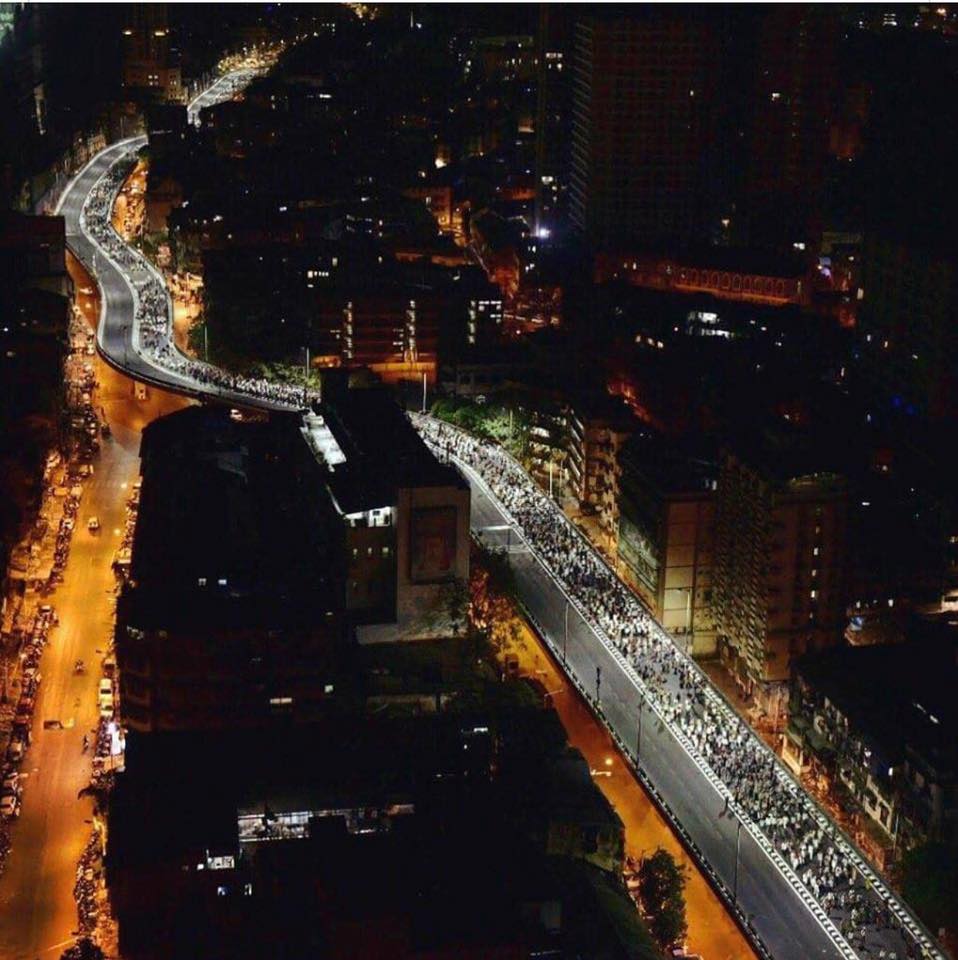
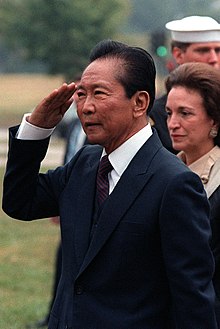
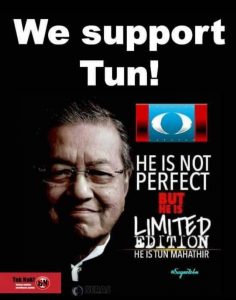
Tun Mahathir is leading the opposition in our general elections this coming Wed 9th May. At 92 years old accompanied by Tun Siti, Mahathir is leading a “punishing” campaign trail throughout the country.

Tun M has only one goal – to rid the country of Najib and his cronies, all guilty of unbelievable corruption.

Tun has offered himself as the fall guy but he has succeeded in garnering overwhelming support for his mission despite the blatant cases of payouts by the ruling authorities. He is out everyday- day & night; speaks to crowds till past midnight. And of course his health is being challenged.

By looking at the mammoth support at rallies for him & Pakatan Harapan, we could assume that the opposition will win; but will all this overt support translate into votes on Wed? That is the question!

Please say a prayer for Tun Mahathir and for a better Malaysia.


new report on the economy of Papua New Guinea will reopen the case for the Australian government to be held accountable for the negligent decision to lend AU$500 million taxpayer money to the PNG-LNG project.

Jubilee Australia’s new report, Double or Nothing: The Broken Economic Promises of PNG LNG’, is co-authored by Paul Flanagan and Dr Luke Fletcher. Paul has worked for the Australian government in senior executive positions and with the PNG Treasury where he was Team Leader and Senior Advisor to the SGP Program from February 2011 to August 2013. Luke is the Executive Director of Jubilee Australia.

Summary of findings:

  • Despite predictions of a doubling in the size of the economy, the outcome was a gain of only 10% and all of this focused on the largely foreign-owned resource sector itself;
  • Despite predictions of an 84% increase in household incomes, the outcome was a fall of 6%;
  • Despite predictions of a 42% increase in employment, the outcome was a fall of 27%;
  • Despite predictions of an 85% increase in government expenditure to support better education, health, law and order, and infrastructure, the outcome was a fall of 32%; and
  • Despite predictions of a 58% increase in imports, the outcome was a fall of 73%.

PNG LNG is an Exxon-led project which supplies about 8 million tonnes of LNG a year to Japan, South Korea and China. It is projected to run for 30 years. In 2009, Australia’s Export Credit Agency, Efic lent AU$500 million to Exxon, OilSearch, Santos and the Government of PNG. Efic’s decision was based on advice from DFAT provided to the then-Minister for Trade, Simon Crean, on advice from DFAT. This is the largest loan ever made by Efic.

“In 2008 Australian economics consultants, ACIL-Tasman provided inflated projections of growth in employment, essential services, household income and the broader economyif the PNG LNG project went ahead. This new analysis proves just how misleading these promises were and how PNG has slipped back into the poor policies associated with the resource curse. Currently, on almost all economic indicators, the people of PNG would have been better off had the project not happened at all,’ said Paul Flanagan.

“Australia’s Export Credit Agency, Efic is an agency that is out of control. It has deplorable due diligence and accountability; as a result, it makes decisions like this that not only undermines the livelihood and prosperity of our neighbours in PNG, but also our own nation’s security,” said Dr Luke Fletcher, Executive Director of Jubilee Australia.

“The Australian government continues to withhold the secret advice that was used by Efic to loan AU$500 million of taxpayers money to Exxon and its project partners.

“In light of this damning new evidence of economic regression, the advice provided to Trade Minister Crean in 2009 which recommended Efic support the PNG LNG project should be released alongside all related risk analysis.

‘‘Exxon and Oil Search should be paying half a billion dollars (AUD) to the PNG government every year, since the gas started to flow in 2014. Instead, they are paying a fraction of this amount, partly because of their use of tax havens in the Netherlands and the Bahamas.

“Unless there is greater accountability on the use of foreign loans and a crack down on the use of tax havens by companies like ExxonMobil and OilSearch, the pattern of Australian governments and corporations causing harm to our region simply to create profits for big business will continue,” concluded Dr Fletcher.

‘Double or Nothing: The Broken Economic Promises of PNG LNG’ is the first of two papers on the PNG-LNG pipeline that has been commissioned by Jubilee Australia. The second paper will discuss the unpaid royalties and development benefits and the escalating violence as a result of the PNG LNG project.

Download the report here.

It has all the elements of a crudely crafted if effective tale: banks and other financial services, founded, proud of their standing in society; financial service providers, with such pride, effectively charging the earth for providing elementary services; then, such entities, with self-assumed omnipotence, cheating, extorting and plundering their clients.

This is the scene in Australia, a country where the bankster and financial con artist have been enthroned for some time, worshipped as fictional job creators and wealth managers for the economy.  Impunity was more or less guaranteed.  All that might be expected would be the odd sacking here and there, the odd removal, the odd fine and limp slap of the wrist. But then came along something the Australian government never wanted: a Royal Commission.

While Commissioner Kenneth Hayne’s Royal Commission into the Banking, Superannuation and Financial Services industry initially promised to be a fizzer, one that risked being stage managed into oblivion by a conservative former High Court justice, the contrary has transpired.  Even in its infancy, it has produced a string of revelations that have sent the financial establishment, and those supporting them, into apoplectic worry.

The Turnbull government, long steadfast in treating Australia’s banking and financial sector like a golden calf, has found itself encircled by misjudgment and error.  Former front bencher Barnaby Joyce had to concede error in arguing against a Royal Commission into the sector.

“I was wrong.  What I have heard is [sic] so far is beyond disturbing.”

Ministers have been more mealy-mouthed, in particular Revenue Minister Kelly O’Dwyer who has given a string of performances featuring stellar denial and evasion.

“Initially,” she told the ABC last Thursday, “the Government said that it didn’t feel that there was enough need for a royal commission.  And we re-evaluated our position and we introduced one.”

Such a view ignores a strain of deep anti-banking suspicion within some conservative circles – notably of the agrarian populist persuasion.  The National rebels George Christensen, Llew O’Brien and Barry O’Sullivan were repeatedly noisy on the subject.  (The unregulated free market sits uneasily with them.)

The undergrowth of abuse has proven extensive and thorny.  Clients, for instance, have been charged services they were never supplied; monitoring systems to ensure that such services were, in fact, being provided, have been absent.  Not even the dead have been spared, with the Commonwealth Bank’s financial business wing knowingly charging fees of the departed.

One revelatory report stretching back to 2012 from Deloitte found the Commonwealth Bank of Australia (CBA) particularly egregious on this score.  According to the authors, 1,050 clients were overcharged to the hefty tune of $700,000 for advice never received, as their financial planners had left the business prior to 2012.

At times, the hearings have made for riveting viewing.  Commissioner Hayne found himself in the position of reproaching Marianne Perkovic, head of the CBA’s private bank some three times for hedging responses to Michael Hodge, QC, senior counsel assisting the commission.

“You will get on better if you listen to counsel’s question – if you have to stop and think about the question do it – but listen to counsel’s question and answer what you’re asked.”

Perkovic had remained oblique on the issue of the CBA’s foot dragging – some two years of it, in fact – regarding a failure to inform the Australian Services & Investment Commission (ASIC) on why it did not supply an annual review to financial advice clients of Commonwealth Financial Planning.

Scalps are being gathered; possible jail terms are being suggested; promises of share holder revolts are being made. The most notable of late has been AMP, whose board, after the resignation of chief executive Craig Meller risk a revolt from shareholders at a meeting on May 10.

“At this stage,” announced Australian Council of Superannuation Investors CEO Louise Davidson, “we are thinking of voting against the re-election of the directors.”

This is not the view of Institutional Shareholder Services, a proxy firm that maintains the front that caution should be exercised in favour of the three directors in question. Stick by Holly Kramer, Vanessa Wallace and Andrew Harmos – for the moment.

“Given that the Royal Commission is in its early stages,” go the dousing words of the ISS report, “and although information presented thus far would be of concern, it is considered that shareholders may in due course review the findings of the Royal Commission, once presented, and any implications for their votes on directors at the appropriate time.”

It is precisely such attitudes of disbelief, caution and faith that have governed Australia’s financial sector during the course of a religiously praised period of uninterrupted growth.  AMP’s value has been dramatically diminished, losing $4 billion from its market capitalisation.  In naked terms, this constitutes a loss of 24 percent of shareholder value over the course of six weeks. But that is merely one component of this financial nightmare, which has stimulated a certain vengeful nature on the part of shareholders.

What, then, with solutions?  The regulator suggests greater oversight; the legislator suggests more rigid laws of vigilance.  The penologist wishes to see the prisons filled with more white collar criminals.  Yet all in all, Australia’s financial service culture has been characterised by shyness and reluctance on the part of ASIC to force the issue and hold rapacity to account.  Central to such a world is a remorseless drive for profit, one that resists government prying and notions of the public good.

One suggestion with merit has been floated.  It lies deep within structural considerations that will require a return to more traditional operations, ones untainted by the advisory arm of the financial industry.

“Financial institutions,” suggests Allan Fels, former chairman of the Australian Competition and Consumer Commission, “must be forced to sell their advisory businesses.  This will remove the unmanageable conflict of interest inherent in banks creating investment products while employing advisers to give purportedly independent recommendations to consumers about their investments.”

Now that would be radical.

*

Dr. Binoy Kampmark was a Commonwealth Scholar at Selwyn College, Cambridge.  He lectures at RMIT University, Melbourne.  He is a frequent contributor to Global Research and Asia-Pacific Research. Email: [email protected]

What limits opinions?  Especially by sportspeople, who are often confused for geniuses of the mind and ambassadors of tact outside their very limited field of endeavour.  (Yes, he can dribble a ball with sigh-inducing majesty, so he must know a thing or so about social and intellectual problems.)

The obverse tends to be true.  The sporting personality, presuming it exists, is often incapable of adjusting once off the field. Social media becomes tempting; ranting can become irresistible.  Having viewpoints, certainly shoddy ones, can be a dangerous thing, and the atmosphere for policing such remarks as those made by Australian rugby union player Israel Folau, is very much heated. 

While Gore Vidal never thought there was such a thing as the homosexual per se – there are only instances of behaviour across the spectrum, with preferences coming and going – the stage hands and even players have not always thought so. Locker room homo erotica is not to be described as it is, nor are all the ancillary pointers: the heaving, the sweat, the groping, the engagement, the shower encounter.

The list of controversial statements on homosexuality in sport – as a pejorative, that is – is extensive.  Much of this seems rooted in a fundamental misunderstanding similar to that found in successful armies.  Some of the best fighting forces of history fought and thrived on the issue of man love rather than starved heterosexuality, the Spartans being most famous for it.  Which brings us to certain collective sports which might be seen to be extensions of the same.

From management to player, the homophobe remains keen and prevalent.  Marcello Lippi, for a good stretch coach of the Italian football team, openly admitted in 2009 that openly gay players would never play for the Azzurri. Scandal and distraction would follow. 

The response from the Arcigay association asked of Lippi a fairly sensible question:

“Why, dear Lippi, couldn’t footballers openly experience gay love when they show their flirts with every type of showgirl in front of every TV camera?” 

Players have also been rather happy to shoot from the hip (and mouth) on that score.  The former Miami Heat guard Tim Hardaway was particularly full on the subject.  

“You know,” he exclaimed on Miami radio in February 2007, “I hate gay people, so I let it be known.  I don’t like gay people and I don’t like to be around gay people.” 

School book definitions had been mastered:

“I am homophobic.  I don’t like it.  It shouldn’t be in the world or in the United States.”

Israel Folau is but another sprinkling in the annals of dogma.  His response to a question submitted by an Instagram user about what that not-so-good deity had in mind for gay people was tart.  “HELL… Unless they repent of their sins and turn to God.”  Pressure followed; the squalls gathered, and still, after some days, Folau held firm.  As has Rugby Australia.

The Australian context was given further spice on the subject of religious freedom, a term often as incoherent as the religious advocates themselves.  But this did not involve cake and gay couples; this was a matter of fiery hell and imminent doom predicted by a self-confessed zealot, albeit it on social media. 

It’s hardly the god bothering that matters so much as the people bothering in the name of god, or some other conjured up fantasy that lodges itself in prejudice.  But was this sports figure, hardly nimble in mind, allowed to express it?

Folau made an attempt to supply context in PlayersVoice, flaunting his sense of erring by claiming he was “a sinner too”.  It would hardly have mattered to his detractors, but here was a man confessing to the literal and the fundamental, a foot soldier who, given a chance, might well slay for the unelected Sky God.

“My response to the question is that to believe God’s plan is for all sinners, according to my understanding of my Bible teachings specifically 1 Corinthians 6: 9-10.”

The passage itself oozes the contentment held by the righteous, the idea of who will inherit the Kingdom of God like some over prized bit of real estate. 

“Do not be deceived: neither the sexually immoral, nor idolaters, nor adulterers, nor men who practice homosexuality, nor thieves, nor the greedy, nor the drunkards, nor revilers, nor swindlers will inherent the kingdom of God.”

As with all followers of celestial tyrannies, Folau felt he was doing good, providing appropriate counsel to a misguided wanderer.

“I do not know the person who asked the question, but that did not matter.  I believed he was looking for guidance and I answered him honestly and from the heart.”  

The Bible was the “truth”.  And so, the coda for perfect, corpse sowing extremism is laid bare.

There were some who thought that the rugby figure had simply ballsed up the whole issue of god and the good word, though it came from those churchmen uncomfortable with the evangelised knock-off version of the Bible.  Folau’s critics resorted to visions of catastrophe – for the living.  Albury-based Archdeacon Peter Macleod-Miller was not one who felt a religious dispensation applied.  

“It becomes an engine for refugees within our own community… to allow this sort of thing to happen is grossly irresponsible and so corrupt.”

The issue with Folau is even less the issue of the literalists and the agnostic symbolists as to whether his Bible-based homophobia impairs his performance.  Focusing on the task at hand, the sport can be played as long as the collective spirit remains.  But then comes the issue of business, something Folau was attuned to. 

In meeting with Rugby Australia chief executive Raelene Castle and Waratahs general manager Andrew Horehe acknowledged that both “have to run things in a way that appeals broadly to their executive, fans and sponsors, as well as its players and staff.  It is a business.”  That said, his beliefs would not be tradeable. He would only play as a dogmatic spear carrier of faith.

Fellow players not willing to take to the field with him, be they opponents or from the same team, might suggest possible impediments. But as homosexuality remains the boxed and the unspoken in a range of homoerotic sporting activities (done and not described), Folau might well struggle to find a safe shower.

*

Dr. Binoy Kampmark was a Commonwealth Scholar at Selwyn College, Cambridge.  He lectures at RMIT University, Melbourne.  He is a frequent contributor to Global Research and Asia-Pacific Research. Email: [email protected]

Featured image: M-69 incendiary tests on Japanese style structures at Dugway Proving Ground. (Source: Standard Oil,Design and Construction of Typical German and Japanese Test Structures at Dugway Proving Grounds, Utah, 1943. Via JapanAirRaids.org)

This paper explores a previously unexamined context to the firebombing of Japan. Analysis of the decisions leading up to construction and military testing conducted in 1943 at the Japanese Village at Dugway Proving Ground in Utah allows important insights into the evolution of US bombing strategy. The shift in US strategy from precision to carpet bombing, the testing and development of incendiary weaponry, and the institutionalization and rationalization of pursuing civilian targets throughout Japan are considered alongside this untold history. Additionally, a broader appreciation of World War II timelines is suggested.

“The M69/M69X bomb was designed to lodge in the most flammable part of the buildingthe ceiling beams.” – S. Army Dugway Proving Ground, Historical Fact Sheet, p. 1

“Initially, it often seemed a home was unaffected, until the windows began to shine from within and then glowed like a paper lantern from a ball of fire that sprouted tentacles that danced out from beneath the eaves to envelope the house until it crumbled inward upon itself.” – Richard B. Frank, describing an M-69 in the Tokyo air raid of March 9-10, 1945, Downfall pp. 7-9

“And, when I saw Japanese Village [at Dugway Proving Ground, Utah], it was burning. It went. It was gone. [It] was built in such a, you know, material, nothing like German Village, it was burnt. It burnt to the ground. All you find out there was a few pieces of wire, or something like that. Maybe some nails. Thats all thats left of Japanese Village.”  – Ethnographic Interviewee [name withheld], employee at Dugway Proving Ground, Interview #4 Transcript, p. 5

Introduction1

Dugway Proving Ground is a U.S. Army post roughly 90 miles southwest of Salt Lake City, Utah. It is located between the Salt Lake Desert and Dugway Valley in Tooele County. The gas station-less road from Salt Lake City to the army post (a site larger than the state of Rhode Island) is unfenced open range filled with wildlife, cattle, blind curves, and vision-impeding hillsides. Isolated more than twenty miles beyond the gate of Dugway Proving Ground lies the remains of German-Japanese Village, where replicas of German and Japanese buildings were constructed, bombed at least 27 times (see Table 1), and rebuilt in order to test incendiaries for use in World War II. Even today special clearance is required to get to what remains of the testing site, and locating it amid the interconnecting labyrinth of seemingly nameless and featureless roadways is difficult even with online maps.2

Geographic isolation aside, the German-Japanese Village project, started in 1943, was the result of a multifaceted effort, the origin, development, operation, implication, and overall significance of which is anything but trivial or simple. Surprisingly, very little, if any, research has been conducted directly about it.3

German-Japanese Village was born of two interwoven developments before and during World War II. The two developments that this paper explores are 1) the doctrinal switch by the Army Air Force from precision to carpet bombing, and 2) the development of incendiary weaponry. This paper will use Japanese Village at Dugway as a lens through which to understand these developments, as well as their historical contexts and implications. Dugway is an understudied and symbolic turning point in this international history. It is neither the first nor the last representative case studying the effects of civilian bombing, nor of incendiary weaponry development, but it is a unique, concrete example of official government endorsement at a critical moment in the evolution of US bombing strategy.4

Japanese Village is rarely referenced directly, and when it is referenced, it is usually as a footnote in a history of some other facet of the American war effort. It is rare to find a book or article that devotes more than a paragraph or two at most to the project (John Dower’s Cultures of War, E. Bartlett Kerr’s Flames Over Tokyo, and Tom Vanderbilt’s Survival City are some notable exceptions). This paper, with its emphasis on international and U.S.-Japanese history, will attempt to consolidate some of those perspectives and historical footnotes.

Aerial view shows the isolated German-Japanese Village site.

A closer aerial photo of German-Japanese Village where the viewing bunker can be seen.

Where (and from whom) did the idea of incendiary carpet-bombing come from? This decision is a good example of rapid change as a result of the U.S. entry in World War II. In fairly short order, US military planners went from little to no knowledge of “the physical processes by which bombs, whether high-explosive or incendiary, caused damage” to strategic incendiary bombing. Upon American entry into the war, the means of testing and measuring the efficacy of what explosives they had was surprisingly crude.5

Dugway Proving Ground’s Japanese Village illustrates the convergence of several interrelated histories. Its context reveals much about the origins and development of U.S. approaches to civilian bombing and total war as linked to weapon development and international historical timelines of the end of World War II.

Laying the Foundation for the German-Japanese Village

Firebombing Japan was not a new concept before Dugway Proving Ground. As Patrick Coffey writes in American Arsenal,

Gen. Billy Mitchell had suggested the possibility of burning Japan’s ‘paper and wood’ cities as early as 1924. In 1939 the Air Corps Tactical School already emphasized, in their instructional courses, Japanese urban vulnerability to incendiaries.By November 1941, George Marshall had threatened to ‘set the paper cities of Japan on fire’ if war came.”7

Such ideas, too, had grown stronger leading up to the war, so much so that the destruction of “industry” had become a kind of institutionalized shorthand for indiscriminate bombing.Near the end of the war American understanding doubled-down on this line of reasoning:

“Noting the Japanese government’s announcement that all men from fifteen to sixty and all women seventeen to forty would be called up for defense…the Fifth Air Force’s intelligence officer declared on July 21 [1945] that … ‘There are no civilians in Japan.”9

Although he didn’t originate the idea, General Curtis LeMay, the commander of Army Air Force operations against Japan, summed up American rationalization of carpet-bombing in his succinctly blunt manner in his memoirs:

No matter how you slice it, you’re going to kill an awful lot of civilians. Thousands and thousands. But if you don’t destroy the Japanese industry, we’re going to have to invade Japan. … Do you want to kill Japanese or would you rather have Americans killed?10

The striking imbalance of technological power between the U.S. and Japan is exemplified in the work undergone at Dugway. Compared to the “thousands and thousands” LeMay references as being killed in the American air raids on Japan (a low estimate), the incendiaries developed simultaneously with a crude Japanese aerial campaign that quite literally involved firebombs attached to balloons and set off haphazardly across the Pacific Ocean. In May 1945, these firebombs killed six people in south-central Oregon—“the only mainland civilian American casualties of World War II.”11 The effect of the U.S. employing such dramatic power was as much militaristic and economic as it was psychological, as David M. Kennedy writes in The Origins and Uses of American Hyperpower.12 Japanese sources, too, it seems, had “anticipat[ed] the events to follow.” As Mark Selden observes in A Forgotten Holocaust:

The most important way in which World War II shaped the moral and technological tenor of mass destruction was the erosion in the course of war of the stigma associated with the systematic targeting of civilian populations from the air, and elimination of the constraints, which for some years had restrained certain air powers from area bombing.13

Nonetheless, it is wrong to think that the US military was committed to carpet-bombing as a tactic or as a policy at the outset of the war. In fact, quite the opposite is true. Roosevelt, in a 1939 appeal, called civilian bombing “inhuman barbarism.”14 By 1943 however, Roosevelt’s opinion had abruptly changed, commending rather than condemning the firebombing of Hamburg as an “‘impressive demonstration’ of what America might achieve against Japan.”15 By that time German-Japanese Village experimentation was already underway in Utah. Furthermore, in a grimly ironic way, the machines most responsible for the implementation of civilian air bombing (the B-29s) were initially “designed with precision bombing in mind.”16

Why the shift in bombing approaches? Partially, the answer lies in the rigidity of Army Air Force policy and mindsets inherited from World War I. “Throughout the interwar years American airmen had no incentive to develop an incendiary weapon” due to their already established emphasis on precision bombing.17 Between 1939 and 1941 the British Air Force, as a result of consistently ineffective daylight precision bombing attempts, as well as the newly introduced goal of “breaking down of German morale,” shifted their tactics to area-bombing.18 Despite pressure from Britain, early on the U.S. Army Air Force clung to the “precision doctrine.” According to Lynn Eden in Whole World on Fire, they did this for a multitude of reasons, among them: 1) the (overly) ambitious and visionary nature of the concept; 2) fear of domestic and political backlash as a result of mass civilian bombing; 3) early legislation theoretically restricting the Army Air Force to a defensive role in war; and, perhaps most importantly 4) existing planning, training, and equipment were already oriented for precision—not area—bombing.19

Air Force notions about the accuracy of aerial bombardment turned out to be appreciably overestimated. By at least one account of World War II, of the bombs dropped using technology intended for precision raids, only 5% fell within even one mile of their targets.20 Other early reports state that only one bomb in five landed within a five-mile radius of its target.21

“The main difficulties arose,” as John Kreis writes in Piercing the Fog, “from a combination of crew inexperience, operating the aircraft at extreme range limits, and, worst of all, atmospheric conditions over the targets.”22

US attempts to respond to these complications, as we will see, can be traced to Dugway and German-Japanese Village. By the end of World War II, it seems fair to say that Japan, more than most (perhaps any) country suffered the consequences of total war (warfare that considers civilian targets legitimate), and in the history of total war with Japan, Dugway is an undeniable, understudied stepping stone. Although precision bombing continued in the ensuing years, the testing done at Dugway made a substantial impact on modifying prewar bombing doctrines.

We can better understand the context leading to German-Japanese Village by looking at the history of U.S. incendiary development. E. Bartlett Kerr organizes these developments succinctly in Flames Over Tokyo. It wasn’t until 1940 that the Air Corps acquired its first incendiary bomb, the M-47. In 1941 the U.S. got its second incendiary bomb, a British innovation referred to as the M-50. In 1942 the U.S. developed the M-69 incendiary bomb that would be most utilized in the firebombing of Japan near the end of the war.23

Material limitations played a key role in defining incendiary development. For example, rubber was an essential part of the first US incendiary bomb, the M-47. This incendiary device relied on predominantly rubber and gasoline, but shortly after the onset of the war, in 1940, the U.S. was cut off from international rubber supplies. Sensing an opportunity, the Standard Oil Development Company of New Jersey (the same company that would have a large part in making Japanese Village at Dugway a reality), headed by chemist Robert Russell, “observed this expanding market [for development] with great interest.”24 The second incendiary available to the U.S., the M-50, was adopted from Britain’s Air Force in 1941. This weapon, which had also been used by the Germans, relied on magnesium. Henry Arnold, the commanding general of the U.S. Army Air Forces spurred on by similar shortages in magnesium, pushed for “development of incendiary munitions which were to be at least as effective as the German Kilo magnesium bomb and readily capable of mass production…”25

By late 1941, The National Defense Research Committee (NDRC), an organization that focused on scientific development for national security purposes, and the Chemical Warfare Service, a branch of the U.S. Army charged with development and testing o f chemical weaponry, as well as the Army Air Force, had seen the writing on the wall: rubber and magnesium sources in the Pacific, threatened by the Japanese, might soon come to an end as well.26 Before that, though, scientists and engineers had organized under the guidance of the newly created NDRC: by October, 1940, in light of incendiary developments in Europe and an increasing threat from Japan, a meeting was held at Harvard University. In attendance were the president of MIT, the president of Harvard, as well as an MIT chemical engineer Hoyt C. Hottel and Harvard organic chemist Louis Fieser (both of whom were to become important to the developments at Dugway Proving Ground), and Robert Russell, the president of Standard Oil Development Company.27

The program to develop a reasonable incendiary alternative was formalized by the Chemical Warfare Service in late 1941. Louis Fieser headed the Harvard group in an attempt to solve this problem, and the NDRC paired with Standard Oil to facilitate development.28

Hoyt C. Hottel, an MIT graduate in chemical engineering, during the war became Section Chief on Fire Warfare for the NDRC. Hottel, a very important figure in the field of fire research during and after World War II, was associated with Standard Oil even before the October 1940 meeting. Prior to Pearl Harbor, he was already engaged in developing flamethrower technology that would also be tested at Dugway for use against Japanese cave fortifications. In an interview with the Chemical Heritage Foundation some years later, Hottel provided a clear explanation about the timeframe leading up to war:

“Come 1939, a lot of people thought that the war was something we’d be in sooner or later and our state of preparedness was poor.”29

Similarly, Louis Fieser, an organic chemist and professor emeritus at Harvard, soon to be known as the inventor of napalm, was also drawn to the field of incendiary development. By summer 1941, he had been drafted by the NDRC (much to his chagrin) and ordered to “terminate work on explosives and to work instead on poison gases, vesicants.”30 Fieser considered this shift to toxic gas inhumane.31 The toxic gas program was eventually delayed, and Fieser, in the interim, started thinking about a gelled-fuel incendiary in earnest. This was the genesis of napalm.32 Subsequently, he headed the Harvard group of scientists charged with developing an alternative incendiary thickener.

The means of testing incendiary efficiency were in their infancy. Standard Oil initially tested their prototype incendiary bombs “against specially designed targets simulating attics.” These A-frame attics were essentially, as Hottel put it, “two-by-fours forming the frame and a few boards laid over them and on the floor.” Even before Standard Oil had begun their testing, however, Fieser had been “building small wood structures and putting thickened fuels under them.”

By 1942 the incendiary bombs were available “in sufficient quantities for airborne testing.”33 The question remaining was: what was the best formula for the M-69? Among the groups involved, three formulas for incendiary munitions became dominant: Standard Oil’s Formula 122—nicknamed “applesauce” for its appearance; Fieser’s jellied gasoline called napalm (a word originating from its chemical components: naphthenate and palmitate); and an alternative developed by the Du Pont incendiary program called the IM-gel (short for isobutyl methacrylate).34

It was decided that airborne tests were necessary by Standard Oil and the NDRC operating under the Chemical Warfare Service, and so large-scale tests were set up at Jefferson Proving Ground in Indiana from July 11th to the 21st, 1942.35 For the scientists, this test was also to determine which of the three formulas to use for filling the new bombs. This was the first airborne test on appropriately sized targets and it entailed the bombing of condemned buildings such as “a deconsecrated Catholic church, some stores, a banker’s home, some chicken coops, pig pens, rail fences” among other structures.36 In these tests, B-25s and dive-bombers dropped the bombs and a group representing NDRC (including Hottel) judged the results.37

Firsthand accounts of both Fieser and Hottel reveal the development of a bitter rivalry among the groups of scientists. In the end, Du Pont’s IM-gel incendiary received the highest ranking, with Fieser’s napalm a close second. The IM-gel, however, was subsequently judged inferior due to problems with transport.38 Standard Oil’s “applesauce” was also soon forgotten, and Fieser’s napalm became the weapon of choice.39

In September, 1942, Standard Oil’s Robert Russell responded to concurrent German and English incendiary raids as well as results at the Jefferson Proving Ground tests by saying “the possibilities inherent in incendiary bombing have greatly brightened in recent months. The mass raid has made its first appearance; its practicality as a destructive offense is now clear. Better and better incendiaries are becoming available—though not yet in full production…”40 The results of the tests were still, however, considered preliminary, according to the Office of Scientific Research and Development’s book Chemistry: A History of the Chemistry Components of the National Defense Research Committee 1940-1946: “Although the Jefferson [Indiana] tests added to the knowledge of functioning of the bombs in an airborne attack, the nonrepresentative character of the target led to some question as to the significance of the results.”41

Therefore, in the overall historical trajectory leading to civilian fire-bombing in Japan, there were three important developments: 1) weaponry development testing had indicated the beginning of a shift away from reliance on precision bombing; 2) substantial progress had been made towards selecting and testing new incendiary devices; and 3) representative testing that would come to define Army Air Force policy and tactics was deemed necessary.

Dugway Proving Ground’s German-Japanese Village

Things began to happen very quickly in the United States after the attack on Pearl Harbor on December 7th, 1941. Dugway Proving Ground was no exception. On December 8th, 1941, the United States declared war on Japan. On the 3rd of January 1942, Major General William N. Porter, the chief of the Army Chemical Warfare Service, sent Major John R. Burns to Salt Lake City to “investigate the possibilities of a testing ground in Utah.”42 Once there, Major Burns met with the Army’s district engineer and Chief Quartermaster Elmer Gwyn Thomas and began making plans for a site “anywhere on the desert.”43

When the survey was completed, Major Burns submitted his report to General Porter and by no later than January 14th, 1942, the Chemical Warfare Service requested the President to secure the 126,720 acres of land Thomas and Major Burns had selected.44 On February 6th, 1942, a mere two months after Pearl Harbor, President Franklin D. Roosevelt withdrew the initial acres in Tooele County, Utah from the public domain for use by the War Department (Executive Order 9053). By April the President added an additional 138,180 acres; completing the site the government also purchased land from private owners and the State of Utah in early 1942.45 Dugway Proving Ground, commanded by Major Burns, was officially established on March 1, 1942.46

The initial construction of Dugway Proving Ground was disrupted by the logistics of putting together such a large operation in such an unforgiving topography. Nonetheless, by April 1, roads were paved and general construction of the army depot had started.47 Dugway Proving Ground had been chosen as the site for building representative German and Japanese structures because of frequent days of clear visibility.48 An even more immediate reason for choosing Utah was that Edgewood Arsenal in Maryland, the other potential site for the village, “offered little room for further development or field testing.”49

Planning for the structures began in February, 1943.50 Between March 12th and 18th, 1943, the Chemical Warfare Service Technical Division contracted Standard Oil to create full-scale representative test structures at Dugway Proving Ground.51 Under the auspices of Fieser’s Harvard group, Hottel and the NDRC, the Chemical Warfare Service, and Standard Oil, a meeting was set in March 1943 in Elizabeth, New Jersey to consult leading architects. Among the architects were Eric Mendelsohn (who would design German Village) and Antonin Raymond (who would design Japanese Village).

Mendelsohn’s correspondence and archives have left no first-hand accounts of his involvement with German-Japanese Village, but more studies have been done of German Village.52 Several biographies of Mendelsohn make no mention of his wartime involvement. The reverse seems to be true of Antonin Raymond. Although he spoke about his work at Dugway in his autobiography, “official” records provide little detail about the Japanese Village.

In the interwar years, Raymond had designed the Standard Oil Company of New York’s headquarters and staff housing in Yokohama, Japan. This connection, his availability, and his lengthy history in Japan made him the logical choice as architect for the Japanese Village at Dugway.53

Only 10 days after being contracted to create the German-Japanese Villages, on March 28th, 1943, Standard Oil broke ground on the construction project.54 Over $530,000 was allotted for the German-Japanese Village, but actual costs ran over one million dollars. Furthermore, “due to the urgency of the project, the contractor was able to recruit prisoners from Utah jails to work with the craftsmen.” By May 11th, 1943, just 44 days after construction began, both German Village and Japanese Village were completed.55

Blueprint of German-Japanese Village compiled by the National Park Service’s Historic American Engineering Record.

Workers utilize traditional Japanese architectural styles in the Utah Desert, 1943.

All in all, 12 Japanese double-dwellings consisting of 24 tenement-style residences and 6 German apartments were constructed. These structures were designed, according to Standard Oil, to represent living quarters in Japanese industrial districts. No structure meant to represent industrial facilities was built. Emphasis was exclusively on civilian populations.

An array of different roofing styles was utilized for comprehensive penetration testing. Additionally, authentic design, construction methods, materials, and furnishings were also considered. Forty-foot wide firebreaks and firewalls were constructed to protect the structures.56

Significant care went into construction and development. Narrow roads were built between the Japanese structures to represent the congestion in urban centers of Japan. The percentage of roof-area coverage was modeled after the “large industrial centers” listed as: Tokyo, Yokohama, Kyoto, Kobe, Nagoya, and Osaka. The resulting fire-bombings, however, would extend far beyond this initial list. More impressively, the “usual American stud-frame type” construction was done away with in favor of the traditional and “complicated keyed or mortised joints” of typical Japanese structures. It is a testament to the surreal underpinnings of this project to imagine prisoners from Utah carefully reconstructing unfamiliar and complicated Japanese architectural styles. Authentic shoji and fusuma screens and panels were also produced. Appropriately comparable wood was carefully selected and even dried to represent typical moisture content in Japan.

The cultural “sensitivity” of this project did not end there.57 According to the official Standard Oil report, for the purpose of accurately measuring flammability, furnishings provided included: tansu (storage chests), futon (bedding), zabuton (sitting cushions), hibachi (stoves/braziers), low tables, and radios. The report further reflects such cultural nuances as the placement of shoe storage in the hallways since shoes are not worn in the house in Japan, and recognition that futon are stored in the closets during the daytime. Additionally, tests were conducted with the amado shutters open (in daytime) and closed (at night) to measure the different effects. As a testament to the quality of the furnishings, one of the soldiers who was stationed at Dugway later stated that he and his friends stole the futon sleeping mats from the Japanese Village for furnishing their own apartments. The most notable inclusion on the list, however, is tatami(straw floor mats).

Interior furnishings of Japanese Village structures.

Tatami mats were considered vital, because tatami, more than any other element of furnishings, affected the way bombs penetrated the floors. 58 At Standard Oil’s insistence a factory was set up to produce facsimile mats; further, “without military orders and without any evidence,” a tremendous surplus of tatami were “acquired” from Japanese-American homes, temples, stores, and clubs in Hawaii.59 (The “typical” furnishing of the German structures, in comparison, is somewhat more disturbing in its blunt acceptance of the civilian nature of the project: reports not only included beds, closets, sofas, and dining sets, but also cribs.)60

With the villages constructed and furnished, initial testing of the incendiary weaponry began on May 17th, and ended on July 16th, 1943, but additional tests were conducted into 1944 to refine the M-69 into cluster bombs.61 In total, the structures were destroyed and completely rebuilt at least three or four times.62 Parts, when applicable, were cannibalized and reused.63

Planes dropped a variety of bombs on the structures, including the M-50 and M-52 thermite-based bomb, as well as the M-69 napalm-based bombs. Although attempts were made for high altitude bombing, according to Hottel’s firsthand accounts, these approaches proved fruitless and were abandoned in favor of low-altitude testing at approximately 5,000 feet.64 Additionally, some tests were not conducted by plane but utilized tall scaffolding and utility poles, as one employee recalled.65 Compared to other sites running tests on simulated structures, Dugway had a slightly different approach that skewed the results compared with those of other groups.

According to one British Intelligence report, at Dugway, the emphasis was on the speed with which fires could be extinguished; at the other sites emphasis was placed on how well fires could be started. In other words, at Dugway, “hits” were almost guaranteed, but elsewhere the landing of the incendiary was not definite.66 Reviews of Dugway Proving Ground’s efforts by the Military Intelligence Division of Great Britain in late 1943 showed great reservation about adopting the M-69 against Germany and that more tests would have to be done to prove their worth in the European theater. Regarding using M-69’s in Japan, however, the Military Intelligence Division had this to say about the Dugway results:

There is no doubt that for attack in Japanese and other Far Eastern targets the M.69 bomb in a satisfactory projectile cluster would be more suitable than the 4-lb. incendiary bomb, and that if attacks on forests or crops from medium or high altitude were again to become requirement this bomb should be at least as effective as anything used hereto.67

Results were categorized in three ways:

“any fire beyond control of the well-trained and properly equipped fire guards in 6 minutes was classified an A fire; a fire which was ultimately destructive if unattended was a B fire; and a fire judged nondestructive was a C fire.”

The M-69 produced 37% A fires in German structures and 68% in the Japanese structures, and was judged overall to be the best. (In both cases, the other bombs produced no A fires.) As a result, plans for using the bomb on Japan were drawn up by the Army Air Force as early as the fall of 1943.68 Tables 1, 2, and 3 summarize comparative data from the UK and US testing, and show how Dugway’s testing could have been readily interpreted as the most effective.

The completed German-Japanese Village.

Incendiary testing on Japanese Village.

Spectators view the incendiary testing on Japanese Village.

Ultimately the testing erased most of the German-Japanese village. As described by Hottel at a Fire Research Conference in 1983, a large portion of Japanese village met its demise at the hand of a surveyor who waited too long to give the signal for extinguishment. Sometime thereafter, a large portion of German-Japanese Village burned down, consuming the Japanese Village in its entirety. The only remnants of Japanese Village are a few charred but repurposed rafter beams in the two German Village structures left standing today.69 Workers at the time said now there’s “nothing there other than some…scraps.” Judging by several interviews with Dugway employees, it seems clear that Japanese Village existed until at least 1950, but was gone by 1952, and that when it did burn down “it burned down so fast and so hot that…they couldn’t contain it.”70

The Ramifications of German-Japanese Village

The tests at Dugway Proving Ground’s German-Japanese Village directly impacted the war. Before the testing had even finished in late 1943, the NDRC is quoted as writing

“it might be worthwhile getting some thought started along these lines in General Staff circles in advance of the tests [at Dugway], so that quicker action can be taken if the tests give confirmation to the fire-raising possibilities.”71

By November 1943 requirements had been “revised sharply upward” for incendiary production.72 And “by the end of the war” as James Baxter writes in Scientists Against Time,

“approximately 30,000,000 M-69 bombs had been produced.”

In March, 1944, 20 tons of M-69 bombs were dropped on Japanese-occupied Ponape (Pohnpei) Island, but it wasn’t until December 13th or 22nd, 1944 that the first M-69 was dropped on Japan in Nagoya. On December 18th, 1944, however, 511 tons of M-69 bombs were used in China at Hankow (modern Wuhan) under the explicit directions of General LeMay (who at the time was in charge of air operations in China and India). LeMay, as quoted in Robert Neer’s excellent work Napalm, An American Biography, said

“everything which was hit burned like crazy. And I think there was a vast similarity to the type of construction in Japan.”73 

After taking over air operations for Japan, but before the Great Tokyo Air Raid on March 9-10, 1945, LeMay had already dropped over 600 tons of incendiary devices on Japan.74

While LeMay definitively put the firebombing concepts to use, Dugway Proving Ground’s tests at German and Japanese Village impacted his decisions. The M-47 incendiaries were also included in the March 9-10th Tokyo firebombing, but these were meant to be the initial bombs that marked targets for the B-29s hauling their immense loads of M-69s. As demonstrated definitively at Dugway, planes flying at night at altitudes between five and ten thousand feet, and dropping M-69 incendiary bombs for maximum impact, were highly effective.75

Two thousand tons of predominantly M-69 bombs were dropped in the March 9-10 Tokyo air raid. The flames were said to be visible over 150 miles away, almost 16 square miles (or 267,000 buildings) were razed, and even the most conservative estimates put deaths at over 83,000.

“The violence of the firestorm…on Japan,” as John Dower writes in Cultures of War, “was not replicated until Hiroshima five months later.”76

In addition to raids on major cities, between the 17th of June and the 14th of August, 1945 as many as 60 incendiary missions were launched against major cities in Japan.77

Patrick Eckman, a newspaper reporter in Salt Lake City, was the first allowed in to see and report on the German-Japanese Village project. Coincidentally, his article was published on the same day as the Tokyo firebombing: March 10th, 1945. In his article, titled Dugway Mystery Depot to Continue Test Work, he refers to the German housing, not as German but as Nazi Villages, and he details the supreme secrecy of the project: those stationed at Dugway were not allowed to write home, he says, and even the highest ranking officers needed special clearance to visit the construction site.

Instead of architects, Eckman refers to “private construction engineers” who spent years “in the enemy territories” but “managed to return to the United States before the outbreak of war,” and instead of Japanese apartments, he refers to “pagoda-type” structures. Compared to the M-69, which Eckman acknowledges as the most effective incendiary weaponry developed at Dugway, other weapons “provoked a cry of ‘inhumanity’ from the Japanese.” The test site, unlike its enemy counterpoint, is, here, painted as something glorious, which “rise[s] invincibly from its own ashes like the famous fabulous phoenix—a feat which its prototypes could not duplicate.”78

How are we to assess these comments. Are we to understand that, to Eckman, the M-69 is somehow more merciful than other incendiaries, which prompted such cries of inhumanity? And are we then, also, to understand Dugway’s German-Japanese Village as something “invincible,” “famous,” “glorious,” and “fabulous,” unlike the houses bombed in Japan? These incongruous conclusions are a testament to a common paradoxical logic of the time. Such reasoning was utilized to both glorify American technological advancements and to justify civilian bombing in Japan.

In spite of the dispassionate tone of the testing, the human implications of the German-Japanese Village project was not lost on everyone involved with the project. Raymond, the architect of Japanese Village, said of the construction:

“It certainly was not an easy task for me and my wife to be instrumental in devising means of defeating Japan. In spite of my love for Japan, I came to the conclusion that the quickest way to terminate this war was to defeat Germany and Japan as quickly and as effectively as possible.”

Yet Raymond admits in his autobiography to looking down his nose at the lack of cultural understanding in the contemporaneous British designs meant also to simulate Japanese dwellings, saying

“I immediately saw that the designer had never been to Japan.”79

Professor Ken Oshima of the University of Washington writes about Raymond in his dissertation Constructed Natures of Modern Architecture in Japan, portraying the architect as a tragic and conflicted figure who could not escape the gravitational pull of the war.80 Aome biographical texts about Raymond go so far as to see the experience at Dugway as somehow artistically transformative.81

Encountering difficulty in getting to Japan immediately after the war, Raymond contacted General MacArthur directly “telling him I would like to return to Japan and help in my capacity as an architect-engineer.” Raymond received a direct reply from MacArthur urging him to come posthaste to help with civil engineering projects. In an ironic twist, Raymond noted that “there was nothing left but twisted steel and broken concrete” of the centers he had helped to create for Standard Oil in Yokohama. Soon after he personally received approval from MacArthur for rapid development of industrial projects in order to rebuild Japan.82

Workers who encountered Japanese Village, when asked to describe any unique experiences at the site, said “well, I guess being an American, the whole thing was strange.”83 Employees called it “a rather unique place” and “spooky,” and described the various ways, after the war, that the structures had been reused: as an artillery range, machinery storage, a pigeon roost (for testing nerve gas), mannequin storage, and even as a small-scale laboratory. Some of the only tangible history remaining of those people involved are in the form of graffiti in the observation bunker outside of the testing site and carved into the concrete where the water tower used to be. Some who had been there, less impressed, described Japanese Village as “some wooden structure, is all it was.”84 None acknowledged or seemed aware of Dugway’s place in establishing American bombing policies or the resulting firebombing of Japan.

Undoubtedly the most colorful (and perhaps slightly exaggerated) account of the events at Dugway Proving Ground come in the form of Jack Couffer’s (autobiographical) book Bat Bomb: World War IIs Other Secret Weapon. Couffer, who served in the army in 1943, recounts the strange story of the development of a bat-based incendiary device (also tested at Dugway), but, most importantly for the purpose of this research, he describes German and Japanese Village, as well as its emotional impact on him, in detail. As one of the most vivid accounts, I reproduced some of Couffer’s observations on German and Japanese village here:

Far out in a remote area of the Proving Ground two remarkable installations had been constructed, simulated Japanese and German villages. . . .The sterile towns stood several miles apart on the otherwise empty Utah plain, like abandoned movie sets picturing the aftermath of a devastating plague. Dust-devils swirled through the powdery lanes, curling high into the blue sky, and tumbleweeds rolled past the empty doors—as if the art director had made a mistake and built an old western ghost town with the wrong kind of houses…

Casting aside that mental picture it was easy to imagine without emotional involvement the torching of this sterile village, which resembled nothing so much as a museum model in full scale. But when again I saw in my mind’s eye the town as it really would be, my flesh crawled. I was very glad I was seeing it in this way, without people. I could watch our little incendiaries do their dirty work without hearing the screams, the cries of pain, the yells of hysteria, the clanging of the fire carts, the roar of burning paper and wood, the sobs of mothers and fathers and sons and daughters.85

Nonetheless, such emotional recounting points to Dugway and German-Japanese Village’s place in memory and culture. Couffer’s somewhat theatrical metaphor is not misplaced here, because Hollywood prop developers were contracted for the furnishings of the projects.86 It is impossible to say with any certainty, of course, but perhaps this extended notion of theatricality helped workers and scientists to rationalize their actions.

The secrecy and surreal nature of the German and Japanese Village projects have doubtless contributed to Dugway’s strange place within a limited cultural consciousness. As evidenced by a 2013 work of fiction called The Gods of Heavenly Punishment, which tells the story of Anton Reynolds [sic] and his conflicted architectural work on Japanese Village, the dramatic nature of this history seems to point to Dugway as occupying some unique space in understanding between fact and fiction. For example, searches for Dugway Proving Ground on the internet yield numerous videos and reports riddled with theories that treat Dugway as a conspiratorial equivalent to Area 51, the highly classified remote detachment of Edwards Air Force Base within the Nevada Test and Training Range.

In modern times, anthrax scares, failed crashing space satellites, mass, unexplained livestock death, and some of the world’s largest non-nuclear explosion testing have exacerbated and compounded this popular (mis)understanding.87 Nonetheless, little association is commonly made between Dugway and the tremendous impact it had on Japan or on the Army Air Force policies America would continue to utilize well beyond World War II.

Conclusion

In terms of popular understanding of war in the Pacific and the end of World War II, Dugway demands a place in history. The many factors, organizations, people, agendas, and developments contributing to the efforts make Japanese Village an important nexus point in international history. As Marine Guillaume makes clear in Napalm in US Bombing Doctrine and Practice, 1942-1975, tracing the “historiography of bombing can be enriched by the historiography of the weapons deployed.”88

In many timelines of U.S.-Japan history, it seems that an imaginary clock starts ticking on March 9th, 1945 with LeMay’s firebombing of Tokyo and then abruptly and forever stops five months later with the bombing of Hiroshima.89 However, the Dugway Proving Ground history more accurately sets that clock’s starting point back several years, at least to early 1943 when testing at Japanese Village began. Similarly, the commonly held notion of LeMay’s great “innovations” in low altitude use of napalm in the Tokyo firebombing and subsequent raids throughout Japan should likely be recast and shown to have originated at Dugway years before the general took command of the Army Air Force operations against Japan.

It is true that Dugway has a relatively small place within World War II timelines. It is also true that the minimal awareness of Dugway’s Japanese Village, its history and implications, seems to have faded further over time. Moreover, any history involving air raids in Japan will necessarily have to share its attention with predominant memories and understandings of Hiroshima, Nagasaki, and their horrors. Yet that shouldn’t mean the importance of events like those at Dugway Proving Ground deserve any less attention. This is a point Mark Selden articulates in his work, Forgotten Holocaust:

“the US destruction of more than sixty Japanese cities prior to Hiroshima has been slighted both in the scholarly literatures in English and Japanese and in popular consciousness in both Japan and the US.”90

Based on this preliminary understanding of Japanese Village at Dugway Proving Ground, it is clear that a recasting of popular consciousness of the history of American bombing is warranted. As my research to date makes evident, there are further avenues of this subject yet unexplored, but its inclusion in various histories would better contextualize understanding both of the firebombing of Japan and the US military approach to civilian bombing as inextricably linked to weaponry development.

The paradoxical nature of a situation notable both for impressive cultural sensitivities as in the architecture of Japanese village, juxtaposed with an unwavering commitment to civilian bombing—warrants further research. Today, Japanese Village is gone, and in spite of several attempts to add German Village to the National Register of Historic Places, the applications have been rejected and, consequent to a lack of funds, have allowed the site and the few remaining artifacts to deteriorate and to remain inaccessible.91

With the limited available documentation and the physical record of the Japanese Village gone forever, the curtain seems to have fallen, as it were, in the remote recesses of the Utah Desert. Perhaps it is appropriate that the project’s history and far-reaching implications are now left to the researchers who, working in the shadows of the extensive histories of Hiroshima and Nagasaki, strive to document the complete story of this significant but little studied moment in international history.

*

Dylan J. Plung graduated from Whitman College with a degree in Asian Studies, and is currently a graduate student at the University of Washington’s Henry M. Jackson School of International Studies with a focus on Japan Studies. He can be contacted at [email protected].

Sources

Arrington, Leonard J, and Thomas G Alexander. “Utah Historical Quarterly.” Utah Historical Quarterly, vol. 32, no. 1, 1964, pp. 32–43. Winter.

Baxter, James P. Scientists against Time. Little, Brown, 1950.

Blanthorn, Ouida. A History of Tooele County. 1998.

Bohning, James J, and Hoyt C. Hottel. “Transcript of Interviews: 18 November and 2 December 1985.” Chemical Heritage Foundation.

Brophy, Leo P, and George J. B. Fisher. The Chemical Warfare Service: Organizing for War (United States Army in World War II. Center for Military History, 1989.

Brophy, Leo P., et al. The Chemical Warfare Service: from Laboratory to Field. Center of Military History. U.S. Army, 1959.

Brown, Matthew. “Dugway Takes Steps to Improve Its Image.” Deseret News, 7 Apr. 2006.

Cochrane, Rexmond C. The First Hundred Years 1863-1963: the National Academy of Sciences. National Academy of Sciences, 1978.

Coffey, Patrick. American Arsenal: a Century of Waging War. Oxford University Press, 2014.

Cohen, Jean-Louis. Architecture in Uniform: Designing and Building for the Second World War. Canadian Centre for Architecture, 2011.

Couffer, Jack. Bat Bomb: World War II’s Other Secret Weapon. Univ. of Texas Press, 1992.

Crane, Conrad C. American Airpower Strategy in World War II: Bombs, Cities, and Civilians. University Press of Kansas, 1993.

Craven, Wesley Frank, and James Lea Cate. The Army Air Forces in World War II – Volume V: Matterhorn to Nagasaki: June 1944 to August 1945. University of Chicago Press. 1953.

Davidson, Lee. “’German Village’ May Soon Crumble.” Deseret News, 7 Apr. 2006.

Davidson, Lee. “What Inspired Dugway N-Test Stories?” Deseret News, 9 Apr. 1995.

Davis, Mike. Dead Cities and Other Tales. The New Press, 2002.

Dower, John W. Cultures of War: Pearl Harbor, Hiroshima, 9-11, Iraq. W.W. Norton, 2010.

Eckman, Patrick R. “Dugway Mystery Depot to Continue Test Work.” The Telegram, 10 Mar. 1945. Reproduced in U.S. Army Dugway Proving Ground “The Dispatch” Newsletter (April 2017, Volume 3, Number 4A). Page 3.

Eden, Lynn. Whole World on Fire: Organizations, Knowledge, and Nuclear Weapons Devastation. Cornell University Press, 2006.

EM-Assist. “Ethnographic Interview Transcription.” German Village Interactive Experience, Dugway Proving Ground, Utah. Interview #1-#8

Fieser, Louis F. The Scientific Method: A Personal Account of Unusual Projects in War and in Peace. Reinhold Publishing Corporation, 1964.

Frank, Richard B. Downfall: the End of the Imperial Japanese Empire. Penguin Books, 2001.

Guillaume, Marine. “Napalm in US Bombing Doctrine and Practice, 1942-1975.” The Asia-Pacific Journal: Japan Focus, vol. 14, no. 23, 1 Dec. 2016.

Helfrich, Kurt Gerard Frederick., and William Whitaker. Crafting a Modern World: the Architecture and Design of Antonin and Noemi Raymond. University Art Museum, University of California, Santa Barbara, 2007.

Historic American Engineering Record, National Park Service. “HAER No. UT-35: Written Historical and Descriptive Data: Dugway Proving Ground.”

Historic American Engineering Record, National Park Service. “HAER No. UT-92-A: Written Historical and Descriptive Data: Dugway Proving Ground.”

“History.” Dugway Proving Ground.

Hottel, Hoyt C. “Stimulation of Fire Research in the United States After 1940 (A Historical Account).” Fire Research Conference. 1983, Washington D.C., Washington D.C.

Kennedy, David M. “The Origins and Uses of American Hyperpower.” The Short American Century, edited by Andrew J. Bacevich, Harvard University Press, 2012.

Kerr, E. B. Flames over Tokyo: the U.S. Army Air Forces’ Incendiary Campaign against Japan. Fine, 1991.

Kreis, John F. Piercing the Fog: Intelligence and Army Air Forces Operations in World War II. University Press of the Pacific, 2004.

Llewellyn, H. M., and Military Intelligence Division, Great Britain. “Comparison of the Japanese Targets and Test Results at the Building Research Station, Edgewood Arsenal, and Dugway Proving Ground.” 29 June 1945. ETF 550 E-4953

MacFarland, Stephen L. America’s Pursuit of Precision Bombing: 1910-1945. Smithsonian Inst. Press, 1995.

Military Intelligence Division, Great Britain. “Dropping Trials of Incendiary Bombs Against Representative Structures at Dugway, U.S.A.” ETF 550 E-2844

MSNBC Staff. “Genesis Space Capsule Crashes.” NBCNews.com, NBCUniversal News Group, 9 Sept. 2004.

Neer, Robert M. “Napalm, An American Biography.” Columbia University, 2011.

Noyes, W. A. Chemistry: a History of the Chemistry Components of the National Defense Research Committee 1940-1946. Little, Brown and Company, 1948.

Oshima, Ken Tadashi. “Constructed Natures of Modern Architecture in Japan 1920-1940: Yamada Mamoru, Horiguchi Sutemi, and Antonin Raymond.” Columbia University, 2003.

Popple, Charles S. Standard Oil Company (New Jersey) in World War II. 1952.

Preusz, Jared. “Mislabeled Vial of Nerve Agent Responsible for Dugway Lockdown.” FOX13 News.

Raymond, Antonin. An Autobiography. Tuttle, 1973.

Roosevelt, Franklin D. “An Appeal to Great Britain, France, Italy, Germany, and Poland to Refrain from Air Bombing of Civilians.” 1 Sept. 1939.

Ross, Stewart Halsey. Strategic Bombing by the United States in World War II: the Myths and the Facts. McFarland & Co, 2003.

Schaffer, Ronald. Wings of Judgment: American Bombing in WWII. Oxford Univ. Press, 1985.

Selden, Mark. “A Forgotten Holocaust: US Bombing Strategy, the Destruction of Japanese Cities & the American Way of War from World War II to Iraq.” The Asia-Pacific Journal: Japan Focus, vol. 5, no. 5, 2 May 2007

Sherry, Michael S. The Rise of American Air Power: the Creation of Armageddon. University of Pennsylvania Pr., 2006.

Standard Oil Development Company. “Design and Construction of Typical German and Japanese Structures at Dugway Proving Ground, Utah.” 1943.

Stevenson, E. P. “Incendiary Bombs.” Chemistry: a History of the Chemistry Components of the National Defense Research Committee 1940-1946, edited by Noyes.

Thomas, Elmer Gwyn. “Memoirs of Elmer Gwyn Thomas.”

U.S. Army Dugway Proving Ground, Dugway, Utah. Dugway Proving Ground Newcomer and Visitor GuideDugway Proving Ground Newcomer and Visitor Guide.

U.S. Army Dugway Proving Ground, Dugway, Utah. Historical Testing: German & Japanese Villages Fact SheetHistorical Testing: German & Japanese Villages Fact Sheet, Dugway Public Affairs Office.

Werrell, Kenneth P. Blankets of Fire: U.S. Bombers over Japan during World War II. Smithsonian Institution Press, 1996.

Notes

Special thanks must be given to Professor Kenneth B. Pyle for sparking my interest in this topic and in helping me to initially pursue it. Additional major thanks to Professor Mark Metzler for his invaluable guidance in turning this paper into what it is now. Credit is also due to Professor Ken Tadashi Oshima for helping me track down more information about the architect of Japanese Village, and to Cary Karacas for his editorial feedback. Lastly, sincere thanks are due to my father for his encouragement and detailed guidance, as well as to the rest of my family and friends for their support.

Alexander Arrington. Sentinels on the Desert. Utah Historical Quarterly: Winter 1964, Vol. 32, No. 1. 34. Dugway Proving Ground, U.S. Army. Newcomer and Visitor Guide. 3-11. Similar simulations on Japanese-type structures were also constructed slightly later at Eglin Field in Florida.

This is also true of Japanese Village

The official German-Japanese Villages Fact Sheet, as well as Blanthorn

Lynn Eden. Whole World on Fire. 63. Lynn describes early testing methods as strangely primitive, consisting quite literally of paper and plywood with holes drilled into it. The military had

Conrad C. Crane. American Airpower Strategy in World War II. 168-169.

Patrick Coffey. American Arsenal: A Century of Waging War. 117-118.

Crane, Ibid.

Michael S. Sherry. The Rise of American Air Power. 311.

10 Curtis LeMay, quoted in McFarland, Stephen L. America

11 David M. Kennedy. The Origins and Uses of American Hyperpower. 22-29.

12 Kennedy, Ibid.

13 Mark Selden. A Forgotten Holocaust: US Bombing Strategy, the Destruction of Japanese Cities & the American Way of War from World War II to Iraq. 8, 15.

14 Franklin D. Roosevelt. September 1, 1939. An Appeal to Great Britain, France, Italy, Germany, and Poland to Refrain from Air Bombing of Civilians

15 Sherry. Ibid. 156.

16 Coffey. Ibid. 117-118, 108.

17 Werrell, Kenneth. Blankets of Fire. 41, 47.

18 Kerr, E. Bartlett. Flames Over Tokyo. 9-10.

19 Eden. Ibid. 70-72.

20 Eden, Ibid.

21 Richard B. Frank. Downfall. 41-42.

22 John F. Kreis. Piercing the Fog. 338.

23 Kerr. Ibid. 11-16.

24 Charles S. Popple. Standard Oil Company (New Jersey) in World War II. 52-53. The

25 E. P. Stevenson. Incendiary Bombs. In Chemistry: A History of the Chemistry Components of the National Defense Research Committee 1940-1946. Ed. Noyes, W. A. 388.

26 Rexmond C. Cochrane. The National Academy of Sciences: The First Hundred Years, 1863-1963. 404-405.

27 Louis F. Fieser. The Scientific Method. 9; Hoyt C. Hottel. Chemical Heritage Foundation. Transcript of Interviews. 17-19.

28 James Phinney Baxter, III. Scientists Against Time. 290.

29 Hottel. Transcript of Interviews. 18. Hottel was a giant in the field of fire research during and after WWII.

30 Fieser, like Hottel, went on to be (and was) famous in his own right: he later received the Nobel Prize for medicinal advancements.

31 It’s interesting to note that Fieser, in spite of this, refused to accept any moral responsibility for napalm. He is quoted in a January 5th 1968 issue of Time Magazine as saying “I have no right to judge the morality of napalm just because I invented it.” See here.

32 Louis F. Fieser. The Scientific Method. 14.

33 Hottel. Transcript of Interviews. 22-23; Baxter. Ibid. 291-292.

34 Fieser. Ibid. 45-49. The Du Pont program is one that I have seen no other references to other than in Fieser and Hottel

35 Leo P. Brophy. The Chemical Warfare Service: From Laboratory to Field. 184.

36 Hottel. Transcript of Interviews. 23-24.

37 Fieser. Ibid. 45-52.

38 Hottel, Ibid. Fieser, Ibid.

39 Though counterfactual by nature, it is interesting (especially in retrospective light of Vietnam) to note how close the U.S. Army Air Force came to not having napalm.

40 Ronald Schaffer. Wings of Judgment. 108.

41 Stevenson. Ibid. 392.

42 Fisher Brophy. The Chemical Warfare Service: Organizing for War. 135.

43 Thomas. Memoirs. 50.

44 Arrington. Ibid.

45 Ouida Blanthorn. A History of Tooele County. 263; Dugway Proving Ground, U.S. Army. History. Arrington. Ibid. It should be noted that several sources claim Dugway Proving Ground to be over 800,000 acres at this point, but it

46 Brophy. Ibid; Historic American Engineering Record, National Park Service. Written Historical and Descriptive Data: Dugway Proving Ground. HAER No. UT-35. 15. Some sources claim, contrary to this, that the site was actually established as early as February 12th, 1942.

47 Arrington. 34-36; Thomas. Ibid.

48 Stevenson. Ibid. 393.

49 Historic American Engineering Record. Written Historical and Descriptive Data. HAER No. UT-35. 18.

50 Kerr. Ibid. 29. This initial planning stage is also cited in Noyes History of Chemistry, p. 392.

51 Standard Oil Development Company. Design and Construction of Typical German and Japanese Structures at Dugway Proving Ground, Utah. 1-2. In 1943, Standard Oil wrote the cited article for the Technical Division of the Chemical Warfare Service. In 1945, Standard Oil drafted a detailed analysis of German Village called Penetration and Performance Tests of Small Incendiary Bombs in a Typical Central German Structure, not for the Chemical Warfare Service, but for the Office of Scientific Research and Development, noting that similarly detailed documentation had been uncovered based on Japanese Village.

52 Jean-Louis Cohen. Architecture in Uniform. 232, 239.

53 Kurt G. F. Helfrich and William Whitaker, ed. Crafting a Modern World: The Architecture and Design of Antonin Raymond and Noemi Raymond. 47, 53.

54 Standard Oil Development Company. Ibid.

55 Dugway Proving Ground. Historical Testing: German & Japanese Villages. 1. The cost is also corroborated by Elmer Gwyn Thomas

56 Standard Oil Development Company. Ibid; Historic American Engineering Record. Written Historical and Descriptive Data. HAER No. UT-92-A. 10.

57 I use the word “sensitivity” deliberately. By using it I do not mean to imply that the work undergone at Dugway was somehow a culturally positive thing, but that it was predicated on cultural awareness and in-depth knowledge of Japan.

58 Kerr. Ibid. 31.

59 Hottel. Transcript of Interviews. 25; Kerr. Ibid. 30.

60 Standard Oil Development Company. 1-2, 10-14. Figure 12. EM-Assist. Ethnographic Interview Transcript: Interviewee #8. 14.

61 Popple. Ibid. 129; Dower, John. Cultures of War. 176.

62 Mike Davis. Dead Cities and Other Tales. 67; Patrick R. Eckman. Dugway Mystery Depot to Continue Test Work.

63 EM-Assist. Ethnographic Interview Transcript: Interviewee #6. 4.

64 Hottel. Transcript of Interviews. 27.

65 EM-Assist. Ethnographic Interview Transcript: Interviewee #4. 5, 7.

66 H. M. Llewellyn. Military Intelligence Division, Great Britain. Comparison of the Japanese Targets and Test Results at the Building Research Station, Edgewood Arsenal and Dugway Proving Ground. 2.

67 Military Intelligence Division, Great Britain. Dropping Trials of Incendiary Bombs Against Representative Structures at Dugway, U.S.A. 2.

68 Stevenson. Ibid. 393-394.

69 Hoyt C. Hottel. Stimulation of Fire Research in the United States After 1940 (A Historical Account). 4; Dugway Proving Ground. Ibid. 2.

70 EM-Assist. Ethnographic Interview Transcript: Interviewee #2. 4; Interview Transcript: Interviewee #6. 3. Interview Transcript: Interviewee #4. 7.

71 Kerr. Ibid. 25.

72 Sherry. Ibid. 228.

73 LeMay, quoted in Robert Neer. Napalm. 165-166. Baxter. Ibid. 293. Kerr. Ibid. Appendix B and D.

74 Schaffer. Ibid. 124-125.

75 Kerr. Ibid. 157-158.

76 Dower. Ibid. 179-182.

77 Wesley Frank Craven and James Lea Cate. The Army Air Forces In World War II Volume 5: The Pacific – Matterhorn To Nagasaki June 1944 To August 1945. 674-675.

78 Eckman. Ibid.

79 Antonin Raymond. An Autobiography. 188-189.

80 Ken Oshima. Constructed Natures of Modern Architecture in Japan. 401.

81 Helfrich. Ibid. 55.

82 Raymond. Ibid. 198, 206-207.

83 EM-Assist. Ethnographic Interview Transcript: Interviewee #3. 5.

84 EM-Assist. Ethnographic Interview Transcript: Interviewee #6. 6-8; Transcript: Interviewee #4. 6, 13; Transcript: Interviewee #3. 2-3. Transcript: Interviewee #2. 6.

85 Jack Couffer. Bat Bomb. 208-209.

86 Historic American Engineering Record, National Park Service. Written Historical and Descriptive Data: Dugway Proving Ground. HAER No. UT-92-A. 9.

87 Jared Preusz. FOX13 News. Mislabeled Vial of Nerve Agent Responsible for Dugway Lockdown, 0,4633684.story; Brown, Matthew. Deseret News: April 7, 2006. Dugway Takes Steps to Improve its Image; MSNBC Staff. Genesis Space Capsule Crashes; Davidson, Lee. Deseret News: April 9. 1995. What Inspired Dugway N-Test Stories?

88 Marine Guillaume. Napalm in US Bombing Doctrine and Practice, 1942-1945. 12.

89 Stewart Halsey Ross. Strategic Bombing by the United States in World War II. 6.

90 Selden, Mark. Forgotten Holocaust. 3.

91 Lee Davidson. Deseret News: April 7, 2006 

All images in this article are from Standard Oil,Design and Construction of Typical German and Japanese Test Structures at Dugway Proving Grounds, Utah, 1943. Via JapanAirRaids.org.
  • Posted in English @as @as
  • Comments Off on The “Japanese Village” at Dugway Proving Ground, Utah: An Unexamined Context to the Firebombing of Japan

Sugar Demons, Sweet Lobbies and Taxes in Australia

May 3rd, 2018 by Dr. Binoy Kampmark

Featured image: George Christensen

It came across on the ABC’s Four Corners as something of a junkie’s confession: I am an addict, and I know.  The conservative MP for the Australian federal seat of Dawson, George Christensen, was not mincing words so much as spouting them in crude confessional form.  Regulating the sugar industry by means of a levy or tax ignored personal responsibility.

“I think that a lot of the issue with obesity has got to come back to telling people that they are personally responsible for the choices they make.”  He was a “fat bloke” who had made regrettable health decisions. He had to accept the consequences of those food choices that found their way down his “gob”.

Christensen is not merely a representative of a federal seat, but representative of a country that has found its way to physical hugeness.  Australia has become one of the fattest nations on the planet, rippling with health worries.  Sixty percent of its populace is overweight or obese. By 2025, the figure will be 80 percent.  It is such figures that have officials and those preoccupied with health policy irate and alarmed.

Christensen’s individualist acceptance is standard form for industries that have found certain costs and regulations unnecessary and damaging to the purse strings.  No changes of behaviour, goes the argument, will be induced by such a sugar levy.  But the sweet lobby in Canberra has moneyed depth and financial dogmatism to pursue this variation of free will gone wrong.

“Big industry knows,” observes former ACT health minister Michael Moore, “that if you’re going to have influence then you’re going to have to talk to members [of parliament].”

Australia’s representatives, notably those in designated “sugar seats”, have been taking note of the food and beverages lobby for some time.  Where there is a sugar industry, there are votes to be had, beasts to be propitiated. The Beverages Council’s Annual Report in 2016 strikes a certain note of pride in spending a “vast amount of resources” in fighting proponents of a sugar tax, notably those in the major political parties.

What matters here is the global profile of the sugar industry, one sustained by the same tactical profile as the tobacco lobby.  Tactics of minimisation and distortion, packaged by a covering of legitimacy regarding research and health effects, dominate the sugar lobbyist’s agenda.

Such research has a long and compromised history in the annals of nutrition.  Along with various co-authors, Christin Kearns published in JAMA Internal Medicine a jaw dropping 2016 study using documents of the Sugar Research Foundation.  The investigation showed how some five decades of research on nutrition and heart disease was aggressively cooked by the sugar industry.

“Together with other recent analyses of sugar industry documents, our findings,” concluded the authors, “suggest the industry sponsored a research program in the 1960s and 1970s that successfully cast doubt about the hazards of sucrose while promoting fat as the dietary culprit in CHD (coronary heart disease).”

That’s what you get when dolling out some $50,000 in modern money terms to scientists, even in the academically rigorous environs of Harvard University.  With appropriate findings cobbled, the result was a skewed and influential publication in the New England Journal of Medicine (Aug 1967). No conflict of interest with the sugar industry was published, but the brief exonerating sugar as a major risk factor in CHD was advanced.

Marion Nestle of the Department of Nutrition and Food Studies in NYU did go softly on the scientists who had conducted the research in the 1960s.

“Whether they did this deliberately, unconsciously, or because they genuinely believed saturated fat to be the great threat is unknown.” That said, “science is not supposed to work this way.  The documents make this review seem more about public relations than science.”

Prior to that, sugar barons were already keen to exploit a deceptive nutritional claim by a simple strategy of avoidance.  The link between sugar-rich diets and heart disease would be overlooked in favour of the chosen enemies of dietary fat and cholesterol.  Americans keen on reducing fat in their diets, and consequential cholesterol formation, could still be encouraged to consume sugar.

As the SRF president in 1954 claimed in a speech to the American Society of Sugar Beet Technologists,

“If the carbohydrate industries were to capture this 20 percent of the calories in the US diet (the difference between the 40 percent which fat has and the 20 percent which it ought to have) and if sugar maintained its present share of the carbohydrate market, this change would  mean an increase in the per capita consumption of sugar more than a third with a tremendous improvement in general health.”

Specific companies in the sugar business remain the big boys and girls of obfuscation in the world of nutrition science.  In league with them are members of the nutrition fraternity such as exercise scientist Steven N. Blair, who find it reluctant on the padding of appropriate industry sponsorship to libel sugar and its role in causing obesity and Type 2 diabetes.

Strong patrons, in short, make for poor, or at the very least questionable research.  In 2015, The New York Times found that Coca-Cola, the single dominant producer of sugary beverages, supplied millions in terms of funding to researchers to identify (or not, as the case was) links between sugar consumption and obesity.  The focus there was to get more exercise and get over a near clinical obsession on the part of Americans to be weight-conscious.

Coca-Cola, ever mindful of sustaining its appeal, has adopted the similar health and exercise offensive in other markets.  In 2016, it was revealed that $1.7 million was expended by the company on fitness groups and academics in Australia alone.  Professor Tim Olds of the University of South Australia saw no problems in pocketing $400,000 from the company for an international study on obesity.

 “I think, frankly,” he sneered, “this is old-style superannuated chardonnay socialism.”

Those from the food industry continue to draw miffed distinctions between the effects of sugar, and the impacts of other behaviours.

“There’s no safe level of smoking,” claimed Geoff Parker, CEO of the Australian Beverages Council, “and so we refute any sort of comparison between what’s happening with reducing the prevalence of smoking with reducing the consumption of sugar-sweetened beverages.”

No nanny-state will do for Parker – not even a health conscious one.  The sugar demons still have the upper hand.

*

Dr. Binoy Kampmark was a Commonwealth Scholar at Selwyn College, Cambridge.  He lectures at RMIT University, Melbourne. He is a frequent contributor to Global Research and Asia-Pacific Research. Email: [email protected]

In the wake of the recognition of the lack of relief measures and medical support for atomic bomb survivors (hibakusha) residing in South Korea, some Japanese dedicated themselves to assuring that Korean victims received subsidized medical treatment. This study assesses the significance of Japanese civil society-based medical support implemented by an anti-nuclear and relief organization, Kakkin Kaigi, and a Hiroshima-based doctor, Dr. Kawamura Toratarō. It also analyzes Japanese – South Korean citizen cooperation and the Japanese governmental relief program for hibakusha. In particular, it explains how Japanese grassroots movements succeeded in providing long-term medical support and eventually assuring that the Japanese government extend relief to long-neglected Korean victims.1

Introduction

This article considers the plight of Korean nationals who were victims of the atomic bomb, particularly the thousands who left Japan for South Korea. In 1957, twelve years after the atomic bombing of Hiroshima and Nagasaki, and Japan’s subsequent surrender, victims of the atomic bomb, but not the hundreds of thousands of firebombing victims in 64 cities across Japan, became eligible for medical benefits provided by the Japanese government. (The American government acknowledged no responsibility and provided no direct financial or other support for atomic victims.)

When the atomic bombs destroyed Hiroshima and Nagasaki in August 1945, many Korean nationals residing in the two Japanese cities were among the atomic bomb victims. According to the estimates of the Korea Atomic Bomb Victims Association (hereafter Korea Association), there were 50,000 Koreans in Hiroshima and 20,000 in Nagasaki at the time of the bombings, among whom approximately 23,000 survivors returned to the Korean peninsula following the end of the Pacific War.2 Most had migrated to Japan in large numbers following Japan’s annexation of Korea in 1910, either for work or due to forced conscription that intensified during World War II. Korean A-bomb victims developed various radiation-induced diseases in the postwar period leaving many unable to work. Consequently, they found themselves in a vicious cycle of unemployment, poverty, and diseases.3 Apart from Hiraoka Takashi’s first-hand reports about the plight of Korean hibakusha beginning in 1965, a smaller survey carried out by the Japanese Association of Citizens for the Support of Korean Atomic Bomb Victims (hereafter Association of Citizens) in 1978, which reported on 113 South Korean A-bomb survivors, also highlighted the fact that the unemployment rate among hibakusha was particularly high, since injuries from the blast as well as radiation-induced diseases prevented them from working.4 Most could not afford medical expenses in Korea and had no access to medical services. There were no support laws for the atomic bomb victims in South Korea, and awareness of the situation of the hibakusha was very low for a long time.

Meanwhile, in 1957, the Japanese government enacted the Atomic Bomb Survivors Medical Care Law, the first official measure to assist A-bomb survivors in Japan. The law guaranteed two annual health check-ups for hibakusha and the government covered medical expenses for radiation-induced diseases. The authorities issued A-bomb Certificates to those who were recognized as A-bomb survivors. At the time of its implementation, many Japanese hibakusha in the two A-bombed cities had no access to medical aid due to the initial limitation of the law, and the 1957 relief law began to be revised in 1960.5 In 1968, the Japanese government passed the Special Measures Law “to stabilize survivors’ lives and improve their welfare.”With these two measures, the Japanese government officially acknowledged its responsibility toward the atomic bomb victims and began to provide them with medical and financial assistance. However, these relief measures excluded Korean hibakusha then living outside Japan, specifically those in South Korea, who constituted an estimated 10% of all A-bomb sufferers. Zainichi Korean7 and other non-Japanese hibakusha residing in Japan could officially apply for A-bomb certificates. They nevertheless faced discrimination given that at least one of the two witnesses necessary for the application process had to be Japanese. Many non-Japanese hibakusha were unable to find Japanese witnesses and were therefore long unable to apply for certificates.

In the 1970s, Son Jin-doo, a South Korean hibakusha, filed a suit against the Japanese government to claim rights as an A-bomb survivor, with the support of Japanese grassroots associations. Son was the first person to take the issue of Korean (and overseas) hibakusha to court in Japan. He petitioned to have his rights as a survivor recognized by the Japanese government. His legal battle dragged on for seven years until 1978, when the Supreme Court ruled in his favor. According to the decision,

“both A-bomb laws apply even to foreign [non-Japanese] citizens, provided they are hibakusha, and they are entitled to state compensation indicated by both laws.” The court held that “by ignoring these points in the case of someone who is an illegal immigrant, it means that we disregard the humanitarian nature of the laws.”8

Son’s case and the growing awareness of the existence of A-bomb victims residing outside Japan served as a sobering experience for some Japanese. In the postwar era, the prevailing view in Japan has been that the Japanese were victims of the World War II bombings, which destroyed more than sixty Japanese cities. As James J. Orr put it,

“The mythicizing of war victimhood within the peace movement manifested a tendency to privilege the facts of Japanese victimhood over considerations of what occasioned that victimhood.”9

As we know, “that victimhood” was preceded by Japan’s imperial expansion in Asia. Son’s court appearance in 1970 served as an impetus for generating citizen-based movements to support the rights of Korean A-bomb survivors.

Image on the right: Dr. Kawamura Toratarō in 1984. (Source: Chūgoku Shimbun, “12 Nen Sude ni 50 Nin Chiryō,” [Providing Medical Treatment to Already 50 People in 12 Years] January 10, 1984, Box 5, HT0500600, HUA.)

While most studies of South Korean hibakusha focus on legal cases and colonial history, there has been little discussion of the question of medical support. Medical treatment of these atomic bomb survivors was established in Japan in the early 1970s thanks to citizen-based initiatives and the formation of grassroots organizations.10 The most prominent figure providing medical support was Dr. Kawamura Toratarō, a Hiroshima doctor renowned for treating A-bomb patients. He recognized the urgency of medical assistance for hibakusha living in South Korea and called on Japanese citizens to take immediate action rather than wait for the Japanese or South Korean governments to implement relief measures. He began inviting hibakusha from the Republic of Korea to his own hospital and providing them with medical treatment at his own expense in 1973.11 Additionally, a Japanese anti-nuclear group, Kakkin Kaigi (Council for Peace and against Nuclear Weapons), played an important role in providing medical assistance for Korean victims by dispatching Japanese doctors to South Korea annually beginning in the early 1970s and setting up a medical clinic for survivors in Hapcheon in 1973.12

This article explores the medical assistance for Korean hibakusha who returned to South Korea, as carried out by Japanese citizens in the 1970s and 1980s, with a particular focus on Kakkin Kaigi and Kawamura’s support activities, but also touching upon the Japanese – South Korean intergovernmental relief program. The medical committee Kawamura set up in 1984 was more effective in providing support for hibakusha in South Korea than the medical support program introduced by the Japanese and South Korean governments in the 1980s.13 The grassroots medical assistance for Korean hibakusha launched in the 1970s also contributed to the Japanese Supreme Court’s 2015 landmark ruling that guaranteed reimbursement of the medical expenses of overseas hibakusha.

The case of the Japanese who provided medical assistance for A-bomb survivors living in South Korea is an example of efforts from a small number of citizens, who support the rights of colonial victims and ensure that their government, a former colonial power, faces its colonial past, and eventually acknowledges the rights of former victims.14 Instead of seeing themselves as victims of the war and the atomic bombs, as many Japanese did in the postwar era, some Japanese advocates of responsibility for Korean hibakusha emphasized Japan’s role as perpetrator, and the need to atone for its past atrocities. In the 1960s and 1970s, these advocates argued for the necessity of supporting atomic bomb victims living in South Korea.15 This article focuses on the emergence of medical support in Japan, the proponents’ views, and Japanese grassroots assistance at a time when no governmental support was available either in South Korea or in Japan for hibakusha returning to the Korean Peninsula after World War II.16

Dr. Kawamura Toratarō’s involvement in medical assistance for Korean hibakusha

Dr. Kawamura Toratarō was born on February 2, 1914 in the North Gyeongsang Province of Korea, which was then Japanese territory. His time in Korea was a key factor in his sympathy for the plight of Korean A-bomb survivors. Kawamura studied medicine at Keijō Imperial University in today’s Seoul and graduated in 1942. He lived in Korea until the end of World War II, after which he returned to Hiroshima Prefecture with his family. In July 1947, he opened an internal medicine hospital in Otemachi, very close to the hypocenter, and focused his practice on treating hibakusha (most of them Japanese).17 Reverend Kim Sin-hwan, a Christian priest working in Hiroshima, reported in his memoirs that among his zainichi Korean parishioners were many A-bomb victims. Being generally impoverished, many in the Korean community could not cover the high medical costs of treatment. However, Reverend Kim learned from his parishioners of the work of doctor Kawamura.18 In short, Kawamura had been treating some zainichi Korean hibakusha in Hiroshima before his involvement with the medical support of hibakusha residing in South Korea. Through such work, he established a reputation among the Korean community in Hiroshima.

Kawamura was unaware of the existence of A-bomb survivors in South Korea until the late 1960s. On August 1, 1968, Kakkin Kaigi organized a national assembly in Hiroshima, where Kan Moon-hee, a member of Mindan who had already been involved in Korean hibakusha support, talked about the plight of A-bomb survivors living in South Korea.19 Mindan had dispatched its first group to South Korea in May 1965 to investigate the lives of the atomic bomb survivors there, and they conducted the first survey on their health conditions and living circumstances.20 This survey raised awareness of the presence of hibakusha in South Korea, who had by then, been abandoned for two decades. It convinced both the South Korean government and later, many Japanese citizens of the need to help these former colonial victims. At the 1968 assembly, Kan Moon-hee revealed that out of the 1,700 registered members of the Korea Association in Hiroshima, 300 were in urgent need of medical treatment.21 This news shocked Kawamura. According to his son, Dr. Kawamura Yuzuru, his father had always cherished his memories of Korea. For him, South Korea was not just some foreign country; rather, it was the land where he had been born and spent his formative years. His attachments to Korea were one reason why the revelation of hibakusha living there in poverty and without treatment struck him so deeply.22

In 1971, Kawamura visited South Korea as part of the first Japanese medical delegation to examine A-bomb survivors on the peninsula. He realized that Korean victims had been excluded from the hibakusha support laws, had been unable to go to hospitals and receive treatment because of the high cost, and as a result, their situation was considerably worse than that of Japanese hibakusha. In the 1970s, the absence of an extended health insurance system in South Korea kept hibakusha from access to universal health care, which was not introduced until 1989.23 As a result, Kawamura dedicated himself to the medical support of Korean victims, inviting many patients to his hospital in the 1970s, and establishing a permanent medical committee in 1984 that brought hundreds of Korean hibakusha to Japan for medical treatment.

In the postwar period, Kawamura lamented Japan’s colonization of Korea. He concluded that the existence of Korean hibakusha was Japan’s wartime responsibility. He once told Kawamura Sumiko, his daughter-in-law, that,

“I am doing this [treating Korean hibakusha] to atone for the fact that I did not understand the suffering that Koreans were enduring.”24

By providing medical support to Korean A-bomb survivors, he hoped to make amends for the crimes Japan had committed.

His medical support was widely reported not only in the local Chūgoku Shimbun, but also in national papers such as the Mainichi Shimbun and the Asahi Shimbun. In Hiroshima, Kawamura was at the forefront of drawing awareness to the Korean hibakusha’s plight, and his work helped to facilitate their inclusion in the narrative of the city’s atomic bombing – a critical first step toward their formal recognition as hibakusha. His work embodied the values of peace, aspirations for a nuclear-free world, and a lifetime devotion to providing medical treatment to atomic bomb victims. Although he was aware of Japan’s responsibility for the Korean hibakusha’s suffering, he did not explicitly criticize the Japanese government, but instead focused on their medical treatment. By inviting Korean A-bomb patients to his hospital at his own expense (beginning in the 1970s), Kawamura aimed to inspire other doctors in Japan and South Korea to follow suit, and dedicate themselves to providing medical support for hibakusha. Following his death in 1987, Dr. Kawamura Yuzuru carried on his legacy and treated Korean A-bomb patients until May 2016 in the family hospital.

Dr. Kawamura Toratarō received the presidential award from Chun Doo-hwan for his long-term support of Korean hibakusha in 1984. (Source: Kawamura Toratarō Ikōshū, Iryō to Shinkō, 93.)

The beginnings of Kakkin Kaigi’s support for Korean hibakusha

Since 1968, Kakkin Kaigi has sought to generate support for South Korean hibakusha in Hiroshima. Kakkin Kaigi was established in 1961 as an anti-nuclear organization working to support both Japanese and Korean A-bomb victims.

The first major anti-nuclear movement, Gensuikyō, was formed in 1955. Most members were affiliated with the Japanese left, and their primary goal was the abolition of nuclear weapons. Due to ideological tensions within Gensuikyō and conflicting stances over the 1960 U.S. – Japan Security Treaty, members of the Liberal Democratic Party and the Socialist Party withdrew and in 1961, formed a new anti-nuclear movement, Kakkin Kaigi.25 Whereas Gensuikyo criticized U.S. possession of nuclear weapons, Kakkin Kaigi opposed possession and use of nuclear weapons by all countries. It is a nationwide organization, with its headquarters in Tokyo, and 22 branches in 38 prefectures. Through fundraising programs and membership fees, members finance activities that further their goal of completely abolishing nuclear weapons. They have appealed to governments throughout the world with the slogan: “A loving hand to hibakusha!”26

As mentioned earlier, on August 1, 1968, Kakkin Kaigi organized a national assembly in Hiroshima, where Kan Moon-hee discussed A-bomb survivors living in South Korea. This paved the way for the emergence of support movements and inspired others to aid Korean hibakusha. After learning about the existence of Korean A-bomb victims at their 1968 assembly, Kakkin Kaigi, together with Mindan, formed the Japanese – Korean Council for the Relief of Korean A-bomb Survivors in October 1968, with Murakami Tadataka as the chairperson. This was the beginning of Japanese organized support for Korean hibakusha. Their policies included advancing the issue of A-bomb Certificates for zainichi hibakusha, assisting those who had difficulties making ends meet, providing medical treatment for Korean hibakusha in Japan, issuing the medical certificate to Korean hibakusha who needed medical treatment in Japan, authorizing the entry of South Korean hibakusha into Japan for medical purposes, and establishing scientific exchange programs between Japanese and South Korean doctors to better understand the effects of radiation and its treatment.27 The council not only sought to aid Korean hibakusha residing in Japan, but also took steps to support hibakusha in South Korea.

Medical visits to South Korea

In 1968, Kakkin Kaigi, in collaboration with Mindan, emerged as the leading support movements for Korean hibakusha. Between 1968 and 1972 they sent an annual donation of one-million yen to the Korea Association. In 1971, Kakkin Kaigi dispatched a team of four doctors, who specialized in treating A-bomb related diseases, to examine the hibakusha in South Korea. One member of the team was Kawamura. Before his departure, Kawamura met Sin Yeong-soo, chairperson of the Korea Association, who came to Japan to talk about the plight of Korean hibakusha and request help and cooperation from the Japanese. Sin, like thousands of other hibakusha in South Korea, had not possessed an A-bomb Certificate and had never received medical treatment for radiation sickness. He had lost his left ear in the bombing of Hiroshima, and had visible keloid scars, the sight of which shocked Kawamura.28

Kawamura and Ishida Sada (director of the Hiroshima A-bomb Hospital Internal Medicine Department) were in South Korea from September 23 to 24, 1971, examining 60 hibakusha in Seoul.29 They then examined 65 people at Busan Evangelical Hospital.30

Image below: Baek Du-yi, 86, a Korean hibakusha in Hapcheon South Korea.

This visit made a powerful impression on both doctors. Ishida said, “Poverty and the high medical expenses make hibakusha even more miserable. Discrimination against them is strong, and they hold a grudge for having been abandoned for 26 years.” Kawamura found that “the first thing we have to do is to eliminate their financial burden, and it is necessary to support them from Japan so that they can have access to free medical treatment. During this visit, public opinion inside South Korea to support hibakusha started to build up, and I would like to advance such a movement in Japan, too.”31 Ishida noticed the Korean hibakusha’s dire situation, and drew attention to the discrimination they faced in their own societies upon returning to Korea. In his medical report, Kawamura stressed the need for free medical treatment, and to achieve this, he proposed the establishment of a support network in Japan and South Korea. This mission influenced his later commitment to inviting hibakusha from South Korea to Japan for medical treatment. Returning to his birthplace after 26 years, the experience of witnessing hundreds of hibakusha who had never received any medical assistance left him devastated. The Japanese medical team took important steps towards raising social awareness of the Korean hibakusha problem in both countries, laying the groundwork for a support network.

In December 1973, Kakkin Kaigi, with the cooperation of Kawamura, established the Atomic Bomb Victims Medical Center in Hapcheon, specializing in treating A-bomb patients. The medical center was later sponsored by both the council and the South Korean government. Following its establishment, Japanese and Korean doctors began to examine hibakusha.32 It was the only facility for A-bomb survivors in South Korea until 1996. Kakkin Kaigi continued to send Japanese doctors to examine and treat hibakusha until 1995, totaling 22 visits in 25 years, and treating nearly 5,600 Korean A-bomb survivors. According to Kakkin Kaigi’s report, although this was usually a one-time medical treatment, the medical care reduced contagious diseases, internal secretions, and blood diseases among the Korean hibakusha treated by the Japanese doctors.33 Kawamura was the most active member of the medical team, participating in the first twelve visits until October 1984.34

The support provided by Kakkin Kaigi was a civil society-based assistance program, in which Japanese citizens, doctors, and hospitals cooperated to improve health conditions among Korean hibakusha. Whereas Gensuikin, Hidankyō, and other major Japanese hibakusha support groups turned a blind eye to the Korean hibakusha problem, Kakkin Kaigi was among the first peace associations to engage in supporting and bringing Korean A-bomb victims to Japanese public consciousness.

Japanese doctors invite hibakusha from South Korea to Japan for medical treatment

The visits to South Korea were a life-changing experience for Kawamura. After seeing the plight of Korean hibakusha, he gradually put his own work aside to provide medical assistance to this community.35 During his visit in 1972, Sin asked him to invite hibakusha to Japan.36 Beginning in 1972, he invited hibakusha from South Korea to his own hospital, providing for their travel and medical costs. Dr. Kawamura continued to play a significant role in Kakkin Kaigi’s annual visits to examine hibakusha in South Korea, but he invited atomic bomb victim patients to his clinic independently (he later received assistance from Christian organizations such as the Kuwana church, which helped him collect funds for bringing and treating Korean hibakusha in Hiroshima).

There was another impetus behind Kawamura’s decision to commit to the medical assistance of Korean A-bomb victims. In the 1960s, Dr. Iwamura Noboru went to Nepal to treat tuberculosis. At that time, many people from India migrated to Nepal, and the spread of various diseases, including tuberculosis, was on the rise.37 Nepal needed help to tackle this problem. The Japan Overseas Christian Medical Cooperative Service (JOCS) dispatched Iwamura who continued to work in Nepal until the early 1980s. In 1963, the Iwamura’s Supporter Association formed, a civil movement through which citizens of Hiroshima aided the Nepalese. With this, Iwamura set up a grassroots movement that connected Japan and Nepal, and channeled funds towards the Nepalese through their medical services. Kawamura was touched by Iwamura’s philanthropy and his initiatives to help the underprivileged. This, too, inspired him to provide medical support for Korean hibakusha, and to establish a similar network between Japan and South Korea.38

Kawamura was not the first or only Japanese doctor who invited South Korean hibakusha to his own hospital at his own expense. A few months before his first patient arrived in Japan, Ezaki Tetsuo, a plastic surgeon living in Tokyo, brought a hibakusha to his hospital and performed surgery to remove her keloid scars.39 In Hiroshima, too, another doctor sponsored a South Korean hibakusha’s visit to Japan to receive treatment in his hospital. This doctor was Harada Tōmin, the director of a surgical clinic in Hiroshima. In 1972, Sin told him about the dire circumstances of Korean hibakusha, and asked for Harada’s help. Then, Harada heard the first-hand experiences of the Hiroshima Paper Crane Group (Hiroshima Oriduru no Kai) members, who had been to South Korea and encountered hibakusha. Following these events, he decided to personally cover the medical treatment of Korean hibakusha, and brought the first patient to his hospital on November 13, 1973.40

As these examples illustrate, other Japanese doctors also provided Korean A-bomb survivors with medical assistance, but no one sustained such assistance for as long a period as Kawamura did. These doctors received no support from Hiroshima City or the Japanese government; they acted voluntarily. When Kawamura began providing medical support in 1973, no South Korean hibakusha – even those who had legally entered Japan and could find the necessary two Japanese witnesses – possessed the A-bomb Certificate, meaning that none were entitled to free medical treatment in Japan.41

A South Korean woman, Kim Yeong-ja was the first hibakusha invited by Kawamura to his hospital. He took this first step hoping to create a precedent, which could then encourage similar movements among Japanese doctors nationwide.42 Kim arrived in Hiroshima on March 27, 1973, and was hospitalized in the Kawamura Hospital.43 She was 31 years old, married, and had three children. However, she frequently got sick and spent eight months a year in bed.44 From that point on, he brought hibakusha from South Korea to Hiroshima regularly until 1980, when the Japanese – South Korean governmental exchange program was formally launched. Over eight years, he examined and treated 50 people.45

The Japanese – South Korean intergovernmental medical relief program and its pitfalls46

On October 8, 1980, the Japanese and South Korean governments signed an agreement to provide Korean hibakusha with medical treatment in Japan. This was the first support measure taken by the Japanese government to help its colonial victims. It was influenced by Kawamura’s individual assistance program in the 1970s, as well as by the outcome of the Son Jin-doo lawsuit.

Son Jin-doo’s legal victory at the Japanese Supreme Court in 1978, together with the expanding Japanese grassroots support network in the 1970s, marked a watershed in the Japanese government’s attitude toward Korean hibakusha. Preceding the Supreme Court ruling, whenever the Korea Association or the Association of Citizens demanded formal compensation, the Japanese government claimed that the 1965 Treaty on Basic Relations between Japan and the Republic of Korea settled all legal obligations resulting from Japan’s occupation of Korea, and insisted that South Korea had relinquished its right to demand reparation from the Japanese government.47 Nevertheless, the Supreme Court ruling in favor of Son Jin-doo brought the normalization treaty’s inadequacies to the surface, and the Japanese government took action to avoid other wartime victims filing suit and demanding reparation. The result was the medical relief program implemented with the South Korean government.

The intergovernmental medical program was scheduled to expire in 1986, and for six years, South Korea sent a limited number of hibakusha to Japan for medical examinations and hospitalization. According to the agreement, one person could stay in Japan for two months, but Japan agreed to extend the period to six months when necessary. The Japanese government covered the costs of hospitalization and health care, while the South Korean government provided travel expenses for Korean hibakusha. By dividing the expenses between the two governments, the Japanese government unambiguously indicated that this program could not be considered wartime compensation, and held onto its previous position of evading responsibility. Rather, Japan positioned itself as a benevolent nation that offered free medical treatment for Korean victims of the atomic bomb.48 The first ten Korean A-bomb survivors entered Japan to receive medical treatment on November 17, 1980.49 Japan and South Korea established this exchange program 35 years after the 1945 atomic bombings of Hiroshima and Nagasaki, and 23 years after the enactment of the Atomic Bomb Survivors Medical Care Law. After 35 years, during which many Korean hibakusha had died, there was a ray of hope that the situation of the survivors might change.

Yet the medical exchange program with its many restrictions was far from a full-scale relief program for Korean hibakusha. At that time, the Korea Association estimated that there were nearly 15,000 hibakusha in South Korea, and the association had, nearly 9,000 registered members.50 However, only 60 hibakusha were permitted to enter Japan for medical treatment annually through this program, and their two week stay in Japan was far short of providing for full recuperation. Additionally, many elderly and seriously ill hibakusha in Korea were excluded, although they were the ones most in need of medical treatment. When the Korea Association called on Japan to increase the number of patients, Japan temporarily raised the annual number from 60 to 100, which still barely addressed the overall problem of Korean hibakusha. Moreover, once the two-month treatment period ended, some patients suffered relapses of their diseases, and needed further medical care. However, once they were back in Korea, Japan did not support their reentry or follow-up care.51

Japan and South Korea terminated the program on November 20, 1986. The South Korean government objected to its extension claiming that its national hospitals were well-equipped to treat atomic bomb sufferers, and that there were no more seriously sick patients who required treatment in Japan.52 As Michael Weiner has pointed out,

“for some Korean officials, there was an element of humiliation inherent in accepting aid of this type from a former colonial power, particularly when it also highlighted the inadequacy of health provision in Korea.”53

By September 1986, 349 Korean hibakusha had received medical treatment in the A-bomb hospitals in Hiroshima and Nagasaki. As there were more than 9,000 registered members of the Korea Association, it can be concluded that the medical exchange program was ineffective in providing relief to Korean hibakusha in general.54 As Ichiba Junko put it, this was “a mere drop in the bucket.”55

Although the Japanese involved in the movements seeking recognition of Korean hibakusha have constantly demanded reparations from the Japanese government, they have never made claims on the U.S. government, which dropped the two atomic bombs on Hiroshima and Nagasaki. One might wonder why these Japanese activists insisted that their government provide compensation for the Korean victims of the bomb, instead of filing a suit against the country that carried out the atomic bombing and was responsible for the hibakusha’s suffering. First, some Japanese were convinced that it was their duty to advocate for the rights of the people previously victimized by their own country. Second, when signing the San Francisco Peace Treaty, Japan waived its right to demand reparations from the U.S. government in Article 14.56 Therefore, there were legal obstacles to Japan suing the U.S. government. With regard to the South Korean victims and their descendants, Takazane Yasunori confirmed that the Association of the Second Generation (nisei) Korean A-bomb Victims wished to jointly file a suit, together with members of the Japanese second generation hibakusha, against the U.S. government. However, the Japanese nisei never supported this initiative, given the legal obstacles to Japan demanding reparations.57 In August 2017, four Koreans (including first, second and third generation hibakusha) petitioned the Daegu District Court requesting mediation with the U.S. and South Korean governments, and with three U.S. companies involved in the production and dropping of the bombs (Du Pont, Boeing, and Lockheed Martin). The case was forwarded to the Seoul Central District Court, which ruled that negotiating with the United States would be difficult, and urged them to focus on the South Korean government. Eventually, the victims filed suit against the South Korean government. The outcome is yet to be announced, but if they succeed, they will move on to file against the U.S. government and companies.58 The reality is that there is little chance that the plaintiffs will win a lawsuit against the United States.

Establishing the Hiroshima Committee to Invite Korean A-bomb Survivors to Japan for Medical Treatment

Owing to the limits imposed on each patient during the intergovernmental program, there were few opportunities to return to Japan for a second treatment if their conditions worsened. For this reason, many of these patients asked Sin Yeong-soo if they could receive additional medical treatment. Sin visited Hiroshima in June 1984, and informed Kawamura about those who wished to return to Japan for a second treatment. He asked Kawamura if it was feasible to invite them once more, independent of the government program. This prompted Kawamura to set up the Committee to Invite Korean A-bomb Survivors to Japan for Medical Treatment (hereafter Hiroshima Committee) on August 2, 1984. This association provided medical treatment for hibakusha who had been in Japan for treatment, but whose disease had recurred.59

The Committee sustained itself through fundraising programs and membership fees to provide for Korean hibakusha’s medical treatment in Japan. The hospitalization of the first two hibakusha was in December 1984, and two more patients followed in March 1985.60 Kawamura had always regarded the committee as a participant in the peace and anti-war/anti-nuclear movement. It focused on medical assistance as a means to spread the message “No More Hiroshima” and “No More Hibakusha.”61

In the initial years, because of the Hiroshima Committee’s shoestring budget, only a small number of Korean hibakusha were treated in Japan, but the patients received good care, and there was no limit on their hospitalization period. The applicants could request a visa for medical treatment that lasted for 30 days, but those who wished to stay in Japan for a longer medical treatment had the opportunity to do so by having their visa renewed (the Committee assisted them in the visa renewal process, too).62 Additionally, hibakusha could apply to return for a second or third treatment to Hiroshima three years after their first treatment. The Kawamura Hospital bore the greatest burden and received 75% of the patients, but other hospitals, such as the Hiroshima Kyōritsu Hospital, the Mitajiri Hospital in Hōfu, the Nagasaki Yūai Hospital, and the Hannan Chūō Hospital, also cooperated.63

Although the Committee made great efforts to bring many Korean hibakusha to Japan to counter the limits of the intergovernmental medical program, it faced many challenges. It could only ensure medical treatment for those who possessed an A-bomb Certificate.64 Thus, Committee members faced a serious problem in finding witnesses, and applying for the certificate many years after the bombing. Furthermore, in the initial years, program participants were primarily older hibakusha who could speak Japanese, but later, A-bomb patients consisted increasingly of younger people who spoke Korean only. Interpreters thus had to be employed in the Kawamura and Kyōritsu Hospitals. Moreover, the seriously sick, those who had been most in need of medical assistance, could not make the journey to Japan, and so, could not enjoy the benefits of the program.65

The Committee continued to bring South Korean hibakusha to Japan from 1984 to 2016. Kawamura Toratarō passed away in 1987, having provided both Japanese and Korean hibakusha with medical treatment until the end of his life. Following his father’s death, Kawamura Yuzuru became the chair of the Committee. He has said that Korean hibakusha are “historical living proof” of “what the Japanese had committed in Korea in the past and the fact that Japan had shown a cold attitude [abandoned them and denied financial and medical assistance] afterwards.”66 By 2016, with the help of nearly 1,000 Committee members, 572 South Korean hibakusha had received medical treatment.67 Meanwhile, both Japan and South Korea acknowledged the Hiroshima Committee’s achievements. Reverend Kim Sin-hwan received the Kiyoshi Tanimoto Peace Prize in 1996, and eleven years later, the Committee itself received the same award.68 Additionally, as proof of their appreciation, the Korean Minister of Foreign Affairs Award was presented to the Committee in March 2015. “With this award, the Korean government recognizes the group’s efforts to bring A-bomb survivors from Korea to Hiroshima to provide medical care to them at no cost.”69

The work of the Committee over 32 years demonstrates that bi-national grassroots cooperation brought more Korean hibakusha to Japan for medical treatment than the two governments did in the 1980s. While the governmental program from 1980 to 1986 invited 349 hibakusha to Japan, the Hiroshima Committee provided medical treatment for 572 A-bomb survivors, maintaining the association for more than three decades, and using membership fees and fundraising events to cover patients’ medical fees and travel expenses. When the Japanese and South Korean governments discontinued the Korean hibakusha medical relief program in 1986, these Japanese citizens operated the only organization providing medical assistance to Korean hibakusha free of charge.70 From the 1990s, the Hiroshima Kyōritsu Hospital received many of these patients, with Dr. Maruya Hiroshi as one of the main advocates of the program.

Lawyers and supporters for South Koreans exposed to the atomic bombs of World War II enter the Osaka District Court on Oct. 24, 2011. The court ruled that the Osaka Prefectural Government should cover the medical costs of victims who now live outside the country just as it does for hibakusha who live in Japan.

The Committee’s activities came to a close in May 2016. Following the landmark decision of the Supreme Court “in favor of full reimbursement of medical expenses to survivors living overseas” in September 2015, the Committee believed that it had accomplished its mission. At a press conference held in Hiroshima City on May 12, 2016, Kawamura Yuzuru said, “My father always told me that he would not be able to retire until the day the government started covering the survivors’ medical expenses. That day has finally come, and we’d like to express our gratitude to the many people who have offered their support.”71 Had it not been for Kawamura Toratarō’s determination to treat Korean hibakusha in Japan, coupled with Mindan and Kakkin Kaigi’s initiatives, hundreds of these victims might have passed away without ever receiving proper medical treatment, and likely no awareness of their difficulties would have emerged in Japan or South Korea.

Conclusion

Beginning with Son Jin-doo’s lawsuit in the early 1970s and Hiraoka Takashi’s early reports n Korean hibakusha, grassroots movements began to form around the call for atomic bomb survivors in South Korea to receive the same amount of aid from the Japanese government as their Japanese counterparts. Support within Japanese society was multilayered. New organizations were formed across Japan with the aim of providing medical, legal, emotional, and financial assistance. This article delineates the emergence of medical relief activities, and highlights the importance of activism in Japanese civil society.

Japanese supporters of the rights of hibakusha living in South Korea have also worked with zainichi Koreans. For instance, Kan Moon-hee in Mindan was a central figure in their activities. Mindan supported the first survey in South Korea in 1965, and they held a symposium in 1968, raising awareness of the Korean hibakusha’s plight. Mindan inspired Dr. Kawamura and Kakkin Kaigi to become involved in providing medical support for Korean A-bomb victims. In 1971, Kakkin Kaigi, together with Mindan, launched annual medical visits of Japanese medical experts to South Korea, where they would treat hibakusha. Additionally, Reverend Kim Sin-hwan was Kawamura’s most important aide in the 1980s, and since 1984, he has contributed significantly to the long-term operation of the Hiroshima Committee.

Medical assistance for Korean hibakusha began with Kakkin Kaigi’s dispatch of a Japanese medical team to South Korea in 1971, and this anti-nuclear organization continued sending Japanese doctors annually to examine and treat South Korean hibakusha until 1995. Kawamura Toratarō was a member of the first team of medical specialists, and later became a major advocate for providing medical assistance in Japan, specifically by inviting Korean hibakusha to his hospital at his own expense. Kawamura’s most important legacy is the citizen-based Hiroshima Committee established in 1984, which continued inviting South Korean A-bomb survivors to Japan for medical treatment until 2016. Although a small organization with a limited budget, the Committee embodied the drive among some Japanese to help Korean hibakusha. After the Japanese – South Korean intergovernmental medical relief program was terminated in 1986, the Hiroshima Committee remained the only organization still providing medical treatment for Korean hibakusha in Japanese hospitals, while receiving no funds from the national government or city authorities.72 With their continued medical support activities, they paved the way for the landmark Supreme Court decision in September 2015, which approved full reimbursement of medical expenses to overseas A-bomb survivors. Both Japan and South Korea have recognized the Committee’s effort to voluntarily treat South Korean A-bomb patients in Japan, and the fact that its long-term assistance helped to build mutual transnational support among citizens.

The Japanese government made changes in the status of Korean victims in response to the activities initiated and supported for decades by a small number of Japanese citizens. This study demonstrates that some Japanese citizens, by providing medical assistance, helped South Korean hibakusha obtain treatment for physical injuries they suffered from the atomic bombing. Additionally, it reveals how some citizens of the two countries established amicable relations at the grassroots level, which eventually influenced official policy, and resulted in a belated measure of justice for a long-neglected group of Korean hibakusha.

*

Ágota Duró received her Ph.D. from Hiroshima City University. She is a visiting scholar at the Hiroshima Peace Institute.

Notes

The article focuses on atomic bomb survivors living in the Republic of Korea (South Korea) and does not examine hibakusha of Korean descent residing in Japan or in the Democratic People’s Republic of Korea (North Korea).

Ichiba Junko, Hiroshima o Mochikaetta Hitobito: “Kankoku no Hiroshima” wa Naze Umareta no ka[Those Who Brought Hiroshima Back Home: Why Did Hiroshima in Korea Come into Existence?] (Tokyo: Gaifūsha, 2000), 27. All translations have been made by the author.The Korea Atomic Bomb Victims Association formed in 1967 after Japan claimed to have settled its wartime obligations with South Korea in the Treaty on Basic Relations between Japan and the Republic of Korea signed in 1965. The treaty failed to address the Korean hibakusha problem. The Korea Association has hibakusha members and has supported the A-bomb victims with the help of Japanese grassroots organizations since its establishment.

Hiraoka Takashi, Muen no Kaikyō: Hiroshima no Koe, Hibaku Chōsenjin no Koe [Neglected Strait: Hiroshima’s Voice, Korean Hibakusha’s Voice] (Tokyo: Kage Shobō, 1983), 26-27.Hiraoka Takashi was a journalist at Chugoku Shimbun who delved into the history and actual conditions of South Korean hibakusha in the 1960s. He was a pioneer in reporting on Korean hibakusha-related issues from 1965 and later published books about their plight. In the 1970s, he was a key figure in Son Jin-doo’s support movement and succeeded in convincing many Japanese to assist Son’s lawsuit and advocate for the rights of Korean hibakusha. He served as the mayor of Hiroshima from 1991 to 1999.

Zaikan Hibakusha Jittai Hojū Chōsa [Supplementary Survey on the Actual Condition of Korean A-bomb Victims] (Kankoku no Hibakusha o Kyūensuru Shimin no Kai: December 10, 1978), 11. Box 1, HT0101400, Hiroshima University Archives (hereafter HUA).

For the A-bomb relief measures and their revision, see Nihon Hidankyō, “Hibakusha Taisaku no Rekishi to Genkōhō,” [History of the Hibakusha Measures and Current Laws] November 30, 2008. (accessed: November 20, 2017).According to the first law implemented in 1957, only those victims (regardless of nationality) being in the vicinity of the hypocenter at the time of the bombing were eligible to apply for hibakusha status. This meant that Korean victims living in Japan – if they had sufficient evidence – could apply in the same way as Japanese. In 1960, hibakusha staying within two km of the hypocenter could apply for special hibakusha status and receive benefits. In 1965, people exposed to residual radiation who had entered the two cities within three days of the bombing became entitled to submit their application for A-bomb Certification. Additionally, the same revision extended the territories from the proximity of the hypocenter to some more distant areas such as Shinjo-cho, Koi, and Mitaki-machi in Hiroshima, and Narutaki-cho and Nakagawa-cho in Nagasaki. Likewise, as more areas were added, more victims exposed to the atomic bomb were recognized by the Japanese government.

Shigematsu Itsuzo, “Atomic Bomb Survivors Relief Law,” in Effects of Ionizing Radiation: Atomic Bomb Survivors and Their Children (1945-1995) Leif E. Peterson, et al. (Washington, D.C.: Joseph Henry Press, 1998), 295.

Zainichi means residing in Japan, and zainichi Koreans stand for the ethnic Korean residents living in Japan. Under colonial rule, they had Japanese citizenship. During the U.S. occupation, the Japanese government deprived them of citizenship rights.

Hiraoka, Muen no Kaikyō, 149-150. Although the Supreme Court highlighted the case of illegal immigrants, not even those South Korean hibakusha who entered Japan with a legal visa were issued A-bomb certificates by the Japanese authorities between 1965 (signing of the Japan-Korea Normalization Treaty) and 1974 (Son Jin-doo’s first legal victory at the Fukuoka District Court). Sin Yeong-soo was the first who was given the certificate in July 1974. Before the District Court recognized the rights of overseas hibakusha in 1974, the Japanese authorities had rejected Lim Bok-sun’s and Uhm Bun-yeon’s application for A-bomb Certificates in December 1968, despite their possessing a valid visa upon entering Japan.

James J. Orr, The Victim as HeroIdeologies of Peace and National Identity in Postwar Japan (Honolulu: University of Hawaii Press, 2001), 3.

10 There are several reasons why Japanese grassroots movements to support Korean hibakusha occurred more than a decade after the implementation of the A-bomb Survivors Medical Care Law. First, it was extremely difficult for Korean hibakusha to come to Japan legally with a valid visa due to the lack of diplomatic relations between Japan and South Korea before 1965 to demand recognition from the Japanese government. Second, there was little awareness of their difficult situation for decades both in Japan and South Korea. Third, even in the postwar era few Japanese thought that Korean hibakusha should be aided in the same way as Japanese hibakusha. The major Japanese hibakusha support associations, Hidankyō and Gensuikyō, were engaged in assisting Japanese hibakusha, and their failure to put the issue of overseas hibakusha on their agenda from the beginning delayed awareness of the abandonment of hibakusha living in South Korea. Fourth, there was no official association for A-bomb survivors in South Korea until 1967, and consequently, few of them were aware of the A-bomb relief measures in Japan. Nevertheless, the New Leftist student movement and anti-Vietnam War movement in Japan reached their peak in the late 1960s, and many of these protesters moved progressively through other issues, such as the rights and status of minority populations, with human rights issues at the forefront. In this changing social environment some Japanese became more conscious of the ongoing discrimination against zainichi Koreans by the early 1970s. They took note of other Korean-related issues such as the abandonment of A-bomb survivors in South Korea following Hiraoka Takashi’s reports and the news of Son Jin-doo’s illegal landing and consequent arrest. (Some of this information comes from Toyonaga Keisaburō, following a personal interview with the author in Hiroshima on June 28, 2015.)

11 Kawamura had already been treating zainichi Korean hibakusha, thousands of whom resided in Hiroshima. Those zainichi Korean A-bomb victims who succeeded in finding Japanese witnesses and had their A-bomb Certificates issued received free medical treatment, but Kawamura also treated zainichi A-bomb patients free of charge who were unable to cover the medical expenses despite their not possessing A-bomb Certificates (see Kim Sin-hwan’s memoir later in the text).

12 Seventy percent of the Korean A-bomb victims from Hiroshima came from Hapcheon County, and after World War II, many of the survivors returned there. Consequently, thousands of hibakusha lived in Hapcheon. Due to its relative distance from major cities, there were few doctors in the mountainous villages. Therefore, Kakkin Kaigi chose this region as the location for an A-bomb clinic.

13 The medical support programs implemented by the Japanese and South Korean governments between 1980 and 1986, and later, by Kawamura’s citizen-based committee were limited to hibakusha who resided in South Korea, and did not encompass A-bomb victims living in North Korea or zainichi Korean hibakusha in Japan who did not possess A-bomb Certificates.

14 Another important redress movement in Japan that emerged later has sought proper apology and compensation from the government for “the comfort women,” who were sexually abused by the Japanese Army before and during World War II.

15 In particular, Japanese Christians supporters – such as Kawamura or Reverend Oka Masaharu – viewed their nation as victimizers, and as penance for the atrocities that Japan inflicted on many Asian countries, they dedicated their lives to obtaining recognition of Korean hibakusha. Reverend Oka, who was a Protestant minister in Nagasaki, was also fighting against the violation of zainichi Koreans’ human rights in Japan, and was bent on unveiling the atrocities committed by the Japanese Imperial Army in Asia before and during the Pacific War. Following his death, the Oka Masaharu Memorial Nagasaki Peace Museum, which documented both the ravages of the atomic bomb and Japanese atrocities in the war, was established.

16 As mentioned earlier, this article discusses Japanese medical assistance to atomic bomb victims, who, after Japan’s defeat in World War II, had returned and settled in South Korea, following the peninsula’s division in 1948. Korean hibakusha continuing to reside in Japan as zainichi Koreans, or those select few who managed to acquire Japanese citizenship, were eligible to apply for hibakusha status. However, in practice, it remained very difficult, given that until the early 1980s, one of the two witnesses for the application had to be Japanese. Although deprived of Japanese citizenship under the U.S. occupation at Japanese insistence, some zainichi Koreans later obtained citizenship through naturalization.

17 Kawamura Toratarō Ikōshū, Iryō to Shinkō [Medical Treatment and Faith] (Hiroshima: Kawamura Chiwa, Kawamura Junichi, Kawamura Yuzuru, and Matsuoka Kazue, 1992), 237. Hereafter cited as Kawamura, Iryō to Shinkō.

18 Kim Sin-hwan, “Kankokujin Hibakusha to no Kakawari,” [Connection with the South Korean Atomic Bomb Survivors] in Hiroshima Iinkai Nyūsu [Hiroshima Committee News] No. 51, November 25, 2010: 2 in Zaikan Hibakusha Tonichi Chiryō Hiroshima Iinkai [Hiroshima Committee to Invite South Korean A-bomb Survivors to Japan for Medical Treatment], Zaikan Hibakusha Tonichi Chiryō no Michi. [The Road to Bring South Korean Hibakusha to Japan for Medical Treatment] (Hiroshima: Zaikan Hibakusha Tonichi Chiryō Hiroshima Iinkai, 2016), 542.

19 Mindan was the organization of Koreans in Japan (zainichi Koreans) who were ideologically connected to South Korea. Zainippon Daikanminkoku Mindan Hiroshima Chihō Honbu Kankoku Genbaku Higaisha Taisaku Tokubetsu Iinkai, [Korean Residents Union in Japan, Main Main Office of Hiroshima District, Special Committee to Take Measures for Korean Atomic Bomb Victims] Kankokujin Genbaku Higaisha 70 Nenshi Shiryōshū [Source Book of the 70-year History of Korean Atomic Bomb Victims] (Hiroshima, Zainippon Daikanminkoku Mindan Hiroshima Chihō Honbu Kankoku Genbaku Higaisha Taisaku Tokubetsu Iinkai: 2016), 20. Hereafter cited as Mindan, Kankokujin Genbaku Higaisha 70 Nenshi Shiryōshū.

20 Ibid., 19.

21 Itō Sonomi, “Kenri o Kachitoru made: Nihon de Zaikan Hibakusha o Sasaeta Hitobito,” [Until We Obtain Our Rights: People Who Supported Korean Hibakusha in Japan] Buraku Kaihō Kenkyū 23 (January 2017), 109. Hereafter cited as Itō, “Kenri o Kachitoru made.”

22 Kawamura Yuzuru. Interview with the author. Personal interview. Hiroshima, July 10, 2016. Hereafter cited as Kawamura. Interview with the author.

23 For more on the South Korean health care system, see: Shin Dong-won, “Public Health and People’s Health: Contrasting the Paths of Healthcare Systems in South and North Korea, 1945-60,” in Public Health and National Reconstruction in Post-War Asia: International Influences, Local Transformations eds. Liping Bu and Ka-che Yip (London; New York: Routledge, Taylor & Francis Group, 2015), 108.

24 ‘Wish to Atone’: Hiroshima Doctor Carries on Father’s Legacy of Treating Korean Hibakusha,” June 29, 2015. (accessed: November 15, 2017).

25 Anthony DiFilippo, Japan’s Nuclear Disarmament Policy and the U.S. Security Umbrella (New York: Palgrave Macmillan, 2006), 71. Ideological tensions within Gensuikyō did not end with the formation of Kakkin Kaigi. With the 1963 Limited Test Ban Treaty, “socialists opposed nuclear testing by any country, while the communists were willing to accept Soviet testing.” This further ruptured Gensuikyō, resulting in the Socialist Party leaving the group and establishing Gensuikin in 1965.

26 Itō, “Kenri o Kachitoru made,” 108-109.

27 Kankokujin Genbaku Higaisha 70 Nenshi Shiryōshū, 20.

28 Kawamura Toratarō, “Tonichi Chiryō no Torikumi no Hajimari,” [Beginning of the Program to Treat South Korean Hibakusha in Japan] in Zaikan Hibakusha Tonichi Chiryō Hiroshima Iinkai, Zaikan Hibakusha Tonichi Chiryō no Michi (Hiroshima: Zaikan Hibakusha Tonichi Chiryō Hiroshima Iinkai, 2016), 5. Hereafter cited as Kawamura, “Tonichi Chiryō no Torikumi no Hajimari.”

29 Chūgoku Shimbun, “Hibakugo Hatsu no Jushinsha mo Sōru de no Chiryō Oeru,” [Patients Undergoing the First Medical Examination and Treatment since the A-bomb Attack Finish in Seoul] September 27, 1971, Box 4, HT0400600, Hiroshima University Archives (hereafter HUA).

30 Chūgoku Shimbun, “Hibakusha 117 Nin o Shinryō: Hōkan Ishidan Dai 2 Jin Kaeru,” [Treating 117 Hibakusha: The Second Group of Doctors Visiting South Korea Returns Home] October 11, 1971, Box 4, HT0400700, HUA.

31 Chūgoku Shinbun, “Hinkon ni Kurushimu Hibakusha: Muryō Shinryō ni Enjo Hitsuyō,” [Hibakusha Struggling with Poverty: It Is Necessary to Help Them Receive Free Medical Treatment] October 2, 1971, Box 4, HT0400700, HUA.

32 Ishida Sada, “Zaikan Hibakusha no Kenkōshindan no Hōkoku,” [Report on the Medical Examinations of Korean Hibakusha] in Hiroshima Iinkai Nyūsu [Hiroshima Committee News] No. 47, November 28, 2008: 4 in Zaikan Hibakusha Tonichi Chiryō Hiroshima Iinkai, Zaikan Hibakusha Tonichi Chiryō no Michi(Hiroshima: Zaikan Hibakusha Tonichi Chiryō Hiroshima Iinkai, 2016), 505. Hereafter cited as Ishida, “Zaikan Hibakusha no Kenkōshindan no Hōkoku.”Chūgoku Shimbun, “Kankoku Hibakusha ni Sukui no Te: Hiroshima no Ishidan ga Shuppatsu,” [A Helping Hand to Korean Hibakusha: The Medical Team from Hiroshima Departs] December 13, 1973, Box 4, HT0400900, HUA.

33 Kankokujin Genbaku Higaisha 70 Nenshi Shiryōshū, 21.

34 Ishida, “Zaikan Hibakusha no Kenkōshindan no Hōkoku,” 506.

35 Kawamura. Interview with the author.

36 Kawamura, Iryō to Shinkō, 73.

37 Kawamura. Interview with the author.For more information on Indo-Nepali relations including migration, see: Kishore C. Dash, Regionalism in South Asia: Negotiating Cooperation, Institutional Structures (London and New York: Routledge, 2008), 69-73.

38 Kawamura, Iryō to Shinkō, 51-52.

39 Asahi Shimbun, “Hibaku Kankoku Josei o Chiryō ni Maneku. Okizari Okashii: Nagasaki de Sobo Ushinatta Ishi,” [Inviting a South Korean A-bomb Survivor Woman for Medical Treatment. Abandonment is Weird: A Doctor Who Lost His Grandmother in Nagasaki] July 21, 1972, Box 4, HT0400800, HUA.

40 Asahi Shimbun, “Kankoku kara Chiryō ni Raihiro: Hibaku Fujin, Harada Ishi ga Shōtai,” [Coming to Hiroshima from South Korea for Medical Treatment: Harada Invites a Hibakusha Woman] November 14, 1973, Box 4, HT0400900, HUA.

41 No South Korean hibakusha were issued A-bomb Certificates by the Japanese authorities between 1965 and 1974. There were a few cases where they were given the certificate in the early 1960s, before the signing of the South Korea-Japan Normalization Treaty, yet their number is very small. None of the hibakusha coming to Japan on Kawamura’s invitation from 1973 possessed or could be issued A-bomb Certificates, at least until Son Jin-doo’s first legal victory in 1974. Sin Yeong-soo was the first to be given the certificate in July 1974.

42 Chūgoku Shimbun, “Jihi de Maneki Chiryō e,” [Inviting Patients for Medical Treatment via Self-expense] January 21, 1973, Box 4, HT0400900, HUA.

43 Chūgoku Shimbun, “I wa Jinjutsu ni Kokkyō Nashi: Kankoku Hibakusha, 27 Nichi ni Hiroshima e,” [There Is No Border to Humanistic Medicine: A Korean Hibakusha Arrives in Hiroshima on 27th] March 24, 1973, Box 4, HT0400900, HUA.

44 Chūgoku Shimbun, “Hibaku Techō o Shinsei: Rainichi, Chiryōchū no Kankoku Fujin,” [Applying for the A-bomb Certificate: A Korean Woman Coming to Japan Being Under Medical Treatment] April 12, 1973, Box 4, HT0400900, HUA.

45 Kawamura, Iryō to Shinkō, 74.

46 For further information on the Japanese – South Korean intergovernmental medical relief program see Ágota Duró, “A Pioneer among the South Korean Atomic Bomb Victims: Significance of the Son Jin-doo Trial,” Asian Journal of Peacebuilding 4.2 (2016): 271-292.

47 Nagasaki Zainichi Chōsenjin no Jinken o Mamoru Kai, [Nagasaki Association to Protect the Human Rights of Koreans in Japan] Chōsenjin Hibakusha: Nagasaki kara no Shōgen [Korean Hibakusha: Testimnies from Nagasaki] (Tokyo: Shakai Hyōronsha, 1989), 253. Hereafter cited as Jinken o Mamoru Kai, Chōsenjin Hibakusha.

48 Ibid., 254.

49 Ichiba, Hiroshima o Mochikaetta Hitobito, 68-69.

50 If the Korea Association is correct in estimating that 23,000 hibakusha returned to the Korean Peninsula, and 2,000 settled in North Korea, that means that about 6,000 hibakusha living in South Korea had passed away by the 1980s. Nevertheless, given the lack of official surveys conducted by the Japanese and South Korean governments – namely, on the number of A-bomb victims returning to South Korea in the postwar period – it is important to note that these numbers are estimates, and the exact numbers are unknown.

51 Ibid., 74-75.

52 Jinken o Mamoru Kai, Chōsenjin Hibakusha, 254.

53 Michael Weiner, “The Representation of Absence and the Absence of Representation: Korean Victims of the Atomic Bomb,” Japan’s Minorities: The Illusion of Homogeneity ed. Michael Weiner (London and New York: Routledge, 1997), 99.

54 Hirano Nobuto, Umi no Mukō no Hibakushatachi: Zaigai Hibakusha Mondai no Rikai no Tame ni[Hibakusha Living on the Other Side of the Sea: For the Comprehension of the Problem of the Hibakusha Residing Outside Japan] (Tokyo: Hachigatsu Shokan, 2009)19.

55 Ichiba, Hiroshima o Mochikaetta Hitobito, 75.

56 Full text of the San Francisco Peace Treaty is available here.

57 Takazane Yasunori. Interview with the author. Nagasaki, February 5, 2016.Takazane was the former chairperson of the Nagasaki Association to Protect the Human Rights of Koreans in Japan and the former director of the Oka Masaharu Memorial Nagasaki Peace Museum. According to the 151th issue of the Kankoku no Genbaku Hibakusha o Kyūensuru Shimin no Kai Kikanshi: Hayaku Engo o! (hereafter Hayaku Engo o!) [Bulletin of the Association of Citizens for the Support of South Korean Atomic Bomb Victims: Quick Support!] (page 15), he passed away on April 7, 2017.

58 Ichiba Junko, “8/3 Zaikan Hibakusha ga ‘Beiseifu ha Genbaku Tōka Sekinin o Mitomete Shazai Seyo’ to Chōtei Shinsei” [August 3rd: Hibakusha in South Korea Submit a Request of Mediation with the U.S. Government about Acknowledging its Complicity in the Dropping of the Atomic Bombs and Apologizing] in Hayaku Engo o! 151 (December 2017): 4.

59 Kawamura Toratarō, “Nyūsu Hakkan ni Yosete,” [Contributing to the News Publication] in Hiroshima Iinkai Nyūsu [Hiroshima Committee News] No. 1, May 1985: 1 in Zaikan Hibakusha Tonichi Chiryō Hiroshima Iinkai, Zaikan Hibakusha Tonichi Chiryō no Michi (Hiroshima: Zaikan Hibakusha Tonichi Chiryō Hiroshima Iinkai, 2016), 1. Hereafter cited as Kawamura, “Nyūsu Hakkan ni Yosete.”

60 Ibid., 1-2.

61 Kim Sin-hwan, “‘Zaikan Hibakusha Tonichi Chiryō Hiroshima Iinkai’ no Kessei to ‘Tonichi Chiryō’,” [Formation of the ‘Hiroshima Committee to Invite Korean A-bomb Survivors to Japan for Medical Treatment’ and ‘Coming to Japan for Medical Treatment’] in Zaikan Hibakusha Tonichi Chiryō Hiroshima Iinkai, Zaikan Hibakusha Tonichi Chiryō no Michi (Hiroshima: Zaikan Hibakusha Tonichi Chiryō Hiroshima Iinkai, 2016), 18. Hereafter cited as Kim, “‘Zaikan Hibakusha Tonichi Chiryō Hiroshima Iinkai’ no Kessei to ‘Tonichi Chiryō.’”

62 However, beginning in 1999, owing to the large number of applicants, the treatment of one person was limited to two months so that more hibakusha could receive treatment.

63 Kim, “‘Zaikan Hibakusha Tonichi Chiryō Hiroshima Iinkai’ no Kessei to ‘Tonichi Chiryō,’” 19-20.

64 Besides submitting a detailed A-bomb testimony, applicants needed to have two witnesses to apply for an A-bomb Certificate.

65 Kim, “‘Zaikan Hibakusha Tonichi Chiryō Hiroshima Iinkai’ no Kessei to ‘Tonichi Chiryō,’” 20-22.

66 Quoted in the documents shown at Dr. Kawamura Yuzuru’s residence on July 10, 2016.

67 Mainichi Shimbun, “Shimin Dantai ‘Yakume Oeta:’ Iryōhi Shikyū Jitsugen de, Hiroshima de Kaiken,” [Citizens’ Group Finished Its Duty: The Supply of Medical Expenses Is Realized; Press Conference in Hiroshima] May 13, 2016. (accessed: July 15, 2016).

68 Concerning the list of the Kiyoshi Tanimoto Peace Prize winners, see (in Japanese): Kōeki Zaidan Hōjin Hiroshima Pisu Senta, [Hiroshima Peace Center Public Interest Incorporated Association] “Tanimoto Kiyoshi Heiwashō Jushōsha: Dantaimei Ichiran,” [Kiyoshi Tanimoto Peace Prize Winners: List of the Group Names] (accessed: January 12, 2017).Tanimoto Kiyoshi was an atomic bomb survivor from Hiroshima and a key hibakusha activist who helped raise awareness of the atomic bombing both in Japan and in the United States. After his death, the Kiyoshi Tanimoto Peace Prize was established (in 1987) to honor those who excelled in peace-related activities. See Caroline Chung Simpson, An Absent PresenceJapanese Americans in Postwar American Culture1945 –1960 (Durham, NC: Duke University Press, 2001), 119.

69 Michiko Tanaka, “Korean Government Gives Award to Hiroshima Group Which Supports Korean A-bomb Survivors,” April 3, 2015. (accessed: July 15, 2016).

70 Ishida, “Zaikan Hibakusha no Kenkōshindan no Hōkoku,” 508.

71 Mizukawa Kyosuke, “Hiroshima Group Supporting Korean A-bomb Survivors to End Its Activities,” May 13, 2016. (accessed: July 15, 2016).

72 Expenses for medical treatment, however, were covered by the Japanese government, since the patients participating in the program possessed A-bomb Certificates.

All images in this article are from the author unless otherwise stated.

The head of the commission on missing persons, Justice (r) Javed Iqbal, significantly downplayed the role of the country’s military and intelligence agencies in “enforced disappearances” of Pashtun and Baloch people while briefing the National Assembly’s Standing Committee on Human Rights on Monday. Iqbal’s attempt to absolve Pakistan’s military-intelligence apparatus of its responsibility for missing persons was made against the backdrop of a growing anti-war movement in the country led by Pashtun youth.  

During the briefing, Iqbal also accused foreign intelligence agencies of kidnapping people to defame Pakistan’s armed forces, but no evidence was provided to back up his assertion. In addition, he claimed that most of the cases of missing persons received by the commission have been resolved and that the majority of the people recovered or accounted for were found to be “pro-military.” Again, no evidence was given in defense of these claims.  Iqbal also failed to acknowledge the security apparatus’ role in the kidnapping and detaining of journalists, activists and political dissidents.

Since Justice Iqbal took over as President in 2011, the Commission of Enquiry on Enforced Disappearances has failed to publish a single report.  The commission received 868 new cases last year, more than either of the previous 2 years. According to Amina Masood Janjua, an artist and human rights activist whose husband was disappeared in 2005, Iqbal has consistently discouraged the families of missing persons from seeking justice and has even implied that enforced disappearances are an effective means to deal with terrorism.

Justice Iqbal’s mendacious defense of the army and intelligence agencies should come as no surprise in a country where the judiciary has a long history of supporting the military establishment and its anti-democratic maneuvers.  In contrast, Pakistan’s judges tend to be much more confrontational when it comes to elected officials. True to form, in his comments on Monday, Iqbal blasted parliamentarians for failing to adequately address the missing persons issue while completely denying the role of the military-intelligence apparatus in human rights violations against oppressed ethnic groups.

The unresolved issue of missing persons has been the main catalyst for an anti-war movement that has been gathering steam in the country since January.  The movement began after the kidnapping and extrajudicial murder of Naqeebullah Mehsud, a Pashtun shopkeeper and aspiring model in Karachi who was not in any way associated with militant groups.  Naqeebullah was murdered by the Sindh Police in an operation led by Rao Anwar, who was the Senior Superintendent of the Police at the time. After the authorities failed to apprehend Anwar, members of the Mehsud tribe began a long march from Dera Ismail Khan in the province of Khyber Pakhtunkhwa to the capital city of Islamabad.  Recognizing that they share the same grievances, other tribes soon joined the march. The protesters were enthusiastically received upon their arrival in Islamabad, where a sit-in commenced which lasted for 10 days and was attended by thousands of supporters.

Rao Anwar has since been apprehended, but young Pashtuns across the country are continuing their struggle. Their movement, which eventually adopted the name Pashtun Tahafuz (Protection) Movement (PTM), is led by Manzoor Pashteen, a 26-year-old member of the Mehsud tribe.  The demands of the PTM are entirely legitimate. These include the recovery of 32,000 missing persons believed to have been kidnapped by the army; an end to state repression of Pashtuns, particularly in the tribal areas; the removal of army checkpoints where ordinary people are routinely humiliated; an end to discriminatory identification cards; and the clearing of landmines in tribal areas that have killed and injured scores of innocent people, including children.

These demands have struck a chord with Pashtuns throughout Pakistan. Massive rallies have been held all over Khyber Pakhtunkhwa, including a public meeting in Peshawar on April 8 that drew tens of thousands of supporters.  A public meeting in Quetta, located in the restive province of Balochistan, drew a crowd of 50,000, including many Baloch and Hazara supporters. Large numbers of women have also participated in PTM rallies.

In his speeches, Manzoor Pashteen describes the misery unleashed on working class and poor Pashtuns ever since, in the aftermath of 9/11, Pakistan assumed the role of junior partner in US imperialism’s subjugation of Afghanistan.  At the behest of Washington, Pakistan has conducted numerous counter-insurgency operations in the tribal areas. The army has committed atrocities during these operations, including kidnappings, torture and extrajudicial killings.

Over the years, many Pashtuns have charged the military with conducting its operations indiscriminately, resulting in civilian casualties. In one of his speeches, Manzoor Pashteen recalled witnessing Pakistani fighter jets kill women and children in a bombing raid.  He described how newspapers later reported that the attack killed terrorists, with no mention of civilian casualties. The military rarely identifies the people it kills in its operations, nor is there any independent verification regarding the identities of those killed. Millions of people have also been displaced at various points over the past 15 years.  A Pakistani left-wing magazine, Tanqeed, used to publish interviews with Pashtun civilians in which they would discuss how the army operations were wreaking havoc on their lives. However, the magazine stopped publishing in January 2017 after one of its editors was kidnapped and held for 20 days by intelligence agents.

The PTM has also charged the military with selectively targeting militant groups in the tribal areas, sparing those militants it considers “strategic assets.” Thus, ordinary people in these areas are left vulnerable to attack by certain militant groups, which in addition to state repression, have made their lives increasingly unbearable.

The PTM leadership has repeatedly stated that the movement is loyal to the Pakistani state and committed to non-violent activism.  Nevertheless, the movement’s rapid growth has terrified the country’s ruling elite. On April 12, Pakistan’s army chief ominously warned that “engineered protests” would not be tolerated.

The major political parties and the media first ignored the movement.  When this proved unsuccessful, they began smearing the movement as controlled by foreign elements, denying its organic character. The Awami National Party, which decades ago served as a pole of attraction for Pashtun nationalists and leftists, has prohibited its members from participating in the PTM.  Journalists attempting to cover the movement objectively are being undermined. Online articles sympathetic to the PTM have mysteriously disappeared, including 3 recent articles from The News on Sunday (TNS) website.

With the movement gaining momentum, some politicians have feigned support for the movement, including Bilawal Bhutto, Chairman of the Pakistan People’s Party (PPP). However, the PPP, which controlled the central government from 2008 to 2013 and studiously followed Washington’s dictates in conducting the “war on terror,” is entirely complicit in the suffering of Pashtuns.

Throughout Pakistan’s history, the ruling elite has displayed a tendency to overreact to movements of oppressed ethnic groups, favoring repression over accommodation.  This tendency has become more pronounced since Bengalis achieved independence from Pakistan, with assistance from New Delhi, following a months-long war in 1971. The state of Bangladesh was established after Bengalis endured decades of oppression and exploitation. The Pakistani military, in alliance with Islamic extremists, massacred hundreds of thousands of Bengali civilians before it was forced to surrender.

As was the case with Bengalis, Pakistan’s military and civilian elites are attempting to portray the nascent movement of Pashtuns as a foreign plot.  Under these circumstances, the recent support for the PTM expressed by Afghanistan’s puppet government could lend credence to this dubious narrative. The movement has also received enthusiastic coverage in the western media, much to the chagrin of Pakistan’s ruling establishment. The PTM would do well to distance itself from forces seeking to influence the movement in order to serve their own geo-political agendas.  The PTM would also benefit from highlighting Washington’s role in destabilizing the region, to the detriment of Pashtuns on both sides of the Afghanistan-Pakistan border. Such an approach would dispel any notion that this powerful grassroots movement is “engineered.”

*

Ali Mohsin is an independent writer.  He can be reached at [email protected].

Featured image is from Countercurrents.

  • Posted in English @as @as
  • Comments Off on Pakistan: Missing Persons Issue Swept Under Rug as Pashtun Anti-war Movement Spreads

Irresistible Urges: Surveilling Australia’s Citizens

May 3rd, 2018 by Dr. Binoy Kampmark

The authoritarian misfits in the Turnbull government have again rumbled and uttered suspicions long held: Australian residents and citizens are not to be trusted, and the intelligence services should start getting busy in expanding their operations against the next Doomsday threat.

This became clear from leaked material on discussions that illustrate in no subtle way the security paranoia afflicting officials in the nation’s various capitals.  A merry bunch they are too, featuring the Home Affairs Minister Peter Dutton and his advisor and department secretary, Mike Pezzullo.  These latest discussions disclose not so much a change of approach as a continuation of a theme the Australian national security has taken since 2001: we are menaced constantly, and need the peering folk and peeping toms to pre-empt the next attack, fraud or swindle.

Central to the latest security round robin is a familiar, authoritarian theme: the Australian Signals Directorate (ASD) should be given access to emails, bank records and text messages without the knowledge of citizens, tantamount to a data home invasion. A mutual role would thereby be cemented between defence and home affairs. 

Minister Dutton has found it hard to contain his delight at the prospect of further influence, despite rejecting the notion that his moves would lead to carte blanche espionage on home soil. According to the ABC, which has attempted to make sense of the latest chatter, the ASD would be given a larger role on three levels.

The first would involve deploying shutting down or “cyber effects” powers against the usual gifts that keep giving alibis: organised criminals, child pornographers and terrorists.  “Penetration tests” on Australian companies to test the value of their cyber security against hacking would also be conducted.  The third arm of enlarged power would entail giving the ASD powers to coerce government agencies and companies to improve cyber security.

Over the weekend, the secretaries of Defence, Home Affairs and the ASD issued a joint statement claiming that the latter’s “cyber security function entails protecting Australians from cyber-enabled crime and cyber attacks, and not collecting intelligence on Australians.” 

The secretaries insist on a scrupulousness that barely computes:

“We would never provide advice to Government suggesting that ASD be allowed to have unchecked data collection on Australians – this can only ever occur within the law, and under very limited and controlled circumstances.”

The state of protections citizens have is hardly rosy as it is: ASIO is tasked with the issue of conducting espionage on Australian territory though it needs warrants signatured by the Attorney General.  The Australian Federal Police also require warrants.  The ASD, to date, been a helper rather than a controller, a two-bit player and data cruncher.

Not all ministers are on board with the plan, notably the Foreign Minister Julie Bishop (image on the right).  A palpable shift of power is taking place in the bureaucratic machinations of Canberra, and the suggestions that the ASD be given enhanced powers to produce intelligence on Australians suggests a further circumvention if not outright evisceration of the Attorney-General’s department.

Dutton and his cadres are also mounting an offensive on other surveillance fronts, something typified by the weasel language of the “central interoperability hub”. The Home Affairs department already shows sign of bloating self-importance, floating more ideas about how best to keep the large eye of the state attentive to security threats.  A facial recognition system, for instance, is on the table, and is likely to be given the blessing of parliament.

The Law Council of Australia has reason to worry as, for that matter, does everybody else. Giving government agencies the means to identify a face in a crowd can only have a broadening effect, resulting in prosecutions for minor misdemeanours.

On this score, the governments of the states and territories are with the Home Affairs department, having agreed in October last year to the sharing of identity and facial recognition data between all levels of government to target the usual bogeys that threaten Australia’s cobbled civilisation: organised crime, terrorism and identity fraud.

The surveillance sorcerers, it would seem, are rampant, a point made clear in the Identity-matching Services Bill 2018.  This potentially insidious bit of drafting “provides for the exchange of identity information between the Commonwealth, state and territory governments by enabling the Department of Home Affairs to collect, use and disclose identification information in order to operate the technical systems that will facilitate the identity-matching services envisaged by the IGA.” (Crypto-authoritarians tend to be rather verbose.)

The Bill’s wording also abhors the state of current image-based methods of identification, these being “slow, difficult to audit, and often involve manual tasking between requesting agencies and data holding agencies, sometimes taking several days or longer to process”. The travails of a liberal democracy, ever a nuisance to those protectors citing omnipresent threats.

The Council’s president, Morry Bailes, has already hammered out the words he intends to tell the parliamentary joint committee on intelligence and security:

“Clearly, provision of such capability has been desirable to facilitate detection of would-be terrorists scoping a site for a potential terrorist attack.  But that very same identity-matching capability might also be used for a range of activities that Australian citizens regard as unacceptable.”

Even Bailes effuses pieties, thinking that clearly drawn lines on the use of such data will somehow save the sacred cow of civil liberties.  (That cow, it must be said, is in a poor state of health as it is.)  He insists on such canons as legitimate use and proportionality, two features managers of the national security state are inherently incapable of. 

“That line should also be assured by law to be fully transparent, understood and consistently applied by all relevant governments and their agencies.”  

But such a line might creep, advancing “towards broad social surveillance” finding its way “to a full social-credit style system of government surveillance of Australian citizens.”

The issue common to the latest pro-surveillance bingers is an innate desire to remove the judicial arm from the equation.  Having a warrant takes time and resources; leaving surveillance to the discretion of state officials is far more expedient and tidy.

As the Australian Human Rights Commission notes, the “very broad powers” granted to Dutton as Home Affairs minister “could lead to further very significant intrusions on privacy.”  There are no discernible “limits on what may be done with information shared through the services the bill would create”.

The latest ASD affair, with other surveillance agendas in the wing, suggests that a very unfitting eulogy for Australian civil liberties is being written.  Authoritarianism is being kept in check by ever weakening forces and fetters.  The insecurity of citizens is deemed a suitable price for the security of the state – just the way Dutton likes it.

*

Dr. Binoy Kampmark was a Commonwealth Scholar at Selwyn College, Cambridge.  He lectures at RMIT University, Melbourne.  He is a frequent contributor to Global Research and Asia-Pacific Research. Email: [email protected]

When nuclear disaster struck at Japan’s Fukushima-Daiichi power plant, it was clear that the environmental impact of such extreme amounts of radiation would be immeasurable. Reports on just how bad the situation at the plant is have continued to reveal a devastating truth: Even in 2017, the amount of radiation being produced by the damaged reactors was lethal. In spite of the obvious risk, Japanese government officials are now looking to make use of the radioactive Fukushima — by using dirt from the site to build new roads.

Roughly six years after the meltdown began, the radiation in and around the nuclear reactors was still being described as a “nuclear explosion that doesn’t end.” Experts have reportedly said that the amount of radiation produced at Fukushima was “unimaginable.” And now the government wants to use materials from the area to build roads?

Virtually everything in and around the Fukushima disaster site could probably pose a threat to human health. Reports from 2017 showed that radiation levels at the site could reach as high as 530 sieverts per hour. A level of five sieverts per hour is enough to prove deadly for some in a matter of months; at 10 sieverts, you might survive for a few weeks.

When the inherent toxicity of all things Fukushima is taken into account, it comes as no surprise that a growing number of people are concerned with the Japanese government’s scheme to simply re-purpose soil dug up from the disaster site to build new roads in the region.

Residents of the area are understandably concerned that they might be poisoned by the tainted dirt. While it is true that the radiation from the Fukushima meltdown has spread for miles in seemingly every direction, for the government to go out of its way to spread irradiated soil just seems a touch irresponsible. How many government officials do you think would be living near the proposed radiation-laden roads?

The U.K.’s Daily Star reports that during a briefing on the project, locals erupted and “angry scenes” ensued; who could blame them? Despite the government’s attempts at ensuring people that the radiation-tainted roads will be safe, it seems that the people of the area were not buying it.

Japan’s Environment Ministry announced plans to begin trials of the radiated roads in the city of Nihonmatsu — but citizens are just not having it. As Japan Times explains:

Under the plan, tainted soil will be buried under a 200-meter stretch of road in the city. The soil, packed in black plastic bags, has been sitting in temporary storage.

The plan is to take about 500 cu. meters of the soil, bury it under the road at a depth of 50 cm or more, cover it with clean soil to block radiation, and pave over it with asphalt.

Japanese authorities say that burying the irradiated soil under “clean” earth will “block” any harmful radiation emitted from Fukushima soil. But, there are many concerns about how safe and effective this “clean” soil curtain will be — and many feel that this risk simply is not worth whatever “reward” the government is looking to get.

According to Modern Survival Blog, you need a clean soil depth of 36 inches to block radiation — equivalent to 91.5 centimeters, and nearly double what the Japanese government has proposed. Concrete needs to be 24 inches thick to block radiation, so exactly how thick are they planning  on making this road?

Ultimately, this seems to be an unsavory way for the government to “dispose” of the irradiated soil.

Given that the Japanese government has been strongly encouraging citizens of the disaster area to return to their homes in spite of the record-high levels of radiation still being recorded, it’s sadly not that surprising that they are looking to build roads out of the radioactive soil. What will they think of next?

*

Sources

DailyStar.co.uk

TheGuardian.com

JapanTimes.co.jp

Featured image is from NaturalNews.com.

The Western media continues to saturate headlines with stories of “Russian meddling,” meanwhile Western governments led by Washington openly celebrate their own meddling in foreign political affairs.

One such example unfolded during the US State Department’s annual “Women of Courage Awards” with Thailand-based Sirikan “June” Charoensiri among the recipients.

Upon the US State Department’s website under a post titled, “Biographies of the Finalists for the 2018 International Women of Courage Awards,” Charoensiri’s alleged work is described:

In the immediate aftermath of Thailand’s May 2014 coup d’etat, lawyer Sirikan Charoensiri (known as June) co-founded Thai Lawyers for Human Rights (TLHR), a lawyers’ collective set up to provide pro bono legal services in human rights cases and to document human rights issues under the military government. TLHR has represented hundreds of clients since the military coup, often as the only alternative for those facing politically-motivated charges. Because of the political sensitivity of the organization’s work, TLHR lawyers and staffers, and June in particular, have been subjected regularly to harassment, intimidation, and criminal charges. As a consequence of her advocacy, June is currently facing three sets of criminal charges for her work as a lawyer, including a charge of sedition – the first for a lawyer under the military government. Nevertheless, June continues undeterred in her work.

However, completely omitted from Charoensiri’s “biography” is the fact that her organization – Thai Lawyers for Human Rights (TLHR) – was organized out of the US Embassy in Bangkok following the 2014 coup and has since been funded by the US State Department via the National Endowment for Democracy (NED) since – aimed at US-backed regime change.

NED’s website included TLHR under its 2014 recipients but has since erased this page. Its 2017 listings for Thailand omit TLHR’s funding despite its continued sponsorship. Local English newspapers like The Nation have covered TLHR admitting they are funded by “foreign organizations” but failed to list them or press TLHR members regarding their dependence on foreign government funding and potential conflicts of interest.The Nation’s article, “Legal eagles fight for human rights,” would admit (emphasis added):

Established on May 24, 2014 and funded by foreign organisations, the centre has risen to prominence fast.

Its rise to “prominence” is owed to the almost constant promotion afforded to it by the Western media – particularly representatives of Western media corporations like Reuters, AFP, the BBC, and others based in Bangkok, Thailand.

Defending Human Rights? Or US-Funded Regime Change?

The US State Department’s aggrandizement of Charoensiri is aimed at lending what is essentially US political meddling in Thailand’s internal affairs a sense of badly needed legitimacy.

Despite the implications inferred by the award ceremony and a constant barrage of stories claiming TLHR is fighting for “human rights” in Thailand, the clients these “lawyers” represent are exclusively agitators attempting to oppose and overthrow not only the current Thai government, but Thailand’s military and constitutional monarchy.

These goals directly serve those of US-backed political proxy, billionaire Thaksin Shinawatra. A former Carlyle Group adviser, personal friend of the Bush family, and since the 2006 coup that ousted him from power – recipient of lobbying efforts from the largest PR firms in Washington – Shinawatra represents US ambitions towards establishing Thailand as a client state aimed at opposing China’s regional and global rise.

Many of those being represented by TLHR are literally members of Thaksin Shinawatra’s street front, the United Front for Democracy Against Dictatorship (UDD) also known as “red shirts.” Protesters taking to the streets in recent weeks even literally wear their signature red shirts to demonstrations. The Western media has intentionally omitted mention of who the protesters are, what they represent, and who is funding them – just as they have attempted to conceal the source of TLHR’s funding.

The protests themselves are also in fact co-led by another TLHR lawyer, Anon Nampa. George Soros’ Open Society-funded Frontline Defenders in a post regarding Nampa would establish him as a lawyer for TLHR:

Anon Nampa is a human rights lawyer who works with Thai Lawyers for Human Rights (TLHR).

Nampa’s leadership role amid recent protests has been established by local media. Bangkok Post in its article, “Nine protest leaders face indictment,” would report:

The leaders are Rangsiman Rome, Sirawith Seritiwat, Nattha Mahatthana, Anon Nampa, Sukrit Piansuwan, Chonticha Jaengrew, Karn Phongpraphan, Netiwit Chotipatpaisal and Ekachai Hongkangwan. 

Nampa can also be clearly seen on stage during protests alongside protest co-leaders. In essence, a US government-funded organization is not only defending members of an anti-government protest in a foreign nation, it is also providing leadership and resources to the protest itself.

Other “leaders” of the protest, including Chonticha Jaengrew are in regular contact with US Embassy staff, have visited the embassy and embassy-organized events but have so far attempted to deny any ties to US government funding or directives. Nampa’s US-funding and his role in leading protests – however – implicates fellow protest leaders in aiding and abetting foreign-funded subversion.

US Regime Change in Thailand

Since 2006, US political proxy Thaksin Shinawatra – a convicted criminal and fugitive hiding abroad – has attempted to hold power through a series of nepotist-appointed proxies including his brother-in-law Somchai Wongsawat and his sister Yingluck Shinawatra. Shinawatra’s sister was ousted from power in the above-mentioned 2014 coup.

More recently, he has also invested in multiple alternative opposition fronts and parties in an attempt to re-brand his increasingly embattled political machine.

Opposition to the 2014 coup has since been depicted by the Western media as a “pro-democracy” movement rather than pro-Shinawatra despite protests being led by overt lobbyists and political organizers working for Shinawatra and his US sponsors. The protests themselves are openly attended by Shinawatra’s street front, the United Front for Democracy Against Dictatorship (UDD) also known as “red shirts” who can be clearly seen wearing their signature red color during recent events.

Shinawatra’s UDD has taken to the streets before. In 2009 during riots, UDD red shirts murdered two shopkeepers while attempting to loot their property. In 2010, Shinawatra would augment his red shirt mobs with heavily armed militants triggering weeks of gun battles with government troops in the streets of the capital, resulting in nearly 100 deaths.

In 2014 amid growing protesters against Shinawatra’s sister, Yingluck Shinawatra, her corruption, and her overt attempts to amend Thai law to return her brother to power – these same militants using assault rifles and grenades attacked protesters in a bid to push them off the streets. The escalating violence was in fact what finally precipitated the 2014 coup.

Threats by Shinawatra, his political party and his UDD “red shirt” street front of eventual “civil war” if his return to power remains obstructed have triggered fears of US-backed Syrian-style violence. While it is unlikely Shinawatra and his US sponsors can replicate the scale of violence unfolding in Syria, they could easily sponsor a campaign of terrorism the Western media would eagerly depict as “civil war.”

The US State Department’s funding and aggrandizement of agitators like Charoensiri and her “Thai Lawyers for Human Rights” illustrates how US “soft power” is used to set the stage for protests and eventually violence aimed at “hard” regime change.

Becoming familiar with the names, financial, political, and logistical ties of supposed “opposition” working on behalf of Washington today helps genuine journalists and analysts get ahead of the curve and impeding tomorrow’s attempts by Washington to stampede a targeted government out of power and replace it with a client regime of its own choosing – and all the violence, instability, death, and misery that will surely accompany it.

*

Tony Cartalucci is a Bangkok-based geopolitical researcher and writer, especially for the online magazine “New Eastern Outlook” where this article was originally published. He is a frequent contributor to Global Research and Asia-Pacific Research.

Featured image is from the author.

Vietnam Locks Up US-funded Agitators

April 16th, 2018 by Joseph Thomas

Featured image: Nguyen Van Dai, recently sentenced to 15 years in prison, is pictured with US Senator and chairman of the International Republican Institute (IRI) John McCain in the US Embassy in Hanoi, Vietnam. The IRI provides money to foreign agents of US influence and is a subsidiary of the National Endowment for Democracy (NED) (Source: NEO).  

Vietnam has tried and imprisoned several members of a US-funded network engaged in sedition across the country. The move follows  trials and prison terms handed out earlier this year for other US-funded operatives meddling in Vietnam’s internal political affairs.

The prison terms for agents of US-funded political meddling in Vietnam come as the US and its European allies continue pushing accusations of Russian meddling. However, unlike the US and Europe’s accusations against Russia, agents of US-funded sedition in Vietnam are exposed by extensive evidence, much of which comes from the US government itself.

The BBC in its April 6, 2018 article, “Nguyen Van Dai: Vietnam jails activist lawyer and five others,” would claim:

Six prominent Vietnamese activists have received heavy prison sentences on charges of “attempting to overthrow” the country’s communist government. 

Lawyer Nguyen Van Dai was sentenced to 15 years, while the other defendants were jailed for between seven and 12 years, relatives said on Thursday.

The article mentions Nguyen Van Dai and his fellow defendants’ role in founding the so-called “Brotherhood for Democracy.”

Deutsche Welle in its article, “Vietnamese human rights lawyer Nguyen Van Dai among six given jail terms,” adds that:

Dai founded the Committee for Human Rights in Vietnam in 2006 and was sentenced to five years in jail in 2007 for spreading propaganda against the government. While his term was reduced to four years on appeal, his lawyer’s license was revoked. 

After his release in 2011, Dai co-founded the Brotherhood for Democracy network in 2013. It included other, formerly jailed dissidents advocating via social media for human rights throughout Vietnam.

DW would also report (our emphasis):

They were all accused of “activities aimed at overthrowing the people’s government,” according to the indictment issued by the Supreme People’s Procuracy in Hanoi last December. The charges included carrying out human rights training, calling for multi-party democracy and receiving funding from foreign groups.

The BBC, DW and other US and European media organisations went through extensive efforts to avoid mentioning US training, funding and other forms of support provided to Nguyen Van Dai and other recently arrested and jailed “activists.” The defendants’ various website also fail to directly and openly disclose their funding.

However, admissions have been inadvertently made.

Covering Up US-Funding of Sedition in Vietnam  

While the US National Endowment for Democracy (NED) website lists 11 programmes being funded in Vietnam as of 2017, descriptions are left intentionally ambiguous, failing to disclose any organisation or individual actually receiving the funds. Disclosures for previous years have since been deleted from the NED website.

Opposition website “The 88 Project” in a post titled, “Vietnam Free Expression Newsletter No. 5/2018 – Week of January 29-February 4” would report on the imprisonment of Tran Hoang Phuc, Nguyen Van Dien and Vu Quang Thuan earlier in 2018.

Phuc is admitted to have been a participant in the US State Department’s Young Southeast Asian Leaders Initiative (YSEALI). YSEALI indoctrinates young people across Southeast Asia, often helping them organise and fund subversive operations posing as “nongovernmental organisations” (NGOs).

Radio Free Asia (RFA), a US State Department-funded media front producing propaganda aimed at the Asia-Pacific region, would describe the Brotherhood for Democracy as a successor to another prominent opposition group in Vietnam, Bloc 8406.

In a 2013 article titled, “Vietnamese Activists Form ‘Brotherhood for Democracy’,” Radio Free Asia would claim:

A group of mostly former jailed dissidents in Vietnam have set up a new online group to coordinate efforts to bring democracy to the country, now under one party communist rule. 

The movement, known as the “Brotherhood for Democracy,” was established about 10 days ago and the membership has grown to 70 so far.

The article would also claim:

The biggest online Vietnamese group pushing for democratic reforms is Bloc 8406. It was organized across the country in 2006, but many of its leaders, including co-founder Roman Catholic priest and dissident Nguyen Van Ly are languishing in prison.

However, Radio Free Asia, like other US and European media organisations, failed to disclose the group’s funding.

US diplomatic cables disclosed by Wikileaks would reveal that many involved in Bloc 8406 were recipients of US government training and funding.

A cable titled, “Blogging and Political Dissent in Vietnam,” would claim (our emphasis):

Dissident attorney Le Quoc Quan, who was detained for 3 months in 2007 after completing a fellowship with the National Endowment for Democracy in Washington, DC, has his own blog (www.lequocquan.blogspot.com). Over the past year, Lawyer Quan has posted many articles critical of the government’s handling of last year’s Catholic protests at the Thai Ha parish and the September-October arrests of at least 13 activists associated with the dissident political movement Bloc 8406 (reftel). 

And while NED had deleted past financial disclosures regarding Vietnam, NED’s e-bulletin, “Democracy Digest,” has several archived articles that offer clues.

In one 2016 article titled, “Obama must raise Vietnam’s rights abuses, civil society crackdown,” an interview with the aforementioned Nguyen Van Dai’s wife conducted in the US was published. The interview includes a question regarding Dai’s involvement with the National Endowment for Democracy. When asked if he attended a “workshop on Democracy in the US,” Dai’s wife replied:

Oh yes, that was back in 2006. Dai got invited by the NED (National Endowment for Democracy).

“Democracy Digest” would also admit in a 2009 post entitled, “Vietnam stifles dissent in advance of party congress,” that the Vietnam Committee on Human Rights or “Que Me” is a grantee of the US National Endowment for Democracy. Despite the similar names, this latter organisation does not appear to be the same one founded by Dai in 2006. It does, however, directly support and defend the activities of Dai and his organisation, including a recent article decrying his lengthy prison sentence.

A 2015 Radio Free Asia article published in Vietnamese titled, “Nguyen Van Dai was arrested before the meeting with the EU representative” (when translated), features an image of Dai with US Senator John McCain in the US Embassy in Hanoi. The article also admits (translated):

It is also recalled that Lawyer Nguyen Van Dai is a human rights lawyer who regularly defends the victims and those who are oppressed in Vietnam. He is also a blogger of the RFA Asia Free Press.

Thus, while the US and European press reported Vietnam’s accusations that Dai and his collaborators were recipients of foreign funding and served as agents of foreign interests, they failed to include known information of Dai’s role working on behalf of the US government.

However, as mentioned before, Radio Free Asia is funded and directed by the US State Department with the US Secretary of State serving as a board member. RFA’s own article admits that Dai is a “blogger” working for RFA, and thus serving under the direction RFA’s board of directors, including the US Secretary of State.

It should also be noted that McCain sits on the board of directors of the International Republican Institute, a subsidiary of the National Endowment for Democracy. It is unlikely McCain would have met with Dai in the US Embassy in Hanoi if Dai was not a recipient of US funding and an agent for US interests.

Vietnam Spends Political Capital US Granted Versus Beijing to Jail US Agitators 

The irony is that the lengthy prison terms come at a time when the US needs Vietnam the most. The US has faced growing indifference across Southeast Asia regarding its attempts to recruit the region into encircling and containing China. Vietnam has emerged as one of the few nations willing to engage with Washington in an overt gesture to check Beijing’s growing influence.

However, Vietnam has done so cynically. The political capital granted to Vietnam by the US in its efforts to court Hanoi appears to have been spent to eliminate highly symbolic figures among US-funded networks aimed at compromising Vietnamese sovereignty and pressure Vietnamese policy making.

It remains to be seen how far Washington will push Hanoi regarding the jailing of US-funded agitators. Other members of US NED-funded fronts across Southeast Asia, including YSEALI alumni will likely suffer a crisis of confidence over US indifference to their jailed counterparts in Vietnam if the US fails to act. However, if the US does act, it will lose one of the last nations in the region willing to work with Washington regarding Beijing.

Perhaps then a pan-Asian effort to finally uproot and expel permanently aspects of US and European “soft power” can begin.

*

Joseph Thomas is chief editor of Thailand-based geopolitical journal, The New Atlas and contributor to the online magazine “New Eastern Outlook”.

Student-driven protests erupted in Bangladesh on Sunday after thousands of young people staged sit-ins and other demonstrations in protest of the government’s “affirmative action” policy to allocate 56% of civil service positions to the children of veterans from the 1971 war and what have been described as disadvantaged minority groups. The latter category is usually afforded certain privileges in many societies across the world, but the first-mentioned one isn’t, thus making it appear to some that the ruling Awami League is trying to create a privileged class of state beneficiaries as a vote bank for dividing and ruling the majority impoverished population.

The students are concerned that they’ll have difficulty finding respectable employment in the remaining 44% of the civil society positions available if the majority are already taken by potentially unqualified individuals who simply satisfy one politically defined criterion.

The authorities’ violent reaction to the students runs the risk of energizing the opposition Bangladesh Nationalist Party (BNP) that’s been the Awami League’s chief rival since independence and whose leader was recently found guilty of corruption charges in what she claims was a politically motivated show trial designed to prevent her from running in this December’s elections. BNP leader Khaleda Zia and Awami League head Shiekh Hasina have been competing with one another for decades already and both have ruled the country at different times, but their personal feud has far-reaching international dimensions because of the differences in their foreign policies. The BNP is closer to Saudi Arabia and China, while the Awami League is known for its friendship with India that some critics allege has become too close for comfort lately in threatening to turn the country into New Delhi’s client state.

Supporters of the ruling Bangladesh Awami League

Supporters of the ruling Bangladesh Awami League

In addition, the Awami League has been accused of creeping authoritarianism that some observers fear is radicalizing members of the opposition and making them susceptible to the type of extremist recruitment that could dangerously turn Bangladesh into “Bangla-Daesh”. Khaleda Zia’s imprisonment has prompted calls for the BNP to boycott the upcoming elections just like they did last time around and therefore deprive Sheika Hasina’s resultantly expected victory of any real legitimacy, though before that happens, the state’s violent response to the student unrest and the BNP’s lack of participation in the polls will probably draw extra attention to the country’s domestic situation. Any condemnation from leading international players might lead to the relative “diplomatic isolation” of the country and its further dependence on India, potentially turning fears about its junior status vis-à-vis this Great Power into a fait accompli.

*

Andrew Korybko is an American Moscow-based political analyst specializing in the relationship between the US strategy in Afro-Eurasia, China’s One Belt One Road global vision of New Silk Road connectivity, and Hybrid Warfare. He is a frequent contributor to Global Research.

Fascistic Politics in India and the Left

April 16th, 2018 by Raju Das

India is experiencing something like a national emergency. This is in the form of persistent, nation-wide attacks on the basic democratic rights of ordinary citizens, by hyper-nationalist and communal forces which are supporting, and which are supported by, Bharatiya Janata Party (BJP). They are especially targeting religious minorities, secularists, Leftists, as well as dalits.

No political project hangs in the air. It must be rooted in material conditions and class relations. Indeed, fundamental to the worldview of the forces playing the politics of religion, is the idolization of free-market economics, and of authoritarian politics supported by a mass movement. Authoritarian politics is necessary to implement free-market economics in the interest of property-owning classes. This is especially so in an unequal, poverty-stricken, relatively backward society like India where millions of people are not only suffering but are also fighting against their conditions, and who therefore have to be suppressed/managed through authoritarian means, if the businesses have to be kept happy.

The ideology and practices of free-market economics and authoritarian politics are dressed up by Right-wing demagogic political leaders, as development (vikas) and as good governance, respectively, and sold to voters in the election market. ‘Development’ and ‘Governance’ are also used, along with hyper-nationalism based in the idea of the supremacy of Hindu religion over other religions, to help produce a mass movement. So, free-market economic ideas/policies, rabid religious nationalist ideology rousing a mass movement, and authoritarian intolerance toward dissent: all these come together and support each other. One term to describe it all is: growing fascistic tendency.

Safron Crush

In India, to win support for their cause, the fascistic forces have been making good use of electoral methods to mobilize the masses. The saffron party (BJP) is now in power in as many as 13 States on its own and another 9 States with an alliance partner, out of 29 States. It is now the dominant party of the ruling class, including financial capital, and it supports, and is supported by, imperialist capital and its states.

The increasing political significance of the fascistic movement under BJP’s political leadership is indicated by the fact that when for the first time in Indian electoral history, there was a direct electoral face-off between the Left and the BJP in March 2018, BJP won. Even though the Left garnered 45% of the votes (down from 48.11% in 2013), the BJP, with its alliance partner won the majority of seats with a vote-share of 50.5%. BJP did so by using money and muscle power, by swallowing up Congress politicians, and by selling the dream of what it calls ‘development’. Shortly after the declaration of the Tripura election results, violent attacks on the communist movement in Tripura by the fascistic movement began. In fact, soon after the results were declared, two statues of Vladimir Lenin were taken down by the saffron mob.1

All these and similar actions demonstrate the Right-wing’s deep disrespect for democratic values. The dominance of Right-wing forces represents a most extreme form of the latent tendency toward an attack on democracy, the tendency that exists in capitalist societies when there is massive inequality and where the most basic needs of the masses remain unmet. For the BJP and indeed for the Sangh Parivar under RSS’s mentorship, one of the main means of acquiring political power is violence against religious minorities, against communists, and against all those who defend democracy and secularism. The question is: what is to be done now?

The remainder of this essay is divided into five sections. The next section deals with the fascistic tendencies as they are manifested in India. The following section talks about Marxist theory of Left politics, and the actually-existing Left politics in India, in terms of its relative strength and weakness, in relation to the fascistic threat. It is followed by a section addressing the question of what is to be done to undermine the fascistic threat? It proposes that Left forces must independently mobilize their basic classes against the fascistic brigade in the extra-electoral sphere, but in the electoral arena, in some cases, they may have to enter into some understanding with bourgeois forces in order to maximize the unity against the BJP. A further section discusses what I call Lenin’s theory of political compromise. Finally, the essay concludes by considering the proposal for the fight against fascistic tendencies outlined in light of Lenin’s theory.

Congress and BJP as two faces of Indian Bourgeois politics, with a difference

Coming out of the anti-colonial movement which it led, Congress has been the traditional party of the post-colonial bourgeoisie, but since the 1990s at least, its influence has been in decline.2 It has failed to significantly raise people’s living standards and to ensure that benefits of capitalist economic growth, to which its neoliberal policies contributed, are distributed in a fair way. BJP has now displaced Congress as the dominant party of the capitalist class, a process that has happened over time. How different and similar are these two political arms of the ruling class?

While Congress plays the religion card (‘soft hindutva’) to win elections and while it has failed to protect the rights of minorities (note that the 1992 mosque demolition happened under a Congress government at the Center), it will generally not go against the principle of secularism to the extent that the BJP does. Its politics is not dominantly based on the politics of sectarian hatred. The politics of hatred is the trademark of BJP.

As far as economic policies, the policies concerning capitalist development, are concerned, there is very little difference between BJP and Congress. Both are enthusiastic supporters of bourgeois class relations, and both support neoliberal forms of capitalism. And capitalists would like to use these parties as their political arms. If anything, BJP is ‘the Right-wing of Congress’. In part because BJP as a capitalist party has to pursue capitalist development like Congress does, it makes use of politics of religious identity and hyper-nationalism to distinguish itself from Congress in order to sell itself in the voter market as a different and unique commodity.

BJP stands for, and is a part of, a fascistic movement with Indian characteristics. BJP is the vanguard of militant political Hinduism. It is the political front of the fascistic movement that is recruiting its cadres from middle class and un- and semi-employed people, by making use of the discourse of the Hindu religion and the Hindutva-based notion of the nation. As a vanguard, it makes use of a variety of resources: the babas (spiritual masters) selling/offering tips, based in religious texts, for mental and spiritual peace; the so-called intellectuals with dubious academic credentials who have suddenly come out of nowhere; RSS cadres who know well how to make ad hominem and physical attacks on those who challenge them.3

There are also a few party spokes-persons who regularly show up on TV channels and who seem to know everything about everything and who forcefully champion the views of the Right-wing forces. Then there are fascistic vigilante groups, which force conformity on people to fascistic practices and ideas. BJP uses all these resources to change people’s way of thinking/practice from one that is based on reason and empirical-historical evidence and that is critical of economic and political power relations, to a way of thinking/practice that does not care (much) about reason or argument and that seeks to assert, at all cost, the supremacy of Hinduism.

That is not all. The fascistic forces are also blatantly pro-business (and pro-market). In India’s contemporary conservative climate, that has been in the making since the late 1980s, what is good for the business class is seen as being good for the nation, where the nation is seen, ultimately, as the territory of the majority-religion (Hinduism). If one says anything against the business class or against the pro-business policies of the government, or against the majority religion, one is considered anti-national. The ideology of the homogenous nation is used to support pro-business policies.

When the Right-wing government gives away to big private business-owners, nation’s land, or state-owned companies that have been built on the contributions of the people of the nation, or when it gives away money from nationalized banks to rich investors who do not return it, and who indeed flee the country, and to whom the government does nothing, or when the government prostrates before American imperialist military strategy making Indian soil available for refuelling U.S. war planes, all this is not anti-national for the Right-wing because all this is done to serve the interests of the nation as the Right-wing sees it. In concrete terms, the notion of the nation deployed by fascistic people, the storm troopers of the capitalists, means this: ‘for your nation, do not ask for higher wages or better working conditions, and give your hand and land for industrialization’.

That BJP is already seen as a political party like any other is indicative of the weakness of Left-democratic culture and the power of communal-political thinking. The corporate-controlled media acting as the propaganda channel of the ruling class has also helped to popularize the saffron agenda. The fact that leaders and spokespersons of BJP and RSS and other elements of the Sangh Parivar in general, have gained a place on TV and academic discussions demonstrates how normalized the fascistic tendencies have been – especially, in the minds of urban middle class people and other strata. Indeed, it is conveniently forgotten now by many that RSS, which is BJP’s spiritual guru and whose foot-army garners votes for BJP, much like the colonialists following the Christian missionaries, has been banned several times in India.

BJP fights elections on the basis of the on-the-ground-work done by the Sangh Parivar ‘missionaries’. Such groundwork includes brutal attacks on communists and on secularists and democrats, as well as charity work (think about RSS-funded network of schools in rural areas, that takes advantage of complete collapse of state-funded education), ideological brain-washing, and false promises creating illusion about its pro-people character. BJP takes advantage of people’s need for religious consciousness in a society where there is massive suffering caused by class relations which BJP itself is an enthusiastic Right-wing supporter of. BJP takes advantage, as well, of people’s economic insecurity which is alleviated by a sense of agency and empowerment when what one does and think has some palpable effect: killing fellow-citizens, destroying a monument, etc.

Prior to major elections, BJP typically resorts to sectarian violence and communal polarization as it is doing in Bihar, Rajasthan, etc. The aim is to cultivate its Hindu vote bank and garner Hindu votes. And when the BJP comes to power, the Sangh Parivar gets support to expand its tentacles inside the state, including educational and coercive institutions. When in power, it also pursues communal politics to satisfy the divisive cultural-political agenda of RSS, and to divert attention from its own failure to improve people’s conditions, a failure that is a given because of its utterly pro-business character.

Underlying all these factors behind BJP’s popularity is the fact that sections of the ruling class itself (the bourgeois and big-landlords), have shifted their loyalty to the BJP from Congress, even if not always willingly. If the ruling class can benefit from BJP’s authoritarianism that helps it implement neoliberal-capitalist policies, why not support it?4 The business class is very happy with the BJP, even if its saffron-fascistic hands are colored red by the murders of minorities, democrats, secularists and communists.

BJP is the political head of an ideologically driven mass movement that is rooted in small-scale producers and un- and under employed people, a movement that attacks democratic and social rights of workers and peasants. It is a movement by common people against common people. The rise of BJP is a part of world-wide Rightwing political trend moving on a fascistic path (Anievas, et al, 2014; Panitch and Albo, 2016).

BJP is a communal and authoritarian force, and represents an attack on democracy and secularism as well as on the living conditions of people and on nation’s sovereignty. True to its Right-wing bourgeois nature, it pursues neoliberal policies to create opportunities for national and imperialist capital. It subordinates India to U.S. or any other form of imperialism, in spite of its demagogic, hypocritical discourse about nationalism. Its notion of nationalism is more a religion-driven mental state rather than a material reality, which can be mobilized against imperialism. Of all bourgeois political movements/ tendencies/parties, the saffron movement, with the BJP at its political core and as its political vanguard, is the most dangerous threat to the communist Left, given that their ideologies are diametrically opposite. It is a threat to everyone who is committed to the culture of decency in public discourse, to democracy, secularism and rational dissent. In so far as BJP is all this, it must be the target of an all-out fight, a fight on economic, political and ideological fronts.

What is the Left to do to fight fascistic tendencies?

The main method of the fight against communal-fascistic politics must be class-based. Such a class politics requires a much stronger Left than exists now, and that presupposes principled Left unity. Such unity must produce a gradually expanding united front of Left forces as representatives of workers and semi-proletarians, the forces which exist separately and strike together, and which deploy the full spectrum of parliamentary and extra-parliamentary methods, with the primacy given to the latter. The Left must mobilize workers and small-scale producers affiliated to it and must attract workers and small-scale producers who may not be and who may be with non-communist secular parties, to fight fascistic forces in every possible way, and wherever these forces operate, including on the street. What should be targeted are not only the political and cultural views of these forces (their attack on democratic rights and secularism, their hyper-nationalism, etc.) but also their pro-business economic and pro-imperialist, policies.

The electoral sphere is indeed one of the spheres in which class struggle happens. With respect to the fight against fascistic tendencies, a small aspect of the fight of the Left – and indeed fight for economic concessions and fight for socialism – must be the fight in the electoral sphere. The word ‘small’ is used to refer to the fact that the Left’s electoral activity must be subordinated to its overall political-ideological struggle, and to its extra-electoral struggle. The struggle within the electoral sphere, which is important given that liberal democracy is a shell of Indian capitalism, has many dimensions. Winning a few seats in the parliaments/assemblies, etc. gives the Left a chance to make its voice of reason heard.

An important part of the protracted process of class struggle is an attempt to stop a fascistic party from coming to power and from making use of state’s resources to attack social and democratic rights of ordinary people and to destroy – or at least severely weaken – the communist movement. Between various forms of bourgeois government, some forms are more conducive to class-mobilizational work by the Left than other forms, so the Left cannot be neutral to which forms of bourgeois government exist, just as it cannot be neutral toward whether capitalism is peasant capitalism or landlord capitalism. A government that is run by fascistic, communal and hyper-nationalistic elements, a government that attacks democratic rights as well asliving standards of people, is the least conducive to class-based movements. One can see this when communists are hurt, statues of communist icons are demolished, communist offices are ransacked, and so on.

The process of fighting for a new society must include the fight for the very conditions for that fight. The Left must fight for these conditions. It must make sure that the Right-wing government – a major source of, and a major expression of, the power of the fascistic movement – must go, and that a secular government is in place, which has a reasonable amount of respect for democratic rights of people.

The Left must mobilize its basic classes (workers and small-scale producers) in extra-electoral activities, to fight for democratic rights and secularism and to fight for economic concessions, as a part of, and as steps toward, the fight for socialism; and electoral activities must be seen as only a small part of the Left’s political work, a prime aim of which must be the development of democratic-secular consciousness, and of trade union consciousness, and then the transformation of these forms of consciousness into communist consciousness or class consciousness proper.

It is this Marxist/socialist perspective that must shape Left’s approach to the electoral fight against fascism. In fact, the arrival of fascistic tendency as a part of, and as a response to, capitalist crisis and reaction, is a great opportunity for the Left to say this to people (at least, to relatively politically advanced workers and peasants, in the first instance): the ruling class and its political parties are failing not only to meet economic needs but also they are failing to support basic democratic values, and therefore must be overthrown. The aim of communist parties is to launch class struggle, which is the struggle that is shaped by the consciousness that interests of capitalists (capitalists and landowners) cannot be fundamentally reconciled with the interests of workers and small-scale producers.

As mentioned earlier: unity of Left forces is fundamental to the task of fighting the fascistic forces. Then, in as many constituencies as possible, secular-minded parties/movements/ individuals must be united against BJP and its allies, before, during, and after the elections, and inside the parliaments/assemblies and outside. There should be as wide a secular front against communalism as possible, a front that is at the same time, to the left of BJP (and Congress-as-it-exists-now) in terms of economic policies. How this can be done is a different matter.

What is to be done to undermine the fascistic threat?

One way to think about this is as follows. There are at least a dozen regional parties in India that are ‘secular’ (or relatively secular) in that they do not employ the communal card as consistently and as forcefully as the way BJP does and they are not fascistic as BJP and the saffron family: BJD, RJD, BSP, SP, JMM, DMK, AAP, TMC, People’s Justice Centre, etc. Regional parties are basically parties that represent interests of large land-owners, regional petty-bourgeoisie, including better-paid sections of the salaried stratum or the ‘professional class’ living/working in a province; and, importantly, the regional bourgeoisie – the fraction of the bourgeoisie whose scale of operation is more or less sub-national/regional and which faces competition from big bourgeoisie.5 In many ways, the secular regional parties are regional counter-parts of Congress. Some of them are actually regional offshoots of Congress.

The Left is the most principled fighter against the curtailment of democratic rights and against the attack on secularism. In that capacity, and in so far as it is the greatest reservoir of democratic-secular consciousness, the Left must help establish a national-level coordination committee for the fight against communalism and fascistic tendencies. A part of this process, from an electoral angle, should be an attempt to establish a federation of regional parties, to which the Left should provide any theoretical and other forms of help as required. The unity among regional parties must be based on at least three commitments.

One is the commitment to secular politics: they must be opposed to conducting politics in the name of religion, and they must be opposed to discrimination against any group based on religion, whether it is majority or minority religion.6 Where these parties (e.g. BJP, BJD, BSP, TMC) were in an alliance with BJP in the past and have opposed BJP since, they must critically review their past practice, draw the lessons, and publicly reforge their commitment to secularism. Secondly, given that millions of people are attracted to the right-wing BJP because of the failure of economic policies of Congress, the regional parties, if they wish to be not eaten up by BJP (and BJP does, and can, eat into regional parties’ support base), must be committed to people’s welfare and some restriction on the power of capitalists and landowners to amass limitless wealth.

Sustainable opposition to secularism cannot be possible unless it is based on the opposition to Right-wing economic policies hurting the masses, i.e. unless such opposition is based on progressive economic policies: once again, free-market economics and authoritarian communalism rooted in a mass movement, are two sides of the same coin, whether or not some free marketers oppose communalism and whether not some communalists support some amount of state control and state support for the poor.

Thirdly, regional parties cannot operate at the centre (federal level) merely as a motely of regional parties: the collectivity of regional parties must have a national-scale vision of how to make sure that: a) India remains a secular-democratic nation with a reasonably independent foreign policy and a policy of good relations with neighbours, and b) it remains a country where federalism – equitable, democratic, relations between the Center and the States – matters. If voted to power, they must act as if they are parts of a national party – i.e. as a federation of regional parties, which, collectively, will seek to improve conditions of people of India as a whole (its workers and peasants, and various oppressed groups such as tribal communities, women, dalits, religious minorities, etc.) and not just in their particular States where these parties rule or have an influence, although they will maintain their own regional identities.

In fact, such a regio-national approach of regional parties is increasingly necessary given that development of one State is linked to, and dependent on, development in another State, because of the inter-State flow of people, capital, water, polluted air, etc. Once again, the national federation of regional parties must be based on their common commitments to the people of India, the commitments which have only regionalmanifestations. The three commitments of regional parties that are just mentioned overlap with Left’s values: secularism; pro-poor policies, and a multi-scalar approach, which includes going beyond the narrow confines of a region.

In those States where a major regional party is not contending for power, and where the Left is also weak, Congress will be the main anti-BJP force and which must receive support from all secular forces, both from the Left and outside. For this to happen, for Congress to avoid competition from non-BJP parties, it must change its hyper-neoliberal approach to development (which it shares with BJP more or less) to one that gives much more emphasis to the bottom 70% of the population than it normally has, especially to address the agrarian crisis, ensure employment security and a decent standard of living in cities and villages and promote ecological sustainability.

This means that if Congress wishes not to be eaten up and/or dominated by the Right-wing BJP, it must be less subservient the business class (and just to crony-capitalists) and must give up its obsession with trickle-down economics, the idea that when the business class increases its income, when the national growth rises, poverty will be eliminated. To get support from other parties, including Left parties, Congress cannot do the following: share with BJP its Right-wing economic policy, and fight against BJP on the ground that BJP is communalist. To adequately fight the BJP, Congress cannot be merely a secular BJP.

Whether it is Congress or the federation of regional parties, all parties must be willing to have a vision of development that counters BJP’s ‘Modani’, or Gujarat, model of free-market-based development. This is true even these parties will not go beyond a limit in pursuing a non-neoliberal, pro-people developmental path. It is not enough for people to be protected against attacks on their political freedom, including religious freedom. They need to experience freedom from hunger, from debt, from job-insecurity, etc. The tiny and super-affluent business class must be politically forced by all secular forces to grant some economic concessions to the majority.

The Left must not be a part of a governmental front, which is inevitably a bourgeois-democratic front, no matter how secular it may become. It must be outside of the front and support it in its fight for secularism. The Left must demand pro-poor policies from the secular-democratic front. And it must carry on its class-based anti-capitalist mobilization, and that means that beyond a point, the secular bourgeois parties are not the friends of the Left. They are only temporary allies.

India is a large and geographically diverse country, where social and political conditions vary enormously. The fight, within the electoral sphere, against fascistic forces will have to be somewhat different in different States. What was said above can be summarized in the form of five scenarios (it is needless to say that this is provisional, given the complexity of the situation).

1. BJP — Regional ‘secular’ party1 — Regional ‘secular’ party 2 — weak Congress — weak Left (e.g. Uttar Pradesh)

(All non-BJP parties, including Left, against BJP, on the basis of tactical seat sharing – or tactical electoral unity — among secular parties.)

2. BJP — Regional ‘secular’ party1 — weak Congress — weak Left (e.g. Odisha)

(All non-BJP parties, including Left, against BJP, on the basis of tactical support for the Regional party from all secular parties.)

3. BJP — ‘strong’ Congress base — Regional ‘secular’ party1 — Regional ‘secular’ party 2 — weak Left (e.g. Gujarat, Rajasthan)

(All non-BJP parties against BJP; non-BJP secular parties, including Left, to give tactical support to Congress.)

4. BJP — Strong Left base — Regional ‘secular’ party1 (e.g. West Bengal)

(Publicly acknowledging its past mistakes, Left to vigorously campaign against neoliberalism and communalism, against all contending parties, on the basis of its mass and class movements.)

5. BJP — Strong Left base — Congress (e.g. Kerala)

(Maximum unity against BJP to be sought among Left and democratic forces; Left to campaign against neoliberalism and communalism on the basis of its mass and class movements; Congress should consider tactically supporting Left.)

The political strength of the Left varies not only across States but also across regions/ constituencies inside a State. While the above ‘model’ is pitched at the level of States, Left should stand its candidates where its class and mass organizations are strong and where it has a chance of winning a seat, partly on the basis of its negotiation for tactical support from non-BJP secular parties. Where it has very limited chance of winning a seat, it must provide tactical support to secular parties in return for these parties reducing their pro-business character.

Such a big compromise?: Return to Vladimir Lenin

The idea that the Left should help establish an economically progressive front of secular bourgeois parties to fight fascistic tendencies, and that this might require Left’s tactical electoral understanding with bourgeois parties, is potentially a very problematic idea. First, this idea is not in line with the principle that the Left should mobilize its own forces, independent of bourgeois forces. Besides, various regional parties have been with BJP from time to time and have not been consistently secular; non-BJP, non-Left, regional parties have had no problem accepting into their arms, the leaders from the BJP camp. The regional parties are also bourgeois parties.

So, to have some relation with these regional parties would be a compromise not only on Left’s secularism but also on the principle of class politics. In fact, regional-bourgeois parties have converging interests with national and global bourgeoisie (which opens regional branches, to which regionally-based small-scale capitalists are linked through the supply chain) and with therefore with BJP; after all, the regional bourgeoisie wishes to benefit from neoliberalization that BJP promotes, including by directly entering into deals with national and global capital. Also how can the Left have any relation with Congress, which is such a neoliberal-capitalist party?7

If the Left is in an electoral understanding with bourgeois parties, whether these are national or regional parties, to fight communalism, and when these parties pursue policies that attack people’s living standards, how and to what extent can the Left counter these policies/parties? In the name of protecting secularism, if the Left fails to defend economic rights of the masses, what would be left of the Left? There is indeed a real danger that workers and peasants affiliated to the Left parties will be politically subordinated to the bourgeois parties who will hold power and with whom the Left will be cooperating.

These and similar questions have great merits. But here the argument is that on a long journey toward socialism and in actual practice, in the short and medium term, and keeping in view the current political conjuncture, one has to make temporary compromises and engage in temporary retreats. But what does compromise really mean? We need to read about it from someone who is, arguably, the Marxist theoretician and Marxist politician par excellence of the 20th century. This is Vladimir Lenin whose statues were recently brought down by thoroughly anti-democratic people with an extremely low level of political consciousness. Let’s briefly consider what I will call Lenin’s theory of temporary compromise, which is present mainly in two of his texts.

“The term compromise in politics implies the surrender of certain demands, the renunciation of part of one’s demands, by agreement with another party” (Lenin, 1917). It is important to bear in mind that: “The task of a truly revolutionary party is not to declare that it is impossible to renounce all compromises.” As Engels said against the Blanquist communards, it is mistaken to believe that “we want to attain our goal without stopping at intermediate stations, without any compromises, which only postpone the day of victory and prolong the period of slavery” (quoted in Lenin, 1920).

Lenin was scathing in his criticisms of those German communists who thought that “All compromise with other parties . . . any policy of manoeuvring and compromise must be emphatically rejected.” In launching class struggle, “to renounce in advance any change of tack, or any utilisation of a conflict of interests (even if temporary) among one’s enemies, or any conciliation or compromise with possible allies (even if they are temporary, unstable, vacillating or conditional allies) – is that not ridiculous in the extreme?”

One might then ask: why is compromise necessary and possible? Let us consider the matter of temporary compromise from the vantage point of: nature of the class enemy and nature of the working class. Let’s begin with the class enemy of the working class. It is, like any class, both unitary and fragmented. The fact that the ruling class fractions have different interests and therefore there will be different kinds of bourgeois parties to represent the different ruling class interests explains why Left’s compromise is possible:

“The more powerful enemy can be vanquished only by exerting the utmost effort, and by the most thorough, careful, attentive, skilful and obligatory use of any, even the smallest, rift between the enemies…, any conflict of interests among … the various groups or types of bourgeoisie …, and also by taking advantage of any, even the smallest, opportunity of winning a mass ally, even though this ally is temporary, vacillating, unstable, unreliable and conditional” (ibid.; italics added).

Lenin (1920) adds: “Those who do not understand this reveal a failure to understand even the smallest grain of Marxism, of modern scientific socialism in general” (italics added).8

Let’s turn to the nature of the working class in relation to the need for compromise, in Lenin’s theory. The working class is potentially the most revolutionary agent. No anti-capitalist revolution is possible without this class, apart from this class, over the head of this class or with a substitute for this class and its organization. Yet, the working class, although it is an objective reality, falls short, ideologically and politically. It is deeply divided. It is shaped by ideas and interests of non-proletarian classes. Its level of class consciousness and political preparedness is relatively low to fight for deep democratic transformation and to conduct a socialist struggle. And these facts together constitute an objective reason why Left’s temporary compromise is necessary. Here is Lenin:

“Capitalism would not be capitalism if the proletariat pur sang were not surrounded by a large number of exceedingly motley types… [of non-proletarian people, including small masters]. … if the proletariat itself were not divided into more developed and less developed strata, if it were not divided according to territorial origin, trade, sometimes according to religion, and so on” (Lenin, 1920).

Lenin continues:

“From all this follows the necessity, the absolute necessity, for the Communist Party, the vanguard of the proletariat, its class-conscious section, to resort to changes of tack, to conciliation and compromises with the various groups of proletarians, with the various parties of the workers and small masters” (ibid.; italics added).

So, temporary compromises in the electoral sphere are objectively necessary when/where the working masses are divided and not class conscious (enough) and thus, concomitantly, the Left is weak, at this juncture. Compromises are possible because there are conflicts of interests among the economic and political elite (i.e. various parties).

In line with Lenin’s theory, it is possible to argue that temporary compromises in the electoral sphere, which can pose ideological and political risks (of subordinating workers and peasants to bourgeois forces), are justified only when the following criteria are met. First, compromises are unavoidable – they are forced by conditions (e.g. Left is weak relative to, say, fascistic forces). Second: compromises, ultimately, contribute to the political project of raising the level of consciousness of the masses and advancing the goal of the communist struggle against a) capitalism’s adverse consequences for the masses, and against b) capitalism as such.

As Lenin says, tactics of compromises are applied only “to raise – not lower – the general level of proletarian class-consciousness, revolutionary spirit, and ability to fight and win” (Lenin, 1920). Third, Left forces maintain their organizational and ideological independence vs non-left parties and movements. Fourth, the Left will always have the right criticize, and to politically go against (mobilize its classes against) its temporary allies when their policies attack living conditions of ordinary people. Fifth, Left’s dominant focus is on extra-parliamentary mobilization, including for economic struggle, of workers and peasants, and not electoral battles which involve tactical understanding with non-Left forces.

Once again, “The task of a truly revolutionary party is not to declare that it is impossible to renounce all compromises, but to be able, through all compromises, when they are unavoidable, to remain true to its principles, to its class, to its revolutionary purpose, to its task of paving the way for revolution and educating the mass of the people for victory in the revolution” (Lenin, 1917).9 The point of political compromise is not to merely arrive at a capitalist society that is slightly tolerable and that just needs to be managed by Left forces for ever.

The compromise in question here is revolutionary compromise (like Luxemburg’s ‘revolutionary reforms’), the compromise that is temporarily necessitated by the force of circumstances relative to the strength of the Left forces, in order to advance the long-term revolutionary goal, the goal of transcending capitalism and not to help sustain capitalism sans fascistic tendencies. Therefore: “Naïve and quite inexperienced people imagine that the permissibility of compromise in general is sufficient to obliterate any distinction between opportunism…and revolutionary Marxism, or communism.” In fact, “the entire history of Bolshevism, both before and after the October Revolution, is full of instances of changes of tack, conciliatory tactics and compromises with other parties, including bourgeois parties!” (Lenin, 1920).

Conclusion

By way of concluding, I will consider what relevance might Lenin’s theory have for the conjuncture in India (and indeed similar other countries)? It is that: that certain bourgeois (regional) parties are less consistently secular than Left parties and that they are vacillating, is no ground for non-compromise if a temporary compromise can remove the currently existing important obstacle to the communist movement and advance the objective of class struggle in the medium and long-term.

As mentioned, every class, and the class enemy of the working class, are both unitary and fragmented. In so far as all bourgeois parties support capitalists and landlords, they are the same, unitary, class enemy: Congress and BJP constitute a unitary enemy. But these parties support the ruling classes in different ways. Some parties – like some sections of ruling class – may be more secular-minded than others. Some may be slightly more pro-poor or pro-worker, pro-peasant, than others. In terms of the political representation of ruling class interests, there are two facts. Firstly, different interests of the ruling class (with its different fractions) are represented by different parties.

Secondly, these parties, to remain in electoral competition, if not for any other basic principle, will represent the given interests of the ruling class differently, and in ways that are conflictual within limits (a non-BJP party has to be different from BJP to be in electoral competition and will therefore serve the ruling class in different ways than the BJP does).10 These two facts concerning the political representation of the ruling class constitute an objective reason why temporary compromise by Left is possible.

Accredited social health activists (ASHAs) striking for their rights.

In fact, small-scale parties (regional parties) which are parties of ‘small masters’ (small-scale capitalists), potential electoral allies of Left parties are : “vacillating, unstable, unreliable and conditional,” especially, when it comes to the fight for secularism (and indeed, for progressive economic policies). Yet conflicts between them and bigger (e.g. pan-Indian) parties can produce a possibility for what Lenin calls “conciliation and compromises … with the various parties of the workers and small masters.” Similarly, when Congress as a pan-Indian bourgeois party is in danger of being eaten up by BJP which is another pan-Indian bourgeois party, it may need Left’s support for its own existence, producing a possibility for compromise, enabling the Left to fight fascistic forces with support from Congress.

If the Left was strong, it could mobilize its classes independently of bourgeois forces, both outside and inside the electoral field of struggle, and especially including the BJP, a party which is not a communal party that happens to support the business class but a bourgeois party that makes use of communal hatred to attain political influence. But if the Left is relatively weak as it is at this conjuncture, then it needs to temporarily compromise, within limits, on the principle of independent electoral politics (i.e. it may have to enter into some – tactical – electoral understanding with bourgeois forces).

There are at least elements here: a) the temporary compromise in the electoral arena with vacillating secular bourgeois parties that may be objectively necessary, and b) the project of advancing class struggle. These two elements constitute a dialectical whole, within which the first element must be subordinated to the second. This means that the communist parties cannot just show their face to the masses during elections, and then disappear for 5 years.

This also means that while organizing the masses for concessions from the system, they must be as un-compromising as the subjective and the objective situations allow, and that they must educate the masses about the fact that their fundamental class interests are not compatible with those of the bourgeoisie and large landowners, which is why the question of not only democracy (whatever it is called by various electoral and non-electoral Left parties), but also of socialism must gradually come to the front. Otherwise, the temporary compromise becomes permanent, and the project of advancing class struggle gets transformed into a means of reproducing a more tolerable capitalism for an indefinite future.

If Lenin is right that “the greatest efforts are necessary for a proper assessment of the actual character of this or that ‘compromise’” (Lenin, 1917), this means that what needs to be questioned is not the idea of a temporary compromise itself but its goal. What is problematic is not compromise but ‘compromise-ism’: seeking a compromise to permanently reproduce a bourgeois order in slightly democratic and egalitarian forms, without any vision and action aimed at the long-term transformation of society.

And such a vision – i.e. goal of fighting for socialism – must be taken out of communist party documents and be given a material expression. It must be actually talked about in the everyday life of the masses and of communist leaders, i.e. in their daily struggles, at the picket lines, during protests against militarism and against cuts in funding for welfare, in party meetings, on the street, in the eating places, in the corridors of university departments where communists work, in theatres, in the editorial board meetings of Marxist online and offline journals, and indeed every place, big and small. Any temporary compromise on the socialist principle is not worth it if it is not seen as ultimately advancing the communist cause.

It should be stressed that the aim of secular-democratic bourgeois and petty-bourgeois forces, partly because of the danger that fascistic tendencies pose to them, may just want to confine their political work to the creation of a polity that weakens such tendencies. And that political aim overlaps with the socialists’ aim to undermine – to revolt against – fascistic tendencies, and such a revolt has to be also a revolt against fascists’ pro-business policies and attack on workers and small-scale producers living standards. But that revolt is limited, because as socialists:

“it is our interest and our task to make the revolution permanent until all the more or less propertied classes have been driven from their ruling positions, until the proletariat has conquered state power and until the association of the proletarians has progressed sufficiently far – not only in one country but in all the leading countries of the world – that competition between the proletarians of these countries ceases and at least the decisive forces of production are concentrated in the hands of the workers. Our concern cannot simply be to modify private property, but to abolish it, not to hush up class antagonisms but to abolish classes, not to improve the existing society but to found a new one” (Marx and Engels, 1850).

*

Raju J Das teaches radical political economy, international development, state-society relations, and social struggles at York University, Toronto. Das is on the editorial board of Science & Society and the editorial advisory board of Dialectical Anthropology. His most recent book, published in 2017, is Marxist Class Theory for a skeptical world (Brill, Leiden).

Sources

Ahmad, A. 2013. “Communalisms: Changing forms and fortunes,” The Marxist XXIX, no. 2.

Anievas, A., Saull,R., Davidson, N., and Fabry, A. 2014. The longue durée of the far right: An international historical sociology, London: Routledge.

Karat, P. 2014. “The rise of Narendra Modi: A joint enterprise of Hindutva and big business,” The Marxist XXX, no. 1.

Lenin, V. I. 1917. “On Compromises.”

———. 1920. “‘Left-Wing’ Communism: An infantile disorder: No Compromises.”

Marx, K. 1977. Capital vol. 1, New York: Vintage.

Marx, K. and Engels, F. 1850. “Address of the Central Committee to the Communist league.”

Panitch, L., and Albo, G, eds. 2016. Socialist Register 2016: The politics of the right, London: Merlin Press.

Renton, D. 2007. Fascism: Theory and practice, Delhi: Aakar.

Yechuri, S. 1993. “Communalism, religion and Marxism,” The Marxist 10, No. 4; 11, no. 1.

Notes

1. Interestingly, one of the most prominent statues of Lenin in India, at Esplanade in the center of Kolkata, remains in place even though the Left is no longer in power.

2. This is the case even if in February 2018, it won by-elections in Rajasthan and Madhya Pradesh.

3. A student activist from JNU said to me: “RSS people will give us blankets in the night and beat us up in the day,” meaning they can be very nice but when you argue with them, they will beat you up. A major human rights activist and former professor in a major Central University said this to me: “RSS people when they join a public debate always make personal attacks on people who challenge them, because that is their overall strategy but in private they might apologize.”

4. In 2009, Anil Ambani said: “Narendrabhai has done good for Gujarat …A person like him should be the next leader of the country” (quoted in Karat, 2014: 7).

5. Note that the distinction between the two is not necessarily clear-cut, as regionally operating firms are connected to nationally-operating larger firms, as suppliers and in other ways.

6. As UP’s by-election results show, when reasonably secular-minded regional parties are united against communal forces, they can electorally beat the BJP.

7. One can also rightly complain that the Left itself has acted like neoliberal Congress in the provinces where it has been in power. Luckily, the Left is rethinking its own land acquisition policy. Geographical scale cannot be an excuse for inconsistency: one cannot advocate for more progressive policies at national scale and less progressive policies at the provincial scale.

8. Lenin (1920) notes: “Those who have not proved in practice, over a fairly considerable period of time and in fairly varied political situations, their ability to apply this truth in practice have not yet learned to help the revolutionary class in its struggle to emancipate all toiling humanity from the exploiters. And this applies equally to the period before and after the proletariat has won political power.”

9. “To agree, for instance, to participate in the Third and Fourth Dumas was a compromise, a temporary renunciation of revolutionary demands. But this was a compromise absolutely forced upon us, for the balance of forces made it impossible for us for the time being to conduct a mass revolutionary struggle, and in order to prepare this struggle over a long period we had to be able to work even from inside such a ‘pigsty’.” (Lenin, 1917).

10. These limits refer to the fact that all parties must fundamentally support capitalism and private property, and within these limits, specific political parties can pursue their interests that may be relatively autonomous of ruling class interests, and sometimes may even deviate from ruling class interests (in profit-making, etc.).

Pacific Moves: China, Vanuatu and Australia

April 11th, 2018 by Dr. Binoy Kampmark

Washington’s vigilant deputy, doing rounds on the beat in the Pacific, has been irate of late. The central issue here is the continuing poking around of China in an area that would have been colloquially termed in the past “Australia’s neighbourhood”.

There have been no formal proposals, but the Australian press is agog with reports that the Chinese are instigating the first steps into what might be a military-build up on the island nation of Vanuatu.

“A base less than 2,000 kilometres from the Australian coast,” goes an alarmed entry in the Sydney Morning Herald, “would allow China to project military power into the Pacific Ocean and upend the long-standing strategic balance in the region, potentially increasing the risk of confrontation between China and the United States.”

The wily inscrutability of oriental thinking as both motif and fear makes its customary appearance.  As the paper continues,

“Multiple sources said Beijing’s military ambition in Vanuatu would likely be realised incrementally, possibly beginning with an access agreement that would allow Chinese naval ships to dock routinely and be serviced, refuelled and restocked.”

Such cheek; such audacity.

As these developments gather pace, few doubts could be had about Australia’s diminishing credentials in the region. A part-time bully and part-time moralist is getting its comeuppance with a rival capitalising on the ledger of history. Either the states in the region are deemed insuperable problems, or they are regarded as repositories of rubbish.

One trend is clear: the Pacific states seen as miniature pockets of darkness and squalor, objects of humanitarian rhapsody and moral uplift for Australian policy makers.  The Pacific region, towards that end, is the largest recipient of Canberra’s development assistance.

Take the evocations of Shadow Minister for Defence, Richard Marles, delivered at the Lowy Institute in November last year.

“I’ve seen refugee camps in Africa, slums in Bangladesh.  But the worst human circumstances I’ve ever witnessed are here on the islet of Betio [in Kiribati].”

Marles would prefer moving beyond what he regards as Australia’s “holding pattern policy in the Pacific.”

Relations between Vanuatu and Australia have had their share of squabbles.  Recipients of aid and those ennobled by their vulnerabilities are bound to take issue with the calculating donor.  In April 2012, Vanuatu’s Prime Minister Sato Kilman travelled with his entourage from Port Vila to Sydney en route to Israel.  In transit, they were told to complete immigration procedures.

On passing through customs, Kilman found himself without his private secretary, Clarence Marae.  Marae had caught the eye of the authorities, who had her arrested and charged for conspiracy to defraud the Commonwealth.  In Kilman’s furious words on returning to Vanuatu, such an action was “kidnap and a breach of diplomatic protocol”.

The response from Australia’s Department of Foreign Affairs and Trade was one of “regret that it was necessary to make the arrest during Prime Minister Kilman’s transit.  All possible measures were taken to ensure it was carried out in such a way that it was respectful of (Mr. Kilman’s) position and the need to protect his dignity.”

Retaliation was not slow in coming.  The Australian Federal Police operating in Vanuatu were given the heave-ho. They had been there ostensibly to conduct training for their Vanuatu counterparts (imperial missions are taxing) pursuant to an aid program worth a touch under $10 million.  In May, all 12 officers based in Port Vila flew home.

History hangs heavily, and uncomfortably, over Australia’s regional role towards the smaller states, despite the confident assertion by foreign minister Julie Bishop that “Australia is Vanuatu’s strategic partner of choice.”  The Australian state, even in proto form, was already busy capturing, luring and terrifying inhabitants of the Pacific region into an indentured labour system.  From the 1860s till 1903, some 60,000 indentured labourers found their way to Australia from Vanuatu (then the New Hebrides), Solomon Islands and Papua New Guinea. Their destination would become the stuff of painful legend: the cane farms of north Queensland.

China now finds itself in an enviable situation – and it doesn’t even need to pursue such invidious practices as “blackbirding” to convince those it woos. Australian Prime Minister Malcolm Turnbull, on the other hand, sees tying military build-up to that of development as disruptively concerning.

“We would view with great concern the establishment of any foreign military bases in those Pacific Island countries and neighbours of ours.”

Australia would duly fail in its remit to protect US interests.

Colonial projects do, to that end, breed suspicion, concern and angst.  Rival contenders cannot be tolerated. Australia’s historical mission in the Pacific remains tangled with the briefs and missionary ethos of the Unite States. But Canberra has its own specific concerns on how best to counter the infrastructure magic and lure of Beijing’s promises.  In the final analysis, it may be incapable of so much competing as accommodating.  The sun on Australia’s imperial mission is setting.

*

Dr. Binoy Kampmark was a Commonwealth Scholar at Selwyn College, Cambridge.  He lectures at RMIT University, Melbourne. He is a frequent contributor to Global Research and Asia-Pacific Research. Email: [email protected]

China’s Prototype Space Station Tiangong-1

April 5th, 2018 by Dr. Binoy Kampmark

Featured image: Model of the Tiangong Space Lab and Shenzhou manned spacecraft. (Source: Wikimedia Commons)

The precipitous demise of China’s prototype space station, Tiangong-1, was the sort of event that took earthbound discussions to more heavenly matters.  Human beings, as is their wont, tend to follow the rules of colonisation with a certain automatism.  In doing so, they have a distinct habit of leaving debris, a junking phenomenon that has seen space become a celestial dump.  In the earthly heavens lie a plenitude of detritus and artefacts that, should they continue to multiply, will result in regular crashes and mayhem.  But beyond the debris lie new worlds upon which to plant flags and forge troubled civilisations. 

The United Nations Office for Outer Space Affairs (UNOOSA) has been keeping watch of the increasing number of objects that have found their way into space.  Just under 5,000 orbit the earth, while the number that have been launched into space stands at 8050.  That number, at least, has fallen by one.

Tiangong-1 was meant to be a signal that, what other states can do, China can do just as well.

“To use a Chinese phrase,” suggested space boffin Brian Harvey in 2016, “I think they are wanting to bring their own mat to the table.”

The initial effort was experimentally modest relative to the International Space Station, but that hardly mattered. When it launched on September 29, 2011, the very statement of that fact was enough to pique broader space interest. In time, China’s astronauts, or taikonauts, would visit, but prior to that were successful orbital dockings and a visit from the Shenzhou-9 vehicle by three space flyers.

Where space stations are discussed, politics is bound to be an additive.  In March 2016, data transmission between the Tiangong-1 and its communicators ceased.  A fiery fate awaited the vehicle, though disputes invariably arose as to whether control was still maintained over the craft.  Dean Cheng, senior research fellow at The Heritage Foundation, asserted that this loss of control, as with much else, is more than an irritant.

“The Chinese insist that it is controlled.  They’re very, very unhappy when you this term ‘uncontrolled’.”

Cheng, presumably showing his standing at a conservative US think-tank, pressed the view that control here was everything.  Terms needed to be clarified; positions sorted with definitive purpose.

“We should be diplomatically, and in the space-policy world, pushing China to accept a definition of ‘control’ that is comparable to the rest of the rules-based world. You don’t get your own definition”.

The issue about China’s handlers failing to assert sovereignty over Tiangong-1 in what would have otherwise been a controlled re-entry induced a good deal of speculative panic.  The Aerospace Corporation made a lukewarm effort to defuse fears.

“In the case of most re-entering objects, the uncertainty associated with predicting re-entry location is extremely large and precludes an accurate location prediction until shortly before the re-entry has occurred.”

The Aerospace Corporation added a tantalising touch.

“In general, it is much easier to predict an accurate re-entry time rather than an accurate re-entry location.”

Cue the suspense, though the analysts did note that the only known instance of a person being struck by space debris remains the unfortunate Ms. Lottie Williams of Tulsa, Oklahoma “who was struck by a small piece of space debris in 1996 but was not harmed in any significant way.” The odds then?  Less than 1-in-1 trillion.

Other concerns were also added to what had become something of an ensemble of worry.

“By the way,” sparkled Mike Wall of Space.com, “if you do manage to find a chunk of Tiangong-1, don’t pick it up or breathe in any fumes emanating from it.  The space junk may be contaminated with hydrazine, a toxic rocket fuel”.

The notification that hydrazine was present on the craft sent certain members of the press into a flutter.  Sebastian Kettley of The Express called the claim shocking, with the suitably hyperbolic statement that the “rogue Chinese space station” had a “toxic hazard aboard”.

Kettley placed reliance upon the announcement from the Aerospace Corporation, claiming that “there may be a highly toxic and corrosive substance called hydrazine on board the spacecraft that could survive re-entry.”  The consequences of short-term exposure could be dire: “seizures, coma, pulmonary edema as well as itchy airways, eyes and nose.  Long-term exposures have been linked to the development of cancer in humans.”

The disintegration of Tiangong-1 proved suitably anti-climactic, burning up in the atmosphere over the southern Pacific Ocean.  There were no casualties for the bloodthirsty, nor poisonings for the morbid.  But the incident had brought the Chinese space program a certain prominence.  Despite a space budget dwarfing that of China (coming in at $6 billion) and Russia (even less than China) the United States, with its $40 billion, managed a mere 19 successful space launches in 2013 compared with Russia’s 31 and China’s 14.

The deceptive impression left by the words of Maj. General Stephen Whiting, commander of the 14th US Air Force and deputy commander of the Joint Force Space Component Command, is of a space environment of convivial efforts and undertakings.

“One of our missions, which we remain focused on, is to monitor space and the tens of thousands of pieces of debris that congest it, while at the same time working with allies and partners to enhance spaceflight safely and increase transparency in the space domain.”

Transparency, however, remains elusive in a celestial sense, as it always has in any colonial enterprise, however incipient.

*

Dr. Binoy Kampmark was a Commonwealth Scholar at Selwyn College, Cambridge and lectures at RMIT University, Melbourne.  Dr. Kampmark is a frequent contributor to Global Research and Asia-Pacific Research. Email: [email protected]

Sri Lanka, Independent Republic to Vassal State

April 5th, 2018 by Tamara Kunanayakam

The question repeatedly asked of me, a major preoccupation of all patriotic Sri Lankans, is how implementation of the Human Rights Council (HRC) Resolution 30/1 will affect Sri Lanka’s future and whether it will affect the country’s sovereignty.

Let’s be clear, its implementation is not for tomorrow, it is already happening and the consequences are there for all to see, and experience.

The demands articulated in the US-led resolution are being fast incorporated into the law of the land through a series of radical reforms and the drafting of a new Constitution. Ever since Yahapalana was installed in power in January 2015, we have seen a flurry of activity in making, breaking, reforming and amending institutions of State and laws of the land.

Some reforms are known, others are being drafted and negotiated behind closed doors. Many are being hurriedly rushed through without consultation with the people or debate in Parliament, particularly when these violate the country’s Republican Constitution. The recent anti-Muslim riots provided an ideal opportunity for Yahapalana to rush through the controversial Enforced Disappearances Bill, which obliges Sri Lanka to extradite its own citizens to be tried in foreign courts.

Image result for anti muslim riot sri lanka

It is a fact that external actors, including Washington, the United Nations, and the Washington-based financial institutions, the World Bank and the IMF, are not only better informed, but are active partners in the process, including through funding and drafting.

US interference in reform process is both direct and indirect:

(a) the resolution itself was drafted in and by Washington;

(b) the enforcer is Jeffrey Feltman, formerly with the US State Department, now masquerading as UN Under Secretary General for Political Affairs, who is an arch neoconservative notorious for engineering regime change in countries of strategic interest to Washington, destabilization, the break-up of sovereign States into ethnic enclaves, and fomenting violence; and,

(c) the role of monitor and prosecutor is that of the Office of the High Commissioner for Human Rights, once a multilateral institution, now hi-jacked by Washington.

Once the hidden agenda behind HRC resolution 30/1 is understood, how it impacts on our sovereignty will be clear. We must remember that it was not formulated by the Sri Lankan people, but by a foreign power, the USA, whose sole interest is to turn our country into an aircraft carrier to contain and roll back China as part of its imperial ambition of maintaining global hegemony.

Responsibility to Protect or R to P, the right to intervene

Underlying the resolution is the controversial norm Responsibility to Protect or R to P, advanced by Washington. Its objective is to condition State sovereignty and legitimise unilateral US intervention in the internal affairs of sovereign States if and when necessary to achieve its goals. Accountability is the pillar on which R to P stands. Washington and its Western allies claim that an amorphous “international community,” by which they mean themselves, has the right and responsibility to intervene unilaterally, preemptively and preventively, including militarily, in countries where they believe Governments are unwilling or unable to protect their citizens from genocide, ethnic cleansing, crimes against humanity, and war crimes.

The unequal power relationship between States ensures that, in practical terms, R to P is a weapon in the hands of the powerful to be utilised against weaker States that opt for an independent path. R to P is the modern version of the “White Man’s Burden” of the late 19th century used by the US and Great Britain as justification for their savage colonial wars. It is a project of re-colonisation, associated with bringing countries under their tutelage.

“Transitional justice,” from free people to tutelage

Resolution 30/1 does just that. It seeks to bring Sri Lanka, a country of strategic importance to Washington, under its control. The term “transitional justice” in the resolution refers to the range of measures to transform Sri Lanka from independent Republic to a people under tutelage, consolidating at the same time the regime change engineered by Washington on 8 January 2015.

Good Governance, or Yahapalana in the Sinhala, is the means whereby that consolidation takes place, the term coined by the US Treasury, IMF and the World Bank for political conditionality imposed on indebted Third World countries such as ours to make us permanently indebted and dependent, facilitating external interference and domination. Invented in the late 1980s with a collapsing Soviet bloc and the emergence of a unipolar world, ‘Good Governance’ became part of Washington’s arsenal of soft-power weapons to consolidate its global hegemony.

Similarly, the term ‘transitional justice’ was broadened in the late 80s and early 1990s from measures relating only to jurisprudence to cover institutional reform, reform of the political system and devolution of political authority; reform of the judiciary and law enforcement; security sector reform, including military; vetting of public officials as was done in NATO-occupied Afghanistan, where election candidates were vetted in the 2009 and 2010 elections; fiscal reform; the liberalization of finance and trade; privatization and sale of public assets to foreigners, including the country’s natural wealth and resources, etc., etc.

The resolution ensures external control over State institutions and domestic mechanisms through the direct involvement of foreign actors in these entities. As elsewhere, domestic opposition is temporarily overcome by the establishment of parallel institutions and through “privatisation” or “outsourcing” of important State functions. In a revealing report (Rule of law tools for post-conflict States, 2006), OHCHR considers that such reforms are for the good of the people and must, therefore, be imposed even against their will. To overcome domestic opposition, an international mandate will be obtained “to provide international actors with the authority and means to intervene directly in domestic affairs and overrule domestic procedures if necessary.”

Universal jurisdiction, extradition as a permanent threat

“Universal jurisdiction” is another highly controversial concept accepted by Sri Lanka, but formally rejected by the African region as a Western tool for recolonialisation. It can be found in HRC resolution 30/1, in the reports and statements on Sri Lanka by the High Commissioner for Human Rights and in the interventions of Washington and its Western allies. At the recent Human Rights Council sessions, the High Commissioner threatened those opposed to international intervention inside Sri Lanka by calling on States to explore application of universal jurisdiction against Sri Lanka.

Worse than any external imposition of tutelage, is its acceptance by the Yahapalana regime and its ratification by forcing through the Enforced Disappearances Bill in Parliament while public attention was diverted to the recent anti-Muslim violence.

Image result for International Commission of Jurists

Universal jurisdiction is based on the Princeton Principles on Universal Jurisdiction, developed at the initiative of the International Commission of Jurists (ICJ), an organization initially partially funded by the CIA through a front organization, the American Fund for Free Jurists. Today, the US State Department, the European Commission, and several European Governments, among others, fund the ICJ.

Universal jurisdiction allows a State to try a person for alleged mass atrocities even if it did not happen within its own territory and the perpetrator or victim are not citizens of that State. The justification is they have become international crimes, beyond nationality, through the adoption of international conventions on torture, enforced disappearances, genocide, among others, and that individual States can act on behalf of the international community to bring perpetrators to justice.

Universal jurisdiction goes even beyond the International Criminal Court (ICC). Whereas the ICC jurisdiction is limited unless expanded by the Security Council, universal jurisdiction can be applicable to crimes committed anywhere, and tried anywhere, at any time. Moreover, extradition requests can remain valid for decades, and the person cannot ever be certain of being free of prosecution even if he or she has been granted safe haven in another country.

The Yahapalana betrayal

By co-sponsoring the resolution and deviously implementing the demands therein, the Yahapalana regime has not only committed the country to wide-ranging reforms, many of them unconstitutional, without a mandate from the people or Parliament, but opened wide the door to its recolonisation.

By permitting external intervention in the internal affairs of the country, it has given credence to Washington’s claim that our institutions are incapable and incompetent, and that we are incapable of governing; it has permitted the usurpation by foreign powers of the sovereign right of our peoples to determine the type of society they choose to live in; and, it has undermined our economic sovereignty, depriving the people of the autonomy necessary to exercise their political sovereignty, and the means necessary for a life with dignity for the majority of Sri Lanka’s population who depend on the real economy for their livelihood.

The accountability referred to in the resolution is not about accountability toward the citizens of the country, but accountability toward the self-appointed global policeman, the US. That is why, the installation of Yahapalana has brought with it the new habit of the political leadership, whether President, Prime Minister or Cabinet, reporting not to people or Parliament, but to Washington, direct or indirectly through the United Nations.

The leadership has not only abdicated its responsibility once by signing resolution 30/1 in September 2015; it persisted and signed again in March 2017 (resolution 34/1), and, then, only 4 months ago, in November 2017, reiterated a “very firm” commitment to fully implement the resolution. The commitment was made by the Head of Delegation to the HRC’s Universal Periodic Review (UPR) in Geneva, Harsha de Silva, Deputy Minister of National Policies and Economic Affairs. And, as though the nail needed further hammering into the coffin, the Foreign Secretary Prasad Karyawasam felt it incumbent upon him to play back the commitment at the same meeting.

Without the second resolution 34/1, there would have been no report on Sri Lanka by the High Commissioner at the recent session of the Human Rights Council, and no threat of ‘universal jurisdiction’ against Sri Lanka.

Can Sri Lankan sovereignty be restored?

Many wander how the process taking Sri Lanka down the path to Puppetdom can be reversed in Geneva.

Under the UN Charter, resolutions adopted by the General Assembly, including subsidiary bodies such as the Human Rights Council, are recommendations only and not legally binding on Member States. Numerous resolutions are never ever implemented. The US, for instance, has never implemented the annual resolutions calling for lifting of its criminal blockade against Cuba, nor has Israel the hundreds of resolutions on Occupied Palestine. The simple solution, therefore, is a technical one: ignore the resolution and mobilise the support of Sri Lanka’s natural allies to take Sri Lanka off the Council’s agenda. Concretely, this would mean ensuring there is no resolution against Sri Lanka or one that does not have an operative paragraph requiring the Council to consider the matter at a future session.

Our problem is not, however, a technical problem; it is a political one and will require a political solution.

It is not Washington, but our own Yahapalana Government that brought this disaster upon the Sri Lankan people. The resolution is binding only because Yahapalana wants it to be binding. Two resolutions abdicating sovereignty, eternal pledges to our detractors to implement, and a plethora of reforms over a three year period would not have been possible without a minimum of complicity between the coalition partners.

It is here then, on our own territory, that the problem lies; it is here, on our own territory, that implementation takes place; and, it is here, on our own territory, that we can and must resist!

*

Tamara Kunanayakam is a former Ambassador and Permanent Representative to the United Nations in Geneva.

Mass killings, massacres and general culling; butchering made normal, sanctified by State practice, and the scientific establishment.  This is the killing of Australia’s national symbol, reviled and idealised in various measures, but generally considered, from those away from urban centres, a remote if attractive oddity.  Barry Humphries, arguably Australia’s greatest comedic export, did not see his first kangaroo till he went to London Zoo.  Such is the way of symbolic fauna and the divorce in Australia between humankind and animal.

With the release of Kangaroo: A Love-Hate Story, the marsupial has reached an international and indignant stage.  A good deal of violence is portrayed of what the makers Michael McIntyre and Kate McIntyre Clere call a “disappearing resource”.

Greens Senator Lee Rhiannon, and NSW Animal Justice Party state MP Mark Pearson, went along with the documentary’s premise, and linked it to a promotions tour in visiting Brussels.  They hardly needed to, given the rumblings the film has produced.  Audiences have found the stress in the film appealing.  The US market has been particularly enthusiastic, being the second largest consumer of the animal’s various parts.

Varying degrees of enthusiasm and revulsion have been expressed to the use of the kangaroo, from meat to merchandise.  In 1971, the Californian penal code was amended to criminalise the importation, possession or sale of any part of the animal.  The lifting of the ban in 1981 did not spell the end to debates on the consumption of the marsupial, or its use in products.

In 2007, Vegetarians’ International Voice for Animals targeted Adidas with a lawsuit claiming that the company was using some kangaroo in its leather products.  Animal Aid director Andrew Tyler then claimed that the company’s “use of kangaroo skin is inexcusably cruel.”  California again took the lead, banning the sale of kangaroo products.

The response from Australia’s kangaroo management industry has been one of marketing and regulations.  Many meat processors, for instance, refuse to buy female carcasses, seeing that image as unsavoury.  The mode of killing kangaroos is also specified by regulation: a shot through the brain inflicting instant death.

Animal activists, however, have not been convinced by such tinkering measures or the issue of principled gore.  In McIntyre’s words, kangaroo culling was Australia’s hidden nightmare of maniacal blood lust,

a “story about one of the world’s great icons and the deep dark secret the kangaroo is getting slaughtered by the hundreds of thousands in the middle of the night, and no-one is talking about it.”

Not so, claimed Fiona Simson of the National Farmers Federation, who considered the film as nothing less than slanderous.

“There is a lot of misinformation around kangaroos and how we treat kangaroos in Australia.”

Kangaroos were “dear” to Australians, and for that reason, certain “facts” had to be placed on the table.

Such facts focus on numbers, though the statisticians are not at one on this.  Leaving aside the sanguinary spectre, kangaroo numbers were thriving – a near 50 million.  For Simson, the film had employed “the shock tactics of extinction of our national emblem”.  Distortions had entered the account.

Dr. George Wilson of the Australian University School of Environment was similarly dismissive of the film.  Most of the kangaroo population of Australia tended to be found on private land rather than “some big national park”.  The implicit assumption of such language is clear: such animals may well be permitted on such land, with the proviso that they might be culled accordingly.

The quirkily lovable symbol has, at stages, been deemed one of doom and depredation.  One example is cited in The Australian, the case of Michael Hetherington who planted 240 hectares of chickpeas in outback Thallon, Queensland.  By late July, a promising crop had been devastated by “hordes of kangaroos, stretching as far as the eye could see.”  There was little sympathy, and certainly no poesy for the beasts.  Hetherington merely wondered “what proportion of the Greens’ income is also donated to keeping these native animals alive.”

The film does not portend to be anything other than polemical, though it does gather a host of views from such individuals as ecologist Ray Mjadwesch.  Numbers, argues Mjadwesch, are simply not as large as is stated.  Killing methods are also dangerously close to being mismanaged.

All in all the target of the film is clear: the $200 million kangaroo industry.  But what it does demonstrate is the troubled relationship the inhabitants of Terra Australis have with an animal species that is worshipped in the abstract.

In practice, the perception is harder and less sentimental.  Brutal, dry environments; farming communities at war against anthropomorphised nature; the introduction of various techniques of ecological warfare against various animal species – all have produced a mentality of disposition and destruction – and not just for the kangaroo.

*

Dr. Binoy Kampmark was a Commonwealth Scholar at Selwyn College, Cambridge and lectures at RMIT University, Melbourne.  Dr. Kampmark is a frequent contributor to Global Research and Asia-Pacific Research. Email: [email protected]

Featured imag: Woody with guitar labeled “this machine kills fascists”, 1943.

Woody Guthrie is an American icon best known for his 1940 song “This Land is Your Land” which has been sung in countless classrooms, political conventions, demonstrations, and even at the Obama presidential inaugural. Sometimes forgotten is the fact that the song, written in response to Irving Berlin’s “God Bless America,” has a subversive message in paying tribute to public rather than private ownership of land and property and in its striving for social equality. Woody was a radical whose worldview was forged by the poverty he witnessed growing up in rural Oklahoma during the 1910s and by the Sooner Socialist Party, the second largest in the country outside of New York City. His music celebrated working class struggles and condemned oppressive institutions and authority. Drawing on the legacy of Joe Hill, whose music inspired the Industrial Workers of the World (IWW), he was active in the popular front of the 1930s, a radical social democratic movement promoted by the Communist Party and forged around anti-fascism, anti-lynching, and the industrial unionism of the Congress of Industrial Organization (CIO).1

World War II and the Atomic Bombing of Hiroshima

Throughout the 1930s, Woody opposed American involvement in World War II, writing and performing numerous antiwar songs that excoriated Franklin Roosevelt as a duplicitous warmonger. His view shifted after 1941 when Hitler broke the 1939 Molotov-Ribbentrop non-aggression pact and replicated Napoleon’s folly by attacking Russia which then joined forces with the Western allies to fight fascism.2 With the U.S. in the war after Pearl Harbor, Woody began penning songs like “Lindbergh,” which excoriated the isolationists and America First, though another of his songs expressed a secret desire for all the soldiers “on every single side” to “take off [their] helmet, unbuckle [their] kit, lay down [their] rifle …and say, nope, I ain’t gonna kill nobody.”3

Subsequently stationed at an army base in Illinois, Woody voiced misgivings about the dropping of the atomic bomb over Hiroshima.4 On September 7th, 1945, Private Guthrie wrote a song based on information he had gleaned from The Yank, the Army Weekly, entitled “What Kind of Bomb?” It read:

“There was Tibbets, Caron Nelson and Ferebee, flew that B-29 Named the Enola Gay,

They took off from Guam, on a clear summer day, to hang out a bomb over Hiroshima Bay….

Bob Shumard grab your glasses! Watch that one go! Looks like some mean volcano bubbling up down below.

We stuck our heads out our windows to see the big show, Hiroshima! You’re a good town! I hate to see you go.”

Guthrie continued:

“The Jolt was so bad that it shook all the sky, a cloud sprouted up forty thousand feet high.

The heat flash so bright that it outshined the sun, we asked one another ‘oh what kind of bomb.’”5

A follow-up song called “Talkin’ Atom Bomb” warned:

“when the flash an’drash and the big fire comes, If your fone don’t work and your train track’s broke,

if your highway’s gone and your tunnels all stuck and with you and your whole family get knocked up about nine miles, Be a little bit complicated findin’ a hospital….

Only way to save yer skin from this big bomb blast, Is ta outlaw th’ big bomb and I mean fast….

I don’t care if th’delivery boy talks to me about private enterprizes or public ownerships ner what;

Just shows me you’ve gone plumb crazey thinkin’ you can duck these new bomb blazes.”6

The latter words provide a powerful colloquial critique of the nuclear arms race in terms that foreshadowed Stanley Kubrick’s classic, Dr. Strangelove. Woody’s songs were among the first to protest the atomic bombing of Hiroshima, anticipating movements against the bomb by atomic scientists and pacifist critics.7 A follow-up song, “World’s on Fire,” proclaimed

“My angel, my darling, When that atom bomb does come; Let me be your pillow; While this world’s on fire. When the flames go creeping; When the smoke plume is leaping; We’ll play like we’re sleeping, While the world’s on fire.”8

In July 1946, Woody wrote a song protesting U.S. backing of Chiang Kai-shek in China’s civil war. Woody asked Mr. Chiang if he remembered

“the exact number of common workers that you murdered, is there a record, is there a paper, is there a number of dead and wounded…. Each drop of blood spilt, shines in my memory, with borrowed firearms, with borrowed money [reference to U.S. aid] … Count all the peasants, count all the unionists, count all the students, count all the radicals…. Shyang Shgagy Shye, Runnerdog Chyange Kai Shek, ya kild too many millions, cowerd dog Shiang Kaie Shek, Shyag ol killerdog Shek.”9

Woody on the Korean War

Folk singer Woody Guthrie

One aspect of Woody’s social justice activism which has been ignored by historians is his passionate opposition to the U.S. War in Korea. The three major biographies of Guthrie, including Kaufman’s, which centers on his radical politics, do not mention it at all.10 Over a dozen songs found at the Woody Guthrie archive in Tulsa, Oklahoma show Woody criticizing the Korean War in terms that anticipate the New Left critique of the Vietnam War. Woody lambasted the corruption of U.S. government allies, the deceit of the top military and Pentagon brass, and the toll that U.S. weapons inflicted on the Korean people. In “Bye Bye Big Brass” (1952), he dreamt up a scenario in which he is shipped off to Korea and rather than kill a Chinese soldier he encounters, he sits and talks with him by a campfire. After getting to know one another, the two hide out together and fight back against the U.S. Army when it tries to capture them.11 In this and many of his other songs he anticipated the roles of Phil Ochs and Pete Seeger during the War in Vietnam.

Together with a small number of artists affiliated with the Communist Party like Paul Robeson, Woody spoke out against the war at a time when many of his contemporaries remained silent. The Weavers, for example, whose songs “Goodnight Irene” and “Tzena, Tzena” stood near the top of the Billboard charts when the Korean War broke out, were among those who were silent about the war, though the group was nevertheless listed as communists in Counterattack and Red Channels, resulting in the loss of bookings, disappearance of a television show and cancellation of a record deal.12

Hit songs of the era such as Jimmie Osborne’s “God Please Protect Americans,” which rose to number nine on the billboard charts, and Gene Autry’s tribute to Douglas MacArthur “Old Soldiers Never Die,” promoted pro-war and patriotic themes mixed with religious sentiments. Wilf Carter’s hit, “Goodbye Maria, I’m Off to Korea,” noted that it was “the same old story as it [was] up to Old Glory to win another fight for liberty.” Earl Nunn’s tribute to MacArthur ended with the line: “though he did the best he could, there were some who thought he should, let the communists take over all creation.”13 This was a barb directed at President Harry Truman who had fired MacArthur for insubordination.

Woody was an anomaly amidst the conservative culture of the Cold War.14 The rusty-voiced Homer, as composer Elie Siegmeister called him, was part of an undercurrent of dissent who kept aflame the radicalism of the 1930s.15 Woody’s critique of the Korean War was framed in the language of the Wobblies (“IWW”) and depression era radicals like Smedley Butler, the four-star General who later produced the anti-war pamphlet, War is a Racket.16 His views on the Korean War also echoed those of his idol Joe Hill, the IWW songwriter who considered war a destructive manifestation of the capitalist system, though he would condone wars fought under the red flag against the capitalist bosses (as in Hill’s song “Should I Ever be a Soldier”).17

In “Korea Bye Bye” in November 1952, he wrote that he was sorry as he “did not want for [the U.S.] to bomb, fire bombs ain’t my matter, and peace is my cry. Bye, Bye, Bye.”18 Similarly in “I Don’t Want Korea” he proclaimed that he did not want Korea or to have her “as a present from the sky, I’ll not have Korea to be no slave of mine.”19

Woody’s biographer Ed Cray considers his writing in this period to have been polemical and not up to its earlier quality.20 However, Woody was among the few at the time to recognize and respect the humanity of the Korean people. He was also among the few to speak out against a war that resulted in the death of one tenth of the North Korean population, and left Korea, according to UN reconstruction agency, among the most devastated lands in all of history.21

In “Korea Quicksands” (April 1951), Woody lamented the

“floods of blood of these millions that died! Korean quicksands of blood. Korean rice-lands, knee deep in blood, hip deep in blood, neck deep in blood, throw down my guns; lay down alla my bombs; and there’ll be no more quick-sands of blood.”22

Several songs referenced the destruction of the Han River bridge by South Korean and U.S.-UN forces, resulting in the drowning of refugees.23 In “Han River Too Long,” Woody wrote “Han River too long, Han river too long, Bern down along down, Bern down along down, Han river too long.” This was followed up by “Han River Mud” in which Woody wrote “It’s a bloody, bloody flood, of Sweet Han River mud. Mud to me looks bloody.”24

In Thirty Eighth Parallel” Woody proclaimed that he would never “march across the thirty eighth parallel, except to shake his enemies’ hand” and would beforehand drop his gun.25 In “Korea Ain’t My Home,” in December 1952, Woody wrote:

“Korea ain’t my home, since we’ve got germ warfare, this whole world’s not my home, Nobody is living here.”26

This was followed up by “Korea Blues:”

“I said my bad Korean blues, radio-active got my stockings, germ warfare took lotta my shoes, Oh whom will I love, my bad Korean blues. Korea send me home, send me home; I don’t belong in Korea in the first place.”27

Robert A. Lovett cph.3a47036.jpg

Defense Secretary Robert Lovett

In “Mr. Sickyman Ree” Woody criticized South Korea’s leader in similar terms to Chiang Kai-Shek, writing that “Mister Sickiman Ree, Dizzy Old Sigman Ree, you can’t fool pore me!” Elsewhere, Woody sang of “Wall Street GI Joes” who had “become “all stuck down in the mud with your Wall Street jeep.” Defense Secretary Robert Lovett—an important architect of the war—had indeed worked for Wall Street investment firms that had defense contractors as clients and others in Truman’s Cabinet served on their corporate boards. The Korean War led to quadrupling of defense budgets, from $13 billion in 1949 to $54 billion (more than $500 billion in 2016 dollars) in 1953 while McDonnell, Douglas, General Electric, Boeing, Chrysler, and United Aircraft Corporations earned record profits as a result of the war and Lockheed-Georgia became the largest employer in the Southeast United States. During the Korean War, Woody sang of “Wall Street GI Joes” who had “become “all stuck down in the mud with your Wall Street jeep.”28 Defense Secretary Robert Lovett—an important architect of the war—had indeed worked for Wall Street investment firms that had defense contractors as clients and others in Truman’s Cabinet served on their corporate boards.29 The Korean War led to quadrupling of defense budgets, from $13 billion in 1949 to $54 billion (more than $500 billion in 2016 dollars) in 1953 while McDonnell, Douglas, General Electric, Boeing, Chrysler, and United Aircraft Corporations earned record profits as a result of the war and Lockheed-Georgia became the largest employer in the Southeast United States.30

Woody’s song, “Korean War Tank,” written in November 1952, ridiculed the primeval resort to violence: “Korean War tank, blang, Korean War tank, boom. I got my sights on you.”31 In “Han River Woman” (November 1952) he crooned: “I didn’t aim to, I didn’t intend to, I didn’t come to drop that damn jelly bomb! [napalm]. Han River woman, I tell you, it wasn’t me dropping it, I tell you never was me that done it, wasn’t dropped by people like me, just a handful of goddam bastards, bloody hyenas. Back yonder.”32

Woody’s indignation was born of the fact that napalm could incinerate anything in its path and burn people’s skin to a crisp like “fried potato chips,” as one Marine described it.33 Corporal Richard Peet said that the day members of his unit were struck in a friendly fire incident never went out of his mind.

“It was terrible, to see, Argylls [British soldiers] running around on fire covered in petroleum jelly, terrible, there were lads, lying everywhere burnt. ‘One officer, skinned alive, took twenty minutes to die.’ Those men who had napalm sticking to them, burning into them, screamed terribly.”34

Han River Woman foreshadowed the large popular outcry against napalm during the Vietnam War, powerfully expressed in Malvina Reynolds’ 1965 song “Napalm.” It asked “Lucy Baines [Johnson – LBJ’s daughter], did you ever see that napalm? Did you ever see a baby hit with napalm? When they try to pull it loose why the flesh comes too…They have lots of fancy names for that napalm…. And they drop it from the sky, And the people burn and die.”35

In perhaps his most eloquent anti-war ballad, “Talking Korean Blues,” Woody said the “whole war looks to me like a game, just like a funny little game that the kids all play. If we don’t send a soldier, nor a ship, nor a plane, the reds’ll win the goods and the people just the same.”

Guthrie asked:

“why does Mack wanta see several thousand mowed down?

Don’t he know the Reds will win out in the next round. We send our stuff to the South, they dish it over to them northerners.

Where was his brain during the last Chinese delivery? Several thousand men and planes it just ain’t worth to try to keep the South from giving it to the North;

It’s just not worth a single human life, to try to keep a bee off his flower and his hive….

The Korean Reds get the Christmas package either way, every little bitty baby Korean already knows that.

You are either in the Korean Red Army or else you’re a messenger girl, a delivery boy for them.”

Guthrie understood the war as a national liberation struggle involving near total societal mobilization against which American efforts were futile. Guthrie continues in the song:

“you see, I sometimes wonder what in the name of high heaven General MacArthur is doing so far away from home in the first place.

He don’t like it over there, I don’t think, why don’t he fold up his puppy tent and come back on home, and haul all of his psychoneurotic GIs back with him.

I know good and well them GI boys don’t like it over there because, well, home ain’t nowhere close to there!”36

Though the FBI had a surveillance file on him, Woody was never hauled before the House Un-American Activities Committee (HUAC) like Pete Seeger, or deprived of his passport like Paul Robeson. He continued to mock the inhumanity of the men making the big decisions. In “Hey General Mackymacker” (1952) Woody wrote:

“Ho, ho Mister Lovvitt [reference to Defense Secretary Robert Lovett], that blizzard sure did bite [reference to cold winter];

I don’t see you packin’ a pack, where you marched us here to die? Man are you walking or are you running?

Hey Mister Syngman Ree boy, what went wrong friend when they kicked you out of Pujon, back down south Pyongyang, was you still strolling? Or was you running?

Hey Diggedy Mackymacker, sez Christmas I’ll walk home, but you did not say which Christmas. Boy I’d just like to know will I be walking or will I be running?

Hee, Hee bigshot Monkey Machrel, if we atom bomb these communists [as MacArthur had advocated], and then they atom bomb us, nobody will be running.”37

Woody’s Legacy in the Vietnam War

This song conveyed Woody’s anxiety about the prospects of nuclear annihilation and his concern for U.S. soldiers who had been sent on suicide missions by leaders who assumed few risks themselves and misled the public in proclaiming imminent victory. “Hey General Mackeymacker” paved the way for many Vietnam anti-war songs which conveyed similar themes. Country Joe and the Fish’s “I Feel Like I’m Fixin’ to Die Rag,” (1965), for example, referenced Wall Street profiteering (“Come on Wall Street, don’t be slow, why man, this is war au-go-go; There’s plenty good money to be made; By supplying the Army with the tools of its trade”) and mocked the army brass and their bloody-thirsty anticommunism. One stanza read: “Well, come on generals, let’s move fast; Your big chance has come at last; Now you can go out and get those reds; ‘Cause the only good commie is the one that’s dead; And you know that peace can only be won; When we’ve blown ’em all to kingdom come.” The chorus of the song (“and its’ one two three, what are we fighting for? Don’t ask me I don’t give a damn, next stop is Vietnam; and it’s five, six seven open up the pearly gates, Well there ain’t no time to wonder why, whoopee we’re all gonna die.”) pointed to the absurdity, purposelessness and squandering of human life in Vietnam, which Woody had earlier sung about in Korea.38

Phil Ochs’ in “I Ain’t Marching Anymore” (1965) echoed Woody in proclaiming that it was “always the old to lead us to the war, and always the young to die.” The song went on like “Talkin’ Atom Bomb:” “For I flew the final mission in the Japanese sky, Set off the mighty mushroom roar, When I saw the cities burning, I knew that I was learning, That I ain’t marching anymore.”39 Pete Seeger’s famous 1967 song “Waist Deep in the Big Muddy,” centered on a platoon of U.S. soldiers ordered by their Captain to ford the Mississippi River in 1942 despite the warnings of the Sergeant and the men that the river was too deep. The Captain refuses to listen and pushes ahead, in a clear allusion to Vietnam, and the men drift deeper and deeper into the water. Seeger wrote: “All we need is a little determination; Men follow me, I’ll lead on. We were – neck deep in the Big Muddy, And the big fool said to push on.” The outcome was in turn outlined in the final verse: “All at once, the moon clouded over, we heard a gurgling cry. A few seconds later, the Captain’s helmet was all that floated by. The Sergeant said, ‘Turn around men!’ I’m in charge from now on. And we just made it out of the Big Muddy with the Captain dead and gone.”40 Here, Seeger was providing a variation on Woody’s anti-authoritarian fantasy in which the soldiers take over from their commanders and engineer an honorable exit from the massive destruction of an unjust war.

The Korean War displayed many features of the Vietnam War, though a large-scale antiwar movement never developed in the repressive climate of McCarthyism and in the aftermath of the Second World War, which fostered American confidence in U.S. military leaders. The fact that the American left was ridden by sectarianism and factionalism at this time and severely weakened by revelations about the abuses of Stalinism also contributed to the weakness of anti-war sentiment.41 Guthrie’s ruminations against the Korean War consequently never became the battle-cry of a generation or a movement with effects like Seeger, Joan Baez, Phil Ochs’ and Country Joe’s songs against the Vietnam War, indeed, there is little indication of the extent to which he sang them publicly.42

Woody was nevertheless among activists who opposed the war and may have sowed the seeds of the 1960s anti-war protests. Sociologist C. Wright Mills was a contemporary who expressed disgust with the mechanized-depersonalized slaughter perpetrated by U.S. fighter-pilots [in Korea] with their “petroleum-jelly broiling of children and women and men.”43 The Communist writer Howard Fast wrote the antiwar poem “Korean War Lullaby,” which called on Korean children to close their eyes and forget the “burning gasoline, the gentle, jellied gasoline that burns with a flame so pure and serene,” to “hear no sound of bursting bombs that fall around, and tear the flesh and rend the ground, and hear no sound of screaming pain, from the guts of a man gone half insane.” Korea, Fast went on acerbically, had been “rescued from oppression, and the ‘free world’ from depression, and all the bits of brain and bone, the wail of pain, the anguished moan, the stink of burning human flesh, lacerations bleeding fresh, are nothing, you see, since they make you free.”44

Paul Robeson 1942 crop.jpg

Paul Robeson

Paul Robeson, the singer and civil rights leader who was part of the People’s Songs collective with Woody, called the Korean War “the most shameful war” in U.S. history and proclaimed at a rally at Madison Square Garden, that “America’s place was on the side of the Lafayettes, the heroes of the French Revolution, Toussaints, the Kosciuskos, the Bolivars–not the Quislings of Europe and the Chiangs, the Bao Dais and the Syngman Rhees of Asia.” In the January 1952 issue of his Freedom newspaper, Robeson wrote:

“A hundred thousand American dead, wounded and missing have been listed in this war…and more than that we have killed, maimed and rendered homeless a million Koreans, all in the name of preserving Western civilization. U.S. troops have acted like beasts, as do all aggressive, invading, imperialist armies. North and South of the 38th parallel, they have looked upon the Korean people with contempt, calling them filthy names, raped their women, lorded it over old women and children, and shot prisoners in the back.”45

Woody had also considered the war barbaric. In “Bye Bye Big Brass” written in November 1952, Woody envisioned himself re-enlisting in the army and being “snuck off to old Korea” by “the warlords” after undergoing boot camp training even though “nobody asked me about taking this trip.” The big brass “yell’d an’ cuss’d like thunder, hands me a halmet and a gun, clips my belt, full of grenades, boys; gives me orders; Go hava little fun.” Woody went on: “They’d ask me back home; son if a war comes, will you bear arms? And I told them okay, I’ll bear these arms jst fast’s you c’n loan me, But I can’t guarantee which away.”

Here Woody the rebel betrays his sympathy for the North Korean and Chinese side, and a perception of the righteousness of their cause.

“So here in Korea, I walk patrol guards, I patrolled them jungles and mountains down;

I stumbled head on to a Red Star Commynist; We dropped our weapons to the ground, we built a fire and stood here talkin;

Bill Smith’s my name; his name’s Ho Tung; we showed one another our girlfriends pictures; we don’t wanta die; we’re both too young.“

Woody goes on to recount:

“I handed my weapons to Red Star Ho Tung, We carried them down to a grasstop shack.

Then a whole UN artillery division, they shell’d that shack ‘till daylight crack’d.

My big brass watched me thru a field glass. Lobbed a million rounds at our Nine Dollar Shack.

Ho Tung and me just laid there laffin’ when the Red Star Army got me on their tracks.

Wasn’t a UN soldier stayed for that picnic. Notta man, notta cannon, notta rifle, not a tank sev’ral thousand Red Star folks danced ‘round laffin.

When I showed ‘em how I s’rendered my one packs. I took that uniform with my red star; they said: y’ll be a hero alla your life;

We raised the rockhouse back that same day, And I live here now with my kids and wife. Hello to bloomtime all around me;

Hello to seeds, I plant for peace. Good Bye! Gbye! You Big Brass bastard! I’m gone where y’ll never find pore me!”46

This is Woody at his most defiant. He provided a singing counterpart to Australian journalist Wilfred Burchett, the first international correspondent to report the effects of the atomic bomb, and who later humanized the North Koreans and Chinese while exposing U.S.-UN atrocities in the Korean War and the U.S. and its allies in the Indochina Wars.47 Above all, Woody was aggrieved by the terrible human consequences of the Korean War, but he was also sympathetic to the drive for national independence.

Woody’s ballads lambasting the American war in Korea anticipated the 1960s counter-cultural movement whose pacifist, anti-authoritarian and anti-materialistic ethos shaped American society. During the 1930s, Woody had often lived the life of a hobo performing on picket lines and at bars and saloons from Oklahoma to California, and he identified with the dispossessed. Harking back to communalist and back to nature movements, the hippies in the 1960s adopted communal living arrangements often in rural settings, and developed a culture in which possessions were shared, organic food was grown and people lived simply and peacefully, freed from any sexual constraints.48

Woody’s youngest son Arlo wrote the hippie anthem “Alice’s Restaurant,” a deadpan protest against the Vietnam War draft based on his own experience evading the draft because of an arrest for littering, after he had accidentally dumped trash from the church where the titular Alice lived, rather than for telling an army psychologist that he had a lust to kill. This exemplified the government’s skewed priorities. Arlo first strung a guitar at age three in Huddie “Lead Belly” Ledbetter’s apartment, performed at a benefit for his father in high school and attended many anti-nuclear, pro-civil rights and antiwar protests as a child. In “Alice’s Restaurant,” he sang: “They wanted to know if I’m moral enough to join the Army—burn women, kids, houses and villages—after bein’ a litterbug.”49 The irony here is striking as is Arlo’s strong distaste for the violence and killing in Vietnam, which echoed his father’s view on Korea. After Arlo was rejected for military service, the Sergeant in charge of the induction process stated, “Kid, we don’t like your kind, and we’re gonna send your fingerprints off to Washington.”50 Here we see Arlo’s disdain for military authority and police abuse.

On November 15, 1969, Arlo sang Woody’s song, “I’ve Got to Know” at the Moratorium Against the Vietnam War in Washington, D.C. before a crowd of 250,000. The song was first published two months into the Korean War. It asked: “Why do your war boats ride on my waters? Why do your death bombs fall from my skies? Why don’t your ships bring food and some clothing? I’ve got to know, I’ve got to know.” Pete Seeger told writers Studs Terkel and Calvin Trillin that “I’ve Got to Know” was Woody’s response to the well-known gospel song “Farther Along” which comforts listeners that the promise of heaven is reward enough for all the unfairness and deprivation experienced on earth. That was the kind of sentiment that stuck in the craw of Woody and Arlo who told the Moratorium crowd that his “old man would really dig to be here. Not only would he dig it, but I’m sure his spirit is in one of you little kids out there.”51

Woody’s assessments of the Cold War and Korean War set the stage for a grounded critique of the Vietnam War when the times favored massive anti-war protest.52 Woody and his protégés viewed America’s role in the world as serving the interests of a violent power bent on keeping Third World nations in its thrall.53 They expressed solidarity with the political struggles of the oppressed in America and throughout the world. In the age of Trump, Woody’s message and that of the counter-culture remains resonant.54 A new rendition of “Bye Bye Big Brass,” “Talkin’ Atom Bomb” or “Hey General Mackeymacker” by a prominent artist who ranged across U.S. wars from Iraq and Afghanistan to Syria, Libya, Yemen and Northern Africa would be welcome alongside new renditions of the Vietnam classics, with calls to bring the boys home from all 170 nations where they are currently stationed.55

*

Jeremy Kuzmarov is author with John Marciano of The Russians are Coming, Again: The First Cold War as Tragedy, the Second as Farce (Monthly Review Press, 2018), and an essay on the history of the Korean War “Barbarism Unleashed” (available at http://peacehistory-usfp.org/korean-war/) among other works.

Notes

Will Kaufman, Woody Guthrie, American Radical (Urbana: University of Illinois Press, 2011); Ronald D. Cohen, “Woody the Red?” In Hard Travelin’: The Life and Legacy of Woody Guthrie, ed. Robert Santelli and Emily Davidson (Hanover: University Press of New England, 1999), 140.

Kaufman, Woody Guthrie, American Radical, 55, 56.

Kaufman, Woody Guthrie, American Radical, 92, 96. During his time in the Merchant Marines, Woody wrote an ode to the National Maritime Union (NMU), the country’s most radical union.

Figures in Lawrence S. Wittner, One World or None: A History of the World Nuclear Disarmament Movement Through 1953 (Stanford, CA: Stanford University Press, 1993); Bruce Stokes, “70 Years After Hiroshima, Opinions Have Shifted on Use of Atomic Bomb,” Pew Research Center, August 4, 2015. 56 percent of Americans in 2015 said the dropping of the atomic bomb was justified, compared to only 14 percent of Japanese.

Pvt. W.W. Woody Guthrie, 3505th AAFBU, Squadron L, “What Kind of Bomb?” September 8, 1945, Woody Guthrie Archive, Tulsa, Oklahoma @ Woody Guthrie Publications Inc. All rights reserved. Used by Permission.

Woody Guthrie, “Talkin’ Atom Bomb,” date unknown but thought to be 1947, Woody Guthrie Archive, Tulsa, Oklahoma @ Woody Guthrie Publications Inc. All rights reserved. Used by Permission.

On the antinuclear movement, see Wittner, One World or None.

World’s On Fire,” Words by Woody Guthrie, Music by Jay Farrar.

Woody Guthrie, “Chiang Kai Chek,” July 3, 1946; and “Shy Yang Kye Check,” Undated, Woody Guthrie Archive, Tulsa, Oklahoma. © Woody Guthrie Publications, Inc. All rights reserved. Used by permission.

10 Kaufman, Woody Guthrie, American Radical; Ed Cray, Ramblin’ Man: The Life and Times of Woody Guthrie (New York: W.W. Norton, 2004); and Joe Klein, Woody Guthrie: A Life (New York: Delta, 1980). Mark Allan Jackson provides an analysis of many of Woody’s songs in Prophet Singer: The Voice and Vision of Woody Guthrie (Jackson: University Press of Mississippi, 2007) but neglects discussion of his anti-Korean War songs.

11 Woody Guthrie, “Bye, Bye Big Brass,” 1952, Woody Guthrie Archive, Tulsa, Oklahoma @ Woody Guthrie Publications Inc. All rights reserved. Used by Permission.

12 See Dick Wiessman, Talkin’ `Bout a Revolution: Music and Social Change in America (New York: Backbeat Books, 2010); Ronald D. Lankford, Jr. Folk Music USA: The Changing Voice of Protest (New York: Schirmer Books, 2005), 18, 19, 20.

13 Ivan M. Tribe, “Purple Hearts, Heartbreak Ridge, and Korean Mud: Pain, Patriotism and Faith in the 1950-1953 ‘Police Action’” in Country Music Goes to War, ed. Charles K. Wolfe and James E. Akenson (Lexington: University Press of Kentucky, 2005), 128, 130.

14 In Woody’s home state, in the month after the Korean War broke out, Senator Robert S. Kerr was inundated with letters demanding that he “get rid of all the communists before it was too late” and “get rid of [Secretary of State Dean] Acheson and every other red in the employment in our great country.” Another letter specified that “no person who was a communist had any rights the country should respect,” and another that Kerr should cooperate with the FBI in “plac[ing] all the communists in concentration camps like the Japs [sic] in World War II.” Letter from an ordinary housewife, July 31, 1950; letter to Robert S. Kerr; Anthony C. Johnson, letter to Robert S. Kerr in Robert S. Kerr Collection, Box 5; Robert S. Kerr Papers, Carl Albert Center, Oklahoma University.

15 See Marty Jezer, The Dark Ages: Life in the United States, 1945-1960 (Boston: South End Press, 1999); Daniel Horowitz, Anxieties of Affluence: Critiques of Consumer Culture, 1939-1979 (Amherst, MA: University of Massachusetts Press, 2004); John Greenway, American Folksongs of Protest (New York: Octagon Books, 1971), 275.

16 See Melvyn Dubofsky, We Shall Be All: A History of the Industrial Workers of the World (University of Illinois press, 2013, reissued); Smedley Butler, War is a Racket: The Antiwar Classic by America’s Most Decorated Soldier (Los Angeles: Feral House, 2003).

17 Gibbs M. Smith, Joe Hill (Salt Lake City: Peregrine Books, 1984), 36, 37. The last song Hill wrote, a day before his execution, “Don’t Take Papa Away From Me” sentimentally depicts the orphaning of a little girl as her father goes off to war and is killed – mid the cannons roar.”

18 Woody Guthrie, “Korea Bye Bye,” November 1952, Topanga Canyon, Woody Guthrie Archive, Tulsa, Oklahoma @ Woody Guthrie Publications Inc. All rights reserved. Used by Permission.

19 Woody Guthrie, “I Don’t Want Korea,” 1952, Woody Guthrie Archive, Tulsa, Oklahoma @ Woody Guthrie Publications Inc. All rights reserved. Used by Permission.

20 Cray, Ramblin’ Man, 306. Cray writes that “the longer the Cold War wore on, the more his lyrics hardened into polemic. Only rarely did he equal his earlier poetry.”

21 Marilyn B. Young, “Bombing Civilians: From the 20th to the 21st Centuries,” in Bombing Civilians: A Twentieth Century History, ed. Yuki Tanaka and Marilyn B. Young (New York: The New Press, 2010)160.

22 Woody Guthrie, “Korea Quicksands,” April 1951, Woody Guthrie Archive, Tulsa, Oklahoma @ Woody Guthrie Publications Inc. All rights reserved. Used by Permission.

23 Robert Neff, “Destruction of Han River Bridge,” Korea Times

24 Woody Guthrie, “Han River Woman,” “Han River Blues,” “Han River Blood;” “Han River Mud,” December 1952, Woody Guthrie Archive, Tulsa, Oklahoma @ Woody Guthrie Publications Inc. All rights reserved. Used by Permission.

25 Woody Guthrie, “Thirty Eighth Parallel,” March 19, 1951, Woody Guthrie Archive, Tulsa, Oklahoma @ Woody Guthrie Publications Inc. All rights reserved. Used by Permission.

26 “Korea Ain’t My Home,” December 1952, Woody Guthrie Archive, Tulsa, Oklahoma @ Woody Guthrie Publications Inc. All rights reserved. Used by Permission.

27 Woody Guthrie, “Korean Blues,” December 1952, Woody Guthrie Archive, Tulsa, Oklahoma @ Woody Guthrie Publications Inc. All rights reserved. Used by Permission.

28 Woody Guthrie, “Jeep in the Mud,” November 1952. Also Woody Guthrie, “Han River Woman,” Woody Guthrie Archive, Tulsa, Oklahoma @ Woody Guthrie Publications Inc. All rights reserved. Used by Permission.

29 See Frank Kofsky, The War Scare of 1948: A Successful Campaign to Deceive the Nation (New York: St. Martin’s Press, 1996); Jeremy Kuzmarov and John Marciano, The Russians are Coming, Again: The First Cold War as Tragedy, the Second as Farce (New York: Monthly Review Press, 2018). Lovett had been an executive with Brown, Brothers, Harriman, a company founded by Averill Harriman, the director of the Marshall Plan which had taken on one of Hitler’s top financiers as a client.

30 Bruce Cumings, Dominion from Sea to Sea: Pacific Ascendancy and American Power (New Haven: Yale University Press, 2009), 340-41; A.H. Raskin, “U.S. Arms Being Produced at 7 Times Pre-Korean Rate,” New York Times, June 25, 1952; “McDonnell Backlog Climbs Steeply,” Aviation Week, October 16, 1950; “Industry Poised for All-Out Mobilization,” Aviation Week, December 11, 1950, 13-14; William D. Hartung, Prophets of War: Lockheed Martin and the Making of the Military-Industrial Complex (New York: The Nation Books, 2011); Kai Frederickson, Cold War Dixie: Militarization and Modernization in the American South (Athens: University of Georgia Press, 2013).

31 Woody Guthrie, “Korean War Tank,” November 1952, Woody Guthrie Archive, Tulsa, Oklahoma @ Woody Guthrie Publications Inc. All rights reserved. Used by Permission.

32 Woody Guthrie, “Han River Woman,” November 1952, Woody Guthrie Archive, Tulsa, Oklahoma @ Woody Guthrie Publications Inc. All rights reserved. Used by Permission.

33 E.F. Bullene, “Wonder Weapon: Napalm,” U.S. Army Combat Forces Journal, November 1952; Earle J. Townsend, “They Don’t Like ‘Hell Bombs’” Washington Armed Forces Chemical Association, January 1951; Robert M. Neer, Napalm: An American Biography (Cambridge, MA: Harvard University Press, 2013). Napalm was developed by Harvard scientists encompassing napthenate and coconut palm added to gasoline at the end of World War II.

34 Andrew Salmon, Scorched Earth, Black SnowBritain and Australia in the Korean War (London: Aurum, 2011), 223-225.

35 Malvina Reynolds, “Napalm.” The song was set to the tune of another Woody Guthrie song, “Slipknot.”

36 Woody Guthrie, “Talking Korea Blues,” 1952, Woody Guthrie Archive, Tulsa, Oklahoma. © Woody Guthrie Publications, Inc. All rights reserved. Used by permission.

37 Woody Guthrie, “Hey General Mackymacker,” New York City, 1952, Woody Guthrie Archive, Tulsa, Oklahoma. © Woody Guthrie Publications, Inc. All rights reserved. Used by permission.

38 For background on Joe McDonald and the song, see Doug Bradley and Craig Warner, We Gotta Get Out of This Place: The Soundtrack of the Vietnam War (Amherst, MA: University of Massachusetts Press, 2015).

39 Phil Ochs’ “I Ain’t Marching Anymore,” Elektra Records, 1965. On Och’s career, see Michael Schumacher, There But for Fortune: The Life of Phil Ochs (New York: Hyperion, 1996).

40 Allen Winkler, “To Everything There is a Season,:” Pete Seeger and the Power of Song (New York: Oxford University Press, 2009), 125-126.

41 See Mary Sperling McAuliffe, Crisis on the Left: Cold War Politics and American Liberals, 1947-1954(Amherst: University of Massachusetts Press, 1978).

42 Ronald D. Cohen and Will Kaufman skip over the Korean War in Singing for Peace: Antiwar Songs in American History (Boulder: Paradigm Publishers, 2015). The archival documents at the Woody Guthrie museum do not indicate when and where Woody might have sung these songs.

43 C. Wright Mills, The Causes of World War III (New York: Ballantine Books, 1960), 89. On Mills’ career and influence on the New Left, see Stanley Aronowitz, Taking It Big: C. Wright Mills and the Making of Political Intellectuals (New York: Columbia University Press, 2014).

44 Korean War Lullaby”. For a profile of Fast, see Gerald Sorin, Howard Fast: Life and Literature in the Left Lane (Bloomington: Indiana University Press, 2012).

 45Against the Beast: A Documentary History of American Opposition to Empire, ed. John Nichols (New York: Nation Books, 2004), 231; Paul Robeson, “Denounce the Korean Intervention,” June 28, 1950 in If We Must Die: African American Voices on War and Peace, ed. Kristen L. Stanford (New York: Rowman and Littlefield, 2008), 191-192; Paul Robeson Speaks, ed. Philip S. Foner (New York: Citadel Press, 1987), 297. Robeson paid a great price for his outspokenness as recording companies began refusing to issue his records or record new ones and concert halls and theatres became closed to him. His income dropped from a high of over $100,000 (equal to around $1.1 million in 2016 U.S. dollars) in 1941 to about $6,000 (equal to around $54,000 in 2016 U.S. dollars) in 1952.

46 Woody Guthrie, “Bye Bye Big Brass,” November 1952, Woody Guthrie Archive, Tulsa, Oklahoma @ Woody Guthrie Publications Inc. All rights reserved. Used by Permission.

47 See Burchett: Reporting the Other Side of the World, 1939-1983, ed. Ben Kiernan (London: Quartet Books, 1986); Tom Heenan, From Traveler to Traitor: The Life of Wilfred Burchett (Melbourne: Melbourne University Press, 2006); Wilfred Burchett, This Monstrous War (Melbourne: J. Waters, 1953).

48 Theodore Roszak, The Making of a Counterculture: Reflections on the Technocratic Society and its Youthful Opposition (New York: Anchor Books, 1969); Charles Reich, The Greening of America (New York: Random House, 1970); Imagine Nation: The American Counterculture of the 1960s & 70s, ed. Peter Braunstein and Michael William Doyle (New York: Routeledge, 2002).

49 Hank Reineke, Arlo Guthrie: The Warner Reprise Years (Lanham, MD: The Scarecrow Press, 2012), 6, 12; Braudy, “As Arlo Guthrie Sees It;” Spencer Kornhaber, “’Alice’s Restaurant’ an Undying Thanksgiving Protest Song,” The Atlantic, November 23, 2016.

50 See here.

51 Reineke, Arlo Guthrie, 108, 109.

52 See Kuzmarov and Marciano, The Russians are Coming, Again for a thorough rebuttal of John L. Gaddis, the conservative historian who draws the opposite and wrong conclusion in his Council on Foreign Relations (Wall Street’s think tank) sponsored book We Now Know: Rethinking Cold War History(New York: Oxford University Press, 1998).

53 For further corroboration, see The Chomsky Reader, ed. James Peck (New York: Pantheon, 1987); Gabriel Kolko, Confronting the Third World (New York: Pantheon, 1990); Alfred W. McCoy, In the Shadows of the American Century (Chicago: Haymarket Books, 2017).

54 See Rennie Davis, The New Humanity: A Movement to Change the World (Las Vegas: Bliss Life Press, 2017).

55 The 170 figure comes from K.K. Rebecca Lai, Troy Griggs, Max Fisher and Audrey Carlsen, “Is America’s Military Big Enough?” The New York Times, March 22, 2017.

“It’s really quite incredible how, at nearly every turn the New Zealand government has managed to mess up the legal case against Kim Dotcom.” – Mike Masnick, Techdirt, Mar 26, 2018

Put it down to his tigerish perseverance, or sheer faith in those powers of endurance, but Kim Dotcom’s victory before New Zealand’s Human Rights Tribunal had a stirring ring to it. The Tribunal found for Dotcom, awarding him NZ$30,000 for “loss of a benefit” and NZ$60,000 for “loss of dignity and injury to feelings” incurred by breaches of the Privacy Act by the previous NZ Attorney-General.

In July 2015, Dotcom made various information privacy requests on his case made notorious by the FBI’s pursuit of him as a notable founder of Megaupload, a data sharing and storage enterprise that rankled with the copyright fanatics on the other side of the pond.  The information requests were directed at what specific material various officials in the New Zealand government held on him.  These requests, instead of being dealt with in immediate fashion, were conveyed to a less than sympathetic Attorney-General, Chris Finlaysen.

The position of the authorities proved bleak, unsympathetic and dismissive to Dotcom.  In the words of the Solicitor-General to the Privacy Commissioner,

these “were not genuine Privacy Act requests but rather a litigation tactic and a fishing expedition” with “an ulterior motive”.

That motive was to frustrate his ongoing extradition hearing which is being cheered on by US law enforcement authorities.

What unfolded was a procedural bungle of momentous proportion.  All in all, the recipients of Dotcom’s requests were not meant to convey this to the Attorney-General.  Like the Solicitor General, each should have considered the issue instead of claiming that “the information sought, to the extent it is held by other agencies, is more closely connected with [the] functions as Attorney-General.”  The Solicitor General further compounded the issue by deeming Dotcom’s grounds “vexatious” and “trivial” in the nature of information being sought.  Woe to privacy, indeed.

One line from the Tribunal is needlessly torturous but bears reiterating:

“In these circumstances it was artificial for the Crown to argue that simply because the Attorney-General, Solicitor-General and Crown Law were the Crown’s legal advisers and conducting litigation against Mr. Dotcom the transferring agencies would properly believe the information to which the requests related were more closely connected to the functions or activities of the Attorney-General, Solicitor-General or Crown Law as the providers of legal advice and representation to the Crown.”

No transfer, given the circumstances, was permitted.

In rather damnable fashion, then, the Attorney-General “had no authority, as transferee, to refuse to disclose the requested information.” Dotcom had effectively shown that “there was no proper basis for the refusal” under the Privacy Act.

The Tribunal was similarly unimpressed by the arguments advanced by the Attorney-General that an “ulterior motive” clouded Dotcom’s requests, marring them as vexatious for having an improper purpose. They duly found “that Mr Dotcom has amply satisfied us, to the civil standard, that contrary to the assertion by the Crown, he had no ulterior motive in making the information privacy requests.”  These were genuine, having revealed no intention “to disrupt the extradition hearing.”

For those willing to read the judgment in full, a pile of mockery is heaped upon New Zealand’s error prone agencies. How, for instance, could a claim of irrelevance be made without Dotcom knowing what information on him was relevant to begin with?

A series of other failed efforts on the part of the government are also documented, including a good degree of errand boy behaviour before US masters.  The failure to register, and to authorise a US forfeiture order that would have rendered Dotcom impecunious and incapable of mounting a defence against extradition, is highlighted with some disdain.

These chronicles on fumbling and bumbling have become thick folios of malice and incompetence.  The spectacular dawn raid on Dotcom’s house in January 2012 was initially declared invalid by High Court justice Helen Winkelmann, having failed to specify what offence justified the raid and under what terms the warrant was being executed over.

Justice Winkelmann also ruled that the all-committed FBI had broken the law in removing digital material from Dotcom’s computers and taking it out of New Zealand.

“They could not authorise the shipping offshore of those hard drives with no check to see if they contained relevant material.”

Rather oddly, the New Zealand appeals court overruled Justice Winkelmann’s findings despite admitting to defections in the warrants.

“This really was a case of error of expression. The defects were defects in form not in substance.”

Even a casual reading of the case would suggest their Honours to have gone into hibernation on this one.

Dotcom has also been the subject of keen interest from New Zealand’s Government Communications Security Bureau (GCSB), the miniature, though not negligible counterpart of the US National Security Agency.  When found that he had been the subject of illegal surveillance (NZ residents are supposedly exempt), police claimed that such breaches on the part of GCSB showed no “criminal intent” and declined to mount prosecutions.

For its non-criminal part, the GCSB proceeded to behave with suitably guilty minds in attempting to cover up evidence of such surveillance, only to then claim that an automatic “delete” function had removed aged material. Prime Minister John Key would claim with Alice in Wonderland absurdity that there were no missing files.

“This is a spy agency,” he told Parliament. “We don’t delete things. We archive them.”

Except, he conceded, when “raw material… ages off the system”.  With delicious perversion, such data would have to be deleted by law as it was “no longer relevant”.

Little wonder, then, that Dotcom is overjoyed.  Another legal canard biting the dust; another triumph to add to a bulging file.

 “After years of perseverance the time is here, we won, we’re getting to the truth,” he chortled in a joyful tweet.  “I’m no longer the defendant.”

Not quite – but on this occasion, his victory refocused attention on the subject of Dotcom as a person of legal worth, one singled out by the absurdist, malevolent tendencies of arbitrary state power.

*

Dr. Binoy Kampmark was a Commonwealth Scholar at Selwyn College, Cambridge.  He lectures at RMIT University, Melbourne.  Dr. Kampmark is a frequent contributor to Global Research. Email: [email protected]

There was an audacity about it, carried out with amateurish callowness.  As it turned out Australian batsman Cameron Bancroft, besieged and vulnerable, had been egged on by Australian cricket captain Steve Smith and the Australian leadership to do the insufferable: tamper with the ball.  

Before the remorseless eagle eyes of modern cameras, Bancroft, in the third Test against South Africa in Cape Town, was detected possessing yellow adhesive tape intended to pick up dirt and particles that would, in turn, be used on the ball’s surface.  This, it was assumed, was intended to give Smith’s team an advantage over an increasingly dominantSouth Africa.

The reaction from the head of Cricket Australia, John Sutherland, was one of distress.

“It’s a sad day for Australian cricket.”  Australian veteran cricketers effused horror and disbelief.  Former captain Michael Clarke wished this was “a bad dream”.

One of the greatest purveyors of slow bowling in the game’s history, Shane Warne, expressed extreme disappointment “with the pictures I saw on our coverage here in Cape Town. If proven the alleged ball tampering is what we all think it is – then I hope Steve Smith (Captain) [and] Darren Lehmann (Coach) do the press conference to clean this mess up!”

Indignation, not to mention moral and ethical shock, should be more qualified.  This, after all, is a murky area of cricket.  An injunction against ball tampering may well be enforced but players have been engaged in affecting the shape and constitution of that red cherry since the game took hold on the English greens.

Festooned with regulations, norms and customs, the battle between bat and ball has often featured attempts to alter, adjust and manipulate the latter.  Foreign substances have been added to one side of the ball; conventional additions of saliva and sweat are also used to give a magical sense of movement on its delivery to the batsman.  Cricket, as ever, is a game of aerodynamic and environmental challenges, conditioned by human agency.

The line between tampering and permissible manipulation is, to that end, squidgy, even vague.  Article 42.3 of the ICC Standard Test Match Playing Conditions covers the sins associated with ball tampering.  “If the umpires together agree that the deterioration of the ball is inconsistent with the use it has received, they shall consider that there has been a contravention of this Law.”

The deterioration of the ball, to that end, is salient.  Bowling innovations, for one, have triggered accusations and warnings from authorities bound by conservative instincts.  The emergence of reverse swing, pioneered by Safraz Nawaz and reaching peak perfection with Wasim Akram and Waqar Younis, caused endless grief to practitioners and commentators.

Accepted now as a product of skill, even genius, it was a perceived illegality of tampering made good.  As Simon Rae would note ruefully in his excellent It’s Not Cricket on describing another exponent of reverse swing – the majestic Imran Khan – the former Pakistan captain had a certain “dedication to bringing the ball’s condition into harmony with his own ambitions for its movement in the air”.

Such tussles have taken place alongside the confected illusion that cricket is the Olympian summit of gentlemanly interaction and fair competition.  The Preamble to the Laws – Spirit of Cricket reads like a sacred document chiselled on pristine marble. “Cricket owes much of its appeal and enjoyment to the fact that it should be played not only according to the Laws, but also within the Spirit of Cricket.”  Heed, it would seem, that incorporeal creature, the hovering spirit.

Stress is also placed on the captain, who assumes “major responsibility for ensuring fair play”, though it “extends to all players, umpires and especially in junior cricket, teachers, coaches and parents.”

The field of battle has however, yielded its fair share of contraventions suggesting that cricket’s spirit was already well and truly disappointed before the antics of Smith’s men.  To tamper, in short has proven an irresistible temptation, whether biting the seam (Pakistan’s theatrically foolish Shahid Afridi in 2010) or energetic zip rubbing (South Africa’s conscience clear Faf du Plessis in 2013).

Even demigods have been accused.  India’s sanctified Sachin Tendulkar, for instance, received an initial one match suspension from match referee Mike Denness after alleged ball tampering in the second test match of India’s 2001 tour of South Africa.  (He was subsequently cleared of the charge.)

A supposedly squeaky clean Michael Atherton was less fortunate, receiving a £2,000 fine for rubbing dirt from his pocket onto the ball in the 1994 Lord’s test against South Africa.  The dirt itself had been extracted from the pitch.

In 2006, a Test match between Pakistan and England was forfeited after claims by umpires Darrell Hair and Billy Doctrove that ball tampering had taken place.  Bitterly protracted, Hair’s judgment and the international governance of cricket, was brought into furious question by the Pakistani team.

Nor can all this be said to be a particularly modern phenomenon.  The difference has been catching the sly culprit. Australia’s elusive and daring Keith Miller admitted to lifting the seam on occasion. “If you can do this without being spotted by the umpire and if you can get the ball to pitch on the seam,” he confessed in Cricket Crossfire, “it will fairly fizz through.”  That, in an age of less televisual scrutiny.

Talk about equity and fair play rapidly becomes comic, especially when it stems from former players, such as Warne, who gave pitch reports to an Indian bookmaker and took diuretics at the height of his career.  The noble game has always boasted its ignoble rogues and its heavy disgraces.

The response to the incident has also been viewed with some dismay, not least of all regarding the insistence from the Australian captain to stay put.  Smith may well feel that a call to the principal’s office is in order, but he still holds the view that he is the best man for the captaincy.  This view may well be challenged given his decision to saddle the young, potentially doomed Bancroft with the onerous task of executing the deed.

Australian cricket’s self-advertised purity, however misplaced, has been overtly corrupted. It’s “claim to playing hard but fair,” wrote a resigned Geoff Lemon, “has evaporated for years to come.”  Even John Cleese, with acid accuracy, felt some remark on the affair was in order.  Smith “in admitting ‘ball-tampering’, explained that the team leaders thought it was a way of ‘gaining an advantage’.  Another way of ‘gaining an advantage’ is to cheat.”

*

Dr. Binoy Kampmark was a Commonwealth Scholar at Selwyn College, Cambridge.  He lectures at RMIT University, Melbourne.  Dr. Kampmark is a frequent contributor to Global Research. Email: [email protected]

The world’s most important economic relationship is in serious trouble. Long drawn together by the mutual benefits of codependency—an export-led China relying on U.S. demand and a saving-short United States in need of low-cost Chinese imports and surplus foreign capital—the air is now thick with tension.

The United States’ shifting stance on trade policy is hardly surprising. In his inaugural address as the 45th president of the United States, Donald Trump was crystal clear in stressing that “protection will lead to great prosperity and strength.” The Trump administration has now moved from rhetoric to action in its avowed campaign to defend U.S. workers from what the president calls the “carnage of terrible trade deals.” China is clearly in the cross-hairs as the main target.

Tensions are coming to a boil. The January 22 imposition of so-called safeguard tariffs on imports of solar panels and washing machines were aimed largely at China and South Korea. While the early March announcement of steep tariffs on steel and aluminum imports will have only limited direct impacts on China—especially for steel, with China accounting for just 3 percent of total foreign shipments into the United States—there can be little question of collateral impacts on China’s position as the world’s largest producer of both metals.

Significantly, more dramatic follow-up actions are likely. Last August, under instructions from President Trump, U.S. Trade Representative Robert Lighthizer commenced investigations against China in accordance with Section 301 of the U.S. Trade Act of 1974 in three areas of alleged harm to U.S. interests: intellectual property rights, innovation, and technology development. These probes, which are focused on whether China’s laws, policies, practices, or actions are “unreasonable or discriminatory,” are widely expected to lead to sanctions on a broad array of America’s imports from China, which exceeded $500 billion in 2017.

Flawed analysis

Unfortunately, the Trump administration’s anti-China trade stance rests on a serious flaw in macroeconomic analysis that has long been endemic in Washington—a nationalistic bias that has led to an ill-conceived fixation on scapegoats. Blaming China and its outsize bilateral trade deficit for the squeeze on middle-class U.S. workers misses the important point that the U.S. had a multilateral trade deficit with 102 countries in 2017.

Multilateral trade imbalances do not arise in a vacuum. They are an outgrowth of a shortfall in domestic saving. America’s net national saving rate—the combined depreciation-adjusted saving of businesses, households, and the government sector—averaged just 1.9 percent of national income in the first three quarter of 2017; at less than one third the 6.3 percent average that prevailed in the final three decades of the 20th century, the U.S. has the weakest saving position of any leading nation in modern times. Lacking in domestic saving and wanting to consume and grow, the United States must import surplus saving from abroad and run massive current-account and multilateral trade deficits to attract foreign capital.

Consequently, going after China, or any other country, without addressing the root cause of low saving is like squeezing one end of a water balloon—the water simply sloshes to the other end. In other words, without addressing the saving problem, any U.S. trade diverted from China by tariffs or other sanctions will simply go to higher-cost producers elsewhere in the world, and that would be the functional equivalent of a tax hike on U.S. consumers.

Unfortunately, this problem is going from bad to worse. With President Trump having just signed a tax cut estimated at $1.5 trillion over the next 10 years, and with the U.S. Congress adding another $300 billion to the federal deficit in its latest effort to prevent a government shutdown, pressures on domestic saving will only intensify. This underscores the increasingly problematic disconnect between fiscal policy and trade policy for a saving-deficient U.S. economy: trade deficits are likely to widen just as the U.S. turns protectionist.

A business executive displays U.S. beef products to be exported to China in Omaha, Nebraska, on November 1, 2017(XINHUA)

Frictions mount

All this points to mounting frictions in the China-U.S. economic relationship. As the United States’ third largest and rapidly growing export market, Chinese reaction would hardly be inconsequential. And, of course, if things get really bad, China could reduce its purchases, or even ownership, of U.S. treasuries at precisely the time when deficit-prone America will need more foreign capital.

The challenge is to avoid such a dire outcome—to convert distrust back into trust. This will require collective buy-in to policies with overlapping benefits for both the United States and China. Three possibilities should be stressed.

First, there is a clear need for a more robust framework of bilateral engagement between the two largest economies in the world. Bi-annual or annual summits such as the Strategic and Economic Dialogue, or its recent incarnation as the Comprehensive Economic Dialogue, have achieved very little over the years. A permanent secretariat for ongoing consultation stands a much greater chance of success and dispute resolution.

Second, both the United States and China should put a much higher priority on the enhanced market access provided by a bilateral investment treaty (BIT). China’s nascent and rapidly growing consumer markets offer enormous growth potential for U.S. multinational corporations; similarly, as the world’s richest and deepest market, the United States is a magnet of opportunity and return for outbound Chinese capital—with the added advantage of providing inflows that are sorely needed by saving-short America. Both nations need to commit to breaking the nine-year logjam on BIT negotiations.

Third, there are some important soft power options that could go a long way in tempering U.S.-China tensions. For the United States, it would help to take politics out of analytics—specifically, recognizing that there can be no bilateral fix for a multilateral problem, no China solution for America’s saving problem. The blame game is a foil for ducking the responsibility of rebuilding strength at home. For China, it is important to appreciate the upside that would come from addressing the issues that have had a negative impact on its image in the West—not just with respect to trade but also on the cyber-security and geo-strategic fronts.

History is littered with examples of wars that have started by accident. The same is true of trade wars. With tensions mounting between two increasingly nationalistic nations, this is not a time to neglect the destructive tendencies of China-U.S. codependency.

*

Copyedited by Laurence Coulton

Translated and introduced by Sachie Mizohata

Japan was known as the home of a strong middle-class in the affluent 1980s, the fruits of its prosperous economy distributed more equitably than in many comparable high-income countries. Yet strictly speaking, contrary to popular perception, Japan was not that “egalitarian.” However, public credence was set and the Wall Street Journal (1989) to tellingly (if hyperbolically) characterize this secure society with impressive equality and principled values as “the only communist nation that works.”1 Then, sea changes followed.

This once “egalitarian” society is now widely (not least in Japan) recognized as a kakusa shakai(unequal society) in which income and wealth have become more unequally distributed than in many advanced economies.2 While widening wealth gap between rich and poor is a global trend as shown in the graph by Thomas Piketty and his co-researchers (Figure 1.1), in the case of Japan, in recent decades this has been accompanied by economic stagnation, rising levels of poverty, precarity, and public debt grafted on top of population aging.3 Against these backdrops, the second Abe Shinzō government started its economic policies, proclaimed as Abenomics, in an effort “to sustainably revive the Japanese economy” that was promised to trickle-down to all.4 Five years on, evaluations have taken place on the Abe program centered on hyper monetary easing, fiscal stimuli, and structural reform.

Fig. 1.1 – The elephant curve of global inequality and growth, 1980-2016

Source: World Inequality Lab, 2017 – creative commons licence 4.0 – cc by-nc-sa 4.0

This article introduces data and assessment by Inoue Shin of the Japan Federation of National Service Employees who “visually” presents some of the key facts and figures of Abenomics with regard to the working poor, real wages, labor share, and more, drawing primarily on government documents. In January 2018, the Cabinet Office updated a report that claims exceptional progress in light of nominal GDP, corporate profits, number of employed persons, and tax revenue.5 If, however, evaluation is based on targets determined by policy makers and experts in the international community (particularly the United Nations), Abenomics falls rather short of progress towards shared prosperity. As Joseph E. Stiglitz and others warn in the Stockholm Statement6: “GDP growth is not an end in itself,” “but a means to creating the resources needed to achieve a range of societal objectives, which include improved health, education, employment, security, as well as consumption.”7

Some critical points are worth elaborating.

First, the Cabinet Office claims that the Japanese economy is presently experiencing the country’s second-longest postwar boom8 with a record-high of ¥56 trillion rise in nominal GDP (i.e. not per capita GDP). Although the report specifies no time period in the text, the rise has occurred as displayed in the graph presumably from ¥493 trillion in 2012 to ¥549 trillion in 2017.9 To achieve these results, the Cabinet Office adopted a new method of how to measure GDP data in December 2016, thereby making upward revision and entailing retroactive revisions in official documents.10 What is clear, however, is that whatever the expansion in GDP, this has not translated into better lives for most Japanese. In recent opinion polls, a large majority of respondents (82%) report that they have experienced no benefit from Abenomics or economic recovery.11 A Ministry survey of Japanese households (2014) indicates that 62.4% of people perceived their living conditions as “difficult,” whereas over half of respondents twenty years ago reported it to be “normal.”12

As for the latest data on an important GDP component, “personal consumption, which accounts for 60 percent of GDP, declined by 0.5 percent.”13 At the household level, consumption expenditure continues to decline and, in 2016, fell to the lowest level in 35 years, marking the sharpest drop, despite long-running growth (Figure 2.6). Most striking is the fact that the so-called poverty line14(half the median income of the total population) has steadily declined, this at a time when it has risen for Canada, France, Germany, Italy, UK, and USA.15 Japan’s poverty line was ¥1.49 million in 1997, ¥1.30 million in 2003, ¥1.25 million in 2009, and ¥1.22 million in 2015.16

Stated differently, the Japanese as a whole are becoming poorer, and the real standard of living has declined in recent years. To make a bad situation worse, spending cuts in social welfare, especially livelihood assistance for the poor since 2013 (slashed by up to 13.7%), amplifies unequal distribution of welfare.17 In short, it is evident that Abenomics has not improved the livelihood of the people.

Second, according to the Cabinet report, corporate profits reached a record-high increase of ¥26.5 trillion from ¥48.5 trillion in 2012 to ¥75.0 trillion in 2016.18 In sharp contrast to soaring retained earnings and corporate profits rewarding those at the top (Figure 2.4), Japanese workers’ earnings, in nominal terms, declined by ¥160,000 from ¥4.08 million in 2012 to ¥3.92 million in 2016 (Figure 2.2). Simultaneously, with the upward trend in corporate profits since 2001, there has been a continuous downward trend in the real salaries/wages index since 1997 when it reached its peak. This reveals the increase in returns to capital and the declining share of national income allocated to labor (Figure 2.4). In fact, a decline in the labor share has occurred in the vast majority of Organisation for Economic Co-Operation and Development (OECD) countries. “The OECD (2012) has observed, for example, that over the period from 1990 to 2009 the share of labour compensation in national income declined in 26 out of 30 advanced countries for which data were available, and calculated that the median (adjusted) labour share of national income across these countries fell from 66.1 per cent to 61.7 per cent.”19 As for Japan, economist Mizuno Kazuo points out that labor’s share of Gross National Income (GNI) declined from 46.5% GNI in Fiscal Year (FY) 1980 to 40.5% GNI in FY 2015.20

This indicates a shift in the share of national income from labor to capital. The estimated “lost wages” of workers, according to Mizuno, amounts to as much as ¥200 trillion over the same period.21 This is among the largest declines in real wages in the OECD countries. As reported, “Japan is one of only two OECD countries, along with Israel, where the lowest income decile has suffered an absolute decline in their real income since the mid-1980s.”22 The country’s share of labor costs in total labor and capital costs remains the lowest among OECD countries (2016).23

In addition, the number of wealthy households (with financial assets of ¥100 million or more) has increased by about 21% from 2013 to 2015. In 2015, 1.22 million households had total net financial assets of ¥271 trillion.24 The gap between small and medium-sized businesses (SMBs) and large businesses also widened rapidly since 2013, despite the widely touted trickle-down effect. The difference in the total amount of ordinary income between SMBs and large businesses increased to a record-high of ¥19 trillion in 2015.25 In sum, these outcomes reveal distributional consequences of Abenomics, simultaneously producing economic disparity and precarity (as seen below).26

Third, the Cabinet Office estimates that the number of employed persons has increased by 1.9 million (including 1.5 million women workers), thanks to Abe’s pro-growth policies.27 However, a Health Ministry survey shows that the main increase lies in irregular workers (2.07 million) from 2012 to 2016, compared to regular workers (220,000).28 The increased numbers of employees has not coincided with better-paying positions or greater security. To the contrary, low-paid irregular workers account for nearly 40% of the entire labor force in 2017 (compared with 15.3% in 1984 before deregulation),29 while Japan’s minimum wage is the lowest among 19 advanced economies: ¥798 per hour (on average for FY 2016).30 (Note that irregular workers, like those defined by British economist Guy Standing, can be classified as the precariat, workers in precarious employment: low-end incomes without job security and benefits.31)

In 2016, on average irregular workers earned ¥315 million (35.3%) less than regular workers: ¥172 million compared to ¥487 million. At the same time, the wage gap between irregular workers and regular workers increased, on average, by ¥15,000 from 2012 to 2016. Moreover, the number of the working poor (those who earn less than ¥2 million a year) increased from 10.9 million in 2012 to 11.32 million in 2016 (Figure 2.3).32The majority of irregular workers are women (379,000 women out of 423,000) who earned ¥241 million less than men on average in 2016: ¥280 million compared to ¥521 million. Six out of ten women workers are irregular workers. In terms of a gendered wage disparity, Japan ranks second among OECD members, behind South Korea.33

This directly contradicts the signature Abe slogan of Womenomics, giving the lie to Abenomics’ claim to foster gender equality. Note that the World Economic Forum’s Global Gender Gap Report ranked Japan 114th in 2017, the worst ever, having fallen from 111th in 2016 and 80th in 2006.34Incidentally, Japan’s karoshi (death from overwork)-prone culture has become far more pronounced under Abenomics labor reform. Karoshi, which is directly attributable to long working hours and work pressure, applies to both women and men and imposes additional precarity risks (Figure 2.7).

Fourth, the Cabinet report documents that Abenomics increased tax revenue by ¥15.4 trillion from ¥42.3 trillion in 2012 to ¥57.7 trillion in 2017 despite corporate tax rate reduction (see Figure 2.5).35 “Since [PM Abe] came to power, the overall effective corporate tax rate in Japan has fallen from 37% to 29.97%. In fiscal 2018, which begins [this] April, the rate is slated to decline to 29.74%.”36 Tomioka Yukio, emeritus professor of Chuo University, points out that Japan’s effective corporate tax rate (taken as the average rate at which a business is taxed on earned income) appears to be above the averages (as of 2014) 17% in Singapore, 23% in the UK, and 24.2% in the special district of Seoul, South Korea. This does not, however, mean that corporations actually pay at these levels.

Tomioka discusses large corporate tax avoidance, in which many corporations pay typically around 20%, and some even as low as 1%. For example, the effective corporate tax rate (as of 2014) was 0.001% for Sumitomo Mitsui Financial Group, 0.003% for SoftBank, and 6.91% for Fast Retailing, otherwise known for Uniqlo.37 Osawa Mari of the University of Tokyo notes that Japan’s distributions of tax burdens and tax benefits are the least progressive among the OECD. In other words, government transfers, which are normally redistributed to low-income groups through social security benefits, work in reverse.38 By contrast, at least until the late 80s, Japan, like OECD peers, had a progressive income tax system (high tax on high income earners), which made it possible to expand its welfare state.39

While powerful corporations have benefited from tax cuts, the consumption tax, which most heavily affects poor and working-class families, was raised from 5% to 8% in 2014 and PM Abe is currently calling for an increase to 10%. Between FY 1989 and FY 2016, total tax revenues remained quite steady: ¥54.9 trillion in FY 1989 and ¥55.5 trillion of FY 2016. However, in those years there was a ¥4 trillion decline in income taxes, a ¥9 trillion decline in corporate tax, and a ¥14 trillion increase in consumption tax payments.40 The rise of consumption tax revenue, falling above all on poor and working class citizens, makes up for the lost corporate tax revenues serving the interests of the richest companies and individuals). Although it was claimed that the total amount raised in the consumption tax hike would be expressly allocated for social protection (see Figure 1.2), of ¥8.2 trillion raised, only ¥1.35 trillion (16.5%) was directed towards social security in the national budget for FY 2016. A large part went to reduce the public debt.41 Worse, Japan has cut back social services including healthcare and pensions.42 The result has been a shift in tax burdens from the very wealthy to everyone else, contributing to distributional effects favoring capital accumulation and concentrated wealth.

Fig 1.2

Government promotion: The hike in the consumption tax is fully used for the enhancement and stabilization of social security

Fifth, the Cabinet Office takes credit for the lowest unemployment rate (2.8%) in the past 23 years.43 But low unemployment is above all a product of the fact that Japan faces a growing labor shortfall as “the youngest members of the nation’s postwar baby boomers [turned] 70”44 in 2017, which pushes up employment levels. To be clear, this is in line with earlier trends driven by an aging and shrinking population (particularly the domestic young workforce) as well as increased demand for health and medical care. Employment opportunities had grown in response to an increased demand of more than one million in the medical and welfare fields from 2013 to 2016, owing to the demographic shift.45

Lastly, high stock prices have been regarded as indicative of the success of Abenomics. However, it is clear that domestic stocks have been bought up by the Bank of Japan (¥23 trillion invested) as well as through the public pension funds (public wealth) by the Government Pension Investment Fund. Their investments account for nearly 10% of the domestic stock market, thereby thriving on unsustainable growth.46 The booming stock market does not illustrate economic betterment of the entire country, but rather reflects disproportionately enlarged profits for 0.1% of corporate giants (about 4000 out of 4 million companies whose stock prices are listed on a stock exchange).47 This has tripled in size the assets owned by the 300 richest (high net worth) individuals to ¥25 trillion.48 This “achievement” has bypassed the vast majority of the population without improving public services. According to a Bank of Japan survey, the proportion of households that do not have financial assets such as savings and stocks became 31.2% in 2017, the highest ever, compared to 30.9% in 2016 and 3.3% in 1987, that is, less than one third the total.49

Fig 1.3 – The rise of private capital and the fall of public capital in rich countries, 1970-2016

Source: World Inequality Lab, 2017 – creative commons licence 4.0 – cc by-nc-sa 4.0

Fig. 1.4 – The decline of public capital as a percent of national wealth, 1970-2016

Source: World Inequality Lab, 2017 – creative commons licence 4.0 – cc by-nc-sa 4.0

To summarize, five years have passed since the start of Abenomics with the proclaimed trickle-down concept. In fact, primary effect of Abenomics has been to increase economic growth and corporate profits while the income of poor and working-class people has fallen. In this respect, it extended and exacerbated patterns from at least the late 1990s favoring corporate interests while increasing inequality and precarity as shown by Inoue (Figure 2.1). This pattern has not been unique to Japan. As summarized by Thomas Piketty and his co-researchers in 2018:

“There has been a general rise in net private wealth in recent decades, from 200–350% of national income in most rich countries in 1970 to 400–700% today. … Conversely, net public wealth (that is, public assets minus public debts) has declined in nearly all countries since the 1980s. … Net public wealth has even become negative in recent years in the United States and the UK, and is only slightly positive in Japan. … This arguably limits government ability to regulate the economy, redistribute income, and mitigate rising inequality”50 (see Figures 1.3. and 1.4).

In Japan, Abenomics has sacrificed human development (measured by the ability to live to old age; to be free from karoshi; and have a healthy work-life balance).

***

The Sorry Achievements of Abenomics

INOUE Shin

Nearly five years on, the three things that have increased most in the Abe administration are: the assets of the wealthy, compensation for executives of large corporations, and donations to the Liberal Democratic Party.

According to the home page of the Liberal Democratic Party (LDP) in announcing the House of Representatives election on October 10, 2017, on launching his election campaign, Prime Minister Abe Shinzo first “underlined how the economy is steadily picking up, by showing objective figures” on the achievements during the last five years of the Abe administration.

Further, the “LDP House of Representatives election pledge 2017” states that “during the quinquennium, we have devoted all our energies to Abenomics. As many indicators demonstrate, Japan’s economy has definitely been recovering.” Therefore “by accelerating Abenomics, we will achieve economic recovery and deflation.”

Let us then review the achievements of Abenomics during the five-year period (2013-2017) using figures in a graph.

Fig. 2.1

As shown in the graph, the top three achievements of Abenomics during the quinquennium, measuring change over five years, are: a doubling of financial assets for the 40 most affluent people; a 1.8 times rise in compensation for executives of large corporations; and a 1.7 times growth of political donations to the LDP.Let us then review the achievements of Abenomics during the five-year period (2013-2017) using figures in a graph.

In short, Abenomics’ signature achievements consist of the success of an income-doubling plan for the wealthiest individuals, executives of large corporations, and the LDP. It is easy to understand how LDP favors to the wealthy makes it possible for those who are well-off and executives to double their payoffs to the LDP.

In contrast, there has been a significant increase in the number of low-end households without savings, experiencing death from overwork (karoshi), mental health problems and injuries in the workplace, non-regular employment, and entering the ranks of the working poor. Concurrently, the education budget, real wages, household consumption, and wages have all decreased.

If, as promised by the LDP, Abenomics is “accelerated”, each graph bar will grow further, pushing more wealth into the hands of the richest individuals, executives, and the LDP, whereas ordinary people will face problems of falling wage, impoverishment, and increased karoshi. The wealthy alone, executives, and the LDP will benefit from Abenomics.

The index 100 indicates the start (on December 26, 2012) of the current Abe administration; the index number compares this to 2016). Please refer to the table below for further references.

Fig. 2.2 – Changes in real wages from 1990 to 2016

Changes in real wages can be found in The Monthly Labour Statistics Survey on the website of the Ministry of Health, Labour, and Welfare. The graph shows real wage growth to 2016.

Source: The Monthly Labour Statistics Survey of the Ministry of Health, Labour, and Welfare.

As shown in the graph, real wages fell to their lowest levels from 2013 to 2016 during the Abe years. In short, while real wages were declining from 1996, Abenomics extended that decline in wages.

In addition, based on the Statistical Survey of Actual Status of Salary in the Private Sector of the National Tax Agency, when computing the actual wage for 2012, just before the advent of the Abe administration, we obtain an average salary of ¥4.08 million (mn). The resulting graph depicts the decline in the average salary thereafter: ¥4.04 mn in 2013, ¥3.93 mn in 2014, ¥3.89 mn in 2015, and ¥3.92 mn in 2016.

Compared with 2012, real annual wages fell by ¥40,000 in 2013, by ¥150,000 in 2014, by ¥190,000 in 2015, and by ¥160,000 in 2016. This shows accumulated loss of ¥540,000 in wages during the past four years of the Abe administration.

Meanwhile, according to the Financial Statements of Corporations by Industry 2016 provided by the Ministry of Finance, retained earnings of corporations increased by nearly ¥28 trillion (tn), which reached a record high of ¥406,235 billion, and similarly, their current profits have increased by 9.9% to ¥74,987 billion, another record high.

Put simply, in 2016 workers’ wages reached the lowest point since the launch of Abenomics, while retained earnings of large firms and recurrent profits rocketed to their highest levels.

Nonetheless, PM Abe attempts to enact laws aiming at the expansion of a labor system that promotes “zero overtime pay, fixed-wage unlimited work” and “karoshi-prone work”, a consumption tax increase, and more.

Fig. 2.3 – The number of working poor reached an all-time high under Abenomics

Even some of those who work throughout the year earn wages of ¥2 million or less. The number of working poor has risen steadily since 1999 and for the fourth consecutive year in 2016 their number exceeded 11 million.

Source: Statistical Survey of Salaries in the Private Sector by the National Tax Agency.

Fig. 2.4 – Retained earnings of large corporations and real wages, 1997-2016

Notes:

  1. The data for retained earnings is from Financial Statements Statistics of Corporations by Industry by the Ministry of Finance on large enterprises with capital of 100 billion yen and more, excluding insurance and financial enterprises.
  2. The data on real wages is from The Monthly Labour Survey by the Ministry of Health, Labour, and Welfare, which is converted from the average annual income of 2012 from The Statistical Survey of Actual Status of Salaries in the Private Sector by the National Tax Agency.
  3. The beige line shows average real wages.

Fig. 2.5 – Corporate tax rate

Source: The state of corporate enterprises seen from taxation statistics by the National Tax Agency.

Fig 2.6 – Household consumption expenditure

Source: The Ministry of Internal Affairs and Communications.

Fig. 2.7 – Claims for compensation for occupational diseases

Source: Report on Labour Accident Compensation such as karoshi and others by the Ministry of Health, Labour, and Welfare.

***

Translator’s note: As of July, 2017, over half of 225 top-rated Japanese companies listed in the First Section of the Tokyo Stock Exchange had signed a labor-management agreement that permits overtime work of up to 80 hours or longer a month. The figure is considered a benchmark for karoshi. Three types of karoshi are currently subject to worker compensation laws: karoshi (death from overwork), karo jishi (suicide from overwork), and karo jikoshi (death from traffic accidents due to overwork). The graph shows that the number of employees with mental disorders caused by work nearly doubled between 2006 and 2016. For more details, see relevant articles herehere, and here.

Inoue Shin is a central executive committee member of The Japan Federation of National Service Employees. He is an editor of the monthly magazine Kokko, a blog administrator of Editor, an associate of Japan Research Institute of Labour Movement and the Welfare State Planning Studies Association.

Sachie Mizohata is a Luxembourg-based researcher and translator. Her recent article is “Nippon Kaigi: Empire, Contradiction, and Japan’s Future.” 

Notes

The Wall Street Journal, January 30, 1989, p. 1.

The Gini coefficient is the most widely used measure of a nation’s rich-poor gap, measured from 0 to 1, with a higher number implying greater inequality. The Ministry of Health, Labour and Welfare updates once every three years the Gini coefficient before and after income redistribution (e.g. tax). As of most recent reporting date, the level of inequality was 0.570 in 2014 before income redistribution, compared to 0.554 in 2011 and 0.349 in 1981. Meanwhile, the post-redistribution level of inequality was 0.376 in 2014, compared to 0.379 in 2011. See here. According to the OECD report, Japan’s Gini was 0.33 in 2015, more unequal than the OECD average 0.318 in 2014 and 0.315 in 2010. See here.

See here (p. 6); Schoppa, Leonard J. 2006. Race for the Exits. Ithaca: Cornell University Press.; Standing, Guy. 2011. The Precariat. London: Bloomsbury Methuen Drama.; Osawa, Mari. 2011. Social Security in Contemporary Japan. London: Routledge/University of Tokyo Series.; Allison, Anne. 2013. Precarious Japan. Durham: Duke University Press.; Baldwin, Frank, and Anne Allison, eds. 2015. Japan: The Precarious Future. New York.: NYU Press; and Tachibanaki, Toshiaki. 2015. Hinkon taikoku Nippon no kadai. Kyoto: Jimbun Shoin.

The website of the Prime Minister of Japan and His Cabinet, p.1.

Ibid.

See here.

See here.

See here.

In the Cabinet Report, there is some discrepancy between the documented numbers in the text and the ones in the graphs, and the years are not specified. The website of the Prime Minister of Japan and His Cabinet, p. 1-2.

10 In December 2016, the Cabinet Office adopted a new method to measure GDP in line with the international calculation standard called 2008 SNA, thereby incorporating the components such as research and development (R&D) in capital expenditure. The data were then revised, with the benchmark year changed from 2005 to 2011, and the revisions were made dating back to 1994. Employment and labor attorney Akashi Junpei has raised concerns about data accuracy (i.e. the fabrications and falsifications of official figures), since the new method, including unspecified components such as “etc.,” has greatly pushed up the value of nominal GDP during the Abenomics years. For more details, see Akashi, Junpei. 2017. Abenomics ni yoroshiku. Tokyo: Shūeisha.

11 For example, see here.

12 See here.

13 See here.

14 There is no official poverty line, but the government uses its own appraisal method to report relative poverty.

15 When the data are presented as an index using the reference year 2000 = 100, the figures in 2015 are as follows: 165 in Canada, 151 in the UK, 137 in France, 134 in the USA, 128 in Italy, 125 in Germany, and 84 in Japan. See here.

16 See here.

17 See here.

18 The website of the Prime Minister of Japan and His Cabinet, pp. 1-2.

19 See here, p. 2.

20 See Mizuno, Kazuo here.

21 Ibid.

22 See here, p. 45.

23 See here.

24 The 2016 report by Nomura Research Institute

25 See here.

26 Note PM Abe’s remarks in December 2013: I believe Abenomics is a failure if the fruits of economic recovery led by large corporations do not reach small and medium-sized enterprises and their employees.

27 The website of the Prime Minister of Japan and His Cabinet, p.1.

28 Note that there is no official definition of “regular”/“irregular” workers. It can be said that the “irregular” workers are those who are not “regular” workers. In general, the “irregular” workers are referred to as those workers such as part-timers, temporary (dispatched) workers, on fixed-term contracts with little financial security. See GendaYūji.

29 See here.

30 Osawa, Mari.

31 Standing, Guy.

32 Yamamoto, Taro, member of the House of Councilors, at the Cabinet Committee on December 7, 2017. (See here.)

33 See here. See Ueno, Chizuko.

34 See here and here.

35 The website of the Prime Minister of Japan and His Cabinet, p.1.

 36 See here.

37 See here and here. Also, there are kanpukin (refunds/rebates) as well as tax havens. Kanpukin is the system in which the rebate (refund) of the consumption tax is transferred from the tax office to large export corporations. As the tax rate rises, the refund amount increases accordingly. A retired professor at Shizuoka University estimates that the refund to the top 10 large export companies amounted to ¥783.7 billion in 2015. Since the consumption tax rate increased to 8%, the refund dramatically increased by 1.8 times. The largest refunds went to Toyota, Nissan, and Honda. For details, see here. For tax havens, see here.

38 The OECD analysis for 2009 shows that each country reduced the poverty rate by 20 to 80% after redistribution, with the exception of Japan. The country’s poverty rate increased by 8% in dual-income households and single-parent households in post-distribution. See Osawa, Mari, Taro Miyamoto, and Shogo Takegawa. 2018. “Honraino zensedaigata shakaihoshou toha nanika.” Sekai 2:68-81.; Osawa, Mari.

39 See here.

40 Uekusa, Kazuhide.

41 Osawa, Mari, Taro Miyamoto, and Shogo Takegawa. 2018. “Honraino zensedaigata shakaihoshou toha nanika.” Sekai 2:68-69.

42 See here.

43 Note the figures do not factor in the population excluded from the statistics, e.g. homeless, victims of karoshi.

44 See here.

45 See here.

46 See, for example, Akashi, Junpei. 2017.

47 Uekusa, Kazuhide.

48 Kasai Akira’s assessment from Nichiyō tōron (NHK) on February 25, 2018.

49 See here.

50 Note that their report is open source and reproducible: See here.

It has been the great misfit Australian policy since the 1990s: a refugee and immigration policy that shows itself to be scrupulously fair, calculable and clean.  Nothing shall be permitted to sully this presumption. Even as refugees and asylum seekers gather dampness, decay and depression in Pacific camps, the Australian immigration policy shall remain, like Caesar’s wife, above reproach.

The comments of Australia’s Peter Dutton who resembles, with each passing day, a plumed and emboldened commissar, have given political figures pause for thought.  Openly, and without reservation, the Home Affairs Minister decided to bank for a particular racial group in the immigration stakes, namely those poor oppressed white farmers of South Africa.

This goes against the policy of ethnic caution and racial neutrality, albeit ensconced behind the customary prejudices typical of all stances on immigration.  Here was the most direct expression of race and culture as twin categories.

Dutton preferred the language of “special attention” for specifically white South African farmers suffering what he deemed to be “horrific circumstances”.  He spoke of damning footage and lurid stories.  They, he explained, needed protection from a “civilised country”.  South African farmers would be a good fit in Australia, integrating (note the stab against certain refugees) and avoiding the welfare rolls.  Perversely enough, the mantle of guardianship – that of Afrikaners overseeing the civilising mission in South Africa – seemed to have moved to the confused Dutton.

As a key proponent of apartheid, the South African prime minister Hendrik Verwoerd, would enunciate in February 1960, it was the white men who were “the people… who brought civilisation here, who made possible the present development of black nationalisation by bringing the natives education, by showing them the Western way of life, by bringing Africa industry and development, by inspiring them with the ideals which Western civilisation has developed for itself.”

Dutton’s remarks fell on the ears of the furious.  Ian Rijsdijk of the University of Cape Town’s Media Studies Centre found the remarks “incredibly retrograde.”  “The majority African population regard a reference to civilisation,” piped South African advocate Tembeka Ngcukaitobi, “as an insult.”

Spokesman for South Africa’s Foreign Ministry, Ndivhuwo Mabaya, claimed in a statement that,

“There was no reason for any Government anywhere in the world to suspect that any South African is in danger from their own democratically elected Government.  That threat simply does not exist.”

In fairness, the minister’s intervention had already been forecast by party machinations at the state level some months prior.  The West Australian Liberal Party had chewed over the issue of those colonial hangovers in South Africa and Zimbabwe in discussions in 2017.  A resolution at the party’s state council meeting last year called upon the federal government to “resettle persecuted European minorities” from those benighted states.

Not far from such considerations was the influence of South African expatriates in various seats, making their defenders sound much like advertisers pushing a flawed product.  Ian Goodenough, a WA Liberal representing the federal seat of Moore, opined to the ABC that,

“Violence and suffering affects all people universally.” (This affected nonsense only extends to particular communities in such racial politics – violence is universal, but politics is particular.)  “Given our close connections to the South African community, consideration should be given to providing a quota of places.”

On March 15, the MP tweeted that “favourable consideration” be granted to “South Africans fleeing persecution who share our values and will integrate into Australian society.”  This was humanitarianism, washed marble and cultural white, with a handy number of additions to Australia’s conservative voting bloc.

Other conservatives decided to vent their fury at reports about violence against white farmers, sometimes careful to avoid racial tags and labels.  The sense behind such anger was undeniably strategic: the Coalition government is stuttering in the polls, and Prime Minister Malcolm Turnbull is looking for easy fodder.  To that end, Andrew Hastie expressed “outrage” and pressed Alan Tudge, Minister for Citizenship and Multicultural Affairs, to visit his own seat of Canning.

The reasoning there, like that of a calculating Goodenough, was placating, keeping and even gathering more conservative South African votes, a hoovering exercise of a local member thinking of the next election and whether he will survive the voter’s chop.  Dutton, claimed Hastie, was “going to hear from concerned citizens and expats about what is happening in South Africa.”

Queensland Liberal MP Andrew Laming has also gotten on the electoral stage to claim that he “called out South African politicians for their do-nothing approach to vicious attacks on farmers”. He suggested that Dutton was merely asking his department “to monitor and consider our offshore humanitarian program”.

This is not to suggest that the world of South Africa, in its post-apartheid torment, is not afflicted.  Crime and land redistribution remain enduring social headaches, though the new South African president Cyril Ramaphosa has told Parliament that “land grabs” would be intolerable, instancing moments of “anarchy”. That said, the ownership of agricultural land in South Africa – with white South Africans having 72 percent of the portion despite making up some 8 percent of the country’s population, is an invidious formula.

The country’s politics is troubled, best exemplified by the presidential strife of the now departed Jacob Zuma.  But the hot-and-bothered gamesmanship of Dutton also ignores the role played by invigorated democratic health in South Africa itself – the movement against Zuma being evidence of it.  A civil society collective of investigative journalists, judicial officers, even police, were vital in showing that the Republicof South Africa, far being sworn enemies of civilisation, are its vigilant defenders.

Dutton’s ploy is preferential, cultural and obvious, an embrace of colonial, property owning elites who have fallen on hard times.  His idea of civilisation, quite literally coloured, is inimical to democracy.  His adoration for the South African farmer has also had a confessional effect: behind the veneer of decent immigration policies will always be indecent preferences.

*

Dr. Binoy Kampmark was a Commonwealth Scholar at Selwyn College, Cambridge.  He lectures at RMIT University, Melbourne.  Email: [email protected]

Sri Lanka’s Religious Violence and the US Pivot to Asia

March 23rd, 2018 by Gearóid Ó Colmáin

Recent inter-communal riots in Sri Lanka have highlighted the problem of religious extremism, particularly among Asia’s Buddhist population. But the Buddhist nationalist point of view has been largely ignored in favour of a discourse which demonises Buddhists as aggressors and  portrays Muslims as innocent victims. The reality is far more complex.

Part I

A state of emergency has been introduced in Sri Lanka after an outbreak of violence between Buddhists and Muslims. According to reports, the violence erupted after a Buddhist truck driver was killed on the 4th of March by three inebriated Muslims, which was followed by attacks from “Buddhist mobs” on the Muslim community of Kandy city.

The Sri Lankan government, which was due to face a vote of no confidence among growing discontent with President Maithripala Sirisena’s leadership, has shut down social media. The Western media have laid most of the blame for the violence on “Buddhist mobs” and “Buddhist extremists”.

What is clear, however, is that over 200 Muslim homes and businesses have been burned down. There is video evidence of the local police being blamed by Muslim proprietors for inaction. But what media reports ignore is the video evidence of Muslim rioters with long sticks attacking the police. Instead, all reports refer to violent Buddhist mobs without showing any evidence of who is responsible for the violence. Why?

US Pivot to Asia

Recovering from a long civil war against the Western-backed Tamil Tigers which ended in 2009, Sri Lanka’s reconstruction has been largely due to Chinese investment. In 2017, China became the country’s biggest foreign investor when the Hambantota port on the country’s southern coast was leased to it for 99 years.

Sri Lanka is a key strategic maritime outpost in Beijing’s One-Belt One-Road initiative, which aims to substantially develop China’s maritime trade routes and port facilities. China’s strategic reach into the Indian Ocean poses a threat to Washington’s ‘pivot to Asia’ and the attempt to encircle and contain China with US military bases. This is the context within which ‘inter-ethnic’ violence in Sri Lanka must be understood.

New York Times article published on the 9th of March entitled ‘ How China is challenging American dominance in Asia’, shows the importance of Sri Lanka in US imperial strategy:

“Sri Lanka might not seem like a geopolitical bellwether. But Asia-watchers have been glued to developments here since 2014, when a Chinese submarine sailed into a port built with Chinese investment. It marked a new era, in which China is converting its economic power into military power — and, in poorer democracies, into political influence.”

India has also expressed concern about growing Chinese influence in Sri Lanka. Relations between Colombo and New Dehli are often tense due to the latter’s support for the Tamil Tigers during the Sri Lankan civil war.

Sri Lanka, like Myanmar, is a predominantly Buddhist country with a rich religious tradition of Theravada Buddhism. But the country’s Muslim minority is rapidly increasing with higher birth rates and high rates of Muslim immigration. As the Muslim community gets generous support from wealthy Arab nations of the Organisation of Islamic States (OIC) such as Saudi Arabia, Qatar and Turkey, Sinhalese Buddhist nationalists claim that political Islam is attempting to take over the country.

They have opposed measures by the government to impose a Halal tax on the grounds that the majority should not have to change its laws for a minority. The Western media and international human rights NGOs have accused the Buddhists of being “racists” who are spreading hate speech. The Bodu Bala Sena (BBS), a Buddhist nationalist association formed in 2012, have been described as the country’s “fascists” and have been accused of committing pogroms against the Muslim minority. But the BBS has always denied advocating violence against Muslims.

In spite of repeatedly condemning violence against Muslims and having the support of the former Muslim mayor of Colombo, BBS has been subject to a vicious media disinformation campaign.

But the group is also critical of other minorities who have substantial international backing such as the Christians. BBS claims that the United States is using evangelical Christianity to gain influence in the country. The United States has used evangelical churches for political subversion of other countries in the past, a fact well-documented in Gerald Colby and Charlotte Dennett’s book ‘ Thy will be done – The Conquest of the Amazon: Nelson Rockefeller and Evangelism in the Age of Oil’.

The BBS also claims the English language media in the country is working for foreign interests. In most developing countries, English language media is often a vehicle for US propaganda.

The BBS has accused government minister Milinda Moragoda of waging a war on the nation’s Buddhists. A 2011 wikileaks cable revealed Morgoda was a US asset.

Part II

US funded ‘alternative media’

The Sri Lankan government shut down social media immediately after the riots spread. A key organisation operating with elements in the Sri Lankan government is the Centre for Policy Alternatives, (CPA) a think-tank financed by the US government’s National Endowment for Democracy (NED) to the tune of $ 80,000.

The CPA promotes “alternative media” in Sri Lanka and set up the website Groundviews in 2017. According to NED,

Groundviews serves as an outlet for activists, bloggers, and journalists to disseminate and discuss issues of democracy and human rights.”

National Endowment for Democracy - Wikipedia

The National Endowment for Democracy was established in 1983 to be used as a softpower tool to further the interests of US foreign policy. Allen Weinstein, who helped found NED, said in 1991 that “ a lot of what we do today was done covertly 25 years ago by the CIA”.

Many of the stories about “Buddhist mobs” have come from Groundviews reporting.

There is certainly evidence of extensive destruction of hundreds of Muslim businesses and homes but there is as yet no evidence of who exactly committed the crimes. Many sources in Sri Lanka suspect government agents provocateurs to be behind the riots due to the inaction of the police. They claim that the government is using the clampdown on social media and the state of emergency to distract from its dismal political record, rampant corruption and growing unpopularity. Evidence may emerge to corroborate those claims.

Although the country is moving closer to China, prime minister Sirisena is generally considered to be closer to the US than his predecessor Rajapaksa. The US Peace Corps, a front organisation for the CIA, is due to return to Sri Lanka this year. Instability as a pretext for increasing US military presence on the island to counter Chinese expansion cannot be ruled out.

But given the fact that the US-funded ‘alternative media’ are responsible for so many of the anti-Buddhist tweeting in the country and many of their tweets accuse the government of being anti-Muslim, it is possible that agents working on behalf of the US embassy may be stoking the violence, while also attempting to replace nationalist elements in the government with pro-US proxies.

US interference in Sri Lanka is extensive.

Information about which posts should be banned was provided to Facebook by the US-funded CPA. Some of the banned pages accused the government of orchestrating the violence and showed police beating peaceful civilians. Many Sri Lankan Facebook groups compared the anti-Muslim violence to the 1983 anti-Tamil violence in which the government is believed to have been complicit.

Buddhist monk Venerable Elle Gunawansa Thero told Sri Lanka’s Daily Mirror:

‘I went to Kandy. I think such violence was manipulated to destabilize the country. This is part of a conspiracy to infiltrate into this country through a different access. Regardless of addressing the needs of our people, those concerned live to satisfy the Western world. Amidst chaos, the government fulfils the whims of the West.

Des vidéos de Daech... Made in USA ! Un exemple de la ...

As we have shown in previous articles, US support for takfiri terrorists in Asia is a key element of the US’ long-standing proxy war against China. From Myanmar to Thailand; the Philippines; Indonesia; Malaysia and Western China, the United States and many countries in the Organisation of Islamic Cooperation (OIC) are using takfiri terrorists as shock troops in the US ‘Pivot to Asia’- a policy announced by former US president Barack Obama in 2011.

The Groundviews website criticises the Sri Lankan government for the ban on social media and boasts of having made thousands of tweets during the riots. But an analysis of some of the google drive documents uploaded to the site allegedly proving the implication of radical Buddhist monks in stoking the violence fail to to provide evidence to back up their accusations. There are pictures of monks speaking to crowds. One monk has his hands raised up toward the sky in a pose which could just as easily be interpreted as an attempt to calm his audience. In fact, that is what controversial monk Gnanasaro Thero claimed when he was accused of provoking the riots. Thero claims he traveled to Kandy in order to assist in calming down the violence.

Although Gnansaro’s credibility as a bona fides nationalist has been called into question by revelations of funding from the Norwegian government, the BBS does not have a particularly well-organised PR service. Their statements are rarely translated or accurately diffused by the mainstream media and their policies are rarely discussed with any attempt at objectivity and contexualisation: Sinhalese Buddhists in Sri Lanka do have legitimate grievances.

Some analysts claim that the BBS is funded by the CIA. But BBS’ Chief Executive Officer Dilanthe Withanage says members of the current organisation went on a trip to Norway before the organisation was formed in order to meet with members of the Tamil diaspora abroad. He also claims that they were visited by a political officer of the US embassy in Colombo and criticised the hostile attitude of the US government to their nationalist ideology.

Infiltration of the organisation by the CIA is, of course, always possible and even likely but it is hard to see how such an organisation could serve US interests given their objection to multiculturalism, pluralism and bourgeois, liberal “democratic” values.  Former US General Thomas P.M Barnett advocates the assassination of nationalists in his book ‘Blue Print for Action’.

One of the rumours spread before the anti-Muslim pogroms was that Muslim shops were putting “sterility pills” into food destined for Buddhists. Spreading false rumours for the purposes of social destabilisation is textbook CIA strategy.

A Sri Lankan activist sympathetic to the plight of Buddhists told this author that many Buddhist activists may be manipulated by outside forces, including Gnanasara Thero. Gnanasara has links to controversial far-right politician Champika Ranawaka with whom he was allegedly involved in violent activities in the past – most notably breaking up anti-war meetings.

When a  Buddhist monk self-immolated in protest against halal legislation in 2013, Champika hailed the act as a great sacrifice. Similar acts in Tibet have been praised by fanatical Buddhists supported by the CIA and have been described as ‘martyrs’ in the Western press. However, it must also be borne in mind that Sinhalese Buddhists, like their Burmese counterparts, have not received favourable coverage in the Western corporate press.

In a press conference after the riots, BBS leader Gnanasara Thero said his organisation was fond of moderate Muslims but had a problem with the spread of Saudi-funded Wahhabism in the country. He accused Sri Lanka’s Prime Minister Ranil Wikremesinghe of this “orchestrated racist event”.

He said “the West wants brainless puppets in Sri Lanka; these  are the people in government now.”

Ranil Wickremesinghe, leader of the United Nationalist Party, (UNP), is the most pro-US politician in the current coalition government. Over-hyped allegations of corruption and US soft-power pressure helped oust the country’s former pro-Chinese leader Mahinda Rajapaksa in 2015.

A former communist Sri Lanka’s current president Maithripala Sirisena was educated in Russia and is said to have a particularly warm relationship with president Putin.

Sirisena congratulated President Putin on his recent election victory stating that Russia will make further progress under Putin’s leadership.

After the riots Gnanasara Thero attended a conference in Japan with president Sirisena. President Sirisena needs more Buddhist nationalist support if he is to  be reelected.

Although Sri Lanka’s Buddhists are a majority in the country, the BBS claim that they are a minority internationally and that the Muslim population is supported by the wealthy Wahhabi states of the Gulf. They have also complained about by the activities of evangelical Christians and the Catholic Church.  The leader of the Global Tamil Forum is Fr. Emmanuel S.J, a Catholic priest.

Gnanasara Thero encouraged Sri Lankans to unite in order so that the country does not become another Libya or Syria. He also accuses Muslim politicians of fanning the flames of sectarianism by refusing to admit that the Muslim communities are at least partly responsible for violence.

In a press release Tamara Kunanayakam, Sri Lanka’s former Ambassador and Permanent Representative to the United Nations, said that the riots were planned to coincide with the arrival of the UN Under Secretary General for Political Affairs:

“ It gave the High Commissioner the opportunity to threaten Sri Lanka with universal jurisdiction if it fails to make progress in accountability and transitional justice.His choice of language is to target the previous Government under Mahinda Rajapaksa, to strengthen Washington’s allies within the present regime, and to advance Washington’s project to gain International legitimacy for its unilateral interventions in the internal affairs of other states.

Part III

Human Rights Terrorism

From 1983 to 2009 the Sri Lankan military fought a long battle against the Liberation Tigers of Tamil Elaam (LTTE), a terrorist organisation which attempted to carve out a separate Tamil homeland in the north of the country. The LTTE was supported by India, Britain and the United States. The Sri Lankan victory over LTTE was achieved through military aid from Russia, China and Iran.

The Tamil Forum is based in Britain and maintains close ties to the British government. The British Government has been at the forefront of attempts to blame most of the violence of the country’s civil war on the Sri Lankan military. They have brought extreme pressure through NGO activism and the United Nations to tarnish the image of the country.

In 2011, Channel 4 produced a report which they claimed “proved” war crimes by the Sri Lankan military.

The report was cogently refuted by the Sri Lankan government in their documentary ‘ Lies Agreed Upon.’ Channel 4’s lies were conclusively refused in a booklet written by a Sri Lankan think tank entitled ‘Corrupted Journalism’.

In 2015, Maithripala Sirisena was elected as the country’s president. Although he is is said to be more pro-Western that his predecessor, his government is accused of not having implemented the kind of reforms demanded by the West. His criticism of pro-Western NGOS and media outlets suggest he may not be the push-over the United States and Britain hoped for.

Nationalists in Sri Lanka have accused the United Nations, international NGOS and the United States of promoting Muslim immigration into Sri Lanka in an attempt to balkanise the country. They have wondered why, for example, the country is forced to take in so-called ‘rohingya’ refugees while the Gulf monarchies refuse to do so.

The 2014 Aluthgama Riots started by Muslims, not Buddhists

It is important to place the recent riots in the context of the country’s recent history. Muslim attacks on Buddhists go unreported or are generally played down by the media. On June 12, 2014, Buddhists in the town of Darga were preparing to celebrate Poson Poya, one of the most important Buddhist festivals of the year.

On his way to the event, Buddhist monk, the Venerable Ayagama Samitha Thero’s three-wheeler vehicle was blocked by three inebriated Muslim youths (alcohol abuse is a growing problem in Sri Lanka).

He was physically assaulted. Agama Samithea Thero was not a member of the Bodu Bala Sena group. In fact, he had been known for his charity towards poor Muslims and was subsequently visited by a Muslim in hospital.

Ayagama Samitha Thero was taken to hospital and a group of Buddhist monks pleaded with the local police to take action against the perpetrators. Buddhists in Sri Lanka have repeatedly complained about the inaction of the police in prosecuting attacks on monks.

In response to the attack and the inaction of the police, the Bodu Bala Sena organisation convened a meeting in Aluthgama on June 14 to discuss what they perceive is an increasing and internationally-backed islamisation of their country.

Witnesses told the BBC Sinhala how Muslim youths had started the violence.

Footage of the parade clearly shows what is alleged to have been the first stone thrown at the event. The stone is thrown by one of the Muslim protesters. The video also shows Muslims throwing stones from the roof of a building under construction.

In the ensuing violence, the properties of Muslims and Buddhists were destroyed but the media blamed ‘Buddhist nationalists’ for the violence.

Sri Lankan writer Shenali D. Waduge believes the Empire is attempting to divide the island:

There is a pattern to the denigration. All this shows that there has been a very unfair and unjust coverage of the incident and a totally unfair denigration of Buddhists. But, we understand the reasons for this too. It is well within a larger game plan and one tied to decades of efforts to denationalize and divide the Buddhists and systematically remove the power they have that holds the country together. Sadly, ignorant Sinhala politicians for power and money have become pawns without realizing that they can and will only lead in a nation that is held together by Buddhists. 

As in many developing countries, the ignorance and stupidity of elected officials and media outlets plays into the hands of Machiavellian imperial agencies but some politicians have spoken out. Speaking of the Aluthgama riots, Minister Patali Champika Ranawaka of Jathika Hela Urumaya (JHU) said:

“The US is repeating the mistakes it made in Afghanistan by distorting the Aluthgama incidents and very soon will suffer dire consequences. By nurturing and fostering militant Muslim groups against a democratically elected government instead of helping to hunt down the militant elements within the Muslim community, the US has only strengthened the global Taliban movement,”

Conclusion

Having defeated the Western-backed Tamil tigers, the Sri Lankan government now faces a new form of war: coercive engineered migration backed by UN agencies and a panoply of NGOS in the service of Western imperialism. The purpose? Render an insubordinate post-colonial country more submissive to ‘global governance’ and US strategic interests in South Asia by using the Wahhabised Muslim minority as a tool to fracture national unity.

A notable exception to the pro-Western liberal piety typical of Sri Lanka’s English language press is to be found in the Colombo Telegraph piece by Sanja De Silva Jayatilleka, which denounces the lies and hypocrisy of the West in their war on Syria and compares them to Western lies about Sri Lanka’s war against the LTTE.

It compares the situation of the two countries. When Bashar al-Assad was elected leader of the Syrian Arab Republic he was cautiously courted by the West. Assad had neo-liberal economic advisers and favoured reforms involving privatising parts of the economy. He was even invited to Paris by French President Nicola Sarkozy in 2008 for the 14th of July military parade. But when Assad failed to deliver, he quickly became a ‘brutal dictator’ and when the Empire sent an army of head-choppers and psychopaths to slaughter Syria’s people, he was accused of ‘killing his own people’.

It was hoped Sirisena would bow to pressure from UN agencies and human rights groups by revising the official Sri Lankan narrative of the war thereby weakening national unity and opening the door ever wider to Western-style globalisation. As Jean-Pierre Page has pointed out, President Sirisena has significantly compromised the country’s independence to please Washington and the self-proclaimed “international community”; yet a recent Al Jazeera interview would suggest that more is required of him.

In her above quoted press release, Tamara Kunanayakam states:

“Muslim attacks serve only Washington’s agenda, propping up its allies in a tottering Yahapalana Government, silencing the opposition within and outside Government, dividing the people, shifting their attention away from the real issues, and, advancing Washington’s objective of turning Sri Lanka into a vassal state that can be utilised in its strategy of containing and rolling back China.”

Sri Lanka has a poverty rate of 41%. Slavishly following the “Washington Consensus” of neoliberalism and phony human rights discourse will not pull millions of people out of poverty; Colombo will have to look east  if it is to become a successful nation. Playing minorities against majorities or vice verse is a standard technique of imperial destabilisation. In the case of Sri Lanka and Myanmar, the overwhelming bias of the media is in favour of Muslims and against Buddhists. Buddhists are to become the new scapegoats of US imperialism’s ‘pivot to Asia’.

*

This article was originally published on Gearóid Ó Colmáins’s blog.

Gearóid Ó Colmáin is an Irish journalist and political analyst based in Paris. His work focuses on globalisation, geopolitics and class struggle.

All images, except the featured, in this article are from the author.

Today people from 14 states testified about their situation of hunger and unemployment in a national public hearing at the Gandhi Peace Foundation, organised by the Right to Food Campaign. These testimonies were heard by a panel comprising of activists, journalists, lawyers, legislators, scholars and trade union leaders.

Denial of ration to eligible households

The hearing began with testimonies from families that are denied a ration card, even though they meet their state’s criteria for inclusion in the Public Distribution System under the National Food Security Act. Balakram (an Adivasi from Chhattisgarh), Sharda Ben (a Dalit from Gujarat) and Pratap Singh (from Madhya Pradesh) testified about the denial of a ration card. Vishwanath from Jharkhand shared about Budhni Soren’s – a tribal woman from Giridih – death due to hunger in January 2018. Dipa Sinha who participated in the fact finding team to inquire about the starvation death of Amir Jahan in Moradabad (Uttar Pradesh) said that her family did not know how to apply for a ration card. Her husband, had to leave the work of rickshaw pulling due to tuberculosis and migrate to Pune in search of work. Debashish, a sarpanch from Koraput (Odisha) share about the situation of food security in his area. He said that of the 1393 households in his Gram Panchayat, 175 households do not have a ration card, even though they applied over a year ago. Some homeless persons from Delhi testified that they are unable to get an Aadhaar card and are denied several entitlements in the absence of identification documents.

D Raja, a member of the Rajya Sabha said that the Parliament should be discussing these important issues, but the legislative body does not function the way it should. Shelha Rashid said that government is squeezing funding on public services but is also not providing details of its expenditure on areas such as defence deals.

After listening to these cases, Reetika Khera commented that although many poor households are excluded from the ambit of food security, the Campaign should draw strengths from its victories. She added that the National Food Security Act is one such success – limited as it might be – as it has significantly expanded the coverage of the Public Distribution System. In the same vein, Niyaj from Karnataka shared that because of the struggle of people, children of his state are now entitled to milk and eggs in the school midday meals. Rajiv Gowda, a Rajya Sabha member from Karnataka admitted that his party had brought Aadhaar, but its intention was not to use the Unique Identification system as a tool for exclusion.

No pension for many vulnerable persons

This was followed by testimonies of vulnerable persons denied social security pension. Gulshan Khatoun of NOIDA has three sons with disability, but neither of them receives pension. Maida Khatoon, also from NOIDA, is a widow who does not get pension. Ranjeet Kaur, a woman with disability in her leg, has been many empty promises of a pension from the Amritsar (Punjab) District Collector.

Aadhaar-enabled hunger

Activists of the Campaign shared about starvation deaths caused due to the denial of services due to the mandatory integration of welfare with Aadhaar. Taramani Sahu from Simdega (Jharkhand) talked about Santoshi’s hunger death due to the cancellation of her family’s ration card in the absence of Aadhaar seeding. Details of hunger deaths of three brothers of Gokarna (Karnataka) to discontinuation of ration for want of Aadhaar were presented by Narsimha.

As per official data, there are 19.5 lakh ration cards in Delhi, but in January 2018 almost a quarter of them were unable to access ration due to Aadhaar-based biometric authentication failure.

Other members of the panel included Annie Raja, Bhasha Singh, Harsh Mander, Kavita Srivastava, Mira Shiva, Neha Dixit, Prashant Bhushan, Saksham Khosla, Vandana Prasad and Usha Ramanathan.

For a presentation of summaries of close to a 100 case studies, see this.

For further information about these case studies and a compilation of starvation deaths over the past two years, see this.

*

Featured image is from Countercurrents.

Last year we at GreatGameIndia had exposed how spies of Central Intelligence Agency (CIA) of the United States of America had access to the Aadhaar database through a CIA front company Crossmatch contracted by Unique Identification Authority of India (UIDAI) for enrollment and capturing of biometrics of Indian citizens. The issue was raised in the Rajya Sabha by Sukhendu Sekhar Roy.

.

.

Today, this critical issue of threat to our National Security posed by the Aadhaar project was raised in the Supreme Court by senior counsel Anand Grover on behalf of the petitioner Colonel (retd.) Mathew Thomas. Below are the relevant excerpts from writ petition in possession of GreatGameIndia that exposes the role of foreign intelligence agencies in Aadhaar project.


Contracts with Foreign Agencies render the Aadhaar ‘insecure ab initio’

It is submitted that of the identity information collected under the Aadhaar Project was compromised at the inception. In that sense, the Aadhaar system is a prime example of a technological system being “Insecure Ab Initio”. It is submitted that Aadhaar system is insecure ab initio for the following reasons:

  • That foreign corporations were engaged to build the Aadhaar system, giving them complete access to all Aadhaar-information and continuing control over the Aadhaar technology; and
  • That the Aadhaar-data was diverted into non-secure destinations before even it entered the CIDR.

The Government of India engaged foreign corporations to act as ‘Biometric Service Providers’ (hereinafter “BSPs”), who built the underlying technology on which the Aadhaar system now runs. In 2010, at the inception of the Aadhaar project, contracts were awarded to different foreign based BSPs for the ‘design, supply and implementation of the biometric solutions to be used by the UIDAI to set up the Aadhaar infrastructure’, which included L-1 Identity Solutions Operating Company Private Limited (hereinafter “L-1 India”).

L-1 is the Indian subsidiary of L-1 Identity Solutions Operating Company (hereinafter “L-1, US”), a company incorporated in Delaware, USA. A copy of the contract between L-1 India and the President of India acting through the UIDAI, dated August 24, 2010, sets out the commercial and technical understanding between the UIDAI and L-1 for the development of the Aadhaar system.

As per the Contract, L-1 Company was to operate in its capacity of a “Biometric Solution Provider”, i.e. it would provide for design, supply and implementation of biometric matching services. Particularly the scope of work under the contract included providing design, supply, install, configure, commission, maintain and support multi-modal Automatic Biometric Identification Subsystem (ABIS), multi-modal software development kit for client enrolment station, verification server, manual adjudication and monitoring function of the UID application. The Contract was initially valid for a period of two years or till the completion of 20 crore enrollments, whichever was earlier.

Hence, L-1 Company was licensed to provide technological solutions not just at the stage of enrolment, i.e. collection of core biometrics information (fingerprint and Iris scan), along with demographic details, but also in the process of de-duplication and also 1:1 authentication.

  • L-1 Company had access to sensitive personal information of Indian residents

The said contract further discloses that L-1 had access to identity information and related information, of Aadhaar enrollees, and had continuing control over the Aadhaar technology. Further, at the time of signing the contract and during the term of subsistence of the contract there was no applicable law governing the Aadhaar project or data protection. In this context, reference to relevant portions of the contract are made below.

Clause 15.1 of Annexure A of the Agreement between the UIDAI and L-1 India (hereinafter “BSP Agreement”) states: “By virtue of this Contract, M/s L-1 Identity Solutions Operating Company may have access to personal information of the Purchaser and/or a third party or any resident of India, any other person covered within the ambit of any legislation as may be applicable. The Purchaser shall have sole ownership of and the right to use, all such data in perpetuity including any data or other information pertaining to the residents of India that may be in the possession of M/s L-1 Identity Solutions Operating Company or the Team of M/s L-1 Identity Solutions Operating Company in the course of performing the Services under this Contract.”

From the abovementioned Clause 15.1, it is evident that the L-1 (the US parent company) had access to the personal information of UIDAI, including the Aadhaar data submitted by Indian residents wishing to enroll for Aadhaar. The personal information as mentioned above would include the fingerprint, iris, face photograph and demographic information, or any data such as verifying documents of the nature of passport copy, PAN card copy etc. This represents an unacceptable breach of confidentiality and privacy with regard to the intimate data of Indian residents, including biometric data.

Further Clause 4.1.1 (1) of Annexure E of the BSP Agreement confirms that L-1 had access to the biometric and demographic data of Aadhaar enrollees. The said provision reads as follows:

“4.1.1 Multi-modal Biometric de-duplication in the Enrolment Server

Considering the expected size of the de-duplication task, the UID enrolment server will utilize:

  • Multi-modal de-duplication. Multiple modalities – fingerprint and iris will be used for de-duplication. Face photograph is provided if the vendor desires to use it for deduplication. While certain demographical information is also provided, UIDAI provides no assurance of its accuracy. Demographic information shall not be used for filtering during the de-duplication process, but this capability shall be preserved for potential implementation in later phases of the UID program. Each multi-model de-duplication request will contain an indexing number (Reference ID) in addition to the multi-modal biometric and demographic data. In the event one or more duplicate enrolments is found, the ABIS will pass back the Reference ID of the duplicates and the scaled comparison scores upon which the duplicate finding was based. The scaled fusion score returned with each duplicate found will have a range of [0, 100] with 0 indicating the least level of similarity and 100 as the highest level of similarity.”

Clause 4.1.1 of Annexure E of the BSP Agreement indicates that each de-duplication request contains all of the relevant Aadhaar data, including demographics and biometrics, and therefore the BSP has access to this data to complete the de-duplication task. Such data is not encrypted, but provided in raw form, as the de-duplication process requires unencrypted data in order to facilitate the comparative check as encrypted data cannot be used for de-duplication.

This is reinforced by Clause 9.8.2 of Annexure E of the BSP Agreement, which deals with the ‘Data Quality Monitoring and Reporting’ obligations of the BSPs. Per this provision, the BSP is required to continuously monitor the quality of the data, which entails directly analyzing the Aadhaar data in raw form. Reference is made to the second paragraph of the aforementioned clause on page 53 of Annexure E, which states that: “Data quality of capture would be received with the image. Image would be received in raw form.” Here, the term image refers to the scanned captured of the biometrics of Aadhaar holders, i.e. fingerprint, iris and facial photograph.

This proves beyond doubt that the BSPs had access to the biometric data of the Aadhaar holders in raw form, and the demographic information of all Aadhaar holders.

The provision of access to Aadhaar data, to BSPs is further confirmed in Clause 3 of Annexure B of the BSP Agreement, which states that: “In the course of the Agreement, the Biometric Solution Provider may collect, use, transfer, store or otherwise process (collectively, “process”) information that pertains to specific individuals and can be linked to them (“personal data”). Biometric Solution Provider warrants that it shall process all personal data in accordance with applicable law and regulation.”

This clause confirms that the foreign BSPs had access to personal information gathered from Indian residents under the Aadhaar project. Pertinently, at the time of execution of the BSP Agreement, there was no Aadhaar legislation or data protection legislation in India.

(ii) That the BSP Agreement allowed the BSPs to retain data for unreasonably long period of time

Clause 15.3 of Annexure A of the BSP Agreement states that:

“The Data shall be retained by M/s L-1 Identity Solutions Operating Company for not more than a period of 7 years, as per the Retention Policy of the Government of India or any other policy that the UIDAI may adopt in the future.”

Similarly, Clause 14.2 of Annexure A of the BSP Agreement allows retention of any documents arising out of the agreement for a long period of time. The Clause states that:

“The Documents shall be retained by L-1 Identity Solutions Operating Company not more than a period of 7 years as per Retention Policy of Government of India or any other policy that UIDAI may adopt in future”

Clearly, the BSP Agreement allowed the foreign BSP to retain identification information and documents collected during the process of enrolment for 7 long years. This is an unreasonable time period for the retention of such data, given that the BSP Agreement was valid initially only for a period of 2 years or completion of 20 crore enrollment transactions, whichever would have been earlier.

(iii) The BSP Agreement facilitated access to personal information by allowing local storage of data

It is submitted that the Contract provided for localized storing of the information collected from residents coming for enrolment. That is, the information collected by L-1 Company in its capacity as the Biometric Service provider was not shared with the Central Information Data Repository in real-time. Instead, the enrolling software was to enroll the “residents in the field and upload the data onto the server in batch mode”. This implies that the enrolling agencies had to store the biometric and demographic data locally before it was uploaded on the server.

Such storage of biometric information of enrollees was facilitated by a reference database. The BSP Agreement provided that each enrolling system- Automated Biometric Authentication System (ABIS), “shall maintain its own database of indexed biometric references (called reference database) as well as synchronized disaster recovery database at a separate physical location. This reference database is separate from UID database that is outside of ABIS and not accessible to ABIS. All information necessary for ABIS to perform its functions is maintained by ABIS in the reference database”.

It is further submitted that the Contract required L-1 Company to maintain a copy of the reference database at a separate location. This clearly indicates that multiple copies of the sensitive private information of Indian residents were available at separate locations. Hence, even if it is argued that the enrolling agencies/systems did not have direct access to the data stored in the central UID database, now known as the CIDR, the BSP Agreement enabled third parties to have access to personal data of enrollees by very provision for a localized reference database.

Further, there is nothing in the contract relating to the destruction of the data retained in this manner, and certification of such deletion. It is submitted that even the present Aadhaar Act contains no provision that relates to the data in these databases.

(iv) Members of the Board of Directors of the BSP were related to Foreign Intelligence Services

It is submitted that some former members of the Board of Directors were a part of the US intelligence agency. For instance, Louis J. Freeh served as a Director of L-1 Identity Solutions Inc. from July 24, 2006 to August 30, 2007. He had previously served as the Director of the Federal Bureau of Investigation from 1993 to 2001. Further, from July 10, 2006 to 2011, Mr. James M. Loy served as a Director of MorphoTrust USA, Inc. He was also served as Deputy Secretary of U.S. Department of Homeland Security from December 4, 2003 to March 2005. Another former director of L-1 Company, George Tenet (who served at L-1 Company from December 2005 to June 29, 2008) was also a former Chief of the Central Intelligence Agency.

It is clear that the BSP Agreement indicates that L-1 had access to confidential Aadhaar data. Under the provisions of the USA Patriot Act, 2001 and the Foreign Intelligence Surveillance Act, 1978, the US Government and Intelligence Agencies can legally require a US based corporation to handover information that it either owns or has access to, and this would extend to the Aadhaar data covered in the scope of the BSP Agreement.

Further, in 2009, Safran, a French defence conglomerate in which the French Government had a stake, acquired Morpho, a US company that provided biometric service solutions. The UIDAI signed contracts with both L-1 and Morpho in 2010. A few weeks after the execution of the BSP Agreement, L-1 was acquired by Safran and merged with its subsidiary Morpho. Currently, L-1 is owned by an assortment of private equity investors, and operates under the name IDEMIA Identity and Security.

Moreover, personnel of the foreign BSPs continue to be employed by the UIDAI as of January 2018, as indicated by the data that is available on the ‘attendance.gov.in’ portal – which discloses this.

The Aadhaar technology, and particularly the algorithms used in ABIS and the Aadhaar de-duplication continue to remain an absolute black-box in that neither the UIDAI nor the Government has control over the technology or understands exactly how it works; this is proprietary technology that is merely under a perpetual license to the UIDAI.

Hence, given that any data collected during the process of enrolment and/or use of

Aadhaar number was:

  1. Accessible to foreign BSPs through the whole Aadhaar pipeline;
  2. Diverted to various State Resident Data Hubs, and Registrar Local Databases, and Enrolling Agency local devices;

the identity information and related data of Aadhaar enrolled Indian residents is “insecure ab initio”.

*

This article was originally published on GGI News.

Shelley Kasli is the Co-founder and Editor at GreatGameIndia, a quarterly journal on geopolitics and international affairs. He can be reached at [email protected].

Featured image is from the author.

  • Posted in English @as @as
  • Comments Off on The Government of India Hired Foreign Corporations to Act as ‘Biometric Service Providers”: Role of CIA in the Aadhaar Database Exposed in Supreme Court
  • Tags: , ,

Featured image: Italian engineers plan an offshore facility to take cargo from large ships from China for relay to an onshore facility and transported to destinations around Europe. Photo: Venice Offshore Port website

The Chinese economy is bound to surpass the 19-nation eurozone before the end of the year. You don’t need to be an analyst in China to know that. Common knowledge from Guangdong to Gansu is that China’s economy was bigger than Europe’s up to the mid-19th century. Then came a bad spell – unleashed by Brit gunboat diplomacy – for a short 150 years.

Now things are back to a historical normal.

Europe accounts for roughly 60% of Chinese foreign investment – including mergers and acquisitions – compared to 25% in the US and 15% in Asia, Africa and Latin America. The EU as a whole is desperate for any measure of GDP increase. Almost three decades on from the Cold War, the new normal is Eurasia being configured as an increasingly integrated trade and investment space.

The past three years have seen a flurry of deals – from the $44-billion Chinese buyout of Swiss agrochemical giant Syngenta to ChemChina acquiring Pirelli for 7.1 billion euros and Chinese participation in France’s PSA. In 2015, Italy, in fact, was at the top of the Chinese drive, with $10 billion invested in over 300 companies in the five years to 2015, followed by France.

In 2016 Cosco bought 51% of the port of Piraeus – the privileged entry point of Chinese products in Europe. Chinese companies scour for made-in-Europe top-end technologies able to be transposed to an integrated China boasting the largest high-speed rail network in the world; over 20,000 km built in only a few years.

Battle of the Super-Ports

The beauty of the New Silk Roads, or the Belt and Road Initiative (BRI), is that each player is free to choose how it will position itself along and across myriad connectivity belts, roads, nodes and arcs.

Chinese and European companies interface on all these connectivity nodes. For instance, City Railway Platform and China Railway Container Transport work with Swiss Hupac on the Yiwu-Madrid link. Wuhan Asia Europe (WAE) is involved in the Wuhan-Lyon link while French Geodis is active on the Chengdu-Rotterdam link.

All these links feature on the nine-corridor Trans-European Network – Transport (Ten-T), which is due to be finished by 2030. One of Ten-T’s key corridors constitutes an absolute Chinese strategic priority; the high-speed rail line tying Budapest-Belgrade-Skopje-Piraeus, which benefited from a special $3-billion Beijing-facilitated line of credit.

Meanwhile, the Chinese-led Asian Infrastructure Investment Bank (AIIB) and the European Investment Bank are also partners funding other infrastructure. After all, BRI’s final destination is the European Union (EU).

In parallel with the crucial interface between BRI and Ten-T, the fact is 85% of trade between Europe and Asia is maritime trade. And as far as Beijing is concerned, the Maritime Silk Road, via the Suez Canal, keeps a special focus on the ports of Piraeus and Venice.

No wonder the smart money on the peninsula has already mapped how BRI offers Italy a unique position in the complex web of Chinese global supply routes.

Profiting from the largely Chinese-financed set-up of the Piraeus-Budapest Balkan corridor, the ambitious aim is to configure Italy as continental Europe’s entry door for connectivity routes from east and south while also serving, in a cost-effective manner, scores of destinations west and north. Italy ranks as the third European nation in terms of naval trade.

Thus, the importance of a revamped Venice port channeling supply lines from the Mediterranean towards Austria, Germany, Switzerland, Slovenia and Hungary. Or Venice configured as an alternative super-port to Rotterdam and Hamburg. Call it the Battle of the Super-Ports.

Chinese involvement in Italian ports is on the rise. Cosco is about to buy 40% of the Vado Ligure container terminal – amplifying the appeal of the port of Genoa in its “competitive integration” with further terminals such as Marseilles and Barcelona.

And Venice has signed a memorandum of understanding with Tianjin and Ningbo.

Still, the most ambitious plan in the Ten-T galaxy is the effort to configure Venice, integrated with Ravenna, plus Capodistria-Trieste, as the privileged link to southeastern Europe. Call it the North Adriatic BRI gambit.

The reasoning, on the Italian side, is that a mega-container arriving from Shanghai landing in Venice, Ravenna, Trieste and Capodistria will be able to deliver the goods to all sorts of markets; from northern Italy, Switzerland and southern Germany to Austria, Hungary and the Balkans.

VOOPS!

Enter the Venice Offshore-Onshore Port System (Voops), which also happens to be a top priority for the European Commission (EC). That’s the overall framework for a modernized port of Venice – arguably accumulating extra merit by not polluting the artistic marvels of La Serenissima.

Venice is picturesque at sunset during the Doge's Ball. Photo: Blueflower Inspired Travels

The offshore port is planned to save Venice’s famous canals from pollution and other woes. Photo: Blueflower Inspired Travels

Paolo Costa, president of the Venice Port Authority, lays it all down with the requisite Marco Polo touch:

“The added value, the ‘Columbus egg’ of the Venice Offshore-Onshore Port system relies on the fact that a single offshore platform is capable of sorting mega-cargoes of mega-ships on several existing seaports (as Marghera, Chioggia, Porto Levante, but also Ravenna) and inland ports (as Mantua and Padua).” Costa sees it as the way Venice “can help ensure that Italy will not be cut off from the mega-ships’ routes (over 18,000 TEU), destined to dominate the trade relationship between Europe and Asia.”

And it does help that supplying EU markets from Venice saves up to five sailing days compared to Northern European ports.

Voops, as currently projected, is a collaborative effort involving Italian engineers and Chinese operators. When online, Voops will be configured as true Marco Polo in reverse, profiting from free-trade deals between the EU and the Balkans to allow China to reach a mega-market of 800 million people.

As much as the EU may appear extremely fragile politically, it remains a very strong single market and a fully mature economy crammed with capital and knowledge. It’s no wonder the Chinese leadership has committed itself to historically revamp the Ancient Silk Road as a formidable political-economic framework spanning the whole of Eurasia. And it’s no wonder the new Marco Polos all bet on Eurasian infrastructure integration.

The Myth of a Neo-Imperial China

March 16th, 2018 by Pepe Escobar

The geopolitical focus of the still young 21st century spans the Indian Ocean from the Persian Gulf all the way to the South China Sea alongside the spectrum from Southwest Asia to Central Asia and China.

That happens to configure the prime playing ground, overland and maritime, of the New Silk Roads, or the Belt and Road Initiative (BRI).

The epicenter of global power shifting East is ruffling feathers in some US political circles – with a proliferation of parochial analyses ranging from Chinese “imperial overstretch” to Xi Jinping’s Chinese Dream provoking “nightmares.”

The basic argument is that Emperor Xi is aiming for a global power grab by mythologizing the New Silk Roads.

The BRI is certainly about China’s massive foreign exchange reserves; the building know-how; the excess capacity in steel, aluminum and concrete production; public and private financing partnerships; the internationalization of the yuan; and full connectivity of infrastructure and information flows.

Yet the BRI is not a matter of geopolitical control supported by military might; it’s about added geopolitical projection based on trade-and-investment connectivity.

The BRI is such a game-changer that Japan, India and the “Quad” (US, Japan, India, Australia) felt forced to come up with their own “alternative”, much-reduced mini-BRIs – whose collective rationale essentially lies in accusing the BRI of “revisionism” while emphasizing the need to fight against Chinese global domination.

The basis of the Trump administration’s Free and Open Indo-Pacific strategy, introduced in October 2017, was to define China as a hostile existential threat. The National Security Strategy (NSS) and the National Defense Strategy (NDS) amplified the threat to the level of a new doctrine.

The NSS states that “China and Russia challenge American power, influence, and interests, attempting to erode American security and prosperity.” The NSS accuses China and Russia of wanting “to shape a world antithetical to US values and interests.” It also accuses Beijing of “seek[ing] to displace the United States in the Indo-Pacific region” and of “expand[ing] its power at the expense of the sovereignty of others.”

The NDS states that Beijing “seeks Indo-Pacific regional hegemony in the near-term and displacement of the United States to achieve global preeminence in the future.”

That’s the new normal as far as multiple layers of the US industrial-military-surveillance-media complex are concerned. Dissent is simply not permitted.

Time to talk to Kublai Khan

“Revisionist” powers China and Russia are regarded as major double trouble when one delves into the direct link between the BRI and the Russia-led Eurasia Economic Union (EAEU). The EAEU is itself one step ahead of the Russia-China strategic partnership announced in 2012, crucially a year before Xi announced the BRI in Astana and then Jakarta.

At the BRI forum in Beijing in May 2017, Russian President Vladimir Putin solidified the notion of a “greater Eurasian partnership”.

The Russian “pivot to Asia” started even before Maidan in Kiev, the referendum in Crimea and subsequent Western sanctions. This was a work in progress along multiple sessions inside the Shanghai Cooperation Organization (SCO), the BRICS and the G-20.

Kazakhstan is the key link uniting BRI, EAEU and the SCO. Russia and Kazakhstan are part of one of the top overland connectivity corridors between East Asia and Europe – the other going through Iran and Turkey.

Xinjiang to Eastern Europe by rail, via Kazakhstan and Russia, now takes 14 days and soon will drop to 10. That’s a major boost to trade in high value-added merchandise – paving the way for future BRI high-speed rail able to compete head-on with low-cost maritime transport.

As for Moscow’s drive to be part of the BRI/EAEU economic connectivity, that’s only one vector of Russian foreign policy. Another one, as important, is enhanced German-Russian trade/investment relations, a priority also for German industrialists.

China for its part is now the top foreign investor in all five Central Asian “stans.” And it’s crucial to remember that Central Asia is configured not only by the five “stans” but also by Mongolia, Xinjiang and Afghanistan. Thus the SCO drive to solve the Afghan tragedy, with direct participation of major players China, Russia, India, Pakistan and Iran.

The BRI strategy of forging a pan-Eurasian connectivity/logistical grid naturally poses the question of how Beijing will manage such an open-ended project. The BRI is not even in its implementation phase, which officially starts next year.

It’s useful to compare the accusations of “revisionism” with Chinese history. When Marco Polo reached the Yuan court in the late 13thcentury he saw a multicultural empire thriving on trade.

It was the Silk Road trade routes and not the projection of military power that epitomized Pax Mongolica. The 21st century Pax Sinica is its digital version. Is Xi a new emperor or a post-modern version of Kublai Khan?

The Yuan dynasty did not “control” Persia, Russia or India. Persia, a superpower then, linked the Nile, Mesopotamia and the Indus with trade with China. During the Tang Dynasty in the 8th and 9thcenturies China also had projected influence across Central Asia all the way to northeastern Iran.

And that explains why Iran, now, is such a key node of the BRI and why the leadership in Tehran wants the New Silk Roads solidified. A China-Russia-Iran alliance of – Eurasia integration – interests cannot but rattle Washington; after all, the Pentagon defines all those geopolitical actors as “threats.”

Historically, China and Persia were, for centuries, wealthy, settled agricultural civilizations having to deal with occasional swarms of desert warriors – yet most of the time in touch with each other because of the Silk Road. The Sino-Persian entente cordiale is embedded in solid history.

And that brings us to what lies at the heart of non-stop BRI dismissal/demonization.

It’s all about preventing the emergence not only of a “peer competitor,” but worse: a New Silk Road-enabled trade/connectivity condominium – featuring China, Russia, Iran and Turkey – as powerful across the East as the US still remains across the much-troubled “Western Hemisphere.”

That has nothing to do with Chinese neo-imperialism. When in doubt, invoke Kublai Khan.

Seven years after a 9.1-magnitude earthquake and the resulting tsunami triggered the catastrophic disaster at the Fukushima Daiichi nuclear power plant, the people, towns and villages in the surrounding area are still being exposed to excessive levels of radiation, according to a Greenpeace report.

In its report, published today, Greenpeace warns that all areas surveyed, including those where people have been allowed to return, had levels of radiation similar to an active nuclear facility “requiring strict controls”, despite years of decontamination efforts.

“This is public land. Citizens, including children and pregnant women returning to their contaminated homes, are at risk of receiving radiation doses equivalent to one chest X-ray every week. This is unacceptable and a clear violation of their human rights,” said Jan Vande Putte, leader of the survey, from Greenpeace Belgium.

The survey states that in the towns of Namie and Iitate, approximately 10km and 40km respectively from the Fukushima plant, radiation levels continue to be “up to 100 times higher than the international limit for public exposure”.

Greenpeace also noted the “ineffectiveness of decontamination work” in these areas, saying there remained a “significant risk to health and safety for any returning evacuee”, adding that Tokyo’s policy of “effectively forcing people to return by ending housing and other financial support is not working”.

The Japanese government claims that radiation levels in the reopened zones pose no risk to human health and that its own data has been corroborated by the country’s medical experts as well as the United Nations Scientific Committee on the Effects of Atomic Radiation.

Greenpeace’s announcement coincides with a new ground-level study conducted by an international research team – including scientists from the University of Manchester – which found that uranium and other radioactive materials, such as caesium and technetium, were present in tiny particles released from the damaged nuclear reactors.

This could mean that the environmental impact from the fallout may last much longer than previously expected. The team said that, for the first time, the fallout of Fukushima Daiichi nuclear reactor fuel debris into the surrounding environment has been “explicitly revealed” by its study, published in the journal Environmental Science and Technology.

The scientists looked at extremely small pieces of debris, known as micro-particles, released into the environment during the initial disaster in 2011. The researchers discovered uranium from nuclear fuel embedded in or associated with caesium-rich micro particles that were emitted from the plant’s reactors during the meltdowns. The particles measure just five micrometres or less (approximately 20 times smaller than the width of a human hair) and are easily inhaled by humans.

It had been thought that only volatile, gaseous radionuclides, such as caesium and iodine, were released from the damaged reactors. It is now becoming clear that small, solid particles were also emitted and that some of these particles contain very long-lived radionuclides. Uranium, for example, has a half-life of billions of years.

Dr Gareth Law, senior lecturer in Analytical Radiochemistry at the University of Manchester and one of the authors on the paper, said:

“Our research strongly suggests there is a need for further detailed investigation on Fukushima fuel debris, inside, and potentially outside, the nuclear exclusion zone. While it is extremely difficult to get samples from such an inhospitable environment, further work will enhance our understanding of the long-term behaviour of the fuel debris nano-particles and their impact.”

The Tokyo Electric Power Company (TEPCO) is currently responsible for the clean-up and decommissioning process at the Fukushima Daiichi site and in the surrounding exclusion zone.

Getting chemical data on the melted nuclear fuel debris within the damaged nuclear reactors is practically impossible due to the high levels of radiation. The microparticles found by the international team of researchers should provide vital clues on the decommissioning challenges that still lie ahead.

Featured image: Iitate, Fukushima prefecture. Greenpeace radiation specialist Jan Vande Putte from Belgium doing road scanning in Iitate region, Fukushima prefecture. (Source: Christian Åslund / Greenpeace)

The area, northwest of the Fukushima Daiichi nuclear plant, was heavily exposed to radioactive fallout in March 2011. The Government lifted evacuation orders for a part of Iitate in March 2017 despite radiation readings that mean it is not safe for people to return to Iitate. As of December 2017, the population of Iitate was 505, 7.7% of the population in March 2011. Greenpeace has been conducting radiation surveys in Iitate since March 2011, when it was the first to warn of the high levels of radiation and the urgent need to evacuate.

A comprehensive survey by Greenpeace Japan in the towns of Iitate and Namie in Fukushima prefecture, including the exclusion zone, revealed radiation levels up to 100 times higher than the international limit for public exposure.[1][2] The high radiation levels in these areas pose a significant risk to returning evacuees until at least the 2050’s and well into next century.

The findings come just two weeks ahead of a critical decision at the United Nations Human Rights Council (UNHRC) review on Japan’s human rights record and commitments to evacuees from the nuclear disaster.

“In all of the areas we surveyed, including where people are permitted to live, the radiation levels are such that if it was in a nuclear facility it would require strict controls. Yet this is public land. Citizens, including children and pregnant women returning to their contaminated homes, are at risk of receiving radiation doses equivalent to one chest X-ray every week. This is unacceptable and a clear violation of their human rights, ” said Jan Vande Putte, radiation specialist with Greenpeace Belgium and leader of the survey project.

Greenpeace Japan conducted the investigations in September and October last year, measuring tens of thousands of data points around homes, forests, roads and farmland in the open areas of Namie and Iitate, as well as inside the closed Namie exclusion zone. The government plans to open up small areas of the exclusion zone, including Obori and Tsushima, for human habitation in 2023. The survey shows the decontamination program to be ineffective, combined with a region that is 70-80% mountainous forest which cannot be decontaminated.

Key finding from the Greenpeace Japan survey:

  • Even after decontamination, in four of six houses in Iitate, the average radiation levels were three times higher than the government long term target. Some areas showed an increase from the previous year, which could have come from recontamination.
  • At a house in Tsushima in the Namie exclusion zone, despite it being used as a test bed for decontamination in 2011-12, a dose of 7 mSv per year is estimated, while the international limit for public exposure in a non-accidental situation is 1 mSv/y. This reveals the ineffectiveness of decontamination work.
  • At a school in Namie town, where the evacuation order was lifted, decontamination had failed to significantly reduce radiation risks, with levels in a nearby forest with an average dose rate of more than 10 mSv per year. Children are particularly at risk from radiation exposure.
  • In one zone in Obori, the maximum radiation measured at 1m would give the equivalent of 101 mSv per year or one hundred times the recommended maximum annual limit, assuming a person would stay there for a full year These high levels are a clear threat, in the first instance, to thousands of decontamination workers who will spend many hours in that area.

This contamination presents a long term risk, and means that the government’s long-term radiation target (1mSv/year which is equivalent to 0.23μSv/hour) are unlikely to be reached before at least the middle of the century in many areas that are currently open and into next century for the exclusion zone of Namie. In an admission of failure, the government has recently initiated a review of its radiation target levels with the aim of raising it even higher.

The Government’s policy to effectively force people to return by ending housing and other financial support is not working, with population return rates of 2.5% and 7% in Namie and Iitate respectively as of December 2017.

In November last year, the UNHRC’s Universal Periodic Review (UPR) on Japan issued four recommendations on Fukushima issues. Member governments (Austria, Portugal, Mexico and Germany) called for Japan to respect the human rights of Fukushima evacuees and adopt strong measures to reduce the radiation risks to citizens, in particular women and children and to fully support self evacuees. Germany called on Japan to return to maximum permissible radiation of 1 mSv per year, while the current government policy in Japan is to permit up to 20 mSv per year. If this recommendation was applied, the Japanese government’s lifting of evacuation orders would have be halted.

“Our radiation survey results provides evidence that there is a significant risk to health and safety for any returning evacuee. The Japanese government must stop forcing people to go back home and protect their rights,” said Kazue Suzuki, Energy Campaigner at Greenpeace Japan. “It is essential that the government fully accept and immediately apply the recommendations at the United Nations.”

*

Notes

[1] Reflections in Fukushima: The Fukushima Daiichi Accident Seven Years On

[2] The International Commission on Radiological Protection (ICRP) sets a maximum dose of 1 mSv/ year in normal situations for the public, and in the range of 1-20 mSv/y under post-nuclear accident situations, such as that resulting from Fukushima Daiichi. The ICRP recommends that governments select the lower part of the 1–20 mSv/year range for protection of people living in contaminated areas, and “to reduce all individual exposures associated with the event to as low as reasonably achievable.”

China’s “Xi Silk Road” Is Here to Stay

March 13th, 2018 by Pepe Escobar

It took only two sentences for Xinhua to make the historical announcement; the Central Committee of the CCCP “proposed to remove the expression that ‘the president and vice-president of the People’s Republic of China shall serve no more than two consecutive terms’ from the country’s constitution.”

That will be all but confirmed at the end of the annual National People’s Congress session starting next week in Beijing.

A Made in the West geopolitical storm duly ensued; forceful condemnations of the “regime” and its “authoritarian revival,” across-the-spectrum demonization of the “dictator for life” and “the new Mao.” It’s as if the New Emperor was about to concoct the imminent launch of a Great Famine, Cultural Revolution and Tiananmen combo.

Now compare the hysteria with renowned Renmin University professor of International Relations Shi Yinhong, who attempted to introduce a measure of realpolitik:

“For a long time into the future, China will continue to move forward according to Xi’s thoughts, his route, his guiding principles and his absolute leadership.”

The global economy’s captains of industry, old and new, have better shark fin to consume than to be constrained by the lowly Western Politician game of demonizing China. Turbo-capitalism – with or without “Chinese characteristics” – has absolutely nothing to do with Western liberal democracy. The Little Helmsman Deng Xiaoping introduced a real “third way”: economic proficiency coupled with political control. Deng, by the way, learned the ropes from Singapore strongman Lee Kuan Yew – a darling of the West.

Xi may embody the guarantee China needs to carry out, as smoothly as possible, a much-needed anti-corruption purge sidelining the many rotten branches of the CCP while steering a much needed economic reorientation that should benefit, most of all, the rural proletariat.

Besides, Xi is already leading internationally in climate change, nuclear proliferation, not to mention realigning global trade as globalization 2.0.

And that brings us to childish Western attempts to deride the New Silk Roads, known as the Belt and Road Initiative (BRI) as “overblown,” coupled with claims that BRI is facing a “global backlash.” That barely qualifies as wishful thinking.

What’s happening in the real world is that the Trump administration is trying to engineer an anti-BRI via the Quad (US, Japan, India, Australia) – but without BRI’s transnational and transcontinental appeal, not to mention funding.

Japan is making noises about a $200 billion Afro-Asian counterpunch. India centers its offensive on a deal with Iran to have Chabahar port compete with Gwadar. The Turnbull administration in Australia, in its 2017 Foreign Policy White Paper, bets on engaging the US against China. And Admiral Kurt Titt, the head of Southcom, carps, among other military officers, that BRI is a threat to US influence.

Xi, as well as Russian leader Vladimir Putin, has identified very clearly which way the wind is blowing, with Washington treating both China and Russia as “revisionist powers” and a certified strategic threat.

The Tang dynasty meets Plato

Xi may now turn into a post-modern version of an enlightened Tang emperor. But he also performs as the embodiment of Plato – a philosopher-king ruling with help of the best and the brightest (think Liu He, director of the Office of the Central Leading Group for Financial and Economic Affairs and Xi’s top man on economic policy).

The CCP as Plato’s Republic has concluded that yes, it’s all about management. China’s titanic tweaking of its economic model simply cannot be accomplished at least before 2030. Challenges include managing the transition of state-owned enterprises (SOEs); the move towards added value GDP growth; how to organize China as a major consumer society; and how to contain the spread of financial risks.

For all these, consistency and continuity is key.

Xi has all but announced his major moves. The Chinese Dream – or China as a stable, middle-income nation. BRI as a connectivity vector integrating not only Eurasia but also Africa and Latin America. The increasing influence of the Asian Infrastructure Investment Bank as well as the Shanghai Cooperation Organization. Securing the South China Sea as well as increasing a presence not only across the Indian Ocean but all the way to the Third Island – a matter of protecting China’s connectivity/supply lines.

And last but not least, China configured as the top power in either Asia-Pacific or “Indo-Pacific.”

History will judge Xi by his deeds. The rest is mere Sinophobia.

India: Historic Victory for Farmers of Maharashtra

March 13th, 2018 by Countercurrents.org

The farmers in Maharashtra won a historic victory after 50,000 farmers threatened to siege the state assembly. The Devendra Fadnavis government of Maharashtra has agreed to the demands of protesting farmers.

A committee has been set up, which will consider all aspects of their demands, which includes loan waiver, free electricity and a higher price for their produce.The government has given its acceptance in writing, said state minister Chandrakant Patil, after a delegation of farmers met government representatives this afternoon. Mr Fadnavis said the Chief Secretary will do the follow up.

The Fadnavis Government has decided to table a bill in the Monsoon session of Maharashtra Legislative Assembly, which will assure minimum price for agricultural products. If traders offer lower price below minimum price then it will be considered as a criminal act.

The Maharashtra Government is also planning to revise milk prices and appoint an independent observer for dairy business to help farmers. The decision on hiking milk prices would be taken by June 20.

The Government has also agreed to waive off penalty and interest on pending power bills and also look to set up more cold storages and agro-processing units in the state.

Nearly 50,000 farmers assembled in Mumbai after a grueling 180-km, six-day march from Nashik, with plans to gherao the assembly. The protest was called off after the government’s acceptance.

The Left-affiliated All India Kisan Sabha or AIKS, which spearheaded the march, wants the implementation of recommendations of the Swaminathan Commission that mandates farmers be paid one-and-a-half times the cost of production and the Minimum Support Price be fixed for their produce.

The adivasis or tribal cultivators, who joined the march in huge numbers, want the land they have been tilling for years to be transferred to their names and implementation of the Forest Rights Act, which they say will benefit them.

The farmers want the state government to stop forceful acquisition of farm lands for projects such as super highways and bullet trains. Inter-linking of rivers and to discontinue sharing of waters with Gujarat was another concern that they wanted to discuss.

They also want a compensation of Rs. 40,000 per acre for farmers whose crops were hit by hailstorm and pink bollworm.

Source: Countercurrents

Even though the farmers planned to begin their march towards the Vidhan Sabha after 11 am, they chose to walk at night so that the students appearing for their Board exams weren’t affected and the traffic ran smoothly.

Banks are using a fast-track procedure to repossess and sell houses of poorer Malaysians who fall behind with mortgage repayments. The Malaysian Socialist Party (PSM) demands an investigation. Many of the victims are former urban poor, rehoused 10 years ago in slum clearance programmes. Because their new houses have increased rapidly in value, banks and speculators are keen to get their hands on this real estate, without regard to the human cost.

The Malaysian Socialist Party (PSM) has urged the National Bank (Bank Negara) to investigate whether there is a secret partnership between banks and property agents for the forced sale of low cost housing when working class Malaysians’ fall behind with their mortgage payments.

Malaysian banks have begun requiring apartment buyers to sign agreements giving the banks the right to auction the apartment without prior notice at the bank’s discretion.[1]

PSM secretary-general A Sivarajan said his party has come across cases where apartments have been quickly auctioned off to property agents..

“The original buyer had failed to pay the loan for a couple of months and as has happened numerous times, the apartment was auctioned off without the original buyer’s prior knowledge,” he said.

According to Sivarajan, PSM investigations suggest that most of the apartment houses which have been auctioned off in this manner are those that belong to the poorest 40% of society. Richer Malaysians get several opportunities to reschedule their payments or, in the worst case, to organise the sale of their apartment to pay their debts. in contrast, it seems that banks move quickly to sell the apartments of poorer Malaysians to property developers, with callous indifference to the misery this causes.

According to Sivarajan, most of the cases the PSM has identified relate to people, especially those living in the country’s biggest cities, who had been forced out of their squatter houses during state-wide operations between 2004 and 2005.

“They were asked to move to low cost houses, and they bought these apartments for around RM42,000. Now, more than 10 years later, these houses have gone up in value with some costing as much as RM150,000.”

By forcing a non-transparent sale of these apartments, the banks and their connected property dealers benefit from the rise in property prices, while the owners of the apartments find themselves expelled from their homes a second time. They are unlikely to get the best possible price for their homes, and will probably be unable to find affordable alternative housing in urban areas.

*

Note

1. A Deed of Assignment and a Power of Attorney.

Fake News Storm Clouds Gather Over Southeast Asia

March 10th, 2018 by Joseph Thomas

From Cambodia to Thailand American and European media companies have launched a campaign of disinformation aimed at reversing Washington’s waning influence in the region vis-à-vis not only Beijing, but the growing strength of nations the US and Europe once saw as mere geopolitical pawns.

Cambodia Expels US-Run Opposition Party and Media

In Cambodia, articles depicting the government as having trampled free speech and democracy are in direct response to Phnom Penh’s decision to disband the Cambodia National Rescue Party (CNRP) headed by Kem Sokha who now resides in jail. The media storm also follows the Cambodian government’s decision to shut down US government funded propaganda networks posing as local, independent news organisations.

This includes Voice of America and Radio Free Asia, both funded and directed out of Washington D.C., not anything resembling independent, local political interests in Cambodia itself.

A good example of this disinformation campaign comes from Voice of America Khmer itself in an article titled, “U.S. Cutting Aid to Cambodia for Recent Democratic Setbacks.” The article claims:

In its annual World Report, the rights group said the government, controlled by Prime Minister Hun Sen’s Cambodian People’s Party for more than three decades, disbanded the main opposition party, the Cambodia National Rescue Party, and arrested its leader on questionable treason charges. The dissolution came after a ruling the CNRP was involved in an attempt to overthrow Hun Sen’s regime. 

However, what VOA calls “questionable treason charges” are never explored further in the article. The charges stem from CNRP leader Kem Sokha himself being caught on video openly admitting to conspiring with the US government to seize power in Cambodia.

ABC Australia in its article, “Australian speech the key ‘treason’ evidence against Cambodian opposition leader,” would quote Kem Sokha during a speech he gave while in Australia, as saying:

The USA, which has assisted me, has asked me to take the model from Yugoslavia, Serbia, where they were able to change the dictator Milosevic. 

I don’t just do what I feel, I have experts, university professors in Washington DC, Montreal, Canada hired by the Americans in order to advise me on the strategy to change the leaders.

While Kem Sokha’s defenders have claimed his remarks merely meant changing the government through “democratic means” it should be noted that by virtue of admitting one has foreign assistance negates anything democratic about one’s means. Democracy is built upon self-determination while Kem Sokha’s agenda was clearly being devised and determined in Washington D.C.

It should also be noted that the US intervention Kem Sokha referred to in Serbia was admittedly undemocratic in means as well.

The New York Times in its article, “Who Really Brought Down Milosevic?,” would admit:

American assistance to Otpor and the 18 parties that ultimately ousted Milosevic is still a highly sensitive subject. But Paul B. McCarthy, an official with the Washington-based National Endowment for Democracy, is ready to divulge some details.

The article continues, stating:

”…from August 1999 the dollars started to flow to Otpor pretty significantly.” Of the almost $3 million spent by his group in Serbia since September 1998, he says, ”Otpor was certainly the largest recipient.” The money went into Otpor accounts outside Serbia. At the same time, McCarthy held a series of meetings with the movement’s leaders in Podgorica, the capital of Montenegro, and in Szeged and Budapest in Hungary. Homen, at 28 one of Otpor’s senior members, was one of McCarthy’s interlocutors. ”We had a lot of financial help from Western nongovernmental organizations,” Homen says. ”And also some Western governmental organizations.”

In today’s current climate of “Russian meddling” hysteria, should similar evidence surface that an entire opposition party was funded, organised and meeting with Russian government representatives in the manner Serbia’s or indeed, Cambodia’s opposition did with Americans, we can only imagine the repercussions.

Yet in the world of US and European “fake news,” the public is led to believe Cambodia’s government is being unreasonable in disbanding a political party openly admitting to treason and dismantling a foreign propaganda network funded directly by the US government.

“Fake News” Rewrites Thai History

Reading a recent Agence France-Presse (AFP) article regarding Cambodia’s neighbour to the west, Thailand, the public would be led to believe despotism is spreading fast across the region.

Titled, “Dozens of new political parties register in run-up to Thai poll,” it claims:

Thailand has been under army rule since a 2014 putsch toppled an elected government and installed the country’s most autocratic regime in a generation. The generals have banned all political activity and repeatedly postponed a promised return to democracy.

Just like in US and  European disinformation regarding Cambodia, what is omitted is just as important as what the article attempts to claim. The current military-led government in Thailand ousted Yingluck Shinawatra, sister of convicted criminal and fugitive Thaksin Shinawatra.

Her brother was ousted in a military coup in 2006 after a raft of corruption scandals, abuse of power and a mounting record of human rights abuses. In 2003 alone and over just 90 days, Thaksin Shinawatra would launch a “war on drugs” that would leave some 2,800 dead gunned down in extrajudicial street executions. This alone would make Thaksin Shinawatra the worst human rights abuser in contemporary Thai history.

Human Rights Watch (now also fully engaged in propaganda against the current Thai government) would report in its 2008 statement, “Thailand’s ‘war on drugs’,” that:

In February 2003, the Thai government, under then Prime Minister Thaksin Shinawatra, launched a ‘war on drugs’, purportedly aimed at the suppression of drug trafficking and the prevention of drug use. In fact, a major outcome of this policy was arbitrary killings. In the first three months of the campaign there were some 2800 extrajudicial killings. In 2007, an official investigation found that more than half of those killed had no connection whatsoever to drugs. Apart from the thousands who lost their lives, thousands more were forced into coercive “treatment” for drug addiction.

Other US and European media organisations would report on his many other abuses, including his muzzling of Thai critics and even the assassination and disappearance of his critics.

The New York Times, for example, in its 2005 article, “Thaksin accused of ‘dirty war’ on media,” would admit:

Prime Minister Thaksin has an agenda all his own. Although he is the founder of a telecommunications empire and keen to project Thailand as a fast-modernizing part of the global economy, Thaksin has little tolerance of the criticism aired in a free press. His concentrated political power and the considerable resources of his family’s commercial empire have been combined to muzzle critics in both the broadcast and print media. 

At one point, the New York Times quotes a British writer who compared Thaksin Shinawatra’s Thailand to Moscow before the Berlin Wall fell.

AFP, if honest, would at best be able to compare the current government to Shinawatra’s previoulsy admitted autocratic streak. Yet AFP in its recent article never mentions Shinawatra’s abuses at all.

AFP’s supposed “most autocratic regime in a generation” in stark contrast to Shinawatra’s regime, has killed no one. Its political bans are aimed solely at Thaksin Shinawatra’s supporters, who with significant US funding as in Cambodia, are attempting to once again take to the streets and lobby for Shinawatra’s illegal return to power.

Those arrested by Thailand’s current government are solely associated with Thaksin Shinawatra and his still potent political machinery. These facts too are never mentioned by AFP and other US and European media organisations in their portrayal of Thailand as “autocratic.”

Western Media’s Biggest Opponent is Itself 

What’s most appalling in regards to AFP’s recent dishonesty is that those contradicting its propaganda are not representatives of the current Thai government nor “Russian trolls,” but headlines and information published in past years by AFP’s own peers across the Western media, with many of these peers now also engaged in disinformation aimed against Thailand side-by-side AFP.

For AFP and other US and European media organisations, their continued perception by the public as reputable news organisations stems solely from the public’s ignorance regarding current events and their collective short memory regarding past events. When editors at AFP can publish entire articles their own reports from years ago contradict completely, they illustrate not journalistic integrity, but contempt for the intelligence of their readership and contempt for journalism itself.

How effective the lies regarding Cambodia and Thailand spread by US and European media organisations is debatable. While the US government in particular has invested heavily in indoctrinating local youth, propping up political parties and opposition groups and assailing Southeast Asian leadership who defy US special interests, a look at Southeast Asia’s declining economic relationships with the US versus growing ties with the rest of Asia and Eurasia seem to indicate the growing din of propaganda is at least partially related to America’s loss of actual influence in the region.

Even local business leaders taking over family fortunes and deeply indoctrinated by Western “values” face a reality in which doing business with the US and Europe will put them at a disadvantage among those who have recognised and adapted to the West’s continued decline. Propaganda alone can be a useful tool to augment the designs of powerful special interests, but propaganda cannot fulfil those designs alone.

It can even be argued that Kem Sokha wouldn’t be in jail right now and the Shinawatra siblings wouldn’t be hiding abroad were Western propaganda sufficiently backed by actual power, or possessed significant power in its own right. The storm clouds of Western “fake news” are gathering over Southeast Asia, but it is a storm of sound and fury signifying nothing?

*

Joseph Thomas is chief editor of Thailand-based geopolitical journal, The New Atlas and contributor to the online magazine “New Eastern Outlook”.

Featured image is from the author.

The regulatory system for GMOs (genetically modified organisms) in India is in tatters. So said the Coalition for a GMFree India (CGMFI) in 2017 after media reports about the illegal cultivation of GM soybean in the country.

In India, five high-level reports have already advised against the adoption of GM crops:

1. The ‘Jairam Ramesh Report’, imposing an indefinite moratorium on Bt Brinjal [Feb 2010];

2. The ‘Sopory Committee Report’ [August 2012];

3. The ‘Parliamentary Standing Committee’ [PSC] Report on GM crops [August 2012];

4. The ‘Technical Expert Committee [TEC] Final Report’ [June-July 2013]; and

5. The Parliamentary Standing Committee on Science & Technology, Environment and Forests [August 2017].

Given the issues surrounding GM crops (including the now well-documented failure of Bt cotton in the country), little wonder these reports advise against their adoption. Little wonder too given that the story of GM ‘regulation’ in India has been a case of blatant violations of biosafety norms, hasty approvals, a lack of monitoring abilities, general apathy towards the hazards of contamination and a lack of institutional oversight.

Despite these reports, the drive to get GM mustard commercialised (which would be India’s first officially-approved GM food crop) has been relentless. The push for approval is currently being challenged in the Supreme Court, even though, despite serious concerns, the Genetic Engineering Approval Committee (GEAC) deemed it necessary to give it the nod.

GM mustard is being undemocratically forced through with flawed tests (or no testing) and a lack of public scrutiny: in other words, unremitting scientific fraud and outright regulatory delinquency.

This crop is also herbicide-tolerant (HT), which is wholly inappropriate for a country like India with its small biodiverse farms that could be affected by its application.

GM crops illegally growing

Despite the ban on GM cops, in 2005, biologist Pushpa Bhargava noted that unapproved varieties of several GM crops were being sold to farmers. In 2008, Arun Shrivasatava wrote that illegal GM okra had been planted in India and poor farmers had been offered lucrative deals to plant ‘special seed’ of all sorts of vegetables.

In 2013, a group of scientists and NGOs protested in Kolkata and elsewhere against the introduction of transgenic brinjal in Bangladesh – a centre for origin and diversity of the vegetable – as it would give rise to contamination of the crop in India. As predicted, in 2014, the West Bengal government said it had received information regarding “infiltration” of commercial seeds of GM Bt brinjal from Bangladesh.

In 2017, the illegal cultivation of a GM HT soybean was reported in Gujarat. Bhartiya Kisan Sangh (BKS), a national farmers organisation, claimed that Gujarat farmers had been cultivating HT crop illegally – there is no clearance from the government for any GM food crop.

There are also reports of HT cotton illegally growing in India.

All of this is prompting calls for probes into the workings of the GEAC and other official bodies.

CGMFI spokesperson Kavitha Kuruganti says that the regulators have been caught sleeping. It wouldn’t be the first time: India’s first GM crop cultivation – Bt cotton – was discovered in 2001 growing on thousands of hectares in Gujarat, spread surreptitiously and illegally by the biotech industry. Kuruganti said the GEAC was caught off-guard when news about large scale illegal cultivation of Bt cotton emerged, even as field trials that were to decide whether India would opt for this GM crops were still underway.

In March 2002, the GEAC ended up approving Bt cotton for commercial cultivation in India. To this day, no liability was fixed for the illegal spread.

The tactic of contaminate first then legalise has benefited industry players before. In 2006, for instance, the US Department of Agriculture granted marketing approval of GM Liberty Link 601 (Bayer CropScience) rice variety following its illegal contamination of the food supply and rice exports. The USDA effectively sanctioned an ‘approval-by-contamination’ policy.

Illegal GM imports

Now, in 2018, Kuruganti says that a complaint lodged with the GEAC and a Right to Information (RTI) application seeking information regarding the illegal GM soybean cultivation in the country has stirred the apex regulatory body to bring the issue to the notice of the Directorate General of Foreign Trade (DGFT), months after the issue became public.

In reply to the RTI application, the GEAC responded by saying it had received no complaint about such illegal cultivation. Kurauganti says this is a blatant lie: the BKS had collected illegally cultivated soybean samples for lab testing and the report was sent to the GEAC along with a letter of complaint. GM HT soybean has not been granted permission for field trials, let alone large-scale cultivation.

It is also understood that apart from the BKS, the Government of Gujarat also alerted the GEAC to the illegal cultivation.

Kuruganti says:

“The fact that the GEAC is writing now to the DGFT to take action (on preventing the illegal GM imports), makes it clear that it lacks any real intent to take serious action about the violations of its own regulations. It also indicates that it is putting up a show of having “done” something, before an upcoming Supreme Court hearing on PILs related to GMOs.”

Her assertion is supported by Rohit Parakh of India for Safe Food:

“Commerce Ministry’s own data on imports of live seeds clearly indicates that India continues to import genetically modified seeds including GM canola, GM sugar beet, GM papaya, GM squash and GM corn seeds (apart from soybean) from countries such as the USA… with no approval from the GEAC as is the requirement.”

Kuruganti concludes that the regulatory system is a shambles and is not preventing GMOs from being illegally imported into the country or planted. Moreover, the ruling BJP has reneged on its election promise not to allow GM without proper protocols.

Offshoring Indian agriculture

It is not a good situation. We have bogus arguments about GM mustard being forwarded by developers at Delhi University and the government. We also have USAID pushing for GM in Punjab and twisting a problematic situation to further Monsanto’s interests by trying to get GM soybean planted in the state. And we have regulators (deliberately) asleep at the wheel.

The fact that India is importing so many agricultural commodities in the first place doesn’t help. Relying on imports and transnational agribusiness with its proprietary (GM) seeds and inputs is not a recipe for food security. In the 1960s, Africa was not just self-sufficient in food but was actually a net food exporter. Today, courtesy of World Bank, IMF and WTO interventions, the continent imports 25% of its food, with almost every country being a net food importer.

Is this want India wants? Based on its rising import bill, self-reliance and food security seems to be an anathema to policy makers. In response to the government’s decision to abolish import duty on wheat in 2017, Ajmer Singh Lakhowala, head of the Punjab unit of Bharatiya Kisan Union, said sarcastically:

“The import of cheap wheat will bring the prices down. It appears the government wants the farmers to quit farming.”

As I have previously outlined, at the behest of the World Bank and courtesy of compliant politicians in India, it certainly seems to be the case.

Self-sufficiency is not to the liking of the US and the World Bank. Washington has for many decades regarded its leverage over global agriculture as a tool to secure its geostrategic goals.

Whether it involves the import of subsidised edible oils, wheat, pulses or soybean – alongside the ongoing neglect of indigenous agriculture and farmers by successive administrations – livelihoods are being destroyed, food quality is being undermined and Indian agriculture is slowly being offshored.

“The Commission instead opted for the easiest way out, which is a shame as in my perception it reveals a lack of impartiality on your behalf!”- Chief East Timorese negotiator, Xanana Gusmão, Feb 28, 2018

In the scheme of things, Australia has deputised as regional bully for imperial powers since it became an outpost of the British empire.  Neighbouring states have been ridiculed, mocked and derided as sub-human and incapable.  The term “failed state” is still used in Canberra’s circles of presupposing power over desperate basket cases.  Little wonder that China smells a wounded reputation.

It is in that spirit that signing of an agreement between Australia and East Timor to demarcate maritime borders took place.  Officially, there were smiles, even a sense of back slapping.  The March 7 press release from Foreign Minister Julie Bishop conveys the moment of false elevation:

“The treaty is a historic agreement that opens a new chapter in our bilateral relationship.  It establishes permanent maritime boundaries between our countries and provides for the joint development and management of the Great Sunrise gas fields.” 

The story behind the rubbing and flesh pressing was more questioning.  The countries had, after all, reached this point after allegations of espionage threatened to scupper talks.  Those allegations pertained to efforts on the part of the Australian Secret Intelligence Service to spy on East Timorese delegates during negotiations of the 2006 CMATS (Certain Maritime Arrangements in the Timor Sea). Where the division of revenue is concerned – in that case, the Greater Sunrise gas field in the Timor Sea – the spooks will follow.

The central points of historic contention between the states remain traditional: natural resources and how best to harness them.  Neither could quite agree on who should have access to oil and gas reserves in the Timor Sea.  The political imbroglio had its genesis in the 1989 Timor Gap Treaty signed between Australia and Indonesia when President Suharto’s kleptocracy, not to mention brutal suppression of East Timor, were deemed acceptable matters of realpolitik.

The subsequent liberation of East Timor left the fledgling state in a parlous, near-death state.  Indonesia and Australia continued to share the resources of the Timor Gap in gluttonous merriment till the signing of the Timor Sea Treaty.  The document had one glaring flow: the lack of a determined permanent maritime border.  CMATS, which East Timor duly tore up, permitted an equal division of revenue, but similarly postponed the discussion of a maritime border.

Central to the Timor-Leste strategy was a determination to do it by the international law book.  East Timor argued for a maritime border lying half way between it and Australia; Australia, that it follow its continental shelf.  The Permanent Court of Arbitration, and Conciliation Commissioners, were duly engaged in applying the UN Convention on the Law of the Sea.  Australia subsequently celebrated the outcome as “the first ever conciliation under [UNCLOS].” 

While students of international law cheered the result, the political dimension proved uglier.  East Timor’s chief negotiator and all-round resistance figure Xanana Gusmão lashed Australia and the Commissioners in a letter to the Conciliation Commission.

The Commission, he argued, were ignorant on East Timorese matters.  The “chosen technical expert does not have appropriate experience or understanding from working in Timor-Leste or similar developing country contexts.”  Their assessments on “potential benefits to the Timor-Leste population” were “shockingly superficial”, a point that only advantaged Australia.

Gusmão also had another gripe: Australian negotiators had seemingly been gotten to by the extractive industry heavies, Woodside Petroleum and Conoco Philips.

“Civil society could potentially perceive this as a ‘form’ of collusion between the Government of Australia and Darwin LNG Partners and/or the Sunrise J.”

That the officials of Timor-Leste should harbour obstinate suspicions is not only understandable but sagacious.  To deal with a repressive, sanguinary Indonesian military was painful enough.  But then came international knowledge about the brutal regime operating in East Timor, knowledge that came precariously close to active complicity.  Fraternal talk tends to be counterfeit in the market of geopolitics. 

The 2,500 page Commission for Reception, Truth and Reconciliation in East Timor, transmitted by Gusmão, then East Timorese president, to the national parliament in November 2005 referenced hundreds of illuminating formerly classified US and British documents.  These showed tacit approval by both the US and UK for the invasion of East Timor in 1975 and the status quo till 1999, during which some 100,000 Timorese died. 

There were even open instances of Indonesian officials showing interest, as a National Security Council memorandum to US Secretary of State Henry Kissinger states, “in knowing the American attitude regarding Portuguese Timor (and, by implication, our reaction to a possible Indonesian takeover).”  They were not disappointed.

As late as 2014, the Australian government would go to considerable lengths to prevent the release of files pertaining to Canberra’s knowledge of Indonesian troop deployments during the occupation.  Of particular sensitivity were operations conducted in late 1981 and early 1982 which ended in predictable massacre.  In a decision by the Administrative Appeals Tribunal agreeing with the government, President Justice Duncan Kerr claimed with Kafkaesque absurdity that he had to “express conclusions which I am unable to explain”. 

What the justice did reveal was a tantalising titbit on the regional bullying East Timor has been subjected to at the hands of murderous and occasionally complicit powers.  Evidence submitted to the Department of Foreign Affairs and Trade revealed a certain insistence on the part of US authorities in 2013 wanting “the Australian government to continue to restrict access to… four documents” with “ongoing sensitivities”.

East Timor remains a state on a drip. It is impoverished.  Despite all this, the Australian preference remains determined and exploitative.  The issue on where the oil and gas will be processed continues as a niggling sore point.  Canberra prefers that piping take place through Darwin, with an 80 percent revenue sweetener to East Timor. 

That will hardy pass muster for Dili, which sees value in having the processing facility in East Timor, where a “petroleum hub” is being developed. To that end, it is even willing to surrender a revenue cut to Australia.  Power machinations, and Australia’s petroleum lobby, may well yet undo these arrangements. The regional bully remains renascent.

*

Dr. Binoy Kampmark was a Commonwealth Scholar at Selwyn College, Cambridge.  He lectures at RMIT University, Melbourne.  Email: [email protected]

Art and Politics in Australia

March 8th, 2018 by Dr. Binoy Kampmark

Art and politics mix, often poorly.  Artists are sometimes the hoodwinked emissaries of the latter, sponsored, enlisted and marshalled by the state and corporate entities.  Self-proclaimed radical artists can become compliant, or at the very least mute cogs, aware of their patronage and finite sources of funding.  To question is to impoverish.

In Australia, the links between security companies and the art world have come in for a recent sniping.  Such episodes should be more regular, but artists in Australia have woken up from a prolonged slumber of selfish apathy to push back against companies who provide the gruesome bill for Australia’s offshore detention centres. 

The issue drew some attention in 2014, when the Biennale of Sydney chairman Luca Belgiorno-Nettis resigned in response to an artist boycott regarding Transfield’s security role in offshore processing on Manus Island and Nauru.  Transfield’s other hat was that of committed art patron, an association begun by Belgiorno-Nettis’ father, Franco, in 1961. The irritating bee in the bonnet was less Transfield than its subsidiary company. 

At the time, the then Communications Minister Malcolm Turnbull condemned what he thought was “sheer vicious ingratitude” on the part of artists.  The now retired Senator George Brandis found the gesture of protest “irrational” while chiding the Biennale board for capitulating “to the blackmail effectively of a small number of artists”.  Belgiorno-Nettis was unrepentant, claiming that there was “little room for sensible dialogue, let alone deliberation.”

The National Gallery of Victoria should have been cognisant of that episode when it sought the services of another security company linked to Australia’s offshore detention complex.  Hectored by disgruntled artists, the NGV announced at the end of last month that it would be ending its fraught association with Wilson Security. 

During its tenure, the company presided over a lengthy log of abuses, physical, sexual and psychological, a point noted by the Australian Senate in 2015.   Last year, the company announced that it would cease providing security services at Manus Island and Nauru from October, an effort to rescue a tarnished brand rather than a wounded conscience.

The decision by the NGV has been put down to the Artists’ Committee, which made much noise last year against the gallery’s new contract with Wilson Security.  In August, a petition heavy with over 1,500 signatures, including various heavies of the Australian art world, was submitted to the NGV director, Tony Ellwood. In conducting business with Wilson Security, the gallery was effectively supporting “systematic abuse”. 

Gabrielle de Vietri, speaking on behalf of the committee, put the position to Art Guide Australia.  

“We’re talking about a company whose numerous and well-publicised ethical breaches while managing security at Australia’s reprehensible offshore detention centres amount to nothing less than human rights abuse.”

The attempt to ruffle feathers began in earnest in October, which featured the dyeing of water features outside the gallery a jarring red.  The participating artists courteously explained that the red dye was non-toxic and caused no damage.  On October 6, Picasso’s Weeping Woman was covered in black cloth sporting Wilson Security’s logo.  Twenty signatories stood in front of the painting, stymieing efforts of security staff from removing it for up to an hour.

The scene was set for the NGV Triennial in December, when international artists joined the scrap.  One salvo of protest involved South African installation artist Candice Breitz, who targeted the security outfit in Wilson Must Go, 2016, a seven-channel video installation spiked with reflections on the global refugee crisis.  It should, however, be noted that Breitz sensed an opportunity, less to create a work in direct protest against Wilson Security as renaming it for the occasion in an act of “self-sabotaging”.  (It had the previously bland title of Love Story.)

In Breitz’s words penned with political, albeit opportunistic purpose,

“The new title will remain in effect for as long as the work is on the view at the National Gallery of Victoria, or when the work is exhibited in any other exhibition context on Australian soil, until the NGV severs its relationship with Wilson Security.”  

Wilson Security, she noted, had “violently enforced the imprisonment of refugees and people seeking asylum in Australia’s offshore immigration detention centres.”

The position on sponsorship, supply and largesse between soiled companies and the art industry remain slippery.  The bar is subterranean for such figures as Brandis, who claim that art institutions should not “reject bona fide sponsorship from commercially sound, prospective partners on political grounds”.  This neat nonsense provides a long iteration about the artist prostrate before the state, rather than one in resistance to it. 

If detaining refugees and asylum indefinitely in indigent tropical states is deemed a sound policy to begin with, it only follows that security companies will be given a clean bill of health.  Fortunately for those in the art establishment congregated around the NGV, the bar has been raised.

*

Dr. Binoy Kampmark was a Commonwealth Scholar at Selwyn College, Cambridge.  He lectures at RMIT University, Melbourne.  Email: [email protected]

India is swiftly changing its policy of self-reliance in food production. Despite claiming a bumper production in recent years, the government has encouraged import of agricultural produces. More importantly, it has allowed import of cereals like wheat, maize and non-basmati rice. The volume of import of these grains increased by 110 times between 2014 and 2017. Farmers who produce them are at the centre of the current crisis because they are the worst hit by the fall in the prices caused by the import.

The unprecedented situation is result of numerous policy decisions that have made the domestic market less remunerative for farmers. Traders now find it cheaper to import from Australia than to procure local produces. The change in policies has caused a huge spike in India’s agro food import bill. The spending on the import of cereals, which include wheat, maize and non-basmati rice, increased from Rs 134 crore in 2014-15 to Rs 9,009 crore in 2016-17 – a rise of 6,623%. India also imported Rs 5,897 crore worth of fruit and vegetables in 2016-17 while the figure in 2014-15 was Rs 5,414 crore. On one hand, the government is spending on imports while on the other hand, it has put restrictions on exports. In 2014-15, India’s agrarian exports were to the tune of Rs 1.31 lakh crore but fell to Rs 1.08 lakh crore in 2015-16.

What’s worse is that the government is trying to hide this shift in policy. In May 2016, the Union Ministry of Agriculture issued the advance estimates for grain production for 2015-16, forecasting a wheat production of 94 million tonnes. The prediction was surprising because it was up 8.6% from the previous year’s despite deficit monsoon and drought-like conditions in large parts of the country in 2014-15. The hollowness of the government’s prediction became clear when, suspecting a fall in production, it procured only 23 million tonnes of wheat for the public distribution system (PDS) in 2016-17 (against 28 million tonnes procured for 2015-16) and encouraged import of wheat. It first reduced the import duty on wheat from 25% to 10% in September 2016 and then completely removed it in December. If there was a bumper crop, what was the need to import? Moreover, the government had also said that there was a rise of about 8% in cultivation of wheat in the 2016-17 rabi season. So there should not have been any need to remove the import duty.

The truth is that despite the government’s claim of a bumper crop in 2015-16, the market had got wind of the impending wheat shortage. This was the reason behind the 25% rise in prices of wheat flour in the market between April and December 2016. This prompted the government to encourage the import of wheat. According to the Food Corporation of India, the volume of wheat in government storage facilities reached its lowest in the last decade in 2016-17. On January 1, the figure stood at 1.38 million tonnes against 2.4 million tonnes in 2015-16. This was alarming, because 1.38 million tonnes is the minimum buffer stock limit set by the government. This also means that India’s wheat import this year could likely be the highest in the past decade. In the current season (2016-17), more than 5.75 million tonnes of wheat has been imported from Australia, Ukraine and France (see ‘No more self-reliant’).

Source: Union Ministry of Agriculture and Farmers Welfare; Directorate General of Commercial Intelligence and Statistics

Import and food inflation

It is ironical that all this is happening while India celebrates 50 years of Green Revolution. The Green Revolution helped India transform from a “ship to mouth” economy to one of the world’s leading exporters of wheat and rice. Consider this: in 1964, the annual production of wheat in India was just 10 million tonnes. By 1970, it had doubled. In 2012-13, India exported 6.5 million tonnes of wheat. In 2013-14, wheat production was a record 95.8 million tonnes.

Though India today is much better placed in terms of food security than it was before the Green Revolution, the import-promoting policies will have a huge impact on the food price. The government uses import as a mechanism to check food inflation. But this hurts farmers, particularly at a time when domestic production is very high.

Ajmer Singh Lakhowala, head of the Punjab unit of Bharatiya Kisan Union, says that the decision to abolish import duty on wheat was taken when the farmers were struggling due to the effects of demonetisation in November last year and hoping for some relief measures.

“The import of cheap wheat will bring the prices down. It appears the government wants the farmers to quit farming,” he says sarcastically.

Several agricultural bodies have demanded that the government impose a 40% duty on wheat import. R.S. Rana, a farm sector expert based in Sonepat, Haryana, says that the import of wheat would demotivate farmers and cause a fall in production in the next season. “Wheat mills in south India are finding the cost of imported wheat 10-15% cheaper than the wheat they get from north India,” he adds.

If the duty-free import continues, the price of wheat in the market could go even lower than the minimum support price (MSP). Though the government increased the MSP of wheat from Rs 1,525 a tonne to Rs 1,625 in October 2016 and of pulses from Rs 50,500 per tonne to Rs 54,500 on June 20, 2017, the gains for the farmer were minuscule because the duty-free import was allowed till March 2017. On December 20, 2016, farm scientist and architect of India’s Green Revolution M.S. Swaminathan, tweeted, “Our progress in wheat production in the past was hampered by cheap wheat imported through the PL480 programme of the USA.”

The point is that India was able to witness the Green Revolution because the government made sure the farmers felt secure pursuing there livelihood. Apart from providing them with better seeds, fertilisers and techniques, the government also assured them of sale at a reasonable price. Decisions, such as the removal of the import duty erode that trust. It is notable that soon after it came to power, the National Democratic Alliance government, started putting pressure on state governments to avoid buying wheat at above MSP. This reduced the procurement and thus the wheat shortage in government godowns.

In a way, importing wheat is like outsourcing agriculture. Swaminathan has already termed import of grains as import of unemployment. But apart from being linked to the livelihood of farmers, the issue is also linked to India’s food security and sovereignty. In 2008-09, agrarian imports were just 2.09 per cent (Rs 29,000 crore) of India’s total imports. They rose to 4.43% (Rs 1.21 lakh crore) by 2014-15 and 5.63% (Rs 1.4 lakh crore) by 2015-16. This money should have ideally gone to the farmers, who are struggling with poverty.

What unregulated import can do to agriculture can be better understood with the example of sugar. Abinash Verma, Director General, Indian Sugar Mills Association (ISMA), says that the sugar produced in India in the past six years exceeded the sugar consumed in India. Still in 2012-14, India imported 0.77 million tonnes of sugar. As a result, in 2015-16, sugar prices reached their lowest in the past six years. Sugar mills ran out of money and started defaulting on payments they had to make to sugarcane farmers. Their debt to farmers ran to the tune of Rs 22,000 crore. In January, the government even discussed removing the import duty on sugar.

Losing gains of the Yellow Revolution

India’s import-promoting policies have had another side-effect. They have made the country a major importer of food oil and pulses. In 1993-94, only 3% of oil consumed in India was imported. The figure today is nearly 70% and India spends around Rs 70,000 crore annually on its import. The domestic market is flooded with cheap imported palm oil and soybean oil.

In 2015-16, India had a bumper crop of oilseeds. But right before the harvest the government reduced the import duty on crude and refined palm oil by 5%. As a result, peanuts and soybean in the country started being sold below MSP. With such policies, how can the farmer be expected to increase production? While the import of edible oil has seen a threefold rise in the past decade, oilseed production has gone down by 10%.

As far as pulses are concerned, the government has gone a step further and started outsourcing their production. When the price of pulses was sky-high last year, India signed MoUs with Mozambique to get pulses cultivated in that country. In the next five years, India will import about 0.3 million tonnes of pulses from Mozambique. The government is also trying to find ways to import pulses from countries like Brazil and Myanmar.

Just like edible oil, the government encouraged import of pulses to check food inflation. India today imports 25% of its pulses, spending around Rs 20,000 crore annually. The import of pulses has also risen threefold in the last decade. Despite having a bumper yield in the last kharif season, the government imported 5.9 million tones of pulses worth over Rs 25,600 crore in 2016-17. As a result, when pulses reached the markets, the prices had fallen and they were sold below MSP.

T. Haque, former head of the Commission for Agricultural Costs and Prices, says that India’s agrarian policies over the years have lacked coherence. Despite domestic production, we inexplicably keep promoting import. To get our agriculture out of this vicious cycle, first we need to set our foreign trade policies in order, he says.

*

The article was originally published in July 1-15, 2017 edition of Down to Earth under the headline “Rs 1,402,680,000,000”.

Is China Neoliberal?

March 6th, 2018 by Kim Petersen

On 2 March, the Real News interviewed Steve Cohn, author of Competing Economic Paradigms in China (Routledge, 2017). Host Sharmini Peries began by asking:

Professor Cohn, in your book you analyze the transition of the Chinese economy from Maoist to ‘iron rice bowl’ policy to a neoliberal policy. What kind of domestic factors contributed to this transition?

Part of Cohn’s response was:

… I think the Chinese government, starting with Deng Xiaoping but has continued since then, came to the conclusion that certain capitalist-oriented policies were necessary to increase the social surplus under the state’s control and also to prevent China from falling behind technologically. These leaders, I think, felt that neoclassical economics was a reliable theory that would facilitate this project of adopting some capitalist techniques, and they supported it very aggressively in many ways… [emphasis added]

China neoliberal?

The present writer has been living off-and-on in various parts of China since 2003. At first I was skeptical to Socialism with Chinese Characteristics, but I have observed the development in China first-hand along with the decline of poverty (as evidenced by the relative scarcity of mendicancy and homelessness).

Neoliberalism

What is neoliberalism? To start, it is not new, and it is not liberal. It is predicated on prioritizing the private sphere over the public sphere; i.e., allowing the so-called free-market to decide. Hence, the role of the government is to be minimized, with privatization, cutting social programs, deregulating finance, and imposing austerity prescribed.

Yet, can one seriously ascribe neoliberalism to China with its state-owned enterprises, state-owned banks, and expanding social programs?

In his book Profit over People: Neoliberalism and Global Order (Seven Stories Press, 1999), distinguished professor Noam Chomsky referred to a World Bank report that China was not following neoliberal dictates; instead China was described as “the most interventionist and price-distorting government of all.”

Chomsky quoted the eminent economic historian Paul Bairoch who stated that

“there is no doubt that the third world’s compulsory economic liberalism in the nineteenth century is a major element in explaining the delay in its industrialization.”

Given the enviable economic development of China, the Communist Party was evidently correct to eschew neoliberalism and chart its own course.

*

Host Peries presented another surprising nugget that the US was directing the Chinese economy:

… You write about international or US-based organizations such as the American Economic Association, the Ford Foundation, the World Bank, and other such institutions that the Chinese sort out to influence their economic policy and drive the direction of a capitalist economy that they adopted. The interesting point you make about this is that this influence was invited. Why did the Chinese government officials accept this or want this kind of influence?

Cohn replied,

 I don’t think the Chinese even to this day fully realize the extent to which there’s a socialization, as well as an intellectual kind of understanding involved with graduate school.

So I think they underestimated it, that impact on the students and the difficulty of unpacking these ideological and political factors… [emphasis added]

Cohn uses terms such as thinks and feels throughout the interview. This conveys an appearance of uncertainty as to what he discusses.

Later Cohn said,

You can see what they’ve [Chinese Communist Party officials] done; you’re not quite sure what they’re thinking. There certainly have been a lot of social problems, environmental problems, inequality in particular, financial fragility, the problem of various debt crises in China. But my suspicion is that the Chinese leaders feel that their strategy has in some important ways to them empowered China. And I think that they probably feel they can deal with problems of environmental and other side effects of this. [emphasis added]

What’s interesting in terms of paradigm competition is trajectories…

One Chinese Trajectory: Poverty Elimination

What are the Chinese trajectories? One example should suffice to refute the notion of China as a neoliberal state: China is on target to eliminate poverty. What capitalist country prioritizes such a goal?

Global Times op-ed argued,

As a socialist country, it would be an agony — if not a disgrace — for the country’s elites to sit idle and not extend a helping hand to the needy. [1]

Xinhua reported,

“China lifted 12.89 million rural people out of poverty in 2017 as it progresses towards its target of eradicating poverty…” [2]

This poverty elimination is verified by the World Bank which cites 753 million people lifted out of poverty between 1978 and 2010. China is presented as an example for the rest of the world in how to eliminate the scourge of poverty:

The country’s poverty reduction offers lessons for other countries…. Its approach combines combines government leadership and support from all social sectors with farmers playing a major role, and integrates general and special favorable policies, poverty alleviation programs and social safety nets. [3] [Italics added]

Tiananmen Square

Particularly noteworthy in the Real News interview were the references to “Tiananmen Square protests” and “the repression following Tiananmen Square.” No mention was made of a Tiananmen Square massacre, as has been a repetitive staple in corporate media reporting.

Wei Ling Chua wrote a compelling exposé on this disinformation, Tiananmen Square “Massacre”? The Power of Words vs. Silent Evidence, which noted the many retractions of what many western journalists had initially reported. [4]

Missing Background to the Real News Interview

I asked Wei, who also wrote Democracy: What the West Can Learn from China, for his take on the Real News interview. Wei wrote back:

There are too many issues in the video, I would like to have a quick comment on the following:

1. People tend to overlook the fact that it was Mao who lay the foundation for Chinese access to the world that allowed Deng economic integration with the world economy in 1978:

  • in 1949, China was broken and bankrupt at the time Mao took over;
  • Due to the Cold War, the Korean War, and the Vietnam war, China was under western economic, financial, technological and banking sanctions; as well as USSR technological sanctions;
  • despite these adversaries, Mao managed to defeat the US led military coalition in the Korea War; helped the Vietnamese defend itself from US invasion. That made China a world force that the US could not ignore;
  • Mao managed to make use of the complex relationship between the USSR and US, and woo the US via ping-pong diplomacy, and eventually resulted in Nixon’s visit to China, laying the foundation for China to access the world;
  • Mao’s vision of classifying the world into First World (Western nation), 2nd world (USSR), and the Chinese alliance with the 3rd world (Africa, Latin America, Asia etc) eventually paid off after making use of the new relationship with Nixon, and  winning the majority vote in the UN to get the PRC onto the UN security council.
  • Without all these foundations for China to access the world, there would have been no reforms under Deng.
  • At the time Deng took over the leadership in China, Mao had already eliminated illiteracy, doubled the life expectancy of the population, armed China with nuclear, rocket and satellite technology, and a lot of basic industries for consumer products. Without all these, there would be no foundation for any further progress to access the world.
  • So to credit China prosperity solely on Western capitalism is not objective.

2. The author [Cohn] also failed to mention the fact of the Chinese modelling more towards the Singaporean economic model than the west. Despite Singapore being recognised as one of the freest economies in the world, 60% of Singapore’s GDP is generated by the Singaporean government investments; so in China, despite being opened up to international and private funds and investment, the state still controls much of the economy;

3. 30 years after Deng’s reforms, China encountered problems like any western society: income gaps, housing affordability and the growth in GDP v social stress; but it is China who acts on to ratify the issues;

4. [Current Chinese chairman] Xi Jinping only wants the part of market logic to award and motivate people who work hard and be innovative, but dislikes an uncontrolled market economy that allows the wealthy to eventually dictate supply and prices of everything;

5. Unlike the west that privatised everything, Xi not only wants SOEs to become bigger and stronger, he also introduced a policy for the government to pay for and own a 1% share of every registered business in China; the law states that with the 1%, government officials will attend all executive meetings and have the power to stop any decision that is harmful to the country.

Conclusion

For those who aspire to a world not driven by extreme wealth and income inequality, China is a potential antipode to unfettered capitalism. China pursues socialism. The Chinese Communist Party also rejects hegemony and war. Thus China stands forth as an alternative model to aggressive capitalist imperialism. However, it is important that China be considered as to which point it is in its political-economic trajectory. At present, Chinese leaders state that China is in the earliest stages of socialism. Nevertheless, along its trajectory China ought to be fairly scrutinized for adherence to it announced political and social goals.

*

Kim Petersen is a former co-editor of the Dissident Voice newsletter. He can be reached at: [email protected]. Twitter: @kimpetersen

Notes

1. Li Hong, “Shaking off poverty is an obligation for China,” Global Times, 14 January 2018. 

2. Xinhua, “China brings nearly 13 mln people out of poverty in 2017,” Global Times, 1 February 2018. 

3. Chengwei Huang, “Ending poverty in China: Lessons for other countries and the challenges still ahead,” World Bank, 14 October 2016. 

4. See review.

Weaponising Rumour: Australia’s New Political Sensitivity

March 4th, 2018 by Dr. Binoy Kampmark

The hide of Australia’s political classes has been worn.  Some members, admittedly, never had one. With tiptoeing around language ravaging, and in some cases savaging discussion, pondering policy has become nigh impossible.  What matters after the Barnaby Joyce affair is rumour and private speculation.

First came the threatening malice associated with Jobs and Innovations minister Michaelia Cash. Having been pressed by Labor Senator Doug Cameron in a Senate Estimates hearing about her newly hired chief of staff, including relevant employment record, Cash went volcanic.  The minister, wrote Jenna Price with tart disgruntlement, “is what you get when you hire on merit.  Or at least the Liberal Party’s version of merit.”

Having touched upon “staff matters” – a self-designated sacred zone – Cash warned Cameron to be “very, very careful” as she was “happy to sit here and name every young woman in Mr Shorten’s office over which rumours in this place abound.”

This gave an odd twist to proceedings: the former minister for women had effectively made women potential dynamite in an unsubstantiated claim of impropriety, sexual or otherwise.  It would be for “Mr Shorten to come out and deny any of the rumours that have been circulating in this building now for many, many years.”

After the hearing, Labor Senator Penny Wong weighed in, demanding Cash withdraw the “outrageous slurs… impugning the staff working for the Leader of the Opposition”. This Cash did, “if anyone had been offended by them” and duly lodged a complaint about media filming her whiteboard shelter as she entered another estimates committee hearing.

Deputy Opposition leader Tanya Plibersek suggested that Cash had undermined “the professionalism of the many competent, intelligent, hardworking young women who work on all sides of politics.”

The stir duly became a whirlpool, sucking in all its adherents.  Prime Minister Malcolm Turnbull explained to members in the House of Representatives how Senator Cash had been “bullied and provoked by [Labor] senator [Doug] Cameron… who was making insinuations about staff.”

Former Prime Minister Tony Abbott, never considered a merry friend of women, cared to angle it differently from his successor, telling Sydney radio 2GB that the minister had suffered a “brain snap”. “There’s been far too much cheap smear and it’s time it ends… it must end.”

In this age of hashtag outrage and social media clicktivism, a paradox has emerged.  Never have people been more engaged in snark and venality online while upholding a fictional standard of purity in political debate.

A blurring has now taken place, to the point where suspicions abound, and everything is fair game

. “Tabloid culture, emboldened by the looseness of social media,” claims Jacqueline Maley of the Sydney Morning Herald, “has merged with the openness encouraged by the #metoo movements to create a new atmosphere where previously unsayable things are being said.”

As if to prove the point, Home Affairs minister Peter Dutton told his customary reactionary refuge, 2GB radio, that “we’ve sat here taking a morals lecture from Bill Shorten in relation to Barnaby Joyce over the last few weeks and people know that there’s a history of problems in Bill Shorten’s personal life, Tony Burke’s personal life.”  A view charmingly free of any policy critique.

Soon afterwards, a similar incident unfolded in another estimates hearing.  Veteran Labor Senator Kim Carr, whose length of time in the chamber has essentially imprinted him into Canberra’s furniture, felt so comfortable as to call his opposite number, a young Senator James Paterson, a “member of the Hitler Youth”.  Paterson expressed outrage; Carr claimed he was being facetious.  Withdrawals duly followed.

“Jeez,” went Jane Norman, “Senate Estimates is getting Feral.  Wednesday: Michaelia Cash threatens to reveal unverified rumours about female staff in Bill Shorten’s office.  Thursday: Kim Carr suggests James Paterson would’ve been part of the Hitler Youth.  This is #auspol.”

Norman, in turn, received a social media rebuke tantamount to a cold shower. The journalist had missed the beat, ignored the register.

“Do you understand the word ‘Satire’?” shot Socialist Sarah. “Do you as a Journalist have skills in English, Research, History, Politics, or Agribusiness?  Do you know how to investigate anything outside your echo chamber?”

The political zone that is Canberra finds any concept of satire these days highly repellent.

The threshold of debate in Australian politics has been sewer-low for decades, but the latest turn has added another disfiguring side.  The moment Turnbull decided that ministerial sexual conduct would become a matter of regulation in Parliament, the private became political.  This public outing has destroyed perspective and proportion on what is relevant in Canberra’s political discourse.  Innuendo can be used as weapon and shield; allegation can be implied and imputations delivered.

Instead of returning to the drawing board of measured discussion and the jousting associated with interaction in Canberra – policy and legislation needs to be made – political figures such as Cathy McGowan, MP, see the prospect of more regulation and codification.

“The community does have expectations of how politicians behave… that you be honest, that you be trustworthy, that you don’t tell lies, but they’re not encoded.”

In doing so, all presumption to propriety, precisely because it requires encoding, goes out the window. The moral and ethical police will be emboldened, and they shall come from all sides of politics.

*

Dr. Binoy Kampmark was a Commonwealth Scholar at Selwyn College, Cambridge.  He lectures at RMIT University, Melbourne.  Email: [email protected]

Recent moves by the Abe administration to change the Japanese constitution may result in the most fundamental change to Japanese political life since the 1940s. Although there has been widespread debate on the possible revision of Article 9 – the constitution’s Peace Clause – other profound implications of the push for constitutional change have received scant attention. This special issue aims to take a broad view of constitutional debates in Japan today by posing two key questions: “What is the purpose of the constitution?” and “What does the constitution mean for a culturally plural and diverse society?”

A New Constitution for Japan?

Aspiring sincerely to an international peace based on justice and order, the Japanese people forever renounce war as a sovereign right of the nation and the threat or use of force as means of settling international disputes. In order to accomplish the aim of the preceding paragraph, land, sea, and air forces, as well as other war potential, will never be maintained. The right of belligerency of the state will not be recognized (Article 9 of the Constitution of Japan, 1947)

In May 2017, as Japan commemorated the 70th anniversary of the enactment of its postwar constitution, Prime Minister Abe announced a proposal to alter the constitution’s most famous and controversial section, Article 9, which renounces the nation’s right to wage war and to maintain armed forces. Abe suggested a revision that would not remove any of the wording of the article’s existing two paragraphs (quoted above) but would add a third paragraph formally legitimizing the existence of Japan’s existing military force, which today boasts the world’s eighth largest military budget.1 More surprisingly, perhaps, while directly mentioning only this modest change to the wording of the document, Abe simultaneously proclaimed his intention to give Japan a “new constitution” (not just a modified version of the old one) by the time of the 2020 Tokyo Olympics.2 At the start of 2018, he returned to the theme, urging government and opposition politicians to reach a “broad based consensus” on constitutional change to be put to a national referendum.3 If Prime Minister Abe’s proposal is put into effect, this will mark the first revision of a constitution which has remained unchanged for longer than any other in the contemporary world.

The debate about constitutional change in Japan has been a long one. Indeed, the ink was barely dry on the postwar constitution before various political figures, mostly on the right of the spectrum, were debating reinterpretations of Article 9 and planning for its revision. During the Korean War, the US pressed Japan to rearm by creating the National Police Reserve, which soon evolved into the Self-Defence Force [Jietai], and by the late 1950s Liberal Democratic Party (LDP) figures including Prime Minister Kishi Nobusuke had defined constitutional revision as a top priority for their party.4

In practice, though, strong popular support for the postwar constitution ensured that the 1947 constitution survived unchanged into the twenty-first century. Meanwhile, the fiftieth anniversary of the end of the Asia Pacific War evoked a renewed upsurge of constitutional debate in the mid-1990s, with several media organizations and other groups putting forward proposals either to change the constitution or to protect the existing document and implement it more effectively.5 In January 2000, both houses of the Japanese parliament established constitutional review committees, and by 2005 both the Liberal Democratic Party (LDP) and the major opposition party – the Democratic Party of Japan (DJP) had published proposals for constitutional change.6 By 2012, though, the political climate was changing rapidly, and in April of that year (some nine months before the party returned to power) the LDP published a new proposal for constitutional reform which was much more far reaching than its 2005 draft. Some sense of the difference in tone between the 2005 and 2012 LDP drafts can be seen by comparing their preambles (Appendix 1 of this article). The 2012 draft (discussed in further detail in the essays by Lummis, Okano, and Uemura and Gayman in this special issue) also includes many more revisions to the body of the constitution than the 2005 draft had done.

Prime Minister Abe (like his grandfather Kishi) has been a particularly vocal proponent of constitutional revision, but after coming to power for the second time in 2012, and even after securing the parliamentary majority needed to win Diet approval for revision in July 2016, he remained relatively cautious on the subject, preferring to place emphasis on “re-interpretation” of Article 9. This changed, though, with his statement in May 2017. An LDP Headquarters for the Promotion of Revision to the Constitution (Jiyū Minshutō Kenpō Kaisei Suishin Honbu) was promptly created to draft a new constitution, although the task (as we shall see) seems to be proving a challenging one.

In October 2017, against the background of intense security anxieties about North Korea’s nuclear weapons development, Prime Minister Abe called a snap election, with constitutional revision listed as one of the items on his party’s manifesto, though the party’s campaign rhetoric focused more on economic policy and the North Korean missile issue. The ruling LDP and its ally Kōmeitō predictably won a very large majority (313 of the 465 contested seats), but in other respects the election failed to follow the expected course. Tokyo Governor Koike Yuriko’s Hope Party (Kibō no Tō), which also favours constitutional revision, was expected to emerge as a leading opposition force. Its chances seemed to have been boosted when – in the midst of the campaign – the existing main opposition group, the Democratic Party, dissolved its lower house caucus, and the party leader urged party members to join forces with Koike’s grouping. But in fact, the Hope Party failed to make the expected impact. Instead, another newly-formed force, the Constitutional Democratic Party (CDP – Rikken Minshutō), consisting largely of former DPJ members who disagreed with Koike’s hawkish policies, put in a better performance, winning 55 seats in the new parliament compared with the Hope Party’s 50. A key feature of the CDPs policies, as the party’s name suggests, is respect for the existing constitution, and particularly for its emphasis on democracy, human rights and peace.7

The political mood surrounding the election has left Abe’s government in a rather curious position. It has the two-thirds supermajority in both houses of parliament needed for constitutional change, but all the signs suggest that most of the Japanese public – who would have the final say on the matter through a referendum – are unenthusiastic about Abe’s constitutional ambitions. A Kyodo opinion poll conducted soon after the 2017 election showed that, although the Abe cabinet enjoyed a healthy approval rating, just over 50% of people opposed Abe’s plans for constitutional reform, while just under 40% supported them.Even within the government itself, opinions on the subject are divided. The constitutional review committee created in May 2017 intended to produce a full draft of its proposed revisions by the end of the year, but was in fact only able to come up with a summary of four key points, and even on two of these (the content of the revision to Article 9 and proposed state of emergency provisions) the committee had failed to reach a consensus.9

morrissuzuki_140514adelsteinprotestsjapantease_zqnzrq.jpg

Protesters opposing constitutional revision gather outside the National Diet Building.

The committee’s four-point summary echoes the brief statement on constitutional change made in the LDPs election manifesto, and gives some sense of the direction in which the government plans to take the debate from here. The four points are: that Article 9 should be revised in some way (either by leaving the existing wording as it is and adding an extra paragraph, or by deleting and replacing part of its second paragraph); that new emergency powers of should be given to the government (though there are divided views on what those powers should be); that the constitution should be revised to prohibit the creation of electoral districts larger than a single prefecture, and to “clarify” the status of local government; and that Article 89 of the constitution should be revised as part of a policy of “enriching education” for all Japanese citizens.10

The last two points need some explanation. The proposal on electoral districts aims to reverse recent revisions of electoral boundaries, which were undertaken to prevent a rural gerrymander from which the Liberal Democratic Party has traditionally benefitted. These revisions have created some Upper House electorates which combine two prefectures (e.g. an electorate of “Tottori and Shimane”), a situation which is fiercely opposed by a number of regional-based LDP politicians. The meaning of “clarifying the status of local government” remains obscure, but it is worth noting that the 2012 LDP draft constitution includes a proposal to explicitly ensure that residents who are not Japanese citizens would be constitutionally prohibited from voting in local elections.11 The proposed revision of Article 89 also has potentially far-reaching implications. It is presented by its proponents as being a move to improve the quality of Japanese education by removing restrictions on the funding of private schools. But Article 89 not only prohibits state funding to any educational enterprise “not under the control of public authority” but also, more importantly, prohibits payments from the state to religious organizations. Revision of this article could therefore become a major step away from the separation of state and religion enshrined in Japan’s postwar constitution.

What is a Constitution?

Proposals for constitutional revision have for decades generated intense debate in Japan and beyond. Most of the debate, though, has focused on specific clauses – most notably on Article 9, and recently also on Article 96, which sets out the processes for constitutional revision. These are important matters, and they are addressed in essays in this special issue: Douglas Lummis’ essay presents a fresh perspective on Article 9, while Okano Yayo highlights the significance of Article 96. But here we also aim to take a broader view of constitutional debates by posing two key questions: “What is the purpose of the constitution?” and “What does the constitution mean for a culturally plural and diverse society?”

Protesters rally to save Article 9.

Debates about constitutional change tend to be based on an assumption that participants have a shared understanding of what the constitution is and why it exists. The discussion then generally focuses on the content and wording of the constitutional document, rather than its essential nature. But as Judith Pryor and others have pointed out, the meaning of the word “constitution” is not as simple as it may appear.12 In the broadest sense, the term “national constitution” refers to the way in which a nation is made up or operates: how the nation is constituted. More often, we understand the word as referring to a set of foundational rules or principles on which subsequent law-making or policy-making must rest: even though (as in the case of Britain’s famously “unwritten constitution”) these principles may not necessarily be set out in a single written text. More commonly still, though, when we speak of a nation’s constitution, we are referring to a single written document which is understood as containing those fundamental principles of national political life.

Constitutions which emerge from revolutions or independence struggles, or which (like Japan’s) are products of a radical political transformation following military defeat, are often ringing statements about the values and vision of the nation. The opening words of Japan’s postwar constitution (see Appendix 1) are a resonant example. But many constitutions are much longer, more arcane and more unreadable documents, because they have been created over centuries of accretion, or have emerged through compromise and negotiation out of older political arrangements whose residues still cling like moss to the surface of the political edifice.

A key issue is the relationship between the constitution as a foundational written document and the way that a nation is actually constituted and operates in practice. If there is virtually no correspondence between the two, then a written constitutional document clearly does not mean very much at all. The Constitution of the Democratic People’s Republic of Korea (North Korea), for example, states: “Citizens are guaranteed freedom of speech, of the press, of assembly, demonstration and association” (Article 67); “Citizens have freedom of religious beliefs” (Article 68); and “The citizens shall have freedom to reside in and travel to any place” (Article 75); none of which has any real bearing on the realities of life in North Korea.13

At the same time, though, the relationship between written text and lived practice is fluid and dynamic. Written constitutions are constantly reinterpreted, and parts of the constitutional text that are not perfectly reflected in the everyday life of the nation may still be important as statements of aspiration or future goals. In the Japanese context, it is sometimes argued that Article 9 serves to limit pressures for Japan to become engaged in military action, even though everyone knows that the promise that “land, sea, and air forces, as well as other war potential, will never be maintained” has in practice been violated for decades. A recent book by Arthur Stockwin and Kweku Ampiah argues that “Article 9 has helped to shape a post-war Japanese mind-set and character – passed on from one generation to the next – in a population that is constantly reminded, through formal and informal education, of the dangers of war. As such, there is a consciousness in Japan about peace as a national value that should be protected”.14 This is an appealing argument, but there is a counter-argument: that it may be dangerous to maintain a significant constitutional clause which is persistently violated in practice. For, if it comes to be taken for granted that the second paragraph of the peace clause can be reinterpreted to mean the opposite of what it says, what is to stop politicians from deciding (for example) to reinterpret the constitution’s guarantees of free speech to mean the opposite of what they say?

The Constitution in a Diverse Japan

There are no simple answers to this dilemma, and the essays in this special issue neither present simple answers nor speak with one voice. But they do suggest a range of ways of reconsidering the meaning of the constitution, and of re-examining the relationship between (on the one hand) the Japanese constitution as embodied in the 1947 constitutional document, and (on the other) the way in which the Japanese state is constituted in practice. Douglas Lummis’ essay highlights the role of constitutions as “seizures of power”. If we see constitutions in this way – as radical moments in which power is transferred from one set of hands to another – the central question becomes “just who is wresting what power from whom?” In this light, the grammar of the constitution becomes particularly important: who is the subject and who is the object of the constitution’s clauses? Lummis shows how current government proposals for constitutional change radically alter that grammar, with far reaching implications. But his examination of Article 9 also reminds us that postwar Japan has been shaped, not simply by its formal constitution, but also by the interaction between the constitution and other documents, most notably the security treaty with the United States. The refractory relationship between Article 9 and the security treaty may be relatively easy to ignore from the perspective of Tokyo, but becomes glaringly obvious from the perspective of Okinawa, from where Lummis writes.

Okano Yayo also focuses attention on the meaning of constitutions. The key danger in current schemes for constitutional change, she argues, is that they obscure and undermine the core function of a democratic constitution, which is to place limits on the power of the state. The Abe government’s approach treats the constitution as though it were any normal law which the state has the power to change at will. Okano’s analysis also highlights the cultural underpinnings of the Abe government’s vision of a new constitution. A crucial element, she suggests, is a denial of the individuality of citizens. Rather than emphasising individual rights, the LDP’s version of a new constitution treats nationals – kokumin – as possessing citizenship only by virtue of being embedded in the communal ties of family and nation. In this sense, current proposals for constitutional revision are inextricably connected to historical revisionism, and to efforts to entrench that revisionism in the school curriculum. This approach is particularly alarming for Japanese citizens or residents whose ancestral background lies outside the historical bounds of the Japanese state (for example, descendants of twentieth century Korean or Chinese immigrants).

Noah McCormack’s essay “Affirmative Action Policies Under the Postwar Japanese Constitution” focuses on an instance where the visions of equality in the postwar Japanese constitution empowered a movement that has transformed sections of Japanese society. Although the constitution makes no specific mention of so-called Dōwa or Buraku15 areas, the clauses enshrining the right to equal treatment under the law, free choice of marriage partner and the right to a reasonable standard of “wholesome and culture living” gave new impetus to the long struggle for Buraku rights. This was reflected in a series of affirmative action measures which aimed to overcome the discrimination and disadvantage faced by residents of Buraku/Dōwa areas. McCormack’s study highlights the magnitude of the changes that resulted. But at the same time, important problems remain. The reduced gap in living standards and life styles between Dōwa and non-Dōwa areas has not meant an end to cultural discrimination and stereotyping, and has in some ways intensified controversy around notions of Dōwa identity. As declining relative deprivation weakens the sense of distinct Dōwa identity, the people of Dōwa areas are increasingly confronted by a dilemma: whether (in McCormack’s words) “to achieve liberation in Japanese society from Buraku discrimination while remaining Burakumin, or to seek the erasure of the categories of Buraku and Burakumin from Japanese society in the process of achieving liberation and becoming ‘regular Japanese’”. As the debate continues, the Japanese Diet in 2016 passed a new law for the “Promotion of the Elimination of Buraku Discrimination”. Whether this should be seen as a welcome step to protect human rights or as an assimilationist measure which re-inscribes the borders of “Japaneseness” remains debatable. But the relatively neglected history of postwar Dōwa policy and its consequences forms a crucial part of the constitution of Japan in its broad sense, and offers an important example of the implications which constitutional principles can have for the shaping of social diversity.

Uemura Hideaki and Jeff Gayman, focusing on the question of indigenous rights, present a starker picture of repeated constitutional refusals to recognise Japan’s diversity. Uemura and Gayman take the story of constitutionalism and pluralism back to the Meiji Constitution of 1889, observing that, throughout Japan’s modern history, the nation has been constituted in a way that failed to address the distinctive rights and histories of Japan’s indigenous people. Critical debates on the constitution, they argue, have not yet adequately addressed this crucial lacuna. Uemura and Gayman’s careful analysis shows how the interaction between the constitution and other decrees and laws has negated the rights of Ainu and Okinawans. In the prewar era, this denial of rights was reinforced by imperial decrees imposed on the colonies as well as on “Japan proper” (naichi). But even the democratic constitution of the postwar era contained no recognition of the distinctive history and status of Ainu and Okinawans, while the constitutional interpretations of liberal scholars often dismissed the problems of these groups as a mere matter of “small numbers”.

Despite this, Uemura and Gayman show how Ainu and Okinawan activists have used the fundamental notions of human rights and equality enshrined in the 1947 constitution as a basis for asserting their claims to recognition and justice. These efforts have achieved some important results, including (in the Ainu case) the 1997 Nibutani Dam judgement, which recognised Ainu as an indigenous people, and a 2008 resolution of both houses of the Diet reaffirming that recognition. But the current LDP proposals for constitutional change, rather than accepting and embodying this development, fly in the face of recent achievements by re-asserting the myths of emperor-centred cultural homogeneity. The response from critics, Uemura and Gayman suggest, should be, not simply to defend the existing constitution, but to aim for a more far reaching and imaginative rethinking of the constitution of a multicultural Japan.

The need for such radical rethinking seems particularly important in the twenty-first century context, when a growing share of Japan’s population are long term foreign residents who do not possess formal Japanese nationality. It is often pointed out that the democratic reforms of the occupation period, which extended the franchise to women, simultaneously excluded Korean and Taiwanese former colonial subjects living in Japan from voting rights. Okinawan citizens – as residents of a region now occupied by the United States – were also excluded from voting rights at this time, though these were restored with the reversion of Okinawa to Japan. In the Japanese version of the 1947 constitution, the words which are rendered in English as “the Japanese people” become “Nihon kokumin” (literally “Japanese nationals”), excluding those without formal Japanese citizenship from the scope of constitutional protections. The LDPs 2012 constitutional draft hardens that exclusion by explicitly denying local government voting rights to foreigners.16 In this context, Uemura’s and Gayman’s proposal to “involve citizens in wide-reaching discussions” to challenge the government on questions of constitutional pluralism has particular importance for the intensifying debate on the constitution.

Constituting the Constitution

The essays in this special issue remind us of the central role of ordinary citizens in shaping and reinterpreting constitutional debates. Okano Yayo’s article, for example, explores the rise of new forms of activism to resist the Abe government’s plans for constitutional change, while McCormack, Uemura and Gayman remind us how minority rights activists have mobilised constitutional principles to advance their cause. Ever since the 1880s, when Ueki Emori, Nishi Amane and others put forward their own personal proposals for a Japanese constitution, Japan has had a history of imaginative engagement with the constitution.

In the current debate, what matters is not only the proposed changes to the wording of the constitutional document, but also the way in which the debate itself is conducted. The structure of the constitutional debate taking place in Japan today speaks volumes about the way in which contemporary Japanese democracy is constituted. On the one hand, there is lively and generally unfettered grassroots debate about the constitution. But on the other, this debate seems almost entirely disconnected to the deliberations of government, and channels to link the two are signally lacking.

In addition to the “Civil Alliance for Peace and Constitutionalism” discussed by Okano, one of the most interesting current examples of grassroots constitutional debate has been the emergence of the phenomenon of “constitution cafés” [kenpō café] which have popped up all over the country over the past decade. The first of these appeared in the town of Hakodate in Hokkaido in July 2005, when local teachers, lawyers and others gathered to talk about constitutional issues in a relaxed and informal setting over cups of coffee.17 During and after the first Abe prime ministership from 2006-2007, as debate on constitutional change intensified, the concept spread to other places, drawing in members of the public who would be unlikely to attend more formal lectures or classes on constitutional issues. As the organizer of one group in Kyoto put it, the idea was “to lower the hurdle [to participation] by meeting in a different sort of space for relaxed conversation, and first of all to spread a move to get to know the constitution”.18 According to one recent estimate, there have been over one thousand “constitution café” meetings in various parts of Japan since the idea was initiated.19

The phenomenon is an intriguing one, not least because it replicates the process through which the modern notion of democracy itself grew out of debates in the coffee houses of Europe in the eighteenth century. But what is also striking is how completely the constitution café movement is divorced from the formal process of constitutional change currently being pursued at the national government level. Indeed, in the whole recent discussion of the issue there has been remarkably little official interest in public consultation or listening to the voices of the public (other than in the most restrictive sense of conducting occasional opinion polls to gauge responses to proposals handed down from on high). The current formal debate about constitutional change is taking shape within the relatively narrow spheres of the parliamentary constitutional review committees and in closed negotiations between the ruling Liberal Democratic Party and its political partner Kōmeitō. Rather than constitutional change being seen as a process which must be driven by citizens themselves, as the possessors of sovereign power, it almost seems as though the proposed new constitution is a gift to be bestowed upon the people by the Prime Minister, in much the same way as the Meiji Constitution was presented to the Japanese people as a gift bestowed by the Emperor.

Japan’s constitutional debates are taking place at a moment of pivotal change in the East Asian political order. The rise of China, heightened tensions on the Korean Peninsula and uncertainties surrounding the US role in the region reflect a shifting of the region’s political tectonic plates. The decisions taken about Japan’s constitution over the coming year or two could either heighten regional tensions and mark a radical weakening of the democratic underpinnings of the Japanese system, or provide an opportunity to put forward new visions of a diverse, dynamic and democratic Japan. The crucial test will be whether the debate can be broadened and deepened to engage all sections of Japanese society, and whether the voices of society can reach the ears of those in power, and not merely the other way around. The essays in this special issue seek to make a small contribution to that process of broadening and deepening.


Appendix I

Three Preambles

1. Preamble to the existing (1947) Constitution of Japan

Official Translation

We, the Japanese people, acting through our duly elected representatives in the National Diet, determined that we shall secure for ourselves and our posterity the fruits of peaceful cooperation with all nations and the blessings of liberty throughout this land, and resolved that never again shall we be visited with the horrors of war through the action of government, do proclaim that sovereign power resides with the people and do firmly establish this Constitution. Government is a sacred trust of the people, the authority for which is derived from the people, the powers of which are exercised by the representatives of the people, and the benefits of which are enjoyed by the people. This is a universal principle of mankind upon which this Constitution is founded. We reject and revoke all constitutions, laws, ordinances, and rescripts in conflict herewith.

We, the Japanese people, desire peace for all time and are deeply conscious of the high ideals controlling human relationship, and we have determined to preserve our security and existence, trusting in the justice and faith of the peace-loving peoples of the world. We desire to occupy an honored place in an international society striving for the preservation of peace, and the banishment of tyranny and slavery, oppression and intolerance for all time from the earth. We recognize that all peoples of the world have the right to live in peace, free from fear and want.

We believe that no nation is responsible to itself alone, but that laws of political morality are universal; and that obedience to such laws is incumbent upon all nations who would sustain their own sovereignty and justify their sovereign relationship with other nations.

We, the Japanese people, pledge our national honor to accomplish these high ideals and purposes with all our resources.

2. Preamble to the 2005 Liberal Democratic Draft for a Proposed Revised Constitution –

(author’s translation)

We, the Japanese people, on the basis of our own will and decision and as sovereign subjects, establish this new constitution.

The symbolic emperor system will sustain this. Moreover, the sovereignty of the people, democracy, respect for freedom and fundamental human rights, as well as the fundamental principles of pacifism and international cooperation, will be maintained as unchanging principles.

The Japanese people share a duty to support and protect the country and society to which they belong with love, responsibility and strong spirit, and to work towards the development of a free, just and dynamic society and towards the enhancement of the welfare of the nation’s people, while also placing emphasis on the advancement of education, the generation of culture and the development of local government.

The Japanese people, truly desiring international peace based on justice and order, will work together with other countries to realise these aims, and while recognising diversity of values, will constantly strive to eradicate oppression and violations of human rights.

The Japanese people, believing in symbiosis with nature, will make every effort to protect the environment, not only of our own country but also of the globe.

3. Preamble to the 2012 Liberal Democratic Draft for a Proposed Revised Constitution

The version given below is the author’s translation, which references the translation made by the NGO “Voyce

Japan is a nation with a long history and unique culture, having the Emperor as the symbol of the unity of the people and governed, under the sovereign power of the people, on the basis the separation of legislative, administrative and judicial powers.

Our nation has overcome and developed from the ruins of the last war and of many great disasters, and now occupies an important position in the international society, promotes amicable relations with foreign countries and contributes to the peace and prosperity of the world under a doctrine of peace.

The Japanese people will defend the nation and homeland with pride and strong spirit, and respecting fundamental human rightsvalue harmony and form a nation state where families and the whole society assist one another.

We esteem freedom and discipline, and while defending our beautiful territory and natural environment, promote the development of education, science and technology and the growth of the country through vigorous economic activity.

The Japanese people, in order to pass on our good traditions and our nation state to our descendants in perpetuity, hereby establish this Constitution.

*

Tessa Morris-Suzuki is Professor of Japanese History at the Australian National University. She is currently engaged in an Australian Research Council project entitled “Informal Life Politics in East Asia: From Cold War to post Cold War”. 

Notes

Nan Tian, Aude Fleurant, Peter D. Wezeman and Siemon T. Wezeman, Trends in World Military Expenditure, 2016, SIPRI Fact Sheet, April 2017, p. 2., accessed 10 October 2017.

See, for example, “Kurōzappu 2017 – Abe Shūshō, Kaiken Hatsugen: Aete 9-jō, Yotō mo Konwaku”, Mainichi Shinbun, 4 May 2017, p. 3; Kimura Kyōko, “2020-nen Kaiken: Shiji to Fushiji no Kikkō”, Nihon Keizai Shinbun, online edition, 18 May 2017.

Sithanka Siripala, “Japan’s Prime Minister Seeks ‘Broad-Based Agreement’ on Constitutional Revision”, The Diplomat, January 31, 2018, (accessed February 5, 2018).

Axel Berkofsky, A Pacific Constitution for an Armed Empire: Past and Present of Japan’s Security and Defence Policies, Milan: FrancoAngeli, 2012, p. 331.

See Glenn D. Hook and Gavan McCormack eds., Japan’s Contested Constitution: Documents and Analysis, London and New York, Routledge, 2001.

Michael T. Segal, “Questioning the Rationale for Changing Japan’s Peace Constitution”, in Joseph A, Camilleri et al. eds., Asia-Pacific Geopolitics: Hegemony vs. Human Security, London, Edward Elgar, 2007, pp. 75-92.

See the Party’s platform, published on 26 December 2017 (accessed 28 December 2017)

Kyodo, “Abe’s Cabinet Approval Rating Improves, but Constitutional Reform still Unpopular, Survey Says”, Japan Times, 3 November 2017, (accessed 28 December 2017).

“Consensus Needed on Revising the Constitution”, Japan Times, 27 December 2017.

10 Jiyū Minshutō Kenpō Kaiei Suishin Iinkai, “Kenpō Kaisei ni kansuru Ronten Torimatome”, 20 December 2017, (accessed 28 December 2017).

11 See the Japanese and English versions of the LDP 2012 “Draft for the Amendment of the Constitution of Japan” on the website of the NGO “Voice” (accessed 29 December 2017).

Some 40 countries around the world (including Japan’s neighbour South Korea) allow permanent residents who are not citizens to vote in local elections, and New Zealand also allows permanent resident non-citizens to vote in national elections. In Japan, Korean and Taiwanese male colonial subjects who lived in Japan had voting rights until Japan’s defeat in the Pacific War. These rights were then rescinded, and any the descendants of these colonial subjects who have not acquired Japanese citizenship are still unable to vote, even though they may be 3rd or 4th generation residents in Japan. For this reason in particular, civil society groups have campaigned for local voting rights for permanent resident non-citizens, but this is vehemently opposed by many LDP politicians.

12 Judith Pryor, Constitutions: Writing Nations, Reading Difference, London: Birkbeck Law Press, 2008.

13 See “Korea (Democratic People’s Republic of Korea’s Constitution of 1972 with Amendments through 1998”.

14 Arthur Stockwin and Kweku Ampiah, Rethinking Japan: The Politics of Contested Nationalism, Lanham NJ: Lexington Books, 2017, p. 196.

15 This refers to areas inhabited by groups identified as descendants of so-called “outcaste” groups as defined by the social status systems of Japan before the Meiji Era.

16 A small number of Japanese municipalities have allowed non-citizen residents to vote in local referendums, and over 1,400 have passed resolutions urging that foreign permanent residents should have the right to vote in regular local elections. However, controversy surrounds the question of whether or not the postwar constitution allows non-Japanese nationals to vote in elections for local officials, and so far the normal local franchise remains restricted to people with Japanese nationality.

17 “Hakodate ni ‘Kenpō Kafe’, Raigetsu Kaikan – Kyōkai Isshitsu Riyō: Shimin Dantai ga Kikaku”, Asahi Shinbun, 30 July 2005, p. 30.

18 “Marūku Kenpō Shirou: Wakate Bengoshira Kōza – Ocha Tsuide Shitashinde”, Asahi Shinbun, 15 April 2014, p. 39.

19 “Kenpō – Giron no mae ni Shirou: Kafe Tegaru ni 1000-kai – Bengoshi no Kōshiyaku”, Mainichi Shinbun, 4 May 2017, p. 23.

All images in this article are from the author.

It’s all the rage at the moment, stirring the halls of power in certain countries, and satisfying some sense of puritanical virtue.  Bonking is off the cards for politicians – at least in certain contexts, and some states. 

In Australia, the issue of the Deputy Prime Minister’s relationship with an ex-staffer whilst married persists in gripping politics with what is now a deadening hand.  Not, however, for a certain Australian prime minister, Malcolm Turnbull.

In the United States, political representatives rushed to a vote instituting a new regime that will regulate (read ban) sexual relations between politicians and staffers.  An office providing legal support to staffers claiming sexual harassment is also proposed.  Much of this is an emergency measure to cope with a slew of sexual misconduct claims that have scalped various politicians, including Rep.  John Conyers (D-Mich.), Sen. Al Franken (D-Minn.), Rep Trent Franks (R-Ariz.), Rep. Blake Farenthold (R-Texas) and Rep. Ruben Kihuen (D-Nev.). 

For all that sermonising, much of it inspired by the legislative working of Rep. Barbara Comstock (R. Va.), that country knows all too well that such restrictions tend to not only fail but spawn something worse.  Human desire is often beyond the chamber vote or parliamentary diktat. 

The situation has become palpably absurd, a moral nonsense that has propelled leaderships into faux outrage.  Prime Minister Turnbull made no secret about who was behind the inspiration of the new ministerial code of conduct regarding sexual relations, a churchly anti-bonking directive. 

“Barnaby made a shocking error of judgment in having an affair with a young woman working in his office.”  He had “set off a world of woe for those women and appalled all of us.”  

He needed to take gardening leave, time needed to apologise, to seek forgiveness, to build a new home. 

The past, for Turnbull, was a dark country filled with moral error and fall.  In the modern world, it is unacceptable to engage in such conduct.

“Today in 2018, it is not acceptable for a minister to have a sexual relationship with somebody who works for them.” 

The ministerial code covering such behaviour was “drafted a long time ago, and it gets amended from time to time, but the truth is, that it is deficient.” Nodding towards such social media driven phenomena as #MeToo, Turnbull purported to be a modern leader, claiming that the modern code “does not speak strongly enough to values that we all should live, values of respect, or respectful workplaces.  Of workplaces where women are respected.” 

What Turnbull has effectively done is assume the role of priest and policy maker, the moral guardian who is still worried about the sentiments of the electorate.  Is it for the prime minister to dictate how consenting adults engage in the workplace. Yet only a week ago, the prime minister was claiming the issue to be “a deeply personal matter relating to Barnaby Joyce and his family.” 

Joyce’s life has effectively been held up as a model not to emulate, his personal relations condemned as political poison.  The personal, in other words, had been brought to the fore, the workplace given a private gloss.  For political watchers, the message from the prime minister was clear: his deputy, despite being a member of another political party, had to go. 

Joyce was in no mood to accept Turnbull’s assessment.  The prime minister, Joyce thundered, was “inept”, “damaging” and even “unnecessary”.  Hurt, as a result of such comments, had been “reinvested”.  The “scab” had been pulled off. 

The Turnbull formula here has already drawn quizzical responses.  His decreed, despotic sex ban between ministers and staffers, and his attitude to Joyce, brought in a new “yardstick”, one not previously evident in Australia. According to Katharine Murphy of The Guardian, this was distinctly not Australia’s traditional “live and let live”, “she’ll be right mate” sort of politics. 

For Senator David Leyonhjelm, a self-professed libertarian, such bans ignored Australia’s social realities.  The word getting back to him was that his electors would tolerate some “casual bonking” in the workplace. 

It also drew arbitrary distinctions in workplace relations, effectively condemning other forms of intimate endeavour – the doctor and nurse, the teacher and student.  Even idiosyncratically, it signalled ministers as an exceptional class of celibate being – at least when it came to staff.  Other members of Parliament need not be quite so worried. 

Such codes of conduct are doomed to fail.  Even politically, Turnbull is now coming across as an interventionist, a dictator to his junior coalition partner.  The message from Joyce to Turnbull: stay out of National Party leadership discussions.  Besides, any protocol or body of regulations attempting to control conduct in the bedroom can never stem the call of the flesh.  Passion and desire will out, and in time, such executively driven approaches will be treated with deserved scorn.

Dr. Binoy Kampmark was a Commonwealth Scholar at Selwyn College, Cambridge.  He lectures at RMIT University, Melbourne.  Email: [email protected]

  • Posted in English @as @as
  • Comments Off on “Sexual Despotism” in Australia: Malcolm Turnbull’s “Bonking Ban” for Politicians
  • Tags:

The recent release of Food Standards Australia New Zealand (FSANZ) approval report of International Rice Research Institute (IRRI) application for a Golden Rice ‘safety stamp’ and trade liability clearance have garnered negative reactions and widespread critique.

Testbiotech, a non-profit organization founded as an Institute for the Independent Impact Assessment of Biotechnology in 2008 in Munich, Germany concluded that the “application does not show substantial benefits. Furthermore, the risk assessment as performed by FZANZ is not sufficient to demonstrate safety of food derived from GR2 (Golden Rice 2).” Aside from expounding on the questions of nutritional viability and genetic stability of Golden Rice, Testbiotech also criticized lack of toxicological studies, exclaiming that

“…it is self evident that food products with no history of safe use must be subjected to highest standards of risk assessment before the most vunerable groups of the population are exposed to it…”

Civil society in Australia and New Zealand also challenged the soundness of FSANZ decision and appealed to review its approval. In an open letter, MADGE, GeneEthics and Food Sovereignty Alliance asked the Minister of Food Regulation forum to review FSANZ approval of Golden Rice. It stated that

“FSANZ is failing its legislated objective to uphold public health and safety, providing adequate information to consumers and to prevent misleading and deceptive conduct”.

It also pointed out that FSANZ carries no actual safety evaluation and its safety assumption were biased on data provided by IRRI and corporate proponents while ignoring crucial scientific data on the perils of GMOs to human health.

“Since they started, ELCs have facilitated the transfer of over 2.1 million hectares of land from small farmers and indigenous groups to large scale corporations and agribusiness. The arguments about the productivity and efficiency of large-scale plantations are false. The truth is that it is small farmers who feed countries like Cambodia”, said GRAIN’s Kartini Samon.

Launched last 2000, Golden Rice (GR) is a genetically engineered rice with the capability to produce beta-carotene, the precursor of Vitamin A and touted to address malnutrition and Vitamin A Deficiency (VAD). Billions of dollars have been poured into its research and development by mega-transnational corporations including Syngenta (now ChemChina) and the Rockefeller Foundation who are also major IRRI financers. Belinda and Melinda Gates Foundation extended $10M to IRRI to develop Golden Rice in Bangladesh and the Philippines last 2011.

Pro-lobbyist for FSANZ approval included Syngenta, Bayer-Monsanto and Dupont who are corporations raking billions of profit from manufacturing toxic pesticides and herbicides. Amongst these are Paraquat and Glyphosate which are considered highly hazardous and banned in some European and Asian countries.

Golden Rice commercialization railroaded in Bangladesh

The Bangladeshi and Philippine government have both pronounced its favorable stand to GM Golden Rice commercialization despite historic public opposition, lack of conclusive safety studies, safeguard and accountability mechanism. In arecent article, Donald J MacKenzie of IRRI applauded the approval of Bangladesh government for Golden Rice release this 2018 following clearance from FSANZ. He also in formed the public that review is underway from US Food and Drug Administration.

In the Philippines, farmers and women’s groups are closely monitoring IRRI’s applications to FSANZ, Health Canada and US FDA. Unfortunately, a policy loophole in the country indicates that once circulated in foreign states and approved by international bodies – the application for direct use is good as approved despite national opposition. This will serve as a blanket green light for direct use including launching of clinical feeding trials among Filipino children.

Golden Rice, marred by conflict and controversy

Since its inception, Golden Rice has been marred by conflict and controversy. Civil society in Asia and GMO watch groups have been wary of Golden Rice as rice is not just the staple food for one third of the world’s population, it is also a political crop.

MASIPAG, a farmer scientist network in the Philippines have long emphasized the detrimental impact of Golden Rice and submitted public comments and petitions to IRRI and FSANZ. It stated last year that “The looming Golden Rice commercialization anchored on neoliberal market will flood the region with massive and unregulated trade of GM rice. This spells doom to our country where the quantitative restriction on rice importation will soon be lifted. Golden rice is a death reaper to our local rice sector as traditional rice varieties will be vulnerable to GMO contamination. MASIPAG recently issued a statement for calling FSANZ to revoke its safety approval.

research finding last January 2017 reveal that Golden Rice hybrid with Swarna variety resulted to phenotyphic abnormalities, stunted growth and low yield, virtually adulterating the metabolic and genetic traits of the variety. Testbiotech pointed out this study and unintended effects of Golden Rice which “show genetic instability if they are crossed with other varieties; these were not discussed by FSANZ even though they are also relevant for food safety”.

Decades of civil society opposition to Golden Rice continues

Two decades of global civil society opposition impeded its planned commercialization in Philippines, Bangladesh and Indonesia. This prompted proponents to start Allow Golden Rice tour which was confronted by a broader Asia Farmers Network Against Golden Rice which held a conference, protest and press conference in the Philippines last 2014. It condemned the hypocrisy and logically fallacious claim that golden rice opposition is a crime against humanity while turning a blind eye to the ecological havoc and thousands of farmers driven landlessness and suicide as a result of past decades of GMO commercialization of GM Soya in Argentina, BT Cotton in India and GM Corn in The Philippines.

The network of 30 Asian countries reconvened as Stop Golden Rice! Network (SGRN) last 2017 to resound opposition to the renewed application for direct use and field testing in the Philippines and impending release in Bangladesh last 2017. It warns that FSANZ approval will serve as precursor to release of GM rice in Asia and ensue the promotion of bio fortified GM crops. This January, US Food and Drug Administration (US FDA) officially approved GM Huahui rice in China, stirring alarm as majority of the Chinese are wary of the health and ecological risks of GMO commercialization.

Virgie Nazareno, an organic farmer community leader and South East Asia secretary general of Intercontinental Network of Organic Farmers Organization (INOFO) echoes strong condemnation.

“FSANZ approval reveals its bias to corporate powers and lack of genuine regulation. Malnutrition is scouring the rural poor precisely because of the greed and twisted thinking and technology of the corporations behind GMOs. There is a deficiency of justice not only Vitamin A. Land, farmers and food systems must be liberated from the control of corporate greed, GMOs and toxic products to combat malnutrition, hunger and poverty” said Nazareno.

She reiterated that GoldenRice is unnecessary. Instead, farmers right to land, seed freedom and practices of sustainable and ecological agriculture must be supported to ensure safe, nutritious food and a thriving healthy ecology for all.

Stop Golden Rice! Network (SGRN) is a regional campaign collaboration of more than 30 organizations in South Asia and South East Asia. It works against the commercialization of Golden Rice and other forms of genetically modified crops, towards a society with equity, food sovereignty, sustainable and ecology-based agriculture. This is joint statement of its lead convening organizations and networks.

China’s rapid economic expansion is based on massive state investment, low pay and manufacturing for export to the Western economies at the same time as the promotion of domestic consumerism. Global competition for resources and markets means China must continue this economic model. But this brings with it the risk of war, economic crisis and the threat of workers fighting for an increased share of the enormous wealth being generated. But it is also driving environmental disaster on a local and international scale.

Last October Chinese President Xi Jinping outlined a five-year economic strategy. He focused on putting China at the centre of the world economy, offering “a new option for other countries and nations who want to speed up their development while preserving their independence”. But commentators noted how Xi also emphasised the environment, using the word 89 times in the 3-hour, 23-minute speech and pledging to lead globally on the environment.

In a dig at Donald Trump’s withdrawal of the United States from the Paris climate agreement, Xi argued that,

“No country alone can address the many challenges facing mankind. No country can afford to retreat into self-isolation.”

By contrast he claimed that China had “taken a driving seat in international cooperation to respond to climate change”, and echoing Friedrich Engels, concluded that,

“Only by observing the laws of nature can mankind avoid costly blunders in its exploitation. Any harm we inflict on nature will eventually return to haunt us. This is a reality we have to face.”

China faces an unprecedented environmental crisis. Mao Zedong’s decision to make China’s economy match and then overtake the West triggered numerous environmental problems. But the sheer scale of today’s economic expansion means that China’s environmental crises today are colossal.

China is the world’s leading polluter in absolute terms. The country is responsible for around 30 percent of global carbon emissions, twice that of the next biggest polluter, the US. In per capita terms, China’s emissions (7.9 tons per person) fall below those of many other industrialised countries such as the US (16.4) or Germany (9.2). But this merely highlights the size of China’s population (1.4 billion). Meanwhile, current economic trends will only drive emissions upwards. In 2000 China’s per capita emissions were just 2.7 tons per person.

Structural

During the first decade of this century China’s emissions increased by about 10 percent per year, though this has recently slowed to 3 percent (even declining slightly in 2015/16). These changes reflect increased use of nuclear and renewable energies, as well as structural changes to manufacturing. However, this does not mean that China is heading towards a path of sustainable development. A study by the Global Carbon Project in November showed that rather than declining, 2017 is likely to see an increase in Chinese emissions, contributing to a new global record high.

One of the most visible aspects of Chinese environmental problems is air pollution. Chinese cities are blanketed by thick smog, and images of people wearing masks or respirators are common. Only 1 percent of China’s urban population breathe air considered safe by European Union standards. The consequences are real with a million people dying every year in China as a result of air pollution. The fumes belching from thousands of factories and the exhausts of millions of cars are daily poisoning the air, while the destruction of vast areas of forest reduces the natural environment’s ability to absorb pollution.

Some cities have managed to reduce air pollution but this is often only through moving dirty industry away from urban areas. As with the air, so with the water. A September 2017 report by Greenpeace East Asia showed that millions of Chinese people use water that isn’t safe to drink. Even the wealthier cities suffer. According to Greenpeace, 85 percent of the river water in Shanghai is unsafe and in Tianjin, a city of 15 million, the figure was 95 percent. Almost half of China’s provinces have failed to meet water quality targets.

Water pollution is matched by shortages partly due to industrialisation. Coal plants and mining consume billions of cubic metres of water, leading to shortages downstream. Huge projects to redirect rivers to bring water to population centres and agricultural areas mean more building and more industry. And building is another factor in China’s environmental crisis.

Between 2011 and 2013, according to the historian Vaclav Smil, China poured more concrete than the US did in the entire 20th century. Concrete is hugely energy intensive to produce and also has consequences for the extraction of the materials used. China’s building boom (and consequent concrete usage) is partly driven by the massive urbanisation that is taking place, but also the building required to feed industry.

The Three Gorges Dam across the Yangtze River provides 22,500 megawatts of energy, yet it is also an environmental disaster. Sixteen million cubic metres of concrete were used to build the dam, and up to 1.3 million people were displaced. The dam’s supporters claim that the energy produced is equivalent to burning 50 million tonnes of coal. But the impact on the environment and even local geology continues to be felt.

Panorama of the Three Gorges Dam

Downstream from the dam, farmers and villagers complain about the resulting lack of water and, somewhat ironically, earlier hydropower plants have stopped producing electricity due to water shortages. Journalist Jonathan Watts points out that China has over half of the world’s 45,000 biggest dams, and this method of water control contrasts to historic Chinese water regulation which involved allowing controlled flooding of land, which was less polluting and less destructive.

The construction of massive dams in developing nations such as India and China is frequently less about solving energy shortages or preventing flooding and more about the assertion of state power. Three Gorges and other dams can be closely linked to Mao’s determination to control nature in the interest of Chinese development.

Industrialised agriculture is also part of the problem. As China’s cities expand and population grows, there are fewer people working the land, and feeding the cities requires increasingly intensive food production. Sustainable food production is impossible as monocultural production, pesticides and artificial fertilizers are used in vast quantities to produce food.

Since Trump pulled the US out of the Paris agreement plenty of commentators have turned to China as the only hope for radical action on climate change. A headline in the British Independent newspaper was typical: “Only China and India can save us now”. Much of this hope rests on the belief that technology can reduce emissions. So these commentators emphasise China’s massive investment in renewable energy schemes — it aims to get 20 percent of its energy from renewables by 2030 — and the fact that China has recently cancelled the building of more than 100 coal plants in an effort to reduce pollution.

As noted earlier, Xi has made a commitment to the Paris agreement, saying in January 2017, “All signatories should stick to it instead of walking away from it, as this is a responsibility we must assume for future generations.”

But this hides the reality. First, China remains a fossil fuel economy. Despite the renewable boom and thousands of hydroelectric plants, about two-thirds of China’s energy comes from burning coal. In December 2016 the Shenhuya Coal-to-Liquid plant went online: this technology produces liquid fuels from coal through an expensive, water hungry and inefficient process that is only viable while coal prices are low and oil prices high.

The continued operation of these dirty plants is hardly a sign of a country abandoning fossil fuels on a massive scale. In addition, Chinese companies are building hundreds of coal-powered plants around the world. As a recent New York Times report noted, this means that China takes the profits but the carbon emissions and the pollution are the problem of countries such as Egypt, Vietnam and Iran. China is also experiencing a “fracking boom”. Using arguments familiar to UK environmentalists, Chinese authorities argue that fracking will allow it to reduce emissions and prices, while keeping the lights on.

Renewable

Second, Chinese renewable energy is tremendously inefficient. Author Richard Smith recently pointed out that:

“In 2015, China spent a record $102 billion on wind, solar, geothermal and other low- or no-carbon renewable energy. Yet in 2016 wind produced just 4 percent and solar barely 1 percent of China’s electricity. The reason why China produces so little renewable energy despite all the investment is that so much of China’s renewable energy is ‘curtailed’ [wasted]… Nationally, about 21 percent of wind energy is curtailed, as much as 40 percent in some provinces, even more than 60 percent in Xinjiang, ironically, the province with the most installed wind power.”

In 2008 about a third of Chinese wind turbines were not even connected to the electricity grid. While it is likely that this has improved since, the problems of inefficient and unplanned industrial expansion will severely hamper any attempts to switch to renewable energy on a significant scale.

Ultimately, whether or not China can reduce emissions to sustainable levels and develop along a sustainable pathway will depend not on promises from its leaders, or technological solutions, but on challenges to its economic model.
Chinese pollution is closely linked to its strategy of manufacturing goods for export, a direction in which Chinese industry has been re-orientated since the 1990s. The strength of Chinese manufacturing and the decline of industry in the developed world has effectively meant that carbon emissions are relocated to China from Western economies.

In 2014 when China and the US signed an agreement on climate change, one report by the UK based Carbon Brief website noted that in 2012 goods exported to the USA were responsible for 512 megatons of carbon dioxide, about 5 percent of China’s total. Overall, in 2012, about 16 percent of China’s emissions came from the manufacture of goods for export. The problem is made worse by the additional pollution produced when these goods are moved around the globe. Emissions from shipping and aircraft were notably excluded from the Paris Climate agreement and do not count towards agreed national targets.

Greatest

Although China is the world’s greatest polluter its emissions are not just the result of rapid industrialisation and the growth of consumer demand but are also produced by China’s role within a wider capitalist system. The country is also itself responsible for pollution abroad. It is heavily dependent on imports of key minerals and resources such as copper, iron ore and oil for its manufacturing. The foreign extraction of these effectively outsources Chinese emissions to other, often developing, countries. As we noted above in the case of the coal industry this means that Chinese state corporations make massive profits while other countries pay the environmental price.

In order to reduce its strategic dependence on imports China is hunting out new sources of minerals and fossil fuels within its own borders. As Gabriel Lafitte has shown in his recent book, Spoiling Tibet, Chinese authorities have identified Tibet as rich in deposits of gold, chromium, copper and other minerals and metals, as well as coal, natural gas and oil. Lafitte points out that China has become a monster in terms of the consumption of such materials — in 2012 it used “14.8 percent of planetary resources”. Its continued industrial development requires that it find vast new sources of these materials.

In Tibet this has meant the degradation of huge areas of the landscape, the forced relocation of thousands of indigenous nomads, and the building of huge mines, factories and plants that often destroy local economies. Despite central government legislation to protect the environment, local businessmen frequently ignore the laws, or pay bribes to escape prosecution. Those who speak out often face repression.

Lafitte describes one protest against the development of a gold mine in the Kanlho prefectural capital, in the early 2000s. Initial protests won minimal compensation for locals but bribes to the police led to a crackdown and during one protest soldiers drove a vehicle into a crowd injuring three or four people. An eyewitness said the police threatened to shoot anyone else who protested and explained that “there is less rainfall and more drought now, the environment is badly polluted and that is what led people to protest on two occasions”.

The role of the police and the army in violently defending corporate interests against community and workers’ protests is well documented.

But despite this protests are not uncommon. Judith Shapiro, an academic and environmentalist who focuses on China, noted that in 2008, 127,000 “mass incidents” were recorded, of which about 5,000 concerned environmental issues. These varied from protests against the building of mines or factories, to demonstrations against pollution, lack of water, and air-quality. The persecution and imprisonment of protesters, journalists and NGO activists who highlight environmental and labour issues is common. Shapiro comments that “China’s new middle class now demands clean air and water even as its material desires spell trouble for the environment.”

She also points out that despite introducing “world class” environmental regulations, the Chinese state is unable to enforce them. Local officials are often corrupt and can be paid to ignore laws, and corporations frequently simply ignore legislation. However, protests are often successful. The Chinese state is afraid of social discontent spreading and will often back down in the face of protest, even if problems such as polluting factories are simply relocated.

Consequences

Nevertheless China’s environmental crisis will not be solved by attempts to reform. The state has proved ineffectual in dealing with the environmental consequences of rapid industrial expansion. Official belief that technology will provide a solution, whether it’s renewable energy, electric cars or carbon sequestration, the fact is that China’s economic boom is driven by fossil fuels extracted at home and abroad in vast quantities. Despite its green rhetoric, the government has offered its population a consumerist fantasy that can only be met by further environmental degradation.

In this context the only effective solution lies in a struggle by those at the frontline of China’s environmental disaster. Tens of thousands of people have already taken part in mass protests around environmental issues. These often involve Chinese workers and peasants making the links between high profits for bosses, health and safety restrictions, low pay and the impact of breathing dirty air and drinking filthy water.

And, precisely because they are so important to the Chinese economy, workers in the polluting industries themselves are a powerful part of the solution. Some of these workers, such as the 50,000 oil workers in the Daqing oilfield who protested in 2002, have already shown their potential combativeness. Millions of men and women work in the oil, mining and manufacturing industry. It is them, rather than the state’s bureaucracy who hold the key to building a sustainable economy by stopping the fossil fuelled wheels of Chinese industry.

*

All images in this article are from Wikimedia Commons.

  • Posted in English @as @as
  • Comments Off on China’s Strategy to Tackle the Environmental Crisis. The East Is Green?
  • Tags:

Maldives Political Crisis Deepens

February 25th, 2018 by Rohantha De Silva

Featured image: Maldives President Abdulla Yameen Abdul Gayoom

The ongoing political crisis in the Maldives has thrown into sharp relief that the strategically-located Indian Ocean archipelago has become a focal point of the increasingly explosive geopolitical competition between India and the US on one side, and China on the other.

This competition extends across South and South-East Asia, and is increasingly being played out in Central Asia, the Middle East and Africa. However, the Indian Ocean—the world’s most important commercial waterway—is very much at its heart.

On Tuesday, Maldives President Abdulla Yameen got the country’s parliament to extend for a further 30 days the 15-day state of emergency he had declared on February 5. Yameen said the extension was needed because of “threats to national security and the constitutional crisis.”

With this anti-democratic move, Yameen is seeking to strengthen his hand against his political opponents within the Maldive elite, principally former President Mohamed Nasheed, who from exile has been denouncing Yameen for “selling-off” the Maldives to China and imperilling the “security” of the Indian Ocean.

Within hours of Yameen’s initial suspension of core democratic rights, Nasheed publicly appealed for India to invade the archipelago. He has since issued a flurry of statements spelling out that were he to return to power, he would curtail ties with China and align Maldives with India, the US and other western powers.

India has long viewed the Maldives as part of its “backyard.” In 1988 it deployed military forces to the Maldives to thwart an attempted coup against Maumoon Abdul Gayoom, who for three decades, ending in 2008, ruled the tiny 1,000-plus island state as an autocrat.

India has let it be known that its armed forces are ready for “any eventuality.” But thus far, New Delhi has publicly confined itself to demands Yameen end the state of emergency and allow the opposition to contest elections, slated for later this year, unimpeded.

Sections of India’s military-security establishment and corporate media, however, are becoming increasingly impatient and have issued warnings that if New Delhi does not demonstratively take matters in hand, its claims to be a “net security provider” for, or policeman of, the Indian Ocean will be undermined.

“Make no mistake,” wrote Indian strategic commentator Brahma Chellaney in Tuesday’s Hindustan Times,

“India’s rapidly eroding influence in its strategic backyard holds far-reaching implications for its security, underscoring the imperative for a more dynamic, forward-looking strategy.”

Reflecting both the anxiety over, and depth of the hostility toward, China within broad sections of India’s elite, this week also saw a barrage of alarmed media reports about Chinese naval manoeuvres in the easternmost reaches of the Indian Ocean. Many of these drew a direct connection between these manoeuvres and the events on the Maldives well over 1,500 kilometres away.

The current crisis erupted on February 1 when the Maldives Supreme Court, which had hitherto been supportive of Yameen’s increasing authoritarian moves, vacated the convictions of Nasheed and eight other opposition politicians and ordered that twelve parliamentarians who had defected to the opposition be allowed allow to take up their seats.

Both rulings represented a grave threat to Yameen’s presidency, since the first would allow Nasheed to return to the country and contest the coming elections, and the second would deprive Yameen of majority support in parliament.

In response, Yameen declared the state of emergency, ordered the arrest of two Supreme Court judges, including the Chief Justice, on the charges of corruption, and then bullied the three remaining judges into reversing their February 1 rulings.

In extending the state of emergency, Yameen once again ran roughshod over basic democratic norms. The government declared parliament had extended the emergency, although fewer legislators than required when adopting a “matter of public compliance” were present. Speaker Abdullah Maseeh, nevertheless, declared the vote valid, saying the constitutionally-mandated quorum was irrelevant when extending a state of emergency.

Tuesday’s extension of the state of emergency was carried out in defiance of India, which less than 24 hours before had issued a statement saying it hoped the emergency would be allowed to lapse, so that the “political process in Maldives can resume with immediate effect.”

After the emergency was extended, India’s Ministry of External Affairs quickly issued a statement that expressed “deep dismay” and said it was “important that all democratic institutions [in the Maldives be] allowed to function in a fair and transparent manner in accordance with the Constitution.” The US soon followed suit, with State Department spokeswoman Heather Nauert demanding Yameen end the state of emergency and Maldives “respect its international human rights obligations and commitments.”

The real concerns of New Delhi, as exemplified by its decades-long support for the autocrat Gayoom, and of Washington, which has armed and sponsored bloody dictatorial regimes the world over, have nothing to do with the democratic rights of the people of the Maldives.

Their keen interest in the political crisis in the Maldives is motivated rather by their determination to ensure that unbridled control over the Indian Ocean—the principal conduit for the oil that fuels China’s economy and for its exports to Europe, the Middle East, and Africa—remains in the hands of powers hostile to China.

The Maldives are situated near key Indian Ocean sea lanes. In fact, shortly before Yameen came to power the US was attempting to prevail on Maldives’ government to sign agreements that would have allowed US warships to routinely use its harbours and paved the way for the establishment of one or more US bases.

There is no question that India, egged on by Washington, is determined to be rid of Yameen, who in pursuit of investment (and no doubt healthy returns for the faction of the elite with which he is aligned) has accepted Chinese offers to incorporate Maldives into its One Belt One Road transport infrastructure scheme.

But for the moment, Prime Minister Narendra Modi and his BJP government are proceeding cautiously, calculating that there may be less risky options than an outright invasion to bring about regime-change in Malle.

Thus far Maldive security forces have remained loyal to Yameen. A second and much bigger concern for India is the impact a military intervention in the Maldives would have on its already deeply fraught relations with China.

Since the Maldive political crisis erupted, Beijing has repeatedly warned against any “foreign”—read Indian—intervention in the archipelago’s “internal affairs,” and said it doesn’t want the Maldives to become a fresh “flashpoint” in Sino-Indian relations. The state-owned Global Times went further, threatening New Delhi with unspecified retaliation, if “India one-sidedly sends troops to the Maldives.”

Last summer, India and China came to the brink of war as the result of a 10-week military stand-off on a Himalayan Ridge, the Doklam Plateau, jointly claimed by China and Bhutan.

The Modi government is also aware of the explosive impact an Indian military intervention in the Maldives—supported, if not actively assisted, by the US, and patently aimed at countering China—would have on popular consciousness in India. Among India’s workers and toilers there is no enthusiasm for the Indian bourgeoisie’s plans to serve as a satrap for US imperialism.

That said all sorts of intrigues, including no doubt active planning for an Indian assault on the Maldives, are underway.

On Sunday, Nasheed met Indian Defence Minister Nirmala Sitharaman on the side-lines of a media event sponsored by the Hindu in the South Indian city of Bengalaru (Bangalaore). New Delhi apparently hoped to keep the meeting secret, but Nasheed tweeted a photo of himself with Sitharaman: “Pleasure to meet and brief Indian Minister of Defence Nirmala Sitharaman on the situation in the Maldives.”

An Indian government spokesman responded with the implausible claim the meeting had been “unscheduled” and “no discussion on the situation in the Maldives” had transpired.

In a subsequent interview with the Hindu, Nasheed repeated his call for India to mobilize its military to pressure the Maldives government, but tried to distinguish this from an invasion.

“Gunboat diplomacy,” he said, “doesn’t mean an attack; it means a show of strength. I feel we are at a defining moment in the Indian Ocean … We have always seen India as a net provider of security and safety in the region, for the past 600 years. So, we mustn’t lose the moment.”

Senator George Brandis, the Rule of Law and Populism in Australia

February 15th, 2018 by Dr. Binoy Kampmark

Nothing stimulates frankness like an imminent departure from politics.  From the deceptions, dissimulations and general obtuseness offered by the political craft, a person appointed to a diplomatic position can be reassured to lie in a different way.   Mendacity is less taxing and always more civil, away from the dirt and dust of political tussling.  Views can be expressed with more sophistication and, even occasionally, candour.

Senator George Brandis, Australia’s conservative Attorney-General, was one such creature.  A political beast given to punching holes in the law, he has been given a chance to pursue the Sylvan fields in London as Australian High Commissioner.  He will be suitable for this station, a period of easy living in London lubricated by the Australian tax payer.  As an ideological hard knocker in the Liberal Party, he has earned his stripes.

His valedictory speech to fellow parliamentarians should have created more waves than it did. Australian journalists and commentators tend to nod off on such occasions.  A man without glamour, a product of the law, will never stir the heart.  But his words were worth noting on several levels.

Brandis has witnessed, during his tenure, a greater centralisation of security matters in the form of a Home Affairs ministry overseen by Peter Dutton, a ruffian immune to the finer points of jurisprudence.  In his farewell speech, thinly veiled swipes were taken against various figures of his own side of politics, notably those to the Right. Interestingly enough, Brandis was leaving as a self-described moderate, a champion of some holy middle ground.

Brandis noted what should be a common place assumption: that the attorney-general’s duty is to defend the rule of law, even “from political colleagues who fail to understand it, or are impatient of the limitations it may impose on upon executive power”.  The senator had not “disguised” his “concern at attacks upon the institutions of the law – the courts and those who practice them.  To attack those institutions is to attack the rule of law itself.”

His own awkward positioning as defender of the law and doyen of propriety doesn’t survive closer scrutiny.  He cites “several robust occasions” where he supposedly took issue with recalcitrant colleagues.  One such occasion was the stance taken on stripping those convicted of terrorism charges of sole Australian citizenship.  That decision would lie with the Immigration minister, a certain Dutton. 

Despite backing the authoritarian suggestion, then Prime Minister Tony Abbott met resistance from cabinet colleagues.  Brandis is reputed to have said at one meeting concerning the draconian proposal that, as attorney-general, it was his “job to stand for the rule of law”.  But in all fairness, he was hardly a voice in the wilderness, keeping company with a host of other colleagues from foreign affairs to communications who voiced similar concerns.

It was under Brandis that a security regime suspicious of journalists and loathing of whistleblowers took further root.  Definitions on espionage were adjusted to supposedly keep pace with modern technology, and legislation effectively providing immunity for the commission of crimes by Australia’s intelligence services was passed despite Brandis expressly ruling out torture as a policy.  

The National Security Amendment Act (No 1) 2014 jolted media professionals from their complacent slumber.  The Media, Entertainment and Arts Alliance duly issued a statement claiming that the legislation “overturns the public’s right to know.  It persecutes and prosecutes whistleblowers and journalists who are dealing with whistleblowers. It imposes ludicrous penalties of up to 10 years jail on journalists. It imposes outrageous surveillance on journalists and the computer networks of their media employers”.

The words of MEAA federal secretary Christopher Warren furnish us a corrective to Brandis as defender and stalwart of rights.  

“At a time when the parliament should be defending and promoting freedoms in our society it has instead chosen to strip them away.”  

A figure suspicious of the activities of the Fourth Estate can hardly be counted as a friend of the rule of law.

For all his claimed loyalties to a profession he has supposedly cherished, to legal principles that he might have defended with zeal, Brandis’ achievements must be regarded as more modest.  In certain instances, he did genuine harm to the patchwork of Australian liberties and protections, all vulnerable to the dictates of parliament. 

Educating Prime Minister Abbott about such fanciful notions as the rule of law would have been challenging, but less acceptable is the normalised state of security Australia finds itself.  Instead of halting it, the senator propelled it.  Courting the reassurances of the police state, in other words, proved to be a recurring feature of the Brandis era, notably under Abbott and Turnbull.  In some exceptional instances, it pays to keep the law away from lawyers.

*

Dr. Binoy Kampmark was a Commonwealth Scholar at Selwyn College, Cambridge.  He lectures at RMIT University, Melbourne.  Email: [email protected]

  • Posted in English @as @as
  • Comments Off on Senator George Brandis, the Rule of Law and Populism in Australia
  • Tags:

Imagine a newly elected president of the United States calling in his inaugural speech for an “ecological civilization” that ensures “harmony between human and nature.” Now imagine he goes on to declare that “we, as human beings, must respect nature, follow its ways, and protect it” and that his administration will “encourage simple, moderate, green, and low-carbon ways of life, and oppose extravagance and excessive consumption.” Dream on, you might say. Even in the more progressive Western European nations, it’s hard to find a political leader who would make such a stand.

And yet, the leader of the world’s second largest economy, Xi Jinping of China, made these statements and more in his address to the National Congress of the Communist Party in Beijing last October. He went on to specify in more detail his plans to “step up efforts to establish a legal and policy framework … that facilitates green, low-carbon, and circular development,” to “promote afforestation,” “strengthen wetland conservation and restoration” and “take tough steps to stop and punish all activities that damage the environment.” Closing his theme with a flourish, he proclaimed that “what we are doing today” is “to build an ecological civilization that will benefit generations to come.” Transcending parochial boundaries, he declared that his Party’s abiding mission was to “make new and greater contributions to mankind … for both the well-being of the Chinese people and human progress.”

China’s President Xi Jinping addressing China’s Communist Party National Congress in October.

It’s easy to dismiss it all as mere political rhetoric, but consider how the current president of the United States came to power on the basis of a different form of rhetoric, appealing to the destructive nationalism of “America First.” In both cases, it’s reasonable to assume that the rhetoric doesn’t exist in a vacuum. Just as Trump‘s xenophobic vision spells potential danger for the world, so could it be that Xi’s ecological vision could offer a glimpse to a hopeful future?

A Transformative Vision

In fact, this is just the type of fresh, regenerative thinking about transforming the current global economic system that many in the environmental movement have been calling for. And this hasn’t been lost on some leading thinkers. David Korten, a world-renowned author and activist, has proposed expanding the vision of Ecological Civilization to a global context, which would involve—among other things—granting legal rights to nature, shifting ownership of productive assets from transnational corporations to nation-states and self-governing communities, and prioritizing life-affirming, rather than wealth-affirming, values.

Within a larger historical context, it’s not too surprising that this vision of “harmony between human and nature” should emerge from China. As I’ve traced in my book, The Patterning Instinct: A Cultural History of Humanity’s Search for Meaning, traditional Chinese culture was founded on a worldview that perceived an intrinsic web of connection between humanity and nature, in contrast to the European worldview that saw humans as essentially separate from nature. Early Chinese philosophers believed the overriding purpose of life was to seek harmony in society and the universe, while Europeans pursued a path based on a different set of values—which have since become global in scope—driven by “conquering nature” and viewing nature as a machine to be engineered.

Furthermore, Xi’s rhetoric does seem to be grounded in at least some reality. Two months before Xi’s speech, China announced they were more than doubling their previous solar power target for 2020, after installing more than twice as much solar capacity as any other country in 2016. This new target—five times larger than current capacity in the U.S.—would entail covering an area of land equivalent to Greater London with solar panels. They are similarly exceeding their wind power targets, already boasting more capacity than all of Europe.

As a result, China has recently halted previous plans for building more than 150 coal-fired power plants. In electric cars, China is leading the world, selling more each month than Europe and the U.S. combined, with more aggressive quotas on gas-guzzlers than anywhere else in the world, including California. Additionally, China has the world’s most extensive network of high-speed trains, and has already passed laws to promote a circular economy where waste products from industrial processes are recycled into inputs for other processes.

China’s Industrial Avalanche

Some observers, however, are far from convinced that China is on its way to an ecological civilization. Economist Richard Smith has written a detailed critique of China’s quandary in the Real-World Economics Review, where he argues that China’s political-economic system is based on the need to maximize economic growth, employment and consumerism to an even greater extent than in the West. These forces, he claims, run diametrically counter to the vision of an ecological civilization.

There are compelling arguments for why this makes sense. Beginning in the 19th century, China suffered more than a century of humiliation and brutal exploitation from Western nations as a result of its relative military and industrial weakness. After Mao Zedong’s death in 1978, Deng Xiaoping transformed China’s economy into a hybrid of consumer capitalism and central planning that catapulted China to its current prominence on the world stage. Astonishingly, China’s GDP is more than fifty times greater than at the time of Mao’s death, the result of a growth rate approaching 10 percent per year for four decades.

This achievement, perhaps the most dramatic economic and social transformation of all time, is bringing China back to the dominant role in global affairs that it held for most of history. Within a decade, China’s GDP is expected to surpass that of the U.S., making it the world’s largest economy. It is just in the early stages of a profusion of record-breaking industrial megaprojects of a scale that boggles the mind. It plans to extend its influence further through its Belt and Road Initiative, a vast infrastructure and trading project encompassing sixty countries in Europe, Asia and Africa, envisaged as a 21st century version of the famed Silk Road.

This industrial avalanche comes, however, at great cost to China’s—and the world’s—environmental well-being. China is by far the world’s largest consumer of energy, using over half the world’s coal, a third of the world’s oil, and 60 percent of the world’s cement. Astonishingly, China poured more cement in three years from 2011 to 2013 than the U.S. used during the entire twentieth century! China is also the world’s largest consumer of lumber, as Smith described, “leveling forests from Siberia to Southeast Asia, New Guinea, Congo, and Madagascar.” These are just some of the forces that draw Smith to the conclusion that Xi Jinping’s vision of an ecological civilization is untenable. “The hyper industrialization required,” he wrote, “to realize this China Dream of great power status compels him … to let the polluters pollute, pump China’s CO2 emissions off the chart, and thereby bring on the ecological collapse not just of China but the whole planet … Xi Jinping can create an ecological civilization or he can build a rich superpower. He can’t do both.”

Intimately Placed Between Heaven and Earth

Or can he? That is a crucial question with ramifications for all of humanity. While it is clear that future economic growth at anything close to China’s historic rate is untenable, there is a more nuanced question that poses the possibility of a sustainable way forward for both China and the world. Once China has regained its status as a leading world power, can it achieve yet another transformation and redirect its impressive vitality into growing a life of quality for its people, rather than continued consumerism? Is it possible that Xi Jinping is sowing the seeds of this future metamorphosis with his vision of an ecological civilization?

There is urgent awareness among thought leaders around the world that continued growth in global GDP is leading civilization to the point of collapse. Movements are emerging that call for “degrowth” and other approaches to a steady-state economy that could allow a sustainable future for humanity. But how can we break the death-grip of a global system built on continually feeding the growth frenzy of gigantic transnational corporations voraciously seeking a never-ending increase in profits to satisfy their shareholders? Along with the grassroots citizen movements emerging around the world, is it possible that China could pioneer a new path of sustainability, steering its citizens back to the traditional values that characterized its culture over millennia?

Even if China could achieve this redirection, the continuous human-rights abuses of its authoritarian government raise further questions. An ecological civilization—as envisaged by Korten and many others in the environmental movement—seems inconsistent with a centralized bureaucracy forcing its rules on citizens through coercion and repression. For China to genuinely move in this direction, Xi would need to be prepared to devolve decision-making authority and freedoms back to the Chinese people. It’s a tall order, but not necessarily inconceivable.

For those living in the West, it would take a tremendous dose of cultural humility to accept philosophical leadership from China on the path to a flourishing future for humanity. But, if we are to get to that future, we must recognize the structural underpinnings of Western thought that brought us to this imbalance in the first place. A thousand years ago, Chinese philosopher Zhang Zai expressed a realization of connectedness with the universe in an essay called the Western Inscription, which begins with these words:

Heaven is my father and earth is my mother, and I, a small child, find myself placed intimately between them.

What fills the universe I regard as my body; what directs the universe I regard as my nature.

All people are my brothers and sisters; all things are my companions.

Is it possible that this deep recognition of human interconnectedness, rooted in traditional Chinese culture, could form the philosophical basis for a future ecological civilization? The answer to this question may ultimately affect the future well-being, not just of China, but of the entire human family.

*

Jeremy Lent is the author of The Patterning Instinct: A Cultural History of Humanity’s Search for Meaning, which investigates how different cultures have made sense of the universe and how their underlying values have changed the course of history. He is founder of the nonprofit Liology Institute, dedicated to fostering a sustainable worldview.

  • Posted in English @as @as
  • Comments Off on What Does China’s ‘Ecological Civilization’ Mean for Humanity’s Future?
  • Tags:

U.S. Marine Corps Sexual Violence on Okinawa

February 11th, 2018 by Jon Mitchell

Introduction

As revelations of sexual assaults and harassment roil the worlds of politics, sports and entertainment, one institution has largely escaped media and public scrutiny: the U.S. military.1

According to the Department of Defense’s most recent report, in 2016 approximately 40 service members were sexually assaulted every day. The Annual Report on Sexual Assault in the Military estimates 14,900 service members – 8,600 women and 6,300 men – experienced sexual assaults in 2016.2

Approximately 68% of those attacked did not report the offense.

Military victims of sexual assault face numerous institutional obstacles to receiving justice. The ultimate decision whether to prosecute suspects remains with the base commander. Perpetrators strike agreements which allow them to admit to lesser charges – often non-sexual – or to receive lighter punishments. In 2016, the U.S. military held only 389 courts-martial for those accused of sexual offenses. As a result, 261 service members were convicted – but only 124 of these were actually punished for sexual offenses; the remainder were convicted of lesser offenses such as non-sexual assault or disobeying orders.

Moreover, 58% of victims who reported sexual offenses claimed to have suffered retribution, including professional reprisal and ostracism.

Despite this pervasive problem, the media has failed to adopt the issue in the same way it has reported on the #MeToo movement.

Colonel Don Christensen is former Chief Prosecutor of the U.S. Air Force and current President of Protect Our Defenders, the U.S. organization leading campaigns to reduce military sexual assaults and overhaul the operation of the military justice system. He attributes the media’s silence on the matter to two key reasons.

“First, military victims do not feel they can speak out without being punished by the military. Whether explicitly or implicitly, military leadership makes it clear victims should not be speaking to the media about their #MeToo moment.”

Christensen also blames the military’s lack of transparency:

“Because the military justice system is so foreign to the rest of the country and so opaque, many journalists simply don’t understand the enormity of the problem.”

These factors have combined to create a situation in which there is a lack of coverage of the scale of sexual assaults in today’s U.S. military, a silence which extends to service members stationed overseas.

USMC on Okinawa

For the first time, internal military reports reveal that sexual violence is endemic among the USMC on Okinawa. The Japanese prefecture is host to 11 major USMC installations and, although precise numbers are not publicized, approximately 20,000 marines. For decades, local residents have decried the concentration of USMC installations on their island (in contrast mainland Japan has only two USMC bases) due to their environmental damage and ever-present risk of accidents.3

Major USMC installations on Okinawa April 2014. USMC

Among local residents’ largest concerns has been sexual violence committed by the marines.

In the most infamous case, in 1995 two marines and a sailor from Camp Hansen, Kin Town, abducted and raped a 12-year old Okinawan girl. Public fury was exacerbated by subsequent comments from the commander of U.S. forces in the Pacific, Admiral Richard C. Macke, suggesting it would have been cheaper for the rapists to pay for a prostitute than to rent the car they drove to abduct the girl. Macke was forced to resign over the comments.3

More recently, in April 2016, former marine Kenneth Shinzato raped and murdered a 20-year old Okinawan woman. In December 2017, a Japanese court sentenced him to life in prison.4

Until now, it has been difficult to grasp the true extent of sexual violence within the USMC on Okinawa. However, following a year-long investigation which has been making headlines in Japan, it has now become possible to obtain a fuller picture of the problem.5

USMC courts-martial records from Okinawa show that 65 marines have been imprisoned for sexual offenses since 2015. Case files from the Naval Criminal Investigative Service (NCIS) reveal many more incidents are not proceeding to trial and, even in cases where charges are pursued, perpetrators often receive minor punishments or none at all. These NCIS records also detail previously-unreported offenses targeting Japanese civilians, including children. The problem appears to have reached the very top of the USMC in Japan. In 2017, the Inspector General of the USMC criticized leading Okinawa marines for failing to report a fellow officer for numerous offenses including sexual harassment; the perpetrator went on to molest a six-year old girl in the U.S.

Courts-martial records

According to USMC courts-martial records obtained from USMC Headquarters, between January 2015 and December 2017, 65 U.S. marines were imprisoned at courts-martial on Okinawa for sexual offenses targeting adults, children and, in one case, an unknown number of animals.

19 of those imprisoned targeted adults in acts including sexual assault and forcible sodomy. Sentences included several months to several years imprisonment followed by Bad Conduct or Dishonorable Discharges. 46 marines targeted children, including cases of actual and attempted sexual assault, possession and production of child pornography. The majority of offenders received military prison terms of approximately two or three years followed by Bad Conduct or Dishonorable Discharges.

Among those punished, the highest-ranking was Lieutenant Colonel M. M. Farrell. At a court-martial in September 2016, he was found guilty of offenses including attempted receipt of child pornography and attempted sexual assault of a child. He received a five-year prison term reduced to 30 months due to a pre-trial agreement.

Similarly, in March 2017, another pre-trial agreement allowed Gunnery Sergeant M. C. Lowry to avoid a 40-year sentence for offenses including sexual abuse and assault of a child. Instead, he received 20 years in a military prison.

The USMCHQ records also reveal that the USMC on Okinawa held the dubious distinction of conducting the only court-martial for bestiality throughout the USMC between 2015 and 2017. As a result, the service member, Lance Corporal M. A Ruiz, received a two-year sentence and Dishonorable Discharge; his offenses also included possession and production of child pornography.

NCIS case files

NCIS reports, obtained via the U.S. Freedom of Information Act, show that many marines investigated between 2015 and 2016 on suspicion of committing sexual offences on Okinawa were either not brought to trial or received only minor punishments.

In many of these cases, no charges were brought against the suspect for reasons including lack of evidence or the victim deciding not to participate in the NCIS investigation which, in some cases, took more than six months to complete.

Marines accused of committing sexual assaults were often punished for lesser offenses such as non-sexual assault, disobeying orders or adultery.

In one case on 11 April 2015, a male marine sexually assaulted a female marine twice in their barracks by groping her breasts, genitals and biting her. Witnesses had to knock him unconscious to halt the attack. However, he only received a minor punishment for assault and drunk and disorderly conduct.

On 11 December 2015, a male marine was tried at a court-martial for an attack on a female marine in which she claimed she was vaginally-raped, suffered an attempted anal rape and received injuries to her ribs. The perpetrator was found guilty of violation of a general order, assault and adultery; there was no conviction related to sexual assault. He received 30 days in the brig, a demotion and pay-cut but was apparently allowed to remain in the military.

One of the most disturbing cases occurred in June 2015 when a USMC master sergeant sexually assaulted a seven-year old girl, the daughter of a U.S. service member, in the hallway of a housing block at Camp Courtney, Uruma City. According to the NCIS report, the marine approached the girl while she was playing with her friends, attempted to lift the girl’s dress then stuck his fingers in her mouth until she gagged.

NCIS photograph of the military housing block on USMC Camp Courtney where the June 2015 assault took place. NCIS

Inside the USMC housing block where the June 2015 assault occurred. NCIS

Under a pre-trial agreement in which the marine promised to retire from the military, he was able to avoid charges of sexual assault of a minor and instead plead guilty to a charge of drunk and disorderly conduct while on active duty. The only punishment he received was a six-month pay-cut.

In May 2016, a marine was investigated for the alleged sexual assault of two children after they had been brought to the emergency room of a military hospital on the island. Photographic evidence related to the incidents was discovered on the marine’s mobile telephone but he was only punished for adultery. He received an Other Than Honorable Discharge.

The NCIS reports suggest the USMC on Okinawa is particularly loath to punish marines accused of male-on-male sexual offenses. On 8 February 2015, a male marine claimed he was awoken by his roommate anally raping him and he repeatedly told the assailant to stop. The attacker was found not guilty at a court-martial despite admitting to having sex with his roommate who he described as severely inebriated.

In another male-on-male case, on 23 March 2015, a male marine confessed to having sexually assaulted a number of fellow male marines – including one whom he said he had drugged and tied up. The self-confessed serial rapist then threatened to kill the person in whom he had confided. No action was taken because the U.S. military judged the claims unfounded.

In at least one case, the failure to sufficiently investigate or punish the suspected wrongdoer allowed him to re-offend. On 9 August 2015, a male marine was accused of raping a female marine on Camp Courtney. Prior to the assault, he had been investigated twice by the NCIS for sexual offences. This time, he received a Bad Conduct Discharge on the grounds of failure to obey an order, assault and adultery. There were no sexual assault convictions.

Christensen of Protect Our Defenders believes that service members stationed overseas may be particularly susceptible to sexual violence.

“Most young military members have never lived in a foreign country and they often feel isolated and are homesick. The isolation can lead to vulnerabilities resulting in sexual assault. At the same time the male service members may feel they are operating under a different set of rules and feel less constrained in their conduct.”

Japanese victims

Between 2015 and 2016, marines on Okinawa targeted Japanese civilians, including children, in at least four previously unpublicized sexual offense cases, according to the NCIS files. Two of the cases involved violent sexual attacks on adult women; another marine apparently exposed himself on two occasions outside schools near Camp Hansen.

According to the documents, in 2015, a Japanese base employee was raped by a marine from the III Marine Expeditionary Force (III MEF). The victim reported the attack to the USMC Criminal Intelligence Division who then notified NCIS agents. The victim agreed to cooperate in the NCIS investigation but she declined to participate in an investigation by Japanese police.

A medical check by military doctors revealed that the rape had left the victim with internal injuries. The suspect was detained and admitted to the attack. He then was placed in confinement to await trial.

During the subsequent NCIS investigation, which apparently took four months to conduct, the victim decided she no longer wanted to participate in the proceedings.

According to the NCIS report, the marine then “elected a separation in lieu of trial.” He received an Other Than Honorable Discharge but no other punishment.

According to Department of Defense data, in 2016, a total of 133 suspected sexual offenders selected to quit the military instead of facing a court-martial. The system has been condemned by many in the U.S. for allowing admitted criminals to walk free and possibly evade the U.S. system whereby sex offenders register on state or federal databases.

In 2016, another U.S. marine committed a violent sexual assault on a female civilian visiting a base on Okinawa. The NCIS case file describes how the marine physically assaulted the woman at least three times before attempting to rape her. After the woman fought him off, he fled the scene. He was arrested by military police and placed in pre-trial confinement.

The incident report describes the woman as a resident of Tokyo but it does not specify her nationality.

After the assault, the victim informed Japanese police she did not want to participate in the prosecution of the perpetrator. As a result, the marine was allowed to plead guilty to non-sexual assault charges as a Non Judicial Punishment, a system usually reserved for minor offences. He then apparently received an administrative discharge from the military.

Further evidence of how USMC sexual predators on Okinawa target civilians emerged in April 2015.

According to NCIS reports, a white male wearing a USMC uniform was witnessed masturbating in a car outside a junior high school and elementary school in Kin Town on 14 and 16 April. Japanese police and NCIS agents identified the owner of the car as a 27-year old marine sergeant assigned to Camp Hansen.

Following an interview with the marine, the sergeant denied the offenses and attempted to provide an alibi for where he was at the time. However, according to the NCIS file, follow-up interviews did not confirm the alibi.

When local police tried to interview the sergeant again, he refused to talk. Following this, the USMC military police advised the local police that the sergeant would not be answering any further questions.

At this point, it appears the local police abandoned their investigation.

Japanese justice and the Japan-U.S. Status of Forces Agreement (SOFA)

Recently, Japan’s justice system has faced criticism for failing to pursue criminal cases against U.S. service members and their dependents. According to research by Okinawan daily newspaper, Ryukyu Shimpo, between 2007 and 2016, only 17.5% of service members and dependents who had committed general criminal offenses were indicted vis-à-vis an average of 41.2% in the general population in Japan.6 When it came to rape cases, the indictment rate was only 3% between 2007 and 2016 compared to a national average in Japan of 46.9% between 2005 and 2014. The newspaper attributed the low rate to a 1953 deal between the U.S. and Japan in which Japan apparently agreed only to take jurisdiction in cases “judged to be highly significant to Japan.”

Under the Japan-U.S. Status of Forces Agreement (SOFA), U.S. service members, civilian contractors and their dependents have been able to avoid punishment under Japanese law for crimes committed while on duty. For many decades, for example, U.S. service members who had committed crimes against Okinawan and Japanese civilians sometimes returned to the U.S. to avoid punishment under Japanese law.

Following public outcry over serious incidents, the system has gradually changed to hold service members and their dependents more accountable – but critics argue further reforms are needed. Following the 1995 gang rape, an agreement was reached under which the U.S. would “give sympathetic consideration” to Japanese requests for military suspects to be handed over to local police. Also, in the wake of the 2016 murder, the definition of which U.S. civilians would be considered protected by SOFA status was tightened.7 However, the ultimate decision whether to hand over suspects often still lies with the U.S.

According to the Asahi Shimbun,

“Japanese authorities have the primary right to exercise jurisdiction over crimes and accidents involving off-duty American personnel. If, however, the suspects are held by the U.S. side, they are detained by U.S. authorities until indictment… But the decision on whether to hand over such suspects remains with the U.S. side. To ensure effective deterrence against crimes involving American personnel, a provision stipulating that the U.S. government shall grant such requests from Japan should be added to SOFA as a binding rule.”

Inspector General of the Marine Corps (IGMC) report

On 2 June 2017, the IGMC published the findings of an investigation into the USMC’s top marine on the island, III MEF Commander, Lieutenant General Lawrence D. Nicholson. The investigation criticized Nicholson and other leading Okinawa marines for failing to report offenses committed by III MEF Colonel Daniel Hunter Wilson while assigned as a liaison officer to Darwin, Australia, in February 2016.

In Australia, Wilson reportedly committed numerous offenses including sexual harassment, heavy drinking and drunk-driving. After only approximately 11 days of, what was supposed to have been a six-month assignment, Wilson was recalled to Okinawa. Nicholson and other top Okinawa marines apparently decided not to report his offenses to the Military Justice Branch.

In April 2016, Wilson was deployed to USMC Camp Lejeune, North Carolina. There, he sexually assaulted a six-year old girl and was arrested. In September 2017, Wilson was sent to prison for 66 months for the assault and his previous offenses in Darwin. The IGMC investigation into Nicholson’s actions criticized him for failing to report the violations committed by Wilson in Australia. Among his reasons for not reporting Wilson, Nicholson told the IGMC his subordinate had not done anything criminal or illegal in Australia: ”he had just been stupid.”

As a result of the IGMC’s investigation, Nicholson received unspecified administrative action.

Lt. Gen. Lawrence D. Nicholson, commanding general, III Marine Expeditionary Force, on Camp Courtney, Okinawa, Japan Sept. 8, 2017 (U.S. Marine Corps photo by Sgt. Tiffany Edwards)

The IGMC report was obtained under the U.S. Freedom of Information Act by Military.com.

Commenting on the matter, Major Brian Block, Office of Marine Corps Communication, told The Okinawa Times,

“Misconduct of any kind cannot tolerated (sic), and we expect commanders to exercise their authorities (sic) to thoroughly investigate any marine suspected of misconduct.”

Adrian Perry, the mother of the six-year old girl molested by Wilson, said his commander ought to have been punished more severely.

“Lt. Gen. Nicholson’s failure to report Col. Daniel Hunter Wilson’s behavior in Darwin is a failure that will haunt me for the rest of my life. I believe whole-heartedly that if Wilson had been punished for his shameful behavior in Australia, he would never have been able to hurt my child. Perry is currently working with other campaigners, including Protect Our Defenders, to reform the way the U.S. military investigates and punishes service members who commit sexual assaults.

Protect Our Defenders president Christensen is clear about what changes are needed.

“The first thing the military can do is create a professional, modern criminal justice system. The current system is an archaic process that gives commanders the power to make prosecution decisions rather than experienced prosecutors. Because commanders have so much authority over the process, additional rights have been heaped on an accused to counterbalance a perceived abuse of command authority. As a result, victims pay the price through a hostile system unlike any other in America. Creating a professional prosecutor-based system will lead directly to better decision making and better victim protections.”

Until such reforms are implemented, it seems certain that service members, dependents and civilian neighbors will continue to become victims of military sexual violence – and the media will continue to ignore the problem.

*

Jon Mitchell is a British Journalist and correspondent for Okinawa Times. He was awarded the Foreign Correspondents’ Club of Japan Freedom of the Press Award for Lifetime Achievement for his reporting about human rights issues – including military contamination – on Okinawa. He is the author of Tsuiseki: Okinawa no Karehazai (Chasing Agent Orange on Okinawa) (Koubunken 2014) and is a visiting researcher at the International Peace Research Institute of Meiji Gakuin University, Tokyo. Mitchell is an Asia-Pacific Journal contributing editor.

Notes

1Antonieta Rico, “Why Military Women Are Missing from the #MeToo Moment,” TIME, December 12, 2017.

2Department of Defense, Annual Report on Sexual Assault in the Military (2016), Sexual Assault Prevention and Response Office, May 1, 2017.

3For example, see Jon Mitchell, “Environmental Contamination at USMC bases on Okinawa,” Asia-Pacific Journal, Vol. 15, Issue 4, Number 2. February 15, 2017; Kyodo, “Japan says U.S. military aircraft mishaps more than doubled in 2017,” The Japan Times, January 23, 2018.

4Irvin Molotsky, “Admiral Has to Quit Over His Comments On Okinawa Rape,” New York Times, November 18, 1995.

5Kyodo, “Former U.S. base worker gets life in prison for murder of Okinawa woman,” The Japan Times, December 1, 2017.

6For example, see “Okinawa Beigun Kichi to Seihanzai” (Okinawa bases and sexual offenses), TBS News, November 25, 2017; Jon Mitchell, “Beigun Seihanzai: Shinkoku na Jittai, Keibi na Shobun” (U.S. military sexual offences: The true picture, light punishments), Okinawa Times, November 25, 2017.

7Ryota Shimabukuro, “U.S. military crime’s low indictment rates appear affected by secret agreement,” Ryukyu Shimpo, December 11, 2017.

8EDITORIAL: Full review of SOFA is needed, particularly over jurisdiction,” Asahi Shimbun, January 19, 2017.

“In these trying times, we must rise against the storm as a people. We must not allow our children and the people to be fed with injustice or clothed with fear…,” Windel Bolinget, an Igorot leader from the Cordilleras of the Philippines

The indigenous people (IP) called the Igorots (from the Spanish term “Ygollotes” or the people of the mountains) of the Cordillera Region of the North Luzon in the Northern Philippines historically defended their ancestral lands from foreign invaders as they see land as life where their culture and identity are molded. For the Igorots’ point of view, they are connected to the land like a still unborn child connected the mother with an umbilical cord.

When their land is threatened that will mean their livelihood, resources and most of all their identity perish, they must as their forefathers have done, stand up and fight against the enemy at all cost and secure the land for the future generations. This responsibility is passed on through decades and heroes and martyrs of the Igorot people were made that served as inspirations to carry on the torch of defending the land.

Meanwhile, the state forces manned by the bureaucrats together with private armies and goons attack the villages in the name of corporate mining and renewable energies owned by multinational companies. Yet, the Igorots are always on their foot to perform their task that is to ensure that the children of their grandchildren will still benefit from the lands their forefathers entrusted them.

This article shows in any particular way how the Igorots stood against aggressors and abusive rulers who favor the elite over their own people.

The Igorots of the Cordilleras and the national oppression against them

The Igorots of the Cordilleras are among the indigenous peoples of the Philippines who are suffering from a national oppression deeply rooted in the Filipino society. They, (the IPs) who refused that their lands and their cultural identity be taken away from them by foreign invaders and colonizers were demonized and tagged as barbaric and savages so that their fellow countrymen who were already subjugated by the foreign invaders will look at them as enemies of civilization and therefore should be treated as different and inferiors.

When the Spanish colonizers in the early 1700s to 1800s failed in their expeditions to dig the golds of the natives which they call Ygollotes (people of the mountains) as they were met with fierce resistances from them, they saw the effectiveness of the “divide and rule” tactics. They inculcated to the minds of the Filipinos in the lowlands that the Ygollotes are pagans and are enemies of the God of the Christians. The “Christianized” Filipinos regard the people of the mountains then their enemies as well as enemies of the state and were subjected to nationalized and institutionalized oppression and they became the national minorities.

This treatment of the Igorots as inferiors continues at present times as national oppression. The national oppression against the Igorots is manifested by: oppressive land laws and non-recognition of their rights to ancestral lands and domains; discrimination; non-recognition of indigenous socio-political systems, commercialization and vulgarization of their culture and militarization and ethnocide.

Because of the sufferings they are enduring from the national oppression against them, they realized that to be free from such, they should push their right for self-determination expressed through a Genuine Regional Autonomy.

This is being pushed by the widest IP organization of Igorots in the Cordillera, the Cordillera Peoples Alliance (CPA). This organization was founded in 1984 with the battle-cry “for the defense of the ancestral domain and for self-determination. It is in the point of view of CPA that the IPs of the Cordillera have long been suffering from the national oppression therefore to counter it is to have autonomy where the IPs will have control over the utilization of their land and resources based from their traditions and indigenous beliefs for the benefit of all.

But attaining autonomy inside the present Philippine society which is being ruled by the few elite who controls the economy and politics of the country is impossible. From the point of view of progressive political activists, the Filipinos have been suffering from Imperialism, feudalism and bureaucrat capitalism for so long, and the national oppression against the IPs was caused by these three basic problems of the Philippine society as they said.

Filipino political activists see that to end the claws of imperialism specifically US imperialism maneuvering the socio-political system of the country, feudalism where landlords exploit the landless peasants and big capitalists enslave the impoverished workers and bureaucrat capitalism where government officials and the government itself persecute their own people in the name of power and profit, a national democratic society should be established employing a real social change.

It is in this endeavor that organizations under the national democratic movement rose.

The tyrant that the Igorots of the Cordilleras fought

During the reign of former dictator Ferdinand Marcos, political activism gained its ground while the revolutionary Communist Party of the Philippines-New People’s Army-National Democratic Front of the Philippines (CPP-NPA-NDFP) earned its bases among the masses because of the abusive and tyrannical policies of the Marcos dictatorship.

Ferdinand Marcos.JPEG

Ferdinand Marcos

Meanwhile, in the Cordillera villages, government soldiers were deployed to quell the growing opposition of the tribes to what they described as destructive energy projects being insisted by the government. The development aggression that would detach the Igorots from their lands was imposed by the Marcos dictatorship as the ruling elite view the ancestral lands and domain of the IPs as simply resource base for their so-called “development” and the Igorots as simply sacrificial lambs for the good of the majority of the Filipino people.

The Marcos government planned to build the Chico Hydroelectric dams where the rice lands and communities of the tribes of Bontoks, Sadanga of Mountain Province as well as tribes of Kalinga will be submerged; in Abra, the Tingguian tribes were also in danger of being displaced as the Cellophil Logging Resources massively cut the trees in their ancestral territories. And the Igorots met these with oppositions through organized mobilizations, petitions among others.

The government in response flooded the Igorot communities with soldiers to pacify the growing resistance of the Igorots. Their communities were militarized and abuses were committed as soldiers led by their commanders disrespected the indigenous socio-politico systems of the Igorots, villages were subjected to hamletting as the soldiers brand them as communist-infected areas in desperate attempt to flush out the growing insurgency that was deemed as the greatest threat to the Marcos rule.

With their indigenous way of defending their lands and identity, the Igorot tribes wage even armed warfare against the aggressors. For many of the tribes of the Igorots engaged in tribal wars with other Igorot tribes in defending their territories from invasions in time immemorial, it was not hard for them to go to war to the people who want to snatch their lands from them, that time where the government through government soldiers together with the goons of the companies of development aggression are always on the go to silence them, the Igorot tribes organized to wage a new concept of tribal war against the aggressors insisting their interests over the Igorot ancestral lands.

The readiness of the Igorots of the Cordilleras to defend their heritage from domination persisted even after the ouster of Marcos by the Filipinos through a people power. They triumphantly stood up against militarization employed by the successive administrations that were hell bound to favor the vested interests of the mining and energy companies.

Numerous military operation plans were launched by the government in the guise of combatting the CPP-NPA-NDFP. These operations were mostly launched within ancestral territories of the IPs of the country like in Igorot communities and villages. Human rights violations and abuses were reported and the soldiers were alleged as the perpetrators. But many of the Igorots with still many of the elders and leaders hold the line as they bear in their minds and hearts that the land is a gift to them but not for them to own but to ensure that the next generations will benefit from it.

This present administration under President Rodrigo Duterte, political activists see that it is being run by a rising tyrant in the person of Duterte. They saw his war on drugs go ruthless as thousands of Filipinos were subjected to extra-judicial killings where most of the victims are poor Filipinos while the big fish in the illegal drug industry seems to be untouched at all. The IP organizations like the CPA call Duterte as anti-IP as it did not lift a finger to stop the plunder of their ancestral lands, but instead deployed more soldiers and launched more combat operations in the Igorot communities as well as in other IP communities like the Lumads and the national minorities Moro people of Mindanao.

But the Igorots resolve to defend the land will be strong as always. Their elders and leaders are calling to their people to rise up against the aggressors and the rising tyrant.

*

Aldwin Joseph G. Quitasol is a practicing journalist in the Cordillera Region in the North Luzon, Philippines since 2004 focusing on the rights of indigenous peoples, workers, peasants or the marginalized sectors of the Philippines.

  • Posted in English @as @as
  • Comments Off on The Igorots, the Indigenous Peoples of the Northern Philippines Under the Faces of State Terrorism and Tyranny
  • Tags:

Fabricated Reality: Lobbying for GMO Agriculture in India

February 10th, 2018 by Colin Todhunter

Featured image: Richard John Roberts

Richard John Roberts is a prominent biochemist and molecular biologist. On his recent visits to India, he has talked about the supposed virtues of genetically modified (GM) food and crops, while attacking people who have valid concerns about the technology.

In 2015, while in Mysore, he implied the denial of GM food to people in developing nations is a crime against humanity. He also argued that the present engineering of GM crops is precise and is little different from conventional breeding.

Roberts has claimed on more than one occasion that “millions of people in the third world would die” of starvation unless GM crops are introduced and that Greenpeace is in the business of scaring people and should be put on trial for crimes against humanity.

As a Fellow of the Royal Society, Roberts should be aware of the Society’s misleading and exaggerated statements that it has used to actively promote genetically modified organisms (GMOs) since the mid-1990s. Unfortunately, Roberts himself reads from a similar script.

In an open letter to the Royal Society, author of ‘Altered Genes, Twisted TruthSteven Druker argued that the scientific institution has engaged in a campaign of disinformation and the smearing of credible research that has showed firm evidence pointing to health dangers of GM. He added there is not now nor never has been a consensus within the scientific community that GM foods are safe.

The World Health Organization cautions that

“Different GM organisms include different genes inserted in different ways. This means that individual GM foods and their safety should be assessed on a case-by-case basis and that it is not possible to make general statements on the safety of all GM foods.”

Renowned geneticist Mae-Wan Ho has addressed the “central dogma” of molecular biology, which provides a “simplistic picture” of the precision involved in GM.

In 2018, Roberts has been in India again. In a short interview, he agrees that GM mustard should be introduced to ease the edible oil import bill and then goes on to attack critics of GM:

“But cotton has been incredibly successful…very popular, good for the economy, get better yields… there’s just no reason not to be doing this… The rest of the world really needs them [GMOs]… by trying to pretend that they are dangerous, they are actively killing people. I think it’s just disgusting.”

Baseless claims: GM mustard and cotton

Campaigner Aruna Rodrigues says Roberts’s statements on GM cotton are just plain fabrications. She adds that there is no science nor integrity in what he says, and he has no understanding of the Indian context:

“GMOs are self-replicating organisms and genetic contamination of the environment, of non-GM crops and wild species through gene flow, is certain: it cannot be contained, reversed, remedied or quantified. Our seed stock will also be contaminated at the molecular level. Any toxicity that there is will remain in perpetuity. The traits for disease, saline and drought resistance, yield, etc. are found in nature, not biotech labs. We must maintain India’s still-rich genetic diversity for the future of our agriculture.”

It must be re-iterated that India’s edible oils import bill has risen not because the indigenous sector is unproductive and thus needs GM mustard to boost yields (it has no GM trait for improved yield and is anyhow outperformed by existing non-GM varieties). Until the mid-1990s, India was virtually self-sufficient in edible oils. Then import tariffs were reduced, leading to an influx of cheap (subsidised) edible oil imports that domestic farmers could not compete with. This devastated the home-grown edible oils sector. Roberts seems ignorant of this basic fact. It is essentially a trade policy issue which proponents of GM misrepresent.

Image result for Aruna Rodrigues

Rodrigues has gone to the Supreme Court to seek a moratorium on the release of any GMOs in India in the absence of comprehensive, transparent and rigorous biosafety protocols and biosafety studies conducted by independent expert bodies. A recent report (p.5) by the Parliamentary Standing Committee on Science & Technology, Environment and Forests is scathing in its criticism of the regulation and risk assessment of GMOs in India, including GM mustard. The Committee strongly believes that, given the situation, no GM crop should be introduced into the country. This report is entirely in agreement with four previous official government reports.

In her various submissions to the Supreme Court, Rodrigues has made it clear – supported by a good deal of data – that GM mustard does not improve yields and that there is in fact no need for it. Field trails have been based on invalid tests, secrecy, poor science and a lack of rigour and there has been an outright case of unremitting fraud and regulatory delinquency.

From the issue of labelling GM food to ‘substantial equivalence’, the science around GM in general has been distorted, debased and bypassed to serve commercial interests. Not a single long-term epidemiological study has been conducted with GMOs despite claims about ‘safety’.

As far as GM cotton in India is concerned, despite what Roberts claims, Rodrigues’s evidence to the Supreme Court makes it patently clear that yields have stagnated and insecticide use has increased to pre-GM cotton levels as new highly damaging pests have emerged and pest resistance to the technology is spreading. Add to that the high costs of GM seed, continued insecticide use and usury costs and the situation has become economically devastating for poor farmers and is likely the proximate cause of the increase incidence of suicides.

The myth that GM will feed the world

GM crops that are on the market today are not designed to address hunger. Four GM crops account for almost all of worldwide GM crop acreage, and all four have been developed for large-scale industrial farming systems and are used as cash crops for export, to produce fuel or for processed food and animal feed. Roberts talks about GM being necessary for feeding the hungry millions, yet GM crops deliver no traits for yield.

Consider that “GM crops have not consistently increased yields or farmer incomes or reduced pesticide use in North America or in the Global South (Benbrook, 2012; Gurian-Sherman, 2009)” (from the report ‘Persistent narratives, persistent failure’). Consider too that GM agriculture is not ‘feeding the world’, as described in the 2016 New York Times piece ‘Broken promises of GM crops’. Evidence shows that, across the globe genetic engineering has not increased the yield of a single crop.

Numerous high-level reports have argued that to feed the hungry in poorer regions like India we need to support diverse, sustainable agroecological methods of farming (not GM) and strengthen local food economies. Agroecological approaches account for the ecological aspects of agriculture, including the building of soil fertility, the need to ensure biodiversity such as natural pest enemies and pollinators and the genetic diversity of crops and breeding and adapting crops to local or regional agroecological conditions. All the things that chemical-intensive industrial agriculture has undermined, as underlined in this very revealing open letter to Indian officials by Bhaskar Save, which Roberts should certainly read.

While Roberts makes various fanciful claims about the benefits of GM, they just do not stack up.

Aruna Rodrigues:

“There are promises of GMOs with traits for disease, drought etc., but these are complex, multi-gene traits and remain futuristic. What is abundantly clear is that traditional breeding outperforms GMOs hands down.”

In the report GMO Myths and Truths, the evidence presented shows that conventional breeding continues to outstrip GM in delivering crops that yield well, resist disease, are nutritious and tolerate drought and other types of extreme weather.

Roberts’s approach is just plain reductionist. His attitude to the politics of GM is also one dimensional. It is not Greenpeace or a bunch of green-oriented elitist ideologues that is contributing to world hunger but the power, influence and ambitions of a very wealthy and politically well-connected group agribusiness concerns that is promoting a highly profitable GM technology.

The GM approach and the model of agriculture it is linked to is ecologically unsustainable and upheld by taxpayer handouts: in the US, the average costs of production for (GM) commodity crops is often greater than the price farmers get; farmers rely on subsidies that are often more than the crop value, while most profits in the chain are secured by the seed and pesticide corporations. At the same time, GM has resulted in the increased use of herbicides as well as the coating of most seed with powerful and harmful insecticides and fungicides.

Moving beyond reductionism

For all the talk about GM ‘feeding the world’ and scaremongering about the actions of critics of GM, Roberts opts to sidestep the root causes of hunger and poverty. Eric Holt-Giménez:

“The World Bank, the WTO, the World Food Program, the Millennium Challenge, The Alliance for a Green Revolution in Africa, the US Department of Agriculture and industrial giants like Yara Fertilizer, Cargill, Archer Daniels Midland, Syngenta, DuPont and Monsanto carefully avoid addressing the root causes of the food crisis. The ‘solutions’ they prescribe are rooted in the same policies and technologies that created the problem in the first place: increased food aid, de-regulated global trade in agricultural commodities, and more technological and genetic fixes. These measures only strengthen the corporate status quo controlling the world’s food.”

To serve the interests of these corporations, a number of treaties and agreement over breeders’ rights and intellectual property have been enacted to prevent peasant farmers from freely improving, sharing or replanting their traditional seeds. Large corporations with their proprietary seeds and synthetic chemical inputs have eradicated traditional systems of seed exchange. They have effectively hijacked seeds, pirated germ plasm that farmers developed over millennia and have ‘rented’ the seeds back to farmers. As a result, genetic diversity among food crops has been drastically reduced, and we have bad food and diets, degraded soils, water pollution and scarcity and spiraling rates of poor health.

The Food and Agriculture Organization of the United Nations estimates that globally just 20 cultivated plant species account for 90% of all the plant-based food consumed by humans. This narrow genetic base of the global food system has put food security at serious risk.

The corporate-dominate industrial model is not only an attack on biodiversity and – as we see the world over – on the integrity of soil, water, food, diets and health but is also an attack on the integrity of international institutions, governments and officials which have too often been corrupted by powerful transnational corporations.

Image below is Aruna Rodrigues

Image result for Aruna Rodrigues + Monsanto

It is very convenient for Roberts to ignore issues surrounding international trade policy, inappropriate development strategies, the impacts of commodity market speculation, sovereign debt repayment issues, land speculation, the nature of export-oriented monocropping, sustainable agriculture, fluctuating oil prices, the dynamics of structural inequality and poverty or any of the other issues that impact global and regional food security and which create food deficit areas and fuel hunger and malnutrition.

Perhaps it is convenient for him to overlook all of the above issues, which in reality, not in the fantasy world of a pro-GMO lobbyist, determine humanity’s ability for feeding itself effectively and properly.

It certainly does not lie in an already failed pesticide resistant GM plant technology in India or herbicide resistant plants which would be wholly inappropriate for a dominated by small multi-cropping farms.

Aruna Rodrigues:

“There is serious concern that Monsanto may have known for 30 years that glyphosate is an endocrine (hormone) disruptor; no regulatory agency anywhere regulates for endocrine disruption despite overwhelming evidence from Argentina of horrendous birth defects because of glyphosate used in herbicide-tolerant (HT) soybeans. In this context, Bayer’s glufosinate, the herbicide linked with Indian HT mustard, is an acknowledged neurotoxin banned in the EU. The Supreme Court-appointed Technical Expert Committee recommended a ban on any HT crop in India for this among several other reasons.”

The globalised industrial food system that transnational agribusiness promotes is not feeding the world, has destroyed rural economies and is responsible for some of the planet’s most pressing political, social and environmental crises.

But for Roberts to acknowledge any of this would derail his agenda. What many might find “disgusting” is a scientist who ignores available evidence to lobby for GM and seems unable or unwilling to come to terms with the wider issues. Willful ignorance is no excuse for promoting inappropriate technology in India or for denigrating critics who have valid concerns.

  • Posted in English @as @as
  • Comments Off on Fabricated Reality: Lobbying for GMO Agriculture in India
  • Tags:

Featured image: Baba Tamotsu

Introduction

The town of Namie is the largest in both area and population among eight towns and villages within Futaba Country in Fukushima Prefecture. At the time of the Great East Japan Earthquake in March 2011 that precipitated the Fukushima Daiichi Nuclear Disaster, the town’s population was 18,464.1 Although Namie is located just 11.2 km from the nuclear power plants, it took four days from the explosion of the power plants before Tokyo issued an evacuation order.

The government’s belated order was consonant with its decision to withhold information on radiation levels provided by SPEEDI (System for Prediction of Environmental Emergency Dose Information) in order to avoid “public panic.” Consequently, many residents of Namie as well as other neighboring villages and towns were exposed to high radiation. On April 15 2012, the town of Namie asked the Japanese government to provide free heath care for its residents, including regular medical check-ups to monitor the internal radiation exposure and thyroid examinations. The evacuated government of Namie obtained a monitoring device and installed it in temporary housing in Nihonmatsu City, Fukushima where many evacuees were relocated.

On April 1, 2017, the central government lifted one set of restrictions on one zone—areas in which people were permitted to enter freely but were not allowed to stay overnight—and another on a second zone—where access was limited to short visits—based on its judgment that decontamination work had successfully removed radioactive contaminants from the areas. Since the termination of the evacuation order, the government has been encouraging residents to return to those areas although only 1-2% of the residents, mostly senior citizens, have returned so far and a recent poll indicates that less than a quarter of the population intends to return in the future. In this regard, Namie is no different from other towns and villages in that the so-called return policy remains a de facto failure and the former residents simply do not trust or refuse to follow the central government’s “reconstruction” programs. At the same time, local governments have been thrown into extremely difficult situations where they have no choice but to go along with the “return policy.”

Baba Tamotsu (69), a native of Namie and mayor of the town since 2007, has been in charge of dealing with the nuclear crisis. Since the disaster, Mr. Baba has worked with the prefectural government and Tokyo to ensure that the residents are provided health care, housing, food and compensation. However, his slogan, “Save the Town,” has invited criticism as it seems oblivious to the fact that most residents have no intention to return and, moreover, encouraging people to do so is likely to risk their health and livelihood. On July 14th 2017, my colleagues, Yoshihiro Amaya and Yoh Kawano and I visited the town hall of Namie to interview Mr. Baba on issues related to “save the town” and “return policy” as well as his views on nuclear energy policy. The interview suggests an insoluble tension between Mr. Baba’s urge to save his beloved hometown and his awareness of the risks entailed – the “save the town” policy’s potential danger of prioritizing the welfare of the community over individuals’ health and lives.

The evacuation order was lifted for the zones in green on April 1, 2017

Hirano: Thank you for agreeing to this interview. Let me start with the following question. In 2013, you expressed concern about the situation in Namie, saying “I feel as if the hands of the clock have completely stopped since the nuclear disaster of 2011” because decontamination has been so delayed that “restoration has not progressed at all.”

According to a survey conducted in 2011, 60% of Namie residents indicated their “intention to return” to their hometown; however, a poll from August 2016 shows that the “intention to return” number has dropped to 18%, and 48% of residents “have decided not to return.”

In addition, a survey conducted by the Reconstruction Agency last September on household intent to return shows 17.5% “wishing to return soon or at some future time,” 28.2% “undecided,” and 52.6% decided against returning.

I also heard that fewer than 10% of Namie residents are expected to return and that the situation is likely to remain the same for the foreseeable future. Some people even suggest that the town of Namie will disappear in 15 to 20 years. What do you think about such observations? And what are your thoughts about residents returning?

Baba: I did feel in 2013 that time had stopped completely. Since then, I have been at a total loss as to what was going to happen to this town. In these conditions, the more time goes by, the more people end up deciding not to return. It’s such a shame.

But I can say that the 21,000 Namie residents, every single one of them, have affection for their hometown. It’s why I feel that no matter how few people are actually returning, we need to save this town and keep it alive. I need to do it for our residents wishing to come back, although it might not actually happen for another generation or the generation after that. Regardless, I would like those who can to come back to Namie.

So, I think it is the responsibility of adults to pass on knowledge about this land, which our ancestors worked tirelessly to cultivate and establish over a long period of time, to the next generations. “Save the town”(町残し)is the goal I set for greeting the lifting of the evacuation order on March 31, 2017.

A Part of Downtown of Namie in July 2017. Photo by Yoh Kawano

Hirano: How many people or households have actually returned since then?

Baba: As of May 31st, 2017 165 households–234 people–have come back.2 This is only 1% of the former residents, which is very disappointing. But I have a feeling that as time passes, more people will return, since I’ve started seeing some residents beginning to repair their homes or beginning to build new ones here and there.

Hirano: I heard that evacuees from Fukushima Prefecture, particularly young married couples or families with children, tend not to return because of the risks associated with radiation exposure. Do you see the same tendency in Namie?

Baba: I think so. In fact, most of the returnees are elderly people. I am aware that the young people have children. Some people have found employment at the place they’ve evacuated to, so it would be hard for them to come back. I am still optimistic, however, that as time passes, living conditions here will improve enough that people can return more easily.

Hirano: As mayor, do you have any concerns that bringing people back might increase the risk of internal radiation exposure, especially among children and young people? For example, in Chernobyl, the 30 km exclusion zone is still in place to this day, but in Fukushima, residents’ return is being promoted even in areas within 20 km of the nuclear plant. Since there is a limit to what can be achieved through decontamination, I would be concerned that the increased possibility of internal exposure poses a serious problem to residents.

Baba: I cannot say there is no risk, but a personal dosimeter has been distributed to everyone, and we closely monitor the residents’ health. The town officials also have been taking responsibility for measuring the radiation in food.

Hirano: As mayor, do you have any plans for providing former residents wishing to return with some kind of specific incentives?

Baba: Yes. Firstly, in order to bring people back home, I would like to create job opportunities for them, especially for young people. Some of the residents who used to own businesses here before the earthquake, tsunami, and nuclear accident are interested in coming back to restart their businesses.

Also, in order to attract young people, I hope to recruit new tech industries, robotics in particular, in collaboration with our neighboring city, Minami-soma.3 We can attract robotics firms, as well as their research facilities and test fields to the area.

Another plan is to build a hydrogen production plant. We have a vision to rebuild our town centered on renewable energy. Since the Japanese government seeks to build the world’s best hydrogen production base in our country, I would like to meet those expectations by building such a facility here.

As a result of our efforts to attract businesses, there are now four companies interested in doing business in Namie, so I would like to work with them to create future employment opportunities for our young people.

Kawano: Let me ask about senior citizens. There is an 86-year-old woman living alone in temporary housing in Nihonmatsu. We began interviewing her one or two years ago, and we visited her the day before yesterday. She told us that she decided not to return to Namie in April, shortly after the evacuation order was lifted. One reason was that the town has not been equipped with necessary facilities for daily life, such as a supermarket. Even if there were one, it is not realistic for an 86-year-old to drive to get there. So please tell us what kind of services and support systems– such as transportation to a grocery store – you plan to offer to the elderly.

Baba: Well, first I would like to set up some welfare facilities for senior citizens. But right now we don’t have enough workers, for example nursing care staff, so I hope to get things started with a so-called public-private collaboration so that people in the private sector will be willing to cooperate in public welfare projects. I would like to set up the conditions for that to happen.

As for supermarkets, it is true that we do not have any stores here. But I am in negotiation with some stores, and I would like to bring one to town as soon as possible. Then you need a transportation system, so I would like to establish a system of on-demand taxis or shuttle buses, so that people won’t be inconvenienced.

Hirano: Even after lifting of the evacuation order, there are still so many people, including the elderly, staying away. What kind of support have you been maintaining for them?

Baba: We provide services for evacuees such as on-demand transportation, and our staff are making door-to-door calls on evacuees. This is to keep them from becoming isolated, and, if any problems arise, our staff can provide some help as they make the rounds. We also put a lot of effort into holding events to promote interactions among evacuees.

It isn’t possible to visit every day, since it takes time to visit everyone, but I would like to keep monitoring the conditions of our residents and provide the support they need.

Hirano: I’d like to ask about the risks and concerns about contaminated soil and radioactive waste disposal. The government has been taking the lead in decontamination efforts. However, there are still areas where the air dose rate has not gone down to previous levels or where we still detect radioactive hot spots.4 How have you been communicating with the central government about these problems? For example, asking to speed up the decontamination operations, or to work more efficiently?

Baba: First of all, at the time the government let this accident happen, they declared that the radiation dose in the air would be reduced to under 1mSv annually, so we have been asking them to continue with decontamination work until it goes down to that number. So there is continuing decontamination work in areas with higher doses, and we have been strongly urging the government to make every effort to lower the dose below 1mSv.

Amaya: So you have been asking the government to do their job, but do you think the decontamination efforts have actually been making adequate progress in Namie?

Baba: Well, we have to realize there are many acres of land to cover, so although it has not progressed as we hoped, no matter how long it takes, there will be no change of plan. I will continue to urge the government to keep decontaminating until the radiation level goes down to 1mSv or less, as they promised.

Amaya: Difficult-to-return zones still take up a fairly large part of Namie. Have you discussed in detail with the government the timeline and how to proceed with decontamination in such areas?

Baba: Yes, the Act on Special Measures for the Reconstruction and Rehabilitation of Fukushima was recently revised and it includes a plan to establish special reconstruction hubs in difficult-to-return zones. What that means is that intensive cleanup will begin in the hub zone, which is a relatively less polluted area and could be made habitable in the near future first, making it a recovery base. We would then set up another hub and move on with decontamination operations and the restoration of infrastructure in that area.

We plan to gradually expand the decontaminated areas by connecting these hubs. The central government has not put out a concrete timeline for this project, but we were told that they plan to create special hubs with the hope of eventually lifting the evacuation order for the entire hub zone in the next five years. Of course I hope the government will carry that out as planned.

Amaya: Have you presented any requests regarding where to designate the recovery hubs in Namie?

Baba: Yes, we have three areas in mind: Obori district, the Tsushima district and part of the Karino district. We have requested that the program begin with special hubs in these three areas and also asked the central government to honor the requests from our local government.

Amaya: So in effect you are planning to designate the recovery hubs in areas that used to be rather populated, with the hope that the former residents will eventually return?

Baba: That’s right. The idea is that we designate hubs in areas where people would gather, such as public facilities, like a community hall, or shrines and temples.

Amaya: So the plan is to choose some facilities as a base first and then start decontaminating surrounding areas to bring back as many residents as possible.

Baba: Yes, that’s right. Since that is what the local people are also hoping for, I would like to pursue the plan. In order to make it happen, however, it is necessary to reduce the radiation level through decontamination work. The central government has set 3.8 microSv/h as the standard.

Hirano: Actually that standard is 20 times higher than what was originally determined by law, isn’t it? In fact, it is a standard that is applied only to Fukushima in entire Japan. Some experts claim that there is no such thing as an absolutely safe standard – that the best thing is to avoid radiation exposure as much as possible, especially internal exposure. What do you think about those views?5

Baba: It would be a lie if I said that I am not concerned about it. But as long as the central government responsibly asserts that it is safe, we have no choice but to believe what they say and proceed with reconstruction.

Hirano: I’d like you to tell us about the reactor decommissioning. It is said that it would probably take at least 30 to 40 years to complete the decommissioning. First, what are your thoughts on that?

And second, there is a potential risk that a nuclear accident could occur during the decommissioning work. I expect it would cause tremendous anxiety to the residents of the town if that should happen. Also, this potential risk might affect the decision of some former residents to return. Do you have any specific plans or measures to handle the situation in the event of an accident?

Baba: Alright. Well, to put it simply, they have set a goal to complete the decommissioning work in 30 or 40 years. However, judging from the current situation, I have to say it is an open question whether that goal can be met. I believe that TEPCO and the central government should set forth a policy that puts safety and security first.

It’s already been six years since the accident, but they haven’t figured out how to remove the debris. Not only that, also they haven’t decided on where to store the debris and what to do with it afterwards. So there is a serious question about bringing residents back to town.

On the other hand, is it all right to just leave things as they are? That’s related to the question of whether people can come back to such a dangerous place. Decommissioning has to be done right so that we can provide residents with a safe place to live in the future. Simply put, we want the central government and TEPCO to restore our land to its original condition. That is the direction I am pursuing.

Actually I sometimes have a nightmare that during the decommissioning work, something accidentally collides with the debris and radiation gets released outside again. When I think about how to evacuate the residents, I am terrified.

Therefore, we really need to review the nuclear disaster readiness plans to make sure that residents who already came back and those who will return, will be able to evacuate safely in the event of an accident. We need to plan ahead about how to proceed with the evacuation and how to provide adequate care at evacuation sites, things like supplies of food and clothing, including how and where to get these items. In addition, in order to protect ourselves in the event of an unexpected radiation accident, we need to have a shelter made of concrete in Namie, so I would like to prepare that as well.

Amaya: Speaking of dealing with radioactive waste, Chernobyl built a concrete shield, the so-called sarcophagus, to cover the destroyed reactor, which locks in radioactive material safely for a relatively long period of time. If it is determined that the removal of waste is too risky and that shielding is the only way to handle the situation, would you as mayor accept the decision?

Old Sarcophagus in Chernobyl

A “New Safe Confinement” structure was completed in 2016. It covers the old sarcophagus whose deterioration resulted in near-collapse in recent years.

Baba: Well, constructing a sarcophagus means locking the radioactive material inside, but I am not sure if that’s actually possible. That would turn this town into a final disposal site. In that case, I wonder if people would actually be able to live here, to lead a normal, human life in such an environment. So I think we have to get the dangerous material removed, that this is necessary for humans to go about the business of being human.

If I were to accept the construction of sarcophagi, I would have to ask the central government to relocate our entire town just as occurred in Chernobyl. It means that no one would be allowed to live within 30 kilometers anymore and that were told to live somewhere else.

If that had been the plan from the beginning, I think it might have worked out, but I’d have to say, don’t come to me now with such a request.

Amaya: After six years have passed.

Baba: That’s right. It’s too late now.

Amaya: It would be hard to have people coming back and then say, sorry, it’s not going to work.

Baba: Exactly. I have a hard time accepting it. But in fact, however, I know some people who want to return are still questioning whether it’s possible to come back to such a dangerous place, so in that sense I might be contradicting myself a little.

The bottom line is that I want to borrow wisdom and skill from around the world and have the danger removed. But the technology is just not advanced enough for that job, so I know it won’t be easy. All I can do is trust what they’re doing. The decontamination workers here have been working so hard for us.

Hirano: A TEPCO top executive said he felt extremely sorry about the communities being completely destroyed by the nuclear disaster. He said TEPCO also admits its responsibilities. On the other hand, however, he said he is not convinced that we should stop the operation of nuclear power plants right now when it comes to future energy needs in Japan. He believes people still need nuclear energy. I think this is still the dominant opinion within TEPCO. What are your thoughts on this?

Baba: I don’t believe we need nuclear power plants any more. We learned the lesson from this disaster that what matters most is the safety and security of our people, not things like energy policy.

The people of Fukushima also agree that nuclear reactors must be shut down, that the No. 2 Nuclear Power Plant should be decommissioned. The Fukushima Prefectural Government and all municipal assemblies have submitted a request to decommission all reactors in the prefecture.

I believe we will be fine without nuclear power. I can say that because if you followed the energy situation in March of 2011 right after the accident when all the reactors were shut down, it even looked like we had an energy surplus. It’s not all about nuclear. I believe we’ll be fine using renewables.

Hirano: Even among people who promote renewable energy, some argue that local governments, nuclear power plants and electric companies can coexist as long as they can prevent that mistake from ever happening again. What do you think about this assumption?

Baba: That is based on the principle of expecting the unexpected. We just had the first trial of the Criminal Prosecution of the Fukushima Nuclear Disaster.6 We just had the opening session of the criminal proceedings on the Fukushima Nucelar Disaster. We know, from the materials filed for the complaint, that it was possible for TEPCO to anticipate a giant tsunami. Seismologists brought in by TEPCO had already warned them of such a possibility in 2008 or 2009.

Did they or did they not know this sort of thing? It’s their criminal liability that will be examined in this trial. I’m not sure if they simply ignored the warning or how they dealt with it, but I think more internal documents will be revealed in the course of the trial.7

So, they obviously didn’t do anything about it, even though such predictions had been made. You can’t call this an example of expecting the unexpected, since a giant tsunami had in fact been anticipated. I believe there were various methods they could have taken to prevent the disaster. For instance, they could have made a backup system to avoid a tsunami-induced station blackout; they could have moved the power facility to a higher location; or they could have raised the height of the seawall a bit.

They did none of that, then later they claimed that it was simply a natural disaster and that it was not their fault. This is unacceptable. There are people among the National Diet of Japan Fukushima Nuclear Accident Independent Investigation Commission (NAIIC) who say it was a human-made disaster. I also believe that it was a human-made disaster.

On June 30, 2017, members of the Complainants for Criminal Prosecution of the Fukushima Nuclear Disaster gathered in front of the Tokyo District Court where the first session of the hearing was held.

In fact, I can say human error was clearly involved. One reason is that there were other places where these human errors didn’t occur. The Fukushima No. 2 nuclear plant managed to escape the disaster through manual venting, despite the fact that the plant suffered severe damage. But the thing is that the No. 2 Plant is located at a higher elevation than the No. 1 Plant, which sits almost at sea level. Therefore, TEPCO should have moved the power supply of the No. 1 Plant to somewhere higher to avoid damage from a tsunami. Or they should have thought of ways to protect the backup power supply and the reactors’ cooling systems in case of tsunami-induced flooding.

Another reason why I believe it was human error is that we learned from a NAIIC report that the piping of the cooling system had already been cracked and damaged by the earthquake before the tsunami hit. If so, the reactors would have been heating up even before the tsunami arrived, because cooling water had not been getting to the reactor core through the damaged pipes. And this situation eventually led to the hydrogen explosion. This was definitely human error, there is no doubt about it.

Kawano: Did you have any opportunities to learn about or discuss the risks that nuclear power plants might pose at the local level before 3.11? In other words, were Namie residents, including town officials, informed about what kind of impact a nuclear accident could bring before the accident?

Baba: No. Unfortunately, I used to be an advocate of nuclear power. I regret it deeply. I used to believe that it made sense to generate electricity by nuclear power. The reason is that all explanations I received from the central government and TEPCO were biased by the safety myth that Japan’s nuclear power plants were absolutely safe. The core of the safety myth is its redundant failsafe system. We were told how their dual system would work to prevent a serious accident. For example, if X occurs, then Y will work, and if Y doesn’t work, then Z will kick in. They explained it to us very believably, and I took their words on trust. In fact, that is what the central government and TEPCO have been doing in order to build nuclear power plants.

I was completely immersed in the safety myth. So I remember my mind going completely blank when the accident occurred. I was facing something that I had never imagined. What?! Nuclear power lets this kind of thing happen? I thought. It had never occurred to me that such an accident could occur.

Hirano: I understand that TEPCO will be changing the compensation payments. They used to give the same amount to each victim, but going forward they will switch to a system based on each individual’s circumstances. Do you as mayor have any specific ideas on how you would like TEPCO to compensate victims?

Baba: Well, I believe that victims should be compensated adequately and equitably by TEPCO, but different people have different opinions about this, so the company is now thinking about discontinuing the compensation for mental anguish, the so-called compensation for damages arising from the incapacity to work, by March of 2018.

I would like TEPCO to honor what the Dispute Reconciliation Committee (Dispute Reconciliation Committee Over Compensation for Nuclear Accidents) calls a “reasonable period.” What that means is facing up to the reality and circumstances the victims of the disaster have suffered, and make a decision about compensation for them. I think it’s wrong in the first place for them to be setting a deadline no matter what. They should really examine the situation of the victims and then decide.

They have been providing compensation in various ways, but they have a very clever way of talking about it, using the phrase “individual circumstance.” This is an expression that makes you feel like you’re being tricked, regretable as it is to say so. I really think it is necessary for TEPCO to put themselves on the side of the victims.

Hirano: They can interpret “individual circumstance” anyway they want, can’t they? That is the same idea as “voluntary evacuation.” For example, residents outside the evacuation zone of 20 km radius of the nuclear plant are all regarded as “voluntary” rather than as “mandatory” evacuees. As a result, they were not eligible for compensation even though some of the residents’ houses were located in so-called hot spots (where the radiation exceeds even the exceptional reference value of 20 μSv, the standard that applied only to Fukushima after 3.11.) That created a lot of problems and I think this “individual circumstance” talk might be the same.

Baba: Exactly. They can interpret it anyway they want.

Hirano: You have been in touch with the victims and former residents. Is there something concrete you would single out for compensation or assistance from your observation of their lives?

Baba: Well, I’d have to say first, all their livelihoods are gone. Also, their neighbors are gone. It’s now been three months since I came back to Namie, after six years of evacuation, but I don’t have any neighbors, so I have no one to talk to. So that kind of communication has been lost. I can’t assign monetary value to what we’ve lost, but I never thought that I would end up having such a miserable life.

When it comes to expressing it in monetary terms, I definitely think that compensation should match our mental anguish. That is what the people in Namie think these days.

Everyone, even those still staying in the place where they were evacuated to, has been put into a similar situation. We don’t have neighbors, and whatever you might have wanted to do at the place you were relocated to, you find that you can’t do it.

It is especially true for young people. They used to live pretty naturally and make a living without worrying about much, but they have lost all that with the accident. What I am talking about is that damage. If you ask me, how much is that worth, it’s difficult to come up with a figure. I’d like the government and TEPCO to put themselves in our shoes and think about how they would feel and what they would do if they became victims. That’s the basis on which I’d like them to evaluate the need for compensation.

People in Namie often tell officials from TEPCO and the central government at residents’ briefing sessions, “You people are from the outside. Why don’t you try living in evacuation shelters! You might live in Tokyo now, but how would you feel if you were forced to live in, say, Nihonmatsu where Namie residents were forced to relocate. And for six years.”

This map, made in 2015, shows the number of radioactive mushrooms detected. Namie has the highest number, and Nihonmatsu has the second. Evacuation to Nihonmatsu didn’t necessarily guarantee safety. See here.

Families have already been broken up. Young people have found jobs in cities or towns and stay where they have been evacuated. Some of them have moved to Tokyo. Families have broken up. Maybe it’s just the elderly who’ve stayed in Nihonmatsu. I want the officials to think about how they’d feel under these circumstances.

Are such things reflected in the amount of compensation? That’s the issue. I think they are not, considering the current amount of money being received. On the other hand if you asked me how much would be appropriate, I don’t think I could answer. But, all the situations we’ve been forced into should be fairly and appropriately taken into consideration.

When I attended a Dispute Reconciliation Committee meeting for the first time, I asked what standard they were going to apply to determine the amount of compensation.8 It was even before the amount for mental anguish compensation had been decided, which later resulted in a payment of 100,000 yen (less than $1,000). The evacuees had lost everything. Communication with family, friends and neighbors had been cut off. Schools and workplaces were gone. Everything was destroyed. I asked the committee, “Can you put yourselves in the situations the evacuees have been forced into and think about this?”

Not surprisingly, the committee dug out court precedents of compensation amounts based on third-party evaluations. I got angry because the cases they showed us were compensations for car accident injury claims, which happened to be 100,000 yen. The thing is that in the case of a car accident, even though you get injured, your body will heal after a certain period of time. So compensation is determined based on how long it would take to complete the treatment. That is how they came up with the payment of 100,000 yen.

I argued that that didn’t apply to our case. What a nuclear accident does is to release radioactive substances into the environment, and it was so dangerous that the residents around the plant were forced to leave their hometowns. We were told that radioactive materials were falling and that it was life-threatening to stay in places with high doses of radiation. That was the basis for the evacuation order. Even after six years, the order has not been lifted except for a small part of the town of Namie.

As I said, in the case of a car accident, the injury will heal after a certain period of time, but in the case of a nuclear power reactor accident, look at how the current situation stands, even after six years. And they came up with the payment of 100,000 yen for compensation. I was furious, wondering what the hell they were talking about.

No matter what, the way they decided on the compensation is unacceptable. You need third-party assessment, you need some sort of reasonable-sounding figure. That’s why they came up with that amount. But that shows they weren’t making the slightest effort to put themselves in the victims’ shoes.

Hirano: Listening to you, I really feel your dilemma as a mayor. Now that the community has been torn apart and human relationships have been severed, you are not sure if the situation can be fixed even with the return policy. You think realistically, it might be impossible, but it’s your position as mayor to keep Namie going for people who are coming back. You are in a contradictory position, which definitely brings you anguish. That’s the sense I get.

Right after the accident, you could have made the decision, we can’t live here any more, let’s move the town somewhere else. A least you would have preserved the ties between people and the community could go on existing elsewhere. But even that choice has been taken away. Since the only option left is for residents to return, you have been working hard to fix even one part of the divided community, despite knowing it will never be the same as before. Would it be right to say this is the position you have been put into, and have chosen, as mayor?

Baba: Yes, you can say that. Another important thing is the identity we have as Namie residents. I would really like to respect and value the feelings they have toward Namie.

We have our ancestors’ graves here in town, and everyone visits their family graves. If the town is gone, they cannot even pay their ancestors a visit. Even though they might live somewhere else, I would like to restore the town to an environment where they can pay their ancestors a visit.

Let me tell you, there was in fact an unofficial government plan at the time of the accident to relocate the entire town to another place. This town isn’t habitable any more. Please look for another place and move the town. There was that kind of thinking. However, after considering various factors, the government changed their policy from relocation to reconstruction.

And so at first, we did look into this option. Thinking we wouldn’t be able to live here anymore, we looked around for a large area somewhere in Fukushima and making it Namie. But after various heated discussions, I think the central government settled on the policy of restoration and reconstruction instead, and that’s how it was settled. In fact, we have a history of relocation. At the end of the Edo period, the Tokugawa Shogunate was overthrown by the anti-shogunate forces, which sought to establish a new government by restoring imperial power. Fukushima’s Aizu feudal clan, which had supported the shogunate, was regarded as an enemy of the emperor by the new Meiji government and was ordered to relocate to Iwate and Aomori prefectures or to Hokkaido.

But that was possible because it was only the Aizu region. This time, we’re talking about Hirono, Naraha and all together eight cities and towns in Futaba district. If we include neighboring areas, such as Iwaki, Minami-Soma and Tamura, we’re talking about twelve cities, towns and villages. There’s no way you can relocate all twelve of these municipalities.

About one year after the accident, the central government began to lift the evacuation order in some areas, such as Kawauchi and Hirono, since the radiation monitoring results showed that the levels were not that high, being about the same as the natural standard, although there were some spots with higher levels. The government encouraged residents in those areas to go back to their towns and villages.

Hirano: Did the central government ever explain why it gave up the idea of relocating the entire town of Namie?

Baba: No, because it was not an official plan, there was no explanation given to us.

Hirano: You mentioned identity earlier. From what I heard from you, I’m given a powerful impression that you have great affection for your hometown, not necessarily as a mayor but rather as a person who grew up in this place called Namie. Could you tell us more about the special feelings you have for your hometown as a resident of Namie and where you think that affection and attachment are coming from?

Baba: Sure. After all, this is the scenery that I was born into and grew up with. Well…(chokes up and tears) for example, the elementary school… the elementary school I went to with my friends. Also… junior high school. I don’t know how to put it, but looking back at my childhood brings back the scent of life in Namie that’s been ingrained in my body. It’s the air, the wind in Namie.

I think this is true for everyone who grew up in Namie. Since the accident, they have been living somewhere else as evacuees, where the environment feels different, even the air feels different. They’ve been away from Namie for such a long time, and they’ve been feeling that difference all these years.9

I came back here three months ago, but the thing I noticed the most was the air in Namie. The air brought back a lot of memories. Of course, it’s deserted here now with nobody around, but still I can feel and smell something I was born into and I grew up with. It’s ingrained in this town. It’s hard to explain in words, but there is something wafting in the air.

You know, there used be about 600 houses and buildings along the ocean, but they were all swept away by the tsunami. When I saw the aftermath, I knew something incredibly awful had happened. Actually I couldn’t even look at the ocean for about a year and a half after the tsunami. I was just so scared I did drive through Hama-dori (the shoreline area) and walked a bit.

Ukedo in Namie, 10 kilometers from the Fukushima Daiichi plant, after the 3.11 disaster. The tsunami took 125 lives and destroyed 350 buildings in this coastal area.

I would say I am getting used to the ocean again little by little, so some memories like “oh, I used to swim here” are coming back to me. “Oh, I used to ride my bike around here, or I went to this street and the old guy in that house yelled at me.” A lot of childhood memories are coming back now.

So, I don’t know how to say this, but… (chokes up with tears in his eyes), these are the places you were used to and got attached to.

Hirano: You feel that there’s a lot you won’t be able to experience unless you are here in Namie – soaking in this air, your childhood memories, senses, feelings.

Baba: That’s right. Things you can’t experience anywhere else. There is a poem, “Hometown is a place you leave behind and then long for.” (translation by Arthur Binard) I was evacuated to Nihonmatsu for six years, and I really understood what this poem meant. You won’t be able to appreciate your hometown fully until you leave. That’s how I feel.

We all grew up in this town, surrounded by nature and supported by caring adults and neighbors. When I was a kid, not only my family but also my neighbors would pay attention to you and tell you, “Don’t do this, don’t do that.” But all of that is gone now. It’s hard to put all of that into words.

Tōka-ichi, an autumn market held annually in Namie since 1873. It used to attract over 10,000 visitors. Over 300 vendors would gather and children played a central role in creating the festive atmosphere. The photo was taken in November 2010.

Hadaka-mairi, a winter festival held annually in Namie since 1859. It started as a way to pray for a new year without misfortunes such as fire and epidemics. The photo was taken in February, 2011.

Hirano: In spite of all the contradictions, do you think it’s these feelings and emotions that keep you moving forward with your vision of protecting Namie, of reconstructing it?

Baba: Yes, you could say that. At first I could not even stand seeing people in jackets with the TEPCO logo on it. I didn’t want to greet them and I didn’t feel like talking with them, either. I’ve been getting better at dealing with them recently, though. (laughs)

But we will never really be on the same page since they will never understand what we’ve been going through.

Hirano, Amaya and Kawano: Thank you so much for sharing your valuable time and opinions with us today.

I would like to thank Baba Tamotsu for sparing time for this interview in the midst of his busy schedule. My colleagues, Yoshihiro Amaya and Yoh Kawano, made the interview possible through their thoughtfulness and friendship. My thanks also extend to Mark Selden and Norma Field for their comments and feedback. And, as always, Akiko Anson willingly offered her professional skill as a translator. I am grateful to her.

*

Katsuya Hirano is Associate Professor of History, UCLA. He is the author ofThe Politics of Dialogic Imagination: Power and Popular Culture in Early Modern Japan (U of Chicago Press).

Yoshihiro Amaya is Associate Professor of Medicine and Dentistry at Niigata University, Japan.

Yoh Kawano is a PhD candidate in Urban Planning at UCLA.

Akiko Anson is a freelance translator who lives in Iowa City, Iowa. Anson obtained a BA degree in English literature from Gakushūin University in Tokyo, Japan and an MA degree in Asian Studies from the University of Iowa.

Notes

1The tsunami caused by a magnitude 9 earthquake killed almost 19,000 people along the northeast coast of Japan, and triggered meltdowns at the Fukushima Daiichi Nuclear Power Plants. The accident forced more than 150,000 people living near the plant to evacuate in order to avoid radiation exposure. On April 1 2017, the government of Prime Minster Abe Shinzo lifted the evacuation order, enacting the “return policy” based on the claim that decontamination had successfully removed radioactive contaminants from major areas that had been designated as evacuation zones. The measure used to make this claim is 3.8 microSv/h or 20 microSv/y, which is 20 times higher than the international standard, which still applies to the rest of Japan. Despite the government’s push for its “return policy,” the majority of former residents of the affected areas have no intention to return. For details see my interview with Suzuki Yūichi.

2According to the homepage of Namie township website, as of August 2017, 254 households – 362 people – have returned. Two gas stations, two convenience stores, and two local banks have (re)-opened. How such a small population could sustain them is unclear. Suzuki Yūichi in the aforementioned interview expresses his skepticism.

3Minami Soma City and its neighboring towns including Namie have been working with universities and companies that manufacture robotics as part of their plans to revitalize Fukushima’s industries. The area was known as a hub for innovation in robotics prior to the disaster, and now they are trying to restore its central role in robotics initiatives.

4See my interview with Yūichi Suzuki.

5See Hiroaki Koide’s point in my interview with him. Koide makes it clear that there is no absolute standard that guarantees “safe” exposure to radiation. Any radioactive exposure, especially internal exposure, poses some risk. It is best to minimize exposure. It is also clear that infants, young people, and pregnant women are particularly vulnerable to radioactive exposure. The Japanese government’s evacuation plans never took this factor into consideration. It is worth noting that in Chernobyl 20mSv would still constitute a “no-go zone. ” The Japanese government has never rescinded the Declaration of a Nuclear Emergency Situation (原子力緊急事態宣言), part of a law enacted in 1999. This law reflected ICRP (International Commission on Radiological Protection) “post-accident” period standards and took the upper end of that and seemingly made it applicable indefinitely. I thank Norma Field for providing this important perspective on ICRP.

6Apparently, Mr. Baba was confusing the Inquest with the actual criminal trial: only the opening session of the trial had taken place (June 30) at the time of the interview (July 4).

7The first session of the trial of ex-Tepco chairman Katsumata Tsunehisa, 77, and former Vice Presidents Muto Sakae, 67, and Takekuro Ichiro, 71, who are charged with professional negligence resulting in death and injury, was held in June 2017. The prosecutors charged that the TEPCO executives had been cognizant of the data and reports that a tsunami more than 10 meters high could cause a power outage and other serious consequences, yet they took no actions to remedy the situation. For example, the prosecutors argued, the 2002 estimate by the government’s Headquarters for Earthquake Research Promotion indicated that there was a 20 percent chance of a magnitude 8 earthquake striking off Fukushima within 30 years. The Complainants for the Criminal Prosecution of the Fukushima Nuclear Disaster, the citizen’s group consisting mainly of victims of the triple meltdown in 2011, had been working hard to have prosecutors accept their criminal complaints sine June 2012, but it was not until July 2015 that indictment of the three former executives was filed. Residents of Fukushima and people of other prefectures have filed criminal complains against more than 50 policymakers and TEPCO officials since 2012. See more details in my interview with Mutō RuikoNorma Field’s essaythe website of the Complainants, and Tomomi Yamaguchi and Mutō Ruiko.

8Joel Rheuben and Luke Nottage write: “As early as April 2011 TEPCO began to make provisional compensation payments of up to JPY 1 million (just over USD 10,000) to evacuees, to be supplemented by full payments once the company’s compensation scheme was in place. At the same time, the national government began making provisional payments to affected small and medium-sized businesses in the region, particularly in the tourism sector. In accordance with the Nuclear Damage Compensation Law, the government also established an expert “Dispute Reconciliation Committee for Nuclear Damage Compensation” (the “Dispute Reconciliation Committee”) under MEXT (Ministry of Education, Culture, Sports, Science, and Technology) to create a set of non-binding guidelines to inform payment amounts. The Dispute Reconciliation Committee issued interim guidelines in August 2011.” For more information about the Dispute Reconciliation Committee and its subsidiary the Dispute Resolution Center, see here.

9For the economic impact that TEPCO brought to Namie through the nuclear plants and how that was linked to the creation of nuclear “safety myth,” see my interview with Suzuki.

All images in this article are from the authors.

  • Posted in English @as @as
  • Comments Off on “Save the Town”: Radioactive Contamination, The Insolvable Dilemmas of Fukushima’s “Return Policy”
  • Tags:

This article was originally published in August 2017.

*

Update as of September 3, 2017:

Defense Secretary “Mad Dog” Mattis confirmed at a Press Conference that the “North Korea threat to US will be met with ‘massive military response'” while cautioning that “‘We are not looking for the annihilation of North Korea – we have many options.”  (emphasis added)

Mattis stated that president Trump “wanted to be briefed on each of the “many military options”:

“Any threat to the United States or its territories, including Guam, or our allies will be met with a massive military response, a response both effective and overwhelming.”

Vice President Pence intimated at the press conference that the immediate objective was to freeze trade with North Korea, namely a policy of economic isolation.  Trump warned that the United States “was considering stopping trade with any nation doing business with North Korea”.

This sanctions regime is essentially directed against China.

What is now on the books is to completely freeze trade with North Korea, 90% of which is with China.

But at the same time, will China heed to these threats. While Beijing controls 90% of the trade with North Korea, the People’s Republic of China is America’s largest trading partner. According to CNN (September 3, 2017):

‘If carried out, that option could mean a halt to US trade with China, which has supported economic sanctions on North Korea but remains the key economic partner for the rogue nation.”

This statement borders on ridicule. Sanctions directed against China would immediately backlash against America: what would happen if  China decided to curtail its trade with the the USA, which is the topic of this article first published on August 3, 2017

China is not dependent on US  imports. Quite the opposite. America is an import led economy with a weak industrial and manufacturing base, heavily dependent on imports from the PRC.

Imagine what would happen if China following Washington’s threats decided from one day to the next to significantly curtail its “Made in China” commodity exports to the USA.

It would be absolutely devastating, disrupting the consumer economy, an economic and financial chaos.

“Made in China” is the backbone of retail trade in the USA which indelibly sustains household consumption in virtually all major commodity categories from clothing, footwear, hardware, electronics, toys, jewellery, household fixtures, food, TV sets, mobile phones, etc.

Michel Chossudovsky, September 3, 2003

***

In June, Washington threatened Beijing with a sanctions regime, in response to China’s increased bilateral commodity trade with North Korea. Initially, the US sanctions were not intended to be against the Chinese government: selected Chinese banks and trading companies involved in the financing of China-DPRK commodity trade would be potential targets of US reprisals.

Having lost patience with China, the Trump administration is studying new steps to starve North Korea of cash for its nuclear program, including an option that would infuriate Beijing: sanctions on Chinese companies that help keep the North’s economy afloat.

According to Chinese sources, China’s trade with the DPRK increased by 37.4 percent in the first quarter of 2017, in relation to the same period in 2016. China’s exports increased by 54.5 percent, with imports from the DPRK experiencing an 18.4 percent increase.

The insinuation was crystal clear: curtail your trade with North Korea, or else…

Coupled with the aggressive legislative sanctions “package” recently adopted by the US Congress directed against Russia, Iran and North Korea, Washington now threatens China in no uncertain terms.


Trump is demanding that Beijing relinquish its relationship with the DPRK, by unconditionally siding with Washington against Pyongyang. Washington has granted China six months “to prove that it is committed to preventing a nuclear-armed North Korea”, despite the fact that Beijing has expressed its firm opposition to the DPRK’s nuclear weapons program.

The political deadline is coupled with veiled threats that “if you do not comply”, punitive trade measures will be adopted which could result in the disruption of China’s exports to the United States.

Moreover, the White House is intent upon conducting “an investigation into China’s trade practices” focussing on alleged  violations of U.S. intellectual property rights. A “Section 301” investigation, named after a portion of the 1974 Trade Act is slated to be launched.

Following the completion of the investigation, Washington threatens to “impose steep tariffs on Chinese imports [into the US], rescind licenses for Chinese companies to do business in the United States, or take other measures, which could, “pave the way for the U.S. to impose sanctions on Chinese exporters or to further restrict the transfer of advanced technology to Chinese firms or to U.S.-China joint ventures.”

In formulating these veiled threats, the Trump administration should think twice. These measures would inevitably backlash on the U.S. economy.

China is not dependent on US  imports. Quite the opposite. America is an import led economy with a weak industrial and manufacturing base, heavily dependent on imports from the PRC.

Imagine what would happen if China following Washington’s threats decided from one day to the next to significantly curtail its “Made in China” commodity exports to the USA.

It would be absolutely devastating, disrupting the consumer economy, an economic and financial chaos.

“Made in China” is the backbone of retail trade which indelibly sustains household consumption in virtually all major commodity categories from clothing, footwear, hardware, electronics, toys, jewellery, household fixtures, food, TV sets, mobile phones, etc.  Ask the American consumer: The list is long. “China makes 7 out of every 10 cellphones sold Worldwide, as well as 12 and a half billion pairs of shoes’ (more than 60 percent of total World production). Moreover, China produces over 90% of the World’s computers and 45 percent of shipbuilding capacity (The Atlantic, August 2013)

A large share of goods displayed in America’s shopping malls, including major brands is “Made in China”.

“Made in China” also dominates the production of a wide range of industrial inputs, machinery, building materials, automotive, parts and accessories, etc. not to mention the extensive sub-contracting of Chinese companies on behalf of US conglomerates.

www.Made-In-China.com

China is America’s largest trading partner. According to US sources, trade in goods and services with China totalled an estimated $648.2 billion in 2016.

China’s commodity exports to the US totalled $462.8 billion dollars.

Import Led Growth

Importing from China is a lucrative multi-trillion dollar operation. It is the source of tremendous profit and wealth in the US, because consumer  commodities imported from China’s low wage economy are often sold at the retail level more than ten times their factory price.

Production does not take place in the USA. The producers have given up production. The US trade deficit with China is instrumental in fuelling the profit driven consumer economy which relies on Made in China consumer goods.

A dozen designer shirts produced in China will sell at a factory price FOB at $36 a dozen ($3 dollars a shirt). Once they reach the shopping malls, each shirt will be sold at $30 or more, approximately ten times its factory price. Vast revenues accrue to wholesale and retail distributors. The US based “non-producers” reap the benefits of China’s low cost commodity production. (Michel Chossudovsky, The Globalization of Poverty and the New World Order, Global Research, 2003).

The import of commodities from China (in excess of 462 billion dollars) is conducive through the interplay of wholesale and retail markups (which contribute to value added) to a substantive increase in America’s GDP, without the need for commodity production. Without Chinese imports, the GDP rate of growth would be substantially lower.

What we are referring to is Import Led Growth. US businesses no longer need to produce, they subcontract with a Chinese partner.

And why is this occurring? Because America’s manufacturing industries  (in many sectors of production) has in course of the last forty years been closed down and relocated offshore (through subcontracting), to cheap labor locations in developing countries.

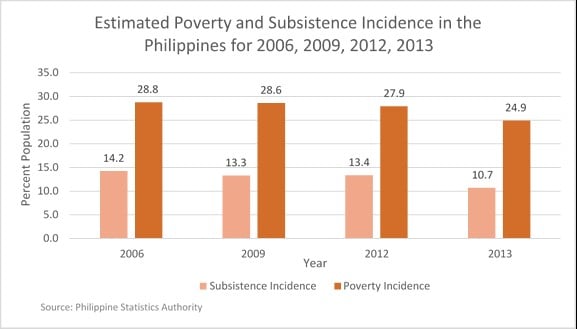
China’s economy is not only linked to industrial assembly, China increasingly constitutes a competitor and major exporter in a variety of  high technology sectors.

Image: Make America Great Again: Made in China

In Your Face Donald Trump!

In summary, this kind of economic blackmail on the part of the Trump administration against China does not work. It falls flat.

In turn, America is threatening both Russia and China militarily including the pre-emptive use of nuclear weapons. How will Russia and China respond to US threats?

While US sanctions against Russia have largely backlashed on the European Union, it is not excluded (although unlikely) that China could at some future date respond to US threats by impose economic sanctions against the USA.

In the short run, the US cannot relinquish its imports of Chinese manufactured goods. It would be economic suicide.

Laughing in Beijing

Chinese policy makers are fully aware that the US economy is heavily dependent on “Made in China”.

And with an internal market of more than 1.3 billion people, coupled with a global export market, these veiled US threats will not be taken seriously by Beijing.

  • Posted in English @as @as, Mobile
  • Comments Off on Imagine What Would Happen if China Decided to Impose Economic Sanctions on the USA?

Sanofi Pasteur announced that its dengue vaccine, Dengvaxia, may lead to more severe cases of dengue fever in some people — a warning it relayed after the vaccine was already administered to more than 700,000 children in the Philippines. Those at risk, according to Sanofi, are people who have not been previously infected by dengue virus.

Their new analysis that evaluated long-term safety and efficacy of the vaccine revealed that “in the longer term, more cases of severe disease could occur following vaccination upon a subsequent dengue infection.”1

As a result, the Philippines has launched an investigation and convened an expert panel to figure out what to do next. Health Secretary Francisco Duque said in a news release,

“The safety of the children vaccinated is paramount, and the Health Department will need to do surveillance of those given Dengvaxia with no prior infection. It’s really a big task.”2

Nearly 4 billion people across 128 countries are at risk of infection with dengue, a viral disease spread by mosquitoes.3

Symptoms of dengue fever range from mild (or none at all) to high fever along with headache, body pain, nausea, vomiting and pain behind the eyes, with most people recovering within a week.4 A severe form of the disease, known as dengue hemorrhagic fever or severe dengue, however, is life-threatening and can lead to difficulty breathing, circulatory system failure and death. It’s this severe form of dengue that Dengvaxia vaccine may increase risks for in people who have not previously been infected with dengue.

Sanofi Claimed Long-Term Safety Studies Were Completed, Now Recommends Against Vaccination in Some

In 2015, the Philippines’ Food and Drug Administration approved Dengvaxia, the first dengue vaccine in Asia, manufactured by Sanofi Pasteur. The vaccine was intended to prevent all four dengue types in individuals from 9 to 45 years of age living in endemic areas.5 At the time, Sanofi claimed studies had been conducted “affirming the vaccine’s consistent efficacy and longer-term safety profile in a study population 9 to16 years of age.”6

The new analysis, however, is based on up to six years of clinical data evaluating the long-term safety and efficacy of Dengvaxia in those who have been infected with dengue and those who have not. After the finding that people with no prior infection may be at increased risk of severe dengue if they receive Dengvaxia, Sanofi is proposing to update the vaccine label to request that health care professionals “assess the likelihood of prior dengue infection in an individual before vaccinating.”7

To date, none of the children who received Dengvaxia were tested for prior dengue infection. In fact, the current test available can only test for evidence of prior infection with all flaviviruses, including Zika, chikungunya and Japanese encephalitis, and would turn positive for exposure to any of them, including dengue.

As a result, health reform advocate and former past president of the Philippine College of Physicians, Dr. Anthony Leachon, told ABS-CBN News,

“It means some of them will develop severe dengue, we don’t know who. All of them will have to live with this possibility for the rest of their lives.”8

Sanofi also proposed changing Dengvaxia’s label to state:

“Vaccination should only be recommended when the potential benefits outweigh the potential risks (in countries with high burden of dengue disease). For individuals who have not been previously infected by dengue virus, vaccination should not be recommended.”9

Philippine Government Purchased 3 Million Doses of Dengvaxia, Worth Nearly $70 Million

Image result for dengvaxia cases in the philippines

In April 2016, just four months after Dengvaxia’s approval, the Philippine government launched a school-based dengue vaccination program among fourth-graders in public schools in three regions hardest hit by dengue. Three million doses of the vaccine had been purchased by the government, worth nearly $70 million, and were intended to vaccinate 1 million schoolchildren (with three doses each). At the time, critics expressed concern about the vaccine program’s safety, since the vaccine was still being studied.

Some also questioned why the Philippine Department of Health (DOH) purchased so much of the vaccine in haste, since fewer than 730,000 students met the criteria for vaccination and, reportedly, only about 534,000 student’s parents gave informed consent for vaccination.10

The DOH-Dengue Vaccine Implementation Committee (DVIC) wrote in April 2017,

“After allocating the vaccines … we have projected a large excess supply of Dengue vaccine.”11

While there was initially talk of expanding the vaccine program, Sanofi’s announcement likely will change that.

Speaking out on Facebook, former health undersecretary Susan Pineda Mercado described the dengue vaccine push as the “biggest government funded clinical-trial-masked-as-a-public-health-program scam of an experimental drug in the history of the DOH,” adding,

“This was reckless and irresponsible from the start and the public was deceived into thinking this vaccine would protect children from dengue. The public health community has been outraged for over a year. Legal action is now necessary.”12

Meanwhile, prior to their latest announcement, Sanofi was working hard to make Dengvaxia a household word in the Philippines, even going so far as to air TV and radio advertisements for the vaccine. Unlike in the U.S., this type of direct-to-consumer advertisement of prescription drugs in the mass media is illegal in the Philippines. In December 2016, the Philippine FDA ordered Sanofi to stop the ads, while also asking TV and radio outlets not to air them.13

WHO Report Raised Red Flags About Dengvaxia in 2016

The World Health Organization (WHO) is among those in the midst of reviewing data on Dengvaxia following Sanofi’s announcement. However, the organization issued a report in 2016 that revealed “vaccination may be ineffective or may theoretically even increase the future risk of hospitalized or severe dengue illness in those who are seronegative at the time of first vaccination regardless of age.

If this is the case, even in high transmission settings there may be increased risk among seronegative persons despite a reduction in dengue illness at the population level.”14

Singapore’s Health Sciences Authority also identified risks of the vaccine upon its October 2016 approval, and reportedly was adding risk warnings to the drug’s label. In Brazil, where a public vaccination program with Dengvaxia was also implemented, health officials have changed recommendations to advise people who have never been infected with dengue to not receive the vaccine.

Image result for dengvaxia cases in the philippines

Pharmaceutical company Sanofi-Pasteur head for  Asia-Pacific, Thomas Triumphe answers questions during the senate inquiry on the Dengvaxia vaccine. (Source: ABS CBN News)

To date, three deaths have been reported among children who received Dengvaxia,15 but officials have so far said they were “coincidental” and not related to the vaccine.16

Findings Highlight the ‘Complex Nature of Dengue Infection’

In their statement, Sanofi said their new findings highlight the “complex nature of dengue infection,”17 which appears to be their way of trying to pass the buck for creating a vaccine that may lead to severe disease in some children. It’s also important to note that dengue is in no way unique in its complexity; other viral diseases exhibit similar complexity.

Yet, despite huge gaps in scientific knowledge about infectious microbes that cause disease, vaccine makers continue to create vaccines that attempt to outsmart the microbes, and typically fail, which often leads to severe consequences like with Dengvaxia.

It’s also not the first time that vaccination has worsened disease severity. For instance, in 2012 it was revealed that the 2008-09 flu vaccine was associated with increased risk for more serious H1N1 illness. Further, research published in the Journal of Virology also confirmed that the seasonal flu vaccine may actually weaken children’s immune systems and increase their chances of getting sick from influenza viruses not included in the vaccine.18

In addition, when blood samples from 27 healthy, unvaccinated children and 14 children who had received an annual flu shot were compared, researchers found that the unvaccinated children naturally built up more antibodies across a wider variety of influenza strains compared to the vaccinated group.

Another issue often disregarded in discussions of vaccine safety is the spread of vaccine-strain virus infections, including polio, along with widespread vaccine failures among vaccines for mumpsmeningococcal disease and pertussis.

The conventional solution to failing vaccines is to add booster shots to the schedule, with unknown consequences for natural immunity and human health. It’s a complex situation indeed, which is why open conversations and unbiased research into vaccine safety and efficacy are so badly needed before a one-size-fits-all vaccine approach should be continually recommended.

Mosquito Prevention Education May Help Prevent Mosquito-Borne Disease

Along the lines of Dengvaxia, starting in 2018, GlaxoSmithKline’s (GSK) RTSS (brand name Mosquirix) malaria vaccine will be given to some children living in Ghana, Kenya and Malawi. But research suggests the malaria parasite has wide genetic diversity and the vaccine would need to be 100 percent effective against all the different strains in order to eradicate the disease.19

Separate research also found three doses of Mosquirix didn’t prevent malaria infection but rather delayed it until the children were older; the solution was to add a fourth shot to the schedule, but even this may not be enough. As is the case with dengue, prevention of malaria and other mosquito-borne diseases may be best addressed by public education programs.

The global fight against such diseases is centered on insecticide application and distribution of insecticide-treated bed nets, along with drugs and, now, vaccines. Pesticide Action Network (PAN) Germany has called for safer, nonchemical means of targeting such diseases, with significant impacts seen during a pilot program in West Africa.

The program began by increasing residents’ knowledge and awareness of strategies for reducing mosquito breeding sites, as many of the villagers were unaware that potential breeding sites existed nearby in areas of food waste, refuse and standing water. Villagers were educated about how to discourage indoor mosquito infestations via cleaning and refuse removal and how to cover outdoor wells and septic tanks with lids. Fish were introduced to certain areas to help with larval control.20

The local health center was also educated on how to better treat the disease (in this case malaria), leading to a significant drop in school absenteeism due to the disease, from up to 30 percent between 2009 and 2011 down to 4.6 percent in 2012.21

While the pharmaceutical industry is certainly pinning their profit-making hopes on widespread use of dengue and malaria vaccines, it is education, improved sanitation and access to health care and even simple measures like window screens that have been proven to cut down on disease rates.22

*

Dr. Joseph Mercola finished his family practice residency in 1985 but was trained by the conventional model. In his first years of private practice, he treated many symptoms with prescription drugs and was actually a paid speaker for the drug companies. But as he began to experience the failures of this model in his practice, he embraced natural medicine and has had an opportunity over the last thirty years to apply these time tested approaches successfully with thousands of patients in his clinic.

Notes

1, 7, 9, 17 Sanofi Pasteur November 29, 2017

2, 8 ABS CBN News November 30, 2017

3 WHO, Dengue and severe dengue April 2017

4 Mayo Clinic, Dengue Fever

5, 6 Sanofi Pasteur December 22, 2015

10, 11, 16 ABS CBN News June 21, 2017

12 Rappler November 30, 2017

13 Fox News January 3, 2017

14 WHO Dengue Position Paper July 2016

15 Reuters December 4, 2017

18 Journal of Virology 2011 Nov;85(22):11995-2000

19 Proceedings of the National Academy of Sciences May 3, 2017

20, 22 PAN International April 18, 2011

21 PAN Germany, Combating Malaria Without DDT

  • Posted in English @as @as
  • Comments Off on Dengvaxia: 700,000 Children in the Philippines Will Suffer This Severe Vaccine Side Effect
  • Tags:

Poverty in the Philippines: The Official Figures Have Been Manipulated

February 7th, 2018 by Prof Michel Chossudovsky

Introduction. The World Bank Methodology

The World Bank methodology regarding to measurement of poverty is described in the World Development Report 1990: Poverty?  In this “authoritative” study on global poverty published in 1990, the “upper poverty line” is arbitrarily set at a per capita income of US$ 1 a day corresponding to an annual per capita income of US$ 370 per annum. This criterion subsequently led to the formulation of the one dollar a day International Poverty Line (IPL)

Population groups in individual countries with per capita incomes in excess of US$ 1 a day (1985 constant dollars) are arbitrarily identified by the World Bank as “non-poor”. Through the gross manipulation of income statistics, the World Bank figures serve the “useful purpose” of representing the poor in developing countries as a minority group. For purposes of “measurement”, the World Bank adopted arbitrarily a poverty line at $370 per annum at 1985 constant prices. An extreme poverty line was established at $270 per annum.

The $370 annual threshold was subsequently upheld as the one dollar a day per capita international poverty line (IPL) which has been applied widely by developing countries for “measuring poverty” at a national level.

“One dollar a day keeps poverty away”

It should be understood that the one dollar a day (1985 PPP) is an arbitrary figure recommended by the World Bank to the governments of developing countries. It does not require the measurement of poverty in terms of basic human needs including nutrition, health, education, housing. Its unspoken objective is to falsify the national figures on poverty as well as obfuscate the process of global impoverishment initiated since the onslaught of the debt crisis of the early 1980s.

The WB on a regular basis has issued statistics based on the one dollar day International Poverty Line with a view to upholding the illusion that global poverty has declined dramatically since the 1990s. These figures are based on the dollar a day per capita methodology.

The initial “measurement” of country level poverty figures based on the one dollar a day per capita criterion was applied by the World Bank using 1985 as the base period. During a period of twenty years (1985-2005) the one dollar a day was applied. The base period for the arbitrary one dollar a day per capita criterion was in 1985 constant prices.

In 2005, with a view to accounting for inflation of basic consumer goods since the 1985 base period, the World Bank redefined arbitrarily the upper poverty criterion at $1.25 PPP. i.e. a 25 percent increase in the poverty criterion to account for the increase of consumer prices over a 20 year period (i.e. in relation to the 1985 base period).

This figure of $1.25 pertaining to 2005 was set arbitrarily by the World Bank. It was not based on relevant estimates of inflation over a 20 year period (i.e. since 1985).

In 2011, the one dollar a day upper poverty criterion by the World Bank was set at $1.90 PPP (2011) (indicating that the prices of consumer essentials had increased by 90 % in relation to the 1985 base period):

In October 2015, the World Bank announced that it had updated its international poverty line (IPL) and its estimate of the number of people living in extreme poverty globally. The IPL, which came to prominence with the dollar-a-day figure devised by the Bank in 1990, is revised periodically in line with new data from the independent International Comparison Program (ICP), which is hosted by the World Bank. The new figure of $1.90 is based on ICP purchasing power parity (PPP) calculations and represent the international equivalent of what $1.90 could buy in the US in 2011. The new IPL replaces the $1.25 per day figure, which used 2005 data. (World Bank, April 5, 2016)

In the World Bank framework, the “estimation” of poverty indicators has become a numerical exercise, which usefully serves to conceal the incidence of poverty. No need to analyse household expenditures on food, shelter and social services; no need to observe concrete conditions in impoverished rural barangay or urban slum areas. The estimates are totally removed from real life situations.

The Measurement of Poverty in the Philippines

How are the estimates of “poverty incidence” in the Philippines calculated? According to the PSA “Poverty incidence among Filipinos is the proportion of people below the poverty line to the total population.” 

The Philippines Statistics Authority (PSA) distinguishes between “poverty incidence” and “extreme or subsistence poverty incidence”

Poverty incidence among Filipinos in the first semester of 2015 was estimated at 26.3 percent. During the same period in 2012, poverty incidence among Filipinos was recorded at 27.9 percent

On the other hand, subsistence incidence among Filipinos, or the proportion of Filipinos whose incomes fall below the food threshold, was estimated at 12.1 percent in the first semester of 2015. In the first half of 2012, the subsistence incidence among Filipinos is at 13.4 percent. Subsistence incidence among Filipinos is often referred to as the proportion of Filipinos in extreme or subsistence poverty. (PSA Report, 2016)

While the PSA provides the relevant expenditure data, it does not explain how the “poverty line” is established, on what criteria. Moreover, it is unclear as to whether the Philippines uses the World Bank methodology to establish its “poverty line”.

In a 2001 report entitled Philippines Poverty Assessment, Vol I, the World Bank researchers pointed to the fact that the Philippines criteria in the 1990s for measuring poverty yielded significantly higher levels of estimated poverty than those those of the World Bank.

In contrast to the 1990s, the criterion applied in the 2012 and 2015 Philippines estimates result in a significantly lower percentage of the population below the poverty line, compared to estimates using the World Bank poverty methodology which is based on the arbitrary one dollar a day per capita IPL.

In a 2014 study, USAID states (mistakenly) that the Philippines adopted the World Bank methodology in its 2012 estimate of the incidence of poverty. According to USAID, the 2012 the poverty line for the Philippines was $1.25 per capita per day. The World Bank methodology, however had set the $1.25 poverty line for 2005 (not 2012), which means that in the case of the Philippines seven years of inflation have not been accounted for). According to USAID:

In 2012, extreme poverty in the Philippines was estimated at 19.2 percent of the population, or about 18.4 million people, based on the international poverty line of $1.25 per day. Most of the poor in the Philippines live in rural areas and work in the agriculture sector, mainly in farming and fishing. Urban poverty, however, has been increasing in recent years. Migrants without jobs or with low-paying jobs are unable to afford decent housing. As a result, Philippine cities have high proportions of informal settlers who are among the poorest of the poor.

Moreover, poverty is severe in parts of the country with high levels of conflict. The Philippines’ 10 poorest provinces are considered either conflict-affected or vulnerable to conflict.

The Official Poverty Estimates in the Philippines 

In this section we examine poverty “estimates” respectively for 2012 and 2015. The poverty estimates are said to based on the Annual Poverty Indicators Survey (APIS) as well as the Family Income and Expenditure Survey (FIES).

While the Philippine Statistics Authority (PSA) claims that the poverty estimates are based on the household expenditures survey, an examination of the figures suggests that the incidence of poverty is determined arbitrarily. The household expenditure surveys confirm the levels of spending by income group. Yet the poverty threshold is set arbitrarily (in a similar way to the procedure pertaining to the World Bank’s International Poverty Line). The calculus of PI is as follows

PI = Q/n where
  • Q is the the number of families/individuals less than the per capita poverty threshold divided by
  • n total population (families/individuals)
The PSA does not define the per capita poverty threshold. There is no evidence that it is related to an actual measurement of poverty (nutrition, health, education, housing) based on the Family Income and Expenditure Survey (FIES).

The 2012 Estimates of Poverty

The Philippine Statistics Authority (PSA) provided estimates of poverty incidence in 2012 as follows:

 “For the full year 2012, a family of five will need around PhP 5,513 monthly income to buy their minimum basic food needs; and around PhP 7,890 monthly for their minimum basic food and nonfood needs.

 This represents an increase of about 12.3 percent for both the food and poverty thresholds between 2009 and 2012.  Such increases represent inflation of about 4.1% on the average per year between 2009 and 2012.

In the same period in 2012, the proportion of Filipino families in extreme poverty whose incomes are not sufficient to meet basic food needs stands at 7.5 percent, which is almost the same in 2009 but the figure in 2012 is significantly lower than the 8.8 percent estimate in 2006.

These estimates border on ridicule. On what are they based? Daily minimum Calories and protein requirements? Where are the estimates? In comparison, the US Bureau of Census estimates that some 25 % of the US population doe not meet minimum food requirements.

How were these figures computed?

Following the logic of the WB one dollar a day per capita criterion, the monthly PhP 7,890 to meet both basic food and non-food needs for a family of five translates into PhP52.6 per capita per day (simple arithmetics 7890 divided by 30 days to convert this amount into a daily requirement, then divided by five to account for family size).

At the 2012 dollar PhP exchange rate (approximately 42PhP=$1.00), the per capita PhP 52.60 per day translates into $1.25 (which coincides with the World Bank Poverty Line defined for 2005).

Where is the manipulation?

The WB one dollar a day pertains to the base period of 1985. As mentioned above, the WB  redefined the international poverty line (IPL) at $1.25 at 2005  constant prices (PPP). Moreover, for the year 2011, the poverty frontier was once again modified. It was defined by the World Bank at $1.90 PPP.

What this suggests is that the PSA “estimate” of the poverty line at $1.25 for 2012 in current prices is equivalent to that WB’s $1.25 for 2005. i.e. It does not account for inflation over a period of seven years (since 2005). The PSA measurement therefore yield a substantially lower “estimate” of poverty when compared to that of the World Bank.

The correct assessment following the WB criterion would have been to apply the $1.90 PPP criterion for 2011, accounting for inflation in 2012. At a threshold of $1.90+ this “estimate” would have led, had it been applied, to a significantly larger percentage of the Philippines population below the poverty line. It should be noted that neither the WB IPL nor the Philippines $1.25 criterion are valid measurements of poverty. They do not include an assessment of the purchasing power required (in PhP) to meet basic human needs (nutrition, health, education, housing).

The 2015 Estimates of Poverty

The Philippine Statistics Authority (PSA) describes the process of estimating the poverty incidence in 2015 (based on 2015 current prices):

During the first semester of 2015, a family of five needed at least PhP 6,365 on the average every month to meet the family’s basic food needs and at least PhP 9,140 on the average every month to meet both basic food and non-food needs. These amounts represent the monthly food threshold and monthly poverty threshold, respectively. They indicate increases of about 17 percent in food threshold and poverty thresholds from the first semester of 2012 to the first semester of 2015 4. …

 The poverty incidence among Filipino families based on the first visit of 2015 FIES was estimated at 21.1 percent during the first semester of 2015.  In the first semester of 2012, the poverty incidence among Filipino families was estimated at 22.3 percent5.

The subsistence incidence among Filipino families, or the proportion of Filipino families in extreme poverty, was estimated at 9.2 percent during the first semester of 2015. In the same period in 2012, the proportion of families in extreme poverty was recorded at 10.0 percent.

How were these 2015 figures computed?

Again following the logic of the WB one dollar a day per capita criterion, the monthly PhP 9,140 to meet both basic food and non-food needs for a family of five translates into PhP61.00 per capita per day (9140 divided by 30 days to convert this amount into a daily requirement, then divided by five to account for family size).

At the average 2015 dollar PhP exchange rate (PhP44.5= 1$), the per capita PhP 61.00 per day translates into $1.35.
The WB one dollar a day pertains to the base period of 1985. As mentioned above, the WB redefined the poverty frontier at $1.90 PPP in 2011.

While it appears that the PSA Authority has adopted the one dollar a day World Bank criterion, it has failed to account for inflation in both the 2012 and 2015 estimates. In 2015, the poverty threshold in dollars (and current pesos) was well in excess of $1.90 PPP for 2011.

See also:

Concluding Remarks

The PSA has  adopted the $1.25 per capita per day criterion (PhP 52.5) for their estimate of poverty incidence for 2012. Population groups with a per capita daily income above PhP52.5 are considered “non-poor”, an absurd proposition.

It is worth noting that the World Bank had set a $1.25 PPP estimate for the year 2005, which according to the WB represents the purchasing power parity of the one dollar a day per capita established for the 1985 base period.

There are two distinct levels of manipulation. First the PSA takes the World Bank methodology at face value. They do not question the one dollar a day methodology, IT DOES NOT MEASURE POVERTY.

Second they seem to go well beyond the WB criteria in distorting reality by not accounting for inflation over the period 2005-2012. (The WB $1.25 daily per capita threshold pertains to 2005 not to 2011)

Moreover, the official estimates are set arbitrarily, totally removed from an assessment of basic human needs (nutrition, health, education, housing). They are clear expression of distortion and obfuscation.

The poverty levels in the Philippines are high, poverty encompasses the majority of the population. They need to be carefully estimated focusing on a measurement of basic human needs.

The PSA statement that an individual can meet basic human needs expenditures including food, transport, housing, health and education with 61 pesos (2015) a day borders on ridicule.

To state that population groups with 65-70 pesos per capita per day are “non-poor” is absurd. Poverty in the Philippines affect the vast majority of the population. 

These figures do not reflect the social realities in the Philippines which is characterized by high unemployment, exceedingly low wages and mass poverty.

At the time of writing (February 2018), the cost of a 50kg sack of rice is approximately PhP2000, namely php40 per kg.

Double Standards in the Measurement of Poverty 

It is worth noting that in the US, the per capita per day poverty threshold, according to the US Bureau of Census for an American family of two adults and three children is of  the order of $30,000 per annum, namely $16.44 per capita per day.

(TWELVE TIMES HIGHER THAN FOR A FAMILY OF FIVE IN THE PHILIPPINES 2015  POVERTY LINE OF: $1.35 per capita per day. (PhP 61)

Source US Census Bureau

The criterion to measure poverty in the Philippines is imposed by the Washington Consensus, which evaluates the value of human life in the Philippines,  twelve times lower than in the US.

Yet for a large range of commodities, prices in the Philippines are not only at par with those in America in many cases they are much higher than in the US. Visibly the poverty measurement criteria of the Washington Consensus (US Treasury, IMF-World Bank, Washington Think Tanks) are not meant to be applied in the US.

With regard to the price of basic food staples in the US , compared to the Philippines, the retail price of rice in New York City is US$ 0.71 a pound which converts into US$ 1.57  a kilo, approximately PhP 78.85.

In other words the price of rice in NYC is double that of the Philippines, yet the USCB poverty line used to measure poverty in the US is $16.44 a day (twelve times higher than in the Philippines).

  • Posted in English @as @as
  • Comments Off on Poverty in the Philippines: The Official Figures Have Been Manipulated

First published by Global Research in January 2017

In early November 2016, without warning, the Indian government declared the two largest denomination bills invalid, abolishing over 80 percent of circulating cash by value. Amidst all the commotion and outrage this caused, nobody seems to have taken note of the decisive role that Washington played in this. That is surprising, as Washington’s role has been disguised only very superficially.

US-President Barack Obama has declared the strategic partnership with India a priority of his foreign policy. China needs to be reined in. In the context of this partnership, the US government’s development agency USAID has negotiated cooperation agreements with the Indian ministry of finance. One of these has the declared goal to push back the use of cash in favor of digital payments in India and globally.

On November 8, Indian prime minster Narendra Modi announced that the two largest denominations of banknotes could not be used for payments any more with almost immediate effect. Owners could only recoup their value by putting them into a bank account before the short grace period expired. The amount of cash that banks were allowed to pay out to individual customers was severely restricted. Almost half of Indians have no bank account and many do not even have a bank nearby. The economy is largely cash based. Thus, a severe shortage of cash ensued. Those who suffered the most were the poorest and most vulnerable. They had additional difficulty earning their meager living in the informal sector or paying for essential goods and services like food, medicine or hospitals. Chaos and fraud reigned well into December.

Four weeks earlier

Not even four weeks before this assault on Indians, USAID had announced the establishment of „Catalyst: Inclusive Cashless Payment Partnership“, with the goal of effecting a quantum leap in cashless payment in India. The press statement of October 14 says that Catalyst “marks the next phase of partnership between USAID and Ministry of Finance to facilitate universal financial inclusion”. The statement does not show up in the list of press statements on the website of USAID (anymore?). Not even filtering statements with the word “India” would bring it up. To find it, you seem to have to know it exists, or stumble upon it in a web search. Indeed, this and other statements, which seemed rather boring before, have become a lot more interesting and revealing after November 8.

Reading the statements with hindsight it becomes obvious, that Catalyst and the partnership of USAID and the Indian Ministry of Finance, from which Catalyst originated, are little more than fronts which were used to be able to prepare the assault on all Indians using cash without arousing undue suspicion. Even the name Catalyst sounds a lot more ominous, once you know what happened on November 9.

Catalyst’s Director of Project Incubation is Alok Gupta, who used to be Chief Operating Officer of the World Resources Institute in Washington, which has USAID as one of its main sponsors. He was also an original member of the team that developed Aadhaar, the Big-Brother-like biometric identification system.

According to a report of the Indian Economic Times, USAID has committed to finance Catalyst for three years. Amounts are kept secret.

Badal Malick was Vice President of India’s most important online marketplace Snapdeal, before he was appointed as CEO of Catalyst. He commented:

 Catalyst’s mission is to solve multiple coordination problems that have blocked the penetration of digital payments among merchants and low-income consumers. We look forward to creating a sustainable and replicable model. (…) While there has been (…) a concerted push for digital payments by the government, there is still a last mile gap when it comes to merchant acceptance and coordination issues. We want to bring a holistic ecosystem approach to these problems.

Ten months earlier

The multiple coordination problem and the cash-ecosystem-issue that Malick mentions had been analysed in a report that USAID commissioned in 2015 and presented in January 2016, in the context of the anti-cash partnership with the Indian Ministry of Finance. The press release on this presentation is also not in USAID’s list of press statements (anymore?). The title of the study was “Beyond Cash”.

“Merchants, like consumers, are trapped in cash ecosystems, which inhibits their interest” in digital payment it said in the report. Since few traders accept digital payments, few consumers have an interest in it, and since few consumers use digital payments, few traders have an interest in it. Given that banks and payment providers charge fees for equipment to use or even just try out digital payment, a strong external impulse is needed to achieve a level of card penetration that would create mutual interest of both sides in digital payment options.

It turned out in November that the declared “holistic ecosystem approach” to create this impulse consisted in destroying the cash-ecosystem for a limited time and to slowly dry it up later, by limiting the availability of cash from banks for individual customers. Since the assault had to be a surprise to achieve its full catalyst-results, the published Beyond-Cash-Study and the protagonists of Catalyst could not openly describe their plans. They used a clever trick to disguise them and still be able to openly do the necessary preparations, even including expert hearings. They consistently talked of a regional field experiment that they were ostensibly planning.

“The goal is to take one city and increase the digital payments 10x in six to 12 months,” said Malick less than four weeks before most cash was abolished in the whole of India. To not be limited in their preparation on one city alone, the Beyond-Cash-report and Catalyst kept talking about a range of regions they were examining, ostensibly in order to later decide which was the best city or region for the field experiment. Only in November did it became clear that the whole of India should be the guinea-pig-region for a global drive to end the reliance on cash. Reading a statement of Ambassador Jonathan Addleton, USAID Mission Director to India, with hindsight, it becomes clear that he stealthily announced that, when he said four weeks earlier:

India is at the forefront of global efforts to digitize economies and create new economic opportunities that extend to hard-to-reach populations. Catalyst will support these efforts by focusing on the challenge of making everyday purchases cashless.

Veterans of the war on cash in action

Who are the institutions behind this decisive attack on cash? Upon the presentation of the Beyond-Cash-report, USAID declared: “Over 35 key Indian, American and international organizations have partnered with the Ministry of Finance and USAID on this initiative.” On the website catalyst.org one can see that they are mostly IT- and payment service providers who want to make money from digital payments or from the associated data generation on users. Many are veterans of,what a high-ranking official of Deutsche Bundesbank called the “war of interested financial institutions on cash” (in German). They include the Better Than Cash Alliance, the Gates Foundation (Microsoft), Omidyar Network (eBay), the Dell Foundation Mastercard, Visa, Metlife Foundation.

The Better Than Cash Alliance

The Better Than Cash Alliance, which includes USAID as a member, is mentioned first for a reason. It was founded in 2012 to push back cash on a global scale. The secretariat is housed at the United Nations Capital Development Fund (UNCDP) in New York, which might have its reason in the fact that this rather poor small UN-organization was glad to have the Gates-Foundation in one of the two preceding years and the Master-Card-Foundation in the other as its most generous donors.

The members of the Alliance are large US-Institutions which would benefit most from pushing back cash, i.e. credit card companies Mastercard and Visa, and also some US-institutions whose names come up a lot in books on the history of the United States intelligence services, namely Ford Foundation and USAID. A prominent member is also the Gates-Foundation. Omidyar Network of eBay-founder Pierre Omidyar and Citi are important contributors. Almost all of these are individually also partners in the current USAID-India-Initiative to end the reliance on cash in India and beyond. The initiative and the Catalyst-program seem little more than an extended Better Than Cash Alliance, augmented by Indian and Asian organizations with a strong business interest in a much decreased use of cash.

Reserve Bank of India’s IMF-Chicago Boy

The partnership to prepare the temporary banning of most cash in India coincides roughly with the tenure of Raghuram Rajan at the helm of Reserve Bank of India from September 2013 to September 2016. Rajan (53) had been, and is now again, economics professor at the University of Chicago. From 2003 to 2006 he had been Chief Economist of the International Monetary Fund (IMF) in Washington. (This is a cv-item he shares with another important warrior against cash, Ken Rogoff.) He is a member of the Group of Thirty, a rather shady organization, where high ranking representatives of the world major commercial financial institutions share their thoughts and plans with the presidents of the most important central banks, behind closed doors and with no minutes taken. It becomes increasingly clear that the Group of Thirty is one of the major coordination centers of the worldwide war on cash. Its membership includes other key warriers like Rogoff, Larry Summers and others.

Raghuram Rajan has ample reason to expect to climb further to the highest rungs in international finance and thus had good reason to play Washington’s game well. He already was a President of the American Finance Association and inaugural recipient of its Fisher-Black-Prize in financial research. He won the handsomely endowed prizes of Infosys for economic research and of Deutsche Bank for financial economics as well as the Financial Times/Goldman Sachs Prize for best economics book. He was declared Indian of the year by NASSCOM and Central Banker of the year by Euromoney and by The Banker. He is considered a possible successor of Christine Lagard at the helm of the IMF, but can certainly also expect to be considered for other top jobs in international finance.

As a Central Bank Governor, Rajan was liked and well respected by the financial sector, but very much disliked by company people from the real (producing) sector, despite his penchant for deregulation and economic reform. The main reason was the restrictive monetary policy he introduced and staunchly defended. After he was viciously criticized from the ranks of the governing party, he declared in June that he would not seek a second term in September. Later he told the New York Times that he had wanted to stay on, but not for a whole term, and that premier Modi would not have that. A former commerce and law Minister, Mr. Swamy, said on the occasion of Rajan’s  departure that it would make Indian industrialists happy:

I certainly wanted him out, and I made it clear to the prime minister, as clear as possible. (…) His audience was essentially Western, and his audience in India was transplanted westernized society. People used to come in delegations to my house to urge me to do something about it.

A disaster that had to happen

If Rajan was involved in the preparation of this assault to declare most of Indians’ banknotes illegal – and there should be little doubt about that, given his personal and institutional links and the importance of Reserve Bank of India in the provision of cash – he had ample reason to stay in the background. After all, it cannot have surprised anyone closely involved in the matter, that this would result in chaos and extreme hardship, especially for the majority of poor and rural Indians, who were flagged as the supposed beneficiaries of the badly misnamed “financial-inclusion”-drive. USAID and partners had analysed the situation extensively and found in the Beyond-Cash-report that 97% of transactions were done in cash and that only 55% of Indians had a bank account. They also found that even of these bank accounts, “only 29% have been used in the last three months“.

All this was well known and made it a certainty that suddenly abolishing most cash would cause severe and even existential problems to many small traders and producers and to many people in remote regions without banks. When it did, it became obvious, how false the promise of financial inclusion by digitalization of payments and pushing back cash has always been. There simply is no other means of payment that can compete with cash in allowing everybody with such low hurdles to participate in the market economy.

However, for Visa, Mastercard and the other payment service providers, who were not affected by these existential problems of the huddled masses, the assault on cash will most likely turn out a big success, “scaling up” digital payments in the “trial region”. After this chaos and with all the losses that they had to suffer, all business people who can afford it, are likely to make sure they can accept digital payments in the future. And consumers, who are restricted in the amount of cash they can get from banks now, will use opportunities to pay with cards, much to the benefit of Visa, Mastercard and the other members of the extended Better Than Cash Alliance.

Why Washington is waging a global war on cash

The business interests of the US-companies that dominate the gobal IT business and payment systems are an important reason for the zeal of the US-government in its push to reduce cash use worldwide, but it is not the only one and might not be the most important one. Another motive is surveillance power that goes with increased use of digital payment. US-intelligence organizations and IT-companies together can survey all international payments done through banks and can monitor most of the general stream of digital data. Financial data tends to be the most important and valuable.

Even more importantly, the status of the dollar as the worlds currency of reference and the dominance of US companies in international finance provide the US government with tremendous power over all participants in the formal non-cash financial system. It can make everybody conform to American law rather than to their local or international rules. German newspaper Frankfurter Allgemeine Zeitung has recently run a chilling story describing how that works (German). Employees of a Geran factoring firm doing completely legal business with Iran were put on a US terror list, which meant that they were shut off most of the financial system and even some logistics companies would not transport their furniture any more. A major German bank was forced to fire several employees upon US request, who had not done anything improper or unlawful.

There are many more such examples. Every internationally active bank can be blackmailed by the US government into following their orders, since revoking their license to do business in the US or in dollars basically amounts to shutting them down. Just think about Deutsche Bank, which had to negotiate with the US treasury for months whether they would have to pay a fne of 14 billion dollars and most likely go broke, or get away with seven billion and survive. If you have the power to bankrupt the largest banks even of large countries, you have power over their governments, too. This power through dominance over the financial system and the associated data is already there. The less cash there is in use, the more extensive and secure it is, as the use of cash is a major avenue for evading this power.

  • Posted in English @as @as
  • Comments Off on A Well-Kept Open Secret: Washington Is Behind India’s Brutal Demonetization Project

In India, there is a push to drive people from the countryside into cities. The mainstream narrative implies that urbanisation is natural in the evolution of societies and constitutes progress. The World Bank wants India to relocate 400 million people to urban centres. Former Chief Finance Minister P. Chidambaram once stated that 85% of the population would eventually live in cities, which would mean displacing many more than 400 million people given that the country’s population is heading towards 1.3 billion and that over 60% reside in rural India.

It is easy for some to conflate urbanisation and progress and to believe this is how to ‘develop’. But societies do not ‘evolve’ in a unilinear way. Policy makers merely look to prosperous countries and see the bulk of their populations living in cities with a small percentage working in (heavily subsidised and an unsustainable system of) agriculture. This is what ‘we’ must do, Indian politicians then say, spurred on by World Bank directives.

The route to capitalism and urbanisation was not ‘natural’ in Europe and involved the unforeseen outcomes of conflicts and struggles between peasants, landowners, the emerging class of industrialists and the state. The outcomes of these struggles resulted in different routes to modernity and levels of urbanisation.

In the book ‘The Invention of Capitalism, economic historian Michael Perelmen lays bare the iron fist behind the invisible hand which  whipped the English peasantry in a workforce willing to accept factory wage labour. In this article by Yasha Lavene, it is noted that English peasants didn’t want to give up their rural communal lifestyle, leave their land and go work for below-subsistence wages in dangerous factories being set up by a new, rich class of industrial capitalists.

A series of laws and measures were designed to push peasants out of the old and into the new by destroying their traditional means of self-support. Perelman outlines the many different policies through which peasants were forced off the land, not least the destruction of the access to common land by fencing off the commons.

Early capitalists and their cheerleaders complained how peasants were too independent and comfortable to be properly exploited. Indeed, many prominent figures advocated for their impoverishment, so they would leave their land and work for low pay in factories.

In effect, peasants were booted off their land by depriving a largely self-reliant population of its productive means. Although self-reliance persisted among the working class (self-education, recycling products, a culture of thrift, etc), this too was eventually eradicated via advertising and an education system that ensured conformity and dependence on the goods manufactured by capitalism.

‘Development’: facilitating capital

“We build cyber cities and techno parks and IITs at the cost of the welfare of the downtrodden and the environment. We don’t think how our farmers on whose toil we feed manage to sustain themselves; we fail to see how the millions of the poor survive. We look at the state-of-the-art airports, IITs, highways and bridges, the inevitable necessities for the corporate world to spread its tentacles everywhere and thrive, depriving the ordinary people of even the basic necessities of life and believe it is development.” – Sukumaran CV 

Today’s affluent sections of urbanised Indians are often far removed from the daily struggles of the farmers for whom they depend on for their food. While inequalities spiral, many city dwellers echo similar sentiments of the cheerleaders of early capitalism described by Perleman when they say loan waivers for farmers are a drain on the economy and any subsidies given to them or the poor in general just encourages unproductivity or fecklessness.

Neoliberal dogmatists are quite content to sign a death warrant for Indian farmers.

Despite nice-sounding, seemingly benign terms like ‘foreign direct investment’, ‘ease of doing business’, making India ‘business friendly’ or ‘enabling the business of agriculture’- behind the World Bank/corporate-inspired rhetoric, policies and directives is the hard-nosed approach of neoliberal capitalism that is no less brutal for Indian farmers than early industrial capitalism was in England for its peasantry.

Like the English peasantry, India’s farmers are also being booted off the land.

Let us take a look at what has happened to India’s farmers. Trade policy and agriculture specialist Devinder Sharma has written much on their plight (access his writing here). GDP growth has been fuelled on the back of cheap food and the subsequent impoverishment of farmers. The gap between their income and the rest of the population, including public sector workers, has widened enormously. Rural India consumes less calories than it did 40 years ago. And corporations receive massive handouts and interest-free loans because it supposedly spurs job creation (which it has not), while any proposed financial injections (or loan waivers) for agriculture (which would pale into insignificance compared to corporate subsidies/written off loans) are depicted as a drain on the economy.

In short, although farmers continue to produce bumper harvests, the impact of underinvestment, lack of a secure income and effective minimum support prices; the undermining of the public distribution system; exposure to cheap imports courtesy of rigged international trade; the hardship caused by deregulation and profiteering companies which supply seeds and proprietary inputs; the loss of state agricultural support services; and the impacts of the corporate-backed/written Indo-US Knowledge Initiative on Agriculture, have made farming financially non-viable for many.

It is a deliberate strategy: part of the plan to displace the existing system of production with one dominated from seed to food processing to retail to plate by Western corporations. Independent cultivators are being bankrupted, land will be amalgamated to facilitate large-scale industrial cultivation and those that remain will be absorbed into corporate supply chains and squeezed as they work on contracts, the terms of which will be dictated by large agribusiness and chain retailers.  

Between 300,000 and 400,000 farmers have taken their lives since 1997 and millions more are experiencing economic distress. Over 6,000 are leaving the sector each day. And yet the corporate-controlled type of agriculture being imposed and/or envisaged only leads to degraded soil, less diverse and nutrient-deficient diets, polluted water and water shortages and poor health.

In addition to displacing people to facilitate the needs of resource extraction industries, unconstitutional land grabs for special economic zones, nuclear plants and other corporate money-making projects have forced many others from the land.

Various reports have concluded that we need to support more resilient, diverse, sustainable agroecological methods of farming and develop locally-based food economies. Indeed, small farms are more productive than giant industrial (export-oriented) farms and produce most of the world’s food on much less land.

Instead, in India, the trend continues to move in the opposite direction towards industrial-scale agriculture for the benefit of Monsanto, Cargill, Bayer and other transnational players. Is this the future India needs, with a fraction of farmers left on the land, trapped on an environmentally unsustainable chemical-GMO treadmill?

While whipping farmers, tribals and the unorganised sector into submission by depriving them of their livelihoods by one way or another, India’s political elite blindly adhere to the mantra that urbanisation equals progress and look to the West, whose path to ‘development’ was based on colonialism, eradicating self-reliance and beating the peasantry into submission. There was nothing ‘natural’ or ‘progressive’ about any of it. It involved the planned eradication of peasants and rural life by capitalist interests and the sucking of wealth from places like India.

In India, the bidding of capital is these days done through its compliant politicians, the World Bank, the WTO and lop-sided, egregious back-room deals written by corporations.  

Further information about the issues raised can be found in these articles by the author.

  • Posted in English @as @as
  • Comments Off on Global Capitalism and Livelihoods Denied: Whipping India’s Farmers into Submission
  • Tags:

This article was first published by:

闯 Chuǎng: The image of a horse breaking through a gate. Meaning: To break free; To attack, charge; To break through, force one’s way in or out; To act impetuously. 闯关 (chuǎngguān): to run a blockade. 闯座 (chuǎngzuò): to attend a feast without being invited.

Over the past three decades, China has transformed from an isolated state-planned economy into an integrated hub of capitalist production. Waves of new investment are reshaping and deepening China’s contradictions, creating billionaires like Ma Yun while the millions below — those who farm, cook, clean, and assemble his electronic infrastructure — struggle to escape fates of endless grueling work. But as China’s wealthy feast ever more lavishly, the poor have begun to batter down the gates to the banquet hall. 闯 is the sudden movement when the gate is broken and the possibilities for a new world emerge beyond it.

闯  Chuǎng will publish a journal analyzing the ongoing development of capitalism in China, its historical roots, and the revolts of those crushed beneath it.  Chuǎng is also a blog chronicling these developments in shorter and more immediate form, and will publish translations, reports, and comments on Chinese news of interest to those who want to break beyond the bounds of the slaughterhouse called capitalism.

Chuǎng Editors

***

On November 15, 2017, police stormed into a student reading group at the Guangdong University of Technology (GDUT) and seized six participants, including four current students at the university and two recent graduates from other schools. The former were released the next day, but the latter two were placed under detention as suspects for the crime of “gathering crowds to disrupt social order” – a charge we have seen increasingly leveled against multiple feministslabour activistsstriking workers and bloggers over the past five years. Authorities alleged that the reading group was an “anti-party, anti-society organization” that was discussing “sensitive topics.”

Despite Beijing’s massively staffed policing of the internet and cellular networks, a petition managed to circulate calling for the release of 24-year-old Zhang Yunfan – one of the initial two among what would turn out to be at least four young people detained for weeks as suspects in this case. Apparently the petition mentioned only Zhang, a “Left Maoist,”1 because the authors were unaware of the others when it was penned. Although it was repeatedly blocked only moments after being reposted, over 400 people soon signed the petition, including many prominent intellectuals who risk repercussions because they are based in China.

On January 15, after 30 days in the Panyu Detention Center, two weeks under house arrest and two weeks of recovery, Zhang published the open letter that we have translated below. The letter mentioned three associates who had also been detained and released on bail awaiting trial, and four others who were still in hiding after having been put on the police wanted list.

The next day Sun Tingting, one of the other three detainees, released her own open letter, also translated below. It provides a more detailed account of the arrests, their context and her nightmarish experience in detention from December 8 to January 14.

Like the petition, both of these letters were of course quickly censored, but new WeChat feeds keep popping up and reposting them, to the point that “Sun Tingting” even briefly trended on Sina Weibo until the term was blocked.

Then on the third day, a third letter appeared by yet another detainee: Zheng Yongming. In the interest of making these translations available as quickly as possible, we are publishing the first two now and will add the third when it is finished in a day or two.

From left to right: Zhang, Sun and Zheng.

From left to right: Zhang, Sun and Zheng (Source: The Bullet)


My Confession to the People

Zhang Yunfan

Translated by Steamgoth Engine

Special thanks to Qian Liqun, Zhang Qianfan, Li Ling, Chen Bo, Cai Xiaoming, Song Lei and other mentors from Peking University (PKU), and to Huang Jisu, Kuang Xin’nian, Zhu Dongli, Qin Hui, Yu Jianlin, Xu Youyu, Song Yangbiao, Chen Hongtao, Fan Jinggang and over 400 other mentors and friends from all walks of life, who signed the petition for my release. Thanks for courageously speaking out for justice so that I can again see the light of day! I wish I could express my gratitude to every one of you in person.

I was released on bail awaiting trial December 29th, 2017. However, after 30 days of criminal detention and another 14 under house arrest, I find that the challenge has just begun.

I cannot tear off this page of my life. My only option is to confront the challenge.

Some people say I am a PKU alumnus, a scholar, an elite who is less egotistical than most. But the identity I hold dearest is that of a Marxist and a “Left Maoist” – labels to which different people attach different meanings.

I can see that in this world, exploitation and oppression have never disappeared. Many of my family members have been workers in state-owned enterprises. Thus, even when I was a child, I was aware of how the lifelong hard labour and contributions of old workers were expropriated, when the state-owned enterprises underwent reform and privatization. They were discarded and rendered precarious, abandoned to the will of society. Even larger in number, the vulnerable groups, those in coal mines owned by abusive bosses, on scaffolds and in sweatshops – their life trajectory was to first exhaust their youth, then exhaust their whole lives, and finally to exhaust the lives of their sons and daughters.

I swallowed this industrial sewage, these unemployment documents
Youth stooped at machines die before their time
I swallowed the hustle and the destitution
Swallowed pedestrian bridges, life covered in rust
I can’t swallow any more
All that I’ve swallowed is now gushing out of my throat
Unfurling on the land of my ancestors
Into a disgraceful poem.2

Behind the glory of prosperity, a long shadow, an inch of halo, an inch of blood red. The poet has jumped to his death, but his faith rises slowly from the horizon.

This is why I am determined to be loyal to the working class and why I have faith in Marxism.

Locked Up for Reading Books: Voices from the November 15th Incident

Some of the rumors online are true. It is true that when I was studying in Peking University, I was a member of the PKU Marxist Student Group. My comrades at the university and I not only studied theory in our reading group, but also placed ourselves among the downtrodden masses. I gradually found that – after spending countless hours with them singing, dancing, discussing news, screening films and giving English lessons, everywhere I went, I was greeted by workers on campus. In the cafeteria they always gave me a little extra food.

After graduation I came to Guangzhou. My life did not change, except that now I had to work for a living. To put it a bit self-righteously, perhaps, I continued to practice my idealism one step at a time at GDUT. Actually, though, all I did was to attend reading groups and do volunteer work.

During the reading session when we were arrested, we were discussing historical change and social problems from the last few decades, including major historical events, workers’ rights and so on. We discussed how young people should solve these problems. I admit that we also talked about the movement 29 years ago that university students were involved in.3

Some readers must be curious whether my views are indeed “extreme.” Of course, they are not like what you read about in the newspapers or textbooks or watch on TV. By their standards acknowledging the existence of various problems in society alone is already “extremist” enough, and it is undoubtedly even more so to discuss “how to solve” the problems. But every country in the world has its own social problems. Is it truly a crime for one to voice one’s opinions on how to solve them? This is our right! The Constitution states, ambitiously: “Citizens of the People’s Republic of China have freedom of speech, publication, assembly, association, procession and demonstration.” If an expression can be judged as “extremist,” then “freedom” means nothing!

However, I would feel that I was at least being treated with due respect and seriousness if the excuse for my arrest were actually “discussing social issues.” When I was locked up on November 15, the police noted that I worked in education and accused me of “illegal business activities.” Perhaps because of the obvious stupidity of this charge, when I was officially detained, my alleged transgression changed to the crime of “gathering crowds to disrupt social order.” Was I, a 24-year-old young person, powerful enough to disrupt the “work, production, business, teaching, research and medical services” of a university campus covering hundreds of acres? Isn’t it obvious that this is just a trumped-up charge meant to silence me?

I was asked to confess that there was a conspiracy. Was there really a conspiracy? What kind of plotting does a reading group need? Are people involved in plotting when they dance in plazas? Does the simple division of labour necessary for a reading group count as “plotting”?

I was also asked to admit that I had “extremist ideas,” to pledge not to attend reading groups in the future, and to give them names of more people with the same ideas. The cold floor of the detention center, interrogation for eight hours on end, the absolute loneliness under house arrest, the overwhelming spiritual torture – all these are hard to put into words. When I was told that more people would be arrested and my parents would be dragged into this because of my decisions, I have to say, I could not bear the tremendous mental stress. All I wanted to do was to bring it to an end as soon as possible and let my family and friends return to their normal lives, even if that meant I would go to prison. So I compromised. To my surprise, I was finally released on bail. The days under house arrest – the days of absolute loneliness – made me wordless and flat. After a dozen days of recovery, I finally resumed my former self. What I did not expect was that my compromise would turn out to be utterly useless!

Several young people involved in the reading group – Sun Tingting, Zheng Yongming, Ye Jianke – were released on bail along with me. But the young leftists Xu Zhongliang, Huang Ping, Han Peng and my girlfriend Gu Jiayue are still wanted as criminal suspects. Our charges have not been dropped, and they have been forced to become fugitives!

I cannot imagine how the four of them are now. When I close my eyes, it is as if we were back in the guotongqu [parts of China ruled by the Kuomintang during the Civil War]: the roaring police cars, the shrill wail of sirens, the agents with arrest warrants hunting down progressive young men and women who had nowhere to hide.

And I am supposed to remain silent. According to the police, I should be “cautious,” return to a “normal” life, sit peacefully at a desk, henceforth living as a “refined egoist.” But they also want me to bear the burden of an imaginary crime for life, and to stay away from reading groups and the labouring masses I so love.

What’s more, I am also supposed to watch other young leftists be hunted down and arrested!

They are not from prestigious schools. They will not be as fortunate as myself, released because of public opinion. They cannot even get out of Guangzhou. And they do not have a Yan’an to turn to.4 The only thing awaiting them is an indefinite period in prison!

I am out of jail, but my conscience is in handcuffs. I was not tried in court, but I will always face a moral judgment.

Maybe we have always been insignificant. But from now on any young idealist can be arrested, any reading group can be condemned, any nonprofit activity can be controlled, ideas and idealism are taboo, free speech is not worth a penny, and Marx and Mao are mere jokes!

How heartless must one be to simply bow one’s head at this moment?

I have heard many speak of “the golden mean,” saying “take a step back to gain a broader perspective.”

Of course I can understand that they care about me and offer advice in good faith. But how can I leave my comrades and become a “refined egoist”? Moreover, “freedom of speech” is protected by the Constitution, so there is no need for moderation. Mao Zedong Thought takes a clear position, not “the golden mean.” If I “take a step back,” maybe my own situation would improve, but my comrades would fall into an abyss! And if they fall, the dignity of all young idealists would fall with them. It is better to revolt than to live in shame! I can only tell the truth – I will compromise no more. I would rather be in prison than resign myself to this miserable condition.

Good people, I urge you to see: the person you have defended is here. He will not let you down. He will hold his head high and face the coming storm. He is prepared!


I Am Sun Tingting, I Want to Speak Out

Sun Tingting

Translated by Wen

I am the Sun Tingting mentioned in “Zhang Yunfan: My Confession to the People,” and one of the detainees along with Zhang in the GDUT reading group incident. I was detained by police on December 8th 2017 and released on bail January 4th 2018. I originally did not have the courage to speak out, but I saw Lu Qianqian and others reporting on sexual harassment, and saw the courageous Zhang Yunfan fighting for freedom of expression. As someone whose rights and dignity have also been violated, I cannot stand idly by, and I will not remain silent.

I am Sun Tingting and I want to speak out!

For the first 11 months of 2017, my life and work were as usual, organizing charity events for migrant workers by day, and joining campus workers to dance in public squares by night. I never thought that on the night of December 8th a group of police would raid my apartment, turning the last month of 2017 into a nightmare.

I graduated from Nanjing University of Chinese Medicine in 2016. At university, I came across progressive youth and participated in activities related to social service and the public interest. Their passion, spirit, sincerity and practicality deeply affected me. In serving the underprivileged, I came to realize that public interest work is the best way to help underprivileged workers and peasants at the bottom of society to live with dignity. Since then, I developed a strong inclination toward a career in public interest work. I first worked at a social work organization in Guangzhou’s Tianhe District, and later I worked at another social work organization at Guangzhou’s university district in Panyu. Before I started working there, the organization was already collaborating with a reading group at GDUT. One of my responsibilities was to recruit volunteers for public interest events, so I naturally kept in contact and worked with student volunteers from this reading group, and I assisted campus workers in organizing cultural events such as dances in public squares.

Never in a million years would I have expected to face imprisonment as a result.

On the night of November 15th 2017, students had gathered in a classroom for the reading group as usual. Suddenly, security guards stormed into the classroom, supposedly because someone had reported to the university’s Security and Safety Department that the group was discussing sensitive topics. Police then seized four students [at the university] and two recent graduates [from PKU] who were involved in the reading group, taking them all to the police station. The next day, the four students were released, but the two other people (Zhang Yunfan and Ye Jianke) were placed under criminal detention in the Panyu Detention Centre. I soon learned from the director of my social work organization that the group had been labelled an “anti-party and anti-society” organization. For some time thereafter, students involved in the reading group were regularly visited and warned by university [authorities] and the police, and one of the students lost their scholarship. The reading group soon dissolved. I felt this was very unfortunate because they were some of the most compassionate and capable volunteers I had met, unlike many other college student volunteers who do it to accumulate volunteer time rather than try to take up some grassroots perspective.

But I never thought this would affect me because I was merely working with them to organize events for workers. I kept working as usual, but without the help of volunteers, it was difficult to sustain the public square dance activities.

It was at that moment that a terrible disaster befell me.

At around 10pm on December 8th 2017, my landlord knocked on my door, and when I opened it, a plainclothes police officer and four police in uniform forced themselves into my apartment and asked me for my ID, and for me to cooperate with them. As a young woman living by myself, I was dumbfounded, and did not know what to do with myself. A brief moment of panic was followed by overwhelming rage. I repeatedly asked them to show me their police ID and search warrant, but they refused. They began to search my room, rifling through all my things, paging through books, notebooks and diaries, heaping them into a pile and making me stand to one side as they took pictures.

Then I was taken to Xiaoguowei police station with my mobile phone and computer. They started to ask me about members of the reading group, and I said I didn’t know. The head of the police station threatened me: “you don’t want to talk? You can go die (and said this repeatedly)! Then we’ll give her a random charge, lock her up first and figure it out later!”

When they said that, I thought I was hearing things. What is “assigning a random charge”? So police can just “assign a random charge” to an innocent citizen without evidence? Can the law be used so casually in their hands? Can the personal freedom of individuals be impinged upon so freely in their eyes? Not only did I not know the situation of the members of the reading group, I at least had the right to remain silent when being questioned. Can I be assigned a random charge to pressure me because I don’t know or remain silent?

At 5pm the next day, the police took me back to my apartment and asked me to sign a search warrant, and they started to take books and notebooks including my private diaries and Kindle reader. I was very angry and I did not understand. Is a search warrant a warrant to raid my home? Can they take away any personal belongings including the most private personal diary to be examined by police with a search warrant? Do police not consider the privacy of citizens and the inconvenience to people when their personal belongings are taken away? To be clear, at this time I was not even a suspect to a crime, let alone a criminal, but merely being summoned for questioning.

Back at the police station, the police pulled out another search warrant dated 12pm December 9th 2017, and made me sign it. This was clearly a trick! If the search was at 5pm, how does it become 12pm? And why was there a second search warrant? Did they go search again at 12pm? When I questioned the police, they did not reply and I refused to sign. Then they produced a summons which was dated for the previous day, December 8th, and asked me to sign. I questioned them why they did not show it to me last night, and they said under special circumstances people can be taken away first and showed the summons later. I was absolutely speechless! What special circumstance did I have? Me, a wisp of a 1.6 meter tall recent college graduate – did they think I was going to make an escape or something? I also refused to sign that document.

Even more absurdity followed.

In the evening, the police told me they were applying for both my administrative and criminal detention, and waiting for their superiors to decide on which form of detention. Because of an issue with the system, they could only apply for one form of detention, and decided “on the spot” to apply for criminal detention. During the entire process, they did not present any evidence to prove that I had violated any law, and they still so casually decided a criminal detention. At that moment, I again felt the casual attitude with which the Panyu police treat the law and the freedom and rights of citizens.

And that’s how I was thrown into the detention centre “on the spot,” but this was only the beginning of my real nightmare.

The room I was locked up in had 25 detainees, including drug traffickers, thieves and other criminals of all kinds. As a young woman working on public interest in service to migrant workers, to be locked up with these people made me feel endless irony and sadness. The room only had 15 concrete beds, so I had to sleep on the cold floor. I could not sleep the whole night on the first night under the bright light. My body could not handle coldness, and I felt intense pain on my insides. I kept waking up in the middle of each night. In our cell block there was a fixed bathroom schedule, and I was always placed last, and each time it was my turn the time was already up.

If there was urgent need to use the bathroom outside of scheduled bathroom time, I would be punished by being forced to stand and not allowed to sleep. As a result, I alternated between half-hour sleeps and half-hour standing up, and ended up with less than 4 hours of sleep each night. Because of lack of sleep and limited bathroom use, my body weakened and I felt ill inside. I urinated blood on two occasions and experienced two serious instances of constipation which caused so much pain that I could not sit, stand or walk. If not for my release on bail on January 4th, I feel I could have died from the pain in my cell. My request for an individual room or medical attention were refused and ridiculed. When I absolutely insisted, the doctor in the detention centre just gave me some bottle with no medicine in it!

Beside this, there was no privacy to speak of. There were surveillance cameras everywhere, even when you are changing your clothes or using the bathroom. Why should I suffer such indignity!

I was detained for 26 days, and released on bail on January 4th, 2018. However, the charges still remain.

Throughout the entire process I felt bewildered, and even now, I do not know what I did or what law I violated. The police demanded that I write a confession, and that I write it according to their instructions. But I refused to distort facts. The police threatened that if I do not write in accordance with their wishes, I will be put under house arrest for 6 months. But how can I confess to a crime I did not commit?

I have far too many questions, and so I want to write down my experience, and hope others can answer my questions.

  • I am not a criminal, and there is no evidence that I am a major suspect to a crime. Why should I be criminally detained?
  • Can the police detain absolutely anyone, and then search for evidence to prove the guilt of that person, and when no evidence is found, simply release the person, but the police will not face any discipline?
  • Can police arbitrarily search the residence of any citizen, and take away their personal belongings for an indefinite amount of time?
  • If during the course of questioning someone doesn’t answer to the police satisfaction, can they just “make up a charge and figure it out later?”
  • Can the police arbitrarily decide on either administrative or criminal detention “on the spot”?
  • Should I be bullied in detention, and seen as “uncooperative”, just because I insist on my rights in the face of the police?
  • Should I not be treated when I fall sick in detention?
  • Does 4 hour of sleep meet the legal requirement of “ensuring that suspects have sufficient time for sleep”?
  • Can I only be released on bail after agreeing to a confession in accordance with police instructions?
  • When the police detained an innocent person for more than 20 days and confiscated my books, computer, mobile phone, Kindle and other belongings, are these evidence of my crime? When can they be returned to me? I no longer have the money to buy those things.

Finally, I want the police to recognize that I was detained for more than 20 days for no reason, which caused me to lose my job, broke my body, put my family in debt for legal fees to the tune of tens of thousands of yuan in borrowed money, and imprinted criminality upon my life. In the future, it may be very difficult for me to find a job. This incident has laid yet another heavy economic burden on my already poor family!

Why is this happening? These questions puzzle me. It has made me very cautious and has made me feel very insecure. I do not know if I, or people around me, will suffer these abuses once more in the future. I hope friends who read the experiences I have described above to explain all this to me, and I also hope that people can help the other friends also suffering from this same ordeal. Whether I will be given a heavy sentence or declared innocent, at least I will have a clear understanding of it all and some satisfaction!

*

Notes

1. ‘Left Maoist’ (毛左) is a political category that has risen to prominence since about 2012 in order to distinguish from those Maoists (known as ‘Right Maoists’ by some of their leftist critics but simply as “Maoists”[毛派] by themselves) with more nationalist and/or reformist orientations. (These categories will be discussed in the second issue of our journal, forthcoming later in 2018.)

2. From the poem “I Swallowed a Moon Made of Iron” by Xu Lizhi.

3. I.e. the mass movement of 1989 that ended with the June 4th Incident on Tian’anmen Square.

4. Having likened the fugitives to Communist Party members hiding underground during the Civil War, Zhang now notes the difference that at least the latter had a base in Yan’an to which they could flee, whereas today’s communists have no such sanctuary – in China or elsewhere.

  • Posted in English @as @as
  • Comments Off on Locked-Up for Reading: Young Leftists in China Speak Out
  • Tags:

From Nanjing to Okinawa – Two Massacres, Two Commanders

January 22nd, 2018 by Norimatsu Satoko

In her articles published in the Ryukyu Shimpo on 4 and 31 December, Satoko Oka Norimatsu reminds us of three important things. First, of the meaningfulness of formally remembering lessons learned from significant historical events that occurred outside the bounds of our home countries. Second, of the importance of connecting the dots when explaining how the outrages committed by Japanese soldiers towards the civilian population during the Battle of Okinawa can be traced back to atrocities that the Imperial Japanese Army committed in Nanjing and other parts of China. Third, she questions whether men who only avoided being tried for war crimes by taking their own lives can be given pride of place in a commemorative setting.

In these dangerous times, those with the authority and capability to unleash tremendous harm upon hundreds of thousands of people should take a moment to consider the lessons from the past. ME

1. Responsibility to face up to aggression (4 December, 2017)

Year-end during which we remember war

December is an important month in terms of Japan’s war memory. The 8th (the 7th in Western memory, because the attack on the Malay Peninsula, Pearl Harbor and other places is remembered on both sides of the date-line) is the 76th anniversary of the commencement of the Asia-Pacific War in which Japan launched attacks on the colonies of the Western powers in the Pacific and Southeast Asia in an attempt to secure the natural resources required to continue to pursue its war of aggression on the China continent. The 13th is the day on which we remember that 80 years have passed since the Nanjing Massacre, one of the most heinous atrocities known to humankind. In addition, this year, as though bookended by these two anniversaries, on the 10th the International Campaign to Abolish Nuclear Weapons (ICAN) will be awarded the Nobel Peace Prize in Oslo, Norway. At the acceptance ceremony Setsuko Thurlow, who contributed to the adoption in July of the Treaty on the Prohibition of Nuclear Weapons by the United Nations, will give a speech on behalf of the victims of the atomic bombing of Hiroshima and Nagasaki.

On 24 July, 2017, Ontario Legislature member Soo Wong (3rd from left) and members of Chinese- and Japanese-Canadian communities together held a press conference to support Bill 79.

From the end of 2016, the Legislative Assembly of Ontario, Canada, where Thurlow lives, has deliberated over Bill 79, which seeks to proclaim 13 December, the date in 1937 on which Nanjing fell to Japanese forces, as Nanjing Massacre Commemorative Day. In the multicultural society that Canada is, precedents exist for anniversaries of dates of historical significance, such as “Holocaust Memorial Day” being proclaimed as commemorative days. Obstruction from Japan and local deniers of history has meant that Bill 79 has not yet become law, but a motion of considerable weight was passed unanimously on 26 October.

Out of deference to the Japanese government, some Japanese Canadians have opposed this bill, but there is a move within the younger generation to support it. Based upon the perception that Japanese Canadians experienced the injustice of being interned in camps during the war, and feeling a responsibility to show solidarity with the struggle for justice of others, an open letter of approval was sent to Premier of Ontario Kathleen Wynne in the name of “Japanese Canadians for Bill 79.”

Several Canadians of Okinawan heritage were among those who put their names to the letter. One of those, Ms. M, explained why she came forward to put her name to the letter. Her grandfather had been recruited into the Imperial Japanese Army and while his experience did not overlap with the Nanjing Massacre, he took part in four campaigns in China. When Ms. M found this out, she said that she couldn’t hold back the tears at the thought that her grandfather had probably killed many people. According to her grandmother, her grandfather was a changed man after he returned to Okinawa after the war – he was violent and drank to excess. In the e-mail I received from Ms. M, she wrote, “I signed the letter because I sensed that I had to on behalf of my grandfather.”

An irrepressible surge of emotion came over me when I read these words. With the Okinawan people having been forcefully Japanized (kominka), Ms. M’s grandfather was conscripted, and had taken part in Japan’s war of aggression as a member of the Imperial Army. The psychological scars that he bore from that experience destroyed the remaining years of his life. The weight of Ms. M’s decision to sign the open letter supporting the establishment of the Nanjing Massacre Commemorative Day cannot be adequately expressed in words. If I can say anything, it is that it has made me sense the magnitude of my responsibility as a Japanese who writes about this aspect of history even more strongly. The fact that the men at the top in the Japanese 32nd Army, Commander-in-Chief Ushijima Mitsuru and Chief-of-Staff Cho Isamu, played leading roles during the Nanjing Massacre also means that what occurred in Nanjing is strongly connected with Okinawa. This year, I plan to spend 13 December, the 80th anniversary of the massacre, in Nanjing.

2. Reimei Memorial Tower an insult to Asia (31 December, 2017)

Massacres that link Okinawa and Nanjing

“Nanjing Massacre” refers to a series of atrocities including massacre, mass rape, pillage and arson committed by the Japanese Army against Chinese civilians, wounded and surrendering soldiers, prisoners-of-war and stragglers who had given up arms. These violations of the international law of war occurred over a period of more than three months from early December 1937, during the Nanjing Campaign, which followed the three-month long Battle of Shanghai and prior to that, the Marco Polo Bridge Incident on 7 July, from which time Japan’s war of aggression in China moved into full swing.

Numerous historical studies, materials and witness testimonies have established beyond any doubt that several hundred thousand people were either killed, or lost family members, and if they survived, bore physical and psychological wounds for the rest of their lives. It is shameful that Japan, which was the aggressor in Nanjing, is now the only country in the world where people who deny this historical fact exist among the ranks of government officials and intellectuals and so are in a position to influence society.

Given that well over one hundred thousand residents were brutally killed in the three months during which the Imperial Japanese Army fought in Okinawa, the battle there has points in common with Nanjing. Despite former prime minister Konoe Fumimaro’s February, 1945 advice that defeat would be inevitable, Emperor Hirohito opted to continue hostilities, thereby dragging the people of Okinawa into a war with the United States in which there could be only one outcome. The Battle of Okinawa, the realities of which surely allow it to be referred to as the “Okinawa Massacre,” has close connections with the atrocities committed not only in Nanjing but also throughout China.

Of the main units deployed to defend the main island of Okinawa, the 24th Division had previously been deployed in the puppet state of Manchukuo and the 62nd Division had been in Shanxi Province in North China. Many of the troops in these divisions had been involved in atrocities such as bayoneting POWs to death or the rape of local women. As a result, behavior towards Okinawan civilians such as forbidding them to surrender, forcing death upon them or even killing them, reflected the manner in which the commanders down to the lowest ranking troops in the Imperial Army had operated on the Chinese mainland.

Ushijima Mitsuru

Cho Isamu

From 13-15 December I went to Nanjing, where experts guided me around the various sites where the atrocities occurred. I attended the National Memorial Day commemorative event held on 13 December and was able to meet two survivors who lived through the horror that occurred in Nanjing 80 years ago. Given that in Japan discussion of this terrible incident tends to be focused on the number of victims, it was a truly precious experience to be in a position to sense the pain of people who had actually been involved.Of particular significance is the fact that Commander-in-Chief of the 32nd Army Ushijima Mitsuru and Chief-of-Staff Cho Isamu were both involved in the Nanjing Massacre. After spending time in North China and in the Battle of Shanghai, Ushijima was the commander of the 36th Infantry Brigade, thereby controlling the 23rd and 45th Infantry Regiments within the 6th Division, which entered Nanjing from the South. These two regiments carried out the mass killings at Jiangdongmen where the Nanjing Massacre Memorial Hall is located and at the various gates on the western side of the Nanjing Wall. The 45th Infantry Regiment proceeded north from the Jiangdongmen area, attacking Chinese attempting to flee upstream along the southern bank of the Yangtze River. The commanding officer of the 6th Division, Lieutenant General Tani Hisao, who ranked above Ushijima, and company commander Captain Tanaka Gunkichi of the 45th Infantry Regiment, who ranked below him, were both sentenced to death in the Nanjing War Crimes Tribunal. Cho Isamu served jointly as an intelligence officer in the Central China Area Army commanded by Matsui Iwane, who was sentenced to death for command responsibility in the Nanjing Massacre in the Tokyo War Crimes Tribunal, and as aide-de-camp for Prince Asaka Yasuhiko who led the Shanghai Expeditionary Army. Within the Shanghai Expeditionary Army was the 16th Division, which can be described as the key culprit in the Nanjing Massacre. Known for his firebrand character, numerous witness accounts document the fact that Cho issued orders for mass executions of captured Chinese soldiers. Among them is testimony that he used the expression “Yatchimae!” meaning “Deal to them!” There are statements recorded that when faced with troops who hesitated to kill civilians, Cho said, “This is how you kill someone,” and stepped forward to cut a person down with his sword. Cho related how the soldiers, jolted into action, moved as one to begin the slaughter.

Three days before going to Nanjing I had stood at Mabuni Hill in Okinawa in front of the Reimei Memorial Tower, which commemorates Ushijima and Cho. Unquestionably the first-class seat on Mabuni Hill, you will not see a higher spot in whatever direction you look. In this manner, men who can be called war criminals responsible not only for the “Okinawa Massacre,” but also for the Nanjing Massacre, are honored. Is this not an insult not only to Okinawa and the Okinawan people, but to China and indeed all Asian countries that carry memories of Japanese aggression?

Reimei Memorial Tower on the highest point of Mabuni Hill

Reimei Memorial Tower bears calligraphy of former Prime Minister Yoshida Shigeru

On this occasion, travelling as I did from Okinawa to Nanjing, I could not help but think that the true nature of the Battle of Okinawa became clear to me when I considered it in the context of the bigger picture of Japanese aggression in Asia. In keeping with the spirit of the concluding statement at the Okinawa Peace Memorial Museum totally rejecting the “affirmation or glorification of war”, I feel responsible as a Japanese to take issue with the Reimei Memorial Tower.

Original articles appeared in Ryukyu Shimpo on 4 and 31 December, 2017.

Translator’s supplementary notes:

Mabuni-no-oka (Mabuni Hill) stands at the southwest corner of the Peace Memorial Park in Itoman, in the southern area of the main island of Okinawa. This is where Ushijima and Cho set up their Headquarters cave before committing suicide during the night of 22 June 1945, so it is effectively the scene of the death throes of the shattered 32nd Army. These days, Mabuni is the venue for the main commemorative ceremonies held on 23 June (Okinawa Memorial Day) and as such it has a special significance for the people of Okinawa.

Immediately east of the hill is the Cornerstone of Peace, a monumentunveiled on 23 June 1995 in memory of the fiftieth anniversary of the Battle of Okinawa and the end of World War II. The names of over two hundred and forty thousand people who lost their lives during the battle are inscribed on the concentric arcs of the monument’s black granite walls. They include not only Okinawans but Japanese, Chinese, Taiwanese, Koreans and Americans among others. The Cornerstone of Peace was erected with three philosophies in mind: to remember those who were lost and pray for peace, pass on the lessons of war, and to provide a place for meditation and learning.

Up a slight slope on the eastern side of the Cornerstone of Peace is the Memorial Museum that Satoko refers to. The Memorial Museum is clear in its position rejecting the “affirmation or glorification of war.” The inscriptions on the monuments erected by local Okinawan authorities in the Itoman area in the years immediately after the war are similarly unambiguous. The words inscribed on the likes of the Himeyuri Memorial Tower, the Kenji Memorial Tower and the Konpaku Memorial Tower are simple statements of fact overlaid with expressions of grief.

On Mabuni-no-oka, where the Reimei Memorial Tower is located, there are several dozen monuments that were mostly erected by the various prefectures of Japan during the mid-1960s to pay homage to the soldiers from their respective regions. The inscriptions on these monuments are notable for having three features: reference to soldiers fighting bravely, no mention of the suffering of Okinawans caught up in the battle, and no heartfelt statement expressing a desire for peace. As the monument dedicated to the souls of the commanders of the 32nd Army, the Reimei Memorial Tower has attracted criticism for adulating men who played central roles in the tragedy that unfolded in Okinawa in 1945.

In keeping with the desire of Imperial Headquarters to prolong the struggle and therefore buy time to prepare for what was expected to be the decisive struggle for the main islands of Japan, the commanders of the 32nd Army decided in late May to withdraw southwards from Shuri towards the Kyan Peninsula directly impacted upon the tragic scale of the “Okinawa Massacre.”

Almost three weeks later, on 17 June, from his Headquarters cave in Mabuni near where the Reimei Memorial Tower now stands, with only the shattered remnants of the 32nd Army left, Ushijima ignored US General Buckner’s proposal for surrender. The choice was to allow the carnage to continue to the bitter end.

The withdrawal from Shuri towards Kyan meant that the closing stages of the battle would be fought with thousands of fleeing civilians caught in the crossfire. It resulted in three more weeks of civilians having their food supplies stolen by or even being murdered by Japanese soldiers, being forced out of caves and shelters into the US bombardment or dying from starvation or malaria.

According to historian Hayashi Hirofumi, between half and two thirds of the civilian casualties in the Battle of Okinawa occurred during the weeks after the order was given to withdraw from Shuri.

*

Translated and introduced by Mark Ealey

Original articles appeared in Ryukyu Shimpo on 4 and 31 December, 2017.

Satoko Oka Norimatsu is Director of the Peace Philosophy Centre, a peace-education organization in Vancouver, Canada, with a widely-read Japanese-English blog on topics such as peace and justice, war memory and education in East Asia, US-Japan relations, US military bases in Okinawa, nuclear issues, and media criticism.

Mark Ealey is a New Zealand-based freelance translator specialising in Japanese foreign relations. In recent years he has focussed on Okinawan affairs, with his most recent publication being Descent into Hell – Civilian Memories of the Battle of Okinawa, a joint work with the late Alastair McLauchlan.

  • Posted in English @as @as
  • Comments Off on From Nanjing to Okinawa – Two Massacres, Two Commanders
  • Tags:

Introduction

The Asia-Pacific Journal – Japan Focus is pleased to present Hideki Yoshikawa’s account of recent developments in the ongoing (20-year) contest between the people and government of Okinawa and the governments of the United States and Japan.

Readers of this journal will be well aware of the general tenor of this struggle, of the reversal of his anti-base construction stance by then Governor Nakaima in December 2013, allowing the national government to commence works to reclaim part of Oura Bay in Northern Okinawa (offshore from Henoko) for base construction. Ten months later, in December 2014, an aroused electorate dismissed Nakaima from office and delivered the Governorship (by a massive, 100,000 vote majority) to an avowed opponent of the reclamation/base construction plan, Onaga Takeshi. Another ten months followed before Onaga duly (in October 2015) “cancelled” (torikeshi) the reclamation license.

From November 2015, the dispute was subjected to a series of judicial and semi-judicial actions. Works were suspended for one year from March 2016, but the main proceedings issued in a December 2016 Supreme Court ruling that found against the prefecture. The Governor thereupon “cancelled” (torikeshi) his original cancelation order, and site works resumed in April 2017. The prefecture launched a related suit in the Naha District Court July 2017 seeking a suspension of the Bay works, but as of January 2018 no judgment has yet issued.

Over the past year, Governor Onaga has many times spoken of his intent to rescind (tekkai) the December 2013 reclamation permit (i.e., going beyond his October 2015 “cancellation,” which he cancelled in December 2016). There is no question that he has such power, although there is also no question that its exercise would be subject to immediate judicial challenge by the national government. Consequently it is understandable that he should choose with great care how and when to exercise it.

However, while almost one year has now passed without any sign of Onaga actually implementing his tekkai promise, daily hundreds of truckloads of material are delivered to the Oura bay construction site, and from late 2017 that daily convoy has been supplemented by shipments from Oku port, in the far north of Okinawa Island. Governor Onaga issued a permit for that, and then in December issued similar permits for use of facilities at two other ports, Nakagusuku and Motobu.

*

Map of Okinawa showing route of land-fill materials, Source: Hideki Yoshikawa

Relying on dump-truck delivery of materials, and assuming a delivery rate of about 175 trucks per day (the rate as of late December 2017), to deliver the necessary three million tons would take a staggering 46 years, and only then, upon such a site, could actual base construction commence. So the government is intent on speeding up the works, either by massively increasing the tempo of road transport delivery or by resort to delivery by sea, or more likely both. The sea delivery has the great advantage from the government view of being more difficult for citizens to block. Either way, the process threatens to overwhelm the infrastructure of Okinawa’s north.

With the Onaga Prefectural government seemingly engaging in endless procrastination, and the national government, through the Okinawan Defense Bureau, steadily stepping up the tempo of sea-wall construction works, uncertainty spreads within the Okinawan anti-base movement. Could it be that Governor Onaga is going to betray them (as most believe his predecessor, Nakaima, did in December 2013? How credible is Onaga’s stance, as a supporter of the US-Japan Security Treaty and the Okinawa base system who opposes only the specific Henoko project and the deployment of the Osprey? Is he, despite the confusing signals he issues, engaged on a complex but consistent strategy to achieve the main goal – stopping Henoko?

On 4 February, Okinawan voters go to the polls in Nago City to elect a new mayor. In 2010, they chose Inamine Susumu, on a platform of “no new base on land or sea within Nago City.” They re-elected him in 2014 and now he seeks a third term. He has proven a major thorn in the side of government construction plans, so the Abe government attaches a high priority to defeating him. The national government, along with the LDP and Komeito party organizations, have pledged full backing to his opponent, Toguchi Taketoyo. Anywhere else but Okinawa it would be unimaginable that the central government would interfere so blatantly to promote its candidate in a local government election. As part of this intervention, the Chief Cabinet Secretary recently held meetings with heads of various Nago City wards (Henoko, Kushi, and Toyohara) and Higashi and Kunigami Villages, bypassing the city administration in an attempt to subject the city to national government control. Moreover, from 2015 it has been making significant subsidy payments to these districts, rising from 39 million yen in 2015 to 120 million yen for 2018) to try to ensure defeat of Inamine and the city’s submission. This was surely in breach of the constitution’s clauses on regional self-government. Meanwhile the national government reduces each year the regular budgetary allocation to Okinawa prefecture, plainly to punish Governor Onaga for his non-cooperation.

Apart from the ongoing turmoil due to the Henoko-Oura Bay base construction project, Okinawans continue to suffer the depredations of night and day helicopter and Osprey flights, often over residential areas, at intolerable noise levels, and occasionally sending fully armed forces on parachute drops or (December 2017) accidentally dropping potentially lethal objects in the vicinity of houses and schools. They do not forget the periodic base personnel-related road accidents, sometimes causing death, or the sexual assaults, most notoriously the rape-murder of April 2016. The Abe government’s defense and security policies exact a heavy toll on them. They continue to resist.

Yoshikawa here presents a detailed account of the Henoko-Oura Bay issue as of January 2018. (GMcC)

What is happening with the Onaga Administration?

As the year 2018 began in earnest, the people of Okinawa are trying to figure out where their Governor, Onaga Takeshi, is taking them in their fight against the construction of a U.S. military base in Henoko-Oura Bay in the north of Okinawa island. On November 3, 2017, the Okinawa Times reported that Governor Onaga had in September, behind closed doors, issued a permit to companies under contract to the Okinawa Defense Bureau to use Oku port in the north of Okinawa Island for transport of materials for base construction.1 With the permit in hand, the Okinawa Defense Bureau has moved to accelerate its construction work, transporting landfill materials from Oku port to Henoko-Oura Bay by sea, thus avoiding protesters’ road blockage on the land.

The report surprised, confused, and angered many people in Okinawa because it contradicted the Governor’s pledge that he would do all in his power to stop the base construction. Many contend that the Governor should instead have used his discretionary power to refuse to issue the permit.

In response, Onaga reiterated his “everything in my power” pledge, provided explanations, and to placate the rising tide of criticism, indicated that it is now “considering revoking the permit.”2 However, a growing number of people are questioning whether Governor Onaga is sincere about his pledge, and they call on the Okinawa prefectural government to take immediate action to rectify the situation.

What is happening with the Onaga administration? How are the people of Okinawa reacting to this unsettling situation? Will they continue to resist the base construction? The following offers an analysis of recent developments in Okinawa.

Explanations by the Onaga Administration

According to a statement issued by the Governor and a transcript of a press conference held on November 15,3 the Onaga administration and the prefectural government decided to issue the permit because, upon review of the applications received in June, they could find no flaws. Consulting with their legal advisers, they concluded that they needed to adhere to the principles of fair and equal application of laws and exercise of administrative discretion and that they could not deviate from the “standard practices” of prefectural governments’ issuing use-permits even though these particular applications were for U.S. military base construction. Governor Onaga stressed that his government had taken extra time, a few months instead of the usual two weeks, to review the application.

Governor Onaga also claimed that the permit, issued under the Port and Harbor Act, pertained only to the keeping of landfill materials and the berthing of ships at the port, not to transport of landfill materials from the port by sea. He stressed that for transport by sea from the port of such landfill materials, the companies and the Okinawa Defense Bureau should have applied for a separate permit under the Land Reclamation Act, indicating that the Bureau and companies were in breach of the Act. On November 15, the same day Governor Onaga held a press conference, his administration sent a letter to the Bureau requesting it to stop transporting landfill materials by sea.

K-1 and N-5 Seawall Construction, © Yamamoto Hideo

Seawall construction at K-1, N-5 and K-9 as of early January 2018. Red lines indicate that seawall construction is under way. Source: Hideki Yoshikawa

The Okinawa Defense Bureau, however, repudiated the Governor’s claims. It insists that the land reclamation permit which was issued by former Governor Nakaima Hirokazu in December 2013 enabled the Defense Bureau to transport landfill materials by sea from Oku port to Henoko-Oura Bay.4 They noted that Governor Onaga had lost his lawsuit in the Japanese Supreme Court in December 2016 over his withdrawal (torikeshi) of the land reclamation permit.5

Meanwhile, a high-ranking prefectural official told the Okinawa Environmental Justice Project that the Onaga administration and its lawyers were concerned that a refusal to issue a permit would be construed as a failure to comply with the law and administrative duty. The official explained that the Onaga administration had decided that any action that could be deemed unlawful should be avoided, especially because the prefectural government is already in court battling the Japanese government over the issue of a reef-crushing permit (see below). Such concerns outweighed those over possible public backlash that the Onaga administration would face over issuing the permit.

The official acknowledged, however, that not consulting with the people of the Oku district prior to making its decisions, and not publically disclosing the information on the issuance of the permit in a timely manner, were mistakes and that the Okinawa prefectural government needed to rectify the situation. On November 14, 2017, 10 days after the Okinawa Times’ report on the issuance of the permit, the Okinawa prefectural government held a formal meeting with the people of the Oku district and on the very next day, Governor Onaga issued the above-mentioned statement, explaining its actions and asking for understanding from the Okinawan public.

Patience, Anger, and Doubt: Local Reactions and Moves by the Onaga Administration

When the Okinawa Times report on the issuance of the permit came out at the beginning of November, the Japanese government was starting construction of the N-1 and D-5 seawalls. Since the Onaga administration vehemently condemned the start of new seawall construction,6 people in Okinawa were surprised and confused by the report. However, two contrasting reactions have been manifest among the Okinawan public.

Staunch supporters of Governor Onaga remain willing to accept the Onaga administration’s explanations for issuance of the permit. Seeing the administration’s actions as tactical they hold to the view that his administration government will prevail in the end to stop the construction. They argue that if the people of Okinawa do not support the Onaga administration’s actions and explanations, it would mean the negation of their 20-years of struggle against base construction.

On the other hand, a growing number of people feel angry and betrayed. Many now question whether Governor Onaga and his government are sincere and serious about stopping the base construction. These reactions are evident especially among protesters who are already weary from daily protests, continuing now for years, at Camp Schwab and Henoko-Oura Bay, as they now have to head off also to the distant port of Oku.

Protesters at Oku Port, © Kitaueda Tsuyoshi 

In this context, the actions taken by two prominent supporters of Governor Onaga and of the anti-base construction movement are significant. Yamashiro Hiroji, chair of the Okinawa Peace Movement Center, demanded an emergency meeting with the prefectural government. At that meting, held in on November 15, he openly criticized Governor Onaga for breaking his pledge. He demanded that Onaga “stop talking” and withdraw the permit for use of Oku port.7

Yamauchi Tokushin, a former national Diet member and symbolic figure in Okinawa’s peace movement over decades who was also present at the November 15 meeting, on November 29 wrote a sharply critical article for the Okinawa Times blaming prefectural government officials for ill-advising the Governor on the issuance of the permit. Criticizing the prefectural officials for acting as if they were “petty officials from the Japanese government,” he demanded that the prefecture revoke the permit.

Meanwhile, on November 23, the Oku District Association adopted a resolution opposing use of the port by the Okinawa Defense Bureau.8 On November 28, the Association sent a delegation to the Okinawa Defense Bureau to protest, and in response the Bureau temporarily suspended the sea transport of landfill materials from the port. The Association aso sent a delegation to the prefectural government to demand that it withdraw the permit.9

Facing anger, doubt, and criticism from the Okinawan public, the Onaga administration has announced that it is “considering” revoking the permit for use of Oku port, reiterating that Governor Onaga is committed to stopping the base construction.x So far, however (as of mid-January 2018), it has taken no such action.

Instead, on December 7, the Onaga administration issued another permit to the Okinawa Defense Bureau for the use of Nakagusuku port by tugboats accompanying ships from Oku port to Henoko-Oura Bay. Following the Onaga administration’s issuance of these permits, on December 11, Mayor Takara Fumio of Motobu Town in northern Okinawa also issued a permit for the Defense Bureau to use the port of Motobu.11 Both the Onaga administration and Mayor Takara provided the same explanations as had been given earlier by the Onaga administration: they had reviewed and found no flaws in the companies’ applications and they needed to adhere to the principles of fair and equal application of the law and exercise of administrative discretion.

With the issuance of those new permits, the negative public sentiment towards the Onaga administration might have been expected to intensify. However, two U.S. military aircraft-related incidents distracted the Okinawan public. On December 7, a small cylindrical object belonging to the U.S. military fell on the roof of a nursery school with school children playing in the school garden as a U.S. military aircraft flew over the area.12 On December 13, 2017, a window from a U.S. military helicopter fell on the grounds of an elementary school while students were taking physical education class.13 Both the nursery school and elementary school are located near the U.S. Marine Corp’s Futenma Air Station, the very military base that the construction at Henoko-Oura Bay is planned to replace. As Governor Onaga quickly condemned the U.S. military for the accidents, public sentiment to press his administration over the issuance of the permits was deflected.

As of January 17, 2018, the Okinawa Defense Bureau is transporting landfill materials from the port of Motobu to Henoko-Oura Bay, while remaining ready to resume transport operations at the port of Oku, and, however limited the Onaga administration may claim it is, seawall construction is underway. What is one to make of this situation?

Querying the Onaga Administration’s Strategy

It can be argued that the Onaga administration’s issuance of the permits was a consequence of two things: its own overall (unwise) strategic decisions in the fight against base construction on the one hand and the way the Japanese government has been able to take advantage of its strategic errors on the other.

As discussed in an earlier paper,14 having lost its supreme court battle against the Japanese government over Governor Onaga’s withdrawal (torikeshi) of the land reclamation permit, the Onaga administration chose to fight in “lesser battles” first, only then moving on to the main battle over the land reclamation permit. Lesser battles are to be (or have been) fought with Governor Onaga’s administrative power over the issuance of (ancillary) permits for coral reef crushing, coral transplant, changes to the reclamation and construction plans, and so forth. The main battle remains to be fought over Governor Onaga’s administrative power to revoke (tekkai) the land reclamation permit. Issued by former Okinawa Governor Nakaima in 2013, suspended in 2015 and reinstated following the Supreme Court ruling in 2016, the land reclamation permit provides the principal legal ground for land reclamation work and thus for base construction.

It appears that the Onaga administration assumed that the lesser battles could slow construction work and provide legal and moral grounds that could be used against the Japanese government when Governor Onaga finally revokes the land reclamation permit. Perhaps it still hopes at least for this delay effect.

The Japanese government, however, has been able to turn the Onaga administration’s strategies against it. When the Onaga administration prepared to take the Okinawa Defense Bureau into an administrative battle over the reef-crushing permit in April 2017, claiming that the Okinawa Defense Bureau needed a permit from Governor Onaga, the Japanese government simply dismissed those claims. Having persuaded the local fishermen’s association to renounce their fishing rights to Henoko-Oura Bay, the government insisted that it was not necessary to obtain any permit from the Governor. The Okinawa Defense Bureau then began seawall construction in April 2017.

This situation forced the Onaga administration to file a suit in the Naha District Court against the Japanese government in July 2017.15 That suit has in turn placed the Onaga administration in a bewildering situation. Now the burden of proof rests on the prefecture to show that the Japanese government has violated prefectural ordinances and regulations. In the Japanese system of government, this is extremely difficult, and it appears to be exhausting the Onaga administration and the prefectural government.

As mentioned above, many within the Onaga administration feel that to engage in a court battle the Okinawa prefectural government must present itself to the court as a thoroughly law-abiding entity. Thus, when the Okinawa Defense Bureau applied for ancillary permits such as to use the ports of Oku and Nakagusuku, to transplant corals, and to conduct a survey in Henoko-Oura Bay, the Onaga administration and prefectural government believed they had no choice but to review the applications and, provided there were no flaws, grant the permits.16 As a kind of delaying tactic, they sent inquiry letters and directives demanding information and explanation to the Okinawa Defense Bureau, but such tactics had very limited effect.

It can also be argued that the Onaga administration’s strategy undermined its own efforts, facilitating the “tatewari gyosei” (“vertically compartmentalized administration”) of the Okinawa prefectural government to its detriment. As with any local government bureaucracy in Japan,17 different sections of the Okinawa prefectural governments are often influenced more by their counterpart ministries of the central government than by other sections of the prefectural government. Co-ordination among different sections of the prefectural government is also often minimal and there is a tendency among officials not to intervene in the affairs of other sections. To counteract these bureaucratic tendencies in its fight against base construction, the Onaga administration created in June 2015 the Henoko Base Construction Countermeasures Division Executive Office within the Governor’s Office.18 The Henoko Executive Office is staffed by members of different departments including the Department of Civil Engineering and Construction and the Department of Environment.

However, the Onaga administration’s strategy to fight lesser (thus compartmentalized) battles first has rendered the tatewari gyosei a de facto mode of operation. Rather than giving top priority to the Onaga administration’s basic “No” stance against construction, each section of the prefectural government has tended to operate in accordance with its narrowly defined responsibilities and duties. Thus, when the Department of Civil Engineering and Construction, the principal department in charge of issuing use permits for ports, finally decided to issue permits for the ports of Oku and Nakagusuku in the name of Governor Onaga, important environmental issues were barely taken into consideration. Despite the fact that environmental impacts from base construction have been observed and there have been violations of environmental conditions on which former Governor Nakaima approved the land reclamation in 2013,19 and even though there could have been sufficient reasons for Governor Onaga to revoke (tekkai) the land reclamation permit, these environmental issues were seen as falling outside the administrative responsibilities of the Department of Civil Engineering and Construction reviewing the applications for port use.

Against this backdrop of the Onaga administration’s tactics and the Japanese government’s counter maneuvering, there has been a resurgence of calls for a prefectural referendum to be held to help push Governor Onaga to revoke the land reclamation permit, in other words to engage in the main battle.20 The proponents of such a referendum insist that a prefectural referendum opposing the base construction at Henoko-Oura Bay would provide Governor Onaga with a strong legal foothold in a likely lawsuit filed by the Japanese government against the Governor, and argue that the Governor cannot, or should not, revoke the permit without public backing demonstrated by such a referendum. They have proposed a referendum to be held at the same time as the gubernatorial election scheduled for November 2018.

Others have argued however that the people of Okinawa in 2014 elected Governor Onaga to revoke the land reclamation permit and he has reason to do so without a referendum. They insist that a referendum would be time consuming and require a great deal of effort, and given the present state of the base construction the Governor and the people of Okinawa have neither time nor energy to spare. Some even go further to argue that such referendum would give the Governor an excuse to postpone revocation of the land reclamation permit.21

Governor Onaga and his administration have not taken a stance on the referendum proposal. Nor have they indicated when or how the Governor will use his power to revoke the land reclamation permit. While insisting that the Governor will revoke it at an appropriate time, they tightly guard information on what many consider as the Governor’s last resort strategy, fearing that the Japanese government will take advantage of whatever information comes available.22

Meanwhile, it is reported that the Onaga administration is preparing to propose its own alternative plan to close Futenma Air Station, aiming to challenge the Japanese and U.S. governments’ insistence that “the relocation [of Futenma] to Henoko is the only solution.”23 This latest move can also be understood as a manifestation of the Onaga administration’s frustration with the fact that, while stressing the importance of the U.S.-Japan Security Treaty, most governors of Japan’s other prefectures are unwilling to host (or even discuss hosting) U.S. military bases or training in their prefectures. In other words, they persist in “free riding” on the US-Japan Security Treaty at Okinawa’s expense.24 The Onaga administration’s alternative plan likely incorporates the recommendation laid out by the Tokyo and Washington-based think-tank, “New Diplomacy Initiative,” which calls for development of a “new rotational system” for the U.S. Marine Corps stationed in the Pacific.25 Apparently, the Onaga administration is contemplating presenting its alternative plan during Governor Onaga’s visit to Washington D.C. in March 2018.

Governor Onaga addressing the United Nations, © Hideki Yoshikawa

Many in Okinawa seem to have been unable to form an opinion about the Onaga administration’s latest move as it has provided no details on the alternative plan. Others argue that this late move is a waste of time and energy as they see that it alone would have no impact on the Japanese and U.S. governments. Still others criticize the whole idea as just a way for the Onaga administration to distract the attention of the Okinawan public from the fact that it has not taken effective action, including revoking the land reclamation permit, to stop base construction.26

By proposing such an alternative plan as its own for whatever reason, the Onaga administration would be bound to face more problems. Such an action would contradict the Governor’s previous stance that it is the responsibility of the central government to come up with alternatives to the Henoko plan, and it would also undermine the long held stance by the Okinawan public against militarization since it would appear to engage Okinawa in military strategic planning.27 Moreover, if it also involved naming of alternative (or rotational) sites in other prefectures in Japan or within Okinawa, a backlash, similar to what the Hatoyama administration experienced in the recent past, would be inescapable.28 Questioned about this, one high ranking Okinawa prefectural official told the Okinawa Environmental Justice Project that the Onaga administration could not propose such an alternative plan as its own without support from the Okinawan public, and thus public discussion needs to begin. It remains to be seen whether and how the Onaga administration could promote such public discussion and it remains questionable whether the administration could make this new strategy meaningful. .

As the year 2018 began, the people of Okinawa nervously awaited the Onaga administration’s next action and many who oppose base construction are preparing their own next actions. In this, they share the view that they do their best to prevent the Japanese government from taking advantage of any emerging public discord, whether over the Onaga administration’s strategies, the proposed prefectural referendum, or the sincerity and seriousness of Governor Onaga’s pledge to fight the base construction. Many also believe that such public discord can be resolved only through effective action taken by the Onaga administration.

Can the Onaga administration and the people of Okinawa fight back?

An overwhelming majority of the people of Okinawa oppose base construction at Henoko-Oura Bay. The most recent opinion poll conducted by the Ryukyu Shimpo (in September 2017) shows that 80 percent of people aged 18 years or older oppose base construction and only 14 percent approve it.29 In response, the Onaga administration asks the people of Okinawa to understand that it is doing its best to stop it while arguing that its overall strategy has slowed down construction and will work in the end to stop it. It is painfully obvious, however, that, after the supreme court’s ruling against Governor Onaga’s withdrawal of the land reclamation permit, the Onaga administration’s strategy has failed to stop contruction. Instead, both the Japanese and U.S. governments can point to the current state of construction work as a fait accompli, and claim that despite its strong anti-base construction rhetoric, the Onaga administration, by issuing permits, is actually supporting base construction.

If the Onaga administration is serious about stopping base construction and continuing fighting against the Japanese and U.S. governments with the support of the people of Okinawa, it has to take urgent action to thwart any claim that construction work is a fait accompli. It needs to reconsider its overall strategy and to take concrete steps towards the revocation of the land reclamation permit. In other words it must shift its focus to the main battle. Any delay in revoking the permit, including a referendum to support the Governor’s action, should be regarded as contrary to Governor Onaga’s pledge and to Okinawa’s 20-year struggle against the base construction.

The Onaga administration needs to refuse to issue any more permits relating to base construction and to revoke the ancillary permits it has issued so far. In other words it has to be smarter about how it conducts its lesser battles. For this, it should take a close look at how Nago City Mayor Inamine Susumu has used his mayoral power to stop base construction.30 In 2014, Mayor Inamine and Nago city officials engaged in a series of exchanges with the Okinawa Defense Bureau regarding the Bureau’s applications for consultation (kyogi sho) on its proposal for necessary changes to the original construction plans. Citing flaws in the applications, the Mayor and Nago city repeatedly demanded that the Bureau revise them. Eventually the Bureau withdrew one of its applications regarding the proposed changes to the diversion of the Mijya river running through Camp Schwab, a critical component of the base construction works.31 Since then, there has been no consultation between the Bureau and the Mayor and Nago city. The city has forced the state to stumble in its otherwise forceful rush towards base construction.

In order to engage in both main and lesser battles, the Onaga administration urgently needs to develop a coherent policy on base construction to which all sections of the Okinawa prefectural government are committed. Such policy should not be based on “standard practice” or narrowly defined responsibilities and duties in the tatewari gyosei of the prefectural government. It should be built upon Governor Onaga’s pledge and the voice of the people of Okinawa against the base construction as well as upon review of the impact of base construction on the environment of Henoko-Oura bay. Above all, it should be rooted in comprehensive and critical review of the position of all U.S. military bases on Okinawa.32

Most importantly, the Onaga administration has to make sure that the way it challenges base construction is transparent and maximizes collaboration with the Okinawan public, especially those who have opposed the construction and who possess expert knowledge in the fields of civil engineering, public administration, law, the environment, and strategies of internationalization.33

Only through such collaboration between the Onaga administration, officials of the prefectural government and the Okinawan and Japanese civil society and international support, can the construction of the U.S. military base at Henoko-Oura Bay be stopped.

Acknowledgement

I would like to express my appreciation to officials of the Okinawa prefectural government for providing valuable information through formal meetings and personal communication. I also express my appreciation to Gavan McCormack of Australian National University, Sato Manabu of Okinawa International University, Shimabukuro Jun of the University of Ryukyus, and Abe Mariko of the Nature Conservation Society of Japan for their advice and suggestions for this article. The sole responsibility for the content of the article lies with the author.

*

Hideki Yoshikawa is an anthropologist who teaches at Meio University and the University of the Ryukyus in Okinawa. He is the International director of the Save the Dugong Campaign Center and Director of the Okinawa Environmental Justice Project.

Gavan McCormack is emeritus professor of Australian National University and an editor of The Asia-Pacific Journal. 

Notes

1Henoko koji Okinawa ken ga okuko no shiyo o kyoka Onaga kensei de hatsuka Umikara sekizai unpane [Henoko construction work: Okinawa prefectural government issued use-permit for Oku port; it is the first such permit issued under Onaga prefectural administration. Stone materials will be sea transported],” The Okinawa Times, November 3, 2017.

2Considering revoking the permission to use Oku Port of the new Henoko base construction,” The Ryukyu Shimpo, November 16, 2017.

3The Ryukyu Shimpo published a full statement and a full transcript of a press conference by Governor Onaga in its November 15 publication. See “Okuko kara no kaijyo hannyu ‘Aratana jitai ga detekitteiru’ [Sea-transportation from Oku port; a new situation has emerged],” The Ryukyu Shimpo, November 15, 2017.

4’Minato o kyoko shiyo’ kunigamison okuku ga chushi yosei boeikyoku ha ‘kenni kyoka eta’ [‘The port forcefully used’; the Oku community of Higashi village demands a halt to the use of port; the Defense Bureau claims ‘it has obtained permission from the prefectural government’],” The Okinawa Times, November 28, 2017.

5Okinawa in tight spot as top court sides with gov’t in Henoko reclamation case,” The Mainichi. December 21, 2016. 

6More seawall construction at site of new US base despite presence of endangered coral,” The Mainichi,November 6, 2017.

7Oku shiyo kyoka shimindantai ga tekkai wo yosei Yamashiro shi ra chiji wo hihan [Civil groups request withdrawal of use-permit for Oku port; Mr. Yamashiro and others criticize Governor],” The Okinawa Times, November 16, 2017.

8Kunigami Oku ko shiyo ni ku ga hantai ketsugi Henoko shinkichi eno sekizai hanshutsu [Oku community adopted a resolution against use of Oku port in Kunigami for transport of stone materials for Henoko new base construction],” The Okinawa Time, November 24, 2017.

9’Oku ko no shiyo torikeshi wo’ Oku kumin ga ken ni yosei [‘ Withdraw use permit!’ People of Oku community request prefectural government],” The Okinawa Times, November 28, 2017. 

10Considering revoking the permission to use Oku Port of the new Henoko base construction,” The Ryukyu Shimpo, November 16, 2017.

11Motobu cho ga shiyo wo kyoka Henoko shinkichi heno sekizai hanso de shiyo kikan ha 12 nichi kara 31 nichi [Motobu Town allows use of Motobu port for transport of stone materials for Henoko new base from 12th through 31st],” The Ryukyu Shimpo, December 12, 2017.

12Koyama, Kentaro, “U.S. aircraft part falls on nursery roof, sparks outcry,” The Asahi Shimbun, December 8, 2017.

13Window falls from U.S. military chopper onto Okinawa school grounds,” Kyodo News, December 13, 2017.

14Yoshikawa, Hideki, “Seawall Construction on Oura Bay: Internationalizing the Okinawa Struggle,” The Asia-Pacific Journal: Japan Focus, June 1, 2017, Volume 15 | Issue 11 | Number 1

15Okinawa files new legal battle over U.S. airfield off Henoko,” The Asahi Shimbun, July 25, 2017.

16Okuko kara no kaijyo hannyu ‘Aratana jitai ga detekitteiru’ [Sea-transportation from Oku Port, A new situation has emerged],” The Ryukyu Shimpo, November 15, 2017.

17For discussion on the Central government’ control over local governments and the tatewari gyosei, see McVeigh, Brian J. (1998/2013), The Nature of the Japanese State: Rationality and Rituality, Nissan Institute/ Routledge Japanese Studies Series, Routledge.

18The website of Henoko Base Construction Countermeasures Division Executive Office provides information mainly in Japanese on how the prefectural government fights the base construction. 

19In a letter sent to Governor Onaga on December 28, 2017, the Nature Conservation Society of Japan requests the Governor to revoke the land reclamation permit. The letter outlines environmental impacts from base construction including loss of sea grass beds, feeding grounds for dugongs, and alteration of the sea floor from more than 500 concretes blocks placed in Oura Bay. It also points out that ships transporting landfill materials from Oku and Motobu ports to Henoko-Oura Bay are in violation of the conditions on which former Governor Nakaima granted land reclamation permission because they operate in dugongs’ habitats.

20See “2018nen Okinawa chijisen to dojitsu jishi? Shinkichi sanpi tou ‘kenmin tohyo” kento, kengikaiyoto no nerai [Ruling party prefectural assembly members consider prefectural referendum at the same time as 2018 gubernatorial election], The Okinawa Times, December 23, 2017.

See also “Henoko kenmin tohyo de sanpi chijisen doujitsu osoi [yes or no; prefectural referendum to be held on the same day as gubernatorial election; it would be too late],” The Ryukyu Shimpo, December 26, 2017.

Ben Arakaki and Satoko Norimatsu debated the pros and cons of such a referendum in The Okinawa Times between March and May 2017.

21Henoko shin kichi: ‘kenmin tohyo ni nigeruna’ Yamashiro gicho ga Onaga chiji ni kugi [‘Don’t seek help in prefectural referendum’ chairperson Yamashiro warns Governor Onaga],” The Okinawa Times, December 26, 2017.

22See Governor Onaga’s statement and press conference transcript in “Okuko kara no kaijyo hannyu ‘Aratana jitai ga detekitteiru’ [Sea-transportation from Oku port; a new situation has emerged],” The Ryukyu Shimpo, November 15, 2017.

23Henoko no daitai an okinawa ken ga chakushu futenma heisa e dokuji an [Okinawa prefecture began to develop alternatives for Henoko plan: own plans to close Futenma],” The Okinawa Times, January 1, 2018.

For the U.S. and Japanese governments’ insistence on the Henoko Plan, see the transcript of the joint press conference held by Defense Secretary James Mattis and Defense Minister Inada Tomomi in February 2017.

24See, for example, “Zenkoku chiji anketo: Okinawa no kichifutan keigen ni shokyoku teki [Survey on governors of Japan: Unwilling to help reduce the burden of U.S. military bases in Okinawa],” The Mainichi Shimbun, December 13, 2017.

25Yanagisawa Kyoji, Yara Tomoharu, Handa Shigeru, and Sado Akihiro, A New Vision for Okinawa and Asia-Pacific Security: A Recommendation from the New Diplomacy Initiative (ND) (Tokyo: New Diplomacy Initiative, February 2017). 

26Nakasone Isamu, “’Koji susumu henoko shinkichi; ‘daitai’ an teiji no shini ha nanika [Henoko new base construction underway; What is the real purpose of (proposing) an ‘alternative’ plan?],” The Ryukyu Shimpo, January 10, 2018.

27See Kihara Satoru “Onaga chiji no henoko daitai an ha gongo dodan [Governor Onaga proposing an alternative to the Henoko plan is deplorable]” at his blog site.

I am thankful to Gavan McCormack, Satoko Norimatsu, and Steve Rabson for their discussion of this issue.

28McCormack, Gavan and Norimatsu Oka Satoko, “Chapter 6 The Hatoyama Revolt” in Resistant Islands: Okinawa Confronts Japan and the United States (Lanham, MD: Rowman & Littlefield Publishers, Inc., 2012).

29Recent poll shows 72 % of Okinawans deem the Osprey “dangerous” as 68% suggest withdrawal,” The Ryukyu Shimpo, September 28, 2017.

30For information on the Nago Mayor’s administrative power to stop base construction, see this Diet Questions document (shitsumon shuisho) submitted in January 2014 by Diet House of Representative Member Kantoku Teruya here.

31For information on the exchange between the Nago City Mayor’s Office and Okinawa Defense Bureau, see this document provided at the website of the Nago City Office. 

32See Sato Manabu, “’Henoko soshi no housaku’ Anpo no jijitsu hattshin wo ‘jinken’ shucho dewa todokazu [Strategies to stop Henoko; spread facts about the U.S.-Japan Security Treaty; “human rights issues” are not enough],” November 24, 2017. The Ryukyu Shimpo.

33With the help of environmental NGOs, the Okinawa prefectural government is in contact with the International Union for Conservation of Nature regarding the base construction at Henoko-Oura Bay. See Governor Onaga’s letter to IUCN Director Inger Anderson, here.

Also, the Okinawa prefectural government exchanges information with U.S. and Japanese NGOs involved in the “dugong case” in the U.S. federal court after the U.S. Ninth Circuit Appeals Court ruled in August 2017 against the U.S. Department of Defense.

See “’Shinkichi kensetsu soshi de renkei o’ jyugon sosho beigawa bengo danga kento kyodo kakunin [‘Collaborate to stop new base construction’ U.S. plaintiff group and Okinawa prefectural government confirm their collaboration],” The Ryukyu Shimpo, November 29, 2017.

See Helen Christophi, “9th Circuit Revives Fight for Endangered Dugong on Okinawa,” The Courthousenews, August 21, 2017.

  • Posted in English @as @as
  • Comments Off on U.S. Military Base Construction at Henoko-Oura Bay and the Okinawan Governor’s Strategy to Stop It
  • Tags: ,