The Rohingya: Myanmar Mass Murder Made in America

February 1st, 2017 by Joseph Thomas

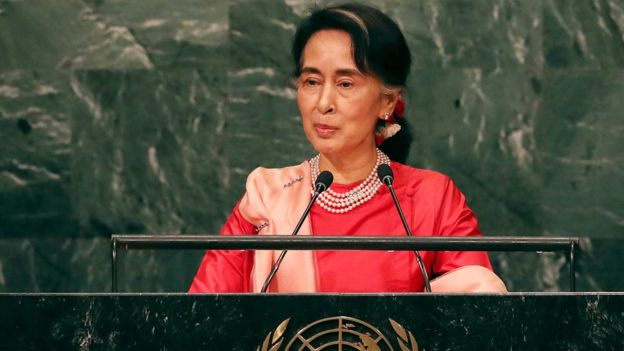
The Southeast Asian state of Myanmar has recently become the epicentre of an expanding humanitarian crisis. But because the current government of Myanmar is headed by a regime favoured by American and European interests, little attention and even less action has been given to the conflict.

A January 10, 2017 Guardian article titled, “65,000 Rohingya flee from Myanmar to Bangladesh following crackdown: UN,” reports that:

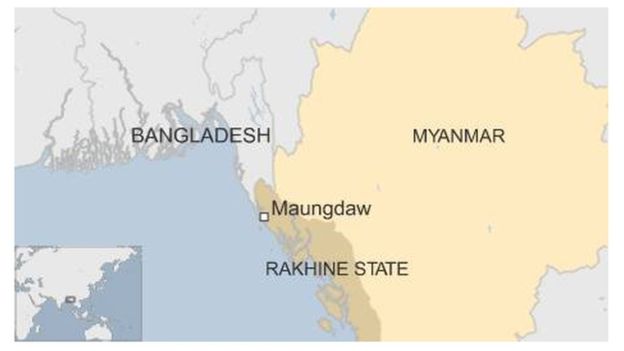
At least 65,000 Rohingya have fled to Bangladesh from Myanmar – a third of them over the past week – since the army launched a crackdown in the north of Rakhine state. 

The figure, released by the UN, marks a sharp escalation in the numbers fleeing a military campaign which rights groups say has been marred by abuses so severe they could amount to crimes against humanity.

The same article claims:

The stories have cast a pall over the young government of Aung San Suu Kyi, with mainly Muslim Malaysia being especially critical. 

Myanmar’s government has said the claims of abuse are fabricated and launched a special commission to investigate the allegations.

However, anyone at all familiar with Myanmar’s recent history and the nature of the current government’s support base knows that the unfolding tragedy among the Rohingya minority was not only predictable, but with Aung San Suu Kyi coming to power, inevitable.

The fact that Suu Kyi’s political party came to power on a decades-long tsunami of US and European cash and political support, despite US-European knowledge of Suu Kyi’s supporters harbouring racist, even genocidal intentions toward the Rohingya, makes the West at the very least partially responsible for the current crisis.

The Warning Signs Were There For Years 

The Guardian would also link the violence against the Rohingya to what it calls, “hardline Buddhist monk Wirathu,” in the very last paragraph of its article, giving readers little explanation as to just how prominent a role both Wirathu and his saffron-clad followers have played both in bringing Suu Kyi to power and persecuting the Rohingya with genocidal violence.

Such lies of omission are common throughout the Western media indicating a systematic attempt to conceal the true nature of Suu Kyi and her followers. In fact, so contradictory is the image the Western media has built up for Suu Kyi, a Nobel Peace Prize laureate, and the reality of her political movement’s violence, that many are unable to accept the truth even when evidence finally becomes widely known.

In 2007, the Western media eagerly reported on what it dubbed the “Saffron Revolution,” a political protest led by Suu Kyi’s political allies, including thousands of monks wearing their saffron-coloured robes.

But these same activist groups, including various monk “associations” have systematically been involved in the persecution of and violence against Myanmar’s Rohingya minority.

Occasional articles like the UK Independent’s 2012 report titled, “Burma’s monks call for Muslim community to be shunned,” reveal both Myanmar’s “hardline Buddhists” and even activist groups celebrated in the West for “promoting democracy” are involved in persecuting the Rohingya.

The report would state:

Monks who played a vital role in Burma’s recent struggle for democracy have been accused of fuelling ethnic tensions in the country by calling on people to shun a Muslim community that has suffered decades of abuse. 

In a move that has shocked many observers, some monks’ organisations have issued pamphlets telling people not to associate with the Rohingya community, and have blocked humanitarian assistance from reaching them. One leaflet described the Rohingya as “cruel by nature” and claimed it had “plans to exterminate” other ethnic groups.

The Independent would also admit that:

Ko Ko Gyi, a democracy activist with the 88 Generation Students group and a former political prisoner, said: “The Rohingya are not a Burmese ethnic group. The root cause of the violence… comes from across the border.”

It is difficult to discern what then, the Western media means by “democracy activist” when such “activists” openly display racism, bigotry, discrimination, and support a growing conflict that involves both calls for genocide, and violence aimed at carrying out genocide. The 88 Generation Students group has for years repeatedly weighed in on the Rohingya conflict, backing calls to deny them citizenship, voting rights and even basic human rights.

Myanmar’s Minister of Information Was Trained by America 

Not only has the US and UK substantially funded and backed Suu Kyi’s political party, but ministers within her government have been trained by US-funded programmes, including Myanmar’s current Minister of Information Pe Myint.

The Myanmar Times article, “Who’s who: Myanmar’s new cabinet,” would provide Pe Myint’s background, reporting (our emphasis):

Formerly a doctor with a degree from the Institute of Medicine, U Pe Myint changed careers after 11 years and received training as a journalist at the Indochina Media Memorial Foundation in Bangkok. He then embarked on a career as a writer, penning dozens of novels. He participated in the International Writing Program at the University of Iowa in 1998, and was also editor-in-chief of The People’s Age Journal. He was born in Rakhine State in 1949.

The Indochina Media Memorial Foundation (IMMF) in Bangkok is run by the Foreign Correspondents’ Club of Thailand (FCCT), a collection of US and European media representatives. And according to a Wikileaks document titled,  “An Overview of Northern Thailand-Based Burmese Media Orgranizations,” the IMMF’s funding is revealed (our emphasis):

Other organizations, some with a scope beyond Burma, also add to the educational opportunities for Burmese journalists. The Chiang Mai-based Indochina Media Memorial Foundation, for instance, last year completed training courses for Southeast Asian reporters that included Burmese participants. Major funders for journalism training programs in the region include the NED, Open Society Institute (OSI), and several European governments and charities.

The NED (National Endowment for Democracy) is both funded and directed by the US Congress and the US State Department. In essence, Myanmar’s current Minister of Information and the lies his ministry tells on a daily basis, particularly in regards to his government’s brutality toward the Rohingya, has been made possible in part by US government funding and support.

The fact that the Western media is still stepping around Suu Kyi and her supporters’ role in the violence against the Rohingya, indicates that support is still being provided.

It appears that the plight of the Rohingya will, if anything, only be further exploited to deepen the West’s influence over Myanmar’s current government. While human rights abuses real or imagined have been used to justify entire wars waged by Western military forces elsewhere, very real abuses in Myanmar are being carefully spun to protect the very government and its support base responsible for carrying them out.

Such transparent hypocrisy exposes Western foreign policy as entirely predicated on opportunism and self-interest rather than any actual principle. Many times, as is the case in Myanmar, such opportunism and self-interest find themselves trampling such principles entirely.

Joseph Thomas is chief editor of Thailand-based geopolitical journal, The New Atlas and contributor to the online magazine “New Eastern Outlook”.

  • Posted in English @as @as
  • Comments Off on The Rohingya: Myanmar Mass Murder Made in America

Tectonic Shock in India-Russia Relationship

January 29th, 2017 by Andrew Korybko

The surprise passing of one of Russia’s most distinguished and influential diplomats, His Excellency Mr. Alexander Kadakin, has come as a tragic shock for Moscow and New Delhi. No single individual has been more important in promoting and strengthening the Russian-Indian Strategic Partnership than Ambassador Kadakin, and his irreplaceable contribution to the emerging Multipolar World Order will be dearly missed.

He served during a time of paradigmatic geopolitical changes, whereby Russia reemerged from its post-Soviet slumber as one of the leading multipolar Great Powers in the world concurrent with traditionally “Non-Aligned” India (which is nevertheless  a misleading Cold War-era myth) rapidly moving in the direction of clinching an unprecedented military-strategic partnership with the US.

Despite the obvious divergences in Moscow and New Delhi’s geopolitical priorities, the two sides have hitherto managed to retain their historical bonds of friendship and their relationship has seemingly managed to avoid being negatively impacted by these developments, and that’s all thanks to the diplomatic expertise and professionalism of Ambassador Kadakin. Nevertheless, cracks had already begun to surface before his passing, and these are evidenced most clearly through the increasingly aggressive tone of the Indian media when discussing Russia’s rapprochement with Pakistan.

The author explored the uncomfortable nuances of Russian-Indian relations in a series of articles listed as part of his 2017 forecast for South Asia for the Moscow-based Katehon think tank, and the reader is strongly encouraged to review these materials in-depth to learn more about how the joint US-Indian Hybrid War on CPEC is dangerously threatening India’s traditional ties with Russia and fulfilling a grand American plan to turn New Delhi into Washington’s premier mainland proxy in Eurasia.

Russia couldn’t avoid noticing this startling game-changing development, yet it opted to redouble its efforts to strengthen its strategic partnership with India in order to make a play for its geopolitical loyalty. This is in line with what the author suggested last May in his Katehon series about “The Meaning Of Multipolarity”, the two most relevant articles of which advised that Russia not give up on its historically and instead make a determined bid to either keep it in the multipolar community or at the very least delay its ‘defection’ to the unipolar one.

Ambassador Kadakin was instrumental in this policy, but other influential diplomats in Moscow felt that he might have been going a bit too far in his approach by overly indulging India’s diplomatic interests in the region at the expense of Russia’s rapprochement with Pakistan. Mr. Zamir Kabulov, Russia’s envoy to Afghanistan and a rising force in guiding Moscow’s South Asian strategy, recently emerged as a counterweight to Ambassador Kadakin, and the author wrote about their visibly contradictory geopolitical visions in his Katehon article asking “Is Russia’s ‘Deep State’ Divided Over India?

The research revealed that Kabulov is an “Islamophile” who believes that Russia’s South Asian strategy shouldn’t be Indo-centric, while Kadakin is an “Indophile” who thinks that Moscow’s regional policies should depend on its ties with New Delhi first and foremost.  Up until Ambassador Kadakin’s passing, these two forces maintained equilibrium in determining the Kremlin’s policy towards Pakistan and India, which explains why Russia has so far been able to expertly balance its Pakistani rapprochement with its traditional Indian relationship.

Following the death of this remarkable Ambassador, however, it’s going to be very difficult for Russia to replace him with anyone as distinguished, capable, and trusted by the Indian establishment as Kadakin was. It’s not to say that Russia doesn’t have excellent diplomats, but just that Ambassador Kadakin was truly one of a kind and irreplaceable in his own way. Giants such as him always leave a void in their passing, and just as it was with the late Ambassador to Turkey Andrei Karlov, so too will it be with the late Ambassador to India Alexander Kadakin.

It can be expected that the diplomatic transition from Kadakin to his successor will be smooth and fully supported by his Indian hosts, but that the influence which the “Indophiles” wield in Russia’s Ministry of Foreign Affairs will never be the same again. The balance between them and Kabulov’s “Islamophiles” has suddenly shifted in favor of the latter, and this may lead to changes in Russia’s South Asian strategy.

In practical terms, while Moscow will likely continue to pursue its incipient balancing act between New Delhi and Islamabad, Modi’s government might try to take advantage of the new Russian Ambassador by aggressively pressuring him to halt his country’s rapprochement with Pakistan. It’s not predicted that Russia will alter its current strategy and appease India, though, because it both appreciates the trans-regional benefits of its Pakistani rapprochement policy in South-Central Asia (Afghanistan and CPEC) and is now decisively much more under the sway of the “Islamophiles” than the “Indophiles”.

This failure to comply with India’s unilateral demands could incense Modi and his influential National Security Advisor Ajit Doval, who might be convinced that this is the last opportunity to stop Russia’s rapprochement with Pakistan. Given the predominant weight that the US is presently exerting on Indian foreign policy at the moment, it’s forecast that Washington will exploit the enraged Indian leaders in order to encourage them to more visibly ‘break’ from Moscow in response.

This wouldn’t happen openly on a state-to-state level, of course, but in symbolic ways such as through the media and “expert” communities meant to convey the undeniable message of New Delhi’s supreme displeasure with Moscow and its willingness to more closely embrace Washington if it can’t get what it wants from Russia. This wouldn’t be anything new, however, but rather a reinforcement of the current ‘triangular’ diplomacy of “multi-alignment” that India’s recently involved itself in.

The key difference, however, is that India would be less inclined to work with a Pakistan-friendly Putin than an anti-Pakistan Trump, and it might accordingly accelerate its unprecedented military-strategic partnership with the US in order to capitalize off of this opportune moment. India and the US have been waiting for a convenient pretext to do this anyhow, and the passing of Ambassador Kadakin and his successor’s refusal of New Delhi’s expected ‘ultimatum’ that Moscow cut off its newfound pragmatic relations with Islamabad might be just what Modi-Doval need in order to more fully ‘legitimize’ their pro-American pivot.

Russia, for its part, while sincerely wanting to retain its treasured relations with India, might eventually end up losing its enthusiasm if the obvious reversal in India’s foreign policy priorities humiliatingly becomes apparent, and it could be influenced by the “Islamophiles” to transfer this passion to Pakistan instead. The result of this process would be that India and Russia continue to drift apart, just as the US intends for them to do, with Moscow unable to reverse this development after suddenly losing Ambassador Kadakin.

It’s very possible that President Putin might contemplate visiting South Asia much more seriously now than before, understanding that his presence there is needed much more than ever in order to safeguard and promote Russian interests. This prospective trip wouldn’t be just to reinforce Russia’s newfound balancing policy in the region, but to reinforce the Russian-Indian Strategic Partnership during this unexpected period of uncertainty.

With Kabulov’s “Islamophiles” more comfortably in control of Russia’s South Asian strategy and the former “deep state” equilibrium with the “Indophiles” suddenly broken, the paranoid Hindutva jingoists at the head of India’s government might fret that any accelerated rapprochement between Moscow and Islamabad will be at New Delhi’s expense. This is illogical for any level-headed person to believe, however, and Kabulov himself aptly said in December at the Heart of Asia conference that “India has close cooperation with the US, does Moscow complain? Then why complain about much lower level of cooperation with Pakistan?”

Regardless of Russia’s reasonable retort to New Delhi’s unfounded fears, Modi-Doval don’t interpret the situation like Kabulov expressed it, and instead believe that Russia is conspiring against them as part of a secret Chinese plot, like some Indian “experts” have repeatedly hinted at over the past couple of months. This fuels their desire to more rapidly and openly move towards the US, though not without giving Russia one final ‘ultimatum’ beforehand, which could be conveyed either discretely to Ambassador Kadakin’s successor or directly to President Putin during any forthcoming prospective visit to South Asia.

No matter what ultimately happens, though, it’s clear that Ambassador Kadakin’s passing decisively shifted the “deep state” balance between Russia’s “Islamophiles” and “Indophiles”, and that this will inevitably have consequences on the present state of affairs in the region. India senses its last-ever potential opportunity to reverse Russia’s rapprochement with Pakistan, while Russia contrarily sees a chance to take the latter in an excitingly new direction unburdened by the overly cautious approach which characterized Ambassador Kadakin’s “Indophile” influence.

Given these diverging dynamics, one can easily expect that the US’ efforts to drive a deeper wedge between Russia and India will assuredly lead to some sort of fruitful dividends in the coming future, with the only question being the extent to which American efforts will succeed in more openly convincing India to side with the US and against Russia in the New Cold War. More than likely, New Delhi won’t ever publicly turn against Moscow unless it becomes overly paranoid about Russia’s relations with Pakistan, so it can be assumed that this process will play out gradually and be largely kept out of the public eye (except for the symbolic manifestations mentioned earlier pertaining to India’s media and “expert” communities).

It’ll be a profound challenge for Russia to reverse or at least slow down India’s ‘defection’ to the US now that it can no longer rely on the remarkable diplomatic skills of Ambassador Kadakin, so Moscow might finally become comfortable with what’s increasingly appearing to be an irreversible geopolitical fact and concentrate more closely instead on preserving the mutually beneficial military-energy aspects of its fading strategic partnership with India while simultaneously exploring ‘compensational’ opportunities with Pakistan.

Andrew Korybko is Moscow-based political analyst, journalist and a member of the expert council for the Institute of Strategic Studies and Predictions at the People’s Friendship University of Russia. He specializes in Russian affairs and geopolitics, specifically the US strategy in Eurasia. His other areas of focus include tactics of regime change, color revolutions and unconventional warfare used across the world.


  • Posted in English @as @as
  • Comments Off on Tectonic Shock in India-Russia Relationship

Killing the TPP: Trump’s Executive Action

January 28th, 2017 by Dr. Binoy Kampmark

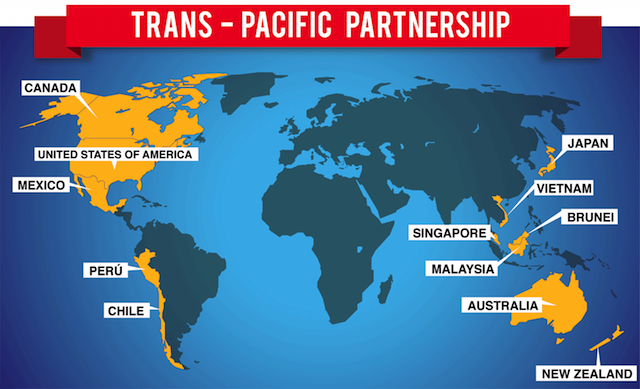
One of the conspicuous absences from the sound and fury last weekend’s protests was the impending executive act of President Donald Trump affirming the US exit from the Trans-Pacific Partnership Agreement.  Not that that was much in doubt: it had not been ratified nor voted upon in Congress, and that particular body had been cooling towards it.

It was a blow in favour of the populist platform, sharpened by debates on the Left and Right of the political spectrum.  It was more than a generous nod to the collective campaigns that had effectively reshaped and kitted out the anti-globalisation effort with teeth.  While Trump would have little trouble with rapacious business practices, he wishes them to be unilaterally smothering with an American ideal.

As Trump proclaimed in June, “Not only will the TPP undermine our economy, but it will undermine our independence.” The twin elements here are important: the potential damage to the worker, and the constrictions of a collective deal on sovereignty.

But such commentators as Alana Semuels see in the TPP a blueprint in advancement on a range of fronts, one that would have “established stringent labour and environmental laws in other countries that could have driven up the cost of labour there, thus making American workers more appealing.”[1] This wishful thinking has prevailed in quarters which have assumed a progressive goal behind the TPP, despite its prolonged secrecy and restriction to corporate interests. Free trade deals continue to attract faithful adherents, with faith taking the place of empirical thinking.

Then came the geopolitical barb in the agreement, which was always sharply directed against the trading prowess of China. Excluding China would effectively mean a rival, countering bloc in the Asia Pacific, enabling, as President Obama kept insisting upon, a monopoly on the part of the US over the drafting of trade rules.

As is in the nature of the Trump manner, not all of this is progressively rosy. (Trump did, in the same signing ceremony, also impose a federal hiring freeze and an order prohibiting funding to NGOs internationally who provided abortion advice.)

Trump may well have summarily shot the TPP into oblivion, but in so doing, he is offering his own vision of bullying negotiations, one where the United Stateshas full swing and movement.  “We’re going to have trade, but we’re going to have one-on-one.  So if somebody misbehaves, we’re going to send them a letter of termination, 30 days.  And they will either straighten out, or we’re gone.  No one of these deals where you can’t get out of them, it’s a disaster.  We’re going to have plenty of trade.  But TPP wasn’t the right way.”

This freedom of action is precisely the sort that sets such trading powers as Japan on edge.  Long immunised against deep penetration from US products, any tariff war initiated by the Trump administration is bound to be half baked in effect.

Aged veterans of the trade wars of the 1980s would be aware of the various techniques of coping with protectionism. The clever Japanese approach here was to build manufacturing bases in the US to evade protectionism. Not only did Japan come through the Gold Door – it entrenched itself in the market.

Unilateral, patriotic assertions in the field of trade and manufacture often tend towards brawling.  Immediately prior to Trump’s inauguration, Shinzo Abe’s government ratified the TPP agreement, seeing it as panacea for a crawling domestic economy and a change to lure the US deeper into the Asia-Pacific.China’s shadowing influence in the region remains a key concern.

The obituary of rampant free trade ideology is by no means written, though it has received crippling pneumonia of sorts courtesy of Trump’s signing hand. It was the outcome favoured by Sanders and Clinton herself, and in that, there can be little complaint.

In the immediate aftermath of Trump’s move, Sanders even went so far as to express approval. “For the last 30 years, we have had a series of trade deals – including the North American Free Trade Agreement, permanent normal trade relations with China and others – which have cost us millions of decent paying jobs and caused a ‘race to the bottom’ which has lowered wages for American workers.”[2]

He proceeded to hand out a branch of cooperation, suggesting that he would be “delighted to work” with the President provided Trump was “serious about a new policy to help American workers”.  Again, the worker, and more precisely working families, were the populist themes.

Similarly, various rustbelt Democrats joined the approving chants. Sen. Robert P. Casey Jr. (D-Pa.), in expressing agreement for Trump’s decision, also  claimed that the TPP “would have cost jobs and hurt income growth, which is why I voted against fast tracking the deal of 2015.”[3]

They were far from the only ones, with Clinton having vanished into the shadows and Obama sliding into the night. Democrats fear that their traditional constituencies will get away from them in the festive lynching neoliberalism has encouraged.

How the Trump vision squares with assisting the sainted US worker will be more than basic curiosity.  The Chinese now have the chance to embrace a collective free trade deal as an alternative, filling the vacuum left by Trump’s America First populism.  From looking to Washington, the 11 trade powers may well start sauntering over to Beijing, if only tentatively. It is with some historical irony that a communist state should be the new standard bearer for free trade, but geopolitics is a funny business.  As is America First.

Dr. Binoy Kampmark was a Commonwealth Scholar atSelwyn College, Cambridge.  He lectures at RMITUniversity, Melbourne.  Email:[email protected]

Notes

[1] https://www.theatlantic.com/business/archive/2017/01/trump-tpp-dead/514154/

[2] https://www.washingtonpost.com/news/powerpost/wp/2017/01/23/sanders-praises-trump-for-nixing-tpp-delighted-to-work-with-him-on-pro-worker-policies/?utm_term=.14ee448c1ca6

[3] https://www.washingtonpost.com/news/powerpost/wp/2017/01/23/sanders-praises-trump-for-nixing-tpp-delighted-to-work-with-him-on-pro-worker-policies/?utm_term=.14ee448c1ca6


  • Posted in English @as @as
  • Comments Off on Killing the TPP: Trump’s Executive Action

The weeks following an underwhelming Brazil-Russia-India-China-South Africa (BRICS) mid-September summit in Goa and the United States presidential election in November have unveiled ever-widening contradictions.

Thanks to blatant corruption, presidential delegitimation has reached unprecedented levels in both Brazil and South Africa; while ruling-party religious degeneracy in India also included an extraordinary bout of local currency mismanagement; and sudden new foreign-policy divergences may wreak havoc in China and Russia.

The BRICS bloc’s relations could well destabilize to the breaking point.

Washington Wedge

Even before the next major world recession arrives, probably within two years, the inexorable rise of intra-bloc conflict will be apparent at the September 2017 BRICS summit in Xiamen, China. Most obviously, the Brasilia, Moscow and New Delhi regimes are shifting toward Washington while those in Pretoria and Beijing are spouting well-worn anti-imperialist rhetoric, just as Donald Trump and his unhappy mix of populists, paleo-conservatives, neo-conservatives and neoliberals take power on January 20.

We should have been more concerned about these power relations much earlier. For more than a decade, Washington militarists and their academic allies (like Keir Lieber and Daryl Press) have believed that “the United States now stands on the cusp of nuclear primacy… [having] the ability to disarm the nuclear arsenals of Russia or China with a nuclear first strike.” Such men are further empowered by Trump’s Christmas-time threat to any opponent that he would engage in “an arms race. We will outmatch them at every pass and outlast them all.”

Obama Legacy

In spite of regular promises to disarm the nukes, outgoing president Barack Obama’s recent recommitment to a new generation of precision-guided mini-warheads will not only cost more than $1-trillion over the next three decades, but also makes their use “more thinkable,” according to one of his top strategists.

And in several other ways Obama’s legacy set the stage for the worst of Trump’s coming policies: economically empowering the top 1% at the expense of the vast majority, continuation of a belligerent foreign policy, promotion of corporate interests across the world, denial of civil liberties especially to refugees and prisoners, and construction of a vast surveillance capacity by Washington’s deep state.

Still, while each of these dangerous elephants trample the grass underfoot, there are a few surviving blades – the subject of a coming essay. Only grassroots initiatives offer encouragement for a bottom-up anti-imperial afterlife following the top-down imperial, inter-imperial and sub-imperial follies of 2017. The main point of the pages ahead, though, is that whether in Washington or BRICS capitals, the wedge may well work but the broader right-wing agenda will fail.

Tensions in Taiwan

To illustrate the insanity ahead, one ‘country’ seems poised to centrally play at least a symbolic role: Taiwan. In late December, Solly Msimanga – the centre-right mayor of South Africa’s capital city, Pretoria, elected just four months earlier – visited Taipei to seek out trade and investment opportunities, following an invitation from his counterpart in Taiwan’s capital.

The prior municipal political establishment became as wild-eyed-angry about this trip as were Chinese elites about the December 2 congratulatory phone call Trump happily took from Taiwan’s president Tsai Ing-Wen. Reflecting an unusual global sensibility, the African National Congress (ANC) branch that had ruled the city for the prior two decades furiously complained that Msimanga’s trip “exposed the conspiracy against BRICS countries… We are without doubt characterizing this trip as treason” (sic).

The national Department of International Relations and Cooperation spokesperson, Clayson Monyela, reiterated that Msimanga “was advised against undertaking this trip. The SA government respects the One China policy.” Actually, Monyela’s unit has its own Taipei Liaison Office which promotes cooperation in biomedicine and auto electronics. Likewise the Taiwanese have Liaison Offices in Pretoria and Cape Town.

Indeed dating to 1996 when Taiwan held its first-ever democratic presidential election, Nelson Mandela had committed to recognize a government which “supported us during the later phase of the struggle… It is not easy for me to be assisted by a country, and once I come to power, say ‘I have no relations with you’. I haven’t got that type of immorality, and I will not do it.” The ‘support’ was merely a bribe: in 1993-94, Taipei officials donated $20-million to the ANC for its election campaign, a U-turn after a long history of the pro-U.S. military regime’s collaboration with apartheid. (Mandela similarly celebrated Indonesian dictator Suharto in 1997, after receiving his taxpayers’ similarly generous donations.)

Always exhibiting his deal-making instincts, Trump had replied to critics, “I don’t know why we have to be bound by a One China policy, unless we make a deal with China having to do with other things, including trade.” (Washington had recognized One China since 1979, as had the UN General Assembly since 1971.)

One reasonable response from Taiwan was a request not to be used as a bargaining chip. Complained a “very annoyed” researcher, June Lin from the Taipei-based Formosan Association for Public Affairs, “Trump tried to be free and easy, but he is very specific about the exchange deal: ‘Who cares? Unless you give me A and B and C, or I won’t give a damn.’”

A Chinese state mouthpiece, the Global Timesthreatened that if Trump “openly abandons the One China policy, there will be a real storm. At that point, what need does mainland China have for prioritising peaceful unification with Taiwan over retaking the island by military force?”

War is one scenario but an economic blockade is more likely, given Taiwan’s reliance on China, especially sending world-leading semi-conductors to the desperately dependent West via eastern mainland China’s high-tech assembly facilities. One Beijing official told Reuters, “We can just cut them off economically. No more direct flights, no more trade. Nothing. Taiwan would not last long. There would be no need for war.”

Moreover, if Trump continued to be – as the Global Times put it – “as ignorant of diplomacy as a child,” then China would aid (unspecified) anti-U.S. forces. “This inexperienced president-elect probably has no knowledge of what he’s talking about. He has overestimated the U.S. capability of dominating the world and fails to understand the limitation of U.S. powers in the current era.”

If Trump is merely an ignorant conman, as seems the case, he nevertheless has a potent instinct for divide-and-rule rhetorical flair, confirmed by his support in the U.S. white working class. Trump’s economic localization slogan “Buy American and Hire American” may, in turn, combine with his geopolitical deal-making to become a major wedge between the BRICS. For behind the resurgent inter-imperial sentiments lie vast economic contradictions that now appear beyond the capacity of multilateral capitalist regulation to resolve.

Rightwing or Leftwing Localization?

Beijing will certainly face worsening problems with Trump, given the latter’s propensity to blame trade competition – specifically, subsidised Chinese exports and currency devaluation, as well as alleged Chinese commercial computer hacking – for U.S. deindustrialization. Advised by the notorious Sinophobe economist Peter Navarro, Trump’s answer is a series of localization-oriented policies that will allegedly benefit U.S. manufacturing industry by increasing protection from foreign imports with what may be a 45% tariff on China and 10% on goods from other overseas sources.

Centre-left economist Joseph Stiglitz warns against Trumponomics, in part because of the lack of redistribution that might make such high import tariffs feasible: “Higher interest rates will undercut construction jobs and increase the value of the dollar, leading to larger trade deficits and fewer manufacturing jobs – just the opposite of what Trump promised. Meanwhile, his tax policies will be of limited benefit to middle-class and working families – and will be more than offset by cutbacks in healthcare, education, and social programs.”

A trade war is just as likely an outcome, reminiscent of the protectionist Smoot-Hawley Act of 1930 which is credited with contributing to the Great Depression. Like that period, the major question is in which direction populist sentiments channel working-class politics, rightwards or leftwards. (A coming essay considers the left option.)

Momentum in most sites is enjoyed by right-wing leaders: the U.S. (Trump), Britain (UK Independence Party and Brexit supporters), France (National Front led by Marine le Pen), Germany (Alternative for Germany) and the Netherlands (Party of Freedom led by Geert Wilders), with the latter three holding elections in 2017, along with Italy whose Five Star Movement (led by comedian Beppe Grillo) also has right-populist support.

If this tendency continues to prevail, we can expect the widespread emergence of what is often termed a ‘fascist’ regime: when the populist sentiments of working-class people are revealed as nativist, racist, misogynist, homophobic, xenophobic, Islamophobic, anti-Semitic, ablist and anti-ecological, when imperialist and militaristic sentiments are acted upon, and when the socio-cultural agenda of the right is conjoined with corporate power to take control of the state.

In the period 2017-20, the dominant alignment appears to be a combination of far-right socio-cultural politics with mega-corporate interests, at least in the USA. (In Britain, the City of London’s financial-corporate agenda conflicts more explicitly with the far-right’s Brexit strategy.) It became clear immediately after the election that Wall Street’s giddy investors expect military, financial and fossil fuel industry stocks to prosper far more than any others, as the Dow Jones index hit a new record.

Trump promises to lower corporate taxes from 35 to 15% and rapidly inject what might be called ‘dirty Keynesian’ spending on airports and private transport infrastructure, heralding a new boom in U.S. state debt. Along with the Federal Reserve’s rise in interest rates, this in turn will at least initially draw more of the world’s liquid capital back into the U.S. economy, similar to the 2008-09 and post-2013 shifts of funds that debilitated all the BRICS currencies aside from the Chinese yuan.

New Alliances Loom as Several BRICS Continue to Crumble

With Trump’s election and the resulting rearrangement of geopolitical alliances and economic uncertainty, the BRICS will be under increasing pressure on several fronts. One winner may well be the Russian economy, as a result of loosening sanctions and the higher oil prices that will likely result from the December 2016 Organization of Petroleum Exporting Countries agreement. At rock bottom in February 2016, the price per barrel had fallen to $27, but by year’s end it was $55, giving some prospect of relief to the Russian economy.

Nevertheless, as the world becomes more geopolitically dynamic and economically dangerous – what with ongoing Chinese overcapacity, unprecedented global corporate debt while profit rates continue falling, worsening stagnation and rising financial meltdown risks emanating from weak European banks such as Germany’s Deutsche as well as several Italian banks – the political coherence of the BRICS bloc is in question.

Trump’s election heralded a period ahead in which the BRICS’ dubious claim to building a counter-hegemonic world politics will falter even faster. Two leaders – Brazil’s Michel Temer and India’s Narendra Modi – have strong ideological affinities as conservative nationalists.

Temer’s government, installed in May, has come under intense pressure because of ongoing popular delegitimation of his constitutional-coup regime, in part from unions which had supported the predecessor Workers Party. Temer’s closest allies (e.g., Renan Calheiros and Eduardo Cunha, who arranged former president Dilma Rousseff’s downfall in the Congress, and six of his cabinet ministers) were repeatedly exposed as far more corrupt than the prior president, thanks in part to plea bargain confessions by 77 officials of the Odebrecht construction companies involved in political bribery.

In December, Temer’s government imposed a new 20-year austerity regime that is certain to generate a coming period of unrest. Temer’s two 2016 trips to Asia – to appear with the G20 and especially with other BRICS leaders at the Goa summit – represent one means of distraction from such troubles.

In India, six weeks before hosting the 2016 summit, Modi suffered a strike of an estimated 180 million workers demanding both higher wages and an end to his neoliberal (austerity-oriented, pro-corporate) economic policies. Although his Hindu nationalism assures a strong base, Modi soon became even more unpopular with the non-sectarian working class and poor (amongst others) due to his chaotic banning of large currency notes (500 and 1000 rupees) that make up 86% of the money in circulation. This left many rural areas virtually without cash and hence without economic activity, and banks were compelled to restrict funds withdrawals to small daily amounts.

Modi also attempted, albeit unsuccessfully, to use the Goa summit for intense (albeit unsuccessful) ‘anti-terrorist’ lobbying. The economic and political links that China and Russia have built with the Pakistani government – as it has progressively delinked from Washington in the wake of the 2011 Osama bin Laden execution – remain more attractive than remaining in India’s favour within the South Asian rivalry.

A third leader, South Africa’s Jacob Zuma, seems to require BRICS anti-imperialist myth-making to shore up his internal legitimation, as part of the ANC’s so-called “talk left, walk right“ tendency. For example, in November 2016 Zuma explained BRICS to party activists in the provincial city of Pietermaritzburg: “It is a small group but very powerful. [The West] did not like BRICS. China is going to be number one economy leader… [Western countries] want to dismantle this BRICS. We have had seven votes of no confidence in South Africa. In Brazil, the president was removed.”

The following week in Parliament, Zuma was asked by an opposition Member of Parliament which countries he meant, and he replied, “I’ve forgotten the names of these countries. How can he think I’m going to remember here? Heh heh heh heh!,” he chuckled.

It is evident that Zuma will continue to use the BRICS as a foil for such defensive sentiments, even though his government’s initial endorsement of the NATO bombing of Libya in 2011 was the most egregious case of the BRICS’ geopolitical role in Africa, against the African Union’s wishes (and to be fair, Pretoria did reverse course and opposed further intervention). Behind the scenes, U.S. journalist Nick Turse has identified the Pentagon’s “war fighting combatant command” in dozens of African states, mainly directing local proxies.

It soon transpired that there was a blunt division of labour at work between Washington and its deputy sheriff in Pretoria. At the conclusion of his 2014 meeting with Obama as part of a U.S.-Africa heads-of-state summit, Zuma identified a chilling conclusion: “There had been a good relationship already between Africa and the U.S. but this summit has reshaped it and has taken it to another level… We secured a buy-in from the U.S. for Africa’s peace and security initiatives… As President Obama said, the boots must be African.”

The theatrical aspects of BRICS will continue, apparently designed in part for the local consumption of constituencies who want to see their leaders standing tall internationally in part because of rising local problems. But the most dynamic and contradictory terrain of BRICS to consider is their role in global geopolitics.

BRICS Play the Global Game

Armed conflicts and extreme tensions certainly affect the BRICS directly and in their immediate regions: Syria, Ukraine, Poland, Pakistan, the Korean Peninsula and the South China Sea. In addition, global power balances are adjusting because of dramatic 2016 shifts of leadership loyalties from West to East in Turkey and the Philippines encouraged by Russia and China, respectively.

Meanwhile, the last two years have witnessed major armed (including civil) conflicts continuing in Syria, Afghanistan, Turkey, Pakistan, Mexico and northern and central Africa. Aside from extremist groups such as the Islamic State, Boko Haram and Al-Shabaab, the main belligerent bloc of states catalysing violence in the world today is centred on Washington.

World military spending, 2015. [Source: Bank of America.]

The most dangerous such state network continues to feature Israel, Saudi Arabia and Qatar in the Middle East (the latter two of which split favours in funding both Islamic extremists and the Clinton Foundation). Misery, displacement, refugees and brutal repression are evident, as a result, from Palestine to Syria to Yemen, while the Pentagon and State Department are themselves directly responsible for infinitely destructive chaos in Libya, Afghanistan and Iraq. Vladimir Putin’s decision to defend Syria’s corrupt, dictatorial Bashar al-Assad regime in turn led to extensive war crimes against civilians such as bombing East Aleppo.

Beyond the Middle East, it is always tempting for Western powers to provoke incursions in the BRICS’ regional sites of accumulation and geopolitical influence. The North Atlantic Treaty Organization’s (NATO) conflicts with Russia in Georgia, the Ukraine, Poland, Syria and Turkey, and the U.S. Navy with China in the South China Sea, have been most important in recent years. The U.S. dominates world military spending, with $610-billion in direct outlays in 2014 (and myriad other related expenses maintaining Washington’s control such as U.S. AID). But four of the five BRICS also spent vast amounts on arms: $385-billion in 2015 (of which 55% was China).

There are various other sites of contestation, e.g. over Washington’s (and its ‘five eyes’ allies’) capacity to tap communications and computers through the internet. After revealing the U.S. National Security Agency’s (NSA) snooping capacity in 2013, whistle-blower Edward Snowden has an apparently safe Moscow exile, after fears of extradition to the U.S. or worse. A few months later, Rousseff cancelled the first visit by a Brazilian head of state to Washington in 40 years, as a way to protest Snowden’s revelation that the NSA was tapping her phone.

In this context of split loyalties, two quite unpredictable processes are in play at the time of writing, centering on Russian and Chinese relations with Washington. First, in Russia, Putin was accused by Obama and by the defeated candidate Hillary Clinton of assisting Trump to win the November 2016 election through email hacking, a matter that may be clarified in January if U.S. intelligence agencies manage to prove the case. But these agencies failed repeatedly on prior occasions, and on December 29 even Obama failed to offer conclusive evidenceof wrongdoing when he expelled three dozen Russian diplomats accused of spying.

At the time of writing, WikiLeaks founder Julian Assange still denied he had access to leaked emails from any direct Russian source. A former British ambassador, Craig Murray, claims mid-2016 Democratic National Committee leaks were given to him by an internal Democratic Party whistle-blower, to pass to Assange. Another election email scandal involved the hacking of Clinton’s campaign chairperson, John Podesta, whose security advisor admitted that he accidentally made Podesta vulnerable in a phishing scam designed to acquire his password.

Putin responded to Obama’s late-2016 attacks merely with scorn, saying he would await the presidential transition, and was immediately congratulated by Trump. Putin not only recently bragged, “Of course the U.S. has more missiles, submarines and aircraft carriers, but what we say is that we are stronger than any aggressor, and this is the case.”

Yet Putin’s critics remind that the Russian government is being successfully prosecuted for widespread doping of Olympic athletes, a charge once denied but now confessed. Given Putin’s hatred of the U.S. State Department – for valid reasons, such as its role in the Ukrainian regime change in 2014 and destruction of Iraq, Afghanistan, Libya and Yemen in recent years – there is no question that he both favoured the election of Trump and had the spy-craft capacity to make an intervention.

Putin also enjoys alliances with several far-rightwing allies in Europe and he anticipates a dramatic adjustment in the Western balance of forces thanks in part to Trump’s prolific personal business interlocks with Russia. Benefits to Putin will begin with the relaxation of sanctions associated with Russia’s 2014 invasion of the Ukrainian (former Soviet) province of Crimea, recognition of Moscow’s sphere of influence in the ex-Soviet Union, and potentially also a rising oil price.

One dilemma for the Trump administration is that his own party and the Democratic Party have been conditioned to despise Putin for more than a decade. But Trump surprised the establishment with the appointment to the position of Secretary of State of the pro-Russian ExxonMobil chief executive Rex Tillerson. There could be a resurrected $500 dollar Siberian oil deal for ExxonMobil – whose implementation was interrupted in 2015 – if Washington soon ends U.S. sanctions against Russia, as is widely anticipated.

As Guardian columnist Julian Borger reports, powerful critics believe Trump’s “opaque ties with Russia and his glaring conflicts of interest represent existential threats to U.S. democracy. Trump is giving the nod to Tillerson, the recipient of Moscow’s Order of Friendship, as a slaughter is underway in Aleppo, likely to be one of the worst war crimes of the century so far, in which Russia is complicit.”

Moscow’s Sputnik news expects mediation by Henry Kissinger to mutual advantage. But this is dangerous, warns former Reagan Administration official Paul Craig Roberts: “Kissinger, who was my colleague at the Center for Strategic and International studies for a dozen years, is aware of the pro-American elites inside Russia, and he is at work creating for them a ‘China threat’ that they can use in their effort to lead Russia into the arms of the West. If this effort is successful, Russia’s sovereignty will be eroded exactly as has the sovereignty of every other country allied with the USA.”

Already before Trump enters the White House, Beijing’s Xi Jinping is in greater conflict with Washington than at any time since China-U.S. frictions of the early-2000s. On the other hand, U.S. capital is extremely exposed in China through direct investment, supplier relations, R&D contracts and consumer markets. And Beijing still owns more than $1.3-trillion in Treasury Bills, although that holding has not increased since 2012.

Geopolitical tensions in the South China Sea began rising in 2011 with Obama’s “pivot to Asia.” This meant, according to journalist John Pilger, “that almost two-thirds of U.S. naval forces would be transferred to Asia and the Pacific by 2020. Today, more than 400 American military bases encircle China with missiles, bombers, warships and, above all, nuclear weapons. From Australia north through the Pacific to Japan, Korea and across Eurasia to Afghanistan and India, the bases form, says one U.S. strategist, ‘the perfect noose’.”

In addition, Eurasia is a testing ground because of increasing investments in Chinese infrastructure (perhaps amounting to $160-billion) in the former Silk Road – now ‘One Belt, One Road’ – to be funded by the new Asian Infrastructure Investment Bank (AIIB), centering on Russian-Chinese energy cooperation.

One Belt, One Road

Still, this picture of the BRICS and U.S. imperialism remains fuzzy given Trump’s mercurial character, ruthless pragmatism, exceptionally thin skin, crude bullying behaviour and ability to polarise his own society and the world. Obama’s last moves as president include a few attempts to at least briefly Trump-proof his legacy: demonising Russia, banning oil drilling and opening new environmental reserves in vulnerable sites, condemning Israel’s West Bank colonization, and protecting Planned Parenthood abortion facilities.

There is no question, though, that Trump’s most extreme threats to global geopolitics, economics, society and environment will be carried out by a Cabinet and lieutenants who represent the most regressive characteristics of U.S. capitalism. Trump’s top layer of government can be termed ‘4G’, as it contains:

  • gazillionaires – his Cabinet is worth $15-billion, by far the most tycoon-infested in U.S. history, including a top labour official opposed to a living wage;
  • generals – three veterans of the failed campaigns of Iraq and Afghanistan hold key security roles that had once been reserved for civilians;
  • gas-guzzlers – four lead officials in climate-related portfolios including the Secretary of State are loyal representatives of the oil, gas, coal and pipeline industries; and
  • GoldmanSachs – Trump’s Treasury Secretary, main economic advisor and lead political counsel were once executives of the Wall Street investment bank, responsible for so much global economic damage over the past decade due to predatory financing practices.

Must there be either an inter-imperialist conflict of elites that could lead to nuclear confrontation, debilitating trade wars or further juvenile insults as passions continue to rise on the one hand; or on the other, a new alliance of U.S. and Russian elites that will codify a lucrative intra-imperial division of the world’s spoils including fossil-fuel exploitation and resulting climate change that will quickly spiral beyond repair?

The False Hope of BRICS Top-Down Resistance

One other option is a rational approach from the BRICS countries’ leaders. Reflecting how difficult this will be, however, former South African president Thabo Mbeki expressed Africa’s desire for a reformed United Nations when speaking directly to Putin in Finland last October: “The matter of the reform of the Security Council becomes important in that respect… It needs changing. It’s difficult. Russia is a permanent member that might be one of the obstacles to changing it, I don’t know.”

Neither Moscow nor Beijing will nominate Brazil, India and South Africa for permanent seats (along with Japan and Germany), for fear of diluting their own Security Council power and especially their veto. The lack of space for Africa in the UN may mean, according to threatsmade by Zimbabwean president Robert Mugabe in September, a formal boycott of the body by the continent starting in September 2017. And another vehicle for Third World advocacy, the Non-Aligned Movement, was considered increasingly irrelevant when in September 2016 Modi did not even show up at a Caracas summit, notwithstanding India’s formative role in its 1955 founding at Bandung.

Likewise, the BRICS leaders’ self-interest prevents genuine transformation of other multilateral institutions: in the last round of ‘reforms’ of the World Trade Organization (WTO), International Monetary Fund (IMF) and UN Framework Convention on Climate Change – all consummated in December 2015 – there can be no question that Africa was the loser, as the BRICS’ neoliberal negotiators ran roughshod over the poorest countries.

Moreover, last August, the BRICS’ representatives at the Bretton Woods Institutions endorsed five-year contract extensions for World Bank and IMF leaders Jim Yong Kim (from the U.S.) and Christine Lagarde (from France). They even confirmed Lagarde’s reign in mid-December the same day a Paris court found her guilty of criminal negligence when, serving as the French finance minister, she made a huge taxpayer payout to a tycoon who in 2007 had given financial support to her Conservative Party.

And hope for the BRICS Contingent Reserve Arrangement to serve as an emergency funding alternative to the IMF remains foiled by the provision that after borrowing 30% of the quota, a desperate debtor country must then get an IMF structural adjustment policy. And the BRICS New Development Bank’s potential role as an alternative to the World Bank appeared self-sabotaged last September when a cozypartnership was agreed that entails project co-financing and staff secondments.

In 2014, Obama agreed with The Economist editor interviewing him about “the key issue, whether China ends up inside that [multilateral financial] system or challenging it. That’s the really big issue of our times, I think.” He replied, “It is. And I think it’s important for the United States and Europe to continue to welcome China as a full partner in these international norms.”

The philosophy of subordinated incorporation – sub-imperialism for short – became too difficult for Obama himself to sustain, when in 2015 he dogmatically (and unsuccessfully) discouraged AIIB membership by fellow Western powers and the Bretton Woods Institutions. It was his most humiliating international defeat. But when it came to intensified trade liberalization in the WTO, recapitalization of the IMF under neoliberal rule, and destruction of the binding emissions reductions targets on Western powers that characterized the Kyoto Protocol, Obama’s strategy of bringing China and the other BRICS inside was much more successful.

In sum, looked at from above, the BRICS leaders regularly suffer status quo assimilation when it comes to global governance partnership, but they fracture when it comes to their own internecine competition or when failing to offer unified challenges to multilateral institutional leadership. And this inconsistency is what leaves the bloc wide open to a potential Trump wedge in 2017.

With this in mind, Immanuel Wallerstein argues that Trump “is using the Nixon technique in reverse. Nixon made a deal with China in order to weaken Russia. Trump is making a deal with Russia in order to weaken China.” Wallerstein doubts its efficacy simply because Beijing and Moscow are pursuing their own separate interests effectively already: “This policy seemed to work for Nixon. Will it work for Trump? I don’t think so, because the world of 2017 is quite different from the world of 1973.”

The main difference may be the more advanced stage of economic stagnation and desperation, a topic I will take up another time. But on the left, the kinds of dashed hopes so many activists harbored at that time are also worth recalling, for they included (sometimes in partial or very contradictory ways) sustained improvements in European social democracy and the U.S. Great Society, rising Third World revolutions sometimes accompanied by Northern solidarity, the onward march of the Soviet Union and East Bloc, the Chinese “New Man,” the feminist and black power struggles, radical environmentalism, liberation of humanity from capitalist alienation and exploitation, the casting off of outmoded sexual mores and gender norms, and the end of statist domination.

Today, with the world’s progressive, democratic forces hunkering down on so many fronts, nevertheless a ripeness within so many societies’ resistance politics reflects a much broader, deeper capacity to link up than ever before: within the BRICS, the U.S. and internationally. As Pilger concludes his recent film about Washington’s latest war-mongering, “We don’t have to accept the word of those who conjure up threats and false enemies to justify the business and profit of war. We have to recognize there is another superpower, and that is us, ordinary people everywhere.” •

Patrick Bond is professor of political economy at the University of the Witwatersrand School of Governance in Johannesburg. He is co-editor (with Ana Garcia) of BRICS: An Anti-Capitalist Critique, published by Pluto (London), Haymarket (Chicago), Jacana (Joburg) and Aakar (Delhi). This article was first published by Counter Punch.

  • Posted in English @as @as
  • Comments Off on Will Washington’s New Pro-Moscow, Anti-Beijing Gang Drive a Wedge Through the BRICS in 2017?

Saber rattling by Trump administration officials on China give pause for concern, continuing Obama’s hostile approach, risking direct confrontation if not curbed.

At his Senate confirmation hearing, Secretary of State designee Rex Tillerson recklessly said “(w)e are going to have to send China a clear signal that, first, the island-building stops and second, your access to those islands also is not going to be allowed.”

He belligerently accused China of “declaring control of territories…not rightfully” its own. Secretary of Defense James (“mad dog”) Mattis defiantly said Beijing’s activities in the South China Sea threaten the global order…”under the biggest attack since world war two…”

On Wednesday, China’s Global Times published a Xinhua commentary “urg(ing) (the) US to watch how it talks about the South China Sea issue,” its islands and territorial waters.

Beijing was angered by White House press secretary Sean Spicer, saying “it’s a question of if those islands are in fact in international waters and not part of China property, then yeah, we’re going to make sure that we defend international territories from being taken over by one country.”

China’s Foreign Ministry spokesman Hua Chunying said Beijing is committed to defend its islands, adjacent waters, maritime rights and sovereignty while pursuing regional peace and stability.

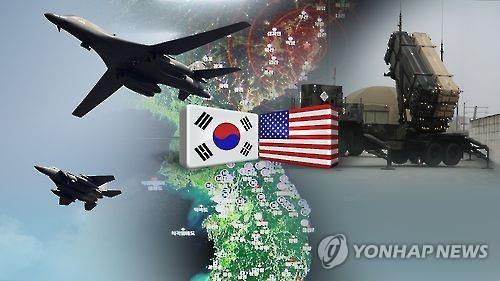
On Monday, acting South Korea President and Prime Minister Hwang Kyo Ahn confirmed US plans to install provocative Terminal High Altitude Area Defense (THAAD) missile systems on its territory – aimed at China and Russia, a nonexistent North Korea threat cited as pretext.

Beijing responded to US provocations initiated by Obama, continuing under Trump, by deploying advanced DF-41 ICBMs in Heilongjiang province bordering Russia – able to strike America with multiple thermonuclear warheads, perhaps additional deployments to follow elsewhere in the country.

China’s Global Times suggested the deployment coincided with Trump’s inauguration, “respond(ing) to (his) provocative remarks on trade, its currency and offshored US jobs.

“Beijing will ready itself for pressures imposed by the new US government,” said GT. “China bears the heavy task of safeguarding (its) national security.”

“(H)ow can China be content with its current nuclear strength when it is viewed by the US as its biggest potential opponent?”

“China’s nuclear capability should be so strong that no country would dare launch a military showdown with China under any circumstance, and such that China can strike back against those militarily provoking it. A military clash with the US is the last thing China wants, but China’s nuclear arsenal must be able to deter the US.”

Responding to Beijing’s deployment, Putin spokesman Dmitry Peskov said “(w)e do not regard China’s efforts to develop its armed forces as a threat, and even if…information (about deploying ICBMs near Russia’s border) is true, we see no risks for our country.”

“China is our strategic ally and our partner in political, trading and economic term. We appreciate our relations,” Peskov stressed.

Trump has been in office less than a week. His policy agenda toward China hasn’t been revealed so far by specific actions.

If hostile rhetoric by him and key administration officials is indicative of things to come, it will adversely affect US relations with China, Russia and perhaps other countries.

World peace remains threatened as long as US geopolitics remains confrontational. Brinksmanship between thermonuclear powers is a potential doomsday scenario if pursued.

Stephen Lendman lives in Chicago. He can be reached at [email protected].
His new book as editor and contributor is titled “Flashpoint in Ukraine: How the US Drive for Hegemony Risks WW III.” http://www.claritypress.com/LendmanIII.html
Visit his blog site at sjlendman.blogspot.com.
Listen to cutting-edge discussions with distinguished guests on the Progressive Radio News Hour on the Progressive Radio Network.

  • Posted in English @as @as
  • Comments Off on The Trump Administration’s Disturbing US Anti-China Saber Rattling

The Rohingyas are a people struck by tragedy. Persecuted in their home country, Myanmar, over 65,000 of them have fled to Bangladesh between October 9, 2016, and January 5, 2017, according to a report from the United Nations Office of Coordination for Humanitarian Affairs. Every day, as reported by The Daily Star, scores of Rohingya people, mostly women and children, are seen dotting a 15 kilometre stretch of road from Ukhia to Teknaf in Cox’s Bazar.

Having barely escaped with their lives leaving all their belongings, if any, behind, they are seen begging on and around the roads there. Hoping for someone to stop for a moment, sympathise with their sufferings and lend them some assistance, however trivial it may be.

The persecution of Rohingyas in Myanmar is, of course, nothing new. It has been going on for quite a while now. But ever since the attacks on Myanmar’s border guard posts on October 9, 2016, it has again escalated. This is obvious from the fact that, on average, over 1,000 Rohingyas have been entering Bangladesh every day since late last year, while the previous rate of Rohingya influx was 50 a day.

From the looks of various reports concerning the latest round of crackdown on the Rohingya people, it seems that some sections of the Myanmarese authority have not been shy in handing out collective punishment to all Rohingyas, regardless of their innocence or guilt.

Although some had expected things to improve for the Rohingyas under the stewardship of Nobel Peace Prize winner Aung San Suu Kyi, no such signs are currently visible. In fact, many have gone so far as to criticise her for her nonchalant attitude towards the sufferings of the Rohingyas, particularly her reluctance to condemn the attacks on occasions and for playing them down at times.

And this has been the official stance of the Myanmarese government for years now – to deny that the Rohingyas are being persecuted as severely as reports suggest. And in all honesty, with the rest of the world being busy dealing with other problems, it has served them well in avoiding taking any responsibility for the atrocities that have been committed against the Rohingyas.

But for how long can the government of Myanmar insist that the Rohingyas are not being persecuted mercilessly? For how long will people avoid asking: “Why then are Rohingyas fleeing Myanmar, risking their lives to resort to begging on the streets of Bangladesh or elsewhere”? Surely begging is not a profession many would take up willingly.

Even the UN, which some believe, has played a less than impressive role in helping to find a solution to the Rohingya crisis, seems to have lost its patience with the Myanmar government. The UN Human Rights envoy to Myanmar, Yanghee Lee, for example, said at a news briefing in Yangon that the Myanmar government would “appear less and less credible” if it continues being defensive in response to  the allegations of persistent human rights violations against Rohingyas (UN rights envoy: Myanmar losing credibility, Bangkok Post, January 21).

Furthermore, shifting from the UN’s routine position, she said: “I must remind again that these attacks took place in the context of decades of systematic and institutionalised discrimination against the Rohingya population.” Some strong words indeed, which, members of international observant groups have, unfortunately, failed to use with regards to the persecution of Rohingyas in the past.

With such strong words coming out even from within the ranks of the UN, is it a sign of hope for the Rohingyas? Will the international community finally take the matter as seriously as it should have all along? It will, of course, be unfair to include all nations under that umbrella. The Malaysian Prime Minister, for example, has already condemned the handling of Rohingyas by the Myanmarese government quite severely.

He has even gone so far as to push “the Organisation of the Islamic Cooperation (OIC), the world’s largest Muslim intergovernmental organisation, to apply pressure on Myanmar to end the persecution and killing of ethnic Muslim Rohingyas in the country” (Myanmar urged to end persecution of Rohingya, Bangkok Post, January 19). Encouragingly, he said: “I believe I speak for all neighbouring countries when I say that we want to avoid a repeat of the 2015 ‘boat people’ crisis”, referring to the thousands of Rohingyas who fled Myanmar in boats for Malaysia, Indonesia and Thailand in 2015.

Finally, he urged on the whole of South Asia to unite in an attempt to resolve the crisis, warning that it may otherwise explode into something much bigger — such as increasing petty crimes, human trafficking and various forms of militancy — which will obviously harm the region as a whole. But for various geostrategic reasons, many leaders in South Asia have so far refused to condemn the government of Myanmar, despite the possible long term dangers its policies may pose to their respective countries.

But with the passing of time, it is becoming clearer by the day that things cannot be allowed to continue as usual. It is time for the other leaders of the region to realise that and heed the warning of the Malaysian Prime Minister and condemn the atrocities being committed against the Rohingyas.

Although one could take the comments made by the UN Human Rights envoy to Myanmar as an encouraging sign, what is needed is for the leaders of South Asia to solve the problem through dialogue before it gets much bigger and leads to many more atrocities than what has already been witnessed. It is a challenge which must be faced head on, rather than be criminally avoided, as it has been, despite the tragic consequences.

  • Posted in English @as @as
  • Comments Off on Myanmar and the Fundamental Rights of the Rohingyas. Sign of Hope, or Business as Usual?

The push to commercialise the growing of genetically modified (GM) mustard in India is currently held up in court due to a lawsuit by Aruna Rodrigues. The next hearing is due in February. Rodrigues has indicated at length that, to date, procedures and tests have been corrupted by fraudulent practices, conflicts of interests and gross regulatory delinquency.

Dr Deepak Pental, lead researcher into the crop at Delhi University, has now conceded that the GM mustard in question has not even been tested against varieties of non-GM mustard for better yields. That seems very strange given that the main argument for introducing GM mustard is to increase productivity in order to reduce edible oils imports (a wholly bogus argument in the first place).

All of this should in itself provide sufficient cause for concern and have alarm bells ringing. It raises the question: what then is the point of GM mustard?

Consider too that the drive to get India’s first GM food crop into the field and on the market also goes against the recommendations of four high-level reports that have advised against the adoption of these crops in India: The ‘Jairam Ramesh Report’ of February 2010, imposing an indefinite moratorium on Bt Brinjal; The ‘Sopory Committee Report’ (August 2012); The ‘Parliamentary Standing Committee’ (PSC) Report on GM crops (August 2012); and The ‘Technical Expert Committee (TEC) Final Report’ (June-July 2013).

These reports conclude that GM crops are unsuitable for India and that existing proper biosafety and regulatory procedures are inadequate. Appointed by the Supreme Court, the TEC was scathing about the regulatory system prevailing in India, highlighting its inadequacies and inherent serious conflicts of interest. The TEC recommended a 10-year moratorium on commercial release of GM crops. The PSC also arrived at similar conclusions.

It might seem perplexing that the current Modi-led administration seems to be accelerating the drive for GM given that the BJP manifesto stated: “GM foods will not be allowed without full scientific evaluation on the long-term effects on soil, production and biological impact on consumers.” Yet none of this has occurred.

According to eminent lawyer Prashant Bhushan, these official reports attest to just how negligent and unconcerned India’s regulators are with regard to the risks of GMO contamination. They also attest to a serious lack of expertise on GM issues within official circles.It now clear that placing GM crops on the commercial market in the first place (in the US) was based on the subversion or bypassing of science and that their introduction poses a risk to food securityhuman health and animal, plants and soil as well as the environment in general.

In India, the only commercialised GM crop (bt cotton) is a failing technology that has severely impacted farmers’ livelihoods.

As bad as all of this might seem, the real significance of GM mustard lies in the fact it could be India’s first GM food crop. In this sense, it should be regarded as a pioneering crop that would open the doors to a range of other GM food crops that are currently in the pipeline for testing.

GM provides a handful of companies with an ideal tool for securing intellectual property rights over seeds (and chemical inputs) and thus gaining corporate control over farming and agriculture. Despite the GMO industry saying that GM should be but one method within a mix, evidence indicates that this is impractical due to cross-contamination and that corporations and their mouthpieces are seeking to denigrate/replace existing food production practices in order to secure greater control over global agriculture. In effect, the only reason for imposing GM crops on India seems to be to facilitate corporate imperialism.

The issue of GM mustard is not only about a crop but is central to a development paradigm that wants to see a fully urbanised India with a small fraction of people left in agriculture and living in the countryside.US companies and Washington, via the Knowledge Initiative on Agriculture, are driving the agenda. Does India want to mirror what is effectively a disastrous US model of agriculture? If this is the case, it is highly disturbing, given that it is an unsustainable taxpayer-subsidised sector that has produced a range of social, environmental and health costs outlined in that last link.

We must therefore ask: does India want denutrified food, increasingly monolithic diets, the massive use of agrochemicals, food contaminated by hormones, steroids, antibiotics and a wide range of chemical additives, spiralling rates of ill health, degraded soil, contaminated and depleted water supplies and a cartel of seed, chemicals and food processing companies that seek to secure control over the global food production and supply chain to provide people with low-grade but highly profitable food products?

Things do not look good. A recent UN report said that by 2030, Delhi’s population will be 37 million. In 1991, it was just over 9.4 million. Such rapid, ongoing urbanisation will eat up highly productive farmland on the edges of cities and will place smallholder farmers under even more duress. Quoted in The Guardian, the report’s principal authors, Felix Creutzig, says:

The emerging mega-cities will rely increasingly on industrial-scale agricultural and supermarket chains, crowding out local food chains.

In India, the push to drive at least 400 million from the land and into cities is already underway at the behest of the World Bank: a World Bank that is, under the guise of ‘enabling the business of agriculture’, committed to opening up economies to corporate seeds and agrochemicals and securing global supply chains for transnational agribusiness from field to plate.

The drive is to entrench industrial farming, commercialise the countryside and to replace small-scale farming: small-scale farming that is the backbone of food production in India (and globally) and which is more productive than industrialised agriculture, more sustainable and capable of producing more diverse, nutrient- dense diets. Contrast this with what Green Revolution technologies and ideology has already done to India, including the degradation of its water, its soils and its people’s health (see this and this).

Contrast it with an industrial farming that would bring with it all the problems outlined above. And an industrial farming that would destroy hundreds of millions of livelihoods with little guarantee of work for those whose productive system is to be displaced by that which is to be imposed by the likes of Cargill, Monsanto/Bayer and other corporate entities that fuel industrial agriculture.

The issue of GM mustard is part of a drive that seeks to restructure India to benefit foreign capital; a process that regards as being India ripe for a 30-trillion-dollar corporate hijack.

Food and trade policy analyst Devinder Sharma describes the situation:

India is on fast track to bring agriculture under corporate control… Amending the existing laws on land acquisition, water resources, seed, fertilizer, pesticides and food processing, the government is in overdrive to usher in contract farming and encourage organized retail. This is exactly as per the advice of the World Bank and the International Monetary Fund as well as the international financial institutes.

Dr Pental’s GM mustard has roots that trace its origins back to Bayer. Mr Modi, Arvind Subramanian (Chief Economic Advisor to the Indian government) and former governor of the Reserve Bank of India Raghuram Rajan also have roots that can be traced back to Washington, the IMF and the World Bank.

There is an agenda for India. An agenda that regards the peasantry, small farms and India’s rural-based traditions, cultures and village-level systems of food production/processing as backward, as an impediment to ‘progress’. An agenda that regards alternative approaches to agriculture that have been advocated by numerous high-level reports as a hindrance: approaches that would in effect build on and develop the current rural infrastructure and not eradicate it.

There is a push to displace the current productive system with a corporate-controlled model geared towards the maximisation of profit and the erosion of existing deeply-embedded and culturally relevant social relations. For all the fraud and corruption surrounding GM mustard, this alone should convince any bystanders to question the ongoing drive – against all the recommendations – to introduce GM food crops to India.

Finally, none of this is about being ‘anti-GMO’. It is about understanding and challenging the politics of GM and development. Wealthy corporations are flexing their financial and political muscle and are effectively hijacking public institutions for their own ends by slanting, science, politics, policies and regulation (these claims are discussed herehere and here) . It should not be about whether we are pro-GMO or anti-GMO. It is more the case of whether we are anti-corruption and pro-democratic.

  • Posted in English @as @as
  • Comments Off on Development and India: Why Genetically Modified Mustard Really Matters

On January 21st, 2017, the Bank of China has officially opened its regional branch headquarters in Serbian capital Belgrade, to provide banking services for cooperation in investments, trade, tourism and other fields, for countries in the region – Serbia, Rumania, Bulgaria, Greece, Albania, Macedonia, Montenegro, Bosnia and Herzegovina and others. The ceremony was held in the Government`s Palace and attended by President of the Republic Tomislav Nikolic and members of the Government.

This important development follows last June`s state visit of the President of the Republic of China Xi Jinping to Serbia and also, his talks last week with Serbian Prime Minister Aleksandar Vucic at Davos Economic Summit in Switzerland.

Establishment of the Bank of China`s regional headquarters in Belgrade, is today the main news in all major medias in Serbia and beyond. This morning I commented this event at the private regional network “TV Pink”. Among other, I noted that cooperation under OBOR, as the global initiative, is not important only for development of CEE countries, but for the whole of Europe. Through win win OBOR cooperation Europe and China are getting closer, what is equally positive form economic, cultural and political point of view, particularly now when EU is passing through serious difficulties.

Serbia`s role in the implementation of the China – CEE cooperation under OBOR is growing. Two countries are strategic partners cooperating in various fields.  In the past five years only, partners from the two countries have been constructing or modernizing roads, highways, railways, ports, bridges, tunnels, thermo-electric plant, steelwork factory, strengthening people to people exchange.  As of 1st January this year, no-visa system for citizens of the two countries came into force. A number of infrastructure projects, already implemented, or under implementation in Serbia, are highly important for modernization of connectivity in the CEE region, or in Europe.

Cooperation under CEE-OBOR has proved to be very important for Serbia`s overall economic development, modernization of industry and infrastructure and improvement of international standing.


  • Posted in English @as @as
  • Comments Off on China Extends Economic Influence in Balkans and Southeast Europe, Bank of China Regional Headquarters in Belgrade

This paper will reconsider previous work on the demographic transition under way in West Papua (the Indonesian provinces of Papua and Papua Barat) in the light of documents received from the Indonesian Statistics Office (Badan Pusat Statistic BPS) that give an ethnic breakdown across the 29 regencies that comprise Papua province and the eleven regencies in Papua Barat. They show that, while the proportion of Papuan people as a percentage of the entire population continues to decline, this process varies widely between different regencies. While some have a strong majority of non-Papuan people other regencies are still overwhelmingly Papuan.

This dichotomy is closely linked with topography – the mountainous interior outside of urban areas having a Papuan majority and the accessible lowlands a non-Papuan majority. The consequences of this dichotomy – a large chunk of West Papua about the size of Great Britain is peopled almost exclusively by Melanesian people, even as some of the coastal regions become non-Papuan majority– is profound. West Papuans of the interior have not only survived Indonesian occupation but have kept their lands and cultures largely intact, which continues to underpin calls for an independent West Papua and conflict with the Indonesian government and its security forces.

While coastal regions continue to receive large numbers of non-Papuan migrants resulting in the increasing minoritisation of the Papuan people and their concomitant militarization, marginalization and dispossession. This process is also occurring in the highlands from expansion of the oil/gas sector and mining sector; the proliferation of new regencies (with new bureaucracies) and the continuing development of new roads, all of which alienate traditional land and draw in migrants. Meanwhile the conflict over the political status of West Papua will continue, and indeed grow, as external actors, such as the Pacific countries of Vanuatu and the Solomon Islands, shine a spotlight on the conflict and advocate for the right to self-determination for the West Papuan people.

The Importance of West Papua to Indonesia

The territory of West Papua (the Indonesian provinces of Papua and Papua Barat) makes up about 24% of Indonesia’s total landmass but contains only 1.7% of the nation’s population. It is also Indonesia’s richest region in terms of natural resources with the largest extant tracts of rainforest in south-east Asia; vast oil and gas reserves, and possibly the world’s largest deposits of copper and gold. Indeed the Papua’s giant Freeport Mine is the largest economic entity in Indonesia and the country’s largest taxpayer.

The economic exploitation of these resources, especially in the establishment of massive oil palm plantations (millions of hectares are underway or planned), and the economic opportunities that arise from a fast growing local economy has drawn in hundreds of thousands of migrants from other regions of Indonesia motivated by self-interest and previously by government sponsored transmigration programs. The migrants differ starkly from the indigenous (mainly Christian) Melanesian inhabitants of West Papua, being light skinned Asians predominantly of the Muslim faith.

West Papua is also symbolically central to the self-conceptualization of the Indonesian state as an archipelago nation whose motto is Bhinneka Tunggal Ika (Unity in Diversity) and it represents the final victory of the Indonesian nationalists over the Dutch after 350 years of brutal colonial rule. This means that the future of West Papua, and the movement by Papuan nationalists to break away from Indonesia, is a first order concern for the Indonesian government and military. The demographic transition now underway wherein new migrants have become the majority in many regencies is one of the underlying drivers of conflict in West Papua and is fueling the widespread desire for independence amongst the Papuan people. This is resulting in a direct challenge to the authority and legitimacy of the Indonesian state and its sovereignty over West Papua.

Map One showing the territory of West Papua (the Indonesian provinces of Papua and Papua Barat), previously known as Irian Jaya. Note the large chain of mountain ranges that run through the island of New Guinea all the way to the Bird’s Head region and the flat coastal plains to the north and south of this highlands region.

West Papuan Demographic Transition

In a series of papers since 2006 I have examined the demographic transition that has taken place in West Papua following Indonesian takeover in 1962-63, and especially since the census of 1971, which found the total population of 923,000 as being 96% Papuan and only 4%, or 36,000 people, as non-Papuan1. The basis of this argument is that the non-Papuan sector of the population is growing faster than the Papuan sector due to large scale inward migration of non-Papuans from other parts of Indonesia and the vastly substandard living conditions of ethic Papuans, including high infant and maternal mortality rates, that cause a lower overall fertility rate. Due to patchy statistical information the rate of growth of the two population sectors had to be estimated from different censuses data and then extrapolated as a projection of a possible future demographic break down.

While the trends are clear and unambiguous the actual population growth rates vary depending on assumptions about future inward migration and respective fertility rates. It also must be presumed that in a region as vast and as rugged as West Papua, census data will always be incomplete, as well as containing certain inaccuracies. Therefore while the data allows one to establish trends with great confidence, the precise number of future population segments should be taken as indicative (with the caveat that projections are based on past growth rates remaining consistent, which may not always be the case). Nonetheless the population of West Papua continues to grow and the percentage of the population which is non-Papuan also continues to rise. This is a driver of conflict: newcomers take resources such as land, forests and minerals from traditional land owners; the Indonesian security apparatus continues to grow to maintain control over the territory and resource extraction in particular; Papuan people are further marginalized and lose even their basic freedoms of speech and association, and so Papuan discontent at the Indonesian occupation also grows and with it the desire for independence. Therefore understanding the demographic transition that is underway is central to comprehending the nature of the conflict in West Papua.

Where this paper extends the argument made in previous works is in the examination of the Papuan population on a regency by regency basis. Whereas in previous analyses the figures were largely conflated to look at the territory of West Papua (both Papua and Papua Barat provinces) as a whole, we are now able to rather forensically examine each particular region in isolation. This allows a deeper more finely grained insight into the process.

Map Two showing the territory of West Papua including the Indonesian provinces of Papua and Papua Barat (West Papua) and the administrative regions called kabupatan (regencies).

My previous analysis determined that the long term annual growth rate for the Papuan population was 1.84% and that of the non-Papuan population 10.82%2 for the period from 1971 up to 2000. From my calculations this meant that indigenous Papuans comprised about 48%3 of the entire population of West Papua (Papua and Papua Barat provinces) in 2010. The figures received from the BPS are from the 2010 census and identify the inhabitants of Papua province as either Suku Papua (Papuan tribe) or Suku Bukan Papua4 (non-Papuan tribe). According to these figures out of a total population of 2,883,381 in Papua Province, some 2,121,436 were Papuan (73.57%) and 658,708 Non-Papuan (22.84%), the remainder being unknown. The BPS figures for Papua Barat show that the total population is 753,399 of which 51.49% is Papuan5.

Thus these BPS figures differ somewhat from my previous figures where I estimated that in 2010 for a combined population of Papua Province and Papua Barat Province of 3,612,854 some 1,730,336 (47.89%) were Papuan and 1,882,517 (52.10%) were non-Papuan. The new BPS figures now indicate that the Papuan proportion of the total population of Papua and Papua Barat provinces is 66.26%, or 2,409,670 Papuans out of a total population of 3,612,8546. This means (according to the BPS figures) that the historical growth rate of the Papuans for the period 1971-2000 (1.84%) and the non-Papuans (10.82%) have changed. However the total number of Papuans in the 2000 Indonesian census, where there was a breakdown of tribal populations, was 1,505,405 while the number of Papuans in the 2010 Indonesian census (Papua and Papua Barat provinces) was 2,409,670. This seems hard to believe as it implies a Papuan population growth rate of nearly 5%. The historical Papuan growth rate was 1.84% (1971 to 2000). The current estimated growth rate for the whole of Indonesia is 1.40%7. The 2013 estimate for the growth rate of PNG is 2.1%. How can a growth rate of 5% for the Papuan population be explained? The answer to this question explains why there is a divergence of my previous predictions and the figures released by BPS.

One explanation is that previous and current Indonesian governments have deliberately pursued a policy that researcher and analyst, Emil Ola Kleden describes as the ‘unclarity of ethnic composition in Papua [that] reflected Indonesia’s lasting political stand on this issue. Both Old and New Order regimes held the view that knowing the ‘truth’ about ethnic composition could result in social and political instability8’. One example of this policy of ‘unclarity’ is that the BPS documents from the 2010 census relating to ethnicity quoted in this paper were only briefly displayed on the provincial BPS website before being taken down9.

Besides any deliberate Indonesian government policy there are several other possible explanations for the confusion over the Papuan population growth rate and the subsequent total Papuan population and they lie in the uncertainty of the data collected by BPS over various census periods. I have derived my figures from the 1971; 2000 and 2010 censuses and extrapolated growth rates from the changes in population numbers between censuses. It is very possible that:

  • The 1971 census was inaccurate due to the recent takeover of Irian Barat (as the territory of West Papua was then officially designated) by the Indonesian military; the relatively loose state control over a vast and wild country and the limited resources of the Indonesian state apparatus to conduct such a census.
  • The 2000 census was inaccurate due to the widespread turmoil that was unfolding across much of Eastern Indonesia in the wake of the fall of President Suharto and the subsequent independence of East Timor. In West Papua militia and other groups were active and the Indonesian state apparatus was again poorly equipped to undertake such a huge process as a census across the vast and restless stretches of West Papua.
  • The 2010 census may well be accurate, although given that West Papua remains a very large and relatively undeveloped region with low population densities spread throughout very rugged terrain where a low level insurgency still continues it is highly likely some groups were not included. It is also possible that groups of Papuans were included who had not been included in previous census (which could go some way to explaining the rapid increase in the number of Papuans).
  • Anecdotally there has been an incentive for the local regent (bupati) and other local leaders and politicians to inflate the number of people in villages and tribes to leverage more resources from the provincial government – funds allocated for health and education services for instance. This may or may not have had an effect on census data.

Besides actual difficulties in data collection there are also assumptions embodied in the data that may impact the outcome – either intentionally or unintentionally. For instance Table One shows the average annual population growth rates for Indonesian provinces going back to 1971 by decade. For Papua (and previously Irian Jaya Province) the growth rates have been 2.31% (1971-1980); 3.46% (1980-1990); 3.22% (1990-2000); 5.39% (200-2010) but just 1.99% for 2010-2014. This last figure is an estimation as censuses are conducted every ten years. This is counter intuitive as the population growth rate has been growing for four decades in a solid trend, inward migration of non-Papuans into Papua has been strong in recent years (not least due to massive development in the oil palm sector that has brought in many workers), and there has been rapid growth in (non-Papuan dominated) urban areas.

Together the above points mean that the data provided by BPS must be used with a degree of caution. It is highly possible that Papuans who missed out on earlier censuses due to their isolation were included in subsequent censuses as the strengthening Indonesian state apparatus and modern communications and transportation improved the efficiency of BPS field operatives. It is also quite possible that the numbers of Papuan people living in remote regions have been inflated to secure more government funding (and electoral advantage).

Does this mean that it is impossible to draw conclusions on the demographic transition that is underway in West Papua? No. Even if precise numbers might be elusive trends can clearly be established from the BPS data which hold even when the exact numbers of respective population groups are unclear. By examining the data from the 2010 census it is apparent that:

  • The percentage of Papuans as a proportion of the total population of the Papua and Papua Barat is falling over time, primarily due to inward migration. This process is ongoing.
  • In some regions the percentage of Papuans as a proportion of the population has fallen catastrophically. This is particularly true in most urban centres such as Jayapura and Sorong, and in the flat coastal areas such as Merauke and Keerom. This process is ongoing (see below).
  • That in large areas of the highlands and remote regions of both Papua and Papua Barat provinces Papuan people still make up in excess of 90% of the total population.

Figures from the BPS publication, Profil Penduduk Menurut Suku Hasil SP 2010 di Papua, (Population Profile Result According to Tribe in Papua 2010), show that the most of the Non-Papuan population reside in only a few of Papua’s 28 kabupatens (regencies). According to the Suku document 556,422 Non-Papuans (84.47%) out of the total 658,708 are found in just seven of Papua’s 28 regencies, leaving just 102,286 non-Papuans spread out in the remaining 21 regencies.


Table One showing average annual population growth rates by decade. Source: BPS.

It is clear that the trend of an increasing proportion of non-Papuans in the overall population of Papua and Papua Barat province is continuing. What the Suku document shows is that the non-Papuans are concentrated in a few regencies, most of which are located in the border region close to neighbouring PNG; in Mimika near the Freeport Mine; on Biak Island and in the urban centre of Nabire. Table Two shows the actual breakdown for each regency in Papua Province by ethnic group. This table shows that there are five regencies with a majority of non-Papuans: Merauke (62.73%); Nabire (52.46%); Mimika (57.49%); Keerom (58.68%), and Jayapura City (65.09%). This means that there are still 23 regencies where Papuans are in the majority although there are another six with substantial non-Papuan populations: Jayapura (rural) (38.52%); Yapen Waropen (21.91%); Biak Numfor (26.18%); Boven Digoel (33.04%); Sarmi (29.75%), and Waropen (20.41%). The remaining 17 regencies are all overwhelmingly Papuan in their ethnic composition, although with a non-Papuan presence concentrated heavily in the towns. For instance Lanny Jaya is 99.89% Papuan; Tolikara 99.04%; Yahukimo 98.57%; Paniai 97.58%, and Jayawijaya 90.79% Papuan. This dramatic population disparity is graphic shown in Table Three.

Table Three, Jumlah Penduduk Suku Papua dan Bukan Papua Menurut Topografi Wilayah di Papua, Tahun 2010 (Total Population of Tribe Papua and not Tribe Papua According to Topography in Papua Year 2010), is quite staggering in revealing the incredible inconsistency in the ethnic makeup of the various regencies in Papua Province. Table Three divides the regencies of Papua Province into three geographical zones: Dataran Mudah (easy plains); Dataran Sulit (difficult plains) and Pegunungan (mountain range). It is immediately apparent that the non-Papuan population is predominant in the hospitable ‘easy plains’, significant in the ‘difficult plains’, but very sparse in the ‘mountain ranges’. The non-Papuan population has moved to and settled regions most conducive to types of agriculture of industrial development in line with the economic models seen elsewhere in Indonesia. They have not moved in large numbers to the mountainous regions – with some exceptions such as the fertile agricultural lands of the Baliem Valley where much land has been ‘bought’ from traditional Dani subsistence farmers.

In Papua Barat province the population divide similarly runs between urban and remote areas. In Sorong regency Papuans make up only 36.07% of the population and non-Papuans 73.93% with Javanese being the single biggest ethnic group at 41.46%. Meanwhile the mountainous regencies of Trambraun and Maybrat both have Papuan populations in excess of 95% of the total populations10.

Table Two showing the ethnic breakdown of regencies into Papuan and Bukan Papuan (non-Papuan) charts in 2010. Source: Indonesian Statistics Office, BPS.

Table Three showing the regencies of Papua Province broken into Papuan and Bukan Papuan (non-Papuan) population cohorts and by geographic region into Dataran Mudah (easy plains); Dataran Sulit (difficult plains) and Pegunungan (mountain range). Source: Indonesian Statistics Office, BPS. Note that the non-Papuan population cohort is indicated by the darker shaded portion of the bar graphs and is predominantly in the Dataran Mudah (easy plains) region of Papuan province. Relatively few non-Papuan people live in the Pegunungan (mountain range) regions of the highlands.

This situation has echoes of the occupation of Australia by European settlers. The fertile ‘easy’ country of the coastal regions, particularly along the Eastern seaboard, was quickly taken over by farmer settlers, but the harsh interior and northern reaches of Australia were left alone for nearly a century from initial European invasion in 1788. It was really only with the expansion of the cattle industry in the late nineteenth century that large areas of the centre and north were occupied by the colonialists, driven by commercial imperatives. Similar settlement patterns unfolded in New Zealand, Canada and the United States where the economics of settler colonization (where the colonisers never left) resulted in widespread land alienation from traditional owners and the death of indigenous peoples on a massive scale. Will this same process unfold in Papua Province driven by mining projects, new regencies and roads as well as new military bases, rather than cattle?

Whereas in previous analysis’s I conflated the population segments and treated the population of West Papua (Papua Province and West Papua Province) as a single entity and extrapolated future population projections based on previous growth rates, the Suku, and other, documents allow for focused analysis. The basic finding that the non-Papuan sector of the population is growing faster than the Papuan is sound, but with great regional variance. The projection that the non-Papuan sector of the population would come to dominate the Papuan sector and comprise a majority is correct in certain regencies, but clearly not yet happening in other regencies, especially in the highlands. The non-Papuan sector of the population now clearly dominates the richest areas and the urban centres of power, with all the benefits that brings such as education and health services.

One region where the demographic transition has been well researched is Keerom, where non-Papuans made up around 60% of the population in 2010 (this figure would be significantly higher in 2017). From being 100% Papuan in 1963 the authors’ predict on current trends that the Papuan percentage of the population will fall to 15-20% within the next decade or so11. The Papuans are systematically discriminated against by having manifestly inferior health and education services, greatly reduced access to sealed roads, piped water and electricity and have lost large areas of land to migrant ‘land grabbing’ for both small scale agriculture and large scale oil palm projects12. Besides the racial divide the two populations are also divided by religion – Papuans being predominantly Christian and migrants predominantly Muslim. Fear and mistrust characterize relations between the two communities. As migrants continue to encroach on Papuan land tension continues to simmer. Such conditions are a breeding ground for inter-ethnic violence, up to and including genocide, which I have discussed at some length in previous publications13.

Another region where non-Papuan domination has already become entrenched is in Merauke Kabupaten, in the southern region of Papua province, where the Papuans comprised less than 40 percent of the population in 2010 (this figure would be lower in 2017). This is a region where huge oil palm development is proceeding as part of the Merauke Integrated Food and Energy Estate (MIFEE). Millions of hectares of plantations are underway or in the planning stages – all on land taken from traditional owners, often under coercion and with little or no compensation. Papuans are even deprived of employment as labourers on the plantations as workers are being brought in from Java, many of whom apparently do not speak the lingua franca and official national language, Bahasa Indonesia (and are therefore unable to communicate with local Papuans who can speak it)14. The Javanese are seen as more reliable and dedicated workers than the Papuans – which may be true as the Papuans are used to the more relaxed lifestyle of subsistence farming15. Apparently these Javanese settlers have themselves been forced off their land in Java due to large scale industrial developments, for example, the expansion of Java’s network of freeways; there is therefore an economic imperative to resettle them elsewhere and Papua is still seen as largely ‘empty’.

Ethnic tension in Merauke is high and minor incidents, such as traffic accidents, easily escalate into violent stand offs where the (predominantly non-Papuan) police side with the migrants. There are reports that police are also arming migrants, who are fearful of the Papuans’ ‘primitiveness’16 and believe them to be uncivilized and violent. Further exacerbated by religious differences this situation is a powder keg contained only by a repressive military and police presence. It is a situation where everyday life is one of oppression and misery for most of the Papuan population who suffer the indignity of being an occupied population: having their traditional lands stolen; discrimination in employment; very poor levels of health and education services and no basic freedoms of expression and association. Violence meted out to Papuans suspected of supporting ‘separatism’ is swift and ranges from beatings, incarceration and torture to extrajudicial killings. The police and military act with impunity and the legal system is effectively an arm of the security apparatus.

Concluding Comments

Previously I have predicted that, if the trends of the past few decades remained constant, the Papuan sector of the total population of West Papua would continue to fall until it was a ‘small and rapidly dwindling minority’17. This paper extends that argument and finds while such a conclusion is correct for some regencies, it is not for others. Indeed the situation predicted as a possible future for West Papua as a whole – the minoritisation of the Papuan people – is already a reality in rural areas such as Keerom and Merauke, and urban centres such as Jayapura and Sorong.

The fact that only relatively small numbers of migrants have moved into the highlands regions of Papua and Papua Barat means the highland Papuan groups, such as the Dani and the Mee, are not in imminent danger of becoming a ‘small and rapidly dwindling minority’, even as their lowland brothers and sisters suffer that fate. Migrants are increasingly drawn to the economic advantages, and relative safety, of the lowland regions where they can work on oil palm plantations or ‘own’ their own small agricultural blocks, as well as works as traders, public servants and participants in the rapid economic expansion that is underway. These opportunities are more limited in the highlands but growing as new regencies are created and new roads and settlements built, and as mining and oil/gas projects proliferate.

While some regions are Papuan dominated and others migrant dominated, regions such as Sarmi, Biak Numfor and Jayapura (rural) still have a Papuan majority but are receiving large numbers of migrants. If these trends continue they will end up in the same pernicious situation as the migrant dominated areas discussed above where the Papuans become marginalised and their future existence is put in peril.

The consequences of these new findings are profound:

  • The Papuan people living in regencies such as Sorong, Merauke, Jayapura City, Keerom and Mimika are already a minority and are set to become further marginalized as non-Papuan migrants continue to arrive to work in the agricultural sector and pursue other economic opportunities. Non-Papuan migrants clash with the Papuan population due to loss of traditional lands; discrimination in employment, health and education services; religious tensions, and by the increasing suppression and human rights abuses inflicted by Indonesian security forces, especially in response to perceived ‘separatist’ activity. This is set to continue and grow as more non-Papuan migrants arrive, fueling ethnic tensions and laying the ground for violent, even genocidal, conflict.
  • The Papuan people living in regencies in the mountainous interior of the country are still the overwhelming majority. The relatively small number of non-Papuan migrants in these areas are involved in trade, civil service, the construction industry and the security forces. While new roads, airports and industrial developments are underway, large numbers of migrants will only arrive when economic opportunities are present, such as oil palm or other plantations (where possible); mines; gas and oil fields are expanded or other projects are established. It seems likely that this will occur, at least in some areas, as the economic imperative driving development reaches ever further into remote areas. Conflict over such resource development and the ongoing security response with ‘sweeping’ operations and military reprisals seems likely to continue under current Indonesian government policies. The situation can be described as ongoing insurgency which is now characterized by non-violent resistance on the part of the Papuans demanding not just their basic human rights but also that of self-determination, bolstered by rapidly growing international support, particularly from the small Pacific island nations such as Vanuatu and the Solomon Islands.
  • Given the above the conflict in Papua Province (and West Papua Province) will only grow short of a fundamental shift in Indonesian policy including: the recognition of traditional land ownership rights; ceasing militarization and military impunity; respect for the fundamental human rights of free speech and association; progressive education, health and employment opportunities, and the emergence of political organisations that adequately reflect the interests of the Papuan people. At this stage such policy shifts by the Indonesian government appear unlikely.
  • International support for the basic rights of the Papuan people is growing rapidly with a goal of taking the issue to the United Nations, having (West) Papua put back on the Schedule of Non-Self Governing Territories and, ultimately, having the flawed 1969 Act of Free Choice, whereby Indonesia gained sovereignty over the region, revisited. These figures mean that the ‘problem’ of West Papua will not be resolved any time soon by the effective minoritisation of the Papuan people, at least not in the highlands. On the contrary large portions of the Papuan people retain their lands and cultures intact and are quite capable of both having an open and honest vote on their integration into Indonesia, and, given the chance, functioning as an independent nation.

This paper shows how that the process of settlement by recent non-Papuan migrants in the territory of West Papua is far from uniform. On the contrary most of the migrants have settled in the coastal plains and urban centres while the vast highlands regions remain populated predominantly by Papuan people. However the highlands regions will be increasingly attractive to migrants as the Indonesia government pursues aggressive economic development policies including creating new regencies (and their concomitant bureaucracies); building roads and developing mineral; oil/gas and forestry resources. While the Indonesian government claims that accelerated development will help resolve Papuan grievances against Indonesian rule the opposite is likely as the Papuans get left behind in the development process in favour of non-Papuan migrants; they become further marginalized within an Asian Muslim society, and their traditional lands are forcibly taken over by government or commercial interests. Therefore it looks likely that the changing demographic make of West Papua will continue to fuel conflict into the future.

The author would like to thank Septer Manufandu for his insightful comments and assistance with this essay.

Related articles

Notes

1For instance, West Papua: Genocide, Demographic Change, the Issue of ‘Intent’ and the Australia-Indonesia Security Treaty, Australia Institute of International Affairs, Adelaide, 23/10/06; Not Just a Disaster, Papuan Claims of Genocide Deserve to be taken Seriously, Inside Indonesia Issue 97, July-Sept. 2009; West Papuan Demographic Transition and the 2010 Indonesian Census: “Slow Motion Genocide” or Not?, Papua Papers No. 1, CPACS, University of Sydney, September, 2010. More recently with Camellia Webb-Gannon, A Slow Motion Genocide: Indonesian Rule in West Papua, Griffith Journal of Law and Human Dignity, Vol. 1(2), 2013, pp. 142-165.

2See West Papuan Demographic Transition and the 2010 Indonesian Census: “Slow Motion genocide” or not? Op. cit.

3Ibid.

4Suku meaning ‘tribe’ and Bukan meaning ‘not’ in Bahasa Indonesia

5Statistics on Ethnic Diversity in the Land of Papua, Indonesia, Aris Ananta; Dwi Retno Wilujeng Wahyu Utami; Nur Budi Handayani, Asia & Pacific Policy Studies, Vol. 3, Issue 3, September 2016, p. 3.

6There is some variance in the figures from the Badan Pusat Staistik of total populations etc. although these are statistically insignificant.

7www.bps.go.id/linkTabelStatis/print/id/1268

8This quote is from a paper presented by Emil Ola Kleden, ‘Papua, Indonesia and Climate Change’ for the conference, At The Intersection: Climate Change in the Pacific and Resource Exploitation in West Papua, organized by the West Papua Project at the University of Western Sydney on November 3-4, 2016. Kleden refers to Ananta, A., Evi Nurvidya Arifin, M. Sairi Hasbullah, Nur Budi Handayani, Agus Pramono, Demography of Indonesia’s Ethnicity, Institute of Southeast Asian Studies, Singapore, 2015, p.10.

9

10Statistics on Ethnic Diversity, op. cit.

11Cypri J. P. Dale and John Djonga, The Papuan Paradox: The Patterns of Social Injustice, the Violations of Right to Development, and the Failure of Affirmative Policies in Kabupaten Keerom, Papua, Yayasan Teratai Hati Papua, Arso, Keerom, Papua, and Sunspirit for Justice and Peace, Flores, NTT, Indonesia, 2011, slide 45.

12Ibid.

13See Jim Elmslie and Cammi Webb-Gannon, A Slow-Motion Genocide: Indonesian Rule in West Papua, Griffith Journal of Law & Human Dignity, Vol. 1[2] 2013, pp. 142-165.

14Confidential source with firsthand knowledge of conditions in Merauke.

15Personal comment from a Papuan source who related that many Papuan people are unused to the controlled and repetitive regime of industrial agriculture, and intensely bored from such occupations as security ‘guards’.

16Ibid.

17For instance see, Jim Elmslie, West Papuan Demographic Transition and the 2010 Indonesian Census: “Slow Motion Genocide” or not?, Papua Papers No. 1, West Papua Project, Centre for Peace and Conflict Studies, University of Sydney, 2010, p.4.

  • Posted in English @as @as
  • Comments Off on Indonesia’s West Papua: Settlers Dominate Coastal Regions, Highlands Still Overwhelmingly Papuan

A Financial genocide, if there was ever one. Death by demonetization, probably killing hundreds of thousands, if not millions of people, through famine, disease, even desperation and suicide – because most of India’s money was declared invalid. The official weak reason for this purposefully manufactured human disaster is fighting counterfeiting. What a flagrant lie! The real cause is of course – you guessed it – an order from Washington. 

On 8 November, Narendra Modi, the Indian Prime Minister, brutally declared all 500 (US$ 7) and 1,000 rupee-notes invalid, unless exchanged or deposited in a bank or post office account until 31 December 2016. After this date, all unexchanged ‘old’ money is invalid – lost. Barely half of Indians have bank accounts.

The final goal is speedy global demonetization. India is a test case – a huge one, covering 1.3 billion people. If it works in India, it works throughout the developing world. That’s the evil thought behind it. “Tests” are already running in Europe.

The Nordic countries, Sweden, Denmark, Finland, are moving rapidly towards cashless societies. Electronic money, instead of cash, allows the hegemon to control the entire western world, all those who are enslaved to the dollar monetary system. Meaning literally everybody outside the Shanghai Cooperation Organization (SCO) that includes, China, Russia, most of Central Asia, Iran, Pakistan and – yes, India is an apparent candidate to join the SCO alliance.

There was no limit set in rupee amounts that were allowed to be deposited in bank or postal accounts. But exchanges or withdrawals were limited the first two days to 2,000 rupees, later to 4,000 rupees, with promises to further increases ‘later on’. The restrictions have to do with limited new bank notes available. The new money is issued in denominations of 500 and 2,000 rupee-notes.

On 9 November, none of the country’s ATM machines were functioning. Withdrawing money was possible only from banks. Queues behind bank counters were endless – lasting hours and in some cases days. Often times, once at the teller, the bank was out of cash. Imagine the millions, perhaps billions of labor hours – production time and wages – lost – lost mostly by the poor.

The banned bank notes constitute about 85% in value of all cash in circulation. India is a cash society. About 97% of all transactions are carried out in cash. Only slightly more than half the Indian population has bank accounts; and only about half of them have been used in the last three months. Credit or debit cards are extremely scarce – basically limited to the ‘creditworthy’ elite.

In rural areas, where most of the poor live, banks are scarce or none existent. The poor and poorest of the poor, again – as usual – are those who suffer most. Hundreds of thousands of them have lost almost all they have and will be unable to fend for their families, buying food and medication.

According to most media reports, Modi’s demonetization was an arbitrary decision. Be sure, there is nothing arbitrary behind this decision. As reported on 1 January 2017 by German investigative business journalist, Norbert Haering, in his blog, “Money and More”, this move was well prepared and financed by Washington through USAID ().

Mr. Modi didn’t even bother presenting the idea to the Parliament for debate.

In November 2010 President Obama declared with then Prime Minister Manmohan Singh, a Strategic Partnership with India. It was to become one of his foreign policy priorities which was renewed during Obama’s visit to India in January 2015 with the current PM Modi (image right). The purpose of this partnership was not just to pull one of the most populous BRICS countries out of the Russia-China orbit, but also to use it as a test case for global demonetization. Mind you, the orders came from way above Obama, from the omni-potent, but hardly visible Rothschild-Rockefeller – Morgan – et al, all-domineering bankster cartel.

This horrendous crime that may cost millions of lives, was the dictate of Washington. A cooperation agreement, also called an “anti-cash partnership”, between the US development agency (sic), USAID, with the Indian Ministry of Finance, was worked out. One of their declared ‘common objectives’ was gradually eliminating the use of cash by replacing it with digital or virtual money.

It takes two to tango. The PM of the second largest nation in the world, one would expect, would have a say in the extent to which a foreign country may interfere in India’s sovereign internal affairs, i.e. her monetary policies – especially a foreign country that is known to seek only Full Spectrum Dominance of the globe, its resources and its people. The head of India, a prominent BRICS country (BRICS = Brazil, Russia, India, China, South Africa), one would expect, could have sent the naked emperor to climb a tree – and say NO to this horrendous criminal request. But Modi did not.

Is India with PM Modi still a viable BRICS country? Or more importantly, India is currently poised to become a member of the Shanghai Cooperation Organization (SCO). Is India under Modi worthy of being admitted into this powerful Asian economic and military block, the only authoritative counterbalance to the west? – At this point, putting hundreds of millions of his countrymen at peril by obeying Washington’s nefarious dictate, Modi looks more like a miserable traitor than a partner of the New East.

USAID calls this operation “Catalyst”

Inclusive Cashless Payment Partnership“. Its purpose is “effecting a quantum leap in cashless payment in India” – and of course, eventually around the globe. According to the Indian Economic Times, this program had been stealthily financed by USAID over the past three years. Funding amounts are kept secret. Who knows, where else in the world Catalyst is quietly funding and preparing other human financial disasters.

All fits into the Big Scheme of things: Reducing the world population, so less resources are needed to maintain 7.4 billion people – and growing – many of them finite resources that can be used by a small elite, supported by a few million slaves. This is the world according to still ticking war criminal numero UNO, Henry Kissinger. Forcefully reducing the world population is his one big objective since just after WWII, when he became a key member of the Rockefeller sponsored Bilderberg Society.

Some of the same people are currently spreading neo-fascist mantras around the world, at the infamous WEF (World Economic Forum) in Davos, Switzerland (17-20 January 2017). WEF attendees (by invitation only) are a mixed bag of elitist ‘private’ billionaires, corporate CEOs (only corporations registering at least US$ 5 billion in sales), high-flying politicians, Hollywood’s cream of the crop, and more of the kind. Pretty much the same definition applies to the Bilderbergers.

Like with the Bilderbergers, the key topics discussed at the WEF, those themes that are supposed to guide the world further and faster towards the New (One) World Order, are discussed behind closed doors and will hardly surface into the mainstream. It is, however, highly likely that the “Cashless India” decision – a trial for the rest of the world – had previously been discussed and ‘ratified’ by the WEF, as well as the Bilderbergers. None of this is known to the common people, and least to the Indians.

All-out efforts are under way to maintain highly lucrative disaster capitalism, or at least to slow down its decline – because its end is in sight. It’s just a question of time. Hence, the term Catalyst (accelerator) for the USAID program is well chosen. Time is running out. One of the best ways of controlling populations and unbending politicians is through financial strangleholds. That’s what a cashless society is all about.

According to Badal Malick, former Vice President of India’s most important online marketplace Snapdeal, later appointed as CEO of Catalyst:

 “Catalyst’s mission is to solve multiple coordination problems that have blocked the penetration of digital payments among merchants and low-income consumers. We look forward to creating a sustainable and replicable model. (…) While there has been (…) a concerted push for digital payments by the government, there is still a last mile gap when it comes to merchant acceptance and coordination issues. We want to bring a holistic ecosystem approach to these problems.“

This is further supported by Jonathan Addleton, USAID Mission Director to India:

“India is at the forefront of global efforts to digitize economies and create new economic opportunities that extend to hard-to-reach populations. Catalyst will support these efforts by focusing on the challenge of making everyday purchases cashless.”

What an outright heap of bovine manure!

Those who are supporting the Catalyst idea in India – and presumably elsewhere in the world, are, as per an USAID Beyond-Cash report, more than 35 Indian, American and international organizations (http://cashlesscatalyst.org/), mostly IT and payment service providers, including the Better Than Cash Alliance, the Gates Foundation (Microsoft), Omidyar Network (eBay), the Dell Foundation Mastercard, Visa, Metlife Foundation. All of them want to make money from digital payments – another transfer from the poor to the rich – another catalyst for widening the rich-poor gab – worldwide.

Screenshots from http://cashlesscatalyst.org

Interestingly, the USAID – Indian partnership to temporarily banning most cash coincides with Raghuram Rajan as President of the Reserve Bank of India (September 2013 – September 2016). Mr. Rajan has also been chief economist of the International Monetary Fund, and there is talk that he may be poised as Mme. Lagarde’s successor at the helm of the IMF. It is clear that the IMF, and by association the World Bank, is fully aboard with this project to transform western society into slavehood of digital money – with emphasis on wester society, because the East, the Russia-China-Iran-SCO axis, where the future lays, has already largely detached itself from the dollar based western – and fraudulent – monetary scheme.

Mr. Raghuram Rajan is an influential but also highly controversial figure. He is also a member of the so-called Group of Thirty, “a rather shady organization, where high ranking representatives of the world’s major commercial financial institutions share their thoughts and plans with the presidents of the most important central banks, behind closed doors and with no minutes taken.

It becomes increasingly clear that the Group of Thirty is one of the major coordination centers of the worldwide war on cash. Its membership includes other key warriors like Rogoff, Larry Summers and others” (N.Häring, 1.1.2017). On the other hand, Rajan is extremely disliked by the Indian business society, mostly because of his tight monetary policy as head of the Indian Central Bank (go figure!). Under pressure, he did not renew his term as India’s central bank governor in 2016.

The Group of Thirty sounds akin to the highly secretive Board of Directors of the infamous Basle-based BIS (Bank for International Settlement), also considered the central bank of all central banks, which meets once a month in secret (during a weekend for lesser visibility) and no minutes taken. The BIS is a Rothschild controlled private bank, close associate of the FED, also privately owned. It is clear, with the FED, BIS and IMF in connivance, the dice are cast for a cashless (western) society.

Washington’s interest in a cashless society goes far beyond the business interests of IT, credit card and other financial institutions. More importantly is the surveillance power that goes with digital payments. As with electronic communications today – every one of them read, listened to and spied on throughout the world – some 7 to 10 billion electronic messages per day – every digital payment and transfer will be controlled and checked worldwide by the Masters of the dollar-based hegemony. Every transfer will be registered and monitored by an American-Zionist control mechanism. This is the only way (totally illegal) sanctions can be dished out to governments that refuse the dictate of Washington and its western European lackeys. Cases in point are Russia, China, Iran, Cuba, Venezuela, Syria — the list is endless.

The Frankfurter Allgemeine Zeitung (FAZ) recently reported that Employees of a German manufacturing firm doing completely legal business with Iran were put on a US terror list, which meant that they were shut off most of the financial system and even some logistics companies would not transport their furniture any more.

Norbert Häring concludes,

“Every internationally active bank can be blackmailed by the US government into following their orders, since revoking their license to do business in the US or in dollars, basically amounts to shutting them down. Deutsche Bank had to negotiate [in September 2016] with the US treasury for months whether they would have to pay a fine of 14 billion dollars and most likely go broke, or get away with seven billion and survive. If you have the power to bankrupt the largest banks even of large countries, you have power over their governments, too. This power through dominance over the financial system and the associated data is already there. The less cash there is in use, the more extensive and secure it is, as the use of cash is a major avenue for evading this power.”

Concluding Remarks

Back to India. It is not difficult to imagine what the implications of such a massive demonetization operation might have in a country like India, where hundreds of millions live in or near poverty, with a large rural population, where almost all transactions are carried out in cash – and where cash is everything for survival. This is death by financial strangulation.

No blood, No traces – no media coverage. It is a clandestine willful mass-murder, carried out by the Indian government on its own people, while instigated by the chief assassins, operating from within the Washington Beltway killer farms, no scruples, no morals, no ethics – what Washington knows best to achieve its purpose.

This no-holds-barred strategy is accelerating, as time runs out. The ship is slowly but surely turning towards another dimension, another world view – one of in which humanity may gain back its status of a solidary being. These atrocities around the globe may go some ways – but I doubt they will go all the way. There is a spiritual limit on how far evil can go.

Peter Koenig is an economist and geopolitical analyst. He is also a former World Bank staff and worked extensively around the world in the fields of environment and water resources. He lectures at universities in the US, Europe and South America. He writes regularly for Global Research, ICH, RT, Sputnik, PressTV, The 4th Media, TeleSUR, TruePublica, The Vineyard of The Saker Blog, and other internet sites. He is the author of Implosion – An Economic Thriller about War, Environmental Destruction and Corporate Greed – fiction based on facts and on 30 years of World Bank experience around the globe. He is also a co-author of The World Order and Revolution! – Essays from the Resistance

  • Posted in English @as @as
  • Comments Off on India, Death by Demonetization: “Financial Genocide”, The Crime of the Century
  1. Gavan McCormack, “Yamashiro Hiroji and the Okinawan Anti-Base Struggle”
  2. “Emergency Statement by 41 Criminal Law Scholars Demanding the Release of Yamashiro Hiroji,”

Yamashiro Hiroji and the Okinawan Anti-Base Struggle

Gavan McCormack

“If Takae and Henoko can be stopped, Japan will change. If they cannot be stopped then there is no future, either for Okinawa or for Japan.”1

Henoko, Takae, and Yamashiro Hiroji

For anyone who has spent any time on the front lines of the protracted resistance struggle by the people of Okinawa against construction of new bases for the Marine Corps at Henoko and Takae, one indelible impression is likely to be the performances of the master choreographer of the resistance, Yamashiro Hiroji. Conducting the assembled citizens day after day, month after month, in song, dance, and debate, this retired (64 year old) public servant has seemed to be a natural leader of the struggle to delay or prevent construction of the projected new bases for the Marine Corps at Henoko, adjacent to the existing Camp Schwab base on Oura Bay, and in the “Northern Training Area” in the Yambaru forest at Takae.2 At Henoko, the resistance has managed to hold off the base construction so that major works initially planned in 1996 have yet to begin (although the state, following a Supreme Court judgment in its favour in December 2016, appears determined to start work in January 2017).

As for Takae, discussed below, the reversion to Japan of about half (4,000 hectares) of the huge Northern Training Area, a thickly forested zone in the north of the island used for jungle warfare training purposes, was promised in 1996, conditional on the government of Japan constructing for the Marines six “helipads” in the zone it was to retain to replace those in the zone being returned. Construction began in 2007, punctuated by clashes between strongly opposed villagers and police and construction officials. That struggle, discussed further below, blew up into major conflict in the latter part of 2016.

The Henoko struggle took more-or-less its present shape following the issue by then Governor Nakaima Hirokazu of a license permitting reclamation of much of Oura Bay, the projected base site and home of Japan’s and Okinawa’s most diverse and healthy coral, in December 2013 (counter to his repeated pledges of opposition to any such project and under extreme national government pressure). From July 2014, a large swathe of the bay was declared off-limits, markers for the proposed reclamation were laid out and concrete blocks dropped into its depths. In November, however, Nakaima was defeated by Onaga Takeshi, a conservative politician who nevertheless was committed to stopping Henoko construction “using every power at my command.” Once assuming office, Onaga set up a “Third Party” expert committee to advise him and, when in due course it confirmed that the Nakaima decision had indeed been legally flawed, in October 2015 he cancelled the license and ordered the works stopped. The national government promptly stepped in to rescind that order and the survey resumed. At the site, having exhausted every possible legal restraint without avail, citizens adopted non-violent direct action tactics, blocking and picketing the entrance to Camp Schwab Marine Corps base. Adjacent to the fishing village of Henoko, the struggle unwinding there became known as the Henoko struggle.

In February 2015, just before the opening of a mass protest meeting against the base construction, local Japanese security agents in the service of the US Marine Corps arrested three protesters at the gate of Camp Schwab. One was Yamashiro.3 He was held on suspicion of breaching the controversial and stringent “special criminal law,” adopted in 1952 at the height of the Korean War, which prescribed severe punishment for unauthorized entry or attempted entry into US bases in Japan. Since it had never been invoked in the 43 years since Okinawa “reverted” to Japan from the US in 1972, Yamashiro thus had the distinction of having being singled out for quite exceptional treatment. However, film footage of the event appeared to contradict the official account. He seems to have been actually ordering demonstrators to be especially careful not to cross the boundary line when he was suddenly attacked by Marine Corps security personnel, flung to the ground, handcuffed, and dragged feet-first into the base. Handed over to the Japanese police, he was held overnight and released the following day. As the Okinawa Times noted, it appeared to be a clear case in which the constitutional right to freedom of assembly, opinion, and expression had been sacrificed to the overarching extraterritorial rights enjoyed by the US.4

Over the next year, many others were subsequently detained for varying periods, but only one shared the distinction with Yamashiro of being detained under the special criminal law. That was the prefecture’s preeminent novelist and literary prize-winner, Medoruma Shun. Medoruma, while part of a flotilla of canoes and kayaks carrying the protest on behalf of the creatures of the Bay on a daily basis to the government (Coastguard) ships, was pulled from his kayak in Oura Bay on 1 April 2016, and held, first by US and then by Japanese authorities, for 34 hours. The implication of his detention under the special criminal law was that he had been planning to launch an attack on the base – from his kayak.5 It was plainly absurd. Like Yamashiro, he too was released without indictment.

Part of the Canoe/Kayak Protest Flotilla, April 2016

If, however, laws were broken at Henoko and on Oura Bay, there is a prima facie case for thinking that the police and Coastguard were the guilty parties. Their mobilization to enforce a government construction project would appear to be in breach of the provisions of the Police Duties Execution Act and the Japan Coastguard Act, meaning that “both the police and the Japan Coastguard are consistently acting beyond their legal purviews and violating constitutional rights.”6

One can only speculate as to what the abortive invocation of the “special law” may have signified, but one explanation could be that the US side, irritated at the continuing delays in base construction, was thus pressuring Japan to exert more force to bring it back on schedule, while the Japanese side was reluctant to do that for fear of causing Okinawan anger to boil over, possibly threatening the entire base system.

During the complex events that followed Onaga’s cancelation of his predecessor’s reclamation license, law suits proliferated.7 Under a court ordered “amicable agreement” in March 2016, even preliminary survey works on Oura Bay were halted. They remained so till December 2016, when the Supreme Court ruled that Onaga had acted illegally. He then promptly cancelled his own order, though insisting that he would still stop base construction (by unspecified means). The state readied to start actual reclamation works from the New Year of 2017.

From Henoko to Takae

It was during that nine month lull in the Camp Schwab gate-front struggle that the focus shifted to the N-1 Gate in the Yambaru forest at Takae (access point to the Marine Corps Northern Training Area), about 40 kilometers away. There, the state concentrated on construction of a series of mini-bases for the Marine Corps’ Osprey VTOL aircraft, “Osprey pads” as they came to be known. As with so many aspects of the Okinawa base story, the term “helipad” was deliberately deceptive, implying something like a building top where a helicopter could take off and land whereas, as only gradually became clear, they were to be substantial structures, 75 metres in diameter and fed by specially constructed access roads that required clear-felling of wide swathes of forest and were designed to accommodate not helicopters but the distinctive Osprey (vertical take-off and landing powered aircraft) and Harrier jump-jet fighters. Though called “helipads” they were actually mini-bases. Two were completed and handed over to the Marine Corps in February 2015.

From July 2016, the state launched an intensive campaign to accelerate construction of the remaining four, determined to show President Obama that Japan was doing everything it could to maintain and reinforce the bilateral alliance (despite the delays and complications at Henoko). In place of the plan adopted in 2007 of building one Osprey-pad at a time so as to minimize damage to the forest it now moved to construct all four simultaneously. The estimated time for works completion was cut from 13 to 6 months, the daily number of trucks employed in delivering materials and equipment was quadrupled (33 to 124), many of them without license plates and therefore in breach of Okinawan road traffic law, SDF helicopters were mobilized (counter to the Self Defense law) to evade the civic blockade and deliver some very large equipment, and the number of trees felled rose to an estimated 24,000.8 To supervise the works, a massive police force was assembled, some 500 dispatched from mainland Japan, Police at the N-1 Gate site outnumbered citizens about 5 to 1.9

Like many others during this phase, Yamashiro shifted the focus of his protest from Henoko to Takae, from the defence of the sea creatures of Oura Bay to the defence of the denizens of the Yambaru forest. There, far from the public eye and scarcely noticed beyond Japan, a fierce battle raged between a massive police force and the tiny hamlet of Takae (population about 150 people) backed by Yamashiro and the citizen force, commonly a hundred or so, from around Okinawa and farther afield. It was a significant logistical challenge for the state to mobilize construction workers and materials to this relatively remote forest site, but it was much more so for Yamashiro and his citizen colleagues. They had to be able to mobilize their citizen forces at N-1 at all hours of the day and night, ready to face the overwhelming might of the state and knowing that they would inevitably be roughly dragged away, often to the accompaniment of abuse and insult.

Gouged Forest and Completed “Osprey Pads”
Asahi shimbun, December 17, 2016.

Target Yamashiro, Takae, October-December 2016

At the height of this struggle, on 17 October 2016, Yamashiro was detained during a brief flurry at N-1 Gate. Ten weeks later, as the year ended, he was still in a detention cell at Nago Police Station.

Initially, the prosecutors sought an order for his detention for having been caught “red-handed” inflicting damage to property (cutting one or more strands of barbed wire to gain access to the Marine Corps zone known as the Northern Training Area. It had been widely reported that the state’s construction workers were chopping down trees by the thousands across a wide area of forest, with presumably serious effects on the flora and fauna. The only way for the citizens to confirm that was the way Yamashiro chose: cut the wire and go in to see. On the morning of 20 October, the summary court (kan-i saibansho) rejected the prosecutor’s argument. Later that day, prefectural police appealed to Naha District Court against that decision and re-arrested Yamashiro on different grounds (obstruction of officials performing public duty). The detention was allowed.

Yamashiro Arrested, 17 October 2016

On the following morning, 21 October 2016, Yamashiro’s home and the tents of the protest movement at Takae were subjected to stringent searches, presumably on the supposition that Yamashiro had drawn up a detailed advance plan for the action. It appears that no materials were found. Yamashiro’s lawyer, Miyake Shunji, commented:

“It was improbable that any evidence would be found at Yamashiro’s home or at the tent of intent to do harm or interfere with prosecution of public duties, but clearly the intent was to oppress the opposition movement by increasing the number of arrests and widening the scope of investigation.”10

Target Yamashiro, Reviving Henoko Charges

On 11 November 2016, Yamashiro was indicted on both the wire-cutting and obstruction of public duties charges. His request for release on bail was rejected.

On 29 November 2016, Yamashiro was again arrested (for the third time since 17 October), along with three other activists, this time charged with “forcible obstruction of public business” at the Henoko site. Between 28 and 30 January, 2016 Yamashiro and others were alleged to have piled up 1,400 concrete blocks to try to obstruct entry to Camp Schwab base. Okinawan prefectural police again raided his home, the protest movement’s tents, and the office of the Okinawa Peace Movement Center:11 “Ten or more materials” (presumably boxes of material) were carted away, General Secretary Oshiro Satoru of the Okinawa Peace Movement Center commented:

“How could they possibly have expected to find materials relating to events almost a year earlier?12

On 20 December, two of the co-defendants were released. Along with one of the other defendants (who by this time was weak from twenty days of hunger strike) Yamashiro was re-arrested. The December indictments thus linked the earlier (Henoko) and later (Takae) phases of the resistance struggle. Yamashiro was the obvious central figure targeted by the authorities to crush the struggle in both its manifestations. At some high policy level in Tokyo, it seems that he had been chosen to serve as link between the two theatres of struggle. To justify the base construction cause, it would discredit him, showing him to be a violent fanatic, perhaps even a terrorist.

Detention

While many incidents of apparent use of excessive force by the riot police were reported in the Okinawan media, the struggle went for the most part unreported in Japan proper and globally. Occasionally tears were to be seen in the eyes of younger, Okinawan riot police as they dragged away, time and again, protesters old enough to be their parents, or even grand-parents, trying not to heed their pleas. Increasingly, riot police with no connection to the prefecture were sent in against the protesters for this reason.

Riot Police Drag Away Protesters, Takae, Late 2016

While the citizens stood their ground against provocation by the police (mostly those brought in from Tokyo or Osaka), some Osaka prefectural police were recorded shouting abuse at the protesters as Dojinand Shinajin (natives or Chink/Chinese). It would seem hard to deny that this was hate speech, but deny it the government did.13 The dominant sentiment in Tokyo was that expressed by Prime Minister Abe who, opening the special session of the Diet in September 2016, conveyed special appreciation for the work being done by police and military personnel, drawing a standing ovation from the parliament.14 For Okinawans that applause was salt in their wounds.

By the end of 2016, Yamashiro had been held in virtual solitary confinement for about ten weeks, denied repeated requests for release and forbidden to have any visitors (including his family) other than his lawyer, periodically marched in and out of court-rooms shackled and hog-tied like a serial killer or a terrorist.15 Initially, he was refused the right to take delivery even of a pair of socks16 but, as protest over that began to spread, on 20 December that ruling was relaxed. He was forbidden long socks but allowed one pair of short ones, presumably adjudged to be unlikely to lend themselves to any suicide attempt.17Even that “concession,” however, was negated by the rule that he could not wear such socks when inside his cell.18

Protesters Demand Yamashiro be Allowed Socks, Okinawa Times, 12 December 2016

Despite it being well-known that Yamashiro suffers serious illness (for which he underwent prolonged hospitalization in 2015), the prefectural police and judicial authorities continue to prolong his detention by bringing fresh charges against him. Public policy might be called upon to justify extended detention in case the defendant is suspected of intent to commit violent acts or destroy evidence, or there are fears that he might flee, but such suspicions were absurd in the Yamashiro case.

Of the various charges now pending against him that of cutting a barbed wire fence or of trying to prevent public officials carrying out their duty were political rather than criminal acts. If Yamashiro did cut one or more strands of wire, that offence was far less serious than that of the state’s contractors in cutting thousands of trees in the Yambaru forest. As for the “shaking [of a contractor] by the shoulder causing bruising,” that would of course be serious if it had a premeditated character, but in the context of daily melees, first at the Camp Schwab Gate and then at the N-1 Gate, continuing over many months and in all weathers, and the overwhelming preponderance of force on the side of the state and its contractors, such premeditation seems improbable, while the number of protesters who have suffered bruising or other injury by being summarily grabbed, beaten, detained, thrown aside, in some cases leading to hospitalization, is not known but is certainly greater than one.19 On Oura Bay during 2014-5, protesting canoeists (including Medoruma) were commonly dragged from their boats, dunked in the sea, or carried miles away and dumped on remote shores without legal warrant by an organ supposedly entrusted with the defence of Japan’s shores and bays. The real violence was overwhelmingly committed by state police and military authorities.

“Free Hiroji Yamashiro” Petition launched in December 2016

Law, Citizenship, Protest

For the state, it seems that whatever it takes to accomplish the ends of base construction is legitimate. Although Chief Cabinet Secretary Suga insists that Japan is a law-governed state, a hochi kokka as he puts it,20 the evidence from Henoko and Takae suggests otherwise. There is no sign of appreciation of the fact that

“Overall, citizens’ activities to oppose the construction of a new base which are taking place around Camp Schwab [and the mini-bases at Takae] are part of the exercise of freedom of expression guaranteed by the constitution.” 21

Clearly of high priority, and presumably decided at some high policy level, is the removal of one of the central figures of the protracted non-violent resistance movement, Yamashiro. Once removed, he has to be shown to be wicked and conniving, and, if at all possible, violent. On that the state and its organs now work.

From December 2016, however, public attention to the Yamashiro case began to grow. A statement demanding his release was issued by an international group of scholars (including this author) on 16 December.22 A Japanese online petition calling for his release was issued a few days later.23 An American specialist on Japanese law, professor at Meiji University in Tokyo, Lawrence Repeta, published an article in the Japan Times, paying attention especially to Japan’s obligations under the International Covenant on Civil and Political Rights (notably Articles 9, 14, and 15.24 Inter alia, Repeta noted that “the only purpose served by Yamashiro’s repeated arrests and detention is to punish a man who has never been convicted of any crime.” The Covenant, he insists, “requires (sic) that Yamashiro be released pending trial.”

A group of (initially) 41 criminal law specialists published in the Okinawa media a statement highly critical of the authorities’ handling of the case. That statement, translated by Sandi Aritza for the Asia-Pacific Journal, follows.

Emergency Statement by Criminal Law Scholars Demanding the Release of Yamashiro Hiroji

Translated by Sandi Aritza

Press Release: December 28, 2016

The Japanese government boasts that Japan is a country that respects the rule of law while using state power to trample on the democratically expressed will of the Okinawan people. As people study and think about the law, we are overcome by a feeling of powerlessness. Very unfortunately, the criminal justice system follows in the government’s footsteps, and is attempting to use the criminal code to suppress a non-violent, peaceful protest movement. Making it a crime to protect peace was a characteristic of the legal framework governing public order during World War II. However, today, it may still be possible to reverse this trend and take back the law. Therefore, we found it necessary to explain, from the perspective of legal scholars, why the arrest and detention of Mr. Yamashiro are themselves unlawful, and why his indictment must be rescinded and he must be released.

Ten days ago, a group of foreign intellectuals released a statement titled “Demand for the Release of Yamashiro Hiroji and Others”, and subsequently, Okinawa’s two newspapers quoted Mr. Yamashiro, still in detention, as saying that “Okinawans must unite to overcome this painful predicament” and that “the future is ours.” We feel that as scholars of criminal law in Japan, we have to immediately respond to this situation in which the criminal justice system is meting out injustice, and we therefore announce the attached “Emergency Statement by Criminal Law Scholars Demanding the Release of Yamashiro Hiroji” (December 28, 2016).

Organizers: Kasuga Tsutomu (Kobe Gakuin University), Honjou Takeshi (Hitotsubashi University), Maeda Akira (Tokyo Zokei University), Morikawa Yasutaka (University of the Ryukyus)

The full list of the 41 signatories as of 1 p.m. on December 28 can be found in Japanese at http://maeda-akira.blogspot.jp/2016/12/blog-post_27.html.

A second batch of signatures will be collected until mid-January 2017.

Emergency Statement

Yamashiro Hiroji, 64, director of the Okinawa Peace Movement Center, has been in detention pending trial for more than 70 days. Mr. Yamashiro has been arrested and indicted three times. He has not been allowed visitors and has not been permitted to see his family. Mr. Yamashiro has been interviewed by the two local newspapers through his lawyer and has said that “the Onaga prefectural administration and all Okinawans are being placed in a painful predicament” and that “many of my friends have long engaged in action to prevent [the construction] with all their might, and I cannot suppress my overwhelming anger toward the political power and violence that has been used to forcefully repress them devastatingly and mercilessly” (Okinawa Times, December 22, 2016; Ryukyu Shimpo, December 24, 2016). Mr. Yamashiro’s lengthy detention constitutes confinement without probable cause (a violation of Article 34 of the constitution). He must be released immediately. The reasons are as follows.

  • On October 17, 2016, on the grounds that while engaging in protest activity against the construction of helipads for Osprey training in the U.S. military’s Northern Training Area, Mr. Yamashiro cut one strand of barbed wire on top of a fence put up by Okinawa Defense Bureau employees to prevent entrance, and was arrested at the scene. On October 20, the Naha Summary Court dismissed the Naha district public prosecutors’ office’s petition for Mr. Yamashiro’s detainment, but the prosecutors’ office appealed and that same night, the Naha District Court ruled that Mr. Yamashiro should be detained.
  • Prior to this, at around 4:00 p.m. on the same afternoon, the Okinawa prefectural police arrested Mr. Yamashiro again, serving him with an arrest warrant on the suspicion of obstructing an Okinawa Defense Bureau employee in the performance of his duties and inflicting bodily harm. On November 11, Mr. Yamashiro was indicted on the charges indicated in both (i) and (ii), and on November 12, his request for release on bail was denied. (His appeals, including an appeal of an order denying his access to visitors, were also denied.)
  • Further, on November 29, Mr. Yamashiro was arrested again, this time on suspicion of forcible obstruction of business in relation to the construction of a new base in Henoko, Nago City, and on December 20, he was indicted on this charge.

Mr. Yamashiro is now being detained on the grounds that, because of the above three incidents, there is “probable cause to suspect that he has committed a crime” (suspicion of crime) and “probable cause to suspect that he may conceal or destroy evidence” (Code of Criminal Procedure, Article 60).

However, first, with regard to the suspicion that he has committed a crime, it is clear that the above three incidents concern acts performed as forms of political expression that convey the will of “All Okinawa,” a people’s movement that calls for abandonment of the plan to build a new base in Henoko and removal of the Osprey; there can only be “probable cause to suspect that a crime has been committed” with respect to the exercise of such a constitutional right in cases where the act violates a superior interest. Freedom of political expression must be protected to the greatest extent possible. There is a high likelihood that all of the incidents occurred accidentally and unavoidably during collisions with riot police members attempting to block protest activities, and in each case the extent of criminality is exceedingly low. In (i), the barbed wire that was cut was merely a single strand with a monetary value of approximately 2,000 yen. Regarding (ii), an Okinawa Defense Bureau employee reported injury on the grounds that he sustained a blow to the right arm when Mr. Yamashiro grabbed and shook him by the arm and shoulder. This is a de minimis case where voluntary questioning should have been sufficient. As for (iii), the incident occurred ten months ago—near the end of January, non-violent protesters, who were forcibly removed by the riot police when they sat on the road in front of the gate to Camp Schwab in order to prevent the entrance of construction vehicles, piled concrete blocks in front of the gate instead of sitting there, and the blocks were easily removed each time a vehicle was to enter the gate. In fact, the riot police were deployed and base construction work by the Okinawa Defense Bureau continued. In other words, Mr. Yamashiro’s actions did not warrant suspicion of criminality or physical detention.

Even if the suspicions against Mr. Yamashiro were hypothetically found to be valid, the dominant thinking in scholarship on the code of criminal procedure dictates that the risk of concealment or destruction of evidence as a reason for detention does not apply to cases where facts sufficient to prove a crime are apparent. Excluding case (ii), Mr. Yamashiro is unlikely to deny the facts of the charges against him. Further, Mr. Yamashiro is now being detained following indictment. The prosecutors have completed all investigation necessary for trial. Keeping a defendant in detention should be the very last resort used only when absolutely necessary to ensure the defendant’s presence in court. In the present case, it is inconceivable that there could be a risk of concealment or destruction of evidence of a crime. Therefore, there is no probable cause for Mr. Yamashiro’s detention.

Detention with no legal cause is unlawful. In addition, in a case where it cannot be expected that, if found guilty, the defendant will be subject to imprisonment, detention pending trial is never appropriate. Further, Mr. Yamashiro has health problems, and he is likely to suffer irreparable detriment if his physical confinement continues. In addition, his act that is suspected to be criminal was the exercise of a constitutional right, and detaining him has a chilling effect. Therefore, in light of the principle of proportionality, detaining Mr. Yamashiro for more than 70 days is unjustifiable. Given the above, keeping Mr. Yamashiro in detainment for any longer must be understood to constitute “unduly long detention” (Code of Criminal Procedure, Article 91).

In the context of the confrontation between Japan’s national government and Okinawa Prefecture over the U.S. military bases in Okinawa, Mr. Yamashiro’s lengthy detention is extremely worrisome. It suggests that Japan’s system of “hostage justice”, which has long been viewed as a problem, is now employed as a political tool. As scholars of criminal law, we cannot overlook this state of affairs. Mr. Yamashiro must be released immediately.

The Asia-Pacific Journal is grateful to the criminal law scholars for permission to translate and publish their Statement.

Notes

“Kankyo kaigi Okinawa taikai – ‘Kankyo-ken’ kakuritsu no giron o,” Okinawa taimusu, 24 October 2016.

Between 1982 and retirement in 2008, Yamashiro was an official in the Okinawan prefectural government, employed in various sections involving base workers, unexploded ordinance, and taxation.

“Henoko protesters detained by US military,” Ryukyu shimpo (English), 24 February 2016.

“’Keitokuho de futari taiho’ shinjigatai futo kosoku, naze,” editorial, Okinawa taimusu, 24 February 2016

Urashima Etsuko, “Medoruma Shun shi ga futo taiho,” Shukan kinyobi, 8 April 2016, pp. 7-8.

All Okinawa Council, et al., “Joint submission to United Nations, Human Rights Council, “Violation of freedoms of expression and peaceful assembly in Okinawa, Japan,” 11 December 2015, in Hideki Yoshikawa and Gavan McCormack, “Okinawa: NGO Appeal to the United Nations and to US military and government over base matters, December 2015 and December 2016,” The Asia-Pacific Journal – Japan Focus, December 2016.

On this complex process, see my ”Japan’s Problematic Prefecture – Okinawa and the US-Japan Relationship,” The Asia-Pacific Journal – Japan Focus, 1 September 2016.

Details in Okinawan media, July-August 2016, See especially “Takae doji chakko mubo na keikaku wa akiraka ni,” Okinawa taimusu, 28 August 2016,”Heripaddo koki tanshuku, Nichibei ryo seifu wa mori mo kowasu no ka,” Okinawa taimusu, 29 August 2016 and (24,000 trees felled) “Letter of concern and request, Inscription of Yambaru forest as a world natural heritage site,” 1 December 2016, in Yoshikawa and McCormack, op. cit.

To this author it was reminiscent of the “speedo” campaigns to complete construction of the Burma-Thailand railway in 1942. State policy (kokusaku) in both cases was unchallengeable, and whatever was necessary to accomplish it was deemed legitimate.

10 Watanabe Go, “Okinawa, han kichi undo rida Yamashiro gicho no koryu tsuzuku, ‘kyoken hatsudo’ no haikei wa?” Aera, 13 December 2016; See also, “Yamashiro gicho o saitaiho, komu shikko bogai, shogai yogi de,” Okinawa taimusu, 21 October 2016.

11 “4 Activists protesting US base relocation in Okinawa arrested,” Mainichi shimbun, 30 November 2016). Arrested with Yamashiro were Inaba Hiroshi, 66, from Ginoza together with Kinjo Takemasa, 59, and Kobun Sasaki, 40, both from Nago.

12 Watanabe, cit.

13 “Cabinet: No need for Tsuruho to apologize over ‘dojin’ issue,” Asahi shimbun, 22 November, 2016

14 “Abe’s instruction of Diet ovation for SDF criticized,” Japan Times, 27 September 2016.

15 The one exception to this was a prominent national politician and member of the House of Councillors, Fukushima Mizuho, who was allowed a brief interview on 20 December. (”Okinawa kunrenjo ‘henkan shikiten’ no kage de kogi rida horyu 2 kagetsu cho,” Chunichi Shimbun, 23 December 2016).

16 “‘Kutsushita no sashiire mitomete’ ‘pantsu to issho’ Okinawa kenkei ni 100 nin ga uttae,” Okinawa taimusu, 12 December 2016.

17 “Koryuchu no Yamashiro gicho e, kutsushita o sashiire jitsugen, Okinawa kenkei ga mitomeru,” Okinawa taimusu, 21 December 2016.

18 According to Fukushima, quoted in note 13, above.

19 For list of incidents of “Violence, Detention, and Arrests in Henoko, Okinawa in 2014-15,” see Yoshikawa and McCormack, op. cit.

20 “Kuni ‘hochi kokka’ de yusaburi,” editorial, Ryukyu shimpo, 25 October 2016

21 “Statement against wrongful detention in front of the Camp Schwab gate by riot police of Okinawa prefecture,” quoted in Yoshikawa and McCormack, op. cit.

22 “Okinawa, Nagosho de keisatsu de 50 nichi ijo mo koryu sarete iru Yamashiro Hiroji o shakuho seo”(We demand release of Yamashiro Hiroji and others from police detention!) see Okinawa taimusu and Ryukyu shimpo of 17 December, and see Peace Philosophy.

23 “Yamashiro Hiroji san ra no shakuho o,” (“Free Hiroji Yamashiro”)

24 Lawrence Repeta, “The silencing of an anti-US base protester in Okinawa,” Japan Times, 4 January 2017.

  • Posted in English @as @as
  • Comments Off on The Japanese State Versus the People of Okinawa: Rolling Arrests and Prolonged and Punitive Detention

 Tho I myself am despised by society, and cast aside, it is I who must prove my innocence. Yogmaya Neupane

Nepal is perhaps unique in the world of nations today with its three top public offices occupied by women: Bidhya Devi Bhandari is president; Sushila Karki is chief justice; and Onsari Gharti Magar is speaker of Nepal’s parliament.   This record is particularly noteworthy in a fledgling democracy, a new Asian republic that since its founding in 2008, has been by members of Nepal’s communist and Maoist parties.

Those three appointments are surely a credit to leftist politicians currently dominating Nepal’s elected positions: prime-minister, and cabinet and parliament members. Although one must caution that these “socialist” administrations have done almost nothing to advance parity at institutional levels through land reform, economic equity, job creation and worker protection, or by attacking caste discrimination.

Parity for most Nepalese women is advancing only slowly as well. In the recent constitutional referendum, campaigners failed to win a 50% quota of parliamentary seats for women. In the family, discriminatory customs deny women their inheritance rights. And older women, even professionals, face strong resistance when asserting their independence from brothers and sons.

Nepal’s appointments of women to high office may be seen as merely symbolic. But symbols are potent– as effective today as in the past, in the West, acrossAfrica, and in the East. Note how (not so very long ago) a U.S. presidential hopeful set her sights on her nation’s top job, partly as a symbolic demonstration that American women were truly equal, and the country was fully democratic. (She didn’t succeed. And many Americans view this defeat as a sign of the many obstacles women still face.)

There are compelling indications that the symbolic promotion of women, such as those three Nepalese appointees, does make a difference. Its impact may even surpass the work of multitudes of NGOs devoted to ‘uplifting’ women. (Gender projects registered in Kathmandu constitute a sizable industry; its’ a burgeoning branch of human rights, absorbing many educated women in fundraising and planning, although with questionable results.

Yes, the number of educated Nepalese girls is less than boys. Yes, sisters and mothers are refused inheritance rights by domineering brothers and sons. Yes, there’s widespread wife abuse by drunken husbands. Yes, children are abandoned or sent to work far from home. Yes, many Nepalese women are victims of human trafficking. But most of these social ills can be tackled by good government, by policies which create more jobs for everyone, and enforce laws already in place to protect women and children. (Regulating out-of-control liquor consumption would certainly help as well.)

Symbols can be powerful incentives to motivate women too. So President Bhandari and other political women are to be applauded. We should welcome any actions that champion women’s achievements since these projects remind us of our historical precedents (and potential). And they correct the historical record.

Scanning world history even in the era of Google, one is hard-pressed to identify more than a handful of women who are widely acknowledged as outstanding public figures. (English-language web-lists are regrettably dominated by American personalities.)

So what has Nepalto offer beyond its current president, chief justice and speaker of parliament? Perusal of Nepali postage stamps by my colleague Sukanya Waiba offers more models than expected. In a list of 18, in addition to goddesses Sita and Shrina (wives of the Hindu god Ram), Maya Devi (mother of Gautam Buddha), a ‘living goddess’ Kumari, Princess Bhrikuti, daughter of an ancient king, and three 20th century queens of the Shah dynasty, we find noteworthy secular leaders. There’s the eminent singer Melwa Devi Gurung, the much admired, radical Marxist agitator and award-winning poet, Parijat Lama (Bishnu Waiba), and two Everest mountaineers Pemba Doma Sherpa and Passang Lhamu Sherpa. (The latter’s statue overlooks a prominent square inKathmanduValley.)

The most recent addition to this collection is one of several political activists. She’s the yogi, poet and revolutionary Yogmaya Neupane. A firebrand operating at a repressive time in Nepal’s history, at the turn of the 20th century, she chose a remote valley far from the capital as her center of operation. This past November (16.11.2016) a postage stamp issued in her honor marks her restoration and her recognition as a major historical figure, a champion of women’s rights, and an opponent of exploitation by religious functionaries and the rich.

An individual of profound insight and courage, Neupane confronted the rule of Juddha Shumshere Rana, an entrenched dictatorship. No dissent was tolerated duringNepal’s Rana era. Hindu priests’ authority was unassailable; and religious law dictated that women endure cruel conventions.

Yogmaya Neupane was eventually driven to her death (in 1940/41) whereupon all historical references to her and her movement were suppressed. Mention of her was forbidden; her surviving followers dispersed and fell silent. Only after 1990 when free speech was permitted, have Nepalese begun to examine Neupane’s career and conduct research into her movement. This is aided by a treasury of extraordinary poems newly brought to light, known as “Sarwartha Yogbani”. The declarations embodied in her quatrains are receiving serious attention by Nepali language scholars, historians, the Nepali press, and by interested Nepalese citizens as well as a London-based professor of Nepali literature.[1] Even novelists seem inspired by her. Here are more examples of Neupane’s fiery invocations composed in the 1920s in that faraway Himalayan village:

 Your fat bellies burst, and look: those bribes you horded and now ooze from you are poison/ so savor your riches while you can.

And:

Kill the corrupt, jail the thief/ judge with virtue, eliminate lies/ truth will reign when our redeemer arrives/ smashing king and courtiers alike.

A substantial and reliable Wikipedia entry (https://en.wikipedia.org/wiki/Yogmaya_Neupane) devoted to Neupane is certain to increase interest in her. In addition to the stamp, a Yogmaya National Women’s Prize founded by Nepal’s Srastā Samaj organization is awarded in recognition of her fight for women’s rights. The 2016 winner is Durga Ghimere, recognized as the first person to campaign against women trafficking (Kantipur, Nepali-language daily, 09/18/2016).[2] With this award a circle seems to have been completed.

The stamp honoring Neupane continues a tradition of recognizing women’s political activism in Nepal: in addition to the outspoken poet Parijat, five other contemporary women are featured: Setu B.K., martyred during the 2005 revolution that finally overthrew the king; Congress Party activist Chhaya Devi Parajuli; Mangala Devi, a major figure in Nepal’s Congress Party along with her husband Ganesh Man Singh; activist Sadhana Adhikari; and Moti Devi Shrestha, one of the founders of Nepal’s Communist Party. From this we may reasonably conclude that there’s nothing symbolic about President BD Bhandari, justice S. Karki, and Speaker OG Magar.

Notes

[1]  See BN Aziz, 1993, M. Hutt 2011, and D. Neupane, 2015 listed in the Wikipedia entry.

[2] With special thanks for assistance to U. Pant, DJK Sherpa, N. Subedi,  NM Tuladhar, and S. Waiba  

Barbara Nimri Aziz, a New York-based anthropologist and writer, hosted RadioTahrir on Pacifica-WBAI in New York City for 24 years. Her 2007 book Swimming Up the Tigris: Real Life Encounters with Iraq is based on her 13 years covering Iraq. Aziz’ writings and radio productions can be accessed at www.RadioTahrir.org.

  • Posted in English @as @as
  • Comments Off on Nepalese Women: Symbols of Historical Achievements and Political Leadership

China’s Challenge to the World Economic Order

January 17th, 2017 by Erik Hakans

Now well into the second decade of the 21st century, the world is witnessing the true extent of China’s economic, political, and growing military reach. This reach and integration into the globalized world has been gradual, incremental, and quiet over the past three decades. In the shadows, China has accelerated significantly in the past 10 years. What does this mean for the established global order? This paper is a roadmap looking to join the dots on that journey.

China has experienced unprecedented success in recent years in its opposition to the Western-dominated international economic order. These successes, from the establishment of the Asian Infrastructure Investment Bank (AIIB) and the BRICS New Development Bank (NDB) to the rolling out of the One Belt One Road (OBOR) initiative and the internationalization of the Renminbi (RMB) are all part of a grand strategy to achieve economic hegemony.

Our key takeaways are as follows:

  • The domestic economic realignment, very much misinterpreted and still an ongoing process, will assist the country in securing internal confidence to support external aspirations.
  • The BRICS block (Brazil, Russia, India, China, and South Africa) is moving towards veto power in the IMF starting in 2017. Coupled with China’s range of economic initiatives intertwined with their OBOR and globalization strategy and the coupling of China initiated financial mechanisms towards integration of regional economies, China sits in a prime position of influence, power and patronage.
  • The sweeping changes pursued by China today are intended to contribute to the rebalancing of world economic order. They essentially seek to challenge US hegemony and bring about a Eurasian century.
  • The RMB is being positioned to overtake the USD over the next few years as China works from within and without the existing world community to establish a new economic order that it sees as more equitable than the current US-dominated order. If they are prepared, investors do not need to fear this new order.

Introduction

2015 and 2016 have proven to be monumental years in China’s challenge to the global economic order. The approach taken by the sovereign differs dramatically from virtually all other post-communist economic system reform paths seen to date.

As the developing countries of the world have entered into an increasingly globalized market under the rules dictated by the post-Bretton Woods monetary institutions, such as the International Monetary Fund (IMF), the World Bank and, increasingly, the Bank of International Settlements (BIS), each has had to navigate a system composed of rules and regulations of which they had little say in the establishment and in which they enjoy limited influence at best. China stands out as arguably the most successful country at navigating this system, and its four decades of breakneck growth are evidence of this fact.

The Chinese system consists of a peculiar blend of state institutions with strong directional credit towards industry, a growing service sector composed of successful private companies, and Peoples Bank of China and other key banking institutions that remain fully state-owned. While China’s economy has liberalised in many areas, money supply, credit and bond issuance remain mostly a state affair. The Finance Ministry’s approach sheltered the country when hedge fund speculative attacks destabilized the Tiger economies in 1997, and then unexpectedly triggered a default on Russian sovereign bonds in 1998. It was the same type of crisis that previously provoked currency crises in the United Kingdom and Sweden against which the Chinese successfully defended themselves.

The United States is a key enabler of China’s unprecedented economic success, and yet also remains its greatest opponent as the Asian giant seeks to enter global markets. The rivalry is observed in US commentary on Chinese financial policy and currency valuation, what appear to be multiple ongoing ‘proxy’ energy conflicts in Africa and Washington’s outspoken resistance to Chinese participation in Bretton Woods institutions.

As always, China remains committed to a long-term strategy, and this strategy has brought the country critical successes in 2016, the significance of which are little understood outside the financial industry. Importantly, many of China’s successes within the framework of its globalization strategy are interconnected more than most realize. The choreographing of China’s strategy is culminating in what the government has termed the One Belt One Road initiative, comprising the land-based Silk Road and Belt (SREB) and the Maritime Silk Route. This initiative has tightly integrated China’s conceptual approach, whilst simultaneously underpinning the country’s all-important domestic economic realignment.

The SREB and its multiple nodes run through the continents of Asia, Europe and Africa, connecting Eurasia’s Pacific and Atlantic coastal rims via the establishment of economic trade corridors. At one end lies the developed European economic region, at the other the engine of global growth for the next half century – Asia. More specifically, the Silk Road Economic Belt focuses on economically integrating China, Central Asia, Russia and Europe (the Baltics) through trade, thus linking China with the Persian Gulf and the Mediterranean Sea through Central Asia and the Indian Ocean. In tandem with the SREB, the 21st-Century Maritime Silk Road is designed to connect China to Europe with one lane passing through the South China Sea and Indian Ocean, and the other from China’s coast through the South China Sea to the South Pacific.

Chinese President Xi Jinping first announced the SREB concept publicly during a September 2013 visit to Kazakhstan. In a speech delivered at Nazarbayev University, Xi suggested that China and Central Asia cooperate to build a Silk Road Economic Belt. This was the first time the Chinese leadership had shared publicly its strategic vision.

The Big Picture

China’s strategic concept has, as one might anticipate, evolved and mushroomed since its 2013 announcement. The foundations of the strategy, however, remain firm. The Silk Road initiative intends to enable not only the linkages discussed above, but also China’s overarching challenge to the contemporary world order. China has laid the groundwork to achieve this goal incrementally over the last two decades. The world is currently witnessing the galvanization and culmination of those plans. This report seeks to connect the dots that have appeared over the years and explain where this strategy is ultimately heading in regard to Beijing’s game plan for achieving economic hegemony.

The following milestones illustrate just how far China has already come in its plans:

  • 2001 – China granted WTO membership
  • 2002 – Beijing initiates Go West Program to develop its Western regions
  • 2009 – RMB internationalization begins.
  • 2010 – Offshore RMB markets open in Hong Kong.
  • 2012 – Chinese companies start using RMB for trade finance.
  • 2013 – Chinese RMB trade stands at 8% of global currency trading volumes. Over RMB 270 billion in bonds are issued (Dim Sum Bonds), with RMB bank deposits reaching over RMB 100 billion in Hong Kong.
  • 2015 – The initiation of the harmonization of the financial institutions of the Shanghai Cooperation Organisation (SCO).
  • 2015 – An estimated one-third of all Chinese trade is settled in RMB. RMB became the third most traded currency in the world after EUR and USD.
  • 2017/18 – RMB to become a fully-convertible currency. Shanghai is on a clear path to becoming a truly global financial centre.

Contextualizing the path to growth – what petro-dollars’ dynamics finally meant for China

In order to comprehend China’s actions and aspirations related to the global economic system, it is important to understand the system as it currently stands, as well as how this system came into being and China’s role in the system.

China started to liberalize its economy in the 1970’s, coinciding with a crucial time in United States economic history. Much attention has been paid to the geostrategic reasons for the US engagement with China vis-a-vis the Soviet Union, but relatively few analysts acknowledge the role economic considerations played in the historical events of that period.

After the US defaulted on the gold exchange window established at the Bilderberg conference in 1971, then-Secretary of State Henry Kissinger and his team set their sights on a new petro-dollar standard. Conspiracy theories abound regarding the US government’s alleged role in orchestrating the oil supply shock of the 1970s and other catastrophes in order to strengthen the US dollar to support spending on the Vietnam War efforts. An examination of these theories falls beyond the scope of this paper. It is important to note, however, that, regardless of whether or not there is any truth to such claims, the US is widely held in non-American circles to have acted less than virtuously in creating and preserving the current economic order.

This is where China comes in. In order to realise its strategy, the US needed to increase the recycling capacity of the petro-dollar, and this required a much larger market. With the largest untapped pool of cheap labour on the planet, China was exactly what the Nixon administration was looking for. By moving low-skilled production from the US to China, multinational corporations could keep their domestic market filled with goods while greatly increasing margins and, consequently, profits.

The initial support and change by the communist regime was slow; however, Secretary of State Kissinger saw potential:

No doubt, in time, there will be profound changes in this vast social experiment, perhaps the most extensive one in human history, but there are no present indications to that effect.[1]

Kissinger’s observations could not have been more astute. The transformation of communist China from largely an agrarian economy to an autocratic capitalist state, while slow-moving at first, rapidly accelerated in the 1990’s. Small villages throughout the country transformed into megacities, and unprecedented achievements in geo-engineering, commerce and poverty reduction occurred at a rate that outside observers still struggle to grasp. However, this progress came at a cost. The export revenues from the United States came in the form of US Treasury Bonds. This remains the case today, meaning that China has exported its undervalued production in exchange for paper notes for almost four decades, while the majority of profits have remained abroad.

The build-up of Chinese foreign exchange reserves peaked in 2014 around the unprecedented USD 4 trillion mark.

Backed by an aggressive military posture, the United States’ petro-dollar standard has long given it what former French President Charles de Gaulle termed “the exorbitant privilege.”[2]The ability to recycle the Petro Dollar remains one of the top priorities of US foreign policy. Many of Washington’s most controversial foreign policy positions have been, many believe, in part motivated by an effort to preserve the USD’s world reserve currency status. Examples include US opposition to Venezuelan President Hugo Chavez’s plan to trade oil in Euros, to Iraq’s establishing trade ties directly in Euros during the lifting of the failed Oil-for-Food program in the 1990’s, and to the attempt of Muammar Gaddafi’s Libya’s to establish the Gold Dinar in the African Union.

In an email made public by Wikileaks, former Secretary of State Hillary Clinton expressly mentioned the Gold Dinar as the primary reason for invading Libya, as it had the potential to unleash strong economic development in the region. The fact that today’s Libya is a failed state drives home, in the minds of China’s leadership, the very real consequences of US realpolitik regarding the petro-dollar and the importance of China’s own financial reform strategy.

The great financial crisis, a Chinese policy reversal

It is true as it is funny. That deficits increase our money.

In understanding this there lies, the power of States to Stabilize.[3]

China suffers from the Triffin Dilemma, also known as the exorbitant privilege. One of the great ironies of exorbitant privilege is that it cannot be sustained without a permanent deficit economy. Deficits literally create money (credit) – an absolute necessity if it is the currency to be used for world trade. But a permanent deficit economy will eventually default, hyper-inflate, or both; there can be no other outcome long-term. In practice, exporting debt is the export of inflation. Once the flow of currency returns home, given the trade imbalances, the source nation has no choice but to monetize the debt or default.

The United States is no different in this regard, but this simple economic reality is poorly understood and even ignored among financial analysts. This ignorance works in the favour of policymakers, as easily accessible economic debates of such a stark reality in the public sphere could eventually spark a confidence crisis. Historical precedent shows that lack of confidence is often the ultimate tinder that induces debt default. The United States will do all in its power not to let go of its exorbitant privilege voluntarily.

The 2008 global financial crisis that started in the United States and quickly sent shook the entire world had been brewing long before the collapse of the Lehman Brothers, but then the world only became fully aware of it as equity markets collapsed and liquidity in the money markets evaporated.  China’s central bank felt pressured to respond to this alarming economic development.

In 2009, Xiaochuan Zhou, Governor of the People’s Bank of China (PBOC) issued a statement now famous among central bankers, calling for “an international reserve currency that is disconnected from individual nations and is able to remain stable in the long run, thus removing the inherent deficiencies caused by using credit based national currencies.”[4] The reserve currency Zhou referred to is the International Monetary Fund’s Special Drawing Right (SDR).

Banking officials in China recognized that the country’s enormous domestic foreign exchange reserves faced the real risk of never being honoured. The exorbitant privilege conundrum was being laid bare, and China had to act. In order to counter this risk, Beijing has undertaken concerted efforts in multiple economic sectors to support the OBOR project and to challenge USD hegemony. These include:

  • Payment system reform
  • Multilateral development banks
  • Bilateral non-USD denominated trade agreements
  • Accumulation of gold reserves and the establishment of the Shanghai Gold Exchange
  • Positioning in the IMF and currency reform

The financial policies pursued by China, as with any country, may often differ substantially from predictions of the mainstream press. This is due, in part, to the independence of central banks which sometimes act in direct contradiction to leading government officials. The sweeping changes pursued by China today are intended to contribute to the rebalancing of world economic order. With this objective in mind, each of the five economic steps listed above aims to help bring about reforms in one of the organizations standing in the way of this global rebalancing, the IMF. They essentially seek to challenge US hegemony and bring about a Eurasian century.

A new payment system: China Unionpay & CIPS, a response to Russian sanctions

One of China’s recent accomplishments in its task of rebalancing the global economic order lies in the realm of payment system reform. In 2002, China Unionpay was established as an alternative to US-owned card payment networks such as Visa and MasterCard. Unionpay quickly grew to become the largest card payment scheme in the world, having surpassed Visa in number of issued cards in 2010. While relatively unheard of in the West until recently, the scheme has seen fast-growing acceptance worldwide, and the Unionpay logo is now seen on main street ATMs throughout the world. International coverage does not compare to the Visa/Master Card acceptance network at this stage, but this only means that there is further room for growth as banks adopt Unionpay and become network issuers within the network in their own right within their domestic markets.

Consumer payments are an important factor in payment networks but, for international banking, only one network reigns supreme. The Belgium based private network SWIFT is the spider in the web of international finance. International bank wires require a SWIFT identification number or BIC code.[5] The organization is so crucial to world finance, that sanctions issued by world government bodies like the UN are technically managed through SWIFT. The importance of this is nowhere more apparent than in the pressure the US and UK governments placed on the SWIFT organization to block Russia from using its network. Had SWIFT given into their pressure, the resulting financial crisis would have been devastating. Russian President Vladimir Putin declared that it would be akin to a declaration of war. In response to this incident, Russia began creating a domestic clearing system and a SWIFT alternative.[6]Additionally, Russia mandated domestic switching of Visa and MasterCard payments, coupled with a USD 3.8 billion security deposit as a requirement prerequisite for these two organizations’ continued operations in the Russian market.[7] Though not referred to as such, this was in practice a ransom to keep the payment networks in line  if they wished to continue to service the Russian domestic market, at least until their government’s domestic alternative was ready. Should Putin not have mandated the switch, the potential damage to Russian GDP could have been catastrophic.

Seeing what happened to Russia and understanding the possibility of such tactics being used against them at some time in the future, China’s leaders followed suit with the creation of the Cross Border Inter-bank Payments System (CIPS). CIPS is currently operational, and in 2015 it launched a trial with Russia.  Success of this network will allow China to sidestep one of the most powerful western tools to control international finance, SWIFT. CIPS and SWIFT signed a Memorandum of Understanding on 25t March 2016, with a goal of connecting CIPS to the international payments network while it is expanding.[8] As China remains the top trading partner for huge swaths of countries in the Asia-Pacific, the CIPS interbank network is aspiring to become a viable alternative for exchanging Chinese RMB in trade-related payments.

Countries with a “positive attitude towards Chinese business” are now being handsomely rewarded for their perspective. Lithuania, a small Baltic state with a population of less than 3 million, landed an agreement with China to become a hub for CIPS. It will act as a settlement centre between China and Europe. Lithuania, not famous for its international banking capabilities, obtained this reward due to the “flexible and broad attitude of Lithuanians, friendly bureaucrats and recommendations of Chinese companies investing in Klaipeda.”[9]

The importance of these above developments should not be understated. With this first phase completed, the second phase is for CIPS to be the operating window towards the Special Drawing Right issued by the IMF. The implications of this are simple – second phase completion will affect the reduction of dependency on the US economic domination with the diversification of clearing and thus trading mechanisms. At the risk of being overly simplistic it will deliver an insurance on bank clearing, an infrastructure China has not had until now. For an SDR reform to be effective in China, a customer eligible for SDR holdings is required in the form of multilateral banks.

China’s multilateral banks: AIIB and BRICS New Development Bank

On 12 March 2015, the Chancellor of the Exchequer announced the United Kingdom’s intention to become a founding member of the Asian Infrastructure and Investment Bank (AIIB).[10]The announcement was a complete surprise and in direct defiance to the US, which had been trying to kill the project from behind the scenes. This was, without question, a strategic victory for China, as UK membership provides substantial global influence. However, given the UK’s tradition to intermittently switch allies according to its self-interest in what the UK refers to as the “great game,” it should not be seen as extraordinary decision.

Despite the heavy-handed but doomed opposition by the US, the foundation was a success and, as of December 2016, 57 member nations have ratified the AOA to join the bank.[11]

The bank’s goal is to engage in “green” infrastructure and development projects, and it has not wasted any time in this regard. On 1 June 2016, the first project was approved in Indonesia, bringing the total to eight authorized projects thus far. An additional six projects are scheduled to be proposed to the board between now and next year.

As a multilateral organization, the AIIB enjoys certain aspects of immunity from nation states and operates internationally in the same manner as the World Bank, European Bank for Reconstruction and Development (EBRD) and others. Each of these forms part of a global network of supranational shareholder-based banking vehicles that hold a key stone in the next phase of global finance governance.

Some commentators propose that AIIB is a direct competitor to the IMF. However, the two organizations are actually very different. The IMF’s structure is towards payments of balance (currency support for countries running deficits), whereas AIIB runs on an infrastructure project basis.[12] There are, however, rumours from people in “the know” that the US was not even invited to participate in the AIIB as a founding member, but there is currently no way to validate this. However, if even partially true, this would imply a Machiavellian approach to the Chinese economic aspirations far beyond Beijing’s current stated goals.

The AIIB is a Chinese-led bank, and China currently holds 28.79% of the voting rights.[13] This percentage is by no means arbitrary. Voting in these types of institutions, including the IMF, is based on a simple or qualified majority, depending on the situation. Simple majority is required for most common decisions while for material votes, such as decisions regarding voting rights, capital allocation and the like, a qualified majority is required. To achieve this, 75% of all votes must be behind a proposal. With China holding 28%, it effectively holds a veto on any decision. This mirrors the position the US currently enjoys in the IMF. It is also noteworthy that 21% of the AIIB’s shares are held by non-regional members. Some of the more notable ones are the UK, Germany, Austria, Scandinavia, France, Poland and Egypt.[14]

In addition to China’s AIIB, the BRICS bloc (Brazil, Russia, India, China and South Africa) founded the New Development Bank, which is a powerful alliance between countries representing five regions that, combined, reserve 40% of the world population and a third of the world’s landmass.[15] Launched in 2014, each founding BRICS member took a subscription of 100,000 shares totalling USD 10 billion, whereof 20% is allocated to capital. The difference in share allocation between these two banks is noteworthy. The BRICS Development Bank is built on equitable balance, a rare occurrence in these types of institutions. The organization has fallen into public obscurity as Brazil has entered into recession and the news has calmed significantly in regard to its formation and potential. This bank represents, however, a challenge to the existing world governance, which former US President George H.W. Bush famously referred to as the New World Order in 1991. The lending undertaken by NDB and AIIB is pursued without conditions. The IMF refers to the conditionality dictum as austerity. The purpose, though not stated as such, is to engage nations in unsustainable debt and recover proceeds through national assets. Greece is a good example to study for more recent evidence of this modus operandi

Together, these two banks are pushing for reform of the IMF in terms of operation procedures and voting rights. Chinas message to the world could not be any more evident.

China’s growing SWAP agreement infrastructure

While China has been actively reforming its payments and banking infrastructure, it has not been idle on Swap and trade agreements. Swap agreements hold significance for China. Since Xiaochuan Zhou’s speech in 2009, the RMB has taken several steps towards internationalization. Various moves included the first pilot scheme between Hong Kong and China for cross border trade settlement. In 2010, foreign financial companies were allowed to invest the RMB surplus into the affectionately named “Dim Sum Bonds.” These, along with other steps undertaken in recent years have led many observers to wonder, whether they will eventually lead to the exchange rate floating on a basket of currencies, liberalization of the equity investment market, and more.[16] The role of the CIPS payment system for the above liberalization of the economy is obvious.

Swap agreements are an ominous sign for the USD. In practice, they are quite straight-forward. PBOC and a foreign central bank, like the ECB, enter into an agreement to freely access up to a fixed amount of respective currency.

This is significant because world trade provides a balance of payment challenge. When a company exports goods for say USD 100,000 over one year, they end up with a large USD asset on their balance sheet. Some of it is required for continued operations such as buying raw materials, energy, or outside services. However, domestically, the USD holds little function for a company so they exchange it for local currency to service salaries and operating expenses. The surplus exchanged ends up on the central bank’s balance sheet. This is what is referred to as foreign exchange reserves. So why not simply use the foreign currency domestically?

Having foreign currency commonly traded or crowding out the domestic currency would provide a direct challenge to the central bank’s sovereign power. Countries that endure this process and become dollarized, essentially end up being modern day vassal states economically subservient to and reliant upon the benevolence of foreign banks. All dollarized countries suffer immensely from economic stagnation. The USD will never hold a place for common trade in everyday activities in China. This is why it always ends up as a reserve rather than domestically stimulating economic activity.

In world trade today, the majority of contracts are denominated in USD. This is true of oil, export agreements, supply agreements, commodities, and most other economic activity. Multinationals must have access to USD in order to buy the services and goods that they need, particularly oil. However, if there is a swap agreement in place, the need for pricing in USD is limited.

When Russia and China enter into a swap agreement, foreign exchange reserves at each Central bank increase with their respective currency. Two companies engaging in cross border business are no longer required to engage in trade denominated in USD as their respective central banks guarantee clearing of the payments at a set rate, thus making the trade more efficient. Essentially, it is like a credit card where instant funding is available for trade. Note that in this scenario the USD has no place. Swap agreements are in practice an effort to decrease the USD global recycling capacity and increase the internationalization of the RMB.

The efforts have been successful. The following chart from Federal Reserve Bank of San Francisco shows the growth of the swap agreement network. [17]

Regional to International …

The Regional Comprehensive Economic Partnership (RCEP) is the South East Asian version of what most western media knows as the TPP, a free trade agreement that encompasses the world’s largest population. Though not complete at this stage, it essentially mirrors the western alternatives that provide supranational support to corporations and puts trade ahead of national borders. All current trade agreements are about transferring power to global multinationals. The efforts are led by the G20 block. Since the deal is still in progress and negotiations continue to be secret, it is better not to explore this agreement in depth.

China’s gold: pet rock or global strategy?

In 2015, the Wall Street Journal famously declared “Let’s get real about gold: It’s a pet rock.”[18]

There is no asset hated more in mainstream media today than gold and silver, also known as the precious metals. Several assassination pieces on the metal have emanated from the leading financial press over the past few years. As always, when media make concerted and collaborative efforts to promote or discredit certain events, be it fake news, the red scare, or the threat of terrorism, there is another motivating factor in the background. This is particularly true about investing. Nobody needs a crowded trade when there is a bargain in the making.

During a testimony with the Bank and Currency Committee of the House of Representatives, J. P. Morgan responded to the following question:

Q. But the basis of banking is credit, is it not?

A. Not always. That is an evidence of banking, but it is not the money itself.

Money is gold, and nothing else.[19]

There is no debate among central bankers whether gold is money or not. Gold always has been and always will be money in its purest form. It does not degrade, is sufficiently scarce, universally accepted, and is easily divisible into practical units. The foremost quality however is that it bears no counterparty risk. In financial speak, it is unencumbered. This quality ensures it will remain the ultimate insurance for wealth preservation. As such, there is not a reputable central bank in the world that does not hold the asset on its balance sheet with one notable exception – Canada.

According to the World Gold Council, China’s official reserves as of December 2016 sit at 1,842.6 metric tonnes. It is well established that this does not reflect China’s true gold holdings. The statistics for Chinese gold reserves did not update monthly until June 2016. After the great financial crisis, China’s gold holdings suddenly surged and then remained unchanged until mid-2016.[20]

Determining the true size of China’s gold wealth is speculative in nature. Jim Rickards, in his book the New Case for Gold, estimates China’s true gold holdings in the region of 4,000 metric tonnes. This is based on import statistics from Hong Kong, Chinese mine production, and similar sources. This would set China as the world’s second biggest gold holder after the United States with 8,100 metric tonnes. Bullionstar, a Singaporean bullion dealer, frequently posts research on China and its gold holdings. They estimate that the size of the Chinese gold market (not PBOC holdings) is in the region of 16,000 tonnes.[21]

However, more speculative reports suggest the true holdings to be in the region of 25,000 to 30,000 tonnes. Whatever the real number is, it is no secret that China is importing as much gold it can get a hold of while also becoming the world’s biggest gold producer. Chinese state media is encouraging gold ownership among the populace as a method to secure wealth.

The Shanghai Gold Exchange started actively trading in 2016. It has one seemingly technical detail that sets it apart from its London and New York counterparties. In order to trade on the Shanghai Gold Exchange, you need to deliver physical gold to the marketplace. This means that in order to have price discovery, you have to first acquire gold, deposit it in Shanghai, and participate. LBMA and Comex are highly leveraged paper markets where over 90% of all trades are settled in cash. The derivative contracts give the option of settling in physical trades of gold, but this rarely take place. Just like a bank, paper markets can easily suffer a run on the exchange in the same manner as the peculiar Camel market crash (Souk Al-Manakh Stock Market) in Kuwait.

With the exchanges working so differently, we should expect a divergence of pricing, also known as arbitrage. As supply is scarce in the Shanghai market compared to the paper counterparties, the price should be higher in Shanghai. If the arbitrage grows too wide, opportunists will invest on the trade, withdraw gold from Comex and LBMA, turn around and sell it on the Shanghai exchange. This would be a serious threat to western power of gold pricing. For this to happen, the arbitrage is required to be sufficiently high to cover for the actual movement of the metal.

Seeking Alpha, an established finance blog, published a piece displaying the arbitrage opportunity. It showed that on the 1st of December 2016, the Shanghai gold was trading USD 37.50 higher than London.[22]

China’s tango with the IMF

The RMB’s position as the third-most used currency and its subsequent inclusion in the IMF’s Special Drawing Rights (SDR) has shifted the balance within the existing framework, which had been in place essentially since the end of World War II. John Meynard Keynes and Harry Dexter White were the authors of the famous Bretton Woods agreement, named after the luxury hotel where the agreement was signed. Ironically, the Soviet Union never participated in the new USD Gold Standard despite being part of the negotiations. The agreement marked the terminal end of the “as good as sterling” era and provided the building blocks for the ascendance of the USA’s hegemonic period.

Keynes had envisioned a one-world currency called the Unitas but he lived before its time. Instead, the compromise of the technocratically named Special Drawing Rights (SDR) was spawned in the IMF. The SDR is a basket flat currency, synthetic in nature and issued by the IMF. The last issuance of the SDR, or world money, was in relation to the financial crisis of 2008. The SDR is not accessible to the average person, but can be mimicked by buying a composition of the currencies in the basket.

On 1 October 2016, China became a member in the global SDR currency basket. This demarks a pivotal achievement by the nation state. A few weeks later, Paul Ryan, Speaker of the US House of Representatives, entered a provision in the US budget bill on increased voting rights for China in the IMF. Outside of financial circles, the news was generally met with a yawn.

The weighting of SDR currencies prior to the inclusion of the Renminbi was as follows:

  • USD – 41.9%
  • EUR – 37.4%
  • GBP – 11.3%
  • YEN – 9.4%

And after 1 October 2016, it became:

  • USD – 41.73%
  • EUR – 30.93%
  • RMB – 10.92%
  • YEN – 8.33%
  • GBP – 8.09%[23]

The RMB is now the third-largest currency in the SDR currency basket, a pivotal achievement as envisioned by Xiaochuan Zhou in 2009. Technically, the RMB does not qualify for SDR inclusion, as it is not yet a world reserve currency, so the inclusion was clearly political. The wide sweeping reforms planned for the global economy cannot be implemented without the support of the world’s biggest export economy, China.

A qualified majority in the IMF requires support from 85% of IMF members. The United states currently hold 16.54% of voting rights and effectively a veto in the organization.

As of the 20th of December 2016, the BRICS nations hold respectively:

  • Brazil – 2.23%
  • Russia – 2.60%
  • India – 2.64%
  • China – 6.09%
  • South Africa – 0.64%

The total voting rights of the economic block represent 14.2%. Worded differently, they only need 0.8% in increased voting power in the next voting reform in order to establish a veto power as an economic block. That change is closer than most realize.[24]

The final communiqué from the 2016, the G20 summit in Hangzhou, China states:

We welcome the entry into effect of the 2010 IMF quota and governance reform and are working towards the completion of the 15th General Review of Quotas, including a new quota formula, by the 2017 Annual Meetings. We reaffirm that any realignment under the 15th review in quota shares is expected to result in increased shares for dynamic economies in line with their relative positions in the world economy, and hence likely in the share of emerging market and developing countries as a whole.[25]

An IMF technical paper, it further states:

Board of Governors Resolution 66-2 states that “Any realignment under the 15th review is expected to result in increases in the quota shares of the dynamic economies in line with their relative positions in the world economy, and hence likely in the share of emerging market and developing countries as a whole.”[26]

In other words, the BRICS bloc is moving towards veto power in the IMF in 2017.

The SDR inclusion of the Renminbi coupled with the BRICS voting block veto will structure a world order wherein which the United States must seek common ground with other trading blocs in order to enact or oppose policy.

Coupled with China’s range of economic initiatives intertwined with their OBOR and globalization strategy and the coupling of China initiated financial mechanisms to integration of regional economies, then China sits in a prime position of influence, power and patronage.

Welcome to the new world order, and China is driving

“Equitable” will be the cornerstone word guiding where world finance will travel in the next two years. The Economist boldly predicted a one world currency by 2018 in its iconic cover from 1988, “Phoenix rising.” Their penchant for mythology implies that a world financial crash, or reset, will spawn a one-world currency. Although some time off, it is difficult to imagine a new world economic order where Russia and China would not have equitable balance.

A global monetary reset is inevitably on the table; however, this paper is focused on identification of the complex shifts taking place leading to such an event, not the event itself. Christine Lagarde, the head of the IMF, spoke about this at length in one of her Bloomberg interviews from the World Economic Forum in Davos.[27] Lagarde talks about the option of a ‘structured reset,’ not one forced by macroeconomic activity. However, resets are panic-based and responsive; reforms do not hold popular support.

It is evident in both action and public statements that Russia and China are moving together towards displacing the USD as the world’s reserve currency and ending the latter’s exorbitant privilege. If the recycling of the petrodollar is finally greatly reduced, a dramatic and painful adjustment must take place in the US economy. An end to the petrodollar would mean increased inflation in the United States as trade could no longer be sustained by the endless demand for USD treasury notes. Reduced deficit spending and higher confiscation of personal wealth remain the only two options. It is a bleak future for the US consumer and corporations. The interim period as the US fights its corner is also a difficult period for developing and emerging markets. The shelves are bare of alternatives, but that is changing; new stock is arriving.

The military approach previously used by the United States to ensure USD dominance in world trade may prove costly. The China-Russia power block is simply too formidable of an enemy to secure a victory within the bounds of acceptable losses. However, it is certain that the United States will not relinquish its reserve currency power status voluntarily. Their hand will have to be forced. Consequently, we expect increased instances of staged crisis events such as the private funded democracy store fronts used to destabilize BRICS governments. We also expect agitation and multiple provocations on various fronts for China, similar to the umbrella movement in Hong Kong, the Maidan square coup in Ukraine, and recent political turmoil in South Africa. The struggle for world power is only warming up.

Lateral thinking: an abbreviated analysis of what is likely to transpire, or challenging conformity

The primary option for China and the G20 countries is a global bank regulatory framework organized around regulation from Bank of International Settlements (BIS), worldwide taxation governed by the OECD organization and the BEPS project. The game plan for the next financial crisis is the ‘Bail in plan and Stay powers’ outlined in detail in the Geneva report, the ‘Financial Stability Board’ and other world government bodies already in late stage of completion among the G20 participants. The resolution mechanism, activated on multiple occasions in Europe, will be a sombre awakening for the average saver as their pensions and savings are ‘utilized’ by the worldwide banking system.

If the SDR is to become the mechanism for a one-world currency then drastic reform would then need to be undertaken in the IMF. For now, the United States has veto power and can refuse or only accept a compromise where they retain ultimate control of the organization. Should this happen, the SDR reform will fail. Even with a US concession, the lack of an anchor (i.e. gold) in the SDR may not restore confidence in world finance in the next global reset. Should the reform be successful, the USD will be relegated to a trade currency among others, forcing a new world order with balanced trade deficits compared to runaway spending as it stands today. US President-elect Trump’s emerging confrontational strategy and position with China on trade may be the first volley in the salvo that is to come. No pun intended, but American protectionism and aggressiveness towards the looming hegemonic challenge may ‘trump’ global stability.

The consequences could be dire beyond the remit of this paper. Nevertheless, China will respond with typically Chinese characteristics. It is imperative to look at these Chinese actions through the prism of Chinese, not Western, lenses.

Trump’s canning of the TTP presents China with additional opportunities in the short-term, but it is all really about timing, the real question is how much of an opportunity does it present and how they execute that opportunity. Within the 19th Party Congress there exists the opportunity to pursue with vigour the outstanding pieces of the domestic economic realignment puzzle in China. The events of the past four years in China since Xi’s ascendency are significantly misunderstood, and massively over simplified by the West. The end game is unquestionably one of control, but the motivation for that control is perhaps what is most misunderstood in the bigger scheme of things. Like a cancer patient the country is riddled with it, but this cancer is corruption, to attain the goal of sustainability the procedures for eradication were severe, and the treatment has yet to conclude. But, it is beyond merely surviving, it is about resurgence after survival. It is about taking up your rightful place before the cancer took hold. Everything happens for a reason. With the Chinese, everything happens for multiple aligned reasons, they do not act on a singular impulsive or reactionary motive, and it is strategic thinking at its best.

What if the interconnectivity of the Chinese strategic thinking is so aligned that even events such as the massive structural reforms in the energy sector and the banking sector, which will unforgivingly kick in in 2017 are actually tied to the abovementioned milestones and mechanisms to attain their global economic positioning? How do they do this? More importantly, what is the relevance to events in the coming few months pertaining to global economic positioning and posturing? Of course they are interconnected. Their responses to US reactions to BRIC ascendency to veto position within the IMF are also interconnected.

There are several tools at China’s disposal should the US stall IMF reforms or a deal is struck that does not meet the Chinese / Russian standards of equitable reform. What if China can announce a gold denominated short-term trade bond used for world trade? This move would shock world economic markets, but can only be successful if the supply (liquidity) of the instruments is on such a scale to support world trade. For this, you need a mechanism to control the world gold price. Enter the Shanghai Gold Exchange. It will be a rudimentary process for China to increase the price of gold as to cause an arbitrage run and eventual default of the western paper gold markets. In such a crisis, the price of gold will run away and anyone not prepared will see the value of his or her paper holdings devalue in a rapid fashion.

What if China and Russia make a surprise announcement of rapidly increased gold reserves to cement confidence in their national currencies? They can also propose a new IMF structure based on the New Development Bank, built on an equitable foundation, as the worldwide solution to monetary order. Of the world’s top gold producers, BRICS represent:

  • Brazil – Number 11
  • Russia – Number 3
  • India – Not a significant amount
  • China – Number 1
  • South Africa – Number 6

With rapid inclusion of key member states, the New Development Bank can become a credible alternative to world financial order or a parallel financial system to the traditional western one.

As pointed out above, Gold always has been and always will be money. For the unprepared and distracted by political theatre, this lesson will be detrimental as we progress towards a global economic order.

Summary

This paper has been written as a roadmap for the uninitiated to what China is planning for its place in the world order. As such, the financial history of China and events leading up to today have been heavily abbreviated. The New World Order is unquestionably in play, but the rules of the game are not being dictated by the writers of the last episode in history. The new contenders in the ‘Great Game’ are defining their own rules. This paper has sought to connect the dots to deliver a narrative of what we see developing. The dots, thus connected, are loosely:

  • 2001 – China granted WTO membership
  • 2002 – Go West Program initiated in China
  • 2009 – RMB Internationalization begins
  • 2010 – Offshore markets start in Hong Kong
  • 2012 – Chinese companies start using RMB for trade finance
  • 2013 – Chinese RMB trade stands at 8% of currency trade. Over CNY 270 billion in bonds are issued (Dim Sum Bonds), RMB bank deposits reach RMB 100 billion in Hong Kong.
  • 2015 – The initiation of the harmonization of the financial institutions of the Shanghai Cooperation Organisation (SCO).
  • 2015 – Estimated that 1/3 of all Chinese trade settled in RMB. The RMB became the third most traded currency in the world after Euro and Dollar
  • 2017/18 – RMB to become full convertible currency Shanghai on a clear path to becoming a truly global financial centre

The critical dots to add:

  • IMF – Inclusion of the SDR / Voting rights
  • Regional Comprehensive Economic Partnership (read Eurasia or Globalisation strategy under the auspices of OBOR)
  • Full convertibility of the RMB
  • Gold – Shanghai Gold Exchange

The timing of the convertibility of the RMB will tell its own tale. The release of so much RMB on the world investment market will be a critical game changer, but where will this unrivalled level of surplus money migrate to? Again, it is all about the timing, as the Silk Road and Belt takes hold and embeds that timing will be critical to attract second level investment to the program, no doubt the Chinese government will encourage a ‘close to home’ approach and support the ‘motherland’ approach, the delay in full convertibility may actually be more orchestrated than first thought.

The end goal of China’s economic policy is increasingly evident. It seeks not to dominate the current petro dollar reserve currency system, but rather have an influential position in the next monetary world order. All the above described efforts are conscious policy to be ready for the next phase in world economic globalization. If China stays on track with its focus on equitable common goal of building the world economy, we may not need to fear China’s new economic order. Perhaps how the United States reacts to this challenge is where the fear should be directed.

Notes

[1]https://wikileaks.org/plusd/cables/1973PEKING00848_b.html, August 1973, Proposal for exchange of exhibitions with PRC in 1976. 

[2]  Currency internationalisation: Analytical and policy issues, Hans Genberg. BIS paper No. 61.

[3] Boulding Kenneth. 1950, A reconstruction of economics.

[4] Bank of International Settlements, Working Paper, No 444, March 2014.

[5] SWIFT is not the only clearing network. Fedwire routes all USD denominated transactions in cooperation with SWIFT and UK has CHAPS .

[6] http://journal-neo.org/2015/12/14/china-carefully-moving-to-displace-dollar/

[7] https://www.theguardian.com/world/2014/may/06/russia-security-deposit-visa-mastercard-sanctions-ukraine

[8] https://www.swift.com/insights/press-releases/swift-and-cips-co_sign-memorandum-of-understanding-on-cross-border-interbank-payment-system-cooperation

[9] http://www.baltic-course.com/eng/good_for_business/?doc=124793

[10] https://www.gov.uk/government/news/uk-announces-plans-to-join-asian-infrastructure-investment-bank

[11] http://www.aiib.org/html/aboutus/introduction/Membership/?show=0

[12] Author’s conversations with the Swedish Finance department re: AIIB further confirms this position.

[13] Asian Infrastructure Investment Bank Subscriptions and Voting Power of Member Countries, 22 September 2016.

[14] IBID.

[15] http://www.globaltimes.cn/content/1011813.shtml

[16] http://www.chinausfocus.com/finance-economy/the-rise-and-role-of-the-renminbi-as-an-international-reserve-currency

[17] http://www.frbsf.org/banking/asia-program/pacific-exchange-blog/banking-on-china-renminbi-currency-swap-agreements/

[18] http://www.wsj.com/articles/lets-get-real-about-gold-its-a-pet-rock-1437174733

[19] J. P. Morgan’s testimony, The justification of Wall Street. 18th December 1912

[20] Graphics: www.tradingeconomics.com

[21] https://www.bullionstar.com/

[22] http://seekingalpha.com/article/4028130-gold-price-discovery-shifting-physical-shanghai-gold-exchange-prices-diverge-vs-lbma

[23] IMF Annual report 2016, P15.

[24] https://www.imf.org/external/np/sec/memdir/members.aspx

[25] http://www.g20.org/English/Dynamic/201609/t20160906_3396.html

[26] https://www.imf.org/external/np/pp/eng/2016/080916.pdf

  • Posted in English @as @as
  • Comments Off on China’s Challenge to the World Economic Order

The one China policy was first mentioned in the Shanghai Communique on February 28, 1972 during Nixon’s visit to China – stressing the importance for both countries to normalize relations.

On January 1, 1979, the Joint Communique on the Establishment of Diplomatic Relations agreed to by Jimmy Carter and Deng Xiaoping formally established bilateral relations, ending official recognition of Taiwan, announced by Carter in December 1978.

The (1992 Consensus) one China principle affirms a single sovereign China comprised of the mainland and Taiwan.

Trump saying “(e)verything is under negotiation including one China” didn’t go down well in Beijing. On Saturday, its Foreign Ministry spokesman Lu Kang said it’s “nonnegotiable.”

One China alone exists, Taiwan an inalienable part of it, he stressed. The People’s Republic of China is its only legitimate government, “an internationally recognized fact, and no one can change it,” he explained.

We urge the relevant party in the United States to realize the high sensitivity of the Taiwan issue and abide by commitments made by previous US governments to the one China policy and the principles of the three joint communiques.

Normalized relations depend on it. If Trump demands Beijing play by Washington rules, trouble in the Pacific awaits him, perhaps undermining chances for improving relations with Moscow.

Sino/Russian ties stress unity. Each nation strategically supports the other. Together they’re a powerful counterweight to US hegemonic aims.

Harming the interests of one affects the other. Both countries will rally to defend each other’s mutual interests. Antagonizing Beijing by using the one China policy as a bargaining chip is sure to adversely affect Sino-Russia/US relations.

Trump has to decide if he wants mutual cooperation with other nations or continuation of adversarial relations with sovereign independent ones. Will he be a bully or responsible leader?

It’s his call for good or ill. Much depends on what he decides. China’s credibility at home and abroad depends on the one China policy.

It’s fundamentally important. Challenging or in any way disrupting it assures continuing Obama’s adversarial policy, maybe recklessly escalating it.

Stephen Lendman lives in Chicago. He can be reached at [email protected]

His new book as editor and contributor is titled “Flashpoint in Ukraine: How the US Drive for Hegemony Risks WW III.”

http://www.claritypress.com/LendmanIII.html

Visit his blog site at sjlendman.blogspot.com

Listen to cutting-edge discussions with distinguished guests on the Progressive Radio News Hour on the Progressive Radio Network.

  • Posted in English @as @as
  • Comments Off on One China Policy Nonnegotiable, Says Beijing. America’s Adversarial Policy against China

At this point, every sane and responsible person in India should be asking:  How many tens of thousands, or hundreds of thousands, or millions of people in India are going to die from hunger, starvation, malnutrition and disease as a result of Modi’s demonetisation?

Reports from the rural and semi-rural areas of India, from towns and villages, already indicate that hunger is widespread because of the nonexistence of cash.[1][2]  This artificial crisis was created on November 8, 2016 when Prime Minister Narendra Modi arbitrarily declared 86% of the nation’s currency worthless as legal tender—a draconian diktat taken without any prior discussion with his cabinet, Parliament, or the people.

The so-called demonetisation policy has had devastating effects across all sectors of Indian society, crippling businesses and farmers, causing retail stores and vendors to shut down, increasing unemployment, and forcing ordinary people to lose billions of man-hours and woman-hours waiting in endless queues at banks to exchange unusable currency notes or to withdraw the meager cash allowed.

But the worst-hit are the poor, the day-laborers, and the rural and semi-rural working class who make up around two-thirds of India’s population—over 650 million people.  The majority of these people have no bank accounts or credit cards.  Nationwide, only 53% of Indians have bank accounts, and more than 300 million people have no government-approved ID which they needed to convert their hard-earned cash into approved denominations.[3]

Ironically, those worst-hit are the people who helped vote Modi into power, believing his populist rhetoric.  Now, while they and their families go hungry, they outwardly give lip-service approval to Modi’s dictatorial scheme, which was supposedly designed to root out “black money”, ie, money that the rich and well-off hide from the tax authorities.  But inwardly, they are seething with anger at what is being done to them.[4]

It is clear that India’s corporate-controlled mainstream media will continue to grossly underreport the havoc that Modi has wreaked upon the nation with his disastrous, ill-conceived experiment in social engineering.[5]  It is also clear that the opposition parties in India are weak, divided, corrupt, and unable to come together and put an end to this unfolding tragedy.

Massive relief efforts should be underway to help all those who face shortages of food, medicine, and cash.  Whether this means an immediate reversal of demonetization or interim measures, they should be carried out nationwide.  But this is not happening.  Instead, Modi arrogantly and defiantly defends his suicidal policy, while his party has launched a huge propaganda campaign extolling the benefits of India’s supposed transition to a digitalized cashless society.  This is insane, as over 95% of the country’s transactions are done in cash.

Many more months will elapse before the government prints up the replacement currency and before the Automated Teller Machines (ATMs) have been recalibrated with the necessary new hardware and software.  Right now, almost none of the ATMs work, despite the government/media lies and misinformation.  While the bureaucrats and banks dither, how many people will die from hunger, starvation, or preventable disease because they and their children couldn’t get food or medical treatment?[6]

Perhaps it is time for intervention on a global scale.  This issue should be brought before the attention of the United Nations.  If necessary, resolutions should be passed condemning India’s government for its monumental negligence, inhumanity, and murderous scheme which affects one-sixth of humanity.  Other groups that monitor human rights worldwide should be involved as well.

Notes

[1] Harsh Mander, “Crisis of cashlessness: Demonetisation is hurting rural India, drying up wages, household supplies and food”.  Indian Express, Dec. 24, 2016. http://indianexpress.com/article/opinion/columns/demonetisation-crisis-of-cashlessness-4442343/

[2]   Right To Food Campaign, ” Demonetisation Undermines The Right To Food And The Right To Life”.  Countercurrents.org, Dec. 28, 2016.  http://www.countercurrents.org/2016/12/28/demonetisation-undermines-the-right-to-food-and-the-right-to-life/

[3] Amit Varma, “Narendra Modi takes a great leap backwards. Mao would approve”.  Times of India, Nov. 22, 2016.  http://timesofindia.indiatimes.com/home/sunday-times/all-that-matters/Narendra-Modi-takes-a-great-leap-backwards-Mao-would-approve/articleshow/55517238.cms

[4] Vanita Akhaury, “Demonetisation effect: Hungry stomachs are making poor seethe to the point of silent revolt.” Firstpost.com, Nov. 19, 2016.  http://www.firstpost.com/business/demonetisation-effect-hungry-stomachs-are-making-poor-seethe-to-the-point-of-silent-revolt-3114038.html

[5]    “Demonitization 2016: Arrogance, Audacious & Atrocious”.    Nov. 30, 2016. http://nharshakumar.blogspot.in/2016/11/demonitization-2016-arrogance-audacious.html

[6]   A petition calling for the reversal of demonetisation and for Prime Minister Modi to step down can be found at:

https://secure.avaaz.org/en/petition/Prime_Minister_of_India_Say_Sorry_and_Resign/?cznTtlb

Walt Gelles is an American writer based in India.  He is the author of Options: The Alternative Cancer Therapy Book (Avery/Penguin).

  • Posted in English @as @as
  • Comments Off on India’s Man-Made Economic Calamity: How Many Will Die from Starvation, Malnutrition and Disease as a Result of Modi’s Demonetization?

In signs of rising income inequality, India’s richest one per cent now hold a huge 58 per cent of the country’s total wealth — higher than the global figure of about 50 per cent, a new study showed on Monday.

The study, released by rights group Oxfam ahead of the World Economic Forum(WEF) annual meeting here attended by rich and powerful from across the world, showed that just 57 billionaires in India now have same wealth ($ 216 billion) as that of the bottom 70 per cent population of the country.

Globally, just 8 billionaires have the same amount of wealth as the poorest 50 per cent of the world population+ .

The study said there are 84 billionaires in India, with a collective wealth of $248 billion, led by Mukesh Ambani ($9.3 billion), Dilip Shanghvi ($16.7 billion) and Azim Premji ($15 billion). The total Indian wealth in the country stood at $3.1 trillion.

The total global wealth in the year was $255.7 trillion, of which about $6.5 trillion was held by billionaires, led by Bill Gates ($75 billion), Amancio Ortega ($67 billion) and Warren Buffett ($60.8 billion).

In the report titled ‘An economy for the 99 per cent’, Oxfam said it is time to build a human economy that benefits everyone, not just the privileged few.

It said that since 2015, the richest 1 per cent has owned more wealth than the rest of the planet+ .

“Over the next 20 years, 500 people will hand over $2.1 trillion to their heirs — a sum larger than the GDP of India, a country of 1.3 billion people,” Oxfam said.

The study findings showed that the poorest half of the world has less wealth than had been previously thought while over the last two decades, the richest 10 per cent of the population in China, Indonesia, Laos, India, Bangladesh and Sri Lanka have seen their share of income increase by more than 15 per cent.

On the other hand, the poorest 10 per cent have seen their share of income fall by more than 15 per cent.

“Due to a combination of discrimination and working in low-pay sectors, women’s wages across Asia are between 70-90 per cent of men’s,” it said.

Referring to the Global Wage Report 2016-17 of the International Labour Organisation (ILO)+ , the study said India suffers from huge gender pay gap and has among the worst levels of gender wage disparity — men earning more than women in similar jobs — with the gap exceeding 30 per cent.

In India, women form 60 per cent of the lowest paid wage labour, but only 15 per cent of the highest wage-earners. It means that in India women are not only poorly represented in the top bracket of wage-earners, but also experience wide gender pay gap+ at the bottom.

It also said that more than 40 per cent of the 400 million women who live in rural India are involved in agriculture and related activities. However, as women are not recognised as farmers and do not own land, they have limited access to government schemes and credit, restricting their agricultural productivity.

The study also said that the CEO of India’s top information technology firm earns 416 times the salary of a typical employee in his company.

In the US, by contrast, billionaires have frequently chosen to cash out of their businesses, and their wealth has not lasted so long.

In Asia, Singapore and India have a high number of multi-generational billionaires and a lot many people across the globe, including India, will transfer wealth to their heirs in the next 20 years, the study said, while pushing for a need to establish a system of inheritance tax.

It also referred to the world’s largest garment companies that have all been linked to cotton-spinning mills in India, which routinely use the forced labour of girls.

“There are evidences against cotton-spinning mills of India, which feed into the world’s largest garment companies, using forced labour. As per ILO, there are 5.8 million child labourers in India,” it added.

In many parts of the world, corporations are increasingly driven by a single goal — that is to maximise returns to their shareholders.

In the UK, 10 per cent of profits were returned to shareholders in 1970 and this figure is now 70 per cent.

“In India, the figure is lower, but is growing rapidly, and for many corporations, it is now higher than 50 per cent. In India, as profits have been rising for the 100 largest listed corporations, the share of net profits going to dividends has also increased steadily over the last decade, reaching 34 per cent in 2014/15, with around 12 private corporations paying more than 50 per cent of their profits as dividends,” it said.

The report also said the local air pollution caused by burning coal causes around 100,000 premature deaths per year in India.

“South-East Asia and India have both substantial coal power development plants and large populations without access to electricity. While coal provides 75 per cent of the nation’s electricity, many areas with the densest concentration of coal plants also have the lowest rates of electricity access,” it said.

It asked the Indian government to end the extreme concentration of wealth to end poverty, introduce inheritance tax and increase the wealth tax as the proportion of this tax in total tax revenue is one of the lowest in India.

“Indian government must eliminate tax exemptions and not further reduce corporate tax rates. Governments must support companies that benefit their workers and society rather than just their shareholders,” Oxfam said.

“Indian government must crack down on tax dodging by corporates and rich individuals to end the era of tax havens. Government must generate funds needed to invest in healthcare and education. The government must increase its public expenditure on health from 1 per cent GDP to 3 per cent of GDP and on education from 3 per cent of GDP to 6 per cent,” it added. 

  • Posted in English @as @as
  • Comments Off on India’s Rising Income Inequality: Richest 1% Own 58% of Total Wealth

Trump’s Policy on Russia and China?

January 14th, 2017 by Stephen Lendman

Next week he’ll become America’s 45th president, an awesome responsibility for anyone, especially having to deal with bipartisan neocons infesting Washington. – hell-bent for endless wars of aggression.  

Whatever Trump said on the stump no longer matters. Once in office, his agenda will speak for itself.

In a Friday Wall Street Journal  interview, he said he’s open to lifting sanctions on Russia if we get along, but not straightaway, saying if Moscow “is really helping us, why would anybody have sanctions if somebody’s doing some really great things?”

He referred to Russia’s involvement in combating terrorism and cooperating with Washington on other issues without further elaboration.

He’s open to meet with Putin once in office, saying it’s “absolutely fine with” him. Asked about America’s One-China policy, he said everything is under negotiation.

He won’t commit to longstanding policy unless Beijing’s trade and currency practices change, hardly likely. He irresponsibly called China a currency manipulator. He’ll discuss these and other issues with President Xi Jinping before deciding what actions he’ll take.

He’s willing to end what Beijing calls “the cornerstone of the healthy development of (Sino/US) relations…” Its government wants no “interference or destruction of this political foundation.”

China’s Foreign Ministry so far hasn’t commented on Trump’s Journal interview. His views aren’t surprising. His actions remain to be seen.

Getting along with Russia and China are crucial. Adversarial relations with either or both countries risks unthinkable confrontation, possible nuclear war, America as vulnerable to mass destruction as its adversaries.

Nuclear war is madness. Only deranged leaders would launch it. The risk was huge if Hillary emerged triumphant last November.

Trump’s top priority isn’t making America “great again.” It’s fostering world peace, stability and security. Without them, nothing else matters.

French National Assembly defense committee member Nicolas Dhuicq earlier said he believes Trump will move toward cooperation with Russia while focusing on China as a rising world power.

Trump said, if elected, he’d “instruct the US trade representative to bring trade cases against China, both in this country and at the World Trade Organization.”

On Friday, Obama extended earlier imposed sanctions on Russia for another year, beginning in March.

He lied, saying Moscow “continue(s) to pose an unusual and extraordinary threat to the national security and foreign policy of the United States.”

He’s going all out to toughen US policy on Russia before leaving office, posing a challenge for Trump on how to undo the immense damage he’s done – especially with Congress wanting adversarial relations maintained.

Most Americans have no idea about the dangers of reckless US foreign policy since Soviet Russia’s dissolution.

Humanity’s survival is threatened without a way found to stop this madness. Is Trump up to the challenge? Is he part of the solution or continuation of reckless policy?

Stephen Lendman lives in Chicago. He can be reached at [email protected]

His new book as editor and contributor is titled “Flashpoint in Ukraine: How the US Drive for Hegemony Risks WW III.”

http://www.claritypress.com/LendmanIII.html

Visit his blog site at sjlendman.blogspot.com

Listen to cutting-edge discussions with distinguished guests on the Progressive Radio News Hour on the Progressive Radio Network.


  • Posted in English @as @as
  • Comments Off on Trump’s Policy on Russia and China?

In his confirmation hearing, secretary of state designee Rex Tillerson provocatively told Senate Foreign Relations Committee members  “(w)e are going to have to send China a clear signal that, first, the island-building stops and second, your access to those islands also is not going to be allowed.”

He accused China of “declaring control of territories …not rightfully” its own. He called Russia “danger(ous),” saying “(o)ur allies are right to be alarmed at a resurgent Russia.”

Asked if he thinks Putin is a war criminal, he said “(t)hose are very very serious charges to make, and I would want to have much more information before reaching a conclusion.”

Commenting on NATO, he called its mandate to defend alliance members if attacked “inviolable.” He urged “open and frank dialogue” with Russia on issues of mutual concern. He stopped short of indicating what US foreign policy will be under Trump.

Secretary of Defense designee James (“mad dog”) Mattis told Senate Armed Services Committee members that Beijing’s activities in the South China Sea threaten the global order. “The bottom line is that international waters are international waters, and we have got to figure out how do we deal with holding on to the kind of rules that we have made over many years that led to the prosperity for many nations, not just for ours,” he said, adding:

I think (the world order)is under the biggest attack since world war two…and that is from Russia, from terrorist groups, and with what China is doing in the South China Sea.

Blocking Chinese access to its own territory, along with its right to develop it and operate there as it wishes is a prescription for direct confrontation – disturbing talk hopefully Trump won’t tolerate.

China’s reaction was muted in light of Obama’s tenure near ending, Trump’s yet to begin, waiting to assess his geopolitical agenda once it becomes apparent.

Beijing’s ambassador to America Cui Tiankai said his government looks forward to “more robust, stable and fruitful” ties with Washington. “I hope both sides will work together for…mutual respect and cooperation for win-win Sino-US relations. I also hope all people can work for it constructively.”

Hopefully Trump will abandon irresponsible claims about “Russia aggression.” None exists – not now or earlier. Accusations otherwise are Big Lies.

Washington has no right to meddle in a part of the world not its own. China’s Foreign Ministry spokeswoman Hua Chunying earlier said America should avoid “risky and provocative approaches to maintain regional peace and stability.”

She stressed China will defend its territorial sovereignty if threatened. Unauthorized intrusions will be challenged.

On January 13, China’s state-owned Global Times said “(u)nless Washington plans to wage a large-scale war in the South China Sea, any other approaches to prevent Chinese access to the islands will be foolish.”

The US has no absolute power to dominate the South China Sea. Tillerson (and Mattis) had better bone up on nuclear power strategies if (they want) to force a big nuclear power to withdraw from its own territories.

Trump is under enormous pressure to maintain adversarial relations with Russia along with advancing Obama’s Asia pivot confrontationally with China.

World peace depends on him going another way. Is he strong-willed enough to do it? We’ll begin learning his geopolitical policies once they begin to unfold.

Stephen Lendman lives in Chicago. He can be reached at [email protected]

His new book as editor and contributor is titled “Flashpoint in Ukraine: How the US Drive for Hegemony Risks WW III.”

http://www.claritypress.com/LendmanIII.html

Visit his blog site at sjlendman.blogspot.com

Listen to cutting-edge discussions with distinguished guests on the Progressive Radio News Hour on the Progressive Radio Network.


  • Posted in English @as @as
  • Comments Off on Trump’s Pentagon and State Department Nominees Threaten to Wage War on Russia and China

It did not take long before we knew there was no hope of change from President Obama. But at least he went into his inauguration with an unprecedented number of Americans on the Mall showing their support for the President of Change. Hope was abundant.

But with Trump, we are already losing faith, if not yet with him, at least with his choice of those who comprise his government even before Trump is inaugurated.

Trump’s choice for Secretary of State not only sounds like the neoconservatives in declaring Russia to be a threat to the United States and all of Europe, but also sounds like Hillary Clinton in declaring the South China Sea to be an area of US dominance. One would think that the chaiman of Exxon was not an idiot, but I am no longer sure. In his confirmation hearing, Rex Tillerson said that China’s access to its own South China Sea is “not going to be allowed.”

Here is Tillerson’s statement: “We’re going to have to send China a clear signal that first, the island-building stops, and second, your access to those islands also not going to be allowed.”

I mean, really, what is Tillerson going to do about it except get the world blown up. China’s response was as pointed as a response can be:

Tillerson “should not be misled into thinking that Beijing will be fearful of threats. If Trump’s diplomatic team shapes future Sino-US ties as it is doing now, the two sides had better prepare for a military clash. Tillerson had better bone up on nuclear power stategies if he wants to force a big nuclear power to withdraw from its own territories.”

So Trump is not even inauguarated and his idiot nominee for Secretary of State has already created an animosity relationship with two nuclear powers capable of completely destroying all of the West for enternity. And this makes the US Senate comfortable with Tillerson. The imbeciles should be scared out of their wits, assuming they have any.

One of the reasons that Russia rescued Syria from Washington’s overthrow is that Russia understood that Washington’s next target would be Iran and from a destroyed Iran terrorism would be exported into the Russian Federation. There is an axis of countries threatened by US supported terrorism—Syria, Iran, Russia, China.

Trump says he wants to normalize relations with Russia and to open up business opportunities in the place of conflict. But to normalize relations with Russia requires also normalizing relations with Iran and China.

Judging from their public statements, Trump’s announced government has targeted Iran for destabilization. Trump’s appointees as National Security Advisor, Secretary of Defense, and Director of the CIA all regard Iran incorrectly as a terrorist state that must be overthrown.

But Russia cannot allow Washington to ovethrow the stable government in Iran and will not allow it. China’s investments in Iranian oil imply that China also will not permit Washington’s overthrow of Iran. China has already suffered from its lost investments in Libyan oil as the result of the Obama regimes overthrow of the Libyan government.

Realistically speaking, it looks like the Trump Presidency is already defeated by his own appointees independently of the ridiculous and completely unbelievable propaganda put out by the CIA and broadcast by the presstitute media in the US, UK, and Europe. The New York Times, Washington Post, CNN, and BBC have lowered themselves below the National Enquirer.

Possibly, as I wrote earlier today, these statements from Trump’s appointees are nothing but what is required to be confirmed and are not operational in any sense. However, it is possible to stand up to the bastards in confirmation hearings. I stood up in my confirming hearing, and the embarrassed Democrats requested that the entire hearing be deleted from the record.

If the Chairman of Exxon and a Lt. General are not capable of standing up to the imbecillic Congress, they are unfit for office. That they did not stand up is an indication that they lack the strength that Trump needs if he is to bring change from the top.

If Trump is unable to change US foreign policy, thermo-nuclear war and the destruction of Earth are inevitable.

Dr. Paul Craig Roberts was Assistant Secretary of the Treasury for Economic Policy and associate editor of the Wall Street Journal. He was columnist for Business Week, Scripps Howard News Service, and Creators Syndicate. He has had many university appointments. His internet columns have attracted a worldwide following. Roberts’ latest books are The Failure of Laissez Faire Capitalism and Economic Dissolution of the WestHow America Was Lost, and The Neoconservative Threat to World Order.
  • Posted in English @as @as
  • Comments Off on Is Trump Already Finished? Threatens Iran and China, Neocons In Control of Foreign Policy?

General James “Mad Dog” Mattis, President-elect Donald Trump’s nominee for Secretary of Defense, used his confirmation hearing before the Senate Armed Services Committee on Thursday to outline an aggressive war policy, designate Russia and China as enemies and call for a dramatic expansion of military spending, including the “modernization” of nuclear weapons and expansion of cyberwarfare.

All of those present—Democrats and Republicans alike—heaped praise on Mattis during the three-and-one-half hour hearing. Not a single senator asked the nominee how he might scale down US wars, which are currently raging in several countries. Instead, senators vied with each other in appealing to Mattis to identify threats to “national security” that will be immediately confronted by the Trump administration.

No senator, including the supposedly “left” Democrat Elizabeth Warren of Massachusetts, asked the retired Marine General about his record in the occupation of Iraq, where he was implicated in war crimes. Mattis led the savage Marine counteroffensive that retook the Iraqi city of Fallujah in December 2004, and he ordered an air strike that year against a wedding party in which over 40 civilians were killed. Nor was he challenged about a public speech he made in which he stated it was “fun” to kill some people.

Until Thursday, Mattis was not legally eligible to be defense secretary. Federal law prevents selecting any individual who has been out of the military for less than seven years, a rule designed to protect the democratic principle of military subordination to the elected civilian government. Immediately after the hearing, the Armed Services Committee voted 24-3 to waive the law for Mattis, who retired from active command only three years ago, after which he assumed a seat on the corporate board of defense contracting giant General Dynamics. The full Senate quickly followed, voting 81-17 in favor of the waiver.

In a particularly ominous exchange during the hearing, Mattis was asked by the committee chairman, the Republican warmonger John McCain, whether or not he thought the “world order” was under its greatest strain in 70 years. Mattis responded, “I think it’s under the biggest attacks since World War II. And that’s from Russia, from terrorist groups and with what China is doing in the South China Sea.” Later in the hearing, Mattis said, “America has global responsibilities, and it is not to our advantage to leave any of those areas to the world absent from our efforts.”

There will be no end to these global wars, the senators’ questions and Mattis’ answers made clear. The US will “be engaged in global conflict for the foreseeable future,” McCain declared. “Believing otherwise is wishful thinking… Hard power matters, having it, threatening it, leveraging for diplomacy and at times using it.”

Though he was at pains to stress the importance of US alliances, especially NATO, Mattis, like McCain, embraced military unilateralism. The nominee said that the US has only “two fundamental powers,” one of which he called “the power of intimidation.” Necessary for this “intimidation” of other nations is for the US military to be “the top in its game in a competition where second place is last place.”

Starting with McCain, senators repeatedly invited Mattis to denounce Russia and to separate himself from Trump over the president-elect’s less publicly bellicose stance toward Moscow and his open conflict with US intelligence agencies over unsubstantiated allegations of Russian “hacking” of the US election.

Mattis labeled Russia a “strategic competitor” and said that Russian President Vladimir Putin was trying to “break” the NATO alliance, which he hailed as the greatest military alliance in history. “[T]here’s a decreasing number of areas where we can cooperate actively and increasing number of areas where we’re going to have to confront Russia,” Mattis said. He also signaled his deference to US intelligence agencies, saying he has a “very, very high degree of confidence in our intelligence community.”

When asked by Democratic Senator Martin Heinrich of New Mexico to identify “key threats” to the US, Mattis began with Russia, but from there developed a list that could include any nation in the world.

“I would consider the principal threat to start with Russia,” Mattis responded, “and then it would certainly include any nations that are looking to intimidate nations around the periphery or nations nearby them whether it is with weapons of mass destruction or—I would call it unusual, unorthodox means of intimidating them.”

This theme was taken up by Warren, who, alongside Vermont Senator Bernie Sanders, is promoted as the “left” face of the Democratic Party.

“Russia wants to promote its security through instability…trying to create a sphere of unstable states along the periphery,” Warren said. “As defense secretary, when it comes to the threats posed by Russia, will you advocate for your views frankly and forcefully to the president to speak about these threats and the need to take them seriously?” Mattis affirmed that he would. “We are counting on you,” pleaded the liberal senator.

Sometimes taking a more militaristic tone than the nominee, the senators also encouraged Mattis to make bellicose statements against China, Iran and North Korea, and solicited declarations that the United States—which spends more on the military each year than the next eight largest economies in the world combined—is underfunding the Pentagon. Committee members, Warren and Missouri Democrat Claire McCaskill included, used their questioning to call for major new spending on the nuclear arsenal, the National Guard and cyberwarfare.

Mattis did not retreat from statements made by Rex Tillerson, the former Exxon CEO nominated by Trump for secretary of state, that the US should block China from access to the South China Sea—itself an act of war. Mattis supported the conclusion that China, in its land reclamation projects, is “militarizing” the South China Sea.

Mattis stated his support for increased US aggression in the Middle East, telling the committee that the war on the Islamic State in Iraq and Syria needed to be placed on “a more aggressive timeline.”

In a document submitted to the committee prior to the hearing, Mattis identified Iran as the “biggest destabilizing force in the Middle East” and said that the Trump administration should “checkmate Iran’s goal for regional hegemony.” In previous statements, he has insisted that ISIS was nothing more than a stalking horse for Tehran to project its influence. However, invited by senators to disavow the nuclear agreement with Iran concluded by the Obama administration and five other powers, Mattis said he would uphold it.

Also Thursday, the Senate Intelligence Committee held hearings for Trump’s nominee to head the Central Intelligence Agency, Mike Pompeo, a former Tea Party Caucus Congressman from Kansas with close ties to the multibillionaire Koch brothers. It is also expected that the Pompeo nomination will be ratified with little resistance from Democrats.

Pompeo’s testimony was notable for its belligerent posture toward Russia. He upheld the US spy agencies’ report of hacking, though that report contained not a shred of evidence and was previously questioned by Trump.

“With respect to this report in particular, it’s pretty clear about what took place here, about Russian involvement in efforts to hack information and to have an impact on American democracy,” Pompeo said. “This was an aggressive action taken by senior leadership inside of Russia.” Pompeo also accused Russia of “invading and occupying Ukraine, threatening Europe, and doing nothing to aid in the destruction and defeat of ISIS.”

The bitter fight over the allegations of Russian “interference” in the US elections boils down to a dispute over foreign policy—whether or not to settle scores first with Russia, or to focus on a showdown with China. The media hysteria and the intervention of the intelligence apparatus and leading Republicans such as McCain to support these allegations amounts to an attempt to ensure that the Trump administration will intensify the Obama administration’s anti-Russia policy, which would have been the first order of business in a Hillary Clinton White House.

The performance of the Democrats, including its “left” faction led by Warren, demonstrates that there is no peace faction within the American ruling class. Whatever their transient differences over the immediate target, the turn toward war to pursue the interests of the American capitalist oligarchy is the consensus policy of both parties.

  • Posted in English @as @as
  • Comments Off on Dangerous Crossroads: Trump’s Defense Nominee General James “Mad Dog” Mattis Outlines Plans for Global War

The governments of the United States and United Kingdom have spent decades and millions of dollars creating the political opposition fronts that constitute support for Myanmar’s new (and first ever) State Counsellor Aung San Suu Kyi. This support includes backing Suu Kyi’s saffron-clad street fronts who make up a nationwide network of “monk” alliances and associations.

And it is these alliances and associations that have served at the forefront of persecution against Myanmar’s Rohingya minority.

Also for years, this violent persecution has unfolded in what was otherwise a media blackout across North America and Europe. When violence reaches fevered pitches, American and European media organisations intentionally introduce ambiguity as to who precisely is leading anti-Rohingya violence.

The conflict carries with it all the hallmarks of an intentional strategy of tension; used within Myanmar to galvanise Suu Kyi’s otherwise morally and politically bankrupt opposition fronts and now, it appears to be ready for use within Washington’s wider strategy of “pivoting to Asia.”

Myanmar’s “New Rohingya Insurgency” 

The International Crisis Group (ICG), a Brussels-based foreign policy think tank funded by some of the largest corporations on the planet, poses as a conflict management organisation. In reality, it introduces manufactured narratives that are then picked up and eagerly promoted across American and European media outlets, to shift public perception and pave the way for shifts in Western geopolitical aspirations.

Their most recent manufactured narrative involves what it calls a “Rohingya insurgency.” Their narrative is already circulating across American and European media, including the Wall Street Journal whose article, “Asia’s New Insurgency Burma’s abuse of the Rohingya Muslims creates violent backlash.” claims (our emphasis):

Now this immoral policy has created a violent backlash. The world’s newest Muslim insurgency pits Saudi-backed Rohingya militants against Burmese security forces. As government troops take revenge on civilians, they risk inspiring more Rohingya to join the fight.

The article also admits:

Called Harakah al-Yaqin, Arabic for “the Faith Movement,” the group answers to a committee of Rohingya emigres in Mecca and a cadre of local commanders with experience fighting as guerrillas overseas. Its recent campaign—which continued into November with IED attacks and raids that killed several more security agents—has been endorsed by fatwas from clerics in Saudi Arabia, Pakistan, the Emirates and elsewhere. 

Rohingyas have “never been a radicalized population,” ICG notes, “and the majority of the community, its elders and religious leaders have previously eschewed violence as counterproductive.” But that is changing fast. Harakah al-Yaqin was established in 2012 after ethnic riots in Rakhine killed some 200 Rohingyas and is now estimated to have hundreds of trained fighters.

The Wall Street Journal and ICG both apparently expect readers to believe that Saudi Arabia is backing armed militants in Myanmar simply to “fight back” against Aung San Suu Kyi, her government and her followers’ collective brutality against the Rohingya.

In reality, Saudi Arabia and its sponsors in Washington, London and Brussels, only intervene when geopolitically advantageous. Just as Saudi Arabia is backing armed militants everywhere from Yemen to Syria to advance a joint US-European-Gulf campaign to reassert primacy across the Middle East and North Africa (MENA), Saudi Arabia’s support of supposed militants in Myanmar is driven by similar hegemonic ambitions.

US Intentions in Asia Pacific Underpin, Use Rohingya Crisis  

At the core of the United States’ “pivot to Asia,” was always the encirclement and containment of China and reasserting US primacy in Asia. This is part of a much longer-term policy that stretches back as far as the close of World War II, the arming and backing of separatists in Tibet, Taiwan and the Vietnam War itself, as revealed in the Pentagon Papers. leaked in the early 1970s.

The US “pivot” included attempts to overturn political orders across Southeast Asia which have (with the exception of Myanmar) failed. It also included attempts to push through the highly controversial and unpopular Trans-Pacific Partnership (TPP) free trade agreement which has also so far failed. And instead of reasserting American primacy in Asia, Washington has convinced many nations across the region it had hoped to use against China, to turn further toward Beijing for military, economic and political cooperation.

Options for the United States are narrowing and it seeks to consolidate and expand in the few places it has seen success in Asia Pacific. This includes Myanmar, and exasperating the Rohingya crisis may serve as a possible vector toward doing this.

US Military Intervention, However Small, Will Exclude China 

With Washington’s oldest and closest ally in the Middle East backing armed militants aimed at inflaming further the Rohingya crisis, the perfect pretext for US military intervention has been created.

Just like the US has moved itself into the Philippines under the pretext of confronting “terrorism” and has since proven itself difficult to remove, the US likely seeks to train with Myanmar’s forces and eventually base a contingent of  American troops in Myanmar as well.

Once this is done, it will be likewise difficult for Myanmar’s government, whoever may be leading it in the future, to undo it. Myanmar will find itself with another pressure point steering its policy in Washington’s favour and Beijing will find itself with yet another US military installation based along its immediate periphery.

The US Could Easily End This Conflict, Instead it Carefully Cultivates It 

If the United States really wanted to assist their allies in Myanmar’s current government, they would take Saudi Arabia before the UN Security Council, denounce its backing of militants in Southeast Asia, and begin arranging a series of punitive political and economic sanctions.

Instead, Saudi Arabia has enjoyed some of the largest US weapon deals in American history; billions of dollars in tanks, aircraft, munitions and training programmes, as well as unity in agenda everywhere from Yemen to Syria regardless of minor, superficial fallouts that may have been reported.

For instance, the London Telegraph in an article titled, “US halts arms sale to Saudi Arabia over civilian casualties in Yemen,” would reveal that the “halt” only included certain forms of munitions, and that other arms deals were still underway. It also revealed that not only was the US still assisting Saudi Arabia, but was assisting them specifically in their war on Yemen.

The article would admit:

Saudi Arabia, which borders Yemen to the north, began airstrikes against Iran-aligned Houthi rebels in March of 2015. 

The US has offered military aide to the campaign, though the Pentagon insists its role has been limited. 

“As of today our assistance continues. It’s been very limited, consisting of refueling and limited advice on how to conduct strikes,” Navy Captain Jeff Davis said recently.

In reality, Washington is playing a double game, and using the Saudis to carry out support for militant groups, the fuelling of conflicts globally and even the waging for war Washington itself could not readily justify doing on its own. Sometimes Saudi Arabia creates conflicts aimed directly at consuming Washington’s enemies, at other times, Riyadh creates conflicts Washington can use as a pretext for a particular prescribed course of action

Arming militants in Myanmar to create a pretext for direct US military intervention, likely in the form of joint-training with Myanmar’s troops and the permanent stationing of US troops in the Southeast Asian country, seems the perfect task for Saudi Arabia.

The US, through its actions (and inaction) signals its support for this activity and very soon will likely signal to the world precisely how it plans on taking advantage of this manufactured crisis of opportunity. For the corporate-funded International Crisis Group, it has once again “introduced” a crisis that serves the interests of its sponsors and proposes a series of “solutions” that will only further work in Washington, London and Brussels’ favour and at the cost of everyone in Myanmar, regardless of which side of the current crisis they fall on.

Joseph Thomas is chief editor of Thailand-based geopolitical journal, The New Atlas and contributor to the online magazine “New Eastern Outlook”.

  • Posted in English @as @as
  • Comments Off on Is the US Positioning Itself for A Military Presence in Myanmar? Using the “Rohingya Crisis” as a Pretext?

Elor Azaria n’est pas une pomme pourrie. Son assassinat d’un Palestinien expose la normalisation du projet colonial israélien.

Ce n’est pas une coïncidence si le Premier ministre israélien Benjamin Netanyahu – suivi ensuite d’une foule de ministres et de membres de la Knesset – a demandé une grâce présidentielle pour le soldat israélien Elor Azaria.

Azaria a été reconnu coupable d’homicide involontaire après avoir visé et tué de sang-froid Yusri al-Sharif, alors que celui-ci était étendu blessé au sol.

Cette mobilisation exceptionnelle pour blanchir Azaria de son crime – mobilisation qui traverse les lignes partisanes et inclut les députés du Parti travailliste – ne devrait en aucun cas nous surprendre, car la grâce présidentielle exigée ne consiste pas vraiment à absoudre un meurtrier en particulier mais plutôt à défendre 50 ans d’occupation.

Consciemment ou non, chaque officiel du gouvernement qui demande une telle absolution comprend qu’Azaria n’est en aucune façon une aberration du projet colonial israélien, mais plutôt un clair symptôme de sa structure même.

Elor Azaria, le soldat accusé d’avoir assassiné le jeune Palestinien.

Photo : Reuters

Ceux qui ont assisté au meurtre on un comportement des plus révélateurs

Les spectateurs témoignent de l’effet de ce système. La vidéo publiée par l’organisation israélienne de défense des droits de l’homme B’Tselem nous montre d’abord Al Sharif étendu sur le sol, blessé, alors que des dizaines de soldats et de colons se tenaient près de lui en train de bavarder, de parler au téléphone et de prendre des photos.

Plusieurs médecins sont sur les lieux, mais ils ne tiennent aucun compte du blessé palestinien. En effet, l’un de ces médecins est le tueur.

Après le meurtre, aucun des spectateurs ne semble surpris. Personne ne s’en prend à Azaria et l’éloigne de la scène, personne ne court vers al-Sharif pour voir s’il peut être maintenu en vie. Bien au contraire, les spectateurs continuent simplement de discuter entre eux.

La nonchalance quotidienne de ceux qui se tiennent à quelques mètres d’un crime en train d’être commis peut certainement être comprise comme une manifestation de ce que Hannah Arendt a appelé la « banalité du mal ».

Pourtant, elle révèle aussi profondément quelque chose de crucial sur la structure du projet colonial d’Israël.

La brigade Kfir

Azaria est un soldat de la brigade Kfir. Cette brigade, comme l’a récemment révélé John Brown, a été responsable de la mort de nombreux Palestiniens, dont Mustafa Tamimi qui a été abattu à la tête avec une cartouche de gaz lacrymogène à longue portée lors d’une manifestation hebdomadaire dans son village de Nabi Saleh.

Le soldat qui a tué Tamimi en 2011 était assis dans une jeep militaire à cinq mètres de Tamimi quand il l’a pris pour cible et a tiré sur lui.


Il y a deux mois, quatre autres soldats de la même brigade ont été inculpés pour électrocution d’un Palestinien. Il est apparu qu’ils avaient pris des photos de lui alors qu’il les suppliait de le laisser la vie. Deux autres soldats ont été inculpés d’avoir torturé des enfants palestiniens, propulsant au visage de l’un d’entre eux de l’air brûlant avec un sèche-cheveux.

John Brown cite encore une confession faite par un soldat de la même brigade:

« Nous allions faire une patrouille, et si nous voyions même un enfant nous regarder d’une manière pas avenante, il recevrait immédiatement une gifle. Lors d’une de ces patrouilles, certains nous ont jeté des pierres. Nous avons attrapé un des enfants qui avaient vu le lanceur, et nous l’avons tabassé jusqu’à ce qu’il nous livre le nom du lanceur … Nous l’avons alors tiré [le lanceur de pierre de 14 ans] de son lit en dehors de sa maison. Nous avons alors enfoncé les canons de nos fusils dans sa bouche en lui disant : ‘Tu veux mourir ici ? Choisis un endroit où tu veux être enterré’. »

Azaria n’est pas « une pomme pourrie »

Azaria, en d’autres termes, n’est pas une pomme pourrie. Au contraire, ses actions doivent être comprises comme faisant partie intégrante de la structure plus vaste qui constitue et forme le projet colonial d’Israël.

Azaria n’a simplement pas eu de chance parce qu’il a été filmé alors qu’il assassinait un Palestinien.

En fait, une grande partie du public israélien se rend compte de cela et ne ne considère en rien Azaria comme un hors-la-loi, ce qui contribue à expliquer le soutien général dont ce criminel bénéficie.

Ainsi, ce serait une grave erreur d’en conclure, comme l’a fait la presse israélienne, que les hommes politique se contentent de plaire à la masse. Netanyahou reconnaît qu’Azaria est un rouage dans la machine, comme le ministre de la Défense Avigdor Lieberman, et c’est pour cette raison qu’ils demandent au président de lui pardonner.

Ils savent également que si Azaria est condamné à vingt ans de prison, la structure qui produit les individus comme Azaria et autorise et encourage la violence quotidienne pour soutenir l’effort colonial d’Israël pourrait bien être contestée de l’intérieur.

Mais il est également crucial de ne pas perdre de vue ce qu’ils soutiennent consciemment. Pour Azaria et pour ceux qui se tenaient près de lui dans les rues d’Hébron, ainsi que pour tous ses partisans – citoyens et hommes politiques – les Palestiniens comme Yusri al-Sharif ne sont jamais des victimes ou des êtres humains : ce sont des proies.

Les Palestiniens peuvent seulement être légitimement pris pour cible, mais les tuer n’est jamais un crime et le plus souvent, ce n’est même pas considéré comme un délit.

Neve Gordon

Article original en anglais : Azaria exposed the reality of Israel’s colonial project, Al-Jazeera, 5 janvier 2017

Traduction :  Lotfallah pour Chronique de Palestine

Photo : Le jeune palestine Yusri al-Sharif, quelques secondes avant qu’il ne soit achevé par le soldat Azaria – Photo : capture Youtube

Neve Gordon est un politologue et historien israélien, il est l’auteur de Israel’s Occupation, et de The Human Right to Dominate (co-écrit avec Nicola Perugini).

  • Posted in English @as @as
  • Comments Off on Le criminel Azaria met à nue la « banalité du mal » dans le colonialisme israélien

The demonetisation of Rs. 500 and Rs. 1000 notes by the government of Prime Minister Narendra Modi is disproportionately impacting the poor of India. Presently 4.5 million Indians die avoidably from deprivation each year and demonetisation will make this worse by increasing poverty, deprivation and disempowerment. Indians must reject this callous and deadly attack on the poor, reject deadly pro-One Percenter neoliberalism and demand social justice via social humanism (democratic socialism).

Countercurrents.org editor Binu Mathew has written:

“In a cashless / digital money India Big Brother would be watching 24/7. The digitally illiterate vast majority would be driven out of circulation like the old notes. It’s a long process, perhaps more lethal than Hitler’s “Final Solution”. More people died in World War II Bengal famine (1942-45) than Hitler’s gas chambers. Did it make it at least into the footnotes of Indian history? Demonetised India doesn’t need gas chambers, hunger will do the job!” [1].

bengal-famine

Unfortunately Binu Matthew is essentially correct and indeed quite conservative in his estimation. Poverty and disempowerment combine to constitute a deadly deprivation in India today that is already linked to an annual avoidable mortality  of 4.5 million Indians each year as estimated from mortality  data from the UN Population Division [2]. Avoidable mortality  (avoidable death, excess mortality, excess death, untimely death, deaths that should not happen) is the difference between actual deaths in a country in a given period and deaths that would be expected  if that country were at peace and subject to humane governance [3].

Demonetisation will make this horrendous Indian avoidable mortality holocaust worse by increasing poverty, deprivation and disempowerment.

The annual mortality in India (2017 population 1,350 million [2])  is 7.3 deaths per 1,000 of population [2]. However for poor and  high birth rate but decently governed countries the annual death rate is about 4 deaths per 1,000 of population [3], the difference being 7.3- 4.0 = 3.3 avoidable deaths per 1,000 of population per year and accordingly 3.3 avoidable deaths per 1,000 of population x 1.35 thousand million people = 4.46 million avoidable Indian deaths from deprivation every year.  It must be noted that a total of 17 million people presently die avoidably each year from deprivation in the Developing World (minus China) [3]. In contrast, annual avoidable death is effectively zero (0) for China, South Korea, Japan, Western Europe, and the colonization-derived countries of   the US, Canada,  Australia,  New Zealand and Apartheid Israel [3].

4.46 million or about 4.5 million avoidable Indian deaths every year in “the world’s biggest democracy” means that untimely Indian deaths every 2 years exceed the carnage of the WW2 Jewish Holocaust (5-6 million Jews killed by violence or imposed deprivation in 1941-1945) [4] or of the WW2 Bengali Holocaust (Bengal Famine) in which the  British with Australian complicity deliberately starved 6-7 million Indians to death in 1942-1945 for strategic reasons in Bengal, Orissa, Bihar and Assam [5-14], Australia being complicit by withholding grain from its huge wartime wheat stores from starving India [5]. When the price of rice rose up to 4-fold (for a variety of complex reasons), those living at the edge (notably land-less labourers) could not buy food and perished under merciless British rule.

The appalling 4.5 million avoidable deaths each year in ostensibly democratic but neoliberal India as compared to zero (0) in authoritarian but pluralistic and altruistic China is testament to the abolition of endemic poverty in China but not in India. The ostensibly free but One Percenter-owned Mainstream media of India are able to report the explicit, publicly-visible horrors of  war, terrorism and famine but fail to report the worsening avoidable mortality holocaust occurring behind closed doors. Thus it has been estimated that in 2003 about 3.7 million Indians died avoidably from deprivation as compared to the 4.5 million such deaths expertly predicted for 2017 [3].  But just as Western media still overwhelmingly ignore the WW2 Bengali Holocaust (6-7 million avoidable Indian deaths from deprivation in Bengal and neighbouring states in 1942-1945), so Indian media largely ignore the worsening Indian avoidable mortality holocaust (presently about 4.5 million avoidable deaths from deprivation each year).

Indian famine expert and 1998 Nobel Laureate for Economics,  Amartya Sen, and his colleague Jean Drèze commented thus on media reportage and avoidable deaths from deprivation (1995):

“The contrast is especially striking in comparing the experiences of China and India. The particular  fact that China, despite its much greater achievements in reducing endemic deprivation, experienced a gigantic famine during 1958-1961 (a famine in which, it is now estimated, 23 to 30 million people died), had a good deal to do with lack of press freedom and the absence of political opposition. The disastrous policies that paved the way to the famine were not changed for three years as the famine raged on, and this was made possible by the near-total suppression of news about the famine and total absence of media criticism of what was then happening in China…   However,  it appears that even an active press, as in India, can be less than effective in moving  governments to act decisively against endemic under-nutrition and deprivation – as opposed to dramatically visible famines. The quiet persistence of “regular hunger” kills millions in a slow and non-dramatic way , and this phenomenon has not been much affected, it appears, by media critiques” [15].

Thus the World is well aware of the 1958-1961 famine in China (23-30 million deaths) that was associated with the Great Leap Forward but is overwhelmingly unaware of the hundreds of millions of “slow and undramatic” avoidable deaths from deprivation under the British and post-Independence. Using Indian census data 1870-1950,  assuming an Indian population of  about 200 million in the period 1760-1870,  and estimating by interpolation from available data an Indian avoidable death rate in (deaths per 1,000 of population per year) of 37 (1757-1920), 35 (1920-1930), 30 (1930-1940) and 24 (1940-1950), one can estimate Indian excess deaths (avoidable deaths, untimely deaths) of 592  million (1757-1837), 497 million (1837-1901) and 418 million (1901-1947), roughly 1.5 billion in total or 1.8 billion including the Native States. However after Independence  the avoidable death rate dropped dramatically to circa 3.5 deaths per 1,000 of population per year by 2003 (2003 population 1,057 million), with 1950-2005  avoidable deaths from deprivation totalling about 350 million [16].

Brilliant Indian writer and activist Arundhati Roy has provided a succinct explanation for Mainstream lying by omission over appalling social realities (2004):  “The ultimate privilege of the élite is not just their deluxe lifestyles, but deluxe lifestyles with a clear conscience” [17]. It must be recognized that ignoring horrendous realities and lying by omission are far, far worse than repugnant lying by commission (explicit lying) because  the latter can at least be refuted and admit the possibility of public discussion [18, 19].

Demonitisation is worsening the conditions of the poor of India and will thus inevitably contribute to a worsening of the  killing of “millions in a slow and non-dramatic way” that presently stands at about 4.5 million avoidable Indian deaths from deprivation each year.

Demonetisation has led to a cash shortage that disproportionately affects the poor. The poor have limited cash to buy food,  farmers have limited cash to pay rural labourers to harvest food, farmers are having trouble selling harvested food, and the result is real deprivation and hunger  [20]. West Bengal chief minister Mamata Banerjee has claimed (January 2017) that the demonetisation of Rs. 500 and Rs. 1000 notes (announced by Prime Minister Narendra Modi on November 8, 2016) could lead to suffering and famine for the poorest:

“The decision to demonetise the currency has led to severe hardship among the poor and the marginalised. In many areas, labour is not available to harvest the grains from the field. In other parts of the state, farmers are not able to earn money from cultivation of vegetables as demand has slowed down and people are cutting consumption… Tea sellers who used to earn Rs500 a day are now unable to find customers due to shortage of currency. This Rs2,000-note has created more confusion and hardships for the people. This happens when the leadership loses connection with people” [21, 22].

News World India has commented on the massive move to a cashless society:

“On November 8, all Rs 500 and Rs 1,000 notes were made invalid.  Was this a masterstroke by Prime Minister Narendra Modi? He must have had a noble intention behind this decision but, economic prudence can never allow that 86 percent of the money should be removed from circulation… But, what about that daily wage earner who doesn’t even know what ‘go cashless’ means.  A large amount of money belonging to the poor and the uninformed lot has become invalid. It is their hard-earned savings which they are unable to convert either because they don’t have access or right information about the whole process… The so called- informal economy is collapsing for the simple reason that it thrives on cash transactions. More than 90 percent of the labour force in India is dependent on this, receiving the biggest setback of their lives. The demand has come down drastically and the small or micro enterprises have slowed down on their production.  Since the labour force works on a daily wages, a loss of one-month of their pay has crippled the informal economy like never before” [23].

“The Hindu” similarly concludes that demonetisation has caused a shortage of cash (a “cash famine”) that disproportionately impacts  the poor who are not part of  the digital economy [24].

Physicist and outstanding Indian environmental and social analyst and activist,  Dr Vandana Shiva, has excoriated this disempowerment of the poor for the benefit of the rich (January 2017):

“ As 2017 begins and we flounder in our mad rush to force all of India into a digital economy overnight… We live in times where the non-working rent collectors and speculators have emerged as the richest billionaires. Meanwhile, the hard working honest people, like farmers, workers in self-organised economies (mistakenly called unorganised and informal) are not just being pushed into deep poverty, they are, in fact, being criminalised by labelling their self-organised economic systems as “black”… Imposing the digital economy through a “cash ban” is a form of technological dictatorship, in the hands of the world’s billionaires. Economic diversity and technological pluralism are India’s strength and it is the “hard cash” that insulated India from the global market’s “dive into the red” of 2008… When I exchange Rs 100 even a 100 times it remains Rs 100. In the digital world those who control the exchange, through digital and financial networks, make money at every step of the 100 exchanges. That is the how the digital economy has created the billionaire class of one per cent, which controls the economy of the 100 per cent. The foundation of the real economy is work. Gandhi following Leo Tolstoy and John Ruskin called it “bread labour” — labour that creates bread that sustains life. Writing in Young India in 1921, he wrote: “God created man to work for his food, and said that those who ate without work were thieves” [25].

Satya Sagar,  a journalist and public health worker, has similarly commented on this massive disempowerment of the poor (January 2017):

“ From all evidence so far it is clear, that the Scheduled Castes and Tribes, who make up a bulk of those surviving off India’s vast informal economy, are the worst affected by the sudden disappearance of cash from the economy. Agricultural labour, construction workers, employees of micro-enterprises, the urban and rural poor – mostly from these marginalized castes- have been pushed to the brink of starvation or worse due to loss of jobs and income. The other sections, whose lives have been severely disrupted are small and medium sized farmers, who are overwhelmingly from Other Backward Castes and artisans, mostly from poorer Muslim communities…what the Narendra Modi dispensation is doing through its devious insistence on a digitalised economy – imposing on the already disadvantaged a test designed to not just make them fail but also put the blame for their misery on their own ‘ignorance’. If in the past they were actively denied knowledge of the ‘Vedas’ by the upper castes now, as they are trying to catch up, the rules of the game are either being changed abruptly or they are being priced out of the market. The most apt way to describe what is happening in India today is perhaps through a completely new term –dwijitalisation. It captures well the long-term implications of Narendra Modi’s push for a digital economy in a country that has long been ruled by the dwij – or twice born castes as the Hindu elite call themselves. Under the new rules of the dwijital economy only the dwij– at the top of the social, economic and political ladder – will climb still higher, while kicking the ladder down to ensure no one can follow” [26].

Final comments.

The Indian demonetisation is a huge shift towards a largely cash-less, digital economy that disproportionately impacts the largely digitally illiterate poor. This shift is towards a  massive disempowerment of the poor for the benefit of the rich.

The top One Percent of the world own half the world’s wealth and this is clearly incompatible with one-person-one-vote democracy. India, even more blatantly so than other ostensible democracies,  has become  a kleptocracy, plutocracy, lobbyocracy, and corporatocracy in which Big Money in the hands of a relative few buys people, politicians, parties, policies, public perception of reality, and hence votes and  more political power,  with the consequences of even more private profit and private wealth that further trash democracy.  Indeed India can be seen as a kind of extreme Apartheid state in which the rich One Percenters  rule because the poor majority have been duped by Big Money perversion of democracy. Small wonder that nuclear terrorist, serial war criminal, racist Zionist-run, genocidally racist and democracy-by-genocide  Apartheid Israel has successfully courted Modi.

Poverty and disempowerment constitute a deadly deprivation in India today that is already linked to an appalling, worsening and resolutely ignored annual avoidable mortality (annual untimely deaths) of 4.5 million Indians. Demonetisation will inevitably worsen deprivation and avoidable death.  However the very callousness, wealth transfer, disempowerment  and inequity implicit in Modi’s demonetisation may prove to be just too much to bear and hence lead to the downfall of the neoliberal One Percenters running kleptocracy India.

The currently dominant neoliberal economic model involves maximizing the freedom of the smart and advantaged to exploit the natural and human resources of the world for private profit, with an asserted trickle-down of some benefit to the poor. The clear, humane alternative to neoliberalism is social humanism (socialism, democratic socialism, ecosocialism, the welfare state) that seeks via evolving social contracts to maximize human happiness, opportunity and dignity for everyone [27, 28]. Yet, as demonstrated by the injustice of demonetisation,  India is firmly in the hands of the neoliberal One Percenters.

Indeed democracy is fundamentally the expression of the will of the people and one would reasonably suppose that a fundamental desire of virtually all people would be minimization of avoidable deaths from deprivation, especially for themselves and their loved ones. The annual avoidable deaths of 4.5 million Indians is testament to the utter perversion of fundamental democracy by the rich One Percenters.

The sheer callousness of the Modi-led One Percenter demonetisation will hopefully induce national clarity in which humane Indians will reject neoliberal greed, corruption,  inhumanity and inequity, and demand realization of the social humanist decencies for all promised at Independence nearly 70 years ago.

References.

[1]. Binu Matthew, “Modi’s New Year’s Eve speech: what comes next?”, Countercurrents, 1 January 2017: http://www.countercurrents.org/2017/01/01/modis-new-year-eve-speech-what-comes-next/ .

[2]. UN Population Division, “World Population Prospects 2015 Revision”: https://esa.un.org/unpd/wpp/DataQuery/ .

[3]. Gideon Polya, “Body Count. Global avoidable mortality since 1950”, that includes a history of every country from Neolithic times and is now available for free perusal on the web: http://globalbodycount.blogspot.com/   .

[4]. Martin Gilbert “Atlas of the Holocaust”(Michael Joseph, London, 1982).

[5]. Gideon Polya (2011), “Australia And Britain Killed 6-7 Million Indians In WW2 Bengal Famine”,  Countercurrents, 29 September, 2011: http://www.countercurrents.org/polya290911.htm  .

[6]. Paul Greenough (1982), “Prosperity and Misery in Modern Bengal: the Famine of 1943-1944” (Oxford University Press, 1982).

[7]. Jean Drèze  and Amartya Sen (1989),“Hunger and Public Action” (Clarendon, Oxford, 1989).

[8]. Gideon Polya (2008), “Jane Austen and the Black Hole of British History. Colonial rapacity, holocaust denial and the crisis in biological sustainability” , G.M. Polya, Melbourne, 2008 edition that is now available for free perusal on the web: http://janeaustenand.blogspot.com/  .

[9]. Cormac O Grada (2009) “Famine a short history” (Princeton University Press, 2009).

[10]. Madhusree Muckerjee (2010), “Churchill’s Secret War. The British Empire and the ravaging of India during World War II” (Basic Books, New York, 2010).

[11]. Thomas Keneally (2011), “Three Famines” (Vintage House, Australia, 2011).

[12]. “Bengali Holocasut (WW2 Bengal Famine) writng iof Gideon Polya, Gideon Polya: https://sites.google.com/site/drgideonpolya/bengali-holocaust .

[13]. Colin Mason (2000), “A Short History of Asia. Stone Age to 2000AD” (Macmillan, 2000).

[14]. Lizzie Collingham (2012), “The Taste of War. World War II and the Battle for Food” (The Penguin Press, New York, 2012).

[15]. Jean Drèze and Amartya Sen, “Introduction” in Jean Drèze,  Amartya Sen and Athar Hussain (editors), “The Political Economy of Hunger”, pages 18-19, Clarendon Press, Oxford, 1995.

[16]. Gideon Polya, “Economist Mahima Khanna,   Cambridge Stevenson Prize And Dire Indian Poverty”,  Countercurrents, 20 November, 2011: http://www.countercurrents.org/polya201111.htm .

[17]. Arundhati Roy and David Barsamian,  “The Chequebook and the Cruise Missile”, Harper Perennial, New York, 2004).” from

[18]. “Mainstream media lying”: https://sites.google.com/site/mainstreammedialying/home .

[19]. “Mainstream media censorship”: https://sites.google.com/site/mainstreammediacensorship/home .

[20]. Rahul M., “Staying half-hungry due to the demonetisation “drought””, Countercurrents, 27 December 2016: http://www.countercurrents.org/2016/12/27/9341/ .

[21]. Archisman Dinda, “Demonetisation could lead to famine, Mamata Banerjee says” , Gulf News, 7 January 2017: http://gulfnews.com/news/asia/india/demonetisation-could-lead-to-famine-mamata-banerjee-says-1.1958120  .

[22]. “Indian demonetisation could lead to famine”, Pakistan Observer, 8 January 2017: http://pakobserver.net/indian-demonetisation-could-lead-to-famine/ .

[23]. “The demonetisation, a crippled economy and the mayhem!”, News World India, 15 December 2016: http://newsworldindia.in/business/the-demonetisation-a-crippled-economy-and-the-mayhem/239111/ .

[24]. “Demonetisation causes cash famine in Malabar”, The Hindu, 2 December 2016: http://www.thehindu.com/news/cities/kozhikode/Demonetisation-causes-cash-famine-in-Malabar/article16441703.ece .

[25]. Vandana Shiva, “Demonetisation: beware of digital dictatorship”, Countercurrents, 3 January 2017: https://www.countercurrents.org/2017/01/03/demonetisation-beware-of-digital-dictatorship/ .

[26]. Satya Sagar,  “Cashless is not casteless”, Countercurrents, 9 January 2017: http://www.countercurrents.org/2017/01/09/cashless-is-not-casteless/ .

[27]. Brian Ellis, ”Social Humanism. A New Metaphysics”,  Routledge , UK , 2012.

[28]. Gideon Polya, “Book Review: “Social Humanism. A New Metaphysics” By Brian Ellis –  Last Chance To Save Planet?”,  Countercurrents, 19 August, 2012: http://www.countercurrents.org/polya190812.htm .

Dr Gideon Polya has taught science students at a major Australian university for 4 decades. He has published some 130 works in a 5 decade scientific career, most recently a huge pharmacological reference text “Biochemical Targets of Plant Bioactive Compounds” (CRC Press/Taylor & Francis, New York & London , 2003). He has published “Body Count. Global avoidable mortality since 1950” (G.M. Polya, Melbourne, 2007: http://globalbodycount.blogspot.com/ ); see also his contributions “Australian complicity in Iraq mass mortality” in “Lies, Deep Fries & Statistics” (edited by Robyn Williams, ABC Books, Sydney, 2007.

  • Posted in English @as @as
  • Comments Off on India’s Demonetization Triggers Extreme Poverty and Famine

For over a millennium one of the recurring debates among Indian philosophers was whether this world was real or a mere dream. To be more precise, the claim was, we are all part of Maha Vishnu’s dream as He sleeps peacefully on a giant serpent, with a lotus blooming from His navel.

Paradoxically, those who preached most passionately that our senses mislead us and everything around was Maya or an illusion, went on to corner the largest chunk of material reality.

Behind the smokescreen of clever mythology, it was they, who grabbed the lion’s share of everything tangible over the centuries – from land, water, natural resources to hard political and social power. Worse still, using a mix of brute force and religious mumbo-jumbo, they consolidated the exploitation of those who work by those who merely cook up tall stories, through the nightmare of the caste system.

Today the politics of Maya is well and truly back in play with Narendra Modi’s ‘Mahayagna’ a.k.a. demonetisation promising a digital Moksha through the tapasya of a ‘war on black money’. Once again, as in India’s sordid past, the biggest losers of this devious push for a cashless economy are going to be those right at the bottom of the Indian caste hierarchy.

From all evidence so far it is clear, that the Scheduled Castes and Scheduled Tribes, who make up a bulk of those surviving off India’s vast informal economy, are the worst affected by the sudden disappearance of cash from the economy. Labour in agriculture, construction, fishing, textiles, micro-enterprises, the urban and rural poor – mostly from these marginalized castes – have been pushed to the brink of starvation or worse due to loss of jobs and income.

The other sections hit hard, are small and medium sized farmers, who are overwhelmingly from the different Backward Castes and artisans, mostly from poorer Muslim communities. It is true that demonetisation has also hit the economically and caste-wise better off trading communities, but they seem to have been sacrificed in the quest for complete domination by global and national corporations – who pay our politicians to run the country on their behalf.

The most apt way to describe what is happening in India today is perhaps through a completely new term – dwijitalisation. Under the new rules of the dwijital economy only the dwij – or twice born as the Hindu caste elite call themselves – will climb still higher up the social and economic hierarchy, while kicking the ladder down to ensure no one can follow.

Dwijital India will thus continue the rigid division of ‘duties’ along caste lines that has been used for centuries to enable the free transfer of energy and resources from those below to the ones at the top in various ways. The Purusha Sukta, a hymn from the ancient Rig Veda, used the analogy of the human body to describe the social hierarchy clearly.

The Brahmin priest/philosopher is the mouth, the Kshatriya or warrior the arms, the Vaishya or businessman the thighs and the Shudra or worker is right below as the feet. Those who have to deal with human or animal wastes are much worse off, relegated outside the pale of the caste system itself and rendered ‘untouchable’.

At its core the idea, which forms the theoretical basis for the Indian caste system, is that the mind and its creations are noble and permanent while the body is impure and ephemeral. Mental work (software) is superior and hence deserves a regular ‘transaction fee’ (think Paytm or Jio Money) from those who perform physical work (hardware), that is inferior.

In more recent times and through the colonial period, traditional caste privileges and inherited wealth were combined with access to modern education, to create the Indian ruling elite – family-run industrial empires, big landholders and a bureaucrat/politician nexus that today have a complete stranglehold on state power. There is also a sizeable Indian middle class serving the system, that claims its prosperity is due to a mix of merit (ability to pass exams), hard work (long hours in the office)  and honesty (taxes deducted at source).

Together, all these sections of Indian society, have made best use of new opportunities thrown up by globalization, to establish a society which is easily among the most unequal ones in the entire world. Just 1% of the richest Indians control over 58.4% of the country’s wealth  while the top 10% account for 80.7%. The bottom 50% of the population fights for its share of a mere 2.1%.

The Modi regime’s current campaign against corruption does not even begin to address the structural bias of the social and economic system in favour of those who have been long-term beneficiaries of illegality and immorality in different forms. Instead, it uses racist tropes to describe ill-gotten money, equating white with ‘good’ and black with ‘evil’. One Modi cabinet minister even called the anti-corruption campaign a war on ‘asuras’ – the dark skinned indigenous people who were conquered by upper caste migrant populations in ancient India and commonly figure in Hindu mythology as ‘demons’.

Of course, caste discrimination was acknowledged at the time of Indian independence from British colonial rule, thanks to numerous struggles by the oppressed castes. This was reflected in affirmative action policies of reserving a certain percentage of government jobs and admission to educational institutions, as also financial support through loans and special schemes, for these castes.

However, all these measures have been half-heartedly implemented and  are so woefully inadequate, that  seven decades later there is not a single positive indicator of social development where the Scheduled Castes or Scheduled Tribes figure anywhere near the top. Whether it is land holdings, income, literacy, nutrition or health status it is these sections – who constitute one-third of India’s population – that are right at the bottom of the pile.

For example, according to the Socio-Economic and Caste Census of 2011, 54% of those from the Schedule Castes were landless, while Scheduled Tribes –despite having somewhat better land ownership were even more deprived due to lack of cash income.  Together these two communities form the most vulnerable section of India’s population.

Economic vulnerability is reflected in the dire health status of these populations too. In 2015 India recorded the largest number of under-5 deaths in the world, at 1·3 million- most of them children from Scheduled Caste and Scheduled Tribe families. Again among these populations, more than 50% of the people have a body mass index below 18.5, which is regarded as chronic sub-nutrition– placing them by World Health Organization standards – in a permanent state of famine.

Today, on top of all this, without functional literacy, technological skills or access to  basic infrastructure, these communities are being subjected to a test in digital dexterity impossible for them to get through any time soon. Think about it like this. If someone denied Albert Einstein his daily meal because he could not prove his mettle by playing cricket or made Sachin Tendulkar homeless for failing a quiz on quantum physics they would immediately be denounced as being either mad or extremely evil.

And yet that is exactly what the Narendra Modi dispensation has done through its demonetisation decree, imposed on the already disadvantaged, a test designed to not just make them fail but also put the blame for their misery on their own ‘ignorance’.

If there is to be a fightback against such injustice there are three cardinal lessons to be learnt from the history of the Indian caste system and clever myth making.

One is that blatant lies from those in power cannot be fought with the weightiest of facts because the former are backed by force while the latter is not. In other words, remember when the rulers invite you  for a ‘dialogue’, they are in fact deploying an iron fist in a velvet glove.

Second – always look behind the Maya of religion, nationalism, culture  to find out who controls things that can be touched and felt i.e. who benefits and gets to own tangible wealth. Everything else is poppycock.

The third and most critical lesson to pay attention to is – STOP ARGUING, START ORGANIZING!

Satya Sagar is a journalist and public health worker who can be reached at [email protected]

  • Posted in English @as @as
  • Comments Off on India’s Caste System, Social Inequality and Demonetization

The meetings between Taiwanese President Tsai Ing-wen and senior Republicans in Dallas, Texas last Sunday will only heighten tensions between the United States and China ahead of Donald Trump’s inauguration as US president next week. Tsai met with Senator Ted Cruz and Texas Governor Greg Abbott during a stop-over on the way to visit several Central American countries.

Yesterday, to underline Beijing’s concerns about closer US ties with Taiwan, the Chinese navy sailed its aircraft carrier, the Liaoning, through the Taiwan Strait. The Taiwanese military scrambled F-16 jet fighters and dispatched a frigate to “surveil and control” the passage of the Chinese warships.

Trump has already destabilised relations with China by declaring last month he would not “be bound by a One China policy unless we make a deal with China having to do with other things.” Under the One China policy, formally adopted in 1979, the US recognised Beijing as the sole legitimate government of all China, including Taiwan, and ended diplomatic relations with Taipei.

Trump’s threat to overturn the One China policy was accompanied by denunciations of China over trade, its failure to rein in North Korea and its land reclamation activities in the South China Sea. Just days earlier, Trump upended decades of diplomatic protocol by taking a phone call from the Taiwanese president—the first direct contact between US and Taiwanese leaders since 1979.

During his congressional confirmation hearing yesterday, Trump’s nominee for secretary of state, Rex Tillerson, signalled his determination to challenge China in the South China Sea. Describing Chinese activities as “extremely worrisome,” he declared: “We are going to have to send China a clear signal that, first, the island-building stops and second, your access to those islands also is not going to be allowed.”

Likening China’s island building as “akin to Russia’s taking Crimea,” Tillerson accused the Obama administration of an inadequate response. His remarks set the stage for a direct military confrontation between China and the United States, two nuclear-armed powers. Any attempt by the US to block Chinese aircraft and ships from accessing the islets it controls in the South China Sea would lead to a clash that could rapidly escalate into war.

After his meeting with Taiwanese President Tsai on Sunday, Senator Cruz also took a provocative stance toward China. Beijing is particularly sensitive to any hint that the US is treating Taiwan, which it regards as a renegade province, as a sovereign nation, and has warned that it will take military action to prevent any formal declaration of Taiwanese independence.

Cruz, who challenged Trump for the Republican presidential nomination, declared in a statement that he had been “honoured” to meet Tsai, who belongs to Taiwan’s Democratic Progressive Party and champions greater Taiwanese autonomy, which is anathema to Beijing. Cruz described the meeting as an opportunity “to upgrade the stature of our bilateral relations in a wide-ranging discussion that addressed arms sales, diplomatic exchanges and economic relations.”

In what amounted to a slap in the face to Beijing, Cruz publicly rebuffed China’s appeals for US officials not to meet Tsai. China needed to understand, he said, “that in America we make decisions about meeting with visitors for ourselves. This is about the US relationship with Taiwan, an ally we are legally bound to defend.”

Cruz’s strident tone reflects a broader anti-China stance taken by the Republican Party in its 2016 platform, which bluntly declared: “China’s behaviour has negated the optimistic language of our last platform concerning future relations with China.” It contained blistering denunciations of China over human rights, its “preposterous claim to the entire South China Sea” and island building, its currency manipulation and mockery of copyright “in an economy based on piracy.” The document also reaffirmed “strong support” for Taiwan, including through greater trade, arms sales and backing Taiwan’s participation in international organisations.

Trump’s incoming administration contains officials, such as Commerce Secretary Wilbur Ross, who are committed to trade war measures against Beijing, including branding China as a currency manipulator and imposing huge tariffs, of up to 45 percent, on Chinese goods. Among the officials are also figures with strong ties to Taiwan, such as Trump’s Chief of Staff Reince Priebus, who met with Tsai in 2015 before she became Taiwanese president last year.

Commenting on Tsai’s meeting with Cruz, a Chinese foreign ministry spokesman declared: “We firmly oppose leaders of the Taiwan region, on the so-called basis of a transit visit, having any form of contact with US officials and engaging in activities that interfere with and damage China-US relations.”

A spokesman for the Taiwan Affairs Office in Beijing, Ma Xiaoguang, did not draw a direct connection to Tsai’s discussions and the passage of the Liaoning through the Taiwan Strait, saying only that it was part of scheduled training. However, he did warn that the Taiwan-China relationship would face “increasing uncertainty, looming risks and challenges” in the coming year.

An editorial in Beijing’s hard-line Global Times issued a menacing warning against further “provocations” by the United States or Taiwan. “The US and Taiwan should restrain, or be forced to restrain, themselves,” it stated. The state-owned newspaper continued: “If Trump reneges on the one-China policy after taking office, the Chinese people will demand the government to take revenge. There is no room for bargaining.”

China’s flexing of military muscle, which included a flight by an H-6 strategic bomber into the South China Sea last weekend, plays directly into Washington’s hands and only heightens the danger of conflict. The Chinese Communist Party regime, which represents the tiny layer of super-rich oligarchs who have enriched themselves through the processes of capitalist restoration since 1978, is organically incapable of making any appeal to the international working class—the only social force that can halt the US drive to war.

Tsai is due to transit the United States again over the weekend after visiting Honduras, Nicaragua, Guatemala and El Salvador—four of the 21 small, impoverished countries globally that maintain diplomatic relations with Taiwan rather than China. She is desperate to shore up these ties as Beijing ramps up its own diplomatic offensive to encourage these countries to break with Taiwan. Last month, the tiny African nation of Sao Tome and Principe ended diplomatic ties with Taipei.

The Trump transition team has indicated that neither Trump nor his advisors would meet with President Tsai, who is due to stop over in San Francisco on January 14. Asked on New Year’s Eve about Tsai’s trip, Trump declared: “I’m not meeting with anybody until after January 20, because it’s a little inappropriate from a protocol standpoint.” But, he added, “we’ll see.”

Any further meeting by US officials, especially Trump, with Tsai would only add further fuel to what is already a looming confrontation between the US and China following Trump’s inauguration on January 20.

  • Posted in English @as @as
  • Comments Off on Taiwanese President Meets Senior Republicans, Fuelling US-China Tensions

In two dramatic developments, 2016 saw the end of globalisation as we have known it. The first was Brexit last May, the decision by the UK to leave the European Union after 43 years of membership. It came in the only conceivable way it could happen – a referendum. The country’s elected leaders would never have voted for it, but a referendum might and did. Even now the consequences are largely unknown. It seems likely that the UK will leave the EU, but the terms of its leaving, and what alternative arrangements it might negotiate instead, are shrouded in uncertainty.

The longer-term impact on the European Union is similarly uncertain. Brexit was undoubtedly the biggest blow the EU has suffered since the former Common Market was founded in 1957. The expansion of the EU from the initial six members to the present 28, was the most obvious yardstick of its success. Now the process of integration has been put into reverse with Britain’s exit: 28 is becoming 27. And in the wake of the decision by one of the largest and most influential (albeit reluctant) members to leave, others could follow. Could the EU unravel? It is not impossible. Certainly the EU has been malfunctioning for a long time: it is no accident that the EU has, with Japan, been the worst economic performer in the developed world since the Western financial crisis.

It is important to recognise that the British vote was not just about Europe. It went much deeper. It was a protest vote by a large section of the population against how they felt left behind in recent decades: stagnant or falling wages, the increasingly precarious nature of their circumstances and growing inequality. These processes had been at work since the late 70s, as pro-globalisation policies had combined with the extension of the free market, large-scale immigration and the withdrawal of state provision to create a much harsher environment. The Western financial crisis in 2007-8 proved a decisive moment in this process. Real incomes are now on average lower than they were in 2007: they have never fallen before like this over the course of more than a century. Seen in this light, it is clear that the vote was not just about Europe but more fundamentally was about globalisation and the neo-liberal regime that had held sway since 1979.

The same general trends are evident in varying degrees across most of Europe but the most dramatic expression came in the United States. The theme is familiar: a large section of the white male working class has suffered stagnant or falling real wages over a period of decades but especially since the financial crisis. Unlike in Britain where the revolt took a largely right-wing form – mainly because of immigration – in the US it could be seen on the left (Bernie Sanders’ challenge to Hillary Clinton) and on the right in the form of Donald Trump. Although Trump won the Republican nomination, he did so against virtually the whole of the Republican establishment. He went onto win the presidential election opposed by most of his own party’s leaders, the whole of the Democratic Party and the majority of the media. More than in any presidential election since 1945, Trump’s victory was that of a populist authoritarian leader rather than a party: in so doing he overturned many of the established norms of American democracy.

How do we explain the rise of this new mood? The neo-liberal era of globalisation, which has dominated Western politics since 1980 – advocated by right and left alike, from Reagan, Clinton and Obama to Thatcher and Blair – had led to the worst Western financial crisis since 1931. And its aftermath has resulted in almost a decade of close to zero growth and falling living standards. As a result, globalisation became deeply discredited in the developed world and especially the US. The result was entirely predictable, albeit somewhat delayed, namely a wave of disillusionment in the established parties and their leaders, and a growing disenchantment with international and national institutions.

Another factor is also at play. Western power is visibly in decline. America is no longer what it was and Americans can see this. Europe’s decline has been rampant, indeed in historical terms extraordinary. The continent has lost its way. Most Westerners are aware of the rise of Asia and especially China. The extent to which the authority of, respect for, and prestige of Western leaders and institutions has been bolstered by and derived from the fact that they have for so long run the world should not be underestimated. Their authority is still significant but, like the ice caps, it has been steadily evaporating.

Such has been the seismic nature of the crisis that its fall-out has not been limited to globalisation. On the contrary, other long-standing assumptions are threatened or have already been undermined. It is Trump’s expressed intention to ‘Make America Great Again’, by which he means to restore American prosperity and power and halt or reverse China’s rise. His image of America is back to something like the 1950s when the US was predominant in the world and whites were dominant at home. He has questioned the ‘One China’ policy and threatens to take the Sino-US relationship back to the pre-1972 era. It is entirely possible that the European Union will not survive in its present form, a situation which would deliver Europe back to something like the 1950s. More alarmingly still, if present events have a spiritual predecessor, then the obvious candidate is the 1930s.

So what will this mean for China? In 2007-9 it already began to feel the tremors from the coming earthquake when it introduced the huge stimulus programme to compensate for the dramatic contraction of Western markets following the financial crisis. Now it faces an even more severe test: firstly, there is the threat to globalisation consequent upon Trump’s declared intention to raise import duties against Chinese products, a likely more hostile attitude towards Chinese inward investment, and pressure on US companies to repatriate some of their operations; and secondly what increasingly looks like a new cold war against China.

How should China react? In the face of the threat of a new cold war, China needs, in the spirit of Deng Xiaoping, to win friends and partners wherever they may be found, thereby seeking to isolate Trump as much as possible while avoiding the provocations of which he is so fond. The USSR fought the US toe to toe in the cold war: that was a huge mistake. And as for globalisation, China has already set out its store, namely that it is a strong supporter and believes it to be in the global interest. In the developing world, it has a strong ally.

Two final points. It is likely that the situation will get worse, perhaps much worse, before it gets better. These unpredictable and dangerous times should be regarded as the new norm: the hitherto relatively benign environment of the reform period, namely 1978-2015, but especially 1978-2007, is now history. And second, Trump will not reverse American decline nor will he thwart China’s rise: the reason for both is too deep and too profound. But he could cause a lot of damage by his actions.

Martin Jacques is a Senior Fellow at the Department of Politics and International Studies, Cambridge University.

Published in Chinese by People’s Daily


  • Posted in English @as @as
  • Comments Off on How do we Explain the Rise of Anti-Globalisation? The Implications for China

Introduction

For more than two decades, the global nuclear industry has attempted to frame the debate on nuclear power within the context of climate change: nuclear power is better than any of the alternatives. So the argument went. Ambitious nuclear expansion plans inthe United States and Japan, two of the largest existing markets, and the growth of nuclear power in China appeared to show—superficially at least—that the technology had a future. At least in terms of political rhetoric and media perception, it appeared to be a winning argument. Then came March 11, 2011. Those most determined to promote nuclear power even cited the Fukushima Daiichi accident as a reason for expanding nuclear power: impacts were low, no one died, radiation levels are not a risk. So claimeda handful of commentators in the international (particularly English-language) media.

However,from the start of the accident at Fukushima Daiichi on March 11 2011,the harsh reality of nuclear power was exposed to billions of people across the planet, and in particular to the population of Japan, including the more than 160,000 people displaced by the disaster, many of whom are still unable to return to their homes, and scores of millions more threatened had worst case scenarios occurred. One authoritative voice that has been central to exposing the myth-making of the nuclear industry and its supporters has been that of KanNaoto, Prime Minister in 2011. His conversion from promoter to stern critic may be simple to understand, but it is no less commendable for its bravery. When the survival of half the society you are elected to serve and protect is threatened by a technology that is essentially an expensive way to boil water, then something is clearly wrong. Japan avoided societal destruction thanks in large part to the dedication of workers at the crippled nuclear plant, but also to the intervention of Kan and his staff, and to luck. Had it not been for a leaking pipe into the cooling pool of Unit 4 that maintained sufficient water levels, the highly irradiated spent fuel in the pool, including the entire core only recently removed from the reactor core, would have been exposed, releasing an amount of radioactivity far in excess of that released from the other three reactors. The cascade of subsequent events would have meant total loss of control of the other reactors, including their spent fuel pools and requiring massive evacuation extending throughout metropolitan Tokyo, as Prime Minister Kan feared. That three former Prime Ministers of Japan are not just opposed to nuclear power but actively campaigning against it is unprecedented in global politics and is evidence of the scale of the threat that Fukushima posed to tens of millions ofJapanese.

The reality is thatin terms of electricity share and relative to renewable energy,nuclear power has been in decline globally for two decades.Since the FukushimaDaiichiaccident, this decline has only increased in pace. The nuclear industry knew full well that nuclear power could not be scaled up to the level required to make a serious impact on global emissions. But that was never the point. The industry adopted the climate-change argument as a survival strategy: to ensure extending the life of existing aging reactors and make possible the addition of some new nuclear capacity in the coming decades—sufficient at least to allow a core nuclear industrial infrastructure to survive to mid-century.The dream was to survive to mid-century, when limitless energy would be realized by the deployment of commercial plutonium fast-breeder reactors and other generation IV designs. It was always a myth, but it had a commercial and strategic rationale for the power companies, nuclear suppliers and their political allies.

The basis for the Fukushima Daiichi accident began long before March 11th 2011, when decisions were made to build and operate reactors in a nation almost uniquely vulnerable to major seismic events. More than five years on, the accident continues with a legacy that will stretch over the decades. Preventing the next catastrophic accident in Japan is now a passion of the former Prime Minister, joining as he has the majority of the people of Japan determined to transition to a society based on renewable energy. He is surely correct that the end of nuclear power in Japan is possible. The utilities remain in crisis, with only three reactors operating, and legal challenges have been launched across the nation. No matter what policy the government chooses, the basis for Japan’s entire nuclear fuel cycle policy, which is based on plutonium separation at Rokkasho-mura and its use in the Monju reactor and its fantasy successor reactors, is in a worse state than ever before. But as Kan Naoto knows better than most, this is an industry entrenched within the establishment and still wields enormous influence. Its end is not guaranteed. Determination and dedication will be needed to defeat it. Fortunately, the Japanese people have these in abundance. SB

The Interview 

Q: What is your central message?

Kan: Up until the accident at the Fukushima reactor, I too was confident that since Japanese technology is of high quality, no Chernobyl-like event was possible.

But in fact when I came face to face with Fukushima, I learned I was completely mistaken. I learned first and foremost that we stood on the brink of disaster: had the incident spread only slightly, half the territory of Japan, half the area of metropolitan Tokyo would have been irradiated and 50,000,000 people would have had to evacuate.

Half one’s country would be irradiated, nearly half of the population would have to flee: to the extent it’s conceivable, only defeat in major war is comparable.

That the risk was so enormous: that is what in the first place I want all of you, all the Japanese, all the world’s people to realize.

Q: You yourself are a physicist, yet you don’t believe in the first analysis that people can handle nuclear power? Don’t you believe that there are technical advances and that in the end it will be safe to use?

Kan: As a rule, all technologies involve risk. For example, automobiles have accidents; airplanes, too. But the scale of the risk if an accident happens affects the question whether or not to use that technology. You compare the plus of using it and on the other hand the minus of not using it. We learned that with nuclear reactors, the Fukushima nuclear reactors, the risk was such that 50,000,000 people nearly had to evacuate. Moreover, if we had not used nuclear reactors—in fact, after the incident, there was a period of about two years when we didn’t use nuclear power and there was no great impact on the public welfare, nor any economic impact either. So when you take these factors as a whole into account, in a broad sense there is no plus to using nuclear power. That is my judgment.

One more thing. In the matter of the difference between nuclear power and other technologies, controlling the radiation is in the final analysis extremely difficult.

For example, plutonium emits radiation for a long time. Its half-life is 24,000 years, so because nuclear waste contains plutonium—in its disposal, even if you let it sit and don’t use it—its half-life is 24,000 years, in effect forever. So it’s a very difficult technology to use—an additional point I want to make.

Q: It figured a bit ago in the lecture by Professor Prasser, that in third-generation reactors, risk can be avoided. What is your response?

Kan: It’s as Professor Khwostowa said: we’ve said that even with many nuclear reactors, an event inside a reactor like the Fukushima nuclear accident or a Chernobyl-sized event would occur only once in a million years; but in fact, in the past sixty years, we’ve had Three Mile Island, Chernobyl, Fukushima. Professor Prasser says it’s getting gradually safer, but in fact accidents have happened with greater frequency and on a larger scale than was foreseen. So partial improvements are possible, as Professor Prasser says, but saying that doesn’t mean that accidents won’t happen. Equipment causes accidents, but so do humans.

Q: Today it’s five years after Fukushima. What is the situation in Japan today? We hear that there are plans beginning in 2018 to return the refugees to their homes. To what extent is the clean-up complete?

Kan: Let me describe conditions on site at Fukushima. Reactors #1, #2, #3 melted down, and the melted nuclear fuel still sits in the containment vessel; every day they introduce water to cool it. Radioactivity in the vessel of #2, they say, is 70 sieverts—not microsieverts or millisieverts, 70 sieverts. If humans approach a site that is radiating 70 sieverts, they die within five minutes. That situation has held ever since: that’s the current situation.

Moreover, the water they introduce leaves the containment vessel and is said to be recirculated, but in fact it mixes with groundwater, and some flows into the ocean. Prime Minister Abe used the words “under control,” but Japanese experts, including me, consider it not under control if part is flowing into the ocean. All the experts see it this way.

As for the area outside the site, more than 100,000 people have fled the Fukushima area.

So now the government is pushing residential decontamination and beyond that the decontamination of agricultural land.

Even if you decontaminate the soil, it’s only a temporary or partial reduction in radioactivity; in very many cases cesium comes down from the mountains, it returns.

The Fukushima prefectural government and the government say that certain of the areas where decontamination has been completed are habitable, so people have until 2018 to return; moreover, beyond that date, they won’t give aid to the people who have fled. But I and others think there’s still danger and that the support should be continued at the same level for people who conclude on their own that it’s still dangerous—that’s what we’re saying.

Given the conditions on site and the conditions of those who have fled, you simply can’t say that the clean-up is complete.

Q: Since the Fukushima accident, you have become a strong advocate of getting rid of nuclear reactors; yet in the end, the Abe regime came to power, and it is going in the opposite direction: three reactors are now in operation. As you see this happening, are you angry?

Kan: Clearly what Prime Minister Abe is trying to do—his nuclear reactor policy or energy policy—is mistaken. I am strongly opposed to current policy.

But are things moving steadily backward? Three reactors are indeed in operation. However, phrase it differently: only three are in operation. Why only three? Most—more than half the people—are still resisting strongly. From now on, if it should come to new nuclear plants, say, or to extending the licenses of existing nuclear plants, popular opposition is extremely strong, so that won’t be at all easy. In that sense, Japan’s situation today is a very harsh opposition—a tug of war—between the Abe government, intent on retrogression, and the people, who are heading toward abolishing nuclear reactors.

Two of Prime Minister Abe’s closest advisors are opposed to his policy on nuclear power.

One is his wife. The other is former Prime Minister Koizumi, who promoted him.

Q: Last question: please talk about the possibility that within ten years Japan will do away with nuclear power.

Kan: In the long run, it will disappear gradually. But if you ask whether it will disappear in the next ten years, I can’t say. For example, even in my own party opinion is divided; some hope to do away with it in the 2030s. So I can’t say whether it will disappear completely in the next ten years, but taking the long view, it will surely be gone, for example, by the year 2050 or 2070. The most important reason is economic. It has become clear that compared with other forms of energy, the cost of nuclear energy is high.

Q: Thank you.

Interview by Vincenzo Capodici

Introduction by Shaun Burnie

Translation by Richard Minear

Tages Anzeiger (Zurich), February 4, 2016

  • Posted in English @as @as
  • Comments Off on The Fukushima Disaster and the Future of Nuclear Power in Japan

A version of the following piece was originally published in June 2016. However, since then, India’s PM Narendra Modi has embarked on a ‘demonetisation’ policy, which saw around 85 percent of India’s bank notes becoming invalid overnight.

Emerging evidence indicates that demonetisation was not done to curb corruption, ‘black money’ or terrorism, the reasons originally given. That was a smokescreen. Modi was acting on behalf of powerful Wall Street financial interests. Demonetisation hascaused massive hardship, inconvenience and chaos. It has affected everyone and has impacted the poor and those who reside in rural areas (i.e. most of the population) significantly.

Who does Modi (along with other strategically placed figures) serve primarily: ordinary people and the ‘national interest’ or the interests of the US?

Convenient bedfellows

We don’t have to dig too deep to see where Modi feels at home. Describing itself as a major ‘global communications, stakeholder engagement and business strategy’ company, APCO Worldwide is a lobby agency with firm links to (part of) the Wall Street/US establishment and functions to serve its global agenda. Modi turned to APCO to help transform his image and turn him into electable pro-corporate PM material. It also helped Modi get the message out that what he achieved in Gujarat as Chief Minister was a miracle of economic neoliberalism, although the actual reality is really quite different.

In APCO’s India brochure, there is the claim that India’s resilience in weathering the global downturn and financial crisis has made governments, policy-makers, economists, corporate houses and fund managers believe that the country can play a significant role in the recovery of the global economy. APCO’s publicity blurb about itself claims that it stands “tall as the giant of the lobbying industry.”

The firm, in its own words, offers “professional and rare expertise” to governments, politicians and corporations, and is always ready to help clients to sail through troubled waters in the complex world of both international and domestic affairs.

Mark Halton, former head of Global Marketing and Communications for Monsanto, seemed to agree whenhe praisedAPCO for helping the GMO giant to:

… understand how Monsanto could better engage with societal stakeholders surrounding our business and how best to communicate the social value our company brings to the table.

If your name isseverely tarnishedand you need to get your dubious products on the market in countries that you haven’t managedto infiltratejust yet, why not bring in the “giant of the lobbying industry.”

As a former client of APCO, Modi now seems to be the go-to man for Washington. His government is doing the bidding of global biotech companies and is trying to push through herbicide-tolerant GM mustard based on fraudulent tests and ‘regulatory delinquency‘, which will not only open the door to further GM crops but will possibly eventually boost the sales of Monsanto-Bayer’s glufinosate herbicide. In addition, plans have been announced to introduce 100% foreign direct investment in certain sectors of the economy, including food processing.

Neoliberal dogma

This opening up of India to foreign capital is supported by rhetoric about increasing agricultural efficiency, creating jobs and boosting GDP growth. Such rhetoric mirrors that of the pro-business, neoliberal dogma we see in APCO’s brochure for India. From Greece to Spain and from the US to the UK, we are able to see this rhetoric for what it really is: record profits and massive increases in wealth (ie ‘growth) for elite interests and, for the rest, disempowerment, surveillance, austerity, job losses, the erosion of rights, weak unions, cuts to public services, bankrupt governments and opaque, corrupt trade deals.

APCO describes India as a trillion-dollar market. Note that the emphasis is not on redistributing the country’s wealth among its citizens but on exploiting markets. While hundreds of millions live in poverty and hundreds of millions of others hover above it, the combined wealth of India’s richest 296 individuals is $478 billion, some 22% of India’s GDP. According to the ‘World Wealth Report 2015’, there were 198,000 ‘high net worth’ individuals in India in 2014, while in 2013 the figure stood at 156,000.

APCO likes to talk about positioning international funds and facilitating corporations’ ability to exploit markets, sell products and secure profit. In other words, colonising key sectors, regions and nations to serve the needs of US-dominated international capital.

Paving the way for plunder

Modi recently stated that India is now one of the most business friendly countries in the world. The code for this being lowering labour, environmental, health and consumer protection standards, while reducing taxes and tariffs and facilitating the acquisition of public assets via privatisation and instituting policy frameworks that work to the advantage of foreign (US/Western) corporations.

When the World Bank rates countries on their level of ‘Ease of Doing Business’, it means nation states facilitating policies that force working people to take part in a race to the bottom based on free market fundamentalism. The more ‘compliant’ national governments make their populations and regulations, the more attractive foreign capital is tempted to invest.

The World Bank’s ‘Enabling the Business of Agriculture’ – supported by the Bill and Melinda Gates Foundation and USAID – entails opening up markets to Western agribusiness and their fertilisers, pesticides, weedicides and patented seeds.

Anyone who is aware of the Knowledge Initiative on Agriculture and the links with the Indo-US Nuclear Treaty will know who will be aware that those two projects form part of an overall plan to subjugate Indian agriculture to the needs of foreign corporations (see this article from 1999). As thebiggest recipientof loans from the World Bank in the history of that institution, India is proving to be very compliant.

The destruction of livelihoods under the guise of ‘job creation’

According to the neoliberal ideologues, foreign investment is good for jobs and good for business. Just how many actually get created is another matter. What is overlooked, however, are the jobs that were lost in the first place to ‘open up’ sectors to foreign capital. For example, Cargill may set up a food or seed processing plant that employs a few hundred people, but what about the agricultural jobs that were deliberately eradicated in the first place or the village-level processors who were cynically put out of business so Cargill could gain a financially lucrative foothold?

The Indian economy is being opened-up through the concurrent displacement of a pre-existing (highly) productive system for the benefit of foreign corporations.For farmers, the majority are not to be empowered but displaced from the land. Farming is being made financially non-viable for small farmers, seeds are to be privatised as intellectual property rights are redefined, land is to be acquired and an industrialised, foreign corporate-controlled food production, processing and retail system is to be implemented.

The long-term plan is tocontinue to starve agricultureof investment and have an urbanised India with a fraction of the population left in farming working on contracts for large suppliers and Wal-Mart-type supermarkets that offer highly processed, denutrified, genetically altered food contaminated with chemicals and grown in increasingly degraded soils according to an unsustainable model of agriculture that is less climate/drought resistant, less diverse and unable to achieve food security. This would be disastrous for farmers, public health and local livelihoods.

Low input, sustainable models of food production and notions of independence and local or regional self-reliance do not provide opportunities to global agribusiness or international funds to exploit markets, sell their products and cash in on APCO’s vision of a trillion-dollar corporate hijack; moreover, they have little in common with Bill Gates/USAID’s vision for an Africa dominated by global agribusiness.

And, finally, to demonetisation

Modi rode to power on a nationalist platform and talks about various ‘nation-building’ initiatives, not least the ‘make in India’ campaign. But he is not the only key figure in the story of India’s capitulation to Washington’s agenda for India. There is, for instance,Avrind Subramanian, the chief economic advisor to the government, and Raghuram Rajan who was until recently Governor of the Reserve Bank of India.He was chief economist at theInternational Monetary Fundfrom 2003 to 2007 and was a Distinguished Service Professor of Financeat theUniversity of Chicago Booth School of Businessfrom 1991 to 2013. He is now back at the University of Chicago.

Aside from Rajan acting asa mouthpiecefor Washington’s strategy to recast agriculture in a corporate image and get people out of agriculture in India, in arecent article, economist Norbert Haring implicates Rajan in the demonestisation policy. He indicates that the policy was carried out on behalf of USAID, MasterCard, Visa and the people behind eBay and Citi, among others, with support from the Gates Foundation and the Ford Foundation.

Haring calls Rajan the Reserve Bank of India’s “IMF-Chicago boy” and based on his employment record, memberships (not least of the eliteGroup of Thirty which includes heads of central, investment and commercial banksand links, place him squarely at the centre of Washington’s financial cabal.

Haring says that Raghuram Rajan has good reason to expect to climb further to the highest rungs in international finance and thus play bow to Washington’s game plan:

He already wasa President of the American Finance Association and inaugural recipient of its Fisher-Black-Prize in financial research. He won the handsomely endowed prizes of Infosys for economic research and of Deutsche Bank for financial economics as well as the Financial Times/Goldman Sachs Prize for best economics book. He was declared Indian of the year by NASSCOM and Central Banker of the year by Euromoneyand by The Banker. He is considered a possible successor of Christine Lagard at the helm of the IMF, but can certainly also expect to be considered for other top jobs in international finance.”

The move towards a cashless society would secure a further degree of control over India by the institutions who are pushing for it. Securing payments that accrue from each digital transaction would of course be very financially lucrative for them. These institutions are therefore pursuing a global ‘war on cash’.

Small, wealthy countries like Denmark and Sweden can bear the impact of a transition to a cashless economy, but for a country such as India, which runs on cash, the outcomes so far have been catastrophic for hundreds of millions of people, especially those who don’t have a bank account (almost half the population) or do not even have easy access to a bank.

But, regardless of the large-scale human suffering imposed as a result of demonetisation, it could kill two birds with one stone: 1) securing the interests of international capital, including the eventual displacement of the informal (i.e. self-organised) economy; and 2) acting as anotherdeliberate nail in the coffinof Indian farmers, driving even more of them out of the sector. The US’s game plan remains well and truly on course.

Not really a case of ‘make in India’. Some 50 years after independence, as a state India remains compromised, weak and hobbled. More a case of made in Washington.

  • Posted in English @as @as
  • Comments Off on India, From the Destabilization of Agriculture to Demonetization, “Made in America”

“Why is radiation incompatible with life?  If this tenet is correct, nuclear power (both weapon and electricity-producing) should not be allowed to exist on this earth, as they produce radionuclides as their by-products. 

We will look into this issue from a scientific standpoint.”

I.  Introduction

Science has advanced since the beginning of 20th century, and led to the current atomic age.  The discovery of nuclear fission reaction in 1938 led immediately to its use for a military purpose.  The atomic bombs dropped on Japanese cities, Hiroshima and Nagasaki, flattened the two cities and killed several hundred thousands people instantaneously.  Most of the cause of death was of non-radiation; extreme heat and the destructing shockwaves.  However, many died also from the strong radiation effects, without incurring barn or physical injury.  The nuclear fission reaction has since been applied to the “so-called” peaceful use, i.e., nuclear power to produce electricity.  Both usages produce inevitably huge amounts of radioactive material as the byproducts.  The radiation from these sources predominate now the radiation background of the earth.  The radioactive materials have so far released to the surface of the earth through the atomic bomb explosions, tests of nuclear weapons, accidents of nuclear facilities including those of Chernobyl in Ukraine, Three mile island in Pennsylvania in USA, Fukushima in Japan, and some nuclear submarines, and, also from the routine release from the nuclear facilities.

The Chernobyl accident in 1986 affected and killed many people, but the damaged reactor No.4 has not been fixed and has been in a sarcophagus to prevent further release of radioactive material.  The sarcophagus, however, has been deteriorated after thirty years, and now is covered with another huge dome.  The people affected are still suffering from many health problems thirty years later.

The Fukushima nuclear power plant accident in Japan six years ago has not been fixed.  It is becoming increasingly evident that it is difficult to fix it, as three reactors’ nuclear fuel rods were melted; there is no precedence for such a disaster in human history.  The health effects of radioactive material released are becoming significant day by day.  Un-fortunately, its reality has been covered up by the Japanese government.  What’s more, the government is eagerly trying to restart the nuclear power plants as many as possible, having done so three nuclear power reactors so far, despite the fact that no electricity shortage has been experienced when no single nuclear power plant was in operation for two years (2013-2015).  This implies that Japan does not need the nuclear energy.  Unfortunately even the largest opposition party (Minshin) seems to be in favor of restarting them.

The politicians’ concern is simply “economics”, which is seen only from the standpoint of the operating corporations.  In terms of the overall economic effects, the nuclear power plants are known to be ineffective or rather disastrous. The people who are in favor of nuclear power, i.e., the present government of Japan (and others), the majority of politicians, the corporations of operating and manufacturing nuclear power plants, the bureaucrats, and many “so-called” experts depending on the nuclear industry, are concerned only with their own livelihood.  They are unaware of or ignoring the fact that radiation coming from the unavoidable byproducts of the nuclear power operation is indeed incompatible with living organisms.

This fact, i.e., INCOMPATIBILITY OF RADIATION WITH LIFE, seems to be recognized by the nuclear industry.  Hence, the nuclear industry and its associates (termed often “nuclear mafia”) are desperately trying to cover up the evil health effects of radiation.  They have tried, and have so far been able to cover them up relatively successfully.  This has been possible, only because the evil effects are basically subtle, not felt by the person affected, and have so far been confined to relatively small areas and few people (compared with the vast area of the entire earth and the majority of the human race).

In the following short article we would like to show why radiation is incompatible with life, and hence that the “nuclear” power reactors as well as weapons which produce radioactive material should not be on the earth.

II.  Why is radiation incompatible with life?

1. The interaction of radiation particles with biomolecules

Then, the basic question is: Why is radiation incompatible with life?  If this tenet is correct, the nuclear power (both weapon and electricity-producing) should not be allowed to exist on this earth, as they produce radionuclides as the by-products.  We will look into this issue from scientific standpoint.

Let’s recognize that the earth is a rare body in the universe.  A few earth-like bodies have been found, but whether life exists on those bodies is unknown.  The vast majority of the bodies in the universe have no life on them anyway.  Why is the earth so blessed with life?  The basic reason (i) is that the majority of material (likely more than 99.99999%) is made of stable atoms.  Two other reasons are: (ii) cosmic ray, harmful to life, are relatively little to reach the earth’s surface, and (iii) the prevailing temperature on the surface of this planet allows the presence of liquid water.  This last issue has something to do with the currently debated “climate change”, and would not be discussed here.

First, an atom is made of a nucleus and surrounding electrons.  A nucleus consists of electrically neutral neutrons and positively charged protons.  They are confined in a very, very small area (nucleus) by “strong” (“nuclear”) force.  On the other hands, electrons are attracted by “electromagnetic” force to the nucleus, as electrons are negatively charged.  All material including those constituting human bodies on this earth are made of stable atoms.  It needs to be added in haste that a few unstable atoms do exist on the earth and the extent of their effects on life is quite limited, though real, but cannot be made visible unless carefully studied.

When we say “stable or unstable atom”, we mean “nucleus” rather than the whole atom consisting of a nucleus and surrounding electrons.  The energy state of nucleus is governed by the “strong” force (“nuclear” force).  “Unstable” implies “having extra energy”, that needs to be shed.  So an unstable nucleus (of an atom) undergoes a spontaneous change to a more stable state.  The process is termed as “nuclear decay”, in which the extra energy is released as “radiation”.  Hence such an stable nucleus is called “radioactive nucleus=radionuclide”.  There are a few radiation types: alpha (α), beta (β), gamma (γ) and neutron, and others.  The energies carried by these radiations are very large, as the processes of change are governed by the “strong” force.  Some examples of radiation energy are as follows: 20 KeV for β from T(tritium), 1.2 MeV for β and γ combined of Cs(cesium)-137, 546 KeV for β from Sr(strontium)-90, 5.245 MeV for α from Pu(plutonium)-239.  We will assume 1 MeV as a typical radiation particle energy in the argument below.  On the contrary, stable nuclei remain intact forever as such without emitting radiation.

Because the majority of atoms on the earth are stable, they do not emit radiation.  It needs to be pointed out, though, that a few radioactive nuclides do exist on the present earth.  They include uranium (U)-238, thorium (Th)-232 and potassium (K)-40.  The direct effects of these radioactive nuclei on the living organisms are relatively minor, except for K-40.  Hence the all the living organisms are hardly subject to the negative effects of naturally occurring radionuclides; an exception is K-40.

Reason (ii) mentioned above is how radiation from the outside of the earth, i.e., cosmic ray, approaches the earth.  Cosmic ray consists of electrically charged particles such as proton, α particle and electron (β), and of electrically neutral ones including γ-ray and neutrons.  The magnetic field encircling the earth changes the course of the electrically charged particles.  As a result, most of them would be reflected away off the earth, and would not significantly reach the surface of the earth.  Neutrons and γ-ray will lose its energy as they enter the earth’s atmosphere.  However, neutron causes the formation of e.g., the radioactive carbon C-14 from the atmospheric nitrogen.  Ultraviolet light is also harmful to living organisms, but it is being shielded off significantly by the ozone layer in the current atmosphere.  These special conditions surrounding the earth contribute to significant reduction of in-coming radiation, and helps living organisms to survive.  We are thus very fortunate, but unfortunately have brought instruments to produce a lot of radioactive material in the form of nuclear weapons and nuclear power reactors.

The effects of radiation on living organisms are based on their interactions with the molecules (compounds in general) in life.  The physical effect of radiation is of various nature, but are summarized as “ionization”, i.e., ejection of electron from a chemical compound.  In order to understand the likely magnitude of the radiation effects, we need to look at the material, i.e., chemical compounds; how they are constructed and the energy values involved in their changes, i.e., chemical reactions.

The materials on the earth are all made of chemical compounds/molecules; they consist of atoms connected by chemical bonds, which are made through the electromagnetic force.  For example, water molecule is made of two hydrogen (H) atoms and one oxygen (O) atom in the manner of H-O-H, where the line connecting H and O is a chemical bond, formed by placing two electrons between two atoms.  The negative two electrons attract two positively charged nuclei, i.e., (+ of the nucleus of H) (– two electrons)(+of the nucleus of O).  All chemical compounds are composed of atoms connected through chemical bonds.  Some of typical energy values for chemical reactions are as follow: 13.6 eV for removing an electron from a hydrogen atom; 4.3 eV for breaking H-C bond in CH4(methane), 3.6 eV for breaking C-C bond in H3C-CH3 (ethane), 30.6 eV to remove an electron from Fe(2+).  The chemical reaction energy ranges from 1 eV to 100 eV.

Now we will try to figure out what effects a radiation particle will have on chemical materials.  We assume that a typical chemical energy to eject an electron from a molecule is about 30 eV and the ejected electron may travel with 20 eV.  That is, a single impact of a radiation particle on a single chemical compound would use energy of 50 eV to eject an electron.  If this is so, a single radiation particle of 1 MeV will eject electrons from approximately 20 thousand molecules.  This number varies with many variables (density of chemicals in the material, kind of compounds, etc), and likely ranges something like from 100 to 10,000 molecules affected.  Many of the molecules with lost electrons may break in chemical bonds and be destroyed.  Some of them turn into free radicals.  Some ejected electrons could have high enough kinetic energy and act as β-particles.  Anyway, a single radiation particle of typical energy will destroy something like 100 to 10,000 molecules.  In the subsequent argument, we will assume 2,000 as a typical number of molecules destroyed.

The effects mentioned in the segment above are of direct nature; i.e., “direct” effect of radiation.  The “indirect” effect is due to the chemical reactions caused by some entities formed by the direct effect.  The most important one is the effect of hydroxyl free radical (.OH), which forms as the breakage of H-O bond in water molecule.  This free radical is extremely reactive, and removes a hydrogen atom from a molecule it encounters.  The results would be another free radical formation, and likely deformation on the affected molecule.  Hydroxyl free radical is one of the so-called “reactive oxygen” species (ROS), which include superoxide free radical, hydrogen peroxide, alkyl hydroperoxides, and oxygen molecule in a singlet state (1O2).  The ROS’s are all more reactive than the oxygen molecule present in the atmosphere, which is in a triplet state (3O2).  ROS’s can form under ordinary physiological conditions, except for hydroxyl free radical, which is formed only by high-energy radiation.

2. Why is 10 Sv (Gy) lethal?

Radiation exposure dose is measured in terms of absorbed energy, Gy=J/kg.  Effects on living organisms are dependent on the nature of radiation.  α-Particle, being heavy (with two protons and two neutrons) and electrically charged, has stronger effects compared with β (an electron) or γ-particle.  γ is an electromagnetic wave, but behaves as a particle (photon) when it interacts with atoms and molecule.  Thus, equivalent exposure dose Sv (Sievert) is defined as Gy times weighing factor, which is 20 for α and 1 for β and γ.  We will see now what Gy or Sv imparts.  In the case of β and γ, Sv value is the same as Gy value.

From the careful studies on the atomic bomb victims in Hiroshima and Nagasaki, it has been determined that exposure of 10 Sv (or Gy) or higher causes an instant death of a human.  However, this energy raises the body temperature merely by 0.0024 degree, if given as heat energy.  Obviously this temperature change would not even be felt by the person, let alone killing him.  Yet it does kill a person instantly.  How come?  This question does lead to the basic reason why radiation is incompatible with life.

10 J was given by a radiation exposure to, say, the explosion of an atomic bomb.  In this case, radiation comes from outside of the body; this is termed as “EXTERNAL” exposure.  Suppose this radiation consists of the typical 1 MeV particles.  Since 10 J=6.26 x 10¹⁹ eV, this much of energy will be supplied by 6.26 x 10¹³ particles of 1 MeV.  1 kg of human body typically consists of 1012 cells.  Therefore, each cell will receive 60 radiation particles on average, if they distribute evenly throughout the body.  Hence, 60 x 2,000=120,000 molecules in each cell will be destroyed.  Likely many cells would die, or cannot be reproduced, and hence the body will die soon.  It is more likely that they do not distribute evenly, and hence that the more highly exposed portions would have many more molecules destroyed.

This is a simple idea.  Is there any proof for it?   Two observations will be mentioned.

First, Dr. Shuntaro Hida witnessed the horror of the effects of the atomic bomb as a physician immediately after Hiroshima bomb:

“…A fever so high that even doctors of internal medicine had rarely seen it. … as we examined our patients and wondered why they were running such fever, they began to bleed from their eyes, nose and mouth.  Even we doctors had never seen such bleeding from the eyes….we attempted to examine the inside of their mouths, but could not.  It was not simply bad breath, it was the smell of decay.  A smell so bad, we could not put our faces near their mouths….even though these people were still alive, the insides of their mouths were decaying.  Such persons soon died.”

[1].  These observations imply that many organs inside the body were destroyed by the strong radiation.

A few workers were accidentally exposed to a strong radiation due to an accidental critical condition in JCO, a company dealing with the nuclear fuels, on 1999.09.30.  The person exposed to the highest dose of 17 Sv (mostly neutrons) was hospitalized immediately but died 83 days later despite utmost care given, including replacement of the bone marrow.  A doctor who took care of him said: “…the double strands of DNA were all broken….he died of multi-organ failure….” [2].  This implies that many biomolecules including DNA were broken and many organs were damaged by the radiation.

Dr. S. Hida gives another insight regarding radiation exposure [1].  He reported:

“A patient claimed: ‘I am not sick from the “pika“ (the A-bomb explosion)’ ‘What makes you say that?’ ‘Well, I did not come to Hiroshima until two days after the bombing.  You see one of my children did not return home…It wasn’t until after walking around the ruins for two days, I began to feel ill’…Soon after, he began to display a number of odd symptoms and passed away.”  It was very likely due to inhaling the floating radioactive debris (minute particles=fallout), which irradiated the body from inside.  This is termed “INTERNAL” exposure.  This aspect of exposure is more serious than the external exposure at the lower dose level, but has been ignored officially.

3. Defense mechanisms against radiation?

Another question would be: Can living organisms have defense mechanisms against the destructive effects of radiation?  It is impossible.  Chemical means can provide energy of utmost 100 eV (usually much lower) available to defend the radiation effects, which has million times as large energy.  This is the basis for the tenet that radiation is incompatible with life on the earth.

It needs to be mentioned that some damages done by radiation can somewhat be repaired by some mechanisms present in living organisms.  Particularly it is true with DNA, the basis of life.  There are several mechanisms to repair the damages on DNA.  They have been evolved for repairing damages done by non-radiation effects, as DNA is constantly subject to disturbing effects, chemical and biological.  The mechanisms evolved so far can repair some damages done by radiation if they are of the same nature as non-radiological ones.  Radiological damages are quite random, and some of them are beyond the existing repairing capacities.  No direct repairing mechanism is known for other biomolecules.

However, some existing chemicals and general physiology such as immunity, can reduce or alleviate the damaging effects by radiation or the damaged situation.  The free radicals formed by radiation, particularly on water molecule and oxygen molecule, can be deactivated by some chemical agents, such as glutathione, flavonoids and ascorbic acid.  For example, glutathione (abbreviated as G-S-H) can react with hydroxyl radical .OH radical:  2G-S-H + 2.OH  G-S-S-G + 2H2O.  Therefore, these molecules can somewhat reduce the indirect radiation effects.  Most of SOR’s except hydroxyl radical occur under normal conditions without radiation, and hence some living organisms including human have evolved mechanisms to reduce their effects.  Enzymes are known for hydrogen peroxide (catalase), superoxide (superoxide dismutase), and so on.

Anyway, no defense has evolved against the radiation effects, and not sufficient mechanisms have been devised for repairing the damages caused by radiation.  Radiation affects any chemical compounds, but its effects are most prominent on living organisms, particularly animals, as they are based on fairly fragile systems.

4.  Is there safe dose?

Could a sufficiently low exposure be safe?  Or is there any threshold of exposure level below which no ill health effect is expected?  The data obtained so far rejected the presence of threshold, and have demonstrated a linear relationship without threshold (termed “LNT” relationship) in the relationship between health risk and the exposure dose at low levels.

X-ray is equivalent to γ-ray, though weaker, and is used for diagnostic purposes and others in medicine.  The exposure is entirely external, and the dose can be determined accurately.  Several studies have demonstrated the LNT relationship regarding the cancer risk and the X-ray exposure dose [3,4].  These data deal with low level of exposure below 100 mSv.  Even the data on the atomic bomb survivors in Hiroshima and Nagasaki indicated LNT relationship for all kinds of cancer and many non-cancerous diseases [5].  51.3% of all the children in Ukraine who got thyroid cancers due to the Chernobyl accident received less than 100 mSv, and 16% even less than 10 mSv [6].  However, the Japanese government still insists that there is no danger for cancer at exposure dose lower than 100 mSv.

Another issue is the effect of internal exposure as against external dose.  The official data regarding Hiroshima and Nagasaki [5] are based on the external exposure dose due to the bomb explosion.  They did not take account of possible “internal” exposure.  The exposure dose caused by external irradiation is defined per the body mass (Kg), as irradiation is supposed to spread throughout the body; i.e., Gy (or Sv)= energy absorbed by 1 kg of the body.  When a radioactive material enters a body and irradiates the immediate vicinity of the local the radionuclides settled in, it irradiates, let’s suppose, only the area that weighs 2 g, because α or β particles do not travel long distances.  Nominally D (Gy) value =D joule/kg.  In reality it irradiates the area of 2 g, and hence the actual dose should be D joule/2g = D joule/0.002 kg=500D joule/kg.  The actual dose values would depend on many factors, and not always 500 times of the nominal value.  Anyway, the internal dose would be much higher than the nominal dose value implies.

Often, an official argument is based on the nominal external dose rate, even if the actual radiation is “internal”, and therefore, it devalues the magnitude of effects.  This is particularly true in the case of accidents of the nuclear facilities, where the external exposure dose is typically relatively low, and the serious effect is mostly due to the internal exposure.  In this case, internal exposure dose cannot be estimated from the external dose value such as spatial dose, as radioactive material may enter through various routes, and such a chance to enter a body has little to do with the spatial dose.  The chance of inhalation of minute particles floating may be somewhat related to the spatial dose rate, though.

5.  Humankind has not found safe ways to dispose and store the radioactive material

The incompatibility of radiation with life implies that the radioactive material have to be disposed and stored safely, in the way they would not affect all the living organisms on the earth.  We have not yet found very effective ways to do so.  The radioactivity lasts long.  Pu-239, for example, last 480,000 years, which is twenty times of the half-life (24,000 years), by that time the radioactivity will diminish to about a million times smaller than the original.  Even the most widely distributed cesium (Cs-137) takes about 600 years (20 times of half-life 30 years) to become almost nil.  Meanwhile they keep emitting radiation, heating and damaging their surroundings.

The Chernobyl’s damaged nuclear reactor has been covered by a large sarcophagus to reduce the escape of radiation the last thirty years.  It has deteriorated significantly because of radiation from the debris and weather, so that another huge cover has recently been constructed and placed on top of the sarcophagus.  It is said that this cover may last a hundred years, and then it will have to be replaced or covered further.  This illustrates how difficult it is to store radioactive material.  This is a single example.  There are hundreds of sites where radioactive waste is now stored and some difficulties are experienced.  It is imperative for us to find safe ways to store the radioactive waste.  There may not be an absolutely safe solution on the earth.  Yet, the humankind is earnestly increasing the radioactive wastes in huge quantities.  This is insane.

III. Nuclear Power Plants need not and should not be on Earth

1.  Nuclear power reactors are NOT CLEAN

Approximately 450 nuclear power reactors are presently on this earth.  In the nuclear power production of electricity, only one third of the heat produced in a reactor is converted into electricity, and the remainder two third of heat is released into the surrounding.  A typical 1giga watt reactor will release 4.7 x 10¹⁶ joule of heat into the environment per year.  This much heat will bring 100 million tons of water at zero degree to boiling.  This is with a single nuclear reactor.  The nuclear power reactors are excellent environmental heaters.  Hundreds of such reactors are operating on this earth.  But this fact is ignored in the argument of the nuclear power being environmentally clean.  This is not the only reason for the nuclear reactors being unclean.

In addition, this typical reactor of 1 giga (thousand mega) watt of capacity (electricity) produces in a year radioactive material equivalent to about 1000 Hiroshima atomic bombs.  In 2015, the total amount of electricity produced by nuclear reactors was 2,441 BkWh (billion kilo watt hours: data [7]), which is 8.79 x 10¹⁸ joule.  It was produced by about 280 nuclear reactors of 1 giga watt capacity.  So they produced radioactive material approximately equivalent to 280,000 Hiroshima bombs.  In addition, they released 1.3 x 10¹⁹ joule of heat into the environment.  These are the values for just one year.  Nuclear power reactors have been operating the last forty years, though not always this many.

Anyway, an enormous amount of radioactive material has been made on the earth.  How much of it has been released into the environment is not easy to estimate.  They have come out into the environment through the tests of the nuclear weapons, use of depleted uranium bombs, the routine release of some radioactive material from the nuclear facilities under normal conditions and others, in addition to the accidents at nuclear facilities.  The effects of the released radioactive material have been amply observed and reported, and yet are not shared with the majority of humankind.  We mention here only a few cases, and refer them to a few major sources.  The nuclear weapon explosion tests in the atmosphere affected the people in the eastern side, Utah, of the test site in Nevada (1951-1960, ref [8]).  Chernobyl nuclear reactor accident in the present Ukraine (1986) was one of the worst nuclear facility accidents, and people are still suffering  [9]. Fukushima nuclear power plant disaster (2011) cause by the huge earthquake along with tsunami is far from settled, and health effects are only now becoming manifest [10]. These incidents represent the notion that the nuclear power is “not clean” at all, rather it is the dirtiest.

The world on the whole depends on the nuclear power by about 11% for the electricity production in 2015 [7].  A number of countries still rely significantly on the nuclear power.  Some numbers are: 76% in France, 56% in Ukraine, 56% in Slovakia, 53% in Hungary, 38% in Slovenia, 38% in Belgium, 35% in Armenia, 35% in Sweden, 34% in Finland, 34% in Switzerland, 33% in Czech, 32% in S. Korea, and 31% in Bulgaria [7].  Fortunately no serious accidents of nuclear facilities has been experienced so far in these countries except for Ukraine (Chernobyl accident), though minor accidents are known to have taken place in many of these countries as well as others not listed here.  Nuclear facilities are prone to accidents anyway.

The level of dependency on the nuclear power seems to be reflected in the cancer incident rate in those nations.  The cancer rates of some countries listed above are plotted against the nuclear power dependency; it is shown in the figure below [11].  Except for France, there seems to be a correlation between them.  This does not necessarily imply that radiation from the nuclear facilities alone is somehow related to the cancer.  The more direct data relating the nuclear facilities and the cancer rate are illustrated by a study termed KiKK [12].  It investigated all German nuclear reactors and found that children living within 5 km from a nuclear reactor had higher risk of cancer (particularly, leukemia), more than twice compared to those living farther away.  A similar study has been conducted [13] with regard to leukemia among children living near nuclear facilities in other countries: UK, Canada, Japan and USA, and found the trend similar to that of KiKK.

2.  The nuclear power productions are NOT ECONOMICAL

Cleaning and disposing the damaged nuclear facilities require an enormous amount of money, as well as human sacrifice (workers exposed to the radiation).  Compensating the victims who lost lives and healthy ways of life and suffer from other difficulties also need a lot of money.  Decommissioning an old nuclear reactor, even if not damaged, takes decades, and yet the radioactive waste cannot be disposed safely as yet, because humankind has not found a good way to do that.  But, obviously, we have to find it out before too long.  All these processes require money as well as energy.  All told, the amount of money for disposing the nuclear facilities and bringing the sites to clean lots, and providing adequate compensation for the victims would be astronomical.  It could be beyond the ability of corporations, and hence consume a lot of money earned by the citizens.  Such a situation could destroy the financial basis of a nation.

3.  Nuclear power is NOT NECESSARY

Upon the Fukushima disaster due to the great earthquake and tsunami in 2011, all nuclear power plants in Japan were shut down.  After a while, the Japanese government restarted a single nuclear plant in 2012-13.  After this reactor was shut down in order to inspect the facility, no nuclear power plant operated for almost two years until the end of August of 2015 (2013-2015).  While all these things were happening, no electricity shortage was experienced in Japan, even though Japan had relied about 30% of electricity on the nuclear power before the Fukushima disaster.  This fact definitely implies that Japan does not need nuclear power.  Unfortunately, the current government is eager to restart the nuclear power plants, and indeed has done so with three nuclear power reactors as of Jan. 1st, 2017, despite of the strong opposition from the Japanese people.

As mentioned earlier, a number of countries in Europe still depend heavily on the nuclear energy.  Some of them have decided in the face of the Fukushima accident to abolish the nuclear power; Germany, Belgium, Italy and Switzerland.  Recently Taiwan government announced that they would abolish their nuclear power plants by 2025.  Other countries listed earlier have not made a move toward abolishment, but, hopefully, they will soon realize the danger of the nuclear facilities, and start decommissioning them.

We are fortunate to have inexhaustible energy sources available on this earth.  The total amount of energy humankind used in 2005 is estimated to be 4.9 x 10²⁰ joule.  The energy influx from the Sun on the entire surface of the earth is estimated to be 8.9 x 10¹⁶ joule/sec, and hence it will be 2.8 x 1024 joule per year.  The solar energy alone could amply provide all the energy humankind needs.  Wind power (driven ultimately by solar energy) available on the entire earth is estimated to be 2.3 x 10²¹ joule per year, and so, theoretically wind power alone may be sufficient.  Humankind needs to technically overcome the practical problems associated with these freely available energy sources, and should resort to these energies as far as feasible, and as soon as possible.  Other inexhaustible energy sources including “geothermal” and “tidal” are also to be employed as much as feasible.  In other words, we could be energy-sufficient, without resorting to non-renewable carbon fossil fuels or nuclear power.

IV   Conclusion

No nuclear power plant should be allowed on the earth, because:

  1. the radioactive material produced by the nuclear power reactors emit radiation which destroy living organisms;
  2. there is no definitive safe way to store long-lasting nuclear wastes, so that no more radioactive material should be produced;
  3. nuclear power reactors are contributing significantly to warming of the environment;
  4. nuclear power plants are not economical, but rather could bring disasters to the operating companies and even the nation’s finances.

 References

[1] See for example: http://wcpeace.org/Hida_memoir.htm

[2] https://www.youtube.com/watch?v=LiYZSKtZb7k; https://www.youtube.com/watch?v=gnRRWwbYPSI

[3] Eisenberg MJ, Afilalo J, Lawler PR, Abrahamowicz M, Richard H, Pilote L., “Cancer risk related to low-dose ionizing radiation from cardiac imaging in patients after acute myocardial infarction”, Can. Med. Assoc. J., 183 (2011), 430-436 

[4] Mathews, J. D., Forsythe, A. V., Brady, Z., Butler, M. W., Goergen, S. K., Bymes, G. B., Giles, G. G., Wallace, A. B., Anderson, P. R, Guiver, T. A., McGale, P., Cain, T. M., Dowoty, J. G., Bickerstaffe, A. C., Darby, S. C.,  “Cancer Risk in 680000 people exposed to computed tomography scans in childhood or adolescence: data linkage study of 11 million Australians”, Brit. Med. J., 2013.05.22

[5] Ozasa, K., Shimizu, Y., Suyama, A., Kasagi, F., Soda, M., Grant, E. J., Sakata, R., Sugiyama, H., Kodama, K., “Studies of the mortality of atomic bomb survivors, Report 14, 1950-2003: An overview of cancer and noncancer Diseases” (LSS-14), Rad. Res., 177 (2012), 229-243

[6] Tronko, M., Bogdanova, T., Komissarenko, I. V., Epstein, O. V., Kovalenko, A., Lichtarev, I. A., Kairo, I., Peters, S. B., LiVolsi, V. A., “Thyroid carcinoma in children and adolescents in Ukraine after the Chernobyl nuclear accident”, Cancer, 86 (1999) 149-156

[7] http://www.nei.org/Knowledge-Center/Nuclear-Statistics/World-Statistics  

[8] https://en.wikipedia.org/wiki/Downwinders

[9] Yablokov, A. V., Nesterenko, V. B., Nesterenko, A. V., “Chernobyl: Consequences of the Catastrophe for People and the Environment”, Ann. New York Acad., 1181 (2009)

[10] http://apjjf.org/-Eiichiro-Ochiai/4382; http://www.globalresearch.ca/the-human-consequences-of-the-fukushima-dai-ichi-nuclear-power-plant-accidents/5478670

[11] The data of nuclear dependence are from ref [7], and the cancer death rates (2014) are from http://www.globalnote.jp/post-10211.html

[12] Nussbaum, R. H., “Childhood leukemia and cancers near German nuclear reactors: Significance, context and ramifications of recent studies”, Int. Occup/ Environ. Health, 15 (2009), 318-323

[13] Baker, P. J., Hoel, D. G., “Meta-analysis of standardized incidence and mortality rates of childhood leukemia in proximity to nuclear facilities”, Eur. J. Cancer Care, 16 (2007), 355-363 

Eiichiro Ochiai: retired chemistry professor; has become seriously concerned with the radiation effects since the Fukushima nuclear power plant accident in 2011 and has published four books on the theme of “Radiation is Incompatible with Life”, including “Hiroshima to Fukushima: Biohazards of Radiation” (Springer Verlag (Heidelberg), 2013).

  • Posted in English @as @as
  • Comments Off on Fukushima Radiation Looms. No Nuclear Power Plant On Planet Earth! “The Incompatibility of Radiation with Human Life”

Talk is growing in the United States of the possibility of using military strikes to take out North Korea’s nuclear and missile capabilities after the North’s leader, Kim Jong-un, threatened he’s close to testing a long-range missile apparently capable of hitting the U.S.

Kim said in his New Year’s Day address that the communist nation has reached the final stage of preparations to test-launch an intercontinental ballistic missile. The remark was seen as a thinly veiled threat that Pyongyang is close to developing a nuclear-tipped missile capable of striking the continental U.S.

The threat appears to have stoked genuine fears of security among Americans, with reporters bombarding the Defense Department with questions of what the U.S. is going to do about the North’s missile, including whether it’s going to shoot it down or even launch a preemptive strike before it’s fired.

It also prompted President-elect Donald Trump to send a tweet: “North Korea just stated that it is in the final stages of developing a nuclear weapon capable of reaching parts of the U.S. It won’t happen!”

On Wednesday, a private intelligence analysis firm, Stratfor, even laid out a list of potential targets in North Korea, including the Yongbyon nuclear complex, home to the North’s plutonium-producing reactor and reprocessing facility.

“When considering an attack on North Korea, there are two broad categories of strikes to deliberate. The first is a minimalist strike, specifically focused on dismantling the North’s nuclear weapons program. In this scenario, the United States would engage North Korean nuclear objectives only,” Stratfor said in an analysis piece carried by MarketWatch and, titled, “How the U.S. could derail North Korea’s nuclear program by force.”

“By not launching strikes on other North Korean targets, Washington leaves the door open, if only slightly, for de-escalation if Pyongyang can be convinced that the strike is not part of a regime change operation. What benefits Pentagon planners in this scenario is that a limited strike requires less resources and preparation, enhancing the element of surprise,”

Potential targets in the minimalist strike include the Yongbyon complex, including the 5-megawatt nuclear reactor and the reprocessing plant, as well as the Pyongsan uranium mine that provides fuel for the reactor, and the Pyongsong nuclear research and development facility, known as the North’s “Silicon Valley,” Stratfor said.

“These facilities form the heart of North Korean nuclear production infrastructure. If they were destroyed or disabled, the North Korean nuclear production network would be crippled, set back years at least,” it said.

U.S. defense officials were quoted by Reuters as saying that if ordered, the U.S. military has three options to respond to a North Korean missile test: a pre-emptive strike before it is launched, intercepting the missile in flight, or allowing a launch to take place unhindered.

Still, many arms and defense experts agree that a military strike is too risky to consider, especially in consideration of the proximity of Seoul to the border with North Korea and the possibility of the North showering artillery shells on the bustling capital area.

Military strikes “would be a wild gamble, especially with the Seoul-Inchon region — South Korea’s commercial, political and population heart — so close to the border. Although the DPRK would lose any war, it could cause horrendous casualties before succumbing,” said Doug Bandow, a senior fellow at the Cato Institute and a former special assistant to President Ronald Reagan.

“Yet the great achievement of America’s military presence for the past six decades has been to prevent precisely such a conflict from occurring,” he said in a recent piece carried by the National Interest.

Jeffrey Lewis, an expert on North Korea’s military, was also quoted by Reuters as questioning whether U.S. missile defenses could shoot down a test missile, saying destroying North Korea’s nuclear and missile programs would be a huge and risky undertaking.

Lewis, director of the East Asia Nonproliferation Program at the James Martin Center for Nonproliferation Studies (CNS), was also quoted as saying that the North’s main nuclear and missile test sites were on different sides of the country, and an ICBM can be launched from anywhere in the country because it’s mobile.

Robert Manning, a senior Atlantic Council analyst, said U.S. options are limited on the North.

“While everyone says North Korea is at the top of the U.S. foreign policy agenda, other than strengthening deterrence, imposing tough sanctions that remove North Korea from the international financial system, there is little the U.S. can do in the near-term that does not risk a war, thousands of U.S. and hundreds of thousands of South Korean deaths,” he said.

By Chang Jae-soon

  • Posted in English @as @as
  • Comments Off on Talk Grows in U.S. of Possibility of Military Strikes on North Korea

We live in times where the non-working rent collectors and speculators have emerged as the richest billionaires.

As 2017 begins and we flounder in our mad rush to force all of India into a digital economy overnight, it is worth pausing and reflecting on what the digital economy is, who controls the platforms and lines as well as some basic concepts about money and technology which have moulded our lives and freedoms, based on patented systems that are failing the people of “West”. Obsolete systems are moulding our patterns of work and our wellbeing — as a very large country, and as an ancient civilisation — into a cast that is observably too small.

We live in times where the non-working rent collectors and speculators have emerged as the richest billionaires. Meanwhile, the hard working honest people, like farmers, workers in self-organised economies (mistakenly called unorganised and informal) are not just being pushed into deep poverty, they are, in fact, being criminalised by labelling their self-organised economic systems as “black”. The Swadeshi economy is being labelled as the “shadow economy”.

“Short term pain for long term gain” has become the slogan for the dictated transition to a digital economy. But the pain is not just short term, the pain of millions of honest Indians who contribute to a truthful economy, wasting days on end, sacrificing their work, their livelihoods, their means of living, to standing at ATMs and juggling denominations and news reports. In rural India daily mile-long walks to banks have become commonplace, whereas rural communities would interact with the “financial world” a handful of times annually.

In Venezuela — where the exact same circus has come to town — there have been riots. On the contrary, in India, we have stood patiently in lines, in the misguided hope that the fabric of the Indian economy will be cleansed of the black money. The economy has been laundered, and the stains have spread.

To assess the long-term gain, we need to ask basic questions: Who will benefit from this so-called long-term gain?

Ten of the richest billionaires have made money riding on patents and monopolies over the tools of information and network technology. In effect, they are rent collectors of the digital economy, who have collected very large rents, at very high frequency, in a very short time.

Bill Gates and company made money through patents on software that were developed by brilliant people; they merely own the “workshop” — owning all the work that happens under their roof. Mr Gates used his monopoly to eliminate rivals and then to ensure that no matter what kind of computer you wanted it had to have Microsoft windows. If at this point, you think to yourself: “What about Apple Inc?” a quick search will enlighten you — Alphabet (Google), Facebook, Amazon, Apple and Microsoft controlling shares are held by the same handful of private investment funds. This VC-armada is led by Vanguard Inc.

In an honest economy, such behaviour would be illegal, but in India we have baptised it as “smart”.

Do we need a Mark Zuckerberg to have friends and be able to talk to them?

No.

Communication and community, friendships and networks are the very basis of society. Facebook has not provided us with “the social network”.

Mr Zuckerberg has crowd-sourced the social network of the world from us. Our relationships are the source of “big data”, the new commodity in the digital world. Information technology seeks to rent information, sourced from us to us.

Digitalisation has spread to all areas. Let us not forget that many multi-national companies are playing a big role in pushing chemicals and GMOs on Africa, and patents on new GMO technologies and digital patents on the biodiversity of life on earth. This big seed grab was stalled at the recent convention on biodiversity meetings in Cancun.

John Naughton, a professor of the public understanding of technology at the Open University and author of From Gutenberg to Zuckerberg: What You Really Need to Know About the Internet has named the digital moghuls “robber barons” of our age.

As he perceptively observes in the Guardian: “In social networking Mark Zuckerberg has cunningly inserted himself (via his hardware and software) into every online communication that passes between his 900 million subscribers, to the point where Facebook probably knows that two people are about to have an affair before they do. And because of the nature of networks, if we’re not careful we could wind up with a series of winners who took all: one global bookstore; one social network; one search engine; one online multimedia store and so on.”

It already is one digital dictatorship. And we need to be asking far more questions than we are asking. We have blindly elevated means — which should be democratically chosen — into an end unto themselves. Money and tools are means, they need to be utilised with wisdom and responsibility to higher ends such as the protection of nature, the wellbeing of all and the common good.

Two sets of means come together in what is now declared the real reason for demonetisation — the digital economy. Money making and tools for money making have become the new religion and the government policy has been reduced to the facilitation of the imposition of the digital empires of the new moghuls. Why else is every department of government directing its energy at making Indians “digitally literate”, precisely at a time where people in technological societies are turning to India to learn her wisdom, her deep values of “Sarve Bhavantu Sukhna”, and the ability to live in community as one Earth Family — Vasudhaiva Kutumbakam? We haven’t learnt from the atomised, alienated, lonely individuals that the souls of Western societies have been reduced to. The digital economy is a design for atomisation, for separation, to allow Indians to become individual consumers with abundant “red money” — credit.

Imposing the digital economy through a “cash ban” is a form of technological dictatorship, in the hands of the world’s billionaires.

Economic diversity and technological pluralism are India’s strength and it is the “hard cash” that insulated India from the global market’s “dive into the red” of 2008.

Mahatma Gandhi’s teachings about resisting empire non-violently, while creating truthful and real economies in the hands of people, for regaining freedom, have never been more relevant. Wealth is the state of wellbeing; it is not money. It is not cash. Money has no value in and of itself. Money is merely a means of exchange, it is a promise. As the notes we exchange state: “I promise to pay the bearer the sum of…” and the promise is made by the governor of the Reserve Bank. On that promise and trust rests an entire economy, from the local to the national level. At the very least, the demonetisation circus has “busted the trust” in the Indian economy.

In the digital economy there is no trust, only one-way control of global banks, of those who own and control digital networks, and those who can make money mysteriously through digital “tricks” — the owners of the global exchange. How else could the exchange traded funds like Vanguard be the biggest investors in all major corporations, from Monsanto to Bayer, from Coca Cola to Pepsi, from Microsoft to Facebook, from Wells Fargo to Texaco?

When I exchange Rs 100 even a 100 times it remains Rs 100. In the digital world those who control the exchange, through digital and financial networks, make money at every step of the 100 exchanges. That is the how the digital economy has created the billionaire class of one per cent, which controls the economy of the 100 per cent.

The foundation of the real economy is work. Gandhi following Leo Tolstoy and John Ruskin called it “bread labour” — labour that creates bread that sustains life. Writing in Young India in 1921, he wrote: “God created man to work for his food, and said that those who ate without work were thieves.”

Writing in the Harijan, in 1935, he cited the Gita and the Bible, for his understanding of the duty of bread labour. For him ahimsa (non-violence) were intimately linked to work, he identified “wealth without work” among the seven deadly sins. It is the bills of domination that the government should be banning, not merely the bills of denomination.

  • Posted in English @as @as
  • Comments Off on “Demonetization”: Beware of the Digital Money Dictatorship

Dear President and Members of the UNSC,

As you are aware, a human tragedy amounting to ethnic cleansing and crimes against humanity is unfolding in Myanmar.

Over the past two months, a military offensive by the Myanmar Army in Rakhine State has led to the killing of hundreds of Rohingya people. Over 30,000 people have been displaced. Houses have been burned, women raped, many civilians arbitrarily arrested, and children killed. Crucially, access for humanitarian aid organisations has been almost completely denied, creating an appalling humanitarian crisis in an area already extremely poor. Thousands have fled to neighbouring Bangladesh, only to be sent back. Some international experts have warned of the potential for genocide. It has all the hallmarks of recent past tragedies – Rwanda, Darfur, Bosnia, Kosovo.

Nobel Peace Laureate Aung San Suu Kyi has been criticised for failing to protect the Rohingya population.

The head of the office of the United Nations High Commissioner for Refugees (UNHCR) on the Bangladesh side of the border, John McKissick, has accused Myanmar’s government of ethnic cleansing. The UN’s Special Rapporteur on human rights in Myanmar Yanghee Lee has condemned the restricted access to Rakhine State as “unacceptable.” The Rohingyas are among the world’s most persecuted minorities, who for decades have been subjected to a campaign of marginalisation and dehumanisation. In 1982, their rights to citizenship were removed, and they were rendered stateless, despite living in the country for generations. They have endured severe restrictions on movement, marriage, education and religious freedom. Yet despite the claims by government and military, and many in society, that they are in fact illegal Bengali immigrants who have crossed the border, Bangladesh does not recognise them either.

Their plight intensified dramatically in 2012 when two severe outbreaks of violence resulted in the displacement of hundreds of thousands and a new apartheid between Rohingya Muslims and their Rakhine Buddhist neighbours. Since then they have existed in ever more dire conditions. This latest crisis was sparked by an attack on Myanmar border police posts on 9 October, in which nine Myanmar police officers were killed. The truth about who carried out the attack, how and why, is yet to be established, but the Myanmar military accuse a group of Rohingyas. Even if that is true, the military’s response has been grossly disproportionate. It would be one thing to round up suspects, interrogate them and put them on trial. It is quite another to unleash helicopter gunships on thousands of ordinary civilians and to rape women and throw babies into a fire. According to one Rohingya interviewed by Amnesty International, “they shot at people who were fleeing. They surrounded the village and started going from house to house. They were verbally abusing the people. They were threatening to rape the women.”

Another witness described how her two sons were arbitrarily arrested: “It was early in the morning, the military surrounded our house, while some came in and forced me and my children to go outside. They tied my two sons up. They tied their hands behind their backs, and they were beaten badly. The military kicked them in the chest. I saw it myself. I was crying so loudly. When I cried, they [the military] pointed a gun at me. My children were begging the military not to hit them. They were beaten for around 30 minutes before being taken away”. She has not seen them since.

Despite repeated appeals to Daw Aung San Suu Kyi we are frustrated that she has not taken any initiative to ensure full and equal citizenship rights of the Rohingyas. Daw Suu Kyi is the leader and is the one with the primary responsibility to lead, and lead with courage, humanity and compassion.

We urge the United Nations to do everything possible to encourage the Government of Myanmar to lift all restrictions on humanitarian aid, so that people receive emergency assistance. Access for journalists and human rights monitors should also be permitted, and an independent, international inquiry to establish the truth about the current situation should be established. Furthermore, we urge the members of UN Security Council to put this crisis on Security Council’s agenda as a matter of urgency, and to call upon the Secretary-General to visit Myanmar in the coming weeks as a priority. If the current Secretary-General is able to do so, we would urge him to go; if not, we encourage the new Secretary-General to make it one of his first tasks after he takes office in January.

It is time for the international community as a whole to speak out much more strongly. After Rwanda, world leaders said “never again”. If we fail to take action, people may starve to death if they are not killed with bullets, and we may end up being the passive observers of crimes against humanity which will lead us once again to wring our hands belatedly and say “never again” all over again. Sincerely,

Professor Muhammad Yunus
2006 Nobel Peace Laureate

José Ramos-Horta
1996 Nobel Peace Laureate

Máiread Maguire
1976 Nobel Peace Laureate

Betty Williams
1976 Nobel Peace Laureate

Archbishop Desmond Tutu
1984 Nobel Peace Laureate

Oscar Arias
1987 Nobel Peace Laureate

Jody Williams
1997 Nobel Peace Laureate

Shirin Ebadi
2003 Nobel Peace Laureate

Tawakkol Karman
2011 Nobel Peace Laureate

Malala Yousafzai
2014 Nobel Peace Laureate

Leymah Gbowee
2011 Nobel Peace Laureate

Sir Richard J. Roberts
1993 Nobel Laureate in Physiology or Medicine

Elizabeth Blackburn
2009 Nobel Laureate in Physiology or Medicine

Romano Prodi
Former Prime Minister of Italy

Emma Bonino
Former Italian Foreign Minister

Arianna Huffington
Founder and Editor, The Huffington Post

Sir Richard Branson
Business Leader and Philanthropist

Paul Polman
Business Leader

Mo Ibrahim
Entrepreneur and Philanthropist

Jochen Zeitz
Business Leader and Philanthropist

Richard Curtis
SDG Advocate, Film Director

Alaa Murabit
SDG Advocate, Voice of Libyan Women

Kerry Kennedy
Human Rights Activist

Download PDF File: Letter UNSC Rohingya Crisis Myanmar Nobel Laureates

Mairead Corrigan Maguire, co-founder of Peace People, is a member of the TRANSCEND Network for Peace, Development and Environment. She won the 1976 Nobel Peace Prize for her work for peace in Northern Ireland. Her book The Vision of Peace (edited by John Dear, with a foreword by Desmond Tutu and a preface by the Dalai Lama) is available from www.wipfandstock.com. She lives in Belfast, Northern Ireland. See: www.peacepeople.com.

  • Posted in English @as @as
  • Comments Off on Rohingya in Myanmar: Nobel Laureates Urge Action over ‘Ethnic Cleansing’

Paris, France, January 3, 2017 – In a move welcomed by Friends of the Earth France, Société Générale has confirmed that it will not finance the Tanjung Jati B 2 (TJB2) coal plant project in Indonesia. It has become the second French bank, following a decision from BNP Paribas in 2015, to withdraw from the controversial TJB2 project that would heavily impact the climate and the health of Indonesians. Friends of the Earth France is now calling on Crédit Agricole to also withdraw from TJB2 financing as well as from the Cirebon 2 coal plant project in Indonesia to help prevent potential impacts at both projects and to ensure that the bank respects the commitment it made only in October last year to end its financing of all new coal-fired power plant projects around the world.

Société Générale’s commitment in October 2016 to no longer finance new coal-fired power plant projects entered into force on January 1 this year, thus the bank is no longer able to finance the TJB2 project in Indonesia. [1] The project, which would be incompatible with a 2°C climate pathway and which one study has suggested may lead to the premature deaths of 1200 people [2], failed to reach financial closure before the beginning of 2017 in order to guarantee the participation of Société Générale, one of six banks – including Crédit Agricole also – which has been considering finance for the project.

Lucie Pinson, Private finance campaigner for Friends of the Earth France, commented:

“Following pressure for its involvement in an array of coal projects after the adoption of the Paris Agreement, Société Générale committed in October 2016 to end its financing for all new coal-fired power plant projects all around the world. However, as it wanted to spare its relations with its clients who are promoting the Tanjung Jati B 2 project, the bank had given them until December 2016 to complete the financing. As the project is enduring further delays, Société Générale is now obliged to disassociate itself from the group of funders in order to respect its commitment from October.”

Friends of the Earth France learned in January 2016 from an article published in the financial press that Société Générale and Crédit Agricole had joined the group of funders to the TJB2 project following the withdrawal of BNP Paribas. Also reported a few months later was the involvement of Crédit Agricole in a second coal-fired power plant project in Indonesia, Cirebon 2, which is proving to be even more controversial than TJB2 and is currently facing legal challenges. [3]

Lucie Pinson continued:

“Unlike the other French banks, Crédit Agricole is still involved in not one but two new coal power plant projects in Indonesia. To end up as the last French bank directly financing new coal-fired power plants would be an extremely bad legacy, and we call on Crédit Agricole to withdraw immediately from both Tanjung Jati B 2 and Cirebon 2. In October 2016, the bank committed, just the same as Société Générale, to no longer fund new coal-fired power plant projects anywhere in the world. As new year’s resolutions are still fresh in the air, it’s crucial that Crédit Agricole still respects the promises it made in 2016.”

At the end of December, Crédit Agricole published a new policy on coal-fired power plants which enacted the October commitment not to finance new power plants and also outlined that it would no longer support companies which generate more than 50% of their electricity from coal. Friends of the Earth has analysed this policy and also published a study on the compliance of Cirebon 2 with Crédit Agricole’s social and environmental commitments. The conclusion of the analysis: if the new policy  is weak and insufficient to meet the climate targets, financing Cirebon 2 would be a clear violation of  the Equator Principles of which the bank is a signatory [4].

For more information, contact:

Lucie Pinson, Private finance campaigner, Friends of the Earth France,  Email: [email protected]

References

(1) See the Friends of the Earth France and BankTrack press release published following the undertaking by Société Générale and Crédit Agricole not to finance new coal-fired power plant projects around the world:

http://www.banktrack.org/show/article/coal_in_indonesia_societe_generale_pulls_out_of_financing_credit_agricole_under_pressure_to_follow

(2) See the press release published by the Friends of the Earth France and Greenpeace on the occasion of the general meetings of Crédit Agricole and Société Générale: ‘Indonesia, the climate test for Crédit Agricole and Société Générale’, available at:
http://www.amisdelaterre.org/Indonesie-le-test-climatique-du-Credit-Agricole-et-de-la-Societe-Generale.html

(3) See the ‘Project Finance International article’ on Tanjung Jati B 2:
http://www.pfie.com/french-banks-support-tjb2/21231277.article; also the ‘Project Finance & Infrastructure Global’ article on Cirebon 2:
https://ijglobal.com/articles/99000/banks-mandated-for-indonesias-cirebon

(4) Voir le communiqué de presse et accéder aux analyses :
http://www.amisdelaterre.org/CLIMAT-Credit-Agricole-annonce-un-nouvel-engagement-mais-va-toujours-au-charbon.html

See the press release and link to the analysis: http://www.amisdelaterre.org/CLIMAT-Credit-Agricole-annonce-un-nouvel-engagem

  • Posted in English @as @as
  • Comments Off on Coal in Indonesia: Société Générale Pulls Out of Financing, Crédit Agricole Under Pressure to Follow

What if casualties don’t end on the battlefield, but extend to future generations? Our reporting this year suggests the government may not want to know the answer.

There are many ways to measure the cost of U.S. involvement in the Vietnam War: In bombs (7 million tons), in dollars ($760 billion in today’s dollars) and in bodies (58,220). [this figure pertains to US casualties only]
Then there’s the price of caring for those who survived: Each year, the Department of Veterans Affairs spends more than $23 billion compensating Vietnam-era veterans for disabilities linked to their military service — a repayment of a debt that’s supported by most Americans.But what if the casualties don’t end there?The question has been at the heart of reporting by The Virginian-Pilot and ProPublica over the past 18 months as we’ve sought to reexamine the lingering consequences of Agent Orange, the toxic herbicide sprayed by the millions of gallons over Vietnam.

John Scarlett died of brain cancer in November 2015. His widow says she believes his disease is linked to Agent Orange exposure during the Vietnam War. She and other widows are battling the VA for benefits. (Andrew Burton for ProPublica) 

We’ve written about ailing Navy veterans fighting to prove they were exposed to the chemicals off Vietnam’s coast. About widows left to battle the VA for benefits after their husbands died of brain cancer. About scores of children who struggle with strange, debilitating health problems and wonder if the herbicide that sickened their fathers has also affected them.Along the way, we noticed some themes: For decades, the federal government has resisted addressing these issues, which could ultimately cost billions of dollars in new disability claims. When science does suggest a connection, the VA has hesitated to take action, instead weighing political and financial costs. And in some cases, officials have turned to a known skeptic of Agent Orange’s deadly effects to guide the VA’s decisions.

Frustrated vets summarize the VA’s position this way: “Delay, deny, wait till I die.”

This month, after repeated recommendations by federal scientific advisory panels, Congress passed a bill directing the VA to pursue research into toxic exposures and their potential effects across generations. But even that will take years to produce results, years some ailing vets don’t have.

The questions we’ve posed have no easy answers. But science — and our own analysis of internal VA data — increasingly points to the possibility that Agent Orange exposure might have led to health problems in the children of veterans. And we can’t help but think of the words displayed at the entrance to the VA headquarters in Washington: “To care for him who shall have borne the battle and for his widow, and his orphan.”

We noticed the phrase, a quote from Abraham Lincoln’s second inaugural address, during an evening stroll through D.C. in June, a day before hosting a forum on Agent Orange’s generational effects and policy implications. With us that night was Stephen M. Katz, the Virginian-Pilot photographer who initiated our reporting project when he shared the story of his estranged father, a Vietnam vet who’d gotten back in touch to warn that he’d sprayed Agent Orange.

Does the VA’s motto apply to Katz? His brother born before the war is healthy. At 46, Katz suffers from myriad health problems, including a heart defect, type-2 diabetes, an underactive thyroid, immune and endocrine deficiencies, and a nerve disorder that severely limits the use of his right hand.

What about the thousands of other children of Vietnam veterans who shared their stories with us over the past year? What about the children of Gulf War veterans exposed to depleted uranium? The children of Iraq and Afghanistan war veterans exposed to toxic burn pits? The children of future service members exposed to yet unknown toxins on the modern battlefield?

What responsibility — if any — does a nation have to those who weren’t drafted into service, but who may have been harmed nonetheless?

The Agent Orange Widows Club

After their husbands died of an aggressive brain cancer, the widows of Vietnam veterans have found one another as they fight the VA for benefits. Read the story.

Long List of Agent Orange Decisions Awaits VA in 2017

The Department of Veterans Affairs must decide whether to add new diseases to its list of conditions presumed to be linked to Agent Orange. It also faces calls to compensate naval veterans and those who served along the Korean demilitarized zone. Read the story.

We posed the question to Dr. Ralph Erickson, the VA’s chief consultant of post-deployment health services, who’s involved with the agency’s research efforts. Erickson, who’s had the job since last year, wouldn’t comment on the VA’s past reluctance to study these issues, saying only that his team is committed to it.

And if research someday proves a wartime exposure has harmed veterans’ children or grandchildren? Erickson, whose father served in Vietnam, said that’s a question that would have to be answered by VA lawyers. We pressed him for his personal view, and he too cited Lincoln’s words. But even then, he said it was a “hypothetical” and didn’t directly answer the question.

Vietnam vet Mike Ryan thinks he knows what the answer will be. Nearly four decades ago, his family was among the first to draw widespread attention to the possibility that Agent Orange had harmed veterans’ children. His daughter, Kerry, suffered from 22 birth defects, including spina bifida and other physical deformities.

After his wife died in 2003, he was left to care for his daughter until her death three years later at the age of 35. Lifting her out of bed several times a day to use the bathroom had damaged his back, leaving Ryan bedridden and alone. When we first reached the 71-year-old at his home in Boca Raton, Florida, he was reluctant to retell his tragic story.

“What’s the point?” he said. “The government won’t ever take responsibility.”

In the end, Ryan agreed to talk. Maybe sharing his story one more time would help others get the recognition his daughter never received.

If that happened, Ryan said he could die in peace.

Mike Hixenbaugh writes for The Virginian-Pilot, and Charles Ornstein, for ProPublica  ProPublica and The Virginian-Pilot are exploring the effects of the chemical mixture Agent Orange on Vietnam veterans and their families, as well as their fight for benefits. This story was co-published with The Virginian-Pilot.

  • Posted in English @as @as
  • Comments Off on Reliving Agent Orange: Rethinking The Cost of the Vietnam War

Taro Yamamoto of the Liberal Party is a member of the Chamber of Deputies. He is one of the few parliamentary members defending the rights of victims of the TEPCO Fukushima Daiichi nuclear power plant disaster.

The Association Nos Voisins Lointains 3-11 translated the questions of Taro Yamamoto to the Chamber of Deputies’ Special Commission on Reconstruction on 18 November 2016*.

The content of his questions reveals the inhuman situation faced by the victims in the framework of the Japanese government’s return policy .

Taro Yamamoto’s questions (video in Japanese)

See Transcript Below


● Taro Yamamoto

Thank you. I am Taro Yamamoto from the Liberal Party. I would like to ask questions as the representative of a parliamentary group.

Declared on 11 March 2011, the state of nuclear emergency has not yet been lifted to date, 5 years and 8 months after the accident at the TEPCO Fukushima Daiichi nuclear power plant. Today, I will address a subject that is well known by the members here present.

I will start with the subject of the radioactivity controlled area. This is a demarcated area frequented by workers with professional knowledge who are exposed to the risks associated with ionizing radiation, such as an X-ray room, a research laboratory, a nuclear power plant and so on.

Here is my question. There are rules that apply to controlled areas of radioactivity, are not they? Can we eat and drink in such a controlled area?

● Government expert (Seiji Tanaka)

Here is the answer. According to the Ordinance on the Prevention of Risks from Ionizing Radiation**, eating and drinking are prohibited in workplaces where there is a risk of ingesting radioactive substances orally.

● Taro Yamamoto

Of course, it is forbidden to drink or eat there. So it’s obvious that it’s not possible to spend the night there, is it? Even adults cannot stay for more than 10 hours.

You are well aware of the existence of this Ordinance. This is a rule that must be respected in order to protect workers exposed to risks related to ionizing radiation in establishments such as hospitals, research laboratories and nuclear power plants, isn’t it?

It contains the definition of a radioactivity controlled area. This is Article 3 of the Ordinance in File No. 1. It states that if the situation corresponds to the definition described in Article 3/1 or to that specified in Article 3/2, the zone shall be considered as a controlled area and a sign shall be posted there. I will read parts 1 and 2 of this article.

1: The area in which the total effective dose due to external radiation and that due to radioactive substances in the air is likely to exceed 1.3mSv per quarter – over a period of three months! When the dose reaches 1.3mSv over a period of three months, a zone is called “controlled radioactivity zone”.

Part 3/2 refers to the surface density in the attached table.
Here is File No. 2. What will it be if we do the conversion of the density of the surface per m2?

● Government expert (Seiji Tanaka)

The conversion gives 40,000Bq/m2

● Taro Yamamoto

Thus, with 40 000Bq / m2, the zone is classified as a “controlled zone of radioactivity”. It is therefore necessary to monitor not only radioactivity in the air but also the surface contamination, ie the ground dose of radioactive substances, ie other elements in the environment, and to manage the area in order to protect workers from radiation-related risks, isn’t it?

A radioactivity controlled area is defined both by the dose rate of the ambient radioactivity and by the surface density of the radioactive substances. The point is that the risk in a situation where the radioactive substances are dispersed is quite different from that in the situation where the radiation sources are well identified and managed.

At present, the evacuation order applied to the evacuation zones following the nuclear power plant accident is lifted when the ambient radioactivity dose rate becomes less than 20mSv / year.

Here is my question. Concerning contamination, apart from the dose rate of ambient radioactivity, are there any conditions to take into account in order to lift the evacuation order? Please answer yes or no.

● Government expert (Takeo Hoshino)

Here is the answer.

Concerning the conditions necessary for the lifting of the evacuation order, as far as the radioactivity measurements are concerned, it is only the certainty that the annual cumulative dose rate of ambient radioactivity is less than 20 mSv.

● Taro Yamamoto

You did not understand. I asked you to answer yes or no. Are there any other conditions other than the dose rate of ambient radioactivity? To lift the order of evacuation below 20mSv / year, what are the conditions regarding the contamination?

The fact is that regarding contamination, there are no other conditions than the dose rate of the radioactivity in the air. This is abnormal. You, who belong to this Commission, certainly understand to what extent this situation is abnormal.

In the definition of a radioactivity controlled zone, apart from the dose rate of radioactivity in the air, account is taken of the substances dispersed and then deposited, that is to say contamination in the soil etc., which means a criterion of 40 000Bq / m2 is established for surface contamination.

However, in the return policy to return populations to territories where the annual cumulative dose rate is less than 20mSv / year, the condition of soil contamination is not considered necessary.

The latter is not an evaluation criterion, the only criterion used is the dose rate of the ambient radioactivity. Politicians and officials who consider this to be a regular situation do not deserve to receive wages paid from tax revenues.

Our job is to protect the life and property of the people. Now, you lighten those conditions. You create, at your discretion, a rule that is less stringent than that applied to workers with a professional knowledge of radioactivity. What are you doing !

Following the Chernobyl accident, laws have been established in Russia, Belarus and Ukraine, measuring both the dose rate of radioactivity in the air and the contamination of the soil. Why ?

That goes without saying. This is because it is difficult to grasp the amount of irradiation suffered by the population only with measurements of ambient radioactivity. In Ukraine, with 5mSv / yr, a measure corresponding to that of the controlled radioactivity zone, the population is evacuated, and even with 1mSv / year which corresponds to the limit of the average dose rate for the public, ‘they have the right to move out. This law known as the Chernobyl law is still in force.

On the other hand, what is the situation in Japan? According to the Cabinet decision of June 2015, the evacuation order is lifted if the dose rate in the air is less than 20mSv / year. There is no problem ! For example, if you stay 24 hours in a controlled area of radioactivity, you are exposed to a dose of 5.2mSv / year.

However, the criterion for the lifting of the order and the return of the population is 20mSv / year or less. The zoning is determined by a dose 4 times that of a controlled zone of radioactivity.

Go back, live there, continue your life, rebuild, what is this! I can find no other expression than “completely twisted”.

Can we still call it the State? I think it’s better to call it the mafia. It’s so inhuman!

The government appears to have adopted dose limits of 20 to 100mSv as recommended by the ICRP*** on radiation exposure limits after an accident. However, when considering the health effects on the population, the most reasonable would be to adopt 1mSv, the lowest dose measurement for radiation limit for public health, according to the global consensus.

The right to evacuate must be granted to the population until the dose rate falls below 1mSv / year. The right to decide when to return belongs to the victims. Why do you determine zoning as you wish? The State must make every effort to reduce the dose as close as possible to 1mSv / year, maximum dose in a normal situation. Then the State, the administration should warn the people, and let them make their own decisions. That would be the fairest way. The State should behave like this.

Who is responsible for this accident? It is TEPCO. Who supported it? It is the State. It is clear who the perpetrators of the crime are. And yet, only the charges of the criminals are being relieved. If it is permissible to develop zoning and associated rights to the convenience of the criminals, this world is a hell then.

In the town of Minamisoma in the coastal region of Fukushima Prefecture, three types of evacuation zone were established after the earthquake. In July 2016, the evacuation order was lifted in the “evacuation order lifting preparation area” and in the “restriction of housing” area. There is only one home with two people remaining in the “area where the return is difficult”.

According to the State, 90% of the territories of Minamisoma are safe.

There is a group called “The Measurement of Environmental Radioactivity Around the Fukushima Daiichi Nuclear Power Plant”**** composed mainly of residents of Minamisoma. Since 2012, its members are taking measurements of soil contamination in the vicinity of the neighborhoods of the members and in residential areas. They provided the information. Please look at File No. 3. You see a colored map ( Note from the translator: see the map here,

https://dunrenard.wordpress.com/2016/11/12/the-minamisoma-whistleblowers-fukushima/ )

This is the map of soil measurements collected and measured in the territories where the decontamination works have been completed. The colors show the levels of contamination. The blue colored area indicates where the contamination measurements are below 40 000Bq / m2, ie below than the level of a radioactivity controlled zone. There is only one, at the right bottom. Apart from this one, at all other places, the colors show corresponding measurements above the measurements of a controlled zone of radioactivity. There is even a colored place in gray where the measurements exceed 1 000 000Bq / m2. There are people living there!

Compared to the extraordinary ambient radioactivity dose rate observed immediately after the accident, the dose rate of radioactivity in the air decreased considerably. It is not the same order of magnitude. However, according to the inhabitants, even with 0.1μSv / hr of ambient radioactivity dose rate, soil measurements may still be equivalent to those of a radioactivity-controlled zone.

It is senseless that only the dose rate of ambient radioactivity should be taken into account as a condition for lifting the evacuation order. It is so irresponsible and neglectful. It is exactly the opposite of protecting the life and property of the people. People do not live floating in the air at 1 meter above the ground*****. They sit down, lie on the ground, they stop to chat, standing or sitting. Children do not play on asphalted roads only. They can venture into the bushes. Children play freely. There are some who put soil in their mouth. Remember how you were when you were still a child. Gutters where contamination is concentrated provide one of the favorite playgrounds for children.

Mr. Masuchika Kono, a member of the above-mentioned project group, who was with the Engineering Department of Kyoto University, a specialist in nuclear engineering, a graduate of radiation manipulation, collected soil at the Minamisoma Michi-no-eki roadside (service and parking area), and passed it through a sieve of about 100 microns.

The measurements showed 11 410Bq / kg of Cs. These dust rises with the winds and the passages of the vehicles. In daily life, dust is inhaled by the people. You do not take internal radiation into account, do you? You calculate the amount of internal radiation by applying just a coefficient, but do not include internal radiation in real life.

Some people self-evacuated from areas outside the evacuation areas under evacuation order, as they consider that the State policies do not protect the children, their lives. To these persons, within the framework of the Disaster Relief and Disaster Relief Act******, dwellings – “temporary accommodation”******* – were made available.

However, in March 2017, next year, the free housing provision will be suspended. You are telling them that there is no more problem; Why then stay evacuated? That’s it, isn’t it? Those displaced from areas outside evacuation areas under evacuation order fled because their home and living environment are contaminated as a result of the TEPCO nuclear accident.

However, since their homes are located at some distance from the nuclear power plant, they were not included in the evacuation zones that the state established unilaterally. As a result, these displaced persons receive no public support except the provision of free housing. And even this aid will stop in March 2017.

It’s incredible to stop helping them. Moreover, what does it mean to stop the provision of free housing in March? It is the season when mobility is at its highest in the year. You expel them, force them to relocate at the time of the year when rents and costs become more expensive! You have no compassion. You are ruthless!

Here are some testimonies:

“I am afraid of the investigators of the Tokyo Metropolitan Prefecture visiting door to door. I hide under the cover for fear of hearing the ringing at the door. When I opened the door, the investigator stuck his foot into the door so that I could not close it. With a loud voice so that all the neighbors could hear, he shouted at me “you know very well that you can only live here until March”. I know, but I cannot move. “

The next person.

“The Tokyo Metropolitan Prefecture demands that we move out in a fierce and haughty manner. We had to leave our home because of the accident at the nuclear power plant. I do not understand why they are expelling us again. I gave in to the pressure, and I filled up the Tokyo Metropolitan Prefecture housing application, but it was against my will. Psychologically, I can not accept the fact, and it causes me pain. They are forcing me to move into a prefecture owned housing where no one from Fukushima lives close by. It’s like abandoning the elderly in a mountain. “

The following testimony. It is a home where just a mother and her young children live. The other members of the family remained in Fukushima. They lead a double life. “If there is no more free housing provided, there is no resource to pay the rent. The only dream left to my child is his piano lesson. Do not take away that dream. “

The next person.

“The deadline has not arrived …”

(Note from the translator : Taro Yamamoto can no longer hold his tears) Who does something like that? I beg your pardon. Who orders such a thing? It may be admitted that the State would ask local governments to carry out polite negotiations with the displaced. No, it is nothing but expulsion. Does not the State intend to stop such a situation? I do not allow you to say that you did not know. You see the problem before you now!

“Constant phone calls, visits without notice, and they shout at me asking what my intention is. They send documents to file, and leave passing notices in the mailbox. I am completely exhausted, physically and psychologically. “ This is understandable. They continue to live like that since the explosions of the nuclear power plant, and 5 years and 8 months later they are tracked down in a similar situation. To what extent do you want to tear the hearts of the victims? It is enough for the State to take a decision. This person says that the metropolitan prefecture of Tokyo has asked him to leave the housing, because the prefecture must return that housing for civil servants in March. It is monstrous that the State asks the Tokyo Metropolitan Prefecture to evict the evacuees and restore the house in proper condition.

These were testimonies of displaced people.

According to my research, to date there are 9327 vacancies among the housings for civil servants in the region of Kanto, including the Tokyo Metropolitan Prefecture and 6 other prefectures. It is enough for the State to take a decision, it can solve the problem, at least partially. Why should the inhabitants be expelled? Is it because, if there are tenants, those buildings could not sold during the financial bubble of the Olympic Games? It’s too cruel.

On April 4 last year, according to the newspaper Mainichi shinbun, the state does not request reimbursement from TEPCO for the rents of dwellings “considered as temporary housings”. Commission member Iwabuchi mentioned earlier that the government will oblige TEPCO to pay for the costs of the decontamination work. Why don’t you ask TEPCO to pay the rents? These people are the victims!

Finally, I would like to ask to the Minister. I would like you to answer two questions.

1st: You said that this is what the Fukushima prefecture wants. However, you are in a position to make suggestions to the Fukushima Prefecture. Please talk it over again. This situation is really irregular.

2nd: Please listen to the voices of the displaced. I think you have almost no opportunity to hear the voices of self-evacuees coming from locations outside the evacuation areas. Until then, you were too busy. Perhaps the people around you got acquainted with their testimonies. Please listen to them yourself. Today, too, they are here. There’s a break after this session. Could you give them 5 minutes? If you give us just 5 minutes today during the break, you can talk with the self-evacuees.

I would ask you to answer these two questions.

Secretary of State (Masahiro Imamura)

As I have already said, I am willing to consult with the prefecture of Fukushima, and I would like to ensure that the people concerned are not hurt. I will see to its smooth progress.

You said that self-evacuated people are here. I also have a plenary session after and I do not have time, but I will listen to them.

President (Mitsuru Sakurai)

Mr. Yamamoto, you have exhausted your time.

Taro Yamamoto

Thank you.

Please keep your promise. Thank you very much.

Credits to Kurumi Sugita from the Nos Voisins Lointains 3.11 Association for the Japanese to French translation (http://nosvoisins311.wixsite.com/voisins311-france)

French to English translation by Hervé Courtois (Dun renard) from the Fukushima 311 Watchdogs (https://dunrenard.wordpress.com/)

* Source : Taro Yamamoto’s website

** Ordinance on Prevention of Ionizing Radiation Hazards, Ministry of Labour Ordinance No. 41 of September 30, 1972, Latest Amendments: Ministry of Health, Labour and Welfare Ordinance No. 172 of July 16, 2001

*** International Commission on Radiological Protection

**** Fukuichi shûhen kankyôhôshasen monitoring project

***** The measurements of ambiant radioactivity are taken at 1 meter above the ground.

****** Saigai kyûjohô, Law of assistance in case of disaster , laws N°118 of octobre 18, 1947

******* Minashi kasetsu jyûtaku. Rental housing managed by private agencies inhabited by evacuees whose rent is borne by the central government or local governments.

  • Posted in English @as @as
  • Comments Off on Defending the Rights of Fukushima Victims, Humanitarian and Environmental Crisis: Debate in Japan’s Parliament

Introduction by Steve Rabson

Ever since the end of America’s Vietnam catastrophe, experts on both sides of the Pacific have sounded warnings about anachronistic, wasteful, and dangerously misguided U.S. military policies, seemingly perpetuated by inertia, in East Asia. Yet their recommendations are ignored and new policy initiatives thwarted. As a candidate for president in early 1975, Jimmy Carter advocated removing U.S. forces from South Korea. Of Carter’s meeting that year with researchers at the Brookings Institution, Senior Fellow Barry M. Blechman recalled, “I told Carter we should take out the nukes (nuclear weapons) right off and phase out the ground troops over four or five years. I said the most important reason was to avoid getting the U.S. involved with ground forces almost automatically in a new war which is, of course, why the South Koreans want them there.” However, Major General John K. Singlaub, U.S. Forces Korea Chief of Staff at the time, publicly criticized Carter’s proposed withdrawal and CIA Director Stansfield Turner privately expressed misgivings.1 It was never implemented.

Retired Admiral Gene R. Laroque, Director of the Center for Defense Information, also favored U.S. troop withdrawal from South Korea. And he advocated closing U.S. bases in Okinawa as strategically unnecessary and fiscally wasteful.2 Chalmers Johnson, a former CIA consultant and later Director of the Japan Policy Research Institute, has written that South Korea “is twice as populous [as North Korea], infinitely richer, and fully capable of defending itself.” 3 Johnson also explained why “defending Korea” and “defending Japan” are false rationales for perpetuating the oppressive burden of U.S. bases in Okinawa, documenting the many atrocities committed by U.S. forces there, even after its reversion from U.S. military occupation to Japanese administration in 1972.4

Protesters at Camp Schwab Main Gate, Okinawa

After an 18-month crisis during which North Korea announced its intention to withdraw from the Nuclear Non-Proliferation Treaty, the U.S. and the DPRK signed the Agreed Framework on October 22, 1994. It committed North Korea to freeze operation and construction of nuclear reactors suspected of being part of a covert nuclear weapons program in exchange for two proliferation-resistant nuclear power reactors. The agreement also committed the United States to supply North Korea with fuel oil pending construction of the reactors.5 In June, 2000 South Korean President Kim Dae-Jung met North Korean leader Kim Jung-Il in Pyongyang for the June, 2000 “Sunshine Summit,” That same month U.S. President Bill Clinton moved further toward rapprochement, easing long-standing sanctions against the DPRK imposed under the Trading with the Enemy Act. Secretary of State Madelaine Albright traveled to Pyongyang in October for talks with the Kim Jung-Il government to prepare for a Clinton visit, and North Korean officials met with Clinton at the White House. According to an October 23 report in The Guardian, “South Korean officials welcomed [Albright’s] visit. . . Kim [Jung-Il] has shown surprising willingness to reciprocate Mr. Clinton’s moves to seek an accommodation between the two countries.”

Everything seemed on track for the establishment of diplomatic relations until the 2000 presidential election when a Supreme Court ruling gave George W. Bush the win over Vice President Al Gore. Clinton then got cold feet and declared he would leave the final decision on the reestablishment of diplomatic relations up to the next president. The Bush-Cheney administration promptly killed the initiative, declared North Korea and Iraq to be 2/3 of an axis of evil, and invaded Iraq two years later forcing “regime change.” In a likely response, the DPRK proceeded to manufacture nuclear weapons. Thus ended prospects for a rapprochement. As for the dangers of another war on the Korean Peninsula, Taoka Shunji argues in the article below that, if U.S. forces left Japan, North Korea would have no more reason to target them with missiles. Taoka also points out that withdrawing U.S. forces in Japan would relieve Okinawa of its disproportionate burden of bases, though his proposal to move the Marines in Okinawa to a Japan Ground Self Defense Forces base on the mainland seems unrealistic, considering the Japanese government’s insistence on keeping the Marines in Okinawa.

In mentioning the possibility of the U.S. imposing even greater costs on Japan for U.S. forces stationed there, Taoka refers to Donald Trump’s complaint during his campaign that the Japanese government doesn’t pay enough for them. In fact, judging from what Trump said, he seemed unaware of the approximately 557 billion yen (4.8 billion dollars) Japanese taxpayers are already shelling out (so to speak) every year. This is perhaps another of his campaign assertions he will disavow as president. If not, and Trump does in fact demand more money from Japan, Taoka invites him to play his “Trump card” so Japan can let America pull out its military. SR

White Beach Navy Base, Okinawa


TRUMP’S ELECTION: AN OPPORTUNITY TOREEVALUATE U.S.–JAPAN RELATIONS

The Benefits for Japan of a U.S. Military Withdrawal

Taoka Shunji

Statements during the American election campaign by people uninformed or uninterested in foreign policy were like a mixture of bits and pieces stirred into a fruit punch. Yet there was a certain consistency of opinion that “we can no longer be the world’s policeman” and “we must fundamentally reevaluate our alliances.” With the end of the Cold War, the Eastern Bloc has disappeared. That the Western alliances remain unchanged is a historic anomaly. Reevaluation is sorely needed.

This year Japan is paying 556.6 billion yen (4.8 billion dollars) for the stationing of U.S. forces here, 165.8 billion yen (1.5 billion dollars) for land-leases, and, according to last year’s figures, 8.8 billion yen (77 million dollars) to subsidize the bases. About all the U.S. pays for are the troops’ salaries. If our costs go any higher, we should consider treating the U.S. military as a mercenary force under the command of Japan’s Self Defense Forces.

Aircraft carrier at Yokosuka Navy Base, Kanagawa Prefecture

The claim that the American military protects Japan is false. There is no component of U.S. forces here with the mission to directly defend Japan. For example, the 7th Fleet is based at Sasebo and Yokosuka to maintain American naval supremacy in the Western Pacific and the Indian Ocean. The Marines, which are used in land warfare, ride aboard their ships. They do not defend Okinawa. The fighter aircraft at Kadena Air Base (Okinawa Prefecture) and Misawa Air Base (Aomori Prefecture) are deployed to the Middle East. All of Japan’s air space is defended by Air SDF. In Okinawa the U.S. Air Force’s ammunition depot at Kadena and the Navy’s storage facilities at White Beach have nothing to do with defending Japan. However, if U.S. forces were to return to the United States, the American government would have to pay for them. Therefore, as has been noted in Congress any number of times, it is cheaper to keep them in Japan. According to the U.S.-Japan Defense Guidelines, “Japan is fully responsible for the defense of its people and territory . . . supplemented by U.S. forces.” Even if American forces were to leave, there would be no gap in Japan’s defenses. Should the U.S. seek to increase Japan’s financial burden now, it would violate the host nation support agreement (“sympathy budget”) concluded late last year for a five-year term, meaning that it is o.k. anytime for the U.S. to kick around Japan.

Jet fighters at Kadena Air Base, Okinawa

The benefits of withdrawing U.S. forces would include (1) solving the base problem in Okinawa, (2) relieving Japan of an annual burden of close to 557 billion yen (4.8 billion dollars), and (3) greatly reducing the nuclear threat since, if U.S. bases in Japan were removed, North Korea would have no reason for missiles targeting them, or South Korean and U.S. bases in Korea.

Realistically speaking, America is unlikely to relinquish its position as the world’s No. 1 sea power. If the U.S. wants to maintain naval supremacy in the Western Pacific and Indian Ocean, it cannot abandon its ship maintenance and repair facilities at Yokosuka and Sasebo. The U.S. currently uses the airfield at Iwakuni (Yamaguchi Prefecture) for planes assigned to its aircraft carriers, and the bases in Okinawa for Marines on stand-by for deployments. But the Marines do not have to be in Okinawa. They could move to the Ground SDF’s Ainoura Garrison, conveniently located in Sasebo (Nagasaki Prefecture) next to the U.S. Navy Base.

Finally, if in the future Japan told the U.S. it was free to pull out its forces, the U.S. would probably want them to stay. In the meantime, in demanding Japan pay more for them, Trump would seem to have his “trump card,” but Japan would actually have the upper hand. Overcoming the myth that American forces protect Japan would give us the chance to clearly assert our true interests. The Foreign Ministry and the administration would then need to muster the courage to let President Trump play his card.

Translation by Steve Robson

Notes

1Don Oberdorfer, “Carter’s Decision on Korea Traced Back to January, 1975,” Washington Post, December 6, 1977.

2Michael Johns, “The Admiral Who Jumped Ship: Inside the Center for Defense Information,” Policy Review, 1988.

3Chalmers Johnson, Blowback: The Costs and Consequences of American Empire, Metropolitan Books, 2000, p. 58.

4Ibid., pp. 40-51.

5“The U.S.-North Korean Agreed Framework,” Arms Control Association Fact Sheet, August, 2004.

Taoka Shunji was a defense writer of the Asahi Shinbun (1968-2004), Senior Fellow of CSIS (1974-75), Guest Fellow of Stockholm International Peace Research Institute (1986-87), and Co-author of Superpowers at Sea (1988, Oxford Univ. Press). He is presently a TV commentator.

Steve Rabson is Professor Emeritus of East Asian Studies, Brown University. His books are Okinawa: Two Postwar Novellas (Institute of East Asian Studies, University of California, Berkeley, 1989, reprinted 1996), Righteous Cause or Tragic Folly: Changing Views of War in Modern Japanese Poetry (Center for Japanese Studies, University of Michigan, 1998), Southern Exposure: Modern Japanese Literature from Okinawa, co-edited with Michael Molasky (University of Hawaii Press, 2000), The Okinawan Diaspora in Japan: Crossing the Borders Within (University of Hawaii Press, 2012) and Islands of Resistance: Japanese Literature from Okinawa, co-edited with Davinder Bhowmik (University of Hawaii Press, 2016). He was stationed in Okinawa as a U.S. Army draftee in 1967-68. He is an Asia-Pacific Journal Associate.

  • Posted in English @as @as
  • Comments Off on Trump’s Election: An Opportunity to Reevaluate US-Japan Relations. The Benefits for Japan of a U.S. Military Withdrawal

The “One-China Principle” is an Irreversible Trend

December 29th, 2016 by People's Daily

The resumption of diplomatic ties between China and Sao Tome and Principe reflects that the one-China principle has become an irreversible trend of times, the People’s Daily said in a commentary published on Tuesday, one day after the two countries declared to resume diplomatic relations at the ambassadorial level.

Following is the translation of the article published in China’s Renmin Ribao (People’s Daily):

China and Sao Tome and Principe signed a Joint Communiqué on Resumption of Diplomatic Relations on Monday after the latter declared to cut ties with Taiwan six days ago. The two governments have decided to resume diplomatic relations at the ambassadorial level as of the date of the signing of this Joint Communiqué.

Sao Tome and Principe acknowledged the one-China principle in the Joint Communiqué, admitting that the government of the People’s Republic of China is the only legitimate government representing China, and Taiwan is an integrated part of the Chinese territory.

China’s Foreign Ministry welcomed Sao Tome and Principe’s return to the correct track of one-China principle immediately after it cut ties with Taiwan. On December 26, the two countries solemnly declared in respective capitals to resume diplomatic relations at the ambassadorial level.

The resumption of diplomatic ties between the two countries, which is an irreversible trend of times, not only reflects the acceptance of the one-China principle, but also serves the fundamental and long-term interest of the two countries and their people.

It is well known that Resolution 2758 passed by the 26th session of United Nations General Assembly in October 1971 has recognized the People’s Republic of China as “the only legitimate representative of China to the UN.” Since then, the one-China principle reflected in the resolution has become an internationally recognized consensus and an accepted norm of international relations.

Based on the principle, Sao Tome and Principe chose to cut the so-called diplomatic ties with Taiwan and resume ties with the People’s Republic of China, which has maintained international justice and the norms of international relations.

Concerning the core interest of China and national sentiment of Chinese people, one-China principle is the premise and political basis for any country to keep a friendly partnership with China. China will never compromise on this issue. Any people or forces who try to challenge or barter it away will be resolutely opposed by China and by international community as well.

China and Africa have always been a community of shared interest and destiny. The Johannesburg Summit of the Forum on China-Africa Cooperation held in 2015 has ushered them into a new era of win-win cooperation and common development.

The 10 major China-Africa cooperation plans for the coming three years announced by Chinese President Xi Jinping at the summit has been well accepted by African countries, bringing new hope of cooperation to the continent.

Now, China has become Africa’s largest trading partner and source of investment. Many African countries have expressed their willingness to realize economic independence and sustainable development through cooperation with China. China has become a reliable partner of Africa in pursuit of sustainable development.

It is a right choice for Sao Tome and Principe to end relations with Taiwan. In addition, the excuses given by Taiwan further proved its unconsciousness of current situation.

What’s more, given the rich natural and human resources, Africa’s priority is to develop. It is expected that international community could offer assistance to the economic and sustainable development of the continent. In other words, what Africa needs most is self-restoration ability rather than pure assistance.

The world has witnessed and will see more profound and complex changes. China’s surging growth of comprehensive national power and influence has substantially altered the balance in cross-Straits relations. The mainland is now superior to Taiwan in terms of both strength and influence.

To acknowledge the 1992 Consensus and admit one-China principle is the prerequisite of and basis for the peaceful development of cross-straits relations. Taiwan authority should be aware of the big picture and stop its self-deception.

  • Posted in English @as @as
  • Comments Off on The “One-China Principle” is an Irreversible Trend

The right to food campaign is dismayed by the Indian government’s reckless attempt to renew currency notes, known as “demonetization”, without any serious attention to the consequences it may have for poor people. This move serves no clear purpose and is a major attack on the right to food and the right to life.

Demonetization was sold to the public by claiming that it would flush out the black economy. In a rare display of near-unanimity, economists of all persuasions have exposed this misleading claim. Illegal income is not usually held in the form of wads of cash.

It is spent, invested, laundered or converted in other ways into safer and more profitable stores of value than currency notes. That is the main reason why the bulk of old Rs 500 and Rs 1000 currency notes have found their way back to the Reserve Bank of India during the last two months, contrary to the assumption that demonetization would leave crooks with large amounts of unusable notes. Another possible reason is that demonetization ended up enabling them to launder their black money by dispersing it into Jan Dhan and other accounts. The government is now planning to counter this by investigating millions of accounts and asking people to explain how they earned as little as a few lakhs of rupees. This will open the door to large-scale harassment, and perhaps also to the spread of corruption in the banking system. Meanwhile, the country’s big-time defaulters (powerful corporations that borrowed lakhs of crores of rupees from public sector banks) continue to get away scot-free.

Even as it makes a song and dance of demonetization, the government is showing no interest in other measures that are likely to be more effective in curbing corruption. Three years after the Lokpal Act came into force, no Lokpal has been appointed. Likewise, the Whistleblowers Protection Act (passed in February 2014) awaits implementation. In fact, the government has introduced amendments in Parliament to dilute these two Acts. It has also failed to reintroduce the Grievance Redressal Bill, which had support of all parties but lapsed with the dissolution of the Lok Sabha in 2014. And of course, political parties continue to evade financial transparency.

With the corruption narrative exposed, the government is now presenting demonetization as a step towards a “cashless economy”. Whatever the merits of cashless payment systems, blanket demonetization is a ridiculous way of promoting them. The main beneficiaries of this approach are the private companies involved in cashless payments. Never has state power been put so blatantly at the service of corporate interests.

While the social benefits of demonetization are limited and uncertain, its stupendous costs are becoming more evident every day. The ravage begins with more than 100 demonetization-related deaths – suffocation in bank queues, heart attacks, suicides and more. This massacre has caused astonishingly little concern in the corridors of power, where passing reference is made, at best, to the “inconvenience” faced by the public. And for every person who died, how many have fainted, fallen ill, gone hungry or sunk into depression?

Further, this is only the tip of the volcano. The big damage has only begun to unfold, as economic recession hits millions of vulnerable families. It does not require a PhD in economics to understand that when the bulk of the population is strapped for cash, economic activity and employment take a dip. Every day, fresh reports confirm that this is happening. Farmers have been dumping vegetables on the roads for want of a remunerative price. Traders and vendors have seen their sales dive, often by 50 per cent or more. Sales of durable goods have crashed across the board. Construction activity has slowed down. And most importantly, workers have been laid off on a large scale.

Other victims include pensioners and NREGA workers, who find it difficult to secure their meagre pensions and wages at the best of times. Now, with the banking system jammed, millions of them are in danger of their lifeline being cut off for weeks of even months.

The government’s reaction to this catastrophe is astonishingly smug. For one thing, it is claimed that the recession will be short-lived, and that the economy will bounce back very soon. It is in the nature of a recession, however, that getting out of it may not be easy. For another, the public is being asked to grin and bear it as long as the crisis lasts, without any measures being taken to protect people from insecurity and impoverishment. Instead of facing the crisis, the government relies on propaganda and public relations to deny it, and to give people an illusion that their suffering is a glorious contribution to the nation’s progress.

By way of partial compensation for the intolerable hardships being imposed on the people by this reckless and pointless demonetization drive, we demand: 1. Immediate increase of the centre’s contribution to social security pensions for widows, the elderly and disabled persons (under the National Social Assistance Programme) from Rs 200 per month to Rs 1,000 per month. 2. Immediate implementation of National Food Security Act provisions for universal maternity entitlements (Rs 6,000 per child). 3. Immediate central assistance for the inclusion of milk, eggs and fruits in school midday meals and ICDS. 3. Immediate increase in the annual NREGA budget to Rs 60,000 crores, with effect from 2016-7. 4. Immediate compensation for all families of victims of demonetization-related deaths. 5. Immediate reversal of all recent reductions in social spending by the central government, as a share of GDP. 6. Full disclosure of how, when, why and by whom the decision was made to demonetize.

These measures, aside from repairing some of the injustice that demonetization has done to the Indian people, will also help to avoid a prolonged recession by regenerating purchasing power. The right to food campaign stands in solidarity with all those affected by this irresponsible policy.

Steering Committee of the Right to Food Campaign:

National Networks:

Kavita Srivastava and Dipa Sinha (Conveners – Steering Committee), Annie Raja, (National Federation for Indian Women), Colin Gonsalves , (Human Right Law Network), Aruna Roy, Nikhil Dey and Anjali Bhardwaj, (National Campaign for People’s Right to Information), Madhuresh, Arundhati Dhuru and Ulka Mahajan (National Alliance of People’s Movements), Asha Mishra and Kashinath Chatterjee (Bharat Gyan Vigyan Samiti), Ashok Bharti (National Conference of Dalit Organizations), Anuradha Talwar, Gautam Modi and Madhuri Krishnaswamy (New Trade Union Initiative), Binayak Sen (People’s Union for Civil Liberties), Subhash Bhatnagar (National Campaign Committee for Unorganized Sector workers), Paul Divakar and Asha Kowtal (National Campaign for Dalit Human Rights), Mira Shiva, Radha Holla and Vandana Prasad (Jan Swasthya Abhiyan), Ranjeet Kumar Verma, Prahlad Ray, Praveen Kumar, Anand Malakar (RashtriyaViklang Manch), Lali Dhakar, Sarawasti Singh, ShilpaDey and RadhaRaghwal (National Forum for Single Women’s Rights), G V Ramanjaneyulu, Kavita Kuruganthi (Alliance for Sustainable and Holistic Agriculture), Jashodhara (National Alliance for Maternal Health and Human Rights), Ilango (National Fishworkers Federation), Zasia, Sonam, and Noor Jehan (Bhartiya Muslim MahilaAndolan)

State Representatives: M Kodandram, Rama Melkape, VeenaShatrughana (Andhra Pradesh), Gangabhai and Samir Garg (Chhattisgarh), Abhay Kumar (Karnataka), Suresh Sawant, MuktaSrivastava (Maharashtra), Balram and James Herenj, Gurjeet Singh, Dheeraj (Jharkhand), Ashok Khandelwal, Shyam and Vijay Lakshmi (Rajasthan), Sachin Jain (Madhya Pradesh), Joseph Patelia, SejalDand, Neeta Hardikar and (Gujarat), Saito Basumaatary, RajuNarzari, BonditaAcharya and Sunil Kaul (Assam), Rupesh, (Bihar), V Suresh (Tamil Nadu), BidyutMohanty Raj Kishore Mishra, (Orissa), Sabina, Sunita, Devendra Gandhi, Kanhaiya and Mamta (Uttar Pradesh), Amrita Johri, Abdul Shakeel, Vimla, Koninika Ray and Rajender Kumar (Delhi), Fr Jothi SJ and Mr. Saradindu (West Bengal)

Individual Representatives: Manas Ranjan, Vidya Bhushan

Email: [email protected], Website: www.righttofoodcampaign.in 

  • Posted in English @as @as
  • Comments Off on India’s Demonetization Undermines the Right to Food and the Right to Life

“We can eat only if we work every day,” D. Narayanappa said after returning to Bucharla from Bengaluru on November 4. Like many other Dalits in this village, he migrates to the city to work on construction sites for most of the year, coming home every now and then for a few days.

But in November, the migrants stay on for a month or more in their village in Roddam mandal of Anantapur district on the Andhra Pradesh-Karnataka border. During this month, like the others, Narayanappa too works on the farms in Bucharla to keep bringing in an income. Not working for some length of time is not an option.

‘We are Ambedkar’s people,’ says D. Narayanappa at his home in Bucharla, explaining why his community finds it so much more difficult to borrow money informally

This year, the sacrifices were scheduled for November 29. The migrants had started coming home with the money they had saved, looking forward to the festivities. Then, demonetisation hit them.

Along with the severe shortage of cash in the village, lower groundnut and mulberry yields after a poor monsoon and falling or fluctuating prices have eaten into the farmers’ incomes in Roddam. They have not been able to regularly employ labourers. Many agricultural labourers from various castes in the village were not paid their daily wages – Rs. 150 for men, Rs. 100 for women – for 15 days in November.

Writing on the wall: an out-of-work Dalit man rests outside the ration store in Bucharla. Ironically, a government helpline number for the jobless is painted on the wall

To get past November without work, and still be able to celebrate Shanti, the Dalits had to eat less. “We have to prolong the rice we have for a few more days,” said Hanumakka, an agricultural labourer.  In November, her family, like the others in the SC colony of around 600 Dalits ate fewer meals every day, and skipped having their weekly meat.

Narayanappa’s seven-member family – his wife, two sons, their wives, and a two-year-old granddaughter – used to consume around 90 kilos of rice and 30 seers (one seer is a little less than a kilo) of ragi every month. “But in November we only ate around 60 kilos of rice and 10 seers of ragi,” he says.

Narayanappa purchases rice from a shop run by G.R. Raghavendra in Roddam village, around three kilometres from Bucharla — a sack of 50 kilos costs Rs. 1,200. Raghavendra’s business is bleak. “In October, we sold around 20 bags of rice, each weighing 25 kilos,” he says. “Last month [November] we sold only 8-10 bags.”

G.R. Raghavendra (left) at his provision store in Roddam village. In November, he sold less than half the rice he did the previous month to customers hit by the cash crunch

Other grocery shops in Roddam, which serve the 21 villages of the mandal, have also seen business drop after demonetisation. “The sales of all essential items have reduced,” says P. Ashwathalakshmi, a shopkeeper in the village. “We used to sell three cartons of soaps every week. In the first week of December, we couldn’t even fully sell one carton.

”The residents of the SC colony in Bucharla get only a part of their grains from the ration shops; the rest they buy in limited quantities at least once a month – they cannot afford to buy large stocks to store. “This time, we didn’t buy because of [a lack of] money [and made do with the rice from the ration shops],” says Hanumakka, who now stays home because work in the village has nearly disappeared.

Hanumakka (left) and her daughter, with rice taken on credit from the ration shop, which will allow for December payments to be made later

The people of the Dalit colony aren’t new to scarcity. Many of the men here were bonded labourers in various villages in the region before the 1990s. For them, the present situation evokes memories of that period. But, they say, it is less severe this time. “This scarcity [due to demonetisation] is better than the other drought we had around 30 years ago,” Narayanappa, now 49, says, “In my 20s, we used to starve for three or four days in a row. We would soak tamarind seeds in water and eat them, or eat the rhizomes from palm trees to survive. At that time, I had been a jeethagadu [a bonded labourer] for 14 years.


”Now, the former bonded labourers migrate for many months every year looking for work, more so after agricultural options in the village have decreased. Most of Narayanappa’s family migrates to Bengaluru, returning home for a few days once in 3-4 months. They usually work on construction sites in the city, and live on the top of the buildings they work in, or in crammed rooms by the roadside. But they manage to eat full meals paid for by their strenuous work. “We make sure we eat meat two times during a week,” Narayanappa says. This has changed after demonetisation.

After Narayanappa’s family returned to Bucharla in the first week of November, finding no work on the farms, they have had to stretch their savings to meet all expenses. People from the other castes in the village are coping slightly better by sharing stocked grains or borrowing saved money from each other. The people from Narayanappa’s caste have meagre stocks and can’t easily borrow from others in the village.

“We are Ambedkar’s people,” Narayanappa says, to explain why they are unable to borrow money informally, or share stocks with others in the village. He is trying to not mention his caste name (Madiga), which is sometimes used as a pejorative in Telugu. Besides, he does not want to appear needy. “Now we have prestige,” he says. “Even if someone offers us food, we won’t take it. We might eat very little. But we tell them that we have eaten well.”

Narayanappa’s locked home. His family, along with others, has left for Bengaluru weeks ahead of their normal schedule

While the members of Narayanappa’s caste are trying to adapt to demonetisation by eating less, the cash shortage in the Roddam branch of Canara Bank that has shaken many families in the village is not the main concern in the SC colony. “We don’t have much money with us. All we want is some work,” says Narayanappa.


Postscript: After going half-hungry for a month,  Narayanappa’s family left for Bengaluru on December 4, three weeks before their planned departure. Many other Dalit families have also left, leaving their children with the elderly. The SC colony in Bucharla that tried to stay festive and crowded last month became silent a week after the festival.

Rahul M. is an independent journalist based in Anantapur, Andhra Pradesh. You can contact the author here:@twrahul
  • Posted in English @as @as
  • Comments Off on India’s Demonetization Policy Triggers Famine In Rural Areas

Cities are the monsters of civilization, the accrual of various factors of organisation that stress development and advancement.  The latter two terms are often impossible to gauge except by comparison with other cities or States. We are left with the consequences of these thanatic drives, where life will itself suffer because the better variant of it is supposedly around the corner.

This means the pollution of waterways from the belching efforts of progress. It means dangerously high levels of invasive, cardiovascular threatening dust particles. It means a thriving industry of masks, and a city populace looking distinctly like platoons of bacteriological weapons inspectors. These problems are merely the new, grander manifestations of old.

The human species has been rather expert in the business of pollution for millennia, the epitome of which is the centralising, toxic spilling city.  In May this year, the World Health Organisation released data showing that more than 80 per cent of cities across the globe face prohibitively unhealthy air.  Levels of ultra-fine particles of less than 2.5 microns (PM2.5s) were found to be highest in India, a country having 16 of the world’s 30 most polluted cities.[1]

For all that, the traditional assumption that Homo sapiens only became industrially rapacious to the environment after the nineteenth century, leaving the earth’s atmosphere to its gradual doom, is a neat fallacy. Much of a head start was already being given in the days of antiquity.

Célia Sapart of Utrecht University, along with a team of researchers from the US and Europe numbering 15, found in 2012 that a two-hundred year period between the zenith of the Roman Empire and China’s Han dynasty saw much earlier contributions to greenhouse cases than thought.  In the scheme of things, these anthropogenic stabs at the environment were on a pygmy scale to what took place after 1750 – but the aspiration was already there.

As the team contribution to the journal Nature observed, “Atmospheric methane concentrations have varied on a number of timescales in the past, but what has caused these variations is not always understood.”[2]

What the researchers found in examining 1,600 foot-long ice cores taken from Greenland was that two civilizations were particularly busy on the score of pollutants, with methane being the notable culprit. Large-scale agriculture, and extensive metallurgy around 100 B.C., made their fair share.

 As Sapart explained, “The ice core data show that as far back as the time of the Roman Empire, human [activities] emitted enough methane gas to have an impact on the methane signature of the entire atmosphere.”[3]

The Romans of antiquity kept methane producing livestock (goats, sheep, cows) in decent number; the Chinese of the Han period engaged in an expansion of rice production, a process also responsible for the production of methane.

Rates of deforestation “show a decrease around AD 200, which is related to drastic population declines in China and Europe following the fall of the Han Dynasty and the decline of the Roman Empire.”  When human populations fall off, environments, sadly, improve.

No country illustrates these problems better than China. China, assemblage of miracles, growth and the desire to outpace rivals; where things are done to gargantuan scale, often with selective environmental oversight.  The cost to citizens, not to mention their environs, has become telling.

As Greenpeace East Asia notes through the toxic cloud darkly, “Millions of people in China are breathing a hazardous cocktail of chemicals everyday.  These chemicals are caused by coal-fired power plants, factories and vehicles, and are responsible for heart disease, stroke, respiratory illnesses, birth defects and cancer.”[4]

Despite the seemingly dreary nature of the observation, attempts have been made in China to rein in the problem.  Again, treating it as much as a competition as a matter of civic duty, the authorities managed to push numerous cities out of the top 30. The country now only claims to have five in the list.

Well and good, which is what made this month rather jarring.  Stifling, lethal smog engulfed Beijing, and good deal of northern China.  Images of the cities proved to be post-apocalyptic.  Flights were cancelled, highways shut.

In a recent study by researchers at Nanjing University noted in the South China Morning Post, covering 74 cities and the deaths of 3.03 million people recorded in 2013, a staggering 31.8 per cent were attributable to smog.  China’s cities have become death catchments.

The response to this toxic mayhem?  The levying of environmental protection taxes on industry, to commence in 2018.  “Tax revenue,” came the dry statement from the Finance Ministry, “is an important economic means to promote environmental protection.”[5]

The rates, outlined by Reuters, will entail 1.2 yuan ($0.17) per unit of atmospheric pollution, with 1.4 yuan per unit of water pollution, and 5 yuan per tonne of coal waste.  “Hazardous waste” will attract a tax of 1,000 yuan per tonne.

These amounts, or details of the new law, are hardly being delivered from a unified front.  The bureaucrats are fighting acrimonious turf wars, from the State Taxation Administration to the Ministry of Environmental protection.  In this age, it will take far more than levies to reduce the pollution of cities, a problem that was even faced, albeit unsatisfactorily, in Han China and ancient Rome.

Dr. Binoy Kampmark was a Commonwealth Scholar at Selwyn College, Cambridge.  He lectures at RMIT University, Melbourne.  Email: [email protected]

 Notes

  • Posted in English @as @as
  • Comments Off on Environmental History, Urban Pollution and China’s Cities of Smog

The Liaoning CV-16 aircraft carrier and assigned naval aviation units conducted their first live fire training exercises in the Bohai Sea sometime last week.

The drills exhibited the J-15 Flying Shark’s ability to carry both PL-12 air-to-air missiles and YJ-83 anti-ship missiles aloft, despite the weight limitations imposed by the ski-jump STOBAR operations inherent in the Liaoning’s design. STOBAR, or Short Take Off-But Arrested Recovery, is a form of aircraft carrier operation that requires an angled ski-jump ramp to aid aircraft in getting airborne on take-off, and uses a series of cables to arrest the aircraft upon landing.

The Liaoning also engaged aerial targets with close-in defense systems, and practiced coordinated maneuvers with escorting frigates and destroyers.

Two J-15 naval aircraft prepare for launch from the Liaoning CV-16, while a third aircraft stands-by astern of the starboard blast deflector.

These live fire drills, with aircraft launched and recovered with live ordinance was a major milestone along China’s rapidly maturing aircraft carrier program. While the Liaoning is far from a game-changer in the naval balance of power in the region, it has been efficiently utilized as a training platform to educate the foundational core of officers, sailors and airmen that will build the future Chinese aircraft carrier force.

The second PLAN aircraft carrier, CV-17 is in advanced stages of construction at Dalian Shipbuilding in northeastern China. It will be the first aircraft carrier built entirely in China. The Liaoning was purchased from the Ukraine in the late 1990s and towed to China for an extensive rebuild.

The CV-17 as of October 3rd of this year. Major hull and superstructure construction in mostly complete.

Photographs and satellite imagery of the CV-17 during construction denote a somewhat larger displacement, greater internal hanger space for aircraft stowage below deck, and a larger island.

Located on the starboard side of the flight deck, in similar orientation as that on the Liaoning, the island of the CV-17 is substantially larger. Analysis of the new island structure, which was constructed in two modules before attachment to the vessel due to its size, seems to suggest a more advanced communications equipment suite and updated Type 346A active phased array radar (APAR).

The Type 346A radar can be found on the Type 052D destroyers of the PLAN, and is most likely to be fitted on the Type 055 Destroyers currently under construction. By contrast, the Liaoning is equipped with an earlier Type 346 active electronically scanned array (AESA) radar. Photographs of the mock-up island located in Wuhan, which is used for training and orientation of naval crews, support this hypothesis.

The aircraft carrier bridge orientation and training mock-up in Wuhan, China is being extensively modified to mirror the new island design of the CV-17 still under construction.

The aircraft carrier bridge orientation and training mock-up in Wuhan, China is being extensively modified to mirror the new island design of the CV-17 still under construction.

Perhaps of greatest importance is the growing evidence that the PLAN has completed construction of land-based aircraft carrier catapult systems at the Huangdicun Airbase, located on the northwestern coast of the Bohai Gulf in the Shenyang Military Region. The PLAN’s only regiment of J-15 carrier aircraft is based at Huangdicun. When not deployed on the Liaoning, the pilots of the regiment practice carrier launches and arrested landings at the airfield. Two ski-jumps and two sets of arrester cable installations were set up at the airfield to help train naval aviators in STOBAR operations before the Liaoning was commissioned.

The Huangdicun Airbase. There are two sets of ski-jump ramps and two arrested landing areas.        

The Huangdicun Airbase. There are two sets of ski-jump ramps and two arrested landing areas.

Recent satellite imagery suggests that the airbase now houses two aircraft launching catapults. What is not known, is whether there are two steam-driven catapults, or one steam and one electro-magnetic catapult. Although Chinese claims have been made in state run media that the PLAN is making progress with electro-magnetic catapult technology, these assertions cannot be independently verified.

The construction on the northeastern corner of the Huangdicun Airbase suggests two catapult launch systems. Although they appear slightly different from above, it is impossible to confirm if they are of the convention steam driven design, or if one is an electro-magnetic catapult, as suggested by a number of analysts.

The construction on the northeastern corner of the Huangdicun Airbase suggests two catapult launch systems. Although they appear slightly different from above, it is impossible to confirm if they are of the convention steam driven design, or if one is an electro-magnetic catapult, as suggested by a number of analysts.

Satellite imagery of Huangdicun Airbase in its entirety, showing the orientation of ski-ramps, arrestor landing areas, catapults, hangars for J-15 naval strike fighters and support buildings are clearly visible.

Additional photographic evidence has emerged online supporting the readiness of PLAN naval aviation to begin CATOBAR training at Huangdicun. A number of J-15 aircraft have been observed with the addition of a launch bar on the front landing gear. Launch bars are required on carrier aircraft that utilize catapults to aid in take-off. The launch bar is attached to the catapult shuttle, which runs along the catapult track. The catapult track is recessed into the deck of the carrier. The photograph below clearly exhibits the attachment of the launch bar to the catapult shuttle on a U.S. F-18:

6

The following images clearly show that a number of J-15s observed at Huangdicun Airbase are fitted with catapult launch bars:

The launch bar can clearly be seen attached to the nose landing gear of both aircraft. The arrestor hook, used in arrested recovery can also be clearly viewed on both aircraft, though more clearly on the aircraft on the left.

The launch bar can clearly be seen attached to the nose landing gear of both aircraft. The arrestor hook, used in arrested recovery can also be clearly viewed on both aircraft, though more clearly on the aircraft on the left.

It is obvious that Chinese naval aviators will begin practicing CATOBAR operations at Huangdicun Airbase in the immediate future, most likely beginning in the first or second quarter of 2017. This is a logical step along the way to preparing an air wing skilled in such operations, as well as the necessary handlers, directors, and  hook runners required to successfully and safely conduct catapult assisted launches on a modern aircraft carrier.

The very fact that this training is being initiated, supports the theory that the third aircraft carrier in line for production will dispense with the ski-jump ramp of the first two, and will adopt either a steam driven or electro-magnetic catapult system. If the future CV-18 is equipped with catapults for aircraft launches, the weight limitations currently hampering PLAN carrier strike aircraft fuel and ordinance load will be rectified.

A CATOBAR equipped CV-18 will gain the advantages of greater range and weapons load-out for its strike wing. It will also allow for the use of fixed-wing anti-submarine (ASW) aircraft and tactical airborne early warning (AEW) aircraft. The PLAN’s current reliance on helicopter borne ASW and AEW is a shortcoming that must be resolved.

The CV-17 will most likely be commissioned after extensive sea trials in 2018-2019, and reach full operational status by 2020. Currently, only the United States and France operate CATOBAR equipped aircraft carriers. The British Navy is without an aircraft carrier for the first time since 1918. The HMS Queen Elizabeth (R08) is slated to enter service with the Royal Navy in 2017, with the beginning of sea trials scheduled for early that year. The vessel should reach operational status by 2020, with a sister carrier the HMS Prince of Wales (R09) joining her in operational service by 2023. China will be one of only four nations in the world with a CATOBAR capable aircraft carrier if the CV-18s planned CATOBAR arrangement comes to fruition.

  • Posted in English @as @as
  • Comments Off on The Birth of China’s Aircraft Carrier Program: Military Analysis

The bank has “decided to use Gandhigiri to try and recover the loans [from you].  For this the bank has decided to do one of the following: 1) Put up a tent opposite your house to protest, 2) Make use of a band, 3) ring bells.

“Due to these actions, your standing and image in society are likely to be in danger.”

That is the Osmanabad District Central Cooperative Bank (ODCC) promising 20,000 of its clients public humiliation and ridicule.

Those clients, mostly farmers, have seen many years of distress. Sometimes from crop failure, sometimes from a glut or price crash. A crippling drought and water crisis have further hit their loan repayments.  On top of that, the government’s recent scrapping of Rs. 500 and Rs. 1,000 notes has left them unable to pay their labourers’ daily wages. “Farm workers have not been paid a single paisa in cash since November 9,” says S.M. Gavale, a small farmer from Khed village. “All are hungry.”

The bank’s letter (see translated excerpts at the end of this story) tells farmers they are to blame for its depositors being unable to withdraw cash.  And warns them: “You should be aware that if any depositors commit suicide for such reasons, you will be held responsible…”

In this situation, village visits by bank ‘recovery teams’ that threaten farmers and their families spur mounting tension and despair. Oddly, the 20,000 farmers together owe the ODCC some Rs. 180 crores.  Just two sugar factories, Terna and Thuljabhavani, together owe the same bank Rs. 352 crores.  But the tactics the bank plans to use on small peasants vanish when it comes to companies controlled by the powerful. “The factories are shut,” says the ODCC’s executive director Vijay Ghonse Patil.  So no ‘Gandhigiri’ there. Nor has the valuable land these outfits own been seized or auctioned by the bank.

“This ‘Gandhigiri’ plan was inspired by Shri Arun Jaitley’s speech.”  So says Ghonse Patil, author of the letter that has sparked outrage in the villages. Speaking to us at the bank’s headquarters in Osmanabad town, he defends his action: “It draws on the union finance minister’s warning of action against  defaulters during Parliament’s budget session.”

“I drafted the letter,” says Ghonse Patil. “And I am serious about it. We need to bring non-performing assets (NPAs) below 15 per cent (of total advances) by March 2017.  I have  to pursue this strongly. I have no other way.” He admits it was drafted without legal advice and “submitted to the Bank’s Board of Directors, which okayed it.”

Several of the letters bear an October date but the farmers scoff at this.  “They were delivered at our homes after November 15.”   In other words, these letters came out after the demonetisation. Ironically, one of those ‘receiving’ the letter  on December 2 was Manohar Yelore. He was a small farmer in Lohara village who committed suicide in 2014, unable to repay the Rs. 68,000 he had borrowed from the bank.

In Nagur village of Lohara block in Osmanabad, farmers gathered from many villages tell us they are shaken: “We will have no option but to take our lives if subjected to such humiliation.” In the state government’s own count, Osmanabad and Yavatmal rank as the worst districts for farmer suicides in Maharashtra. And the state itself has suffered more farm suicides than any other in the country – at least 63,000 between 1995 and 2014, according to the National Crime Records Bureau.

Video: Farmers from Nagur, Khed, Kasti and other villages display the letter from the ODCC
threatening to humiliate them with ‘Gandhigiri’ tactics; November 29, 2016

Here, demonetisation has hit both the bank and its clients alike. The cash crunch has squeezed both. Cooperative banks were allowed to accept the banned notes and exchange them for new ones for only three days. All other banks could do this till November 29.  The Osmanabad District Central Cooperative Bank was already in big trouble with its giant defaulters repaying not a paisa of the Rs. 352 crore they owe. “And they’re taking it out on us,” say farmers here. “We are people who’ve tried to repay something.”

With no cash at all, the farmers, labourers and shopkeepers here have worked out a fragile survival strategy after November 9.  S.M. Gavale of Khed explains it: “If the labourers don’t have cash, they cannot eat. But we stand guarantee for them with the shopkeepers. They pick up provisions on credit.”

The local shop owners themselves are bringing in their stocks on credit from wholesalers based elsewhere. So the labourer, the farmer and the shopkeeper could all be locked into a disaster waiting to happen.

There’s another huge problem. A few years ago, the bank started collapsing ‘crop loans’ and ‘term  loans’ and rewriting the figure of what was owed by the farmer. The ODCC seems to have done this repeatedly over several years. The result is an explosion in the size of  the amounts owed by farmers . It is these inflated loan figures the letter asks the farmers to repay. Indeed, the Rs.180 crore sum the 20,000 farmers together owe is a post-‘re-phasement’ figure. The original amount borrowed by them was Rs. 80 crores.

A crop loan is a short-term borrowing by farmers in the form of cash credit.  This is directly tied to their immediate agricultural activity or season. They might buy their seeds, fertiliser, pesticide and other inputs, and pay labourers, from of this sum. They  withdraw cash against this loan as and when required, within the limit of the sanctioned sum.  Interest rates on crop loans normally don’t exceed seven per cent (of which four per cent is to be borne by the state government). These loans have  to be renewed each year.

Term loans are those taken for capital investment – for purchase of machinery, irrigation, and other such expenses.  These loans can be repaid over a period of 3-7 years.  They are given at (compounded) rates of interest that could be double of what crop loans attract.

Dhananjay Kulkarni, general secretary of the Bank of Maharashtra Employees Union, Aurangabad, is with us and has studied the ODCC’s letters and notices.  “What the ODCC (and other banks) have done,” he says, “is to collapse or club together the crop and term loans of these villagers and convert them into ‘new’  term loans.  Under the title of ‘re-phasement’. The  ODCC, like other banks, struck an interest rate of 14 per cent on these.  However, an additional 2-4 per cent interest was added on at the level of the coop societies through whom the loans were delivered. Finally, the borrower pays 18 per cent (compounded)  interest.”

Shivajiraosaheb Patil from Khed village had borrowed Rs. 1.78  lakh in 2004 to pay for an electric motor and installation of a pipeline. He paid back Rs. 60,000 in the early years. But this was then clubbed with his crop loan and ‘re-phased’  in the jargon of the bank,  more than once. And “now they tell me I owe over Rs. 13 lakhs,” he says angrily.  Suddenly, dozens of farmers are on their feet, speaking at the same time. They’ve all brought along the notices the ODCC has sent them.

“We accept we owe the bank money,”  says Babasaheb Vithalrao Jadhav, a farmer of many decades in Nagur. “And indeed we must pay. But we are unable to right now. Because of good rains this year [after many bad seasons], farmers here have had a decent kharif crop and expect a good rabi crop too. So we could pay in instalments from next year. Paying this year would kill us. ‘Re-phasement’ was a fraud that violates even bank rules. It has doubled, even quadrupled our loans. The government is giving waivers to corporates (NPAs) and the super-rich. But cracking down on distressed farmers.”

Many of these loans and their ‘re-phasing’ were also badly timed. They seem to chart the course of the agrarian crisis in Maharashtra. Starting around 1998, making a huge leap in 2003-04 and exploding after 2011. “For four  years,” says Shivajirao, “I had 300-400 tons of excess sugarcane crop I was unable to sell. The factories were flooded with cane and declined to lift it. I went bankrupt. Now I’m  faced with this demand.  I have sold 15 acres of our family’s (un-irrigated) land. But I still can’t handle the burden.”

Most of the rabi crop was sown in these villages before November 8. But transactions thereafter have taken a hit. Kharif crop prices have tumbled with traders “offering us the right amount only if we accept old notes,” farmers say.

Back at the bank, the atmosphere is now much more sober, even sombre, as we discuss the possible consequences of the ODCC acting on its letter.

Executive director Ghonse Patil himself faces a notice for un-refunded advances from a cooperative bank in another district.  He and some of his senior officers only now  seem to grasp that things can go very wrong from here.  What if there was a spurt in farm suicides?  What if those are blamed on the bank and its letter? But, says Ghonse Patil, as we part,  “We have no other way out but to go for this recovery abhiyan.”


Translated excerpts from the ODCC’s letter in Marathi to nearly 20,000 farmers in Osmanabad district

Greetings.

You must be aware of the economic situation of the Osmanabad District Bank. Since the bank is in financial difficulties, the bank depositors have their full focus on the bank. Due to the increase in overdue unpaid loans there is the fear of loss of liquidity for the bank which is now caught in this quagmire. At least at this time, the only option the bank has to improve its situation is to recover the overdue loans. Naturally, due to the pending loans with you, the bank is unable to pay its depositors the amounts they want to withdraw whenever they want to withdraw. As a result, the depositors are very disappointed with the bank operations.

Similarly, many depositors, when they are faced with the prospect of being unable to withdraw their own money from their accounts are sending us statements that if they cannot withdraw their money, they will be forced to commit suicide and you should be aware that if any depositors commit suicide for such reasons, you will he held responsible and you should understand this.

…Because of your overdue loan, the bank is facing a cash crunch and the bank cannot conduct its operations effectively. The bank’s management committee, senior officers and employee association have decided to use Gandhigiri to try and recover the loans. For this, the bank has decided to do one of the following: 1) Put up a tent opposite your house to protest 2) Make use of a band  3) Ring bells

Due to these actions, your standing and image in society is likely to be in danger. Therefore, to avoid such a situation, you should immediately repay your overdue loans with interest in the concerned bank within 30 days and take a receipt for such payment else, the recovery team will take action as explained above.

We are deliberately writing this to you so that you are aware of the situation.

We are in no doubt that you will repay your loan and avoid any unpleasant events from happening.

Expecting your cooperation,

Details of Overdue Loans:

Type of loan,  Principal: 136300  Interest: 348930 . Total : 485230

[loan details for each farmer follow in the original letter]

Yours faithfully,

Sd-

Vijay S. Ghonse

Executive Director

Photos: P. Sainath.

P. Sainath is the founder-editor of the People’s Archive of Rural India. He has been a rural reporter for decades and is the author of ‘Everybody Loves a Good Drought’ You can contact the author here: @PSainath_org

First published in PARI

  • Posted in English @as @as
  • Comments Off on The Social Impacts of India’s Demonetization: Banks Threaten Impoverished Farmers…

“Every day that we stop Adani digging that coal is a day this planet is free from its pollution.”—Paul Sinclair, Times of India, Dec 5, 2016

The relationship between the mining sector and the Australian government has been traditionally that of complicity and acceptance. Touch this sector at your peril. Changes in prime ministers, rumbles in cabinet, and the overall show have suggested the influence had by the fossil fuel lobby in the market place.

Even by these standards, Adani Mining has done well for itself. The placation and encouragement of this famed abuser of the environment has been stunning. Australian politicians at the state and commonwealth level have marched to its tune for some years now, seeing it as a blessed provider in the development stakes. Whatever ends up on the desk in Canberra on this subject, rest assured that this mining monster will receive an endorsement.

The previous Newman government in Queensland waxed lyrical about the tentacle-like entity and its efforts to establish what would be the largest coal mine in the southern hemisphere, located in the state’s Galilee Basin. The first hurdle was the Queensland government and the need to secure the status of being a “suitable operator” under the Environmental Protection Act 1994 (Qld). It was obtained without a single hiccup.

The cost of the Carmichael mine was intially projected to be $16.5 billion, featuring six open cut mines and five underground mines. Over sixty years, the mine is expected to export in the order of 60 million tonnes of thermal coal per annum.[1] A broader strategic vision with Indian energy is also envisaged, in so far as the mine system will supply coal to generate energy for up to a hundred million people.

Adani’s arguments have ranged across the environmental, logistical and bank book. There were doubts from the start that this ongoing concern would be a costly, and unsustainable venture for both banker and environmentalist. The retort from the company personnel was that all was in order, with the company owning all the links in the chain “from pit to port”.

Then come the promises of employment glory and job creation, suggesting that the company was actually owed a break; consider the forecast of 10,000 direct and indirect jobs, with the creation of 2,500 to 3,000 full time jobs. Ever at the ready, environmental groups have been onto that figure, arguing that a more humble 1,500 was a better approximation.

Turning a blind eye has since become a matter of state policy. “The Queensland and Federal governments,” claimed Wangan and Jagalingou Traditional Owners Council spokesperson Adrian Burragubba, “knowingly overlooked that we stand in the way of this mine and when we say ‘no’ we mean no. Through our legal actions we are intent on stopping this massive and destructive project from moving forward.”[2] This is an entity proposing to dredge 1.1 million cubic metres of spoil in proximity of the Great Barrier Reef Marine Park.

A review of the Adani group’s environmental history by Environmental Justice Australia makes startling reading, though hardly surprising given the less than illustrious history of the entity. “This group has committed serious legal violations and caused extensive environmental harm in India. It is therefore not a suitable operator, and its registration should be cancelled.”[3]

Mindful that the hair splitters would be out in force to suggest that an Indian operation conducted by a branch of the company would not necessarily tarnish an operation in Australia, the authors also noted that Adani Mining Pty Ltd was “a wholly owned subsidiary in the Adani group, and is inextricably linked to the group’s integrated operations.” Operations conducted by different members within the same group were not distinguished.

The head of the entire group remains Chairman Gautam Adani, who sees Australia as the true fossil fuel frontier rich with goods. He has sought to be pampered by government, yet another example of how poor business will still be backed even by governments believing in the free market. He has sought, and been promised $1 billion, to build the rail line from the Galilee Basin to the Queensland coast.

Adani, in a sense, has several politicians in his pocket, a point made a touch more obscene by his travels through the country with his private jet. Australia is there for the plutocratic taking. The Prime Minister, Malcolm Turnbull, has kept him company. As has the Queensland Premier Annastacia Palaszczuk. State Development Minister Anthony Lynham can only see the dollar signs. “North Queensland is about to see a new horizon, because these big projects will be a huge economic stimulus for the north.”[4]

Federal minister Matt Canavan verged on the imbecilic, suggesting that Adani’s arrival in Townsville was the “biggest news for North Queensland since the Beatles came to Australia”.[5] Proportion and awareness have been pure casualties in this fossil fuel scrap.

The Adani group, in short, is a sullied one. Its pedigree as an environmental vandal is unquestioned. Its operating practices have retained an air of supposed and actual impropriety. What it hopes here is that the Australian base of operations will have a sanitising sense to it, while feeding that long held sense in the country that plunderers are to be cherished. The fossil fuel industry, in short, remains dirty in more ways than one.

Dr. Binoy Kampmark was a Commonwealth Scholar at Selwyn College, Cambridge. He lectures at RMIT University, Melbourne. Email: [email protected]

Notes:

[1] http://www.afr.com/news/politics/adanis-165-billion-carmichael-mine-development-explained-20161206-gt4ryy
[2] http://timesofindia.indiatimes.com/business/india-business/Gautam-Adanis-Australian-coal-mine-project-gets-a-boost/articleshow/55816036.cms
[3] https://envirojustice.org.au/sites/default/files/files/envirojustice_adani_environmental_report.pdf
[4] http://timesofindia.indiatimes.com/business/india-business/Gautam-Adanis-Australian-coal-mine-project-gets-a-boost/articleshow/55816036.cms
[5] http://www.afr.com/brand/rear-window/gautum-adani-arrives-cap-in-hand–in-his-private-jet-20161206-gt4uhr

  • Posted in English @as @as
  • Comments Off on Fossil Fuel Corruption and the Environment: The Problem with Australia’s Adani Mining

When I first went to Hiroshima in 1967, the shadow on the steps was still there. It was an almost perfect impression of a human being at ease: legs splayed, back bent, one hand by her side as she sat waiting for a bank to open.

At a quarter past eight on the morning of 6 August, 1945, she and her silhouette were burned into the granite. I stared at the shadow for an hour or more, unforgettably. When I returned many years later, it was gone: taken away, “disappeared”, a political embarrassment.

I have spent two years making a documentary film, The Coming War on China, in which the evidence and witnesses warn that nuclear war is no longer a shadow, but a contingency.  The greatest build-up of American-led military forces since the Second World War is well under way. They are in the northern hemisphere, on the western borders of Russia, and in Asia and the Pacific, confronting China.

The great danger this beckons is not news, or it is buried and distorted: a drumbeat of mainstream fake news that echoes the psychopathic fear embedded in public consciousness during much of the 20th century.

Like the renewal of post-Soviet Russia, the rise of China as an economic power is declared an “existential threat” to the divine right of the United States to rule and dominate human affairs.

To counter this, in 2011 President Obama announced a “pivot to Asia”, which meant that almost two-thirds of US naval forces would be transferred to Asia and the Pacific by 2020. Today, more than 400 American military bases encircle China with missiles, bombers, warships and, above all, nuclear weapons. From Australia north through the Pacific to Japan, Korea and across Eurasia to Afghanistan and India, the bases form, says one US strategist, “the perfect noose”.

A study by the RAND Corporation – which, since Vietnam, has planned America’s wars – is entitled, War with China: Thinking Through the Unthinkable.  Commissioned by the US Army, the authors evoke the cold war when RAND made notorious the catch cry of its chief strategist, Herman Kahn — “thinking the unthinkable”. Kahn’s book, On Thermonuclear War, elaborated a plan for a “winnable” nuclear war against the Soviet Union.

Today, his apocalyptic view is shared by those holding real power in the United States: the militarists and neo-conservatives in the executive, the Pentagon, the intelligence and “national security” establishment and Congress.

The current Secretary of Defense, Ashley Carter, a verbose provocateur, says US policy is to confront those “who see America’s dominance and want to take that away from us”.

For all the attempts to detect a departure in foreign policy, this is almost certainly the view of Donald Trump, whose abuse of China during the election campaign included that of “rapist” of the American economy. On 2 December, in a direct provocation of China, President-elect Trump spoke to the President of Taiwan, which China considers a renegade province of the mainland. Armed with American missiles, Taiwan is an enduring flashpoint between Washington and Beijing.

“The United States,” wrote Amitai Etzioni, professor of international Affairs at George Washington University, “is preparing for a war with China, a momentous decision that so far has failed to receive a thorough review from elected officials, namely the White House and Congress.”  This war would begin with a “blinding attack against Chinese anti-access facilities, including land and sea-based missile launchers … satellite and anti-satellite weapons”.

The incalculable risk is that “deep inland strikes could be mistakenly perceived by the Chinese as pre-emptive attempts to take out its nuclear weapons, thus cornering them into ‘a terrible use-it-or-lose-it dilemma’ [that would] lead to nuclear war.”

In 2015, the Pentagon released its Law of War Manual. “The United States,” it says, “has not accepted a treaty rule that prohibits the use of nuclear weapons per se, and thus nuclear weapons are lawful weapons for the United States.”

In China, a strategist told me, “We are not your enemy, but if you [in the West] decide we are, we must prepare without delay.”  China’s military and arsenal are small compared to America’s. However, “for the first time,” wrote Gregory Kulacki of the Union of Concerned Scientists, “China is discussing putting its nuclear missiles on high alert so that they can be launched quickly on warning of an attack … This would be a significant and dangerous change in Chinese policy … Indeed, the nuclear weapon policies of the United States are the most prominent external factor influencing Chinese advocates for raising the alert level of China’s nuclear forces.”

Professor Ted Postol was scientific adviser to the head of US naval operations. An authority on nuclear weapons, he told me, “Everybody here wants to look like they’re tough. See I got to be tough … I’m not afraid of doing anything military, I’m not afraid of threatening; I’m a hairy-chested gorilla. And we have gotten into a state, the United States has gotten into a situation where there’s a lot of sabre-rattling, and it’s really being orchestrated from the top.”

I said, “This seems incredibly dangerous.”

In 2015, in considerable secrecy, the US staged its biggest single military exercise since the Cold War. This was Talisman Sabre; an armada of ships and long-range bombers rehearsed an “Air-Sea Battle Concept for China” – ASB — blocking sea lanes in the Straits of Malacca and cutting off China’s access to oil, gas and other raw materials from the Middle East and Africa.

It is such a provocation, and the fear of a US Navy blockade, that has seen China feverishly building strategic airstrips on disputed reefs and islets in the Spratly Islands in the South China Sea.  Last July, the UN Permanent Court of Arbitration ruled against China’s claim of sovereignty over these islands. Although the action was brought by the Philippines, it was presented by leading American and British lawyers and could be traced to US Secretary of State Hillary Clinton.

In 2010, Clinton flew to Manila. She demanded that America’s former colony reopen the US military bases closed down in the 1990s following a popular campaign against the violence they generated, especially against Filipino women. She declared China’s claim on the Spratly Islands – which lie more than 7,500 miles from the United States – a threat to US “national security” and to “freedom of navigation”.

Handed millions of dollars in arms and military equipment, the then government of President Benigno Aquino broke off bilateral talks with China and signed a secretive Enhanced Defense Co-operation Agreement with the US. This established five rotating US bases and restored a hated colonial provision that American forces and contractors were immune from Philippine law.

The election of Rodrigo Duterte in April has unnerved Washington. Calling himself a socialist, he declared, “In our relations with the world, the Philippines will pursue an independent foreign policy” and noted that the United States had not apologized for its colonial atrocities. “I will break up with America,” he said, and promised to expel US troops. But the US remains in the Philippines; and joint military exercises continue.

In 2014, under the rubric of “information dominance” – the jargon for media manipulation, or fake news, on which the Pentagon spends more than $4 billion – the Obama administration launched a propaganda campaign that cast China, the world’s greatest trading nation, as a threat to “freedom of navigation”.

CNN led the way, its “national security reporter” reporting excitedly from on board a US Navy surveillance flight over the Spratlys. The BBC persuaded frightened Filipino pilots to fly a single-engine Cessna over the disputed islands “to see how the Chinese would react”. None of these reporters questioned why the Chinese were building airstrips off their own coastline, or why American military forces were massing on China’s doorstep.

The designated chief propagandist is Admiral Harry Harris, the US military commander in Asia and the Pacific. “My responsibilities,” he told the New York Times, “cover Bollywood to Hollywood, from polar bears to penguins.”  Never was imperial domination described as pithily.

Harris is one of a brace of Pentagon admirals and generals briefing selected, malleable journalists and broadcasters, with the aim of justifying a threat as specious as that with which George W Bush and Tony Blair justified the destruction of Iraq and much of the Middle East.

In Los Angeles in September, Harris declared he was “ready to confront a revanchist Russia and an assertive China …If we have to fight tonight, I don’t want it to be a fair fight. If it’s a knife fight, I want to bring a gun. If it’s a gun fight, I want to bring in the artillery … and all our partners with their artillery.”

These “partners” include South Korea, the launch pad for the Pentagon’s Terminal High Altitude Air Defense system, known as THAAD, ostensibly aimed at North Korea.  As Professor Postol points out, it targets China.

In Sydney, Australia, Harris called on China to “tear down its Great Wall in the South China Sea”. The imagery was front page news. Australia is America’s most obsequious “partner”; its political elite, military, intelligence agencies and the media are integrated into what is known as the “alliance”. Closing the Sydney Harbour Bridge for the motorcade of a visiting American government “dignitary” is not uncommon.  The war criminal Dick Cheney was afforded this honour.

Although China is Australia’s biggest trader, on which much of the national economy relies, “confronting China” is the diktat from Washington. The few political dissenters in Canberra risk McCarthyite smears in the Murdoch press. “You in Australia are with us come what may,” said one of the architects of the Vietnam war, McGeorge Bundy. One of the most important US bases is Pine Gap near Alice Springs. Founded by the CIA, it spies on China and all of Asia, and is a vital contributor to Washington’s murderous war by drone in the Middle East.

In October, Richard Marles, the defence spokesman of the main Australian opposition party, the Labor Party, demanded that “operational decisions” in provocative acts against China be left to military commanders in the South China Sea. In other words, a decision that could mean war with a nuclear power should not be taken by an elected leader or a parliament but by an admiral or a general.

This is the Pentagon line, a historic departure for any state calling itself a democracy. The ascendancy of the Pentagon in Washington – which Daniel Ellsberg has called a silent coup — is reflected in the record $5 trillion America has spent on aggressive wars since 9/11, according to a study by Brown University. The million dead in Iraq and the flight of 12 million refugees from at least four countries are the consequence.

The Japanese island of Okinawa has 32 military installations, from which Korea, Vietnam, Cambodia, Afghanistan and Iraq have been attacked by the United States. Today, the principal target is China, with whom Okinawans have close cultural and trade ties.

There are military aircraft constantly in the sky over Okinawa; they sometimes crash into homes and schools. People cannot sleep, teachers cannot teach. Wherever they go in their own country, they are fenced in and told to keep out.

A popular Okinawan anti-base movement has been growing since a 12-year-old girl was gang-raped by US troops in 1995. It was one of hundreds of such crimes, many of them never prosecuted. Barely acknowledged in the wider world, the resistance has seen the election of Japan’s first anti-base governor, Takeshi Onaga, and presented an unfamiliar hurdle to the Tokyo government and the ultra-nationalist prime minister Shinzo Abe’s plans to repeal Japan’s “peace constitution”.

The resistance includes Fumiko Shimabukuro, aged 87, a survivor of the Second World War when a quarter of Okinawans died in the American invasion. Fumiko and hundreds of others took refuge in beautiful Henoko Bay, which she is now fighting to save. The US wants to destroy the bay in order to extend runways for its bombers. “We have a choice,” she said, “silence or life.” As we gathered peacefully outside the US base, Camp Schwab, giant Sea Stallion helicopters hovered over us for no reason other than to intimidate.

Across the East China Sea lies the Korean island of Jeju, a semi- tropical sanctuary  and World Heritage Site declared “an island of world peace”. On this island of world peace has been built one of the most provocative military bases in the world, less than 400 miles from Shanghai. The fishing village of Gangjeong is dominated by a South Korean naval base purpose-built for US aircraft carriers, nuclear submarines and destroyers equipped with the Aegis missile system, aimed at China.

A people’s resistance to these war preparations has been a presence on Jeju for almost a decade. Every day, often twice a day, villagers, Catholic priests and supporters from all over the world stage a religious mass that blocks the gates of the base. In a country where political demonstrations are often banned, unlike powerful religions, the tactic has produced an inspiring spectacle.

One of the leaders, Father Mun Jeong-hyeon, told me, “I sing four songs every day at the base, regardless of the weather. I sing in typhoons — no exception. To build this base, they destroyed the environment, and the life of the villagers, and we should be a witness to that. They want to rule the Pacific. They want to make China isolated in the world. They want to be emperor of the world.”

I flew from Jeju to Shanghai for the first time in more than a generation. When I was last in China, the loudest noise I remember was the tinkling of bicycle bells; Mao Zedong had recently died, and the cities seemed dark places, in which foreboding and expectation competed.  Within a few years, Deng Xiopeng, the “man who changed China”, was the “paramount leader”. Nothing prepared me for the astonishing changes today.

China presents exquisite ironies, not least the house in Shanghai where Mao and his comrades secretly founded the Communist Party of China in 1921. Today, it stands in the heart of a very capitalist shipping district; you walk out of this communist shrine with your Little Red Book and your plastic bust of Mao into the embrace of Starbucks, Apple, Cartier, Prada.

Would Mao be shocked? I doubt it. Five years before his great revolution in 1949, he sent this secret message to Washington. “China must industrialise.” he wrote, “This can only be done by free enterprise. Chinese and American interests fit together, economically and politically. America need not fear that we will not be co-operative. We cannot risk any conflict.”

Mao offered to meet Franklin Roosevelt in the White House, and his successor Harry Truman, and his successor Dwight Eisenhower. He was rebuffed, or willfully ignored. The opportunity that might have changed contemporary history, prevented wars in Asia and saved countless lives was lost because the truth of these overtures was denied in 1950s Washington “when the catatonic Cold War trance,” wrote the critic James Naremore, “held our country in its rigid grip”.

The fake mainstream news that once again presents China as a threat is of the same mentality.

The world is inexorably shifting east; but the astonishing vision of Eurasia from China is barely understood in the West. The “New Silk Road” is a ribbon of trade, ports, pipelines and high-speed trains all the way to Europe.  The world’s leader in rail technology, China is negotiating with 28 countries for routes on which trains will reach up to 400 kms an hour. This opening to the world has the approval of much of humanity and, along the way, is uniting China and Russia.

 “I believe in American exceptionalism with every fibre of my being,” said Barack Obama, evoking the fetishism of the 1930s. This modern cult of superiority is Americanism, the world’s dominant predator. Under the liberal Obama, winner of the Nobel Peace Prize, nuclear warhead spending has risen higher than under any president since the end of the Cold War. A mini nuclear weapon is planned. Known as the B61 Model 12, it will mean, says General James Cartwright, former vice-chairman of the Joint Chiefs of Staff, that “going smaller [makes its use] more thinkable”.

In September, the Atlantic Council, a mainstream US geopolitical thinktank, published a report that predicted a Hobbesian world “marked by the breakdown of order, violent extremism [and] an era of perpetual war”. The new enemies were a “resurgent” Russia and an “increasingly aggressive” China.  Only heroic America can save us.

There is a demented quality about this war mongering. It is as if the “American Century” — proclaimed in 1941 by the American imperialist Henry Luce, owner of Time magazine — has ended without notice and no one has had the courage to tell the emperor to take his guns and go home.

https://newint.org/

 www.johnpilger.com

John Pilger’s film, The Coming War on China, is released in UK cinemas and will be broadcast on the ITV Network on December 6 at 10.40 pm. RT Documentaries will broadcast The Coming War on China worldwide on December 9, 10 & 11. The Australian release will be early 2017 on SBS Television. 

  • Posted in English @as @as
  • Comments Off on The Coming War on China. Nuclear War is No Longer a Shadow

Donald Trump est élu président des États-Unis d’Amérique !

Une nouvelle géopolitique du monde émerge ! Le retour des Nations se consolide inexorablement face aux utopies globalistes ! Une fenêtre stratégique s’ouvre !

L’élection de Trump ouvre de nouveaux horizons pour une refondation des relations euro-atlantiques en synergie avec l’émergence du monde multipolaire. L’élection de Trump est aussi une opportunité pour favoriser une unité occidentale plus élargie, en adéquation avec un monde plus fluide. Cet évènement peut aussi favoriser un nouvel équilibre des nations plus respectueux des peuples, des souverainetés et de la civilisation occidentale, à l’inverse de la poursuite d’une utopie ultra-libérale et « globaliste »  caractérisée par un euro-atlantisme exclusif défendu par Hillary Clinton, sous l’emprise de lobbies opaques. Le message principal envoyé au monde par le candidat Donald Trump est le début de l’acceptation du monde multipolaire par les États-Unis.

Il est important pour les nations européennes de saisir cette occasion, si elles ne veulent pas rester en marge du déplacement des centres de gravité géopolitiques. Il est nécessaire de prendre avantage du nouveau monde qui se profile caractérisé par des centres de pouvoir plus dispersés et plus hétéroclites, et moins dominés par une seule puissance. La mondialisation est une lutte de répartition des espaces géopolitiques et la doctrine de la balance est désormais plus adaptée aux évolutions que l’Occidentalisation du monde basée sur des principes transnationaux dont la promotion agressive renforce les conflits avec les cultures nationales. Les nations européennes ont tout à gagner des ces inflexions pour gagner en marge de manoeuvre et en souveraineté.

L’élection de Donald Trump, en raison des tropismes géopolitiques du nouveau président, représente donc une opportunité pour refonder des relations transatlantiques plus équilibrées, plus inclusives et plus resserrées, dans un espace géopolitique de «Vancouver à Vladivostok » .

Les discours de campagne du candidat ont permis de mettre en lumière ses objectifs géopolitiques, mais ils ont été malheureusement largement déformés dans les médias qui lui étaient hostiles. Contrairement à ce qui a été dit par ses adversaires sur son incompétence supposée en matière de politique étrangère, Donald Trump est aussi entouré de conseillers très compétents. L’un d’eux est Walid Phares, politologue américain d’origine libanaise, chrétien maronite et spécialiste du Moyen-Orient,  qui a combiné au cours de sa carrière, action et réflexion universitaire. Il nous a ainsi révélé que Trump était « un homme passionné par les cartes et la géopolitique » et qu’il était « sensible à la géographie du terrain comme élément du rapport de force. »[1]

Les propositions de Donald Trump, si elles sont mises en œuvre,  relèvent avant tout du «  bon sens »  géopolitique  : en particulier la priorité à la reconstruction des infrastructures nationales,  la réhabilitation  des frontières qui sont nécessaires à la maîtrise du territoire et la souveraineté,  le contrôle de l’immigration, la promotion du patriotisme et de la loyauté nationale, la lutte contre l’Islam radical et non pas la recherche de l’affaiblissement de la Russie et de la Chine, l’abandon des zones de libre-échanges qui favorisent les destructions des emplois et la désindustrialisation. Lors de son premier discours de président, Donald Trump a réaffirmé que sa priorité portait sur les infrastructures américaines mais qu’il privilégierait aussi la coopération et non la confrontation au niveau international. Ces promesses augurent de l’éventualité d’un nouveau concert des puissances au niveau mondial, favorisant la stabilité géopolitique et non plus les changements de régimes destructeurs de la sécurité et de la cohésion des peuples que l’élection d’Hillary Clinton aurait menaçé de poursuivre.

Le nouveau président Trump va en priorité défendre les intérêts des États-Unis et ceux-ci ne coïncideront évidemment pas entièrement avec les intérêts des nations européennes qui sont aussi très divers entre eux. C’est précisément le moment d’une remise à plat des visions respectives de part d’autre de l’Atlantique. La gestion des crises qui s’accumulent pour l’Union européenne ne sera pas moins facile à résoudre. Cette élection, après la crise de l’euro, la crise migratoire, la dégradation des relations avec la Russie, les menaces issues des révolutions arabes, le terrorisme islamiste sur le sol européen, le Brexit, a même le potentiel d’ inaugurer une crise euro-américaine. Cela va sans doute accélérer la crise des fondements de l’Union européenne, dont les paradigmes sont de plus en plus éloignés des réalités géopolitiques. Une grande partie des classes politiques européennes est en retard par rapport aux aspirations des peuples et une période de déni est prévisible avant l’apparition de nouvelles forces politiques en France et en Allemagne, plus en phase avec ces évolutions.

Cette élection est aussi l’occasion pour les Européens de penser par eux-mêmes, et de contribuer plus largement à la stabilisation de leur proximité géographique, comme la candidat Donald Trump l’avait par ailleurs suggéré.

Les orientations géopolitiques de Trump, si elles sont maintenues,  sont pourtant largement en phase avec les intérêts de long terme des nations européennes et de leurs peuples. C’est une occasion unique pour  identifier les intérêts communs à un espace de sécurité de  «Vancouver à Vladivostok »  et de s’éloigner du scénario d’un espace « euro-atlantiste exclusif ». Contenir les menaces communes aux nations américaines et européennes incluant la Russie que représente la menace issue de l’Islam radical deviendrait une priorité !

La France était soucieuse dans son histoire de son autonomie et possédait une forte tradition stratégique. Elle pourrait remplir le rôle de chef de file avec l’Allemagne pour forger un axe européen continental avec la Russie pour accompagner les inflexions attendues du nouveau gouvernement américain, notamment après les élections présidentielles de 2017, qui devront impérativement remettre la France en conformité avec son héritage gaulliste.

Pour le noyau continental de l’Europe, exploiter les potentialités que lui offre la géographie suggère un positionnement comme pôle de puissance et facteur d’équilibre à la charnière des espaces géopolitiques euro-atlantiques, euro-asiatiques, euro-méditerranéens et africains et euro-arctique avec une hiérarchisation des priorités par zone géographique. Les États-Unis et la Russie sont la clé de la sécurité et de la puissance mondiale pour l’UE afin d’amorcer une stratégie selon les axes maritimes et continentaux.

Cette dernière option ne peut pas être valorisée dans un enfermement stratégique, en particulier vis-à-vis de l’Eurasie. La priorité est de parachever un espace de sécurité de «Vancouver à Vladivostok »  qu’une nouvelle architecture de sécurité entre l’UE et la Russie viendrait compléter. Maintenir un équilibre entre USA et Russie, avec un rapprochement avec la Russie selon un axe continental et un rééquilibrage de l’alliance euro-atlantique serait indiqué pour que l’Union puisse agir en synergie avec la stratégie des États-Unis en fonction de ses propres priorités.

Le candidat Donald Trump a aussi exprimé sa méfiance des traités commerciaux. La négociation d’un marché transatlantique sur des principes issus de l’ultralibéralisme du siècle dernier devrait laisser place à des traités de coopération qui protègent mieux les peuples. A l’image de ce qui pourrait se produire aux États-Unis. Il est temps de reconstruire des politiques industrielles parallèlement à l’instauration d’un protectionnisme national et européen intelligent, ainsi qu’une palette de préférences nationales et européennes pour l’emploi, les investissements des banques et le commerce. L’objectif véritable des traités transatlantiques et transpacifiques est de nature géopolitique visant à faire de l’Europe et l’Asie des périphéries des États-Unis pour isoler la Chine et la Russie. Ils ne correspondent pas aux intérêts d’équilibre des nations Européennes en fonction de leur position géographique.

Dans l’hypothèse d’une nouvelle ère pour les relations entre les États-Unis et la Russie, comme l’a annoncé Donald Trump pour tenter de dépasser la crise actuelle, les gouvernements européens feraient bien de rapidement  anticiper ces évolutions. Il serait paradoxal que l’Union européenne s’arc-boute sur des sanctions inefficaces et la poursuite de l’isolement de la Russie, au moment ou les États-Unis tenteraient un rapprochement américano-russe. L’Union européenne renforcerait sa propre isolation géopolitique, coincée entre la fragmentation du continent eurasien suite à la dégradation des relations avec la Russie, la déstabilisation de son flanc Sud avec la montée de l’Islam radical, et désormais la probabilité d’une réorientation des priorités des Etats-Unis.

Les États-Unis, les États-membres de l’Union européenne, la Russie et les pays d’Asie centrale auraient intérêt à réfléchir de concert aux menaces communes issues des risques combinant migrations de masse, radicalisme religieux et ingérence potentielle des États d’où elles proviennent à l’occasion des crises multiformes de la mondialisation qui préfigurent  les conflits futurs sur leur propre territoire.

La négociation d’une nouvelle architecture de sécurité eurasienne préservant les intérêts de sécurité des nations européennes et de la  Russie, faciliterait la stabilisation de l’«hinterland continental» de l’Union européenne. C’est aussi une occasion favorable pour les nations européennes de rapprocher au niveau continental pour constituer un pôle d’équilibre et former un contrepoids utile vis-à-vis des autres puissances de taille mondiale. C’est aussi le moment  d’un rééquilibrage de l’Alliance atlantique, comme le candidat Donald Trump l’a suggéré, pour  une prise en charge plus conséquente de la contribution des Européens à leur sécurité.  Cela pourrait se faire en faisant baisser les tensions, afin de mieux souligner les intérêts de stabilité des Européens, et mettre un terme  définitif à l’extension de l’OTAN.

Dans le contexte d’une dimension civilisationnelle croissante des rivalités géopolitiques mondiales, une définition plus large de l’Occident serait aussi utile pour que l’Europe puisse se positionner plus favorablement et de manière plus équilibrée à la charnière entre les États-Unis et la Russie.

L’Europe est un pilier de l ‘Occident, lui-même composé de trois grands ensembles : l’Europe et son héritage gréco-romain, le monde Russe et son héritage Byzantin et Orthodoxe, l’Amérique du Nord et du Sud façonnées par les cultures européennes. Ces trois ensembles géopolitiques et leurs prolongements au Sud de la Méditerranée, au Proche-Orient, en Eurasie et en Asie centrale gagneraient à identifier leurs intérêts partagés dans cet espace de paix et de sécurité de « Vancouver à Vladivostok » basé sur la mise en valeur de leur héritage culturel et historique très diversifié, selon les principes de souveraineté et d’équilibre entre les nations qui le composent.

L’Union européenne, aujourd’hui exclusivement basée sur une stratégie «euro-globaliste » en complémentarité avec le projet  « unipolaire »  poursuivi par les gouvernements précédents des États-Unis, supposé se prolonger avec Hillary Clinton si elle avait été élue, est menacée de déstabilisation et d’obsolescence sans réforme radicale. L’intention affichée dans la nouvelle stratégie globale pour la politique étrangère et de sécurité de l’Union européenne (publiée en 2016) de s’orienter vers une «autonomie stratégique » est paradoxalement plus pertinente que jamais, mais sur la base d’une réforme des fondements de l’UE.

En fin de compte, à l’unisson du nouveau monde qui émerge, c’est le modèle de l’ « Europe des Nations », cher au Général de Gaulle, qui devient le seul horizon praticable de l’Europe, pour éviter sa marginalisation géopolitique dans un monde qui change et se fragmente.

Pierre-Emmanuel Thomann


[1] http://www.lefigaro.fr/elections-americaines/2016/11/07/01040-20161107ARTFIG00348-trump-va-s-asseoir-avec-poutine-mais-il-ne-se-laissera-pas-faire.php


Pierre-Emmanuel Thomann : Docteur en géopoltique, président d’Eurocontinent, Bruxelles- Belgique


  • Posted in English @as @as
  • Comments Off on Donald Trump et les Européens : vers une relation euro-atlantique plus large et équilibrée ?

The case of genetically modified (GM) mustard in India has reached the Supreme Court. The government has said it will bow to the court’s eventual ruling. That ruling could green-light GM mustard as first commercial GM food crop. If this goes ahead, there will be wide-ranging implications for Indian food and agriculture.

Environmentalist Aruna Rodrigues has petitioned India’s Supreme Court, seeking a moratorium on the release of any genetically modified organisms (GMOs) into the environment pending a comprehensive, transparent and rigorous biosafety protocol in the public domain conducted by agencies of independent expert bodies, the results of which are made public.

As the lead petitioner, Rodrigues’ case is that, to date, serious conflicts of interest, sleight of hand, regulatory delinquency, cover-ups, lies and scientific fraud has tainted the entire appraisal process concerning GM mustard. Moreover, the case is made that there is a general lack of rigour and expertise and overall incompetency where India’s assessment and regulation of GMOs is concerned.

In a response to the petition, the government (Ministry of Environment, Forests and Climate Change) has issued a Reply Affidavit, which Rodrigues now says (in a rejoinder affidavit) is an astonishing filibustering, copious response that clearly reflects a high degree of scientific and technical incompetence in the regulatory oversight of HT Mustard DMH 11 (GM mustard). She says that the ‘Reply’ is brazen, misleading and weak in its interpretation of available data and facts.

In a 7,000-plus word response (read the Rejoinder Affidavit here: rejoinder-affidavit-mustard-final-dmh-8th-nov-2016ia) response to the government’s Reply Affidavit, Rodrigues goes into a fair amount of technical detail. She argues that that HT Mustard DMH 11 and its two HT parental lines that are before the Genetic Engineering Appraisal Committee (GEAC) for commercial approval are funded by the regulators, promoted by them and regulated by them. This is, she argues, simply unacceptable: the evidence shows the outcome of such hand-in-glove, subterranean regulation that seeks to hide the data from scientific and public scrutiny and release HT mustard to the detriment of India.

She states that the regulators acquiescent role in the fudging of field trail data invites “a charge of criminal conduct and intent to deceive, with inestimable ramifications of harm to our nation. A criminal investigation is required into these processes.”

The Rejoinder Affidavit argues that, counter to the arguments set out in the 72-page Reply Affidavit by the government, the following is the actual reality underpinning GM mustard in India.

1)      Field trial data was fudged.

2)      HT DMH 11 and its two parental line GMOs are scientifically and unambiguously herbicide tolerant (HT) crops.

3)      India is indeed a centre of diversity/domestication of mustard with a rich germplasm. Contamination from commercialised HT DHM11 of India’s mustard germplasm is a certainty.

4)      Field trails of the GM mustard discarded scientific norms wholesale and are invalid.

5)      HT Mustard DMH 11 remains unproven on scientific grounds as a superior hybrid-making technology.

6)      The cumulative evidence is that HT DMH11 (and its GMO parental lines) are a monumental and dangerous bluff and the nation has been fooled into believing that it will reduce imports of oilseeds because it will provide high-yielding hybrids.

Fudged data and invalid field tests

Rodrigues presents various field trial data and goes into much technical detail to make the case for how data was fudged to present GM mustard in a favourable light. Readers are urged to consult the Rejoinder Affidavit for the details.

Made for Bayer?

While there appears to be an attempt to confuse the issue in the government’s Reply Affidavit, Rodrigues argues that the gene for glufosinate herbicide resistance will be present in GM mustard hybrids, making the crop resistant to (Bayer’s) herbicide. And while the government argues “there is no proposal to use this herbicide in the farmers’ field,” such arguments, according to Rodrigues “smack of ignorance and carelessness of how a HT GM crop can be possibly used and more dangerously, approved for commercialisation by the GEAC.”

In other words, the government’s argument in the matter of DMH 11 is “a blatant misrepresentation of facts, expedient policy and scientifically untenable.”

Contamination and the crucial importance of centres of genetic/biological diversity

Rodrigues cites examples to highlight that a 20-year history of GMOs in various countries shows that GMO Contamination of non-GMO crops is a biological certainty and is irreversible. Such contamination leads to a loss of native varieties that contain important genetic diversity needed for future traits. These traits are bred into crop varieties through traditional breeding techniques that genetic engineering has failed to match.

GM crops themselves must rely on nature’s genetic diversity to supply what is required in traits of parental lines to meet new problems and diseases. India holds a rich store house of genetically diverse germ plasm and plant traits that is vital for future food security and well-being.

The case of Bt brinjal is referred to. India has the world’s greatest brinjal diversity of 2,500 varieties and this is in large part why the indefinite moratorium was imposed in 2010. An assessment by several leading international scientists revealed the great malaise of Indian GMO regulation at the time and exposed the rot. Rodrigues argues that the regulatory oversight of HT mustard DMH 11 overtakes the regulatory shambles connected with Bt brinjal.

Bogus claims and a “monumental bluff”

Various arguments are then put forward to discount many of the other claims made by the government, and Rodrigues takes issue with the fact that HT Mustard DMH 11 remains unproven on scientific grounds as a superior hybrid-making technology. She makes the case that GM mustard is a monumental and dangerous bluff and the nation has been fooled into believing that HT DMH 11 will reduce imports of oilseeds because it will provide high-yielding hybrids.

However, as described here, the government’s own admission s that GM traits in mustard would not be responsible for increased yields. Moreover, the issue of oilseeds imports has nothing to do with the supposed low productivity of Indian oilseed agriculture and everything to do with trade policies which has seen India become a dumping ground for subsidised imports.

Supporters of GM have cynically twisted this situation to call for the introduction of GM mustard to increase productivity. But if HT Mustard DMH 11 will not enhance yields and if the real cause of rising edible oils imports is not the result of poor productivity within India, what is the point of this GM mustard? We need look no further than the geopolitics of food and energy that derive from certain corporate-written trade deals.

Rodrigues also questions the efficacy (and, by implication, the politics) of hybrid seeds, especially as farmers must purchase them every year to obtain the properties of the hybrid. Becoming dependent on the seed industry (which is becoming increasingly consolidated in the hands of a few major transnational corporations) can again lead to loss of native varieties that contain important genetic diversity needed for future yield gains, pest resistance and responses to climate change and could increase farmer costs (Bt cotton is a case in point).

The evidence is far from conclusive with regard to the superiority of hybrids, and Rodrigues cite examples of non-GM mustard hybrids currently on the Indian market. When there are also so many conventional mustard hybrids available, the case for GM mustard looks even more shaky to say the least.

What Rodrigues has set out to show is a lack of logic and hard science in the Reply Affidavit by the government. In fact, she calls out the government for relying on statements based on “pure spin” and concludes that the case in favour of GM mustard in India relies on “unremitting regulatory fraud,” is “ethically deviant” and defies “democratic processes.”

  • Posted in English @as @as
  • Comments Off on Genetically Modified (GM) Mustard in India: “Fudged Data,” “Unremitting Fraud” and “Monumentally Bogus”

Washington’s ‘Pivot to Asia’: A Debacle Unfolding

October 25th, 2016 by Prof. James Petras

In 2012 President Obama, Secretary of State Hillary Clinton and Defense Secretary Ashton Carter launched a new chapter in their quest for global dominance:  a realignment of policies designed to shift priorities from the Middle East to Asia.  Dubbed the ‘Pivot to Asia’, it suggested that the US would concentrate its economic, military and diplomatic resources toward strengthening its dominant position and undercutting China’s rising influence in the region.

The ‘pivot to Asia’ did not shift existing resources from the Middle East, it added military commitments to the region, while provoking more conflicts with Russia and China.

The “pivot to Asia” meant that the US was extending and deepening its regional military alliances in order to confront and encircle Russia and China.  The goal would be to cripple their economies and foster social unrest leading to political instability and regime change.

The US onslaught for greater empire depended on the cooperation of proxies and allies to accomplish its strategic goals.

The so-called ‘pivot to Asia’ had a two-pronged approach, based on an economic trading pact and various military treaty agreements.  The entire US strategy of retaining global supremacy depended on securing and enhancing its control over its regional allies and proxies.  Failure of the Obama regime to retain Washington’s vassal states would accelerate its decline and encourage more desperate political maneuvers.

Strategic Military Posturing

Without a doubt, every military decision and action made by the Obama Administration with regard to the Asia-Pacific Region has had only one purpose – to weaken China’s defense capabilities, undermine its economy and force Beijing to submit to Washington’s domination.

In pursuit of military supremacy, Washington has installed an advanced missile system in South Korea, increased its air and maritime armada and expanded its provocative activities along China’s coastline and its vital maritime trade routes.  Washington has embarked on a military base expansion campaign in Australia, Japan and the Philippines.

This explains why Washington pressured its client regime in Manila under the former President ‘Nonoy’ Aquino, Jr., to bring its territorial dispute with China over the Spratly Islands before a relatively obscure tribunal in Holland.  The European ruling, unsurprisingly in favor of Manila, would provide the US with a ‘legal’ cover for its planned aggression against China in the South China Sea.  The Spratly and Paracel Islands are mostly barren coral islands and shoals located within the world’s busiest shipping trade routes, explaining China’s (both Beijing and Taipei) refusal to recognize the ‘Court of Special Arbitration’.

Strategic Economic Intervention: The Trans-Pacific Partnership (TPP)

The US authored and promoted Trans-Pacific Partnership (TTP) is a trade and investment agreement covering 12 Pacific countries designed to ensure US regional dominance while deliberately cutting out China.  The TPP was to be the linchpin of US efforts to promote profits for overseas US multi-nationals by undercutting the rules for domestic producers, labor laws for workers and environmental regulations for consumers.  As a result of its unpopular domestic provisions, which had alienated US workers and consumers, the electorate forced both Presidential candidates to withdraw their support for the TPP – what one scribbler for the Financial Times denounced as “the dangers of popular democracy”.  The Washington empire builders envisioned the TPP as a tool for dictating and enforcing their ‘rules’ on a captive Asia-Pacific trading system.  From the perspective of US big business, the TPP was the instrument of choice for retaining supremacy in Asia by excluding China.

The Eclipse of Washington’s “Asian Century”

For over seventy years the US has dominated Asia, ravaging the continent with two major wars  in Korea and Indo-China with millions of casualties, and multiple counter-insurgency interventions in Indonesia, Thailand, Malaysia, the Philippines, Timor, Myanmar, Pakistan and Afghanistan.  The strategic goal has been to expand its military and political power, exploit the economies and resources and encircle China and North Korea.

Under the Obama-Clinton-Kerry Regime, the imperial structures in Asia are coming apart.

Washington’s anti-China TPP is collapsing and has been replaced by the Chinese sponsored Regional Comprehensive Economic Partnership (RCEP) with over fifty member countries worldwide, including the ten nations of the Association of Southeast Asian Nations (ASAEN), plus Australia, India, South Korea and New Zealand.  Of course, China is funding most of the partnership and, to no one’s surprise, Washington has not been invited to join…

As a result of the highly favorable terms in the RCEP, each and every current and former US ally and colony has been signing on, shifting trade allegiances to China, and effectively changing the configuration of power.

Already Cambodia, Laos, Thailand and Indonesia have formalized growing economic ties with China.  The debacle of the TPP has just accelerated the shift toward China’s new trade pact (RCEP).  The US is left to rely on its ‘loyalist four’, a stagnant Japan, Australia, South Korea and its impoverished former colony, Philippines, to bolster its quest to militarily encircle China.

The Dangers of ‘Popular Democracy’: President Duterte’s Pivot to China and the End of US Supremacy in SE Asia?

For over a century (since the invasion of the Philippines in 1896), especially since the end of WWII, when the US asserted its primacy in Asia, Washington has used the strategic Philippine Archipelago as a trampoline for controlling Southeast Asia.  Control of the Philippines is fundamental to US Imperialism: Washington’s strategic superiority depends on its access to sea, air, communications and ground bases and operations located in the Philippines and a compliant Philippine ruling class..

The centerpiece of US strategy to encircle and tighten control over China’s maritime routes to and from the world-economy is the massive build-up of US military installations in the Philippines.

The US self-styled “pivot to Asia” involves locating five military bases directed at dominating the South China Sea.  The Pentagon expanded its access to four strategic air and one military base through the ‘Enhanced Defense Cooperation Agreement’ signed by the Philippine President Aquino in 2014 but held up by the Philippine Courts until April 2016.  These include:

(1) Antonio Bautista Airbase on the island of Palawan, located near the contested Spratly Islands in the South China Sea.

(2) Basa Airbase 40 miles northwest of the Philippines capital of Manila, overlooking the South China Sea.

(3) Lumbia Airbase located in the port of Cagayan de Oro, Mindanao, a huge US facility under construction.

(4) Mactan – Benito Ebuen airbase located on Mactan Island off the coast of Cebu in the central Philippines.

(5) Fort Magsaysay located in Nueva Ecija, on Luzon, the Philippine Army’s Central Training and command center, its largest military installation which will serve the US as the training and indoctrination base for the Philippine army.

Pentagon planners had envisioned targeting Chinese shipping and air bases in the South China Sea from its new bases on western shores of the Philippines.  This essentially threatens the stability of the entire region, especially the vital Chinese trade routes to the global economy.

Washington has been intensifying its intervention in the South China Sea relying on decrees issued by its previous proxy President Benigno (Noynoy) Aquino, III (2010-2016).  These, however, were not ratified by the Congress and had been challenged by the Philippine Supreme Court.

Washington’s entire “pivot to Asia” has centered its vast military build-up on its access to the Philippines.  This access is now at risk.  Newly elected President Rodrigo Duterte, who succeeded Aquino in June 2016, is pursuing an independent foreign policy, with the aim of transforming the impoverished Philippines from a subservient US military colony to opening large-scale, long-term economic trade and development ties with China and other regional economic powers.  Duterte has openly challenged the US policy of using the Philippines to encircle and provoke China.

The Philippine “pivot to China” quickly advanced from colorful rhetoric to a major trade and investment meeting of President Duterte and a huge delegation of Philippine business leaders with his Chinese counterparts in Beijing in late October 2016.  During his first 3 months in office Duterte blasted Washington for meddling in his ongoing campaign against drug lords and dealers.  Obama’s so-called ‘concerns for human rights’ in the anti-drug campaign were answered with counter-charges that the US had accommodated notorious narco-politician-oligarchs to further its military base expansion program.  President Duterte’s war on drugs expanded well beyond the alleged US narco-elite alliance when he proposed two strategic changes: (1) he promised to end the US-Philippine sea patrols of disputed waters designed to provoke Beijing in the South China Sea; and (2) President Duterte announced he would end military exercises with Washington, especially in Mindanao, because they threatened China and undermined Philippine sovereignty.

President Duterte, in pursuit of his independent nationalist-agenda, has moved rapidly and decisively to strengthen the Philippines ‘pivot’ toward China, which in the context of Southeast Asia is really ‘normalizing’ trade and investment relations with his giant neighbor.  During the third week of October (2016) President Duterte, his political team and 250 business leaders met with China’s leaders to discuss multi-billion-dollar investment projects and trade agreements, as well as closer diplomatic relations.  The initial results, which promise to expand even more, are over $13 billion dollars in trade and critical infrastructure projects.  As the Philippine’s pivot to China advances, the quid pro quo will lead to a profound change in the politics and militarization of Southeast Asian.  Without total US control over the Philippines, Washington’s strategic arc of encirclement against China is broken.

According to a recent ruling by the Philippine Supreme Court, the controversial US military base agreement (Enhanced Defense Cooperation Agreement) imposed by the former President Aquino by fiat without congressional ratification can be terminated by the new President by executive order.  This ruling punches some major holes in what the Pentagon had considered its ‘ironclad’ stranglehold on the strategic Philippine bases.

The Duterte government has repeatedly announced its administration’s commitment to a program of economic modernization and social reconstruction for Philippine society.  That agenda can only be advanced through changes that include multi-billion dollar infrastructure investments, loans and technical cooperation from China, whereas remaining a backward US military colony will not only threaten their Asian economic partners, but will condemn the Philippines to yet another generation of stagnation and corruption.  Unique in Southeast Asia, the Philippines has long been mired in underdevelopment, forcing half of its qualified workforce to seek contract servitude abroad, while at home the society has become victims of drug and human trafficking gangs linked to the oligarchs.

Conclusion

Washington’s ‘pivot to Asia’, enshrined in its effort to corral the Asian countries into its anti-China crusade is not going as the Obama-Clinton-Kerry team had envisioned.  It is proving to be a major foreign policy debacle for the outgoing and (presumably) incoming US presidential administrations.  Democratic Party candidate Hillary Clinton has been forced to denounce the Transpacific Trade Partnership (TPP), one of her own pet projects when she was Secretary of State.  The Pentagon’s military base strategy stuck in a 1980’s time-warped vision of Southeast Asia is on the verge of imploding.    The Philippines, its former colony and vassal state, is finally turning away from its total subservience to US military dictates and toward greater independence and stronger regional ties to China and the rest of Asia.  Southeast Asia and the South China Sea are no longer part of a grand chessboard subject to Pentagon moves for domination.

In desperation, Washington may decide to resort to a military power grab– a coup in the Philippines, backed by a coalition of Manila-based oligarchs, narco-bosses and generals.  The problem with a precipitate move to ‘regime change’ is that Rodrigo Duterte is immensely popular with the Philippine electorate – precisely for the reasons that the Washington elite and Manila oligarchs despise him.  The mayor of Manila, Joseph Estrada, himself a former victim of a Washington-instigated regime change, has stated that any US backed coup will face a million-member mass opposition and the bulk of the nationalist middle and powerful Chinese-oriented business class.  A failed coup, like the disastrous coup in Venezuela in 2002 against Hugo Chavez could radicalize Duterte’s policy well beyond his staunchly nationalist agenda and further isolate the US.

See James Petras latest book from Clarity Press: ISBN: 978-0-9972870-5-9, $24.95 / 252 pp. / 2016 http://www.claritypress.com/PetrasVIII.html

  • Posted in English @as @as
  • Comments Off on Washington’s ‘Pivot to Asia’: A Debacle Unfolding

Kashmir: “We The People” Should Stand Up

September 21st, 2016 by Dr. Chandra Muzaffar

The armed conflict in Kashmir has reached a dangerous point. The killing of 17 Indian soldiers in the Uri camp, 6 kilometres from the Line of Control (LoC) that separates the two state protagonists, India and Pakistan, could lead to a further deterioration of a volatile situation that threatens to spiral into a much larger conflagration.  Indian authorities allege that the four militants who killed the soldiers were trained by Pakistan. Pakistan has denied the allegation.

Both India and Pakistan should not allow the situation to escalate into an open war between the two states. Starting with the first Kashmir War in 1947, they have already fought three wars over Kashmir. These wars have only witnessed the loss of thousands of lives on both sides.

The Kashmir conflict cannot be resolved through war and violence. Indian and Pakistani leaders know this. The people of Kashmir themselves are deeply aware of the importance of a peaceful solution.

Right from the beginning of the Kashmir conflict 69 years ago, many commentators from Kashmir, other parts of India and Pakistan and indeed from other countries have argued that a peaceful solution must be built around a free and fair plebiscite that would allow the people of Kashmir to determine their own future. Self-determination then is the key to ending the conflict in Kashmir. This was the position adopted by the United Nations itself in 1949. At that time, the people of Kashmir, it was felt, should be allowed to choose between joining India or Pakistan. Today, however, it is obvious that Kashmiris should be given a third choice: of establishing their own independent, sovereign state that is not a part of either their two neighbours.

Whatever it is, the fundamental principle that should be observed at all costs is the right of the people of Kashmir to decide their own destiny. Unfortunately, it does not appear that the elite in New Delhi or in Islamabad will willingly allow the people of Kashmir to exercise this right. The UN is in no position to compel the Indian and Pakistani authorities to give the green light to Kashmir’s sovereign right.

Major world powers will not be able to play a role either. The United States of America which has developed increasingly close ties to India in recent years will not try to persuade New Delhi to grant Kashmiris their sovereign right because it is not in its interest to do so. China which has tremendous rapport with Islamabad has no reason to ask the latter to acknowledge the right of self-determination of the people of the whole of Kashmir, including that part of Kashmir which is under the control of Pakistan. Incidentally, it is self-determination for the whole of Kashmir that the UN had in mind in 1949.

If the people of Kashmir cannot depend upon major powers or the UN to help them to exercise their right, who do they turn to? What can they do to achieve their goal of independence? Perhaps they should begin by acknowledging what they cannot do. Resorting to violence is not the solution — though it is true that freedom-fighters in Kashmir have been subjected to unspeakable brutality and horrific torture. This is also true of the present cycle of violence which reveals that the harsh measures adopted by the Indian armed forces have been mainly responsible for the retaliatory tactics of the freedom-fighters. But violence and counter-violence have only increased the immense suffering of the people of Kashmir which has been under a curfew for more than two months.

This is directly linked to another dimension of the conflict that demands the immediate attention of the international community. If freedom-fighters should not resort to violence, it is even more important for the Indian army to exercise maximum restraint in addressing peaceful dissent. Its excessive use of force must cease immediately. The world should demand this. Indeed, to develop a modicum of trust between the Indian authorities in Kashmir and the people, a substantial portion of the army should be withdrawn.

Just as the Indian authorities should demonstrate that they are capable of changing their behaviour, so should the Pakistani army and the Pakistani elite desist from any sort of conduct that would suggest that they are interfering in the domestic affairs of Indian occupied Kashmir. This will help to create an atmosphere that makes it easier for Kashmiris themselves to articulate their interests and mobilize the popular will in pursuit of their own agenda.

In ensuring that both India and Pakistan respect the rights of the people of Kashmir, the UN peace keeping force in Kashmir should perhaps expand its mandate beyond the LoC and play a more vigorous role in maintaining security and stability.  As a general principle, the UN should be more involved in trying to find a solution to the Kashmiri conflict — arguably one of the longest conflicts in the world that weighs heavily on the UN’s conscience.

For the UN to be more involved, global civil society should also give more attention to Kashmir. If world opinion could be mobilized on behalf of the right of self-determination of the Kashmiri people, it could well accelerate the peaceful resolution of this longstanding conflict.

The time has come for “we the people” in the language of the UN Charter to stand up for the sons and daughters of Kashmir.

Dr. Chandra Muzaffar is the President of the International Movement for a Just World (JUST).

  • Posted in English @as @as
  • Comments Off on Kashmir: “We The People” Should Stand Up

The United States exists an entire ocean away from Asia, yet its policymakers, politicians, and even Secretary of Defense Ashton Carter have declared America’s “primacy” over the region, vowing to assert itself and its interests above all nations actually located in Asia.

In a June 2016 Reuters article titled, “U.S. flexes muscles as Asia worries about South China Sea row,” Secretary Carter is quoted as saying:

The United States will remain the most powerful military and main underwriter of security in the [Asian] region for decades to come – and there should be no doubt about that.

The US, by presuming to dictate all that takes place across Asia, has all but declared itself a hegemon.

Reiterating the notion of American primacy and exceptionalism is a full-time occupation for the US State Department’s employees. This includes US Ambassador to ASEAN Nina Hachigian who pointed out to followers on Twitter that she had “spoke to some Lao shop owners” following US President Barack Obama’s recent visit to the Southeast Asian nation, and “they said [President Obama’s] visit was the most exciting and significant event in decades.”

Of course, for the nation of Laos, the most significant event regarding the US is undoubtedly the 2 million tons of munitions the US dumped on it between 1964 and 1973. These 2 million tons include cluster bombs consisting of some 266 million submunitions, an estimated 30% of which were left unexploded and remain to this day an enduring, deadly hazard to Laos and its 6.8 million people.

There are an estimated 80 million submunitions still littering the country, or about 11 for each man, woman, and child that lives in Laos. 20,000 people have been killed by unexploded US munitions and many more maimed which includes losing limbs.

According to the Lao National Unexploded Ordnance Programme (UXO LAO), 444,711 submunitions (about 0.55%) have been destroyed between 1996 and 2010.  Despite the dangerous and exhausting work, eliminating 0.55% of the 80 million submunitions still littering the country amounts to virtually nothing.

When faced with these facts, Ambassador Hachigian assured Twitter followers that:

We’ve been spending hundreds of millions of dollars to clean them up and President Obama just doubled annual contributions.

Of course, an elementary student could have told the ambassador that doubling nothing still equates to nothing.

Establishment journal, The Diplomat, in an article titled, “Obama in Laos: Cleaning up After the Secret War,” would claim:

In recent years, U.S. support for UXO clearance and victim assistance in Laos has dramatically increased. In response to steady pressure from NGOs like Legacies of War and their allies in Congress, U.S. funding for this work increased from $5 million in 2010 to a record $19.5 million this year. These resources, disbursed by the State Department’s Office of Weapons Removal and Abatement, are used to support clearance efforts that destroy up to 100,000 pieces of lethal ordnance in Laos annually, employing 3,000 workers in the commercial and humanitarian sectors.

At 100,000 submunitions per year, Laos should be safe from US cluster bombs in just under 1,000 years. This is hardly “cleaning up.”

The Real Legacy of America in Asia

11_03thailand_laos_slide-50142ca502b18698e4e1b25708d7be92c558df05-s800-c15The Diplomat, US President Obama and US Ambassador Hachigian, however, are helping Asia understand the real legacy of America in the region – one of both catastrophic war, and of what are essentially deadly, enduring consequences that will haunt generations for 1,000 years to come – quite literally.

And not only has America done this to Asia, it does so unapologetically . The BBC in its article, “Laos: Barack Obama regrets ‘biggest bombing in history,’” would note:

Mr Obama did not offer an apology for the bombing.

However, President Obama’s “regrets,” and Ambassador Hachigian’s attempts to portray America as taking responsibility for the ongoing consequences of America’s actions could be interpreted as apologetic by some. However, one must remember that an apology must also be accompanied by a genuine desire never to repeat the offense in question again – something the US clearly has no intention of doing.

Even as President Obama and Ambassador Hachigian announce America’s desire to go from doing virtually nothing about the 80 million cluster bomb submunitions scattered across Laos, to doing next to nothing about them, the US is currently assisting their allies in Saudi Arabia to blanket the nation of Yemen with them.

According to an ABC News article titled, “House OKs Ongoing Cluster Bomb Sales to Saudi Arabia, Saying a Ban Would ‘Stigmatize’ the Weapons,” it was reported that:

Congress has opted to continue selling cluster bombs to Saudi Arabia, citing a need not to “stigmatize” the weapon. But human rights advocates pointed to the close vote, 216 to 204, as progress towards ending the U.S.-Saudi trade of cluster munitions, which advocates say causes indiscriminate carnage.

The US has also spent years scattering radioactive depleted uranium across various battlefields including Iraq, Afghanistan, and Bosnia.

According to the Guardian report titled, “Scientists urge shell clear-up to protect civilians,” it was stated that:

Up to 2,000 tonnes of DU has been used in the Gulf, a large part of it in cities like Baghdad, far more than in the Balkans. Unep has offered to go to Iraq and check on the quantities of DU still present and the danger it poses to civilians.

And while Laos faces 1,000 years of US cluster bomb munitions if current levels of disposal are maintained, nations like Iraq and Afghanistan facing US depleted uranium have several million years to wait until the danger subsides based on uranium’s radioactive half-life.

It is obvious that should the US apply military force anywhere in Asia ever again, it will do so with equal or even greater consequences than it has already visited upon Laos, Iraq, Afghanistan, Bosnia, or that its allies have visited upon nations like Yemen.

Fact checking the US President and various US ambassadors’ rhetoric regarding America’s true record in Asia points out a nation of infinite arrogance, unapologetic for the enormous and enduring suffering it has brought quite literally from an ocean away, and proves with its current actions elsewhere throughout the world that it is ready and willing to sow yet even more chaos.

Considering this, one must be forgiven for wondering just what “security” Secretary Carter is referring to that the US is underwriting in Asia – it is certainly not security those in Asia are enjoying – certainly not in Laos – at least not for 1,000 years to come.

Tony Cartalucci, Bangkok-based geopolitical researcher and writer, especially for the online magazine New Eastern Outlook”.

  • Posted in English @as @as
  • Comments Off on America in Asia: Arrogant, Unapologetic, and Ready for More Conflict

China: Rise, Fall and Re-Emergence as a Global Power

September 19th, 2016 by Prof. James Petras

First published on GR in March 2012

The study of world power has been blighted by Eurocentric historians who have distorted and ignored the dominant role China played in the world economy between 1100 and 1800.  John Hobson’s[1] brilliant historical survey of the world economy during this period provides an abundance of empirical data making the case for China ’s economic and technological superiority over Western civilization for the better part of a millennium prior to its conquest and decline in the 19th century.

China ’s re-emergence as a world economic power raises important questions about what we can learn from its previous rise and fall and about the external and internal threats confronting this emerging economic superpower for the immediate future.

First we will outline the main contours of historical China ’s rise to global economic superiority over West before the 19th century, following closely John Hobson’s account in The Eastern Origins of Western Civilization.  Since the majority of western economic historians (liberal, conservative and Marxist) have presented historical China as a stagnant, backward, parochial society, an “oriental despotism”, some detailed correctives will be necessary.  It is especially important to emphasize how China , the world technological power between 1100 and 1800, made the West’s emergence possible.  It was only by borrowing and assimilating Chinese innovations that the West was able to make the transition to modern capitalist and imperialist economies.

In part two we will analyze and discuss the factors and circumstances which led to China ’s decline in the 19th century and its subsequent domination, exploitation and pillage by Western imperial countries, first England and then the rest of Europe, Japan and the United States .

In part three, we will briefly outline the factors leading to China’s emancipation from colonial and neo-colonial rule and analyze its recent rise to becoming the second largest global economic power.

Finally we will look at the past and present threats to China ’s rise to global economic power, highlighting the similarities between British colonialism of the 18 and 19th centuries and the current US imperial strategies and focusing on the weaknesses and strengths of past and present Chinese responses.

China:  The Rise and Consolidation of Global Power 1100 – 1800

In a systematic comparative format, John Hobson provides a wealth of empirical indicators demonstrating China ’s global economic superiority over the West and in particular England .  These are some striking facts:

As early as 1078, China was the world’s major producer of steel (125,000 tons); whereas Britain in 1788 produced 76,000 tons.

China was the world’s leader in technical innovations in textile manufacturing, seven centuries before Britain ’s 18th century “textile revolution”.

China was the leading trading nation, with long distance trade reaching most of Southern Asia, Africa, the Middle East and Europe .  China’s ‘agricultural revolution’ and productivity surpassed the West down to the 18th century.

Its innovations in the production of paper, book printing, firearms and tools led to a manufacturing superpower whose goods were transported throughout the world by the most advanced navigational system.

China possessed the world’s largest commercial ships.  In 1588 the largest English ships displaced 400 tons, China ’s 3,000 tons.  Even as late as the end of the 18th century China ’s merchants employed 130,000 private transport ships, several times that of Britain . China retained this pre-eminent position in the world economy up until the early 19th century.

British and Europeans manufacturers followed China ’s lead, assimilating and borrowing its more advanced technology and were eager to penetrate China ’s advanced and lucrative market.

Banking, a stable paper money economy, manufacturing and high yields in agriculture resulted in China ’s per capita income matching that of Great Britain as late as 1750.

China ’s dominant global position was challenged by the rise of British imperialism, which had adopted the advanced technological, navigational and market innovations of China and other Asian countries in order to bypass earlier stages in becoming a world power[2].

Western Imperialism and the Decline of China

The British and Western imperial conquest of the East, was based on the militaristic nature of the imperial state, its non-reciprocal economic relations with overseas trading countries and the Western imperial ideology which motivated and justified overseas conquest.

Unlike China , Britain ’s industrial revolution and overseas expansion was driven by a military policy.  According to Hobson, during the period from 1688-1815 Great Britain was engaged in wars 52% of the time[3].  Whereas the Chinese relied on their open markets and their superior production and sophisticated commercial and banking skills, the British relied on tariff protection, military conquest, the systematic destruction of competitive overseas enterprises as well as the appropriation and plunder of local resources.  China ’s global predominance was based on ‘reciprocal benefits’ with its trading partners, while Britain relied on mercenary armies of occupation, savage repression and a ‘divide and conquer’ policy to foment local rivalries.  In the face of native resistance, the British (as well as other Western imperial powers) did not hesitate to exterminate entire communities[4].

Unable to take over the Chinese market through greater economic competitiveness, Britain relied on brute military power.  It mobilized, armed and led mercenaries, drawn from its colonies in India and elsewhere to force its exports on China and impose unequal treaties to lower tariffs.  As a result China was flooded with British opium produced on its plantations in India – despite Chinese laws forbidding or regulating the importation and sale of the narcotic.  China ’s rulers, long accustomed to its trade and manufacturing superiority, were unprepared for the ‘new imperial rules’ for global power.  The West’s willingness to use military power  to win colonies, pillage resources and recruit huge mercenary armies commanded by European officers spelt the end for China as a world power.

China had based its economic predominance on ‘non-interference in the internal affairs of its trading partners’.  In contrast, British imperialists intervened violently in Asia , reorganizing local economies to suit the needs of the empire (eliminating economic competitors including more efficient Indian cotton manufacturers) and seized control of local political, economic and administrative apparatus to establish the colonial state.

Britain ’s empire was built with resources seized from the colonies and through the massive militarization of its economy[5].  It was thus able to secure military supremacy over China .  China ’s foreign policy was hampered by its ruling elite’s excessive reliance on trade relations.  Chinese officials and merchant elites sought to appease the British and convinced the emperor to grant devastating extra-territorial concessions opening markets to the detriment of Chinese manufacturers while surrendering local sovereignty.  As always, the British precipitated internal rivalries and revolts further destabilizing the country.

Western and British penetration and colonization of China ’s market created an entire new class:  The wealthy Chinese ‘compradores’ imported British goods and facilitated the takeover of local markets and resources.  Imperialist pillage forced greater exploitation and taxation of the great mass of Chinese peasants and workers.  China ’s rulers were obliged to pay the war debts and finance trade deficits imposed by the Western imperial powers by squeezing its peasantry.  This drove the peasants to starvation and revolt.

By the early 20th century (less than a century after the Opium Wars), China had descended from world economic power to a broken semi-colonial country with a huge destitute population.  The principle ports were controlled by Western imperial officials and the countryside was subject to the rule by corrupt and brutal warlords.  British opium enslaved millions.

British Academics:  Eloquent Apologists for Imperial Conquest

The entire Western academic profession – first and foremost British  imperial historians – attributed British imperial dominance of Asia to English ‘technological superiority’ and China’s misery and colonial status to ‘oriental backwardness’, omitting any mention of the millennium of Chinese commercial and technical progress and superiority up to the dawn of the 19th century.  By the end of the 1920’s, with the Japanese imperial invasion, China ceased to exist as a unified country.  Under the aegis of imperial rule, hundreds of millions of Chinese had starved or were dispossessed or slaughtered, as the Western powers and Japan plundered its economy.  The entire Chinese ‘collaborator’ comprador elite were discredited before the Chinese people.

What did remain in the collective memory of the great mass of the Chinese people – and what was totally absent in the accounts of prestigious US and British academics – was the sense of China once having been a prosperous, dynamic and leading world power.  Western commentators dismissed this collective memory of China ’s ascendancy as the foolish pretensions of nostalgic lords and royalty – empty Han arrogance.

China Rises from the Ashes of Imperial Plunder and Humiliation:  The Chinese Communist Revolution

The rise of modern China to become the second largest economy in the world was made possible only through the success of the Chinese communist revolution in the mid-20th century.  The People’s Liberation ‘Red’ Army defeated first the invading Japanese imperial army and later the US imperialist-backed comprador led Kuomintang “Nationalist” army.  This allowed the reunification of China as an independent sovereign state.  The Communist government abolished the extra-territorial privileges of the Western imperialists, ended the territorial fiefdoms of the regional warlords and gangsters and drove out the millionaire owners of brothels, the traffickers of women and drugs as well as the other “service providers” to the Euro-American Empire.

In every sense of the word, the Communist revolution forged  the modern Chinese state.  The new leaders then proceeded to reconstruct an economy ravaged by imperial wars and pillaged by Western and Japanese capitalists.  After over 150 years of infamy and humiliation the Chinese people recovered their pride and national dignity.  These socio-psychological elements were essential in motivating the Chinese to defend their country from the US attacks, sabotage, boycotts, and blockades mounted immediately after liberation.

Contrary to Western and neoliberal Chinese economists, China ’s dynamic growth did not start in 1980.  It began in 1950, when the agrarian reform provided land, infrastructure, credits and technical assistance to hundreds of millions of landless and destitute peasants and landless rural workers. Through what is now called “human capital” and gigantic social mobilization, the Communists built roads, airfields, bridges, canals and railroads as well as the basic industries, like coal, iron and steel, to form the backbone of the modern Chinese economy.  Communist China’s vast free educational and health systems created a healthy, literate and motivated work force.  Its highly professional military prevented the US from extending its military empire throughout the Korean peninsula up to China ’s territorial frontiers.  Just as past Western scholars and propagandists fabricated a history of a “stagnant and decadent” empire to justify their destructive conquest, so too their modern counterparts have rewritten the first thirty years of Chinese Communist history, denying the role of the revolution in developing all the essential elements for a modern economy, state and society.  It is clear that China ’s rapid economic growth was based on the development of its internal market, its rapidly growing cadre of scientists, skilled technicians and workers and the social safety net which protected and promoted working class and peasant mobility were products of Communist planning and investments.

China ’s rise to global power began in 1949 with the removal of the entire parasitic financial, compradore and speculative classes who had served as the intermediaries for European, Japanese and US imperialists draining China of its great wealth.
China’s Transition to Capitalism

Beginning in 1980 the Chinese government initiated a dramatic shift in its economic strategy:  Over the next three decades, it opened the country to large-scale foreign investment; it privatized thousands of industries and it set in motion a process of income concentration based on a deliberate strategy of re-creating a dominant economic class of billionaires linked to overseas capitalists.  China ’s ruling political class embraced the idea of “borrowing” technical know-how and accessing overseas markets from foreign firms in exchange for providing cheap, plentiful labor at the lowest cost.

The Chinese state re-directed massive public subsidies to promote high capitalist growth by dismantling its national system of free public education and health care.  They ended subsidized public housing for hundreds of millions of peasants and urban factory workers and provided funds to real estate speculators for the construction of private luxury apartments and office skyscrapers. China ’s new capitalist strategy as well as its double digit growth was based on the profound structural changes and massive public investments made possible by the previous communist government.  China ’s private sector “take off” was based on the huge public outlays made since 1949.

The triumphant new capitalist class and its Western collaborators claimed all the credit for this “economic miracle” as China rose to become the world’s second largest economy.  This new Chinese elite have been less eager to announce China ’s world-class status in terms of brutal class inequalities, rivaling only the US .

China:  From Imperial Dependency to World Class Competitor

China ’s sustained growth in its manufacturing sector was a result of highly concentrated public investments, high profits, technological innovations and a protected domestic market.  While foreign capital profited, it was always within the framework of the Chinese state’s priorities and regulations.  The regime’s dynamic ‘export strategy’ led to huge trade surpluses, which eventually made China one of the world’s largest creditors especially for US debt.  In order to maintain its dynamic industries, China has required huge influxes of raw materials, resulting in large-scale overseas investments and trade agreements with agro-mineral export countries in Africa and Latin America .  By 2010 China displaced the US and Europe as the main trading partner in many countries in Asia, Africa and Latin America .

Modern China ’s rise to world economic power, like its predecessor between 1100-1800, is based on its gigantic productive capacity:  Trade and investment was governed by a policy of strict non-interference in the internal relations of its trading partners.  Unlike the US , China did initiate brutal wars for oil; instead it signed lucrative contracts.  And China does not fight wars in the interest of overseas Chinese, as the US has done in the Middle East for Israel .

The seeming imbalance between Chinese economic and military power is in stark contrast to the US where a bloated, parasitic military empire continues to erode its own global economic presence.

US military spending is twelve times that of China .  Increasingly the US military plays the key role shaping policy in Washington as it seeks to undercut China ’s rise to global power.

China’s Rise to World Power: Will History Repeat Itself?

China has been growing at about 9% per annum and its goods and services are rapidly rising in quality and value.  In contrast, the US and Europe have wallowed around 0% growth from 2007-2012.  China ’s innovative techno-scientific establishment routinely assimilates the latest inventions from the West (and Japan ) and improves them, thereby decreasing the cost of production.  China has replaced the US and European controlled “international financial institutions” (the IMF, World Bank, the Inter-American Development Bank) as the principle lender in Latin America .  China continues to lead as the prime investor in African energy and mineral resources.  China has replaced the US as the principle market for Saudi Arabian, Sudanese and Iranian petroleum and it will soon replace the US as the principle market for Venezuela petroleum products.  Today China is the world’s biggest manufacturer and exporter, dominating even the US market, while playing the role of financial life line as it holds over $1.3 trillion in US Treasury notes.

Under growing pressure from its workers, farmers and peasants, China ’s rulers have been developing the domestic market by increasing wages and social spending to rebalance the economy and avoid the specter of social instability.  In contrast, US wages, salaries and vital public services have sharply declined in absolute and relative terms.

Given the current historical trends it is clear that China will replace the US as the leading world economic power, over the next decade,  if the US empire does not strike back and if China ’s profound class inequalities do not lead to a major social upheaval.

Modern China ’s rise to global power faces serious challenges.  In contrast to China ’s historical ascent on the world stage, modern Chinese global economic power is not accompanied by any imperialist undertakings.  China has seriously lagged behind the US and Europe in aggressive war-making capacity.  This may have allowed China to direct public resources to maximize economic growth, but it has left China vulnerable to US military superiority in terms of its massive arsenal, its string of forward bases and strategic geo-military positions right off the Chinese coast and in adjoining territories.

In the nineteenth century British imperialism demolished China ’s global position with its military superiority, seizing China ’s ports – because of China ’s reliance on ‘mercantile superiority’.

The conquest of India , Burma and most of Asia allowed Britain to establish colonial bases and recruit local mercenary armies.  The British and its mercenary allies encircled and isolated China , setting the stage for the disruption of China ’s markets and the imposition of the brutal terms of trade.  The British Empire’s armed presence dictated what China imported (with opium accounting for over 50% of British exports in the 1850s) while undermining China ’s competitive advantages via tariff policies.

Today the US is pursuing similar policies:  US naval fleet  patrols and controls China ’s commercial shipping lanes and off-shore oil resources via its overseas bases.  The Obama-Clinton White House is in the process of developing a rapid military response involving bases in Australia , Philippines and elsewhere in Asia .  The US is intensifying  its efforts to undermine Chinese overseas access to strategic resources while backing ‘grass roots’ separatists and ‘insurgents’ in West China, Tibet, Sudan, Burma, Iran, Libya, Syria and elsewhere.  The US military agreements with India and  the installation of a pliable puppet regime in Pakistan have advanced its strategy of isolating China .  While China upholds its policy of “harmonious development” and “non-interference in the internal affairs of other countries”, it has stepped aside as US and European military imperialism have attacked a host of China’s trading partners to essentially reverse China’s  peaceful commercial expansion.

China’s lack of a political and ideological strategy capable of protecting its overseas economic interests has been an invitation for the US and NATO to set-up regimes hostile to China .  The most striking example is Libya where US and NATO intervened to overthrow an independent government led by President Gadhafi, with whom China had signed multi-billion dollar trade and investments agreements. The NATO bombardment of Libyan cities, ports and oil installation forced the Chinese to withdraw 35,000 Chinese oil engineers and construction workers in a matter of days.  The same thing happened in Sudan where China had invested billions to develop its oil industry.  The US, Israel and Europe armed the South Sudanese rebels to disrupt the flow of oil and attack Chinese oil workers[6].  In both cases China passively allowed the US and European military imperialists to attack its trade partners and undermine its investments.

Under Mao Tse Tung, China had an active policy countering imperial aggression:  It supported revolutionary movements and independent Third World governments.  Today’s capitalist China does not have an active policy of supporting governments or movements capable of protecting China ’s bilateral trade and investment agreements.  China ’s inability to confront the rising tide of US   military aggression against its economic interests, is due to deep structural problems.  China’s foreign policy is shaped by big commercial, financial and manufacturing interests who rely on their ‘economic competitive edge’ to gain market shares and have no understanding of the military and security underpinnings of global economic power.  China ’s political class is deeply influenced by a new class of billionaires with strong ties to Western equity funds and who have uncritically absorbed Western cultural values. This is illustrated by their preference for sending their own children to elite universities in the US and Europe .  They seek “accommodation with the West” at any price.

This lack of any strategic understanding of military empire-building has led them to respond ineffectively and ad hoc to each imperialist action undermining their access to resources and markets.  While China ’s “business first” outlook may have worked when it was a minor player in the world economy and US empire builders saw  the “capitalist opening” as a chance to easily takeover China ’s public enterprises and pillage the economy.  However, when China (in contrast to the former USSR) decided to retain capital controls and develop a carefully calibrated, state directed “industrial policy”  directing western capital and the transfer of technology to state enterprises, which effectively penetrated the US domestic and overseas markets, Washington began to complain and talked of retaliation.

China ’s huge trade surpluses with the US provoked a dual response in Washington :  It sold massive quantities of US Treasury bonds to the Chinese and began to develop a global strategy to block China ’s advance. Since the US lacked economic leverage to reverse its decline, it relied on its only “comparative advantage” – its military superiority based on a world wide  system of attack bases,  a network of overseas client regimes, military proxies, NGO’ers, intellectuals and armed mercenaries.  Washington turned to its vast overt and clandestine security apparatus to undermine China ’s trading partners.  Washington depends on its long-standing ties with corrupt rulers, dissidents, journalists and media moguls to provide the powerful propaganda cover while advancing its military offensive against China ’s overseas interests.

China has nothing to compare with the US overseas ‘security apparatus’ because it practices a policy of “non-interference”.  Given the advanced state of the Western imperial offensive, China has taken only a few diplomatic initiatives, such as financing English language media outlets to present its perspective, using its veto power on the UN Security Council to oppose US efforts to overthrow the independent Assad regime in Syria and opposing the imposition of drastic sanctions against Iran .  It sternly repudiated US Secretary of State Hilary Clinton’s vitriolic questioning of the ‘legitimacy’ of the Chinese state when it voted against the US-UN resolution  preparing  an attack on Syria[7].

Chinese military strategists are more aware and alarmed at the growing military threat to China .  They have successfully demanded a 19% annual increase in military spending over the next five years (2011-2015)[8].  Even with this increase, China’s military expenditures will still be less than one-fifth of the US military budget and China has not one overseas military base in stark contrast to the over 750 US installations abroad.  Overseas Chinese intelligence operations are minimal and ineffective.  Its embassies are run by and for narrow commercial interests who utterly failed to understand NATO’s brutal policy of regime change in Libya and inform Beijing of its significance to the Chinese state.

There are two other structural weaknesses undermining China ’s rise as a world power. This includes the highly ‘Westernized’ intelligentsia which has uncritically swallowed US economic doctrine about free markets while ignoring its militarized economy.  These Chinese intellectuals parrot the US propaganda about the ‘democratic virtues’ of billion-dollar Presidential campaigns, while supporting financial deregulation which would have led to a Wall Street takeover of Chinese banks and savings.  Many Chinese business consultants and academics have been educated in the US and influenced by their ties to US academics and international financial institutions directly linked to Wall Street and the City of London .  They have prospered as highly-paid consultants receiving prestigious positions in Chinese institutions.  They identify the ‘liberalization of financial markets’ with “advanced economies” capable of deepening ties to global markets instead of as a major source of the current global financial crisis.  These “Westernized intellectuals” are like their 19th century comprador counterparts who underestimated and dismissed the long-term consequences of Western imperial penetration.  They fail to understand how financial deregulation in the US precipitated the current crisis and how deregulation would lead to a Western takeover of China ’s financial system- the consequences of which would reallocate China ’s domestic savings to non-productive activities (real estate speculation), precipitate financial crisis and ultimately undermine China ’s leading global position.

These Chinese yuppies imitate the worst of Western consumerist life styles and their political outlooks are driven by these life styles and Westernized identities which preclude any sense of solidarity with their own working class.

There is an economic basis for the pro-Western sentiments of China ’s neo-compradors.  They have transferred billions of dollars to foreign bank accounts, purchased luxury homes and apartments in London , Toronto , Los Angeles , Manhattan , Paris , Hong Kong and Singapore . They have one foot in China (the source of their wealth) and the other in the West (where they consume and hide their wealth).

Westernized compradores are deeply embedded in China ’s economic system having family ties with the political leadership in the party apparatus and the state. Their connections are weakest in the military and in the growing social movements, although some “dissident” students and academic activists in the “democracy movements” are backed by Western imperial NGO’s.  To the extent that the compradors gain influence, they weaken the strong economic state institutions which have directed China ’s ascent to global power, just as they did in the 19th century by acting as intermediaries for the British Empire .  Proclaiming 19th Century “liberalism” British opium addicted over 50 million Chinese in less than a decade.  Proclaiming “democracy and human rights” US gunboats now patrol off China ’s coast.  China ’s elite-directed rise to global economic power has spawned monumental inequalities between the thousands of new billionaires and multi-millionaires at the top and hundreds of millions of impoverished workers, peasants and migrant workers at the bottom.

China ’s rapid accumulation of wealth and capital was made possible through the intense exploitation of its workers who were stripped of their previous social safety net and regulated work conditions guaranteed under Communism.  Millions of Chinese households are being dispossessed in order to promote real estate developer/speculators who then build high rise offices and the luxury apartments for the domestic and foreign elite.  These brutal features of ascendant Chinese capitalism have created a fusion of workplace and living space mass struggle which is growing every year.  The developer/speculators’ slogan  “to get rich is wonderful” has lost its power to deceive the people.  In 2011 there were over 200,000 popular encompassing urban coastal factories and rural villages.  The next step, which is sure to come, will be the unification of these struggles into  new national social movements with a class-based agenda demanding the restoration of health and educational services enjoyed under the Communists as well as a greater share of China’s wealth. Current demands for greater wages can turn to demands for greater work place democracy.  To answer these popular demands China ’s new compradore-Westernized liberals cannot point to their ‘model’ in the US empire where American workers are in the process of being stripped of the very benefits Chinese workers are struggling to regain.

China , torn by deepening class and political conflict, cannot sustain its drive toward global economic leadership.  China ’s elite cannot confront the rising global imperial military threat from the US with its comprador allies among the internal liberal elite while the country is  a deeply divided society with an increasingly hostile working class.  The time of unbridled exploitation of China ’s labor has to end in order to face the US military encirclement of China and economic disruption of its overseas markets.  China possesses enormous resources.  With over $1.5 trillion dollars in reserves China can finance a comprehensive national health and educational program throughout the country.

China can afford to pursue an intensive ‘public housing program’ for the 250 million migrant workers currently living in urban squalor.  China can impose a system of progressive income taxes on its new billionaires and millionaires and finance small family farmer co-operatives and rural industries to rebalance the economy.  Their program of developing alternative energy sources, such as solar panels and wind farms – are a promising start to addressing their serious environmental pollution.  Degradation of the environment and related health issues already engage the concern of tens of millions.  Ultimately China ’s best defense against imperial encroachments is a stable regime based on social justice for the hundreds of millions and a foreign policy of supporting overseas anti-imperialist movements and regimes – whose independence are in China ’s vital interest.  What is needed is a pro-active policy based on mutually beneficial joint ventures including military and diplomatic solidarity.  Already a small, but influential, group of Chinese intellectuals have raised the issue of the growing US military threat and are “saying no to gunboat diplomacy”.[9]

Modern China has plenty of resources and opportunities, unavailable to China in the 19th century when it was subjugated by the British Empire . If the US continues to escalate its aggressive militaristic policy against China , Beijing can set off a serious fiscal crisis by dumping a few of its hundreds of billions of dollars in US Treasury notes.  China , a nuclear power should reach out to its similarly armed and threatened neighbor, Russia , to confront and confound the bellicose rantings of US Secretary of State, Hilary Clinton.  Russian President-to-be Putin vows to increase military spending from 3% to 6% of the GDP over the next decade to counter Washington’s offensive missile bases on Russia’s borders and thwart Obama’s ‘regime change’ programs against its allies, like Syria[10].

China has powerful trading, financial and investment networks covering the globe as well as powerful economic partners .These links have become essential for the continued growth of many of countries throughout the developing world.  In taking on China , the US will have to face the opposition of many powerful market-based elites throughout the world.  Few countries or elites see any future in tying their fortunes to an economically unstable empire-based on militarism and destructive colonial occupations.

In other words, modern China , as a world power, is incomparably stronger than it was in early 18th century.  The US does not have the colonial leverage that the ascendant British Empire possessed in the run-up to the Opium Wars.  Moreover, many Chinese intellectuals and the vast majority of its citizens have no intention of letting its current “Westernized compradors” sell out the country.  Nothing would accelerate political polarization in Chinese society and hasten the coming of a second Chinese social revolution more than a timid leadership submitting to a new era of Western imperial pillage.

Notes

[1] John Hobson, The Eastern Origins of Western Civilization ( Cambridge UK :  Cambridge University Press 2004)
[2] Ibid, Ch. 9 pp. 190 -218
[3] Ibid, Ch. 11, pp. 244-248
[4] Richard Gott, Britain’s Empire:  Resistance, Repression and Revolt ( London : Verso 2011) for a detailed historical chronicle of the savagery accompanying Britain ’s colonial empire.
[5] Hobson, pp. 253 – 256.
[6] Katrina Manson, “South Sudan puts Beijing ’s policies to the test”, Financial Times, 2/21/12, p. 5.
[7] Interview of Clinton NPR, 2/26/12.
[8] La Jornada, 2/15/12 ( Mexico City ).
[9]  China Daily (2/20/2012)
[10]Charles Clover, ‘Putin vows huge boost in defense spending’, Financial Times, 2/12/2012

During a recent visit to Washington DC, Japan’s Defense Minister Tomomi Inada once again described China as a “rule-breaker” on the issues of the East China Sea and South China Sea. Inada proposed that Japan hold more joint patrols and military exercises with the US and countries in the region with the aim to enhance its involvement in the contested South China Sea.

These statements from a senior Japanese official not only run contrary to fact, but also have the potential to undermine regional stability by instigating conflict.

Frustrated at being only regarded as an “economic power,” Japan set a goal for itself in the 1990s to become a political power as well. While Japan’s ambitions ended up going up in smoke, after the US introduced its “Asia-Pacific Rebalance” strategy, Japan rekindled its hope of growing into a global political or even military power.

In other words, it was the US’ Asia-Pacific strategy that resurrected Japan’s military and political ambitions, at the same time granting the once vanquished country the green light to challenge the post-World War II order. Future historians are sure to see this as a disgrace for Washington.

The so-called “China threat” that Inada has been pushing does not stand up to the light of truth. The Diaoyu Islands have been an integral part of Chinese territory since ancient times. This is an indisputable fact that is backed up by a series of international legal documents.

For this reason China is obliged to safeguard its own territorial sovereignty. Looking at international regulations, this right and Inada’s depiction of China as a “rule-breaker” are worlds apart. As to the so-called “broken status quo” in the East China Sea, Japan should not be hypocritical. The world knows that the first to “break the status quo” when it comes to the Diaoyu Islands is none other than Japan itself.

When it comes to the South China Sea issue, the arbitration case unilaterally filed by the Philippines violated international law and the general practices of international arbitration, and thus was invalid and unlawful from the very beginning.

Amid such a backdrop, China’s non-acceptance, non-participation and non-recognition of the “verdict” actually safeguards the integrity of international law as it is ridiculous to recognize the legitimacy of an “arbitration” carried out by a makeshift organization without any connection with the UN.

Tensions involving this political farce have cooled down recently, but Japan, instead of reflecting on its disgraceful role in this farce, has decided to repeatedly attempt to instigate conflict by cooking up stories in the international arena.

During the 11th East Asia Summit held in Vientiane not long ago, some US media, such as the Wall Street Journal, noticed the sharp differences that exist between ASEAN countries and some countries outside the region. According to their reports, ASEAN members have realized that instead of unnecessarily escalating regional tension, disputes should be met with practical solutions.

So what is hidden behind Japan’s petty tricks? Is the country once again being motivated by the desire to control the security of Asia and undermine the relationships between Asian countries?

Japan, a country notorious for breaking international laws, is in no position to prate about rules and the rule of law in front of the international community.

At its most basic, the Diaoyu Islands and their historical recognition are closely related to the post-World War II order, which has been clearly laid out in major international legal documents such as the Potsdam Proclamation and the Cairo Declaration .

However, even though 70-plus years have passed since the end of WWII, Japan has still not given up on instigating conflict, confronting world order and challenging the international rule of law.

For instance, some of Japan’s senior officials have gone so far as to rail against the Potsdam Proclamation, exculpate the country’s invasion of other sovereign states and deny the Nanjing Massacre and the existence of “comfort women”. These irresponsible behaviors indicate that Japan is turning a blind eye to the rules and the rule of law.

In reality, Japan is well versed in the history of the South China Sea. Once occupied by Japan during WWII, the islands were recovered by China based on the Potsdam Proclamation and the Cairo Declaration after the war.

If Japan is a country that respects the rules and the rule of law as it claims, it should not neglect the legal and historical facts concerning the South China Sea.

Even if we consider the “China threat” mentioned in Inada’s speech an old rhetoric, military intervention in the South China Sea will without a doubt put regional stability at risk. The action plans detailed by Inada reveal not only Japan’s Cold War mentality, but also its intention to instigate group-confrontation.

Another dangerous sign is that after Japan adopted its new security bill lifting the ban on collective self-defense, the country has begun striding towards a military rise by instigating conflict.

However, today’s Asia-Pacific arena and the will of the people will not permit the reemergence of Japan’s over-confident strategic restlessness and intentions to instigate group-confrontation. This is because, in this new era that focuses on win-win cooperation, no country wants to join Japan’s ambitious fantasy. And if Japan continues to play this game thinking its allies will stand by it, it will find the price to play is too high.

Translated from Chinese

  • Posted in English @as @as
  • Comments Off on The “So-Called China Threat”: Japan’s Attempts to Instigate Conflict and Undermine Regional Stability

When the first reports came through about the unfolding Holocaust during the Second World War, audiences were incredulous.  Surely no industrialised society could quite go so far?  Killings, yes; butcheries, certainly.  But a mass-scale industrialised gassing and massacring of whole populations was simply not tenable.  The same treatment could be said in the context of the gulag system and Stalinist purges.

The scale of such killings, the inventive lengths of such cruelties, were not believable.  The dooms dayers were dismissed as inventive cranks. They were the troublemakers whose words were taken with the most generous pinch of salt.

The only credible technique in dealing with such denialist claims would be pictures and snapped images; a relentless string of numbing images that would enable the individual to take stock, to process and even to catalogue the horrors on a mental map.

US General Dwight D. Eisenhower was one such figure cognisant of the power of the image.  Visits were made to an assortment of German concentration camps, with the general insisting that he would also be in the grisly snaps.

The visit to the Ohrdruf subcamp of Buchenwald on April 12, 1945, in the company of Generals George S. Patton and Omar Bradley, shook him. General George C. Marshall, then head of the Joint Chiefs of Staff in Washington, received a cable after that visit about the “visual evidence and the verbal testimony of starvation, cruelty and bestiality” that proved “so overpowering as to leave me a bit sick.”[1]

Members of the US Army Signal Corps recorded some 80,000 feet of moving film and still photographs, processing 6,000 feet of that material in what became the one-hour documentary Nazi Concentration Camp. It would be used, with some prosecutorial effect, at the Nuremberg War Crimes trials.

Instances of memorialised, even spectacular cruelty, are matters for the modern, social networked citizen.  Text is only a poor substitute for the image: the image of drowned Syrian child Alan Kurdi always says more in its spell binding terror than a description released from an asylum seeker in a processing centre. Bureaucrats, as they always do, kill personality in favour of systems and paper clips.

Reacting to cruelty, broadly speaking, has various mechanisms.  In the absence of images coming out of Nauru on the mistreatment of asylum seekers and refugees, disbelief and justification are twinned answers.  Together, they form apologias of the establishment, one that insists that regional camps are appropriate over Australian community centres; where humans are treated as unclean defectives who need to be processed into order to be rendered pure.

The processing motif here is important: wrapped in the deceptive plastic of dignity and legitimacy, compliant with the laws of a country, the human arrivals will be assessed.  But if found to be refugees, they will be refused entry into Australia.

Distant, not merely spatially but emotionally, the refugees and asylum seekers in the Australian context assume invisible forms.  Their humanity is irrelevant, and even more strikingly, deniable. What matters is that they are processed in detention centres from afar.  Money and guards are supplied to man the camps in a privatised capacity by Canberra, whose politicians insist on the falsehood that control over such camps is an entirely sovereign matter.

Tactics to undermine, discredit and sanitise the hideousness of the camp system are also used with propagandistic dedication.  In the wake of the release of the “Nauru Files” by The Guardian, documenting the assortment of abuses taking place on the island, the Department of Immigration and Border Protection was immediately at hand with desensitising advice.

“The documents published today,” went the mopping press release of August 10, “are evidence of the rigorous reporting procedures that are in place in the regional processing centre – procedures under which any alleged incident must be recorded, reported and where necessary investigated.”[2]

A deft reversal was suggested: that such matters were reported was evidence of professionalism and efficiency, not institutionalised, intolerable cruelty.  Besides, came the executing backhand, “Many of the incident reports reflect unconfirmed allegations or uncorroborated statements and claims – they are not statements of proven fact.”

While it would be a stretch to claim that the Nauru Regional Processing Centre, or the soon to be closed Manus Island facility, be classed as concentration camps par excellence, they are very much centres of ritualised and applied cruelties, shielded by regulations and silence.

The only testimonies that have shattered such smug layers of secrecy have come from whistleblowers, former camp guards, and employees connected with the camp system.  One such figure was Tracey Donehue, a teacher at the Nauru centre until November 2015.

Her question broadcast on the ABC’s Q&A program potentially breached the secrecy provisions of the Australian Border Force Protection Act in noting the “appalling treatment” of rape victims and injuries inflicted by “people in the community.”[3]

Again, images have greater truck in an environment of interpretation emptied of imagination. That much can be gathered by the limits placed on Australia’s politicians in visiting those camps, a striking and chilling contrast to the reality jolt insisted upon by Eisenhower in 1945 on arranging editors and “a dozen leaders of Congress” to visit the liberated sites.

Any medium or means that would humanise the asylum seeker and refugee, be it by sight or by document, continues to be religiously and studiously avoided.  Besides, alleges immigration minister Peter Dutton, “some people do have a motivation to make a false complaint.”

The Nauru government obsequiously agrees with this theory of natural mendacity: “Most refugee & advocate claims on Nauru fabricated to achieve goal to get to Aust.[sic].”[4] Denialism and repudiation of the human spirit remain cold and damnable companions.

Dr. Binoy Kampmark was a Commonwealth Scholar at Selwyn College, Cambridge.  He lectures at RMIT University, Melbourne.  Email: [email protected]

Notes

[1] https://www.ushmm.org/wlc/en/article.php?ModuleId=10006131
[2] http://newsroom.border.gov.au/releases/the-nauru-files
[3] http://www.abc.net.au/news/2016-08-23/australia-has-shared-responsibility-for-nauru-detainees-fifield/7775626
[4] http://www.abc.net.au/news/2016-08-16/nauru-data-leak-abuse-claims-fabricated-nauru-government-says/7747420

  • Posted in English @as @as
  • Comments Off on Australia and the Asylum Seekers: The Hideous Manus Island Camp, Institutionalized Cruelty, “The Nauru Files”

The following is a compilation of articles that create a historical countdown from Pressing Issues which looks at the behind the scene events of the days leading to the US nuclear attacks on the Japanese cities of Hiroshima and Nagasaki, respectively on August 6 and August 9, 1945. Examining the nuclear attacks on Japan, it is worth quoting General Eisenhower  that “the Japanese were ready to surrender and it wasn’t necessary to hit them with that awful thing.”

Mahdi Darius Nazemroaya, Asia-Pacific Research Editor, 6 August 2016.


*      *     *

Author’s Note

Each summer I count down the days to the atomic bombing of Japan (August 6 and August 9, 1945), marking events from the same day in 1945. I’ve been doing it here for more than two weeks now. I’ve written  three books and ebooks on the subject: Hiroshima in America (with Robert Jay Lifton), Atomic Cover-Up (on the decades-long suppression of shocking film shot in the atomic cities by the U.S. military), and Hollywood Bomb (the wild story of how an MGM 1947 epic was censored by the military and Truman himself).

The Nuclear Countdown

July 30, 1945: 

Gen. Dwight D. Eisenhower, commander of U.S. troops in Europe, has visited President Truman in Germany, and would recall what happened in his memoir (Mandate for Change): “Secretary of War Stimson, visiting my headquarters in Germany, informed me that our government was preparing to drop an atomic bomb on Japan. I was one of those who felt that there were a number of cogent reasons to question the wisdom of such an act…

“During his recitation of the relevant facts, I had been conscious of a feeling of depression and so I voiced to him my grave misgivings, first on the basis of my belief that Japan was already defeated and that dropping the bomb was completely unnecessary, and secondly because I thought that our country should avoid shocking world opinion by the use of a weapon whose employment was, I thought, no longer mandatory as a measure to save American lives. It was my belief that Japan was, at that very moment, seeking some way to surrender with a minimum loss of ‘face’. The Secretary was deeply perturbed by my attitude…”

In a Newsweek interview, Ike would add: “…the Japanese were ready to surrender and it wasn’t necessary to hit them with that awful thing.”

— Stimson, now back at the Pentagon, cabled Truman, that he had drafted a statement for the president that would follow the first use of the new weapon–and Truman must urgently review it because the bomb could be used as early as August 1. Stimson sent one of his aides to Germany with two copies of the statement. The Top Secret, six-page typed statement opened: “____ hours ago an American airplane dropped one bomb on ______ and destroyed its usefulness to the enemy. That bomb has more power than 20,000 tons of TNT…. It is an atomic bomb. It is a harnessing of the basic power of the universe.” Later, as we will see, the claim that Hiroshima was merely “a military base” was added to the draft.

–After scientists sifted more data from the July 16 Trinity test of the first weapon, Gen. Leslie R. Groves, military head of the Manhattan Project provided Gen. George Marshall, our top commander, with more detail on the destructive power of atomic weapons. Amazingly, despite the new evidence, Groves recommended that troops could move into the “immediate explosion area” within a half hour” (and, indeed, in future bomb tests soldiers would march under the mushroom clouds and receive harmful doses of radiation). Groves also provided the schedule for the delivery of the weapons: By the end of November more than ten weapons would be available, in the event the war had continued.

–Groves faced a new problem, however. Gen. “Tooey” Spaatz on Guam urgently cabled that sources suggested that there was an Allied prisoner of war camp in Nagasaki just a mile north of the center of the city. Should it remain on the target list?” Groves, who had already dropped Kyoto from the list after Stimson had protested, refused to shift. In another cable Spaatz revealed that there were no POW camps in Hiroshima, or so they believed. This firmed up Groves’s position that Hiroshima should “be given top priority,” weather permitting. As it turned out, POWs died in both cities from the bombing.

July 31, 1945:

–In Germany, Admiral William D. Leahy, chief of staff to Truman–and the highest-ranking U.S. military officer during the war–continues to privately express doubts about the bomb, that it may not work and is not needed,  in any case. (Gen. Eisenhowerhad just come out against using the Bomb.)  Leahy would later write in his memoirs:

“It is my opinion that the use of this barbarous weapon at Hiroshima and Nagasaki was of no material assistance in our war against Japan. The Japanese were already defeated and ready to surrender because of the effective sea blockade and the successful bombing with conventional weapons.

“The lethal possibilities of atomic warfare in the future are frightening. My own feeling was that in being the first to use it, we had adopted an ethical standard common to the barbarians of the Dark Ages. I was not taught to make war in that fashion, and wars cannot be won by destroying women and children.”

–The assembly of Little Boy is completed. It is ready for use the next day.  But a  typhoon approaching Japan will likely prevent launching an attack. Several days might be  required for weather to clear.

–Secretary of War Stimson sends semi-final draft of statement for Truman to read when first bomb used and he has to explain its use, and the entire bomb project, to the U.S. and the world, with this cover note: “Attached are two copies of the revised statement which has been prepared for release by you as soon as the new weapon is used. This is the statement about which I cabled you last night.  The reason for the haste is that I was informed only yesterday that, weather permitting, it is likely that the weapon will be used as early as August 1st, Pacific Ocean Time, which as you know is a good many hours ahead of Washington time.”

It is an atomic bomb. It is a harnessing of the basic power of the universe. The force from which the sun draws its power has been loosed against those who brought war to the Far East.

August 1, 1945:

—Truman wrote a letter to his wife Bess last night talking about the atomic bomb (but without revealing it): “He [Stalin] doesn’t know it but I have an ace in the hole and another one showing—so unless he has threes or two pair (and I know he has not) we are sitting all right.”

And today he gives a letter to Stalin, which confounds the Soviet leader. Earlier, Stalin had promised to declare war on Japan around August 7. Now Truman writes that more consultation is needed. Truman had earlier pushed for the quick entry, writing in his diary “fini Japs” when that occurred, even without use of The Bomb. Now that he has the bomb in his “pocket” he apparently hopes to stall the Soviets.

–Truman has also approved statement on the use of the bomb, brought to him last night in Germany by a courier, drafted by Secretary of War Stimson and others, and ordered it released after the bomb drop. A line near the start has been added explicitly depicting the vast city of Hiroshima (occupied mainly by women and children) as nothing but a “military base.” The president, and the drafters of the statement, knew was false. An earlier draft described the city of Nagasaki as a “naval base” and nothing more. There would be no reference to radiation effects whatsoever in the statement—it was just a vastly bigger bomb.

—The Potsdam conference ended early this morning, with Truman expected to head back to the US by sea tomorrow.

—The “Little Boy” atomic bomb is now ready for use on the island of Tinian. Under the direction of the lead pilot, Paul Tibbetts, practice runs have been completed, near Iwo Jima, and fake payloads dropped, with success. Truman’s order had given the okay for the first mission later this day and it might have happened if a typhoon was not approaching Japan.

—Stimson writes in his diary about decision today to release to the press, with Truman’s coming statement after  the use of the bomb, a 200-page report on the building of the bomb, revised to not give too much away. Here he explains why they will release it at all: “The aim of the paper is to backfire reckless statements by independent scientists after the demonstration of the bomb. If we could be sure that these could be controlled and avoided, all of us would much prefer not to issue such a paper. But under the circumstances of the entire independence of action of scientists and the certainty that there would be a tremendous amount of excitement and reckless statement, [Gen. Leslie] Groves, who is a very conservative man, had reached the conclusion that the lesser evil would be for us to make a statement carefully prepared so as not to give away anything vital and thus try to take the stage away from the others.”

August 2, 1945 

—Early today, Paul Tibbets, pilot of the lead plane, the Enola Gay (named after his mom) on the first mission, reported to Gen. Curtis LeMay’s Air Force headquartters on Guam. LeMay told him the “primary” was still Hiroshima. Bombardier Thomas Ferebee pointed on a map what the aiming point for the bomb would be—a distinctive T-shaped bride in the center of the city, not the local army base. “It’s the most perfect aiming I’ve seen in the whole damned war,” Tibbets said. But the main idea was to set the bomb off over the center of the city, which rests in kind of a bowl, so that the surrounding hills would supply a “focusing effect” that would lead to added destruction and loss of life in city mainly filled by women and children.

—By 3 p.m., top secret orders were being circulated for Special Bombing Mission #13, now set for August 6, when the weather would clear. The first alternate to Hiroshima was Kokura. The second, Nagasaki. The order called for only “visual bombing,” not radar, so the weather had to be okay. Six planes would take part. Two would escort the Enola Gay, one would take photos, the other would be a kind of mobile lab, dropping canisters to send back scientific information.

—Meanwhile, three B-29s arrived at Tinian carrying from Los Alamos the bomb assemblies for the second Fat Man device (which would use plutonium, the substance of choice for the future, unlike the uranium bomb meant for Hiroshima).

—Japanese cables and other message intercepted by the United States showed that they were still trying to enlist the Soviets’ help in presenting surrender terms–they would even send an envoy–but were undecided on just what to propose. The Russians, meanwhile, were just five days from declaring war on Japan.

–Top U.S. officials were on now centering on allowing the Japanese to keep their emperor when they give up.  In his diary Secretary of War Stimson endorses a key report which concludes: “The retention of the Emperor will probably insure the immediate surrender of all Japanese Forces outside the home islands.”  Would offering that win a swift Japanese surrender–without the need to use the bomb?  Not considered.

—Six years ago earlier on this day, August 2, 1939, Albert Einstein sent a letter to President Roosevelt stating the Germans were trying to enrich uranium 235—and that this process would allow them to build an atomic bomb. This helped spark FDR’s decision to create the Manhattan Project.

August 3, 1945 

–On Tinian, Little Boy is ready to go, awaiting word on weather, with General LeMay to make the call. Taking off the night of August 5 appears most likely scenario.

–On board the ship Augusta steaming home for USA after Potsdam meeting, President Truman, Joint Chiefs chairman Admiral Leahy, and Secretary of State James F. Byrnes–a strong A-bomb booster–enjoy some poker.   Byrnes aide Walter Brown notes in his diary that “President, Leahy, JFB [Byrnes) agreed Japan looking for peace. (Leahy had another report from Pacific.) President afraid they will sue for peace through Russia instead of some country like Sweden.”

–Leahy had questioned the decision to use the bomb, later writing: “[T]he use of this barbarous weapon at Hiroshima and Nagasaki was of no material assistance in our war against Japan. The Japanese were already defeated and ready to surrender…. [I]n being the first to use it, we…adopted an ethical standard common to the barbarians of the Dark Ages. I was not taught to make war in that fashion, and wars cannot be won by destroying women and children.”

–Our “Magic” intercepts show Japan monitoring the Soviets’ military buildup in the Far East (prelude to the declaration of war in four days).  Also, Japanese still searching for way to approach Molotov to pursue possible surrender terms before that happens. Another Magic intercept carried the heading, “Japanese Army’s interest in peace negotiations.” War Department intel analysts revealed “the first statement to appear in the traffic that the Japanese Army is interested in the effor tto end the war with Soviet assitance.” A segment of Prime Minister Togo’s message declared: “The Premier and the leaders of the Army are now concentrting all their attention on this one point.”

John McCloy, then assistant secretary of war and a well-known “hawk” in his later career, would later reflect, “I have always felt that if, in our ultimatum to the Japanese government issued from Potsdam [in July 1945], we had referred to the retention of the emperor as a constitutional monarch and had made some reference to the reasonable accessibility of raw materials to the future Japanese government, it would have been accepted. Indeed, I believe that even in the form it was delivered, there was some disposition on the part of the Japanese to give it favorable consideration. When the war was over I arrived at this conclusion after talking with a number of Japanese officials who had been closely associated with the decision of the then Japanese government, to reject the ultimatum, as it was presented. I believe we missed the opportunity of effecting a Japanese surrender, completely satisfactory to us, without the necessity of dropping the bombs.”

–Soviet General Vasilevskii reports to Stalin that Soviet forces ready for invasion from August 7 on.

August 4, 1945:

—On Tinian, Little Boy is ready to go, awaiting word on weather, with General LeMay to make the call. With the weather clearing near Hiroshima, still the primary target, taking off the night of August 5 appears the most likely scenario. Secretary of War Stimson writes of a “troubled” day due to the uncertain weather, adding: “The S-1 operation was postponed from Friday night [August 3] until Saturday night and then again Saturday night until Sunday.”

—Hiroshima remains the primary target, with Kokura #2 and Nagasaki third.

—Paul Tibbets, pilot of the lead plane, the Enola Gay, finally briefs others in the 509th Composite Group who will take part in the mission at 3 pm. Military police seal the building. Tibbets reveals that they will drop immensely powerful bombs, but the nature of the weapons are not revealed, only that it is “something new in the history of warfare.” When weaponeer Deke Parsons says, “We think it will knock out almost everything within a three-mile radius,” the audience gasps.

Then he tries to show a film clip of the recent Trinity test—but the projector starts shredding the film. Parsons adds, “No one knows exactly what will happen when the bomb is dropped from the air,” and he distributes welder’s glasses for the men to wear. But he does not relate any warnings about radioactivity or order them not to fly through the mushroom cloud.

—On board the ship Augusta steaming home for the USA after the Potsdam meeting, President Truman relaxes and plays poker with one of the bomb drop’s biggest booster, Secretary of State Jimmy Byrnes. Truman’s order to use the bomb had simply stated that it could be used any time after August 1 so he had nothing to do but watch and wait. The order included the directive to use a second bomb, as well, without a built-in pause to gauge the results of the first and the Japanese response—even though the Japanese were expected, by Truman and others, to push surrender feelers, even without the bomb, with Russia’s entry into the war on August 7.  Hence: assembly-line massacre in Nagasaki.

–Gen. Douglas MacArthur,  who directed the U.S. war in the Pacific, and would soon become the head of our occupation of Japan, had still not been told of the existence and planned use of the new bomb.  Norman Cousins, the famed author and magazine editor, who was an aide to MacArthur, would later reveal:  “MacArthur’s views about the decision to drop the atomic bomb on Hiroshima and Nagasaki were starkly different from what the general public supposed….When I asked General MacArthur about the decision to drop the bomb, I was surprised to learn he had not even been consulted. What, I asked, would his advice have been? He replied that he saw no military justification for the dropping of the bomb. The war might have ended weeks earlier, he said, if the United States had agreed, as it later did anyway, to the retention of the institution of the emperor.”  As we noted earlier, both General Eisenhower and Truman’s top aide, Admiral Leahy, both protested the use of the bomb against Japan in advance.

August 5, 1945:

—Pilot Paul Tibbets formally named the lead plane in the mission, #82, after his mother,Enola Gay. A B-29 that would take photos on the mission would be named Necessary Evil.

—Also on Tinian, Little Boy is ready to go, awaiting word on weather, with General Curtis LeMay to make the call. At 3:30 p.m., in an air-conditioned bomb assembly hut, the five-ton bomb as loaded (gently) on to a trailer. Crew members scribbled words onto the bomb in crayon, including off-color greetings for the Japanese. Pulled by a tractor, accompanied by a convoy of jeeps and other vehicles, the new weapon arrives at the North Field and is lowered into the bomb pit.

–The bomb is still not armed. The man who would do, before takeoff, according to plan, was Parsons. But he had other ideas, fearing that the extra-heavy B-29 might crash on takeoff and taking with it “half the island.” He asked if he could arm the bomb in flight, and spent a few hours—on a hot and muggy August day—practicing before getting the okay.

—Pilot Tibbets tries to nap, without much success. Then, in the assembly hall just before midnight, he tells the crew, that the new bomb was “very powerful” but he did not mention the words “nuclear,” “atomic’ or “radiation.” He calls forward a Protestant chaplain who delivers a prayer he’d written for this occasion on the back of an envelope. It asks God to “to be with those who brave the heights of Thy heaven and who carry the battle to our enemies.”

—Hiroshima remains the primary target, with Kokura #2 and Nagasaki third. The aiming point was directly over the city, not the military base or industrial quarter, guaranteeing the deaths of tens of thousands of women and children.

— The Soviets are two days from declaring war on Japan and marching across Manchuria. Recall that Truman had just written in diary “Fini Japs” when the Soviets would declare war, even without the Bomb.  (See new evidence that it was the Soviet declaration of war, more than the atomic bombing, that was the decisive factor in Japan’s surrender.)

—Halfway around the world from Tinian, on board the ship Augusta steaming home for the USA after the Potsdam meeting, President Truman relaxes. Truman’s order to use the bomb had simply stated that it could be used any time after August 1 so he had nothing to do but watch and wait. The order included the directive to use a second bomb, as well, without a built-in pause to gauge the results of the first and the Japanese response—even though the Japanese were expected, by Truman and others, to push surrender feelers, even without the bomb, with Russia’s entry into the war on August 7.


To see the original entries please click here:

Countdown to Hiroshima: X-Minus 7 Days

Countdown to Hiroshima: X-Minus 6 Days

Countdown to Hiroshima, X-Minus 5 Days

Countdown to Hiroshima: X-Minus 4 Days

Countdown to Hiroshima: X-Minus 3 Days

Countdown to Hiroshima: X-Minus 2 Days

Countdown to Hiroshima: X-Minus 1 Day

Greg Mitchell is the author of more than a dozen books, with three on the use of the bomb, including Atomic Cover-Up (on the decades-long suppression of shocking film shot in the atomic cities by the U.S. military) and Hollywood Bomb (the wild story of how an MGM 1947 drama was censored by the military and Truman himself).

  • Posted in English @as @as
  • Comments Off on The History You Should Know: A Historic Countdown to the US Nuclear Attack on Hiroshima and Nagasaki

South Korea Outlawing Opposition to War With North Korea: Seoul Used National Security Laws to Arrest Citizens Opposed to War

July 28th, 2016 by Korean Committee to Save Rep. Lee Seok-ki of the Insurrection Conspiracy Case

Little is known in the outside world about the National Security Act in South Korea. It was enacted in 1948 and has been used to quash any opposition to the US military in South Korea or to the South Korean political establishment, which was founded by Washington when it selected the subservient and traitorous Korean collaborators that worked for the Japanese during Tokyo’s occupation of the Korean Peninsula to run South Korea instead of allowing the fiercely independent Korean resistance fighters that had fought against the Japanese during the Second World War takeover. Under the National Security Act in South Korea praising North Korea and questioning the stance of the South Korean or US governments on North Korea or Korean unification have been persecuted as crimes and threats to the security and the safety of South Korea. Ordinary South Korean citizens who visit North Korea are imprisoned for life, which is an improvement from the past when South Korean authorities use to execute South Koreans who visited North Korea. Even political parties and groups that are supportive of Korean unification or North Korea are disbanded and persecuted by South Korean authorities. In summary, the National Security Act has been used to censor support for North Korea or calls for unification, to violate human rights, and to neutralize legitimate opposition movements. Many innocent South Koreans have been executed or arrested as political prisoners under it.

It is in the context of the National Security Act that the case of Representative Lee Seok-ki, a lawmaker or legislator of the National Assembly of the Republic of Korea, and the conspiracy he is accused of leading should be studied and understood. The case of Lee started in 2013 when South Korean intelligence officials accused Representative Lee Seok-ki of planning to overthrow the South Korean government in the scenario of a possible war between South Korea and North Korea. South Korean officials alleged that Lee Seok-ki and an inner circle of the United Progressive Party held a secret meeting discussing how they could initiate an insurgency against the South Korean government.

Representative Lee was incarcerated as a criminal under a sentence that he serve twelve years in prison and the United Progressive Party, which formed a significant political force and legitimate opposition movement to the government in South Korea, was outlawed and disbanded by the South Korean government with the support of the Constitutional Court of Korea. Lee and the United Progressive Party, which was a constant target of the security and intelligence networks of South Korea before it was outlawed, maintained their innocence. They proudly admitted that they would oppose any type of war with North Korea as an attack on all the Korean people, as a collective and single nation, but consistently rejected the accusations that they were planning a coup in South Korea.

The twelve-year prison sentence of Representative Lee was reduced to nine years in 2015 and an appeal by him reduced the charges against that were made against him. The appeal judges upheld the charges made against Lee under the National Security Act, but ruled that Representative Lee did not actively plot a coup or insurgency and only encouraged it through his language or speech. Despite the 2015 court ruling that concludes that Lee and his associates were not actively planning an insurgency or conspiracy and only guilty of language encouraging and insurrection by saying that South Koreans should oppose a war with North Korea, the same dropped or overturned charges have been used by South Korean authorities to prosecute other South Korean citizens opposing a war with North Korea.

In effect opposing a war in the Korean Peninsula is being outlawed in South Korea. This serves both US foreign policy in East Asia and the South Korean political establishment, which seeks to legitimize itself by opposing North Korea. Those voices in South Korea calling for moderation, inter-Korean dialogue, and the criminalization of war are being silenced in the name of national security. 

The following text edited by Asia-Pacific Research is from South Korea and is based on an appeal for help and international solidarity from the Korean Committee to Save Representative Lee Seok-ki of the Insurrection Conspiracy Case. It also draws attention to the arrests of Park Min-jung, Lee Yung-chun, Wu Wi-young, and other South Korean citizens that are being prosecuted on the same charges that were made against Representative Lee that were judicially overturned in 2015.

Mahdi Darius Nazemroaya, Asia-Pacific Research Editor, 28 July 2016.


Korean Committee to Save Representative Lee Seok-ki of the Insurrection Conspiracy Case, July, 15, 2016

We strongly, denounce the decision of the Court of Appeals on three people additionally arrested with suspicious of getting involved in the case.

The Court of appeals in Korea additionally charged three persons with suspicion of getting involved in the ‘Lawmaker Lee Seok-ki Insurrection Conspiracy Case’ and sentenced them a maximum of three years of imprisonment for the violation of the National Security Law.

Even half a year after the so-called coup component of the ‘Insurrection Conspiracy Case’ was dismissed by the Supreme Court on January 22, 2015, it is a shame to confine these people on charge of participating in the discussion, which was really a debate on Korean political issues, two year ago. They, even now, are put in solitary confinement.

Today, the Court of Appeals dismisses the appeals of more than three people including Park Min-jung, Lee Yung-chun, Wu Wi-young who were arrested and sentenced to three years of imprisonment.

The hope that the rulings would be based on the law were brutally crushed by arbitrary decisions.

Calls for a Presidential Pardon

The presidential pardons planned for National Liberation Day (August 15, 2015), will grant an amnesty to all prisoners of conscience. President Park said she would introduce a special amnesty on the Seventy-first anniversary of National Liberation Day at the Cheong Wa Dae meeting to unite the people of South Korea.

Preferentially releasing numerous prisoners of conscience that have been politically suppressed is at the minimum needed to give authenticity to President Park’s gesture for national unity. The release of all the arrested victims of the ‘Lawmaker Lee Seok-ki Insurrection Conspiracy Case’ should be included as part of the presidential pardon.

There is no precedent of a politician or lawmaker serving a sentence of more than two years and six months in South Korea for the charges of conspiracy to launch and insurrection. In the case of Kim Dae-jung, the former president of South Korea, he was released within 951 days. Whereas by September 2016 Lee and the other victims will have served three years in prison.

Korea society is suffering from divisions according to the classes, generations, regions, and ideology of Koreans. Without healing these hurts, a historic and hopeful turning point will not emerge. In this regard, a resolute decision to release prisoners of conscience is needed as resolute prerequisite for sincere national unity. In the same vein, former governments drastically carried out pardons for political opponents.

President Park promised, “I will become a president who helps bring about great unity in the nation” during her presidential campaign. Again, we demand that she keep her promise to use a presidential pardon on National Liberation Day to release of all prisoners of conscience, including the victims of the’Lawmaker Lee Seok-ki Insurrection Conspiracy Case.’

  • Posted in English @as @as
  • Comments Off on South Korea Outlawing Opposition to War With North Korea: Seoul Used National Security Laws to Arrest Citizens Opposed to War

The Philippines was under American colonial rule from 1898 to 1946. Despite gaining independence, the island nation is now being used as a tool to apply pressure on China, America’s biggest rival in the South China Sea.

SHANGHAI — (Analysis) The Permanent Court of Arbitration’s non-binding ruling on the territorial dispute between the People’s Republic of China and the Republic of the Philippines is largely misunderstood.

Sovereignty or ownership of disputed land formations were never going to be adjudicated or awarded as many Filipinos and Filipinas thought or were led to believe by the past and present leadership of the Philippines.

What the Permanent Court of Arbitration tribunal studied were the geo-legal status definitions of the disputed territory. In part, the Chinese claim of sovereignty over the Spratly Islands and Scarborough Shoal, which Beijing refers to as the Nansha Islands and Huangyan Island, respectively, is under dispute because of the status of the “adjacent waters.” It is mainly the definition and legal status of the adjacent waters that Manila — and Washington — are concerned about, and what The Hague-based Permanent Court of Arbitration examined. This is the crux of the matter.

Adjacent waters are a 12 nautical mile territorial (22 kilometers) stretch in bodies of water that extends from the shoreline of any land territory. The water that is within the 12 nautical miles of territory claimed by a specific country is to be legally treated as its internal waters or territorial sea. This alone gives Beijing control over a large swath of strategic water.

Moreover, Beijing’s official position is that the Spratly/Nansha Islands are entitled to an exclusive economic zone (EEZ), and that China has legal control over the continental shelf under both Chinese domestic law and under the 1982 U.N. Convention on the Law of the Sea. Although a country and its government do not have sovereignty in their EEZ or on the continental shelf, they do have “sovereign rights” and jurisdiction over a distance of up to 200 nautical miles (370 kilometers) for the purpose of exploring and developing the natural resources of the seabed and subsoil in these areas.

However, low-tide elevations and rocks that cannot sustain human life do not include any of the maritime entitlements that Beijing claims. This is why the argument on the legal and geographic definition of the Spratly/Nansha Islands as rocks, reefs, low-tide elevations, or islands is so important.

Through its claims, the Philippines has, in part, sought to limit the nautical miles that China can claim for exploration and development. In fact, the Philippines brought the case against China to the Permanent Court of Arbitration tribunal exclusively as a maritime dispute and not a territorial dispute as an ipso facto means of extending the EEZ of the Philippines and reducing China’s EEZ.

The location of the Spratly and Paracel Islands in the South China Sea.

This is why China generally claims that the Spratly/Nansha Islands are geographically and legally islands, and the Philippines, now with the support of the Permanent Court of Arbitration, claims otherwise. In this context, fearing that the Chinese-controlled Ligao Island/Itu Aba could be categorized as an island that would give an extensive EEZ to the Chinese, Florin Hilbay, the acting solicitor-general of the Philippines, and Francis H. Jardeleza, who was the solicitor-general of the Philippines from 2012 to 2014, originally wanted to exclude Ligao Island/Itu Aba from the legal dossier Manila submitted to the Permanent Court of Arbitration tribunal.


Nationalism and tactics of deliberate confusion

Despite their close proximity to the Philippines, the Spratly/Nansha Islands have not been recognized as Philippine territory. Manila has not even sought an answer on this from the case it brought to the Permanent Court of Arbitration. Instead, the tribunal ruled on geo-legal definitions, recommended that China should not build artificial islands in the area, and concluded that disputed islands are located on the continental shelf that forms the archipelago of the Philippines.

The Philippine claims that the disputed islands belong to the Philippines due to the ruling about the continental shelf by the tribunal of the Permanent Court of Arbitration are misleading. This does not even legally mean that the Philippines has sovereignty or ownership over the islands. Geographic proximity is never an indicator of legal ownership. Many countries have islands located on continental shelves that other countries are situated on. For example, Greece has many islands located on the continental shelf of Turkey, and France has the islands of Saint Pierre and Miquelon, which are located off Canada’s continental shelf. What the Permanent Court of Arbitration tribunal did is simply answer a geographic question.

China’s Foreign Minister Wang Yi, attends the 23rd ASEAN regional retreat meeting in Vientiane, Laos. Despite the Philippines taking on China in a territorial dispute in the South China Sea and winning big, other Southeast Asian nations with similar disputes who attended the meetings are backing down from their claims.


Beijing has both a strong historical and legal case in regards to its claims over the disputed land formations. The Chinese established trade rights in the waters of the disputed territories over a thousand years ago under the Han Dynasty. Since then, the land formations there were tied to China during the Yuan, Ming, Qing, and Republican periods, until Japan annexed them. In 1947, after the Second World War and as part of China’s diplomatic, legal, and political efforts to regain the Chinese territory that Japan had annexed, the Kuomintang government of the Republic of China established the demarcation line that is the basis for Beijing’s territorial claims in its dispute with Manila. A year earlier, in 1946, when Philippine President Elpidio Quirino asked Washington to help secure the disputed area for the Philippines, he was told that the area in question was already claimed by the Chinese and French. Beijing has, however, refused to participate in the non-binding tribunal proceedings of the Permanent Court of Arbitration because the Chinese government realizes that the geo-legal definitions it promotes would be changed and that the nautical miles and EEZ it claims would be reduced and undermined.

The oldest direct claim of the Philippines is based on the establishment of the municipality of Kalayaan (Freedom) by Tomas Cloma in 1956, which Ferdinand Marcos used to support his regime’s claim of ownership over the area in 1978. What may surprise Filipinos and Filipinas is that the disputed islands were never included in Article III of the Treaty of Paris as part of the territory of the Philippines that the Spanish surrendered to the United States in 1898. Though a protest was made by the Philippines, Washington did not object when France claimed the disputed territory in 1933. For the same reasons, Washington, unlike the French government that claimed the islands, did not object when the Japanese occupied the disputed islands when Tokyo claimed that they were part of the Chinese province of Formosa/Taiwan in 1938. Washington was even involved in 1952 with the signing of the Treaty of Peace between Japan and the Republic of China, in which Japan renounced all territorial claims to the Pescadores Islands, the Spratly Islands, and Taiwan as a means of returning them to China.

Although any country has the right to change geographic names, the domestic renaming of the South China Sea to the West Philippine Sea by President Benigno Aquino III is a break with history. Historically, Filipinos and Filipinas have called the body of water the South China Sea. While the name change is meant to politically accent the objectives of the Philippines to gain a share of the South China Sea’s resources and challenge China, it is problematic. The name change that has been readily adopted in the Philippines illustrates how the Aquino III administration used a nationalist approach to Filipinos and Filipinas’ understanding of the dispute with China. Philippine citizens who do not call the South China Sea the West Philippine Sea are chided and scolded as unpatriotic or Chinese apologists. Even worse, under the atmosphere that the Aquino III administration has cultivated, the loyalty of Philippine citizens of Chinese ethnic background is being unjustly questioned over the dispute in the South China Sea.

Through a tactic of using nationalism and simplistic explanations that deliberately ignore history in preference of geographic proximity, the Aquino III administration misled the people of the Philippines on the dispute with Beijing. In the process, the Aquino III administration readily demonized China as a hostile country and the Chinese as an enemy of the Philippines.


Has Manila singled out Beijing at Washington’s behest?

The territorial disputes in the South China also include Brunei, Malaysia, Taiwan, and Vietnam. Vietnamese have historically been the most aggressive in their territorial claims, and the pre-Vietnamese unification state of South Vietnam even had tense military altercations with the Philippines over Southwest Cay in 1975. Even though the Spratly/Nansha Islands are divided among these states, Manila has focused on challenging and demonizing Beijing.

Philippine President Rodrigo Duterte, right, welcomes U.S. Secretary of State John Kerry during his visit at the Malacanang presidential palace in Manila, Philippines on Wednesday, July 27, 2016.

The demonization of China not only comes at the expense of good relations between China and the Philippines. It serves Washington’s agenda to encircle China, which President Benigno Aquino III was all too happy to go along with. From a strategic standpoint, Washington wants China’s territorial claims in the South China Sea to be eroded so that the South China Sea can be an open body of water where the U.S. can position its military forces.

The purpose of eroding Chinese territorial claims in the South China Sea is part of a U.S. strategic military balancing act in Asia. The positioning of the U.S. military in the waters of the South China Sea will give Washington the ability to obstruct Chinese shipping in the event of a conflict between Beijing and Washington. This is why Washington, which itself has refused to sign the U.N. Convention on the Law of the Sea, has consistently encouraged the Philippines to challenge China and done everything possible to condense Chinese maritime jurisdiction in the South China Sea. In this regard, one of the objectives of the Philippines is to guarantee open access to the waters of the South China Sea for the U.S. military. This is why the main concern of the Chinese is not to get their nautical miles reduced as much as possible, but to keep the U.S. military out of the South China Sea to maintain their security.

 For Mint Press News by Mahdi Darius Nazemroaya. Originally published  on July 27, 2016.


  • Posted in Asian @as
  • Comments Off on Former American Colony Takes Center Stage In South China Sea Dispute

The following article from Australia is a sharp rebuke of Australian Prime Minister Malcolm B. Turnbull by an Aborigine candidate of the Australian Senate that rightly criticizes his government for doing nothing to stop the torture and widespread abuse of children and juveniles at the Don Dale Detention Centre that was exposed by investigative journalist Caro Meldrum-Hanna on Australian national television on July 25, 2016. The indigenous or Aborigine Australian community repeatedly demanded that the Australian government take legal action. Reports about Aborigine or First Nation children and juveniles, which are the bulk of the detention wards in the Northern Territory, being brutalized were frequently made without meaningful consequences.

Leaks from Don Dale Detention Centre show children being forcefully stripped naked, hog tied like cattle, carried by the neck, knocked down, and thrown by facility staff. Prison guards systematically de-humanized and humiliated children and juveniles with insults, beatings, and gassing in what amounts to nothing short of unjust abuse of authority and criminal acts. Prior to the leaked footage aired by the Australian Broadcasting Corporation’s Four Corners program that explicitly shows children and juveniles being abused and tortured by guards, current and past Australian governments were well aware of what was happening at the youth detention centre for approximately two  to five yearsThese governments, however, refused to take any action. Only when the broader general public became aware of the horrific crimes at Don Dale Dentention Centre did the Australian government feign outrage and pledge to take action by saying that it would establish a royal commission of inquiry. This is utter hypocrisy and dishonesty on the part of the federal government of Australia, which has been motivated by the self-interest of saving face.

Along with the long history of the Australian state to abuse vulnerable peoples, the racist attitudes that serve to justify the marginalization of the Aborigine of Australia are deeply entrenched in Australian society and have enabled what has happened in Don Dale Detention Centre. The victims were not seen or respected as being equals. Instead the victims were viewed as lesser people by virtue of their socio-economic and ethnic backgrounds. Essentially they were treated as non-people that could be abused with impunity. This is why Don Dale Detention Centre should be viewed as nothing short of being Australia’s own Abu Ghraib. The Iraqis that were tortured by the US military in Abu Ghraib were also viewed as non-people by the US personnel stationed there, which for the US perpetrators excused the violation of the rights of their Iraqi victims. Moreover, the comparison between Abu Ghraib and Don Dale is especially fitting since many of the wards at Don Dale are children and juveniles from Australian indigenous communities, which are a dispossessed people that have been driven off their ancestral lands by the colonial process that established Australia.

 Mahdi Darius Nazemroaya, Asia-Pacific Research Editor, 26 July 2016.


 Dylan Voller, a thirteen-year old boy, being strangled at  Don Dale Detention Centre.

 Dylan, age seventeen, is seen above and below being tied to a chair in adult prison.


Malcolm Turnbull has called for a Royal Commission after seeing on ABC’s Four Corners the brutality that has been happening under both his government and the previous Labor government.

He said this evidence had not been brought forth at previous inquiries. Not good enough Turnbull!

People have been screaming for the past five years about the Don Dale detention centre and your government and the Labor government have chosen to ignore this pure evil. You not only ignored it, you let it fester.

You either knew and thus are complicit, or you did not know and are simply not fit to govern. You cannot get out of this one with a slippery smile, Turnbull.

A Royal Commission? What a joke! You have all the evidence you need; it shocked a whole nation. Predominantly First Nations children are being brutalised by a system you let continue in your pretence of ignorance.

The evidence is there. Sack everyone in Corrective Services in the Northern Territory. Those who did not actually do anything would have known of these practices and allowed it to happen.

Sack the NT government and while you are at it, sweep the federal parliament of the rubbish currently holding seats of power who sat by and watched while our kids were being tortured.

This is an international disgrace and this country should be dragged before the United Nations and stripped of its powers. The Australian government had its racist intervention into the NT so maybe its time for an international intervention into Australia?

Put simply the Coalition and Labor have lost the ability to govern.

Ken Canning is a First Nations activist who was a Senate candidate for the Socialist Alliance in the July 2 elections.

To read a past report about abuse at Don Dale Detention Centre please click here


  • Posted in Asian @as
  • Comments Off on Australia’s Abu Ghraib: Australian Government Complicit in Torture of Children at Don Dale Detention Centre

The Northern Territory has the highest rate of youth detention in the country, six times the national average. Of those detained in the juvenile justice system 97% are Aboriginal youth.

There have been a number of reports and investigations in the past two years into the treatment of Aboriginal youth in custody. They show that by deliberate design and policy Aboriginal youth are treated in a barbarous, inhumane and illegal way.

Multiple incidents have been reported of handcuffing, gassing, shackling, spit hooding and solitary confinement for 22 out of 24 hours, lasting from 7 to 17 days, and being forced to eat their meals with their hands.

The Human Rights Law Centre’s senior lawyer, Ruth Barson, said the recent case of a 17-year-old boy being hooded and strapped to a chair for close to two hours suggests there is a pattern of mistreating young people in the Northern Territory’s Don Dale Youth Detention Centre.

“It is deeply concerning that yet another case of a child having their human rights violated has emerged,” she said. “The Northern Territory must once and for all commit to treating children in detention humanely. These types of punitive practices must end.”

In January last year a review of the Northern Territory Youth Justice system conducted by Michael Vita found there was a “lack of understanding and coordination of how risk assessment, case management, classification, pro-social modelling and the incentive scheme should work together to provide an environment that is conducive to stability, harmony, safety and security”.

He found the juvenile detention system’s management is incompetent, staff is under trained, operational practices are haphazard and overly-punitive and there have been cover-ups when things go wrong. The system is also doing nothing to rehabilitate the young people it locks up.

Another report by NT children’s Commissioner Howard Bath looked into the practices occurring at the Don Dale Youth Detention Centre found evidence of inappropriate reactions from staff employed in these facilities. An example was the tear gassing of six teenagers while they were sitting in their cells playing cards. The report also made a list of recommendations including addressing the lack of accountability, training of employees and improving the facilities.

Late last year the Human Rights Law Centre sent a request to the UN Special Rapporteur on Torture for intervention, with a view to ensuring the NT government comply with its international human rights law obligations.

Barson said: “You have to question whether the NT government is taking its obligations under the Convention on the Rights of the Child seriously.

“If it’s genuinely committed to the wellbeing of vulnerable children in its care, it needs to seriously rethink the way it’s treating them. It is clear that the Northern Territory’s youth justice system needs a thorough overhaul.”

Amnesty International Julian Cleary said: “Young people are fundamentally different to adults and must be treated in a way that prioritises their best interests.

“Evidence shows that the best way to keep our community safe in the long run is to focus on the rehabilitation and education of children. The Northern Territory’s current youth justice system is failing these children and the wider community.”

In November the NT Government announced that all children detained in Alice Springs Youth Detention Centre would be transferred to Darwin. This means children as young as 10 would be taken thousands of kilometres away from their families and communities.

In 2014, all children detained in Darwin were moved from the former Don Dale Youth Detention Centre to the Berrimah adult prison, which has since been renamed Don Dale.

Barson said: “We have received reports that children are being locked down for up to 15 hours per day in prison cells that have no air conditioning, and that are reaching temperatures of 35 degrees Celcius. A decommissioned, run-down, adult prison is clearly not an appropriate facility for children.”

The unjust treatment of Aboriginal youth in custody is not accidental, but a by-product of the continued systematic racism towards Indigenous Australians. The punitive and inhumane policies against Aboriginal children is a disgrace and a blight on the entire Australian legal system. It has to end immediately.

  • Posted in Asian @as
  • Comments Off on Australian Government Doing Nothing About Aboriginal Youth Being Abused and Tortured

Michael Roddan gives a chilling depiction of economic manoeuvres, both past and present, undertaken by the Indonesian government in a bid to marginalise the indigenous Papuans. From the transmigration program, to the rural-urban divide and the permitted acts of multinational corporations in the region, Australia’s passive stance in the face of multiple human rights violations is questioned.

Just some 300km north of our borders human rights violations are being committed on a vast scale  [APR editor’s note: Roddan, the author, means north of Australia, MDN]. Torture, rape, extrajudicial killings, false imprisonment, and violent suppression of peaceful demonstrations are happening en masse, and it’s all being carried out in West Papua – one of Australia’s closest neighbours.

There has been a movement for West Papuan independence from Indonesia for half a century and this article, amongst other things, will hopefully show how economics is exacerbating the problem faced by the West Papuan people.

A Dutch colony until 1962, Indonesia garnered the right to act as the temporary authority over the western half of the island of New Guinea until the time came when the Papuan people decided to vote for independence or Indonesian annexation.

The ‘Act of Free Choice’ was held in 1969. Just over a thousand village elders were handpicked to represent over a million Papuans and were instructed to vote at gunpoint for annexation under threat of death for them and their families. The result was unsurprisingly unanimous and West Papua would remain in the hands of the Indonesians. Locals know the referendum as the ‘Act of No Choice’.

So how valuable is this land? Yale and Sydney University reports suggest that it is valuable enough to warrant the deaths of 500,000 Papuans. Taking place over the last 50 years, it’s known as ‘slow-motion genocide’ .

Two years before the 1969 referendum, dictator President Suharto signed a contract with Freeport, a US mining company, giving them full rights to the Ertsberg mine in West Papua. When the Freeport-Indonesia company (of which 9.36% is owned by the State) exhausted all of the material from the Ertsberg mountain in the 1980s, they set up a new mine a few miles away at Grasberg mountain.

Grasberg mine is now the largest gold mine in the world and the third largest copper mine in the world. It is also Indonesia’s sole biggest taxpayer. Pretty valuable and understandable that the government would want to hold onto it, even though the actual business deal struck under Suharto was illegal, being a 30 year lease on land that the government didn’t actually own at the time.

After the fall of Suharto, many (notably Desmond Tutu) have called for a subsequent and proper referendum on West Papuan Independence. However, as it stands, Indonesia has suppressed the Papuans to the extent where this may not be feasible.

In 1961, people of Papuan ethnicity made up 96% of the population of West Papua. Indonesians are largely Javanese Muslims, as opposed to the predominately Protestant Melanesian Papuans, and thus, the division of New Guinea is one of the more perplexing colonial administrative errors.

Economically, Jakarta has sought to socially engineer this problem away and quell any chance of successful referendum, should it ever take place. Economic incentives guide Indonesia’s transmigration program that seeks to entice Javanese to the archipelago’s fringe islands. The urban poor are given assisted passage (read: free passage) and tax incentives to relocate to West Papua, once there they are given capital to start new businesses.

The transmigration program has meant that the demographics have swung wildly since 1961. A Sydney University estimate by Jim Elmslie using the last comprehensive data from 2000 gives us a non-Papuan majority in West Papua. Of a population of 3,612,854 in 2010, only 49.55% of people on the island were indigenous Papuans. By 2030, indigenous peoples will make but 15% of the population.

Economic marginalisation of the Papuans continues unabated, too. Grasberg mine benefits the state enormously and is impossibly profitable ($4.1 billion in operating profit on revenue of $6.4 billion in 2010). But the mine pays its workers, who are overwhelmingly Papuan, just $1.50 an hour. Although it houses Indonesia’s biggest taxpayer, West Papua is the nation’s poorest province – profits are simply not going to the Papuans.

There is a huge divide between the rural and the urban in West Papua. Javanese constitute around 70% of the population in sizeable towns and urban areas of the province. Yet in regional and remote areas where the indigenous Papuans are still the overwhelming majority, the indigenous are largely excluded from the mainstream economy, let alone basic services such as education and healthcare.

Currently, Chevron and BP are carving up West Papua for oil and gas exploitation while deforestation and logging are executed at a terrifying pace. The economic exploitation of the land will spell disaster for Papuans, only deepening their poverty trap. The Grasberg mine discharges so much tailing into nearby waterways, around 230,000 tons daily, which arguably puts it in breach of national law. The World Bank no longer funds any such operations, and no developed country on earth disposes of their mining waste such a manner.

The Australian Rio Tinto has a joint venture agreement with Freeport, the owners of Grasberg mine, which allows a large share of resource production. Most Australian financial institutions invest in Rio Tinto, which means that we too are implicated. To top it off, Australia equips, funds and trains an Indonesian counter terrorism squad called Detachment 88 that regularly kills and tortures peaceful West Papuan Independence activists.

Bob Carr, most glorious Foreign Minister, said on the 20th March “It would be a reckless Australian indeed who wanted to associate himself with a small separatist group which threatens the territorial integrity of Indonesia and that would produce a reaction among Indonesians towards this country.”

While the issue of whether an independent West Papua would be a viable state is another issue entirely, can Australians really argue that territorial integrity is more meritorious than the avoidance and eradication of genocide?

  • Posted in Asian @as
  • Comments Off on The Role of Multinational Oil and Mining Companies in the Genocide and Economic Marginalisation of the People of West Papua

In a historic ruling, Justice Madan B. Lokur and Justice U.U. Lalit of the Hon’ble Supreme Court have spoken out in favour of democracy. The judgment came on a plea by hundreds of families in the north-eastern State of Manipur for a probe by a Special Investigation Team into 1,528 cases of alleged fake encounters involving the Army and the police.

In particular, by saying: “It does not matter whether the victim was a common person or a militant or a terrorist, nor does it matter whether the aggressor was a common person or the state. The law is the same for both and is equally applicable to both…This is the requirement of a democracy and the requirement of preservation of the rule of law and the preservation of individual liberties”, the Hon’ble Supreme Court took a step in the direction of equality before the law, and reaffirmed Article 21 that no person shall be deprived of his life or personal liberty except according to procedure established by law.

The judgment has been welcomed especially among people in the “disturbed areas” of our northeastern states and Kashmir, and is surely in partial vindication of Irom Sharmila’s principled, 12-years-long on-going fast demanding repeal of AFSPA.

This writer, with his Army background, is the first to point out that no soldier (the term refers to all ranks of the Armed Forces – Army, Navy and Air Force) will defend wrong doing of any sort, leave alone heinous crimes like murder and rape, by another soldier whether he is “on-duty” or “off-duty”. The reason is not merely that such should be the attitude of any good citizen, but because a known offender in the team is a threat to the coherence, man-to-man trust and fighting efficiency of the military team, and to the survival of the individual soldier in high-risk situations, at all levels from the section, platoon, company and battalion upto the highest formations.

The Hon’ble Supreme Court’s ruling will not find dissonance within the Armed Forces (hereinafter Army, for short). However, without in any manner questioning the wholly welcome order of the Hon’ble Supreme Court and with all due respect and humility, this writer would like to make some points on the larger issue of AFSPA and deployment of the Army on internal security (IS) duties.

Disempowerment of the soldier

The plea by the families of Manipur concerns alleged fake encounters involving both the Army and the police. While a faked encounter is reprehensible, a murder is a murder and a rape is a rape, it is necessary to examine the differences between the Army soldier and the armed policeman, and see why the Army and the AFSPA take a beating.

Under Article 246 of the Constitution, Parliament makes laws concerning the deployment of the Armed Forces “in aid of the civil power”, prescribing the powers, jurisdiction, privileges and liabilities of soldiers during deployment. The Armed Forces (Special Powers) Act, 1958 (AFSPA) is one such law. Others are, the Army Act 1950, the Navy Act 1957 and the Air Force Act 1950, and associated Rules and Regulations, to administer military law to all ranks of the three Armed Forces.

These laws abrogate a soldier’s constitutional rights under Art.19(1)(a), (b) and (c), of freedom of speech and expression to communicate with the media, freedom of assembly, or the right to form or be members of associations or unions for collective bargaining. Besides this, the Army Act (AA, for short) and the Acts for the Navy and Air Force are strict by any standards, and in fact their “excessive” strictness has been commented upon in legal circles. Thus, because of the nature of duties performed by them and the strict laws in force for maintenance of strict discipline among them, soldiers are by law, uniquely disempowered citizens. This is not the case with members of the bureaucracy, state policemen or armed policemen (CAPFs), on whom restrictions by law and administrative rules are far less stringent. This (necessary) disempowerment is a stumbling block for the Army when called in aid of the civil power. The reasons are discussed hereunder.

Government can function in the interest of people when there is peace and order in society, functionaries in power use people-oriented politics, and the rule of law prevails among all sections of society. Providing security and public order by fair and just enforcement of extant laws, and maintenance of supplies and services essential to the public, is the primary task of governance by the civil administration, which is the combination of the powers, roles and functions of people’s elected representatives, bureaucrats and integral police forces.

Disturbance of law and order usually happens because of conflict of interests within civil society, caused by inappropriate laws and/or unfair policies and/or poor or ill-motivated implementation – in short, mal-administration or mis-governance. When law and order, and peace in society is disturbed and is beyond political resolution, governance calls for using the force of the state and/or central police (CAPFs). When law and order cannot be restored despite deploying state and central police or because of their misuse, it can only be restored by deployment of the Armed Forces (Army) on IS duties in aid of the civil power as permitted by the Constitution. Government has no other option; the Army is its instrument of last resort.

When government calls the army for IS duties as for example, to quell rioting, the army may confront a violent mob. The army officer commanding the sub-unit is obliged to take the written permission of a magistrate who accompanies the sub-unit, before opening fire if the situation so warrants according to the discretion of the magistrate, because the soldier cannot use firearms against civilians without permission from civil authority. But when law and order breaks down in a large area, government cannot provide magistrates to day-and-night accompany every army sub-unit, and it therefore empowers the Army to handle such situations by means of AFSPA.

The AFSPA

The AFSPA is an enabling legislation. It legitimises deployment of the Army in large areas which the civil administration may notify as “disturbed areas”. AFSPA is applicable only to the Armed Forces (under the Ministry of Defence), and not to CAPFs or state police forces under central or state Ministries of Home Affairs respectively. The Constitution of India makes a distinction between “the members of the Armed Forces” (Art.33(a)) meaning soldiers, and “members of the Forces charged with the maintenance of public order” (Art.33(b)) meaning police personnel. Thus the term “Armed Forces” (proper noun) should not be applied to just any body of uniformed persons bearing firearms such as police or CAPFs who may be authorized and trained to use firearms, but only to the soldiers of India’s military. But, often unable to distinguish between the Army and civilian forces that bear arms, media persons often use the catch-all term “security forces” or “armed forces” (common noun) to include the military, CAPFs and state police.

The confusion is exacerbated because CAPFs and police forces wear camouflage uniforms that are virtually indistinguishable from Army uniforms. In tense situations where a journalist takes risks, it can be risky for him/her, and even more so for any member of the public, to ask an armed man to which force he belongs. Thus often enough, the media and the public straightaway blame the Army for incidents involving CAPFs or police, because of AFSPA being in force. Even if subsequent inquiry by civilian authority in a particular case finds that the Army was not involved, the negative “Army-AFSPA” image persists in public opinion.

According to AA Sec.69 “Civil offences” and AA Sec.70 “Civil offence not triable by court-martial” read together, a soldier who commits rape, murder or culpable homicide not amounting to murder of a civilian, will not be tried by a court-martial unless he is on active service, or at any place outside India, or at a frontier post. In any case, AFSPA being in force is not the cause for his committing crime, and cannot be viewed as a facilitator for crime. But repealing AFSPA would cause AA Sec.70 to become inapplicable, making the soldier liable for trial by criminal law – and this is really the cause for the public demand to repeal AFSPA.

AFSPA Sec.3 confers upon a state or central government, powers to declare the whole or some part of the state as a “disturbed area” … “in such a disturbed or dangerous condition that the use of Armed Forces in aid of the civil power is necessary”, by issuing a notification to that effect. The assessment of the condition of society and the discretion to notify it as “disturbed” is the sole prerogative of government. The Armed Forces have no role in this whatsoever. AFSPA Sec.4 confers special powers upon members of the Armed Forces in the notified disturbed areas to arrest, enter and search, or open fire.

Demand for repeal of AFSPA

Notwithstanding the constitutionally permissible last-resort necessity of using military force for internal security when the political-administrative tools of governance fail, there is little justification for an elected government to use even police force for day-to-day governance continuously over decades.

People in our northeastern states and Kashmir, for decades trapped in the crossfire between government police and military forces on the one hand, and the bullets, grenades and IEDs of militants on the other, want nothing more than peace and democratic freedoms. Irom Sharmila, a national icon of courageous non-violence, who has been on fast for 12 long years demanding repeal of AFSPA, stated it squarely and unequivocally in 2013: “I am against a government that uses violence as a means to govern”. [Jiby Kattakayam; “I am against a government that uses violence to govern”; The Hindu, March 5, 2013].

She goes further to say that “the government and the army are colluding to cheat the people” . Her stating that the people are being cheated of peace, social order and meaningful development is understandable and correct. But her accusation of army’s colluding with government, suggesting that the army has an institutional interest or stake in IS deployment, is unfounded. It bears repetition that the army comes out of barracks at the specific call of government and not of its own accord. Therefore, “cheat the people” refers to government cheating the people through abject failure of the politics of development, and monumental political-bureaucratic corruption of ideology and principles. Decades-long continuous violence through the instrumentality of police and military for governance is antithetical to peace and social order essential for development of the sort that people crave for and need. This legitimate craving of the people is reflected in their demand for repeal of AFSPA.

Continuous use of AFSPA

Hearing several petitions challenging the constitutional validity of AFSPA, the Supreme Court ruled in 1997 [Naga People’s Movement of Human Rights v Union of India [1997] ICHRL 117 (27.11.1997)] that the powers given to the army by AFSPA were not arbitrary or unreasonable and did not violate constitutional provisions. However, the Supreme Court went further to rule that (#) declaration of an area as disturbed should be reviewed every six months, (#) central government sanction or refusal to prosecute army personnel should be accompanied by reasons in writing, and (#) army personnel operating under AFSPA would do so under legally binding safeguards or guidelines in the form of a comprehensive list of DOs and DONTs before, during and after operations, in dealing with civil courts, and when providing aid to civil authority. [Note below].

The restriction that government should review the declaration every six months is cosmetic, since it merely calls for bi-annual bureaucratic paperwork. It has not prevented governments from maintaining entire states as disturbed areas continuously for decades. To limit army deployment on IS duties, the continuity of AFSPA needs to be broken. This writer suggests amendment by inserting a final sentence in AFSPA Sec.3 as follows: “Provided that the Governor of the State or the Administrator of the Union Territory or the Central government shall not declare an area as disturbed for more than an aggregate of 90 days in any calendar year.” The period (of 90 days or less or more) suggested can be finalized after wide public discussion and cross-party consultation.

End note

The use of the military in aid of the civil power is an option that no government, howsoever liberal, will discard especially since it has constitutional sanction. The military on IS duties is to civil society what an ICU is to a critically ill person. A patient cannot remain for years in a hospital ICU, because he/she would be effectively dead. The patient needs treatment for the disease and right nutrition to regain normal health. Likewise, the military remaining deployed on IS duties over decades makes civic life in society effectively dead, without assuring peace or security. India’s societies need the “treatment” of honest political effort by transparent dialogue and engagement with people, and “nutrition” of good governance for their growth. Society does not need the army, except to guard the country’s borders against external aggression and protect its sovereignty and territorial integrity.

While no government may ever propose to Parliament to repeal AFSPA, it would certainly be open to amending it. An amendment to cap the applicability of AFSPA to a total of say, 90 days in any calendar year, will allow governments to retain their (albeit undoubtedly coercive but unavoidable) option of military deployment when civil administration fails to maintain law and order. This will make governments accountable to the people, to rediscover ways of providing a deeply troubled society with honest politics and good governance. It will also enable the Army, one-third of which is engaged in IS duties, to focus more on securing India’s borders.

S.G. Vombatkere is a Indian major-general  who was the additional director general for discipline and vigilance at the headquarters of the Indian Army. He retired in 1996 from the Indian military and is a member of the National Alliance of People’s Movements (NAPM) and the People’s Union for Civil Liberties (PUCL).

ANNEX

List of DOs & DON’Ts as directed by the Supreme Court in NPMHR v. India in 1997, that are legally binding

DOs

1. Action before Operation

(a) Act only in the area declared ‘Disturbed Area’ under Section 3 of the Act

(b) Power to open fire using force or arrest is to be exercised under this Act only by an officer/JCO/WO and NCO

(c) Before launching any raid/search, definite information about the activity to be obtained from the local civil authorities

(d) As far as possible coopt representative of local civil administration during the raid.

2. Action during Operation

(a) In case of necessity of opening fire and using any force against the suspect or any person acting in contravention of law and order, ascertain first that it is essential for maintenance of public order. Open fire only after due warning

(b) Arrest only those who have committed cognizable offence or who are about to Commit cognizable offence or against whom a reasonable ground exists to prove that they have committed or are about to commit cognizable offence

(c) Ensure that troops under command do not harass innocent people, destroy property of the public or unnecessarily enter into the house/dwelling of people not connected with any unlawful activities

(d) Ensure that women are not searched/arrested without the presence of female police. In fact women should be searched by female police only

3. Action after Operation

(a) After arrest prepare a list of the persons so arrested

(b) Hand over the arrested persons to the nearest police station with least possible delay

(c) While handing over to the police a report should accompany with detailed circumstances occasioning the arrest

(d) Every delay in handing over the suspects to the police must be justified and should be reasonable depending upon the place, time of arrest and the terrain in which such person has been arrested. Least possible delay may be 2-3 hours extendable to 24 hours or so depending upon a particular case

(e) After raid make out a list of all arms, ammunition or any other incriminating material/document taken into possession.

(f) All such arms, ammunition, stores etc. should be handed over to the police station along with the seizure memo

(g) Obtain receipt of persons and arms/ammunition, stores etc. so handed over to the police

(h) Make record of the area where operation is launched having the date and time and the persons participating in such raid

(i) Make a record of the commander and other officers/JCOs/NCOs forming part of such force

(k) Ensure medical relief to any person injured during the encounter, if any person dies in the encounter his dead body be handed over immediately to the police along with the details leading to such death

4. Dealing with civil court

(a) Directions of the High Court/Supreme Court should be promptly attended to

(b) Whenever summoned by the courts, decorum of the court must be maintained and proper respect paid

(c) Answer questions of the court politely and with dignity

(d) Maintain detailed record of the entire operation correctly and explicitly.

DON’Ts

1. Do not keep a person under custody for any period longer than the bare necessity for handing over to the nearest police station

2. Do not use any force after having arrested a person except when he is trying to escape

3. Do not use third-degree methods to extract information or to a extract confession or other involvement in unlawful activities

4. After arrest of a person by the member of the armed forces, he shall not be interrogated by the member of the armed force

5. Do not release the person directly after apprehending on your own. If any person is to be released, he must be released through civil authorities

6. Do not tamper with official records

7. The armed forces shall not take back a person after he is handed over to civil police.

List of DOs and DON’Ts while providing aid to civil authority

DOs

1. Act in closest possible communication with civil authorities throughout

2. Maintain inter-communication if possible by telephone/radio

3. Get the permission/requisition from the Magistrate when present

4. Use little force and do as little injury to person and property as may be consistent with attainment of objective in view

5. In case you decide to open fire

(a) Give warning in local language that fire will be effective

(b) Attract attention before firing by bugle or other means

(c) Distribute your men in fire units with specified Commanders

(d) Control fire by issuing personal orders

(e) Note number of rounds fired

(f) Aim at the front of crowd actually rioting or inciting to riot or at conspicuous ringleaders, i.e., do not fire into the thick of the crowd at the back

(g) Aim low and shoot for effect

(h) Keep Light Machine Gun and Medium Gun in reserve

(i) Cease firing immediately once the object has been attained

(j) Take immediate steps to secure wounded

6. Maintain cordial relations with civilian authorities and paramilitary forces

7. Ensure high standard of discipline

DON’Ts

8. Do not use excessive force

9. Do not get involved in hand-to-hand struggle with the mob

10. Do not ill-treat anyone, in particular, women and children

11. No harassment of civilians

12. No torture

13. No communal bias while dealing with civilians

14. No meddling in civilian administration affairs

15. No Military disgrace by loss/surrender of weapons

16. Do not accept presents, donations and rewards

17. Avoid indiscriminate firing.


  • Posted in English @as @as
  • Comments Off on The Supreme Court of India Calls for an End to the Impunity of the Indian Armed Forces

Pauline Hanson came across a racist and incoherent cartoon character on the ABC’s Q&A program on July 18, 2016

But it would be a mistake to think that Hanson, and the more than half a million people who voted for her in the July 2 federal election, can simply be laughed away. They represent, in a distorted way, the deepening contradictions in our society that have to be addressed at their root.

The myth of the egalitarianism of Australia is cracking up after 50 years of Coalition and Labor Party governments helping the super rich get even richer at the expense of the rest.

Fear and insecurity are on the rise and governments of both stripes have implemented policies that encouraged people to blame minority groups for the pain they have inflicted.

Globally, we are in a time of great conflict. But what else can we expect when capitalism has made the richest 1% wealthier than the other 99%?

War has become permanent in a much of the world and this war is spilling over into the richest countries.

There is growing fear and insecurity and, especially in the richest, whitest countries, people are looking for easy solutions and looking to blame people. It’s easy for the Pauline Hanson’s of the world to blame the newest migrants to this country, whether they are Asians or Muslims.

Hanson trades on being sneered at and dismissed as a “bogan” by people who can be seen as part of the “elite” in society.

Yet, notice how she seldom attacks the rich while she goes for members of the “cultural elite” and takes a sideswipe at nameless “multinationals” and “foreigners” of all kinds.

Meanwhile, she remains quietly committed to the bipartisan policy of putting corporate profits first.

Hanson’s cartoon-like character is a political asset: it is a way of getting her supporters to see her as the victim.

But Hanson is not the victim.

Every hate-filled racist outburst of hers results in countless unreported acts of racist violence against children in schoolyards, people perceived to be non-white or of Muslim appearance on public transport, in the streets, shopping centres and workplaces.

It was good to hear this point scored strongly by a crew of First Nations militants at the front of the anti-racist protest outside the Sydney ABC studios when Hanson appeared on Q&A.

Led by Uncle Ken Canning and Aunty Shirley Lomas they forcefully argued that Hanson is not the victim here, so let’s not do anything that helps Hanson claim that she is.

In the 1990s, Hanson made Asians and “Aboriginals” her main target of hate. Today she is focussing her hate speech on Muslims. It was inspiring at the anti-racism protest to hear one First Nations militant after another welcoming Muslims and other refugees to this country.

This small protest was very significant. It followed hot on the heels of Murrandoo Yanner telling Hanson she was not welcome at the Cairns Indigenous Art Fair on July 16.

Hanson had showed up with a 60 minutes TV crew in tow, but they were turned away by Yanner.

“Now you are kicking the Muslims around, you are just a racist redneck with your red hair,” Yanner said as Hanson and her media entourage retreated.

“Go away, go back to Ipswich and your fish and chip shop, you’re disgraceful, you are intellectually dishonest and you are not welcome here.”

In the future, we may look back at this time and say, this is where the new movement against the return of Pauline Hanson recognised a First Nations leadership with the wisdom and power to roll it back.

The First Nations peoples of this continent are the most oppressed section of the community that has survived genocide and the most vicious racism for 228 years.

Their leadership in any anti-racist movement has a powerful moral and political authority and brings with it a rich experience in fighting racism.

A movement led by First Nations militants determined to deny Hanson her undeserved victimhood, to rebut her claim to speak for the downtrodden and to demolish her patriotic posturing, could quickly grow broad and strong.

Such a movement can unite communities of all colours and build alliances with militant trade unions and progressive groups to put Hanson and her racist followers back in the dustbin of history — where they belong.

Peter Boyle is a member of the Socialist Alliance. He was a migrant in Malaysia in the 1970s and has had a long involvement in Aboriginal and Torres Strait Islander rights and other anti-racism campaigns.

  • Posted in Asian @as
  • Comments Off on The First Nations of Australia Can Stop the Divisive Politics of Hate and Defeat Pauline Hanson