In an open letter to readers Amy McQuire, Michael Brull, and Samah Sabawi call for strong ties across communities to counter the rising tide of racism, wherever it comes from.

George Fredrikson was the Edgar E Robinson Professor of History at Stanford University, and his academic specialty was racism. He observed that in late 19th century Germany, an anti-Semitic party emerged in the election of 1881. Its “success was engineered from above”, as the Conservatives were “using hostility to the Jews to lure middle-class voters away from the Liberals.”

In the 1890s, a “more spontaneous and populist antisemitism” emerged. This time, the Conservatives decided to “emulate their tactics. The incorporation of an antisemitic appeal into the Conservative program led to the decline and disappearance of the single-issue anti-Jewish parties by the late 1890s.” Fredrikson concluded that, “Like the Democrats in the southern United States,” Germany’s Conservatives “learned that racism could be used, whenever expedient or necessary, to steal the thunder of their populist rivals and keep themselves in firm control.”

This use of racism – by the respectable, mainstream conservatives – sowed a poisonous legacy for Germany. The future was not set in stone, but a dangerous path was paved for future generations to explore.

When Pauline Hanson was kicked out of the Liberal Party in 1996 for offensive comments about Aboriginal people, she was drawing on a long and sordid history.

In 1997, after her election to the lower house seat of Oxley, One Nation released a book: Pauline Hanson: the Truth. The book railed against the millions of dollars supposedly spent on Aboriginal people. Feeding off the racism which has propped up white prosperity for the past 200 years, it claimed that Aboriginal people were getting special privileges.

The central proposition the book used to bolster this bigoted view was that Aboriginal people were cannibals in the 19th century. “They killed and ate their own women and children and occasionally their men,” it read. “The older women were often killed for eating purposes, like livestock.”

These views may seem like an anomaly – racism on the extreme end of the spectrum, to be confined to the fringes of society. But the fact is that Australia’s racist history, its justification for killing Aboriginal men, women and children, for stealing land, children, wages and remains, were all based on racist tropes like this, which Pauline Hanson shamelessly revived. White Australia, and everyone who comes to this country, benefits in some way from the assault on Aboriginal people and culture that Hanson so crudely justified.

Most of these tropes – including the trope of the Aboriginal mother as an infanticidal cannibal – were based around the demonisation of Aboriginal women. Academic Liz Conor, discussing her recent book Skin Deep, told 98.9 FM that this trope was used to dehumanise Aboriginal people, and paint them as savages, to justify the stealing of land and cement the fiction that is “terra nullius”.

“The idea that primitive people were cannibals was everywhere and it was in settlers’ mouths before they arrived here. In Australia we did this especially nasty thing because I think we were especially nasty to be honest. And especially misogynistic. We said Aboriginal people were not only cannibals, they ate each other and etc, but their mothers ate their babies, they ate their newborns.”

“And in Australia we said that not because they were hungry even, but because the meat was especially tasty to them.”

Dr Conor has traced the journey of this demeaning trope through history, showing how and why it was re-circulated.

“(There was this) repeating motif from settlement right through to Daisy Bates” Dr Conor says, but “the last person to say (an incarnation of this) was Pauline Hanson.”

Racism becomes engrained when these tropes are repeated. Of course, you’d never see a mainstream conservative party repeating outrageous claims like this. And yet, much like the German Conservatives, they adopt their own form of racism, even more insidious because it is painted as sensible, and then sold to the public.

f you compare Hanson’s maiden speech to the Howard years, you see the seeds of Hanson’s racist thinking reflected throughout his policies towards First Nations people.

In her maiden speech to Parliament, Hanson called for the abolition of ATSIC. In 2004, the Howard government put that plan into action. In that maiden speech, Hanson led an outright attack on Aboriginal land rights, and on native title. Howard then began his plans to whittle down native title following the Wikdecision in the High Court, spurred on by powerful mining and pastoral interests.

The scare campaigns around Aboriginal land rights and native title from the Hawke era through to Keating and Howard, by mining and industry lobbies helped cement this racism, and paved the way for the acceptance of outrageous views like Hanson’s.

The claims of Hanson – that Aboriginal people get special privileges at the expense of non-Aboriginal people, that there is an “Aboriginal industry” – helped lay the groundwork for the era of “mainstreaming” in Aboriginal affairs, a disastrous policy era which still dominates thinking and policy today.

Ignoring and even trying to explain the racist bigots at the bottom excuses the equally vicious racism at the top – from the likes of both major parties, and sidelines the role of big corporations in promoting racism for their own self-interest.

Likewise with Hanson’s anti-Asian sentiment. It was institutionalised in the White Australia policy as Australia was founded, and continued at the elite level with anti-Asian sentiment in the 1980s, espoused by figures as respectable as the Leader of the Opposition, John Howard. This sentiment was then expressed in cruder form by One Nation. One Nation’s toxic agenda was then absorbed by the Coalition. This included the abolition of ATSIC, and the creation of Temporary Protection Visas for refugees. Just as in Germany 100 years earlier, the mainstream conservatives reclaimed the voters of the smaller racist party.

Equally, anti-Muslim sentiment did not begin with Hanson. A more sophisticated, highbrow anti-Muslim sentiment was used to justify the mandatory indefinite detention of Muslim asylum seekers. It was used to justify the torture of Australian citizens in Guantanamo Bay. It was, and is used to justify wars in Muslim countries like Iraq and Afghanistan. It is used to justify our support for Israel’s subjugation of the Palestinians. It is used to justify our support for murderous tyrants in Muslim countries, who oppress their Muslim citizens. A lot of anti-Muslim argument has come from the elite’s need to defend their anti-Muslim policies. As Eric Hoffer observed, “when power is wedded to chronic fear… it becomes formidable”.

One Nation was wiped out for almost 20 years because the Coalition stole their agenda. Since 1996, Hanson has lost eight elections. The lesson of the 1990s was not that being mean to Hanson or her supporters makes her stronger. The lesson was that the real danger came from the mainstream, which was willing to legitimise her views, and lay the groundwork for the Coalition stealing her policies and regaining her voters.

The likes of Pauline Hanson are dangerous not because they are able to provide rational, compelling arguments that may persuade the majority to act in a certain way. They don’t. They present a more subtle menace; an imperceptible process of redefining our values and re-engineering our society.  Pauline Hanson’s rhetoric has pushed the limits on acceptable discourse, and is now delineating new boundaries of racism and hateful speech.

Following her appearance on ABC’s Q&A, radio broadcasters on many talk shows threw open the question of whether Australia should ban Muslim immigration. The very racist nature of such a question was lost on callers who perceived it as part of a legitimate debate. Also lost on these callers was the fact that the majority of ISIS’s victims are Muslims. Recently in Nice, one third of the victims of that horrific attack were Muslims.

Viewed this way, the task for opponents of Hansonism is not to be nicer to Hanson or her voters. It’s to stigmatise racist views, and marginalise them, while we still can.

We don’t have a Muslim problem in Australia. We have a racism problem, and it is an emergency. We urge readers to take this as a wake-up call, to build stronger ties across communities, and to challenge racism, whether it comes from the top or from the bottom.

Attacks on Muslims are attacks on us all.

The Korean people are one of the people that suffered the most during the Cold War, which was a hot war in the Korean Peninsula. The land of the Korean people was divided and ravaged by destruction. Real and imaginary lines divided entire communities and families while the Korean Peninsula saw one of the worst bombing campaigns in the history of humanity.

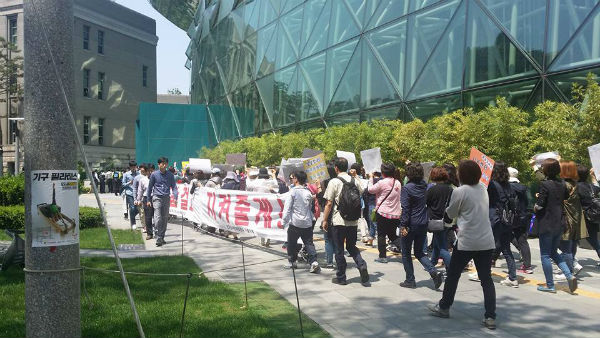
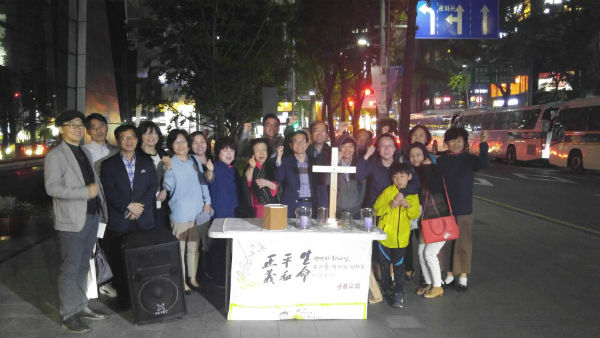
This is why many of the South Korean people do not want to be embroiled in any type of US tensions or confrontation against China, Russia, North Korea, Iran, and many other countries.  In this regard, the National THAAD Countermeasure Council in South Korea has begun a public campaign against the deployment of the US missile shield and THAAD to their country. One of their demonstrations was held in Seoul on July 16, 2016. Trying to obfuscate the facts, most of the media in South Korea overlooked the event or casually mentioned it. The following is a brief article from South Korean news outlet MinPlus about the event.

 Mahdi Darius Nazemroaya, Asia-Pacific Research Editor, 25 July 2016.


Seoul — The National THAAD Countermeasure Council (preparing committee) held a peaceful gathering that demands to lift the THAAD deployment decision on the 16th at Cheonggye Plaza.

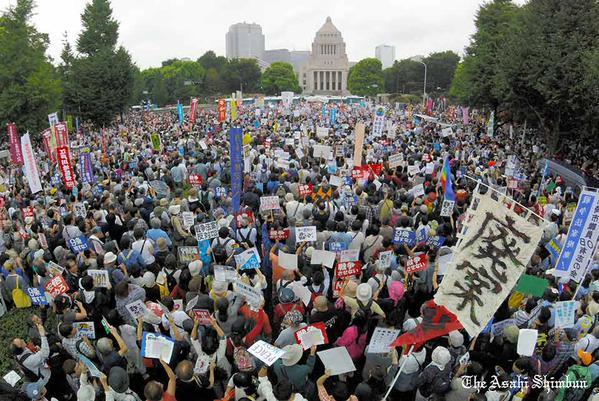
At the gathering, representatives from various civic organizations gave speeches against the THAAD deployment. Despite the heavy rain, the citizens who gathered for the gathering marched to the US Embassy after the gathering, expressing their willfulness to demand the lift of the THAAD deployment decision.

Choi Jong Jin, the acting chairman to the Korean Confederation of Trade Unions, said in his speech, “We now are here to show that the opposition against the THAAD deployment is the will of the whole Korean people, not just that of Seongju [where the missile shield is to be deployed] residents. The Korean Confederation of Trade Unions will be in the center of the struggle to block up the THAAD deployment which threatens peace in Northeast Asia and makes the conditions of the Korean economy even more difficult.”

Park Seok Woon, the Korean Alliance of Progressive Movements co-chairman, insisted, “It has already been proved that the THAAD cannot intercept the Northern missiles. We do have to block up the THAAD deployment that makes the Korean Peninsula the arena of military competition toward the new cold war.”

The National Countermeasure Council holds ‘the Nationwide Peace Gathering to stop the THAAD Deployment in South Korea’ next weekend.

This article was edited by Asia-Pacific Research.


  • Posted in Asian @as
  • Comments Off on South Koreans Say No to War and Rally Against Joining the US Missile Shield Targeting China, Russia, and North Korea

The Conversation is fact-checking claims made on Q&A, broadcast Mondays on the ABC at 9:35 pm. Thank you to everyone who sent us quotes for checking via Twitter using hashtags #FactCheck and #QandA, on Facebook or by email.

Senator-elect Pauline Hanson faced heavy questioning on Monday night’s Q&A program during a broad-ranging and often heated debate about Islam, radicalisation and terrorism [APR editor’s note, MDN: Hanson was expelled from the Liberal Party of Australia in 1996 for offensive comments about the Aborigine people of Australia. She is the leader and founder of the Australian political party One Nation and has made a career out of controversy. She has been denounced by the indigenous Aborigine community and many other Australians as an ignorant  bigot catering to anti-Aborigine, anti-Asian, and anti-Muslim perceptions by making proposals to discriminate against them and by voicing her opposition to immigration.].

Hanson criticised the Grand Mufti of Australia, a senior Islamic scholar, for not condemning recent overseas terrorist attacks. In response to a question from a Muslim audience member, Hanson said that “your Grand Mufti won’t even come out and condemn the terrorist attacks that’s happened overseas”.

Is that right?

Checking the Source

The Conversation asked Hanson’s spokesman for sources to support her assertion, but did not hear back before the publication deadline.

However, we can test her statement against publicly available evidence.

Who is the Grand Mufti and what has he said about terrorism?

The Grand Mufti of Australia is Dr Ibrahim Abu Mohammed, an Islamic scholar from the Australian National Imams Council (ANIC). ANIC is made up of Imams from across Australia representing their respective communities.

Following the Paris attacks in late 2015, ANIC issued a statement that said the Grand Mufti “mourned the loss of innocent lives due to the recent terrorist attacks in France”. It also said that:

We would like to convey our deepest condolences to the families and friends of the deceased. We reiterate that the sanctity of human life is guaranteed in Islam. These recent incidents highlight the fact that current strategies to deal with the threat of terrorism are not working. It is therefore imperative that all causative factors such as racism, Islamophobia, curtailing freedoms through securitisation, duplicitous foreign policies and military intervention must be comprehensively addressed.

Critics said at the time that this initial response to the Paris attacks didn’t go far enough or appeared to blame Western society for the attacks.

Two days later, ANIC issued a clarification saying that:

We wish to emphasise it is incorrect to imply that the reference to causative factors provides justification for these acts of terrorism. There is no justification for the taking of innocent lives. The sanctity of human life is guaranteed in Islam. Dr Ibrahim Abu Mohamed and ANIC have consistently and unequivocally condemned all forms of terrorist violence. The Grand Mufti on 15th September 2014 said about ISIS that: “These criminals are committing crimes against humanity and sins against God.”

Previous and subsequent statements issued by ANIC and the Grand Mufti have condemned terrorist acts and other forms of violence committed overseas.

The Grand Mufti also used Facebook to condemn the July 2016 attacks in Nice:

More generally, the Grand Mufti has supported a fatwa (or Islamic legal ruling) against joining Islamic State.

“Your Grand Mufti”

It is worth noting that the phrase “your Grand Mufti” is also misleading. It may convey the idea that the Grand Mufti of Australia represents all Muslims in Australia. That is not the case. In Australia, Islam has no easily defined hierarchy and ANIC is not the only body representing Muslims or Islamic scholars in Australia.

According to my research, many Muslims in Australia support and respect the position of the Grand Mufti; however, they do not always support the person in the position or respect their religious credentials.

Australian Muslim communities are not homogeneous and are made up of many different culturally diverse groups. A 2015 report on the demographic and social profile of Muslims in Australia, prepared by Professor Riaz Hassan from the University of South Australia, noted that:

According to the 2011 Australian Census there were 476,290 Muslims in Australia, of whom about 40% were Australian born. The rest came from 183 countries, making Australian Muslims one of the most ethnically and nationally heterogeneous religious communities.

There are also significant divisions in faith. The same report said that while most Australian Muslims are Sunni, there is a significant minority of Shi’ite Muslims and smaller numbers of Bektashis, Ahmadis, Alawis and Druze.

Lastly, many commentators and observers have advanced the view that it is unfair to expect Muslims and Muslim public figures to repeatedly publicly condemn every incident involving Muslims around the world.

Verdict

Pauline Hanson’s statement that “your Grand Mufti won’t even come out and condemn the terrorist attacks that’s happened overseas” was not correct.

Clarke Jones is the co-director of the Australian Intervention Support Hub (AISH) at Australian National University.

Foreign Service Officer Richard Cabot Howland, who was stationed in Jakarta from 1965 to 1966 at the Embassy in Indonesia, in 1970 published an article in the classified internal journal of the Central Intelligence Agency, Studies in Intelligence (“The Lessons of the September 30 Affair,” Vol. 14, Fall 1970: pp.13–28). The article was approved for declassification and release to the public in 1994 by the CIA. It is available at the National Archives and Records Administration, RG 263, CIA Records, Studies in Intelligence. To date it is only one of two documents from the CIA’s internal journal that have been declassified about the involvement of the US in the 1965 coup and massacres in Indonesia. The other is an article written by John T. Pizzicaro (“The 30 September Movement in Indonesia,” Fall 1969) and the other by foreign service officer Richard Cabot Howland (“The Lessons of the September 30 Affair,” Fall 1970).

There, however, is a problem. Despite admitting its involvement in the mass killings in 1965, the CIA has sought to blame the victims for their own murders. In the words of Prof. John Rossa and Prof. Joseph Nevins, CIA officials tried to blame “the victims of the killings — the supporters of the Communist Party of Indonesia (PKI) — for their own deaths.” The text below is the analysis co-authored by Rossa and Nevins that looks at the data the US and CIA itself released about the involvement of Washington in the 1965 coup in Indonesia.

Mahdi Darius Nazemroaya, Asia-Pacific Research Editor, 22 July 2016.


 “One of the worst mass murders of the twentieth century.” That was how a CIA publication described the killings that began forty years ago last month in Indonesia. It was one of the few statements in the text that was correct. The 300-page text was devoted to blaming the victims of the killings — the supporters of the Communist Party of Indonesia (PKI) — for their own deaths. The PKI had supposedly attempted a coup d’état and a nationwide uprising called the September 30th Movement (which, for some unknown reason, began on October 1). The mass murder of hundreds of thousands of the party’s supporters over subsequent months was thus a natural, inevitable, and justifiable reaction on the part of those non-communists who felt threatened by the party’s violent bid for state power. The killings were part of the “backfire” referred to in the title: Indonesia ­ 1965: The Coup that Backfired. The author of this 1968 report, later revealed to be Helen Louise Hunter, acknowledged the massive scale of the killings only to dismiss the necessity for any detailed consideration of them. She concentrated on proving that the PKI was responsible for the September 30th Movement while consigning the major issue, the anti-PKI atrocities, to a brief, offhanded comment. [1]

Hunter’s CIA report accurately expressed the narrative told by the Indonesian army commanders as they organized the slaughter. That narrative rendered the September 30th Movement ­ a disorganized, small-scale affair that lasted about 48 hours and resulted in a grand total of 12 deaths, among them six army generals ­ into the greatest evil ever to befall Indonesia [2]. The commander of the army, Major General Suharto, justified his acquisition of emergency powers in late 1965 and early 1966 by insisting that the September 30th Movement was a devious conspiracy by the PKI to seize state power and murder all of its enemies. Suharto’s martial law regime detained some 1.5 million people as political prisoners (for varying lengths of time), and accused them of being “directly or indirectly involved in the September 30th Movement.” The hundreds of thousands of people shot, stabbed, bludgeoned, or starved to death were labeled perpetrators, or would-be perpetrators of atrocities, just as culpable for the murder of the army generals as the handful of people who were truly guilty.

The September 30th Movement was Suharto’s Reichstag fire: a pretext for destroying the communist party and seizing state power. As with the February 1933 fire in the German parliament that Hitler used to create a hysterical, crisis-filled atmosphere, the September 30th Movement was exaggerated by Suharto’s clique of officers until it assumed the proportions of a wild, vicious, supernatural monster. The army whipped up an anti-communist propaganda campaign from the early days of October 1965: “the PKI” had castrated and tortured the seven army officers it had abducted in Jakarta, danced naked and slit the bodies of the army officers with a hundred razor blades, drawn up hit lists, dug thousands of ditches around the country to hold countless corpses, stockpiled guns imported from China, and so on. The army banned many newspapers and put the rest under army censorship. It was precisely this work of the army’s psychological warfare specialists that created the conditions in which the mass murder of “the PKI” seemed justified.

The question as to whether or not the PKI actually organized the September 30th Movement is important only because the Suharto regime made it important. Otherwise, it is irrelevant. Even if the PKI had nothing whatsoever to do with the movement, the army generals would have blamed the party for it. As it was, they made their case against the PKI largely on the basis of the transcripts of the interrogations of those movement participants who hadn’t already been summarily executed. Given that the army used torture as standard operating procedure for interrogations, the statements of the suspects cannot be trusted. Hunter’s CIA report, primarily based on those transcripts, is as reliable as an Inquisition text on witchcraft.

The PKI as a whole was clearly not responsible for the September 30th Movement. The party’s three million members did not participate in it. If they had, it would not have been such a small-scale affair. The party chairman, D.N. Aidit, however, does seem to have played a key role. He was summarily and secretly executed in late 1965, as were two of the three other core Politburo leaders (Lukman and Njoto), before they could provide their accounts. The one among them who survived the initial terror, the general secretary of the party, Sudisman, admitted in the military’s kangaroo court in 1967 that the PKI as an institution knew nothing of the September 30th Movement but that certain leaders were involved in a personal capacity. If the movement’s leaders had been treated as the leaders of previous revolts against the postcolonial government, they would have been arrested, put on trial, and sentenced. All the members of their organizations would not have been imprisoned or massacred.

With so little public discussion and so little scholarly research about the 1965-66 mass killings, they remain poorly understood. Many people outside of Indonesia believe that the victims were primarily Indonesian Chinese. While some Indonesian Chinese were among the victims, they were by no means the majority. The violence targeted members of the PKI and the various organizations either allied to the party or sympathetic to it, whatever ethnicity they happened to be: Javanese, Balinese, Sundanese, etc. It was not a case of ethnic cleansing. Many people imagine that the killings were committed by frenzied mobs rampaging through villages and urban neighborhoods. But recent oral history research suggests that most of the killings were executions of detainees. [3] Much more research is needed before one can arrive at definitive conclusions.

President Sukarno, the target of the PKI’s alleged coup attempt, compared the army’s murderous violence against those labeled PKI to a case of someone “burning down the house to kill a rat.” He routinely protested the army’s exaggerations of the September 30th Movement. It was, he said, nothing more than “a ripple in the wide ocean.” His inability or unwillingness to muster anything more than rhetorical protests, however, ultimately doomed his rule. In March 1966, Suharto grabbed the authority to dismiss, appoint, and arrest cabinet ministers, even while maintaining Sukarno as figurehead president until March 1967. The great orator who had led the nationalist struggle against the Dutch, the cosmopolitan visionary of the Non-Aligned Movement, was outmaneuvered by a taciturn, uneducated, thuggish, corrupt army general from a Javanese village.

Suharto, a relative nobody in Indonesian politics, moved against the PKI and Sukarno with the full support of the U.S. government. Marshall Green, American ambassador to Indonesia at the time, wrote that the embassy had “made clear” to the army that Washington was “generally sympathetic with and admiring” of its actions. [4] U.S. officials went so far as to express concern in the days following the September 30th Movement that the army might not do enough to annihilate the PKI. [5] The U.S. embassy supplied radio equipment, walkie-talkies, and small arms to Suharto so that his troops could conduct the nationwide assault on civilians. [6] A diligent embassy official with a penchant for data collection did his part by handing the army a list of thousands of names of PKI members. [7] Such moral and material support was much appreciated in the Indonesian army. As an aide to the army’s chief of staff informed U.S. embassy officials in October 1965, “This was just what was needed by way of assurances that we weren’t going to be hit from all angles as we moved to straighten things out here.”[8]

This collaboration between the U.S. and the top army brass in 1965 was rooted in Washington’s longstanding wish to have privileged and enhanced access to Southeast Asia’s resource wealth. Many in Washington saw Indonesia as the region’s centerpiece. Richard Nixon characterized the country as “containing the region’s richest hoard of natural resources” and “by far the greatest prize in the South-East Asian area.” [9] Two years earlier, in a 1965 speech in Asia, Nixon had argued in favor of bombing North Vietnam to protect Indonesia’s “immense mineral potential.” [10] But obstacles to the realization of Washington’s geopolitical-economic vision arose when the Sukarno government emerged upon independence in Indonesia. Sukarno’s domestic and foreign policy was nationalist, nonaligned, and explicitly anti-imperialist. Moreover, his government had a working relationship with the powerful PKI, which Washington feared would eventually win national elections.

Eisenhower’s administration attempted to break up Indonesia and sabotage Sukarno’s presidency by supporting secessionist revolts in 1958.[11] When that criminal escapade of the Dulles brothers failed, the strategists in Washington reversed course and began backing the army officers of the central government. The new strategy was to cultivate anti-communist officers who could gradually build up the army as a shadow government capable of replacing President Sukarno and eliminating the PKI at some future date. The top army generals in Jakarta bided their time and waited for the opportune moment for what U.S. strategists called a final “showdown” with the PKI. [12] That moment came on October 1, 1965.

The destruction of the PKI and Sukarno’s ouster resulted in a dramatic shift in the regional power equation, leading Time magazine to hail Suharto’s bloody takeover as “The West’s best news for years in Asia.” [13] Several years later, the U.S. Navy League’s publication gushed over Indonesia’s new role in Southeast Asia as “that strategic area’s unaggressive, but stern, monitor,” while characterizing the country as “one of Asia’s most highly developed nations and endowed by chance with what is probably the most strategically authoritative geographic location on earth.” [14] Among other things, the euphoria reflected just how lucrative the changing of the guard in Indonesia would prove to be for Western business interests.

Suharto’s clique of army officers took power with a long-term economic strategy in mind. They expected the legitimacy of their new regime would derive from economic growth and that growth would derive from bringing in Western investment, exporting natural resources to Western markets, and begging for Western aid. Suharto’s vision for the army was not in terms of defending the nation against foreign aggression but defending foreign capital against Indonesians. He personally intervened in a meeting of cabinet ministers in December 1965 that was discussing the nationalization of the oil companies Caltex and Stanvac. Soon after the meeting began, he suddenly arrived by helicopter, entered the chamber, and declared, as the gleeful U.S. embassy account has it, that the military “would not stand for precipitous moves against oil companies.” Faced with such a threat, the cabinet indefinitely postponed the discussion. [15] At the same time, Suharto’s army was jailing and killing union leaders at the facilities of U.S. oil companies and rubber plantations. [16]

Once Suharto decisively sidelined Sukarno in March 1966, the floodgates of foreign aid opened up. The U.S. shipped large quantities of rice and cloth for the explicit political purpose of shoring up his regime. Falling prices were meant to convince Indonesians that Suharto’s rule was an improvement over Sukarno’s. The regime’s ability over the following years to sustain economic growth via integration with Western capital provided whatever legitimacy it had. Once that pattern of growth ended with the capital flight of the 1997 Asian economic crisis, the regime’s legitimacy quickly vanished. Middle class university students, the fruits of economic growth, played a particularly important role in forcing Suharto from office. The Suharto regime lived by foreign capital and died by foreign capital.

By now it is clear that the much ballyhooed economic growth of the Suharto years was severely detrimental to the national interest. The country has little to show for all the natural resources sold on the world market. Payments on the foreign and domestic debt, part of it being the odious debt from the Suharto years, swallow up much of the government’s budget. With health care spending at a minimum, epidemic and preventable diseases are rampant. There is little domestic industrial production. The forests from which military officers and Suharto cronies continue to make fortunes are being cut down and burned up at an alarming rate. The country imports huge quantities of staple commodities that could be easily produced on a larger scale in Indonesia, such as sugar, rice, and soybeans. The main products of the villages now are migrant laborers, or “the heroes of foreign exchange,” to quote from a lighted sign at the Jakarta airport.

Apart from the pillaging of Indonesia’s resource base, the Suharto regime caused an astounding level of unnecessary suffering. At his command, the Indonesian military invaded neighboring East Timor in 1975 after receiving a green light from President Gerald Ford and his secretary of state, Henry Kissinger. The result was an occupation that lasted for almost 24 years and left a death toll of tens of thousands of East Timorese. Within Indonesia proper, the TNI committed widespread atrocities during counterinsurgency campaigns in the resource-rich provinces of West Papua and Aceh, resulting in tens of thousands of additional fatalities.

With Suharto’s forced resignation in 1998, significant democratic space has opened in Indonesia. There are competitive national and local elections. Victims of the “New Order” and their families are able to organize. There is even an official effort to create a national truth commission to investigate past atrocities. Nevertheless, the military still looms large over the country’s political system. As such, there has not been a thorough investigation of any of the countless massacres that took place in 1965-66. History textbooks still focus on the September 30th Movement and make no mention of the massacres. Similarly, no military or political leaders have been held responsible for the Suharto-era crimes (or those that have taken place since), thus increasing the likelihood of future atrocities. This impunity is a source of continuing worry for Indonesia’s civil society and restless regions, as well as poverty-stricken, now-independent East Timor. It is thus not surprising that the government of the world’s newest country feels compelled to play down demands for justice by its citizenry and emphasize an empty reconciliation process with Indonesia. Meanwhile in the United States, despite political support and billions of dollars in U.S. weaponry, military training and economic assistance to Jakarta over the preceding four decades, Washington’s role in Indonesia’s killing fields of 1965-66 and subsequent brutality has been effectively buried, thus enabling the Bush administration’s current efforts to further ties with Indonesia’s military, as part of the global “war on terror.” [17] Suharto’s removal from office has not led to radical changes in Indonesia’s state and economy.

Sukarno used to indict Dutch colonialism by saying that Indonesia was “a nation of coolies and a coolie among nations.” Thanks to the Suharto years, that description remains true. The principles of economic self-sufficiency, prosperity, and international recognition for which the nationalist struggle was fought now seem as remote as ever. It is encouraging that many Indonesians are now recalling Sukarno’s fight against Western imperialism (first the Netherlands and then the U.S.) after experiencing the misery that Suharto’s strategy of collaboration has wrought. In his “year of living dangerously” speech in August 1964 ­ a phrase remembered in the West as just the title of a 1982 movie with Mel Gibson and Sigourney Weaver ­ Sukarno spoke about the Indonesian ideal of national independence struggling to stay afloat in “an ocean of subversion and intervention from the imperialists and colonialists.” Suharto’s U.S.-assisted takeover of state power forty years ago last month drowned that ideal in blood, but it might just rise again during the ongoing economic crisis that is endangering the lives of so many Indonesians.

John Roosa is an assistant professor of history at the University of British Columbia.

Joseph Nevins is an assistant professor of geography at Vassar College.

NOTES

1. A former CIA agent who worked in Southeast Asia, Ralph McGehee, noted in his memoir that the agency compiled a separate report about the events of 1965, one that reflected its agents’ honest opinions, for its own in-house readership. McGehee’s description of it was heavily censored by the agency when it vetted an account he first published in the April 11, 1981 edition of The Nation. Deadly Deceits: My 25 Years in the CIA (New York: Sheridan Square, 1983), pp. 57-58. Two articles in the agency’s internal journal Studies in Intelligence have been declassified: John T. Pizzicaro, “The 30 September Movement in Indonesia,” (Fall 1969); Richard Cabot Howland, “The Lessons of the September 30 Affair,” (Fall 1970). The latter is available online: http://www.odci.gov/csi/kent_csi/docs/v14i2a02p_0001.htm

2. In Jakarta, the movement’s troops abducted and killed six army generals and a lieutenant taken by mistake from the house of the seventh who avoided capture. In the course of these abductions, a five year-old daughter of a general, a teenaged nephew of another general, and a security guard were killed. In Central Java, two army colonels were abducted and killed.

3. John Roosa, Ayu Ratih, and Hilmar Farid, eds. Tahun yang Tak Pernah Berakhir: Memahami Pengalaman Korban 65; Esai-Esai Sejarah Lisan [The Year that Never Ended: Understanding the Experiences of the Victims of 1965; Oral History Essays] (Jakarta: Elsam, 2004). Also consider the massacre investigated in Chris Hilton’s very good documentary film Shadowplay (2002).

4. Telegram from the Embassy in Indonesia to Department of State, November 4, 1965, in United States Department of State, Foreign Relations of the United States, 1964-1968, vol. 26, p. 354. This FRUS volume is available online at the National Security Archive website:http://www.gwu.edu/~nsarchiv/NSAEBB/NSAEBB52/#FRUS

5. Telegram from the Embassy in Jakarta to Department of State, October 14, 1965. Quoted in Geoffrey Robinson, The Dark Side of Paradise: Political Violence in Bali (Ithaca: Cornell University Press, 1995), p. 283.

6. Frederick Bunnell, “American ‘Low Posture’ Policy Toward Indonesia in the Months Leading up to the 1965 ‘Coup’,” Indonesia, 50 (October 1990), p. 59.

7. Kathy Kadane, “Ex-agents say CIA Compiled Death Lists for Indonesians,” San Francisco Examiner, May 20, 1990, available online at http://www.pir.org/kadane.html

8. CIA Report no. 14 to the White House (from Jakarta), October 14, 1965. Cited in Robinson, The Dark Side of Paradise, p. 283.

9. Richard Nixon, “Asia After Viet Nam,” Foreign Affairs (October 1967), p. 111.

10. Quoted in Peter Dale Scott, “Exporting Military-Economic Development: America and the Overthrow of Sukarno,” in Malcolm Caldwell (ed.), Ten Years’ Military Terror in Indonesia (Nottingham (U.K.): Bertrand Russell Peace Foundation for Spokesman Books, 1975), p. 241.

11. Audrey R. Kahin and George McT. Kahin, Subversion as Foreign Policy: The Secret Eisenhower and Dulles Debacle in Indonesia (New York: The New Press, 1995), p. 1.

12. Bunnell, “American ‘Low Posture’ Policy,” pp. 34, 43, 53-54.

13. Time, July 15, 1966. Also see Noam Chomsky, Year 501: The Conquest Continues (Boston: South End Press, 1993), pp. 123-131.

14. Lawrence Griswold, “Garuda and the Emerald Archipelago: Strategic Indonesia Forges New Ties with the West,” Sea Power (Navy League of the United States), vol. 16, no. 2 (1973), pp. 20, 25.

15. Telegram 1787 from Jakarta to State Department, December 16, 1965, cited in Brad Simpson, “Modernizing Indonesia: U.S.­Indonesian Relations, 1961-1967,” (Ph.D. dissertation, Department of History, Northwestern University, 2003), p. 343.

16. Hilmar Farid, “Indonesia’s Original Sin: Mass Killings and Capitalist Expansion 1965-66,” Inter-Asia Cultural Studies, vol. 6, no. 1 (March 2005).

17. For information on U.S.-Indonesia military ties, see the website of the East Timor Indonesia Action Network at http://www.etan.org/

  • Posted in Asian @as
  • Comments Off on The 1965 Mass Killings in Indonesia: CIA Blames the Victims For Being Murdered

Russia and China may create a unified missile defense system for the Shanghai Cooperation Organization. That’s the conclusion of experts speaking at a forum dedicated to the US deployment of the THAAD anti-ballistic missile system in South Korea. What would the Russian-Chinese system look like? Sputnik investigates.

On Monday, experts in Moscow and Beijing spoke via video conference on the implications for regional security of the US deployment of missile defense systems in South Korea. And while the forum focused mostly on political and military implications of the THAAD deployment, experts also intrigued observers by indicating that it was possible for Russia and China to join together to create a single missile defense shield over the entirety of the Shanghai Cooperation Organization, the political, economic and military organization involving much of eastern Eurasia.

 Regarding the THAAD deployment, Moscow has repeatedly indicated that it was categorically opposed to the move. THAAD, capable of monitoring ballistic and aerial targets at distances of up to 1,500 km, is expected to give the US military the capability to ‘see’ into the territory of the Russian Federation, and even further into that of China.

Speaking at the video conference on Monday, Vladimir Petrovsky, a senior researcher at the Moscow-based Center for the Studies and Forecasting of Russia-China Relations at the Institute for Far Eastern Studies, explained that the potential for a joint missile defense shield exists. Moreover, such a shield would be entirely appropriate given recent US moves, from its deployment of missile shield components in Eastern Europe to the deployment of THAAD in South Korea.

“Russia and China could become the driving force in the area of missile defense. Special attention should be paid to the land-based interception systems which we have at our disposal,” the analyst said.

Recently, the analyst recalled, Japan, South Korea and the United States conducted drills practicing the interception of ballistic missiles using the maritime-based US Aegis system. The appropriate response from Moscow and Beijing, according to Petrovsky, would be for the two countries’ air defense forces to conduct similar joint exercises at the Ashuluk range in Russia’s Astrakhan region.

Asked to comment on Petrovsky’s words, experts speaking to the independent online news and analysis hub Svobodnaya Pressa indicated that a joint missile defense system was entirely within the realm of possibility.

Vladimir Evseev, the deputy director at the CIS Institute, indicated that he believes the creation of a united anti-missile defense system is definitely possible. This is what he said:

“Just to specify, we are talking about an anti-missile defense system, not air defense in general. In May, Russia and China staged their first joint missile defense exercises using computer simulations in Moscow. This was the first step in a plan to create a joint missile defense system. The next could be to gather real-world experience on the interception of ballistic targets, for example, at the Ashuluk range.”

The expert noted that at present, China has two battalions of S-300PMU surface-to-air missile systems, two regiments of S-300PMU-1s and four regiments of S-300PMU-2s. Moreover, they have their own domestically developed SAM system – the HQ-9, created on the basis of its Russian analogues. This includes a maritime variant of the complex – the HHQ-9. “In addition, China has an analogue to the American Aegis system – built on the basis of France’s Thomson-CSF TAVITA.”

These systems are capable of intercepting ballistic targets at altitudes of up to 30 km and speeds of 1.5-2 km per second. Russia soon plans to supply Beijing with the S-400 Triumf; that system’s basic missiles are also capable of intercepting targets at altitudes of about 30 km, but at higher precision.

 Russian defense systems, in addition to the S-300 and S-400, also include the Moscow Air Defense System’s A-135 missile, capable of intercepting enemy missiles at altitudes of up to 60 km.

“With regard to missile attack early warning systems (EWS), that of Russia is of course more advanced, and includes ground-based early warning radar (including the Daryal, Volga, Don-2N and Voronezh radar systems), plus the group of satellites in high elliptical and geostationary orbit.”

Effectively, Evseev noted that “based on available funds, we could carry out exercises and make an attempt to intercept a ballistic target over Russian territory using joint calculations and, later on, eventually strive for the creation of collective missile defense.”

“Such a move would serve as an effective response to US plans to deploy elements of missile defense in space. It is space-based ABM specifically which threatens to provide guaranteed interception – during the active phase of the missile’s flight. And at this stage it is not necessary to make choices about the real targets within a cloud of decoys, as is the case when interception is carried out during the passive phase,” nearer to the ground.

Ultimately, the analyst warned, if the US continues to develop its space-based missile defense components, “the only effective means against such a system would be the use of anti-satellite weapons. We know that China has tested with such systems, and we have similar designs, even if they are not widely advertised. In my view, we can only respond to Washington through the combination of military and diplomatic efforts. Diplomacy alone will not stop the construction of the US missile defense system.”

For his part, Vasily Kashin, a senior researcher at the Institute of Far Eastern Studies, noted that Russian-Chinese cooperation in the field of missile defense is possibile, although a full-scale joint shield is unlikely.

At the same time, Kashin indicated, “creating a collective missile defense system in the framework of the SCO is not possible by definition, given the specifics of the organization and the policies of its members. For example, a country like Uzbekistan may have its own dissenting opinion on the issue, not to mention the positions of India and Pakistan,” set to join the SCO in 2017.

“As for collective missile defense between Russia and China, it is an unlikely scenario, but possible, given that cooperation in this field already exists. China is now in the process of creating an early warning system, and is developing a strategy for missile defense, including theater missile defense.”

In this sense, Kashin suggested, “Beijing is naturally interested in our experience and, possibly, in an automated system of data exchange. As we know, missiles, if they begin their flight from the continental United States, will fly to Russia and China over the North Pole. In principle, the exchange of data in the event of such a global strike may be of interest to our countries. Something of the kind has already been implemented by the US: The Americans receive real-time data from the early warning radar they sold to Taiwan, [and] the same thing seems likely with South Korea.”

Still, according to the analyst, a genuine joint Russian-Chinese system of missile defense will most likely remain on the drawing board.

The Hague-based International People’s Tribunal has ruled that the Indonesian regime that replaced Indonesian President Sukarno committed crimes against humanity in 1965. The governments of Australia, Britain, and the United States have also been pronounced guilty as complicit partners in the massacre of 500,000 to 1000,000 people or more in Indonesia. People were murdered in Indonesia due to their principles, political ideology, ethnic backgrounds, and opposition to foreign influence. Albeit the ruling is an important historical acknowledgment, the assistance that the Australian, British, and US governments provided to the coup and played in the massacres is not a secret.

Asia-Pacific Research presents these excerpts from the Australian journalist John Pilger’s book The New Rulers of the World, which was published by Verso in 2002, in the interest of providing the historical background about the massacres that took place in Indonesia. Reading them will educate one on the despicable and criminal roles that Australia, Britain, and the US played. “There were bodies being washed up on the lawns of the British consulate in Surabaya, and British warships escorted a ship full of Indonesian troops down the Malacca Straits so that they could take part in this terrible holocaust,” for example Pilger writes. In his work John Pilger also notes that the US was directly involved in the operations of the death squads and helped compile the lists of people to be murdered while the Australian, British, and US media were used as propaganda tools to whitewash the coup and bloodbaths in Indonesia. A key point, however, that is emphasized is that the underlying economic motivations and plunder hidden behind the ideological discourse of the Cold War that really motivated the massacres in Indonesia.

Mahdi Darius Nazemroaya, Asia-Pacific Research Editor, 22 July 2016.

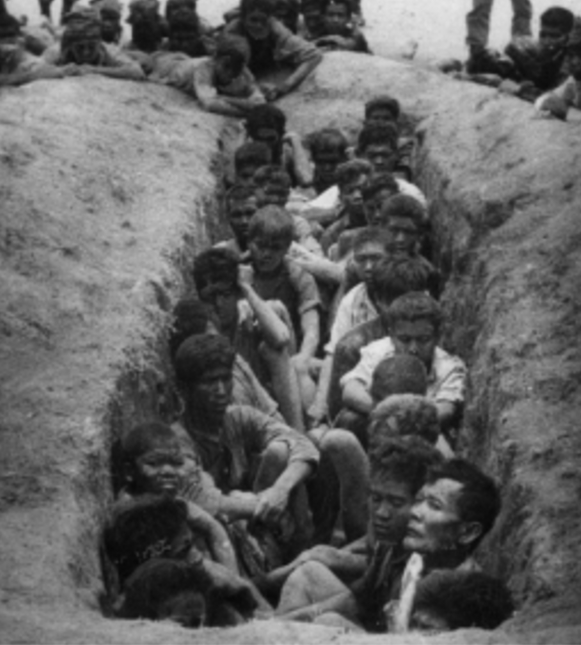
 Indonesians preparing to die in a mass grave.


Excerpts from The New Rulers of the World (Verso)

John Pilger, 2002

… according to a CIA memorandum, Prime Minister Harold Macmillan and President John Kennedy had agreed to ‘liquidate President Sukarno, depending on the situation and available opportunities’. The CIA author added, ‘It is not clear to me whether murder or overthrow is intended by the word liquidate.’

Sukarno was a populist, the founder of modern Indonesia and of the non-aligned movement of developing countries, which he hoped would forge a genuine ‘third way’ between the spheres of the two superpowers. In 1955, he convened the ‘Asia-Africa Conference’ in the Javanese hill city of Bandung. It was the first time the leaders of the developing world, the majority of humanity, had met to forge common interests: a prospect that alarmed the western powers, especially as the vision and idealism of nonalignment represented a potentially popular force that might seriously challenge neo-colonialism. The hopes invested in such an unprecedented meeting are glimpsed in the faded tableaux and black-and-white photographs in the museum at Bandung and in the forecourt of the splendid art deco Savoy Hotel, where the following Bandung Principles are displayed:

I – Respect for fundamental human rights and the principles of the United Nations Charter.

2 – Respect for the sovereignty and territorial integrity of all nations.

3 – The recognition of the equality of all peoples.

4 – The settlement of disputes by peaceful means.

Sukarno could be a democrat and a demagogue. For a time, Indonesia was a parliamentary democracy, then became what he called a ‘guided democracy’. He encouraged mass trade unions and peasant, women’s and cultural movements. Between 1959 and 1965, more than 15 million people joined political parties or affiliated mass organisations that were encouraged to challenge British and American influence in the region. With 3 million members, the PKI was the largest communist party in the world outside the Soviet Union and China. According to the Australian historian Harold Crouch, ‘the PKI had won widespread support not as a revolutionary party but as an organisation defending the interests of ‘the poor within the existing system’. It was this popularity, rather than any armed insurgency, that alarmed the Americans. Like Vietnam to the north, Indonesia might ‘go communist’ .

In 1990, the American investigative journalist Kathy Kadane revealed the extent of secret American collaboration in the massacres of 1965-66 which allowed Suharto to seize the presidency. Following a series of interviews with former US officials, she wrote, ‘They systematically compiled comprehensive lists of communist operatives. As many as 5,000 names were furnished to the Indonesian army, and the Americans later checked off the names of those who had been killed or captured.’ One of those interviewed was Robert J Martens, a political officer in the US embassy in Jakarta. ‘It was a big help to the army,’ he said. ‘They probably killed a lot of people and I probably have a lot of blood on my hands, but that’s not all bad. There’s a time when you have to strike hard at a decisive moment.’ Joseph Lazarsky, the deputy CIA station chief in Jakarta, said that confirmation of the killings came straight from Suharto’s headquarters. ‘We were getting a good account in Jakarta of who was being picked up,’ he said. ‘The army had a “shooting list” of about 4,000 or 5,000 people. They didn’t have enough goon squads to zap them all, and some individuals were valuable for interrogation. The infrastructure [of the PKI] was zapped almost immediately. We knew what they were doing . . . Suharto and his advisers said, if you keep them alive you have to feed them.’

Having already armed and equipped much of the army, Washington secretly supplied Suharto’s troops with a field communications network as the killings got under way. Flown in at night by US air force planes based in the Philippines, this was state-of-the-art equipment, whose high frequencies were known to the CIA and the National Security Agency advising President Johnson. Not only did this allow Suharto’s generals to co-ordinate the killings, it meant that the highest echelons of the US administration were listening in and that Suharto could seal off large areas of the country. Although there is archive film of people being herded into trucks and driven away, a single fuzzy photograph of a massacre is, to my knowledge, the only pictorial record of what was Asia’s holocaust.

The American Ambassador in Jakarta was Marshall Green, known in the State Department as ‘the coupmaster’. Green had arrived in Jakarta only months earlier, bringing with him a reputation for having masterminded the overthrow of the Korean leader Syngman Rhee, who had fallen out with the Americans. When the killings got under way in Indonesia, manuals on student organising, written in Korean and English, were distributed by the US embassy to the Indonesian Student Action Command (KAMI), whose leaders were sponsored by the CIA.

On October 5, 1965, Green cabled Washington on how the United States could ‘shape developments to our advantage’. The plan was to blacken the name of the PKI and its ‘protector’, Sukarno. The propaganda should be based on ‘[spreading] the story of the PKI’s guilt, treachery and brutality’. At the height of the bloodbath, Green assured General Suharto: ‘The US is generally sympathetic with and admiring of what the army is doing.” As for the numbers killed, Howard Federspiel, the Indonesia expert at the State Department’s Bureau of Intelligence and Research in 1965, said, ‘No one cared, as long as they were communists, that they were being butchered. No one was getting very worked up about it.’

The Americans worked closely with the British, the reputed masters and inventors of the ‘black’ propaganda admired and adapted by Joseph Goebbels in the 1930s. Sir Andrew Gilchrist, the Ambassador in Jakarta, made his position clear in a cable to the Foreign Office: ‘I have never concealed from you my belief that a little shooting in Indonesia would be an essential preliminary to effective change.’ With more than ‘a little shooting’ under way, and with no evidence of the PKI’s guilt, the embassy advised British intelligence headquarters in Singapore on the line to be taken, with the aim of ‘weakening the PKI permanently’ .

Suitable propaganda themes might be: PKI brutality in murdering Generals and [Foreign Minister] Nasution’s daughter . . . PKI subverting Indonesia as agents of foreign Communists . . . But treatment will need to be subtle, e.g. (a) all activities should be strictly unattributable, (b) British participation or co-operation should be carefully concealed.

Within two weeks, an office of the Foreign Office’s Information Research Department (IRD) had opened in Singapore. The IRD was a top-secret, cold war propaganda unit headed by Norman Reddaway, one of Her Majesty’s most experienced liars. It would be salutary for journalists these days to study the critical role western propaganda played then, as it does now, in shaping the news. Indeed, Reddaway and his colleagues manipulated the press so expertly that he boasted to Gilchrist in a letter marked ‘secret and personal’ that the story he had promoted – that Sukarno’s continued rule would lead to a communist takeover – ‘went all over the world and back again’ . He described how an experienced Fleet Street journalist agreed ‘to give exactly your angle on events in his article … . i.e. that this was a kid glove coup without butchery.’

Roland Challis, the BBC’s South-East Asia correspondent, was a particular target of Reddaway, who claimed that the official version of events could be ‘put almost instantly back to Indonesia via the BBC’. Prevented from entering Indonesia along with other foreign journalists, Challis was unaware of the extent of the slaughter. ‘It was a triumph for western propaganda,’ he told me. ‘My British sources purported not to know what was going on, but they knew what the American plan was. There were bodies being washed up on the lawns of the British consulate in Surabaya, and British warships escorted a ship full of Indonesian troops down the Malacca Straits so that they could take part in this terrible holocaust. It was only much later that we learned the American embassy was supplying names and ticking them off as they were killed. There was a deal, you see. In establishing the Suharto regime, the involvement of the IMF and the World Bank was part of it. Sukarno had kicked them out; now Suharto would bring them back. That was the deal.’

With Sukarno now virtually powerless and ill, and Suharto about to appoint himself acting president, the American press reported the Washington-backed coup not as a great human catastrophe, but in terms of the new economic advantages. The massacres were described by Time as ‘The West’s Best News in Asia’. A headline in US News and World Report read: ‘Indonesia: Hope . . . where there was once none’. The renowned New York Times columnist James Reston celebrated ‘A gleam of light in Asia’ and wrote a kid-glove version that he had clearly been given. The Australian Prime Minister Harold Holt, who was visiting the US, offered a striking example of his sense of humour: ‘With 500,000 to a million communist sympathisers knocked off,’ he said approvingly, ‘I think it’s safe to assume a reorientation has taken place.’

Holt’s remark was an accurate reflection of the complicity of the Australian foreign affairs and political establishment in the agony of its closest neighbour. The Australian embassy in Jakarta described the massacres as a ‘cleansing operation’. The Australian Ambassador, KCO Shann, enthused to Canberra that the Indonesian army was ‘refreshingly determined to do over the PKI’, adding that the generals had spoken approvingly of the reporting on Radio Australia, which he described as ‘a bit dishonest’.’ In the Prime Minister’s Department, officials considered supporting ‘any measures to assist the Indonesian army … cope with the internal situation’.

In February 1966, [British] Ambassador Gilchrist wrote a report on the scale of the massacres based on the findings of the Swedish Ambassador, who had toured central and eastern Java with his Indonesian wife and had been able to speak to people out of earshot of government officials. Gilchrist wrote to the Foreign Office: ‘The Ambassador and I had discussed the killings before he left [on the tour] and he had found my suggested figure of 400,000 quite incredible. His enquiries have led him to reconsider it a very serious under-estimate. A bank manager in Surabaya with twenty employees said that four had been removed one night and beheaded . . . A third of a spinning factory’s technicians, being members of a Communist union, had been killed … The killings in Bali had been particularly monstrous. In certain areas, it was felt that not enough people [emphasis in the original] had been killed.’

On the island of Bali, the ‘reorientation’ described by Prime Minister Holt meant the violent deaths of at least 80,000 people, although this is generally regarded as a conservative figure. The many western, mostly Australian, tourists who have since taken advantage of cheap package holidays to the island might reflect that beneath the car parks of several of the major tourist hotels are buried countless bodies.

The distinguished campaigner and author Carmel Budiardjo, an Englishwoman married to a tapol and herself a former political prisoner, returned to Indonesia in 2000 and found ‘the trauma left by the killings thirty-five years ago still gripping many communities on the island’. She described meeting, in Denpasar, fifty people who had never spoken about their experiences before in public. ‘One witness,’ she wrote, ‘who was 20 years old at the time calmly told us how he had been arrested and held in a large cell by the military, 52 people in all, mostly members of mass organisations from nearby villages. Every few days, a batch of men was taken out, their hands tied behind their backs and driven off to be shot. Only two of the prisoners survived . . . Another witness, an ethnic Chinese Indonesian, gave testimony about the killing of 103 people, some as young as 15. In this case, the people were not arrested but simply taken from their homes and killed, as their names were ticked off a list.’

[…]

‘In the early sixties,’ he said, ‘the pressure on Indonesia to do what the Americans wanted was intense. Sukarno wanted good relations with them, but he didn’t want their economic system. With America, that is never possible. So he became an enemy. All of us who wanted an independent country, free to make our own mistakes, were made the enemy. They didn’t call it globalisation then; but it was the same thing. If you accepted it, you were America’s friend. If you chose another way, you were given warnings, and if you didn’t comply, hell was visited on you. But I am back; I am well; I have my family. They didn’t win.’

Ralph McGehee, a senior CIA operations officer in the 1960s, described the terror in Indonesia from 1965 – 66 as a ‘model operation’ for the American-run coup that got rid of Salvador Allende in Chile seven years later. ‘The CIA forged a document purporting to reveal a leftist plot to murder Chilean military leaders,’ he wrote, ‘[just like] what happened in Indonesia in 1965.’ He says Indonesia was also the model for Operation Phoenix in Vietnam, where American-directed death squads assassinated up to 50,000 people. ‘You can trace back all the major, bloody events run from Washington to the way Suharto came to power,’ he told me. ‘The success of that meant that it would be repeated, again and again.’

[…]

Indonesia, once owing nothing but having been plundered of its gold, precious stones, wood, spices and other natural riches by its colonial masters, the Dutch, today has a total indebtedness estimated at $262 billion, which is 170 per cent of its gross domestic product. There is no debt like it on earth. It can never be repaid. It is a bottomless hole.

  • Posted in Asian @as
  • Comments Off on How the Australian, British, and US Governments Shamelessly Helped Kill Countless People in Indonesia in 1965

Carmel Budiardjo shares her personal experience in the aftermath of 1965 and comments on the influences that led her to create TAPOL.

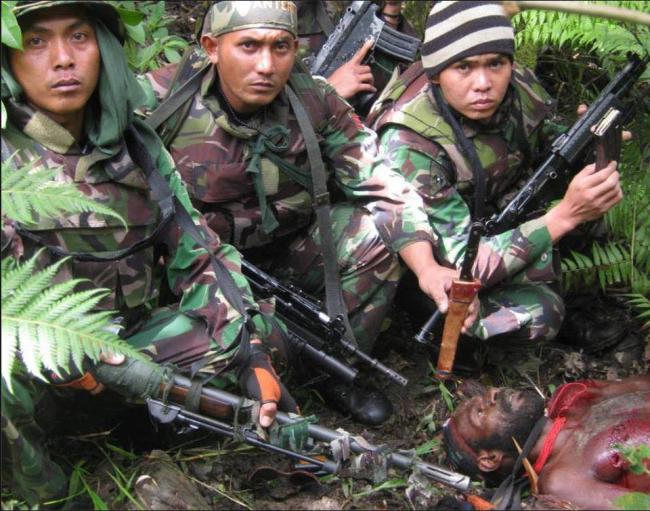
One year ago today, Indonesia’s National Commission on Human Rights, Komnas HAM, published a landmark report on its investigation into the mass killings that took place across Indonesia nearly fifty years ago in 1965/66. The Indonesian army, with the support of civilian mobs, gangsters and para-military groups, unleashed a campaign of terror against alleged members of the Communist Party of Indonesia (PKI) and associated groups, killing up to one million people and imprisoning many more.

Komnas HAM found evidence of systematic and widespread crimes against humanity, but none of its recommendations concerning a follow-up criminal investigation by the Attorney General, the establishment of a human rights court and truth and reconciliation process, and an official apology have yet been acted upon.

The remarkable multi award-winning film, THE ACT OF KILLING by Joshua Oppenheimer has recently been drawing international attention to the killings. This was one of the worst mass murders of the twentieth century, but is hardly known about when compared to the atrocities committed in Cambodia, Rwanda and Bosnia. In the past few weeks THE ACT OF KILLING has been playing to packed audiences in London and across the country.

The film is not intended for the faint-hearted. Local gangsters in Medan, North Sumatra re-enact their roles in the killings. The film shows in graphic detail how people were murdered. Men were repeatedly stabbed, leaving trails of blood and headless bodies, or strangled with wire round the neck with their bodies thrown into rivers. The latter was often the preferred option as it was ‘bloodless’ and left no evidence of the killing.

The killers describe quite calmly how they killed ‘communists’ on instructions from the Indonesian military in Jakarta.  It was led by General Suharto who commanded the army and went on to rule the country with an iron fist for more than thirty years, from 1965 – 1998.

What the film does not explain is why communists or alleged communists were disposed of so comprehensively throughout the country. By late 1965, the PKI, with around 3 million members, had become one of the largest political parties in Indonesia, with widespread support from peasants and workers.

In the mid-50s, the Party leadership declared that it would not engage in armed struggle but would try to win political influence through the ballot box and by means of pro-people policies such as supporting land reform and promoting the rights of workers and of women.

On the night of 30 September/1 October 1965, six army generals were kidnapped and killed. While to this day, no one has been able to identify who gave the order to kill, General Suharto, who was then commander of the special elite forces called KOSTRAD, blamed the PKI and issued a call for vengeance against the PKI and its many associated mass organisations and groups. These included leftwing activists, peasant groups, labour unions, artists, intellectuals and ethnic Chinese.

In the following months, large numbers of people with leftist leanings were regarded as being ‘terlibat’ or ‘involved’ in the killing of the generals and hence subject not merely to arrest but to extermination. I was living in Indonesia at the time and a member of the HSI – Association of Indonesian Academics – which was regarded as one of the organisations associated with the PKI. Many of my colleagues were killed or arrested and I too was arrested. My husband, Suwondo Budiardjo spent nearly ten years in prison.

Like all the other political prisoners, I was held in detention without charge or trial, for three years. We were among the tens of thousands of tapols – tahanan politik (political prisoner) – who were held across the country, none of whom would ever be tried. We had not committed any crimes but we were incarcerated simply for being members of the PKI or organisations regarded as being closely associated with the PKI.

We were detained by a special unit of the Indonesian military called KOPKAMTIB – Command for the Restoration of Security and Order. There were no formal charges against us, apart from our alleged ‘involvement’ in the killing of the six generals. When I was interrogated by soldiers, all they wanted me to do was to identify other Indonesians who were members of the HSI who had not yet been arrested or other people I knew who may have been ‘involved’. Had I given any names, the troops would have immediately rushed out to look for these people and treated them even more harshly than me.  I often felt that as a foreigner I was being treated less harshly because the soldiers were warned that my treatment could lead to an international outcry.

The aim of this nationwide clampdown and the killings and arrests was to destroy the PKI ‘down to its roots’ – ditumpas keakar-akarnya – along with all its associated organisations so as to make way for the Indonesian army to rule the country.

Apart from the hundreds of thousands of killings, tens of thousands of people were held in labour camps across the country, the best known of which was the labour camp on the Island of Buru. The men on Buru were used as forced and unpaid labour, to clear the difficult terrain, uproot stinging and poisonous vegetation in the area and plant crops for their own sustenance. They had to dig the soil and plant crops with their bare hands. No medication was available for the many prisoners who fell dangerously ill from working under the blazing sun or who sustained serious injuries because of the work they were forced to do.

I was released in November 1971 following clarification of my status as a British subject and I was able to return to London. As I left the prison, the dozens of women prisoners said ‘Farewell’ from their cells and urged me: ‘Please help us!’

Living in Jakarta at the time, we had no idea what was happening across the country. In Central Java and East Java where the PKI had won a huge amount of support, tens of thousands of communists or alleged communists were killed in the six months from October 1965. It was only when friends came to Jakarta after visiting their home towns that they told us what they had discovered. This is how I found out the terrible truth about the extent of the massacres.

Throughout the more than thirty years that Suharto ruled the country, the massacres were a forbidden subject, never mentioned in the tightly controlled media. It was not until 2008 that Komnas HAM started its investigation into the killings.

The investigating team interviewed people in four specific areas and saw for itself the places that had been used to incarcerate people, not only regular prisons but also places converted for use as prisons such as schools or church halls.  These were places where people were beaten and tortured, beaten on the head with blocks of wood, punched in the face and whipped and where women were sexually assaulted.

No foreign government has condemned the Indonesian authorities for perpetrating these crimes and many Western governments have continued their steadfast support for the Indonesian military. Suharto himself died in January 2008 without ever facing justice. Other senior officers who were responsible for the killings still have not been held to account for their crimes.

President Yudhoyono should now respond to the KOMNAS HAM recommendations, apologise to the victims and end the impunity which has prevailed in Indonesia for so long.

Click here to find out about TAPOL’s Say Sorry for 65 campaign

TAPOL was established in 1973 by Carmel Budiardjo, a political prisoner in Indonesia following former President Suharto’s rise to power in 1965. An Amnesty International prisoner of conscience, Carmel was released after three years’ imprisonment without trial and returned to the UK. She founded TAPOL (which means ‘political prisoner’ in Indonesian) to campaign for release of the tens of thousands of political prisoners remaining in Indonesia following the 1965 atrocities, and in support of the relatives of the hundreds of thousands who were killed. While the campaign has since broadened, TAPOL continues to advocate for the victims of one of the twentieth century’s worst massacres and best-kept secrets.


  • Posted in Asian @as
  • Comments Off on A Victim’s Personal Recollection and Demand for Justice: Indonesia and the 1965 Massacres
  • Tags: , ,

The election of Linda Burney is welcome, but the real celebrations can only begin when Labor and the Coalition make significant changes to their Indigenous Affairs policies. Until there is support for a strong and independent First Nations representative body, that’s unlikely to happen, writes Amy McQuire.

In the midst of so much uncertainty, and the re-election of Pauline Hanson, it was understandable that media and pundits alike wanted to celebrate something, anything, on Saturday night. That celebration came in the form of a historic moment, the type that begs for back slapping and warm fuzzy feelings, early on in the marathon election coverage.

Voters may have given a seat (or two possibly) to One Nation, but at least the citizens of the inner-Sydney seat of Barton had provided the night a sorely needed highlight in the form of Wiradjuri woman Linda Burney, the first Indigenous woman to be elected to the federal lower house.

Ms Burney’s election comes following Bill Shorten’s much-publicised promise to get more Aboriginal faces into Parliament. The ALP, at least, was trying to stick to that promise, with the selection of Pat Dodson for the outgoing Joe Bullock’s senate seat, and the likely election of Malarndirri McCarthy in the Northern Territory following the resignation of Nova Peris.

The party was also running First Nations candidates in the Western Australian seats of Durack and Swan (contested by Carol Martin and Tammy Solonec).

At least the ALP tried. The Greens, for example, have never selected an Aboriginal candidate to a winnable seat, and although they have by far the most progressive policies in relation to Aboriginal and Torres Strait Islander people, they ran no First Nations candidates this election.

But despite this, it’s hard not to feel underwhelmed by these moments in history.  ‘Firsts’ are not notable in my book, because they could likely be an aberration, an exception to the rule. It’s always more important to celebrate those who come ‘second’, because it means maybe the ceiling has been completely shattered, rather than cracked and re-sealed.

The election of Linda Burney was celebrated across the country, by blackfellas and whitefellas alike, and while it’s great to see more black faces in Parliament, especially in the form of a politician who has honed her skills for years in state parliament, it shouldn’t let the ALP off the hook in relation to Aboriginal affairs.

Having an Aboriginal member in Parliament, and likely two in the Senate, doesn’t mean the ALP have the best wishes of mob at heart. It means that whenever they try and pass legislation to the detriment of mob, they can do it with first prefacing that they were the first party to have an Aboriginal woman in the lower house and the senate. It gives them a false legitimacy on Aboriginal affairs, a badge they can wear that they haven’t earned.

This is what the Liberals did repeatedly with Ken Wyatt, and the ALP to an extent with Nova Peris. But the ALP are still the party that first recommended the abolition of the last robust Aboriginal representative structure ATSIC, the party that continued the NT intervention, the party that continued the destruction of CDEP jobs program and replaced it with the horrendous RJCP, the party that apologised for the Stolen Generations but then saw an exponential rise in the number of Aboriginal children being taken from their families, the party that completely bungled the intervention’s $1 billion housing programme SIHIP with disastrous consequences, the party that made Aboriginal people sign over their land in exchange for government funds that are the right of any other Australian citizen, and the party that set up the National Congress of Australia’s First Peoples to falter in the first place. The party that committed to the Close the Gap targets and then lost office as that gap continued to widen.

Of course, the Coalition is not much better. In fact, you could argue they have been catastrophically worse under current Indigenous Affairs Minister Nigel Scullion. The dangerous bipartisanship on Aboriginal affairs from both major parties has not helped blackfellas, regardless of how many of us you put in Parliament.

It’s nice to have something to celebrate for once, and having more blackfellas in Parliament is of course, better than nothing. But even that comes with caveats.

The great thing with having a politician with experience, is that you can also judge them by their record, rather than their Aboriginality. In Aboriginal communities today, one of the most pressing issues is the spiralling rates of child removal – the rates of Aboriginal children being ripped from their families has risen every year since the apology.

Linda Burney was NSW Minister for Community Services from 2008-2011. In that time, the rates of Aboriginal child removal continued at growing rates in the state. As University of Technology Sydney (UTS) Jumbunna Indigenous House of Learning researcher Paddy Gibson puts it:

“During her time as Minister the number of Aboriginal children in ‘out of home care’ in NSW increased from approximately 4,300 – 5,800. Over the same period, the proportion of Aboriginal children placed with Aboriginal relatives or kin declined from 58 per cent to 50 per cent,” Mr Gibson says.

This is important, because you can’t solve the crisis in Aboriginal communities while continuing the breakdown of the Aboriginal family – this breakdown is the reason there are so many seemingly intractable problems today. Children who are placed in out-of-home care are more likely to end up in juvenile detention, and then jail, who continue the cycle because parents who are in jail are more likely to have their children taken by ‘child protection’.

Of course, Linda Burney wasn’t elected to represent Aboriginal Australia, she was elected to represent Barton. It’s not a win for Aboriginal representation in Parliament. What would be a win, would be for both major parties to support a robust, democratically elected national Aboriginal body that cannot be dismantled based on the political whims of the day.

Given the sorry history both parties have in this arena, we may be waiting a long time for that to eventuate.

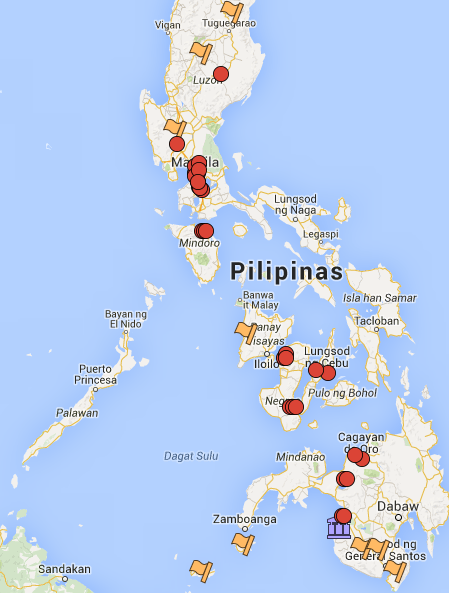
Here’s a snapshot of what a coalition of Philippines human rights groups describe as a “surge of extrajudicial killings of suspected criminals and drug offenders”.

2.50am July 14: Unidentified drug suspect #43 | San Juan City, Metro Manila | Found dead, hogtied, face wrapped with packaging tape and with eight sachets of suspected shabu [crystal meth] strapped to the body

5.00am July 13: Evangeline Tan, suspected drug user but not on the city’s drug watch list | Dasmariñas City, Cavite | Found dead, body full of stab wounds and hands tied with an electric cord; found on the body was a paper saying, “Wag tularan, tulak ako (Do not imitate, I’m a drug pusher).”

Those fatality reports are from the Philippine Daily Inquirer’s twice-weekly “Kill List”, which tallies the killings of suspected drug dealers and users by police and unidentified vigilantes.

The “Kill List” records a “marked and unmistakable” rise in such killings amounting to 265 deaths between June 30, the day President Rodrigo Duterte assumed office, and July 18.

Official statistics support assertions of an alarming increase in police killings of drug-related criminal suspects. Philippines National Police data indicate that police killed at least 192 such criminal suspects between May 10 and July 10.

That death toll in the two months following Duterte’s electoral victory dwarfs the 68 killings of suspects that police recorded during “anti-drug operations” between January 1 and June 15, 2016.

Police have attributed the killings to suspects who “resisted arrest and shot at police officers”, but have not provided further evidence that they acted in self-defence.

Duterte’s rhetoric

The Duterte administration has not put forward any policy proposals on criminal justice or crime control. He has been in office less than one month.

But the government’s rhetorical stance on the upsurge in police killings of criminal suspects shows that the disregard Duterte showed for Philippine law and international human rights standards during his campaign has become the presidential reality.

He had told his supporters on the election trail:

If I make it to the presidential palace … you drug pushers, hold-up men and do-nothings, you better get out because I’ll kill you.

At a pre-election campaign rally he promised a supportive crowd the mass killings of tens of thousands of “criminals”, whose bodies he would dump in Manila Bay.

At his inauguration, Duterte identified illegal drugs as one of the country’s top problems and vowed his government’s anti-drug battle “will be relentless and it will be sustained”.

Now in office, Duterte has praised the killings as proof of the “success” of the anti-drug campaign and urged police to “seize the momentum“.

Against check and balances

After calls for a Senate probe of those killings, the Philippine National Police (PNP) chief, Director-General Ronald dela Rosa, on July 11 slammed these as “legal harassment” and said it “dampens the morale” of PNP officers.

That same day, Duterte’s top judicial official, Solicitor-General Jose Calida, defended the legality of the killings and opined that the number of such deaths was “not enough”.

The PNP will soon make it easier for Calida to track the number of those killings. On July 18 it announced plans to erect outside the PNP’s Manila headquarters a large electronic billboard that will provide an updated tally of drug suspects either arrested or “neutralised” by police.

Complicit in serious crimes

Official statements calling for what is effectively the extrajudicial killing of criminal suspects could make the officials responsible complicit in serious crimes. And an unwillingness to investigate alleged unlawful killings would be dereliction of duty.

There are already indications that some local politicians have taken inspiration from some of Duterte’s rhetoric during his election and enacted potentially abusive “anti-crime” measures.

Days after Duterte’s May 10 electoral victory, the mayor-elect of Cebu City in the central Philippines, Tomas Osmeña, announced he would pay a 50,000 peso (US$1,080) bounty for each “criminal” killed by his police force. Osmeña didn’t specify how police would determine the legality of such killings or the identity of the suspects.

The most sinister articulation of this approach has been the rise of “death squads” in cities in the southern Philippines linked to local police and government officials.

Human Rights Watch exposed in a 2009 report the operations of a death squad that operated in Davao City with the support of city officials and police. Hundreds of people deemed to be “undesirables” – petty criminals, drug dealers and street children as young as 14 – were killed.

Duterte, who served as Davao City’s mayor for 22 years, publicly applauded such killings.

There have been no prosecutions related to the Davao death squad operations and a federal inquiry was called off. There is evidence that the Davao death squad inspired a similar operation in the nearby municipality of Tagum City. This was linked to hundreds of killings and operated as a salaried arm of the municipal government.

Eroding the rule of law

In his inauguration speech, Duterte pledged that his “adherence to due process and the rule of law is uncompromising”. The gruesome daily toll of police killings of criminal suspects demands that he deliver on that promise.

Duterte needs to demonstrate his commitment to due process and rule of law. He should urgently order a credible and independent inquiry into those deaths.

The government needs to make clear that the human rights protections embodied in the constitution apply to all the people of the Philippines — even those that police may consider “criminals”.

Phelim Kine is an adjunct professor at the Roosevelt Public Policy Institute at Hunter College, City University of New York.

In May, the ABC’s first female managing director Michelle Guthrie was introduced by the ABC Board as bringing “business expertise, international contacts, a record in content-making across an array of platforms, a deep understanding of audience needs and corporate responsibility for promoting issues like diversity”.

If the ABC fact-checking unit, which Guthrie expurgated, were still in operation they might have this to say: Guthrie, former managing director for Fox, Murdoch and Google agencies, has never worked for a public broadcaster, lacks media or journalism qualifications and has never produced content.

Guthrie’s first order of business was: monetize the ABC, cancel the ABC’s fact-checking unit, cancel the Drum and begin a culling season at the ABC.

So who is Guthrie? And, how was the appointment of a former Murdoch player made to the $5 million, five-year managing director position?

Michelle Guthrie’s CV shows a corporate work history lacking experience in public service, journalism, current affairs or media content creation. Guthrie is best known for the billion-dollar commercial disaster when Murdoch’s Star News, which she headed, collapsed in China. There is no further public record of Guthrie’s commercial successes or failures.

After Mark Scott announced his retirement last year, global talent firm Ego Zehnder began a $400,000 transnational search for the next ABC head. As well as local candidates from SBS, ABC, News Corp and Radio National, candidates from the global talent pool were approached.

After the CV and selection criteria were met, candidates were tested for IQ, emotional intelligence and personality. Two News Limited candidates were shortlisted: Guthrie and Ken Williams.

According to former ABC journalist Quentin Dempster, the process was flawed and preordained. Letters of complaint were lodged, with one applicant saying: “I was told ‘You don’t scale’ — meaning I hadn’t run a billion-dollar operation employing at least 5000 employees. This wasn’t in the advertised criteria.”

For Dempster and the applicants, this was a captain’s pick, intimately politicised by the Prime Minister’s office. The prime minister, under the Australian Broadcasting Corporation Act (1983), has the right to author the selection criteria. The other candidates claimed that in this case the criteria were made to fit the “Google lady”.

Turnbull intervened to list media qualifications as the least important criterion. (It is interesting to note that close Turnbull friend, Bruce McWilliams of Channel Seven, worked with Guthrie at a Sydney law firm.)

The criteria and process were so suspect that even Murdoch’s own Australian newspaper thundered: “It almost defies belief that a background in news and journalism was listed as the least important of 15 selection criteria the corporation used in choosing its new managing director/editor-in-chief.

“The specifications made as much sense as a major bank downplaying the value of financial experience in selecting a chief executive or the CSIRO regarding scientific expertise as an optional extra.”

Controversy from the selection process shadowed Guthrie in the Senate when Labor and the Greens questioned the ABC boss about advertising, cost cutting and local content.

Labor Senator Sam Dastyari raised the question of ABC board member Kirsten Ferguson, being investigated by ASIC for allegedly forcing out the whistleblower of a multimillion-dollar bribery scandal at Leightons. Ferguson, like Guthrie, was seen as a Turnbull political appointee.

Dastyari asked why the board had not taken action or discussed the issue. Guthrie’s responses tellingly broke the Senate rules: “We don’t discuss [in public] board matters”. Guthrie refused to claim public immunity in the Senate and headed off for a meeting with Dastyari behind closed doors.

In public, Guthrie prefers to enthusiastically discuss other in-house policies. Guthrie has talked of the aim of monetising the ABC digital platform and allowing advertisements to be screened on the ABC’s website. She spoke of the need to curtail spending and live within the confines of the budget. In one of her first acts as managing director, Guthrie would swing the axe on one of the most acclaimed hard news digital platforms of recent times: the ABC fact-checking unit.

Three days after the election, Guthrie axed The Drum opinion pages as a budget saving measure. Director of News Gaven Morris announced the decision saying there would be no redundancies and “ending The Drum as our online brand in no way reflects on its quality. The excellence of its work is shown in its strong audience numbers and its loyal following.”

In early July, a Catalyst reporter was suspended and rumours flew that Catalyst would suffer the same fate as The Drum website. Classic FM is also facing severe cuts. The ABC audience went ballistic and complaints flooded in.

Senior ABC sources revealed that News Limited and Crikey complained that The Drum was monopolising audiences and taking them away from traditional print sources. The Australian wrote: “At the start of Michelle Guthrie’s term it is smart to end this farcical market distortion [The Drum]. But it is merely a beginning.”

That the announcement of the axing of The Drum came from Morris — and not from Guthrie — was significant. Outgoing director Scott had thrust Morris into editorial responsibility for the purpose of blocking criticism and shielding Guthrie.

Guthrie has been appointed with many safeguards and sweeping powers to implement “diversity” and “transitional change” at the ABC. She has openly criticised the ABC for being colour blind and ageist.

Friends of the ABC suggest this is a red herring for implementing a neoliberal agenda of cost cutting and a purge of alternative opinion. The diversity pledge is seen as a signal that a merger between the ABC and SBS is likely and that there will be a tactical reformation of its governing legislation — bringing in advertising and ultimately privatisation.

For now, Friends of the ABC and other critics foresee an ABC future where Kerry O’Brien has a “reality” TV show, News Limited presenters host the News and Andrew Bolt fronts 7.30.

The “culling season” subplots will be known on July 28, when Guthrie delivers her maiden speech — not on ABC TV or at the Press Club, but at Creative Country, a News Limited conference. At $500 a head, critics will not be there and will struggle to find excerpts of the speech under Murdoch’s paywall.

Meanwhile, the plot thickens. Former ABC managing director Mark Scott has imitated Guthrie — effortlessly and seemingly without any educational qualifications or experience, Scott secured the plumb role of head of the NSW Department of Education.

The naval encirclement of China is well underway. It was started over a decade ago by the United States with the re-militarization of Japan and the tightening of Washington’s military partnerships with countries like Australia and South Korea. The same is true about the missile shield being erected in South Korea, which targets China, Russia, and North Korea.

The excerpts that will follow are taken from a 14 July 2016 article written by Yo-Jung Chen, a Japanese-educated naturalized French diplomat that immigrated to France from Taiwan. The retired French diplomat wrote the article in The Diplomat seeking to justify the deployment of the French military into the South China Sea. Coming from a retired French diplomat who was stationed in Asia, the article offers some interesting insights. Aside from his post as the deputy consul of the French Consulate-General in San Francisco, Yo-Jung’s Chinese background helped qualify him as the press attaché for the French Embassy in China and deputy consul at the French Embassy in Singapore. 

Yo-Jung Chen misleadingly identifies “Chinese aggression” as the reason for the plans of France to redeploy to the South China Sea and to lead a series of European Union military expeditions in the body of water against the People’s Republic of China. Never questioning the French occupation of places like Polynesia or New Caledonia, the retired French diplomat also tries to naturalize the French military presence in the South China Sea by talking about the colonial history of France in Vietnam and the South China Sea and by referring to France as a Indo-Pacific nation. What Yo-Jung fails to identify and mention is the inalienable rights of the Chinese to peacefully navigate in the South China Sea and the security and military threats emanating from the US and its allies against the Chinese.

The maritime dispute between the Philippines and China has been used as a pretext by the US and its allies to target China. Nor has Beijing threatened the freedom of navigation. Over 100,000 vessels sail through the South China Sea every year and there has never been any major cases of China preventing freedom of navigation.

On the contrary, Beijing fears that the US and its allies seek the tactical capability to halt Chinese shipping in the South China Sea.  Nothing is mentioned by Yo-Jung Chen about “US aggression” or Washington’s plans to cut off Chinese shipping in the South China Sea. This is what has pushed Beijing to try its best to prevent Washington and its allies from militarizing the South China Sea by claiming as much adjacent waters and nautical miles as possible.

What the plans of France and the European Union to militarily deploy their naval forces to the South China Sea illustrates is that the European Union is Washington’s accomplice and military partner in the objective of encircling China. This announcement is in line with the return of German naval forces to the Pacific Ocean. It is also no coincidence that many of the countries involved in the naval encirclement of China are either NATO members, like France and Britain, or NATO partners, like Australia and Japan.

Mahdi Darius Nazemroaya, Asia-Pacific Research Editor, 22 July 2016.


South China Sea: The French Are Coming

Yo-Jung Chen, 14 July 2016

The U.S.-led international efforts to defend the freedom of navigation guaranteed by the UN Convention on the Law of the Sea (UNCLOS), aiming at preventing the entire South China Sea from becoming an exclusive Chinese lake, has just received a powerful boost in the form of the July 12 ruling of The Hague-based UN Permanent Court of Arbitration. Much to China’s anger, most of its sovereignty claims over the South China Sea are rejected in this ruling.

To the surprise of many, a seemingly unrelated European power, France, has announced its intention of coordinating the navies of fellow European Union nations to conduct Freedom of Navigation Operations or FONOPs in South China Sea. On June 5, at the Shangri-la Dialogue in Singapore, French Defense Minister Jean-Yves Le Drian mentioned this initiative for joint EU patrols of “the maritime areas of Asia” and for a “regular and visible presence there.”

From a strictly strategic viewpoint, France’s announced plan will not have a determining impact on the situation in the South China Sea. After all, despite being a major military power with global reach, France’s military presence in the region is limited. Besides, outside of France, what other EU nation has a permanent naval and air presence in the Pacific?

But however small the strategic impact may be, the French initiative promises to weigh in heavily on the diplomatic front, adding significantly to China’s already stark isolation in this case.

The scope of this diplomatic impact should be measured in the wake of the July 12 ruling of the UN Permanent Court of Arbitration, in a context where China is attempting, without much success, to put together a “coalition of the willing” of countries presumably supportive of its position in the South China Sea.

The French initiative thus has the potential of further weakening China’s position by conspicuously bringing Europe in as an additional heavyweight to the international pressure for respecting the rule of law, represented by The Hague-based arbitration court’s ruling.

France in the Asia-Pacific

Contrary to general perception, France is no stranger in this volatile theater in the Far East. The announced French initiative may not be so surprising when one recalls that France is also an Asia-Pacific nation with vital interests in the region. It has territories in the Southern Pacific: French Polynesia, New Caledonia, and Wallis & Futuna islands. Combine this to territories in the Indian Ocean (La Reunion, Mayotte, Kerguelen, etc.), and France is also an Indo-Pacific nation.

These overseas territories add to those in the Caribbean’s to give France the world’s second largest Exclusive Economic Zone (EEZ) (11 million square kilometers) after the United States, 62 percent of which is located in the Pacific and 24 percent in the Indian Ocean. 1,500,000 French citizens live in the French Indo-Pacific territories (500,000 in the Pacific) besides the 130,000 French nationals in various Asia-Pacific countries.

These territories, EEZ, and population necessitate adequate protection and policing. This explains the permanent presence of 8,000 French military personnel in the Indo-Pacific area (2,800 in the Pacific). In the Pacific area alone, France operates two surveillance frigates, four patrol vessels, two multi-mission ships, five maritime surveillance aircraft, four tactical transport aircraft, and seven helicopters.

Although the European Union as such does not particularly shine as a visible strategic presence in the Asia-Pacific region, France, through various treaties and agreements, maintains a network of “strategic partnerships” with Asian countries such as Japan, China, India, Indonesia, Australia, Singapore, and Vietnam.

France also has developing strategic relationships with Malaysia and New Zealand. And it takes part in almost every major regional strategic forum such as the Shangri-La Dialogue in Singapore, the ASEAN Regional Forum, and the Pacific Coast Guard Forum, to mention only a few. France is the first of EU nations to have signed up to the Treaty of Amity and Cooperation in Southeast Asia, the TAC.

Moreover, France is a major provider of defense equipment in Asia. It has recently inked a deal to provide 12 new submarines to Australia. It is in the process of selling Rafale jet fighters to India and it has assisted Malaysia in setting up its submarine force. France also maintains research cooperation on defense matters with Singapore. Few people know that fighter pilots of the Singapore Air Force train on a permanent basis in southern France.

On a historical note too, France is not new in the region. According to Professor Shawn McHale writing in May 2016 for the “Rising Power Initiative,” France, as colonial ruler of Vietnam at the time, in 1931 asserted its sovereignty over part of the South China Sea. French sovereignty was challenged by Japan throughout World War II and both stopped their claims only in the 1950s.

Why France and the EU?

Given this background, questions may still linger on why France, which, along with other European countries, has important trade interests with China, would choose to ruffle Chinese feathers at this point by entering the fray in the South China Sea.

Excerpts have been taken from The Diplomat by Asia-Pacific Research.

BERLIN/BEIJING – In light of the escalating conflict in the South China Sea, the German Navy is, for the first time, participating in a large-scale maneuver in the Pacific Ocean. Mine clearance divers and other support personnel from the naval infantry (“marines”) stationed in Eckernförde, near Kiel, will be involved in the “RIMPAC 2016” combat exercise, organized by the US Navy, over the next few days, training in various military operations in the Pacific. A total of 25,000 soldiers from 26 countries, coming from the main NATO powers and the most important US allies along the Pacific Coast of Latin America, in the South Pacific and in East and Southeast Asia will be participating. China is involved in some of the training measures, however, explicitly excluded from others. There is a question, if China will be invited to participate in subsequent RIMPAC maneuvers. At the same time, the US military is developing plans for operations, according to western military experts, against China’s defensive lines, erected on islands and artificial reefs in the South China Sea. Tension has been rising since yesterday’s decision by the UN’s Permanent Court of Arbitration in The Hague on a territorial dispute. The EU has begun discussing participation in naval patrols near the Chinese coast.

Maritime Route Control

Over the next few days, German naval forces will participate, for the first time in history, in a major maneuver in the Pacific Ocean. From June 30 to August 4, the world’s largest naval combat maneuver, RIMPAC (Rim of the Pacific) is taking place, organized – initially annually, and since 1974, bi-annually – by the US Navy since 1971. The main theatre is the maritime region near Hawaii. Altogether, around 25,000 soldiers from 26 nations are taking part in operations using 45 ships, five submarines and more than 200 aircraft. The German Navy is participating with 20 mine clearance divers and support personnel from the naval infantry unit based in Eckernförde. As announced by the Bundeswehr, in the context of RIMPAC, “a wide range of skills” will be exercised “ranging from the security of maritime traffic, disaster relief, to complex military operations.” Therefore, it includes, for example, “amphibian operations, anti-submarine and aerial defense exercises as well as anti-piracy combat and mine clearance operations.”[1] “The overall objective” is to “demonstrate military flexibility,” which “serves the security of global maritime routes.”

Allies against China

Traditionally, the United States – which has appropriated a role of hegemonic power on the high seas for itself – has integrated close allies into its RIMPAC maneuvers. These series of combat maneuvers were launched together with the naval forces of Great Britain, Canada, Australia, and New Zealand in 1971. The number of participating nations has since been greatly expanded. Important NATO members (France, the Netherlands, Norway) have repeatedly been involved. Over the past few days, for the first time, units from Germany, Italy, and Denmark are taking part – proof of the systematic expansion of the RIMPAC fleet. Washington’s main Southeast Asian military partners, Japan, South Korea, the Philippines, Singapore, and Thailand, have sent troops, alongside soldiers sent from the USA’s close cooperation partners of the “Pacific Alliance”[2] Latin American countries – Mexico, Columbia, Peru, and Chile. This year, three other Southeast Asian countries (Brunei, Indonesia; and Malaysia) as well as India are onboard. Both Washington and Berlin have been trying to win India over to their side in their struggle against the People’s Republic of China.[3]

Challenger

The partner, no longer taking part in the combat exercises – particularly those controlling the Pacific maritime routes – is Russia. In 2012, Russian units were invited to participate in the RIMPAC maneuvers for the first time, but were then excluded again in 2014, because of the escalation of the Ukraine conflict. China was first invited to participate in 2014, and is sending warships to Hawaii again this year, even though they will be excluded from some of the exercises, with which the western naval units are preparing for joint operations in the future.[4] However, there are indications that in RIMPAC 2018, the People’s Republic of China will no longer be participating. Already last year, John McCain, Chair of the US Senate Defense Committee, explicitly called for rescinding the invitation to China for this year’s RIMPAC maneuvers.[5] However, the Obama administration, at the moment, does not want to burn the bridges to the People’s Republic of China, given the tensions in the South China Sea, and insists therefore on the partial participation of the Chinese Navy. Nevertheless, this decision is sharply contested by influential forces in Washington. It is not appropriate for China to participate in RIMPAC, as long as “it is challenging U.S. naval dominance in parts of the South China Sea,” admonish his critics, at the beginning of the maneuvers.[6]

Perhaps no Longer Under Control

Whereas this is the German Navy’s first time RIMPAC participation and therefore considering a military engagement in the Pacific, the US military is already drawing up operational plans for the contingency that conflicts in the South China Sea escalate. The plans contain reflections on how to neutralize Chinese defense systems, according to the US Chief of Naval Operations, Adm. John Richardson. The premise is that China will set up these defense systems on the artificial reefs in the South China Sea. According to reports from US military circles, the US Navy is thinking of “a whole range of counters.”[7] Examples are cyber attacks to disrupt enemy command networks, and inject false information, according to reports. Another option would be offensive strikes against the enemy, while using missile defense to down incoming enemy missiles. Last week it was announced that such a US missile defense system will be installed in South Korea.[8] While the US military is drawing up plans against Chinese South China Sea positions, experts are confirming that their implementation should in no way be considered improbable. “The South China Sea territorial disputes are likely to persist for a long time,” said Bonnie Glaser, of the Center for Strategic and International Studies (CSIS) in Washington. “The question” is not whether they can be “resolved,” but if they “can be managed,” or not. [9]

Ready to Attack

In the South China Sea, tensions, in the meantime, are escalating. Yesterday, Tuesday, the UN’s Permanent Court of Arbitration in The Hague, responding to a dispute brought by the Philippines over the territorial sovereignty of various islands and reefs in that area, arrived at a decision denying China’s historically based claims to them, a decision supporting – or at least reinforcing – the claims of pro-western countries bordering the sea. Quite awhile ago, Beijing had announced that it was prepared to seek a negotiated settlement to the dispute with Manila, in consideration of a balance of interests and declared that it would not recognize the Court of Arbitration’s final judgment. The latter was reconfirmed yesterday. Also an element of this international dispute is the fact that, as military experts point out, control over the South China Sea is crucial to the People’s Republic of China’s defense capability (german-foreign-policy.com reported [10]). Sending two aircraft carrier battle groups into the South China Sea, in mid-June, the United States demonstrated its combat readiness. The EU plans to join them and is considering joint naval patrols close to China’s coasts.[11] If these plans materialize, Germany’s military presence in the Pacific Ocean will not remain limited to RIMPAC 2016. Germany would become part of the western powers’ military troop concentrations against Beijing.

NOTES

[1] RIMPAC 2016: Deutsche Premiere. www.marine.de 27.06.2016.
[2] Zur Pazifik-Allianz see The Strategy of the Pacific Alliance and Hoffnungsträger der Industrie.
[3] See Anti-China Cooperation and Contain China.
[4] Jürg Kürsener: Ein scharf beäugter Gast in Pearl Harbor. www.nzz.ch 29.06.2016.
[5] McCain: Disinvite China from Next Year’s RIMPAC Exercise. www.military.com 06.05.2016.
[6] Wyatt Olson: China remains hot topic as biennial RIMPAC drills kick off. www.stripes.com 05.07.2016.
[7] Sydney J. Freedberg Jr.: UN Ruling Won’t End South China Sea Dispute: Navy Studies Next Clash. breakingdefense.com 20.06.2016.
[8] See At the Russian Border.
[9] Sydney J. Freedberg Jr.: UN Ruling Won’t End South China Sea Dispute: Navy Studies Next Clash. breakingdefense.com 20.06.2016.
[10-11] See Ostasiens Mittelmeer (I) and Ostasiens Mittelmeer (II).

Urban development and gentrification have a dark side. Not only are buildings being replaced, but so are people and their families and communities. Entire communities are either directly forced to move by the authorities or development companies or indirectly through increased property taxes, increased utility prices, or by the deliberate suffocation of their livelihoods. Although every case is not the same, the process generally targets the socio-economically less affluent inhabitants of a city and in many instances destroys the community economy and leads to destitution. This is why gentrification has even been called a form of “class warfare” by some of its critics.

The poorer members of the city are being visually erased. They are literally hidden from  sight. This is also part of the process of slowly marginalizing the poor by eroding their participation in public affairs and by erasing them from public view. When this happens, fighting poverty and helping the poor becomes less of a priority for city officials, no longer becoming a burning public issue.

In many cases physical violence and threats are used to displace these communities. Opting out of lengthening the process of eviction by taking advantage of the cheap materials the settlers use to build their homes, in many cases developers burn down the settlements of these people using fires and then make it look like the displacing fire or fires were an accident. Not only are properties and businesses lost in many of these fires, vulnerable people — such as the sick, handicap, elderly, and children — and animals die.

The story is the same in many parts of the world, from Southeast Asia and Eastern Europe to East Africa and Latin America, where people and communities are being alienated from their own urban landscape. In the interest of raising awareness about the conditions of these people, Asia-Pacific Research presents this photographic essay  about a New Delhi community that has been displaced by urban development and gentrification.

The three pictures on display before the photographic essay from India are photographs taken from Mexico and serve to invoke thought by contrasting affluent and poor communities. 

 Mahdi Darius Nazemroaya, Asia-Pacific Research Editor, 22 July 2016.


“The bulldozers were running over our homes even without any prior notice. We all ran to save our belongings, only to find most of them destroyed,” says Geetha, a former iron carver who is now working as a maid in homes nearby. She belongs to Gadia Lohar community, which seeks its origins from Rajasthan and finds its existence in history for it’s allegiance to a Rajput ruler, Maharana Pratap. In 2009, the state government decided to demolish their settlement, located ahead of the Tyagaraj Stadium in South Delhi during a ‘beautification spree’ just before the Delhi Commonwealth Games (CWG) 2010.

The Delhi High Court’s judgement in 2010 directed the authorities to plan a proper rehabilitation policy for the victims within 4 months of the demolishment. More than 6 years have passed but the rehabilitation is yet to be provided. The previous settlement of the community was at the roadside where it was easier for them to find customers. “My father used to earn around Rs. 400-500 daily. Now it’s not even Rs. 150, including the earnings of both of us.” says Kuldeep (26), who dropped from college 6 years ago to help his father in overcoming the financial crisis of the family.

A 2011 report from Housing and Land Rights Network suggests that more than 2,50,000 people were virtually displaced just before the CWG 2010 in Delhi. “How can they destroy our homes and call it a nation-building? How can they take our homes away just like that?” asks Gagan Singh (33), a former blacksmith, who now works as a contractual labourer. The community is currently based in a temporary settlement in a marginalized and deprived state.

Geetha (35), a mother of 2 children, used to work as an iron carver before her community was forced to leave their settlement in 2009. Now she is working as a maid in nearby houses.

Rohit Sisodia (32), along with her wife, Sunita (30) and two children. His occupation as a blacksmith suffered a lot after the demolishment.” No one comes here, away from the road to this settlement for getting their job done.They usually hire roadside blacksmiths,” says Rohit.

 Iron tools kept in one of the Blacksmith’s shops for sale.

Gagan Singh (33), with his daughter, Medha (12). He returned home after 6 months from Jodhpur. Compelled to leave his traditional occupation of blacksmith due to the financial problems, he is now working there as a contractual labourer.

 Mishtha (31), Gagan’s wife.

Worshipping place along with a traditional ‘Hukka’. There used to be a temple in the previous settlement which was demolished in 2009. From then onwards the community has made this place their worshipping spot.

 The living conditions in these settlements are tough. Usually, a family of 6-7 people lives in a single room.

Ramesh Singh (55), is jobless for years. Suffering from the pulmonary Tuberculosis, he is not able to treat himself in any of the government hospitals as most of his official papers were lost during the demolishment.

Vicky Chauhan (36), a blacksmith standing in his shop. He is hardly able to earn enough through the profession which he perceives as an art after he was forced to leave his roadside shop during the demolishment in 2009.

Mukundilal Chauhan (62), is one of the eldest members of the settlement. He is the one who is leading the fight for his community’s rights on various platforms.

Radha, doing her household chores.

Even the temporary settlement is in danger of being evacuated since the Delhi Metro construction is getting intense in the area.

Vishank Singh is a New Delhi-based blogger/photojournalist who is currently pursuing his Masters in Convergent Journalism from AJK MCRC, Jamia Millia Islamia.


  • Posted in Asian @as
  • Comments Off on Photo Essay from India’s Victims of Urban Development: Life In Pieces For Delhi’s Displaced Community

BEIJING: China today gave clear indications it is not going to back India’s case for a membership of Nuclear Suppliers Group. It is also using the North Korean nuclear situation as an excuse to refuse to accept India’s request for support.

In a statement issued this morning, the Chinese foreign ministry said that no exceptions can be made to what it regards as a “rule” disallowing countries that have not signed the nuclear non-proliferation treaty to join the NSG.

The statement revealed how China is lobbying against India’s entry by referring to the nuclear controversies surrounding Iran and North Korea while keeping silent about nuclear sales by Pakistan.

Telling other NSG members in its efforts to lobby against India’s entry, Beijing is also preparing the ground for the image loss it might suffer if the NSG ultimately turns down the Indian request to join.

But it skipped Pakistan, and used North Korea as a reference point to explain that non-NPT countries cannot be allowed to join it.

“And in the absence of NPT as the political and legal basis, how could the nuclear issue on the Korean Peninsular be resolved? All these merit reflection,” Wang Qun, Director General of the Department of Arms Control of the Foreign Ministry, said in the statement.

Wang, who is China’s negotiator in the NSG talks, went on to say that admitting India would amount to adopting double standards, which would result in enormous cost.

“While it’s easy to adopt double standards, the consequence can be enormous,” he said.

He said that NPT represents the cornerstone of the entire non-proliferation regime.

“If exceptions are allowed here or there on the question of NPT, the international non-proliferation then will be collapsed altogether. In the absence of NPT as political and legal basis, it will be inconceivable for the JCPOA on the Iranian nuclear issue to be reached,” he said.

  • Posted in Asian @as
  • Comments Off on China opposes Indian Membership in the Nuclear Suppliers Group

U.S. President Barack Obama’s trip to Vietnam and lifting of the arms embargo will no doubt boost bilateral relations. But for Hanoi it is still a rebalance, not a pivot, as Vietnam still has a strong reliance on Russian military exports.

Earlier this week, in a farewell trip to Asia, U.S. President Barack Obama concluded a visit to Vietnam. It was literally a roaring success. The people in the streets of Hanoi and Ho Chi Minh City greeted the President with flags and welcoming posters and the audience in the National Convention Center burst into applause at every strong statement, hearty reference or joke that Obama uttered during his address.

The kicker of the trip was, of course, the lifting of the U.S. arms embargo on Vietnam, perhaps the strongest reminder of the Vietnam War, which still haunts bilateral relations in the form of Agent Orange contamination and unexploded ordnance in Vietnam and a large anti-Communist Vietnamese diaspora in the U.S. By fully removing the arms trade ban, the U.S. Administration has helped the two countries to turn the page and finally speak of properly normalized relations.

But it is more than that. Obama is busy with his legacy-building, and it could not be a better way to round up his Asia-Pacific “rebalance” than with a trip to the number one “new” partner in Asia (Vietnam) as well as the number one “old” partner in Asia (Japan). Coincidentally – or perhaps not – both of them are active members of the Trans-Pacific Partnership (TPP), widely seen as the economic fulcrum of Obama’s “rebalance” project.

Vietnam’s global thinking

From Vietnam’s perspective, the burgeoning relations with the U.S. are even a bigger deal. Having suffered from bloc politics dearly, the Vietnamese have developed a certain kind of political thinking, where independence is top priority and can only be achieved by balancing partnerships with global and regional powers. Pitching the country’s stable political system, strong military, strategic position, and a vibrant and promising economy to various global and regional players, the Vietnamese leadership is aiming to diversify its foreign policy.

South Korea brings Foreign Direct Investment (FDI). Japan brings Official Development Assistance (ODA). The EU brings technology. Russia brings military equipment, and energy technology, including nuclear, oil and gas projects. The U.S. brings its huge market for textiles and agriculture, as well as geopolitical support. China brings an ideological alliance and trade.

China is a special case, of course. The kind of love-hate relationship Vietnam has with China goes way back in history. Geographically, there is no alternative to China as the closest strategic partner. The relationship between the two Communist parties is very strong and Vietnam’s policies are often based on lessons from the China relationship. China is Vietnam’s largest trade partner and the two countries share a strong connection with traditional Confucian political culture.

At the same time, the Vietnamese live in constant concern over perceived sovereignty threats, especially in the South China Sea. Moreover, Vietnam is experiencing a huge and further growing trade deficit with China, which threatens to make the former dependent on the latter.

As Vietnam has been gaining momentum of economic growth, lifting itself out of poverty and straight into the league of developing powerhouses, the country’s elite is trying to balance out China. There is no getting away from the big northern neighbor, but the Vietnamese could certainly use a better hand when dealing with the Chinese and make this relationship more beneficial if they have stronger partnerships with the U.S., Japan, ASEAN countries and Russia.

The future of Russia’s relationship with Vietnam

Russia, in turn, is an important factor in Vietnam’s external ties. The ongoing sales of Russian frigates, submarines, missiles, and air defense systems are precisely what gives Vietnam the ability to leave China with a proverbial bloody nose in case there is an actual military clash in the South China Sea. Moreover, the high status of the Russia-Vietnam political relationship is also supposed to hold China back, leaving Beijing reluctant to threaten its ties with Moscow.

At least this was true when the U.S. arms embargo was in place. So will this change? Not immediately, that is for sure. Arms procurement strategies do not change overnight, and with Russia’s dominant position on the Vietnamese arms market, it is likely to remain the leader over the coming decade. The U.S. may occupy certain niches, especially high-tech, like maritime surveillance, or perhaps coast guard ships and transport airplanes. But Russia will remain the key seller of all the hard-hitting weaponry.

What are the implications for Russia then? U.S.-Vietnam relations are developing at a very fast pace. In 2015 Barack Obama received the general secretary of the Communist Party of Vietnam, Nguyen Phu Trong, at the White House, essentially acknowledging that socialist rule is not an impediment to bilateral ties. This time, Obama chose not to tie the arms embargo to Vietnam’s progress on human rights, once again signaling that U.S. geopolitical and economic interests in Vietnam are more important than promotion of liberal democracy there. This trend will no doubt continue if tensions rise in the Asia-Pacific region.

This is why Russia’s role in Vietnamese foreign policy will likely face a relative decline, at least if current trends prevail. The strong military connection dates back to a time when Russia was the only strong partner for Vietnam. Now things are different – when China, the U.S., Japan, India, South Korea and the EU are all making plays for Vietnam, it is illogical to assume that Russia’s posture could continue to be as strong as it is currently.

Fundamental changes in the way how Russia and Vietnam cooperate have to happen to change the nature of their relations. So, Russia has to keep in mind that gaining momentum is the only way not to fall behind.

Anton Tsvetov is the Media and Government Relations Manager at the Russian International Affairs Council (RIAC), a Moscow-based foreign policy think-tank. He also has a blog at Russia Beyond the Headlines.

  • Posted in Asian @as
  • Comments Off on Can US-Vietnam reconciliation hurt Moscow’s ties with Hanoi?

Washington Complicates the Dispute in the South China Sea

July 20th, 2016 by Mahdi Darius Nazemroaya

A negotiated settlement between the People’s Republic of China and the Republic of the Philippines over the Sino-Filipino territorial dispute(s) over ownership of the Spratly Islands (known as Nansha Islands in China) appears possible with the change of government in Manila. The term of the cabinet of Filipino President Benigno Aquino III and Filipino Secretary of Foreign Affairs Albert del Rosario, who both rejected bilateral talks with Beijing, ended on June 30, 2016. They have been respectively replaced by Rodrigo Duterte in the Malacañan Palace and Perfecto Yasay Jr. in the Department of Foreign Affairs. The new Filipino government in Manila has made several overtures about holding bilateral talks with Beijing and Foreign Secretary Yasay has announced that a special envoy will be appointed for negotiations with China.

Relations between the Philippines and China became strained under the Aquino III Administration. It rehabilitated the territorial dispute with China and eagerly began welcoming the revitalization of the US military presence in Southeast Asia. In 2011, a political decision was made under Benigno Aquino to refer to the South China Sea as the West Philippine Sea as a means of emphasizing the claim of the Philippines. The Aquino III Administration would even mandate the renaming of the South China Sea into law by an administrative order in 2012. Agitating relations further, the Aquino III Administration initiated legal action over the territorial dispute against China through the Dutch-based Permanent Court of Arbitration on October 29, 2015.

On July 5, 2016 – just one week before the ruling of the Permanent Court of Arbitration on July 12, 2016 – President Duterte offered to hold talks with China. While he will surely use the Permanent Court of Arbitration as leverage in Sino-Filipino bilateral talks, Duterte appears to be keen on a settlement with China. These offers are part of a buildup from the 2016 election period in the Philippines.

While campaigning for the presidency of the Philippines, Duterte’s discourse on China was one that sent mixed signals. It shifted between antagonistic and conciliatory language. Undoubtedly, this was politicking and political catering by President Duterte. His altering discourse on China was a political tactic to domestically gain both the support of Filipinos with nationalist attitudes about the Spratly Islands and those Filipinos, including the influential ethnic Chinese Filipino business class, that want peace, economic cooperation, and trade with a vibrant China.

At the international level, Duterte may have been sending mixed signals as part of a tactic to satisfy both the United States and China. His antagonistic remarks pleased Washington while his consolatory remarks were aimed at not alienating Beijing and to signal that he was willing to hold talks. Despite his criticism of Beijing, he always made signals that he wanted to establish dialogue with China. Interestingly, Duterte was even the only key politician in the 2016 Philippine general-elections who publicly admitted that he went to talk about the Spratly Islands with the US Embassy in Manila.

On the campaign trail Duterte commented that he would seek Chinese help to build a trans-Philippines rail network connecting the islands of Luzon and Mindanao and that if China accepted the mammoth transportation project that he was willing to end his public criticism about Manila’s territorial dispute with Beijing. In other words, Duterte was saying that a future Filipino government under him would negotiate with China in exchange for economic concessions or assistance from Beijing.

After Duterte won the presidential elections, his tone towards China altered. He became much more tempered and be very cordial to China. Before Duterte even officially became president, he held meetings with Zhao Jianhua, the Chinese ambassador to the Philippines, on May 16, 2016. The meeting was symbolic, because Ambassador Zhao was only one of three ambassadors – the other two being the diplomatic representatives of Israel and Japan – that Duterte met with as the presumptive-president of the Philippines. Since that time Rodrigo Duterte would meet with Ambassador Zhao three more times, including several days before the ruling Permanent Court of Arbitration on July 7, 2016.

Beijing’s Claim to the South China Sea

Beijing claims that China has had sovereignty over the area for thousands of years. The Chinese Empire under the Ming Dynasty even possessed the western shores adjacent to the area. This was when Vietnam was a part of China. Vietnam also lays claims to the Spratly Islands (known as the Quan đao Truong Sa by the Vietnamese) and the Paracel Islands (known as Xisha by the Chinese and as Hoàng Sa by the Vietnamese).

Supporting the Chinese claim are the facts that Japan annexed the area in 1938 as part of its takeover of Taiwan from China and that Kuomintang-ruled mainland China claimed the area in 1947 under an «eleven dash line» demarcation while Malaysia and Brunei were still British colonies and Vietnam was still a French colony. Only the Philippines had officially become independent from the US one year before the Kuomintang claim, in 1946.

There are important historical and legal facts that should be taken into consideration. Before the US went to war with the Japanese, it never challenged the Japanese annexation of the area as a takeover of the territory of the Philippines as a possession of the US. Nor were the islands in the South China Sea included as part of the Philippine territory handed over from Spain to the US in 1898. It was only with US backing in the 1970s that the Philippines started making international claims to the area.

Washington: The Meddling Third Party

China is interested in establishing what Xi Jinping calls a «community of destiny.» Beijing wants cooperation and trade, not war or conflict with the Philippines or any of the other member states of the Association of the Southeast Asian Nations (ASEAN). Its major aim is to expand the Silk Road, both on land and at sea, and to buttress regional integration and economic prosperity. In this regard, it has even given favourable treatment and offered advantageous trade conditions to the member states of the ASEAN on multiple occasions.

Like President Duterte, the Chinese government has signaled that it is ready to hold direct negotiations over the territorial dispute in the South China Sea. China has even declared that it is willing to share the area’s wealth and resources in joint development projects. This is what Beijing has described as a «sustainable approach.» In return Beijing has asked that Manila rejects the Permanent Court of Arbitration’s ruling, which will also affect the cross-cutting territorial claims of Brunei, Malaysia, and Vietnam.

In a scenario where the Philippines gains control of the disputed territory in the South China Sea, Manila would turn to the US and US allies like Japan, South Korea, and Australia for the development of the region. The Philippines cannot develop or extract the energy resources of the area by itself. Foreign energy companies from the US and states allied to the US would get preferential treatment and profit off the oil and gas. In return the Philippines would get undersized economic returns.

Even under the framework of the above scenario, if it is not the biggest consumer, China would still be one of the major consumers of any energy reserves extracted from the South China Sea. China could also even be asked by the Philippines to develop the region’s energy reserves. Since Beijing will be the main customer, there are those in the Philippines that realize that it would actually be more lucrative for the Philippines to work with China to jointly develop the regions energy reserve. This is why there are those in the Philippines who prefer bilateral talks. The main hurdle to talks between Beijing and Manila, however, is the United States.

What is at stake in the disputed zone are not only large amounts of hydrocarbon reserves in what some in China have called a «second Persian Gulf» of energy, fishing, and one of the most important maritime corridors and trade routes in the world. Chinese national security interests are also heavily tied to the area. Chinese trade and energy supplies would be disrupted if maritime movement were halted in the South China Sea, which is why the US military is heavily focused on having a presence in the area. In part, this is what Washington’s «Pivot to Asia» is all about.

Washington, which (unlike Beijing) itself has refused to even sign the United Nations Convention on the Law of the Sea, is using the Philippines as a pretext for playing a dirty game against China merely because it views Beijing as its strategic rival. The US is intentionally ratcheting tensions up in the South China Sea to justify both the US naval presence adjacent to the Chinese coast and the creation of a network of military alliances to encircle and pressure Beijing. Using coercive diplomacy, economic warfare, a strategy of tension, and a two-pronged approach of confrontation and cooperation, the US is trying to consign China to the position of a junior partner. The US is also doing its best to create a wedge in Eurasia between China and the Russian Federation.

Ironically, while it is demonizing China as a regional threat, Washington is sending contradictory messages to its regional allies. The US has been vilifying Beijing while it simultaneously orders the US military to hold multilateral or bilateral military exercises with the Chinese military, such as the Rim of the Pacific (RIMPAC) Exercise (June-July 2016), China-US Joint Humanitarian Assistance and Disaster Relief Tabletop Exercise (November 2012), and the China-US Anti-piracy Exercise in the Gulf of Aden (September 2012).

Regional leaders should take note of the US modus operandi. US leaders are not willing to directly confront China. Instead they are using countries like the Philippines as pawns, leverage, and negotiating chips to either bargain with or obstruct an increasingly assertive and economically prosperous China.

This article was originally published by the Strategic Culture Foundation on July 11, 2016.


The presidential administration of former Philippine president Gloria Macapagal-Arroyo was marked by corruption, fraud, misuse of public funds, and utter disregard for constitutionalism and the rule of law. She has been widely accused of murder, kidnapping, plundering, and cheating. The US Embassy in Manila was even informed in 2005 by corporate accounting firm SGV founder Washington Sycip that her husband, José Miguel Arroyo, was one  of the most corrupt figures in the Philippines, according to US diplomat cables that were leaked in 2011. The Arroyo Administration also arbitrarily and unlawfully arrested her political opponents while it used national security measures and the language of law and order as pretexts to suppress her opponents and Filipinos and Filipinas seeking justice.

The Hello Garci scandal that emerged in 2005 merely served to prove that the 2004 Philippine general-election’s were rigged by Gloria Macapagal-Arroyo and her political associates. After the scandal, Arroyo would admit that the audio evidence produced about her election rigging was authentic, but nothing happened to her. Her government argued on the basis of procedural law that since the key evidence against Arroyo was a phone conversation that was recorded without her consent that it could not be used while her political party and coalition prevented her impeachment and justice from ever taking place through legislative means by blocking any action against her by using their majority vote in the Congress of the Philippines.

Although former president Arroyo escaped legal prosecution over electoral fraud, her feuds with other elites or oligarchs eventually materialized in a criminal case against her being opened over the plundering of 366 million Philippine pesos from the Philippine Charity Sweepstakes Office (PCSO) intelligence funds from 2008 to 2010.  There are, however,  two sets of justice in the Philippines: one for the rich and powerful elites and another for the general population.

Arroyo was given special treatment and put under hospital arrest at the Veterans Memorial Medical Center in Quezon City where she enjoyed and was afforded extraordinary rights for about four years. She was allowed to go on special holiday breaks and to spend the December holiday season with her family in their luxurious La Vista residence. Her trial was even suspended twice for a one-month period staring  on 20 October 2015 and then again for a three-month period starting on 24 November 2015.

After Rodrigo Duterte was elected as the president of the Philippines he said that he was ready to grant former Philippine president Gloria Macapagal-Arroyo a pardon. Being influenced by the political change in Manila and new atmosphere in the Philippines, the Supreme Court of the Philippines, which itself is a corrupt institution that caters to interest groups, finally  acquitted Arroyo. No longer arguing that she needed to be in the hospital, Arroyo would leave the the Veterans Memorial Medical Center. She escaped justice once again and it is unlikely that anything besides token action will be taken against her for her past crimes as the president of the Philippines.

Without expressing doubt about the legitimacy of the legal process or analyzing the political nature of the Supreme Court acquittal, the following is a report of the acquittal of Arroyo that looks at the appointment origins of all the judges involved. It is worth noting that almost all of the judges in the Supreme Court were appointed by Arroyo herself. 

Mahdi Darius Nazemroaya, Asia-Pacific Research Editor, 21 July 2016.

Former Philippine president Gloria Macapagal-Arroyo during hospital arrest.

Former former Philippine president Gloria Macapagal-Arroyo leaving the hospital after she is acquitted.


Gloria Macapagal-Arroyo with her lawyer Raul Lambino taking a picture right after her acquittal.


MANILA, Philippines – After nearly 4 years of hospital arrest, former Philippine president Gloria Macapagal-Arroyo will soon be free.

The Supreme Court on Tuesday, July 19, acquitted Mrs Arroyo of plunder as it granted her plea to drop the case against her. This sets in motion her release from the Veterans Memorial Medical Center, where she has been detained since October 2012.

SC Spokesman Theodore Te told a press conference Tuesday afternoon that the Court annulled the criminal case for “insufficiency of evidence” and ordered her “immediate release.”

Te said the vote was 11-4 in favor of Arroyo’s petition to junk a Sandiganbayan ruling that gave the go-signal for her plunder trial in connection with charges that she misused funds of the state-run Philippine Charity Sweepstakes Office (PCSO).

Covered by the case aside from Arroyo is former PCSO budget officer Benigno Aguas, who is detained at Camp Crame. He was also ordered released.

Quoting from the decision, Te said: “Wherefore, the Court grants the petitions for certiorari; annuls and sets aside the resolutions issued in Criminal Case No. SB-12-CRM-0174 by the Sandiganbayan on April 6, 2015 and September 10, 2015; grants the petitioners’ respective demurrers to evidence; dismisses Criminal Case No. SB-12-CRM-0174 as to the petitioners Gloria Macapagal-Arroyo and Benigno Aguas for insufficiency of evidence; ORDERS the immediate release from detention of said petitioners; and makes no pronouncements on costs of suit.”

The justices who dissented or voted against Arroyo are Chief Justice Maria Lourdes Sereno, Senior Associate Justice Antonio Carpio, and Associate Justices Marvic Leonen and Benjamin Caguioa. Of the 4, only Carpio is an appointee of Mrs Arroyo; the rest were appointed by former president Benigno Aquino III.

The 11 justices who ruled in favor of the former president are:

  • Justice Presbitero Velasco Jr
  • Justice Teresita de Castro
  • Justice Arturo Brion
  • Justice Diosdado Peralta
  • Justice Lucas Bersamin
  • Justice Mariano del Castillo
  • Justice Jose Perez
  • Justice Jose Mendoza
  • Justice Bienvenido Reyes
  • Justice Estela Perlas-Bernabe
  • Justice Francis Jardeleza

Of the 11, eight are Arroyo appointees and 3 were appointed by Aquino: Bernabe, Reyes and Jardeleza.

‘Final bastion of justice’

One of Arroyo’s lawyers, Raul Lambino, was with her Tuesday at the Veterans hospital.

He told radio station dzMM: “Kasama ko nga po si Pangulong Arroyo rito at lubos po yung ating kagalakan ngayon dito sa naging botohan o info na dumating sa amin. Naiyak po siya siyempre lahat ng mga kasama namin rito sa magandang balitang dumating sa atin.” (I am with President Arroyo, and we’re grateful for the decision or the information that reached us. We are all in tears.)

Para sa akin, malaya na ang dating Pangulo,” he added. (As far as I am concerned, our president is free.)

Lambino said the Philippine National Police would process Arroyo’s release after the SC releases its verdict.

Arroyo’s other lawyer, Ferdinand Topacio, said in a statement: “The Supreme Court has once again proven itself to be the final bastion of justice and the rule of law. Its ruling today has validated what we have been saying for six years now: that the charges against former President Gloria Macapagal-Arroyo are nothing more than disingenuous attempts at political persecution by a corrupt and inept Aquino administration intent on covering up its gross lack of accomplishments by harassing its political opponents.”

The Court found the evidence against her weak, the same sources said. Prior to this, the Supreme Court already stopped her trial at the Sandiganbayan.

The 69-year-old Arroyo, who is currently Pampanga representative, is the second Philippine president to be detained for plunder.

In April 2001, ousted president Joseph Estrada was jailed for plunder over charges of unexplained wealth. The Sandiganbayan convicted and sentenced him to life in jail in September 2007. But only 6 weeks after, in October 2007, his successor Arroyo pardoned him.

Landmark ruling

Tuesday’s landmark ruling on Mrs Arroyo came barely a month after Aquino stepped down from office and less than a week before President Rodrigo Duterte, who favors her release, delivers his first State of the Nation Address (SONA.).

It was Aquino who jailed Arroyo and subsequently led the impeachment charge against her appointed chief justice, the late Renato Corona.

Through veteran lawyer Estelito Mendoza, Arroyo had petitioned the Supreme Court to approve her “demurrer to evidence,” a plea to dismiss a case on the basis of weak evidence. She went to the High Tribunal for relief after the anti-graft court Sandiganbayan dismissed the demurrer.

Arroyo filed the “demurrer to evidence” in 2014 before the Sandiganbayan. The anti-graft court dismissed this in April 2015, paving the way for her trial for plunder over the alleged misuse of PCSO funds.

Arroyo then challenged the Sandiganbayan ruling before the Supreme Court in a 100-page petition filed by Mendoza.

PCSO plunder

The Court’s approval of the Arroyo petition in effect acquits her of the P366-million plunder suit filed by the Ombudsman in July 2012 against her and 9 other former goverment officials.

The Ombudsman’s suit, filed a week before then President Aquino was to deliver his 3rd SONA, alleged that Mrs Arroyo approved the alleged diversion of PCSO’s intelligence funds for purposes not related to the core work of the agency, which is to help indigents and sectors working with them.

On top of this, Arroyo had also asked the Supreme Court to in the meantime stop her trial at the Sandiganbayan. The SC granted this motion last year and extended the trial suspension to this year.

  • Posted in Asian @as
  • Comments Off on Former President Gloria Macapagal-Arroyo Acquitted of Plunder: A Case of Justice Catering to Political Power in the Philippines?

TASHKENT, Uzbekistan – Belarus is ready for strengthening relations with China and the Shanghai Cooperation Organization (SCO), Belarus President Alexander Lukashenko said as he met with Chinese President Xi Jinping in Tashkent on 24 June, BelTA has learned.

“I would like to thank you for Belarus, the only European state, getting the observer status in the Shanghai Cooperation Organization. It would be impossible without China’s support. We are really grateful to you,” Alexander Lukashenko said addressing Xi Jinping.

The Belarusian head of state emphasized that both China and the SCO can rely on Belarus’ support in any issues. “We are ready to become ‘a western gate’ for this organization,” the Belarusian leader said. Alexander Lukashenko cited the Chinese-Belarusian Industrial Park Great Stone project as an example of how Belarus is consistent in fulfilling its obligations. “You have called the project a pearl of the Great Silk Road. We will do our best and are doing the utmost to fill the project with concrete economic content,” said the President of Belarus.

For his part, Xi Jinping congratulated Alexander Lukashenko on the successful 5th Belarusian People’s Congress which discussed the five-year plan of country’s social and economic development. “I am sure that under your leadership Belarus will make new progress,” said the Chinese President.

He has noted that the Belarusian-Chinese relations have been rapidly developing, with the two countries supporting each other in all the matters. Mentioning the ongoing parliamentary election campaign in Belarus, Xi Jinping supported the efforts aimed at creating calm atmosphere for the elections.

Xi Jinping invited Alexander Lukashenko to pay a state visit to China and expressed readiness for further strengthening of all-round cooperation.

  • Posted in Asian @as
  • Comments Off on Minsk: Belarus is Ready to Become the Western Gate of China and the Shanghai Cooperation Organization

Image: Prof Michel Chossudovsky

On Tuesday, the Hague ruled that China has no legal basis for its claims in the South China Sea. Asked to comment, Michel Chossudovsky, the director of the Montreal-based Center for Research on Globalization, told Sputnik that the Hague ‘tempest in a teapot’ is much less worrying than Washington’s efforts to militarize the region.

There are two central issues, Professor Chossudovsky explained. “One is the fact that the United States has a project to militarize the Asia Pacific region, specifically threatening China. The other issue is …the [territorial] disputes between China, the Philippines, Vietnam, etc.”

The second issue, according to the analyst, would be much easier to resolve if it weren’t for US involvement, which is using the territorial disputes as part of its so-called ‘pivot to Asia’, “essentially preventing these countries from reaching negotiations, and building a situation of crisis within the Asia-Pacific region.”


South China Sea claims map

© PHOTO: WIKIPEDIA/VOICE OF AMERICA


originalLeaving aside the details of the ruling itself, Chossudovsky emphasized that when talking about a diplomatic conflict involving the Philippines and China, one has to understand that “we’re not talking about a conflict between one sovereign nation and another sovereign nation. The Philippines is a former colony of Spain and the United States, and today it remains almost a de facto colony of the United States, in terms of its broad alignments, military cooperation agreements, and so on and so forth.”Therefore, the analyst noted, “when the president of the Philippines negotiates with China, he does it in consultation with Washington.”

Asked about the prospects of the diplomatic flare-up provoking a new arms race in the region, Chossudovsky suggested that unfortunately, one has already begun.

“We are already in an arms race situation, triggered by the United States. That arms race, at this particular juncture, is essentially directed against four countries – Russia, China…Iran and North Korea. These are the four countries which are on the drawing board of the Pentagon, and they have been there for many, many years. In all the war games – the World War 3 scenarios that the Pentagon [plays out] on a routine basis – these four countries are the targets…This is ultimately what is at stake.”

The professor reiterated that the militarization of the South China Sea is “there for two purposes:

for threatening China, and [for preventing] the countries of the region – of Southeast Asia and the Far East from entering into cooperation agreements which would be more of a regional type.”

Such agreements, Chossudovsky noted, would serve as a clear threat to Washington’s efforts to enforce the Trans-Pacific Partnership, aimed at putting countries throughout the region “under the geopolitical control of the United States.”

The professor also emphasized that under normal circumstances, the issue of maritime rights would be resolved through bilateral discussions. A Canadian, Chossudovsky recalled that the United States and Canada also have water boundary disputes. But this doesn’t mean that the Chinese Navy butts in and deploys its own ships to these areas.

“In other words, what I think is deplorable here is that a legal dispute under the laws of the sea is [being] used by the United States to threaten China and militarize strategic waterways in the South China Sea,” the analyst noted.

Ultimately, commenting on other recent developments in the region, from the deployment of the THAAD missile defense system in South Korea, to the approval of a naval base on the island of Jeju, the professor noted that it’s extremely important not to get lost in the details of this ruling.

“A legal decision in the Hague is one thing – it’s a trivial issue, and should lead to bilateral discussions. The other more serious issue is the militarization of that entire region, which incidentally is also related to the militarization of Eastern Europe by NATO; it’s the same process, and is directed against China, Russia, Iran and North Korea; those are the four so-called rogue states defined in US foreign policy,” Chossudovsky concluded.

*      *     *

Michel Chossudovsky’s Book can be ordered directly from Global Research (click image)

original

  • Posted in English @as @as
  • Comments Off on The US-Led Militarization of Southeast Asia. China, Russia, North Korea and Iran Are Targets in Pentagon World War III Scenarios

First published by Global Research in March 2016, this article provides a background of the evolving conflict

The start of 2016 has witnessed a sharp escalation in the militarization of the South China Sea. The cause of the escalation is multifaceted and comes from both regional and international quarters. The militarization has been initiated and exacerbated by both China and the United States, both bearing responsibility for the current level of tension in the region.

The USS John C. Stennis Carrier Strike Group sailed to the region from its home port in Bremerton, Washington on January 15th and passed through the Luzon strait separating Taiwan and the Philippines on March 1st. The Stennis is accompanied by the guided missile cruisers the USS Antietam and the USS Mobile Bay as well as the guided missile destroyers USS Stockdale and USS Chung-Hoon. The Antietam is based at Yokosuka Japan, and was ordered off its normal patrol to join the Carrier Strike Group. The 7th Fleet flag ship, the USS Blue Ridge is also in the area, having docked in Manilla on March 4th.

USS John C. Stennis

Trilateral talks were held onboard the Blue Ridge on March 5th between the U.S. Navy, Japanese Maritime Self Defense Forces and the Philippine Navy. The key subject of discussion was how the three nations can work together to confront China in the South China Sea, promote security and stability in the region, and develop future multilateral training and exercises.

The current deployment of the Stennis CSG to the region follows the previous deployment of the USS Lassen guided missile destroyer to the Spratley Islands last October, and the USS Curtis Wilbur to the Paracel Islands in late January of this year. The U.S. has also increased surveillance flights over the areas by P-8 Poseidon patrol aircraft, as well as in one case, B-52 strategic bombers.

The Navies of China and Vietnam fought a naval engagement for control of the Paracel Islands in 1974, which resulted in China’s defacto control of the islands.  China has established a military presence on Woody Island since that time, and has engaged in an extensive expansion of the base in recent years. Woody Island now has an extensive military airbase, with a number of newly built hangars and munitions storage buildings. In February, satellite surveillance revealed the deployment of two batteries of HQ-9 surface-to-air missile launchers, as well as supporting vehicles such as an engagement radar and the Type 305B AESA acquisition radar on the northern end of the island. Last November, China announced the deployment of J-11 fighters to Woody Island.

As land reclamation and building efforts on the part of the Chinese continue at Fiery Cross Reef and Mischief Reef in the Spratly Islands with no signs of slowing down in the immediate future, it will be interesting to see if the U.S. Navy increases the size and tempo of future patrols in the area. With the Royal Australian Navy taking delivery of its second Canberra class LHD HMAS Adelaide on December 4th of last year and the first of two Makassar Class LPD vessels built by Indonesia for the Philippine Navy the BRP Tarlac launched on January 17th of this year, the U.S. Navy may soon be bolstered by more powerful regional navies in future patrols. The prime minister of Japan, Shinzo Abe announced in November of last year his willingness to have the Japanese Maritime Self Defense Forces join the U.S. Navy in patrols of the South China Sea. Australian P-3 Orion maritime patrol aircraft are currently flying freedom of navigation missions in the region.

It was reported just days ago on March 9th, that the United States and Australia were negotiating the basing of more U.S. strategic bombers, including the supersonic B-1, and aerial tankers at Australian bases on a rotational basis. The aircraft would be based at Tindal and Darwin in northern Australia. They would complement U.S. B-52 strategic bombers already based at Darwin on a similar rotation. As the brinkmanship continues, with no signs of either China or the United States backing down, the chances of a military confrontation in the South China Sea, whether calculated or accidental, continue to grow with each passing day.

Support South Front! PayPal: [email protected] or via: http://southfront.org/donate/ or via:https://www.patreon.com/southfront

  • Posted in Asian @as
  • Comments Off on Militarization and US-China Confrontation in the South China Sea

The prospect for a negotiated settlement between China and the Philippines over some Nansha islands and islets appears possible with the change of government in Manila. The term of president Benigno Aquino III who rejected bilateral talks with Beijing ended on June 30. He has been replaced by Rodrigo Duterte in the Malacañan Palace. The new government has made overtures about holding bilateral talks with Beijing.

Relations became strained under the Aquino III administration. It restarted the territorial dispute and welcomed the revitalization of the US military presence in Southeast Asia.

In 2011, Aquino decided to start referring to the South China Sea as the West Philippine Sea to emphasize the country’s claims, and later wrote this change into law. Straining ties further, his administration initiated legal action against China through the Permanent Court of Arbitration on October 29, 2015.

On July 5, 2016, just one week before the ruling, Duterte offered to hold talks with China. While he will surely use the Permanent Court of Arbitration award as leverage in bilateral talks, Duterte appears to be keen on a settlement.

While campaigning for the presidency, Duterte’s discourse on China sent mixed signals. It shifted between antagonistic and conciliatory. This was a tactic to gain the support of Filipinos with nationalist attitudes and those that want peace and trade with China.

At the international level, Duterte may have sent mixed signals to satisfy both the US and China. His antagonistic remarks pleased Washington while his conciliatory remarks signaled that he was willing to hold talks with Beijing. Interestingly, Duterte was the only key politician in the 2016 Philippine general elections who publicly admitted that he went to talk about the Spratly Islands with the US Embassy in Manila.

After Duterte won the election, his tone altered. He became much more cordial to China. Beijing wants cooperation and trade, not war or conflict with the Philippines and other member states of the Association of the Southeast Asian Nations (ASEAN). Its aim is to expand the Silk Road, both on land and sea, and to buttress regional integration and prosperity.

Like Duterte, the Chinese government has signaled that it is ready to hold direct negotiations with Manila.

Meanwhile, China has been insisting on the principle that disputes could be shelved as both sides could engage in joint projects to develop resources in the region.

What is at stake in the disputed zone are not only large amounts of hydrocarbon energy, fishing, and one of the most important maritime corridors and trade routes in the world. Chinese trade and energy supplies would be disrupted if maritime movement is halted in the South China Sea, which is why the US military is heavily focused on having a presence in the area.

Washington sees Beijing as a strategic rival. It is intentionally ratcheting tensions up in the South China Sea to justify its military presence there. Using coercive diplomacy, economic warfare and a strategy of tension, the US is trying to consign China to the position of a junior partner.

Ironically, while it is demonizing China as a regional threat, Washington is sending contradictory messages to its regional allies. The US has been vilifying Beijing while it simultaneously orders the military to hold military exercises with the Chinese.

Regional leaders should take notice of the US modus operandi.

US leaders are not willing to directly confront China. Instead they are using countries like the Philippines as pawns, leverage, and negotiating chips to either bargain with or obstruct an increasingly assertive and economically prosperous China.

The author is a visiting professor teaching political science and international relations at the University of the Philippines Cebu.

With the apparent stall in negotiations between the Thai Government and Barisan Revolusi Patani (BRN [the Patani independence movement in Patani, southern Thailand]) over the violence of the Deep South, one must start considering how long before a solution to this lingering insurgency problem can be found.

With roughly 5,300 people being killed since 2004, with 45 killed and 75 injured since the negotiations between the Thai Government and BRN began negotiations with Malaysia mediating, there have been calls by opposition leader Abhisit Vejjajiva to suspend negotiations with the BRN until the level of violence is lowered. The recent BRN commitment to decrease violence during Ramadan included a mention of the Sadao region within Songkhla Province, leading to further confusion by Thai authorities.

There are also risks that the military may go on the offensive again and conduct pre-emptive raids on suspected ‘terrorist’ hideouts, where roads into and out of Yala town are virtually on lockdown and house to house searches are being carried out. Entry and exit into the circular roads where the court houses in Yala are housed, resemble the ‘green zone’ in Bagdad, Iraq.

The apparently stalled negotiations could be interpreted to mean that the BRN are not the sole voice for the various insurgent groups in the Deep South, and some of these groups feel angry that the BRN is grandstanding in public claiming to represent southern grievances. In fact, if one drives from Hat Yai in Songkhla Province through Petani, Yala, and Narathiwat, what is most striking is the diversity and fragmentation of ‘Malay’ Muslims within the Deep South. There are those who live by the coast, those that live in the mountains around Yala, those who live in rubber estates within Narathiwat, and the urban Malay Muslims. All have different interests, livelihoods, and leaders, where by far, the majority are peace-loving people.

However, what one will also see when making this trip around the south is the stark difference in the culture of the region with the rest of Thailand. And if one has some knowledge of Malay culture, the difference between the Muslims of the Deep South and the people in the rest of Thailand can be seen. The Petani Malays appear to live their lives the way they have for generations, and resist the imposition of both Thai culture and globalization upon their communities.

This is an extremely important perspective that must be understood. Different ‘Malay’ groups within the Deep South react differently to the perceived threat upon their culture. Urban Malays have become vibrant micro-entrepreneurs, while rural ‘Malays’ still prefer to undertake their traditional livelihoods, which are being threatened by development in some cases.

Thai Army Chief Prayuth Chan-ocha’s call to build a Border fence between Malaysia and Thailand to prevent insurgents freely moving across the border indicates that those carrying out the violence are actually not from the Deep South itself. There are many rumors that most bombings and other acts of terrorism are actually undertaken by those who don’t live in the Deep South and that’s why intelligence on the ground most often has difficulty in predicting attacks. They occur anonymously and without anybody claiming responsibility, where, in fact, some are actually acts of gangsters and retribution by other parties.

The recent film clips posted on Youtube on April 26 by Ustaz Hassan Taib and a second video on May 28 by Abdulkarim Khalib of the BRN, making demands, highlights that this is a “Malay” issue and not a “Muslim” issue. Their statements highlighted the Malay history of Petani and their need to fight for the rights of Bangsa Melayu Petani or the Malay race of Petani. This is only the second time any demands have ever been made publicly, the first by the Petani United Liberation Organization (PULO) from Europe back in 1968. However these announcements might be more about the BRN trying to assert their authority in discussions with the government over the vast number of groups.

This shows the complexity of the problem. Violence originating from outside of the Deep South Region by unknown people, and a plea for the restoration of Petani Malay Nationalism within the Thai State are paradoxes that must be reconciled and acted upon by the authorities. Clamping down on the citizens of the Deep South by Thai security forces risks creating more resentment by locals and being ineffective anyway, as these people are not the perpetrators of the violence.

In addition, there appears to be little coordination between the Military and Interior Ministry on their programs within the communities of the Deep South.

Not understanding the unique ‘Malay’ identities of the Deep South is missing the whole reason why there are feelings of insecurity by Malay-Muslims of the Deep South.

The problem of the South must be seen as an ethnic identity problem and not a religious problem. This point has fundamentally been lost. To the Muslim-Malays it’s about protecting traditions, language, culture, and religion.

So what is the solution to the violence of the Deep South?

Unfortunately, external engagement will only raise suspicions in the South as to the motives of the outsiders. The solution to the problems will only come from within the south itself. It won’t come from dialogues, negotiations, forums, and lectures about how Muslims in the South must be responsible, etc. It will come from a changing consciousness at the community level.

The problem is most Malay-Muslims in the Deep South wish to live their lives where they are, and not engage the development that the rest of the country is going through. They see their traditional life as their aspirations. Most university graduates return to their villages rather than seek work in Bangkok or one of the other provinces. So this indicates that Malay-Muslims could be assisted in developing economic activities within the region of where they live to assist in raising standards of living.

The Thai authorities have been very successful in assisting rural communities through community vocational programs like the One Tambon One Product (OTOP) program, and this needs to be extended in the south with much more vigor than what it is now. The Malay-Muslims of the mountain regions around Yala and Narathiwat must be assisted in developing their own concepts of self-sustainability. Poverty is still much a major issue here. Community building projects run by the Malay-Muslims, for the Malay-Muslims, may be very important here.

But the real change as mentioned will only come from within. There is also a generational context to this situation where the older generation feel resentment and alienation, while the younger generation have a wide diversity of feelings that may not have hardened into the anger of their elders. This brings hopes that a change of consciousness on the part of the younger generation within the Deep South may occur over time. This change may be promoted as more of the younger generation become engaged in social media where they may find new visions for their lives and region. There are plenty of precedents for this in other parts of ASEAN and within the MENA. However this is going to take some time, but this will enable a generational change if the Malay-Muslims of the Deep South are going to integrate with the rest of Thai society, as other Muslims in Thailand have.

It looks like negotiations will lead nowhere. Regional autonomy may not be the solution as many academics are suggesting and Prime Minister Yingluck Shinawatra said she would consider during her 2011 election campaign. Autonomy may not satisfy all of the fragmented groups in the South, and fighting may just continue.

The Thai strategy towards the Deep South must change. Reports indicate that more than USD 7 Billion has been spent on trying to quell this insurgency since its reemergence in 2004. Attacks made by insurgents must be separated from those made by criminals and particularly by those from outside the region. Insurgents have changed their tactics using new equipment that they have been able to acquire and carrying out targeted assassinations on government officials. The numerous police and army checkpoints and roadblocks do very little to put any check on the violence and in some cases make it easier for the insurgents to assassinate any official in a motor vehicle slowing down for the checkpoint. Most of the time the victims of random urban attacks are the Malay-Muslims themselves.

The struggle is about living a traditional lifestyle as a ‘Malay-Muslim’ in Petani, Yala, and Narathiwat. This should not be forgotten. There are many illusions here in the Deep South which require re-evaluation to understand what’s is really going on. This may require a major realignment of strategy, focusing on intelligence by the military, rather than any show of force, which may pay off very well. One can never defeat the spirit of the Petani-Malay. This will never happen. It’s about enabling integration without the loss of cultural identity, something which Thailand should be able to entertain.

Prof. Murray Hunter an associate professor at the University Malaysia Perlis.


Dhammananda, a 72-year-old Thai woman, is forbidden from hugging her sons. She’s never been able to chase her giggling grandchildren around the room. Both acts are forbidden by the strict Buddhist precepts that monks must follow.

Dhammananda is a self-described “rare species.” She’s a monk. She’s also a mom. And in the eyes of her homeland’s Buddhist establishment, she’s a feminist insurgent.

Each day, she and her female disciples wear the same clothing: flowing robes the color of ripe mangoes. Their heads are shorn down to stubble. Their possessions are limited to flip flops and little else.

In other words, their day-to-day lives are largely indistinguishable from that of any upstanding Buddhist monk in their native Thailand.

But because they are women, Dhammananda and her flock of 15 female monks are shunned by the state-backed Buddhist hierarchy. This powerful all-male order, known as the “sangha,” regards them as imposters.

“That’s their problem,” Dhammananda says. She’s the abbess (yes, that’s female for “abbott”) of a temple 60 kilometers west of Bangkok.

“That’s their own ignorance, which they’ll have to overcome.”

There are roughly 300,000 monks in Thailand, home to one of the highest concentrations of Buddhists on the planet. Yet only 100 are women. They’re scattered among small temples that the traditional order views as insolent.

Before Dhammananda, there were none at all. Prohibited from ordination in Thailand, she hacked the system in 2001 by flying to Sri Lanka, which started ordaining women in the mid-1990s.

She then returned home as Thailand’s first female monk in modern times — at least in the old-school Theravada strain of Buddhism that dominates Southeast Asia.

The three main confessions or sects of Buddhism.


In Dhammananda’s view, the near absence of women in the monkhood has left Buddhism as wobbly as a three-legged chair. The faith is lopsided, she says, because it lacks feminine insight.

Past experience as a mother, she says, is particularly valuable to Buddhist spiritual life. “That experience makes you whole,” she says. “You tend to understand people’s problems on a different level than men do.”

The argument against allowing women into the monkhood is shaky, she says. Roughly 2,600 years ago, Buddha explicitly stated that women can achieve enlightenment. He even ordained his own foster mom.

“Enlightenment is the quality of mind that goes beyond. There is no gender there,” Dhammananda says. “When you talk about the supreme spiritual goal in Buddhism, it’s genderless.”

Thailand’s monastic order, however, rests its case against female monks on a technicality. The sangha insists that female monks can only be brought into the fold by other women.

But because the sangha in Thailand has never sanctioned a female monk, there are no women available to open the door to newcomers. The original lineage of female monks dating back to Buddha’s time faded out centuries ago.

Thailand’s official Buddhist order “feels women are a big threat. Especially women in robes,” says Sulak Sivaraksa, one of Thailand’s best-known Buddhist scholars.

“But since [the female monks] are wonderful people, more and more people recognize them,” Sulak says. “I told the Thai [female monks] … to keep clear of scandal. Do good work. And soon the male monks will not only recognize you. They will come and worship you. They will be led by you.”

Like any Buddhist monk, female monks such as Dhammananda are sworn to a dry life that forsakes romance, luxury and excess of any kind.

Holding hands? Devouring an entire carton of Häagen-Dazs in one sitting? Pop music or even gossiping? All are forbidden. More than 300 rules (called precepts) dictate their behavior to ensure they do not grow attached to sensual pleasures.

Nor can they work. They acquire nourishment by walking the streets and collecting free food — often soy milk, rice or curry — from everyday Buddhists.

Here are Dhammananda’s thoughts on rebellion, moms in the monkhood, and the decadent treats she misses from her life before the temple. Her comments have been edited for brevity and clarity.

Question: Do you think of yourself as a rebel?

I never thought of myself as a rebel. Even though I might be one.

My intention is not to provoke. My intention is to insist that we return to the right path.

Question: Would you call yourself a feminist?

Yes. Not that I ever studied feminism. But my understanding of feminism is you should bring out your potentiality to the fullest. Anything obstructing your path, you should work against it. That’s my feminist attitude.

Question: When your sons come to visit, are you allowed to hug them?

No. That is a very hard part. Particularly for my oldest son. He really misses that. He once said to the [other female monks], “You don’t know how much I miss my mother.”

He’s kind of making an offering to the Buddha by giving up his own mother to do this job. But he still misses the hugs.

Question: Are there special rules for men speaking to female monks?

As long as there is a third person around, and as long as we are not sharing the same seat, [men and female monks] can be close. But I must have a sister [fellow female monk] here as a witness.

Question: You have very young grandkids. What are the rules regarding grandchildren? Can you pick them up and play with them?

The youngest is a boy and, yes, I have held him. I don’t think of him as a man so I’m not touching a man. He’s a two-year-old boy. A child! But I don’t go around hugging him.

Question: As I understand it, monks aren’t even allowed to tickle?

Oh yes! You aren’t supposed to tickle a monk. Because people will roll into a great laughter. That’s part of the rules.

Question: So no tickling your grandchildren?

No, that rule is about tickling monks. Not about tickling laypeople. But, no, I don’t tickle them.

Question: How do regular people treat female monks out in public?

There are two groups. Some couldn’t care less. Others are more suspicious. But for those who are interested, we educate them. It’s much easier now compared to 16 years ago when I was the only female monk walking in this land.

Question: Tell me about your first day collecting alms.

I was invited to Rayong (a Thai coastal province) for a seminar. And I went out with the male monks. People in the marketplace, when they realized the last one walking in the back was actually female, they were so interested!

One household ran inside and grabbed a big box of drinks and offered it to my [alms] bowl. I was happy.

To go back to Buddha’s time, it’s said that if you make an offering to monks, that’s well and good. But if you make offerings to both monks and female monks? It’s even better. This is in the text.

Question: The ordination process for female monks involves embarassing questions, even sexual questions. Does that create more resistance to ordaining women.

For men, they ask, “Are you a man? Do you have such and such illness?” For women, they will ask about our private parts. “Do you menstruate all the time?” Or whether you have all of your sex organs.

But if I am willing to answer this, they should give us ordination. I think Thai women, young and old, are willing to go through this interrogation.

Question: What do you miss about regular life?

I miss high tea. This here [gestures toward an 11 a.m. lunch spread donated by the local village] is our last meal of the day. So no high tea. I actually used to enjoy it more than dinner. Especially if it came with blueberry cheesecake.

Question: Can’t you just eat cheesecake in the morning?

It doesn’t feel the same way in the morning! You just have to give it up.

Question: Some people who’ve been through challenges in life end up being pretty funny. Do you have a sense of humor?

I have a great sense of humor! The monastic life is quite dry. You need to laugh once in awhile.

You shouldn’t be making jokes all the time like a joker. But if you can show people another way to look at things, even by making them laugh, that’s OK.

Question: People see monks and wonder: Does it really make you happy to give up everything like that?

Yes. Because we give up the bad things, not everything. It is letting go of that which is unwholesome.

Question: But you have to let go of pizza. And high tea, as you mentioned. Or your boyfriend or girlfriend. It seems hard.

At certain points, it may be so. But then you look ahead in time, outside this context, and realize the goal is much greater than your boyfriend or your girlfriend. And much greater than pizza.

Question: What sorts of backgrounds do the female monks here have?

All different backgrounds. This one studied journalism. The next one over was a seamstress. Some were just ordinary factory workers. Two of them have master’s degrees.

Question: If there was a vote, do you think Thai society would allow women to be ordained?

Ordination is our heritage given by the Buddha. So we should not be ordained expecting people to accept me. You should ordain because you want to do it and to keep our heritage alive.

Question: As a monk you have to subdue your anger. But doesn’t it make you irritated that people think you shouldn’t be a monk?

I cannot put the ignorance of all the people in the whole world on my shoulders.

  • Posted in English @as @as
  • Comments Off on Female Monk Challenges Male Dominance of Thailand’s Buddhist Orders
  • Tags:

Who has Sovereignty in the South China Sea?

July 9th, 2016 by Kim Petersen

In 1949, Communist troops led by Mao Zedong defeated the Nationalist forces led by Jiang Jieshi (Chiang Kai-shek). The Guomindang (KMT) escaped across the Taiwan Strait to the island of Taiwan. The United States continued to recognize the KMT as the government of all China and pledged the US 7th fleet to the so-called defense of Taiwan. With that policy, the United States effectively intervened in the Chinese civil war with the declared aim to to prevent the reintegration of all China under a Communist government.

In 1979, US president Jimmy Carter transferred recognition from Taipei to Beijing as being the government of China. Economic opportunities and seeking to drive a wedge between China and the USSR were behind “US interests.”

To this day, Taiwan stands as a poignant reminder that military weakness has rendered China unwhole.

In the intervening decades, China has made enormous developmental strides. China is the world’s largest economy in terms of PPP. It holds $1.3 trillion in US treasury bills, helping to prop up the US economy. China has launched humans into space. At home, the Communist Party has pulled over 600 million Chinese people out of poverty and seeks to eradicate all poverty by the year 2020.

“Pivoting” to the South China Sea

Recently news regarding sovereignty over the South China Sea has become more and more prominent. The US has dispatched warships to the area.

Anyone who eyeballs a map of the South China Sea and reaches a conclusion solely on proximity to the nearest major landmass, can’t help but find that many of the reefs, cays, islets, and tiny islands belong to a number of countries in the region. Unsurprisingly, a number of countries have made claims to the tiny islands and reefs in the South China Sea.

China, however, claims sovereignty for the entirety of the South China Sea, a sovereignty that preceded UNCLOS (United Nations Convention on the Law of the Sea). China argues that history has conferred it sovereignty and maritime rights. Chinaclaims its activities in the South China Sea date back to over 2,000 years ago.

China has been the first to discover, name and develop the group of islands in the South China Sea, which have been known as the Nanhai Islands in China. For centuries, the Chinese government had been the administrator of the islands by putting them under the administration of local governments, conducting military patrols and providing rescue services.The Nansha [Spratly] and Xisha [Paracel] Islands, occupied by Japan during World War II, were returned to China as part of the territories stolen from China. This has been clearly set out in international documents such as the Cairo Declaration and the Potsdam Proclamation. China sent government and military officials to recover the islands and deployed troops there.

The BBC produced a documentary, “Our World Flashpoint: South China Sea,” concerning China’s sovereignty claims and its island building in the South China Sea. The documentary stated, “the US will not sit back and watch Beijing turn the western Pacific into a Chinese lake.”

The BBC documentary interviewed US Rear Admiral Mark Montgomery who asseverated of the US military presence in the South China Sea, “… we [the US] have to develop the tactics, weapons, and procedures to continue to operate in an unfettered manner.” He asserted, “The US navy is one of the single greatest contributors for the security and stability of the Asia-Pacific region; we have been for nearly 70 years.”

The South China Sea dispute is centered on territorial sovereignty. Yang Yanyi, Head of the Chinese Mission to the EU states that potential for hydrocarbons has motivated interest in nearby nations:

It has been widely recognised by the international community that the Nansha Islands and the adjacent waters belong to China, and no country ever challenged this during a long course of history.

It was only since the 1960s and 1970s, especially after the discovery of abundant oil reserves in the Nansha waters and the coming into being of the United Nations Convention on the Law of the Sea (UNCLOS), that some countries in the region illegally occupied 42 of China’s islands and reefs as part of the Nansha Islands in violation of the charter and fundamental principles of governing international relations.

Threat to US Interests?

The Council on Foreign Relations (CFR) is a US organization that describesitself as “an independent, nonpartisan membership organization, think tank, and publisher.” It is described otherwise as an “influential ruling class organization” whose members come predominantly from the corporate business community which finances the CFR. According to the CFR:

Of the many conceivable contingencies involving an armed clash in the South China Sea, three especially threaten U.S. interests and could potentially prompt the United States to use force.

The most likely and dangerous contingency is a clash stemming from U.S. military operations within China’s EEZ that provokes an armed Chinese response. The United States holds that nothing in the United Nations Convention on the Law of the Sea (UNCLOS) or state practice negates the right of military forces of all nations to conduct military activities in EEZs without coastal state notice or consent. China insists that reconnaissance activities undertaken without prior notification and without permission of the coastal state violate Chinese domestic law and international law. China routinely intercepts U.S. reconnaissance flights conducted in its EEZ …

If nations in the South China Sea lose confidence in the United States to serve as the principal regional security guarantor, they could embark on costly and potentially destabilizing arms buildups to compensate or, alternatively, become more accommodating to the demands of a powerful China. Neither would be in the U.S. interest.

A comparison

China also prioritizes freedom and safety of navigation, peace, and prosperity in the South China Sea. It does not, however, accept the right of foreign warships to operate without its approval in what it considers are its territorial waters or EEZ.

If China engaged in military surveillance and maneuvers in the Florida Strait between Florida and Cuba, how would the US respond? Surely many Americans and politicians in the Beltway would be upset at a Chinese military presence nearby.

If one dismisses historical evidence of cartography and usage and only employs the eyeball test to judge the issue, then it seems only fair to use such a technique to judge other territorial and sovereignty disputes.

As a starting point, China is a country inhabited by Chinese people for millennia (setting aside the complexities of Tibet).

The United States, on the contrary, is a country formed by Europeans (mainly Brits) wreaking genocide on the Original Peoples and dispossessing them of the land; warring against Mexico to grab most of California, Utah, Nevada, Arizona, and New Mexico; purchasing Alaska from Russia (without questioning Russia’s sovereign claim to Alaska). Then, in 1893, the US overthrew the Hawaiian monarchy and annexed the islands, 3500 km (2200 miles) from the continental US.

The US Senate apologized, but the US maintains sovereignty over Hawai’i. By way of simplistic analogy: if someone steals your wallet, spends the cash inside it and later returns the empty wallet with an apology, is that any kind of meaningful apology or justice?1

And what about the far-flung US-administered territories of Guam, other Micronesian islands, Puerto Rico, and Guantanamo Bay in Cuba? How is it that the US and its G7 allies – all of who are former/current colonizers – can intervene with an iota of integrity on the dispute in the South China Sea?

The US has a sordid history of aggression with South China Sea countries, but sometimes the enemy of an enemy becomes a friend. Hence the Philippines and Viet Nam consort with the US regarding the South China Sea.

The US Role and Respect for Law

The Philippines has sought arbitration under UNCLOS. China opposes international arbitration and seeks bilateral settlements. The US (which has not ratified UNCLOS) insists on China respecting international law and has backed the Philippines seeking international arbitration. One wonders what the world would be like if the US insisted on Israel adhering to international law or, for that matter, that itself, the US, respect international law. The US rejected the 1986 World Court judgment against the US of unlawful use of force in Nicaragua.

As Muhammad Mahmood writes in Bangladesh’s Financial Express:

… definitely China was not the first country to deploy weapons or conduct military manoeuvres in the region, rather China just responded to when the USA sent armed naval vessels to the sea. For China it was just a case of self-preservation.

Facts

Critics counter that China through its island building is creating facts on the ground to strengthen its territorial claim. How does that compare to basing a territorial claim on bird droppings as the US has done in the mid-Pacific Ocean? And what is the entirety of the US but a fact established on Indigenous people’s ground?

That the US, Canadian, Australian, and G7 criticism of Chinese actions in the South China Sea are mired in hypocrisy does not mitigate or support China’s claims in the South China Sea. Tu quoque arguments while undermining the integrity of China’s detractors, do not, however, buttress China’s claims to the territory. China’s territorial claims which needs to be judged on their merits. It would be advisable though that China take into consideration the aspirations of its neighbors and act accordingly. To this end, China does seek bilateral discussions with all nations.

What does justify Chinese actions is the US militarization of waters that are unconnected to the US mainland or offshore territories. China has been ringed by US military bases. China is aware that the US cut off oil to Japan during WWII stirring up tensions leading to war, and that the US has used embargoes often since then to try and strangle those nations it labels foes. The South China Sea is a vital transportation and trade route for China.

Furthermore, China is keenly aware of the foreign humiliation of a weak China in the 19th century and later the role played by the US in the mainland’s political separation from Taiwan.

Chinese Intentions

Current Chinese Chairman Xi Jinping wrote of Chinese intentions in his bookThe Governance of China:

Facts speak louder than words. China has consistently followed an independent foreign policy of peace and made it crystal clear that China’s foreign policy is aimed at maintaining world peace and promoting common development. China has stated on numerous occasions that it opposes hegemonism and power politics in all forms, does not interfere in the internal affairs of other countries, and will never seek hegemony or expansion.” (location 3958)

However, Xi emphasized,

No country should expect China to swallow any bitter fruit that undermines its sovereignty, security or development interests. (loc 3962)

Where China really sets itself apart from the US and the US interest is that for China, it is not solely about the China interest. It is about the interest of humanity.

We stand for the sharing of the fruits of development by all countries and peoples. Every country while pursuing its own development, should actively seek the common development of all countries. There cannot be sustainable development in the world when some countries are getting richer and richer while others languish in prolonged poverty and backwardness. (loc 4010)

If Chinese sovereignty in the South China Sea is devoted to peace and common prosperity, it seems China should be given a chance to prove itself. It seems a hell of a lot better than the destruction that the US has brought to Iraq, Afghanistan, Libya, Honduras, Haiti, Syria, etc.

Kim Petersen is a former co-editor of Dissident Voice.

The new Philippine President Rodrigo Duterte has blamed the U.S. for the bloody conflicts in Iraq and other Middle Eastern countries.

“It is not that the Middle East is exporting terrorism (to) America. America imported terrorism,” Duterte said as he spoke before hundreds of Muslims during the Mindanao Hariraya Eid’l Fit’r celebration on Friday.

He said that the US introduced war to Iraq by toppling the government of former President Saddam Hussein in 2003, and that the terrorism is a result of Iraqi people being “pushed to the wall.”

“They forced their way to Iraq … look at Iraq now, look what happened to Libya, look what happened to Syria,” he told the Muslim community in southern Davao city, “people are being annihilated there including children,” he added.

The president, who is known for courting controversy, made the remarks in the wake of a series of deadly terrorist attacks around the globe.

The U.S. Federal Bureau of Investigation (FBI) defines terrorism as the use of violence to endanger human life in a bid to influence the policy of a government by intimidation or coercion through acts such as mass destruction, assassination or kidnapping.

  • Posted in Asian @as
  • Comments Off on President of the Philippines: “It is the US that Imported Terrorism Into the Middle East!”

China will hold military exercises this week in the South China Sea ahead of a UN arbitration ruling, with analysts saying the drills are meant for peacekeeping while showing that China is capable of defending its territorial sovereignty.

The Maritime Safety Administration of China on Sunday posted a notice on its official website, saying that military exercises in certain waters of the South China Sea will be held from Tuesday to July 11, and all civilian vessels will be prohibited from those areas.

The exercises will finish one day before the UN arbitration court announces its decision on the South China Sea case initiated by the Philippines against China.

“China gave coordinates for the drills that cover an area from the east of China’s Hainan Island down to and including the Xisha Islands,” Reuters reported Sunday.

The Hong Kong Economic Times reported Wednesday that warships from the three fleets of the Chinese navy were spotted at the Sanya military port, Hainan. The warships allegedly included the guided missile destroyer Shenyang under the North China Sea Fleet, the guided missile destroyer Ningbo and the missile frigate Chaozhou under the East China Sea Fleet.

An official from the defense ministry told the Global Times on Thursday that this is a routine exercise according to an annual plan.

“The timing of the exercises in the South China Sea is subtle, but it’s not necessary to link it with the arbitration, because the exercise is a routine activity that was planned a long time ago,” Liu Feng, an expert on Chinese maritime issues, told the Global Times on Sunday.

Wang Xiaopeng, a maritime border expert at the Chinese Academy of Social Sciences, told the Global Times the drill is a normal naval activity to methodically maintain regional stability, which is not connected with specific events or targeted at certain countries.

The situation in the South China Sea is sensitive. However, given the sluggish global economy, it is more essential to improve regional cooperation, instead of making trouble like the US and Japan, Liu said.

Currently, there are some unstable elements in the area, mainly because of persistent intervention from the US and the arbitration case initiated by the Philippines, which have overshadowed the security of the area, Wang said.

China will continue constructing on reefs in the area and improve naval power in order to maintain regional peace and show the outsiders that China has the capability to maintain its own sovereign security, Liu noted.

Sino-Russian cooperation

China’s defense ministry spokesperson Wu Qian confirmed to the Global Times at a press briefing on Thursday that China and Russia were negotiating on the “Joint Sea-2016” drills.

China and Russia have held six joint naval exercises since 2005.

In August 2015, 23 vessels and two submarines participated in the Joint Sea-2015 (II) exercise, which took place in the Peter the Great Gulf, the waters off Clerk Cape, and the Sea of Japan, the Xinhua News Agency reported.

In previous exercises when China served as the host, the directing fleets were the North China Sea Fleet and the East China Sea Fleet respectively. Therefore, this time it is very likely that the South China Sea Fleet will take its turn as the main power, and the location might be near the South China Sea as well, media reported.

“The time and location of the joint drills will only be decided by technical concerns, instead of political issues,” Wang noted, adding that it shows the maritime interactions on sea between the two countries is strengthening.

“Since the US has been trying to gang up in the South China Sea, the joint drills show that China also needs support and understanding from the international society in order to defend its just title and maintain regional stability,” Liu said.

China and Russia vowed to strengthen global strategic stability in a joint statement signed by Chinese President Xi Jinpingand his Russian counterpart Vladimir Putin on June 25 during Putin’s visit to Beijing, Xinhua reported.

A Chinese fleet with about 1,200 sailors and officers arrived at Pearl Harbor Wednesday to take part in the Rim of the Pacific 2016 (RIMPAC 2016) multinational naval exercise. It is the second time the Chinese Navy has taken part in RIMPAC, Xinhua reported.

“Even though China and the US have some misunderstandings and conflicts over sea issues, cooperation is larger and more important,” Liu noted, adding that China’s participation in RIMPAC is beneficial to maintain regional safety.

  • Posted in Asian @as
  • Comments Off on Sending a Strong Signal to Washington: Russia and China to Hold Drills in the South China Sea

Little is known in the outside world about the conflict in Western New Guinea or West Papua, which became a part of  Indonesia in 1962. There are nuances and complexities to what took place when Indonesia fought the Dutch for West Papua and  about the vision that Indonesian independence leader President Sukarno wanted for West Papua and its people.

Some may describe it as a fight against Dutch imperialism and colonialism by Indonesia gone wrong, even blaming the US for helping insulate corrupt regimes in Jakarta, whereas others would describe it as the outright occupation of West Papua by Indonesia. Whatever the case, like many of the other people in Indonesia, the West Papuan people are being discriminated against and are marginalized with the acquiescence of the US, Britain, Australia, New Zealand, Japan, the Association of Southeast Asian Nations (ASEAN), and other actors.

The Indonesian military has targeted political dissidents, murdering them in different operations. There has been no justice for the victims of these domestic military operations in West Papua.

The case of Arline Tabuni is one of these stories. Over three years ago Arline, who was a girl of the age of twelve at the time, was shot by the Indonesian military on July 1, 2013. Her story is just one of many tragedies in West Papua and in Indonesia.

In the interest of introducing readers to the conflict in West Papua, so that they can make their own assessments,  this article about the murder of Arline Tabuni that was written on 1 July 2013 is being republished by Asia-Pacific Research.

Mahdi Darius Nazemroaya, Asia-Pacific Research Editor, 9 July 2016.


Tabuni in the arms of a family member after being fatally shot by the Indonesian military through her neck and in her chest.

 It’s the 1st of July, 2013

Arlince Tabuni, a 12 year old Melanesian West Papuan girl, daughter of a pastor is enjoying life in her village highlands village of Popume.

Suddenly, at 17:30, four fully armed Indonesian soldiers drive into the village with loaded guns. They briefly interrogate a member of her family and then demand he leaves the scene. They then proceed towards Arlince’s house.

Seeing the soldiers, Arlince tries to run away.

The military fire 3 shots, she is hit in the neck and chest and dies.

In response to protests by the local community and outrage by Papuans across West Papua, the military at first denies the shooting and then claims they opened fire due to a sense of “excess frustration, and panic”.

This sufficiently  satisfies the Indonesian government who give full impunity to the soldiers who fired the shots. They hold no investigation and say nothing of the matter.

The questions of the case

But why were Indonesian soldiers in Melanesian West Papua in the first place?

Why did they come armed into a peaceful highlands village?

Why did they shoot a 12 year old girl?

Why did the soldiers who fired the shots not receive any justice for their murder?

And why did the international media not report about any of this?

The answer: Money

Background to West Papua

West Papua is the western half of the Melanesian island of New Guinea, in the Pacific Ocean, bordering the independent nation of Papua New Guinea (PNG). It lies just 200km north of Australia and the indigenous Melanesian people have lived there for over 40,000 years.

West Papua was colonised by the Dutch in 1898 and always administered as “Dutch New Guinea” separate from their “Dutch East Indies” which is now Indonesia.

With the promise of independence on 1st December 1970 and on 1st December 1961, the West Papuan national flag was raised with the beginnings of a democratically elected government formed, announcing a 9 year period of peaceful transition towards independence.

Politics before Papuans

But within months the dream was dead. The newly independent state of Indonesia wanted access to West Papua vast wealth and the military promptly invaded West Papua. Conflict broke out between the Netherlands, Indonesia and the indigenous population regarding control of the territory.

Due to US fear that failing to appease Indonesia could result in the spread of South East Asian communism, the US government intervened and engineered an agreement between Indonesia and the Netherlands, which in 1962 gave control of West Papua to the United Nations and one year later transferred control to Indonesia.

The Papuans were never consulted and after a sham referendum in 1969 with 1026 people handpicked Papuans being forced to vote for Indonesian sovereignty, West Papua officially became part of Indonesia.

The military occupation and secret genocide

The West Papuan people never accepted Indonesia in their country and ever since 1963, have resisted Indonesian rule, first with bows and arrows and what little guns they could and then with peaceful civil resistance.

The people of West Papua have regularly organise mass protests for self determination and independence and continue to appeal to the international community from speaking out through media to diplomatic pleas by exiled Papuans.

Through a vast wealth of natural resources, like the largest goldmine on Earth (Grasberg), West Papua has become Indonesia’s largest GDP contributor, and with the prospect of an independent West Papua looking with international support, Indonesia does not want Papuans telling the outside world the truth.

Not only has the Indonesian government banned all foreign journalists and human rights groups from West Papua but the Indonesian military and police also systematically target any West Papuans campaigning for independence and brands them as “separatists” and “terrorists”.

Even the raising of the West Papuan national flag was made illegal by Indonesia and anyone raising it in West Papua can, if they are lucky expect 15 years in an Indonesian jail cell. Any unlucky West Papuans found supporting independence are simply killed. Indonesia sees Papuans as nothing more than inconvenient resistance in a land bursting with money to be made.

The result of this brutal repression of any resistance is nothing short of genocide and it is estimated that over 500,000 innocent West Papuan men, women and children have already been killed by the Indonesian military since 1963.

Indonesian soldiers pose for a “trophy kill” in 2013 to show off the corpse of Papuan farmer Wendiman Wonda whom they murdered.


Arlince’s Case

The Indonesian soldiers in Arlince’s village were conducting of of the military’s routine “sweeping operations” by which they section off whole districts away from the towns to sweep the area completely from any Papuans daring to speak out for self determination and independence.

It is reported that some of her killers might have been from Indonesia’s “anti terror special forces” also known as Kopassus or “Detachment 88”. These troops are funded and supplied by the Australian government despite international calls to cease their support as they are responsible for some of the worst crimes against humanity in West Papua.

According to reports the Indonesian military in Arlince’s village were looking for members of the outlawed Organisasi Papua Merdeka (OPM), a resistance movement founded in the 1970s which previously organised attacks on Indonesian military patrols.
The Indonesian government is well aware that the OPM is nowadays a much more symbolic movement and that no villages such as Arlince’s are actually home to armed guerrillas.

However, ever since the formation of the OPM, it has always been the Indonesian government’s excuse that any pro-independence Papuan that they kill or jail is a violent member of the “separatist” OPM.
They use this excuse to bar all foreign journalists from entering West Papua.
(Almost all Papuans now align themselves with peaceful pro-independence movements such as the West Papua National Comittee/KNPB).

When the soldiers came to interrogate Arlince’s relative, they asked him “where are the hordes of OPM?”

Arlince’s relative told them that there are none and that there is an Indonesian flag in the village (which is effectively mandatory in West Papua).

The soldiers paid no attention to the man and marched directly towards Arlince’s house.
They stood at the bottom of the garden and saw the 12 year old girl who ran.

The Indonesian military saw Arlince.
They saw her run away.

They shot at her.
Once
Twice
Three times.

They killed her.

This was no accident. There is no way the Indonesian military mistook a 12 year old girl in point blank range and directly in front of them for an armed and violent adult guerrilla fighter.

It was yet another example of the extreme violence the Indonesian military uses to suppress and terrorise the indigenous people of West Papua.
In rural areas such as Popume village in the Lanny Jaya Regency, the military is totally able to do as it pleases, using the highlands like a playground.

However, it is the culture of impunity that is almost just as shocking as the murder.

No justice

Imagine if the British military had shot a 12 year old Scottish girl because they were looking for potential family members supporting the Scottish independence movement?

Even if the Indonesian military had shot dead a 12 year old girl in Java or Bali, this might make headline news around the world.

As it is, this terrible incident happened in West Papua where no foreign media is allowed and even Indonesian journalists face the most widespread violence and suppression.

A day after the shooting, at around 11:00, a joint police and military investigation team arrived and later so did Human Rights advocates.

There was no agreement whatsoever between the girl’s family and the military. Though it would be no help for the loss of their daughter, the family at least demanded an immediate compensation of 1 billion Rupiah (about 86,000 dollars).

There was mass outrage among the community and Malky Jigibalom, directress Tiom Hospital (Lanny Jaya), was furious.

She said:  “I strongly condemn the shooting of women. How can TNI / Kopassus as outsiders come and kill Papuan women? Stop the killing of women.”

The Commission for Missing Persons and Victims of Violence (KontraS) also urged investigation into the murder Arlince Tabuni.

“We deplore the violence still continues in Papua. Among them, we have the shooting information of a child, aged 12 years on behalf Arlince Tabuni.” said Yati Andriani, one of the staff KontraS, in a press release.

“The actions above shows the lack of professionalism and brutality of the security forces in conducting security operations,” Yati said.

A demonstration was also held in Lanny Jaya on 9th July, calling for all Indonesian soldiers to be pulled of of the Regency, the UN to immediately mediate in West Papua and for a full investigation into the brutal murder of Arlince Tabuni.

The military response?
To claim that the shooting was due to a sense of “excess frustration, and panic”.

And that was that.

Indonesia ensures that the international community stays blind, deaf and dumb about the situation in West Papua.

The family of Arlince Tabuni and the Papuan people are still deeply outraged almost a year on, not only from her murder but from the murder of every single of the 500,000 innocent West Papuan civilians who have been brutally murdered by Indonesia ever since 1963.

The same soldiers who kill innocent people like Arlince are given medals by the government and praised.

In 2001, West Papua’s greatest leader, Chief Theys Eluay who successfully led the Papuan people from strength to strength in gaining international recognition towards independence, was murdered by the Indonesian special forces.

fter initially claiming that he died of a stroke, the Indonesian government finally was forced to bow down to outside pressure and four Kopassus soldiers were convicted and sentenced to a few years in jail

General Ryamizard Ryacudu from the Indonesian military, who was recently appointed Defence Minister is quoted as saying, “I don’t know, people say they did wrong, they broke the law. What law? Okay, we are a state based on the rule of law, so they have been punished. But for me, they are heroes because the person they killed was a rebel leader.”

Friends of Theys pull his strangled body outside of the car where he was murdered.

Jeny Badi, an 18 year old Papuan student who was gang raped by the Indonesian military and then shot dead in 2012.


Free West Papua Campaign takes action

Immediately following her murder, the Free West Papua Campaign took action, writing to all media contacts and publishing this article, encouraging everyone to spread the word and take action to stop such incidents such as this happening again.

This action has helped people all around the world learn about not just Arlince’s case but also that about the whole situation in West Papua and now finally, even international media such as the Telegraph has published the story.

We would like to encourage everyone to also take action for the family and people of Arlince Tabuni.

Please help to share this article and images throughout the internet and the world to let the world know what is really happening to the people of West Papua.

Atrocities such as this will only stop happening when the outside world begins to see the horror and oppression that all West Papuans, including children have to face on a daily basis under Indonesian military rule.

Please support the work of the Free West Papua Campaign.

We are a voluntary organisation and every donation we receive is used to help free the people of West Papua.

Visit the take action part of the website to find out how you can help more.

Please keep the West Papuan people in your hearts, especially at this time of tragedy.

Help to stop this 21st century genocide

Thank you very much

Rest in Peace, sister Arlince Tabuni

As the Australian Broadcasting Corporation (ABC) reports, a money-laundering alarm was triggered at AmBank in Malaysia, a bank part-owned by one of Australia’s “big four” banks, ANZ. What had triggered the alarm? Money had poured into the personal account of one of the bank’s customers, a certain Mr. X, in truly staggering amounts.

Hundreds of millions of dollars were paid into the account of Mr. X by a Saudi prince described as “mysterious”, and two British Virgin Island companies characterized as “shadowy”.

Overall, more than $1.05 billion landed in Mr. X’s private account in a little over two years. This was bound to raise eyebrows, considering Mr. X’s official salary only amounts to approx. $100,000 per year. Not a bad salary to be sure, but even if he were to save half of it every year, it would take him 210,000 years to save up $1.05 billion, not just two.

Then the head of a government-owned Malaysian company put millions of ringgit into Mr. X’s credit card accounts, which had been a tad overdrawn (by slightly over $ 1m.), due to Mr. X’s wife splurging a bit on jewelry in 2014.

Apparently Mr. X was not shy about spending some of his new-found wealth either. Apart from his wife’s predilection for expensive jewelry and other luxury items, he himself occasionally displayed a yen for fancy cars and reportedly also favored swanky accommodation. Friends and partners of Mr. X also enjoyed a windfall.

Thy “mysterious Saudi Prince” who wired sums ranging from $25 million to $50 million in one fell swoop into  Mr. X’s account was one “Prince Faisal bin Turki bin Bandar Al-Saud”. These deposits were accompanied by letters penned by yet another Saudi prince, “HRH Prince Saud Abdulaziz Al-Saud”, pledging quite generous “gifts” to Mr. X. One promise of $375 m. was accompanied by the following reassuring words:

“This is merely a token gesture on my part but it is my way of contributing to the development of Islam to the world. You shall have absolute discretion to determine how the Gift shall be utilized. This letter is issued as a gesture of good faith and for clarification, I do not expect to receive any personal benefit whether directly or indirectly as a result of the Gift. The Gift should not in any event be construed as an act of corruption since this is against the practice of Islam and I personally do not encourage such practices in any manner whatsoever.”

The title “HRH” (“his royal highness”) implies that the man is either a son or a grandson of King Abdulaziz Ibn Saud, the first king of modern Saudi Arabia. Given that Ibn Saud had 22 wives, 45 sons and approximately 1,000 grandchildren, all of whom are “Al-Sauds”, with a great many “Abdulazizes” among them, this could really be anyone. It was nice of him though to provide Mr. X with this get-out-of-jail card (“there’s absolutely no corruption involved, honestly!”).

Obviously, with such convincing assurances accompanying the big deposits, there was little reason to suspect Mr. X of any wrongdoing. Malaysia’s central bank governor assured ABC though that there is still an “ongoing investigation”, even after the (new) prosecutor-general shut down a corruption probe of Mr. X in January (his predecessor planned to lay criminal charges against Mr. X and was removed from office a few days before he could do so).

The Virgin Island companies, “Blackstone Asia Real Estate Partners” and “Tanore Finance” were no slouches either, with the latter wiring $680 million into the account of Mr. X in a single month. We imagine that any normal tax serf would have been visited by nosy government minions for a little quality inquisition time shortly after receiving the first of this series of large deposits – exonerating letters from mystery princes notwithstanding.

Mr. X – the codename that has actually been assigned to him at AmBank – has evidently been spared such indignities. The reason is that he is otherwise known as Najib Razak and has been Malaysia’s prime minister since 2009.

State of Fear

The revelations about the prime ministers account are connected to the so-called 1MBD scandal involving Malaysia’s sovereign wealth fund. The fund has been an utter disaster, “mislaying” some $4 billion in total – and its advisory board is chaired by none other than Najib Razak.

Two things have piqued our interest: for one thing, we were beginning to wonder about the fact that Najib Razak actually remains in office and has so far successfully deflected all attempts to unseat him over the scandal, including massive public protests (however, the air is clearly getting thinner now).

Secondly, ABC has recently sent a team of investigators to Malaysia, who were briefly arrested after attempting to ask the prime minister a few questions. For a while it looked like they may actually face jail time, but that was probably considered one step too far and they were let go after two weeks. They were in Kuala Lumpur while filming a documentary on the still burgeoning scandal.

The documentary – “State of Fear: Murder and Money in Malaysia” – is truly fascinating. As the blurb at ABC’s web site says:

“It’s a story of intrigue, corruption and multiple murders, stretching from the streets of Malaysia’s capital Kuala Lumpur, to Switzerland, France and the US as well as Hong Kong and Singapore, all the way to Australia’s doorstep.”

Pater Tenebrarum is an independent analyst and economist and social theorist. He has been involved with financial markets in various capacities for about forty years and currently writes economic and market analyses for independent research organizations and a European hedge fund consultancy as well as being the main author of the acting-man blog.

Burying Ferdinand E. Marcos alongside our nation’s heroes who fought for our freedom is an affront to the thousands of lives tortured and murdered during his reign. A hero does not take away freedom, he campaigns for it and fights for its survival for the sake of others. Laying him to rest at the Heroes’ Cemetery is a disdainful act that will send a message to the future of our nation – our children – that the world we live in rewards forceful and violent hands.

Several other reasons why Ferdinand E. Marcos should not be buried in the Philippine’s Heroes’ Cemetery:

1. According to you, President Duterte: “The issue on the burial of Ferdinand E. Marcos at the Libingan ng mga Bayani has long created divisions among our people,” – This is not what’s causing the division. It will in fact further sever the opportunity for unity since this is an injustice to the victims of Martial Law and the families they left behind.

2. It is a known historical fact that Ferdinand E. Marcos proclaimed Martial Law in 1972 which stayed in effect until 1981. Under Martial Law 70,000 people were imprisoned, 34,000 were tortured, and 3,240 were killed.

3. The United States Army concluded after World War II that claims by Ferdinand E. Marcos that he had led a guerrilla resistance unit during the Japanese occupation of his country were ”fraudulent” and ”absurd.” Blatant lies of manipulation is not a heroic act.

4. Only two of 33 war medals were received by Marcos during the 2nd World War. Fabricating stories about war accomplishments for political gain is not heroic.

5. His gross plunder and mass murder trumps his status as a soldier. Serving one’s country in war does not warrant heroism if they place that same country in ruin. Foreign debt increased from $355 million in 1962 to $28.3 billion in 1986. The peso value to the dollar decreased from 3.90 in 1966 to 20.53 in 1986.

6. According to you, President Duterte: “I will allow the burial of President Marcos at the Libingan ng mga Bayani not because he is a hero. He was a Filipino soldier, period.” –  Not all soldiers were buried in Libingan ng mga Bayani. Burying him there will label him a hero whether he was a Philippine soldier or not. “Those who were dishonorably separated, reverted, or discharged from the service, and those who were convicted of an offense involving moral turpitude cannot be buried at the cemetery.” Marcos was ousted from power. On these grounds alone, he is not qualified.

Ferdinand E. Marcos is not a hero. Only heroes are buried in the Heroes’ Cemetery as the name so literally states.

Please reconsider your position in the matter.

To sign the petition demanding that the President of the Republic of the Philippines Rodrigo Duterte stop his plans to bury former dictator Ferdinand Marcos as a hero please click here.

  • Posted in Asian @as
  • Comments Off on Open Letter and Petition: Say No to Burying Dictator Ferdinand Marcos in National Cemetery of Heros

MANILA, Philippines – It’s often said that young people have become clueless about Martial Law. If the protest on a holiday is any indication, however, then it can be said that some millennials have not forgotten.

Student leaders from different universities gathered in front of the oblation statue in the University of the Philippines – Diliman on Wednesday, July 6, to oppose the planned burial of former president Ferdinand Marcos at the Libingan ng mga Bayani.

Marcos’ son, defeated vice presidential candidate Ferdinand “Bongbong” Marcos Jr, said that he had met with President Rodrigo Duterte who was eyeing a September burial for the late president at the Libingan.

Student representatives from University of the Philippines Diliman, Manila and Cebu, Ateneo De Manila University, Far Eastern University and Polytechnic University of the Philippines held pictures of young Martial Law activists who either disappeared or died while remembering the battles they fought for during the said era.

Included in the lineup of people commemorated were Jun Quimpo, Cristina Catalla, Emmanuel Alvarez, Rizalina Ilagan, Leo C. Alto, Juan Escandor, Nona Del Rosario, Gerardo Faustino, Ronald Quimpo, Bobby Dela Paz and Ma. Leticia Ladlad, all victims of Martial Law.

Martial Law is blamed for at least 3000 executions and 35,000 torture cases, according to military historian Alfred McCoy.

Patuloy nating pangangaralan ang buhay ng mga bayani na nag-alay ng kanilang buhay para sa kalayaang tinatamasa natin ngayon,” fresh Ateneo graduate Yesu Hernandez said while holding the photo of Emmanuel Alvarez.

(We will continue to commend the heroes who gave up their lives for the freedom that we have right now.)

Not a golden era

The protest, titled #BawatBato, is a youth-organized event that follows the same initiative done on June 26 where human rights victims under Martial Law went to the heroes’ cemetery to lay stones at the grave site supposedly assigned for the dictator. (READ: Building a foundation of dissent vs Marcos dynasty)

The stones laid below the Oblation statue, just like the ones in the Libingan ng mga Bayani, had written in them names of people kidnapped, tortured and murdered during those times.

Aida Santos, a Martial Law survivor who joined the Diliman Commune when she was a student, said in the event: “Sinasabi nila na golden years ang Martial Law. Kami ang buhay na patunay na hindi ‘yan totoo. Sinasabi nila, ‘kunin niyo na lang ang pera niyo, huwag na kayong umangal, move on’. Hindi ito issue ng pera; ito’y isyu na kami’y nakilaban bata pa kami, binigay na namin ang buhay namin sa aming paniniwala na ito ang tama.”

(They say that Martial Law are golden years. We are the living proof that such is not true. They say, “just get the money and move on”. It’s not an issue of money, it is the fact that we fought for this when we were young and that we fought for this knowing that this is the right thing to do.)

She added that they might be wrong in many things, but they were not wrong in opposing Martial Law.

Maaaring nagkamali kami sa Diliman Commune, maaaring marami kaming pagkakamali, pero ang hindi ho kami nagkamali, kami ho ay naninindigan para sa kalayaan at para sa demokrasya, at hanggang ngayon, tatayo kami hanggang huling hibla ng aming hininga,” Santos added.

(We might be wrong in the Diliman Commune, we might be wrong in many things, but we are sure that we are not wrong that we stood up for freedom and democracy, and we will stand for it until our last breath.)

Meeting of different generations

Rafaela David, chairperson of Akbayan Youth, understands that opposing a Marcos burial at the national heroes’ cemetery would be difficult.

“Ito ‘yung importanteng panahon para magsama-sama, iba’t ibang henerasyon mula sa Martial Law activists mula pa noong 1970s, 1980s. Ngayon, ‘yung mga kabataang lider naman ng henerasyon ngayon, ‘yung tinatawag nating millennials,” she said.

(This is the important time for people of different generations, from Martial Law activists in the 70s and 80s to the youth leaders – the millennials – that we have today)

She added that the protest aims to fight the historical revisionism of the pro-Marcos groups.

“This is a meeting of different generations to make sure that the fight for democracy and human rights, the fight to to make sure that the history of martial law is told truthfully, at the end of the long struggle, will still win,” David added.

Activist Clara Balaguer echoed the challenges that comes with the opposition and confirmed reports that security forces at the heroes’ cemetery has restricted people from visiting the site.

“We were approached by two military personnel, they took our stones, escorted us into the office, and we were given a ‘friendly lecture’. Our IDs were taken, photographs taken, and we were given a convoluted lecture on why we were not allowed to do our protest there,” she narrated.

She said, however, that the guards lied. “I said, I looked up at malacanang.gov.ph and Libingan ng mga Bayani is listed as a tourist attraction along with Manila North Cemetery… We’ve been to the site many times as tourists, cameras, no problem, whatsoever’,” she added.

While Balaguer said that they were not scared with how they were treated, she found it alarming “to hear the lies, and the lies to your face.”

Education in schools

Former Commission on Human Rights chairperson Etta Rosales, the keynote speaker of the event, said that the agency under her term has collated oral histories of the human rights violations during the Martial Law era, including the Palimbang Massacre in 1974.

Kailangan kasama ng event na ito ang pananaliksik. Ang gawin ninyo, himay-himayin niyo with your social science teachers – the students and the teachers. Likhain natin yung alyansa ninyo. So ‘yung social science teachers will look into this and will make some human rights education modules para dito,” she said.

(This event should also call for research. What you should do is expound on the topic with your social science teachers. Forge the alliance between teachers and students. So that your social science teachers will look into this and will make some human rights education modules on Martial Law)

Rosales added that she has talked to former education secretary Bro. Armin Luistro and they both discussed the project with newly appointed secretary Leonor Briones,whom she said is their “dear friend.”

Quoting Vice President Leni Robredo, she said: “Remember, ‘The powers of bringing the nation together are much more powerful than the powers that divide the nation and keep them apart.”

Dwight Angelo De Leon is the president of DZUP Radio Circle, the official student organization arm of the University of the Philippines Diliman’s official AM radio station, DZUP 1602. He is also currently an intern for Rappler.

  • Posted in Asian @as
  • Comments Off on Philippine President Rodrigo Duterte Thinking of Burying Dictator Ferdinand Marcos in National Cemetery as Hero

On June 14 a group of Americans were deported after the authorities deemed their actions to be sufficiently suspicious. Two of them worked for US Customs and Border Protection and tried to «inspect» the work of the Nicaraguan customs agency without permission from the Nicaraguan government. They had also taken steps to obtain information about shipments of military equipment from Russia, including plans to import T-72 tanks. The US embassy in Managua protested the expulsions and explained that their «inspectors» were interested in restricted-access sites simply as part of their mission to combat international terrorism.

Also deported from the country was Evan Ellis, a professor at the US Army War College, who had arrived in Nicaragua at the same time as the «inspectors» and, like them, had been staying at the Hilton Princess hotel. Judging by the number of his published papers, Ellis’s level of academic productivity is unusually high. His research, which usually employs the confrontational terminology of the Cold War, primarily focuses on the inroads made by China and Russia into Latin American and Caribbean countries.

In Nicaragua, Ellis was interested in the transoceanic canal being built there. The professor claims to have prepared for his visit to Managua as a private citizen and that he held preliminary discussions of the schedule for his trip with Nicaragua’s ambassador to the United States, the chairman of the Grand Canal Authority – Manuel Coronel Kautz, and a number of other relevant Nicaraguan officials. Meetings were planned with government functionaries, businessmen, diplomats, journalists, and social activists for the purpose of gathering information about the canal.

However, the professor did not even manage to stay in Nicaragua for 24 hours. Before being deported, Ellis had only time to visit an exhibition of photos sponsored by the National Council for the Defense of the Land, Lake, and Sovereignty – an NGO that is protesting the construction of the canal. That very evening, immigration agents came to Ellis’s hotel room and informed him that since he did not have official permission to conduct an investigation of the transoceanic canal he must leave the country immediately. The American ended up on the next flight to the US.

After his expulsion, Ellis lost his temper and sounded off on the Internet. His accusations all echoed Washington’s position, which is hostile to the construction of the Nicaragua Canal, a likely competitor to the one in Panama that is unofficially under US control.

Ellis is primarily questioning the feasibility of the project, stating that «the Nicaraguan government has managed the canal project behind a cloak of secrecy, possibly to conceal the personal benefits accruing to those involved on the Nicaraguan side».

To Ellis, the deportation of the US diplomats is an indication that the «strategy of constructive, respectful engagement with the Nicaraguan regime is not working». Therefore, on the eve of the November elections in Nicaragua, the US administration «has both the right and the moral obligation to work with civil society groups to advance meaningful democracy». For Ellis, the refusal to allow observers from the US government or the Carter Center to monitor the elections in Nicaragua is an act that «undermines democracy». So now he calls for the United States to intervene in order to prevent Nicaragua from ultimately degenerating into a «Venezuela-style» authoritarian regime. Pointing to the possible «criminal behavior» of Nicaragua’s leaders, Ellis cites the need for them to be continuously monitored by US law enforcement agencies. His report includes some threatening overtones: «Those connected to transnational organized crime, or enriching themselves at the expense of the Nicaraguan people, will not escape justice to live with their ill-gotten gains once they leave office».

There is a good reason that Ellis is proposing this sort of oversight: the Sandinista leaders are an unending irritant for the Obama administration. It is common knowledge that US intelligence services conduct intensive surveillance of Daniel Ortega. But he takes a blasé attitude toward this – as Hugo Chávez once did – because he has neither secret foreign accounts nor kleptocratic inclinations. Another motive for the attack on «Ortega’s regime» is Nicaragua’s military and technical cooperation with Russia. This is another area where Ellis stresses the need for continued vigilance. For example, the Marshal Zhukov Training Center: what is its actual purpose? Is it merely being used to train army servicemen? Or another example – the shipment of two missile boats and four patrol cutters to Nicaragua. Why so many? Russia has clearly launched an arms race of unprecedented magnitude in the waters of the Caribbean Sea and the Pacific Ocean! Ellis is also concerned about deliveries of updated T-72B1 tanks to Nicaragua. Twenty arrived in the first shipment, and Nicaraguan tank operators can expect a total of 50 armored vehicles by the end of the year. Ellis recommends working more actively with Nicaragua’s neighbors like Costa Rica. It is not entirely clear what the American professor is specifically referring to in this instance. Does he mean helping the traditionally peace-loving nation of Costa Rica to develop a full-scale standing army? Or building the Pentagon’s next military base within that country?

Last December the work on Nicaragua’s transoceanic canal was suspended until August of this year. The postponement was precipitated by the financial difficulties of the primary contractor, a Hong Kong-based consortium known as HK Nicaragua Canal Development Investment Co. [APR editor’s note: more properly called the Hong Kong Nicaragua Canal Development Group/ HKND Group, MDN]. Ellis notes that this mega-project has not progressed very far since the construction of the initial infrastructure began: two deepwater ports have not been built, nor have the warehouses or factories to produce the construction materials, the completion of which was scheduled for April 2016. In addition, environmental NGOs are working ever more vigorously, encouraged by the Americans to egg on the protests by farmers who are suddenly distressed about the clear-cutting of the forests near Lake Nicaragua and the Brito and Las Lajas rivers.

With the assistance of experts like Ellis, the pro-American media is trying to persuade Nicaraguans that the canal is «Sandinista propaganda» and its construction dauntingly complex. For the same reason, the US mass media, as well as the Latin American media under American control, give prominence to their coverage of the efforts to update the Panama Canal. The leitmotif is clear: no alternative canals are needed in the Western hemisphere because the one in Panama is capable of «solving almost all the problems» of Asian-US trade, which includes the capacity to accept ships up to 14,000 TEU. Then the corresponding picture pops up: the Cosco Shipping Panama, a Chinese container ship that has successfully navigated through the new locks of the Panama Canal.

On the eve of the Nicaraguan elections, Washington is doing all it can to undermine the position of Daniel Ortega, who has once again been nominated for the presidency by the Sandinista National Liberation Front party. This explains why all sorts of emissaries and experts are being dispatched to that country.

Nicaragua’s fifth column is isolated and needs support. And the citizens of Latin American countries are often used to provide this support. For example, Viridiana Ríos, a Mexican staffer with the Wilson Center in Washington, DC, fled Nicaragua in panic after the Americans were deported because she felt she was being followed. She claims to have been gathering information about the issues of public safety and violence. Several of her studies are being used by the CIA, DEA, and FBI, so she did have some cause for her panic and subsequent flight. A group of Latin American student environmentalists who were detained in southern Nicaragua were also at the center of some suspicious incidents. Apparently, these «environmentalists» were teaching the native Indians how to use explosives.

The expulsion of these foreign provocateurs is a sign that the Sandinistas will not permit the destabilization of their country. Hence the hysterical campaign in the international media about «Ortega’s dictatorship».

Nicaragua’s socioeconomic progress, Nicaraguans’ improved standard of living, and the stability and security there (compared to the increase in crime in most Central American countries) can all largely be credited to President Ortega. He is a faithful defender of Nicaragua’s interests on the international stage and enjoys the support of the vast majority of Nicaraguans. This is why the subversive activities of the US intelligence services and their «strategy of chaos» will not work in Nicaragua.

A New Wave of Militancy in the Kashmir Valley

July 6th, 2016 by Prof. Basharat Shameem

A new wave of militancy, mostly comprising of educated young men, is sweeping through the trouble-torn Kashmir valley. This new breed of Kashmiri militants is more radicalized and more firm in its convictions than its predecessors.

Lately, there has been an unprecedented rise in the number of militants operating in the Kashmir valley with South Kashmir erupting as the new hotbed. Attacks have been carried out against Army, paramilitary forces and police with nonchalance. The number of people attending the funerals of militants is often massive. The militants enjoy huge public support and sympathy; in fact, they had it right from 1989, but now, the new generation of Kashmiri youth is more overt in this. They repeatedly resort to stone pelting near the encounter sites so that the militants have a free escape. Most of the times, this proves successful because of the obvious distraction and also the apprehension of civilian casualties on part of the security establishment.

The security establishment is worried; the people are apprehensive, all the while the volcano of Kashmiris’ distrust for India, which frequently gets manifested in the streets, encounter sites, funeral processions and Friday prayers, is heating up. Without appearing cynical, the immediate aftermath of the recent Pampore attack, in which eight CRPF men lost their lives, was an apt illustration of how common Kashmiris feel about India right now? While the very next day, the whole of India was mourning the death of its soldiers, the Pampore town observed a complete shutdown as a mark of solidarity with the two LeT militants killed in the attack. Young Kashmiri militant, Burhan Wani, has emerged as the new poster boy of militancy in the Kashmir valley. Just take a look on the different social media sites; it is he who has become the new online hero for the Kashmiri teenagers, and not any IAS toppers which would have generally been the case in any normal situation.

The political and security establishments both at the state and central level have acknowledged this disturbing trend. Recently, the GOC Northern Command Let Gen D S Hooda frankly admitted to the ever increasing radicalization and the new found tilt towards militancy among the valley youth. But if Gen Hooda’s acknowledgement is taken as the assessment that his organization has made of this recent radical surge in Kashmir valley, then there needs to be a serious appraisal. He points out the oft repeated reasons—lack of opportunities, religious fundamentalism and role of ISI. Most of the militants are well educated and do not come from the ‘deprived’ sections but from relatively affluent middle class families. Gen Hooda has called for an honest assessment and urgent remedial measures of this problem.

But dismissing and bracketing this militancy, which is totally local in its orientation, as being the handiwork of the neighbouring country’s intelligence agency is surely not an honest and prudent assessment. Gen Hooda and his establishment would be well served if they aim to move away from their self-righteous and simplistic persuasion. One is entitled to pose the question that from where does this alienation emanate? One cannot but agree with Gen Hooda and the perceptions of his organization that there is an urgent need in exploring the ways for de-radicalizing the valley youth. But the million-dollar question that he needs to ask himself and his establishment (both political and military) is that how to achieve an end to the deep-rooted sense of alienation and frustration among the youth? Except the periphery areas, the so-called ‘integrationist’ schemes like the Sadhbhavana have utterly failed to achieve their purposes. It is because the situation is too complex and serious to be resolved by lollypops like Sadhbhavana.

When the state defines itself by sanctioning violent practices, as theorists argue, there is bound to be a counter-definition which at times, like in the case of Kashmir valley, takes things to another extreme. For many people, including those in the establishment, the recent surge in the militancy in the Kashmir valley has been an unexpected development. However, the underlying reality points towards a slightly different direction. While there has been a steady decline in the militancy in valley during the last eight years or so, one thing which has really got unnoticed, is the extreme state oppression which has exacerbated during the same period of time.

The tragedy is not the number of militants joining the militant organizations but the repressive ways of choking the democratic space, recurrent rights violations by the forces, failure and incompetence of police in tackling small law and order problems which results in high-handedness, atrocities and humiliations that an average Kashmiri faces on almost daily basis, and the impunity enjoyed by the erring personnel. All these years, hundreds of Kashmiris have been killed in the street protests. The most recent example is that of six killings in Handwara protesting against an alleged act of molestation. Many more have been imprisoned under the draconian laws. In many ways, the persona of once a bright teenager, Burhan Wani, and the manner in which he was brutalized by the repressive state mechanism to turn into a mutineer, has become emblematic of the whole of Kashmir’s tryst with state oppression. They only ask: how can you have democracy and militarization functioning together?

Not being an alarmist here, the scenario is indeed grim which demands immediate attention. This response certainly cannot be done through neutralizing the militants physically; after all, they carry a certain ideology and how can you kill an ideology with bullets and mortar shells? The need is to engage with them, listen to them, and work for a solution, which is, believe me, what these militants want. Finally, the real cause of this militancy is the unresolved conflict itself and not any other factor. We would do well to move towards the resolution of the conflict through a serious dialogue and an engaging democratic process; only then, the cycle of violence can be broken.

Prof. Basharat Shameem is Lecturer in English Literature, Directorate of Distance Education, University of Kashmir.

Far-reaching revisions to Japan’s national security laws became effective at the end of March 2016. Part of the government’s efforts to “reinterpret” Japan’s war-renouncing Constitution, the revised laws authorize military action that would previously have been unconstitutional. The move has been severely criticized within Japan as being a circumvention and violation of the Constitution, but there has been far less scrutiny of the international law implications of the changes.

The war-renouncing provision of the Constitution ensured compliance with the jus ad bellum regime, and indeed Japan has not engaged in a use of force since World War II (jus ad bellum is the regime of international law that governs the use of force – it essentially prohibits all use of force against other states, with two exceptions, namely the exercise of the right of individual or collective self-defense, and collective security operations authorized by the U.N. Security Council). But with the purported “reinterpretation” and revised laws – which the Prime Minister has said would permit Japan to engage in minesweeping in the Straits of Hormuz or use force to defend disputed islands from foreign “infringements” – Japan has an unstable and ambiguous new domestic law regime that could potentially authorize action that would violate international law.

By way of background, Article 9 of Japan’s Constitution provides, in part, that the Japanese people “forever renounce war as a sovereign right of the nation and the threat or use of force in the settlement of international disputes.” It was initially drafted by a small group of Americans during the occupation, and they incorporated language and concepts from the Kellogg-Briand Pact of 1928, and Article 2(4) of the U.N. Charter that had been concluded just months earlier. Thus, Article 9 incorporated concepts and language from the jus ad bellum regime for the purpose of imposing constitutional constraints that were greater than those imposed by international law, and waiving certain rights enjoyed by states under international law. While drafted by Americans, it was embraced by the government and then the public, such that it became a powerful constitutive norm, helping to shape Japan’s post-war national identity. (For the full history, see Robinson and Moore’s book Partners for Democracy; for a shorter account and analysis, see my law review article “Binding the Dogs of War: Japan and the Constitutionalizing of Jus ad Bellum“).

Soon after the return of full sovereignty to Japan in 1952, the government interpreted this first clause of Article 9 as meaning that Japan was entitled to use the minimum force necessary for individual self-defense in response to an armed attack on Japan itself. It also interpreted it as meaning that Japan was denied the right to use force in the exercise of any right of collective self-defense, or to engage in collective security operations authorized by the U.N. Security Council. These were understood to be the “sovereign rights of the nation” under international law that were waived by Japan as a matter of constitutional law.

All branches of government have consistently adhered to this interpretation ever since. Factions within the LDP have for decades wanted to amend Article 9, but for complex reasons relating to the constellation of political forces both within the LDP and between it and the various opposition parties, it has never been able to do so. Prime Minister Abe similarly sought to amend Article 9, and initially tried to first amend the amending formula itself, but the public and political opposition stymied these efforts. In 2014, frustrated in its efforts to formally amend Article 9,the Abe government circumvented the formal amendment procedure and purported to “reinterpret” the provision. It did so by issuing a Cabinet Decision that articulated significant shifts in the national defense policy, and asserted that such changes would be deemed constitutional pursuant to a new understanding of Article 9.

In the summer of 2015 the government submitted two bills to the Diet that implemented these changes to policy. They effected revisions to ten existing national security laws and established one new law (a document containing the revisions and new law, can be found here, while a very brief summary of the key changes can be found in a document here (both in Japanese)).

This process, which circumvented the formal constitutional amendment procedure, as well as the substance of the “reinterpretation” and subsequent legislation, has been condemned within Japan as being unconstitutional – by constitutional scholars, former Directors of the Cabinet Legislation Bureau, a former Supreme Court Judge, and tens of thousands of protesters in the street (for more on this, see this essay in JURIST). But leaving those issues aside, several of the changes also raise international law issues, which have been subject to far less scrutiny within Japan, and have gone virtually unnoticed outside of Japan.

One such change is to authorize the use of force in response to “an infringement that does not amount to an armed attack.” This is a potentially radical change to the domestic law threshold for use of force in self-defense. The traditional interpretation of Article 9 as permitting Japan to use force in the exercise of individual self-defense has consistently and explicitly defined a direct armed attack upon Japan (actual or imminent) as the condition precedent for exercising the right. The “reinterpretation” authorizes the use of force in response to “infringements” that do not amount to an armed attack, such as “unlawful” foreign incursions into territory surrounding “remote islands”.

This change has been implemented through revisions made to a series of inter-related provisions in a number of different national security laws, most significantly the Self-Defense Force Law, the re-namedResponse toSituations ofImportant Influence Law, and the Response to Situations of Armed Attack and Existential Threats Law (the new formulation for collective self-defense, discussed below, for example, is implemented in Art. 2(4) of the Response to Situations of Armed Attack and Existential Threats Law, and in Art. 76 of the Self-Defense Force Law, among others). It is also reflected in some less remarked Cabinet Orders (such as the Government Response to Unlawful Landing of Armed Groups on Remote Islands,Cabinet Order of May 14, 2015).

Without getting too deeply into the details of these provisions, however, the key point is that the overall effect of the changes would appear to lower the threshold for the use of force, as that term is understood in Article 2(4) of the U.N. Charter, below the level of “armed attack” that is the required pre-condition for the justified use of force in self-defense, pursuant to both Article 51 of the U.N. Charter and customary international law. In short, the change raises the concern that in some situations the government of Japan could now use force in accordance with its “reinterpretation” of the Constitution and its revised legislation, in a manner that would constitute a violation of the prohibition against the use of force in international law.

A second change is the elimination of the long-standing interpretation of Article 9 as prohibiting the use of force for purposes of collective self-defense. This change has been widely viewed within Japan as being impossible to square with the long-standing understanding of Article 9. But while unconstitutional, given that a use of force for purposes of collective self-defense is explicitly permitted under Article 51 of the U.N. Charter, this change should not be expected to raise any international law issues.

The problem is that the government did not simply incorporate the international law concept of collective self-defense. In order to mollify its coalition partner, the government introduced language that would ostensibly further limit the conditions under which Japan could engage in collective self-defense. But while purporting to narrow the scope of the right, this clause of the Cabinet Decision itself created considerable ambiguity and uncertainty. Depending on how it is interpreted this clause of the “reinterpretation” may again lower the threshold for the use of force below that required by the jus ad bellum regime.

The formulation adopted, in both the Cabinet Decision and the implementing provisions of the revisedSelf-Defense Force Law and the Response to Armed Attack and Existential Threat Law (among others), suggests that Japan may use “the minimum force necessary” when “an armed attack against a foreign country that is in a close relationship with Japan occurs and as a result threatens Japan’s survival and poses a clear danger to fundamentally overturn [the] people’s right to life, liberty and pursuit of happiness.” On one possible interpretation this somewhat collapses the distinction between individual and collective self-defense, in that Japan would only be permitted to exercise the right of self-defense if the armed attack on another country also constituted an immediate existential threat to Japan. That should create no obvious international law issues. But the problem is that this is not how the government itself appears to understand the clause.

In discussing the operation and scope of the new right of collective self-defense, Prime Minister Abe and Defense Minister Nakatani have both made comments about the possibility of Japan conducting mine-sweeping operations in the Straits of Hormuz if it were mined by Iran. Taking the statements at face value, that the authority relied upon for such action would be the right of collective self-defense as defined (rather than on other international law principles that might authorize the clearing mines from international straits), the comments are revealing about the government’s interpretation of its unique definition of collective self-defense.

First, Abe’s comments suggest that the armed attack on a country in close relations with Japan may be uncoupled from the threat to Japan’s survival and the people’s rights to the pursuit of happiness, such that each is a separate trigger for exercising the right of collective self-defense. In his several public comments Abe has made no reference to how Iran’s mining the straits of Hormuz might constitute an armed attack on another country (far less one in a close relationship with Japan), but has instead asserted that the justification for the exercise of collective self-defense would simply be the threat to the livelihood of the Japanese people posed by such a blockade – a threat to the “people’s right to life, liberty, and the pursuit of happiness” in the language of the clause.

This not only uncouples the exercise of collective self-defense from an armed attack on another country, but even from a threat to the survival of Japan, and rather conditions it solely upon a threat to the livelihood of the people of Japan – however, that might be measured or defined. And since the contemplated minesweeping is justified as an exercise of self-defense, it is presumably understood as itself constituting a use of force, conducted in the territorial waters of Iran. If this is how the Japanese government understands its own definition of collective self-defense, it suggests that it may consider itself entitled to use force for “infringements that do not amount to an armed attack”, consistent with its new position on the exercise of individual self-defense.

There are other changes reflected in the “reinterpretation” and in the revised legislation that similarly raise potential questions about compliance with international law, which there is no room to discuss here. The risk that such changes could permit unlawful action will depend on how the new legislation is interpreted and implemented in practice, as is true of the two examples discussed above. But the key point is that while the Japanese Constitution previously helped ensure compliance with the jus ad bellum regime, and indeed was one of the few constitutional systems that imposed limits on the international use of force, the “reinterpretation” and revised laws have created an unstable and ambiguous regime that could actually provide domestic legal authority for action that would violate international law. What is more, with the floodgates now opened on constitutional “reinterpretation” by unilateral executive fiat, there is no telling how long it will be before these changes are themselves again revised, further relaxing the domestic legal constraints on internationally unlawful action.

Craig Martin is an Associate Professor at the Washburn University School of Law. He specializes in international law and the use of armed force, and comparative constitutional law.

This is a slightly revised and expanded version of an article first published in the international law blog Opinio Juris, Apr. 21, 2016.

  • Posted in Asian @as
  • Comments Off on Jus ad Bellum Implications of Japan’s New National Security Laws

The following text is based on a lecture made by Bill Rosenburg to the Global Peace and Justice Network in Auckland on 17 June 2003 and to scholars and students of journalism at the Auckland University of Technology on 18 June 2003. This was before the takeover by Fairfax of INL’s newspapers had been finalised. Rosenburg began by emphasising that his expertise, as far as it exists, lies in ownership of the news media, not as a media commentator.


There is an effective duopoly in each of the main media – Print, Television and Radio. The Internet is a new and growing source of news. Three, and shortly four, companies dominate. Because of its nature – a mixture of distribution channel and content, news, other information and content – it is more difficult to describe.

This talk will cover

  • Recent developments in each medium – Print, Radio, Television, Internet
  • The main owners – who are they?
  • Does it matter? What can be done?

Print Media


Daily Press
Overseas Circulation 31/3/03
Owner Owned? Number %
INL Yes 340,816 47.4%
W&H Yes 315,199 43.8%
Allied No 48,812 6.8%
Independent No 14,127 2.0%
Total 20 718,954 100.0%
Total overseas owned 16 656,015 91.2%
Total Independent 4 62,939 8.8%


The two companies which dominate our print news media are Independent Newspapers Ltd (INL) and Wilson and Horton.

In 2003, INL newspapers had nearly half (47.4%) of the audited daily newspaper circulation in New Zealand. Its main newspaper competition is from Wilson and Horton, which had 43.8% of the daily newspaper circulation in 2003 (29.3% of which came from the New Zealand Herald, the largest circulation newspaper in New Zealand). The two between them in 2003 owned 87.4% of audited daily press circulation of the provincial newspapers (those with under 25,000 circulation), and 92.2% of the metropolitan readership (those newspapers with more than 25,000 circulation). In addition they have extensive and increasing ownership of community newspapers, and magazines.


Daily Press, circulation > 25,000
Town Publication Owner Overseas owned? Circulation 31/3/03
Auckland NZ Herald W&H Yes 210,910
Christchurch Press, The INL Yes 91,111
Dunedin Otago Daily Times Allied No 44,546
Hamilton Waikato Times INL Yes 40,972
Hastings Hawke’s Bay Today W&H Yes 30,079
Invercargill Southland Times, The INL Yes 29,928
New Plymouth Daily News, The INL Yes 26,687
Wellington Dominion Post, The INL Yes 99,089
Total 8 573,322
Total overseas owned 7 528,776
% overseas owned    92.2%


Only about 70,000 readers still have an independent daily newspaper. The largest such daily, the Dunedin Otago Daily Times, with a circulation in March 2003 of 44,546, is owned by Allied Press, belonging to the Smith family, which also owns the Greymouth Evening Star, West Coast Timesand a number of community newspapers in Dunedin, Otago, Southland and Westland. There are only six other audited locally owned daily newspapers.

INL’s most profitable daily is the Christchurch Press, which has a near monopoly in Christchurch. It also owns the Dominion Post and in fact all the daily newspapers with circulation greater than 25,000 other than the New Zealand Herald, Hawke’s Bay Today and the Otago Daily Times.


Weekly Newspapers
Publication Owner Overseas owned? Circulation31/03/03
Friday Flash INL Yes 9,317
Independent Business Weekly Independent No 9,680
National Business Review Liberty Press No 13,401
New Truth & TV Extra INL Yes 20,802
Sunday News INL Yes 110,136
Sunday Star Times INL Yes 203,901
Total 6 367,237
Total overseas owned 4 344,156
% overseas owned 93.7%


In 2003 INL had 93.7% of the audited circulation of the country’s six national weekly newspapers.


INL’s Print and Web media
Metropolitan dailies Provincial Dailies Magazines
The Dominion Post Nelson Mail Boating New Zealand NZ Horse and Pony
The Press Manawatu Evening Standard Fish and Game NZ NZ Trucking
National weeklies Daily News (New Plymouth) Best Bets NZ House and Garden
Sunday Star-Times Marlborough Express Cuisine NZ Bloodhorse
Sunday News The Southland Times NZ Fishing News OnHoliday
New Zealand Truth and TV Extra The Timaru Herald NZ Gardener Style
Friday Flash Waikato Times NZ Growing Today Truck Trader
Websites International NZ InfoTech Weekly Turf Digest
stuff.co.nz Geelong Advertiser TV Guide
Jobstuff.co.nz Geelong News Community Newspapers
Regional The Echo Over 50 titles
A-Z Directory The New Zealander


INL’s print and Internet media are detailed in the accompanying table. Its magazines include the country’s largest selling publication, TV Guide, and it has a virtual newspaper monopoly in many cities and in the national Sunday newspapers. Numerous titles have come and gone amongst its magazines, mainly purchased from other companies (at least 12 since 1992), but with a few of its own startups. In 1998 it announced a new glossy, Grace, aimed at the “independent woman”. The May launch had a touch of farce when rival Australian magazine Claudia came out with the same cover photo of Hollywood star Helen Hunt. INL Magazines reportedly resolved the matter by buying every copy of Claudia bound for the New Zealand market. It was not a good start: the magazine closed in January 2001.

Other subsidiaries include the major magazine distributor, Gordon and Gotch, which distributes “55% of all [magazine] titles circulated in the country.”

Wilson and Horton’s Print and Web media
Metropolitan daily Magazines Community newspapers Publishing
NZ Herald NZ Woman’s Weekly Over 30 titles Contract Publishing
Provincial Dailies New Zealand Listener Plastic Cards UBD
Northern Advocate(Whangarei) Websites Security Plastics W&H Publications
Bay of Plenty Times www.nzherald.co.nz Wises Maps
Daily Post (Rotorua) www.ubd.co.nz Printing
Hawke’s Bay Today(Hastings) www.look.co.nz (outdoor advertising) BankPrint PrintCorp
Wanganui Chronicle www.wises.co.nz (maps) CHB Print Rotorua Printers
Evening News(Dannevirke) … and others Christchurch Star Print Security Print
The Chronicle (Levin) Tourist giveaways Colorgraphic Print The Print Place
Oamaru Mail Auckland Tourist Times ComPrint W&H Graphics
Wairarapa Times-Age Thermal Air (Rotorua) Ellerslie Printers W&H Print
Outdoor advertising Look Outdoor Hutcheson Bowman & Stewart Webprint Colour

Wilson and Horton, in addition to its flagship, the New Zealand Herald, owns eight provincial newspapers. It owns the large-circulation magazines New Zealand Listener, perhaps the only title in the mainstream print media which is genuinely on the Left of the political spectrum, and theNew Zealand Woman’s Weekly and publishes several magazines on contract. Its subsidiary Community Newspapers Ltd has 32 giveaway community newspapers.

Other Print Media

The two remaining national newspapers are the Politically Correct (from the Right) National Business Review (circulation 13,401 at 31 March 2003), and The Independent (circulation 9,680), two business papers which are in constant bitter, often vitriolic, rivalry. Both regularly demonstrate some of the most lively investigative journalism in New Zealand.

NBR is owned by New Zealander Barry Colman’s Liberty Press, formed in 1997, which also publishes New Zealand Personal Investor, New Zealand Business Who’s Who, and The Capital Letter amongst others. It sold 15 titles to Kerry Packer’s Australian Consolidated Press in November 2001(of which more shortly).

The Independent, which tolerates a considerably broader range of views in its columns (despite having Roger Kerr on its board!), is owned by a former National Business Review editor and award-winning investigative journalist, Warren Berryman.

The Auckland yuppy Metro is owned by Kerry Packer’s Australian Consolidated Press (ACP), one of the two largest magazine publishers in Australia (which also owns Hoyts Cinemas). It also publishes Australian Women’s Weekly (New Zealand edition), Buy Sell and ExchangeCleo (New Zealand edition), North and South, and several more. It is continuing to accumulate titles.

PMP, controlled by the Seven Network of Australia, publishes New Idea and seven other magazines in New Zealand. Even some of New Zealand’s most important rural publications are overseas owned. Federated Farmers’ flagship Straight Furrow was sold to the Australian-owned New Zealand Rural Press Group in January 1999, which is controlled by the Fairfax family.

Television

TV1 and TV2 are still state owned, but TV3, after a turbulent history, was purchased by the biggest privately owned TV broadcaster in Canada, Canwest Global Communications Corporation. It launched TV4 shortly before the October 1996 election, in a politically charged presentation.

The commitment of TV3 and TV4 to local content has been widely criticised. In 1999 it reached a nadir, the two CanWest channels screening no new local drama or comedy shows during the year. Only New Zealand On Air funding persuaded it to recognise its New Zealand location in 2000.

Prime Television New Zealand Ltd, owned by Prime Television Ltd of Australia started regional broadcasting in 1998. Prime Television runs regional television services throughout Australia, being its largest regional broadcaster. It developed a new Auckland facility at Albany and broadcast into Dunedin, Christchurch, Wellington, Hamilton and Auckland, including local news and commercials. Despite its optimism, it failed to make any profits in New Zealand, losing over $10 million in 2001, possibly because it featured high quality documentaries and drama which TV1 no longer appeared to be interested in. In December 2001, Prime announced a deal with Kerry Packer’s Publishing and Broadcasting Ltd (PBL). In return, PBL gained an option to buy 50% of Prime New Zealand by 2008. The new mass-market Prime programming competes directly with TV2 and TV3, and is gaining market share,.

A number of small regional TV stations also exist, with very small market share. In Christchurch they have been associated with a succession of extreme Right businessmen and fundamentalist Christians. It is a fascinating story we do not have time to go into here.

The monopoly cable and satellite pay TV operator, Sky TV (Sky Network Television Ltd), was founded by business pillars of the New Right in New Zealand, Craig Heatley (an ACT Party founder and financer), Terry Jarvis, and Tappenden Construction (headed by fellow New Right evangelists, Alan Gibbs and Trevor Farmer).

Sky has made a determined attempt to corner the market: it owns about 86% of available frequencies in the South Island, but used only about 40%. It bought them as a commercial block to prevent other parties getting them according to former CTV director of resource, Grant Roberts. In 1997 it also added satellite broadcasting to enable it to reach the 30% of the country not receiving it via UHF.

In 1997, INL took a controlling shareholding in Sky TV. With later share purchases, including some from TVNZ, its current shareholding is 66.25%,.

In 1999, INL bought out most of TVNZ’s share in a deal reeking of special favours. It was at a price well below market value, apparently on the feeble – and anti-competitive – grounds that “TVNZ places considerable importance and value on a positive and co-operative ongoing relationship with Sky and its existing major shareholders”. Even the Stock Exchange’s Market Surveillance Panel asked for an explanation. It did not pay dividends: within weeks, Sky was ditching TVNZ for TV3 to rebroadcast its sports – rugby, rugby league and cricket – and provide Sky’s news feeds.

In February 2001, Telecom bought out Tappenden’s 12.2% of Sky for $192.6 million and took a seat on its board. Sky lobbied the Government to have TVNZ broadcast TV1 and TV2 through Sky’s digital network. It achieved its aim in a ten-year deal announced in November 2001, after an open access deal between TVNZ and TelstraSaturn fell through. The publicly owned channels will still be free to air, but the deal forces viewers to buy a limited, proprietary Sky set-top-box to decode signals – thus giving Sky monopoly control of digital services, the future technical direction of television,. “Forget any advanced interactive services TVNZ might want to develop, and forget any idea of access to the Internet through digital television,” said Paul Norris, former senior TVNZ executive and head of the Broadcasting School at Christchurch Polytechnic Institute of Technology. “Most of all, forget any idea that TVNZ is any longer in control of what services it can develop or offer. It will be in thrall to Sky. If Sky does not want to carry these services, it will simply say no.” TVNZ’s channels will also introduce local content largely lacking from Sky’s content, apart from sport. The government says it does not rule out regulation of Sky’s digital platform to ensure access for all broadcasters.

Radio

In April 2002, the Internet site radio.net.nz listed 212 radio stations operating in New Zealand. While a large number of small local community radio stations have sprung up in the last few years including 11 community access stations operating from Auckland to Invercargill, and 25 iwi radio stations funded by Te Mangai Paho, the concentration of ownership of stations is rapidly increasing. In 1996 there were 157, of which over half (87) were owned by just three companies: New Zealand Radio Network, Radio Pacific and Energy Enterprises. Since then Radio Pacific and Energy Enterprises have merged, taken over a number of other stations, and in turn been taken over by CanWest. Meanwhile, New Zealand Radio Network has also continued to accumulate stations. The only solid competition to these two networks is the State-owned non-commercial National Radio and Concert networks.

New Zealand Radio Network

In 1996 the commercial stations of Radio New Zealand were sold for $89 million to three companies closely associated with Tony O’Reilly. The purchaser was New Zealand Radio Network Ltd, which was then owned one-third each by Wilson and Horton Ltd, Australian Provincial Newspapers Holdings Ltd (APN), and Clear Channel Communications Inc of the US. APN (which later changed its name to APN News & Media, or ANM) is 44% owned by Independent Newspapers Plc of Ireland which is 25% owned by the O’Reilly family. Clear Channel Communications and APN each owns 50% of the Australian Radio Network (ARN) which owns 12 metropolitan radio stations in Australia. It now owns New Zealand Radio Network.

O’Reilly’s acquisition consisted of 41 stations plus the Radio Bureau – an advertising production studio – and Radio New Zealand Sport. Initially New Zealand Radio Network continued to use Radio New Zealand’s news service, dumped it in April 1997. It made numerous additional acquisitions, including Prospect, Independent Radio News and sports service, and seven further companies including the Primedia group. This purchase brought criticism from the Labour Party for its cramping of competition and the absence of rules on cross-media ownership, and additionally by the Alliance for the growing foreign ownership of broadcasting. It currently claims to be the country’s largest commercial operator with 53 stations and more than 50% of advertising revenue.

Canwest

For many years, Radio Pacific was the only independent network, but growing through acquisitions. Radio Pacific’s chairman, Derek Lowe, said, “I do feel there should be some media companies that are owned and therefore controlled by New Zealanders.” He made sure of this by continuing his acquisitions. In 1999, Radio Pacific merged with Radio Otago, one of the oldest independents in New Zealand, to form RadioWorks.

CanWest started its radio empire with the More FM radio network, Channel Z and The Breeze. Then in 2000 when it launched a bid for RadioWorks. Despite Lowe’s criticism of the price offered, CanWest’s tactics of standing in the market for shares without consulting the RadioWorks board, the board’s “don’t sell” recommendation, and Lowe’s previous brave words extolling New Zealand ownership of New Zealand news media, he led the lolly scramble to sell his shares.

In December 2000 CanWest made an offer for remaining shares and was assured of success when Energy Investments Taranaki, a 10.6% shareholder earlier taken over by Radio Pacific, accepted the offer. Its chairman, Norton Moller, said that “CanWest’s bid had thwarted the aspirations of many RadioWorks shareholders who had wanted to be part of a strong and influential New Zealand-owned radio company”. RadioWorks was by then the second largest radio company with Radio Pacific, The Edge, The Rock, and Solid Gold networks plus 22 other local stations. The takeover gave it an advertising revenue share of 47-48%.

RadioWorks’ public behaviour has been less than exemplary. In July 2000, it was criticised by the Broadcasting Standards Authority’s chief executive for “causing difficulties by not supplying the authority with audio tapes of contentious shows”, despite the fact that they were required to keep news, current affairs, and talkback tapes for at least 35 days. Broadcasting Minister Marian Hobbs threatened to increase the Authority’s powers because when complaints were laid against “certain private radio stations”, they would “accidentally delete” the only copy of the broadcast. Similar behaviour and fines have followed, including making a kind of history in August 2002 when a judge, Mark Lance, QC, won an out-of-court settlement against Radio Pacific for defamation, believed to be tens of thousands of dollars, after talkback host Mark Middleton made a sustained attack on him over several weeks in terms the judge’s barristers described as “scandalous, humiliating and untrue, injuring his professional reputation”. It was believed to be the first time a judge had won a payout over media criticism.

Internet

A rapidly growing alternative source of information and entertainment is the Internet. Originally run not-for-profit by educational and research institutions, the realisation of its commercial potential has led to commercialisation as rapid as its growth. This threatens its open nature.

Internet Service Providers (ISPs) in New Zealand were initially either Universities, their commercial off-shoots, or small businesses set up for the purpose. PlaNet, founded by environmental activists, has independent services in a number of centres. A host of others are struggling to exist against larger competitors including WorldCom New Zealand (formerly Voyager, owned by WorldCom of the US, subject of one of the world’s largest accounting scandals), ClearNet and Paradise (both owned by TelstraClear) and Telecom’s Xtra. Xtra is particularly controversial because of its predatory pricing. Soon after its startup in 1996 it dropped its prices to below what it charged other ISPs, and, they claimed, below cost. Second to Xtra is the locally owned Internet Group (Ihug).

The line between the Internet and other publishing and communications is increasingly blurred. Telecom’s stake in INL and ownership of Xtra have already been noted, along with its interest in pay television. TelstraClear has similar ambitions. Both INL, with its Stuff Website, and Wilson and Horton, with its own Website including the New Zealand Herald, are now publishing over the Internet as well as conventionally, but there are many more examples.

The international Independent Media movement – Indymedia – bravely attempts to provide alternative sources of news, including in New Zealand, largely using volunteers. In addition, there are commercial labours of love such as Scoop, which also provides alternatives sources of news, and outlets for organisations which would rarely find mainstream media coverage.

The Main Owners – Who Are They?

News Corporation

INL is currently just over 45% owned and therefore controlled by News Ltd, the Australian branch of Rupert Murdoch’s US-based News Corporation, one of the world’s Big Seven big global media empires. In July 2003, Fairfax Holdings of Australia bought its New Zealand print media. It will be left with just Sky TV, and there is speculation that News Corporation will make a full takeover. In total, INL is 76% overseas owned and other shareholders include Telecom with a 9% shareholding and a seat on the company’s Board. The other main shareholder of INL is the Todd family.

Overseas, Murdoch is highly controversial for his raids on newspapers from Australia to the UK to the US. He gave away his Australian citizenship so he would be allowed to buy TV channels in the US – and then complained when he couldn’t buy channels back in Australia. In the UK he used vicious union-busting tactics, including police and Australian transport firms, to move his papers out of Fleet Street and de-unionise them.

Neither is Murdoch above tax avoidance. In 1997 the UK, the US, Canada and Australia set up an international tax investigation into News Corporation – it paid almost no tax that year: 7.8% of profits in the previous year, as compared to 28% for the Walt Disney corporation (one of the other Big Seven media transnationals). Concerns about his corporation’s tax habits have also been raised in the UK, Israel and the US., In 1989 an Australian Parliamentary investigation found News Corporation was using tax havens such as the Dutch Antilles, the Cayman Islands and Bermuda to launder its profits. In the UK, News Corporation subsidiary, British News International paid only 1.2% of its profits in tax, compared to a company tax rate of 33%. As we will see, tax avoidance is a pattern among media owners in New Zealand.

A few months after the 1996 election to power of the Howard-led government in Australia, Murdoch criticised it for not carrying out radical reforms, saying New Zealand was the model to follow. A major factor in the 1997 “New” Labour election victory in the UK was Murdoch’s support for its leader, Tony Blair, via the Sun newspaper – which had supported the Conservatives in the previous election. His support did not go unrewarded. In February 1998, the House of Lords voted to tighten competition law to curb Murdoch’s tactics of setting “predatory” low prices on his newspapers (such as the Times) to drive rivals out of business. This was opposed by Blair, his spokesperson saying, “This amendment will not become law. It doesn’t add to the effectiveness of the Bill and singles out one company in a way that is unnecessary”. The following month, Blair tried to help Murdoch take over an Italian TV station, Mediaset, by speaking directly to the Italian Prime Minister, Ramano Prodi.

Murdoch is frequently criticised for the influence he has on editorial policy – towards entertainment and the reactionary. He strongly defends his right to interfere in editorial matters: “it’s my responsibility sometimes to interfere” he told a forum in January 1999. He took the BBC off his Asian Star satellite service because of its critical documentaries about China and in 1998 he intervened to prevent his publishing subsidiary, HarperCollins, from publishing a book critical of China by the former Hong Kong governor, Chris Patten.

In a notorious case, reporters at a television station owned by Fox, a News Corporation subsidiary in the USA, produced a report critical of Monsanto. They were sacked when they refused to modify their story. The station manager pressured them to back down by saying: “We paid $3 billion for these stations. We’ll tell you what the news is. The news is what we say it is!”.

Murdoch explicitly backed the US invasion of Iraq, saying, “We can’t back down now, where you hand over the whole of the Middle East to Saddam…I think Bush is acting very morally, very correctly, and I think he is going to go on with it”. Once again he backed Tony Blair: “I think Tony is being extraordinarily courageous and strong… It’s not easy to do that living in a party which is largely composed of people who have a knee-jerk anti-Americanism and are sort of pacifist”. He was clear in his rationale: “The greatest thing to come out of this for the world economy…would be $US20 a barrel for oil. That’s bigger than any tax cut in any country”. In another interview he gave further explanation: “Once it [Iraq] is behind us, the whole world will benefit from cheaper oil which will be a bigger stimulus than anything else”. The UK Guardian surveyed 175 of “the highest-selling and most influential papers across the world owned by Murdoch’s News Corporation”. It found none had opposed US and UK actions, and many actively derided opposition to the invasion. “How lucky can Murdoch get! He hires 175 editors and, by remarkable coincidence, they all seem to love the nation which their boss has chosen as his own,” commented the Guardian’s writer, Roy Greenslade.

Locally, INL does a fair imitation of Murdoch’s views. At INL’s annual meeting in 1992, after some years of staff cuts and new technology, the then chairman, Alan Burnet, asked for more tax relief, described unemployment as a “wretched plague on society and an enormous drain on welfare funds”, and acclaimed the (former) Employment Contracts Act as “one of the most important developments of recent years.” The reason for its enthusiasm was related to Parliament by the Engineers Union in June 2000 when it named INL and Telecom at the top of a list of nine companies which acted in bad faith under the Act. The attitudes continued into 2001 when the Employment Relations Authority ordered INL to meet its employees’ union representatives, finding that it had failed to act in good faith.

Direct political involvement was revealed in the 1999 election when INL admitted to making donations to National and Labour as “an indication of support for the political process”. Senior Lecturer in Journalism at University of Canterbury, Jim Tully, however commented that “media companies should not be donating money to political parties”, and that they were even more difficult to justify if they did not treat every party the same.

Fairfax

John Fairfax Holdings Ltd, which has 21.4% of the Australian capital city and national newspaper market, has a good reputation for its journalism in Australia, where it publishes the generally well-regarded Melbourne Age, the Sydney Morning Herald, and The Australian Financial Review which allow a variety of opinion. Nonetheless its management is politically conservative. For example, there was concern in Australia last year when former Liberal Party Treasurer, Ron Walker, who still had strong political ties, was named as a director. There is an ongoing debate within the company as to the degree of centralisation of its activities, which may well show up in its operations in New Zealand.

Though it carries the Fairfax name, the company no longer has Fairfax family ownership. This is a reflection of a weakness which may come back to haunt us. The company almost went bankrupt in the early 1990s and was forced to sell its magazine division and other assets. Kerry Packer and far-Right Canadian media magnate, Conrad Black became controlling shareholders in 1991. Eventually Black withdrew, and Packer was constantly on the edge of breaching Australia’s media ownership rules. In 2001 he sold his 14.9% shareholding, leaving largely institutional shareholders including Bankers Trust Australia Ltd (8%) and Tyndall Australia Ltd (10%). It is commonly regarded as the weakest of the major media companies in Australia financially, but with highly desirable assets. Both Packer and O’Reilly have shown recent interest in purchasing it. O’Reilly might – but would not necessarily – have difficulties with the Commerce Commission as it would give him almost total control of New Zealand’s print media. Fairfax’s weakness, particularly after this major acquisition, may also lead to problems with maintaining and expanding its operations, and in competing with the O’Reilly empire.

But Fairfax is by no means squeaky clean. Part of its formula for buying INL’s newspapers was for us, as taxpayers, to help it. Using a scheme that O’Reilly is using with Wilson and Horton, the plan was to sell the mastheads of the newspapers to a US bank and lease them back. Tax advantages in both New Zealand and the US would have doubled the return on Fairfax’s acquisition – using a handy $23 million of our money in tax benefits. Unfortunately for Fairfax, the Minister of Finance announced he would close the loophole. Just how much Wilson and Horton’s owners have been making a year from our taxes has not been revealed. O’Reilly revalued the company’s mastheads from $82 million to $794 million after he purchased Wilson and Horton in 1996, and then sold them to JP Morgan of the US for $1.1 billion when Wilson and Horton was resold to O’Reilly’s Australian company, ANM.

Just to complete the tax-avoidance picture: Kerry Packer, the richest man in Australia, is notorious for his gambling (in September 2000 he lost $46 million in a single gambling spree) and his tax avoidance (in 1991 he famously told the Australian House of Representatives Select Committee on Print Media: “if anybody in this country doesn’t minimise their tax, they want their heads read”).

O’Reilly

Until May 1995 Wilson and Horton was a rarity amongst large New Zealand companies: it was New Zealand owned. Courtesy of a raid by Brierleys on its shares, however, Irish newspaper group, Independent Newspapers Plc (INP, now Independent News and Media, INM), gained a controlling 28% interest. INP steadily built up its shareholding and gained full control in 1998.

In 2001, INP sold its shareholding for $999 million to APN News and Media (ANM), the Australian company in which it has a 44% shareholding, and which already was a partner with it in The New Zealand Radio Network. The move was partly to release funds for other purchases (O’Reilly was interested in John Fairfax Holdings) but also as a way of avoiding Australian media ownership laws that restrict foreigners to 25% of a newspaper company and prevent control of television, radio and newspapers in the same market,.

INP is controlled by the O’Reilly family, headed by the Irish former rugby international and billionaire, Dr Tony (now Sir Anthony) O’Reilly, who hit New Zealand screens as the Chief Executive Officer (CEO) of HJ Heinz and Company when it took over another icon, Watties Ltd (he has since resigned from his Heinz posts as both CEO and then chairman of Heinz).

Although O’Reilly does not have the same reputation for interference in politics and editorial policy as his rival, Murdoch, and his New Zealand Herald allows a noticeably broader representation of opinion than INL’s newspapers, he is no Leftwinger. Wilson and Horton co-sponsored the elitist “Williamsburg” conference on Asia in Queenstown in March 1998. At it, O’Reilly offered “an investor’s view” of New Zealand, praising “a 20% return on capital”, describing New Zealand as “the top destination for multinational corporations which wish to locate in a fair, free and friendly enterprise for all of South-east Asia”, and ending

“Looking at and participating in the miracle of New Zealand in commerce, I have no doubt whatsoever that the next century will confirm what we already know – that New Zealand has found the economic way of fairness and transparency and a real return on capital; and that because of this, many others are in the process of finding the way to invest in this extraordinary country”.

In July 2001, O’Reilly invited former Canadian Prime Minister, Brian Mulroney, to visit New Zealand to sell the idea of joining the North American Free Trade Agreement (NAFTA). Mulroney had signed Canada into NAFTA after an election campaign promising that he wouldn’t. He became possibly Canada’s most unpopular and distrusted politician, his Progressive Conservatives Party having its Parliamentary numbers cut from 155 to two. Mordecai Richler (described by present Canadian Prime Minister, Jean Chretien, as “simply one of the most brilliant artists in Canadian history”) wrote that “Mulroney, to give him credit, was a consummate pro, a mellifluous fibber with the built-in advantage of never once being inhibited by shame. In office, Mulroney lied regularly, even when it wasn’t necessary, just to keep his hand in.”

O’Reilly rewarded Mulroney by putting him on the international advisory board of the Herald’sparent company, Independent News & Media. On his visit to New Zealand, the Herald gave Mulroney (and NAFTA) a week of cringing star treatment, relegating the hugely popular anti-globalist author, Naomi Klein (who had attracted between 800 and 1,000 people to her public meeting in Auckland during the same week) to one interview in the lifestyle pages.

Herald Assistant Editor and business journalist, Fran O’Sullivan, takes a leading role in business groups advocating a US-New Zealand free trade and investment agreement, and her writing in theHerald supports that stance.

Clear Channel Communications

Partner with ANM in its ownership of the Australian Radio Network (ARN) is Clear Channel Communications, of San Antonio, Texas. It is reviled enough in the USA to merit a dedicated Clear Channel Sucks Website, www.clearchannelsucks.org. It states on its home page:

“Clear Channel owns over 1,200 radio stations and 37 television stations, with investments in 240 radio stations globally, and Clear Channel Entertainment owns and operates over 200 venues nationwide. They are in 248 of the top 250 radio markets, controlling 60% of all rock programming. They outright own the tours of musicians like Janet Jackson, Aerosmith, Pearl Jam, Madonna and N’Sync. They own the network which airs Rush Limbaugh, Dr. Laura, Casey Kasem, and the Fox Sports Radio Network. With 103,000,000 listeners in the US and 1,000,000,000 globally (1/6 of the world population), this powerful company has grown unchecked, using their monopoly to control the entire music industry”.

Even the mainstream Internet news and commentary site, Salon.com has been running a series of articles entitled “Radio’s big bully: A complete guide to Salon’s reporting on Clear Channel, the most powerful – and some would say pernicious – force in the music industry”.

But the most striking complaint against Clear Channel in the context of news, is its behaviour during the invasion of Iraq. Noted Indian writer Arundhati Roy describes it most clearly:

“Clear Channel Worldwide Incorporated is the largest radio station owner in the country. It runs more than 1,200 channels, which together account for 9% of the market. Its CEO contributed hundreds of thousands of dollars to Bush’s election campaign. When hundreds of thousands of American citizens took to the streets to protest against the war on Iraq, Clear Channel organized pro-war patriotic “Rallies for America” across the country. It used its radio stations to advertise the events and then sent correspondents to cover them as though they were breaking news. The era of manufacturing consent has given way to the era of manufacturing news. Soon media newsrooms will drop the pretence, and start hiring theatre directors instead of journalists”.

Meanwhile, Clear Channel is lobbying intensively and successfully to have restrictions removed that try to preserve some degree of competition in the news media.

“The Federal Communications Commission is considering further deregulation that would allow Clear Channel to expand even further, particularly into television”, writes Paul Krugman, prominent US economist and New York Times columnist. Krugman continues as follows:

“The company’s top management has a history with George W Bush. The vice chairman of Clear Channel is Tom Hicks, whose name may be familiar to readers of this column. When Mr Bush was Governor of Texas, Mr. Hicks was chairman of the University of Texas Investment Management Company, called Utimco, and Clear Channel’s chairman, Lowry Mays, was on its board. Under Mr. Hicks, Utimco placed much of the university’s endowment under the management of companies with strong Republican Party or Bush family ties. In 1998 Mr. Hicks purchased the Texas Rangers* in a deal that made Mr. Bush a multimillionaire”. * An American football team, not the actual Texas Rangers police force. Ed.

CanWest

CanWest is headquartered in Canada, but it is also has interests in Australia, Chile and the UK. Not all of its Australian interest has voting rights, due to Australian restrictions on overseas ownership of news media. CanWest is lobbying to allow it up to 50% voting shares. Lobbying and politics are not unusual for Izzy Asper, owner of over 90% of the voting power and 65% of the equity in CanWest. He has been a leader of his province’s (conservative) Liberal Party, and was a vocal supporter of the economic policies of the last two decades in New Zealand, particularly the “zero restrictions on foreign investment in the media”. “I was recently representing Canada in Brussels at a Group of Seven (G7) meeting. I said to all the G7 heavyweights, Japan, the US and all, ‘The only example in the world of a country that has its head screwed on and isn’t distracted by silly stuff is the government of New Zealand.’ Since the reformation in New Zealand in the 80s, you’ve become the experimental laboratory for the entire world. Sir Roger (Douglas) has travelled to Canada and is revered … the fact is, New Zealand is one of the most professionally managed countries in the world”.

Adding to the political flavour of the company, in August 2000 CanWest bought 13 big city newspapers, many other smaller dailies, Internet properties and various other interests in Canada from Hollinger Inc, in one of the biggest media transactions in Canadian history – valued at $NZ7.7 billion. Hollinger was chaired by the notorious extreme Rightwing media baron, Conrad Black, whom we have already met through his former interest in Fairfax. In the transaction Black gained a 15% equity interest and 6% voting interest in CanWest – the second-largest stake behind the Asper family – and two seats on the CanWest board, one of which he intended to take personally.

However as it turned out, it was not Black that became the villain of the piece. Rather than imposing his Rightwing views, he pursued personal glorification, renouncing his Canadian citizenship to enable him to become Lord Black of Crossharbour in the UK, and selling his stake in CanWest. Instead, the controlling Asper family imposed a rule that “all 14 of its big city newspapers would run the same national editorial each week, issued from headquarters in Winnipeg … Any unsigned editorials written locally at the 14 papers, the company said, should not contradict the national editorials, which covered such subjects as military spending, the Israeli-Palestinian conflict and property rights”. “The decision provoked immediate complaints from journalists across Canada, who say its effect goes far beyond the editorials, imposing control on columnists and reporters as well … Many journalists say the company is breaking age-old traditions that keep reporters and columnists independent of the publications’ owners”. The Aspers showed no sympathy: “CanWest publications committee chairman David Asper borrowed lyrics from the rock group REM: ‘I can say to our critics and especially to the bleeding hearts of the journalist community that, “It’s the end of the world as they know it . . . and I feel fine”’ … John Miller, Director of the Newspaper Journalism Program at Ryerson University, Toronto, said that CanWest newsrooms have become demoralized… ‘If it goes against what is perceived as the Asper line, then some stories aren’t going to get written, or some stories will be written and then they will be killed.’…” Columnists were censored or discarded. A regular columnist was forced to resign after writing a column critical of the Aspers.

The trend was confirmed in June 2002, when the Aspers dismissed Russell Mills, the publisher of the Ottawa Citizen in their Southam Newspaper chain. Mills said he “had paid the price for not letting CanWest review an editorial calling on the Liberals to overthrow [Canadian Prime Minister] Chretien if he did not resign and a longer, critical review of the Prime Minister’s record”. The Aspers are close friends of Chretien. Southam ordered all its major papers to run two special editorials attacking journalists in general, and the Ottawa Citizen in particular, for their reporting of the sleaze scandal surrounding Chretien. The Director of Carleton University’s School of Journalism, Christopher Dornan, commented that the Aspers had “compromised the integrity of their entire newspaper chain” by their action in sacking Mills. “This, unfortunately for the country, extends into the corridors of governance as well because this seems to be an action taken – perhaps independently – at the behest of the Prime Minister”. He said the Aspers “did not fully understand what it took to run a news organisation”. The action showed “they would act with impunity and not tolerate any employee deviating from the party line”.

TV3 was in the centre of controversy after the 1999 election when it revealed that it donated $25,000 to the National and Labour Parties (as had INL as I have mentioned) and not to minor parties.

Does It Matter?

“However, in the case of broadcasting, I am recommending against any significant liberalisation for three reasons. Firstly it is important that our media reflect our values and our culture. It is clear that New Zealanders put more value on a media that informs rather than just entertains. These and other cultural values will only be protected by New Zealand ownership. Secondly, we make world class broadcasting in this country. Thirdly, foreign broadcasting will have a pervasive role in our media. Already radio and television are dominated by overseas programmes, and direct satellite television broadcasts from overseas will be a reality in the near future”. (Guess who said this  ).

I have outlined the ownership of the media in New Zealand, and have shown that it is very concentrated, and concentrated in the hands of large overseas media organisations. The significance of that state depends on the importance of various factors in determining media content and emphasis.

The factors that are frequently identified are concentration of ownership vs competition; the effect of commercialism; the nature of the owners; and whether the owners are overseas or local.

There are many elegant and persuasive statements from people for whom one would have the greatest respect to the effect that a healthy society requires a healthy diversity of competing media expressing different views. In that view, competition is seen as a solution to the dominance of a few narrow viewpoints. Yet this is not the whole answer. Competition in ideas is indeed a healthy state. But competition of commercial news media organisations is likely to be largely at the commercial level.

Commercialism arises from the profit motive, which then outweighs the needs of society for accurate and relevant information. It mainly functions through advertising. According to sharebroker, Forsyth Barr, “the business of newspaper publishing is selling advertising”. Doubtless they would say the same for all news media. Advertisers are the real customers of a commercial media organisation, not its readers, viewers or listeners. This brings pressure to shield advertisers from views they do not like, to avoid complicated or expensive stories, and to avoid content that does not attract the maximum possible audience at any given time.

Commercial competition does not provide a variety of voices. Rather, it provides sameness of voices for fear of driving off mass audiences – and for ownership reasons I shall return to. We only have to look at our television over the last decade to see this starkly illustrated: one where commercials are often more creative than its programmes (and certainly have more local content).

Thus if we focus on competition, it must be on the competition of ideas, and that will only be genuinely released when the commercial aspects of news media production are minimised or removed altogether. Hence we have the vital need for public-interest broadcasting, whether government or community owned. Perhaps we also need public-interest print media. There is a gap waiting to be filled – that is for a quality national daily newspaper.

Mainstream Media’s Critical Function

One further comment is important here. The mainstream media fulfil a critical function that all the Indymedia, Internet email lists, alternative media of all forms, and even most commercial magazines do not fill. That is that they set the agenda for discussion, for people’s common view of the state of the world and for what is important in it. Once that agenda is set, it is very difficult to rearrange, even with quite literally the best information in the world. Yet it is that agenda that frequently guides people’s actions and priorities. So the mainstream news media – which are frequently the commercial news media – remain vitally important despite the growth of wonderful new forms of information distribution.

What is the significance then of ownership? It must determine the direction taken by the increasing similarity of views and sources presented in the media.

Evidence that direction by owners does occur has been presented in this article, but journalists frequently object that they have not seen it happening to them. Some of the influence is subtle: conscious or unconscious self-censorship by journalists who get to know what is editorially acceptable and see no point in challenging that; selection of staff (especially at senior levels) who will reflect the owner’s philosophies, and so on. A May 2000 survey of journalists by The Pew Research Centre in the US, in association with the Columbia Journalism Review, confirmed this. In a survey of nearly 300 US journalists and news executives, it found that:

“About one-quarter of the local and national journalists say they have purposely avoided newsworthy stories, while nearly as many acknowledge they have softened the tone of stories to benefit the interests of their news organizations. Fully four-in-ten (41%) admit they have engaged in either or both of these practices”.

But disturbingly often, news suppression is to protect the news organisation itself: the owners. Of those surveyed, “More than one-third (35%) say news that would hurt the financial interests of a news organization often or sometimes goes unreported”. Investigative journalists are most likely to cite the impact of business pressures on editorial decisions.

When we reflect back on the strongly held political views, the commercial practices (including high levels of tax avoidance) and willingness to bend, or lobby for removal of, restrictions on their freedom of action, of the owners of our media, we should not wonder why issues like media ownership, the unpopular economic policies of the 1980s and 90s, international trade agreements, and business behaviour are not more intensively scrutinised by our news media.

Closer to home, the Australian Broadcasting Authority has commissioned research which provides further evidence on the effect of ownership interference and influence.

Could it happen here? Given that the owners of most of New Zealand’s news media have world-wide interests, and the examples presented here, it would be amazing if it did not.

Yes, Ownership Does Matter

In addition, there is the issue of foreign versus local ownership. While it is quite clear from the examples I have given that local ownership is no guarantee of a variety of views, at the same time it is more likely to reflect local needs, and to use local talent. Perhaps even more importantly, foreign ownership immediately means heightened commercialism, since success in commerce is what has lead to the ability of the media transnationals to dominate their international markets. Their owners are likely to support conservative economic policies because it is in that environment that they have thrived. Paul Norris, who describes the extent of foreign ownership of New Zealand’s media as “without parallel in the developed world”, puts it this way:

“Does the extent of foreign ownership matter? Clearly it does. Foreign private owners have no particular concern for our national identity and culture. In television terms, why should they spend money on New Zealand programmes when they can import proven ratings winners for a fraction of the cost? To make a New Zealand documentary costs roughly ten times as much as an existing programme from the BBC, Australia, or some other foreign distributor. For a locally produced drama or mini-series, the differential is even greater”.

Australia takes these matters seriously enough to maintain the Australian Broadcasting Authority to monitor and research these issues. Australia’s media ownership laws, though constantly being defended against the media owners themselves, have for many years restricted both overseas ownership of the news media and cross-ownership of the different media – television, radio and newspapers. The current Australian government is in the process of removing restrictions on foreign ownership of the print media, but initial indications are that it may retain some regulation of cross-ownership. However even this is likely to be under threat in the negotiation of the Australia-US Free Trade Agreement.

Restrictions on cross-ownership of the media exist in many other Organisation for Economic Cooperation and Development (OECD) countries.

Such regulations attempt to use competition and ownership restrictions to encourage diversity of views and local content and control. Given that they do not address the problems caused by commercialism, and the continuing dominance of a few owners in even strongly regulated countries like Australia, the effect is useful but limited in effectiveness. Creating and strengthening publicly owned news sources and broadcasting are further options that many take. Even then, commercialisation through reliance on advertising can simply replicate the problems presented by privately owned media (as our own public TV channels have graphically shown).

Because of our commitments under the General Agreement on Trade in Services (GATS) in the World Trade Organisation (WTO), we would be restricted in the restrictions we could put on cross-ownership and foreign ownership of our broadcast media; yet we should be trying to do just this.

The evidence I have presented shows that in New Zealand, changes in the ownership, regulation and commercialisation of our media are long overdue.

Endnotes: The quote is from Richard Prebble, Minister of State-Owned Enterprises, on changes to New Zealand’s broadcasting rules, 1988. Detailed endnotes for this article are available from CAFCA on request.
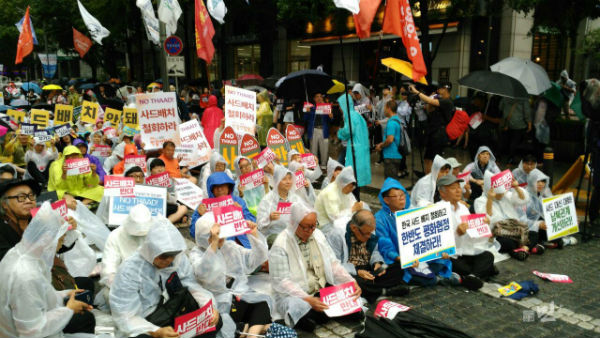
  • Posted in English @as @as
  • Comments Off on Kiwi Media: A Look at Media Ownership and Monopoly Owners in New Zealand
  • Tags:

Judging by South Korean President Park Geun-hye’s 13 June 2016 statement, Seoul has decided to cut off dialogue with North Korea, demanding that Pyongyang first end its nuclear programme.

As is well known, South Korea severed all communication channels with the North and closed the last collaborative economic development – a joint industrial zone in Kaesong – after North Korea conducted its fourth nuclear test and satellite launch in January-February 2016.

In this regard, it is worth mentioning the conciliatory overtures made towards Seoul at the 7th Congress of the Workers’ Party of Korea (WPK) held in May, which included the holding of high-level talks between military authorities and then the convening of an inter-Korean meeting in August to discuss reunification.

The North Korean government also extended an invitation to dialogue to Washington. In particular, it included an idea highly-valued by experts of a so-called package deal in the manner of a ‘moratorium for a moratorium’: Pyongyang would stop conducting nuclear tests for a certain period of time and the US would stop its annual large-scale joint military exercises with South Korea close to the demilitarised zone or at least move them to an area further away from North Korea.

Unfortunately, however, these proposals by North Korea were rejected just like all of the country’s previous ones. The argument that every peaceful step by Pyongyang is just propaganda intended to camouflage an imminent ‘act of provocation’ that needs to be prepared for in advance without losing time studying the diplomatic signals emanating from the banks of the Taedong River is an already familiar explanation for this kind of approach.

Categorically refusing to enter into a dialogue with North Korea proves only one thing – that Washington, Seoul and their allies have an alternative agenda aimed at regime change in North Korea by imposing the toughest sanctions, putting pressure on the country and deepening its isolation.

This also explains Seoul’s negative attitude to Pyongyang’s invitation to resume discussions on the prospect of Korean reunification at a meeting on 15 August that will coincide with the 71st anniversary of Korea’s liberation from Japanese colonial rule. This clearly shows the fundamental differences between the two sides regarding how to reunite their divided nation.

The current government in Seoul is trying to reunite Korea by swallowing up the North and is trying to make this happen in the near future.

Pyongyang is suggesting a different way, however – reunification by forming a ‘Confederal Republic of Koryo.’ This plan, developed during the reign of Kim Il-sung, was confirmed in the overtures made towards South Korea in May-June 2016.

The essence of North Korea’s idea is the formation of a confederal republic that will allow for the existence of two social systems and two governments within a single nation and a single state. The formula supposes that the two parts of Korea will initially co-exist within the context of a common state formation and then gradually draw closer.

North Korea believes that the two Korean sides should not blindly copy the experience of other countries, but should form an entity that corresponds to the historical experience of Koreans without asking for the permission of external forces to reunify.

All of Pyongyang’s peace initiatives were formulated at the latest party congress. In our opinion, this event was worthy of much more attention than was given to it by the world’s media.

The 7th Congress of the Workers’ Party of Korea (WPK) took place on 6-9 May 2016 after a 36-year hiatus. It opened a new stage in the development of the Democratic People’s Republic of Korea. Among its most important achievements, the following are worth highlighting.

The congress marked the end of the transitional period for the establishment of Kim Jong-un’s leadership, confirming both its continuity with regard to the commitments of the previous government and the viability of new objectives and policies.

As is well known, Kim Jong-il, the father of North Korea’s current leader, who led the Democratic People’s Republic of Korea from 1994 to 2011, did not conduct party congresses – he adhered to an army priority policy, which was regarded as the main driving force of society. This was due to the need to overcome the severe economic crisis of the middle to late 1990s.

Kim Jong-un, however, considered it possible to return to normal political practices by restoring the balance of the branches of government, which would also strengthen the role of the party.

The new leader came to power with the idea that «everyone should do their own job: the army should defend the state; the party should provide political leadership; and the cabinet of ministers should ensure economic development».

The party congress held after a 36-year hiatus confirmed that he has succeeded in carrying out his plan and returning to the principles of leadership practised by his grandfather, the founder of the Democratic People’s Republic of Korea, Kim Il-sung.

The policy aimed at the parallel development of the economy and nuclear arms build-up was also reinforced at the 7th Congress of the WPK.

One of the hobby horses of Western critics regarding this approach is the argument that it is impossible to combine these two objectives. They say that a government developing nuclear weapons is unable to successfully implement a programme of economic development and improve living standards.

The development of North Korea shows otherwise.

Even with the increasingly stringent sanctions, GDP continues to grow at a moderate but steady rate, more and more economic innovations are being implemented, which are also ensuring a seemingly never-ending construction boom, primarily in the capital, and there has also been an increase in harvests in recent years, which is reducing the food shortage considerably.

The party congress identified the transfer of all sectors of the economy to a scientific and intellectual level as a priority. Eyewitnesses testify that this is not just a slogan, and the successful practice of increasingly computerising national industry has had a tangible, material effect in recent years.

These days, even some US experts recognise the uniqueness of the North Korean phenomenon, the essence of which is that despite international sanctions, Kim Jong-un is successfully managing to both develop his country’s nuclear military potential and achieve a certain amount of economic growth, which is improving the lives of large segments of the North Korean population.

As a result, North Korea is not only surviving without help from the South, but is not even in any desperate need for a dialogue with it.

The 7th Congress of the WPK has also confirmed the seriousness of the North Korean government’s approach to doing business in the nuclear sector, including a commitment to the requirements of nuclear non-proliferation.

Note that the expectations of many observers, who believed that a fifth nuclear test would be carried out as a ‘gift’ for the party congress, have not been met.

The alarmist interpretations of Pyongyang’s statements on the right of the Democratic People’s Republic of Korea to a preventive nuclear strike, which were made at the time of a military and political crisis in March and April during large-scale American and South Korean military exercises, have also been left hanging in midair.

It was firmly stated from the podium of the party congress that North Korea has no intention of using nuclear weapons first.

The Democratic People’s Republic of Korea today is a country that is confident in its own abilities and in the possibility of further developing the social and economic system that exists within it.

Alexander Vorontsov is currently the head of the Department for Korean and Mongolian Studies at the Institute of Oriental Studies of the Russia Academy of Sciences. He also holds several  posts as a professor and researcher at Lomonosov Moscow State University as a Russian Federation Military Science Academy professor and the the Institute for Asian Studies at Osaka University of Economy and Law in Japan as a visiting professor. He is a key member of the Russian half of the Russia-DPRK Intergovernmental Commission dealing with trade, economic, and scientific-technical cooperation between North Korea and Russia. Prof. Vorontsov was also a scholar at  Pyongyang Kim Il Sung University in North Korea.

  • Posted in Asian @as
  • Comments Off on The Seventh Workers Party of Korea Congress: A Russian Interpretation of a North Korean Phenomenon
  • Tags:

Sanctions and Defiance in North Korea

July 4th, 2016 by Prof. Mel Gurtov

North Korea has now been sanctioned five times by the United Nations Security Council for its nuclear and missile tests: resolutions 1718 (2006), 1874 (2009), 2087 (2013), 2094 (2013) and 2270 (2016). UNSC Resolution 2270 is the strongest one yet, spelling out in great detail the proscribed goods and requiring that all parties neither import them from nor export them to North Korea. Each resolution obliges the members to carry out the terms of the sanctions and (as the April 15 press statement of the UNSC says) “facilitate a peaceful and comprehensive solution through dialogue.” This is a case of mission impossible for two fundamental reasons: the sanctions will not work, and the fact of them impedes any chance for a “peaceful and comprehensive solution.” The way forward, which I discuss at the end of this article, is to address North Korea’s legitimate security concerns and economic needs while also considering how to build trust and reduce tensions in Northeast Asia as a whole.

Sanctions: Why They Fail

Foremost among the obstacles to an effective North Korea sanctions regime is smuggling along the China-DPRK (North Korea) border. Military items disguised as ordinary goods seem easily able to evade detection thanks to inconsistent inspection by border guards, bribery, false declarations, and North Korean firms based in China that actually belong to military-run trading companies. Since these practices are surely well known to the Chinese authorities, it seems fair to assume they have no strong interest in preventing or at least substantially reducing it-something they could accomplish with a more intensive border inspection process. That China is not doing so no doubt reflects its oft-stated position that the North Korean nuclear issue is the result of other countries’ policies, not China’s, hence that resolving it is others’ responsibility, mainly the US.

This is not to say that China is refusing to follow the UNSC’s latest resolution (UNSCR 2270). Beijing’s criticism of North Korea’s nuclear and missile tests has become increasingly harsh and open over the last few years, and voting to approve UN sanctions is one way to underscore its criticism. Reports indicate, for example, that China has closed its ports to North Korean coal and iron ore exports. But the Chinese have created a large loophole. At their insistence, 2270 allows for humanitarian trade affecting people’s “livelihood.” Thus, as China’s foreign ministry spokesperson said on March 4, “We will earnestly observe the UNSCR 2270. The resolution prohibits the DPRK’s export of coal, iron ore and iron, but those that are deemed essential for people’s livelihood and have no connection with the funding of the DPRK’s nuclear and missile programs will not be affected.” As a result, China’s exports to North Korea actually rose about 15 percent in the first 3 months of 2016 compared with 2015, and Chinese imports rose nearly 11 percent.

These figures come from a Chinese customs official. They may underplay the actual trade figures, which are said to have been deleted from official PRC trade reports in order to hide the volume and character of the trade. China is hardly alone when it comes to evading sanctions on North Korea. The DPRK operates numerous entities that do business abroad in illicit goods. Namibia, Iran, and Russia are usually mentioned in this regard. Two specialists call these trading entities “North Korea, Inc.” Their research concludes that “sanctions have actually improved North Korea’s ability to procure components for its nuclear and missile programs.”

The reason is that the trading firms, mainly in China and Hong Kong, have been willing and able to pay a higher price for these goods to middlemen, who in turn are willing to take greater risks to sell. The writers acknowledge the great difficulty in getting ahead of the curve when it comes to identifying the North Korean firms and finding ways to put them out of business. In the end, they say, only diplomacy will resolve the problem.

Reflagging and renaming North Korean ships is another common tactic, as is falsely claiming a ship’s destination as (for example) China rather than the DPRK. For example, an unpublished UN report describes how the North Koreans used a Singapore branch of a Chinese bank to pay for their ships to transport weapons through the Panama Canal. Then there is the story of a British banker who, according to the Panama Papers, set up a front company in Pyongyang, registered in the British Virgin Islands, to sell and procure arms.

North Korea’s military program also benefits from the fine line that often exists between civilian and military items. Commercial trucks, for example, can be used to mount a variety of weapons. A Chinese-made truck used in both China and North Korea for mining operations has reportedly been adapted by the North Korean military for its new mobile rocket-propelled artillery system. Six mobile intercontinental missiles (possibly fakes or mock-ups) paraded in Pyongyang in April 2012 likewise were mounted on Chinese-made trucks.

When all is said and done, the most likely scenario is that the new round of sanctions will produce no better results than previous rounds. This is so not only because North Korea has many ways to procure items needed for its military purposes, and plenty of willing private sellers. China, as North Korea’s principal trade partner for many years, is not going to watch the North disintegrate in spite of Beijing’s discomfort over Pyongyang’s nuclear and missile programs. China’s leaders will do more than previously to enforce sanctions, such as inspection of cargo bound for and incoming from North Korea; but they will do a good deal less than the US wants, especially when it comes to border inspections. For just as President Obama has hawkish advisers who want to turn the screws on North Korea even tighter in hopes of regime change, President Xi has people around him who think resisting US pressure is strategically more important to China than undermining Kim Jong-un. Secretary of State John Kerry may well say that China’s approach “has not worked, and we cannot continue business as usual.” But the Chinese have a perfectly good comeback, namely, that Washington and Pyongyang must find a way back to the negotiating table.

Weapons: Full Speed Ahead in North Korea

North Korea is on a military tear. In response to UN sanctions, it carried out its fourth nuclear test in January and a satellite launch that had missile implications in February. Then, when new UN sanctions were imposed and the annual month-long US-ROK military exercises began, the DPRK diverged from its usual practice by openly drawing attention to a number of new weapons it claims to have. It paraded a road-mobile intercontinental-range missile (probably not yet actually produced), launched five short-range missiles into the East or Japan Sea, claimed to have an indigenously produced engine that would enable an ICBM to reach the US with a nuclear weapon, claimed to have tested a miniature nuclear weapon, test-fired an intermediate-range missile (which failed), and tested a missile launched from a submarine. A fifth nuclear test may well take place before a major party congress in May. (See the chart below published by the BBC.)

How and when any of the weapons the North claims to have might actually be operational is open to speculation. Some US military officers, as well as South Korean specialists, now accept that the North already has the capability to reach the US with a nuclear-tipped missile, while experts who dispute that view nevertheless believe the North will soon have that capability.

What does seem clear is that Kim Jong-un is pressing his weapons specialists to produce a reliable deterrent that will force the issue of direct talks with the US. Meeting with nuclear specialists in early March, he praised their work and, according to the North Korean press, specifically cited “research conducted to tip various type tactical and strategic ballistic missiles with nuclear warheads,” meaning a miniaturized nuclear weapon. Kim is quoted as saying that it “is very gratifying to see the nuclear warheads with the structure of mixed charge adequate for prompt thermo-nuclear reaction. The nuclear warheads have been standardized to be fit for ballistic missiles by miniaturizing them . . . this can be called [a] true nuclear deterrent . . . Koreans can do anything if they have a will.”

South Korean sources are convinced the North can now put a nuclear warhead on a medium-range (800 miles) Rodong missile capable of reaching all of the ROK and Japan. These are the missiles the North launched in a test in March. Whether the North has actually fitted such a missile with a warhead is unknown; nor is it known whether the North will be able to do the same once it possesses an ICBM.

Dealing Sensibly with North Korea

North Korea has a long history of militant nationalism in response to external threats, reflected in Kim Jong-un’s quoted remark above and concretely in the speed with which it is developing a sophisticated nuclear and missile capability. Like the North Vietnamese during the Vietnam War, the DPRK is not going to take orders from foreign powers, friends and adversaries alike, least of all when its leaders believe US nuclear weapons and military exercises pose a threat. Predictably, therefore, Pyongyang treats international sanctions, intended to punish it, as incentives to push ahead with development and production of new weapons for deterrence. It may only be a matter of time before a North Korean missile will be able to reach the US mainland, but Kim Jong-un, like his father and grandfather, is ever mindful of that fact that North Korea is surrounded by the overwhelming strategic power of the US and its South Korean and Japanese partners. Nuclear weapons are the ultimate equalizer, and bargaining chip. In addition, the DPRK also faces a US president who once upon a time called for eliminating nuclear weapons but now is presiding over their significant upgrading, in competition with Russia and China. That upgrading includes miniaturization, which from one angle-the one most likely to have the North Korean military’s attention-increases the possible use of a nuclear weapon in warfare. North Korea’s evident work on miniaturization may hardly be coincidental.

 The best and only chance of dissuading Kim Jong-un from continuing on the path of weapons modernization, which is both dangerous and ruinous in terms of human development, is to put before him a package of alternative incentives- a peace treaty to end the Korean War, security guarantees, sustainable energy options, and meaningful economic aid. A joint US-China initiative that, within the context of a revived Six-Party Talks, incorporates such a package would be a welcome development indeed, as much for improving their bilateral relations as for deescalating tensions with the DPRK. As an interim step, Washington might have accepted a proposal put forth by DPRK foreign minister Ri Su-yong, who told the Associated Press on April 23, shortly after the submarine-launched missile test, that if the US “stops the nuclear war exercises in the Korean peninsula, then we should also cease our nuclear tests.” “It is really crucial,” he said, “for the United States government to withdraw its hostile policy against the DPRK and as an expression of this stop the military exercises, war exercises, in the Korean Peninsula. Then we will respond likewise.” But President Obama quickly rejected the proposal. I have also put forth in these pages the idea of creating a Northeast Asia Security Dialogue Mechanism. Its agenda would ultimately include multilateral denuclearization, but would start with discussion of other security-related topics on which it might be easier to find common ground, the aim being trust building.

Hence, what is often referred to as “the North Korean nuclear issue” is much more than that. The heart of the matter is peace and security in Northeast Asia, which involves a host of interlinked issues: strategic mistrust between the US and China, territorial disputes, increasing military spending and basing agreements, cross-border environmental problems, and nuclear weapons possessed by four countries today and possibly two more (Japan and South Korea) tomorrow. Decision makers in Washington, though overwhelmed by problems in the Middle East, need to pay attention to the Korean peninsula and think outside the box.

Mel Gurtov is Professor of Political Science and International Studies in the Hatfield School of Government, Portland State University, and Editor-in-Chief of Asian Perspective.

This is a translation of a keynote speech delivered by Muto Ichiyo at a peace conference held in Hiroshima Aug. 4-5, 2015, marking the 70th anniversary of Japan’s defeat in the war. The conference, attended by 300 local and national activists, sought to shed new light on the war responsibility of imperial Japan and US responsibility for the atomic bombings. The text has been revised and updated for the Asia-Pacific Journal.

The speech was made during a summer of intense public protests over security legislation then being debated in the Japanese Diet. Despite opinion polls that showed the legislation to be exceedingly unpopular, the laws were rammed through the Diet on September 19, 2015. These contentious issues have now entered a new stage, with the drive to revise Japan’s peace constitution at the center of the Upper House election scheduled for July 10. Muto’s speech analyzes the issues that lie behind the present contest in light of the complex dynamics of Japan’s postwar politics.

John Junkerman, Translator, 1 July 2016.


The struggle over reshaping postwar Japan entered a new phase on March 2, 2016, when Prime Minister Abe Shinzo declared at an Upper House Budget Committee hearing that he was committed to revising the constitution within his term of office, that is, by September 2018. Changing the postwar regime by fundamentally revising the present pacifist constitution has been Abe’s goal since he returned to power in 2012, but for some time he had avoided clearly stating his plan, knowing that the majority of voters oppose constitutional revision.

In the three elections that have taken place during his administration (including the one that returned him to power in 2012), Abe has trumpeted “Abenomics,” ultra-lax monetary and fiscal policies aimed at extracting the economy from deflation by stimulating consumer spending, as his main political program. However, while campaigning on its economic policies, since the elections the Abe administration has pressed forward with changes in laws, systems, and institutions to heighten Japan’s defense posture and undermine the constraints on Japan’s armed forces imposed by Japan’s constitution.

For example, after the LDP scored a victory in the 2013 Upper House election, Abe significantly increased defense spending and pushed through the controversial State Secrets Act in December of that year. The most blatant action in this direction was the Cabinet’s decision in July 2014 to reverse a long-standing interpretation of the constitution; for decades the Cabinet Legislative Bureau had held that Article 9 of the constitution prohibited the Japanese Self-Defense Forces from exercising the right of collective self-defense. Reversing this interpretation meant that Japan could come to the aid of an ally under attack, even if Japan itself was not attacked. In line with this decision, a set of laws called the “security legislation” was drawn up and presented to the Diet in May 2015.

This called forth strong popular protest, which mounted over the summer into the largest demonstrations in Japan since the 1970s. Thousands of citizens mobilized spontaneously, joined by peace and other movement groups from earlier decades. After many years of absence, students joined the rallies in front of the Diet, demonstrating in ways markedly different from those of the traditional left. Each individual speaker delivered personal messages, telling her or his particular reasons for confronting Abe and his power grab. In place of the standard shouted slogans of past demonstrations, their rhythmic, rap-influenced call and response lent spirit and buoyancy to the rallies.

One of the developments that spurred the demonstrations was the testimony in the Diet by three leading constitutional scholars in early June 2015, unanimously advising that the proposed security legislation was unconstitutional. This delivered a bombshell to the LDP, as two of the scholars were known for their conservative views, and one was invited to the hearing by the LDP itself. Subsequent surveys of constitutional scholars found a nearly unanimous consensus that the legislation was unconstitutional. Until that point, the Diet deliberations had focused on the various individual provisions of the legislation, but their testimony shifted the focus to the unconstitutionality of the entire package of legislation.

This added momentum to the keen sense of crisis already motivating the public to action, the perception that the security legislation would change Japan into a country that would fight wars. This alarmed young people. In addition to the issue of unconstitutionality, the issue of peace—and whether there would be a military draft—loomed large in their eyes.

Public anger at what came to be called Abe’s “war legislation” heightened and more and more people joined the demonstrations at the Diet. On August 30, more than 100,000 occupied the broad avenue in front of the Diet, overwhelming steel barricades set up by the riot police. The demonstrations became an everyday affair, involving ever new groups of people.

The Diet deliberations on the bill were a sham as Abe and his ministers refused to seriously answer opposition interpellators. On September 17, the bill was forced through an Upper House committee and then passed on September 19 by the full house, where the LDP-Komeito coalition government holds a majority.

The Abe administration used this victory to advance two major policy positions. The first is to promote the doctrine of deterrence. Arguing that the international security environment has drastically changed, specifically pointing to China and the danger it poses, they argue that it is necessary to strengthen the Japan-US alliance to counter the threat. Second, they argue that, if the security legislation violates the constitution, then the constitution should be changed. In the upcoming Upper House election, Abe has set an explicit goal of obtaining a two-thirds majority of seats for the LDP and its allies, which will allow them to initiate the revision of the constitution.

So, what is at the heart of these issues? What is the Abe administration attempting to accomplish?

A Semi-Coup d’état in Process

The Abe administration is the first postwar administration to call for and attempt to carry out a “change of regime.” In the 1980s, PM Nakasone Yasuhiro called for “settling the accounts of postwar politics,” which closely resembles “breaking with the postwar regime,” the slogan of the first Abe Cabinet (2006–07). In Nakasone’s case, the slogan was mere rhetoric. Abe, however, may be able to realize his goals.

What he has been carrying out is a form of coup d’état. The evidence for this is that he has placed men and women under his command in some of the most important positions in Japanese society. In the United States, when the president changes, the personnel in Washington change dramatically. This has been far less true in Japan, but Abe moved quickly to consolidate his hold on government after he returned to power in 2012. He placed people who will follow his lead in positions such as the governor of the Bank of Japan (to do his bidding with his Abenomics agenda); the director-general of the Cabinet Legislative Bureau (to revise the official interpretation of the constitution); and the chairman of NHK (to ensure more favorable political coverage). The character of these appointments was typified by Saitama University emeritus professor Hasegawa Michiko, who was installed on the NHK Board of Governors. Hasegawa has written in the journal of the ultra-right Nippon Kaigi organization:

Depopulation might destroy Japan. It is often described as a disorder of advanced civilization but, looking around the world, there is something else involved here. It is the disease of feminism. Feminism is the activist movement of women who can’t abide the fact that they are women. Stated more concretely, raising children well, protecting the family, nurturing fine children, men and women marrying when they reach the proper age, and as a matter of course, having children after they marry. Feminism rejects all of this.

While calling for a “society where women shine,” Abe appointed someone who thinks this way to the NHK Board of Governors. The appointment required Diet approval, and it was questioned in the Upper House budget committee hearings on March 12, 2014. According to the Asahi Shimbun, “Abe responded, ‘She is one of the country’s leading philosophers, studying thought and philosophy and writing such books as Karagokoro: Nihon Seishin no Gyakusetsu [Chinese Heart: The Paradox of the Japanese Spirit].’” This is unbelievable. This notorious right-wing thinker is appointed to a key position at NHK. The first thing a coup d’état administration does is to occupy the controlling heights, especially asserting control over broadcasting. This is the Abe methodology, grabbing state power in what amounts to a virtual coup d’état.

Then comes the security legislation. It is evident to all that the laws are unconstitutional, but the administration tries to push them through with a logic that has no logic. To start with, “changing the regime” or “changing the system” would normally necessitate changing the constitution. The LDP drafted a revised constitution in April 2012, when it was out of power. The Abe administration has always promoted constitutional revision, and the first Abe Cabinet made moves in this direction, in 2007 revising the Fundamental Law on Education, the “constitution” of the educational system, to promote patriotic education. He also pushed through legislation to establish the framework for the public referendums that are necessary to ratify any changes to the constitution.

In September 2007, Abe left power, apparently ill, and the first Abe Cabinet ended in failure. Abe hoped to push for constitutional revision when he launched his second cabinet in December 2012, but he realized that he lacked the required two-thirds of the vote in the Upper House, and the prospects were not good for winning a majority in a national referendum to approve the amendments. So he first proposed changing Article 96 of the constitution, which requires two-thirds vote in both houses of the Diet to initiate an amendment; he aimed to lower the threshold to one-half of each house of the Diet to make it easier to enact the LDP’s amendments. This proposal was not only very unpopular, but was dismissed by constitutional scholars as a “backdoor” approach, and Abe abandoned it.

What the administration did instead, with the collective security legislation, was to effectively change the constitution without going through the formal process of revision. While in recent decades LDP-led governments have regularly revised the interpretation of the constitution to allow the dispatch of the SDF overseas (for UN peacekeeping operations and for support of the US-led wars in Afghanistan and Iraq), this legislation represented a more fundamental change. Its passage constituted a “semi-coup d’état.” What would normally be possible only after revision of the constitution (a successful coup d’état) the Abe administration carried out under and in the name of the present constitution. They had to find a way to make an unconstitutional act fit the constitution. Somewhat ineffectually, LDP Vice President Komura Masahiko invoked the 1959 Supreme Court decision in the Sunagawa Incident (a ruling that US bases in Japan did not violate Article 9 of the constitution), an entirely farfetched rationale. The administration then argued that it understood the geostrategic reality Japan faces, and the necessity for collective self-defense, better than the nation’s constitutional scholars. But in the end, they simply used their parliamentary majorities to force through the legislation.

A Nonsensical Understanding of History

In July 2013, Vice PM Aso Taro said that constitutional revision should be carried out quietly, without a fuss. He suggested that Japan learn from the example of the Nazis who, having won an electoral victory under the Weimar Constitution, replaced it with a Nazi constitution without the German people noticing. This was a misreading of history, since the Nazis, rather than amend the constitution, instead used the Enabling Act to effectively suspend the constitution and grant Hitler emergency powers. But in any case Aso’s intention was to avoid a frontal assault on the constitution and use the weight of accumulated unconstitutional changes to make it easier to breach the walls preventing revision when the time came.

The Japanese situation is very different from the Nazi era. The Nazis came to power during the Great Depression when society had fallen into chaos; the Communist Party had grown via intense class struggle, and in that context the Nazis gained strength and took control of the Reichstag. It was a time of social upheaval. Today’s Japan is entirely different. To be sure, the LDP enjoys majority support, but these supporters think it is the LDP of old. The previous DPJ administrations were so ineffectual that the LDP was simply returned to power; people didn’t vote to endorse Abe’s scheme to gut the constitution. Therefore, in public opinion polls since the start of the administration, the Cabinet’s basic policies have never had majority support. An odd situation has prevailed, where support for basic policies has been far below 50%, while support for the Cabinet has been around 50% (though support fell below this level during the Diet deliberations on the security legislation). Thus, though the weakness of the opposition has enabled the LDP to win successive elections, the Abe administration’s social foundation is not at all solid, nor is it broad.

However, the Abe Cabinet has at its base a solid core of ultra-right organizations. A majority of the LDP Diet members (and quite a few from other parties) belong to Nippon Kaigi and/or are affiliated with other right-wing groups, constituting the so-called “Yasukuni faction.” One indication of the ideology of these groups is seen in the example of Tamogami Toshio, the ex-Chief of Staff of the Air Self-Defense Force. Tamogami was fired in 2008 after he won an essay contest by arguing that the Comintern caused the Manchurian Incident, that the Xi’an Incident that led to the anti-Japanese united front in China was a setup by Stalin, and other assertions that have as much credibility as warnings of UFO attacks. But PM Abe appeared at an “Evening in Thanks to Tamo-chan,” and delivered the following paean to Tamogami. “In every era there are people who have the courage to say, ‘This is wrong,’ and to sound the alarm for the world, sometimes risking their jobs, and sometimes risking their lives. It is on account of such people that the times move in the proper direction.” That’s the kind of ridiculous historical consciousness the prime minister has.

The slogans of the first Abe Cabinet were “Toward a Beautiful Japan” and “Breaking with the Postwar Regime.” Now the slogan is “Retake Japan.” The premise is that something has been lost. What is it? It is the essence of the Empire of Japan. To Abe, the “postwar” has been an extremely unfortunate era. The reason is that the honor of the glorious Japanese empire was denied and the Occupation imposed the constitution on Japan.

It is not only Abe who thinks this way; this thinking is fairly deeply rooted in postwar Japanese leadership long dominated by the LDP. In fact it is my contention that in the postwar Japanese state, the continuity of the Japanese empire was preserved, if surreptitiously, as a principle of the legitimacy of the state.

The Incompatibility between the Constitution and the United States

A state must be organized around certain legitimizing principles. The state is all mighty, so it can legally kill people. It can fight wars. When it fights a war, it can take people’s lives, and those who are sent to war die. In order to undertake these things, it is necessary for the state to have legitimizing principles. Unless the state has fundamental, legitimizing principles, it can hardly ask the people to risk their lives for the state. What were the legitimizing principles of the postwar Japanese state?

The United States has the Declaration of Independence as its legitimizing document. France has the Declaration of the Rights of Man from the time of the French Revolution. Sometimes the actual functioning of the state diverges from those fundamental principles; in these cases, the actions must be fudged or an excuse found to justify them. The legitimizing principle in the prewar Japanese empire was the sovereignty of the emperor. Everything that was done by the imperial state in his majesty’s name was legitimate and justified. The invasion of Ainu homelands, the annexation of the Ryukyu kingdom, the Sino-Japanese and Russo-Japanese wars, the annexation of Korea, the invasion of China, the Great East Asia War—all of these were justified in the name of the emperor.

Japan surrendered in 1945, and the empire lost its legitimacy. The Occupation began, the constitution was created, and the postwar state was born. So, what provided legitimacy for the postwar state? First of all, the Constitution of Japan. This is the foundational law of the postwar state and the source of its legitimacy and justification. Or, it was supposed to be. However, in fact, not everything the Japanese state did could be justified and legitimized by the constitution. Why? Because of the presence of the US military throughout the postwar period. On the very day in September 1951 that the San Francisco Peace Treaty was signed at the Opera House, PM Yoshida Shigeru proceeded alone to the Presidio military base and signed the Security Treaty. The Peace Treaty stated that foreign military forces would withdraw within 90 days, but it included an exception for the Security Treaty, and US forces would remain in Japan for an indefinite time after its independence.

Even more significant, Japanese armed forces—proscribed by the constitution—were created by order of Douglas MacArthur, the supreme commander of the Occupation, over the heads of the Japanese Diet. This was in 1950, soon after the Korean War began, and they were called the National Police Reserve. The reserve force was intended to fill the vacuum that was created when most of the Allied forces stationed in Japan were shifted to the Korean Peninsula to engage in full-scale war. At this time, the term “indirect invasion” was coined. Normally, an invasion means a foreign army landing on the shores of a country, but if large-scale riots and disturbances in Japan were considered to have occurred through instigation or intervention by an outside power, they would be deemed an indirect invasion; and it was the National Police Reserve that was to deal with the “invasion.” Moreover, under the 1951 security treaty, US forces may be utilizedto put down such disturbances in Japan. As is clear from their origin, the postwar Japanese armed forces were, and have ever been, an alien entity in the Japanese state. From the start, they were a part of the US military system, and as they grew, they came to function as a part of the American strategic posture. They do so to this day.

There is a commitment to interoperability in the Japan-US defense guidelines, so since 1951 the US military and the Self-Defense Forces (SDF) have shared weapons and equipment, war plans, logistics, operational manuals, terminology, and communication and other systems. The body that exists as the Japanese military has been organically incorporated into and subordinated to the US military. In other words, the state power of the US has been internalized in the Japanese state. This means that the principle of United States hegemony has been integrated into the Japanese nation and plays a role as one of its legitimizing principles.

The Japanese Empire as a Third Principle

The conflict between the pacifist principles of Japan’s constitution and the American hegemonic principle has long been contested, for example in the anti-base movement in the 1950s. In this context, constitutional scholars such as Hoshino Yasusaburo pointed out that the constitution and the Security Treaty system exist in Japan as parallel, contradictory legal and ruling systems. This is clear when we look at postwar domestic developments in Japan. For example, Okinawa, which was under the control of a US military government, was separated from Japan in 1952 when the SF Peace Treaty came into effect. The military government of Okinawa made it a US military colony that fit into no category of international law.

An agreement was reportedly reached at the time of the SF Peace Treaty, whereby the US recognized Japan’s “residual” sovereignty in Okinawa. This was considered a victory for Japanese diplomacy. Some even argue that the emperor’s message, proposing that the US administer Okinawa indefinitely,1 helped win the acknowledgment of “residual” sovereignty (translated into Japanese as senzai shuken, or “latent sovereignty”).

We can see here an example of how the legitimizing principle of the US state—the principle of hegemony, of Pax Americana—became incorporated as a principle of the Japanese state. Through its latent sovereignty, the Japanese state retained control over Okinawa, while it remained in substance a military colony of the US. When Okinawa was returned to Japan in 1972, its status was one of an internal colony of Japan, while the concentration of US bases there ensured that it would continue to be a US military colony.

However, in postwar Japan, there is a third fundamental principle. This is something that has normally remained hidden. It is the manner in which the Empire of Japan survived within the postwar Japanese state. The most important vehicle for the survival of this legitimizing principle was the postwar emperor system.

The prewar and wartime emperor was not at all an ornament, but rather was the generalissimo who rode out from the palace in uniform on a white horse. A photograph of this scene was displayed on the walls of many homes. This man led his country in successive wars, his army was responsible for the deaths of tens of millions of people in Asia, and millions of his own soldiers and Japanese civilians died. Many of those soldiers starved to death. And he lost the war. Despite being the commander in chief of the war, after his government surrendered to the allies, he retained the title of emperor and continued to live in the Imperial Palace.

The logic of this was spelled out as early as 1942 by the Japan scholar and later US ambassador Edwin Reischauer, who advised the US government to exploit the emperor to maintain control after defeating Japan.2 The maintenance and exploitation of the emperor system was carefully prepared by the State Department and implemented by the Occupation. MacArthur was adept at using the emperor. The general issued solemn statements in the form of New Years messages and the like, but he seldom appeared in public. This was similar to the prewar emperor. MacArthur remained ensconced in the Occupation headquarters in central Tokyo. Instead, it was the emperor who was sent out on numerous tours through Japan, exposed to the public eye.

MacArthur made strenuous efforts to ensure that the emperor, far from being prosecuted or even forced to testify in the Tokyo war crimes trial, retained the throne. He promoted a constitution that removed the governing authority of the emperor, while preserving his status (in Article 1) as “the symbol of the state and of the unity of the people.” This was done rapidly so the draft would be ready before the Far Eastern Commission (which would have the authority to decide policies for the occupation of Japan) could be set up and issue a directive to prosecute the emperor. The draft constitution was comparatively democratic, with content that would not raise objections among the public in either the Soviet Union or the US. That constitution was adopted, so the postwar emperor system is often referred to as an American-made system.

Thus Emperor Hirohito, who had the highest responsibility for the war, was left unpunished and did not abdicate. The consequence of this was that it limited the punishment of those who acted under his orders and in his name. The entire responsibility for the war was shifted to General Tojo Hideki and the other Class-A war criminals, seven of whom were executed even though the emperor was their supreme commander. The emperor became a “symbol of peace,” credited not with waging the disastrous fifteen year war but with the surrender. The result was that, following the execution of the Class-A war criminals, with Hirohito remaining on the throne, the Japanese state could do no more to punish war responsibility.

Restoring the Honor of the Class-A War Criminals

In this fashion, a vessel was created to preserve and nurture the idea that the wartime actions of the empire were not wrong, and even that they were right. After the Occupation ended, the legitimizing principle of the prewar empire was clearly retained within the Japanese government. On May 1, 1952, immediately after Japan regained its independence on April 28, Attorney General Kimura Tokutaro issued a notice that stated that war criminals who had been put to death were not “executed” but instead had suffered “death during legal duty” (hōmushi).3 This is a term that was never used before or since. It was an official measure that restored honor by declaring that all of the war criminals who were put to death had not died as punishment for committing crimes. At the same time, the cause of death in the family registers of these individuals was changed from “execution” to “death during legal duty,” and the payment of war pension benefits was resumed. The San Francisco Peace Treaty includes a clause that states that Japan accepts the judgments of the war crimes trials. But immediately after the treaty came into effect, the honor of the Class-A war criminals was restored. Doing this in such short order indicates the existence of a strong state will. There is more. In 1952 and 1953, the Diet voted three times to approve the release of imprisoned war criminals. A few members of the Japanese Communist Party (JCP) and the Labor-Farmer Party were opposed, but the measures passed with nearly unanimous support, including from the Japan Socialist Party. A petition in support of releasing all imprisoned war criminals gathered 40 million signatures. During the Diet debate, one supporter of the release described all convicted war criminals as victims of the war.4 The grounds for demanding the release of war criminals was that the Tokyo trial represented victor’s justice, which is what the right wing still asserts today.

It is certainly true that the Tokyo trial was victor’s justice and lacking in fairness, but if that was the case, then Japan should have conducted proper trials of its own. In the war they initiated, the leaders of the Japanese empire committed crimes, not only against people in foreign countries but against their own people. Contemporaries should have said, “We’ll try them on our own.” If there were many flawed convictions among the B- and C-Class war criminals, then their own country should have held new trials and brought these to light. But the thinking during the Diet deliberations was that all of the war criminals were victims of the war, to be told, “Sorry for your hardship, welcome back.”

Thus postwar Japan created a sphere of immunity from responsibility. In this sphere, the thinking that the Empire of Japan had been right was kept alive within the postwar Japanese state, and this thinking was then put into action. The best evidence of this is in the Ministry of Education’s textbook authorization process. The ministry (now the Ministry of Education, Culture, Sports, Science and Technology, MEXT) has followed a policy of concealing, to the extent possible, the war crimes and horrifying actions committed by imperial Japan. As typified by the order to reword “invasion” as “advance,” the will of the state is transmitted to the schools. When this was exposed internationally, it developed into a diplomatic issue, the “Japanese textbook problem.”

In the field of foreign affairs, the Japanese government has always taken the position that the annexation of Korea was legitimate. The Tokyo trial had narrowed the timeframe for Japanese war crimes to after 1931, so the 1910 annexation was outside its scope. There was a risk involved in addressing the issue during the trial. The US and Japan had reached an understanding in 1905, the secret Taft-Katsura Agreement,5 that after the Russo-Japanese War ended, the US would recognize Japanese control over Korea, while Japan would recognize American control of the Philippines. This is one important reason why the trial did not address the annexation of Korea.

In this fashion, the principle of imperial continuity, which the new constitution ostensibly disavowed by making the emperor a “symbol,” was retained and implemented by the postwar state wherever possible. This indeed was a third principle of the postwar state, which could not be spoken about openly. But because it was a legitimizing principle of the state, every action the Empire of Japan had taken, from the seizure of Ainu lands and Ryukyu, through the invasion of China and the Pacific War could be treated as legitimate.

To repeat, it is my view that the postwar Japanese state is formed from these three legitimizing principles—the postwar constitution, American hegemony, and the continuity of imperial Japan. The three have continued to exist in a relationship of mutual incompatibility. The first and second are visible, while the existence of the third is usually denied or downplayed. None in fact was able to assert itself at the expense of the others. As a result, none of these three principles has been able to attain the status of the fundamental principle.

There is a need to consider the merits of the Japanese constitution, but what has made the principle of pacifism embodied in Article 9 function as an effective principle of the state and society is the strength of the movement from below. The state itself has not been able to properly use the principle of pacifism as a principle. The decision of the Tokyo District Court in the case of the Sunagawa Incident was that the Security Treaty violated Article 9 and was unconstitutional. At that moment, the Japanese state recognized the pacifist principle as the foundational principle of the state. However, immediately afterward, Supreme Court Justice Tanaka Kotaro (the presiding justice for the Sunagawa case) met with US Ambassador Douglas MacArthur II and then issued a baffling ruling declaring that the Security Treaty fell into the category of a “political act,” and therefore its constitutionality could not be judged through the process of “judicial determination.” With that, the Japanese state transformed the pacifist principle into a pseudo-principle.

Then, did American hegemony attain full status as a principle? No, it didn’t, because of the strong force of such movements as the anti-Security Treaty struggles of 1960 and 1970. The US hegemonic principle is “freedom,” which equated to anti-Communism. Japan did not become an anti-communist state the way Germany did immediately after the war; during the early postwar administration of Konrad Adenauer, for example, the slogan “better dead than red” gained currency. Thus, none of the three principles gained ascendancy, and the Japanese state saw to it that they coexisted reasonably well, using them each when it was appropriate. As a result, all three lost their qualification as fundamental principles.

It was the LDP that took best advantage of this situation, and was able to remain in power for decades. Standing in opposition to this was the so-called progressive forces. The largest of these, the JSP, had as its political base 4.5 million organized workers of the Sohyo labor federation. In addition were the JCP and a political bloc of progressive intellectuals. These formed the opposition to the LDP-led government. This postwar progressive force embraced the constitution’s pacifist principle as a principle, and forced the state to respect constitutional pacifism as a fundamental principle the state should adhere to. However, there was a major weakness. This force saw peace entirely from the perspective of domestic Japan. In their perception war was something that would attack peaceful Japan from the outside, and it was enough to avoid that. With this mode of thinking, all that mattered was peace within Japan, and the movement tended toward the conservative goal of maintaining peace, i.e., the status quo.

The Beheiren and Zenkyoto Movements

In the second half of the 1960s, a new movement emerged as distinct from the traditional left. Beheiren (the official English title is Japan “Peace for Vietnam” Committee; the literal translation is Citizen’s Coalition for Peace in Vietnam), Zenkyoto (All-Campus Joint Struggle Committee), and later, the women’s liberation movement came on the scene. Most visible were the intense street demonstrations where New Left sects clashed with the riot police and the Zenkyoto campus struggles that occupied and shut down universities. Meanwhile the struggles in Sanrizuka and Minamata spread their strong impact nationwide as local movements against environmental pollution and development, and Beheiren’s activities to help deserters from the US military gained attention. There was an eruption of every form of resistance, and they created an unexpectedly large and dynamic sphere of political activism.

The political movements of that era overturned what was considered common sense by earlier Japanese movements. Earlier movements were aimed at protecting something—protecting peace, which over time came to mean the status quo. In the context of rapid economic growth, the “peace” that represented resistance in 1960 shifted to the maintenance of the status quo. In contrast, the movements of the late 1960s pointed to the status quo itself as the problem: It came to be understood that Japan was already complicit in the American war in Vietnam, and that relationship had to be changed then and now. That was an essential characteristic of the new movement. And in the midst of it, the concept of fundamental principles of state and society was refined and enriched. I think we can see in this new movement process the crystallization of the concept of the right to live in peace (heiwa-teki seizon ken), integrating three elements in the constitution, namely, the pacifist statement in the preamble, renunciation of war and armed forces in Article 9, and the people’s right to life and the pursuit of happiness in Article 13.

I think we also need to take a look at changes in the underlying structure that sustained the workings of the postwar state. This is what amounts to the national territory-centered mode of capital accumulation of postwar Japanese capitalism. This economic structure underlay the LDP’s ability to rule more or less securely by manipulating the three otherwise incompatible legitimizing principles. The structure combined large-scale land development, siting industrial estates along the coastlines; the systemization of large enterprises and their small- and medium-sized subcontractors; the system of food control (price support for rice farmers); and pork-barrel politics using the national coffers, all of which were instrumental to achieving rapid economic growth. As long as this functioned well, politics sorted itself out. There was little need to politically mobilize citizens. The economy was the stand-in for politics.

This began to crumble in the late 1980s, as neoliberalism and globalization undermined this foundation. The economic cycle that was contained within Japan broke down, which in turn eroded the LDP’s political base. Meanwhile, privatization, especially of the national railways, began to rapidly undermine the base of public sector labor unions, and in 1989, the Sohyo confederation was absorbed by the corporate-oriented Rengo federation. This left the JSP without its main organizational support, and it fell into decline.

1995 was, in numerous ways, the beginning of the present era.

That year saw the advent of the Murayama Tomiichi Cabinet. The LDP, JSP, and the New Party Sakigake formed a strange-bedfellows coalition, with the LDP giving the premiership to JSP Chairman Murayama in order to cobble together a majority in the Diet, with the inclusion of the smaller Sakigake. It was a moment when two conflicting currents crossed paths. One was the emergence of wartime compensation claims, including those of “military comfort women,” which resulted in a succession of court cases. Within Japan, there was a growing tendency to acknowledge these claims, and a movement emerged calling for new inquiries into wartime victimization.

It was also around this time that rightwing forces seeking to justify imperial Japan began a simultaneous offensive on a number of fronts. Nippon Kaigi formed as a broad coalition of all the ultra-right forces. The Society for History Textbook Reform was launched, textbooks reflecting their nationalistic historical stance were produced, and an effort was begun to have the texts adopted by Japanese schools. This finally brought the third legitimizing principle—imperial continuity—to the fore, and with that principle at the core a full-fledged move was launched to revise the constitution and replace the postwar state with a state based on the principles they adhere to. Ten years later, Abe Shinzo, deeply identified with these rightist campaigns, formed his first cabinet. This rightist force does not actually have a strong base in the wider society. But during these years, the counter force on the left has grown weaker, both organizationally and philosophically. The impact of the collapse of socialism has been great, and no new vision for transforming society has been gained momentum. In that context, the right has taken advantage of the opportunity to fan the flames of xenophobia. Bookstores are flooded with anti-Chinese and anti-Korean books, ephemeral as they may be. This should not be taken lightly.

Abe’s Policies Could Destroy Japan-China Relations

One concern is that, as long as the Abe administration stands on the principle that the Japanese empire was legitimate, that could undermine the premise of Japan’s relations with China. As long as Abe embraces the idea that the Nanking massacre never happened, or that comfort women were simply prostitutes, that the Chinese war of resistance against Japan was a Comintern conspiracy—even if he sugarcoats these beliefs in his public declarations—he cannot build a stable relationship with China or South Korea. Politically, PM Abe will not say these things openly, but it is clear from his statements from the time the LDP was still out of power, that his true beliefs differ very little from those of Tamogami.

The foundations of the Japanese relationship with China were set in clear terms in the joint communique that established diplomatic relations in 1972. There it was stated that Japan, “keenly conscious of the responsibility for the serious damage that Japan caused in the past to the Chinese people through war, deeply reproaches itself.” If this statement is overturned, friendly relations with China become impossible.

Japanese officials say that they welcome top-level talks and the door is always open, but since PM Abe affirms Japan’s imperial past, meeting with him would mean giving China’s stamp of approval to those views, and China is not about to do that.

Even more to the point, Abe has developed and seeks to implement something like a global doctrine that makes relations with China impossible. Abe often says in his speeches, “I create my strategy by looking at a globe.” What kind of strategy? He proposes to organize an “arc of liberty and prosperity,” running from Europe through the Middle East, to India, Southeast Asia, and Japan, an alliance of countries with shared values led by Japan, advancing economic development and guaranteeing mutual security. This is clearly a China containment policy. It is virtually impossible to build friendly relations with China on that foundation.

When it comes to relations with the US, there’s no way the US will accept the stance that the Great East Asia War was legitimate. As a result, US-Japan relations were very tense for a while. In October 2013, when Secretary of State John Kerry and Secretary of Defense Chuck Hagel arrived in Japan for negotiations on the US-Japan defense guidelines, their first stop was to make an offering at the Chidorigafuchi National Cemetery, (which houses a memorial to unidentified war dead and is considered a neutral war memorial compared to the politicized Yasukuni Shrine). It was a forceful expression of displeasure. Shortly afterward, PM Abe made a visit to Yasukuni. The US embassy issued a statement of “disappointment” over his decision to do so. Abe’s stance creates cracks in the Japan-US relationship.

The US and China have created a dynamic relationship, which I have called “composite hegemony.” The US has no intention of fighting a war with China or building a wall of containment. It aims to maintain a balanced relationship, mixing confrontation and cooperation, while implicitly acknowledging that the two countries will exercise control over Asia and the Pacific. Pivoting its global strategic thrust toward Asia, while facing the pressure of cuts to its military budget, the US seeks to shift some of the burden onto an alliance of Japan, Australia, and South Korea, creating what amounts to a standing multinational force. It aims to exploit Japan to this end. It expects Japan to provide funds, and to make the SDF a force that the US military can more easily utilize.

The third Armitage-Nye report (2012) contains a series of recommendations, such as restarting Japan’s nuclear reactors and increasing the marine-corps capabilities of the Ground Self-Defense Force. It supports removing restrictions on collective self defense, but it does not back revising the constitution. To the US, revising the constitution in what amounts to an open embrace of imperial continuity is a red flag. Except for this, the Abe administration accepted the recommendations across the board, and started to implement them. Abe sees this as the way to maintain the relationship with the US.

The desire to build the country on the third fundamental principle of imperial continuity, and the subordination of Japan to the US are interlinked in a peculiar way. Abe wants to return Japan to its prewar imperial status and return to the ranks of the world powers, with a strong military in place. But, for the foreseeable future, Japan cannot go against the US, in particular it cannot become a nuclear power. So, what can it do? It can curry favor with the US and fulfill the role of subcontractor to the US military. The more Abe follows the Yasukuni course, however, the more the US can raise the price of supporting his government.

The Future Outlook

The fight to change this dynamic is, therefore, a struggle in the realm of fundamental principles: To reconstitute the principle of pacifism forged in the postwar Japanese movement, to build connections to a universal world, and thus to free ourselves from the principles of American domination and imperial continuity. This would amount to transcending the postwar regime from our side, based on the principle of the right to unarmed, peaceful existence.

Our principle is one that can form the basis for policies and the goals of a movement. I think we should set a long-term goal of de-hegemonizing the Pacific. In place of the “we may have spats but we’re the ones in control” composite hegemony of the US and China, we should aim for non-hegemony. But we have to end our integration into the present structure of hegemony, and to take a stance that sides neither with American nor Chinese hegemony, and refuses to recognize their composite hegemony. Keys to this goal are the demilitarization of Okinawa and the signing of a peace treaty between the US and the Democratic People’s Republic of Korea. This kind of thinking must inform our fight against Abe. We will not side with American or Chinese hegemony. As a true deterrent force, we will bring about peace and reform by forging links among people. In this way, we’ll put an end to the theory of deterrence, which can only lead to an ever-expanding and nuclear arms race.

For this reason, the struggle with the Abe administration over fundamental principles is one that opens new prospects for the future.

Muto Ichiyo is a Japanese writer on political and social affairs. He has been an activist in the anti-war movement since the 1950s. He was active in the anti-Vietnam war Beheiren movement (1965-74), inaugurated the English-language magazine AMPO in 1969, founded the Pacific-Asia Resource Center in 1973, and played a leading role in organizing the People’s Plan 21 program (1989-2002). He founded the People’s Plan Study Group (PPSG) in Tokyo in 1998 and serves on its board of directors. He is the author of many books, the most recent of which isSengo Rejiimu to Kenpō Heiwashugi (The Postwar Regime and Constitutional Pacifism), which was published in 2016.

NOTES

In 1949, Emperor Hirohito sent a message through an aide to William Sebald, political advisor to SCAP, in which he stated his views that 1) the US military occupation of the Ryukyu Islands should continue; 2) there should be a long-term lease, with Japan retaining sovereignty; and 3) the procedures should be established by an agreement between the two countries.See George R. Packard, Edwin O. Reischauer and the American Discovery of Japan (2010).

A similar term, “death during public duty” (kōmushi), was used in a set of questions submitted in the Diet to Prime Minister Koizumi Junichiro in 2005. Asked whether the honor of Class-A war criminals had been restored, Koizumi ducked the question by responding, “The meanings of ‘honor’ and ‘restore’ are not necessarily clear, which makes it difficult to respond to this question.”

Hitotsumatsu Sadayoshi (Reform Party) at an Upper House session on June 9, 1952.
In 1905, during the Russo-Japanese War, Prime Minister Katsura Taro and Secretary of War William Taft reached this understanding to recognize each other’s spheres of control. Taft later became president.

In the wake of Russian President Vladimir Putin’s visit to Beijing for a summit with Xi Jinping, the reaction in the Western media has been predictably skeptical. Snickering about the Russia-China axis has been a fixture in Washington and most European capitals for far too long. Western media and policymakers commonly react to the Kremlin’s “pivot to China” in the wake of the Ukraine crisis with derision.

The dominant view in these circles is that there is much more dividing China and Russia than uniting them. Moscow is afraid of its giant neighbor, which increasingly holds the dominant position in the relationship, according to the standard line of argument. With a gross domestic product that dwarfs that of Russia and an army growing progressively more capable and assertive, China seems to present a threat with which the Kremlin is ill-equipped to deal. Further, China depends far more on the West for markets and technology, and its trade with the European Union and the United States is nearly ten times larger than trade with neighboring Russia. In short, the argument goes, the partnership between Moscow and Beijing is a shallow one, so the West shouldn’t fret too much about it.

For understandable reasons, a sharp drop in bilateral trade in 2015 and the distinct lack of progress on high-profile investment and energy deals are cited as evidence that Russia’s “China dreams” were totally unrealistic from the outset. However, the situation is much more complex than this analytically complacent narrative suggests. Poking holes in Russian and Chinese propaganda may be worthwhile, but not if it lulls outside observers into missing the fact that Moscow is slowly but surely drifting into Beijing’s firm embrace.

The Kremlin’s “pivot to China” is happening under challenging external conditions, a fact that should be taken into account when measuring its progress. Russian-Chinese trade fell by nearly 30 percent in 2015 largely due to the collapse in oil prices. But the actual volume of Russian oil exports to China increased by the same amount, according to Chinese customs data. For the first time in history, Moscow has become the largest or second-largest crude supplier to Beijing, which puts them basically on par with Saudi Arabia. Now that Russia and China are expanding the pipelines that connect their energy networks, this trend is likely to continue.

Chinese financial institutions have not replaced the West as a source of capital for Russia, and Chinese commercial banks have been reluctant to ignore U.S./EU sanctions. However, the lending reticence of Chinese commercial banks has been compensated by the willingness of Beijing’s so-called political banks and export-import banks to lend to Russian companies, even those under sanctions. With $18 billion in loans, China was Russia’s largest source of foreign capital last year if one discounts Russian money parked offshore in Cyprus.

Moscow and Beijing have also stepped up efforts to develop a parallel financial infrastructure that will bypass the United States and thus be immune to international sanctions. Fearful of being cut off from SWIFT and other U.S.-led payment systems like Visa and MasterCard, the Russians are working on creating alternatives. China’s approach to doing business with Iran prior to the nuclear deal provided a useful template in this regard. But this time, Beijing has a lot more to play with since the Russian leadership is hellbent on breaking free from their near-total dependence on the U.S.-dominated global financial system.

Another key element of change is Russia’s decision to reassess its policy on arms sales to China. Faded are Moscow’s old fears that Russian arms could be reverse-engineered and sold in third-party markets, or, worse, might one day be used against Russia in a border conflict. Just consider recent sales of highly advanced systems like the S-400 surface-to-air missile system and Su-35 fighter jets. These deals are likely to alter the strategic balance vis-a-vis Taiwan, the East China Sea, and the South China Sea. If the Chinese People’s Liberation Army ultimately decides to deploy the S-400 across the Taiwan Strait, it would control the skies over the island, making its defense far more challenging and costly.

An asymmetrical Russian-Chinese interdependence is emerging. China is reaping the lion’s share of the benefits and Russia acting like the needier, more pliable partner. However, the partnership is not driven by mutual trust or by a desire to undermine the West. It is true that both Moscow and Beijing are concerned about Washington’s plans, such as the deployment of American THAAD anti-ballistic missile systems in South Korea, as well as presumed American democracy promotion campaigns, particularly on the Internet. Both topics are reflected in two statements Putin and Xi signed after the summit.  But the growing partnership is spurred not only by growing anti-Americanism, but more importantly by Russia’s quest for external economic support to keep the regime afloat in the wake of Western sanctions. Chinese leaders are carefully camouflaging the growing lopsidedness of the relationship through skillful shows of respect. Given the Kremlin’s lack of viable alternatives to China’s embrace, Beijing is now poised to acquire the kind of assets it needs to energize its quest for global influence. The West needs to take this fact into account as it seeks to dissuade Asian allies like Japan from developing their own ties with Moscow.
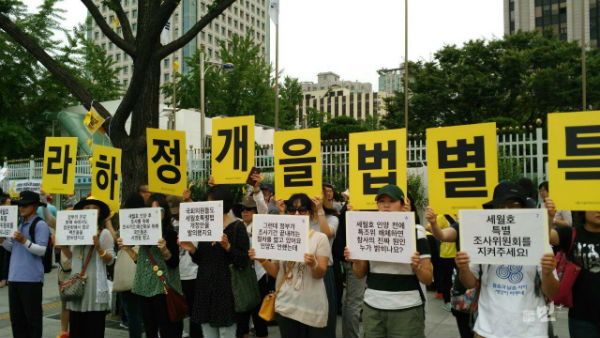
Alexander Gabuev is a senior associate and the chair of the Russia in the Asia-Pacific program at the Carnegie Moscow Center. Prior to joining Carnegie, Gabuev was a member of the editorial board of Kommersant publishing house and served as deputy editor in chief ofKommersant-Vlast, one of Russia’s most influential newsweeklies.

  • Posted in Asian @as
  • Comments Off on Russia’s “China Dreams” Are Less of a Fantasy Than Skeptics Say: Moscow Becomes Top Oil Supplier to China?

Washington, Seoul and Tokyo concluded joint Pacific Dragon (PD) ballistic missile defense military exercises in the Pacific region, the US Navy said in a statement.

Earlier in June, US Secretary of Defense Ashton Carter reported that the scheduled trilateral drills would be held in order to improve coordination against Pyongyang’s “provocations.”

“Commander, U.S. 3rd Fleet is wrapping up the third biennial exercise Pacific Dragon (PD) from June 20-28 off the coast of the Pacific Missile Range Facility (PMRF) in Kauai, Hawaii,” the statement published on Tuesday said.

The statement added that during the exercises the participants tested the capabilities of their Aegis Ballistic Missile Defense Systems and strengthened interoperability, as well as communication and data collection capabilities, despite the fact that there were no missiles fired.

The PD is biennial trilateral ballistic missile defense drills between the US Navy, the Japan Maritime Self Defense Force, and the Republic of Korea Navy. The exercise is conducted in order to improve coordination between its participants in the spheres of detection and tracking of ballistic missiles.

In 2016, the drills are held amid intense nuclear and missile activities of Pyongyang, which has successfully carried out a hydrogen bomb test and put a satellite into orbitearlier in the year, violating UN Security Council resolutions.

  • Posted in Asian @as
  • Comments Off on Japan, South Korea, and the US Hold Missile War Games: Targeting North Korea, China, or Russia?

The Shanghai Cooperation Organization Expands

July 3rd, 2016 by Galiya Ibragimova

The Shanghai Cooperation Organization (SCO) will continue dealing mainly with security and economic issues, although there are doubts about how effective it will be once India and Pakistan join in 2017.

The anniversary summit of the Shanghai Cooperation Organization (SCO), which recently took place in Tashkent last week, celebrated the 15-year history of this organization. The six SCO member states – Russia, China, Kazakhstan, Kyrgyzstan, Tajikistan and Uzbekistan – evaluated the successes that this organization has achieved in the past decade and a half, and determined the future format of its work.

For the first 15 years, the SCO has primarily focused on economic and security issues. Going forward, the work of the SCO will continue in an expanded format. India and Pakistan will become full members of the SCO in 2017, a move that was finally decided at the Tashkent Summit. In the summit’s final declaration, dedicated to the 15th anniversary of the organization, the participating countries agreed to assist each other during economic crises, and to continue in their joint efforts in fighting terrorism and extremism.

According to experts interviewed by Russia Direct, this year’s summit turned out to be more of a ritual, in which member countries demonstrated their loyalty to China, rather than working on solving common regional problems. Over the course of the past 15 years, the SCO has become a platform where member countries have continued to discuss bilateral problems, which are not always related to what the SCO was set up for in the first place.

Expanding SCO Membership

The SCO Summit 2016 will go down in history, if only because it was the last one that took place in its traditional format. The summit in 2017 will have more two participants, for a total of eight, after India and Pakistan officially join the organization. In Tashkent, these two countries signed a memorandum of commitment to the SCO – the last documents before becoming full-fledged members.

One year after the summit in Ufa, the Central Asian countries that had previously doubted the wisdom of expanding the SCO with two other countries that are in constant conflict with each other, seemed to have come around to the idea.

The president of Uzbekistan, Islam Karimov, who during last year’s summit criticized the expansion of the SCO with two unofficial nuclear powers, seemed more restrained this year. At this summit, which he was hosting in his capital city of Tashkent, Karimov seemed to have accepted the idea that India and Pakistan, which are always at loggerheads with each other, would now join the ranks of the SCO.

After meeting on the sidelines of the summit with the prime ministers of India and Pakistan, President Karimov said, “I will not hide the fact, the talks were difficult, but in the end, we managed to overcome all difficulties and agreed on granting membership to the new countries.”

At the summit, he warned the countries from engaging in confrontations with each other, and encouraged maintaining the non-aligned status of the organization.

However, the compromise does not mean that the existing contradictions between New Delhi and Islamabad would not be transferred to the SCO platform. Sanat Kushkumbayev, deputy director of the Kazakhstan Institute for Strategic Studies, in an interview told Russia Direct that he considers that Uzbekistan’s doubts, when it comes to the new SCO members, were well justified.

“The nuclear powers India and Pakistan will change the balance of power within the SCO, where there already are two other nuclear powers – Russia and China. Central Asian countries, which had declared their region a nuclear-free zone, will have a difficult time balancing inside such a composition. It is clear that the expansion of the SCO will now move regional problems into the background,” says Kushkumbayev.

The difficult entry procedures, however, had not deterred the two formerly observer countries from seeking membership in the organization. Now enjoying such status in the SCO are Afghanistan, Iran and Mongolia. The greatest chances of joining are given toIran, whose interests in the organization are actively being promoted by Russia.

Thus, during the Tashkent summit, Russian President Vladimir Putin said that he sees no obstacles for Iran’s full membership in the SCO, after the international community has removed sanctions against the country. Expressing their readiness, together with Moscow, to start dialogue on Iran’s joining the organization were Kazakhstan, Kyrgyzstan and China.

“We are prepared, in accordance with all legal documents, together with others to carefully consider the applications of Iran and Afghanistan,” said Chinese president Xi Jinping. Uzbekistan gave its traditionally restrained response to the initiatives for further expansion voiced by its SCO colleagues, fearing that this would make the organization less manageable.

Tashkent was especially cautious when it came to the idea of membership for Afghanistan, a country where the main security threats and risks in Central Asia originate.

Thus, since the spring of 2015, the threats of penetration of Islamic terrorists from Afghanistan and the Middle East through poorly controlled Afghan borders with Turkmenistan and Tajikistan remain. The attack in the north of Kazakhstan on a military unit, which according to Kazakh authorities was perpetrated by Islamic terrorists, has forced neighboring countries to further strengthen their security measures.

SCO Security Concerns

Two weeks before the SCO Summit, unprecedented security measures were implemented in Tashkent. However, experts interviewed by Russia Direct say there is no need to dramatize the situation with terrorism. Andrey Baklitskiy, program director of the PIR-Center think tank, said that Iranian membership in the SCO would, on the contrary, increase the efficiency of the fight against the “three evils.”

The “three evils” is how the organization refers to terrorism, extremism and separatism. Iran blocks the western border of Afghanistan, and therefore it could become an outpost of the organization on the border with the militant groupings of the Islamic State of Iraq and the Greater Syria (ISIS). In addition, Baklitskiy says that when it comes to Iran, that country, unlike India and Pakistan, has no serious contradictions with other SCO member states.

Daniyar Kosnazarov, deputy director of the Synopsis Center for the Study of China and Central Asia, believes that to successfully fight terrorism, it is not enough to just strengthen security measures. Instead, nations must focus on economic issues within the SCO.

“The attack on the Kazakh city of Aktobe in June was the first warning sign for the authorities in the region – it is important to improve the socio-economic situation in the country, and the region as a whole, including through multilateral formats,” Kosnazarov told Russia Direct.

It should be noted that the majority of SCO member states (with the exceptions of China and Uzbekistan), are also part of the Collective Security Treaty Organization (CSTO), where collective efforts are being undertaken to try and solve regional security problems.

According to a source in the state bodies of Uzbekistan, who participated in organizing the summit, a recent trend has appeared in the SCO – on these issues, Russia is trying to win over Central Asian members to its side, just as China is trying to do. This concerns Central Asian countries, and in particular, Uzbekistan, which could be forcing states to return to bilateral cooperation when it comes to security issues.

The Economics of the SCO

Economic development issues were also paramount on the agenda of the Tashkent Summit. SCO leaders have complained that very often, uneven economic development is leading to the slow implementation of joint projects, particularly in trade and construction of transport infrastructure spheres. In connection with this, the countries have pledged to help each other in times of economic crisis, and recorded this commitment in the adopted Tashkent Declaration.

To accelerate the construction of regional transport infrastructure, Putin suggested that SCO countries that are not members of the Eurasian Economic Union (EAEU) join the Russian-Chinese cooperation projects involving the EAEU and the Silk Road Economic Belt.

“Connecting all SCO member states, as well as CIS countries, to these integration processes, would be a prelude to the formation of a large Eurasian Partnership,” said Putin.

However, the experts interviewed by Russia Direct do not think much of the potential for economic cooperation within the SCO framework. Independent political analyst from Uzbekistan Rafael Sattarov said that Tashkent has always looked at the SCO platform as a means for establishing bilateral cooperation on security issues, rather than economic ones.

“At the Tashkent Summit, Uzbek diplomacy proved once again that the priority for the country remained bilateral cooperation with other states, but outside the framework of the SCO,” said Sattarov. He added that the most problematic issues for Uzbekistan have always been its relations with Tajikistan and Kyrgyzstan.

Nevertheless, the bilateral meetings held with the leaders of those two countries have inspired some optimism in the expert community and amongst the officials of Central Asian countries, that the spirit of unity and cooperation still prevails among all SCO countries.

At the SCO summit in Tashkent, they also signed an Action Plan for the implementation of Development Strategies for the SCO until 2025, where participating countries have identified their directions of development in the coming years. These followed the outlines of the development strategies for the SCO that the participating countries adopted at last year’s summit in Ufa.

The Committee of the Families of the 16 April 2014 MV Sewol Ferry Disaster Victims (or the 4.16 Families Committee) have urged the government of the Republic of Korea to stop trying to stop the investigative work of the Court of Inquiry about the sinking of the Japanese-built Sewol Ferry. These family members who seek the truth and justice have been demonized or misrepresented in the South Korean media because of their opposition to the behaviour of South Korean authorities.

Many of the family members of the victims of the Sewol Ferry Disaster and other South Koreans either suspect the government of South Korea or its National Intelligence Service (NIS) of being involved in fowl play. The South Korean government assisted Chonghaejin Marine Company Ltd. favourably and has worked to conceal the events that took place. Even more incriminating, two documents provide circumstantial evidence that suggests that the NIS may have owned the ship and used Chonghaejin as a front and may have even been involved in the sinking of the Sewol.

Unlike the rest of Chonghaejin’s passenger ferry fleet, the emergency protocol and instructions of the Sewol and the MV Ohamana, another ship owned by Chonghaejin, oddly list the NIS as the agency to contact instead of the coast guards. A computer found on the Sewol also possessed a document that listed hundreds of items, such as ceiling paint, vending machines, and recycling bins, that the NIS had catalogued for repairs or maintenance work. The NIS confirmed this as true by explaining that the intelligence agency had ordered the repairs on the MV Sewol for security purposes. This, however, could not explain why the NIS demanded memos about the vacation plans of the ferry’s crew and reports about their wages.

The following is an account published by the South Korean news outlet MinPlus about the saga of the families of the victims of the MV Sewol Ferry Disaster against the attempts of the South Korean government to whitewash and end the investigation of the MV Sewol Ferry Disaster.

Mahdi Darius Nazemroaya, Asia-Pacific Research Editor, 3 July 2016.


The 4.16 Families Committee held a press conference before Chungwoon-dong Community Service Center near the Blue House, and announced its stance, saying, “The Inquiry period is supposed to be until February 2017, not till June this year, even upon the current special law for the Inquiry.”

The families and members of various civic organizations started a sit-in on June 25, 2016. Their sit-in took place on the street in front of the Seoul Government Complex at Gwanghwamun Gate. On June 27, they marched to the front of Chungwoon-dong Community Service Center and held a press conference, and went back to the site of their sit-in on the street before the Government Complex.

The 4.16 Families Committee emphasized, “It is a complete miscalculation if President Park Geun-hye thinks that she can abruptly end the investigation through abruptly dismissing the Inquiry. The Sewol Ferry suspicion will get enlarged and will rebound on President Park and the Saenuri Party. It is the will of the people and that of Heaven to guarantee the extension of the Inquiry period.”

The South Korean government has interrupted the investigation of the Inquiry for over one year using different excuses.

Jun Myung Sun, the head of operation of the 4.16 Families Committee, asked, “Didn’t President Park say that she would humbly accept the will of the people after the 20th general election?”

Trying to prevent the press conference, on the night before the police forcefully seized the tent and shade canopy at the sit-in on the street in front of the Seoul Government Complex. The police insisted that the positioning of the items were not reported to the police in advance and then forcefully detained four of the family members of the victims of the MV Sewol Ferry Disaster. Afterwards, the police would confiscate a rug that the families of the victims brought to the press conference in the morning. This was done with one policeman swiftly taking the rug and sprinting away while other policemen blocked the family members of the victims form being able to pursue him.

“Although we had clearly notified the Seoul Police Agency about our sit-in in accordance with the Law on Assembly and Demonstration, the police obstinately broke into the place and acted violently,” the 4.16 Families Committee and the People’s Alliance of 4.16’s Promise clarified. They also demanded that the authorities apologize and that the police release the four family members that were detained.

This article has been edited by Asia-Pacific Research.

As India and Pakistan moved a step closer to join Shanghai Cooperation Organisation, an official Chinese daily today raised concerns that their “territorial and religious” disputes may disturb the bloc’s functioning and shift its focus.

“Generally, including new members can help the SCO expand its clout. But the inclusion of the two South Asian powers might also lead to some problems,” an article in the state-run Global Times said today.

“First of all, the inclusion may have an impact on the SCO’s principle of consultation-based consensus. The principle of consultation-based consensus has been widely recognised and adhered to by the members,” it said.

“In this sense, the inclusion of India and Pakistan may bring into the SCO their long-existing disputes over territorial and religious issues and disturb the organisation’s efforts to carry out the principle,” it said.

“For the possible problems that may arise after India and Pakistan become full members, the SCO cannot just ignore but instead deal with them in a positive and rational manner,” it said.

The daily underlined that SCO founding members should be given some special rights to dispel their concerns caused by the expansion.

“Requirements can be proposed to the new members in terms of mechanism-building so as to avoid cooperation bottleneck after the expansion,” it said.

Today’s article, second in the daily in recent weeks, said the inclusion of India and Pakistan may divert the focus of the SCO.

“As four out of six founding members of the SCO are in Central Asia, the SCO has always concentrated on the region. But the joining of India and Pakistan may split the focus of the SCO, and hence the four Central Asian members will reduce their dependence on the SCO,” it said.

“Moreover, giving full memberships to India and Pakistan will affect the SCO mechanism. The working languages of the SCO are now Chinese and Russian, and there has already been massive language workload in current meeting mechanisms. If India and Pakistan are taken in, the organisation’s daily work is likely to increase exponentially,” it said.

But at the same time it said “the inclusion of India and Pakistan will undoubtedly enhance the influence of the SCO, and the member states also highly value and support the wills of observers and dialogue partners to step up their cooperation with the organisation,” it said.

India and Pakistan last week signed Memorandum of Obligations to join the six-member organisation at the Tashkent summit as part of lengthy process to join the grouping.

The SCO formally decided to admit the two countries in Ufa summit last year but the Indian officials say the process of admission is still continuing as both the countries have to ratify all the documents of the group since it was founded in 2001.

SCO, focusing mostly security related issues like terrorism in Central Asia, has China, Kazakhstan, Kyrgyzstan, Russia, Tajikistan and Uzbekistan as full members.

Afghanistan, Belarus, India, Iran, Mongolia and Pakistan have observer status.

The following article brings into light important questions about the accession of India and Pakistan, the two major powers of South Asia, into the Shanghai Cooperation Organization (SCO). The two South Asian powers will change or adjust the geopolitical gravity of the SCO, expanding it outside of Central Asia, and in the process strengthening the Eurasian credentials of the SCO. There are, however,  questions on whether the “Shanghai Spirit” of consensus-based decision-making can continue with the entry of India and Pakistan as full SCO members. Should the founding members of the SCO, like China and Russia, establish formal special statuses and rights for themselves to make sure that the focus of the SCO is not changed or diverted by India and Pakistan, as this article published by the Global Times in China proposes?

 Mahdi Darius Nazemroaya, Asia-Pacific Research Editor, 2 July 2016.


The annual summit of the Shanghai Cooperation Organization (SCO) was held last week in Tashkent, Uzbekistan. Prior to it, Li Huilai, China’s assistant foreign minister, said that the SCO would see some progress in its expansion at this year’s summit after India and Pakistan were given the initial green-light to join the bloc at last year’s Ufa summit. This marks the first expansion by the organization 15 years after its establishment, and will create new opportunities for its development.

But in the meantime, the regional organization is still young and the inclusion of new members may bring it some concerns, which SCO member states need to make plans early on and deal with them well so as to maximize the benefits from expansion.

As SCO observers, India and Pakistan had been committed to promoting cooperation with the organization and remarkable achievements have been made in political, economic and cultural arenas. The two countries requested to join the SCO many years ago. Generally, including new members can help the SCO expand its clout. But the inclusion of the two South Asian powers might also lead to some problems.

First of all, the inclusion may have an impact on the SCO’s principle of consultation-based consensus. Right after its establishment, the six founding member states put forward the “Shanghai Spirit” of mutual trust, mutual benefit, equality, consultation, respect for cultural diversity and pursuit of common development.

The principle of consultation-based consensus has been widely recognized and adhered to by the members. In this sense, the inclusion of India and Pakistan may bring into the SCO their long-existing disputes over territorial and religious issues and disturb the organization’s efforts to carry out the principle.

Besides, the inclusion may divert the focus of the SCO. As four out of six founding members of the SCO are in Central Asia, the SCO has always concentrated on the region. But the joining of India and Pakistan may split the focus of the SCO, and hence the four Central Asian members will reduce their dependence on the SCO.

Moreover, giving full memberships to India and Pakistan will affect the SCO mechanism. The working languages of the SCO are now Chinese and Russian, and there has already been massive language workload in current meeting mechanisms. If India and Pakistan are taken in, the organization’s daily work is likely to increase exponentially.

The SCO has played a critical role in regional stability and development and in enhancing cultural and people-to-people exchanges. Remarkable achievements have been made in this regard. Hence an increasing number of countries are becoming interested in the organization.

Before the Tashkent summit, the SCO consisted of six member states, six observers and six dialogue partners. The inclusion of India and Pakistan will undoubtedly enhance the influence of the SCO, and the member states also highly value and support the wills of observers and dialogue partners to step up their cooperation with the organization.

For the possible problems that may arise after India and Pakistan become full members, the SCO cannot just ignore but instead deal with them in a positive and rational manner. For instance, regulations should make clear the obligations and rights of new member states and in particular demand they respect and carry out the principles of the SCO. The SCO founding members should be given some special rights to dispel their concerns caused by the expansion. Requirements can be proposed to the new members in terms of mechanism-building so as to avoid cooperation bottleneck after the expansion.

As long as the problems are properly handled, the SCO can take the opportunity and enter a new stage.

Zhang Wenwei is a PhD candidate at the Institute of Russian, Eastern European and Central Asian Studies at the Chinese Academy of Social Sciences.

  • Posted in Asian @as
  • Comments Off on China and other SCO Founding Members Cautious About Accession of India and Pakistan

The UK proves that power and profits come before the lives of even its own allies’ soldiers and police.

 The GT200 is an otherwise useless plastic box that does nothing with equally useless “sensor cards” that serve no discernible function.

Despite this fact, UK-based Global Technical and an array of salesmen ranging from experts in the British military serving as equipment export support teams, to British ambassadors, to even the British government’s Department of Trade and Industry (now renamed the Department for Business, Innovation and Skills) peddled the useless item as a “bomb detector,” putting lives at risk in the nations they were peddled in, and even costing the lives of hundreds including dead police and soldiers in both Iraq and Thailand.

In Thailand, amid the wake of the scandal, US and British backed media services have attempted to capitalize on the political fallout, laying the blame squarely on the Thai government, never mentioning the central role of the British government in promoting the useless and ultimately deadly device.


Faced with mounting violence in Thailand’s deep south, the government in Bangkok placed its trust in its British allies. It is clear that this trust was not only misplaced, but shamefully used and abused by London in a multi-million dollar scam involving the British military, government, and diplomatic corps.

Critics of the Royal Thai Army and the current government have seized upon the scandal to opportunistically and dishonestly undermine both, with some even going as far as blaming the soldiers who risked their lives in the restive southern provinces of Thailand while employing the fraudulent British-made GT200.

The BBC and Guardian Expose the UK Government’s Role 

While the BBC’s Jonathan Head in Thailand politically wields the GT200 scandal against the Thai government and its military exclusively, the BBC itself has exposed the breadth and depth of the UK government’s involvement.

A lot of effort was put into creating the illusion of credibility where no technical merit existed. This not only included slick as well as unscrupulous marketing tactics, but also included the recruitment of British ambassadors and even equipment export support teams drawn from the British military, despite the fact that the British military itself refused to use the fraudulent device.  

The BBC’s 2011 article, “UK government promoted useless ‘bomb detectors’,” would report (emphasis added):

The government has admitted that the Army and UK civil servants helped market so-called “bomb detectors”, which did not work, around the world.

Export of the “magic wand” detectors to Iraq and Afghanistan was banned on 27 January 2010 because of the threat they posed to British and allied troops.

The move followed a BBC Newsnight investigation showing they could not detect explosives – or anything else.

Now Newsnight has learned that they are still being sold around the globe.

The BBC’s report would continue by explaining (emphasis added):

a Royal Engineers sales team went around the world demonstrating the GT200, another of the “magic wand” detectors which has been banned for export to Iraq and Afghanistan, at arms fairs around the world even though the British Army did not consider them suitable for its own use.

The government’s Department of Trade and Industry, which has since been superseded by the Department for Business, Innovation and Skills, helped two of the manufacturers sell their products in Mexico and the Philippines.

The BBC’s article concludes by stating:

…there will be questions about why the ban on exports to Iraq and Afghanistan has not been extended to protect the citizens of other countries.

However, it is clear that this question has an easy answer. The lives of foreigners to the British government, military, and industry are subordinate if not entirely meaningless to profits and power.

Giles Paxman, Britain’s former ambassador to Mexico. Before the GT200 scandal, and even after it, accusing ambassadors from the US, UK, or Europe of immense criminal impropriety would be met with accusations of being “conspiracy theorists.” In reality, it appears that immense criminality is endemic across Western diplomatic circles with their ties to industry and organized crime so close the two are virtually indistinguishable from one another. 

It is an ethos that defines the last several centuries of British – and in general – Western history.The BBC would publish another report on the GT200 titled, “The story of the fake bomb detectors,” in which they detailed the coercive methods used to peddle the useless devices upon unsuspecting nations (emphasis added):Sales demonstrations would be rigged to succeed, she says. Anyone sceptical of the devices would be publicly humiliated. And users were instructed not to open the equipment – to avoid damaging the “sensitive technology” inside. 

Some of the devices came with “detector cards” which were programmed, the fraudsters claimed, to detect everything from explosives, to human beings and dollar bills through concrete, water and from great distances.

Considering how humiliation is used by the Western media to portray anyone questioning the West’s various narratives as “paranoid” or as “conspiracy theorists,” one can only imagine the abuse one would be subjected to had they accused British ambassadors and British military sales support teams of selling what is essentially and empty plastic case with a disconnected radio antenna on it as a “bomb detector.”Yet that is exactly what the British government did. GT200 Couldn’t Have Been Sold Without London’s Complicity The UK Independent would also cover the story in an article titled, “How UK soldiers and ambassador were enlisted to help sell fake bomb detectors,” reporting that (emphasis added): Giles Paxman, then Britain’s ambassador to Mexico, wrote to senior officials in the embattled state government to introduce the wares of Kent entrepreneur Gary Bolton, who was selling the GT200, a handheld detector supposedly capable of identifying drugs or explosives at up to 700 metres. Unbeknown to the ambassador, it used nothing more than a car aerial attached to a hollow plastic grip and did not work.

Ambassador Paxman would, according to the Guardian, emphasize “the excellence of the UK’s security industry.” He would arrange meetings with officials across the country with the maker of the GT200, and is precisely why an otherwise unknown criminal was able to peddle his fake devices globally to the UK’s various allies.

Thousands of brave police and soldiers like those pictured above, had their lives knowingly placed in danger by the British government who mobilized its various departments, the military, and even its diplomats to promote and sell the GT200 “bomb detector” that quite literally did nothing. 

The Independent would reveal that the device cost a mere 2 GBP to make, but was sold for as much as 15,000 GBP each.The Independent would also reveal (emphasis added):Bolton’s ability to enlist a British ambassador to back his fraud reveals how British diplomats and officials around the world are routinely available for hire, and how the government does not normally check whether products they are promoting actually work. 

Eight years before Paxman got involved, a Home Office scientist had concluded an early version of Bolton’s device was “a useless lump of plastic and warned: “Not only does it not work in theory, it doesn’t work in practice either.” About 1,000 copies of the warning were sent to the Foreign Office, police forces, the Ministry of Defence, the Royal Engineers and the prison service, the Guardian understands.

In other words, the British government was well aware that the device did not work, did not use it domestically or with its military forces abroad because they knew it did not work, but proceeded to sell it to allied nations anyway.The British government used its influence and reputation to pressure allied nations into buying them, knowingly putting the lives of soldiers and police in jeopardy, as well as implicating suspects falsely of criminal involvement in cases the devices were used to investigate.The Independent would also note that the GT200’s creator “had been quick to recognise the value of British government involvement in the sales pitch for his adapted novelty golf ball finder as he pitched to authorities in Thailand, Bahrain and across Africa.”Thailand Swindled by its Ally, Then Betrayed Again  The Thai government is likely embarrassed by being swindled by the UK. They likely believed – as well as were likely told by the British government itself – that the involvement of British ambassadors and equipment export support teams drawn from the British military were a sound substitute for the rigorous testing the GT200 should have undergone before purchases were made.

Because of the high-level nature of the meetings arranged by British diplomats to facilitate the fraud, the British government knows that investigations into Britain’s role would also require implicating those Thai officials who were present at these meetings. Because of this, the British are confident they can get away with their crime with only minor repercussions.What the Thai government has hopefully gained from this scandal is the realization that those claiming to be its closest allies should be those least trusted.

The privileges Thailand has erroneously granted nations like the UK and US should be gradually rolled back until entirely revoked. The necessity to uproot the influence and interests of both the British and their counterparts on Wall Street and in Washington from the Kingdom of Thailand is increasingly evident.The UK’s actions maliciously cost Thai police and soldiers their lives and in the fallout of the scandal, the British and Americans through their grip on international media, are dishonoring their memories by portraying the victims as being “incompetent” and “corrupt.”

The GT200 scandal reaffirms just how little the West thinks of people beyond their borders and how far they will go and how many they will trample to further accumulate power and wealth. And the GT200 scandal is just one of many angles from which the West attacks, undermines, and pilfers the wealth, dignity, stability, and futures of nations like Thailand. If this is the sort of help the British government will afford a single criminal and his fake bomb detectors – imagine the support they would render for Fortune 500 corporations.For Thailand and the Thai people, perhaps this latest demonstration of the contempt the West has for the East will provide an impetus for the East to finally stop paying into the ideas, wealth, and influence of the West.
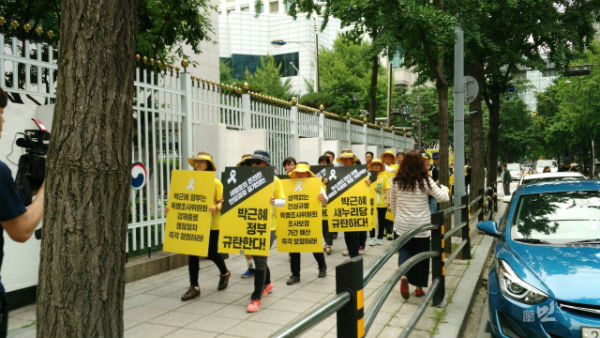
  • Posted in English @as @as
  • Comments Off on How the UK Sold Fake GT 200 Bomb Detectors to Thailand and Got People Killed

Cambodia has been through a period of untold upheaval, which has resulted in the restructuring of its economy. Neoliberalism, or free market economics, has been introduced into Cambodia since the end of the Cold War, and more aggressively since the UNTAC began to administer the country in 1992. Subsequently, there have been dramatic consequences in the way Cambodia is administered, particularly in regard to government expenditure. As a result of neoliberal reforms, Cambodia’s government spending has remained extremely low, which has translated to insufficient investments in the education sector. Furthermore, neoliberal ideology promotes market based activities, meaning teachers in Cambodia, as a result of low spending in the education sector, receive an unsustainable wage and are forced into offering private tuition to their students. Inequalities in the quality of education that students can expect to receive, including levels of attainment, based on whether their households can afford private tutoring or not, have emerged as a result. This situation translates deeper into Cambodian society, where those who attain well in school are more likely to be able to demand better wages when in work. Significantly, income inequality has increased in Cambodia since the introduction of neoliberalism. 
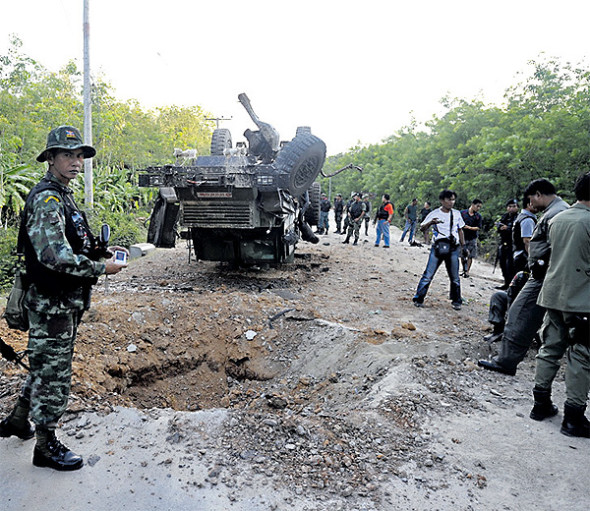
1         Chapter One: Introduction

This dissertation seeks to understand the social consequences of neoliberal reforms in Cambodia. Given that the subject of neoliberalism is vast in any context, a literature review was completed in order to find an area which required further investigation within the framework of neoliberalism in Cambodia. Following the analysis of literature surrounding the social consequences of neoliberal reforms in Cambodia since the 1990s, a gap within the literature was identified. Subsequent to the review of the relevant literature, it is clear that there is a lack of research surrounding the neoliberalisation of Cambodia’s education system and whether this has impacted on inequalities within the country. This dissertation will answer the following question in order to gain a deeper understanding of the void found within the literature; How have neoliberal structural reforms affected the education system in Cambodia, and how has this impacted on inequalities within the country since the 1990s?

1.1       Aims of Research

This thesis aims to analyse how neoliberal reforms have impacted on Cambodia’s population, specifically to understand how inequalities in outcomes of children’s education has been affected. The project aims to understand how neoliberal structural reforms within the Cambodian economy have affected how children have been impacted in ways relating to their educational attainment. Moreover, the paper will seek to understand how impacts on children’s educational attainment effects their socio-economic status later in life based on data relating to income inequalities within Cambodia. Consequently, the project aims to understand how the neoliberalisation of the Cambodian economy has affected the country’s education system and whether this, as a result of the policies associated with such neoliberal reforms, has any bearing on the equity outcomes of those who depend on the state for their education.

In 1991, after many years of violent conflict within Cambodia and the surrounding region, the United Nations Security Council (UNSC) established a transitional authority under the auspice of the United Nations Transitional Authority in Cambodia (UNTAC), which effectively governed the country for two years beginning in 1992 (Gottesman, 2003, p.342-345). The UNTAC was mandated to control and administer many components of the Cambodian state and to deal with many of the issues associated with a country that had suffered from years of violent conflict, including; the Military, Police, Elections, Economy, Civil Administration, Rehabilitation, Human Rights and Repatriation (UNRISD, 1993, p.8). One of the main components of the UNTAC was to ‘ensure a neutral political environment conducive to free and fair general elections’ (Peace Accords Matrix, Article 6, 2015). Given that the United Nations (UN) has, since the beginning of the 1980s, subscribed to the ideology of neoliberalism (Free market economics, achieved through privatisation, deregulation and liberalisation) it is unsurprising that the Cambodian People’s Party (CCP), after winning the election organised by the UN were committed to following the same ideology (Gottesman, 2003, p. 345). In fact, Article 56 of the Cambodian Constitution (Cambodia, 2010) states that the country is committed to enabling a free market economy.

1.2       Theoretical Underpinnings

1.2.1       Neoliberalism

This paper will use different theoretical underpinnings in order to explain and understand the issues relating to matters of equity within the Cambodian education sector, providing an enhanced comprehension of how this translates in Cambodia’s society. The theory of neoliberalism will provide the focal point in this paper in order to understand how Cambodia’s education sector has been impacted since the early 1990s, and how this has played out in issues of equity within the country’s population. Neoliberalism is a theory which began to emerge in the 1970s as an alternative to variants of the Keynesian approach of development economics, according to Willis (2011, p.52). The Keynesian theory of economics advocated state intervention at a national level, rather than allowing market forces to determine outcomes, in order to more efficiently utilise resources, better providing for societies. Neoliberalism, on the other hand, came about as a result of a number of economists challenging Keynesian theory, suggesting that state intervention was creating inefficiencies, leading to slower economic growth. The key components of neoliberalism include reductions in government expenditure, privatisation of state owned assets, reduction of government regulation, increased significance of the free market and an emphasis on individualism, or individual responsibility, according to Payne and Phillips (2011, p,87). Harvey (2005, p.88) claims that Thatcher and Regan adopted the tenets of neoliberalism in the 1980s after both the UK and US experienced difficult economic times, but the policies adopted by both governments resulted in high unemployment mixed with, as a result of the cuts in social welfare, a reduction in the quality of life for many and increasing income inequality.

John Williamson coined the term ‘Washington Consensus’ is his writings concerned with economics at the end of the 1980s, according to Marangos (2009, p.350). The Washington Consensus refers to the situation when the world’s dominant international financial institutions (IFIs), the International Monetary Fund (IMF) and World Bank, which are located in Washington, USA, agreed upon a set of economic reforms, aimed at increasing economic growth, for Latin American countries which were experiencing economic strain in the 1980s. The Washington Consensus assumed that the Keynesian approach of development, which had influenced many South American country’s leaders, who had implemented protectionist policies such as Import Substitution Industrialisation (ISI), had come to an end (Willis, 2011, p. 77). The phrase has evolved over time, but is contemporarily understood to refer to the IMF and World Bank and their methodology (Serra, Spiegel & Stiglitz, 2004, p.3), who have adopted a neoliberal development approach aimed at privatising state owned assets, liberalising economies (opening up to foreign investment), emphasising the free market, and reducing the role of the state. Not only were the World Bank and IMF associated with the Washington consensus because of the geographical locations of their head offices, but because many argued that their aims are a reflection of the interests of the United States, according to Woods (2011, p.251). The IMF and World Bank were formed at the Bretton Woods conference in 1944 with the aim of providing a framework for a stable post-war economy (Gore, 2000, p. 789). Since their formation the World Bank and IMF have adopted different economic development models but, since the beginning of the 1980s, have embraced the neoliberal development model.

1.2.2       Structural Adjustment Programmes

In order for the World Bank and IMF to implement neoliberal policies throughout the world they have used, since the end of the 1970s, Structural Adjustment Programmes (SAPS). SAPs are often agreed upon by national governments in order to receive financial support or loans from the Bretton Woods Institutions, according to Willis (2011, p.57). SAPs reflect the neoliberal free market ideology of both the Ragan and Thatcher (Craig and Potter, 2006, p.55) governments of the 1980s, and their implementation have demonstrated how the Global North has been able to influence the economies of the Global South. SAPs arose as a result of many governments in the Global South becoming unable to keep up with interest rate payments on debt borrowed from commercial banks in the 1970s. In response to this situation the IMF and the World Bank offered loans to countries suffering from balance of payments problems. In order to secure loans from the IMF and World Bank recipient countries were required to ‘structurally adjust’ or accept ‘conditions’ set out by the two institutions, which were deeply rooted in neoliberal ideology, according to O’Brian and Williams (2010, p.193).

Governments that adopt SAPs are required to introduce a number of different policies in order to reduce the role of the state in the running of the economy. SAPs comprise of two main policy groups, as Stiglitz (2002, p.14) highlights; i) stabilization measures, and ii) adjustment measures. Stabilisation measures included freezing government spending on public-sector wages, reducing governments spending (including on health and education) and currency devaluation. These measures were supposed to stabilize recipient economies, which would then lead onto a number of structural measures being introduced. Structural measures include the opening up of the national economy to foreign direct investment (FDI), tax system reform, which often lead to reduced taxes for the wealthy and large multi-national corporations (MNCs) and privatization of state-owned assets, such as electricity production, postal services or transport networks. According to Stiglitz (2002, p.14) the Bretton Woods institutions took a simplistic view when implementing SAPs, assuming that all countries, regardless of their differing economic problems, all needed the same structural reforms. Thomas (2008, p.424) claims that the IMF and World Bank’s blanket treatment of different countries with different problems was inappropriate and resulted in an inability to deliver economic growth, while having detrimental environmental and social consequences.

SAPS are now known to have had very negative outcomes in a great number of places where they have been implemented (Willis, 2011, p.58). Neoliberal policies introduced as part of SAPs, such as reducing the size of the state, removing barriers to foreign investment and currency devaluations, in many cases, have had serious consequences. Although, in some cases, SAPs may have had the desired economic stabilization outcomes, there have been severe consequences in terms of human welfare where they have been implemented. Thomas (2008, p.431) argues that IMF and World Bank SAPs implemented throughout the 1980s and 1990s reduced the availability of health care and education services as public expenditure was reduced. The privatization of public utilities meant that as well as reduced health care and education, user fees were introduced for necessities such as water. Bonal (2002, p. 7) states that SAPs have had very specific negative outcomes in countries where adjustments have taken place, explaining that reductions in per capita expenditure on education has had damaging consequences. Increases on student absenteeism, failing schools and reduced access to primary and secondary education are all symptomatic of reductions in education expenditure as a result of SAPs. The reductions in salaries or continuing low salaries for teachers are a particularly pertinent negative consequence of SAPs. Teachers who receive low salaries are often forced into supplementing their income by other means, for example, charging students for parts of their education which is essential if they are to pass their examinations (Bray and Bunly, 2005, p. 75).

Willis (2011, p.58) states that there was a growing awareness of the negative consequences associated with IMF and World Bank SAPs towards the end of the 1990s. In response to the this negative publicity the Bretton Woods institutions decided to remould the SAPs, which involved giving them new names and paying more attention to the needs of the poorest people where the policies were implemented. The new ‘Poverty Reduction Strategy Papers’ (PRSPs) are, however, often thought to include the same damaging elements of SAPs and have resulted in limited improvements, according to Shah (2013).

1.2.3       Inequalities

This paper, which focusses on the social consequences of neoliberal reforms, will investigate how such reforms have impacted on inequalities within Cambodia’s education sector. Inequality within countries is often understood as the differing share of wealth or income that people living within a country experience, according to Greg, Hulme and Turner (2007, p.11). Inequality is not only relating to the share of wealth, but includes, among other things, the unequal level of access to education and health care services members of a society can expect to receive. Wilkinson and Pickett (2009), in their book The Spirit Level, argue that large inequalities within countries not only damage the ‘poor’ but have negative outcomes for everybody within a given society. However, on an individual level, rather than on a societal level, it is clearly the poorest people within a society who are burdened more severely by the effects of large inequalities rather than the most wealthy, as Platt (2011, p.132) explains.

Income Inequality has severe impacts on life expectancy, educational attainment, infant mortality, social mobility, violence within societies, levels of trust between different  socio-economic groups, obesity and imprisonment rates, according to Wilkinson and Pickett (2009, p 19). Therefore, poor people within societies which suffer from higher levels of inequality can expect to live shorter lives, receive a lower standard of education, be more likely to engage in illegal activities and be at risk of being subjected to, or involved in violent behaviour than more wealthy members of society.

Income inequality affects the ability of members of a society to access and take advantage of the services which lead to a more prosperous life. Education plays a significant role in a person’s ability to earn money. Those who are able to achieve the highest educational attainment are more likely to be able to demand a better standard of living and those who cannot are not. In their study, Wilson and Pickett (2009, p.161) conclude that levels of public expenditure on education impacts on inequalities within countries. Where public expenditure on education is high, compared with levels of private expenditure, there is a higher degree of social mobility. Consequently, there is a correlation between levels of public expenditure on education and levels of inequality within countries. This is particularly pertinent given that neoliberal policies favour the reduction in size of the state, which includes cutbacks in spending on social services, health care and, significantly, education. The Gini Coefficient measure of income inequality will be used in this paper to determine the effects of neoliberal reforms on income equity within Cambodia since 1993. Todaro (1997, p.145) explains that the Gini coefficients are cumulative measures of inequality which vary on a scale of 0 (absolute equality) to 100 (absolute inequality).

1.2.4       Millennium Development Goals

The Millennium Development Goals (MDGs) consist of eight goals set out at the United Nations Millennium Summit in September 2000. The second goal, to achieve universal primary education, is particularly pertinent in the context of this dissertation. This paper will analyse the effects of the goal to achieve universal primary education and how this has impacted on Cambodia’s society. Given that the United Nation’s (2014, p.16) target was to achieve this particular goal by the end of 2015; a perfect opportunity has arisen to assess the implications of this particular MDG in the context of the neoliberal agenda.

The United Nations Development Programme’s (UNDP) stance regarding government intervention within economies contradicts that of the IFIs, such as the World Bank and IMF. The UNDP recognises that neoliberal policies, such as privatisation of public services and reductions in government expenditure, can be detrimental to members of society who depend on social services. In the Human Development Report (UNDP, 2003, p. 114) the UNDP acknowledges that user fees for education discourage poor families from sending their children to school. Consequently, this is not conducive to realizing universal primary education and is a factor which is likely to result in the failure of this particular MGD. The UNDP (2014, p.85) argue that universal basic education diminishes the disparity in the quality of education children from wealthy and poor backgrounds receive. On the subject of user fees, such as children having to buy their education, the UNDP claims that access to universal basic education should be free to all and that the quality and quantity of education should not be linked to a person’s ability to pay. Therefore, governments have a responsibility to provide universal basic education to all without users being charged in the process, if universal basic education is to be achieved.

The United Nations Millennium Project (2005, p. 28) claims that for governments to rely solely on the market, avoiding public expenditure, will not lead to wealth ‘trickling down’ from top to bottom, as is often cited as an intended consequence of neoliberal development. Therefore, the United Nations Millennium Project encourages both marketand government in order for a society to achieve the MDGs. Furthermore, it states that it is misrepresentative to give emphasis to the importance of economic growth in the context of achieving the MDGs. Greig, Hulme and Turner (2007, p. 155) point to the experiences of many poorer countries who have had their economies structurally adjusted by the IFIs, as a condition of securing loans, as an example of policies which have relied on the market while overlooking the needs of populations. In such circumstances governments are required to redress deficits in their budgets, but rather than increase taxes on the wealthy, reductions in expenditure on health care and education are often seen as a priority. It is policies such as this, which reflect neoliberal ideology, that disproportionately impact on poor communities and hinder the chance of achieving the MDGs.

Regarding the MDGs, Unterhalter (2013, p.5) claims that although the MDGs have increased enrolment rates in many developing countries, which has contributed to the move towards universal primary education, there are a number of caveats which counter the claim that the MDGs are proving successful. Unterhalter claims that the focus on universal primary education has come at the expense of the quality of education. For example, although more children might be in school, they are often likely to be in classes which have dramatically increased numbers of students with the same amount of teaching staff, leading to a reduction in the quality of education. Furthermore, while many developing countries have been focused on providing universal primary education, attention has moved away from other educational sectors, at the expense of secondary, higher and adult education. Heyneman (2009) claims that the World Bank bears some responsibility for this due to moving donor focus towards primary education, while fostering an unwilling attitude towards assistance in other departments of education. Given that the IFIs neoliberal policies, implemented through SAPs, are often responsible for the reductions in education budgets in many developing countries who have adopted such restructuring measures, it is clear there has been a conflict between different UN agencies (Untehalter, 2013, p.16). Therefore, it is likely that a lack of consensus between the IFIs and other UN agencies, regarding the importance of providing quality education and increasing education budgets, has been a factor in the inability to meet the MDG so far.

2          Chapter Two: Reflective Discussion, Methodology and Dissertation Structure

2.1       Reflective Discussion

The author of this dissertation has selected the topic of study for a number of reasons. Firstly, the author has spent several years living in South-East Asia and has first-hand experience of the issues which this dissertation is seeking to understand; those being the impacts of neoliberal reforms and their resulting outcomes with regard to inequality. The effects of neoliberalism have been of particular interest throughout the author’s degree, prompting a desire to further investigate the impacts of such policies, in relation to inequality, within Cambodia.

This dissertation draws on a large amount of literature in order to make conclusions regarding the equity implications of neoliberal reforms in Cambodia. A number of key readings from different themes (neoliberalism, inequality, MDGs and Education in Cambodia), chosen due to their relevance to the selected topic, provide the backbone for this dissertation from which the final conclusions have be drawn. Springer (2010) provided a detailed understanding into the history of Cambodia’s neoliberalisation, describing how the country started to undertake neoliberal structural reforms, simultaneously with the end of the cold war and the subsequent involvement of the UNTAC. Wilkinson and Pickett (2009) and Greig, Hulme and Turner (2007) in their respective books provided the author with an insight into contemporary issues surrounding global and domestic inequalities related to market led neoliberal development. Furthermore, Greig, Hulme and Turner (2007) elaborate on the implications of the MDGs and the challenges faced by the countries adopting such goals. The MDGs are particularly pertinent in Cambodia’s case with regard to the education system, as they affect the quality of education provided by the state, as mentioned previously. Brehm and Silova (2014), Lall and Sakellariou (2010) and Bray and Bunly (2005) have provided invaluable information relating directly to Cambodia’s education sector. All of their writings use a combination of qualitative and quantitative, primary and secondary research relating to household financing of primary education, the evolution of private fees for tutoring after the UNTAC and equity implications of private tutoring in Cambodia. All of the above literature has shed light on the issues that they aim to highlight, although none are directly focussing on the neoliberalisation of Cambodia’s education system and the related equity implications. The author has used the mentioned literature, and multiple other relevant sources, in order to formulate an answer to the question posed above.

2.2       Methodology (Research Methods)

This paper has been compiled using a mixed methods approach, including both Qualitative and Quantitative data in order to draw conclusions. The data and information used has been drawn only from secondary sources relating to the research topic. The materials gathered for this research have come from a number of different sources. Literature relating to the subject has been utilised, all of which have provided relevant qualitative information in order to draw conclusions relating to the research. Reports from a number of international institutions have contributed to the research, providing both qualitative and quantitative data, helping to focus on the outcomes of neoliberal reforms within Cambodia. However, it must be noted that many international institutions, including the World Bank and International Monetary Fund (IMF) subscribe to the theory of neoliberalism. Governmental reports have made up a proportion of the quantitative data used in this research paper, drawing statistical data concerning the subject matter. Peer-reviewed journal articles have provided a significant amount of information included in this study, all of which have been accessed through the university library system, including platforms such as EBSCO Academic Search Complete, JSTOR and Taylor & Francis Journals Complete. The specific range of sources has been selected as a result of their relevance to this particular dissertation, and has enabled the author to present the following thesis.

2.3       Dissertation Structure

This paper will take the following structure. Chapter three will focus on giving a historical background of Cambodia and neoliberal structural reforms within the country. Firstly, an introduction to the historical background of Cambodia will be provided, endowing the reader with the necessary knowledge and understanding of the pertinent issues in the country’s history relating to the dissertation. Secondly, Cambodia’s neoliberal structural reforms will be examined, giving the reader an understanding of when and why such reforms have been implemented, and how this has impacted those living in the country. Moving on, chapter three will assess more closely how Cambodia has implemented neoliberal reforms. Firstly, the section will focus on the international financial institution’s (IFIs) involvement in restructuring the Cambodian economy. Secondly, IFI implemented Structural Adjustment lending and the associated conditionality will be examined, seeking to determine what bearing they have had on the Cambodian economy and how this has reflected on the education system.  Finally in chapter three, an analysis of Cambodia’s self-imposed adjustment will be conducted, with an emphasis on the extent to which the country was ready to open its economy regardless of involvement from the IFIs.

Chapter four will consist of the analysis of the implications of neoliberal reforms in Cambodia and how this has impacted on inequalities in the country. Firstly, an analysis of the effects that neoliberal policies have had on government expenditure will be undertaken, seeking to find how this has impacted on the population. Secondly, a closer look at reductions in government expenditure will focus on the repercussions for the education sector, where the impacts of Cambodia’s commitments to the MDGs, simultaneous with the impacts of neoliberal policies, will be examined. Next, the effects of neoliberal policies on education will be scrutinised, exploring whether informal fees and larger class sizes are impacting on inequalities in levels of attainment outcomes for students depending on socio-economic status. Moving on, Gini coefficient data will be used in order to gain a deeper understanding of the levels of income inequality within Cambodia since the introduction of neoliberal economic reforms in the early 1990s, and how this is related to the level of education members of Cambodian society have received.  Chapter four will finish by assessing the overall equity implications of neoliberal reforms on the Cambodian education sector. Finally, Chapter five will offer conclusions based on the findings of this dissertation.

3  Chapter Three: Historical Background of Cambodia and Neoliberal Reforms

This chapter will give an outline of Cambodia’s history since receiving independence from France in 1953 and will investigate how neoliberal structural reforms have been implemented. The first part of this chapter is dedicated to exploring Cambodia’s history and the first phase of the country’s economic reforms. The second part of this chapter is devoted to further understanding how Cambodia’s economy has been exposed to neoliberal reforms. The UNTAC’s impacts on the country will be analysed, giving an understanding of how the country undertook its second economic reform, which further imbedded neoliberal ideology within Cambodia.

3.1       Cambodia Before Adjustment

Since Cambodia received its independence from France in 1953 the country experienced untold upheaval. Cambodia has been involved in the Vietnam War, leading to hundreds of thousands of deaths at the hands of United States (US) forces, according to Springer (2010, p. 1). Following this, between 1970 and 1975, Cambodia was ruled by a US-backed military Junta (Fergusson and Masson, 1997, p.91), which was played out in the backdrop of the Cold War, while the United States were trying to gain influence in the region. Cambodia’s people then suffered hugely at the hands of the Khmer Rouge, led by Pol Pot, who introduced communism to the country, ruling between 1975 and 1979 where every aspect of the Cambodian people’s lives were controlled by the state . Guo (2006, p.49) claims that Pol Pot had set out to implement an ambitious economic experiment which attempted to achieve a self-reliant communist state dependent on agricultural production, which failed to provide enough food for the country’s population.  By the time the Khmer Rouge were overthrown in 1979 the regime had been responsible for the deaths of nearly two million people in what has been named the ‘killing fields’, according to Vannath (2002, p.303). Furthermore, the fall of the Khmer Rouge was brought about by the invasion of Vietnamese forces, which were responsible for the implementation of a Vietnam-backed government, bringing about more upheaval for Cambodia’s people. Fighting within the country continued between the new government forces and the Khmer Rouge.

In 1981 parliamentary elections resulted in the pro-Vietnamese Kampuchean People’s Revolutionary Party gaining power, which the international community refused to recognise, because of its commitment to communism.  Hen Sen became Prime Minister in in 1985, while intense fighting continued within the country, as a result of the bipolar tensions created by the Cold War, which Cambodia had become involved with. In 1989 Vietnamese troops left Cambodia and Hen Sen, in response to the collapsing communist world (East Germany), began taking small steps towards introducing market reforms (Kilmister, 2004, p.310), which resulted in the reversal of state controls. This issue was compounded with the loss of support from the Soviet Union who were themselves implementing market reforms (perestroika), according to Buszynski (2013, p.88) and were more interested in rebuilding their relationship with China than dealing with time and resource consuming issues in Southeast Asia (Gottesman, 2003, p.277). Following the breakdown of the Soviet Union and the loss of support that was received by from them, Cambodia began to experience severe financial difficulties by the end of 1989, as Gottesman (2003, p.316) explains, which promoted the rate at which the Cambodian government implemented economic reforms in the country, opening up the country to neoliberal ideology and a liberalised economy.

Cambodian authorities began to implement economic reforms throughout the 1980s under the guidance of Hen Sen, which had been prompted by structural changes taking place elsewhere in the socialist world, according to Gottesman (2003, p.276). This period, Hughes (2003, p.2) explains represented the first phase of Cambodia’s transition away from the communist experiment and towards a free market economy. The Soviet Union had begun a process of economic reforms under Mikhail Gorbachev, where state enterprises were beginning to be exposed to market forces after having been granted a limited level of autonomy, which highlights the transition of the Soviet economy away from communism and towards the free market, as Willis (2011, p. 90) explained. Given that the Soviet Union was withdrawing their support for many socialist countries, Cambodia was in effect being sent the message to stand on its own feet and Gorbachev encouraged the Cambodian government to improve relations with their capitalist neighbours in the Association of South East Asian Nations (ASEAN) region, according to Hughes (2003, p.2) . This stance was echoed by Thailand’s Prime Minister Chatichai Choonhaven who encouraged Cambodia to ‘turn battlefields into market places’, as Szalontai (2011, p.155) highlights. Hughes (2003, p.40) identified that as a consequence of the departure of Soviet aid towards the end of the 1980s, Cambodia experienced a huge financial deficit, which contributed to leaders having to accept that a structural transition was inevitable. Furthermore, resources which the Cambodian government had relied on, such as oil, vehicles, building materials and medicines had ceased to be supplied from the Soviet Union. Of particular concern was Cambodia’s lack of fuel, which was needed in order to continue the ongoing military campaign. Subsequently, as Gottesman (2003, p.316) states, Hen Sen was forced to look at other areas for fuels and had little alternative but to turn to private Thai companies to supply fuels to the country, which further highlights Cambodia’s economic transition.

Many Cambodian students living in Moscow were being introduced to ideas of Perestroika (Restructuring) and were bringing these ideas back with them to Cambodia, which increased the rate at which the country adjusted towards a market based economy, Guo (2006, p.50) argues. Additionally, from the end of the 1970s, state cadres had been unofficially permitted to partake in market based wealth generating activities in order to supplement their incomes. As a consequence of this, state doctors and teachers, for example, began to provide private consultations and lessons in order to generate income. This situation increased calls for economic reforms within the country, as those who were enjoying supplemented incomes had an incentive to move towards a free market economy, according to Gottesman (2003, p.281). Significantly, these wealth generating activities conducted by state employees have had profound implications with regard to Cambodia’s education sector as the practice of teachers charging fees has continued until now (Bray and Bundy, 2005, p.40). However, currently teachers wages are so low within Cambodia that they are unable to sustain themselves or their families and are subsequently put in a position where they are required to charge fees to students in order to feed their families, as Bray and Bunly (2005, p.81) explain.

3.2       Historical Background of Neoliberal Reforms in Cambodia

On 23rd October 1991, in an attempt to bring peace and stability to Cambodia, the Paris Peace Agreements (PPA) were signed by 19 governments and the opposing factions within Cambodia, which represented the second phase of Cambodia’s transition towards a free market economy, suggests Hughes (2003, p.2). Upon signing the agreement it was decided that the United Nations would send a mission to the country which would oversee the proposed ceasefire, supervise the drafting of a new constitution and prepare Cambodia for democratic elections (OHCHR, 2011).

The stated aim of the UNTAC was to disarm the remnants of the conflict that had been ongoing for over two decades and to bring about a ceasefire with the intention of creating a neutral environment in order for political parties to contest “free and fair” elections. Once elected, the new government, as a condition of the PPA, was tasked with drafting a new constitution which enshrined human rights and basic freedoms, according to Hendrickson (1998, p. 44). Along with these specific aims of the UNTAC, it has also been noted by Springer (2010, p.5) that the mission furthered the free market neoliberal reforms which the government prior to the UN’s involvement had been adopting. Springer (2010) describes how these reforms have intensified social problems that had already existed within the country, such as low levels of education, poor health care and inequality. Given that the United Nations and its affiliated financial institutions, the World Bank and IMF, have adopted neoliberal reforms as the best means of achieving development aims, which have been achieved through the implementation of SAPs, it is unsurprising that such a situation has arisen. As Scholte (2005, p.11) suggested in a report for the United Nations Research Institute for Social Development, ‘Marketization through privatization, liberalization and deregulation has not fulfilled—and shows little sign of fulfilling—a panglossian dream of maximal well-being for all humankind.’

Prior to the arrival of the UNTAC in 1992 a separate mission was sent to Cambodia under the auspice of the United Nations Advanced Mission in Cambodia (UNAMIC) in 1991, which was put in place in order to preserve the ceasefire and prepare the country for the arrival of the UNTAC (Curtis, 1993, p. 7). On 15 March 1992 the UNTAC arrived in Cambodia and began its work while taking over the duties of the UNAMIC. The UNTAC, at its peak, consisted of more than 20,000 staff from around the globe, the vast majority of whom were military personnel, while a large numbers were also operating in the country in order to oversee the election process (UN, 2014). While the UNTAC was governing the country there was a distinct lack of investments or loans made available for the country’s rehabilitation, with many aid donors, including the World Bank and IMF, choosing to wait for the outcome of the election process before committing large sums into Cambodia (UNRISD, 1993, p.11). However, of the investments that were made in the country during the UNTAC mission many were committed to longer term infrastructure projects, while leaving the social sector, including education, severely underfunded. This pattern has consistently led to worsening social conditions in many of the countries where neoliberal reforms have been implemented (Scholte, 2005, p.11). The UNTAC’s mission culminated in an election being held in May 1993 (Duffy, 1994, p.2). Considering that Cambodia’s people had been subjected to such violence, and were still being intimidated by government and opposition forces, the turn out in the election was high. As Duffy (1994, p.2)  explains, of those registered to vote more than 90 percent made it to the ballot boxes and cast their vote.

3.3       International Financial Institutions involvement in Cambodian Reforms

Upon the completion of elections within Cambodia in 1993, when a coalition government was formed between the Front Uni National pour un Cambodge Indépendent, Neutre, Pacifique et Coopératif (FUNCINPEC) and the Cambodian People’s Party (CPP), international aid and loans became the responsibility of the newly elected government (Hughes, 2003, p.2). Although, in the election which took place a majority government was not formed and a formal power-sharing agreement was agreed, with two co-Prime Ministers running the country. Hen-Sen, who was one of those co-prime ministers, has, in effect, been Prime Minister of Cambodia since 1985 until today. Subsequent to elections being held in Cambodia in 1993 the government committed to implement neoliberal structural reforms, according to Springer (2010, p.5), which is consistent with the self-imposed structural reforms Hen-Sen had already started to implement as a response to the collapse of the Soviet Union and the communist world. Consequently, Cambodia’s new government included in Article 56 (Cambodia, 2010) of its constitution that the country would commit to fostering a free market economy, essentially signing the country’s reforms into law.  Ojendal (2006, p.194) claims that although the stated aim of the UNTAC was to bring about elections and to create a peaceful society, but rather the key objective of the mission was to establish Cambodia as a liberal economic state, fully incorporated into the international economy. The IMF and World Bank appear to have convinced the country’s new government that, with the offer of conditional loans or Structural Adjustment Programmes (SAPs), neoliberal policies would be the correct path for the country to take.

3.4       Structural Adjustment and Conditionality Implications in Cambodia

Given that the bipolar system the world experienced during the Cold War had come to a close, those countries which had relied on Soviet development assistance had little alternative but to accept assistance from the West’s now dominant IFIs, the World Bank and IMF, and the conditionality which came with it, according to Springer (2010, p.30). Effectively, Cambodia had no alternative but to accept World Bank and IMF SAPs, which were designed in order to liberalise economies. Such liberalisation, as mentioned above, involve reducing the state’s involvement in the working of the economy, reductions in government spending (including health and education), privatization of state owned assets, wage freezes, deregulation of industry and the removal of subsidies from, for example, public utilities and transport. Almost as soon as the UNTAC mission left Cambodia in 1993 the newly formed government adopted SAPs as a condition of loans secured from the World Bank and IMF in accordance with the country’s new constitution, explains Springer (2010, p.76). Soon after the adoption of SAPs, Cambodia was receiving so much foreign assistance from outside donors that it had been drawn into a pattern of dependency, which resulted in the country being less able to negotiate the conditions attached to loans (Hendrickson, 2011). The IMF and World Bank have continued to promote SAPs in Cambodia, sometimes under different names (Enhanced Structural Adjustment Facility, Structural Adjustment Credits), since the 1990s. Cambodia has experienced problems as a consequence of SAPs, which has stemmed from the associated conditions imposed in return for loans. Hughes (2003, p. 45) has highlighted the extent to which SAPs have negatively impacted on Cambodia through the marketization of the economy and deregulation of industry. Hughes explains how SAPs encouraged the exploitation of Cambodia’s natural resources by private companies who, operating under an unregulated system, were able to exploit vast areas of Cambodia’s rainforests, generating large amounts of income which has not benefitted Cambodian society.

The structural changes which have taken place since the end of the 1980s have resulted in a change in relationship between the Cambodian government and society, which has consolidated the position of the state elites and lead to increased inequality between the rich and poor, according to Hughes (2003, p.38). Bray and Bunly (2005, p.81) highlight that economic development has taken on a more significant position amongst the countries leaders when compared to government spending on welfare and, significantly, education. This situation, like in many developing countries around the world, is a result of the implementation of SAPs which require governments to prioritise economic growth over social matters. Although substantial public investments were made within Cambodia in the aftermath of the UNTAC organised elections, it has been discovered that these investments have been focussed on improving the country’s infrastructure, while ignoring other areas, according to Hughes (2003, p.38). Developments have occurred with enhancements to the electricity, transport and communications networks, but investments failed to reach both the education and healthcare sectors between 1996 and 2001. Springer (2010, p. 29) suggests that the introduction of the neoliberal style free market reforms within Cambodia, and elsewhere, are related to social and economic inequalities. Springer concludes that those members of society with greater access to economic resources are more able to influence government decision making. Therefore, the wealthy are able to demand policies which are disproportionately beneficial to them when compared with those who are less economically endowed. Such influence over the state leads to policies which have resulted in uneven access to education, with poor and vulnerable members of society being less able to access quality education.

3.5       Education Sector Reforms

Since the beginning of Hen Sen’s economic restructuring of the Cambodian economy in the 1980s, and simultaneous with the adoption of neoliberal reforms, Cambodia’s public education sector has taken on characteristics which are usually associated with the private sector; the requirement of students to pay fees for their education (Brehm and Silova, 2014). Although fees are informal and the Cambodian government have attempted to forbid the practice, many students are required to pay such fees to teachers in order to receive the education they need to progress from grade to grade. Teachers will often miss out important parts of the curriculum in normal lessons, while charging students to attend before and after school classes for the critical information they need to be able to pass exams and, consequently, progress to the next stage of their education, as Bray and Lykins (2012, p.43) describes. Teachers have found themselves in a position where their wages are not adequate to sustain their needs, especially those with families and children and have been forced into charging fees to students to supplement their incomes (Bray and Bunly, 2005, p.75). Informal fees have effectively become a necessary component of Cambodia’s underfunded education system. Given that the government has committed to neoliberal policies, the occurrence of Cambodia’s informal or unregulated education system reflects the overall mantra of neoliberalism; deregulation, privatization, reductions in government spending and the exposure of formerly public services to market mechanisms.

During the first decade of the 21st century Cambodia managed to increase its education enrolment rates significantly, in line with the MDG of providing universal primary education, however, dropout rates in primary schools are prevalent (Lall and Sakellariou, 2010, p.333). Significantly, Cambodia continues to perform among the worst countries in the world in terms of educational attainment and holds the unenviable position of having the worst literacy rates in the ASIAN region except for Laos. The most significant factor influencing whether a child can attend school is whether his/her family can afford it or not, which is resulting in the situation where the poorest families are more severely affected by the indirect costs of sending children to school, as Bray (2007, p.27). For example, a child who has been sent to school will not be earning money for the family. Therefore, a child attending school costs a family the upfront costs associated with schooling (uniform, transport), foregoes potential earnings while at school and may have to pay informal fees to their teachers. Bray and Bundy (2005) claim that both the direct and indirect costs act as an obstacle to the poorest members of society in Cambodia. Thus, the neoliberal policies implemented in Cambodia, which have resulted in the introduction of informal tutoring fees, are contributing to socio-economic inequalities within the country (Lall and Sakellariou, 2010 p.334).

BANGKOK — For years, it was a poorly kept secret. Thailand’s fishing industry — a key supplier to the US — is entangled in barbaric slavery.

Today, slave labor on Thai trawlers is no longer a secret. It’s a worldwide scandal.

Wave after wave of damning investigations — previously by GlobalPost, most recently by The Guardian — have helped reveal an underground trade in which men are press-ganged into toiling on the seas for zero pay.

Smuggled from poor villages in Myanmar or Cambodia, with promises of jobs on land, men and teen boys are instead forced onto Thai-owned boats plying distant waters. Quitting is forbidden. Disobedience is punished with beatings, dismemberment and worse.

Many of these migrants — and the Thai boatmen who lord over them — have told GlobalPost that murder on Thai trawlers is practically routine. As one Thai crewman explained: “I saw an entire foreign crew shot dead… The boss didn’t want to pay up so he lined them up on the side of the boat and shot them one by one.”

This practice’s horrors have become so well known that — after years of giving Thailand a pass — the US may announce sanctions against the Southeast Asian nation this week.

The implications could be huge for Thailand’s $7 billion global seafood industry. Thailand is America’s second-largest seafood supplier thanks in large part to Western appetites for cheap shrimp and fish sticks.

But there is one commodity churned out by this industry that’s notoriously reliant on forced labor. It’s called “trash fish” — and it’s as unpleasant as it sounds.

Trash fish doesn’t refer to a single species. It’s a catch-all term for two types of wild-caught seafood: species that are unpalatable (to human tongues, at least) and species that would grow into big, tasty fish if nets had not snared them so young.

Trash fish are only valuable once they’re ground to a mush used to produce livestock feed, pet chow, fish oil and cheap processed food

The link between trash fish and forced labor is clear. The accounts of escaped slaves indicate that victims invariably work on Thai-owned trawlers, small vessels that travel vast distances to dredge trash fish in giant nets.

Southeast Asia’s seas are so overfished that high-value species are increasingly rare. The scarcity of quality fish forces trawler captains to scour for loads and loads of trash fish — a grueling, labor-intensive chore.

“There is great pressure to drive down costs,” said Steve Trent, executive director of the London-based Environmental Justice Foundation, which has conducted extensive investigations into forced labor on Thai trawlers. “In some people’s minds, that’s practically legitimized the use of slave labor.”

“The fisheries are out of control,” Trent said. “There is no effective management. In a relatively short time, since the industrial trawlers were introduced to the region, you’ve had a more than 90 percent decline in catch. They’re crumbling beneath the weight of this mismanagement.”

Much of the supply chain from trawler net to supermarket is simply not monitored or properly policed. By the time slavery-tainted fish reaches the shore, the origins have been obscured by a series of fishmongers and middlemen. The system is so murky that seafood companies can’t honestly assert that their trash fish purchases are slavery free.

“They claimed they don’t know. Or they’re preferred to look the other way,” Trent said. “But now you have clear evidence of abuse in the production of trash fish … and you cannot be sure you don’t have something on your shelves that does not have slavery or forced labor in its production.”

Here are three items reliant on trash fish that you may find in your pantry or freezer:

Shrimp: Thailand is the world’s largest shrimp exporter and and America’s largest foreign shrimp supplier.

The shrimp aren’t directly farmed using forced labor. But shrimp are often fed the mushed-up sea life collected on slave boats. “That has been proven beyond any reasonable doubt,” Trent said. The Guardian has directly implicated the planet’s largest shrimp exporter — a massive Thailand-based conglomerate called CP Foods — in feeding slave-caught trash fish to shrimp.

CP Foods has long sold shrimp to Wal-Mart and Costco as well as Tesco, a UK-headquartered superstore chain, and France’s Carrefour. So far, only Carrefour has stopped buying shrimp from CP Foods following Guardian’s expose.

Dog and cat food: Ground-up trash fish are a common ingredient in pet food. No investigation has linked a particular pet chow factory to forced labor but “it’s wholly reasonable to expect that trash fish may be entering supply chains producing cat food and dog food,” Trent said.

Last year, $171 million worth of dog and cat food entered the US from Thailand, according to the United States Department of Agriculture. When it comes to dog and cat food in “sealed in airtight containers” — which typically means wet pet food — Thailand is America’s top foreign supplier.

Fish sauce: Trash fish is a key ingredient in fish sauce — a savory, amber-colored liquid. In many Asian kitchens, it’s an ingredient no less crucial than salt in Western kitchens.

In the US, Thai fish sauce rules 85 percent of the market. Last year, according the US government statistics, Americans consumed more than 35 million pounds of Thai-produced fish sauce. That’s enough to feed two ounces of fish sauce to every American man, woman and child.

Fish oil pills: A popular source of Omega 3 fatty acids, fish oil pills are sometimes produced with trash fish. Mackerel and sardines are common species used to make the pills. They’re also common species caught by slaves on Thai trawlers.

The Environmental Justice Foundation has looked into links between slave-caught fish and factories and will “examine them further,” Trent said. “I don’t think people in the major consumer markets want to be eating a health product produced by slaves.”

  • Posted in Asian @as
  • Comments Off on Your Pet Dogs and Cats Could Be Eating Seafood People Were Murdered For
  • Tags:

In a large, windowless hall smelling of antiseptic and the sea, hundreds of white-clad men and women in masks line rows of metal tables.

To the tune of Thai pop songs blasting in the background, they make deft work of trays of cooked skipjack tuna, stripping skin and bones in a matter of minutes.

The resulting hunks of brown flesh are stuffed into 6kg bags, ready to be shipped more than 6,000km away to Israel.

This is the factory of Thai Union Group, the world’s largest canned tuna producer, which of late has been acquiring so many big-name seafood firms that it became embroiled in an anti-trust probe in the United States.

Thai Union owns brands such as Chicken of the Sea, John West, King Oscar and Petit Navire. It also supplies processed seafood to other companies.

Its products can be found in major pet food brands as well as supermarket chains such as Sainsbury’s, Tesco, Woolworths and Safeway.

On Dec 4, it scrapped its plan to acquire US-based Bumble Bee Seafoods after the authorities there deemed the deal harmful to local competition.

With an eye on hitting its US$8 billion (S$11 billion) revenue target by 2020, it announced, just two weeks later, plans to buy a majority stake in Rugen Fisch, a leading German canned seafood firm.

With operations so big, the company has been the target of investigations over the use of coerced labour long alleged in the complex supply chains that make up Thailand’s seafood industry.

The kingdom is the world’s third largest exporter of seafood, selling about US$3.17 billion worth of fish products last year, according to statistics from the Thai Frozen Foods Association.

The trail of fish from sea to plate often involves low-wage boat hands from Cambodia and Myanmar and vulnerable migrant workers who process the seafood for suppliers of big exporters.

On Dec 10, just days before the release of an Associated Press report that exposed slave-like conditions on the premises of one of its suppliers of peeled shrimp, Thai Union announced that it would, from Jan 1, directly employ shrimp peelers so as to guarantee their welfare.

Nestle, one of its clients, admitted last month that seafood made with forced labour had found its way into its products.

In a recent interview with The Straits Times, Thai Union president and chief executive Thiraphong Chansiri said he welcomed the scrutiny. “Frankly, I don’t mind,” he said. “We accept the challenge. We accept that it’s our responsibility and we want to do the right thing.”

But he also said the firm became aware of the problem of coerced labour in seafood supply chains only recently.

“Frankly, before 2013, how could we know? First of all, we don’t buy much from the boats in Thailand.

“And then we buy fish delivered to the factory,” he said. “People talked about traceability not long ago.”

Just 4 per cent – or 14,000 tonnes – of the company’s seafood is sourced from Thailand.

But that may mean little in the face of growing calls for consumer boycotts of Thai seafood in Western countries.

The kingdom’s entire seafood export industry has been under threat since the EU issued a “yellow flag” in April for Thailand’s lax controls over illegal, unreported and unregulated fishing.

Since then, the military government has been scrambling to register fishing vessels, legislate the use of ecologically sensitive fishing equipment and weed out the use of forced labour on boats to avert the import ban should the EU follow up with a “red card”.

Thailand exported about US$700 million worth of seafood exports to the European Union last year.

“Certainly we are all concerned,” said Mr Thiraphong.

Technically, a ban would apply only to products sourced from Thailand, but “you don’t know” how each EU country might interpret the ruling, he said.

Thai Union has cut ties with some 2,000 boats over the past two years to ensure ethical labour practices.

Meanwhile, the Thai government last Monday refuted the AP report on rogue shrimp peeling sheds, arguing that it was unrepresentative of the entire industry.

“Don’t just base your judgment on one news article; that is not fair,” Vice-Admiral Chumpol Lumpiganon, a spokesman for the Command Centre for Combating Illegal Fishing, told The Straits Times.

“Anyone who finds a rogue factory can come to us and we will deal with it instantly.”

About 8,000 fishing vessels have lost their licences since the government began cleaning up the industry, leaving about 40,000 now subjected to tighter monitoring.

In a related move, new measures gazetted last month have put seafood factories that violate labour laws at risk of closure.

But migrant worker advocates fear that the application of the rules may remain lax in the domestic seafood market, where consumer pressure for traceable supply chains is not so strong.

“Conditions in the domestic seafood market are always worse than those for the export market,” said Mr Andy Hall, an international affairs adviser to Thailand’s Migrant Workers Rights Network.

Mr Thiraphong said Thai Union, as a market leader, has been “working closely with the Thai government” to support industry-wide reform.

Despite its global ambitions – and the flurry of recent reports about labour abuses in the Thai seafood industry – the company does not intend to loosen its association with its home country.

In September, the company, formerly known as Thai Union Frozen Products, chose to retain reference to the kingdom in a rebranding exercise.  “We are very proud to be Thai,” said Mr Thiraphong.

“We chose the name with ‘Thai’ (in it) so that we can represent Thailand in the global landscape.”

BANGKOK — Seafaring slave ships didn’t vanish in the 19th century. They still persist.

And there’s a good chance they’re catching your dinner.

Just a few years ago, the dark underworld of forced labor in Thailand’s fishing sector was little known. The dirty secrets of this $7.3 billion powerhouse industry have since been explored by the media and international watchdog groups.

But this international outcry has changed little on the lawless seas, where men still slave away on Thai-captained trawlers under savage conditions. Implications for the US are disturbing: Thailand is America’s second-largest seafood supplier behind China.

The men who haul these fish from the sea were typically suckered into working for zero pay. Almost all of the victims are smuggled from destitute villages in Myanmar or Cambodia under false promises of gigs in factories, farms or construction yards.

GlobalPost’s award winning 2012 investigation “Seafood Slavery” tells the grim saga of escaped slaves lorded over and tortured by Thai captains. Those who resist are often murdered.

“I once saw a captain grab a metal spike used to mend nets and stab a fisherman in the chest,” said Moeun Pich, a Cambodian ex-slave, recounting a fairly typical story shared by former victims.  “The crew pulled a sleeping bag over his corpse and rolled it overboard.” These conditions are confirmed by Thai boatmen, one of whom said that captives can toil “for 10 years just getting sold over and over.”

Following reports from Human Rights Watch, the International Labour Organization and others, the latest exposé into Thailand’s seafood industry comes from the London-based Environmental Justice Foundation. The investigation builds upon a mounting pile of evidence that this global trade is propped up by vicious practices.

But so far, there is little indication that this netherworld of slavery will disappear — despite its well-documented role in delivering fish to Western supermarkets. Here are five reasons Thailand’s seafood slavery problem will likely persist.

Dodgy Fishing Trawlers Operate in a Legal Abyss

Just as drug money is laundered of its illicit origins, so is slave-caught seafood. The captive workers toil on unregistered “ghost ships.” Their catch is transferred to colossal motherships far out at sea, where it is mixed with fish from other vessels before being offloaded to fishmongers at the docks.

These steps are practically impossible to trace. In fact, ghost ships need not dock for years on end. They’ll remain murky and inscrutable until either Thailand’s government or the seafood industry forces all fishing vessels to prove where and how they caught their fish.

More than 25,000 fishing vessels are legally registered by Thailand. Each one should be outfitted with a GPS-powered monitoring system, argued Steve Trent, the Environmental Justice Foundation’s director. “For just a couple of thousand dollars a year, an authority can monitor the exact locations of boats, which has benefits for both fisheries management and ensuring the safety of crews,” he said. “There is absolutely no excuse for a country as developed as Thailand … not to employ this very basic technology.”

The US Keeps Looking the Other Way and Giving Thailand a Pass

Thailand is America’s oldest Asian ally. The two nations have been buddies since the Vietnam War, when the US launched jets from Thailand to carpet-bomb suspected communist rebels. And with China now ascendant, America appears reluctant to take action that would threaten the friendship.

This helps explain why America takes pains to avoid sanctioning Thailand — even though the nation is clearly one of Asia’s major human trafficking hubs.

When it comes to human trafficking, the White House talks a good game. The State Department puts out an annual Trafficking In Persons report and vows to sanction nations ranked in its lowest tier. But Thailand has managed to hover just above the worst ranking for four years straight. Why? Because the Secretary of State repeatedly issues waivers to spare the government from a humiliating slide into the bottom ranks.

Thai Police Barely Pursue the Criminals Behind the Slavery

Thailand’s forced labor victims are believed to number in the thousands.

Guess how many traffickers were prosecuted in 2012? 27.

Thai police aren’t just apathetic when it comes to chasing down perpetrators of forced labor. They’re sometimes in cahoots. The State Department cites “credible reports that corrupt officials protected brothels … seafood and sweatshop facilities from raids and inspections” and even used “victim testimony to weaken cases.”

Thai police don’t aggressively pursue forced labor cases on land. They’re even less likely to hunt down Thai-captained ghost ships — which are compelled by overfishing to trawl deeper into international waters each year. One ship captain told GlobalPost his fleet had once ventured as far as Somalia, nearly 4,000 miles away.

Forced Labor Victims that Seek Justice are Isolated by the Authorities

Say you’re a sea slave who has defied the odds. You’ve managed to swim to Thailand’s shores, eluding capture. You wash ashore, filthy and fatigued and unable to speak the native language. And you somehow find an official willing to submit your case into the justice system.

Your nightmare is far from over.

Forced labor victims are typically quarantined in shelters as they pursue justice. They’re often forbidden from leaving or even communicating with family members. The rationale is well meaning; intel on their whereabouts is easily leaked to trafficking syndicates who can threaten relatives or otherwise sabotage the case.

But many victims prefer to drop cases so they can return home or get back to work. This is especially true of migrants who have ventured from their far-flung villages to shore up cash for their ailing families. They simply can’t afford to wait in confinement while the justice system drags on for years.

Seafood Consumers are Ignorant or Do Not Care

Unease over the origins of blood diamonds, non-fair trade coffee and even iPads has seeped into the American consciousness. The fact that seafood shipped to America is tangled in a slavery-tainted supply chain hasn’t.

Traffickers, cops and seafood moguls in Thailand are not on the verge of a collective moral epiphany that will rid the nation of forced labor. Impoverished Myanmar and Cambodia will be full of men desperate enough to fall prey to smugglers’ lies for years to come.

And Western buyers are, for now, too uninformed or unconcerned about the tragic lives of men trapped on distant trawlers to alter their shopping habits. As long as no one along the supply chain objects, trawler captains who help supply American supermarkets will continue to buy men like livestock, at $650 per head, and dispose of them at will.


  • Posted in Asian @as
  • Comments Off on Slavery in Thailand: How Southeast Asian Slaves Catch the Seafood Eaten in the US
  • Tags:

The following is a photographic essay that is based on articles published for South Korean news outlet MinPlus by two men conducting a roof-top sit-in protest against KIA Motors to bring attention to the condition of temporary employees and KIA’s employment practices.

In South Korea, temporary employees usually work full-time with lower wages and very little compensation for hard jobs. After two years of employment, these temporary employees are either supposed to be promoted to positions with permanent employment or to be permanently contracted in their current position after two years of temporary employment. Corporate employers in South Korea, however, typically violate this obligation. Instead of providing better wages and employment security to these workers, South Korean corporations simply prolong the temporary contracts of the temporary employees or simply dismiss them from their jobs when the two-year period arrives.

This conduct is the reason behind an extraordinary roof-top sit-in protest by two temporary employees of KIA Motors named Choi Jung Myung and Han Gyu Hyup. Their roof-top sit-in has lasted about one year. Both men were fired by KIA Motors as soon as they started their roof-top sit-in to bring attention to the conditions of temporary employees in South Korea.

Mahdi Darius Nazemroaya, Asia-Pacific Research Editor, 17 June 2016.


To read the series of articles published on the sit-ins please visit Mini-Plus:

Diary on the Roof – part 1

Diary on the Roof -part 2

Dairy on the Roof – part 3


Photographs of Choi Jung Myung and Han Gyu Hyup on the roof-top protesting KIA’s employment practices.

Choi Jung Myung and Han Gyu Hyup forced to pull back their placard on a windy day.

Photograph taken from the roof-top of the supports of the KIA Motors temporary employees gathering on the ground on day 324 of the protest.

Photograph taken from the roof-top of the supports of the KIA Motors temporary employees gathering on the ground on World Labour Day.

 Choi Jung Myung and Han Gyu Hyup holding the MinPlus logo up to support alternative grassroots media in South Korea.

Meals being pulled up by the protesting KIA Motors temporary employees.

Because of the wind and rain, on some days this can be a dangerous task.

The two sit-in protesters have to pull up their supplies.

Pictures of meals prepared and setup to the sit-in for Children’s Day.

  Flowers sent by one of the sons of the two KIA Motors temporary employees.

 Musician supporters on the ground playing music in solidarity with the roof-top sit-in.

Musician supporters on the ground playing music in solidarity with the roof-top sit-in.

Supporters performing for the two roof-top protesters.

 Supporters of the roof-top sit-in on the ground. 

Plants being grown on the roof by the two sit-in protesters.

Plants being grown on the roof by the two sit-in protesters.

Supporters of the KIA Motors temporary employees demanding equal treatment and fair work conditions. 

Pastor Whang Nam Deok and the New National Church’s congregation members perform a prayer service for KIA Motors temporary employees.

Shows of public support for the roof-top sit-in.

Shows of public support for the roof-top sit-in.

A month since the May 2016 polls, the electoral battle rages on in many provinces and cities.

MANILA, Philippines – It has been a month since the May 2016 elections, but the fight is not yet over in many provinces and cities.

At least 42 election protest cases (EPC) in connection with local polls have been filed before the Commission on Elections (Comelec) as of Friday, June 10.

These were filed against 6 provincial governors, 3 vice governors, the regional governor of the Autonomous Region in Muslim Mindanao (ARMM), 21 city mayors, and 4 city vice mayors. One protest questioned the results for a seat in the Antique provincial board, while 7 cases involved city council elections.

One electoral protest contested the victories of both the governor and vice governor of Sulu.

In Metro Manila, losing mayoralty candidates in the cities of Manila, Caloocan, Makati, Muntinlupa, and San Juan filed electoral protests against the proclaimed mayors.

Elsewhere, Cebu City mayor-elect Tomas Osmeña is likewise facing an electoral protest filed by his closest rival Michael Rama. In Cagayan de Oro City, reelected Mayor Oscar Moreno’s qualification to assume office is questioned by Vicente Emano.

The narrowest vote margin involved in these protests was in the South Cotabato vice gubernatorial election. Independent candidate Bernie Palencia lost by only 144 votes (or 0.35%) against Vic de Jesus of the Nationalist People’s Coalition (NPC).

Other protests with vote margins less than 5% in the official election results were:

  • Mayor, Manila – Alfredo Lim (38.17%) vs Joseph Ejercito Estrada (38.54%)
  • Mayor, Marawi City, Lanao del Sur – Omar Ali (49.66%) vs Majul Gandamra (50.28%)
  • Mayor, San Jose del Monte City, Bulacan – Reynaldo San Pedro (49.26%) vs Arturo Robes (50.15%)
  • Mayor, San Juan City – Francis Javier Zamora (48.91%) vs Guia Gomez (51.08%)
  • Mayor, Cabuyao City, Laguna – Julio Alcasabas (31.57%) vs Rommel Gecolea (34.28%)
  • Vice Governor, Tarlac – Pearl Angel Pacada (37.63%) vs Carlito David (41.04%)
  • Governor, Cagayan – Cristina Antonio (34.68%) vs Manuel Mamba (38.20%)

Click the icons on the map below for details on each of the 42 EPCs filed before the Comelec as of June 10, 2016.

Among the cases, 7 were quo warranto protests, wherein a winning candidate’s qualification for public office is questioned. Notable was the one filed by Tomas “Thom” Tawagen against proclaimed Mountain Province Governor Kathy Jyll Mayaen-Luis, who substituted for her late father Leonard Mayaen but was reportedly not allowed to do so by the Comelec en banc.

Meanwhile, 4 were ad cautelam cases, or those on standby pending a disposition of a similar but separate case in the Comelec. One was both a quo warranto and an ad cautelam case, in the electoral protest concerning the mayoralty race in Mabalacat City, Pampanga.

According to Comelec Resolution 8804, election protest cases can be filed within 10 days from the proclamation of a winning candidate. These cases will then be raffled off to the two divisions of the Comelec.

Electoral protests in congressional polls are filed before the House of Representatives Electoral Tribunal (HRET). Under its new rules, protests can be filed within 15 days from June 30 of the election year or the date of actual assumption to office of the winning candidate, whichever is later.

The Plight of Farmers in the Philippines: April Tragedy in Kidapawan

June 13th, 2016 by Prof. Phoebe Zoe Maria Sanchez

Due to devastating environmental factors North Cotabato declared their province under a state of calamity on January 20, 2016.  This took place while Cabanatuan City, Zamboanga City and Oriental Mindoro had declared their state of calamity earlier.

There was no rice and there was no food.

Thousands of North Cotabato peasants marched to the capital at Kidapawan City at the end of the month of March to push for the release of the calamity funds from the provincial government. The farmer protesters were members of the national confederation of farmers organizations in the Philippines known as the Kilusang Magbubukid ng Pilipinas (KMP; Movement of Peasants in the Philippines).

At the third day of protest (April 1 2016), a composite team of police and military forces sprayed bullets to the protesting farmers that immediately killed two and wounded a hundred others of the poor and hungry farmers.

The protest was violently dispersed thereafter.

While only a count of two deaths were reported, many were injured and  70 protesting citizens were illegally detained. Trumped up charges on assault against the police were charged against the 70 that included pregnant women and senior citizens as old as 78 years. They were eventually release on bail at P12,000.00.

The detained farmers appealed to lower bail at P2,000.00.  They got their appeal approved at P6,000.00.  However, because these are poor and hungry farmers facing economic hardship, the problem remains to be how to raise the amount needed by them to pay their bail money.  To resolve the issue, friends and various sympathetic organizations raised the amount to pay bail.

When the exact amount was raised, another issue was raised by authorities. This time about authorities demanded identification documents from the poor farmers who do not have identification cards, including PhilHealth cards and other documents necessary to comply with the government requirements for release order, because they cannot afford the costs that are demanded by officials for these IDs.

None of this is new to the Philippines, and so the fight of the farmers in North Cotabato and elsewhere continues.

Prof. Phoebe Sanchez is a sociologist, professor, and life-long community activists in the Philippines.


  • Posted in Asian @as
  • Comments Off on The Plight of Farmers in the Philippines: April Tragedy in Kidapawan

The 2016 general election of the Republic of the Philippines resulted in the most widely followed electoral period in Philippine political history. Officially starting on February 9, 2016, a hodgepodge of candidates, political parties, coalitions, and electoral alliances campaigned for multiple levels of executive and legislative government positions across the officially unitary—but in practice semi-unitary—polity of the Philippines on Monday, May 9, 2016. Without question, the most watched electoral races were those for the offices of the president and vice-president.

Aside from the presidency and vice-presidency, heated contests were waged over most of the legislative seats in the bicameral Congress of the Philippines. Half of the 24 seats in the Senate—the upper chamber of the Philippine Congress—and almost 300 seats in the House of Representatives—the lower chamber of the Philippine Congress—were contested. Furthermore, the Cotabato City-based executive and legislative regional government posts of the Autonomous Region in Muslim Mindanao (ARMM)—formed by the Mindanaoan provinces of Basilan, Lanao del Sur, Maguindanao, Sulu, and Tawi-Tawi—consisting of the ARMM governorship, ARMM vice-governorship, three ARMM deputy governorships, and regional representatives in the unicameral ARMM Regional Legislative Assembly were all campaigned for.

Other local contested government offices were: the gubernatorial executive and legislative posts of governor, vice-governor, and Provincial Board legislator in the eighty-one Philippine provinces; and the country’s mayoral, vice-mayoral, and councilor offices forming the local government units for the highly urbanized component cities, independent component cities, component cities, and municipalities formed by the towns and townships of the Philippines.

The Media Centrality to 2016’s General Election

What made the 2016 election season and its campaigns unique is the integral role that the media played. The 2016 campaign period received widespread public attention and scrutiny due to the intense media coverage and the dependency of the candidates on different modes of communication and mass communication technologies, specifically the internet and social media. From the presence of the electoral candidates on social media to the mammoth advertisement campaigns they conducted and the heavy coverage provided to them by the largest news networks and newspapers in the Philippines, 2016 has been a multimodal media extravaganza par excellence for Philippine politics. From blogs, Twitter, Facebook, the online comment sections of news outlets, and public forums to community spaces and religious congregations across the Philippines, the public sphere has been abuzz. Public discussions focused on political dynasties, corruption, change, patronage, clientelism, constitutionalism, embezzlement, fraud, integrity, morality, the rule of law, and the future of the peoples of the Philippines. Despite the continued societal cynicisms about political corruption, this has led to a renewal of popular interest in Filipino politics. The supporters of all the candidates were active participants replicating the political messages and discourse(s) of those that they supported; even when campaigning was supposed to be stopped, supporters continued campaigning for their candidates on social media and in their daily exchanges.

The series of heated debates purportedly managed by the Commission on Elections (COMELEC) that Filipinos and Filipinas from all over the country watched and listened to on their televisions, radios, computers, or smart phones added greatly to the public debate(s) about who should administer the next government of the Philippines. Millions of Filipinos and Filipinas listened and watched the live broadcasts of the presidential and vice-presidential candidates debating one another. The insults and accusations that the presidential contenders—Vice-President Jejomar Cabauatan Binay (the United Nationalist Alliance candidate), Senator Miriam Defensor-Santiago (the People’s Reform Party candidate), Davao City Mayor Rodrigo Roa Duterte (the Philippine Democratic Party–People’s Power candidate and the winner of the election), Senator Mary Grace Natividad Sonora Poe Llamanzares (running as an independent), and Manuel Araneta Roxas II (the Liberal Party candidate from Wall Street and himself a secretary in President Benigno Aquino III’s cabinet until September 14, 2015)—hurled and leveled at one another during the live broadcasting captivated and enthralled Filipino and Filipina audiences from Cagayan Valley, Mimaropa and Central Visayas to Zamboanga, ARMM, and Soccsksargen. In Cebu City, the presidential candidates even delayed the debate when they began arguing backstage for approximately an hour over the rules of the debate. Eventually Mayor Duterte and Senator Poe would enter the stage, followed by Mar Roxas and Vice-President Binay; Senator Defensor-Santiago was absent due to her cancer treatment.

Symbolically choosing the three different regional groupings formed by the archipelago of the Philippines, the presidential candidates participated in three different debates, which were called the 2016 PiliPinas Debates. The first installment of the 2016 PiliPinas Debates was held at Capitol University in Cagayan de Oro, the capital of Misamis Oriental, in Mindanao on February 21, 2016. The second 2016 PiliPinas Debate was held at the University of the Philippines Cebu in Cebu City, Visayas on March 20, 2016. The last part of the 2016 PiliPinas Debates was held at the University of Pagasinan in the City of Dagupan in Luzon on April 24, 2016.

In between the second and third legs of the debates by the presidential candidates, their running-mates and vice-presidential candidates—Senator Alan Peter Schramm Cayetano (Duterte’s running-mate), Senator Francis Joseph Guevara Escudero (Poe’s running-mate), Senator Gregorio Ballesteros Honasan (Binay’s running-mate), Senator Ferdinand Romualdez Marcos (Santiago’s running-mate), Representative Maria Leonor Gerona Robredo (the running-mate of Roxas), and Senator Antonio Fuentes Trillanes IV—held their own debate at the University of San Tomas in Manila on April 10, 2016. As an added note, in the interest of full disclosure, this author was among the audience members at the University of the Philippines Cebu Performing Arts Hall during the Visayan leg of the 2016 PiliPinas Debates.

COMELEC appeared to be very hands-off in its approach to the 2016 PiliPinas Debates, instead opting to let private media enterprises do the managing. This not only highlights the important role of the media in 2016’s general election, but also the influence of private capital over state bodies and national institutions in the Philippines. Each one of the different PiliPinas Debates respectively had designated “media partners” from the major television networks and newspapers of the Philippines that played central roles in the management and organization of the debate program and its coverage. GMA Network and Philippine Daily Inquirer were responsible for the first presidential candidate debate held in Mindanao, which GMA broadcasted under its “E16: Eleksyon 2016” (E16: Election 2016) special campaign season programming. TV5, Philippine Star, and BusinessWorld were responsible for the second presidential candidate debate held in Visayas, which TV5 broadcasted as part of its “Bilang Pilipino: Boto sa Pagbabago 2016” (Count Filipino: Vote for Change 2016) campaign programming. In Luzon, CNN Philippines and BusinessMirror were responsible for the vice-presidential candidate debate, whereas ABS-CBN and Manila Bulletin were responsible for the third presidential candidate debate, which were respectively broadcasted by CNN Philippines as part of its “The Filipino Votes” special coverage, and by ABS-CBN as part of its “Halalan 2016: Ipanalo ang Pamilyang Pilipino” (Election 2016: Winning the Filipino Family) special coverage.

Red Flags: Candidates Overspent on Advertisements

During the campaign season, it was reported that the candidates in the Philippines spent sensational amounts on their advertising. It was even reported that Philippine candidates even outspent their US counterparts with regards to their campaign advertising expenditures (Cabacungan and Santos). During the period of January to November, Binay, Poe, and Roxas respectively spent 63.2 million, 63.1 million, and 70.4 million Philippine pesos per month in 2015 (Nielsen cited in ibid.). US candidates like neurosurgeon Benjamin S. Carson, billionaire businessman Donald Trump, and Senator Rafael Edward Cruz respectively spent the equivalent of approximately 33.6 million, 13.5 million and 33.6 million Philippine pesos per month in 2015, during the seven-month period of January to July, whereas Binay, Poe, and Roxas respectively spent an average of 99.4 million, 99.2 million, and 110.6 Philippine pesos per month during a period of seven months in 2015 (Ibid.; figures calculated by author using Nielsen’s dataset).

The spending contrasts between US and Philippine candidates is staggering since the US has a Gross Domestic Product (GDP) of approximately 17.42 trillion US dollar, according to 2014 statistics (World Bank), and a population of 321.77 million people in mid-2015 (UN 2015) compared to the Philippines, which had a GDP of 284.77 billion US dollars, according to the same 2014 statistics (World Bank), and a population of 100.69 million people in mid-2015 (UN 2015). Citing figures from the US Federal Election Commission to contrast the advertising expenditures of presidential campaigns in the US to the larger advertising expenditures of the candidates in the Philippines, senatorial candidate Walden Belo described this as part of the “corruption of the political process” (Cabacungan and Santos).

What is important to be cognizant about is the pre-election advertisement spending of the candidates and their attempts to circumvent electoral spending laws and COMELEC caps. COMELEC regulations stipulate that every presidential candidate may spend only 10 Philippine pesos per voting citizen. This is a total of 545 million Philippine pesos for the projected fifty-four and a half million eligible Filipino voters that can participate in the 2016 general-election. COMELEC’s spending restrictions are mandated by Article 9, Section 2(7) of the 1987 Constitution of the Philippines to “ensure the enforcement of the fair-and-equal exposure rule for political parties and their candidates” and to prevent “a strong party or candidate from taking undue advantage of the weakness of others” (De Leon 2005:299).

In an attempt to circumvent COMELEC’s spending cap, according to Nielsen Media (as cited by Mangahas et al.), many politicians and parties ran “social concern” advertisements, which cost 7.75 billion Philippine pesos, from the period running from January 1, 2015 to January 31, 2016. The advertisements were aired during prime time on Filipino television and during the timeslots of the country’s most popular programs; 86.7 percent of these advertisements (accounting for 6.7 billion Philippine pesos) featured the candidates that would run in the general-election (Ibid.). Despite their pledges against corruption, many of these candidates disregarded the law with impunity before they even got sworn into office. Binay, Poe, and Roxas all spent approximately 1 billion Philippine pesos on their presidential campaign advertisements. According to the Philippine Center for Investigative Journalism, “even the more affluent” candidate should have become bankrupt because of the costs of their pre-campaign advertisements (Mangahas).

It is worth quoting the inference that Senator Defensor-Santiago made when she heard that her rivals had spent over one billion Philippine pesos in 2015 for their presidential bids before they were even legally allowed to begin their advertising campaigns. She rhetorically asked how these politicians paid for the scandalous amounts of their advertisements, especially since whoever becomes the president of the Philippines will make only 120,000 Philippine pesos a month (or 8.64 million in their six-year term). She then answered her own question for voters. “The simple answer is that they will steal from public funds, or will at least be tempted to do so. An alternative would be to give favors to rich contributors, to the detriment of public interest,” she reacted (Adel).

Although the regulations of COMELEC, which has been described as “a haven for fixers who deliver fictitious votes to the moneyed and the powerful” (Quimpo 2009:348), have been violated, COMELEC has not taken any substantive action. Unfortunately, this is business as usual in the Philippines. As the communications scholar Campbell (2002) points out, the Philippines is a place that is known for ineffective regulatory institutions and controls. Like most the other members of the Association of Southeast Asian Nations (ASEAN), either on their own or collectively as a regional bloc, in the Philippines there is a major gap between declarations and regulations, on the one hand, and performance and implementation, on the other (Roberts 2012).

Electoral Irregularities and Abuses

During voting day there were multiple irregularities, abuses, and infringements. Ahead of the voting on May 9, it is widely known that the governing Liberal Party distributed money to buy votes. The same behavior was replicated with the country’s civil servants by the Liberal Party when government workers were given pay for a “fourteenth month” as a form of enticement to vote for Mar Roxas and the Liberal Party’s other candidates.

At the polls, the names of many voters were missing from the voting lists, while other voters were oddly moved from one voting cluster to another without explanation by COMELEC, which may possibly be part of an attempt to redistribute voters in a de facto form of gerrymandering. The names of dead people were included in the voting lists of different precincts, such as in Manila. The former ambassador of the Philippines to the United Arab Emirates Roy Villareal Señeres—the presidential candidate that died in the hospital on February 8, 2016, just three days before withdrawing his bid for the presidency on February 5, 2016—was kept on the ballots by COMELEC and got at least 22,726 votes by the time the ballots in approximately 87 percent of the precincts had been counted, according to report by Rappler published on May 10, 2016.

Procedural rules were not followed on voting day. As observed by the author in Central Visayas, the polling clerks did not check the identification cards of voters. Candidates did not even stop their campaigning as COMELEC required them to do one day before the vote on May 8, 2016. The voting cards that the candidates distributed to voters had political advertising that, if not outright, in spirit violated the COMELEC regulations requiring politicians to end their campaigning. While on average 33.7 percent or one-third of registered voters in the Philippines will not vote or will never be able to vote (Panao 2016:2), even worse, many Filipinos and Filipinas were disenfranchised from voting because they could not access voting stations or pay for government documents, which they need to register for voting.

Media Filters: Constructing and Framing Philippine Electoral Issues

The media has played an important role in framing the direction and discourse of the election campaigns. It not only has the power to inform voters, but it can mislead and distract voters, which makes it important to material processes (physical action). Media organizations and those operating them directly as owners and managers, or indirectly as sponsors and sources of funding, decide which voices will be ignored, reported, exposed, and given importance. In this respect, the media can function as a filter and inform and distort the perception(s) of voters. This means that the media is not only being constructed, but helping construct the opinions of voters. This process is largely based on the stance of the media, which is based on political and social attitudes and the beliefs of media ownership and those reporting and producing the information that people consume.

Philippine society’s most important issues went largely ignored or have been under-reported by Philippine media. In the process, the 2016 general election was transformed—if not in whole, then in part—into an entertaining circus. The policy platforms of the presidential and vice-presidential candidates were largely overlooked and disregarded by the media, albeit the candidates were mostly indistinguishable from one another in their political platforms and agendas (or absence thereof); the main Philippine political parties “are built around personalities, rather than around” platforms, and “ideologies and platforms are just adornments for them” (Quimpo 2007:277). Laying testimony to this were the cross-cutting electoral alliances that were exhibited by posters of Liberal Party candidates alongside Duterte, such as Cebu City’s Liberal Party mayoral candidate Tomas de la Rama Osmeña.

Trying to compensate for the missing substance, the media focused instead on the personal attacks of the candidates directed against one another’s characters, albeit the candidates themselves in general neither focused on analyzing the shortcomings of one another’s policies nor presented any real policies of their own in their campaign advertisements. Because of this, the presidential and vice-presidential election campaigns largely became daily doses of television dramas or, as they are more popularly called by Filipinos and Filipinas, Pinoy telenovelas and teleseryes.

Aside from the consistent barrage of controversial performances by former professional boxer Emmanuel Dapidran Pacquiao and Rodrigo Duterte—dubbed as the “Filipino Donald Trump” because of his heated comments during the elections that paralleled those of Donald Trump (Yap and Lopez; Thomas)—and the continuous revelations of corruption among the different candidates, the saga behind Grace Poe’s eligibility was a key focus of the media.

Just as Mar Roxas began courting Grace Poe on the last days of the campaign, Vice-President Binay and his camp tried to court Poe in the heydays of the 2016 general-election. When Senator Poe and Binay did not make any agreement in 2015, Poe’s problems about her residency and citizenship began when United Nationalist Alliance Representative Tobias Tiangco challenged her eligibility for the presidency. Questions about Poe being able to meet the ten-year residency qualification for the presidency were all over the news.

Poe was forced to go on the defensive and get a team of lawyers to defend her. According to Senator Poe, she denounced her Filipina citizenship on October 18, 2001 for a US citizenship. She would then become a citizen of the Philippines again on July 7, 2006, but would continue to enter and leave the Philippines with a US passport until she finally bothered to get her Philippine passport on October 13, 2009 (Rufo). After an electoral campaign for the Senate, Poe then renounced her US citizenship when she took office on October 21, 2010. After a stretched out drama, the Senate Electoral Tribunal and Supreme Court of the Philippines would eventually rule in her favor, allowing her to campaign for the presidency.

Disregarded and Overlooked Issues

The continued land struggle in the Philippines was largely absent from the political discourse at the top. This struggle between the wealthy land-owning economic oligarchs—mostly the descendents of the ilustrados (Mestizo landowners) that collaborated with the US when it invaded and occupied the Philippines (Reid 2007:1007)—and their development companies, on one side, and, on the other side, substantially larger strata of Philippine society—ranging from farmers in rural areas to squatters and low-income laborers in the country’s expanding urban environs—at best received lip service during the elections. Philippine farmers and citizens in poor neighborhoods in the country’s urban hubs frequently face threats, acts of violence, and appropriation of their property. They have become destitute, having their homes demolished, and their livelihood lost. As the country’s agricultural base is eroded, social inequality grows, and social unrest is fuelled by policies of marginalization, in the long-term this will have severe consequences for the economic health and political stability of the Philippines. This trend is epitomized by the tragic deaths and injuries of the farmers in Kidapawan that gathered to protest a lack of governmental assistance from North Cotabato on March 30, 2016. More of this can be expected in the future as desperation grows among the farmers, the urban and rural land struggles inside the Philippines intensify, and socio-economic disparity escalates.

No serious critique or analysis about the economic path of the Philippines was presented either by the vast majority of candidates. According to Japanese financial holdings company Nomura, the dependence of the Philippine economy on remittance from Filipinos and Filipinas working overseas has increased (de Vera). There is also the issue of Foreign Direct Investment (FDI); the increased FDI in the Philippines has simplistically been presented as an indicator of economic growth without any mention of the larger returns and outflows that are expected from the FDIs.

Additionally, largely missing from the political discourse was the subject of the dispute in the South China Sea or, as it is called in the Philippines, the West Philippine Sea and what the ramifications of an escalation of the dispute with Beijing would mean for the Philippines. The winners of the general-elections will have to work with Washington in a time where there is increasing tensions between the US and the People’s Republic of China. The US has a major interest in using the dispute in the South China Sea/West Philippine Sea to justify its so-called “Pivot to the Asia-Pacific” and to isolate Beijing. This could entangle the Philippines in a wrestling match between China and the US. Despite the importance of the subject, there has been little critical coverage about the territorial dispute in the South China Sea/West Philippine Sea and the only politician who publicly admitted that he went to talk about the issue with the US Embassy in Manila was Rodrigo Duterte (Ramirez).

Duterte’s Winning Discourse: Tough on Crime, Anti-Corruption, and Federalism

Instead of addressing serious issues in a direct manner, the politics of blame were used. In this context, the 2016 election season saw a large and frustrated portion of the lower strata of Philippine society unite under the banner of Rodrigo Duterte and his anti-corruption and anti-crime discourse that pledged to be hard on crime and to challenge “Imperial Manila” as the parasitic political center of the Philippines. “What he lacks in policymaking interest or experience he made up for during the campaign with the showmanship that had been absent from national politics. ‘Many Filipinos loved it,’” was how an Economist article described Duterte after his victory.

During the campaigning, Duterte became a conceptual representation (Kress and van Leewen 1996), who no longer was viewed in terms of his actions, but in terms of a representation of the frustrated lower strata of the Philippines. This reached the point where support for Duterte transcended local political loyalties in much of the Philippines; for example, in the Camotes Islands, the resident Liberal Party candidates were elected locally while most the population supported Duterte for the presidency. Even the Roman Catholic Church’s opposition to Duterte or the last minute reports about the billions of Philippine pesos in his shared Bank of the Philippine Islands (BPI) account with his daughter Sara Duterte-Carpio or the YouTube video released by Kilab Multimedia showing Duterte indulgingly speaking to Jose Maria Canlas Sison—the Netherlands-based exiled founder of the Communist Party of the Philippines—over an internet video chat failed to undermine him.

Analyzing the semiotics behind Duterte’s campaigning, the fist it used represents the symbol of the strongman that he represents and his overtly tough on crime position. His anti-corruption and anti-crime discourse, however, falls short of addressing the dilemmas of the Philippines; it is mostly populist rhetoric. Duterte’s campaign failed to address the roots of the problem or even to articulate a clear policy agenda. His rhetoric was also contrary: while Duterte pledged to make the rule of law supreme in the Philippines, he paradoxically disclosed that he intended to do so by working outside of the rule of law.

Duterte’s federalist discourse and demands need further critical analyses. The idea of federalism put hand-in-hand with the Duterte transitional team’s announcements that his administration intends to increase FDI in the Philippines should not be overlooked. Mixing the two together can be a lethal economic cocktail. According to a Philippine Daily Inquirer post-election report (published on May 13, 2016), after winning the election, Duterte said he will increase FDI by removing the protective constitutional barriers that prevent foreign ownership or foreign-owned shares above a figure of 40 percent for nationally important and strategic sectors, such as in telecommunications, aviation, pharmaceuticals, and domestic shipping. Along with federalism, this could equate to the fracturing, de-regulating, and auctioning of the economy by the provincial oligarchs.

Philippine Media as an Accessory to Corruption?

In Bocaue, Bulacan, coin tossing was used to break an electoral tie and decide who becomes mayor. The coin tossing in Bocaue meant that the election results for mayor were ultimately decided by chance, which is an act that can strongly be said to emasculate voting. It was justified, however, by a proviso in Philippine law. This event epitomizes the nature and contradictions of the 2016 general-elections, where undemocratic political traditions have been positioned within a democratic political framework, just like how political dynasties have used political parties and lists to safeguard their interests in a system of non-substantive democracy filled with illusions of democracy that are sustained by democratic rituals that are void of authenticity.

In the last few years the Philippines has increasingly been described as “a patrimonial oligarchic state, a weak state preyed upon and plundered by different factions of the elite, who take advantage of, and extract privilege from, a largely incoherent bureaucracy” (Paul Hutchcroft cited by Quimpo 2007:282) According, to Hutchcroft, “it is not just one person and his/her cronies but the oligarchic elite as a whole that engages in plunder” in the Philippines (Ibid.). Others apply the predatory state description of Peter Evans (cited by Quimpo 2009:337) to the Philippines, which describe the Philippines as a state that “preys on its citizenry, terrorizing them, despoiling their common patrimony, and providing little in the way of services in return.” Others, like Quimpo (Ibid.), began defining the Philippines as a predatory regime under the administration of President Gloria Macapagal Arroyo. This trend has not reversed and instead it has been facilitated by the Philippine media’s pattern(s) of reporting.

The foundations of good governance in a society are established on the abilities of its voters to hold elected officials accountable. One of the tools for this is the media. Analyzing the vocabulary chains used in the 2016 general-election, economic development and fighting corruption were major themes of the different candidates. There were, however, no substantial explanations about how this would be done, which largely means that the discourse was predominately lip service and rhetoric. In many cases the media reported passively about this with declarative reporting that did not probe deeper or challenge the candidates to clarify how exactly they intended to do the things that they promised.

Discourse is much more important in the Philippines and the rest of the world than it was during the past. According to Norman Fairclough (2004:104), “language may have a more significant role in contemporary” sociological, economic, and political developments “than it had had in the past.” In this context, the Philippine media is supposed to play a role in informing citizens, but instead it has largely been involved in sensationalist reporting and the dramatization of Filipino politics as Pinoy telenovelas. By ignoring serious newsworthy issues and refusing to probe deeper into important questions, this pattern of reporting has largely helped keep the oligarchs of the Philippines in power and aided corruption and political malfeasance.

Works Cited

“An election in the Philippines: The dangers of Duterte Harry.” 14 May 2016. Economist. Accessed on 16 May 2016: <http://www.economist.com/news/leaders/21698648-return-bad-old-ways-under-rodrigo-duterte-dangers-duterte-harry>.

Adel, Rosette. 10 January 2016. “Miriam: Candidates’ ad overspending ‘red flag for corruption.’” Philippine Star. Accessed on 1 April 2016: <http://www.philstar.com/headlines/2016/01/10/1541192/miriam-candidates-ad-overspending-red-flag-corruption>.

de Vera, Ben. 26 February 2016. “Faster remittance growth seen in 2016.” Philippine Daily Inquirer. Accessed on 13 May 2015: <http://business.inquirer.net/207466/faster-remittance-growth-seen-in-2016#ixzz40xnZNoVZ>.

Cabacungan, Gil C., and Tina G. Santos. 7 January 2016. “PH presidential candidates outspend billionaire Trump.” Philippine Daily Inquirer. Accessed on 16 May 2016: <http://newsinfo.inquirer.net/753234/ph-presidential-candidates-outspend-billionaire-trump>.

Campbell, Consuelo. 2002. “Private and State Ownership in Telecommunications: A Comparative Analysis of São Paulo, Brazil and Manila, Philippines.” Gazette: The International Journal for Communication Studies 64(4):371-383.

De Leon, Hector S. 2005. Textbook on the Philippine Constitution. 8th ed. Quezon City: Rex Printing Company.

“Despite his death, Roy Señeres picks up presidential votes.” Rappler. May 10, 2016. Accessed on 10 May 2016: <http://www.rappler.com/nation/politics/elections/2016/132506-roy-seneres-presidential-votes >.

“Duterte team unveils 8-point economic plan.” 13 May 2016. Philippine Daily Inquirer. A1+

Fairclough, Norman. 2004. “Critical Discourse Analysis in Researching Language in the New Capitalism: Overdetermination, Transdiscpinarity and Textual Analysis.” Pp.103-122 in Systemic Functional Linguistics and Critical Discourse Analysis: Studies in Social Change. Lynne Young and Claire Harrison, eds. NYC: Continuum.

Kress, Gunther and Theo Leeuwan. 1996. Reading Images: The Grammar of Visual Design. London, UK: Routledge.

Mangahas, Malou. 9 March 2016. “Net worth vs P6.7-B pol ads bill: Top bets in debt, deficit spending?” Philippine Star. Accessed on 16 May 2016: <http://www.philstar.com/headlines/2016/03/09/1561207/net-worth-vs-p6.7-b-pol-ads-bill-top-bets-debt-deficit-spending>.

Mangahas, Malou, et al. 7 March 2016. “Pre-Campaign Ads: P6.7B. Bribery, tax evasion, impunity?” Philippine Center for Investigative Journalism. Accessed on 1 April 2016: <http://pcij.org/stories/bribery-tax-evasion-impunity/>.

Quimpo, Nathan Gilbert. 2007. “The Philippines: Political Parties and Corruption.” Southeast Asian Affairs 2007:277-294.

Quimpo, Nathan Gilbert. 2009. “The Philippines: predatory regime, growing authoritarian features.” The Pacific Review 22(3):335–353

Panao, Rogelio Alicor L. 2016. University of the Philippines Forum 17(1):1-2.

Ramirez, Robertzon. 8 March 2016. “Duterte to meet with US embassy officials.” Philippine Star. Accessed on 1 May 2016: <http://www.philstar.com/headlines/2016/03/08/1560733/duterte-meet-us-embassy-officials>.

Reid, Ben. 2006. “Historical Blocs and Democratic Impasse in the Philippines: 20 years after ‘people power.’” Third World Quarterly 27(6):1003-1020.

Roberts, Christopher B. 2002. ASEAN Regionalism: Cooperation, Values, and Institutionalization. London, UK: Routledge.

Rufo, Aries. 13 July 2015. “Grace Poe and Pandora’s box: Legal issues in her candidacy.” Rappler. Accessed on 12 April 2016: <http://www.rappler.com/newsbreak/in-depth/99144-grace-poe-pandora-box-legal-issues-presidency>.

Thomas, Sylvia. 6 May 2016. “Rodrigo Duterte, the Filipino Donald Trump, favoured to win presidential race.” CBC News. Access 6 May 2016: <http://www.cbc.ca/news/world/rodrigo-duterte-philippines-1.3566738>.

United Nations Department of Economic and Social Affairs. 2015. World Population 2015. NYC: United Nations Publications.

World Bank. n.d. “GDP at market prices (current US$).” Accessed on 27 April 2016: <http://data.worldbank.org/indicator/NY.GDP.MKTP.CD>.

Yap, Karl Lester M., and Ditas B Lopez. 25 April 2016. “Duterte Widens Lead in Philippines Race Despite Rape Comment.” Bloomberg. Accessed 6 May 2016: <http://www.bloomberg.com/news/articles/2016-04-25/duterte-widens-lead-in-philippines-race-despite-rape-comments>.

French journalist Mathieu Gaulène describes the business practices of Dentsu and its competitor Hakuhodo, the biggest and the second biggest advertising companies of Japan respectively. Specifically, it examines how their close relations to the media and the nuclear industry play out in the wake of the 3.11 earthquake, tsunami and nuclear disaster. Focusing Dentsu, Gaulène discusses how the marketing and public relations (PR) giant has dominated major media which large advertising contracts from the nuclear industry. The article is particularly timely as Dentsu unveils its deep ties to the Tokyo 2020 Olympic bid and the Panama Papers. Regrettably, however, with rare exceptions, there is little media coverage of the influence of Dentsu in mainstream Japanese newspapers and magazines.

According to the author, a partial translation of the French original was made by Kazparis (username), and quickly received more than 70,000 views on Twitter. Then, Uchida Tatsuru, a specialist in French literature, and HACK & SOCIETAS published two other Japanese translations. Soon after, Tokyo Shimbun and Mainichi Shimbun published long articles about Dentsu. SN

Dentsu, the fifth largest communication group in the world, holds a large share of the Japanese advertising market, which impacts media freedom in Japan. This is particularly true in relation to the nuclear power industry.

– Dentsu and information on nuclear power

– Indirect pressures on press journalists

– The 2016 comeback of nuclear advertisements and the resignations of TV journalists

The moment remains famous. On the eve of Japan’s Upper House elections, former actor Yamamoto Taro, an anti-nuclear power candidate supported by no party, campaigned on Twitter to win an upper house seat in the Diet. Censored by the media, the young candidate, famous for his verve, had mainly campaigned against nuclear power, but he also called out the big media, accusing it of being in the pay of sponsors and thus of electric companies and of systematically censoring critical information on nuclear power.

A television channel granted him an interview at the end of a program, but only after presenting a journalist to defend his profession. On screen, the young senator was given only one minute to respond. “I will take a simple example. Food can now hold up to 100 becquerels per kilogram; that means even just via eating we are irradiated. It is never said on television… ” Yamamoto had to stop. The ending jingle started, and the presenter at the studio announced, bantering, that the show was over, before launching an advertising page.

The video, which was available online for 3 years, was removed on May 16, 2016 shortly after the publication of this article.

Yamamoto Taro on NHK, 21 July 2013

Advertisements in Japan are literally everywhere: a veritable hell of posters or screens in trains and stations, giant posters on buildings, bearers of advertising placards or lorries with huge posters and loud PA systems in the streets: even advertising displays mounted atop urinals in some restaurants. In this advertising empire, the media are no exception. In the press, naturally, as in France, major companies pay for full page advertisements. But, above all in television. An entertainment show generally starts with the announcement of sponsors, and is interrupted every five minutes by numerous short advertising spots, where we often find the same sponsors. There is virtually no time for thinking, most TV channels offer programs close to the world of pachinko: garish colors, constant noise, and frat humor even of the most vulgar kind.

In this immense television arena, advertising is orchestrated by one of the global giants, Dentsu, the 5th communication group in the world and the number one ad agency. With its rival Hakuhodo, 2nd in the archipelago, the two agencies nicknamed “Denpaku,” combine advertising, public relations, media monitoring, crisis management for the largest Japanese and foreign companies, the local authorities, political parties or the government. Together they hold nearly 70% of the market. A true empire that some accuse of ruling the roost in the Japanese media.

A figure allows sizing up Dentsu’s reach: in 2015, the group secured nearly 7 billion euros in revenue, second only to the French Publicis with 9.6 billion euros during the same period. Most of its business is in TV advertisements. For example, Dentsu has created a commercial series for Softbank for almost ten years: the famous “Shirato” family characterized by a white dog as the father; an American black actor as the older brother; and Tommy Lee Jones as a housekeeper.

In July 2013, the group expanded internationally by acquiring the British Aegis for 3.7 billion euros to establish the Dentsu Aegis Network in London. This international network, consisting of ten advertising agencies in more than 140 countries, allowed the Japanese to beef up their activities, particularly in digital marketing, and to secure a position in the international market which accounts for more than half of its total global business (54.3% in 2015). Dentsu employs 47,000 people worldwide, including 7,000 in Japan.

Dentsu and information on nuclear power

Dentsu headquarters, Shiodome

Located in the business district of Shiodome, not far from Nippon TV, Fuji TV and the Asahi Shimbun newspaper, the Dentsu tower dominates the skyline with its imposing beauty. Designed by the French architect Jean Nouvel, its gentle curves and perfect glass walls soothe the eye. Inside the building, Mr. Kannan Shusaku, communications director of the group, receives us, all smiles for a visit of the site. The ground floor is filled with contemporary art, like a white chessboard by Yoko Ono. From there, a noria of lifts takes employees towards different floors and rigorously separates departments. The group’s customers are the top 5 in each industry, and “everything is done so that employees working for competing enterprises never meet each other.” Mr. Kannan assures us. Dentsu obviously prizes transparency, but is its image that stainless?

In a book published in 2012, Honma Ryu looked into some of Dentsu’s backstage, and its tight control over the media, especially on behalf of one of its major clients: Tokyo Electric Power Company, Tepco. Honma is not alien to advertising circles; he worked for 18 years at number 2, Hakuhodo, then after one year imprisonment for fraud, he began writing, first about his prison experience, then about his years of advertising and the methods he used to coax the media. In 2012, his book Dentsu and Nuclear Coverage became a bestseller within a few months, despite almost universal media blackout.

Honma meticulously described the mechanisms by which Dentsu, the inevitable intermediary, implicitly imposes on media what can or cannot be written on nuclear power, and under what conditions. “Dentsu occupies a special position since the agency holds 80% of the market for nuclear advertising in Japan,” he reminded us during an interview in a coffee shop at Ueno Station. In 2010, in this huge advertising market, Tepco, a regional firm, indeed ranked 10th in terms of advertising expenses, next to power plant manufacturer Mitsubishi Heavy Industries. That year, on the eve of the Fukushima accident, Tepco had spent more than 2 million euros on advertising. The overall advertising expenses of the 10 regional electrical power companies amounted to 7 million euros.

Honma Ryu, Dentsu and Nuclear Coverage

For decades, especially since the 1990s when public opinion began to become critical of nuclear power following several accidents, Tepco and other power companies stepped up commercials and advertorials in the press.

On television, the advertisements can be enough in themselves to overwhelm criticism. Big groups often sponsor TV programs, talk shows or series for an entire season. Sometimes, entire documentaries are produced by Denjiren, [the Federation of Electric Power Companies of Japan (FEPC)], a key player in the nuclear lobby, to promote the industry. Any dissenting voice is unwelcome for fear of losing sponsors. After Fukushima, Yamamoto Taro paid the price; appearing regularly on TV as a tarento [talent] until then when he suddenly became persona non grata on TV and even in cinema for having expressed opposition to nuclear power. This is hardly new since the great figures of the anti-nuclear movement, best-selling authors such as Hirose Takashi or Koide Hiroaki are almost never invited to appear on TV, especially after the Fukushima accident. This “control by media” denounced by Honma Ryu obviously is not limited to the nuclear power industry. Thus, he reminds us of the case of the millions of Toyota vehicle recalls due to a defective accelerator pedal. It was necessary to wait until the Toyota CEO apologized to the U.S. Congress before that affair really appeared in the Japanese press. “No doubt the advertising agency had succeeded until then in preserving the image of its client, but when the scandal became too big and was in the public eye abroad, the media had no choice but to reveal the affair” he states. It is hardly an exaggeration to say that apart from some programs such as “Hodo Station” on TV Asahi, which provide good quality information, sometimes being critical of the government, most TV news in Japan rarely address subjects that can offend one or another group, relaying communications from the government without critically stepping back, and not introducing international news except when the subject involves Japanese citizens.

Momii Katsuto apologizing at Lower House Budget Committee session, 13 January 2016

Amid all these private media groups, only NHK escapes this advertising empire and can claim to be independent, receiving its funding directly from viewers. Alas, the situation at NHK is even more disastrous, its president Momii Katsuto having said without embarrassment on several occasions that the chain had to be the spokesman for the Abe government. In a recent statement before 200 retired NHK employees, he even seemingly acknowledged having ordered NHK journalists to confine broadcasts to reassuring communiqués from the authorities about Kyushu earthquakes and potential risks they pose to nuclear plants and instructing them not to interview independent experts.

Indirect pressures on the press

What about the press? Dentsu has long had a special relationship with the two news agencies Kyodo News and Jiji Press: the three entities formed a single information group before the war. If information in the press is more difficult to control, Dentsu not only advertises, but provides after-sales customer service — media monitoring, advice on crisis management, and indirect pressure on newspapers.

Whereas in France, the acquisition of media companies by large industrial groups is the prelude to direct pressure, in Japan pressure comes via advertising agencies that act as true ambassadors for the groups. “I know very well how this happens, as Honma Ryu amusingly relates, I did the same thing when I was at Hakuhodo. If an incident occurs in a factory or a plant and the press reports it, Dentsu directly intervenes and visits the business department of the newspaper in question.” Things are done in the “Japanese” way. “We ask them politely to try to speak less about the case, not to put the article on the front page, or to publish it in the evening paper which is less read.” Such messages are directly transmitted by the business staff of the journal to top management.

Journalists will never know, but the next day their article will be relegated to the inside pages, or sometimes simply not published, or, for example, claiming lack of space. But, suspicions are numerous, and, Honma reports, after the publication of his book, many journalists came to see him confirming cases of censorship. Advertisements of nuclear power are mainly distributed in weekly and daily newspapers. Since the accident at the Fukushima nuclear plant, they stopped; but for Dentsu, a profitable new business emerged: promoting agricultural products from Fukushima. Since 2011, with the participation of star singers, Fukushima Prefecture has never skimped on promoting its peaches, rice, or tomatoes, with slogans like “Fukushima Pride” or “Fukushima is well!”

 “Fukushima Pride”

All this thanks to the help of Dentsu and Dentsu Public Relations (PR). “Dentsu PR also works for the METI [Ministry of Economy, Trade, and Industry],” explains Ms. Fujii Kyoko, Director of communications at Dentsu PR. “We organized free tours of Tohoku for foreign journalists, such as Thai and Malaysian journalists, to show that the region is recovering from the disaster.” And to expunge the surrounding radioactivity?

Dentsu thus occupies a very special position in the promotion of nuclear power, beside Tepco but also the powerful Ministry of Economy, Trade, and Industry (METI) and the Liberal Democratic Party (LDP), both clients of the advertising company. Under these conditions, can Dentsu not be considered to actively underwrite the “nuclear village”? To this question, Mr. Kannan Shusaku, who received us in his office at the top of the Dentsu tower, answered without beating around the bush. “We have no power to influence the media and we do not practice politics.” Yet when asked why Dentsu is a member of the Japan Atomic Industrial Forum (JAIF), the main organization of nuclear lobbying, along with Japanese electric utility companies and EDF [Electricity of France, Électricité de France], Mr. Kannan became more circumspect. “I do not know this association… Really, are you sure?” he replied, slightly annoyed, before reaching for his smartphone. “Oh, yes, we are members. But, you know we are members of many associations. People ask us to send someone and sign, that’s all.” Apparently unconvinced by his own argument, he finally found a getaway and suddenly exclaimed: “You see, Hakuhodo is also a member!” obviously happy about not being the only one enlisted in the lobby.

The 2016 comeback of nuclear advertisements and resignations of TV journalists

For Honma Ryu, this is a sign of a resumption of promotion activities of nuclear power. “Hakuhodo has actually been a member of the JAIF for two years,” he explained, after the Fukushima accident. Obviously, having been sidelined for several decades from this gold mine of nuclear advertisements, the rival agency wants to restore its share in the promotion of nuclear power in the post-Fukushima era. These ads had, however, completely disappeared since the accident on March 11, 2011. After a final full page apology in the press and broadcast on television by Tepco, the plant operators and manufacturers had chosen to keep a low profile, not broadcasting advertisements on nuclear power for five years.

But, although plant restarts have been hindered by dozens of lawsuits, some victorious as in Takahama, and the general population has generally been reluctant to see resumption of reactors, promoting nuclear power has again become intense. After restarting one plant in 2015, 2016 is the year of a discreet comeback for nuclear advertisements. These appear in the press and on local television of the prefectures with power stations. Honma Ryu reports that since February 2016, full-page advertisements have been published inFukui Shimbun by the Kansai Electric Power Company, where the Takahama plant was closed a month after its restart due to a lawsuit filed by citizens. Tepco advertisements for restarting Kashiwazaki-Kariwa have also appeared in the Niigata Nippo and on local television in a particular context: the current governor is firmly anti-nuclear and opposes any restart, but elections will be held by the end of this year when his term ends. This resurgence of Tepco nuclear advertising, however, has raised the ire of Niigata citizens, especially refugees from Fukushima who have launched a petition to stop them.

The message of all of these advertisements is identical, revealing the hand of Dentsu behind the scenes. Electric companies promise to make every effort to ensure the safety of power plants, while photographs highlight the plight of nuclear workers who are often poor and sometimes dependent on jobs in the nuclear industry. According to Honma Ryu, these advertisements are certainly only the tip of the iceberg. They are part of a campaign to closely monitor all information published on nuclear power, as well as the quasi-guarantee that local newspapers will limit the voice of opponents.

Furutachi Ichiro on “Hodo Station”

In a report on press freedom released in April 2016, Reporters Without Borders ranked Japan 72nd, behind Hungary and Tanzania. Six years ago, it ranked 11th. Visiting Tokyo, a United Nations rapporteur alerted the country to the growing pressures on Japanese journalists who work for private media or NHK. This is because of increasing government pressure, exacerbated by the entry into force in the past year of a law on state secrets, including nuclear related matters. A law with vague outlines threatens journalists with imprisonment for disclosing “secret” information. A sign of the times is that three television journalists known for their independence announced their resignation at the beginning of the year. Among them is Furutachi Ichiro, presenter of “Hodo Station,” which, according to Honma Ryu, was targeted by Dentsu for several years because of his critical views on nuclear power and the Abe administration. No doubt Dentsu, privileged ambassador of the largest industrial groups, will continue to play its role in the great media lockdown ongoing in Japan.

Sachie Mizohata, Translation from French and Introduction

Original French article in INA Global

Japanese translation by Uchida Tatsuru (see May 15, 2016)

Mathieu Gaulène, a freelance journalist, holds a Master’s degree in Asian studies from Sciences Po, Paris. As a specialist on Japan, he has written for INA-Global, Le Monde, Politis, Slate.fr, and other publications. He has covered topics ranging from Japanese politics, popular culture, to new technologies. He is the author of the book Le nucléaire en Asie. Fukushima, et après ? (Éditions Philippe Picquier, 2016).

Sachie Mizohata is a Luxembourg-based translator. Her article related to media and nuclear power is http://apjjf.org/2011/9/39/Sachie-MIZOHATA/3648/article.html Her sites are as follows: here and here.

  • Posted in Asian @as
  • Comments Off on Fukushima and Nuclear Power: Does the Advertising Giant Dentsu Pull the Strings of Japan’s Media?

According to media reports, President-Elect Rodrigo Duterte of the Philippines would be staking a fresh claim on Sabah. He recognises Sabah as a Sulu Sultanate territory.

It is a recognition that has been challenged by various quarters including the Malaysian federal government and the Sabah state government. Many students of law have also disputed the Sulu-Philippine claim which to a large extent has revolved around the question of whether Sabah was leased or ceded by the Sultan of Sulu to representatives of the British North Borneo Company in 1878.  

Whatever happened in 1878, many would argue that what really matters is that the Cobbold Commission established in 1962 to ascertain the sentiments of the people of Sabah and Sarawak towards the formation of Malaysia in 1963 found that the majority in both states wanted to be part of Malaysia. Since the Commission’s findings were endorsed by the UN, Sabah’s position in Malaysia has the imprimatur of international law.

Even more significant from the perspectives of both International and domestic law is the fact that the people of Sabah have on numerous occasions proven that they are part and parcel of the Malaysian nation. This they have done through their voluntary participation in democratic state and general elections since the sixties. By exercising their fundamental right as citizens, they have re-affirmed that Sabah is an integral part of the Malaysian Federation. By fulfilling their duty as voters, the people of Sabah have in a sense expressed their right of self-determination.

In this regard, it is important to observe that no political party or politician contesting in elections in Sabah has ever championed the Sulu-Philippine claim to Sabah. No individual or group in Sabah outside the political process has ever espoused this meaningless cause.  It is a claim that has no takers in Sabah itself.

It is only within political circles in the Philippines that this claim is kept alive. Every time there is a Presidential election, it is trotted out by some candidate or other in the hope of gaining some political mileage. After all, it is an issue related to territory and history and therefore evokes some emotions within a segment of the populace.

Instead of pursuing the claim on Sabah, Duterte should push for the adoption of the Comprehensive Agreement on Bangsamoro by the Philippine Congress. The peace Agreement signed between the Government of the Philippines and the Moro Islamic Liberation Front (MILF) on the 27th of March 2014 in Manila paves the way for the creation of a new Muslim autonomous entity, the Bangsamoro, in the southern island of Mindanao. If it is successfully implemented it may bring to an end the conflict and the bloodshed that has blighted southern Philippines for centuries.

Duterte had said on the 28th of February 2016 that he would like to see the Philippine Congress adopt the Agreement in the form of the Bangsamoro Basic Law within the context of a Federal system of government. He wants the law to be an example for the rest of the Philippines in his drive to transform the nation into a viable federation. He has shown some sympathy for the Muslims in the South and has vowed to “correct historical wrongs.”  Duterte has acknowledged publicly that his grandmother is a Moro and he has daughters-in- law and grandchildren who are Moro.

If under Duterte’s presidency, the longstanding claim of the Philippines government and the descendants of the Sulu Sultan to Sabah is dropped once and for all and an earnest attempt is made to recognise the rights of the Moro people within the framework of a sovereign, independent Philippine nation, the prospects for peace and development in the Philippines as a whole will be much brighter than it has been for decades.  Malaysia and ASEAN will also benefit immensely from these moves.

Dr. Chandra Muzaffar is the President of the International Movement for a Just World (JUST)

  • Posted in Asian @as
  • Comments Off on Philippines-Malaysia Conflict: Drop the Sabah Claim; Focus on the Bangsamoro Agreement

It is election time in Australia, and the electioneering took a remarkable turn Thursday night with announcements that the Australian Federal Police had raided the offices of the opposition Australian Labor Party, including that of a senior frontbencher and former communications minister, Senator Stephen Conroy. The moment news of the event started hitting air and radio waves, Australians were waking up to unusual scenes. Police had been effectively deployed to target the main opposition party in the country. The reasons given centred on claims made, dating back to December, about media leaks on the highly flawed National Broadband Network. The referral had stemmed from the company behind the bungled project, NBN Co.

NBN Co, in turn, agreed “under duress” to destroy photographs, numbering in the order of 34 or 35, taken by one of its employees during the police raids, under parliamentary privilege grounds cited by the ALP.

The company has been busy attempting to manufacture an image of soundness in its management over an area of expertise it has demonstrated little in.  When things are bad, any slight improvement is bound to look good.  “NBN,” came a company statement, “has a proven track record and has, over the last two years, met or exceeded its key targets as set by the board.”

What the raids started looking like in the second week of an election campaign was an affront to whistleblowers and, more broadly, the idea of holding a corrupt scheme to account.  Australian internet speed remains hideously slow relative to other countries. A good share of developing countries trump antipodean performances in that regard.  In January 2015, the State of the Internet Report from Akamai, a cloud service provider, ranked Australia 44th among countries for its average internet speed.[1]

The report also took note that Australia’s performance in that regard had actually worsened, a decision occasioned by a switch from fibre-to-the-home forms to a mixed fibre/copper network.  Using a copper-based access network was always going to be a problem.

In December, The Australian reported on the miserable state of the copper network purchased from Telstra, while Fairfax Media reported about the impoverished nature of broadband infrastructure purchased by the NBN Co from Optus.  Both reports had issued from leaked sources, with one internal report going into some depth about spiralling costs and increasing delays.

This brings us back to the issue of disclosing the state of mismanagement within the NBN program.  The timing seems smelly – not only during an election, but in the dead of the night.  Australia finds itself in an electoral campaign; the opposition is doing rather well in the polls, and the government has been all too enthusiastic with denying interference.  Reading between the poorly scripted lines, and we find ourselves with a federal police force co-opted into dirty tasks.

The AFP Commissioner, Andrew Colvin, has dismissed ideas of political influence from the start. The timing was purely coincidental, with the search warrant executed purely as a matter of how far the investigation into the leaks had gone.

The ALP, having initially thumbed its finger at the potentially compromised nature of the police operation, has decided to focus on government tactics.  This angle ignores the substance about the leaks and, instead, focuses on other factors: government agenda, motivation and so forth.  Citing parliamentary privilege has its own tactical value, limiting scrutiny of the documents by placing them under seal until the election is concluded.  The upshot here is that neither side of politics is interested in seeing the dirty laundry.

The broader subject here remains how the very act of leaking is treated.  Australia is not merely a land with poor internet speed; it is a country where cases of leaking will be investigated with a degree of unhealthy enthusiasm.  Between 2005 and 2011, 48 investigations into political leaks were conducted. Of those, a good bulk of them, 32, came from an overly anxious, and vulnerable Rudd government.

What such leaks reveal, even in the broader public interest, is less relevant than the fact of its taking place.  On that score, both the opposition Labor party, and conservative agree, while the current Prime Minister, Malcolm Turnbull, merely sees them as ceremonial efforts that “reveal little”.

“When the opposition and the media work together to publicly reveal infrastructure mismanagement,” argued Julian Assange in a statement released soon after the raids, “they are doing their jobs and doing it well.  When police conduct raids on the opposition during an election to hunt down media sources they are not only not doing their job – they’re stopping all the rest of us from doing ours.”[2]

Dr. Binoy Kampmark was a Commonwealth Scholar at Selwyn College, Cambridge.  He lectures at RMIT University, Melbourne.  Email: [email protected]

Notes

[1] https://www.documentcloud.org/documents/1452782-akamais-state-of-the-internet-report.html

[2] http://www.twitlonger.com/show/n_1somvki


  • Posted in Asian @as
  • Comments Off on Leakers Down Under: The Australian Federal Police Raids during Election Campaign

First published by Global Research in August 2015

The Chinese are in the process of displacing the monopoly of the US dollar. They are dropping their US Treasury bonds, stockpiling gold reserves, and opening regional distribution banks for their own national currency. This will give them easier access to capital markets and insulate them from financial manipulation by Washington and Wall Street.

Fearing the eclipsing of the US dollar and the Bretton Woods system by a rival financial architecture the US response has been an attempt to damage the Chinese markets and increase the value of China’s currency. China has responded through regulations in the market and then quantitative easing of its currency to maintain the low prices of Chinese manufactured goods and exports.

Beijing’s quantitative easing is a reaction or response to the financial manipulation of Washington and Wall Street. Additionally, Washington never thought that the Chinese would respond by dumping US Treasury bonds. Instead of the hysteria about the Chinese economy, «the impending collapse of the US dollar should be getting all of the attention of investors», one US economist (Peter Schiff) has warned. Schiff’s voice is one of many analysts saying that the talk about the Chinese economy faltering is exaggerated and bad spirited.

Financial War against China, Russia: America’s War against the «Community of Destiny»

As the financial architecture of the world is being altered by China and  Russia, the US dollar is gradually being neutralized as one of Washington’s weapon of choice. Even the monopoly of Washington’s Bretton Woods system formed by the International Monetary Fund (IMF) and World Bank is being directly challenged. Although they do not constitute alternatives to neoliberal economics, the BRICS News Development Bank (NDB) and Beijing’s Asian Infrastructure Investment Bank (AIIB) are challenging the Bretton Woods system through a rival financial structure.

The US Empire has been cognizant of the moves to establish a rival financial order. Policymakers in the Washington Beltway, the Pentagon, and Wall Street all watched the dual summits of the BRICS and Shanghai Cooperation Organization in the Russian city of Ufa with concern. Up to that point, they had been waging an information/propaganda, energy, financial market, currency war, and general economic war against the Russian Federation. Post-Ufa, they extended the financial market and economic war to China.

Banks and governments in the European Union had been considering and examining the use of China’s national currency, renminbi/yuan, as a reserve currency. This was because of the attractiveness of the stability of the renminbi as a currency. This had Washington and Wall Street worried and was one of the factors that resulted in the expansion of the currency and financial war on Russia to China.

Using speculation as a psychological weapon and market manipulation, the US launched a financial strike against the Chinese. This was done through an attempt to sink or crash the Chinese stock market and hurt investor confidence in the Chinese economy and its stocks. Beijing, however, reacted quickly by imposing controls on investment withdrawals. This prevented the snowballing of stock selloffs and defused the US financial bomb.

As the value of the renminbi began to rise Beijing began quantitative easing to devalue its national currency as a means of continuing export trade. The US Congress and White House began to loudly object. They accused the Chinese of financial manipulation and demanded that Beijing do nothing to readjust the value of the renminbi. What the folks in the Washington Beltway wanted was for the Chinese to let the value of the renminbi rise as a means of disrupting China’s economy and market.

The Chinese Dragon Strikes Back: Beijing Liquidates its US Bonds

Push China and it will push back. The buck (or, more properly, renminbi/yuan) did not stop with the introduction of regulations by Beijing. China took steps that shocked Wall Street and put Washington on notice.

As US financial institutions began trying to hurt investor confidence in China through psychological tactics claiming that the Chinese economy was slowing down and that the Chinese market was in freefall, Beijing announced that it had bought 600 tons of gold in the span of a month and the People’s Bank of China had got rid of over 17 billion US dollars from its foreign exchange reserves. China’s foreign exchange reserves — excluding the foreign reserves of the Hong Kong Special Administrative Region and the Macau Special Administrative Region — were 3.71 trillion (37,111,430 million) US dollars in May 2015. They had dropped to 3.69 trillion (36,938,380 million) US dollars by June 2015.

The financial market webpage Zero Hedge, which had been following this development, explained what it had discovered was taking place: «We then put China’s change in FX reserves alongside the total Treasury holdings of China and its ‘anonymous’ offshore Treasury dealer Euroclear (aka ‘Belgium’) as released by TIC, and found that the dramatic relationship which we first discovered back in May, has persisted — namely virtually the entire delta in Chinese FX reserves come via China’s US Treasury holdings».

The main point here was that China’s US Treasury bonds «are being aggressively sold, to the tune of $107 billion in Treasury sales so far in 2015». By following China’s financial transactions in Belgium, Zero Hedge had actually calculated that Beijing had dropped 143 billion US dollars in three months. A few months later, in August, the Chinese dropped 100 billion US dollars worth of US Treasury bonds in the span of two weeks.

A day later, on August 27, Bloomberg corroborated what Zero Hedge had identified. A Bloomberg report explained the following: «The People’s Bank of China has been offloading dollars and buying yuan to support the exchange rate, a policy that’s contributed to a $315 billion drop in its foreign-exchange reserves over the last 12 months. The $3.65 trillion stockpile will fall by some $40 billion a month in the remainder of 2015 because of the intervention, according to the median estimate in a Bloomberg survey».

While the Bloomberg report emphasized that the Chinese were using US dollars to buy their own national currency, it casually mentioned, «Strategically, it probably has been China’s intention to find the right time to lighten up its excessive accumulation of U.S. Treasuries», citing an economist at Reorient Financial Markets Limited in Hong Kong.

The Eclipsing of the US Dollar by the Chinese Renminbi

Wall Street should be worried about the economic problems at home in the US instead of trying to undermine China. The talk about the slowing down of the Chinese economy in part is distraction. It diverts attention from the decline of the US and is meant to enforce the efforts of Washington and Wall Street to rein in Beijing. The Chinese, however, continue to move forward undeterred.

Beijing selected Qatar as its first renminbi clearing house in the Middle East and North Africa for regional exchange markets there in April 2015. The name of this clearing house is the Qatar Renminbi Centre. It will circumvent US financial structures and give greater access to oil and natural gas from the Middle East and North Africa to the People’s Republic of China.

Despite the wishes of Wall Street and Washington, the Silk World Order is moving forward.

This article was originally published by the Strategic Culture Foundation on August 30, 2015.

  • Posted in Asian @as
  • Comments Off on Washington’s Financial Currency War on China: The Eclipsing of the US Dollar by the Yuan

Aung San Suu Kyi has finally her laid her cards on the table. No more bewilderment about why the holder of the Nobel Peace Prize (a worthless honorific most often awarded war criminals), the democracy icon known as “the Mandela of Asia,” the holder of dozens of international honorifics as a champion of human rights has remained dead silent on the genocide against Rohingya Muslims in Myanmar.

Media reports the conflict as primarily a religious one between Muslims & Buddhists but Rohingya have been subject for decades to violent state-sponsored persecution & discrimination conducted by the military, including denial of citizenship (though they have lived in the region for decades), religious persecution, forced labor, land confiscations, arbitrary taxation & various forms of extortion, forced eviction & house destruction, restrictions on travel for health & work, restrictions on marriage, education, & trade. The violence is so extreme & sustained going back decades that hundreds of thousands of Rohingyas flee for asylum to Malaysia & to squalid refugee camps in Thailand & Bangladesh. Myanmar now has forced nearly 150,000 to live in concentration camps.

For years, Suu Kyi dummied up when reporters asked her about the genocide or answered in platitudes urging people to get along with each other or evasions calling for rule of law. Her evasions were taken as diplomacy even though it’s really hard to be a champion of human rights if diplomacy is your schtick. Usually daring & fearlessness are essential qualities of such champions, not cowardice or talking with marbles in your mouth.

But now Suu Kyi is the head of state in what is called (without a hint of sarcasm) ” Myanmar’s first democratically elected government since 1962.” She won that election through a loathsome compromise with the military junta & by supporting their neoliberal policies bringing in foreign investment & mining projects at the expense of farmers & rural workers. Some of those farmers & villagers were way ahead of the rest of the world in understanding her betrayals when they booed her out of town for saying the expropriations of their lands & destruction of the environment were “for the greater good.”

Now the NY Times reports that in a recent meeting, Suu Kyi advised the US ambassador against using the term “Rohingya” to describe the Muslim people of Myanmar because her government does not recognize them as citizens. Using the same kind of marble-mouthed deceits she used to blither to reporters, her representative told the ambassador, “We won’t use the term Rohingya because Rohingya are not recognized as among the 135 official ethnic groups.” He added, “Our position is that using the controversial term does not support the national reconciliation process & solving problems.”

The US government is hardly the champion of human rights in all this. Hillary Clinton & Obama have both made high profile visits to Myanmar & paid homage to Suu Kyi as a human rights advocate. US multinationals are pouring billions of investment into Myanmar. If the US ambassador expresses any concern about genocide against Rohingya, it is only that the genocide not come back to interfere with those investments.

Solidarity with Rohingya Muslims against genocide & for justice means educating about their struggle against genocide & part of that education requires exposing the murderous duplicity & collusion of Suu Kyi.

Mary Scully has fifty years of political activism behind her in the US: antiwar, women’s rights, civil rights, Palestinian solidarity (since 1967), in particular. She is running as an independent socialist candidate for US president 2016.

  • Posted in Asian @as
  • Comments Off on Myanmar’s “Unpeople Rohingya”: Expose the Duplicity of Aung San Suu Kyi

The so-called “Pivot to Asia” serving as the current underpinning of American foreign policy in Asia has been repeatedly exposed as a continuation of a decades-old cynical region-wide US gambit to encircle and contain China while establishing military, sociopolitical, and economic hegemony over China’s neighbors, particularly those in East and Southeast Asia.

US proxies have long held power in the Philippines and Japan, while Myanmar has recently found itself under direct Western influence through US-British proxy Aung San Suu Kyi and her army of US-British funded political fronts and faux-nongovernmental organizations (NGOs).

Other nations, including Malaysia and Indonesia have encountered increasing hostility from the “pivoting” United States as they choose closer ties to China in exchange for infrastructure and meaningful economic relations versus the West’s non-negotiable “free trade agreements” and one-sided military “partnerships.”

Thailand finds itself geographically, historically, and geopolitically at the center of this “pivot.” Historically, Thailand remains the only Southeast Asian state to avoid European or American colonization. It has accomplished this by striking a delicate balancing act between various opposing hegemonic forces in the region.

More recently, it has weathered over 10 years of political instability brought about by US-proxy Thaksin Shinawatra who served as prime minister from 2001-2006, with his brother-in-law and sister served as nepotist stand-ins up to 2014 when finally he and his political party were completely removed from power by a peaceful military coup.

During Shinawatra’s time in power, he would serve Western interests well – sending Thai troops to participate in the unpopular and illegal US invasion and occupation of Iraq in 2003, hosting the CIA’s atrocious rendition program on Thai soil, and attempting to ramrod through a US-Thai free trade agreement without parliamentary approval.

Since Shinawatra’s initial removal from power in 2006 and up to and including today, he has received unswerving support from some of the largest lobbying firms in Washington including his former Carlyle Group associate James Baker,  Barbour Griffith & Rogers, Robert Amsterdam, and notorious Neo-Conservative Kenneth Adelman. It is clear that the US seeks to put Shinawatra back into power, or at the very least, use his political front to divide and weaken Thailand as much as possible to gain additional regional leverage.

Thailand now finds itself at the end of a US-European campaign to isolate and shame the nation for dismantling the foreign-backed political networks of Thaksin Shinawatra. Western headlines portray Thailand as an international pariah, when in reality, its increasingly closer relations with Bejing alone equates to the support of a nation that – by itself – represents more people than the US and EU combined. But Beijing is not Thailand’s only potential ally. There is another.


Enter Moscow 

Later this month – May 2016 – Thai Prime Minister Prayut Chan-o-cha plans to visit Moscow personally on what is hoped to be a significant leap forward in Thailand and Russia’s already long-standing relations. The increasingly transparent nature of America’s growing hostility toward Thailand in hopes of putting Shinawatra back into power leaves the Southeast Asian state little choice but to perform a “pivot” of its own. And it is a pivot that has been incrementally manifesting itself since Shinawatra was removed from power in 2006.

Today, Russian Mi-17 helicopters have begun to replace US aircraft and now can be seen flying over Bangkok in place of US Blackhawks. Thailand has also begun replacing its aging arsenal of American M-60, M-48, and M-41 tanks, with serious consideration being given to Russian T-90s which have performed well in Syria against US-backed violence there.

Additionally, Ukrainian, Chinese, and domestically-developed armored personnel carriers have begun replacing US M-113s.

The pattern developing here is one of US influence being incrementally replaced – and not because Thailand has sought conflict with Washington, but because Washington has given Thailand little choice otherwise.

PM Prayut’s visit to Moscow will determine just how much more US influence will be replaced in favor of growing ties with Russia. It is believed that the decision to purchase T-90 tanks will be made then, along with deals involving naval equipment and economic deals involving Thai agriculture.

Russia, currently under sanctions by the US and EU, has been forced to look elsewhere for agricultural imports. Thai agricultural products have been increasingly targeted by politically-motivated campaigns in the US and Europe, making them a perfect match for Russia.

What is emerging is not the isolation of Russia or Thailand from the “world,” but the isolation of the US and EU.

Hopes After May

For Russia, expanding its influence as a means of checking US hegemony in Asia is a welcomed development by many. It also gives Asia a choice beyond merely “Beijing or Washington” in favor of instead a multipolar balance that may stave off any one single power from encroaching too far upon the sovereignty of any single Asian state.

For Thailand, its ability to foster ties with both Russia and China means that despite claims by the US and Europe that it is “isolated” internationally, it has the support of governments who represent more people than the the US and EU collectively – meaning that far from isolated, Thailand is escaping out from under the shadow the US has long cast over Southeast Asia before and after the Second World War, and is finally able to strike a healthier balance of military and economic relations elsewhere.

For the United States, Thailand’s ability to circumvent attempts to isolate it represent a failure and a challenge to its claims of hegemony over the region. Just as Thailand’s rebuke of US demands to allow suspected Chinese terrorists to travel onward to Turkey resulted in deadly terrorism in the middle of Bangkok, further challenges to US hegemony are likely to be met by increased political subversion, terrorism, and other methods of US coercion.

Of course, Bangkok must not fool itself into thinking that a different course of actions would spare it  from such a fate. The US means to transform Thailand into a proxy-state with its institutions destroyed and replaced with those of Washington’s creation, whether Thailand cooperates or not. By building ties with Russia and China and thus strength and independence from Western influence, Thailand at least has a chance to weather US designs – as it has done for centuries against foreign aggression. Closer anti-terror cooperation with Russia and China, may in fact help expose and defeat coercive networks used by the US as part of its true “pivot” to Asia.

Tony Cartalucci, Bangkok-based geopolitical researcher and writer, especially for the online magazine New Eastern Outlook”.

  • Posted in Asian @as
  • Comments Off on Pivot to Asia: US Meddling in Thailand Boosts Bangkok-Moscow Ties

On April 28, the New York Times was blasting “Clampdown in China Restricts 7,000 Foreign Organizations”. A perfect reason for demonizing China for infringing on the liberties of foreign NGOs – NGO’s that try to help and do good in China. The ‘doing good’ is a concerted effort by foreign agents, including international and national organizations and NGOs that receive foreign training and funding to influence public opinion and eventually to cause civil unrest. Imagine, foreign agents teaching and influencing students at Chinese universities with western interests of, for example, privatizing China’s public and social services; or directly interfering in sovereign state affairs, by for instance attempting to rig the Shanghai stock exchange.

Let’s put this Chinese ‘clampdown’ in perspective. What would Washington say and do, if thousands of Chinese and Russian ‘NGO’s were to infiltrate US territory under all sorts of philanthropic pretexts, but in reality to subvert the US population against their government? – Well, there is no need to speculate with the answer. It’s very clear, they would simply be banned. So, this is not even a game on equal footing. It’s as usual – Washington pretends making the rules.

When China announced in March 2015 a planned reduction in GDP growth from 12%-14% of the past years to 6%-7% for at least 2016 and possibly beyond, it was a well-calculated move by the Chinese Central Bank. The past more than 10% growth was not sustainable – not for Chinese internal equality and stability, nor for the stagnant western export markets.

The stock market plunge was made to look like a reaction to a ‘faltering’ Chinese economy. It peaked at a drop of about 30% in mid-July 2015. The decline had nothing to do with the ‘Chinese economy failing’, as western pundits wanted the general public to believe. Something even Forbes journalists argued, the “stock market crash does not indicate a blowout of the Chinese physical economy”, but it may indicate a “shift from a focus on manufacturing to service industries.” After all, a 6% to 7% growth rate is more than any western country can claim.

The Shanghai stock crash had much to do with foreign ‘agents’, in this case Wall Street banks, some of which have been accredited to the partially liberated Shanghai bourse. A bust in the Chinese stock market meant the Chinese economy is faltering – negative propaganda, so much needed these days by Washington and its minions, to boost their own empty glory. The western media were immediately lambasting the Chinese economic model as failure. In order for foreign banks to intervene so drastically, foreign trained and funded local counterparts are necessary. To exacerbate the propaganda message, such prominent financial institutions, as Morgan Stanley, Credit Suisse and Bank of America warned that China’s market was a “bubble”.

On 29 June 2015, the market regulator, China Security Regulatory Commission (CSRC) called out on their Sino Weibo site, “There have been people calling out the Chinese economy in an attempt to destabilize faith in the stock market and to disrupt the order of the market. The CSRC wishes investors to act independently of such rumors, not to fall for such claims, and not to follow them blindly.”

Western Interference

No wonder under these circumstances, and merely observing what is going on around the globe with western interference in national elections, organizing ‘regime change’ by all possible illegal means, ‘Color Revolutions’, parliamentary ‘coups’, proxy wars and conflicts, it is but common sense for President Xi Jinping, as reported by the New York Times, to take a major step on Thursday, imposing greater control and limit Western influences on Chinese society, as [the government] passed a new law restricting the work of foreign organizations and their local partners, mainly through police supervision.”

This affects some ‘good-hearted’ 7,000-plus NGOs working in the fields of environment, philanthropy, cultural exchanges, and maybe even in business promotion. What a shame. The authoritarian Chinese Government clamps down on those foreign agencies, which attempt to destabilize China by influencing people via the media, universities, industries and by associating with local civil society. Most of these foreign and dissident local ‘groups’ and individuals are trained and funded by the ‘National Endowment for Democracy’ – NED, a Washington based, fully State Department sponsored and funded agency, receiving hundreds of millions of dollars for precisely the purse of training and financing local dissidents and ‘NGOs’.  There are others in the US doing similar work. They are very strong and determined. They set an objective and won’t let go.

Again, ask yourself – what would Washington do, if similar Chinese and Russian trolls were to intrude the US of A with the same objective – mobilizing the American public against their government?

Fragmented and Twisted News

This piece of fragmented and twisted China news reported by the NYT was copied and blasted into the airwaves every hour on the hour by every European mainstream radio and TV station for every European to once more getting the message, China is an oppressive police state.

Most of these 7,000 NGOs, if not all, are foreign agents with one purpose – destabilizing ‘unaligned’, sovereign and autonomous China. Russia is facing the same phenomenon, especially now, shortly before parliamentary elections. Heeding the lessons from the various ‘NGO’ initiated coup attempts and demonstrations before the 2012 elections, and in foresight of this year’s elections, Mr. Putin has already put similar laws in place, especially the so-called ‘undesirable’ organization legislation which he introduced soon after his re-election in 2012. It requires those agencies or NGOs receiving foreign funding to register as ‘foreign agents’, who may be surveilled by police and whose finances are subject to government control.

In March 2015, Mr. Putin called NGOs a threat to national security. Western special services continue their attempts at using public, non-governmental and politicized organizations to pursue their own objectives, primarily to discredit the authorities and destabilize the internal situation in Russia. They are already planning their actions for the upcoming election campaigns of 2016-18.”

A similar law limits foreign ownership in Russian media to 20%. Of course, the western media in which neither Russia or China would be allowed to own a single percent, lambasted Russia for censuring freedom of press and freedom of expression. Vladimir Putin was personally accused of stifling dissent. As you know by now, this has nothing to do with censuring freedom of expression. It is just a means of limiting the public damage caused by propaganda-lies propagated by the western media throughout any territory they have access to and want to conquer. Curtailing foreign media influence is what all of sovereign South America should have done long ago, especially Argentina, Brazil and Venezuela. Now it’s (almost) too late. The Washington ‘backyard’ is nearly cooked, ready for usurping and atrocious consumption.

Foreign Funded and Trained NGOs

Foreign-funded and trained NGOs and other politicized ‘groups’ can be extremely dangerous, as many of them are so well camouflaged and integrated into society that they become almost invisible. They may be in a country for several years before they act, pulling the ‘trigger’ when the right time arrives to launch an act of unrest and destabilization, almost always with the goal of ‘regime change’. The new puppet chief of state is usually groomed by Washington, ready to take over at command.

The various ‘Arab Springs’, were the brainchild of the CIA, prepared during several years and executed by foreign groups and nationals, trained for subversion and funded abroad. The Arab Spring, launched in Tunisia in December 2010, also known as the Tunisian Revolution, spread subsequently and conveniently throughout the Arab League countries of the Middle East and North Africa (MENA) – and is ongoing, always guided by foreign trained, funded and armed locals; and supported by the secret services of Washington and its allies. It was successful in creating sufficient chaos to justify foreign military intervention – US-CIA, NATO, Mossad, Saudi Arabia, Qatar and other Gulf States, applying the old principle: divide to conquer – a doctrine still valid after hundreds of years – and counting.

This Washington sponsored, State Department funded around-the-globe destabilization program has been a success story in most cases. One of the most glaring examples in recent history was breaking the tenacity of the Soviet Union, where they, the Masters of the Universe, used heavier artillery than just NGOs – with the final financial blow coming from the Washington Consensus – FED, IMF, World Bank. The Washington Consensus moved in quickly after the Soviet Unions manufactured collapse, ‘restructuring’ the new Russia with billions of dollars in loans, as well as privatization of almost the entire state apparatus, leaving behind a country in shambles; a country that was not prepared with legislation to deal with the private ‘market place’ western-style. The ensuing chaos, corruption and mafia-type crimes have since become legendary. Only with President Putin after 2000 order and control with the appropriate legal framework was re-instated.

The destabilization effort continued almost seamlessly to the former Soviet Republics which became the CIS countries (Commonwealth of Independent States). Internal subversion by foreign sponsored groups early on in their new found identity as ‘free’ states was necessary for the west, lest these new republics may stay in the Russian orbit, and not allow expansion of NATO closer to Moscow. The German-US promise to never expand NATO eastwards was a farce.

Here is what the Spiegel-Online of 26 November 2009 says about the promise: On Feb. 10, 1990, between 4 and 6:30 p.m., Genscher spoke with Shevardnadze [Soviet Foreign Minister]. According to the German record of the conversation, which was only recently declassified, Genscher said: “We are aware that NATO membership for a unified Germany raises complicated questions. For us, however, one thing is certain: NATO will not expand to the east.” And because the conversion revolved mainly around East Germany, Genscher added explicitly: “As far as the non-expansion of NATO is concerned, this also applies in general.” Shevardnadze replied that he believed “everything the minister (Genscher) said.”

So much for trusting the West. NATO was expanded in 1999 to Poland, Hungary and the Czech Republic, followed in 2004 by the Central and East-European countries Bulgaria, Estonia, Latvia, Lithuania, Romania, Slovakia and Slovenia. In 2009 Albania and Croatia joined. Under debate is now NATO membership of Sweden, Finland and Serbia. At its creation in 1949 NATO had 12 members. At present it has 28members; all in an expansion towards the east, encroaching Russia.

Al this goes to say that without the infamous ‘NGOs’ or foreign trained and funded political ‘inserts’ into the former Soviet Republics, countries the west needed to convince that NATO was good for their protection, NATO expansion may not have been possible. The ‘convincing’ was done with massive anti-Russia propaganda, the danger to be absorbed again by expansionist Russia, leading to the so-called ‘Color Revolutions’, a western invention, promoting western friendly parties in the country targeted for ‘regime change’, with massive displays of brightly colored flags.

Secretary of State, John Kerry’s sidekick, Victoria Nuland is famous for boasting in a recorded telephone call with US Ambassador Pyatt in Kiev with such infamous words, fuck the EU; we have spent 5 billion dollars for regime change [in Ukraine] and won’t let others interfere. She and US Ambassador Pyatt, with the help of CIA and NATO intelligence, instigated the bloody coup in Maidan Square in February 2014. Ukraine, for hundreds of years was part of old and new Russia; today it is a shambles, a bloodbath; corrupted to the bones by a US-NATO installed and maintained pro-western Nazi Government.

Color Revolutions in Latin America

A Latin formula of ‘Color Revolutions’ was also conceived to destabilize Washington’s backyard – Central and South America – also ongoing. Already under US control are Panama, Honduras, Guatemala, Peru, Colombia, Uruguay, and since December 2015 Argentina. Currently thousands of foreign (US) trained destabilizing local ‘politicos’ are working hard on a parliamentary coup in Brazil. After having turned the Venezuelan Parliament from the left to the extreme right last December, they – Washington’s Secret Services, be sure, always with the help of Mossad – using their local patsies, have now initiated a referendum with the objective to overthrow President Maduro.(left)

There is apparently no way of halting them. And there is no decisive move by affected governments in peril, aka Brazil and Venezuela, to use constitutional legislative forces to stop these illegal coups. Have the leaders of these countries and their families been threatened with their lives? – John Perkins’ Economic Hit Man, the old and the new versions, tell plenty of such stories. This website, albeit incomplete https://wikispooks.com/wiki/US/Foreign_Assassinations_since_1945 may also give insight.

Concluding Remarks  

In this western instigated moves to subdue ‘non-obedient’ governments, NGOs and other foreign trained, funded and often also armed groups and individuals, merely prepare the ground. They make sure the time is right and are in constant communication with CIA and other secret services under the Empire of Chaos. Before Washington’s actual move to check-mate, they – Washington and its stooges – put the appropriately bought local puppets into key positions, using to the extent possible constitutional procedures – no matter whether the executioners are crooks, corrupt or even murderers. The empire has no scruples. Why should they? They get away with murder all the time.

China has first-hand experience with the student uprising in Hong Kong, the so-called Umbrella Revolution that lasted from 24 September to 15 December 2014, protesting against what they called the Beijing influenced Hong Kong Congress electoral process. After all, Hong Kong is part of China. Although it was clear to most observers that this show of force was foreign funded, instigated and supported throughout, nobody in the western media reported the truth. Every Anglo-Saxon MSM bashed China for using dictatorial means in imposing electoral rules in Hong Kong. The Umbrella Movement failed miserably.

Mind you, those swell-sounding NGOs like Amnesty International, Human Rights Watch, Green Peace and more of the sort, they are all majority US-western funded and know very well who is their master. For example, you probably have never seen any Amnesty International Report accusing the United States of America of human rights abuses. Yet, by all accounts the US and its minions are arguably by far the most atrocious human rights abusers on this globe, being responsible for the death of at least ten to twelve million people over the past 60 years by wars and conflicts carried out directly by US-NATO forces, or indirectly by Washington instigated and paid proxy wars and conflicts. Obama boasts about being involved in 7 wars around the globe, let alone the thousands and thousands of drone killings carried out under his personal command.

No wonder President Xi and President Putin put measures in place to stop these Washington directed, paid and often armed aggressive and violent separatist groupings, camouflaged as NGOs. The lies, uncomplete and biased reporting have turned the New York Times and similar – once-upon-a-time – prominent and credible media outlets into a ridiculous farce.

Peter Koenig is an economist and geopolitical analyst. He is also a former World Bank staff and worked extensively around the world in the fields of environment and water resources. He writes regularly for Global Research, ICH, RT, Sputnik, PressTV, CounterPunch, TeleSur, The Vineyard of The Saker Blog, and other internet sites. He is the author of Implosion – An Economic Thriller about War, Environmental Destruction and Corporate Greed – fiction based on facts and on 30 years of World Bank experience around the globe. He is also a co-author of The World Order and Revolution! – Essays from the Resistance

  • Posted in Asian @as
  • Comments Off on China: Preserving Sovereignty or Sliding into Western Sponsored ‘Color Revolutions’

Located in the center of Okinawa Island, Kadena Air Base is the largest United States Air Force installation in Asia. Equipped with two 3.7 kilometer runways and thousands of hangars, homes and workshops, the base and its adjoining arsenal at Chibana sprawl across 46 square kilometers of Okinawa’s main island. Approximately 20,000 American service members, contractors and their families live or work here alongside 3,000 Japanese employees. More than 16,000 Okinawans own the land upon which the installation sits.1

Kadena Air Base hosts the biggest combat wing in the USAF – the 18th Wing – and, during the past seven decades, the installation has served as an important launch pad for wars in Korea, Vietnam and Iraq. Given the long history of Kadena Air Base and its city-sized scale, it is easy to understand why the USAF calls it “The Keystone of the Pacific.”

But until now, no one has realized the damage the base has inflicted on the environment and those who live in its vicinity. Documents obtained under the U.S. Freedom of Information Act reveal how years of accidents and neglect have polluted local land and water with hazardous chemicals including arsenic, lead, polychlorinated biphenyls (PCBs), asbestos and dioxin. Military authorities have often hidden this contamination, putting at risk the health of U.S. service members, Okinawan base employees, and the 184,000 Okinawan civilians living in neighboring communities.

Japan-U.S. Status of Forces Agreement (SOFA) and the environment

Japan hosts 130 U.S. bases – 32 of which are located on Okinawa – but the Americans who serve upon them and local residents know nothing of the dangers these installations pose to human health or the environment.2

Farmer’s fields near Kadena Air Base

At the root of the problem lies the Japan-U.S. Status of Forces Agreement (SOFA) which makes no allowances for Japanese officials to conduct pollution checks within U.S. bases. Nor does it hold the military responsible for cleaning up land returned to civilian usage.

In 2015, Washington and Tokyo tagged a supplementary agreement onto SOFA giving local authorities the right to request a base inspection following a spill. However so far, the Pentagon has failed to green light any such requests.3

Since SOFA absolves the U.S. of all financial responsibility to clean up contaminated land, the costs are borne by Japanese taxpayers. The financial burden of military contamination is particularly heavy on Okinawa, Japan’s poorest prefecture, where U.S. bases take up roughly 20% of Okinawa’s main island but contribute only 5% to the prefecture’s economy.4

In Chatan Town in 2002, for instance, the cost to clean up 187 barrels of unknown chemicals dumped by the U.S. military amounted to approximately 20 million yen.5 Elsewhere redevelopment of land returned from Camp Kuwae, has been delayed for more than 12 years due to contamination from arsenic, lead and oil.6

With both SOFA and the new agreement failing to protect Japan’s environment, it comes down to Japan Environmental Governing Standards. The guidelines set out when U.S. forces need to report spills to the Japanese government, for example, after they surpass a certain volume or contain a substance listed as hazardous. However, they do not assign punishments to bases breeching environmental policies or hold the military responsible for cleaning up contamination inside or outside its bases.7

This combination of flawed regulations and lack of transparency creates obstacles for researchers trying to ascertain pollution within U.S. bases in Japan. Scientists can only check land already returned to civilian usage – by which time it is too late to prevent contamination – or conduct tests on wildlife captured near active bases to determine whether their tissues contain traces of toxins. Given these constraints, perhaps the most effective way to lift the lid on what goes on behind the fences of U.S. bases in Japan is the Freedom of Information Act.

8725 pages released under FOIA

In January, the USAF released 8725 pages of accident reports, environmental investigations and emails related to contamination at Kadena Air Base. Dated from the mid-1990s to August 2015, the documents are believed to be the first time such recent information detailing pollution on an active U.S. base in Japan has been made public.

The documents catalogue approximately 415 environmental incidents between 1998 and 2015; 245 of these occurred since 2010. Incidents range from small leaks, which stayed within the base, to large spills discharging tens of thousands of liters of fuel and raw sewage into local rivers.

Leaks of Jet Fuel

Leaks of jet fuel – such as this small one in 2008 – totaled more than 40,000 liters since 1998

During the 1998-2015 period, leaks totaled almost 40,000 liters of jet fuel, 13,000 liters of diesel and 480,000 liters of sewage. Of the 206 incidents noted between 2010 and 2014, 51 were blamed on accidents or human error; only 23 were reported to the Japanese authorities.

The year 2014 saw the highest number of accidents: 59 – only two of which were reported to Tokyo.

Because large parts of the documents have been redacted and there are no reports for the 2004-2007 period, the actual statistics are likely much higher.

The impact on local water

Due to its location in densely populated southern Okinawa, Kadena Air Base plays an integral role in the supply of the island’s drinking water. Within the installation, there are 23 wells, some of which contribute to on- and off-base drinking water. More than 300,000 meters of drains carry the installation’s storm water into local rivers – including the Hija River, which supplies drinking water for six municipalities and Okinawa’s capital, Naha.

U.S. documents suggest that mistakes and negligence on the base have repeatedly endangered this water supply.

For example, in August 2011, 760 liters of diesel spilled into the Hija River when an operator abandoned a generator tank prior to the arrival of a typhoon. In December 2011, 1,400 liters of diesel leaked from USAF housing on Camp McTureous due to officials ignoring a warning light; the fuel contaminated the Tengan River.

Other reports suggest that miscommunication exacerbated spill incidents. In June 2012, it took an engineer 1 hour 20 minutes to respond to a 190-liter fuel spill because he was at the food court and could not hear his telephone ringing. More recently, in February 2015, environmental teams failed to respond to two incidents – the first involving 170 liters of fuel and the second 23 liters of hydraulic fluid – despite being alerted by emergency crews.

As well as fuel leaks, the base mistakenly released at least 23,000 liters of fire suppressant foam between 2001 and 2015. In August 2012, a Japanese firefighter set off a fire system in an accident that leaked 1,140 liters. Then in May 2015, a drunk U.S. Marine, released 1,510 liters in an act of vandalism.8

Such foams can contain carcinogens, chemicals known to cause reproductive and neurological disorders, and perfluorooctane sulfonate (PFOS). PFOS, categorized by the EPA as an emerging contaminant, has recently become the focus of concerns both on Okinawa and in the U.S.

In August 2011, a failure to empty a generator prior to the arrival of a typhoon caused the leak of 760 liters of diesel into a local river

In January, Okinawa Prefecture announced that waterways around Kadena Air Base were currently contaminated with PFOS; in 2008, levels in an on-base well measured as high as 1870 ng/L.9 The EPA’s provisional health advisory limit for drinking water is 200 ng/L. In March, the USAF promised to conduct tests for PFOS contamination on 664 bases in the U.S.10

Ikeda Komichi, adviser at the Environmental Research Institute Inc., Tokyo, emphasized the potential dangers of PFOS. “Current research suggests it may cause cancer, reproductive disorders and damage the next generation. Pregnant women and young children ought to be especially careful to avoid consuming water contaminated with PFOS.”

Since 2008, Kadena Air Base has also spilled at least 1,670 liters of hydraulic fluid – a known source of PFOS; meanwhile drains from the base’s fire-training area, where foams are routinely sprayed, feed into local waterways.

Another threat to Okinawa’s drinking water comes from leaks of raw sewage, which the base apparently only started recording in 2010. In November 2010, a 57,000-litre spill contaminated the Shirahi River and the sea with sewage measuring 36,000 fecal coliform colonies/100ml – 90 times the EPA’s maximum limit for swimming waters.

More recently, in June 2013, an overflowing manhole leaked 208,000 liters of sewage into the Hija River. The base took 27 hours to notify local authorities, but its subsequent press release stated, “The health and safety of our service members and our friends in local community is our top priority.” Follow-up emails exchanged among USAF officials include the comment, “We received little media coverage. So that’s good news.”

Meanwhile, in November 2009, service members dumped 17 liters of liquid fog solution into storm drains despite manufacturers’ instructions not to release the substance into sewer systems. Likewise, in July 2014, service members dumped hundreds of liters of medical waste – described as “expired shelf-life injectable fluids” – into on-base drains. “It’s very unlikely that anything will be seen or reported but if the milky solution reached the Hija river we will have a very upset public,” stated the report. Neither the 2009 nor the 2014 incident was reported to the Japanese government.

Photo caption: An unknown substance claimed to be sea dye leaks from a tank on Kadena Air Base in an undated photo. No records exist for the spill suggesting it was unreported even within the military.

Furthermore, the documents highlight the dangers of operating a busy airport in the midst of civilian communities. Numerous in-flight emergencies (IFE) cause pilots to abort their missions – two occurring in a one-week period in January 2015. Also, in August 2011, an IFE caused an F-15 to dump 150 liters of fuel from low altitude. The summary concluded, “There was no impact to the local community.”

Lead and asbestos

Back on the ground, the FOIA-released documents point to the exposure of U.S. and Japanese nationals to dangerous levels of lead and asbestos.

For many decades, a furnace within the installation burnt ammunition and “other exotic pyrotechnics” without any emission controls. In 1993, investigators discovered this incineration had contaminated nearby land with lead at 13,813 mg/kg and more distant jungle with 6000 mg/kg. There were “small farms and vegetable plots” in the area and the site was near a waterway.

Another burn pit, cited in an April 1994 report, was blamed for lead concentrations in soil exceeding 500 mg/kg with fields again apparently in the close vicinity.

The Japanese government’s clean-up standard for lead contamination in soil is 150 mg/kg. Japan has no standard for agricultural land but in Germany the maximum level permitted is 100 mg/kg.

Environmental expert, Ikeda Komichi, at her Tokyo office.

“People working in the area need to worry about intellectual disabilities and damage to their nervous systems. Also if they inhaled this lead and other substances over a long period it may have caused reproductive damage and harmed organs such as the blood and kidneys. Because the levels are so high, there is the very strong chance that the land remains contaminated today,” said Ikeda.

She also criticized the reports for their lack of data on other heavy metals likely discharged during the incineration of ammunition, including depleted uranium, which the USAF used widely in the 1990s.

Moreover, surveys from 2000 to 2001 revealed serious contamination from asbestos in many buildings such as dormitories, mess halls and boiler rooms. Inspectors found large chunks of deteriorating asbestos materials scattered onto nearby lawns.

One of the locations was an abandoned hospital which, prior to 2000, had been used for “readiness training”. Investigators noted how military personnel had used axes and chainsaws to breech asbestos-packed doors – resulting in the spread of “friable” (easy to crumble) material across a 460 m2 area.

WHO estimates that asbestos is responsible for one third of occupational cancer fatalities worldwide.12 In recent years, Japanese base employees have struggled to win compensation from Tokyo for illnesses attributed to their work in asbestos-contaminated environments. Many were ordered to work without proper safety equipment. In 2014, the Japanese government finally agreed to pay compensation to 28 victims, but survivor support groups and base worker unions estimate the number of sick is likely much higher.13

Former Base Worker

Former base worker, Tamura Susumu, witnessed firsthand the dangers of asbestos. Employed on U.S. bases for 43 years until the 1990s, his testimony helped to win compensation for the family of a colleague killed by asbestos-related lung disease.

In a recent interview, Tamura recalled the dilemma faced by many Okinawans employed by the U.S. military: “Even if we thought what we were ordered to do was wrong, we didn’t refuse. We were worried we’d be fired.”

During his time on the bases, Tamura regularly witnessed lax environmental standards – including the illicit dumping of waste and shoddy clean-up work.

“Nowadays, safety conditions may have improved, but in the past, the only way to describe them wasyaritai hodai – the U.S. military did whatever they wanted.”

Photo caption: Former base worker, Susumu Tamura, holds his commendation for 40 years of work on U.S. installations; many Okinawan base workers were not so lucky.

Past negligence returns to haunt current service members

Before Okinawa’s reversion to Japanese rule in 1972, Kadena Air Base and the adjacent ammunition depot at Chibana stored one of the largest arsenals of weapons of mass destruction on the planet: 800 nuclear warheads, a stockpile of herbicides suspected to be Agent Orange and thousands of tons of mustard, VX, and sarin gas. In the late 1960s and early ’70s, two leaks of chemical weapons hospitalized 27 Americans while so much jet fuel seeped into local water wells that they actually caught fire.14

During the 1970s, the disposal of surplus chemicals from the Vietnam War also contaminated Camp Kinser (then known as Machinato Service Area) with PCBs, heavy metals, pesticides and Agent Orange dioxin.15

Abandoned Storage Tank

The current U.S. custodians of Okinawa’s bases know very little of their hazardous history – particularly when it comes to the disposal of toxic substances.

At Kadena Air Base, documents dating from the 1990s to 2015 repeatedly record service members stumbling upon pollution caused, but not reported, by their predecessors. Underground discoveries include POL (petroleum/oil/lubricant) contamination, white phosphorous and abandoned storage tanks, one of which leaked approximately 450 liters of diesel, endangering nearby farmland in March 2012. In July 2014, the discovery of a buried barrel of chemicals within the installation sparked emails urging responders to keep a “low profile please. Don’t want this release (sic) to press.”

Photo caption: An abandoned storage tank endangered farmers’ fields when it leaked 450 liters of fuel in March 2012

PCBs

This struggle to control information about past contamination is highlighted by the base’s ongoing troubles with PCBs16 Throughout much of the 20th century, PCBs were a common component of electrical transformers but they were banned by the US in 1979 when linked to cancers and problems with the nervous, reproductive and immune systems.17

During the 1970s, service members at Kadena Air Base stored PCB-contaminated oil in a 21-meter wide outdoor pool from where it was “subsequently sold for disposal off base or mixed with fuel and burned on base.”

The pool was located on a hilltop near Kadena Marina, a popular recreation spot, and past tests revealing PCBs in the sea suggest contamination had spread from the base via groundwater or storm drains. The existence of the pool only came to light in 1998 when it was reported by a whistleblower, sparking an official investigation.

Environmental adviser Ikeda has criticized such disposal techniques. Burning contaminated oil, she explained, can lead to the inhalation of toxins and the resulting ash can pollute the soil. Ikeda also expressed concern for local waterways. “PCBs can build up in river bottoms and then enter shellfish, crustaceans, fish and the entire ecosystem of the seashore. Because PCBs are persistent and bio-accumulate, if people consume the fish over a long period of time, the levels increase in their bodies.”

In the 1990s, Kadena Air Base collected PCB-contaminated oil from “various locations on island” and leaks gave rise to a number of hot spots within the installation. Inside one mechanical room, contamination levels spiked at 17,000 mg/100cm2. The EPA’s decontamination requirement for indoor areas – even those where access is restricted – stands at 10 mg/100cm2.

In 1993, investigators were concerned that PCB contamination may have spread so they recommended sampling the Hija River, which supplies drinking water to the base and the surrounding communities. It appears no such tests were ever conducted.

As of 1999, the base only checked its drinking water for contamination from “PCBs and other constituents” once a year from a single tap. Water leaving the installation was only monitored four times a year. Today, the installation claims to test its water supply twice a year for PCBs and at specific intervals for other substances, for instance quarterly for arsenic and annually for lead. However the 2014 discovery of high levels of lead in water fountains in an education building and recent failures to warn on-base personnel of elevated PFOS levels have called into question the reliability of such tests.18

Photo caption: Tests for PCB contamination discovered levels 1700 times safe standards but the base only tested its drinking water once a year from a single tap.

Reports from the 1990s claimed PCB hot-spots on the base had been cleaned up – but these assurances appear false. In 2011, internal investigators slammed the base’s policies regarding PCBs as a “major deficiency”. They underlined the absence of a safe storage area for contaminated transformers and failures to label equipment deemed hazardous. According to the same report, in 2012, the installation had approximately 500 transformers but checks for PCBs had been conducted on less than half of them.

Recent reports reveal instances of transformers leaking and exploding. One email from August 2014 showed emergency teams’ frustrations after dealing with the third transformer leak within a two-week period.

108 barrels of toxic waste and the soccer pitch in Okinawa City

One of Okinawa’s most serious environmental incidents in recent memory is the discovery of 108 barrels of toxic waste between 2013 and 2015 on land that was once part of Kadena Air Base.19 The FOIA-released documents shed new light on the military’s role in the incident and USAF attempts to downplay its severity to parents whose children attend the adjacent Bob Hope Primary School and Amelia Earhart Intermediate School.

Piecing together a timeline of the incident from the reports, it appears that around 1964, the military dumped barrels containing mixed hazardous waste into ravines on the outskirts of Kadena Air Base. Around 1980, the two schools were built in the vicinity and then in 1987, some nearby land was returned to civilian control. In 1996, local authorities constructed a soccer pitch on the site.

In June 2013, workers renovating the pitch unearthed dozens of the buried barrels, some of which contained high levels of dioxin. Although the discovery was within meters of the school playing fields, USAF officials did not inform teachers or parents. No dust control screens were erected to prevent the possible spread of contamination and, as excavation work went on nearby, American students were allowed to continue playing outdoors.

When military families finally learned about the toxic waste six months later, they were furious. In response, base officials conducted their first checks of the school grounds on December 31, 2013. However they only tested surface soil and did not conduct magnetic tests to ascertain whether any barrels lay buried beneath the school fields. In February 2014, USAF officials declared the school grounds safe but the laboratory test results – totaling 107 pages – have been entirely redacted from the FOIA documents.

Exacerbating suspicions of a cover-up was another announcement in February assuring service members that dioxin only caused the skin disease, chloracne, but “No other human health effects have been proven.” This contradicts EPA data that dioxin “can cause cancer, reproductive and developmental problems, damage to the immune system, and can interfere with hormones.”

In the following months, more barrels were unearthed on the returned land, reaching a total of 108. As well as dioxin, some of the barrels contained the herbicides 2,4,5-T and 2,4-D, arsenic and PCBs.

Toxic Waste

Photo caption: Crime scene photos: Some of the 108 barrels of toxic waste unearthed from former Kadena Air Base land.

In nearby water, dioxin levels peaked at 21,000 times safe levels. Due to the detection of the two herbicides, independent experts concluded Vietnam War era defoliants had been among the waste dumped there.

On July 8 2015, base officials sent out a one page memo concluding “appropriate measures will be taken” if they “become aware of any substantial impacts to the health or safety.” The contamination findings were attached – but it seems unlikely many parents read them.

Three days later, heavy rains flooded the dumpsite and the muddy water was pumped by Japanese construction crews into nearby waterways without any checks for contamination.20 Flow maps suggest this water entered the base but, once again, the USAF decided not to inform its service members.

Contamination at Kadena Air Base: The human impact

Okinawa’s pollution shares many similarities with contamination discovered on military bases in the U.S. In 2014, the EPA listed 141 Pentagon installations as Superfund sites in need of remediation and last year the Department of Defense reportedly ranked third among the worst polluters of U.S. waterways.21 22

In one of the most publicized cases of contamination, tens of thousands of service members and their families were exposed to contaminated drinking water for decades at Camp Lejeune, North Carolina.

The basic problem is that nobody yet knows the full impact of military contamination on people living on or near the 130 U.S. bases in Japan. The Pentagon has repeatedly attempted to downplay the risks to service members and the Department of Veterans Affairs has not conducted any surveys.23 Likewise Japan lacks a centralized disease control system which could identify spikes in certain illnesses among civilians living close to military installations.

However, some Americans are convinced that pollution from Kadena Air Base has destroyed their families’ health.

“Kadena officials have knownabout this contamination the entire time but they will do whatever they can to keep it all hush-hush,” said Telisha Simmons.

Simmons and her family were stationed at Kadena Air Base between 2011 and 2012. Before arriving on Okinawa, none of them had experienced any serious medical problems but during their time on the island, one of her sons developed a brain cyst and her daughter bone tumors; Simmons herself was diagnosed with a pituitary tumor and other serious illnesses which resulted in a hysterectomy at the age of 35. Her children attended Bob Hope Primary School and played regularly on its fields. “Kadena has not reached out to me at all concerning this problem,” said Simmons.

Speaking on condition of anonymity because they feared for the careers of family members currently serving with the USAF, more than a dozen parents described severe illnesses among children who attended the two schools or played on their fields between 1999 and 2013. Illnesses include cancers, auto-immune, respiratory and neurological problems.

USAF officials have never investigated whether these illnesses are linked to pollution on the installation.

According to contamination expert Ikeda, children are particularly susceptible to toxic chemicals.

“An adult and a child can drink the same glass of water – but they can be affected differently because of their lower body weight. All of these substances found on Kadena Air Base – PCBs, lead, dioxin, PFOS – accumulate in children’s organs, damaging their bodies in a variety of ways.”

Due to inadequate checks of on-base drinking water supplies, the numbers of those exposed potentially stretch back for many years.

Paula Davidson and her family lived on Kadena Air Base in the 1980s. During this time, her two children developed illnesses that were later diagnosed as cancer. A third child, conceived on Okinawa and born in the U.S., fell sick with cancer of the brain. “I believe beyond a shadow of a doubt that being exposed to toxic chemicals on Okinawa caused his illness.”

Two of her children died in their thirties. “Now that they have gone, I guess they have just become another statistic,” said Davidson.

Given the severity of contamination on Kadena Air Base, these cases may be the tip of the iceberg of health effects on both U.S. service members and their families and Okinawans living and working on and near the base. The FOIA-released documents reveal decades of dangerous exposure, including Okinawan farmers tending fields tainted with incinerated munitions, service members and base employees ordered to work among crumbling asbestos, civilians sold PCB-contaminated oil without warnings; and on-base residents and Okinawans drinking water containing PFOS, fuel and raw sewage.

If Kadena Air Base were located in the US, those exposed could demand an investigation from the EPA. But because of current regulations both Okinawans and Americans living in Okinawa are left uninformed, unprotected and with no recourse for justice.

“While supporting my husband in his military career, my children werepoisoned,” said Simmons.”This is not the first time the U.S. government has covered up contamination on a military installation. Now it needs to unveil all the details so we can know exactly what we are dealing with.”

The military response

On April 10, an earlier version of this article in The Japan Times detailed contamination at Kadena Air Base from perfluorooctane sulfonate (PFOS), lead and asbestos.

In response, USFJ provided the following comments.

Asked whether tests for PFOS contamination currently being conducted on 664 military bases in the U.S. would be extended to Japan, USFJ replied, “The service-wide survey… applies only to stateside bases.” They added that tests have “repeatedly determined that PFOS levels in drinking water at Kadena are well below the EPA’s suggested limits.” However, they did not provide comment on sampling which revealed contamination exceeding safe levels in a nearby river between 2014 and 2015, and on an on-base well in 2008.

In response to revelations that an incinerator had contaminated farmers’ fields with dangerous levels of lead, USFJ replied, “We do not keep records of notifications given to local farmers.” They denied depleted uranium munitions had been burned there because the incinerator “was used to dispose of small arms ammunition”. However, USFJ appeared not to have read the original 1994 report which also cited the burning of flares, starter motors and other “exotic pyrotechnics”.

USFJ also appeared not to possess documentation detailing the exposure of service members to asbestos during on-base war games. “We will be happy to examine any documentation you would like to share with us,” they wrote. To facilitate notification of service members exposed to asbestos, the reports have been forwarded to USFJ.24

On April 15, the following questions were emailed to USFJ.

  • In 2011, inspectors called PCB-storage at Kadena Air Base a “major deficiency”. What steps has the installation taken since then to improve storage?
  • Will USFJ investigate the spike in illnesses among children who attended Bob Hope Primary School and Amelia Earhart Intermediate School?
  • Given the 6-month delay to inform on-base families of the discovery of toxic waste adjacent to these schools, has USFJ revised its notification policies?
  • What resources are there for USAF service members and their families who believe that contamination (lead, PCBs, PFOS, dioxin, asbestos, arsenic) may have sickened themselves or their families?
  • What assurances can you provide local residents that USFJ takes their concerns re: contamination seriously?

As of May 1, the only reply received was the following:

“To date, there has been no evidence that children attending Bob Hope Primary School and Amelia Earhart Intermediate School are at an increased risk of illness.18th Wing has taken a proactive stance to evaluate potential environmental health hazards and protect the health of U.S. Forces personnel, their families and the local community.”

This is a revised and expanded version of two articles which first appeared in The Japan Times on April 10 and 17, 2016.

Notes

1Data from Okinawa Prefecture available in Japanese here and here.
2Data from Government of Japan Ministry of Defense available in Japanese here.
3Masaaki Kameda, “U.S.-Japan environmental agreement on U.S. bases flawed, experts say,” The Japan Times, September 29, 2015. Available here.
4See for example: Jon Mitchell, “Vietnam: Okinawa’s Forgotten War”, The Asia-Pacific Journal, Vol. 13, Issue 15, No. 1, April 20, 2015. Available here.
5Ryukyu Asahi Housou, “Karehazai o abita shima”, May 15 2012.
6See for example here.
7Department of Defense, “Japan Environmental Governing Standards,” December 2012. Available here.
8Jon Mitchell, “FOIA Documents: Drunk US Marine’s 2015 dump of toxic foam among accidents polluting Okinawa water supply”, The Asia-Pacific Journal, Vol. 14, Issue 7, No. 3, April 1, 2016. Available here.
9Ibid.
10Jennifer McDermott, “Military to check for water contamination at 664 sites,” Associated Press, March 10, 2016. Available here.
11For more on the risks of lead contamination, see the WHO report available here.
12For more information on asbestos, the WHO report is here.
13“28 Japanese confirmed with asbestos injuries from working at U.S. bases”, Kyodo, January 8 2014. Available here.
14For example, see Jon Mitchell, “Okinawa – The Pentagon’s Toxic Junk Heap of the Pacific,” The Asia-Pacific Journal, Vol. 11, Issue 47, No. 6, November 25, 2013. Available here.
15Jon Mitchell, “FOIA Documents Reveal Agent Orange Dioxin, Toxic Dumps, Fish Kills on Okinawa Base. Two Veterans Win Compensation, Many More Denied”, The Asia-Pacific Journal, Vol. 13, Issue 39, No. 1, October 5, 2015. Available here.
16Also see: Jon Mitchell, “Military Contamination on Okinawa: PCBs and Agent Orange at Kadena Air Base”, The Asia-Pacific Journal, Vol. 12, Issue 12, No. 1, March 24, 2014. Available here.
17For the EPA overview of the dangers of PCBs see here.
18Erik Slavin, “Elevated lead levels found in some school, day care drinking fountains”, Stars and Stripes, August 22, 2014.
19For example, see Jon Mitchell, “Kadena moms demand truth”, The Japan Times, January 21, 2014. Available here.
20Jon Mitchell, “What Lessons Can Vietnam teach Okinawa about U.S. Military Dioxin?”, The Asia-Pacific Journal, Vol. 14, Issue 3, No. 2, February 1, 2016. Available here.
21Alexander Nazaryan, “Camp Lejeune and the U.S. military’s polluted legacy”, Newsweek, July 16, 2014.
22Emerson Urry, “The Department of Defense Is the Third Largest Polluter of US Waterways”, Truthout, February 15, 2016. Available here.
23Jon Mitchell, “Agent Orange and Okinawa: the story so far”, The Japan Times, April 28, 2016. Availablehere.
24The full report is available to download here.
  • Posted in Asian @as
  • Comments Off on Environmental Contamination at Largest US Air Force Base in Asia: Kadena, Okinawa