Myanmar passed an historic milestone on 15 October, signing into effect what its government terms to be a “Nationwide Ceasefire Accord” (NCA) between itself and eight ethnically centered rebel organizations. As positive of a step as this may notionally be towards resolving the world’s longest-running civil war, it’s substantially without a solid backbone, as at least seven of the country’s strongest rebel formations followed opposition leader Aung San Suu Kyi’sadvice in taking their time and refusing to sign.

With the nationwide elections just under one month away, it’s obvious that the NCA will become the most polarizing electioneering tool for both the government and the opposition, with each side evoking the agreement as a means of further ingratiating themselves with their respective bases, both majority Burmese and ethnically affiliated. Whether the NCA leads to a drawn-out peace and eventual settlement or has contrarily drawn the new battle lines for an upcoming explosion of civil war depends entirely on the results of the election and the reaction of both sides, but from the looks of things, it appears as though Myanmar is in for a very rocky and polarized future.

Part I begins by expounding upon the details of the NCA and the military and political factors that guided each side’s position relative to the agreement. Afterwards, it examines the intricacies of the strategic geography present in the country after the NCA’s signing and analyzes the inherent incompatibility of both blocs’ nationwide objectives. Finally, the last two sections wrap everything up by forecasting the three most likely scenarios to result from these conflicting national contrarieties, eventually concluding that there’s a disturbingly real risk that India and China might get sucked into the conflagration and enter into a destabilizing proxy war against the other.

Making History

On paper at least, the NCA is an historic document for Myanmar, and the attendance of representatives from China, India, Japan, and Thailand to oversee its signing testifies to the international optimism that key players have about its significance. Each of the groups that are party to the agreement are removed from the government’s list of illegal organizations and are now allowed to enter mainstream politics, importantly just in time to participate in the upcoming elections. The next step of the process takes place at the end of November, 40 days from the ceasefire’s signing, by which all sides must agree to a code of conduct and a joint monitoring committee.

It’s thus no wonder that the government had prioritized the conclusion of the NCA prior to the elections, since it gives each of the rebel groups a stake in the process and the country’s immediate stability afterwards. The reason this is important is because the country might be rocked by renewed unrest if Suu Kyi and her followers opt for a 21st-century repeat of their last Color Revolution attempt from the 1980s and/or encourage the resumption of full-scale civil war if her National League for Democracy (NLD) party underperforms at the ballot. Here’s a listing of which groups have and haven’t agreed to the NCA (as for the latter, including those that were kept outside the process), and they can respectively be categorized by whether their loyalty is to the government or the opposition:

Signatories (Pro-Government) Non-Signatories (Opposition)
* All-Burma Students’ Democratic Front * Arakan Army
* Arakan Liberation Party * Kachin Independence Organization
* Chin National Front * Karenni Natl. Progressive Party
* Democratic Karen Benevolent Army * Lahu Democratic Union
* Karen Natl. Lib. Army – Peace Council * Myanmar Natl. Democratic Alliance Army
* Karen National Union * Natl. Soc. Council of Nagaland – Khaplang
* Pa-O National Liberation Organization * New Mon State Party
* Shan State Army – South * Ta’ang National Liberation Army
* United Wa State Army

It All Comes Down To The Guns

The most important determinant over whether a group signed the NCA or not appears to its military strength, as the weaker groups aligned with the government while the more powerful ones refused to budge. For example, the Kachin Independence Organization (KIO) and United Wa State Army are the strongest insurgent groups in the country, while the All-Burma Students’ Democratic Front is scarcely a force and the hodgepodge of Karen militants have been weakened by in-fighting over the years. The situation with the National Socialist Council of Nagaland – Khaplang (NSCN-K) is a bit different, in the sense that the government may not have wanted to be seen as fully accommodating a group that the Indian government recognizes as a terrorist organization, which might explain why it didn’t bend over backwards to get it to sign. Additionally, the NSCN-K, while likely having its own interests in possibly agreeing to the NCA, is also tightly connected to the KIO that flat-out refused to sign the accord, so in a tactical sense, it was much more advantageous for it to stay outside of the agreement anyhow. That being said, this decision is forecast to have a strong impact on future events, and the analysis will return to it in a forthcoming section.

Fighting For Different Futures

Each of the rebel groups would like to increase their respective ethnicity’s share of power in the country, feeling that they’ve been left out of the economic and political loop for far too long. The difference over ends, however, comes down to which side they’ve now aligned themselves with, which as was just explained, is primarily due to whether the said group was strong enough to resist the government or not. Those that are now associated with the authorities through their cooperation in the NCA are in support of retaining Myanmar’s unitary nature, as Naypyidaw does not seem willing to flip-flop anytime soon on its decades-long stance of anti-federalization. Given that the nominally civilian-led (but heavily military-influenced) administration is “reforming” the country, it’s conceivable that it might allow some degree of autonomy for minority-majority areas if it absolutely has to, but it would definitely fall short of the federalist structure that the NLD opposition and its allies would like to see enter into practice.

That’s the primary and irreconcilable difference between the two sides, as the government is adamant in preserving the unitary state, while the opposition wants to dismember it into largely independent and resource-rich ‘ethnic reserves’. In fact, out of the 11 groups that constitute the United Nationalities Federal Council, a pan-rebel alliance of pro-federalist entities, only three of them (the Karen National Union, Chin National Front, and Pa-O National Liberation Organization) ‘defected’ to the government by signing the NCA, with the remaining eight unyielding in their pursuit of Suu Kyi’s federalist agenda. As mentioned above, it’s the weaker groups that ‘crossed the aisle’, so to speak, so the central government simply gained symbolic allies while the federalists still retained the lion’s share of their strength. The non-signatories can thus leverage their considerable military potential in the event that civil war erupted once more, especially if they were to more formally ally with one another and coordinate their activities, potentially under Suu Kyi’s stewardship.

Strategic Positioning

mmap

The easiest way to make sense of Myanmar’s political complexities and forecast their likely progression is to physically map out as many of the factors as possible:

Key

* Red – government-controlled areas, either through direct administration or NCA rebel alliance

* Blue – anti-government rebel-controlled areas

* Black Dots – Myanmar’s three SEZs, from north to south they are Kyak Phyu, Thilawa, and Dawei

* Yellow Dot – The capital of Naypyidaw

* White Line – China-Myanmar oil and gas pipelines

* Lavender Line – India-Thailand Highway

Red

The above map presents the clearest way for one to understand the present status of forces in Myanmar, and it was drawn from the NCA information listed at the beginning of the analysis. The government has control over a strategic corridor stretching from the northwest to the southeast, with the lynchpins being Chin State (the one just north of blue-striped Rakhine State [“Rohingyaland”]) and Kayin State (the elongated province directly south of the three blue ones), both of which are marked red due to their primary rebel groups’ participation in the NCA. The result is that Naypyidaw controls enough territory so as to secure the newly operational India-Thailand Highway that’s expected to become a major economic artery for its future growth, and the vast majority of the country’s population (and thus, laborers) falls under its jurisdiction. Furthermore, two of the country’s SEZs are also safely under its control as well, meaning that Myanmar could realistically maintain the astronomical growth rates that have made it the fourth-fastest growing economy, with or without regaining full sovereignty over the rebel periphery.

Blue

The pro-federalization rebels not party to the NCA are concentrated mostly in the northeast Kachin and Shan States along the Chinese border, and some reports argue that a few of the groups might be under the influence of China. Whether or not this is true is a cause for considerable debate, as China stands to lose a lot more than it gains by indefinitely prolonging a state of instability along its borders, especially since its geostrategic oil and gas pipelines pass through rebel territory. Furthermore, as witnessed at the beginning of the year during the Kokang Rebellion (led by the Myanmar National Democratic Alliance Army, not a member of the NCA), stray shells fell into Chinese territory, creating an international scandal for which the Myanmar military later had to apologize and admit responsibility. It’s these types of chaotic situations that China definitely doesn’t want along its southern border, especially as the US seeks to exploit any and all available opportunities (and well as create its own) so as to offset Beijing’s influence in Greater Southeast Asia (of which its Myanmar-bordering Yunnan Province is geographically a part of).

Reverting back to a more domestic analysis about the non-government-controlled areas, they’re short on population but rich in natural resources, and therein lay the reason behind their federalization aspirations. They believe that they can acquire formidable wealth if their tiny native population didn’t have to share their resources’ riches with the rest of the country, siphoned out by the central government’s scattered military outposts throughout their territory. Suu Kyi appeals to them precisely because she wants to decentralize the country and move towards a federal model, which is the only thing that these diverse ethnic fighting groups have in common (if it’s not outright independence). As explained in the above section about the government-administered territory, the central authorities don’t have to go on the offensive in order to survive, but also, because of the rebel’s natural resource wealth, they, too, don’t really have to change the status quo in order to prosper, aside from ridding their territories of the military that still ‘steals’ their resources (as they see it, which is the cyclical source of the conflict) or politically realizing a federalist solution that empowers their region. This means that the rebels are technically on the losing defensive, but the dense jungle terrain and hilly geography are on their side and thus poses a massive hindrance to all government efforts in projecting influence deeper into the area and changing the current balance of power present in the periphery.

Stripes

Northern Sagaing State:

The color of the stripe represents which ‘bloc’ is making progress in establishing its influence over a given territory (or part thereof). As can be seen from the map, there are three areas that could possibly become contested battlegrounds in any forthcoming resumption of civil war. Beginning with the northerly most, the blue stripes in Sagaing State represent the National Socialist Council of Nagaland – Khaplang (NSCN-K) that was touched upon earlier. They may not control that much of the area by themselves, but together with their Kachin brothers-in-arms, that part of the state definitely falls under the control of the rebels. It’s an enormous vulnerability from the government’s point of view because the NSCN-K is the leading organization in the United Liberation Front of West South East Asia (UNFLW), a terrorist umbrella of separatist groups active in Northeast India that proved threatening enough to New Delhi for it to enact a cross-border raid against them in June.

Western Shan State:

Moving along, the next striped section is colored red and lies in the western part of Shan State, home to a plethora of active rebel movements. It’s shaded due to the Shan State Army – South’s participation in the NCA and the government’s scattered military presence in the area, which thus allows the newly created capital to acquire a certain degree of strategic depth from any rebel attack. Keep in mind that the military does in fact have influence further than is indicated on the map (recall the Kokang incident spoken about earlier along the Chinese border), but because of the unfamiliarity its majority-Burmese troops have with the far-flung terrain and the dissipated nature of rebel encampments throughout, it’s almost impossible for it to assert a level of sovereignty there equal to what it does in the heartland. The nature of Myanmar’s civil war is that it’s very difficult to draw clear-cut frontlines between forces, but the red shading in the map was estimated as the best approximation of where the government can exert the highest degree of relative control in the state.

Rakhine State:

Finally, the last shaded region is the entirety of Rakhine State, otherwise known the homeland of the Rohingyas and referred by them as “Arakan”. The two main rebel groups associated with the area are on opposing sides now, with the Arakan Liberation Party (ALP) signing the NCA while the Arakan Army (AA) has yet to do so. Interestingly, however, neither group is thought to exert much direct influence in the state at all, with the AA currently being based in Kachin State, the nucleus of the country’s rebel movements, while the ALP is in the extreme northern reaches of their home state but also in Kayin State. The blue shading is explained by the fact that AA has infiltrated some of its troopsback into Rakhine State, meaning that it could very well be preparing an insurgency there among the disgruntled Rohingyas in order to jumpstart the creation of a South Asian “Kosovo” for “Rohingyaland”. If they go forward with this plan, and especially if it’s coordinated with a concurrent rebel offensive in the northeast countryside and a Color Revolution in the urban areas, then it could possibly succeed, hence why the government felt compelled to get on the good side of one of the rebel factions so as to divide the demographic in the event of any uprising. Speaking of which, the population could be provoked towards this end in the event of nationalist Buddhist attacks against the Muslim minority in the state, which have in fact happened before but have yet to lead to an insurgency.

To be continued…

Andrew Korybko is the American political commentaror currently working for the Sputnik agency, exclusively for ORIENTAL REVIEW.

  • Posted in Asian @as
  • Comments Off on Myanmar’s Protracted Civil War: Drawn-Out Peace Or Battle Lines Drawn?

Masanobu Fukuoka, the legendary Japanese organic farmer once described Bhaskar Hiraji Save‘s farm as “the best in the world, even better than my own!” In 2010, the International Federation of Organic Agriculture Movements honoured Save with the ‘One World Award for Lifetime Achievement’.

Based on the results and practices on his 14-acre farm in Gujarat, Save was an inspiration for generations of farmers. By using traditional methods, he demonstrated on his farm that yield is superior to any farm using chemicals in terms of overall quantity, nutritional quality, taste, biological diversity, ecological sustainability, water conservation, energy efficiency and economic profitability.

Bhaskar Save died on 24 October 2015 at age 93. Emphasising self-reliance at the farm/village level, Save was regarded as the ‘Gandhi of natural farming’. In 2006 he published an open letter to the Indian Minister of Agriculture, the Chair of the National Commission on Farmers and other top officials to bring attention to the mounting suicide rate and debt among farmers. He wanted to encourage policy makers to abandon their policies of importing and promoting the use of toxic chemical chemicals that the ‘green revolution’ had encouraged. He regarded the green revolution as having been a total disaster for India – socially, economically and ecologically.

Below is a slightly edited version of his open letter [2006], which reveals in some detail where India has gone wrong. At the same time, however, Bhaskar Save was optimistic that a fundamental change in policy could turn things around. His views on farming are rooted in a vision that is diametrically opposed to the current policies of selling out farmers and agriculture – the heart and soul of India – to corrupt foreign agribusiness concerns. 

*     *     *

To: Shri M.S. Swaminathan,

The Chairperson, National Commission on Farmers,

Ministry of Agriculture, Govt. of India  

I am an 84-year old natural/organic farmer with more than six decades of personal experience in growing a wide range of food crops. I have, over the years, practised several systems of farming, including the chemical method in the fifties – until I soon saw its pitfalls. I say with conviction that it is only by organic farming in harmony with Nature, that India can sustainably provide her people abundant, wholesome food. And meet every basic need of all – to live in health, dignity and peace.

You, M.S. Swaminathan, are considered the ‘father’ of India’s so-called ‘Green Revolution’ that flung open the floodgates of toxic ‘agro’ chemicals – ravaging the lands and lives of many millions of Indian farmers over the past 50 years. More than any other individual in our long history, it is you I hold responsible for the tragic condition of our soils and our debt-burdened farmers, driven to suicide in increasing numbers every year.

As destiny would have it, you are presently the chairperson of the ‘National Commission on Farmers’, mandated to draft a new agricultural policy. I hope this provokes some soul-searching and open debate at all levels on the extremely vital issues involved. – So that we do not repeat the same kind of blunders that led us to our present, deep festering mess.

Farming runs in our blood. But I am sad that our (now greyed) generation of Indian farmers, allowed itself to be duped into adopting the short-sighted and ecologically devastating way of farming, imported into this country. – By those like you, with virtually zero farming experience!

For generations beyond count, this land sustained one of the highest densities of population on earth. Without any chemical ‘fertilizers’, pesticides, exotic dwarf strains of grain, or the new, fancy ‘bio-tech’ inputs that you now seem to champion. The many waves of invaders into this country, over the centuries, took away much. But the fertility of our land remained unaffected.

In our forests, the trees like ber (jujube), jambul (jambolan), mango, umbar (wild fig), mahua (Madhuca indica), imli (tamarind) yield so abundantly in their season that the branches sag under the weight of the fruit. The annual yield per tree is commonly over a tonne – year after year. But the earth around remains whole and undiminished. There is no gaping hole in the ground!

From where do the trees – including those on rocky mountains – get their water, their NPK, etc? Though stationary, Nature provides their needs right where they stand. But ‘scientists’ and technocrats like you – with a blinkered, meddling itch – seem blind to this. On what basis do you prescribe what a tree or plant requires, and how much, and when.?

It is said: where there is lack of knowledge, ignorance masquerades as ‘science’! Such is the ‘science’ you have espoused, leading our farmers astray – down the pits of misery. While it is no shame to be ignorant, the awareness of such ignorance is the necessary first step to knowledge. But the refusal to see it is self-deluding arrogance.

This country has more than 150 agricultural universities. But every year, each churns out several hundred ‘educated’ unemployables, trained only in misguiding farmers and spreading ecological degradation.

In all the six years a student spends for an M.Sc. in agriculture, the only goal is short-term – and narrowly perceived – ‘productivity’. For this, the farmer is urged to do and buy a hundred things. But not a thought is spared to what a farmer must never do so that the land remains unharmed for future generations and other creatures. It is time our people and government wake up to the realisation that this industry-driven way of farming – promoted by our institutions – is inherently criminal and suicidal!

Trying to increase Nature’s ‘productivity,’ is the fundamental blunder that highlights the ignorance of ‘agricultural scientists’ like you. When a grain of rice can reproduce a thousand-fold within months, where arises the need to increase its productivity?

Numerous kinds of fruit trees too yield several hundred thousand kg of nourishment each in their lifetime! That is, provided the farmer does not pour poison and mess around the tree in his greed for quick profit.

The mindset of servitude to ‘commerce and industry,’ ignoring all else, is the root of the problem. But industry merely transforms ‘raw materials’ sourced from Nature into commodities. It cannot create anew. Only Nature is truly creative and self-regenerating – through synergy with the fresh daily inflow of the sun’s energy.

Modern technology, wedded to commerce – rather than wisdom or compassion – has proved disastrous at all levels… We have despoiled and polluted the soil, water and air. We have wiped out most of our forests and killed its creatures.  And relentlessly, modern farmers spray deadly poisons on their fields. These massacre Nature’s jeev srushti – the unpretentious but tireless little workers that maintain the ventilated quality of the soil, and recycle all life-ebbed biomass into nourishment for plants. The noxious chemicals also inevitably poison the water, and Nature’s prani srushti, which includes humans.

Can you deny that for more than forty centuries, our ancestors farmed the organic way – without any marked decline in soil fertility, as in the past four or five decades? Is it not a stark fact that the chemical-intensive and irrigation-intensive way of growing monoculture cash-crops has been primarily responsible for spreading ecological devastation far and wide in this country? Within the lifetime of a single generation!

This country boasted an immense diversity of crops, adapted over millennia to local conditions and needs. Our numerous tall, indigenous varieties of grain provided more biomass, shaded the soil from the sun and protected against its erosion under heavy monsoon rains. But in the guise of increasing crop production, exotic dwarf varieties were introduced and promoted through your efforts. This led to more vigorous growth of weeds, which were now able to compete successfully with the new stunted crops for sunlight. The farmer had to spend more labour and money in weeding, or spraying herbicides.

The straw growth with the dwarf grain crops fell drastically to one-third of that with most native species! In Punjab and Haryana, even this was burned, as it was said to harbour ‘pathogens’. (It was too toxic to feed farm cattle that were progressively displaced by tractors.) Consequently, much less organic matter was locally available to recycle the fertility of the soil, leading to an artificial need for externally procured inputs. Inevitably, the farmers resorted to use more chemicals, and relentlessly, soil degradation and erosion set in.

The exotic varieties, grown with chemical ‘fertiliser’, were more susceptible to ‘pests and diseases’, leading to yet more poison (insecticides, etc.) being poured. But the attacked insect species developed resistance and reproduced prolifically. Their predators – spiders, frogs, etc. – that fed on these insects and ‘biologically controlled’ their population, were exterminated. So were many beneficial species like the earthworms and bees.

Agribusiness and technocrats recommended stronger doses, and newer, more toxic (and more expensive) chemicals. But the problems of ‘pests’ and ‘diseases’ only worsened. The spiral of ecological, financial and human costs mounted!

With the use of synthetic fertilizer and increased cash-cropping, irrigation needs rose enormously. In 1952, the Bhakra dam was built in Punjab, a water-rich state fed by 5 Himalayan rivers. Several thousand more big and medium dams followed all over the country, culminating in the massive Sardar Sarovar. And now, our government is toying with a grandiose, Rs 560,000 crore  proposal to divert and ‘inter-link’ the flow of our rivers. This is sheer ‘Tughlaqian’ megalomania, without a thought for future generations!

India, next to South America, receives the highest rainfall in the world. The annual average is almost 4 feet. Where thick vegetation covers the ground, and the soil is alive and porous, at least half of this rain is soaked and stored in the soil and sub-soil strata. A good amount then percolates deeper to recharge aquifers, or ‘groundwater tables’.

The living soil and its underlying aquifers thus serve as gigantic, ready-made reservoirs gifted free by Nature. Particularly efficient in soaking rain are the lands under forests and trees. And so, half a century ago, most parts of India had enough fresh water all round the year, long after the rains had stopped and gone. But clear the forests, and the capacity of the earth to soak the rain, drops drastically. Streams and wells run dry. It has happened in too many places already.

While the recharge of groundwater has greatly reduced, its extraction has been mounting. India is presently mining over 20 times more groundwater each day than it did in 1950. Much of this is mindless wastage by a minority. But most of India’s people – living on hand-drawn or hand-pumped water in villages, and practising only rain-fed farming – continue to use the same amount of ground water per person, as they did generations ago.

More than 80% of India’s water consumption is for irrigation, with the largest share hogged by chemically cultivated cash crops. Maharashtra, for example, has the maximum number of big and medium dams in this country. But sugarcane alone, grown on barely 3-4% of its cultivable land, guzzles about 70% of its irrigation waters!

One acre of chemically grown sugarcane requires as much water as would suffice 25 acres of jowar, bajra or maize. The sugar factories too consume huge quantities. From cultivation to processing, each kilo of refined sugar needs 2 to 3 tonnes of water. This could be used to grow, by the traditional, organic way, about 150 to 200 kg of nutritious jowar or bajra (native millets).

While rice is suitable for rain-fed farming, its extensive multiple cropping with irrigation in winter and summer as well, is similarly hogging our water resources, and depleting aquifers. As with sugarcane, it is also irreversibly ruining the land through salinisation.

Soil salinisation is the greatest scourge of irrigation-intensive agriculture, as a progressively thicker crust of salts is formed on the land. Many million hectares of cropland have been ruined by it. The most serious problems are caused where water-guzzling crops like sugarcane or basmati rice are grown round the year, abandoning the traditional mixed-cropping and rotation systems of the past, which required minimal or no watering.

Since at least 60% of the water used for irrigation nowadays in India, is excessive, indeed harmful, the first step that needs to be taken is to control this. Thus, not only will the grave damage caused by too much irrigation stop, but a good deal of the water that is saved can also become available locally for priority areas where acute scarcity is felt.

Efficient, organic farming requires very little irrigation – much less than what is commonly used in modern agriculture. The yields of the crops are best when the soil is just damp. Rice is the only exception that grows even where water accumulates, and is thus preferred as a monsoon crop in low-lying areas naturally prone to inundation. Excess irrigation in the case of all other crops expels the air contained in the soil’s inter-particulate spaces – vitally needed for root respiration – and prolonged flooding causes root rot.

The irrigation on my farm is a small fraction of that provided in most modern farms today. Moreover, the porous soil under the thick vegetation of the orchard is like a sponge that soaks and percolates to the aquifer, or ground-water table, an enormous quantity of rain each monsoon.  The amount of water thus stored in the ground at Kalpavruksha, is far more than the total amount withdrawn from the well for irrigation in the months when there is no rain.

Thus, my farm is a net supplier of water to the eco-system of the region, rather than a net consumer! Clearly, the way to ensure the water security and food security of this nation, is by organically growing mixed, locally suitable crops, plants and trees, following the laws of Nature.

We should restore at least 30% ground cover of mixed, indigeneous trees and forests within the next decade or two. This is the core task of ecological water harvesting – the key to restoring the natural abundance of groundwater. Outstanding benefits can be achieved within a decade at comparatively little cost. We sadly fail to realise that the potential for natural water storage in the ground is many times greater than the combined capacity of all the major and medium irrigation projects in India – complete, incomplete, or still on paper! Such decentralized underground storage is more efficient, as it is protected from the high evaporation of surface storage. The planting of trees will also make available a variety of useful produce to enhance the well-being of a larger number of people.

Even barren wastelands can be restored to health in less than a decade. By inter-planting short life-span, medium life-span, and long life-span crops and trees, it is possible to have planned continuity of food yield to sustain a farmer through the transition period till the long-life fruit trees mature and yield. The higher availability of biomass and complete ground cover round the year will also hasten the regeneration of soil fertility.

After the British left, Indian agriculture was recovering steadily. There was no scarcity of diverse nourishment in the countryside, where 75% of India lived. The actual reason for pushing the ‘Green Revolution’ was the much narrower goal of increasing marketable surplus of a few relatively less perishable cereals to fuel the urban-industrial expansion favoured by the government.

The new, parasitical way of farming you vigorously promoted, benefited only the industrialists, traders and the powers-that-be. The farmers’ costs rose massively and margins dipped. Combined with the eroding natural fertility of their land, they were left with little in their hands, if not mounting debts and dead soils. Many gave up farming. Many more want to do so, squeezed by the ever-rising costs. This is nothing less than tragic, since Nature has generously gifted us with all that is needed for organic farming – which also produces wholesome, rather than poisoned food!

Restoring the natural health of Indian agriculture is the path to solve the inter-related problems of poverty, unemployment and rising population. The maximum number of people can become self-reliant through farming only if the necessary inputs are a bare minimum. Thus, farming should require a minimum of financial capital and purchased inputs, minimum farming equipment (plough, tools, etc.), minimum necessary labour, and minimum external technology. Then, agricultural production will increase, without costs increasing. Poverty will decline, and the rise in population will be spontaneously checked.

Self-reliant farming – with minimal or zero external inputs – was the way we actually farmed, very successfully, in the past. Barring periods of war and excessive colonial oppression, our farmers were largely self-sufficient, and even produced surpluses, though generally smaller quantities of many more items. These, particularly perishables, were tougher to supply urban markets. And so the nation’s farmers were steered to grow chemically cultivated monocultures of a few cash-crops like wheat, rice, or sugar, rather than their traditional polycultures that needed no purchased inputs.


  • Posted in Asian @as
  • Comments Off on What the ‘Green Revolution’ Did for India. The Passing of Bhaskar Save

[Originally published by New Straits Times, The above title by GR]

The [Malaysian] Transport Ministry today said Malaysia was not given full access and privileges into the Dutch Safety Board’s (DSB) investigation into the downing of Malaysia Airlines MH17.

Responding to points made in the DSB final report on the incident, which stated that Malaysia did not extend its full cooperation in the initial stage of the investigation, Deputy Transport Minister Datuk Abdul Aziz Kaprawi said this was because Malaysia’s role was not honoured as it denied full access and privileges to the probe.

He said the Department of Civil Aviation (DCA) was not made a full member in the joint investigation and unlike other members, Malaysian representatives were only granted limited access.

We were the owner of the aircraft. How can we be prevented full access?

We could not view the aircraft and were not invited to attend certain meetings.

“In the end, we cooperated when they gave us full access after acknowledging our role. It even says so in the news report,” said Abdul Aziz, referring to a recent foreign news article alleging Malaysia’s initial reluctance to cooperate.

The article had also claimed that Malaysia Airlines had delayed the DSB probe by denying investigators access to its employees and documents.

Aziz also said the report was one-sided.

On the claim, Aziz told reporters to seek further clarification from the airline.

The report by Australia News Corp had criticised Malaysia for suspending assistance into the investigation and claimed that Malaysia was conducting its own probe “to exonerate itself.”

MH17 from Amsterdam to Kuala Lumpur was shot down over Donetsk in eastern Ukraine on July 17 last year, killing all 298 people onboard.

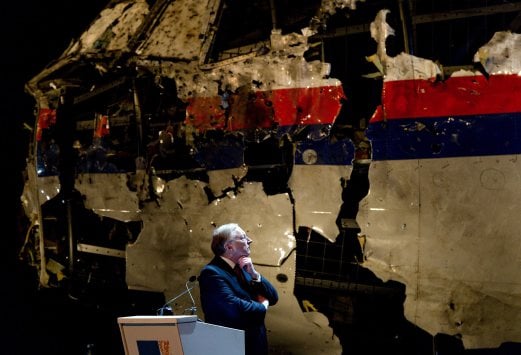
 Tjibbe Joustra, Chairman of the Dutch Safety Board (DSB/OVV), speaks during a press conference to present the report findings of the Dutch Safety Board in Gilze Rijen, The Netherlands, 13 October 2015.  EPA

Tjibbe Joustra, Chairman of the Dutch Safety Board (DSB/OVV), speaks during a press conference to present the report findings of the Dutch Safety Board in Gilze Rijen, The Netherlands, 13 October 2015. EPA

Copyright New Straits Times 2015

Link to original article:  

http://www.nst.com.my/news/2015/10/transport-ministry-explains-msia’s-“reluctance”-cooperate-mh17-probe?d=1

  • Posted in Asian @as
  • Comments Off on The De Facto Exclusion of Malaysia from the MH17 Dutch Safety Board (DSB) Investigation. “Malaysia was Denied full Access and Privileges to the Probe”

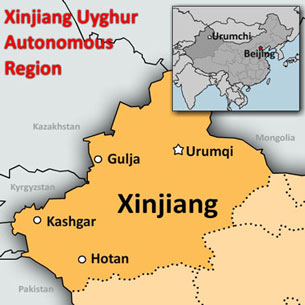
Yu Zhengsheng, top member of the Politburo Standing Committee, China’s de facto highest ruling body, visited Xinjiang Uygur Autonomous Region on September 29, 2015. His visit marks important developments in the People’s Republic of China.

First of all, Beijing is concerned over the Uyghur Islamist threat. Chinese intelligence believes that about 3000 Uighur militants have been fighting at the side of ISIS and Al Nusra in Syria. Most of them get training in Afghanistan and then militants move to Syria or Iraq.

China notes that the Turkish National Intelligence Organization (MIT) provides support to them. On account of this, SouthFront: Analysis & Intelligence wants to remember that Saudi Arabia’s special services have a strong position in Afghanistan and links with Al Nusra. So, it’s hardly possible to believe that MIT is the only supporter of these developments.

On the other hand, Yu Zhengsheng’s public activity is linked to his possibility to become the head of the Politburo Standing Committee. Experts believe that in this case Chinese security chiefs will get more influence to impact the China’s foreign policy.

So, it will likely start to counter Islamist militant groups more actively. This will lead to the intensification of antagonisms with MIT which supports Uyghur separatists in China.

 Furthermore, the situation is already tense. On July 9, Thailand confirmed that it had deported more than 100 Uyghurs to China. This fact drew so-called “international attention from human rights groups and the Turkic-speaking community”, particularly in Turkey. Indeed, these Uyghurs were militants and used Bangkok as a transfer point on the way to Turkey. MIT was helping them in this.

In China’s case, the Ankara’s common goal to unite the so-called “Turkic world” has turned into buidling own center of influence in Xinjiang Uygur Autonomous Region. Obviously, Beijing doesn’t like this. Thus, China will answer rigidly if Turkey, Saudi Arabia and Qatar will continue to try to destabilize Xinjiang Uygur Autonomous Region. In turn, Western powers can support destabilization of the region if they believe that China is ready to start a military opeartion in the Middle East.

In any case, Beijing will prefer to act on a foreign soil, at least, in the Middle East and Central Asia. China has major economic interests in Tajikistan. It needs a stability of the regime there. Another important point is Uzbekistan. The Islamic Movement of Uzbekistan (IMU) militant group is a main threat there. It has a major human potential. A destabilization in Uzbeksitan will definitely fire the whole Central Asia.

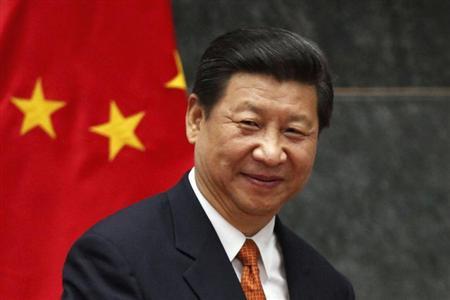
At the moment, activity of militants in Xinjiang Uygur Autonomous Region is obstructed by violant opposition of the Chinese authorities. The economic and military support of militants there is also more complicated than in Afghanistan or Tajikistan. But the Uygur and IMU militants are much more motivated than their counterparts in the Central Asia. Yugur separatists and IMU inspired by Taliban and ISIS successes could try to force events in China. The situation in Xinjiang Uygur Autonomous Region also depends on the reeal results of the Xi Jinping’s visit to London on October 19. The Anglo-Saxon’s stance over the topic will strongly influence the situation. Saudi Arabia, Turkey and Qatar will hardly achieve their goals without the Western support.

  • Posted in Asian @as
  • Comments Off on Who is Behind China’s Al Qaeda Terrorist Insurgency in Xinjiang-Uyghur? Threat of Destabilization

The U.S. political elite is never entirely secretive about its aims. It spells them out, maybe not always clearly and maybe sometimes elliptically, but it is fairly open in declaring its objectives and how it intends to achieve them. When she was U.S. secretary of state, Hilary Clinton adumbrated the Trans-Pacific Partnership in a 2011 article in Foreign Affairs, the magazine of the Council on Foreign Relations, an elite-consensus forming organization which Laurence H. Shoup in a recent book dubbed “Wall Street’s Think Tank”, and, in an earlier book, an “imperial brain trust.” [1]

In “America’s Pacific Century,” Clinton announced that the Obama administration was “working with China to end unfair discrimination against U.S. and other foreign companies or against their innovative technologies, remove preferences for domestic firms, and end measures that disadvantage or appropriate foreign intellectual property.” [2] Which is exactly what the TPP sets out to do, except—and this is a significant point—without China.

US defense secretary  Ashton Carter has says the Trans-Pacific Partnership is as important to him as another aircraft carrier.

US defense secretary Ashton Carter says the Trans-Pacific Partnership is as important to him as another aircraft carrier.

Almost without exception, commentary on the TPP from the North American Left has focussed on the potential harm the pact will likely inflict on ordinary North Americans, the 99 percent. The emphasis has been on the TPP as a weapon of the corporate elite—a new battle tank in a class war that billionaire investor Warren Buffet famously acknowledged exists and that his class is winning. [3]

Commentary on the TPP as a weapon wielded against North American workers is important and necessary, but no less important is the reality that the TPP also exists as a weapon wielded against China, a country the U.S. ruling class designates as a rival. Even the U.S. political elite has embraced the weapon metaphor. U.S. secretary of defense, Ashton B. Carter has called the pact “as important to me as another aircraft carrier.” [4]

Who’s Involved?

TPPcountriesmapThe TPP is a U.S.-initiated pact among 11 other Asia-Pacific region countries, including Washington’s anglosphere allies, Canada, Australia and New Zealand, along with Mexico, Japan, Vietnam, Chile, Peru, Malaysia, Singapore, and Brunei Darussalam. Despite their significant place in the Pacific Rim, Russia and China were left out of the pact by Washington. The exclusion of China is significant, because the TPP is said to be the economic arm of “the much-extolled (U.S.) ‘pivot’ to Asia,” aimed at bolstering the United States’ presence in the Asia-Pacific region. [5]

Containing China

Coverage of the TPP in the two principal elite U.S. newspapers, The Wall Street Journal and The New York Times, has portrayed a major aim of the pact as containing China. “The pact…is seen as a way to” raise “a challenge to Asia’s rising power…which has pointedly been excluded from the deal,” wrote Kevin Granville in The New York Times. [6] Jane Perlez in the same newspaper described the pact “as a win for the United States in its contest with China for clout in Asia”. [7] “Critics in China,” noted The Wall Street Journal, are on the same page, viewing “the Trans-Pacific Partnership with suspicion, seeing it as one more way for Washington to seek to contain China’s influence.” [8]

What U.S. ruling circles seek to contain in the Asia-Pacific region is Chinese encroachments on U.S. profits. Chinese industry is taking an ever growing share of the region’s trade, at the expense of corporate USA. “Time is running out,” warns the U.S. defense secretary. “We already see countries in the region trying to carve up these markets.” [9]

As recently as 2004, the United States was the largest trading partner of Asean, a 10 country association of Southeast Asian economies, with total trade of $192 billion. “But now China, which was an inconsequential trading partner of Asean as recently as the late 1990s, is by far the region’s largest trading partner, with two-way trade of $293 billion in 2010.” Not only is China Asean’s biggest trading partner, it’s the top trading partner of Japan, Korea, India and Australia, notes Cui Tiankai, a Chinese vice foreign minister. [10]

What’s more, “the China Development Bank and Export-Import Bank of China now provide more loans to the region than the (U.S.-dominated) World Bank and Asia Development Bank combined.” [11] And China “has picked off American allies like Britain, Germany and South Korea to join…the Asian Infrastructure Investment Bank, a project started by China in part to keep its own state-owned firms busy building roads, dams and power plants around Asia. China is at the same time setting up other trade pacts around the region so it can use its cash and enormous market leverage to strike deals more advantageous to its interests.” [12] Needless to say, the deals China strikes, the roads, dams and power plants it builds, and the trade it carries out, represent lost opportunities for U.S. banks, corporations and investors.

China’s growing economic clout has raised concerns on Wall Street and in Washington of “being left on the outside, looking in.” Fearful that U.S. firms and investors “risked being shunted aside in Asia,” Washington initiated the Trans-Pacific Partnership [13] as a means of defending the interests of U.S. finance and business in Asia.

Re-orienting Economies from China to the United States

One of the ways the TPP defends and promotes U.S. profits is by re-orienting the economies of the pact’s other partners toward the United States and away from China. “Ichiro Fujisaki, a former Japanese ambassador to the United States, described the Trans-Pacific Partnership as ‘economic glue to cement ties with like-minded countries,’ including emerging economies such as Vietnam that are only partly integrated into the global economic order shaped by the United States.” [14] The TPP isn’t as much about free trade as it is about restricting trade and investment within a US-dominated bloc.

During talks, U.S. negotiators “aiming to bolster American exporters” stipulated “that countries joining its new Pacific trade zone cut back on imports from China.” U.S. negotiators demanded that “Vietnam, a major garments exporter, reduce its reliance on textiles made in China… to get preferential market access to the U.S.” Washington’s goal was “to create new markets in Vietnam for the U.S. textile industry.” Since the “U.S. and Mexico are especially large textile producers, Vietnam would simply have to shift its sourcing of yarns and fabrics from China to the U.S. and Mexico.” [15] This exemplifies the entire aim of the U.S.-initiated TPP: to disrupt China’s growing trade relations with its neighbors in order to bolster U.S. profits.

The Peterson Institute for International Economics in Washington estimates that the TPP will “cost China about $100 billion a year in lost exports as the partners trade more among themselves and less with China.” [16]

Pressuring China to Abandon State-Directed Development

Another way the TPP seeks to buttress U.S. profits is by leaving open the possibility of China joining the pact if it abandons its development model, which relies heavily on state-owned enterprises and assistance to domestic industry. While China was initially excluded from the partnership, “U.S. officials… say they are hopeful that the pact’s ‘open architecture’ eventually prompts China to join.” [17] But to link up with the 12 economies of the TPP club the “Chinese government would need to work harder at economic reform in order to meet the pact’s standards.” [18] Specifically, China would have to open markets and limit assistance to state-owned companies. [19]

China has “tens of thousands of state-owned enterprises that dominate half of China’s economic output and that the government heavily subsidizes and protects.” [20] They “account for about 96% of China’s telecom industry, 92% of power and 74% of autos. The combined profit of China Petroleum & Chemical and China Mobile in 2009 alone was greater than all the profit of China’s 500 largest private firms.” [21]

In addition, foreign competitors are restricted by government rules, required to share their technology in joint ventures with state companies, and are passed over for lucrative government contracts in favor of state enterprises.

China’s reliance on state-directed development has provoked ire on Wall Street and in Washington. Chinese “state capitalism” restricts profit-making opportunities within China for U.S. firms and investors. At a public forum in Davos, Switzerland, during the World Economic Forum, then U.S. Treasury Secretary Timothy Geithner complained that “China does present a really unique challenge to the global trading system, because the structure of its economy, even though it has more of a market economy now, is overwhelmingly dominated by the state.” [22] U.S. President Barack Obama, referring to Washington’s Asian rival, complained that “It’s not fair when foreign manufacturers have a leg upon ours only because they’re heavily subsidized.” [23] The point of China’s state-directed development is to raise many more hundreds of millions of Chinese from poverty, as the Chinese Communist Party has already done, even if it means irking U.S. banks, investors and corporations and their political handmaidens in Washington.

U.S. and European corporations have grown “increasingly agitated over what they regard as unfair curbs on their ability to compete with domestic companies in China’s vast and growing market.” [24] The TPP is a response to that agitation. “Prodded by corporate chiefs across the country, U.S. trade officials…launched a coordinated attack on the core of America’s commercial conflict with China: the heavily protected and subsidized Chinese state-owned enterprises that are pounding U.S. companies not just in China but in competition globally.” [25]

Accordingly, one set of the TPP’s “provisions requires that state-owned enterprises…receive fewer government subsidies in the form of low-rate loans, cheap or free land and other assistance,” notes Joseph Stiglitz, the Nobel Prize-winning economist. “The clause is initially aimed at Vietnam—as well as Malaysia and Singapore to some extent—but it offers a signpost for the direction in which the United States wants China to move.” [26] “The message to China: If you want to join, you have to change.” [27]

The TPP’s Connection to Regime Change in Libya and Syria

The preceding paragraphs point to a significant reality of U.S. foreign policy: U.S. State Department initiatives are “prodded by corporate chiefs” and aim to open up the world to U.S. trade and investment–and keep it open. Trade and investment agreements, and the Pentagon, are both instruments of the U.S. corporate and financial world, deployed by Washington’s political elite to secure the interests of the United States’ most “substantial” citizens. Hence, U.S. secretary of defense Ashton Carter can draw an equivalence between the TPP and an aircraft carrier.

To the U.S. capitalist ruling class, China, with its immense market, represents a potential cornucopia of profits, all the greater if the Chinese Communist Party can be persuaded to abandon its state-directed development model, which severely restricts the latitude of U.S. investors, banks and corporations to manoeuvre within the Chinese economy. The Chinese model has proved worthy of lifting hundreds of millions out of poverty, not surprisingly, since its aim is internal development, not the aggrandizement of super-wealthy foreigners ensconced on Wall Street. By contrast, the development model favored by the corporate-based ruling class of the United States predictably favors private enterprise and free trade (within US-dominated blocs)—a model that has proved worthy of creating fabulous wealth for a parasitic elite at the apex of U.S. society, but abject poverty at the other extreme for people in the developing world.

Finally, another reality should be acknowledged. Both Libya and Syria have followed development models that are very much similar to China’s, and have equally irked US corporate and political leaders.

A November 2007 U.S. State Department cable warned that those “who dominate Libya’s political and economic leadership are pursuing increasingly nationalistic policies in the energy sector” and that there was “growing evidence of Libyan resource nationalism.” [28] The cable cited a 2006 speech in which then Libyan leader Muamar Gaddafi said: “Oil companies are controlled by foreigners who have made millions from them. Now, Libyans must take their place to profit from this money.” [29] Gaddafi’s government had also forced companies to give their local subsidiaries Libyan names. Worse, in the view of the oil companies, “labor laws were amended to ‘Libyanize’ the economy,” that is, turn it to the advantage of Libyans. Oil firms “were pressed to hire Libyan managers, finance people and human resources directors.” The New York Times summed up Washington’s objections. “Colonel Gaddafi,” the newspaper said, “proved to be a problematic partner for international oil companies, frequently raising fees and taxes and making other demands.” [30]

Similar complaints are heard in Washington about Syria. The U.S. Library of Congress country study of Syria refers to “the socialist structure of the government and economy,” points out that “the government continues to control strategic industries,” mentions that “many citizens have access to subsidized public housing and many basic commodities are heavily subsidized,” and that “senior regime members” have “hampered” the liberalization of the economy. [31]

united-states-mother-of-terrorism-altagreerRegime change operations in Libya and Syria originated in the U.S. ruling class goals of opening the world to U.S. banks, investors and corporations and crushing development models which refuse to yoke markets, labour and resources to U.S. corporate interests, not to (contrived) alarm over an (invented) impending massacre in Libya or revulsion over the way the Syrian state has defended itself against an uprising by violent sectarian Sunni Islamists (in reality egged on, funded, trained and armed by the United States and the marionette Middle East tyrannies it counts as allies.)

Equally, U.S. corporate goals of defending U.S. profit-making opportunities in Asia animated the activities which led to the TPP as an instrument of disrupting Chinese trading relations and pressuring Beijing to change its economic regime of internal development to one favoring Wall Street. U.S. military intervention against a resource nationalist government in Libya, the deployment of Islamist proxies against an economically nationalist government in Syria (in other words, the mobilization of religion for profane ends), and an exclusionary trade and investment bloc aimed at harming and pressuring China over its policy of state-directed development, have one thing in common: they are prodded by a parasitic elite at the apex of US society rooted in Wall Street and are intended to serve its interests by clearing away impediments to its further accumulation of capital on the world stage.


Notes

1. Laurence H. Shoup, Wall Street’s Think Tank: The Council on foreign Relations and the Empire of Neoliberal Geopolitics, 1976-2014, Monthly Review Press, 2015.

2. Hilary Clinton, “America’s Pacific Century”, Foreign Policy, November, 2011.

3. Ben Stein, “In class warfare, guess which class is winning,” The New York Times, November 26, 2006.

4. Jane Perlez, “U.S. allies see Trans-Pacific Partnership as a check on China,” The New York Times, October 6, 2015.

5. Perlez, October 6, 2015.

6. Kevin Granville, “The Trans-Pacific Partnership Trade Accord explained,” The New York Times, October 5, 2015.

7. Perlez, October 6, 2015.

8. Brian Spegele and Thomas Catan, “China suggests shift on U.S.-led trade pact”, The Wall Street Journal, May 31, 2013.

9. Helene Cooper, “U.S. defense secretary supports trade deal with Asia,” The New York times, April 6, 2015.

10. Jane Perlez, “Clinton makes effort to rechannel the rivalry with China”, The New York Times, July 7, 2012.

11. Perlez, “October 6, 2015.

12. David E. Sanger and Edward Wong, “As Obama plays China card on trade, Chinese pursue their own deals,” The New York Times, May 12, 2015.

13. Perlez, July 7, 2012.

14. Jonathan Soble, “Failure of Obama’s Trans-Pacific trade deal could hurt U.S. influence in Asia,” The New York Times, June 16, 2015.

15. Tom Wright and Mark Magnier, “Fabric of a trade deal: U.S. asks Vietnam to cut out Chinese textiles,” The Wall Street Journal, June 24, 2015.

16. Bob Davis, “U.S. blocks China efforts to promote Asia trade pact,” The Wall Street Journal, November 2, 2014.

17. Granville, October 5, 2015.

18. Perlez, “October 6, 2015.

19. Spegele and Catan, May 31, 2013.

20. John Bussey, “Tackling the many dangers of China’s state capitalism”, The Wall Street Journal, September 27, 2012.

21. Bussey, September 27, 2012.

22. Barack Obama, State of the Union Address, 2012.

23. Aaron Black, “U.S. raps ‘damaging’ China policies”, The Wall Street Journal, January 28, 2012.

24. Michael Wines, “Behind a military chill: A more forceful China”, The New York Times, June 8, 2010.

25. John Bussey, “U.S. attacks China Inc.”, The Wall Street Journal, February 3, 2012.

26. Joseph E. Stiglitz, “On the wrong side of globalization,” The New York Times, March 15, 2014.

27. Bussey, February 3, 2012.

28. Steven Mufson, “Conflict in Libya: U.S. oil companies sit on sidelines as Gaddafi maintains hold”, The Washington Post, June 10, 2011.

29. Mufson, June 10, 2011.

30. Clifford Kraus, “The Scramble for Access to Libya’s Oil Wealth Begins,” The New York Times, August 22, 2011.

31. U.S. Library of Congress. A Country Study: Syria. http://lcweb2.loc.gov/frd/cs/sytoc.html

  • Posted in Asian @as
  • Comments Off on Why the Trans-Pacific Partnership Equals a U.S. Aircraft Carrier

US Asia-Pacific Hegemony vs. A Rising China

October 18th, 2015 by Tony Cartalucci

The complexity and history behind the current tensions in Asia Pacific are belied by simplistic narratives underpinned by superficial nationalism. China’s portrayal across the Western media as a regional “bully” versus its victims across Southeast Asia is dividing the general public down two sides of a predictable line.

On one side are those who welcome the rise of China as a counterbalance for longstanding Western hegemony across Asia Pacific, on the other are those that fear China will simply replace  a “benevolent” Western hegemony with its own brand of regional domination.

Somewhere in the middle lies the truth, but to arrive there, one must understand the true nature of the unfolding, and very unnecessary tensions in the South China Sea.

Enduring Imperialism 

The Pacific, and in particular much of China and Southeast Asia, was under the control of colonial European powers with Britain controlling Malaysia, Myanmar (then called Burma), and parts of China, and France controlling Cambodia, Vietnam, and Laos.

Through British “gunboat diplomacy,” the empire wrestled concessions resembling what would today pass as a highly unpopular “free trade agreement” from Thailand (then called Siam), as well as from China, including the seizure of Hong Kong. There is literally a street in Hong Kong still named “Possession Street” marking the site where the British first surveyed their newly seized lands, beginning a century and a half of occupation.

Hong Kong was seized during the Opium Wars, so called because they were fought amid attempts by China to shut down the highly destructive opium trade the British were carrying out in their territory.

The World Wars saw a significant reduction of Western power and influence across Asia Pacific. While the United States would retain hegemony over Japan and the Philippines, many other nations first ejected their colonial occupiers, then established independent nations.

Modern Western Hegemony 

The Vietnam War fought between the 1950’s and 1970’s was not only an attempt to maintain Western hegemony over Indochina, but admittedly an attempt to ultimately encircle and contain China. Within the so-called “Pentagon Papers” released in 1969, it was revealed that the conflict was one part of a greater strategy aimed at containing and controlling China.

Three important quotes from these papers reveal this strategy. It states first that:

…the February decision to bomb North Vietnam and the July approval of Phase I deployments make sense only if they are in support of a long-run United States policy to contain China.

It also claims:

China—like Germany in 1917, like Germany in the West and Japan in the East in the late 30′s, and like the USSR in 1947—looms as a major power threatening to undercut our importance and effectiveness in the world and, more remotely but more menacingly, to organize all of Asia against us.

Finally, it outlines the immense regional theater the US was engaged in against China at the time by stating:

…there are three fronts to a long-run effort to contain China (realizing that the USSR “contains” China on the north and northwest): (a) the Japan-Korea front; (b) the India-Pakistan front; and (c) the Southeast Asia front.

The Pentagon Papers in fact provide for us today the context with which to properly view current tensions in Asia Pacific. 

The US still to this day maintains its “Japan-Korea front” against China, with US troops literally stationed in both nations.

Across Southeast Asia, the United States through covert subversion has attempted to string together a supranational bloc constructed by obedient client regimes. These efforts can be best seen with US support through an extensive network of nongovernmental organizations (NGOs) of Aung San Suu Kyi in Myanmar, Anwar Ibrahim in Malaysia, and the Shinawatra dynasty in Thailand.  The Philippines have remained subservient to the will of Wall Street and Washington more or less for over a century, while Vietnam has been witnessing a steady increase in US-backed destabilization.

In Pakistan, political subversion and armed violence has been used in key strategic locations to disrupt Chinese investments including at Gwadar Port and throughout the Pakistani province of Baluchistan.

And within China itself, the United States has resorted to political subversion in Tibet and Hong Kong, while backing armed terrorism and separatism in China’s Xinjiang region.

While the US, through its “pivot toward Asia,” claims American exceptionalism is necessary to maintain peace and stability thousands of miles from its own borders for the people of Asia, it is clear that much of the chaos unfolding across Asia is the work of the United States itself. It is the proverbial “windshield repair shop” breaking car windows at night, then making a fortune fixing them by day.

China Strikes Back 

China’s journey toward becoming a regional power broker has been different than that of the Anglo-Americans. It has not invaded its neighbors nor erected a massive, region-wide network of subversive NGOs to topple governments under the guise of “popular revolutions.” Instead, it has gained power and influence through economic and industrial power.

It trades and deals throughout the region, as well as invests and builds infrastructure. It is also is building up its ability to eventually oust the West altogether from the region. Corporate think-tank RAND recently published a piece titled, “China’s Airfield Construction at Fiery Cross Reef in Context: Catch-Up or Coercion?” In it, it’s argued that China’s construction and expansion of islands throughout the South China Sea is tantamount to bullying.

In reality, China is constructing defensive capabilities that will render Western fleets moot. An island cannot be sunk or interdicted by US ships. Once constructed, manned, and operational, it is a permanent strategic fixture that is for all intents and purposes incontestable save for a full-scale invasion amid total war.  

Further, the bases give Chinese ships an operational edge over American vessels, providing logistical support in the South China Sea where the US has none. It is displacing the US both operationally and strategically, and if Beijing plays its cards right, displacing it diplomatically as well. 

Should China steer away from attempts to snare it in a regional confrontation, and use its new capabilities to maintain safety, peace, and stability in every real sense as the US claims to, the entire purpose of Western meddling in Asia Pacific will be undermined and eventually collapse. The West will be resigned to playing a role proportional to its proximity to the region – or in other words – a negligible role.

Southeast Asia’s Real Challenge

China’s rising power is not entirely benign. Even for proponents of a rising China, it must be realized that power always has the potential to be abused, and most likely will be if a regional military and economic balance is not struck. 

The real challenge facing Southeast Asia is how to strike that balance without sacrificing its sovereignty to foreign interests like the United States. The maintenance of formidable armies and navies throughout Southeast Asia, along with the preservation of national identities will prevent significant conflicts before they start. National economies throughout Asia that are not overly dependent on imports or exports either to China or the West can better defend their own socioeconomic and regional interests. 

Above all, there needs to be a reluctance to allow the United States to pit the nations of Southeast Asia either against themselves or against China in yet another elementary example of imperial divide and conquer. And while this challenge is that of the nations of Southeast Asia, who dangerously gravitate toward a EU-style system (ASEAN) apparently indifferent to the monumental failure the EU itself has become, Beijing itself must recognize and defuse the tensions the United States is fanning the flames of.

China’s patient, systematic displacement of the United States from the region will inevitably pay off. Those in the region who believe depending on the United States is a viable strategy in keeping China in check are setting themselves and the region up for failure.

Those that hold the best interests of each nation in Asia at heart are those nations themselves and they alone. Neither through supranational interdependent blocs, nor through foreign interests transforming regions into defacto protectorates, can Asia search for its future. Despite the rhetoric underpinning America’s “pivot toward Asia,” only through a multipolar world where nations pursue their own national sovereignty and respect those of others – maintained through military and socioeconomic balance – can true peace and stability be found and maintained.

Tony Cartalucci, Bangkok-based geopolitical researcher and writer, especially for the online magazineNew Eastern Outlook”.

  • Posted in Asian @as
  • Comments Off on US Asia-Pacific Hegemony vs. A Rising China

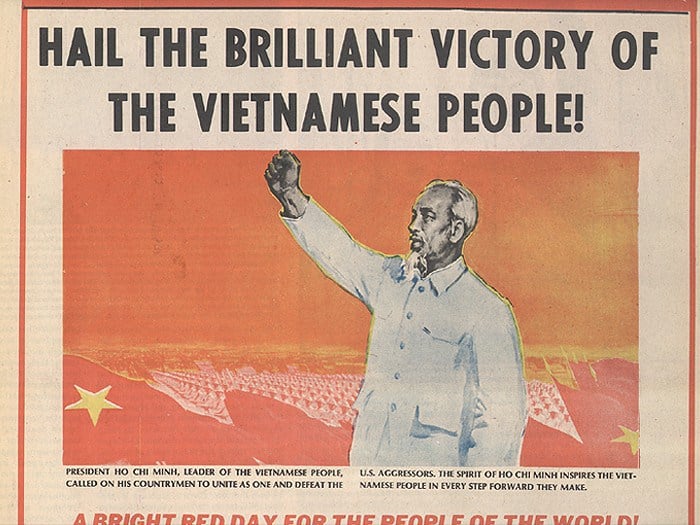
In 1975 the people of Vietnam successfully ended one of the longest and bloodiest anti-colonial wars in world-history – defeating the US, the world’s biggest imperial power, after 20 years of struggle.

Barely forty years later the Vietnamese regime signed off on the US-Japanese dominated Trans-Pacific Free Trade Agreement (TPFTA), which essentially converted Vietnam into a vassal state.

Vietnam has gone full circle: From a neo-colony ruled by puppet dictators backed by an American occupation army involving 500,000 troops from 1955-1975, to its current ‘Communist’ rulers who have turned-over its markets, industries, ports, resources and labor to the 500 largest Western and Asian multi-national corporations.

Contrasting Historical Moments:  1975 and 2015

In 1975, the revolutionary government closed all US military bases and expelled all US military personnel.  Today the Vietnam ‘vassal regime’ allows US naval visits and signs military agreements to tighten the imperialist military encirclement of China.

In 1975, the revolutionary leaders promised to end imperial exploitation of plantation and factory labor; today the vassal rulers offer the imperial states cheap labor, at wages less than half that paid to Chinese workers to ‘entice’ multi-nationals.

In 1975, the government intervened in favor of workers, taking over plantations and factories; today the vassal state savagely represses striking workers and outlaws class-based unions.

In 1975, the revolutionary government declared its solidarity with workers’ and peasants’ struggles around the world; today the vassals declare their unconditional support of all of the major imperial organizations – from the World Trade Organization to the Trans-Pacific Treaty organization.

What explains this total reversal of politics and allegiances?  What accounts for the transformation from revolutionary vanguard to submissive vassal of imperial powers?  What factors led to the degeneration and decay of a revolutionary movement of millions and the ascendancy of a corrupt and servile political and socio-economic elite?  Why did this counter-revolution occur without any major mass popular upheaval?


Stages and Circumstances of Vietnam’s Degeneration

Liberated Vietnam facing Military Siege 

Internal and external events and forces played a major role in undermining the promise of social transformation proclaimed by the Vietnamese revolutionaries.

Beginning with the US destruction of the economy and Washington’s subsequent refusal to pay reparations and vindictive policy of post-war boycott and sanctions, the Vietnamese faced monumental tasks with few financial resources.

The US ground and air war devastated the infrastructure and productive enterprises of the country.  Napalm and chemical warfare (Agent Orange) devastated villages and poisoned the rice fields, water and soil.  Millions of cluster bombs maimed scores of thousands of peasants.

The US secretly supported the Khmer Rouge, the Cambodian terror regime, in its war on liberated Vietnam.  This further damaged Vietnam’s shattered economy and diverted scarce resources needed for peacetime reconstruction to military operations.

            China launched a border war on Vietnam’s northern frontier, increasing the burden on the depleted resources of the Vietnamese state.

The Difficult Transition

The Vietnamese revolutionary government, during the first decade of its existence, struggled to make the transition from a war to a peace economy.

Given the scarcity of resources, skilled manpower and revenues, and under stress to protect its borders, the Vietnamese government attempted to ‘socialize’ the economy with few personnel and limited external support from the Soviet Union and its allies.

Power was concentrated, political militants and loyalists took command, although many lacked experience or expertise in economic development.  Economic recovery was understandably dictated by political and military priorities.  Politics was in command – trained orthodox economists were in retreat.  The choice was ‘red’ over ‘expert’.

After decades of deprivation and sacrifice, many cadres sought and obtained access to scarce resources. A privileged elite emerged, especially in South Vietnam, where the US military occupation had spawned a huge black-market economy, and a large stratum of wealthy ‘middlemen’ who acted as ‘brokers’ with wealthy overseas Chinese businesspeople, especially in Hong Kong and beyond.

The Vietnamese defeated the Pol Pot terrorist regime at a heavy cost and backed a friendly client regime.

By 1980, China began its transition to capitalism and showed no interest in  providing aid or investment to hasten Vietnam’s socialist reconstruction.  By the mid 1980’s, with the ascendance of Gorbachev, Russia cut off its economic assistance to Vietnamese state enterprises, denigrated socialist planning and backed ‘market solutions’.

External ‘Allies’ Promote Internal Enemies

In sum, Vietnam’s external allies were moving in a direction, which favored Vietnamese technocrats and ‘capitalist holdovers’ from the colonial and neo-colonial period.

The ‘new rich’, including privileged sectors of the revolutionary regime, took advantage of the ‘shortage of capital flows’ and the years of shortages and sacrifices to advocate an ‘opening to the market’ and to promote the entry of foreign capital.  This was accompanied by the privatization of public enterprises (dubbed ‘joint ventures’) and   ‘incentives’ (high profits) to manufacturers, especially from Hong Kong, Japan and Taiwan.

Internal Factions and the Victory of the Capitalist Technocrats

By the late 1980’s, four tendencies competed for influence in the Communist Party:

(1) A revolutionary faction, including some of the historic leaders of the Liberation struggle.

(2) A centrist or reformist faction of privileged officials who sought to protect and promote state enterprises – a source of their own enrichment.  They supported the “partnership” with foreign private capital supposedly as a supplement to the so-called “socialist sector”

(3) A third faction of technocrats, who favored the gradual conversion to a private capitalist economy, except in some ill-defined ‘strategic sectors’.

(4) A fourth faction, composed of Western educated and connected economists, who sought and secured submission to overseas capitalist and international financial institutions.  They joined forces with the technocrats and privileged, corrupt Party elite and became the eventual rulers of Vietnam.

The Counter-revolutionary ‘Unholy’ Alliance

In the course of the following decade, an alliance of technocrats, corrupt and enriched officials (with their families), who had become business partners, and pre-revolutionary elites took control of the economy.  By the middle of the 1990’s, Vietnam could no longer ‘balance’ between the USSR and China on the one-hand and Western capitalists on the other.  The USSR had disappeared.  Russia was in chaos.  China was in headlong pursuit of capitalist growth at any cost, through any means, especially via the privatization of major enterprises and  stripping workers of all labor and welfare rights.

The Vietnam revolutionaries were ‘retired’ or relegated to the historical museum as respected but impotent figureheads.  They were trotted out on special ‘national’ occasions.

The ‘statists’-the Party CEOs fought rearguard struggles trying to retain lucrative  fiefdoms in public enterprises, but lacked any strategic allies abroad or internally.  They had immobilized the working class and had themselves embraced the privileges of power, luxury and corruption – (with few notable exceptions).

By the turn of the millennium, the technocrats and capitalist ideologues had taken full command of economic decision-making.  They embraced the politics and economics of ‘globalization’ and the insertion of Vietnam into the World Trade Organization (WTO).  They cited Vietnam’s rapid growth, lauding its abundant disciplined, cheap labor, kept in line by the centralized Party. Communist Party leaders exhibited all the features of the authoritarian personality:  arrogant and abusive to the workers under them, submissive and servile to the foreign investors above them.

The Party had become the instrument for repressing outbreaks of industrial strikes, rural protests and public disaffection.

Many of the corrupt officials embraced the ‘free market’ to legitimate their corrupt appropriation of public goods and the laundering of illicit earning.

The ideology “getting rich is good” pervaded the top and middle echelons of the Party, which was ‘Communist’ in name only.

The party-state lost its legitimacy along with its revolutionary legacy.  The former colonial enemies, Japan, the US and their allies were eagerly courted as the Vietnamese elite’s new ‘partners’ and mentors for the upwardly mobile technocrats and economists who served them.

With the signing of the Trans-Pacific Partnership (TPP), US imperialism easily secured in luxury conference rooms what they had failed to achieve in twenty years on the battlefield:  Total access to all of Vietnam’s major economic sectors, a captive labor force without rights or protection and a ruling elite willing to serve as an accomplice to its militarist policy of encircling  China.

Imperial Dominance by Invitation

The US political-economic conquest of Vietnam was accomplished by the invitation and complicity of the Vietnamese ruling Communist Party and not by the force of arms, not by a puppet ruler or a bought and bound ‘Generalissimo’.

The main beneficiaries of its vassalage are the Vietnamese collaborators, intermediaries, importers, exporters and labor contractors, who  receive legal and illicit commissions for selling out the nation’s wealth.  This includes a small army of ‘service operators’, embedded in IT start-ups, Chinese-Vietnamese business associates of Hong Kong sweatshop manufacturers, new university graduates turned business consultants and public officials who ‘sign-off’ on tax exemptions,and  fabricate compliance with labor and environmental protection laws.  These are the ones who  grow rich in the new ‘market economy’.

As the major US, Japanese and overseas Chinese corporations take control of Vietnam’s manufacturing, banking, retail and wholesale sectors and local and overseas trade, small-scale local businesspeople will go bankrupt.  State enterprise will be sold or closed. Small farmers and peasants will a lose access to credit while cheap imported  rice will flood the market and bankrupt local farmers.

Vietnamese workers and peasants, once heralded as the vanguard of the liberation struggle, will be savagely  exploited by the Communist – capitalist ‘partnership’.  They are now among the poorest of the poor in all of Asia.

Conclusion

The ascendancy of a pro-imperialist collaborator elite in Vietnam was not inevitable; it was a relatively gradual process, in which the negative external environment gradually eroded the will and capacity of Vietnam’s heroic and historic leaders to combine the revolutionary reconstruction with popular democratic institutions following the defeat of the US military.  In a repeat of the Imperial Roman scorched and salted earth policy, the US took revenge for its humiliating defeat by leaving a devastated country, refusing reparations and imposing vindictive economic sanctions on the Vietnamese people and nation.  The demise of the USSR and China’s turn to capitalism forced Vietnam to look for alternative sources of external finance.

Added to these harsh external conditions, difficult internal problems complicated the transition: Vietnam’s revolutionary leaders, who were magnificent and victorious strategists of politico-military struggle, were mediocre economic strategists.  They turned to the pre-revolutionary Chinese-Vietnamese business elite, linked to Hong Kong, Taiwan, and mainland business families, to navigate the economy.

The young, educated post-revolutionary generation was drawn heavily from privileged families, especially from Saigon;  they inexorably adapted and imposed their neo-liberal ideology on the regime.

The marriage of corrupt repressive statist officials to the traditional privileged clans and classes brought the new post-revolutionary educated technocrats to power.

The authoritarian Party elite ensured the de-radicalization of the workers and peasants, the exclusion and repression of leftwing activists and the unhindered application of neo-liberal, pro-imperial economic policies.

The Vietnam experience provides us with several important historical lessons:

 The first lesson is the importance of democratizing and socializing production, distribution and culture following national liberation to check against the post-revolutionary seizure of power by Party and military leaders and to limit the advance of the old privileged classes.

Secondly, the educated classes must serve the interests of the revolutionary masses, and admission to institutes of higher education should favor the sons and daughters of the working class, not the children of the traditional comprador elite.

University students should be integrated into democratic class organization to further and deepen their links to the past and present revolutionary heritage

Public resources should be concentrated on economic and social programs that improve the lives of wage and salaried workers and local producers.  The presence of private, local and foreign investors should be rigorously controlled via time- bound agreements.

The administration and decision-making in cooperative, self-managed and local enterprises should be decentralized.

Political education should be based on egalitarian ethics.  Anti-corruption, disciplinary committees, elected by workers, peasants, employees, accountants, consumers and environmentalists should be established throughout the economy.

State expenditures on social and private consumption should be balanced with emphasis on public transport, health, education and leisure facilities.

Solidarity and support for on-going liberation struggles around the world should be the rule.  Social practice in everyday life should be combined with individual and collective learning of technical, historical, social and literary subjects, which enrich and deepen understanding of the revolutionary roots of contemporary society.

The state should combat the tendency of organized local ethnic groups to serve as agents loyal to foreign regimes.  Material and symbolic rewards for excellence should be combined and lifetime accomplishments recognized.  Those guilty of illicit economic and social activities, especially those related to nepotism or kin/clan enrichment, should be marginalized and punished.

The post-liberation defeat and reversal of Vietnam’s revolutionary gains was not inevitable.  Negative lessons should be studied and serve as guidelines for future revolutions.  There are grounds to believe that the Vietnamese revolutionary legacy is not dead.  The revolutionary grandparents in ‘retirement’ can and will transmit their vision and experience of  an alternative class struggle to their grandchildren, who are going to suffer savage exploitation, dispossession and de-nationalization following Vietnam’s entry into the  imperialist Transpacific Partnership Agreement.

Leaders, who have grown rich from the TPP, will face anger and revolt by the Vietnamese masses who are destined to pay heavily for their leaders’ sell-out.

The Vietnam’s leaders have embraced the aggressive US-Japanese militarist policy against China; this betrayal of the people’s struggle will have long-lasting negative consequences.

Once against external and domestic developments will converge – hopefully, this time ushering in a new phase of revolutionary change.

  • Posted in Asian @as
  • Comments Off on Vietnam: From National Liberation to Trans-Pacific Vassal (1975-2015)

The Secret History of Cannabis in Japan

October 6th, 2015 by Jon Mitchell

Experts point out the plant’s cultural significance. 

Today Japan has some of the strictest anti-cannabis laws in the world.

Punishment for possession is a maximum 5 years behind bars and illicit growers face 7-year sentences. Annually around 2000 people fall foul of these laws – their names splashed on the nightly news and their careers ruined forever. The same prohibition which dishes out these punishments also bans research into medical marijuana, forcing Japanese scientists overseas to conduct their studies.

For decades, these laws have stood unchallenged. But now increasing numbers of Japanese people are speaking out against prohibition – and at the heart of their campaign is an attempt to teach the public about Japan’s long-forgotten history of cannabis. [1]

Although not updated since 2010, the most detailed English website about cannabis in Japan is at taima.org accessible here.

Junichi Takayasu, curator of Taima Hakubutsukan, Japan’s only cannabis museum. (Photo by Hiroko Tanaka)

Junichi Takayasu, curator of Taima Hakubutsukan, Japan’s only cannabis museum. (Photo by Hiroko Tanaka)

“Most Japanese people see cannabis as a subculture of Japan but they’re wrong. For thousands of years cannabis has been at the very heart of Japanese culture,” explains Junichi Takayasu, one of the country’s leading experts.

According to Takayasu, the earliest traces of cannabis in Japan are seeds and woven fibers discovered in the west of the country dating back to the Jomon Period (10,000 BC – 300 BC). Archaeologists suggest that cannabis fibers were used for clothes – as well as for bow strings and fishing lines. These plants were likely cannabis sativa – prized for its strong fibers – a thesis supported by a Japanese prehistoric cave painting which appears to show a tall spindly plant with cannabis’s tell-tale leaves.

“Cannabis was the most important substance for prehistoric people in Japan. But today many Japanese people have a very negative image of the plant,” says Takayasu.

In order to put Japanese people back in touch with their cannabis roots, in 2001 Takayasu founded Taima Hakubutsukan (The Cannabis Museum) – the only museum in Japan dedicated to the much-maligned weed. [2]

The Cannabis Museum

Junichi Takayasu, curator of Taima Hakubutsukan, stands outside Japan’s only cannabis museum. (Photo by Hiroko Tanaka)

 Junichi Takayasu, curator of Taima Hakubutsukan, stands outside Japan’s only cannabis museum. (Photo by Hiroko Tanaka)

The museum is located in a log cabin 100 miles from Tokyo in Tochigi Prefecture – an area long-associated with Japanese cannabis farming. The prefecture borders the Tohoku region which was devastated by the March 11 2011 earthquake – but being inland from the tsunami and shielded by mountains from radioactive fall-out, it largely escaped the effects of the disaster.

The museum is packed with testimony to Japan’s proud cannabis heritage. There are 17th century woodblock prints of women spinning fibers and photos of farmers cutting plants. In one corner sits a working loom where Takayasu demonstrates the art of weaving. He points to a bail of cannabis cloth – warm in winter, cool in summer, it’s perfectly suited to Japan’s extreme climate.

A woodblock print from the 17th century shows women preparing the fibers from cannabis plants. (Photo by Hiroko Tanaka)

A woodblock print from the 17th century shows women preparing the fibers from cannabis plants. (Photo by Hiroko Tanaka)

Hemp products on display at Taima Hakubutsukan (Photo by Hiroko Tanaka)

Hemp products on display at Taima Hakubutsukan (Photo by Hiroko Tanaka)

“Until the middle of the twentieth century, Japanese cannabis farming used to be a year-round cycle,” explains Takayasu. “The seeds were planted in spring then harvested in the summer. Following this, the stalks were dried then soaked and turned into fiber. Throughout the winter, these were then woven into cloth and made into clothes ready to wear for the next planting season.”

Playing such a key role in agriculture, cannabis often appeared in popular culture. It is mentioned in the 8th century Manyoshu – Japan’s oldest collection of poems and features in many haiku and tanka poems. Ninjas purportedly used cannabis in their training – leaping daily over the fast-growing plants to hone their acrobatic skills.

According to Takayasu, cannabis was so renowned for growing tall and strong that there was a Japanese proverb related to positive peer pressure which stated that even gnarly weeds would straighten if grown among cannabis plants.

Baby clothes decorated with a traditional hemp pattern. (Photo by Hiroko Tanaka)

Baby clothes decorated with a traditional hemp pattern. (Photo by Hiroko Tanaka)

In a similar way, school songs in cannabis growing communities often exhorted pupils to grow as straight and tall as cannabis plants. Due to these perceived qualities, a fabric design called Asa-no-ha based upon interlocking cannabis leaves became popular in the 18th century. The design was a favorite choice for children’s clothes and also became fashionable among merchants hoping for a boom in their economic fortunes.

Accompanying these material uses, cannabis also bore spiritual significance in Shintoism, Japan’s indigenous religion which venerates natural harmony and notions of purity. Cannabis was revered for its cleansing abilities so Shinto priests used to wave bundles of leaves to exorcise evil spirits. Likewise, to signify their purity, brides wore veils made from cannabis on their wedding days. Today, the nation’s most sacred shrine – Ise Jingu in Mie Prefecture – continues to have five annual ceremonies called taima dedicated to the nation’s sun goddess. However many modern visitors fail to connect the names of these rituals with the drug so demonized by their politicians and police. [3]

Early 20th century American historian, George Foot Moore, also recorded how Japanese travelers used to present small offerings of cannabis leaves at roadside shrines to ensure safe journeys. Families, too, burned bunches of cannabis in their doorways to welcome back the spirits of the dead during the summer obon festival.

Was it smoked?

Given this plethora of evidence that cannabis was essential in so many aspects of Japanese life, one question remains in doubt: Was it smoked?

Takayasu isn’t sure – and nor are many other experts. Historical archives make no mention of cannabis smoking in Japan but these records tends to focus primarily on the lifestyles of the elite and ignore the habits of the majority of the population. For hundreds of years, Japanese society used to be stratified into a strict class system. Within this hierarchy, rice – and the sake wine brewed from it – was controlled by the rich so cannabis may well have been the drug of choice for the masses.

Equally as important as whether cannabis was smoked is the question of could it have been? The answer to that is a clear yes. According to a 1973 survey published by the United Nations Office on Drugs and Crime, THC levels of indigenous Japanese cannabis plants from Tochigi measured almost 4%. In comparison, one study conducted by the University of Mississippi’s Marijuana Potency Monitoring Project found average THC levels in marijuana seized by U.S. authorities in the 1970s at a much lower 1.5%. [4]

Until the early 20th century, cannabis-based cures were available from Japanese drug stores. Long an ingredient in traditional Chinese medicine, they were taken to relieve muscle aches, pain and insomnia.

Meanwhile the Tohoku region was renowned for wild wariai kinoko (laughing mushrooms). In a country in love with its fungi – think shiitake, maitake and thousand-dollar matsutake – the sale of a range of psychedelic mushrooms was legal until 2002 when they were prohibited to improve the country’s international image prior to the Japan-South Korea World Cup. [5]

Prohibition of cannabis in Japan

The prohibition against the Japanese cannabis industry also has a foreign origin.

According to Takayasu, the 1940s started well for cannabis farmers as the nation’s military leaders – like those in the U.S. – urged farmers to plant cannabis to help win World War Two.

“The Imperial navy needed it for ropes and the air force for parachute cords. The military categorized cannabis as a war material and they created patriotic war slogans about it. There was even a saying that without cannabis, the war couldn’t be waged,” says Takayasu.

However after Japan’s surrender in 1945, U.S. authorities occupied the country and they introduced American attitudes towards cannabis. Having effectively prohibited its cultivation in the States in 1937, Washington now sought to ban it in Japan. With the nation still under U.S. control, it passed the 1948 Cannabis Control Act. The law criminalized possession and unlicensed cultivation – and more than 60 years later, it remains at the core of Japan’s current anti-cannabis policy.

At the time, the U.S. authorities appear to have passed off the Act as an altruistic desire to protect Japanese people from the evils of drugs. But critics point out that occupation authorities allowed the sale of over-the-counter amphetamines to continue until 1951. Instead, several Japanese experts contend that the ban was instigated by U.S. petrochemical lobbyists who wanted to overturn the Japanese cannabis fiber industry and open the market to American-made artificial materials, including nylon.

Workers harvest cannabis at a licensed farm in Tochigi Prefecture. (Photo by Junichi Takayasu).

Workers harvest cannabis at a licensed farm in Tochigi Prefecture. (Photo by Junichi Takayasu).

Takayasu sees the ban in a different light, situating it within the wider context of U.S. attempts to reduce the power of Japanese militarists who had dragged Asia into war.

“In the same way the U.S. authorities discouraged martial arts such as kendo and judo, the 1948 Cannabis Control Act was a way to undermine militarism in Japan. The wartime cannabis industry had been so dominated by the military that the new law was designed to strip away its power.”

Regardless of the true reasons, the impact of the 1948 Cannabis Control Act was devastating. From a peak of more than 25,000 cannabis farms in 1948, the numbers quickly plummeted – forcing farmers out of business and driving the knowledge of cannabis cultivation to the brink of extinction. Today there are fewer than 60 licensed cannabis farms in Japan – all required to grow strains of cannabis containing minimal levels of THC – and only one survivor versed in the full cannabis cycle of seed-to-loom – an 84 year-old woman.

Simultaneously, a sustained propaganda campaign has cleaved the Japanese public from their cannabis cultural roots – brainwashing them into perceiving marijuana as a poison on a par with heroin or crack cocaine.

These campaigns might have stamped out all traces of Japan’s millennia-long history were it not for one factor – the resilience of the cannabis plants themselves. Every summer millions of these bushes – the feral offspring of cannabis legally cultivated before 1948 – pop up in the hills and plains of rural Japan. In 2006, 300 plants even sprouted in the grounds of Abashiri Prison in Hokkaido – much to the embarrassment of the powers-that-be. [6]

Every year, the Japanese police wage well-publicized eradication campaigns against these plants. On average, they discover and destroy between one and two million of them. But like so many other aspects of the drug war, theirs is a losing battle and the next year, the plants grow back in larger numbers than ever.

Waste of resources?

Due to the taboos surrounding discussions of cannabis, many people had been reluctant to condemn these police campaigns. But now critics are beginning to attack both the waste of public resources and the needless destruction of such versatile plants.

Nagayoshi Hideo, author of the 2009 book, _Taima Nyuumon – An Introduction to Cannabisargues for the wild cannabis plants to be systematically harvested and put to use as medicines, biomass energy and in the construction industries.

Yukio Funai – another advocate and author of Akuhou! Taima Torishimarihou no Shinjitsu – Bad Law! The Truth Behind the Cannabis Control Act (2012) – calls cannabis a golden egg for Japan. In a detailed breakdown of the potential economic benefits of legalization, he factors in savings from reduced policing and incarceration – concluding the country could reap as much as 300 billion dollars in the long term.

In a nation facing unprecedented economic problems, it appears these arguments are striking a chord. Recently Japan slipped behind China as the world’s third economic power and the country owes more than ten trillion dollars in debt – double its GDP. These problems contribute to the human toll of an estimated 6.5 million alcoholics and a suicide rate that hovers at around 30,000 a year.

The legalization of cannabis could solve some of these problems. By luring young entrepreneurs back to the land, it could counter agricultural decline – particularly in post-earthquake Tohoku. It might improve the quality of care for thousands of cancer patients and halt the brain drain of scientists forced overseas to research medical cannabis. Legalization would also prevent the annual arrests of 2000 Japanese people – many in their 20s and 30s – whose lives are destroyed by their nation’s illogical and ahistorical laws.

In years to come, Taima Hakubutsukan might be seen as a true beachhead in this struggle.

“People need to learn the truth about the history of cannabis in Japan,” says Takayasu. “The more we learn about the past, the more hints we might be able to get about how to live better in the future. Cannabis can offer Japan a beacon of hope.”

Cannabis: What’s in a name?

Botanists usually divide the cannabis family into three broad categories – tall cannabis sativa, bushy cannabis indica and small cannabis ruderalis. However this simple taxonomy is often frustrated by the interfertility of these three types which allows them to be crossbred into limitless new varieties.

The desired properties of these hybrids tend to determine the name by which they are commonly known.

Marijuana, for example, usually refers to cannabis plants which are grown to be ingested for medical or recreational uses. Cannabis sativa is said to give users a feeling of energetic euphoria and can be prescribed for depression, whereas cannabis indica is apparently more sedating so can be used as a muscle relaxant or to treat chronic pain.

Hemp, is the name often applied to tall plants from the cannabis sativa category which are primarily grown for their strong fibres – but may also contain significant levels of THC.

Most recently, the term industrial hemp has been coined in the U.S. to refer to cannabis plants which have been specially-bred to contain very low levels of THC (less than 1%) in order to conform to current drug laws. Today, many of Japan’s licensed cannabis farms grow a low-THC strain called Tochigi shiro which was first developed in the post-War period.

Notes

[1] Two of the best Japanese texts for information about the nation’s cannabis history are Nagayoshi Hideo, Taima Nyuumon (An Introduction to Cannabis), Gentosha, 2009 and Yukio Funai, Akuhou! Taima Torishimarihou no Shinjitsu (Bad Law! The Truth Behind the Cannabis Control Act), Business Sha, 2012.

[2] For more information on the museum, see here . For a Japanese interview with Takayasu about the origins of the museum, see here.

[3] For more details about the religious role of cannabis in Japan, see here.

[4] For the text of the UN report, see here; for the THC levels in the 1970s, see for example here.

[5] CBC News, “Japan stuffs magic mushroom loophole”, May 14 2002. Available here.

[6] Sydney Morning Herald, “Japanese jail bugged by marijuana plants”, August 29 2007. Available here


Jon Mitchell is a Welsh journalist based in Japan. He writes about human rights issues – particularly on Okinawa – and more of his work can be found atwww.jonmitchellinjapan.com

  • Posted in Asian @as
  • Comments Off on The Secret History of Cannabis in Japan

(Please read Part I before this article)

The first part of the series outlined the construction of the Asian NATO and described all the ways in which its various members are converging with their anti-Chinese policies in the Philippines. This part of the research speaks about possible scenarios that could happen to offset the organization’s creation, be it by precluding various members’ participation or indefinitely delaying it for as long as possible. One of the scenarios also looks at how the prospective alliance might ironically turn its forces inward by being sucked into a quagmire in Mindanao, which would consequently render them unable to effectively counter China as well as increase the chances that various members decide to abandon the costly coalition.

The structure for this section addresses all 5 of the CCC members individually, not counting South Korea or the US. Seoul, as earlier discussed, has yet to commit its interests to the ASEAN region or in countering China, while Washington, as the plan’s mastermind, is incapable of recanting the strategy that it’s already invested so much of its political capital in supporting. This piece begins by pinpointing the conditions that would have to transpire in order to interrupt the participation of the Australian and Indian auxiliary members, before moving along to the core ones of Vietnam, Japan, and the Philippines.

Particular attention should be paid to the scenarios affecting the Tokyo-Manilla axis, as this is the most important bilateral partnership of the entire endeavor. ‘Led from behind’ by the US, it’s capable of standing alone and creating considerable challenges for China even in the event that the other three potential members don’t participate. Likewise, the reverse logic dictates that if anything happens to disrupt their ties or destabilize the Philippines as the entity’s host territory, then the Asian NATO would be stymied and could likely dissolve.

Before beginning, one should remember that even though these scenarios all play out to China’s ultimate advantage, it doesn’t mean that it has a hand behind every one. This is in specific regard to those dealing with India (Neighboring Crises and Seven Sisters Secessionism), Japan (Public Pressure Pushback), and the Philippines (Election Reversal and Mindanao Mayhem).

Australia

Backyard Rivalry Reverses Itself:

Instead of Australia being free to interfere in China’s South Sea backyard without repercussion, China could ramp up the diplomatic and economic contacts it has in the South Pacific in order to reverse the dynamic and turn the rivalry initiative against Australia. As noted by the Indian think tank Gateway House in a publication urging the South Asian state to commit more to the region, China already commands much sway in the South Pacific, and this is largely due to Australia’s own history of shortcomings in treating its neighbors with respect. This backdrop means that it’s entirely possible for China to utilize its existing advantages in order to further minimize Australia’s role in the region, perhaps even eventually turning the Pacific Islands Forum (of which Canberra is a member) into a platform for deeper Chinese-South Pacific cooperation, embarrassingly excluding Australia from its own organization and de-facto replacing it in importance.

Two key starting points where it could most easily exercise its regional influence are Fiji, which China supported amidst punitive Western efforts to sanction and isolate it after a 2006 coup, and Papua New Guinea, one of the poorest countries in the world and thus capable of being easily influenced for cheap. Bougainville and the Solomon Islands are also prospective partners due to their physical and natural resources, respectively, although China might encounter difficulty working with the latter so long as it continues to recognize Taiwan (although this could quickly change with the right economic enticement). It should be noted that China is already moving in this overall strategic direction, as Radio New Zealand reports that it has given $1.4 billion in foreign aid to ”the Cook Islands, Federated States of Micronesia, Fiji, Niue, Papua New Guinea, Samoa, Tonga, and Vanuatu” since 2006 and has recently pledged to donate more.

A Chinese-Indonesia Strategic Partnership:

Indonesian military academy cadets visited to Chinese Military Academy in Qingdao. (fyjs.cn)

Indonesian military academy cadets visited to Chinese Military Academy in Qingdao. (fyjs.cn)

While still a faint possibility, if the circumstances arose where China and Indonesia expressly entered into a strategic partnership with one another, then this would split the Asian NATO’s focus, dilute its capabilities, and potentially even lead to one or more of its members (such as India) abandoning the entire enterprise. The trigger for this happening could be proven Western meddling in West Papua or any other Yugoslav-like attempts to dismember the multinational country as punishment for its pragmatic policies towards China, or as a means of pressuring it to cave in to some forthcoming ploy to enter the Asian NATO. Jakarta would then have the impetus to fully reorient itself towards China out of the existential interest to secure its sovereignty and defend its territorial integrity. This relates to Australia’s participation in the CCC by totally distracting it from any (superficial) anti-Chinese commitments and leading to its absolute dedication in countering Indonesia instead. Once more, the reader should be reminded that this unlikely development could very well usher in the collapse of the Asian NATO and be a total game changer for countering the US’ P2A, but they shouldn’t exactly get their hopes up for it occurring any time soon.

India

Neighboring Crises:

India has made it a point to flex its out-of-regional aspirations ever since Modi came into office last year, but if serious enough crises were to erupt in Myanmar and/or Nepal, then this would snap its immediate attention back to South Asia and potentially hinder its ability to “Act East” (depending on the intensity and duration of the crisis/crises). For example, Myanmar could actually see simultaneous ones erupting, ranging from renewed cross-border terrorism to Rohingya secessionism and a return to all-out civil war. Any of these three, let alone their combination in some shape or form, would necessitate an urgent response from India and inhibit the projection of sustained influence past the country and deeper into ASEAN or the South China Sea. The same holds true for Nepal, which appears to be entering into a constitutional crisis over its decision to federalize the country. The latest reports are that India has enacted a crippling de-facto but unacknowledged blockade against Nepal in support of the Indian-affiliated Madhesi people that are upset at what they feel will be their unequitable influence under the federalized system. If the situation spirals out of control and civil war returns to the country, albeit one of an ethnic and non-ideological tint this time (or conceivably even leading to a second communist insurgency alongside the ethnic one), then India would certainly have to put its “Act East” plans on ice in order to prioritize dealing with the refugees and other elements (potentially armed militants) that might continually spill over into its border as the conflict slogs on.

Seven Sisters Secessionism:

In the same vein as the aforementioned scenario, if a serious secessionist crisis breaks out in India’s ‘Seven Sisters’ (it’s Northeastern Provinces), possibly aided and abetted by the cross-border terrorists spoken about above, then there’s no way the country would be stable enough to seriously entertain countering China in the South China Sea. This part of India is notorious for its separatist and terrorist history (sometimes overlapping, sometimes distinct), and if it isn’t stably brought under control and incorporated into mainstream Indian economic life, then it will remain a perennial risk to any sustained “Act East” policy. Right now there’s definitely the very real possibility for increased destabilization due to the combined threats of Bodo and Naga secessionist terrorism, which explains why India has made efforts to so publicly fight back against them. Still, because on-the-ground information from the region is so hard to come by for most observers, it’s uncertain exactly what degree of influence the central government has over the hearts and minds of most of the area’s inhabitants. Ultimately, this means that its ability to maintain peace might be tenuous and ultimately dependent on heavy-handed military measures, which in their own way might perpetuate the anti-government sentiment currently present there and create a cyclical reaction of more secessionism.

Vietnam

China’s Indochina Inroads:

It might very well be that Vietnam won’t be dissuaded under any circumstances from participating in the Asian NATO against China, but the best that can happen would be to divide its strategic focus and diminish its militarily ability to deepen the strategic partnership with the Philippines. The most feasible way to achieve that is for China to continue making inroads in Indochina, particularly via the high-speed railroad its building through Laos and Thailand and its entrenched economic and political influence in Cambodia (which just officially joined the SCO as a dialogue partner this month). By being so successful in the countries west of Vietnam, Beijing asymmetrically opens up a ‘reverse front’ of competition against Hanoi, putting the latter on the strategic defensive for once and chipping away at the sole competitive focus it used to attached to the South China Sea. Faced with rivalry in its literal backyard (and where its military used to freely operate during the 1980s), Vietnam now must divide its attention between the East (South China Sea) and West (Indochina), thus giving it relatively less mobility in the South China Sea than it previously used to have prior to China’s successes in carrying out its southern mainland shift.

Russia’s Restraining Influence:

Vietnam joined free trade zone with the Russia-led Eurasian Economic Union earlier this year.

Vietnam joined free trade zone with the Russia-led Eurasian Economic Union earlier this year.

Along the lines of how Vietnam’s anti-Chinese activity in the South China Sea could be curtailed, one must recall the influence that Russia has over the Southeast Asian country. Vietnam values its relations with Russia to such a degree that it refused the American order for it to limit its military interactions with Moscow, and both sides have alsosigned a free trade agreement under the auspices of the Eurasian Union. From these established facts of friendship, one can then proceed to the logical conclusion that Russia holds considerable weight in Vietnam’s strategic planning, and it thus becomes possible for Moscow to capitalize upon this in aiding its Chinese ally’s concerns as per its tacit responsibility under theRussian-Chinese Strategic Partnership. It’s not predicted that Russia can entirely restrain Vietnam from carrying out anti-Chinese policies in the region, but it could at least use its diplomacy to act as a counterweight to American influence over its decision makers and possibly act as a crisis mediator in the event that a naval clash one day occurs with China. Overall, Russia’s role is that of a trusted, moderating influence that can restrain Vietnam from making hasty and overly rushed (and American-influenced) anti-Chinese actions that unexpectedly destabilize the situation even more than it currently is.

Japan

Public Pressure Pushback:

The Japanese public isn’t happy about their government’s remilitarization push, and tens of thousandsof citizens have vocally protested against it in an unprecedented pushback over the past year. The government doesn’t appear to be fazed by their rising anger, and with the next elections scheduled to be held by 2018, it seems as though they’re counting on the public losing interest before then and not prioritizing the topic as an electoral issue. Still, Japanese society has never been this mobilized before, as the entirety of the country understands the historic choice being imposed on them by their leaders and recognizes the far-reaching consequences that this entails. It could turn out that the public pushback is strong enough to call early elections that might unseat the government, especially if the public becomes incensed by any possible Japanese military deployment to the Philippines, and even more so if this results in any casualties whatsoever at the hands of Mindanao-based Wahhabi terrorists. Another thing to mention is that the ‘beauty’ of democracy is such that domestic and international issues can easily be manipulated by outside forces (ergo why the US engages in regime change and ‘democracy promotion’ across the world), indicating that China could potentially attempt to influence the debate to its favor via soft and covert means in response to American efforts to do the same, thus leading to some interesting informational scenarios.

A Russian-Japanese Breakthrough:

It might seem far-fetched at the moment, but if Russia and Japan reach some sort of diplomatic breakthrough (possibly as a result of years-long secret negotiations a la the US-Cuban ones), then it would change the entire calculus for the US’ P2A. This is because Japan is the main pillar of the whole strategy, since it alone is the only country in East and Southeast Asia with the capital and military potential to present a sizeable headache for China, and it’s also the only state with a leadership history (Fascist Japan) that stretches into both theaters. If it were to reach some sort of understanding with Russia and then begin trying to play it against the US (the same hand that Israel is trying to play at the moment, but for different reasons), then it would create a multitude of strategic uncertainties for the US and throw the P2A into jeopardy. Therefore, this is the absolute last scenario that the US wants to see happen, and it won’t hold back any option to prevent this from occurring. Keeping Russia and Japan apart is just as, if not more, important to American grand strategy at the moment than keeping Russia and the EU divided, and if this state of affairs changes, then there’s no doubt that it’ll elicit a fundamental change in the US’ position and unexpectedly throw it on the defensive in a region where it had long taken its dominance for granted.

The Philippines

Electoral Reversal:

The US’ plans for constructing an Asian NATO against China are predicated on the overly confident belief that loyal Filipino proxy Benigno Aquino III or his potential successor Manuel “Mar” Roxas II will win the presidential elections next May. The Diplomat, however, thinks that this might not be as assured as the US would like to believe, as oppositionist Jejomar Binay might put up quite an electoral fight with his populist platform. It’s still too early to tell how things will play out, but it’s worthwhile for one to read the publication’s article, since it puts into context exactly how different Binay’s foreign policy towards China might be. In relation to the treatise, he would essentially reverse the current President’s policies by normalizing ties with Beijing and jointly cooperating with it in the South China Sea, and there’s also the possibility that he and his supporters would find the Enhanced Defense Cooperation Agreement recently enacted with the US as illegal and thus overturn it. This momentous policy shift would neutralize the very reason for the Asian NATO and remove the US’ ability to use the island chain (and especially Palawan) as its forward operating base against China. Suffice it to say, the US has a real stake in the outcome of the forthcoming election, and it will likely resort to uncouth means (a dirty information war or worse) to manipulate the voting process and guarantee to the best of its ability that its preferred candidate comes out on top (or that the opposition can be bought off). But, as nothing can be certain, it mustn’t be discounted that the US could be handed a sobering electoral surprise that totally takes the Pentagon off guard and forces it to furiously scramble various improvisations to salvage its defeated P2A.

Mindanao Mayhem:

The Philippines-based terror group the Black Flag Movement (pictured) - known as the Khalifa Islamiah Mindanao has declared its support for ISIS.

The Philippines-based terror group the Black Flag Movement (pictured) – known as the Khalifa Islamiah Mindanao has declared its support for ISIS.

The other contingency that could occur to offset the Asian NATO’s creation in the Philippines would be the explosion of terrorist mayhem coming from Mindanao. This large southern island has been home to a separatist movement for decades, but regretfully Wahhabi terrorist elements have hijacked the cause and discredited it in the eyes of the global public. The resultant terrorist campaign of the past years has created a situation where the country felt compelled to seek increased American military assistance, a precursor of sorts to the P2A. While a renewed spike in terrorism could obviously serve as a pretext for deeper American military involvement in the Philippines (and a convenient smokescreen for ‘justifying’ an anti-Chinese buildup there), it could also drag the US into a potential quagmire and distract from its sole anti-Chinese function in constructing the Asian NATO. Not only that, but the Philippines’ foreign military partners might be scared to commit troops there so long as the violence is raging, as even if they remain confined to their bases (like the Japanese are predicted to be if they enter the country), the terrorists could bring the battle to them if they feel that the foreign forces are qualitatively benefitting the Filipino military through training and/or arms (which Japan already says it wants to provide to the country).

It’s absolutely certain that the Japanese public has no stomach for military causalities incurred abroad, so even the death of a single serviceman in the Philippines, no matter if it’s due to a terrorist attack against their base or an in-field battle, could lead to a nationwide near-revolt that demands the immediate withdrawal of military forces and potentially a snap election to return the Constitution back to its peaceful intent. The effect of American military casualties is less clear, as they’d likely be special forces and their information accordingly won’t be made public in the event they were injured or killed (except if an internal source leaks the information). Even so, American public opinion has no effect whatsoever in altering the Pentagon’s P2A plans, but the same can’t be said for other countries like Australia, for example, which could also get sucked into the Mindanao mess via the very tempting ‘logic’ of mission creep. In any case, an upsurge in terrorism in the Philippines would disrupt the island’s primary function of gathering a de-facto coalition of anti-Chinese militaries and lead to unintended consequences that could bode very negatively for the future of the said organization, as it would increase the real costs of participation and potentially scare away prospective member states from setting up base in this geo-critical but terrorist-plagued island chain.

Concluding Thoughts

It’s no secret that the US wants to interrupt China’s peaceful rise, and in doing so it’s stoked the fire of regional rivalry in the South China Sea. The purpose behind this is twofold: (1) insert seemingly irreconcilable political differences into the economic relationship between China and its ASEAN partners (like what the US has tried to do between Russia and the EU with Ukraine and Crimea); and (2) provoke China into militarily responding to provocations from Vietnam and/or the Philippines to confirm the self-fulfilling cycle of regional suspicion that Washington has tried to foster (just as it’s tried to do with Russia in Ukraine). The fulfillment of this double-headed objective is meant to ‘justify’ the push to craft an institutionalized entity that will essentially serve as an Asian NATO for countering China. It’s envisioned that this organization’s core deployment will be centered on the Philippine islands due to geostrategic and political factors (per the latter, that the government is entirely under the influence of the US at the moment), and that it’s other two primary members will be Japan and Vietnam, both of which have the most heated island disputes with China. But, this entity is also expected to potentially include two other auxiliary members that can buffet its strategic potential, and these are India (in the direction of mainland Southeast Asia) and Australia (against Indonesia, the simultaneous containment of which alongside China was explained in the first section).

Everything doesn’t have to be that way, however, since there are a multitude of possible scenarios that could occur in order to interrupt this process and possibly even lead to the dissolution of the Asian NATO before it ever has a chance to be formalized. In a nutshell, these are the explosion of regional conflicts that offset the focus of India (in Myanmar, Nepal, and the Seven Sisters) and the Philippines (in Mindanao), and the skilled application of Russian diplomacy in Vietnam and Japan.China can also play an active part by pushing its strategic interests deeper into the South Pacific and Indochina, which would serve to divert Australia and Vietnam’s attention from their previous sole focus on the South China Sea in regards to ‘containing China’. By shifting the initiative, China can make regional inroads while at the same time throwing its rivals off balance by unexpectedly flipping the dynamic against them in their home areas (the literal reverse of what they’re attempting to do to China in the South China Sea). Also, democratic factors in Japan and the Philippines could weigh heavily in changing their respective governments’ outlook towards this dangerous situation. Whichever form it ultimately takes, it’s clear that there are definitely a plethora of situational options available, some of which can be directly influenced by China and its strategic Russian partner, to slow the process of Asian NATO formation, and that it can confidently be fought back against under the proper circumstances, with the cultivation of a dedicated enough level of political will, and through a little bit of ‘geopolitical luck’ (as unethical and coarse as that may sound in relation to Mindanao, Myanmar, Nepal, and the Seven Sisters).

Andrew Korybko is the American political commentator currently working for the Sputnik agency.

  • Posted in Asian @as
  • Comments Off on The Asian NATO-like Project: How to Offset Obama’s “Pivot to Asia”, Building Regional Partnerships

The Fukushima Daiichi Nuclear Power Plant No. 2 nuclear reactor fuel is missing from the core containment vessel.1

Where did it go? Nobody knows.

Not only that but the “learning curve” for a nuclear meltdown is as fresh as the event itself because “the world has never seen anything like this,”  Never.

Utilizing cosmic ray muon radiography with nuclear emulsion, researchers from Nagoya University peered inside the reactors at Fukushima. The nuclear fuel in reactor core No. 5 was clearly visible via the muon process. However, at No. 2 reactor, which released a very large amount of radioactive substances coincident with the 2011 explosion, little, if any, signs of nuclear fuel appear in the containment vessel. A serious meltdown is underway.

“The researchers say further analyses are needed to determine whether molten fuel penetrated the reactor and fell down.”2 In short, researchers do not yet know if the molten hot stuff has penetrated the steel/concrete base beyond the containment vessel, thus entering Mother Earth.

The Nagoya University research team, in coordination with Toshiba Corporation, reported their findings at a meeting of the Physical Society of Japan on September 26th.

Thus, therefore, and furthermore, it is advisable to review what’s at stake:

High-level nuclear waste is almost unimaginably poisonous. Take for example cesium-137, with a half-life of 30 years, which makes up the largest fraction of long-lived radionuclides residing in spent nuclear fuel. One gram of radioactive cesium-137 (about half the size of a dime) contains 88 Curies of radioactivity. 104 Curies of radioactive cesium-137, spread evenly over one square mile of land, will make it uninhabitable for more than a century.3

As, for example, there are 1,090 square miles of land surrounding the destroyed Chernobyl reactor that Ukraine classifies as an uninhabitable radioactive exclusion zone because radioactive fallout left more than 104 Curies of cesium- 137 per square mile on the land that makes up the zone. Scientists believe it will be 180 to 320 years before Cesium-137 around Chernobyl disappears from the environment.

Here’s the big, or rather biggest, problem: Cesium is water-soluble and makes its way into soils and waters as it quickly becomes ubiquitous in a contaminated ecosystem.

Chernobyl, on the other hand, is a different animal than Fukushima because its explosion was much more widespread and more dense than Fukushima, where 80% of initial radiation was blown out to the Pacific Ocean. Hmm.

Whereas, during the Three Mile Island incident, a partial core meltdown occurred but the reactor vessel was not breached, so there was no major radiation release.

Categorically,

“Long-lived radionuclides such as Cesium-137 are something new to us as a species. They did not exist on Earth in any appreciable quantities during the entire evolution of complex life. Although they are invisible to our senses they are millions of times more poisonous than most of the common poisons we are familiar with. They cause cancer, leukemia, genetic mutations, birth defects, malformations, and abortions at concentrations almost below human recognition and comprehension. They are lethal at the atomic or molecular level.”4

Still, a true understanding of the dangers of the Fukushima disaster may never be fully known by the general public because of difficulties accessing solid information.  Indeed, the Japanese government has made it nearly impossible to obtain information which is not indiscriminately labeled “secret,” and a journalist may face up to 10 years in prison based upon which side of the bed a government employee gets up on any given morning; it’s absolutely true!

The independent organization Reporters without Borders has downgraded Japan in its World Press Freedom Index from 22nd place in 2012, to 53rd in 2013 and to 59th in 2014, following the enactment of the state secrets bill. Reporters without Borders says that “Japan has been affected by a lack of transparency and almost zero respect for access to information on subjects directly or indirectly related to Fukushima.”5

Meanwhile, there is another angle to the nuclear issue. On the opposite side of the anti-nuke crowd it is instructive to note that a sizeable pro-nuke coterie claim nuclear power is safe and also claim that few, if any, serious human health problems have arisen, or will arise, from radiation exposure. In fact, some nuke addicts even claim a “little radiation exposure” is good.

That, however, has been debunked via a recent (July 2015) landmark study concluded by an international consortium under the umbrella of the International Agency for Research on Cancer/Lyon, France where a long-term study for low radiation impact was conducted on 300,000 nuclear-industry workers. The study proves, beyond a doubt, there is “no threshold dose below which radiation is harmless.” Any amount is harmful, period.

Nevertheless, here’s one example of the pro-side:

The Fukushima incident will continue to attract media attention for some time to come, I imagine. It has become such a good story to roll with that it will not just go away. However, in sober reflection and retrospection one has to come to the conclusion that far from being a nuclear disaster the Fukushima incident was actually a wonderful illustration of the safety of nuclear power.6

Back to Fukushima, depending upon whom is the source, radiation exposure is (a) extremely harmful and deadly as levels of radioactivity are widespread throughout the greater region, including Tokyo, or contrarily, (b) radioactivity is at such nominal levels that people do not need to worry, or (c) the worst is yet to come. Thereupon the rubber meets the road, meaning the credibility issue encountered by outsiders looking inside Fukushima remains “who to believe.”

Meanwhile, the “world information system aka: Internet” is crowded with stories about melting starfish in the Pacific Ocean, dumbfounded whales, and massive animal deaths, enough so that people start connecting the dots in expectation that Fukushima radiation is omnipresent; however, to date, most of the evidence is labeled conjecture by various mainstream parties. Again, the problem is who to trust.

Regardless of whom to believe, it is now known for a fact, a hard fact, that Fukushima Daiichi Nuclear Power Plant No. 2 is missing its fuel within its core containment vessel. This leads to a world of unknowns, and the biggest question is: What can be done about a full meltdown should it occur (maybe it’s already occurred)? Then what?

A full meltdown would involve all of the fuel in the nuclear plant core melting and a mass of very hot molten material falling and settling at the bottom of the reactor vessel. If the vessel is ruptured, the material could flow into the larger containment building surrounding it, which is shielded by protective layers of steel and concrete.7

But if that containment is ruptured, then potentially a lot of material could go into the environment.8

What does a lot of material going into the environment really mean?

Sources claim deadly Cesiun-137, which is only one of many dangerous isotopes, is water-soluble and makes its way into soils and waters, as it quickly becomes ubiquitous in the ecosystem. The question thus becomes would a full meltdown turn lose this deadly isotope, as well as others, on the surrounding environment? Frankly, it kinda seems like it would.

Nobody knows whether Fukushima morphs full meltdown into Mother Earth, although the signposts are not good, and not only that but nobody knows what to do about it. Nobody knows what to do. They really don’t.

The only thing for certain is that it’s not good. Going forward, it becomes a matter of how bad things get.

Notes

  1. Up to 100% of No. 2 Reactor Fuel May Have Melted, NHK World News, September 25, 2015.
  2. Ibid.
  3. Comments on Draft of Nuclear Waste Administration Act of 2013, Physicians for Social Responsibility, May 23, 2013.
  4. Steven Starr, senior scientist, Physicians for Social Responsibility, Director, Univ. of Missouri, Clinical Laboratory Science Program, The Implications of the Massive Contamination of Japan With Radioactive Cesium, Speech to NY Academy of Medicine, March 11, 2013.
  5. Reporters without Borders (2013). Press Freedom Index 2013: “Dashed Hopes After Spring}, August 2014.
  6. Dr. Kelvin Kemm, CEO of Nuclear Africa, “Physicist: There was no Fukushima Nuclear Disaster: The Terrible Toll From Japan’s Tsunami Came From the Wave, not Radiation”, Cfact, October 12, 2013.
  7. Charles Ferguson, president of the Federation of American Scientists
  8. Charles Ferguson, president of the Federation of American Scientists, “Mechanics of a Nuclear Meltdown Explained”, PBS Newshour, Science, March 15, 2011.

Robert Hunziker (MA, economic history, DePaul University) is a freelance writer and environmental journalist whose articles have been translated into several foreign languages, published in over 50 journals, magazines, and sites worldwide.

He can be contacted at:[email protected]Read other articles by Robert.

  • Posted in Asian @as
  • Comments Off on A Serious Meltdown is Underway? The Fukushima Daiichi Plant No. 2 Nuclear Reactor Fuel is Missing

Obama’s “Pivot to Asia” NATO-Like Project

September 30th, 2015 by Andrew Korybko

The US’ Pivot to Asia (P2A) is obviously aimed against China, and Washington’s ultimate plan has always been to assemble a coalition of countries that can contain the global supergiant. As the Pivot enters into its fourth year soon, the contours of the Chinese Containment Coalition (CCC) are beginning to take shape, and it’s become evident that it’s going to be centered on the Philippines.

The island chain’s geopolitical connectivity potential can easily be harnessed to link together the CCC’s various players, and it’s also subservient enough to the US to the degree that it has ignored the exceptionally dangerous consequences of potentially hosting multilateral forward operating bases against China. As apocalyptic as the US’ end game scenario may be for regional multipolarity, it’s not at all assured to succeed, as there are quite a few contingencies that could develop between all of its assorted partners in preventing them from linking up in the Philippines and actualizing the Asian NATO. The article is thus divided into two parts; the first one describes the forecasted composition of the Asian NATO and explains the bilateral relationships that make it possible, while the second one investigates the multitude of factors that could impede its formation and/or lead to its eventual unravelling.

The Asian NATO

Prior to commencing the study, one must first understand exactly what is meant by the “Asian NATO”. The author explored the genesis of this concept in his earlier work on how The US Is Juggling Chaos And Coordination To Contain China, and it boils down to formalizing the CCC in order to simultaneously split ASEAN between anti-Chinese states (like the Philippines) and those that behave pragmatically towards it (like Cambodia), and create a formalized mechanism for the US to coordinate further anti-Chinese moves in the region. The Philippines are the logical staging ground for this endeavor owing to its de-facto mutual defense guarantee with the US and the overlapping strategic partnerships that it has with Japan and soon Vietnam (which are its first and second respectively, not counting the ‘special relationship’ with its former American colonizer).

Baits and Lures

The overall idea is for the island chain to act as a geographic facilitator in linking together both of its strategic partners under American guidance in order to enhance their combined ability to coordinate anti-Chinese actions in the East and South China island disputes. Additionally, because of the Philippines own spat with China, it could also be used as a ‘sacrificial lamb’ in provoking a small-scale military engagement with China (one in which the US would purposely refrain from participating in) in order to test the People’s Liberation Army-Navy’s responses and assist with the crafting of more effective anti-Chinese tactical maneuvers by the Asian NATO. Or, in a variation of this scenario, it could become the Asian application of the Reverse Brzezinski policy of luring China into a strategic military trap by using its small and provocative neighboring maritime state as bait. Unlike Ukraine, which has no formalized mutual defense relationship with the US, the Philippines could call upon the Enhanced Defense Cooperation Agreement in order to turn even the tiniest exchange of fire into a global hot spot of brinksmanship between the US and China, thus giving it a freakishly disproportionate weight in international affairs.

The ‘Backwards L’

Japan:

The function of a Japan-Philippines-Vietnam axis is to create a ‘backwards L’ of military containment in order to ‘box’ China inside mainland Asia, with the Philippines being the fulcrum of this entity. Japan is the most active Lead From Behind proponent of this policy, taking the initiative (under American instruction) to authorize both the sales of weapons and the deployment of troops abroad. Considering the strategic partnership between them and how each has their own island disputes with China, it’s logical to conclude that Japan will seek to make the Philippines the central focus of both anti-Chinese policy manifestations. The Diplomat reported at the end of June that this certainly seems to be in the cards, with Tokyo preparing to sell Manilla a slew of naval and air units in exchange for a “Visiting Forces Agreement (VFA)” that could allow it to deploy its first foreign forces since World War II. One should also be reminded that both sides held their second-ever naval drills this summer together with the US, showing that there’s actual substance to their strategic partnership and that it’s not just rhetorically based.

Vietnam:

paracel_islands_spratly_islands_disputed_claims_by_china_philippines_vietnam_malaysia_bruneiThe other end of the ‘backwards L’, Vietnam, is also increasing its interactions with the Philippines, as the slated strategic partnership attests. Last May, military units from the two sides symbolically enjoyed a game of football together on one of the South China Sea’s disputed islands (the second time they have done so), showing that each of them is serious about working together to confront China in this region. The aforecited article also details some of the bilateral military cooperation between both sides, with each country’s navy calling port at the other and even holding informal discussions on setting up joint patrols in the area. It’s highly predicted that the signing of a strategic partnership between them will lead to an acceleration of military cooperation, and furthermore, will even put Vietnam and Japan’s militaries into direct contact with the other via the Philippines’ geographic intermediary function, which also accomplishes a contingent goal of the US’ P2A by having both CCC anchors enhance their full spectrum bilateral relations (especially in the military field).

Incorporating South Korea

In essence, there are actually two CCC axes that the US is building and wants to unite, and these are the ones between Vietnam-The Philippines (already discussed) and Japan-South Korea. To say a few words about the latter, it’s still not entirely certain that Seoul will commit to joining the CCC. For example, even though it’s part of a trilateral information sharing mechanism between it, Japan, and the US ostensibly against North Korea (which could realistically be turned against China in the future), it’s also being wooed by China through the recently inked Free Trade Agreement and has been ambivalent about hosting the US’ THAAD “missile defense” units (potentially even going it alone to produce its own domestic version instead).

Still, this hasn’t halted the country’s interest in cooperating with the Philippines, the magnetic center of geopolitical attraction to all members of the CCC community. The country’s Defense Minister visitedthe island nation earlier this month to discuss future military collaboration (as of now, just weapons sales and technical assistance), but such a big step could also help further last year’s proposal for the two countries to enter into a strategic partnership with one another. While South Korea doesn’t have any island disputes with China and behaves moderately friendly towards it in a military sense (not counting the anti-Chinese agenda of the thousands of US troops that are based there), if it got caught up in the CCC’s intrigue inside the Philippines, bilateral relations could certainly suffer as a result of the heightened and warranted suspicions that China would inevitably have towards its maritime neighbor.

With or without South Korea’s incorporation (which is still questionable), however, the central axis of Japan-Philippines-Vietnam still represents a formidable threat to China, but the auxiliary participation of the peninsular state would definitely contribute to its enhanced effectiveness, and it’s worthy to monitor any forthcoming decisions that its leadership takes in this regard.

The Greater CCC

India:

On the topic of auxiliary members in the CCC, one must inevitably consider India’s inclusion and the anticipated role that Australia will also play. Looking at the first, New Delhi under Prime Minister Modi has been increasingly assertive of its foreign interests, and this includes the evolution of its “Look East” policy to one of “Act East”. One of the highlights of the US’ new National Security Strategy is to assist India in the application of this new policy, with the understood overtone that it’ll be directed against China in Southeast Asia and the South China Sea. As India finally grows out of its South Asian neighborhood and begins exploring its role in the global context, it’s entirely possible that it could take on the role of anti-Chinese vanguard if certain American-hoped-for conditions are met, specifically the intensification of Indian-Filipino military relations that seem to be directed against China. If the Philippines go as far as establishing a strategic partnership with India that draws the country into contact with the nascent Asian NATO that’s forming there, then it would confirm Beijing’s suspicions that India does in fact intend to challenge it in the region, likely on the US’ Lead From Behind behalf.

Australia:

The second auxiliary anchor, Australia, has an entirely self-interested reason to get involved, and this is to counter its regional Indonesian rival and open up a second front of pressure that could possibly be applied against it in the future. The two countries have been competing with one another for some time, and Australia bases all of its regional policies around the issue of how they relate to this rivalry. Thus, the twin military exercises that it plans to hold with the Philippines this year (built on the basis of a 1995 defense cooperation memorandum) aren’t so much directed against China as they are against Indonesia, at least in Australia’s strategic calculations. The island-continent just signed a free trade agreement with China earlier this summer, so it would be entirely schizophrenic for it to totally turn against its largest economic partner at this moment. Rather, it’s paying superficial homage to the US’ CCC in order to please its ‘big brother’ while simultaneously maneuvering itself into a more beneficial position vis-à-vis Indonesia, which incidentally, also satisfies another American goal pertaining to the P2A.

US marines take part in a military exercise with Philippines troops in north Manila, April 2014

US marines take part in a military exercise with Philippines troops in north Manila, April 2014

To explain, the US wants to ensure that Indonesia does not become too pragmatically friendly in its relations with China, preferring instead for the country to remain the ‘Asian Yugoslavia’ as long as possible in the context of this New Cold War. To prevent Indonesia from acting out of line with American grand strategic interests, the US is using Australia to ‘box’ the country in, following the ‘backwards L’ template that it’s directed against China.

Australian-Filipino military cooperation is the northern point of this construction, with the fulcrum being Australia’s political influence over former colony and LNG-rich Papua New Guinea and the de-facto protectorate that it’ll likely form over Bougainville Island after the mineral-rich province predictably votes for independence sometime before the referendum scheduled by 2020. Pertaining to Papua New Guinea’s LNG potential, between Total and Exxon’s investments, it has the capability of producing 13 million tons of LNG per year, or about 1/6 the output of Qatar, and about Bougainville, if it restarts operation of the world’s largest copper mine in Panguna and returnsoperating rights to Australian mining giant Rio Tinto, then Canberra would inevitably gain a strategic foothold over its government.

Concurrent to its influence on the eastern part of the New Guinea island and its surroundings, Australia could also become a de-facto state sponsor of the West Papua independence movement (“Indonesia’s Katanga” in terms of its mineral wealth), which while havingstrong arguments in its favor and a lengthy list of documented and legitimate grievances, could see its cause hijacked by abroad for geopolitical ends and marketed as an “Asian Darfur”.

Rounding out the ‘backwards L’ of Indonesian containment, over 1,000 US Marines are now routinely rotated out of the North Australian city of Darwin, thus adding a third lever of external pressure against the archipelago’s authorities. If one adds in the US’ regime change attempt in Malaysia (meticulouslyexposed by Tony Cartalucci), then an actual containment square emerges, whereby the country is faced with potentially hostile elements in its northwest (a Color Revolution government in Malaysia), northeast (the CCC/Asian NATO that could also turn against Indonesia), southeast (foreign influence over the Papuas), and southwest (American Marines in Darwin, Australian control over Christmas and Cocos Islands and American military interest there). Therefore, it’s becoming apparent that the containment of Indonesia is inseparable from the containment of China, as the former is entering into effect via moves euphemistically made in advancement of the latter, and this underreported element of the P2A certainly deserves further analytical attention from other researchers.

To be continued…

Andrew Korybko is the American political commentator currently working for the Sputnik agency.

  • Posted in Asian @as
  • Comments Off on Obama’s “Pivot to Asia” NATO-Like Project

China Joins the Fight Against ISIS?

September 29th, 2015 by Stephen Lendman

A Russian, Chinese, Iranian, Iraqi, Syrian alliance against ISIS perhaps may encourage other countries to join it – a possibility likely terrifying Obama officials and their war-mongering partners.

On September 26, IDF-connected DEBKAfile (DF) said “the Chinese aircraft carrier Liaoning-CV-16 docked at the Syrian port of Tartus, accompanied by a guided missile cruiser.”

“Its arrival has upended the entire strategic situation surrounding the Syrian conflict, adding a new global dimension to Moscow and Tehran’s military support for Assad.”

The extent of China’s involvement remains unknown. DF calls it “highly detrimental (to) Israel’s strategic and military position” – code language for wanting nothing deterring its alliance with Washington from removing Assad, replacing him with a pro-Western puppet, in sinc with Washington’s regional objectives.

DF said its “military sources have evidence that (Beijing is) digging in for a prolonged stay in Syria.” Whether true remains to be seen. It claims China intends sending warplanes, anti-submarine helicopters, early warning helicopters and “at least 1,000 marines.”

The Lebanese-based Al-Masdar Al-‘Arabi (The Arab Source) news site reported “Chinese military advisors” heading for Syria. An unnamed Syrian army source was quoted saying “the Chinese will be arriving in the coming weeks.” They’ll join with their Russian counterparts, involved in training Syrian military personnel in weapons supplied.

RT International said initial Chinese military personnel “will reportedly be followed by troops.” It comes after Russia, Iran, Iraq and Syria established a Baghdad-based a joint information center to battle ISIS.

In September 2014, Iraqi Foreign Minister Ibrahim Jafari said his Chinese counterpart, Wang Yi, offered to help fight its scourge by launching airstrikes separate from US operations.

China’s Foreign Ministry spokesman Hong Lei said Wang told Jafari that Beijing offered intelligence help and personnel training. He didn’t comment on whether direct involvement in combat would follow.

“China has been fighting terrorism and has been providing support and assistance to Iraq, including the Kurdish region, in our own way, and will continue to do so within the best of our capabilities,” Hong explained.

Beijing is Iraq’s largest oil industry investor. China National Petroleum Corporation (NPC) faces huge losses if Islamic State fighters control its operations. It abandoned its Syrian oil fields earlier. Iraq’s reserves are some of the world’s largest – a key reason for Beijing now apparently getting involved, to protect its regional interests.

Stephen Lendman lives in Chicago. He can be reached at[email protected].

His new book as editor and contributor is titled “Flashpoint in Ukraine: US Drive for Hegemony Risks WW III.”

http://www.claritypress.com/LendmanIII.html

Visit his blog site at sjlendman.blogspot.com.

Listen to cutting-edge discussions with distinguished guests on the Progressive Radio News Hour on the Progressive Radio Network.

It airs three times weekly: live on Sundays at 1PM Central time plus two prerecorded archived programs.


  • Posted in English @as @as
  • Comments Off on China Joins the Fight Against ISIS?

Yémen : Pour une gorgée d’or noir

September 27th, 2015 by Bahar Kimyongür

Avions larguant des bombes sur des civils, population exsangue, assiégée et affamée, enfants déchiquetés, routes, ponts, écoles, hôpitaux, zones résidentielles, cimetières, aéroports détruits, patrimoine archéologique dévasté. Non, cette fois, ce n’est pas de la Syrie qu’il s’agit mais d’une nation oubliée, le Yémen.

Depuis le 25 mars dernier, le Yémen est agressé et envahi par l’Arabie saoudite, ce pays ami qui nous livre du pétrole et qui achète nos armes.

D’après l’ONU, en moins de 200 jours de guerre, le régime wahhabite a tué près de 5.000 fois au Yémen dont près de 500 enfants.

Le nombre de victimes civiles de la guerre du Yémen est proportionnellement supérieur au nombre de civils tués dans la guerre de Syrie.

En effet, la moitié des morts sont civils au Yémen pour moins d’un tiers de victimes civiles en Syrie.

Pourtant, personne parmi les humanistes professionnels conspuant Assad n’élève la voix contre le Roi Salmane.

La Syrie s’est vue imposer une guerre par terroristes interposés, une politique d’isolement et de sanctions économiques. En revanche, l’Arabie saoudite reçoit nos salamalecs et nos satisfecits.

« Notre ami le Roi » Salmane ne fait pas que détruire par ses bombes. Il impose un blocus terrestre, maritime et aérien qui selon Médecins Sans Frontières (MSF) tue autant les civils que la guerre. 20 millions de Yéménites risquent en effet de mourir de faim et de soif à cause de la guerre et de l’embargo saoudiens.

On a rarement vu une politique de deux poids deux mesures aussi contrastée entre une Syrie qui déchaîne les passions et un Yémen qui laisse de marbre.

Cette politique de deux poids de mesures ressemble à un match de boxe entre un poids lourd et un poids mouche où le poids lourd peut frapper le poids mouche sous la ceinture mais pas l’inverse.

yemen- 2

Le pot de fer contre le pot de terre

L’agression saoudienne contre le Yémen revêt une dimension mythique.

C’est l’histoire du pays arabe le plus riche du monde en guerre contre le pays arabe le plus pauvre du monde.

Une fois encore, nous nous sommes soumis à la loi du plus fort.

Nous avons laissé notre ami le Roi Salmane fabriquer une guerre sunnite/chiite au Yémen alors que la plupart des musulmans du Yémen prient ensemble dans des mosquées dépourvues d’étiquette confessionnelle.

Nous avons diabolisé et interdit le mouvement rebelle Ansarullah en le qualifiant de « chiite » ou de « houthi » pour faire plaisir à notre ami le Roi Salmane alors qu’Ansarullah est une coalition patriotique qui compte de nombreuses personnalités sunnites comme le mufti Saad Ibn Aqeel ou des formations non religieuses comme le parti Baath arabe socialiste du Yémen.

Nous avons exclu Ansarullah des pourparlers de paix alors que le mouvement rebelle négociait avec ses adversaires politiques y compris avec Abderrabo Mansour al Hadi, agent saoudien qui était alors assigné à résidence.

Nous avons laissé le Yémen redevenir l’arrière-cour du Roi Salmane alors que cette nation rêvait d’indépendance.

Nous avons détourné le regard quand les hommes de main du Roi Salmane (Al Qaeda et Daech) ont brûlé l’église Saint-Joseph à Aden et bombardé la mosquée chiite d’Al Moayyad à Jarraf.

Nous n’avons pas versé une seule larme pour les enfants du Yémen brûlés vifs par les bombardiers de notre ami le Roi Salmane.

Le Yémen est un pays si lointain que ses réfugiés ne nous atteignent pas.

Le Yémen est un pays si méprisé que ses complaintes ne nous atteignent pas.

Si Jean de la Fontaine avait été témoin de la guerre du Roi d’Arabie saoudite contre son misérable voisin, il aurait peut-être repris l’extrait suivant de la fable du pot de fer contre le pot de terre :

« Que par son Compagnon il fut mis en éclats,

Sans qu’il eût lieu de se plaindre ».

Voilà près de 200 jours que le mouvement international pour la paix laisse faire le pot de fer contre un pays fragile comme un pot de terre.

C’est comme si un pot de fer nous était tombé sur la tête.

Le Yémen d’aujourd’hui, c’est le Vietnam d’hier

Durant les années 60 et 70, le Vietnam connut à peu près le même scénario que le Yémen aujourd’hui.

Ngo Dinh Diem était l’homme de paille des USA à l’instar d’Abderrabo Mansour al Hadi.

Le Vietcong (FNL) d’hier, c’est Ansarullah aujourd’hui.

Que le premier ait une coloration communiste et le second soit d’inspiration chiite importe peu. Les mouvements nationalistes vietnamien et yéménite ont tous deux pour objectif l’unification de leur pays et son émancipation du joug étasunien.

A l’époque, le mouvement international pour la paix a défendu la résistance du peuple vietnamien sans pour autant être communiste et malgré le fait que le Vietcong était soutenu par l’URSS et la Chine.

Aujourd’hui, le mouvement international pour la paix refuse non seulement de défendre le droit du peuple yéménite à la résistance entre autres sous prétexte qu’il est soutenu par l’Iran et la Syrie mais en plus, il ne défend même plus ce qui constitue sa raison d’être, à savoir la paix.

Pas de sang pour du pétrole

Il n’y a pas si longtemps, en 1991 et en 2003, les USA ont utilisé le sol saoudien pour mener leur guerre contre l’Irak.

A l’époque, nous étions des millions à crier « Pas de sang pour du pétrole » (No Blood for Oil).

Aujourd’hui, ni l’Empire US, ni l’Arabie saoudite, ni les motifs de la guerre n’ont changé.

Qui plus est, le sang continue de couler pour du pétrole.

Seul le mouvement pour la paix a changé.

Il n’est même plus un mouvement, juste une masse inerte et silencieuse bercée par des illusions comme la « révolution arabe », le « droit d’ingérence » et la « responsabilité de protéger »… à coups de bombes de l’OTAN.

Entre-temps, le peuple du Yémen est victime d’une guerre, une guerre qui ne nous est pas étrangère, une guerre bien saignante à laquelle nos gouvernements ont donné leur feu vert pour une gorgée d’or noir.

Bahar Kimyongür

25 septembre 2015


  • Posted in English @as @as
  • Comments Off on Yémen : Pour une gorgée d’or noir

 An Asian state aggressively expanding its military, bullying its neighbors, illegally fortifying islands, and bent on regional, then global domination – sound familiar? Are you thinking it’s China 2015? No, it is Japan 1937-1944.

So shockingly similar is American propaganda regarding Japan during World War II to the propaganda being leveled against Beijing today that it seems almost intentional. Or perhaps those on Wall Street and Washington think so little of the general public’s ability to discern fact from fiction, they see no reason to revise the script and are going ahead with a remake faithful to the original with only a few minor casting twists.

This US government production is titled “Why We Fight: A Series of Seven Information Films” with this particular part titled, “The Battle of China” released in 1944.

It describes Japan almost verbatim as how the US today describes China.

China is depicted as a righteous victim – but as the film elaborates – it is clear that any affinity shown toward the Chinese people is only due to the fact that the US held significant economic and geopolitical interests there. Admittedly, the US military was already occupying China after extorting through “gunboat diplomacy” concessions from China’s subjugated, servile government – not unlike US troops occupying Japan today, hosted by a capitulating government in Tokyo.

Japan in the film is depicted as a “blood crazed” race of barbarians, while the Chinese are depicted as noble resistors. Of course, this narrative shifted immediately as soon as US interests were ousted from China and US troops began occupying and shaping the destiny of conquered Japan after the war.

The Warning Then are Warnings Now

US Marine Corps General Smedley Butler in his book “War is a Racket” would specifically warn about a military build up aimed at Japan for the jealous preservation of American conquests in Asia Pacific. Speaking specifically about these conquests, General Butler would say:

What does the “open door” policy to China mean to us? Our trade with China is about $90,000,000 a year. Or the Philippine Islands? We have spent about $600,000,000 in the Philippines in thirty-five years and we (our bankers and industrialists and speculators) have private investments there of less than $200,000,000. 

Then, to save that China trade of about $90,000,000, or to protect these private investments of less than $200,000,000 in the Philippines, we would be all stirred up to hate Japan and go to war — a war that might well cost us tens of billions of dollars, hundreds of thousands of lives of Americans, and many more hundreds of thousands of physically maimed and mentally unbalanced men. 

Of course, for this loss, there would be a compensating profit — fortunes would be made. Millions and billions of dollars would be piled up. By a few. Munitions makers. Bankers. Ship builders. Manufacturers. Meat packers. Speculators. They would fare well. 

Yes, they are getting ready for another war. Why shouldn’t they? It pays high dividends.

Of provoking Japan, he would state specifically that:

At each session of Congress the question of further naval appropriations comes up. The swivel-chair admirals of Washington (and there are always a lot of them) are very adroit lobbyists. And they are smart. They don’t shout that “We need a lot of battleships to war on this nation or that nation.” Oh no. First of all, they let it be known that America is menaced by a great naval power. Almost any day, these admirals will tell you, the great fleet of this supposed enemy will strike suddenly and annihilate 125,000,000 people. Just like that. Then they begin to cry for a larger navy. For what? To fight the enemy? Oh my, no. Oh, no. For defense purposes only. 

Then, incidentally, they announce maneuvers in the Pacific. For defense. Uh, huh. 

The Pacific is a great big ocean. We have a tremendous coastline on the Pacific. Will the maneuvers be off the coast, two or three hundred miles? Oh, no. The maneuvers will be two thousand, yes, perhaps even thirty-five hundred miles, off the coast.

The Japanese, a proud people, of course will be pleased beyond expression to see the United States fleet so close to Nippon’s shores. Even as pleased as would be the residents of California were they to dimly discern through the morning mist, the Japanese fleet playing at war games off Los Angeles.

Incidentally, General Butler’s warning of provoking war to fulfill the ambitions of lobbyists in Washington and to protect America’s ill-gotten holding in Asia Pacific, would come to full and devastating fruition.

Today, a similar scenario plays out verbatim. The US seeks to expand its military in Asia Pacific to preserve what US policy makers call “US primacy over Asia,” and has been intentionally provoking China, by flying, sailing, and otherwise maneuvering just at the edge of Chinese territory.

In addition they have attempted to encircle China with military bases from South Korea and Japan to as far south as Darwin, Australia, and as far west as Afghanistan, all while attempting to carve off Chinese territory in the Xinjiang and Tibet regions, destabilize Hong Kong, and stitching together Southeast Asia into an supranational bloc with which to isolate and threaten China with economically and militarily. Political subversion underwritten by the US State Department is ongoing in Xinjiang through the use of Uyghur terrorists, Tibet via the Dali Lama, Myanmar via Aung San Suu Kyi and her “Saffron monks,”Thailand through the Shinawatra family and their ultra-violent “red shirt” mobs, Malaysia via Anwar Ibrahim and his Bersih street movement, and Hong Kong via the so-called “Umbrella revolution.”

Despite this effort, American designs are failing, and China has likely learned many lessons before, during, and after World War II. Asian nations who seek regional peace and stability as well as cooperation with Beijing, have also learned much about the inner-working of US hegemony and how to confound it.

Beijing is unlikely to exhibit the hubris and impatience of the Japanese in World War II, or allow themselves to be provoked into an unwinnable war. Beijing is also well aware that as impressive as America’s grand strategy of geopolitically and militarily encircling China may be, it is failing on all fronts.

China has learned these lessons of history, and by examining history ourselves, we can see how the US provoked, then framed the war with Japan during World War II, and how it is using precisely the same tricks today against China.

  • Posted in Asian @as
  • Comments Off on Know World War II, Avoid World War III. US Provocation and Propaganda directed against China

A number of important initiatives linked largely to the economy made public in the last few years may have a huge impact upon the future of humankind. ASEAN and China have played a pioneering role in some of them.

The ASEAN initiated Regional Comprehensive Economic Partnership (RCEP), negotiations for which started in early 2013, seeks to forge a pact among the 10 ASEAN members and its six free trade partners, namely, Australia, China, India, Japan, New Zealand and South Korea on trade in goods and services, investment, economic and technical cooperation, intellectual property, competition, dispute settlement and other issues. RCEP is, in a sense, a diluted version of the East Asia Economic Caucus (EAEC) proposed by former Malaysian Prime Minister,

Dr. Mahathir Mohamad, in the early nineties. EAEC, confined to ASEAN and the three East Asian states, China, Japan and South Korea, had a more coherent economic, cultural, geographical and historical basis but the idea was vehemently opposed by the United States of America and to a lesser extent, by Japan.  In spite of its geographical dispersion, RCEP is still a viable proposition. At its third ministerial meeting in Kuala Lumpur in August 2015, there was a determined effort to give RCEP a push. Some consensus was reached about eliminating tariffs in the goods sector. There are issues pertaining to agriculture, investments, intellectual property and dispute settlement which have yet to be resolved. A momentum of sorts has been created in Kuala Lumpur largely through the hard work of officials at the Malaysian Ministry of International Trade and Industry (MITI) which one hopes will be sustained through future meetings.

A more significant initiative emanating from China is of course the much publicized Asian Infrastructure Investment Bank (AIIB). Formed in October 2014, it is a multilateral development bank that aims to provide finance to infrastructure projects in Asia. It has been estimated that Asia requires 8 trillion US dollars’ worth of infrastructure investment from 2010 to 2020 to be able to sustain its economic development. Neither the Japan led Asian Development Bank (ADB) nor the US helmed World Bank has the capacity or the inclination to fund such a mammoth transformation. China’s willingness to respond to the challenge has been warmly welcomed by a number of countries. Besides, the Chinese leadership is also frustrated by the lack of sincerity on the part of the US and Japanese governments in reforming the World Bank and the ADB respectively to reflect the new demands and the emerging realities of the global economy.

While the AIIB is an important development in itself, it is the response of a number of close allies of the US to the bank which is revealing of current and future patterns of global economic power. Sensing the shift in global economic power, Britain withstood intense pressure from the US Administration and joined the AIIB in March 2015. Three other European allies of the US — Germany, France and Italy — followed suit. US allies from West Asia, Eastern Europe and the Pacific have all signed up. The bank’s membership is rapidly approaching 70. The two major economies that have decided to stay out are the US and Japan.

It is not just the AIIB that is reflective of the emerging pattern of global economic power. China has also been at the forefront of BRICS which brings together Brazil, Russia, India, China and South Africa. Collectively, this grouping, which held its first summit in Yekaterinburg, Russia in June 2009, represents 3 billion people. Its nominal Gross Domestic Product (GDP) stands at 16.039 trillion US dollars.  BRICS emphasizes cooperation in economic and financial matters. It created a bank called the New Development Bank with a 100 billion dollar base in July 2015.

There is a third Chinese initiative that has the potential for transforming a whole range of economies in both the Global South and the Global North. The One Belt One Road (OBOR) project built upon the ancient Silk Road focuses on both land and maritime routes. The aim is to invest in infrastructure development and other economic activities in Southeast Asia, parts of South Asia, Central Asia, East Africa and West Asia right up to Europe.

The question that is often asked nowadays is whether China, given its slowing economy, would be able to finance all these massive projects in the coming years?  The slowdown is to a great extent due to a deliberate policy decision to shift from export-led growth to domestic consumption. This in turn would help to reduce income and social disparities within China which would in the medium and long-term strengthen the economy and society.

Disparities are undoubtedly one of the formidable challenges facing China. Corruption, enhancing the rule of law, legitimizing dissent, and improving the quality of the environment would be some of the other major challenges which are all being addressed by the leadership with varying degrees of effectiveness. But China’s ability to transform the global economy would also be determined by the solidarity of its ties with its neighbors and friends and whether it succeeds in overcoming certain longstanding territorial disputes with some of them. There is yet another decisive factor that will impact upon China’s global role: how would the antagonism of those who resent China’s rise as a global power express itself in the coming years?

Dr. Chandra Muzaffar is the President of the International Movement for a Just World (JUST).

  • Posted in Asian @as
  • Comments Off on Initiatives for Transforming the Global Economy. China’s “One Belt One Road”

US-China Relations: the Pentagon versus High Tech

September 19th, 2015 by Prof. James Petras

Step by step, Washington is inexorably setting up a major provocation against China.  Until now, the Obama regime tightened a military encirclement of China, expanding its armed forces agreements with Japan, the Philippines and Australia.  In addition, it has promoted the Trans-Pacific Partnership Agreement (TPP), a regional trade agreement which openly excludes China.  Obama has ordered a major naval build-up in the South China Sea and embarked on extensive cyber-espionage of Chinese industries and the government via major US high-tech companies, as revealed by Edward Snowden in his release of confidential NSA documents.

President Xi Jinping

As President Xi Jinping prepares for his first US visit as China’s leader on September 25, with the aim of extending economic ties between Chinese and US business (especially with the high tech corporations in Seattle and Silicon Valley), the Obama regime has threatened to impose a series of punitive sanctions against Chinese companies and individuals for ‘cyber-espionage’, essentially undermining the purpose of his trip.

Characterizing the Chinese as ‘cyber-thieves’ and imposing sanctions on Chinese businesses on the eve of Xi’s visit will be justifiably seen as a deliberate humiliation and a provocation, designed to treat China as a mere vassal state of Washington.

This will force the Chinese government to retaliate on behalf of Chinese businesses – and President Xi is fully capable of imposing retaliatory sanctions against multi-billion dollar high tech US corporations, which had been flourishing – up to now – in China.

Obama’s decision to provoke China on multiple fronts reflects the overwhelming influence of the militarist power configurations in Washington: the Pentagon, the NSA and the Zionist –militarist ideologues.

In contrast to Washington’s aggressive policy, the major US high tech corporations are almost unanimous in their opposition to Obama’s ‘military pivot’ and are appalled by the threat of cyber sanctions, rightly calling them a “needless provocation”.

For its part, Wall Street has taken an intermediary position – hoping Washington will coerce China into ‘opening’ its protected financial markets to the big US banks.  It doesn’t necessarily support aggressive sanctions, which could provoke a response from China closing off lucrative opportunities in the world’s biggest financial market.

Background to a Momentous Confrontation

China’s growth and overseas economic expansion has increasingly challenged US market supremacy in Asia, Africa and Latin America.

China’s relationship with the US, EU and Japanese multi-national corporations has changed due to its recent technological advances in its manufacturing and service sectors moving its production up the value chain.  Increasingly, the Chinese have been demanding technology transfers from their multinational partners and an increasing use of locally manufactured parts in their assembly plants.

China’s economic expansion and industrial maturation has evoked divergent responses from the elites in Washington, Silicon Valley and Wall Street.

US Elites Diverge

The Pentagon and the White House developed the ‘military pivot’ to deal with China’s ascendency as an economic world power.  This is essentially a policy of strategic confrontations, including military encirclement through regional base agreements, deliberate economic exclusion through regional trade agreements and political provocation through threatened sanctions. US military bases have expanded and a huge naval armada patrols China’s maritime frontier.  There are US fighter planes flying over Beijing’s reclaimed island installations while the US State Department goads China’s neighbors to stake their own territorial claims in the South China Sea.

The White House and its highly militarized State Department have launched a full-scale propaganda campaign through the US mass media, criminalizing China with unsubstantiated charges of espionage. The range, intensity and frequency of these accusations indicate that this campaign is not  some clever diplomatic ploy intended to squeeze out concessions in an otherwise peaceful relation.  Rather Washington’s criminalization of China is meant to provoke a full rupture in diplomatic, political and economic relations and prepare for harsh military confrontations.

Washington’s campaign to criminalize China includes the hysterical claims that China has engaged in the long-term, large scale theft of US intellectual property rights.  By falsely attributing China’s technological advances to ‘theft’ Washington denigrates China’s endogenous scientific and technological achievements as well as criminalizing the Beijing and Chinese companies.

In the last few years, the US arrested several Chinese scientists and issued warrants for others, publicly accusing them of spying on US companies.  The charges against several of the scientists were later quietly dropped by the FBI for lack of evidence but not before the scientists had seen their careers destroyed.  The negative propaganda impact on the US public was successful – Chinese scholars and scientists were depicted as spies.  Whistleblower Edward Snowden’s revelations of National Security Agency’s documents clearly show that it was the US which was engaged in large-scale spying on Beijing, using major US IT corporations operating in China as a principal vehicle for data theft.

The US has accused China of violating international norms regarding the governance of the internet – claiming that Chinese authorities exercise censorship and control over US IT companies as well as its own citizens.  In other words, Washington denies Chinese sovereignty by claiming extra-territorial jurisdiction over the internet!  Along the same lines, Washington asserts that China has blocked US market access by insisting that public agencies rely on Chinese suppliers and that US firms store their data in China.  China’s new policies developed after they discovered that US multi-national corporations were working hand-in-glove with the NSA and other US intelligence agencies.  Is it any wonder that China sought to protect its industrial and trade secrets, as well as national security, by limiting access for US IT corporations?

The “Financial Press”: Wars over Markets

Washington’s provocative campaign to criminalize China and Chinese industries has been amplified in the financial pages of the respectable US and British press.  The degree to which the leading Anglo-American financial newspapers, the Wall Street Journal and the Financial Times, have become rabid advocates of Obama’s militarist confrontational policy instead of serving the business community’s market interests, evaluating the impact of sanctions on US high tech multi-nationals and presenting the much more moderate position of the major high-tech multi-nationals is striking.

The financial press’s shrill campaign is designed to paint China as a corporate criminal and ignores major US corporate opposition to any rash military actions.   This propaganda campaign is warning the US IT elite of an imminent barrage of economic sanctions against China’s burgeoning cyber industries.  These Sanctions could be announced prior to or even during President Xi Jinping’s visit to the US– if the militarists have their way.

White House Sanctions:  The Divergences in US Policy

Despite White House rhetoric and anti-China hysteria, most US IT corporations have reaped huge profits from their sales and business arrangements with the Chinese state and Chinese businesses.  According to one executive, “Apple is the standout success story, with sales of the iPhone rising 75 percent in China over the past year (2014)’. (FT 9/12 – 9/13/15).

Senior IT executives have expressed their willingness to accommodate China’s demands a change in the way they do business, including technology transfers, because they see “huge opportunities (for profit) in the near term”.  The last thing Silicon Valley wants is for Washington to provoke hostile retaliation from China if Obama imposes sanctions:  That would entail the loss of hundreds of billions of dollars!

In the highly militarized-‘Zionized’ Obama administration, immersed in the politics of provocation and war, the multi-nationals do not have the final say.

China’s Maturing Capitalism:  Indigenous Innovations

China’s maturing capitalism has been accompanied by significant changes.  And in 2006, the Chinese leadership announced a new policy promoting ‘indigenous innovation’.  The purpose of the policy was two-fold: to become less dependent on foreign technology and to combat the growing threat of Washington’s espionage via US high tech corporations operating in China.

In line with these strategic goals, in 2009 China ruled that only companies with locally developed technology would be allowed to bid for public procurement contracts.

In 2010, Google’s operations in China were shutdown when it was revealed that the company had acted as a ‘transmission belt’ transferring sensitive Chinese data to the NSA.  Washington immediately denounced China for what it termed “censorship” of Google.

As the endogenous innovation policy gained momentum, the US MNC monopoly of China’s high tech market was undermined.  The MNC’s called for Washington to intervene and force China to “open” its markets to US dominance.

In strategic terms, the tie-in between the US IT MNCs and Washington boomeranged:  While spying for NSA may have gained short-term favors for the high tech sector, it undermined strategic relations with China and its lucrative market.  The IT moguls re-thought the strategy and sought greater autonomy from the NSA to regain China’s trust and re-enter its market.

High Tech Diplomacy

The high tech multinational corporations are eager to welcome China’s President Xi on his visit, viewing it as an opportunity to mend and expand relations.  The Silicon Valley-Seattle corporate elite oppose sanctions against while the White House claim to be acting on their behalf.

The US high tech elite are aware that American IT companies must accommodate China’s demands to transfer and share technology. They have adopted a realistic perspective that if they do not share markets, technology and sales – they can lose out entirely.

Apple, IBM, CISCO, Qualcomm have declared that they would rather cooperate with China’s indigenous innovations policy than face big losses or total exclusion from the Chinese market.

Even Google, which served as the NSA’s willing accomplice and was expelled for espionage against China, is now seeking approval for a limited re-entry.

Wall Street Diplomacy:  Pressure not Provocation

The big Wall Street bankers, on the other hand, want the White House to pressure China to de- regulate its financial markets.  They want China to allow American hedge funds and speculators to sell short and artificially drive down the value of Chinese stocks, increasing volatility and discouraging investors.
It is questionable whether Wall Street’s idea of US “pressure” extends to applying punitive economic sanctions.  After all, limited financial access under present circumstances is still far more lucrative than total exclusion which could result from Chinese retaliation in response to White House sanctions.

Conclusion

The divergent interests and approaches among US imperial elites, between high powered IT corporate CEO’s and Pentagon and White House militarists is evident in two parallel meetings taking place during President Xi’s visit.

During his visit to the US, Xi will stop over in Seattle to confer with top IT executives, coinciding with the US-China Internet Industry Forum. The timing and location (Seattle) of the Forum is not coincidental.  Its timing was planned by the Chinese and reflects their influence and capacity to play-off powerful US economic elites against Washington’s war mongers and Pentagon militarists.

The White House has been pushing for a fight with China ever since Obama announced his so-called ‘pivot to Asia’.  The saber rattling has escalated over the past two years, aided and abetted by an all-out propaganda campaign denigrating China’s scientific and economic performance and exaggerating fears of its defense modernization programs.  When one reads the Wall Street Journal or the Financial Times, one would think the Chinese economy is on the verge of collapse.  They describe the drop in China’s projected annual growth from 7.3% to 7% as ‘catastrophic’!  If the EU and US grew at half that rate, the financial scribes would claim an ‘economic miracle’!

Denigration of the Chinese economy; screeds and characterizations of the Chinese as industrial thieves engaged in spying and criminal behavior and the wild paranoid warnings about the growing ‘Chinese military threat’ are part of a systematic build-up to counter lucrative economic relations between China and IT corporations and other leading US economic sectors.

Washington’s projected sanctions on China will be many times more costly to US MNC than its current sanctions on Russia.  White House sanctions on Moscow mainly damaged European-based industries and businesses. However sanctions against China will have a massive impact on the US economy.

The White House’s version of the “yellow peril” has no redeeming features for any sector of the US economy.  It is the purest expression of militarism run amok.  It over-rides any rational economic interest in pursuit of unadulterated geo-political military supremacy.  Even on its own terms military supremacy is unattainable as Washington will soon discover, as China deepens its military ties with Russia!

If and when Washington raises the specter of sanctions against China, (with the accompanying gratuitous insults and unsubstantiated accusations of state sponsored “cyber theft”) the Chinese government will respond.

President Xi will take reprisals as he has done before, faced with lesser threats.  And he will have the support of the vast majority of Chinese from all regions and classes.

US IT corporations are aware of this potential debacle and have openly and forcefully conveyed their views to Washington.  For them, the so-called ‘cyber theft’ is a minor issue compared to the lucrative long term strategic opportunities in working with China.

So far the militarists in the Obama White House have commanded US-China policy.  Up to now they have disregarded corporate American interests; whether it is US oil interests in Iraq and Libya, or IT corporations in China.

If Zionist officials in the Executive influence the militarists on Middle East policy, the hard core militarists influence the Zionists in the Far East.
If the US military-driven Middle East policy has been a failure, a similar policy toward China will be catastrophic.

US sanctions and humiliation against China and the consequent falling out of relations will play out in slow motion.  Beginning with the precipitous decline of joint ventures and exports, it will lead to lifeless cranes in empty Pacific coast ports and rusting container ships; profit losses and vacant country clubs in Silicon Valley and lost sales for US auto companies.  The list is endless but the consequences are clear.

  • Posted in Asian @as
  • Comments Off on US-China Relations: the Pentagon versus High Tech

“China is not the origin of global economic risks. Instead, it is a driving force for global economic growth. ” China’s Premier Li Keqiang said at the World Economic Forum in Dalian. In the face of the world leaders from the top multinational companies and people from media, he clearly expressed his confidence in China’s economy.

Answering the question of “What is the new driving force of China’s economic growth?” Li Keqiang said, “The world economy is still going down. China’s economy also bears downward pressure.” China’s economy could be described as “having a bright future in spite of fluctuations”, or the trend still points to a better position. That’s because China had 7% growth in the first half of the year, the best rates among the world’s major economies.

“I once said that as long as there are enough jobs, household income grows at the same pace as GDP growth, and the environment is constantly improving, such a growth rate is satisfactory. Urban unemployment rate in the first six months was 5.1%, and 7 million new urban jobs were created. This proves that China’s economy is growing within a reasonable range.” Premier Li Keqiang explained.

There were reports about China’s “deterioration of environment”for foreign investment. Li Keqiang permitted that China’s general policy of using FDI will not be changed, but specific policies are indeed evolving towards the direction of attracting more foreign investment and opening more fields to foreign companies. For instance, China broadened fields of foreign investment, and lifted restrictions on 50% of the items since this year. To better facilitate foreign investment, China has basically changed from the approval system to a record-keeping system. Now only less tan 5% of the items need to be approved.

Li said China is exploring a new regulation model with pre-entry national treatment and the negative list. China negotiates for a bilateral investment treaty with the United States and the EU. China is also involved in free-trade agreement talks with many countries.

Li Keqiang pointed out, “There will be more fields open to foreign investment in a more convenient way. China’s capacity to attract foreign investment has also been improved. In the first half of 2015, China’s FDI has increased by 7.7 %, while the FDI in the world was not good.”

After Q and A with Premier Li, one of representatives, the founder and CEO of the Abraaj Group from United Arab Emirates Arif Naqvi told People’s Daily, ” Premier Li Keqiang spent one hour on giving us a comprehensive account of the current situation of China’s economy. Now, I feel completely relieved that China welcomes the enterprises of foreign investment in China. What I want to say most to the media at this moment is that I will invest in China.”

  • Posted in Asian @as
  • Comments Off on China Is Still a Driving Force for Global Economic Growth: China Premier

Japan: Protesting For Peace

September 6th, 2015 by Dr. Chandra Muzaffar

On Sunday, 30 August 2015, more than 100,000 Japanese protested in the vicinity of the Japanese parliament against new security bills tabled in the upper legislative chamber by the Shinto Abe government. About 300 similar rallies were held in different cities all over the country. One television station estimated that perhaps a million people had participated in the mass protests.

There is overwhelming opposition to the bills which allow the Japanese armed forces to engage in overseas combat if that was required to protect Japanese interests. Protecting Japanese interests is given a wide interpretation as to include cooperating militarily with allies in foreign operations. Prime Minister Abe sees this as a form of “collective self-defence.” The bills were passed by the powerful lower legislative chamber in July 2015, in spite of popular opposition. They are almost certain to be adopted by the upper chamber at the end of September where Abe’s ruling bloc has a majority.

Most Japanese constitutional scholars argue that the bills violate the Japanese Constitution, specifically Article 9. Under Article 9, “the Japanese people forever renounce war as a sovereign right of the nation and the threat or use of force as a means of settling international disputes.” This is why they, and a whole spectrum of academics from various other disciplines, have denounced Abe’s security bills and are campaigning for the preservation of the sanctity of Article 9.

A lot of Japanese are afraid that if the bills are passed, Japan would be drawn into regional and global armed conflicts that serve the narrow interests of elites at home and in the United States who want Japan to play a more direct and decisive role in containing China. It follows from this that Japan’s relations with China could deteriorate further. North Korea could become even more hostile towards Japan. Ties with South Korea could take a turn for the worse. Japan could find itself adopting military postures on behalf of one party or the other in unresolved territorial disputes in the South China Sea. In a nutshell, Japan’s interaction with the rest of Asia would be fraught with new challenges expressed through friction and tension.

This is why ASEAN citizens and other Asians should be deeply concerned about what is happening now in Japan. If Japan seeks a more militaristically oriented role, it would have an adverse impact upon present and future generations in the continent. We should make it abundantly clear that we do not want to see Japan embroiled in wars and conflicts in other lands. We should be explicit in our support for Article 9 of the Japanese Constitution. In 2007 and in 2014, in inter-religious conferences in Tokyo, I had underlined the significance of Article 9 to peace in Asia and the world. Article 9, I opined, should be incorporated into the constitution of every nation on earth.

At a time like this when Article 9 is being subverted by powerful forces within and without Japan, we should stand shoulder to shoulder with our sisters and brothers in Japan as they demonstrate their total commitment to peace.

Dr. Chandra Muzaffar is the President of the International Movement for a Just World (JUST)

  • Posted in Asian @as
  • Comments Off on Japan: Protesting For Peace

No two nations sacrificed more to defeat the scourge of Nazi and imperial Japanese fascism than Russia and China.

No one knows for sure how many from both countries perished. Estimates of Russian deaths ranged from 26 – 40 million.

From Japan’s invasion and occupation of Manchuria in 1931 to WW II’s end in 1945, 30 million or more Chinese died. Many more in both countries suffered serious injuries. Large parts of their land mass were devastated.

Without Sino/Russian contributions to the war effort, Hitler and imperial Japan might have prevailed. War didn’t touch US soil. Americans old enough to remember recall minor inconveniences only – including rationing goods needed for the war effort.

Except for loved ones away at war, life was mostly normal. Conflict raged out of sight and mind. The only awareness most people had came from print and radio reports – no television at the time.

Victory of the Chinese people against Japanese aggression was commemorated in Beijing on the 70th anniversary of WW II’s end – an impressive ceremony featuring thousands of People’s Liberation Army (PLA) troops, invited ones from 16 other countries including Russia, parading across Tiananmen Square, a dazzling air show, a display of new Chinese weapons seen publicly for the first time, accompanied by a PLA band and 2,400-strong choir – in front of around 30 foreign leaders, lower-level delegations from numerous countries, and a world audience able to access the event online or television where available.

President Xi Jinping affirmed Beijing’s commitment for world peace and stability. “Prejudice and discrimination, hated and war can only cause disaster and pain,” he said.

He announced plans to reduce China’s military from its current 2.3 million strength to around two million – part of what he calls longterm reform.

During a meeting with Xi, Putin affirmed Sino/Russian ‘unit(y) by a strategic relationship and, as we say, a comprehensive partnership.

Both countries won’t ever forget “the cruel actions of invaders on the temporarily occupied territories, which resulted in innumerable victims.”

But we must remember this to make sure that nothing like this happens again in the future. I listened carefully to your speech at the parade.

“I believe that was (your) main message addressed to the people of China and the peoples of the entire world, namely: everything must be done to prevent large-scale military conflicts in the future and to minimize military conflicts in general,” Putin stressed.

Obama and Western leaders were noticeably absent. So was Japan – an unforgivable snub for an event demanding their presence, refusing to honor China’s enormous sacrifice, beginning years before Hitler invaded Poland and America’s involvement in WW II.

Czech President Milos Zeman was the only European head of state attending besides Putin. Some Western states sent low-level delegations. America sent no one.

Beijing strongly condemned Japan for refusing to acknowledge its horrendous atrocities committed against the Chinese people. After 70 years, it still won’t officially admit guilt.

Renmin University Professor Wang Yiwei called Western leaders’ refusal to attend China’s commemorative event “unacceptable.”

Beijing’s enormous contribution to defeating imperial Japan “has been (greatly) underestimated at home and abroad.” Its resistance began in September 1931 – “last(ing) almost 14 years, the first and the longest fight against fascist forces.”

Yiwei estimates “35 million (Chinese) casualties.” Its forces were responsible for “nearly 70% of Japanese troops…injured or killed,” he said.

More than 45 million Chinese people participated in the enduring resistance, which involved a total of about 1.7 billion people from 61 countries.

Thanks to the Chinese people, the Japanese troops were not able to proceed further to attack the eastern part of the Soviet Union, or make inroads into India, Australia and perhaps the Middle East, as the then US president Franklin D. Roosevelt feared in a worst scenario.

“On the other hand, Japan’s failure to colonize China boosted the morale of anti-fascist fighters across the globe, and united them into a massive force” for victory over a deadly scourge wanting everyone enslaved.

Failure of Obama, other Western leaders and Japan’s Shinzo Abe to honor China’s enormous contribution to world peace is an unforgivable affront – typical of how these nations operate, politicizing an important event at a time global war again remains a major threat.

A Final Comment

Ahead of China’s Victory Day commemoration and President Xi’s upcoming state visit to Washington, reports indicate the Obama administration intends imposing sanctions on Beijing for alleged cyber theft – despite no verifiable evidence proving anything.

If Xi responds in kind, maybe another sanctions war will erupt before he arrives.

Stephen Lendman lives in Chicago. He can be reached at [email protected].

His new book as editor and contributor is titled “Flashpoint in Ukraine: US Drive for Hegemony Risks WW III.”

http://www.claritypress.com/LendmanIII.html

Visit his blog site at sjlendman.blogspot.com.

Listen to cutting-edge discussions with distinguished guests on the Progressive Radio News Hour on the Progressive Radio Network.

It airs three times weekly: live on Sundays at 1PM Central time plus two prerecorded archived programs.

  • Posted in Asian @as
  • Comments Off on Western Leaders Snub China’s World War II Victory Day Commemoration

Asia: Choosing Between East and West

September 4th, 2015 by Tony Cartalucci

Political and business circles across Asia face a shifting geopolitical environment driven by the inevitable rise of China. Several fundamental factors are driving this shift  that if fully understood should help established political orders, business interests, and ruling elite across Asia position themselves for a peaceful, stable, prosperous future. Failure to position oneself carefully as this shift takes place, can see a political dynasty or business empire swallowed whole in the fissures of geopolitical tectonic change.

What Asia Looked Like and Why It’s Changing 

For centuries Asia was dominated by first European colonial hegemony, then for nearly a century, American hegemony. The United States itself admits that it possesses “primacy” over Asia and that its primary geopolitical objective in Asia is to maintain that “primacy.”

For the better part of a century, maintaining that primacy was enabled by vast economic and military disparity between Washington and the collective resources of Asia. Victory in World War 2 and America’s subsequent involvement in both the Korean War and the Vietnam War allowed the United States to maintain an immense military, political, and economic footprint in the region.

43566644

In the wake of the Vietnam War, however, an exhausted American Empire began its slow and inevitable retreat. In the void left by this expanding retreat, nations across the region, not the least of which is China, have built themselves up socioeconomically, militarily, and geopolitically.

US Admits It is a Losing Proposition  

American efforts to contain China have proven futile – points made in the US’ own policy papers who have attempted on multiple occasions to reformulate their antiquated concept of “primacy” and impose it upon Asia. The most recent of which was published by the influential Council on Foreign Relations – a corporate-funded think tank that represents the collective interests of some of the most powerful Western corporate-financier interests on Earth.

Their report, “Revising U.S. Grand Strategy Toward China,” states in no uncertain terms:

Because the American effort to ‘integrate’ China into the liberal international order has now generated new threats to U.S. primacy in Asia—and could result in a consequential challenge to American power globally—Washington needs a new grand strategy toward China that centers on balancing the rise of Chinese power rather than continuing to assist its ascendancy.

The report was written by US political administrator and political lobbyist Robert Blackwill who has throughout his career played a role in grooming prospective client regimes in Asia through which the US planned to maintain its regional primacy.

For those that have been approached by Blackwill and Anglo-American lobbyists like him to assist in maintaining Western hegemony in Asia, his most recent report should serve as a wake up call. The US can no longer sustain its political, economic, or military grip on Asia – and those now being asked to invest in America’s failing enterprise are clearly being asked to pick a losing proposition.

The Trans-Pacific Partnership (TPP) among other US-initiated trade agreements seeks to establish economic control over the region not for the benefit of any nation actually residing in Asia, but for Washington’s benefit specifically at the cost of Asia. The primary objective of the United States now is to isolate China from the rest of Asia – but in the process this will deny Asia the benefit of rising with China economically, politically, and militarily in an Asia redefined for Asians.

Blackwill’s CFR report proposes a myriad of “solutions” to rectify America’s decline in Asia – none of which can actually be implemented. Vague proposals such as to “vitalize the U.S. economy” lack any pragmatic dimensions. Others such as “strengthening the U.S. military” involve spending money that does not exist on programs that will never be approved. Other recommendations include expanding military cooperation throughout Asia – a move that would be provocative to China and would cost US partners economically both in the short and long-term.

In other words, the US is trying to sell Asian players shares in its already unfolding and inevitable decline.

An Unchanging Empire in a Changing World

675444The ruling interests in the United States fail to realize the shifting balance of power. Not only do they deny this shift is occurring, they lack any viable measures with which to adjust to it. The concept of a single corporation or handful of corporations controlling the production and distribution of the globe’s automobiles, aircraft, electronic devices, and other consumer goods has been negated not only by rising economic power outside these established, primarily Western monopolies, but by the changing landscape of technology itself.

In such a changing landscape where the ground shifts so quickly – monolithic corporate-financier structures built on a foundation of monopoly are like towering stone castles built on mud. They will shift, lean, and inevitably topple, crushing all those inside.

China itself realizes its future is not that of the “world’s factory,” and is already adjusting itself not politically, but pragmatically to meet a future multipolar world – one in which nations stand more equal to one another and economic, political, military, and technical disparity is reduced. Those that adjust themselves along similar lines of pragmatism will prosper. Those who choose to invest in America’s admittedly failed enterprise of global hegemony, will lose with America.

America’s Hopes Lie in Asian Leaders’ Egos 

The United States, not unlike empires before it, holds the allure of elitism, power, and prestige over the heads of potential client regimes. The promise of a “seat at the table” is tempting for those who place their ego before commonsense, particularly those who see the US as an avenue toward power in their respective nations.

Rather than realign itself with a changing world that will not need nor tolerate American primacy in the future, the United States has doubled down on attracting the lowest common denominator in targeted nations across the world to do their bidding.

For those nations turning down America’s losing proposition, invitations have shifted to coercion. However, a nation that depends on forging international relations through coercion, subversion, terrorism, and the threat of war is a nation that has nothing of true substance to offer. After all, the United States would not need to convince a nation that doing business with Washington and Wall Street were in their best interest if it were truly in their best interest.

In Asia, for business and political leaders who value a viable future, identifying vectors through which the US can impose its increasingly desperate policy of “primacy” over Asia, and eliminating these vectors should become a priority. Politicians and business leaders who value their egos over commonsense – or short-term promises over long-term certainty – should be involved in neither politics nor business.

For those who actually believe dealing with the US will in the long term benefit them, their personal interests, or their nation and region as a whole, they need simply to read the US’ own policy papers admitting their current “grand strategy” benefits none-of-the-above – and is not even benefiting the United States itself.

Will Asian Leaders Choose Commonsense? 

The dismantling of American hegemony over Asia has already begun. Nations are systematically divesting from the United States and investing in both closer ties throughout Asia, and specifically, closer ties with Beijing. Attempts to overthrow governments across Southeast Asia, strong-arm “allies” including Japan, Korea, and the Philippines to take a confrontational tack toward Beijing, and increasingly coercive attempts to impose highly unpopular trade agreements with Asia have created considerable instability throughout the region.

The entire premise of American “primacy” in Asia is that only America can bring peace and stability to the region. Not unlike a protection racket run by low-grade thugs, it appears much of the “instability” the US claims it is protecting the region from, is of its own creation in the first place. For Asia to grow and reach its true potential, to become leaders of their own region, and influential players on the world stage, they cannot afford to be burdened by the United States’ antiquated notions of global empire or their increasingly disruptive attempts to maintain these notions across Asia.

Tony Cartalucci, Bangkok-based geopolitical researcher and writer, especially for the online magazine New Eastern Outlook”.

  • Posted in Asian @as
  • Comments Off on Asia: Choosing Between East and West

At a commemorative celebration in Beijing on Thursday September 3rd, marking the 70th Anniversary of China’s freedom from the aggressor Japan ending World War II in China, the United States conspicuously avoided siding with its former WW II ally China, which had been one of the pro-democracy Allies during that war, and instead retrospectively switched sides, to the former fascist Axis powers, Japan itself, and also Germany. 

International diplomacy is heavily focused upon historical symbolism, something which everyone who is involved in international diplomacy understands. International diplomacy is constantly about history, and about the making of history; this is the very nature of that profession; and the historical symbolism in this particular diplomatic event was clear: the U.S. has retrospectively left the anti-fascist Allied side, and switched to the fascist Axis side; the U.S. now identifies with WW II’s Axis nations — the aggressors. The U.S. no longer identifies with the side of the nations that were being aggressed against.

The BBC in its report on China’s preparations for the event referred to «the notable absence of Western leaders» from the list of people who had accepted the invitations. The BBC’s news-report went on, in this vein of remarkable if not stunning candor: «The parade thus serves a dual role: a reflection of the past and a signal for the future. China’s official narrative of the horrors of China’s wartime past — historical humiliation at the hands of colonial powers — is directly linked to China’s current concerns over sovereignty and territorial integrity including the East and South China Seas. At a visceral level within Chinese society, it is impossible to detach the past from the present».

The report even closed by recognizing the resolve of Chinese President Xi Jinping «to protect China’s core interests». That is a sympathetic, not at all a hostile, reference, at the end of such an article. The BBC’s caption to a photo there was similarly honest, and without any added propagandistic coloration of the then-planned event: «The parade commemorates what China calls ‘the Chinese People’s War of Resistance against Japanese Aggression’». That’s what China does call it, and that’s what it actually was; and the BBC was honestly presenting the Chinese perspective on a momentous part of China’shistory. The common anti-Chinese and anti-Russian Western ‘news’-slant wasn’t present in this admirable news-report by the BBC.

Then, on Thursday September 3rd, the day of the event, China’s official news-agency Xinhua (now called «New China News Agency», in order to emphasize China’s break from the Marxist-Maoist Cold War position) bannered, «Xi calls on countries to remember war history, pursue peaceful development», and their news-report opened:

Chinese President Xi Jinping said Thursday that all countries should draw lessons from the history of World War II and stick to peaceful development.

Xi made the remarks while addressing a reception after a grand military parade to commemorate the 70th anniversary of the victory of the Chinese People’s War of Resistance Against Japanese Aggression and the World Anti-Fascist War.

«It is our sincere hope that all countries will draw wisdom and strength from history, pursue peaceful development and work together to open up a promising future for world peace», he told more than 800 Chinese and foreign guests.

China’s victory of the war was a great triumph won by the Chinese people fighting shoulder to shoulder with their anti-fascist allies and the people throughout the world, he said.

«As the main Eastern theater of the anti-fascist war, China’s war of resistance made a critical contribution to its worldwide victory», Xi added.

No force is greater than working together with one mind», he said, noting that during the war, people from anti-fascist allies and other forces across the world joined hands in the fight against their common enemy.

We the Chinese will never forget the invaluable support given by the peace-loving and just countries, peoples and international organizations to our fight against Japanese aggressors.

The report went on to describe Xi’s vision for China’s future:

With a painful memory of the past, Xi said, the Chinese people have persistently committed themselves to a path of peaceful development and a win-win strategy of opening-up.

«A stronger and more developed China will mean a stronger force for world peace», the president said.

German Economic News, in its report on the event, noted:

Many leaders refrained from participating in the military parade — so as not to offend the Americans among other allies of Japan. Germany and the United States sent only their Ambassador. The only EU leader there was Czech President Milos Zeman. The much-criticized-in-China, right-wing conservative Japanese Prime Minister Shinzo Abe, had turned down an invitation to the «memorial to the victory in the Chinese people’s war against the Japanese invasion and the struggle against fascism».

So, who was there? Who did attend?:

Among the approximately 30 state guests were Russian President Vladimir Putin, UN Secretary General Ban Ki-moon, and President Park Geun-hye of South Korea, which had also suffered from Japan’s aggression. In the parade also marched around 1,000 soldiers from 17 countries such as Russia, Cuba, Kazakhstan, Mexico, Pakistan and Serbia.

In other words, this event, which concerned World War II, had an attendance-list which reflected instead the «Cold War» — the war between capitalism and communism — even though communism (other than in North Korea) is dead and gone except for vestigial and declining remains in China and Cuba. The ideology against which the U.S. waged the Cold War should therefore now be ignored, no longer treated as if the Cold War were still continuing, and were still the central focus of American foreign policy. This Cold War focus by the United States on a WW II event is sick, especially in this era of rising real threat from Islamic jihadists around the world, a real threat that’s both East and West. This Cold War II might produce a World War III, global nuclear war. For what? About what? Not about Islamic terrorism. But this is nonetheless what U.S. leaders are seeking: a restoration of a «Cold War», after all decentsense for such a thing is long past.

An accompanying article from Xinhua was headlined, «Few in West remember China’s role in World War II: Oxford expert», and it opened: «Few in the West remember the fact that China was the first country to enter what would become World War II, and it was an ally of the United States and Britain from just after Pearl Harbor in 1941 till Japan’s surrender in 1945, an Oxford expert said».

CCTV America headlined, on August 25th«China releases list of world leaders attending V-Day parade», and noted: «Reporters at the news conference showed interest about the leaders who will not attend the celebration».

The BRICS Post reported that, «Apart from Brazilian President Dilma Rousseff who is battling domestic opposition, the leaders of the BRICS states are expected to attend China’s parade next month to bolster ties».

The South China Morning Post, in the most thorough of all reports about the attendance-list, bannered, «Only China’s ‘true friends’ attending 70th anniversary parade as key western leaders and Kim Jong-un won’t be there». This report said: «The only head of state or government from the EU is Czech President Milos Zeman. Prime Minister Shinzo Abe of Japan will not be attending, though former Japanese prime minister Tomiichi Murayama will. Pyongyang [North Korea] will send its Politburo member Choe Ryong-hae. The United States, Canada and Germany will send representatives from their diplomatic missions in China [somebody from their embassy], while France and Italy will send foreign ministers». However, former British Prime Minister Tony Blair also attended, as did Russian President Vladimir Putin and South Korea’s President Park Geun-hye.

In other words: U.S., Canada, Germany, and North Korea, sent the lowest-level representatives; Czech Republic, South Korea, and Russia sent the highest; and France, Italy, Britain, and Japan, were in the middle. China is one of the BRICS countries, so on this account alone it’s natural that the BRICS sent high-level representatives. North Korea’s having sent only a member of the Politburo indicates Pyongyang’s profound dissatisfaction with the degree of support that China has been providing them recently. Japan’s having sent a former Prime Minister shows that the Japanese government really doesn’t want there to be another war between Asia’s two economic giants: it’s an extraordinary concession from the country whose defeat was actually being celebrated at this event.

That guest-list is an entire book of information about where things now really stand in the structure of international relations. It’s a historical statement, about the present, as well as about the past. The symbolism might not be as blatantly clear as words, but it is far more meaningful, because it is the raw reality, which words can only represent (or may even misrepresent). Clearly, the Obama Administration has done everything they could to support the former fascist powers Japan and Germany against China, retrospectively, on this occasion. Japan is less willing than Germany to go along with America’s effort to reconstruct world affairs on a WWII foundation with the U.S. having turned 180 degrees to become now the leading fascist power (replacing what Germany was). Italy too is unwilling to bend entirely to embrace America’s new role as fascism’s global leader. So, too, is UK unwilling to bend entirely to it. (The U.S.-UK alliance is fraying.) North Korea is with the U.S. on this matter only because of its souring relations with China. South Korea is more interested in not offending China than it is in continuing to tow the line 100% as being a vassal-state of the now clearly fascist U.S. That’s extraordinary, but it goes along with North Korea’s weakening relationship with China.

In order to understand more deeply this turn of the U.S. to fascism in international affairs, the following reports are, I think, especially relevant, because they describe earlier developments in the same general direction — the U.S. as being now the world’s fascist leader:

«U.S. Among Only 3 Countries at U.N. Officially Backing Nazism & Holocaust-Denial; Israel Parts Company from Them; Germany Abstains».

«The U.S. Is Destroying Europe».

«Jimmy Carter Is Correct that the U.S. Is No Longer a Democracy».

Investigative historian Eric Zuesse is the author, most recently, of They’re Not Even Close: The Democratic vs. Republican Economic Records, 1910-2010, and ofCHRIST’S VENTRILOQUISTS: The Event that Created Christianity.

  • Posted in Asian @as
  • Comments Off on US-China Relations: America Has Now Retrospectively Joined the “Fascist Side” in World War II

«Les professeurs ouvrent la porte, mais vous devez entrer par vous-même.»

 Proverbe chinois


Encore une fois, nous assistons à des tentatives de déstabilisation de ceux qui «osent» remettre en cause le modèle néo-libéral occidental. Nous connaissons la croisade contre la Russie attaquée de différentes façons pour la faire rentrer dans le rang ou pour annihiler sa puissance. On se souvient comment la conjonction de la CIA qui alimentait les taliban afghans contre l’armée russe, du pape Jean-Paul II avec ses prêches pyromanes: «N’ayez pas peur!», du syndicat polonais Solidarnosc et enfin, de l’arrivée providentiel de Gorbatchev, avec sa glassnost et sa perestroïka qui- sous prétexte louable de moderniser l’Union soviétique, a jeté, le bébé avec l’eau du bain -ont eu raison de l’empire soviétique.

Poutine coupable d’aimer son pays, de le défendre, contre des Occidentaux qui l’assiègent, résiste. L’Empire et ses vassaux décident de le punir…en vain. L’âme russe donne des leçons de force tranquille. Justement, une autre force tranquille est l’objet d’attaques sournoises du grand capital occidental, qui on l’aura compris, est téléguidé par l’Oncle Sam. Pourquoi? Tout simplement parce que les économies occidentales sont sur le déclin accélérées. Les pays du Brics s’organisent et projettent de sortir de l’orbite occidentale. Ils ont créé leur propre banque. Leurs économies sont florissantes malgré une situation économique mondiale morose et toutes les tentatives de les abattre.

Les derniers chiffres publiés par la Banque mondiale recensant le PIB montrent que la Chine figure désormais devant les Etats-Unis au premier rang mondial. Avec une croissance annuelle de 7%, indépendamment des turbulences qui ont secoué la Bourse chinoise, la Chine a su s’imposer pour devenir le premier producteur de richesse de la planète. La Russie passe à la cinquième place devant l’Allemagne, première puissance économique européenne, tandis que l’Inde garde une confortable 3ème place, loin devant le Japon. Un quatrième pays des Brics, le Brésil se situe à la 7ème place,. La France et le Royaume-Uni sont à la 9e et 10e place. Les quatre pays méritent-ils encore d’être qualifiés d’émergents? «Si l’on tient absolument à marquer la différence, «pays volants» leur conviendrait mieux, ou alors il faudrait appeler les anciens pays développés les «pays plongeants». (1)

Le roi dollar : Une hégémonie remise en cause par les Brics

David Victoroff nous rappelle à juste titre, la façon dont les Etats-Unis ont renié leur promesse: «Avec la suspension de la convertibilité du dollar en or, il n’y a plus de frein physique à la création de monnaie et les États-Unis devinrent libres de toute obligation de rééquilibrer leurs comptes. En ce 15 août 1971, au moment où Richard Nixon prend la parole à la télévision: «[…] J’ai demandé au secrétaire au Trésor, John Connally, de suspendre temporairement la convertibilité du dollar en or…» Pour la première fois la monnaie perdait toute référence à un support physique réputé neutre, incorruptible, intangible: l’or».(2)

«Le 22 juillet 1944, la conférence de Bretton Woods jette les bases d’une nouvelle ère. L’Europe est anéantie et les États-Unis détiennent l’essentiel du stock d’or mondial. C’est donc le dollar qui sera le pivot du système monétaire international. Seule la monnaie américaine sera convertible en or, au prix de 35 dollars l’once. En 1945, toutes les richesses du monde sont aux États-Unis (…) Au milieu des années 1960, grâce à l’aide américaine, l’Europe et le Japon ont reconstruit leurs économies. Les exportations allemandes et surtout japonaises commencent à envahir les États-Unis, (..)La balance des paiements américaine est fortement déséquilibrée. Personne ne demandant la conversion des dollars en or, rien ne contraint les Américains à limiter l’émission de monnaie et ils peuvent continuer à dépenser sans rembourser leurs dettes. (…) »

« Cependant, les Européens et les Japonais commencent à s’inquiéter devant l’amoncellement de leurs créances sur les États-Unis. Et si les Américains étaient incapables d’assurer la convertibilité de leur monnaie en or? Conseillé par l’économiste Jacques Rueff, le général de Gaulle réclame le retour à l’étalon-or. (…) Peu à peu, l’économie américaine perd de sa compétitivité par rapport à ses partenaires européens et japonais. Il s’agit de la restaurer tout en protégeant le stock d’or stratégique entreposé à Fort Knox. En détachant le dollar de l’or et en le faisant flotter par rapport aux autres monnaies, les Américains organisaient sa dévaluation de fait. Les réactions indignées des Européens n’y changeront rien. «Le dollar est notre monnaie et votre problème», leur répondra John Connally. (…) Quel jugement porter sur la décision américaine quarante ans après? Pour les uns, c’est le casse du siècle, suite logique de l’abandon de l’étalon-or, à l’origine de tous les maux dont nous souffrons aujourd’hui: la création débridée de monnaie a entretenu une succession de bulles spéculatives qui ont déstabilisé l’économie mondiale» (2)

La déstabilisation de la Chine: un plan ancien.

Steve Hanke professeur d’économie appliquée à l’université John Hopkins à Baltimore en parle:

«(…) Ce ne serait pas la première fois que l’Amérique utilise la monnaie comme une arme secrète pour déstabiliser la Chine. Au début des années 1930, la Chine fonctionnait encore à l’étalon-argent, et pas les États-Unis. En conséquence, le taux de change entre le dollar US et le yuan chinois était déterminé par le prix de l’argent exprimé en dollars US. (…) Usant de l’autorisation accordée par l’Amendement Thomas de 1933 et le Silver Purchase Act de 1934, l’administration Roosevelt, acheta de l’argent. Cela, en plus de rumeurs très optimistes au sujet des politiques américaines vis-à-vis du métal argent, contribua à faire flamber le prix de l’argent de 128% (calculé en moyenne annuelle) sur la période 1932-1935. (…) » (3)

«  Les intérêts coalisés dans la production d’argent affirmaient que les prix plus élevés de l’argent – qui mèneraient à une appréciation du yuan par rapport au dollar US – pourraient bénéficier aux Chinois en augmentant leur pouvoir d’achat… Les choses ne fonctionnèrent donc pas comme ce que Washington avait annoncé publiquement, mais bien comme cela avait été secrètement «prévu». Alors que le prix du métal argent exprimé en dollars flambait, le yuan s’appréciait face au dollar. En conséquence, la Chine fut jetée dans la gueule de la Grande Dépression. Sur la période 1932-1934, le PIB de la Chine s’écroula de 26% et les prix de gros chutèrent de 20%. (…) Se rendant compte que tout espoir était perdu, la Chine dut abandonner l’étalon argent le 14 Octobre 1934. Cela sonna le début de la fin pour le gouvernement de Tchang Kaï-Chek. Le «plan» américain fonctionna comme un charme: le chaos monétaire chinois s’ensuivit. Cela donna une ouverture aux communistes – ouverture qu’ils exploitèrent et qui contribua puissamment au renversement des nationalistes.» (3)

La manipulation délibérée  de la Bourse de Shanghai: une stratégie diabolique.

Les médias occidentaux n’ont pas boudé leur plaisir  en parlant de chaos et du début de la fin pour l’économie chinoise qui va péricliter. Curieusement, on dit que l’économie chinoise est en panne, et ceux qui le disent ont une croissance proche du zéro voire, sont  en récession depuis plusieurs années. Une économie qui est à 7 % est en panne alors que l’on parle de retour de la croissance en France en présentant le futur 1 % en 2016 comme une prouesse exceptionnelle !d’autant que l’Europe a été sauvé par un transfert de plus de 100 milliards d’euros dus au gain suite à la débâcle du baril , des poches des pays de l’Opep- dont l’Algérie qui a perdu dans cette affaire près de 25 milliards d’euros  -dans celles des pays européens Ce hol up de manipulation des prix du baril a permit à la France , d’éviter les admonestations de Bruxelles, Les 25 milliards de dollars économisés lui ont permis de stabiliser son déficit  autour de 4 %,

Ce qui s’est passé en Chine  n’est, donc  pas  seulement un problème de  croissance mais de manipulation  des cours de la bourse. Une explication proche de la réalité nous est donnée, justement,  par le professeur Michel Chossudovsky. Pour lui, le marché n’a rien à voir, c’est une conspiration diabolique. Il écrit:

«L’effondrement spectaculaire de la Bourse de Shanghai a été présenté à l’opinion publique comme le résultat d’un «mécanisme du marché» spontané, déclenché par la faiblesse de l’économie de la Chine. Les médias occidentaux (WSJ, Bloomberg, Financial Times, etc.) ont repris en choeur que la dégringolade du cours des actions chinoises était due à «l’incertitude» en réponse à des données récentes «laissant présager un ralentissement dans la seconde économie en importance dans le monde». (4)

«Cette interprétation, poursuit le professeur Michel Chossudovsky est erronée. Elle déforme la façon de fonctionner des marchés financiers, qui font l’objet d’opérations de nature spéculative à tout moment. Par exemple, un déclin de l’indice Dow Jones créé de toutes pièces peut se produire de plusieurs façons, notamment en vendant à découvert, en misant sur une telle baisse sur le marché des options, etc. De manière amplement documentée, les méga-banques manipulent les marchés financiers. Des institutions financières très puissantes dont la JP Morgan Chase, HSBC, Goldman Sachs et Citigroup, ont la capacité de «pousser à la hausse» le marché boursier, puis de le «tirer vers le bas». Cela leur permet de faire d’énormes gains aussi bien pendant la montée des cours que lorsque le marché est à la baisse. Cette façon de faire s’applique aussi aux marchés du pétrole, des métaux et des produits de base. Il s’agit d’une fraude financière, que l’ancienne initiée de Wall Street et sous-secrétaire du département du Logement et du Développement urbain des USA qualifie «d’opération de gonflage et de largage», qui consiste à «gonfler artificiellement le cours d’une action ou d’une autre valeur mobilière en faisant sa promotion, afin de vendre à prix élevé», puis à faire encore plus de profit pendant le repli en vendant à découvert. «Cette pratique est illégale en vertu des lois sur les valeurs mobilières, mais elle est particulièrement répandue.» (4)

Le Pentagone, l’Otan et Wall Street

Le professeur Michel Chossudovsky n’écarte pas lui aussi un complot géopolitique:

«La possibilité d’une manipulation du marché a fait l’objet d’une enquête des autorités chinoises en juillet 2015, à la suite de l’effondrement de la Bourse de Shanghai du 21 juin (….) Des considérations géopolitiques sont aussi en jeu. Pendant que le Pentagone et l’Otan coordonnent des opérations militaires contre des pays étrangers souverains, Wall Street mène des actions de déstabilisation sur les marchés financiers, y compris la manipulation des cours du pétrole et de l’or ainsi que du marché des changes, qui visent la Russie et la Chine. (…) Il convient de noter que des méthodes spéculatives (manipulation) ont également été employées sur le marché du pétrole et le marché des changes contre la Fédération de Russie. De pair avec le régime des sanctions, l’objectif était de tirer vers le bas le prix du pétrole brut (ainsi que la valeur du rouble russe), dans le but d’affaiblir l’économie de la Russie.» (4)

Les méthodes mises en oeuvre pour déstabiliser la Chine

Réagissant contre les méthodes permanentes de désinformation contre la Chine: Jean-Pierre Dubois cite l’affaire Apple.

«La charge menée dans les médias contre les conditions de travail des ouvriers chinois d’Apple tourne au fiasco.» Tout a commencé par le témoignage d’un acteur américain, Mike Daisey, qui s’est rendu à l’été 2010 dans les usines chinoises où sont fabriqués l’iPhone d’Apple. Mike Daisey explique sur les ondes d’une radio publique très populaire comment les usines des sous-traitants d’Apple sont protégées par des gardes armés et qu’il y a vu travailler des enfants de 12, 13 et 14 ans. Les médias occidentaux s’empressent aussitôt de colporter le témoignage accablant de Mike Daisey. (…).Derrière ce «coup médiatique» se profile une question: comment un simple amuseur public a-t-il pu, du jour au lendemain, bénéficier d’une tribune sur une grande radio et dans la presse des États-Unis. C’est que les médias occidentaux nourrissent une telle hostilité envers la Chine qu’ils sont prêts à diffuser toute «information» pouvant, d’une manière ou d’une autre, ternir l’image de ce pays – y compris, comme on le voit, en recourant aux mensonges purs et simples. (…) «L’une des plus grandes réussites de l’humanité à la fin du XXème siècle est passée quasiment inaperçue en Europe: les Chinois mangent pratiquement tous à leur faim. Actuellement 1,2 milliard de Chinois sur 1,3 ne connaissent plus la famine, dans un pays où les terres cultivables sont limitées et où les problèmes liés à l’eau représentent un défi…».(5)

La « vraie » vérité sur le Tibet,

Tout est bon pour déstabiliser, l’Occident donne des leçons sur tout  et ne se donne pas de leçon à lui même , appliquant le fameux adage du curé de compagne : « Faites ce que je vous dis, mais ne faites pas ce que je fais ! » Le documentariste américain Chris Nebe parle de la méthode d’ingérence à propos de l’affaire du Tibet dans laquelle, l’affaire des droits de l’homme est mise en avant. Sans rien connaître du Tibet, ni même savoir où se trouve cette région, il suffit de voir le traitement médiatique qui lui est consacré pour deviner ce qu’il en est. Et il se trouve que des documents existent, et ces documents officiels des Etats-Unis nous livrent, sans surprise, la vérité sur ce «peuple opprimé» et son «saint» dalaï-lama «en fuite pour échapper à la dictature chinoise». Cette vérité, c’est avant tout que le Tibet a subi exactement le même scénario que subit aujourd’hui la Syrie, et qu’ont subi les pays de l’Amérique latine: des mercenaires entraînés par la CIA, lâchés ensuite dans le pays pour créer le chaos. «J’ai fait Tibet: la vérité parce que j’étais agacé de voir constamment des informations négatives sur le Tibet dans les médias occidentaux», résume avec simplicité le documentariste américain Chris Nebe dans un entretien à Xinhua. Pour lui, «les médias occidentaux font preuve de partialité et ne disent pas la vérité sur le passé et le présent du Tibet». «J’ai aussi découvert d’autres images filmées par la CIA montrant que les autorités ont laissé partir le dalaï-lama et qu’il ne s’était pas enfui du Tibet», dit le réalisateur à Xinhua.» (6)

La coexistence pacifique plutôt que l’interventionnisme.

La Chine a toujours prôné la coexistence pacifique:

«À l’approche de la commémoration du 70e anniversaire de la création de l’Organisation des Nations unies, un vif débat met en avant deux conceptions opposées de l’avenir des relations internationales. D’un côté, l’ambassadrice des États-Unis à l’ONU, Samantha Power, répète à l’envi que le respect des droits de l’homme est un préalable à la paix; de l’autre, Wang Yi, le ministre chinois des Affaires étrangères qui a présidé le débat du 23 février dernier au Conseil de sécurité, est persuadé qu’une nouvelle vitalité de la Charte des Nations unies ne peut être garantie qu’en respectant l’indépendance et l’intégrité territoriale de chaque pays. En clair, la souveraineté comme fondement de l’ordre international. (…) Une autre voie, méconnue du plus grand nombre parce que tue par les médias dominants(…) Pourtant, elle ne date pas d’hier.

C’est en 1954 en effet que la Chine, l’Inde et la Birmanie ont proposé ce que l’on appelle les «cinq principes de la coexistence pacifique»: ceux-ci sont le respect mutuel de l’intégrité territoriale et de la souveraineté, la non-agression mutuelle, la non-ingérence mutuelle dans les affaires intérieures, l’égalité et les avantages réciproques et la coexistence pacifique. (…) « Nés au cours de la Guerre froide, ces cinq principes prônent la justice, la démocratie et le règne de la loi. Depuis leur entrée sur la scène historique, ils ont permis de dépasser les limites des idéologies et des systèmes et représentent les intérêts vitaux des pays en développement », nous explique le vice-président de l’association du peuple chinois pour l’amitié avec l’étranger (APCAE), Xie Yuan. Ces principes ont dans les faits permis à de nombreux pays de changer l’attitude hostile de nombreux pays envers la Chine et permis à cette dernière de sortir de sa situation autrefois isolée.

Aujourd’hui, sur la base de ces cinq principes, la Chine a réglé plusieurs conflits territoriaux et établi des relations diplomatiques avec plus de cent cinquante pays dans le monde. Les cinq principes se manifestent dans quantité de traités bilatéraux et sont confirmés dans quantité de conventions internationales multilatérales et de documents internationaux tels que la déclaration sur l’inadmissibilité dans les affaires intérieures des États et la protection de leur indépendance et de leur souveraineté [résolution 2131 (XX) de l’assemblée générale des Nations Unies en date du 21 décembre 1965] et la déclaration concernant l’instauration d’un nouvel ordre économique international approuvée en 1974 par la sixième assemblée générale spéciale des Nations Unies ».(7)

« Le droit applicable ne peut avoir de double standard. Nous nous opposons à la déformation délibérée du droit international, à la violation des intérêts d’autres pays ainsi que la destruction de la paix et de la stabilité », a concrètement souligné Xi Jinping lors de la conférence commémorant le soixantième anniversaire de la publication des cinq principes de la coexistence pacifique. Dans l’ère actuelle de la mondialisation, ces grands principes devraient avoir une plus grande portée encore dans les relations internationales, loin de l’appropriation de la politique et de la stratégie par la morale publicitaire, son verbiage, sons sentimentalisme primaire et son affirmation terroriste. Loin de la propension de l’Occident de faire dépendre la liberté des autres d’une définition de la liberté qu’il a su arranger à sa sauce. (7).

La politique de défense et de coopération avec la Russie.

Malgré son désir  ardent de paix, il est évident que la Chine ne se laissera pas faire. Avec ses moyens et le développement de son armement sans grande publicité, la Chine met en oeuvre ses capacités de défense. Ainsi, d’après les experts, la Chine possédait le missile balistique DF-21D pour faire face aux porte-avions américains. Elle a également des sous-marins à propulsion nucléaire dans la classe Type 092 armés de 12 missiles balistiques nucléaires de moyenne portée, les JL-1. La Chine exploite en plus 12 sous-marins classiques d’attaque de classe Kilo et 17 autres de classe Type 035 qui ont la capacité de lancer 6 missiles balistiques» (8).

La coopération multiforme  russo-chinoise et notamment militaire,  est aussi un motif de colère des Européens et surtout des Américains qui imposent l’Otan(30 pays) qui n’a plus lieux d’être depuis la dissolution du Pacte de Varsovie, et qui font tut pour ceinturer ces deux pays militairement  Ces deux pays ne se laissent pas faire : « Avec ces grandes manœuvres communes, nous sommes en train d’assister à la création, non pas d’une grande armée commune, mais d’une grande force militaire faite de deux armées complémentaires pour une défense commune. La complémentarité va encore plus loin que le simple contenu de ces exercices, elle concerne également les échanges technologiques qui ne sont plus à sens unique (Russie vers Chine) comme par le passé, mais dans les deux sens, comme le montre la création du drone russe de haute altitude, équivalent de l’Aigle Divin chinois qui rend obsolète le F-35 américain qui n’est même pas encore sorti. C’est que, pour les deux compères, les choses sont claires : ils ont un ennemi commun, les États-Unis » (9)

A bon entendeur… Car l’histoire de la déstabilisation programmée est loin d’être finie!

 Professeur Chems Eddine Chitour

Ecole Polytechnique enp-edu.dz


1.http://www.agenceecofin.com/investissement/2008-31529-le-fmi-n-integrera-pas-le-yuan-dans-son-panier-de-devises-de-reference-avant-septembre-20162.D. Victoroff

2.http://www.valeursactuelles.com/economie/1971-nixon-garde-son-or-297013.

3.http://www.libreafrique.org/ Hanke_plan _USA_Chine_0111104.

 4.Prof Michel Chossudovsky. http://www.mondialisation.ca/destabilisation-economique-effondrement-financier-et-manipulation-de-la-bourse-de-shanghai/5472586 28 août 2015.

5.Jean-Pierre Dubois     http://www.legrandsoir.info/desinformation-contre-la-chine-l-enquete-sur-apple-en-chine-entachee-par-un-bidonnage.html

6.http://french.xinhuanet.com/2015-08/30/c_134569677.htm

7. http://www.legrandsoir.info/la-coexistence-pacifique-plutot-que-l-interventionnisme-de-l-otan.html

8.http://reseauinternational.net/porte-avions-vs-missiles-balistiques-antinavires/

 9.http://reseauinternational.net/une-cooperation-militaire-sans-precedent-rt-temoigne-des-exercices-navals-russo-chinois/


Article de référence :

http://www.lexpressiondz.com/chroniques/analyses_du_professeur_ chitour/224425-le-dragon-paisible-peut-se-reveiller.html


  • Posted in English @as @as
  • Comments Off on La Chine dans le collimateur occidental: Le dragon paisible peut se réveiller

“Operation Fortitude”: Australia’s Border Force (ABF)

September 1st, 2015 by Dr. Binoy Kampmark

Last Friday, Australians got a taste of what the operational nature of the Prime Minister’s Border Force might look like. It began with a 9.16am press release that was issued featuring Don Smith, the Australian Border Force Regional commander for Victoria and Tasmania warning that “ABF officers will be speaking with any individual we cross paths with”.

The purpose of such a seemingly dramatic exercise? Examining instances of visa fraud at the gates of one of Victoria’s busiest stations.

The Gestapo-styled directive, given the absurd title of “Operation Fortitude” had an effect that surprised authorities, which should itself be a suitable gauge about how estranged this government has become from its citizens. Operating outside Melbourne’s busy Flinders Street station, the impression given was that there would be random checks of individuals in and around the vicinity.

Originally, Operation Fortitude was intended to conduct what would have been spot checks of taxi driver licenses and visas. Someone had either bungled dramatically, or become a revisionist versed in the evils of totalitarian bureaucracy.

At 1.46 pm that same Friday, the ABF would have to clarify that it “does not and will not stop people at random in the streets”. There would be no effort to purposely “check people’s papers”, something which they attributed to a media spin.

The ABF commissioner Roman Quadvleig had a stab at something of an admission: the press release had “incorrectly construed what our role was… it should have been better explained, it was clumsy.” Naturally, his pristine pure outfit was exempt from what the lowers in the organisation had done. The release, like that of a bowel emission, stemmed from “the lower levels of the organisation.”

An odd thing to say, given that the statement had been cleared by Mark Jeffries, the assistant secretary for communications and the media for the ABF. In any case, the distancing from other features of the execution has been palpable, with the immigration office claiming that ministers do not have a hand in directing operational matters.

Immigration Minister Peter Dutton still had to concede to the Sunday Telegraph that his own office had received a copy of the operational briefing. “There was never any intent for the ABF to conduct visa checks during this operation. It is unfortunate that the poorly written Media Release indicated otherwise.”[1]

Then comes the boiling frog phenomenon – gradually, the dial is being turned up as the unfortunate body of liberties is being cooked. According to a spokesman for Dutton, “The information provided indicated that the planned operation was routine with the ABF’s role relatively low level in support of a Victorian police activity, so the media release was not reviewed and not cleared.”

This may, on the surface, look innocuous. But is a direct admission to an institutionalised role that conjures up images of uniformed men and women treating their quarry, not as citizens, but subjects who need to be found out. This activity takes place out of the view of the minister, who has his hands at the wheel while refusing to direct the vehicle.

In the apt words of barrister Charles Waterston, this was to be “the perfect storm for perfect storm troopers.” There would be a seamless operation involving the Metro Train operators, the Yarra Train heavies and those of the Taxi Services Commission.

Freshly created, with a nationalist zeal that is fast moving into the world of pantomime, the ABF is looking scratchily incompetent even as it claims it is protecting Australian “security” and the rights of the vulnerable. The opposition leader, Bill Shorten, has likened the episode to Tony Abbott’s decision to award Prince Philip a knighthood, though it is far graver than that. “It’s sort of like a uniformed version of the Prince Philip decision.”

That said, spot checks on visas are not unusual, though the nature of this operation, with its pugnacious, state mandated thuggery, was. The previous Labor government conducted scores of such checks when he was Immigration Minister, ostensibly on the grounds of protecting the welfare of foreign workers. Not that Labor can aspire to the nobility of this higher cause either.

The Migration Act itself also vests immigration officers with powers to require a person “whom the officer knows or reasonably suspects is a non-citizen” to present evidence of citizenship status or identity. Protocols governing such inspections tend to be linked with police operations, but the ABF remains virginal in many respects.

Prime Minister Abbott’s reaction was to take to the book otherwise termed The Australian Way of Life to suggest that certain things were simply not done Down Under. Suggesting himself that the press release had been a mistake, deeming it “clumsy”, he also declared that, “We would never stop people in the street and ask them for their visa details. We don’t do that Australia.”

Such statements tend to suggest that such a policy’s time is up. The words, when it comes to such operations, are often indicative of that operation’s substance.  It was the stuff of “Brown Shirts, the army and ticket collectors working as a team to end the wholesale plundering of our transport system and porous borders.”[2]

The only salvaging grace in this was that the incompetence, and public reaction to it, were formidable enough to spark a reversal. Incompetence is one of those gifts from the heavens that scuttles venal operations, leading to their executor’s downfall and eventual abolition. Liberties depend on upon it, and refugees are only one part of that dire equation.

Dr. Binoy Kampmark was a Commonwealth Scholar at Selwyn College, Cambridge. He lectures at RMIT University, Melbourne. Email: [email protected]

Notes

[1] http://www.dailytelegraph.com.au/news/nsw/border-farce-immigration-minister-peter-duttons-office-saw-border-force-visa-operation-briefing-ahead-of-its-release/story-fnpn118l-1227504270914

[2] http://www.smh.com.au/comment/melbourne-cbd-goes-full-mad-max-as-border-forces-operation-fortitude-slammed-into-reverse-20150828-gjaeuj.html


  • Posted in Asian @as
  • Comments Off on “Operation Fortitude”: Australia’s Border Force (ABF)

The Saker: How is Russia coping with sanctions so far and what are the prospects for the future?

Peter Koenig: Let’s begin with what are ‘sanctions’? – Sanctions are (economic) punishments by the self-proclaimed empire in Washington and its European minions on any country that does not follow the dictate of the empire. Actually, it’s worse. The European spineless puppets participate despite their own losses, lest they may be sanctioned themselves by the empire. In some cases, they are so submissive, like in the case of punishing Russia, they advance sanctions, against their own (economic and political) interests, just to please the transatlantic hegemon which is far away from the battleground – always stays far away from where the action is, so that others may get bombed and hurt.

Case in point: WWI and WWII – played out in and destroyed Europe, even though the impulses for the two ferocious world wars came from the US. The current ‘crisis’ around Ukraine is also entirely fabricated and instigated by Washington to the point of provoking another world war, maybe willy-nilly the last one of our civilization. Washington does not miss a beat for denigrating Russian President Putin, to enter the ever more transparently horrendous power game for Ukraine, where Obama’s men with the help of the European vassals organized a coup, displacing a democratically elected president – Victor Yanukovych – and put a criminal, murderous Nazi Government in place.

The idea is against all previous accords, making Ukraine a NATO country and as a side line usurping the Ukraine’s riches in agricultural land. Ukraine was for hundreds of years considered Europe’s bread basket, especially for the Soviet Union and later for Russia. Ukraine has also natural resources, notably minerals and natural gas. With an estimated 1.2 trillion cubic meters (m3) Ukraine has Europe’s 3rdlargest shale gas reserves. Shale gas is accessed by the highly controversial and socio-environmentally unfriendly extraction process called ‘fracking’.

The US economy which depends largely on the war industry needs constantly new wars and conflicts. More than 50% of its GDP depends on the military and related industries and services. Obama brags being currently involved in 7 wars around the globe, notwithstanding the almost countless conflicts around the globe, instigated, funded and carried out by proxies on behalf of the empire. But Mr. Putin has not fallen into trap. In fact, thanks to Vladimir Putin’s stellar strategic thinking and diplomacy, the world – especially Europe – has so far been spared a WWIII – the ‘would-be’ third war within 100 years.

To make sure the world at large believes that Russia is the culprit in the atrocious and deadly Ukraine conflict, sanctions have to be levied against Russia; Mr. Putin has to be slandered, insulted, vilified. The naked emperor’s word still has an impact in the western neoliberal hemisphere, whether politicians believe it or not – they do as if, the same way as people admire the new clothes of the naked emperor. Sanctions should punish the Russian people, evoke an internal rebellion and lead to ’regime change’. The contrary has happened. Mr. Putin with 85% enjoys one of the highest approval ratings of any democratically elected head of state.

The second question is – why can one nation alone, the US of A, impose sanctions? – Because the US had after WWII, when they called for the Bretton Woods Conference to establish the World Bank and the International Monetary Fund (IMF) already one fix idea – to dominate the world through the weapon of finance. What wasn’t obvious then, has since become crystal clear. The self-declared victor of WWII dictated the rules.

With the US holding the largest gold reserves at the time, the ingenious idea was to establish a gold standard which would peg the US dollar against a gold price of US$ 35 / ounce and all other western currencies were pegged to the dollar. The IMF was created to watch over the western gold-based monetary system.

Nixon abandoned the gold standard in 1971 because (i) too many dollars were in circulation for the US to keep up with gold reserves, and (ii) the US debt left by the Vietnam War was to be covered by the sale of gold at market price which already then was about ten times higher than the fixed $ 35 rate. Yes, at that time even a Nixon Administration had some ethics, namely paying its debt.

But the real and hidden reason was brilliant. By leaving the gold standard, the dollar became de facto the world’s fiat currency of reference and main reserve money, basically replacing gold. Large international contracts were established in dollars, therefore increasing the demand for dollars. In addition, through a special deal negotiated between the Bush family, friends of the Saudi King, and the House of Saud, later formalized by Kissinger with the Saudi Government, Saudi Arabia as head of OPEC, was to assure that the dollar would remain the only currency in which hydrocarbons were to be traded in the future. In return, the US would assure militarily the Saudis security. Since everybody needed oil, everybody needed dollars. The demand for more dollars in circulation.

In comes the BIS – Bank for International Settlements, created in 1930 and originally set up to facilitate Germany’s reparation payments imposed by the Treaty of Versailles. Today, the BIS, largely privately owned by the Rothschild group and other western banking families, is considered the central bank of central banks, controlling almost all international monetary transactions – most of which have to transit through a US based Wall Street bank. Hence was created a fraudulent fiat monetary system thanks to which Washington plays up to this day cowboy with the rest of the world. But this is changing rapidly.

The short of the long story explains why the US has (had) so much financial power over the rest of the world, including Russia; why Washington may seize and block foreign assets around the world at will, why it can coerce and ‘sanction’ other countries into behaving according to their, the US agenda.

This supremacy is gradually faltering and fading ever faster. Sanctions will become more threats than actual actions. The BRICS (Brazil, Russia, India, China and South Africa), as well as the SCO (Shanghai Cooperation Organization) countries are carrying out general trade in their own currencies. Russia and China are already trading hydrocarbons in their own currencies and others will soon follow.

The Cost of sanctions to Russia is a controversial subject. According to CNN, the sanctions cost Russia ‘more than US$ 100 billion’. At the same time, Newsweek admits that Russia could easily replace trade with EU by increasing trade with Asia and Latin America, thereby rapidly reduce the cost of ‘sanctions’. Newsweek also says that the cost of the US dictated sanctions on Europe to impose on Russia cost the EU at least € 100 billion. Indian NDTV reports losses to Europe at € 21 billion; at the same time they report 2013 EU exports to Russia as €119 billion. ‘Sanctions’ started in 2014.

The true story on the ground is increasing misery especially for Europe’s southern countries, like Spain, Greece, Italy; common people suffering manly from losses of agricultural exports and declining tourism. But also job losses throughout the EU, for example in Germany alone, lost and threatened jobs due to the sanctions on Russia (reduced trade) are estimated at more than 300,000. The chain of consequences is endless, but mostly hurting Europe – and especially not the trans-Atlantic Big Master and hegemon. Putin actually said that these sanctions are godsent, as it allows Russia to develop agriculture and industry to eventually become self-sufficient, meaning independent from western trade.

The question of oil prices and oil price manipulation is also a controversial story. Oil prices have dropped by about 50% within the last 12 months, to currently around US$ 50 / barrel. This price drop has certainly caused damage to everybody selling hydrocarbons. The benefit must be political, somewhere. Common wisdom would have it that Saudi Arabia in cohorts with the US is overproducing petrol to hurt the ‘enemy’, i.e. Russia, Iran and Venezuela.

However, an interesting new theory is emerging, namely that Saudi Arabia is increasingly realizing the decline of the west and is seeking a closer alliance with Russia and China – which are sure client for her hydrocarbons. Recent meetings between the Russian and Saudi Foreign Ministers, Sergei Lavrov and Adel al-Jubeir, most notably the latter’s visit to Moscow earlier in August would indicate a Russian – Saudirapprochement that is about more than just energy.

Some media outlets claim the Saudis see the sinking western ship and are seeking new alliances in anew orbit. The new Russia-China (BRICS, SCO) might welcome them against some political concessions. It might just be possible that in agreement with Russia and despite the temporary damage to Russia, the Saudis keep pressing the oil price down which may hurt the US shale or fracking industry more than Russia. According to the International Energy Agency the average breakeven for oil is around $60 / barrel – which makes many shale oil production sites no longer profitable, especially in Texas and North Dakota. These industries grew in the last ten years and are heavily indebted, thus bankruptcies abound. In Texas alone some 60,000 shale oil / fracking laborers are out of work. – You may call this ‘reverse sanctions’.

In addition, when gas prices dropped drastically earlier this year, many western shareholders of Russian gas companies panicked and sold off their shares at fire-sale prices – only for the Government of Russia to buy them back- at a net profit of $20 billion within a couple of days, as Spiegel-on-line reported earlier this year.

As we know, diplomacy between Lavrov and Kerry has not advanced an inch regarding Syria. To the contrary – ISIS, sponsored by the US, the Saudis and other Gulf States, but also the EU and NATO, is infringing ever more of Syrian territory, killing more civilians and causing a flood of refugees that are blocked from entering the EU – co-responsible for the massive Middle East destruction and misery.

The Saker: What is the complementary nature of the Russian and Chinese economies and what is the collaborative potential of these two economies?

Peter Koenig: What the different high level Russia-Saudi meetings might also have on their agenda, other than energy deals and weapon sales – is the Saudis taking an active role in helping demilitarizing the Middle East, particularly stopping sponsoring and arming ISIS and other anti-Syria terror groups – and seeking normalizing relations with Iran, both countries being close allies of Russia and China.

Russia and China have already a close association in mutual financial assistance with large currency swaps between the two central banks. They are also closely linked in trading, for which especially the recent huge gas deals testify. Russia has signed with China last year two enormous gas deals amounting to close to US$ 800 billion equivalent. The trade will take place in their respective local currencies not in US-dollars.

This and other hydrocarbon deals in currencies other than the US dollar will drastically reduce demand for the dollar and weaken even more the dollars credibility as a reserve currency. In 2000, international reserves were to more than 70% held in US dollar denominated securities. This figure has dropped in 2010 to 60% and is today rapidly approaching 50%. When the rate falls below the 50% mark, a flight out of the dollar may be expected.

Russia Inside and RT reported that Russia will issue in 2016 a new international payment card, the MIR card (MIR meaning peace around the world), in association with the Japanese JCB Credit Card system. When the new MIR card takes hold in the west, demand for the dollar and its credibility as a reserve currency will further drop. A collapse of the western fiat monetary system, the weapon of usurpation and destruction in so many countries around the globe, may be imminent.

Why did the Chinese currency ‘devalue’ and the Chinese stock exchange all but collapse? – Western media report as key responsibility a faltering Chinese economy. Look again: the Yuan was over-valued at the insistence of the US which made the Chinese central bank keep the Yuan fluctuating within a 2% ‘snake’ to the dollar, a request tolerated due to the enormous dollar reserves China holds, some US$ 1.6 trillion. Now the Bank of China has decided to let the Yuan ‘float’ to its natural value which will give it additional strength in the world market. This will make it more attractive as a world reserve currency – which is precisely what China is aiming for, namely that the Yuan will be admitted in the IMF’s SDR basket (Special Drawing Rights) which as of today consists of only four currencies- the US dollar, the British Pound, the Euro and the Japanese Yen. Adding the Yuan, would make the Yuan de facto an internationally accepted reserve currency, taking further weight away from the dollar.

As to the stock exchange – amazing is that western bankers propagandize a decline of the Chinese economy which by their own account (Bloomberg) is still growing at 7%, which is just what China wants. Knowing the impact the Shanghai stock exchange fluctuations have on the world markets, would not Chinese bankers be able, as their western counterparts often do, to ‘massage’ the Chinese bourse downwards, an indirect ‘sanction’ to the west – costing western investors and banks hundreds of billions of dollars, but changing hardly anything of China’s internal economy.

China’s leader, Xi Jinping, joined the Russian victory celebration over Nazi Germany on 9 May 2015 with Chinese honor guards parading alongside Russian troops. Similarly, Putin and Russian troops will join Xi in Beijing on 3 September to celebrate the 70th Anniversary of the Japanese capitulation, the end of WWII. This sends a clear message of a solid Russia-China defense alliance to the west. The recent expansion of the SCO in September 2014 in Tajikistan – admitting India, Pakistan, Iran to the economic and strategic military coalition further enhances the emergence of a new power in the east.

These observations of change may signal that a tectonic power shift, not only in the Middle East, but around the world may be not far away. It happens gradually, not overnight – allowing unaligned countries to prepare for the new era – an era of sovereign countries living in peace and social justice.

Peter Koenig is an economist and geopolitical analyst. He is also a former World Bank staff and worked extensively around the world in the fields of environment and water resources. He writes regularly for Global Research, ICH, RT, Sputnik News, TeleSur, The Vineyard of The Saker Blog, and other internet sites. He is the author of Implosion – An Economic Thriller about War, Environmental Destruction and Corporate Greed – fiction based on facts and on 30 years of World Bank experience around the globe. He is also a co-author of The World Order and Revolution! – Essays from the Resistance

  • Posted in Asian @as
  • Comments Off on Western Sanctions on Russia, Russia-China Cooperation: A Tectonic Shift of the Global Economy?

The “Culling of Sharks” and Coastal Marine Ecosystems

August 28th, 2015 by Jane Williamson

New South Wales is the latest Australian state to hear calls for sharks to be culled, in response to a spate of fatal and non-fatal incidents.

NSW Premier Mike Baird has implemented a new surveillance program, while resisting calls for a cull on the basis that it doesn’t work.

Put simply, there is no scientific support for the concept that culling sharks in a particular area will lead to a decrease in shark attacks and increase ocean safety.

Western Australia tried culling sharks with baited drum lines last year. The tactic did not improve the safety of swimmers, surfers or divers – one of the reasons why scientists actively opposed the cull. A similar long-standing policy in Queensland has shown little evidence of effectiveness.

Born survivors

Sharks have inhabited this planet for more than 400 million years, and have survived five mass extinctions. Earth is now entering its sixth – this time caused by humans – and sharks are at the pointy end, with 90% of the species already considered threatened.

It is not just an issue on NSW’s surf breaks. Humanity’s growing demand for protein has put substantial pressure on oceanic systems, and industrial fishing techniques have have reduced predatory fish populations to less than 10% of their historic numbers. Sharks are especially vulnerable because of their low reproductive rates, slow growth and delayed rates of maturity.

The Indo-Australasian region is recognised as a hot-spot for global shark biodiversity, and in in this region Australia trumps all, with more than 36% of all known shark species living in Australian waters.

What’s more, sharks play a pivotal role within the ecosystems they inhabit. As apex predators, they maintain community structure and biodiversity by regulating predator and prey abundance. Even light fishing pressure such as species-target line fisheries can cause dramatic declines in populations of large coastal sharks. Meanwhile, indirect fishing via shark meshing programs can catch a range of targeted and non-targeted species of sharks.


Blanket measures don’t tend to work well as a rule. AAP Image/Dave Hunt

What would a cull do to sharks and ecosystems?

Shark culling is best thought of as an indiscriminate method of removing sharks from our coastal ecosystems. The WA and Queensland culls have led to the capture and death of many non-targeted sharks. We also know that many shark species do not cope with capture well – a recent Australian study found that 100% of hammerheads caught by line fishing will die of stress within an hour of capture.

Similarly, spinner and dusky sharks have very low survival rates within the first few hours of being hooked, and sharks that are hooked and subsequently released do not necessarily survive.

Hooking in the gut is very common. New South Wales’ flagship threatened aquatic species, the greynurse shark, will most probably die over time if hooked in the gut and then released. Stainless steel hooks do not rust out but become encapsulated in the tissue over time, causing starvation, wasting of the body (known as cachexia), and eventual death.

If we remove sharks as top predators from the ecosystem, the effects will filter down to animals lower down the food chain and cause unexpected changes to ecosystems. We are already seeing such changes in areas where sharks are overfished.

Declines in the number of blacktip sharks in North Carolina in the late 1970s and 1980s caused an increase in the relative abundance of cownose rays and a corresponding decrease in scallops over the ensuing decades. Healthy aquatic ecosystems are typified by a complexity of players in the food chain, and removing such macropredators will result in decreasing ecosystem resilience.

What can we do instead of culling?

Indiscriminately culling sharks is dangerous to marine ecosystems, not to mention expensive and futile. We would be far better off allocating resources to achieving a greater understanding of the ecology and behaviour of these large predators. We can increase knowledge of why and where sharks are likely to attack humans by tagging sharks and following their movements over time, or through genetic studies that can assess effective population sizes.

Current aerial surveys are unlikely to be a successful strategy, however. Scientific analysis has already discredited aerial programs in NSW. Aerial surveys have only a 12.5% success rate in spotting a coastal shark from a fixed-wing aircraft, and a 17.1% success rate in helicopters. As surveys are only done for a few hours per week, and pass over a particular beach in minutes, these patrols can give the public a false sense of security.

Other non-invasive methods of mitigation are currently being developed, including the use of erratic walls of bubbles to deter sharks, and the development of wetsuits and surfboards that sharks are less likely to mistake as prey.

But ultimately, we also need to take personal responsibility, and reduce the likelihood of an attack by not swimming at dawn and dusk, not entering the water at the mouth of estuaries with poor visibility, or in areas of baitfish. After all, even sharks can make mistakes.

  • Posted in Asian @as
  • Comments Off on The “Culling of Sharks” and Coastal Marine Ecosystems

The Devaluation of the Yuan Tests China’s Rise as a World Power

August 27th, 2015 by Ariel Noyola Rodríguez

After the devaluation of the yuan, the international financial markets started trembling. Washington accused Beijing of taking advantage of the market. As China wants to incorporate the yuan into the Special Drawing Rights, it is inconvenient to prolong the devaluation. Furthermore, if a currency war broke out, China would risk increasing the economic and geopolitical tensions between countries in the Asian-Pacific region. That way, the United States would have more possibilities to disrupt regional co-operation initiatives and thereby undermine China’s rise as a world power.

The three devaluations of the yuan, between 10 and 12 August, have key implications for the world economy and the geopolitical balance in the Asia-Pacific[1]. The “relatively big” trade surplus keeps the effective exchange rate “relatively high” and therefore, it is not “entirely consistent with the expectations of the market”, specifies the People’s Bank of China in a statement. The investors’ panic will not last long. The exchange rate ends up at 6,3306 yuan per dollar and the devaluation will not increase more than 5%.

Every time China shows interest in incorporating the yuan into the Special Drawing Rights (SDR)[2], the currency basket the International Monetary Fund (IMF) established in 1969, it is clear that the worth of its currency must remain stable, as it is one of the requirements that world currencies have to meet (the dollar does not meet this requirement and as a result, it decreased 70 to 60% as an international reserve of central banks between 1999 and 2014)[3].

The media campaign against the yuan

However, most of the Western press did not have any problem with sustaining that the devaluation of the “currency of the people” (‘renminbi’) is a way to support the export capacity of the economy deviously. Donald Trump, the favourite pre-candidate for presidency on behalf of the Republican Party, was dead set against the measure taken by the central bank: the Chinese try to “destroy” US industries.

The media campaign against China is not new. For years Washington has accused China of manipulating the exchange rate. However, the truth is that the yuan has not depreciated “artificially”, but rather appreciated itself in comparison to the US currency. Since 2005 (when the currency system became more flexible) until now, the Chinese currency has appreciated approximately 30% in comparison to the dollar, which makes it clear that claiming the devaluation of the yuan with 4,6% during the second week of August is the main reason for the US economy’s collapse is extremely exaggerated.

It is true that cheap goods produced in China are sold to US citizens like never before. However, every time well-paid jobs are sorely lacking for decades, families and companies are more worried about solving debt problems than about questioning the origins of their cheap everyday products from self-service stores.

Nevertheless, the US government insists on smearing the People’s Bank of China’s policy. That is not strange at all: central banks are not known for reaching agreement. History shows that, in times of crisis and worldwide turbulence, institutions responsible for monetary policy apply unilateral measures in order to move their economies forward.

The US Federal Reserve System is by far the most illustrative case. Without consulting any other central bank in advance and without being subjected to Congress, its former president, Ben S. Bernanke, announced in December 2013 that the Quantitative Easing programme would be cut down. As a consequence, both the stock market and the exchange rate of emergent economies plummeted.

A year later, the new president of the Federal Reserve System, Janet Yellen, announced she decided to increase the federal funds rate over the course of 2015. Even though Yellen has not yet contracted the credit (‘tightening’), currencies in the rest of world have accelerated the disaster over the last months.

This situation led the European Central Bank (ECB), the Bank of England and the Bank of Japan to launching liquidity-providing programs similar to those of the Federal Reserve System to limit the increase of the dollar in respect to their own currencies. On the other hand, the People’s Bank of China has not taken any special measures, but the yuan remained stable. Why?

In practice, the Chinese currency has a good relationship with the market rates of the dollar. This way, while half-way of 2014 and in the beginning of 2015, the dollar was appreciated between 15 and 20% in respect to the currencies used most in trade (such as the euro, pound sterling, yen et cetera), but only 0,6% in respect to the yuan[4].

Chinese juggling with various balls

However, the Asian juggernaut has to overcome many obstacles[5]. Since a couple of years, the Chinese government has implemented a series of ‘structural reforms’ so that the economy will change from an accumulation pattern that sustains on massive investment into a pattern that favours expansion of the domestic market.

The big challenge of the Communist Party of China is to increase the consumption of inhabitants by increasing their buying power through salary and to decrease the centrality of savings. This turn is more necessary than ever in the light of shrinking company investments and the downfall of external demand.

Last month the Chinese exportations reached 8,3% in annual terms, while its importations fell by 8,1%. That backlash is in synchrony with the extreme weakness of world trade: its expansion is at its lowest since the last 20 years[6].

 “Despite the fact that rates are still high, the growth of the Chinese GDP has also slowed down: the devaluation, however low, could reverse this tendency”, sentenced Paulo Nogueira Batista, the vice-president of the BRICS (acronym of Brazil, Russia, India, China and South Africa) Development Bank, in an interview with Sputnik Mundo[7].

Nevertheless, it should be mentioned that Chinese co-operations export almost 60% of their goods to industrialised countries, according to Jonathan Anderson, member of the Emerging Advisors Group[8]. Given the fact that the G-7 countries (Germany, Canada, United Stated, France, Italy, Japan, and the United Kingdom) are still immersed in stagnation and close to deflation (downfall of prices), invigoration of the Chinese economy through international trade will be complicated.

On the other hand, the real estate sector starts to feel the effects of overinvestment. Promotion agencies of houses and apartments cannot find enough clients on the Chinese market anymore. The fall of sales does not permit increasing investments. As a consequence, companies that produce building equipment (steel, cement, wood, glass etc.) have been seriously damaged as they have a close tie to the real estate sector[9].

The bank’s actions to handle the economic slowdown are very varied and not only limited to devaluating the currency. During last year, the People’s Bank of China reduced the repo rate and capital requirements of the bank system to stimulate credit granting to productive activity. Furthermore, China launched a fiscal stimulus programme, the costs of which are estimated on 12% of the GDP.

The Chinese government developed a game of juggling with various balls[10]. The Chinese try to change from an economy centred on mass investment into an economy stimulated by consumption without sacrificing its growth: they seek to stop speculation in the real estate sector (stock exchange, commodities, etc.) without cutting off the sector’s credit, they aspire to lead without coping with the financial volatility that the world market imposes. Will it be possible for the Chinese government to accomplish that?

The danger of world-wide deflation

It is a big challenge. The authorities in Peking seem to worry more and more about the global panorama. The world market hastens deflation. It is not just about the instable prices of commodities and the economic stagnation with deflation that countries such as Japan have suffered since the 1990s.

The deflationary crisis has consolidated in Greece and threatens to spread over most of the European economies. According to data published by Elstat, inflation in Greece fell by 2,2% in annual terms during last month, which means that deflation has been going on for 29 consecutive months now[11].

After the Troika (established by the International Monetary Fund, the European Central Bank and the European Commission) imposed a new bail-out plan on Athens, which stimulates austerity, it is clear that deflation will eventually be stimulated and, by that, will become a death threat to Germany, China’s fourth biggest trade partner.

All in all, Peking does not spare any effort to scare away from recessive tendencies that are coming to their economy gradually and that, incidentally, come as a surprise to more and more countries: from Germany, France and the United Kingdom to Canada, Mexico and South America (Argentina, Brazil, Venezuela, etc.).

Washington aims its missiles at Beijing 

The regional economic context is not free from deflation either[12]. The weakened position of the yuan is not well-received by China’s neighbouring countries[13]. The currencies of South Korea, Indonesia, Malaysia, Singapore and Thailand fell to minimum levels after the devaluation of the ‘renminbi’, while simultaneously the stock exchange closed with a decrease between 0,5% and 1,5%.

If central banks in Asia-Pacific give in to the temptation of starting a devaluation tendency by means of a beggar-thy-neighbour policy[14], successful convocations led by China in order to move the Asian Infrastructure Investment Bank, the Silk Road fund and the Free Trade Area of the Asia-Pacific forward will be seriously threatened.

In opposition, US companies do not miss out on the opportunity to seek for the support of several Asian leaders to widen the scope of the Trans-Pacific Partnership[15]. The Pentagon wants to use the ‘Pivot to Asia’ strategy again, this time with the military support of Japan.

Without a doubt, it is a tricky plan from the United States to suffocate China’s growing influence in the Asia-Pacific. In light of the American imperial offensive, the Chinese government has to remain alert and in particular take note of general Sun Tzu’s (author of ‘The art of war’) lessons: defeat the enemy without entering in combat.

The devaluation of the yuan has made clear that the coming months will be crucial for the consolidation of China’s rise as a world power. Only time will tell whether or not it is possible to resolve economic inconsistencies in domestic policy without risking the regional cohesion. The Chinese currency is in the air…

Ariel Noyola Rodríguez, economist graduated from the National Autonomous University of Mexico.

Translation: Thirza Toes.

Source: Russia Today.

Notes

[1] «Un mapa muestra el impacto global de la devaluación del yuan», Russia Today, 18 de agosto de 2015.

[2]  «Incorporate the yuan into the Special Drawing Rights», by Ariel Noyola Rodríguez, Translation Thirza Toes, Russia Today (Russia), Voltaire Network, 12 April 2015.

[3] «Get ready for yuan in IMF basket», Mike Bastin, China Daily, August 17, 2015.

[4] «China’s exchange-rate policy: Currency peace», The Economist, February 21, 2015.

[5] «Five reasons to be worried about the Chinese economy», Larry Elliott, The Guardian, August 14, 2015.

[6] «World shipping slump deepens as China retreats», Ambrose Evans-Pritchard, The Telegraph, August 17, 2015.

[8] «China, the Fed and emerging markets: Yuan thing after another», The Economist, August 13, 2015.

[9] «Devaluation Hints at China’s Rising Distress Over Economy», Neil Gough, The New York Times, August 12, 2015.

[10] «Markets and economics: The curious case of China’s currency», The Economist, August 11, 2015.

[12] «China’s currency devaluation could spark ‘tidal wave of deflation’», Heather Stewart, The Guardian, August 12, 2015.

[13] «Renminbi fallout threatens Asian neighbours», Steve Johnson, The Financial Times, August 14, 2015.

[14] «China’s Renminbi Devaluation May Initiate New Phase in Global Currency War», Peter Eavis, The New York Times, August 13, 2015.

[15] «Currency Devaluation Shows the High Cost of China’s Soft Power», David Francis, Foreign Policy, August 11, 2015.


  • Posted in Asian @as
  • Comments Off on The Devaluation of the Yuan Tests China’s Rise as a World Power

The dramatic collapse of the Shanghai stock exchange has been presented to public opinion as the result of a spontaneous “market mechanism”, triggered by weaknesses in China’s economy.

The Western media consensus in chorus (WSJ, Bloomberg, Financial Times) portend that Chinese stocks tumbled due to “uncertainty” in response to recent data “suggesting a downturn in the world’s second-largest economy”.  

This interpretation is erroneous. It distorts the workings of stock markets which are the object of routine speculative operations. An engineered decline in the Dow Jones, for instance, can be precipitated in various ways: e.g. short selling, betting on the decline of the Dow Jones Industrial Average in the options market, etc. 1

Amply documented, financial markets are rigged by the megabanks. Powerful financial institutions including JP Morgan Chase, HSBC, Goldman Sachs, Citigroup, et al and their affiliated hedge funds have the ability of “pushing up” the stock market and then “pulling it down”. They make windfall gains on the upturn as well as on the downturn. This procedure also applies to the oil, metals and commodity markets.

It’s financial fraud or what former high-level Wall Street insider and former Assistant HUD Secretary Catherine Austin Fitts calls “pump and dump,” defined as “artificially inflating the price of a stock or other security through promotion, in order to sell at the inflated price,” then profit more on the downside by short-selling. “This practice is illegal under securities law, yet it is particularly common,”  (See Stephen Lendman, Manipulation: How Financial Markets Really Work, Global Research, March 20, 2009

The Shanghai Stock Exchange Collapse

The Shanghai SSE Composite Index  progressed over the last year from approximately 2209 on August 27, 2014 to more than 5166 on June 21st, 2015 (circa 140% increase); then from June 21st it collapsed by more than 30 percent in a matter of two weeks to 3507 (July 8).

A further collapse occurred starting on August 19, in the week immediately following the Tianjin explosions (August 12, 2015) culminating on Black Monday August 24th (with a dramatic 7.63 percent decline in one day).

Did the Tianjin Explosion contribute to exacerbating “uncertainty” with regard to the Chinese equity market?

Shanghai SSE Composite index.2015-08-25 at 14.08.58


The evolution of the SSE over that one year period has nothing to do with spontaneous market forces or real economy benchmarks. It has all the appearances of a carefully engineered speculative onslaught, an upward push and a downward pull.

The possibility of market rigging was investigated by the Chinese authorities in July 2015 following the June 21 meltdown of the Shanghai Stock Exchange (see graph above):

The regulator said [Report July 3] that it would be looking into whether parties were mis-selling financial products.  ….

The China Securities Regulatory Commission (CSRC) said it would base its investigation on reports of abnormal market movements from the stock market and futures exchanges.

…. Some reports have accused overseas investors of driving prices down by short-selling stocks on Chinese bourses, meaning they were betting on stocks falling.

…  Any criminal cases will be transferred to the police, the regulator said.

The China Financial Futures Exchange (CFFEX) has suspended 19 accounts from short-selling for a month, reports Reuters news agency, citing unnamed sources. (BBC, August 25, 2015, emphasis added)

The media consensus (as well as statements emanating from the Chinese authorities) was that Chinese financial actors rather than foreign banks could have been behind the process of stock market rigging: “Overseas investors have limited access to Chinese markets”. Market manipulation did not emanate from foreign sources, according to the Global Times.

This assessment, however, does not take into consideration that Goldman Sachs, JP Morgan Chase, HSBC et al are major financial actors within China, operating in Shanghai through Chinese financial proxies in partner joint ventures.

Moreover, these Western financial institutions are known to have played an overriding role in manipulating stock markets as well foreign exchange markets:

Regulators fined six major banks a total of $4.3 billion for failing to stop traders from trying to manipulate the foreign exchange market, following a yearlong global investigation.

HSBC Holdings Plc, Royal Bank of Scotland Group Plc, JPMorgan Chase & Co, Citigroup Inc, UBS AG and Bank of America Corp all faced penalties resulting from the inquiry, which has put the largely unregulated $5-trillion-a-day market on a tighter leash, accelerated the push to automate trading and ensnared the Bank of England.

Dealers used code names to identify clients without naming them and swapped information in online chatrooms with pseudonyms such as “the players”, “the 3 musketeers” and “1 team, 1 dream.” Those who were not involved were belittled, and traders used obscene language to congratulate themselves on quick profits made from their scams, authorities said. (Reuters, November 11, 2014).

Goldman Sachs among other major financial institutions operates out of Shanghai since 2004 under a joint venture arrangement with the Beijing Gao Hua Securities Company.

Goldman is known to use so-called “high frequency trading programs” in stock market transactions:

“Markets can be rigged with computers using high-frequency trading programs (HFT), which now compose 70% of market trading; and Goldman Sachs is the undisputed leader in this new gaming technique. (See Ellen Brown,  Stock Market Collapse: More Goldman Market Rigging, Global Research, May 8, 2010)

Another factor which has facilitated speculative operations on the Shanghai Stock Exchange has been the integration of the Hong Kong and Shanghai stock markets in 2014 under the so-called “Stock Connect” link.  The procedure enables foreigners to buy Chinese A shares listed on the Shanghai exchange out of Hong Kong, with “limited restrictions”, namely full access to China’s equity market.

Financial Warfare

These engineered upward and downward swings of the Shanghai Composite Index ultimately result in the confiscation of  billions of dollars of money wealth including Chinese State funds provided by the People’s Bank of China to prop up the Shanghai Stock Market. Where does the money go. Who are the recipients of this multi-billion dollar trade?

In response to the August meltdown, the People’s Bank of China “offered 150 billion yuan ($23.43 billion) worth of seven-day reverse repurchase agreements, a form of short-term loans to commercial lenders.”. This money was wasted. It did not result in reversing the meltdown of the Shanghai stock exchange.

Geopolitics

Geopolitical considerations are also relevant. While the Pentagon and NATO coordinate military operations against sovereign countries, Wall Street carries out concurrent destabilizing actions on financial markets including the rigging of the oil, gold and foreign exchange markets directed against Russia and China.

Is the “possible” rigging of the Shanghai Stock Exchange part of a broader package of US actions against China which consists in weakening China’s economy and financial system?

Does China’s financial collapse serve broader US foreign policy interests which include routine threats directed against China, not to mention US military deployments in the South China Sea?

Are we dealing with “financial warfare” directed against a competing World economic power?

It is worth noting that speculative procedures (rigging) have also been used in the oil and foreign exchange markets against the Russian Federation. Combined with the sanctions regime, the objective was to push down the price of crude oil (as well as the value of the Russian rouble),  with a view to weakening the Russian economy.

“Obama’s ‘Pivot to Asia’ directed against China is reinforced through concurrent destabilizing actions on the Shanghai stock exchange. The ultimate intent is to undermine –through non-military means– the national economy of the People’s Republic of China.” (Michel Chossudovsky, US-NATO Military Deployments, Economic Warfare, Goldman Sachs and the Next Financial Meltdown, Global Research, August 8, 2015

Note 

 1. The latter is one among several instruments used by speculators. There is no buy sell transaction of shares of company listed on the stock exchange: a bet is placed on an upward or downward movement of the DJIA. It’s an index fund:  ask and put options.

  • Posted in Asian @as
  • Comments Off on Economic Destabilization, Financial Meltdown and the Rigging of the Shanghai Stock Market?

Malaysia’s “Bersih” movement – an umbrella organization for various opposition groups opposed to the current government of Prime Minister Najib Razak – plans its fourth street demonstration in 8 years to unfold at the end of August.

While Bersih’s alleged goal is “clean and fair elections,” it is openly led by the government’s opposition headed by the now imprisoned US-proxy Anwar Ibrahim and a myriad of US-funded and directed nongovernmental organizations (NGOs). The US State Department, through its US National Endowment for Democracy (NED) and its subsidiary the National Democratic Institute (NDI), the Open Society Institute (OSI) among others, have funded both Bersih directly, and many of the NGOs that constitute Bersih’s core leadership.

Several NGOs currenlty openly funded by the US NED – i.e. Islamic Renaissance Front and Lawyers for Liberty – can be found also listed on Bersih’s current “endorsees” list.

Despite years of immense US-funding, Bersih has recently pleaded for donations and now claims they’ve received over a half million Ringgit (over 100,000 USD). More recent reports claim the amount could be as high as 1.2 million Ringgit.

And while they claim they seek simply to reform Malaysian politics, Bersih’s new leader, Maria Chin Abdullah openly admitted their goal for “Bersih 4.0” is to call for the resignation of Malaysia’s current government. In a Facebook post she claimed:

Reforms – we will continue to demand and this time Yes it’s a tall order to ask the PM to resign but if we dont try we will never push the boundaries for clean & fair elections.

Apparently by “clean & fair elections,” Bersih’s leadership means elections in which their opponents have been undermined and otherwise eliminated, and in which they can take power – or in other words, another textbook case of US-backed regime change.

Image: To Berish, “clean and fair elections” means eliminating
all of your opponents through a US-backed campaign of sedition and seizing power.

Bersih’s core leadership seeks to seize power in Malaysia from behind a facade built upon alleged reforms. It is seeking donations from the Malaysian public despite immense funding from the United States government and demonstrable support from across the West’s extensive global media network. It is difficult to discern how a movement built on lies, fraud, thievery, and sedition represents a step forward for Malaysia which might explain why, after three previous staged demonstrations, those behind Bersih have yet to succeed in their true goal of overthrowing the current political order.

US’ Bersih and America’s Wider War in Asia

Malaysia’s Bersih movement is yet another example of so-called American “soft power” in action. The use of US-organized and funded street mobs to carry out political destabilization and regime change has likewise transpired in similar fashion in Thailand through the use of US-backed Thaksin Shinawatra and his “red shirt” street mobs, and in Myanmar with Aung San Suu Kyi and her legions of anti-Rohingya, violent “saffron monks.”

The goal is to string together a united front across all of Asia with which to encircle and contain China’s rise. US policy papers openly admit this, with the most recent published by the Council on Foreign Relations (CFR) declaring America’s goal in Asia is to maintain primacy over all other nations – especially China.

Titled, “Revising U.S. Grand Strategy Toward China,” the report states in no uncertain terms:

Because the American effort to ‘integrate’ China into the liberal international order has now generated new threats to U.S. primacy in Asia—and could result in a consequential challenge to American power globally—Washington needs a new grand strategy toward China that centers on balancing the rise of Chinese power rather than continuing to assist its ascendancy.

The report admits that China’s rise will benefit the Chinese people, their regional neighbors, and bring stability along China’s peripheries – and also admits this must be stopped in order to maintain US “primacy in Asia.”

Many of the report’s recommendations involve US “allies” expending significant amounts of money and political capital to confront China on Washington’s behalf. Many of the recommendations are already being carried out by America’s few remaining allies in the region – to little effect. Trade agreements like the unpopular Trans-Pacific Partnership (TPP) are admittedly being implemented for the sole purpose of bolstering US hegemony in Asia versus China’s growing economic clout – not for any perceivable benefits – if any – the deal actually brings to its signatories. The report states:

…[the TPP will be] a vivid demonstration that the United States is determined to compete on the Asian economic playing field. By the same token, U.S. grand strategy toward China will be seriously weakened without delivering on the TPP. 

It is no wonder the “pivot toward Asia” has stumbled, where every option facing America’s “allies” or potential “allies” include unattractive compromises made simply to bolster US hegemony. Regional leaders genuinely interested in their respective nation’s best interests have attempted to walk a tightrope between provoking the US and forgoing the obvious benefits of doing business with China.

Malaysia, who has jailed US-proxy Anwar Ibrahim and has resisted or ignored attempts by the US to coerce Malaysian foreign and domestic policy, in particular has suffered recently a rash of suspicious incidents, including the lost of 3 passenger airliners in a single year, including MH370 lost mysteriously while en route to China, MH17 shot down during NATO’s proxy war in Ukraine, and an AirAsia plane crash which claimed 162 lives.

Reuters would report in their article, “Bodies, debris from missing AirAsia plane pulled from sea off Indonesia,” that:

Three airline disasters involving Malaysian-affiliated carriers in less than a year have dented confidence in the country’s aviation industry and spooked travelers across the region.

Malaysian Airlines Flight MH370 went missing on March 8 on a trip from Kuala Lumpur to Beijing with 239 passengers and crew on board and has not been found. On July 17, the same airline’s Flight MH17 was shot down over Ukraine, killing all 298 people on board 

Other nations resisting US attempts to install client regimes include Thailand, which recently suffered the worst terrorist attack in Bangkok in recent memory, with 20 killed and over 100 injured in a bombingalmost identical to smaller incidents carried out by supporters of US-backed, ousted dictator Thaksin Shinawatra.

It appears the much vaunted US “pivot to Asia” has disintegrated into a brawl where violence, terrorism, and street mobs bent on regime change have taken the place of the US’ initially optimistic, positive, if not entirely disingenuous rapprochement to the region.

  • Posted in Asian @as
  • Comments Off on Obama’s “Pivot to Asia”: US Sponsored Mobs Seek to Overthrow Malaysian Government

“Carter was the least violent of American presidents but he did things which I think would certainly fall under Nuremberg provisions,” said Noam Chomsky. Much like Nobel Peace-prize winner Barack Obama 30 years later, Carter was an advocate of human rights in the abstract, but of repression and imposition of power through violence in practice.

Like the current occupant of the White House, Jimmy Carter entered office with a promise to respect human rights, but failed miserably when given the opportunity to do so.

Carter just last month published a memoir about his “Full Life.” Others have begun to look back at his four years as President. David Macaray, writing in CounterPunch on 8/14/15, noted that despite his reputation as a President so hapless his fellow Democrats tried to knock him off in a primary, “a closer look shows that Carter accomplished some fairly important things during his single term in office – things that, given the near-paralytic gridlock that defines today’s politics, seem all the more impressive in hindsight.”

Macaray lists 10 accomplishments which were, indeed, impressive. Among them were supporting SALT II (Strategic Arms Limitations Talks); brokering the Israel-Egypt Peace Treaty through diplomacy at the Camp David Accords; granting amnesty to Vietnam draft-dodgers, and presenting a plan for universal health care.

However, the self-professed advocate for human rights demonstrated quite the penchant for bloodshed. While he didn’t initiate any aggressive invasions of foreign nations the way his predecessors and successors did in Vietnam, Grenada, Panama, Iraq, Afghanistan and many other countries, Carter proved remarkably generous at providing financial, military, diplomatic and ideological support for fascist dictatorships that tortured and killed millions of members of their domestic populations in an effort to crush popular movements for social justice. Some of the regimes he backed carried out mass slaughter that amounted to genocide.

Below are some of Carter’s most shameful and indefensible foreign policy positions that caused monumental levels of death, destruction and suffering for poor, socially disenfranchised people from Asia to Latin America to Africa.

1. Zaire, 1977

After the CIA-sponsored assassination of Patrice Lumumba in 1961, Mobutu Sese Seko ruled as dictator for 16 years – changing the name of the Congo in 1971 to Zaire. In early 1977, rebels fighting with the revolutionary MPLA popular movement in Angola re-entered Zaire to resume their civil war and oust the military strongman. Mobutu sought help from his American and European allies to crush the movement.

William Blum writes in Killing Hope: U.S. Military and CIA Interventions Since World War II that Carter, who had been in office for only two months, was reluctant to involve his administration in a far-reaching intervention whose scope and length could not be easily anticipated.

However, Carter did provide “non-lethal” aid, while he did not protest as European countries offered military aid, and Morocco sent several thousand of its US-trained military forces to aid Mobutu.

“President Carter asserted on more than one occasion that the Zaire crisis was an African problem, best solved by Africans, yet he apparently saw no contradiction to this thesis in his own policy, nor did he offer any criticism of France or Belgium, or of China, which sent Mobutu a substantial amount of military equipment,” writes Blum. [1]

2. Guatemala, 1977

The Carter administration issued a report critical of the human rights records of the military government and officially cut off aid. However, Blum argues that this was little more than a public relations stunt while tangible support continued: “the embargoes were never meant to be more than partial, and Guatemala also received weapons and military equipment from Israel, at least part of which was covertly underwritten by Washington. As further camouflage, some of the training of Guatemala’s security forces was reportedly maintained by transferring it to clandestine sites in Chile and Argentina.” [2]

Meanwhile, the horrors of a genocidal campaign against the indigenous population continued unabated on Carter’s watch. Death squads were eliminating peasants, labor leaders, human rights activists and clergy. In the countryside, the military would torture and burn alive “subversives,” such as Nobel Prize winner Rigoberta Menchú’s own brother.

3. East Timor, 1977

After the democratically-elected President Sukarno of Indonesia was overthrown with the assistance of the CIA in 1967, mass-murderer Suharto assumed power as military dictator and a strong ally of the US government.

In late 1975, Henry Kissinger and Gerald Ford gave the green light to Suharto to invade neighboring East Timor. After occupying the capital city Dili, Indonesian troops systematically rooted out resistance by the Revolutionary Front for an Independent East Timor (FRETILIN) and the civilian population across the island. Residents of occupied areas were subjected to massive re-education brainwashing campaigns. The death toll from violence by Indonesian forces, malnutrition and disease quickly climbed into the tens of thousands.

The genocidal slaughter reached its peak in 1977, On March 1, 95 members of the Australian Parliament sent a letter to Carter claiming the Indonesian troops were carrying out “atrocities” and asking the American President “to comment publicly on the situation in East Timor.” [3]

The response was crickets. Carter ramped up aid with funding and weapons to the murderous Indonesian regime, brazenly flaunting the human rights requirements imposed on American aid.

As journalist Richard Dudman reported at the time: “amid all the talks about human rights, the country with perhaps the worst record has been getting increased amounts of economic and military aid from the Carter administration,” which is attributed to the “bonanza enjoyed by American oil companies and multi-national corporations since the present military regime came to power.” [4]

Precise statistics on the death toll of East Timorese at the hands of the Indonesian forces – who enjoyed the unconditional support of the US government – are hard to come by, but FAIR noted in a 1994 article that “by the time Carter left office, about 200,000 people had been slaughtered.”

4. Angola, 1978

In 1978, the South African Defence Forces (SADF) carried out a massacre against a refugee camp in Cassinga, Angola. SADF bombers dropped bombs over sovereign Angolan territory that killed more than 600 Namibians.

When details of the attack came to light, the U.S. made sure that the racist regime would not face sanctions in the UN Security Council.

Carter took the excuses of the apartheid government at face value: “They’ve claimed to have withdrawn and have not left any South African troops in Angola. So we hope it’s just a transient strike in retaliation, and we hope it’s all over.”

Granting the racist South Africans a blanket diplomatic shield at the UN and allowing them free reign to terrorize their neighboring Southwest African countries at will, while subjecting their own domestic population to the crime against humanity of apartheid, would prolong the suffering of millions of Africans for another 15 years.

Meanwhile, Carter and his administration would continue demanding the immediate exit of the Cuban military from Angola. As many as 30,000 Cuban troops had been stationed in Angola since 1975 to prevent South Africa from toppling the nascent revolutionary MPLA government and installing a puppet regime that, according to historian Piero Gleijeses, “would be the centerpiece of the Constellation of Southern African States that [South Africa] sought to create.” The constellation would be “anticommunist, tolerant of apartheid, and eager to persecute [Nelson Mandela’s] ANC and [Namibian liberation movement] SWAPO.” [5]

5. Afghanistan, 1979

When the Communist government came to power in 1978, they brought health care and education to a wide segment of the Afghan population. In cities such as Kabul, women enjoyed significant freedom. But this state of affairs was impermissible to the U.S. government, who sought to empower a local opposition and recruit foreign fundamentalist jihadists to join the struggle to topple the Communist regime.

“US foreign service officers had been meeting with Moujahedeen leaders to determine their needs at least as early as April 1979,” writes Blum. “And in July, President Carter had signed a ‘finding’ to aid the rebels covertly, which led to the United States providing them with cash, weapons, equipment and supplies, and engaging in propaganda and other psychological operations in Afghanistan on their behalf.” [6]

Blum says that intervention by the US and other countries worried Russia about what kind of government would end up on their borders. The Russians, Blum writes, “consistently cited these ‘aggressive imperialist forces’ to rationalize their own intervention in Afghanistan, which was the first time Soviet ground troops had engaged in military action anywhere in the world outside its post-World War II Eastern European borders.” [7]

Soviet troops would enter Afghanistan on Christmas Eve, 1979. By the time they left in disgrace ten years later, the country was largely reduced to rubble. The devastation was so severe that the Taliban, who managed to displace the barbaric Moujahedeen, were seen by many as liberators.

It would be another 22 years before the U.S. experienced blowback on its home soil, when one of the “Anti-Soviet warriors” they had courted and helped train from Saudi Arabia would mastermind a plot to turn civilian airliners into missiles that were flown into the World Trade Center and the Pentagon.

6. El Salvador, 1980

On February 19, 1980, Archbishop Oscar Romero, hugely popular among Salvadorans for his embrace of liberation theology, which sought to improve the socioeconomic conditions of oppressed people, sent a letter to Jimmy Carter that is worth quoting at length:

In the last few days news has appeared in the national press that worries me greatly: according to the reports your government is studying the possibility of economic and military support and assistance to the present junta government.

Because you are a Christian and because you have shown that you want to defend human rights I venture to set forth for you my pastoral point of view concerning this news and to make a request.

I am very worried by the news that the government of the United States is studying a form of abetting the arming of El Salvador by sending military teams and advisors to ‘train three Salvadoran batallions in logistics, communications, and intelligence.’ If this information is correct, the contribution of your government instead of promoting greater justice and peace in El Salvador will without doubt sharpen the injustice and repression against the organizations of the people which repeatedly have been struggling to gain respect for their most fundamental human rights.

Romero went on to say that the junta had “reverted to repressive violence producing a total of deaths and injuries much greater than in the recent military regimes whose systematic violation of human rights was denounced by the International Committee on Human Rights.”

“I hope that your religious sentiments and your feelings for the defense of human rights will move you to accept my petition, avoiding by this action worse bloodshed in this suffering country,” Romero pleaded.

Romero’s letter to the President went unanswered. Nine days later, the Archbishop was gunned down at the altar by a death squad assassin while holding the Eucharist above his head. At his funeral, snipers opened fire on defenseless mourners, killing at least 30 people.

Carter responded by sending $5 million in aid to the junta. They would use it to escalate their bloody counterinsurgency campaign. Fueled by American money and arms, the Civil War in El Salvador would rage on for another 12 years. It would reach its horrific culmination with massacre of six Jesuit scholars, their housekeeper, and her teenage daughter in 1989.

Post-Presidency and Legacy

It should be noted that Carter’s actions after leaving the White House have been, by far, the most impressive of any ex-President. Most importantly, he was the first mainstream political figure to call Israel’s policies in the occupied territories Apartheid. This major paradigm shift has paved the way for the mainstream legitimacy of international Palestinian solidarity movements such as BDS to challenge the state of Israel’s crimes.

His Carter Center also has done extensive work studying voting systems and certifying the validity of electoral processes. In 2013, Carter debunked Secretary of State John Kerry’s description of the Venezuelan election of Nicolas Maduro as questionable by stating that that the voting was “free and fair.” This was an strong counterweight to American state propaganda, which sought to empower the losing Venezuelan opposition by refusing to grant legitimacy to the socialist, democratically-elected government.

But Carter’s post-Presidency activism cannot bring back to life the millions of people whose lives he was complicit in extinguishing. Carter leaves behind a blood-soaked legacy strongly at odds with the view he evidently held of himself as a human rights champion. The fact that he is probably the least violent of American Presidents is as much an indictment of the American public – among whom he is still perceived as a pacifist – as it is on his murderous presidential peers.

Matt Peppe writes about politics, U.S. foreign policy and Latin America on his blog. You can follow him on twitter.

Notes

[1] Blum, William. Killing Hope: U.S. Military and C.I.A. Interventions Since World War II – Updated Through 2003. Common Courage Press, 2008. Kindle edition.

[2] Ibid.

[3] as quoted in Chomsky, Noam and Edward S. Herman. The Washington Connection and Third World Fascism: The Political Economy of Human Rights: Volume 1. Boston: South End Press, 1979, pg. 171

[4] Ibid, pg. 173

[5] Gleijeses, Piero. Visions of Freedom: Havana, Washington, Pretoria, and the Struggle for Southern Africa, 1976-1991. The University of North Carolina Press, 2013. Kindle edition.

[6] Blum, op. cit.

[7] Blum, op. cit.

  • Posted in English @as @as
  • Comments Off on Jimmy Carter’s Legacy. Human Rights in the Abstract versus “Shameful and Indefensible Foreign Policy Positions”

This Australian weekend has been getting pollsters and pundits salivating. Every political observer loves a good slaughter, and for some time now, Australia’s Prime Minister, Tony Abbott, has been willing to offer himself up for the billing.

The Fairfax/Ipsos poll, with an angle distinctly not slanted towards Rupert Murdoch, has proven to be punchy in its dimension – at least if you are a Coalition strategist. Current figures suggest that, should an election be held now (and yes, the operative word here is now), a 9.5 percent swing would eventuate, leading to a loss of 44 seats. The coalition hovers at a stale 44 percent of support, while Labor looks pretty with a collaring 56 percent.[1]

It has been a spectacularly bruising time for Coalition politics. The prime minister gravely miscalculated over the expenses scandal surrounding the now ex-speaker of the House, Bronwyn Bishop. “Choppergate”, as it came to be called, assumed plague like proportions, even finding voices of condemnation within the shock jock fraternity. The conservative clan were in revolt. The prime minister had gone too far.

Andrew Bolt, normally serenely arm-in-arm with Abbott in his columns, suggested that the behaviour of Bishop was “getting dangerous”. “Bishop wrongly claimed $5000 for a helicopter jaunt on purely party business but [Malcolm] Turnbull claimed just a train fare to the same city on parliamentary business.”[2] The party faithful were getting edgy; talks were held. Eventually, the speaker did step down.

Abbott’s own impoverished standing only looks worse when compared to Labour’s Bill Shorten. Abbott’s disapproval rating comes in at a hefty 59 percent. Shorten finds himself in less foreboding territory at 49 percent.

This, by any stretch of the imagination, is dire stuff, a solemn battle of negativities. Labor’s option is a faction sponsored machine man who resembles that very target of technocracy that the Australian poet A.D. Hope loathed – “These modern Dives with their talking screen/ Who lick the sores of Lazarus and grow fat.”

These are the advertisers, the materialists, the shallow popularisers desperate to stay on message not due to any coherent principle, but because they will do anything to get elected. But political stocks are desperately low, and it takes a certain deficiency in quality to propel Bill Shorten into politically viable territory.

Perusing such polls does come with its risks. Few in the recent British election predicted the Tory conquest, an outcome which managed to step over detritus and doom to see David Cameron re-elected. The 2012 US Presidential elections similarly saw a “tight” race between the candidates, till election night witnessed Barack Obama speeding pass the finishing line against a supremely incompetent opponent. Black magic tends to be a far better prospect for rewards than scientifically constructed poll numbers.

Besides, the Australian political system has a well worked curiosity called preferences. Governments can get across the line with the support of other parties who preference them in the final count. Primary votes in Australia matter less than secondary calculations, a desperate attempt to save a first placed vote from its initial doom. The only problem for Abbott’s crew is where those preferences are going to coming from.

The Australian Greens, in the poll, command a steady 16 percent. This can be viewed in a variety of ways. Given the nature of the Australian political system, these could be regarded as Labor votes in cold storage, unleased at the appropriate moment. Come election time, disgruntled Labor supporters might pitch for the Greens. Green voters will, in turn, fork out for Shorten. This makes the situation for Abbott even more precarious, though it does, disgracefully, offer an undeserved option for Labor. Yet again, major parties can cream the proceeds off their respective misbehaviour.

All in all, the difference now lies in how polls drive policy, an overly busy, sentimental engine that has no actual empirical value. Reversing the order of politics – that a policy should drive the measuring polls – hatchet men and women will be looking at the figures within parties and advise – no, tell – individuals to hop it if the going is getting worse. This is Westminster democracy at its self-defeating worst, the dominance of party hacks at the expense of leadership prowess.

In Abbott’s case, nerve will be everything. This he probably has, given his almost daft obliviousness to party squabbles and sounds governance. He seems to be Australia’s last true ideologue. Repeatedly, he has pursued a closed circle of advice, an even smaller circle of conviction. It will be something his colleagues may well lack.

There is already a palpable sense that options are being fielded, possible successors to a planned bloodbath: the urbane and more credible Malcolm Turnbull, who as such is considered with scepticism by many in the Liberal Party; the terrier-like ideologue Scott Morrison, cruel mastermind and implementer of the “turning back boats” policy; or the more judicious Julie Bishop, quietly doing the count. The captain, as of this point, risks being slain by his very own.


Dr. Binoy Kampmark was a Commonwealth Scholar at Selwyn College, Cambridge. He lectures at RMIT University, Melbourne. Email:[email protected]

Notes

[1] http://www.theage.com.au/federal-politics/political-news/tony-abbotts-leadership-faces-new-dangers-as-new-ipsos-poll-predicts-coalition-wipeout-20150816-gj01ip.html

[2] http://www.heraldsun.com.au/news/victoria/andrew-bolt-choppergate-getting-dangerous-for-prime-minister-bronwyn-bishop-must-go/story-fnpp4dl6-1227461629988


  • Posted in Asian @as
  • Comments Off on Australia’s Prime Minister Tony Abbott and the Electoral Letter of Suicide

The standoff between China and the US in the South China Sea has intensified in recent months largely due to tit-for-tat maneuvering by both countries.

Washington has vehemently criticized China’s land reclamation in this strategic body of water.

It is also concerned about the implications of US primacy challenged in the maritime domain and the perceived undermining of America’s credibility among its regional allies.

For its part, Beijing accused the US of “militarizing” the South China Sea by deploying more military assets and conducting joint drills with regional allies in a rampant manner.

Indeed, a form of strategic competition between China and the US has increasingly come to define the core of the South China Sea disputes.

Enter a new player on the scene.

In late July, Japanese Prime Minister Shinzo Abe signaled that Japan could conduct minesweeping operations in the South China Sea. It indicated a desire of the Abe administration to push forward with its ambitious national security strategy in virtue of the South China Sea issue.

“For a long time, the U.S. military has been conducting close-in surveillance of China and the Chinese military has been making such necessary, legal and professional response — why did this story suddenly pop up in the past weeks? Has the South China Sea shrunk?” Senior Col. Yang Yujun of China’s PLA said on 26 May 2015 [Xinhua]

Tokyo possesses advanced naval and air military power as well as amphibious warfare capabilities. With the recent passage of Abe’s security legislation in the Diet and the ongoing transformation of the US-Japan alliance, Japan’s military revival would be nothing less than a nightmare for China.

Japan has consequently become more active on the South China Sea issue. Jeff Smith, director of Asian Security Programs at the American Foreign Policy Council, says Tokyo’s moves constitute “very bold and very significant changes to a Japanese foreign policy that appears to be going all-in on a hedging strategy toward China”.

Tokyo engages ‘allies’

In addition to possible minesweeping operations in the disputed waters, Tokyo is mulling the transfer of defense equipment and sophisticated weaponry to the Philippines. A consensus on bolstering more substantive military cooperation was hammered out by Filipino President Benigno Aquino III and Abe in June 2015.

In the meantime, the first joint maritime drills were held by Japanese and Filipino troops near a disputed shoal in the South China Sea, with P-3C surveillance aircrafts dispatched by Japan’s Maritime Self-Defense Force.

Such drills, which aim to support Manila and flex Japan’s maritime muscles, are very likely to be institutionalized. Furthermore, both sides are negotiating an agreement that could enable Japan to have access to Filipino military bases.

However, it is even more disconcerting that Japanese and American military forces could carry out joint patrols regularly in disputed South China Sea waters.

Despite the political, legal and fiscal hurdles for Tokyo, the Abe administration would like to expand collective self-defense to this area for several reasons.

First, it helps with steady implementation of the renewed US-Japan defense cooperation guidelines issued in April 2015, which allow for greater Japanese autonomy in security affairs and present China as the main adversary.

Second, closer Japan-US cooperation on the South China Sea issue may serve to strengthen Tokyo’s ties with ASEAN member states. During the Shangri-la Dialogue held in Singapore this May, US Defense Secretary Ash Carter announced the “Southeast Asia Maritime Security Initiative”, which would spend $425 million in funding maritime security capacity-building of regional countries.

Tokyo is expected to be Washington’s prime partner n this endeavor.

Third, by engaging the South China Sea issue, Japan can enhance its counterbalancing against China in the East China Sea. Due the absence of an effective crisis management mechanism between Beijing and Tokyo, the possibility of an armed clash over the Diaoyu Islands (known as the Senkaku Islands in Japan) cannot be ruled out.

By being part of US deterrence acts vis-à-vis China in the South China Sea, Japan expects Washington’s firm commitment in the defense of offshore islands in the East China Sea.

Every sea has its thorn?

Therefore, the South China Sea issue is gradually becoming a thorny problem that threatens the relationship among Beijing, Washington and Tokyo.

Indeed, the US is a vital player that may define the trajectory of this dangerous game among big powers. As for the US, what role it can play over the South China Sea issue is closely related to its primacy in the Asia-Pacific region.

The alliance system is the foundation of US primacy, and the space for maneuver and dominance over global commons is what Washington really cares about.

The South China Sea issue is nothing but leverage to safeguard US regional primacy. Washington has been increasingly linking its credibility to the confrontation against China in the area, which is definitely not a wise move, given the complexity of the South China Sea issue and Washington’s lack of control over the claimant states.

Perhaps more worryingly, maritime Asia has long been a place where the US could dominate, but now the space has to accommodate more aspiring players.  The emerging military powers in the region, including Japan, have the potential to enormously change the strategic landscape of maritime Asia.

However, the South China Sea is not a good playfield for practicing power politics. The US-China wrestling along with security balancing moves taken by the middle and small powers in the region cast their shadow over this major shipping route for international trade.

China has never claimed sovereignty over the entire South China Sea, and the freedom of navigation of commercial vessels has never been sabotaged.

Beijing is working hard to promote a “dual-track approach”. As it continues to attach importance to bilateral negotiations, it has also expressed its desire tojointly maintain peace and stability in the South China Sea.

A more binding Code of Conduct that is under difficult negotiation will keep the behaviors of China and other claimants in check.

File photo of US President Barack Obama with Japanese Premier Shinzo Abe at the White House [Image: White House]

File photo of US President Barack Obama with Japanese Premier Shinzo Abe at the White House [Image: White House]

Ultimately, Japan’s high-profile involvement in the South China Sea issue would inevitably draw fierce resistance from Beijing. In fact, Seoul is also deeply concerned with Japan’s security presence and activities in the region.

Sins of the past

On the 50th anniversary of the end of WWII in August 1995, then Prime Minister Tomiichi Murayama issued a statement, frankly acknowledging that “colonial rule and aggression, caused tremendous damage and suffering to the people of many countries, particularly to those of Asian nations” and expressed his feelings of “deep remorse” and “heartfelt apology.”

Japan’s Yasukuni Shrine enshrines notorious class-A war criminals convicted by the International Military Tribunal for the Far East.

They are worshiped by Abe’s cabinet and members of Japan’s National Diet while German Nazi war criminals convicted in the Nuremberg trials are disdained by people in every corner of the world.

Such immoral “historical revisionism” of the Abe administration considerably reinforces Beijing’s apprehension toward Japan’s national security strategy.

China-Japan relations would be further strained by Japan’s assertive role over the South China Sea issue.

Japan has its legitimate security concerns on maritime disputes but it should come up with more pragmatic and cautious thinking to deal with it.

“Anything but China” is not a wise approach for Japan.

By the same token, China should continue with strategic restraint and without giving up its hope of reconciling with Japan.

The views expressed in this article are those of the author and do not necessarily reflect the publisher’s editorial policy.

Minghao Zhao is a research fellow at the Charhar Institute in Beijing, an adjunct fellow at the Chongyang Institute for Financial Studies at Renmin University of China, and a member of the China National Committee of the Council for Security Cooperation in the Asia Pacific (CSCAP).

  • Posted in Asian @as
  • Comments Off on US-China Standoff: The South China Sea’s Simmering Crisis

Peter Schiff, CEO of Euro Pacific Capital and bestselling author of “Crash Proof,” believes the impending collapse of the United States dollar should be getting the attention of investors and news outlets and not the devaluation of the Chinese yuan.

Speaking in an interview with Newsmax TV on Tuesday, Schiff explained that the U.S. economy has an abundance of problems but China’s monetary policy (SEE: Donald Trump on China’s Devaluation: ‘They’re just destroying us’) isn’t one of them.

The contrarian investor stated that China’s economy isn’t experiencing a freefall and the current devaluation is minuscule. He noted that the yuan’s value has substantially increased over the past several years compared to the U.S. dollar.

“So this move was motivated not by the exchange rate between the yuan and the dollar, but between the yuan and all the other currencies because the dollars is in a bubble right now,” he said. “The dollar is very overvalued … and the dollar is a bubble. This dollar bubble is going to burst.”

He added that the U.S. economy is in a much worse situation right now than the Chinese. This is something, Schiff says, the Federal Reserve will have to admit. He also averred that the Fed won’t raise interest rates this year (SEE: Federal Reserve rate hike could cost indebted consumers $9 billion per year) and will have to do another round of quantitative easing.

“That’s going to sink the dollar and then the Chinese are going to have to revalue their currency much higher in the future against the dollar and it’s the dollar collapsing that’s going to hurt the US. Not this recent move by China,” Schiff posited.

The reasons why the U.S. dollar has been trading well since the financial crisis is because of hope, hype and speculation.

Schiff alluded to the immense trade deficit with China, and how China is producing all things the U.S. consumers and can’t produce. On the other hand, however, the U.S. doesn’t produce anything the Chinese want to consume.

Overall, Schiff asserts, the Chinese economy is “far more powerful” and “far more dynamic” than the U.S. economy. This is why the U.S. suffers from massive deficits.

“But people believe in the myth of this US economy, they believe that this bubble is genuine, they made the same mistake in the late 1990s, they made the same mistake right before the financial crisis of 2008. They’re making a mistake again,” said Schiff.

We’re on the verge of a much worse financial crisis than the one we went through in 2008 and it’s going to take the form of a currency crisis. You’re talking about currency wars. American is going to win the currency war, which is a race to the bottom, and you don’t want to win a currency war because a currency war is different from most wars in that the object is to kill yourself and unfortunately, we’re going to succeed.

At the time of this writing, the Dow Jones has fallen more than 200 points, while the Shanghai Composite Index has hiccuped just 40 points.

  • Posted in Asian @as
  • Comments Off on Impending U.S. Dollar Collapse Should Be Getting Attention, Not China’s Devaluation, Financial Analyst

The Study finds farmers driven to suicide from increased costs of not being able to save seeds and increased chemical inputs, coupled with inadequate access to agronomic information Dr Eva Sirinathsinghji

Rain-fed cotton yield dependent on weather not pest attacks, Bt technology futile

Using physiologically based demographic modelling (PBDM) methods to assess the dynamics of weather and pests on cotton yield, this latest study led by Professor Andrew Gutierrez at University of California, Berkeley [2] calls into question the relevancy of Bt cotton, considering that the main target of the Bt cotton, the pink bollworm, only attacks irrigated but not rain-fed cotton.

The PBDM method, unlike previous studies that focus on econometric analysis of Bt cotton yields, looks at the holistic biological and ecological underpinnings of crop yield. Using it to simulate prospective yields of rain-fed non-Bt cotton from 1980 to 2010 and its relationship to pink bollworm dynamics, the model provides a historical baseline measurement of the Indian cotton situation prior to the 1970s green revolution, where pink bollworm was the major pest of Indian cotton. Since the 1970s, insecticide technology has led to ecological destruction including outbreaks of formerly secondary pests, insecticide resistance and damage to human health. This was followed by Bt technology that has also had negative effects on Indian cotton agriculture.

Inputting parameters on cotton growth from field experiments in India, the researchers estimated the daily effects of water stress on cotton phenology, growth and yield formation, predicting the daily growth dynamic of leaves, stems and roots as well as fruit and yield across 4 states (Maharashtra, Karnataka, Gujarat and Andhra Padresh) where most of the suicides are occurring. The model was then run using daily weather conditions (from the Climate Forecast System Re-analysis of the United States for Environmental Prediction). Pink bollworm dynamics were modelled by capturing the phenology of dormancy induction as regulated by increased temperature and photoperiod, and spring emergence from diapause as a function of temperature.

The results show that rain-fed cotton’s protection from pink bollworm arises from the timing of their fruiting season. Irrigated cotton has two fruiting cycles in a season, which is synchronised to pink bollworm emergence from diapause and development of the next generation larvae, while rain-fed cotton only has one cycle per season, fruiting only after the new adult bollworms have emerged (Figure 1). This makes Bt technology irrelevant for rain-fed cotton.

Instead, the timing, distribution and quantity of monsoon rains is the main determinant of yield; as well as other factors such as planting density and mean daily temperature. As shown in Figure 2, rainfall in Yaratval, Maharashtra correlates with yield. These results led the authors to conclude that in low yield areas with high variability, Bt cotton does not provide assurances for yield of rain-fed cotton. And, short season non-Bt cotton is a viable option for both irrigated and rain-fed areas.

Bt cotton does not reduce insecticide use, increases cost burden

Bt crops were introduced to India in 2002 and by 2012 there were more than 1128 Bt hybrid varieties grown on 92 % of cotton growing areas [3, 4]. They are promoted on the basis of reducing pesticide use but despite initial declines, insecticide use in 2013 reached 2000 levels while yields have plateaued nationally and farmer suicides increased in some areas [5].  Industry has also promoted the use of insecticides and farmers, in order to avoid crop failure, likely applied increasing quantities of pesticides that do not boost yields but may instead increase ecological disruption and risk of crop failure. Industry has exploited this information gap to sell their Bt crops and insecticides. With the sustained use of insecticides added on to the costs of expensive Bt cotton seeds, farmers have been pushed into further economic distress.

Computing the average profits per hectare in rain-fed cotton (revenues from sale of seed cotton minus average costs of seed, insecticide and other production costs) the study highlights the drastic increases in costs now faced by farmers (see Figure 3). Prior to hybrid varieties, costs were nil to low (0-9 rupees per kg), but as fertile local varieties became unavailable, farmers increasingly bought F1 hybrid seeds that for Bt varieties cost an average 2111 rupees per kg. The average yields in the 4 states studied ranged from 300 – 1 200 kg per hectare, with low yields in Andhra Pradesh and Karnataka, and roughly half of the total area studied across the four states averaging less than 5 000 kg of lint cotton per hectare. Production costs rise from 8 % of total revenues for those averaging yields of 1 320 kg ha-1 to 21.1 % for those averaging 500 kg ha-1, resulting in a net daily income of less than 2 US dollars a day. For farmers getting only 300 kg ha-1, production costs increase to 42.2 % of total revenues, resulting in only 1 dollar a day of net income. Costs as a proportion of revenue decrease exponentially with yield. These data show that low yields and high variability are substantial sources of risk, exacerbated by the high costs of Bt cotton seed and continued use of insecticide.

Suicides driven by economic distress, exacerbated by Bt cotton

Revisiting the raw annual suicide data for four rain-fed, cotton growing states (Andhra Pradesh, Gujarat, Karnataka, Maharashtra) during the period 2001-2010, the authors found 80 607 of 549 414 suicides were farmers, 87 % of these were males with the numbers peaking in the 30-44 age class. The authors used statistical regression analysis to assess the relationship between the suicides to each state’s averages of proportion of area seeded to rain-fed cotton, average farm size, cotton growing area, area of Bt cotton, proportion of area with Bt cotton, and simulated average yield per hectare that includes the effects of weather. They found that suicides decrease with increasing farm size and yield, but increase with the area under Bt cotton cultivation. As the authors’ state: “Farm size and yields are measures of poverty and risk, while the increase in Bt area is a surrogate for high costs of Bt technology adoption and continued use of insecticide.”

Previous studies do not take account of holistic agro-ecological impacts on yield

This study disputes many previous studies that have claimed increased yields as a result of Bt cotton. Bt cotton is not a yield enhancing technology, but is instead designed to protect the yield potential of the crop from damage by some lepidopteran pests like the pink bollworm. These studies fail to take into account the fact that government subsidies for fertiliser during 2003-2011 increased approximately 5-fold, that data from irrigated and rain-fed cotton were conflated in the average, and that agronomic practices were improving e.g. planting densities. Further, there has been an upwards trend in national yields from 1975-2007. Studies supporting these claims attribute rises in yield from 2004 to Bt cotton, as in [6] for example. However, as shown in this latest study, adoption of Bt cotton was only 8 % in 2004 while in 2005 it was 46 %, but the post-2004 yield data appear  to be on the same upwards trend as before Bt cotton introduction.

Previous studies in environments ecologically disrupted by the insecticide technologies of the 1970s green revolution have also often been used as the control to which Bt cotton has been compared. Studies in ecologically disturbed environments tend to be limited to isolated small plots instead of in a larger landscape and historical framework. They are known to bias results against untreated checks, inputs such as fertilizer and water are often not controlled, and industry data have been used to predict unrealistic estimates of potential yield [7-9]. Critiques of such studies have found that other factors explain the purported yield increases attributed to Bt cotton, including “placement bias” of irrigation and “good growing conditions” [10].

The changing face of Indian cotton colonialism

The colonisation of India’s cotton originates long before the Green revolution and the introduction of GM crops by large multinationals. India was once the global capital of textiles, and had been growing diploid native “Desi” cotton for 5 000 years without synthetic inputs. During this time cotton was a target of strong selection and adaptation by Indian farmers. It was not until the British colonisation of India however that the practices of cotton cultivation were dramatically altered as Britain drew on cotton as a raw material to fuel the first half of its industrial revolution. From 1790, new world cottons were introduced, and later, during the 1970s green revolution, F1 hybrid varieties that required a high input of insecticide and fertilisers.  Ecological disruption followed due to the destruction of natural pest enemies, which ended in the resurgence of the pink bollworm, as well as outbreaks of new secondary pests, and insecticide resistance. On top of all that, the chemicals affected the health of both people and the environment [11-13]. As a result, India saw its peak pesticide use in the 1990s, reaching 75 000 tons of active ingredient, 80 % of which were insecticides, with 40-50 % of the total applied to cotton [14]. Outbreaks of previously minor pests such as polyphagous bollworm, whitefly and others as a result of organophosphate and pyrethroids became more damaging than the pink bollworm. Insecticide resistance also became a problem, with the defoliatorS. litura in the 1980s.

Now, India faces the latest attempts by multinationals to continue on this path with the introduction of Bt crops, which have again proven to be a total disaster for the people of India, but a success for corporations in squeezing out every rupee of profit. The authors conclude that seven factors appear to have influenced the economic distress underlying the suicides, five of which are at the hands of industry:

(1) Weather-related intrinsic low average yields and variability;

(2) Increasing insecticide use before 2002 that increased costs and yield losses due to ecological disruption and induced pests;

(3)  High costs of Bt cotton seeds, fertilizers, insecticide, and ecological disruption and crop loss after the introduction of Bt cotton;

(4) Crop losses due to ill adapted and possibly ineffective Bt varieties;

(5) Increased usury costs to fund the new technologies;

(6) Suboptimal planting densities;

(7) The uncertain effects of weather (e.g., drought or excessive rain as occurred in 2013).

Bt Cotton fails in Burkina Faso, crop being phased out

Cotton is also a major crop in Burkina Faso, with cotton farmers representing almost one sixth of all rural households in 2006, making it the largest employment group in the country [15]; 30 % of the GDP comes from the industry, with rural economies largely shaped by seasonal cotton yield and market price. Bt cotton was first commercially grown in 2008 and now accounts for an estimated 73 % of total seed cotton production [16]. This is about to change however, as the cotton private sector decided to start phasing out Bt cotton, reducing its share of cotton production by 20 % in the next 3 years. The Bt cotton has earned a reputation for poor quality due to shorter fibre lengths and poor yields. These problems on top of increased costs of Bt seeds, as seen in India are exacerbating farmer’s impoverishment, driving some farmers to sell their lands [17].

To conclude

The publication of thorough holistic analysis of the Indian cotton system is important for understanding what is leaving farmers without any hope of sustaining a livelihood for themselves and their families. Alternative systems such as organic farming have already been shown to produce superior yields [18]. Bt cotton, instead of bringing farmers out of debt, is fuelling the problem and should be replaced by other short-season, local and organically grown varieties.

fully referenced and illustrated version of this report is posted on ISIS members website and otherwise available for download here

A new study directly links the crisis of suicides among Indian farmers to Bt cotton adoption in rain-fed areas, where most of India’s cotton is grown. Many fall into a cycle of debt from the purchase of expensive, commercialised GM seeds and chemical inputs that then fail to yield enough to sustain farmers’ livelihoods (see [1] Farmer Suicides and Bt Cotton Nightmare Unfolding in India,SiS 45).

  • Posted in Asian @as
  • Comments Off on Monsanto’s Bt Cotton Directly Linked to Indian Farmer Suicides in Rain-Fed Areas, Scientific Study

What China’s Devaluation Means to the U.S. Economy

August 11th, 2015 by Pam Martens

Getty photographer Scott Olson arrested at Ferguson protest, 18 August 2014. (Ryan J. Reilly/@ryanjreilly)

Markets received a seismic jolt from China on Tuesday as it devalued its currency, the Yuan, by the most in two decades, cutting its daily reference rate by 1.9 percent. The move sparked instant selloffs in stocks, commodities, and emerging market currencies as well as a drop in the yield of the 10-year U.S. Treasury Note, which is trading early this morning at a yield of 2.16 percent.

The devaluation was interpreted in the markets as a sign of capitulation by China to forego a stable currency policy in a last-ditch effort to revitalize sluggish export growth. On Friday, China reported that its exports had plunged by 8.3 percent overall in July with dramatic declines of 12.3 percent to the European Union and 13 percent to Japan. Exports to the United States fell by 1.3 percent.

While China announced that the currency devaluation was a one-off move, the prevailing fear in global markets is that it marks a new round in the raging currency wars where countries are now competing to debase their currencies in hopes of making their exports more competitively priced in global markets.

The move spells trouble for the U.S. on a number of fronts. As of 8:39 a.m. in New York, stock futures on the Dow Jones Industrial Average were in the red by 147 points.

The U.S. imports more goods from China than any other country. Through June of this year, the U.S. had imported $226.7 billion in goods from China versus $150.4 billion from Canada and $145.1 billion from Mexico, according to the U.S. Census Bureau. The Federal Reserve has been struggling to avoid importing deflation into the U.S.; this devaluation move now means that Chinese goods flowing into the U.S. just got cheaper and the ability of U.S. exporters to compete in global markets just got a lot harder.

According to a Federal Reserve report released on July 17, the rising value of the U.S. Dollar is having a significant negative impact on large U.S. based multinationals. The report noted that “The dollar’s strength likely explains roughly a third of the recent decline in profits earned from foreign subsidiaries” and that “Firms with high foreign sales tend to be larger and account for almost 75 percent of S&P 500 nonfinancial earnings excluding oil and utilities.”

As we have reported before, this global currency race to the bottom cannot be solved by central banks. The problem is directly rooted in the unprecedented levels of income and wealth inequality that plague this era. In the U.S., that problem springs directly from Wall Street’s institutionalized wealth transfer system.

Read more

  • Posted in Asian @as
  • Comments Off on What China’s Devaluation Means to the U.S. Economy

Financial Warfare, China and the Gold Market

August 7th, 2015 by Bill Holter

Shock of all shocks, the IMF announced the Chinese yuan will not be admitted into the SDR until at least Sept. 2016.

What exactly does this mean? I can tell you the gold community is so shell shocked and fearful at this point, it “must be bad for gold”, right?

Going back a couple of weeks, China announced they had accumulated another 600 tons or so of gold to the near panic of precious metals investors. This announcement would be used as another shot at taking price down because the Chinese “don’t like gold as much as we thought”. This was the prevailing sentiment.

What I think happened was China played “good boy” with the West and lied about their gold holdings. They announced enough gold to allow them into “the club” but not so much as to “offend” or intimidate anyone in the West. Their announcement was clearly bogus as they are importing 600 tons every three months …and we are to believe it took them six years? China had requested both “publicly and officially” to be included in the SDR. They were publicly humiliated with this move by the IMF. The Chinese are a very proud people, public humiliation would be last on my list of aggressions toward them!

Make no mistake, they will retaliate. I believe just as the IMF did this while China is having market problems and during a period of weakness, China will return the favor to the U.S. …at a very inopportune time for us. When our markets are convulsing, probably this fall, you can expect one of two responses from the Chinese. They will either come public with a true and VERY LARGE number for their gold holdings, or they will threaten to and actually dump some Treasury securities/dollar holdings…or both! I believe their response will be timed to hit us just as in a boxing match, when we are tired, down or vulnerable …for maximum effect.

Whether you want to believe it or not, the U.S. is in a financial war with nearly the rest of the entire world. To not include a rising China into the SDR makes no sense and is an impossible feat in the long term unless China decides it is not their desire. I see no upside whatsoever to this action. Does it “buy time” and postpone the inevitable? Maybe not. The action of poking the hornets nest may actually accelerate the collapse!

There are other possibilities but looking at the two retaliatory options mentioned above, what could result? First, were China to come clean and “admit” they have 10,000 tons of gold (or MUCH MORE), the yuan would immediately strengthen and move into the dollar’s territory as a settlement currency. Markets would quickly do the math and understand if China has this much gold …where oh where did it come from? China could even do an audit publicly and count the bars out in the open surroundings of their Olympic stadium in a “we’ve shown you ours, now you show us yours” fashion!

The other possibility comes with an “option A or B” for the Fed. If the Chinese decided to sell some of their Treasury holdings, could the Fed sit idly by? Option A, the Fed could let the market absorb the dumped Treasuries and allow interest rates to rise and watch as bond prices crater. This is not much of an option, especially in a world where all prices are generated and created “officially”. On the other hand, option B would be FORCED MONETIZATION! The Fed could decide they had to buy any and all Treasuries offered by China. I believe this is exactly what the Fed will decide they MUST do.

Not coincidentally, the Chinese know this. They also understand by using this tactic, they will be forcing the Federal Reserve to create an “exit door” especially for …and because of them. This is the reverse of the old story, if you owe the bank $1 million they own you, if you owe $1 billion then you own the bank. You see, in this instance the Chinese have a direct lever on our credit markets. It would be bad enough if they could control our interest rates which they certainly can now influence. What makes this really bad is they can FORCE the Fed to either monetize or face the immediate collapse of credit markets and thus all markets. As I mentioned above, the Chinese will not do this until the time is right. The time will “be right” when our markets display weakness. They will smile while doing this and politely (publicly) restore honor and dignity.

Before finishing and as long as we are talking about financial “war”, let’s briefly look at Russia. The U.S. and NATO are now crossing some very red lines in the sand when it comes to both Ukraine and Syria. Trainings and war games are taking place in western Ukraine while the U.S. is and has authorized airstrikes (with Israeli assistance) against Syria. Mr. Putin has said in no uncertain terms he will not allow the slaughter of Russians in Ukraine. He has also stated numerous times he will not stand by idly should allies Syria or Iran be attacked http://www.zerohedge.com/news/2015-08-04/russia-ready-send-paratroopers-syria . These are all very real sparks in the dry tinder of current geopolitics.

The question you need to ask yourself is this, do you really believe the current fairy tale pricing of assets, ALL ASSETS will hold during a financial war with China? Or during a real war with Russia? This is not fear mongering, it is what’s on our dinner table!

  • Posted in Asian @as
  • Comments Off on Financial Warfare, China and the Gold Market

Image: US military bases in Okinawa

Japan is living under the shadow of US militarism, write Taisuke Komatsu & Semanur Karaman – and most of all in Okinawa, the nation’s southernmost archipelago. Against overwhelming local opposition but backed by Japan’s government, the US is building a new military base that is seizing land and threatens the unique ecology of Oura Bay with its seagrass beds, dugongs and coral reefs.

The history of Okinawa, a group of small islands located in the East China Sea, is not known to many.

Before it was forcibly annexed by the Japanese government in 1879 through military force, the islands were independently governed under theRyukyu Kingdom.

The archipelago housed diverse religions and languages, and enjoyed its strategic trading location between Japan, Taiwan, the Chinese mainland and the Philippines.

US Marines in amphibious assault vehicles taking part in a US military exercise in Oura Bay, Okinawa, Japan, 2nd November 2014 Photo: Mass Communication Specialist 2nd Class Raul Moreno Jr. / US Navy via Flickr (CC BY-SA).

US Marines in amphibious assault vehicles taking part in a US military exercise in Oura Bay, Okinawa, Japan, 2nd November 2014 Photo: Mass Communication Specialist 2nd Class Raul Moreno Jr. / US Navy via Flickr (CC BY-SA).

As the vastly unique culture and religions which had existed since 1429 was halted through Japanese colonization, assimilation policies were imposed on the people of Okinawa, including a ban on using indigenous languages and practicing religious and other forms of cultural tradition.

Okinawa was ordered to serve important strategic purposes for the Japanese government during the Pacific War. In addition to approximately 80,000 soldiers from outside Okinawa, 25,000 adults and teenagers including boys and girls under 18 years old were recruited locally to protect the interests and ensure the safety of mainland Japan.

The legacy of war: a strong desire for sustainable peace

Of the 1,888,136 people who were killed in the Battle of Okinawa, a quarter of the death toll was the local population. Inevitably, this left strong resentment among the locals and a strong desire for sustainable peace. The people of Okinawa no longer wanted to be sacrificed for Japanese or US military interests.

Currently, 74% of the entire US military presence is situated in Okinawa, even though Okinawa only comprises 0.6% of Japan’s total land area.

During the period following the Pacific war, Okinawa, which came under US control for 20 years until 1972, witnessed an escalation of human rights abuses. The land of the locals was confiscated to build military bases and facilities. Women and children were reportedly raped, and a disturbing number of locals were killed by US soldiers or in US aircraft crashes.

The victims of grave human rights violations were hardly given any justice under the foreign administration, which escalated the locals’ bitter feelings towards the US military bases.

Since 1972, despite demands from the local population for self-determination, Okinawa is by law Japanese territory, and the US continues to enjoy a strong military presence there through bilateral agreements with the central government. What is of grave concern is that, in order to protect US interests in East Asia, the Japanese government has agreed to extend this presence by establishing a new military base.

Fierce local resistance to further militarisation

The people of Okinawa are furious. They have not forgotten about the kidnapping, rape and murder of a 13 year old girl in 1995 by three US soldiers. This has also triggered a strong opposition campaign against the Futenma Air Station, “the most dangerous air station in the world”, located in the middle of a populated residential area including a university campus.

Eventually, the Japanese and US governments agreed to relocate the Futenma Air Station. Yet their latest decision again outraged the people of Okinawa, since it plans to build a new military base in Okinawa, ignoring the people’s will to decrease the heavy military presence.

Henoko, a suburb in northern Okinawa, was chosen to construct this highly controversial base. Its Oura Bay hosts a diverse ecological system of dugongs’ sea grass beds and corals. The proposed military base will be the largest US military base in East Asia and will have an adverse impact on the ecological balance of the island, while taking more land away from the locals.

To stop the construction plan, environmental and peace activists and concerned citizens are staging protests on and off shore. The survey conducted by a local newspaper and TV corporation in May 2015 shows that 77.2% of respondents oppose the construction plan, while 83% demand relocation outside Okinawa.

In its annual international 2014 report, Amnesty International reports that “Japan continued to move away from international human rights standards.” Coupled with the increasing US military presence, the right to freedom of expression and assembly in Okinawa is severely violated.

On 17th May 2015, thousands of protestors took to the streets carrying “Get out! Don’t kill! Don’t die”, “Don’t destroy nature” and “Get out Marines” posters while images of Japanese police dragging protestors exercising their most fundamental right to peaceful protest were circulated in the social media.

Railroading democratic freedoms

Freedom of expression is also constrained by the many slanderous statements of government officials addressing news outlets critical of the Japanese government’s plan to build an additional military base.

The Okinawa Times and Ryukyu Shimpo, two daily newspapers in Okinawa highly critical of the plan to establish an additional military base were targeted by lawmakers of the ruling Liberal Democratic Party (LDP). On 25th June, referring to the two newspapers, Naoki Hyakuta, a writer and former governor of NHK (Japan Broadcasting Corporation), said they “must be closed down by any available means” in a workshop of LDP lawmakers.

Although dominant capital is favouring the construction of the US military base, local politicians in Okinawa convey a different sentiment. In a speech delivered on June 23, the governor of Okinawa, Takeshi Onaga, said that he hoped that the Japanese government will cancel its plan to extend a US military presence in Okinawa because

“it is impossible to build a cornerstone of peace if freedom, equality, human rights and democracy are not guaranteed equally for all citizens.”

Although the Japanese government holds the primary responsibility for ensuring an effective and democratic response to the legitimate demands of citizens of Okinawa, the international community bears responsibility too.

It is time international human rights mechanisms, including the UN, take concrete action to end the decades of suffering imposed through military ambitions on Okinawa.

And it is time activists across the globe extended solidarity to those protesting to prevent the construction of a new military base in Okinawa and struggling for full control over their land and livelihood despite the Japanese government’s hostile attitude towards any form of dissent.

Taisuke Komatsu is a human rights advocate from Japan currently working as the UN Advocacy Coordinator of the International Movement Against All Forms of Discrimination and Racism (IMADR). Before joining IMADR, he worked at Good Neighbors Japan (Tokyo), René Cassin (London, UK), Minority Rights Group International (London, UK) and Amnesty International Japan (Tokyo). He holds a masters degree in Theory and Practice of Human Rights from the University of Essex in the UK.

Semanur Karaman is a feminist activist from Turkey. Prior to joining AWID she worked as a Policy and Advocacy Officer at the global civil society organization CIVICUS and a researcher for the local Turkish NGO Third Sector Foundation of Turkey. Sema also has experience in working as a Parliamentary Assistant at the UK Parliament. an MA in Human Rights and Cultural Diversity at the University of Essex and a fellowship on Public Policy and Democracy at the London School of Economics.


  • Posted in Asian @as
  • Comments Off on 70 Years after Hiroshima, Okinawa’s Long Resistance to US Military Occupation

It is now fifty years since the so-called “G30S” or “Gestapu” (Gerakan September Tigahpuluh) event of September 30, 1965 in Indonesia, when six members of the Indonesian army general staff were brutally murdered. This event was a decisive moment in Indonesian history: it led to the overthrow of President Sukarno, his replacement by an army general, Suharto, and the subsequent massacre of a half million or more Indonesians targeted as communists.1 It is also forty years since I first wrote to suggest that the United States was implicated in this horrendous event,2 and thirty years since I wrote about it again in 1985 in the Canadian journal Pacific Affairs.3

Strikingly, there has been very little follow-up investigating these events inside the United States. A new generation of scholars, notably John Roosa and Bradley Simpson, have documented U.S. involvement in the exploitation of Gestapu to justify the subsequent mass murder, in the massacre project itself, and in the formation of the subsequent capitalist New Order.4 But there has been, I shall try to show, little or no American response to facts I presented then suggesting U.S. involvement in inciting the specific event of September 30 itself.

The Indonesia massacre of 1965

Consider five facts about the U.S. and Indonesia in 1965, facts that (apart from the first) have been little noted or greeted in America with silence.

Fact No. 1) Prior to Gestapu, a number of U.S. academics and policy intellectuals with connections to the CIA and RAND Corporation publicly urged their contacts in the Indonesian Army “to strike, sweep their house clean” (Guy Pauker), while “liquidating the enemy’s political and guerrilla armies” (William Kintner).

Text of my article in Pacific Affairs

In a RAND Corporation book published by Princeton University Press, Pauker, a Rand Corporation analyst and consultant to the National Security Council, urged his contacts in the Indonesian military to assume “full responsibility” for their nation’s leadership, “fulfill a mission,” and hence “to strike, sweep their house clean.”42 [From fn. 43:] William Kintner, a CIA (OPC) senior staff officer from 1950-52, and later Nixon’s ambassador to Thailand, also wrote in favor of “liquidating” the Indonesian Communist Party [PKI] while working at a CIA-subsidized think-tank, the Foreign Policy Research Institute, on the University of Pennsylvania campus.

Documentation in my article for Fact No. 1

Fn. 42. Guy J. Pauker, “The Role of the Military in Indonesia,” in John H. Johnson, ed., The Role of the Military in Underdeveloped Countries (Princeton, NJ: Princeton University Press, 1962), pp. 222-24. The foreword to the book is by Klaus Knorr, who worked for the CIA while teaching at Princeton. The book was based on papers delivered to a conference at Princeton in 1962 attended by military officers from other third-world countries, including Brazil, whose U.S.-backed army coup in 1964 preceded Indonesia’s by a year.

Fn. 43. William Kintner and Joseph Kornfeder, The New Frontier of War [London: Frederick Muller, 1963], pp. 233, 237-38): “If the PKI is able to maintain its legal existence and Soviet influence continues to grow, it is possible that Indonesia may be the first Southeast Asian country to be taken over by a popularly based, legally elected communist government…. In the meantime, with Western help, free Asian political leaders — together with the military — must not only hold on and manage, but reform and advance while liquidating the enemy’s political and guerrilla armies.”

Reception of Fact No. 1

Googling for “pauker + kintner + indonesia” yields many results. Of the first ten, five are to my work, and five are to works sourcing me. I failed to discover any independent discussion. But this first fact, unlike those following, was relatively widely received, because the quotations from Pauker and Kintner were picked up and reproduced by Noam Chomsky.

Fact No. 2) Gestapu was a false flag operation: it claimed to have acted to defend Sukarno, but the pro-Sukarno generals in the Indonesian Army General Staff were in fact among the first to be assassinated.

Text of my article

According to the Australian scholar Harold Crouch, by 1965 the Indonesian Army General Staff was split into two camps. At the center were the general staff officers appointed with, and loyal to, the army commander General Yani, who in turn was reluctant to challenge President Sukarno’s policy of national unity in alliance with the Indonesian Communist party, or PKI. The second group, including the right-wing generals Nasution and Suharto, comprised those opposed to Yani and his Sukarnoist policies.5 All of these generals were anti-PKI, but by 1965 the divisive issue was Sukarno.

The simple (yet untold) story of Sukarno’s overthrow is that in the fall of 1965 Yani and his inner circle of generals were murdered, paving the way for a seizure of power by right-wing anti-Yani forces allied to Suharto. The key to this was the so-called Gestapu coup attempt which, in the name of supporting Sukarno, in fact targeted very precisely the leading members of the army’s most loyal faction, the Yani group.6 An army unity meeting in January 1965, between “Yani’s inner circle” and those (including Suharto) who “had grievances of one sort or another against Yani,” lined up the victims of September 30 [the Yani faction] against those who came to power after their murder [the anti-Yani faction including Suharto].7 Not one anti-Sukarno general was targeted by Gestapu, with the obvious exception of General Nasution.8 But by 1961 the CIA operatives in Washington had become disillusioned with Nasution as a reliable asset, because of his “consistent record of yielding to Sukarno on several major counts.”9 Relations between Suharto and Nasution were also cool, since Nasution, after investigating Suharto on corruption charges in 1959, had transferred him from his command.10

The duplicitous distortions of reality, first by Lt. Colonel Untung’s statements for Gestapu, and then by Suharto in “putting down” Gestapu, are mutually supporting lies.11

Fn. 5. Harold Crouch, The Army and Politics in Indonesia (Ithaca, New York: Cornell University Press, 1978), pp. 79-81.

Documentation for Fact No. 2

Fn. 6. In addition, one of the two Gestapu victims in Central Java (Colonel Katamso) was the only non-PKI official of rank to attend the PKI’s nineteenth anniversary celebration in Jogjakarta in May 1964: Mortimer, Indonesian Communism, p. 432.5Ironically, the belated “discovery” of his corpse was used to trigger off the purge of his PKI contacts.

Fn. 7. Four of the six pro-Yani representatives in January were killed along with Yani on October 1. Of the five anti-Yani representatives in January, we shall see that at least three were prominent in “putting down” Gestapu and completing the elimination of the Yani-Sukarno loyalists (the three were Suharto, Basuki Rachmat, and Sudirman of SESKOAD, the Indonesian Army Staff and Command School): Crouch,The Army, p. 81n.

Fn. 8. While Nasution’s daughter and aide were murdered, he was able to escape without serious injury and supported the ensuing purge.

Fn. 9. Indonesia, 22 (October 1976), p. 165 (CIA Memorandum of 22 March 1961 from Richard M. Bissell, Attachment B). By 1965 Washington’s disillusionment with Nasution was heightened by Nasution’s deep opposition to the U.S. involvement in Vietnam.

Reception of Fact No. 2

Not mentioned, as far as I know, in the United States.

Fact No. 3) The Johnson Administration misled members of the 88th US Congress, in order to continue aid to the Indonesian army following a Senate amendment prohibiting it.

Footnote 75 to my article: A Senate amendment in 1964 to cut off all aid to Indonesia unconditionally was quietly killed in conference committee, on the misleading ground that the Foreign Assistance Act “requires the President to report fully and concurrently to both Houses of the Congress on any assistance furnished to Indonesia” (U.S. Cong., Senate, Report No. 88-1925, Foreign Assistance Act of 1964, p. 11). In fact the act’s requirement that the president report “to Congress” applied to eighteen other countries, but in the case of Indonesia he was to report to two Senate Committees and the speaker of the House: Foreign Assistance Act, Section 620(j).

Text of my article: After March 1964, when Sukarno told the U.S., “go to hell with your aid,” it became increasingly difficult to extract any aid from the U.S. congress: those persons not aware of what was developing found it hard to understand why the U.S. should help arm a country which was nationalizing U.S. economic interests, and using immense aid subsidies from the Soviet Union to confront the British in Malaysia.

Thus a public image was created that under Johnson “all United States aid to Indonesia was stopped,” a claim so buttressed by misleading documentation that competent scholars have repeated it.74 In fact, Congress had agreed to treat U.S. funding of the Indonesian military as a covert matter, restricting congressional review of the president’s determinations on Indonesian aid to two Senate committees, and the House Speaker, who were concurrently involved in oversight of the CIA.75

Ambassador Jones’ more candid account admits that “suspension” meant “the U.S. government undertook no new commitments of assistance, although it continued with ongoing programs…. By maintaining our modest assistance to [the Indonesian Army and the police brigade], we fortified them for a virtually inevitable showdown with the burgeoning PKI.”76

Only from recently released documents do we learn that new military aid was en route as late as July 1965, in the form of a secret contract to deliver two hundred Aero-Commanders to the Indonesian Army: these were light aircraft suitable for use in “civic action” or counterinsurgency operations, presumably by the Army Flying Corps whose senior officers were virtually all trained in the U.S.77

Marshall Green, U.S. Ambassador to Jakarta in 1965, said to have approved lists of candidates for the purge

Documentation for Fact No. 3

Fn. 74. The New York Times, August 5, 1965, p. 3; cf. Nishihara, The Japanese, p. 149; Mrázek, vol. II, p. 121.

Fn. 75. A Senate amendment in 1964 to cut off all aid to Indonesia unconditionally was quietly killed in conference committee, on the misleading ground that the Foreign Assistance Act “requires the President to report fully and concurrently to both Houses of the Congress on any assistance furnished to Indonesia” (U.S. Cong., Senate, Report No. 88-1925, Foreign Assistance Act of 1964, p. 11). In fact the act’s requirement that the president report “to Congress” applied to eighteen other countries, but in the case of Indonesia he was to report to two Senate Committees and the speaker of the House: Foreign Assistance Act, Section 620(j).

Fn. 76. Jones, Indonesia: The Possible Dream, p. 324.

Fn. 77. U.S., Congress, Senate, Committee on Foreign Relations, Multinational Corporations and United States Foreign Policy, Hearings (cited hereafter as Church Committee Hearings), 94th Cong., 2nd Sess., 1978, p. 941; Mrázek, The United States, vol. II, p. 22. Mrázek quotes Lt. Col. Juono of the corps as saying that “we are completely dependent on the assistance of the United States.”

Cf. Fn. 43: [A] memo to President Johnson from Secretary of State Rusk, on July 17, 1964, makes it clear that at that time the chief importance of MILTAG was for its contact with anti-Communist elements in the Indonesian Army and its Territorial Organization: “Our aid to Indonesia … we are satisfied … is not helping Indonesia militarily. It is however, permitting us to maintain some contact with key elements in Indonesia which are interested in and capable of resisting Communist takeover. We think this is of vital importance to the entire Free World” (Declassified Documents Quarterly Catalogue, 1982, 001786 [DOS Memo for President of July 17, 1964; italics in original]).

Reception of Fact No, 3

A Google search for “Indonesia + Senate Report No. 88-1925” (the Foreign Assistance Act of 1964) yields seven results, five in English and two in German. All seven are to my 1985 article in Pacific Affairs.

Fact No. 4) In May 1965, months before the September coup, CIA-related Lockheed payments shifted from a Sukarno backer to a Suharto backer.6

Sasakawa Ryoichi: a recipient of CIA-related Lockheed payments, who boasted of his involvement in Indonesia’s regime change

It is now generally accepted that (as Tim Weiner documents in the case of Japan), “Instead of passing suitcases filled with cash in four-star hotels, the CIA used trusted American businessmen as go-betweens to deliver money to benefit its allies. Among these were executives from Lockheed, the company then building the U-2.”7

Text of my article

From as early as May 1965, U.S. military suppliers with CIA connections (principally Lockheed) were negotiating equipment sales with payoffs to middlemen, in such a way as to generate payoffs to backers of the hitherto little-known leader of a new third faction in the army, Major-General Suharto — rather than to those backing Nasution or Yani, the titular leaders of the armed forces. Only in the 1980s was it confirmed that secret funds administered by the U.S. Air Force (possibly on behalf of the CIA) were laundered as “commissions” on sales of Lockheed equipment and services, in order to make political payoffs to the military personnel of foreign countries.85

A 1976 Senate investigation into these payoffs revealed, almost inadvertently, that in May 1965, over the legal objections of Lockheed’s counsel, Lockheed commissions in Indonesia had been redirected to a new contract and company set up by the firm’s long-time local agent or middleman.86 Its internal memos at the time show no reasons for the change, but in a later memo the economic counselor of the U.S. Embassy in Jakarta is reported as saying that there were “some political considerations behind it.”87 If this is true, it would suggest that in May 1965, five months before the coup, Lockheed had redirected its payoffs to a new political eminence, at the risk (as its assistant chief counsel pointed out) of being sued for default on its former contractual obligations.

The Indonesian middleman, August Munir Dasaad [Agus Musin Dassad], was “known to have assisted Sukarno financially since the 1930’s.”88 In 1965, however, Dasaad was building connections with the Suharto forces, via a family relative, General Alamsjah, who had served briefly under Suharto in 1960, after Suharto completed his term at SESKOAD. Via the new contract, Lockheed, Dasaad and Alamsjah were apparently hitching their wagons to Suharto’s rising star:


When the coup was made during which Suharto replaced Sukarno, Alamsjah, who controlled certain considerable funds, at once made these available to Suharto, which obviously earned him the gratitude of the new President. In due course he was appointed to a position of trust and confidence and today Alamsjah is, one might say, the second important man after the President.89


Thus in 1966 the U.S. Embassy advised Lockheed it should “continue to use” the Dasaad-Alamsjah-Suharto connection.90

Documentation for Fact No. 4

Fn. 85. San Francisco Chronicle, October 24, 1983, p. 22, describes one such USAF-Lockheed operation in Southeast Asia, “code-named ‘Operation Buttercup’ that operated out of Norton Air Force Base in California from 1965 to 1972.” For the CIA’s close involvement in Lockheed payoffs, cf. Anthony Sampson, The Arms Bazaar (New York: Viking, 1977), pp. 137, 227-28, 238.

Fn. 86. Church Committee Hearings, pp. 943-51.

Fn. 87. Ibid., p. 960.

Fn. 88. Nishihara, The Japanese, p. 153.

Fn. 89. Lockheed Aircraft International, memo of Fred C. Meuser to Erle M. Constable, 19 July 1968, in Church Committee Hearings, p. 962.

Fn. 90. Ibid., p. 954; cf. p. 957. In 1968, when Alamsjah suffered a decline in power, Lockheed did away with the middleman and paid its agents’ fees directly to a group of military officers (pp. 342, 977).

Fn. 91. Church Committee Hearings, p. 941; cf. p. 955.

General Ibnu Sutowo, whose army oil company was engaged in selling oil to the U.S., was said by Fortune to have “played a key part in bankrolling” the overthrow of Sukarno

Reception of Fact No. 4

Googling for “Lockheed + August Munir Dasaad” yields 207 results, only one more than if you google for “’Peter Dale Scott’ + ‘August Munir Dasaad.’” All the hits are either directly to my work, in Indonesian, or both. Of the first fifteen results for “Lockheed + Alamsjah,” two are irrelevant and the rest are to my work.

Fact No. 5) The Lockheed payment was paralleled, two months before Gestapu, by a similar payoff to Suharto’s business associate Bob Hasan, on a US military contract involving Rockwell Aero-commanders

Text of my article

In July 1965, at the alleged nadir of U.S.-Indonesian aid relations, Rockwell-Standard had a contractual agreement to deliver two hundred light aircraft (Aero-Commanders) to the Indonesian Army (not the Air Force) in the next two months.91Once again the commission agent on the deal, Bob Hasan, was a political associate (and eventual business partner) of Suharto.92 More specifically, Suharto and Bob Hasan established two shipping companies to be operated by the Central Java army division, Diponegoro. This division, as has long been noticed, supplied the bulk of the personnel on both sides of the Gestapu coup drama — both those staging the coup attempt, and those putting it down. And one of the three leaders in the Central Java Gestapu movement was Lt. Col. Usman Sastrodibroto, chief of the Diponegoro Division’s “section dealing with extramilitary functions.”93

Thus of the two known U.S. military sales contracts from the eve of the Gestapu Putsch, both involved political payoffs to persons who emerged after Gestapu as close Suharto allies.

Documentation for Fact No. 5

Fn. 91. Church Committee Hearings, p. 941; cf. p. 955.

Fn. 92. Southwood and Flanagan, Indonesia: Law, p. 59.

Fn. 93. Crouch, The Army, p. 114.

Reception of Fact No. 5

A Google Books search for “Rockwell + 1965 + ‘Bob Hasan’” yields 201 results, mostly in Indonesian (Bahasa Indonesia). Of the first nine, all four of the hits in English, and at least one hit in Indonesian, are to my 1985 article in Pacific Affairs.

Insert picture with caption] Bob Hasan, Suharto’s business associate, who received U.S. payoffs on the eve of Gestapu

Reception in general of these facts, and of my article

To my knowledge, I am not aware that any of the above facts (other than the first, picked up by Noam Chomsky) have been discussed in any American source, or indeed in any countries other than Indonesia, even since 1998.

As for my article, I am aware of two academic references to it in the United States before Suharto’s ouster in 1998. Along with other works by Benedict Anderson, Ruth McVey, and Ralph McGehee, it was cited in a single footnote as part of an article by H. W. Brands, “The Limits of Manipulation: How the United States Didn’t Topple Sukarno,” in the Journal of American History, (December 1989).

Brands did not mention the arguments for U.S. involvement. Instead his claim (that

“In fact, Sukarno’s overthrow had little to do with American machinations”) relied on documents in the LBJ library: “The story they tell,” he assured readers, “does render largely untenable the notion that Sukarno’s demise and the accompanying bloodbath originated in the USA.”8 His method, in short, was to trust what U.S. government documents said on the topic, a naïve method that I fear one finds all too frequently among what I call archival historians. Brands concedes that “Certain communications remain classified [and] some may have been consigned to the shredder” (p. 788). But he writes as if unaware that the CIA is quite capable of falsifying releases of its own internal records, when it serves to protect operational secrecy from outsiders.9

The same naïve method marks the only other response (as far as I know) to my argument, this in a book by the journalist Victor Fic implicating China in Gestapu (and published in India):

Peter Dale Scott is the leading theorist about the alleged American role in this conspiracy…. However CIA and other documents declassified and published by the Government of the United States… render Scott’s theory implausible as the CIA, by its own admission, did not have assets in Indonesia to carry out such a ‘coup’ to depose Sukarno or destroy the PKI.10

Fic’s argument deserves a little more attention, since he also refers to an editorial in support of Gestapu which appeared in the October 2, 1965, issue of the PKI newspaper Harian Rakjat. Once again, if taken at face value, this support for the generals’ murder from a Communist paper would seem to corroborate that Gestapu was, as Fic claimed, a left-wing putsch attempt.

However Fic simply ignored the arguments referred to in my essay that the Harian Rakjat “editorial” was in fact a propaganda forgery, perhaps from the CIA. As I quoted then from Anderson and McVey:

Professors Benedict Anderson and Ruth McVey, who have questioned the authenticity of this issue, have also ruled out the possibility that the newspaper was “an Army falsification,” on the grounds that the army’s “competence … at falsifying party documents has always been abysmally low.”115

The questions raised by Anderson and McVey have not yet been adequately answered. Why did the PKI show no support for the Gestapu coup while it was in progress, then rashly editorialize in support of Gestapu after it had been crushed? Why did the PKI, whose editorial gave support to Gestapu, fail to mobilize its followers to act on Gestapu’s behalf? Why did Suharto, by then in control of Jakarta, close down all newspapers except this one, and one other left-leaning newspaper which also served his propaganda ends?116 Why, in other words, did Suharto on October 2 allow the publication of only two Jakarta newspapers, two which were on the point of being closed down forever?

Fn. 115. Anderson and McVey, A Preliminary Analysis of the October 1, 1965, Coup in Indonesia (Ithaca, New York: Cornell University Press, 1971)], p. 133.

Fn. 116. Benedict Anderson and Ruth McVey, “What Happened in Indonesia?” New York Review of Books, June 1, 1978, p. 41; personal communication from Anderson. A second newspaper, Suluh Indonesia, told its PNI readers that the PNI did not support Gestapu, and thus served to neutralize potential opposition to Suharto’s seizure of power.


Skulls of the victims, along with a surviving relative

How to Explain the Fifty Years of Silence?

It is obvious why American Indonesianists were reluctant to mention my article or to investigate the avenues that it opened up as long as Suharto was in power: their careers depended on the ability to visit the country they wrote about. Professor Benedict Anderson at Cornell, was one of the first scholars to question the official account of Gestapu, in the so-called Cornell Report of 1971.11 Later he was famously turned back in Jakarta airport, even though he had arrived on a valid visa.

Another obvious reason is methodological. Diplomatic historians are accustomed to work with government records, rather than concern themselves (as I did) with released internal documents from companies like Lockheed which, in my analysis, operate as part of the American deep state.12

Recently, in an essay that explicitly noted CIA involvement in the 1958 Permesta rebellion, Anderson acknowledged U.S. support in 1965 for the violent response to Gestapu, but as distinguished from Gestapu itself.13 Bradley Simpson, in a definitive account of that support, says of Gestapu itself only that “American historians in particular [he cites my essay in an endnote] have spilled much ink on the question of Washington’s involvement.”14 Today it has become common to see discussion of U.S. involvement in targeting PKI members after Gestapu, as well as in the general repression that followed Gestapu.15 But one does not yet see much discussion of U.S. involvement in Gestapu itself.

My article’s reception outside the United States has been quite different. Published first in Canada in 1985, it was subsequently translated and/or published in Amsterdam (1985, in Dutch), Paris (1986), West Berlin (1988, in Bahasa Indonesia), Hull, England (1990), and since then, starting in 1998, at least six other times in Bahasa Indonesia, inside Indonesia itself.16

I am in no position to estimate the reception in Indonesia of the article (it was actually published there as a book). A sign that the bootleg 1988 translation from West Berlin was being circulated clandestinely in Indonesia is the fact that the book was officially banned by Suharto’s Bureau of Censorship.17 To this day. to my knowledge, the only newspaper reference anywhere to my hypothesis of U.S. involvement in Gestapu was in the English-language Jakarta Post of July 25, 2013.18

Now that Indonesia itself is becoming more open to discussions of Gestapu and its aftermath, it is high time for a similar change of attitude in the United States. And internationally.


Ali Murtopo, conspiratorial Indonesian

general in contact with British MI6

Epilogue

My views on Sukarno’s overthrow have evolved since the 1980s. In that era, seeing Sukarno in contrast to the repressive dictator Suharto, I described Sukarno as “an undeniably popular and reasonably constitutional civilian leader.”19 Today I recognize that in the last years of his rule the country was becoming more and more unstable, major economic problems were not being addressed, and Sukarno sought to placate public unrest by an ill-advised military campaign against his neighbor Malaysia.

I also attribute greater importance to the fact that Sukarno thus contributed unwittingly to his own downfall, since the secret army special operations unit OPSUS, created by Suharto to handle a peace initiative towards Malaysia of which Sukarno knew nothing, evolved into part of the apparatus plotting for his removal, perhaps indeed the planning core of it.20

Although my 1985 article mentioned OPSUS only in a footnote, I now suspect it may have supplied the milieu for a second coup-minded plot, piggy-backed within the first. I mean by this that there was at first an OPSUS plot, pushed by Suharto and sanctioned by Yani, to negotiate peace with Malaysia against Sukarno’s wishes; but then some of the people conspiring may have had a second agenda, to purge (by means of the false-flag pretext of Gestapu) the army general staff of Yani and other overall Sukarno loyalists, thus clearing the way for the coup and the massacre. Such a sophisticated two-level plot, like the propaganda forgery of the Harian Rakjat “editorial,” may have been beyond the capabilities of Indonesians acting alone.21

Piggy-backed plots are however are a staple of the CIA, and before them of the British MI6. And in 1965 the British Foreign Office, working with MI6, sent its top propaganda expert, Norman Reddaway, to Singapore. In 1998, shortly before his death, Reddaway went public, to describe how “the overthrow of Sukarno was one of the Foreign Office’s ‘most successful’ coups, which they have kept a secret until now:”

A covert operation and psychological warfare strategy was instigated, based at Phoenix Park, in Singapore, the British headquarters in the region. The MI6 team kept close links with key elements in the Indonesian army through the British Embassy. One of these was Ali Murtopo, later General Suharto’s intelligence chief, and MI6 officers constantly travelled back and forth between Singapore and Jakarta.22

Stephen Dorril’s book MI6 confirms that “In South-East Asia MI6 was working hand in glove with the CIA to ‘liquidate’ Indonesia’s President Sukarno.”23

In the same period Ali Murtopo, the head of OPSUS, also traveled back and forth, not just to negotiate clandestinely with the Malaysian government, but also to smuggle “rubber and other goods” to generate money for OPSUS and accumulate $17 million in banks in Singapore and Malaysia.24 Yani had authorized Murtopo’s clandestine MI6 contacts; he would have no way of knowing if these talks had turned to plans to eliminate Yani himself.

Like his close ally Suharto, Murtopo rose up through the Diponegoro Divisision, the division which played a central role both in staging Gestapu, and also in putting it down.25 As I wrote in 1985:

From the pro-Suharto sources — notably the CIA study of Gestapu published in 1968 — we learn how few troops were involved in the alleged Gestapu rebellion, and, more importantly, that in Jakarta as in Central Java the same battalions that supplied the “rebellious” companies were also used to “put the rebellion down.” Two thirds of one paratroop brigade (which Suharto had inspected the previous day) plus one company and one platoon constituted the whole of Gestapu forces in Jakarta; all but one of these units were commanded by present or former Diponegoro Division officers close to Suharto; and the last was under an officer who obeyed Suharto’s close political ally, Basuki Rachmat.17

Two of these companies, from the 454th and 530th battalions, were elite raiders, and from 1962 these units had been among the main Indonesian recipients of U.S. assistance.18 This fact, which in itself proves nothing, increases our curiosity about the many Gestapu leaders who had been U.S.-trained. The Gestapu leader in Central Java, Saherman, had returned from training at Fort Leavenworth and Okinawa shortly before meeting with Untung and Major Sukirno of the 454th Battalion in mid-August 1965.19 As Ruth McVey has observed, Saherman’s acceptance for training at Fort Leavenworth “would mean that he had passed review by CIA observers.”20

Fn. 17. CIA Study, p. 2; cf. p. 65: “At the height of the coup … the troops of the rebels [in Central Java] were estimated to have the strength of only one battalion; during the next two days, these forces gradually melted away.”

Fn. 18. Rudolf Mrázek, The United States and the Indonesian Military, 1945-1966 (Prague: Czechoslovak Academy of Sciences, 1978), vol. II, p. 172. These battalions, comprising the bulk of the 3rd Paratroop Brigade, also supplied the bulk of the troops used to put down Gestapu in Jakarta. The subordination of these two factions in this supposed civil war to a single close command structure under Suharto is cited to explain how Suharto was able to restore order in the city without gunfire. Meanwhile out at the Halim air force base an alleged gun battle between the 454th (Green Beret) and RPKAD (Red Beret) paratroops went off “without the loss of a single man” (CIA Study, p. 60). In Central Java, also, power “changed hands silently and peacefully,” with “an astonishing lack of violence” (CIA Study, p. 66).

Fn. 19. Ibid., p. 60n; Arthur J. Dommen, “The Attempted Coup in Indonesia,” China Quarterly, January-March 1966, p. 147. The first “get-acquainted” meeting of the Gestapu plotters is placed in the Indonesian chronology of events from “sometimes before August 17, 1965”; cf. Nugroho Notosusanto and Ismail Saleh, The Coup Attempt of the “September 30 Movement” in Indonesia (Jakarta: [Pembimbing Masa, 1968], p. 13); in the CIA Study, this meeting is dated September 6 (p. 112). Neither account allows more than a few weeks to plot a coup in the world’s fifth most populous country.

Fn. 20. Mortimer, Indonesian Communism, p. 429.

I would now suspect, admittedly without proof, that if one wanted to research CIA and/or MI6 input into the 1965 Gestapu plot, the MI6/Ali Murtopo connection would be a good place to begin.

In other words, my opinion of Sukarno and his downfall has somewhat changed. However, I continue to view as monstrous the criminal plans made 50 years ago to eliminate both him and the PKI through bloodshed, even if we concede that the actual massacre may have gone way beyond whatever had been planned.

Looking back, we can see the last century as a period when a number of new great powers emerged, and every one of them, not just the United States, have had a lot of innocent blood to account for. To understand U.S. policy in postwar Asia it is essential to determine the exact process by which the criminal decisions surrounding Gestapu were made and to examine them in light of covert interventions elsewhere.

The purpose of investigating the September 1965 event is not to punish its perpetrators, most of whom are now dead. It is to determine what forces capable of such a plot still exist, including in the United States and Indonesia, and to strive to reduce the probabilities of such crimes occurring again in the future.

Peter Dale Scott is a former Canadian diplomat and English Professor at the University of California, Berkeley. His latest book is The American Deep State: Wall Street, Big Oil, and the Attack on U.S. Democracy, published by Rowman & Littlefield. He is also the author ofDrugs Oil and WarThe Road to 9/11The War Conspiracy: JFK, 9/11, and the Deep Politics of War, and American War Machine: Deep Politics, the CIA Global Drug Connection and the Road to Afghanistan. A contributing editor of the Asia-Pacific Journal, his website, which contains a wealth of his writings, is here.

Related articles

• Benedict Anderson, Impunity and Reenactment: Reflections on the 1965 Massacre in Indonesia and its Legacy

• North American Universities and the 1965 Indonesian Massacre: Indonesian Guilt and Western Responsibility

• Geoffrey Gunn, Suharto Beyond the Grave: Indonesia and the World Appraise the Legacy

Notes

1 Death estimates are discussed by Robert Cribb, and compacted into an assessment of “as low as 200,000 or as high as one million.” Robert Cribb, “Unresolved Problems in the Indonesian Killings of 1965–1966,” Asian Survey, July/August 2002, p. 559).

2 Peter Dale Scott, “Exporting Military Economic Development: America and the Overthrow of Sukarno, 1965-67,” in Malcolm Caldwell (ed.), Ten Years’ Military Terror in Indonesia (Nottingham: Spokesman Books, 1975), pp. 209-61.

3 Peter Dale Scott, “Exporting Military-Economic Development,” in Malcolm Caldwell, ed., Ten Years’ Military Terror in Indonesia(Nottingham, England: Spokesman Books, 1975), pp. 227-61; “The United States and the Overthrow of Sukarno, 1965-1967,” Pacific Affairs (Vancouver, B.C.) 58.2 (Summer 1985), pp. 239-64.

4 John Roosa, Pretext for Mass Murder: the September 30th Movement and Suharto’s Coup d’état in Indonesia (Madison, WI: University of Wisconsin Press, 2006); Bradley R. Simpson, Economists with Guns: Authoritarian Development and U.S.-Indonesian Relations, 1960-1968 (Stanford, CA: Stanford University Press, 2008).

5 For full citations of this and other sources in these footnotes, see the text of my article at Scott, “The United States and the Overthrow of Sukarno, 1965-1967”.

6 This has been partially corroborated by Andrew Feinstein, but without reference to the 1965 shift in middlemen. See Andrew Feinstein,The Shadow World: Inside the Global Arms Trade (New York: Picador, 2012), pp. 265-66: “In Indonesia in 1965, Lockheed disbursed bribes of $100,000 per plane. However, soon afterwards the CIA assisted the right-wing General Suharto to overthrow the Sukarno government. Lockheed worried that its agent, Isaak [sic] Dasaad, might not be sufficiently well connected to the new regime to be of use. Illustrating the extent of US government complicity in controversial foreign arms sales, the company’s marketing executive noted that a Lockheed official ‘went to the US embassy in Jakarta and asked them specifically whether Dasaad could continue, under the new regime, to be of value to Lockheed’. The embassy said yes, leading Lockheed to record that ‘apparently Dasaad has made the transition from Sukarno to Suharto in good shape.’” Cf. Wimanjaya K. Liotohe, Prima Dosa: Wimanjaya dan rakyat Indonesia menggugat imperium Suharto (Pasarminggu: Yayasan Eka Fakta Kata, 1993).

7 Tim Weiner, Legacy of Ashes: The History of the CIA (New York: Doubleday, 2007), p. 119. Lockheed money in Japan went to Sasakawa Ryoichi, a CIA agent of influence, and his friend Kodama Yoshio. In my 1965 essay I noted that Sasakawa had “boasted that he played a role in the coup that overthrew Sukarno.” The Lockheed funds to Sasakawa in Japan were partly handled by a Japanese American, Shig Katayama, whose ID Corp. in the Cayman Islands did unexplained business with the CIA-related Castle Bank in the Bahamas.

8 H. W. Brands, “The Limits of Manipulation: How the United States Didn’t Topple Sukarno,” Journal of American History, Vol. 76, No. 3 (Dec., 1989), pp. 785-808 (p. 787). Brands sees Johnson’s policy before his election, while still lacking “a personal political mandate,” as a modest mélange between desires to appease Sukarno, and “quiet efforts to encourage action by the army against the PKI” (pp. 791, 793). I believe he understates the importance of these “quiet efforts,” which (as noted above in discussion of Fact No. 3) a memo from Secretary of State Rusk described on July 17, 1964 as “of vital importance to the entire Free World.” And I know of no evidence for or against his claim that Gestapu caught the CIA “by surprise” (p. 787).

9 For an example, see Peter Dale Scott, Oswald, Mexico, and Deep Politics: Revelations from the CIA Records on the Assassination of JFK(New York: Skyhorse, 2013), pp. 28-29.

10 Victor M. Fic, Anatomy of the Jakarta Coup, October 1, 1965: The Collusion with China Which Destroyed the Army Command, President Sukarno and the Communist Party of Indonesia (New Delhi: Abhinav Publications, 2004), p. 3.

11 B. R. O’G. Anderson and Ruth McVeyA Preliminary Analysis of the October, 1965, Coup in Indonesia (Ithaca: Cornell University, 1971).

12 For this relationship see Peter Dale Scott, The American Deep State: Wall Street, Big Oil, and the Threat to U.S. Democracy (Lanham, MD: Rowman & Littlefield, 2014 (pp.16-17, 22, 127-29.

13 Benedict R. Anderson, “Impunity and Reenactment: Reflections on the 1965 Massacre in Indonesia and its Legacy,” Asia-Pacific Journal: Japan Focus, April 15, 2013: “Army leaders, helped by advice and half-concealed support from both the Pentagon and the CIA – then reeling under heavy reverses in Vietnam – had long been looking for a justification for a mass destruction of the Party. Now the September 30th Movement and the murder of the six generals provided the opening they awaited.”

14 Bradley R. Simpson, Economists with Guns: Authoritarian Development and U.S.-Indonesian Relations, 1960-1968 (Stanford, CA: Stanford University Press, 2008), p.173, 311n6.

15 Tim Weiner, Legacy of Ashes: The History of the CIA (New York: Doubleday, 2007), p. 260.

16 (1) Peter Dale Scott, Peranan C.I.A. Dalam Penggulingan Bung Karno. Buku ini dilatang beredar oleh KEJAGUNG RI. (West Berlin: Perhimpunan Indonesia, 1988);

(2) Peranan C.I.A. dalam penggulingan Bung Karno Konspirasi Soeharto-CIA : penggulingan Soekarno, 1965-1967 (Surabaya: Pergerakan Mahasiswa Islam Indonesia: Perkumpulan Kebangsaan Anti Diskriminasi, [1998]); (3) An anthology, Gestapu, matinya para jenderal dan peran CIA (Yogyakarta: Cermin, 1999); (4) Peter Dale Scott, CIA dan penggulingan Sukarno (Yogyakarta: Lembaga Analisis Informasi, 1999); (5) Peter Dale Scott, Amerika Serikat dan penggulingan Sukarno 1965-1967

([S.l. : s.n.], 2000); (6) Peter Dale Scott … et. al. ; editor, Joesoef Isak], 100 tahun Bung Karno : 6 Juni 1901-2001: sebuah liber(Jakarta : Hasta Mitra, 2001), pp. 278-316; (7) Peter Dale Scott, Peran CIA dalam penggulingan Sukarno (Jakarta: Buku Kita, 2007.

17 Jonathon Green, Encyclopedia of Censorship [New York: Facts on File, 2005], p. 278.

18 Zoe Reynolds, “Putu Oka Sukanta and Poetry from Prison,” Jakarta Post, July 25, 2013: “Others, such as Peter Dale Scott, a former Canadian diplomat and a professor at the University of California, claim that a dalang (or puppet master) — maybe the CIA, maybe Soeharto — was manipulating the events that led to … the bloodletting to come.” This breaking of journalistic silence in Indonesia was the more remarkable, in that an army general was still president.

19 Peter Dale Scott, “How I Came to Jakarta,” Agni, No. 31/32 (1990), p. 297.

20 R. Tanter, “The Totalitarian Ambition: Intelligence Organisations in the Indonesian State,” in State and Civil Society in Indonesia, ed. A.K. Budiman, (Monash: Centre of Southeast Asian Studies, 1990), 218: Jusuf Wanandi, Shades of Grey: A Political Memoir of Modern Indonesia, 1965-1998 (Jakarta: Equinox, 2012), p. 68.

21 In similar CIA-backed plots against Allende in Chile (1970-73), a loyalist Army Chief of Staff was also murdered, making way for a right-wing General Pinochet who would subsequently carry out an army coup and massacre. But these were two plots separated in time, not a single piggy-backed plot.

22 Paul Lashmar and James Oliver, “How We Destroyed Sukarno,” Independent (London), December 1, 1998,

23 Stephen Dorril, MI6: Inside the Covert World of Her Majesty’s Secret Intelligence Service (New York: Free Press, 2000), 718: “In co-operation with their colleagues from the Australian Secret Intelligence Service (ASIS), MI6’s Special Political Action group launched up to six different disruptive actions, including… the recruitment of ‘moderate’ elements within the army.”

24 John Roosa, review of WanandiShades of Grey, Inside Indonesia.

25 Cf. Fact No. 5 above.

  • Posted in Asian @as
  • Comments Off on Still Uninvestigated After 50 Years: Did the U.S. Help Incite the 1965 Indonesia Massacre?

Scroll down for Video Report. The Following text is the transcript

The US sea services have released a new maritime strategy, a plan that describes how the Navy, Marine Corps, and Coast Guard will design, organize, and employ naval forces in support its global dominance. The new strategy titled, “A Cooperative Strategy for 21st Century Seapower” highlighted “forward,” “engaged,” and “ready” as key words and kept the original theme of “ensuring our capability to intervene overseas.” It calls for increasing the Navy’s forward presence to 120 ships by 2020, up from about 97 ships today.

This includes forward-basing four ballistic-missile-defense destroyers in Spain and stationing another attack submarine in Guam by the end of 2015. The Navy is scheduled to increase presence in Middle East from 30 ships today to 40 by 2020. The strategy reinforces the continued need to strengthen partnerships and alliances by stressing the importance of operating in NATO maritime groups and participating in international training exercises. The US strategy emphasizes operating forward and making proxies across the globe, especially in the Indo-Asia-Pacific region.

Thus, the hard anti-Russian rhetoric of the Washington is a side of the global stand-off. At the very same time, the United States is preparing to go deeper in deal with China. The US strategists are concerned about the rise of Chinese naval forces and its expansion to the Pacific Ocean.

Particularly, they aimed to prevent a situation when China will be able to defend particular zones of sea communications from foreign intervention. This is Chinese DF-21D anti-ship ballistic missile purpose. In 2008 the U.S. Department of Defense estimated that China had 60-80 missiles and 60 launchers. The risk of establishing area denied operational environment, for instance in South China Sea, worries architects of the strategy. Since the American ‘pivot’ toward Asia, a tolerant term for the US deterrence policy against China, in 2011 United States Navy has deployed 60 percent of all it powers in Asia-Pacific region. Indeed, the US Navy is ready to deploy more in order to establish own control in China’s zone of interest.

Armed with its unparalleled navy, the US gets a louder voice and more power to restrict military or economy use of the oceans by other countries. In other words, it indicates the US intention to control the trade in the Indian Ocean and the Pacific or even monopolize it in those waters.

Here is the problem. In April China overtook the United States as the world’s top importer of crude oil and 80% of this oil and many other important resources China imports through the Malacca Strait which Chinese navy doesn’t control. In this context it’s clear why Beijing claims sovereignty over nearly all of the South China Sea and is building a military base in Djibouti.

China supports counter piracy operations in the Gulf of Aden, conducts humanitarian assistance and disaster response missions enabled by its hospital ship, and participates in large-scale, multinational naval exercises. Washington immediately protested against the China–Djibouti relations and expressed concern over China’s plans to build a military base in the Obock region, but to no avail. China has to defend the supply of oil at its long way and isn’t able to do it now. The problem is it doesn’t have enough naval bases at the vital shipping lines yet. “String of pearls” strategy initially suggested as a series of sea ports and naval bases stretching along the Indian Ocean has to solve the issue. The seaports will be support places and investments that could pay dividends on a strategic level while causing broader security amenities.

China’s naval defense strategy is grounded on the combination of “offshore waters defense” with “open seas protection” concepts. The “offshore waters defense” consists of two missions. One is to protect China’s eastern coastal area, which has the country’s most economically vibrant region. The other is to ensure the safety of the expanding shipping lines that are vital to China’s economic growth. “Open seas protection” concept also has two elements. One is to extend maritime protection to waters over 600 miles from the Chinese coast by building supply depots in the disputed South China Sea, trying to conduct submarine activities in the Indian Ocean and acquiring bases beyond the region.

The other is to develop capabilities to conduct non-conventional security operations outside the region, such as naval diplomacy, joint maritime law enforcement and humanitarian assistance.

Compared with the United States, the PLA Navy has sufficient self-defense capabilities, but deficiency in cross-region operations and force projection is evident, thought Beijing is trying to change that. On the other side China’s unique geographic location allows it to establish control over its local seas–the Yellow Sea, the East China Sea and the South China Sea. That is what the United States has accused China of doing in the last five to 10 years–the so-called “anti-access/area denial, A2/AD” or the “fortress fleet” strategy. This is the real reason of boiling over the China’s island-building work in South China Sea. Washington is sufficiently alarmed by a perspective to lose the maritime control in the region and has started the naval force race under an umbrella term of “all domain access”. Despite this, Beijing is adamant. In June, China said it was shifting work on disputed South China Sea islets from the dredging of land to the construction of military and other facilities.

The US containment policy against China includes not only holding of old alliances but a creating of new. In the recent strategy Washington pledges to strengthen cooperation with six long-standing allies: Australia, Japan, New Zealand, the Philippines, the Republic of Korea, Thailand and lists eight new partners: Bangladesh, Brunei, India, Indonesia, Malaysia, Micronesia, Pakistan, Singapore, Vietnam. With help of its Asian allies the US are going to seal off the PLA Navy in South China Sea and prevent its moving in operations space. Further, the Washington’s diplomatic rhetoric over the long-standing allies, shared strategic interests and cooperation in Asia, in fact, aimed on establishing a ground coalition against China.

Despite the fact the official U.S. strategy ignoring Taiwan issue, the island may easily become a flash point of the ongoing confrontation. And Western media machine has been already setting the ground for it. On July 22, U.S. magazine, The Diplomat, reported that “the People’s Liberation Army soldier is seen running towards a building that bears a striking resemblance to the Japanese-built Presidential Office in Taipei” during the Series C of this year’s live-fire Stride 2015 Zhurihe military exercises. The magazine argues 2 things. First is that PLA is practicing a storming the Presidential Office to bring pressure on Taiwan in the context of its presidential and legislative elections in January 16, 2016. Second is Chinese military has been preparing to invade the island. But the facts should be taken in its proper context. The military drills are signal not for Taiwan, but for the US. China shows its capacity to solve a Taiwan problem by force to predict an attempt to use the island for strengthening of U.S military presence, aggressive activity of U.S. special services through Taiwan or an economic sabotage threatening it. In other cases, Beijing would much prefer to reintegrate Taiwan without having to resort to force, but by cultural, economic and political tools. Moreover, it already has a successful experience of lost territories reintegration: Macau and Honk Kong.

Another area of the US-China geopolitical confrontation is the Indian Ocean. U.S. strategists, media outlets and public experts argue India is rival state for China. Monetary wealth and power growth of both states will result in inevitable clashes between them. According to them, motive behind “string of pearls” strategy isn’t solving logistical problems of China’s Maritime Silk Route but encircling India. If established commercial ports will be militarized with PLA Navy. The concerns about China’s influence in the Indian Ocean Region empower the US to involve India in the American area of influence as a part of the global anti-China strategy. Good news for Washington is India has been actively building a new powerful fleet including aircraft carrier groups. So, it could be a very useful tool. Directly, Chinese and Indian maritime interests face in Sri Lanka leaving the India’s area of influence under the impact of China’s economic projects. For Beijing, ports of Sri Lanka funded by Chinese investments are a cell in planned maritime infrastructure from South China to Pakistan, a natural opponent of India involved in China’s Maritime Silk Route. The US will likely use these features to set on fire China-India relations to use Indian political, military and economic power to discourage Beijing from adopting its maritime policy in the Indian Ocean.

The U.S. strategic purpose is to seal off the PLA Navy in South China Sea and prevent its moving in operations space and encircle China by land. In this order, the U.S. holds old and sets up new alliances with nations in Indo-Asia-Pacific region. The U.S. media machine has already started information aggression against China-Taiwan relations to support raise of the Washington’s influence in the island. Meanwhile, American special services will try to fuel Pakistan and Sri Lanka in order to make triangle where the US and India opposite China in Indian Ocean Region.

With Washington’s support, the tenses will also raise in the South China Sea where Malaysia, Taiwan, Vietnam, Brunei, and the Philippines claim maritime territory. The US sea services will constantly strengthen its presence there, in the India Ocean, in the Pacific Ocean preparing to deal a crushing blow to Beijing.

China will answer with “fortress fleet” strategy in its local seas, building powerful Pacific fleet, putting into practice Maritime Silk Route project infrastructure in the Indian Ocean and developing the relations with Russian Federation in the Eurasia. Also, India and China can absorb a lot of profit from the mutually advantageous cooperation. The only thing that they need for it is a mediator to start a constructive dialogue. Russia, which has a good fellowship with both, may become it. This will solve the tensions in the region and allow the nations to go for the further development.

  • Posted in Asian @as
  • Comments Off on The US-China Standoff in the Indo-Asia-Pacific Region

Much writing has been spent on the wonders of how the supposedly progressive side of politics has bedded down all too intimately with the conservative, Right side of the aisle. The conservatives – or let us call them reactionary Tories – have been insinuating themselves into the party manifestoes of the left for years.

It was Britain’s Tony Blair who demonstrated how Margaret Thatcher’s hemlock had become his blood. Under the slogan of “modernisation” and various workshopped banalities, New Labour moved into the highest form of technocracy imaginable. The technocrat, by definition, prides pragmatic resolution over principle. Any process will do as long as it has the reassuring falseness of working.

Labour parties, more generally, have become technocratic constellations. Principles have become subordinate to focus groups and party polling concerned about reactionary shifts in the electorate. The emphasis here is not to dictate the agenda, but to have it dictated to you. Party strategists break out into a hot sweat when the latest poll registers drop. Sentiment can be calculated and pitched to.

The Australian conservatives have had less trouble than their Labor counterparts in formulating brutal policies indifferent to international law. Theirs is an insular world, where patriotic insensibility comes first. There is even a question to ask whether Australian conservatism genuinely exists, being, as it were, an extremist collective of contradictory free marketeers, climate change deniers and border purists. The one thing that can be said about them: They are convinced by what they are doing.

It all began on September 3, 2001, when the conservative Howard government introduced a policy of “turning back boats” with Operation Relex, involving the interception and boarding of Suspected Illegal Entry Vessels (SIEVs). In bureaucrat-land, such speak entails boats carrying people without a visa (Kaldor Centre, Aug 4).[1]

The navy was directed to expel such vessels to the edge of Indonesian territorial waters, a wonderfully perverse state of affairs that should put pay to the nonsense that such a measure saves lives. It simply relocates the problem, literally expelling it from the scope of Australian responsibility. The Abbott government’s version of this, called “Operation Sovereign Borders” re-applies the Howard formula with the additional context of “where it is safe to do so”.

Genteel legalists have wondered whether such conduct flies in the face of international law. It is hard to see how it does not. The focus here is not rescue, strongly emphasised by the UN Convention on the Law of the Sea, not to mention the Convention for the Safety of Life at Sea and the International Convention on Maritime Search and Rescue. Placing refugees on life boats and towing them back into international waters engenders, rather than minimises, risk.

Bill Shorten’s Australian Labor Party lacks the foaming, mad dog conviction of his opponent. Having taken a strong stance against the “turn back the boats” policy in 2013, Shorten has, just like those boats laden with asylum seekers, altered course. The teeth of those in the left wing of the party is chattering – with fear.

Richard Marles, the individual assigned the oxymoronic task of “modernising” the immigration platform, has given the impression that the new ALP recipe will not only embed the LNP boat policy, but do so in a manner that is humanitarian. Shorten’s own description at the ALP Party conference was that Marles, “will deliver immigration policies that are safe and humane.” The delegates duly booed.

The display by Shorten and Marles has been an advance admission of defeat and a morbid exploitation of dead asylum seekers to trigger consciences in the Australian electorate. Shorten has swallowed the Coalition mantra of salvation: “Labor wants to defeat the people smugglers and we want to prevent drownings at sea” (7.30 Report, Jul 22). This has also entailed an admission that Labor stumbled when in office. “Despite best intentions,” wrote Marles in the Herald Sun, “a terrible loss of life took place under Labor’s watch.” The ALP suicide note is being penned as this goes to press.

Shorten’s 2013 leadership rival and member of the left faction, Anthony Albanese, was seething. The party technocrats had done it again, guileless in aping the conservative agenda on refugees.  “I think that it is absolutely critical, critical that we always remember our need for compassion an not to appeal to the darker side.”[2] But even those on the progressive wing have decided to fall for the humanitarian canard of boat repulsions, ignoring the obvious fact that an intercepted vessel should be brought back to Australian waters.The Coalition front benchers were pleased as punch. Voters were being sold a cheap imitation with Shorten singing Abbott’s scratchy, coarse tune. The barely credible Immigration Minister, Peter Dutton, trotted out his limited array of weasel words though he did have a point: “If I thought it was genuine, I would welcome it” (Today Show, Jul 23).Former Immigration Minister, Scott Morrison, took a similar line, suggesting that Labor disunity was a boon for people smuggling enthusiasts. The Coalition, on the other hand, were the true captains of the border protection industry. “The people smuggler’s know it.”[3] And how.

Central to the entire farce has been the looming role of “people smugglers”. Both major parties have argued till the return of the proverbial cow that their “business model” needs to be broken. The traffickers are the retained bogeymen in the debate, the handy straw men of the immigration argument. Never mind that there seems to be willingness on the part of government officials to actually pay them to take their human cargo elsewhere. This, of course, is not encouragement of that very same reviled model at all.

The refusal to adopt a policy that aligns with safe processing of asylum seeker and immigrants who undertake the naval route has corrupted the Australian political process. Nor is there genuine will to negotiate and establish a regional program of processing claims and protecting asylum seekers. The police-state secrecy that attends the entire discussion about vessel interceptions, the darkly hilarious press conferences where ministers and officials refuse to disclose “on sea” operations, speak of the camel whose nose is fast coming into the tent of democracy. In good time, the tent may well collapse.

Dr. Binoy Kampmark was a Commonwealth Scholar at Selwyn College, Cambridge. He lectures at RMIT University, Melbourne. Email: [email protected]

Notes

[1] http://www.kaldorcentre.unsw.edu.au/publication/%E2%80%98turning-back-boats%E2%80%99

[2] http://www.smh.com.au/federal-politics/political-news/labor-national-conference-bill-shortens-opening-speech-marred-by-booing-20150724-gijkhv.html

[3] http://www.skynews.com.au/news/top-stories/2015/07/23/shorten-wwill-fight-for-boats-policy.html


  • Posted in Asian @as
  • Comments Off on “Turning Back Boats” and The Human Rights of Refugees to Australia

China has recently taken an important step in more tightly regulating foreign non-governmental organizations (NGOs) inside the country. Despite condemnation from so called human rights groups in the West, China’s move should be understood as a critical decision to assert sovereignty over its own political space. Naturally, the shrill cries of “repression” and “hostility toward civil society” from western NGOs have done little to shake the resolve of Beijing as the government has recognized the critical importance of cutting off all avenues for political and social destabilization.

The predictable argument, once again being made against China’s Overseas NGO Management Law, is that it is a restriction on freedom of association and expression, and a means of stifling the burgeoning civil society sector in China. The NGO advocates portray this proposed legislation as another example of the violation of human rights in China, and further evidence of Beijing’s lack of commitment to them. They posit that China is moving to further entrench an authoritarian government by closing off the democratic space which has emerged in recent years.

Xi-Jinping.26

However, amid all the hand-wringing about human rights and democracy, what is conveniently left out of the narrative is the simple fact that foreign NGOs, and domestic ones funded by foreign money, are, to a large extent, agents of foreign interests, and are quite used as soft power weapons for destabilization. And this is no mere conspiracy theory as the documented record of the role of NGOs in recent political unrest in China is voluminous. It would not be a stretch to say that Beijing has finally recognized, just as Russia has before it, that in order to maintain political stability and true sovereignty, it must be able to control the civil society space otherwise manipulated by the US and its allies.

‘Soft Power’ and the Destabilization of China

Joseph Nye famously defined ‘soft power’ as the ability of a country to persuade others and/or manipulate events without force or coercion in order to achieve politically desirable outcomes. And one of the main tools of modern soft power is civil society and the NGOs that dominate it. With financial backing from some of the most powerful individuals and institutions in the world, these NGOs use the cover of “democracy promotion” and human rights to further the agenda of their patrons. And China has been particularly victimized by precisely this sort of strategy.

Human Rights Watch, and the NGO complex at large, has condemned China’s Overseas NGO Management Law because they quite rightly believe that it will severely hamper their efforts to act independently of Beijing. However, contrary to the irreproachable expression of innocence that such organizations masquerade behind, the reality is that they act as a de facto arm of western intelligence agencies and governments, and they have played a central role in the destabilization of China in recent years.

Undoubtedly the most highly publicized example of just such political meddling took place in 2014 with the much hyped “Occupy Central” movement in Hong Kong, also known as the Umbrella Movement. The Western media fed uninformed news consumers story after story about a “pro-democracy” movement seeking to give voice to, as White House spokesman Josh Earnest cynically articulated, “…the aspirations of the Hong Kong people.” But such vacuous rhetoric was only part of the story.

What the corporate media in the West failed to mention were the deeply rooted connections between the Occupy Central movement and key organs of US soft power. The oft touted leader of Occupy Central was a pro-Western academic named Benny Tai, a law professor at the University of Hong Kong. Though he presented himself as the leader of a grassroots mass movement, Mr. Tai has for years been partnered with the National Democratic Institute (NDI), a nominal NGO which is actually directly funded by the US State Department via the National Endowment for Democracy (NED). In fact, the NDI has been one of the leading advocates (and financial backers presumably) of the Center for Comparative and Public Law at the University of Hong Kong, a program with which Benny Tai has been intimately connected, including as a board member since 2006. So, far from being merely an emerging leader, Tai was a carefully selected point person for a US-sponsored color revolution-style movement.

Two other high profile figures involved with Occupy Central were Audrey Eu, founder of the Civic Party in Hong Kong, and Martin Lee, founding chairman of the Democrat Party of Hong Kong. Both Eu and Lee have long-standing ties to the US government through the NED and NDI, with Eu having been a frequent contributor to NDI sponsored panels and programs, and Lee having the glorious distinction of having both been a recipient of awards from NED and NDI, as well as meeting with US Vice President Joe Biden in 2014 along with anti-Beijing advocate Anson Chan.

It does not take exceptional powers of deduction to see that, to varying degrees, Tai, Eu, Lee, and Chan each act as the public face of a US Government-sponsored initiative to destabilize the political situation in Hong Kong, one of China’s most economically and politically important regions. Through the intermediary of the NGO, Washington is able to promote an anti-Beijing line under the auspices of “democracy promotion,” just as it has done everywhere from Ukraine to Venezuela. Luckily for China, the movement was not supported by either the bulk of the working class in Hong Kong and China, or even by many of the middle class who saw it as little more than an inconvenience at best. However, it required swift government action to contain the public relations and media fiasco that could have resulted from the movement, a fact of which Beijing, no doubt, took note.

As a spokesperson for the National People’s Congress explained in April, the NGO law is necessary for “safeguarding national security and maintaining social stability.” Indeed, in late 2014, in the wake of the Occupy Central protests, Chinese President Xi Jinping traveled to Macau and spoke of the need to ensure that Macau walked on the “right path.” In a thinly veiled reference to Hong Kong, Xi praised Macau for continuing to follow the “one country, two systems” policy under which the special administrative regions of Macau and Hong Kong have greater autonomy but are still subject to Chinese law. Essentially, Xi made it quite clear that, despite the foreign NGO-manufactured movement in Hong Kong, Beijing remained firmly in control. And this is precisely the issue: control.

NGOs, Soft Power, and Terror in Xinjiang

The NGO ‘soft power’ weapon is not relegated solely to Hong Kong however. In fact, the western Chinese province of Xinjiang, one of the most volatile regions in the country, has seen active destabilization and subversion by soft power elements consistently over recent years. Home to the majority Muslim Uighur ethnic group, Xinjiang has been repeatedly attacked both with terrorism and vile propaganda that has sought to paint to China as the oppressor and enemy of Uighurs, and Muslims generally.

Xinjiang has been victim to a number of deadly terrorist attacks in recent years, including the heinous drive-by bombings that killed dozens and injured over 100 people in May 2014, the mass stabbings and bombings of November 2014, and the deadlyattack by Uighur terrorists on a traffic checkpoint just last month which left 18 people dead. Were such attacks, which claimed the lives of scores of innocent Chinese citizens, to have been carried out against, say, Americans, the western media would be all but declaring holy jihad against the entire world. However, since they’ve happened in China, these are merely isolated incidents that are due to the “marginalization” and “oppression” of the Uighur people by the big bad Chinese authorities.

Such a sickeningly biased narrative is in no small part due to the NGO penetration of the Uighur community and a vast public relations network funded directly by the US Government. The same National Endowment for Democracy (NED) which has disbursed funds to the NDI and other organizations involved in the Hong Kong destabilization of “Occupy Central,” has been a primary funder of the Uighur NGO complex.

The following organizations have each received significant financial support from the NED through the years: World Uighur Congress, Uighur American Association, International Uighur Human rights and Democracy Foundation, and the International Uighur PEN Club, among others. These NGOs are quite often the sources cited by western media for comments on anything related to Xinjiang and are almost always quick to demonize Beijing for all problems in the region, including terrorism.

Perhaps the best example of just such propaganda and dishonesty came in the last few weeks as western media was flooded with stories making the spurious allegation that China had banned the observance of Ramadan in Xinjiang. Indeed, there were literally hundreds of articles condemning China for this “restriction of religious freedom,” portraying the Chinese government as repressive and a violator of human rights. Interestingly, the primary source for the claim was none other than the NED-fundedWorld Uighur Congress.

Moreover, in mid July, on the day of Eid al-Fitr (the final day of Ramadan), the Wall Street Journal ran a story covering the media pushback from China which has sought in recent weeks to publicize the fact that Xinjiang, and all of China, has celebrated openly for Ramadan. And, as one should come to expect, the anti-China source cited is, as usual, a representative of the World Uighur Congress. It seems that this organization, far from being merely a human rights advocate, is in fact a mouthpiece for US propaganda against China. And when the propaganda is challenged and discredited by China, well that just invites new and more blistering propaganda.

The Geopolitical Footprints

All of this demonization has taken on a clear geopolitical and strategic significance as Turkey has stepped into the fray condemning China for its alleged “persecution” of Uighur Muslims, whom Ankara sees as Turks from its neo-Ottoman revanchist perspective. The Turkish Foreign ministry said in a statement that “Our people have been saddened over the news that Uighur Turks have been banned from fasting or carrying out other religious duties in the Xinjiang region…Our deep concern over these reports have been conveyed to China’s ambassador in Ankara.”

China responded to what it deemed to be inappropriate comments from Turkey’s Foreign Ministry, especially in light of Turkey’s absurd characterization of the Uighurs (who are Chinese citizens) as “Turks.” China’s Foreign Ministry Spokeswoman Hua Chunying stated, “China has already demanded that Turkey clarify these reports and we have expressed concern about the statement from the Turkish foreign ministry…You should know that all the people of Xinjiang enjoy the freedom of religious belief accorded to them by the Chinese constitution.”

While the Chinese government, as it almost always does, used decidedly muted language to express its displeasure, the implications of the statement were not lost on keen political observers with some understanding of the China-Turkey relationship. Although the two countries have many aligned interests, as evidenced by Turkey’s repeatedly expressed desire to join the Shanghai Cooperation Organization (SCO), the little known fact is that Turkey is one of the major facilitators of terrorism in China.

Though it received almost no fanfare from international media, in January 2015 Chinese authorities arrested at least ten Turkish suspects alleged to have organized and facilitated the illegal border crossings of a number of Uighur extremists. It has further been revealed that these extremists were planning to travel to Syria, Afghanistan, and Pakistan to train and fight with fellow jihadis.

The story is still further evidence of a well-funded, well-organized international terror network operated and/or facilitated by Turkish intelligence. According to the Turkish Foreign Ministry, the ten Turkish citizens were arrested in Shanghai on November 17, 2014 for facilitating illegal immigration. While the formal charges against them range from forging documents to actually aiding illegal migration, it is the larger question of international terrorism that lurks beneath the surface. Because of course, as the evidence seems to indicate, these Uighur immigrants were not merely traveling to see loved ones in another country. On the contrary, they were likely part of a previously documented trend of Uighur extremists traveling to the Middle East to train and fight with the Islamic State or other terror groups.

It is these same extremist networks that carried out the aforementioned deadly bombing in Urumqi, capital of Xinjiang. In fact, precisely this trend was exposed two months earlier in September 2014 when Reuters reported that Beijing formally accused militant Uighurs from Xinjiang of having traveled to Islamic State-controlled territory to receive training. Further corroborating these accusations, the Jakarta Post of Indonesia reported that four Chinese Uighur jihadists had been arrested in Indonesia after having travelled from Xinjiang through Malaysia. Other, similar reports have also surfaced in recent months, painting a picture of a concerted campaign to help Uighur extremists travel throughout Asia, communicating and collaborating with transnational terror groups such as the Islamic State.

So, Uighur terrorists with forged documents provided by sources inside Turkey are implicated as being part of the same terror networks that carried out a series of deadly attacks on Chinese citizens and police. No wonder China is not exactly bending over backwards to dry Erdogan’s and the Turkish government’s crocodile tears. And yet, despite the terror war, the US-funded Uighur NGOs continue to portray China as responsible for the terrorism.

The destabilization of China takes many forms. From a manufactured protest movement in Hong Kong sponsored by NGOs connected to the US government, to a fabricated propaganda war peddled by other NGOs sponsored by the US government, to a terror war fomented by a NATO member, China is a nation under assault by soft and hard power. That Beijing is finally taking steps to curb the pernicious influence of such NGOs, and the forces they represent, is not only a positive step, it’s an absolutely necessary one. The national security and national sovereignty of the People’s Republic of China requires nothing less.

Eric Draitser is an independent geopolitical analyst based in New York City, he is the founder of StopImperialism.org and OP-ed columnist for RT, exclusively for the online magazine “New Eastern Outlook”.

  • Posted in Asian @as
  • Comments Off on China’s NGO Law: Countering Western Soft Power and Subversion

After Sept. 11, 2001, President George W. Bush declared the Philippines a second front in the war on terror (“Operation Enduring Freedom-Philippines”). The Philippine government used this as an opportunity to escalate its war against Muslim separatists and other individuals and organizations opposing the policies of the government. The egregious human rights violations committed by the Philippine military and paramilitary forces are some of the most underreported atrocities in the media today.

The International Peoples’ Tribunal on Crimes Against the Filipino People, held July 16-18 in Washington, D.C., drew upward of 300 people. An international panel of seven jurors heard two days of testimony from 32 witnesses, many of whom had been tortured, arbitrarily detained and forcibly evicted from their land. Some testified to being present when their loved ones, including children, were gunned down by the Philippine military or paramilitary. I testified as an expert witness on international human rights violations in the Philippines, many of which were aided and abetted by the U.S. government.

Thirty-one-year-old Melissa Roxas was a community health adviser who went to the Philippines in 2009 to conduct health surveys in central Luzon, where people were dying from cholera and diarrhea. In May of that year, 15 men in civilian clothes with high-powered rifles and wearing bonnets and ski masks forced her into a van and handcuffed and blindfolded her. They beat her, suffocated her and used other forms of torture on her until releasing her six days later. Roxas was continually interrogated and even threatened with death during her horrific torture. She was likely released because she is a U.S. citizen (she has dual citizenship).

But WikiLeaks revealed that although the U.S. Embassy was aware of Roxas’ torture and abduction, it did nothing to secure her release. Roxas convinced the Philippines Court of Appeals to grant her petition for writ of amparo, which confirmed she had been abducted and tortured. Nevertheless, the Philippine government refuses to mount an investigation into her ordeal. And although she lives in the United States, Roxas remains under surveillance.

“Whenever you work with communities,” Roxas testified, “[the Philippine government] vilifies you as a member of the New Peoples Army [NPA].” Ironically, the Philippine military claimed it was the NPA, the armed wing of the Philippine Communist Party, that abducted Roxas. Her physical and emotional scars remain. But, Roxas told the tribunal, “I have the privilege of being in the United States,” unlike many other Filipino victims of human rights violations.

People and groups have been labeled “terrorists” by the Philippine government, the U.S. government and other countries at the behest of the U.S. government. The Philippine government engages in “red tagging”—political vilification. Targets are frequently human rights activists and advocates, political opponents, community organizers or groups struggling for national liberation. Those targeted for assassination are placed on the “order of battle” list.

The tribunal documented 262 cases of extrajudicial killings, 27 cases of forced disappearances, 125 cases of torture, 1,016 cases of illegal arrest, and 60,155 incidents of forced evacuation—many to make way for extraction by mining companies—from July 2010 to June 30 of this year by Philippine police, military, paramilitary or other state agents operating within the chain of command.

As part of the U.S. war on terror, in 2002 the Gloria Macapagal-Arroyo government created the Oplan Bantay Laya, a counterinsurgency program modeled on U.S. strategies, ostensibly to fight communist guerrillas. After 9/11, the Bush administration gave Arroyo $100 million to fund the campaign in the Philippines.

The government of Benigno Aquino III continued the program in 2011 under the name Oplan Bayanihan. It does not distinguish between civilians and combatants,  which is considered a war crime under the Rome Statute and the Geneva Conventions.

Oplan Bayanihan has led to tremendous repression, including large numbers of extrajudicial killings, forced disappearances, torture and cruel treatment. Many civilians, including children, have been killed. Hundreds of members of progressive organizations were murdered by Philippine military and paramilitary death squads. Communities and leaders opposed to large-scale and invasive mining have been targeted. Even ordinary people with no political affiliation have not escaped the government’s campaign of terror.

One witness testified that although the counterinsurgency program was presented in the guise of “peace and development,” it was really an “operational guide to crush any resistance by those who work for social justice and support the poor and oppressed.”

Philippine military and paramilitary forces apparently rationalize their harsh treatment as necessary to maintain national security against people and organizations that seek to challenge, or even overthrow, the government. However, the Convention Against Torture and Other Cruel, Inhuman or Degrading Treatment or Punishment (CAT) says, “No exceptional circumstances whatsoever, whether a state of war or a threat of war, internal political instability or any other public emergency, may be invoked as justification for torture.” Both the Philippines and the United States are parties to the convention on torture.

A 14-year-old boy testified that as he was walking with family members to harvest their crops, “We were fired upon” by soldiers. “We said, ‘We are children, sir.’ ” But the soldiers killed his 8-year-old brother. “I embraced him. The soldier said we were enemies. He was bleeding, the bullet exited in the back. He was dead when my mother saw him. We made an affidavit against the soldiers but it was dismissed by the prosecutor.”

Raymond Manalo was an eyewitness to kidnapping, torture, rape and forced disappearances. He testified that he saw civilians burned alive by soldiers and paramilitary forces. Two women were hit with wooden sticks and burned with a cigarette. Sticks were inserted into their genitals. The two women disappeared and have not been seen since. Although a case was filed, there has been no resolution.

Cynthia Jaramillo testified that her husband, Arnold, was one of nine unarmed men killed in a massive military operation that lasted almost a month. Although Arnold was a member of the NPA, “They were not killed during a legitimate running battle,” she said. “The state of their bodies when recovered clearly indicated the torture, willful killing and desecration of the remains.” Arnold was taken alive and killed at close range by multiple gunshot wounds, his internal organs lacerated, his jaws and teeth shattered. This violates the Geneva Conventions and constitutes illegal extrajudicial killing off the battlefield.

Continuing the Bush policy of the pivot to Asia-Pacific, as a counterweight to China, President Barack Obama enlisted the Aquino government last year to negotiate the Enhanced Defense Cooperation Agreement. While paying lip service to the Philippines’ maintaining sovereignty over the military bases in their country, it actually grants tremendous powers to U.S. forces. The United States also wants to return to its two former military bases at Subic Bay and Clark, which it left in 1992. Those bases were critical to the U.S. imperial war in Vietnam. A U.S. return would violate the well-established right of peoples to self-determination enshrined in the International Covenant on Civil and Political Rights (ICCPR).

The Rome Statute of the International Criminal Court (ICC) includes a prohibition on aiding and abetting liability for war crimes. An individual can be convicted of a war crime in the ICC if he or she “aids, abets or otherwise assists” in the commission or attempted commission of the crime. This includes “providing the means for its commission.”

Between 2001 and 2010, the U.S. government furnished more than $507 million in military aid to the Philippine government, enabling it to commit war crimes. U.S. political and military leaders could be liable in the ICC for war crimes as aiders and abettors.

The United States planned and helped carry out the botched Mamasapano raid on January 25, 2015. Dozens died when commandos from the Special Action Force of the Philippine National Police entered Mamasapano, where the separatist Moro Islamic Liberation Front had a stronghold. The Obama administration had put a $5 million bounty on terror suspect Marwan’s head. According to the Philippine Daily Inquirer, US drones identified Marwan’s hiding place, led the commandos to it, and provided real-time management capacity for the operation off the battlefield. Marwan was killed but his finger was severed and disappeared. It then appeared at an FBI lab in the United States a few days later. DNA tests on the finger confirmed it was Marwan who had been killed.

Murder, torture and cruel treatment constitute war crimes under the Rome Statute and the Geneva Conventions. Both the United States and the Philippines are parties to the Geneva Conventions. But although the Philippines is a party to the Rome Statute, the United States is not. In fact, the U.S. government offered the Philippine government $30 million in additional military aid to secure an agreement that U.S. soldiers in the Philippines would not be turned over to the ICC.

The jury in the tribunal found defendant Aquino and defendant Government of the United States of America, represented by Obama guilty of war crimes and crimes against humanity. “Indeed,” the panel wrote, “the Prosecution has satisfied the burden of proving satisfactorily that the Defendants, in concert with each other, willfully and feloniously committed gross and systematic violations of Filipino people’s basic human rights.”

The jurors decided, “The killings and disappearances follow a pattern. The victims are vilified as members of the Communist Party of the Philippines, and subjected to red tagging … after vilification, the victims are subjected to surveillance and then later killed or abducted.” The panel noted, “These are not random vi

olations.” They are “not isolated but state-sponsored, part of a policy deliberately adopted to silence the critics of the government.” They called it “state terror,” drawing an analogy with the military and authoritarian regimes in Latin America in the 1970s and ’80s, which were also supported by the United States.

“Terrorist tagging,” according to the jurors, is not just intended to define military targets but also to “sabotage the peace process between the National Democratic Front (NDF) and the Philippine government.” In fact, Jose Maria Sison, the NDF’s chief political consultant, has been classified by the United States as

a “person supporting terrorism.” Sison’s assets have been frozen and he is forbidden to travel, in violation of the ICCPR. The European Union’s second-highest court ruled to delist Sison as a “person supporting terrorism” and reversed a decision by member governments to freeze assets. Yet he remains on the U.S. terrorism list.

Moreover, the jury determined, “the failure of the Philippine government through Defendant Aquino to identify, investigate and/or prosecute the perpetrators of these violations is among the contributing factors to the prevailing impunity in the Philippines.”

The jury urged the defendants to undertake “proper remedial measures to prevent the commission or continuance of such illegal and criminal acts, to repair the damages done to the Filipino people and their environment, compensate the victims and their families for their atrocities, and to rehabilitate the communities, especially indigenous communities that have been destroyed by the criminal acts of the Defendants.”

The panel concluded, “We also encourage the peoples of the world to seek redress, to pursue justice [under universal jurisdiction], and to transform this oppressive, exploitative and repressive global state of affairs exemplified by the experience and plight of the Filipino people, to challenge the international ‘rule of law,’ and to construct a global order founded on full respect for the rights of all peoples, everywhere.”

This article was originally published on Truthdig (www.truthdig.com).

  • Posted in Asian @as
  • Comments Off on “Operation Enduring Freedom-Philippines”: The U.S. Aids and Abets War Crimes in the Philippines

The extent of the massive government intervention to halt the plunge in the Chinese stock market was revealed last week by figures showing that major state-owned banks have made available more than $200 billion to boost share prices.

The intervention, organised through the Chinese Securities Finance (CSF) corporation, has halted the share market plunge that saw the Shanghai Composite Index lose 30 percent in the period June 12 to July 9, wiping out more than $3 trillion from Chinese share market capitalisations. Markets have since rebounded, rising by 17 percent in the past two weeks. But whether the recovery is sustainable is another question.

The massive bank intervention was one of a series of measures initiated by the government and financial authorities to halt the plunge that was threatening economic and political stability. Other measures included: the withdrawal of major companies from share trading; police investigations of “malicious” short selling; and restrictions on the ability of company executives and CEOs to trade in shares. Some 17 percent of listed companies still have share trading activities suspended.

The bank intervention was carried out via two channels. Money was provided to the CSF to lend to share brokerages and sustain their liquidity and to directly purchase mutual funds.

The Chinese finance magazine Caijing reported that the country’s five largest banks were directly involved, each providing 100 billion renminbi and that 17 banks participated in total, providing loans worth 1.3 trillion renminbi.

While the intervention appears to have halted the market slide, at least for the present, there are concerns over what it indicates not only for the Chinese market but for the global financial system as well.

Last week Standard & Poors (S&P) warned of an increasing prospect of debt defaults in China and in the US junk bond market. It said these threats represented an “inflexion” point in the financial cycle. The Chinese corporate debt market is equivalent to 160 percent of the country’s gross domestic product. According to S&P, companies will need to sell around $57 trillion of debt over the next four years, with 40 percent coming from China and 20 percent from US markets. The credit rating agency said it expected that the rate of debt defaults will accelerate in the coming period.

S&P analyst Jayan Dhru told the Financial Times:

“Rapid debt growth, opacity of risk and pricing [due to the involvement of banks in the market], very high debt to GDP, and the moral hazard risk of the Chinese market make it a high risk to credit.”

Moral hazard refers to the assumption by investors and speculators that financial authorities, governments and central banks stand behind the market and will intervene to prevent a collapse, encouraging them to take on ever-riskier investments in the search for higher yields.

The S&P analysis pointed to the risks posed to markets by the rise of financial parasitism. It said four out of five new US debt issuers from 2012 to 2014 were B-rated companies, issuing higher yielding junk bonds. These securities have increasingly been used to finance share buybacks and for what it called “less productive investment,” rather than for spending on capital equipment to expand productive activity.

These speculative ventures have been fuelled by the near-zero interest rate regime set in place by the US Federal Reserve and other major central banks and could be at risk if the Fed moves to increase its base interest rate, even by a relatively small amount.

Fed chairman Janet Yellen has indicated that the Fed may start to lift interest rates as early as September but, in an effort to sooth markets, has made it clear that any lift-off will be very slow and monetary policy will continue to remain “accommodative.” The problem, however, is that even with these reassurances no one really knows how many speculative operations may be affected by any interest rate rise.

A rise in interest rates, leading to a fall in bond prices (which move in an inverse relationship to interest rates) could lead to bonds being sold off. This would mean there is less liquidity in the market, with the result that lower-rated companies that have been able to raise funds because of easy money conditions may not have access to money they had in the past.

According to Bank of America Merrill Lynch, around $28 billion left bond markets last week, the biggest outflow in two years. That outflow could increase if and when interest rates start to rise.

By and large global markets were able to weather the storm in Chinese stocks. But the increasing fragility of the Chinese financial system and its potential global implications were underscored last week by an extraordinary decision by the World Bank.

Last Wednesday, it released an assessment on the state of the Chinese economy in which it warned that “the poor performance of the financial system” had confirmed previous assessments that it was “unbalanced, repressed, costly to maintain and potentially unstable.” The report also pointed to “risks stemming from wasteful management, over-indebtedness and a weakly regulated shadow-banking system” and made critical comments about the level of government involvement in financial markets.

Two days after the report was released the critical remarks were removed.

Defending the decision at a press conference on Friday, World Bank president Jim Yong Kim said the deleted comments had not gone through the proper international reviews and had been published in error.

Kim’s press conference, which was held in Beijing, came after a series of meetings with top Chinese government officials, including Premier Li Keqiang, who took direct charge of the stock market crisis, Finance Minister Lou Jiwei and the chairman of the People’s Bank of China, Zhou Xiaochuan.

However, Kim insisted the deletions from the report were not the result of pressure from the Chinese government and financial authorities. “The release of that particular section was simply an error,” he said. “There was no pressure or communication with the Chinese government at all.”

The assurance is likely to be taken with a large grain of salt.

The World Bank’s country director for China, Bert Hofman, also tried to ease concerns, saying the contentious section had not gone through the proper vetting channels. He denied any pressure from the Chinese government.

“We have worked with the government on the financial sector for many years and the report didn’t fully reflect the type of discussion that we had with the government,” he said.

The World Bank and the Chinese government have been collaborating on the introduction of so-called reforms to the Chinese financial system as part of Beijing’s efforts to integrate it more fully into global financial markets. The share market boom, which was directly promoted by the government as it lured small-scale investors into share market trading, was part of those efforts.

However, the massive government and bank intervention to halt the share market collapse could undermine its longer-term agenda.

Larry Fink, the head of BlackRock, the world’s largest hedge fund, warned that Chinese government intervention to prop up the stock market had damaged the country’s financial reputation and could repel institutional investors. “By putting in these blockages and restrictions, it looks like the markets are artificial,” he said.

  • Posted in Asian @as
  • Comments Off on Chinese State Banks Commit $200 Billion to Stem Market Selloff

The Philippines has become a GMO battlefield, with the small farmers and organic farming advocates on one hand and the Philippine government with pro-GMO scientists on the other hand. The Philippine government is showing its cooptation to the neoliberal agenda of transnational biotechnology corporations and the World Trade Organization which protects TNCs’ interests in its approval of the importation of 60 genetically modified plants and plant products for direct use as food and feed or for processing, an additional eight GM plant varieties for propagation, and 21 modified plant varieties for field testing in Philippine soil.

Alarmingly, despite concerns about BT corn’s impact on the environment, it now has 750,000 hectares of Philippine land devoted to it. According to Greenpeace Southeast Asia spokesman Daniel Ocampo, no GMO application has ever been rejected, which is very shocking and alarming given the controversy over their use. This makes the Philippines the country in Southeast Asia having the most number of genetically modified (GMO) crops approved by the government for human consumption, animal feed, propagation, and field trial, according to Greenpeace (InterAksyon.com, 2012).

Most of the approved GMOs are genetically altered corn, soybean, potato, sugar beet, canola, and alfalfa. The purpose of the genetic alteration is for these crops to resist pests and herbicide, delay ripening, and enhance their nutritional value. The one that gained the most attention and the greatest resistance was the field testing of golden rice, genetically modified rice artificially inserted with genes from a bacteria and corn to produce beta carotene, a precursor of Vitamin A. In August 2013, around 400 farmers stormed the field testing area of golden rice in Pili, Camarines Sur and uprooted the genetically modified golden rice. The farmers, members of the anti-GMO alliance SIKWAL-GMO, “contended that far from benefitting farmers, Golden Rice will contaminate native rice crops and pose risks to public health and the environment” (Ranada, 2013).

The Real Score behind Golden Rice and other GMOs

Why so much uproar against GMOs? Are GMOs really the solution to hunger and the way to food security? Pro-GMO scientists, of course, would say that GMOs are the way to solve hunger, malnutrition, and food the way to food security. But are GMOs really the way to such or the way to greater health and environmental damage?

Walden Bello (2013) explained cogently the case against GMOs in his article “Manila Opens Doors to GMO Products”. First, genetic engineering disrupts the precise sequence of a food’s genetic code and disturbs the functions of neighboring genes, which can give rise to potentially toxic or allergenic molecules or even alter the nutritional value of food produced. Bt corn, for instance, the first GMO allowed to be planted in the Philippine, releases its own insecticide as it contains the gene of a bacteria that can resist pests, or Bt toxin. This Bt toxin was recently detected in the blood of pregnant women and their babies, with possibly harmful consequences.

A second objection concerns genetic contamination. Once released in the open, a GMO crop can reproduce via pollination and interact genetically with natural varieties of the same crop, producing what is called genetic contamination. In Oaxaca, Mexcio, Bt (Bacillus thurengiensis) corn has contaminated indigenous varieties of corn as published in Nature, one of the world’s leading scientific journals.

Third, a GMO may have a toxic or lethal impact on other living things when brought into natural surroundings. One gruesome example of this was the finding that Bt corn destroyed the larvae of the monarch butterfly, causing many to fear, for a good reason, that many other natural plant and animal life may be impacted in the same way.

Fourth, multinational biotechnology corporations like Monsanto and Syngenta, which develop and sell GMO seeds and crops, have oversold the benefits of GMOs without taking into consideration the health and environmental risks and harm posed by such organisms. The fact that most genetically engineered crops are either engineered to produce their own pesticide in the form of Bacillus thurengiensis or are designed to be resistant to herbicides can make people afraid of the harm to health and environment that can come from planting and consuming such pest-resistant and herbicide-resistant crops. Moreover, it has been shown that insects are fast developing resistance to Bt as well as to herbicides, resulting in even more massive infestation by new superbugs. There is also no substantial evidence that exists that GM crops yield more than conventional crops. Rather, genetically engineered crops definitely lead to greater use of pesticide, which is harmful both to humans and the environment.

A fifth and very strong argument is that patented GMO seeds concentrate power in the hands of a few biotech corporations, which is oppressive and inimical to small farmers. The statement of the 81 members of the World Future Council describes the dire consequence of patented GMO seeds in the following words:

While profitable to the few companies producing them, GMO seeds reinforce a model of farming that undermines sustainability of cash-poor farmers, who make up most of the world’s hungry. GMO seeds continue farmers’ dependency on purchased seed and chemical inputs. The most dramatic impact of such dependency is in India, where 270,000 farmers, many trapped in debt for buying seeds and chemicals, committed suicide between 1995 and 2012.

Philippine Government’s Cooptation to the Agenda of TNCs and WTO and the Revolving Door among Government, Academia, and Corporations

The international environmental group Greenpeace argued that instead of addressing the country’s problem on food security, the propagation of GMOs in the Philippines will lead to food crisis because inputs for the crops are dependent on supplies controlled by giant agro-chemical corporations (InterAksyon.com, 2012). Daniel Ocampo, sustainable agriculture and genetic engineering campaigner for Greenpeace, said in a statement released during the observance of World Food Day in October 16, 2012 the following: “By seeking to control the food system from the crop’s gene—not seed—up to the table, GMO corporations are forcing Filipino farmers into a corner by promoting dependence on industrial chemical inputs such as harmful pesticides and herbicides.” (InterAksyon.com, 2012). He further said that the country’s dependence on supplies from GMO corporations will “tie farmers into a never-ending circle of debt and less choices for what seeds or crops to plant.”

This is echoed by Bert Autor, spokesperson of SIKWAL-GMO (Bikol Initiatives against GMO), when he said that the farmers in Bikol, a province in the northern part of the Philippines, do not want Golden Rice as it will pave the way to more GMOs and tie the farmers towards greater indebtedness. He advocated strongly that Filipino farmers should protect their precious seeds. Autor (as cited in Tickell, 2014) explained that small farmers get into greater debt because of high costs of production and dependency on modern seeds and other production inputs such as irrigation fee, fertilizer, pesticides and machineries, labor, seeds, land rent, etc. For Autor, the introduction of Golden Rice is again a ploy to further control the seeds planted by small farmers in the Philippines and extract profit from farmers. These are their reasons for vehemently going against the introduction of Golden Rice in Bicol.

Bello (2013) identified a key reason for the liberal treatment of GMOs in the Philippines and this is the revolving door among government, academia, and corporations. He cited the example that three of the most recent directors of the prestigious Institute of Plant Breeding of the University of the Philippines at Los Banos have either joined biotech multinationals or gone to work on projects funded by them. Aside from this dabbling with multinational corporations, they also serve as members of or advisers to government bodies that oversee biosafety. Thus, the genuine concern for the plight of small farmers in the Philippines, human health, and environmental integrity are all glossed over in the name of innovative science, professional growth, and blind progress.

This revolving door among government, academia, and multinational corporations harks back to the economic liberalization of the Philippines long before it became a member of the World Trade Organization in 1995 (IBON Databank and Research Center, 2005). Liberalization, colonialism, and neocolonialism unfortunately go hand in hand in the case of the Philippines. Even if it gained its independence in 1946, the country has remained bound by the American colonizers to the US-led global economy. The imposition of structural adjustment programs (SAP) of the International Monetary Fund and the World Bank by the early 1980’s strengthened and expanded liberalization in trade and investments to benefit foreign investors in general. Specific legislations and administrative rules and a number of national laws have been revised in line with the country’s neo-liberal economic framework. These included regulations removing import restrictions on products such as rice, corn, meat, coffee, potatoes, garlic, cabbage, seeds, coal and petroleum products, used trucks and tires, antibiotics, live shrimps and prawns, etc. Since 1981, the Philippine government has implemented trade reforms in line with the neoliberal framework such as tariff reductions, removal of non-tariff barriers and tariffication of quota restrictions.

The reduction of tariffs was highly injurious to domestic industry and agricultures and jeopardized local jobs as it opened the floodgates to imported goods. With the agricultural trade liberalization implemented by the Philippine government as dictated by international financial institutions and the WTO, Philippine agriculture has remained extremely weak and uncompetitive and puts small producers at a disadvantage. The Philippine government foolishly thought that acceding to the WTO in 1995 would cause the agricultural sector to benefit from increased access to foreign markets and the expansion of global trade in agriculture. Acceding to the WTO’s global trade policies rather resulted to the flooding of the domestic market with agricultural imports while the Filipino farmers’ produce were still unable to penetrate the markets of developed countries. Import growth outstripped exports, resulting to a chronic trade deficit. IBON Databank and Research Center reported in 2005 that the decrease in agricultural productivity and upsurge of imports resulted in devastation of farmers’ livelihood and the rural economy, the hardest hit being the small farmers of rice, vegetable and livestock who produce for the domestic market, thus putting the country’s food security in peril (p. 157). All along, WTO with the international financial institutions such as the IMF and the World Bank promote a market-oriented land reform program that re-concentrates agricultural lands in the hands of comprador-landlords and their transnational corporation partners.

Furthermore, the Trade-Related Aspects of Intellectual Property Rights (TRIPS) agreement endangers precarious global food distribution problems by exacerbating limited access to food and seed, as well as distribution problems (IBON Databank and Research Center, 2005). WTO protects agribusiness ownership over plant varieties, including seeds, consolidating the power of large seed and biotechnology TNCs to own and control seed stocks away from farmers. To earn the right to patent the plant, companies must merely claim that they have altered them, even if the alteration does not change the plant in any significant way. With the sole aim of expanding profits, biotechnology TNCs are in a race to develop, disseminate, plant and entrench an array of genetically engineered crops with the Third World or the developing countries as their main target. The evil of the TRIPS agreement that covers agribusiness ownership of patents of seeds is shown in the fact that local farmers must pay annual fees to use the seed type, even if the seed was the product of breeding conducted over generations by the ancestors of the farmers.

To further expand profits, TNCs like Monsanto have developed ‘Genetic Use Restriction Technologies’  such as ‘Terminator Technology’ and ‘Traitor Technology’ whereby sterile seeds, dubbed “terminator seeds”, can be activated to grow only by use of a chemical, and the seeds that all the crop produces will never germinate. Thus, local farmers are trapped to continually buy the seeds for planting and the chemicals to make these seeds grow. Such an agricultural practice severely damages the soil and the environment, exposes farmers to deadly chemicals, kills animal farms due to the use of pesticides and herbicides, is not designed to be climate change adaptive, and is thus unsustainable in the end.

Mainstreaming Sustainable Agriculture in the Philippines

The foregoing sections showed that the use of genetically modified organisms with its concomitant use of deadly chemical pesticides and herbicides poses dangers to human health, the environment, the livelihood of small farmers, and ultimately, to food security. In other words, the use of GMOs makes for unsustainable agriculture.

The current call is to go for sustainable agriculture which is defined by the Philippine Sustainable Agriculture Coalition (PhilSAC) as agriculture that is ecologically sound, economically viable, socially just, culturally appropriate, based on holistic science, founded on appropriate technology, and supportive of the development of the full potential of human beings (Perlas, 2013, p. 58).

Sustainable agriculture is about “breaking the systemic, multi-faceted chains of poverty that have been oppressing farmers for decades, if not centuries….; it is about inclusive development, with farmers playing a key role in their own liberation and embarking on a self-determined path towards the attainment of their full human potential” (Perlas, 2013, p. 58). Perlas plotted out the implementation flow by which small farmers can exit from poverty towards abundance and sustainability. First, the farmers have to undergo training on sustainable agriculture, adopt appropriate agricultural technology, become social agri-entrepreneurs, join a network of social economic entrepreneurs, gain good income, and the resulting outcome would be abundance for the farmers and sustainability of agricultural practices. This sustainable agriculture incorporates the use of organic farming, appropriate technologies that are culturally appropriate, use of indigenous knowledge systems, rely on social and cooperative enterprises as well on social partnerships of civil society, government, and businesses. Genetically modified organisms definitely have no place in sustainable agriculture which empowers local farmers at the same time that it ensures the health of consumers and the preservation of the environment.

WORKS CITED

1. Bello, W. (2013). Manila opens doors to GMO products. Retrieved from http://www.atimes.com/atimes/Global_Economy/GECON-02-291013.html on 3 July 2015.

2. IBON Databank and Research Center. (2005). WTO: Supreme instrument for neoliberal globalization. Manila: IBON Books.

3. InterAksyonk.com. (2012, October 16). Greenpeace warns Philippines’ ‘relentless’ approval of GMO crops will lead to food crisis. Retrieved from

     http://www.interaksyon.com/article/45675/greenpeace-warns-philippines-relentless-approval-of-gmo-crops-will-lead-to-food-crisis  on 3 July 2015.

4. Perlas, N. (2013). Smart agriculture: How social partnerships that advance inclusive entrepreneurial sustainable agriculture throughout the value chain will eradicate poverty and achieve good security. Iloilo City: LifeBank Foundation, Inc.

5. Ranada, P. (2013, September 14). PH most ‘GMO-friendly’ country in Southeast Asia?

Retrieved from http://www.rappler.com/business/industries/247-agriculture/38878-gmo-philippines-golden-rice  on 3 July 2015.

6. Tickell, O. (2014, September 8). Philippines: farmers call to stop “Golden Rice” trials.

Retrieved from http://www.theecologist.org/News/news_analysis/2546891/philippines_farmers_call_to_stop_golden_rice_trials.html  on 3 July 2015. 

  • Posted in Asian @as
  • Comments Off on The Battle against GMOs in the Philippines: Confronting the WTO’s Attempts to Destabilize Sustainable Agriculture

Get ready for ground shattering geopolitical changes. At the crossroads of Asia and Europe, it has been decided that the Russian city of Ufa will be the point of convergence for all the initiatives and projects of the Silk World Order of trade and integration that China and Russia are spearheading. Ufa, which is the capital of Russia’s Bashkortostan, is being used to simultaneously host an extraordinary summit for both the BRICS—which has increasing become an alternative forum to that of the G7—and the Shanghai Cooperation Organization (SCO) respectively from July 8 to 9 and from July 9 to 10, 2015. 

The Coming Together of Eurasia and Beyond

The joint BRICS and SCO summit in Ufa has been organized by Moscow as the simultaneous holder of both the rotating chairmanships of the BRICS and the SCO. It is no coincidence, however, that the Seventh BRICS and Fifteenth SCO summits have been amalgamated as one large international summit. The Kremlin has used the opportunity to bring Russia’s partners together. This is part of the integration process of the Silk World Order. There will be joint BRICS and SCO sessions and many important exchanges and discussions about a new archetype for the world.

One informal session at Ufa will not only include all the members of the BRICS and the SCO, but will also include all the members of the Eurasian Economic Union (EEU), according to information disclosed by Russian President Putin’s aide Yury Ushakov to the Russia media days before the summit in Ufa. Aside from Brazil and South Africa, since all the members of the BRICS and the SCO are located in Eurasia, the Kremlin saw it as pertinent that the EEU be involved in some type of discussion about the development of the Eurasian space. In essence this means that Armenia will be attending the joint BRICS and SCO summit in Bashkortostan, since all the other members of the Eurasian Economic Space are either full SCO members or, in the case of Belarus, an SCO dialogue partner. According to the Mercator Institute for China Studies (MERICS) in Berlin, which asserts that the BRICS-SCO-EEU talks are «a sign that Russia is aiming for political block-building,» the Republic of Azerbaijan and Turkmenistan will also take part in informal meeting of the BRICS, SCO, and EEU. [1]

The Eurasian and global convergences in Ufa are clear. Using the links that already exist between the two, China’s New Silk Road and the Russian-led Eurasian Economic Union will begin a roadmap to fuse together in Bashkortostan as the pivotal axis of rotation in the Eurasian space. This is a continuation of the high-level discussions that were announced by both Chinese President Xi Jinping and Putin on May 8 on the Xi Jinping’s arrival to Moscow, ahead of the Victory Day celebrations on May 9, 2015.

After failed attempts at different venues, Indian Prime Minister Narendra Modi and Iranian President Hassan Rohani will finally meet in Ufa. India and Iran are rekindling their strategic bonds that had been neglected by the government of Modi’s predecessor, Prime Minister Manmohan Singh. The use of the Iranian port Chabahar by India for gaining access to Russia and Central Asia through the North-South Corridor will definitely be discussed by Indian and Iranian officials at Ufa.

The Coming Silk World Order Being Unveiled in Ufa

While the New Silk Road and the EEC come together in Ufa, the BRICS will put together a development map while the SCO will outline its expansion plans for new full members. The applications of India, Iran, and Pakistan for full membership will be addressed. Moreover, Egypt and several other countries have applied to join the SCO in come context.

Ufa is being used to stamp out a roadmap for the «Eurasian Century» and a Silk World Order that goes beyond Eurasia, which includes everything from a transcontinental mega railroad network connecting the Iberian Peninsula to the South China Sea and to what has been dubbed as the «modern city of the Eurasian continent» in Belarus.

The US is clearly worried about the Silk World Order that is emerging. It has begun to pull out all the stops, from courting Brazil on the eve of the summit in Ufa to calls for the European Union to not join China’s banking project. The Pentagon’s 2015 Military Strategy that addresses the possibility of confrontation with an updated «Axis of Evil» composed of China, Russia, Iran, and North Korea is catered to Washington’s proclivity to confront the countries that are challenging a US-dominated international order.

While Washington and NATO are making a general call to arms, the Chinese are busy building trade infrastructure and transport networks. In Belarus, the Chinese are building the first «modern city of the Eurasian continent» in the forests next to the Minsk National Airport as part of what Bloomberg calls «a manufacturing springboard between the European Union and Russia.» [2] Upon completion, the new export-oriented city in Belarus, which is being built on the route of the European highway that links Berlin, Warsaw, Minsk, and Moscow, will be the largest manufacturing and industrial park in Europe.

The US Dollar and Bretton Woods are Finished

The Silk World Order that is being shaped in Ufa will see the existing Bretton Woods financial architecture of the world unraveled and replaced by one that is no longer dominated by the trilateral grouping of the United States, Western Europe, and Japan. The monopoly of the World Bank and the International Monetary Fund, which has benefited Washington, is at its end. The US dollar as a currency in bilateral and multilateral trade is being scraped by the BRICS, SCO, and EEU— Washington’s flooding of oil markets was partially aimed at derailing this by forcing renewed dependence on the US dollar for energy trade.

The BRICS New Development Bank (NDB), the first institution of the BRICS, is being launched by Brazil, China, India, Russia, and South Africa. It is joined by the SCO Development Bank and by the recently launched Asian Infrastructure Investment Bank (AIIB) in the assault on Bretton Woods.

Gone are the days of unchallenged US domination. The architecture of the post-Second World War or post-1945 global order is now in its death bed and finished. With or without Washington, a Silk World is emerging and its coming is being trumpeted from Ufa as the SCO strengthens and the BRICS institutionalizes itself as the cornerstone of a new multi-polar world order.

NOTES

[1] Gabriel Domínguez, «What to expect from the SCO, BRICS summits in Russia,» Deutsche Welle, July 6, 2015.

[2] Aliaksandr Kudrytski, «China Builds EU Beachhead With $5 Billion City in Belarus,» Bloomberg, May 26, 2013.

This article was originally published by the Strategic Culture Foundation on July 10, 2015.

  • Posted in Asian @as
  • Comments Off on The US Dollar and Bretton Woods are Finished: The BRICS/SCO Summits in Ufa Mark the Start of a “Silk World Order”

Tectonic geopolitical shifts are taking place in Eurasia. The Venetian merchant Marco Polo and the Moroccan scholar Ibn Battuta, both great travelers of their days, would be thoroughly impressed with the trade networks that are developing. The Eurasia of today is developing into a vast network of superhighways, railroad connections, mammoth ports, and sophisticated airports.

Interconnectedness is the name of the game and Beijing has been leading the way forward. Despite China’s massive project to bring the economies of Eurasia together, the Chinese still face resentment by those that want to tarnish the image and leadership role of the People’s Republic. Here is just the latest example: although it is annually reported around Ramadan that there are restrictions on China’s Muslims, this year there has been a large international media barrage of reports claiming that China has banned fasting in the Muslim-majority Xinjiang Uyghur Autonomous Region. This type of media campaign evokes memories about the 3.14 protests that were orchestrated in the Tibet Autonomous Region and internationally to disrupt the 2008 Summer Olympics in Beijing.

According to statements made by a Chinese official to an inquisitive Pakistani reporter, Mian Abrar, who wanted to get to the bottom of the reports, there is no official ban on fasting from the government in Beijing. In fact the Constitution of the People’s Republic of China, which was adopted in 1982, testifies to this. Article 36 of Chapter II states the following: «Citizens of the People’s Republic of China enjoy freedom of religious belief. No state organ, public organization or individual may compel citizens to believe in, or not to believe in, any religion; nor may they discriminate against citizens who believe in, or do not believe in, any religion.» [1] «The state protects normal religious activities,» Article 36 of Chapter II even pronounces. [2]

Abrar was told by local officials in Xinjiang «that no such ban has been officially enforced.» [3] Speaking to a Chinese Foreign Ministry official named Mohammed, Abrar was told that the reports were either disinformation or misinformed reportage that did not understand how the political system in the People’s Republic worked. [4] While explaining that young school children were discouraged from fasting in schools due to concerns about their growth, Mohammed explained that all government employees are members of the ruling Community Party of China which ideologically do not follow any faith, which is why they are reminded not to fast in Xinjiang. [5]

Giving their characteristic trademark response, the Chinese have paid no attention to the smears. They have been busy moving forward with the development of the New Silk Road(s) at sea, on land, and in the air. Chinese officials have been traveling throughout Eurasia to seal infrastructure deals.

On the littoral of the Indian Ocean the Bangladesh-China-India-Myanmar (BCIM) Economic Corridor is supposed to setup a multi-route expressway between India and China. To the north, China is being connected to the Baltic Sea from Siberia. Even further north in the Arctic, Russia’s Northern Sea Route, running from the Kara Sea to to the Bering Strait in the Pacific Ocean, is also expanding to facilitate the Eurasian and global trade that is expected.

West of China, Iran and Russia are developing the North-South Transport Corridor from the Persian Gulf and Gulf of Oman in the south to the Caspian Sea and Volga in the north. The Republic of Azerbaijan is part of the project in the Caspian Sea while India is part of the project on the southern shores of Iran. New Delhi will use Iran’s southern ports to get better access to Russia and Central Asia. In this regard a transport corridor is being established from the Indian port of Mumbai to the Russian city of Astrakhan on the banks of the Volga River from the Iranian port of Bandar Abbas.

Dmitri Trenin, the director of the Carnegie Moscow Center, has described Russia’s role in this process as the evolution of «Greater Asia.» «Putin’s vision of a ‘greater Europe’ from Lisbon to Vladivostok, made up of the European Union and the Russian-led Eurasian Economic Union, is being replaced by a ‘greater Asia’ from Shanghai to St. Petersburg,» Trenin wrote on April 9, 2015. [6] This sounds catchy, but either way, «Greater Europe» from Lisbon to Vladivostok or «Greater Asia» from Shanghai to St. Petersburg are both just stages in the coming together of Eurasia.

The New Silk Road and the Eurasian Economic Union not only interface with one another, but they converge and have a symbiotic relationship. They complement one another, but they are more than about Europe, Asia, or Eurasia. They are about a Silk World that includes every corner of the planet.

The Silk Road is not only being reinvigorated. It is being globalized as a Silk World Order. International trade networks are being developed that go way beyond Eurasia and Africa. Latin America and the Caribbean have places in the international trade and transport networks that China is developing. The Chinese are looking at major projects to help connect Latin American countries with one another and with Eurasia. One of these ventures is a massive railroad project to connect Brazil with the Pacific ports of Peru.

The Silk World Order that the Chinese have in mind is not about borders or bloc mentalities. Even the US has a place in the Silk World Order, if the policymakers in the Washington Beltway decide to cooperate instead of obstructing and lighting fires. Russian President Valdimir Putin himself emphasized this at the St. Petersburg International Economic Forum during the plenary session on June 19, 2015.

Putin told the US moderator Charlie Rose that Moscow and Beijing wanted a genuine partnership with the US, but that the US was the one that did not want it. «The Soviet Union is gone, the Warsaw Treaty is gone, while NATO not only exists, it is expanding. You are doing it, while China and we are not creating any blocs, we do not have a bloc mentality, we are trying — and successfully, it seems — we are trying to think globally, not only sharing responsibility, but also trying to find mutually acceptable solutions and compromise,» Putin explained to Rose. [7]

The House of Saud Looks to Russia

Like the Egyptian generals and admirals that in July 2013 removed the Muslim Brotherhood from power in Cairo, the House of Saud appears that it wants to diversify its relations and to have options. Like Egypt’s military hierarchy, the House of Saud appears to feel neglected or betrayed by Washington. These feelings have led to what looks like the start of a policy of intensified engagement with Russia that began during the St. Petersburg International Economic Forum.

After Morsi was removed, Moscow and Cairo began a rapprochement. Egypt’s policies on Syria even began to change after the ouster of the President Morsi and the Muslim Brotherhood. While Saudi Arabia welcomed the removal of the Muslim Brotherhood in Egypt, the move led to a strain of ties between Egypt and Turkey.

Joint funds, space cooperation, nuclear agreements, investments, and arms deals between Russia and Saudi Arabia all seem to be in the works. The relationship between Riyadh and Moscow could eventually parallel the one that Turkey has with Iran and Russia on international issues. Although Turkey has major differences about Syria with Tehran and Moscow, it does not let this get in the way of its close economic cooperation and trade with Iran and Russia.

Greece Looks East

Talk and discussions are increasing about the possibility of Greece exiting either or both the euro area (currency zone) and the European Union. The EU’s European Commission, the EU’s European Central Bank, and the International Monetary Fund have been coercing Greece with economic levers using its national debt and financial relief. Due to EU and IMF dictates, Greek pensions have been cut in half and a vast sector of the country has been privatized, and unemployment is plaguing Greek society. As a result a popular vote has been called on the subject by the Greek government.

The European Commission was unhappy when Greek Prime Minister Alexis Tsipras asked the Greek Parliament to vote on establishment of a national referendum to decide on the demands being made by the EU and IMF. Not only has Athens decided to defer the issue to its citizens in a national vote, Greece is increasingly looking eastward towards Russia and its partners. Like the Hungarian government, the Greek government has been raising eyebrows by moving closer towards Russia. Russia has given signals that it is willing to help Greece and Athens has even been invited by the Kremlin to join the new BRICS Development Bank being setup by Brazil, Russia, India, China, and South Africa.

If Greece should exit the EU, it would be a major psychological blow to the supranational entity. Calls for an exit from the EU have not only been coming from Greece, but from inside other EU member countries. In Austria a movement to withdraw Vienna from the European Union and engage more with Russia and the rest of the world is picking up speed too.

An End to the AK Party Monopoly in Turkey

In Turkey the hold of the Justice and Development Party (AKP) has finally been broken in parliamentary elections. Gone are the days of an AK Party monopoly in the Turkish Parliament. Political uncertainty looms over Ankara.

Could «constructive chaos» be at work in Turkey? Turkish President Recep Tayyip Erdogan and the AK Party’s images were heavily tarnished before the elections. This had a lot to do with charges of corruption and a series of riots that led the Turkish government to blame outside forces. It is also no secret that Washington was not happy with the Turk Stream deal that President Erdogan made with President Putin to replace South Stream. [8] Instead of joining the sanctions against the Russians, Turkey did the opposite and moved close towards Russia.

The political uncertainty that appears to be emerging in Turkey could endanger the Turk Stream project. In this regard, it is also worth noting that Saudi Arabia has come under pressure through the release of the so-called Saudi cables by WikiLeaks just when Riyadh took steps, like the Turkish government, to move economically and politically closer to Russia. Is the timing of the leaked documents by WikiLeaks a coincidence? This could be part of a pattern where countries moving closer towards Russia as being targeted and destabilized.

While the Clock Ticks Washington fights the Emerging Silk World Order

Three distinct, but interlinked, military buildups are being led by Washington. Using Ukraine as a pretext, NATO is expanding eastward in Europe. The south of Russia and to the west of Iran the plague of the ISIL/ISIS/DAESH is being used to dissolve the Middle East and allow for a US-led military buildup there. In the Asia-Pacific, the Pentagon’s «pivot to Asia» is being justified by the stoking of tensions with China in the South China Sea.

From Syria to Ukraine, not only are shatter-belt regions being created around the Eurasian Triple Entente of Russia, China, and Iran, but governments that have favourable relations with them are being targeted. Those who look at the uncertainty in Turkey and Armenia with suspicion cannot be blamed.

Added to the mix, pretending to be encircled by Russia and her allies, the Ukrainian government has ordered for a military buildup on its southwestern border with the tiny breakaway Pridnestrovian Moldavian Republic or Transnistria, which declared its independence from Moldova in 1990. Reaching a new point after the November 2014 Moldovan parliamentary elections, tensions have been aggravated between Moldova and Transnistria with the gradual solidification of US and EU influence in Moldova and closer cooperation between Chisinau and NATO. Transnistrian officials now say that they fear an invasion by Ukraine and Moldova.

Fearing the multi-polar Silk World Order, Washington is fast-tracking the Trans-Atlantic Trade and Investment Partnership and Trans-Pacific Partnership negotiations. The US Congress has even given US President Barack Obama and his administration authority to speed secretive negotiations for establishing the two trade blocs that seek to exclude Russia and China. To do this the US is also doing its best to divide Moscow and Beijing respectively from their neighbours in Europe and Asia by using the fighting in Ukraine and the tensions in the South China Sea as pretexts.

The threat of tensions igniting at different flashpoints is real. The Doomsday Clock, which represents a countdown to a world catastrophe, is closer to midnight than it was during much of the Cold War period. The Bulletin of Atomic Scientists moved the hands of their Doomsday Clock to three minutes to midnight or 11:57 P.M. in January 2015.

NOTES
[1] Quoted from the English translation of the Constitution of the People’s Republic of China used by the by the People’s Daily, the official newspaper of the Communist Party of China.
[2] Ibid.
[3] Mian Abrar, «Does China really ban fasting in Ramzan?» Pakistan Today, June 26, 2015.
[4] Ibid.; Muslim teachers in Xinjiang have also been asked not to fast to facilitate the policy of discouraging school children not to fast.
[5] Although the prohibition on fasting for Chinese civil servants is unofficial, there are signs in government buildings in Xinjiang reminding government employees that they should not fast. Again it has to be understood that these employees are members of the Communist Party of China that are not suppose to have a faith. The signs are put there, because of the possibility that government employees could be fasting due to local tradition or social pressure.
[6] Dmitri Trenin, «From Greater Europe to Greater Asia? The Sino-Russian Entente,» Carnegie Moscow Center, April 9, 2015.
[7] The official Kremlin version of the transcribed opening speech and panel discussion — titled «Plenary session of the 19th St Petersburg International Economic Forum» (June 19, 2015)—has been used in quoting Vladimir Putin.
[8] Mahdi Darius Nazemroaya, «From Energy War to Currency War: America’s Attack on the Russian Ruble,» Strategic Culture Foundation, December 26, 2014.
This article was originally published by the Strategic Culture Foundation on July 3, 2015.
  • Posted in Asian @as
  • Comments Off on Neither Greater Asia nor Greater Europe: America’s «Chaos» versus a Silk World Order

Empire and the History of the Drug Trade

July 1st, 2015 by S. Taylor-Wickenden

Today, if you ask a member of the British public what they think of drugs you will often find that those who deal and consume drugs are often viewed in a criminal way, as a blight on an otherwise good society and that every ill in society would solve itself if it wasn’t for the drugs trade. It is also the view that the agents of law enforcement benevolently try their best, in vain, against what is perceived to be the “social scourge” that individuals who usually trade these narcotic consumer goods are portrayed to be. This view is so universal that it is hard to dislodge, since every institution from the corporate media to the church denounces the drugs trade and urge the keeping of the prohibition. This is where a sober analysis of this trade becomes crucial.

What is missing is an analysis which looks for much larger, intractable problems than the simple Hollywood inspired ‘good cop vs. bad dealer’ and this is what a Marxist analysis does. It aims to show the real effects the war on drugs has and how the drugs prohibition helps to keep the profits flowing for the mega rich and how it keeps the powerful in power.

Since the United States is the chief superpower in this era, we shall concentrate largely upon the drugs trade there, since it has the biggest involvement and also reaps the biggest benefit from this trade. It is also useful to point out that economists tend to avoid the topic of drugs as a commodity, simply because of the negative universal portrayal of this commodity. Our analysis definitely treats drugs as a commodity like any other and contextualises it with a class analysis to show the inherent abuses of power because of the existence of the drugs trade. It is my hope that drugs can be seen in a different light altogether, as a break from the simple and misguided dichotomy which we find as the prevailing opinion of the day.

History. The Drug Trade, Cornerstone of British “Free Trade” 

The first major war involving drugs as a commodity were the Opium Wars in the 19th Century. The aim of the war was to open the isolationist Chinese economy to exploitation, global trade, and partial colonial take-over. The Opium wars were a series of conflicts involving the European imperialist powers represented chiefly by the United Kingdom. France was a secondary player in the region to Britain. The wars were fought from 1839 to 1842 and 1856 to 1860. These were chiefly fought over trade of the narcotic called opium, which the British used to extend their imperial influence and profits at the expense of the Chinese Empire. During the Treaty of Nanjing and Tientsin, China had to cede Hong Kong Island and also Southern Kowloon as a territorial concessions. The Chinese peasantry were subjected to massive poverty and decline in their living standards, while the Chinese bourgeoisie benefited from the trade, got rich, and later dominated the state with such drug merchants such as Chiang Kai Shek, head of state in the interwar period.

It was the British East India Company’s operations in Bengal, by then occupied by Britain, which produced the opium in their factories undoubtedly putting the workers under starvation wages to feed the profits of men such as John Napier and Charles Elliot. The goods were then shipped to the coast of China and then sold for a good profit. China began to lose control of its finances and also, with the growing number of addicts in China rising, the Emperor Daoguang demanded action to stop this addiction from afflicting the Chinese people. Instead of legalisation, the supporters of suppression won the day and the Chinese then arrested Chinese opium dealers. They laid siege to the firms and demanded that their stock be destroyed. In response, the British brought their gunboats and ravaged the coast of the Chinese mainland leading to further land incursions by other European powers during the Second Opium War which, led to land concessions and pro “free-trade” concessions.

The consequences of this were China’s “century of humiliation”, opening up to Christian religious missionaries, destitution for its people, land concessions and control of swathes of territory for the benefit of European empires. For Britain, this meant an expansion of trade in East Asia for well over a century. For us, this shows the first example of how government complicity in the production, exchange, and distribution of the drugs trade emerged from Victorian Britain and how it was openly used in an imperial way to subjugate and pacify the country for exploitation. On a more general level it shows us that “free markets”, as was the norm during the Victorian Britain, have a undeniable dependence on the state, and without the state, those markets could not have opened up East Asia by themselves.

In the 17th century the same effect was achieved by selling “fire water” to the Native Americans. The British and their colonies would trade their alcohol for furs and pelts and other goods which the Native Americans gave with such naïve innocence. Our current superpower, the United States of America, was founded on such trades with the Native American population, culminating in 8 million deaths and a replacement of one population by another. It is therefore not hard to see the pivotal role which drugs and narcotics play in the imperial power game of states.

Contemporary Drugs Trade

The invasion of Afghanistan in October 2001 unleashed a vast increase in the global production of opium. Opium production in Afghanistan before the invasion was 75% of the worlds total in 1999; after the invasion it comprised of 90% of the worlds total produced in the year 2000. The product was then sold as heroin to the European and Russian Markets. The Taliban used the opium for 96% of its revenue. The other sources coming from Pakistan and the Bin Laden family. The BBC quoted a UN report in 2009, which stated that the opium market, worth $65bn (£39bn), funds global terrorism, caters to 15 million addicts, and kills 100,000 people every year.

According to Global Research, $65 billion is the tip of the iceberg. The extent of the drugs trade in monetary terms amounts to between US$300 and $500 billion world-wide. Most of the funds are laundered by massive financial institutions, such as HSBC who, let it be known, laundered $22 billion of drug money through their affiliate HBUS; they got lightly fined to the tune of $1.9 billion although it is only 1/12th of their profits. The US government and the enforcement agencies ignore the financial aspect of this illegal trade and, as a result, not even one banker got prosecuted or imprisoned for breaking the US law. When we compare this to the imprisonment of the small-time domestic drug dealer and the consumer of drugs, it strikes the sober analyst of this problem as grossly negligent at the very least and premeditated at the very worst!

Catherine Austin Fitts, a former investment banker from Wall Streetwho was interviewed by Oliver Villar, gives us this astonishing insight into the trade:

“Essentially, I would say the governments run the drug trade, but they’re not the ultimate power, they’re just one part, if you will, of managing the operations. Nobody can run a drug business, unless the banks will do their transactions and handle their money. If you want to understand who controls the drug trade in a place, you need to ask yourself who is it that has to accept to manage the transactions and to manage the capital, and that will lead you to the answer who’s in control.”

Villars also corroborates this testimony that since the international drugs trade is around US$300 billion to $500 billion a year and that half of that, something between $150-$250 billion and over, actually goes to the United States. What does this say if you use an imperial political economic approach? It means that the imperial center, the financial center, is getting the most, and so it is in no interest for any great power (or state) to stop this if great amounts of the profits are flowing to the imperial center. It is also wise to note the criminalized status of drugs. It is criminalized in society, but when it comes to the economic and financial sector, it is actually decriminalized. So we have some kind of contradiction and paradox where it would be great if it would be criminalized, but when it comes to the financial sector, it is lax, unregulated, and as we know, the US Federal Reserve can monitor any deposit over $10,000, so it’s not that they don’t know – they know what’s going on. If this is the case, It is no surprise to see a vast number of money laundering banks, which include: HSBC, Western Union, Bank of America, JP Morgan Chase & Co, Citigroup, Wachovia amongst many others that have allegedly failed to comply with American and British anti-money laundering (AML) laws.

The Bush and Obama Departments of Justice spent trillions of dollars fighting the combined “war on terrorism” and “the war on drugs”, while simultaneously allowing US banks to launder money for the cause that the US is supposedly at war with! This is an active demonstration of the contradictions of Capitalism in a global microcosm. The fight against global Jihad finds itself in the same contradiction because many of the terrorist cells are funded by the Gulf States and Saudi Arabia, who are in turn funded by the United States’ and Europe’s addiction to oil. This key contradiction is the reason why the US cannot win “the war on drugs” and “the war on terror” because it is undermined by its very own private institutions belonging to finance and oil bourgeois. Thereby, or so we think, underlining a conflict of interest of these bourgeois.

Drugs: The Great Game

Another aspect to the war on drugs is its use of foreign and domestic policy as a tool. On April 4th 1948 Jorge Elicére Gaitán, a populist, Liberal politician who promised land reform, was murdered by the US backed ultra-conservative oligarchy which now rules Colombia; this started what is now known in Colombia as “La Violencia”. The Cold War was the justification the US needed to use state violence in which 300,000 people died from 1948 to 1958. The people most liable to be murdered were trade union members, students in associations, peasant organizations, and the same kind of what are considered subversive elements in Colombia. Undeniably, more trade unionists are killed in Colombia than in the whole world combined. It has the lowest rate of unionization in the whole continent and it has actually come to the point where there are not many more unionists to murder. Since 2002 onwards more than 250,000 people have lost their lives in the state-sponsored terrorism.

Due to the Chinese Communist revolution’s success in combating the drugs trade from 1949 onwards, and also the victory of the Communists in Vietnam in 1975 with their success in fighting the addictions of their people, they reduced the profits of the drugs organisation and the profits of the imperial backers of these organisations. It is a historical footnote to state that Chiang Kai Shek was a drug merchant himself before he took state power and that many involved in the anti-communist reactionary counterinsurgency in Vietnam had links to the international drugs trade. The drug organisations’ production were historically based in Indonesia, Malaysia, and Thailand due the historical importance of the Opium Wars and Britain’s global hegemony at the time. The shift of the drugs trade is mirrored in the shift of global power from one country to another (i.e. from Great Britain to the United States). The US has always sought dominion over Latin America as stated in the Monroe Doctrine. It is, therefore, not a giant leap of the imagination to state drugs are a directly imperial commodity along with oil and finance.

In aggregate, the US has spent about US$1 trillion throughout the globe on “the war on drugs/terror”. There are a few questions we should be asking ourselves about these parallels, which are more than a coincidence. Has it failed the drug money-laundering banks? Has it failed the key Western financial centers? Has it failed the narco-bourgeoisie in Colombia – or in Afghanistan, where we can see similar patterns emerging? No. Is it a success in maintaining the political economy? Yes! It is with real irony that one must imagine the cognitive dissonance the global feral elite are going through and how “oppressed” they claim to be!

This feeling of isolation they feel in their gated communities we see in Colombia and Mexico, laundering drugs and oppressing the working-class, demonstrates Marx’s idea that the narco-bourgoisie, by oppressing the working-class, oppress themselves in many ways by their very own system! And why this shows the universal need for a Socialist revolution, which will come across with the need to abolish private property. Which will, in the end, benefit all classes.

Social Solution

The drugs trade is a global phenomenon, which is intimately linked to imperial power since the 17th century in its modern form. It stands up to logic that to end the drugs trade, there must be a global anti-imperial movement, with the right analysis identifying the link between the global drugs trade and US hegemony. The legalisation, taxation, and regulation of all drugs in the UK for example is only one piece of the puzzle. Drugs, as Russel Brand and Matthew Perry have said in recent interviews, should be viewed as an illness; treating drugs users with clean needles for their own use to stop, for example, the spread of the HIV virus.

Treatments could include centres where abstinence based recovery is the norm and that these young men and women are found jobs, a good education, a good home, and plenty of social contact and emotional support to help them recover and lead a better life. To me, this means following a Socialist plan for the economy. Simultaneously, this should be in conjunction with a fully public National Health Service, renationalised, which is paid for by National Insurance and is free at the point of use. The corporations behind the NHS should be put under democratic workers’ ownership with a national plan to put their monopoly on pharmaceuticals firmly in the people’s hands.

Our foreign policy should keep this in mind for its agenda: Helping improve people’s lives all across the world and decreasing the death toll in countries like Colombia, Afghanistan and Somalia by dismantling the international structures of the trade and by reducing the demand for those drugs, and destroying the need to produce many of the world’s most addictive narcotics, the profits of which go into the hands of reactionary global terrorist organisations. If this model can be adopted by Socialist governments, it stands to reason that the world could, with a lot of hard work, become a more peaceful and enlightened place to live in.

References

Lars Schall., A Jaw-Dropping Explanation of How Governments Are Complicit in the Illegal Drug Trade, Alternet & Asia Times, Sep 10 2012. 

http://www.alternet.org/drugs/jaw-dropping-explanation-how-governments-are-complicit-illegal-drug-trade

Worldrevolution., Imperialism Hooked on Drugs, International Communist Current. 6th Oct 2010.

http://en.internationalism.org/worldrevolution/201010/3996/imperialism-hooked-drugs

Weeklyboshevik., Drug Addictions and Imperialism: How Communsim Defeated Both. 2013.

http://weeklybolshevik.com/2013/08/03/drug-addiction-imperialism-and-how-communism-defeated-both/

Prof. James Petras., Imperialism: Bankers, Drug Wars and Genocide. Global Research: 19th May 2011.

http://www.globalresearch.ca/imperialism-bankers-drug-wars-and-genocide/24856

Helen Redmond., War on Drugs: A Cover for US Imperialism. Socialist Worker, June 21st 2011. 

http://socialistworker.org/blog/critical-reading/2011/06/21/war-drugs-cover-imperialism-af

Oliver Villars, Drew Cottle & Peter Dale Scott., Cocaine, Death Squads and The War on Terror: U.S. Imperialism and Class Struggle in Columbia. Monthly Review Press, 2012

.http://monthlyreview.org/books/pb2518/

Zach Carter., Wall Street is Laundering Drug Money and Getting Away With It. Alternet/Campaign for America’s Future, 15th July 2010.

http://www.alternet.org/story/147564/wall_street_is_laundering_drug_money_and_getting_away_with_it

Emma S. Ketteringham & Mary Anne Mendenhall., Class War: Why Poor Parents Are More Likely to Get Busted for Pot. Alternet, 16th Oct 2012. http://www.alternet.org/drugs/class-war-why-poor-parents-are-more-likely-get-busted-pot

David Downs., Does Legalising Marijuana Spell the End of Underground Week Dealer? Alternet/East Bay Express, 14th Jan 2014.

http://www.alternet.org/drugs/does-marijuana-legalization-spell-death-underground-weed-dealer

Emily Dickinson., How the Drug War Spread Across the Entire World. Alternet/Washington Monthly, Jan 16th 2012.http://www.alternet.org/story/153766/how_the_drug_war_spread_across_the_entire_world

  • Posted in Asian @as
  • Comments Off on Empire and the History of the Drug Trade

Australia’s Double Game on Terrorism

June 26th, 2015 by Prof. Tim Anderson

The Australian Government is wrestling with a double game it has created by backing sectarian terrorists in Syria, encouraging the export of young Australians to these groups, then entering into a fake war against terrorism and ringing alarm bells over the threat of them returning home.

In the name of anti-terrorism Canberra has cancelled dozens of passports and, more recently, passed a law to strip citizenship from dual citizens believed to be involved with some of the armed groups plaguing Syria and Iraq. Since 2012 about 200 Australian citizens are thought to have joined these groups and several dozen have been killed.

Prime Minister Tony Abbott recently attacked the state-owned Australian Broadcasting Corporation (ABC) for allowing Zaky Mallah, a notorious supporter of anti-Syrian Islamists, to speak on national television. Yet Mallah, who boasts of his close relations Australia’s domestic intelligence, has enjoyed substantial media attention in recent years.

His media status is part of a wider pattern. The western media has carried many stories about the ‘family man turned suicide bomber’ or the Islamist ‘humanitarian workers’ who travelled to Syria, supposedly to help children and refugees. If the humanitarian story did not fit they were said to have been backing ‘moderate’ armed groups.

It is the Australians of Syrian origin who have been frozen out of the national media. The great majority of them backed the Syrian Government against western backed terrorism. Their impassioned demonstrations in Australian cities, over 2011-2013, were mostly ignored. In face of a propaganda war, with a string of stories falsely implicating the Syrian Army in massacres and chemical weapons attacks, very few pro-Syrian voices have been permitted.

This effective media blockade has banished voices who might challenge the latest ‘chemical weapons’ or ‘barrel bombing’ story, churned out against ‘the regime’ year after year. Considerable evidence has accumulated on these fabrications. Much of it has to do with sectarian Islamists either blaming the Syrian Army for their own atrocities or rebadging their own casualties as ‘civilians’. Yet vigorous self-censorship has meant that very few exposés appear in the Australian media.

Dissidents have faced ferocious attacks. Reme Sakr, a young Syrian-Australian who visited her father in Syria in late 2013, was vilified by the ABC program Media Watch in early 2014. The ABC condemned the Good Weekend magazine for running a sympathetic profile of someone who was clearly pro-Syrian. They falsely accused her of supporting war crimes. She is now suing the ABC.

Throughout 2012-2013 Australia’s Labor Government was an active collaborator with Washington over the ill-fated ‘regime change’ plan for Syria. Canberra backed a series of absurd exile groups set up by the US and the Gulf monarchies as the ‘legitimate representatives of the Syrian people’. Along with a number of European states, Australia also expelled the Syrian Ambassador, after it was falsely claimed the Syrian Army had murdered pro-Government villagers at Houla.

Some ‘government massacre’ claims were even debunked in the western media. The Aqrab massacre, very close to Houla and also of pro-government villagers, was blamed on the Army but exposed by Alex Thompson. The Daraya massacre of civilians, kidnapped as part of a failed prisoner exchange, was also blamed on the Army but debunked by Robert Fisk. Both were carried out by groups of the western backed ‘Free Syrian Army’.

Such exposures were exceptions to the rule. The western propaganda offensive encouraged extremists to join in a virtual holy war against Syria. No Australian was detained or deterred from travelling to Syria in the first two years of the crisis. The first few killed were often praised as ‘humanitarian workers’ or victims of the regime’s ‘indiscriminate bombing’.

Reuters

Yet in August 2012 a US intelligence report (DIA) noted two things, at odds with Washington’s public position. First, the ‘Syrian Revolution’ had been dominated by sectarian Islamists from the beginning: ‘the Salafists, the Muslim Brotherhood and AQI (al Qaeda in Iraq, later ISIS) are the major forces driving the insurgency in Syria’. Second, the idea of a sectarian Islamic State was anticipated and thought to suit western purposes. AQI wanted a sectarian war in Syria, which could lead to ‘a Salafist principality in Eastern Syria … exactly what the supporting powers to the opposition [‘the West, Gulf Countries and Turkey’] want, in order to isolate the Syrian regime … ISI could also declare an Islamic State through its union with other terrorist organisations’.

US intelligence did not waste time with the political ‘for public consumption’ statements. They knew were working with terrorist groups in yet another Middle Eastern ‘regime change’ operation.

Australia’s home-grown terrorists must have been further emboldened in their belief that Canberra shared their aims when, in October 2012, Foreign Minister Bob Carr told national television that resolution of the Syrian crisis needed ‘an assassination’ and ‘major defections’ from the Syrian Army. This very un-diplomatic (and probably criminal) statement signalled to the fanatics that they could travel to Syria to attack and kill, imagining they had Canberra’s blessing.

But it was not so simple. In late 2013 events forced a change in US strategy. First, a Russian initiative on chemical weapons (the Syrian Government maintains it had never used them) defused a planned US missile strike on Syria. Second, the Syrian Government began to gain the upper hand in the populated areas of western Syria, securing a number of towns along the Lebanese border with the help of the Lebanese resistance movement, led by Hezbollah. Third, the open sectarianism and well publicised atrocities of ‘rebel’ groups, particularly the Islamic State of Iraq and Syria (ISIS), attracted worldwide attention. The previous talk of ‘humanitarian intervention’ was displaced by western ‘anti-terrorist’ intervention, aimed at ISIS.

Yet the ‘moderate rebel’ myth persists and the western attacks on ISIS have been ‘cosmetic’. (The Syrian and Iraqi Armies, backed by Hezbollah and Iran, remain the main forces combating ISIS.) There are obvious reasons for this. US leaders including Vice President Joe Biden and Armed Forces Chief Martin Dempsey have admitted that their ‘major allies’ back ISIS. The evidence is quite clear that US regards ISIS and other al Qaeda factions as strategic assets.

Nevertheless, designation of significant sections of the Syrian and Iraqi insurgency as ‘terrorists’ has unsettled US collaborators, including Australia. Reinforcing this is the recognition that the ‘Syrian regime’ is not going away, and that many foreign terrorists are trying to return home. What this might mean is well illustrated by the videos of terrorist head-chopping and throat cutting.

Those who were happy to foment terrorism against others have become worried that the proverbial ‘chickens’ are coming home to roost. Caught in their own double game they are blaming everyone but themselves.

  • Posted in Asian @as
  • Comments Off on Australia’s Double Game on Terrorism

“The reason why we have made this decision is because we have a very strong view: if you’ve left this country to join a terrorist army in the Middle East, we don’t want you.”[1]  These were Prime Minister Tony Abbott’s words in response to the Cabinet dissent that has characterised the debate about stripping Australian citizenship from those believed (though not necessarily known) to be terrorists.
 
The proposal was always going to be riddled with problems. For one, it flies in the face of citizenship conventions internationally.  To strip citizenship is to eviscerate a legal being, casting the individual into judicial purgatory.  It assumes that an individual engaged in foreign pursuits – in this case, serving the next army that may be regarded as “terrorist” – will lose his or her Australian citizenship.  It says nothing about those serving in state-based armies that are acknowledged as either allies, or states who are bonded by that uncomfortable reality that they are fighting the same threat from different sides of the aisle.

Flimsy, scatterbrained and dangerous, the proposed legislation also vests power in a minister to initiate the final, cancelling act.  In what has been the greatest of legal deceptions, those defending the supremacy of parliament in the English constitutional system have argued that such figures exercise Solomon’s wisdom.  Someone like the current immigration minister Peter Dutton distinctly does not possess such qualities.  Few cabinet members do, and it would be unjust to expect them to.

The bill has been doing the rounds through the security channels, perused by the National Security Committee of cabinet on June 18.  In the words of the finance minister, Mathias Cormann, “The Cabinet, as a matter of course delegates to the National Security Committee of Cabinet and so clearly this is now a matter for the National Security Committee to deal with before the matter, no doubt, will be considered by the party room again.”[2]

In the meantime, communications minister Malcolm Turnbull has been shooting various barbs at the proposed legislation, attempting to obtain a satisfactory response from the prime minister.  The constitution, he keeps saying, cannot be compromised.  Notwithstanding his portfolio, Turnbull remains one of the most seasoned of legal advocates, though his proposals to ameliorate the deficient bill have not been spectacular – taking advice, for instance, from the Solicitor General’s office.

Much of this has issued from an interpretation placed on advice from the former Independent National Security Legislation Monitor, Bret Walker SC. According to government sources, Walker had let the door open on the subject of granting the minister discretion in cancelling citizenship of terrorists.

In the words of the report, “Taking into account Australia’s international obligations, and the national security and counter-terrorism risks posed by Australians engaging in acts prejudicial to Australia’s security, the INSLM supports the introduction of a power for the Minister for Immigration to revoke the citizenship of Australians, where to do so would not render them stateless, where the Minister is satisfied that the person has engaged in acts prejudicial to Australia’s security and it is not in Australia’s interests for the person to remain in Australia.”[3]

His response, however, has been more than a touch different, eschewing the suggestions that a minister be given such quasi-judicial powers.  It would rather be a matter for the minister to have the discretion once the person in question had been convicted as to how to treat the issue.  This would include allowing a convicted terrorist to retain citizenship in certain cases, including instances where disruption of terrorist attacks or networks had taken place (Sydney Morning Herald, Jun 17).

Others within the Cabinet have also expressed reservations, a point that was leaked to the press three weeks ago.  The foreign minister, Julie Bishop, wondered if the bill might be the subject of a High Court challenge – after all, a person’s citizenship removed in the absence of a conviction is a very smelly proposition indeed.  The tyrannical mandate was not sitting well with the legal eagles.  Turnbull could only observe in that regard that the process had been “botched”.

Abbott has also had to fend off Labor’s stance on the issue, which has undergone its usual self-torturous process of doubt and approval.  On national security matters, the opposition has tended to be hamstrung and impotent.  Its legal affairs spokesman, Mark Dreyfus, after some doubts, has argued that individuals accused of terrorism be brought back to face trial and conviction.  Such comments have their own problems, but Abbott insists on giving it a decidedly peculiar spin: to make those accused of being terrorists face trial in such circumstances would be “rolling out the red carpet” for them (The Australian, Jun 19).

Abbott is all about being the hard man of Australian politics, punching, not so much above his weight as above the law when it comes to such matters.  But in so doing, he has demonstrated his persistent ignorance of both law and practice.  After eight hundred years, we can still see the reasons why Magna Carta has proven so utterly meaningless in the face of such stomping moves.  The tyrannical mandate continues to thrive.

Dr. Binoy Kampmark was a Commonwealth Scholar at Selwyn College, Cambridge.  He lectures at RMIT University, Melbourne. Email: [email protected]

Notes

[1] http://www.theaustralian.com.au/in-depth/terror/tony-abbott-heads-off-citizenship-terror-law-dissent/story-fnpdbcmu-1227404933385

[2] http://www.abc.net.au/news/2015-06-18/reports-pm-will-not-show-revised-citizenship-laws-to-cabinet/6555258

[3] http://www.smh.com.au/federal-politics/political-news/malcolm-turnbull-breaks-ranks-on-citizenship-declaring-constitution-cannot-be-compromised-20150616-ghpkl0.html

  • Posted in Asian @as
  • Comments Off on The Tyrannical Mandate: Ministerial Discretion and Stripping Citizenship

Censored and heavily redacted emails[PDF] from U.S. government scientists and officials reveal that there were major concerns among American policymakers shortly after the devastating Fukushima nuclear power plant disaster in March 2011 that there would be widespread radiological contamination and spikes in thyroid cancer rates.

“I would like to raise another issue which now merits expeditious, near term action. There is a short time window… during which it will remain possible to… measure any I-131 that members of the public may have ingested,” said an email sent to John Holdren, senior adviser to Pres. Obama on science and technology, Secretary of Energy Steven Chu, DOE/NRC officials, and others whose names were redacted on March 23, 2011, 12 days after the disaster on March 11, according to a recently released trove of email documents, per a Freedom of Information Act request.

“Collecting this data… would be very valuable,” said the email.

Nuclear science experts were clearly concerned that radioactive fallout from the disaster would not merely spread to the U.S. West Coast but cause a spike in thyroid cancer rates there, as well – though none of those concerns were publicized by reports or expressed publicly by the Obama Administration at the time.

Emails revealing, though heavily redacted – why?

“Many cases of thyroid cancer, and other health problems, may end up being attributed to exposures from the Fukushima accident… on the U.S. west coast,” said the email.

“It is possible that we will find that some people have received doses of I-131 and other radionuclides that could exceed [emphasis added] the levels… Protective Action Guidelines are designed to prevent. This could provide a basis for immediate action to change PAG’s,” it added.

“There are very strong reasons to gather data, but it must be done in a way that is broadly viewed as being in the interest of the public and the individuals involved,” the email said.

As Natural News reported in late May, an oversight committee looking at the health of people living within the Fukushima Prefecture of Japan near the stricken power facility found that the thyroid cancer rate in young people has leapt by an incredible 6,000 percent throughout the region since the disaster first occurred back in 2011.

Further, reports indicate that, since January of this year, 16 new cases of thyroid cancer have emerged, bringing the total number of young people diagnosed with the disease to 103. Correspondingly, as many as 127 people have been diagnosed with or are suspected of having thyroid cancer, according to Japan’s Asahi Shimbun newspaper.

Mainstream media downplaying real cause of thyroid cancer near Fukushima

The mainstream media, however, is downplaying the dramatic increase, pretending as though bumps in thyroid cancer rates, especially among children living in the area, might actually have been caused by something else.

Here is a typical example, from a Japan-centered blog in the online version of The Wall Street Journal August 2014:

A study by researchers in Fukushima prefecture found 57 minors in the prefecture have been diagnosed with thyroid cancer so far and another 46 are showing symptoms that suggest they may also have the disease.

Thyroid cancer can be caused by exposure to radiation, but it’s unclear whether the number is linked to the Fukushima Daiichi nuclear accident in March 2011 because the rate of thyroid cancer in the general population isn’t fully known. [emphases added]

Japan is an ultra-modern society, just like America; if the U.S. knows what its overall cancer rates are, you can bet Japan does as well. But seriously – what else, realistically, would have caused the dramatic increase in thyroid cancer rates?

“There is a possibility that early-stage cancer and small tumors were discovered because experienced doctors conducted thorough checkups using the newest machinery,” said Chief Cabinet Secretary Yoshihide Suga at a news conference at the time, furthering the denial.

We will keep you informed about this evolving story.

Sources:

http://pbadupws.nrc.gov[PDF]

http://blogs.wsj.com

http://www.naturalnews.com

http://www.radiologyinfo.org

  • Posted in Asian @as
  • Comments Off on Government Emails Reveal Fukushima Radiation Could Cause Thyroid Cancer to Skyrocket in Americans

Increasing tension in the Asia-Pacific between China and nations surrounding its territory, appears to be an unstoppable and inevitable lead-up to regional conflict and perhaps even global war.

In reality, for those who have studied history, this is a familiar rerun. Change the characters and place current events in the context of the early 1900’s and we see the lead up to World War II and more specifically, the events that set the stage for the fighting in the Pacific.

Some may believe this is a rerun of when Japan was the sole aggressor in the region, expanding beyond its means before finally meeting its match. Predicated on this misconception, these same people would believe that China has now traded places with Imperial Japan, and is expanding recklessly at the expense of regional and global peace and stability.

However, this is indeed a misconception.

World War II: Setting the Record Straight

To make this clear, we must consider the words of a contemporary of the period before World War II and the words of warning he offered regarding the true nature of tensions at that time. He was United States Marine Corps General Smedley Butler, two-time recipient of the Medal of Honor, and a man who fought America’s wars on multiple continents throughout his entire adult life and part of his childhood – he lied about his age to enlist in the Marine Corps early.

In his seminal writing “War is a Racket,” he speaks specifically of tensions in the Asia-Pacific at the time and offered advice on how to avoid what would be a catastrophic war (emphasis added):

At each session of Congress the question of further naval appropriations comes up. The swivel-chair admirals of Washington (and there are always a lot of them) are very adroit lobbyists. And they are smart. They don’t shout that “We need a lot of battleships to war on this nation or that nation.” Oh no. First of all, they let it be known that America is menaced by a great naval power. Almost any day, these admirals will tell you, the great fleet of this supposed enemy will strike suddenly and annihilate 125,000,000 people. Just like that. Then they begin to cry for a larger navy. For what? To fight the enemy? Oh my, no. Oh, no. For defense purposes only.

Then, incidentally, they announce maneuvers in the Pacific. For defense. Uh, huh.

The Pacific is a great big ocean. We have a tremendous coastline on the Pacific. Will the maneuvers be off the coast, two or three hundred miles? Oh, no. The maneuvers will be two thousand, yes, perhaps even thirty-five hundred miles, off the coast.

The Japanese, a proud people, of course will be pleased beyond expression to see the United States fleet so close to Nippon’s shores. Even as pleased as would be the residents of California were they to dimly discern through the morning mist, the Japanese fleet playing at war games off Los Angeles.


The ships of our navy, it can be seen, should be specifically limited, by law, to within 200 miles of our coastline. Had that been the law in 1898 the Maine would never have gone to Havana Harbor. She never would have been blown up. There would have been no war with Spain with its attendant loss of life. Two hundred miles is ample, in the opinion of experts, for defense purposes. Our nation cannot start an offensive war if its ships can’t go further than 200 miles from the coastline. Planes might be permitted to go as far as 500 miles from the coast for purposes of reconnaissance. And the army should never leave the territorial limits of our nation.

General Butler alludes to the fact that America’s posture in Asia-Pacific would inevitably provoke war. To answer why precisely the United States was conducting naval maneuvers off Japan’s shores before the outbreak of World War II, one must consider America’s openly imperialist “Manifest Destiny” which saw the seizure and occupation of islands across the Pacific, up to and including the Philippines which still to this day suffers the effects of constant US military, political, and economic meddling – but at the time the island nation was literally occupied as a conquered territory by the US.

The Pacific theater of World War II was then, not a battle between good and evil nor between democracy and empire – it was a battle between two empires who sought to impose their will upon lands beyond their borders.

One could argue though, that Japan’s actions may have been driven more by a need to counterbalance long-standing Western hegemony in the Pacific, rather than a desire to conquer the planet. While certainly the Japanese sought empire, much of what precipitated World War II was an attempt by the Japanese to push out Western imperialism that surrounded Japan and openly sought to eventually impose its rule upon Japan itself.

China Today

We can see something similar today in Asia Pacific. The stated goal of US foreign policy, particularly the “Pivot to Asia” is to reestablish American preeminence in the Pacific region, thousands of miles from American shores. There exists policy papers drafted from corporate-financier funded think tanks that openly call for the encirclement and isolation of China to thwart its rise as a regional economic and military power.

This is not because the United States fears Chinese troops storming the beaches of California, but because they fear China challenging and displacing American influence where it shouldn’t be in the first place.

The term “String of Pearls,” taken from the 2006 Strategic Studies Institute’s report “String of Pearls: Meeting the Challenge of China’s Rising Power across the Asian Littoral,” refers to a “string” of geopolitically important ports, pipelines, and other installations China is building stretching from the Middle East and North Arfica (MENA), past Pakistan, India, and Myanmar, and all the way back to China’s shores in the South China Sea.

The SSI report openly lays out plans to disrupt Chinese interests along this “string,” a strategy in 2006 that would tangibly manifest itself beginning with the US-engineered “Arab Spring” in 2011which saw extremists eventually pushed Chinese interests out of the MENA region, to various conflicts today regarding destabilization in Myanmar and Pakistan, as well as “island disputes” in the South China Sea.

In virtually every point along the “string” the SSI report covered, we now see concerted violence and political chaos whose source stems from US State Department-funded nongovernmental organizations and movements everywhere from the Middle East, to Baluchistan, Pakistan, to Myanmar, and of course to the governments of Japan and the Philippines, subservient to US interests since the end of the Second World War.

The SSI report would conclude by stating the following carefully coded wording:

The United States, through its diplomacy, economic policies, and military strategy has an unprecedented opportunity to shape and influence China’s future direction. Overcoming the potential challenges posed by the “String of Pearls” and the successful integration of China as a responsible stakeholder in the international system are necessary for the future prosperity and security of states in the region and across the globe.

Of course, by “international system,” SSI means that which Wall Street, Washington, London, and Brussels created, controls, and are the sole benefactors of. To ensure clarity on this point, an earlier paper written in 1997 by US policymaker Robert Kagan titled “What China Knows That We Don’t: The Case for a New Strategy of Containment,” on the same subject of “integrating China” into the existing “international order” states (emphasis added):

The present world order serves the needs of the United States and its allies, which constructed it. And it is poorly suited to the needs of a Chinese dictatorship trying to maintain power at home and increase its clout abroad. Chinese leaders chafe at the constraints on them and worry that they must change the rules of the international system before the international system changes them.

New Tensions Same as the Old Tensions 

It’s very clear then that tensions in Asia Pacific, amid which the US attempts to pose as an indispensable mediator of, are in fact the intentional, premeditated consequences of long-standing, well-documented US foreign policy. It is clear that a rising China was not the cause of the last World War, nor will it be the cause of the next. The cause is rather the same tiresome special interests which have driven all of the World Wars – those centered in the West unable to accept regional influence and a multi-polar world, and those interests who will only settle for global hegemony.With the true perpetrators of rising tensions in the Pacific identified, and the consequences well-studied of when last these perpetrators stoked such tensions, those nations faced with the choice of playing proxies for Wall Street and Washington or readjusting and even profiting from the rise of China, have one last chance amid a closing window of opportunity to ensure history does not tragically repeat itself, yet again.

Tony Cartalucci, Bangkok-based geopolitical researcher and writer, especially for the online magazineNew Eastern Outlook”.
First appeared: http://journal-neo.org/2015/06/18/who-s-behind-asia-pacific-s-growing-tensions/

  • Posted in Asian @as
  • Comments Off on Who’s Behind Asia-Pacific’s Growing Tensions? Curbing China’s Rising Power

“Since its founding, the United States has consistently pursued a grand strategy focused on acquiring and maintaining preeminent power over various rivals, first on the North American continent, then in the Western hemisphere, and finally globally.”

-Robert D. Blackwill and Ashley J.Tellis, Revising U.S. Grand Strategy Toward China, The Council on Foreign Relations Special Report, March 2015

“It is for the people of Asia to run the affairs of Asia, solve the problems of Asia and uphold the security of Asia.” -Xi Jinping, President of the People’s Republic of China

The United States will do whatever is necessary to maintain its dominant position in the world. Less than two years ago, no one thought that Washington would topple a regime on Moscow’s doorstep, insert a US-backed stooge in Kiev, arm and train neo-Nazi extremists in the Ukrainian Army, instigate and oversee a vicious war of aggression in the East, threaten to deploy NATO to within five hundred miles of the Russian capital, reassemble the Iron Curtain by building up forces, weaponry and missile systems in E. Europe and the Balkans, and repeatedly provoke a nuclear-armed adversary (Russia) by launching asymmetrical attacks on its economy, its financial system and its currency.

The reason Washington pursued such a risky strategy is because EU-Russian economic integration posed a direct threat to US global hegemony, so steps had to be taken to thwart the project. The US used all the tools at its disposal to drive a wedge between Brussels and Moscow, to sabotage the plan to create a free trade zone from “Lisbon to Vladivostok”, and to prevent the emergence of a new rival. Washington powerbrokers did what they felt they had to do to preserve their lofty position in the current world order. Now their focus has shifted to the Asia-Pacific where they intend to take similar action against another potential rival, China.

According to the Economist, China’s Gross Domestic Product (GDP) will surpass that of the United States by 2021. In other words, if present trends persist, China will become the world’s biggest economy in less than a decade. But what are the chances that present trends will continue if Beijing is embroiled in a conflagration with the US; a conflagration where the US turns China’s trading partners against Beijing like it did with Moscow, a conflagration in which more of China’s resources are devoted to national defense rather than economic growth, a conflagration in which oil shipments from the Middle East are interrupted or cut off completely?

If any of these things were to happen, China would probably slip into recession dashing its chances of becoming the world’s biggest economy. The point here is that China’s rise is not inevitable as many people seem to think. It depends on things that China cannot completely control, like Washington’s provocations in the Spratly Islands which are designed to slow China’s growth by isolating Beijing and drawing it into a confrontation that saps its energy and depletes its resources.

There was an interesting article on the US Naval Institute’s website titled “Asymmetric Warfare, American Style” that explains in part what the Pentagon may be trying to achieve by harassing Beijing over its harmless land reclamation activities in the Spratlys. Here’s a clip from the article:

“In the nuclear age, guarding the homeland from an unlimited counterstroke is about more than merely preventing invasion. Forestalling nuclear escalation means keeping the scope and duration of combat operations low enough—and thus unprovocative enough—that Beijing would not countenance using doomsday weapons to get its way. It is important, then, for Washington to limit its efforts through the type and amount of force deployed, staying below the nuclear threshold. American strategists’ goal should be to design operations that insert “disposal” forces….to support allies while making life difficult for China’s People’s Liberation Army (PLA)” (Asymmetric Warfare, American Style, Toshi Yoshihara and James R. Holmes, US Naval Institute)

This, I imagine, is the objective of the current policy; to inflict maximum punishment on China without actually triggering a nuclear war. It’s a tightrope act that Secretary of Defense Ashton Carter feels he can manage judging by the way he has gradually increased the pressure on China and then watched to see what the reaction is. And there are indications that the Carter method is working too. On June 16, China’s Foreign Ministry announced that it planned to complete land reclamation projects within days. While the announcement is a clear stand-down on Beijing’s part, it did include one face-saving proviso that “China would follow up by building infrastructure to carry out functions ranging from maritime search and rescue to environmental conservation and scientific research.” The carefully-worded statement will be taken by Washington as a sign that Beijing is looking for a way to end the crisis without appearing like it’s caving in. China’s reaction is likely to convince Carter that his approach is working, that China can be bullied into making concessions in its own backyard, and that more pressure can be applied without risking a nuclear war. Thus, rather than ending the dispute, the Foreign Ministry’s announcement has paved the way for an escalation of hostilities.

Carter’s approach to China is not particularly unique, in fact, it has a lot in common with the Soviet containment strategy propounded by the late George F. Kennan who said: The U.S.

“has it in its power to increase enormously the strains under which Soviet policy must operate, to force upon the Kremlin a far greater degree of moderation and circumspection than it has had to observe in recent years, and in this way to promote tendencies which must eventually find their outlet in either the breakup or the gradual mellowing of Soviet power.”

While it’s clear that US policy relies heavily on coercion, the US is being far more reckless in its dealings with China than it was with the Soviet Union. Sec-Def Carter made his demands on China (to end all land reclamation activities) without ever seeking a settlement through normal diplomatic channels. This suggests that the US doesn’t really want peace, but wants to use the Spratly’s for some other purpose, as a pretext for ratcheting up the tensions, for demonizing China in the media, for cobbling together an anti-China coalition in the region, and for encircling China to the West.

Keep in mind, that the so called pivot to Asia –which President Obama referred to as the United States “top priority”– is, at its heart, a plan for economic supremacy. The foofaraw in the Spratlys is just the military component of the broader “Grand Strategy” which is aimed at dominating the prosperous Asian markets for the next century. Carter admitted as much in a speech he gave at the McCain Institute earlier in the year where he said the rebalance was about “access to growing markets” ..”to help boost our exports and our economy”…”and cement our influence and leadership in the fastest-growing region in the world.” These are Carter’s own words, and they help to explain why the US is hectoring China. Washington needs an excuse for intensifying hostilities in the South China Sea so it can use its military to achieve its political and economic goals. At the same time, any retaliation on China’s part will be used as a justification for upping the ante; for deploying more troops to the region, for enlisting proxies to challenge Beijing in its own territorial waters, and for tightening the naval cordon to the West.

The Obama administration is fully committed to the new policy, in fact, there was an interesting report in last week’s Washington Times about the sacking of high-ranking government officials who were insufficiently hostile towards China. Here’s a clip from the article:

“The Obama administration appears to be in the early phase of a policy shift on China. Tougher rhetoric and policies, most recently demonstrated by remarks in Asia from Defense Secretary Ashton Carter, coincide with the departures of two key officials long known for advocating more conciliatory policies toward Beijing…

Paul Heer, who for years held the influential post of national intelligence officer for East Asia….was known for a steadfast bias that sought to play down the various threats posed by China in favor of more conciliatory views (while) A second major personnel change was the departure last week of the White House’s senior China specialist, Evan Medeiros, who ….was regarded by critics as among the most pro-China policymakers in the White House’s highly centralized foreign policy and national security power structure.” (Ashton Carter’s remarks suggest an Obama policy shift on China, Washington Times)

This is what’s going on behind the scenes. The doves are getting their pink slips while the hawks are sharpening their knives. If it looks like the uber-confident Carter is setting policy, it’s because he is. Obama seems to have been sidelined while the Pentagon is calling the shots. Does the name “Seven Days in May” ring a bell?

So what can we expect now that foreign policy is in the hands of a hawkish neocon who believes that the US must preserve its dominant position in the world by quashing all potential rivals?

What we can expect is more military adventurism, more needlessly provocative displays of force which increase the probability of another world war. Carter’s belief that the military can be used to achieve political objectives suggests that he would not be opposed to implementing a risky plan to lure China into a conflict that would exhaust its resources while “tying down significant portions of its war-fighting capacity”. Authors Yoshihara and Holmes describe this very scenario in the piece sited above. Check it out:

“Landing forces in China is a clear nonstarter, but introducing ground troops at select points along Asia’s offshore island chain or in continental Southeast Asia would help fulfill Washington’s modest goals. A limited maritime campaign would afflict China with a nagging “ulcer,” much as the Duke of Wellington’s 1807–14 campaign in Portugal and Spain…inflicted on France what Napoleon termed a “Spanish ulcer.”…

Consider one scenario–The Ryukyu Islands, a chain stretching from Japan’s Kyushu Island to Taiwan, stand out as a prime candidate for waging war by contingent. The islands straddle critical sea lines of communication connecting the Yellow and East China seas to the open waters of the Pacific…..the archipelago’s strategic location offers the United States and Japan a chance to turn the tables on China. By deploying anti-access and area-denial units of their own on the islands, American and Japanese defenders would slam shut an important outlet for Chinese surface, submarine, and air forces into the Pacific high seas. Effective blocking operations would tempt PLA commanders to nullify these allied disposal forces. Such exertions, however, would tie down significant portions of China’s war-fighting capacity while depleting manpower and matériel…

Abundant, survivable, inexpensive weaponry such as the Type 88, then, could coax China into exhausting expensive and scarce offensive weapons for meager territorial gain and uncertain prospects of a breakthrough into Pacific waters. Relatively modest investments in disposal forces could spread Chinese forces thin—helping the allies reclaim command of the commons as envisioned by AirSea Battle…

In the best case from Washington’s standpoint, Beijing might desist from ever attempting to upend the U.S.-led order in the region…

The allies’ capacity to foreclose Chinese military options—and give China a debilitating ulcer—offers perhaps the surest way of deterring Chinese aggression before it happens…

Would a puffed-up neocon like Carter be willing to initiate a plan that would weaken China militarily while forcing it to “desist from ever attempting to upend the U.S.-led order in the region” again?

You bet he would.

Mike Whitney lives in Washington state. He is a contributor to Hopeless: Barack Obama and the Politics of Illusion (AK Press). Hopeless is also available in a Kindle edition. He can be reached at [email protected].

  • Posted in Asian @as
  • Comments Off on Seven Days in May? US Global Hegemony, “Asymmetric Warfare” Directed against China

Women’s Organizing for Peace in the Philippines

Speech delivered as a part of Women Cross the DMZ events at the Women’s Peace Symposium on May 26, 2015, in Seoul, Korea 

Greetings of peace to all especially to the  courageous and joyous women who are gathered here today calling for Peace and Reunification of Korea! Let me also convey to you the warm wishes of solidarity from GABRIELA Philippines and the International Women’s Alliance (IWA), a global alliance of grassroots women’s organizations.

I am honored to speak before you today to share the experiences of Filipino women in organizing for peace in my country. I have been with the parliament of the state as representative of the Gabriela Women’s Party to the Philippine Congress for nine years and in the parliament of the streets as a feminist activist of the GABRIELA Women’s Coalition for half my lifetime. I will talk about the work of peace building of my organization, GABRIELA.

Having been colonized by Spain for 300 years, by the US for more than 40 years and occupied by Japan during WWII, the Filipino people have a long history of struggle for peace that is inextricably linked to the struggle for national sovereignty, social justice and genuine freedom.  The Filipino women were at the forefront of these struggles and played important and leading roles.

Despite formal independence in 1946, our country remains a neo-colony of the US. The US still dominates our economic, political, and socio-cultural life. One of the most telling manifestations of such control was the US occupation for almost a century of our prime lands to maintain its military facilities including two of its largest military bases outside its territory – the Subic Bay Naval base and the Clark Air base.  These bases served as springboard for US interventionist war in Korea, Vietnam and the Middle East.

The sites of these US bases became haven for the ‘rest and recreation’ industry where women and children’s bodies were sold in prostitution for a price of a hamburger; where women were viewed as mere sex objects and the culture of violence against women pervaded; and where thousands of Amer-Asian children were left impoverished and abandoned by their American fathers.

In addition to these social costs, the US has not owned up responsibility for cleaning up the toxic wastes left after the bases were removed in 1991 and for the health hazards these wastes continue to pose to the people in the community. And like in the camp towns in South Korea, innumerable cases of crimes  including murder, rape and sexual abuse were committed with impunity by US troops with many of these cases not even reaching the courts.

These compelling realities are the very reasons why we oppose the presence of US military bases and troops in the Philippines and beyond. We believe that there can never be long and lasting peace as long as we are under the control of the US or any other foreign power. And we cannot have a free and sovereign state with the presence of foreign troops on our land.

The women brought into the anti-bases argument the discourse on the social costs of the bases and why the removal of the US bases and troops is important for women.  GABRIELA, the biggest progressive alliance of women’s organizations in the Philippines which was organized in 1984 at the height of the anti-Marcos dictatorship movement brought the issue of prostitution of women around the base areas and the puppetry of the dictator to US interests. Marcos was deposed in a people power that became a model to the world. The Philippines subsequently passed the 1987 Constitution with clear provisions against the presence of foreign troops, bases and nuclear weapons on our soil.

The historic Senate rejection of a new treaty that would extend the Military Bases Agreement with the United States beyond 1991 was another victory for women.  Leading up to the Senate vote, women conducted massive information campaigns, held pickets, demonstrations, caravans, die-ins, lobby work and networking both locally and internationally to pressure the government to reject the treaty. The efforts of the women and the broad anti-bases movement finally led to the termination of the bases agreement.

But our struggle continues. In flagrant violation of our Constitution, the US in collusion with the Philippine government was able to reassert its military presence through the Visiting Forces Agreement of 1998 and the Enhanced Defense Cooperation Agreement of 2014, agreements that are more dangerous than the previous agreement they replaced. These agreements allow the US military free and unhampered use of virtually the entire Philippines for its basing needs and for rapid forward deployment of its forces as part of the US pivot to Asia policy. This heightening US military presence is also happening here in South Korea, Japan, Vietnam, Singapore, Thailand, Indonesia, Pakistan, and Australia among others.

Filipino women at the grassroots – the rural and indigenous women, workers, youth and students, housewives, professionals, religious and other sectors continue to organize. The women are aware that massive poverty and hunger and the marginalization, discrimination and violence against women are intensified by the policies of imperialist globalization which is carried out, propped up and sustained by militarization and war.

Furthermore, the policy of militarization and war diverts the much needed funds and resources that could have been used to create jobs for the 10 million unemployed and underemployed; to build homes for the 22 million homeless; to build school buildings, day care centers for children and crisis centers for women, and hospitals and health clinics in remote villages; to provide free education, health and reproductive care and other social services for the poor; and to develop our agriculture and industry.

We build long and lasting peace that is based on social justice and where women participate in the process and not the peace based on silencing the poor and powerless that militarist and war mongers do.

In conclusion, let me take this opportunity to convey the Filipino women’s solidarity with the women of Korea. Our fathers and brothers were also sent to fight the Korean War and our grandmothers and mothers were also victims and survivors as comfort women during the Japanese occupation.  We share this memory of war and women’s exploitation, oppression and abuse. But today we also affirm our collective memory of struggle against all these as we persist and continue to work for peace in both our countries, in our Asian region and the world.

Liza Maza is a former Congresswoman representing Gabriela Women’s Party to the Philippine House of Representatives, and Chairperson of the International Women’s Alliance (IWA). She has been a key part of  GABRIELA’s Purple Rose Campaign, a global campaign to end sex trafficking in Filipino women and children.

  • Posted in Asian @as
  • Comments Off on U.S. Military Bases and The Derogation of Women’s Rights in the Philippines

“Washington is not looking for peace or war. They’re looking for domination. If they can achieve domination peacefully – that’s fine. If they can’t, they’ll use war. It’s that simple.”

— William Blum, Interview with Russia Today

“The U.S. is frantically surrounding China with military weapons, advanced aircraft, naval fleets and a multitude of military bases from Japan, South Korea and the Philippines through several nearby smaller Pacific islands to its new and enlarged base in Australia…. The U.S. naval fleet, aircraft carriers and nuclear submarines patrol China’s nearby waters. Warplanes, surveillance planes, drones and spying satellites cover the skies, creating a symbolic darkness at noon.”

— Jack A. Smith, “Hegemony Games: USA vs. PRC”, CounterPunch

The vast build up of military assets in the Asia-Pacific signals a fundamental change in U.S. policy towards China. Washington no longer believes that China can be integrated into the existing US-led system. Recent actions taken by China– particularly the announcement that it planned to launch an Asian Infrastructure Investment Bank (AIIB) that would compete head-to-head with the World Bank and IMF— have set off alarms in the Capital where behind-the-scenes powerbrokers and think tank pundits agree that a more “robust” policy is needed to slow China’s ascendency. The current confrontation in the South China Sea–where the US has demanded that China immediately cease all land reclamation activities–indicates that the new policy has already been activated increasing the prospects of a conflagration between the two nuclear-armed adversaries.

There’s no need to go over the details of China’s land reclamation activities in the Spratly Islands since reasonable people can agree that Washington has no real interest in a few piles of sand heaped up on reefs 10,000 miles from the United States. The man-made islands pose no threat to US national security or to freedom of navigation. The Obama administration is merely using the Spratlys as a pretext to provoke, intimidate and harass Beijing. The Spratly’s provide a justification for escalation, for building an anti-China coalition among US allies in the region, for demonizing China in the media, for taking steps to disrupt China’s ambitious Silk Roads economic strategy, and for encircling China to the West with US warships that threaten China’s access to critical shipping lanes and vital energy supplies. This is the ultimate objective; to bring China to its knees and to force it to comply with Washington’s diktats. This is what Washington really wants.

In a recent speech at the Shangri La Dialogue in Singapore, US Secretary of Defense Ashton Carter said that “there is no military solution to the South China Sea disputes.” Just moments later, and without a trace of irony, Carter rattled off a long list of military assets the Pentagon plans to deploy to the Asia-Pacific to shore up US offensive capability. The list includes

“the latest Virginia-class [nuclear] submarines, the Navy’s P-8 Poseidon surveillance aircraft, the newest stealth destroyer, the Zumwalt, and brand-new carrier-based E-2D Hawkeye early-warning-and-control aircraft.”

The Pentagon is also going to add “new unmanned systems for the air and sea, a new long-range bomber, (an) electromagnetic railgun, lasers, and new systems for space and cyberspace, including a few surprising ones.”

For someone who doesn’t believe in a military solution, Carter is certainly adding a lot of lethal hardware to his arsenal. The question is: Why? Is Washington preparing for war?

Probably not. The United States does not want a war with China. What Washington wants is to be the dominant player in this century’s most promising and prosperous market, Asia. But China’s meteoric growth has put Washington’s plan at risk, which is why Obama is wheeling out the heavy artillery. The anti-China coalition, the China-excluding trade agreements (TPP) and the unprecedented military build up are all aimed at preserving Washington’s dominant role without actually starting a war. The administration thinks that the show of force alone will precipitate a change in behavior. They think China will back down rather than face the awesome military power of the American empire. But will it? Here’s another clip from Carter’s speech at Shangri La:

The United States will continue to protect freedom of navigation and overflight – principles that have ensured security and prosperity in this region for decades. There should be no mistake: the United States will fly, sail, and operate wherever international law allows, as U.S. forces do all around the world.

America, alongside its allies and partners in the regional architecture, will not be deterred from exercising these rights – the rights of all nations. After all, turning an underwater rock into an airfield simply does not afford the rights of sovereignty or permit restrictions on international air or maritime transit.

Who is Carter kidding? China poses no threat to freedom of navigation or overflight. The real threat is China’s participation in the $100 billion BRICS Development Bank which is set to finance some of the “largest projects of the modern history (including) the construction of new Eurasian infrastructure from Moscow to Vladivostok, in South China and India.” The so called BRICS (Brazil, Russia, India, China and South Africa) “represent 56% of world economic output, and account for 85% of world population. They control about 70% of the world’s foreign exchange reserves. They grow annually by an average of 4% —5%.” (Sputnik News) In other words, US-backed institutions are going to lose their exalted role as “underwriter for the global economy” because the world’s biggest infrastructure projects are going to be funded by China and its allies. Naturally, this doesn’t sit well with Washington where policy bigwigs are worried that US influence will gradually erode as global power inevitably shifts eastward.

US hegemony is also threatened by China’s Sino-centric economic policy which author Robert Berke sums up in an article on Oil Price.com titled “New Silk Road Could Change Global Economics Forever”. Here’s an excerpt from the article:

China is building the world’s greatest economic development and construction project ever undertaken: The New Silk Road. The project aims at no less than a revolutionary change in the economic map of the world…The ambitious vision is to resurrect the ancient Silk Road as a modern transit, trade, and economic corridor that runs from Shanghai to Berlin. The ‘Road’ will traverse China, Mongolia, Russia, Belarus, Poland, and Germany, extending more than 8,000 miles, creating an economic zone that extends over one third the circumference of the earth.

The plan envisions building high-speed railroads, roads and highways, energy transmission and distributions networks, and fiber optic networks. Cities and ports along the route will be targeted for economic development.

An equally essential part of the plan is a sea-based “Maritime Silk Road” (MSR) component, as ambitious as its land-based project, linking China with the Persian Gulf and the Mediterranean Sea through Central Asia and the Indian Ocean. When completed, like the ancient Silk Road, it will connect three continents: Asia, Europe, and Africa. The chain of infrastructure projects will create the world’s largest economic corridor, covering a population of 4.4 billion and an economic output of $21 trillion…

For the world at large, its decisions about the Road are nothing less than momentous. The massive project holds the potential for a new renaissance in commerce, industry, discovery, thought, invention, and culture that could well rival the original Silk Road. It is also becoming clearer by the day that geopolitical conflicts over the project could lead to a new cold war between East and West for dominance in Eurasia. The outcome is far from certain. (“New Silk Road Could Change Global Economics Forever”, Robert Berke, Oil Price)

China is perfectly situated to take advantage of Asia’s explosive growth. They’ve paid their dues, built up their infrastructure and industrial capability, and now they’re in the catbird seat fully prepared to benefit from the fact that “Half of humanity will live in Asia by 2050″ and that “more than half of the global middle class and its accompanying consumption will come from that region.” US corporations will be welcome to compete in these new markets, but they won’t do nearly as well as businesses located in China. (This is why the Pentagon has been asked to intervene by powerful members of the corporate establishment.)

Washington’s gambit in the Spratly’s is an attempt to reverse the tide, derail China’s current trajectory and insert the US as the regional kingpin who writes the rules and picks the winners. As Sec-Def Carter said in an earlier speech at the McCain Institute in Arizona, “There are already more than 525 million middle class consumers in Asia, and there will be 3.2 billion in the region by 2030.” US corporations want the lion’s-share of those customers so they can peddle their widgets, goose their stock prices and pump up their quarterly profits. Carter’s job is to help them achieve that objective.

Another threat to US global rule is the aforementioned Asian Infrastructure Investment Bank (AIIB). The danger of the AIIB is not simply that it will fund many of the infrastructure projects that will be needed to integrate Europe, Asia and Africa into one giant free trade zone, but that the bank will replace key US-backed financial institutions (The IMF and World Bank) which have helped maintain Washington’s iron-grip on the global system. As that grip progressively loosens, there will be less need for cross-border transactions to be carried out in US dollars which, in turn, will threaten the dollar’s role as the world’s reserve currency. As author Bart Gruzalski notes in his excellent article at Counterpunch, “China and Russia are creating alternatives that threaten the dollar’s status as the sole dominant international currency. By instituting trade alternatives to the dollar, they challenge the value of the dollar and so threaten the US economy.” (“An Economic Reason for the US vs. China Conflict”, Bart Gruzalski, CounterPunch)

Former Treasury Secretary Larry Summers offered a particularly bleak assessment of the AIIB flap in an editorial that appeared in April in the Washington Post. He said:

This past month may be remembered as the moment the United States lost its role as the underwriter of the global economic system. True, there have been any number of periods of frustration for the United States before and multiple times when U.S. behavior was hardly multilateralist, such as the 1971 Nixon shock ending the convertibility of the dollar into gold. But I can think of no event since Bretton Woods comparable to the combination of China’s effort to establish a major new institution and the failure of the United States to persuade dozens of its traditional allies, starting with Britain, to stay out. (Washington Post)

Summers goes on to acknowledge the threat that political dysfunction (on Capitol Hill) poses to “the dollar’s primary role in the international system”. It’s clear that Summers grasps the gravity of what has unfolded and the challenge the AIIB poses to US hegemony. Readers should note that Summers ominous warnings were delivered just months before Washington dramatically revamped its China policy which suggests that the announcement of the AIIB was the straw that broke the camel’s back. Shortly after, the Obama administration made “crucial changes” to the existing policy. Containment and integration were replaced with the current policy of intimidation, incitement and confrontation. Beijing was elevated to Public Enemy Number 1, America’s primary strategic rival.

What happens next, should be fairly obvious to anyone who has followed US meddling in recent years. The US is now at war with China, which means that it will use all of its resources and capabilities, except it’s military assets, to defeat the enemy. The United States will not militarily engage an enemy that can fight back or inflict pain on the US. That’s the cardinal rule of US military policy. While that precludes a nuclear conflagration, it does not exclude a hyperbolic propaganda campaign demonizing China and its leaders in the media (Sadly, the comparisons to Hitler and the Kaiser have already started), asymmetrical attacks on Chinese markets and currency, excruciating economic sanctions, US-NGO funding for Chinese dissidents, foreign agents and fifth columnists, intrusions into China’s territorial waters and airspace, strategic denial of critical energy supplies, (80 percent of China’s oil supplies are delivered via the Malacca Strait to the South China Sea) and, finally, covert support for “moderate” jihadis who are committed to toppling the Chinese government and replacing it with an Islamic Caliphate. All of these means and proxies will be employed to defeat Beijing, to derail its ambitious Silk Roads strategy, to curtail its explosive growth, and to sabotage its plan to be the preeminent power in Asia.

Washington has thrown down the gauntlet in the South China Sea. If Beijing wants to preserve its independence and surpass the US as the world’s biggest economy, it’s going to have to meet the challenge, prepare for a long struggle, and beat Uncle Sam at his own game.

It won’t be easy, but it can be done.

Mike Whitney lives in Washington state. He is a contributor to Hopeless: Barack Obama and the Politics of Illusion (AK Press). Hopeless is also available in a Kindle edition. He can be reached at [email protected].

  • Posted in Asian @as
  • Comments Off on U.S. Policy towards China: The Skirmish in the Spratlys

Nepal: Earth Tremors Fading, Monsoon Looming

June 8th, 2015 by B. Nimri Aziz

Kathmandu is gradually repopulating with residents like Anil who left soon after April’s earthquake. He explains that he returned to the capital from Chitwan (in south Nepal, bordering India). “I went for 20 days with father (also a taxi driver) and my stepmother; we have no house in the village, so we slept here”, he says, gently pounding the steering wheel of his taxi. Small boned and lean like many poor youths, Anil nevertheless sports a silver earring, head shaved on both sides with his silky black forelock flopping forward. Just 18, Anil is a licensed taxi driver, having learned to drive at 15, taught by his father.

Today Anil’s family lives in this vehicle and another his father operates (probably as tattered as this one, and also leased). They enter their former lodging only to cook, wash and change clothes, then back to the cars to sleep. Their rented rooms are unsafe to stay in. “Destroyed; like that”, says Anil, pointing to a crumpled one-story brick structure we pass on the roadside. (His family is not yet able to think about a permanent alternative.)

Following the first tumultuous shaking of their land, many Nepalese had set out for the worst hit areas to find (and perhaps conduct funerary rites for) loved ones and to inspect ancestral fields and homes. Fearing more convulsions in Kathmandu Valley, Anil along with an estimated million plus residents (representing a large part of the valley’s population) sought safety in distant native villages across Nepal and in India.

Nepal’s capital– empty of traffic and commerce, absent its Indian vendors and factory workers, its tourists and cleaners and drivers– turned eerily stagnant for a month. Hearty permanent residents eschewed their workplaces and cafes to remain at home with families during anxious days and nights. It was hard for even the most self-assured citizens to not fear another calamitous eruption.

And it happened. The May 12th quake dislodged any sense of calm that had begun to ease fears after the earlier cataclysm. Although less severe, the second upheaval erased confidence in scientific assessments; it further destabilized and imperiled structures already cracked and it exposed dangers hidden within every dwelling—home, hospital or office. That May 12th eruption extended the first’s destructive path, collapsing more schools, setting off deadly avalanches in Langtang Valley and damaging monasteries and houses in hitherto untouched parts of Solu-Khumbu further east.

By the end of May, relief efforts which had slowed after the second upheaval gradually resume; house and school inspections become more urgent and determined; pressure increases to clear impassable mountain roads; and demolitions, although sluggish and seemingly random, continue. All this while the government announces yet again that more assistance is on its way, although we see no sign that it’s capable of handling the resources it has in hand. At the same time Nepal’s United Nations relief coordinator appeals for additional international contributions.

There was no all-clear siren and no message from any source that we are safe. There’s no report from recovery teams that all bodies have been retrieved, no cessation of tremors (however slight they’ve become), no assurance from seismologists or earthquake apps or weather reports that we are out of danger. Although rumors attributed to astrologers continue to circulate that forthcoming Tuesdays and Saturdays are ominous, we pass Tuesday and another Saturday without incident.

With a government announcement that schools should reopen by the first of June (whether or not structures are repaired) principals mobilize their staff and parents ready their children. Schooling would recommence, if only for a few hours a day, with each school deciding how to adjust to new conditions—physical and psychological– and deal with whatever traumas their pupils bring with them. Doubtless, the discussions I hear at Amrit School are repeated in all staff meetings. Teachers share stories of difficulties in their neighborhoods, yet they recognize how even without training they bear the additional burden of counseling their wards. Then, with several classrooms marked by engineers as unusable, they agree on a new routine to start. (They are luckier than others where tent classrooms are being erected beside the rubble of collapsed schools. It will take years for over a thousand damaged government schools to be rebuilt.)

Food supplies, blankets, tarpaulins, and essential household utensils are being mobilized for many thousands awaiting help. Although there are complaints about unfair ‘selective distribution’, teams of workers—private ad hoc volunteer groups and employees of service agencies—are laboring to ensure aid reaches the helpless and the deprived. For the coming months, several hospitals in Kathmandu Valley and beyond, with their added load of patients and damaged facilities, will, like schools, operate out of specially equipped tents.

A sense of urgency has emerged with the approach of a new menace: the monsoon rains. “We have only a week or ten days to move supplies from airport storerooms and transport them into the hills. It’s not just the threat of water damaging our provisions; we urgently need to get trucks loaded, on the road and to their destinations”, explains N. Tendup Sherpa of the Himalayan Health and Environmental Services Solukhumbu. HHESS (http://www.hhess.org) is one of many domestic NGOs forced to redirect its energies, in this case to support World Food Program‘s efforts to get aid to outlying villages. “Once the rains arrive, these roads are treacherous; today, with hillsides unsettled by the earthquake, travelling conditions are more precarious.”

And so we have arrived at Asia’s time-honored monsoon rains: the nourishing, cleansing, drenching, unstoppable monsoon that takes shape at the highest points of these Himalayan ranges and moves south across the entire subcontinent. Everyone knows Nepal’s rains are due. There’s no doubt about their appearance, intensity and duration. Farmers need them for newly planted crops; urban dwellers normally welcome their relief from the hot dust and heat that has enveloped the city and polluted the air. These showers help nourish potted plants, ubiquitous in any courtyard and rooftop. Rainwater unclogs the grey, sluggish and stinkingBagmatiRiverand Dhobi Khola meandering through the capital. The monsoon washes away the detritus of months of accumulated human waste and undecipherable rubbish and animal corpses that fill the waterways around Kathmandu and other valley towns. Rains fill dangerously low government reservoirs as well as rooftop tanks and other vessels set by individual families. Shortages and rationing endured for months will ease.

These rains brings wonderful sunsets too, and more flowers, although even during dry months, flowers—roses, sunflowers, mimosa, bougainvillea and many more blooms– seem to manage.

How much will the rains exacerbate the tribulations and suffering of these people this year? No one knows, but the fear is palpable. Without identifying new points of weakness, effective preparations are impossible.

Still in the traumatic grip of the earthquakes, uncertain about the stability of any dwelling, people move cautiously. The shock of the earthquake will not dissipate. An incompetent government of squabbling self-interested parties just worsens an already unstable condition.

Before beginning her journalistic work in the Arab lands, anthropologist Barbara Nimri Aziz spent several decades conducting research in the Himalayan areas. Her books include “Tibetan Frontier Families”, “Soundings in Tibetan Civilization”, (both reprinted in 2011) and “Heir to a Silent Song: Two Rebel Women of Nepal” (2001) all available through Vajra Books, Kathmandu (vajrabooks.com.np).  Her latest book is “Swimming up The Tigris: Real Life Encounters with Iraq”, U. Press Florida, 2007.

  • Posted in Asian @as
  • Comments Off on Nepal: Earth Tremors Fading, Monsoon Looming

The White House is determined to block the rise of the key nuclear-armed nations, Russia and China, neither of whom will join the “world’s acceptance of Washington’s hegemony,” says head of the Institute for Political Economy, Paul Craig Roberts.

The former US assistant secretary of the Treasury for economic policy, Dr Paul Craig Roberts, has written on his blog that Beijing is currently “confronted with the Pivot to Asia and the construction of new US naval and air bases to ensure Washington’s control of the South China Sea, now defined as an area of American National Interests.”

Roberts writes that Washington’s commitment to contain Russia is the reason “for the crisis that Washington has created in Ukraine and for its use as anti-Russian propaganda.”

The author of several books, “How America Was Lost” among the latest titles, says that US “aggression and blatant propaganda have convinced Russia and China that Washington intends war, and this realization has drawn the two countries into a strategic alliance.”

Dr Roberts believes that neither Russia, nor China will meanwhile accept the so-called“vassalage status accepted by the UK, Germany, France and the rest of Europe, Canada, Japan and Australia.” According to the political analyst, the “price of world peace is the world’s acceptance of Washington’s hegemony.”

“On the foreign policy front, the hubris and arrogance of America’s self-image as the ‘exceptional, indispensable’ country with hegemonic rights over other countries means that the world is primed for war,” Roberts writes.

He gives a gloomy political forecast in his column saying that “unless the dollar and with it US power collapses or Europe finds the courage to break with Washington and to pursue an independent foreign policy, saying good-bye to NATO, nuclear war is our likely future.”

Russia’s far-reaching May 9 Victory Day celebration was meanwhile a “historical turning point,” according to Roberts who says that while Western politicians chose to boycott the 70th anniversary of the defeat of Nazi Germany, “the Chinese were there in their place,” China’s president sitting next to President Putin during the military parade on Red Square in Moscow.

A recent poll targeting over 3,000 people in France, Germany and the UK has recently revealed that as little as 13 percent of Europeans think the Soviet Army played the leading role in liberating Europe from Nazism during WW2. The majority of respondents – 43 percent – said the US Army played the main role in liberating Europe.

“Russian casualties compared to the combined casualties of the US, UK, and France make it completely clear that it was Russia that defeated Hitler,” Roberts points out, adding that “in the Orwellian West, the latest rewriting of history leaves out of the story the Red Army’s destruction of the Wehrmacht.”

The head of the presidential administration, Sergey Ivanov, told RT earlier this month that attempts to diminish the role played by Russia in defeating Nazi Germany through rewriting history by some Western countries are part of the ongoing campaign to isolate and alienate Russia.

Dr Roberts has also stated in his column that while the US president only mentioned US forces in his remarks on the 70th anniversary of the victory, President Putin in contrast“expressed gratitude to ‘the peoples of Great Britain, France and the United States of America for their contribution to the victory.'”

The political analyst notes that America along with its allies “do not hear when Russia says ‘don’t push us this hard, we are not your enemy. We want to be your partners.'”

While Moscow and Beijing have “finally realized that their choice is vassalage or war,” Washington “made the mistake that could be fateful for humanity,” according to Dr Roberts.

  • Posted in Asian @as
  • Comments Off on “Nuclear War our Likely Future”: Russia and China won’t accept US Hegemony, Paul Craig Roberts

Image: A pair of P-3 maritime reconnaissance aircraft over the Pacific. The Australian government is considering flying such an aircraft within 12 nautical miles of Chinese-claimed territory. Source: US Department of Defense

Amid escalating tensions between the US and China over the South China Sea, the Australian government is “actively considering conducting its own ‘freedom of navigation’ exercises near artificial islands built by China in disputed territory,” according to a front-page article featured in today’s Australian.

Written by the newspaper’s foreign editor Greg Sheridan, who is well-connected in defence circles in Washington and Canberra, the article revealed that what is under discussion is far more provocative than recent US military operations close to Chinese-controlled atolls. “The Royal Australian Air Force aircraft would fly within 12 nautical miles (22 kilometres) of an artificial island build by the Chinese, with Beijing certain to react,” Sheridan stated.

The Wall Street Journal reported last month that the Pentagon was drawing up plans for warships or military aircraft to enter the 12-mile territorial zone around a Chinese islet. The Australian article makes clear that Washington could be contracting out this reckless venture to Canberra, which has a track record of functioning as an attack dog for the US on foreign policy in the Middle East and Ukraine.

According to the Australian, the plans involve a P-3 surveillance aircraft that could possibly take off from the Butterworth air force base in Malaysia. Alternatively, “within a few months” an Australian warship on a port visit to the Philippines or Vietnam could “incidentally” breach “what Beijing considers its territorial waters.” Although the Australian warship HMAS Perth is currently in the South China Sea, the P-3 flight “is likely to happen more quickly … as it is much easier to arrange at short notice.”

The article claimed that Prime Minister Tony Abbott’s government had made no decision, but “such an exercise … is considered very likely.” While unlikely to be, formally at least, a US-led operation, Washington is obviously heavily involved. Canberra has been in close dialogue with Washington over the South China Sea and was informed in advance of last month’s much-publicised US flight with a CNN news crew near Chinese-administered reefs.

The Obama administration may well prefer Australia or another ally to intrude within the 12-mile limit and risk a miscalculation or error leading to an open clash or other forms of Chinese retaliation. Moreover, unlike Australia, the United States, although denouncing China’s actions in the South China Sea as illegitimate, has not ratified the relevant international treaty—the UN Convention on the Law of the Sea (UNCLOS).

The dangers of war with China are now being discussed openly. In a Timearticle entitled, “The next step toward possible conflict in the South China Sea,” retired US navy captain Bernard Cole said the chance of shots being fired stood at “better than 50-50.” He suggested that the initial volley would more likely come from the Philippines or Vietnam—or, one could add, Australia.

The detailed behind-the-scenes planning reflects the aggressive stance taken by the US, Australia and other allies against China at last weekend’s Shangri La Dialogue in Singapore. Echoing US Defence Secretary Ashton Carter, Australian Defence Minister Kevin Andrews on Sunday called for a halt to all land reclamation activities in the South China Sea, highlighting China’s “large-scale” activity in particular.

Andrews told the Wall Street Journal that Australia would directly challenge any declaration by China of an Air Defence Identification Zone (ADIZ) in the South China Sea. An ADIZ is not a territorial claim, but requires aircraft to give advance warning before entering the zone. The US responded to China’s 2013 announcement of an ADIZ in the East China Sea by provocatively flying nuclear-capable B-52 bombers into the area unannounced.

Andrews indicated that the Australian air force would ignore an ADIZ and proceed with flights in the South China Sea. “We’ve been doing it for decades, we’re doing it currently … and we’ll continue to do it in the future,” he said. The Wall Street Journal reported that “top US Navy and Marine commanders in the Pacific have been urging close ally Australia since last year to consider joining multilateral naval policing missions in the South China Sea,” alongside Japan and the US.

In recent weeks, a drumbeat of condemnation of China has been rising throughout the Australian media and political establishment. Opposition Labor foreign affairs spokeswoman Tanya Plibersek urged caution so as not to further inflame tensions in the South China Sea. Nevertheless, she declared today that “it is important to have freedom of navigation and freedom of flight through an area that is an extremely busy trading route.”

Commentary in Murdoch’s Australian has been matched in the Fairfax Media by international editor Peter Hartcher, who entitled his article today, “South China Sea: The tiny islands that could lead to war.” After referring to “a persistent idea” that it is not worth risking war between the US and China over “nothing more than tiny islands and useless reefs,” Hartcher proceeded to argue that far more is at stake—key shipping routes, large undersea oil and gas deposits, and above all US supremacy.

“The US Seventh Fleet has been unchallenged ruler of the Pacific since World War Two. A fast rising China is now challenging,” Hartcher wrote. “On the level of global governance, it’s about whether there are any rules governing countries, or whether a country can get its way through use of force.” He concluded by applauding Washington’s provocative actions, saying: “The good news is that China’s creeping invasion of the region is now being openly challenged for the first time by a country with the power to do something about it.”

What is really at stake in the South China Sea is Washington’s determination to maintain its unchallenged hegemony throughout Asia—now central to global manufacturing and economy. Confronted with China’s economic expansion, the Obama administration initiated the “pivot to Asia”—an all-encompassing diplomatic, economic and military strategy aimed at subordinating China and the region to American interests.

If there is any force in the world that has wantonly and criminally sought to “get its way through the use of force,” it is US imperialism, which has waged one war after another during the past two decades to advance its ambitions. Now amid the deepening breakdown of world capitalism, the US, in league with its allies, is willing to risk war with nuclear-armed China to maintain its global dominance.

  • Posted in Asian @as
  • Comments Off on Escalating US-China Tensions: Australia “Actively Considering” Dangerous Provocation in South China Sea

Corporate Land Grabs in Indonesia

June 2nd, 2015 by Forest Peoples Programme

Borneo human rights organization files complaint alleging multiple breaches of RSPO standards by palm oil supplier PT. Swadaya Mukti Prakarsa (SMP) / First Resources.

Kalimantan, 1st June 2015: Acting on behalf of local indigenous communities, on 11th May 2015 human rights and environmental organization Lingkaran Advokasidan Riset (LinkAR) Borneo delivered a complaint letter to the Roundtable on Sustainable Palm Oil (RSPO) alleging multiple violations of RSPO requirements by PT. Swadaya Mukti Prakarsa (PT. SMP) – a key Wilmar Group supplier and subsidiary of First Resources Group.

PT. SMP’s operations cover a permit area of around 3,700 hectares in West Kalimantan, Borneo. Plantation operations surrounding Batu Daya Village in Simpang Dua Sub District, Ketapang Regency, have been the site of several clashes between PT. SMP and indigenous communities.

On 5th May 2014, a joint force of the West Kalimantan Police Mobile Brigade and PT. SMP security officers forcibly arrested five members of Batu Daya village. The arrests followed demonstrations by community members against PT. SMP land clearance operations conducted outside its authorized permit area without the consent of the local community.

Subsequent ground checks by a Duty Field Officer of the Secretary of Ketapang District confirmed the unauthorized seizure of community land by PT. SMP (as detailed in report no.094/31/PLM, 22 May, 2014). Based on the results of ground checks, the District Government issued a decree warning the company to stop developing plantations outside its permit area.

As well as confirming that PT. SMP was developing areas outside its permit area, official investigations confirmed that the palm oil company was also clearing land using fire, which is a violation of Indonesian law as well as the RSPO standard. Additionally, during consultation phases undertaken prior to land clearing, PT. SMP did not inform the community about the EIA (environmental impact analysis) of its proposed development, or its intention to withhold profits from the local community for a period of up to eighteen years.

Since then, local NGO LinkAR and community representatives from Batu Daya village have made multiple complaints to the district administration of Ketapang. Their complaints focus on PT. SMP’s continued use of community land, for the purposes of oil palm development, without community consent.

A subsequent decree by the district administration (Decree No.100/2218/PEM) asserted that the location permit of PT.SMP/First Resources had expired and was no longer valid. In flagrant violation of the Decree, PT. SMP continues to undertake plantation development based on the expired permit.

Community organisations are now asking the RSPO to investigate the situation to confirm whether current PT. SMP/First Resources operations breach RSPO standards by clearing and developing land, despite permits issued by the Indonesian Government being expired and invalid.

Local activists are calling on the RSPO to repeal the company’s New Planting Procedure (NPP) and require PT. SMP to remedy the loss of community lands taken without consent.

  • Posted in Asian @as
  • Comments Off on Corporate Land Grabs in Indonesia

he·gem·o·ny, həˈjemənē,ˈhejəˌmōnē

leadership or dominance, especially by one country or social group over others.

The most important political relationship in today’s world is between the United States of America and the People’s Republic of China (PRC). Whichever way the relationship goes will have a major impact on global developments for many decades. Big changes are beginning to take shape. Matters of peace or war are involved.

This relationship between Washington and Beijing has existed somewhat uneasily since the early 1970s after the PRC broke with the Soviet Union mainly over intense ideological differences within the communist movement. In effect the Communist Party of China (CPC) joined with capitalist America in an informal tacit alliance against Russia. This was a geopolitical triumph for the U.S. but not for China. In the last couple of years Beijing and Moscow have developed a close relationship, largely as a repost to Washington’s expressions of hostility toward both countries.

China was considered a revolutionary communist country from the 1949 revolution until the deaths of party leader Mao Zedong and Premier Zhou Enlai in 1976. The left wing of the CPC was then crushed, and the leadership in 1977 went to “paramount leader” Deng Xiaoping, a long time revolutionary and high government official in many posts who had earlier been purged twice “for taking the capitalist road.”

Deng set about in 1980 to develop a dynamic capitalist economy under the slogan of “using capitalism to build socialism.” By 1990, after the U.S. and others imposed sanctions against China for the Tiananmen Square confrontation with students seeking certain democratic changes, Deng issued the following instruction to the CPC: “Observe calmly; secure our position; cope with affairs calmly; hide our capacities and bide our time; be good at maintaining a low profile; and never claim leadership.”

The Chinese economy after 35 years is one of the wonders of the capitalist world, particularly since it is still maintained by the CPC, as are all other aspects of Chinese society. The PRC’s political system is officially described as being “socialism with Chinese characteristics,” though the socialist aspect has been abridged.

For many of these decades the U.S. superpower and global hegemon has gradually sought to position China within America’s extensive orbit of states that look to Washington for leadership. Beijing came closer with warmer relations, joining the World Trade Organization, respecting the World Bank and IMF, even sharing war games with the Pentagon — but never so close as to be stifled by Washington’s dominant embrace. This didn’t inconvenience the U.S. as long as China was mainly involved with internal growth, building huge cities, massive infrastructure projects and becoming the global manufacturing center.

But then two things changed. 1. By the time Xi Jinping became general secretary of the CPC and president of China less than three years ago, the PRC was about to surpass the U.S. as the world’s economic giant and was universally recognized as a significant major power. It had plenty of cash, ideas, supporters and incentives to contemplate a larger independent role for itself on the international stage. 2. Given China’s growth, it evidently seemed that strict compliance with Deng Xiaoping’s defensive suggestion to hide China’s light under a bushel was outdated.

The Obama Administration is not pleased with China’s more forward stance. Relations between Washington and Beijing are cooling quickly but both countries have a mutual desire to prevent this situation from getting out of hand. The key difference, and it is of great significance to both parties, is that China opposes hegemony in principle, and the U.S. is determined to remain the global hegemon.

Contradiction is ever present in U.S. foreign/military policy, and things are rarely as they seem to an American people largely uninformed or misinformed about the realities of international affairs. This observation is occasioned by the extremes to which U.S. policy and interference around the world are being taken by the Obama Administration and its Republican congressional alter ego, obstructive on domestic matters but complicit with President Obama’s principal international monomania — the retention of Washington’s unilateral global hegemony.

The Obama Administration appears to be preoccupied day and night gallivanting throughout the world issuing dictates, administering punishments, rewarding friends, undermining enemies, overthrowing governments, engaging in multiple wars, subverting societies not to its liking, conducting remote control assassinations, listening to every phone call and examining the daily contents of the Internet lest someone get away with something, jailing honest whistleblowers, upgrading its nuclear stockpile and delivery systems, moving troops and fleets here and there, and that’s only the half of it.

This is happening for one main reason.  The U.S. has arrogated world rule to itself, without authority, competition, or oversight, since the implosion of the Soviet Union nearly 25 years ago. There is nothing more important to America’s ruling elite. Every possible danger to Washington’s hegemony must be neutralized. And looming in East Asia is the cause of Washington’s worst anxieties — China.

In his victory speech after winning the 2008 election, Barack Obama — a humdrum one-term U.S. Senator with no foreign policy experience after serving several years as an obscure Illinois state legislator — announced that with his assumption to the presidency “a new dawn of American leadership is at hand.” He was referring to his own leadership restoring U.S. international domination greater than ever after eight years of blundering President George W. Bush and Vice President Dick Cheney.

No one seemed to think twice about this. Democrats applauded; Republicans nodded. After all, isn’t that what the United States is supposed to do?

Expanding global supremacy is a popular political promise in America. Extreme nationalism often wildly inspires the masses of a powerful country as it blinds them to the equality of nations and humanity, and guides them to another proposed conquest; and the prospect of greater profits through intensified world domination compensates the powerful corporations and families that contributed to Obama so generously in both elections.

The President frequently repeats his jingoist mantra about the necessity of American “leadership,” at times accompanied by pandering clichés such as “I believe in American exceptionalism with every fiber of my being.” Speaking at an Air Force Academy graduation in 2012 Obama told the cadets, “never bet against the United States of America… [because] the United States has been, and will always be, the one indispensable nation in world affairs.” Applause, hats in air, now go out and kill.

Since the vast corporate capitalist mass media is entirely in agreement with the sacrosanct principle that only the United States is morally, politically and militarily equipped to rule the world, Obama’s flag-waving imperial intentions are rarely if ever criticized by the press, Democrat or Republican. At least 90% of the American people obtain virtually all their scatterings of information about foreign affairs from a propagandistic ultranationalist media powerhouse controlled by just six billionaire corporations.

Many millions of Americans have opposed Washington’s frequent and usually disastrous imperialist wars. But far fewer challenge the concept of U.S. global “leadership” — the euphemism for ruling the world that allows Washington carte blanche to engage in wars or bullying whenever its perceived interests appear to be challenged. It may seem like a century, considering the carnage, but it is important to remember that Washington only obtained solo world power when the Soviet Union imploded less than a quarter century ago. The next quarter century, as a new world order is beginning to take shape in the very shadow of the old, will be rough indeed as the U.S. government resists inevitable change.

The days of American hegemony over the nations of the world are numbered. This is perhaps the main and certainly the most dangerous contradiction deriving from America’s determination to lead the world as carried forward by President Obama and undoubtedly to be continued by the next and the next administrations. There are many secondary contradictions strewn throughout the world, but almost all are related to first.

The U.S. government is recklessly flailing its arms and interfering in all the global regions to impose its will in order to indefinitely continue enjoying unilateral domination and the sensation of luxuriating in the extraordinary advantages derived from being the world’s top cop, top judge, only jury, mass jailer and executioner extraordinaire.  If you doubt it, just look about at the human, structural and environmental anguish created in the last 15 years by the action or inaction of Bush-Obama world leadership. Think about the trillions of U.S. dollars for destruction and death, and the paucity of expenditures for construction and life. A better world can only emerge from a better and more people-friendly political and economic global order.

Obama’s policy of enhanced American “leadership” has created havoc these last six years as a result of the collusion between the Democratic White House and the Republican Congress — partners in the projection of American armed power around the world. The main target — despite all the elbowing and ranting about Russia, Putin, Ukraine, Syria, Iraq, Libya, Saudi Arabia, Israel, Iran, Yemen, Islamic State, ad infinitum — is and will remain China. The U.S. does not want a war with China, though one is certainly possible in time. It would prefer warm, friendly and mutually beneficial relations, under one condition: The U.S. is boss, and leads, while China — rich and powerful if it wishes — is subordinate, and follows, even in its own natural sphere of influence. Beijing does not seek hegemony, but it will not kowtow to the United States.

In the midst of all this rumbling and grumbling from the White House, it may be interesting to become acquainted with the enormous but modest main national strategic goal of the Communist Party of China. It is “to complete the building of a moderately prosperous society in all respects by 2021; and the building of a modern socialist country that is prosperous, strong, democratic, culturally advanced and harmonious by 2049. It is a Chinese Dream of achieving the great rejuvenation of the Chinese nation.” So goes the Chinese “menace.”

China is not a newcomer to world politics and economic power, as the U.S. government has at times suggested of one of the world’s oldest and most creative civilizations. As James Petras has written:

“The study of world power has been blighted by Eurocentric historians who have distorted and ignored the dominant role China played in the world economy between 1100 and 1800.”

This period ended because of Western imperialist intervention and plunder, including the Opium War, which brought about the humiliation and decline of Imperial China’s final dynasty, which fell in 1911. A form of semi-democracy/semi-feudalism prevailed until the Communist revolution of 1949, when, in the words of Mao Zedong announcing victory, “The Chinese People have stood up.” In these last 66 years China removed about 700 million citizens from poverty, and has become the world’s manufacturing center and a major economic power.

The Chinese Communist government is calibrating its rise very carefully, intent upon avoiding offense to the crouching, tail twitching American imperial dragon. On May 21, Peoples Daily quoted a recent talk by President Xi Jinping: “China aims to become stronger but not seek hegemony; the strategic choice of cooperation and win-win [for all sides] is the path that China chooses. China has always been a peace-loving nation that cherishes harmonious relations. Its adherence to the five principles of peaceful coexistence and anti-hegemonism has shown China’s determination to stick to peaceful development.”

The five principles have governed New China since the revolution. They are: “Mutual respect for each other’s sovereignty and territorial integrity; mutual non-aggression; non-interference in each other’s internal affairs; equality and mutual benefit; and peaceful co-existence.” There have been a few minor lapses, but these principles have remained stable and effective all these years. China’s concept of harmonious relations is of ancient philosophical extraction. Frankly, in this writer’s view, there are times when China’s criticism of an extremely inhumane aspect of one or another state’s internal affairs would do some good — but non-interference, much less non-aggression, is vastly superior to Washington’s endless interference and aggression.

Xi’s statement is an accurate representation of China’s foreign relations. This is the PRC’s long-term global strategy of development. It needs and wants peace. Washington knows all this, but that’s not the point. Xi declared that Beijing opposed the very concept of global hegemony by any nation, including itself, and, of course, the U.S.. President Obama’s primary foreign policy objective, and assuredly that of succeeding administrations, is the retention of global rule. This contradiction will eventually have to be resolved through negotiation or hostilities.

China will certainly not confront the U.S. on this matter within the foreseeable future. Beijing’s reading of the tea leaves suggests that world trends will encourage the incoming tide of multipolar world order and displace the outgoing tide of unipolar dominion. Such thinking emerges from America’s evident decline, the imminent rise of the developing nations, and the mounting dissatisfaction with the results of Washington’s global rule among countries not dependent upon Fortress Americana.

Writing in Time June 1, Ian Bremmer noted: “Emerging countries are not strong enough to overthrow U.S. dominance, but they have more than enough strength and self-confidence to refuse to follow Washington’s lead.” This is a recent development that will continue to unfold in the next decade or two.

At this point, equipped with the seven league boots only possessed by a superpower, the U.S. is far ahead of its detractors in the emerging competition to determine whether only one, or many nations in combination, will shape the future. The UN may figure in this, but only after the preponderant influence of the U.S. and certain other countries is reduced and more evenly shared with the rising countries, a number of which surely realize it’s time for a change. They wish to avoid a dreadful future of devastating wars, rampant climate change, poverty and scandalous inequality.

The fact remains: Washington is determined to keep the keys to the kingdom, and it is taking measures daily to strengthen its intention to constrain China by depriving it of exercising even the regional power to which it is entitled on the basis of its huge economy, a population of 1.4 billion people, and its peaceful rise and intentions.

President Obama is quite visibly seeking to confront China, politically, militarily, and economically and politically in the Asia/Pacific region. This is what the “pivot” to Asia is about, containing Chinese influence within its own geographical environment.

The U.S. is at least two decades ahead of China in war technology, equipment, nuclear weapons, various missiles, planes, ships — everything. John Reed wrote in DefenseTech a few years ago: “Even China’s newest military gear is reminiscent of Western or Soviet technology from about 20 years ago, or more.” People’s Liberation Army (PLA) leaders certainly want to catch up and are making progress, but they can only approach near proximity if Pentagon scientists decide to sleep for the next two decades. Instead, Washington’s immense military, several times that of China, is increasing the gap in real time.

U.S. military spending this year will amount to 4.5% of GNP, and that does not count a number of military expenses concealed in nonmilitary budgets such as the new 20-year multi-billion dollar program to modernize U.S. nuclear weapons and delivery systems (charged to the Department of Energy). China’s spending this year, with four times the American population, is 1.5% of GDP.

China’s extremely important cyber warfare advances may or may not be equal to those of the U.S., but it is the only area of relative equivalence, and it’s causing headaches in the Pentagon.

The U.S. is frantically surrounding China with military weapons, advanced aircraft, naval fleets and a multitude of military bases from Japan, South Korea and the Philippines through several nearby smaller Pacific islands to its new and enlarged base in Australia and, of course, intercontinental ballistic missiles from the United States. The U.S. naval fleet, aircraft carriers and nuclear submarines patrol China’s nearby waters. Warplanes, surveillance planes, drones and spying satellites cover the skies, creating a symbolic darkness at noon. By 2017, the Pentagon plans to encircle China with “the most advanced stealth warplanes in the world,” according to RT. “The Air Force’s F-22s and B-2s, as well as a fleet of the Marine Corps’ F-35, will all be deployed.  This buildup has been going on for three years and it is hardly ever mentioned in the U.S.

Washington seems to fear China’s military defense capability more than its potential offensive abilities, though that remains a serious concern. In the Pentagon’s annual report to Congress May 8, all 31,000 words were devoted to “Military and Security Developments Involving the People’s Republic of China 2015,” including these:

“China is investing in capabilities designed to defeat adversary power projection and counter third-party — including U.S. — intervention during a crisis or conflict…. The PLA is developing and testing new intermediate- and medium-range conventional ballistic missiles, as well as long- range, land-attack, and anti-ship cruise missiles that extend China’s operational reach, attempting to push adversary forces— including the United States — farther from potential regional conflicts. China is also focusing on counter-space, offensive cyber operations, and electronic warfare capabilities meant to deny adversaries the advantages of modern, informationized warfare…. China’s military modernization has the potential to reduce core U.S. military technological advantages.” Concern was also expressed for “China’s development and testing of missile defense.”

Much of the Pentagon report is far more objective and informative about China than statements from the White House, Congress and the provocative corporate mass media: First of all it describes China’s political goal realistically: “Securing China’s status as a great power and, ultimately, reacquiring regional preeminence.” Question — Why is the Obama Administration doing everything possible to thwart China’s regional preeminence? Answer — Because it is unwilling to share a regional portion of its own world preeminence with any country that will not bend a knee to Washington’s supremacy.

The report says accurately: “China continues to regard stable relations with the United States and China’s neighbors as key to its development. China sees the U.S. as the dominant regional and global actor with the greatest potential to both support and, potentially, disrupt China’s rise. Top Chinese leaders, including President Xi Jinping, continued to advocate for a ‘new type of major power relations’ with the United States throughout 2014. China’s ‘new type’ of relations concept urges a cooperative U.S.- China partnership based on equality, mutual respect, and mutual benefit.”

Most interestingly, the Pentagon also recognized that “Chinese leaders see a strong military as critical to prevent other countries from taking steps that would damage China’s interests and to ensure China can defend itself, should deterrence fail. China seeks to ensure basic stability along its periphery and avoid direct confrontation with the United States in order to focus on domestic development and smooth China’s rise. Despite this, Chinese leaders in 2014 demonstrated a willingness to tolerate a higher level of regional tension as China sought to advance its interests, such as in competing territorial claims in the East China Sea and South China Sea.”

The Wall Street Journal May 13 defined the South China Sea as “one of the world’s busiest shipping routes and a strategic passage between the rich economies of Northeast Asia and the Indian Ocean. As much as 50% of global oil-tanker shipments pass through its waters…. China often intercepts and protests over U.S. naval ships and aircraft conducting surveillance near its coastline in the South China Sea…. Six governments – China, Vietnam, Brunei, Malaysia, Taiwan and the Philippines — claim the waters, islands, reefs and atolls in whole or in part, making the area a potential flashpoint.” Two countries, Japan and South Korea, have claims in the East China Sea to the northwest, so eight nations are involved. China has long claimed authority over almost all the islands on the basis of evidence the other states consider inadequate.

The Obama Administration is navigating with abandon and roiling the political waters throughout both seas, enthusiastically supporting the claims of all the smaller nations against China’s claims. This is a very important and delicate matter because verified claimants are entitled to exploit energy, mineral and other abundant resources in the proximity as well as to deploy them for military purposes, if large enough, but most are tiny. This is clearly a complex matter that should be resolved over time through peaceful negotiations, and give and take dispute resolution. The continuation of America’s self-appointed role as advocate and protector of the counter-claims of smaller countries against China will only cause more trouble.

The U.S. has absolutely no authority in this matter, and it even refuses to ratify the United Nations Convention on the Law of the Sea, which is equipped to mediate territorial disputes in the South and East China Seas. Actually, Obama doesn’t give a fig about the claims. The only purpose of his intervention against China’s claims is to consolidate and expand Washington’s large and growing cheaper-by-the dozen gaggle of regional client states — some of which (Japan, S. Korea, the Philippines) have been U.S. protectorates since the end of World War II. All these countries will support America’s global political, economic and military intentions in East Asia, including that of confining China’s influence within its own borders to the extent possible. If not, they will be escorted to the door.

In this connection the U.S. is also exaggerating the fact that China is involved in land reclamation efforts in five small reefs in the Spratly Islands. It’s expanding them by adding sand and making infrastructure additions, including an airfield in one. The White house says up to is about 2,000 acres are at issue. Obama said a month ago that China was “flexing its muscles” to browbeat smaller nations into accepting Beijing’s sovereignty over disputed islands, and more recently Washington implied it might send navy ships and aircraft to the islands — but soon backed off because China’s actions were entirely legal.

In mid-May, Assistant Secretary of State for East Asia Daniel Russel told the Washington Post: “Reclamation isn’t necessarily a violation of international law, but it’s certainly violating the harmony, the feng shui, of Southeast Asia, and it’s certainly violating China’s claim to be a good neighbor and a benign and non-threatening power.” At that point, the heavens finally intervened with a lighter moment. Wrote the Wall Street Journal May 21: “Chinese Taoist priest Liang Xingyang is rebutting the U.S. official’s understanding of feng shui. The term, which translates directly as ‘wind water,’ refers to the Chinese philosophical system of harmonizing the human being with the surrounding environment. In fact, claims Mr. Liang, China’s reclamation efforts are improving the region’s feng shui…. Mr. Liang maintained  that feng shui ‘belongs to the whole world, but the power of interpretation stays with China.'”

Soon after the Pentagon report, China outlined a new military strategy to boost its naval reach May 26. In a policy document issued by the State Council, China vowed to increase its “open seas protection,” switching from air defense to both offense and defense, and criticized neighbors who take “provocative actions” on its reefs and islands. A statement in the document declared: “In today’s world, the global trends toward multipolarity and economic globalization are intensifying…. The forces for world peace are on the rise, so are the factors against war…. There are, however, new threats from hegemonism, power politics and neo-interventionism.” China will speed up the development of a cyber force to tackle “grave security threats” to its cyber infrastructure. Cyberspace is highlighted as one of China’s four “critical security domains”, other than the ocean, outer space and nuclear force.

In addition to military threats, and encouraging allies to assist in containing China, Washington’s “pivot” includes strong intervention intended to increase America’s economic clout in East Asia and reduce Beijing’s. Obama’s chosen vehicle — the Trans Pacific Partnership — so favors corporations at the expense of U.S. jobs, the interests of working people, the environment and national sovereignty that many Democrats in Congress, led by Sen. Elizabeth Warren, are sharply opposed. In the words of Public Citizen:

“The TPP is a massive, controversial ‘free trade’ agreement currently being pushed by big corporations and negotiated behind closed doors by officials from the United States and 11 other countries – Australia, Brunei, Canada, Chile, Japan, Malaysia, Mexico, New Zealand, Peru, Singapore, and Vietnam.
The TPP would expand the North American Free Trade Agreement (NAFTA) “trade” pact model that has spurred massive U.S. trade deficits and job loss, downward pressure on wages, unprecedented levels of inequality and new floods of agricultural imports.

“The TPP not only replicates, but expands NAFTA’s special protections for firms that offshore U.S. jobs. And U.S. TPP negotiators literally used the 2011 Korea FTA – under which exports have fallen and trade deficits have surged – as the template for the TPP.

In one fell swoop, this secretive deal could: offshore American jobs and increase income inequality, jack up the cost of medicines, sneak in SOPA-like threats to Internet freedom (i.e., Stop Online Piracy Act), and empower corporations to attack our environmental and health safeguards, expose the U.S. to unsafe food and products, roll back Wall Street reforms, and ban Buy American policies needed to create green jobs.”

The Japan Times sounded like recalcitrant U.S. Democrats when it reported May 15: “One big problem with the TPP talks is the secrecy of the negotiating process. The participants are required not to publicize developments in the talks and draft agreements while they are still being negotiated. The talks are going forward without the Japanese public and lawmakers being given relevant information on what is being discussed or agreed upon. For example, it is impossible to know the details of discussions on regulations the TPP nations can adopt for environmental protection and food safety. Even when the trade pact takes effect, the participants will be forbidden from disclosing internal documents on the negotiation process for four years.” Japan has not signed the TPP deal yet. It is demanding concessions on automobiles and agricultural products.

The Senate rejected Obama’s demand for a fast track arrangement in mid-May, 52 to 45, but after corporate howls, promises and dollars it was passed days later 62-37. Most Republicans supported the trade plan from the beginning. Winning over his own party has proven so difficult that Obama has introduced the false patriotism of anti-China rhetoric to shame recalcitrant Democrats into changing their views. Speaking in May he said: “If we don’t write the rules for trade around the world, guess what? China will.” Actually, China is far more cooperative with U.S. trade proposals than obstructive. On the TPP Beijing simply understands that it is aimed against China and that it has many shortcomings, as Warren has repeatedly pointed out.

Although China earlier appeared deeply concerned about the TPP, it now seems indifferent. Over the last several months, President Xi has combined a well-financed, spectacular package of trade, banking, and infrastructure projects that are bound to significantly advance China’s power and prestige in Asia, Europe and North Africa as well.

The two most important and far reaching projects are the Asian Infrastructure Investment Bank (AIIB), and the visionary, immensely expensive One Belt, One Road (OBOR) project. The latter initiative is also referred to as the New Silk Road after the 4,000-mile trade route between China and the West that developed from 114 BCE to the 1450s. The accompanying maritime trade lanes were called the Spice Route. OBOR, too, consists of a land and sea route. When New China does things it’s often in a big way, often with a touch of long-past history in mind.

China’s recent creation of the Asian Infrastructure Investment Bank (AIIB) — an exceptionally powerful economic initiative destined to benefit all of Asia and the world — was perceived by the White House as a humiliating affront. Washington worked for months to undermine the impending venture, advising allies and underlings far and near to keep out.

Beijing proposed the AIIB in October 2013; a year later, 21 nations, all Asian, gathered in Beijing and signed the memorandum establishing the bank. Six months later, the membership has expanded to 57.

In mid-March, Washington’s closest ally, the United Kingdom, was among the first major western economies to join the bank, prompting an extraordinary outburst by an anonymous high official of the Obama Administration, who declared for publication: “We are wary about a trend toward constant accommodation of China, which is not the best way to engage a rising power.” President Obama had to give permission for “anonymous” to deliver so petulant and insulting a remark.

Within a couple of weeks all the major world nations had joined except Japan and the U.S. The rest knew a good deal when they saw it in the midst of prolonged economic stagnation, particularly in Europe. Remember Willy Sutton’s answer when asked why he robbed banks?  “That’s where the money is.” Their economies will profit.

The international news analyst M.K. Bhadrakumar reported in Asia Times May 26: ” The AIIB Charter is still under discussion. The media report that China is not seeking a veto in the decision-making comes as a pleasant surprise. Equally, China is actively consulting other founding members (UK, Germany, France, Italy, etc.). These would suggest that Beijing has a much bigger game plan of scattering the U.S. containment strategy. Clearly, the Trans-Pacific Partnership free-trade deal is already looking more absurd if China were to be kept out of it. The point is, AIIB gives financial underpinning for the ‘Belt and Road’ initiative, which now the European countries and Russia have embraced, as they expect much business spin-off.”

China benefits immensely, in terms of international prestige and politically as well, from the new venture. The AIIB has become a strong rival to the International Monetary Fund and the World Bank, two powerful U.S.-controlled financial organizations, as well as the regional Asian Development Bank, ruled by Japan and America. China is not interested in debasing these associations but in collegial modernization with Beijing having a voice.

What’s the oddly named named One Belt, One Road (OBOR) project stand for? The “Belt” refers to the Silk Road Economic Belt, largely composed of countries situated on the original Silk Road from China through Central Asia, West Asia, the Middle East and Europe. The “Road” refers to the new maritime Silk Road. The initiative calls for the integration of the region into a cohesive economic area through building infrastructure, increasing cultural exchanges and broadening trade. Many of the countries that are part of the “belt” are also signed up with the AIIB. The Maritime Road is aimed at investing and fostering collaboration in Southeast Asia, Oceania, and North Africa through several contiguous bodies of water.

Journalist Binoy Kampmark points out in Global Research:

“The economic belt, as Xi terms it, features such concrete manifestations as high-speed rail lines [including one between Beijing and Moscow], highways, bridges, and Internet connectivity. These, in turn, will be complemented by port development that is already seeing a presence in the Mediterranean and Indian Ocean. Spearheading the drive are China’s state-owned enterprises.”

Two other countries play important supporting roles in the U.S.-China exchange — Russia and Japan.

President Xi said recently that China is devoted to “promoting a new model of major-country relationship with the U.S., keeping its comprehensive strategic partnership with Russia, [and] strengthening its partnership with the EU.” China’s partnership with Europe involves trade, investment, environmental issues and the like. With Russia it’s broader, specifically: Energy, Business and Trade, High Technology and Industry, Finance, Military and Political/Diplomatic.

China has military and political/diplomatic relations with the U.S. as well, but of a different character. According to Russian Insider: “Military: China and Russia are engaging in military exercises of increasing scale and frequency. Their respective General Staffs closely coordinate with each other. Russia has resumed arms and technology sales to China. Political and Diplomatic: China and Russia are joint founder members of the Shanghai Cooperation Organization.  They actively coordinate their foreign policy positions with each other.  They also work closely together and support each other in the UN Security Council.”

Moscow’s partnership with Beijing has become much stronger in recent years. Russia is a major nuclear power, roughly equivalent to America, with sophisticated military technology and hardware exceeding that of China, to which it is now selling offensive and defensive weaponry after a lapse of decades. The world’s two biggest countries (size and population) have long been wary of each other, but a perceived need to strengthen their defenses brings them closer. Whether they will ever form a binding formal alliance is not known, but Russia’s power adds to that of China and vice versa. Commenting on the relationship a couple of weeks ago Xi declared: ” We are strong if united but weak if isolated.”

At the same time the PRC is trying to calm an aroused Washington. Michael Swaine, a China expert at the Carnegie Endowment for International Peace in Washington recently told the press: “The Chinese are trying to convey a more moderate and softer message. They are trying to promote the image of a more flexible power.” Chinese Vice Premier Wang Yang recently declared in a widely publicized speech that that the PRC “does not have any ideas or capabilities” with which to challenge or displace America’s global command.

Russia shares with China the threat of U.S. military power on its periphery. Stratfor noted March 30: “From the Baltics to the Black Sea and now the Caspian, the United States is on the search for recruits to encircle Russia. Romania threw its lot in with the United States last year, but this year, Turkey and Turkmenistan are the ones to watch.

“All along Russia’s frontier with Europe, the U.S. military is bustling with activity. Bit by bit, the United States is expanding various military exercises under the banner of Operation Atlantic Resolve. The exercises began in the Baltics and Poland and, as of last week, expanded into Romania with plans to move into Bulgaria. So far, most of these missions are on the smaller side, consisting of only a few hundred troops at any given time, and are meant to test the U.S. ability to rapidly deploy units to countries that can then practice receiving and working with these forces. Additionally, various headquarter units from U.S. Army infantry brigades have been rotating in and assuming control of Operation Atlantic Resolve in order to practice joint command and control.” Several hundred American troops are in Ukraine training Kiev’s military.

It was symbolically significant that that Xi Jinping was seated next to President Putin at the May 9 Victory Day Parade in Moscow and that a Chinese military detachment was part of the event celebrating the 70th anniversary of the allied victory in Europe. Putin and Russian troops have been invited to participate in China’s celebration of Japan’s defeat in September. The U.S., Britain and France, Russia’s former allies, boycotted the Moscow event.

The new U.S.-Japan expanded military guidelines for “defense cooperation” that was agreed in Washington between Japanese Prime Minster Shinzō Abe and the Obama Administration April 27 is of major geopolitical significance. Tokyo will now increase its military role in the region and assume a “more robust international posture,” in response to growing Chinese influence. The guidelines allow for global Washington-Tokyo cooperation militarily, ranging from defense against ballistic missiles, cyber and space attacks as well as maritime security.

China has sharply criticized the new guidelines, calling them an attempt to undermine Beijing, as well as the geopolitical architecture of the Asia-Pacific. Global Times, which is affiliated with the CPC, declared: “The new guidelines have struck a threatening pose toward China, which is the strongest driver for East Asia’s development. They should know that their aggression has sent a dangerous signal to regional stability.”

Washington also renewed and strengthened America’s “iron-clad” commitment to support Japan and all territories “under Tokyo’s administration.” Japan and China are locked in a sharp disagreement about their rival claims to tiny East China Sea islets and reefs, some no more than large rocks sticking out of the water. Should the conflict become a serious confrontation the Obama Administration evidently will intervene on behalf of Japan.

The daily Indian newspaper The Hindu reported May 1:

“Officials from the United States have been quoted as saying that the latest guidelines — updated for the first time since 1997 — end the geographic limits on the Japanese military to operate. Following permission from Parliament, Japanese forces can participate in military operations across the globe. ‘The current guidelines are unrestricted with respect to geography,’ U.S. Defense Secretary Ash Carter has been quoted as saying. ‘That is a very big change — from being locally focused to globally focused,’ he observed. Analysts point out that the changes to the U.S.-Japan pact inject more substance into President Barack Obama’s ‘Pivot to Asia’ doctrine, which the Chinese say lays the military groundwork for containing Beijing’s peaceful rise.”

Heretofore the terms of the “pacifist” constitution imposed on Japan after it was defeated in World War I” confined the Japanese military to fight only in Japan and in self-defense. The right wing Abe government has sought to dispense with this constitution entirely, but a majority of the Japanese people strongly oppose such a step. Abe envisions Japan once again becoming a major military power in Asia. Actually Tokyo already wields the ninth largest military force in the world, replete with high technology weaponry.

China has just made an amazing overture to Japan in an effort to reduce tensions. M.K. Bhadrakumar reported May 27 that China has decided to extend the “hand of friendship to Japan,” describing a precedent-breaking event in Beijing May 23.

“A heavyweight politician from Japan’s ruling party leads a 3,000-member delegation (yes, 3,000) to Beijing; the Chinese hosts spread out a grand dinner for the 3,000 Japanese guests at the Great Hall of People; President Xi Jinping makes an apparently surprise but carefully choreographed appearance at the dinner; Xi makes an extraordinarily warm speech full of conciliatory sentiments belying his fame as an assertive leader, stressing the imperatives of Sino-Japanese friendship not only for the two countries but for the region and the world at large; the heavyweight Japanese politician steps forward in front of his 3,000-strong delegation and hands over to Xi a hand-written letter from Prime Minister Shinzo Abe; Xi reciprocates by conveying his best regards to Abe – a thaw in China-Japan ties seems to be at work.

“Cynics might say Abe has a habit of sending hand-written letters to counterparts in countries with which Japan has strained relations, such as South Korea. But there is something beyond the calls of public diplomacy here, as is apparent from the contents and tone of the speech Xi made while addressing the goodwill delegation from Japan. A Xinhua commentary noted,

‘The onus is now on the leaders of Japan to reciprocate the friendly tone and take concrete actions to mend frayed ties with China.’ The two neighbors are showing a spirit of pragmatism that was considered unthinkable as recently as last November when on the sidelines of the Asia Pacific Economic Cooperation summit Xi and Abe held a frosty meeting.”

The Financial Times reported April 30 “Washington is giving up on the idea that a risen China can be co-opted as a stakeholder in the present global order,” implicitly suggesting that Washington is going to adopt a much tougher stance toward China to preserve its geopolitical superiority. The article references a new report on China from the Council on Foreign Relations, the leading establishment voice in foreign affairs. Titled, “Revising U.S. Grand Strategy Toward China,” the newspaper reports it “outlines a plan to draw together all the elements of U.S. power with the goal of maintaining America’s ‘primacy’ in East Asia….  But balancing Beijing’s weight is one thing. Nervous as they are, China’s neighbors have a powerful economic interest in getting on with Beijing. A U.S. that sought permanent preponderance would be inviting a collision. Unstoppable forces and immovable objects come to mind.”

Both China and the United States want to keep their disputes within bounds in the proximate future, if possible. This was demonstrated after weeks of public squabbling May 16 and 17 when Secretary of State John Kerry paid his fifth visit to China. According to a May 26 report in China-U.S. Focus by Zhang Zhixin, chief of American Political Studies at the China Institutes of Contemporary International Relations, this is the meaning:

“As the highest-level American official who visited China this year, with a hot China policy debate going on in the U.S., and the Obama administration strongly criticizing China’s reclamation in South China Sea, [Kerry’s] visit has been regarded as a trip aimed at denouncing Beijing. However, judging from the result, Kerry’s visit is better characterized as a trip of in-depth communication.

“Early this year, American strategic circles started another round of China policy debate. From the so-called ‘cracking up’ of the CPC to the familiar rhetoric of the ‘China threat’ it made some American China watchers believe the consensus underlying the U.S. China policy is collapsing.”

Kerry’s constructive visit

“has been of great importance at this critical moment. First, it shows that both countries would like to manage differences before crises occur…. Chinese leaders tried to reassure the U.S. side they are still committed to building a new major power relationship….

“Second, this visit made timely preparation for the coming bilateral and multilateral events — including President Xi Jinping’s first State visit to the U.S. in September — that could shape the following two year’s Sino-U.S. relations….

“Third, Secretary Kerry’s visit is a success as it deepened the understanding between two countries at this critical time, but it reminds both countries consensus is easy to reach but hard to actualize. The disputes between two countries highlighted the U.S. misinterpretation of China’s plans for future development. The U.S. side should neither overestimate its influence upon China’s future, nor underestimate China’s ability to explore its own way of development with Chinese characteristics.”

Interestingly, a similar situation to the Beijing surprise occurred weeks earlier when Kerry was sent to Moscow for talks with President Putin. Washington’s advance leaks suggested that he would read the riot act to the Russian leader because of the Ukraine situation — but the opposite happened, evidently not least because of U.S. concerns of a developing alliance between Russia and China. Kerry turned on a dime just before both meetings, as though receiving late instructions.

Apparently, the White House concluded its policy of pouting and denouncing China is churlish and demonstrably counterproductive. Even some of Washington’s allies were beginning to look askance at Oval Office shoot-from-the-hip decisions. However, nothing else has changed. The quest to retain global rule is more pronounced than ever and the danger level is getting higher.

Both the U.S. and China are strong and intelligent countries. But as Darwin said, “It is not the strongest of the species that survives, nor the most intelligent that survives. It is the one that is the most adaptable to change.”

Great changes have already started and the pace will intensify in coming decades — politically, economically, environmentally and in terms of social systems and world order. One needed change is replacing single-country global hegemony with multi-country cooperation for the advancement of humankind. The governments of several rising countries will help bring this about, if possible, but it won’t be easy.

Systemic changes are needed in our societies, as well. We cannot simply paper over the class exploitation, gross inequality, racism, poverty, state violence and the shredding of our ecology — and say that’s “change.” Billions of human beings alive today want a world where wealth is sufficiently shared so everyone has at least enough. That’s no exaggeration. Billions live in poverty. They all want out. Whether in poverty or not, who prefers to live in a world where the richest 1% of the global population own more than the remaining 99%? That’s our world today, and it must change.

  • Posted in Asian @as
  • Comments Off on “The Hegemony Games”: the United States of America (USA) vs. The People’s Republic of China (PRC)

Who’s Driving the Rohingya into the Sea?

May 30th, 2015 by Tony Cartalucci

As the plight of the Rohingya, driven from Myanmar into the sea, gains increasing international attention, the same familiar voices across the West have begun climbing upon their soapboxes and pointing fingers at each and every nation refusing to accept them upon their shores. What is not mentioned, conveniently, is who drove them into the sea to begin with.

Who Are the Rohingya? 

The Rohingya are a predominately Muslim people living in Myanmar’s southwest state of Rakhine – and have lived there for generations. Many may be indigenous to Myanmar, having settled their centuries ago. Others may have come to Myanmar as a result of British rule during the 1800’s.

rhongDespite the fact that they have lived in Myanmar for generations, they have suffered as a stateless people, with the political dynamics in Myanmar making it nearly impossible to grant them citizenship without considerable conflict and the threat of widespread violence.

However, this is not because of the government of Myanmar will not grant them their citizenship.They have tried. It is the groups that have opposed Rohingya citizenship that has perpetuated this problem, groups the Western media has intentionally failed to expose and condemn.

Democracy Icon’s “Saffron” Supporters  

The group that is in fact driving the Rohingya from their homes in Myanmar and into the sea – and why this is not reported as the center of the current crisis – are the followers and supporters of the West’s own “patron saint of democracy,” Aung San Suu Kyi.

Suu Kyi herself, and many of the NGOs that support her and her political network are directly and substantially underwritten by the US and British governments.

These NGOs and faux-news agencies include the Irrawaddy, Era Journal, and the Democratic Voice of Burma (DVB), all admitted by the Burma Campaign UK (page 15) to be funded by the US National Endowment for Democracy (NED) along with “Mizzima” also fully funded by NED and convicted financial criminal George Soros’ Open Society.

There is also the “Burma Partnership” which upon its “About Us” page is listed a myriad of associations and organizations directly linked to Aung San Suu Kyi’s National League for Democracy (NLD) party, including the Students and Youth Congress of Burma, the Forum for Democracy in Burma, and the Nationalities Youth Forum, which is directly funded by the Euro-Burma Office (in turn funded by the EU, and US National Endowment for Democracy), and Open Society.

The heavily US-British-backed Noble Peace Prize laureate’s followers have prosecuted a campaign of ultra-racist genocide aimed at eradicating Myanmar entirely of the Rohingya people, often with orgies of machete-wielding brutality and neighborhood-wide arson leaving scores of people dead, and hundreds, sometimes thousands homeless, destitute, and above all, desperate.

Leading the violence are Suu Kyi’s “saffron monks.” The so-called “Saffron Revolution” of 2007 seeking to oust the Myanmar government and put into power Aung San Suu Kyi and her “National League for Democracy” was named so after the saffron-colored robes of these supporters.

Underneath the “pro-democracy” narrative, however, is an ugly truth that if known more widely amongst the global public, would spell the end of both Suu Kyi and her foreign backers’ agenda in Myanmar.

While the Western media attempts to shift the blame on the Myanmar government itself for the current Rohingya crisis, it was the government that attempted to grant the Rohingya citizenship through incremental programs that included allowing them to vote in upcoming elections. The plan was, however, disrupted by violence spearheaded by Suu Kyi’s followers, as reported by Australia’s ABC News article, “Myanmar scraps temporary ID cards amid protests targeting ethnic minorities without citizenship.”

The irony of Suu Kyi’s supporters, supposedly representing a shining example of democracy worthy of a Nobel Peace Prize, attempting to deny hundreds of thousands of people their right to vote in elections is immeasurable.

Suu Kyi, for her part, has remained utterly silent regarding the brutality and inhumanity of her most loyal and active supporters. While she is portrayed as a woman of courage and conviction, in reality these “virtues” were bought and paid for through millions of dollars of support for both her and her political network over the decades by the US and British governments. While her silence is shrugged off by the Western media as “pragmatic” and “calculated,” it is in reality merely her refusal to condemn the very supporters who have carved out a niche for her amid Myanmar’s political landscape.

This carving has left a trail of blood and tears, one the Nobel Peace Prize has been shamefully used to distract the world’s attention away from for years now.

Suu Kyi’s Followers Have Brutalized the Rohingya for Years

2431111Among Suu Kyi’s saffron butchers, there stands out one leader in particular, Wirathu. Wirathu has been involved in stirring up politically-motivated violence for over a decade. In particular, his group has carried out a bloody campaign against the Rohingya, even landing him in prison in 2003.

 The International Business Times published an article titled, “Burmese Bin Laden: Is Buddhist Monk Wirathu Behind Violence in Myanmar?” explaining in further detail:

The shadow of controversial monk Wirathu, who has led numerous vocal campaigns against Muslims in Burma, looms large over the sectarian violence in Meikhtila.

Wirathu played an active role in stirring tensions in a Rangoon suburb in February, by spreading unfounded rumours that a local school was being developed into a mosque, according to the Democratic voice of Burma. An angry mob of about 300 Buddhists assaulted the school and other local businesses in Rangoon.

The monk, who describes himself as ‘the Burmese Bin Laden’ said that his militancy “is vital to counter aggressive expansion by Muslims”.

He was arrested in 2003 for distributing anti-Muslim leaflets and has often stirred controversy over his Islamophobic activities, which include a call for the Rhohingya and “kalar”, a pejorative term for Muslims of South Asian descent, to be expelled from Myanmar.

He has also been implicated in religious clashes in Mandalay, where a dozen people died, in several local reports.

By all accounts, Wirathu is a violent criminal leading mobs which have cost thousands of people their lives and has created a humanitarian crisis that is slowly engulfing all of Southeast Asia. Yet Wirathu is still counted among Suu Kyi’s most vocal supporters and frequently weighs in on high level decisions made by Suu Kyi’s political party. Furthermore, the West has failed to condemn him, place any sanctions upon him, and through their various media outlets, still grant him interviews, lending him continued credibility and influence.

Beyond Wirathu,  there are other “monks” who took to the streets in 2007’s “Saffron Revolution,”a series of bloody anti-government protests in support of Aung San Suu Kyi. Human Rights Watch in a report titled “Buddhism and activism in Burma” (.pdf), would specifically enumerate support provided to Aung San Suu Kyi’s movement by these organizations, including the Young Monks Union (Association), who are also now leading violence and calls for ethnic cleansing across Myanmar against the Rohingya people.

The UK Independent in their article, “Burma’s monks call for Muslim community to be shunned,” mentions the Young Monks Association by name as involved in distributing flyers recently, demanding people not to associate with ethnic Rohingya, and attempting to block humanitarian aid from reaching Rohingya camps set up after being driven by their homes by violence.The Independent also notes calls for ethnic cleansing made by leaders of the 88 Generation Students group (BBC profile here) – who also played a pivotal role in the pro-Suu Kyi 2007 protests. “Ashin” Htawara, another “monk activist” who considers Aung San Suu Kyi, his “special leader” and greeted her with flowers for her Oslo Noble Peace Prize address earlier this year, stated at an event in London that the Rohingya should be sent “back to their native land.”

Are Myanmar’s Neighbors to Blame? 

This systematic genocidal brutality is what has driven the Rohingya to the seas from their rightful homes in Myanmar, scattering them abroad and creating a humanitarian crisis for other nations to bear. In particular, Myanmar’s neighbor Thailand has been criticized vocally by the West as this crisis continues on, and more so now than ever since Thailand has ousted Washington and Wall Street’s political order of choice there in a military coup in 2014.

But it is clear that the source of the problem is in Myanmar, and in particular the violence being used to drive the Rohingya from their homes. Myanmar’s neighbors are but scapegoats for perpetrators not politically convenient for the Western media and the West’s many so-called “international” institutions and rights organizations to name and shame. If anything, the perpetrators have created a political and humanitarian crisis regionally, giving the West an opportunity to meddle even further.

Regardless of what Myanmar’s neighbors do to assist Rohingya being driven from their homes, if the violence driving them abroad to begin with is not stopped, the humanitarian crisis will only continue to grow. Such violence, however, cannot be stopped so long as the self-proclaimed arbiters of international order and human rights not only refuse to condemn those guilty of precipitating this crisis, but in fact actively defend and support them.

For Southeast Asia, and in particular, Myanmar, Thailand, and Malaysia – all nations targeted by the US and British with perpetual political meddling – exposing the true perpetrators of this crisis, and in particular the political order under which these perpetrators are operating, can expose Aung San Suu Kyi and her party and disrupt other foreign backed political proxies across the region like her. By doing so, perhaps an end can be brought to this current crisis today, and the next one prevented from unfolding tomorrow.

The Ronhingya are not “stateless.” They are not “boat people.” They are not “without a home.” Their home is Myanmar. Ultra-racist genocidal criminals, apparently with the support and blessing of the West, have driven them from that home.

Tony Cartalucci, Bangkok-based geopolitical researcher and writer, especially for the online magazineNew Eastern Outlook”.

  • Posted in Asian @as
  • Comments Off on Who’s Driving the Rohingya into the Sea?

Now how do you top this as a geopolitical entrance? Eight JF-17 Thunder fighter jets escorting Chinese President Xi Jinping on board an Air China Boeing as he enters Pakistani air space. And these JF-17s are built as a China-Pakistan joint project.

Silk Road? Better yet; silk skyway.

Just to drive the point home – and into everyone’s homes – a little further, Xi penned a column widely distributed to Pakistani media before his first overseas trip in 2015.

He stressed, “We need to form a ‘1+4′ cooperation structure with the Economic Corridor at the center and the Gwadar Port, energy, infrastructure and industrial cooperation being the four key areas to drive development across Pakistan and deliver tangible benefits to its people.”

Quick translation: China is bringing Pakistan into the massive New Silk Road(s) project with a bang.

The Chinese Foreign Ministry, also on cue, stressed that Pakistan would be in the frontline to benefit from the $40 billion Silk Road Fund, which will help to finance the Silk Road Economic Belt and Maritime Silk Road projects; or, in Chinese jargon, “One Belt, One Road”, that maze of roads, high-speed rail, ports, pipelines and fiber optics networks bound to turbo-charge China’s links to Europe through Russia, Central Asia and the Indian Ocean.

The Silk Road Fund will disburse funds in parallel with the new Asian Infrastructure Investment Bank (AIIB), which has already enticed no less than 57 countries. China’s assistant foreign minister, Liu Jianchao, has not delved into detailed numbers, but he assures China “stands ready to provide financing.”

So no wonder Pakistani media was elated. A consensus is also fast emerging that China is becoming “Pakistan’s most important ally” from either West or East.

Beijing’s carefully calibrated commercial offensive mixing Chinese leadership concepts such as harmonious society and Chinese dream with a “win-win” neighborhood policy seduces by the numbers alone: $46 billion in investment in Pakistan ($11 billion in infrastructure, $35 billion in energy), compared to a U.S. Congress’s $7.5 billion program that’s been in place since 2008.

The meat of the matter is that Washington’s “help” to Islamabad is enveloped in outdated weapons systems, while Beijing is investing in stuff that actually benefits people in Pakistan; think of $15.5 billion in coal, wind, solar and hydro energy projects bound to come online by 2017, or a $44 million optical fiber cable linking China and Pakistan.

According to the Center for Global Development, between 2002 and 2009 no less than 70% of U.S. aid was about “security” –  related to the never-ending GWOT (global war on terror). As a Pakistani analyst wrote me, “just compare Xi’s vision for his neighbors and the history of America in Latin America. It is like the difference between heaven and hell.”

That “X” Factor

At the heart of the action is the China-Pakistan Economic Corridor (CPEC), whose embryo had already been discussed when Prime Minister Nawaz Sharif visited Beijing in the summer of 2013. The economic corridor, across 3,000 km, will link the port of Gwadar, in the Arabian Sea, not far from the Iranian border, with China’s Xinjiang.

China is already in Gwadar; China Overseas Port Holding Company is operating it for two years now, after helping to build the first phase. Gwadar formally opens before the end of the month, but a first-class highway and railway linking it to the rest of Pakistan still need to be built (mostly by Chinese companies), not to mention an international airport, scheduled to open by 2017.

All this action implies a frenzy of Chinese workers building roads, railways – and power plants. Their security must be assured. And that means solving the “X” factor; “X” as in Xinjiang, China’s vast far west, home to only 22 million people including plenty of disgruntled Uyghurs.

Beijing-based analyst Gabriele Battaglia has detailed how Xinjiang has been addressed according to the new guiding principle of President Xi’s ethnic policy. The key idea, says Battaglia, is to manage the ethnic conflict between Han Chinese and Uyghurs by applying the so-called three “J”: jiaowangjiaoliujiaorong, that is, “inter-ethnic contact”, “exchange” and “mixage”.

Yet what is essentially a push towards assimilation coupled with some economic incentives is far from assured success; after all the bulk of Xinjiang’s day-to-day policy is conducted by unprepared Han cadres who tend to view most Uyghurs as “terrorists”.

Many of these cadres identify any separatist stirring in Xinjiang as CIA-provoked, which is not totally true. There is an extreme Uyghur minority which actually entered Wahhabi-driven jihadism (I met some of them in Masoud’s prisons in the Panjshir valley before 9/11) and has gone to fight everywhere from Chechnya to Syria. But what the overwhelming majority really wants is an economic shot at the Chinese dream.

The Pakistani counterpart to Xinjiang is Balochistan, inhabited by a little over 6 million people. There have been at least three different separatist factions/movements in Balochistan fighting Islamabad and what they call “Punjabis” with a vengeance. Former provincial minister Jaffar Khan Mandokhel, for instance, is already warning there will be a “strong reaction” across Balochistan to changes in the corridor’s routes, which, he says, “are meant to give maximum benefit to Punjab, which is already considered the privileged province.” Islamabad denies any changes.

The corridor is also bound to bypass most of the key, northwestern province of Khyber Pakhtunkhwa. Opposition political star Imran Khan – whose party is on top in Khyber – has already condemned it as an injustice.

Beijing, for its part, has been very explicit to Islamabad; the Pakistani Taliban must be defeated, or at least appeased. That explains why since June 2014 the Pakistani army has been involved in a huge aerial bombing campaign – Zarb-e Azb – againt the Haqqani network and other hardcore tribals. The Pakistani army has already set up a special division to take care of the corridor, including nine battalions and the proverbial paramilitary forces. None of this though is a guarantee of success.

Karakoram or Bust

It will be absolutely fascinating to watch how China and Pakistan, simultaneously, may be able to keep the peace in both Xinjiang and Balochistan to assure booming trade along the corridor. Geographicaly though, this all makes perfect sense.

Xinjiang is closer to the Arabian Sea than Shanghai. Shanghai is twice more distant from Urumqi than Karachi. So no wonder Beijing thinks of Pakistan as a sort of Hong Kong West, as I examined in some detail here.

This is also a microcosm of East and South Asia integration, and even Greater Asia integration, if we include China, Iran, Afghanistan, and even Myanmar.

The spectacular Karakoram highway, from Kashgar to Islamabad, a feat of engineering completed by the Chinese working alongside the Pakistan Army Corps of engineers, will be upgraded, and extended all the way to Gwadar. A railway will also be built. And in the near future, yet another key Pipelineistan stretch.

Pipelineistan is linked to the corridor also in the form of the Iran-Pakistan (IP) gas pipeline, which Beijing will help Islamabad to finish to the tune of $2 billion, after successive U.S. administrations relentlessly tried to derail it. The geopolitical dividends of China blessing a steel umbilical cord between Iran and Pakistan are of course priceless.

The end result is that early in the 2020s China will be connected in multiple ways practically with the mouth of the Persian Gulf. Large swathes of massive China-Europe trade will be able to avoid the Strait of Malacca. China will be turbo-charging trade with the Middle East and Africa. China-bound Middle East oil will be offloaded at Gwadar and transported to Xinjiang via Balochistan – before a pipeline is finished. And Pakistan will profit from more energy, infrastructure and transit trade.

Talk about a “win-win”. And that’s not even accounting for China’s thirst for gold. Balochistan is awash with gold, and there have been new discoveries in Punjab.

New Silk Road action is nothing short than frantic. The Bank of China is already channeling $62 billion of its immense foreign exchange reserves to three policy banks supporting New Silk Road(s) projects; $32 billion to China Development Bank (CDB) and $30 billion to Export-Import Bank of China (EXIM). The Agricultural Development Bank of China (ADBC) will also get its share.

And it’s not only Pakistan; the five Central Asian “stans” – rich in oil, gas, coal, agricultural land, gold, copper, uranium – are also targeted.

There’s a new highway from Kashgar to Osh, in Kyrgyzstan, and a new railway between Urumqi and Almaty, in Kazakhstan. We may be a long way away from the new high-speed Silk Rail, but trade between, for instance, the megacities of Chongqing or Chengdu in Sichuan with Germany now moves in only 20 days; that’s 15 days less than the sea route.

So it’s no wonder a “special leading group” was set up by Beijing to oversee everything going on in the One Road, One Belt galaxy. The crucial action plan is here. Those who’re about to go silk, we salute you.

  • Posted in Asian @as
  • Comments Off on Oil Geopolitics and the “Economic Corridor”: Pakistan Enters China’s “New Silk Road”