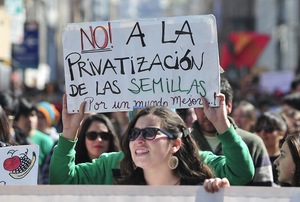
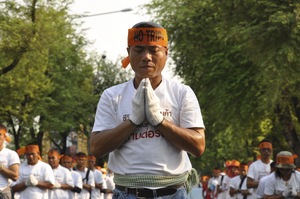
Some have said that India’s Prime Minister, Narendra Modi, arrived at the nation’s pro-GMO position with the help of generous campaign funding from a GMO lobby, but that hasn’t stopped thousands of Indian farmers from demonstrating against Monsanto and their biotech cronies in a massive grassroots movement that shuns anti-farmer practices and genetically modified crop farming.

Shri Rakesh Tikait, National Spokesperson for the Bhartiya Kisan Union (BKU) explains:

“The government is exhibiting its pro-industry stance by pushing for unneeded, unwanted and unsafe GMOs in our farming. We want all open air field trials of GM crops stopped immediately in the country since such open air trials pose not only a risk of contamination but also risk of trade rejection. Further, any moves towards trade liberalization in agriculture whether through the WTO route or through free trade agreements are unacceptable to us.”

The farmers recently organized and occupied the streets in a Kisan Maha Panchayat (farmer meeting) in Delhi, India, in protest at the Modi government’s anti-farmer policies.

Among the demonstrators were hundreds of women recently, as well, who have resolved to stay put on Parliament Street in India’s capital until the government engages them in a dialogue to resolve various burning issues, among them:

  • GMOs
  • Lack of fair and remunerative prices for farm produce
  • Demand for a farm income commission
  • Removing agriculture from free trade agreements including WTO
  • Adequate disaster relief for farmers
  • And more important topics that affect farmers in a country known for high suicide rates and massive GM crop failures.

Indian farmers are among some of the hardest hit by biotech chicanery. They join the ranks of millions of others throughout the world, from Mexico to Russia that don’t want GM crops either.

A similar but more intense protest recently took place in Poland as the nation’s largest farmer uprising ever involved convoys of tractors. The protest was pointed at GMO infiltration and land grabs by biotech and Big Ag corporations.

More than 150 farmers blocked roadways and held numerous demonstrations in order to bring attention to the important issue of food sovereignty in Poland. Their focus is a ban on GMOs and a restoration of small farmer’s rights after decades of oppressive health and safety regulations which take rights away from small farms and give them to mono-cropping, poisoning Big Ag mega-companies.

Just like Poland and the rest of the world, India doesn’t want GMOs. The singular reason GMOs exist in India or anywhere else is because of government corruption and infiltration by corporations like Monsanto, Dow, DuPont, Syngenta, Bayer and BASF.

Additional Sources:

Image sourced from GMWatch

Follow us: @naturalsociety on Twitter | NaturalSociety on Facebook

  • Posted in Asian @as
  • Comments Off on Thousands of Farmers in India Rise up Against Monsanto: Biotech Giant Known for Causing Suicides

Diary from Kathmandu: Demolition Dilemmas across Nepal

May 27th, 2015 by Barbara Nimri Aziz

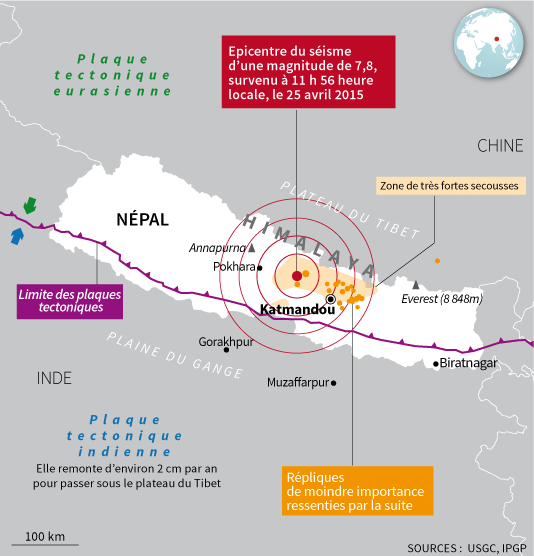
There is little doubt that they have to come down. But how will priorities be decided? Who will pay? Then how will the formidable task of securing Nepal’s homes, schools, hospitals and offices proceed? In Kathmandu valley and beyond, new medical and business complexes, government centers, police posts, universities halls and libraries, temples and monuments, and high rise dwellings –from the most prized heritage sites to model rural medical centers –are badly damaged and marked for demolition. Some structures are visibly disfigured and non-functional; some lie folded into heaps of rubble; some appear serviceable although they are not. Whatever their appearance, the task of demolition and clearing rubble is immense, its implementation hard to grasp, despite the great urgency.

Although the most widespread damage is in rural areas across the 13 districts (of 75 nationwide) adjacent to Kathmandu, debris removal and reconstruction may be easier there. Rural dwellings are by and large constructed by farmers from local materials and are one and two stories only.

Across Kathmandu one occasionally passes cranes at work. The most colossal machines that ever treaded the lanes and tracks of the valley, they methodically attack 4-story villas that once stood confidently in purple, red or blue coats but now offer less protection than a 5 mm thick tarpaulin pinned in a clearing beyond a local temple or strapped to an unsteady tree.

Those lumbering orange giants claw at brick walls of traditional modest dwellings; they batter glass facades of grand modern offices like Kantipur Publications; they hover above half-buried villas jabbing at their roofs. Heaps of rubble spill into roadways as the professional crews and soldiers move on, leaving residents to await teams who’ll somehow remove these piles of detritus. (Forget about rebuilding for now.) Somehow, in the confusion and clutter that is Nepal today, from their tented ministry offices, bureaucrats fashion plans about

how reconstruction will proceed. Proposals seem awfully tentative to this observer; neither do they convince most citizens that a viable scheme exists, although some really believe that demolitions will proceed responsibly.

Not waiting for the engineers to visit them and eager to resume some normality, private householders are one-by-one reoccupying their rooms and shopkeepers are buttressing their dwellings with 12 foot bamboo, wood or iron poles. (It’s temporary, they say.) Others (residents or the army, we’re not sure) set a few boulders and bricks on the pavement to warn vehicles and pedestrians that something uncertain hovers not far above them. Occasionally a road is blocked by a rope with a bold red warning hanging from it.

Engineers are out in force. (The Nepal Engineer’s Association lists its phone number in city dailies.) Local ward officials have invited house owners to fill forms requesting an inspection. May 20th The Himalayan Times (http://www.epapersland.com/nepal/himalayan-times.html) reports that since May 4th 2,500 of its engineers are engaged with 25 international counterparts to assess buildings inside and beyond Kathmandu Valley.

One NGO working with these respected, and incorruptible NEA engineers is US-based GFI who found that only 20% of 1,500 houses inspected were uninhabitable and due for destruction while 40% are safe to live in and 40% in need of repair http://www.ekantipur.com/the-kathmandu-post/ May 21, 2015. (In which localities the survey was done is unspecified). An earlier NEA preliminary investigation (May 9, The Himalayan Times) indicated that 70% of houses in Kathmandu Valley (with several million residents) were safe. May 18, the Ministry of Foreign Affairs declared it could not handle the multi-story demolitions due to inadequate equipment and was thus reaching out to others for help. Whatever the figures, it’s a daunting concern.

Meanwhile commentaries are offered in the press and anecdotally about conditions responsible for these many collapsed structures: buildings are constructed on soft land without proper foundations; illegal wells are bored under large dwellings destabilizing their foundations; shoddy, cost-cutting materials are used by cheating contractors. Much blame is reserved for landlords who build-to-rent and thus skirt the rules (supported by permits from corrupted officials). These rumors are now endorsed by newly published investigative research by Himal (www.himalkhbar.com May 24-30, 2015) the Nepali language weekly run by the notable journalistic team of Kunda and Kanak Dixit). This excellent report names names, prints photos of rows of crumbling apartment complexes together with doctored building permits.

Reconstruction is manageable, but only if more quakes and the approaching monsoon rains don’t further destabilize shaky neighborhoods, create more havoc and halt work in progress. Regardless, it will take years for life to return to normal which is uncertain at best, and for most citizens, perennially desperate. In their foreseeable future, they have no sign that– although millions of them will move out of their tents and settle into new homes and offices– a stable and just government will do its part. END

Before beginning her journalistic work in the Arab lands, anthropologist Barbara Nimri Aziz spent several decades conducting research in the Himalayan areas. Her books include “Tibetan Frontier Families”, “Soundings in Tibetan Civilization”, (both reprinted in 2011) and “Heir to a Silent Song: Two Rebel Women of Nepal” (2001) all available through Vajra Books, Kathmandu (vajrabooks.com.np). Her latest book is “Swimming up The Tigris: Real Life Encounters with Iraq”, U. Press Florida, 2007.

  • Posted in Asian @as
  • Comments Off on Diary from Kathmandu: Demolition Dilemmas across Nepal

Protests in Japan Denounce US Military Presence

May 27th, 2015 by Ben McGrath

Japanese protesters gathered outside the parliament building in Tokyo on Sunday to demand the removal of a US base on the island of Okinawa. Numerous rallies have been held recently, both on the island and the Japanese mainland, to oppose the US military’s presence in the country.

An estimated 15,000 people took part in Sunday’s protest, denouncing plans to move the US Marine Corp Air Station Futenma base to a new location at Henoko, which is currently being constructed. Futenma is located in the city of Ginowan, while Henoko sits along a less populated coast in Okinawa. Many people held banners reading, “No to Henoko.” They demanded the base be removed from the prefecture altogether.

One protester, Akemi Kitajima, told the press: “We must stop this construction. The government is trying to force the plan, no matter how strongly Okinawa says ‘no’ to it.” The demonstrators also expressed opposition to US plans to deploy CV-22 Ospreys to the Yokota Air Base in Tokyo.

A larger protest took place on the previous Sunday, when 35,000 people gathered on Okinawa to oppose the base relocation plan. The protests began that Friday and continued throughout the weekend. On the Saturday, demonstrators marched around the Futenma base and were joined in other cities across the country by approximately 2,600 others. Besides their opposition to the base, people shouted slogans, such as “Oppose enhanced Japan-US defense ties,” directed against Japan’s turn to militarism.

Plans to move the Futenma base have been in the works since 1996, following the 1995 brutal kidnapping and rape of a 12-year-old Okinawan girl by three US servicemen, which resulted in widespread anti-US protests. Other, less publicized crimes by US personnel have also stoked anti-US sentiment.

Okinawa, however, is on the front lines of any conflict with China. A majority of the 47,000 American troops stationed in Japan are on the island, strategically located in the East China Sea adjacent to the Chinese mainland. Okinawa plays a key role in Washington’s “pivot to Asia,” designed to surround China militarily and economically subordinate it to US interests.

There is little chance the Obama administration would agree to relocate the Marine base off the island, especially at a time when it is engaged in provocations with China. The relocation of the base, which was outlined in a 2006 agreement between the US and Japanese governments, has provoked persistent protests. The Democratic Party of Japan (DPJ) came to office in 2009 promising to revise the agreement, but the Obama administration refused point blank to discuss the issue with Prime Minister Yukio Hatoyama, and worked to undermine him. He was forced to accept the 2006 deal, then resigned in June 2010. His DPJ replacement, Naoto Kan, quickly reaffirmed his full support for the US alliance.

The current Liberal Democratic Party (LDP) government has not only made clear that the base relocation will proceed. It has stepped-up the remilitarization of Japan, acting in concert with Washington as part of the US “pivot” against China.

The recent demonstrations have been organized by citizens groups with ties to the Okinawan prefectural government. Governor Takeshi Onaga was elected last November as an independent, largely on his opposition to the Futenma base and its relocation. He is formerly of the ruling LDP and draws support from the conservative Shinpukai faction that left the LDP due to its support for the Okinawan bases.

Onaga is not opposed to the military alliance with the United States, nor to Japanese militarism. His is simply making the limited, parochial demand that the Marine base be moved to another location in Japan. Onaga recently declared: “I fully understand (the importance) of the Japan-US alliance. You should never break it down.”

At the same time, the governor has fostered illusions in the possibility of a shift by Washington. Onaga said recently: “Only Okinawa is burdened with this heavy load, and I want to let the United States, a democratic nation, know about this unfair situation.”

Despite his explicit backing for US militarism, Onaga has been backed by the Japanese Communist Party and the Social Democratic Party, both of which posture as opponents of Japanese re-militarization. They function as a political safety valve. The protests allow people to blow off steam while the governor plays to Okinawans’ sense of mistreatment at the hands of the mainland.

For politicians like Onaga, the battle over the bases also provides a pretext for land grabs. Nearly one-fifth of Okinawa is covered in US military bases, taking up territory that the wealthy elite would rather use to turn a profit. The governor views the bases as the “biggest impediment” to increased business opportunities.

Onaga hopes to turn the island into a hub for tourism, which means more hotels, restaurants, and other businesses to cater for visitors, as well as construction deals. In 2013, a record 6.58 million tourists visited Okinawa while the number of overseas visitors jumped 64 percent to 630,000 over the previous year. In total, tourism accounted for 448 billion yen ($US3.87 billion) in revenue during the 2013 fiscal year.

Onaga is seeking to attract foreign investment. He visited China in April as a delegate for the Association for the Promotion of International Trade Japan. Before the visit, an Okinawa prefectural government spokesperson stated:

“We would like to take this opportunity [of Onaga’s visit] to promote economic exchanges between Okinawa and China. We hope companies use special economic zones in China and Okinawa to trade with each other.”

Onaga is offering up the Okinawan people as a source of cheap labor. Okinawa is the poorest prefecture in Japan with an unemployment rate twice as high as on the mainland. “Companies were attracted by subsidies, low labor costs, and the abundant workforce,” Takehide Kinjo told the Wall Street Journal last November. Kinjo is president of Dinos Cecile Communications Company, based in Uruma City, an hour north of Naha, Okinawa’s capital.

Local investors are eager to get their hands on the land now occupied by the Futenma base. “Expectations are rising for redevelopment projects on the land after it is vacated,” an Okinawan bank official told the Asahi Shimbun. “Futenma has good transport connections, and the average land price there can rise higher than that in Naha’s new city center.” Naha’s city center, once the site of residences for US military personnel, now hosts shopping malls and duty-free shops offering luxury brands.

Okinawans have for decades had a strained relationship both with Japan and the United States. Known as the Ryukyu Kingdom until it was annexed by Imperial Japan in 1879, the island saw heavy combat at the end of World War II, during which more than 100,000 civilians were killed. Following the war, Okinawa remained under direct US control until 1972, two decades after the US occupation ended in the rest of Japan.

  • Posted in Asian @as
  • Comments Off on Protests in Japan Denounce US Military Presence

While many eagerly await the day when China will finally reveal its latest official gold holdings, a number which when made public will be orders of magnitude higher than its last 2009 disclosure of just over 1,000 tons, or less even than Russia, China continues to plough ahead with agreements and arrangements to obtain even more gold in the coming years.

Exhibit A: two weeks ago, Xinhua reported that China National Gold Group Corporation announced it has signed an agreement with Russian gold miner Polyus Gold to deepen ties in gold exploration. The companies will cooperate in mineral resource exploration, technical exchanges and materials supply, the largest gold producer of China said.

Polyus Gold is the largest gold producer in Russia and one of the world’s top 10 gold miners.

The agreement between the two gold miners is one of many deals signed between China and Russia in energy, transportation, space, finance and media exchanges during President Xi Jinping’s visit to Russia from May 8 to May 10.

“China’s Belt and Road Initiative brings unprecedented opportunities for the gold industry. There is ample room for cooperation with neighboring countries, and we have advantages in technique, facilities, cash, and talents,” said Song Xin, general manager of China National Gold Group Corporation.

In light of such developments, it is little wonder there has been increasing chatter in recent months that Russia and China are setting the stage for a gold-backed currency, in preparation for the day the Dollar reserve hegemony finally ends (a hegemony whose demise is accelerating with every incremental physical gold repatriation such as those of Germany, the  Netherlands, and now Austria).

And now, Exhibit B: overnight Xinhua also reported that a gold sector fund involving countries along the ancient Silk Road has been set up in northwest China’s Xi’an City during an ongoing forum on investment and trade this weekend. (read more about the “New Silk Road” which could change global economics forever here). The fund, led by Shanghai Gold Exchange (SGE), is expected to raise an estimated 100 billion yuan (16.1 billion U.S. Dollars) in three phases. The amount of capital allocated to nothing but physical gold purchases (without plans for financial paper intermediation a la western ETFs) will be the largest in the world.

The billions of dollars in allocated funding will come from roughly 60 countries that have invested in the fund, which will in turn facilitate gold purchase for the central banks of member states to increase their holdings of the precious metal, according to the SGE.

As Xinhua notes, China is the world’s largest gold producer, and also a major importer and consumer of gold. Among the 65 countries along the routes of the Silk Road Economic Belt and the 21st-Century Maritime Silk Road, there are numerous Asian countries identified as important reserve bases and consumers of gold.

“China does not have a big say in gold pricing because it accounts for a small share of international gold trade,” said Tang Xisheng of the Industrial Fund Management Co. “Therefore, the Chinese government seeks to increase the influence of RMB in gold pricing by opening the domestic gold market to international investors.”

As a reminder, the reason why China has been aggressively building out and expanding its Shanghai Gold Exchange is precisely that: to shift the global gold trading center away from London (and certainly the US where only paper gold is relevant these days) and to its own native soil: China’s ambition is nothing short of becoming the world’s new gold trading hub.

In other to do that, it is already setting up the regional infrastructure to facilitate such a goal: according to Tang, the fund will invest in gold mining in countries along the Silk Road, which will increase exploration in countries such as Afghanistan and Kazakhstan.

The good news for China is that with the BIS and virtually all “developed” central banks in desperate need of keeping the price of gold as low as possible while they debase their own paper currencies to unprecedented levels over fears of faith in fiat evaporating, China’s gold fund will be able to procure gold for its members at a very reasonable price until such time as the lack of physical gold supply can no longer be swept away by mere paper shorting of the yellow metal.

  • Posted in Asian @as
  • Comments Off on China Establishes World’s Largest Physical Gold Fund

On May 26, China’s official press agency Xinhua headlined “China rolls out military roadmap of ‘active defense’ strategy,” saying:

An official white paper issued by the State Council Information Office titled “China’s Military Strategy” pledged “closer international security cooperation.”

It stressed “the principles of defense, self-defense and post-emptive strike.” It said China isn’t aggressive. It will “counterattack” if attacked.

Focus will be placed on “winning informationized local wars.” International security cooperation will be stressed “in areas crucially related to overseas interests.”

Four “critical security domains” were highlighted – “ocean, outer space, cyberspace and nuclear force.”

China’s navy will defend offshore and “open seas” waters. Cybersecurity will be prioritized.

Beijing opposes weaponizing space. It “vowed to secure its space assets.” It pledged no nuclear arms race with other countries.

It stressed a commitment to world peace and stability. It won’t “pursue military expansion.”

It fundamentally opposes hegemonism and power politics in all forms. It faces multiple complex security threats – including “illegal, military presence on China’s territory, and outside parties involving themselves in South China Sea affairs,” a clear reference to US regional meddling.

Beijing considers US South China Sea surveillance flights unacceptable provocations. The Pentagon admits flying its most advanced P-8A-Poseidon spy plane regularly in the area – monitoring Beijing activities primarily.

A May 25 state-run Global Times editorial bluntly warned:

“If the United States’ bottom line is that China has to halt its activities, then a US-China war is inevitable in the South China Sea.”

“China will have no choice but to engage” in response to US provocations. Beijing’s waters are its own. Its message says it won’t tolerate US intervention where it doesn’t belong.

China is concerned about America’s increasing Asia/Pacific presence as well as Japan’s intent on “overhauling its military and security policies” cooperatively with Washington.

“(A)nti-China forces have never given up their attempt to instigate a color revolution” against Beijing, the white paper said. The risk of potential conflict is real.

Hawkish US senators want a comprehensive anti-China strategy adopted. In a letter to Defense Secretary Carter, they said “longstanding interests of the United States, as well as our allies and partners, stand at considerable risk.”

They want Beijing challenged in its own part of the world – perhaps belligerently. On the one hand, they slam China’s legitimate military presence in its own territory.

On the other, they ignore menacing US bases, nuclear-armed navy and tens of thousands of US combat troops close to China’s borders – a direct threat to its security.

Last week, US Pacific Command (PACOM) hosted military officials from 22 Asia/Pacific countries in Hawaii. China notably was excluded.

A symposium discussed amphibious military strategies, tactics and capabilities. A US marines amphibious assault demonstration was featured.

Washington aims to integrate amphibious operations with Pacific area nations and ally them against China’s growing regional strength and influence.

Defense Secretary Ashton Carter said Washington may expand military patrols in Pacific rim waters – including around China’s Spratly Archipelago land reclamation project involving construction of artificial islands atop coral reefs.

US Pacific fleet commander Admiral Harry Harris accused Beijing of building a “great wall of sand” in disputed waters.

He claimed “the scope and pace of building man-made islands raises serious questions about Chinese intentions.”

The area involved is 1.5 square miles. “How China proceeds will be a key indicator of whether the region is heading towards confrontation or cooperation.” Harris said.

America’s belligerent presence risks the former. Apparently nothing was learned from lost Korean and Southeast Asian wars.

China justifiably claims the right to build in its own territorial waters – “indisputable sovereignty over the Nansha (Spratly) Islands and adjacent waters,” it says.

Washington has no right to meddle in a part of the world not its own. China’s Foreign Ministry spokeswoman Hua Chunying said America should avoid “risky and provocative approaches to maintain regional peace and stability.”

She stressed China will defend its territorial sovereignty. Unauthorized intrusions will be challenged.

Longstanding US overreach may lead to direct confrontation with China. The risk of potential conflict is real.

  • Posted in Asian @as
  • Comments Off on China’s Military Strategy: We will “Counterattack” if Attacked

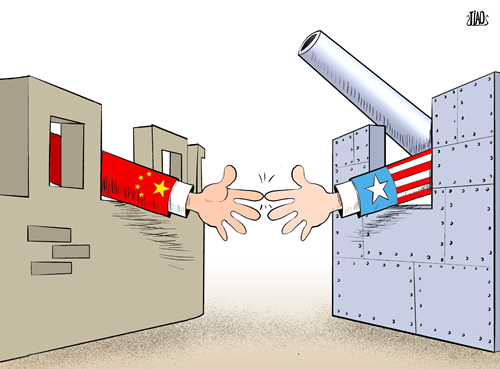
A Chinese state-owned newspaper said on Monday that “war is inevitable” between China and the United States over the South China Sea unless Washington stops demanding Beijing halt the building of artificial islands in the disputed waterway. 

The Global Times, an influential nationalist tabloid owned by the ruling Communist Party’s official newspaper the People’s Daily, said in an editorial that China was determined to finish its construction work, calling it the country’s “most important bottom line.”

The editorial comes amid rising tensions over China’s land reclamation in the Spratley archipelago of the South China Sea. China last week said it was “strongly dissatisfied” after a US spy plane flew over areas near the reefs, with both sides accusing each other of stoking instability.

China should “carefully prepare” for the possibility of a conflict with the United States, the newspaper said.

“If the United States’ bottomline is that China has to halt its activities, then a US-China war is inevitable in the South China Sea,” the newspaper said. “The intensity of the conflict will be higher than what people usually think of as ‘friction’.”

Such commentaries are not official policy statements, but are sometimes read as a reflection of government thinking. The Global Times is among China’s most nationalist newspapers.

China claims most of the South China Sea, through which $5 trillion in ship-borne trade passes every year. The Philippines, Vietnam, Malaysia, Taiwan and Brunei also have overlapping claims.

The United States has routinely called on all claimants to halt reclamation in the Spratlys, but accuses China of carrying out work on a scale that far outstrips any other country.

Washington has also vowed to keep up air and sea patrols in the South China Sea amid concerns among security experts that China might impose air and sea restrictions in the Spratlys once it completes work on its seven artificial islands.

China has said it had every right to set up an Air Defense Identification Zone in the South China Sea but that current conditions did not warrant one.

The Global Times said “risks are still under control” if Washington takes into account China’s peaceful rise.

“We do not want a military conflict with the United States, but if it were to come, we have to accept it,” the newspaper said. Reuters

Copyright GMA Network News 2015

  • Posted in Asian @as
  • Comments Off on Official China Media Warns of “War between China and US” Over South China Sea, Unless US Backs Down

“I’m sorry. If you want to start a new life, you come through the front door, not through the back door.” – Tony Abbott, Australian Prime Minister, May 21, 2015

They are in a tight corner of history, and it is shrinking.  The Rohingya Muslims of Myanmar are the persecuted minority within a Buddhist state, though it is feared in such areas as northern Rakhine state that they will, in time, outnumber the Buddhist population. With the discovery in northern Malaysia of 139 shallow graves the Rohingya people have also become the public face of trafficking.[1]

There are the usual suggested horror stories: instances of press ganging individuals and listening to the sweet promises of vicious middlemen offering a chance of passage to another country. Then comes the sea – the dangerous, all-consuming aqueous world that takes lives even as it gives passage.  The incentive to escape is hardly surprising, given that some 140 thousand have been internally displaced since the communal riots of 2012.  They are denied the freedom to move.  They are denied citizenship.

Since Saturday, a search for Bangladeshi and Rohingya migrants seemingly abandoned by traffickers at sea, undertaken by Malaysia and now Indonesia, has proven fruitless. It is said that up to 3,500 may be afloat in perilous waters.[2]  Around the same number have already landed in Malaysia and Indonesia proper.  Initial refusals to accept them have been modified, subject to the calls that other countries provide assistance in the resettlement phase.

The issue of how those migrants are being processed has proven to be the biggest bone of contention.  Cooperation in this endeavour is fine for some as long as the terms can be dictated by certain parties.  This has been the Australian response to the problems of how the Rohingya asylum seekers are treated.  As to questions on whether they would be resettled in Australia, the response from the ever mature Prime Minister Abbott was “nope, nope, nope”.[3]  Quaintly, the prime minister could only envisage “front door” refugees.

The Indonesians have become tetchy over the entire issue.  Indonesia’s Foreign Minister, Retno Marsudi, was suitably unimpressed by the line taken in Canberra, one which insists that everybody, bar Australian officials, should deal with the problem.  “The cooperation should come from country of origin and county of transit and country of destination.”  Indonesian Foreign ministry spokesman Arrmanatha Nasir has similarly reminded Canberra that “countries that are parties to the convention on refugees have a responsibility to ensure they believe in what they sign” (Sydney Morning Herald, May 21).

Other countries agree.  Papua New Guinea’s Peter O’Neill has become more vocal about the need for Australia to be involved.  “Those of us who are accepting refugees cannot continue doing that forever.”  A collective muck in by wealthier states was required.  “Countries like Australia and the United States, the UK, and other developed countries like Japan must assist in addressing this crisis.”[4]

As tends to be so typical about the contrivance of fairness in policy, a closer look at it shows various inner contradictions.  Fairness is the slogan of the indifferent who masquerade as moral beings.  It is also the slogan of the hypocritical.

Prime Minister Abbott has done what his predecessors have, though perhaps more forcefully: argue that the battle against refugees and asylum seekers arriving by boat is essentially one rooted in a conflict against terrorism.  They are to be turned away.  “We need to bring the same drive, focus and clarity of purpose to countering terrorism that resulted in stopping the boats under Operation Sovereign Borders.”

Apply the logic of military containment and expulsion, in other words, to both, and Australian security is assured.  “I think we’ve demonstrated in the way we have stopped the boasts, I think we have demonstrated with our commitment with countering Islamist death cults both here and abroad, that we do take our responsibilities to keep our communities safe very, very seriously indeed.”

That is the same strained logic that was applied in the wake of the death of 1,300 migrants in the Mediterranean coming from Libya. His solution has always been, and it would seem to always be, stopping the boats.  It is a sentiment that is winning the sentimentalists over, the bleeding hearts who think that locking up families is at least a better solution than indiscriminate drowning.  “As we know now,” argues Derek Rielly, “these wretched boats didn’t stop their perilous journeys until an adult got the reins of government and made a touch decision. And it was tough. Make no mistake.  No civilised human being gets any thrill from jailing families.”[5]

Rielly’s reference point here is that of weakness – the clouding weakness of humanity.  Be firm, be hard, and be uncompromising. Do not succumb, as fictional Europe does in Jean Raspail’s The Camp of the Saints, to the demands made by that “flotilla of one million refugees” which end up paralysing Europe, the Europe of culture and civilisation. The good heart ends up suiciding.

Such casually dished nonsense, the sort that peppers conversation and discussion on the subject of refugee policy, are the reasons why the carceral solution rides high in Australian approaches. It feeds the argument that, if you get rid of the human cargo, expel them, banish them to someone else’s backyard, that some good is, in fact, being done.  It also ignores the obvious point that the boats do not stop, so much as find another route elsewhere.  Hence the Rohingya dilemma, with its human cargo that will never settle or be processed in Australia, because Canberra has other ideas about it.

Dr. Binoy Kampmark was a Commonwealth Scholar at Selwyn College, Cambridge.  He lectures at RMIT University, Melbourne.  Email: [email protected]

  • Posted in Asian @as
  • Comments Off on Refusing to Resettle: Australia’s response to the Rohingya Asylum Seekers

The Speaker of the Russian Lower House of Parliament (Duma), Sergey Naryshkin told the press that the Japanese – Russian dispute over the South Kuril Islands should not become an irritant in Japanese – Russian relations. Neither Russian nor Japanese politicians are touching the taboo issue. Japan, Germany and Italy are still designated as enemy states to the UN. Japan and Russia are not playing on a a level playing field.

Kuril_Northerm territories_Japan_RussiaAfter his visit to Japan the Russian State Duma Speaker Naryshkin noted that the status of the South Kuril Islands is “always present on the agenda of meetings” between Tokyo and Moscow.

Naryshkin added that considering the Kuril Islands as “pretext for Russian territorial claims” than the issue will only become an irritant and obstacle to developing cooperation in other spheres. Naryshkin added that Russia is always willing to discuss sensitive issues, even a peace treaty with Japan, provided that it would be done with mutual respect.

Russia occupied the South Kuril Islands and, for all practical intends and purposes annexed the Islands in the same fashion in which large swaps of Germany were annexed by Poland and Russia after WW II.

Moscow’s openness to discuss “sensitive issues, even a peace treaty brings to mind that Germany still has no peace treaty either”; A fact that prevents Germans from voting about a constitution and a fact that maintains the de-facto subjugation of Germany to Washington and London / NATO.

Moreover, the Charter of the United Nations still designates Japan, Italy and Germany as “enemy states to the UN”. In legal terms this means that “any UN member” can launch a “preemptive military strike or occupation” of these three countries at any time, without the need for a declaration of war. A “peace treaty” between Russia and Japan would not change that fact.

Japanese – Russian relations could, arguably, become far more positive if Russia took the initiative to actually level the playing field by actively taking steps to finally remove the enemy state clause from the Charter of the United Nations. The resistance against US bases in Japan is growing, and Moscow would, arguably, commit a strategic blunder by not assuring that Japan regains its full sovereignty as UN member. The move would, definitely, also improve Russian – German relations and weaken Washington’s and London’s sway over Germany and, by implication, over the EU.

Arguably, any one of the permanent members of the UN Security Council who took it upon themselves to carve the world up in hegemonic  zones will have the advantage by gaining the sympathy, trust and cooperation of those States that, 70 years after WW II, still face the threat of being attacked or occupied in the case of a real or fabricated threat, without a declaration of war.

Japanese – Russian relations could, indeed, become far more fruitful if it was Russia that took the initiative. A peace treaty between Tokyo and Moscow is, arguably worth as much as the 2+4 treaty about Germany. It has not returned sovereignty to Germany and its people.

Peace treaties are a step in the right direction but a world that is based on victor’s justice and victor’s privileges to launch undeclared, preemptive wars of aggression will not help solve the dispute about the South Kuril Islands nor will it help to bring about a just, actual, enforceable, international system of law with equal standing before the law. Negotiations are most functional when they are being held between co-equals.

  • Posted in Asian @as
  • Comments Off on Japanese – Russian Dispute about South Kuril Islands: The Enemy State Clause

For the vast majority of Westerners, that is to say both US Americans and their relatives (imagined or real) in Europe, the war against Vietnam was a brutal military conflict waged by the United States against a small Southeast Asian country by deploying up to some 500,000 combat personnel and more ordnance than dropped on Germany in WWII. The virtues of this endeavour are still disputed.

In fact there are numerous “technical” disputes which continue to make sober discussion of the period between 1945 and 1975 extremely difficult—never mind the attempts to draw coherent conclusions from the course of events. 

After having destroyed much of Indochina with high explosives or carcinogenic toxins, massive military force withdrew from the territory of Vietnam in 1975, having delayed independence and unification of the country under a popular government by some thirty years. This generous description of the war’s effects pertains however only to the activity leading to the ostensible defeat of combined US Forces under the command of MACV, leaving the said US either relieved and/ or frustrated.

The events leading to the abandonment of the US embassy in Saigon on 30 April 1975 also gave rise to America’s own peculiar version of the Dolchstoßlegende—the so-called Vietnam Syndrome. Briefly described, the Vietnam Syndrome is a creation of the hormonally dysfunctional among the US ruling class, its acolytes and functionaries. As US comedian George Carlin once observed it reflects foreign policy formulated in the vulgate of pubescent males. America “withdrew too early”, was afraid to go “all the way”. The central thesis of this legend is that either the premature ejaculation or momentary impotence of the US war machine and those whose hands bring it to erection—also called “force projection”—led to a “loss of will”, to an inability to exercise national manhood by sodomising other countries in the future. (It is certainly no accident that foreign policy and war are waged largely by graduates of private nurseries organised as imitations of the infamously sadistic ancient public schools in Great Britain.) Of course not only the policy and military establishment were so indoctrinated but also the prefects of public communications, e.g. journalists employed by or managing the nation’s propaganda/ advertising corporations.

Yet like the original Dolschstoßlegende promoted to justify the re-militarisation of Germany and the cultivation of Nazism, Vietnam Syndrome is based on fundamental lies about the war that supposedly engendered it. The Vietnam Syndrome is a useful lie for the US regime just as it was for the German regime. In both cases the lie fostered latent fascism. German Nazism is defunct but since 1945 its spirit has been nurtured in the hearts and minds of those who rule the United States, its dependencies and the forces dedicated to the principle formulated so poignantly by Josiah Strong:

“It is manifest that the Anglo-Saxon holds in his hands the destinies of mankind, and it is evident that the United States is to become the home of this race, the principal seat of its power…”

These legends have some fundamental similarities. They are based on deliberate misrepresentations of the war and obfuscation with regard to the interests involved. In order to explain the deceptions behind the Vietnam Syndrome it is necessary to examine the “other war”. Contrary to much official history of US involvement in Indochina—the stuffing of almost all the films made—whether documentary or feature—the war began and ended as a CIA operation. The confusion as to war aims, strategy, tactical and operational effectiveness arise entirely from the fact that more than probably any other war fought with conventional forces—up to that time (except Korea but that war hasn’t ended yet)—the war in Vietnam was initiated, managed, funded, advertised and ultimately waged by the invisible army of US capitalism.

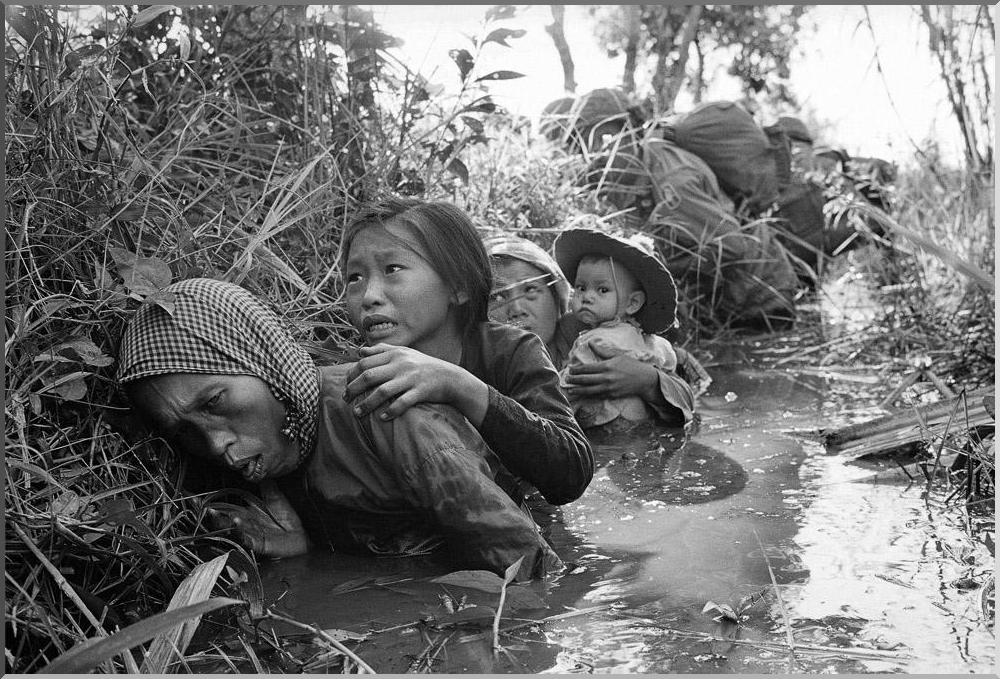
Villagers flee B-52 bombing Quang Tri provinve 1972. (Photo credit: Don North)

The war against Vietnam is often described as America’s first TV war in which the reality of war became present in the living rooms of Americans every night. This statement implies that TV viewers had access to the real war as it was waged—albeit not yet 24-7 or in “real time”. Per corollary—and this is one of the assumptions upon which the Vietnam Syndrome is based—those very Americans sitting addicted between Leave it to Beaver re-runs and Bonanza actually saw the war in Vietnam on their television sets. Even a cursory examination of the news footage posted in the Internet and the archival material offered in documentary films belies this.

The presentation of the Vietnam War was with virtually no exception carefully structured in network headquarters before being served to US viewers. Even the controversial Cam Ne story Morley Safer filed and the special report on the battle of Ia Drang were polished by corporate editors at CBS, if only to make them fit into the carefully measured segments between commercials. William Paley, owner and chief executive of CBS, was an old psychological warfare officer in the US Army during WWII—and certainly no opponent of the war or the US government. Just like today’s extreme broadcast entertainment, reality TV, the television quality of the war in Vietnam was not an exposure of the war but a structuring of images, often if not primarily intended to conceal what was actually happening in Indochina.

Far from random, every broadcast had to be approved by corporate management and such approval usually meant checking with friends or functionaries in the government to “confirm” whatever might be said in public. The intended effect was either to cultivate and manage support for the war or control damage impending or caused by unanticipated disclosures or “leaks” from the geographically sealed environment in which the war was waged. Of course, when the war became a mass spectacle with troop strengths increasing and body bags multiplying, damage control in the form of structured or distractive reporting became more crucial. As the number of witnesses to the war increased the corporate state and its media turned their focus toward distortion rather than concealment. Then as now the ability to magnify trivial events and trivialise major events enhances propaganda efforts far more than conventional censorship or secrecy rules.

The occasional willingness of corporate managers to use their control over media resources in political faction fights should not be confused with any supposed ethical commitment to something as obtuse as informing the citizenry to enable them to make intelligent decisions in the governing of the republic. The latter is officially stated policy of large media conglomerates because such policy is part of their product packaging and competitive strategy to win customers for the advertisers and owners to maximise profits and market share. It is important to remember this fact when assessing “the other war”. This covert war—the core of US aggression against Vietnam—depended as much on the capacity of corporate media to wage psychological warfare against the US population as it did upon the conventional military to bomb, strafe, incinerate and otherwise obliterate Vietnamese Vietnam. The quality of public debate, with the benefit of over 40 years of hindsight, does not indicate very much progress in finding, let alone facing the truths about the US war against Vietnam.

Even the infamous Pentagon Papers—generally considered to be a watershed of revelations whose publication by the New York Times turned public opinion against the war—were released in such a way that a disclosure augmented concealment. The leaked documents described the US military activity in Vietnam but omitted chapters describing the CIA role in the war.

In Michael Curtiz’ 1942 film Casablanca, German major Strasser, presumably a part of the military mission in French Morocco, reacts angrily to a spontaneous display of Free French patriotism in Rick’s Café Americain by demanding that the police Prefect Renault close the club. Renault, agreeing reluctantly but unwilling to appear as responding to German commands, declares the club closed on the pretext that illegal gambling has been discovered—not before collecting his winnings. The film viewer recognises Renault’s faint unlike the readers of the New York Times or Washington Post.

Until 1965, the war in Vietnam was almost entirely covert. That does not mean it was secret, in the sense of invisible, but that it was kept largely unknown. The war was waged by the covert action arms of the French accompanied by US “advisors” followed by a transition to CIA. US strategy was to frustrate the consolidation of the Vietnamese nationalist state—the PRVN—in Hanoi by isolating it politically, economically, and demographically. Having adopted the French shell company, the État du Vietnam, created by the retreating French in 1949, they needed to prevent the elections agreed in the 1954 Geneva Accords and build a nation capable of sustaining the shell, which the US then baptised the Republic of Vietnam. The problem was that they had created a country but this country had no citizenry beyond the officials, functionaries and economic beneficiaries of the shell in Saigon.

The approach can be compared to a group of investors who approach a lawyer to establish a new company or tax vehicle, etc. The lawyer has an off-the-shelf entity that is already incorporated. The investors buy the entity for a nominal sum, change the name, appoint new directors and inject the required capital to conduct business with limited liability. Not only is this a faster way to license a business in corporate form, it also can limit the disclosures that investors might be required to make were they registering the company personally for the first time. As an organisation founded mainly be corporate lawyers and their traditional hired thugs—often from the days of “white shoe” terrorism in Latin America, the corporate lawyer’s approach to Vietnam was quite a natural choice from the beginning—far more fitting than an ostentatious military campaign.

In order to create a Republic of Vietnam, the shell bought by the Company to offer a foothold for US corporate expansion in Southeast Asia, it was not enough to inject a few billion dollars and run it like the French had run the État. To prevail in the election agreed under the 1954 Geneva Accords, the CIA found it needed a population—one that would vote to remain citizens of a state that did not exist in the minds of the majority of Vietnamese. The CIA and its subsidiaries, affiliates, and joint venture partners invested enormous energy and sums of money to rally population from Tonkin to help fill the South with more people and thus increase the number of votes available. Under no conditions were Vietnamese to be allowed to choose their own form of political organisation. A strong cohesive shareholder minority below the 18th parallel was positioned with CIA assistance to exert a controlling interest and eject the hostile shareholders, rejecting their share certificates as somehow fraudulent in what would become an extremely violent “proxy fight”.

Strictly speaking this was the underlying premise of “nation-building”, a fashionable slogan even today for interference in the internal affairs of other countries. Nation-building sounds like a friendly, benevolent activity particularly to Westerners who have been taught the founding myths of the United States. However, the people of Vietnam already understood themselves as a nation before the US arrived. The problem faced by the US regime was not the absence of a nation, that still had to be built, but the presence of one incompatible with the needs of the United States. Franz Neumann argued in 1942, National sovereignty handicaps imperialist expansion. Indeed whenever democratic states resort to expansion, they almost invariably abandon the national concept and glorify racial and biological traits that allegedly make them superior to the conquered. The doctrine of the white man’s burden illustrates this point, and is true of the United States.

There was no need to build a Vietnamese nation as far as the Vietnamese were concerned. The problem for the US invaders was to create and consolidate a corporate vassal state. As Neumann also pointed out,

“The modern state however has not been created by the nation but resulted from the introduction of commodity production, which has preceded the appearance of modern nations. When the product of labor as a commodity is convertible into money, this money can be used to build the state and establish a bureaucracy and standing army.”

Pre-existing Vietnam was rejected just as General Hodges rejected the People’s Committees in Korea and Admiral Dewey rejected the Philippine Republic in 1899. In order to build the nation most favourable for US corporate exploitation, it was necessary to destroy any semblance of the existing one. Vietnam was not a settlement operation, like the North American continent. Unlike the indigenous North Americans, the Vietnamese could no longer be driven into extinction– to do so would also have removed the cheap labour needed to work the country as a business. Unable to settle they had to make Vietnam a business venture with Vietnamese (which US corporations are arguably doing now.) The business venture had to be made attractive by creating a captive market– just like GM systematically opposed or destroyed public transport to promote cars. “Nation-building” is jargon to describe how the US regime creates markets—for products nobody needs—to extract maximum profits. US objectives were criminal from the start in the way corporations organise criminal activity, euphemistically called “business”.

With the decision to create a Republic of Vietnam virtually out of whole cloth, mainly the rags left by the French, a series of policies and practices evolved that were on the one hand consistent with the deepest political and cultural sins of the United States and on the other hand best exemplify the relationship between the US corporate elite and their National Socialist brethren.

From the standpoint of the US regime the fates of Vietnam and Korea were integrally linked in the vision of a US Asia-Pacific empire. The empire’s covert warriors certainly felt they had learned from Korea and hoped to dispense with the kind of war that had been fought there. The introduction of massive military force was certainly not planned or intended before 1964. The corporate lawyers at Langley and the corporations they represent were convinced that the experience in Iran, throughout Latin America, especially in Guatemala, and in manipulating Western European politics had allow them to capitalise their new Indochina shell in Vietnam. By 1964 they had discovered they were wrong. A thousand years of Vietnamese identity could not be erased with ad campaigns displaying burger-flippers like McDonald’s serving in Vietnamese. The shell company was threatened with bankruptcy if something was not done to create a sustainable market—to manufacture a population that would demand “RVN product”.

“Civic Action” is deliberately portrayed as the deployment of rugged soldiers performing relief or construction operations for people in need. It plays on fantasies of masculinity and chivalry also implying that the civic action tasks are undertaken under such difficult conditions that only soldiers would be capable of performing them. The weapons borne by the soldiers are subconsciously turned into ploughshares following the narrative of the “good American soldier” which has been the stock of Hollywood propaganda for decades. To a limited extent this “generosity” is supposed to persuade the target population too. However, the soldiers’ weapons are not the innocent accessories of macho construction workers as presented for metropolitan consumption.

The French and US civic action programs were always decoration for intelligence and counter-insurgency operations. The principal counter-insurgency strategy pursued until 1964 was the so-called “strategic hamlet system”. Since the armed Vietnamese resistance to the French État du Vietnam and the US Republic of Vietnam was defined as an alien force which relied upon the local population for support, attempts were made to resettle rural populations in fortified camps and thus isolate them from the supposed foreign invaders. This policy was not fundamentally different from the British concentration camps in South Africa. For one obvious reason, this strategy could not succeed on its own—the supposed “foreign” invaders were not foreign at all. Since there was no identifiable distinction between pro-American and anti-American Vietnamese, the expensive and ultimately half-hearted strategic hamlets program was deemed a failure.

More intensive and diverse marketing instruments were required if the competition for political loyalty in Vietnam was to be curbed and eliminated. The Catholic-dominated burger joint in Saigon could neither make an edible hamburger nor smile convincingly to the Buddhist majority at the counter. None of the customers were impressed and even worse they exhibited no particular interest in hamburgers and fries under the stars and stripes (if not the golden arches). Corporate management was faced with its last alternative to create a stable market by a) destroying the competition and b) destroying the competitor’s customer base. Corporate empires are established and maintained not by talent but by deploying business talent in the respective theatres of economic warfare. Creating a US vassal state with a captive population follows the same principles applied by Exxon, Microsoft or McDonald’s. Like the US itself, these corporate brands are ubiquitous because of conquest and the ideology of business (especially entrepreneurialism) that equates their success with progress and freedom. The impending failure of the Saigon label only intensified demands for proper elections as agreed in Geneva and threatened the entire business venture. More time was needed and covert action was simply not working fast enough.

The USS Maddox incident in the Gulf of Tonkin provided the pretext for creating open hostilities between the US and the PRV. With a quasi-state of war now extant between the US and the government in Hanoi, elections could be indefinitely postponed and more cover could be given for intensified covert operations—the marketing campaign to create an RVN population that could be permanently isolated from the PRV. The Southeast Asia Resolution was also adopted to deceive the US public about the nature of US policy in Vietnam. The ideology of business is sufficiently strong among US Americans to sustain a policy of ordinary economic exploitation. However, exploitation of Indochina was part of an Asia-Pacific strategy that had already cost billions (for Korea) and would cost even more. Therefore it was deemed necessary to package the billions in future subsidies to US corporations in terms of national defence and protection of Vietnamese from communism. The Tonkin Gulf show was needed to justify despatching combat forces actually needed to support the covert war already under way. From that point onward, the only Vietnamese in the eyes of the US television viewers were those in the US-occupied South. The Vietnamese in the PRV were simply communists without any nationality (just as communists had been defined as foreigners in the US).

Corporate propaganda—advertising—is an accepted part of life in the US and much of the West. People pay exorbitant amounts of money to function as billboards for corporations—that is to wear branded clothing, eat branded food, and imitate the behaviour of branded celebrities. It may be argued that it is harmless as long as people can choose not to wear Nike clothing, eat McDonald’s hamburgers, and can walk or cycle instead of driving cars. The domination of the burger, software and fuel markets by a handful of megalomaniacs and their corporate instruments may be tolerable if ultimately indigestible. The same cannot be said about a country where the majority of the population are faced with swallowing the corporate product or being destroyed. The US essentially dissolved Vietnam—as they had other Asian republics they targeted—and declared the territory open for exploitation (development). The overall mission, the strategy and tactics applied in the attempt to fulfil this mission were essentially identical to those for which highest-ranking Nazi officials and functionaries were tried in Nuremberg after 1945.

The Nuremberg Principles, derived from the statutes of the International Military Tribunal adopted in London and the tribunal’s rulings in the course of the Nuremberg trials, are deemed part of international law. Aside from subsequent conventions and treaties, torture, retaliatory attacks against non-combatants, slave labour, as well as summary execution under denial of due process were all held to be crimes for which both individuals, governments and corporate entities could be held liable. In addition aggressive war was established as a crime under international law—a principle also articulated in the UN Charter. Although the US was a principal party to the Nuremberg statutes and the tribunal, its reservations (and today one can say refusal) with regards to jurisdiction were presaged in the cautious remarks made by the US Chief Counsel Robert Jackson:

“Unfortunately, the nature of these crimes is such that both prosecution and judgment must be by victor nations over vanquished foes. The worldwide scope of the aggressions carried out by these men has left but few real neutrals. Either the victors must judge the vanquished or we must leave the defeated to judge themselves. After the First World War, we learned the futility of the latter course. The former high station of these defendants, the notoriety of their acts, and the adaptability of their conduct to provoke retaliation make it hard to distinguish between the demand for a just and measured retribution, and the unthinking cry for vengeance which arises from the anguish of war. It is our task, so far as humanly possible, to draw the line between the two. We must never forget that the record on which we judge these defendants today is the record on which history will judge us tomorrow. To pass these defendants a poisoned chalice is to put it to our own lips as well. (emphasis added) We must summon such detachment and intellectual integrity to our task that this Trial will commend itself to posterity as fulfilling humanity’s aspirations to do justice.”

Since 1945 the US regime has regularly circumvented application of the Nuremberg precedents by exempting itself from jurisdiction of international criminal court venues and extending such exemption to its agents, functionaries, and armed forces. The US exerts its sovereignty and its pretension to the highest judicial standards to argue that even to the extent it might accept the Nuremberg Principles as binding, no foreign court or international court empaneled with non-US judges could conceivably render a “fair” verdict.

As a result the United States has never been successfully prosecuted and subjected to international criminal law judgement that was enforced. In 1989, the US regime began what can only be called an aggressive psychological war against the governments of target countries using pseudo-judicial venues imposed by multilateral treaties.

Despite the proliferation of such venues, the US has also exempted itself from the jurisdiction of these fora. The International Criminal Court—whatever virtues it might have, were it in fact governed by the original UN system—is little more than an instrument designed to give US attacks against the “infrastructure” of its enemies the “colour of law”. It is part of the combination of quasi-judicial measures, economic sanctions, military invasions or assaults, and covert terror operations that evolved out of the Vietnam “experience”. There are different names for this package: humanitarian intervention, “right to protect” (R2P), or just plain anti-terrorism (anti-communism having become obsolete).

The origins of this global corporate strategy, successfully applied in Indonesia in 1965, where at least one million or more people were murdered imposing a US vassal regime with virtually no trace of US/ UK initiative, can be found in the policies and practices of the Nazi regime developed and applied for the extermination of the Soviet Union—Operation Barbarossa. In fact, the US regime slaughtered approximately the same proportion of the Vietnamese population as were killed by the Nazi invasion of the Soviet Union—some 20%.

An essential part of the Nazi war aims was the settlement and exploitation of the European part of the Soviet Union. The details of this were later outlined in Generalplan Ost. Once the Wehrmacht had invaded Soviet territory, the Soviet Union was deemed extinct as a political entity. The population was reduced to the status of stateless persons who would then become subject to the protection of the realm (Reich). Specific secret instructions were issued to the German military commanders in what have been called the Barbarossa Jurisdiction Decrees.

The view adopted by the Nazi regime was that since the Soviet Union was not a party to either the Hague or Geneva conventions governing the conduct of land war, its civilians—in particular the political leadership—did not constitute protected persons. Hitler explained the regime’s logic by saying that the war against the Soviet Union was not between states but was a “race war” against the “Jewish-Bolshevist” criminals in order to establish the living space needed for Germany. Franz Neumann called this a “Germanic Monroe Doctrine”.

The focus on the US military operations, particularly against the PRV regular army, that is to say on the conventional war in Vietnam—is both distracting and deceptive. No doubt the destruction and viciousness of US bombing, chemical warfare and daily atrocities in the course of sweeps, cordon and search, search and destroy, and field engagements with NVA units was unspeakable. The profits earned by US corporations arming the US military were obscene. US land forces, Army and Marines, lived up to their own traditions from more than a century of terrorising and exterminating indigenous peoples. The air forces continued—despite overwhelming evidence of its futility—bombing Vietnam as if it were one long Dresden. Indeed conventional military operations had their own dynamic. If Vietnam had been a conventional war, almost like Korea, the violence would have been atrocious to be sure.

However in Vietnam the military was not there of its own accord. The US military had been sent to occupy Japan and Korea, but not to occupy Vietnam. Amidst all the dioxin-soaked, cratered square kilometres of Vietnam despoiled by the customers of DuPont, Dow, General Motors et al. are the untold thousands of people murdered by CIA’s death squad prototype, what became the CIA’s Phoenix program. While the US television viewer was gratifying his patriotism vicariously, the covert war—euphemistically called the “war for hearts and minds” was accelerated. DuPont and Dow were “creating better lives through chemistry” and CIA was coordinating an immense bureaucratic network designed to convert or kill the competition for its own version of Vietnam.

Leaving aside the dubious legality of the US invasion by regular troops in 1965, CIA action defied any pretence to legality. US officials were under no statutory authority to conduct surveillance against

Vietnamese citizens, pursue them through police or military measures, interrogate, sentence, detain, imprison—or kill them—not to mention torture. Hence all CIA operations whether conducted directly by US civilian or military organisations had to be dressed in the bureaucratic clothing of the Vietnamese state the US had created. The original legal system of the Republic of Vietnam was deemed inadequate so CIA had the constitution amended to make communism and being a communist a crime. The effect of this and other emergency legislation and executive decrees was to create a veneer of statutory legality for the actions CIA wanted to conduct in Vietnam through its hired surrogates. The laws might constitute bills of attainder, incompatible with US law, but because this was Vietnam, the CIA could argue that Vietnamese law permitted the actions whose execution it was merely advising. Formal legality (as opposed to substantive justice) is not only endemic to bureaucracies like the CIA but also characteristic of corporate law practice—the legal culture that prevails in the agency.

The second line of defence for extra-legal CIA practices was that they were not policy. William Colby testified that while torture and assassinations were no doubt performed by people associated with Phoenix, Phoenix was not an assassination program. US Congressman Pete McCloskey charged that the planned assassinations under Phoenix violated “several treaties and laws”—in particular Article 3 of the Geneva Conventions which prohibits “the passing of sentences and the carrying out of executions without previous judgment pronounced by a regularly constituted court, affording all the judicial guarantees which are recognised as indispensable by civilized peoples.” Torture, mutilation and cruel treatment are also forbidden. Colby claimed—based on a legal opinion prepared in-house—that Vietnamese citizens were not “protected persons” in terms of the Geneva Conventions. Several contortions were used to exclude civilians from protection of ordinary laws as well as international law. In practice the Phoenix program defined anyone whose loyalty to the Saigon regime was not absolutely demonstrated and certified to be an enemy—essentially non-Vietnamese, a foreigner and stateless person afforded no legal protections whatsoever.

This is precisely the legal framework created by the Barbarossa Jurisdiction Decree and so-called Political Commissar Decree issued by the German High Command to regulate the political warfare waged against the Soviet Union. These bear citing at length:

Decree on the jurisdiction of martial law and on special measures of the troops

The exercise of martial law serves primarily to maintain military discipline.

The wide extent of operational space in the East, the form of combat that this offers, and the peculiarity of the enemy, present tasks to the courts martial…that, with their limited personnel, they can only solve, if military law restricts itself for the time being to its central task.

That is only possible if the troops themselves defend themselves against every threat from the enemy civilian population without mercy….

I

Treatment of criminal acts by enemy civilians

1. Criminal acts of enemy civilians are withdrawn until further notice from the jurisdiction of courts-martial and summary courts.

2. Guerrillas are to be dispatched without mercy by the troops either in combat or while trying to escape.

3. Furthermore, all other attacks by enemy civilians against the Wehrmacht, its members and retinue are to be repelled on the spot by the most extreme measures up to the destruction of the attacker.

4. Where measures of this kind were missed or were initially not possible, the suspicious elements are to be immediately brought before an officer. He will decide whether they are to be shot.

Collective drastic action will be taken immediately against communities from which treacherous or insidious attacks against the Wehrmacht are launched, on the orders of an officer with at least the rank of battalion commander upwards, if the circumstances do not permit a speedy apprehension of individual culprits.

5. It is expressly forbidden to detain suspected culprits, in order to hand them over to the courts when jurisdiction over native inhabitants is restored to these.

II.

Treatment of criminal acts by members of the Wehrmacht or its retinue against native civilians

1. For acts which members of the Wehrmacht or its retinue commit against enemy civilians, there is no compulsion to prosecute, even when the act represents at the same time a military crime or offense.

2. In judging such deeds it is to be considered in any proceedings that the collapse in the year 1918, the later period of suffering of the German people, and the battle against National Socialism with the movement’s countless sacrifices of blood are incontestably to be attributed to Bolshevik influence, and that no German has forgotten that.

3. The chairman of the court must therefore examine whether a disciplinary reprimand is appropriate or whether it is necessary to institute judicial proceedings. The chairman only orders court-martial proceedings for acts against native inhabitants, when the maintenance of discipline or the protection of the troops demands it. That applies, for example, in the case of serious acts that result from the loss of sexual restraint, are derived from a criminal disposition, or are a sign that the troops are threatening to run wild. Criminal acts, by which lodgings or supplies or other plunder are senselessly destroyed to the detriment of our own troops, are not on the whole to be judged more leniently.

This secret decree bears uncanny resemblance to the emergency decrees, the outlawing of communism, and the administrative detentions laws upon which the Phoenix program was based, and which represent the core CIA strategy for “neutralising” the so-called Viet Cong Infrastructure. The Commissar decree goes even further:

Guidelines for the Treatment of Political Commissars

In the battle against Bolshevism, the adherence of the enemy to the principles of humanity or international law is not to be counted on. In particular the treatment of those of us who are taken prisoner in a manner full of hatred, cruelty and inhumanity can be expected from the political commissars of every kind as the real pillars of opposition.

The troops must be aware that:

1. In this battle mercy or considerations of international law with regard to these elements is false. They are a danger to our own safety and to the rapid pacification of the conquered territories.

2. The originators of barbaric, Asiatic methods of warfare are the political commissars. So immediate and unhesitatingly severe measures must be undertaken against them.

They are therefore, when captured either in battle or offering resistance, as a matter of routine to be dispatched by firearms.

The following provisions also apply:

2. …Political commissars as agents of the enemy troops are recognizable from their special

badge—a red star with a golden woven hammer and sickle on the sleeves…. They are to be separated from the prisoners of war immediately, i.e. already on the battlefield. This is necessary, in order to remove from them any possibility of influencing the captured soldiers.

These commissars are not to be recognized as soldiers; the protection due to prisoners of war under international law does not apply to them. When they have been separated, they are to be finished off.

3. Political commissars who have not made themselves guilty of any enemy action nor are suspected of such should be left unmolested for the time being. It will only be possible after further penetration of the country to decide whether remaining functionaries may be left in place or are to be handed over to the Sonderkommandos. The aim should be for the latter to carry out the assessment.Guideli

In the battle against Bolshevism, the adherence of the enemy to the principles of humanity or international law is not to be counted on. In particular the treatment of those of us who are taken prisoner in a manner full of hatred, cruelty and inhumanity can be expected from the political commissars of every kind as the real pillars of opposition.

The troops must be aware that:

1. In this battle mercy or considerations of international law with regard to these elements is false. They are a danger to our own safety and to the rapid pacification of the conquered territories.

2. The originators of barbaric, Asiatic methods of warfare are the political commissars. So immediate and unhesitatingly severe measures must be undertaken against them.

They are therefore, when captured either in battle or offering resistance, as a matter of routine to be dispatched by firearms.

The following provisions also apply:

2. …Political commissars as agents of the enemy troops are recognizable from their special

badge—a red star with a golden woven hammer and sickle on the sleeves…. They are to be separated from the prisoners of war immediately, i.e. already on the battlefield. This is necessary, in order to remove from them any possibility of influencing the captured soldiers.

These commissars are not to be recognized as soldiers; the protection due to prisoners of war under international law does not apply to them. When they have been separated, they are to be finished off.

3. Political commissars who have not made themselves guilty of any enemy action nor are suspected of such should be left unmolested for the time being. It will only be possible after further penetration of the country to decide whether remaining functionaries may be left in place or are to be handed over to the Sonderkommandos. The aim should be for the latter to carry out the assessment.

In judging the question “guilty or not guilty”, the personal impression of the attitude and bearing of the commissar should as a matter of principle count for more than the facts of the case which it may not be possible to prove.”

The Sonderkommandos (special units) included SS and SD as well as specially constituted police units. Phoenix after 1965 operated just like the Wehrmacht in the Soviet Union. Regular military devastated the Vietnamese countryside, while specialised political assassination units were responsible for despatching VCI—what the Nazi regime called the “real pillars of the opposition” during its invasion of the Soviet Union. Citizens in the territory occupied by the Wehrmacht and other organs of the NS state were not even subject to martial law with its administrative procedures. Phoenix operated along the same lines. Vietnamese had no protection from the violence of US military occupation of their country.

The CIA had incited the military invasion of Vietnam because the assumptions of its marketing strategy—that there Vietnamese could be persuaded to stop being Vietnamese or denounce fellow citizens as being “not Vietnamese” and therefore beyond the pale, i.e. subject to extermination were false. Despite its initial plans to change from a “shotgun” approach to a “rifle” approach, the only way to protect the long and uncertain road to a Vietnam purified of nationalists, communists and anyone else considered ideologically unreliable in corporate Vietnam was to bring Barbarossa-type fire power against the rural population, destroying its means of subsistence and concentrating the population so that the death squad system could do the rest.

So-called Vietnamisation—following the withdrawal of US combat troops in 1973—was intended to transfer as much of CIA pacification technology and organisation to ostensibly Republic of Vietnam institutions. However this failed in the end for two reasons. First of all VCI was never accepted as a legitimate or workable pacification target. It was understood by all Vietnamese (even those who exploited it opportunistically) as an entirely US idea. Secondly as long as the CIA had funds to finance Phoenix there were people willing to take the money. When funds dried up, Vietnamese Phoenix units were unable to operate and degenerated into private criminal organisations beyond political control.

The Phoenix program collapsed in Vietnam with the withdrawal of military cover, evaporation of covert funding and the defeat of the Saigon burger-flippers. But by that time a whole generation of US military, foreign civil service and CIA officers had been through the Phoenix “political and psychological warfare” school in Vietnam. The bird may have been incinerated in Saigon after 30 April 1975 but it has been reborn in thousands of places around the world ever since.

  • Posted in Asian @as
  • Comments Off on “The Vietnam Syndrome”: Fascists Flipping Burgers in Saigon or Stalingrad

Sowing the GMO Seeds of Depopulation?

May 23rd, 2015 by Colin Todhunter

If physical violence is to be used only as a final resort, a dominant class must seek to gain people’s consent if it is to govern and control a population. It must attempt to legitimize its position in the eyes of the ruled over by achieving a kind of ‘consented coercion’ that disguises the true fist of power. This can be achieved by many means and over the years commentators from Gramsci to Althusser and Chomsky have described how it may be done.

However, one of the most basic and arguably effective forms of control is eugenics/ depopulation, a philosophy that includes reducing the reproductive capacity of the ‘less desirable’ sections of a population.

There is a growing fear that eugenics is being used to get rid of sections of the world population that are ‘surplus to requirements’. And it is a legitimate fear, not least because there is a sordid history of forced/covert sterilizations carried out on those deemed ‘undesirable’ or ‘surplus to requirements’, which reflects the concerns of eugenicists who have operated at the highest levels of policy making. From early 20th century ‘philanthropists’ and the Nazis to the nascent genetics movement and rich elites, by one means or another ridding the planet of the great unwanted masses has always been fairly high on the ‘to do’ list (see this informative piece)

Millionaire US media baron Ted Turner believes a global population of two billion would be ideal, and billionaire Bill Gates has pledged hundreds of millions of dollars to improve access to contraception in the Global South.

Gates has also purchased shares in Monsanto valued at more than $23 million at the time of purchase. His agenda is to help Monsanto get their genetically modified organisms (GMOs) into Africa on a grand scale. In 2001, Monsanto and Du Pont bought a small biotech company called Epicyte that had created a gene that basically makes the male sperm sterile and the female egg unreceptive.

Bill Gates’ father has long been involved with Planned Parenthood:

“When I was growing up, my parents were always involved in various volunteer things. My dad was head of Planned Parenthood. And it was very controversial to be involved with that.”

The above quotation comes from a 2003 interview with Bill Gates.

Planned Parenthood was founded on the concept that most human beings are reckless breeders. Gates senior is co-chair of the Bill & Melinda Gates Foundation and a guiding light behind the vision and direction of the Gates Foundation, which is heavily focused on promoting GMOs in Africa via its financing of the Alliance for a Green Revolution in Africa (AGRA).

The Gates Foundation has given at least $264.5 million to AGRA. According to a report published by La Via Campesina in 2010, 70 percent of AGRA’s grantees in Kenya work directly with Monsanto and nearly 80 percent of the Gates Foundation funding is devoted to biotechnology. The report also explains that the Gates Foundation has pledged $880 million to create the Global Agriculture and Food Security Program (GAFSP), which is a heavy promoter of GMOs.

The issue of genetic engineering cannot be fully understood without looking at the global spread of US power. The oil-rich Rockefeller dynasty helped promote the ‘green revolution’, which allowed the US to colonise indigenous agriculture across large parts of the planet. By projecting power through the WTO, IMF and World Bank, Washington has been able to make food and agriculture central to its geopolitical strategy of securing global dominance.

As with the control of food and agriculture, the US also regards depopulation as a potential geo-strategic tool (see this) in the quest for control of global resources. What better way to achieve this via a (GM) tampered-with food system that US agribusiness has increasingly come to dominate?

What better way to achieve this than with ‘spermicidal corn’ for example? In Mexico, there is concern about biopharmaceutical corn. Some years ago, Silvia Ribeiro, of the ETC organization, stated:

“The potential of spermicidal corn as a biological weapon is outrageous, since it easily interbreeds with other varieties, is capable of going undetected and could lodge itself at the very core of indigenous and farming cultures. We have witnessed the execution of repeated sterilization campaigns performed against indigenous communities. This method is certainly much more difficult to trace.”

While most of the literature on GMOs is concerned with the impacts of crops that have been genetically modified to deal with pests or herbicide spraying, there are very worrying trends regarding plants being genetically modified to contain industrial pharmaceuticals or possess possible contraceptive traits.

The world’s problems are not being caused by overpopulation, as Turner states, but by greed and a system of ownership and global power relations that ensures wealth flows from bottom to top. The issue at hand should not be about stopping population growth in its tracks but about changing a socially divisive global economic system and the unsustainable depletion of natural resources.

Millionaires like Ted Turner believe it should be a case of carry on consuming regardless, as long as the population is cut. This is the ideology of the rich who regard the rest of humanity as a problem to be ‘dealt with.’ He says there are “too many people using too much stuff.” He couldn’t be more wrong. For instance, developing nations account for more than 80 percent of world population, but consume only about one third of the world’s energy. US citizens constitute 5 percent of the world’s population but consume 24 percent of the world’s energy.

We should be weary of a politically and militarily well-connected biotech sector which has ownership of technology that allows for the genetic engineering of food and a gene that could be used (or already is) for involuntary sterilization. From covert vaccination campaigns to germ warfare and geo-engineering, sections of the population around the world have too often been sprayed on, injected or exposed to harmful processes to induce sterility, infertility or to merely see the outcome of exposures to radiation, bacteria or some virus. It is for good reason some conflate GMOs and bio-terror.

Herbert Marcuse once summed up the problem facing us by saying that the capabilities — both intellectual and technological — of contemporary society are immeasurably greater than before. As a result, the scope of society’s domination over the individual is also immeasurably greater than ever before. That domination comes in increasingly sinister forms.

  • Posted in Asian @as
  • Comments Off on Sowing the GMO Seeds of Depopulation?

Packed with distortions and outright lies, Mongolia’s privatized former state media called them the ‘enemies of Mongolia’.  On 16 September 2013, the leaders of Mongolia’s Fire Nation (Gal Undesten in Mongolian), an environment and human rights coalition, organized a mass protest in front of the Mongolian Parliament.  Decades of grassroots organizing to establish environmental protections were at risk: on September 16 the Great State Khural (State Parliament) gathered with intentions to dismantle the so-called ‘Law With A Long Name’ (LLN).

Adopted by parliament in 2009, after more than a decade of grassroots organizing and public pressure, the ‘Law to Prohibit Mineral Exploration and Mining Operations at the Headwaters of Rivers, Protected Zones of Water Reservoirs and Forested Areas‘ is the only significant Mongolian law protecting nomadic herders’ traditional lands and watersheds from further radioactive and chemical contamination, diversions of rivers and land-grabbing.  With mining companies ignoring the law, destroying pastureland and watersheds, and no government enforcement, the livelihoods and culture of indigenous Mongolian herders are rapidly disappearing.  These are the same mining corporations responsible for genocide and crimes against humanity in Africa and Latin America and everywhere we find them.

Symbolically armed with hunting rifles and antiquated weapons, the most courageous leaders of the grassroots Fire Nation sought to draw attention to corruption and collusion between government and foreign mining corporations.  They are fighting to save their culture and people and their very way of life.

munkhbayar_9308_600x450.jpg

Photo of Tsetsegee Mounkhbayar taken by Bill Infante of the Asia Foundation.

In a statement read on the steps of Parliament prior to the arrests, Ts. Munkhbayar called for urgent and serious action to protect the Law with a Long Name (LLN).  The People began with cooperative meetings, he said, engaging government officials and agencies, and the People won the passage of the Law with a Long Name, but there was no enforcement, and corporations were getting away with egregious wrongs.  So then the People came with petitions.  When petitions didn’t work they threw rocks at Parliament.  Then they fired their rifles on machines that were ripping up their precious pasturelands.  They symbolically shot arrows at Parliament from their herder’s bows.  Nothing moved the government to protect the People and the land.  Now they had come with weapons.  They never intended to hurt anyone, and they never hurt anyone.

These are herders who employ a wide range of methods and tactics, including environmental education, public theater, monitoring of pollution, restoration of ecosystems, alliances with government, campaigns in the legislature.  They have also fired on foreign mining equipment and occupied illegal mining sites.  Many of their actions have been symbolic, born out of integrity and the spirit of civil disobedience.

“On the morning of September 16, delegates representing 11 non-government organizations protested outside the Government Palace against proposed amendments to the [LLN],” wrote M. Zoljargal for Rivers Without Boundaries, a coalition of NGOs working to protect Eurasian watersheds.  “The reason for the protest was to prevent the approval of the amendment, as the 2009 law hasn’t been implemented or enforced in its current form.  Many protected lands have been mined despite the law meant to preserve the integrity of Mongolia’s environment.  The protestors were there to stop the amendment, fearing that once the law is amended, permit termination and state protection might become impossible.”  [1]

Mongolian civil society leaders declare that state agents framed Munkhbayar and the other protestors.  Four of the ten protestors arrested on 16 September 2013 were released; six were detained on the charge “group attempt to severely threaten well-being of society”.  Defense lawyers argued that there was no victim in the case but they were prohibited from mounting a substantial defense.  Many key facts were ignored and evidence was suppressed and sidelined.  There is substantial evidence that Mongolian government agents used ‘dirty tricks’ typical of thugs, terrorist organizations and state security agents (e.g. C.I.A., Stasi, MI-6, SAVAK, F.B.I., etc.), dirty tricks and thuggery which bears the signature of the Mongolian state security apparatus.

On 21 January 2014, the six civil society leaders were sentenced to prison.  Defendants J. Ganbold, G. Boldbaatar, D. Tumurbaatar, S. Dashtseren and Ts. Munkhbayar received 21 years and six months (reduced from 22 years and six months for time served since 16 September 2013).  The sixth man, M. Munkhbold was sentenced to two years for supplying weapons.  When the verdict and sentences were delivered in court, the wife of J. Ganbold (suffering from ovarian cancer) fainted; others shouted and cried.

The six men, all 50-60 years of age, were interrogated under harsh conditions in state detention cells.  One of the six, J. Ganbold, is reportedly in danger of losing his hand after police removed a cast and refused him medical treatment.  When Mr. Ganbold’s wife pled with the court for her husband to receive treatment, the chief investigator derided her, declaring that her husband and the others deserved to suffer, implying they are traitors of the state.

Most of these leaders have previously been arrested in the long struggle to defend Mongolia from the hydra of Western industries of exploitation: mining, ‘development’, ‘nature conservation’, and foreign ‘aid’ and ‘charity’.

HIS NAME IS MUNKHBAYAR AND HE IS NO TERRORIST

In early September 2010, a small band of citizens fired their hunting rifles on gold mining equipment owned by two foreign mining firms operating illegally in northern Mongolia.  The gang of four — Ts. Munkhbayar, G. Bayaraa, D. Tumurbaatar and O. Sambuu-Yondon — all hailed from the United Movement of Mongolian Rivers and Lakes (UMMRL), a consortium of Mongolian groups organized to fight extractive companies that have invaded the fledgling ‘democracy’.

A key leader and long-time organizer of the Mongolian resistance movement, Ts. Munkhbayar is a 2007 winner of the prestigious Goldman Environmental Prize — the ‘Green Nobel’ — awarded annually to people taking fearless stands around the globe in defense of the earth and it’s indigenous peoples.  Three years after winning the award — and a whole lot more illegal mining and pollution later — Munkhbayar’s little gang of four and their militant actions against the capitalist invasion remained in complete media whiteout in the Western press.

UMMRL was formed in 2009 after its predecessor, the Mongolian Nature Protection Coalition (MNPC), dissolved.  Tsetsegee Munkhbayar and his colleagues were pivotal to the creation of both MNPC and UMMRL, and on 2 July 2010 they founded the Fire Nationa large umbrella organization uniting many NGOs.

After winning the Goldman prize, activist Ts. Munkhbayar was widely celebrated by Western institutions and the English-speaking press for his peaceful and collaborative achievements in uniting nomads and organizing people and protecting Mongolia’s environment.  He was a national hero, standing up for ordinary people and basic human rights, a former herder turned national spokesman who rose out of the backward and repressive social milieu of communism in collapse.  Munkhbayar was rewarded for speaking up — an action unheard of in Mongolian society — in the former Soviet-run communist republic turned ’emerging democracy’.

Tumurbaatar Horsemen Bow protest 2.jpg
D. Tumurbaatar, also sentenced to 21 years 6 months, shoots an arrow at Parliament after the April 2011 protest where 100 horse-riding herders demonstrated in Sukhbaatar Square (in front of Government House).  Demonstrators requesting enforcement of the LLN set up eight gers on the square, called for a national referendum and collected signatures.  When the President, Prime Minister and Parliament Speaker ignored their request to meet, Mr. Tumurbaatar conveyed his message by shooting an arrow.

Increasingly frustrated by a stodgy bureaucracy and massive state corruption, betrayed by Western conservation and development organizations, faced with mounting losses and accelerated destruction of their culture and environment, Ts. Munkhbayar and comrades became increasingly aggressive in organizing resistance.

The more they stood up for the rights of Mongolia and its people, the more they were shunned or ignored by their former sponsors.  For Ts. Munkhbayar, this meant that the Goldman Fund distanced themselves from him, and the Asia Foundation, whose officials had lobbied the Goldman Fund on his behalf, labeled him a ‘terrorist’.  [2]

In June 2011 Ts. Munkhbayar and colleagues were imprisoned for ‘organizing public meetings and demonstrations without official permission’.  The men went on hunger strikes in prison: some were taken to hospital and force fed by the security agents after their health acutely deteriorated.

THE GREEN TERROR

“In August 2013, pressure from foreign mining companies to relax regulations reached an all-time high and rumors emerged that Parliament was seeking to abolish the LLN once and for all,” reads a Goldman Foundation statement of 20 November 2013, calling for a ‘fair and transparent trial’ for Munkhbayar and the others.  “That same day, Munkhbayar and UMMRL joined several other activist groups in a demonstration outside the main Parliament building.  During the protest, a rifle was accidentally discharged.  It is widely understood that the shot was not fired on purpose and nobody was injured.  Still, Munkhbayar and several other protestors were arrested immediately following the incident.”

The Goldman Foundation statement is inaccurate.  A simple viewing of a video of the 16 September 2013 incident (below) shows that the Mongolian state security had already tackled Ts. Munkhbayar and several other protestors when the shot rang out nearby.  The protestors had not tried to enter the government building, either peaceably or forcibly.  State agents and the video cameraperson then directed their attention to another struggle between state agents and another of the protestors, presumably one who accidentally discharged his rifle.

The protestors are accused of firing a single shot from one of their weapons.  In the confusion of what happened, it is not clear who fired a shot.  The herders claim the discharge was accidental, and if it came from their weapon, it certainly was an accident.  The court did not sufficiently investigate the facts.  However, there is ample evidence that it was a state security agent who discharged a weapon.  As the video reveals, Munkhbayar was not guilty of firing off weaponry, but the courts didn’t care to argue such fine points.

Ten protestors were arrested on 16 September 2013.  State agents evacuated several government buildings claiming that bombs had been planted.  Explosives shown in Mongolian mass media campaigns to discredit the protestors were reportedly recovered in buildings where the protestors could not have had access.  The mass media claimed that protestor’s guns were loaded and they were heavily armed.  Reports also claimed that the protestors “attacked the government buildings and fired a shot.”

There are many other curious discrepancies and outright fabrications.

One Mongolian business media outlet declared that ‘shots’ [plural] were fired, ‘a bomb was discovered’, and ‘a hand-grenade was thrown which didn’t explode’.  [3]

In a statement made immediately after the arrests, the head of Mongolia’s General Intelligence Agency investigations department claimed that the protestors “attempted to threaten public security and assault some state officials.”  He also declared that “[a]s a result of prompt searches [security and intelligence officials] searched and found two TNT (trotyl) [sic] hand-made bombs planted near government buildings.  [4]

After the September 16 protest, the media accused the protestors of ‘organizing a public event without permission’ and ‘mass murder attempt’ and even ‘attempted genocide’.  Mongolia’s National Overview magazine, a copycat of Time (Yndestnii Toim in the Mongolian language rhymes with Time) featured Goldman prizewinner Ts. Munkhbayar on the cover, an old Russian rifle in hand, under the headlines: ‘НОГООН ТЕРРОР’ — GREEN TERROR.

Another cover story in late September showed Ts. Munkhbayar wearing a luxury OMEGA wristwatch.  The photo was an obvious fabrication created with Photoshop software, a common practice in Mongolian media.  Article(s) portrayed the earth defense activists from Greenpeace International as scoundrels, cowards and liars, drawing attention to Greenpeace actions in Russia.  Then they equated Munkhbayar with this ‘green terrorism’.

Mongolian oligarchs who have colluded with Western interests to bleed Mongolia dry own the most prominent mass media portals in Mongolia (click link for summary table): most are members of Parliament.  As in the West, Mongolia’s media outlets manufacture consent, inculcate confusion and distrust, disempower and indoctrinate the masses.

Mr. Lu. Bold, former Minister of Defense, current Minister of Parliament and Mongolia’s Foreign Minister, owns National Overview.  On 26 October 2103, Mr. Bold signed a ‘nuclear cooperation’ deal with French Minister Laurent Fabius.  The French nuclear conglomerate AREVA has been exploring and mining uranium in Mongolia for over a decade.  [5]

In 2010, herders in Dornogovi aimag (province) began correlating disease in domestic animal herds with AREVA uranium mining nearby.  In 2012 they sounded the alarm after some 20 calves of one herder Mr. Norsuren died.  Even wolves would not eat the dead animals, and carcasses decayed in a few days even when frozen solid in the dead of Mongolian winter.

Inspections by the State Nuclear Agency found nothing, as expected, since they were merely protecting state interests and the cult of the atom.  Tests by the State Veterinary and Animal Breeding Agency revealed chronic poisoning by heavy metals and radioactive isotopes; results posted on the government website soon disappeared.  The vet agency refused to release official reports, but some were leaked.  Angered by the vet agency’s diligence, Mongolia’s Prime Minister attacked them, demanding they revisit and ‘correct’ their results.  Over 90 million Tugrugs later, a new team of experts — appointed by the Prime Minister — produced new results, inconclusive as regards AREVA’s uranium mining.  The vet agency officials were frightened into silence.

B&W Mongol Horseman[1]  GOLDMAN.jpg

Life for herders on the steppe is hard enough without the toxic pollution and land-grabbing of foreign mining corporations — causing epidemics of diseases and loss of entire herds. Photo c. keith harmon snow, 2008.

In May 2013, Fire Nations’ own investigator discovered epidemics of diseases; faceless animals, jawless animals; diseased internal organs; many abnormal births and birth defects.  Prior to AREVA’s arrival such things were unheard of.  In August 2013, armed Fire Nation activists and local herders occupied AREVA’s mining camp and stopped operations.  AREVA resumed operations after Munkhbayar and other Fire Nation protestors were arrested September 16.

In December 2013, Fire Nation leaders and herders returned but were barred entry to the AREVA camp by nine-foot fences with triple-barbed wire overhangs and armed paramilitary guards: AREVA even refused entry to a state inspector.

Uranium exploration and radioactive contamination in Mongolia is not limited to the Dornogovi site in the Gobi desert.  There are mine sites as close as 70 kilometers from the capital city.

“Given that everything related to uranium is kept ‘state secret’ we have little information about this threat to 60% of Mongolia’s population, residing in Ulaanbaatar,” says Sukhgerel Dugersuren, Executive Director of the Mongolian organization OT [Oyu Tolgoi] Watch.  “The U.S. government and Japanese government apparently find Mongolia to be the best location for dumping their nuclear waste.  Agreements [were] signed many years ago but there is no information disclosed about the actual status, no opportunity for local monitoring, no info on risks and how to be prepared for mitigation.  We know that Japan is negotiating heavily.”  [6]

Horsemen demonstration Mongolia_600.jpg

The 100 horse-riding protest of April 2011 was organized by D. Tumurbaatar (first on left, front), Ts. Munkhbayar, S. Dashtseren and other dedicated environmentalists and civil society leaders.

Oligarchs like Mr. Bold use media venues like National Overview just as the Western press is used by the U.S. Nuclear Regulatory Commission and nuclear corporations, always assuring the public that nuclear contaminations present ‘no risk to the public’, that ‘radiation is safe, clean and green’.  However, the media also knowingly collaborates in maintaining information whiteouts, keeping the public in the dark, upholding the cloak of secrecy and denial about the nuclear apocalypse and nuclear poisons and the threat to all life on earth.

“I think it is absolutely obvious that the U.S. and Japan plan to dump nuclear waste at Oyu Tolgoi,” says a former USAID official who, like many people, is concerned about retaliation for speaking out.  “Would China and Russia allow nuclear material to go by land via their territories?  No.  So, it has to arrive by air.  Other than Ulaanbaatar, where does Mongolia have an airport that can handle heavy cargo carriers? Oyu Tolgoi.  And where do we have enough holes in the ground to bury the waste?  Oyu Tolgoi.”

Following the 16 September 2013 protests in, the editor-in-chief of National Overview  contacted Fire Nation members disingenuously claiming to want to present the activists’ positions on the protest and the LLN and other national affairs: the editors and owners are known for dishonesty and double-standards (behaving much like editors and journalists of major Western media corporations).

“The image the government and media are trying to paint does not fit Tsetsegee Munkhbayar and his friends,” said Erkhem Amarlin, founder of Golomt.org, a prominent educational web site and campaign.  “[Munkhbayar and colleagues] are humble, poor, and, I am sure they know better than showing off an expensive WESTERN! luxury watch.”

Mongolia006 GOLDMAN.jpg

Pristine rivers in Mongolia have been diverted and polluted with cyanide and sulfuric acid, with radioactive tailings, and other mining related contaminants. Photo c. keith harmon snow, 2008. 

“Due to the media reports, for many in the Mongolian public the initial reaction was fear, and accusation of Munkhbayar and his companions.”  Ms. Amarlin investigated the facts and propaganda after the 21 September 2013 protests.  “Others believe that the arrest was orchestrated by the government that had blamed the ‘Long Named Law’ for the recent weakening of the [Mongolian state currency] Tugrug — which declined about 20% from June to September [2013].  The ‘Long Named Law’ was blamed for a drop in foreign investment.  [7]

BLAME THE VICTIMS

Mongolian civil society leaders believe that the state currency was deliberately devalued to demonize non-government civil society organizations.  After the currency fell, the media blamed the LLN for declining foreign investment.  As the masses suffered increasing economic hardship, Mongolia’s civil society coalitions were scapegoated.  However, NGOs believe that the currency fluctuation was orchestrated by Mongolian elites with the help of foreign interests.  Along come Munkhbayar and the other protestors, rifles in hand, and the media frames them as terrorists, further discrediting civil society in the minds of the masses.

The Western ‘news’ establishment (e.g. Associated PressUPIAgence France PressTIMENewsweekNew York TimesInternational Herald TribuneEconomistGuardian, etc.) did not report on the 16 September 2013 protests: the press ignores such topics as conflicts between herders and miners; radioactive contamination from uranium mining; dispossession of sacred lands; or violence by paramilitary thugs hired by mining companies.  When it does cover them, it casts the conflict in light favorable to capitalism.

Bloomberg Business News is the only Western media to report on the 16 September 2013 protest, and this a short clip that merely parroted Mongolia’s state-owned Montsame News Agency.  “Mongolia put its parliament building on lockdown after shots were fired during a protest outside,” wrote Michael Kahn.  “The protestors brandished weapons and said they would resort to armed conflict if the regulations were changed… One of the groups involved in today’s protest [Fire Nation]… has used violence in the past…” The egregious violence used by foreign mining companies, the toxic pollution, the diversion of whole rivers, or the destruction of Mongolian herders’ lives, culture and futures, is not mentioned.  [8]

In one of the (unsigned) English language stories produced by the Mongolian propaganda system, the supposed ‘facts’ of the protest were presented as absolutes, no matter that they were wrong, that they were exaggerations, and that they were framed to demonize the protestors and validate the punishments doled out by the Mongolian courts.

“While Parliament was discussing the amendment into [sic] the [LLN] law the group [protestors] initiated a bomb scare and fired a shot opposing the amendment of the law to ban mineral exploration and exploitation in river and forest basins.”  [9]

Once such stories are published, the damage of sowing public apathy and mistrust is done: undoing it is much harder.

On 21 January 2014, the same day the six protestors were sentenced, the parliament passed (at 53%) amendments to the taxation law that reduced taxation for gold mining companies from 10% to 2.5%.

The 21 January 2014 trial of Munkhbayar and the others concluded quickly over less than two days.  Initially announced in December as open to public, it was postponed and moved to Correction Facility #461 — a remote location with no public transportation.  Some family members, colleagues and some press were barred from the courtroom.  Seven men were tried, two were released due to ‘lack of evidence’ — another ploy to bring the appearance of legitimacy to the trial.

Picture1_thumb.jpg

Ms. Gantulga (with camera) of UMMRL was arrested twice since 16 September 2013 for photographing public events and protests like the 16 September 2013 protest.

Many of the lies about the protests that were broadcast by Mongolian mass media have been proven false.

For example, at the trial it was confirmed that the weapons of the protestors were either unloaded or loaded with (harmless) blanks: only Ts. Munkhbayar and D. Tumurbaatar’s guns were loaded.  Statements by the men and their lawyers that the guns were harmless were ignored.  However, experts announced in trial that the ammunition was inoperable: there were no explosive charges, rendering the ‘loaded’ rifles harmless.

THE SHOT HEARD ROUND THE WORLD

It was confirmed at trial that none of the six men fired the single shot heard round Parliament.  Evidence suggests that state security agents fired the shot as a pretext to arrest and neutralize Mongolia’s most outspoken civil society leaders.  The court refused to question state security agents and refused to investigate who had fired the shot.

A hand grenade reportedly recovered by police outside the Central Tower was deemed harmless upon expert review.  The person who reportedly supplied it to Ts. Munkhbayar, M. Munkhbold (the stroke victim), confessed that it ‘burned’ but could never explode: he was sentenced to two years.  Sources in Mongolia say hand grenades allegedly found on some protestors were also disabled, hence harmless.

The questions of the explosives attributed to the protestors and splashed all over the public mind by the mass media — e.g. questions of their origins, nature, possession, distribution and planting of — were never addressed at trial.  The court did not address or discuss the explosives.

image-4.jpeg

Photos produced by the state security apparatus show weapons, ammunition and explosives alleged to have been confiscated at the time of arrests or discovered during searches later. 

The state security apparatus in Mongolia has become increasingly repressive.  For example, the son of one of Ts. Munkhbayar’s colleagues was killed on 1 July 2008, when thousands of people protested the rigged national elections: police responded with bullets, arrests, tortures, disappearances and secret trials.  Five people were killed, the shooters were not identified, the police officers that gave the command were charged 3-5 years.  The Western press produced superficial reports, but post-election state-orchestrated violence was in whiteout.  [10]

Corruption prevails in proportion to the obscene profits that have accompanied the flood of foreign currency, unbridled urban development, and rapacious mining, since Mongolia’s transition from a ‘communist’ to ‘democratic’ country in the early 1990s.  Corrupt Mongolian elites, Western currency speculators, hedge fund and investment banks, and foreign NGOs have all profited from the largesse.

The former Chairman of the Mongolian People’s Revolutionary Party, for example, Sanjaagiin Bayar, was a key actor behind the Oyu Tolgoi mining deal signed 7 October 2009 after years of scandal.  He became Prime Minister on 22 November 2007 and resigned in 2009 — citing ‘health issues’ — but his resignation was just three weeks after signing the Oyu Tolgoi deal.  Exactly one month later, on 29 November 2007, Mr. Bayar purchased a Manhattan (NY, USA) apartment for $US 895,000; he paid some $US 16,000 in 2008 property taxes, rented the suite for $US 4950 a month; and as of January 2014 had it listed for sale at $US 1,195,000.  S. Bayar (59) currently lives in Bellevue, Washington (USA) with his third wife and family.

Mongolia’s state security apparatus ensures protections for racketeering, bribery, illegal search and seizure, trafficking of women and children, slave laborer, and other ‘black market’ activities and international crimes.  The system of incentives motivates police to ‘solve’ crimes by forced confessions, tampering with and planting evidence, and other means.

Following the 16 September 2013 protests, state security agents began targeting civil society members, following people, searching homes, and members of the Fire Nation coalition believe that their cellphones are tapped.

A lawyer for defendant D. Tumurbaatar’s revealed that his client’s home was searched after police called his daughter, lied to her about a non-existent message from him, and then arrested her for alleged drunkenness.  After the daughter (who claims sobriety) was locked in the drunk-tank, police searched and ‘discovered’ explosives.  Police used the pretext of calling the daughter to eliminate any witnesses to their planting the explosives — which they then produced and displayed at a press conference.

Soon after Ts. Munkhbayar’s arrest, a Mongolian director of the gold-mining company AUM, Mr. Ts. Myagmardorj, suddenly announced that Ts. Munkhbayar had blackmailed and extorted some 67 million Tugrugs (~ $US 39,000) from him.  The media ran with story, interviewing Mr. Myagmardorj all over the place, presenting him on Eagle TV — again owned by MP and Foreign Minister Lu. Bold — where he recounted his victimhood.  Claiming losses of millions of Tugrugs, he produced receipts (some very dubious) to prove his allegations.  Mr. Myagmardorj then issued a statement saying that Ts. Munkhbayar had in the spring of 2013 petitioned him for one billion Tugrugs (~ $US 700,000 at the time of the alleged extortion) to be used to mount a coup d’état.

Mr. Myagmardorj’s accusations deeply affected public opinion.  The public had already been led to distrust environmental NGOs, having been bombarded with duplicitous propaganda portraying them as lazy counterfeits who expect easy money from foreign donors, and as extortionists who blackmail mining companies.  In a similar case several years ago, Ts. Munkhbayar was accused of extorting money from the owner of a mining company; he was exonerated in court, but the media ran few stories declaring his innocence, against the many that had proclaimed his guilt.  The local police chief, apparently, was present when the donor personally handed the money to Ts. Munkhbayar.

2-16-Oyu Tolgoi.jpg

 Rio Tinto & Ivanhoe Mines: The Oyu Tolgoi open pit in the Gobi desert.

When Ts. Munkhbayar appeared in court to answer the more recent charges, his accuser, Mr. Myagmardorj, failed to appear at the trial.  Defense lawyers were able to prove that Myagmardorj willingly donated some and loaned some of the money: witnesses testified to the true facts, and a video was shown of the meeting where Mr. Myagmardorj declared his donation to the Rivers Movement — claiming his adamant support of their activities.

“As you see, full-time environmentalists in Mongolia are on their own, they don’t have any funding,” says Erkhem Amarlin.  “They appreciate donations, even those from mining company directors, but they never know when they will be stabbed in the back.”

STRUCTURAL VIOLENCE RENDERED INVISIBLE

Mining companies have manipulated, coerced and threatened nomadic herders whose traditional lands are being taken for mining operations and destroyed.  Herders have been forced on short notice to relocate to less fertile locations, and the dispossession and destruction of their traditional habitats insures the end of their livelihoods.

“The herders were forced to move to inferior locations without adequate time to select spots that would protect their animals from harsh winter storms,” reports Sukhgerel Dugersuren of OT Watch.

“Mongolia has some of the world’s largest undeveloped mineral reserves, including gold, uranium, coal and copper,” TIME reported, in a short 28 January 2014 clip about the jailing of Ts. Munkhbayar.  TIME then paints otherwise rapacious mining corporations as cooperative, respectful, even law-abiding.  “Thanks to the efforts by Munkhbayar and the alliance of environmentalists that he set up, mining companies agreed to limit their pollution of rivers as well as the displacement of local herders.”  [11]

Here’s what’s wrong with that last statement: [a] mining companies rarely agree to anything that affects profit margins; [b] all public statements they make are meant to influence public opinion; [c] press releases often are run almost verbatim in Western media venues; [d] press statements are generally deceptive, at best, and usually they are blatant lies; [e] mining companies do NOT ‘limit the pollution of rivers’; [f] not anywhere: not in the USA, or Papua New Guinea or Congo or Mongolia; [g] the statement (concept) is meaningless: they are leeching deadly cyanide and sulfuric acid into the pristine rivers of rural Mongolia; [h] in any case: mining operations are responsible for diverting and drying up entire rivers; [i] and they do not, in any way, ‘limit the displacement of local herders’. (Emphasis added.)

The Law with the Long Name was never implemented, even after its adoption.  Mining companies have ignored it, and there has been no enforcement by government.  The TIME statement is a bundle of absolute lies sifted in with some truth (about Munkhbayar).

Even more revealing is the short closing paragraph, where the purpose of the TIME propaganda becomes clear: “In September, the [Mongolia] government agreed to a partnership with French company AREVA to revive uranium exploration in the Gobi Desert, which activists claim has led to death and deformities among livestock.” [12]

TIME cares nothing at all about ‘death and deformities among livestock’: the piece is anti-France, and the last paragraph is designed to manipulate Western pubic opinion against French nuclear corporations, and in favor of U.S. (and Canadian) nuclear corporations.

Directors of non-Mongolian mining companies now plundering Mongolia and manipulating the government include U.S., Canadian, Australian, European and South African executives with current or former ties to: defense and intelligence sectors; state departments; and Wall Street banks.  Many directors have long pedigrees with corporations responsible for genocide and ecocide in Australia, Argentina, Burma, Canada, Chile, Congo, Haiti, Indonesia or the United States.

P1010031 PALACE GOLDMAN.jpg

Police and other state security and intelligence agents have become increasingly repressive. Photo at the Parliament building c. keith harmon snow, 2008.

The British Royal Family are shareholders in the international mining conglomerate Rio Tinto, which has corrupted Mongolian officials to turn a blind eye to pollution and human rights violations.  For example, Article 25.2 of the ‘Law on Budget’ stipulates that a state budget-funded organization/agency may receive outside donations.  This clause allowed Rio Tinto to ‘donate’ money to the President’s office and donate new Toyota Landcruisers to the Specialized Inspection General Authority and to the local parliament (responsible for land decisions) in exchange for favorable decisions.  The Inspection Authority then issued ‘Order #57′ a very benign sounding title for an order ostensibly aimed at improving internal efficiency, but which resulted in the elimination of the mandate to inspect strategic mining projects for the inspector local to Rio Tinto’s concession.

Rio Tinto has threatened lawsuits against Mongolian civil society leaders who speak out.
The executives of mining corporations cycle through the revolving doors between corporate and government sectors.  Directors are former U.S./Canadian/Australian senators, ambassadors, USAID officials, DFID (UK) officials, CIDA (Canada0 officials and British Lords.  Some shady corporations have close ties to former U.S. presidents and work with many other nasty dictatorships, and are closely linked to mercenary companies and arms dealers.  [13]

Meritus Minerals Mongolia.jpg

Mongolian government officials also sit on some foreign mining boards.  These corporations all use the top auditing agencies to hide corrupt practices (tax evasion, tax havens, loopholes, transfer pricing, etc.), and they use the most scandalous public relations companies (e.g. Britain’s Bell Pottinger) to put a happy face on exploitation and promote such frauds as ‘sustainable development’ and ‘a more secure future for the people of Mongolia’.

Genie Energy is another notable extractive industries firm exploiting oil shale in Mongolia.  A US/Israeli corporation, Genie’s management includes a former Israeli parliamentarian (Knesset) and current Brigadier General of the Israeli Defense Forces.  Directors of Genie Energy’s subsidiary, Israeli Energy Initiatives, include another IDF Brigadier General.   [14]

Until recently, Dick Cheney was another Genie director.  [15]

The North America-Mongolia Business Council, Inc. (NAMBIC), whose officers and directors include Canada’s first Ambassador to Mongolia, former USAID officials, and a former U.S. Ambassador to Mongolia (2003-2006), drives World Bank and U.S. Embassy policies and actions in Mongolia.  [16]

Disregarding the rights and formal complaints of herders, and the negative environmental impacts, the World Bank’s International Finance Corporation (IFC) and Multilateral Insurance Guarantee Agency (MIGA) are considering $US 900 million in loans and up to $US 1 billion in political risk insurance for the Oyu Tolgoi mining project.

To circumvent international conventions on indigenous people’s rights, and the UN Convention on the Prevention and Punishment of Genocide, the World Bank and IFC decided that nomadic herders in Mongolia do not qualify as ‘land-based mobile peoples’ to be protected under their Indigenous Peoples Standard.

“We do not need gold or money, but water and land to live,” declared L. Battsengel, director of the herder organization Gobi Soil, formed to fight against the destruction of the herders’ way of life by large-scale mining and related infrastructure development.

While a handful of civil society leaders fighting to protect the earth and ensure the rights to life, autonomy and self-determination of Mongolia’s indigenous people are framed and harshly punished with unfair sentences by Mongolian courts, the same courts are ignoring, excusing and pardoning government officials caught red-handed for massive corruption.

image.jpeg

image-1.jpeg

The six environmental leaders accepted their sentences in court with dignity and calm.  Ts. Munkhbayar is the 4th from left, front row.  Photo 21 January 2014.

In August 2012, the former president Nambar Enkhbayar was sentenced to four years in jail for defrauding the People.  The New York Times covered [sic] this story: on 3 August 2012 they reprinted a 53-word summary provided by China’s national news service Xinhua.

On 27 January 2014, some 35 nonprofit organizations in Mongolia organized a press conference demanding the release Ts. Munkhbayar and the others.  Family and Fire Nation members collected over 1000 signatures after seven hours in sub-zero weather.

Earthworks, a U.S.-based non-profit pressure organization, created a petition for Munkhbayar’s release (please sign!) but the organization forgets about Munkhbayar’s colleagues, the dedicated civil society leaders who have helped create the legend of Tsetsegee Munkhbayar, and whose safety must also be insured and release must also be won.

ETHNOCIDE IS GENOCIDE

Many researchers, human rights workers, journalists and scholars deem the ways in which indigenous peoples have been dealt with in the 20th century to be genocide.  Others limit the characterization to ethnocide.  Others deny the scale or nature or extent of the violence, and dismiss the genocide label.

“Indigenous groups have had difficulty getting redress for crimes committed against them, and they have often been treated negatively by courts when they have been charged with illegal activities,” wrote two renowned genocide experts.  “Often, the sentences they receive are more severe than those meted out to non-indigenous individuals.”  [17]

These scholars’ assessment fits the case of Ts. Munkhbayar and colleagues.

More and more nomads are being forced to the margins of existence, dispossessed of their traditional pastures and forced into ger shantytowns and ger cities where options for survival are few.  Photo c. keith harmon snow, 2008.

Many ‘genocide experts’ narrowly limit the Genocide Convention to ‘acts committed with intent to destroy [defined] groups in whole or in part’.  Others extend the genocide formulation to include the intentional prevention of ethnic groups from practicing traditional customs; forced resettlement; denial of access to food relief, health assistance, and development funds; and destruction of habitats utilized by indigenous populations.  [18]

The capitalist system makes all kinds of excuses for very real genocides occurring today.  But genocide scholars, as the intelligentsia of western culture, like mining executives, have very real interests to maintain, positions to protect, renowned Chairs of this or that to sit in, salaries to collect, and reputations of scholarship to uphold, and they along with their elite institutions have to guard against everything and anything that might challenge their very way of life.

According to The United Nations Declaration on the Rights of Indigenous Peoples adopted 13 September 2007 (Article 8):

1. Indigenous peoples and individuals have the right not to be subjected to forced assimilation or destruction of their culture.

2. States shall provide effective mechanisms for prevention of, and redress for:

(a) Any action which has the aim or effect of depriving them of their integrity as distinct peoples, or of their cultural values or ethnic identities;

(b) Any action which has the aim or effect of dispossessing them of their lands, territories or resources;

(c) Any form of forced population transfer which has the aim or effect of violating or undermining any of their rights;

(d) Any form of forced assimilation or integration;

(e) Any form of propaganda designed to promote or incite racial or ethnic discrimination directed against them.

Seems that all of the above can be applied to the case of indigenous herders in Mongolia (and this is only Article 8 of 46 articles) and they would be applied, if the system were just, and the United Nations (International Criminal Court, ICTY, ICTR, Supreme Court, etc.) was for real.

The terminology ‘violence’ applied to the actions Ts. Munkhbayar and other Fire Nation activists turns the problem of perpetrator-versus-victim upside down.  It is a rationalization created by powerful elites, and Westerners have bought into such rationalizations, and we go along with them, because they enable us to harbor false beliefs and a collective insanity about our own innocence, goodness and charity.

In the topsy-turvy equation of perpetrator-versus-victim, the Mongol herders cornered by capitalism, left landless and homeless, adrift in a crisis of identity and purpose, watching from ger cities and behind fences and jail cells as all they ever knew and loved and all that is sacred to them is destroyed, are portrayed as the perpetrators (of violence).  Meanwhile, our predatory Western executives and our predatory corporations, allied with a comprador class of Mongolian elite collaborators, who are the actual perpetrators of extreme violence, are portrayed as the victims (of it).

These definitions and realities occur by default and assumption and without discussion.

Tsetsegee Munkhbayar and his colleagues have the right to protect their culture, the right to protect themselves, and the right to protect their people… And yet Westerners regard with shock and displeasure the actions of Tsetsegee Munkhbayar and friends, who had the audacity to show up at the Mongolian Parliament with weapons in their hands.

“Not for me that armed protest, that is violence,” I can hear the Westerner saying, “and I am an adherent of non-violence, of Satyagraha, I believe peace is the way.”

But inside themselves (ourselves), it is really an internalized terror that the Westerner has to deal with, a terror that someone somewhere might come forth and confront them (us) and all of their (our) privileges and affluence and righteousness and decadence and non-violent violence, and our higher moral values…

Someone like Tsetsegee Munkhbayar, who is willing to stand up and fight for the survival of an entire people, his people, to fight for his way of life, and to protect and honor the sacred Mongol land by giving his own life.  ~

Mongolia_2a.jpg

 Absent serious protections for the invading foreign capitalist hordes, the future for Mongol nomad herders and their culture is bleak.  Photo c. keith harmon snow, 2008.


A former genocide investigator for the United Nations, keith harmon snow is the 2009 Regent’s Lecturer in Law & Society at the University of California Santa Barbara, and a participant at the 65th Annual Conference on World Affairs.  In September and October 2008, keith traveled by mountain bicycle across central and northern Mongolia, east to west, and then back across southern Mongolia, west to east.  He stayed with nomads in traditional gers, or slept in a tent in remote areas, all along the way.

NOTES:
[1]   M. Zoljargal, Protest at Government Palace Leads to arrests and evacuations, 19 September 2013, <http://www.transrivers.org/2013/990/>.
[2]   See: keith harmon snow, “Goldman Prizewinner Shoots Up Foreign Mining Firms in Mongolia,” Dissident Voice, 11 March 2011.
[3]   “Nationalist Group Threatens with Bombs and Guns,” Business-Mongolia.com, 16 September 2013, <http://www.business-mongolia.com/mongolia/2013/09/16/nationalist-group-threatens-with-bombs-and-guns/>
[4]   “‘Gal Undesten’ Movement Members Who Threatened With Grenades and Firearms Arrested,” 16 September 2013, <http://www.infomongolia.com/ct/ci/6693>.
[5]   AREVA Corporation is known, e.g., for propping up nasty dictatorships, trampling indigenous nomads’ human rights, fomenting state terror, and spreading radioactive contamination and epidemics of disease in the Sahara.  AREVA is also walking all over people in India.
[6]   Erkhem Amarlin, a Mongolian anti nuclear movement leader, founder of the blog golomt.org known for publishing evidence about secret nuclear waste deals, illegal land sales and other threats to Mongolia’s national security.
[7]   Ibid.
[8]   “Gunfire Heard Outside Mongolian Parliament Today, Montsame says,” Michael Kohn, 16 September 2013, <http://www.mongoliaeconomy.com/gunfire-heard-outside-mongolian-parliament-today-montsame-says/>.
[9]  “Environmental activist Ts. Munkhbayar receives 21.6 year sentence,” English.news.mn, 22 January 2014, <http://english.news.mn/content/168445.shtml>.
[10] See:  keith harmon snow, “Goldman Prizewinner Shoots Up Foreign Mining Firms in Mongolia,” Dissident Voice, 11 March 2011.
[11] Per Liljas, “Award-winning Mongolian Environmentalist Gets 21 Years for ‘Terrorism’, TIME, 28 January 2014; <http://world.time.com/2014/01/28/award-winning-mongolian-environmentalist-gets-21-years-for-terrorism/>.
[12] Ibid.
[13] See:  keith harmon snow, “Goldman Prizewinner Shoots Up Foreign Mining Firms in Mongolia,” Dissident Voice, 11 March 2011; and Wayne Madsen, Genocide and Covert Operations in Africa, 1993-1999, Mellon Press, 1999.
[14] A virulent racist, Efram Eitam ordered Israeli Defense Forces to beat and ‘break the bones’ of unarmed Palestinians (who later died); he has called for all Palestinians to be killed; and he has made dehumanizing hate-statements in public that effectively amount to statements calling for genocide.  He has also traveled around to schools in the United States as Prime Minister Benjamin Netanyahu’s ‘Special Emissary’. Directors of Genie Energy’s subsidiary, Israeli Energy Initiatives, include IDF Brigadier General Israel Shafir (a pilot who bombed Saddam Hussein’s Osirak nuclear reactor in 1981).  The board of advisors for Genie and IEI’s project in Mongolia include: Michael Steinhardt, Howard Jonas, Lord Jacob Rothschild, Israel Shafir, Rupert Murdoch and, until recently, Dick Cheney.
[15] See: MacDonald Stainsby, “Mongolia, Canada, Israel and the United States: Colonialism, Mining and Oil Shale,” Counterpunch, 12 June 2013.
[16] Former U.S. Ambassador Pamela Slutz has a long history of U.S. foreign service postings in places where massive human rights atrocities and covert U.S. interventions were occurring (e.g. Zaire: 1982-1984; Indonesia: 1984-1987; Kenya: 2006-2009; Burundi 2009-2012).
[17] Century of Genocide: Critical Essays and Eyewitness Accounts, Ed. Samuel Totten and William S. Parsons, 2009 edition, p. 419.
[18] Ibid, p. 420.

Written by: keith harmon snow

Photography Credits: keith harmon snow

  • Posted in Asian @as
  • Comments Off on Foreign Mining, State Corruption and Human Rights in Mongolia

New Zealand: Workers Rights in the Fast Food Industry

May 22nd, 2015 by Socialist Project

Workers in the fast food industry in New Zealand scored a spectacular victory over what has been dubbed “zero hour contracts” during a collective agreement bargaining round over the course of March and April this year. The campaign played out over the national media as well as on picket lines. The victory was seen by many observers as the product of a determined fight by a valiant group of workers and their union, Unite. It was a morale boost for all working people after what has seemed like a period of retreat for working-class struggle in recent years.

Workers in the fast food industry have long identified “zero hour contracts” as the central problem they face. These are contracts that don’t guarantee any hours per week, meanwhile workers are expected to work any shifts rostered within the workers’ ‘availability’. Managers have power to use and abuse the rostering system to reward and punish, without any real means of holding them to account.

This year, all the collective agreements with the major fast food companies (McDonald’s, Burger King, Restaurant Brands) expired on March 31. We were already in dispute with Wendy’s, as their agreement remains unresolved from last year. Unite Union was determined to end the system of zero hours and get guaranteed hours included in the new collective agreements. We had no illusions that this was going to be easy. We knew this would be a tough battle and we needed to prepare for that reality if we were to have a chance of success. At organizing meetings I would sometimes use a phrase that appealed: “If you want peace, prepare for war.” I was told later it is taken from a Latin adage: “Si vis pacem, para bellum.” Whoever coined the phrase, it is a wise strategy.

End zero Hours

Not a New Phenomenon

These zero-hour contracts are not a new phenomenon. They became entrenched in the 1990s during the dark days of the Employment Contracts Act. They affect literally hundreds of thousands of workers in fast food, cinemas, hotels, home care, security, cleaning, hospitality, restaurants and retail. The fast food industry in New Zealand includes the foreign owned McDonald’s, Burger King and Domino’s Pizza chains, the locally-owned businesses that pay for the right to market brand names in New Zealand like Wendy’s and Restaurant Brands, and then the home-grown brands like Hell’s Pizza and Burger Fuel which also have international ambitions.

We have been successful in negotiating collective employment agreements with McDonald’s, Restaurant Brands, Burger King and Wendy’s. None of these companies welcomed Unite Union’s presence. However, the competitive nature of the industry and the desire of these companies to protect their “brands” has given the union some leverage at times to amplify the organizing we have been able to do on the ground.

It took a major, national SupersizeMyPay.Com campaign from 2005 to 2006 to get the first collective employment agreements. Our targets in that campaign were threefold: a major boost to the minimum wage; an end to youth rates; and what we called ‘Secure Hours’.

Through that campaign and later rounds of bargaining (including major disputes with McDonald’s in 2008 and 2013) we have been able to make significant improvements. Whilst it is true that the minimum wage continues to govern the start rates in the industry, it was during the first period of bargaining with these companies when there was a substantial increase in the real value of the minimum wage under the 1999-2008 Labour Party-led government. The previous National Party-led government had let the minimum wage drop in value by increasing it only once in nine years – the year it was in coalition with NZ First. The Labour-led government which followed then presided over a restoration of the real value of the minimum wage from around one-third to one half of the average wage.

Unite kept the pressure on the National government elected in 2008 by launching a petition drive in June 2009 to boost the minimum wage to $15 an hour. That gained over 200,000 signatures. Partly due to that, the new National government has felt obliged to maintain the minimum wage at around 50 per cent of the average wage. There have been increases every year they have been in government.

We also got rid of youth rates, increased the paid break from 10 to 15 minutes, and won new wage rates above the minimum for workers after a certain period of time on the job, or in recognition of training. The frequency of paid and unpaid breaks was improved and enforced more effectively.

We sought to improve the rostering regime and security of hours by introducing clauses into the collective agreements that said the companies should not hire staff before offering hours to existing staff. But these clauses proved ineffective and almost impossible to enforce given the companies complete control over rostering. We came to the conclusion that “secure hours” needed to be replaced by “guaranteed hours” as the only way to incorporate enforceable clauses in the collective agreements.

“End Zero Hour Contracts” Campaign

Deciding to take on the major companies in a campaign to end a practice they have been happily using for several decades was not made lightly. We were convinced that so long as managers had the power to use and abuse a worker through their complete control over rostered hours, we would always have an uphill battle in getting workers to assert their rights and have the confidence to join a union. We get story after story of workers losing shifts for demanding the right to a break, for taking sick leave, for being ‘too lippy’. Often the managers in this industry are too young and inexperienced to be able to make judgements devoid of favouritism.

Organizing fast food workers is a very difficult task. Workers are spread across hundreds of relatively small establishments often working 24/7 shifts. Turnover of staff is at least two out of three workers every year. Unite has 7000 members (including 4000 in fast food) and must recruit 5000 members a year just to remain at this size. The fast food sector is also heavily reliant on migrant workers on temporary visas which are often tied to a company. Typically, 30-40 per cent of staff are on these permits. These ‘visa workers’ are naturally nervous about doing anything that would displease their boss.

McDonald’s has 9,500 staff spread over 163 stores, 80 per cent of stores are franchised. Franchise owners treat a worker joining the union as a personal betrayal. Average membership is only about eight per cent as a consequence. At the company-owned stores, we have about 30 per cent of staff as members.

At Burger King, which has 80 stores and 2600 staff, our membership is about 25 per cent. This company is owned by the Blackstone Group – a U.S. vulture fund. We had to withstand a viscous anti-union campaign in 2012 that resulted in half our 600 members being forced to resign over a period of a few months. We are now back to our previous membership position, but the company and management remain actively hostile.

At Restaurant Brands, which runs the KFC, Carl’s Jr, Pizza Hut and Starbucks brands, we have over 50 per cent of their 4000 staff as members. Here we have the benefit of the fact that the company is publicly listed and therefore a bit more responsive to public pressure and only a handful of stores are franchised.

Having 4000 dues-paying members in the fast food industry is actually quite an accomplishment by international standards, especially where there is completely voluntary unionism in law as is the case in New Zealand. But further progress requires empowering workers so that the fear of the consequences of joining the union are removed as much as possible. So while our members were clearly telling us that this was a major issue, it was also clear that our long-term future as a union also depended on us cracking this issue.

Unite was fully aware that all the fast food contracts were expiring at the same time. We decided to make a virtue of necessity by turning this year’s bargaining into an industry-wide campaign along the lines of the “SupersizeMyPay.Com” campaign of a decade earlier. We suspected it would also require a similar investment of resources and determination to see the campaign through to the end.

At the end of bargaining two years ago, we informed all the companies of our intention to campaign for and win guaranteed hours into the collective agreements the next time we bargained. We wanted no misunderstandings or excuses on their part. We reminded them of this determination each time we met over the last two years.

Preparing a Campaign

We started the final preparations for preparing the campaign in the middle of last year. How we represented the campaign and the slogans were going to be important. We liked the use of “zero hour” terminology that has been used to describe these contracts in the UK. It was accurate and able to shock. But we needed to “brand” these fast food companies as zero hour employers. That was to prove to be quite easy of course because the employment agreements almost boasted of this reality.

Again there was no secret to our views. In August 2014 we did a blog on a number of websites headed “Putting an end to Zero Hour Contracts in 2015.” We did a survey of fast food members and 1000 participated in the online survey. This was a fantastic result and reflected their deep concern. The results have been published here and are a fascinating read. What is very clear is that workers want more hours and more secure hours.

We needed hard data for the campaign – average age, how many with kids, average hours worked, changes from week to week. We started identifying “faces” for the campaign. We wanted members who represented the reality of the workforce which included people with dependants, not just school students. We needed to explain that it is impossible to get a mortgage or other loans on these contracts. We wanted to point out the huge difficulties imposed on workers if they had to negotiate the interface with Working For Families, the in-work tax credit used by the government to top up low wages, which assumes regular permanent hours.

In November 2014, we did a final visit to all fast food employers and gave them a heads up on what we want from the negotiations this year. No one could claim to be surprised by the demand.

We began talking to the media about the existence of zero hour contracts in the fast food industry and how bad they were for workers. The business editor for Radio New Zealand featured fast food workers and zero hour contracts in a series of reports over a week long period in November. “Zero Hour Contracts” entered the public discussion like never before.

Fortuitously at that time, the plight of many workers in vulnerable employment positions became ‘newsworthy’. Around the same time, a petrol station worker complained about having his pay docked because a customer drove off without paying. The worker was held responsible. His story became a sensation. Why this worker, at this time, suddenly became a ‘story’ worth telling I am not sure. But there was a broad, instantaneous public condemnation of the employer and his actions and sympathy and support for the worker. The media began looking for other ‘stories’ and our fast food workers had many stories to tell.

On December 1-2, we held the Unite National Conference which formally launched the campaign. We had reps from other unions endorse and otherwise be part of our campaign. We had three opposition party leaders speak – Andrew Little for the Labour Party, Metiria Turei for the Greens and Winston Peters for NZ First. Again, media featured horror stories about zero hour contracts that were told at the conference, including one where a worker was stopped from leaving work despite coughing up blood and the worker complied because she feared having her hours cut the following week. More in-depth reporting began to appear.

Labour and the Greens announced that they would have MPs sponsor bills for debate in parliament to outlaw zero hour contracts.

We spent a month (mid January to mid February) engaging with members and doing surveys, discussing claims and getting worker volunteers for the campaign. We organized a national speaking tour with two young workers from the U.S. fast food workers campaign. The U.S. workers and Unite officials were able to brief a meeting of opposition MPs at parliament on the campaign as part of their visit.

national fast food workers conference on February 14 determined to get rid of zero-hour contracts in the industry. The conference signed off on the claims for the companies and nominated delegates for bargaining. We also had workers in Korea, Philippines, Hong Kong and Indonesia do actions in support of our campaign on that day! It was an extraordinary sight to see photos of pickets in several countries where the local workers and unions had made banners using an anti zero hour design from our Facebook page for February 14.

Materials were designed and ordered: T-shirts, badges, stickers, banners, placards.

On February 24, Campbell Live – a major news and current affairs show broadcasting at 7pm on TV3 – joined the campaign against zero hour contracts with a story by Anna Burns-Francis called “Zero-hour contracts leave Kiwi families struggling.” This programme gave a human face to the issue by interviewing two McDonald’s workers, both of whom were part of the union bargaining team. It showed the contract clauses in the fast food company employment agreements offering no guaranteed hours. It also had images of workers fighting to change this state of affairs in previous years through strikes and pickets.

This was followed up with two further reports in the first week of March that continued interviews with fast food workers and others on zero hour contracts, updated viewers with the fact the union was bargaining that week and challenged the National Party Employment Minister Michael Woodhouse on what he planned to do about it.

These reports had a huge impact on the country. Everyone was now talking about zero hour contracts and how bad they were. The government was forced to say they were looking at the issue. Workers were getting sympathy and support from family and friends.

Shortly after the launch of this campaign by Campbell Live, the managing director of Media Works which owns TV3, Mark Weldon, announced a “review” of the future of the show. The company had been taken over by the big banks in 2013 in a debt restructure following a failed private equity takeover. Mark Weldon has made it clear he is not interested in news as such – particularly not in the type of investigative, advocacy journalism represented by the campaign against zero hours on Campbell Live. The fast food giants are also large advertizers on TV3 and would no doubt have expressed their displeasure.

Bargaining

The same week these major media reports ran, we also began bargaining with McDonald’s, Burger King and Restaurant Brands. Morale in the bargaining teams was high. We were going into bargaining with the backing of not just our members but with significant media support and the overwhelming support of people throughout New Zealand. This was demonstrated in a later, very popular Campbell Live show which had John Campbell interviewing McDonald’s drive through customers. They were unanimous in condemning zero hour contracts including by some of those interviewed who identified as employers.

For a number of reasons, we expected movement from Restaurant Brands first. We were stronger there and the company had begun their own process of centralizing the roster process which had led us to think they may be looking more seriously at meeting our expectations in bargaining. However, the company dragged its feet and made no meaningful offer on guaranteed hours until the contract had expired and we had told them we were going to a strike ballot. Maybe they were just testing our resolve. When they did come back with an offer early April it was a meaningful one.

They promised to guarantee 80 per cent of hours worked over the previous three months. This would be a rolling average that would allow the guarantee to improve over time – especially for those who volunteer for extra shifts. Moreover, the union and the company have also agreed to trial permanent shift patterns at some stores to see how that may improve things. Most workers want regular shift patterns as well as secure hours and both the company and the union expect that to be the final outcome of a guaranteed hours regime. Campbell Live reported the victory, but so did many other media outlets as the issue had become mainstream. TVNZ, the other main television news channel in New Zealand, rarely reports any news about Unite activities but did this time.

However, by early April, neither Burger King nor McDonald’s had a meaningful offer on hours on the table. Secret strike ballots as required by law were held at both companies. These are usually held as an online ballot, as it is very difficult to hold meetings at which all members can attend and we have better participation. Members overwhelmingly approved taking action. April 15 was chosen as the first day for industrial action as that day had already been designated as a day of action by the international fast food workers campaign of solidarity.

Our members at Burger King were particularly keen to go on strike. We hadn’t felt strong enough to take action at BK stores in previous rounds of bargaining after the first SupersizeMyPay campaign. But with the success of pushing back the company’s anti-union drive in 2012 and the confidence workers were getting with the public support over the zero hours issue, our members were telling us they wanted to take action this time.

Maybe that is why the company decided to make a last minute offer to end zero hour contracts on the eve of the April 15 action. BK’s offer was even more comprehensive than Restaurant Brands. They proposed to move straight to fixed shifts rostering within six months. Moreover, when a worker left the company, their shifts could be given to existing staff who wanted them and be incorporated in their guaranteed minimum. Campbell Live reports “Another win against zero hour contracts.”

Wendy’s workers took action in February and March while the other companies were bargaining. Strikes occurred in AucklandPalmerston North,Christchurch and Dunedin. The opening of a Wendy’s store in Dunedin helped focus the campaign there for a protest on March 14. Again, the local media approached the issue with care and depth.

Other companies like Burger Fuel and Hell’s Pizza were making public announcements that they were no longer using zero hour contracts without us even bargaining with them.

With the offer from BK meeting our demands, that company was removed from the strike action on April 15, much to the disappointment of our members. The advantage for us was that the most stubborn opponent, McDonald’s, had successfully put themselves into the frame as a recalcitrant hold-out on the issue.

McDonald’s Counter-Attack

Throughout bargaining, McDonald’s had been actively taking their own steps to undermine the union. They had told non-union staff earning more than the minimum wage that they would be getting the same 50 cent increase as the minimum wage staff as a flow on effect of the minimum wage increase on April 1. However, union members earning above the minimum wage were being told that they would not be getting a pay increase until there was an overall settlement of the agreement. The company also threatened not to back pay the settlement if it was concluded after April 1. They obviously hoped that union members would quit the union in order to get the pay rise.

Then McDonald’s made sure the non-union staff got their pay rise before union members by delaying bargaining for two weeks with the claim they would be bringing a meaningful offer on guaranteed hours that would be a “game changer” in the industry. When they came back to the table in early April, their offer was a joke, affecting at best ten per cent of their staff. The ‘offer’ in fact underscored the importance of getting rid of zero hour contracts because they wanted the “right” to take secure hours away again even for this group of workers if they did two ‘no-shows’, that is the situation when staff don’t turn up for a rostered shift and have failed to notify the company beforehand or have given what the company considers an inadequate reason for the absence. By including that escape clause, the company was confirming that they viewed the roster as a tool to discipline and punish workers without a proper lawful process. At this point, we told the company we were “in dispute” and would be taking a ballot for strike action.

However, bargaining continued with McDonald’s after the strike ballot was held and before the day of action on the 15th. At one session, McDonald’s made a deliberately deceptive offer to the union that claimed to get rid of zero hours and released that offer to the public while we were still in bargaining. They said they would guarantee 80 per cent of ‘rostered’ hours. That formula is simply nonsense. Any company can guarantee 100 per cent of rostered hours because they control the roster. Rosters go up and down. They are at the discretion of the company. The union can’t see them or enforce anything to do with them. On average workers work 20 per cent more than their rostered hours because over employing and under rostering is the essence of the zero hours regime. It keeps workers willing to jump at offers of more hours. That is why we decided to use the formula of 80 per cent of hours worked with Restaurant Brands. We can monitor and enforce that formula.

McDonald’s was hoping to appear reasonable and paint the union as acting in bad faith. But their strategy backfired and the media saw their ‘offer’ for what it was. The company was publicly claiming there was no real difference between rostered hours and hours worked. They asked for a further round of bargaining with a mediator from the Ministry of Business Industry and Enterprise assisting before the April 15 action. This was held on April 14. However, the company representatives refused to budge from their formula of rostered hours and the union bargaining team walked out to prepare for the strike action the next day.

Coincidentally or not, the Unite Union offices were burgled and trashed in the early morning of April 16 and some expensive cameras, projectors and other gear was stolen. However, if someone was trying to hurt us, they failed. Dozens of individuals and unions rallied to contribute to a fund that has more than covered our costs. It was a lovely expression of solidarity and a thank you to Unite for its campaign.

Around this time, editorials began to appear in provincial papers calling for an end to zero hours. The Timaru Herald headlined: “Time to kill off zero hour contracts.” The Manawatu Standard headlined: “Workers need guaranteed hours of work.”

May Day Action Called

With McDonald’s now a more isolated target, we called another national day of action for May 1st, international workers’ day. This time we appealed for unions, community groups, political parties and churches to “Adopt a Maccas” – that is to choose a store they could focus on for leafleting and picketing on that day. We explained that the workers needed the solidarity of the community to win. Many workers would take action, but given the retaliation possible by managers and franchise owners, we accepted that many members would be fearful and not all our members would be able to take action. These workers also needed solidarity outside their stores to encourage and embolden them to take action wherever possible.

Another bargaining date was set for April 28. Media pressure continued to build on the company. Even some right wing media commentators like Paul Henry were sympathetic to the anti-zero hours argument.

This time, the company came to bargaining with a clear proposal to end zero hour contracts and a timetable for implementation. It was based on the formula of guaranteeing 80 per cent of hours worked, and this calculation to be repeated every three months. New staff would be given an initial guarantee which would be reviewed after working through a three month block. But when we asked for clarification of what this meant for secure and regular shifts going forward, and expressed a desire to continue bargaining on some other matters, the company walked out in a huff.

We knew we had achieved a huge victory in forcing the company to move seriously on the issue of zero hours. We knew that, longer term, this victory would give workers more confidence to assert their rights, including their right to join the union. It did appear, though, that the company’s bargaining representatives had convinced themselves that the union just wanted to keep pressing on for strikes on May Day regardless. At this stage the former National Secretary of Unite, Matt McCarten, said he was available to open channels between the parties to continue a dialogue if both sides agreed. With his help, we concluded a deal just before midnight on April 29. We called off the May Day actions, having achieved a comprehensive victory over zero hours in the industry.

Government Under Pressure

The government is feeling a bit of pressure on the issue of zero hour contracts and has announced that it is doing a rethink on whether these contracts should be allowed. My fear is that they will only deal with the very worst abuses and leave the big fast food, cleaning and security companies alone. But our campaign has made the issues very clear and it will be hard for the government to wriggle out of taking some action.

The largest daily newspaper in the country, the NZ Herald, carried an editorial on April 16, that never mentioned Unite or unions once but did focus on the real issues in dispute.

“Zero-hour contracts are common in the fast-food and service industries. Companies like McDonald’s, Burger King and Wendy’s still use them. Young and vulnerable workers are particularly affected. Probably among these are the offspring of National Party voters who are working in fast-food outlets while, say, in tertiary study. A message about the implicit unfairness of their lot will have reached the Beehive.

“Mr Woodhouse insisted initially that there should be no rush to reform because zero-hour contracts could be valid in certain circumstances. That may be so with casual agreements involving university students, where it suits either party to be able to say yes or no to work. In that situation, the balance is equitable. But this can hardly be used as a justification for maintaining the practice in circumstances where the balance is clearly unfair.

“Already, the minister has indicated change will occur in two areas. First, restraint of trade provisions that stop employees working for a competing business if their employer does not provide their desired hours of work will be outlawed. Second, shifts will no longer be able to be cancelled at short notice. The restraint of trade is especially unfair. It prevents workers taking on extra part-time work to provide far greater income certainty.

“Mr Woodhouse must not stop there, however. The Restaurant Brands employees won a guaranteed number of hours of work. That must also be part of the Government’s changes. The law must specify that workers paid at an hourly rate are assured an agreed weekly minimum number of hours. Employees will derive a benefit in terms of certainty and security. Workers, for their part, demonstrate far greater loyalty to employers if they feel they are being treated fairly. As with the best workplace law, advantages will flow to both sides.”

Our media statement was not overstating it when it said: “This is a historic agreement. Now all of the major fast food chains have committed to ending zero hours. This is the culmination of a decade-long campaign for secure hours by Unite Union. It will be welcomed by tens of thousands of workers in the fast food industry and hundreds of thousands more who will ultimately benefit in other industries. It represents a fundamental shift in the employment relationship of the most vulnerable workers in the country.”

Mike Treen is a Unite National Director. This article first appeared on the Unite website.

  • Posted in Asian @as
  • Comments Off on New Zealand: Workers Rights in the Fast Food Industry

“It’s time that Pistol and Boo buggered back to the United States.” – Barnaby Joyce, Australian agriculture minister, ABC, May 14, 2015.

One should be able to make light of it, though anything involving introduced species, pet sympathy and a community watery-eyed at thoughts they might be affected is bound to bring frowns and scowls.  Attitudes to the environment in Australia tend to vary between loathing and anthropomorphic bliss.  Rarely does a sensible mind get a word in.

Animal slaughter is sanctioned by scientific-agricultural establishments, armed to the teeth with lethal viruses.  Elaborate techniques of killing the Indian Myna bird, to take but one example, fill city council brochures, some of which come uncomfortably close to historic example of how humankind dealt with their own.  (Take gassing in cars as a form of improvisation, and the general use of carbon monoxide.)  “The World Conservation Union,” notes the City of Lake Macquarie Council in tones of sombre finality, “has declared the Indian Myna as the second greatest threat to native birds after land clearing.”[1]

Tribal rituals characterise the process of hunting fauna that have erred in killing human counterparts.  The native Dingo is demonised as a marauder.  The elusive saltwater crocodile is pursued after consuming its human quarry.  Sharks are deemed to be terrors in need of culling.

Johnny Depp’s pets, who would otherwise only deserve mention in glossy back pages, have moved to centre stage after he did not declare them to Australian quarantine.  Both he and spouse Amber Heard were believed to have carried the dogs off a private jet concealed in a handbag.  “Under section 67 of the Quarantine Act,” stated a stringent senior lecturer in law at the University of Technology in Sydney Talia Anthony, “it is very clear that he should have been charged straight away.”[2]

At its core is a persistent tendency in the Australian approach to external threats.  Here, they are not coming in the form of biped refugees or asylum seekers evading fictional queues of processing.  In this case, they are quadrupeds who might be infected with an assortment of diseases.  The rationales are similar – threats to the sanctity of Australia’s virgo intacta, be it by morals or the dangers of a biohazard.

The country’s Agriculture Minister, the rather colourful if incautious Barnaby Joyce, explained that, “There is a process if you want to bring animals: you get the permits, they go into quarantine and then you can have them.”  Regarding Depp, “if we let movie stars – even though they’ve been the sexiest man alive twice – to come into our nation [and break the laws], then why don’t we just break the laws for everybody?”

The theme of environmental purity was bound to intervene in descriptions from the minister. “The reason you can walk through a park in Brisbane and not have in the back of your mind ‘what happens if a rabid dog comes out and bites me or bites my kid’ is because we’ve kept the disease out.”  No such dogs.  No rabies down under in the land of the pure.  This view, incidentally, is not shared by US customs, which disagrees with Barnaby on the issue of Australia being free of rabies.

For those not in the know, Australia’s policy on the subject of ecological protection is filled with inconsistency and disaster. It is often insensible – lurking behind it seems to be an insistence that the scientific fraternity has a monopoly on getting it wrong.  At the very least, they want first digs at ruining the environment, a sort of merry attempt at curing by killing.  A Hollywood actor, well, would be something else.  Things might have gotten amusing had the actor introduced an invasive species of cactus, something which Australia knows all too well from the introduction of the prickly pear in the 19th century.

The Australian environment has been subjected to sustained attacks for decades.  Australia’s European settler’s laced Victoria and New South Wales with European varietals, obsessed by ideas of recreating the majesty of the English garden. The rabbit founds its way onto the scene, wreaking staggering havoc.  Foxes were introduced.  As were forms of game.  Animal sympathy came a distant second to agricultural protection.

The scientific industrial complex then went into action attempting to find a “cure” for the Australian environment: the rabbit would be infected with myxomatosis, a condition that sees the animal develop tumours, fatigue and blindness.  Death can follow in a matter of weeks.  True to nature’s wisdom, the species began resisting the introduced virus, which called for a second viral blast – rabbit calicivirus.

There is an eco-war being waged, and Boo and Pistol were destined to become its collateral, if somewhat hyped victims.  Had they been euthanized, as promised by Joyce, they would have joined others in the special, if somewhat manic efforts at keeping Australia safe.  Yet such a discussion would be taking place alongside the daily battle of community inspired “eco-warriors” keen to rid the environment of introduced species.  They are the self-appointed guardians of the green gate, keen to back up native species against vicious invaders. Kill the cane toad.  Kill the myna. Kill, well, everything foreign.

All of this is serious stuff indeed, so much so that the “war on terrier” saga found US-based comedian John Oliver in an unsparing mood on HBO’s Last Week Tonight.  After describing Australia as a land of unforgivably bizarre exotica (the platypus was deemed a “creep”) his targets became clear.  Pistol and Boo, in being told to bugger off, were being given the full rounded political treatment.  “I’ve got to say that’s pretty ballsy.  Elected officials very rarely risk openly telling puppies to go fuck themselves.”[3]

Eco-terrorism, like other forms of terrorism, assumes a variety of forms.  It can come in the form of rampant rabbits, concealed canines, and microbial activity.  But it also manifests itself in the negligent and generally incompetent actions of the scientific environmental front.  Like Joyce, purity is their game.  Catastrophe is often their handiwork.

In its dramatic finale, the dogs were flown home before the “death counter” ticked over.  And Oliver’s program issued an ultimatum to Australians.  “As of this moment you’ve got 50 hours to get everything Australian out of our country, or else.”

Dr. Binoy Kampmark was a Commonwealth Scholar at Selwyn College, Cambridge.  He lectures at RMIT University, Melbourne.  Email: [email protected]

  • Posted in Asian @as
  • Comments Off on Animal Rights in Australia: Eco-Terror and the “War on Terrier”

“I want to be in the army”, replied Sophil quietly, responding to his father’s urging to tell this visitor about his future goal. I had been introduced to the 9-year old child a week earlier as he sat in a place of honor inside his parent’s home, accepting gifts and congratulations following completion of ‘vratabandha’, the Nepali coming-of-age ceremony for boys. His father Bhagwan Shresthra and I have been working on a teacher training project and I was again at their home to discuss the school’s schedule and how we might address the needs of staff’s and students’ families most adversely affected by the earthquake.

Surprised by his son’s new ambition, and with no history of military service in this family, the father pressed the lad on why this career interested him.

“Because our army rescues the people,” explains the boy.

In time, Sophil’s aspiration may change; meanwhile it’s undeniable that his current ideal is an outcome of what he’s seen and heard during these post earthquake weeks when the largely unheralded, heroes of the earthquake have indeed been members of Nepal’s armed forces and police. They are visible everywhere:– clearing roads, dismantling damaged structures, rescuing families, ferrying the injured to helicopters, redirecting cars from danger zones, sifting through fragile piles of debris and supervising foreign rescue teams, clearing rubble brick-by-brick and providing security in neighborhoods and at sensitive government and holy sites. Unlike the million or more Nepalese who have temporarily fled their jobs, or given leave because of forced closures of retailers and factories, Nepal’s security forces are currently doing double duty.

“They are the first line of assistance across the nation”, a colleague asserts. “Army and police are posted everywhere, even in Nepal’s most remote regions,

so they are the first to arrive at devastated areas, help the injured, and identify the needy. (Nepal’s military hospitals are currently filled with earthquake injured citizens, many flown there by helicopter.) Although not equipped with heavy equipment that’s essential to cope with a disaster like this, these men and women seem to be efficient, focused and dedicated. I myself noted their prominence on media reports and saw them at sites I visited. So I began to inquire further about the military’s status, aware that, in contrast to the public’s disappointment with the government’s response to the crisis, I’d heard no criticism concerning military and police actions.

So selfish, inept and disappointing are Nepal’s ministries and leadership that from the time of the quake to the present, they are the focus of universal dissatisfaction and disdain, the source of national shame. From the earliest days of the tragedy, private and international donors felt obliged to divert their energies and supplies away from Nepal’s government. “It’s the only way to assure fairness and to avoid delays, graft, and mismanagement”, notes one agency staff. Because of mistrust of their government, citizens have mobilized privately to arrange relief for hard-hit areas, astonishing themselves by their generosity, swiftness of response and co-operation.

One former military officer argues that had the government immediately turned over food and shelter distribution to the army from the outset of the crisis, the entire situation would be different:–help would move more quickly and fairly, foreign assistance would be more efficiently put to use, and victims would feel more confident. (A minor item in today’s [05.19.15] press –day 24 of the crisis- carries the first news of this http://www.ekantipur.com/the-kathmandu-post/2015/05/18/news/govt-to-deploy-nepal-army-for-disaster-mgmt/276372.html ) “So why didn’t this happen on day one?” I ask.

“Ah, that would have been impossible; such a policy might steal the glory and credit away from our politicians. They can’t give up their power.” It seems that despite their history of ineptness, ministers want to be seen as leading the rescue of the nation; different parties that make up Nepal’s feuding coalition of ministers compete with each other to show constituents that they and not

others have come to their aid. (The result is internal bickering, obstruction and paralysis.) But isn’t the military part of the government and the Prime Minister its commander? (This status is not clear to some citizens, but my research revealed that the army’s supreme commander is Ram Bahadur Yadav, Nepal’s president, who has not been heard from all these weeks.)

The leadership would still get credit, I argue. “The prime minister (or president) might, but what about other politicians, and each of their parties all jockeying for the limelight? They can’t let the prime minister prevail. They don’t trust him; also his party (Congress) would take credit for any favorable outcome and thereby be to their advantage at election time. (Although no election is in sight because of a 9-year stalemate over defining a new constitution). A presidential action would, I’m told, also have political implications since although the post is theoretically neutral, Yadav is known to be a Congress party man.

Under the circumstances, and given the ongoing crisis of Nepal’s administration, perhaps the military decides to assume control by force, at least temporarily to address the emergency. One professor I put this to replied that indeed, “some people are thinking about this alternative”. However there’s general agreement that this could not happen because of the traditional role played by the Nepalese army, dating back to the establishment of a unified nation in the 18th century. Since then and up to the removal of the monarch in 2006, Nepal’s military has been independent of the administration (http://en.wikipedia.org/wiki/Nepalese_Armed_Forces). Up to the present the Nepal Army is known to be relatively protected from political manipulation, untainted by ongoing political scandals. “Our army leaders do not seek power. We are not like Pakistan or Egypt, or Turkey. Ours is a professional body with a standard that is reflected in the reputation of our Gurkha regiments” who also serve across the world, one example of which is former General Army Chief of Staff Katawal who is credited with preventing assassination of the deposed king while peacefully facilitating his removal. http://en.wikipedia.org/wiki/Rookmangud_Katawal. That’s quite a record. END

Barbara Nimri Aziz is a New York based anthropologist and journalist. Find her work at www.RadioTahrir.org. She was a longtime producer at Pacifica-WBAI Radio in NY.

  • Posted in Asian @as
  • Comments Off on Diary from Kathmandu: Schoolboy Looks to Nepal’s Army with New Pride. “Our Army Rescues the People”

The language never reflects the actual conduct.  Deploying weapons to a region in greater numbers is not seen as provocative, even if placing such items in a theatre of operations is bound to get neighbours nervous.  This is particularly the case about the US “rebalance” in the Asia-Pacific.  “The ongoing deliberations,” notes John J. Hamre of the Centre for Strategic and International Studies, “are shaped more by the legacy of the past (for example arguing about where to relocate particular facilities) than by the security imperatives of the next thirty years.”

In the background, China lurks as both threat and opportunity – as long as the appropriate moves are made on its part to accommodate the wishes of Washington and its allies.  Grow and flourish, by all means but do so within neatly demarcated parameters of power interests.  Enemies can be refashioned and rebranded overnight, even if they do tend to hold the credit strings.

This is the backdrop of the remarks made last week by David Shear, the US Defence Department’s Assistant Secretary for Asian and Pacific Security Affairs. Before the US Senate Foreign Relations Committee on Wednesday, Shear explained that Washington would “be placing additional air force assets in Australia as well, including B-1 bombers and surveillance aircraft.”[1]  This was in addition to the further deployment of military and marine units in the Western Pacific.  Were these the bugles of war sounding?

“We will have a very strong presence, very strong continued posture throughout the region to back our commitments to our allies, to protect and work with our partners and to continue ensuring peace and stability in the region, as well as back our diplomacy vis-à-vis China on the South China Sea.”

A few trembles could be felt at this announcement in Canberra, despite the continuing fantasy on the part of officials down under that the US presence in the region somehow acts as one of stability.  “I see the greater presence of the US in our part of the world as a force of stability,” insisted Prime Minister Tony Abbott.  “Australia’s alliance with the US is a force for stability.”  Naturally, the alliance wasn’t “aimed at anyone” in particular.

This is a point reiterated by the policy wonks and members of the Obama administration while insisting that US power is fundamental.  As Vice President Joe Biden observed in August 2011 to members of the 3rd Marine Regiment at Marine Corps Base Hawaii, “We are a resident Pacific power and we intend to stay that way.  We are not going away.”[2]

While the Abbott government, like other Australian ones before it, happily endorse a form of bottom feeding lackey status, the presence of strategic bombers may have been a step too far, at least for now.  The reality remains that any country silly enough to host powerful, strategic powers is bound to be inviting itself as a target, not of stability, but concerted instability.

The US-Australian defence agreement countenances the presence of American troops to operate in the Northern Territory on a rotational basis. This is a form of semantics in action – the Australian defence minister, Kevin Andrews, refuses to accept that the marines have bases in Australia.  They are merely “based” for six-month periods.  A spokesman for the minister even went so far as to claim that the agreement “does not allow US bases to be established in Australia.”  False autonomy and sovereignty is thereby maintained.

As far as the bombers were concerned, the Prime Minister made inquiries.  “I’ve sought some information about the testimony provided in Washington by an official.  I understand that the official misspoke and that the US does not have any plans to base those aircraft in Australia.”  A spokeswoman for the US embassy in Canberra followed up by saying that there were “no plans to rotate B-1 bombers or surveillance aircraft in Australia.”

This form of parrying and dismissal forms the staple of diplomatic deception. It is very unlikely that Shear misspoke at all, expressing, in a moment of utmost clarity, US ambitions and goals in the Asia-Pacific area.  After all, the expansion of US interests was already being considered in July by General Herbert Carlisle, chief of the US Airforce in the Pacific.  In time, the US would send “fighters, tankers, and at some point in the future maybe bombers, on a rotational basis” to Australia.

What goes on in Washington tends to provide a better barometric reading as to what happens in Canberra – notably when it comes to the deployment of US marines and other military assets.  The Australian view on the subject is nigh irrelevant.

The only issue, then, is what consequences issue forth from such statements and consequent actions.  The 2012 CSIS report on the subject of how the Pentagon’s posture in the Asia-Pacific region should be directed found confusion and discontinuity, a patchwork of inconsistencies.  “DoD needs to explain the purposes of force posture adjustments in the light of the new security challenges in the Asia Pacific region.”[3]

There may be nothing so vile as a manufactured consensus when it comes to policy, but the pundits and planners continue to do so in those capitals worried about the shift of power taking place in Asia.  The latest, if seemingly inconsistent round of promised military deployments are ominous, but those in Beijing will have anticipated them.  A response is bound to come in due course.

Dr. Binoy Kampmark was a Commonwealth Scholar at Selwyn College, Cambridge.  He lectures at RMIT University, Melbourne. Email: [email protected]

Notes:

  • Posted in English @as @as
  • Comments Off on US Bombers to Australia: Washington’s Deployments in the Pacific

Following weeks of scaremongering by American officials over China’s activities in the South China Sea, US Secretary of State John Kerry used his visit to Beijing last weekend to issue an ultimatum to Chinese leaders to halt land reclamation on islets and shoals. His Chinese counterpart Wang Yi bluntly refused, insisting that China would safeguard its sovereignty and territorial integrity “as firm as a rock.”

Washington is not going to take no for an answer. In what is already an explosive situation, the question has to be asked: Is the US preparing a “Gulf of Tonkin” incident as the pretext for direct military action against Chinese facilities and armed forces in the South China Sea? Such reckless brinkmanship would risk war between two nuclear armed powers.

The historic parallels are chilling. In 1964, President Lyndon B. Johnson needed a justification for decisions that had already been made to dramatically escalate US military involvement in a civil war in Vietnam and to begin bombing targets in North Vietnam. Pentagon planners had concluded that Washington’s widely reviled puppet regime in Saigon was incapable of defeating the North Vietnamese-backed National Liberation Front on its own.

Preparations for massively expanding US involvement were drawn up well in advance. In the summer of 1964, the US worked with the South Vietnamese to stage a series of provocations—probes by US-supplied patrol boats to expose North Vietnamese radar systems. On August 2, the USS Maddox was monitoring one of these raids in the Gulf of Tonkin, part of the South China Sea, eight miles offshore and well within the North Vietnam’s 12-mile territorial waters, that provoked an exchange of fire with small North Vietnamese boats.

Two days later the USS Maddox, accompanied by the destroyer C. Turner Joy, reported coming under fire. There was, in fact, no attack. The entirely manufactured incident, surrounded by a barrage of media sensationalism and official lies, was exploited to paint North Vietnam as the aggressor. The belligerent response of the United States was presented as justified, defensive actions to maintain “international peace and security in Southeast Asia.”

The Gulf of Tonkin Resolution was passed by the US Congress on August 7, 1964, with just two votes against. It provided the quasi-legal cover for a criminal, open-ended war in Vietnam that claimed millions of lives, devastated the country’s economy and left a legacy of destruction that remains to this day.

Far more is at stake today. For decades, the US showed little interest in the festering territorial disputes in the South China Sea between China and its South East Asian neighbours. In 2010, however, US Secretary of State Hillary Clinton, as part of the Obama administration’s “pivot to Asia” against China, declared that the US had “a national interest” in ensuring “freedom of navigation” in the strategic waters.

Over the past year, Washington has abandoned its pretence of neutrality in the maritime disputes. It has aggressively challenged the legitimacy of China’s claims and thus its administration of various shoals and reefs. Ignoring similar activities by other claimants, such as the Philippines and Vietnam, the US has portrayed land reclamation in the South China Sea as an aggressive threat to US national interests. In late March, Admiral Harry Harris, commander of the US Pacific Fleet, denounced China’s actions as the construction of “a great wall of sand.”

From words, the US is turning to actions. As part of the “pivot” to Asia, the Pentagon is already engaged in a massive military build-up and strengthening of alliances and strategic partnerships throughout Asia directed against China. One of the latest warships, the USS Fort Worth, has just completed a week-long “freedom of navigation” patrol in the South China Sea designed to test and challenge China’s presence.

While the USS Fort Worth remained outside China’s claimed territorial waters, US Defence Secretary Ashton Carter has called on the Pentagon to draw up plans for US warships and warplanes to enter the 12-mile limit and directly challenge Chinese sovereignty. Undoubtedly behind the scenes, far more detailed war plans have been drawn up.

Significantly in the midst of a US Senate Foreign Relations Committee hearing last week entitled “Safeguarding American Interests in the East and South China Seas,” Assistant Defence Secretary David Shear blurted out that the US was preparing to base B1 bombers in northern Australia as part its military “rebalance” against China. Although later denied, nuclear-capable B-52 bombers are already rotating through Australia air bases.

Layers of the US foreign policy establishment are already braying for more concerted US action in the South China Sea to teach China a lesson. In the course of last week’s Senate Foreign Relations Committee hearing, Chairman Bob Corker repeatedly expressed the review that the Obama administration was not doing enough.

In an article published in the National Interest entitled “Time to Stand Up To China in the South China Sea,” analyst Michael Mazza from the right-wing American Enterprise Institute praised the Pentagon’s plans for more “freedom of navigation” exercises, then added: “It is important that the president make the decision to act, and soon. The longer he waits, the more entrenched Chinese positions will become, both figuratively and literally.”

This logic is unquestioningly being applied more broadly. What is driving the provocative actions of US imperialism in Asia and around the world is the determination to use its still formidable military force to stem its historic decline. From Washington’s standpoint, the longer it waits, the greater the difficulty and dangers in subordinating Beijing to its interests. Thus the willingness to provoke a confrontation in the South China Sea as a test of strength, regardless of its potentially calamitous consequences.

But in confronting China, Washington faces widespread anti-war opposition at home and around the world, born of two decades of continuous wars including the invasions of Afghanistan and Iraq. No one should be surprised by a new “Gulf of Tonkin incident” suddenly emerging in order to try to stampede public opinion behind US aggressive military operations against China.

  • Posted in Asian @as
  • Comments Off on Is the US Planning a “Gulf of Tonkin” Incident in the South China Sea?


As an alternate to the history of the Cold War in relation to its developments and impact on Indonesia – and even further abroad – The Incubus of Intervention is an intriguing and complex review of the historical record.  The title word ‘incubus’ indicates a nightmare, evil spirit, or a person or thing that oppresses like a nightmare. As many other studies have shown, it is an appropriate appellation for the interventions of colonial powers and those trying to usurp the colonial powers.  In this case the colonial power is the Netherlands and the usurper, as in most cases post World War II, the U.S.

Most mainstream histories report the Indonesian story as a conflict between a central power structure becoming dominated by communists, and a rebellion attempting to overthrow the central government for more regional autonomy.  The deceit and webs of intrigue in the background present a different picture.

Allen Dulles plays the dominant role.  As head of the CIA from its inception, and with a history of espionage, under cover maneuverings, and many ties to legal and corporate interests, Dulles became the ‘embodiment’(1) of U.S. foreign policy in Indonesia.

While considered a failure in standard histories, Poulgrain shows how the rebellion itself was manipulated by Dulles in order to have it fail.  The ultimate prize of course was keeping Indonesia away from the clutches of the Communists.  The back story is much more convoluted and intriguing than that simplified scenario.

The story also involves oil and gold (naturally, as with most U.S. interventions looking for corporate control of resources), the royalty of the Netherlands and Germany, the oil companies and mineral explorers of the Netherlands and the U.S., Wilsonian ideals of self determination, especially for the indigenous people of Papua New Guinea, regime change, and last but not least, Dag Hammarskjold and John F. Kennedy.

There are many people who would have wanted Kennedy killed – crime syndicates, political opponents, Cuban expatriates, Russians (least likely scenario), and as per Poulgrain, Allen Dulles is a strong contender for that list.(2)  Kennedy’s relationship with Sukarno and his attempts to find a peaceable course of action to keep Indonesia within the U.S. sphere jeopardized the corporate background interests of Allen Dulles.

Dag Hammarskjold also became a problem as he worked with the ideals of the non-aligned movement.  His efforts in Indonesia are not as well known as his efforts in the former Belgian Congo, but both conflicted with Dulles’ attempts at grabbing resource rich former colonies for U.S. corporate control.  As should be generally known, Hammarskjold was killed in a plane crash in 1961 in the Congo, very likely from Dulles’ CIA and corporate connections aiming for control of the riches of the Congo, nine months after the CIA killed the4 Congo’s Patrice Lumumba, another patron of the post colonial non-aligned movement.

Poulgrain’s analysis begins with the discovery of an enormous source of copper and gold in Western New Guinea (now West Papua and Papua provinces of Indonesia), continues through the Japanese push for resources in South Asia, and on into the establishment of an independent Indonesia and its internal and external conflicts.  A general historical background will help with the understanding of all the different characters and interactions and intrigues.  The Incubus of Intervention  stands alone as a well written, clearly detailed and intriguing reassessment of historical events in and around Indonesia.

Notes:

(1) The Brothers – John Foster Dulles, Allen Dulles, and Their Secret War.  Stephen Kinzer, St Martin’s Griffin, New York, 2013. (p. 323).

(2) “[President] Johnson told friends in Congress that the Kennedy assassination had “some foreign complications, CIA and other things.” Placing Allen on the Warren Commission ensured that these “complications” would remain secret.”  ibid. p. 305.

  • Posted in Asian @as
  • Comments Off on “The Incubus of Intervention”: Conflicting Indonesia Strategies of John F. Kennedy and Allen Dulles

Thousands have been marching in Okinawa and across Japan in protest against the planned relocation of a US military base in Okinawa. The protesters criticized the Japanese government, who appear to be turning a deaf ear to the locals.

The protests began on Friday with about 1,200 people in Okinawa, as the island marked the 43rd anniversary of its reversion to Japanese sovereignty, and continued into Sunday gathering thousands of people.

“Even after our reversion, the problems of the bases remain unchanged,” Okinawa Governor Takeshi Onaga said at the protest, adding reversion of sovereignty had failed to bring Okinawans what they wanted.

The activists said the island had seen decades of injustice from US and Japan.

“We’ve long suffered from the bases, and I’m angered by the outrageousness of both the US and Japanese governments in insisting a new base be built in Henoko,” Fujiko Matsuda, who heads a local citizens’ group, told the Japan Times.

“It is wrong to proceed with the Henoko relocation without listening to the voices of the Okinawans,”said another Okinawa resident, Atsuko Ikeda. “If we don’t prevent it, there is no future for Japan as a democratic nation.”

On Saturday, protestors marched around the US Futenma airbase in Ginowan city in Okinawa. About 2,600 people across Japan from Hokkaido to Nagasaki also took to the streets to voice their disapproval.

The activists shouted slogans, such as: “Oppose enhanced Japan-US defense ties”, “Bring back an Okinawa without US bases”, “The United States has to respect Okinawa people’s will”.

In the northeastern town of Henoko, hundreds of protesters scuffled with police outside new ‘Camp Schwab’. Several demonstrators were detained following the clashes.

On Sunday, about 35,000 people turned out to protest in the prefecture.

“No matter how long it might take, we will never give up our fight until the government gives it up,” said Keiichi Takara, director of the Confederation of Trade Unions Okinawa. “Through the rally, we will reaffirm our resolved commitment.”


According to mayor of Nago, Susumu Inamine, who opposes US military bases in Okinawa, “the government is thrusting their responsibility on us.”

“The government says we are to blame that the issue has stalled for 19 years and they tell us to find an alternative place (for the base). That’s outrageous,” he shouted into the crowd of protesters.

Marine biologist Katherine Musik said the rally “is absolutely tremendous.” “Tens of thousands of voices, right now, shouting together, ‘NO’, in perfect harmony! ‘NO’ to the US military presence, how powerful! Let’s all shout, ‘Yes’ to the blue corals, red sea fans, orange clownfish, ‘Yes’ to the endangered dugongs in the sea, the endangered birds in the forest!”

  The US Marine Corps’ Futenma Air Station in heavily populated Ginowan city has been a cause of tension between American troops and local residents for years. Okinawa, home to about 1 percent of Japan’s population, hosts nearly half of the 47,000 US troops based in Japan. Tokyo authorities want to shut the base down and open a new one in the more remote town of Henoko, in the center of the southern Japanese island. But the majority of the locals, as well as Okinawa Governor Takeshi Onaga, want the construction of the replacement base to be scrapped.


In March, Onaga demanded the underwater survey needed to build an offshore airstrip for the new base be stopped, citing environmental damage.

He met Defense Minister General Nakatani in May for the first time to discuss the relocation plan. They failed, however, to resolve their differences.

There is a long history of incidents and alleged crimes committed by US soldiers in Okinawa. The current wave of anti-base sentiment on the island was sparked by a 1995 case, when three US marines were reported to have kidnapped and brutally raped a 12-year-old schoolgirl.

There were also less-publicized sex crime cases involving underage victims reported in 2001 and 2005, the fatal running over of a female high school student by a drunken US marine in 1998, and other crimes.

  • Posted in Asian @as
  • Comments Off on ‘Okinawa Without US Bases’: Mass Protest Against U.S Military Presence in Japan

It is imperative that the Rohingya issue be addressed as soon as possible.

The plight faced by these persecuted people has been thrust into the headlines of international news recently, following cases of thousands of boat people stranded at sea as well as reports of slave labour camps and mass graves.

These Rohingya immigrants who sought to escape persecution from a country that has long eroded their cultural identity and civil rights, entrusted themselves to opportunistic and deceitful human traffickers who see their plight not as a humanitarian issue, but as nothing more than a lucrative opportunity. This has resulted in extreme cases where people were allegedly thrown overboard, or whole ships left abandoned, its passengers left to fend for themselves against the harsh elements of the sea, many suffering and succumbing to malnutrition.

At least 30 graves mass graves have been discovered at the identified slave camps near the south of Thailand in the Songkla province.  Survivors of such camps report of the deplorable conditions they have been forced to live in as well as the alleged use of coercion and violence to extort more money from the Rohingya families.

As Malaysia shares the borders close to where this incident has happened, it is feared that such camps may exist within Malaysia’s boundaries and perhaps Malaysia has unknowingly facilitated the trafficking and abuse of the Rohingya people.

However while the responses have been mainly aimed towards the human traffickers, with military action being considered, there is a far greater crime being played out that demands justice for these people who have to suffer so much unnecessary hardships.

The Myanmar government is equally, if not wholly responsible, for the sorry state of affairs the Rohingyas find themselves in.

As noted by the report published by the Equal Rights Trust, the Rohingyas trace their ancestral roots in the Rakhine region several centuries back, long before the creation of modern day Myanmar. The term is derived from the word Rohang which is the name of the Rakhine state.

This claim to historical ancestry is rejected on many levels in Myanmar. The Myanmar government claims that the Rohingyas are in fact migrants from Bangladesh and have no rights to indigenous identity in Myanmar. The term “ Rohingya” is not recognized by the government and the Rohingya people — in spite of their protest and rejection — are referred to as Bengali.

The result of this unwillingness to recognize that the Rohingyas are part of the Myanmar demographic landscape, coupled with their contentious religious relationship with the majority Buddhist populace which denies much of the historical Muslim influences upon Rakhine state, have led to the purposeful and systematic deprivation of the civil rights of the Rohingya community.

The Rohingyas are prevented from using the term in official documentation including identity cards, passports and were even disqualified from the country’s census of March 2014 unless they agreed to the term Bengali.

The consequence of this can be seen now as many Rohingyas, who possess no legal documentation, have become stateless and have been forced to flee Myanmar in order to escape persecution in a country that has become — as some have described it — an open-air prison.

The Rohingyas have no other alternatives than to procure the services of smugglers, who they pay a significant amount of money in order to obtain passage to another country. The problem then morphs into human trafficking. These refugees are unknowingly trading one prison for another.

It is therefore not enough to address the issue of human trafficking by bringing the traffickers themselves to justice. It is necessary to make the Myanmar government accountable for this travesty, addressing the problem of ethnic persecution within the country itself and ensuring that the civil rights of the Rohingyas are restored, or, at the very least, their basic human rights respected.

The only significant hindrance would be the strict adherence to the non-interference policy which ASEAN governments have maintained. Malaysia and Indonesia have turned away many of the boats opting to send these refugees back to the country that does not recognize their basic humanity. The Malaysian and Indonesian governments do not want to be inundated with illegal immigrants that they just cannot cope with.

There is a distinction that needs to be made between refugees and illegal immigrants, as the current discourse  labels the Rohingyas mainly as the latter, when in fact given the mentioned historical and political context, it would be  more appropriate to term the Rohingyas as political refugees.

With the increasing outflow of these refugees from Myanmar, the ASEAN policy of non-interference has proven to be untenable, given the humanitarian crisis which has gotten far worse over the years.

The Malaysian, Indonesian and Thai governments should apply diplomatic pressure immediately upon the Myanmar government to address the root problem which is the persecution of the Rohingyas. Once the persecution stops, the massive exodus of refugees through land and sea will also come to an end.

Hassanal Noor Rashid, Program Coordinator, International Movement for a Just World

Notes:

1 Equal Right Trust (2014) Equal Only in Name: The Human Rights of Stateless Rohingya in Thailand

  • Posted in Asian @as
  • Comments Off on Myanmar and the Rohingyas: Stop the Persecution; End the Exodus

India’s Coal Industry: The Single Biggest Source of Energy

May 17th, 2015 by Global Research News

by Sajai Jose

As Greenpeace India struggles to stay afloat, the real reason why the government wants to shut down the global environmental NGO hasn’t got much attention: Coal, the single biggest source of primary energy in India, is at the heart of the Narendra Modi government’s ambitious plans to ramp up industrial production in the country.

A total of 1,199 new coal-based thermal power plants with a total installed capacity of more than 1.4 million MW proposed worldwide, the lion’s share—455 plants—are in India, according to data from the World Resources Institute.

India is overwhelmingly dependent on fossil fuels—coal, oil and gas—which meet more than three fourths of the country’s energy needs, despite Modi’s plans to promotealternative energy sources.

Of the fossil fuels, oil and gas account for just about 30% of India’s energy needs, the bulk imported (80% in the case of crude oil). India has abundant reserves of coal, the fourth-largest in the world.

2Source: PwC

Coal meets 54.5% of India’s energy needs, and 61.5% of the installed power generation capacity, and plays a key role in industries like steel and cement.

India is set to more than double its coal consumption by 2035 and become the world’s largest coal importer by around 2020, according to the International Energy Agency.

The cheapest of fossil fuels, coal is also the most polluting in terms of carbon emissions. Coal-burning power plants are the single biggest cause of climate change, way ahead of the burning of petroleum in transportation.

Greenpeace has been at the forefront of a global campaign against coal mining and burning, and its Indian wing has mounted several high-visibility campaigns against coal-burning thermal power plants and coal mining in forest areas.

Coal India and Adani in the spotlight

Especially irksome to the government must have been Greenpeace’s targeting of two domestic entities that are also major global players in coal—public-sector company Coal India, India’s 5th most valuable company by market capitalisation at $35.9 billion (Rs 2.3 lakh crore) and the Gujarat-based Adani Group, whose promoter Gautam Adani is known to have a close relationship with Modi.

3Source: Fossil-Free Indexes

Coal India is number one, and the Adani Group number three on the list of the top 200 coal companies globally ranked by the potential carbon emissions content of their reported reserves, according to Fossil Free Indexes, a stock market index that promotes ethical investing.

Greenpeace has campaigned against both companies, exposing their claims on reserves and financial health, and documenting environmental and other violations.  Greenpeace’s Australia chapter has opposed Adani’s plans to develop the world’s largest coal deposit, the Carmichael mine in Queensland, which it acquired for 16.5 billion dollars.

Breakneck industrialisation, Chinese style

Companies like Coal India and Adani are expected to play a vital role in the Modi government’s grand plan for India to take over from China as the new ‘factory of the world’.

With GDP growth dipping to 7% for the first quarter of 2015 (the lowest since 2009), China is clearly slowing down. India seems intent on capitalising on this slowdown and the new-found limits on growth imposed by environmental and health concerns in China.

The first signs that the Modi government is pushing for a Chinese-style industrialisation project came when it announced a clutch of mega projects under the Make-In-India initiative. Work is under way on the most ambitious of these projects, the Delhi-Mumbai Industrial Corridor, across six states, to be built at an estimated cost of $100 billion.

For the government, one of the chief obstacles in this path is land acquisition, which is being tackled through amendments to the existing legislation. The other big hurdle is energy, in which coal will continue to play the biggest part–and this is at the core of its grouse with organisations such as Greenpeace.

Coal and Climate Change–an existential threat

The burning of fossil fuels—coal, oil and gas, in that order—releases massive amounts of carbon into the atmosphere, and has been proven to be the biggest culprit behind climate change.

4repSource: Nature

With carbon-dioxide levels at record highs—as IndiaSpend reported—only a fraction of the known extractable fossil fuel reserves, least of all, coal, can be burned without endangering the world’s future, the reason why campaigners like Greenpeace are dead set against the fuel.

But for the Modi government, and India’s elites and middle classes in general, this would amount to the big prize being snatched away from sniffing distance. That’s why the shots fired against Greenpeace may be only the first in the long, bruising battle ahead.

Sajai Jose is a freelance media professional based in Bangalore)

Image Credit: Wikimedia/Akkida

Copyright Sajai Jose, India Spend, 2015

  • Posted in Asian @as
  • Comments Off on India’s Coal Industry: The Single Biggest Source of Energy

Is Nepal in danger of being buried in data overload? The deluge of data about quake conditions may be part of the culture of an over-documented Nepal. Watch for Part 2. Meanwhile Part 1 : A city’s, a nation’s, disquiet sleep.

Whether accepting belated, useless advice from the US Geological Survey, or prosaic utterances of their prime minister– the lackluster, fatigued Sushil Koirala– or facebook rumors, Nepalis are in a 72-hour state of suspension. (Maybe it will be again extended.) After Tuesday’s frightening quake, although damage and casualties are less, a subdued but undeniable panic and much disquiet has emerged, perhaps greater than what followed the first and greater quake 18-19 days ago.

Yesterday (Tuesday)’s 7.3 upheaval may be more unsettling because it has toppled more structures and exposed the fragility of anything left standing. And we’d thought it was over. (The experts told us.) We’d gotten organized. Thinking of others, we began ferrying relief beyond our city to hard-hit villages; we were about to reopen our schools and we began repairing our homes; phone service was almost normal; we visited sisters and cousins to examine their houses and to celebrate our survival; we shared stories of those who hadn’t…may God bless their souls; we were emailing relatives abroad that all was fine; we called the engineer’s association to code our homes red, orange, green; we were sending away foreigner rescuers assuring them we could manage. We felt proud to have united as a people, collecting private funds and delivering relief to distraught villagers in nearby hills. We cheered our young people in their selfless outreach to needy strangers; our youths, we learn, are responsible and patriotic after all! This warm sense of gratification was upturned by the 10 second (some say 20) strike from under our feet on Tuesday.

That night we found ourselves abandoning newly cleaned apartments and refilled water reservoirs and cleared paths to take note of new danger markers in the streets, and to drape still more tarpaulins and spread synthetic rubber mattresses on nearby concrete and grass spaces. We rejoined neighbors measuring our fear with theirs, telling funny stories, playing cards, monitoring even our older children.

Why? Well, we’re waiting for the next quake. We have no assurance, neither from authorities nor experience nor instinct, that it will not come; and we see all these dwellings poised more and more precariously all around us. We’ve learned that staying in a clearing is safest, that’s why we’re camped in gardens and playgrounds and stadiums, and tying our tarp to the fence by that stinking river. More people, we are told are fleeing the city; with their departure there will be fewer vegetable sellers, taxi drivers, waste collectors, house servants, hotel staff.

All this points to two issues: first, there is no leadership in this country—Nepalis already know they are without a moral or administrative rudder; they have yet another opportunity to witness the selfishness and incompetence of those in positions of power. (How did we foolishly hope for more at this time?) Second, by contrast, our tenuous conditions here in Kathmandu reveal a compassion and a capacity for inter-communal sharing and stability among that’s quite astonishing, and admirable.

Anecdotally and through the press, there are only rare reports of criminal activity. The rows and rows of concrete dwellers seem quite safe from human marauders. These 100s of 1000s of camping families, insecured under only tarpaulins aren’t homeless people normally; their apartments and houses and shops are nearby, structures they enter for a moment or hour to cook, wash, toilet, and to store utensils and blankets they deploy during these nights outdoors. Some families cook early and bring the pots under the tarps at meal time. Some cook outside. Police presence is sparse but not absent. (One policeman came by Wednesday evening to say we can collect 3 tarps from their local office.) There seems to be no sense of danger from thieves or thugs, neither risks to women or the young.

I walk out to the main road along the river to snap some photos at nightfall. A long line of tarpaulins, each tacked down in an individual way mark off what I assume is a family group. Across this street stands a gored 4-story building, with the façade of the third floor gashed, and a 3-foot heap of brinks it disgorged scattered on the road in front of us. This is a danger marker, like many newly laid throughout city streets.

All plans for resuming classes or collecting more relief supplies are put aside by any but those professionally involved. (Our own families and lodgings demand priority.) Meetings I had planned are redundant. So I use this horrid respite to reflect on wider issues—a) Nepal’s honorable military performances these weeks, and b) an obsessive quantification of Nepal—and to consult books and reports from my hosts ample library. Frankly I can’t concentrate on those. I too wait for the next rumble.

Notes from Tuesday afternoon- “Where to rush, who to grab, what to hold on to, which direction; you feel frozen yet the ground under you is shaking terrifically. You hear things falling. You can’t move your feet, but you must run, and how can you decide which direction to go; how long to wait before rushing? where are the children, what about father, auntie, what about husband? Sister is at the hospital. My phone, where’s my phone? I must go home? How will I get there? Who’ll tell me when to leave, when to return? The city streets are almost impassable with the 100s of 1000s among us making our way home. Any clearing becomes a promise of some protection.

Finally, shakily, after 2 hours in clogged traffic (amazingly calm), at 3 I reach our open garden—a few trees, guava, chestnut, avocado– pots of flowers, grass stubble left by soldiers from the nearby military barracks who came yesterday to cut wild growth for their cows — in front of the house of Padma and Nirmal (my hosts, known from earlier research days in Nepal). It’s somewhat comforting to be here but the space is again packed with neighbors. And the mood is sober and noisy. Family clusters gather on the grass. 14- year old Gautham, phone in-hand and buds in-ears, explains he’s listening to music to calm himself.

Gradually settled on mats people assemble, checking their phones. By 4 the a canopy of tarpaulins is in place. At 6, food has appeared, and soon after, with darkness falling, we 20 or so families pull out blankets to settle for the night. Mercifully we have no rainstorm like the one we had Monday night. Much talking, even laughing; it’s comforting. I finally fall asleep—until the disturbance at 2 awakens everyone. With nowhere to go, we resume our tenuous slumber. END

  • Posted in Asian @as
  • Comments Off on Diary from Kathmandu. “Ferrying Relief to Hard-hit Villages”

U.S. Wakes up to “New Silk World Order”

May 15th, 2015 by Pepe Escobar

The real Masters of the Universe in the U.S. are no weathermen, but arguably they’re starting to feel which way the wind is blowing.

History may signal it all started with this week’s trip to Sochi, led by their paperboy, Secretary of State John Kerry, who met with Foreign Minister Lavrov and then with President Putin.

Arguably, a visual reminder clicked the bells for the real Masters of the Universe; the PLA marching in Red Square on Victory Day side by side with the Russian military. Even under the Stalin-Mao alliance Chinese troops did not march in Red Square.

As a screamer, that rivals the Russian S-500 missile systems. Adults in the Beltway may have done the math and concluded Moscow and Beijing may be on the verge of signing secret military protocols as in the Molotov-Ribbentrop pact. The new game of musical chairs is surely bound to leave Eurasian-obsessed Dr. Zbig “Grand Chessboard” Brzezinski apoplectic.

And suddenly, instead of relentless demonization and NATO spewing out “Russian aggression!” every ten seconds, we have Kerry saying that respecting Minsk-2 is the only way out in Ukraine, and that he would strongly caution vassal Poroshenko against his bragging on bombing Donetsk airport and environs back into Ukrainian “democracy”.

The ever level-headed Lavrov, for his part, described the meeting with Kerry as “wonderful,” and Kremlin spokesman Dmitry Peskov described the new U.S.-Russia entente as “extremely positive”.

So now the self-described “Don’t Do Stupid Stuff” Obama administration, at least apparently, seems to finally understand that this “isolating Russia” business is over – and that Moscow simply won’t back down from two red lines; no Ukraine in NATO, and no chance of popular republics of Donetsk and Lugansk being smashed, by Kiev, NATO or anybody else.

Thus what was really discussed – but not leaked – out of Sochi is how the Obama administration can get some sort of face-saving exit out of the Russian western borderland geopolitical mess it invited on itself in the first place.

About those missiles…

Ukraine is a failed state now fully converted into an IMF colony. The EU will never accept it as a member, or pay its astronomic bills. The real action, for both Washington and Moscow, is Iran. Not accidentally, the extremely dodgy Wendy Sherman — who has been the chief U.S. negotiator in the P5+1 nuclear talks — was part of Kerry’s entourage. A comprehensive deal with Iran cannot be clinched without Moscow’s essential collaboration on everything from the disposal of spent nuclear fuel to the swift end of UN sanctions.

Iran is a key node in the Chinese-led New Silk Road(s) project. So the real Masters of the Universe must have also — finally — seen this is all about Eurasia, which, inevitably, was the real star in the May 9 Victory Day parade. After his pregnant with meaning Moscow stop — where he signed 32 separate deals — Chinese President Xi Jinping went to do deals in Kazakhstan and Belarus.

So welcome to the New (Silk) World Order; from Beijing to Moscow on high-speed rail; from Shanghai to Almaty, Minsk and beyond; from Central Asia to Western Europe.

By now we all know how this high-speed trade/geopolitical journey is unstoppable — spanning the Beijing-led, Moscow-supported Asian Infrastructure Investment Bank (AIIB) and the BRICs Development Bank. Central Asia, Mongolia and Afghanistan — where NATO has just lost a war — are being inexorably pulled into this trade/geopolitical orbit covering all of central, northern, and eastern Eurasia.

What could be called Greater Asia is already shaping up — not only from Beijing to Moscow but also from business center Shanghai to gateway-to-Europe St. Petersburg. It’s the natural consequence of a complex process I have been examining for a while now — the marriage of the massive Beijing-led Silk Road Economic Belt with the Moscow-led Eurasia Economic Union (EEU). Putin described it as “a new level of partnership.”

The real Masters of the Universe may have also noted the very close discussions between Russian Defense Minister Sergei Shoigu and the deputy chairman of the Central Military Council of China, Gen. Fan Changlong. Russia and China will conduct naval exercises in the Mediterranean Sea and the Sea of Japan and will give top priority to their common position regarding U.S. global missile defense.

There’s the not-so-negligible matter of the Pentagon “discovering” China has up to 60 silo-based ICBMs – the CSS-4 – capable of targeting almost the whole U.S., except Florida.

And last but not least, there’s the Russian rollout of the ultra-sophisticated S-500 defensive missile system — which will conclusively protect Russia from a U.S. Prompt Global Strike (PGS). Each S-500 missile can intercept ten ICBMs at speeds up to 15,480 miles an hour, altitudes of 115 miles and horizontal range of 2,174 miles. Moscow insists the system will only be operational in 2017. If Russia is able to rollout 10,000 S-500 missiles, they can intercept 100,000 American ICBMs by the time the U.S. has a new White House tenant.

Once again, the real Masters of the Universe seem to have done the math. Can’t reduce Russia to ashes. Can’t win in the New (Silk) World Order. Might as well sit down and talk. But hold your (geopolitical) horses; they might still change their mind.


  • Posted in Asian @as
  • Comments Off on U.S. Wakes up to “New Silk World Order”

Fact Sheet on Japanese Military “Comfort Women”

May 12th, 2015 by Global Research News

Who were the “comfort women”? 

“Comfort women” is a historical term referring to women who were forced to provide sexual service to Japanese soldiers at military brothels called “comfort stations” established by the Japanese military in its occupied territories between 1932 and 1945. “Comfort women” were women and girls taken from all over Asia and the Pacific, with Japanese, Korean, Taiwanese, Chinese, Filipina, and Indonesian women comprising the vast majority. Experts using the best documentation estimate the number of “comfort women” at tens or hundreds of thousands. 

How were “comfort women” recruited?

At the beginning, women were recruited primarily from existing brothels in Japan by offering them a way to repay their debts more quickly. But the concern in the Japanese military over venereal diseases, and the demand for a greater number of women as the Asia-Pacific War expanded, led to the recruitment of women outside of existing private brothels. In Japan’s colonies (Korea and Taiwan), the Japanese government licensed contractors to recruit or procure women under collaboration with local governments and police departments. Women were frequently deceived with a promise of lucrative jobs and were held in debt bondage, unable to leave after realizing the nature of the “work” expected of them. In other areas under Japanese military occupation such as China, the Philippines and Indonesia, the military kidnapped local women or ordered local leaders to provide women for them.

What were the conditions in which “comfort women” worked?

Women who were held in debt bondage earned a percentage of the fees paid by Japanese soldiers, but their earnings were confiscated for debt repayment and living expenses. They were forced to have sex with many men each day, and very few were allowed to return to their home after their debt was retired. Other women who were forcibly taken to the “comfort stations” were forced into sexual servitude, often without pay.

How was the Japanese government, including the military, involved?

Some Japanese nationalists claim that “comfort stations” were no different from any other brothels, which were legal at the time, but there are clear differences. The “comfort stations” were established by the Japanese government, and the women were recruited primarily by contractors licensed by the government. The Japanese government issued a special permit for the women to travel, and transported them on military vehicles and ships. The military built buildings for the “comfort stations” in colonies and occupied areas and arranged for soldiers to visit, even at the war front. The military set many policies, fee structures, and schedules, and provided military doctors to check the women for venereal diseases and treat them periodically.

How did the issue surface in the 1990s?

Following the democratization of the Republic of Korea (South Korea), a Korean former “comfort woman” came forward publicly for the first time in 1991, seeking a formal apology and reparation from the Japanese government. Her action led hundreds of other women in Korea, the Philippines, and elsewhere to come forward. The Japanese and international press covered the story. Links to some of the testimonies of the women can be found at the end of this document.

What has the Japanese government done since the 1990s?

At first, the Japanese government evaded responsibility for the human rights violations in the “comfort women” system, blaming private contractors and individual traffickers. But in 1992, historian Yoshiaki Yoshimi discovered documents in the archives of Japan’s National Institute for Defense Studies that proved the direct involvement of the government and the military in the establishment and operation of “comfort stations”. In 1993 the government was forced to issue the so-called Kono statement, which acknowledged the imperial Japanese government’s role as well as the use of force and deception in the recruitment of “comfort women.” Hundreds of similar documents have been discovered since. In 1995, Japan established the Asian Women’s Fund, which distributed the Prime Minister’s signed letter of apology along with “atonement” money funded through donations from Japanese people. Some victims accepted the atonement money, while others refused it, criticizing it as an attempt to avoid providing formal reparations.

What are former “comfort women” seeking?

There are four main demands made by various groups working on behalf of the former “comfort women”: First, an official apology accompanying a Cabinet or Diet (parliament) resolution (rather than something that can be construed as one leader’s personal view, such as the Prime Minister’s letter); second, formal compensation to the victims of the “comfort women” system; third, lessons on the “comfort women” issue in Japanese classes and textbooks; and finally, investigation of official policies that established and maintained the “comfort women” system.

What is the dispute about?

There are factual as well as legal and political disagreements over the issue of “comfort women.” The factual disputes involve the actual number of “comfort women” and their ethnic backgrounds, and the extent to which the Japanese military was directly involved in the deceptive or forceful recruitment of the women, their transportation overseas, and their fate in the comfort stations. In the absence of any official government figures, estimates of the total number of “comfort women” are based on the aggregation of other estimates (e.g. reports by individual women and soldiers, the total number of Japanese soldiers, the ratio of “comfort women” to soldiers, how long each “comfort woman” was held). This makes it difficult to come to a consensus. Since private individuals often procured women, and there is no official documentation of direct orders to kidnap them, some claim that the Japanese government and military are not responsible for the coercion. Legal and political questions include whether Japan has sufficiently accepted responsibility for the atrocity with the establishment of Asian Women’s Fund, and whether Japan’s legal obligations to compensate the victims have been dissolved by the 1951 Treaty of Peace between Japan and the Allied Powers or by bilateral treaties between Japan and its neighbors (Republic of China in 1952, Republic of Korea in 1965, and People’s Republic of China in 1972 and 1978). Some Japanese nationalists, including members of the Parliament, reject any wrongdoing or culpability on the part of their government or military. 

What has the international community said about the issue?

The United Nations Commission on Human Rights, Economic and Social Council, Commission on the Status of Women, Committee on the Elimination of Racial Discrimination, and Committee Against Torture have issued reports and advisories urging Japan to accept some or all of the victims’ demands. Legislatures in the United States (House of Representatives), the Netherlands, Canada, European Union, South Korea, and Taiwan have passed similar resolutions, as did the State of California, the New York Senate, and other legislative bodies around the world.

Online Resources

Fight For Justice

Pour la fermeture de « l’école des bourreaux »

Women’s Active Museum on War and Peace

Home

e-Museum for the Victims of Japanese Military Sexual Slavery

http://www.hermuseum.go.kr/english/

Can you hear us? The Untold Narratives of Comfort Women

http://www.jiwon.go.kr/TJRS_SVR/cmm/fms/FileDown3.do?idx=61&sn=1&type=pds2

Testimonies of the Victims (Asian Women’s Fund)

http://www.awf.or.jp/e3/oralhistory-00.html

Debunking the Japanese “Comfort Women” Denier Talking Points

http://fendnow.org/2015/03/debunking-the-japanese-comfort-women-denier-talking-points/

Books 

Yoshiaki Yoshimi, Comfort Women (2002).

Yuki Tanaka, Japan’s Comfort Women (2001).

Maria Rosa Henson, Comfort Women: A Filipina’s Story of Prostitution and Slavery under the Japanese Military (1999).

Dai Sil Kim-Gibson, Silence Broken: Korean Comfort Women (1999)

Jan Ruff-O’Herne, Fifty Years of Silence: The Extraordinary Memoir of a War Rape Survivor (2008).

C. Sarah Soh, The Comfort Women: Sexual Violence and Postcolonial Memory in Korea and Japan (2009).

Statements, Reports and Resolutions

Japan: Statement by the Chief Cabinet Secretary Yohei Kono on the result of the study on the issue of “comfort women” (1993)

http://www.mofa.go.jp/policy/women/fund/state9308.html

Japan: Statement by Prime Minister Tomiichi Murayama “On the occasion of the 50th anniversary of the war’s end” (1995)

http://www.mofa.go.jp/announce/press/pm/murayama/9508.html

United Nations: Report of the Special Rapporteur Radhika Coomaraswamy on violence against women, its causes and consequences

http://www.awf.or.jp/pdf/h0004.pdf

United Nations: Report of the Special Rapporteur Gay J. McDougall on systematic rape, sexual slavery and slavery-like practices during armed conflict

http://www.awf.or.jp/pdf/h0056.pdf

Resolutions adopted by legislatures of the United States, the Netherlands, Canada, European Union, Republic of Korea, and Taiwan, as well as various reports by United Nations committees are compiled here:

Resource Center

Statement of the Historical Science Society of Japan protesting “comfort women” revisionism (Japanese)

http://rekiken.jp/appeals/appeal20141015.html

Standing with Historians of Japan: A statement of American Historians

http://www.historians.org/publications-and-directories/perspectives-on-history/march-2015/letter-to-the-editor-japan

  • Posted in Asian @as
  • Comments Off on Fact Sheet on Japanese Military “Comfort Women”

LE XXIÈME SIÈCLE. LE SIÈCLE DE L’EAU.

L’un des enjeux majeurs entourant le devenir de l’humanité est la disponibilité d’une eau de qualité qui est devenue plus précieuse encore que le pétrole. C’est l’or bleu. C’est le fondement de la vie et c’est le vecteur par excellence des sédiments utiles au renouvellement des sols à l’intérieur des bassins de drainage. « L’eau est un solvant unique qui transporte les éléments nutritifs essentiels à la vie » (Sauver la Planète, p. 152). C’est aussi, dans les zones humides un filtre efficace. Un peu partout dans le monde, l’eau se raréfie en raison des changements climatiques qui engendrent des périodes de sécheresse prolongées comme on peut l’observer cette année en Californie, puis par suite de la surutilisation de l’eau dans les zones semi-arides irriguées, de la surexploitation des nappes aquifères et de la gouvernance déficiente du patrimoine hydrique dans les zones d’abondance.

« Aujourd’hui encore, les contentieux à propos de l’eau sont nombreux à travers le monde, notamment au Nord et au Sud de l’Afrique, au Proche-Orient, en Amérique centrale, au Canada et dans l’Ouest des États-Unis. Au Proche-Orient, par exemple, une dizaine de foyers de tensions existent. Ainsi l’Égypte, entièrement tributaire du Nil pour ses ressources en eau, doit néanmoins partager celles-ci avec dix autres États…Quant à l’Irak et la Syrie, ils sont tous deux à la merci de la Turquie, où les deux fleuves qui les alimentent, le Tigre et l’Euphrate, prennent leur source. L’eau de l’Euphrate a d’ailleurs souvent servi d’arme brandie par la Turquie contre ses deux voisins : grâce aux nombreux barrages qu’elle a érigés sur le cours supérieur du fleuve et qui lui permettent d’en réguler à sa guise le débit en aval, la Turquie possède là, en effet, un puissant moyen de pression ».

Nous aborderons cette problématique dans un deuxième article consacré à l’analyse des conflits actuels.

« Avec l’essor démographique et l’accroissement des besoins, ces tensions pourraient se multiplier à l’avenir. C’est ce que prédisent certains experts pour le XXIe siècle. D’autres en revanche pensent que la gestion commune de l’eau peut être un facteur de pacification. Ils mettent en avant des exemples étonnants de coopération : le plus fameux est celui de l’Inde et du Pakistan qui, au plus fort de la guerre qui les opposait dans les années 1960, n’ont jamais interrompu le financement des travaux d’aménagement qu’ils menaient en commun sur le fleuve Indus » (cnrs.fr).

Un très grand nombre d’études, d’analyses et de bilans ont été proposés à ce sujet au cours des dernières années. Mentionnons, notamment, celles du PNUE,  le bilan dressé par Olivier Petitjean  (mars 2009), l’ouvrage de Frédéric Lasserre et de Luc Descroix intitulé : Eaux et territoires. Tensions, coopérations et géopolitique de l’eau (2011) et une analyse de Martine Valo, journaliste de Planète, exposant une vue d’ensemble de la problématique : La crise de l’eau illustrée en 5 graphiques (mars 2015).

Nous présentons, dans cet essai, les enjeux entourant le processus de raréfaction de l’eau. Quelle est l’ampleur des risques liés à la diminution de l’eau dans les zones déjà fragilisées par la baisse des nappes phréatiques? Est-ce que la demande accrue de l’eau dans les mégalopoles cause ou causera des conflits majeurs? Quelle serait l’approche à privilégier dans la gestion du patrimoine hydrique mondial?

Nous exposons, dans une première partie, les enjeux globaux entourant la raréfaction de l’eau à l’échelle mondiale. Nous définissons le bassin versant,  le cadre d’intervention à adopter dans la gestion du patrimoine hydrique et les modes d’établissement d’aires protégées avec sauvegarde du couvert végétal dans les bassins de réception des affluents des grands fleuves et sur les versants montagneux et la stratégie mondiale pour un partage harmonieux de l’eau dans les différentes régions du monde. Nous concluons en reprenant le Manifeste mondial de l’eau qui a été lancé au début du siècle.

Nous examinerons, dans un autre article, la problématique de l’approvisionnement de l’eau dans trois régions dans lesquelles les États s’affrontent ou bien cherchent à coopérer dans le partage de l’eau disponible, soit Israël, la Jordanie et la Palestine dans le bassin du Jourdain, l’Inde et le Pakistan dans le bassin de l’Indus et l’Égypte et les dix autres États qui se partagent les eaux du Nil.

I. Les zones arides (figure 1)

Les terres arides occupent 41% de la surface de la terre. Elles sont peuplées par plus de deux milliards d’êtres humains dont 90% habitent un pays en développement. Entre 10 et 20% des terres arides sont dégradées. Elles correspondent à 43% des terres cultivées de la planète (suds-en-ligne.ird.fr): « Elles sont en proie au processus de désertification dans lequel les sols deviennent de moins en moins fertiles (comme nous avons été à même de l’observer dans le Sahel). Ce phénomène global résulte des activités humaines et des variations climatiques…La désertification menace les zones arides du monde entier et a lieu à un rythme beaucoup plus soutenu que par le passé. Ce processus est renforcé par l’augmentation de la population qui a pour effet d’accroître la pression sur le territoire, à travers la mise en culture ou en pâturage de zones autrefois préservées » (seos-project.eu). La raréfaction de l’eau est accentuée également par les prélèvements faits pour approvisionner les mégalopoles comme c’est le cas à Los Angeles et dans la capitale du Mexique, problématiques que nous avons eu la possibilité d’étudier sur place.

Figure 1. Carte mondiale des zones arides
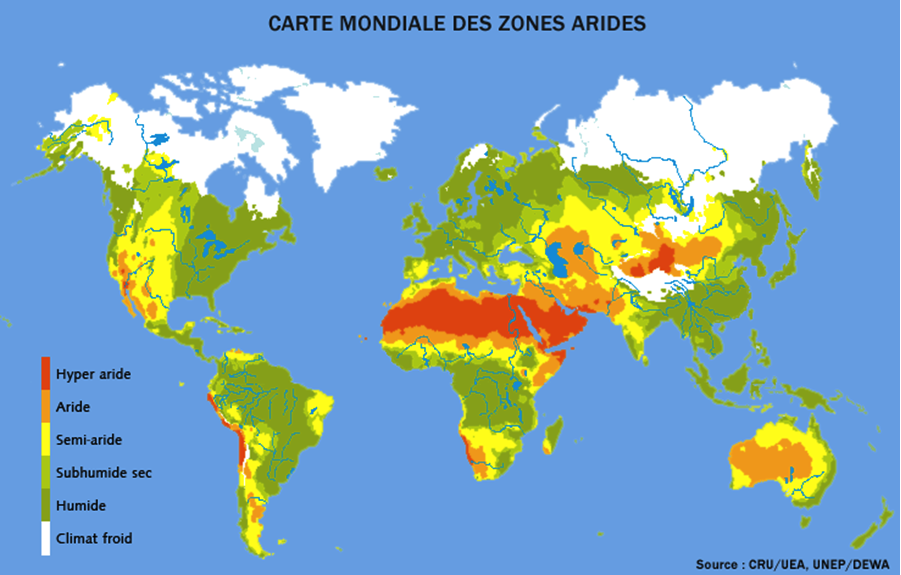
Source : https://suds-en-ligne.ird.fr/desertif/carte.html

La disponibilité de l’eau dans les zones semi-arides devient de plus en plus problématique. Dans plusieurs régions du monde marquées par un tel régime climatique l’eau n’est tout simplement pas au rendez-vous. Ces régions sont principalement le Sahel, les contours du désert australien, les zones influencées par les courants froids telles que la côte occidentale de l’Amérique du Sud et celle de l’Afrique, les hauts plateaux intérieurs eurasiens, les zones sous le régime climatique méditerranéen et les grandes prairies intérieures de l’Amérique du Nord et de l’Amérique du Sud. Plusieurs de ces zones sont attenantes aux grands déserts (figure 1). Ces zones, dans bien des cas, surexploitées, voient leurs nappes phréatiques s’abaisser rendant le couvert végétal très vulnérable aux incendies lors des périodes de sécheresses prolongées, une situation qui se présente fréquemment dans les régions marquées par le climat méditerranéen et, notamment, en Australie et en Californie. Le régime des précipitations, fort variable et même imprévisible, peut même forcer les habitants de ces régions à pratiquer la transhumance afin de pouvoir assurer leur subsistance.

Il y a six types de déserts qui sont au cœur des zones semi-arides et qui s’agrandissent à leur détriment. Les déserts de la zone intertropicale créés par la circulation atmosphérique globale caractérisés par de faibles précipitations, une forte évaporation et une forte insolation. Ce sont les déserts d’Australie, du Sahara et ceux de l’Afrique du Sud. Les déserts continentaux situés sur les hauts plateaux à l’intérieur des terres caractérisés par une très forte amplitude thermique (étés très chauds, hivers très froids) tels que ceux de Gobi et de Taklimakan (Asie de l’Est). Les déserts centraux en Australie, le Great Basin en Amérique du Nord, le désert de Monte en Amérique du Sud. Les déserts côtiers  situés sur les côtes le long de zones de remontées d’eaux profondes caractérisés par de faibles précipitations, une hyperaridité et des brumes de soirée tels que celui de l’Atacama au Chili, le désert de Namibie, le désert de Baja California au Mexique et le désert de la côte atlantique marocaine. Les déserts d’abri de la zone tempérée (‘rain shadow deserts’) comme c’est le cas de la Vallée de la Mort  aux USA abritée par la Sierra Nevada et caractérisée par de faibles précipitations, une forte évaporation et une forte insolation en y ajoutant, ici, les Cascades (figure 2), l’Himalaya et les Andes. Les déserts polaires (l’Arctique et l’Antarctique) reçoivent peu de précipitations, à cause de la présence de cellules anticycloniques (seos-project.eu). Nous avons été à même de faire des observations sur le terrain dans le désert de Mojave en Californie (figure 3), dans le désert de Djibouti et dans les déserts de Chihuahua, de Sonora et de la Baja California au Mexique (figure 4).

Figure 2. La Vallée de la mort, Californie, USA
Source : http://www.roadtrippin.fr/californie/death-valley/death-valley.php

Figure 3. La dune de Kelso dans le désert Mojave, Californie, USA

Source : http://en.wikipedia.org/wiki/Kelso_Dunes

Figure 4. Le champ de boulders (roche granitique) de Cataviña , Baja California Sur, Mexique

 

Source : allposters.com

Figure 5. Madagascar. Zone semi-aride consacrée à l’élevage

Source : http://blog.agrophil.org/#post51

Figure 6. Parc national Tarangire, Tanzanie
Source : http://commons.wikimedia.org/wiki/File:Tarangire-Natpark800600.jpg

Figure 7. Populations affectées par la désertification (en millions de personnes)
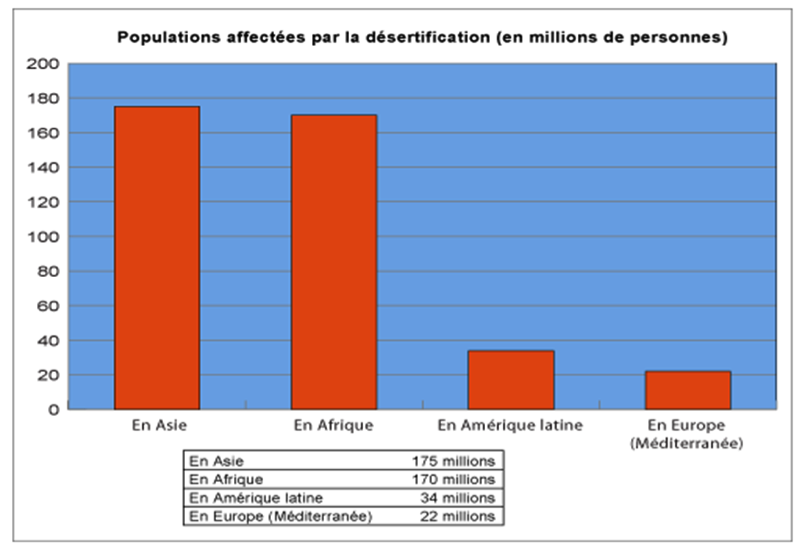
Source : https://suds-en-ligne.ird.fr/desertif/carte.html

Utilisation sans cesse croissante de l’eau. Pollution consistante et mortalité infantile élevée

Les rapports sur l’état du patrimoine hydrique mondial exposent les grands enjeux entourant la raréfaction de l’eau douce due à la surexploitation, à la pollution ou au gaspillage de la ressource. Ici, nous retenons les données de la stratégie pour l’Avenir de la Vie (1991) et les constats dressés en 2007 et 2012 avec GEO 4 et GEO 5.

 1991.

Selon la stratégie pour l’Avenir de la Vie lancée en 1991, « le problème de l’eau est quasi planétaire et c’est l’homme qui en est la cause. Le monde prélève actuellement 35 fois plus d’eau qu’il y a trois cents ans et les prévisions indiquent que, d’ici l’an 2000, le volume prélevé aura encore augmenté de 30 à 35%. Notre utilisation de l’eau ne peut continuer à ce rythme si la population mondiale atteint 10 milliards d’habitants d’ici 2050. Aujourd’hui, de nombreux pays souffrent de graves pénuries d’eau. La concurrence entre les utilisateurs ne cesse d’augmenter et les institutions sont impuissantes à l’arbitrer. Les détournements et retenues d’eau ont des répercussions de plus en plus graves sur les écosystèmes (PNUE, WWF et UICN, 1991, p. 152).

2007. GEO 4.

Selon le PNUE, la dégradation de la qualité de l’eau due activités humaines continue de nuire à la santé humaine et aux écosystèmes. Trois millions de personnes meurent chaque année de maladies  causées par une eau polluée dans les pays en développement, la majorité étant des enfants de moins de cinq ans. Les polluants les plus préoccupants sont les pathogènes microbiens et les charges excessives d’éléments nutritifs. L’eau contaminée par des microbes reste la principale cause des maladies et des décès à l’échelle mondiale. Beaucoup de nutriments conduisent à l’eutrophication des eaux en aval des cours d’eau et des zones côtières avec la perte d’usages bénéfiques pour les humains. La pollution diffuse provenant des surfaces terrestres, notamment l’agriculture et le ruissellement urbain, requiert une action urgente par les gouvernements et le secteur agricole. La pollution par les pesticides et les substances perturbant le système endocrinien de même que les sédiments en suspension sont également difficiles à contrôler. Il existe des preuves que le système intégré de gestion des ressources hydriques (IWRM) à l’échelle du bassin versant a contribué à améliorer le traitement des effluents et la restauration des zones humides, le tout accompagné par l’éducation et la sensibilisation du public et été une réponse efficace à tous ces problèmes (PNUE, GEO 4, p. 116-117).

 2012.  GEO 5.

« L’augmentation de l’utilisation efficace des eaux dans tous les secteurs est essentielle en vue d’assurer des ressources durables en eau pour tous les usages. La demande en eau de l’homme, avec seulement des améliorations limitées en efficacité, se multiplient et sont déjà insoutenables dans de nombreuses régions. Néanmoins, le potentiel existe pour des gains d’efficacité: efficacité de l’irrigation, par exemple, pourrait être augmentée d’environ un tiers simplement en mettant en œuvre la technologie existante. Au niveau local, les stratégies de demande et d’approvisionnement intégrées sont essentielles. Au niveau des bassins versants, des systèmes de répartition de l’eau plus efficaces et équitables sont nécessaires. Le commerce de l’eau pourrait virtuellement atténuer la demande en eau dans certains endroits ».

…« Il est difficile d’évaluer les progrès réalisés pour répondre aux exigences environnementales de l’eau. De meilleures stratégies et des outils sont nécessaires pour l’efficacité, la répartition équitable de l’eau entre les différents utilisateurs… La mise en œuvre intégrale des engagements internationaux et l’application des accords juridiquement contraignants…faciliteront  l’utilisation durable de la ressource par l’homme et les écosystèmes. Réduire à la fois la pollution ponctuelle et non ponctuelle est impératif afin d’améliorer la santé de l’écosystème et de fournir de l’eau potable pour les humains. Des réalisations importantes dans la réduction de certains polluants ont eu lieu depuis 1992, bien que de nombreux plans d’eau soient encore affectés, et de nombreux nouveaux contaminants ont des effets mal compris. Le traitement des eaux usées municipales et industrielles est réalisable avec la technologie existante, mais nécessite une meilleure surveillance réglementaire, des investissements dans les infrastructures et dans la formation, en particulier dans les pays en développement. La gestion intégrée des éléments terrestres et hydriques et la participation des intervenants sont nécessaires pour réduire les pollutions de l’eau douce et les systèmes marins. L’amélioration de l’approvisionnement en eau et de l’assainissement est probablement le moyen le plus simple du rapport coût-efficacité de la réduction des décès liés à l’eau et aux maladies à l’échelle mondiale. Bien que l’objectif du Millénaire pour le développement (OMD) sur l’approvisionnement en eau ait été atteint en 2010, plus de 600 millions de personnes n’ont toujours pas accès à l’eau potable en 2015. La cible des OMD concernant l’assainissement est peu susceptible d’être atteint, avec 2,5 milliards de personnes actuellement sans des installations sanitaires améliorées; les populations rurales pauvres sont les plus touchées. Augmenter l’approvisionnement en eau et l’assainissement permettrait de réduire la charge mondiale de morbidité liée à l’eau d’environ 10 pour cent. L’augmentation des investissements dans les infrastructures, le renforcement des capacités et la réglementation sont nécessaires et la participation des femmes est essentielle pour la gestion de l’eau et la prévention des maladies d’origine hydrique. Des considérations sur le climat dans tous les secteurs liés à l’eau est essentiel pour faire face aux événements extrêmes et à l’augmentation de la variabilité climatique. Les inondations et les sécheresses causent encore des pertes en milliards de dollars à chaque année » (unep.org).

Selon OXFAM, aujourd’hui, près de 783 millions de personnes n’ont pas accès à l’eau potable, tandis que 2,3 milliards ne disposent pas d’installations sanitaires de base. Chaque année, les maladies liées à l’eau causent le décès de 2,2 millions de personnes, pour la plupart des enfants de moins de 5 ans (oxfam.qc.ca).

II. Le partage de l’eau

Un stress hydrique qui touche une large partie du globe (figure 8)

« Le stress hydrique – autrement dit, une ressource insuffisante pour répondre aux différentes activités humaines et aux besoins de l’environnement – commence lorsque la disponibilité en eau est inférieure à 1 700 mètres cubes par an et par personne. Quasiment les trois quarts des habitants des pays arabes vivent en dessous du seuil de pénurie établi, lui, à 1 000 m3 par an, et près de la moitié se trouvent dans une situation extrême avec moins de 500 m3, en Égypte et en Libye notamment » (lemonde.fr).

« Les pays en voie de développement ne sont pas les seuls touchés. « Comment l’Ouest américain, certaines provinces de Chine, le Mexique ou encore le Sud méditerranéen vont-ils faire dans trente ans s’interroge Richard Connor, expert pour l’ONU, qui participe pour la quatrième fois au rapport annuel sur l’eau. Le stress hydrique peut avoir des conséquences incalculables. Par exemple, en 2010, les sécheresses et les feux de forêt dans les steppes de Russie ont fait chuter les exportations de blé. Résultat : le prix du pain a doublé, ce qui a débouché sur le printemps arabe »  (lemonde.fr).

Figure 8. Les régions à risque
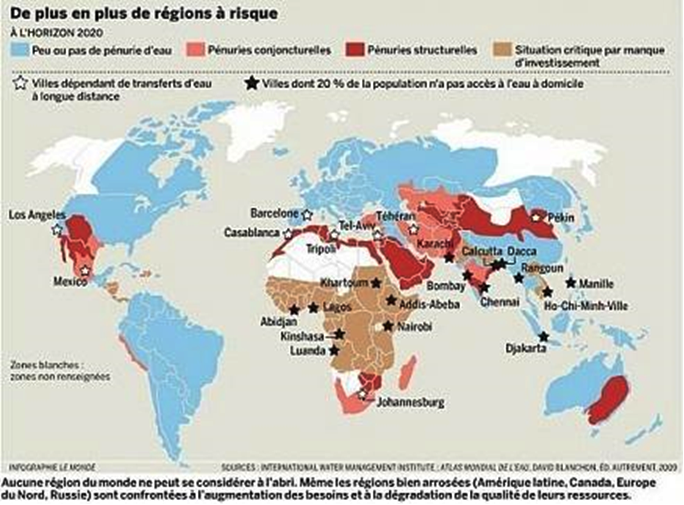
Source: eco-fr.e-monsite.com

La carte des régions à risques pour l’horizon 2020 (figure 8) illustre les diverses problématiques qui vont se poser. Les régions avec pénuries structurelles correspondent à la péninsule arabique, une bande longeant la mer Méditerranée allant de l’Égypte au Maghreb, au nord-est de l’Afrique du Sud, à toute la partie du Sud-Est australien, à la Chine du Nord, à la Mongolie, au Sud-Ouest des États-Unis et à une grande partie du territoire mexicain et, en particulier, dans les plateaux intérieurs. Les régions à pénuries conjoncturelles comptent une bonne proportion du territoire de l’Afrique du Sud, Madagascar, le nord de l’Inde, l’Iran, le Pakistan, le Proche-Orient et une portion des plateaux intérieurs asiatiques. Les aires dont la situation est considérée critique en raison du manque d’investissements correspondent à l’Afrique subsaharienne entre le Sahel et  l’Afrique du Sud.

Plus de neuf villes dépendent de transferts d’eau à longue distance, soit Los Angeles, México, D.F, Johannesburg, Casablanca, Tripoli, Barcelone, Tel-Aviv, Téhéran et Pékin.

Les villes dont 20% de la population n’a pas accès à l’eau à domicile sont Calcutta, Djakarta, Rangoun, Karachi, Khartoum, Lagos, Abidjan, Addis-Abeba, Bombay, Chennai, Manille, Kinshasa, Luanda, Nairobi, Ho-Chi-Minh-Ville et Dacca, des villes dont les infrastructures ne peuvent donc répondre à tous les besoins d’approvisionnement et d’assainissement des eaux.

Selon le PNUE, « un tiers de la population mondiale vit dans des pays qui souffrent d’un stress hydrique modéré ou fort c’est-à-dire où la consommation d’eau dépasse de 10% les ressources renouvelables d’eau douce. Quelques 80 pays, comptant 40% de la population mondiale, souffraient au milieu des années 90 de diverses pénuries d’eau et on estime que dans moins de 25 ans deux tiers de la population vivront dans un pays connaissant un stress hydrique » (GEO 3, 2002, p. 150).

Selon un rapport de l’ONU rendu public récemment, « si rien ne change, la planète devrait faire face à un déficit global en eau de 40% d’ici 2030. La gestion de l’eau est inadaptée. L’irrigation intensive, le rejet incontrôlé de pesticides et de produits chimiques et l’absence de traitement des eaux usées sont notamment montrés du doigt. Des régions de Chine, d’Inde et des États-Unis, ainsi que le Moyen-Orient, puisent dans des réserves souterraines de manière non durable ». Le rapport rappelle que « malgré des progrès considérables ces dernières années, 748 millions de personnes sont toujours privées d’accès à une eau protégée d’une éventuelle contamination » (C. Serrat, 2015, p. A3).

La mauvaise répartition de l’eau dans le Monde, source de conflits ou de coopération ?

Selon le CNRS, « avec 40000 km3 d’eau douce qui circule chaque année sur les terres émergées, on est en droit de penser que la ressource est suffisante . . . mais elle est très mal répartie car neuf pays se partagent 60% des réserves mondiales (USA, Canada, Russie, Chine, Inde, Brésil, Colombie, Pérou et Indonésie), mais l’Asie qui concentre 60% de la population mondiale, ne dispose que de 30% de la ressource disponible, et de même une moyenne par pays et par habitant qui varie de 1 à 20 000 entre les Émirats du Golfe persique et l’Islande ! Le réchauffement climatique et la raréfaction des pluies, la surexploitation agricole et les pollutions, mais aussi la surproduction poussant à la surconsommation, combinés avec la croissance exponentielle de 7 milliards d’êtres humains aujourd’hui, 8,5 milliards en 2030 et de 9 à 10 milliards en 2050, font que la quantité d’eau disponible par habitant ne cesse de diminuer » (cnrs.fr).

Or, comme le montre cette carte, une bonne moitié des pays dans le Monde, dépendent à plus de 30% d’une ressource en eau extérieure à leur territoire, qui est donc une source de conflit possible avec des pays voisins. L’eau est une ressource qui se fait rare. De nombreux experts prévoient des conflits pour le partage de cette ressource de plus en plus convoitée car il existe 263 bassins fluviaux partagés entre 145 pays. Car notamment lorsqu’un cours d’eau traverse une frontière, l’eau devient alors un véritable instrument de pouvoir aux mains du pays situé en amont. Qu’il soit puissant ou non, celui-ci a toujours théoriquement l’avantage, puisqu’il a la maîtrise du débit de l’eau (cnrs.fr).

Selon Olivier Petitjean, « la géographie de l’eau, c’est-à-dire les divisions entre bassins versants et la distribution de la ressource au niveau mondial, ne recoupe quasiment jamais les frontières administratives. Il suffit de superposer la carte politique du monde et celle des bassins versants pour révéler la réalité et l’ampleur de l’interdépendance entre régions et pays en ce qui concerne les ressources en eau. Les chiffres parlent d’eux-mêmes. On compte aujourd’hui 263 bassins versants transfrontaliers (50 de plus qu’il y a trente ans, en raison notamment de la dislocation du bloc soviétique). 19 pays se partagent le bassin du Danube, 11 ceux du Nil et du Niger, 9 celui de l’Amazone. 145 pays ont au moins une partie de leur territoire située dans un bassin transfrontalier. 30 sont entièrement situés à l’intérieur de tels bassins. 39 pays, représentant une population de 800 millions de personnes, dépendent pour moitié ou plus de ressources en eau qui trouvent leur origine à l’extérieur de leurs frontières. Des pays tels que l’Égypte, l’Irak, la Syrie, le Turkménistan ou l’Ouzbékistan, qui disposent tous de systèmes d’irrigation étendus sur lesquels repose une bonne part de leur fortune économique, dépendent quasi entièrement de l’eau de fleuves prenant leur source dans les pays voisins » (partagedeseaux.info).

En se référant aux données historiques le même auteur présente un bilan plutôt optimiste: « Les données historiques semblent d’ailleurs confirmer que l’interdépendance débouche le plus souvent sur la coopération entre pays plutôt que sur des conflits, infirmant ainsi les prévisions alarmistes. On cite souvent le conflit entre Lagsah et Umma, deux cités-États mésopotamiennes, vers l’an –2500, comme le seul cas répertorié de guerre engagée exclusivement sur la question de l’eau. Des historiens ont compté pas moins de 3 600 traités internationaux relatifs à l’eau entre 805 et 1984. Des chercheurs de l’Université d’État de l’Oregon ont étudié les données sur les 50 dernières années et ont conclu que sur 1 831 événements et initiatives internationaux relatifs à l’eau, plus des deux tiers étaient de nature coopérative et que l’immense majorité des cas de conflits en sont restés au stade de l’affrontement verbal. Dans 37 cas seulement (principalement au Proche-Orient), les pays concernés ont engagé une forme quelconque d’action militaire (tirs, destruction d’infrastructures, etc.) »  (partagedeseaux.info).

« Ces mêmes chercheurs précisent que les conflits (verbaux ou armés) portaient principalement sur des problèmes de quantité d’eau partagée entre les pays (61 % des cas), sur des infrastructures (26 %), et seulement marginalement sur des questions de qualité de l’eau (4 %). Plusieurs cas récents donnent toutefois à penser que les conflits transfrontaliers liés à la pollution de l’eau pourraient prendre davantage d’importance dans l’avenir… Une cause récurrente de conflits est une action engagée unilatéralement par un pays d’amont (construction d’un barrage, détournement de l’eau) qui a des effets négatifs potentiels sur les pays d’aval »  (partagedeseaux.info).

L’eau utilisée comme enjeu durant les conflits armés

Au XXème siècle, plusieurs actes de guerre ont éclaté en rapport avec l’approvisionnement en eau douce. Selon Oxfam Québec, « pendant la guerre du Vietnam (années 1960), de nombreuses digues ont été détruites ou endommagées par les bombardements continus. Selon les autorités du Vietnam Nord, entre 2 et 3 millions de personnes seraient mortes noyées ou de faim à la suite de ces attaques. En Irak, près de 1,5 million de sacs d’eau ont été distribués l’an dernier aux personnes déplacées ainsi qu’aux hôpitaux. Aujourd’hui, l’ONU recense près de 300 points chauds où l’eau pourrait devenir source de tensions. En Cisjordanie, les colons israéliens consomment en moyenne 620 mètres cubes d’eau par personne par an, comparativement à moins de 100 mètres cubes pour les Palestiniens (oxfam.qc.ca).

III. L’établissement d’aires protégées en tant que sauvegarde du couvert végétal dans les bassins de réception des affluents des grands fleuves et sur les versants montagneux

La mise en valeur des ressources naturelles est facilitée quand le cadre d’intervention correspond au bassin hydrographique. Il s’agit là de l’unité naturelle par excellence pour un mode d’aménagement du territoire tenant compte des conditions de renouvellement des ressources. Ce cadre permet de bien saisir les différentes composantes du milieu physique, les modalités du relief, les zones sécuritaires, les zones à risques, le bilan hydrique régional, la nature et la densité du couvert végétal ainsi que les patterns de l’utilisation du sol. Un bel exemple de l’application de ces principes s’est développé au Costa Rica. Celui-ci assure la sauvegarde des forêts des versants volcaniques de la Sierra centrale avec la création de parcs nationaux comme c’est le cas des volcans ArenalTenorio et Miravalles (areasyparques.com). Ces aires deviennent des zones de rétention d’eau précieuses pour l’approvisionnement des régions situées dans les plaines environnantes comme c’est le cas observé dans la province du Guanacaste. D’ailleurs, c’est le seul pays au monde dont les limites administratives correspondent à des aires de conservation dont les principes de création sont inspirés par les concepts à la base de l’établissement des Réserves de la Biosphère du Programme MAB de l’Unesco. Dans ces espaces on retrouve « des aires centrales, ayant comme fonction la protection de la nature et devant être protégées par la législation nationale (classées aires protégées); des zones tampon qui entourent ou jouxtent les aires centrales qui sont des zones de développement durable où les activités de production doivent rester compatibles avec les principes écologiques, dont l’éducation environnementale, la récréation et la recherche scientifique; des zones de transition (également dites “de coopération”), se prêtent aux diverses activités » (wikipedia.org) (figure 9).

Figure 9. Costa Rica. Aires de conservation
Source : http://www.acguanacaste.ac.cr/1997/mapaac.html

Selon la stratégie pour l’Avenir de la Vie «les politiques adoptées pour chaque bassin versant devraient être fondées sur une évaluation de la capacité de charge, revêtir une dimension plurisectorielle et prendre en compte les neuf principes suivants :

–         L’utilisation des eaux de surface, souterraines et côtières à l’intérieur de chaque bassin devrait être planifiés sur la base d’évaluations de la quantité et de la qualité de l’eau;

–        La consommation domestique, industrielle et agricole, ainsi que les volumes requis pour la conservation des zones humides, ne devraient pas excéder les limites d’un approvisionnement durable prenant en compte tous les besoins de l’écosystème;

–        Des normes de quantité et de qualité devraient être fixées pour les différentes utilisations de l’eau, y compris le maintien des structures et fonctions de l’écosystème;

–        Le volume des eaux d’irrigation devrait être limité au minimum requis pour lessiver le sel;

–        La gestion de la qualité et du niveau des nappes d’eau souterraines devrait viser à minimiser les impacts écologiques comme la salinisation, la subsidence des sols, la libération de nutriments préjudiciables et la réduction du débit des cours d’eau;

–        Afin de préserver le niveau de la nappe phréatique, il convient de calculer le taux potentiel de pompage d’après le taux de recharge naturel;

–        Les risques sanitaires devraient être pris en compte dans le calcul des volumes d’eau requis et dans l’élaboration des plans d’irrigation;

–        Les pratiques dommageables pour la qualité de l’eau, comme les travaux d’assèchement, les remblayages en déchets solides, et l’utilisation d’engrais, de pesticides et autres substances potentiellement polluantes, devraient être contrôlées de près afin que l’eau polluée n’affecte pas la qualité des eaux souterraines et que le ruissellement de surface ne dégrade pas la qualité des eaux fluviales;

–        On devrait promouvoir des technologies propres et appliquer à la lutte contre la pollution le Principe de Prévention, visant à empêcher les rejets de substances toxiques ou synthétiques dont les effets à long terme ne sont pas connus » (UICN, PNUE et WWF, p. 157-158). 

IV.  L’UICN et la stratégie mondiale pour un partage harmonieux de l’eau dans les différentes régions du monde. Une vision pour le 21ème siècle – Lancement en 2000

Détérioration des écosystèmes et des ressources en eau

« L’eau qui a été dans le passé une source de vie hautement respectée, n’est, de nos jours, qu’un simple produit. On prend souvent sa valeur à la légère et on en fait couramment un usage abusif. De par le monde, l’utilisation de l’eau par les humains a déjà provoqué l’assèchement et la pollution de cours d’eau, de lacs et de nappes souterraines. L’eau potable est de plus en plus rare. D’ici l’an 2025, on prévoit que les prélèvements d’eau augmenteront de 50 pour cent dans les pays en développement, et de 18 pour cent dans les pays développés, ce qui aura des incidences redoutables sur les écosystèmes. Au cours du siècle dernier, plus de la moitié des zones humides du monde ont été détruites. Des espèces actuellement menacées dans le monde, dont le nombre dépasse 3 500, 25 pour cent sont des poissons et des amphibiens. Si les êtres humains continuent de prélever l’eau à ce rythme, la détérioration ou la destruction complète des écosystèmes terrestres, dulcicoles et côtiers qui sont indispensables à la vie sera inévitable ». (portals.iucn.org)

« Les causes de cette situation sont multiples et, il serait injuste de blâmer un seul groupe d’utilisateurs. Nous sommes tous responsables de l’état des ressources. La croissance des populations et de la consommation, le développement de l’infrastructure, les changements de vocation des terres et l’utilisation indue des sols, la surexploitation des espèces et des écosystèmes, ainsi que la pollution de l’eau, du sol et de l’air par des substances chimiques et des agents biologiques, tous mettent en péril les fonctions des écosystèmes producteurs de nos ressources en eau douce. Nous semblons incapables de mettre au point des plans d’action sociaux et politiques cohérents pour remédier à ces prélèvements et à cette détérioration sans borne. Le déclin des ressources et l’accès nettement inéquitable à celles qui restent font naître partout dans notre société des conflits qui, à certains endroits, laissent présager l’explosion d’actes de violence ». (portals.iucn.org).

Un tel avenir est inacceptable. Toutefois, des expériences un peu partout dans le monde démontrent qu’il existe des solutions de rechange. À l’aide de pratique écologiquement durables et des mesures de conservation qui existent, il est possible de réaliser la vision dont traite ce document.

Nous devons choisir, et c’est maintenant qu’il faut le faire (portals.iucn.org). 

Conclusion

Selon GEO-4, « en tant que principal moyen d’intégration sur la surface terrestre, l’eau possède un fort potentiel pour réduire la pauvreté, accroître la sécurité alimentaire, améliorer la santé humaine, contribuer à des sources d’énergie durables et fortifier  l’intégrité des écosystèmes et leur durabilité. Les biens et services liés à l’eau représentent des opportunités significatives pour la société et les gouvernements en vue d’atteindre ensemble les objectifs du développement durable et ce tel qu’on l’a reconnu dans la Déclaration du Millénaire et lors du Sommet mondial sur le développement durable, le tout dans le contexte de la réalisation des OMD » (GEO-4, 2007, p. 149).

 Jules Dufour

Centre de recherche sur la Mondialisation

Nous présentons ici le texte du Manifeste de l’eau pour un nouveau contrat mondial de Ricardo Petrella. Celui-ci expose, les grands enjeux géopolitiques, économiques et sociaux du partage et de la gestion de l’eau à l’échelle mondiale.

Le droit de tous à la vie

Nous venons d’Afrique, d’Amérique Latine, d’Amérique du Nord, d’Asie, d’Europe. Nous nous sommes rassemblés à trois reprises en 1998 sans autre légitimité et représentativité que celle d’être des citoyens concernés par le fait qu’1 milliard et 400 millions de personnes sur 5,8 milliards d’habitants de la planète n’ont pas accès à l’eau potable, source primordiale de vie. Ce fait est inacceptable. Or, le risque est grand qu’en 2020, lorsque la population mondiale atteindra environ les 8 milliards d’êtres humains, les personnes n’ayant pas accès à l’eau potable s’élèvent à plus de 3 milliards. Cela est inadmissible. On peut, on doit empêcher que l’inadmissible devienne acceptable. Comment ?

Nous pensons qu’il sera possible de le faire en appliquant les principes et les règles ci-dessous.

L’eau “source de vie” appartient aux habitants de la Terre en commun.

En tant que “source de vie” fondamentale et non-substituable de l’éco-système Terre, l’eau est un bien vital qui appartient aux habitants de la Terre, en commun. Aucun d’entre eux, individuellement ou en groupe, ne devrait avoir le droit d’en faire son appropriation privée. L’eau est un bien patrimonial commun de l’humanité. La santé individuelle et collective en dépend. L’agriculture, l’industrie, la vie domestique y sont liées. Il n’y a pas d’accès à la production de la richesse sans accès à l’eau. L’eau, on le sait et tout le monde le dit, n’est pas une ressource comme les autres ; elle n’est pas une marchandise échangeable, monnayable. Son caractère irremplaçable fait que toute communauté humaine -et chacun de ses membres- a le droit d’avoir accès à l’eau, en particulier à l’eau potable, en quantité et qualité nécessaires et indispensables à la vie et à l’activité économique.

Principes

Le droit à l’eau est un droit inaliénable individuel et collectif

 L’eau appartient davantage à l’économie des biens communs et du partage de la richesse qu’à l’économie de l’accumulation privée et individuelle et de la prédation de la richesse d’autrui. Alors que le partage de l’eau a été souvent dans le passé source majeure d’inégalités sociales, nos civilisations d’aujourd’hui reconnaissent que l’accès à l’eau est un droit fondamental, inaliénable, individuel et collectif. Le droit à l’eau fait partie de l’éthique de base d’une “bonne” société humaine et d’une “bonne” économie. Il appartient à la société dans son ensemble et aux différents niveaux d’organisation sociétale, selon le double principe de co-responsabilité et de subsidiarité, de garantir le droit d’accès pour tous et pour toute communauté humaine sans discrimination aucune de race, de sexe, de religion, de revenu, de classe sociale.

Principes

L’eau doit contribuer à la solidarité de vie entre communautés, pays, sociétés, sexes et générations

Ce n’est pas parce que les ressources en eau douce sont inégalement distribuées sur Terre, ou parce que le revenu est aussi très inégalement réparti entre les êtres humains et les pays de la planète, qu’il doit y avoir également inégalité d’accès à l’eau entre personnes et communautés humaines. De même, l’inégalité dans la distribution de la ressource et des revenus ne signifie pas que les peuples riches en eau et les personnes riches en revenu puissent en faire l’usage qu’ils veulent, voire la vendre (ou l’acheter) “à l’étranger” pour en tirer le maximum de profit (ou de jouissance). Il est temps que l’eau cesse d’être, dans de nombreuses régions du monde, source de grandes inégalités entre les hommes et les femmes, ces dernières supportant tout le fardeau des activités domestiques liées à l’eau. Il y a encore aujourd’hui, à l’aube du troisième millénaire, trop de guerres entre États voisins à cause de l’eau, car les États concernés, qui se trouvent en meilleure position géo-économique, utilisent l’eau comme un instrument au service de leurs intérêts stratégiques de puissance “hégémonique” locale. Il est possible de soustraire l’eau aux logiques de l’Etat-puissance pour la rendre res publica sous la tutelle de l’État-citoyen.

Principes

L’eau est une affaire de citoyenneté et de démocratie

Créer les conditions nécessaires et indispensables pour que l’accès à l’eau soit effectif et optimal, c’est l’affaire de tout le monde. C’est une affaire aussi entre générations. Il appartient en effet, aux générations actuelles d’utiliser, valoriser, protéger, conserver les ressources en eau de manière à ce que les générations futures puissent jouir de la même liberté d’action et capacité de choix que nous souhaitons pour nous actuellement. Le citoyen doit être au centre des décisions. La gestion intégrée durable et solidaire de l’eau est du domaine de la démocratie participative, représentative et directe. Elle dépasse les compétences et les savoir-faire des techniciens, des ingénieurs, des banquiers. L’usager (consommateur solvable et non-solvable) a un rôle important à jouer par ses choix judicieux et ses pratiques guidées par les principes d’une économie et d’une société durables.

Principes

Toute politique de l’eau implique un haut degré de démocratie au niveau local, national, continental, mondial

 Par définition, l’eau appelle une gestion décentralisée et transparente. Les dispositifs de la démocratie représentative doivent être renforcés. Un champ considérable est ouvert aux dispositifs de la démocratie participative au niveau des villages, des villes, des bassins aquifères, des régions. Des cadres réglementaires clairs au niveau international et mondial doivent faire émerger et rendre visible la politique durable et solidaire de l’eau au niveau de la communauté mondiale. Les instances parlementaires sont appelées à jouer un rôle fondamental dans la construction d’un droit mondial de l’eau au cours des vingt prochaines années. Nous pensons aussi qu’il est urgent et indispensable de (re)valoriser les pratiques locales et traditionnelles. Un patrimoine considérable de savoirs et de compétences et de pratiques communautaires solidaires, d’une très grande efficacité, a été dilapidé. Il risque d’être détruit encore davantage dans les années à venir.

Principes

L’accès à l’eau passe nécessairement par le partenariat. Il est temps de dépasser les logiques des “seigneurs de la guerre” et des conflits économiques pour l’hégémonie et la conquête des marchés

La citoyenneté et la démocratie se fondent sur la coopération et le respect mutuel. Elles vivent par et dans le partenariat. “Partenaires pour l’eau” est le principe inspirateur de tous les dispositifs (tels que “les contrats de rivière”) qui ont permis ces derniers temps de surmonter efficacement les conflits qui dans certaines régions du monde ont traditionnellement envenimé les relations entre communautés riveraines ou partageant le même bassin hydrographique. Nous soutenons, bien entendu, un partenariat local/national/mondial, public/privé réel, fondé sur le respect des diversités, où les multiples logiques et cultures en présence peuvent équitablement contribuer à la gestion intégrée, solidaire et durable de l’eau, dans l’intérêt général. Un partenariat qui ne serait que formel, soumis, en réalité, aux logiques et aux intérêts des acteurs privés en compétition acharnée entre eux pour la conquête du marché -ce qui serait inéluctablement le cas si l’eau devait être reconnue comme étant surtout un bien économique et un bien marchand- ne pourrait que nuire à l’objectif de l’accès à l’eau pour tous et de la gestion intégrée, durable et solidaire des ressources en eau.

Principes

Nous pensons que la prise en charge financière de l’eau doit être à la fois collective et individuelle selon les principes de responsabilité et d’utilité

Assurer l’accès de base à l’eau pour la satisfaction des besoins vitaux élémentaires et fondamentaux de toute personne et de toute communauté humaine est une obligation pour la société dans son ensemble. C’est la société qui doit assumer collectivement la couverture de l’ensemble des coûts relatifs à la collecte, production, stockage, distribution, utilisation, conservation et recyclage de l’eau en vue de fournir et garantir l’accès à l’eau dans la quantité et en qualité considérées comme étant le minimal vital et nécessaire indispensable. L’ensemble de ces coûts (y compris les externalités négatives qui ne sont pas prises en compte par les prix du marché) sont des coûts sociaux collectifs au niveau des communautés humaines de base. Ceci devient encore plus vrai et significatif à l’échelle d’un pays, d’un continent et de la société mondiale. Leur financement doit être assuré par voie de répartition collective. Les mécanismes de tarification individuelle, selon des prix progressifs, doivent intervenir à partir d’un usage de l’eau dépassant le minimum vital nécessaire et indispensable. Au-delà du minimum vital, la progressivité des prix est fonction de la quantité utilisée. En outre, tout abus et excès dans l’usage doivent être considérés illégaux.

Pour que ces principes et ces règles deviennent des réalités vivantes au cours des 20-25 prochaines années, lorsque deux milliards d’êtres humains viendront s’ajouter à la population actuelle, nous proposons que les mesures suivantes soient prises et mises en oeuvre, sorte de “Contrat Mondial de l’Eau”, selon deux axes majeurs. •la constitution d’un “réseau de parlements pour l’eau”

•la promotion de campagnes d’information, de sensibilisation et de mobilisation autour de “L’eau pour tous”.

Nous proposons d’outiller l’initiative du Contrat Mondial de l’Eau d’un instrument de collecte et d’analyse de données (quantitatives et qualitatives) les plus rigoureuses possibles, grâce à la mise en place progressive d’un Observatoire Mondial des Droits de l’Eau.

Constitution d’un Réseau de Parlements pour l’Eau

C’est aux Parlements, organes principaux de la représentation politique dans les sociétés “occidentalisées”, ou aux institutions comparables dans d’autres contextes civilisationnels, que revient la responsabilité de modifier les législations existantes en application aux principes et aux règles ci-dessus explicités. Définir un corpus juridique nouveau en matière d’eau, non seulement au plan local et national mais également au plan international et mondial (un “droit mondial de l’eau”) constitue une tâche primordiale face au vide juridique existant dans ce domaine à l’échelle mondiale. La priorité est à donner à un “Traité Mondial de l’Eau” fondé sur le principe de l’eau en tant que bien vital patrimonial commun de l’humanité. Ce “traité”, par exemple, exclurait l’eau de toute convention internationale commerciale (dans le cadre de l’OMC), comme c’est déjà le cas pour le domaine culturel.

Propositions

Promotion de campagnes d’information, de sensibilisation et de mobilisation concernant:

•1 le développement (ou modernisation) des systèmes de distribution et d’assainissement des eaux pour les 600 villes des pays d’Afrique, d’Asie, d’Amérique Latine et d’Europe orientale et Russie qui auront plus d’un million d’habitants en 2020 et dont le système d’eau est déjà aujourd’hui inadéquat, obsolète, voire inexistant.

•2 la lutte contre les nouvelles sources de pollution des eaux dans les villes des pays d’Amérique du Nord, d’Europe Occidentale et du Japon dont le contamination du sol et des nappes phréatiques de surface et en profondeur est de plus en plus inquiétante, grave et, dans certains cas, irréversible. Il s’agit, concrètement, à partir de programmes locaux au niveau urbain de réaliser l’objectif de la création de “3 milliards de robinets d’eau”. Les mouvements associatifs, les ONG, les syndicats, les scientifiques ont à cet égard un rôle essentiel et déterminant à jouer.

A cette fin, la priorité est à donner à : •La réforme profonde des systèmes actuels d’irrigation liés au mode de production agricole (et agro-alimentaire) industriel, intensif. Les solutions existent, entre autres l’irrigation “goutte à goutte”.

L’agriculture actuelle “moderne” est la principale consommation des ressources en eau douce de la planète (70% des prélèvements totaux mondiaux, dont la très grande partie est liée à l’irrigation). Or, 40% de l’eau d’irrigation se perd chemin faisant. En outre, ses excès sont à l’origine de graves atteintes et menaces à l’environnement par la salinisation des sols et l’hydromorphisme (engorgement)

•Un moratoire de 10 à 15 ans en ce qui concerne la construction de nouveaux grands barrages dont l’on connaît désormais les inconvénients considérables à court et à long terme pour l’environnement, les populations, la gestion intégrée et durable de l’eau.

Mise en place d’un Observatoire Mondial des Droits de l’Eau

Le but de l’observatoire sera de collecter, produire, distribuer, disséminer les informations les plus rigoureuses et fiables possibles en matière d’accès à l’eau du point de vue des droits individuels et collectifs, de la production d’eau, son utilisation, sa conservation/protection, sa gestion durable et démocratique. L’Observatoire devrait devenir l’un des dispositifs d’information et de communication de référence mondiale notamment pour la valorisation des pratiques effectives de partenariat réel et de gestion solidaire.

Éditions Labor, Bruxelles, 1998, 160 pages

Personnalités ayant participé à la rédaction de l’ouvrage :

Mario Soares, ancien Président de la République du Portugal

Mario Albornoz, Professeur à l’Université de Quilmès, Argentine

Raoul Alfonsin, ancien Président de la République d’Argentine

Driss Ben Sari, Professeur à l’Université de Rabat, Maroc

Rafael Blasco Castany, Presidencia de la Generalitat Valenciana

Rinaldo Bontempi, Membre du Parlement européen, Italie

Larbi Bouguerra, Professeur, Groupe de Lausanne, Tunisie

David Brubaker, Global Resource Action for the Environment, USA

Joao Caraça, Directeur à la Fondation Gulbenkian, Portugal

Susan George, Directeur adjoint du Transnational Institute, France/USA

Antonio Gonçalves Henriques, Vice-Président de l’Istituto do Aguà, Portugal

S.A.R. le Prince Laurent, Président de l’Institut Royal pour la Gestion Durable des Ressources Naturelles, Belgique

Candido Mendes, Sénateur, Président de l’Université Candido Mendes, Brésil

Hasna Moudud, Présidente, National Association for Resources Improvement, Bangladesh

Sunita Narain, Directrice adjointe du Center for Science and Environment, Inde

José Antonio Pinto Monteiro, Ministre de l’Environnement, Cap-Vert

Pierre-Frédéric Ténière-Buchot, Mission Eau, Programme des Nations-Unies pour l’Environnement (PNUE), France

Abou Thiam, Professeur à l’Université de Dakar, Sénégal

Lars Ulmgrend, Secrétaire Général du Stockholm Institute, Suède

Anders Wijkman, Directeur au Ministère des Affaires Etrangères, Suède

Riccardo Petrella, Secrétaire du Comité, Président du Groupe de Lisbonne, Italie

(http://www.waternunc.com/fr/manifeste_eau.htm).

Deuxième partie :

Eau enfant

Un bilan hydrique mondial. Le partage de l’eau dans les bassins versants du Jourdain, du Nil et de l’Indus


Jules Dufour, Ph.D., C.Q., géographe.  Professeur émérite. Membre de la Commission mondiale des Aires protégées de  l’Union Internationale de la nature (UICN), Gland, Suisse

Membre, COFEX-Nord. Projet d’aménagement hydroélectrique de Grande Baleine, Nunavik (1992-1994). Expert, Bureau d’audiences publiques sur l’environnement (BAPE). Projet d’aménagement hydroélectrique de la rivière Sainte-Marguerite, SM-3 (1993)

Commissaire, Bureau d’audiences publiques sur l’environnement (BAPE). Projet de la dérivation des eaux de la rivière Manouane (2001)

Références

AFP-WASHINGTON. 2015. Le 5 avril 2015. En Californie, le changement climatique «n’est pas un canular». En ligne : http://www.lapresse.ca/environnement/dossiers/changements-climatiques/201504/05/01-4858461-en-californie-le-changement-climatique-nest-pas-un-canular.php?utm_categorieinterne=trafficdrivers&utm_contenuinterne=cyberpresse_B13b_etats-unis_286_section_POS2

AP. 2012. L’eau, une source probable de conflits dès 2022. Montréal, Le Journal Le Devoir. Le 23 mars 2012. En ligne : http://www.ledevoir.com/environnement/actualites-sur-l-environnement/345744/l-eau-une-source-probable-de-conflits-des-2022

ASSOCIATION GOODPLANET.ORG. 2009. Home. 192 pages.

ARTHUR-BERTRAND, Yann. 2009. Home. Éditions de Noyelles, pp. 134-150.

CNRS.   L’eau, une source de conflits entre nations. En ligne : http://www.cnrs.fr/cw/dossiers/doseau/decouv/mondial/05_eau.htm

COLLINS, HARPERCOLLINS PUBLISHERS. 2006. Terre fragile. Images d’une planète menacée. Londres, HarperCollins Publishers, pp. 191-218.

COMMISSION DE COOPÉRATION ENVIRONNEMENTALE. 2001. La mosaïque  nord-américaine. Secrétariat de la Commission environnementale (CCE). La disponibilité de l’eau, pp. 26-34.

COOKE, Ron, Andrew Warren et Andrew Goudie. 1993. Desert Geomophology. Londres, UCL Press, 526 pages.

DUFOUR, Jules. 2008. 20 ans après Brundtland: Un bilan alarmant de l’état de santé de l’environnement mondial. Montréal, Centre de recherche sur la mondialisation (CRM). Le 2 janvier 2008. En ligne: http://www.mondialisation.ca/20-ans-apr-s-brundtland-un-bilan-alarmant-de-l-tat-de-sant-de-l-environnement-mondial/7696

EAU SECOURS. COALITION QUÉBÉCOISE POUR UNE GESTION RESPONSABLE DE L’EAU. 2015. Journée mondiale de l’eau. Marche citoyenne et Spectacle. Le 22 mars 2015. En ligne : http://www.globalresearch.ca/us-combat-forces-fbi-and-cia-in-ukraine-vice-president-biden-congratulates-poroshenko-for-violating-minsk-peace-agreement/5437859

ECO FRANCE. Guerres de l’eau et conflits dans le Monde. En ligne : http://eco-fr.e-monsite.com/pages/environnement/guerres-de-l-eau-et-conflits-dans-le-monde.html

HUMANITÉ ET BIODIVERSITÉ. 2015. Complètement à sec, la Californie rationne l’eau. Le 3 avril 2015. En ligne : http://www.humanite-biodiversite.fr/article/completement-a-sec-la-californie-rationne-l-eau

INTERNATIONAL INSTITUTE FOR SUSTAINABLE DEVELOPMENT (IISD). 2014. Faits marquants du Congrès mondial des parcs de l’UICN 2014. Bulletin du Congrès mondial de l’UICN. Le 18 novembre 2014. En ligne : http://www.iisd.ca/iucn/wpc/2014/html/crsvol89num15f.html

LAIME, Marc. 2015. Eau : crise humanitaire au Proche-Orient. Carnets d’eau. Le 9 avril 2015. En ligne : http://blog.mondediplo.net/2015-04-09-Eau-crise-humanitaire-au-Proche-Orient

LASSERRE Frédéric et Luc Descroix. 2011. Eaux et territoires. Tensions, coopérations et géopolitique de l’eau. Presses de l’université du Québec. 492 pages.

MacMahon, James. A. 1997. Deserts. New York. Alfred A. Knopf. 638 pages.

NATIONAL GEOGRAPHIC SOCIETY. 1993. Water. Precious Resource. Washington. D.C., National Geographic Magazine.

NATIONAL GEOGRAPHIC SOCIETY. 2002. A Thirsty Planet. Challenge for Humanity. Washington. D.C., National Geographic Magazine.

NOTRE-PLANETE-INFO. 2015. La sécheresse historique et persistante en Californie fait bondir le prix de l’eau (vidéo). Le 31 mars 2015. En ligne : http://www.notre-planete.info/actualites/4245-secheresse-Californie-prix-eau

OXFAM QUÉBEC. L’eau potable, l’hygiène et l’assainissement. En ligne : http://oxfam.qc.ca/oxfam-quebec-en-action/Eau_Hygiene_Assainissement?gclid=CN_OuPn4k8UCFSxn7AodQFQAcg

OXFAM QUÉBEC. H2O pour tous. En ligne : https://oxfam.qc.ca/sites/oxfam.qc.ca/files/Fiche6-Conflits_coop%C3%A9ration_et_eau.pdf

PETITJEAN, Olivier. 2009. L’eau, source de conflits et de coopération. Partage des eaux. Ressources et informations pour une gestion juste et durable de l’eau. Le 20 mai 2009. En ligne : http://www.partagedeseaux.info/L-eau-source-de-conflits-et-de-cooperation

PETRELLA, Ricardo. 1998. Le Manifeste de l’Eau. Pour un contrat mondial. En ligne : http://www.waternunc.com/fr/manifeste_eau.htm

PROGRAMME DES NATIONS UNIES POUR L’ENVIRONNEMENT (PNUE). 1982. L’état de l’environnement mondial, 1972-1982. Rapport du directeur exécutif. Texte manuscrit, p. 21-24.

PROGRAMME DES NATIONS UNIES POUR L’ENVIRONNEMENT (PNUE). 2002. L’avenir de l’environnement mondial 3. GEO-3. Le passé, le présent et les perspectives d’avenir. Bruxelles, de boeck. 445 pages.

PROGRAMME DES NATIONS POUR L’ENVIRONNEMENT (PNUE). 2005. Rapports de synthèse de l’évaluation des écosystèmes pour le Millénaire. Avril 2005.

PROGRAMME DES NATIONS POUR L’ENVIRONNEMENT (PNUE). 2007. Global Environment Outlook. GEO 4. environment for development. Communiqué de presse mondial. Les problèmes les plus graves de la planète persistent, avertit un rapport de l’ONU. 25 octobre 2007. 8 pages. En ligne : http://www.unep.org/Documents.Multilingual/Default.asp?DocumentID=519&ArticleID=5688&l=fr

PROGRAMME DES NATIONS POUR L’ENVIRONNEMENT (PNUE). 2012.  Global Environment Outlook-5. Environment for the future we want.  Printed and bound in Malta by Progress Press Ltd, Malta. PROGRESS PRESS LTD. 551 pages. En ligne : En ligne : http://www.unep.org/french/geo/geo5.asp

PROGRAMME DES NATIONS UNIES POUR L’ENVIRONNEMENT (PNUE). 2012. GEO-5. L’avenir de l’environnement mondial. Résumé à l’intention des décideurs. 20 pages. En ligne : http://www.unep.org/geo/pdfs/GEO5_SPM_French.pdf

SERRAT. Céline. 2015. L’ONU redoute une pénurie mondiale d’eau d’ici 15 ans. AFP-Paris, Montréal, Journal Le Devoir, le 22 mars 2015, p. A3.

VALO, Martine. 2015. La crise de l’eau illustrée en 5 graphiques. LeMonde.fr. Le 20 mars 2015. En ligne : http://www.lemonde.fr/ressources-naturelles/article/2015/03/20/la-crise-de-l-eau-illustree-en-5-graphiques_4597592_1652731.html

UICN, PNUE ET WWF. 1991. Sauver la Planète. Stratégie pour l’Avenir de la Vie. Gland, Suisse. 248 pages

UICN. 2000. Vision de l’eau et de la nature : stratégie mondiale de conservation et de gestion durable des ressources en eau au 21e siècle. 73 pages. En ligne : https://portals.iucn.org/library/node/7672

UNITED NATIONS ENVIRONMENT PROGRAM (UNEP). 2005. One Planet. Many People. Atlas of Our Changing Environment. En ligne : http://na.unep.net/atlas/onePlanetManyPeople/images/chapters/Atlas_Introduction_Screen.pdf

UNITED NATIONS ENVIRONMENT PROGRAM (UNEP). 2007. Global Environment Outlook. GEO 4. Environment for Development. Valetta, Malta, Progress Press LTD. 540 pages.

UNWATER. Launch of the World Water Development Report. Le 20 mars 2015. En ligne : http://www.unwater.org/news-events/news-details/en/c/281167/

WIKIMEDIA COMMONS. File:Tarangire-Natpark800600.jpg. En ligne : http://commons.wikimedia.org/wiki/File:Tarangire-Natpark800600.jpg

WIKIPEDIA. Integrated water resources management. En ligne : http://en.wikipedia.org/wiki/Integrated_water_resources_management


  • Posted in English @as @as
  • Comments Off on L’eau douce se raréfie : Un bilan hydrique mondial. Conflits ou coopération?

Trade Wars: Monsanto’s Return to Vietnam

May 10th, 2015 by Desiree Hellegers

Ho Chi Minh City.

This past week, as activists gathered in Washington, D.C. for the conference on “Vietnam: the Power of Protest,” in Viet Nam’s Ho Chi Minh City, a delegation led by Veterans for Peace (VFP) Chapter 160 was quietly wrapping up a two week tour. The tour was timed to coincide the VFP’s national “Full Disclosure Campaign”. The VFP initiative, like the D.C.-based conference over the weekend, is geared to counter a Department of Defense (DOD) campaign, funded by the 2008 National Defense Authorization Act (NDAA), to produce commemorative events and historical accounts, including school curriculum, to mark the 50thanniversary of the Vietnam War.

Set against the backdrop of the Obama administration’s push for fast track authority to conclude the Trans-Pacific Partnership (TPP), this year’s VFP 160 tour raised troubling questions not only about the ongoing effects of the war on Viet Nam, but about Monsanto’s introduction of genetically modified (GMO) seeds onto the Vietnamese market. The text of the TPP, which would be the largest trade deal in history, impacting 40% of the world’s economy, remains shrouded in secrecy. But leaked passages indicate that the TPP will heighten the growing income inequality in both Viet Nam and the United States and override local and national laws and policies geared toward protecting the environment and public health. Monsanto, one of the single largest producers of the estimated 20 million gallons of Agent Orange sprayed in Viet Nam between 1961 and 1971, is among the corporations that stand to garner windfall profits if the TPP is passed.

Widespread contamination from the dioxin-laced defoliant Agent Orange (AO), and a landscape littered with unexploded ordinance (UXO)—including landmines and cluster bombs—are among the legacies of what’s known in Viet Nam as the “American War.” One of many troubling aspects of the Pentagon’s 50th anniversary campaign is its Orwellian spin on a high tech war that bathed Vietnamese jungles and waterways in toxic defoliants in one of the largest, most reckless scientific experiments in human history. Among five objectives outlined in the NDAA is the mandate that the DOD history celebrate “advances in technology, science and medicine related to military research conducted during the Vietnam War”.

The leaders of the VFP tour, including Chapter 160 President Suel Jones, Vice President Chuck Searcy, Don Blackburn, Chuck Palazzo, and David Clark, all served in the American War in Viet Nam and each returned, drawn by their memories of the war and their desire to help support Vietnamese NGOs working to address the suffering engendered by the war. With the leadership VFP Chapter 160 ranging from their late sixties to early seventies, the vets anticipate that, at best, they’ll have another five years to lead the tours, their primary fundraising vehicle to cover their limited administrative expenses and provide support for their partner organizations.

The day after we arrived in Viet Nam, on April 17, a class action lawsuit was filed in France on behalf of millions of Agent Orange affected Vietnamese. The lawsuit was filed against Monsanto and 25 other U.S.-based manufacturers of dioxin-contaminated Agent Orange. After years of legal skirmishes, a 1984 settlement provided limited relief to American GIs suffering from a range of health effects linked to Agent Orange exposure, from prostate and lung cancer, to multiple myeloma, diabetes, Parkinsons and heart disease. But attempts to get legal redress and financial support for the estimated three million Vietnamese suffering from Agent Orange exposure have repeatedly failed.

The U.S. has never made good on the promises Nixon made at the 1973 Paris Peace talks to provide Viet Nam with more than $3 billion in reparations, equivalent in today’s currency to more than $16 billion. The relatively paltry aid that the U.S. has supplied the still war-ravaged country comes with string attached: ongoing pressures to enact various forms of “structural adjustment,” which the TPP seems designed to accelerate.

On the same day the lawsuit was filed in France, we met with U.S. Ambassador Ted Osius, the first ambassador since the “normalization” of US-Viet Nam relations in 1995 to openly acknowledge the lingering effects of Agent Orange on the Vietnamese people. By some accounts, the two-decade embargo that the U.S. imposed on Viet Nam after the war exacted suffering equal to the war itself.

Osius told the gathered delegation and journalists that meaningful political relations between the U.S and Viet Nam necessitate “facing the past.” “If we hadn’t addressed the Agent Orange issue, I don’t think we’d have the credibility to address” other shared concerns, chief among which he numbered climate change, global health, education and trade. Osius vaunted the virtues of the TPP and the “huge benefits” it will provide for Vietnamese workers, while ostensibly strengthening environmental protections and regulations governing food safety. Henoroomofherownacknowledged, however, that alongside the benefits that Viet Nam is enjoying from the liberalization of trade in recent years, the country has witnessed the emergence of a new Vietnamese oligarchy. And he also acknowledged the role that the TPP will play in privatizing state institutions, which under the terms of NAFTA and the WTO, are frequently relegated to the status of unfair trade barriers. Under the TPP, he told us, “non-performing state institutions will,” of course, be subject to elimination. When I challenged Ambassador Osius’ claims about the benefits of the TPP, invoked the secrecy of the document and invited him to print out and share a copy of the trade deal with the delegation to substantiate his claims, he declined diplomatically.

On our way to visit Village, a program situated at the outskirts of Hanoi, serving Agent Orange-affected children and veterans, we saw scenes that have become familiar in U.S. cities bent on attracting global investment at all costs. “Development” in Viet Nam, as in the United States, is increasingly code for housing demolition and displacement. Along the edges of Hanoi, which is now home to one Rolls Royce and four Mercedes Benz dealerships, luxury condominiums are springing up, along with sporadic protests. The tensions between “development” and the revolutionary vision and promises of Ho Chi Minh’s Communist Party, are set in stark relief in Doan Hong Le’s 2010 film Who Owns the LandThe award-winning film documents the struggles of poor farmers confronting displacement by a luxury golf course, along with rationalizations from their local Communist Party leadership.

In each city along the path of the tour—from Hanoi to Hue, to A Luoi, Danang, Na Tranh, and Ho Chi Minh City—we saw evidence of the ongoing suffering engendered by the war. And in each city, we met with members of the Veterans Association of Viet Nam (VAVN) along with local chapters of the Vietnamese Association of Victims of Agent Orange (VAVA) which has long been at the forefront of the struggle for legal and financial redress for Vietnamese disabled by AO-exposure. At a meeting in Hanoi with VAVN, our host Gen. Phùng Khắc Đăng, invoked the role of American corporations in the production of Agent Orange, taking care to acknowledge that AO has had “very terrible effects not only on Vietnamese but on U.S. soldiers and citizens.” At a meeting in Danang, standing before a bust of Ho Chi Minh, a VAVA representative remembered “seeing the planes come and the foliage die.” Another representative chimed in: “It destroyed anything with leaves. It kills us. It kills the people. It kills all the trees and animals.” But the focus, he reminded us—and himself—must be on “how to rebuild the country, how to develop the country.” Regarding the war and the U.S. use of Agent Orange, he went on to say, “We just turn the page, [but] we don’t delete it.”

“We appreciate the generosity of the Vietnamese people,” responded VFP 160 Vice President Chuck Searcy, “But we also think we should learn the lessons of the past.” Searcy wanted to know why, after the tragic consequences of Agent Orange, the Vietnamese government has allowed Monsanto to return, open offices and trade in Viet Nam, where the company now markets GMO seeds, including corn. In response, the VAVA representative invoked Viet Nam’s entry into the WTO. “When we signed up for the WTO, we had to take them—they have to be here,” he said.

If the WTO relegated local and national environmental and health laws to the status of “unfair trade barriers,” Mexico’s experience following the passage of the North American Free Trade Agreement (NAFTA) ought to serve as another cautionary tale about the likely impacts of the TPP on Viet Nam. Following passage of NAFTA, the U.S. flooded Mexico with cheap American corn, including Monsanto’s GMO strains. The move not only gutted the Mexican corn market, it resulted in widespread GMO contamination of the country’s diverse indigenous corn strains. In Canada, as Naomi Klein has documented, the WTO and NAFTA have been used to challenge, respectively, the development of local renewable energy in Ontario, and a moratorium on fracking in Quebec. Leaked portions of the TPP indicate that the trade agreement will only expand the profits and corporate impunity that Monsanto and other corporations have long enjoyed.

The human health effects caused by the use of dioxin-contaminated Agent Orange during the American war are most dramatically evidenced in the province of Quang Tri, in the area the U.S. demarcated as the demilitarized zone or DMZ. One of an estimated 28 “hot spots” scattered throughout Viet Nam, many of which were the sites of US bases where Agent Orange was transported and stored, Quang Tri was the most heavily sprayed province. An estimated 15,000 people in Quang Tri suffer from Agent Orange exposure. Our first encounter with the nearly unthinkable damage that Agent Orange has wrought in Viet Nam came during a visit to a family that receives support from VFP 160 and its partner organization Project RENEW. Four out of five adult children in the family are severely disabled. Only the second of the couple’s children, born between 1972 and 1985, seems, along with his own children, to have dodged the chemical bullet of Agent Orange. However, as the Vietnamese are increasingly discovering, the effects of Agent Orange may skip one generation, only to emerge in the next. The four disabled adult children are unable to stand upright as a result of a host of congenital health issues. They scurry about on all fours, with puzzled expressions that are markers of the developmental disabilities that frequently result from AO exposure. In Quang Tri Province, we learn, 1300 families have between 3 and 5 children who suffer from the debilitating effects of Agent Orange exposure.

But Agent Orange is far from the only source of misery that remains in Quang Tri Province. If the U.S. dropped more bombs on Viet Nam than were used throughout World War II in both the European and Pacific theaters combined, Quang Tri was the most heavily bombed region in Viet Nam. The range of prosthetic devices on display at the Quang Tri Mine Action Visitor Center reflect Project RENEW’s work to meet the needs of more than 900 individuals province-wide who have received prosthetic devices following injuries from UXO, which is scattered across an estimated 80% of the Province. Another 1,100 amputees are currently awaiting limbs. Also on display at the Center are crayon drawings by Quang Tri children learning in school-based programs to identify unexploded ordinance and notify authorities of the location. More than two million Vietnamese combatants and civilians were killed during the American War, but the more than 60,000 Vietnamese killed by land mines, cluster bombs and other UXO since the war now exceeds the 58,000 American GIs killed during the war. And still the US remains one of only a handful of countries worldwide which have refused to sign on to UN treaties banning landmines and cluster bombs.

In Nha Trang, we visited a woman and her sister who are caring for two adult children, neither of whom registered signs of AO-exposure until their late teens. The older of the two, now 40, lay moaning in a bedroom in the rear of the house. His 36- year-old sister is still cognizant enough to anticipate her own future when she sees his emaciated and contorted limbs.

In Ho Chi Minh City, our final stop on the tour, we visit the Tu Du Hospital/Peace Village, which is home to some sixty AO-affected children, along with a handful of adults who have grown up at the facility. On the ward, a couple of children eagerly demanded to be hugged, while others, some with feeding tubes in their noses, looked at us with uncomprehending gazes. A child at the far end of a room stared blindly in front of him. Like many AO-affected children, one of his eyes was entirely missing, a blank space where a socket might be. In another room, a hydrocephalic child of indeterminate gender with a head the size of a watermelon lay motionless in a crib. Perched in a chair beside the crib, cradling the child’s hand, sat a girl who appeared to be no more than six or seven years old. She glanced up momentarily, a bit annoyed perhaps by the crowd of American spectators trooping through, then returned to the all-consuming work of comforting her friend.

The following day, April 30th, the anniversary in the U.S. of the “fall of Saigon,” we rose early to attend “Liberation Day” festivities in Ho Chi Minh City. The tightly choreographed parade featured male and female veterans in dress uniforms; sunflower-swirling school girls; and a billboard size image of Ho Chi Minh atop a hot pink float–silhouetted like a modern day pop culture saint against a celestial blue backdrop. Entirely absent from the scene was any hint or interest or participation from the rank and file residents of the city named after the revolutionary figure.

The reception that followed in the “Reunification Palace” was presided over by Deputy Prime Minister Nguyen Xuan Phuc, and attended by about 100 people representing organizations from 40 countries and territories around the world. First among the speakers was Hélène Luc. As Phuc noted, Luc “support[ed] and assist[ed] the Vietnamese delegation” at the Peace Talks, while serving as a member of the Paris City Council. In her comments, Luc invoked Ho Chi Minh’s historic 1945 Declaration of Independence, modeled after the founding document of the United States. She lauded the courage and bravery of the revolutionary struggle, and of the activists who took to the streets around the world to stop the war.

Last to speak when the floor opened up was Virginia Foote, President of the U.S.-Vietnam Trade Council and President of the Board of the International Center in Washington, D.C. “As an American–and I think I speak for all of the Americans in the room,” observed Foote,“we pledge to continue to work on the economic development of the country” as well as “on the war legacy issues.”

She spoke of attending the ground-breaking ceremony at the Land Mine Action Center in Hanoi only a few days before and of the “new money [that] is coming in,” to “support and assist Viet Nam.” “At the same time,” she said, “we are working on some very tough trade negotiations and hoping we can finish those this year as well….We will continue to struggle forward with the TPP,” she said, before the Deputy Prime Minister offered a few ceremonial comments to conclude the meeting.

On April 30th in the United States, with little fan fare, California Representative Barbara Lee introduced the Agent Orange Victims Relief Act of 2015. The bill, supported by the U.S.-based Vietnam Agent Orange Relief and Responsibility Campaign (http://www.vn-agentorange.org/), would provide funds to substantially mitigate AO contamination throughout Viet Nam, and for health care and direct services for Vietnamese AO sufferers. It would also expand relief for American veterans, and provide new support for their children, who suffer from AO-related congenital health problems.

Amid new initiatives to secure justice for Agent Orange survivors and ongoing negotiations for a trade deal that stands to significantly shape the future of both countries, the corporate controlled media in the U.S. has been only too willing to offer up a steady diet of cinematically compelling footage of South Vietnamese forever scrambling toward helicopters and hanging from rooftops. Leaked passages indicate that, if passed, TPP will expand the impunity and profits of corporations like Monsanto that seem every bit as willing today as they were in the 1960s to profit from the misery of Vietnamese peasants and the working poor in both countries. Meanwhile, in Viet Nam, the work of VFP 160 and its partner organizations continues, and in Ho Chi Minh City’s Peace Village sits a little girl who refuses to be distracted, to loosen her grip or turn her back on the suffering that surrounds her.

Desiree Hellegers is a board member of Portland Peace and Justice Works/Copwatch, an associate professor of English at Washington State University Vancouver, and the author of No Room of Her Own: Women’s Stories of Homelessness, Life Death and Resistance (Palgrave MacMillan).


  • Posted in Asian @as
  • Comments Off on Trade Wars: Monsanto’s Return to Vietnam

The shocking decision  by the government-owned New Zealand Super Fund (NZSF)  to NOT divest from Israel Chemicals Ltd (ICL), manufacturer of white phosphorus, blatantly violates the NZSF Responsibilities: 

“ethical investment including policies, standards and procedures for avoiding prejudice to New Zealand’s reputation as a responsible member of the world community” and Standards for Human Rights: –

1. Support and respect human rights

2. No complicity in abuses…”  as set out in the NZSF cautionary but brushed off Responsible Investment Framework.

Moreover, NZSF CEO, Adrian Orr, pragmatically amnesic of Israel’s infinite violations of international law and UN resolutions, assured members that,

In 2013, Israel said it would find alternatives to white phosphorus, following condemnation of its use on civilians during the 2008-09 Gaza conflict.

“We have no evidence that Israel Chemicals’ product – or any white phosphorus – has been used against civilians in the recent Gaza conflict,” Mr Orr said. “Our analysis suggests Israel Chemicals operates within national and international laws, and conventions NZ has signed.” (LOL)

NZSF analysis, if done at all, is fraudulent. NZSF certainly acknowledges that Israel Chemicals is a supplier of white phosphorus to the US Defense Force.

Yet, easily found on Google, are contract awards from the US Army Contracting Command to ICL Performance Products for White Phosphorus, Destination- Pine Bluff Arsenal, Pine Bluff, AR to be “used for the Ctg 155mm M110A2”

As for Orr’s profit-induced ‘no evidence’, The M110 / M110A1 White Phosphorus (WP) projectiles are available for 105mm and 155mm howitzers. Used for screening, spotting and signaling purposes, they have an additional incendiary effect on a target and processes casualty producing effects.

The contemptible NZSF’s 16-8-14 decision to continue assisting in the US manufacture of M110A2 was reviewed and reached during Israel’s monstrous war, Operation Protective Edge, against the terrified trapped Gazan population. It shows the NZ fund to be an highly irresponsible member of the world community and a collaborator in Israel’s war crimes.

Synchronistically, on the very same 16-8-14, little Hamza Mus’ab Almandani, 3 ,of Khan Younis, Gaza was in Nasser hospital in excruciating pain suffering from burns, like fire, from artillery shells made in Pine Bluff, USA  that were fired on 25-7-14, discharging white incendiary rain on Gaza in hundreds of phosphorous-impregnated felt wedges as Hamza and his family slept.

It is important that NZSF contributors are aware that White Phosphorous burns at 1500 degrees Fahrenheit or 816 degrees Celsius through skin, muscle and bone and is only contained by blocking off oxygen, but the extreme pain and the horrific tissue damage endures.

In terror, Hamza’s father, Mus’ab, also injured along with his other children Bara and Nada, 5, ran through the tumultuous night carrying Hamza who spent agonising months in hospital. This once happy lively toddler, is now mute from trauma and pain. . . thanks, in part, to NZSF and its members.

NZSF should, at the very least, be paying for this child to have burns treatment in Italy. or Aotearoa New Zealand  for that matter.

Contrary to Adrian Orr’s assurance to the New Zealand public, Hamza’s suffering was DELIBERATELY inflicted in 2014 in blatant defiance of the 2009 Human Rights Watch,  Amnesty and witness Reports and the significant UN Goldstone Report on Israel’s war crimes that condemned its illegal use.

Israel inhumanely defied “Protocol III of the 1980 Convention on Conventional Weapons, which prohibits use of the substance as an incendiary weapon against civilian populations and in air attacks against military forces in civilian areas.”

Significantly, Israel’s illegal blockade on Gaza prevents escape by land, sea and air. The alarming Israeli documentary, The Lab, by Yotam Feldman exposes the 1.6 million mothers, fathers, children, are locked in an Israeli laboratory cage that battle-tests weaponry on Gaza. Billions of international dollars from western defense departments and investors, like NZSF, fuel the demand and sanction Israeli atrocities.

NZSF executives, Chair Gavin Walker, Deputy Chair Catherine Savage and Chief Executive Adrian Orr, on $800,000 plus salaries, sit in their safe and sleek offices making criminally negligent decisions to pour NZ workers’ monies into supporting Israeli companies that are integral to the illegal  colonisation and brutal  military oppression of Palestine’s indigenous people that has spanned 68 long long years. . . thus NZSF cannot plead ignorance particularly if one also considers New Zealand’s own shameful history of violence against the Maori peoples.

Nor are NZSF beneficiaries morally squeaky clean . Since August last year there have been numerous calls in the media  for NZSF divestment from ICL and protests by a few decent people at the NZSF offices… but no mass demands from the members for divestment.

Other Israeli companies in the NZSF portfolio that also have grounds for divestment are Strauss Group Ltd which has close connections to the Israeli military, particularly the notoriously vicious Golani and Givati brigades that participated in war crimes in Gaza in 2008/9, 2011 and 2014.

And TEVA Pharmaceuticals has a plant in Har Hotzvim beyond the Green Like making it a settlement  factory.

To understand the incestuous links between the majority of Israeli companies steeped in Palestinian blood and tears we can look at TEVA’s CEO.

TEVA’s Erez Vigodman was CEO of the Strauss Group for 8 years, then CEO of Makhteshim Agan which had signed a production agreement with U.S. chemical giant Monsanto to develop an herbicide for weeds that had developed resistance to glyphosate, its popular herbicide marketed as Roundup. Israeli companies have a knack for death and destruction.

NZSF must also check if the Israeli oil companies in its portfolio are involved in the theft of Palestinian oil and gas resources and all Israel Banks have labyrithine investments in Israel’s arms and security industries.

NZSF ‘has a passive $900,000 investment in Israel Chemicals Ltd which ethically must be immediately divested along with the majority of its Israel investments.

The NZSF governance its contributors and beneficiaries should, in the manner of all decent people, be absolutely outraged that their monies and blood profits are complicitous in the deaths and inhumane suffering of Palestinian children like little Hamza and divest immediately.

Dr. Vacy Vlazna is Coordinator of Justice for Palestine Matters. She was Human Rights Advisor to the GAM team in the second round of the Acheh peace talks, Helsinki, February 2005 then withdrew on principle. Vacy was coordinator of the East Timor Justice Lobby as well as serving in East Timor with UNAMET and UNTAET from 1999-2001. 

  • Posted in Asian @as
  • Comments Off on New Zealand and the Production of White Phosphorous Bombs Used against Children in Gaza

The Executive Director of Greenpeace India, Samit Aich, today addressed his staff to prepare them for the imminent shutdown of the organization after 14 years in the country.

He said:

“I just made one of the hardest speeches of my life, but my staff deserve to know the truth. We have one month left to save Greenpeace India from complete shutdown, and to fight MHA’s [Ministry of Home Affairs] indefensible decision to block our domestic accounts.”

Greenpeace India has one month left to fight for its survival with the threat of an imminent shutdown looming large. The NGO has been left with funds for staff salaries and office costs that will last for just about a month. Calling it “strangulation by stealth,” Greenpeace India challenged the Home Minister to stop using arbitrary penalties and confirm that he is trying to shut Greenpeace India down because of its successful campaigns.

The Home Ministry’s decision to block Greenpeace India’s domestic bank accounts could lead to not only the loss of 340 employees of the organization but a sudden death for its campaigns which strived to represent the voice of the poor on issues of sustainable development, environmental justice and clean, affordable energy.

Following allegations over foreign funding, Greenpeace India has been the subject of a string of penalties imposed by the MHA, all of which have been overturned by the Delhi High Court. The latest is blocking access to domestic bank accounts funded by donations from over 77,000 Indian citizens.

While, Greenpeace India is currently preparing its formal response to this decision as well as a fresh legal challenge, Aich is concerned that the legal process could extend well beyond 1st June when cash reserves for salaries and office costs will run dry.

Aich continued:

“The question here is why are 340 people facing the loss of their jobs? Is it because we talked about pesticide-free tea, air pollution, and a cleaner, fairer future for all Indians?”

Priya Pillai is a senior campaigner with Greenpeace India. Her overseas travel ban was overturned by the Delhi High Court in March. She said:

“I fear for my own future, but what worries me much more is the chilling message that will go out to the rest of Indian civil society and the voiceless people they represent. The MHA has gone too far by blocking our domestic bank accounts, which are funded by individual Indian citizens. If Greenpeace India is first, who is next?”

Greenpeace India has asked the MHA to recognize the impact of its decision.

Aich says:

“The Home Minister is trying to strangle us by stealth, because he knows an outright ban is unconstitutional. We ask him to confirm that he is trying to close Greenpeace India and suppress our voice. His arbitrary attack could set a very dangerous precedent: every Indian civil society group is now on the chopping block.”

Since coming to power in 2014, the new Modi-led administration has promised to remove ‘blockages’ to ‘development’. In pushing through a strident neoliberal agenda, this was originally taken to mean regulatory obstacles. But it is increasingly clear that protest and dissent are to be regarded in a similar light.

A 2014 leaked Intelligence Bureau report stated that foreign NGOs and their Indian arms were serving as tools to advance Western foreign policy interests in various areas. Greenpeace was singled out for particular attention and was deemed to be working against the ‘national interest’.

Greenpeace responded at the time by saying:

“We believe that this report is designed to muzzle and silence civil society who raise their voices against injustices to people and the environment by asking uncomfortable questions about the current model of growth.”

At a time when the administration is opening up the economy to Western interests, which could impact the livelihoods of hundreds of millions, the hypocrisy of blaming certain individuals and NGOs for working to further Western foreign policy objectives has not been lost on observers and campaigners alike.

  • Posted in Asian @as
  • Comments Off on Challenging India’s Neoliberal Agenda: Greenpeace India Faces Imminent Shutdown

The advanced stage of discussions in US foreign policy circles over the pursuit of an ever-more aggressive policy toward China has been revealed by the recent release of a chilling report under the auspices of the influential Council on Foreign Relations.

Entitled “Revising US Grand Strategy Toward China,” the report is nothing less than an agenda for war. It is authored by Robert D. Blackwill and Ashley J. Tellis, both of whom have close connections to the US State Department and various American foreign policy think tanks.

The report cites a publication produced during World War II defining “grand strategy” as one that “so integrates the policies and armaments of a nation that the resort to war is either rendered unnecessary or is undertaken with the maximum chance of victory.” This is not merely a concept of war but “an inherent element of statecraft at all times.”

The report’s central theme is that US global dominance is threatened by the rise of China and this process must be reversed by economic, diplomatic and military means.

Significantly, at the beginning of the report, its authors cite the Pentagon’s Defence Planning Guidance document of 1992, produced in the wake of the collapse of the Soviet Union, which insisted that US strategy had to “refocus on precluding the emergence of any potential future global competitor.”

While asserting that China has a “grand strategy” for regional and ultimately global domination, the authors make clear they regard the threat to the US position as arising from China’s economic growth within the present international order.

This analysis recalls that advanced at the beginning of 1907 by the senior British Foreign Office official Eyre Crowe about the impact on Britain of the rise of Germany. Crowe concluded that, whatever the intentions of its leaders, Germany’s economic expansion, in and of itself, constituted a threat to the British Empire. Seven years later, the two major powers were at war.

China is not an imperialist power as Germany was, but its very economic rise is undermining the US position.

According to the report: “Because the American effort to ‘integrate’ China into the liberal international order has now generated new threats to US primacy in Asia—and could eventually result in a consequential challenge to American power globally—Washington needs a grand strategy toward China that centres on balancing the rise of Chinese power rather than continuing to assist its ascendancy.”

A repeat of the Cold War policy based on “containment” is not possible because that was grounded on the autarkic policies of the Soviet Union, whereas China’s economic growth is bound up with economic globalisation and China’s integration into world markets.

In its own way, this assertion is a direct confirmation of the Marxist analysis that the origins of war lie in the very modus operandi of the capitalist system itself. China has operated within the framework of the global market, established not least by the United States, but this integration has itself undermined US primacy.

In the report’s words: “US support for China’s entry into the global trading system has thus created the awkward situation in which Washington has contributed towards hastening Beijing’s economic growth and, by extension, accelerated its rise as a geopolitical rival.”

Accordingly, in advancing the core elements of an American “grand strategy,” the authors place considerable importance on economic issues. As part of a plan to “vitalize” the economy, the US should:

“construct a new set of trading relationships in Asia that exclude China, fashion effective tools to deal with China’s pervasive use of geo-economic tools in Asia and beyond, and, in partnership with US allies and like-minded partners, create a new technology-control mechanism vis-a-vis China.”

The Trans Pacific Partnership (TPP), which currently excludes China and for which Obama is now seeking fast-track authority from the US Congress to negotiate, is regarded as essential. Failure to deliver it would “seriously weaken” the US grand strategy.

The report’s focus on the underlying economic issues by no means implies any downgrading of military means. On the contrary, the authors spell out detailed measures, both in terms of US policy and those it must secure from its allies in the region.

The relationship with Japan is regarded as occupying first place. The report’s proposals include an expansion of the US-Japan security relationship to encompass all of Asia, the upgrading of the Japanese military, aligning Japan with concepts such as Air-Sea battle—a massive attack on military facilities in mainland China—and intensifying Japanese cooperation with ballistic missile defence (BMD). Anti-missile systems are seen as vital for a first-strike strategy, which aims to render inoperable any retaliation.

With regard to South Korea, the report calls for increased BMD capacity, as well as a comprehensive strategy, developed with Japan, to bring about “regime change” in North Korea.

Australia is described as the “southern anchor” of US relationships in the Pacific. The report calls for the use of the Stirling naval base in Western Australia to support “US naval force structure in the region.” The US and Australia should deploy surveillance and unmanned aerial vehicles on Australia’s Cocos Islands in the Indian Ocean and “the two countries should work together to more rapidly identify potential Australian contributions to ballistic missile defence.”

And the list goes on. Indian nuclear weapons must be seen as an “asset” in the current balance of power, and US-India military co-operation should increase. Indonesia’s role in joint military exercises must be expanded, naval exercises with Vietnam stepped up and the Philippines must develop a full range of defence capabilities.

On the political front, the report calls for the reinforcement of trusted strategic relationships and partnerships throughout the Indo-Pacific region that include traditional US alliances but go beyond them. It advocates strengthening Asian states’ “ability to cope with China independently” and building new forms of intra-Asian co-operation—clearly directed to counter China—that do not always involve the US but are systematically supported by it.

After detailing these anti-China measures on the economic, military and political fronts, the report states that the US must energise “high-level diplomacy” with China to “mitigate the inherently profound tensions” and to “reassure US allies and friends in Asia and beyond that its objective is to avoid a confrontation with China.”

The source of this blatant contradiction lies in a no less significant component of the US war drive—the offensive on the ideological front. The purpose of the “high-level diplomacy” and even possible joint ventures with China on some issues, is to manufacture the propaganda lie that the cause of war is the fault of America’s enemy—in this case Chinese assertiveness and aggression. That lie has been central to the launching of US military activity ever since it became an imperialist power at the end of the 19th century.

In reality, the report itself specifically rules out any accommodation with China. In their conclusion, the authors state:

“[T]here is no real prospect of building fundamental trust, ‘peaceful coexistence,’ ‘mutual understanding,’ a strategic partnership, or a ‘new type of major country relations’ between the United States and China.”

The release of this report and its clear elaboration of the US war drive underscore the necessity for the development of a socialist strategy against war by the international working class. This will be at the centre of tomorrow’s May Day Online International Rally called by the International Committee of the Fourth International.

  • Posted in Asian @as
  • Comments Off on US “Grand Strategy” for War Against China Laid Out

The effort of Japanese Prime Minister Shinzo Abe to emasculate and revise the country’s war-renouncing constitution encountered a mass protest on Sunday, the country’s 68th Constitution Memorial Day, when he returned from the United States with the updated bilateral defense guidelines that will result in unconstitutional revision of security-related legislation.

Thousands of demonstrators from across the country took to the streets in Yokohama, a southern port city, protesting against the prime minister’s dangerous politics. They held banners that read ” Firmly oppose destruction of the constitution,” “No Abe administration,” “Crush the ultra-right regime” and “Protect the pacifist constitution.”

Abe and his ruling Liberal Democratic Party is mulling to hold a referendum in 2017 to realize the first-ever amendment of the country’s supreme law, and is seeking to start discussions with other political parties as early as possible to carry out the amending procedure at an early date.

However, the prime minister has reinterpreted that war- renouncing constitution last July to give the green light to the Self-Defense Forces (SDF) to exercise the right to collective defense, allowing the SDF to engage combat overseas, which goes against the constitution that bans the SDF to fight outside Japan.

During Abe’s week-long visit to the United States, foreign and defense ministers of the two countries revised their guidelines for bilateral defense cooperation for the first time in 18 years and the renewed guidelines gave Japan’s SDF a more proactive role in supporting the U.S. forces overseas with a more flexible concept involving the “use of force.”

In line with the updated defense guidelines, Abe said he will try to achieve the revision of a series of security-related laws so as to legalize the exercise of the right to self-defense, even before the amendment of the pacifist constitution.

Kenzaburo Oe, a Japanese Nobel literature laureate, said during a pro-constitution gathering of some 30,000 people on Sunday that Abe lied when addressing a joint session in the U.S. Congress.

He said the prime minister hawked the idea around to foreigners that it is for fighting together with the United States that Japan approved for the SDF to exercise the right to collective defense and adopted unconstitutional revision of security-related legislation. But back in Japan, he has made no explanation to the Japanese people and failed to get public support, Oe said.

The major figure in contemporary Japanese literature urged the Japanese people to protect the pacifist constitution and to oppose any legislation that may lead to war.

Yoichi Higuchi, a constitutional expert, also slashed the Abe administration, saying Abe is putting the Japanese people’s right to existence at risk by allowing the SDF to exercise the right to collective defense.

He called on the Japanese people to stop Abe’s coup against the constitution.

According to a latest nationwide poll conducted by Japan’s mainstream daily the Asahi Shimbun, 48 percent of the respondents oppose the amendment to the constitution as advocated by Abe, while 43 percent of them support the revision.

The survey result released on Friday also showed that 63 percent of the surveyed expressed opposition against the revision of Article 9 of the pacifist constitution that bans Japan to use force overseas, while only 23 percent said they agree to lift the ban on the SDF.

In Yokohama, the demonstrators also protested against a Japan-U. S. agreement to relocate the U.S. Futenma airbase within Japan’s Okinawa Prefecture as Abe and U.S. President Barack Obama had reaffirmed the plan during their summit in Washington, despite Okinawan’s public desire for moving the airbase outside the island prefecture.

  • Posted in Asian @as
  • Comments Off on Protests Erupt in Japan over Anti-Constitutional Militarization Against China

Agent Orange: Terrible Legacy of the Vietnam War

May 1st, 2015 by Prof. Marjorie Cohn

Mai Giang Vu was exposed to Agent Orange while serving in the Army of South Vietnam from 1968 to 1974. He carried barrels of chemicals to spray in the jungle. His sons were born in 1974 and 1975. They were unable to walk or function normally. Their limbs gradually “curled up” and they could only crawl. By age 18, they were bedridden. One died at age 23; the other at age 25.

Nga Tran is a French Vietnamese woman who worked in Vietnam as a war correspondent. She was there when the US military began spraying chemical defoliants. A big cloud of the agent enveloped her. Shortly after her daughter was born, the child’s skin began shedding. She could not bear to have physical contact with anyone. The child never grew. She remained 6.6 pounds – her birth weight – until her death at the age of 17 months. Tran’s second daughter suffers from alpha thalassemia, a genetic blood disorder rarely seen in Asia. Tran saw a woman who gave birth to a “ball” with no human form. Many children are born without brains; others make inhuman sounds, Tran said. There are victims who have never stood up. They creep and barely lift their heads.

Rosemarie Hohn Mizo is the widow of George Mizo, who fought for the US Army in Vietnam in 1967. After he refused to serve a third tour, Mizo was court-martialed, spent two and a half years in prison and received a dishonorable discharge. Before his death from Agent Orange-related illnesses, Mizo helped found the Friendship Village where Vietnamese victims live in a supportive environment.

Dr. Jeanne Stellman, who wrote the seminal Agent Orange article in Nature, said, “This is the largest unstudied [unnatural] environmental disaster in the world.”

Dr. Jean Grassman, from Brooklyn College at the City University of New York, stated that dioxin (the active ingredient in Agent Orange) is a potent cellular disregulator that alters several pathways and disrupts many bodily systems. She said children are very sensitive to dioxin, and the intrauterine or postnatal exposure to dioxin may result in altered immune, neurobehavioral and hormonal functioning. Women pass their exposure to their children both in utero and through the excretion of dioxin in breast milk.

These were five of the 27 witnesses who testified at the International Peoples’ Tribunal of Conscience in Support of the Vietnamese Victims of Agent Orange, which was held in Paris in 2009. I served as one of seven judges from three continents. We heard two days of testimony from Vietnamese and US victims of Agent Orange, witnesses and scientists, including the five witnesses cited above. We saw firsthand horribly disfigured individuals who had been exposed to Agent Orange during the Vietnam War.

The panel of judges found the following:

– From 1961 to 1971, the US military sprayed chemical products that contained large quantities of dioxin in order to defoliate the trees for military objectives.

– The chemical products caused:

– direct damage to those exposed to dioxin, including cancers, skin disorders, liver damage, pulmonary and heart diseases, defects to reproductive capacity, and nervous disorders;

– indirect damage to the children of those exposed to dioxin, including severe physical deformities, mental and physical disabilities, diseases, and shortened life spans;

– damage to the land and forests, water supply, and communities of Vietnam, some of which may be permanent. This includes the extinction of animals that once inhabited the forests and jungles of Vietnam, disrupting communities that depended on them; and

– erosion and desertification that will change the environment, contributing to the warming of the planet and dislocation of crop and animal life. The damage to the environment of Vietnam is “ecocide.”

After examining the evidence, the panel determined that the US government and the chemical manufacturers knew that dioxin, one of the most dangerous chemicals known to humans, was present in one of the components of Agent Orange. Yet they continued to use it and in fact suppressed the 1965 Bionetics study that showed dioxin caused many birth defects in experimental animals. It was not until the results of that study were leaked that the use of Agent Orange was stopped.

The panel also concluded that the US war in Vietnam was an illegal war of aggression (crime against peace) against a country seeking national liberation, in violation of the United Nations Charter. It further decided that the use of dioxin was a war crime because it qualified as a poisoned weapon in violation of the Hague Convention and customary international law. Finally, the panel found that the use of dioxin was a crime against humanity, as it constituted an inhuman act perpetrated against a civilian population in connection with a crime against peace and war crimes.

Several international treaties provide the right to an effective remedy for violations of human rights law. They include the International Covenant on Civil and Political Rights, the International Convention on the Elimination of All Forms of Racial Discrimination and the Convention Against Torture and Other Cruel, Inhuman or Degrading Treatment or Punishment. The United States has ratified all of them.

Moreover, in the 1973 Paris Peace Accords, the Nixon administration promised to contribute $3 billion for compensation and postwar reconstruction of Vietnam. That promise remains unfulfilled.

Although US veterans of the Vietnam War have received some compensation for Agent Orange-related illnesses, the Vietnamese people have never seen a dime. The US government has funded the cleanup of dioxin at the Danang airport, only one of the 28 “hot spots” still contaminated by dioxin.

Rep. Barbara Lee (D-California) has introduced H.R. 2114, the Victims of Agent Orange Relief Act of 2015. If enacted, the bill would lead to the cleanup of dioxin and arsenic contamination still present in Vietnam. It would also provide assistance to the public health system in Vietnam directed at the 3 million Vietnamese affected by Agent Orange. It would extend assistance to the affected children of male US veterans who suffer the same set of birth defects covered for the children of female veterans. It would lead to research on the extent of Agent Orange-related diseases in the Vietnamese-American community, and provide them with assistance. Finally, it would lead to laboratory and epidemiological research on the effects of Agent Orange.

Following the 2009 Paris tribunal, I participated in a delegation to Vietnam to present our findings to President Nguyen Minh Triet of the Socialist Republic of Vietnam. I told the president that it struck me that even as US bombs were dropping on the Vietnamese people, they distinguished between the US government and the US people. The president responded, “We fought the forces of aggression but we always reserved our love for the people of America … because we knew they always supported us.”

Now, 40 years after the end of the Vietnam War, we must support the Vietnamese people who continue to suffer some of the most horrific legacies of that war. Contact your representative and demand that he or she co-sponsor H.R. 2114.

Copyright, Marjorie Cohn, Truthout. 2015

Marjorie Cohn is a professor at Thomas Jefferson School of Law, past president of the National Lawyers Guild, and deputy secretary general of the International Association of Democratic Lawyers. A veteran of the Stanford anti-Vietnam War movement, she is co-coordinator of the Vietnam Agent Orange Relief and Responsibility Campaign.

  • Posted in Asian @as
  • Comments Off on Agent Orange: Terrible Legacy of the Vietnam War

Memories of Empire: Remembering the Fall of Saigon

May 1st, 2015 by Dr. Binoy Kampmark

Despite sharing the same diplomatic table as the United States, and forging ahead with trade agreements, Vietnam still remembers.  Remembers, that is, those “countless barbarous crimes,” as the country’s prime minister calls them, committed by the United States during the long wars of the 1960s and 1970s.  On April 30, 1975, Saigon was stricken by scenes of evacuation and panic.  “Our homeland,” explained Nguyen Tan Dung, “had to undergo extremely serious challenges.”

Both countries provided mirrors of violent change, a form of toxic exchange that seemed share more with disease than nutrition.  A distant country that was supposedly off the radar of American homes became a round-the-clock transmission feast of gore and depravity.  Then came the battlefield traumas and the counter-cultural response.

The words from President Gerald R. Ford a week before the fall of Saigon before an audience at Tulane University spoke of America regaining “the sense of pride that existed before Vietnam, but it cannot be achieved by refighting a war that is finished as far as America is concerned.” The crowds began gathering for the evacuation – 130,000 Vietnamese leaving the South that April, a projection that made State Department predictions woefully inadequate.  Bing Crosby’s White Christmas did the rounds on radio on April 29, triggering the airlift evacuation “Operation Frequent Wind”.

An all to quiet theme behind the commemorations has been one of waste.  Waste of life, of resources.  In Tim O’Brien’s words on the fall of Saigon and a slew of images, it was “the waste of it all.  The dead, the wounded, the money, the psychic energy and the moral energy […] just everything.”  Poor planning for the evacuation also saw a prolonging of suffering – the separation of families, the special, God-like power of who would join in the evacuation and who could not.  “We separated families in a wink,” remembers Frank Snepp, one of the CIA’s top strategists working in Vietnam, “because we hadn’t planned adequately.”

But a response to defeat and trauma tends to be that of the reassuring fairy tale, the inventive scribe who finds better ways of reimagining horror.  “Think of them,” suggests Bill Moyers, “as silver-lining tributes to good intentions and last-ditch heroism that may come in handy in the years ahead.”[1]  Hence the fall of Saigon being deemed humanitarian and worthy of remembrance in its tragic meter.  American aggression, noted Christian Appy, was given a different pigmentation: that of “a tragic humanitarian rescue mission.”[2]

The very idea of defeat that somehow masquerades as honourable exit started the show.  The peace accords of 1973 served as a masking agent.  The brutality began to disappear from the screens beaming into the homes.  But scores were going to be settled, and vacillation before the advancing North Vietnamese forces would see compromising records fall into the hands of the victors. The CIA, as tends to be the usual pattern, could not be trusted to be reliable on this one – those on their payroll were found in undestroyed records, captured, sent for re-education, be it through ideological patching up or traditional execution.

As Moyers notes, a response of selective remembrance reverberates in the halls of quaint, if somewhat dangerous delusion. Spin doctors with dusters and gloves have gone back into the archives, reshaping defeats as strategic wind downs and “exists”. America, after all, cannot lose, and certainly can’t be seen to sport a broken nose.  Corrupt regimes installed by the grace of superpowers become mechanisms of stability.  Gambles pay off even when they are ignominious failures.  That is the modern legacy of Vietnam, visible in Iraq, Afghanistan and Libya.

Euphemistic bureaucracy thrived in South Vietnam, and has given birth to some terrifying monsters.  The language of “body counts” and “free fire zones” entailing practical desserts have not lost their appeal in any shape or form.  They have found shape in the broader objectives of the modern American Republic.

Vietnam also provided another pertinent reminder in the context of refugees.  The first makeover of anniversary thought was to neglect the enormous internal displacement created by US operations – those arising from the “strategic hamlet program” designed to “pacify” local populations. In a technique all too reminiscent of British strategy towards the Boers in South Africa, millions were forced off their land, herded, encamped.  “I never flew refugees back in,” remembers flight chief Jim Soular.  “I always flew them out.”

Refugees arising from the conflict chose the sea as a means of passage.  They were the “boat people” snaking their way in danger via the Mekong and the South China Sea to make it to countries like Australia. Many were ethnic Chinese that formed the bulk of those expelled by the Vietnamese government in 1979. Government policy to them from Australia, an ally of the southern government, resisted cultural and racial angst.  There was no Pacific or extra-territorial repulsion, despite the fear in some circles that white purity was being muddied.  But tens of thousands would languish for years in refugee camps in Southeast Asia.

Even now, as the fall of South Vietnam is being remembered, it is providing moments of selective reflection.  Whatever happens at these points, the strategists and the dream factory merchants should be kept away from the planning rooms about military interventions.  Any reference to Vietnam as precedent is bound to be foolish and misguided, because the wrong questions are bound to be asked.

Dr. Binoy Kampmark was a Commonwealth Scholar at Selwyn College, Cambridge.  He lectures at RMIT University, Melbourne.  Email: [email protected]

  • Posted in Asian @as
  • Comments Off on Memories of Empire: Remembering the Fall of Saigon

Last Friday, National Security Council senior Asian affairs director Evan Medeiros said John Kerry and Defense Secretary Ashton Carter would meet their Japanese counterparts in New York on Monday.

They’d “announce some historic changes to the way US-Japan alliance operates” ahead of Prime Minister Shinzo Abe’s Washington visit this week.

On Tuesday, Obama hosted him with an official state dinner. Regional security issues will be discussed during his stay.

A Monday released statement recklessly said Washington intends using nuclear and conventional weapons to defend Japan if necessary.

“Central to (its Asia policy) is the ironclad US commitment to the defense of Japan, through the full range of US military capabilities, including nuclear and conventional,” it said.

Japan has no regional enemies. At the same time, its Shino Abe-led government is its most militant since WW II – in a nation constitutionally opposed to war and militarism.

According to a joint US/Japan statement issued Monday:

Japan’s Foreign Minister Fumio Kishida and Defense Minister General Nakatani “welcomed US plans to deploy additional Aegis ships to Yokosuka Naval Base by 2017, as well as the swap-out of the aircraft carrier USS George Washington with the more advanced USS Ronald Reagan later this year.”

On April 6, the Defense Department announced it would locate 60% of America’s fleet to the Pacific/Indian Ocean region – armed with the newest/most state-of-the-art weapons systems.

Washington and Tokyo maintain disputed islands China calls Diaoyu (for Japan Senkaku) “are territories under the administration of Japan and therefore fall within the scope of the commitments under Article 5 of the US-Japan Treaty of Mutual Cooperation and Security.”

Tokyo claimed possession of the disputed islands since 1895 – Beijing since 1783. America occupied them from 1945 – 1972.

Key is what lies offshore – substantial oil and gas deposits for whichever country controls them.

Geopolitics are in play – part of  Washington’s Asia policy to marginalize, contain, isolate and weaken China.

Increasing Japanese militarism combined with America’s rage for war threatens open conflict in a part of the world hostile to foreign invaders.

Apparently Washington learned nothing from its earlier humiliating Southeast Asia defeat.

Confronting China and/or Russia militarily risk far greater potential consequences – potential humanity destroying nuclear war.

Belligerent US and Japanese foreign and defense ministers are in lockstep saying “they oppose any unilateral action that seeks to undermine Japan’s administration of (the disputed) islands” – code language for potentially provoking China belligerently.

It’s part of Washington’s so-called East Asia rebalancing – challenging China through strengthened military, economic, and political ties with Japan, South Korea, India, Australia, New Zealand, Indonesia, the Philippines, Thailand, Myanmar, Singapore and Vietnam.

Strategy includes undermining Chinese regional influence, isolating it from neighbors, and giving Washington more dominance over territories and waters not its own.

At the same time, US-dominated NATO Secretary-General Jens Stoltenberg confirmed plans to more than double the Alliance’s Response Force from 13,000 to 30,000 – plus create a new 5,000-strong quick reaction Spearhead Force “to build more stability,” he said.

He lied claiming “a dramatically changed security environment in Europe.” NATO’s only threats are ones it invents.

Humanity’s only real threat is America’s rage for endless wars – together with rogue partners willing to serve its interests over their own – willing to forego peace and stability for permanent conflicts.

Stephen Lendman lives in Chicago. He can be reached at [email protected]. His new book as editor and contributor is titled “Flashpoint in Ukraine: US Drive for Hegemony Risks WW III.” http://www.claritypress.com/LendmanIII.html Visit his blog site at sjlendman.blogspot.com. Listen to cutting-edge discussions with distinguished guests on the Progressive Radio News Hour on the Progressive Radio Network. It airs three times weekly: live on Sundays at 1PM Central time plus two prerecorded archived programs.

  • Posted in Asian @as
  • Comments Off on Obama Threatens China with Nuclear Weapons. Militarization of Asia-Pacific

Legislative changes now sweeping across Asia threaten to displace millions of peasant families, undermine local food systems and increase violent conflicts over land. Already, just six percent of Asia’s farm owners hold around 66% of its farmland: the continent is undergoing an agrarian reform in reverse.

In a new review of law reforms across the continent, GRAIN finds that in the last decade, legislative changes covering agriculture land have already led to the transfer of at least 43.5 million hectares of farmland away from Asia’s small farmers.

“In India, land is becoming a right for corporations rather than the landless,” says Subramanian Kannaiyan of the South Indian Coordination Committee of Farmers’ Movements.

“Draconian colonial land laws allowing the forcible seizure of land from farmers persisted even into the 21st century, when farmers’ struggles finally led to a new land law. But in a desperate attempt to strip away the positive aspects of the new act, the present government brought out a new Land Ordinance of 2015 which is more draconian than the colonial laws. Farmers will continue to resist any form of control over people’s resources by governments and corporates.”

Asian governments are facilitating a fundamental shift in land ownership in favour of corporations. They are adopting a range of approaches, but the clear trend is the removal of legislative and other impediments that prevent foreign and domestic companies from acquiring vast areas of farmland.

“Although the legacy of progressive land reform in the 20th century remains – preventing the transfer of actual ownership of land out of farmers’ hands – rural China is moving towards land concentration and growing inequality. Specifically ‘Chinese characteristics’ aside, the rising trend transferring effective control of China’s agricultural land to corporate entities fits the overall trend in rural Asia,”

says Yan Hairong, from Hong Kong Polytechnic University.

The changes to land laws are reinforced by the free trade agreements being negotiated across the region, but farmers are building coalitions to fight back.

“According to calculations made by the Ministry of Agriculture in 2010, the effect of full liberalisation of agricultural products following Japan’s entry into the Trans-Pacific Partnership will be to slash the area of land devoted to agriculture by 60 percent, and reduce the country’s food self-sufficiency to just 13 percent. Meanwhile, the revision of Japan’s Agricultural Land Law will open the way for corporations to take a much greater role in farming,”

says Yoshitaka Mashima, Vice Chair of Nouminren, the Japan Family Farmers Movement.

“Nouminren’s joint appeal against changes to the land law, issued together with women’s groups, labour unions, prominent academics and consumer organisations, has played a major role in making the general public aware of the dangers.”

The concentration of fertile agricultural land in fewer and fewer hands is directly related to the increasing number of people going hungry every day. Asia’s small farmers have been shown to be among the most efficient and productive farmers, able to feed the continent – if not the world.

“In India, the world’s biggest dairy producer, 85 percent of the dairy sector is in the hands of small scale and backyard dairy farmers. Five Asian countries where small farmers are the majority – China, India, Indonesia, Thailand and Vietnam – account for 70 percent of global rice production,”

says GRAIN’s Kartini Samon. “Asia’s food supply is put at risk by allowing corporate interests unfettered access to peasant farmers’ land.”

What is taking place is more than just a transfer of lands. Governments are facilitating a fundamental shift to a corporate food chain supplied by industrial agriculture, away from the small-scale, traditional agriculture and local food systems. We urgently need to safeguard food sovereignty and the livelihoods of hundreds of millions of peasant farmers.

Read more here

  • Posted in Asian @as
  • Comments Off on Asia’s Agrarian Reform in Reverse: Laws Taking Land Out of Small Farmers’ Hands

I am on a journey through Vietnam with a group of American Vietnam War veterans who now live in Vietnam and work to address some of the profound human problems still caused by a war that ended 40 years ago.

Known as VFP Hoa Binh Chapter 160, these men work to help people still being maimed by the estimated one and a half billion pounds of bombs (“ordnance”) dropped by the United States on Vietnam during the war that did not explode at the time they were released (7 million tons, or 14 billion pounds of bombs were dropped on Vietnam and an estimated 10% of them failed to detonate). In addition, these American veterans work to help some of the approximately 1 million people (a Red Cross of Vietnam estimate) people born with genetic defects or otherwise disabled or in poor health due to exposure to the 20 million gallons of toxic herbicides sprayed on South Vietnam’s tropical rainforests food and crops. The primary herbicide used was Agent Orange, which contains the known carcinogen dioxin. While the U.S. Environmental Protection Agency denies that dioxin is a mutagen (causing mutant genes), the rate of birth defects in Vietnam as quadrupled since the war.

We visited a number of the victims of unexploded ordnance and toxic herbicides, which brings home the human dimensions of suffering, misery and death that are the inevitable legacy of war. The primary causes of exploding war-era ordnance today are farmers working in their fields and scrap metal collectors. Scrap metal can earn a villager as much as $75 a year–a meaningful sum of money to the impoverished and one of the only sources of income available to them. Nguyen Xuan Thiet in Quang Tri Province made part of his annual income to support his family by collecting and selling scrap metal. In 2005 he found a mortar, and while moving it it exploded, blowing off both of his legs and one of his hands. For two years after coming home from the hospital he was completely incapacitated. The VFP-sponsored Project RENEW has now supplied him with prosthesis that allow him to walk. His family is so poor that they continue to collect scrap metal for income in spite of the tragedy that befell the father.

Friendship Village just outside of Hanoi is a facility for victims of Agent Orange that was initiated by an American Vietnam War veteran, George Mizo, who later died his own exposure to Agent Orange. The village currently cares for 150 people, many of them children severely disabled with genetic birth defects assumed to be from Agent Orange. Education begins at the most basic level, teaching the physically and/or mentally impaired children how to use the toilet and otherwise keep themselves clean. More advanced students might learn to cook and how to engage in a trade that will offer them some income. There are currently about 125,000 children in Vietnam with birth defects thought to be related to Agent Orange, so the work of Friendship Village barely scratches the surface of the depths of need. This is the third generation of such children; the dioxin–induced deformities are expected to last for several more generations before the chemical breaks down adequately to no longer be a threat to human well-being.

We also visited the Tran Van Tram family of seven. The first son born to the parents of this family, now 30 years old, was a healthy child. The other four children born have severe mental and physical birth defects. They can neither stand nor walk, so they crawl about the house with rigid legs. Because their brains never fully developed nothing they cannot engage with the world around them. They can neither take care of themselves, interact with others nor do work of any kind. These children are between the ages of 18 and 28, so the parents have had to care for their totally incapacitated offspring for all of those long years, mostly with no help whatsoever. Vietnamese peasants are often poorly educated and live with many superstitions, so it is common for them to feel their disabled children are a punishment for some misdeed in life.

There is an intense rainy season in this part of Vietnam, and therefore for these children to use the nearby outhouse they had to crawl through a trail of mud to get there; impoverished peasants cannot afford home improvements. Project RENEW discovered the travail of this family had and has worked to ease their burden, including building a covered cement path to the toilet facilities for the children. The father spoke to express his profound appreciation for this small gift from the American Vietnam veterans. When the mother joined the family for a group picture, she cried inconsolably. The father said she was crying tears of joy, but it is more likely she was overwhelmed from her years of toil to care for her four incapacitated children, and moved by the presence of the only concerned foreigners she had ever encountered.

A young couple in Aloui had a daughter with severe birth defects 17 years ago; then four years ago the father died of a blood disease. Because her daughter cannot control here bodily functions, nor can she stand nor walk, she is spending her life on a wooden pallet in the family’s kitchen/barn building (the family pigs are close by). A VFP-supported group called Hearts of Hue discovered this family and devised a plan to allow the mother to gain access to an income and meaningful work. They supplied the family a pregnant beef cow, and instructed them on how to care for the animal. The original cow was valued at $800, and the calf can be sold after one year for $700–a princely sum in rural Vietnam. They are also instructing the family in how to raise productive forage for the animals, and built a roofed loafing pen where the cattle can stay under cover in the rainy season. In this way a family that had been devastated by the after effects of the war was given renewed hope for a decent life.

Beyond the inestimable amount suffering and death inflicted on the Vietnamese people by the war and its after effects, the destruction wrought to the land, the air and the water of Vietnam by the United States was extreme. ‘Not since the Romans salted the land after destroying Carthage has a nation taken such pains to visit the war on future generations’, wrote Ngo Van Long of the US war against Vietnam. The damage was not the accidental by-product of war, but part of the attrition strategy which deliberately aimed to drive the peasants into the cities in order to deprive the National Liberation Front of a population and food base and safe jungle havens. ‘Tell the Vietnamese,’ said General Curtis LeMay, ‘that we are going to bomb them back to stone age.’

Much of Vietnam was turned into “free fire zones”, into which hurtled immense tonnages of explosives and herbicides. The intention was to crush a peasant army by the profligate use of technologically advanced weapons and techniques. This involved truly massive rural area bombing, chemical and mechanical forest destruction, large-scale crop destruction, destruction of food stores, the destruction of hospitals, and large-scale population displacements; in short, the massive, intentional disruption of both the natural and human ecologies of the region. 5 million hectares, over 40% of the area of South Vietnam, were obliterated or badly damaged.

Machinery known as Rome plows was popular with the American troops. These were large bulldozers equipped with sharpened ten-foot wide blades. Several of them would smash through the forests, linked together with huge chains, uprooting everything in their paths. The Rome plows completely removed the trees and significantly disturbed the topsoil of 325,000 hectares, or 3% of southern Vietnam’s forests.

The flora and fauna of Vietnam have suffered profound losses due first to the destruction of the country’s forests during the war, followed by the needs of a growing population of impoverished and traumatized people afterwards. Here is a sampling of the current condition of some of the large mammals in Vietnam: 1) The Lesser Short-horned Rhinoceros- extinct in Vietnam as of 2011. 2) The Indochinese Tiger- an estimated 10-20 left in Vietnam as of 2010. 3) The Kouprey- a very large ungulate weighing up to 2000 pounds, it was first discovered by the scientific community in 1937, and is now extinct in Vietnam. 4) The Saola- A forest-dwelling bovine found only in Laos and Vietnam, it was discovered by science in 1992. Only one has been seen in Vietnam in the interim, and it died in captivity. 5) The Asian Elephant- Formerly abundant in Vietnam, there are an estimated 75 wild elephants in the country and they are expected to be extinct there within 10 years. 6) Primates- Five of Vietnam’s 19 primate species are on the list of the world’s 25 most critically endangered primates, including the Golden-headed Langur (about 60 left in the world), Delacour’s Langur (about 200 left), the Gray-shanked Douc (600), the Tonkin Snub-nosed Monkey (250), and the Eastern Black-crested Gibbon (110).

If one absorbs the fact that we committed genocide against the 3.5 million of the Vietnamese people that we slaughtered in the American War (this number being one of the most recent estimates), and ecocide upon the natural environment of Vietnam, and takes into account that there was no reason whatsoever for the war, one comes to fully appreciate just how dysfunctional and destructive the human mind and so-called ‘leadership’ can be. It is important to recall that the Vietnam War is not an isolated event. As I wrote about in my previous essay in this series (which can be read online by googling ‘War is God’s Way of Teaching Geography’), just before the destruction of Vietnam we obliterated North Korea; 15 years after Vietnam we were bombing Iraq. Today we are bombing five countries at the same time.

The greatest danger in the world today to the ecological integrity of the biosphere and the sanctity of life is the United States government and the masses of mindless young men who do its bidding, being incapable of thinking for themselves and starving for the identity of the uniform. If that seems like a radical statement, re-read the previous paragraph. At a deeper level the problem is the superstitious, almost religious response of the human mind to external authority. We know power corrupts, but we persist in putting mere mortals in positions of extreme power. The global situation will improve only when we take responsibility for our own financial, ethical and ecological lives, and cease to allow ourselves to be led around by the nose by so-called leaders who are inevitably corrupted by the positions of power into which we ourselves put them.

Civil disobedience is not our problem. Our problem is civil obedience. Our problem is that people all over the world have obeyed the dictates of the leaders of their government and have gone to war, and millions have been killed because of this obedience.   Howard Zinn

Every tyranny must necessarily be grounded upon general popular acceptance. In short, the bulk of the people themselves, for whatever reason, acquiesce in their own subjection….If we led our lives according to the ways intended by nature and the lessons taught by her, we should be intuitively obedient to our parents; later we should adopt reason as our guide and become slaves to nobody.   Etienne De La Boetie, The Politics of Obedience, written in 1552

History shows that most human beings would literally rather die than objectively reconsider the belief systems they were brought up in. The average man who reads in the newspaper about war, oppression and injustice will wonder why such pain and suffering exists, and will wish for it to end. However, if it is suggested to him that his own beliefs are contributing to the misery, he will almost certainly dismiss such a suggestion without a second thought,  Larken Rose, The Most Dangerous Superstition

Dana Visalli is a biologist living in Washington State; his web page is  http://www.methownauralist.com, email [email protected]

Notes:

Film: The Boy with No Face-  https://www.youtube.com/watch?v=C2O7Sp-DoPo  (full film)
Film: Lighter Than Orange- https://www.youtube.com/watch?v=wSn02VKm6Ek  (3 minute trailer; highly recommended)
Book: Kill Everything That Moves: The Real American War in Vietnam by Nick Turse (required reading)
Book: The Most Dangerous Superstition by Larken Rose (on the question of authority)
Essay on Etienne de la Boetie’s book The Politics of Obedience www.lewrockwell.com/rothbard/rothbard29.html
Friendship Village- http://www.vietnamfriendship.org/
VAVA- Vietnam Association for Victims of Agent Orange   http://vava.org.vn/?lang=en
RENEW- Restoring the Environment and Neutralizing the Effects of War- http://landmines.org.vn/  

  • Posted in Asian @as
  • Comments Off on The Greatest Danger in the World. America’s Vietnam War is Not Over…

Scientists in India and the UK recently joined together to express solidarity with ex-employees and local residents exposed to toxic levels of mercury in Kodaikanal, India. Hindustan Unilever Ltd (HUL) is a subsidiary of the Anglo-Dutch multinational Unilever and is being held responsible for dumping toxic mercury close to human settlements, polluting the ecosystem and placing workers’ lives in danger.

These actions relate to HUL operating a mercury thermometer factory in Kodaikanal between 1986 and 2001. According to a Government of India report submitted to Madras high court (Chennai) in 2011, 30 people died and 550 ex-workers are suffering due to mercury exposure.

Indian scientists recently wrote to colleagues associated with the Unilever-funded Leverhulme Trust in the UK to pressurise Unilever to clean up the environmental contamination in Kodaikanal, a hill station in the southern state of Tamil Nadu. In turn, international scientists doing research with the Trust wrote a strongly-worded letter to Professor Gordon Marshal, director of Leverhulme Trust, questioning the credibility of Unilever’s sustainable living plan and its environmental policy.

Background

Kodaikanal perches on a plateau at 2,133 metres in the mountain mists of the Palani Hills. Eucalyptus trees stand tall and cascading streams spill down rocky facades. Cypress, acacia and fruit trees sit next to rhododendron, magnolia and dahlia, and the glorious Byrant Park botanical gardens roll gently down towards the town’s beautiful, tree-lined lake.

Apart from the apparent unplanned sprawl across the hillsides, the occasional garish eyesore and the tourists who bring their boisterous city habits with them from the plains below, Kodai is still quite genteel by Indian standards. It’s also highly atmospheric when the mist comes rolling in across the mountains and hovers above the lake.

The downside is that despite the lush greenery, the abundance of fruits being grown and the chocolate box cottages dotting the slopes and around the lake, much of the nearby forest has been felled and the vultures, foxes, wild forest fowl and other wildlife have all but disappeared.

The other downside is that in 1983, a mercury thermometer plant owned by Cheseborough Ponds Inc in Watertown, New York, closed and relocated to Kodai under the ownership of Ponds India Ltd. In 1998, Ponds India merged with Hindustan Lever, which imported the glass and the mercury primarily from the US and exported its thermometers to the US-based Faichney Medical Co. From there, the thermometers went to markets in the UK, Canada, Australia, Germany and Spain.

In 2001, residents of Kodaikanal uncovered a dumpsite with toxic mercury waste from the factory. The 7.4 ton stockpile of crushed mercury-containing glass was found in sacks spilling onto the ground in a scrap yard. Mercury-containing waste was also found dumped in parts of the shola forests within the company’s property (sholas are hallowed forests because of their high biodiversity and role as watersheds).

The findings led to a march to the factory gates by more than 400 residents from the area and marked the beginning of a saga that is still ongoing 14 years later. The factory closed in 2001 after 18 years of operation.

The scale of the problem

Air and water-borne mercury emissions have contaminated large areas of Kodaikanal and surrounding areas. A study conducted by the Department of Atomic Energy confirmed that the Kodaikanal Lake has been contaminated by mercury emissions. The causes were reported to be dispersal of elemental mercury to the atmosphere from improper storage and dispersal to water from surface effluents from the factory.

Moss samples collected from trees surrounding the Berijam Lake, located 20 km from the factory, were also tested. Mercury levels were in the range of 0.2 µg/kg, while in Kodaikanal Lake the lichen and moss levels were 7.9 µg/kg and 8.3 µg/kg, respectively. Fish samples from Kodaikanal Lake also showed mercury levels in the range of 120 to 290 mg/kg.

An environmental audit commissioned by the company admitted that the estimated offsite discharge to the Pambar shola forests is approximately 300 kgs. Additionally, 70 kgs were released through airborne emissions. Just one gram of mercury deposited annually in a lake can, in the long term, contaminate a lake spread over 25 acres to the extent that fish from the lake are rendered unfit for human consumption. Plant workers and Greenpeace India maintain that the company’s figures of mercury discharges to the environment are grossly underestimated.

HUL has been accused of considerable legal manoeuvring to avoid paying compensation to the ex-workers and their families, many of whom died or have become physically impaired. Responding to claims that mercury exposure in the workplace may have damaged workers’ health, the company conducted a medical check-up in March 2001. It concluded that no workers in the factory suffer from any illness which could be attributed to mercury exposure.

However, a preliminary health survey conducted by two occupational and community health specialists from Bangalore-based Community Health Cell on 30 workers and ex-workers found many people had gum and skin allergy related problems which appeared to be due to exposure to mercury.

More than 1,100 workers worked in the factory during its life-time. From their testimonies, workers appeared to know nothing about the dangers of working with mercury. There was no safety equipment for the workers and neither were there proper facilities to bathe clean after working in the factory. They were not provided with face masks to reduce their intake of mercury in the air and changed uniforms only once every three to four days. Contract workers were said to have worked with their bare hands to clean up the mercury. The workers also supposedly took home on them particles of mercury that affected the members of their family, including their children.

Workers began to suffer headaches, skin rashes and spinal problems. With no knowledge about mercury, they failed to link their illnesses to it and absenteeism and attrition increased over time.

Once released into the environment, Mercury can cause severe damage to kidney, liver and other vital organs. Exposure on a regular basis can cause skin diseases and damage the eyes. Mercury also affects the nervous system and organic compounds of mercury can cause reproductive disorders and birth defects.

Some 18 ex-workers are reported to have died due to illnesses that can be traced to exposure to mercury. Nine children of former workers have died. Many more workers and their children continue to suffer the effects of mercury poisoning. Miscarriages and children born with congenital ailments and severe mental and physical disorders continue to be reported among the workers and their families.

The fish in Kodaikanal Lake are contaminated, which has caused the loss of livelihood for many people. Water as far as Madurai, a major city about 130kms from Kodaikanal, has been contaminated. That’s no surprise because the contaminated water from the mountains was bound to flow onto the plains below.

Levels of mercury in the soil outside the factory indicate an elevation of 25 times over the lowest reading, and 250 times over permissible limits. A Department of Atomic Energy study found mercury levels at 1.32 microgram per cubic metre against the normal level of 0.5-10 nanogram per cubic metre; effectively an aberration of between 132 to 2,640 times.

While the company has taken limited steps to clean up its former site, the wider environment of course remains contaminated.

In June 2007, the Madras High Court constituted an ‘expert committee’ to decide on the mercury workers’ health claims, which failed to find sufficient evidence to link the current clinical condition of the workers to past mercury exposure in the factory. However, the saga still drags on today.

Holding Unilever to account

In March 2015, former workers at the factory staged a demonstration in the town demanding compensation to those persons whose health had been affected because of mercury waste. They claimed the company had reneged on its assurance to provide compensation to the affected workers. Aside from the issue of compensation, the protesters wanted HUL to remove the rest of the waste from the factory and provide appropriate monitoring and health care and called for a boycott of Hindustan Unilever products.

Last year, a UK-based campaign group raised questions over Unilever’s activities in India during its annual general meeting in London. Protesters challenged the company’s executive board over the issue.

Protests and court cases have come and gone since 2001, but there is an impasse. While Unilever claims to adhere to high environmental and social responsibility standards, the company’s behaviour in Kodaikanal suggests otherwise.

High in the mountains of Tamil Nadu, there lurks a story that is all too common across the world: the shifting of production involving hazardous materials and practices from Western countries to cheap labour economies (with lower standards regarding workers’ rights and health and safety), resulting in exploitation and health and environmental degradation, which is never properly held to account. It happens in the name of profit and because corporations cannot easily get away with certain practices elsewhere. ‘Bhopal’ arguably being the ultimate example.

There is much talk of ‘sustainability’, ‘the environment’ and ‘social responsibility’ from well-paid public relations executives which finds its way into glossy brochures or onto company websites.

HUL’s vision statement reads:

“Unilever is a unique company with a proud history and a bright future. We have ambitious plans for sustainable growth and an intense sense of social purpose.”

When all is said and done, actions speak louder than empty rhetoric.

Share, repost, tweet, act

Further information: http://www.sipcotcuddalore.com/Kodaikanal/studies.htm

If you live in India, you have a choice not to buy HUL’s products, which the company has kindly set out here: http://www.hul.co.in/brands-in-action/view-brands.aspx

You can also exert pressure on a global level by finding the company’s site for you region.

  • Posted in Asian @as
  • Comments Off on Toxic Mercury in the Mist: Holding Unilever in India to Account

This week, on 22 April, Gajendra Singh committed suicide. At an Aam Aadmi party protest against the Land Grab Ordinance, the 41 year old year old farmer travelled from his small village in Rajasthan to the rally in Delhi, where he took his life. He travelled all the way so that his story could be heard.

In his death, Gajendra joined the nearly 300,000 Indian farmers who have committed suicide since 1995. Farmers whose stories – unlike Singh’s – have been silenced.

22 April was Earth Day. It should be a day to honour the keepers of the Earth and the guardians of the soil – our farmers, our Annadatas, those who give us food by working with the Earth. Instead, it became a stark reminder of how we have betrayed those who feed us.

Gajendra’s public suicide at a political rally took me back to Cancún, Mexico in 2003 at the WTO protests, where Korean farmer Lee Kyung Hae climbed a fence and committed suicide. He was wearing a sign that read “WTO Kills Farmers” It was a reminder of one of the worst genocides of our times – the genocide of small farmers at the hands of globalization.

The public suicides of both Gajendra and Lee were calls for society to wake up to the structural violence enacted against small farmers through policies of industrial agriculture and corporate-led trade liberalization. Enabled by these policies, corporations reshape agriculture to maximize their profits, and across the world, farmers die of debt and vulnerability, and children die from hunger and malnutrition.

In 1995, Indian Agriculture was reoriented from being focused on National Food Security, which rests on the livelihood and ecological security of our small farmers, to being focussed on corporate control and corporate profits, which are made possible by the corporate written rules of “free” trade, trade liberalization, and globalization. Enabled by these rules, agrichemical giants entered India and started to control the seed sector. Where once farmers grew, saved, and replanted seeds, they were now forced to buy seed-chemical packages that allowed companies to extract super-profits from farmers through royalty collection.

The high costs of seed trapped farmers into a vicious cycle of debt, and debt-trapped farmers began to commit suicide – beginning with India’s cotton areas, such as Vidharba. In these cotton growing regions, commercial cotton seed prices skyrocketed because non-GM cotton seeds were withdrawn by seed companies in favour of GMO Bt-Cotton.

In 2009 alone, 30 new brands of Bt Cotton were introduced in India in order to create an illusion of choice for farmers. In reality, the introduction of Bt cotton meant that farmers could no longer afford seeds and were forced to buy them on credit from companies, creating a cycle of debt that continues till today.

This year, the suicides spread to Northern India. 16 farmers of West Bengal who shifted from rice cultivation to growing potatoes for Pepsi. Co. committed suicide in March 2015. Pepsi makes money by buying potatoes from farmers at low prices, while selling them costly chemical inputs. Less than 2% of what we pay for a packet of Lays chips reaches the farmer. Corporate controlled agriculture is designed for maximizing corporate profits at the cost of farmers’ incomes and livelihood security.

In prosperous West UP, sugarcane farmers started to commit suicide because sugar mills were not paying them. More than Rs 5000 crore (50 billion) is owed by the mills to the farmers. In spite of a Supreme Court order to pay the arrears, the government is failing to bring justice to the farmers because several politicians are close to the mill owners. In spring 2015, during the harvest festival of Baisakhi, more than 100 farmers of West UP committed suicide. Their crops had failed due to unseasonal rains. This climate instability is part of climate change, and industrial agriculture is a major driver of climate change. Farmers’ suicides are a result of high cost-low return farming, the stresses due to the debt resulting from this exploitative system, their vulnerability to volatile markets, and a chaotic climate.

Our food system needs to change. Ecological agriculture, seed sovereignty, and climate resilient strategies form the roadmap for this change. At Navdanya, we are seeing it happen. We are sowing the seeds of debt free, organic, and climate resilient farming, where farmers are growing more food and more nutrition, their net incomes are increasing, and their crops are less prone to failure.

In the weeks and months following Earth Day, let us come together to demand justice for our farmers – the growers of our food, the guardians of our soil. Let us remember Gajendra, Lee, and the hundreds of thousands of farmers who have died at the hands of corporate greed; let us make sure that their stories are heard.

Vandana Shiva is a philosopher, environmental activist, and eco feminist.Shiva, currently based in Delhi, has authored more than 20 books and over 500 papers in leading scientific and technical journals.She was trained as a physicist and received her Ph.D. in physics from the University of Western Ontario, Canada. She was awarded the Right Livelihood Award in 1993. She is the founder of Navdanya http://www.navdanya.org/

  • Posted in Asian @as
  • Comments Off on Farmers Suicides in India: What Is Causing Them, And What Can Be Done To Stop The Tragedy

Debate over the nature and impact of civilian casualties from U.S. aerial attacks continues. “Are we creating more terrorists than we’re killing?,” Defense Secretary Donald Rumsfeld once asked of the U.S. invasion of Iraq.1 The rise of Al Qaeda in Iraq and of its offshoot ISIS, suggests the answer there.2 Reflecting in 2012 on U.S. drone strikes in Yemen, the former director of the CIA’s Counter-Terrorism Center, Robert Greiner, wrote: “One wonders how many Yemenis may be moved in future to violent extremism in reaction to carelessly targeted missile strikes, and how many Yemeni militants with strictly local agendas will become dedicated enemies of the West in response to US military actions against them.”3 That same month a Yemeni lawyer warned: “DEAR OBAMA, when a U.S. drone missile kills a child in Yemen, the father will go to war with you, guaranteed. Nothing to do with Al Qaeda.”4

In 2013 David Rohde of Reuters reported that “Drone strikes do kill senior militants at times, but using them excessively and keeping them secret sows anti-Americanism that jihadists use as a recruiting tool.”5 As discussion continued over “How Drones Create More Terrorists,” Hassan Abbas remarked that in targeted areas, “Public outrage against drone strikes circuitously empowers terrorists.”6 The humanitarian impact and the political “blowback” can be serious — even from relatively restricted tactical air campaigns.

What of sustained strategic carpet bombing? Is there any correlation between bomb tonnage and political blowback? During World War Two, United States aircraft dropped 1.6 million tons of bombs in the European theater and approximately 500,000 tons in the Pacific theater. Some 160,000 tons of bombs fell on Japan, nearly all of it in the final six months of the war. Much of it targeted civilian industrial areas, beginning with the March 10, 1945 firebombing of Tokyo and including the atomic bombs dropped that August on the cities of Hiroshima and Nagasaki.

Decisive victory proved more elusive in regional conflicts of the postwar era, even when the U.S. continued to deploy massive bomb tonnages. During the Korean War of 1950-53, the U.S. dropped 635,000 tons of bombs and 32,000 tons of napalm, mostly on North Korea.7 And from 1961 to 1972, American aircraft dropped approximately one million tons of bombs on North Vietnam, and much more on rural areas of South Vietnam — approximately 4 million tons of bombs, 400,000 tons of napalm, and 19 million gallons of herbicides.8

On a per capita basis, Laos, with its much smaller and dispersed population, may have suffered a yet higher rate of aerial bombardment during 1964-73 – “nearly a ton for every person in Laos,” according to the New York Times.9 The late Fred Branfman, who learned Lao and worked with refugees displaced in the country in 1967-69, was one of the first to publicize the human toll of that secret U.S. bombing, in his 1972 Voices from the Plain of Jars: Life under an Air War. Branfman’s book was reprinted in 2013, with a foreword by Alfred W. McCoy that terms the Laos campaign “history’s longest and largest air war.”10 Meanwhile in 2008, anthropologist Holly High even suggested that the estimated tonnage of U.S. bombs dropped on Laos during the Second Indochina War needed dramatic upward revision:

The conventional history books usually place the total tonnage dropped over Laos at two million tonnes, making Laos the most heavily bombed nation on earth. This figure [ . . . has] become iconic in describing the destruction and loss wrecked on Laos. However, this tonnage tally has only ever been an estimate . . . Currently emerging evidence suggests that the actual figure may be more than two and a half times this figure, some 5.7 million tonnes.11

However, six years later in the Journal of Vietnamese Studies (JVS), High revised back downward that suggested “actual figure” of 5.7 million tonnes of U.S. bombs dropped on Laos. She now confirms “the conventional figure of around two million tons.”.12

During 2000-2010 various estimates, including ours, of the U.S. bombing tonnage dropped on Cambodia from 1969 to 1973 followed a trajectory similar to High’s up-down estimates for Laos. And for similar reasons: the difficulties of technical analysis of the Pentagon’s enormous but antiquated Southeast Asia bombing databases. In 1989 one of us (Kiernan) had published an article calculating a figure of 539,000 tons dropped on Cambodia.13But in 2000, just as High did for Laos eight years later, the Phnom Penh Post reported a new Cambodia total, a dramatic upward revision: “The [data] tapes show that 43,415 bombing raids were made on Cambodia dropping more than 2 million tons of bombs and other ordinance.”14 This figure had significant implications for the continuing work to clear the Cambodian countryside of the still widespread, deadly unexploded ordnance (UXO), as well as for a historical understanding of the wartime humanitarian and political impact of the US carpet bombings.

Our 2006 article, “Bombs over Cambodia,” using the same database and analysis, calculated a figure of 2.7 million tons dropped on Cambodia in 1965-75.15 Our estimate, published in the Canadian magazine The Walrus, and in 2007 in The Asia-Pacific Journal, was widely quoted.16

But in 2010 we corrected that estimate, here in The Asia-Pacific Journal. We revised it back down to around 500,000 tons.17 In doing so we took account of the mistaken technical analysis that had impacted bombing tonnage estimates for both Laos and Cambodia. Holly High had written to Kiernan on January 4, 2010: “I have been working with computer scientists here at Sydney and we have managed to make a fairly responsive database and also account for the anomalies in the data . . . The database covers all of Southeast Asia, and contains many more fields than the data that you were working with, from what I can tell from the data on the Cambodian Genocide Project website. It looks like the data you and others in the UXO business were provided with was a simplified, distilled version of the original SEADAB and CACTA files [combined Pentagon databases entitled “Records About Air Sorties Flown in Southeast Asia,” and “Combat Air Activities”], sorted country by country so that each nation received only “its” records. The original database is much larger: indeed it is simply massive. It is also deeply flawed (some of the data appears to have been corrupted and there are omissions in certain months).”

Kiernan wrote back to High on January 18, 2010 stating that “we would urgently like to incorporate corrections of mistakes that were based on faulty Pentagon data, and show where that data is inaccurate. If it is okay with you, we would of course like to credit you and your skilled research assistant at Sydney Uni’s Faculty of Information Technology, who has worked on this with you, for bringing the database errors to our attention. Obviously the sooner we correct those the better.” In an email of March 1, 2010, High asserted that in the Pentagon’s SEADAB database, the original entries for each sortie under the field of bombing “Load Weight” had been incorrectly keyed in, with a zero mistakenly added to each figure. Those bombing tonnages thus had to be divided by ten.

In June 2010, therefore, we published our downward correction of our 2006 estimate of 2.7 million tons. We stated that “this tonnage data may be incorrect. In new work using the original Air Force SEADAB and CACTA databases, Holly High and others have re-analyzed the total Cambodia tonnage figures and argue in a forthcoming article that the total tonnage dropped on Cambodia was at least 472,313 tons, or somewhat higher.” We concluded: “It remains undisputed that in 1969-73 alone, around 500,000 tons of U.S. bombs fell on Cambodia.”18

Angkor-era Khmer temple at Phnom Chisor, Takeo province, Cambodia. Photo: Ben Kiernan, 1988.

Now, in their JVS article published in 2014, High and two co-authors cite precisely that paragraph of ours.19 But they neither quote from it nor reveal to readers the fact that in it – in 2010 – we had publicly revised our estimate back downward, and acknowledged their assistance in doing so. Instead, in 2014, incomprehensibly, they create the exact opposite impression: “Owen and Kiernan’s revised figure [sic] is nearly five times higher than conventional estimates … Owen and Kiernan’s reassessment of the air war over Cambodia has also been uncritically cited by a number of other scholars… The idea that Cambodia was the victim of 2.7 million tons of ordnance, rather than 0.5 million, is becoming the “new normal” in Cambodian studies. This upward revision has serious implications for the reading of regional, military and global history.”20

We of course find that statement surprising, given that in 2010 we actually wrote the opposite, as High knows. Not only from Kiernan’s prior emails to her, but her note 26 specifically cites our “note 38” where, among other places in our 2010 publication, we advocated the figure of 500,000 tons. High’s own 2008 exaggeration of the Laos bombing, at 5.7 million tonnes, was entirely understandable, but she has corrected that only in 2014.

The most important outstanding issue concerns public access to the different databases we all have been working on. For some years we have made our Cambodia bombing data files accessible through the Cambodian Genocide Program at Yale University.21 On January 4, 2010, High had written to Kiernan: “I would be happy to help you access the database that we have created . . . Let me know if you would like to access this any time.” Kiernan thanked her for that offer and posed several questions about the data. On January 28, she wrote again: “I think the best course of action is for James, Gareth and I to continue to finalize our piece of writing, and then share it with you when it is in a near final state (close to final draft).” Kiernan did not hear from High again, but on February 19, 2010, she kindly sent Owen a draft of “what I have written for Cambodia so far (work in progress!).” It included none of the assertions about us published in 2014, quoted above. Despite further requests, neither of us heard any more from High after June, 2010 – until March 2015, when the co-authored article published in JVS in 2014 first came to our attention.

In an email to Kiernan on January 7, 2010, High wrote that “the database is wildly inaccurate itself, if only because it was based on all-too-human data entry and was also subjected to falsification, as Shawcross notes [in his 1979 book Sideshow]. So I think the database probably underestimates the scale of the bombing, but the database itself can’t tell us by how much or how to account for this.” We suggest that High and her co-authors now make publicly accessible the database that is the subject of their 2014 JVS publication, as we did for our 2006 and 2010 articles.

In addition, in the interest of the full transparency of a process that is complex but historically important, the public record would also benefit from a more detailed accounting of how High and her colleagues processed the original data files they obtained. In what follows, we outline some of our exchanges with High because they document the research exercise at the core of the debate over the use of archived bombing data, and ultimately over the—by all accounts—massive bombardment of Cambodia.

Our work and that of High and her co-authors on this topic are based on data originally collected by the US government. The databases are huge, they represent what was at the time an unprecedented data collection effort, and they contain significant ambiguity concerning the collection methodology and the precise nature of the data fields. In order for these data to be analyzed, they had to be converted to modern database formats. In the version we and the Phnom Penh Post obtained for Cambodia, this had already been done. High and her colleagues, on the other hand, used the original archived data, and, working with computer scientists, conducted the data cleaning and conversion themselves. The version of the database that they built appears to be similar, but not identical, to the one we used for our analysis.

The insights that High and her co-authors drew from this process and shared with us in email exchanges provided a substantial contribution to our understanding. Of particular relevance to our analysis, they found errors in what we read to be the total tonnage field in the Cambodia database. High detailed their analysis to us via email, and based on this we revised our tonnage figure downward. For example, on March 1, 2010, in response to our question about how they had derived their tonnage figures, High explained their procedures for each of the two Pentagon databases in turn.

Local farmers at Phnom Chisor in 1988 pointed out what they said was 1973 U.S. bomb damage to the historic site’s modern Buddhist wat, still unrepaired in 1988. Photo: Ben Kiernan, 1988.

First, the CACTA database, High wrote, “contains the field ‘LoadQuantity’ which is composed of [three parts, namely] load delivered, jettisoned and returned. We made a sum ofjettisoned and returned[,] to calculate how many bombs were dropped. It also has a field labelled‘Load Weight’. This lists the weight of each bomb, not the total of the load. It also has a field’number of aircraft’. We determined that the load quantity referred to the total of all the aircraft, noteach one.”

“For SEADAB,” she went on, “the sum is different. Its ‘Load weight’ column represents the total of all bombs for number of aircraft, so in effect the sum was already done for us. The only hitch was that all figures ended in zero!!! A very unlikely scenario. We did some checking and deduced that somehow, the entire field had been multiplied by ten. So we had to divide by ten to get the real figure. The figures produced have matched beautifully with other published figures, such as the tonnage reported for Linebacker II [the 1972 “Christmas bombing” of North Vietnam].”

This is a valuable insight into the nature of the database and the thoughtful analysis that High, Curran and Robinson have conducted. But it is simply a window into the process. We do not have access to the details of the process that they used to build their database, nor to the complete database on which they have made these final calculations. Without further information we do not know, for instance, why a zero erroneously added to each bombing load weight could have produced an approximately fivefold tonnage over-estimate (from c. 0.5 to 2.7 million tons), rather than a tenfold error. But we do have here a glimpse into some of the process of the data analysis that it would be valuable to have fully entered into the public record. This would allow us to compare the database they built with the one we used for our analysis, which to the best of our knowledge are similar in structure. To get this important historical analysis right, we ask High and her colleagues to release their database and more fully explain the process by which they created it from the Pentagon’s original files.

In 1988, farmers at Phnom Chisor pointed to an unexploded U.S. bomb still lying where it had fallen in 1973. Photo: Ben Kiernan, 1988.

The complexity of this technical discussion should not obscure the fact that, whatever the precise U.S. bombing tonnage dropped on Cambodia, it was massive. And as we have documented in three studies, much of it fell indiscriminately on populated rural areas. The bombardment’s humanitarian and political effects are clear. We stand by the conclusions we have published on these issues over many years of research:

“The evidence of survivors from many parts of [Cambodia] suggests that at least tens of thousands, probably in the range of 50,000 to 150,000 deaths, resulted from the US bombing campaigns . . . The Pol Pot leadership of the Khmer Rouge can in no way be exonerated from responsibility for committing genocide against their own people. But neither can Nixon or Kissinger escape judgement for their role in the slaughter that was a prelude to the genocide.” (1989)22

“The still-incomplete [Pentagon] database (it has several “dark” periods) reveals that . . . over 10 per cent of this bombing was indiscriminate, with 3,580 of the sites listed as having “unknown” targets and another 8,238 sites having no target listed at all …The Cambodian bombing campaign had two unintended side effects that ultimately combined to produce the very domino effect that the Vietnam War was supposed to prevent. First, the bombing forced the Vietnamese Communists deeper and deeper into Cambodia, bringing them into greater contact with Khmer Rouge insurgents. Second, the bombs drove ordinary Cambodians into the arms of the Khmer Rouge, a group that seemed initially to have slim prospects of revolutionary success.” (2006)23

“Cambodia became in 1969-73 one of the most heavily-bombarded countries in history (along with North Korea, South Vietnam, and Laos).Then, in 1975-79, it suffered genocide at the hands of Pol Pot’s Khmer Rouge communists, who had been military targets of the U.S. bombing but also became its political beneficiaries.” (2010)24

Unknown US Bombing Targets, Cambodia

During the four years of United States B-52 bombardment of Cambodia from 1969 to 1973, the Khmer Rouge forces grew from possibly one thousand guerrillas to over 200,000 troops and militia.25

Writing about Yemen in 2013, Albert Hunt reported in the New York Times on a smaller-scale recurrence of such expansion: “There is much evidence . . . that the drone strikes are creating more terrorists. In a report this year for the Council on Foreign Relations, the national security scholar Micah Zenko said that in Yemen, the Pentagon had conducted dozens of drone strikes, killing more than 700 people. In 2009, the Obama administration said there were ‘several hundred’ Qaeda members in that country; by 2012, the group had ‘a few thousand members’.”26

Dropping vast tonnages of bombs has to be destructive, and carpet bombing can inflict comprehensive damage. But understanding the human toll requires study of the impact on people on the ground and, as Fred Branfman did in Laos over 45 years ago, listening to their voices. And understanding the political consequences requires taking account of their responses. Recruiters propagandizing among bombing victims have adopted varied political strategies, including genocide in the case of the Khmer Rouge, Al Qaeda, and ISIS. The question whether the United States “creates more terrorists than it kills” has not gone away.27

Ben Kiernan is the author of How Pol Pot Came to Power (1985)The Pol Pot Regime (1996)Blood and Soil: A World History of Genocide and Extermination from Sparta to Darfur (2007), and Genocide and Resistance in Southeast Asia (2008). He is Whitney Griswold Professor of History and Chair of the Council on Southeast Asia Studies at Yale University.

Taylor Owen is the author of Disruptive Power: The Crisis of the State in the Digital Age (2015). He is Assistant Professor of Digital Media and Global Affairs at the University of British Columbia.

Recommended citation: Ben Kiernan and Taylor Owen, “Making More Enemies than We Kill? Calculating U.S. Bomb Tonnages Dropped on Laos and Cambodia, and Weighing Their Implications”, The Asia-Pacific Journal, Vol. 13, Issue 16, No. 3, April 27, 2015.

Related articles

•Ben Kiernan and Taylor Owen, Roots of U.S. Troubles in Afghanistan: Civilian Bombing Casualties and the Cambodian Precedent

•Sahr Conway-Lanz, The Ethics of Bombing Civilians After World War II: The Persistence of Norms Against Targeting Civilians in the Korean War

• Mark Selden, Bombs Bursting in Air: State and citizen responses to the US firebombing and Atomic bombing of Japan 

•Bret Fisk and Cary Karacas, The Firebombing of Tokyo and Its Legacy: Introduction 

•Taylor Owen and Ben Kiernan, Bombs Over Cambodia: New Light on US Air War 

Notes

1 Albert R. Hunt, “Killing Terrorists, Creating More,” New York Times, April 16, 2013(accessed April 25, 2015).

2 The New York Times reports that by 2007, Al Qaeda “had taken control of several major cities and provinces” in Iraq. Michael S. Schmidt and Matt Apuzzo, “Petraeus Reaches Plea Deal…,” March 4, 2015, p. A15.

3 Robert Greiner, “Yemen and the US: Down a Familiar Path,” Al-Jazeera, May 10, 2012, (accessed April 25, 2015)

4 Ibrahim Monthana, “How Drones Help Al Qaeda,” New York Times, June 13, 2012, (accessed April 25, 2015)

5 David Rohde, “Obama’s Overdue Step on Drones,” Reuters, May 24, 2013, (accessed April 25, 2015)

6 Hassan Abbas, Atlantic, August 23, 2013, (accessed April 25, 2015)

7 Bruce Cumings, The Korean War, New York, Modern Library, 2010.

8 James P. Harrison, “History’s Heaviest Bombing,” in The Vietnam War: Vietnamese and American Perspectives, ed. Jayne S. Werner and Luu Doan Huynh, Armonk, NY, M.E. Sharpe, 1993, 131-32.

9 William Yardley, “Fred Branfman, Who Exposed Bombing of Laos, Dies at 72,” New York Times, Oct. 6, 2014:(accessed April 25, 2015)

10 Fred Branfman, Voices from the Plain of Jars: Life under an Air War, Madison, University of Wisconsin Press, 2013, xiii.

11 Holly High, “Violent Landscape: Global Explosions and Lao Life-Worlds,” Global Environment 1:1, 2008, 56-79, at 67, www.whp-journals.co.uk/GE/high.pdf. High cites her source in note 35: “John Dingley, Senior Technical Advisor at UXO Lao, personal communication. This figure is based on US Air Force data provided to UXO Lao. Unfortunately, the data has many errors, and exact figures are still unclear.”

12 Holly High, James R. Curran and Gareth Robinson, “Electronic Records of the Air War Over Southeast Asia: A Database Analysis,” Journal of Vietnamese Studies, 8:4 (Fall 2013), pp. 86-124, at 104, 110. This article first appeared in 2014 here: note 26 cites a URL “accessed November 2013.”

13 Ben Kiernan, “The US Bombardment of Kampuchea, 1969-1973,” Vietnam Generation, 1:1, Winter 1989, pp. 4-41, Table 1, p. 6:

14 Phnom Penh Post, April 14, 2000.

15 Taylor Owen and Ben Kiernan, “Bombs over Cambodia,” Walrus magazine, October 2006, 62-69,

16 Taylor Owen and Ben Kiernan, “Bombs Over Cambodia,”Asia-Pacific Journal, May 12, 2007:

17 Ben Kiernan and Taylor Owen, “Roots of U.S. Troubles in Afghanistan: Civilian Bombing Casualties and the Cambodian Precedent,” The Asia-Pacific Journal26-4-10, June 28, 2010, box inset, and note 38:

18 Kiernan and Owen, “Roots of U.S. Troubles in Afghanistan: Civilian Bombing Casualties and the Cambodian Precedent,” Asia-Pacific Journal, June 28, 2010, note 38.

19 High et al., “Electronic Records of the Air War,” note 26.

20 High et al., “Electronic Records of the Air War,” 92.

21 The CGP geographic data may be downloaded here .

22 Kiernan, “US Bombardment,” 32, 36.

23 Owen and Kiernan, “Bombs over Cambodia,”  62-3.

24 Kiernan and Owen, “Roots of U.S. Troubles in Afghanistan,”

25 Kiernan, “US Bombardment of Kampuchea,” 6.

26 Hunt, “Killing Terrorists, Creating More.”

27 “Jimmy Carter: Drones Create More Terrorists,” Huffington Post, March 25, 2014, (accessed April 25, 2015).

  • Posted in Asian @as
  • Comments Off on Making More Enemies than We Kill? Calculating U.S. Bomb Tonnages Dropped on Laos and Cambodia, and Weighing Their Implications

First published in 2008

The sugar coated bullets of the “free market” are killing our children. The act to kill is unpremeditated. It is instrumented in a detached fashion through computer program trading on the New York and Chicago mercantile exchanges, where the global prices of rice, wheat and corn are decided upon. 

Poverty is not solely the result of policy failures at a national level. People in different countries are being impoverished simultaneously as a result of a global market mechanism. A small number of  financial institutions and global corporations have the ability to determine, through market manipulation, the standard of living of millions of people around the World.

We are at the crossroads of the most serious economic and social crisis in modern history. The process of global impoverishment unleashed at the outset of the 1980s debt crisis has reached a major turning point, leading to the simultaneous outbreak of famines in all major regions of the developing World.

There are many complex features underlying the global economic crisis pertaining to financial markets, the decline in production, the collapse of State institutions and the rapid development of a profit-driven war economy. What is rarely mentioned in this analysis, is how this global economic restructuring forcibly impinges on three fundamental necessities of life: food, water and fuel.

The provision of food, water and fuel is a precondition of civilized society: they are necessary factors for the survival of the human species. In recent years, the prices of these three variables has increased dramatically at the global level, with devastating economic and social consequences.

These three essential goods or commodities, which in a real sense determine the reproduction of economic and social life on planet earth, are under the control of a small number of global corporations and financial institutions.

Both the State as well as the gamut of international organizations –often referred to as the “international community”– serve the unfettered interests of global capitalism. The main intergovernmental bodies including the United Nations, the Bretton Woods institutions and the World Trade Organizations (WTO) have endorsed the New World Order on behalf of their corporate sponsors.  Governments in both developed and developing countries have abandoned their historical  role of regulating key economic variables as well as ensuring a minimum livelihood for their people.

Protest movements directed against the hikes in the prices of food and gasoline have erupted simultaneously in different regions of the World. The conditions are particularly critical in Haiti, Nicaragua, Guatemala, India, Bangladesh. Spiraling food and fuel prices in Somalia have precipitated the entire country into a situation of mass starvation, coupled with severe water shortages. A similar and equally serious situation prevails in Ethiopia.

Other countries affected by spiraling food prices include Indonesia, the Philippines, Liberia, Egypt, Sudan, Mozambique, Zimbabwe, Kenya, Eritrea, a long list of impoverished countries…, not to mention those under foreign military occupation including Iraq, Afghanistan and Palestine.

Famine in Ethiopia, June 2008

Most of these labourers in Kurigram go hungry in these three months because of sheer unemployment and a rise in the price of essentials

Deregulation 

The provision of food, water and fuel are no longer the object of governmental or intergovernmental regulation or intervention, with a view to alleviating poverty or averting the outbreak of famines.

The fate of millions of human beings is managed behind closed doors in the corporate boardrooms as part of a profit driven agenda.

And because these powerful economic actors operate through a seemingly neutral and “invisible” market mechanism, the devastating social impacts of engineered hikes in the prices of food, fuel and water are casually dismissed as the result of supply and demand considerations.

Nature of the Global Economic and Social Crisis

Largely obfuscated by official and media reports, both the ” food crisis” and the ” oil crisis” are the result of the speculative manipulation of market values by powerful economic actors.

We are not dealing with distinct and separate food,  fuel  and water “crises” but with a global process of economic and social restructuring.

The dramatic price hikes of these three essential commodities is not haphazard. All three variables, including the prices of basic food staples, water for production and consumption and fuel are the object of a process of deliberate and simultaneous market manipulation.

At the heart of the food crisis is the rising price of food staples coupled with a dramatic increase in the price of fuel.

Concurrently, the price of water which is an essential input into agricultural and industrial production, social infrastructure, public sanitation and household consumption has increased abruptly as a result of a Worldwide movement to privatize water resources.

We are dealing with a major economic and social upheaval, an unprecedented  global crisis, characterized by the triangular relationship between water, food and fuel: three fundamental variables, which together affect the very means of human survival.

In very concrete terms, these price hikes impoverish and destroy peoples lives. Moreover, the Worldwide collapse in living standards is occurring at a time of war. It is intimately related to the military agenda. The war in the Middle East bears a direct relationship to the control over oil and water reserves.

While water is not at present an internationally trade commodity in the same way as oil and food staples, it is also the object of market manipulation through the privatization of water.

The economic and financial actors operating behind closed doors, are:

– the major Wall Street banks and financial houses, including the institutional speculators which play a direct role in commodity markets including the oil and food markets

-The Anglo-American oil giants, including British Petroleum (BP), ExxonMobil, Chevron-Texaco, Royal Dutch Shell

-The biotech-agribusiness conglomerates, which own the intellectual property rights on seeds and farm inputs. The biotech companies are also major actors on the NY and Chicago mercantile exchanges.

-The water giants including Suez, Veolia and Bechtel-United Utilities, involved in the extensive privatization of the World’s water resources.

-The Anglo-American military-industrial complex which includes the big five US defense contractors (Lockheed Martin, Raytheon, Northrop Grunman, Boeing and General Dynamics) in alliance with British Aerospace Systems Corporation (BAES) constitutes a powerful overlapping force, closely aligned with Wall Street, the oil giants and the agribusiness-biotech conglomerates.

The Oil Price Bubble 

The movement in global prices on the New York and Chicago mercantile exchanges bears no relationship to the costs of producing oil. The spiraling price of crude oil is not the result of a shortage of oil. It is estimated that the cost of a barrel of oil in the Middle East does not exceed 15 dollars. The costs of a barrel of oil extracted from the tar sands of Alberta, Canada, is of the order of $30 (Antoine Ayoub, Radio Canada, May 2008)

The price of crude oil is currently in excess of $120 a barrel. This market price is largely the result of the speculative onslaught.


Source: NYMEX

Fuel enters into the production of virtually all areas of manufacturing, agriculture and the services economy.  The hikes in fuel prices have contributed, in all major regions of the World, to precipitating tens of thousands of small and medium sized businesses into bankruptcy as well as undermining and potentially paralyzing the channels of domestic and international trade.

The increased cost of gasoline at the retail level is leading to the demise of local level economies, increased industrial concentration and a massive centralization of economic power in the hands of a small number of global corporations. In turn, the hikes in fuel backlash on the urban transit system, schools and hospitals, the trucking industry, intercontinental shipping, airline transportation, tourism, recreation and most public services.

Inflation

The rise in fuel prices unleashes a broader inflationary process which results in a compression of real purchasing power and a consequent Worldwide decline in consumer demand. All major sectors of society, including the middle classes in the developed countries are affected.

These price movements are dictated by the commodity markets. They are the result of speculative trade in index funds, futures and options on major commodity markets including the London ICE, the New York and Chicago mercantile exchanges.

The dramatic price hikes are not the result of a shortage of fuel, food or water.

This upheaval in the global economy is deliberate. The State’s economic and financial policies are controlled by private corporate interests. Speculative trade is not the object of regulatory policies. The economic depression contributes to wealth formation, to enhancing the power of a handful of global corporations

According to William Engdahl;

 “… At least 60% of the 128 per barrel price of crude oil comes from unregulated futures speculation by hedge funds, banks and financial groups using the London ICE Futures and New York NYMEX futures exchanges and uncontrolled inter-bank or Over-The-Counter trading to avoid scrutiny. US margin rules of the government’s Commodity Futures Trading Commission allow speculators to buy a crude oil futures contract on the Nymex, by having to pay only 6% of the value of the contract. At today’s price of $128 per barrel, that means a futures trader only has to put up about $8 for every barrel. He borrows the other $120. This extreme ‘leverage’ of 16 to 1 helps drive prices to wildly unrealistic levels and offset bank losses in sub-prime and other disasters at the expense of the overall population. (See More on the real reason behind high oil prices, Global Research, May 2008)

Among the main players in the speculative market for crude oil are Goldman Sachs, Morgan Stanley, British Petroleum (BP), the French banking conglomerate Société Générale, Bank of America, the largest Bank in the US, and Switzerland’s Mercuria. (See Miguel Angel Blanco, La Clave, Madrid, June 2008)

British Petroleum controls the London based International Petroleum Exchange (IPE), which is one of the world’s largest energy futures and options exchanges. Among IPE’s major shareholders are Goldman Sachs and Morgan Stanley.

According to Der Spiegel, Morgan Stanley is one of the main institutional actors in the London based speculative oil market (IPE). According to Le Monde, France’s Société Générale together with Bank of America and Deutsche Bank have been involved in spreading rumors with a view to pushing up the price of crude oil. (See Miguel Angel Blanco, La Clave, Madrid, June 2008)

Spiraling Food Prices

The global food crisis, characterized by major hikes in the prices of basic food staples, has spearheaded millions of people around the World into starvation and chronic deprivation.

According to the FAO, the price of grain staples has increased by 88% since March 2007. The price of wheat has increased by 181% over a three year period. The price of rice has increased by 50% over the last three months (See Ian Angus, Food Crisis: “The greatest demonstration of the historical failure of the capitalist model”, Global Research, April 2008):

The price of rice has tripled over a five year period, from approximately 600$ a ton in 2003 to more than 1800$ a ton in May 2008. (see chart below)

“The most popular grade of Thailand rice sold for $198 a ton, five years ago and $323 a ton a year ago. In April 2008, the price hit $1,000. Increases are even greater on local markets — in Haiti, the market price of a 50 kilo bag of rice doubled in one week at the end of March 2008. These increases are catastrophic for the 2.6 billion people around the world who live on less than US$2 a day and spend 60% to 80% of their incomes on food. Hundreds of millions cannot afford to eat” (Ibid)

The main actors in the grain market are Cargill and Archer Daniels Midland (ADM). These two corporate giants control a large share of the global grain market. They are also involved in speculative transactions in futures and options on the NYMEX and the Chicago Board of Trade (CBOT).  In the US, “the world’s largest grower of GM crops, Cargill, ADM and competitor Zen Noh between them control 81 per cent of all maize exports and 65 per cent of all soyabean exports.” ( Greg Muttitt, Control Freaks, Cargill and ADM, The Ecologist, March, 2001)

RICE

WHEAT

CORN

Source: Chicago Board of Trade

Background of Agricultural Reform

Since the early 1980s coinciding with the onslaught of the debt crisis, the gamut of neoliberal macroeconomic policy reforms have largely contributed to undermining local agriculture. Over the last 25 years, food farming in developing countries has been destabilized and destroyed by the imposition of IMF-World Bank reforms.

Commodity dumping of grain surpluses from the US, Canada and the European Union has led to the demise of food self-sufficiency and the destruction of the local peasant economy. In turn, this process has resulted in multibillion dollar profits for Western agribusiness, resulting from import contracts by developing countries, which are no longer able to produce their own food.

These preexisting historical conditions of mass poverty have been exacerbated and aggravated by the recent surge in grain prices, which have led in some cases to the doubling of the retail price of food staples.

The price hikes has also been exacerbated by the use of corn to produce ethanol. In 2007, global production of corn was of the order of 12.32 billion bushels of which 3.2 billion were used for ethanol production. Almost 40 percent of corn production in the US will be channeled towards ethanol

Genetically Modified Seeds

Coinciding with the establishment the World Trade Organization (WTO) in 1995, another important historical change has occurred in the structure of global agriculture.

Under the articles of agreement of the World Trade Organization (WTO)), the food giants have been granted unrestricted freedom to enter the seeds’ markets of developing countries.

The acquisition of exclusive “intellectual property rights” over plant varieties by international agro-industrial interests, also favors the destruction of bio-diversity.

Acting on behalf of a handful of biotech conglomerates  GMO seeds have been imposed on farmers, often in the context of “food aid programs”.  In Ethiopia, for instance, kits of GMO seeds were handed out to impoverished farmers with a view to rehabilitating agricultural production in the wake of a major drought.

The GMO seeds were planted, yielding a harvest. But then the farmer came to realize that the GMO seeds could not be replanted without paying royalties to Monsanto, Arch Daniel Midland et al.

Then, the farmers discovered that the seeds would harvest only if they used the farm inputs including the fertilizer, insecticide and herbicide, produced and distributed by the biotech agribusiness companies. Entire peasant economies were locked into the grip of the agribusiness conglomerates.

The main biotech giants in GMO include Monsanto, Syngenta, Aventis, DuPont, Dow Chemical, Cargill and Arch Daniel Midland.

Breaking The Agricultural Cycle

With the widespread adoption of GMO seeds, a major transition has occurred in the structure and history of settled agriculture since its inception 10,000 years ago.

The reproduction of seeds at the village level in local nurseries has been disrupted by the use of genetically modified seeds.  The agricultural cycle, which enables farmers to store their organic seeds and plant them to reap the next harvest has been broken. This destructive pattern – invariably resulting in famine – is replicated in country after country leading to the Worldwide demise of the peasant economy.

The FAO- World Bank Consensus

At the June 2008 FAO Rome Summit on the food crisis, politicians and economic analysts alike embraced the free market consensus: the outbreak of famines was presented as a result of the usual supply, demand and climatic considerations, beyond the control of policy-makers. “The solution”: channel emergency relief to affected areas under the auspices of the World Food Program (WFP). Do not intervene with the interplay of market forces.

Ironically, these ” expert opinions” are refuted by the data on global grain production: the FAO forecasts for world cereal production point to a record output in 2008.

Contradicting their own textbook explanations, World prices are, according to the World Bank, expected to remain high, despite the forcasted increased supply of food staples.

State regulation of the prices of food staples and gasoline is not considered an option in the corridors of the FAO and the World Bank. And of course that is what is taught in the economics departments of America’s most prestigious universities.

Meanwhile, local level farmgate prices barely cover production costs, spearheading the peasant economy into bankruptcy.

The Privatization of Water 

According to UN sources, which vastly underestimate the seriousness of the water crisis, one billion people worldwide (15% of the World population) have no access to clean water “and 6,000 children die every day because of infections linked to unclean water” (BBC News, 24 March 2004)

A handful of global corporations including Suez, Veolia, Bechtel-United Utilities, Thames Water and Germany’s RWE-AG are acquiring control and ownership over public water utilities and waste management.  Suez and Veolia hold about 70 percent of the privatized water systems Worldwide.

The privatization of water under World Bank auspices feeds on the collapse of the system of public distribution of safe tap drinking water: “The World Bank serves the interests of water companies both through its regular loan programs to governments, which often come with conditions that explicitly require the privatization of water provision…” (Maude Barlow and Tony Clarke, Water Privatization: The World Bank’s Latest Market Fantasy, Polaris Institute, Ottawa, 2004))

 “The modus operandi [in India] is clear — neglect development of water resources [under World Bank budget austerity measures], claim a “resource crunch” and allow existing systems to deteriorate.” (Ann Ninan, Private Water, Public Misery, India Resource Center April 16, 2003)

Meanwhile, the markets for bottled water have been appropriated by a handful of corporations including Coca-Cola, Danone, Nestlé and PepsiCo. These companies not only work hand in glove with the water utility companies, they are linked up to the agribusiness-biotech companies involved in the food industry. Tap water is purchased by Coca-Cola from a municipal water facility and then resold on a retail basis. It is estimated that in the US, 40 percent of bottled water is tap water. (See, Jared Blumenfeld, Susan Leal The real cost of bottled water, San Francisco Chronicle, February 18, 2007)

In India, Coca-Cola has contributed to the depletion of ground water to the detriment of local communities:

“Communities across India living around Coca-Cola’s bottling plants are experiencing severe water shortages, directly as a result of Coca-Cola’s massive extraction of water from the common groundwater resource. The wells have run dry and the hand water pumps do not work any more. Studies, including one by the Central Ground Water Board in India, have confirmed the significant depletion of the water table.

When the water is extracted from the common groundwater resource by digging deeper, the water smells and tastes strange. Coca-Cola has been indiscriminately discharging its waste water into the fields around its plant and sometimes into rivers, including the Ganges, in the area. The result has been that the groundwater has been polluted as well as the soil. Public health authorities have posted signs around wells and hand pumps advising the community that the water is unfit for human consumption….

Tests conducted by a variety of agencies, including the government of India, confirmed that Coca-Cola products contained high levels of pesticides, and as a result, the Parliament of India has banned the sale of Coca-Cola in its cafeteria. However, Coca-Cola not only continues to sell drinks laced with poisons in India (that could never be sold in the US and EU), it is also introducing new products in the Indian market. And as if selling drinks with DDT and other pesticides to Indians was not enough, one of Coca-Cola’s latest bottling facilities to open in India, in Ballia, is located in an area with a severe contamination of arsenic in its groundwater.(India Resource Center, Coca-Cola Crisis in India, undated)

In developing countries, the hikes in fuel prices have increased the costs of boiling tap water by households, which in turn favors the privatization of water resources.

In the more advanced phase of water privatization, the actual ownership of lakes and rivers by private corporations is contemplated. Mesopotamia was not only invaded for its extensive oil resources, the Valley of the two rivers (Tigris and Euphrates)  has extensive water reserves.

Concluding Remarks 

We are dealing with a complex and centralized constellation of economic power in which the instruments of market manipulation have a direct bearing on the lives of millions of people.

The prices of food, water, fuel are determined at the global level, beyond the reach of national government policy. The price hikes of these three essential commodities constitute an instrument of “economic warfare”, carried out through the “free market” on the futures and options exchanges.

These hikes in the prices of food, water and fuel are contributing in a very real sense to “eliminating the poor” through “starvation deaths”. The sugar coated bullets of the “free market” kill our children. The act to kill is instrumented in a detached fashion through computer program trading on the commodity exchanges, where the global prices of rice, wheat and corn are decided upon.

‘The Commission on Population Growth and the American Future’

But we are not dealing solely with market concepts. The outbreak of famines in different parts of the World, resulting from spiraling food and fuel prices have broad strategic and geopolitical implications.

President Richard Nixon at the outset of his term in office in 1969 asserted “his belief that overpopulation gravely threatens world peace and stability.”  Henry Kissinger, who at the time was Nixon’s National Security adviser, directed various agencies of government to jointly undertake “a study of the impact of world population growth on U.S. security and overseas interests.”

In March 1970, the U.S. Congress set up a Commission on Population Growth and the American Future. (See Center for Research on Population and Security). The Commission was no ordinary Task Force. It integrated representatives from USAID, the State Department and the Department of Agriculture with CIA and Pentagon officials. Its objective was not to assist developing countries but rather to curb World population with a view to serving US strategic and national security interests. The Commission also viewed population control as a means to ensuring a stable and secure environment for US investors as well as gaining control over developing countries’ mineral and petroleum resources.

This Commission completed its work in December 1974 and circulated  a classified document entitled  National Security Study Memorandum 200: Implications of Worldwide Population Growth for U.S. Security and Overseas Interests”  to “designated Secretaries and Agency heads for their review and comments.” In November 1975, the report and its recommendations were endorsed by President Gerald Ford.

Kissinger had indeed intimated in the context of the National Security Study Memorandum 200 (NSSSM 200)  that the recurrence of famines, disease and war could constitute a de facto instrument of population control.

Although the NSSM 200 report did not assign, for obvious reasons, an explicit  policy role to famine formation, it nonetheless intimated that the occurrence of famines could, under certain circumstances, provide a de facto solution to overpopulation:

“Accordingly, those countries where large-scale hunger and malnutrition are already present face the bleak prospect of little, if any, improvement in the food intake in the years ahead barring a major foreign financial food aid program, more rapid expansion of domestic food production, reduced population growth or some combination of all three. Worse yet, a series of crop disasters could transform some of them into classic Malthusian cases with famines involving millions of people.

While foreign assistance probably will continue to be forthcoming to meet short-term emergency situations like the threat of mass starvation, it is more questionable whether aid donor countries will be prepared to provide the sort of massive food aid called for by the import projections on a long-term continuing basis.

Reduced population growth rates clearly could bring significant relief over the longer term.….

In the extreme cases where population pressures lead to endemic famine, food riots, and breakdown of social order, those conditions are scarcely conducive to systematic exploration for mineral deposits or the long-term investments required for their exploitation. Short of famine, unless some minimum of popular aspirations for material improvement can be satisfied, and unless the terms of access and exploitation persuade governments and peoples that this aspect of the international economic order has “something in it for them,” concessions to foreign companies are likely to be expropriated or subjected to arbitrary intervention. Whether through government action, labor conflicts, sabotage, or civil disturbance, the smooth flow of needed materials will be jeopardized. Although population pressure is obviously not the only factor involved, these types of frustrations are much less likely under conditions of slow or zero population growth.”

(1974 National Security Study Memorandum 200: Implications of Worldwide Population Growth for U.S. Security and Overseas Interests”. (emphasis added)

The report concludes with a couple of key questions pertaining to the role of food as “an instrument of national power”, which could be used in the pursuit of US strategic interests.

  • On what basis should such food resources then be provided? Would food be considered an instrument of national power? Will we be forced to make choices as to whom we can reasonably assist, and if so, should population efforts be a criterion for such assistance?
  • Is the U.S. prepared to accept food rationing to help people who can’t/won’t control their population growth?” (Ibid, emphasis added)

In the words of Henry Kissinger: “Control oil and you control nations; control food and you control the people.”


ANNEX

Corporate Actors highlighted in this article (among many other important corporate actors)

Speculative Trade in Crude Oil:

Goldman Sachs, Morgan Stanley, British Petroleum (BP), Deutsche Bank, Société Générale, Bank of America, Switzerland’s Mercuria.

Water Privatization

Water Infrastructure: Suez, Veolia, Bechtel-United Utilities, Thames Water and Germany’s RWE-AG

Retail Distribution of Drinking Water: Coca-Cola, Danone, Nestlé and PepsiCo

Food Prices and Genetically Modified Seeds

Monsanto, Syngenta, Aventis, DuPont, Dow Chemical, Cargill,  Arch Daniel Midland.

Military Industrial Complex

Lockheed Martin, Raytheon, Northrop Grunman, Boeing, General Dynamics, British Aerospace Systems Corporation (BAES)

The Globalization of Poverty and the New World Order 

by Michel Chossudovsky

originalIn this new and expanded edition of Chossudovsky’s international best-seller, the author outlines the contours of a New World Order which feeds on human poverty and the destruction of the environment, generates social apartheid, encourages racism and ethnic strife and undermines the rights of women. The result as his detailed examples from all parts of the world show so convincingly, is a globalization of poverty.

This book is a skilful combination of lucid explanation and cogently argued critique of the fundamental directions in which our world is moving financially and economically.

In this new enlarged edition –which includes ten new chapters and a new introduction– the author reviews the causes and consequences of famine in Sub-Saharan Africa, the dramatic meltdown of financial markets, the demise of State social programs and the devastation resulting from corporate downsizing and trade liberalisation.

Michel Chossudovsky is Professor of Economics at the University of Ottawa and Director of the Centre for Research on Globalization (CRG), which hosts the critically acclaimed website www.globalresearch.ca . He is a contributor to the Encyclopedia Britannica. His writings have been translated into more than 20 languages.

Published in 11 languages. More than 100,000 copies sold Worldwide.

 TO ORDER ONLINE OR MAIL ORDER CLICK HERE

Les semences paysannes sont attaquées de toutes parts. Sous la pression des grandes entreprises, les législations de nombreux pays posent des obstacles à ce que les paysans et les paysannes peuvent faire de leurs propres semences et des semences qu’ils achètent. La conservation et la réutilisation des semences, une pratique millénaire à la base de l’agriculture devient une activité criminelle. Que peut on faire ?

Photo : Tineke d’Haese/Oxfam

Introduction

Les semences constituent l’un des piliers majeurs de la production d’aliments. Partout dans le monde et depuis des siècles, les paysans et paysannes en ont pleinement conscience. Il s’agit en effet de l’une des conceptions les plus universelles et fondamentales qu’ils ont toujours partagée, et, à ce titre, toutes les communautés agricoles savent conserver, utiliser et échanger les semences, sauf dans les cas où elles ont subi des agressions externes ou se sont retrouvées dans des circonstances extrêmes. Des millions de familles et de communautés agricoles ont œuvré à donner vie à des centaines de cultures et à des milliers de variétés de ces dernières. L’échange régulier de semences entre les communautés et entre les peuples a permis aux cultures de s’adapter à des conditions, des climats et des topographies représentatifs de la diversité de la nature . C’est ainsi que l’agriculture a pu se développer, croître et nourrir le monde en offrant une alimentation diversifiée.

Les semences sont également à la base de processus productifs, sociaux et culturels qui ont donné à la population rurale une capacité tenace à conserver un certain degré d’autonomie et à refuser une soumission complète aux grandes entreprises et au règne de l’argent. Pour les intérêts commerciaux qui aspirent à prendre le contrôle des terres, de l’agriculture et des aliments – et de l’immense marché que cela représente – cette indépendance représente un obstacle.

Depuis la Révolution verte, les entreprises ont ainsi déployé toute une batterie de stratégies pour concrétiser ce contrôle, qui vont des programmes de recherche agricole et de vulgarisation au développement de filières mondiales, en passant par la promotion de l’expansion massive de l’agriculture destinée à l’exportation et au secteur de l’agro-alimentaire. La plupart des agriculteurs et des peuples autochtones ont résisté et continuent de résister, de diverses manières, à cette mainmise.


« Non à la privatisation des semences... Pour un monde meilleur ! » Manifestation au Guatemala en défense de la biodiversité et contre l’emprise de l’agro-industrie sur les semences, ce pilier de l’alimentation sur terre. (Photo : Raúl Zamora)
« Non à la privatisation des semences… Pour un monde meilleur ! » Manifestation au Guatemala en défense de la biodiversité et contre l’emprise de l’agro-industrie sur les semences, ce pilier de l’alimentation sur terre. (Photo : Raúl Zamora)


Aujourd’hui, les entreprises tentent d’écraser cette rébellion en menant une offensive mondiale sur le plan juridique. Depuis la création de l’Organisation mondiale du commerce (OMC), la quasi-totalité des pays du monde ont adopté des lois octroyant aux entreprises des droits de propriété sur le vivant. Que ce soit par le biais de brevets ou des dénommés droits d’obtenteur ou lois sur la protection des obtentions végétales, il est désormais possible de privatiser des micro-organismes, des gènes, des cellules, des végétaux, des semences et des animaux.

Partout dans le monde, les mouvements sociaux, notamment les organisations de représentation des paysans et paysannes, résistent et se mobilisent pour empêcher l’adoption de ces lois. Dans de nombreuses régions du monde, la résistance continue et enregistre même des victoires. Si l’on entend renforcer ce mouvement, et réagir rapidement et de manière appropriée, il est très important que le plus grand nombre de personnes possible, notamment dans les villages et les communautés rurales les plus affectés, comprennent ces lois, leurs impacts, leurs objectifs et la capacité des mouvements sociaux à les remplacer par des lois de protection des droits des paysans.

Les législations semencières promues par l’industrie se caractérisent comme suit :

a) Elles évoluent en permanence et gagnent chaque jour en agressivité. À la suite de nouvelles vagues de pressions politiques et économiques – exercées notamment par le biais des dénommés accords de libre-échange, des traités d’investissement bilatéraux et des initiatives d’intégration régionale – l’ensemble des types de droits de propriété les plus « indulgents » sur les semences ont été durcis et continuent d’être rendus plus restrictifs, à un rythme croissant. Les législations semencières et les droits sur les variétés végétales ne cessent d’être révisés afin de pouvoir satisfaire les demandes de l’industrie semencière et de biotechnologies.

b) Ces lois octroyant des droits de propriété sur les semences ont été renforcées par d’autres réglementations censées garantir la qualité des semences et la transparence des marchés, prévenir les contrefaçons, etc. Ces autres types de législations portent sur la certification des semences, leur commercialisation et les règles sanitaires. Elles obligent, par exemple, les paysans à n’acheter ou n’utiliser que des semences commerciales spécialement conçues pour l’agriculture industrielle. Elles font aussi de vous un délinquant si vous donnez vos semences à votre fils ou si vous les échangez avec un voisin. Dans ce contexte, les foires aux semences et l’échange – qui constituent une forme de résistance en plein essor – deviennent illégales dans un nombre grandissant de pays.

c) En accentuant la privatisation, ces lois ignorent les principes fondamentaux de justice et de liberté et s’inscrivent en violation directe de la Déclaration universelle des droits de l’Homme. Ces législations semencières imposent que toute personne accusée d’enfreindre les droits de propriété sur les semences soit présumée coupable, bafouant ainsi le principe de la présomption d’innocence. Dans certains cas, des mesures peuvent être prises à l’encontre d’ auteurs présumés de délits sans que ces derniers n’aient été informés des charges qui pèsent contre eux. Ces législations semencières rendent même obligatoire la divulgation de l’identité des complices présumés. Elles légalisent les perquisitions et les saisies de semences (même en l’absence de mandat) en se fondant sur de simples suspicions et autorisent des organismes privés à mener lesdits contrôles.

d) Ces législations sont rédigées en termes vagues, incompréhensibles et contradictoires, qui laissent une grande place à l’interprétation. Dans la plupart des cas, ces lois sont adoptées en catimini ou façonnées par le biais d’accords internationaux ne pouvant pas être débattus à l’échelle nationale ou locale.

L’expérience le démontre: chaque fois que la désinformation et le secret employés pour faire adopter ces lois ont été contrebalancés par des campagnes d’information et une mobilisation des organisations sociales, le public s’est opposé à ces lois. Ce dernier rejette en effet, en grand partie, l’idée qu’une entreprise puisse faire main basse sur une variété végétale et interdire aux agriculteurs de reproduire leurs semences. Ces législations sont de fait complètement absurdes. De plus, le public ne souhaite généralement pas voir le travail réalisé par les paysans pour nourrir le monde être soudainement considéré comme un délit. Partout où la résistance s’est affirmée avec suffisamment de force, la « spoliation légale » visée par ces lois a été stoppée.

Par ailleurs, dans un certains pays, les lois adoptées sont celles qui garantissent les droits des paysans de conserver, de reproduire et d’échanger leurs semences et qui s’opposent aux importations et à la commercialisation de semences industrielles de mauvaise qualité et d’OGM.

On a aussi constaté, par le passé, que ceux qui entendent privatiser, monopoliser et contrôler les semences au nom des grandes entreprises transnationales n’ont aucune limite. Il est impossible de négocier, de transiger ou de parvenir à un accord mutuel sur la question d’une manière qui garantirait la coexistence pacifique des différents intérêts. Le seul but des entreprises est d’empêcher les agriculteurs de conserver leurs semences et de les rendre dépendants des semences de l’industrie.

Mais l’expérience prouve qu’il est possible de résister et de contrecarrer ces attaques. Cela exige de disposer d’outils reposant sur des informations fiables et en mesure d’être partagés. Ce faire permet de dissiper les fausses promesses et les belles paroles, afin que tout un chacun puisse savoir ce que cache la législation semencière. C’est l’objectif que se donne cette publication.

1. Comment les législations semencières transforment les semences paysannes en semences illégales

Ces dernières décennies, le détournement des semences paysannes est un processus qui a gagné du terrain à un rythme croissant. Au XXe siècle, lorsque les activités de sélection et de production de semences ont été dissociées de l’agriculture, les variétés paysannes ont été progressivement remplacées par des variétés industrielles. En Europe et en Amérique du Nord, ce phénomène s’est étendu sur plusieurs décennies, sous l’impulsion de nouvelles technologies telles le développement des hybrides. En Asie, en Afrique et en Amérique latine, il a vu le jour dans les années 60, lorsque les dénommés programmes de développement ont favorisé les cultures « à haut rendement » et l’utilisation d’intrants chimiques (marquant le début de ce que l’on désigne communément sous le nom de Révolution verte). Ces vingt dernières années ont été témoins d’une situation nouvelle, qui a vu déferler une vague agressive de lois semencières, souvent au nom du « libre-échange », avec comme objectif de stopper la quasi-totalité des activités menées par les agriculteurs avec leurs semences.

En Asie, en Afrique et en Amérique latine, le remplacement des semences traditionnelles par des semences industrielles « à haut rendement » a vu le jour dans les années 60. Ces semences industrielles vont de pair avec l’utilisation d’intrants chimiques.  (Producteur de maïs et de sorgho au Mali) (Photo : Tineke D’Haese/Oxfam)
En Asie, en Afrique et en Amérique latine, le remplacement des semences traditionnelles par des semences industrielles « à haut rendement » a vu le jour dans les années 60. Ces semences industrielles vont de pair avec l’utilisation d’intrants chimiques. (Producteur de maïs et de sorgho au Mali) (Photo : Tineke D’Haese/Oxfam)


Les paysans qui reproduisent et échangent leurs semences au sein de leur propre communauté ou avec les communautés voisines n’ont pas besoin de lois. Les droits collectifs d’usage des semences communes, souvent oraux, établis et respectés au sein de chaque communauté, suffisent amplement pour réguler leurs activités. Mais lorsque les semences sont commercialisées à grande échelle par des entreprises qui les ont produites on ne sait où ni comment, souvent au delà des frontières nationales, des règles deviennent nécessaires pour lutter contre les fraudes, les malfaçons, les semences de mauvaises qualités qui ne germent pas ou transportent des maladies, et désormais aussi contre les OGM. Les règles sont aussi nécessaires pour protéger les semences locales et les systèmes sociaux et culturels qui garantissent la survie des systèmes alimentaires choisis par les peuples. Ces lois de « répression des fraudes commerciales » et de protection de la souveraineté alimentaire sont des conquêtes paysannes. Malheureusement, dès que la pression des mobilisations paysannes et populaires faiblit, la plupart d’entre elles sont réécrites par l’industrie pour promouvoir ses propres semences « améliorées » et interdire les semences paysannes.

Par « législation semencière », on entend souvent les règles de propriété intellectuelle telles que les lois sur les brevets ou la législation sur la protection des obtentions végétales. Cependant, il existe de nombreuses autres lois applicables aux semences, notamment celles qui régissent le commerce et l’investissement, les réglementations phytosanitaires, la certification et les dénommées « bonnes pratiques agricoles » liées à la commercialisation ou les règles dites de biosécurité (voir Nouvelles lois sur la commercialisation des semences en Afrique). D’une manière générale, ces lois décrètent souvent les semences paysannes illégales, les qualifient d’inadaptées et les considèrent comme une source de risque à éliminer.

Ces nouvelles lois semencières reflètent le pouvoir croissant de l’industrie agro-alimentaire. Jusqu’aux années 70, de nouveaux types de variétés de cultures ont été développés et distribués par des entreprises publiques, de petites maisons des semences et des stations publiques de recherche. Dès lors, on a assisté à une prise de contrôle massive par les grandes entreprises des plus petites et à l’effacement des programmes publics devant le secteur privé. Aujourd’hui, 10 entreprises, à elles seules, détiennent 55 % du marché mondial des semences. Et le pouvoir de lobbying de ces géants –Monsanto, Dow ou Syngenta, pour n’en citer que quelques-uns – est très important. Ainsi, ces grands groupes sont parvenus à imposer des mesures restrictives leur accordant un monopole.

Les accords de commerce et d’investissement représentent une arme de choix pour imposer ces législations semencières là où il n’en existait pas auparavant ou pour rendre celles existantes encore plus favorables aux entreprises transnationales. L’objectif ultime est clair : empêcher les paysans de conserver leurs semences afin de les obliger à acheter celles de l’industrie. Et, au passage, faire en sorte que les gouvernements se désengagent de la sélection et de la production de semences. En Afrique, les semences paysannes représentent 80 à 90 % des semences plantées chaque saison. En Asie et en Amérique latine, ce pourcentage oscille entre 70 à 80 %. Du point de vue d’un PDG d’entreprise du secteur de l’agro-alimentaire, il y a là un énorme marché à créer et à saisir. Même en Europe, où les semences industrielles dominent déjà l’agriculture, les entreprises continuent d’insister sur le renforcement de l’application des réglementations existantes afin d’éliminer les poches de résistance et de restreindre les possibilités qui s’offrent aux agriculteurs de réutiliser les semences industrielles. S’il est vrai que toutes les lois ne sont pas appliquées, chaque fois qu’elles l’ont été, le résultat s’est avéré très répressif : les semences paysannes ont été confisquées et détruites, les paysans ont été placés sous surveillance et pris pour cible. Certains ont même été exposés à des poursuites pénales et à des peines d’emprisonnement pour le seul fait d’avoir continué leur travail au sein des systèmes paysans et d’avoir utilisé leurs propres semences.

Dans le même temps, presque partout autour de nous, le pouvoir de l’industrie est aussi remis en question. La contestation de ce pouvoir prend des formes différentes, telles que l’organisation de mobilisations de masse, l’opposition à la propagande trompeuse qui tente de faire croire que ces lois semencières sont nécessaires ou servent l’intérêt de la population, l’organisation d’actions médiatiques, d’actions éducatives dans les écoles et les lieux de culte, le théâtre de rue, la désobéissance civile contre les lois injustes.L’acte le plus important reste le travail quotidien qui perpétue le développement des systèmes agricoles paysans, à petite échelle. Ces systèmes englobent non seulement les semences et les races locales ou autochtones, mais aussi les terres, territoires et les cultures et modes de vie des populations rurales. L’expérience montre que, lorsque ce contre-pouvoir qui défend les semences paysannes est puissant, les autres formes de protestation dans l’enceinte des tribunaux ou des parlements peuvent forcer à suspendre les mauvaises lois ou à les remettre en question. Compte tenu du pouvoir et des intérêts en jeu, la lutte contre ces lois semencières ne se livrera pas en une seule bataille. Il s’agit en effet d’une lutte permanente plus globale, devant être menée en défense de l’agriculture paysanne et de la souveraineté alimentaire.

Les pages suivantes présentent un aperçu de cette mosaïque de luttes.

Les nouvelles menaces

Si les premiers brevets protégeaient des variétés homogènes et stables, les nouvelles technologies génétiques permettent aujourd’hui de déposer des brevets sur des caractères génétiques particuliers (résistance à un insecte, tolérance à un herbicide…) qui protègent toutes les plantes et toutes les semences qui contiennent et expriment ce caractère. C’est le cas des OGM, mais aussi de nombreuses plantes issues d’autres technologies génétiques que la transgénèse, comme la mutagénèse par exemple. Ces brevets permettent à l’industrie de s’emparer aussi de toutes les semences paysannes contaminées par des pollens ou des graines contenant les caractère brevetés. Certains de ces brevets concernent même des caractères naturellement présents dans des plantes cultivées depuis des générations par les paysans qui deviennent ainsi les unes après les autres la propriété des multinationales semencières.

La POV est souvent présentée comme préférable au brevet parce qu’elle autorise l’utilisation libre de la variété protégée pour la recherche et la sélection d’autres variétés. C’est le principal argument utilisé pour convaincre les gouvernements d’adopter les lois de l’UPOV. Pour les paysans, cela n’a aucun avantage, surtout depuis UPOV 91. D’une part, l’exception de recherche et de sélection ne bénéficie qu’à l’industrie et à la recherche et n’est plus acceptée lorsqu’un paysan sélectionne dans son champ.

Avec ces nouveaux brevets, c’est aussi le TIRPAA qui prépare la privatisation de toutes les semences prélevées dans tous les champs des paysans du monde et conservées dans les grandes banques de gènes mondiales. Le Traité à l’intention de publier sur internet toutes les séquences génétiques de toutes ces semences, ce qui facilitera la tâche des multinationales qui souhaitent les breveter. Les organisations paysannes et de la société civile présentes au Traité tentent de convaincre une majorité de gouvernements pour qu’ils s’opposent à cette organisation mondiale de la biopiraterie, totalement contraire aux objectifs d’origine du Traité qui devait assurer la reconnaissance « des droits des agriculteurs de conserver, d’utiliser, d’échanger et de vendre leurs semences de ferme » et l’accès de tous aux banques de semences mondiales.

Types de législations semencières promues par l’industrie

Les lois relatives à la commercialisation constituent le type de réglementation le plus ancien et le plus répandu affectant les semences. Elles définissent les critères que ces dernières doivent remplir afin de pouvoir être commercialisées sur le marché. Elles sont ainsi souvent justifiées comme étant un moyen de protéger les producteurs. Ces derniers, en leur qualité de consommateurs de semences, sont ainsi assurés de ne recevoir que des semences satisfaisantes – aussi bien en termes de qualité physique (taux de germination, pureté, etc.) que de variété (potentiel génétique) Mais quels sont les critères utilisés ? Dans les pays qui ont adopté le système du catalogue obligatoire, les semences ne peuvent être commercialisées que si elles appartiennent à une variété définie selon trois exigences fondamentales : elles doivent être « distinctes », « homogènes » et « stables » (DHS). Ceci signifie que toutes les plantes cultivées à partir d’un lot de semences seront différentes de celles appartenant à d’autres variétés, identiques entre elles et que leurs caractéristiques ne seront pas modifiées avec le temps. Les variétés paysannes ne remplissent pas ces critères, car elles sont diverses et instables. Les lois de commercialisation exigent généralement aussi que la variété cultivée présente une « valeur ajoutée » aux variétés déjà existantes, ce qui renvoie généralement au rendement de monocultures dépendant d’une importante utilisation d’engrais chimiques. Un autre problème est lié à la définition du terme « commercialisation ». Dans la législation semencière de nombreux pays, la commercialisation ne se limite pas aux ventes monétaires. Elle peut inclure l’échange, le troc, voire la cession de semences au sein de réseaux, ou tout simplement le don de semences.


Manifestation en Thailand contre le « TRIPS+ », les Accords sur les droits de propriété intellectuelle qui touchent au commerce. Ces derniers généralisent les systèmes de propriété intellectuelle à l’échelle mondiale et limitent la liberté des paysans et paysannes de réutiliser leurs semences.


Les lois sur la propriété intellectuelle appliquées aux semences sont des réglementations reconnaissant un individu ou une entité – la plupart du temps une entreprise semencière – comme le détenteur exclusif de semences d’une qualité particulière. Le détenteur dispose alors d’un droit légal d’empêcher des tiers d’utiliser, de produire, d’échanger ou de vendre les dites semences. L’objectif visé est d’accorder aux entreprises un monopole temporaire afin de leur permettre d’obtenir un retour sur leur investissement sans être confrontées à la concurrence. Mais cela engendre d’énormes problèmes.

Il existe deux principaux types de systèmes de « propriété intellectuelle » pour les semences : les brevets et la protection des obtentions végétales (POV). Les États-Unis ont commencé à autoriser les brevets sur les plantes dans les années 30, lorsque les obtenteurs de variétés de fleurs commencèrent à exiger une sorte de droit d’auteur sur leurs « créations » – ils entendaient ainsi empêcher des tiers de les « voler » et de faire de l’argent à partir de leurs fleurs. Les brevets sur les plantes constituent des droits très puissants, selon lesquels nul n’est en droit de produire, reproduire, échanger, vendre et même utiliser les plantes brevetées pour la recherche sans l’autorisation du détenteur. Pour pouvoir utiliser des semences brevetées, les agriculteurs doivent rémunérer le détenteur du brevet. Les paysans achetant des semences brevetées sont aussi tenus de satisfaire à une série de conditions : ils s’engagent à ne pas ressemer les semences issues de leurs récoltes lors de la saison suivante, à ne pas réaliser d’essais sur ces semences, à ne pas les vendre et à ne pas les donner. Le géant Monsanto demande même aux paysans d’espionner leurs voisins et de signaler à la police toute personne se prêtant à ces pratiques avec des « semences Monsanto ». À l’heure actuelle, le brevet est la norme pour les OGM.

La protection des obtentions végétales est un type de brevet développé en Europe à l’intention spécifique des obtenteurs. Elle est assortie des mêmes critères DHS que ceux exigés pour le catalogue et octroie des pouvoirs à l’origine moins extrêmes que ceux du brevet. En 1961, les pays européens créèrent l’Union internationale pour la protection des obtentions végétales (UPOV), chargée d’harmoniser les règles existant en la matière par le biais de la Convention de l’UPOV, qui, depuis, a été révisée à plusieurs reprises. L’UPOV permet aux obtenteurs d’empêcher des tiers de produire des semences de leurs variétés destinées à être commercialisées et de les commercialiser eux-mêmes. D’autres obtenteurs peuvent également utiliser le matériel protégé pour des programmes de sélection. Durant les premières décennies de l’existence de la convention, les agriculteurs étaient encore libres de conserver et de ressemer leurs propres semences de variétés protégées. Cependant, avec la révision de la convention, en 1991 (UPOV 91), la protection des obtentions végétales s’étend à la production agricole de la variété, à la récolte et au produit de la récolte. En vertu de l’UPOV 91, les paysans ne sont plus autorisés à réutiliser les semences de variétés privatisées, sauf en de rares exceptions et moyennant paiement. Si les paysans enfreignent ces réglementations ou s’ils sont soupçonnés de les enfreindre, cela peut entraîner la fouille de leur maison sans mandat, la saisie et la destruction de leur récolte et des produits issus de leur récolte et une peine d’emprisonnement de plusieurs années. L’UPOV 91 permet aux entreprises de privatiser les semences paysannes et facilite l’interdiction de l’utilisation des variétés locales.

Les accords de commerce et d’investissement constituent un outil utilisé par les entreprises pour forcer les gouvernements à adopter et à promouvoir les droits des entreprises sur les semences. Par exemple, la quasi-totalité des pays du monde sont membres de l’Organisation mondiale du commerce (OMC), laquelle dispose d’un accord sur les aspects des droits de propriété intellectuelle qui touchent au commerce (ADPIC). Cet accord exige des pays qu’ils assurent, d’une manière ou d’une autre, la protection des obtentions végétales, sous peine de sanctions commerciales. De nombreux pays ont été forcés à adhérer à l’UPOV 91 – par le biais des accords de libre-échange bilatéraux, de l’aide au développement, etc.

Les accords commerciaux tels que ceux entrant dans le cadre de l’OMC ou les ALE ont également défini des règles de marché censées interdire la discrimination, mais qui donnent en réalité aux entreprises de l’agro-alimentaire un accès privilégié à certains marchés. En vertu de ces accords, les gouvernements risquent de ne plus être autorisés à mettre en œuvre des marchés publics prévoyant que les pouvoirs publics se procurent des semences auprès des agriculteurs de la région. La logique derrière cela est que l’exigence d’un approvisionnement local désavantage d’un point de vue commercial les entreprises transnationales et les empêchent d’entrer en concurrence. Ces conditions injustes donnent la préférence aux entreprises, plutôt qu’au bien-être des agriculteurs ou des consommateurs.

Les traités d’investissement bilatéraux, promus par des pays tels les États-Unis et l’Union européenne, sont également assortis d’une règle qualifiant la propriété intellectuelle sur les semences comme une forme d’investissement étranger qui doit être protégé, à l’instar d’un puits de pétrole ou d’une usine de fabrication automobile. Si lesdits investissements font l’objet d’une expropriation ou d’une nationalisation, ou si les bénéfices qui en sont escomptés sont affectés, un semencier des États-Unis ou d’Europe peut alors poursuivre en justice le pays responsable devant un tribunal international (via le mécanisme de règlement des différends entre investisseurs et États).

Les législations phytosanitaire et sur la biosécurité peuvent, elles aussi, limiter la liberté des agriculteurs à utiliser et à disposer de leurs semences. Elles visent toutes deux à prévenir les risques sanitaires ou environnementaux pouvant être liés aux semences, y compris à la contamination par les OGM, et peuvent donc revêtir une utilité. Les règlements phytosanitaires, par exemple, visent à empêcher la propagation de maladies au travers de semences lorsque ces dernières sont produites dans un endroit et exportées vers un autre. Or, le problème est que, dans la pratique, ceci est souvent utilisé pour protéger les intérêts de l’industrie. Par exemple, les échanges de faibles quantités de semences entre paysans sont parfois interdits, ou les semences de ces derniers peuvent être confisquées et détruites car elles sont tenues de respecter les mêmes normes que les entreprises multinationales. Pourtant, l’export de grandes quantités de semences vers des destinations bien plus lointaines fait augmenter la probabilité de propager des maladies. Pourtant, plus les quantités de semences exportées sont importantes et plus lointaine est leur destination, plus le risque de propagation de maladie augmente. En vertu de ces lois, les semences paysannes peuvent finir par être considérées comme représentant un risque ou un danger potentiel, tandis que celles de l’industrie sont encensées comme étant les plus sûres, alors même qu’elles participent grandement à la propagation des maladies et à la contamination.

De la même manière, les législations sur la biosécurité produisent souvent un effet contraire à celui escompté. Au lieu d’ériger des barrières empêchant l’entrée et la propagation des OGM (lesquels, en raison de leur nature même, représentent un danger), elles créent seulement un cadre juridique pour gérer les risques, ce qui facilite l’acceptation et la propagation des semences transgéniques. Ces législations établissent souvent les procédures formelles applicables à la plantation d’OGM, et donnent lieu à des normes rendant ces pratiques légales, bien qu’elles ne soient pas pour autant gages d’une plus grande sécurité. Elles peuvent aussi forcer les paysans qui ne veulent pas d’OGM et produisent leurs propres semences à les analyser pour garantir l’absence d’OGM, ce qu’ils ne peuvent évidemment pas faire et les contraints donc à acheter les semences OGM de l’industrie. Dans d’autres cas, ces législations facilitent l’importation ou l’exportation de cultures génétiquement modifiées vers des pays qui disposent des mécanismes juridiques nécessaires pour surveiller les cultures. Dans d’autres cas encore, comme en Europe, il existe de bonnes lois en matière de biosécurité qui prévoient des mesures de prévention empêchant la culture ou l’importation d’OGM, mais qui sont en butte à des critiques de l’industrie semencière qui y voit des entraves au commerce.

Il convient de noter que les agences onusiennes telles que l’Organisation des Nations Unies pour l’alimentation et l’agriculture, la Conférence des Nations Unies sur le commerce et le développement ou l’Organisation mondiale de la propriété intellectuelle sont aujourd’hui de farouches partisans de toutes ces législations. Elles rédigent des projets types de lois et forment les gouvernements à leur mise en œuvre.

TIRPAA – Traité international sur les ressources phytogénétiques pour l’alimentation et l’agriculture.

C’est le seul texte international qui reconnaît les droits fondamentaux des agriculteurs de conserver, d’utiliser, d’échanger et de vendre leurs semences de ferme, ainsi que leurs droits à la protection de leurs connaissances, au partage des avantages, à la participation aux décisions nationales sur les semences. La mise en œuvre du Traité est soumise aux législations nationales, mais la majorité des 130 États qui l’ont ratifié ne le respectent pas. La mission première du Traité est de mettre en place un système multilatéral d’échange qui permet à l’industrie d’accéder à toutes les semences collectées dans tous les champs des paysans du monde et conservées dans les grandes banques de semences mondiales en échange d’un prétendu « partage des avantages » qu’il ne paye jamais.

Suite :

2. Les semences africaines : un trésor menacé

3. Amériques : la résistance massive contre les lois Monsanto

4. Asie : la lutte contre une nouvelle vague de semences industrielles

5. Europe: les paysans s’efforcent de sauver la diversité agricole

  • Posted in English @as @as
  • Comments Off on Comment les législations semencières convertissent les semences paysannes en semences illégales

Asia’s dependency on rice cultivation for both subsidence and income is intuitively understood. The Food and Agricultural Organization of the United Nations (FAO) estimates the agricultural population of lowland rice cultivation in Asia to be over 470 million – larger than the entire population of the United States. Improvements in rice cultivation would stand to lift hundreds of millions from debt and poverty.

Conversely, the disruption of rice cultivation would threaten to mire hundreds of millions in deeper debt, inescapable destitution, and all of the negative socioeconomic implications that follow.

Asia’s rice farmers produce between 1-2 harvests a year depending on the climb and climate of any given region. They do so to sell their rice, generally to mills who in turn sell the final product to exporters or for domestic consumption. Out of each harvest, rice farmers keep a portion for their own consumption, but the vast majority of what they grow is for income.The UK-based Rice Association claims there are up to 40,000 species of rice, with a wide variety of characteristics suitable for different markets and uses.

Rice farmers grow those which local, national and regional markets are best suited to move. In nations where subsidies are offered for rice crops, cheap, easy to grow varieties are chosen. More desirable or exotic species are grown by independent farmers who have developed their own cooperative with millers, marketers and exporters. The rice Asians eat depends on both economic and market realities. The impoverished eat what is cheapest and most easily available, but not necessarily that which is healthiest.

Enter GMO: Problem, Reaction, Solution

Poor diet leads to vitamin deficiencies, a persistent problem among the impoverished. A lack of basic healthcare and education allows the otherwise easily rectified problem to continue unresolved. The World Health Organization (WHO) states on their website, “an estimated 250,000 to 500,000 vitamin A-deficient children become blind every year, half of them dying within 12 months of losing their sight.” This statistic is global, not regionally specific to Asia, but Southeast Asia in particular suffers from such deficiencies.

WHO prescribes cheap vitamin supplements and the promotion of local gardens to produce a variety of fruits and vegetables that can easily solve not only vitamin A deficiency, but other deficiencies as well. WHO states, “for vulnerable rural families, for instance in Africa and South-East Asia, growing fruits and vegetables in home gardens complements dietary diversification and fortification and contributes to better lifelong health.”

Surely then, one would expect both regional governments and international organizations to focus on these recommendations. However, there is a vocal and growing cry to solve this problem with another, more radical solution, the implementation of genetically modified (GM) rice containing beta-carotene to target specifically vitamin A deficiency in Asia. Promoted by the International Rice Research Institute (IRRI), directly funded by agricultural giants Monsanto, Syngenta, Bayer and others, along with the Consultative Group on International Agricultural Research (CGIAR) which is also partnered with big-business agriculture, genetically modified “Golden Rice” containing beta-carotene is promoted as the solution to saving “millions of children.”Golden Rice: Scourge of Asia

In reality Golden Rice will do nothing of the sort. The promotion of Golden Rice is not unlike any given commercial endeavor. IRRI’s website links to articles like, “A senseless fight,” which asks, “how could anyone in good conscience seek to thwart technology that has even a remote chance of tackling the problem of vitamin A blindness?”

The appeal to emotions and sickly children diverts from the real threat Golden Rice poses to the very people it claims to be helping. People who grow rice, grow it to sell to markets. These markets are well-developed, based on indigenous agricultural technology and tradition, and linked to export markets with stringent requirements (many of which restrict or outright ban GMO).

The introduction of GM rice for any reason, would threaten or potentially destroy the livelihood of hundreds of millions of people.Proponents of Golden Rice suggest rice farmers replace their profitable crops with genetically modified rice that will treat only one of many vitamin and mineral deficiencies they may or may not potentially suffer from, deficiencies that could be easily solved through other methods. Clearly illogical in terms of “helping” the malnourished, Golden Rice must serve another purpose.

The author of IRRI’s featured article, “A senseless fight,” suggests that “Golden Rice is being developed by the International Rice Research Institute (IRRI), which is a not-for-profit institute, and the seeds will be distributed to farmers who can resow them as they wish. In these cases, the argument [against Golden Rice] switches to “Golden Rice is a Trojan horse”. In other words, by sneaking below the barriers of suspicion, it will open the floodgates to GMO technology and from then on to a slippery slope and the takeover of the world’s seed supply.”

The author, in their attempt to defend Golden Rice, reveals the true agenda behind the otherwise useless crop. Governments, international organizations and the private sector (i.e. Monsanto, Syngenta, Bayer) will flood Asia with Golden Rice, where it will intermingle and contaminate rice species that have been in use for centuries and form the foundation of Asia’s historical and modern agricultural industry.

The livelihoods of some 470 million people who depend on rice farming in Asia (not to mention those that import and consume Asian rice beyond Asia’s borders) would be jeopardized by the proliferation of Golden Rice disseminated under the dubious guise of humanitarian concerns.The marketing machine behind Golden Rice doesn’t ever seem to address this critical fact. That Golden Rice seeds will be kept and sown each year by prospective cultivators only increases the dangers of cross-contamination with other, economically and culturally valuable species.

It is in all regards a flagrant attempt to infiltrate, corrupt and overtake rice production at its very geographical and socioeconomic heart. It is akin to a plague openly being designed, tested and prepared to be unleashed on a population. The spread of Golden Rice too is a plague that will compound exponentially the challenges already facing millions of farmers across Asia.

When all it takes to solve vitamin A deficiency is what WHO claims is “supplementation” that costs “a couple of cents a dose,” and the growing of gardens that solve not only vitamin A deficiencies Golden Rice claims to target, but a whole host of other deficiencies Golden Rice most certainly does not address, the fact that Golden Rice is not what it is promoted to be is obvious. It is, as IRRI coined it, a “Trojan horse,” that will not only fail to stop malnutrition, but will expand the very destitution, poverty, and helplessness that causes malnutrition in the first place.

Ulson Gunnar, a New York-based geopolitical analyst and writer especially for the online magazine “New Eastern Outlook”.

  • Posted in Asian @as
  • Comments Off on GMO Golden Rice: The Scourge of Asia. Monsanto, Sygenta, Bayer Trigger Disruption of Peasant Economy

The Moscow Conference on International Security in April was used as a venue to give notice to the US and NATO that other world powers will not let them do as they please.

Talk about joint efforts between China, India, Russia and Iran against NATO expansion was augmented with plans for tripartite military talks between Beijing, Moscow, and Tehran.

Defense ministers and military officials from all over the world gathered on April 16 at the landmark Radisson Royal or Hotel Ukraina, one of the best pieces of Soviet architecture in Moscow, which is known as one of the “Seven Sisters” that were constructed during Joseph Stalin’s time. The two-day event hosted by the Russian Defense Ministry was the fourth annual Moscow Conference on International Security (MCIS).

Russia’s Defense Minister Shoigu and Iran’s Defense Minister Dehghan at the IV Moscow Conference on International Security (RIA Novosti/Iliya Pitalev)

Civilian and military officials from over seventy countries, including NATO members, attended. Fifteen defense ministers took part in the event. However, aside from Greece, defense ministers of NATO countries did not participate in the conference.

Unlike previous years, the MCIS organizers did not send Ukraine an invitation for 2015’s confab. According to Russian Deputy Defense Minister Anatoly Antonov, “At this stage of the brutal information antagonism in regard to the crisis in southeastern Ukraine, we decided not to inflame the situation at the conference and at this stage made the decision not to invite our Ukrainian colleagues to the event.”

On a personal note, as a matter of interest I have followed these types of conferences for years, because important statements about foreign and security policies tend to come out of them. This year I was keen for the inauguration of this particular security conference. Aside from it taking place at a time where the geopolitical landscape of the globe is rapidly shifting, I was interested to see what the conference would produce since I was asked in 2014 through the Russian Embassy in Canada if I was interested in attending the IV MCIS.

The rest of the world speaks: Hearing non-Euro-Atlantic security concerns

The Moscow conference is the Russian equivalent to the Munich Security Conference held at the Hotel Bayerischer Hof in Germany. There, however, are critical differences between the two events.

While the Munich Security Conference is established around Euro-Atlantic security and views global security from the ‘Atlanticist’ standpoint of NATO, the MCIS represents a much broader and diverse global perspective. It represents the rest of the non-Euro-Atlantic world’s security concerns, particularly the Middle East and Asia-Pacific. Ranging from Argentina, India, and Vietnam to Egypt and South Africa, the conference at the Hotel Ukraina brought a variety of big and small players to the table whose voices and security interests, in one way or another, are otherwise undermined and ignored in Munich by US and NATO leaders.

Russian Defense Minister Sergey Shoigu, who holds the rank of a flag officer that is equal to that of a four-star general in most NATO countries, opened the conference. Also speaking and seated next to Shoigu were Russian Foreign Minister Sergey Lavrov and other high-ranking officials. All of them addressed Washington’s multispectral warfare that has utilized color revolutions, like EuroMaidan in Ukraine and the Rose Revolution in Georgia, for regime change. Shoigu cited Venezuela and China’s Hong Kong Special Administrative Region as failed color revolutions.

Foreign Minister Lavrov reminded the attendees that the possibilities of a dangerous world conflict were increasing due to the lack of concern by the US and NATO for the security of others and a lack of constructive dialogue. When making his argument, Lavrov cited US President Franklin Roosevelt by saying, “There can be no middle ground here. We shall have to take the responsibility for world collaboration, or we shall have to bear the responsibility for another world conflict.” “I believe that they formulated one of the main lessons of the most devastating global conflict in history: it is only possible to meet common challenges and preserve the peace through collective, joint efforts based on respect for the legitimate interests of all partners,” he explained about what world leaders learned from the Second World War.

Shoigu had over ten bilateral meetings with the different defense ministers and chiefs who arrived in Moscow for the MCIS. During a meeting with the Serbian Defense Minister Bratislav Gasic, Shoigu said that Moscow considers Belgrade a reliable partner in military cooperation.

From left to right: Foreign Minister Sergey Lavrov, Defense Minister Sergey Shoigu, Security Council Secretary Nikolai Patrushev, and Chief of the General Staff Valery Gerasimov opening the MCIS (RIA Novosti/Iliya Pitalev)

 Chinese-Russian-Iranian coalition: Washington’s nightmare

The myth that Russia is internationally isolated was shot down again during the conference, which has also resulted in some important announcements.

Kazakhstani Defense Minister Imangali Tasmagambetov and Shoigu announced that the implementation for a joint Kazakhstani-Russian air defense system had begun. This is not only indicative of the integration of the air space of the Collective Security Treaty Organization, but part of a trend. It heralded other announcements against NATO’s missile defense shield.

The most vigorous statement though was that of Iranian Defense Minister Hussein Dehghan. Brigadier-General Deghan said that Iran wanted China, India, and Russia to stand together in jointly opposing the eastward expansion of NATO and the threat posed by the alliance’s missile shield project to their collective security.

During a meeting with Chinese Defense Minister Chang Wanquan, Shoigu emphasized that Moscow’s military ties with Beijing are its overriding priority.” In another bilateral meeting the defense honchos of Iran and Russia confirmed that their cooperation will be part of the cornerstones of a new multipolar order and that Moscow and Tehran were in harmony in their strategic approach to the US.

After Dehghan and the Iranian delegation met with Shoigu and their Russian counterparts, it was announced that a tripartite summit may take place between Beijing, Moscow, and Tehran. The idea was later endorsed by the Chinese delegation.

The geopolitical environment is changing and it is not sympathetic to US interests. Not only has a Eurasian Economic Union been formed by Armenia, Belarus, Kazakhstan, and Russia in the post-Soviet heart of Eurasia, but Beijing, Moscow, and Tehran — the Eurasian Triple Entente — have been in a long process of coming together politically, strategically, economically, diplomatically, and militarily.

Eurasian harmony and integration challenges the US position in its “Western perch” and bridgehead in Europe and even orients US allies to act more independently. This is one of the central themes explored by my book The Globalization of NATO.

Former US security bigwig Zbigniew Brzezinski warned US elites against the formation of a Eurasian “coalition that could eventually seek to challenge America’s primacy.” According to Brzezinski such a Eurasian alliance would arise as a “Chinese-Russian-Iranian coalition” with Beijing as its focal point.

“For Chinese strategists, confronting the trilateral coalition of America and Europe and Japan, the most effective geopolitical counter might well be to try and fashion a triple alliance of its own, linking China with Iran in the Persian Gulf/Middle East region and with Russia in the area of the former Soviet Union,” Brzezinski warns.

“In assessing China’s future options, one has to consider also the possibility that an economically successful and politically self-confident China — but one which feels excluded from the global system and which decides to become both the advocate and the leader of the deprived states of the world — may decide to pose not only an articulate doctrinal but also a powerful geopolitical challenge to the dominant trilateral world,” he explains.

More or less, this is the track that the Chinese are following. Minister Wanquan flatly told the MCIS that a fair world order was needed.

The threat for the US is that a Chinese-Russian-Iranian coalition could, in Brzezinski’s own words, “be a potent magnet for other states dissatisfied with the status quo.”

A Russian soldier during an exercise involving the S-300 surface-to-air missile systems in Astrakhan Region (RIA Novosti/Pavel Lisitsyn)

Countering the US and NATO missile shield in Eurasia

A new “Iron Curtain” is being erected by Washington around China, Iran, Russia, and their allies through the US and NATO missile infrastructure. This missile network is offensive and not defensive in intent and motivation.

The Pentagon’s goal is to neutralize any defensive responses from Russia and other Eurasian powers to a US ballistic missile attack, which could include a nuclear first strike. Washington does not want to allow Russia or others to have a second strike capability or, in other words, have the ability to respond to an attack by the Pentagon.

In 2011, it was reported that Russian Deputy Prime Minister Dmitry Rogozin, who was Moscow’s envoy to NATO at the time, would be visiting Tehran to speak about the NATO missile shield project. Various reports were published, including by the Tehran Times, claiming that the governments of Russia, Iran, and China were planning on creating a joint missile shield to counter the US and NATO. Rogozin, however, refuted the reports. He said that missile defense was discussed between the Kremlin and its military allies in the Collective Security Treaty Organization (CSTO).

The idea of defense cooperation between China, Iran, and Russia against the NATO missile shield remained afloat since 2011. Since then Iran has moved closer to becoming an observer in the CSTO, like Afghanistan and Serbia. Beijing, Moscow, and Tehran have all moved closer together too due to issues like Syria, EuroMaidan, and the Pentagon’s “Pivot to Asia.” Deghan’s calls for a collective approach by China, India, Iran, and Russia against the missile shield and NATO expansion coupled with the announcements at the MCIS about tripartite military talks between China, Iran, and Russia point in this direction too.

Russia’s S-300 and S-400 air defense systems are being rolled out across Eurasia from Armenia and Belarus to Kamchatka as part of a state-of-the-art countermove to the new “Iron Curtain.” These air defense systems make Washington’s objectives to neutralize the possibility of a reaction or second strike much harder.

Even NATO officials and the Pentagon, which referred to the S-300 as the SA-20 system, admit this. “We have studied it and trained to counter it for years. While we are not scared of it, we respect the S-300 for what it is: a very mobile, accurate, and lethal missile system,” US Air Force Colonel Clint Hinote has written for the Washington-based Council on Foreign Relations.

Although it has been speculated that the sale of the S-300 systems to Iran mark the start of an international arms sales bonanza in Tehran as a result of the Lausanne talks and that Moscow is trying to have a competitive edge in a reopening Iranian market, in reality the situation and motivations are much different. Even if Tehran buys different quantities of military hardware from Russia and other foreign sources, it has a policy of military self-sufficiency and primarily manufactures its own weapons. A whole series of military hardware — ranging from tanks, missiles, combat jets, radar detectors, rifles, and drones to helicopters, torpedoes, mortar shells, warships, and submarines — are made domestically inside Iran. The Iranian military even contends that their Bavar-373 air defense system is more or less the equivalent of the S-300.

Moscow’s delivery of the S-300 package to Tehran is more than just about unpretentious business. It is meant to cement Russo-Iranian military cooperation and to enhance Eurasian cooperation against Washington’s encircling missile shield. It is one step closer to the creation of a Eurasian air defense network against the missile threat posed by the US and NATO against nations that dare not bend the knee to Washington.

This article was originally published by RT on April 23, 2015. Please click here for a Russian-language synopsis by RIA Novosti.

  • Posted in Asian @as
  • Comments Off on Did a Chinese-Russian-Iranian Coalition opposing NATO Debut in Moscow?

 by Colonel Cassad

Translated from Russian.

First published in March 2015

The following text is in some regards technical.

It requires careful reading. This report should be examined in relation to previous technical reports pertaining to an examination of the fuselage and cockpit (GR Ed. M.Ch.)

*     *     *

Because since the first day after the moment of the crash of the Malaysian “Boeing”

I adhere to the version where the airplane was shot down by the Ukrainian SU-25 attack jet, I simply cannot refrain from publishing a new investigation, which summarizes the arguments on this topic.

A rod from the “air-to-air” missile R-60M was found among the wreckage of MH17 (below)A model was assembled in Holland using of the fragments of the “Boeing” that was shot down in Donetsk. Using the photos of the fragments from the crash site, it is possible to approximately reconstruct the airframe.Among the photos there were at least two that refute the version of the attack against the plane using the “BUK” complex.On one of the photos we can see the object, which looks like a rod from the AAM missile R-60M. On the other photo — a round hole in the air intake of the right engine. There are at least nine holes in the skin that are characteristic of the effect of an “air-to-air” missile.Circular, square, rod-shaped — what hit the BoeingAlready by the next week, on the 3rd, 5th, and 6th March of 2015, almost five thousand people — relatives and friends of those who died in the “Boeing” catastrophe in Donbass — will be able to see the model of the Malaysian Airlines Boeing-777 that is made out of wreckage on the air base Gilze-Rijen in Holland. The last major fragments, a whole truck of them, are still located in Petropavlovka – the Dutch journalists managed to reach them only by February 22 of 2015.UPD
Photo from the hangar, 03.03.15B_LLQ6XU8AM9e1E B_LVg2BXEAENP24
SourceSourceRECONSTRUCTION

The left side of the “Boeing”. 
flight-deck
The right side of the “Boeing”.
aft-fuselage
The left side of the pilot cabin immediately attracted the most attention, the aircraft had the most damage there. The largest hole in the center of the fragment has ragged edges, bent outside, which is characteristic for an internal explosion or decompression due to a sharp change in pressure.

14749781785_ac8cde70e7_k   14769648553_13d6b517ac_k

Further on the photo we see more than 20 large round holes, which penetrated among other things the glass framing and the left side of the cabin. The material of the skin in this area has the highest density — it is made of reinforced aluminum (titanium plates are used according to other data), which is laid out in two layers in order to prevent cabin damage in the case of a possible collision with a bird. According to some data, the thickness of the first layer is 1.8 mm and the thickness of the second layer is 0.8 mm.

We also know that the thickness of the most part of the skin of the fuselage of the “Boeing”-777 is only about 2 mm (0.09 inch)

As we zoom in the photos, we can see a huge number of small marks-“pockmarks” and black patches of soot on the external side of the cabin, and also the edges of the external skin that are bent inside. This suggests that the warhead exploded in close vicinity from the plane’s skin. By some estimates, the distance between the pilot cabin and the epicenter of the explosion could be between 50 cm to 4-5m. At the same time the radius of the impact zone of the “BUK” is 17 m, the missile explodes above and ahead of the target, making a climb, and creates a large cloud made of six thousand shards. (source).

Citation from mh17webtalks: Detonation products — it was precisely them which left the numerous number of traces on the cockpit fragments — lose the ability to inflict mechanical damage (lose the kinetic energy) at the distance from the site of explosion equal to 15…20 radii of the explosive block. Correspondingly, given the explosive block radius of 10–15 cm we get 1.5–3.0 m  The blast wave comes first after the start of the explosion, then go the hot gases, and then, due to being more bulky, shrapnel fragments. But gas slows down very quickly, so its traces can be found only next to the site of explosion.

The “BUK” doesn’t match the photo with respect to the distance from the explosion. Well, perhaps it matches size of the holes?

To find out the diameter of the holes in the skin of the cabin we need to know the diameter of the head of the standard aviation rivet. It is equal to 0,488 inch or 11 mm.

54170_600

By correlating the parameters we get the size of the holes of about 20-30mm. The diameter of the round holes in the skin of the cabin in the size of 2-3 diameters of the hat of the aviation rivet.

963_original P5_038

images (4) ByiwWvZCYAIQqAJ

f66cc0bb1bb1bf619eb516a3dedf553e 68762_300
The yellow-red outlines of some holes are faintly visible on the first photo — perhaps, this is a trace from the copper casing of the shell that produced these holes.

(As a bullet penetrates an obstacle, it pushes some of the obstacle’s material forward and widens it, leaving the particles present on the bullet on the hole that is being formed. The band of rubbing, which is several millimeters wide, leaves the particles of the soot produced during the shot, the gun grease, metallic particles from the barrel and from the bullet itself).

However, there is no copper on the shrapnel sub-projectiles from the “BUK”, but there is copper on the shells of aircraft cannons.

XDmBj EOyw51YdlrQ
10108856 70
The ribbon of armor-piercing and high-explosive shells in an aircraft cannon, the shrapnel elements have cylindrical shape.

This is shown clearly here: How the aircraft cannon GSh-30 shoots

Besides several tens of round and oval holes, in the front part of the “Boeing” there are at least five more holes, which have rectangular and square shape. However, none of them penetrated the skin on the outside, so it is hard to determine their size. But we can speak of the sizes above 1 cm.

18520_600 (2) 16614201072_3bd4b5e52d_z
19283_600 square-hole

MH17 Perforation 2
In the description of the R27 missile characteristics, for example (it can be also mounted on Su-25), the presence of prepared cubes above the rods in the warhead of the missile is mentioned. The former service members of the Russia and Ukraine air force write on their forum that R-60 is equipped with ready-made shrapnel elements in addition to the wolfram rods (a similar description of the shrapnel and rod-based warhead is present on other websites). (A magnified image of the warhead of the R-60 training missile.) Besides this, not a single known hole on the airplane skin, which includes the skin of the pilot cabin matches the last shown element. 

The skin on the side of the pilot cabin attracts attention. The charge of a fragmentation warhead may enter various surfaces of the “Boeing” at various angles. The shape of the hole may be different depending on this — for example it may be round  (if a spherical sub-projectile hits at the right angle) or it may be elongated (at acute angle). Here is how this looks like when a regular bullet hits metal.
Безымянный
Perhaps, this is what explains the presence of holes of various sizes on one of the skin pieces to the side of the pilot cabin (Point 4 on the scheme of the left side of the Boeing).
By comparing the holes with the rivet heads we can see that the width of these holes varies between 3 cm and 10 cm The angle of penetration of these shards may be equal to 25-30 degrees.

images (1) qb13V
7dc844e89511698405793cff0db0296a Air_France_Boeing_777_F-GSPH

HOW “BUK” FIRES

The 9М38М1 missile, which is used in the “BUK-M1” complexes, consists of the fragmentation warhead 9Н314, which weighs 70 kg In its base there are 32 kg of sub-projectiles (4500 sub-projectiles, each weighing 8 g in the shape of an I-section [something between the shape of Н and Х] and of 1500 cubes, each weighing 4 g). The source

dvytavr169948_900
On the internet there is a photo of one of the warheads of the missile complex. The I-secton shrapnel –13 mm. The diameter of cubes is below 10 mm. Source and another source

78617_600 600px-SA-11-Warhead-1

If this type of the “ground-to-air” missile was used to attack the “Boeing”, then the majority of the shrapnel holes would leave characteristic rectangular-shaped traces (the I-shaped fragments have better penetration force capabilities than the cubes).

One of the “Livejournal” users conducted an experiment — the “BUK” would have to leave the following type of traces in the skin of the “Boeing” if at least several sub-projectiles out of 4.5 thousands flew into it at an angle close to the right angle.

1

A detailed description of the experiment HERE.

On the skin of the discovered fragments of the “Boeing” there is not a single hole of this size.


Furthermore, as the author of the experiment states, the sub-projectiles flying at the speed of 1200 m/s would have to leave a more clear trace in the thin material of the fuselage rather than say in the plating of the cabin, where the aluminum layer is reinforced. With the correction for the HE charge and the penetration angle, the “BUK” fragments may leave traces with the diameter of 18-20mm in the skin. One may read about the real sizes left by the fragmentation charges herehere, and here.Desktop13
Two square fragments that were found in the cabin were exposed — one of them ended up being made of ceramics, the other one didn’t match due to the beveled edge.How an airplane that was shot down using a “BUK” looks likeOn the internet there are photos of the remains of three airplanes that were shot down over the last 15 years presumably using “BUK” SAM complexes. In all three cases the crew remained alive for some time after the missile strike. In all cases the skin of the airplanes looks roughly the same: many small round or cross-shaped holes. More detail here.анThe wreckage of An-26 plane, which was shot down in Ukraine on July 14, 2014, at the height of 6500 m. It is well-known that on June 29 of 2014 the militia fighters captured the military unit 1402 in Donetsk, where there was one defective “BUK” vehicle. However, at that time the DPR representatives said that they are not going to repair it. It is also known that the “Osa” complexes that are present in Ukraine are also able to hit the targets like An-26 or Su-25 at the height of 6000 m.Rod-shaped holes. One of the rods was foundWe can see at least three cutting holes among the wreckage: on the left wing, in the area of the second left door, on the elements of the tail (see the scheme Left side of “Boeing”). For example, the hole in the skin next to the second left door has the length of about 10 cm.14714338291_66914c4811_z 14563130649_a211f44fbe_z
The left wing14542013038_cd3e651219_z 14705657146_14b50ffe31_z
The cabin floor near to the second left door.

Next to this hole and the frames that are “cut” along it we can see an elongated element, which is externally similar to a fragment of the rod-shaped sub-projectile from the “air-to-air” aviation missile R-60M. The original photo

14705657146_342c6eef0b_o
The skin of the lower part of the fuselage, next to the second door on the left Source 

11016_900 IrN99
Left – this is approximately how the rod-based warhead that is used on the Ukrainian attack jets looks like (Source). Right – the warhead of the R-60 missile 

0_8f836_651c6b35_orig
The cross-section of the rocket without the striking elements Source

untitled19

REFERENCE Su-25M1 attack jet, R-60M missile
The material of the warhead rods is the alloy of zirconium and molibdaine / wolfram. The warhead has relatively low power and is maximally effective by penetrating inside the frame of the target airplane. The detonators are the non-contact radio detonator “Kolibri” (developed in 1971) and also the contact backup detonator. The radius of the radio detonator is 5 m. The damage radius is 2.5 m. Source

Here is a description of the R-60M warhead (the 62M model). The rods used in it are a bit different from the classical thin elongated sagittal rods. In the export variant a set of “pseudo-rods” is used. These sub-projectiles are made of wolfram, which is heavier than steel. “The overlapping sub-projectiles made of wolfram, which is twice heavier than alloy steel. The cut the power wing set, airframes, and engines,” — says the description of the R-60M warhead.

Some sources state the mass of the rods: 3 g. The mass of the warhead is 3 kg. The rods are laid out in the case with a triangular framing — the rods probably have triangular section. “The space between the case and the rod-shaped sub-projectiles is filled with TNT, which has pyramidal holes next to each semi-prepared sub-projectile in the casing. The sub-projectiles weigh 3 g and reach the speed of 7.5km/s” (Source)

“The rod-shaped warhead of R-60M (62М) with wolfram rods laid out perpendicularly would result not in linear but rather in huge delta and diamond-shaped holes.

Only R-62 and, starting from the 80s, R-62M were exported. 70% of both missiles had a shrapnel (or “pseudo-rod based”) rather than rod-based warhead.

Source and HERE – http://vkjournal.ru/doc/3501214

We can see large inbound ragged delta-holes, for example, on the right side in the skin of the second compartment. The soot trace can be seen on one of them. Besides, two similar holes can be seen on the floor of the front baggage compartment, not far from the pilot cabin.

Six delta- and diamond-shaped holes and three cutting holes on the left wing and on the lower part of the skin next to the second left door:

15582650107_2ae58548a1_z (1) 0_a4df1_32c12972_orig15769360072_a777c9f945_z 15582442248_e2b409a22c_z15767828545_9a8c793d97_z14714338291_66914c4811_z
Source 
flickr1 14542013038_cd3e651219_z
Source

The shapes of the holes match the damage that would be expected from the warhead of the R-60M, which is mounted on Su-25M1 attack jets.

The missile could target the “Boeing” engine but explode in 5 m to its side, which may include the area next to the left wing and the floor near the L2 exit, where the two holes characteristic to the rods were found. The Ukrainian PO “Arsenal” worked on modernizing the missile. The missiles were equipped with almost full-perspective infrared guidance system OGS-75T “Komar-M”. (It supports magnification of the view up to 2/4 or even 1/4 (the possibility to launch into the front hemisphere of the target given the bearing at a certain angle), it is provided by the cooling of the photo-receiver of the target-seeking head. Serial production was done by NPK “Progress” (city of Kiev, source). The targeting range — sector of 34 degrees. The maximum speed of target displacement – 35 deg/s).

It is also possible that after activating the lifting charge at the closest distance to the “Boeing” the warhead opened and the carrier R-60 hit the skin of the “Boeing” in the area of the landing gear chassis, close to the engines.

10988_900image90492421

“Shrapnel-rod warheads are typically used on the “air-to-air” missiles due to their compact size. At the moment of the closest approach to the target, the lifting charge is exploded and a beam of rods heads towards the target at almost space velocity. If there is a hit, such a rod may be able to fully penetrate the airplane just due to the kinetics in almost every plane, destroying the internal infrastructure of the airplane and ruining the onboard equipment. The kinetics of the rod is such that it may be able to cut even a titanium longherone in two. Such warhead has another advantage: the missile doesn’t need to be perfectly precise — it is blown up before contacting the target and the rods spread towards the airplane in a cone. Even if only 2-3% of these rods hit the target, the plane is doomed.” Source

HOW THE MH17 “BOEING” WAS SHOT DOWN 

Just seven seconds passed after the moment of the last response by the MH17 crew until the loss of the connection with the airplane. The crew didn’t have enough time to tell the dispatchers about any threatening situation (if we believe the authenticity of the “missing” records from the air traffic control office in Dnepropetrovsk). So, the events in the pilot cabin unfolded rapidly.

After the impact the “Boeing” was turned around, it sharply lost airspeed — from 900 km/h down to 400 km/h and later it was gliding from the height of 10 thousand meters down to the height of about 2 thousand meters. The residents of Grabovo and Torez heard two very loud bangs in the sky. After going below the clouds, the “Boeing” started to disintegrate — a large piece of the fuselage landed in a forest plantation the closest to the original place where the plane was hit. This was a part of business-class and of the second compartment of the economy-class. They were found in Petropavlovka. Next to it, in Rassypnoye they found the separated pilot cabin and the bodies of 40 more people. The tail and the central part of the fuselage, along with the landing gear and the wings flew the farthest — in the field of the Grabovo village.

Between July 2014 and February 2015 the majority of the Boeing pieces were found. The right wing and the right side of the business-class, and also the nose of the “Boing” are missing. Up until now three passengers of the plane have not been identified. Overall, there were 298 people onboard. Metallic fragments were found in the body of the pilot, according to the Malaysian press. Overall, 25 metallic objects that triggered investigators’ suspicion were found.

The left side of the cabin, the skin of floor of the cabin received the most damage from the shrapnel elements. Numerous holes are visible in the crew commander chair, and several holes in the chair of the second pilot. At least four holes are visible in the body of the crew commander. All of these holes have round shape.

958b4953a7dc 6459d5fde72a
The back of the seat of the second pilot, numerous holes can be seen on the side and in the back.

Boeing_777-200ER_cockpit

Considering the remains of the soot and a large number of small black dots — the traces of impact by the detonation products, the missile charge was engaged in exactly this area — outside the pilot cabin at close range.

Considering the height of this flight – 10 thousand meters, the cabin could be reached either by a SAM complex (S-300, “BUK”) or by an “air-to-air” missile.

And because there are no traces of the impact of rod-shaped sub-projectiles in the pilot cabin, but there are many holes with jagged edges — it was a fragmentation charge that exploded there. Such shells with round contact elements are used in the GSh-30 aircraft cannons, they are also characteristic for the S-200 and S-300 SAMs.

Because there are no cross-shaped traces — the dominating sub-projectiles of the BUK missile, and because the actual explosion occurred at the distance of no more than 5 m, we may reject the version of the use of BUK. The S-200 complexes are “not used” in the Ukraine since 2001, nobody recorded a launch of S-300 missiles in this area.

ATTACK ON THE BOEING FROM THE RIGHT, “IN PURSUIT” 

Thus, the version of one or two Su-25M1 attack jets arose. These are modernized attack jets, which are present in Ukraine (by the moment of the tragedy, the Ukrainian air force had five such jets — one of the six Ukrainian Su-25M1 was shot down one day before the “Boeing” catastrophe).

The modernized Su-25M1 has digital gun sights, which improves the targeting precision by 30% compared to the standard analogs. The practical ceiling of a Su-25M1 is 10000m. The maximum velocity is 975 km/h.

“Due to installing a satellite navigation system, the airplane is able to hit the targets even if the pilot is not visually identifying them but when he knows their coordinates. The airplane is able to use its regular weapons agaist ground targets during both day and night, under the conditions of low visibility and without the need to leave clouds. The altitude on which it is possible to use the weapons was increased substantially, by almost a factor of 3″.

Besides the object found among the wreckage, which is similar to the rod-shaped sub-projectile of the R-60M missile, this version is confirmed by the fragment of the air intake of the right engine of the “Boeing”.

IMG_0688 787-rolls-royce-engine

The fragment faces us upside-down — on the left side we can see a piece of the internal skin that was torn out and the right side is the other side with faint RR letters — if this piece is turned, then this will be a part of the air intake of the RIGHT ENGINE.

This small hole was discovered on the right engine of the “Boeing” — as stated by the respectable sources of the Wall Street Journal. The edges of the hole are torn to the outside, so in this case the piece of shrapnel penetrated the air intake by flowing from the tail side.

There is another piece of the engine — the rim of the turbine with the traces of the inbound holes, however it is impossible to determine which of the engines it belongs to. It is known that this fragment was found in the outskirts of Petropavlovka, where the right air intake was located. However, the left door was found here as well, which is located in front of the left engine.

400px-MH17_engine_cowling
If this is indeed a fragment of the right engine, then the fire was performed using an aircraft cannon from the right and the back and later from the right side through the broadside and the right engine towards the pilot cabin. Most likely fire was opened at close range (about 500-700m).

The right side of the “Boeing” skin between the cabin and the second door on the right wasn’t found (at least, there are no photos of it in the open access). Wall Street Journal published the photos of the baggage shelves from the right side of the business-class. At the Gilze-Rijen air base the journalists were not allowed to come close to precisely these fragments of business-class by covering them with squares because the objects are of interest to the investigation.

10610491_957973157569056_4920482774089208640_n safe_image
Source Source

Su-25 (Rook).

The aircraft is equipped with double-barreled immobile GSh-30 cannon on the left of the airframe in the lower nose part of the fuselage (the caliber is 30 mm, the ammunition load is 250 shells), which is mostly supposed to destroy weakly armored
targets like APCs. Additionally, up to 4 GSh-23L cannons may be mounted, each of which has a mobile barrel that can veer down by 30 degrees (the ammunition load is 260 shells), and also two “air-to-air” missiles R-60 or R-27. In some variants it is possible to mount the R-77 missiles.

yrLo7

Here is how the first attack using the aircraft cannon from the right and the back “in pursuit” — the bullets penetrate the engine skin, the right side of the business-class and hit the pilots in the back. This version is considered in more detail here.

Either the aircraft cannon GSh-30 with armor-piercing or fragmentation ammunition (see above) with the caliber of 30 mm or the four cannons GSh-23 with the ammunition of 23 mm caliber could be used for shooting. Several holes on the discovered piece of skin of the pilot cabin and also the back of seat of the second pilot were most likely damaged by the shrapnel no bigger than 20-30mm, which flew from the side of the tail. This is suggested by several sources at once (link and another link ).

The pilots didn’t see the attack jet in front of them — they were mortally wounded from the back. Already after this the Su-25 attacked the cabin from the front, when the “Boeing” was turned around. This is how the numerous entry and several exit holes on the cockpit plating were formed.

Entry and exit holes in the pilot cabin

KHXk1
7PYWs JTxnI
15115321294_5a17aa8ae7_z 15549869798_a7ea17013a_b

The back seat of the pilot. It is possible to compare how the holes that form due to penetrating the fabric and the metal here and here

lichaam-captain
The body of the crew commander with holes in the chest.

CONCLUSION: A combined strike from a Su-25 M1 attack jet was performed against the Malaysian Boeing. The first attack from the Su-25M1 was performed on the course of the “Boeing” flight in pursuit — most likely the attack jet was located on the right side of the tail of the Malaysian airplane and fired while moving towards the right engine — in this direction the jet made several shots using its 23 mm or 30 mm aircraft cannon.

The pilots died after the first attack, a large-scale decompression occurred in the cabin, the electronics went out of order, the plane turned right and the “Boeing” was probably attacked by the attack jet again, but this time on the left side, in the cabin area from the side of the crew commander using the aircraft cannon and a R-60M rocket in the area of the left engine and the left door, on which the traces of penetration by rod-shaped sub-projectiles remained.

P.S. The author of the photo — the Dutch correspondent of RTL Jeroen Akkermans – to whom I referred with respect to this fragment, ignored this topic. Unfortunately, we can only judge based on the photo.

Copyright cassad-eng.livejournal.com 2015
  • Posted in English @as @as
  • Comments Off on How the Malaysian Airlines MH17 Boeing Was Shot Down. Examination of the Wreckage

This article initially published in June 2012 sheds light on Washington’s Pivot to Asia Strategy

On May 30 2012 the two officials most in charge of the U.S.’s formidible global military machine, Defense Secretary Leon Panetta and Chairman of the Joint Chiefs of Staff General Martin Dempsey, visited Pacific Command headquarters in Hawaii to launch multi-nation tours of the Asia-Pacific region and formally commence the announced shift of American military concentration and assets to the area.

The two, General Dempsey by way of the Andersen Air Force Base in Guam, arrived in Singapore for the eleventh annual Shangri-La Dialogue defense forum, where they met with their counterparts from 26 Asia-Pacific nations. Afterwards each went his own way: Panetta to Vietnam and India, the most significant new U.S. Asian military partners in the entire post-Cold War period, and Dempsey to the Philippines and Thailand, two long-standing military allies.

While in Singapore, Panetta announced that Washington would increase the percentage of U.S. naval forces in the Asia-Pacific – aircraft carriers, cruisers, destroyers, littoral combat ships and submarines – from 50 to 60 percent and strengthen and expand military alliances with nations throughout the region, especially those in Southeast Asia which are embroiled in territorial disputes with China in the South China Sea. As General Dempsey put it following the Shangri-La Dialogue, “This means that as the rebalance evolves, we’ll make available our most advanced ships, our fifth-generation aircraft and the very best of our missile defense technology as we work with our partners.”

Defense Secretary Panetta stressed an intensification of military collaboration with the six Asia-Pacific countries with which the U.S. has defense treaties (signed during the height of the Cold War and at the time aimed against China) – Australia, Japan, New Zealand, the Philippines, South Korea and Thailand – as well as broadening and deepening existing partnerships with nations like Singapore, Indonesia, Malaysia and India. Panetta additionally spoke of forging military ties with Myanmar, which like Indonesia, Malaysia, the Philippines, Singapore and Thailand is a member of the Association of Southeast Asian Nations (along with Brunei, Cambodia, Laos and Vietnam).

Dempsey pursued the same design with fellow military chiefs at the Shangri-La conference.

After leaving Singapore, Panetta arrived at a U.S. ship docked in Vietnam’s Cam Ranh Bay, a year after the U.S. and Vietnam signed a memorandum of understanding to promote military cooperation in five areas and two years after the USS John S. McCain guided missile destroyer visited Da Nang to engage in a joint exercise in the South China Sea. He was the first major American official to visit the former U.S. military base after the end of the Vietnam War.

Following Panetta’s eight-day Asia-Pacific trip to, in the words of the Defense Department’s press service, “promote President Barack Obama’s new ‘pivot to Asia’ in foreign policy,” the Pentagon’s website reported his two main themes to be that “Washington is putting a greater policy emphasis on Asia and the Pacific, as opposed to Europe and the Middle East” and “the United States intends to increase its military activities in that region, with more joint exercises involving more countries, including Australia, the Philippines, Singapore and Thailand, and with more equipment, including at least 40 new ships.”

While the American defense chief was consolidating a strategically important partnership with China’s rival on the western shore of the South China Sea, General Dempsey was on the eastern end, in the Philippines, doing the same with the nation that is most directly at loggerheads with China in the sea at the moment.

Two weeks after the USS Caroline nuclear attack submarine spent a week at the former U.S. naval base in Subic Bay, Dempsey visited the headquarters of the Special Operations Task Force Philippines in Mindanao where as many as 600 American service members are deployed for counterinsurgency operations. Later he met with his Philippine counterpart General Jessie Dellosa in Manila.

During the American military chief’s visit the nation’s foreign secretary, Albert del Rosario, announced that “We can anticipate a greater number of port calls [by U.S. warships]” and asserted “the increased presence of the US is consistent with its strategic guidance for the Asia-Pacific. ”

On June 5 the Philippine Star disclosed that “American troops, warships and aircraft can once again use their former naval and air facilities in Subic, Zambales and in Clark Field in Pampanga,” citing Undersecretary for Defense Affairs Honorio Azcueta after he had met with Dempsey. (The U.S. has supplied the Philippines with two warships since last year. In November Philippine Navy Chief Vice Admiral Alexander Pama referred to the acquisitions as symbolizing “the revival of the Philippine Navy.”)

When asked by a reporter “if American troops as well as their warships and their fighter planes will be allowed access to their former US Naval Base in Subic,” Azcueta confirmed that they would, stating “That’s what we want…increases in exercises and interoperability. ”

Like Vietnam’s Cam Ranh Bay, the Subic naval base and its airfield were used for major operations during the Vietnam War.

As was the U-Tapao Royal Thai Navy Airfield 90 miles southeast of Bangkok. After leaving the Philippines, General Dempsey visited Thailand where he met with the country’s defense minister, chief of defense forces and heads of the army, air force and navy.

Among other matters dealt with, Dempsey secured the use of the U-Tapao base for American operations, ostensibly solely humanitarian in nature but, as Xinhua News Agency pointed out, “some skeptics are saying that the naval airfield would eventually be used for military operations.”

The base was used by the U.S. for its war in Vietnam and is currently employed for joint U.S.-Thai Cobra Gold military exercises, the largest U.S.-led multinational military drills in the Asia-Pacific region. This year’s Cobra Gold also included the participation of Indonesian, Japanese, Malaysian, Singaporean and South Korean military forces.

The Pentagon’s news agency paraphrased Dempsey as stating, “Geostrategic location and global commitment, paired with a maturing military and a growing economy, make longtime U.S. ally Thailand an attractive prospect for even greater bilateral cooperation, ” and quoted him directly as saying “They’re in an extraordinarily key location.”

The news source described that strategic position as vital in that Thailand borders Cambodia, Laos, Malaysia and Myanmar, “with Vietnam, India and China not much further away” and has “an eastern coastline on the Gulf of Thailand – opening into the South China Sea – and a west coast on the Andaman Sea, also known as the Burma Sea.”

Dempsey announced that the U.S. and Thai militaries “are examining concepts for a center of excellence in Thailand devoted to humanitarian assistance and disaster relief” which “may begin as a bilateral U.S.-Thai effort, or it could involve additional nations from the beginning,” according to the Pentagon’s website.

Panetta’s overture to Myanmar has been mentioned. Discussing the increasingly wider range of new military partnerships in Southeast Asia, particularly the role of the U.S. in upgrading the militaries of its partners, the Pentagon chief stated in Singapore on June 2, “We will encourage that kind of relationship with every nation that we deal with in this region, including Myanmar.”

Until the U.S. successfully courted it last year, Myanmar was one of China’s few dependable allies in Asia.

On June 2 Singapore Defence Minister Ng Eng Hen assured Defense Secretary Panetta of his government’s willingness to host four American littoral combat ships as an obligation entailed by the Strategic Framework Agreement signed by Washington and Singapore in 2005. The two defense chiefs also pledged to further implement the agreement and increase the scope of joint military exercises; for example, adding a naval to the existing air force component of annual Commando Sling exercises.

Panetta and his counterpart also discussed using the Murai Urban Training Facility for bilateral exercises involving U.S. Marines and the Singaporean armed forces beginning next year.

Regarding the rotation of U.S. warships to Singapore, U.S. Joint Chiefs of Staff head Dempsey said that “The littoral combat ships that will soon begin rotational deployment to Singapore are an example of the increased military engagement called for under the U.S. Asia-Pacific strategy.”

The Asian nation rests on the southeastern end of the Strait of Malacca that connects the Indian Ocean with the South China Sea and through which oil flows from the Persian Gulf to the oil-hungry East Asian economies of China, South Korea and Japan.

By forming military partnerships with the ten members of the Association of Southeast Asian Nations the U.S. is building the foundation for an Asian analogue of the North Atlantic Treaty Organization. As the first has been expanded to enclose, contain and ultimately confront Russia, so the new alliance is intended to achieve the same objective in regard to China.

Stop NATO e-mail list home page with archives and search engine:
http://groups. yahoo.com/ group/stopnato/ messages

Stop NATO website and articles:
http://rickrozoff. wordpress. com

To subscribe for individual e-mails or the daily digest, unsubscribe, and otherwise change subscription status:
stopnato-subscribe@ yahoogroups. com

Originally published in September 2012

In September 2012 the North Atlantic Treaty Organization granted Iraq the second Individual Partnership and Cooperation Programme under the auspices of the bloc’s latest military collaboration and integration framework, partners across the globe.

The latter program (for which the substantives are occasionally capitalized), NATO’s latest, incorporates to date eight nations in the broader Asia-Pacific region (including West Asia, the Middle East) that have supplied troops for the U.S.-led military organization’s war in Afghanistan under International Security Assistance Force (ISAF) command or are subsumed under NATO consultative arrangements and training programs like the Afghanistan-Pakistan-ISAF Tripartite Commission, the NATO Training Mission-Afghanistan and the NATO Training Mission – Iraq.

The partners across the globe currently are Afghanistan, Australia, Iraq, Japan, Mongolia, New Zealand, Pakistan and South Korea. Among the 50 nations providing NATO with troop contingents for the war in South Asia are additional Asia-Pacific states not covered by other international NATO partnership formats like the Partnership for Peace (22 nations in Europe, the South Caucasus and Central Asia), the Mediterranean Dialogue (seven nations in North Africa and the Middle East, with Libya to be the eighth) and the Istanbul Cooperation Initiative, which targets the members of the Gulf Cooperation Council (Bahrain, Kuwait, Oman, Qatar, Saudi Arabia and the United Arab Emirates).

Those states – Malaysia, Singapore and Malaysia – are likely the next candidates for the new global partnership, as are Latin American troop contributors like El Salvador (present) and Colombia (announced). The inclusion of the last will mark the expansion of NATO, through memberships and partnerships, to all six inhabited continents.

In the past two years there has been discussion about NATO establishing a collective partnership arrangement, which could include individual partnerships as well, with the ten members of the Association of Southeast Asian Nations, which are, in addition to Malaysia and Singapore, mentioned above, Brunei, Cambodia, Indonesia, Laos, Myanmar, the Philippines, Vietnam and Thailand.

During the NATO summit in Chicago this May, Secretary General Rasmussen met with what were identified as 13 partners across the globe.

Regarding the new partnership agreement with Iraq, the NATO website reports that it follows and builds upon the eight-year NATO Training Mission-Iraq, which was employed to train thousands of Iraq officers, soldiers and oil police, and “inaugurates a full-fledged partnership.” (2)

The Alliance further stated, “The signing of the partnership accord marks the formal accession of Iraq to NATO’s ‘partnerships family,'” which will create the basis for the Western alliance “assisting Iraq as it builds a modern security sector which can cooperate with international partners.”

That is, the NATO-trained Iraq armed forces are being recruited into the Western military axis’ international nexus.

Four days earlier NATO signed an Individual Partnership and Cooperation Programme with South Korea in Brussels which, the NATO press release on the occasion stated, “follows seven years of progressive engagement from a dialogue that was initiated in 2005.”

In June NATO Secretary General Rasmussen traveled to New Zealand and signed the same agreement with the nation’s prime minister, John Key.

The first Individual Partnership and Cooperation Programme was signed with Mongolia this March. (Though an agreement with the same title was signed with Switzerland in the same month.) That country borders China and Russia; in fact, of the eight current partners across the globe, three – Mongolia, Pakistan and Afghanistan – share borders with China and two others, Japan and South Korea, are its near neighbors.

In conjunction with the U.S., NATO is striving to assemble the remnants of defunct or dormant Cold War-era military blocs in the Asia-Pacific region, all modeled after NATO itself – the Central Treaty Organization (CENTO), the Southeast Asia Treaty Organization (SEATO) and the Security Treaty between Australia, New Zealand and the United States of America (ANZUS) – to replicate in the East against China what NATO expansion has accomplished in Europe over the past 13 years in relation to Russia: its exclusion, isolation and encirclement by military bases, naval deployments and interceptor missile installations.

The U.S. has recruited Japan, South Korea and Australia into its global sea- and land-based missile shield grid, with a recent report indicating the Pentagon plans to add the Philippines to the list with the deployment there of an Army Navy/Transportable Radar Surveillance mobile system of the sort already stationed in Japan, Israel and Turkey.

Following Mongolia, New Zealand, South Korea and Iraq, NATO intends to sign Individual Partnership and Cooperation Programme accords with its remaining partners across the globe: Afghanistan, Australia, Japan and Pakistan.

Like South Korea with its neighbor to the north, Japan is embroiled in a showdown with China, and Afghanistan and Pakistan are involved in armed conflicts, with NATO waging a nearly 11-year war in Afghanistan and periodic incursions and attacks across the border in Pakistan.

The formal consolidation of military partnerships with the above nations will provide NATO the rationale for direct participation in hostilities in the Asia-Pacific region as a manifestation of the bloc’s repeated claims to being a global military force.

Notes

1) Partners Across The Globe: NATO Consolidates Worldwide Military Force, http://rickrozoff.wordpress.com/2012/04/26/partners-across-the-globe-nato-consolidates-worldwide-military-force/

2) Iraq: NATO Forges New Strategic Partnership In Persian Gulf, http://rickrozoff.wordpress.com/2012/06/21/iraq-nato-forges-new-strategic-partnership-in-persian-gulf/

  • Posted in Asian @as
  • Comments Off on Partners in Global Warfare: NATO Reinforces Pentagon’s Shift to the Asia-Pacific Region

Security Cocktails in Australia: Mixing Anzac and Terror

April 23rd, 2015 by Dr. Binoy Kampmark

State inspired killing, which tends to be commemorated in disingenuous fashion at military parades, is a dirty thing.  But it is revered, stuffed to the brim with hagiographic accounts and the justification of largesse for the war machine. Callow youths with pea-brain sensibilities who express dissatisfaction with the state they reside it – well, that is a different story.  Authorities see them as the bastion of fundamentalist sentiment.  They are the next anointed killers, the radicals, the trouble makers.  

In the recent round of weekend arrests in Victoria, they so happen to be Islamic, though the state’s premier has decided to avoid intoning about fundamentalism and Islam. Such behaviour was purely, in Daniel Andrews’ own circular description “simply evil, plain and simple”.  Those arrested were “not people of any faith, they don’t represent any culture.”  Cacoon them, then ignore context.

It was unfortunate that a state leader would have to resort to such vagueness. Evil is a poor alibi in the making of policy.  Guilt and innocence tend to be better yardsticks, though these are becoming less relevant the longer the threat of Islamic terrorism is fed and inflated.  The assumptions made by leaders these days in the realm of policy justification is that articulation is substantiation.  Claiming something is dangerous makes it so, even if any event associated with that never happened.

Two men were subsequently charged after the initial use of preventive detention orders – Sevdet Besim of Hallam, an 18-year-old who is alleged to have conspired to commit a terrorist act; and another from Hampton Park, Harun Causevic, charged under the same provision. A third has also been charged and the two others were supposedly assisting police in their enquiries.

Lurking in the background were possible fantasies of revenge for the death at the hands of police of Numan Haider, who had attacked two police officers before being shot.  Haider had links to the same Al-Furqan Islamic Centre, which similarly frequented by the charged men.

Rob Stary, lawyer representing Causevic, has insisted that being held in a maximum security unit at Barwon Prison’s Acacia Unit has been more than a case of overkill.  Famed killers tend to find their way into its less than luxurious confines.  Causevic has barely come close, though such media outlets as Channel 7 have suggested that the attack was going to be “shockingly similar” to that inflicted on British soldier Lee Rigby in London two years ago.

We are told, however, that the matter of finding and locking up such supposedly dangerous teenagers “is a global issue, it is absolutely a global issue, a global challenge, a global threat in many, many ways.”

These were Andrews’ thoughts after receiving word about the arrest of a 14-year-old British boy in Britain on April 18 on suspicion of being concerned with the commission, preparation or instigation of acts of terrorism.  According to Detective Chief Superintendent Tony Mole of the North West Counter Terrorism Unit, communication had apparently taken place between the British source “and a man in Australia to what we believe is a credible terrorist threat.”[1]

When, then of that most amorphous of terms?  Using the term terrorism in security speak is the first bastion of the scoundrel.  Victorian Police Deputy Commissioner Shane Patton’s views show how the word has been inventively enlarged.  Holding crockery and using domestic appliances might well constitute acts of terrorism.  The image of the slicing and dicing recruit has crept into basic ideas of police enforcement and political rhetoric.  Accordingly, the charged lads were supposedly “undertaking preparations for a terrorist attack at Anzac Day activity which included targeting police officers” with the use of “edged knives”.

Then came more scattered suggestions – that after the initial execution of a police officer by knife, possibly after being driven over, the participants would use the gun to go on a sanguinary shooting spree.  This is the narrative of the constructed non-event.

Evidentiary onuses are becoming so low they are hugging the ground.  The burden on authorities to show their hand is small – mention the word “terrorism”, and allow them to get on with their tasks. Detention without charge is warranted over periods of time, even as the authorities scrounge around for a sufficient basis to keep the person banged up.

For the Anzackery watchers, the whole terror bonanza has been exciting, a predictable tick on the box of security concerns.  Australians are finding themselves fighting for ISIS, an organisation that can hardly be surprising to anybody with the vaguest understanding of cause and effect in international relations. There is babble about radicalisation and its effects, ignoring the obvious point that all conflict radicalises its participants.

It would be cruel but fitting if an Anzac gathering would, in fact, form the basis of an attack, however foolish or inspired. The commemorative origins were that of an invasion of an Islamic state, undertaken in a drunken spirit of empire.

The blood spilled involved Western powers attempting to impose an agenda too far – attacking Turkey on home soil in the hope of knocking out a German ally.  The price paid was phenomenal and telling. Teenagers went to their dictated deaths.  Now, certain teenagers in Australia, at least in the eyes of the security state, have become the new marauders.

Dr. Binoy Kampmark was a Commonwealth Scholar at Selwyn College, Cambridge.  He lectures at RMIT University, Melbourne.  Email: [email protected]

  • Posted in Asian @as
  • Comments Off on Security Cocktails in Australia: Mixing Anzac and Terror

Introduction to McDonald “The wired seas of Asia”.

While most recently mainstream discussion of peace and security in Asia has focussed on the rise of China and its consequences, a little noticed arms race that has been underway since the end of the Cold War involves many more countries than China. According to Desmond Ball, one of its most constant analysts, this began with widespread modernization of armed forces after the end of the Cold War, but has moved on to continuous systematic increases in military capacity in most countries in the region. Action-reaction patterns of competitive armament cycles are evident, and most disturbingly, there are few bilateral or regional political institutions to dampen these negative feedback cycles. For Ball, the most important areas where this kind of action-action momentum can be seen, are major naval capabilities; long-range ballistic and cruise missiles, and missile defence systems; electronic warfare systems; and information warfare (IW) and cyber-warfare capabilities.1

Those naval capabilities include submarines, and their counterpart, the electronic technologies of anti-submarine warfare. Submarine builders are busy in Asia at the moment. India is building six new nuclear attack submarines, and China is selling Pakistan eight diesel/electric submarines. South Korea has established a consolidated submarine command to manage its Harpoon-equipped missile diesel-electric fleet of nine German-designed Type 209 submarines, and will have five more by 2019. Russian builders handed over a Yasen-class nuclear attack sub and a Borey-class SSBN last year, and four more nuclear boats have been laid down in Archangelsk’s shipyards, some of which will go into the modernization of the Pacific fleet. And China’s nuclear attack submarines now pass through the Malacca Straits to Indian Ocean patrols. India, meanwhile, in addition to its expanding nuclear fleet, has approached Japan to buy six of its big, 4,600 tonne Soryu-class diesel-electric submarines with its air independent propulsion system.2 In the largest of the non-nuclear plans in the region, albeit with a policy process not notable for either strategic rationality or transparency, Australia is making final decisions on buying or building 12 large submarines – most likely Japanese Soryu-class submarines, or smaller European submarines.3

Consequently, anti-submarine warfare planners are busier still, particularly those in China, and in America’s East and Southeast Asian allied countries. Like Soviet submarines before them, Chinese submarines attempting to reach the protection of the deep waters of the mid-Pacific must run the gauntlet of the American-dominated choke points between the island chains that reach from the Kurils through Japan and the Ryukyus and the Philippines and Indonesia. In a complex set of regional maritime environments for the perennial contest between submarines and their surface, air and undersea hunters, the current clear US and allied naval dominance, including in anti-submarine warfare, will be increasingly tested in coming decades, with consequent implications for long-term submarine-building plans.4

The critical wider context for these armaments dynamics is of course the complex relationship between the United States and China, and the fateful question of its future possible directions, in the short term, and especially in the longer term. Despite American power transition narratives of inevitable military conflict between established and revisionist powers, there are choices to be made, with alternative possible futures. But at present, one of the most dismaying aspects of much US v. China thinking in Washington and its regional allied capitals is talk, often in a blasé or insouciant way, of the near-term possibility of war between the US and China, with a matching chorus in China itself.

The veteran Australian journalist Hamish Macdonald here examines the strategic consequences of one aspect of these naval arms races in Japan’s development, together with the United States, of a remarkably extensive and powerful system of underwater electronic surveillance capacities based on Desmond Ball’s and my study The Tools of Owatatsumi: Japan’s Ocean Surveillance and Defence. Together with Robert Ayson, Ball subsequently closely examined the question ‘Can a Sino-Japanese war be controlled?’, reviewing the widespread, indeed barely questioned, assumption that such a conflict, for example over the East China Sea territorial disputes, can be contained to a ‘limited war’.5

Examining in detail both technical and political aspects of such a confrontation, including the vulnerability to attack of Japan’s potent undersea surveillance capacities that we documented, Ball and Ayson concluded that in the relationship between Japan and China:

there seems to be minimal political understanding of, or commitment to, avoiding escalation…These political obstacles increase the pressure created by military considerations that encourage swift escalation, to the point at which even nuclear options seem attractive…The subsequent involvement of the United States could lead to Asia’s first serious war involving nuclear-armed states. And we have no precedent to suggest how dangerous that would become.

Notes

1 Desmond Ball, “Asia’s Naval Arms Race: Myth or Reality? 25th Asia-Pacific Roundtable”, Kuala Lumpur, Malaysia, 29 May – 1 June 2011.

2 Jeremy Page, “China’s Submarines Add Nuclear-Strike Capability, Altering Strategic Balance”Deep Threat, Wall Street Journal, 24 October 2014; David Tweed, “Xi’s submarine sale raises Indian Ocean nuclear clash”, Bloomberg, 17 April 2015; Trude Pettersen, “Four nuclear submarines under construction in Russia’s Far North”Barents Observer, Alaska Dispatch News, 18 February 2015; Zachary Keck, “China’s Worst Nightmare? Japan May Sell India Six Stealth Submarines”The Buzz, The National Interest, 29 January 2015; Akhilesh Pillalamarri, “Watch out, China: India is building 6 nuclear attack submarines”The Buzz, The National Interest, 18 February 2015; Zachary Keck, “Silent but Deadly: Korea’s Scary Submarine Arms Race”The Buzz, The National Interest, 13 February 2015; and Yoo Kyong Chang and Erik Slavin , “South Korea Establishes Submarine Command”,Stars and Stripes, 23 February 2015.

3 Richard Tanter, “The $40 billion submarine pathway to Australian strategic confusion”, Nautilus Institute, NAPSNet Policy Forum, 20 April 2015.

4 Owen R. Cote Jr., “Assessing the undersea balance between the U.S. and China”, MIT Security Studies Program, SSP Working Papers, February, 2011; Paul Dibb, “Maneuvers make waves but in truth Chinese navy is a paper tiger”The Australian, 7 March 2014; and Desmond Ball and Richard Tanter, The Tools of Owatatsumi: Japan’s Ocean Surveillance and Defence, ANU Press, 2015.

5 Desmond Ball and Richard Tanter, The Tools of Owatatsumi: Japan’s Ocean Surveillance and Defence, ANU Press, 2015; and Robert Ayson and Desmond Ball, “Can a Sino-Japanese War Be Controlled?”, Survival: Global Politics and Strategy, (2014) Vol. 56, No. 6, pp. 135-166.

While it looks like China has the US and Japan on the defensive in pushing its maritime claims and expanding its maritime power, a closer look suggests the two powers have the Chinese cornered.

It’s about “humanitarian civil aid”, Australia’s Defence Department would have us believe about Exercise Balikatan which began in and around the Philippines on April 20. And indeed about 70 army engineers were duly sent to work on projects in Filipino villages on Luzon and Palawan when Australia joined the militaries of the United States and the Philippines for 10 days of exercises.

Practising for “natural disasters” has become something of a cover story, it seems, for what is going on in the tightening network of American alliances in the Western Pacific since Barack Obama announced the annual rotation of a US Marine Corps task force through Darwin in November 2011 as a part of a strategic “pivot” or “rebalancing” to Asia.


Photo 1. AP-3C Orion

But if it were just about cleaning up after cyclones, it is unlikely Canberra would be sending along one of the Royal Australian Air Force’s AP-3C Orions to Exercise Balikatan as well as the engineers. Bristling with electronic, infra-red and magnetic sensors, acoustic buoys to drop, and on-board computing power, the aircraft is one of the world’s most advanced aerial platforms for detecting hostile ships and submarines and vacuuming up local communications.

In fact, the sea and air elements of Balikatan play out close to where Chinese dredgers have been frantically pumping sand onto coral reefs in the Spratley Islands, also claimed by the Philippines and other Southeast Asian states. The Filipinos themselves say the exercise will “increase our capability to defend our country from external aggression”.

The exercise comes just after the Centre for Strategic and International Studies, a Washington institution close to the thinking in the Pentagon, published before and after satellite pictures of the Chinese reclamation work in the Spratly Islands, and the visiting chief of the US Navy’s Pacific fleet, Admiral Harry Harris, told a Canberra audience about the “Great Wall of Sand” China was building in the disputed islands far out from its coast, studded with ports and airstrips to intensify control over the South China Sea.


Photo 2 Chinese reclamation in Spratly Islands

Meanwhile Chinese ships and aircraft continue regular incursions around the Japanese-controlled Senkaku islands to the north of Taiwan, to assert claims of historical ownership. As recently as last year, Chinese fighter jets have jostled American patrol planes in the area.

With all this Chinese aggression, or “assertiveness” as it’s often more diplomatically put, you might be forgiven for thinking that the naval and air wings of the People’s Liberation Army have the Americans and Japanese on the back foot, unwilling to risk a clash that the Chinese seem all too ready to escalate.

But a new study by two Australian experts suggests it is the Chinese who are cornered. Desmond Ball, the Australian National University nuclear strategist and analyst of electronic spy craft, and Richard Tanter, an expert on Northeast Asian security and nuclear issues at Melbourne University and the Nautilus Institute, suggest Japan and the US have China’s forces surrounded by trip wires.

Their book The Tools of Owatatsumi (the name refers to the sea god protecting Japan in ancient legend), details the networks of undersea hydrophones and magnetic anomaly detectors which, combined with data collected by ground stations, patrol aircraft and low-orbit satellites, make it virtually impossible for Chinese ships and submarines to break out into the wider ocean undetected.

The tripwire around the Chinese navy extends across the Tsushima Strait between Japan and Korea, and from Japan’s southern main island of Kyushu down past Taiwan to the Philippines. When first revealed, in a little-noticed article by Taiwan military intelligence official Liao Wen-chung in 2005, it was described as a “Fish Hook Undersea Defence Line”.

Photo 3 US ‘fish hook’ undersea defense line map

Controversially, the curve of the hook stretches across the Java Sea from Kalimantan to Java, across the Sunda Strait between Java and Sumatra, and from the northern tip of Sumatra along the eastern side of India’s Andaman and Nicobar island chain. Unlike the northern stretches around Japan and Taiwan where the network involves close Japanese and American collaboration, these extensions into Southeast Asia would be largely American installed and operated.

Indonesia and India, both historic adherents of non-alignment despite recent warming to the US in the face of rising Chinese power, would be loath to admit allowing the Americans to wire up their nearby waters, and would be perhaps even more embarrassed to learn that it had been done without their permission or knowledge.

Ball himself is not sure whether these Southeast Asian sections of the line consist of fixed acoustic surveillance arrays in the manner of the long northern sections from Tsushima down past the Philippines. “I would expect the more southern segments to have been fully surveyed and prepared for expeditious deployment of other elements of the integrated undersea surveillance system in contingent circumstances,” he says.

These include towed-arrays trailing behind surface ships and small acoustic sensors that can be scattered across the seabed unobtrusively at short notice in a program called the Advanced Deployable System.

“Outward movement of the Chinese subsbasedat Hainan would be very closely monitored, whether they headed south or north,” Ball said.

Information sharing between the US and Japan joins the undersea defence line up, effectively drawing a tight arc around Southeast Asia, from the Bay of Bengal to Japan. China can’t move in or out of this net without being spotted by the potential hunters.

It is with all this in mind that one might reconsider the purpose of the US-led Exercise Balikatan in the Philippines –and the presence of weapons platforms like the RAAF’s AP-3C Orion. It is for fishing inside the net.

The undersea system has not gone unnoticed by the Chinese. Their surveillance ships have sailed close to the Japanese shore stations where data from the arrays is processed. In 2006, Japan arrested for espionage a naval petty officer at its Tsushima Island anti-submarine base: he had made eight trips to Shanghai and been compromised by a relationship with a hostess from a karaoke bar. Swarms of Chinese fishing boats, sometimes called a “maritime militia”, have jostled American semi-civilian survey ships like the Impeccable that sail close to Chinese submarine bases in Hainan and elsewhere towing long sonar arrays to map local waters and record acoustic signatures of Chinese vessels.

In July 2013, Chinese newspapers reported that Japan and the US had built “very large underwater monitoring systems” north and south of Taiwan, and that large numbers of hydrophones had been installed “in Chinese waters” close to Chinese submarine bases.

More recently China has raised the alarm at the commissioning of Japan’s largest post-1945 warship, the helicopter-carrier Izumo, which could be modified to carry the jump-jet version of the F-35 strike fighter, and at the Abe government’s floating of the idea of extending Japan’s air and sea patrols into the South China Sea.

“The underwater approaches to Japan are now guarded by the most advanced submarine detection system in the world,” Ball and Tanter write. In addition, the “Fish Hook” ensures that Chinese submarines are unable to move undetected from either the East China Sea or the South China Sea into the Pacific Ocean. “It suggests that even without recourse to the overwhelming US assets, Japan would be ascendant in any postulated submarine engagement with China,” they said.

While this leaves the Chinese able to reinforce their positions in the South China Sea against the weaker regional claimants to territory – Vietnam, Malaysia, Indonesia, Brunei, the Philippines and Taiwan as the alternative China – it might suggest a comfortable level of conventional deterrence held by Japan and reduce the prospect of war between East Asia’s two biggest powers and in Australia’s case, its two biggest trading partners.

However, it raises two uncomfortable conclusions. One is that the US and Japan now have more reason than ever to discourage Taiwan from re-unifying with the Chinese mainland, because it would irreparably break the tripwire. Taiwan’s presidential election next January could see the Chinese nationalist party (Kuomintang, or KMT) lose power to an opposition DPP that has previously flirted with declaring independence and would at the very least back peddle on the KMT’s efforts to integrate Taiwan’s economy with that of the mainland. This would be another blow to China’s recent soft line of economic and people-to-people ties, encouraging Communist Party and PLA hardliners to think of sudden strikes.

The other, raised by Ball and Tanter, is the risk of uncontrolled escalation of clashes at sea or in the air. Japan’s superiority relies on these electronic surveillance facilities. While China might try jamming them, their isolated locations might tempt China into commando operations or strikes with guided weapons.

This vulnerability brings pressures to escalate any clash – on Japan to take out Chinese naval forces before the ability to track them is lost, on China to take out the shore stations first. Some facilities, such as the Japanese naval data processing centre at White Beach, Okinawa, “might be regarded as sufficiently important to warrant pre-emptive nuclear attack,” they write.

The US could not avoid entanglement, Ball and Tanter say. Aside from its treaty obligations to Japan, its own surveillance systems are co-located with Japan’s and the northern sections of the “Fish Hook” are as vital to US interests as those of Japan.

“The US Navy could not abide its degradation,” Ball and Tanter said. “At a minimum it would be compelled to attempt to destroy any Chinese missile-carrying submarines while aware of their locations, before they are able to pass through a broken ‘Fish Hook’ line and come within firing range of the continental United States.”

This is the standoff that Australia’s defence forces are eagerly equipping themselves to join. Current procurements include a doubling of the submarine fleet to 12, with a new generation of large conventional submarines. The Australian Prime Minister, Tony Abbott, has made little secret of his wish for those submarines to be derivatives of Japan’s new Soryu-class boats. In addition there are three Aegis-radar equipped air warfare destroyers that the US Navy would like to integrate into theatre missile defence cover. Two new amphibious ships each capable of transporting a battalion of troops for landing by helicopter and boat seem vastly in excess of smaller capabilities required for interventions in likely trouble spots in the South Pacific. The air force is gaining F-35s, Poseidon patrol aircraft, and drones.

The Australian forces are becoming a model for the kind of “interoperability” being pushed on allies and friendly nations around Asia, which veteran diplomats like John McCarthy, a former Australian ambassador to Washington, Tokyo, Jakarta and New Delhi, fret could lead to “automatic” involvement in conflicts that don’t directly affect Australian interests.

Hamish Macdonald is a former foreign editor of The Sydney Morning Herald and regional editor of the Far Eastern Economic Review. He is now world editor of the Australian weekly The Saturday Paper where the original version of this article appeared.

  • Posted in Asian @as
  • Comments Off on Militarization. The Wired Seas of Asia: China, Japan, the US and Australia

by Narmada Bachao Andolan

Ardent on their demand of full rehabilitation, the adivasi oustees of Narmada valley from Maharashtra state are continuing their sit-in before the Divisional Commissioner, Nasik. It’s the third day of their Dharna before the Commissioner. The previous day’s dialogue with the Div. Commissioner, Mr. Eknath Davle, for more than 8 hours reached no concrete conclusion over rehabilitation issue, while other issues related to corruption, FRA, rationing, NREGA, division of Gram Panchayats, Health and Jeevanshalas built some consensus to a large extent. Yesterday, in the dialogue, the Commissioner was left with no answer when the adivasis posed serious questions about the availability of the land with the government in order to rehabilitate the Narmada oustees. Today the oustees were seen hopeful for the second round of dialogue with the Commissioner, which was schedule for today in the yesterday’s meeting to continue discussion over the program of showing land to the oustees.

Narmada adivasi oustees began the third day of their sit-in, in the scorching hot weather where they were seen determined with their demands of rehabilitation and waited eagerly for the call for second round of dialogue. Finally, at around 2pm, they received the call for the dialogue from the Div. Commissioner office.

In a two and a half hour long meeting, the representative group of activists of Narmada Bachao Andolan, comprising of NBA patron Medha Patkar, Latika Rajput, Yogini Khanolkar, Chetan Salve and oustees Noorji Vasave, Noorji Padvi, and Jalma Vasave, raised the question on the practicality of the program of showing land to the oustees for rehabilitation by the Maharashtra administration before the Div. Commissioner. They said that it would be difficult for the farmers to follow the program of showing land in the monsoon season, as it is a time when they carry out sowing in the farms and less number of farmers would show up enabling the administration to create ex-parte cases as much as they could. Hence, a conspiracy sniffed to not to give land. The schedule given by the administration to show the land for rehabilitation starts from 27th April till 20th July. Yogini Khanolkar termed the schedule provided by the Div. Commissioner of showing of land for rehabilitation as ‘illogical’ and requested to include NBA activists help in drawing realistic schedule. She also informed the Div. Commissioner that there was a district level committee made by the government known as Land Showing, Selecting and Purchasing Committee, and she along with two NBA activists were the official member of that committee, hence they have all the rights to participate in the making of the schedule for showing the land and get the authorized copy of the same which they had not got till then. Ms. Patkar on her turn demanded a meeting of Rehabilitation Planning Committee, which has Narmada Bachao Andolan’s activists as its member, on the issue in the Mantralaya so as to illustrate the complete rehabilitation plan before the government. The activists group later produced a suggestive plan for the program of showing land to the oustees which the Commissioner accepted unwillingly and further forwarded to the Collector, Nandurbar.

Meanwhile the other activists also carried out the exercise of a complete review of statistics; giving final number of PAFs on the basis of joint survey by the Maharashtra administration. The Commissioner was also seen reluctant to accept the final figure of PAFs and at the same time found with no final data of PAFs with them. The discussion was still on with the Commissioner while writing this update, however, in the absence concrete assurance, the dharna is expected to continue for more days.

No Consensus built over Rehabilitation of Narmada Oustees in the 8 hours long dialogue with Div. Commissioner Dissatisfied Narmada Oustees Refused to withdraw agitation

April 15th | Nashik: Today, 400 adivasis along with activists from Sardar Sarovar affected area in Maharashtra continued their mass agitation inside the Divisional Commissioner office at Nasik Road. The serious problems arising from the ongoing construction at the Sardar Sarovar Dam, to further raise the height by 17 meters of the dam, beyond 122 meters (i.e. upto 139 meters) is a challenge to the 30 years old Narmada Bachao Andolan.

On the second day of the agitation, oustees, today, had dialogue for more than 8 hours with the Commissioner and other officers, on various issues, especially rehabilitation. ‘’Where is the land?’’, ‘’ When can you take us to show it?’’, ‘’ When the deluge will occur this monsoon with 17 meters pillars? and may be, gates to be put up, how do you plan to rehabilitate hundreds of families in Maharashta before that ?’’ were some of the serious questions posed by the oustees present in the meeting with the Div. Commissioner.

To the very question, which asked for the number of families remained to be rehabilitated, the Commissioner refused to give a number, claiming that the same was never final. When NBA activists and village leaders dissected the situation to show that there are hundreds, who are to be declared but not shown land and there are another hundreds whose lands are not acquired.

The Commissioner could only respond in brief about the availability of land, which he informed that there was 200 hectares of land in Maharashtra and 460 hectares in Gujarat, i.e. a total of 660 hectares of land to be shown. It was with much pressure and questioning that the Commissioner could provide a schedule of showing lands which will be starting starting from 27th April but that too without details. But in the end , the oustees found the assurance received to be vague and decided to continue with the Dharna until something concrete comes out.

Altogether, the detailed lists and agreements prove that not less than 1200 families who will have to be pm-igiven 1 or 2 hectares of land each, would require a total land of 2500 hectares. That chart provided by us also brought out that how a few hundreds adivasis did not have their lands/houses acquired. Without land acquisitions, how had the government submerged their land, was another serious question posed.

There was also detailed discussion on the corruption, NREGA, PDS in rationing and also problem in rehabilitation sites. Various decisions such as Mid-Day meal to be tried for Jeevanshalas, social audit, Jansunwai at Tehsil level to be organized, enquiry into NREGA scams, restarting Gharponch grain scheme etc.

Since the people felt they were cheated in the process, they refused to withdraw the agitation today. The dharna-sit-in, however, was shifted outside the Commissioner camp! The next step with the agitation will be declared soon.

Copyright 2015

Narmada Bachao Andolan,
Narmada-Ashish, Off Kasravad Road,
Navalpura, Badwani,
Madhya Pradesh – 451551
Ph: 07290-291464; Fax: 07290-222549

  • Posted in Asian @as
  • Comments Off on India: Demanding Full Rehabilitation Narmada Valley Adivasi Oustees Stage Sit In

Under a climate criminal Coalition Government Australia is lurching towards an environmental and human catastrophe represented by the huge, Government-approved Adani Carmichael coal mine in the Galilee Basin of Queensland.

Pollutants from burning Australian coal exported from the proposed Adani coal mine are estimated to kill 13,000 people annually and 500,000 people over the lifetime of the coal mine. Most of the coal will go to India and thus most of the victims will be Indians.

Science-informed, humane, environmentalist opponents of the Adani coalmine have advanced many cogent arguments against this development, including the following dozen propositions:

(1) Massive use of scarce water resources (Adani has been promised up to 9.5 billion litres of water every year,  a huge threat to water quality and availability for agriculture [1]. The Australian Conservation Foundation (ACF) has protested the planned massive land clearing and massive diversion of  2 rivers by an Australia company  to provide water for Galilee Basin mining operations [2]).

(2) Major environmental  damage (through stripping the land and damage by climate change, huge water use, endangering  species and impacts  on an already devastated  Great Barrier Reef [3]).

(3) Specific threats to the adjacent iconic Great Barrier Reef through coal dust, other pollutants, spillage, hugely increased shipping, impacts of coastal loading facilities  and, of course, climate change [3].

(4)  Threats to up to 60,000 jobs and a $6 billion annual  tourism income associated with tourism linked to the Great Barrier Reef (Free The Reef says: “Tourism on the Reef is an annual $6 billion industry and supports over 60,000 jobs. With mining, around 83% of the profits go overseas” [4]).

(5) Threats to  Indigenous  Australian Native Title rights (the Wangan and Jagalingou Indigenous Traditional Owners  strongly object to the Adani coal mine threat to their land and their culture [5] ).

(6) Threats to endangered species (the Adani Carmichael coalmine site is home to the largest known population of the endangered southern Black-throated finch (Poephila cincta cincta) [3],  other species are threatened by connected river diversions  [2] and the huge species diversity of the Great Barrier Reef is threatened [5] ).

(7) Diversion of scarce financial resources from vital areas such as vital health, education and infrastructure through a proposed concessional $1 billion loan to Adani (in 2017  Australia has a gross debt of about $552 billion and the annual increase in the Federal Budget Deficit  is about $40 billion  [6]);

(8) Concerns that promised jobs will disappear with an adumbrated largely robot-based  mining and transport operation (Rod  Campbell of The Australia Institute : “ The 10,000 job estimate comes from a modelling exercise that Adani itself disowned in court. They knew it wouldn’t stack up in court, so they brought in another economist to do a different kind of modelling, and his estimate was a little under 1,500. Adani have stated their intention to automate the entire project “from pit to port.” That’s their words. They’re intending to use remote-controlled or robot-controlled trucks, trains and loaders. Their stated intention is to reduce the amount of employment involved in this project”[7]).

Image result for adani coal mine

(9) Adani’s bad compliance record in India and elsewhere and concerns that very little of the profit will remain in Australia and that much will be diverted to the Cayman Islands [8-10]..

(10) Diminution of Australia’s international reputation through construction of the world’s biggest coal mine when scientific experts say “keep it in the ground” (the proposed Adani coal mine will be the biggest coal mine in the world at a time when Australia has used up its “fair share of the world’s Terminal Carbon Pollution Budget that must not be exceeded  if the world is to have  a 75% chance of avoiding a catastrophic 2C temperature rise [11, 12]).

(11) The possibility of international blow-back by sanctions and green tariffs in response to this latest Australian environmental vandalism [13].

(12) Massive addition to Australia’s already disproportionately huge contribution to global greenhouse gas (GHG) pollution  and to Humanity- and Biosphere-threatening global warming (Australia with 0.3% of the world’s population has a Domestic plus Exported GHG pollution equivalent to 4.4% of the World’s total. – the Adani coal mine will lift this outrageously disproportionate percentage to 4.5% [11, 12]).

However a key consideration that is religiously ignored in look-the-other-way Australia is that, according to the World Health Organization (WHO),  air pollution kills 7 million people worldwide each year and that pollutants from the burning of coal contribute to this appalling carnage [14].

As amplified below, it is estimated that pollutants from the burning of exported Adani coal will have a long-term deadly impact, killing about 13,000 people each year and about 0.5 million people from the life-time operation of the  Adani mine. For detailed statistics,  calculations and documentation see  “Stop air pollution deaths” [14] and the scroll down this alphabetically-ordered website to “Air pollution deaths by country and region” and thence to areas of interest  such as “Australia”, “India” and “London”.

Assuming that Outdoor air pollution deaths are about half of the total of 7 million air pollution deaths annually,  and notionally assuming that burning of coal is responsible for 50% of these Outdoor air pollution deaths, then we can estimate that coal burning pollutants are responsible for about 7 million/4 = 1.75 million air pollution deaths each year.

According to the World Coal Association, global production of coal was 7, 823 million tonnes  in 2013 of which 336 million tonnes  were Australian coal exports [15]. We can modestly assume that pollutants from the burning of this coal  for energy or metallurgy were associated with about 1.75.million Outdoor pollution-related deaths annually.

From this information we can crudely estimate that  the burning of  Australia’s  annual coal exports of 336 million tonnes would be ultimately associated with 336 million tonnes Australia coal  x 1.75 million deaths / 7,823 million tonnes annual global coal production =  75,000 deaths annually.

adani-protest-australia

A key caveat to this argument is that coal burning pollutants do not kill immediately – as with the effects of pollutants from cigarette smoking, the deadly outcomes may occur decades later. However carbon fuel burning  has been remorselessly increasing globally as reflected in atmospheric carbon dioxide (CO2) levels that have been steadily  increasing at an ever-increasing rate  as measured by the US National Oceanic and Atmospheric Administration (NOAA) at Mauna Loa in Hawaii since 1960.  The atmospheric CO2 is now a record 406 parts per million (ppm) and increasing at a record 3 ppm CO2 per year [16]. Accordingly, the present 7 million air pollution deaths annually may under-estimate the eventual future annual death toll due to present air pollution.

The Adani Carmichael coal mine is expected to export 60 million tonnes of  coal each year and 2,300 million tonnes of coal over the lifetime of the mine [17]. Accordingly, given the  estimate of 75,000 deaths annually from  Australia’s 336 million tonnes of coal exports annually we can crudely estimate that burning Adani’s 60 million tonnes of annual exports will be associated with 60 million tonnes annual  Adani coal exports x 75,000 deaths annually / 336 million tonnes total annual Australian coal exports = 13,392 or roughly 13,000 air pollution deaths each year.

We can similarly  crudely  estimate that burning  the 2,300 million tonnes of lifetime Adani  coal exports will be associated with 2,300 million tonnes of total Adani coal exports x 75,000 annual deaths/ 336 million tonnes of annual Australian coal exports = 513,392 or about 500,000 air pollution deaths. as a result of the lifetime operations of the Adani coal mine.

Australians, and especially the most-justifiably much-maligned Australian politicians, have a horror of numbers that put Australia in a bad light. Thus Australian media ignore the estimate from the prestigious and expert  US Just Foreign Policy organization that 1.5 million Iraqis died violently as a result of the illegal US, UK and Australian invasion of Iraq in 2003 [18]. Yet on the occasion of the US withdrawal from Iraq in 2011 the ABC (Australia’s equivalent of the UK BBC) asserted that “tens of thousands” of Iraqis had died [19]. However Iraqi deaths in 2003-2011 from violence (1.5 million) and from war-imposed deprivation (1.2 million) total 2.7 million  [20, 21]. In stark contrast,  when it comes to sports betting odds, a miniscule increase in a home mortgage interest rate from 5.60% to 5.65% , or national hero Don Bradman’s Test cricket batting average of 99.94, the average  Australian suddenly becomes a mathematical and statistical whiz obsessed with numerical precision.

Climate economist Dr Chris Hope of 90-Nobel-Laureate Cambridge University has estimated a damage-related Carbon Price in US dollars of $200 per tonne CO2-equivalent [22]. Using estimates from Professor James Hansen  (a leading climate scientist from 85-Nobel-Laureate Columbia University) of national contributions to Historical  Carbon Debt,  and assuming a damage-related Carbon Price of  $200 per tonne CO2-e,  the world has a damage-related Carbon Debt of $370 trillion that is increasing at $13 trillion per year,  and Australia has a Carbon Debt of $7.5 trillion that is increasing at $400 billion per year and at $40,000 per head per year for under-30 year old Australians [23]. Unlike conventional debt – that can be variously expunged by default, bankruptcy, printing money or the debtor running away to a secret new life – Carbon Debt via a damage-related Carbon Price is inescapable e.g.  if future  generations do not build sea walls, coastal cities will be submerged by increasing sea levels from global warming.

At a present-day price of about $100 per tonne of coal, the 60 million tonnes of annual Adani  Australian coal exports and  2,300 million tonnes of lifetime Adani Australian  coal exports will be worth $6 billion and $230 billion, respectively. However the damage–related Carbon Price at $200 per tonne coal will be twice those amounts, or $12 billion and $460 billion, respectively, to be paid by future generations – gross intergenerational inequity and intergenerational injustice to which the young (when properly informed) must surely respond with Climate Revolution (peacefully, of course).

However there is an even greater Carbon Debt from the Adani coal mine relating to the pollution-related deaths. Assuming that “all men are created equal” and a US risk-avoidance-based Value of a Statistical Life (VSL) of $7 million per person [24], then the cost of the estimated 13,000 deaths annually and 500,000 deaths from the life-time operation of the Adani coal mine will  be $91 billion and $3,500 billion, respectively.

Australia with 0.3% of the world’s population has a Domestic plus Exported GHG pollution equivalent to 4.4% of the World’s total [11, 12] . However,  the Adani coal mine will lift this outrageously disproportionate percentage to 4.5%.

Coal kills and most of the victims of Australia’s huge coal exports are Asians. Since most of the Adani coal is destined for India one supposes that most  of the eventual 500,000 dead from mine-lifetime Adani coal exports from Australia will be Indians. The Elephant-in-the-Room-ignoring 80%  of Australians who give their 2-party-preferred vote for the pro-coal, pro-gas, pro-fossil fuels,  pro-highways, pro-Adani Lib-Labs (the governing Liberal Party-National Party Coalition and the opposition Labor Party) should ask themselves after the fashion of present African-Americans protesting African-American deaths at the hands of police: do Indian lives matter? Do Asian lives matter?

However for all their present earnest political correctness, Australians are actual politically correct racist (PC racist) and don’t give a damn about Asian deaths as demonstrated by their bipartisan enthusiasm  for the Adani project that will kill 13, 000 Asians annually,  their world-leading coal exports that kill 75,000 Asians annually,  and their world-leading  gas exports that together with their coal exports and huge Domestic GHG pollution make Australia a world leader in annual per capita GHG pollution [11, 12] and  second only to Saudi Arabia for climate change inaction [25].

This profound and continuing  Australian contempt  for non-Europeans (albeit carefully hidden these days by political correctness) dates from the initial invasion in 1788 and the subsequent Aboriginal Genocide and Aboriginal Ethnocide in which 2 million Indigenous Australians have died untimely deaths from deprivation, disease or violence (0.1 million from violence) [26]. Of 350-750 Indigenous languages and dialects in 1788 only 150 remain today, of which all but 20 are threatened by racist government policy [26]. White Australians largely excluded non-Europeans, especially Indians and Chinese,  from Australia in the 19th century by regulations and deportations. Australia’s first Prime Minister Edmund Barton put the racist White Australian position succinctly  in supporting the 1901 Immigration Act (the Commonwealth Immigration Restriction Bill, 1901) commonly known as the White Australia Policy: “The doctrine of the equality of man was never intended to apply to the equality of an Englishman and the Chinaman” [27].  Indigenous Australians were only finally “counted” as Australian citizens after a Referendum in 1967 . The White Australia policy was eventually removed in 1974 by the Whitlam Labor Government that was itself removed in a US CIA-backed coup in 1975.

The White Australia policy lives on in regulations discriminating against non-Europeans seeking visas to visit Australia (regulations that are studiously ignored by PC racist Australian Mainstream media), in Australian  participation in genocidal US wars,  and in the homicidal greed of Australia’s disproportionate GHG pollution, fossil fuel exploitation,  deadly coal exports and  climate change inaction.

Of course the ultimate in racism is invading and devastating  other countries.    Australians have invaded s UK lackeys or US lackeys Australians have invaded 85 countries as compared to the British 193, France 82, the US 72 (52 after WW2), Germany 39, Japan 30, Russia 25, Canada 25,  Apartheid Israel 12 and China 2  [28-33] .History ignored yields history repeated [27] and look-the-other-way Australia is consequently now into its Third Syrian War and its Eighth Iraq War of the last 100 years. 30 of these Australian-complicit invasions have been genocidal but are , of course, utterly ignored by the “official” “The Cambridge History of Australia” [34]. By withholding food from its huge wartime grain stores, Australia was complicit in the 1942-1945 Bengali Holocaust (WW2 Indian Holocaust, WW2 Bengal Famine)  in which the British deliberately  starved 6-7 million Indians  to death for strategic reasons [27, 35-37].. Australia produced 24 million tons of wheat during WW2 but most was stored in huge temporary granaries and as little as 0.3 million tons went to India in the worst famine period of 1943 – 1944, noting that India needed to import 1-2 million tons of grain annually before WW2,  but Indian grain imports during WW2 totalled (in tons) 30,000 (1942), 303,000 (1943), 639,000 (1944), and 871,000 (1945) [27].

After December 1941 Australia switched from being a UK lackey to being a US lackey and has been involved in all post-1950 US Asian wars, atrocities associated with 40 million Asian deaths from violence or war-imposed deprivation [29]. As a US lackey Australia has been an enthusiastic partner in the US War on Terror (in reality a genocidal  US War on Muslims)  that has, so far, been associated with 32 million Muslim deaths from violence, 5 million, or imposed deprivation, 27 million, in 20 countries invaded by the US Alliance since the US Government’s  9-11 false flag atrocity [38, 39]. However all of this is dwarfed by Australia’s disproportionate involvement in the worsening Climate Emergency and Climate Genocide that is set to kill 10 billion people this century in the absence of requisite climate change action [40].

This brief history of genocidal Australian racism indicates that the adumbrated  mass murder of about 500,000 Indians via the life-time operation of the Adani Carmichael  coal mine is merely par for the course for remorselessly greedy, genocidally racist and neoliberal Australia.

However ordinary Australians are not safe from the homicidal, neoliberal greed of their ostensibly democratically-elected masters in Plutocracy, Kleptocracy, Lobbyocracy, Corporatocracy and Dollarocracy  Australia in which Big Monev purchases people, politicians, parties, policies, public perception of  reality, votes and hence more power and private  profit for the overwhelmingly dominant One Percenters. Pollutants from the burning of coal and other carbon fuels are also estimated to kill nearly 10,000 Australians each year as determined from comparison with fellow Anglosphere countries Canada and New Zealand, the breakdown being 2,200 from vehicle exhaust, 4,600 from, coal burning for electricity and 2,800 from other carbon burning [14].

By way of comparison with these estimates for Australia, UK air pollution experts from the Environmental Research Group at Kings College, after taking the impact of nitrogen oxides into account, recently estimated 9,400 annual deaths from air pollution in London [41, 42].

To put these 10,000 annual Australian air pollution deaths into a wider context, some 85,000 Australians die preventably each year, the breakdown (involving some overlaps) including  (1) 26,000 annual Australian deaths from adverse hospital events, (2) 17,000 obesity-related Australian deaths,  (3) 15,500 smoking-related Australian deaths, (4) 10,000 carbon burning pollution-derived Australian deaths, (5) 4,000 avoidable Indigenous Australian avoidable deaths, (6) 5,600 Australians die alcohol-related deaths, (7) 2,100 Australian suicides, (8) 1,400 Australian road deaths, (9) 630 Australian opiate drug-related deaths with 570 linked to US restoration of the Taliban-destroyed Afghan opium industry, and (10) 300 Australian homicides (80 being of women killed domestically) [43].

By way of stark comparison, since 1788 there have been zero Australian deaths ever in Australia by jihadi organizations and only 2 Australian deaths ever in Australia at the hands of lone wolf jihadis. Yet US-confected terror hysteria means that US lackev Australia spends circa $10 billion each year on terrorism-related domestic security and terrorism-exciting wars [44].

The blame for the extraordinary Australian  myopia over pollution related deaths lies in (1) an entrenched  look-the-other-way culture (perhaps from Australia’s  convict past and guilt over the Aboriginal Genocide), (2) a culture of resolutely ignoring embarrassing and unpleasant realities, and (3) entrenched Mainstream media fake news through lying by omission – massive deception of decent Australians by the  neoliberal, mendacious, oligopoly and  largely US-owned  Australian media [45, 46].

Of course, the veritable Herd of Elephants in the Room ignored by look-the-other-way Australians is the worsening Climate Emergency and Climate Genocide [40].   The ideal target of the 2015 Paris Climate Conference of no more than a 1.5 C temperature  rise will be exceeded in 4-10 years. The plus 2C temperature rise  (that all nations  except for anti-science, idiot-ruled Trump America regard as catastrophic)  is now unavoidable leaving  Humanity with the limited goal of doing everything it can to make the future “less bad” for future generations [47, 48] – and that means cessation of net greenhouse gas (GHG) pollution, cessation of fossil  fuel exploitation and a return of atmospheric CO2 to the pre-Industrial Revolution level of circa 300 ppm CO2 ASAP [49-51].

Presently, about 7 million people die each year from air pollution [14] and about  0.4 million people die from climate change [52], noting  that the latter figure  may be a considerable  under-estimate because 17 million people die avoidably each year from deprivation in tropical or sub-tropical Developing World countries (minus China) that are already disproportionately  impacted by man-made climate change [29]. Presently 20 million people arte facing famine and mass starvation in war- and drought-impacted northern Nigeria, South Sudan, Somalia and Yemen [53].  Top climate change scientists  have estimated that as few as 0.5 billion people will survive this century if climate change is not requisitely addressed , this translating to a Climate Genocide in which these estimates translate to a climate genocide involving deaths of 10 billion people this century, this including roughly twice the present population of particular mainly non-European groups, specifically 6 billion under-5 year old infants, 3 billion Muslims in a terminal Muslim Holocaust, 2 billion Indians, 1.3 billion non-Arab Africans, 0.5 billion Bengalis, 0.3 billion Pakistanis and 0.3 billion Bangladeshis [40]. Indeed the Indian Government has constructed a huge Wall    to keep out an expected future flood of tens of millions of Bangladeshi climate refugees [54].

In summary, the horrible “coal kills” realities   that Australians must face up to are that (1) there is a neoliberal, homicidal, Australian-killing and  climate criminal Lib-Lab (Coalition and Labor) consensus on long-term domestic fossil fuel use and  unlimited fossil fuel exports, (2) 7 million people die globally from air pollution each year, (3) 75,000  people die annually from pollutants from the burning of Australian coal exports, and (4) a further 13,000 people will die annually from the burning of Adani Australian coal exports with 500,000 people, mostly Indians, dying thus from the lifetime operation of the Adani Carmichael coal mine. Science-informed Australians who utterly abhor the prospective mass murder of about 500,000 Indians by the Adani coal mine will utterly reject the climate criminal, Asian-killing and Australian-killing Lib-Labs (Coalition and Labor), vote 1 Green and put the COALition last. A desperate World may be forced to act against  the worst climate criminal nations [11, 12] by Boycotts, Divestrnent and Sanctions (BDS), legal actions under International Law,  and by application of Green Tariffs.

References

[1]. Kerry Smith , “Adani coalmine granted unlimited water access for 60 years”, Green Left Weekly, 8 April 2017: https://www.greenleft.org.au/content/adani-coalmine-granted-unlimited-water-access-60-years.

[2]. Australian Conservation Foundation (ACF), “River diversion plan is environmental vandalism”, 20 January 2015: https://www.acf.org.au/river_diversion_plan_is_environmental_vandalism.

[3]. April Reside, Bonnie Mappin, James Watson, Sarah Chapman and Stephen Kearney, “Four environmental reasons why fast-tracking the Carmichael coal mine is a bad idea”, The Conversation & ABC,  2 November 2016: http://www.abc.net.au/news/2016-11-02/fast-tracking-adani-carmichael-coal-mine-a-bad-idea/7988116.

[4]. Free The Reef:, “Frequently asked questions”, 26 June 2016: http://freethereef.org/frequently-asked-questions/.

[5].Wangan and Jagalingou Family Council, “Stop Adani destroying our land and culture”: http://wanganjagalingou.com.au/our-fight/.

[6]. Australian Government Debt”, Wikipedia: https://en.wikipedia.org/wiki/Australian_government_debt.

[7] . “Bill Shorten in bind over Adani coal mine”, ABC 7.30 Report, 12 April 2017: http://www.abc.net.au/7.30/content/2017/s4652955.htm?source=rss.

[8]. Environmental Justice, Australia, “What governments and financiers need to know about the Adani Group’s record overseas”, 15 February 2017: https://www.marineconservation.org.au/data/pdf/The_Adani_Brief_by_Environmental_Justice_Australia.pdf.

[9]. Australian Marine Conservation Society, “Exposed: Adani’s horrible history of destruction, fraud and corruption”, https://www.marineconservation.org.au/pages/exposed-adanis-horrible-history-of-environmental-destruction-fraud-and-corruption.html.

[10]. Stephen Long, “Adani’s planned Carmichael coal mine to shift millions to Cayman Islands controlled company”, ABC News, 14 March 2017: http://www.abc.net.au/news/2017-03-14/adani-carmichael-coalmine-to-shift-millions-to-cayman-islands/8350704.

[11]. Gideon Polya, “Revised Annual Per Capita Greenhouse Gas Pollution For All Countries – What Is Your Country Doing?”, Countercurrents, 6 January, 2016: http://www.countercurrents.org/polya060116.htm.

[12]. Gideon Polya, “Exposing And Thence Punishing Worst Polluter Nations Via Weighted Annual Per Capita Greenhouse Gas Pollution Scores”, Countercurrents, 19 March, 2016: http://www.countercurrents.org/polya190316.htm.

[13]. Gideon Polya, “Australia commitment to unlimited natural gas exploitation threatens planet & invites  global blowback”, Countercurrents, 8 April 2017: http://www.countercurrents.org/2017/04/08/australian-commitment-to-unlimited-natural-gas-exploitation-threatens-planet-invites-global-blowback/.

[14]. “Stop air pollution deaths”: https://sites.google.com/site/300orgsite/stop-air-pollution-deaths.

[15]. World Coal Association, “Coal statistics”: http://www.worldcoal.org/resources/coal-statistics/.

[16]. US National Oceanic and Atmospheric Administration (NOAA, “Trends in atmospheric CO2”: https://www.esrl.noaa.gov/gmd/ccgg/trends/.

[17]. “Carmichael coal mine”, Wikipedia: https://en.wikipedia.org/wiki/Carmichael_coal_mine.

[18]. Just Foreign Policy”, “Iraq deaths”:  http://www.justforeignpolicy.org/iraq.

[19]. “Iraqis voice happiness over US troop withdrawal”, ABC News, ABC, 23 October 2011: http://www.abc.net.au/news/2011-10-22/iraqis-voice-happiness-over-us-troop-withdrawal/3595412

[20]. “Muslim Holocaust Muslim Genocide”: https://sites.google.com/site/muslimholocaustmuslimgenocide/.

[21]. “Iraqi Holocaust, Iraqi Genocide”: http://sites.google.com/site/iraqiholocaustiraqigenocide/.

[22]. Chris Hope, “How high should climate change taxes be?”, Working Paper Series, Judge Business School, University of Cambridge, 9, 2011: http://www.jbs.cam.ac.uk/media/assets/wp1109.pdf.

[23]. “Carbon Debt Carbon Credit”: https://sites.google.com/site/carbondebtcarboncredit/.

[24]. “Value of life”, Wikipedia: https://en.wikipedia.org/wiki/Value_of_life.

[25]. German Climate Watch Index 2015: https://germanwatch.org/en/download/10407.pdf.

[26]. “Aboriginal Genocide”: https://sites.google.com/site/aboriginalgenocide/.

[27]. Gideon Polya, “Jane Austen and the Black Hole of British History. Colonial rapacity, holocaust denial and the crisis in biological sustainability”, G.M. Polya, Melbourne, 2008 edition that is now available for free perusal on the web: http://janeaustenand.blogspot.com/.

[28]. Gideon Polya, “As UK Lackeys Or US Lackeys Australians Have Invaded 85 Countries (British 193, French 80, US 70)”, Countercurrents, 9 February, 2015: http://www.countercurrents.org/polya090215.htm.

[29]. Gideon Polya, “Body Count. Global avoidable mortality since 1950”, that includes a succinct history  of every country and is now available for free perusal on the web: http://globalbodycount.blogspot.com/.

[30]. Gideon Polya, “The US Has Invaded 70 Nations Since 1776 – Make 4 July Independence From America Day”, Countercurrents, 5 July, 2013: http://www.countercurrents.org/polya050713.htm.

[31]. Gideon Polya, “British Have Invaded 193 Countries:  Make  26 January ( Australia Day, Invasion Day) British Invasion Day”, Countercurrents, 23 January, 2015: http://www.countercurrents.org/polya230115.htm.

[32]. Gideon Polya, “President Hollande And French Invasion Of Privacy Versus French Invasion Of 80 Countries Since 800 AD”, Countercurrents, 15 January, 2014: http://www.countercurrents.org/polya150114.htm .

[33]. “Stop state terrorism”: https://sites.google.com/site/stopstateterrorism/.

[34]. Gideon Polya, “Review: “The Cambridge History Of Australia” Ignores  Australian Involvement In 30 Genocides”,  Countercurrents, 14 October, 2013: http://www.countercurrents.org/polya141013.htm.

[35]. Gideon Polya (2011), “Australia And Britain Killed 6-7 Million Indians In WW2 Bengal Famine”,  Countercurrents, 29 September, 2011: http://www.countercurrents.org/polya290911.htm .

[36]. Madhusree Muckerjee (2010), “Churchill’s Secret War. The British Empire and the ravaging of India during World War II” (Basic Books, New York, 2010).

[37]. Thomas Keneally (2011), “Three Famines” (Vintage House, Australia, 2011).

[38]. “Experts: US did 9-11”: https://sites.google.com/site/expertsusdid911/.

[39]. Gideon Polya, “Paris Atrocity Context: 27 Million Muslim Avoidable  Deaths From Imposed Deprivation In 20 Countries Violated By US Alliance Since 9-11”, Countercurrents, 22 November, 2015: http://www.countercurrents.org/polya221115.htm.

[40]. “Climate Genocide”: https://sites.google.com/site/climategenocide/.

[41]. “Nearly 9,500 deaths a  year – study reveals impact of air pollution”,  Urbs.London, 15 July 2015: http://urbs.london/nearly-9500-deaths-a-year-study-reveals-impact-of-air-pollution/.

[42]. Heather Walton, David Dajnak, Sean Beevers, Martin Williams, Paul Watkiss and Alistair Hunt (King’s College London), “Understanding the Health Impacts of Air Pollution in London. For: Transport for London and the Greater London Authority”, 14 July 2015: http://www.london.gov.uk/sites/default/files/HIAinLondon_KingsReport_14072015_final.pdf.

[43]. Gideon Polya, “Australian State Terrorism –  Zero Australian Terrorism Deaths, 1 Million Preventable Australian Deaths & 10 Million Muslims Killed By US Alliance Since 9-11”,  Countercurrents, 23 September, 2014: http://www.countercurrents.org/polya230914.htm.

[44]. Gideon Polya, “Endless War on Terror, Huge cost for Australia & America”, MWC News, 14 October 2012: http://mwcnews.net/focus/analysis/22149-endless-war-on-terror.html.

[45]. “Lying by omission”: https://sites.google.com/site/mainstreammedialying/lying-by-omission.

[46]. Gideon Polya, “Mainstream media: fake news through lying by omission”, MWC News, 1 April 2017: http://www.mwcnews.net/focus/analysis/64626-mainstream-media.html.

[47]. “Are we doomed?”: https://sites.google.com/site/300orgsite/are-we-doomed.

[48]. “Too late to avoid global warming catastrophe”: https://sites.google.com/site/300orgsite/too-late-to-avoid-global-warming.

[49]. “2011 climate change course”: https://sites.google.com/site/300orgsite/2011-climate-change-course.

[50]. 300.org: . https://sites.google.com/site/300orgsite/300-org.

[51]. “300.org – return atmosphere CO2 to 300 ppm CO2”: https://sites.google.com/site/300orgsite/300-org—return-atmosphere-co2-to-300-ppm.

[52]. DARA, “Climate Vulnerability Monitor. A guide to the cold calculus of a hot planet”, 2012, Executive Summary pp2-3: http://daraint.org/climate-vulnerability-monitor/climate-vulnerability-monitor-2012/.

[53]. “Famine “largest humanitarian crisis the history of the UN”, Al Jazeera, 11 March 2017: http://www.aljazeera.com/news/2017/03/famine-united-nations-170310234132946.html.

[54]. Jared P. Scott, PBS International, “The Age of Consequences”, 20 March 2017: http://www.abc.net.au/4corners/stories/2017/03/20/4637278.htm.

Dr Gideon Polya taught science students at a major Australian university for 4 decades. He published some 130 works in a 5 decade scientific career, most recently a huge pharmacological reference text “Biochemical Targets of Plant Bioactive Compounds” (CRC Press/Taylor & Francis, New York & London , 2003). He has published “Body Count. Global avoidable mortality since 1950” (G.M. Polya, Melbourne, 2007: http://globalbodycount.blogspot.com/); see also his contributions “Australian complicity in Iraq mass mortality” in “Lies, Deep Fries & Statistics” (edited by Robyn Williams, ABC Books, Sydney, 2007: http://www.abc.net.au/radionational/programs/ockhamsrazor/australian-complicity-in-iraq-mass-mortality/3369002#transcript) and “Ongoing Palestinian Genocide” in “The Plight of the Palestinians (edited by William Cook, Palgrave Macmillan, London, 2010: http://mwcnews.net/focus/analysis/4047-the-plight-of-the-palestinians.html ). He has published a revised and updated 2008 version of his 1998 book “Jane Austen and the Black Hole of British History” (see: http://janeaustenand.blogspot.com/  ) as biofuel-, globalization- and climate-driven global food price increases threaten a greater famine catastrophe than the man-made famine in British-ruled India that killed 6-7 million Indians in the “forgotten” World War 2 Bengal Famine (see recent BBC broadcast involving Dr Polya, Economics Nobel Laureate Professor Amartya Sen and others: http://www.open.edu/openlearn/history-the-arts/history/social-economic-history/listen-the-bengal-famine  ;  Gideon Polya: https://sites.google.com/site/drgideonpolya/home  ; Gideon Polya Writing: https://sites.google.com/site/gideonpolyawriting/ ; Gideon Polya, Wikipedia: https://en.wikipedia.org/wiki/Gideon_Polya) . When words fail one can say it in pictures – for images of Gideon Polya’s huge paintings for the Planet, Peace, Mother and Child see: http://sites.google.com/site/artforpeaceplanetmotherchild/ and http://www.flickr.com/photos/gideonpolya/.

  • Posted in Asian @as
  • Comments Off on Pollutants From Australia’s Adani Coal Mine Will Eventually Kill About 0.5 Million Indians

China is ready to counterbalance the dominance of the dollar in the International Monetary System through the yuan. In 2009, Zhou Xiaochuan, the governor of the People’s Bank of China, called for a transformation in the global reserve system; the violent fluctuations of the dollar demanded more stability and trust in the world economy. In the end, China opposed to carrying the costs of the crisis that had started at the stock exchange in New York.

In the same light, the news agency Xinhua started editorial controversy in October 2013 about the world’s de-Americanisation: the irresponsible indebtedness by the Obama registration increased the ‘structural imbalances’ and thereto revealed the necessity of decreasing the power and influence of the United States[1]. In March 2015, Li Keqiang, the Chinese prime minister, requested the incorporation of the yuan into the Special Drawing Rights (SDR).

SDR are international reserve assets created by the International Monetary Fund (IMF) in the 1960s in order to complement the reserves of central banks and support the system of fixed parities established in 1944. At first, the SDR was based on the worth of 0.888 grams of gold. However, once the American president Richard Nixon put an end to the agreements of Bretton Woods in the early 1970s, SDR were defined based on a currency basket.

In practice, the IMF member states buy the SDR to comply with their obligations. In other cases they sell them to adjust the composition of their international reserves. In this context, the IMF intermediates between member states and prescribed holders of the SDR to guarantee exchanges between ‘freely usable’ currencies.

Every 5 years the revision of SDR by the IMF has to put the importance of its currencies in financial systems and global markets into theory. However, despite the growing role of emerging countries in the world economy, the SDR composition has remained unaltered: the US dollar maintains 42% of the portfolio, followed by the euro with 37.4%, the pound sterling with 11.3% and, ultimately, the Japanese yen with 9.4%.

How is it possible that, despite the downfall of the dollar from 70 to 60% in the composition of reserves of central banks during the last 15 years, the share of power of the United States in the IMF has not been modified to a minimum? It is evident that the leaders of the Communist Party, who sustain leadership of China in the world economy, disagree. China deserves a greater share in decision-making within the IMF, as well as the integration of the yuan into the SDR.

In general terms there are two criteria that decide whether or not a currency can be incorporated into the SDR. In the first place, the economy in question needs a high level of participation in global export. China absolutely complies with this requirement. In the second place, the currency needs to be fully convertible, that is, the sending country has to maintain its capital account open (which include the credit portfolio and portfolio inflows), enabling investors from the rest of the world to buy and sell determined financial assets in the considered currency and enabling the ‘free market forces’ to determine its price.

In China’s case, the second aspect is the most controversial one. In 2010, in light of the 41st anniversary of the SDR, the IMF officials rejected the incorporation of the yuan with the argument that it was subject to capital control. Additionally, they emphasized that only some countries effected transactions under its denomination. Finally, they sustained that the People’s Bank of China kept the exchange rate undervalued and thereto underpinned the manufacturing supremacy of the Asian giant at the global market.

The authorities of the IMF cannot conceive that, unlike the other emerging countries, the Chinese government determines when the market opens. The experiences of the financial crises in Latin America and Asia during respectively the 1980s and 1990s showed the world the terrible consequences of adopting the principles of the Washington Consensus without restraint.

China, however, learned well from economic history. China had avoided successfully to fall for the provocations of the Treasure Department and the Federal Reserve System, the institutions that accuse China of manipulating the exchange rate using the IMF president as a global spokesperson. As a consequence, they insist that China open its capital account indiscriminately.

Without a doubt, in the middle of the economic fragility that started at the subprime mortgage crisis, it is more convenient for the US administration to use scapegoats instead of assuming its own responsibility.

All in all, the Chinese concentrate their efforts on looking inwards and gradually moving the process of financial liberalisation forward. On one hand, the incentives to participate in the Renminbi Qualified Foreign Institutional Investor (RQFII) program will increase. At the same time, the project «Stock-Connect» will be pushed forward. Since November 2014, this pilot mechanism permits buying and selling stock from businesses in continental China through the financial centre of Hong Kong.

Even though it is true that private banks will have a bigger gravitation to the credit circuits, the Chinese government has made risk management a priority: the tendency to deflation (price plunge) threatens to undermine economic growth and financial stability. During the coming months China will implement a system of deposit insurance. That way banks will pay insurance premiums and a central organism will take care of administrating the money. In case of insolvency, a maximum compensation of 500 000 yuan (81 500 US dollars) per deposit will have to be paid. This measurement is necessary in order to liberalise the deposit rates and, later on, the interest rates. The aim is to expand the use of the yuan.

On the other hand, it should be remembered that in 2005, the yuan broke its peg to the dollar (8.28 yuan per dollar) and reached a fluctuation margin around 0.3%. From then on, the currency’s flotation limits were increased on 3 occasions. The most recent extension took place in March 2014, when the margins settled at 2%.

Although the yuan has been appreciated more than 10% in comparison to the US dollar over the course of the last 5 years, the Chinese economic muscle is strengthening itself. The geopolitical closed door policy towards Southeast Asia constructed by the Pentagon and the Department of State failed as a containment policy: China increases its trade flows and investment in Latin America and the Caribbean, North African countries, the Middle East, Europe, etc.

China has even forged closer economic ties with the United States. Between 2007 and 2014 the Chinese government doubled the total amount of its importation from 62 000 to 124 000 US dollars, according to the US Census Bureau. Then what exactly are the terrible consequences of ‘commercial disloyalty’ and ‘exchange rate manipulation’ for American companies?

While the United States act unilaterally regarding finances and geopolitics, China opens up by an exorbitant increase of its international trade which, by the way, is the most important strength of the internationalisation of the yuan. When China became the biggest export power, beyond the United States, in 2007, its exchanges started adopting the yuan as a substitution for the dollar. According to the projections from the HSBC, the proportion of Chinese trade denominated in yuan will increase from 25 to 50% during the coming 5 years[2].

In October 2013, the yuan surpassed the euro as the second most used in trade finance[3]. Through continental China, Hong Kong and Singapore as the most important emission zones, the participation in commercial loans denominated in yuan was registered at 9.43% in the beginning of 2015, which is a 30% increase in comparison to 2013[4].

Unprecedentedly, the yuan became the fifth most used currency in global transactions, surpassing the Canadian and Australian dollar, according to a report from the Society for Worldwide Interbank Financial Telecommunication (SWIFT)[5]. Barely 4 years ago, a small group of 900 banking institutions operated in yuan. At the end of 2014, this number increased to more than 10 000 entities.

According to Christine Lagarde, the IMF president, including the yuan into the SDR is imminent. However, she refuses to specify when this will happen[6]. At the moment, when it comes to reforms in the representation system of the IMF, the United States are opposed to any change that is orientated at weakening the role of the US dollar.

However, as opposed to other decisions that need a mandatory 85% approval by IMF member states, the voting to incorporate a currency into the SDR only requires a 70% approval, which makes the veto power of Washington (17.69%) totally irrelevant.

Which changes will come in the field of international finance if the yuan obtains access to the SDR? The accumulated reserves in yuan would finally be recognised by the IMF; the emission of bonds and the opening of bank accounts in yuan would increase significantly. Furthermore, the decrease of transaction costs would stimulate the expansion of Chinese companies overseas. Once embedded in the SDR, the Chinese currency would exceed the relative importance of both the Japanese yen and the pound sterling[7].

Undoubtedly, the rise of the yuan has become unstoppable. According to Massimiliano Castelli, the head of Global Strategy in Global Sovereign Markets at UBS, in 2020 the central banks reserves denominated in the “people’s currency” (renminbi) will increase to 500 billion US dollars.

The debates about the incorporation of the yuan into the SDR will take place from May onwards. The voting on the Chinese initiative would eventually take place in November and the changes will become effective in January 2016. Will the United States and its allies be able to overturn the majority of the IMF member states to vote against the internationalisation of the yuan?

Ariel Noyola Rodríguez is an economist who graduated from the National Autonomous University of Mexico

Notes:

Translation from Spanish: Thirza Toes.

[1]«Commentary: U.S. fiscal failure warrants a de-Americanized world», Xinhua, 13 October, 2013.

[7]«Guest post: IMF decision could propel renminbi past sterling and yen», Jukka Pihlman, The Financial Times, 15 December, 2014.

The Spanish version of this article was originally published by RT Spanish

http://actualidad.rt.com/opinion/ariel-noyola-rodriguez/170673-desafio-china-fmi-yuan-deg

  • Posted in Asian @as
  • Comments Off on China’s Defiance Before the IMF: Incorporate the Yuan into the Special Drawing Rights

On the sidelines of the Group of Twenty (G20) Summit in Brisbane, US President Barack H. Obama delivered a keynote speech to diplomats, policymakers, faculty members, and students at the University of Queensland on the United States of America’s foreign policy and Obama’s so-called “Asian pivot” or “pivot to Asia.”

In 2013, a report by Brian Andrews and Kurt Campbell for the British think-tank Chatham House described Washington’s redeployment efforts in the Asia-Pacific region like this: “The United States government is in the early stages of a substantial national project: reorienting significant elements of its foreign policy towards the Asia-Pacific region and encouraging many of its partners outside the region to do the same.”

“The ‘strategic pivot’ or rebalancing, launched four years ago, is premised on the recognition that the lion’s share of the political and economic history of the 21st century will be written in the Asia-Pacific region,” the Chatham House report points out. In one way or another, what this analysis insinuates is that the nation that controls the Asia-Pacific region will dominate the world.

During the time Obama had been in Australia for the G20 gathering, it was falsely but consistently reported by the mainstream media in the US, Canada, the European Union, and Australia that Russian President Vladimir Putin and his delegation were isolated by the leaders of the so-called “Western” countries. Not only did Australian Prime Minister Tony Abbott fail to violently “shirtfront” President Putin at Brisbane like he promised, but in fact Abbott had a cordial bilateral meeting with Putin days earlier in the Chinese capital of Beijing during the sidelines of the Asia-Pacific Economic Cooperation (APEC) meeting. Nor did British Prime Minister David Cameron or Canadian Prime Minister Steven Harper – men of Abbott’s own conservative political cloth that have subordinated their countries to Washington and its empire – dare confront Putin.

Swearing fealty as vassals and subordinates to Washington is not an issue of conservative politics versus socialist politics or left-wing parties versus right-wing parties. Despite different forms of rhetoric and varying nuances, the main political parties in Australia, as well as in countries like Bulgaria, Britain, Canada, France, Italy, Japan, Mexico, Romania, South Korea, and Spain, have all followed the same contours in regards to their foreign policy as subordinates supporting US militarism.

Abbott’s Labor Party predecessors in the Lodge and Kirribilli House wholly endorsed Washington’s Asia-Pacific pivot and deepened Canberra’s military ties with the Pentagon, even speaking abrasively about China to the point where the Chinese government broke its typical policy of silence to warn the federal government not to damage or endanger Australian-Chinese bilateral relations. Both officials in the Liberal and Labor Party even called for barring Putin from coming to Queensland for the G20 gathering; Australian Labor Party leader Bill Shorten and Queensland Premier Campbell Newman openly criticized Prime Minister Abbott for allowing the Russians to attend Brisbane for the G20 meeting.

The key word here is ‘deceit’. While one thing is said, another is done or acted. At the G20 meeting everything was polite and diplomatic. Like the earlier APEC meeting in Beijing, Ukraine was not even on the agenda in Brisbane for group discussions by the gathering of world leaders. This, however, did not stop the US and its allies from taking jabs at the Russian Federation outside of the meeting rooms and G20 forums. The false portrayal of what happened in Brisbane between President Putin and the US and its allies are characteristic of Washington’s deceitful regional approach in the Asia-Pacific region: in the name of peace and stability the area is being militarized and destabilized by the stoking of tensions by the United States.

Manufacturing an “Axis of Evil” for the Asia-Pacific?

In his speech at the University of Queensland, Obama warned potential aggressors to never question the resolve or commitment of Washington to its regional allies in East Asia and Oceania. Although President Obama did not emphasize this directly or too much, everyone knew which countries he was talking about, and the media vividly filled in the blanks. While President Obama directly named the nuclear program and missile arsenal of the Democratic People’s Republic of Korea (DPRK) or North Korea as a regional threat, he was careful in how he talked about the People’s Republic of China. Beijing was mentioned casually in terms of regional territorial disputes. Russia’s mention was short too. The Russian Federation was only named once and briefly when President Obama said the Russians were a threat to the world because of their actions in Eastern Europe, specifically Ukraine.

It is with the above understanding that the billing the mainstream media narrative gave to Obama’s University of Queensland speech was one that understood Washington’s commander-in-chief was talking tough and hard to the villainous trio of China, Russia, and North Korea. Unlike Obama’s speech, the names of these three countries were repeatedly named and demonized in the mainstream media. Beijing, Moscow, and Pyongyang have either directly or tacitly been portrayed as some type of “Axis of Evil” in the Asia-Pacific region.

Like Washington’s Asia-Pacific policy, Barack Obama’s University of Queensland speech was deceptive. China was mentioned seventeen times throughout the body of the speech while North Korea was mentioned twice and Russia once. Even though Beijing was not directly or openly called an adversary in the speech, it is clear the main US concern in the Asia-Pacific region is the Chinese. In reality, President Obama’s message was a US call to arms against the Chinese, which along with the Russians are Washington’s main global adversaries or rivals.

Although North Korea was thrown into the equation by Obama, Pyongyang is merely a pretext for Washington to station the Pentagon’s forces and US nuclear assets in South Korea and Japan and to target Beijing and its strategic ally Moscow in East Asia. Under the justification of protecting South Korea, the Pentagon maintains over a million Marines, soldiers, airmen, and sailors on standby for a nuclear war in the Korean Peninsula and Japan. The US even controls the South Korean military – in the event of a war whoever sits as the president of the United States in the Oval Office will give the South Korean military general command its orders through the Pentagon.

Beijing and Moscow understand the real targets of the Pentagon in East Asia. This is why China and the Russian Federation have always worked to prevent a confrontation in the Korean Peninsula from occurring by mediating in the tensions that North Korea has with South Korea and the United States. This is also the reason why the Chinese eventually intervened as combatants against the US in the Korean War in 1950. The Chinese did not want US troops directly on their border and so close to Beijing. Chinese leaders realized that North Korea was a stepping stone towards the US goal of encircling, destabilizing, and neutralizing the People’s Republic of China.

Encircling and Isolating the Chinese and the Russians: Towards Unipolarity?

“I decided that given the importance of this region to American security, to American prosperity, the United States would rebalance our foreign policy and play a larger and lasting role in this region,” Obama told his audience at the University of Queensland. He explained that more US Marines were going to be deployed to Australia while Washington’s alliances with Australia and Japan would be deepened.

The Asia-Pacific region has steadily militarized in recent years. The Australian Defence Ministry has talked about a regional arms race and issued reports on increased Chinese military spending and naval expansion. Never once is it mentioned the Chinese naval expansion and Beijing’s increased military spending are reactions to US militarism and Washington’s attempts to encircle the Chinese. China is acting defensively and trying to secure the Indian Ocean’s maritime trade routes and energy corridors from the US, because it fears the US could block them in the scenario of a confrontation.

Washington’s militarization agenda is tied to a multilateral trade agenda that has hegemonic connotations. In other words, there is a trade dimension to the militarization and the stoking of tensions in the Asia-Pacific. The case is the same for Europe too. In both cases, Washington’s thirst for a unipolar world order is evident. It is in this context that China and Russia are being demonized to help increase US influence and justify a larger US presence in both regions. The United States is trying to exclude and cast out the Russians and Chinese in both Europe and the Asia-Pacific region. While Washington works to exclude China and Russia, the US goal is to integrate the other countries of these areas with itself.

In Europe, the objectives of the US are to create instability in the flow of Russian energy supplies to the European Union by instigating problems inside Ukraine and between the Russian Federation and the Ukrainians. What the US is actually doing through this is working to weaken both the Russians and the European Union economically. This includes the goal of disrupting trade ties between the different sides in the European theatre. The deterioration of EU-Russian trade ties and relations is meant to aid US negotiations and weaken the European Union. This is part of the US strategy to eventually economically control and swallow the European Union under the framework of the Trans-Atlantic Trade and Investment Partnership (TTIP), which is under negotiation between Brussels and Washington.

The North Atlantic Treaty Organization (NATO) is loosely the military equivalent of the TTIP. Washington’s objective is to construct a single US-controlled Euro-Atlantic military, political, and economic space. Doing this is one step closer towards the unipolar world order that the US seeks.

In the Asia-Pacific region the US is following or using the same strategy of artificially creating tensions and instigating problems between China and other countries in the region. This is exactly why Obama mentioned territorial disputes in his speech and the reason why the US has been getting itself involved in bilateral disputes between China and several local countries over territorial issues. The US government has used this to promote the Trans-Pacific Partnership (TPP) in the Asia-Pacific theatre. Creating tensions between the Chinese and other East Asian countries, like Vietnam, is part of the strategy to expand US influence.

Ultimately, what the US wants is to subordinate and control China and Russia. In the case of Russia, it wants to control Russia’s vast resources and technology. This is why Madeleine Albright, the former US secretary of state during the presidency of Bill Clinton, has had the nerve and audacity to say in doublespeak that the Russians have “undemocratic” control of the world’s resources on their country’s vast territory.

In the case of the Chinese, the US wants to control China as an industrial colony. Washington and Wall Street want China to be a giant factory of labor and manufacturing for US corporations. In this regard, Washington’s goal is to put a leash on China and harness the Chinese dragon like a beast of burden that carries or pulls heavy loads. This is why President Obama made the following points to his audience in Brisbane: “And the question is, what kind of role will it play? I just came from Beijing, and I said there, the United States welcomes the continuing rise of a China that is peaceful and prosperous and stable and that plays a responsible role in world affairs.”

What Obama was really saying is that Beijing serves Washington interests as a manufacturing hub. “So we’ll pursue cooperation with China where our interests overlap or align. And there are significant areas of overlap: More trade and investment,” in Obama’s own words. This is also part of the reason for the contradictions in the Australian government’s foreign policy. While Canberra is a part of the US alliance directed against Beijing, Australia continues to deepen economic and business ties with the Chinese. [On 17 November, Australia and China signed off on a free trade pact.]

Cold War 2.0 and the Threat of a Nuclear World War

The Cold War was more than an ideological struggle. Ideology was merely utilized as a justification for foreign policy and unacceptable actions. The divisions that were perceived to have existed during the Cold War did not or have not disappeared either, because the struggle fuelling the Cold War did not really end. In reality, there has been a “post-Cold War cold war” or a cold war after the Cold War. Over the years it has become increasingly clear that the divisions that existed in the Cold War have been carried on and merely transformed. Those divisions have slowly re-emerged and are displaying themselves again.

Nor has the specter of a nuclear war disappeared. The threat of a nuclear war has actually increased because there is less pressure for constraint on public officials due to the fact that the general public is less aware of the nature of global rivalries and the dangers of nuclear escalation. This is why people like Malcolm Fraser, one of Australia’s former prime ministers, warn against the path being followed by Australia and the United States.

A chain of US-controlled alliances and a military missile shield are being constructed and equipped around both China and Russia. Chinese and Russian allies, such as Iran, Belarus, Armenia, Syria, Lebanon, Kyrgyzstan, Tajikistan, Turkmenistan, Uzbekistan, Sri Lanka, Cuba, Bolivia, Ecuador, Venezuela, Nicaragua, Serbia, Brazil, Sudan, and Kazakhstan, are being targeted too. While NATO has expanded eastward in Europe towards the borders of Russia and its allies in the post-Soviet space, the US has tightened its system of alliances in East Asia and Oceania against China.

Land components of the missile shield have been kept and expanded in the Balkans, Israel, Turkey, and the Asia-Pacific region. Aside from land elements, the Pentagon’s missile shield project has been expanded to include a naval armada of ships that will surround Eurasia from the Baltic Sea, Black Sea, and the Mediterranean Sea to the Persian Gulf, South China Sea, and the East China Sea. In Europe and the Middle East the missile shield project includes NATO. Missiles that are pointing at Armenia, Iran, Syria, and Russia have been deployed to Turkey while infrastructure has been put in place in Poland on the direct borders of Russian ally and Eurasian Union founding member Belarus, as well as the Russian Federation’s Baltic enclave of Kaliningrad.

The Commonwealth of Australia, alongside both Japan and South Korea, is a key part of the global missile shield system targeting the Chinese and Russians. Australia, Japan, and South Korea are also homes to US-led rapid response military forces that are configured for immediate military action should a war ignite with China, Russia, or North Korea. The policies of Australia, Japan and South Korea have also begun to radically change as they harden themselves as frontline states facing the People’s Republic of China. For example, the strategic aim of the Pentagon to encircle and contain China has encouraged successive Japanese governments to turn their backs on the Japanese Constitution, specifically Article 9, by re-arming Japan in an offensive context. Despite the objections and anger of many Japanese citizens and many more East Asians, Tokyo has violated and breached the framework of its constitution by militarizing.

There is very little question that Japan is a full partner with Australia, the US, Singapore, Taiwan, and NATO, against Beijing and Moscow. In 2007, Japan signed its second post-Second World War bilateral security agreement. The first one was with the US, but the 2007 agreement was with the Commonwealth of Australia. This was the beginning of the Australia-Japan-US Trilateral Security Dialogue. The security agreement led to the eventual signing of the Japan-Australia Acquisition and Cross-servicing Agreement (ACSA) on 19 May 2010, which allows for the pooling and sharing of military resources by both Canberra and Tokyo.

As for Australia, it has had a steady stream of secret deals and talks with the US government and the Pentagon. The deal signed between the Australian and US governments over the Pentagon intelligence facility and signals base in Geraldton followed years of secretive discussions between both sides. In 2011, Prime Minister Julia Gillard and her government allowed the US to deploy troops on Australian territory after a series of secret and public discussions.

The integration of Australia and Japan into a US-led military front against China and Russia has not only included the formation of the Australia-Japan-US Trilateral Security Dialogue. The creation of this Washington-led front includes NATO as a key feature of the strategy of militarily encircling all Eurasia. It is in this context that the accession of both Canberra and Tokyo, alongside South Korea, New Zealand, and Colombia, as NATO partners has occurred. These NATO partnerships are referred to by NATO Headquarters and the North Atlantic Council as NATO’s “global partners” program. Mongolia, post-2003 Iraq, and NATO-garrisoned Afghanistan are also partners. NATO has also created different partnership programs that include countries like Qatar, the United Arab Emirates, Bahrain, Jordan, Israel, Egypt, Morocco, Tunisia, the Republic of Georgia, Ukraine, Kuwait, Bosnia, and Mauritania.

The hardening lines being created, specifically with the instigation and agitation of the United States, threaten to turn Europe and the Asia-Pacific region into war theatres. These regions could be theatres of a global confrontation or start off as theatres of regional wars that quickly escalate into a global nuclear war. This is why  Malcolm Fraser warned that Australians risks being pulled into a disastrous war against China. Fraser has argued that successive Australian governments have surrendered their nation’s strategic independence to Washington.

In 2011 the Chinese warned Canberra it was walking down a dangerous road. Prime Minister Gillard’s deal with Obama for allowing US troops into Australia was unwelcomed by the Chinese and seen as the first significant expansion of the Pentagon into the Asia-Pacific region since the Vietnam War. In 2013, the Chinese told the governments of Australia, Japan, and the US not to use their regional alliance to inflame local tensions any further or to instigate hostilities in East Asia by interfering in bilateral territorial disputes in the East China Sea and South China Sea. In the same year, an official at the Chinese National Defence University even warned about the possibility of a nuclear war erupting because of the front being created by the US, Australia, and Japan against Beijing.

At the same time that tensions are being ratcheted up with the Chinese, tensions with the Russians are increasing too. Russian politicians and military leaders have continuously warned that if tensions continue, a nuclear war could erupt and devastate the world. Both China and Russia have taken measures to prepare for a possible global military conflict with Washington and its allies. Beijing and Moscow have increased their interoperability and are training together through bilateral exercises and through multilateral military exercises held by the Shanghai Cooperation Organisation. All the while, as Washington pushes the world closer to the abyss, the governments of countries like Australia and Japan continue sleepwalking their people towards disaster.

Published in February 2015

It was another difficult week for Israel.

In Britain, 700 artists, including many household names, pledged a cultural boycott of Israel, and a leader of the Board of Deputies, the representative body of UK Jews, quit, saying he could no longer abide by its ban on criticising Israel.

Across the Atlantic, the student body of one of the most prestigious US universities, Stanford, voted to withdraw investments from companies implicated in Israel’s occupation, giving a significant boost to the growing international boycott (BDS) movement.

Meanwhile, a CNN poll found that two-thirds of Americans, and three-quarters of those under 50, believed that US foreign policy should be neutral between Israel and Palestine.

This drip-drip of bad news, as American and European popular opinion shifts against Israel, is gradually changing the west’s political culture and forcing Israel to rethink its historic alliances.

The deterioration in relations between Israel and the White House is now impossible to dismiss, as Israeli prime minister Benjamin Netanyahu and President Barack Obama lock horns again, this time over negotiations with Iran.

The US was reported last week to be refusing to share with Israel sensitive information on the talks, fearful it will be misused. A senior Israeli official described it as like being evicted from the “deluxe guest suite” in Washington. “Astonishing doesn’t begin to describe it,” he said.

The fall-out is spreading to the US Congress, where for the first time Israel is becoming a partisan issue. A growing number of Democrats have declared they will boycott Netanyahu’s address to the Congress next month, when he is expected to try to undermine the Iran talks.

Things are more precarious still in Europe. Several leading parliaments have called on their governments to recognise Palestinian statehood, and France rocked Israel by backing just such a resolution recently in the UN Security Council.

Europe has also begun punishing Israel for its intransigence towards the Palestinians. It is labelling settlement products and is expected to start demanding compensation for its projects in the occupied territories destroyed by the Israeli army.

This month 63 members of the European Parliament went further, urging the European Union to suspend its “association agreement”, which allows Israel unrestricted trade and access to special funding.

None of this has gone unnoticed in Israel. A classified report by the foreign ministry leaked last month paints a dark future. It concludes that western support for the Palestinians will increase, the threat of European sanctions will grow, and the US might even refuse to “protect Israel with its veto” at the UN.

Israel is particularly concerned about the economic impact, given that Europe is its largest trading partner. Serious sanctions could ravage the economy.

One might assume that, faced with these drastic calculations, Israel would reconsider its obstructive approach to peace negotiations and Palestinian statehood. Not a bit of it.

Netanyahu’s officials blame the crisis with Washington on Obama, implying that they will wait out his presidency for better times to return.

As for Europe, Netanyahu blames the shift there on what he calls “Islamisation”, suggesting that Europe’s growing Muslim population is holding the region’s politicians to ransom. On this view, the price paid for the recent terror attacks in Paris and Copenhagen is Europe’s support for Israel.

Instead, Netanyahu has begun looking elsewhere for economic – and ultimately political – patrons.

In doing so, he is returning to an early Israeli tradition. The state’s founders were inspired by the collectivist ideals of the Soviet Union, not US individualism. And in return for attacking Egypt in 1956, Israel was secretly helped by Britain and France to build nuclear weapons over stiff US opposition.

In response to recent developments, Netanyahu announced last month that he was courting trade with China, India and Japan – comprising nearly 40 per cent of the planet’s population.

Last year, for the first time, Israel did more trade with these Asian giants than with the US. Much of it focused on the burgeoning arms market, with Israel supplying nearly $4 billion worth of weapons in 2013. A region once implacably hostile to Israel is throwing open its doors.

India, plagued by border tensions with Pakistan and China, is now Israel’s largest arms purchaser – and such trade is expected to expand further following the election last year of Narendra Modi, known for his anti-Muslim views.

He has lifted the veil off India’s growing defence cooperation with Israel, one reason why Moshe Yaalon last week became the first Israeli defence minister to make an official visit.

Ties between Israel and China are deepening rapidly too. Beijing has become Israel’s third largest trading partner, while Israel is China’s second biggest supplier of military technology after Russia.

Last month the two signed a three-year cooperation plan, with China keen to exploit – in addition to Israel’s military hardware – its innovations on solar energy, irrigation and desalination.

Emmanuel Navon, an international relations expert at Tel Aviv University, claims that, despite its poor public image, Israel now enjoys a “global clout” unprecedented in its history.

Israel’s immediate goal is to future-proof itself economically against mounting popular pressure in Europe and the US to act in favour of the Palestinian cause.

But longer term Israel hopes to convert Chinese and Indian dependency on Israeli armaments – based on technology it tests and refines on a captive Palestinian population – into diplomatic cover. One day Israel may be relying on a Chinese veto at the UN, not a US one.

  • Posted in Asian @as
  • Comments Off on Israel’s New Asian Allies Deepening Ties between Tel Aviv and Beijing

6000% Increase in Cancer Rates at Fukushima Site

April 18th, 2015 by Christina Sarich

As reports from individuals like Chieko Shiina, a supporter of the Fukushima Collaborateive Clinic talk about exploding rates of thyroid cancer in children, as well as an epidemic of leukemia, heart attacks, and other health problems, the Abe-led government and US continue to sweep the fall out of the Fukushima disaster under the rug.

Cancer rates have exploded at an increase of almost 6000% in areas near the reactor meltdown. Aside from people-on-the-street interviews that a rare media outlet like “Hodo station” will report on, mainstream media stays completely silent. One Japanese resident, Carol Hisasue, laments that as the incident has disappeared from the media, it has also disappeared from people’s consciousness.

So why does Fukushima continue to be a see no evil, hear no evil event? You can watch an over hour-long report that goes into detail, but to sum it up, people can’t even turn on their gas-stoves near Fukushima because “it would be like burning radioactive fuel in their kitchens.” The contamination levels are too ridiculous to even comprehend.

No matter if the accident was caused by a purposeful nuclear attack, an act of weather warfare (as some conspiracy analysts have suggested), or by the sheer greed of the nuclear industry who built it, it is essentially a massive nuclear weapon on fault lines. The Japanese government and TEPCO are guilty of crimes against humanity, and their neglect is compounded by a complete disregard, not only for human life, but for all life upon this planet.

The US is also responsible. After the spotlight was put on failing plants across the United States that continue to leak radiation into our air, water, and soil every day, the multi-billion dollar, US taxpayer-subsidized contracts of the nuclear industry came into question. And you can be sure any real inquiry into the infrastructure of our nuclear plants was hushed up as quickly as concerns were raised.

The World Health Organization once warned that cancer rates could soar 50% in less than 20 years – but we’ve already surpassed that estimate, which once seemed catastrophic, exponentially.

So tell me – why are we in such a hurry to forget Fukushima, and why are plans being drawn up to build more nuclear reactors in the US using taxpayer monies?

Follow us: @naturalsociety on Twitter | NaturalSociety on Facebook

  • Posted in Asian @as
  • Comments Off on 6000% Increase in Cancer Rates at Fukushima Site

This article was first published by GR more than five years ago sheds light on America’s unspoken military agenda: the control over strategic waterways  (GR Ed. M. Ch)


“Whoever attains maritime supremacy in the Indian Ocean would be a prominent player on the international scene.” (US Navy Geostrategist Rear Admiral Alfred Thayus Mahan (1840-1914))

The Yemeni archipelago of Socotra in the Indian Ocean is located some 80 kilometres off the Horn of Africa and 380 kilometres South of the Yemeni coastline. The islands of Socotra are a wildlife reserve recognized by (UNESCO), as a World Natural Heritage Site. 

Socotra is at the crossroads of the strategic naval waterways of the Red Sea and the Gulf of Aden (See map below). It is of crucial importance to the US military.

MAP 1

Among Washington’s strategic objectives is the militarization of major sea ways. This strategic waterway links the Mediterranean to South Asia and the Far East, through the Suez Canal, the Red Sea and the Gulf of Aden.

It is a major transit route for oil tankers. A large share of China’s industrial exports to Western Europe transits through this strategic waterway. Maritime trade from East and Southern Africa to Western Europe also transits within proximity of Socotra (Suqutra), through the Gulf of Aden and the Red Sea. (see map below). A military base in Socotra could be used to oversee the movement of vessels including war ships in an out of the Gulf of Aden.

“The [Indian] Ocean is a major sea lane connecting the Middle East, East Asia and Africa with Europe and the Americas. It has four crucial access waterways facilitating international maritime trade, that is the Suez Canal in Egypt, Bab-el-Mandeb (bordering Djibouti and Yemen), Straits of Hormuz (bordering Iran and Oman), and Straits of Malacca (bordering Indonesia and Malaysia). These ‘chokepoints’ are critical to world oil trade as huge amounts of oil pass through them.” (Amjed Jaaved, A new hot-spot of rivalry, Pakistan Observer, July 1, 2009)

MAP 2

Sea Power

From a military standpoint, the Socotra archipelago is at a strategic maritime crossroads. Morever, the archipelago extends over a relatively large maritime area at the Eastern exit of the Gulf of Aden, from the island of Abd al Kuri, to the main island of Socotra. (See map 1 above and 2b below) This maritime area of international transit lies in Yemeni territorial waters. The objective of the US is to police the entire Gulf of Aden seaway from the Yemeni to Somalian coastline. (See map 1).

MAP 2b

Socotra is some 3000 km from the US naval base of Diego Garcia, which is among America’s largest overseas military facilities.

The Socotra Military Base

On January 2nd, 2010, President Saleh and General David Petraeus, Commander of the US Central Command met for high level discussions behind closed doors.

The Saleh-Petraeus meeting was casually presented by the media as a timely response to the foiled Detroit Christmas bomb attack on Northwest flight 253. It had apparently been scheduled on an ad hoc basis as a means to coordinating counter-terrorism initiatives directed against “Al Qaeda in Yemen”, including “the use [of] American drones and missiles on Yemen lands.”

Several reports, however, confirmed that the Saleh-Petraeus meetings were intent upon redefining US military involvement in Yemen including the establishment of a full-fledged military base on the island of Socotra. Yemen’s president Ali Abdullah Saleh was reported to have “surrendered Socotra for Americans who would set up a military base, pointing out that U.S. officials and the Yemeni government agreed to set up a military base in Socotra to counter pirates and al-Qaeda.” (Fars News. January 19, 2010)

On January 1st, one day before the Saleh-Petraeus meetings in Sanaa, General Petraeus confirmed in a Baghdad press conference that “security assistance” to Yemen would more than double from 70 million to more than 150 million dollars, which represents a 14 fold increase since 2006. (Scramble for the Island of Bliss: Socotra!, War in Iraq, January 12, 2010. See also CNN January 9, 2010, The Guardian, December 28, 2009).

This doubling of military aid to Yemen was presented to World public opinion as a response to the Detroit bomb incident, which allegedly had been ordered by Al Qaeda operatives in Yemen.

The establishment of an air force base on the island of Socotra was described by the US media as part of the “Global war on Terrorism”:

“Among the new programs, Saleh and Petraeus agreed to allow the use of American aircraft, perhaps drones, as well as “seaborne missiles”–as long as the operations have prior approval from the Yemenis, according to a senior Yemeni official who requested anonymity when speaking about sensitive subjects. U.S. officials say the island of Socotra, 200 miles off the Yemeni coast, will be beefed up from a small airstrip [under the jurisdiction of the Yemeni military] to a full base in order to support the larger aid program as well as battle Somali pirates. Petraeus is also trying to provide the Yemeni forces with basic equipment such as up-armored Humvees and possibly more helicopters.” (Newsweek,  Newsweek, January 18, 2010, emphasis added)


Existing runway and airport

US Naval Facility?

The proposed US Socotra military facility, however, is not limited to an air force base. A US naval base has also been contemplated.

The development of Socotra’s naval infrastructure was already in the pipeline. Barely a few days prior (December 29, 2009) to the Petraeus-Saleh discussions (January 2, 2010), the Yemeni cabinet approved a US$14 million loan by Kuwait Fund for Arab Economic Development (KFAED) in support of the development of Socotra’s seaport project.

MAP 3

The Great Game

The Socotra archipelago is part of the Great Game opposing Russia and America.

During the Cold War, the Soviet Union had a military presence in Socotra, which at the time was part of South Yemen.

Barely a year ago, the Russians entered into renewed discussions with the Yemeni government regarding the establishment of a Naval base on Socotra island. A year later, in January 2010, in the week following the Petraeus-Saleh meeting, a Russian Navy communiqué “confirmed that Russia did not give up its plans to have bases for its ships… on Socotra island.” (DEFENSE and SECURITY (Russia), January 25, 2010)

The Petraeus-Saleh January 2, 2010 discussions were crucial in weakening Russian diplomatic overtures to the Yemeni government.

The US military has had its eye on the island of Socotra since the end of the Cold War.

In 1999, Socotra was chosen “as a site upon which the United States planned to build a signal intelligence system….” Yemeni opposition news media reported that “Yemen’s administration had agreed to allow the U.S. military access to both a port and an airport on Socotra.” According to the opposition daily Al-Haq, “a new civilian airport built on Socotra to promote tourism had conveniently been constructed in accordance with U.S. military specifications.” (Pittsburgh Post-Gazette (Pennsylvania), October 18, 2000)

The Militarization of the Indian Ocean

The establishment of a US military base in Socotra is part of the broader process of militarization of the Indian Ocean. The latter consists in integrating and linking Socotra into an existing structure as well as reinforcing the key role played by  the Diego Garcia military base in the Chagos archipelago.

The US Navy’s geostrategist Rear Admiral Alfred T. Mahan had intimated, prior to First World War, that “whoever attains maritime supremacy in the Indian Ocean [will] be a prominent player on the international scene.”.(Indian Ocean and our Security).

What was at stake in Rear Admiral Mahan’s writings was the strategic control by the US of major Ocean sea ways and of the Indian Ocean in particular: “This ocean is the key to the seven seas in the twenty-first century; the destiny of the world will be decided in these waters.

MAP 4

Michel Chossudovsky is Professor of Economics (Emeritus) at the University of Ottawa and Director of the Centre for Research on Globalization (CRG), Montreal,  which hosts the award winning website: www.globalresearch.ca . He is the author of the international best-seller “The Globalisation of Poverty and The New World Order”. He is contributor to the Encyclopaedia Britannica, member of the Kuala Lumpur War Crimes Commission and recipient of the Human Rights Prize of the Society for the Protection of Civil Rights and Human Dignity (GBM), Berlin, Germany. His writings have been published in more than twenty languages.

Related Global Research Article: See Rick Rozoff,  U.S., NATO Expand Afghan War To Horn Of Africa And Indian Ocean, Global Research,  8 January 2010.


AMERICA’S “WAR ON TERRORISM”

by Michel Chossudovsky

CLICK TO ORDER

America’s “War on Terrorism”

In this new and expanded edition of Michel Chossudovsky’s 2002 best seller, the author blows away the smokescreen put up by the mainstream media, that 9/11 was an attack on America by “Islamic terrorists”.  Through meticulous research, the author uncovers a military-intelligence ploy behind the September 11 attacks, and the cover-up and complicity of key members of the Bush Administration.

The expanded edition, which includes twelve new chapters focuses on the use of 9/11 as a pretext for the invasion and illegal occupation of Iraq, the militarisation of justice and law enforcement and the repeal of democracy.

According to Chossudovsky, the  “war on terrorism” is a complete fabrication based on the illusion that one man, Osama bin Laden, outwitted the $40 billion-a-year American intelligence apparatus. The “war on terrorism” is a war of conquest. Globalisation is the final march to the “New World Order”, dominated by Wall Street and the U.S. military-industrial complex.

September 11, 2001 provides a justification for waging a war without borders. Washington’s agenda consists in extending the frontiers of the American Empire to facilitate complete U.S. corporate control, while installing within America the institutions of the Homeland Security State.

Chossudovsky peels back layers of rhetoric to reveal a complex web of deceit aimed at luring the American people and the rest of the world into accepting a military solution which threatens the future of humanity.

The last chapter includes an analysis of the London  7/7 Bomb Attacks.

CLICK TO ORDER (mail order or online order)

America’s “War on Terrorism”


US Ramps Up Anti-China “Pivot to Asia”

April 17th, 2015 by Peter Symonds

The latest US maritime strategic document, “A Cooperative Strategy for 21st Century Seapower: Forward, Engaged, Ready,” released yesterday, makes clear that Washington is pressing ahead with its “pivot to Asia” and military build-up against China. In doing so, the US is continuing to stoke up tensions in the East and South China seas, compounding the danger of war.

The document, prepared by the US Navy, Marine Corps and Coast Guard, and known by the acronym CS21R, is the first major maritime strategic update since 2007. In addressing “a global security environment characterised by volatility, instability, complexity and interdependencies,” it focuses on the “rising importance of the Indo-Asia-Pacific region,” and emphasises that “the economic importance, strategic interests and geography of this vast maritime region dictate a growing reliance on naval forces to protect US interests.”

CS21R insists it is “imperative” that the US maintain its global naval predominance to defend key American interests and prevent “our adversaries from leveraging the world’s oceans against us.” The document notes, “The ability to sustain operations in international waters far from our shores constitutes a distinct advantage for the United States.”

There is nothing benign about the US strategy of maintaining overwhelming naval superiority in the Indo-Pacific region. The Pentagon’s plans for war against China, known as “AirSea Battle,” rely on the ability to mount a massive offshore air and missile attack on the Chinese mainland, including China’s military and infrastructure, supplemented by an economic blockade. Under the pretext of securing “freedom of navigation,” the US navy is ensuring that it has the ability to block key shipping lanes across the Indian Ocean used by China to import energy and raw materials from Africa and the Middle East.

CS21R reaffirms the US military’s plans to “rebalance” 60 percent of its naval and air forces to the Indo-Pacific region by 2020–just five years from now. It states:

“The Navy will maintain a Carrier Strike Group, Carrier Airwing and Amphibious Ready Group in Japan; add an attack submarine to those already in Guam and… [increase] to four the number of Littoral Combat Ships forward-stationed in Singapore… The Navy will also provide its most advanced warfighting platforms to the region, including multi-mission ballistic missile defence-capable ships; submarines; and intelligence surveillance, and reconnaissance aircraft.”

Likewise, the Marine Corps will maintain a Marine expeditionary force in the region, as well as a Marine rotational force in Australia, backed by the latest warplanes, amphibious ships and vehicles to “give these forces the increased range and improved capabilities required in this vast region.”

The only “cooperative” aspect of this strategy is the drive by the US to strengthen its alliances and strategic partnerships throughout the Indo-Pacific region against China, which the document highlights as presenting the main “challenges when it employs force or intimidation against other sovereign nations to assert territorial claims.”

In fact, it is Washington that has deliberately inflamed maritime disputes in the Western Pacific by encouraging Japan, the Philippines and Vietnam to aggressively assert their territorial claims against China.

The Japanese government’s provocative decision in 2012 to “nationalise” uninhabited, rocky outcrops in the East China Sea known as Senkaku in Japan and Diaoyu in China set in motion a dangerous and escalating confrontation. The New York Times reported this week from the Japanese Air Force base at Naha that “at least once every day, Japanese F-15 fighter jets roar down the runway, scrambling to intercept foreign aircraft, mostly from China” near the disputed islands. Sometimes, it stated, they face Chinese fighters “in knuckle-whitening tests of piloting skills, and self-control.”

While the US nominally declares its neutrality in the territorial dispute, President Obama last year publicly committed to backing Japan in a war with China over the Senkaku/Diaoyu islands. US-Japanese military collaboration is proceeding apace, including the training of Japanese Marine units for “island defence” and the development of anti-ballistic missile systems needed to fight a nuclear war. The Japanese military is planning to station another F-15 squadron at Naha and is building a radar base on Yonaguni Island—its first new military base in decades.

Tensions in the South China Sea are even more fraught. Last December, Washington jettisoned even the pretence of neutrality in maritime disputes in the region with the publication of a State Department report declaring that China’s claims violate the international law of the sea. Behind the scenes, the US is backing a legal challenge by the Philippines, supported by Vietnam, to Beijing’s territorial claims in the South China Sea.

Over the past month, the US media, military and political establishment has ramped up pressure on China, denouncing its construction projects on Chinese-administered islands and reefs in the South China Sea. In comments to the US Senate in late February, Director of National Intelligence James Clapper declared that China was making “aggressive” efforts to secure control of strategic waterways. Republican Senator John McCain was even more inflammatory, suggesting that China was constructing airfields and missile bases that could deny the US Navy access to the area.

Under the guise of “freedom of navigation,” the US is determined to maintain its “right” to position substantial naval firepower in sensitive waters just off the Chinese mainland and near China’s military bases. Not only is Washington backing the Philippines and Vietnam in their territorial disputes, it is encouraging Japan and India to maintain a greater military presence in the South China Sea.

The CS21R document underscores the reckless character of American foreign and military policy. In response to the world capitalist breakdown, US imperialism is determined to maintain and reinforce its global hegemony at any cost, pursuing a strategy, whether in Asia, the Middle East or Eastern Europe, that is inexorably fuelling a confrontation with nuclear armed powers—China and Russia.

The danger of nuclear war was highlighted by the British-based Economist. In an article this month entitled “The New Age,” it concluded that “a quarter of a century after the end of the cold war, the world faces a growing threat of nuclear conflict.”

While focussed on the dangers of war over Ukraine, the article also warned of a nuclear arms race and conflict in Asia. Noting that “a crisis, say, over Taiwan could escalate alarmingly,” the magazine wrote, “Japan, seeing China’s conventional military strengthen, may feel it can no longer rely on America for protection. If so, Japan and South Korea could go for the bomb—creating, with North Korea, another petrifying regional stand-off.”

  • Posted in Asian @as
  • Comments Off on US Ramps Up Anti-China “Pivot to Asia”

It’s no secret by now that the US is dead set on containing China, yet it’s shying away from engaging in a direct confrontation with it. Instead, the US is managing a dual policy of creating chaos along China’s western and southwest reaches, while coordinating a containment alliance along its southeastern and northeastern periphery. Central Asia, northeast India, and Myanmar represent the chaos components, while the ‘unsinkable aircraft carriers’ of Japan and the Philippines are the coordinated ones. 

In this manner, the US is literally surrounding the country with hostile situations and states (with the obvious exception being the Russian frontier), hoping that this can disorient China’s decision makers and consequently pave the way for the external destabilization to infiltrate inwards. Amidst all this plotting, China isn’t sitting on its hands and behaving passively, since it has three specific strategies in mind to break the Chinese Containment Coalition (CCC) and counter the US’ Pivot to Asia.

Cultivating Chaos

The western and southwestern strategy of the CCC is to create a destabilized ‘rimland’ capable of infecting China’s vulnerable peripheral provinces with contagious chaos. This section examines how American grand strategy in Central and West Southeast Asia is designed to do just that, while a previous publication by the author already explored the prospects of a chain reaction of Color Revolutions emanating from Hong Kong.

Turkmenistan:
The Central Asian ‘hermit state’ is identified as the country most vulnerable to a transnational Taliban offensive sometime in the future. Should this come to pass and the country is not properly prepared to defend itself, then the disastrous consequences would immediately spread to Russia, Iran, and China, as was explained in a previous article by the author. Pertaining to the latter, this involves the massive destabilization of China’s regional gas imports from its largest current supplier, which would of course have negative reverberations in Xinjiang, the ultimate target of the US’ Central Asian chaos policies as they apply to the People’s Republic. The more endangered and insecure China’s continental energy imports are, the more reliant the country becomes on receiving them via maritime channels, which given the US’ naval superiority, places them directly under Washington’s control in the event of a crisis.

Kyrgyzstan:
The chaotic threat originating in Kyrgyzstan is more tangible than the one in Turkmenistan, as theMap_of_Central_Asiamountainous republic directly abuts Xinjiang. When looking at the US’ destructive Central Asian strategy, it becomes evident that it has an interest in ushering in the collapse of the Kyrgyz government via a new Color Revolution in order to, among other things, create an Uighur terrorist haven that can enflame the externally directed ethno-religious insurgency against Beijing.From the perspective of American foreign policy, then, a crisis in Kyrgyzstan is a geopolitical lever that can be ‘pulled’ to activate more instability in Xinjiang, with the aim of potentially luring the People’s Liberation Army into a quagmire. In the general scheme of things, both Central Asian republics, Turkmenistan and Kyrgyzstan, are essentially anti-Chinese weapons waiting to be (de)constructed by the US for use against the strategic province of Xinjiang, with Uzbekistan also playing a similar role if it implodes (or is prodded to do so by the US).

Northeast India:
In this corner of India, which could culturally be considered the northwestern fringe of Southeast Asia, the myriad ethnic tensions and bubbling insurgencies there could make the leap from being a domestic to an international crisis. The author previously assessed that one of the repercussions of last year’s Bodo-inspired violence was to destabilize the proposed Bangladesh-China-India-Myanmar (BCIM) trade corridor, which would negatively affect Beijing’s plans for a ‘Bay of Bengal Silk Road’. Internationalizing the situation, however, could see ethnic warfare emboldening militant non-state actors in Myanmar, with the end goal that they finally destabilize Yunnan Province, the most culturally diverse area in China that has even been liked to “a perfect microcosm” of it. Although there is no evidence that has yet been procured to suggest that the US played any role in instigating the latest violence in Assam, it doesn’t mean that it can’t do so in the future, especially now that the die of ethnic tension has already been cast. This Damocles’ Sword is continually hanging over the head of India’s decision makers, since they understand that it can be applied against them in the event that they resist Washington’s pressure to commit more closely to the Chinese Containment Coalition (CCC).

Myanmar:
The greatest conventional threat to China along its southern edge (notwithstanding a hostile India) lies in the overspill of ethnic warfare from Myanmar into Yunnan. This is actually already happening, since the recent violence in Kokang (Shan State) has forced thousands from their homes and into China as refugees, where they are reportedly being seen as ‘burdensome’ to the authorities. Quite obviously, China comprehends the vulnerabilities of Yunnan to Xinjiang-like external destabilization, albeit manifested in a different manner, hence its sensitivity to what may be the reignition of Myanmar’s civil war. After all, the unexpected outbreak of violence has yet againdelayed the country’s long-awaited peace talks from being concluded, which were reportedly set to be finalized prior to this.

Now, however, other ethnic groups have become emboldened by the clashes, and are sendingtheir own fighters and mercenaries to Kokang, which has also been put under martial law. It now looks like the fragile nationwide peace process is on the verge of being completely shattered, and the fighting may spread to other ethnic regions if their respective militias decide to take advantage of any perceived government setbacks in Kokang to launch their own offensives. All of this would lead to the deterioration of Yunnan’s security and the influx of thousands of more refugees, some of whom may even be militant-affiliated and intent on starting their own uprisings inside China. It is this factor that scares Beijing the most, namely, that Yunnan’s jungles could one day become home to Xinjiang-like fighters intent on throwing another corner of the country into chaos.

Chaotic Patterns:
Making sense out of this grand chaos is the fact that it does follow some semblance of order in terms of US strategy. The countries in focus are along China’s western and southwestern edge, which is already j09-xinj-340ripe for ethnic provocations. Additionally, two of the states abutting the targeted provinces, Kyrgyzstan for Xinjiang and Myanmar for Yunnan, are inherently unstable for their own reasons, thus making them ‘ticking time bombs’ that could be prodded by the US to explode on China’s doorstep. As regards Turkmenistan, Uzbekistan, and northeast India, their destabilizations are tripwires for the two main ‘bombs’, Kyrgyzstan and Myanmar, although the disruption of any of the three aforementioned areas does undermine China in its own right. In short, this vector of American grand strategy is aimed at the destruction of key peripheral states surrounding China in order to chip away at the strength of the central government along its own peripheral areas, two of which (Xinjiang and Yunnan) are susceptible to outside-directed destabilization aimed at ethnic agitation.

Coordinating Containment

On the other side of China, the US is crafting a Chinese Containment Coalition (CCC) to confront Beijing and provoke it into a Reverse Brzezinski intervention in the South China Sea (if it isn’t dragged into one in Myanmar first). Japan and the Philippines are the centerpieces of this strategy, and South Korea and Vietnam are envisioned as playing crucial roles as well. Let’s take a look at Washington’s plans for each highlighted country, as well as how they all fit together into the bigger picture:

The ‘Unsinkable Aircraft Carriers’:

Japan
The remilitarization of the country under Prime Minister Shinzo Abe has rattled both China and South Korea, which still vividly remember the scars of World War II. Beijing is especially dismayed at Japan’s ‘reinterpretation’ of its pacifist constitution, whereby it was decided that its ‘self-defense forces’ could assist embattled allies abroad, with analysts popularly pointing out that this likely alludes to its mutual-defense ally, the US. Be that as it may, it isn’t restricted to solely cooperating with the US, and could also support regional militaries as well, which is where the Philippines comes in.

The Philippines
Like Japan, the US also retains a mutual defense commitment to the Philippines, which was intensified by an additional 10-year agreement signed last summer. It elevated its relations with Japan to a strategic partnership in 2011, which made Tokyo second only to Washington in having this privilege with Manila, and it just clinched one with Vietnam, too. This is exceptionally important because it means that the Philippines is turning into the nexus connecting the three primary partners of the CCC, and that any outbreak of hostilities between it and China would likely draw in its other three partners to some extent (which will be addressed soon).

Back-Up Support:

Vietnam:
This Southeast Asian state has historically been engaged in a bitter rivalry with China, expressed most recently through the 2014 anti-Chinese riots and the earlier 1979 Sino-Vietnamese War. While it’s not forecasted that Hanoi will enter into a formal defense relationship with Washington akin to that of Tokyo or Manila, ties between the two have steadily warmed throughout the years, with the US easing a ban on weapons sales to Vietnam late last year in order to announce a week ago that it’ll be providing it with 6 patrol ships. Military cooperation and strategic coordination are set to only increase in the coming years, as the US brings Vietnam on board the CCC as a back-up member, although it’s not clear whether this will spill even more into the open, move somewhat into the shadows, or stay at its current level.

Seeing as how the country shares an actual land border with China, and Beijing’s military prowess is stronger on land than it is at sea, it’s doubtful at this time that Hanoi would enter into a direct confrontation with it (unless it was assured in its ability to repeat the fortunes of the 1979 war). What is more probable, however, is that it’ll assume the role of a dual ‘Lead From Behind’ partner with the Philippines in containing China’s naval activity in the South China Sea, and could indirectly come to its aid in the event of a formal conflict. Working indirectly through the Philippines via its new strategic partnership with Vietnam, Washington and Hanoi could obscure their increasingly close military ties and thus avoid domestic outcry concerning their de-facto military alliance. Not only that, but Vietnam can also retain a degree of plausible deniability in its relationship to the CCC, although this may no longer be believable if it goes forward with deeper cooperation with the US Navy, principally in allowing more port calls and possible joint naval exercises.

South Korea
Seoul is the weak link in the CCC, but even so, it’s necessary to address the US’ planned role for it, no matter how successful it may be in fully actualizing it. The idea is for South Korea and Japan to form the basis of the Northeast Asian section of the CCC, but given the major issues between them (primarily their views on World War II and the Liancourt Rocks dispute), it’s going to be difficult for their governments and citizens to agree to such a thing. Taking matters even further, South Korea is being purposely ambiguous over whether it will host a US missile defense infrastructure on its territory, showing that it’s pragmatic enough in its policies to take China’s interests into consideration. This may be influenced by the fact that the two have already signed aFree Trade Agreement that represents one of the highlights of China’s regional diplomacy in recent years.

Despite this, Seoul, Tokyo, and the Washington have linked up to share intelligence on North Korea, creating a network which could easily be directed against China sometime in the future if the ‘need’ arises. Signifying that Seoul won’t fully abandon the US anytime soon, it recentlyprolonged the US’ control over its armed forces during wartime until the mid-2020s. When the US’ reinforcement of power and China’s influence inroads are compared back-to-back, South Korea can most clearly be seen as an object of strategic competition for both Great Powers, even though over 28,000 US troops are currently based in the country. Therefore, it’s uncertain whether the country can fully commit to one side or another, meaning that the prospects of its full incorporation into the CCC are severely limited, although they would stand to be extraordinarily impactful if they succeed.

Connecting The Pieces:

Each piece of the CCC is part of a larger picture, and certain strategic strands of thought connect everything together into a semi-integrated whole. Outright conflict between China on one hand and Japan or Vietnam on the other would carry with it high costs for both sides, including economic (which may be seen as most important by Japan/Vietnam), thus serving as a counterweight to bellicosity and irresistible military provocations. The same ‘speed bumps’ aren’t as visible when it comes to the Philippines, however, meaning that the US’ second ‘unsinkable aircraft carrier’ might be used as ‘bait’ to tempt China into a Reverse Bzezinski in the South China Sea. While a cursory examination may lead one to immediately discount the Philippines as having any chance of military success against China, a closer examination (per the details revealed earlier) indicates that the island chain may be one big trap owing to the strategic and military relationships it has with third parties.

In the event of hostilities between Beijing and Manila, Washington would surely offer some form of aid and support to its ally. Its actions in Ukraine can be seen as a trial run for what it can and cannot get away with (and within which time frames) in assisting a weak proxy against a Great Power, and it is expected that such strategic and logistical lessons will certainly be applied to the Philippines during any conflict it may enter into with China. Just as Ukraine has served as a rallying cry to reinvent NATO as an alliance against Russia, the Philippines may likely serve as a rallying cry to formalize the CCC into an analogous organization against China. The Philippines other strategic partners, Japan and Vietnam, would also likely rally to Manila’s defense in the same manner that Poland and Lithuania are doing for Ukraine (albeit on a much larger and more significant scale). For Tokyo and Hanoi, they can have the opportunity to project more force in the South China Sea and test various military equipment that they could rush to the Philippines (ships in the case of Vietnam and east-asia-mapdrones for Japan). Complicating matters even more would be if India and Australia, two out-of-regional states like the US, also throw their hat in the ring on Manila’s side and aid the archipelago in the same manner as Japan and Vietnam, using the manufactured conflict as an excuse to entrench their influence in the area.

What is important here is not whether the Philippines wins (which is extremely unlikely), but the fact that it becomes the ‘Southeast Asian Ukraine’, misleadingly painted by the mainstream media as the victim of a non-Western Great Power (when in reality the roles are reversed) and partially sacrificed in order to serve as a rallying call for the solidification of the CCC. Not only would the CCC be formalized under such a probable scenario, but all of the Philippines official and non-official partners could flood the South China Sea with their support, possibly even setting up a de-facto permanent presence (even if it’s nominally referred to as ‘rotational’). Also, by coaxing China into a conflict with the Philippines (via unacceptable provocations), the CCC can also monitor how the People’s Liberation Army-Navy operates in wartime, providing observable methods and tactics that can be analyzed in crafting appropriate military countermeasures for ‘the real fight’ sometime in the future.

Cracking The CCC Wall

All is far from lost, however, since China has three options that it can simultaneously employ to break through the containment wall and extricate itself from the US’ planned strategic asphyxiation. Here’s what Beijing is planning:

The South Korean Swap:
Like was described earlier, South Korea is far from a stalwart American ally, seeing as how China has made such enormous inroads there in the past decade that Seoul has no choice but to behave in a pragmatic way towards it. This means that it becomes increasingly unlikely that it will fully commit to the CCC, which would thus remove it from the containment chain being strung around China. Beijing’s objective, then, is to maintain South Korean ‘neutrality’ in the ‘Cold War’ that the US is cooking against China, with the dream scenario being that Seoul expedite the return of control over its wartime forces and perhaps even enact limits (or staged removals) on the US military presence there. While such a development may seem like political fantasy at this point, it doesn’t mean that it isn’t the end goal that China is pursuing. Ultimately, if South Korea swaps the US for China as its preferred partner (which may steadily happen through a combination of growing anti-American sentimentanti-Japanese resentment, and pro-North Korean attitudes). It goes without saying that such a monumental shift in geopolitics would carry with it far-ranging ripples, most immediately felt in the North-South Korean talks but possibly extending throughout the rest of the Asia-Pacific.

Sailing The Maritime Silk Road:
China’s most grand move in perhaps all of its history is to connect Africa-Eurasia via overland and maritime Chinese-initiated trade routesAddressing the latter within the context of this piece, it has the possibility of transforming geopolitically misguided and potentially hostile states in Southeast Asia into pragmatic partners along the same lines as the South Korean model. Other than that major strategic benefit, the Maritime Silk Road would also obstruct the US’ Trans-Pacific Partnership (TPP) trade grouping that is meant as an anti-Chinese economic bloc. This Washington-controlled entity could potentially tie the associated economies even closer together to create the ‘economic grounds’ for an ‘East-Southeast Asian NATO’, the CCC, which is why it’s so important for China to preempt these measures through the Maritime Silk Road.

On a larger level, China’s moves would represent a closer step towards the fulfillment of its Free Trade Area of the Asia-Pacific plan, which is Beijing’s counter to the TPP. It’s already laid the groundwork for this through its Free Trade Agreements with South Korea and Australia, two archetypical American allies, showing that with the ‘hard work’ out of the way, it may be easier to round up more politically pragmatic and less US-influenced entities into the framework in the near future. Taking matters further, although the Maritime Silk Road isn’t restricted solely to the Asia-Pacific, it can use the region to experiment with various diplomatic and economic approaches that can be fine-tuned and applied further ‘downstream’ (perhaps between China and East Africa) in turning the project into a truly trans-continental endeavor that might one day link all of China’s free trade regions together with one another into a macro-free trade zone.

Strengthening The SCO:
The third method that China can employ in breaking through the CCC is to strengthen the SCO in order to stabilize Central Asia. Not only could this prevent or quickly extinguish the chaotic threats 1426256165_period-stanovleniya-zavershen-voutlined in the first section, but if successful, it could provide a convenient overland ‘detour’ around the CCC (if it’s not neutralized or prevented from coming into existence by that time) that could strengthen the continental vector of the Silk Road project and relatively safeguard China from the US and its allies’ maritime blackmail. Although it wouldn’t completely remove such threats (which must always be factored into China’s strategic calculations), it could provide a useful and convenient outlet for engaging with the rest of Eurasia and securing valuable energy imports from the Caspian Basin. Expanding the SCO would also be a method of strengthening it, since it would expand its responsibilities to other countries that China engages with, as well as providing a non-Western forum for settling disputes that may arise between its members (for example, between China and India, or perhaps between both of them over Nepal or Bhutan).

Concluding Thoughts

The US is engaged in two Cold Wars in the present day, with the one against Russia stealing most of the limelight, while the one against China is still simmering. Just as it’s doing to Moscow, the US is fostering an artificial neighborhood of hostility against Beijing and subsequently linking the aggrieved and manipulated states together into a type of containment coalition. While the US’ policy is still playing out against China, it’s certainly learning a thing or two from its campaign against Russia, namely, that a crisis needs to be concocted in order to roll out the Asian vector of the New Cold War. The chaos that Washington is breeding in Central Asia and mainland Southeast Asia is more suitable for weaponization than it is politicization, hence why the US needs to manufacture a crisis in the South China Sea involving the prospective members of the China Containment Coalition. Beijing will have to adroitly maneuver between the chaos and coordination in order to withstand the grand destabilization that the US is plotting all along its periphery, but if it can succeed in its strategic counter measures, then multipolarity will blossom in the Asia-Pacific and fortify itself throughout Eurasia.

Andrew Korybko is the political analyst and journalist for Sputnik who currently lives and studies in Moscow, exclusively for ORIENTAL REVIEW.

  • Posted in Asian @as
  • Comments Off on The US Is Juggling Chaos And Coordination In Order To Contain China

NY Times, Apr 15, 2015 (emphasis added): [Regulators] approved an emergency closure of commercial sardine fishing off Oregon, Washington and California… Earlier this week, the council shut down the next sardine season… [R]evised estimates of sardine populations… found the fish were declining in numbers faster than earlier believed… [Stocks are] much lower than estimated last year… The reasons are not well-understood.

Pacific Fishery Management Council meeting, April 13, 2015: Ben Enticknap, Oceana senior scientist (1:08:00 in) — “We’ve seen a significant change in recruitment [Recruitment: The number of new young fish that enter a population]. There’s been practically no recruitment in recent years, and this was not expected.”

Undercurrent News, Apr 14, 2015: [A]ccording to the report on the emergency action from the PFMC… “the total stock biomass of Pacific sardine is declining as a result of poor recruitment“… [A California Wetfish Producers Association official said] “little recruitment was observed in 2011-2014.”

Oregonian, Apr 13, 2015: Pacific coast sardines are facing a population collapse so severe[fishing] will be shut down… [The] downward spiral in spite of favorable water conditions has ocean-watchers worried there’s more to this collapse than cyclical population trends. “There are a lot of weird things happening out there, and we’re not quite sure why they aren’t responding the way they should,” said Kevin Hill, a NOAA Fisheries biologist… Fishery managers are adding it to a list of baffling circumstances off the West Coast… NOAA surveys indicate very few juvenile fish made it through their first year. “The population isn’t replacing itself,” Hill said.

SFist, Apr 14, 2015: [T]he population appears decimated… As the Council writes, “temperatures in the Southern California Bight have risen in the past two years, but we haven’t seen an increase in young sardines”… Sardines typically spawn in warmer waters, with cold water decreasing their numbers.

SF Chronicle, Apr 14, 2015: Sardine population collapses… [There’s] evidence stocks are going through the same kind of collapse [seen in the 1950s]… The sardine population along the West Coast has collapsed… Causes of crisis — A lack of spawning… was blamed for the decline… Severedownturn… things recently took a turn for the worse… because of a lack of spawning due to poor ocean conditions in 2014… The collapse this year is the latest in a series of alarming die-offs, sicknesses and population declines in the ocean ecosystem along the West Coast. Anchovies… have also declined [due to] a lack of zooplankton… Record numbers of starving sea lions… Brown pelicans, too, have suffered from mass reproductive failures and are turning up sick and dead… Strange diseases have also been proliferating in the sea…

Monterey Herald, Apr 13, 2015: For the first time in 30 years [sardine fishing] will be banned.

KPCC, Apr 1, 2015: The first time that sardine fishing has been banned since federal management of the fishery began… Many are worried a… catastrophic crash is happening.

Full recording of the PFMC meeting here

  • Posted in Asian @as
  • Comments Off on Fukushima Fallout? Emergency Closure of Fishery Along Entire West Coast: Alarming Die-Offs, Mass Reproductive Failures, Strange Diseases
The Swiss have been known for many things.  They are renowned chocolate and watch makers as well as financiers.  They are well known as a very low crime society where nearly everyone has a gun (maybe this is why crime is low?) but their greatest claim to fame has been their “neutrality.  They did not participate in either World War I or WWII,  They did however do business with both sides during World War II and profited handsomely.  If you recall, many accounts they had held went unclaimed for years because many of the “depositors” were killed during the holocaust. 

Swiss bank money repaid to Holocaust victims – SWI swissinfo.ch

image

When the settlements were made some 15+ years ago, the survivors and heirs received “paper” settlement for their gold deposits.  It is also highly likely Switzerland still has untold tons of gold in their vaults from the Nazi Germany regime which was stolen from overrun people and even nations.  I bring this up because it is important you are fully aware that Switzerland “knows” gold.  Not only do they know gold, they know which is better, paper or gold …which is why they reimbursed claims with paper rather than gold.

With the above in mind, the Swiss National Bank as you know were very big “supporters” if you will of the European paper currency unit, amassing nearly 600 billion euros on their balance sheet.  They shook the financial world last week when they announced a drop to the peg floor of 1.20 after publicly confirming it just three days earlier.  In fact, the ripples (unintended consequences) have yet to fully play out or be disclosed as derivatives of all sorts were affected.

We asked the question “why”, last week.  Why did they drop the peg, especially after confirming it just 72 hours earlier?  The common sense reason was because they had to.  Euros were piling up on the SNB’s balance sheet with the current 60 billion per month more staring them right in the face.  Why accumulate more of something the issuer publicly and purposely wants to dilute?

Fast forward less than one full week and another, maybe the BIGGEST piece to the puzzle has emerged!  It appears the Swiss may have been given an offer they couldn’t (shouldn’t) refuse?  It was announced yesterday that the Chinese and Swiss have agreed to opening a “renminbi hub” based out of none other than Zurich!

http://www.swissinfo.ch/eng/multimedia/chinese-name-switzerland-a-renminbi-hub/41229772

Do you think this deal just came out of the blue?  Did the Chinese request, or offer, a renminbi hub AFTER the Swiss announced the end of their euro peg?  Or, do you believe the louder Mr. Draghi became and the closer the date of QE announcement came, the Chinese and the Swiss were meeting behind closed doors?  As an earthshattering side note, the Chinese publicly and formally also announcedyesterday of their intentions for the yuan to be an internationally traded currency!
The obvious takeaway from these announcements is twofold.  One we could have certainly speculated on, the other a surprise.  First, it is and has been common sense that the yuan (renminbi) was going to eventually become an internationally tradable currency with the speculation of eventually becoming “a” if not “the” reserve currency.  This, we could have expected, the timing though was unknown.  The not so obvious take and maybe just my own opinion, the Swiss just took and changed sides!  I know this is a big statement so I will try to explain my thinking here.

The Swiss surely had to know when they dropped their peg, speculators, financial institutions and even some central banks would be offside and take losses, BIG losses.  They could have dropped the peg differently.  They could have even moved the peg slightly and not forecast further moves.  In other words, they could have made the move slower.  They chose not to and according to Christine LaGarde, they gave no prior notice to the IMF.  I was not sure last week but now, after the Swiss/Chinese alliance I believe her.  I believe this was a bolt of lightning out of the blue to the Western banking system and probably a shot across the bow by the Chinese.

Going just a bit further, the Swiss have actually injured the Western financial system with their overnight and sudden move.  Derivatives have taken hits and very well could have set off a chain reaction behind the scenes …which have not yet surfaced?  They did this AND moved Eastward at the same time.  In my opinion, the Swiss “know” the direction where the power structure is moving.  You see, Switzerland has “re” refined several thousand tons of gold over the last few years.  They know where the gold came from, they know they received London good delivery gold, they know they recast this gold into “kilo” bars which is good delivery in the East …and they know where they shipped all of this gold.  You would not have to be as bright and precise as the Swiss to understand what is happening.  They have seen the flow, done the math and watched as “power” (gold) has been moved from West to East.

Before finishing I would like to comment on their “neutrality”.  The Swiss have always been connected to the Anglo banking and financial systems.  Over the last 3-5 years they (the Swiss financial institutions) have been attacked time and again by Washington DC. with new rules and regulations, FATCA being the obvious.  Their institutions have been blackmailed and strong armed into breaking secrecy laws which stood for well over a century.  Do you think they liked or enjoyed this?  Would they have changed their practice unless they were forced to?  Of course not.

So, “what’s in it for them” you ask?  This is easy!  Switzerland by allying with China is simply following “the power”.  They will also be doing business in a “respectful” manner with the Chinese rather than with the disrespect they have worked under with the West.  They also will now have another way to transact business, they will be entitled to and even enticed to use the new clearing system that Russia has formed… and not under the watchful eyes of SWIFT!  As a speculation on my part, I believe the Swiss fully understand “what” it is that is coming.  They can see as well as we can, the collapse is coming.  A banking collapse, a derivatives collapse, a trade “war” and collapse, and a currency/credit collapse.  If it is obvious to people like us who are not plugged in, it is more than obvious to them being at the heart of global finance.  I believe they are simply positioning themselves ahead of collapse and “gittin’ out while the gittin’ is good”!  I might add, they are doing this on their own terms and timing, not terms, conditions and timing which are forced on them!

In my opinion, when we look back at what the Swiss are doing and have done, we will simply look at it as “the Swiss did what they had to do and what was best for the Swiss”.  They have changed sides so to speak and done so in a front running and hands on manner.  This is simply Switzerland doing what it does best …business!

  • Posted in Asian @as
  • Comments Off on Money and Gold, The China-Swiss “Renminbi Hub”. Has “Neutral” Switzerland Just Changed Sides?

Unscrupulous Special Interests and Their Vaccine Crusade

April 17th, 2015 by F. William Engdahl

Polio is something I have more than a passing acquaintance with. Two days before my fifth birthday a medical doctor in Minneapolis diagnosed me with polio. I only learned decades later that it was not polio, poliomyelitis or infantile paralysis as it was also called. It was shortly after World War II. Then a few years later we were presented Jonas Salk and the polio vaccine, and the world believed that because of that vaccine and the Sabin variant, polio had been stamped out. The reality was that polio was not and is not a “virus,” nor did the vaccines of Salk or Sabin eradicate.

The symptoms that were given the name “polio” had dramatically declined several years before the first vaccine and Salk claimed the credit for his vaccine which was released in 1955. The symptoms that got the name polio came from a team at the Rockefeller University in 1910. Those symptoms were listed as fever, severe headache, stiff neck and back, deep muscle pain. Pretty vague.

Many, many things can cause fever and such symptoms in a small child, for example being raped by someone they thought loved them or experiencing other trauma. It has been suggested that there was a major wave of in-family child rapes as soldiers returned from the traumas of their own war experiences in World War II. It was convenient for some to label the upsurge in such symptoms as polio and create a national media scare that was to most Americans in the early 1950’s more terrifying than Joe Stalin and communism. The drug industry got a huge boost and today, even newborns are jabbed multiple times in the first weeks of their fragile lives with concoctions that have been documented not to prevent viral infection but to make weak, sick and in some tragic cases autistic or even dead children.

The Rockefeller University in New York had begun literally playing around with children with the symptoms later formalized as polio as far back as 1910. Simon Flexner, first director of the predecessor to the Rockefeller University, the Rockefeller Institute for Medical Research, had produced the symptoms later named polio. He did that in a rhesus monkey which then transmitted the disease from one animal to another. Flexner was a close friend and advisor of John D. Rockefeller, Jr., son of the founder of the Standard Oil trust.

Albert Sabin, creator of the Sabin polio vaccine had come out of the Rockefeller University. Human experiments with untested versions of the polio vaccines were done on already crippled children in care homes, on children in homes for the mentally insane and on that Rockefeller family plantation for human experiments, Puerto Rico.

Since that time the Rockefellers, some of the world’s most ardent financial backers of eugenics, have been at the center of the developments around what was named polio and its “vaccine.”

Eugenics was a fraudulent social theory that a “better society” could be created by eliminating “undesirable” human blood lines and promoting the desirable types like those of Rockefellers or DuPonts or their likes. To the present day eugenics is the guiding ideology of the very rich, loveless American oligarchs including Bill Gates and David Rockefeller. To this day the major financial backers of the criminal activities of the UN WHO (World Health Organization) and their fraudulent swine flu pandemic scares are the Rockefeller Foundation and the Bill and Melinda Gates Foundation.

GAVI 

Several years ago, the Bill and Melinda Gates Foundation and the Rockefeller Foundation, along with the World Bank, UNICEF, the WHO and a group of pharmaceutical companies, united all in something called GAVI and set out to bring massive polio vaccination first to India. GAVI: The Vaccine Alliance was founded by the Gates Foundation in 2000 as a “public-private partnership” to unite in assaulting poorer developing countries with the Big Pharma vaccine industry they would otherwise bespared.

In India Gates, Rockefellers and WHO with their Big Pharma partners convinced the Indian government to spend some $8 billion of their scarce funds, along with a tiny amount of “seed” money from GAVI partners, to vaccinate Indian children.

The result?

An article in the Indian Journal of Medical Ethics in 2012 concluded,

“In 2011, there were an extra 47,500 new cases of NPAFP. Clinically indistinguishable from polio paralysis but twice as deadly, the incidence of NPAFP was directly proportional to doses of oral polio received. Though this data was collected within the polio surveillance system, it was not investigated.”

Instead, Gates and Company proclaimed India “polio” free.

They ignored the fact their “polio” vaccines were killing and paralyzing 48,000 Indian children because the WHO definition of polio allowed them the casuistry. NPAFP stands for Non-Polio Acute Flaccid Paralysis. The medical-industrial complex are masters at coming up with names.

By calling it non-polio, they defined polio as eradicated in India. But their vaccines are killing and paralyzing tens of thousands of children. So by the WHO semantics the GAVI vaccines did not cause a single case of “polio.” It did cause 48,000 cases of something far deadlier and more damaging, Acute Flaccid Paralysis, a condition the WHO admits is clinically indistinguishable from polio and which occurred in direct proportion to the doses of polio vaccine received.

A similar phenomenon took place at the same time in neighboring Pakistan. In 2011 the Paktstan Tribune reported,

“A government inquiry has found that polio vaccines for infants funded by the Global Alliance for Vaccination and Immunisation are causing deaths and disabilities in regional countries including Pakistan. Geneva-based officials of GAVI, Jeffrey Rowland and Dan Thomas, were contacted by e-mail but they did not respond. “

GAVI spent a mere 7.8% of the total cost of the mass vaccination in Pakistan, of Rs26 billion. The Tribune continued, “Pakistan will be spending Rs24.2 billion from its own resources on the purchase of new and under-used vaccines at much higher cost as compared to their equivalent vaccines.” The Gates-Rockefeller-WHO polio vaccination program in Pakistan killed an estimated 10,000 and crippled tens of thousands more.

Now the focus has moved to another US warzone, Syria.

Polio in Syria?

For two decades Syria has been polio-free. Now, beginning 2013 in the wake of their criminal efforts in Pakistan and India, the WHO has declared the presence of polio outbreaks in Syria and accused President Assad of refusing vaccine teams – the previous ones in Pakistan, laced with CIA agents.

The “polio” spreading in war-ravaged Syria, where the CIA and Pentagon and their assets such as ISIS and CIA-funded opposition have destroyed homes and driven millions into refugee status, is vaccine-caused, just as in India and just as in Pakistan. The polio spreading through Syria is “vaccine-derived polio,” specifically, the same strain of “non-polio acute flaccid paralysis” as in India and Pakistan that coincided with the mass vaccinations with Sabin oral vaccines by GAVI. The vaccine originated from the oral polio vaccine developed by former Rockefeller University researched, Sabin, which contains an attenuated vaccine-virus or active polio virus along with unknown adjuvants or boosters the drug companies prefer not to reveal.

Kindah al-Shammat, Syrian Minister of Social Affairs, said at the time that, “The virus originates in Pakistan and has been brought to Syria by the jihadists who come from Pakistan.”

Vaccines which Trigger Abortion?

If this sounds improbable take a close look at a recent expose by a concerned group of Kenyan doctors about a vaccine developed by WHO in conjunction with the Rockefeller and Gates foundations. The Kenya Catholic Doctors Association discovered an antigen that causes miscarriages in a tetanus vaccine that is being administered to 2.3 million girls and women by the World Health Organization and UNICEF. Since 1972 the Rockefeller Foundation has worked in secrecy with the WHO and various pharmaceutical companies to fund a WHO program in “reproductive health.” There they developed an innovative tetanus vaccine.

In the early 1990’s, according to a report from the Global Vaccine Institute, the WHO oversaw massive vaccination campaigns against tetanus in Nicaragua, Mexico and the Philippines. Comite Pro Vida de Mexico, a Roman Catholic lay organization, became suspicious of the motives behind the WHO program. When they tested numerous vials of the vaccine they, like in Kenya today, found they contained the same Human Chorionic Gonadotrophin, or HCG. They found that to be very curious in a vaccine designed to protect people against lock-jaw arising from infection with rusty nail wounds. Tetanus is also rather rare, so why a mass vaccination campaign and that for only women of child-bearing age?

HCG is a natural hormone needed to maintain a pregnancy. However, when combined with a tetanus toxoid carrier, it stimulated the formation of antibodies against HCG, rendering a woman incapable of maintaining a pregnancy, a form of concealed abortion.

The pattern is clear.  The tools of choice include wars everywhere from Afghanistan to Pakistan to Libya to Syria to Ukraine. It includes campaigns of massive select vaccinations in war-torn countries. It includes setting the CIA and Mossad to the job of creating fake Islamic “jihadist” terrorists to kill and main and create the cover for a Washington “war on terror.” Their only problem of late is that these strategies are failing. That’s bad news for the paranoid oligarchs, good news for sane remnants of the human race, human beings.

F. William Engdahl is strategic risk consultant and lecturer, he holds a degree in politics from Princeton University and is a best-selling author on oil and geopolitics, exclusively for the online magazine “New Eastern Outlook”.

  • Posted in Asian @as
  • Comments Off on Unscrupulous Special Interests and Their Vaccine Crusade

Not only Nepal but the entire Himalayan region is under threat. Genetically Engineered seeds are weapons of mass culling. The Nepalese Government’s foolishness in inviting USAID and Monsanto for ‘agricultural development’ through genetically engineered maize will destroy the quality of its livestock and humans. The contamination of its fragile ecosystem will be in perpetuity and irreversible.

Monsanto has close strategic ties with the U.S. Department of Defense [DoD, which should actually be renamed as Department of War] and the USAID is actually a division of the US-DoD.

USAID’s current administrator Dr Rajiv Shah was top honcho of the Bill and Melinda Gates Foundation and served the US administration as chief scientist in the Department of Agriculture [US-DoA]. US-DoA was a prime mover in the development of the “Terminator Seed” and patent holder. Terminator was later transferred to Monsanto.

USAID’s Economic Growth Advisor Rave Aulakh was lying when she said “We have been trying to help the Nepalese farmer to increase his total production of the food crops,” making him “a little bit more competitive by bringing his costs down,”[1]. They are all straight-faced liars.

Independent research by agricultural scientists after nearly two decades of experience with GE crops in the USA now clearly shows that these seeds neither increase yield, nor lower the cost of production, nor enhance nutrition. In fact there is incontrovertible evidence that GE crops disrupt soil nutrient balance and prevent uptake of certain critical nutrients by the roots. Moreover, GE crops contaminate non-crops from cross-pollination.

The sole purpose of genetic engineering of seeds is control over seed supply and global food availability. This weaponization of food system is being implemented by a few American and European multinational firms.

Bill Gates and Depopulation 

Gates now talks power politics:

“The world faces a clear choice. If we invest relatively modest amounts, many more poor farmers will be able to feed their families. If we don’t, one in seven people will continue living needlessly on the edge of starvation.” [2]

What he says before and after those lines is even better and what he doesn’t know is actually the best of Bill Gates’ philanthropy. He may have founded Microsoft but Bill would not be hired as a janitor or toilet cleaner by the world’s top agriculture scientists. So this scoundrel can rant what he believes in and the media scoundrel can go on printing what this scoundrel thinks.

The Bill and Melinda Gates Foundation purchased 500,000 shares of Monsanto in 2010 and Bill Gates has openly spoken in favor of vigorously promoting (i) genetically engineered crops and (ii) vaccination, the two silent weapons of mass culling. Gates’ main occupation these days is to take over global food and seed supply through a monopoly of few genetically engineered food and seeds firms. [3]

The US Government’s Global Food Security baloney is a sinister plot because it is administered by the USAID. Note that the US regulatory authorities have never regulated industries in the interest of the people. Monopolies have been protected and private cartels continue to kill people in the US and across the world. USAID actually serves US foreign policy interest which has little to do with humanitarianism. [4] Just two examples here: (a) during early years of Vietnam war CIA used the USAID for its covert operations and it has been the front for covert operations all along in every country targeted by the US administration, and (b) USAID played a role in the attempted coup in Venezuela in which Hugo Chavez was deposed for about 48 hours [April 10, 2002] and George Tenet, then head of CIA was directly involved. According to insiders, the two major failures of CIA since WWII were China’s occupation of Tibet and to a lesser extent the failed 2002 Venezuelan coup.

USAID has three Congress approved accounts: Development Assistance, PL 480, and Economic Support Fund. Development Assistance and PL480 together account for about 80% of the budgetary allocation. For instance,

“In FY2008, about 40% of USAID’s agricultural development programs were funded by the DA account. For FY2009, about $375 million of the $1.8 billion DA appropriation was earmarked for agricultural development….. PL480 Food for Peace Program, which provides food aid for both emergency relief and development purposes.…” [5]

Beware of slick words and note that Melissa Ho, an agriculture expert, was an aide to Hillary Clinton of the “we came, we saw, he died, infamy”, and earlier worked in the agriculture division of the Bill and Melinda Gates Foundation with Rajiv Shah as head of that division. The ‘Congress approved financial appropriation’ is for the consumption of stupid academics and the media; in reality this institution has access to unlimited funds.

This agency works in subtle ways. One of its most important work is to identify and nurture future leaders in the third world countries, particularly scientists (especially those working in agriculture and information technology) bureaucrats, judges and political leaders, invite them to ‘prestigious international seminars,’ essentially lavish holidays, to create a sort of ‘group think’ that furthers America’s foreign policy interests. This is the operational side of covert operations; the real strategists never show their faces and the real agenda has to be pieced together from thousands of evidences. But the key point is that this agency and their controllers are perfectly capable of disregarding even American Presidential orders. [6]

The Pentagon’s National Defense University, on the eve of the 2003 Iraq War, issued a paper declaring: ‘Agribiz is to the United States what oil is to the Middle East.’ Agribusiness had become a strategic weapon in the arsenal of the world’s only superpower. William Engdahl has astutely pieced together the weaponization of seeds and control over global food production as the central strategic weapon of world’s only super power. [7] These silent weapons are used by USAID and the powerful American tax-free foundations. Investigations starkly reveal that many of India’s leading anti-GM NGOs are also either victim or willing partners in this nefarious agenda; some are definitely willing partners.

Monsanto

Monsanto was responsible for mass marketing of carcinogen PCB, Agent Orange defoliant that was sprayed all over Vietnam, and glyphosate that must be used in combination with their patented genetically engineered seeds. Dr. Don Huber, in a discussion with Dr Mercola, pointed out that the glyphosate kills beneficial soil organisms vital for uptake of critical minerals. That results in less healthy, less nutritious food and makes plants vulnerable to diseases and pest attacks.[8] This criminal corporation now controls global seeds supply of food, feed and fibre crops; it is systematically taking over natural seed firms. Nearly 95% of genetic engineering research is paid for and controlled by Monsanto and other multinational seed corporations who manipulate scientific research to hide the dangers of genetically altered plants and animals.

Every independent scientist who found out the dangers of genetically engineered foods “has been under well structured and extraordinarily coordinated attack; some even express surprise that they are alive” says Jeffrey Smith. [9] Over fifty microbiologists have died under mysterious circumstances.

According to an investigative report by the Center for Food Safety, “Monsanto has an annual budget of $10 million and a staff of 75 devoted solely to investigating and prosecuting farmers.” [10] When farmers purchase Monsanto seeds, they also sign a technology agreement for not saving seeds. Let us also give credit to those hundreds of upright scientists of US-DoA who knew of the dangers and warned. Their documented concerns are in the public domain but USAID, the US Government and Monsanto have immense resources to silence their critics. [11] Nepal matters to them for other than humanitarian reasons.

People don’t realize that genetically engineered seed is essentially of military value: it neither increases yield, nor enhances nutrition, nor lowers the cost of production for the farmers. The idea of gene control and its reconstitution has clear military use and it has helped the US planners to set a different kind of military strategy and specific command and control goals. [12]

Monsanto hired a consulting firm to work out the strategy for global food control and they were told that unless they control the regulatory process in the governments they can’t succeed. Monsanto knew that they could control every aspect of decision making including the regulatory system because they had the US Government backing. For example, they virtually took over India’s seed regulatory system just as they did in the USA and almost grabbed the European Community’s regulatory authority. The moment Iraq was forcibly occupied the military governor ordered that only Monsanto’s seeds will be planted by Iraqi farmers.

Monsanto is not an ordinary company selling seeds. It has been tasked to take total control over global food production through control of seeds. It has been tasked to contaminate all natural foods’ system that will also destroy local health traditions of South Asia as well.

Nepal’s scientists and Government officials regularly go to the USA at US government expenses but those ‘holidays’ will destroy their health and that of their progenies too. Like their Indian counterparts, they have been bribed into submission and silence.

The main role of USAID is to penetrate the socio-economic fabric of a nation, eat into the innards of national unity like termites, and compromise political sovereignty. When that fails the final military onslaught by US armed forces starts. Nepal is too valuable a nation to Asia to allow USAID and MONSANTO to get in.

Notes:

[1] http://rt.com/news/monsanto-nepal-crops-maize-seeds-095/ 

[2] Annual letter from Bill Gates; http://www.gatesfoundation.org/annual-letter/2012/Pages/home-en.aspx 

[3] http://www.naturalnews.com/035105_Bill_Gates_Monsanto_eugenics.html#ixzz1sf3GvP7t 

[4] Arun Shrivastava; ‘For Us Tolls the Bell- Poverty and Food Insecurity in the Developing World; Centre for Research on Globalization; 2009. http://globalresearch.ca/index.php?context=va&aid=13527 

[5] Charles Hanrahan and Melissa Ho; US Global Food Security Initiative; Congressional Research Service; 2009; Page 10-11.

This slick document can be accessed here: www.crs.gov 

[6] This aspect was comprehensively dealt with by President Kennedy’s top security aide, Mr. Leroy F. Prouty in his classic “The Secret Team, in 1972. I have reasons to believe that the post 9/11 events of criminal global resource loot have been facilitated by the Secret Team within the CIA. See here: http://www.salem-news.com/articles/september032011/911-necessity-ar.php 

[7] William Engdahl; ‘Seeds of Destruction’; 2007; page 143

[8] The YouTube video records an exceptional discussion on the technical aspects of GE seeds and plants and the way they destroy the living soil and plants’ nutrients. See here: http://www.youtube.com/watch?v=X4swW9OFmf8

[9] Some of the leading scientists who warned of the dangers of Genetically engineered seeds and foods are Dr. KP Prabhakaran Nair, Dr Arpad Pusztai, Dr Ignacio Chapella, Dr irina Ermakova, Dr Seralini [who exposed the Bt Brinjal fraud], Dr PM Bhargava, Dr Don Huber, so many upright scientists. Watch this video: http://www.scientistsunderattack.com/ 

[10] Kimbrell and Mendelson; ‘Monsanto vs. U.S. Farmers’; 2005; PDF file, freely downloadable

[11] Key FDA documents revealing GMO hazards has been compiled by ALLIANCE FOR BIO-INTEGRITY under two main headings: (a) Hazards of genetically engineered foods and (b) Flaws with how the agency made its policy. These documents can be accessed here: http://www.biointegrity.org/ 

[12] Guo Ji-wei and Xue-sen Yang; ‘Ultramicro, Nonlethal, and Reversible: Looking Ahead to Military Biotechnology’; Military Review; July-August 2005;

http://www.army.mil/professionalwriting/volumes/volume3/october_2005/10_05_4.html 

Guo Ji-wei is Director, Department of Medical Affairs, Southwest Hospital, Chongqing, People’s Republic of China. Yang Xue-sen is a biotechnology lecturer and writer.

[13] http://www.presstv.ir/detail/233402.html

After more than 30 years I recently spent a week in the Philippines, giving a few arranged talks at universities, meeting with NGOs, and old friends who shared their understanding of this fascinating fast growing country of approximately 105 million people living on an archipelago that consists of more than 7,107 islands.

Additionally, of course, Manila is a mega-city that exhibits traffic at its worst, colorful jeepneys by the hundreds that are a distinctive national mode of urban transportation, a kind of customized bus service in smaller vehicles colorfully adorned, and now almost as many malls as churches epitomizing the economic and social intrusion of neoliberalism in the guise of globalization. Probably because of the large number of affluent expats living in the Makati neighborhood of Manila, the malls in the vicinity of my hotel offered visitors a wide range of world cuisines in numerous restaurants, cafes, bistros, and of course, a large Starbucks, staying open and crowded late into the night. As well, there were housed in these malls the same upper end array of global stores (e.g. Gucci, Coach, Cartier, Burberry, Zara, and so on)

My visit coincided with two preoccupations in the country: the celebration of the 29th anniversary of the overthrow of the Marcos dictatorship by the People Power Revolution in 1986 and the current obsessive national debate about how to understand and react to the bungled counterterrorist operation in the Mindanao community of Mamapasano located in Manguindanao province that took place in late January of this year. Each of these occurrences offered a politically attuned visitor a finely honed optic by which to grasp the central tensions currently gripping the country.

There is little doubt that the people power movement of the mid-1980s remains a source of national pride for many Filipinos, although its overall results are not nearly as emancipatory as were the original hopes and aspirations. Procedural democracy seems to have become firmly established, and the fact that the president of the country is the son of Benigno and Corey Aquino. Benigno Aquino who had been assassinated as he stepped on the tarmac in 1983 is an important symbolic expression of a reformed political order. Marcos denied the crime, and there have been two inconclusive trials of military officers alleged to be responsible for planning and carrying out the assassination, but the event has not been authoritatively explained to date. Yet despite the momentous changes brought about by this populist rising, the political economy of the country remains as enmeshed as earlier in a web of entanglements with predatory globalization, making income and wealth disparities ever larger while massive degrading poverty persists. The oligarchic structures of land tenure have been tweaked by mild reformism without being loosening their chokehold on the nation’s vital arteries.

The Philippines have long been beset by insurgent challenges, which also seem likely to continue indefinitely. After decades of struggle the New Peoples Army founded in 1969 and operating on Maoist principles of ‘peoples war’ remains in control of a large number of remote communities in several of the important islands, clashes with government forces are reported in the media from time to time, and negotiations with the government with the goal of ending the conflict have been undertaken from time to time. This persevering movement appears to remain under the ideological leadership of Jose Maria Sison, who has been living as an exile in Utrecht for decades.

Given far more recent attention for both internal and international reasons are the several violent movements seeking autonomy and other goals in the largely Muslim island of Mindanao. There had been lengthy negotiations with the Moro Liberation Movement that agreed finally on a resolution of this conflict through the autonomy arrangement embedded in the Bangsamoro Basic Law that seemed on the verge of enactment until the Mamapasano incident of January 25th put off adoption at least until June, and possibly forever. Opponents are now raising Islamophobic fears that Mindanao would become a platform for political extremism if the agreement reached with such difficulty goes into effect.

What for me was particularly strange was this deeply ingrained national experience of successfully challenging intolerable aspects of the established order without being able to follow through in some way that achieves the goals being sought. In one way it is a rather impressive sign of reconciliation to realize that the son of Ferdinand Marcos, Bong-Bong, is an influential senator, and is even contemplating a run for the presidency in 2016 despite never repudiating the policies and practices of his father, which are movingly on display in a small museum dedicated to the crimes committed by the Marcos regime during the period of martial law (1972-1981). Additionally, Emee, the oldest Marcos daughter is the governor of the Llocos Norte province, their home province, and even Imelda Marcos has been forgiven her excesses, shoes and otherwise, and serves as a popular member of the House of Representatives since being elected in 2010 by a plurality of over 80%. This is a remarkable type of rehabilitation of a family dictatorship believed responsible for siphoning off public monies in the billions and suppressing its opponents by reliance on torture, brutality, and assassination. The Marcos clan has never recanted or expressed remorse, but explains that whatever wrongs occurred during that time as either ‘mistakes’ of subordinates or the unproven allegations of opposition forces.

When I asked how was it possible that the Marcos past has been so cleanly erased from the contemporary blackboard of Filipino awareness, I received various answers: “They have lots of money” “They never lost popularity in their home province where lots of development took place while Marcos governed ” “The past no longer matters; it is the present that counts” “the oligarchy still rules the country and includes all leading families regardless of their political affiliations.”

There are attractive aspects of this experience of ‘reconciliation without truth,’ that is, without some formal process of reckoning and accountability, at least the palliative of a truth and reconciliation commission. Such a spirit of resigned moderation is in some respects the opposite of the sort of polarization that afflicts so many countries at present. It is not only that the Marcos’s have been allowed to participate prominently in the political system without being compromised by their past, but also those on the far left who in the Marcos period were ‘underground’ and enemies of the state are now to be found in the Congress or even in the cabinet of the president. Perhaps, the Philippines is quietly experimenting in the practice of ‘pluralist democracy,’ while ignoring the more radical features of ‘substantive and restorative democracy.’

A similar pattern of ‘conscious forgetfulness’ is evident in relation to the colonial past for both its Spanish and American versions. There is no bitterness despite the cruelties and harshness of the Spanish colonial legacy. Catholicism is as firmly rooted in the country as it was when it was a willing partner of the Spanish rulers in the oppressive past, and continues to flourish in a manner that has not occurred in any other post-colonial Asian country. When Pope Francis visited the country in January it was the largest celebratory event in the country’s history. This status of Catholicism is also remarkable considering the Church’s persistent opposition to birth control for poor families that are continuing to have large families that they unable to support; over 30% of Filipino children are reported to be stunted due to the effect of malnutrition and hunger.

Despite the bloody counterinsurgency war fought by the United States in the aftermath of the Spanish-American War of 1898, which crushed the Philippines expectations of national independence that had been promised by Americans as part of their own anti-colonial identity. Most absurdly, the American president at the time William McKinley, actually justified administering the Philippines as part of its responsibility to Christianize this most Christian of countries. The decision to break the American promise of independence made to anti-Spanish nationalist leaders in the Philippines were articulated in the brazen spirit of Manifest Destiny, putting a moral ad religious face on America’s first flirtation with undisguised colonialism. McKinley’s words are memorably revealing: “..there was nothing left for us to do but to take them all, and to educate the Filipinos, and uplift and civilize and Christianize them, and by God’s grace do the very best we could by them..”

My initial contact with the Philippines was as a supporter of the ‘Anti-Bases Coalition,’ which in the 1980s was seeking the removal of the two huge American military bases at Subic Bay and Clark Air Force Base. This has been a struggle with strong nationalist overtones, and engaging leading political figures in the country. The bases were eventually closed, but consistent with the tendency to exhibit the truth of the French adage ‘plus ça change, plus c’est la même chose ‘ [the more things change, the more they remain the same] the strategic relationship with the United States was sustained, even deepened, and certainly continued. There were American Special Forces units operating rather freely in the country as part of the global war on terror, and there were intimidations that the role of the United States in the Mamapasano incident was responsible for the bloodshed that generated a political crisis in the country.

Of course, there are explanations for this seeming contradiction between getting rid of American military bases and maintaining military cooperation. The government in Manila was benefitted by the assistance of the United States in dealing effectively with its domestic insurgent challenges from the left. Beyond this, the Philippines turned out to be one of the anti-Islamic battlefields in the post-9/11 ‘war on terror,’ and the United States exerted pressures on the government in Manila to give its consent to counter-terrorist operations within its borders. In the background, but not very far removed from political consciousness, were the flaring island disputes with China and the overall security concerns associated with the regional rise of China. In this geopolitical setting, the United States was seen as a necessary friend to offset the more immediate and direct existential threats posed by China. In important respects, these patterns can be understood as the post-Cold War securitization of Asian relations in the shadow of the transformative impacts of the 9/11 attacks.

The Mamapasano incident is emblematic of these realities. Under apparent pressure from the United States to capture or kill a much wanted terrorist known as Marwan, the Philippino elite special forces units were persuaded to carry out the operation. In the process 42 of these highly trained troops were killed, along with Marwan, and there were many repercussions. The United States role was at first disguised, but investigations revealed involvement, including a drone watching and maybe guiding the operation, along with the allegation that the Filipino soldiers were ‘sacrificed’ to spare American lives in a situation where heavy armed resistance should have been anticipated. Some blamed the president, and there were demonstrations during my days in the country demanding his resignation, despite his popularity remaining quite high. It is not clear what will be the outcome, whether there will be a downgrading of cooperation with the United States and some accountability imposed on those who are alleged to have bungled the operation. Yet if the past is any guide, the crisis will pass, and continuity of U.S./Filipino relations will prevail in the security domain.

The Mamapasano incident is a clear instance of the new global security paradigm: the centrality of non-state actors, the role of covert operations by foreign special forces, the transnational dimensions of political conflict, the erosion of territorial sovereignty, the primacy of information and surveillance, and the hierarchical relationship between the United States and most governments in the global south. To make this last point evident, it is inconceivable that Filipino special forces would participate in an operation to capture persons residing in the United States suspected of affiliation with insurgent movements in the Philippines.

There is a complex redesign of world order underway, with one set of developments reshaping the political economy of globalization by way of the BRICs [but see acute skeptical analysis in William I Robinson, “The transnational state and the BRICS: a global capitalist perspective,” Third World Quarterly, 36(NO.1): 1-21 (2015)] and the Chinese initiative with respect to investment banking, [Asian Infrastructure Initiative Bank]; another set of developments concerned with securitization, ranging from the global surveillance apparatus disclosed by Edward Snowden to the incredible American global presence featuring over 700 foreign military bases and special forces units active in over 150 countries; and still another, is preoccupied with the rise of religion and civilizational identity as a political force, and what this means for stability and governance.

We still lack a language to assess this emergent world order, and possess no regulatory or normative framework within which to distinguish what is legitimate, prudent, and permissible from what is illegitimate, imprudent, and impermissible. Neither international law nor the UN has been able to adapt to the contemporary global agenda, and show few signs of an ability to do so. While this fluidity and normative uncertainty persists global warming worsens, the risks of nuclear war increase, and leading states shape their policies without accountability. It is not a time for complacency. Such a state of affairs is dangerous, and likely unsustainable. And yet what can be done remains elusive.

Richard Falk is a member of the TRANSCEND Network, an international relations scholar, professor emeritus of international law at Princeton University, author, co-author or editor of 40 books, and a speaker and activist on world affairs. In 2008, the United Nations Human Rights Council (UNHRC) appointed Falk to a six-year term as a United Nations Special Rapporteur on “the situation of human rights in the Palestinian territories occupied since 1967.” Since 2002 he has lived in Santa Barbara, California, and taught at the local campus of the University of California in Global and International Studies, and since 2005 chaired the Board of the Nuclear Age Peace Foundation. His most recent book is Achieving Human Rights (2009).

  • Posted in Asian @as
  • Comments Off on Change versus Continuity in the Philippines. Insurgency, “Counter-Terrorism” and the Mamasapano Incident