Indian Agriculture and Monsanto

April 17th, 2015 by Colin Todhunter

Before being voted out of office last year, India’s Congress-led United Progressive Alliance administration sanctioned open-field trials of GM food crops in India and Monsanto’s share prices rocketed. This decision prompted Rajesh Krishnan of the Coalition for a GM Free India to state that the government was against the interest of citizens, farmers and the welfare of the nation. He went on to state that the government had decided to work hand in glove with the multinational GM seed industry that stood to gain immensely from the open field trails. Since then, the Modi-led administration has continued the policy to drive GMOs into India.

Writing in The Hindu last year, Aruna Rodrigues noted that the Technical Expert Committee (TEC) Final Report (FR) is the fourth official report exposing the lack of integrity, independence and scientific expertise in assessing GMO risk (see here). The four reports are: The ‘Jairam Ramesh Report’ of February 2010, imposing an indefinite moratorium on Bt Brinjal, overturning the apex Regulator’s approval to commercialise it; the Sopory Committee Report (August 2012); the Parliamentary Standing Committee (PSC) Report on GM crops (August 2012) and the TEC Final Report (June-July 2013).

The TEC recommended an indefinite moratorium on the field trials of GM crops until the government devised a proper regulatory and safety mechanism. No such mechanism exists, but open field trials are being given the go ahead, regardless of a history of blatant violations of biosafety norms, hasty approvals, a lack of monitoring abilities, general apathy towards the hazards of contamination and a lack of institutional oversight mechanisms (see this).

Despite this, the BJP-ruled Maharashtra government recently granted ‘no-objection certificates’ for GM open-field trials of rice, chickpeas maize, brinjal and cotton. Some regard this as a game changer in the push to get GM crops into India. (Punjab, Haryana, Delhi and Andhra Pradesh have given NOCs for field trials of some biotech crops, while states like Madhya Pradesh and Rajasthan have banned such research activities.)

Aruna Rodrigues argues there is increasing evidence that: GMOs pose health and environment risks; GM yields are significantly lower than yields from non-GM crops; and pesticide use, instead of coming down, has gone up exponentially. Rodrigues moreover argued that in India, notwithstanding the hype of the industry, the regulators and the Ministry of Agriculture (MoA), Bt cotton yield is leveling off to levels barely higher than they were before the introduction of Bt.

In her piece in The Hindu, she stated:

“The IAASTD was the work of over 400 scientists and took four years to complete. It was twice peer reviewed. The report states we must look to small-holder, traditional farming (not GMOs) to deliver food security in third world countries through agri-ecological systems which are sustainable. Governments must invest in these systems. This is the clear evidence.”

The MoA strongly opposed the TEC Committee’s report. This, according to Rodrigues, was to be expected given the conflict of interests:

“The Indian Council of Agriculture Research (ICAR) promotes public-private-partnerships with the biotechnology industry. It does this with the active backing of the Ministry of Science and Technology. The MoA has handed Monsanto and the industry access to our agri-research public institutions placing them in a position to seriously influence agri-policy in India. You cannot have a conflict of interest larger or more alarming than this one. Today, Monsanto decides which Bt cotton hybrids are planted and where. Monsanto owns over 90 per cent of planted cotton seed, all of it Bt cotton.”

All the other staggering scams that have rocked the nation have the possibility of recovery and reversal, but, as Rodrigues argues, the GM scam will be of a scale hitherto unknown:

“We have had the National Academies of Science give a clean chit of biosafety to GM crops – doing that by using paragraphs lifted wholesale from the industry’s own literature! Likewise, ministers who know nothing about the risks of GMOs have similarly sung the virtues of Bt Brinjal and its safety to an erstwhile Minister of Health. They have used, literally, “cut & paste” evidence from the biotech lobby’s “puff” material. Are these officials then, “un-caged corporate parrots?”

Arun Shrivastava notes that as early as 2003, when the first ever Bt cotton crop was harvested in Andhra Pradesh and Maharashtra, Gene Campaign evaluated the performance of Bt Cotton. These studies proved that GE seeds don’t increase yield. He goes on to note that the impleadment to ban GMOs was backed by 6.5 million farmers through their respective associations. It was admitted by the Supreme Court in April 2007 and contains a long list of hard scientific evidence.

Shrivastava states that the Standing Committee on Agriculture in Parliament unanimously and unequivocally concluded that GE seeds and foods are dangerous to human, animal and environmental health and directed the Government of Manmohan Singh to ban GMOs. The 400-page report was submitted to Parliament in October 2012.

Officials in India are working closely with global biotech companies to force GMOs into fields and onto the public, despite evidence pertaining to the deleterious impacts of GMOs on various levels (for example, see thisthis and this). These companies are in fact playing a key role in determining the overall development agenda for India (see thisthis and this).

Despite the evidence pertaining to the risks and efficacy of GMOs, organisations and activists opposing such crops are being singled out for putting a break on development and growth and for being in the pocket of foreign interests.

An Intelligence Bureau (IB) report, ‘Impact of NGOs on Development’, was leaked in June of last year and had a special section on GMOs. It was clearly supportive of the introduction of GM crops into India. The IB said foreign NGOs and their Indian arms were serving as tools to advance Western foreign policy interests in various areas, of which GMOs comprise one aspect.

Aruna Rodrigues, Vandana Shiva and Kavitha Kuruganti, who were all mentioned in the report, in their joint statement noted the report’s hypocrisy by saying that the IB was conspiring with global corporate interests to haemorrhage India’s agricultural economy. The report even quoted Dr Ronald Herring of Cornell University, who is a known promoter of genetically-modified organisms and Monsanto’s monopoly.

Speaking to The Statesman newspaper in India, Aruna Rodrigues said:

“Here is a real foreign hand that informs the IB report. Cornell University, where Dr Herring works, was one of the main forces, along with USAID and Monsanto, behind the making of Bt brinjal in India.”

The joint statement of all three activists went asserted that:

“… the biggest foreign hand by ‘STEALTH’ and official ‘COVER-UP’ will be in GMOs/GM crops if introduced into Indian agriculture. All that stands between a corporate takeover of our seeds and agriculture is the committed and exemplary work by the not-for-profit sector… In conspiring with deeply conflicted institutions of regulation, governance and agriculture… to introduce GM crops into India, the IB will in fact aid the hand-over of the ownership of our seeds and foods to multi-national corporations. This will represent the largest take-over of any nation’s agriculture and future development by foreign-hands… (and)… will plunge India into the biggest breach of internal security; of a biosecurity threat and food security crisis from which we will never recover…. GM crops have already demonstrated no yield gain, no ability to engineer for traits of drought, saline resistance etc and have some serious bio-safety issues which no regulator wishes to examine.”

The statement said that India’s Bt cotton is an outstanding example of the above scenario:

“This ‘VALUE CAPTURE’ for Monsanto which was contrived and approved by our own government mortgaging the public interest has ensured that in a short 10 years, 95% of cotton seeds in the form of Bt cotton are owned by Monsanto… It is Monsanto now that decides where cotton should be planted and when by our farmers… The Royalties accruing to Monsanto that have been expatriated are approximately Rs 4800 Crores in 12 years, (excluding other profit mark-ups)… The IB is thus conspiring with global corporate interests to hemorrhage India’s agricultural economy… We call for an investigation on the foreign influence in writing the GMO section in the IB report.”

The statement concluded:

“If India’s intelligence agencies become instruments of global corporations working against the public interest and national interest of India, our national security is under threat. This IB report is deeply anti-national and subversive of constitutional rights of citizens in our country. It does India no credit.”

Apart from attacking those campaigning against GMOs, the report accused Greenpeace and other groups of receiving foreign funds to damage economic progress by campaigning against power projects and mining.

The IB is India’s domestic spy service and garners intelligence from within India and also executes counter-intelligence and counter-terrorism tasks. Its report attempted to portray certain NGOs like Greenpeace and critics of GMOs as working against the ‘national interest’ and being in the pay of foreigners.

Discrediting certain sections of civil society as being ‘unpatriotic’, by working to undermine some bogus notion of the ‘national interest’, always sits well with ruling elites that are all too ready to play the nationalist card to garner support. Yet, in this case the report itself sides with powerful foreign corporations and, as far as GMOs are concerned, their agenda to secure control over Indian agriculture.

Those who are exercising their legal right to challenge and protest corporate-driven policies that are all too often based on staggering levels of corruption and rampant cronyism – and are non-transparent and secretive – are being discredited and smeared. However, this should come as no surprise. Various nation states such as the US and UK have used their intelligence agencies to monitor, subvert and undermine grass-root activists and civil organizations that have (by acting legitimately and within the law) attempted to hold power to account (seethis and this). Governments the world over have a tendency to dislike genuine democracy and transparency.

Greenpeace India’s actions were singled out for particular criticism in the IB report. It responded by saying:

“We believe that this report is designed to muzzle and silence civil society who raise their voices against injustices to people and the environment by asking uncomfortable questions about the current model of growth.”

Since the report, Greenpeace India has experienced a good deal of pressure. After the report described Greenpeace’s activities as “a threat to national economic security,” the government has gone on to restrict the organisation’s international funding. On 9 April 2015, the Ministry of Home Affairs ordered Greenpeace India’s bank accounts to be frozen and its ability to receive funding from abroad to be suspended. According to Amnesty International India, this violates constitutional rights to freedom of expression and association.

The Ministry of Home Affairs said the acceptance of foreign funds by Greenpeace India had “prejudicially affected” public interest and the economic interest of the country.

Ananth Guruswamy, Executive Director at Amnesty International India:

“It is clear that Greenpeace is being targeted because its strong views and campaigns question the government’s development policies. The extreme measures taken by the government to disable an organisation for promoting the voices of some of the country’s most powerless people will damage and shame India. Intolerance to dissent will only weaken our society.”

Claims that Greenpeace India is acting against public interest have been dismissed by the judiciary twice. In January, the Delhi High Court directed the government to release frozen funds, observing:

“Non-Governmental Organizations often take positions, which are contrary to the policies formulated by the Government of the day. That by itself…cannot be used to portray petitioner’s action as being detrimental to national interest.”

On 11 January 2015, the government prevented a Greenpeace campaigner from travelling to the UK to speak about human rights abuses related to a coal mine in Mahan, Madhya Pradesh. In March, the Delhi High court ruled that the travel restrictions violated fundamental rights, and observed that “contrarian views held by a section of people…cannot be used to describe such section or class of people as anti-national.” The court also noted there was nothing to suggest that Greenpeace India’s activities “have the potentiality of degrading the economic interest of the country.”

Ananth Guruswarmy:

“The Ministry of Environment and Forests has agreed that the Mahan coal block is located in a protected forest, where no mining should take place. Instead of dubbing Greenpeace anti-national, the government should focus on the vital issues that it raises. Amnesty International India is particularly concerned about the rights of Adivasis affected by state policies, and urges the government to strengthen protections for these communities.”

Attempts to dampen dissent in India are nothing new. State repression and physical violence. as well as the structural violence resulting from particular economic policies, affect many regions and impact tens of millions of the country’s poorest and most powerless citizens.

As the current administration seeks to speed up the opening of India’s economy to private interests and to more fully embrace the tenets of neo-liberal economic doctrine, more difficult times may lie ahead for dissenting voices.

  • Posted in Asian @as
  • Comments Off on Indian Agriculture and Monsanto

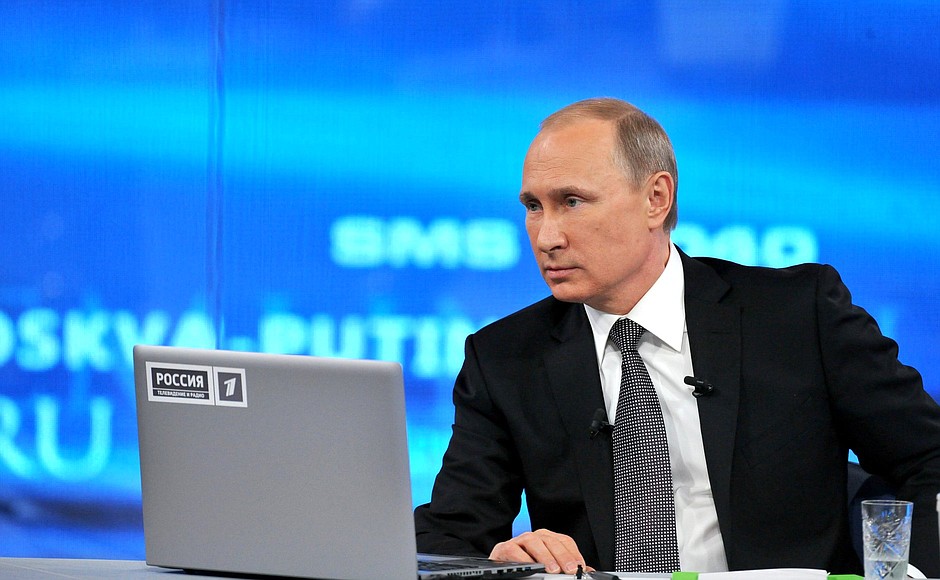
Direct Line with Vladimir Putin was broadcast live on Channel One, Rossiya-1 and Rossiya-24 TV channels, and Mayak, Vesti FM and Radio Rossii radio stations.

April 16, 2015 

15:55
Direct Line with Vladimir Putin.

During the live broadcast that lasted 3 hours and 57 minutes, the President answered 74 questions out of the over 3 million that were received.

Direct line programme host Kirill Kleymenov: Good afternoon. You are watching Direct Line with President Vladimir Putin. Here in the studio today are Maria Sittel and Kirill Kleymenov

Direct line programme host Maria Sittel: Good afternoon. Exactly a year has passed since we last met in this studio. This has been a year of serious trials for Russia: the sanctions, the drop in oil prices and the cold war atmosphere. This has been a year for us to comprehend the great tragedy that befell a fraternal people, a year when our country faced many new challenges.

At the same time, our society has become more consolidated. The Russian people’s self-assessment has grown. What is especially interesting is that the level of happiness – or the ‘happiness index’ as sociologists call it – has not gone down as one could have expected.

So, today in this studio we will discuss how we will respond to those challenges and where we are heading. We are live with Vladimir Putin.

FULL TRANSCRIPT BELOW


Kirill Kleymenov: Our colleagues Olga Ushakova, Valeria Korableva, Dmitry Shchugorev and Yekaterina Mironova will assist us during today’s broadcast on Channel One and Rossiya TV channels, while Tatyana Remizova and Natalya Yuryeva are working in the call and SMS processing centre. 

We are live with President Vladimir Putin.

Tatyana Remizova: Good afternoon, colleagues! Hello, Mr President.

Our call centre has been working for a week, and we will continue to take calls during the Direct Line broadcast. Our operators are getting ready for a peak in your calls.

I would like to remind you that you can call us at the toll-free number 8 (800) 200–4040 or send text messages to 04040. People from other countries can call at the number you see on the screen.

Over the past seven days that our call centre has been operating, we have received a record number of calls. We have already received more questions than by the end of the live broadcast last year.

We now have a total of 2.486 million messages, of which over 1.7 million are phone calls and over 400,000 are SMS messages.

Natalya Yuryeva: Good afternoon. For the first time this year, you can send your questions to the President with photos and MMS messages to 04040. A picture is worth a thousand words and will be the best illustration to your problem. Our operators continue receiving your video messages that can be sent using the website www.moskva-putinu.ru or the free app on your smartphones and tablets. Just as last year, we provide live interpretation into sign language for people with impaired hearing. We will be receiving your questions throughout the live broadcast, so there is still time to record and send in your questions. Who knows, maybe the President will answer yours.

Yekaterina Mironova: Here in the studio we have people we featured in our reports, people representing all of Russia: doctors, teachers, farmers, entrepreneurs, rescue workers and service members. They all have questions for the President.

Maria Sittel: Shall we begin?

Vladimir Putin: Good afternoon.

Maria Sittel: Good afternoon, Mr President. This has been a year when you had to take on a lot. You might say this has been a year of personal decisions for you. You had to make them quickly and accurately, and nobody could do it for you. This applies to the counter-sanctions, the diplomatic marathon in Minsk, and Crimea, of course.

The economic situation is also complicated. Given the external pressure, it also required your direct personal decisions. What are the results of the year? What have you managed to add up, what has been brought down maybe?

Vladimir Putin: This is a traditional question. I proceeded from the idea that you would ask this and this is something I would have to mention in any case. So I made some notes to make sure I do not invent things or get confused in the numbers. Actually, a lot of this has already been made public, but some figures are new and I am happy to share them with you and with the entire country.

You have already mentioned some of the results. This is the accession of Crimea and Sevastopol and the complicated foreign economic situation. Something we have said a lot about, but is worth mentioning now again, although it happened last year is our victory in the 2014 Olympics, the successful Sochi Winter Olympic Games. All this happened last year.

I would also mention the fact that we have come across certain external limitations, which in one way or another have had an impact on our growth rates, on our development, though on the whole we can now see that the ruble is gaining strength and the stock markets are on the rise. We have managed to avoid spiralling inflation.

Let us look at some specific figures. By the end of last year, Russia’s GDP has grown by 0.6 percent – a small growth, but it is growth nevertheless. Industrial production has gone up slightly more – by 1.7 percent, while the processing industry – by 2.1 percent. We have set a new record in oil production – 525 million tons, which is the highest in recent history. We also took in the largest grain crop in recent history – 105.3 million tons. Overall, agriculture demonstrated very good results with a 3.7 percent growth. We are also observing growth in the first quarter of this year, and this is good news.

There are positive dynamics in a number of other industries as well. Thus, the chemical industry has grown by 4.1 percent, the production of mineral fertilizers by 4.2, and so forth. At the same time, as you have justly noted, we do have some problems. The reduction of capital investment from small businesses was a negative signal. Thus, overall capital investment last year went down by 2.5 percent.

At the same time, housing construction has been doing very well. Our construction workers can be proud that they have also demonstrated record achievements in the entire history of the Russian state. Never before, neither in Soviet nor in post-Soviet times, and not in pre-Soviet either, I am sure, have we built so much housing – around 81 or even 82 million square meters.

We also managed to avoid a sharp hike in unemployment. It did grow last year, from about 5.3–5.4 in the middle of last year to 5.8 now, but we have managed to hold it back. I am certain we will get back to this today.

Meanwhile, the results of last year show an 11.4 percent growth in consumer prices. There is nothing good about this, of course, because this affects people’s living standards. However, in March the inflation rate has dropped. The population’s disposable income has gone down by 1 percent, while wages and salaries grew by 1.3 percent. As you may know, we have indexed pensions – both social and old age ones. Meanwhile economic uncertainty has led to a capital outflow. This is also something we need to keep in mind, but if there are questions about this, we can discuss it in greater detail. I see nothing disastrous here.

Despite the significant fluctuations on the financial market, Russia’s banking sector has demonstrated good dynamics. The portfolio of loans to the real sector of the economy has grown, and what is especially good is that the overall assets of Russian banks have grown to reach 77 trillion rubles and for the first time they exceed the nation’s GDP. This is a very good index, demonstrating the stability and reliability of the Russian banking system.

I have to say that both individuals and legal entities are now returning the money they withdrew or exchanged into hard currency at the end of last year. Thus, citizens’ deposits grew by 9.4 percent last year, while those of economic entities – by 40.6 percent, and they continue growing this year. In January, citizens’ deposits have added another 2.8 percent to reach over 19 trillion rubles, while those of organisations grew by 5.1 percent to a total of over 26 trillion rubles.

Overall, if we move on to budget issues, we concluded last year with a slight deficit of 0.5 percent and managed to prevent a spiralling into a major deficit. In other words, there is a deficit, and we envisaged a somewhat greater one this year of 3.7 percent, but it is quite reasonable.

One of the positive outcomes of 2014 was undoubtedly the positive demographics. The birth rate has gone up against a drop in the death rate. The average life span continues growing and this speaks of an overall positive tendency and public sentiment in general.

These, briefly, are the results of 2014 and the beginning of 2015.


Direct Line with Vladimir Putin.
29 of 44

Kirill Kleymenov: Mr President, the numbers you have provided mainly deal with macroeconomics and they are quite positive. However, if we consider the viewpoint of an ordinary person and judge by the questions we continue receiving on this live broadcast, the picture is not as rosy and there are quite a few problems. Let us consider the economy in detail, as this is the basis of everything.

I would like to begin with a question that was brought about by a recent publication. A participant in your meeting with entrepreneurs said you warned the businessmen at this meeting that the sanctions would not be lifted soon; that they should not expect this. First, let us set the record straight – did you have this conversation or not, and if you did, how do you see the situation.

Vladimir Putin: You did not listen to me attentively after all; you were thinking of the question you were going to ask and missed a few of the things I mentioned. I spoke of a number of positive developments, including those on a macroeconomic level, which are very important for further development. However, I also said the population’s incomes have gone down. Salaries have grown a little, but the overall incomes have dropped due to inflation of about 11.4 percent. I mentioned this as well.

As for sanctions, this conversation with entrepreneurs did take place, and I told them they should hardly expect a lifting of the sanctions because these are purely political matters, and for some of our partners I believe they have to do with their strategic interaction with Russia and with hindering our development.

Actually, I do not think this issue directly concerns Ukraine any longer, because the current goal is the implementation of the Minsk Agreements. We are doing everything possible toward this goal, but Kiev is taking its time, while the sanctions have not been lifted.

The point at issue is not the sanctions. What did I tell the business people? I told them that the issue is not limited to the sanctions, that we must find better ways to manage these processes at home, in our country and economy. And that very much depends on what we do.

We have talked about prices and wages, but what is the reason? It is clear that the reason is the pressure on the ruble, its depreciation. In turn, it is connected to oil prices. We know very well that, unfortunately, our economic development has been lop-sided for a long time, and this will be very difficult to change.

What have we been doing for the past years? Wages were growing at a priority pace, much faster than labour efficiency. And the currency rate adjustment was unavoidable – unavoidable – even in the absence of the sanctions.

In fact, the sanctions came in handy for the Government and the Central Bank, which can now blame the situation on the sanctions. But the sanctions are not the only reason. We must adjust our economic policy more professionally, consistently and quickly. It has now been adjusted.

Believe me, this is a very important decision, and both the markets and investors have responded to it. It will help improve our economy and create basic conditions for further development. So the sanctions, which are definitely contributing to our current problems, and which we will possibly discuss here if there are questions, the sanctions are not our biggest problem.

Kirill Kleymenov: But still, how long will all this last, meaning the sanctions? As long as in Iran? We know that Tehran has been living under sanctions for several decades.

Vladimir Putin: After all, Russia is not Iran. Russia is bigger; its economy is bigger and by the way much more diversified than Iran’s. Moreover, our energy policy is different from that of the Iranian authorities, and this is for a number of reasons, which I will not analyse or asses here. After all, Russia’s energy industry is much more market-based than in a number of oil and gas producing countries. So you cannot really compare the two countries.

As for how long we will have to endure the sanctions, I would put the question differently. This should not be about enduring anything – we must benefit from the situation with the sanctions to reach new development frontiers. Otherwise, we probably would not have done it. This goes for import substitution policies, which we are now forced to implement. We will move in this direction, and I hope that these efforts will foster the development of the high-tech sectors of the economy with higher growth rates than previously seen.

The Russian market was too crowded for domestic agricultural producers, especially after our country joined the WTO. But now we are able to clear it up. It is true that this had a negative impact in terms of food price inflation. So in this respect we will have to put up with it for some time, but domestic agricultural output will inevitably grow, and it will grow, especially on the back of the government support measures that are in place.

I am aware of the discontent among agricultural producers. They are probably in the studio and will have an opportunity to ask some questions. We will discuss it, but it should be noted that the support is there. Domestic production and food security are extremely important, and we will seek to ensure them. Would we have taken these counter actions or not without the sanctions? The answer is no. But now we are doing it.

Maria Sittel: It is true that Russia is a strong nation, and we can endure. Many text messages from the regions are coming to mind, in which farmers and producers are all saying that the key thing is to ensure that the sanctions are not lifted, because we are beginning to step up local production. So removing the sanctions now would be a disaster.

We will come back to this issue later. At the same time there are other questions. People are recalling your press conference from six months ago, during which you said that it would take two years for the economy to recover. Maybe it is time for you to adjust your forecast?

Vladimir Putin: Perhaps we will do it sooner. Given what we see right now – the strengthening of the ruble, market growth and other things – I think that perhaps this could happen sooner, but still, I believe, it will take about two years. Considering all the factors, we are forecasting a certain production decline later this year. But then, we assumed that the start of this year would see a considerable drop in production, but it did not.

I would like to tell you that industrial production in March of this year was 99.4 percent of what it was in March 2014, and in the first quarter of this year, 99.6 percent of the level recorded in the first quarter of 2014.

In practical terms, there has been no decline in production during the start of this year. Some growth is possible but it will be contingent on the key rate, the Government’s and the state’s economic policy, and many other factors. Still, we must do our best to keep up the positive dynamics that we are witnessing right now. It should be maintained and accelerated.

Kirill Kleymenov: We are living in an environment of sanctions and counter-sanctions. Don’t you feel that something could have been done differently?

Vladimir Putin: Perhaps there is always a chance to do something differently. I do not know if something would have been better. I think we took the best approach.

Kirill Kleymenov: Mr President, a very important question is whether we will have enough strength and resources?

Vladimir Putin: You know it is not even the matter of strength. As for resources, we certainly have a lot. The most important thing is human resources, people’s skills and willingness to work. I have had a lot of contact with people, and I know how they feel, particularly about the sanctions. But I do not want to show you the gestures – you can imagine what gestures come from ordinary people.

Our task – the task facing the President, the Government, the Central Bank, and the heads of the regions – is to get through this time with minimal loss. Can we make it or not? Yes we can, and it is not about being patient. We must use the situation to our benefit. And we can do this.

Maria Sittel: What other threats could Russia be faced with this year?

Vladimir Putin: You know, there are lots of unpredictable threats out there, but if we manage to maintain a stable political situation in the country and keep our people as united as we are now, we will be immune to any threats.

Kirill Kleymenov: Mr President, I would still like to focus on some negative issues. The crisis is still here. The Government came up with an action plan to overcome it, but frankly we have not seen any results so far. Sometimes, it seems that the key strategy boils down to our expecting oil prices to improve, and the oil money to start flowing into the budget, thus resolving all the problems.

Vladimir Putin: This is an overly critical assessment of the Government’s work. Of course, the Government should always be criticised, just like the President and the governors. Everyone needs critical feedback as a matter of fact. Generally, criticism helps to look at things from a different perspective, which is always good.

Still, adopting a socioeconomic stabilisation plan for our country under such circumstances is not an easy task and requires a highly professional approach. These things cannot be dealt with in an offhanded manner. You cannot just throw money at the problem thinking that we have an infinite supply of it.

So, it took the Government some time to sort things out and see what needed to be done and what it takes to accomplish it. However, the plan that I mentioned was adopted in late December, and it is now being implemented gradually.

Could it have been done faster? Probably yes, we could have moved faster. Nevertheless, this action plan has been thoroughly thought out, and I believe it adequately reflects the current state of our economy. What I mean is that, first, this is an ambitious plan with a budget of 2.3 trillion rubles, which is a lot. Of this amount, 900 billion rubles were used to directly support the banking system, which is, according to some experts, the lifeblood of our economy. No matter who criticises the Government or the Central Bank, it must be admitted that these actions are correct and justified, which can be corroborated by the previous 2008–2009 crisis.

Moreover, 250 billion has been allocated to the goods-and-services sector, also via banks, but in effect straight into the real sector of the economy. A decision has been made to boost the capitalisation of the United Aircraft Corporation, i.e., to inject 100 billion rubles into the aircraft manufacturing sector. Over 82 billion will be provided to support the labour market and 200 billion plus 30 billion in guarantees to the real sector and for the specific project.

The Central Bank has provided for an entire package of what I regard as timely and economically vital measures. As I said earlier, we indexed pensions at the beginning of the year. In other words, a number of decisions were made in the tax sphere that we will probably discuss later. There is a separate programme to support the agricultural sector. Also, in the domestic transit sector − say, rail transit – things have not been finalised there yet, but nevertheless, a decision has been made to introduce zero VAT on commuter rail services, reduce VAT on domestic air services by 10 percent, and so on. In other words, there is a package, a comprehensive set of measures, and they are beginning to work.

It is probably not quite fair to say that we are not seeing the results. I understand that prices are still what they are, although they started falling in March. This is also a fact – perhaps not in all regions, but it is evident on a countrywide level. The ruble has also stabilised and strengthened. So it would be unfair to say that there are no results. Perhaps there were greater expectations, but this is exactly why I say that we should face up to reality and choose the right direction to move in. I believe that the Government has made the right choice and we are moving down this path.

Kirill Kleymenov: But by all accounts, the strengthening of the ruble has different causes.

Vladimir Putin: Do you think so? What causes?

Kirill Kleymenov: First of all, oil prices have grown slightly and stabilised. And then there is also an element of speculation because funds are simply being converted into rubles, since ruble interest rates have significantly increased.

Vladimir Putin: But why have they increased? (Laughs)

Oil prices indeed have gone up a little, but this is directly connected – and experts are already seeing this – the strengthening of the ruble is connected to oil prices, but this strengthening is not directly related to this increase.

There are other factors involved, and I have already mentioned the main one. Experts see that we have passed the peak of the problems with the repayment of external loans by our banking and other enterprises in the real sector, and we have adjusted the national currency exchange rate. And nothing went bust, everything works.

Yes, we have some problems: inflation has gone up, unemployment has increased slightly, but not like in the Euro zone: it is over 11percent there and here it is, so far, just 5.8 percent. So, all this contributes to the shoring up of our national currency.

Maria Sittel: Let us bring the citizens into our conversation. We will, in one way or another, chip in on various topics. So, while the Government is working on the anti-crisis plan, ordinary people are worried about prices: the prices of housing, medicines, and food.

Vladimir Putin: Pardon me, I would like to make a minor correction if I may. The Government has completed work on the anti-crisis plan. The task now is to put it into practice.

Maria Sittel: Very well.

Primorye Territory, Natalya Vorontsova: “Prices here have already gone up dramatically, the wages are the same and even lower than before, and there are massive lay-offs. We are not living – we are surviving. How long will this go on?”

Vladimir Putin: We have actually already begun to talk about this. It is true – and I said it at the very beginning – that people’s real incomes have dropped somewhat because of the inflation, which leapt to 11.4 percent last year. We will have to take that into account in our social policy by assisting, above all, the vulnerable social groups, the citizens who experience the most hardship.

The second most important task is to preserve jobs. I have already said that certain resources — and that is over 82 billion rubles — have been set aside to preserve jobs. If necessary, that money will be used. I also hope that the downward inflationary trend, in any case its rate of reduction, will remain the same, partly due to the strengthening of the national currency.

Maria Sittel: Thank you.

Let’s give the guests in our studio the opportunity to ask some questions.

Olga Ushakova: Mr President, we have many small business representatives here in the studio, and they certainly have a lot of questions. I would like to give a businessman from Nizhny Tagil, Sergei Partin, an opportunity to ask his question. He is the owner of a mobile confectionary company.

Sergei Partin: Good afternoon, Mr President. Hello Russia. I have the right to ask the first question, thank you. First, I would like to say that the measures to support young businesspeople and those who have only started their business are efficient. Ours is a good example of this. Two years ago, we launched a production company, and this year we have become Russia’s best youth business project. So we keep on working and doing it efficiently, and we wish the same to everyone.

We are experiencing a problem with youth personnel, and we are solving it at the local level. The point is that young people leaving school and even graduating from universities are unaware of what their talents are, how they can benefit Russia, and what they want to do in life. So my question is, how is the problem of early career guidance of young people going to be resolved at the state level? Thank you.

Olga Ushakova: As I understand it, you are ready to share your experience with us.

Sergei Partin: Yes, I have mentioned that we have some experience, and it helps a lot.

Vladimir Putin: What do you produce?

Sergei Partin: At the moment, we are making candies and expanding the business through franchising. We are teaching people excellent cooking skills, both children and adults.

Vladimir Putin: See? This is a perfect example of what can be done and in what way. Training professional personnel, particularly in production, is a key element for growth in the near term as production itself is becoming more complicated and we really need highly skilled workers in the first place.

We work closely in this area with business associations – those representing small, medium-sized and large businesses. We have agreed with them on a variety of cooperative measures. These include competences in many areas, the joint organisation of in-production practice and so on. Without this, it is simply impossible to move forward – this is obvious. The Government has a comprehensive programme for action in this area.

But of course, you are absolutely right: it would be better to start this career guidance at an early stage, in school. Yesterday, I had a discussion with my colleagues. In large cities like Moscow, almost 100 percent [of young people] want to move on with higher education. Striving for knowledge is, incidentally, a very good thing of course, but it shows, among other things, that career guidance at school, which you mentioned, is still poorly organised here. We’ll work with you on this.

Kirill Kleimenov: Let’s give our guests an opportunity to ask questions. Valeriya, please.

Valeriya Korableva: I would like to give the floor to Alexei Kudrin, the former finance minister, an eminent expert who has twice been recognised by the international community as the best finance minister in the world.

Mr Kudrin, your question please.

Alexei Kudrin: Good afternoon, Mr President.

Vladimir Putin: Good afternoon.

Alexei Kudrin: This is also about the economy.

Vladimir Putin: I see.

Alexei Kudrin: During your first presidential term, the economy grew by about 7 percent on average, even though oil cost approximately $30 per barrel. But during your current term, the average economic growth rate will be about 1.5 percent even if the price of oil goes to $65-$70. That is, there will be negative growth years and positive growth years, but the average rate will be about 1.5 percent, which is lower than the world’s average.

The global share of the Russian economy will decrease. There will be insufficient investment in technical progress and modernisation. We will lag behind the [industrialised] world technologically. Unfortunately, this will affect our defence capability, which depends on the economy and technological standards. No matter if we say we can manage, the figures I have provided are almost hard facts for the period until 2018. It is unfortunate, but we will be lagging behind the world.

You also said that the Government is adjusting its policy. But I do not think that adjustments can save the day. The old economic system has exhausted its potential, and nothing new has been proposed so far.

What can you do to help us create a new growth model?

Vladimir Putin: Mr Kudrin, we have worked together for many years, and we have very good and nearly friendly relations. I know your views on this matter. And you have presented your forecast very clearly, and it is very close to what can indeed happen.

To begin with, you were among the authors of the programme of the development of our country and its economy through 2020. “2020” is a well-known programme and it has not changed in any significant way. If you and I overlooked something, this has to be our fault, including your fault.

But we have to proceed from the realities of today and – you are right – to look at what is happening in the world and in our economy. The blueprints are known: we have to provide better conditions for business, we have to provide better conditions for private investment, we have to improve our monetary policy, and of course we must greatly improve the system of running the country as a whole, the Government and individual sectors, we must improve the work of law enforcement agencies and the justice system. This is a complex task. It is easier said than done, but of course we have to do it. As they say, “don’t dwell on it, deal with it.” We must do it.

Of course there are things that are well known, but, as they say, this requires political will. You know that in spite of the fairly difficult conditions, we are exerting certain efforts in the direction you and the people who share your views on the development of the economy have recommended.

For example, this year, the Government has not adjusted for inflation certain social benefits. I am aware that your colleagues, those who share your point of view, say this is not enough and that perhaps we should make more reductions and freeze more expenses, and reduce incomes because wages are growing too fast, that the retirement age should be raised as soon as possible if we are to balance the pension system in which we have to funnel huge resources out of the budget and the reserve funds. All this impedes our development. Theoretically, this is true, of course. To shape economic policy competently, a brain is definitely needed. But if we want people to trust us, we need a heart, too. And feel how ordinary people live and how this affects them.

If we keep people’s trust, they will support everything we do and even will be willing to put up with this situation, as our colleagues have assured us. But if we act while disregarding the people, then we will quickly roll back to the early 1990s, as I see it, when we will lose people’s trust and will have to spend much more money on social issues than is stipulated for onward movement, even if at a slow pace, like it was when we decided to convert from benefits in kind to cash payments, a sharp move that ultimately cost huge amounts of public funds. To prevent this, we will do what the Government and the Central Bank have proposed. I think this will suffice.

We will see if our lag will be really serious. Just look at the level of the US national debt, which is now higher than its GDP. This is an alarming sign, a red flag for the entire global economy. And we do not know which turn the events will take there.

The Euro zone has a huge amount of problems. It is coming apart. What will the debtor countries, whose debts have reached 174 percent of GDP, do? What will happen in Europe? Will the Euro zone leaders be able to help the underperformers? We do not know this either. So we will above all focus on ensuring high growth rates, but in doing so we will try to avoid putting an excessive burden on the people. Everybody knows this very well. Well, maybe not everybody, but Mr Kudrin knows enough as a member of the Presidential Expert Council. You know that we highly respect your opinion, and I personally respect it, honestly, and we will definitely listen to what you have to say.

Alexei Kudrin: Mr Putin, may I explain one detail?

Vladimir Putin: Yes, certainly.

Alexei Kudrin: The fact is that reform in the social sphere is part of structural reform. It is not entirely accurate to presume that my colleagues or I propose reducing incomes or freezing salaries. Targeted social assistance is one of our ideas. That is, the way things are now, someone needs to be paid more based on considerations other than average wage or benefit increase ratios. However, others may have to get by with smaller salary adjustments. Different approaches depending on household income are more efficient even before a crisis or in-between crises, all the more so during a crisis. This is my first point.

My second point is that, after all, our proposals are designed to curb inflation. Current inflation as of early April is up 17 percent compared to April 2014. This jump may not have happened if other reasonable measures had been taken, and the standard of living and real income would not have declined so much in that case. Remember when I said earlier that salary increases should not outpace labour efficiency? But that adjustment has now happened. If wage growth had stayed with labour efficiency growth, this adjustment would have been less pronounced. I wanted to clarify this.

Also, I believe that the Presidential Council, its Presidium, is too sluggish. It should work harder.

Also, Mr President, one more point: Strategy 2020 was developed, but it was not adopted by the Government. It remains a draft. About 25 percent of it was used for drafting various Government measures, but the strategy itself is not working. That is why I am saying that under the current circumstances we need a programme that can clearly identify the goals that we can reach despite the sanctions imposed on our country.

Thank you.

Vladimir Putin: Programme 2020 is a guideline for our development and it is still in effect. As for the targeted nature of social assistance, I completely agree with you, and the Government has been instructed to work on this.

Regarding the issue of wages rising out of proportion to the rise in labour efficiency, I have already expressed my position on the issue and I believe that you are also right. Simply put, it is always more difficult to do this on the practical level than in conversation, even during direct lines, directly with the people, because the level of wages, the level of income, especially in such a sphere as school education, is too low to count on real results.

Granted, this leads to imbalances, like those that we have today. Yes, this happens, but on the whole we should seek to ensure that – as this is the case in some sectors – wage rises should follow productivity, not vice versa. This is true.

Maria Sittel: It is very important to preserve people’s trust, as you said a few minutes ago, and Russian people are willing to help you here by drawing your attention to the fact that the authorities, with their ill-considered actions, for example, provoke uncalled-for price hikes. I am now talking about the counter-sanctions and the fact that they have been successfully bypassed. For example, here are two short text messages: “Why is it that we were promised import substitution [programmes] but in reality we are buying the same things, only through ‘friends’?” The word “friends” is used here in quotation marks, meaning that imports are coming through intermediaries. The other message: “Despite the embargo, we continue eating Polish apples and cabbage. They have never disappeared from the shelves. In September, we had them at 35 rubles [per kilo] and in the winter they were 85. The deception is simply outrageous: They arrive in the same containers, but without the stickers or with stickers from other countries, and sales assistants know that these are Polish apples.”

Vladimir Putin: It would also be good to know who provides customs clearance for these shipments. If this is true, and it could actually be the case, we will try to eradicate such practices. Honestly, this actually makes the situation on the food market somewhat less dire. As I’ve already said, the counter-measures we have taken led to an increase in food prices, driving up inflation. Still, this is an issue of being dishonest about what you do. Please, let me know where such things are happening.

The main thing now is not to fight simply such negative developments, but to focus on fostering growth in the domestic agriculture industry. This way we will be able to free our shelves of foreign goods by economic means, coupled with a dose of administrative pressure based on counter-sanctions, so that domestic producers can have the place they deserve on store shelves.

Kirill Kleymenov: Let’s continue with agriculture.

Here is a text message confirming what Maria has just said. It comes from Yury Lang from the Novosibirsk Region, who works in agriculture. He writes: “Mr President, agricultural producers are asking you to refrain from lifting sanctions against foreign producers, give us a chance to flood the market with our own organic products. I’m afraid that foreign goods could invade our markets.” We have an opportunity to understand whether Yury’s colleagues in other parts of the country share this sentiment. The Stepanovo village in the Kostroma Region, where our colleague Pavel Krasnov is working, joins us now.

Pavel Krasnov: Hello, Moscow. This is the village of Stepanovo in Kostroma Region. We are now on a farm; there are perhaps thousands of similar farms in Russia. This cattle-breeding farm – you can see its structures around us – is the work of local farmers. Three farmers here in Stepanovo have formed a company to produce beef and milk. This farm is the result of their efforts. It is not big compared to others but, I repeat, it is like many others in this country. And the issues that concern the local farmers are certainly the same as those that interest their colleagues in other regions of Russia. These issues, of course, have to do with agriculture and support for it. But the professionals themselves can state their case much better than I. I’ll give it over to them.

Mikhail Rumyantsev: Good afternoon, Mr President. My name is Mikhail Rumyantsev, and I am a dairy farmer. I would like to ask you about state support. We have many agricultural programmes, perhaps even too many. But for some reason the money that comes to this region is shared mostly among major producers, big farms, and investors, while we, ordinary farmers, are left with crumbs. We would like this injustice to be rectified. Thank you.

Vladimir Putin: Let me report in general on what is being done in the agricultural sector and in terms of its support. The host has just read a question asked by one of your colleagues, an agricultural producer. He said that we should keep the market free of foreign goods. But there is the other side of the coin, the consumers, who want quality goods at acceptable prices. This is why the state has developed a system of measures to support agriculture as a whole. This system includes two tax support options: a simplified tax system and a second system. Which one do you use?

Mikhail Rumyantsev: I pay agricultural tax.

Vladimir Putin: Unified agricultural tax, right? But this year we have introduced additional support measures. What are they? One of them – and I think it is the most significant one – is the increased subsidies for bank interest on loans that entrepreneurs use to increase their working capital. It used to be that the government only subsidised 5.5 percent of the bank’s interest rate on loans; now it is 14.7 percent. This means that if you, for example, borrow at 20 percent, you pay an interest of 20 percent minus 14.7 percent. However, if you borrow at 25 percent, your resulting interest will be 10.3 percent. But I hope that, once the Bank of Russia takes some steps to cut its key rate, borrowers’ lives will be easier.

We have allocated an additional 50 billion rubles to support agriculture this year, and approved another 4 billion to subsidise equipment leasing. Two of the four billion, I think, went to Rosagroleasing. Other government measures involve increasing the “per-hectare” support by 8.5 billion from the former 14-something – probably 14.5 billion rubles.

Now, regarding the support for small agricultural businesses such as yours. Our recommendation to regional governments is to provide two million each to start-up farms. The money comes from the federal budget.

You were right to say that there is a whole package of support measures. It is difficult to say why the support never reaches the small businesses it is meant for. To find out, we might need to explore the situation in your region specifically. The area you are working in is certainly a challenging segment of agriculture, so the government will need to think of more ways to support dairy producers. Right now, purchasing prices are often below your production costs, I know that. We understand your problems and will try to help you.

As for the problems your farm is facing, specifically, and the situation in your region, we’ll have to take a closer look and maybe talk to your governor. Which region is that?

Maria Sittel: Stepanovo in Kostroma Region.

There are more farmers here with us in the studio today, so let’s give them a chance to ask their questions.

Dmitry Shchugorev: In fact, every time I speak to farmers I see that these people carry endless optimism, despite everything – and there are many “despites.” For instance, here we have an ordinary Russian farmer who goes by the simple Russian name John. He arrived in Russia 23 year ago, and he’s been a citizen of Russia since 1997. I spoke to him – and to my surprise, I have learnt that throughout all these years, his farm hasn’t yielded a penny of profit.

Mr Kopiski, you have the floor.

John Kopiski: Good afternoon, Mr President.

Vladimir Putin: Good afternoon.

John Kopiski: Today we have 3,700 cows, of which 1,700 are milking cows. Each cow produces 10,000 litres of milk a year. We sell milk below cost, and we have no money in reserve. Now, after the well-knownconflicts, the cost has increased. Today we have to sell our milking herd as we have absolutely no money.

I cannot develop my farm and build new farms because I have no profit. I have been in this business for 15 years. I cannot develop my farm if I can’t get a long-term loan not only for 15 but for 20 years, provided that a bank agrees to provide this money. You do a lot of good things, but banks are a different story.

So I cannot develop my farm if a bank demands collateral of at least 120 percent. A colleague of mine has collateral of 200 percent. To get the loan, my own contribution should sit at 30 percent. Even, as you have just mentioned, with a 26 percent interest rate. I can only hope that we’ll have to actually pay a 13 percent interest rate… If so, then when? Two years ago, I had to wait for 11 months. And we can be out of business any day.

You have the statistics. Everything looks fine, but, forgive me, this is not so. Please forgive me if I ask you a tough question, but I have five children and I love Russia. Russia is their homeland. I want their future in Russia to be secure. My son has been working in England for two years and he wants to return, but he doesn’t want to run a dairy farm. He told me: “Dad, I’m not a fool.” The future can only be built with the truth. Problems can be solved only if you know the real facts.

I am sorry, here’s my question: do you believe the statistics they show you, or are they lying because they are afraid to tell you the truth? I don’t like statistics.

Vladimir Putin: How did you end up here (in Russia)? Was it a case ofcherchez la femme? It means “look for the woman involved.”

D. Shchugorev: John has a Russian wife.

John Kopiski: I’ve been married to a Russian woman for 23 years, my whole family is Russian.

Vladimir Putin: Regarding trusting or not trusting statistics. Every country has some complaints about its statistics, but I do trust the figures they give me. If you noticed, answering the man who is in fact your colleague, the man from Kostroma who was just asking a question and who also produces milk, I told him right off that the procurement prices for milk are below cost, and this creates problems. These are statistical data. So I have no reason to mistrust these statistics.

The question is what to do to improve the situation? I have already mentioned one step. The Government has decided to increase subsidies on loans to replenish working capital. Anyway, you have been a farmer for so long and you continue to do it, which means that if things were really so bad, your business would have gone under, but in fact it exists.

There is also the issue of dried milk, which is imported in huge quantities, and we keep saying that dried milk imports, for example from Belarus, are ultimately decreasing the prices of Russian goods. As in any other economic association, we will talk it out with our partners in a frank manner to coordinate the methods and the level of subsidies for the agriculture industry as a whole and for individual sectors, including the dairy sector. This is first.

Second, we will certainly have to increase support. I think the Government will have to increase support, including in this particular sector, if we want to preserve dairy production.

However, there is one more component here. You mentioned milk yields. I do not know if milk yields are high at your farm, but I do know that the Russian average is low. Compared to other countries, our dairy industry is ineffective. What is the average for our country? What is the figure at your farm?

John Kopiski: The [annual] yield is above 10,000 litres, or 29 litres per day. I think that if we consider statistics, if we have honest statistics for forage-fed cows, we cannot say that the average annual yield in Russia is below 5,000 litres. The yield at my farm is higher.

Vladimir Putin: Twice as high.

John Kopiski: But that is because we do not have so many forage-fed cows. This is not right, because you need to manage your business, especially the dairy business. Pardon me, but this is very important.

Vladimir Putin: It is important indeed.

John Kopiski: So where is the reality?

Vladimir Putin: It is important, I agree. We are aware of the reality. You may think that this is not the case for me or the Government. But we do know how things are, and I hope that the Government will make relevant decisions to this effect, as I have already said.

Maybe what has been done so far is not enough. That said, quite a bit has been done on the back of some restrictions, including budget constraints. We have to balance the interests of a number of industries, although agriculture is currently among the priority areas. What I mean is that we are freeing up the market for domestic producers. We will keep working with you on this. Let’s wait and see.

As for statistics, I am inclined to trust rather than distrust them.

Kirill Kleymenov: Thank you. Let’s hear another question from Kostroma Region. Pavel, go ahead.

Pavel Krasnov: Here’s another question. We have set up a special display to illustrate it: a bottle of locally produced milk from the Stepanovo village. This isn’t a coincidence. So, what is your question?

S. Smirnov: Hello, Mr Putin, greetings to you from our staff. Hello to the people of Russia.

We are a small company, but still we are contributing to some extent to the wellbeing of our country. We produce milk and meat. Unfortunately, we now find it very challenging to sell our products, to get it to the customers. So I would like to ask two brief questions.

The first question has to do with what is known by the blanket term “social sphere”: kindergartens, schools, specialised boarding schools and so on. I would like our products to go directly to these institutions because we produce high-quality milk. Milk powder is good, but it needs to be rehydrated before it can be used. We provide real full-cream milk, and we find it difficult to compete with those who buy and resell. We don’t do this; we just need to sell what we produce. This means agricultural producers like us need some quota in this market niche, even a small one. This is my first point.

The second is that we need to reach our customers directly, to be close to them. We need to organise our own retail business, even a small one, small shops maybe or trailers, but we want to be able to offer customers our products bypassing large grocery chains, intermediaries and so on.

The math is quite simple really: we can supply our milk to a dairy plant which pays us 16–17 rubles a litre, while in a store, the kind of full-cream milk I have here costs 72 rubles or more. So who earns more per litre of milk: we, who produce it, or those who buy and resell?

So that is why farmers are so keen to have a channel to sell their products directly to customers, so that customers would be able to buy directly from their farmers.

Thank you.

Vladimir Putin: About the cost and purchase prices – we have already agreed that this is an issue we certainly need to address.

With regard to selling your product, milk. We have talked about this many times, and even adopted special legislation to protect agricultural producers and help them get their produce to grocery stores. If that is not enough, we can come back to this again and review this issue one more time.

Regarding the use of milk in social institutions, such as kindergartens, schools, etc., these issues should be addressed at the regional and local levels. I hope that your governor and other governors hear us and will act upon this.

However, in this case, you will still need to look at the price level, because if a region buys something, milk in this particular case, then of course, the regional authorities will be thinking about how much they can afford to spend on a particular product (it involves budget funds, which are limited).

And, finally, your last proposal, or rather idea, to operate through your own outlets. You are talking about large urban areas, right?

S. Smirnov: Yes.

Vladimir Putin: That’s what I thought. Does it have to do with purchasing some retail space or setting up temporary selling spots? Is that what we are talking about?

S. Smirnov: I am not talking about the markets, because first, milk is a perishable product, and second, we want to be closer to our customers. We want to establish a presence in residential areas. There are clean water programmes with small outlets selling clean water. We need municipal authorities to give us five to six square metres in a city and hook us up to a power line. We will build a stall, which will be part of the urban development plan. So, everything will look good and neat and will be consistent with the sanitary-epidemiological regulations.

Vladimir Putin: I am sure it will. You know, there are misgivings, in particular among local authorities, because of the negative experience with outdoor markets, even very small ones. There is a problem here, that retail chains and individual stores sell expiring or expired goods to these small markets.

But you are speaking about very practical issues related to the marketing of particular goods, and I fully agree with you. We will send a signal to the heads of regions, who will in their turn get to the municipal authorities. I see nothing bad in this; the idea is very good because it will reduce the distance between the producers and their buyers. Indeed, we sell kvass and water at outdoor facilities, so why not sell milk too?

I fully agree with you. I will certainly discuss this idea with governors.

Thank you, and good luck.

Kirill Kleymenov: We thank the village of Stepanovo for taking part in this Direct Line.

We can also take questions from the audience. Valeriya, go ahead please.

Valeriya Korableva: We have a question on foreign policy. We have here MGIMO Rector Anatoly Torkunov, a diplomat, historian and political scientist.

Anatoly Torkunov: Thank you.

Mr President, we know that our prosperity and economic development largely depend on foreign developments, the global political agenda and international relations.

My question is specific rather than global. This week the media carried dozens and even hundreds of comments on Monday’s statement about the lack of obstacles to sending S-300 air defence systems to Iran. At one point we signed this agreement with Iran but then suspended it later.

In commenting on this issue, both journalists and politicians expressed many apprehensions over sending the S-300 missiles, that it would impede the completion of our six-way talks on Iran’s nuclear programme. Moreover, some of them even claimed the air defence systems would aggravate the situation in the Middle East.

This morning I also read Angela Merkel’s statement that the sanctions should have been cancelled simultaneously rather than one by one. Meanwhile, some people in Israel are saying, as you may have heard, that if the S-300 systems are sent to Iran, Israel would take its own measures, including arms sales to Ukraine. I would like to know what you think about this.

Thank you.

Vladimir Putin: Indeed, we signed this contract way back in 2007. In 2010 it was suspended by a presidential executive order because of the problems over the Iranian nuclear programme. This was really the case, but today we can clearly see – and you understand it well, as an experienced person – that our Iranian partners are demonstrating a lot of flexibility and an obvious desire to reach a compromise on their nuclear programme.

In effect, all participants in the process have announced that an agreement has been reached. Now they only have the technical details to deal with, and they will complete this before June. This is why we made this decision.

I have not read or heard the statement by the German Federal Chancellor and cannot comment on it for this reason. But if someone fears that we have started cancelling the sanctions, apparently our colleagues do not know that the supply of these systems is not on the UN list of sanctions. We suspended this contract absolutely unilaterally. Now that there is obvious progress on the Iranian track, we do not see why we should continue imposing this ban unilaterally – I would like to emphasise this again.

As for the list of sanctions envisaged by the UN resolutions, we will of course act in unison with our partners. We have always cooperated with this, and I would like to stress that we have made a large contribution to the settlement of the Iranian nuclear issue.

Moreover, our companies made this equipment. It is expensive – worth about a billion dollars ($900 million). Nobody is paying our companies for these systems. There was a hint that they could be bought, but nobody buys. So we have to ask: why should we take the loss?

But the situation is improving and this equipment is not on the sanctions list. I think that on the contrary, our Iranian partners should be encouraged to continue in the same vein. In addition, there is one more aspect to this problem.

You mentioned the position of our Israeli partners. I must say, in our military arms exports we have always focused on the situation in the region in question – most importantly, in the Middle East. Speaking of which, we are not the Middle East’s largest arms supplier. The United States provides many more arms to the region and takes a much greater profit.

Well, just recently, Israel expressed concern over our exports of the same S-300 missiles to another country in the region. They stressed that if successful, this arrangement could result in big changes, even geopolitical changes, in the region because the S-300 can reach Israel from that country’s territory even though it is not an aggressive weapon. But as one of my counterparts said, none of Israel’s planes will be able to take off. And this is a serious problem.

We consulted with our buyers. Our partners in one of the Arab countries were quite understanding about the issue. So we cancelled the contract altogether and returned the advance payment of $400 million. We are trying to be very careful.

As far as Iran is concerned, it is a completely different story that does not pose any threat to Israel whatsoever. It is a solely defensive weapon. Moreover, we believe that under the current circumstances in the region, especially in view of the events in Yemen, supplies of this kind of weapon could be a restraining factor.

Maria Sittel: Mr President, we will get back to foreign policy later. I would like to steer the conversation back to Russia. Many people are complaining about high interest rates. I have two messages here.

Larisa Kim from Sverdlovsk Region: “Sberbank raised interest rates for small business loans that had already been extended by three percentage points, effective April 2015, and this despite the fact that the Central Bank is cutting its interest rates. New loans are now offered at an interest rate of 23–25 percent. Is there a way to influence how Sberbank provides financing to small businesses?”

Here’s a follow-up question. Sergei Yermachenko from Irkutsk: “When will loans become more affordable and reasonable in Russia? Interest rates at 35–55 percent kill the appetite and opportunities for business development.”

Vladimir Putin: Regarding small and medium-sized enterprises, support programmes are in place. I will not name them all. I think that those involved in SMEs should be aware of them. This information is public, you can find it online or through relevant business associations.

Just as with agriculture, it may seem that initiatives targeted at SMEs are underfunded. This is the way people should actually feel, because small and medium-size enterprises account for a smaller share of GDP in Russia compared to developed economies. Without a doubt, this is not the way it should be.

One of the main vectors is to create clusters of small enterprises serving major corporations. This is a project for the future. That said, we already have SME quotas in state and municipal procurement. A decision to provide a two-year tax holiday for people starting a business has already been made. This measure is especially relevant for entrepreneurs in rural areas, since they can also benefit from programmes offered by the state loan guarantee agency. The Central Bank of the Russian Federation maintains its interest rate for commercial banks at 6.5 percent. It is true that only one bank, a subsidiary of Vnesheconombank, currently offers such loans. Just recently, I was told by the Central Bank Governor that they intend to increase the number of banks offering such transactions. A bank with SME loan contracts will be able to benefit from a 6.5 percent interest rate from the Central Bank, which means that borrowing costs will be lower compared to market rates.

However, what you have said is, of course, over the top. Naturally, it is important to see what kind of client the bank is dealing with. If there is no collateral, if there is no credit history, then of course, the bank will increase the interest rate. But 35 or 55 percent is an unrealistic figure. Sberbank’s principal shareholder is the Central Bank of the Russian Federation: the Bank of Russia. I will certainly ask Elvira Nabiullina to look into what is going on there. Leave me this information.

Maria Sittel: 35, 55 [percent] – this is not Sberbank.

Vladimir Putin: And the previous one – what was it?

Maria Sittel: 23–25 – Sberbank.

Vladimir Putin: 23–25, maybe that was before the key interest rate was reduced? Well, anyway, this needs to be looked into. Please, give me this information later as well, okay?

Maria Sittel: Right, we will give it to you after the programme. This seems to be a good time for questions about the civil service, because there really are a lot of them. It seems that in turbulent times people pin special hopes on the civil service, with a lot of them asking questions like these: “How professional, in your opinion, is the civil service?” “Is it not the time to bring professionals back into the civil service?” and “Maybe a professional banker should be appointed to head the Central Bank?” These are the kinds of questions being asked.

Vladimir Putin: What “bring professionals back to the civil service” mean? There should always be professionals in the civil service. If there aren’t, this is sad. In fact, we are short of professionals. Incidentally, we seek to provide appropriate wages to attract the most proficient and best-qualified people from the labour market to the civil service. To reiterate, it is always better to have professionals in the civil service to prevent crises. However, if a crisis has struck for objective reasons, then we should find our way out of it with gains, not losses.

Speaking of the Central Bank, I have no major claims concerning its work. By the way, what do you mean by “returning a banker to head the Central Bank”? The Central Bank is not just a commercial bank; actually, it is not a commercial bank at all, it is the main regulator of the Russian monetary and credit sector. Now it also has been vested with larger authorities. That is why a person is needed who has a good knowledge of the work and functions of a banking system, but it has to be a specialist with specific knowledge, economic knowledge, in the first place. One can criticise the Central Bank – and here is a hidden criticism of the Central Bank – for its delay in taking a decision on raising the key interest rate. If they had done it earlier, then probably it wouldn’t be 17 percent. But I would like to stress that overall, all experts – both Russian and foreign – consider the Central Bank’s actions to be professional and efficient, with the necessary results achieved.

Kirill Kleymenov: Now it is time for us to link with the centre for processing phone calls and messages. But first, I would like to ask a question that comes up frequently. “Mr President, foreign currency mortgage borrowers are in trouble. I am appealing to you concerning the currency mortgage issue. We are aware of the Government’s negative attitude to this problem. We are not asking for our debts to be waived, we are asking to re-evaluate, on a legislative basis, the exchange rate in effect until devaluation and thus to make us equal with ruble mortgage borrowers. A law is needed here, as banks will not reject excess profit voluntarily. We are ready to continue paying the mortgage loan to the bank, but on adequate and reasonable terms.” And so on. Mr President, what do you think of this issue?

Vladimir Putin: My overall opinion on people’s problems is that one must always aspire to help them. The reason the state exists is to help people.

What is this particular case about? Not the one that you just read, I do not know who wrote it, but in general, how did the problem arise? No, let me approach it from a different angle. You know, mortgage loans in foreign currency are worthwhile for those who get paid in foreign currency. Assume someone lives in London, New York, Paris or Berlin and is paid in euros or dollars, but plans to live in Russia, as our friend from the United Kingdom and his children, who want to move to Russia. They get paid in foreign currency. His son lives abroad and is paid in foreign currency. He can take out a mortgage loan in foreign currency, because he does not expose himself to the exchange rate risk. However, if someone gets paid in rubles, but takes a loan in foreign currency, he or she would assume this risk. If the rate changes unfavourably, he or she will get in trouble. We should look into that. I am not familiar with the details, but when people take mortgage loans, banks do not assume the exchange rate risk. That way, customers assume this risk on their own accord.

With regard to those who took a mortgage in rubles and found themselves in a tough spot, the Government decided to help these people out. Some money, about 4.5 billion rubles, has been allocated from the budget to this end.

Kirill Kleymenov: Are you talking about the people who took out loans in rubles?

Vladimir Putin: Yes. But this applies only to people who found themselves in a tough spot, such as having lost their jobs. Perhaps the Government can think of ways to help those who took out a mortgage loan in foreign currency due to an unfavourable exchange rate, but this assistance should not be greater than the one provided to the people who took mortgage loans in rubles. In any case, the approach should be uniform.

Kirill Kleymenov: I just wanted to make a small clarification in defence of those people. The fact is that often mortgage loans in foreign currency were taken by customers who bought housing on the secondary market, and they had no choice. The banks did not extend ruble mortgage loans to buy pre-owned real estate.

Vladimir Putin: No, banks are required to extend mortgage loans in rubles. We do live in the ruble zone. But this is a different story. If they refused, you should have insisted, because the interest was as high as 12%. As I said, last year we reached a record volume of housing construction at 12% interest rate. That was for the first time in Russia’s history. The 12% interest rate actually turned out fine enough. Now, the Government also plans to support mortgage and has already approved financing for this.

Kirill Kleymenov: You mean new housing.

Vladimir Putin: Yes. I mean new development projects, and yes, our goal is not only to help people get new housing at affordable prices but also to support the construction market, which, in turn, creates a great number of jobs and encourages employment in related industries, such as building materials and so on, in power engineering and road construction. It is an important sector of any economy – the Russian economy as well.

This is another reason for our decision to subsidise mortgage loans. Mortgage interest has increased to 14%, and we aim to cut it to last year’s level of 12% to revive and support the growth of the construction sector. I think this is achievable.

As for foreign currency mortgages, we should help there too, but let me repeat that the approach and philosophy of that assistance should be comparable to our support for people who have found themselves in a difficult situation, but who had taken their loans in rubles.

Maria Sittel: We have been on air for almost an hour and a half, so let’s look at what’s happening at our message-processing centre. Let’s hear from Tatyana Remizova.

Tatyana Remizova: Thank you, colleagues.

In an hour and a half of this call-in, the number of questions has exceeded 2.8 million, including 2 million submitted by phone.

The Rostelecom lines are overloaded. Our operators are processing almost 4,000 calls a minute. There are a lot of questions about the ruble exchange rate. However, an even more popular theme is the commuter railway service. We are getting calls from the Lipetsk, Yaroslavl, Nizhny Novgorod, Penza, Vologda and Smolensk regions – I will not go through them all. We all remember how commuter trains were cancelled in January and then you, Mr President, personally and firmly demanded that the trains be restored. I suggest we take a call on the issue from the city of Balashov, from Alexei.

Good afternoon, Alexei, you are on the air. Go ahead with your question.

Question: Good afternoon, Mr President! This is Alexei calling. You have pledged to bring back commuter trains. This is not happening in Balashov. Tell me, please, how our rural economy can be restored if we used to have a regular train service between Balashov and Saratov, but then it was cancelled a year ago and now people are unable to go anywhere. How are young people who live in villages supposed to study if there is no train service? How is this possible? On the one hand, we want to develop, but on the other, we deny young people access to studies and make it impossible for rural residents to move around.

Thank you.

Vladimir Putin: Alexei, what can I say? I can only say that I share your opinion that this is unacceptable. I will not get into the details of this problem now. You may not be very interested in them, but in a nutshell, the problem is that commuter rail services are unprofitable for the carrier. They became even more lossmaking when the tariffs were raised for the maintenance and upkeep of everything having to do with rail services: tracks, infrastructure, etc.

The costs went up several times. It is for this reason that my response to this decision was so negative. When costs were increased several-fold, the regions were unable to pay. They simply lack the resources. So they just cancelled the commuter train service. Poor coordination and the inability to foresee the implications of such a decision led me to respond in such a harsh manner. Service resumed on many commuter train lines, but not everywhere. Your line is evidently among those that are still idle. You have said that you are from Balashov? Balashov-Saratov? We will definitely review this issue. Moving forward, we will strive to find the best economic solutions for the carries, for the regions, and of course, for the people.

The region and the state will have to assume some responsibility, especially where there is no alternative for people, who should be able to live normal lives. In this case, children should still be able to learn, and people in general should have an opportunity to commute to major cities for personal, family business, and so on and so forth.

I have taken note of what you have said. We will certainly explore this issue.

Maria Sittel: In some regions demand for commuter rail service is high, while in others it is not. There are lines where people really need commuter service, but it is not available, while on others empty carriages and trains are running.

Vladimir Putin: Such trains were launched out of fear, just to show that the trains are running. But this is not a solution. It should be said that a number of serious decisions have been passed on the government level. First, subsidies for Russian Railways have been fully restored to prevent losses for the company, since a monopoly should not have losses. If memory serves me, the government reimbursed Russian Railways 25 billion rubles. Costs related to engineering infrastructure, which Russian Railways had to assume when the subsidies were dropped, were also reduced. The fact that a zero-rate VAT was introduced is of special importance. The Ministry of Finance always opposes such measures, doesn’t it, Mr Kudrin? Introducing a zero-rate VAT on commuter train service was a wrong thing to do from the perspective of our financial block, it was a forced measure, but we had to do it.

Kirill Kleymenov: And here is a result of the measures you mentioned: a positive signal from Sochi about the Lastochka train. It is a commuter train that started running in time for the 2014 Winter Olympics. Ticket prices have been cut to one-third, and now a ride to Rosa Khutor costs 119 rubles instead of previous 350 rubles. In the future, commuter trains to Adler Airport will resume service, and there is a rumour that Lastochka trains may run to Rostov-on-Don. This would be great.

Maria Sittel: I would like to remind you about video questions. I am giving the floor to Natalya Yuryeva.

Natalya Yuryeva: In addition to video questions, we also receive MMS messages, which turned out to be very popular. We have received 43,000 MMS messages. This is a very popular format with messages coming from people of absolutely different ages – from five-year-olds to 80-year-old seniors. Mr President, people from around the country are inviting you to tea.

They also have requests, as in this message from Yelena: “Mr President, I do not have a question but a very serious request. My friend will be celebrating her 40th birthday on April 25. She has set her mind on a dog, and we her friends are willing to chip in, but her husband is firmly against this. He is a retired colonel with an iron will, like all our military. But he will be unable to refuse his Commander-in-Chief. Just tell him: Boris, you’re wrong! Let your wife have a dog!”

So Mr President, what should Boris do?

Vladimir Putin: Oh, you have put me in a fix. Of course, people in Russia have a special attitude towards military personnel, which is absolutely correct. Women love officers. There have been various songs to this effect — about women who love servicemen because they are big and handsome. Of course, we love our servicemen not only because they are big and handsome, but because they are real men who are always here to help you, and so on and so forth. The military are susceptible to female charms too, as we remember from the jokes about hussars.

Still, though, I can’t order anyone to do anything. Boris would be right to tell me to mind my own business. And, besides, he is a retired officer. So, I don’t know what to do, how to get out of this fix. What’s the woman’s name, Irina?

Natalya Yuryeva: It’s Yelena.

Vladimir Putin: We can try to work out some action plan. For example, we could ask Boris together to compromise with his wife, Yelena, while Yelena could say, “No, I do not want a dog. I will do as you like.” After that, sure enough, he will not just give her a dog. He will give her an elephant, especially if she asks for it at the right time in the right place. He might even promise her a fur coat. I do not know if he will buy her a fur coat, but he may buy a dog. So, let’s just ask him: Boris, please, be so kind as to let your wife have a dog. It is a good thing and I’m sure pets bring families closer.

Kirill Kleymenov: Mr President, one of the crucial issues that we cannot avoid today is, of course, Ukraine. Before discussing Russian-Ukrainian relations, I would like to get back to the article that you mentioned at the very beginning. The same media outlet has leaked one more rumour.

At a meeting with business people you said, according to this media outlet, that, during the long night-time talks with Petro Poroshenko, Angela Merkel and Francois Hollande in Minsk, at some point Poroshenko literally said the following: “Take Donbass. I don’t need it.” Did this really happen?

Vladimir Putin: No, it never happened. We discussed measures to recover economic and social welfare in Donbass. There are many problems there. And we see that the current leaders in Kiev are not willing to recover either the social welfare system or the economy of Donbass. This is true, and we talked a lot about this. This is included in the Minsk Agreements; the papers that were signed by Ukrainian authorities are legally binding.

Unfortunately, nothing has been done. As we know, Donbass is completely blocked up. The banking system is not operating. Social benefits and pensions are not being paid. We talked a lot about this, including with Mr Poroshenko.

I have also said in public that, okay, there are people there who are upholding their rights with arms in hand. Whether they are right or wrong in doing this is another matter but right now I do not even want to qualify this. Of course, I have my own opinion on this score. I can qualify this and have done so more than once.

But there are also people who have nothing to do with all this. They have earned a pension, in part, by working in independent Ukraine for 20 years and they have a right to it. They have nothing to do with the hostilities or struggle of these armed people for their rights. What do they have to do with all this? Why don’t you pay them? You are obliged to do this by law. But they are not being paid. To sum up, there are grounds to say that the current Kiev authorities are cutting Donbass from Ukraine themselves. This is the gist of the grief and tragedy and this is what we spoke about.

Maria Sittel: Mr President, one more question on the subject. If Kiev has already devalued the Minsk Agreements, and if it is actually pressing for war, how can a dialogue with Mr Poroshenko continue at all? He is telling you one thing, then another thing to his compatriots and still another thing to his Western partners. How can any dialogue be conducted in this case?

Vladimir Putin: Well, we do not choose our partners, but we should not be guided by likes or dislikes in our work. We must be guided by the interests of our country and we will proceed from this.

Maria Sittel: Here’s a text message — from Vladimir Vladimirovich as well: “Petro Poroshenko is a real criminal, considering how many people died because of his actions. Mr President, were you uncomfortable or reluctant to deal with him?”

Vladimir Putin: Certainly not and I have just said this. I think that the current Ukrainian leaders are making many mistakes and they will see negative results, but this is the choice of the President and the Government.

For a long time, I have been trying to talk them into not resuming hostilities. It was Mr Turchinov who first started hostilities in Donbass. Then Mr Poroshenko got elected. He had a chance to resolve things peacefully with the people of Donbass through negotiations.

So we tried to persuade him. I say “we” meaning the Normandy format participants. To be sure, I certainly tried to persuade him not to begin hostilities and to at least try to agree on things, but to no avail, as they resumed military operations.

It ended badly the first time and the second time. They tried again a third time, and it ended tragically for the Ukrainians again, particularly, for the Ukrainian army. I believe it was a huge mistake.

Such actions drive the situation into a dead end. But there can be a way out. The one and only way out of this is to comply with the Minsk Agreements, conduct constitutional reform, and resolve the social and economic problems facing Ukraine and Donbass, in particular.

Certainly, we are not going to intervene. It is not our business to impose a particular behaviour on Ukraine. But we have the right to express our opinion. Moreover, we have the right to draw attention to the need to implement the Minsk Agreements. We want them to be implemented and we are waiting for all our partners, including the Ukrainian leaders, to do so.

Kirill Kleymenov: There are lots of similarly harsh questions. People are asking why Russia offers discounts on gas to Ukraine, why it supplies cheap electricity and cheap coal to Ukraine and extends loans to it, but is not treated the same way in return? How do you respond to that?

Vladimir Putin: You know, the political situation in any country can change, but the people remain. The Ukrainians, as I mentioned earlier, are very close to us. I see no difference between Ukrainians and Russians, I believe we are one people. Someone may have a different opinion on this, and we can discuss it. Perhaps, this is not the right place to go into this issue now. But we are helping the Ukrainian people, first and foremost. This is my first point.

Second. We are interested in the Ukrainian economy recovering from the crisis, because they are our neighbours and partners, and we are interested in order and stability along our borders, and want to build and develop economic contacts with a partner that is well-off.

Suppose we give them gas discounts, if we know that their economy cannot afford to pay full price under the contract – we don’t have to do this of course, but we still think it is the right thing to do, and we can accommodate. The same holds true for electricity, coal and other deals.

Incidentally, look, we agreed with the Ukrainian leadership in November or December 2013 to provide a loan to that country. We planned to buy $15 billion worth of their bonds, but technically, it was a loan, that is, we were to lend $15 billion, plus a $5 billion discounted loan for road construction through commercial banks.

Now look what Ukraine has negotiated from its partners: $17.5 billion for four years.

We offered price cuts on gas, and we did reduce the price on the condition of regular payments and settlement of prior debts. We cut the gas price dramatically, and now they increased it by over 300 percent.

Our past cooperation, all the ties that remained, have been broken. We have difficulties here [in Russia], but their situation is beyond difficult. Major industrial companies halt production, they lose competence in high-tech industries such as rocket engineering, aircraft manufacturing, shipbuilding and nuclear power. I think these are really hard consequences. I do not understand why they did this.

But events are unfolding the way they are, and we will make every effort to restore relations with Ukraine. This is in our interests.

Kirill Kleymenov: We suggest discussing this issue with the guests in our studio.

Valeriya Korableva: Continuing the Ukrainian theme, here is a question from writer Sergei Shargunov.

Sergei Shargunov: Good afternoon, Mr President. In 1994, poet Joseph Brodsky wrote a poignant poem on Ukraine’s independence in which, with bitterness and sarcasm, he wrote about Ukrainian nationalists, and even lamented about Ukraine: “Gone is the love that was between us.”

But, apart from nationalists, there are also many millions of people living there, as you rightfully said. I think that today they are at risk. Unfortunately, you don’t have to go far to find examples. There are banners that read, “A separatist next door awaits ‘Russian peace,’ call the Ukrainian Security Service (SBU) hotline” – this means people are being encouraged to rat on their neighbours. A vast number of people who simply have their own opinion are being persecuted, and there are even victims. Yesterday, former Party of Regions deputy Oleg Kalashnikov was gunned down. Prior to his death, he had received numerous threats from neo-Nazis.

And, of course, I cannot but mention those laws adopted by the Verkhovna Rada ahead of May 9 – so-called “anti-Communist” laws that ban Soviet symbols, but in fact offend all those who treasure historical memory of our common Victory. I think these laws just legalise a policy of apartheid towards Russians and those who are attracted to Russia.

So here is my question. Ukraine believes that Russia is its archenemy, but at the same time consistently demands natural gas discounts and other benefits. Under what conditions, realistically speaking, is normalisation of relations between Moscow and Kiev possible?

Vladimir Putin: This is not an easy question although we could elaborate on the unity and brotherhood of the Russian and Ukrainian peoples. I often do this. I have to.

The conditions are simple. At this point, Russia is not expecting anything from Kiev officials except one thing. They must see us as equal partners in all aspects of cooperation. It is also very important that they observe the legitimate rights and interests of Russians living in Ukraine and those who consider themselves Russian regardless of what their passports say. People who consider Russian their mother tongue and Russian culture their native culture. People who feel an inextricable bond with Russia. Of course, any country cares about people who treat it as their motherland (in this case, Russia). This is nothing extraordinary.

Let me repeat, we are willing to fully improve relations with Ukraine and will do what we can on our side. Of course, the Donbass issue is high on the agenda. As I said, we are expecting the Ukrainian authorities to fully comply with the Minsk Agreements. First of all, and the process is already being talked about, it is necessary to create working groups within the framework of the Minsk negotiations and begin working on certain areas. These include political reform, its constitutional part, the economy and the country’s borders. The work must begin now. There is no time for discussion. Practical implementation is necessary.

Unfortunately, so far, we only see continuing attempts to influence and pressure instead of a genuine willingness to resolve the issue by political means.

But I believe there is no other way but a political resolution. And everybody must realise this. We will be working hard on this.

Kirill Kleymenov: I suggest we hear one more question from the audience on this subject.

Katya, please.

Yekaterina Mironova: Thank you, Kirill.

There is no need to introduce our next guest. This is Irina Khakamada who is well-known. She also has a question, including one on Ukraine.

Irina, go ahead.

Irina Khakamada: Mr President, I have been promised two questions.

The first question is of course about Boris Nemtsov’s tragic death, which has shaken me, not only as a citizen. You can understand this. We worked together. The pain is still terrible. So I have this question: what do you think about the way the investigation is moving along and is there a chance that we will learn who ordered this heinous murder, which is more reminiscent of a terrorist act? Considering that his associates are in opposition, including in opposition to you personally, are you prepared to ensure that they, including Navalny and Khodorkovsky, can in the future run for parliament on equal footing? Because it is easy to criticize, but it is a more responsible task to conduct opposition activity on the state level in parliament. Perhaps this would stabilise the situation and stimulate private business and private investment.

The second question. At Boris’ funeral, Western journalists approached me and said – this information is also available on the internet – that Boris Nemtsov had received certain information about the presence of Russian troops during the events in southeastern Ukraine. At the funeral, the Western journalists kept asking me the same question. Can you finally say, can you say it in so many words whether or not our troops have been there?

Vladimir Putin: Let’s begin with the opposition, which has a right and an opportunity to participate in [the country’s] political life officially and legally: A) of course, it can and should; B) if they get into parliament in the upcoming elections, this will mean that they have received popular support and then their activity will acquire a definitive official status, and of course they will bear responsibility for whatever they propose. However, you are experienced, you have worked in government agencies, and you know that it is one thing to be a State Duma deputy in opposition and criticise just about everything. The responsibility here is not very great but it provides some sort of a platform and allows people to come out of the shadows. I believe that this is a positive thing.

However, in the end, the people decide, the people vote on whether a particular person should be in parliament. I believe that this is a good thing.

Let’s now talk about the murder of Boris Nemtsov. You were friends with him, maintained contact. He was a harsh critic of the Government in general and me personally. That said, our relations were quite good at the time when we talked to each other. I have already made a statement regarding this issue. I believe a killing of this kind is a shame and a tragedy.

How’s the investigation going? I can tell you that it took the investigators from the Federal Security Service and the Interior Ministry a day or maybe a day and a half at most to uncover the names of the perpetrators. The only question was where and how they should be arrested. We should give credit to our special agencies, who provided objective data by using not only surveillance cameras, but also extensive possibilities that they recently acquired. I am afraid I have to be careful not to disclose the cutting-edge solutions and methods our special agencies use, but generally, as I have said, the issue was settled in just a few hours. In this respect, they worked efficiently and promptly through a number of channels. The same results were obtained by different services.

The question of whether those behind the murder will be found remains open. Of course, we will find out in the course of the work that is currently being done.

Finally, the question of whether Russian troops are present in Ukraine… I can tell you outright and unequivocally that there are no Russian troops in Ukraine. By the way, during the last conflict in southeastern Ukraine, in Donbass, it was the Chief of Ukraine’s General Staff who put it best by stating in public at a meeting with his foreign colleagues: “We are not fighting against the Russian army.” What more can be said?

Kirill Kleymenov: I have a follow-up question that was submitted online to our programme. What has caused the failure of Russia’s Ukraine policy given, first, that Russia had such a huge edge compared to other countries due to historical ties with Ukraine? Second, Russia invested about $32–33 billion in Ukraine, while the United States invested only $5 billion, which Victoria Nuland acknowledged. Why did we fail on the Ukrainian track?

Vladimir Putin: You know, we were not the ones who failed; it was Ukraine’s domestic policy. That is where the problem lies. It is true that Russia helped Ukraine even when we were going through challenging times. How? By supplying hydrocarbons, primarily gas and oil, for a protracted period with a huge discount compared to world prices. This went on for years. It is true that this assistance — this tangible economic support — is without exaggeration worth billions of dollars. We were actively cooperating, to say the least. I hope that in some areas cooperation can still resume. Apart from cooperation projects, we have had broad and diversified trade and economic ties.

What happened? People simply got sick and tired of poverty, stealing and the impudence of the authorities, their relentless greed and corruption, from oligarchs who climbed to power. People got fed up with all this. When society and a country slide into this position, people try to look for ways out of the situation and, regrettably, sometimes address those who offer simple solutions exploiting current difficulties. Some of the latter are nationalists. Didn’t we have the same in the 1990s? Didn’t we have this “parade of sovereignties” or nationalism that flared up so brightly?

We have had all this. We have been through all this! And this takes place everywhere, so it happened in Ukraine. These nationalistic elements exploited the situation and brought it to the state that we are witnessing now. So, it is not our failure. This is a failure within Ukraine itself.

Kirill Kleymenov: But haven’t we missed the start of the process of Ukraine’s alienation from Russia? I am asking this question as such processes might also take place in Kyrgyzstan, Armenia and other post-Soviet countries where our Western partners are very active, as you said. There are more than a thousand – 1,200 NGOs funded by the Americans in Kyrgyzstan. These NGOs are involved exclusively in political activities. And how much is Russia spending on this aim? A lot less.

Vladimir Putin: You have made a Freudian slip.You said we missed Ukraine’s alienation from Russia but there was no alienation. Ukraine is an independent state and we must respect this.

We alienated all this ourselves at one time when we made a decision on the sovereignty of the Russian Federation in the early 1990s. We made this decision, didn’t we? We freed them from us but we took this step. It was our decision. And since we did this, we should treat their independence with respect. It is up to the Ukrainian people to decide how to develop relations.

When Ukraine had a previous crisis, also fairly acute, Mr Yushchenko and Ms Tymoshenko came to power after a third round of presidential elections that was not envisaged by the Constitution. This was a quasi-coup. But at least they did it without arms and without bloodshed. By and large, we accepted this and worked with them but this time it came to a coup d’état. This is something that we cannot accept. Such a growth of extreme nationalism is inadmissible.

We must respect other countries and develop relations with them accordingly. As for what happens in these countries, this is not something we can control because these are sovereign countries and we cannot become involved – interfere in their affairs, which would be wrong.

For example, we are developing relations with Kazakhstan and Belarus within the Eurasian Economic Union. What is the idea of such associations? It is not to drag them over to us – not at all. The idea is that the people in our countries should live better and our mutual borders should be open.

What does it matter where ethnic Russians live, here or in a neighbouring state, over a state border, if they can freely visit their relatives, if their living standards are improving, if their rights are not infringed upon, if they can speak their native tongue, and so on. It doesn’t matter where they live if all of these requirements are honoured. If we see that people have a decent life there and are treated accordingly.

This is the type of relations that we are developing with Kazakhstan and Belarus, as well as with Armenia and Kyrgyzstan. We really want this to continue. This is the main thing, and not trying to keep [your neighbour] in your sphere of influence. We are not going to revive an empire; we don’t have this goal in mind, contrary to what some people claim. This is a normal integration process. The world is moving along the integration path, including Latin America and North America – Canada, the United States and Mexico – as well as Europe. And this process is underway in Asia as well. Yet we are being accused of trying to revive the empire. It is unclear why? Why are they denying us this right?

I want to say that we have no plans to revive an empire. We have no imperial ambitions. However, we can ensure a befitting life for Russians who live outside Russia – in friendly CIS countries – by promoting interaction and cooperation.

To be continued.
  • Posted in Asian @as
  • Comments Off on Direct Line with Vladimir Putin: Q and A at Russia’s President’s Press Conference

Forty Years Ago, April 30, 1975. Who Won the Vietnam War?

April 17th, 2015 by Prof Michel Chossudovsky

April 1975 marks the official end of the Vietnam War. Yet today, Vietnam is an impoverished countries. The Hanoi government is a US proxy regime. Vietnam has become a new cheap labor frontier of the global economy. Neoliberalism prevails.

In a bitter irony, Vietnam which was a victim of US war crimes has become a staunch military ally of the US under Obama’s “Pivot to Asia” which threatens China. 

In 1994, I undertook field research in Vietnam with the support of Vietnam’s Ministry of Agriculture, which enabled me to visit and conduct interviews in rural areas in both the North and South. 

This article was written twenty years ago, initially published on April 30th 1995 in the context of the 20th anniversary of the Liberation of Saigon. A more in-depth analysis focusing on Hanoi’s neoliberal reforms was subsequently published as a chapter in my book, The Globalization of Poverty, first edition 1997, second edition, 2003.

Michel Chossudovsky, April 17, 2015

On April 30, 1975, the Vietnam War ended with the capture of Saigon by Communist forces and the surrender of General Duong Vanh Minh and his cabinet in the Presidential palace. As troops of the People’s Army of Vietnam marched into Saigon, U.S. personnel and the last American marines were hastily evacuated from the roof of the U.S. embassy. Twenty years later a fundamental question still remains unanswered: Who won the Vietnam War?

Vietnam never received war reparations payments from the U.S. for the massive loss of life and destruction, yet an agreement reached in Paris in 1993 required Hanoi to recognize the debts of the defunct Saigon regime of General Thieu. This agreement is in many regards tantamount to obliging Vietnam to compensate Washington for the costs of war.

Moreover, the adoption of sweeping macro-economic reforms under the supervision of the Bretton Woods institutions was also a condition for the lifting of the U.S. embargo. These free market reforms now constitute the Communist Party’s official doctrine. With the normalization of diplomatic relations with Washington in 1994, reference to America’s brutal role in the war is increasingly considered untimely and improper. Not surprisingly, Hanoi had decided to tone down the commemoration of the Saigon surrender so as not to offend its former wartime enemy. The Communist Party leadership has recently underscored the “historic role” of the United States in “liberating” Vietnam from Vichy regime and Japanese occupation during World War II.

On September 2, 1945 at the Declaration of Independence of Ba Dinh Square in Hanoi proclaiming the founding of the Democratic Republic of Vietnam, American agents of the Office of Strategic Services (OSS, the predecessor of today’s CIA) were present at the side of Ho Chi Minh. While Washington had provided the Viet Minh resistance with weapons and token financial support, this strategy had largely been designed to weaken Japan in the final stages of World War II without committing large numbers of U.S. ground troops.

In contrast to the subdued and restrained atmosphere of the commemoration marking the end of the Vietnam War, the 50th anniversary of independence is to be amply celebrated in a series of official ceremonies and activities commencing in September and extending to the Chinese NewYear.

Vietnam Pays War Reparations

Prior to the “normalization” of relations with Washington, Hanoi was compelled to foot the bill of the bad debts incurred by the U.S.-backed Saigon regime. At the donor conference held in Paris in November 1993, a total of nearly $2 billion of loans and aid money was generously pledged in support of Vietnam’s free market reforms.

Yet immediately after the conference, a secret meeting was held under the auspices of the Paris Club. Present at this meeting were representatives of Western governments. On the Vietnamese side, Dr. Nguyen Xian Oanh, economic advisor to the prime minister, played a key role in the negotiations. Dr. Oanh, a former IMF official, had been Minister of Finance and later Acting Prime Minister in the military government of General Duong Van Minh, which the U.S. installed 1963 after the assassination of President Ngo Dinh Diem and his brother(f.2). Dr. Oanh, while formally mediating on behalf of the Communist government, was nonetheless responsive to the demands of Western creditors.

The deal signed with the IMF (which was made public) was largely symbolic. The amount was not substantial: Hanoi was obliged to pay the IMF $140 million (owned by the defunct Saigon regime) as a condition for the resumption of new loans. Japan and France, Vietnam’s former colonial masters of the Vichy period, formed a so-called “Friends of Vietnam” committee to lend to Hanoi” the money needed to reimburse the IMF.

The substantive arrangement on the rescheduling of bilateral debts (with the Saigon regime), however, was never revealed. Yet it was ultimately this secret agreement (reached under the auspices of the Paris Club) which was instrumental in Washington’s decision to lift the embargo and normalize diplomatic relations. This arrangement was also decisive in the release of the loans pledged at the 1993 donor conference, thereby bringing Vietnam under the trusteeship of Japanese and Western creditors. Thus twenty years after the war, Vietnam had surrendered its economic sovereignty.

By fully recognizing the legitimacy of these debts, Hanoi had agreed to repay loans that had supported the U.S. war effort. Moreover, the government of Mr. Vo Van Kiet had also accepted to comply fully with the usual conditions (devaluation, trade liberalization, privatization, etc.) of an IMF-sponsored structural adjustment program.

These economic reforms, launched in the mid-1980s with the Bretton Woods institutions, had initiated, in the war’s brutal aftermath, a new phase of economic and social devastation: Inflation had resulted from the repeated devaluations that began in 1973 under the Saigon regime the year after the withdrawal of American combat troops(f.3). Today Vietnam is once again inundated with U.S. dollar notes, which have largely replaced the Vietnamese dong. With soaring prices, real earnings have dropped to abysmally low levels.

In turn, the reforms have massively reduced productive capacity. More than 5,000 out of 12,300 state-owned enterprises were closed or steered into bankruptcy. The credit cooperatives were eliminated, all medium and long term credit to industry and agriculture was frozen. Only short-term credit was available at an interest rate of 35 percent per annum (1994). Moreover, the IMF agreement prohibited the state from providing budget support either to the state-owned economy or to an incipient private sector.

The reforms’ hidden agenda consisted in destabilizing Vietnam’s industrial base. Heavy industry, oil and gas, natural resources and mining, cement and steel production are to be reorganized and taken over by foreign capital. The most valuable state assets will be transferred to reinforce and preserve its industrial base, or to develop a capitalist economy owned and controlled by Nationals.

In the process of economic restructuring, more than a million workers and over 20,000 public employees (of whom the majority were health workers and teachers) have been laid off(f.5). In turn, local famines have erupted, affecting at least a quarter of the country’s population(f.6). These famines are not limited to the food deficit areas. In the Mekong delta, Vietnam’s rice basket, 25% of the adult population consumes less than 1800 calories per day(f.7). In the cities, the devaluation of the dong together with the elimination of subsidies and price controls has led to soaring prices of rice and other food staples.

The reforms have led to drastic cuts in social programs. With the imposition of school fees, three quarters of a million children dropped out from the school system in a matter of a few years (1987-90)(f.8). Health clinics and hospitals collapsed, the resurgence of a number of infectious diseases including malaria, tuberculosis and diarrhea is acknowledged by the Ministry of Health and the donors. A World Health Organization study confirmed that the number of malaria deaths increased three-fold in the first four years of the reforms alongside the collapse of health care and soaring prices of antimalarial drugs(f.9). The government (under the guidance of the international donor community) has also discontinued budget support to the provision of medical equipment and maintenance leading to the virtual paralysis of the entire public health system. Real salaries of medical personnel and working conditions have declined dramatically: the monthly wage of medical doctors in a district hospital is as low as $15 a month(f.10).

Although the U.S. was defeated on the battlefield, two decades later Vietnam appears to have surrendered its economic sovereignty to its former Wartime enemy.

No orange or steel pellet bombs, no napalm, no toxic chemicals: a new phase of economic and social destruction has unfolded. The achievements of past struggles and the aspirations of an entire nation are undone and erased almost with a stroke of the pen.

Debt conditionality and structural adjustment under the trusteeship of international creditors constitute in the aftermath of the Vietnam War, an equally effective and formally nonviolent instrument of recolonization and impoverishment affecting the livelihood of millions of people.

Michel Chossudovsky is professor of economics at the University of Ottawa and Director of the Center for Research on Globalization

The Petrocurrency War. The Dollar versus the Yuan

April 17th, 2015 by Gulam Asgar Mitha

US Secretary of State Hillary Clinton in 2007 had supposedly asked ex-Australian Prime Minister Kevin Rudd “how do you get tough on your banker?” This was over concerns about China’s growing power and hold on US finances and according to Wikileaks Rudd told Clinton to keep force as a last resort. Do the Chinese trust the Americans? As superpowers, both are wary of each other. The business of America has always been business, not friendship or the interest of others in mind except their very own. That is understandable. About the American hubris- I once read somewhere that hubris was the downfall of a Greek hero in some classical tragedy.

We are entering a new era- the era of a currency war that will test the might of the US economy and the dollar against the might of the Chinese economy and the yuan. The rope in the tug of war will be crude oil. The US economy based hegemony is being challenged by China and therefore it is naturally given that the US will try to maintain its global geopolitical and financial position. Between the giants, the global financial system could end up being completely redefined through a devastating war in the Middle East.

UntitledSome years ago I’d read a book “Petrodollar Warfare” by William Clark. The book was published in 2005 when the euro was a rising currency and China’s yuan was a distant dream. Clark had written that the rationale for intervening (in Iraq) was not just for control of oilfields, but also for the control of the means by which oil is traded in global markets. Saddam was deposed by the US and its Arab allies (who held US$ as their reserve currencies) because he refused to sell oil in US$ alone. The same fate was meted to Libya’s Gaddafi. Now Iran is in the American crosshairs not because it is purportedly developing a nuclear bomb which the CIA itself has denied but because it has been selling oil in several currencies from its Kish Island bourse. China is buying oil in international markets from countries that are willing to accept the yuan. Based on the US Energy Information (EIA), China in 2013 became the number two oil importer at 6.2 million bbls/day (MMBOPD), just slightly behind that of the US at 6.6 MMBOPD. Again, as per the EIA, China will become the largest importer of oil in 2014-15. Not only that but China’s oil production from overseas equity shares through acquisitions increased from a meagre 150,000 BOPD in 2005 to 2.7 MMBOPD in 2013.

China has been importing 52% of its crude oil from the Middle East (including 10% from Iran and 20% from Saudi Arabia) while on the flip side the US has reduced its imports from Saudi Arabia to 16% while the imports from Canada have been steadily increasing over the years. In 2010 US oil production was 9.7 MMBOPD and consumption was 19.2 MMBOPD. That balance changed in 2014 as oil production increased to 13.4 MMBOPD due to shale oil while consumption has actually decreased to 18.7 MMBOPD due to alternate energy and fuel efficiency. Net imports, therefore, further decreased in 2014 by 1.3 MMBOPD (source: EIA)

For over 40 years the US$ has been enjoying an unprecedented and guaranteed position as the world’s global currency reserve. In 1971, President Richard Nixon ordered the cancellation of the direct convertibility of the United States dollar to gold due to heavy inflation caused by the Vietnam war, trade deficit and the rising price of oil which made the dollar worth less than the price of gold used to back it from the Bretton Woods that all other currencies (including the British pound) to be indirectly linked to the gold standard wherein the Central Banks would trade gold among themselves at an agreed peg of US$35/ troy oz. Immediately after this, Nixon negotiated with Saudi Arabia that all oil prices would, in future, be denominated in US$s thus delinking from the metallic yellow gold standard to the fluid black gold standard in return for arms sales and protection. All thirteen OPEC countries including Iran adopted the sale of oil in US dollar. This allowed the US to export much of its inflation.

In January 2015, the Bank of International Settlements (BIS) issued a paper titled Global dollar credit: links to US monetary policy and leverage outlining “that since the global financial crisis (of 2008), banks and bond investors have increased the outstanding US dollar credit to non-bank borrowers outside the United States from $6 trillion to $9 trillion (and up from $2 trillion in 2001). This increase due to quantitative easing (QE) by US Federal Reserve Bank has implications for understanding global liquidity and monetary policy transmission”. The report explores the horrifying and addictive scale of global debt in US dollars. In layman language the debt is a direct result of the US printing of dollars since 2008.

According to SWIFT (Society for Worldwide Interbank Financial Telecommunication) China’s yuan became one of the world’s top five payment currencies in November 2014, overtaking the Canadian dollar and the Australian dollar. Global yuan payments increased by 20.3 percent in value in December 2014. CIPS (China International Payments System) will also put the yuan on a more even footing with other major global currencies like the U.S. dollar, yen, pound sterling and euro. It is possible that in a few short years the yuan will share the same position with the dollar as the petrocurrency with the price of oil being quoted in both yuan and dollar. This will cause a massive migration of dollars to head back into the US from foreign countries and foreign investors resulting in hyperinflation.

Currency-WarHaving explained the impact the yuan in a few years and global debt addiction due to the US QE policies, we turn our attention to the new CIPS to be launched by end of 2015 as an alternative to SWIFT which links more than 9000 financial institutions in over 200 countries for facilitating global currency transactions.As per a Reuters report of 9 March 2015the launch of the CIPS will remove one of the biggest hurdles to internationalizing the yuan and should greatly increase global usage of the Chinese currency by cutting transaction costs and processing times”. Reuters mentioned that “CIPS will become the superhighway for the yuan”.

Under above scenarios, the 40 years of political and economic marriage of convenience between Saudi Arabia and the US would likely change. Iran could well emerge as the regional Middle East superpower and a close Chinese and Russian ally under the Shanghai Cooperation Organization (SCO) – a new OPEC with nuclear bombs as suggested in brevity by Professor David Wall in Matthew Brummer’s Journal of International Affairs The Shanghai Cooperation Organization and Iran: A Power-Full Union. Could that well lead to World War 3 or history may refer to it as “the petrocurrency war”?

Gulam Asgar Mitha is a retired Techinal Safety Engineer. He has worked with several N. American and International oil and gas companies. He has worked in Libya, Qatar, Pakistan, France, Yemen and UAE. Currently Gulam lives in Calgary, Canada and enjoys reading and keeping in tune with current global political issues. Exclusive for ORIENTAL REVIEW.

  • Posted in Asian @as
  • Comments Off on The Petrocurrency War. The Dollar versus the Yuan

“I found the Woolworths campaign to be vulgar, but to be honest I didn’t find it more distasteful and vulgar than a lot of other things which are going on in terms of commercialisation of Anzac and the use of the Anzac brand.”  These are the chosen words of former policy advisor to Australia’s Department of Prime Minister and Cabinet Carolyn Holbrook on ABC’s 7.30 program.[1]  Anzac, the name associated with Australian soldiers who found themselves on Turkish beaches in April 1915 as part of Winston Churchill’s disastrous Dardanelles campaign, has become “Brandzac” over the years, a cavernous money pit of opportunity.

That pit is a means to capitalise on solemn occasions which insist on crass adventure and relaxation.  For the supermarket giant Woolworths, the slogan “Fresh in our Memories” was found wanting, marketing sprightly food produce alongside memories of Australia’s dead.  Purchase your regular round of fruit and veg, and keep the fallen at the forefront of your mind.  You, dear customer, will remember them.

Woolworths is hardly more questionable in its tactics than companies who market war for profit, seeing humankind’s perennial love of massacre as a business opportunity.  Brewing companies urge their customers to raise a toast to the soldiers.  Shirts, handbags and hats can be bought with an assortment of logos.  Purchasing poppies for the cause is encouraged.  In Anzac’s Long Shadow: The Cost of Our National Obsession (2014), James Brown noted that, “a century after the war to end all wars, Anzac is being bottled, stamped and sold.”

It was ever thus.  Blood translates into money with ease, and the “digger myth” was always a lucrative standard to aim for.  Some months after the first Australians and New Zealanders fought at Gallipoli, food stuffs and other items found their way onto the market. This prompted the regulators to get busy, prohibiting the use of “Anzac” for “the purposes of any trade, business, calling, or profession”.[2]

The entire basis of Anzac is both a sentimental and commercial industry, whether it is initiated through maudlin state-directed enterprise, or the private sector.  The cultists of austerity, however, would wish to see it controlled by the long hands of government.  They would prohibit such images as that of a well-endowed Anzac poster girl holding a weapon and kneeling in khaki latex.  “I just thought that was basically Anzac porn, a new low in the commercialisation of Anzac,” fumed Holbrook.

All wars see instances of pornographic fancy, fashioning images to soften the home front while savaging the enemy.  Tits, bums and ravished nuns have seen their place.  The brandzac critics inadvertently tend towards a distinct brand themselves. Since states maintain sacred prerogatives of killing and sending citizens to be killed, it should hold a monopoly on sanguinary commemoration.  They will be the judges.

In line with such views, Woolworths was ultimately told to abandon a campaign deemed “inappropriate”. The Minister for Veterans’ Affairs, Senator Michael Ronaldson, asserted that the company “did not have permission” to milk the Anzac milch cow.  They might have done the good thing and asked.

Showing how the language police are in full swing, Senator Ronaldson reminded the company that, under the Protection of the Word Anzac Act, he “got to authorise the use of the word Anzac”, something that was not allowed for purely commercial benefit.[3]  This absurd pantomime has continued for decades – commercial benefit is dandy as long as it has ministerial blessing.

A range of penalties exist for misusing the name.  For an individual, it comes to a hefty $10,200.  For corporations, it’s five times that amount.  And there is a peculiar yet brutal 12 months imprisonment in the bargain.  While Anzac involves much disingenuous dribble on the issue of protecting some form of freedom, one earned by invading and killing the darker members of the human race, it is striking that liberty should be removed on the chance that the name was “misused”.

Other features of the regulatory mania over the word “Anzac” can be found in the guidelines of the Department of Veterans’ Affairs.  “Anzac biscuits” with the approved recipe receive the nod of approval.  The same goes for the “Anzac Slice”.  However, making reference “to these products as ‘Anzac Cookies’ is generally not approved, due to the non-Australian overtones.”[4]

The Spartan defenders of the Anzac creed insist, instead, on a near incapacitating, high priest veneration.  What this involves is not clear, but presumably standing before the eternal flame in misty-eyed adoration about feats of heroism in the slaughterhouse might count.  We should all be Anzac subjects rather than cognisant citizens suspicious of warmongering.

The birth of the Anzac tradition did involve slaughter and defeat.  But it was a defeat received in the context of invasion, an attack on Ottoman Turkey that was fought back at huge cost to human life.  Few accounts ever bother about the obvious: that Australian soldiers performed what they have been doing decades before and since: invade a sovereign state in the name of some higher moral value, and clothe it in the fluffy reassurance of imperial virtue.

The Anzac legend, like all legends, is there to be vulgarised.  In its true, original sense, the common meaning of it is that held by the common people.  It is, as Brown has observed, a “military Halloween” equipped with absurd masks and retellings, pilgrimages and military tourism.  Anzackery is merely the outcome of yet another zombie myth of Australian military history.[5]

Dr. Binoy Kampmark was a Commonwealth Scholar at Selwyn College, Cambridge.  He lectures at RMIT University, Melbourne.  Email: [email protected]

Notes:

[1] http://www.abc.net.au/news/2015-04-15/critics-disgusted-by-vulgar-commercialisation-of-anzac-day/6395756
[2] http://trove.nla.gov.au/ndp/del/article/2098132
[3] http://www.abc.net.au/news/2015-04-15/rsl-responds-to-woolworths-fresh-in-our-memories-campaign/6393498
[4] http://www.dva.gov.au/commemorations-memorials-and-war-graves/protecting-word-anzac
[5] http://www.amazon.com/Zombie-Myths-Australian-Military-History/dp/1742230792

  • Posted in Asian @as
  • Comments Off on Branding War in Australia: Anzac Vulgarity and the Cult of Austerity

China’s Gold Holdings? Mathematics and the Market

April 16th, 2015 by Bill Holter

Much speculation abounds regarding China’s gold holdings.  They officially claim 1,054 tons as of April 2009.  We suspected they might “re” announce their holdings again last year at this time as it was five years after their last announcement and China has a habit of “five year plans”.  Alisdair Mcleod believes they have 20,000 tons or more which very well may be the case, I can easily make a case their holdings are far in excess of 10,000 tons just from the data since 2009.  In the words of our newest presidential candidate, “at this point, what difference does it make?”.  We’ll get to this shortly.

Before getting into the answer to this question, it might be better look at China’s “bubbles” first.   Money supply:

Click to enlarge

As you can see, China’s money supply has gone from 30 trillion yuan to over 120 trillion yuan in 8 years.  The growth rate compounds out to about 18% annually.  The following chart shows their money supply growth slowing drastically, China will need to reflate soon!

Click to enlarge

Now let’s look at China’s Shanghai stock market, another bubble.

Click to enlarge

Their market has virtually doubled in over 90 days, is this “normal”?  Could this be a function of the market anticipating a reflation in money supply …or maybe a devaluation of the yuan versus a marked up gold price?  I’m not sure but putting their money supply together with market action tells me one of several things.  Money supply must begin to grow more rapidly soon, the yuan will need to be devalued or their market values are unjustified, something must give.  Add to this the fact China’s economy (maybe with slightly cooked numbers) is growing slower than any time in the last six years  and it becomes even more clear, China must do something soon.  It is my guess and has been for quite a while, China will pull a page from FDR’s playbook and revalue gold versus the yuan …and the yuan versus other currencies from top to bottom.

So, why exactly does it matter how much gold China has accumulated and what are the ramifications depending what the number is?  First, if the number comes in “large” (it will), it means China “likes gold” and believes it to be a worthy monetary reserve asset.  A large number would give gold China’s “stamp of approval” so to speak.

Next, we have the “mathematics” to the equation.  If the number comes in anywhere near 10,000 tons, the natural question then becomes “where oh where did it all come from”?  This is a VERY important question because as I’ve said many times before, gold can only come from current supply and also from above ground supplies in vaults.  We know the total annual global supply (ex China and Russia) is about 2,200 tons of which China has chewed up a very large percentage over the last six years.  Total global production has been 11,000 tons over the last six years, we know India and Russia have been importers, not to mention all the other geographical demand and jewelry.  A number even close to 10,000 tons will raise the question of “how?”, how could China have accumulated this much gold if the world is not producing enough to make the math work?  In other words, if China bought virtually all of the global supply, what was used to satisfy the rest of the world’s demand?

The answer is easy and so will be the reaction.  The gold MUST have come from Western vaults, namely N.Y. and London.  It would also explain the refineries working 24/7 to melt 400 ounce bars and create kilo bars …they were in fact heading to China!  The big questions will be “which vaults?” and then of course “who’s gold was it?”.  This really matters because a number of 10,000 tons or more would most likely mean the U.S. has dishoarded its gold …and/or sold gold which belonged to someone else.  It will bring up the rule of law if the gold is someone else’s, it will bring up Constitutional law if the gold came from Ft. Know, West Point or another depository.  Please remember that five years ago or so, gold on the market was turning up which had very similar, if not identical “fingerprints” to our own “coin melt” from the 1930’s.  To me, this was as big a telltale sign as gold turning up in 1989 with the “Czar’s stamp” on it.

The report of 10,000 tons or more held by China will on its own drive gold prices exponential because of the logic that market participants will connect swiftly.  Between the “stamp of approval” and “where did the gold come from”, people will understand the West were the sellers.  Does selling one’s gold make your currency weaker?  Of course it does.  Does a weaker currency make it harder to accumulate gold?  Again, yes.  It is my contention that not only will a weaker currency (the dollar) make it harder to “catch up” and replenish the empty vaults, China will have incentive to “help this process along” by forcing the price higher and more difficult to accumulate.

As mentioned and illustrated above, China has not been immune to the bubblemania gripping the world.  They are living their own bubble and have exploded their own money supply yet now have the need to goose it again.  If this reverses and becomes an outright contraction, China will be faced with the same dilemma the U.S. was in 1932-1933, they will need to re price gold higher in an effort to devalue their currency and reflate their own system.  It is for this reason I believe they will “set” a price and bid for any and all gold similar to what FDR did when gold was revalued to $35.

A holding’s announcement and higher bid will do much for China.  It will cement their position of financial strength and also lock many buyers out …not to mention turn some holders into sellers.  Thus increasing China’s holdings even more.  The higher gold price will act as a “filler” for many of the losses China will surely take from paper financial holdings.  A higher gold price will be their internal financial penicillin assuring the financial wounds heal rather than spread and infect the entire body.  Quite oversimplified but please understand this has been the remedy many times before throughout history, either willingly or dragged by the ears!

  • Posted in Asian @as
  • Comments Off on China’s Gold Holdings? Mathematics and the Market

Geopolitical Ramifications of US-Saudi Armed Interventionism in Yemen

April 15th, 2015 by Prof. Henry Francis B. Espiritu

The Houthi rebellion in Yemen that was already in existence more than five years ago had recently turned into a full-blown conflict that escalated into an international crisis in the first week of April of 2015 when Houthi rebels in Yemen deposed President Abed Rabou Mansur Hadi, throwing him out of the helm of Yemeni government. Hadi fled to Saudi Arabia while the Houthis effectively captured the capital Sana’a. Thereafter, Saudi Arabia, has initiated massive aerial bombings against the de facto Houthi government in Sana’a and in various strategic areas of Yemen that are now being occupied by the Houthi militia. 

Saudi Arabia, together with its allies in the Arabian Peninsula has justified its invasion into another sovereign territory by claiming that they want the Houthis to return the reins of power back to the erstwhile government of President Hadi. However, it is really interesting to notice that the unilateral Saudi interventionism in the internal affairs of Yemen may have deeper reasons other than the above claim since the United States and its allies in the Arabian Peninsula are actively supporting this Saudi initiative of undeclared war against Houthi de facto rule in Yemen.

 It is as clear as the midday sun that US plays a great role in Saudi’s armed interventionism in Yemen. It is indeed a wonder why Saudi Arabia and its allies against Houthis have not taken any confrontational military action against the ISIS of Iraq and Syria when the so-called “Islamic State” committed heinous crimes against Arabs and Kurds in these areas.

Saudi Arabian armed forces did not invade nor bother to bomb even one ISIS camp in Iraq, Syria and the Levant when the inhumanities that this so-called “Islamic State” has done and is still continuously inflicting up till now against Sunni Muslims, Shi’a Muslims, Sufi Muslims, Christians as well as against Yezidis were far more brutal, far more cruel and far more heinous compared to any acts committed by other rebel movements in the Middle East, Houthi rebels of Yemen included. It is very telling to note that America immediately and directly condones the undeclared war and unilateral military interventionism of Saudi Arabia against the Houthis, whereas US and Saudi Arabia did not do anything that can be construed as serious military operations against ISIS in Iraq, Syria and the Levant.

The reason why the USA is enthusiastically supporting the undeclared war of Saudi Arabia against the Houthi rebels in Yemen is clearly geopolitical: imperialistic design to control the politics and the economy of Yemen, and eventually the Gulf states in the Arabian Peninsula, by using Saudi Arabia as its more than willing proxy warrior.

The US strategic plan for the Middle East in general, and in the Arabian Peninsula and Gulf countries in particular, is to exploit the volatile situation of the region, by initiating regime changes, by manufacturing dissent and by financing proxy wars so that the US can, in effect, hold each nation-state by their necks and thus realize its imperialistic intentions in these countries so that US can make these countries subservient to its hegemonic dream of controlling the geopolitics in this region (for example; military and economic control of the sea lanes in the Persian Gulf, the Arabian Sea, Mediterranean Sea and the Red Sea using military and tactical cooperation with US’ allied regimes in these regions) and controlling economic resources: fossil fuel being the foremost resource in these countries.

We can now observe that Yemen’s situation is truly hazardous from the point of view of international politics, and the ultimate result of this US-Saudi interventionism upon Yemen is indeed perilous for Yemen and for its people. It can be accurately predicted that US-Saudi interventionism in Yemen if absolutely successful, may have the same tragic results as that of present-day Libya, Iraq, Egypt and Afghanistan—these nations are now failed states, thanks to the unabashed and unabated US military intervention in these countries!

Saudi Arabia is an authoritarian and totalitarian theocratic monarchy. Despite of this, US continues to actively support Saudi monarchy even though the latter’s government is one of the most undemocratic dictatorships among nation-states in the entire Middle East! The sad truth is that US never cares to propagate democracy in the Middle East, contrary to what is being harped and proclaimed far and wide by the Western mainstream media outfits that are unthinking supporters of the already discredited CIA propaganda called “Arab Spring”.

The glaring proof that US is not interested in the democratization of the Middle East is the fact that the US supports the most corrupt and cruel dictators of the world: the dictators of the Middle East first and foremost—for so long as these tyrants actively support the continued US hegemonization in the region! And in return, these dictators and tyrants in the Middle East must pay absolute allegiance to US hegemony in order to be assured of US support against internal democratic movements within and domestic rebellions that are constantly besetting their totalitarian regimes.

The old adage, “it takes two to waltz or tango” proves to be an apt and veritable depiction describing the reciprocal, co-dependent, symbiotic yet parasitic relationship between US hegemony and the corrupt monarchs and dictators in the Middle East region.

Prof. Henry Francis B. Espiritu is Associate Professor-VI of Philosophy and Asian Studies at the University of the Philippines (UP), Cebu City. He was former Academic Coordinator of the Political Science Program at UP Cebu from 2011-2014. His research interests include Islamic Studies particularly Sunni jurisprudence, Islamic feminist discourses, Islamic philosophy, the writings of Al-Ghazali on tolerance and pluralism, Turkish Sufism and Public Theology. He can be freely contacted at his email address: [email protected].

  • Posted in Asian @as
  • Comments Off on Geopolitical Ramifications of US-Saudi Armed Interventionism in Yemen

We seem to have finally arrived at some sort of moment of truth regarding Greece and their inclusion in the EU.  The speculation is they will be out of money by April 9th, this Thursday, unable to make a less than 500 million euro payment.  Please keep in mind they have already been raiding the country’s pension plans to fund day to day services.  How large of a “dent” they have already made remains to be seen but that is not the point.  The point is this, any person, corporation or government who needs to dig into retirement savings for daily operations is like buying a carton of cigarettes with a credit card at 14.99% …and then carrying the balance!

Before laying out their potential options, please keep in mind that Mr. Varoufakis  was in New York this past weekend meeting with Christine Lagarde , Mr. Tsipras plans a trip to Moscow for Tuesday.  Are they pleading for unpaid bailout funds from the IMF?  And if they don’t get them, do they cut a deal and fall into Russia’s arms?  This, just as so many nations have pledged their allegiance to the East and the AIIB bank (topic for tomorrow), Greece may be forced into a pivot toward the rising Sun.  They do however have something left to offer, they stand between Turkey and Eastern Europe, they can provide a route for Russian gas to flow to Europe.

What options does Greece have left?  As I see it, they really only have three, and all with blurry edges.  First, they can cut some sort of deal with Germany (the EU) and the IMF.  They can kick the can down the road by extending maturities of existing debt and restructuring it.  The IMF still owes past monies pledged in bailouts, will they really throw new money away knowing it cannot be paid back?  Obviously this does nothing to face the real problem, Greece simply has too much debt for the size of their economy (this is a global problem but not “admitted yet”).  This option may have been taken off the table on Friday.  As a side note, it was reported Friday by Der Spiegel the IMF evacuated their Athens office.  Why would they do this?  I can only come up with one or two scenarios.  The IMF is giving up and know it is over … or, they are getting out of town while they still can.  Maybe they realize massive social unrest will be unleashed and don’t want to see their employees hanging from lamp posts?  This was denied by Saturday but interesting nonetheless!

Their second option is to just default.  If they cannot make debt payments, they simply don’t pay and thus become classified as a default.  The next question is whether or not they would stay in the EU?  Would they want to?  Or even be allowed to?  Option number three, an offshoot of number two, is Greece defaults and they decide to leave the EU (or are kicked out) and join team Russia.

My guess is we will see Greece default, leave the EU and cut a gas pipeline deal with Russia becoming a stepping stone for China’s “silk road”.  At this point, it’s the only thing that makes any sense …if you are Greek and try to do what is best for Greece.  A story also making the roundson Friday was preparations to re issue the “drachma” .  If this is true, I would say the decision to leave the EU has already been made except for the formalities!  The next question is the biggie, and one which will affect the entire world.  How do the markets and financial systems react to this?

Before exploring this, James Turk proposed a theory the Greek banks will be bailed in as their deposit balances slip down to equal the close to 100 billion Euros that Greece owes the ECB.  He believes this will be done within the next 10 days or so.  In my opinion, there is one big “IF” in this theory.  I would question whether or not the ECB or even the BIS would have the authority to do Cyprus style bail ins if Greece leaves or has already left the EU.  Wouldn’t this be a sovereign decision?  One made by the Greeks themselves?  If I were a Greek depositor, I wouldn’t however hang around to see how it turns out, I’m just not sure if the authority exists to bail in Greek banks?  Another story out over the weekend is Germany may be preparing to freeze deposits of wealthy Greeks, will the rest of Europe follow?

As for market reactions, if Greece does end up cutting a deal with Russia/China and in fact does default, the first and most obvious reaction will be a further crash in the Euro itself.  Participants will then turn their attention to Spain, Portugal and Italy and ask “who’s next”?  The thought process will be frenzied with investors wanting out first and asking questions later.

A Greek exit will be extremely complicated.  They owe 350 billion euros, much of this debt was held inside under collateralized German and French bank portfolios, much of this was “swapped” out with the ECB.  A default by Greece would “un swap” these bonds and thus bring the question of solvency to the heart of the Eurozone.  Even more complicated is how the money will be handled for the “Target2” amounts owed to other Euro nations?  This is a running balance of payments accounting for countries running trade deficits versus surplus nations.  Greece obviously cannot pay for their already accumulated deficits, the question is, who eats the loss?  Then of course there are derivatives at maybe 10 times the amount of debt outstanding, now we are talking big money and in the trillions.

Hedges will be broken, losers busted and winners not paid.  The derivatives chain will be shaken by massive valuation swings and then broken by losing counterparties becoming insolvent.  As I have said many times before, we live in an “instant information” age where computers (programmed algorithms) will all move in the same direction and all at once.  In my opinion, a true Greek default has the potential of shutting down global markets within 48 hours of an announcement.

As I wrote last week, Greece is just one of three or more potential flash points which have the ability to tip our world upside down,  The U.S. has sent 50 Abrams tanks to Ukraine, specifically defying Russia’s warnings.  The Austrian banking system is experiencing a systemic margin call and one that will reach the German banks themselves.  We also have the U.S. throwing political matches all around a very dry Middle East.  We fight against the Iranians in Yemen and alongside them in Iraq.  We back the Saudis who just joined the Asian infrastructure bank against U.S. wishes.  It is not even known if we still back the Israelis who also joined the AIIB.  I have no idea what history will exactly point to as the spark, I do know “Greeced lightning” will be a good description as to the speed of the collapse once started.

  • Posted in Asian @as
  • Comments Off on Greeced Lightning! Will Greece Default? Will Athens Cut a Financial Deal with Moscow and Beijing?

As a West Point graduate raised in the home state of history-rich Massachusetts, I was steeped in the glorious tradition of the Long Gray Line heralding this nation’s greatest military leaders. Knowing that since 1802 the US Military Academy has been producing so many of America’s most famous war heroes – Robert E. Lee, Ulysses S. Grant, John J. Pershing, George S. Patton, Douglas MacArthur, Omar Bradley and Dwight D. Eisenhower, I was both humbled and enthralled walking those same hallowed gray stone granite halls of one of this nation’s most honored and historic institutions of higher learning. Panoramic images of those steep, majestic banks along one of this country’s most iconic waterways the Hudson River located just fifty miles upstream from New York City will forever be etched in my own visual and visceral memory bank.

In a series of profiles featuring three distinguished fellow West Point graduates, I shall present the best of what West Point represents in leadership and service to our nation within the larger context and historical backdrop of their untimely tragic ends that expose America’s darkest underside. This first article will focus on the most recent fate befallen a national hero in John P. Wheeler III, a decorated Vietnam War veteran, former Army officer and longtime public servant who was murdered a little more than four years ago. His unknown killer or killers were never properly brought to justice. But the highly suspicious circumstances surrounding his death are extremely telling for what life in America has unfortunately become.

“Jack” Wheeler as his friends and family called this Texas born native son hailed from a long line of military professionals. His ancestor Joseph Wheeler was a general who served both with the Confederate Army during the Civil War and later the US Army during the Spanish American War. For a brief time his tank commander father was listed as missing in action at the Battle of the Bulge during World War II. A “star man” ranking academically high within the top 5% of his West Point Class of 1966 that lost more than any other alumni class in Vietnam at thirty (Class of ’65 suffered 29 KIA’s), Jack was prominently featured in Rick Atkinson’s book The Long Gray Line: The American Journey of West Point’s Class of 1966.

A year after graduation while still an Army lieutenant, Wheeler attended Harvard Business School earning a master’s degree in 1969. He then served a tour in Vietnam at Long Binh. In the final year of his five-year post-graduation commitment, Captain Wheeler was a member of the Pentagon’s General Staff. In 1971 he embarked on his first job as a civilian becoming a senior planner for Amtrak. After a year at Virginia Theological Seminary, Jack Wheeler attended Yale Law School and worked on the Yale Law Journal graduating in 1975. Already proving himself a dynamic young leader on the fast track to success, no doubt he was offered membership into Yale’s secret Skull & Bones society of which so many of America’s most powerful elite become card carrying lifelong members. Both US presidents Bush that Wheeler served under, along with the current Secretary of State John Kerry are all Skull & Bones Yale alumni. After law school Wheeler was hired as a clerk for prominent conservative DC Court of Appeals Judge George MacKinnon. After a stint in one major law firm, from 1978 to 1986 Jack Wheeler rose through the ranks at Wall Street’s Securities & Exchange Commission becoming its secretary in charge of conducting numerous investigations of insider trading abuse during his lengthy tenure.

For a decade from 1979 until 1989 Wheeler also worked feverishly as the chairman of the Vietnam Veterans Memorial Fund fighting to finally establish designer Maya Lin’s controversial memorial wall as the US commemoration to the Vietnam War. At one point, a powerful senator even threatened to kill Wheeler for his stubborn, unyielding advocacy promoting the unconventional architectural landmark. His two most vocal critics were West Point’s archrival Annapolis grads, onetime third party presidential candidate and billionaire Ross Perot and Virginia Senator Jim Webb. It’s been said had it not been for Jack’s tenacious persistence, the wall listing all 58, 191 names of the American dead in Vietnam would’ve never happened.

Jack’s lifelong dedication and passion for seeking justice and support for the hapless US soldiers who fought and died in Vietnam was heroic. Those Americans who made it out alive once back home were literally spit on and spurned by the American public. As a West Point cadet during the last four years of America’s Vietnam War, I can attest firsthand to the ill treatment toward those of us in uniform during those tumultuous years of a divided America’s most unpopular, then longest running war in its history. I recall nearby Vassar girls attempting to literally rain on our parades spitting on us as we passed before the public in review. While on weekend passes I also recollect the rejection we shorthairs received in Big Apple’s Greenwich Village by our long haired hippie peers.

Of course a decade later ever since its 1982 unveiling, once Lin and Wheeler’s war memorial stood gracefully in place, daily drawing hundreds of profoundly moved, approving visitors to the nation’s most famous wall, and the memorial’s deep needed healing effect it’s had on both vets and the American public alike, not a peep of contempt was ever heard again from those once vociferous resistors.

As an Army officer, Jack wrote the US Department of Defense manual urging abstinence toward all use of chemical and biological warfare banned under the 1925 post-World War I Geneva Protocol and again reinforced in 1972 and 1993. Yet that’s rarely stopped hypocritical rogue states in their arrogance of exceptionalism like the US and Israel as the world’s most notorious violators from breaking international law at will, most recently using flesh burning white phosphorus in Fallujah, Iraq and tear gas on our own citizens exercising their First Amendment rights to peaceful assembly and free speech during the Occupy Wall Street movement and frequent public demonstrations right up to the present. Of course Israel has used poison nerve gas on Palestinians on numerous occasions with impunity. Recall that it was during the 1980’s Reagan administration that sent US made chemical weapons to then ally Saddam Hussein while he waged war against neighboring Iran, knowing Hussein would use it on his own people the Kurds as well as on Iran’s military that US intelligence provided Hussein with enemy troop movement.

The US Empire has been using Monsanto napalm to kill hundreds of thousands if not millions of Asians in Japan during World War II, Koreans and Chinese in Korea and later the Vietnamese, Cambodians and Laotians during the Vietnam War. US backed al Qaeda rebels fighting as Empire’s paid mercenaries in its proxy wars against Syria’s Assad and his allies Iran, Russia and China were guilty of attacks in 2013 that had war zealot Obama calling for preemptive air strikes on falsely blamed Syrian forces prior to Putin stepping in to perhaps save the planet from WWIII by brokering a last minute deal for Assad to turn over his cache of chemical weapons. Apparently the Saudi made and delivered chemicals that remained unused after that horrific Damascus suburb attack still retained in al Qaeda/ISIS’ possession was never disposed of. Such is the inconsistent double standard of phony and hollow moral high ground the US is constantly, feebly promoting in its dealings with the rest of the world. This issue of chemical weapons likely playing into Wheeler’s own murder will be taken up later.

Having served in three presidential administrations in both defense and military, as a career Washington insider, John Parsons Wheeler III became a Council on Foreign Relations member in October 2009. Also during his later years in public service, from 2005-2008 Wheeler worked as a special assistant to the Secretary of the Air Force Michael Wynne who happened to be his West Point classmate along with Air Force Chief of Staff Gen. T. Michael Mosely. In June 2008 Wynne and Mosely became fall guys when they were both fired by Secretary of Defense Robert Gates for the nuclear cruise missile scandal that took place the year before at Minot AFB in North Dakota and Barksdale AFB in Louisiana. Because Wheeler was a close confidante of so many powerbrokers in both the Pentagon and the federal government, he was very likely aware of the alleged insane neocon plan to secretly launch an unprovoked nuclear attack on Iran.

Because authorization to move nuclear arms requires 14 signatures that go straight up to the commander-in-chief, six cruise missiles armed with nuclear warheads could never have been flown the length of the United States without direct clearance from Bush or Cheney. Because Cheney was always the sinister mastermind behind all the neocons’ crimes against humanity, speculation naturally leads to Vice President Cheney getting caught subverting the established chain of command that likely included bypassing Robert Gates and perhaps secretly ordering Wynne and Mosely to move six nuclear armed warhead missiles from North Dakota without proper security protocol or authorization mounted on a Boeing B-52 bomber wing that flew to Louisiana.

Another source insists that it was Wheeler’s boss the Secretary of the Air Force that learned of Cheney’s underhanded malevolence and abruptly terminated mostly the Air Force staff working at Minot. Cheney was said to be enraged when he found out. Based on its own sources Russian news agency Pravda also reported that the timing of this incident was right in synch with public statements made by both Bush and Cheney threatening outright nuclear war against Iran, strongly indicating that a false flag nuke attack of some sort was in the making. Cheney was reported to have even pressured Israel to attack Iran in hopes that it would retaliate and justify the United States launching a counterattack. This is how bloodthirsty Cheney is and was.

Apparently the nuclear weapons of mass destruction were left unguarded as the B-52 crew in North Dakota allegedly had no clue that nukes were even on board. The nuclear missiles ended up at Barksdale AFB in Louisiana before ground crew there identified nukes mounted on the wing. The illegal operation was publicly exposed by Air Force whistleblowers who leaked it to Military Times.

Several sources include one more piece of information that is the most disturbing development. The Air Force bomber left North Dakota with six fully loaded nuclear cruise missiles but by the time the ground crew in Louisiana accounted for the nuclear weapons, that number of missiles was only five. Somewhere along the way south, apparently another stop was made and one of those missiles was dropped off and is now supposedly unaccounted for. Implications of this added reality suggest another 9/11 possibility (only bigger) on another unsuspecting American city. The fact that the government’s always hyping up the possibility of another major terrorist attack only makes the lost nuke missile all the more plausible to be used against us at a later date.

As is typical when the government gets caught red-handed, lower ranking individuals were immediately reprimanded, 70 personnel in all, 5 were officers including the Minot base commander. Many of the key personnel involved suddenly and mysteriously began dying in “accidents or suicides” both prior and after the 29-30 August 2007 incident. Citizens for Legitimate Government claimed that six of the airmen that either loaded or transported the missiles within a week after the incident were found dead mostly from vehicle road accidents. It seems more likely that the USA crime cabal went on a serious killing spree designed to silence anyone who may have known about the covert operation, sending a clear message to others still alive to keep their mouth shut or wind up dead themselves.

Muddying the waters even further, most of the Minot staff were newly assigned just two months prior to the incident, and of course once the story broke, they were all scrambled immediately to other faraway assignments, of course with official reprimands in tow. Eventually punishment was meted out all the way up to the top Air Force General Mosely and his civilian boss the Secretary of the Air Force Wynne. But just like at Abu Ghraib several years earlier, the most powerful individuals responsible for the potentially catastrophic blunder to begin with – Bush and/or Cheney – again got away with treason. And then after it was all said and done, the Air Force simply admitted it made an error and the whitewash was never further questioned or taken up by Congress. Again, it smacks of blatant cover-up from the White House on down.

Corroborating both the Russian news agency and widespread speculation, according to journalist Wayne Madsenspeaking with inside sources, the only reason the nuclear attack on Iran was aborted was courageous Air Force staff refused to carry out the White House’s demonic mission. Hence just like Minnesota Senator Paul Wellstone and his family were assassinated in October 2002 after his refusal to endorse the “WMD” war against Iraq shortly after Cheney threatened him with “severe ramifications,” so were a number of Air Force personnel apparently whacked by the DC crime syndicate once they refused to obey the order coming from “the devil” himself as Hugo Chavez accurately labeled Bush. Apparently nuclear weapons capable of taking out cities the size of Chicago or Houston or countries like Iran were in process of being launched in 2007. How scary is that? Yet more treasonous war crimes that Bush and Cheney and company need to be held accountable for at The Hague.

It was highly probable that Cheney in his final VP days as Dr. Strangelove, not unlike the Chiefs of Staff’s Operation Northwoods in 1962 that Kennedy put the kybosh on, was diabolically about to perpetrate yet another heinous false flag crime – this time a nuclear annihilation perhaps of an American city to conveniently blame on Iran or a direct preemptive strike on Iran. Operation Northwoods proved that psychopathic powerbrokers in our own federal government are willing to sacrifice American lives here at home in their lust for war against targeted enemies, be they Cuba, Russia, Iraq, Iran or any nation that stands up to the global executioner.

Of course the inside 9/11 job only tragically confirmed that treasonous fact when the globalist neocon crime syndicate posing as US feds murdered 3000 innocent Americans so that US Empire could launch its forever “war on terror.” Eight years ago with those missing nukes, the US doing Israel’s bidding even then was accusing Iran of closing in on nuclear weapons. And of course nearly a decade later the Israeli-US crime cabal has only grown from bad to worse in its global evildoing, imposing ever stiffer economic sanctions on Iran while beating the war drums steadily louder. In fact the now four year war in Syria and the current expanding war in Yemen are just more US-Israel-Saudi evil of axis efforts to carry on proxy wars against Iran and its allies Russia and China. The diabolical endgame of the globalist controlled US Empire never ends until life itself.

After refusing to sign 1970’s international nuclear nonproliferation treaty, Israel hypocritically stole secrets from the US and Russia as well as received covert US assistance to criminally develop its own nuclear arsenal. Because it never happened in 2007, to this day Netanyahu is still frothing at the mouth to destroy Iran. And even as Obama signs the current nuke deal with Iran, Obama is placating his crime boss Netanyahu by not ruling out war with Tehran. In an overt attempt to egg Obama on, ex-Bush neocon war lover John Bolton published a recent angry op-ed piece in the New York Times demanding “To Stop Iran’s Bomb, Bomb Iran.” Meanwhile, perennial warmonger and Annapolis grad John McCain is urging Israel to launch a preemptive war against Iran and the new US Secretary of Defense Ashton Carter is claiming the US might still bomb Iran even if the peace agreement’s signed. And as evidenced by last month’s treasonous unconstitutional misdeeds of the Israeli controlled US government, virtually all Republicans and most Democrats in Congress dance to the Netanyahu tune of World War III in its frenzy to get reelected as well as go to war on Iran and war against nuclear powered Russia over Ukraine.

All this suicidal madness based on outright lies continues spewing forth from our leaders in spite of repeated confirmation by Western inspectors backed by both US and Israeli intelligence community in recent years assuring that Iran is not developing nuclear weapons. Even a Council on Foreign Relations article a week ago quoting Obama’s intelligence guru and known perjurer James Clapper reiterated that Iran does not presently have nor is planning in the future to develop nuclear weapons.

Until he resigned in 2008, much of the late John Wheeler’s work with the Air Force centered on developing a sound cyber defense system for the nation as well gain the edge on the all-important cyber warfare game. Jack Wheeler was tasked with providing Precision Strike technology and Real Time Streaming Video that targeted links to US ground combat troops. One such targeting video link accessed by Private Bradley Manning that captured war atrocities being committed by US soldiers in Iraq was turned over to WikiLeaks.

Recognized as a renowned technical expert within his field, Wheeler had to have also been privy to the United States illegally releasing the Stuxnet virus in 2009 and 2010 infecting Iranian computers. Initially it was believed to derail Iran’s capacity for centrifuge development to produce enriched uranium that in turn posed an estimated two year setback to Iran’s nuclear capability plans. However, a more recent study published two years ago in a British journal maintains that the Stuxnet worm alerted Iran to its internal vulnerabilities that it would never have detected and corrected so soon. The British journal asserted that the Stuxnet actually sped up the Iran’s nuclear development. Thus the devious warfare tactic backfired on the US Cyber Command that had been taken over by the PT Barnum of the cyber world, another cadet a year behind me I went to school with, former NSA director General Keith Alexander. Having developed the Air Force Cyber Command which was the first branch of military service to actually have one, Jack held some reservations about the NSA’s methods. Among his final emails Jack criticized the country for its lack of preparation for cyber-attacks, writing, “In cyberspace and on power grid, US is standing around in boxer shorts.”  Again, clearly he was not happy with NSA director Alexander’s Cyber Command.

Upon retirement from federal service in 2008, Jack Wheeler received the Air Force Exceptional Civilian Service Award. From June 2008 up to his assassination on New Year’s Eve 2010, Jack was employed as a consultant for the defense contractor MITRE Corp. The company website specifies that it involves “aviation system development, defense and intelligence, federal sector modernization and homeland security.” MITRE also works with Unmanned Aerial Vehicles (UAV) or otherwise known as drones. As a firm involving trade and national security secrets involving top clearance, MITRE is also prone to attracting moles from Mossad as well as CIA.

In short, Jack Wheeler developed a career long expertise in state of the art cyber technology as related to cyber, chemical and biological weapons systems. He knew all aspects and functions of military and defense operations within multiple highly classified agencies of the federal government. Wheeler was a valued repository of unlimited top secret information involving the most covert US government operations and project developments spanning a full half century. His wide and versatile breadth of experience and knowledge ranged from defense contracts to cyber-security initiatives, UAV technology, insider trading, Wall Street and the SEC, transactions involving Boeing, the Pentagon and all the shady ins and outs of the Bush crime family having worked for both presidents. As such, he had inside track of the darkest, most destructive side of how US Empire operates, targeting nations, governments and people for predatory exploitation and all too frequent elimination.

No doubt Jack increasingly grew somewhat conflicted about where he saw his government and nation was headed. As an honorable and good man with a conscience surrounded by psychopathic sharks, Jack assuaged some of his mounting guilt by throwing himself into dozens of charitable causes and organizations over the many years. He especially remained active in his tireless efforts to improve the lives of his fellow veterans and those less fortunate. Jack was also chairman and CEO of Mothers Against Drunk Drivers (MADD), the founding CEO of the Vietnam Children’s fund and President, CEO of the Deafness Research Foundation from 1997 to 2001 and a host of other benevolent societies and organizations.

John Wheeler was also an avid, bigtime emailer to close friends and family. His final emails were to his lifelong West Point classmate and friend Art Schulcz, who stated as of 5:10 PM on December 28th, two and half days prior to his murder, Jack Wheeler was as sharp as ever and fully in control of all his faculties. The email in question expressed Jack’s frustration of how NCAA sports had become all about money and how his alma mater’s football team “should pull out of the fraud-ridden NCAA.” His classmate added, “Jack was passionate about certain things, like right and wrong and honor.” Schulcz mentioned it was very unusual for Jack not to return his message onDecember 29th.

Another classmate and sophomore roommate, General Bob Scales, interviewed on Fox News emphasized how a couple days prior to Wheeler’s death the images from the Wilmington parking lot garage of a highly disheveled, disoriented, lost man shuffling back and forth holding one shoe in his hand was not the man he knew. Scales described Jack as a brilliant, kind, mild-mannered, empathic gentleman. His former Air Force boss and classmate Michel Wynne said Jack was passionate about everything he immersed himself in, even to the point of becoming agitated and frustrated when in disagreement with others, “but he was always compassionate. His determination was bulldozer-like and always for the little guy.”

Katherine Klyce was Jack’s second wife who he was married to for over thirteen years. She has her own Cambodian silk import business in New York City and spends time living in their Harlem apartment and sharing their Colonial home in historic, upscale New Castle, Delaware, an hour and a half outside DC. Jack worked mostly in Washington and Wilmington, Delaware frequently commuting to work by Amtrak. The couple spent Christmas 2010 in New York. But on December 27th Jack told her he had business to attend to in Washington and left early the next morning on the train south. Klyce was angry at him because she had been looking forward to spending the entire holiday week together with a cousin’s wedding to attend in Boston on New Year’s Eve, the same day Wheeler’s body was found falling out of a garbage truck into the land fill dump in Wilmington. The coroner concluded that Jack Wheeler died from a blunt force wound to his head. After several calls to Jack that went straight to his voice mail, Katherine Klyce went to the wedding alone. It wasn’t until she returned to New York that Jack’s daughter from an earlier marriage came to her home on January 2nd and gave her the tragic news in person.

In subsequent interviews Katherine verbalized her upset with the local Delaware police. She complained that they were rude, uncommunicative and not making any effort or progress toward finding the murderer. As weeks dragged on with still no clues or forthcoming information, Jack’s wife wavered back and forth between thinking it was some random act of violence to concluding it must have been a professional hit. But as weeks became months, especially after the family offered $25,000 to anyone who could help bring the killer to justice, when no one came forward, she concluded the killer must have already gotten paid for his work as a hired assassin.

And Katherine’s right. It was most likely a botched, unprofessional hit gone bad. Jack was never supposed to be discovered the next morning in that Wilmington landfill. It was anything but clean with the victim walking around town for two days looking perturbed, disturbed, dazed and confused. He more than likely had been drugged up, beaten up, and eventually banged up so brutally in the fragile skull he couldn’t survive. The poor tormented man knew he was in danger and was in fear for his life by the time he was wearing the hood over his face not wanting to be identified or seen just prior to his murder. It’s a shameful cheap shot to denigrate this honorable man with thatparking lot video, using his bipolar disorder to write him off as simply another lost cause who went bonkers off his meds. It’s exactly what his assassin killers want us to think. And if we think that, the murderers have won, and gotten away with murder. Jack Wheeler deserves better.

It seems the police are being too tight lipped, not disclosing any info whatsoever about Jack’s business dealings in DC as well as in Wilmington where his lawyer’s office is located. He ran with very powerful beltway insiders that no doubt know more than they or the cops are letting on. Of course they may be too afraid to talk knowing Jack’s powerful enemies are still free to come after them should they reveal too much. Sad that some of his friends and colleagues are likely unwilling to volunteer important, possibly crucial truth that might lead to his killer(s).

Another disgraceful cheap shot was dismissing Jack as a sore loser neighbor resorting to desperate and vengeful petty crime with so called sightings of a man that vaguely fit his physical description throwing smoke bombs into the unwelcomed house under construction across the street. And then to claim his cell phone was found at the scene of the crime, look how low the murderers will go to defame the poor man of his greatness and dignity in death. Again, the evil guilty party always conjures up deceitful slanderous ways to smear the character of those who are ethical and honest. These low life, shameless tactics only rub salt into the wounded hearts of those who loved and knew the man.  Both they and Jack Wheeler deserve better than the scum who destroyed him.

What makes this case even more frustrating is the fact that other than offering token “technical support” as needed to the local police, the FBI chose to never become involved in any homicide investigation. A man with such a high profile that plenty of others may have motivation to silence based on the dirt he may have known about them should automatically draw the FBI to take over the case, that is if they really wanted to solve the murder, which appears they don’t. Throw in the fact that this American hero gave so much of himself to his country and those less fortunate and always seemed to have the genuine desire to enrich the lives of others, then ethically and morally the man deserves to bring the evildoers that did him in to their due justice. For him and his family and friends’ sake, they deserve so much better. The guilty murderer(s) need to pay for their horrific crime.

Obviously law enforcement is concealing lots of evidence. Wilmington and Newark both have lit up streets andcameras on every block. Virtually all his apparent aimless wandering around town had to be captured on video. Certainly from the cameras alone the cops should have come up with some tangible and concrete leads. It’s unacceptable and reprehensible that the police are withholding key evidence that should facilitate catching the criminals.

Then about a day before he died, the killers went to Jack’s home searching for something they didn’t find earlier when they stole his briefcase, roughed him up and drugged him, even to the point of tearing up the floorboard in his house. The bad guys knew Jack had something they wanted that could incriminate them. His ransacked home had nothing to do with robbery just as his gold plated West Point ring and watch were still on his possession when his body was discovered at the landfill.

Perhaps the most explosive assertions made to explain the US government’s motive for assassinating Jack Wheeler came from the European Union Times just days after his death. As a biological and chemical weapons expert from his earlier military days, and consulting with his current firm MITRE that contracts with aerosol chemtrail companies, Wheeler was likely called back from his holiday in New York to respond to an extremely disturbing ongoing crisis at Pine Bluff Arsenal in central Arkansas where a highly poisonous chemical called Phosgene was leaking profusely from a large tanker transport plane.  Apparently on back-to-back days there was enormous spillage killing over 4,000 birds one day and then the next killing more than 100,000 fish in the Arkansas River. Of course even possessing chemical weapons at all was against international law. It apparently had been transported to Iraq for possible use in that war and efforts to remove it from Iraq and bury it underground at the Arkansas arsenal caused over 500 minor earthquakes disturbing the nearby residents in the area.

So as an irresponsible, deceitfully desperate measure to dispose of the killer toxin, the US was criminally dumping it from Iraq to Afghanistan. The international regulatory agency caught wind of this and Russia’s Putin called US out on its careless endangerment to life forms and habitats. Because Wheeler saw what napalm did to his fellow soldiers and especially Asian victims in Nam, and was strongly opposed to harming more humans and animal life, the man with a conscience went to Washington to confront the higher-ups in both the government and Pentagon, actually threatening to publicly expose the evil US practice of indiscriminant killing of earthly life and habitat. And for this noble, brave and righteous action Jack Wheeler likely paid the ultimate price.

There exists some circumstantial evidence that the hit man hired to neutralize Jack was Andrew Robert Levene. A criminal con man, thief and murderer, Levene was an acquaintance of Jack Wheeler. The guy tried to pass himself off as a Special Forces Ranger though his military records show he got booted out of the Army in four months. However, if he had actually been recruited as a CIA asset and goon, his records could have been purposely doctored. He came from a very affluent family and lived his life lavishly far above his means, repeatedly ripping off investors in bad real estate deals in multiple locations in the States. That he may have been recruited to assassinate Wheeler for a sizeable cash bonus that helped him pay off some pressing legal debts that enabled him to move with his wife and children to Barcelona, Spain appears plausible. And it’s public record that he occasionally had face-to-face contact with Jack around the time of his death. Moreover, it’s on record that about that time Levene did pay off some of his debts and did leave the country not long after Jack’s murder.

Even more incriminating is a credit card charge of two airline tickets to Spain that showed up on Jack’s wife’s monthly bill also matching both near the time Jack died as well as when Levene traveled with his wife to Spain. And perhaps the strongest evidence of all that Andrew Levene may have been Jack’s hired killer is that Levene was actually arrested for murder of a New York City jeweler having stolen diamonds and while in custody in Barcelona, Levene is said to have committed suicide. But obviously if the real person in power who wanted Jack dead hired the incompetent killer Levene to do his bidding, then it definitely could have been arranged to silence Levene early on while in custody before he had the chance to spill the rotten beans.

Too often in America the justice system is grossly unjust, and like every other system in this criminal nation, it’s so broken and corrosive, run by soulless, heartless psychopaths, what else can be expected? And for that reason alone, the corrupt FBI that’s part of the international crime syndicate will not get involved because the person or persons responsible for Jack’s murder are so powerful that their power permits them to live above the law. The sinister force behind Jack’s untimely death has effectively stonewalled this case from ever being solved. That of course would also explain why no progress or information is coming from the local police as well. Police state America is only beholding to the globalists that control their law enforcement henchmen. The same reason why those Air Force loaders and flyers of that outlawed contraband began dying is why Jack was also slain. They all got in the way of the powers-that-be who are merely protecting their own high stakes by eliminating all potential incriminating evidence. Killing a few innocent victims poses far less risk to the crime syndicate than getting caught wiping out an entire city or nation.

It’s worthy of a closer examination of the people who make up the non-profit MITRE Corp. that was Jack Wheeler’s final employer and what other elite globalist organizations its employees belong to like Jack’s Council on Foreign Relations (CFR) , the Bilderbergers, the Trilateral Commission, Skull & Bones, and Freemasons that typically run the Department of Defense, Homeland Security, the IRS, the FBI, the DEA, the Food & Drug Administration, the Federal Aviation Association, the Bureau of Alcohol, Tobacco, Firearms and Explosives, and on and on it goes. Political ideology is meaningless. The international crime syndicate acting as our de facto national government (virtually the same now in all Western nations) is one monolithic, interlocking matrix of shadowy think tanks, co-opted elitist universities, political action committees and lobbying organizations, the public face stooges and puppets in Congress, the executive and judicial branches, the military, and corporate management are all controlled by a handful of oligarch families who own everyone and everything on earth there is to own and control. This 1% of the richest owning more than the 99% of the rest of us combined are running this lawless, evil, decaying, broken down, unsustainable system on the brink of total collapse that we humans presently find ourselves stuck with in twenty-first century earth life.

As an example of how this system works, since 1986 right up until his death a year ago, the Chairman of the Board of MITRE was former CIA Director-Defense Secretary James Schlesinger who had such weighty clout in the inner circle NWO power club that he could easily contact his buddy whose the head of FAA in order to get exemptions so that the little Oregon company called Evergreen International Aviation owned by Delbert Smith until he died a few months ago could spray regular routes of toxic chemtrail metals at irregular times down on us. Of course when the old guy passes the next card carrying elitist takes his place in line. In this case Schlesinger was replaced by former Virginia senator and governor and husband to President Johnson’s daughter Lynda Bird. Just like European or Saudi royalty, power’s always kept in the family so to speak.

Since MITRE has a CIA no bid contract, every interlocker plays the game called “I’ll scratch your back if you scratch mine.” So that the chemtrail company can do its thing, it receives exemptions from MITRE’s working relationship with the FAA, Defense Department and Homeland Security. And how convenient that MITRE and the CIA are headquartered in the same upscale town of McLean, Virginia. Several weeks ago current CIA Director John Brennan was introduced by CFR-Bilderberg-Trilateral Commission member media guy Charlie Rose to speak at the Council on Foreign Relations attended by old NWO lifer himself Henry Kissinger. Birds of a feather flock together in an insulated, stratified, hierarchical system that’s all self-serving for its elite players only. Though Americans tend to delude themselves into believing there’s no rigid caste or class system here in the United States, in fact the global debtor-based feudal system that’s enslaving all of us now is every bit a rigid caste system if there ever was, except there’s only two classes, the 1% haves and the 99% have-nots. We 99%-ers as outsiders are so far removed from the elitist inner power sanctum that we’re simply viewed as the elite’s expendable victims to be used up, all the while dying either slowly from the NWO’s soft and/or dying fast from their hard kill eugenics plan. Not a lot of choice.

Finally, John Parsons Wheeler III was a good guy locked in a bad guy system. His conscience was getting to him and he was not going to look the other way anymore. In a club of psychopaths, there’s no room for humans with a heart, compassion and integrity. Once you’re an inner club member, and retain what makes you still human, if you insist on making waves, the all-powerful, self-purging system will simply eliminate you. Since it’s run by sub-human criminals only for sub-human criminals, actual humans will not usually last long. And since Jack Wheeler was such a good man for all his 66 years, in the psychopathic domain of elitist power, only the good die young.

Joachim Hagopian is a West Point graduate and former US Army officer. He has written a manuscript based on his unique military experience entitled “Don’t Let The Bastards Getcha Down.” It examines and focuses on US international relations, leadership and national security issues. After the military, Joachim earned a master’s degree in Clinical Psychology and worked as a licensed therapist in the mental health field for more than a quarter century. He now concentrates on his writing and has a blog site at http://empireexposed. blogspot. com/.

  • Posted in Asian @as
  • Comments Off on The Life and Death of Vietnam War Veteran Jack Wheeler: A Good Man in an Evil World

Anyone with a brain could have told you back in 2011 at the time of the Fukushima nuclear triple meltdown that Tokyo Electric (Tepco) was lying about the true condition of the Fukushima Nuclear Power Plant No. 1 (“Dai-ichi”). Four years later, Tepco officials have finally admitted that it may not be technologically possible to decommission the plant.

The long history of the criminal insanity and negligence of the nuclear industry is revealed in our book, Fukushima: Dispossession or Denuclearization? (edited by Nadesan, Boys, McKillop & Wilcox) which was published last year, and includes detailed chapters from a number of writers who document the nuclear crimes.

In the case of Tepco (Tipkill), the facts are overwhelming that not only was Fukushima an “accident waiting to happen” but rather “a foregone conclusion.” The location of the plant on soft fill soil at a low altitude near the ocean in a tsunami zone was the first big mistake of the planners, who must have graduated from the Homer Simpson school of donutology. Cost-cutting, corruption and incompetence is part of the well-documented history, which ultimately led to the triple meltdowns.

Will the destroyed reactors ultimately need to be buried in a sarcophagus as has been done with Chernobyl which now has the world’s largest moveable “building” covering it (at no small expense)? One big problem — Chernobyl was just one reactor and rests on rock-solid ground, so the radiation can’t go too far downward. At Fukushima the reactors rest on a mushy place next to the ocean which is also atop an underground aquifer/river deep below it. It is theoretically possible that the radiation could leak into that aquifer and reach Tokyo someday.

If they have to build a sarcophagus it will be Mission Impossible since the shielding would have to be underground as well. Nuclear engineer, Arnie Gundersen proposed this as the only solution and noted a complicated underground piping system would have to be installed to process the leaking radiation before it escapes to the ocean. He also said it may take 500 years to decommission Fukushima.

Now, some of the big-wigs at Tepco have admitted it may be impossible to decommission Fukushima due to the technical hurdles, namely, that retrieving the melted fuel is going to take years to accomplish since the technology does not yet exist (1; 2). Decommissioning Fukushima will involve a great deal of time and money, but also intelligent coordination of R&D, which has thus far not been the path. Bureaucracies, as everyone knows, do just the opposite, they wallow in inefficiency. Maybe Japan needs a strong and benevolent dictator.

One of the main technical problems with retrieving the melted fuel is that it must constantly be cooled in water, but the containers are full of holes and leaks. However, as our friend Nancy Foust of the Simply Info website points out, “the International Research Institute for Nuclear Decommissioning (IRID) already includes a ‘no water’ option in their rough planning. If that is the route they will have to go then they will need to put all their effort into that research” (personal communication, April, 2015).

Focusing effort into the right research is good advice, however IRID also made the dubious claim that the fuel could be retrieved within ten years which contradicts the pessimism of other officials and draws into question IRID credibility. Somebody ought to get the story straight.

The level of BS at Fukushima is almost as deep as how far the fuel may have melted underground. One scenario from the International Atomic Energy Agency (IAEA) describes the melted fuel in a state whereby it “erodes sideways…. The final size of the pooling maximum case is 10 to 15 meters in diameter, and 6-7 meters deep– or even deeper” (3).

Fukushima Diary reports that “Tepco and the government of Japan have been saying though molten fuel had a core-concrete reaction in [the] pedestal, but [has] stopped sinking in the concrete.” Now Tepco is starting to admit the fuel may be “outside of [the] pedestal, Tepco needs to investigate the sub-basement floor of Reactor 1. It is reported that the feasibility of inspection would be confirmed in the end of 2015” (4). Maybe they are now getting ready to admit it is indeed outside the concrete floor.

Foust told me that the location of the fuel could have been determined back in 2012 using “muon” cosmic ray scanners. Apparently this was not done because Homer Simpson, who is in charge of Fukushima decommissioning, spent the funds on donuts.

Seriously, not only is this a kind of gross incompetence (which is reminiscent of the way nuclear operations have been carried out throughout most of the world since the technology was adopted) but also appears to be a blatant political cover-up. Prime Minister Shinzo Abe and the Liberal Democratic Party (LDP) want to keep news of the actual location of the fuel secret until after they have restarted a number of the currently idled reactors in Japan. Politicians lie, governments lie, corporations are amoral killing machines. Abe even admitted he lied to the Olympic committee in order to get the 2020 Olympics bid when he told them “everything is under control” at Fukushima.

Could it be these admissions by Tepco of the dire situation are part of a psychological conditioning to get more money out of the government? One should never take statements from powerful individuals or governments/corporations at face value. On the other hand, the new chief of decommissioning, Mr. Masuda, may be a more honest and intelligent engineer and sincere about getting at the problem.

Foust provides us with a useful overview and summary of the sorry situation:

At some point the true state of Daiichi will have to be made public. The true state must be known and understood in order to do the needed research towards whatever resolution is determined to be the end goal. Right now that is fuel retrieval so the buildings could eventually be torn down. The muon scans are a step in that direction. They can use those to establish if any fuel is left in the reactors or not. If you remember back to 2011 TEPCO was insisting that most of the fuel was still in the reactor vessels. As more data is completed TEPCO is forced to admit reality.

The next step after the muon scans for units 1-3 is to put the Hitachi shape changing robot into containment. If that goes as planned it will tell them where the fuel is, or isn’t. That is going to be the huge bit of data. Once the fuel is located and disclosed the extent of the meltdowns will have to be admitted. IMHO this is why LDP is so intent on getting reactors restarted right now.

What is problematic in all of this is that TEPCO is still involved. Because TEPCO is involved and also ultimately responsible for the bill for the entire mess, it is a conflict of interest. They want to deal with the problem but as cheaply as possible. You can’t have a challenge of international proportion and a self serving company who only cares about profits. TEPCO has a documented habit of taking concepts put forth by contractors or outside researchers then trying to do them on the cheap. Then the project doesn’t perform as planned and the money is wasted. The holding ponds are a perfect example of that.

Some of these efforts really are experiments. Nobody has tried these things before in this context. So it should be expected that some things won’t work as hoped right out of the box, some might need adjustments. But when you add TEPCO cost cutting to that challenge is becomes very problematic.

As far as the condition of the reactors. We had a pretty good idea in 2011 about what took place in the three melted down units. TEPCO won’t admit the possibility of something until there is no denying it so it is a slow process of enough evidence that some facet can no longer be ignored.

I must remind readers that alternative energy is viable, it is here and now. Even Forbes magazine published an article by the world’s leading alternative energy expert, Amory Lovins, proving irrefutably that Japan could be a rich source for solar and wind power which could significantly diminish the need for carbon let alone nuclear energy sources.

Ultimately nuclear power is rooted in the liberal ideology of unleashing nature’s potential as an inevitable process of human development. However, as Russia’s leading political philosopher, Alexander Dugin points out, “liberalism” in its truest form leads to the ultimate destruction of humanity: by replacing traditions with corporate hegemony; by replacing nature with artificial reality; and by replacing humans with robots (transhumanism) (5).

It could be argued that the wind and sun are natural sources of energy in keeping with his conservative ideology. In that sense, Dugin states correctly:

If you are in favor of global liberal hegemony, you are the enemy.

References 

1. Decommissioning Chief Speaks Out
http://www3.nhk.or.jp/nhkworld/english/news/features/201503312108.html

2. Japan faces 200-year wait for Fukushima clean-up
http://webcache.googleusercontent.com/search?q=cache:bfGJG7i7o0gJ:https://www.thetimes.co.uk/tto/news/world/asia/article4394978.html+&cd=1&hl=en&ct=clnk&gl=us&client=firefox-a

3. AP: Melted fuel may have “dropped even beyond” the bottom of Fukushima plant
http://enenews.com/ap-melted-fuel-could-dropped-beyond-bottom-fukushima-plant-iaea-expert-pools-corium-could-be-taller-2-story-house-video 

4. Tepco started stating molten fuel might be out of pedestal of Reactor 1
http://fukushima-diary.com/2015/04/tepco-started-stating-molten-fuel-might-be-out-of-pedestal-of-reactor-1/

5. Alexandr Dugin – The Fourth Political Theory
http://www.redicecreations.com/radio/2015/03/RIR-150327.php

Richard Wilcox is a contributing editor and writer for the book: Fukushima: Dispossession or Denuclearization? (2014) and a Tokyo-based teacher and writer who holds a PhD in environmental studies. He is a regular contributor to the world’s leading website exposing the Fukushima nuclear disaster, Rense.com, and a regular contributor to Activist Post. His radio interviews and articles are archived at http://wilcoxrb99.wordpress.com and he can be reached at [email protected].

  • Posted in Asian @as
  • Comments Off on Technology To Decommission Fukushima Needs To Be Invented

Germany, France and Italy follow Britain’s lead in announcing plans to join a new, $50 billion China-led development institution that could rival the World Bank. Despite pressure from Washington, major U.S. allies have agreed to join the Asian Infrastructure Investment Bank, known as AIIB.

Interview with John Perkins, author of Confessions of an Economic Hit Man

  • Posted in Asian @as
  • Comments Off on China’s Asian Infrastructure Investment Bank (AIIB): Challenging Global Financial Power and the “Washington Consensus”

Laos: China’s “Pivot State” in Mainland ASEAN

April 4th, 2015 by Andrew Korybko

This tiny and impoverished Southeast Asian state is ever more becoming the geopolitical fulcrum for the entire mainland region. Combining close political relations to Vietnam with historical ties to Thailand, Laos is literally in the middle of ASEAN’s two strongest mainland states. 

Vientiane understands the geopolitical sway that it yields, and it’s thus tried to maintain a friendly balance between these two main actors while simultaneously increasing its importance as it prepares to inevitably pick a preferred partner.

Laos’ pivotal position in mainland ASEAN has attracted the attention of neighboring China, which has identified its best opportunity yet to establish a concrete foothold right in the heart of ASEAN. China’s moves in Laos are indicative of a much grander strategy, however, which aspires to deepen Chinese-Thai relations, counter Vietnam, and potentially even ‘flip’ Cambodia from Hanoi’s influence. If successful in any of these three ambitions, then this would represent a strategic victory for China’s ASEAN-directed pushback against the US’ Pivot to Asia and transform the geopolitical balance in Eurasia between Washington and Beijing.

Part I begins with a brief background on Laos and its ties to the region’s three principal actors – Thailand, Vietnam, and China. After that, it explores the energy and physical infrastructure projects in the country that are becoming pivotal factors in the region. The second part of the article connects all of the previous information together by describing China’s grand strategy, and it concludes with the two expected means which the US is expected to employ in blocking China’s coordinated breakout from the American-directed Pivot to Asia containment bloc.

A Little About Laos

This small former French colony is populated by around 6.7 million people, mostly concentrated on the Mekong River along the extreme Western border with Thailand. Laos’ untapped mineral wealth in copper, gold, potash, and iron ore, et al, makes it a valuable future supplier for the growing economies next door, each of which is eager to tap into its virgin mines. Additionally, Laos is the only Southeast Asian country to have five neighbors, thus giving it the potential to be “land-linked, not land-locked”.

Such a position didn’t always work out to its advantage in the past, since it was at times incorporated into or under the tributary of its larger and more powerful Thai, Vietnamese, and Chinese neighbors. map-laosOther times, however, it was able to capitalize off of its location and strengthen its independence, as it did with the historical kingdom of Lan Xang. In the contemporary era, it appears as though the latter trend is on the upswing, but before addressing Laos’ two pivotal power plays that can shake up ASEAN’s continental arrangement, let’s look a bit more at Laos’ position within it:

Thailand:

Laos and Thailand share a long history and are thus culturally and linguistically close to one another. The two people were split during the period of French colonization and Paris’ occupation of modern-day Laos from Siam in 1893, and this fracture was exacerbated by the political antagonisms of the Cold War period. After the monarchy was overthrown in 1975 following a decades-long communist insurgency and an equally long unsuccessful CIA war to prop it up (which saw the US turn the country into the most heavily bombed in history), Laos hosted fellow Vietnamese communist forces that were hostile to Thailand, thus leading to a freeze in relations between the two formerly fraternal states. Both sides supported regime change elements against the other, and a brief border war exploded in 1987-1988. The end of the Cold War brought about a renaissance in relations, and the Australian-financed Thai-Laos Friendship Bridge became the first of a total of four similar projects linking the civilizational cousins across their Mekong River divide.

Vietnam:

Hanoi’s influence over Laos extends as far back as the early 1950s when the Pathet Laocommunist movement was created inside Vietnam. It was essentially under Hanoi’s direct control until its eventual victory in 1975, after which it allowed Vietnam free reign over the country’s affairs, including the stationing of troops. On paper at least, these were withdrawn in 1989, but Vietnam’s military still has close cooperation with its Laotian counterparts, showing that the common revolutionary struggle between them has not been lost throughout the post-Cold War years.Vietnam is currently the second-largest foreign investor in Laos, and the two sides havepledged to carry relations even further. It’s expected that the Thailand-Vietnam railroad traversing Laos will be a key component in actualizing this goal, since it symbolizes an understanding by both sides of Laos’ geostrategic goal in facilitating interregional trade.

China:

Finally, the last major regional influence in Laotian affairs is China, although constructive relations between the two are a relatively new phenomenon. Scarcely any tangible ties existed prior to the Pathet Laos’ victory in the Laotian Civil War, but after that occurred, the Vietnamese pressured their Laotian counterparts to officially downgrade relations as a result of the brief 1979 Sino-Vietnamese War, after which they became de-facto non-existent. All of that changed after the end of the Cold War when Vietnam’s grip on Laos loosened, and Beijing is now officially the largest foreign investor in the country. This sudden reversal of ties is predicated on Laos’ promotion of Chinese interests in ASEAN and its strong potential as the region’s pivot state. China plans to capitalize on its close relations with Laos in order to project its influence as far as possible throughout the rest of mainland ASEAN, and it will be seen in Part II how two major infrastructure projects currently being built in the country can extraordinarily facilitate this.

The Common Denominator:

The interests of Thailand, Vietnam, and China in Laos all have one thing in common, and it’s that the nation’s geopivotal placement gives its partners strategic depth and a forward operating location within the region. During and after the Vietnam War, Hanoi used Laos as a springboard for projecting influence along the Thai border and safeguarding its own vulnerable western flank. Having a satellite state along 81549.adapt.676.1its border (just as Cambodia was at the time) was necessary for insulating Indochina’s hegemon from conventional Western subversion, which was bound to occur due to Washington’s resentment over its humiliating defeat in the region.Nowadays, Vietnam’s strategy of trying to keep Laos snugly under its wing is thought to prevent Vientiane from taking unfriendly steps towards Hanoi, especially as regards the Mekong River dam projects (which seems to be a losing battle for Vietnam thus far).

Likewise, Laos fulfills a similar, albeit modernized, role for Thailand and China today. While there’s no realistic threat of a Thai-Vietnamese war any longer, Thailand’s restoration of civilizational ties with Laos gives it ‘breathing room’, if one will, and creates a friendly state along its border in which it could project soft power influence. More importantly, it also provides a direct land route to China and its gigantic market, which inversely also provides China with access to ASEAN’s, in what is certainly to Beijing’s benefit as well. Continuing along the Chinese perspective, Beijing recognizes the importance of Laos’ hydroelectric initiatives (to be described in the follow section) in exerting economic and political pressure on Vietnam and Cambodia, and it’s betting that if it fortifies its ties with Vientiane, then it can indirectly use these projects for its own advantage to ideally either ‘flip’ Cambodia from Vietnamese influence and/or asymmetrically counter Vietnam’s diplomatic belligerence in the South China Sea.

Small state, Big Pivot

It’s appropriate at this point to transition to Laos’ pan-regional infrastructural projects that it’s building within the country, since these major endeavors have the capability of becoming China’s battering rams in breaking out of the American-directed containment coalition being constructed along its southern flank. This section will describe those said projects and explain their significance to Laos, while the next part will examine their placement in China’s grand strategy towards mainland ASEAN.

Muddling The Mekong:

The most important indigenous infrastructure project ongoing in the country right now is the plan to build key hydroelectric power plants along the Mekong River, such as the Xayaburi and Don Sahongdams. Laos’ quest to become the ‘Battery of Southeast Asia’ has met with strong resistancefrom Vietnam and Cambodia, which allege that the projects will lead to dire environmental consequences downstream that could ravage their important fishing economies. Some Thai NGOs and local communities have also opposed the dam, although Bangkok has yet to publicly come out against it, indicating a pragmatic stance that may likely be coordinated with China’s long-term geopolitical considerations for the project.

The dams are thus important not only for their massive energy and revenue potential, but precisely because of the concerns they generate downstream with Cambodia and Vietnam. Laos can manipulate this issue to its advantage in order to elevate its regional importance vis-à-vis China and Thailand, which both have an interest in exerting pressure on Cambodia in order to bring it closer to their spheres, for instance. If Laos succeeds in its plans to become a regional energy exporter, then the countries it exports electricity to become stakeholders in its stability. This is exceptionally true in the case of Thailand, which has agreed to purchase 95% of the Xayaburi Dam’s electricity, so in view of this, Laos’ insistence on going against the will of its former Hanoi hegemon must be seen in the prism of its overall political diversification and general redirection towards its cultural cousin, with all of the relative political losses for Vietnam.

The Laotian Land Link:

Kunming-Singapore railroad.

Kunming-Singapore railroad.

Equal in importance to Laos’ pivot policy is its placement along China’s planned high-speed Kunming-Singapore railroad, which is intended to link Yunnan province with the island metropolis in 10 hours once it’s completed. Although it also envisions supplementary routes through Myanmar and Vietnam/Cambodia, the direct path through Laos is the quickest and most efficient, as well as being the one most relatively free from chaos and containment intrigueLaos and Thailand have already reached deals with China for its construction, which is set to begin this September, so even if Malaysia for whatever reason decides against it (perhaps if one of Washington’s Color Revolution attempts there finally succeeds), then China would still at least have access to the Andaman Sea (and consequently, the Bay of Bengal and henceforth the Indian Ocean) through the Isthmus of Kra.

Myanmar is currently too unstable and not politically reliableenough as a result of its recent flirtations with the West, and Vietnam is clearly involved in containing China, so it makes sense for Beijing to focus most of its infrastructure efforts in going through stable and friendly Laos en route to its projected Thailand hub. Laos understands these regional dynamics too, so it was no surprise to its decision makers when China approached it with its infrastructure plans. Additionally, Vientiane benefits from being the most important of China’s three gateways for the ASEAN Silk Road since it makes Beijing the ultimate stakeholder in its success, and ensures that it will stand by its Southeast Asian ally both politically and financially. Such support raises hopes that the ASEAN Silk Road can transform Laos’ economy and bring development to some of its more far-flung reaches, which would revolutionize the standard of living in one of the world’s least developed countries and decrease the chances that domestic destabilization can be instigated and thenceforth exploited for outside (American) benefit.

Concluding Thoughts

The most important role that Laos geostrategic position and pivotal infrastructure projects play is to connect China with Thailand, which is the objective of all three parties. No other country is as capable of bridging these two partners as directly as Laos is, and its hydroelectricity plans and Silk Road land linkage give both Beijing and Bangkok stakes in its success and stability. Considering the transformative consequences that Chinese-Thai strategic coordination would have for regional and global politics, Laos’ geostrategic position becomes of the utmost importance, and the final part describes exactly how China plans to utilize this to its maximum anti-containment advantage.

To be continued…

Andrew Korybko is the political analyst and journalist for Sputnik who currently lives and studies in Moscow, exclusively for ORIENTAL REVIEW.

  • Posted in Asian @as
  • Comments Off on Laos: China’s “Pivot State” in Mainland ASEAN

Dozens of unidentified foreign troops reported disembarking in the port of Aden turned out to be Chinese soldiers maintaining security as an unknown party opened fire on a vessel evacuating foreign citizens, a Yemeni official told Sputnik.

A Chinese military ship arrived in the port to evacuate Chinese citizens…a skirmish which occurred during the evacuation led to the disembarkation of Chinese soldiers stationed on the ship to protect civilians,” said Abd ar-Rabb al-Khalyaky, the deputy head of the port union council. After the evacuation, the soldiers returned to the vessel, he said adding that the situation has calmed down.

He said that Chinese soldiers have already left the port, though reportedly they did not manage to take with them all the people intended to evacuate, not all of the Chinese nationals.

An unnamed Yemeni official confirmed to Reuters that the people who disembarked from the Chinese ship were armed guards aiding civilians, not ground troops.

The city of Aden has turned into battlefield as violent street-to-street fighting between advancing Houthi rebels and pro-president troops making a stand.

The data from medics and military suggest that up to 44 people have been killed in street clashes, AFP reports.

Earlier member of the Houthi political council Daifullah Shami told Sputnik that the foreign troops in Aden disembarked from Saudi and Egyptian vessels.

“The number of troopers who landed in the Yemen port of Aden is unknown, but we are talking about dozens. They were covered by several airplanes. They disembarked from Saudi and Egyptian ships,” said a member of Ansar Allah movement, Ahmad Al-Shami.

Saudi Arabian forces, joined by nine other countries, launched a military operation in Yemen against Shiite Houthi rebels in March.

The Saudi-led coalition has declared Yemeni airspace a “restricted zone.”The allies also claim to control the maritime area adjoining the port of Aden, allegedly captured by the Houthis.

Ships in the region have also been urged not to approach Yemen’s ports due to the ongoing military operation.

Yemen’s ousted officials have requested a ground intervention to bolster the air offensive. On March 31, Saudi authorities said they had gathered troops along the border with Yemen in preparation for any possible ground offensive, according to Reuters, adding that no exact time to send the troops in has yet been stipulated.

Meanwhile, amember of the political council of the Ansar Allah group, the armed wing of the Houthi rebels, has declared as cited by RIA Novosti that in case the airstrikes of the Saudi-led coalition on the Yemeni territory continue, the Houthis will have to attack Saudi Arabia.

“We have the power for a retaliatory strike, but the decision will be made when other options are exhausted,” Daifullah Shami, a member of the Houthis’ Ansar Allah political council told RIA Novosti on Thursday.

If killing of innocent Yemenis continues, Houthis prefer death on the battlefield to dying in bombs strikes, Shami said, commenting on the possibility of an attack on Saudi Arabia.

Skirmishes on the Saudi-Yemeni border have already begun. One Saudi soldier has been killed and up to 10 have been wounded in shootouts, reports Al-Arabia. The firefights took place near a border check point, reports RIA Novosti.

People stand on a tank that was burnt during clashes on a street in Yemen's southern port city of Aden March 29, 2015. (Reuters/Stringer)People stand on a tank that was burnt during clashes on a street in Yemen’s southern port city of Aden March 29, 2015. (Reuters/Stringer)

Despite airstrikes delivered by Saudi Arabia and its Gulf allies, the Houthis have been continuing their offensive against the loyalists of ousted President Abd Rabbuh Mansur Hadi, who fled to Riyadh.

The Houthis captured the central district of Aden on Thursday, Reuters reported, citing residents. This southern port city remained the last stronghold of forces loyal to Saudi-backed President Hadi. Heavy fighting in the city started early in the morning and the rebels have now allegedly deployed tanks and patrols in several parts of the city.

“The victories in Aden today embarrass this campaign and silenced the aggressor states,” Houthi spokesman Mohammad Abdulsalam told the group’s al-Maseera TV channel. The fighting in Aden means that Saudi Arabia’s military intervention has failed, the spokesman insisted late on Wednesday.

The rebels claim they now control up to 90 percent of Aden’s territory, reports RIA Novosti.

The Shiite Houthi rebels, believed to be backed by Iran, are not the only non-governmental force operating in Yemen. While rebels were busy capturing the port of Aden, Al-Qaeda militants have stormed the center of the coastal city of Al-Mukalla and captured the local prison, setting free about 300 inmates, many of whom are militants, AP reported.

The port of Al-Mukalla reportedly remains under control of the jihadists who have blocked all the roads leading to the city.

The situation in Yemen in general remains chaotic, with fighter jets of the coalition inflicting airstrikes throughout the areas under control of the Houthi rebels, including the capital, Sanaa.

Though the allied Air Force target mostly military facilities, weapon depots and infrastructure, the strikes befell on civilians too. Forty-five people were killed and another 65 injured in an airstrike by a Saudi-led coalition at a refugee camp in Houthi-controlled northern Yemen on Monday, the International Organization for Migration (IMO) said.

  • Posted in Asian @as
  • Comments Off on Chinese Military Disembark in port of Aden, Yemen, “to Guard Evacuation”

A major bombshell has dropped concerning the failed cleanup efforts at the stricken Fukushima Daiichi nuclear power plant in Japan. The shuttered plant’s operator, the Tokyo Electric Power Company (TEPCO), has apparently been hiding for an entire year the fact that radioactive waste has been quietly pouring into the ocean from an onsite drainage ditch.

Sputnik News reports that TEPCO, which is also managing remediation efforts at the site (with guidance from the Japanese government), concealed from the public the fact that highly contaminated radioactive water has been flowing from the drainage ditch directly into the ocean. Local fishermen and others have since expressed outrage over the news.

“I don’t understand why you (TEPCO) kept silent about the leakage even though you knew about it,” stated Masakazu Yabuki, chief of the Iwaki fisheries cooperative, according to Sputnik. “Fishery operators are absolutely shocked.”

The news comes as TEPCO continues to sustain criticism over the way it’s handled cleanup efforts since the 2011 tsunami and earthquake took their toll. In recent months, TEPCO has been exposed for attempting to cover up the fact that U.S. Navy sailors were exposed to harmful radiation, as well as concealing true levels of radioactive waste releases into the Pacific Ocean.

And this latest revelation only reiterates TEPCO’s tarnished legacy, proving that the company can’t be trusted with adequately addressing the looming problems that are still present at Fukushima more than four years since the disaster occurred.

“This was part of an ongoing investigation in which we discovered a water puddle with high levels of radiation on top of the Reactor No. 2 building,” contended a TEPCO spokesman as to why the company delayed reporting the leak, adding that “because this also happens to be one of the sources for this drainage system, we decided to report everything all at once.”

Promises that Fukushima radiation is “under control” broken; TEPCO still sponsoring 2020 Summer Olympics in Tokyo

Since samples of ocean water collected from near the drainage pipe allegedly didn’t show any “substantial” radioactive spikes, TEPCO claims that it didn’t feel the need to report the leak, at least until now. This, as the company struggles to continue building radioactive waste storage tanks onsite at the plant to address the never-ending stream of waste pouring from the failed reactor buildings.

As you may recall from back in September 2013, when Tokyo was announced to be the site of the 2020 Summer Olympics, Japan’s Prime Minister Shinzo Abe promised the International Olympic Committee and the world that all radiation leaks at Fukushima were “under control.” TEPCO was also named to be the primary sponsor for the Olympic Games.

But this latest disclosure proves that this simply isn’t the case, regardless of whether or not this latest leak situation violates the regulations set forth by the Nuclear Regulatory Authority (which TEPCO claims it doesn’t).

“The trust of the people in Fukushima is the most important thing” to us, explained a company spokesperson in an apology. “We’ve been working with that in mind, but unfortunately, we have damaged that trust this time.”

Meanwhile, a major investigation is currently underway to assess how Fukushima radiation, as it continues to make it’s way into soil, water and eventually into food, is affecting the safety of what people are eating both in Japan and abroad. More on this is available in a recent report published in Nature:
Nature.com.

Sources for this article include:

http://sputniknews.com

http://www.naturalnews.com

http://www.zerohedge.com

http://www.gizmodo.com.au

http://www.nature.com

  • Posted in Asian @as
  • Comments Off on TEPCO Under Fire after Hiding Massive Radioactive Waste Leak at Fukushima for a Full Year

As first reported by Forbes, the International Monetary Fund (IMF) dropped a bomb in its October Fiscal Monitor Report.  The report paints a dire picture for high-debt nations that fail to aggressively “mobilize domestic revenue,” which is code for “aggressively tax its citizens.”  It goes on to build a case for drastic measures and recommends a series of escalating income and consumption tax increases – culminating in the direct confiscation of assets.  

Why is the IMF proposing this?

Because global  governments and central banks pumped trillions of dollars of YOUR money into the banks and stock market over the last several years, catapulting public debts to tens of TRILLIONS of dollars. But now,governments and central banks can no longer sustain these debt levels, and global wealth confiscation is their only way to maintain the Ponzi scheme. So it’s more apparent than ever, if you want to keep your savings & retirement out of the hands of desperate governments, there’s only one thing you can do.

The Wolves Are Starving for Your Money

First, here is the excerpt where the IMF clearly advocates a tax on your private savings to pay down government debt:

“The sharp deterioration of the public finances in many countries has revived interest in a “capital levy”—a one-off tax on private wealth—as an exceptional measure to restore debt sustainability… The tax rates needed to bring down public debt to pre-crisis levels are sizable.  Reducing debt ratios to end-2007 levels would require a tax rate of about 10 percent on households with positive net wealth.”

You read that right:  the IMF wants to take 10% of your private savings in addition to the taxes you’re already paying.  But is that only the beginning of the proposed wealth confiscation?  The report’s most chilling aspect is the clinical manner in which it discusses how all governments can work together to track and tax your savings:

“Financial wealth is mobile, and so, ultimately, are people. … There may be a case for taxing different forms of wealth differently according to their mobility… Substantial progress likely requires enhanced international cooperation to make it harder for the very well-off to evade taxation by placing funds elsewhere.”

As Forbes points out, there are three key points to take away from this report:

  1. IMF economists know there are not enough rich people to fund today’s governments even if 100 percent of the assets of the 1 percent were expropriated. That means that all households with positive net wealth—everyone with retirement savings or home equity—would have their assets plundered under the IMF’s formulation.
  2. Such a repudiation of private property will not pay off Western governments’ debts or fund budgets going forward. It will merely “restore debt sustainability,” allowing free-spending sovereigns to keep tapping the bond markets until the next crisis comes along—for which stronger measures will be required, of course.
  3. If politicians should fail to engage in this kind of wholesale robbery, the only alternative scenario the IMF posits is government bankruptcy and hyperinflation. The IMF makes no proposes to reign in the Ponzi-scheme entitlement programs that are bankrupting us.

Forbes argues that this is where the bankruptcy of the modern entitlement state is taking us—capital controls and exit restrictions “so the proverbial four wolves and a lamb can vote on what’s for dinner.”

There’s Only One Place to Hide

With our desperate governments gaining unprecedented access to your personal savings anywhere in the world, you need to take action NOW to protect your savings & retirement from possible capital controls.  But if the government has its hands in your bank accounts, retirement accounts and brokerage accounts, is any place safe?

Absolutely. There’s ONE asset class this sits outside the financial system and is completely secure from government confiscation and global economic collapse:  Gold & Silver.  Gold & Silver have been the best wealth protectors for over 5,000 years and have survived every government & currency collapse in history.  Today, physical gold & silver are selling in record numbers around the world.  Central banks around the world and nations like China are stockpiling gold as a hedge to any possible collapse of all the dollars they hold.

The government has spent way beyond its limits.  And now you know that the government is seizing control of your financial accounts.  So the time is now.  Protect your savings & retirement with physical gold & silver before you have nothing left to protect.

See: http://www.wholesaledirectmetals.com/index.php/gold-blog/631-the-imf-lays-the-groundwork-for-global-wealth-confiscation/?cid=TownhallDedicated

  • Posted in Asian @as
  • Comments Off on The IMF Proposes “Global Wealth Confiscation”. The Appropriation of Household Savings

It is unclear that a nuclear deal between the U. S. and Iran will take place. However, if there is a deal, it is guaranteed that those who opposed it from the start will try to sabotage it. The Republicans and several Democrats in Washington, the Likud government of Benjamin Netanyahu and special interest groups such as American Israel Public Affairs Committee (AIPAC) do not want any deal that will benefit Iran’s peaceful nuclear program because they say that Iran wants to build nuclear weapons. The main-stream media (MSM) will most certainly jump on board and launch a new propaganda campaign against Iran. In fact, it has already begun. A new story posted by the online magazine “The Daily Beast’ makes accusations that Iran can possibly have a “secret nuclear program” in North Korea.

These accusations are not new by any means, but before we get into the article, I want to highlight the most important principle to journalism, and that is telling the truth with fact-based evidence. The Pew Research Center’s (PRC) ‘Principles of Journalism’ states that“Journalism does not pursue truth in an absolute or philosophical sense, but it can–and must–pursue it in a practical sense. This “journalistic truth” is a process that begins with the professional discipline of assembling and verifying facts.”When verifying the facts on any particular issue, it is also important to verify its sources as PRC accurately describes“Journalists should be as transparent as possible about sources and methods so audiences can make their own assessment of the information.” ‘The Daily Beast’ just released a story by Gordon C. Chang, a columnist who also writes for the New York Times, the Wall Street Journal and forbes.com titled ‘Does Iran Have Secret Nukes in North Korea?’ It is a serious claim to suggest that Iran might have a “Secret” nuclear weapons program hidden in North Korea. How did he come to this conclusion?

According to Chang, there was a “technical cooperation pact” between Iran and North Korea that took place in November 2014 according to the Washington, D.C. based National Bureau for Asian Research (NBR). NBR’s report conveniently fits Chang’s view that Iran and North Korea’s has a secret nuclear program disregarding the fact that Iran and North Korea made a pact to strengthen their ties in the economic, trade, science and educational spheres which both sovereign nations are supposed to do. Chang believes that “the unconfirmed dispatches make sense in light of the two states announcing a technical cooperation pact the preceding month.” It is also important to mention that the NBR has several well-known members who have a significant influence in the circles of Washington, D.C. One of the members is former Democratic Senator Joseph Lieberman who declared in a 2013 Wall Street Journal article that Iran is “the most dangerous challenge to U.S. national security.” Another figure in the NBR is Sam Nunn who was also interviewed in 2013 by Germany’s Der Spiegel and said “Now, we have a nuclear standoff between Pakistan and India, an Iran that is on its way to building the bomb and a North Korea bent on developing intercontinental nuclear missiles.”Well you get the picture.

Chang says that “the Mullahs may well have a secret program” and that

“In October 2012, Iran began stationing personnel at a military base in North Korea, in a mountainous area close to the Chinese border. The Iranians, from the Ministry of Defense and associated firms, reportedly are working on both missiles and nuclear weapons.”

The former minister of defense, Ahmed Vahidi had “denied” the accusations calling it “just speculation” in 2012 according to the Tehran Times.

Here is an interesting statement made by Mr. Chang worth mentioning:

But no inspections of Iranian sites will solve a fundamental issue: As can be seen from the North Korean base housing Tehran’s weapons specialists, Iran is only one part of a nuclear weapons effort spanning the Asian continent. North Korea, now the world’s proliferation superstar, is a participant. China, once the mastermind, may still be a co-conspirator. Inspections inside the borders of Iran, therefore, will not give the international community the assurance it needs

Chang says that “The cross-border nuclear trade is substantial enough to be called a “program.” Larry Niksch of the Center for Strategic and International Studies in Washington, D.C., estimates that the North’s proceeds from this trade with Iran are “between $1.5 billion and $2.0 billion annually.” The Center for Strategic and International Studies (CSIS) members include Cold War veterans Henry Kissinger and Zbigniew Brzezinski. This story is clearly what I would call“knocking out two birds with one stone” or “three birds with one stone” if you add China. The Sunday Times based in London said that “Iran’s leading nuclear scientist, Mohsen Fakhrizadeh Mahabadi, is believed to have travelled to North Korea to observe its third nuclear test last week, according to western intelligence sources.” But the Daily Beast story declares that “Mohsen Fakhrizadeh, thought to be Tehran’s chief nuclear scientist, was almost certainly in North Korea at Punggye-ri in February 2013 to witness Pyongyang’s third atomic test.” Western intelligence sources“believed” that Mr. Mahabadi travelled to North Korea is not a confirmation that it did actually happen because“believing” something without absolute proof does not mean it is a fact. But it does raise questions about the sources used in the story. Chang also said that North Korea had sold Iran “material for bomb cores, perhaps even weapons-grade uranium” according to The Telegraph because “a barrel of North Korean uranium cracked open and contaminated the tarmac of the new Tehran airport.”

According to Chang’s analysis, North Korea had assisted Iran in every way possible to develop a nuclear bomb. “In 2013, Meir Dagan, a former Mossad director, charged the North with providing assistance to Iran’s plutonium reactor.”Well here is what Mr. Dagan actually said according to a South Korean news source ‘Maeil Business Newspaper’ (MK) based in South Korea:

North Korea already possesses nuclear capability, and is using it to export weapons to Iran and Syria to make money. However, North Korea is very unlikely to take a provocative action

There are even accusations that there are North Koreans that have worked at numerous nuclear and missile facilities throughout Iran who were at times relaxing at “their own coastal resort” according to a story written in the Wall Street Journal by Henry Sokolski in 2003. Chang said that “In March 2011, police in Port Klang seized two containers from a ship bound to Iran from China. Malaysian authorities discovered that goods passed off as “used for liquid mixing or storage” were actually components for potential atomic weapons.” Here is what the Associated Press published regarding the seized containers:

Malaysian International Shipping Corp. confirmed in a statement to the AP that police confiscated two containers from the MV Bunga Raya Satu on March 8. It said a freight forwarder had declared the contents as “goods used for liquid mixing or storage for pharmaceutical or chemical or food industry

Chang says that “there has been an apparent decline in Chinese shipments to Iran” but there is a possibility that “after decades of direct and indirect illicit transfers, China has already supplied most of what Iran needs to construct a weapon.” Chang also said that China will allow North Korea to lead a “proliferation role.” Ken Kato, director of the Tokyo-based Human Rights in Asia said that Mohsen Fakhrizadeh’s was in China “After all, the shadowy Fakhrizadeh was reported to have traveled through China on his way to North Korea to observe the North’s third nuclear test.”

He also claims that “In the past, China’s proxy for this deadly trade was Pakistan? Then it was China’s only formal ally, North Korea. In both cases, Chinese policymakers intended to benefit Iran.” These are serious accusations.

“In a theoretical sense, there is nothing wrong with an accommodation with the Islamic Republic over nukes, yet there is no point in signing a deal with just one arm of a multi-nation weapons effort. That’s why the P5+1 needs to know what is going on at that isolated military base in the mountains of North Korea” according to Chang’s analysis.

A 2014 Congressional Research Service report titled ‘Iran-North Korea-Syria Ballistic Missile and Nuclear Cooperation’admitted that “there is no evidence that Iran and North Korea have engaged in nuclear-related trade or cooperation with each other.” The founder of the Daily Beast, Tina Brown once said “Journalism” is having a “Very, Very Pathetic Moment.” I am glad she admitted to something that those in the Alternative media already know. But will a new propaganda push that will paint Iran and North Korea as having a joint-secret nuclear weapons program if a new deal between the West and Iran were to take place? The U.S. government and Israel want a war with Iran. The psychopath, Neo-Con and former state department official John Bolton said in a recent New York Times opinion piece:

The inconvenient truth is that only military action like Israel’s 1981 attack on Saddam Hussein’s Osirak reactor in Iraq or its 2007 destruction of a Syrian reactor, designed and built by North Korea, can accomplish what is required. Time is terribly short, but a strike can still succeed

War with Iran is on the shelf, but for how long? Saudi Arabia launching air strikes on Yemen is a dangerous game played by the U.S. warmongers who gave the green light to start a new front against Iran.  Will the main-stream media create new accusations against the Iran linking it to North Korea? Will Iran’s alleged “secret nuclear weapons program” become the new norm among media pundits in the U.S. and Europe? We shall soon see what the MSM has up its sleeves.

  • Posted in Asian @as
  • Comments Off on Propaganda on Steroids: Iran Might have “Secret Nuclear Weapons in North Korea”?

It has been such a tough period for the pro-GMO lobby that it’s difficult to know where to begin. But let us start by looking at two pieces of recent research that strike at the very heart of the pro-GMO argument, namely:  

1)      GM crops are needed to feed the world.

2)      The GMO agritech industry is based on sound science and reasoned argument.

GM crops are not needed to feed the world

new report just released by Environmental Working Group has delivered a stinging rebuke to the argument that GM crops are the answer to future global food shortages (also see this, this and this). A thorough analysis of recent research conducted in the US and around the world shows that such crops have not significantly improved the yields of crops such as corn and soy. 

Author of the report Emily Cassidy says:

“Biotech companies and proponents of conventional, industrial agriculture have touted genetically engineered crops as the key to feeding a more populous, wealthier world, but recent studies show that this promise has fallen flat.”

While GM crops have been a mainstay in US agriculture for roughly two decades, they “have not substantially improved global food security” and have instead increased the use of toxic herbicides and led to herbicide-resistant ‘superweeds’. 

The report found that over the last 20 years, yields of both GE corn and soy have been no different from traditionally bred non-GM corn and soy grown in Europe. It argues that corn and soybeans account for roughly 80 percent of the global land area devoted to growing GM crops. Both are overwhelmingly used for animal feed and biofuels, not for food. This is unlikely to change in light of increased consumption of meat around the world and the US biofuels policy requiring production of millions of gallons of corn ethanol to blend into gasoline.

Gary Hirshberg, chairman of Just Label It says:

“Biotech companies and their customers in chemical agriculture have been attempting to sell the benefits of GMOs for two decades. Between exaggerated claims about feeding the world and a dramatic escalation in the use of toxic pesticides, it is no wonder consumers are increasingly skeptical.”

The report concludes that traditionally bred varieties have been the major source of improved crop yields in recent years and this trend is likely to continue. 

Emily Cassidy states:

“Seed companies’ investment in improving the yields of GMOs in already high-yielding areas does little to improve food security; it mainly helps line the pockets of seed and chemical companies and producers of corn ethanol. The world’s resources would be better spent focusing on strategies to actually increase food supplies and access to basic resources for the poor small farmers who need it most.”

Consider that by 2012, 59 percent of the area planted with GM crops were those resistant to glyphosate. Some 26 percent consisted of insecticidal Bt crops and 15 percent were crops carrying both traits. The organisation GRAIN says that is just two traits after 20 years of research and mega-millions of dollars invested. The real measure of what this technology has produced is according to GRAIN to be found in damaged ecosystems, potential health harms, farmer dependency and big profits for the companies.

But profits are and were always the bottom line, not addressing world hunger. If anything, the planting of GM crops is displacing peasants from their lands, depriving local communities of access to food production and increasing food insecurity. Any amount of genetic modification will not address the structural nature of poverty, inequality and hunger, including the geopolitical antecedents.

The GMO agritech industry is not based on sound science and reasoned argument

The second piece of research that strikes at the heart of the industry’s other major claim – that the case for GM agriculture is based on sound science and reasoned argument – is debunked in Steven Druker’s new book. Druker pulls the rug from beneath the GMO agritech industry and its apologists in academia and the media who ceaselessly trumpet their allegiance to discourse based on science. 

Altered Truth, Twisted Genes’ exposes the fraudulent basis upon which the GMO agritech sector is based. GM foods first achieved commercialisation in 1992 but only because the Food and Drug Administration covered up the extensive warnings of its own scientists about their dangers, lied about the facts and then violated federal food safety law by permitting these foods to be marketed without having been proven safe through standard testing.

If the FDA had heeded its own experts’ advice and publicly acknowledged their warnings that GM foods entailed higher risks than their conventional counterparts, Druker says that the GM food venture would have imploded and never gained traction anywhere. He also argues that that many well-placed scientists have repeatedly issued misleading statements about GM foods, and so have leading scientific institutions such as the US National Academy of Sciences, the American Association for the Advancement of Science and the UK’s Royal Society.

While Druker’s book serves to expose the sheer hypocrisy of the industry and its supporters who claim critics to be anti-science and ideologues (a case of projecting their own faults and failings on to critics), Emily Cassidy argues that what GMOs have done is to increase the use of glyphosate, the main ingredient in Monsanto’s Roundup herbicide. She concludes that, unfortunately, the only things popping up faster than herbicide-tolerant superweeds are the unsupported claims of GMOs’ benefits.

Even more bad news

And that neatly leads us on to glyphosate itself. 

On 20 March, the World Health Organisation reached a decision that strikes at the heart of the company. The WHO’s International Agency for Research on Cancer (IARC) said that glyphosate was “classified as probably carcinogenic to humans.” This is just one step below the risk designation of “known carcinogen.” 

Glyphosate is the active ingredient in Monsanto’s Roundup herbicide, which was primarily responsible $5.1 billion of Monsanto’s revenues in 2014.  But that’s not all. The herbicide is used to support Monsanto’s Roundup Ready crops, which comprise the vast bulk of the balance of its revenue stream.

Little surprise that with so much money at stake Monsanto is calling for a retraction of the IARC’s report. It remains to be seen if the WHO capitulates.

While the agribusiness sector has a long history of silencing science and scientistsit has now been alleged that USDA scientists are ordered to retract studies, water down findings, remove their name from authorship and endure long indefinite delays in approving publication of papers that may be controversial. Scientists who are targeted by industry complaints find themselves subjected to disruptive investigations, disapprovals of formerly routine requests, disciplinary actions over petty matters and intimidation from supervisors focused on pleasing stakeholders.

So much for open discourse based on sound science and reasoned argument.

And the bad news just keeps coming.

Bt brinjal has failed for the second year in Bangladesh resulting in hardship for farmers, and Monsanto has been forced to pay out $600,000 in fines for not reporting hundreds of uncontrolled releases of toxic chemicals at its eastern Idaho phosphate plant. It also paid out a string of lawsuit settlements totaling $350,000 as a result of its GMOs tainting wheat in seven US states. 

But there is some good news in all of this for Monsanto. Monsanto’s ‘discredit department’  now has more than enough on its plate and will certainly not be closing down any time soon. 

The only thing it will be attempting to shut down are studies that affect the company’s profits.

  • Posted in Asian @as
  • Comments Off on The Pro-GMO Lobby In Retreat. “‘Monsanto’s ‘Discredit Bureau’ has More than Enough on its Plate”

The Asian Peasant Coalition (APC) denounced the World Bank (WB) on its “16th Conference on Land and Poverty” that brings together corporations, governments and some civil society groups. The conference [was] taking place at Washington D.C. from March 23 to 27.

“Under the guise of the need to feed 9 billion people by 2050, the FAO and WB reported that the world needs to increase investment in agriculture, coming from the public and private sectors. The FAO estimates that private sector agricultural investment alone, including foreign direct investment, must rise from some $142 billion per year to $209 billion in order to feed a growing population. In 2013 alone, WB investment to agriculture and agriculture-related projects was over $8 billion. But for whom are these investments?” questioned Rahmat Ajiguna, APC deputy secretary general, also the secretary general of the Indonesia based  Aliansi Gerakan Reforma Agraria (AGRA).

“We strongly condemn the WB for its role in global land grabs. In 1970s, the WB actually promoted its own brand of ‘market-assisted land reform’, ” stated Ajiguna adding that “according to the Kilusang Magbubukid ng Pilipinas (KMP), after President Ferdinand Marcos’ ouster in 1986 in the Philippines, the Corazon Aquino government was compelled by the strength of both the armed and legal movement for genuine land reform to come up with its own agrarian reform program. But Aquino’s Comprehensive Agrarian Reform Program (CARP), which ironically was also implemented by her son, President Benigno Aquino III, was never meant to distribute land to the poor and landless peasants. CARP clearly echoed many of the recommendations of the WB’s 1975 Land Reform Policy Paper. Worst of all, the WB land reform concept is indeed distributing land — from the poor to the rich.”

“How market-assisted land reform works in practice can be seen in the Philippines, with the most unequal land distributions in the world. The WB project undermines agrarian reform in the Philippines which actually increases concentration of land in the hands of the landed elite,” remarked Ajiguna adding that “KMP reports that after 27 years of the bogus CARP, the land grabbing spree of Gregorio “Greggy” Araneta III, common relative of Department of Interior and Local Government (DILG) Secretary Mar Roxas and Senator Ferdinand “Bongbong” Marcos, in a more than 3,000-hectare agricultural land in the City of San Jose Del Monte, Bulacan continues. To protect their interests, Araneta terrorizes the farmers thru his more than 200 security guards that served as his private army. Farmers are prohibited from planting and harvesting their produce.” Araneta is the brother-in-law of Marcos. On the other hand, Roxas’ mother, Judy Araneta belongs to the landlord Araneta clan.

“The same is happening in other countries in Asia. In Indonesia, the WBs land grabbing works through the government’s agricultural and land policies. The recent law on industrial agriculture which gives agri-industry companies the right to invest more in agriculture is one of the examples how this WB works. This is concrete in the Merauke Integrated Food and Energy Estate in Papua, where the Indonesian government uses the new law (Law No. 2 2012) to provide so-called land for development and public interest on agriculture to develop 1.6 million hectares of primary forest to be converted into the integrated agro fuels and food estate,” Ajiguna explained adding that “ this law and other agrarian scheme is being used by President Jokowi in the coming celebration of the 60th Asia Africa Conference (popularly known as Bandung Conference) on April 19 to 24 to invite more investors, in infrastructure and food, which will worsen the implementation of Public Private Partnership (PPP) in the country.”

“In Sri Lanka, WB invested $18 million in a so-called ‘Sustainable Tourism Development Project’ signed in January 2010 which is the reason for the conversion of the ancestral lands in Panama into a tourism zone. This was disclosed after the International Fact Finding Mission (IFFM) organized by APC in 2013 where we found out that the WB in collaboration with the Sri Lankan government is to blame for the impacts of Arugam Bay Tourism Promotion Zone in Panama in Southeast Sri Lanka. The Arugam Bay has more than 20,000 people,” stated Zenaida Soriano, APC Southeast Asia coordinator also the chairperson of the Philippine-based National Federation of Peasant Women (AMIHAN).

“What the WB is doing is global land grabbing at the highest level. The WB further destroys the livelihood of small farmers and landless peasants. Therefore, the people especially the food producers and landless peasants have to resist this phenomenon of global land grabbing,” added Soriano.

“On March 23-24, at least 200 farmers led by the KMP and the Alliance of Farmers in Bulacan –San Jose Del Monte camped out in front of the DILG office calling on Secretary Roxas and Senator Marcos to immediately stop the land grabbing of agricultural lands in the City of San Jose Del Monte, Bulacan and to pull out Araneta’s private army. On March 24, farmers and their allies marched to Mendiola to call for the ouster of the landlord President Aquino”, ended Soriano.

The APC calls on all stakeholders to reject the WB’s Conference on Land and Poverty because it will further strengthen the collaboration of the imperialist countries and their puppet governments under the guise of investment and development but in reality it will only advance its role in global land grabbing.

“Genuine land reform will only be realized through resolute and militant struggle of the organized peasantry who will exact a just distribution of land. It is therefore crucial to strengthen the peasant movement at the local and international level. The peasant movement should likewise be integrated with the overall people’s movement against the reactionary forces of imperialism,” ended Ajiguna.

  • Posted in Asian @as
  • Comments Off on Distributing Land from the Poor to the Rich: The World Bank’s Role in Global Land Grabs

Last Friday, the FBI announced another harrowing, 11th-hour capture of Americans plotting to join “ISIS” and launch attack within the United States. The case of two Illinois men, Army National Guard Specialist Hasan Edmonds and his cousin Jonas Edmonds, ostensibly involved the former going to Syria to join ISIS there while the latter stayed in the US, plotting to attack “scores” at a military base.

Right on cue, the American media publish dressed-up FBI press releases about the “disrupted” plot, complete with balaclava-wearing stock photos: “FBI Disrupts Plot to Kill Scores at Military Base on Behalf of Islamic State” was the Washington Post’s headline (3/26/15).

These outlets, as usual,  omitted the rather awkward fact that this “ISIS plot” did not actually involve anyone in ISIS: At no point was there any material contact between anyone in ISIS and the Edmond cousins. There was, as the criminal complaint  lays out, lots of contact between the Edmond cousins and what they thought was ISIS, but at no point was there any contact with ISIS–the designated terror organization that the US is currently launching airstrikes against.

This distinction may seem like semantics, but it’s actually quite important when trying to accurately inform the public–only 40 percent of whom read past the headlines–about the reality of the ISIS threat vs. the fear-inducing media spectacle that so often inflates it.

MSNBC: 'ISIS Plot'

MSNBC reports an “ISIS plot” that never was.

While less sensational press like the Washington Postand the New York Timesare careful to avoid calling the sting operations “ISIS plots,” many outlets turn misdirection to explicit misrepresentation: ThisMSNBC headline (3/26/15) is fairly typical of how the reader is misled into thinking ISIS is actually involved in these arrests:

National Guard Soldier, Cousin Charged With ISIS Plot

The Edmond cousins weren’t actually charged with an ISIS plot.  They were charged with attempting to hatch an ISIS plot, but they are not accused of having any contact with ISIS whatsoever.

In a political environment where only a slight majority (54 percent) currently support the ongoing war effort against ISIS in Iraq and Syria–and soon potentially dozens of other countries–this sleight-of-hand has subtle but tremendous propaganda value. The specter of ISIS constantly trying to enlist dozens of Americans, often for attacks on US soil, is a crucial element in maintaining the current war effort. The media’s inability to point out that these “plots” are almost always entirely of the FBI’s making helps perpetuate the illusion and inflate perceived risk.

John Knefel  noted recently in the New Republic (3/24/15) the gap between our perception of the ISIS threat and the reality:

The likelihood of Al Qaeda or ISIS launching a massive attack inside the United States is “infinitesimal,” according to the Washington Post, yet a recent poll found 86 percent of Americans now see ISIS as a threat to U.S. security.

That perception, however, is based largely on a myth. The Triangle Center’sreport states that publicly available information does “not indicate widespread recruitment of Muslim-Americans by transnational terrorist organizations to engage in attacks in the United States, or sophisticated planning by the handful of individuals who have self-radicalized.”

Fox News: The Lure of ISIS

Contrary to Fox News, these suspects were not lured by ISIS, but by the FBI.

This trope is also present when reporting on the much-hyped “ISIS social media” army. In a  piece headlined “The Lure of ISIS,”  Fox News (12/16/14) used two cases, that of Abdella Tounisi and Basit Javed Sheikh, as evidence of Syrian jihadists’ social media appeal–without mentioning that fact that both men, according to the FBI’s own complaints, interfaced almost entirely with FBI-created “jihadi” social media:

The cases involve individuals from all across the country, from Florida to Minnesota to Colorado. They underscore the challenge US law enforcement continue to face, as well as the global reach of recruiters and propagandists from ISIS and other groups.

But the case of Tounisi and Sheikh cannot “underscore the global reach of ISIS recruiters and propagandists,” since the only recruiters and propagandists these men met online were the FBI’s “OCE”–Online Covert Employees. In the case of Abdella Tounisi, the FBI went so far as to create an entire fake Al-Nusra website, complete with a fake Al-Nusra training video and a fake Al-Nusra email list, as the DOJ’s complaint explained.

Basit Javed Sheikh, the 29-year-old North Carolina man, was duped using an FBI-created “Al-Nusra” Facebook page set up by a female FBI employee posing as an “Al-Nusra nurse” in Syria. The “nurse” persona would have other social media accounts, as well as an “Al-Nusra” Facebook page complete with extremist messages, videos, pictures and content–all created by the FBI.

Would Tounisi and Sheikh have sought other “recruiters” online? It’s impossible to say. (Also important to note that Sheikh had fallen in love with the “Al-Nusra nurse” FBI persona, who allegedly promised him marriage in Syria.) But what is clear is that FBI-created extremist social media isn’t evidence that extremist social media is helping recruit Americans for ISIS or Al-Nusra. But media treat FBI ruses that simulate terrorist activities as evidence that the crimes the FBI is ostensibly seeking to prevent are actually happening.

Daily News: 'ISIS in B'klyn'

The New York Daily News (3/9/15) would take this perverse logic to a comical extreme last month with this goofy headline:

ISIS was not, of course, in Brooklyn. FBI agents posing as ISIS were. This isn’t a matter of emphasis–it’s a matter of reality.

Adam Johnson, a freelance journalist, was a founder of the hardware startup Brightbox. You can follow him on Twitter at @adamjohnsonnyc.

  • Posted in Asian @as
  • Comments Off on “ISIS in Brooklyn”: US Media Inflate Threats With “ISIS Plots” Which Don’t Actually Involve ISIS

Ota Masakatsu’s horrifying account of an erroneous order to launch nuclear missiles in Okinawa during the Cuban Missile Crisis of 1962 raises the possibility that, despite the U.S. military’s vehement denials, a nuclear war could start by accident. While much discussion has centered on the Cuban Missile Crisis spinning out of control into nuclear war, the latest revelations link 1950s Okinawa as yet another site in which the possession of U.S. nuclear weapons came close to bringing nuclear holocaust.

Describing an earlier incident in Okinawa, veterans of the Nike-Hercules surface-to-air missile battery at Naha Airbase recalled an accidental firing during a circuits test in 1959, that was blamed on stray voltage. The missile left the launcher, smashed through a fence, and plunged down to the beach below where the warhead bounced out and skidded across the water “like a stone,” but did not detonate. The rocket blast killed two technicians and injured one. (“Nike History: Eyewitness Accounts of Timothy Ryan, Carl Durling and Charles Rudicil,” retrieved November 11, 2012, posted at http://en.wikipedia.org/wiki/MIM-14_Nike_Hercules)

Nike-Hercules

While U.S. bases were scattered throughout Japan, it was only in Okinawa that nuclear weapons were stored and warheads mounted on rockets. This was one, and perhaps the most dangerous, way that the disproportionate burden carried by this small island prefecture, where two-thirds of the total U.S. military presence in the country remains, weighed so heavily. Along with the risk of “reactivation” is the troubling possibility of serious environmental hazards at former nuclear sites in Okinawa. These include the village of Henoko, now also threatened by the planned construction of a U.S. Marine airbase in the face of deep Okinawan opposition from the grassroots to the Governor.  Robert S. Norris, William M. Arkin, and William Burr reported in the Bulletin of Atomic Scientists (November/December, 1999, pp. 26-35) that “Okinawa hosted 19 different types of nuclear weapons during the period 1954-1972.” The “secret agreement” accompanying the 1969 reversion pact between President Nixon and Prime Minister Sato identified nuclear weapons sites at “Kadena, Naha, Henoko, and Nike-Hercules units.” The agreement specified that the U.S. “requires standby retention and activation [of the sites] in time of great emergency.” 

Steve Rabson is professor emeritus of East Asian studies, Brown University, and a Japan Focus associate. His latest book is The Okinawan Diaspora in Japan: Crossing the Borders Within (University of Hawaii Press, 2012). He was stationed in Okinawa as a U.S. Army draftee during 1967-68.

Okinawa and atom bombs: A Timeline (by Jon Mitchell)

1945 – U.S. military seizes control of Okinawa on June 23rd, fighting continues for several months

1952 – Treaty of San Francisco ends U.S. occupation of mainland Japan but affirms continued U.S. military rule over Okinawa

1954 – crew of the Lucky Dragon #5 are irradiated when the U.S. tests a powerful H-bomb at Bikini in the Pacific. More than 30 million Japanese people sign a petition in protest. U.S. military secretly stations first nuclear weapons on Okinawa

1956 – Ryukyu Assembly of Elected Officials demands the withdrawal of all nuclear weapons from the island

1962 – first of four Mace missile sites becomes operational at Bolo Point, Okinawa.

1965 – U.S. loses hydrogen bomb from the U.S.S. Ticonderoga 130 km off Okinawa’s coast

1966 – Iejima Island residents successfully block the deployment of Nike nuclear missiles

1967 – PM Sato Eisaku first suggests Japan’s three non-nuclear principles – not to possess, manufacturer or allow the introduction of atomic weapons

1968 – B-52 crashes near nuclear warhead bunkers on Kadena Air Base

1969 – Japan and the U.S. conclude a secret agreement which allows America to re-introduce nuclear weapons to Japan during times of crisis

1971 – Washington demands Tokyo help to pay for the removal of nuclear arms from Okinawa – the first official U.S. admission of the presence of nuclear weapons on the island

1972 – Okinawa reverts to Japanese administrative control with U.S. military bases intact

U.S. Veterans Reveal 1962 Nuclear Close Call Dodged in Okinawa

At the final moment of the Cuban Missile Crisis in October 1962, the U.S. nuclear missile men in Okinawa received a launch order which was later found to have been mistakenly issued, according to testimonies by former U.S. veterans given to Kyodo News.

In the fall of 1962, the Soviet Union introduced nuclear missiles into Cuba from where Moscow could target the mainland of the United States. U.S. President John F. Kennedy and his top advisers then seriously considered military options as a countermeasure, and the two superpowers were on the brink of nuclear exchanges.

The testimonies by the veterans, who gazed into the “abyss” of a nuclear war, shed new historical light on a nuclear close call which could have triggered the use of nuclear weapons, highlighting the potential risk of an accidental nuclear launch.

According to John Bordne, 73, former member of the 873rd Tactical Missile Squadron of the U.S. Air Force, several hours after his crew took over a midnight shift from 12 a.m. on Oct. 28 in 1962 at the Missile Launch Control Center at Yomitan Village in Okinawa, a coded order to launch missiles was conveyed in a radio communication message from the Missile Operations Center at the Kadena Air Base.

Another former U.S. veteran who served in Okinawa also recently confirmed on condition of anonymity what Bordne told Kyodo News in an interview last summer and in following e-mail exchanges. Bordne has mentioned the incident in an unpublished memoir based on his diary.

Eight “Martin Marietta Mace B” nuclear cruise missiles were deployed at that time at the Yomitan missile site, called “Site One Bolo Point” by U.S. military personnel. Bordne, who currently lives in Blakeslee, Pennsylvania, was one of seven crew members there.

Mace B

There were a total of four Mace B sites in Okinawa including Bolo Point. Each site had eight missiles which were commanded and controlled by the Missile Operations Center at Kadena.

The main daily mission of Bordne, one of the flight-control specialists called Mech2, was to maintain the ready-to-launch status of Mace B missiles. Normally, once they started an eight-hour shift at the site, they “recycled” a missile, meaning powering down a missile, checking parts of the warhead, nosecone and flight control systems and returning it to ready-to-launch status.

“Oh, my God!” Bordne recalled his colleagues as saying as they turned white with shock and surprise when they received a launch order before dawn on Oct. 28. The order was issued from Kadena to all four Mace B sites in Okinawa including Bolo Point, he said.

According to him, the three-level confirmation process was taken step-by-step in accordance with a manual by comparing codes in the launch order and codes given to his crew team in advance. All of the codes matched.

“So, we read the targets out loud. Out of the four missiles, we had only one headed toward Russia. The other three were not going to Russia. That, right away, gave us a start to wonder. Because the launch directive said you launch all the missiles,”

Bordne said. His crew team was in charge of four out of eight missiles deployed at the site.

“And we figured, ‘Why hit these other countries?’ They’ve got nothing to do with this. That doesn’t make any sense,” Bordne said. “So, our captain, the launch officer, said to us ‘We’ve got to think this through in a logical, rational manner’.”

When the launch order was issued, the five-level “DEFCON” scale, or defense condition, remained at level 2, one step from starting a war. Theoretically, a launch order should not be issued unless DEFCON is raised to 1, which means initiating a military counterattack against enemy forces.

The order under DEFCON 2 made the crew team, especially the launch officer, so dubious about its authenticity that the officer ordered suspension of the ongoing launch procedures which Bordne was engaged in.

Finally, the launch officer figured out that the order had been mistakenly issued, Bordne said, but added he has no idea why such an order was issued. Even though Bordne did not specify which country had been targeted besides Russia under the order, it is believed to be China considering the Mace B missile range of 2,200-2,300 kilometers.

It is not clear what caused such a wrong launch order to be issued, but a U.S. U-2 spy plane was shot down over Cuba just a few hours before the order was conveyed to the Mace B sites in Okinawa.

Other former U.S. veterans in Okinawa recalled tense moments during the Cuban Missile Crisis in interviews with Kyodo News, even though they did not have direct knowledge about the aborted nuclear missile launch order, which seems to have been handled as a military secret.

“I knew I was never going home. If we had launched our missiles and they had launched their missiles, there would be nothing to go back to,” Bill Horn, a 71-year old former colleague of Bordne, recalled of the moment when he listened to the presidential address on Oct. 22, 1962, which made public the Soviet buildup of a missile base in Cuba.

“Everybody in that part of the Air Force, or in the military service, knew at that point in time that peacetime would be over, that there would be no more wars to fight…1962 was the closest we ever came to complete annihilation of civilization as we know,”

said Horn, who lives in Cookeville in Tennessee.

On Oct. 24, two days after the presidential address, the U.S. Strategic Air Command, the command unit at the time of a nuclear war, raised the “DEFCON” level from 3 to 2 without consultation with Kennedy.

“Going to DEFCON 2 was disturbing since DEFCON 1 is all-out war. DEFCON 2 is one step from war,” said Larry Havemann, another Mace B veteran who was stationed in Okinawa during the Cuban Missile Crisis.

“Since I was trained on the nuclear weapon I knew that if all the missiles were unleashed there would not be much left of this world or the people on it. That haunts me to this day,”

Havemann, 73, told Kyodo News in Sparks, Nevada.

After DEFCON 2 was issued, U.S. forces took a posture to be ready for war within 15 minutes.

The crisis ended on Oct. 28, when Soviet leader Nikita Khrushchev announced that he would withdraw nuclear missiles from Cuba.

Ota Masakatsu’s report appeared at Kyodo News on March 27, 2015. The original report is available here.

  • Posted in Asian @as
  • Comments Off on U.S. Veterans Reveal 1962 Nuclear Close Call Dodged in Okinawa

Lee Kuan Yew and Benjamin Netanyahu: The Politics of Fear

April 2nd, 2015 by David Palumbo-Liu

When Lee Kuan Yew died on March 23, he was rightly acknowledged as having built Singapore into a strong and vibrant economic power after its tumultuous separation from Malaysia in 1965. His strict authoritarian regime over three decades was rationalized by his admirers – what else could he do, leader of this fledgling state, this tiny island in a “sea of Islam,” with threats all around?

What he could, and did, do was turn to Israel for military aid after the British, Egyptians and Indians turned him down. Of course, this information had to be suppressed. As he wrote much later, “The British had made no offer to help us build an army as they had done with the Malayans in the 1950s … Nasser, in his reply, extended recognition to Singapore as an independent and sovereign state, but he too did not refer to my request for a naval advisor to build up our coastal defense … I told Keng See to proceed with the Israelis, but to keep it from becoming public knowledge for as long as possible so as not to provoke grassroots antipathy from Malay Muslims in Malaysia and Singapore…. A small group of Israelis arrived in November 1965, followed by a team of six in December. To disguise their presence, we called them ‘Mexicans.’ They looked swarthy enough.” At that time, Israeli chief of staff and future prime minister Yitzhak Rabin admonished these teams by saying, “We are not going to turn Singapore into an Israeli colony.”

In time, Israel and Singapore adopted analogic national narratives. As one Israeli state source puts it:

Singapore has a remarkable story to tell, and paradoxically this south east Asian city-state has quite a lot in common with Israel, a small nation with a history of struggle and resilience. The two small nations have populations comprised of immigrants with different cultures and customs, surrounded by large countries with their own political and ethnic tensions.

Both of these small nations have managed against all odds to turn themselves in a single generation from poor, underdeveloped markets to global economic powerhouses with advanced infrastructures, skilled and highly educated workforces and ambitious entrepreneurs.

But to secure this success story took more than authoritarian military regimes. Besides military advisers, it took arms trade. As Haaretz reported in 2004:

[T]he alliance between the Israeli and Singaporean defense establishments has intensified and expanded, and it now encompasses cooperation between the two countries’ military industries, as well. The scope of the deals, according to foreign sources, indicates that the Singaporean army is one of the major clients of Israeli combat means and military technology. The cooperation between Israel and Singapore rests on the two small countries’ shared sense of being under threat, since both are surrounded by a hostile Muslim population and want advanced weapons systems to maintain a qualitative advantage over their neighbors.

More recently, it has been reported that Israel’s Iron Dome defense system, used during the 2014 Gaza war, may have been originally designed for Singapore, not Israel – and it may have been paid for by Singapore as well. In April 2010, The Electronic Intifada reported:

On 25 March the online publication Intelligence Online revealed the development of the vaunted Iron Dome anti-missile system. The system was developed by Haifa-based Rafael Advanced Defense Systems ostensibly to intercept Katyusha, Grad and Qassam rockets coming from the Gaza Strip and Lebanon. The Intelligence Online article however offers a different explanation, stating that “From the outset Iron Dome was always intended for Singapore, which helped finance its development. The island needs a very rapid antimissile system to defend its small territory of less than 700km2. Iron Dome will be battle tested in Israel ahead of export to Singapore at a later date.”

One final thing that Singapore, under Lee Kuan Yew, and Israel, under Benjamin Netanyahu, share is a particular sense of fear, which not only manifests itself in these military alliances, but also is mobilized politically via a shared narrative of nation-states – a shared story with a particular twist. As Michael D. Barr and Zlatko Skrbis put it in their book, Constructing Singapore: Elitism, Ethnicity and the Nation-Building Project:

[The Singapore Story] is a story of humble beginnings, a struggle against the odds, which ultimately leads to success in which all Singaporeans can rejoice, regardless of the diversity of their backgrounds. In contrast to many similar stories, however, The Singapore Story does not project a pre-destined future age, but rather holds out the prospect of a stark choice between a celebratory future and one of anarchy and flames.

This unique aspect of this founding narrative persists today. In one of the lastinterviews he gave, Lee warned of the dangers of complacency, and said that being on guard against the threats posed to his small island formed a key part of his policy-making. The interviewer asks, “Is that sense of constant insecurity that has inspired you to shift your own sense and perception about where Singapore should be going?” To which Lee answers, “Yes, of course. [Singapore] is so small, so open to the outside world, and outside forces, and is so vulnerable. So we must always be alert to whichever forces are at work, and when the forces are in your favor, use them.”

And recently Netanyahu played into similar fears in Israel in order to come from behind and win an election. It’s not hard to see that in saying that there would never be a Palestinian state under his rule if he were to be re-elected, pointing to the threat posed by the states surrounding Israel, he was borrowing from the same playbook that Lee Kuan Yew deployed for all those years.

When asked about the recent elections, Israeli ambassador to the United States Ron Dermer echoed and advanced Netanyahu’s reasons for raising the alarm against Arab Israeli voters claiming their democratic rights, and for saying that because of security concerns, there would never be a Palestinian state. A New York Times reporter writes:

“The challenge now is that people see a strong Israel,” Dermer told me. “But people don’t understand something the prime minister often says – that Israel can go from great strength to great vulnerability very fast.”

Like [Elliott] Abrams, Dermer wasn’t worried about liberal Jews. He argued that “a lot of the fissures” in the American Jewish community would seal up the moment Israel came under attack.

So when Avigail Abarbanel writes in Mondoweiss, “Israel has always prepared itself psychologically and economically to being isolated. All that openness to the rest of the world that Israel has enjoyed increasingly in the last generation or so, and Israel’s acceptance by others, have always been seen as temporary in the eyes of most Israeli Jews. They had always expected it to end and had the mentality of ‘let’s enjoy it while it lasts and make the most of it while we can,'” one should not only register that Netanyahu was tapping into this strain of the national narrative to drive his supporters to the polls – he was also hiking up a mentality ready to use the arms developed in concert with Singapore.

Lee Kwan Yew ruled for 30 years; Benjamin Netanyahu will be the longest-serving Israeli prime minister in history. But the fear and alarm that was called up in order to gain Netanyahu re-election might do long-term damage to the chances for democracy and peace in Israel-Palestine. Commentators from the liberal Zionist camp note the divisions that have begun to fracture the group. Many are appalled not only by Netanyahu’s comments about “droves of Arab Israelis” voting against what he termed the “real” interests of Israel, but also by his claim that no Palestinian state would ever exist under his watch. It is a sign of how troubling these two pronouncements are that even the White House is now openly questioning the Israeli occupation and its own relation to the Netanyahu regime. There is a danger in Netanyahu’s use of Lee’s political tactics since real historical political conditions make the analogy between Singapore and Israel only partially valid.

Copyright, Truthout. Reprinted with permission.

David Palumbo-Liu is the Louise Hewlett Nixon Professor, and Professor of Comparative Literature, and, by courtesy, English, at Stanford University. He has written three scholarly books and edited three academic volumes on issues relating to cultural studies, ethnic studies, and literary theory. His recent books are: The Deliverance of Others: Reading Literature in a Global Age (Duke UP, 2012), and a co-edited volume, Immanuel Wallerstein and the Problem of the World: System, Scale, Culture (Duke UP, 2011). He is part of the Public Intellectual Project at Truthout, and blogs for the Boston Review, Al Jazeera America, andThe Huffington Post.

  • Posted in Asian @as
  • Comments Off on Lee Kuan Yew and Benjamin Netanyahu: The Politics of Fear

Thailand, International Oil, and the Future of Energy

April 1st, 2015 by Tony Cartalucci

The Southeast Asian nation of Thailand is currently wrestling with a particularly contentious issue involving international oil concessions. In essence, foreign oil monopolies, particularly Western corporations including Exxon, Chevron, and British Petroleum (BP) have been given access to Thailand’s oil and natural gas supplies, to explore, develop, and exploit for billions in profits year to year.

Much of this money, it is alleged, ends up leaving the country. What remains is often divided up amongst a handful of special interests leaving little if anything at all left for the actual people and nation that has provided this vast source of energy and riches.

Also of particularly contention is the domestic energy market itself. Being run mainly by foreign and local energy monopolies, many suspect the price of energy for consumers is arbitrarily or criminally manipulated. This in turn has a direct impact on the quality of life of Thailand’s 70 million people as well as an impact on the overall economic development of the country.

Raising suspicions further were admissions by the Saudis that they have been intentionally rigging global energy prices as a means of “pressuring Russia regarding Syria.”

The New York Times in their article, “Saudi Oil Is Seen as Lever to Pry Russian Support From Syria’s Assad,” admits:

Saudi Arabia has been trying to pressure President Vladimir V. Putin of Russia to abandon his support for President Bashar al-Assad of Syria, using its dominance of the global oil markets at a time when the Russian government is reeling from the effects of plummeting oil prices.

In reality, Saudi Arabia is adjusting prices as per the demands of Washington and Wall Street, and in addition to pressuring Russia regarding Syria, it is also part of a plan to undermine and eventually overthrow the government of Russia itself. And if energy prices can be used as a weapon against a nation as big as Russia, surely they could be used as a weapon to manipulate, undermine, and endanger the sovereignty of Thailand.

Clearly then the world has misplaced its trust in these corporations and the governments they are apparently partnered with, using energy not for the greatest good of humanity, its development, and progress, but rather for their own self-serving hegemonic ambitions around the planet.

Arbitrarily dropping energy prices through the floor to attack Russia, means that prices can also arbitrarily be raised to bolster bottom lines. The vast majority of society as a consequence must suffer market instability caused by these self-serving price manipulations. Artificially low or high prices have a direct impact on all other aspects of the economy, setting off a chain reaction of events all of society must adjust to – for better or generally, for worse.

This flagrant abuse by corporations and governments of their virtually uncontested control over the energy sector, then, makes the talking points of those in Thailand speaking up against recent talks over oil concessions valid. Any concession must take these realities into consideration and put in measures to rein in abuses, price fixing, corruption, theft, and environmental devastation.

For the current government in Thailand’s part, concessions have been put on hold after a growing crescendo of vocal opposition. What comes next remains to be seen.

Fight Oil Monopolies or Replace Them? 

Energy is the foundation of modern society. Everything from manufacturing to commerce, to the daily life of every member of society requires energy – both in the form of electricity and in the form of fuel for transportation. Energy, therefore, is a matter of national security.

Open matters of national security instinctively would never be left open to the meddling of foreign interests – be they governments or immense corporations. Dependence on foreign entities for matters of national security present obvious compromises few nations would be willing to make. Then why is Thailand and other nations in ASEAN and around the world so willing to sacrifice national security at the behest of these immense foreign special interests?

The answer is power and wealth. Big-oil and the corporate-financier interests they are entwined with have many tools with which to excise from any given nation their objectives. Despite the best efforts of many nations to protect their energy independence, big-oil possesses ways of persuading them otherwise.

Nations that insist on standing up to these special interests, particularly Russia, Iran, or Venezuela, have suffered decades of attempts to undermine and overthrow each of their respective sociopolitical and economic orders. Other nations like Iraq or Libya, have been destroyed and left in ruins entirely.

Perhaps then the key is abandoning this centralized model of energy production altogether. Through an orderly transition from a petrochemical-based economy to one built upon increasingly decentralized alternatives, the vast unwarranted power and wealth of big-oil can be slowly but surely undermined into a force of external and domestic belligerence more easily managed and defended against.

The future of energy, therefore, does not lie in the hands of national and international power brokers, but instead in the hands of local communities which can start today to establish supplemental alternative power sources until they garner the experience and resources to replace entirely existing energy infrastructure with locally produced and controlled energy and fuel. The additional benefit of such a decentralized model of energy production is that the profits too, will be decentralized.

No longer will jealous, bitter battles need to be fought over the distribution of income that results from immense, centralized, energy enterprises. The temptation of both corruption and greed will be decentralized and minimized.

Already in nations around the world, energy cooperatives – local groups who invest together into an alternative local power production system – are becoming a reality. As technology marches forward, the ability for such cooperatives to grow in number and efficiency will move forward as well.

National governments, particularly in developing countries in Southeast Asia, stand the most to gain in the long term from both minimizing to the best of their ability exploitation at the hands of foreign energy monopolies, while encouraging local communities to replace entirely their dependence on these monopolies. The prize for these governments is a future in which foreign energy interests are no longer endowed with the ability to lean on them at the expense of their own nation’s peace, stability, and prosperity. This “leaning” also gives way to opportunities for foreign-backed opposition movements to seize power, further endangering the sovereignty and interests of any given nation.

For those protesting Thailand’s concessions today, they should perhaps consider a second track to pursue in parallel – one in protest of concessions that put Thailand at a disadvantage, and another seeking to end Thailand’s dependency on energy monopolies altogether.

Energy is a matter of national security. As such, those protesting oil concessions in Thailand, and those hearing the protests, should be able to agree that the current energy paradigm is far from ideal. Finding a middle ground on current concessions would be a start, and agreeing on a longer-term, permanent solution to absolve Thailand of dependence on foreign corporations and their unwarranted power and influence should be a favorable final goal all parties can agree on.

The beauty of Thailand’s potential ability to navigate and escape from the edge of the black hole that is international big-oil, is that it will provide a model for other nations to follow. Such a journey is surely fraught with great risk, but in the end may deliver salvation.

Tony Cartalucci, Bangkok-based geopolitical researcher and writer, especially for the online magazineNew Eastern Outlook”.

  • Posted in Asian @as
  • Comments Off on Thailand, International Oil, and the Future of Energy

Two Chinese nationals, Mo Hailong and Mo Yu, are accused of stealing genetically modified (GM) seed technology from biotech giants DuPont Pioneer and Monsanto, as reported by the Des Moines Register.

The siblings face prosecution in what defense attorneys have labeled a “breathtaking and unprecedented” abuse of power. They are among other Chinese nationals who were accused of espionage over GM corn seed several years ago.

Are these individuals stealing valuable trade secrets from international agricultural companies or are they simply practicing Borne-Identity-type tactics to keep the upper hand on biological terrorism practiced through the latest GMO technologies?

The Chinese Nationals face ten years of imprisonment based on the decision of a secret court called the Foreign Intelligence Surveillance Court, also known as FISA. FISA is best known for taking privacy rights from Americans by allowing the NSA to spy on citizens through their cell phones, email accounts, and banking activity.

Big Biotech is attempting to link Mo Hailong and Mo Yu to the the Beijing-based DBN Group, a conglomerate that owns a seed company, with the Chinese government, as a means of establishing motive.

However, rights advocates and attorneys representing the two individuals report that the government is exaggerating a trade dispute with a national security threat in order to protect the interests of the biotechnology industry.

Related: Most Seeds are Patented by Corporations – Save the Seeds!

Mark Weinhardt, Defense attorney, states:

“For the first time in the statute’s history (as far as our research reveals), the government used FISA to investigate a trade secret dispute between two privately owned companies.”

Faiza Patel, a national security expert with the Brennan Center for Justice, told the Register:

“FISA was intended to capture information about national security-type threats. It wasn’t meant to capture ordinary crime, such as violating trade secrets.” 

Defense attorney Mark Weinhardt has filed a motion to suppress evidence gathered under FISA from being introduced during the siblings’ trial, which is scheduled for Sept. 14. but the lack of transparency in FISA court makes challenging evidence extremely difficult.

Weinhardt wrote in the motion:

“This case involves a breathtaking and unprecedented expansion of the government’s use of the Foreign Intelligence Surveillance Act. For the first time in the statute’s history (as far as our research reveals), the government used FISA to investigate a trade secret dispute between two privately owned companies.”

Court records regarding the case state, “prosecutors have turned over to defense attorneys a mountain of more than 500,000 documents, 50 hours of audio tapes and two years’ worth of surveillance footage generated by the investigation,” the Register reports.

That’s a whole lot of taxpayer money used to protect the interests of a few companies that are ruining agriculture the world over.

Additional Sources:

Photo credit: BASF/cc/flickr)
Follow us: @naturalsociety on Twitter | NaturalSociety on Facebook

  • Posted in Asian @as
  • Comments Off on FBI: Chinese May Have ‘Stolen GMO Technology’ From Monsanto

Despite concerns voiced by its close ally the United States, Britain, a conventional Atlantic force, will become the first major Western economy to join a China proposed financing mechanism, which will explore investment opportunities in, mainly, Asia.

Downing Street believes its decision to apply to be a founding member of the China-backed Asian Infrastructure Investment Bank (AIIB) is “in the U.K.’s national interest.”
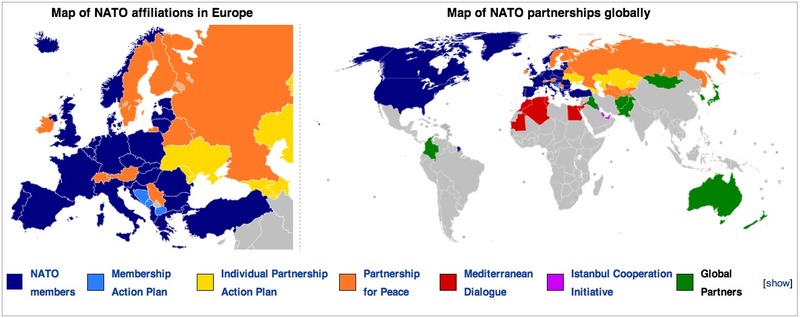
Domestic interests may not always be compatible with a country’s allies’ and, in this case, the ally of Britain chose to air concerns over, allegedly, looser lending standards for the environment, labor rights and financial transparency of the proposed bank.

The “unrivalled opportunity” for the United Kingdom, as seen by British Chancellor of the Exchequer George Osborne, is enviable, as financiers and industrialists widely expect total infrastructure investment of 8 trillion U.S. dollars in the coming decade in Asia. Not to mention the anticipated stable and handsome returns associated with infrastructure projects.

Other than the U.K., there are at least 27 bidders intending to be AIIB founding members, spanning East Asia, South Asia, Southeast Asia, Central Asia, the Middle East, to Oceania. All have shared the vision of faster-than-average growth in the years to come in Pacific Asia.

The AIIB, and similar organizations, have, understandably, left the U.S. uneasy, with the incumbent power choosing to use the rhetoric that the AIIB will undercut institutions such as the World Bank.

The idea of circumventing existing financial organizations, such as the World Bank and the International Monetary Fund (IMF), will pose a threat, if any, to the international economic and political pattern shaped after World War II, seven decades ago.

The Bretton Woods agreement depicted a global financial and monetary landscape, consolidating the U.S. dollar’s supremacy, which is still valid.

Currencies in the IMF Special Drawing Rights (SDRs) basket of reserve assets represent post-WWII U.S. allies — the pound sterling, the yen and the euro, in addition to the dollar.

One major winner of WWII, the Soviet Union and then Russia, never won its fair share with its currency, the ruble, in the IMF basket, partly due to its voluntary disengagement from Western mechanisms.

Rising to become the second largest economy in the world, China is advocating and working on revising the current international system, almost unchanged in the past 70 years, and as a system it is inadequate as lower income countries largely miss out on equal opportunities.

Its immense size and robust market have seen China sustain the appeal for the outside world, particularly as it frees its huge services market and encourages the outbound investment of surplus funds.

Following 30 years of reform and opening up, China is no longer heavily dependent on foreign capital and exporting money as well, with overseas direct investment of 102.9 billion U.S. dollars in 2014, only 16.7 billion U.S. dollars less than foreign direct investment the country attracted.

Besides the AIIB, China initiated and has taken a leading role in the BRICS development bank, the Silk Road Fund and a development bank for the Shanghai Cooperation Organization, all of which focus on infrastructure.

Designing financing tools that are complementary to the current international financial system, China has no intention of knocking over the chessboard, but rather is trying to help shape a more diverse world playing board.

With further liberalizing the yuan in floating exchange rates and cross-border transactions, China wishes to see its currency included in the IMF basket, in accordance with the weight the yuan now exerts on international goods and services trade.

China welcomes cooperation from every corner of the world to achieve shared prosperity based on common interest, but will go ahead anyway when it believes it is in the right.

  • Posted in Asian @as
  • Comments Off on Britain Joins China’s Asian Infrastructure Investment Bank (AIIB) Despite “U.S. Concerns”

Africa and China’s 21st Century “Maritime Silk Road”

March 30th, 2015 by Alvin Cheng-Hin Lim

This paper considers Africa’s place in China’s 21st Century Maritime Silk Road. The Maritime Silk Road is a major component of the “Belt and Road” development framework announced by Chinese President Xi Jinping in late 2013. While the People’s Republic of China has been actively engaged in Africa since 1960, the Maritime Silk Road promises an intensification of Chinese investment on the continent, especially in infrastructural projects including the construction of railways, airports and deepwater ports. The paper will contextualize these development projects in China’s new normal of single-digit growth, and explain that the “Belt and Road” should be seen as one of China’s new engines of growth. The paper will conclude with an examination of the question of whether China is engaged in neocolonialism in Africa.

Introduction: Encountering China in Yola

In August 2011 I arrived in Yola, the capital of Nigeria’s Adamawa State, to start work as an assistant professor at the American University of Nigeria (AUN). Tiny Yola, which resembles a large village, is very different from Nigeria’s cosmopolitan megacity Lagos, and Adamawa State is a region with one of the lowest levels of development in Nigeria. As such I was very surprised when I encountered a plethora of Chinese products in this sleepy corner of Nigeria. Our faculty houses were equipped with DVD players, refrigerators, washing machines, water dispensers, and other consumer electronic products from Chinese multinational firms like Haier and Cway. Apart from these consumer products, Oasis Bakery in our neighborhood was owned and managed by a hardworking expatriate from China who had chosen to settle in Nigeria.

In a seminar I conducted that semester on Chinese investment in Nigeria, one of the Nigerian participants observed that AUN’s campus police had purchased Jincheng motorcycles for its security patrols.1 Another Nigerian participant recounted his visit to the athletes’ accommodations constructed by China Civil Engineering Construction Corporation for the 2003 All-Africa Games in the Nigerian capital city Abuja:
I have personally visited this Games Village and in my opinion it is an amazing reflection of the relationship between China and Nigeria. The houses were very well constructed with very nice parking spaces and a neat environment. The furnishing of the houses was also remarkable as there were adire (local Nigerian fabric) curtains inside. This illustrates the good working relationship between Nigeria and China as the Chinese are sensitive to our preferences.2
These instances of the Chinese presence in Nigeria are part of a vast wave of Chinese investment and economic engagement in Africa, a wave which will intensify under China’s development plans for what it has described as the 21st Century Maritime Silk Road.

The “Belt and Road” and China’s New Normal

In September 2013 Chinese President Xi Jinping announced, during a speech at Nazarbayev University in Astana, Kazakhstan, the strategic vision of the Silk Road Economic Belt, a transcontinental zone of economic development stretching from China across Central Asia and the Middle East to Europe, an area that maps over the ancient trade routes of the Silk Road.3 The following month President Xi announced in a speech to the Indonesian parliament the strategic vision of the 21st Century Maritime Silk Road, a zone of economic development that maps along the key ports and maritime trade routes of the South China Sea and Indian Ocean.4

Both strategic visions come together under the “Belt and Road” framework, which offers Chinese funding, expertise, and industrial technology in the implementation of massive infrastructural projects in the geographical areas coming under the Silk Road Economic Belt and 21st Century Maritime Silk Road. These projects, ranging from the construction of airports and railways to the redevelopment of deepwater ports, represent important opportunities for Chinese companies to expand and diversify their businesses by going global.5 It is not just these Chinese companies who will benefit from the projects, of course. China’s partner countries can expect to accelerate their economic development thanks to the improvements in their infrastructure, without having to worry about political interference in their internal affairs.6

The Chinese government takes a long-term view of the “Belt and Road” projects. As Foreign Minister Wang Yi mentioned in a speech in Nairobi, Kenya in January 2015:

“When Premier Li Keqiang visited the headquarters of African Union last year, Chairperson of African Union Commission Ms. Nkosazana Dlamini Zuma said that African people cherish a dream that one day the capitals of all African countries will be linked by high-speed railways. As a good friend of Africa, China is willing to make efforts to help African friends realize the dream. It is a century project that requires comprehensive planning and gradual advancement.”7

The “Belt and Road” initiatives come at a key period for China. After enjoying double digit GDP growth in the first decade of the 2000s, China’s growth has decelerated to what its leadership has described as a new normal of single digit growth.8 At the annual meeting of the National People’s Congress in March 2015, Premier Li Keqiang announced that the government has lowered the annual growth target to 7%.9 This contrasts with previous decades when China enjoyed an average growth rate of approximately 10% between 1978 and 2013, with 11.5% between 2003 and 2007. In 2012 and 2013 growth decelerated to 7.7%, ushering in the new normal of medium-to-high growth and development, and triggering the need for the Chinese government to find new engines of growth.10 The “Belt and Road” framework can be placed in this context as one of China’s new engines of growth, offering fresh sources of employment and business opportunities to enable China to achieve what President Xi has highlighted in his political theory of the “Four Comprehensives” as the national goal of a moderately prosperous society.11 In particular, the employment opportunities created by the “Belt and Road” initiatives will be needed for the 15 million students who are expected to graduate from universities, technical and middle schools and join the workforce in 2015, as well as the 3 million surplus rural labourers who are also expected to join these students on the employment market.12

Africa and the 21st Century Maritime Silk Road

The African continent’s position on the “Belt and Road” is located at the far west of the 21st Century Maritime Silk Road. Historically, the eastern coast of Africa is remembered as the westernmost stop on Admiral Zheng He’s epic 15th century voyages across the Indian Ocean. In 2005 there was great fanfare in the Chinese press when Mwamaka Sharifu, a Kenyan girl who was reportedly the descendant of one of Zheng He’s Chinese sailors, received a scholarship from the Chinese government in commemoration of the 600th anniversary of Zheng He’s first voyage across the Indian Ocean.13 The infrastructural projects to be undertaken in Africa under the “Belt and Road” framework include the development of deepwater ports in coastal cities including Bizerte, Tunisia; Dakar, Senegal; Dar es Salaam, Tanzania; Djibouti, Djibouti; Libreville, Gabon; Maputo, Mozambique; and Tema, Ghana. These will be key sites of the transcontinental exchange of manufactured goods and commodities between Asian and African economies along the Maritime Silk Road.14 These ports are also likely to be developed as industrial hubs, following the model of China’s development of the new Cameroonian deepwater port of Kribi.

While China Harbor Engineering Company started constructing the new port in June 2011, the development plan also includes the creation of a 260 square kilometer industrial zone, as well as roads and railways connecting Kribi to major cities in Cameroon, projects which will be undertaken by other Chinese companies.15 In Kenya, China is constructing a railway connecting the capital city Nairobi with the port city of Mombasa. This will eventually be expanded into a regional rail corridor connecting Kenya—one of the African gateways to the Maritime Silk Road—with Uganda, Burundi, and South Sudan.16

As the Kribi port development project in Cameroon shows, Chinese firms have been active in Africa long before the 2013 announcement of the 21st Century Maritime Silk Road. According to statistics compiled by the State Council of China in 2013:

China has become Africa’s largest trade partner, and Africa is now China’s second largest overseas construction project contract market and the fourth largest investment destination … Up to now, China has completed 1,046 projects in Africa, building 2,233 kilometers of railways and 3,530 kilometers of roads, among others, promoting intra-African trade and helping it integrate into the global economy.17

An early infrastructural project was the TanZam railway between Tanzania and Zambia, which was built between October 1970 and June 1975, and involved not just Chinese financing, but also the participation of 50,000 Chinese engineers and laborers, 65 of whom perished during the arduous construction.18 The beginning of the engagement of the People’s Republic of China with Africa dates back a decade earlier to 1960, when China provided an interest-free loan of 100 million RMB to Guinea’s newly independent socialist government for the construction of a slate of aid projects including factories, plantations, and paddy fields. Other newly-decolonized African states received similar aid packages from China.19 Over the subsequent decades, China’s engagement with Africa changed in tandem with changes in its domestic political economy.

The rise of China’s private corporations after the economic liberalization of the 1980s saw a transition from state-owned enterprises to private businesses in the implementation of Chinese development projects overseas.20 Recent examples of such projects include China Railway Group’s Light Railway in Addis Ababa, Ethiopia, the first phase of which was recently completed;21 China Railway Construction Corporation’s Abuja-Kaduna railway in Nigeria, which was completed in December 2014, and which is the first phase of a larger railway modernization project connecting Lagos with Kano;22 and the Lobito-Luau railway in Angola, also built by China Railway Construction Corporation, which will eventually be connected to the Angola-Zambia and the Tanzania-Zambia railways.23 Likewise, Chinese engineering firms like China Civil Engineering Construction Corporation, China Airport Construction Group Corporation, and China Harbour Engineering Company are constructing airports across the continent, including airports in Angola, Comoros, Djibouti, Gabon, Kenya, Nigeria, Sudan, Tanzania, and Togo.24

Apart from the transportation sector, Chinese companies are also involved in Africa’s energy sector, including hydropower dams in Ethiopia and Uganda;25 biogas development in Guinea, Sudan and Tunisia; and solar and wind power plants in Ethiopia, Morocco, and South Africa. Other economic sectors Chinese companies are actively involved with in Africa include agriculture, construction, healthcare, mining, and industrial manufacturing. A recent count estimates over 2,000 Chinese companies are engaged across almost every country on the African continent.26

To finance these and other projects under the “Belt and Road” framework, China has created a number of key financial institutions. In November 2014, President Xi announced the creation of a 40 billion USD Silk Road Fund. The bulk of its financing will come from the Chinese government, with the remainder from China Investment Corporation, China Development Bank Capital Company, and the Export-Import Bank of China.27 In July 2014, China and its partners in the so-called BRICS bloc—Brazil, Russia, India, and South Africa—contributed 100 billion USD to establish the New Development Bank, an alternative to the U.S.-dominated World Bank and International Monetary Fund for emerging economies to raise funds for infrastructural development.28 China also established the Asian Infrastructure Investment Bank in 2014, with other founding members from across Asia, the Middle East, and other countries including New Zealand and the United Kingdom. Like the Silk Road Fund and the New Development Bank, the Asian Infrastructure Investment Bank offers funding for infrastructure projects.29 China has also created smaller investment vehicles to finance infrastructural and other overseas business projects.30 The deepwater port development projects listed earlier, for example, will be partly financed by investment vehicles set up by China and Thailand.31

The Neocolonial Question

While China has cancelled the debts of some of its crisis-stricken partner countries, or offered them grants or zero-interest loans to pay for Chinese development projects,32 most of the loans issued by Chinese financial institutions have to be repaid by the recipient countries. In certain cases, China allows its partners to pay for their development projects by bartering their local products, in particular natural resources. China and a number of African states have had such countertrade arrangements since the 1980s, and since then China has received key primary products including oil, rubber, and minerals as payment for development loans.33 These deals involving extraction of natural resources have led to accusations that China is engaging in neocolonialism in Africa, as was voiced by U.S. Secretary of State Hillary Clinton during a visit to Zambia in June 2011.34 Such criticisms have also been voiced by a number of African leaders who are concerned about China’s growing economic clout.35

While popular African perceptions of China’s economic engagement remain generally positive across the continent,36 positive public opinion concerning the benefits of Chinese investment to their local economies are on the decline.37 Foreign Minister Wang Yi’s recent announcement that Chinese diplomacy in 2015 will focus on building international cooperation for the “Belt and Road” reflects the government’s sense of urgency,38 especially given a recent diplomatic setback in Sri Lanka,39 and India’s continued deferral, arising from old suspicions of what it calls the “string of pearls” geopolitical threat.40 from accepting China’s invitation to participate in the “Belt and Road.”41

The continued acceptance of Chinese investments over the past five and a half decades by African states and their people is an important sign that China’s presence in Africa should be seen as that of a partner in economic development rather than that of an aspiring neocolonial hegemon.42 In historical context, the criticisms of China’s engagement with Africa in the Western press today echo Western colonial fears in the 1930s of Japan’s growing influence in Africa.43 A number of African and Western experts have joined the public conversation in critiquing the accusations of neocolonialism voiced by Secretary of State Clinton and others. The Zambian economist Dambisa Moyo, for instance, has pointed out that the empirical evidence of China’s activities in Africa shows that its interests are purely commercial and that it has no interest in undermining the political structure, much less the sovereignty, of its African partners.44 (The key exception is China’s interest in keeping its partners from offering diplomatic recognition to Taiwan.

A country will break relations with Beijing should it recognize Taiwan as “China”; but even in this situation Chinese enterprises in the country have been known to continue functioning despite the loss of diplomatic relations.45) The political economist Deborah Brautigam reminds us that China’s swaps of infrastructure for resources with its African partners are based on its positive experience with swapping its own oil for Japanese industrial technology in the late 1970s. The industrial infrastructure and technological training thus received from Japan formed one of the bases for China’s subsequent economic take-off in the 1980s. As such, China sees the similar arrangements it has made with its partner countries in Africa and elsewhere as similarly offering mutual benefits for their economic development.46

While China’s overseas investments are certainly open to scrutiny, it is essential to consider these in the context of projects from other countries: it is by no means necessarily true that Chinese projects offer worse outcomes than those from the West.47 Indeed, when looked at in comparative perspective, it is clear that China’s infrastructural investments in particular fill a development gap in Africa that the West has largely ignored, 48 and that China’s massive imports of African commodities have accelerated African trade and expanded the market for African exports,49 creating the conditions for the continent’s dramatic recent economic growth.50

Africa’s recent rapid growth, which mirrors China’s own economic take-off three decades earlier, suggests that, like the Chinese enterprises that came before them, African enterprises, given the right economic conditions, will be able to hold their own against competition from Asia and the West. The implication is that the neocolonial narrative about China’s engagement with Africa is defeatist in its dire prognosis about the ability of African enterprises to compete against Chinese and other multinational corporations in the global market. Consider the case of textiles. While the textile industry in some African economies failed to withstand competition from China and other global competitors, the same industry in other African economies like Kenya’s and Madagascar’s was able to meet the international competition and recover and grow.51

Indeed, the textile industry is one of the mature industries that the Chinese government has encouraged to move offshore, to allow Chinese industry to move up the value chain, and Chinese entrepreneurs from the textile and other mature industries have settled and taken up citizenship in African countries like Lesotho, further developing the local economies with their industrial knowledge, and deepening the commercial and technical know-how of their local colleagues and employees.52 Such capacity building can accelerate the movement of African industries up the value chain, as was the experience of the mature Chinese enterprises themselves in the 1990s and 2000s. Africa’s movement up the industrial value chain can already be seen in the emergence of an indigenous automobile industry.53 This shows that, rather than defeatism, optimism is warranted when projecting the probable outcomes of China’s continued engagement with Africa.

Alvin Cheng-Hin Lim is a research fellow with the Longus Institute for Development and Strategy, and is the author of Cambodia and the Politics of Aesthetics (Routledge 2013). He received his Ph.D. in Political Science from the University of Hawaii at Manoa, and has taught at Pannasastra University of Cambodia and the American University of Nigeria. Email: [email protected]. Web: https://manoa-hawaii.academia.edu/AlvinLim

Bibliography

Anderlini, Jamil, Mitchell, Tom, and Parker, George. “UK move to join AIIB meets mixed response in China.” Financial Times, March 13, 2015. Accessed March 14, 2015.
Aneja, Atul. “China steps up drive to integrate Africa with Maritime Silk Road.” The Hindu, January 21, 2015. Accessed March 12, 2015.
“Asian Infrastructure Development Bank to be operational by year-end.” Press Trust of India, January 2, 2015. Accessed March 12, 2015.
“Backgrounder: China’s major railway construction projects in Africa, Latin America.” Xinhua, 27 February, 2015. Accessed March 12, 2015.
Bosshard, Peter. “China’s Global Dam Builder at a Crossroads.” The Asia-Pacific Journal 12 (2014). Accessed March 12, 2015.
Bradshaw, Richard and Ransdell, Jim. “Japan, Britain and the Yellow Peril in Africa in the 1930s.” The Asia-Pacific Journal 9 (2011). Accessed March 12, 2015.
Brautigam, Deborah. The Dragon’s Gift: The Real Story of China in Africa. Oxford: Oxford University Press, 2009.
Chen Boyuan. “Chinese company completes Nigeria railway project.” China.org.cn, December 2, 2014. Accessed March 12, 2015.
Chen Jia, Dai Tian, and Zhao Yinan. “Growth rate slows, structural reform predicted.” China Daily, March 5, 2015. Accessed March 12, 2015.
Chen Qin and Huang Shan, “Sri Lanka Tells China It Will Rethink Ties – and a Major Port Project,” Caixin, March 10, 2015, accessed March 12, 2015.
Cheng Lu. “Return of maritime Silk Road does not forget Africa.” Xinhua, February 12, 2015. Accessed March 12, 2015.
Chin, Gregory. “China’s Challenge in Africa: Avoid Blame of Neo-Colonialism.” YaleGlobal, 9 July 2014. Accessed March 12, 2015.
“China aims at medium-to-high speed of growth with twin engines: gov’t report.” Xinhua, March 5, 2015. Accessed March 12, 2015.
“China airport construction going global.” Xinhua, December 7, 2014. Accessed March 12, 2015.
“China faces arduous task of ensuring employment.” Xinhua, March 10, 2015. Accessed March 12, 2015.
“China invites India to join its Maritime Silk Road initiative,” Press Trust of India, February 14, 2014, accessed March 12, 2015.
“China-Africa relations: something besides natural resources.” Xinhua, March 2, 2015. Accessed March 12, 2015.
“China-funded light rail project puts Ethiopia on track for transformation.” China Radio International, February 8, 2015. Accessed March 12, 2015.
“China, Sudan sign $700m loan for new Khartoum airport.” Sudan Tribune, December 17, 2014. Accessed March 12, 2015.
“China’s 2015 diplomacy focuses on ‘Belt and Road.’” Xinhua, March 8, 2015. Accessed March 12, 2015.
“Chinese-built railway in Angola open to traffic.” Xinhua, February 15, 2015. Accessed March 12, 2015.
“Clinton Chastises China on Internet, African ‘New Colonialism.’” Bloomberg, June 12, 2011. Accessed March 12, 2015.
“Djibouti starts building two Chinese-funded airports.” Reuters, January 20, 2015. Accessed March 12, 2015.
Eyler, Brian. “China’s Maritime Silk Road is all about Africa.” East by Southeast, November 17, 2014. Accessed March 12, 2015.
Gundan, Farai. “Made In Africa: Three Cars Designed And Manufactured In Africa.” Forbes, January 31, 2015. Accessed March 12, 2015.
Hou Liqiang and Hu Haiyan. “Jam-packed airports add to pressure.” China Daily, January 30, 2015. Accessed March 12, 2015.
Iriogbe, Lawrence Osekhale. “China in Africa: Nigeria as a Case Study.” Seminar paper, American University of Nigeria, 2011.
“Is this young Kenyan Chinese descendant?” China Daily, July 11, 2005. Accessed March 12, 2015.
Ishaku, Joseph. “Chinese Products’ Presence in Nigeria: The Case of Motorcycles.” Seminar paper, American University of Nigeria, 2011.
Lamido Sanusi. “Africa must get real about Chinese ties.” Financial Times, March 11, 2013. Accessed March 12, 2015.
Li Lianxing. “Airports give Rwanda a ticket to growth.” China Daily, January 30, 2015. Accessed March 12, 2015.
Mohan, C. Raja. “Silk Road Focus: Chinese Takeaway.” Indian Express, March 10, 2015. Accessed March 12, 2015.
Moyo, Dambisa. “Beijing, a Boon for Africa.” New York Times, June 27, 2012. Accessed March 12, 2015.
Moyo, Dambisa. Winner Take All: China’s Race for Resources and What It Means for Us. London: Allen Lane, 2012.
“New Zealand becomes 24th founding member of AIIB.” China Daily, January 5, 2015. Accessed March 14, 2015.
“Nigeria Completes First Standard Gauge Railway Modernization Project.” Nigerian Television Authority, December 4, 2014. Accessed March 12, 2015.
Pew Research Center. “Chapter 2: China’s Image.” Global Opposition to U.S. Surveillance and Drones, but Limited Harm to America’s Image, July 14, 2014. Accessed March 12, 2015.
Rapoza, Kenneth. “Double Digits No More, China & India Govts Want To Grow Slow.” Forbes, April 10, 2012. Accessed March 12, 2015.
Sautman, Barry and Yan Hairong. “Trade, Investment, Power and the China-in-Africa Discourse.” The Asia-Pacific Journal 9 (2009). Accessed March 12, 2015.
Sautman, Barry and Yan Hairong. “Gilded Outside, Shoddy Within: The Human Rights Watch report on Chinese copper mining in Zambia.” The Asia-Pacific Journal 9 (2011). Accessed March 12, 2015.
Shee Poon Kim. “An Anatomy of China’s ‘String of Pearls’ Strategy.” The Hikone Ronso 387 (2011). Accessed March 12, 2015.
Shi Ze. “‘One Road & One Belt’ & New Thinking With Regard To Concepts And Practice.” 30th Anniversary Conference of the Schiller Institute, October 18, 2014. Accessed March 12, 2015.
Simmons, Katie. “U.S., China compete to woo Africa.” Pew Research Fact Tank, August 4, 2014. Accessed March 12, 2015.
Ssekandi, Ronald and Yuan Qing. “China’s investment in infrastructure key to Africa’s development: experts.” Xinhua, February 24, 2015. Accessed March 12, 2015.
“The Hopeful Continent: Africa Rising.” The Economist, December 3, 2011. Accessed March 12, 2015.
Tiezzi, Shannon. “What’s It Like to Have China Build You a Port? Ask Cameroon.” The Diplomat, February 27, 2015. Accessed March 12, 2015.
Turse, Nick. “The US Military Has Been ‘At War’ in Africa on the Sly For Years.” The Nation, April 14, 2014. Accessed March 12, 2015.
Turse, Nick. “US Special Forces Are Operating in More Countries Than You Can Imagine.” The Nation, January 20, 2015. Accessed March 12, 2015.
Tweed, David . “Modi Touring Indian Ocean to Keep China’s Submarines at Bay.” Bloomberg, March 10, 2015. Accessed March 12, 2015.
Wang Bowen. “China unswervingly sticks to peaceful development under ‘new normal.’” Xinhua, March 5, 2015. Accessed March 12, 2015.
“Wang Yi: China Is Ready to Work for Africa’s Dream of Building.” Ministry of Foreign Affairs, People’s Republic of China, January 11, 2015, accessed March 12, 2015.
World Bank. Africa Rising: A Tale of Growth, Inequality and Great Promise. April 14, 2014. Accessed March 12, 2015.
Wu Jiao and Zhang Yunbi. “Xi proposes a ‘new Silk Road’ with Central Asia.” China Daily, September 8, 2013. Accessed March 12, 2015.
Wu Jiao and Zhang Yunbi. “Xi in call for building of new ‘maritime silk road.’” China Daily, October 4, 2013. Accessed March 12, 2015.
“Xi’s ‘Four Comprehensives’ a strategic blueprint for China.” Xinhua, February 25, 2015. Accessed March 12, 2015.
Zhang Yuzhe. “With New Funds, China Hits a Silk Road Stride.” Caixin, December 3, 2014. Accessed March 12, 2015.
Zhang Yuzhe. “Gov’t Said to Name Three to Silk Road Fund Leadership Team.” Caixin, February 5, 2015. Accessed March 12, 2015.

Notes
1 Joseph Ishaku, “Chinese Products’ Presence in Nigeria: The Case of Motorcycles” (seminar paper, American University of Nigeria, 2011), 7.
2 Lawrence Osekhale Iriogbe, “China in Africa: Nigeria as a Case Study” (seminar paper, American University of Nigeria, 2011), 6.
3 Wu Jiao and Zhang Yunbi, “Xi proposes a ‘new Silk Road’ with Central Asia,” China Daily, September 8, 2013, accessed March 12, 2015.
4 Wu Jiao and Zhang Yunbi, “Xi in call for building of new ‘maritime silk road,’” China Daily, October 4, 2013, accessed March 12, 2015.
5 Deborah Brautigam, The Dragon’s Gift: The Real Story of China in Africa (Oxford: Oxford University Press, 2009), 103-104. Zhang Yuzhe, “With New Funds, China Hits a Silk Road Stride,” Caixin, December 3, 2014, accessed March 12, 2015.
6 Shi Ze, “‘One Road & One Belt’ & New Thinking With Regard To Concepts And Practice,” 30th Anniversary Conference of the Schiller Institute, October 18, 2014, accessed March 12, 2015.
7 “Wang Yi: China Is Ready to Work for Africa’s Dream of Building,” Ministry of Foreign Affairs, the People’s Republic of China, January 11, 2015, accessed March 12, 2015.
8 Kenneth Rapoza, “Double Digits No More, China & India Govts Want To Grow Slow,” Forbes, April 10, 2012, accessed March 12, 2015.
9 Chen Jia, Dai Tian, Zhao Yinan, “Growth rate slows, structural reform predicted,” China Daily, March 5, 2015, accessed March 12, 2015.
10 “China aims at medium-to-high speed of growth with twin engines: gov’t report,” Xinhua, March 5, 2015, accessed March 12, 2015.
11 “Xi’s ‘Four Comprehensives’ a strategic blueprint for China,” Xinhua, February 25, 2015, accessed March 12, 2015. Wang Bowen, “China unswervingly sticks to peaceful development under ‘new normal,’” Xinhua, March 5, 2015, accessed March 12, 2015.
12 “China faces arduous task of ensuring employment,” Xinhua, March 10, 2015, accessed March 12, 2015.
13 “Is this young Kenyan Chinese descendant?” China Daily, July 11, 2005, accessed March 12, 2015.
14 Atul Aneja, “China steps up drive to integrate Africa with Maritime Silk Road,” The Hindu, January 21, 2015, accessed March 12, 2015.
15 Shannon Tiezzi, “What’s It Like to Have China Build You a Port? Ask Cameroon,” The Diplomat, February 27, 2015, accessed March 12, 2015.
16 Cheng Lu, “Return of maritime Silk Road does not forget Africa,” Xinhua, February 12, 2015, accessed March 12, 2015.
17 “China-Africa relations: something besides natural resources,” Xinhua, March 2, 2015, accessed March 12, 2015.
18 “Backgrounder: China’s major railway construction projects in Africa, Latin America,” Xinhua, 27 February, 2015, accessed March 12, 2015.
19 Brautigam, Dragon’s Gift, 31-34.
20 Brautigam, Dragon’s Gift, 79.
21 “China-funded light rail project puts Ethiopia on track for transformation,” China Radio International, February 8, 2015, accessed March 12, 2015.
22 Chen Boyuan, “Chinese company completes Nigeria railway project,” China.org.cn, December 2, 2014, accessed March 12, 2015. “Nigeria Completes First Standard Gauge Railway Modernization Project,” Nigerian Television Authority, December 4, 2014, accessed March 12, 2015.
23 “Chinese-built railway in Angola open to traffic,” Xinhua, February 15, 2015, accessed March 12, 2015.
24 “China airport construction going global,” Xinhua, December 7, 2014, accessed March 12, 2015. “China, Sudan sign $700m loan for new Khartoum airport,” Sudan Tribune, December 17, 2014, accessed March 12, 2015. “Djibouti starts building two Chinese-funded airports,” Reuters, January 20, 2015, accessed March 12, 2015. Hou Liqiang and Hu Haiyan, “Jam-packed airports add to pressure,” China Daily, January 30, 2015, accessed March 12, 2015. Li Lianxing, “Airports give Rwanda a ticket to growth,” China Daily, January 30, 2015, accessed March 12, 2015.
25 Peter Bosshard,”China’s Global Dam Builder at a Crossroads,” The Asia-Pacific Journal 12 (2014), accessed March 12, 2015.
26 “China-Africa relations.” Ronald Ssekandi and Yuan Qing, “China’s investment in infrastructure key to Africa’s development: experts,” Xinhua, February 24, 2015, accessed March 12, 2015.
27 Zhang Yuzhe, “Gov’t Said to Name Three to Silk Road Fund Leadership Team,” Caixin, February 5, 2015, accessed March 12, 2015.
28 Zhang Yuzhe, “With New Funds.”
29 “Asian Infrastructure Development Bank to be operational by year-end,” Press Trust of India, January 2, 2015, accessed March 12, 2015. Jamil Anderlini, Tom Mitchell and George Parker, “UK move to join AIIB meets mixed response in China,” Financial Times, March 13, 2015, accessed March 14, 2015. “New Zealand becomes 24th founding member of AIIB,” China Daily, January 5, 2015, accessed March 14, 2015.
30 Zhang Yuzhe, “With New Funds.”
31 Brian Eyler, “China’s Maritime Silk Road is all about Africa,” East by Southeast, November 17, 2014, accessed March 12, 2015.
32 Brautigam, Dragon’s Gift, 136-137.
33 Brautigam, Dragon’s Gift, 56.
34 “Clinton Chastises China on Internet, African ‘New Colonialism,’” Bloomberg, June 12, 2011, accessed March 12, 2015.
35 Lamido Sanusi, “Africa must get real about Chinese ties,” Financial Times, March 11, 2013, accessed March 12, 2015. Gregory Chin, “China’s Challenge in Africa: Avoid Blame of Neo-Colonialism,” YaleGlobal, 9 July 2014, accessed March 12, 2015.
36 Pew Research Center, “Chapter 2: China’s Image,” Global Opposition to U.S. Surveillance and Drones, but Limited Harm to America’s Image, July 14, 2014, accessed March 12, 2015.
37 Katie Simmons, “U.S., China compete to woo Africa,” Pew Research Fact Tank, August 4, 2014, accessed March 12, 2015.
38 “China’s 2015 diplomacy focuses on ‘Belt and Road,’” Xinhua, March 8, 2015, accessed March 12, 2015.
39 Chen Qin and Huang Shan, “Sri Lanka Tells China It Will Rethink Ties – and a Major Port Project,” Caixin, March 10, 2015, accessed March 12, 2015.
40 Shee Poon Kim, “An Anatomy of China’s ‘String of Pearls’ Strategy,” The Hikone Ronso 387 (2011), accessed March 12, 2015. David Tweed, “Modi Touring Indian Ocean to Keep China’s Submarines at Bay,” Bloomberg, March 10, 2015, accessed March 12, 2015.
41 “China invites India to join its Maritime Silk Road initiative,” Press Trust of India, February 14, 2014, accessed March 12, 2015. C. Raja Mohan, “Silk Road Focus: Chinese Takeaway,” Indian Express, March 10, 2015, accessed March 12, 2015.
42 The growing American military presence in Africa suggests that the putative hegemon is indeed not Chinese. See Nick Turse, “The US Military Has Been ‘At War’ in Africa on the Sly For Years,” The Nation, April 14, 2014, accessed March 12, 2015. See also Nick Turse, “US Special Forces Are Operating in More Countries Than You Can Imagine,” The Nation, January 20, 2015, accessed March 12, 2015.
43 Richard Bradshaw and Jim Ransdell, “Japan, Britain and the Yellow Peril in Africa in the 1930s,” The Asia-Pacific Journal 9 (2011), accessed March 12, 2015.
44 Dambisa Moyo, Winner Take All: China’s Race for Resources and What It Means for Us (London: Allen Lane, 2012), 157.
45 Brautigam, Dragon’s Gift, 67-69.
46 Brautigam, Dragon’s Gift, 46-48.
47 Barry Sautman and Yan Hairong, “Gilded Outside, Shoddy Within: The Human Rights Watch report on Chinese copper mining in Zambia,” The Asia-Pacific Journal 9 (2011), accessed March 12, 2015.
48 Barry Sautman and Yan Hairong, “Trade, Investment, Power and the China-in-Africa Discourse,” The Asia-Pacific Journal 9 (2009), accessed March 12, 2015.
49 Dambisa Moyo, “Beijing, a Boon for Africa,” New York Times, June 27, 2012, accessed March 12, 2015.
50 “The Hopeful Continent: Africa Rising,” The Economist, December 3, 2011, accessed March 12, 2015. World Bank, Africa Rising: A Tale of Growth, Inequality and Great Promise, April 14, 2014, accessed March 12, 2015.
51 Brautigam, Dragon’s Gift, 219.
52 Brautigam, Dragon’s Gift, 222-223.
53 Farai Gundan, “Made In Africa: Three Cars Designed And Manufactured In Africa,” Forbes, January 31, 2015, accessed March 12, 2015.

  • Posted in Asian @as
  • Comments Off on Africa and China’s 21st Century “Maritime Silk Road”

The “Greening” of China’s Black Electric Power System

March 30th, 2015 by Prof. John A. Mathews

 While China’s energy system is still largely a “black” system depending on fossil fuel inputs, the electric power system is greening at the margins. We demonstrate, using 2014 data on additions to China’s electric power system, that the system is greening– with powerful implications for the future of the country’s energy profile. We utilize three lines of argument: first, utilizing data for electric energy generated, where we show that China actually generated less energy from thermal sources in 2014 than in 2013, while increasing generation from water, wind and solar; second, examining capacity additions, we show that new capacity in water, wind and solar (WWS) exceeded new capacity for thermal; and third, in terms of investment. We argue that such data rebut claims made that China is getting blacker while its greening efforts remain small and insubstantial, or that China will become dependent on nuclear power rather than hydro, wind and solar as it cleans its energy system.Many people have recently been avid viewers of Chai Jing’s riveting documentary/talk “Under the Dome” where she brings home the terrible costs of China’s pollution and its ultra-fast industrialization utilizing fossil fuels but particularly coal.

Under the Dome is a call to China to wake up and start enforcing the environmental laws – against illegal polluters in factories, in trucks entering Beijing during the night, in smokestack industries throughout the country. It’s time to grow up, she seems to be telling her mostly young audiences. And the phenomenal success her video has had in China itself shows that she has struck a nerve, and could spark a people’s movement to rein in the pollution in China – just as Rachel Carson did in the US with “Silent Spring” published in 1962.But the counterpart to the story of needing to rein in the pollution is the necessity of building an alternative energy system, one which is based on renewable sources that do not emit carbon or other greenhouse gases. It is a fact that China’s energy system generally, and its electric power system in particular, is still largely based on fossil fuels consumption – just like every rising industrial power since the industrial revolution. But it also needs to be acknowledged that China’s energy system is greening – far faster than any other comparable sized system on the planet. Many commentators continue to insist (rightly) on the black character of China’s electric power system – but ignore (wrongly) the strength of the greening tendencies. In a widely reproduced blog posting, Armond Cohen (Executive Director of the Clean Air Task Force in the US) claimed that in 2014, “the amount of new coal energy added to the China grid … exceeded new solar energy by 17 times, new wind energy by more than 4 times, and even new hydro by more than 3 times”1 This assertion and the accompanying chart is meant to imply that China’s electric power system is getting blacker rather than greener. Such an interpretation of what has been happening in China’s power sector is wrong. We use the latest 2014 data to demonstrate why it is wrong.The data for China’s electric power sector are now to hand, provided by the China Electricity Council. We use three sources of data to demonstrate that greening tendencies outrank blackening (fossil-fuelled) tendencies. These are data for 2014 electric energy generation (real generation, as compared with the “putative” generation utilized by Cohen – as discussed below); data for 2014 electric capacity additions; and data for investment in the electric power grid. All three sources demonstrate a greening tendency that outranks a blackening tendency. We hasten to add that building a green energy system is only one aspect of the problem, and (as Chai Jing insists) the existing pollution needs to be reined in, and new less-polluting technologies need to be introduced even while burning fossil fuels. But in this submission we focus on the building of a new green energy system and the progress that is being recorded.

  1. Electric energy generation

Data are now available from the China Electricity Council for real electric energy generation added to the system in 2014 from multiple sources. The headline results are that China generated less power from thermal (fossil fuel) sources in 2014 than in 2013, i.e. thermal power generation actually decreased in 2014. This is an extremely important milestone. By contrast, power generation from non-thermal sources increased by 19% — and strictly green sources, encompassing water, wind and solar (WWS), increased by 200 TWh, or 20%. This is the greening edge of a huge power generation system.

Here are the data. China’s power system generated 5,545 TWh of electricity in 2014, an increase of 173 TWh over the 2013 total, or growth of 3.2%. So the system as a whole is still growing – but not as fast as the economy as a whole (an important disjunction). Thermal (mainly coal burning) sources generated 4173 TWh in 2014, down by 48 TWh from the 2013 total (or a decrease of 1.1%) – the first reduction in thermal power generation in recent times. Non-thermal sources by contrast accounted for 1372 TWh of electric energy generated in 2014, up 221 TWh on the 2013 total. Strictly green sources (WWS) generated 1245 TWh in 2014, up 200 TWh on the 2013 total (an increase of 20%). Nuclear generated 126 TWh, up 14 TWh on the 2013 total (+13%.).

Expressed in terms of percentage changes to the system in 2014, thermal generation declined by 1.1% while WWS increased by 20%. The most dramatic growth was seen in solar power generation, which rose a staggering 175%.

We present these data as in Charts 1a and 1b. The charts show the 2014 additions (positive as well as negative) to the Chinese electric power generation system, in TWh, and in terms of percentage additions.

Fig 1. China electric generation additions (real) in 2014
Fig. 1a Changes in electric energy generated, 2014 Source of primary data: China Electricity Council

Fig. 1b Percent changes Source of primary data: China Electricity Council


Our chart differs greatly from the chart produced by Armond Cohen, referred to above. Cohen’s chart is based not on real electricity generation results, but rather on capacity additions in 2014 modified by assumed capacity factors. Cohen uses these quantities to produce notional additions to electric energy generated – additions he refers to as “electric generation capability additions”. His chart shows notional additions to thermal generation of 240 TWh compared with notional additions for water of 65 TWh, wind 57 TWh and solar 14 TWh; nuclear he shows as a notional addition of 42 TWh. He concludes that China added an extra (notional) 240 TWh from coal and only (notional) 136 TWh from WWS (plus 42 TWh from nuclear), so according to Cohen the system is getting increasingly “black”.

We argue that this modelling approach has misled Cohen to derive conclusions that are at odds with empirical fact. In reality the system is greening at the margin, with actual thermal contribution to electric energy generated reducing in 2014 by 29 TWh and actual WWS sources increasing by 200 TWh – much higher than Cohen allowed for with his notional data. We await Cohen’s public response to our refutation of his widely reproduced blog posting.

Note also that wind-generated electricity continued to exceed nuclear (for the third year running). And solar power sources also outranked nuclear at the margin, with additional energy generated from solar (14.73 TWh) marginally exceeding that from nuclear (14.70 TWh). This result belies arguments that China will be dependent on nuclear for non-carbon sources of electric power. 2

We elaborate on these data by showing historic trends in China’s thermal (Fig 2) and non-thermal (WWS plus nuclear) generation (Fig. 3) and the changes in the system’s composition (thermal vs. non-thermal) over the past six years.

Fig. 2 China: Fossil fuel-based power generation and its growth, 2008-2014 Source of primary data: China Electricity Council3         

Fig. 3. China: Total non-fossil fuel-based electricity generation and its growth, 2008-2014 Source of primary data: China Electricity Council

Fig. 4: Shares of electricity generated from fossil fuel sources compared with non-fossil fuel-based electricity generation, 2008-2014 Source of primary data: China Electricity Council

(Note: The share of the fossil fuel-based power generation has fallen from 81.2% in 2008 to 75.2% in 2014; while the share of the total non-fossil fuel-based electricity generation increased from 18.8% to 24.7% for the same period)

We also note that the figures cited herein provide the most accurate formulation of the current contribution of thermal sources to China’s electric power generation. The correct proportion is 75.2%, and not the widely quoted “approx. 80%” as cited repeatedly by the IEA and reproduced by authors such as Matthew Kahn in Science.4The share of fossil fuel-based power generation in China has in fact fallen from 81.2% in 2008 to 75.2% in 2014, roughly 1% per year. That is a significant rate of change for any power system, let alone the world’s largest. One would think the IEA would accord it the degree of accuracy it deserves and address its global significance.

  1. Generating capacity

A second source of data on the greening of China’s electric power system is data on generating capacity itself. This does not give as accurate a picture of greening or blackening tendencies because of varying capacity factors for wind, solar, nuclear and thermal and their varying utilization hours from time to time – but when compared year by year the data do indeed indicate a trend in the generating capacity of the different sources.

The headline result is that in 2014 China increased the capacity of its electrical generating “machine” to 1.36 trillion watts (TW) – by far the largest such power generating machine on the planet. (The US generating system stands at just over 1 TW.) In 2014 China increased its non-thermal generating capacity by more than its thermal capacity – for the second year in a row. This is a second indicator of greening. In 2014 China increased its thermal generating capacity by 45 GW, reaching a total of 916 GW; while it increased non-thermal capacity by a larger amount, 56 GW, reaching a total of 444 GW. Strictly green sources (WWS) added capacity of 51 GW or 14% growth.

There is an immediate issue to address in these data. How could China add thermal capacity in 2014 but decrease its actual electric energy generation from thermal sources? There is an entirely plausible reason for this. The reason is reduced utilization of thermal capacity in 2014, as thermal power production was cut back in face of competition of non-fossil fuel-based power, as well as because of central government mandates. By contrast the utilization of WWS capacity was increased, diminishing the curtailment levels that had been keeping wind power under-utilized. (Curtailment refers to non-use of an energy source, by switching off its connection to the grid; thus power can still be generated, but is not utilized by the grid as a whole.) This also provides a plausible explanation for the difference between Cohen’s notional results, discussed above, and our results based on actual generation data.

The data for generation capacity can be elaborated as per the following charts 5 (thermal capacity), 6 (non-thermal capacity) and 7 (proportions between thermal and non-thermal capacity).

Fig. 5 China: Fossil fuel-based power generating capacity and growth 2006-2014 (Note: the fossil fuel-based power generating capacity has continued its growth at a modest rate (5.2% in 2014). The decline in fossil fuel-based power generation discussed above, therefore, was presumably due to a fall in the utilization hours in existing thermal power facilities)Source of primary data: China Electricity Council

Fig. 6. China: Total non-fossil fuel-based electricity generating capacity and growth 2008-2014 (Note: the total non-fossil fuel-based electricity generating capacity has grown with a rate ranging from 11% to 19% during the past six years)

Source of primary data: China Electricity Council

China’s non-thermal generating capacity, at 444 GW, is far higher than that of any other country. Its strictly green generating capacity (from WWS sources) stands now at 424 GW, with capacity addition in 2014 of 51 GW (meaning that a 1-GW non-thermal power station was added each week, on average). This 424 GW of green generating capacity shows just how much China is investing in the building of this enormous green infrastructure – contradicting the nay-sayers in the US Congress who greeted the US-China Climate Change Accord of 2014 as meaning that China would be “doing nothing” until 2030. On the contrary, China is building the largest green power source on the planet. But again we must add that enforcement of pollution laws and introduction of pollution-controlling technologies in the burning of fossil fuels are equally as important if China’s grave environmental problems are to be solved.

Unlike other countries, China issues planning targets that then guide investment decisions. China’s official targets for renewable energy capacity additions appear to be fully attainable in light of these 2014 results. The ND&RC issued fresh targets for wind and solar PV in 2014, namely that China would have capacity of 70 GW solar PV and 150 GW wind power by 2017.5 The renewable energy targets thus far have been exceeded.

In capacity terms, it is correct to state that China now has raised its non-thermal capacity to close to one third of its total power system (and its strictly WWS green capacity to 31%) – in excess of official targets as outlined in the 12th FYP and subsequent Energy Policy statements. The Energy 12th FYP issued in 2013 projected that China’s non-fossil fuelled generating capacity would reach 30% by 2015. This target has now already been exceeded. Future targets, such as a projected goal for WWS energy sources of reaching 650 GW capacity by 2017, are also likely to be exceeded.

Fig. 7. Shares of electric generating capacity utilizing fossil fuel sources compared with non-fossil fuel-based electric capacity, 2008-2014Source of primary data: China Electricity Council(Note: The share of the fossil fuel-based power generating capacity declined from 76% to 67% during the period 2008-2014; while that of non-fossil fuel-based electricity generating capacity increased from 24% to 32.6%)

Fig. 8. Proportion of installed power capacity from renewable sources (hydro, wind and solar): 1990 -2014, and the estimate of the 2015 target based on the 12th FYPSource of primary data: data for wind and solar power capacity up to 2013 are available from BP 2014 Review of Statistics, data for the total electric capacity and the hydroelectric capacity up to 2012 is available from the US EIA; other data are available from the China Electricity Council..


We provide an historical overview of China’s changing capacity structure, showing green sources as a proportion of the total electric power system. The share of electric power generation capacity based on non-fossil sources, especially the WWS sources, has steadily increased since 2006, when China started to pursue a green growth strategy (Fig. 8). Based on the recent development in new WWS capacity addition, it appears that the target in China’s Energy Development 12th Five Year Plan (FYP) for 2015 (about 29% from a calculation based on the estimates of the total electric generation capacity and those of individual technologies specified in the 12th FYP) has already been exceeded. These again are momentous results, of enormous benefit to China and to the world.

  1. Investment

A third source of data regarding the greening vs. non-greening of the electric power system is investment. Again the data indicate that China is investing more heavily in green sources of electric power than in non-green (thermal). Indeed China is investing more in its green energy system than any other country. Investment in thermal generation facilities has consistently declined, from RMB 167 billion in 2008 to RMB 95 billion in 2014 (approx. US$15.2 billion) , while investment on non-thermal sources has increased, from around RMB 118 billion in 2008 to at least RMB 252 billion in 2014 (approx.. US$40.3 billion). (We cannot be more precise because of a lack of data on investment in wind and solar power for several years during the recent period.) Total investment for the different sources in the years up to 2014 are shown in Fig. 9.


Note that investment in both wind and hydro outranked investment in nuclear sources in 2014. In terms of the investment in electricity generation capacity based on different technologies, the share of investment in renewable (WWS) electric generation has increased steadily, from 32% of the total in 2007, passing 50% in 2011 and reaching 59% in 2013. Adding the investment in nuclear power, the proportion of investment in all non-fossil fuel-based electric generation increased from less than 30% in 2005, to 37% in 2007 to 75% in 2013 while investment in thermal power plants declined from 71% to 25% during the period between 2005 and 2013 (Fig 10). The level of investment in non-fossil fuels-based electricity generation declined slightly in 2014, according to the latest data released from the China Electricity Council in Feb 2015, but still staying high at a level of 74%. It is important to add that the rapidly declining costs of most WWS capacity, especially solar, means that a given level of monetary investment yields far more delivered power. The same is not true of nuclear or thermal, whose total costs and unit-generation costs have increased.

Fig. 9. China: Investments in the electric power grid by sources                                                       

Fig. 10. Investment on non-fossil fuels-based and WWS-based projects as proportion of the total investment in power generation projectsSource of primary data: data since 2007 is available from the CEC; the figure for 2005 is based on data in a report by the State Electricity Regulatory Commission (2011).6

Conclusion

We have shown that the China electric power system is greening rapidly at the margins, at the point of change. All the data for additions to the system in 2014 indicate that it is greening more than it is blackening. First, in terms of total electricity generated, thermal generation actually decreased in 2014 while generation from WWS sources increased by 20%, or by 200 TWh in absolute terms. Second, in terms of capacity additions, more capacity was added from non-thermal sources (56 GW) than from thermal sources (45 GW) – with thermal sources being exceeded even by strictly green capacity additions (from WWS) of 51 GW. (We indicated above why we think it plausible that there could be capacity additions for thermal in 2014 but a reduced amount of electric energy generated.) Third, in terms of financial investment, the year 2014 again indicated that green sources were invested in at a much higher rate than non-green (thermal) sources.

We have emphasized that the greening of China’s power system is only one facet of the need to address and resolve the country’s massive pollution and smog problems, which all stem in one way or another from pollution from fossil fuel burning factories, vehicles, ships and households. There is an energy revolution underway in China, and a huge problem to address – but there are also new means of addressing the problem, including the use of social media and the creation of a popular movement as advocated in “Under the Dome”.

Since so much hangs on the success of China’s energy reforms, and in particular on its efforts to build the world’s largest renewable power system – far larger than anything attempted in the West – it is important to report accurately on the system as it evolves, in order to comprehend the overall direction of change. Certainly it remains the case that China’s electric power system is still largely coal-based, and a lot more coal is going to be burnt before the system can be described as more green than black. But the direction of change is clear – and this needs to be acknowledged, and factored into global energy discussions.

John Mathews is professor of strategy at Macquarie Graduate School of Management, Macquarie University, Sydney. He has taught at MGSM for the past 15 years, and was from 2009 to 2012 concurrently the Eni Chair of Competitive Dynamics and Global Strategy at LUISS Gardi Carli University in Rome. He has specialized in the catch-up strategies of firms and countries in East Asia, publishing widely in this field. He was a Rockefeller Foundation visiting fellow at the Bellagio Study Centre in 2004.

For the past several years Professor Mathews has focused on the greening of business systems. He has published several books based on this research, including Tiger Technology: The Creation of a Semiconductor Industry in East Asia (Cambridge UP 2000; co-authored with Cho, Dong-Sung); Dragon Multinational: A New Model of Global Growth (Oxford UP, 2002); and Strategizing, Disequilibrium and Profit (Stanford University Press 2006) which discusses the theoretical foundations of catch-up strategies. In 2014 his new book, Greening of Capitalism: How Asia is Driving the Next Great Transformation, was published by Stanford University Press. His article “Manufacture renewables to build energy security” was published in Nature in September 2014.

Hao Tan is senior lecturer at Newcastle Business School, University of Newcastle, Australia. At UoN he currently serves as an acting Head of the International Business Discipline and a Program Convenor of Master of International Business. He is an associate of the Centre of Asian Business & Economics at University of Melbourne, and was a visiting professor at National Tsinghua University in Taiwan in 2014.

Hao Tan’s current research interest is in China’s energy transition. Since 2009, he has published over 20 scholarly journal articles and book chapters, including a commentary article in the leading science journal ‘Nature’ (co-authored with John Mathews). He is a frequent contributor to both English- and Chinese-language media channels such as UK Financial Times’ Chinese website, China’s Caixin and Australia’s theconversation.com, on energy and environment-related issues in China.

Notes

1 See Armond Cohen, Feb 18 2015, “No China coal peak in sight: carbon capture will be necessary to tame emissions in this century”, Clean Energy Task Force.

2 This is an argument used frequently by US climate scientist James Hansen, in Congressional testimony. See for example his testimony on 13 March 2014 before the Senate Foreign Relations Committee.

3 See the briefing released by the China Electricity Council on 2 Feb 2015 (in Chinese)

4 See Matthew Kahn, “Fueling the future”, Science, 16 Jan 2015, where he states “China uses [coal] to generate roughly 80% of its electricity” – an assertion sourced to the International Energy Agency (IEA).

5 For commentary on this ND&RC statement, see “China, US look to boost solar and wind capacity”, Giles Parkinson, RenewEconomy, 19 May 2014.

6 Given the lack of data for the investment in solar power projects, the proportion of investment in renewables-based on electricity generation is calculated as a residual of the total investment on electricity generation in China and the investment on fossil fuels-based projects.

  • Posted in Asian @as
  • Comments Off on The “Greening” of China’s Black Electric Power System

On the heels of a diplomatic spat between Hanoi and Washington regarding Russia’s use of a former US air base in Vietnam to refuel nuclear-capable bombers on the way to conducting “provocative” runs in the Pacific, we get yet another, larger, sign that it may indeed be the US that’s isolated and not (as Western media would have you believe) the Kremlin. 

The UK (Washington’s “special” friend) has announced it’s joining the Asian Infrastructure Investment Bank, which is essentially China’s answer to the Asian Development Bank over which Beijing feels the US has undue influence.  

The bank, which will fund infrastructure projects across the region and may indeed be part and parcel of China’s implicit attempt to establish a Sino-Monroe Doctrine, represents “an unrivaled opportunity for the UK and Asia to invest and grow together,” according to Britain’s George Osborne. Unsurprisingly, the US doesn’t see it that way and although Washington was generously willing to concede that this was the UK’s decision to make for itself, US officials are clearly perturbed that Britain didn’t ask for permission:

A spokesman for the National Security Council says the US will allow the UK to make its own decisions…

“This is the U.K.’s sovereign decision.”

…but the next time David Cameron thinks about appeasing a country that is a possible threat to US hegemony, he really needs to ask first…

“[The decision was made with] virtually no consultation with the US.”

“We are wary about a trend toward constant accommodation of China, which is not the best way to engage a rising power.” — From FT, quoting a senior US Official

Washington was also quick to make clear just what the US’s “expectations” are going forward now that London has made a misguided decision to support an effort to improve infrastructure in Asia:

“We hope and expect that the U.K. will use its voice to push for the adoption of high standards.”

Because this really is all about standards, as the US made clear last year when Washington may or may not have operated behind the scenes to discourage Australia, South Korea, and Japan from joining the bank.

From NY Times:

Washington has expressed reservations about the new institution, on the grounds that it would not meet environmental standards, procurement requirements and other safeguards adopted by the World Bank, the International Monetary Fund and the Asian Development Bank for their lending projects.

But fundamentally, Washington views the Chinese venture as a deliberate challenge to those postwar institutions, which are led by the United States and, to a lesser extent, Japan, and the Obama administration has put pressure on allies not to participate…

South Korea and Australia, both of which count China as their largest trading partner, have seriously considered membership but have held back, largely because of forceful warnings from Washington, including a specific appeal to Australia by President Obama. 

But as one official from the rival Asian Development Bank told The Times“This horse is out of the barn.” 

And that means in short order Australia and South Korea will likely be on board and at that point, the stigma the US has created around membership will have completely disappeared (if it hasn’t already), opening the door for other US “allies” to join despite the bank’s alleged “low” standards.

So again we ask: “Who’s really isolated?”

  • Posted in Asian @as
  • Comments Off on US Attacks “Closest Ally” UK For “Constant Accommodation” With China

Scientists have raised concern over the rate of radioactive contamination of the Pacific, due to the Fukushima nuclear accident.

  • Expert : Plutonium-241 from Fukushima nearly 70,000 times more than atomic bomb fallout in Japan.
  • Officials : Molten fuel now ‘particle-like’, contains ‘special’ nuclear materials.
  • Gov’t Labs : Large areas of oceans contaminated by plutonium from events such as Fukushima; Build-up in biosphere expected; Considerable hazard to humans.

Energy News statement :

Detection of long-lived plutonium isotopes in environmental samples by Accelerator Mass Spectrometry (AMS) — Plutonium isotopes 239Pu, 240Pu and 242Pu are anthropogenic radionuclides emitted into the environment by nuclear activities. Pu is accumulated in the human body and hence, poses a considerable hazard to human health. Due to the long half-lives, these isotopes are present in the biosphere on large time scales and a build-up can be expected. Therefore it is important to study the contamination pathway of Pu into the drinking water… a method to detect long-lived Pu isotopes by Accelerator Mass Spectrometry (AMS) is being developed. AMS requires only few milligrams of sample material… Consequently, more samples from different locations can be taken which is essential when searching for locally increased Pu concentrations as in the Pacific Ocean after the Fukushima accident… Samples from different locations in the Pacific Ocean and from the snow-hydrosphere are planned…

Statement by: Taeko Shinonaga, head of Radioanalytical Laboratory at Helmholtz Zentrum Munchen (research institution founded jointly by Germany’s Federal Ministry of Education & Research and Bavaria’s Finance Ministry), scientists from Technische Universitat Munchen (Germany), Verhandlungen der Deutschen Physikalischen Gesellschaft 2013 meeting (emphasis added)

Presentation by: Taeko Shinonaga, head of Helmholtz radioanalytical lab (pdf), Nov 2014: Comparison of activity between [nuclear bomb testing] fallout Pu particle and Fukushima origin Pu particle:
Global Fallout Pu in Japan [GF]Global Fallout Pu in Japan
> Pu240: 1,360 Bq
> Pu241: 645 Bq
> Total: 208,005 Bq

Fukushima Pu found in our study
> Pu240: 197,000 Bq [145 times GF]
> Pu241: 43,700,000 Bq [67,752 times GF]
> Total: 44,061,000 Bq [212 times GF]

Scientists from Lawrence Berkeley National Lab and Univ. of Notre Dame, 2014: Interstitial incorporation of plutonium into a low-dimensional potassium borate…

[E]vents such as the catastrophe at the Fukushima Daiichi nuclear plant in Japan [have] resulted in the contamination of large areas of oceans, ground-water, soils, and sediments by actinides, such as uranium and plutonium… migration of actinides [is] an important environmental concern… Knowledge of the incorporation mechanisms of actinides into… natural materials is therefore required… for predicting the migration of radionuclides…

European Commission Joint Research Centre (pdf), 2014:

[The Joint Research Centre] is studying emerging safety issues…examining mixed oxide (MOX) properties [and] preparing further severe accident studies on specific aspects of the Fukushima accident [such as] off-vessel fuel-concrete interactions… Japanese Atomic Energy Agency (JAEA) selected a JRC-developed method as one of the most suitable approaches to characterise [Fukushima’s] molten fuel… This characterisation is an international obligation during the decommissioning phase, according to IAEA safeguards. Japanese researchers are now developing and optimising the methodology to quantify special nuclear materials in particle-like debris of the molten reactor fuel.

  • Posted in Asian @as
  • Comments Off on Fukushima: Uranium and Plutonium Contamination of Large Areas of Oceans, Ground-water, Soils.

Asian markets spooked by US tech sell-off

March 26th, 2015 by Asia-Pacific Research

Asian stocks fell on Thursday following weak US economic data and a sharp sell-off in US technology shares.

The Nasdaq index fell 2.4% – its biggest drop since April 2014 – to 4,876 on concerns that technology and biotech stocks have become overvalued.

US stocks were also hit by news that durable goods orders fell last month.

Japan’s Nikkei 225 shares index closed 1.4% lower at 19,471.12 while South Korea’s benchmark Kospi shed 1% to 2,022.56.

In Australia, the benchmark S&P/ASX 200 fell 1.6% to close at 5,879.06, marking its biggest fall in more than two weeks.

Chinese stocks bucked the trend, however, with the Shanghai Composite closing up 0.6% at 3,682.10.

But in Hong Kong, the Hang Seng index closed down 0.1% at 24,497.08

Geopolitical risk

Oil prices rose during Asian trade after Saudi Arabia, a major oil exporter, and its allies began airstrikes in Yemen, raising concerns on the disruption of supplies in the Middle East.

Brent crude rose by as much as 5%, approaching $60 (£40) a barrel in Tokyo.

West Texas Intermediate crude futures , the US benchmark, gained about 4% to $51 a barrel.

“With Saudi beginning to bomb targets in Yemen, in an attempt to defuse a coup by Shiite rebels, the geo-political risk quotient in the Middle East has ratcheted higher,” Vishnu Varathan from Mizuho Bank wrote in a report.

“If the strike morphs into a full-blown confrontation involving Iran, then oil will surge alongside gold and the US dollar while US treasury yields may be set for a renewed drop.”

‘Malicious attack’

Shares in Chinese water purification company Ozner Water International rose by more than 14% following a five-week long suspension.

The firm had been accused of making “false and misleading representations” over its profitability by short-seller Glaucus Research last month.

The allegations caused Ozner’s shares to lose a fifth of its value before trading was halted.

On Wednesday, Ozner addressed Glaucus Research’s claims as “unfounded allegations” in a detailed statement to the Hong Kong stock exchange.

“We will not tolerate what seems to be an outright malicious attack on the company for personal gains which harms the company’s reputation and business prospects,” it said.

Copyright BBC, 2015


  • Posted in Asian @as
  • Comments Off on Asian markets spooked by US tech sell-off

Is the United States finally accepting responsibility for the devastating ongoing effects of Agent Orange in Vietnam,

Or is this funding just a way to get USAID in the door to meddle in the country’s affairs as part of Obama’s “Asian Pivot” strategy?

Originally published by MintPress News. 

Martin Dempsey

U.S. Chairman of the Joint Chiefs of Staff, Gen. Martin Dempsey, right, and Vietnamese Chief of General Staff of the Army, Lt. Gen. Do Ba Ty, left, during an honor guard review before their talks in Hanoi, Vietnam. The easing of an arms embargo against Vietnam and a military agreement with the Philippines show the Obama administration wants deeper security ties with Asia. On Thursday, Oct. 2, 2014, the State Department announced it would allow sales, on a case-by-case basis, of lethal equipment to help the maritime security of Vietnam, easing a ban that has been in place since communists took power at the end of the Vietnam War in 1975. Hanoi welcomed the step, saying it would promote the U.S.-Vietnam partnership. 

The use of Agent Orange constitutes a war crime with devastating effects on the people in Vietnam not only during the war but even today. The U.S. military knew that its use of Agent Orange would be damaging, but, as an Air Force scientist wrote to Congress, “because the material was to be used on the enemy, none of us were overly concerned.”

Ecocide was committed when “the U.S. military sprayed 79 million liters of herbicides and defoliants over about one-seventh of the land area of southern Vietnam.” The 2008-2009 President’s Cancer Panel Reportfound that nearly five million Vietnamese were exposed to Agent Orange, resulting in “400,000 deaths and disabilities and a half million children born with birth defects.”

In this photo taken on Wednesday, Aug. 8, 2012, Le Van Tam, 14, is picked up by his father at a rehabilitation center in Danang, Vietnam. The children were born with physical and mental disabilities that the center's director says were caused by their parents' exposure to the chemical dioxin in the defoliant Agent Orange. On Thursday, the U.S. for the first time will begin cleaning up leftover dioxin that was stored at the former military base that's now part of Danang's airport.  (AP Photo/Maika Elan)

Le Van Tam, 14, is picked up by his father at a rehabilitation center in Danang, Vietnam. The children were born with physical and mental disabilities that the center’s director says were caused by their parents’ exposure to the chemical dioxin in the defoliant Agent Orange used by the U.S. military during the Vietnam war. Wednesday, Aug. 8, 2012. 

No one has been held accountable for this crime. U.S. courts have blocked lawsuits brought by the people of Vietnam, and the United States has never paid adequate war reparations to assist in caring for the victims of Agent Orange or to clean up the environment.

In recent years, however, the U.S. has begun to fund cleanup and treatment programs for Agent Orange victims. The timing of this change in policy comes as the U.S. military has been building a relationship with the Vietnamese military as part of the so-called “Asian Pivot.” Yet this relationship has been impaired by the United States’ failure to properly deal with Agent Orange.

Funding for Agent Orange damages is being used to open the door to greater U.S. military involvement and influence in the region, but it will also allow an expansion of U.S. covert operations in Vietnam that set the stage for the U.S. to install a “friendlier” government, if necessary for U.S. hegemony in the region.

This funding is coming through the U.S. Agency for International Development (USAID), which has close ties to the CIA and a long history of covert intelligence and destabilization. Vietnam is experiencing a greater U.S. military presence along with USAID and the National Endowment for Democracy, also known for fomenting regime change.

 Drawing Vietnam into US militarism

With its Asian Pivot, the U.S. intends to surround and isolate China by moving 60 percent of its Navy to the Asia-Pacific region, developing military agreements with countries there, and conducting joint military exercises with Pacific countries. The U.S. is also negotiating a massive corporate power-expanding treaty, the Trans-Pacific Partnership (TPP), which excludes China.

Map of current US military deployments in S.E. Asia.  (Courtesy of the   Copyright Schiller Institute, Inc. 2015. All Rights Reserved.)

Map of current US military deployments in S.E. Asia. (Courtesy of the Schiller Institute, Inc. 2015. All Rights Reserved.)

Vietnam has been a focal point for the U.S. military since the end of the George W. Bush administration, a prelude to the Asian Pivotthat was formally announced by President Obama. For the last five years, the U.S. and Vietnam have been involved in joint military exercises. The U.S. has also started to sell weapons to Vietnam, seeking to transition the Vietnamese from Russian weapons to American weapons. And there has been a series of high-level meetings between the two countries.

In June 2013, The Diplomat reported, “the Chairman of the U.S. Joint Chiefs of Staff hosted the first visit by the Chief of the General Staff of the Vietnam People’s Army (and Deputy Minister of National Defense), General Do Ba Ty. Ty’s delegation included the commander of Vietnam’s Air Force and the deputy commanders of the Navy and General Intelligence Department. His trip included a visit to the Joint Base Lewis-McChord in Washington state suggesting future possible joint activities.”

On July 25, 2013 Obama met with President Truong Tan Sang in Washington to form a U.S.-Vietnam Comprehensive Partnership, covering a range of concerns including war legacy and security issues. They agreed to cooperate militarily through the U.S.-Vietnam Defense Policy Dialogue and the bilateral Political, Security, and Defense dialogue to discuss future military cooperation.

That meeting was followed by two high-level meetings between the U.S. and Vietnamese militaries. On Oct. 1, 2013 they held the 6th U.S.-Vietnam Political, Security and Defense Dialogue. The U.S. delegation included representatives from the State Department, Defense Department, USAID and the U.S. Pacific Command, while the Vietnamese delegation included representatives from the foreign affairs, public security and national defense ministries. The agenda included counterterrorism, counternarcotics, human trafficking, cyber law enforcement, defense and security, disaster response, search and rescue, war legacy and cooperation in regional organizations.

On Oct. 28 to 29, 2013 a second meeting was held in Washington. The 4th U.S.-Vietnam Defense Policy Dialogue was a deputy minister-level meeting and involved officials from their respective defense ministries. The Diplomat reported that “both dialogues were held within the framework of the Memorandum of Understanding on Advancing Bilateral Defense Cooperation signed on September 19, 2011 and the U.S.-Vietnam Joint Statement of July 25, 2013.”

“What was new?” The Diplomat continued. “The two sides agreed to step up cooperation between their navies and their respective defense academies and institutions.”

Yet the Vietnamese are continuing to move slowly in building a military relationship with the U.S. Vietnam limits the U.S. Navy to one port call per year and continues to bar U.S. Navy warships from entry to Cam Ranh Bay. Further, Vietnam has yet to approve a request made by Defense Secretary Leon Panetta in June 2012 to set up an Office of Defense Cooperation in the U.S. Embassy in Hanoi.

A key factor holding back a closer military relationship is the inadequate cleanup of Agent Orange and the United States’ insufficient commitment to dealing with war legacies. After the 4th Defense Policy Dialogue, Vietnamese Deputy Defense Minister Nguyen Chi told Voice of Vietnam, “A better defense relationship should be based on the efficiency of practical cooperation, including overcoming [the] war aftermath… General speaking (sic), the U.S. has offered Vietnam active cooperation in the issue, but it is not enough as the consequences of war are terrible.”

Bloomberg reported last year on the fifth year of joint military operations, tying them to the Asian Pivot: “Two U.S. Navy ships began six days of non-combat exercises with the Vietnamese military as the U.S. seeks to bolster its presence in Asia at a time of growing tension between China and its neighbors.” Lt. Comm. Clay Doss, a Navy public affairs officer, described the evolution, saying: “The quality and depth of the exchanges is increasing each year as our navies get to know each other better.”

Chairman of the Joint Chiefs of Staff Martin Dempsey visited Vietnam in August – the first visit of a Joint Chiefs chairman since 1971. Dempsey’s trip came amid an escalation in conflicts between China and Vietnam. Among other things, he visited a U.S. military base where toxic defoliants had been stored.

In October, the U.S. eased a ban on lethal weapons sales to Vietnam. The U.S. said the arms sales would improve the maritime military capabilities of Vietnam so it could be more effective in conflicts in the Asia-Pacific region. In December 2013, Secretary of State John Kerry announced $18 million in assistance to Vietnam to provide its coast guard with five unarmed, high-speed patrol boats.

An October commentary in the People’s Daily, the flagship newspaper of China’s Communist Party, described these acts as destabilizing and “a clear extension of America’s interference with the balance of power in the region.” Maritime conflicts between Vietnam and China have been increasing as the U.S. adds military strength to Vietnam’s navy and coast guard. China maintains that disputes should be resolved through negotiations. Citing the Declaration of the Conduct of Parties in the South China Sea, the Chinese side maintains that “related countries should solve maritime disputes peacefully.”

Meanwhile, in Vietnam there are also concerns about an escalation of disputes: “Some senior Vietnam Communist Party leaders have worried over the years that moving to upgrade military-to-military ties with the US would provoke China to increase its pressure on Vietnam and its assertiveness in the South China Sea.”

In addition to challenging China, the U.S. also seeks to undermine the relationship between Vietnam and Russia. Russia, an arch rival of the U.S., has been the main weapons supplier for Vietnam since 2009. The U.S. wants to reorient Vietnam’s military away from Russia, which holds multi-billion dollar arms sales contracts with Vietnam, including the sale of submarines and fighter jets.

Sputnik, a Russian government-owned news media outlet, reported earlier this month that the U.S. “bullied” Vietnam to stop allowing Russia to use the Cam Ranh Bay naval base. The State Department says it has “urged Vietnamese officials to ensure that Russia is not able to use its access to Cam Ranh Bay to conduct activities that could raise tensions in the region.” Igor Korotchenko, director general of the Russian Center for Analysis of World Arms Trade, described the U.S. as stirring up tensions, instituting an arms race and creating regional instability.

Agent Orange funding a tool for US militarism — and what else?

A U.S. Air Force C-123 flies low along a South Vietnamese highway spraying Agent Orange on dense jungle growth beside the road to eliminate ambush sites for the Viet Cong during the Vietnam War. During the Vietnam War, Air Force C-123 planes sprayed millions of gallons of herbicides over the jungles of Southeast Asia to destroy enemy crops and tree cover.

A U.S. Air Force C-123 flies low along a South Vietnamese highway spraying Agent Orange on dense jungle growth beside the road to eliminate ambush sites for the Viet Cong during the Vietnam War. During the Vietnam War, Air Force C-123 planes sprayed millions of gallons of herbicides over the jungles of Southeast Asia to destroy enemy crops and tree cover. 

The Vietnamese government told the U.S. that one thing preventing a closer relationship between the U.S. and Vietnamese militaries is the failure of the U.S. to deal with the lasting effects of Agent Orange. After 50 years of the Agent Orange crisis the U.S. is finally beginning to fund some cleanup efforts. This funding is coming from USAID, which has a sordid history of serving as a cover for U.S. militarism and the CIA in Vietnam and around the world.

In William Blum’s 2004 book “Killing Hope,” John Gilligan, director of USAID under the Carter administration, describes the depth of the CIA-USAID relationship: “At one time, many AID [USAID] field offices were infiltrated from top to bottom with CIA people. The idea was to plant operatives in every kind of activity we had overseas, government, volunteer, religious, every kind.”

Likewise, The Washington Post reported in 2010 that, “In South Vietnam, the USAID provided cover for CIA operatives so widely that the two became almost synonymous.”

During the Vietnam War, USAID operated a police training program that was tied to death squadsFormer New York Times correspondent A. J. Langguth wrote that “the two primary functions” of the USAID police training program were to allow the CIA to “plant men with local police in sensitive places around the world,” and bring to the U.S. “prime candidates for enrollment as CIA employees.”

The covert role of USAID has persisted. As The Washington Post reported in 2010, then-CIA Director Leon Panetta promised spies “new cover” for secret ops, and agencies that provide such cover include USAID and the State Department.

USAID has recently used health crises as cover for its covert operations. In 2011, Pakistan had a polio crisis, recording the highest number of polio cases in the world; it was a spiraling health catastrophe. USAID used a vaccination program organized by Save the Children, which had operated for 30 years in Pakistan, as cover to find Osama bin Laden.

The USAID-funded vaccination program used a Pakistani doctor and a local group, Lady Health Workers, to gain entrance to bin Laden’s home by going door-to-door to administer vaccinations. When vaccinations were administered to bin Laden’s children and grandchildren USAID tested the DNA of the used needles. It is likely that the doctor and two organizations were not aware they were being used by USAID. Save the Children staff members were expelled from Pakistan and the doctor was sentenced to 33 years in prison. His lawyer was murdered last week, and 74 health care workers have been killed since December 2012.

Last year, The Associated Press uncovered a USAID HIV-prevention program in Cuba used for covert operations. Beginning in October 2009, USAID, working through the Washington-based Creative Associates International, sent “Venezuelan, Costa Rican and Peruvian young people to Cuba in hopes of ginning up rebellion. The travelers worked undercover, often posing as tourists, and traveled around the island scouting for people they could turn into political activists.” They created an HIV-prevention workshop that “memos called ‘the perfect excuse’ for the program’s political goals.” Cuba uncovered the covert mission when the youth were questioned about their funding.

David Shear Nguyen Chi VinhU.S. Ambassador to Vietnam David Shear, center, and Vietnam’s Deputy Defense Minister Nguyen Chi Vinh, third left, along with delegates, attend a ceremony marking the start of a project to clean up dioxin left over from the Vietnam War, at a former U.S. military base in Danang, Vietnam Thursday Aug. 9, 2012. 

Noting that USAID has “a long history of engaging in intelligence work and meddling in the domestic politics of aid recipients,” Foreign Policy reported on another USAID program in Cuba, also exposed in 2014, where USAID covertly launched a social media platform in 2010, creating a Twitter-like service that would spark a “Cuban Spring.” The digital Bay of Pigs failed to spark a revolt, but it did expose the political leanings of 40,000 Cubans. This was reportedly not a CIA project, but a USAID project meant to undermine the Cuban government. Indeed, USAID has evolved to carry out its own meddling in the affairs of governments.

A 2006 State Department cable, released by WikiLeaks in 2013, outlined the United States’ strategy for undermining the Venezuelan government of Hugo Chávez by “Penetrating Chavez’ Political Base,” “Dividing Chavismo,” and “Isolating Chavez internationally.” The same office responsible for the digital Bay of Pigs in Cuba, USAID’s Office of Transition Initiatives, also carried out the program in Venezuela.

Bolivia expelled USAID in 2013 because it was meddling in Bolivian politics. President Evo Morales was upset that USAID money reached lowland regional governments that attempted to overthrow him in 2008. A Freedom of Information Act (FOIA) request showed that USAID provided “$10.5 million for ‘democracy-building’ awarded to Chemonics International in 2006 ‘to support improved governance in a changing political environment.’” (Democracy development is a common cover for programs to foment rebellion.)

Bolivia is one of the many countries that have recently expelled USAID over the organization’s meddling in internal politics. The Los Angeles Times reported in 2013 that “about 50 countries have adopted laws to limit foreign funding of civic groups or more strictly control their activities. About 30 other countries are considering restrictions.”

Meanwhile, U.S. covert actions in Vietnam have not ended. A blogger and lawyer who spent a year in the U.S. as a fellow the National Endowment for Democracy was arrested in December 2012 for pro-democracy activities. The National Endowment for Democracy has been providing hundreds of thousands of dollars to various Vietnamese projects related to changing the government in recent years. USAID has a major presence with 38 ongoing projects in Vietnam.

It may be that regime change activities are already beginning in Vietnam. In 2014, there were large anti-China protests and attacks on Chinese businesses in Vietnam. Some speculated that the Vietnamese government was behind the protests, but David Koh, a reporter for Singapore’s Straits Times, who works with NGOs in Vietnam, interviewed officials and businessmen in Vietnam and reported that the government was surprised by the protests.

The protests were also against economic conditions and other issues in Vietnam, and it remains unclear who planned and funded the events. Researchers in Singapore who interviewed people on the ground in Vietnam wrote:

“A large number of Vietnamese flags and T-shirts had been purchased before the demonstrations suggesting that the attacks were not spontaneous. Even maps locating Chinese and Taiwanese factories had been photocopied in large numbers. The leaders of the riots have been reported to have been using walkie-talkies to communicate with each other. The fact that the violence affected as many as 200 factories in a single day already suggests that a high level of professionalism and organization was involved. This suggests that the riots were premeditated, although unlike the earlier peaceful demonstration of the patriots, they were not announced openly. Workers were believed to receive from VND50,000 to VND300,000 VND (equivalent to US$2.3 to US$14) to follow the agitators. This begs the question: where did the money come from?”

It’s important to note that people were paid more than a day’s labor to participate.

The Singapore researchers ultimately concluded that the Vietnamese government was the big loser:

“However, for now, the notion that the riots and violence were simply the result of a wave of blind nationalism and anti-Chinese sentiments must be re-examined. The current crisis presents major challenges for not only Vietnam-China relations, regional stability and ASEAN’s unity, but most of all, for Vietnam’s political system.”

Agent Orange Trojan Horse compounds war crimes

In addition to opening up Vietnam to a deeper relationship with the U.S. military – which is dangerous enough for Vietnam, China, Russia and the broader Asia-Pacific region – what else will USAID do with its foothold in Vietnam? As USAID so routinely involves itself in the affairs of foreign governments, it would be foolish to assume that USAID does not have other plans for Vietnam.

Rather than paying war reparations, the U.S. is using Agent Orange as a Trojan Horse to further U.S. militarization in Vietnam, escalate conflict with China and break the Vietnamese relationship with Russia. It may also be laying the groundwork for regime change if Vietnam does not comply as a tool of U.S. empire.

Vietnam should continue to demand war reparations that are adequate for the problems the U.S. created and keep the U.S. military at arm’s length. Vietnam should kick out USAID and the National Endowment for Democracy, and demand that payments be made directly to Vietnam to keep U.S. meddling out of their country. Indeed, the U.S. should not be allowed to leverage the war crime of its use of Agent Orange as a tool for more U.S. militarism and intervention.

  • Posted in Asian @as
  • Comments Off on Agent Orange Funding Opens Door To US Militarism And Covert Action In Vietnam

The vigil guards comprise four uniformed officers each standing at a corner of the casket with his head bowed, back turned away and ceremonial sword inverted – led by a senior officer who stands at the head of the casket facing inwards.

SINGAPORE: The Republic’s founding Prime Minister Lee Kuan Yew has been accorded the nation’s highest form of respect: The traditional mounting of the vigil guards during the lying in state period at the Parliament House.

Mr Lee’s coffin was on Wednesday (Mar 25) transported to the Parliament House, and it will lie in state until the State Funeral on Sunday. The vigil guards are in place, and comprise four uniformed officers each standing at a corner of the casket with his head bowed, back turned away and ceremonial sword inverted. They are led by a senior officer who stands at the head of the casket facing inwards.

  • Posted in Asian @as
  • Comments Off on Vigil guard, highest form of respect, accorded to Lee Kuan Yew during lying in state

“If you can’t think because you can’t chew, try a banana.” – Singapore statesman Lee Kuan Yew, BBC, Jul 5, 2000 

You never hear the end of it. The “Singapore miracle”, the fabulous Asian city state, a model of development and wealth creation encrusted with “Asian values”, corporate innovation and transparent governance.  “Prosperous, orderly, clean, efficient, and honestly governed,” noted The Economist, though it had to concede that it was not only the work of the late Lee Kuan Yew.

The 91-year-old Lee, statesman spectacular, was the “geostrategist”, the “wise man of the East”.[1]  For many citizens, he was the “father”, a “king”.[2]  Margaret Thatcher expressed her admiration for his clarity of vision.  He led Singapore at a time of crisis, having seen its eviction from the Malaysian Federation in 1965. Vulnerable to being swallowed up, devoid of natural resources, he imposed on Singapore a model of development that would make its way into manuals on economic management.

Such commemorative tributes do little to find in Lee the idiosyncratic racist, the cultural theorist, the humourless strong man of all views Singaporean – because any of his views were obviously deemed good views.  (Forced laughter was always a feature of audiences listening to Lee’s at times eccentric articulations.)

Lee, in many ways, could hardly be said to be modern. His Singaporean recipe was affected by the apparatus of examining civilizations outlined by the British historian Arnold Toynbee.  As his biographer Michael D. Barr notes, Toynbee furnished Lee with the concept of “challenge and response” during his time at Cambridge University. The thesis, albeit something Lee would inventively mangle, was fundamental – the “challenge” presented to a human group could be both detrimental and an opportunity; the “response” to it would be fundamental to its success and durability.[3]

As Barr points out, Lee believed in three additional factors in his Weltanschauung: “medieval scientism” with its emphasis on “ductless glands in determining a person’s and a people’s drive to achieve”; Lamarck’s view of evolution; and “a belief in culturally-based eugenics and dysgenics”.[4]

While meritocracy may well have been the most stressed feature of his policy drive, Lee did not shy away from believing in superior races and values, funnelled through his view of a racial hierarchy.  “The Israelis,” for instance, “are very smart… the rabbi in any Jewish society was often the most intelligent and well-read, most learned of all.” Good genes always count. “That’s how they multiply, the bright ones multiply.  That sums it up.”

Little wonder, then, that durable and prevailing Israel provided the new Singaporean state inspiration, a country encircled in a sea of hostile Arab states. “Like Israel, we had to leapfrog the rest of the region, and attract multinational companies.”[5]

In contrast, the Malays were somewhat lower in the pegging order, suffering a range of cultural “deficits”.  They did not have, for instance, the “X-factor” in terms of development, though Lee, in the usual muddle over race and culture, decided to emphasise one over the other depending on his audience.  When it came to the “Bell curve” on intelligence, he was convinced in claiming that “blacks on average score 85 percent on IQ and it is accurate, nothing to do with culture.  The whites score an average 100.  Asians score more.”[6]

The paradox of Singaporean governance does not lie in its endorsement of freedom – repressive measures cake the model and ice its functions, allowing the economic arm of existence to work the magic of numbers and gross domestic product.  It rather endorses freedom in various measures, fed by way of drip and concessions, and encouragements, to the money making and investing fraternity.

At all stages, agree with the ruling wisdom of the ruling People’s Action Party (PAP).  Do not wobble – keep to the pathway of development.  Avoid any nonsense about civil liberties, a distraction that will only incite suspicion on the part of the authorities.  Make money.  Stay open about how corporations make money.  In terms of transparency and anti-corruption measures, Singapore ranks highly – placed seventh in 175 countries in terms of the Corruption Perception Index of Transparency International.[7]

Lee’s embrace of a Westminster model for the fledgling state in 1959 was qualified.  On paper, it reeks of Britannic wisdom, with its insistence on Parliamentary power and ministerial accountability.  In practice, it reveals brutal calculation on the part of the PAP to muzzle what, effectively, has only ever been a nominal opposition.

Defamation suits as a means of bankrupting contrarians was Lee’s great innovation.  An opposition was only ever useful to fill a few spaces on the parliamentary benches.  “If we had considered them serious political figures,” claimed Lee scornfully to the Straits Times (Sep 14, 2003), “we would not have kept them politically alive for so long.  We would have bankrupt them earlier.”  The late J. B. Jeyaretnam of the opposing Workers’ Party represented “a thoroughly destructive force” and needed to be “knocked”.  “Everybody knows that in my bag I have a hatchet, and a very sharp one.”

Similarly, those in the press had to familiarise themselves with the view that a questioning, aggressive media would be legally bludgeoned into manageable docility.  “Freedom of the press, freedom of the news media,” claimed Lee in an address to the General Assembly of the International Press Institute at Helsinki (Jun 9, 1971), “must be subordinated to the overriding interests of the integrity of Singapore, and to the primacy of purpose of an elected government.”

The Singapore Lee left us would allow cyberpunk writer William Gibson to make the claim that it was “Disneyland with the death penalty.”  Practitioners of graffiti, as US citizen Michael P. Fay painfully discovered in 1994 – would be caned.  But income levels have kept rising.  The system seems to be holding.

This modern equivalent of a thriving graffiti-free Venetian city state may well have been Lee’s creation, but it has come at considerable social cost.  The press remains submissive, though this is hardly a concern.  The opposition show no signs of growing, living in permanent emasculation. And Singapore provides a superb fillip for authoritarians, both incumbent and aspirational, who do see in Lee’s legacy something to emulate. The mix, however, is a poorly balanced one – authoritarians tend to make poor economic managers.  Lee proved to be the exception, but one should be cautious making it a model to follow.

Dr. Binoy Kampmark was a Commonwealth Scholar at Selwyn College, Cambridge.  He lectures at RMIT University, Melbourne.  Email: [email protected]

  • Posted in Asian @as
  • Comments Off on The Idiosyncratic Autocrat: Lee Kuan Yew and the Singapore City State

A farmer looks skyward as he sits amid his storm-damaged wheat crop in the Indian state of Rajasthan last week. (Photo: AP/Deepak Sharma)

The assault of global capitalism is not only an economic and political assault. It is a cultural and historical assault. Global capitalism seeks to erase our stories and our histories. Its systems of mass communication, which peddle a fake intimacy with manufactured celebrities and a false sense of belonging within a mercenary consumer culture, shut out our voices, hopes and dreams. Salacious gossip about the elites and entertainers, lurid tales of violence and inane trivia replace in national discourse the actual and the real. The goal is a vast historical amnesia.

The traditions, rituals and struggles of the poor and workingmen and workingwomen are replaced with the vapid homogenization of mass culture. Life’s complexities are reduced to simplistic stereotypes. Common experiences center around what we have been fed by television and mass media. We become atomized and alienated. Solidarity and empathy are crushed. The cult of the self becomes paramount. And once the cult of the self is supreme we are captives to the corporate monolith.

As the mass media, now uniformly in the hands of large corporations, turn news into the ridiculous chronicling of pseudo-events and pseudo-controversy we become ever more invisible as individuals. Any reporting of the truth—the truth about what the powerful are doing to us and how we are struggling to endure and retain our dignity and self-respect—would fracture and divide a global population that must be molded into compliant consumers and obedient corporate subjects. This has made journalism, real journalism, subversive. And it has made P. Sainath—who has spent more than two decades making his way from rural Indian village to rural Indian village to make sure the voices of the country’s poor are heard, recorded and honored—one of the most subversive journalists on the subcontinent. He doggedly documented the some 300,000 suicides of desperate Indian farmers—happening for the last 19 years at the rate of one every half hour—in his book “Everybody Loves a Good Drought: Stories From India’s Poorest Districts.” And in December, after leaving The Hindu newspaper, where he was the rural affairs editor, he created the People’s Archive of Rural India. He works for no pay. He relies on a small army of volunteers. He says his archive deals with “the everyday lives of everyday people.” And, because it is a platform for mixed media, encompassing print, still photographs, audio and film, as well as an online research library, it is a model for those who seek to tell the stories that global capitalism attempts to blot out.

“Historically, libraries and archive have been controlled by governments and by states,” he said when we met recently in Princeton, N.J., where he is teaching at Princeton University for the semester. “They have also been burned by governments, states and regimes since before the time of the library of Alexandria. Secondly, archives have been the sites of major state censorship. You classify something you don’t allow people to know. In medieval Europe and elsewhere, people resisted being documented. They didn’t want to be part of the archive. They knew that recording and measuring their assets were the first steps toward seizing those assets for the ruling class. Hence, the idea of the people’s archive that is not controlled by states, governments or other figures of authority. This is an archive people can access, people can create, people can build and authenticate. So the idea became the people’s archive.”

“It’s not different from what I’ve done for 35 years as a journalist, especially my 22 years as a full-time journalist in India countryside,” he said. “The big difference is that a digital platform allows me to do what I was doing earlier but on an infinitely larger scale and in collaboration with hundreds of other journalists. This site has two biases. One is labor, the work of people, how [the] nation and society rest on the backs of their labor. The second is languages.”

Sainath’s work is a race against time. He laments that in the past 50 years nearly 220 Indian languages have died. Only seven people in the Indian state of Tripura, for example, now speak the Saimar language. And it is not only languages that are going extinct. The diverse styles of weaving, the epic poems and tales told by itinerant story tellers, the folk dances and songs, the mythologies, the religious traditions, local pottery styles and rural trades such as that of toddy tappers, who scamper up 50 palm trees a day to drain the sap to make a fermented liquor called toddy, are all vanishing, leaving the world ever more impoverished and dependent on mass-produced products and mass-produced thought.

Sainath is determined to archive all of India’s some 780 languages, many of them thousands of years old, spoken by 833 million rural Indians. He has amassed 8,000 black-and-white images of rural Indians. And he has sent filmmakers into villages to capture the deep humanity of the poor as they struggle to endure in a world that is increasingly hostile to their existence. For example, the archive website has a powerfully moving film about a 21-year-old dancer, Kali Veerapadran, titled “Kali: The Dancer and His Dreams.” Raised in grueling poverty in a fishing village by his mother, the boy masters the Indian classical dance form known as Bharatanatyam and three ancient forms of Tamil folk dance (one of them perhaps 2,000 years old), and he makes his way to the country’s leading dance academy and finally the academy’s professional classical dance troupe. Online visitors can also see and hear five girls at a tiny and poorly equipped rural school sing, in English, the potato song.

Potato, Potato
Oh, my dear Potato
I like the potato
You like the potato
We like the potato
Potato, Potato, Potato

The first credit in each film on the site goes to the person whose story is being told, the second to his or her village or community and the third to the director.

Sainath’s journal is not a romantic vision of the rural poor. He documents their darker side, the brutal caste system and feudalism that they live under, their bonded labor, their subjugation of girls and women, their prejudices. These conditions and practices, Sainath says, should die, but what is good, what gives people a sense of the sacred and a sense of who they are as individuals, has to be chronicled and protected.

“We are not there to adore the final product,” he said. “We show you the labor process. Our potter is not someone sitting in the showroom talking to you. Our potter is a person down in the ditches after the rain digging for clay, on this hands and knees. You see him complaining about running out of clay as the real estate guys take over the area. You see we are running out of clay. We want you to respect that labor. In India labor is invisible. A lot is done by women. I shot a photo exhibition across 10 years called ‘Visible Work, Invisible Women,’ from 10 different states. It’s the only photo exhibition in India that’s been seen by over 700,000 people. Because I take it to the villages where it was shot. On the website we’ve digitized the entire exhibition. Each panel is two and a half minutes. You can watch a video and read the original text and the statistics. You can see the original photos in higher resolution. If you watch the video, … you will have me guiding you on a tour around the panel. You won’t see me. You’ll hear my voice. So you’ve got video, audio, text and still photo integrated. It’s as close to the real exhibition as you can get online.”

There are photos on the site of men on bicycles transporting 450 pounds of bamboo stalks.

“It’s beyond me how he mounted them on the bike,” Sainath said of one bamboo carrier. “But if you read the story, you’ll see how he’s done it. He has strengthened the cycle with bamboo. He has bamboo horizontal bars and bamboo vertical bars and he is supporting the big bamboos on them.”

Sainath said that as the press has become steadily corporatized those who seek to tell the story of workers and laborers have been pushed out.

“There were 512 accredited journalists covering fashion week in Mumbai and six journalists covering farm suicides, the world’s worst farm suicides ever,” he said. “And [the suicides] are still going on. It’s partly because the media are not interested, but it is also because of the corporatization of the media. There used to be 50 or 60 big [publishing] houses in India that had media connections at state level or regional levels. Nationally, now there are 10 big houses and only three that matter in the mega-money league.”

“The ultimate crime you commit in a colony is to steal a people’s history,” he said. “There is a very lovely African saying, ‘If lions were historians, the tales of the jungle would not always favor the hunter.’ The victor writes history. Two-thirds of India lives in rural [areas], and I was the only rural editor in the subcontinent. And when I stepped down [last year], that was the end of that post.”

“Corporatization has changed what journalism is about in a very basic way,” he said. “Journalism is about communication. It is about information. It is about connecting to your society. It is about a society having a conversation with itself. From this richness, they’ve reduced journalism, as has happened in the United States. It [journalism] is one more revenue stream for a corporation that has 100 other revenue streams. There are no media monopolies in the old sense. Today’s media monopolies are small branches of much larger conglomerates. Where they were once giant monopolies in themselves, they are now deeply embedded in other corporations through interlocking directorships. Murray Kempton [critically] said the job of the editorial writer is to go down into the valley after the battle is over and shoot the wounded. This is what mainstream journalism is doing now. Look at this catchphrase about talking truth to power. As if power is so innocent. Poor things, if we tell them the truth they’ll mend their ways? I say talk the truth about power to the masses who are in the thrall of the power.”

“We know what’s happening in Iraq,” he said. “We know what’s happening in Afghanistan. You think power doesn’t know? We know who enabled the creation of an ISIS, who’s the default partner. We know who wants help from Iran on how to deal with ISIS and Iraq. I don’t believe in the innocence of power.”

“If you cover farm suicides, if you stay with the story and want to tell the story, you are called an activist,” he said. “[But] if you sit polishing your stool with the seat of your trousers in the newsroom for 30 years churning yard upon yard of news from corporate press releases—why, then, you are a professional. You will even be highly regarded, a respected professional, because the corporations respect you. The great journalists in history are never professional in that sense. The best journalism has always come from dissidents. Journalism is also an art of dissent. How many establishment journalists do we remember a year after they are dead? Look at the anti-establishment journalists. Look at Thomas Paine or John Reed. ‘Ten Days that Shook the World’ will be read a thousand years after all the New York Times best-sellers by the New York Times journalists are in the shredder. The great journalists are all dissidents. They spoke the truth against power and about power. The journalism of dissent is the richest journalism we have. And the Third World and ex-colonial countries have far richer traditions than Europe. In the colonies, journalism was the child of the freedom struggle.”

“Raja Ram Mohan Roy founded the first Indian-owned newspaper,” said Sainath, who is the grandson of V.V. Giri (1894-1980), the onetime Indian National Congress leader and president of India. “From day one in 1816 the newspaper fought for remarriage, against female infanticide and for the right to education. Indian journalism made no apologies for having a perspective, for having something to say, and not trying to couch it in ‘on the one hand, on the other hand’ evasion. Journalism was a debate within society, a conversation with a nation and a radical tool of social change. Why else did a Gandhi or an Ambedkar establish four or five newspapers? For fun? They lost money on all of them. This journalism has a moral authority. But it is considered as lacking objectivity in American journalism schools. My values are rooted in the journalism of the freedom struggle, which was not just to throw out the British but also to create something that you could call a good society. All the freedom fighters going to jail were also journalists. That’s the journalism I identify with.”

Chris Hedges writes a regular column for Truthdig.com. Hedges graduated from Harvard Divinity School and was for nearly two decades a foreign correspondent for The New York Times. He is the author of many books, including: War Is A Force That Gives Us Meaning,What Every Person Should Know About War, and American Fascists: The Christian Right and the War on America.  His most recent book is Empire of Illusion: The End of Literacy and the Triumph of Spectacle.

  • Posted in Asian @as
  • Comments Off on Journalism as Subversion: “The Best Journalism Has Always Come from Dissidents”

When Wired published its article, “The Plot to Free North Korea with Smuggled Episodes of ‘Friends,’” it probably hoped that its impressionable, politically ignorant audience would not pick up on the underlying facts and their implications, and simply see a “cute” anecdote poking fun at the besieged East Asian country while inflating their own sense of unwarranted cultural superiority.

What they missed, of course, is the fact that the program peddled by Wired as the work of “the North Korea Strategy Center and its 46-year-old founder, Kang Chol-hwan,” is in fact funded and organized instead by the US State Department.

Indeed, the North Korea Strategy Center is partnered directly with the Bureau of Democracy, Human Rights and Labor of the US Department of State, the US State Department’s Radio Free Asia propaganda network, and the US State Department’s National Endowment for Democracy (NED), a defacto “department of regime change” backed by Wall Street’s Fortune 500, solely for the interests of Wall Street’s Fortune 500.

Readers of Wired’s latest, long-winded spin on US-backed sedition abroad also most likely missed the fact that if TV shows from America are considered a tool for social engineering in North Korea, they are most likely being used as a tool of social engineering in the United States as well. The degradation of American culture, the family, and weakening of local communities, versus the growing centralized dominance of corporate-financier monopolies and their increasingly draconian police and surveillance state is a direct result of this.

Wired would admit in their article that:

Kang likens the USB sticks to the red pill from The Matrix: a mind-altering treatment that has the power to shatter a world of illusions. “When North Koreans watch Desperate Housewives, they see that Americans aren’t all war-loving imperialists,” Kang says. “They’re just people having affairs or whatever. They see the leisure, the freedom. They realize that this isn’t the enemy; it’s what they want for themselves. It cancels out everything they’ve been told. And when that happens, it starts a revolution in their mind.”

Indeed, convincing a population to be self-absorbed moral and social degenerates is “mind-altering,” however it has little or nothing to do with the pursuit of freedom. The weakness sown amongst populations encouraged to break up first their families, then their local communities, is tantamount to a domestic military campaign of sociopolitical “divide and conquer.” Local communities that are incapable of organizing themselves, because individuals themselves are incapable of building families, reduces the potential of competitors rising up and challenging the status quo established by Wall Street and Washington.

More importantly, it encourages servile dependency on a particular type of consumerist paradigm perfected and exclusively dominated by Western interests that best feeds the sort of self-absorbed behavior endlessly promoted across Western media.

Essentially, NKSC is not working to “free” anyone. Instead, they are working to corral North Koreans out of one cage, and into another. Some might argue this “other cage” is more comfortable, but it is still a cage nonetheless. It is not done for any altruistic purpose, but simply to enroll millions more from yet another region of the planet into Wall Street’s global-spanning, unsustainable, exploitative consumerist paradigm – one which strangles the environment, society, and individuals.

How can NKSC Show People the “Truth” if it Can’t Even be Honest About Who is Behind its Work? It is also a consumerist paradigm admittedly being built up and sustained with US taxpayers’ money, through the US State Department whose mission is allegedly to represent the American people and their best interests, but which is instead demonstrably imposing US corporate-financier interests on other people, through tricks when possible, and through force when necessary.

Wired’s article, like many others it has written to spin what is essentially colonialism 2.0, is meant to give readers a sense of moral superiority over the West’s many perceived enemies.

That Wired never mentions the US State Department’s role in this particular propaganda campaign illustrates that not only are people being manipulated, they are being manipulated through an extraordinarily dishonest campaign. Would Kang’s sedition be as palatable to North Koreans if they knew it was in fact fully funded, supported, and even the creation of the US State Department? Would that bolster Kang’s allegations that North Korea is unreasonably paranoid regarding American designs to subvert, destroy, and overrun the nation? Or does the fact that his work is fully underwritten by the US State Department undermine entirely the lies he uses to defend it?

When offering “freedom” to others, truth and transparency is essential. The ill-informed or misinformed cannot make truly honest decisions about their future. If North Korea’s crime is deceiving its people about the state of the world beyond its borders, than Kang and the North Korea Strategy Center’s campaign to show them the “true world” with propaganda funded by the US State Department – a fact never mentioned by Kang and the NKSC – is just as deceptive.

As is often said, two wrongs don’t make a right – and that’s if one foolishly assumes the US State Department is seeking to make a right in the first place.

Tony Cartalucci, Bangkok-based geopolitical researcher and writer, especially for the online magazine New Eastern Outlook”.

  • Posted in Asian @as
  • Comments Off on US Propaganda in Korea Exposes American TV as Social Engineering Tool

A major recent event last week largely went unnoticed by both MSM and independent news sources alike. The British are apparently jumping ship away from the US dollar/petrodollar in an overt effort to align itself more closely with the BRICS alliance as it seeks a new standard international currency. For several years Russia, China, Brazil, India and South Africa (BRICS) have been preparing the world for its transition from USD standard international currency to its own alternative-in-the-making. America’s so called mother country England has seen the writing on the wall and knows the global balance of power is rapidly tilting in favor of where the sun always rises in the emerging East. 

The European central banking cabal from the City of London, a separate and private political and financial entity apart from the rest of both London and England, sent British royalty Prince William to China to quietly sign a deal to become a founding member of the Asian Infrastructure Investment Bank (AIIB). This surprising new development is a clear indication that the royal Bank of England is placing its financial bet and future on China and the East as its rock solid anchor. Much of the world has been looking to move away from and abandon the longtime global financial stronghold of the US Federal Reserve, its World Bank and US dollar standard. A US official feebly chastised UK in the Financial Times:

We are wary about a trend toward constant accommodation of China, which is not the best way to engage a rising power.

More consternation arose when Germany, France and Italy have additionally made overtures in the same direction. This worldwide trend spells utter defeat for Obama and his disastrous foreign policy. After Washington’s been exerting strong-armed pressure on Australia as its key allied partner supporting its failing Asian pivot designed to check China’s growing regional and global dominance in the Pacific Asian market, Australia is now also looking to follow suit accepting and embracing China’s lead.

According to international investor and entrepreneur Simon Black, the US is experiencing major economic blowback after two plus decades of aggression as the only global superpower:

     … After years of endless wars, spying, debt, money printing, bailouts, and insane regulations, the

rest of the world has had enough. And they’re looking for an alternative.

Enter the China led BRICS alliance and its New Development Bank and now China’s other investment bank entry AIIB. Simon takes liberty in his interpretation of Britain and Europe’s bold rebellion after decades relegated to being a mere puppet of the US Empire:

Look, you have $18.1 trillion in official debt, you have $42 trillion in unfunded liabilities, and you’re kind of a dick. I’m dumping you.

Perhaps some Americans may feel a bit betrayed and unsettled by our longtime strongest global allies one by one seemingly abandoning the US dollar and American Empire in its reckoning time of need. If these geopolitical and economic trends are examined beyond their face value though, the changes occurring now may reflect much more significant, deeper changes than a mere alteration of standard international currency (as impactful as that will likely be for the US). These deep rooted fundamental changes have everything to do with the major global shift now taking place where the West’s ruling power elite itself is losing to the emerging global power rising in the East.

The latest act of bold economic defiance breaking rank with US Empire interests mirrors last month’s bucking trend that Europe exercised when putting the skids on the US campaign for sending heavy armaments to Ukraine and pushing for war against Russia. The fact is Europe and especially Germany depend on natural gas from Russia and the US imposed sanctions on Russia hurt Europe even more than Russia. That along with wanting to avoid war in their own backyard has nations like Germany and France softening their hardline, US pushed anti-Russian posturing.

Several weeks ago German and French leaders attended meetings in Mink, Belarus to negotiate a peaceful way out of the escalating violence in Eastern Ukraine between the government forces in Kiev and the ethnic Russian separatists seeking autonomy in the Donetsk and Lugansk region. In the same way Netanyahu attempted to fan the war flames against Iran, the same day Germany and France were gathering in Minsk to meet with Putin and Ukraine leaders, Secretary of State Kerry showed up in Kiev mouthing the same worn out lie of “Russian aggression” in a transparent feeble attempt to sabotage the Minsk talks. Again, the tie-in is the Israeli-US crime cabal constantly at work every chance they get peddling and promoting more global violence, death and war.

For over a year now Washington’s war drums have been beating louder for NATO to join forces with Ukraine, pressuring Europe to submit as it always has in going along with its permanent war agenda, all the while falsely demonizing Russia’s President Putin with outrageous propaganda lies and nonstop false flags not unlike the WMD lies against Hussein in 2002-3 Iraq. But in a rare gesture of independence, unwilling to start a war so close to home against nuclear powered Russia that Europe relies heavily as a critical source for its natural gas consumption, the powers of Europe are seeking a non-violent resolution to its regional conflict that carries the devastating potential of triggering World War III.

Meanwhile, NATO Supreme Commander US Air Force General Philip Breedlove fashions himself to be a Dr. Strangelove incarnate, making repeated bogus claims and lies of Russian army presence inside Eastern Ukraine in a vain yet persistent attempt to foment war. Having such a deluded and deceitful warmonger in charge of the NATO nuclear arsenal poses a calamitous threat to the entire world. Yet his commander-in-chief Obama has chosen not to relieve him of command. Instead German leaders have openly criticized Breedlove and the European Union wants to replace NATO with its own continental army. This very public geopolitical conflict over such widely differing Western approaches toward Ukraine seriously undermine American Empire’s global influence and power, again underscoring simultaneous developments around the world that indicate consistent across the boards US foreign policy failures and from the broader context, a rapid US decline as the sole global hegemonic superpower.

Putin advisor Sergei Glazyev nailed it when he said:

The war has been provoked to destroy the Russian World, to draw Europe into it, and to surround Russia with hostile countries. Unleashing this world war, America is trying to deal with its own internal problems.

Current economic turmoil reverberating in Japan is in large part due to the notorious corruption of the Abe government that may soon have additional problems to contend with once accusations over a fraudulent past elections get fully exposed. Abe has been a subservient tool used by the same international crime syndicate controlled by subversive Israeli-American forces. As such, Japan will also be moving away from the USD/West geopolitics and very likely pivoting toward China and a Pacific alliance that excludes the US Empire finding itself increasingly isolated on the outs.

Though incumbent Prime Minister Netanyahu is the apparent winner in today’s Israeli election, the despot had to claw and fight for his political life to survive another day. Recent revelations that he’s been a Russian spy surfaced right after his disgraceful debacle in front of the Israeli captured US congressional audience on Capitol Hill two weeks ago and then came the despicable treasonous display of 47 Republican senators threatening letter to Iran. Bibi’s days of hate, war and paranoia are numbered as the ugly truth about his evildoing will continue to unfold that will soon bring him down. Showing his true evil colors right to the end, the day before the election Netanyahu once again reminded the world that an autonomous Palestinian state will never come to pass while on his watch.

Within the last couple weeks other mysterious events suggesting some cataclysmic, behind-the-scenes development included the apparent disappearance of Vladimir Putin for 11 consecutive days, fueling speculation from an internal political coup to possible sickness and/or death to witnessing the birth of his child at the bedside of his girlfriend in Switzerland. Because so many monumental breaking stories and developments seem to abound every week, Putin’s normally high profile lifestyle would naturally generate even higher profile speculation over his abrupt, extended disappearance. Of course it begs the question asking if it’s merely coincidental with these other earth-shaking events or very much related.

For years the CIA and US Empire have been hard at work in nations from Eastern Europe through the Caucasus to Central Asia all the way to China courting the favor of corrupt dictators and supporting coups promoting anti-Russo-Sino US puppet governments along the entire corridor bordering Russia and China. Despite such Obama’s plan after the 2008 Russian-Georgia conflict was to a reset relations with Russia. But with last year’s US-induced Ukrainian coup and Russia’s annexation by consensual vote of Crimea that “reset” plan went out the window. In 2011 Russia, Belarus and Kazakhstan signed the economic alliance of the Eurasian Union. Meanwhile, recognizing the strategic importance of the land bridge between Europe, the Middle East and Asia, Putin has made inroads strengthening ties with the three South Caucasus nations. Putin enticed Armenia to also join the Eurasian Union and has mediated hostilities between Armenia and oil rich Azerbaijan while seeking to repair and realign with Georgia that previously leaned toward the West. US Empire has largely failed to gain a foothold in this part of the world.

Other key geopolitical developments that have been ongoing for some time center in such remote places as western China’s mineral and oil-rich Xinjiang Province. With the powerful US Navy patrolling and to a great extent controlling Pacific waters in conjunction with Obama’s flop of an Asian Pacific pivot, the geopolitics chessboard strategy to hem the two adversarial giants in with hostile neighbors has generally backfired. Furthermore, the US was not prepared for Russia and China to suddenly renew an ultra-close economic, political and military bond that would effectively counter US Empire’s hegemonic aggression. They promptly signed a $400 billion oil-gas pipeline deal that will span a landlocked pathway, thereby foiling the US plan to seal off the China’s energy access via the Pacific. Hence, Moslem populated Xinjiang Province that is the proposed pipeline passage route has become a highly contentious target where the West and CIA in particular have been funding and supporting a separatist movement and acts of terrorism as a disruptive interdiction tactic. Overall this covert strategy has failed.

The Western cabal controlled crime syndicate led by the likes of kingpin Israeli Prime Minister Benjamin Netanyahu financed and supported by the likes of multibillionaire Sheldon Adelson and the Saudi royal family along with congressional henchman and ISIS friend Senator John McCain and the rest of his treasonous Republicans, the rogue US intelligence agency the CIA and NATO’s General Breedlove are all bent on plunging the US Empire-NATO forces into World War III on multiple warfronts at every global hotspot – Ukraine, Syria, Iran, the Caucasus all the way eastward to China’s Xinjiang Province and northward to the oil-rich Arctic against the forces of the two most powerful nations of the East – Russia and China. As a desperate last ditch attempt to retain its many centuries of Rothschild-Rockefeller power and dominance, these evil-minded, megalomaniacal psychopaths know that their hitherto unchallenged global control and strength that have bankrupted and nearly destroyed the planet is fast slipping away. So they seem all the more erratically resolute in seeking revenge by taking the entire earth down with them.

The truth about the horror and destruction these Western oligarchs have conspired and caused worldwide for centuries cannot even be fathomed. They have ensured a permanent state of war (in the US alone 93% of its 239 years) right up to the present Bush crime family-neocon fabrication of the “war on terror,” then under Obama this last year alone wrongly plunging America into another dangerous cold war with Putin’s Russia, and dozens of tragic false flag events like 9/11 designed to demonize Moslems into becoming the instantaneous post-Communist designated enemy of the twenty-first century with the US-Saudi-Israeli creation of al Qaeda/ISIS. These dark malevolent forces of evil that have propagated so much misery and suffering on humanity for so long are finally at last being exposed like never before.

The Western oligarch agenda to inflict a globalized system of absolute totalitarian fascist police state NWO control on every nation and people on earth trapped in hopeless debtor bondage may just be running into a brick Eastern wall as clear losers in the ongoing economic/currency war. Despite the constant jabbing of Putin and his Russian bear in vain attempts to manipulate him to react with military force in eastern Ukraine and despite the failed overt assault in the form of US Empire’s Asian pivot designed to close in and isolate China from the rest of Pacific Asia, ironically it’s the United States that finds itself increasingly alone as the longtime global village bully that’s finally met its match about to get its comeuppance. The smarter, economically stronger forces emerging from the East are winning the power war potentially without even firing a single shot against Western oppressors. Hopefully peace will prevail and the international crime syndicate that has long controlled the West will be deposed of as the murderous traitors to both peace and humankind.

As a necessary qualifier, actual real life tends toward shades of gray far more than black and white. Undoubtedly elements of corruption and evil lurk behind all the most powerful nations in both the West and the East. But the forces of China and Russia appear to be seeking a far more rational, humane and even peaceful resolution to the West-instigated West vs. East geopolitical military showdown sinisterly orchestrated by the international crime cabal’s global agenda of polarization, militarization, privatization and unsustainable, insurmountable debt-driven feudalism based on pure theft, deception, exploitation, impoverishment and pervasive planetary destruction.

Seeking to avoid the inevitable bloodbath that would result from world war and possible nuclear annihilation of all life forms on earth, the East appears to be seeking to avert such global disaster by ensuring that this ongoing war is won by successfully transitioning to an international currency backed once again by the gold standard. The Western central banking cabal consisting of the Bank of England and other European central banks, America’s Federal Reserve Board, its World Bank and International Monetary Fund along with the Israeli-US government crime cabal all stand to ultimately be stripped of their absolute power that have the entire world drowning in debt, crushing destabilization and impoverished despair. But now a light at the end of the tunnel at least is shining a little brighter.

Joachim Hagopian is a West Point graduate and former US Army officer. He has written a manuscript based on his unique military experience entitled “Don’t Let The Bastards Getcha Down.” It examines and focuses on US international relations, leadership and national security issues. After the military, Joachim earned a master’s degree in Clinical Psychology and worked as a licensed therapist in the mental health field for more than a quarter century. He now concentrates on his writing and has a blog site at http://empireexposed. blogspot. com/.

  • Posted in Asian @as
  • Comments Off on Global Shift in the Balance of Power Is Moving from West to East

As an addendum to yesterday’s writing, today we should tie together the new alliances and what appears to be Western defections toward the East.  Just overnight, Australia also applied for membership to the AIIB, a U.S. rebuke is sure to follow, who is next?  With this in mind, it is my belief the Chinese will be the key player in the gold market and the “pricing” of gold in the future.  In turn they will gain even more financial strength because of the massive amounts they have already accumulated.  As a side note, do you believe it is by mistake China is now the largest gold producer in the world?  I think not.  I will give you my theory first, then work my way toward supporting it.

Very simply, I believe China will fare poorly when the paper and derivatives markets around the world collapse.  They have a very over levered real estate market to which many of their banks and “shadow banks” have lent to and have exposure.  Their real economy and manufacturing will suffer as global demand drops further because of economic depression.  It won’t be “pretty” but they will survive and eventually thrive.  Why?  Because undoubtedly, China is working toward the yuan becoming “a” reserve currency and given time, “the” reserve currency.  My theory is this, China, even though they are probably willing and plan to eventually re mark gold much higher than where it trades today, will be FORCED to mark gold higher to re liquefy or re capitalize their banking system.  This is not groundbreaking thought as gold has been marked higher in past monetary episodes in order to re capitalize treasuries and banking systems.  It also had the side effects of generating some inflation and kick starting the economy.  It is in a parallel fashion to this which I believe China will ultimately be forced into.

As you know, Britain (and Australia) has applied to become a charter member of the AIIB.  No matter what is given as reason, this is simply their recognition of where the future is headed and the Brits wanting to be allied with the winner in a “if you can’t beat ’em, join ’em” type of move.  Britain must first clear the hurdle of being accepted.  China has introduced them but they must be ratified by the various founding countries.  I find this intriguing because of the potential motivations for either a yes or a no vote.  Does Britain bring much to the table other than reputation or the fact they are the number one U.S. ally changing their allegiance?  If Britain is accepted, they will merely be a “feather” in the East’s cap.  A no vote would be quite embarrassing because Britain has now shown their hand and intent, …only deemed to be “not good enough”?  A very bad place to be if you asked me.

Why am I even bringing Britain’s application up?  Because I believe it is a timing thing.  The East, obviously led by China is beginning a new “fix” to challenge London’s and they are also beginning a new cash and carry metals exchange which will challenge COMEX and LBMA.  Maybe “challenge” is the wrong the word.  Better said would be to make these two exchanges “obsolete”.  What will happen if (when) China’s physical exchange prices metal higher than the paper exchanges?  “Arbitrage” will happen and the Western vaults will be cleaned out, that’s what!  I hate to state the obvious but how do you have a “business”, in this case an exchange, if you have no product?  For Britain to make application now and against direct “orders” from the U.S., at this point in time, tells me something is changing and it may now be coming to a head.

Whether or not the timing of the East beginning new exchanges and pricing, along with their own alternate clearing system and global bank is “cause” can be debated.  Have they timed it with the demise of the overleveraged system of the West?  Or will the alternative systems themselves pull the rug out from under the dollar and all that goes with it?  It really does not matter.  As I wrote above, China will not go unscathed and will be defaulted on in many instances and will also watch as much of their internal leverage defaults.

It is the nature of defaults that leads me to my theory of China revaluing gold higher whether they want to or not.  It will be their natural, if not ONLY choice.  I don’t believe they will have any other choice even though they have been preparing for many years, simply because they have played and are playing in the paper game.  They have built a manufacturing base the Rockefellers, Vanderbilts and Fords would marvel at in both size and technology.  They have built new infrastructure and even new cities preparing for “something”.  During this “build out”, China has also amassed more gold than the U.S. even claims to have.  It is my contention China has done all of this because they understand the end game.  They understand the dollar game fully. They have known ever since and even before 1971 the rules were “never pay” or settle as the key component.

Think this through, clearly default of nearly everything paper is coming.  If you don’t agree with this or cannot see it then my theory is useless to you.  If you can see this, and the Chinese surely do based on their actions, what is the plan?  Just as has always been done in the past many times, their “treasury” will require a MUCH higher gold price to rebuild their base from.  With much of everything paper defaulted on (and including “to” the Chinese), there will by necessity need to be a restart button pushed.  China’s gold will serve this function.  As with Exter’s pyramid I recently showed you, a new pyramid will begin to build …using China’s gold as a foundation.

Revaluing their gold hoard has many advantages and zero disadvantages as I see it.  Their treasury coffers will swell, their currency will begin to enjoy the fruits of reserve status and along with this, they will enjoy new found power.  We will witness not only the greatest transfer of wealth in all of history, along with this will come a transfer of power, financial power.  When China revalues gold higher, this will serve several functions beyond the obvious of devaluing their currency against it.  For those countries not holding gold, a very long and arduous financial time will follow.  By marking the price up, they will be making any accumulation or “catch up” plans very difficult.  Another aspect is from the very micro standpoint of gold being priced too high for the average citizen to buy much if any.  For China to do this makes perfect sense.  They take the lead and the power while making it difficult for anyone to catch up to them for possibly several hundred years …which is exactly how they think.  The West has clearly forgotten the old saying about gold and those making the rules, I believe China will be forced to invoke it!

  • Posted in Asian @as
  • Comments Off on New Economic Alliances. Does China have an Option? The Role of Gold

The Philippines has an estimated $840 billion worth of untapped mineral resources, according to the Mines and Geosciences Bureau of the Philippines which is responsible for giving permits to mining companies to do exploration of mining areas and to commence operation. Small-scale mining industries have contributed to national revenues.

A big problem ensued with the signing of the Philippine Mining Act of 1995 authored by then Senator Gloria Macapagal Arroyo which allowed 100% ownership of the claimed mining land area and minerals by foreign multinational mining corporations. Large-scale mining is destructive as it uses the method of open-pit mining which entails clearing thousands of hectares of rainforests and agricultural lands, deep excavations to extract minerals, the use of toxic heavy metals and chemicals to process mineral ores, and the consumption of millions of liters of water – all of which negatively impact the lives of the Filipino citizens with the grave disregard for their right to health, life, food security, livelihood, and a clean environment. This is the social justice issue of large-scale mining. Large-scale mining is against the sustainability of the environment and of the people’s cultural identity and quality of life. 

Corporate mining permits multiplied under the administration of President Benigno Aquino III in the belief that large-scale mining tax revenues would spur economic growth. However, environmentalists blame the liberalized mining sector for the greater destructiveness of natural disasters in the country. According to Marya Salamat of bulatlat.com (2013), environmentalists blame mining companies for contributing to massive siltation of the rivers, poisoning the waterways and agricultural fields with toxic chemicals and rendering communities more vulnerable to flooding. At the same time, local communities affected by mining bewail the loss of their former livelihood in fishing, agriculture and forestry, “as some of them were forced to become mineworkers instead, or service workers for those at work in the mines, including some women becoming prostitutes, reportedly driven to it by the combination of their family’s loss of land, livelihood and influx of men working in the mines” (Salamat, 2013).

Tampakan Mining (Mining Journal)

Tampakan Mining (Source: Mining Journal)

If realized, the proposed Tampacan copper-gold mining project by the Sagitarrius Mining Incorporated in South Cotabato, Mindanao would be the largest open-pit mine in the Philippines and one of the largest of its kind in the world. The open pit would reach an extent of 500 ha and a depth of 785 meters while the topsoil stockpile would cover an area of 5 ha and the pit ore stockpile 49 ha, according to conservation and development consultants like Clive Montgomery Wicks. On February 2013, the Mines and Geosciences Bureau under the Department of Enviroment and Natural Resources issued an Environmental Compliance Certificate to SMI. But various civil society groups and church leaders strongly oppose the Tampacan copper-gold mining project because of its disastrous impact to the environment, to the watershed area spanning three major rivers in Mindanao, to agricultural production, and to the displacement of 5,000 people living in the area where the proposed mining will be done.

Source: Mining.com

The sad and unfortunate concomitant to the struggle against the Tampacan copper-gold mining project is the lack of in-depth analysis of most mainstream media news on the issue, and instead of providing an assessment of the impacts vis-à-vis the alleged benefits from the mining project, tend to provide news on the corporate affairs of the multinational corporations which have interest on this project. In contrast, alternative media like bulatlat.com and davaotoday.com provide news reports with in-depth analysis of the mining situation and show the alternative viewpoints of those who are against the mining project. In 2012, Bulatlat.com reported on what has not been reported by the mainstream media: the massacre of a B’laan family whose head declared a tribal war against SMI. Davaotoday.com reported on the Catholic Bishops’ plea to President Aquino to stop the Tampacan mining project on strong moral grounds. Civil society groups which are against the Tampacan mining project such as Kalikasan Peoples’ Network for the Environment, Alternative Forum for Research in Mindanao, Center for Environmental Concerns, and international non-profit, cause-oriented organizations such as War on Want, London Mining Network, Banktrack, and Indigenous Peoples’ Link have posted press releases, investigative reports, and analytical articles on the destructive impact of the proposed large-scale mining project and expressed a clear, strong opposition to the proposed mining project.

The proposed mining project straddles the jurisdiction of two regions, four provinces, four municipalities, and nine barangays. If this mining project will be realized, its environmental cost and negative impact to the livelihood, health, and quality of life of the Filipinos living in affected areas in four provinces of Mindanao (South Cotabato, Sarangani, Sultan Kudarat, and Davao del Sur) will be immense and incalculable, to say the least. The open pit will not be back filled, and according to Dr. Godilano (2012), the billions of tons of acid forming waste rocks and mine tailings that the mining corporation will leave behind will require management in perpetuity. According to the Catholic Church in South Cotabato, if Sagittarius Mines, Inc. (SMI) will be allowed to operate, it will destroy the environment by massive clearing of 6,935 hectares of rainforests and agricultural lands, contaminate three major watersheds (ridge-rivers-reef) for five provinces, and dry up the irrigation systems in the lowlands and the aquifers in General Santos and Koronadal City. It will result to the dislocation of almost 6,000 surface dwellers, mostly B’laans, from their ancestral land, and has actually led to human rights violations with the killing of anti-mining indigenous people and activists and the restrictions of access by the indigenous people to the forests and agricultural lands claimed by the mining corporations.

In addition, it impacts negatively the people’s health, safety, food security and right to life and livelihood by the constant risk of breakage of the dam that will hold the mine tailings and the contamination of water, soil, and air by toxic chemicals and heavy metals that will be used for processing the mineral ores from the mining area in Tampacan. The added risk is that the Tampacan mining area sits on fault lines, which increases the risk of seismic activity that poses threat to the spilling of the dam for mine tailings and the contamination of flood waters with toxic mine wastes due to the deforestation of the area, soil erosion, and siltation of rivers, which further aggravate and are aggravated by climate change.

Because of these huge environmental, social, and cultural costs, allowing the SMI to operate tantamounts to a betrayal of the Philippine nation and of the Filipino people because no amount of taxes that will be obtained from SMI can compensate for the environmental destruction and long-term negative impacts on the health, food security, and right to life and livelihood of the Filipinos in five provinces of Mindanao- South Cotabato, Sarangani, Sultan Kudarat, Davao del Sur, and Maguindanao – and the cities of General Santos and Koronadal. The promises made by the mining company to provide scholarships and provide livelihood to the affected people, especially the indigenous B’laan tribe, are mere palliatives in comparison to the massive environmental destruction and long-term negative impacts of this proposed large-scale mining project.

The government must listen to the cry of the Filipino people to stop the Tampacan mining project. The Philippine Mining Act of 1995 which allows for 100% ownership of mineral ores and land covered in the claimed mining area should be repealed because it is against national sovereignty and against sustainability of the environment, cultural identity, quality of life, and livelihood of the Filipinos that will be most affected by the large-scale mining projects. President Benigno Aquino should learn to adopt the principles of sustainable development, repudiate neoliberal economics which is pro-corporate profits and breeds grave inequities in the world, and repudiate the impositions of World Bank, World Trade Organization, and International Monetary Fund.

Citizens who understand the situation must shout together the protest against the evils of neo-liberal capitalism exemplified by large-scale, corporate mining and must put a stop to the desecration of nature and the violation of human rights of the poor and the indigenous peoples of the Philippines and other developing countries.

Professor Belinda Espiritu is the Coordinator of the Mass Communication Program at the University of the Philippines, Cebu. 

  • Posted in Asian @as
  • Comments Off on The Destructive Impacts of Corporate Mining in the Philippines: The Tampacan Copper-Gold Mining Project in Mindanao

A much-ignored huge news report from Reuters on Friday, February 27th, was headlined “Chinese diplomat tells West to consider Russia’s security concerns over Ukraine.”

China’s Ambassador to Belgium (which has the capital of the EU) said that the “nature and root cause” of the Ukrainian conflict is “the West,” and that “The West should abandon the zero-sum mentality, and take the real security concerns of Russia into consideration.”

By “real security concerns,” he is clearly referring to NATO’s expansion right up to Russia’s border, and America’s surrounding Russia with U.S. military bases, now inceasingly including the most strategic of Russia’s bordering countries: Ukraine.

In other words, this diplomat says: “the West” has a “zero-sum” attitude toward Russia, instead of seeking to move forward with an approach in which neither side among the nuclear superpowers benefits at the other’s expense — the entire world moves forward together.

This is a direct criticism of Barack Obama, and of all of the pro-Obama, anti-Putin, EU leaders.

It’s also an implicit repudiation of Obama’s having repeatedly referred to the U.S. as “the one indispensable nation.” (Another example of that phrase is here.) Obama keeps saying: every other nation, except the U.S., is “dispensable.” He clearly thinks that Russia is.

That’s not merely an insult: it’s an act of provocation; it is virtually asking for a fight. And all for what? For whose nuclear char?

This criticism of the aggressive nationalist Obama does not come from China’s top leadership, but it would not have come at all if they had not approved of it in advance.

China thus now tells Obama: Stop it. Stop it in word, and in deed.

Implicitly, China is also telling Obama: China is not dispensable, either. In fact, the entire mentality, which Obama embodies, is not just callous and insulting; it’s dangerous.

Like President G.W. Bush, Obama is increasingly an embarassment to his country.

Shortly before Obama’s coup in Ukraine, Gallup International issued, on 30 December 2013, a poll of 65 countries, which found that:

“The US was the overwhelming choice (24% of respondents) for the country that represents the greatest threat to peace in the world today. This was followed by Pakistan (8%), China (6%), North Korea, Israel and Iran (5%). Respondents in Russia (54%), China (49%) and Bosnia (49%) were the most fearful of the US as a threat.”

More details of that poll were reported here.

When the U.S. Government is hankering for a war with the only other nuclear superpower, such findings certainly make sense. And the 54% of Russians who cited the U.S. as the greatest threat to peace would probably be far higher today. But Gallup International didn’t publish any update on that poll-question, perhaps because the original financial backer (which was unnamed) wouldn’t fund it.

Already, the finding was bad enough. But Obama keeps calling the U.S. “the one indispensable nation in the world.” He keeps telling other nations: you are dispensable. He keeps rubbing it in — not the fact, but his own nationalism.

It reminds some people of Mussolini, and of Hitler. But Obama pretends to be a democrat, not a fascist.

Maybe he’s just a bigger liar than they were. Maybe that’s what he is so arrogant about: his terrific ability to deceive.

After all, he won the 2009 Nobel Peace Prize for it: for lying. For misrepresenting himself as being progressive, instead of regressive.

Well, now: anyone who doesn’t know the reality is deluded by propaganda — and it’s not coming from Russia, nor from China. It’s coming from their own nation’s ‘news’ media.

Which heads-of-state want to be publicly associated with a foreign leader like that, one who tells the given leader’s public: your nation is dispensable. Fools. Only fools.

Obama is encouraging other countries to oppose the United States.

Wow. He’s the black George W. Bush.

  • Posted in Asian @as
  • Comments Off on China Warns U.S. to Stop Its Ukrainian Proxy War Against Russia

It was a case of Modi mania when Narendra Modi and his BJP ‘swept’ to power in last year’s Indian general election. It was however hardly the sweeping endorsement from the voters that much of the corporate media liked to portray it as. The BJP might have took 282 of the 543 seats in the Lok Sabha, but it ‘swept’ to power on only 31 percent of the vote.

Parts of corporate India and the well-off middle classes nevertheless celebrated Modi’s rise to Prime Minister in the belief that they would materially benefit from a ‘Thatcherite-style’ revolution (see here). And many ordinary folk also swallowed the PR about Modi’s ‘vibrant Gujarat’ PR campaign, which has been shown to be anything but ‘vibrant’.

Writing on the Countercurrents website, Rohini Hensman shows that GDP growth in Gujarat under Chief Minister Modi was nothing special compared with many other states in India and was supported by wholesale privatisation of public assets, which has in effect meant the state government abdicating responsibility for decision-making processes that impact millions of people’s lives by handing them to elite interests (see here). In terms of poverty, rural population displacement, hunger, farmer suicides, corruption, disease and debt, Hensman demonstrates that under Modi the extreme economic neoliberalism practised was anything but a resounding success.

Now at the political helm nationally, Modi and his administration are helping to accelerate a process that could eventually result in the selling of the economic and social bedrock of the country – agriculture – to foreign GMO agribusiness, not least by pushing for open field trials of various GM food crops. (The BJP does not stand alone here, though, as the process was gathering pace under the previous Congress-led administration and Veerappa Moily near the end.)

Some might find it perplexing that a nationalist outfit like BJP would appear willing to hand over food sovereignty and security to foreign agribusiness, such as US giant Monsanto, which seeks to secure control over the supply and growing of seeds and thus the global food chain (for example, see this). (The GMO issue is ultimately about geopolitics, seed freedom and food democracy, see here.)

Investigative journalist and geopolitical analyst Kasli Shelley has outlined the makeover that Modi received from the US-Israeli led APCO Worldwide, a major ‘global communications, stakeholder engagement and business strategy’ company. Kalsi shows that APCO is well connected to the US/Israeli establishment, helping to promote militaristic policies, economic neoliberalism and the overall strategies of and engagements between governments and powerful corporate interests across the globe (see Kasli’s piece on APCO here).

This is who Modi has previously partnered with to promote Gujarat as ‘vibrant’ and thus himself as potential PM material. There was the suspicion that once in power, Modi would become the go-to man for foreign corporate interests, especially those which are part of the extensive APCO network (and that includes Monsanto).

Facilitating powerful Western corporations’ entry into India is not unique to the current administration. The Knowledge Initiative on Agriculture helped the likes of Monsanto, Archer Daniel Midland, Cargill and Wal-Mart’s push into India’s seed, trade and retail sectors in return for concessions in the nuclear field (see here).

Under the Modi-led administration, however, there is a stated commitment to clear away ‘blockages’ that the previous administration was unwilling or unable to do and would no doubt hinder the type of economic neoliberalism Modi presided over in Gujarat. And it is increasingly apparent those ‘blockages’ include smoothing the way for the entry of GM crops.

Ignoring all the evidence and warnings

Writing in The Hindu last year, Aruna Rodrigues noted that the Technical Expert Committee (TEC) Final Report (FR) is the fourth official report exposing the lack of integrity, independence and scientific expertise in assessing GMO risk (see here). The four reports are: The ‘Jairam Ramesh Report’ of February 2010, imposing an indefinite moratorium on Bt Brinjal, overturning the apex Regulator’s approval to commercialise it; the Sopory Committee Report (August 2012); the Parliamentary Standing Committee (PSC) Report on GM crops (August 2012) and the TEC Final Report (June-July 2013). There is a remarkable consensus here.

The TEC recommended an indefinite moratorium on the field trials of GM crops until the government devised a proper regulatory and safety mechanism. No such mechanism exists, but open field trials are being given the go ahead, regardless of a history of blatant violations of biosafety norms, hasty approvals, a lack of monitoring abilities, general apathy towards the hazards of contamination and a lack of institutional oversight mechanisms (see this).

The BJP-ruled Maharashtra government has just granted ‘no-objectiion certificates’ for GM open-field trials of rice, chickpeas maize, brinjal and cotton. Some regard this as a game changer in the push to get GM crops into India. (Punjab, Haryana, Delhi and Andhra Pradesh have given NOCs for field trials of some biotech crops, while states like Madhya Pradesh and Rajasthan have banned such research activities.)

On the 2nd February, the Coalition for GM Free India posted the following on its website:

“In the wake of media reports about the Maharashtra Govt granting No Objection Certificates (NOCs) for the open air field trials of GM crops in the state, the Coalition for a GM Free India along with the Coalition for a GM Free Maharashtra has sent a letter… to the Chief Minister of Maharashtra urging him not to overlook the growing scientific evidence on the adverse impacts of GM crops as well as the public opposition to it. The fact that the announcement regarding approvals of field trials was made on the sidelines of an event arranged by the International biotechnology industry lobby group, ISAAA, shows in a way the influence International biotech giants like Monsanto as well as their Indian promoters have in every government. Besides this there seems to be no basis on which these open trials could be permitted at a time every other credible agency be it the Parliamentary Standing Committee on Agriculture or the Supreme Court appointed Technical Expert Committee or the TSR Subraminiam committee appointed by the Union Minister of Environment, Forests and Climate Change to look into environmental laws in the country have cautioned against any open release of GMOs at this juncture… ” (see here)

The negative health, environmental and potential dangers of GM crops (not least the surrendering of food sovereignty and security to Western agribusiness and the US) have been well documented (see herehere  and here), while those who legitimately oppose and campaign against GMOs are smeared and portrayed by India’s internal intelligence agency as working against the ‘national interest’ (see here).

Monsanto and the GM biotech sector forward the myth that GM food is necessary to feed the world’s burgeoning population. It is not (in India’s case, see this and this). Aside from a report from GRAIN (here) that concluded small farms family/peasant farms are more productively efficient than large industrial-scale farms and that the former can (and virtually does) feed the world, the World Bank-funded International Assessment of Agricultural Knowledge and Science for Development Report also stated that smallholder, traditional farming can deliver food security in low-income countries through sustainable agri-ecological systems

By attempting to sideline opposition and ignoring expert advice and credible evidence pointing to potential catastrophic consequences if India were to adopt GM crops that it doesn’t even need, no one can be in any doubt that there is an agenda at the highest level to push GMOs into India at any cost. It is clear the ‘national interest’ and (foreign) ‘corporate interest’ are being conflated (see here).

Agribusiness setting the agenda

If politicians fail to sanction GMO trials, there is a habit that they will be replaced until one of them does (see here). Backed by the US State Department (see here) and parts of the Indian political(-intelligence) elite (as alluded to above), the GMO agribusiness sector has gained a strategic and influential foothold in India and many of its national public bodies. Along with US food processing giants Cargill and Archer Daniels Midland, it threatens to destroy the rural economy by recasting it (and thus Indian society, given that hundreds of millions depend on it for a living) according to its own needs. This would mean moving over 600 million who depend of agriculture and local food processing activities into urban areas (as foreign interests move in), which currently employs tens of millions in cottage industry-type enterprises.

Consider that the number of jobs created in India between 2005 and 2010 was 2.7 million (the years of high GDP growth). According to Internatiional Business Times, 15 million enter the workforce every year (see here).

In APCO’s India Brochure, there is the claim that India’s resilience in weathering the global downturn and financial crisis has made governments, policy-makers, economists, corporate houses and fund managers believe that India can play a significant role in the recovery of the global economy in the months and years ahead. APCO describes India as a trillion dollar market. The emphasis is not on redistributing the country’s wealth among its citizens or the empowerment of farmers, but on positioning international funds and facilitating corporations’ ability to exploit markets and extract profit the best way they can.

In the mainstream media and among many politicians and economists, this constitutes growth and development, but it is neither. It is financial-corporate plunder under the guise of ‘globalisation’. The evidence doesn’t lie. In the West, decades of such policies have culminated in austerity, disempowerment and increasing hardship for the masses and the concentration of ever more wealth and power in the hands of the few.

The evidence doesn’t lie where global agriculture is concerned either. Last year, the Oakland Institute stated that the first years of the 21st century will be remembered for a global land rush headed by institutional investors (the kind of entities that ‘global communications and business strategy companies’ deal with to ‘facilitate ‘stakeholder engagement’ and ‘position funds’ to ‘exploit markets’) of nearly unprecedented scale, often at the expense of local food security and land rights (see here).

Small farmers are currently squeezed onto less than a quarter of the world’s farmland and the world is fast losing farms and farmers through the concentration of land into the hands big agribusiness and the rich and powerful. According to the report GRAIN (referred to earlier), the concentration of fertile agricultural land in fewer and fewer hands is directly related to the increasing number of people going hungry every day.

US agribusiness via the World Bank/IMF/WTO has for some time been eyeing Indian agriculture as a cash cow for themselves (see here), and the Modi-led administration is promoting GMO biotechnology as business investment opportunity for foreign companies under the trendy-sounding ‘Make in India’ campaign. The political subjugation of India by the US partly rests on Monsanto’s overriding control of the nation’s agriculture (see here). Monsanto already dominates the cotton industry in the country and is increasingly shaping agri-policy and the knowledge paradigm by funding agricultural research in public universities and institutes (see here). Moreover, public regulatory bodies are now severely compromised and riddled with conflicts of interest where decision-making over GMOs are concerned, as outlined by Aruna Rodrigues in her article in The Hindu (referred to earlier).

Responding to the decision to sanction the field trials in Maharashtra, Monsanto India shares jumped 18 percent on Monday 2 February and the company was headed towards its biggest daily gain since September 2014.

Mark Halton, head of Global Marketing and Communications for Monsanto has praised APCO for helping the GMO giant to:

“… understand how Monsanto could better engage with societal stakeholders surrounding our business and how best to communicate the social value our company brings to the table.” (see here)

As far as powerful corporations are concerned, not least big agribusiness, it is increasingly clear that Modi is the go-to man. But that’s what some in India feared all along.
  • Posted in Asian @as
  • Comments Off on Monsanto’s Shares Surge as its Drive to Force GM Crops into India Gathers Pace

On the sidelines of the Group of Twenty (G20) Summit in Brisbane, US President Barack H. Obama delivered a keynote speech to diplomats, policymakers, faculty members, and students at the University of Queensland on the United States of America’s foreign policy and Obama’s so-called “Asian pivot” or “pivot to Asia.”

In 2013, a report by Brian Andrews and Kurt Campbell for the British think-tank Chatham House described Washington’s redeployment efforts in the Asia-Pacific region like this: “The United States government is in the early stages of a substantial national project: reorienting significant elements of its foreign policy towards the Asia-Pacific region and encouraging many of its partners outside the region to do the same.”

“The ‘strategic pivot’ or rebalancing, launched four years ago, is premised on the recognition that the lion’s share of the political and economic history of the 21st century will be written in the Asia-Pacific region,” the Chatham House report points out. In one way or another, what this analysis insinuates is that the nation that controls the Asia-Pacific region will dominate the world.

During the time Obama had been in Australia for the G20 gathering, it was falsely but consistently reported by the mainstream media in the US, Canada, the European Union, and Australia that Russian President Vladimir Putin and his delegation were isolated by the leaders of the so-called “Western” countries. Not only did Australian Prime Minister Tony Abbott fail to violently “shirtfront” President Putin at Brisbane like he promised, but in fact Abbott had a cordial bilateral meeting with Putin days earlier in the Chinese capital of Beijing during the sidelines of the Asia-Pacific Economic Cooperation (APEC) meeting. Nor did British Prime Minister David Cameron or Canadian Prime Minister Steven Harper – men of Abbott’s own conservative political cloth that have subordinated their countries to Washington and its empire – dare confront Putin.

Swearing fealty as vassals and subordinates to Washington is not an issue of conservative politics versus socialist politics or left-wing parties versus right-wing parties. Despite different forms of rhetoric and varying nuances, the main political parties in Australia, as well as in countries like Bulgaria, Britain, Canada, France, Italy, Japan, Mexico, Romania, South Korea, and Spain, have all followed the same contours in regards to their foreign policy as subordinates supporting US militarism.

Abbott’s Labor Party predecessors in the Lodge and Kirribilli House wholly endorsed Washington’s Asia-Pacific pivot and deepened Canberra’s military ties with the Pentagon, even speaking abrasively about China to the point where the Chinese government broke its typical policy of silence to warn the federal government not to damage or endanger Australian-Chinese bilateral relations. Both officials in the Liberal and Labor Party even called for barring Putin from coming to Queensland for the G20 gathering; Australian Labor Party leader Bill Shorten and Queensland Premier Campbell Newman openly criticized Prime Minister Abbott for allowing the Russians to attend Brisbane for the G20 meeting.

The key word here is ‘deceit’. While one thing is said, another is done or acted. At the G20 meeting everything was polite and diplomatic. Like the earlier APEC meeting in Beijing, Ukraine was not even on the agenda in Brisbane for group discussions by the gathering of world leaders. This, however, did not stop the US and its allies from taking jabs at the Russian Federation outside of the meeting rooms and G20 forums. The false portrayal of what happened in Brisbane between President Putin and the US and its allies are characteristic of Washington’s deceitful regional approach in the Asia-Pacific region: in the name of peace and stability the area is being militarized and destabilized by the stoking of tensions by the United States.

Manufacturing an “Axis of Evil” for the Asia-Pacific?

In his speech at the University of Queensland, Obama warned potential aggressors to never question the resolve or commitment of Washington to its regional allies in East Asia and Oceania. Although President Obama did not emphasize this directly or too much, everyone knew which countries he was talking about, and the media vividly filled in the blanks. While President Obama directly named the nuclear program and missile arsenal of the Democratic People’s Republic of Korea (DPRK) or North Korea as a regional threat, he was careful in how he talked about the People’s Republic of China. Beijing was mentioned casually in terms of regional territorial disputes. Russia’s mention was short too. The Russian Federation was only named once and briefly when President Obama said the Russians were a threat to the world because of their actions in Eastern Europe, specifically Ukraine.

It is with the above understanding that the billing the mainstream media narrative gave to Obama’s University of Queensland speech was one that understood Washington’s commander-in-chief was talking tough and hard to the villainous trio of China, Russia, and North Korea. Unlike Obama’s speech, the names of these three countries were repeatedly named and demonized in the mainstream media. Beijing, Moscow, and Pyongyang have either directly or tacitly been portrayed as some type of “Axis of Evil” in the Asia-Pacific region.

Like Washington’s Asia-Pacific policy, Barack Obama’s University of Queensland speech was deceptive. China was mentioned seventeen times throughout the body of the speech while North Korea was mentioned twice and Russia once. Even though Beijing was not directly or openly called an adversary in the speech, it is clear the main US concern in the Asia-Pacific region is the Chinese. In reality, President Obama’s message was a US call to arms against the Chinese, which along with the Russians are Washington’s main global adversaries or rivals.

Although North Korea was thrown into the equation by Obama, Pyongyang is merely a pretext for Washington to station the Pentagon’s forces and US nuclear assets in South Korea and Japan and to target Beijing and its strategic ally Moscow in East Asia. Under the justification of protecting South Korea, the Pentagon maintains over a million Marines, soldiers, airmen, and sailors on standby for a nuclear war in the Korean Peninsula and Japan. The US even controls the South Korean military – in the event of a war whoever sits as the president of the United States in the Oval Office will give the South Korean military general command its orders through the Pentagon.

Beijing and Moscow understand the real targets of the Pentagon in East Asia. This is why China and the Russian Federation have always worked to prevent a confrontation in the Korean Peninsula from occurring by mediating in the tensions that North Korea has with South Korea and the United States. This is also the reason why the Chinese eventually intervened as combatants against the US in the Korean War in 1950. The Chinese did not want US troops directly on their border and so close to Beijing. Chinese leaders realized that North Korea was a stepping stone towards the US goal of encircling, destabilizing, and neutralizing the People’s Republic of China.

Encircling and Isolating the Chinese and the Russians: Towards Unipolarity?

“I decided that given the importance of this region to American security, to American prosperity, the United States would rebalance our foreign policy and play a larger and lasting role in this region,” Obama told his audience at the University of Queensland. He explained that more US Marines were going to be deployed to Australia while Washington’s alliances with Australia and Japan would be deepened.

The Asia-Pacific region has steadily militarized in recent years. The Australian Defence Ministry has talked about a regional arms race and issued reports on increased Chinese military spending and naval expansion. Never once is it mentioned the Chinese naval expansion and Beijing’s increased military spending are reactions to US militarism and Washington’s attempts to encircle the Chinese. China is acting defensively and trying to secure the Indian Ocean’s maritime trade routes and energy corridors from the US, because it fears the US could block them in the scenario of a confrontation.

Washington’s militarization agenda is tied to a multilateral trade agenda that has hegemonic connotations. In other words, there is a trade dimension to the militarization and the stoking of tensions in the Asia-Pacific. The case is the same for Europe too. In both cases, Washington’s thirst for a unipolar world order is evident. It is in this context that China and Russia are being demonized to help increase US influence and justify a larger US presence in both regions. The United States is trying to exclude and cast out the Russians and Chinese in both Europe and the Asia-Pacific region. While Washington works to exclude China and Russia, the US goal is to integrate the other countries of these areas with itself.

In Europe, the objectives of the US are to create instability in the flow of Russian energy supplies to the European Union by instigating problems inside Ukraine and between the Russian Federation and the Ukrainians. What the US is actually doing through this is working to weaken both the Russians and the European Union economically. This includes the goal of disrupting trade ties between the different sides in the European theatre. The deterioration of EU-Russian trade ties and relations is meant to aid US negotiations and weaken the European Union. This is part of the US strategy to eventually economically control and swallow the European Union under the framework of the Trans-Atlantic Trade and Investment Partnership (TTIP), which is under negotiation between Brussels and Washington.

The North Atlantic Treaty Organization (NATO) is loosely the military equivalent of the TTIP. Washington’s objective is to construct a single US-controlled Euro-Atlantic military, political, and economic space. Doing this is one step closer towards the unipolar world order that the US seeks.

In the Asia-Pacific region the US is following or using the same strategy of artificially creating tensions and instigating problems between China and other countries in the region. This is exactly why Obama mentioned territorial disputes in his speech and the reason why the US has been getting itself involved in bilateral disputes between China and several local countries over territorial issues. The US government has used this to promote the Trans-Pacific Partnership (TPP) in the Asia-Pacific theatre. Creating tensions between the Chinese and other East Asian countries, like Vietnam, is part of the strategy to expand US influence.

Ultimately, what the US wants is to subordinate and control China and Russia. In the case of Russia, it wants to control Russia’s vast resources and technology. This is why Madeleine Albright, the former US secretary of state during the presidency of Bill Clinton, has had the nerve and audacity to say in doublespeak that the Russians have “undemocratic” control of the world’s resources on their country’s vast territory.

In the case of the Chinese, the US wants to control China as an industrial colony. Washington and Wall Street want China to be a giant factory of labor and manufacturing for US corporations. In this regard, Washington’s goal is to put a leash on China and harness the Chinese dragon like a beast of burden that carries or pulls heavy loads. This is why President Obama made the following points to his audience in Brisbane: “And the question is, what kind of role will it play? I just came from Beijing, and I said there, the United States welcomes the continuing rise of a China that is peaceful and prosperous and stable and that plays a responsible role in world affairs.”

What Obama was really saying is that Beijing serves Washington interests as a manufacturing hub. “So we’ll pursue cooperation with China where our interests overlap or align. And there are significant areas of overlap: More trade and investment,” in Obama’s own words. This is also part of the reason for the contradictions in the Australian government’s foreign policy. While Canberra is a part of the US alliance directed against Beijing, Australia continues to deepen economic and business ties with the Chinese. [On 17 November, Australia and China signed off on a free trade pact.]

Cold War 2.0 and the Threat of a Nuclear World War

The Cold War was more than an ideological struggle. Ideology was merely utilized as a justification for foreign policy and unacceptable actions. The divisions that were perceived to have existed during the Cold War did not or have not disappeared either, because the struggle fuelling the Cold War did not really end. In reality, there has been a “post-Cold War cold war” or a cold war after the Cold War. Over the years it has become increasingly clear that the divisions that existed in the Cold War have been carried on and merely transformed. Those divisions have slowly re-emerged and are displaying themselves again.

Nor has the specter of a nuclear war disappeared. The threat of a nuclear war has actually increased because there is less pressure for constraint on public officials due to the fact that the general public is less aware of the nature of global rivalries and the dangers of nuclear escalation. This is why people like Malcolm Fraser, one of Australia’s former prime ministers, warn against the path being followed by Australia and the United States.

A chain of US-controlled alliances and a military missile shield are being constructed and equipped around both China and Russia. Chinese and Russian allies, such as Iran, Belarus, Armenia, Syria, Lebanon, Kyrgyzstan, Tajikistan, Turkmenistan, Uzbekistan, Sri Lanka, Cuba, Bolivia, Ecuador, Venezuela, Nicaragua, Serbia, Brazil, Sudan, and Kazakhstan, are being targeted too. While NATO has expanded eastward in Europe towards the borders of Russia and its allies in the post-Soviet space, the US has tightened its system of alliances in East Asia and Oceania against China.

Land components of the missile shield have been kept and expanded in the Balkans, Israel, Turkey, and the Asia-Pacific region. Aside from land elements, the Pentagon’s missile shield project has been expanded to include a naval armada of ships that will surround Eurasia from the Baltic Sea, Black Sea, and the Mediterranean Sea to the Persian Gulf, South China Sea, and the East China Sea. In Europe and the Middle East the missile shield project includes NATO. Missiles that are pointing at Armenia, Iran, Syria, and Russia have been deployed to Turkey while infrastructure has been put in place in Poland on the direct borders of Russian ally and Eurasian Union founding member Belarus, as well as the Russian Federation’s Baltic enclave of Kaliningrad.

The Commonwealth of Australia, alongside both Japan and South Korea, is a key part of the global missile shield system targeting the Chinese and Russians. Australia, Japan, and South Korea are also homes to US-led rapid response military forces that are configured for immediate military action should a war ignite with China, Russia, or North Korea. The policies of Australia, Japan and South Korea have also begun to radically change as they harden themselves as frontline states facing the People’s Republic of China. For example, the strategic aim of the Pentagon to encircle and contain China has encouraged successive Japanese governments to turn their backs on the Japanese Constitution, specifically Article 9, by re-arming Japan in an offensive context. Despite the objections and anger of many Japanese citizens and many more East Asians, Tokyo has violated and breached the framework of its constitution by militarizing.

There is very little question that Japan is a full partner with Australia, the US, Singapore, Taiwan, and NATO, against Beijing and Moscow. In 2007, Japan signed its second post-Second World War bilateral security agreement. The first one was with the US, but the 2007 agreement was with the Commonwealth of Australia. This was the beginning of the Australia-Japan-US Trilateral Security Dialogue. The security agreement led to the eventual signing of the Japan-Australia Acquisition and Cross-servicing Agreement (ACSA) on 19 May 2010, which allows for the pooling and sharing of military resources by both Canberra and Tokyo.

As for Australia, it has had a steady stream of secret deals and talks with the US government and the Pentagon. The deal signed between the Australian and US governments over the Pentagon intelligence facility and signals base in Geraldton followed years of secretive discussions between both sides. In 2011, Prime Minister Julia Gillard and her government allowed the US to deploy troops on Australian territory after a series of secret and public discussions.

The integration of Australia and Japan into a US-led military front against China and Russia has not only included the formation of the Australia-Japan-US Trilateral Security Dialogue. The creation of this Washington-led front includes NATO as a key feature of the strategy of militarily encircling all Eurasia. It is in this context that the accession of both Canberra and Tokyo, alongside South Korea, New Zealand, and Colombia, as NATO partners has occurred. These NATO partnerships are referred to by NATO Headquarters and the North Atlantic Council as NATO’s “global partners” program. Mongolia, post-2003 Iraq, and NATO-garrisoned Afghanistan are also partners. NATO has also created different partnership programs that include countries like Qatar, the United Arab Emirates, Bahrain, Jordan, Israel, Egypt, Morocco, Tunisia, the Republic of Georgia, Ukraine, Kuwait, Bosnia, and Mauritania.

The hardening lines being created, specifically with the instigation and agitation of the United States, threaten to turn Europe and the Asia-Pacific region into war theatres. These regions could be theatres of a global confrontation or start off as theatres of regional wars that quickly escalate into a global nuclear war. This is why  Malcolm Fraser warned that Australians risks being pulled into a disastrous war against China. Fraser has argued that successive Australian governments have surrendered their nation’s strategic independence to Washington.

In 2011 the Chinese warned Canberra it was walking down a dangerous road. Prime Minister Gillard’s deal with Obama for allowing US troops into Australia was unwelcomed by the Chinese and seen as the first significant expansion of the Pentagon into the Asia-Pacific region since the Vietnam War. In 2013, the Chinese told the governments of Australia, Japan, and the US not to use their regional alliance to inflame local tensions any further or to instigate hostilities in East Asia by interfering in bilateral territorial disputes in the East China Sea and South China Sea. In the same year, an official at the Chinese National Defence University even warned about the possibility of a nuclear war erupting because of the front being created by the US, Australia, and Japan against Beijing.

At the same time that tensions are being ratcheted up with the Chinese, tensions with the Russians are increasing too. Russian politicians and military leaders have continuously warned that if tensions continue, a nuclear war could erupt and devastate the world. Both China and Russia have taken measures to prepare for a possible global military conflict with Washington and its allies. Beijing and Moscow have increased their interoperability and are training together through bilateral exercises and through multilateral military exercises held by the Shanghai Cooperation Organisation. All the while, as Washington pushes the world closer to the abyss, the governments of countries like Australia and Japan continue sleepwalking their people towards disaster.

  • Posted in Asian @as
  • Comments Off on Marching Towards Disaster: What’s Really Behind The U.S. Push In The Asia-Pacific?

Le capitaine Ken Masters, enquêteur chef de la police militaire britannique à Bassora, vient de mourir dans des circonstances mystérieuses. Selon un porte-parole du ministère de la Défense, sa mort « n’est pas due à des actions hostiles » ou à des causes naturelles.

Ken Masters était commandant de la branche des enquêtes spéciales de la police militaire royale. Il était « responsable des enquêtes sur tous les incidents sérieux dans le théâtre (des opérations militaires) », selon le ministère.

Le capitaine Masters était donc responsable de l’enquête sur les circonstances de l’arrestation de deux agents des forces spéciales (SAS) britanniques, habillés en tenue « arabe », par la police irakienne à Bassora le 19 septembre.

Les deux « soldats » britanniques, qui conduisaient une voiture remplie d’armes et de munitions, furent ensuite « rescapés » par les forces britanniques, dans un assaut militaire majeur contre l’édifice où ils étaient détenus. Les britanniques ont eu recours à une dizaine de tanks assistés d’hélicoptères pour détruire les murs de la prison et libérer les deux hommes.

L’incident, qui a fait plusieurs victimes civiles et policières, a mis les autorités britanniques dans l’embarras.

Plusieurs rapports de presse ainsi que des témoignages suggèrent que les deux officiers étaient en quelque sorte déguisés en « terroristes » d’Al Qaïda et planifiaient de faire exploser les bombes dans le centre de Bassora durant un important événement religieux.

Comme le rapporte The Scotsman, le 14 octobre dernier, le Royaume-Uni s’est formellement excusé à l’Irak et à confirmé qu’il dédommagerait pour « les blessures et dommages causés pendant l’attaque par l’armée d’un poste de police à Bassora dans le cadre d’une opération pour libérer deux soldats ». La compensation pour les familles des victimes devait dépendre de l’enquête du capitaine Masters et de son équipe.

Le capitaine Masters est mort à Bassora le 15 octobre. Selon le ministère de la Défense, « les circonstances de sa mort n’ont pas été considérées comme suspectes. »

Les rapports suggéraient prudemment que Masters aurait du « stress », ce qui aurait pu le pousser au suicide. Le Daily Mail du 17 octobre tend toutefois à écarter la thèse du suicide et affirme que « peu de choses sont connues sur sa vie privée et on dit qu’il serait peu probable que la pression du travail puisse l’avoir poussé au suicide. »

L’attaque du 19 septembre pour « secourir » les deux soldats fut lancée sous le commandement du général de brigade John Lorimer. Ce dernier a déclaré que le but du raid était d’assurer la sécurité des deux hommes, qui auraient été entre les mains de milices.

Ironiquement, le récit de Lorimer est contredit par le gouvernement intérimaire mis en place par les États-Unis. Le ministre de l’Intérieur irakien Bagir Solagh Jabr, dans une entrevue à la BBC, a nié le fait que la police avait remis les deux Britanniques aux milices locales. Il a accusé le général de brigade Lorimer de réagir à des rumeurs en ordonnant à ses hommes d’attaquer le poste de police.

Dans une déclaration subséquente, Lorimer a affirmé que la police à Bassora était impliquée dans le terrorisme et soutenue par l’Iran (ce lien avec l’Iran est maintenant nié par les hauts responsables de la Défense britannique).

Selon le Daily Telegraph, Lorimer aurait ajouté que les deux agents britanniques arrêtés avaient enquêté sur des actes de torture et d’abus dans la prison. Les officiers s’étaient vus confier la tâche de découvrir « qui était derrière le règne de terreur à la prison ».

Les citoyens de Bassora ont assisté à l’arrestation. Des civils ont été tués et blessés quand les forces britanniques, sous le commandement du général de brigade Lorimer, ont lancé l’assaut contre la prison. Le réseau télévisé Al Jazira a décrit les circonstances de l’arrestation dans une entrevue avec Fattah al-Shaeikh, membre de l’Assemblée nationale irakienne. Selon ce dernier, les Britanniques conduisaient une voiture piégée qu’ils voulaient faire exploser au cœur de la ville de Bassora, mais « les fils de la ville de Bassora les ont rapidement arrêtés. Ils (les deux étrangers) ont ensuite ouvert le feu sur les personnes présentes et tué certaines d’entre elles. »

Selon le Financial Times, un haut dirigeant du plus grand parti chiite irakien, M. Hakim, a affirmé que les deux britanniques devaient être poursuivis pour espionnage puisque l’immunité légale pour les soldats britanniques ne s’appliquait pas lorsqu’ils n’étaient pas en uniforme. Il a écarté la possibilité que les agents aient enquêté sur des militants liés à l’Iran et qualifié ces rapports de « propagande ».

Est-ce que l’armée britannique bloquait l’enquête policière du capitaine Masters ?

Selon The Independent, il y avait désaccord entre le commandement militaire britannique et les responsables policiers envoyés sur le théâtre des opérations pour enquêter sur les agissements et comportements du personnel militaire.

Est-ce que le ministère de la Défense a mis de la pression sur Masters ?

Le capitaine Ken Masters avait le mandat de coopérer, dans son enquête, avec les autorités civiles irakiennes. Dans le cadre de son mandat, il devait enquêter sur des « allégations selon lesquelles des soldats britanniques auraient tué ou maltraité des civils irakiens ». Spécifiquement, dans ce cas, l’enquête portait sur les circonstances de l’assaut sur la prison, le 19 septembre. Les rapports de presse et les déclarations officielles suggèrent que l’assaut a été autorisé par le ministère de la Défense.

Le général Sir Michael Jackson, chef de l’État-major, était à Bassora quelques jours avant la mort du capitaine Masters pour traiter de cette affaire.

Alors qu’il était à Bassora, il a sans aucun doute rencontré le brigadier Lorimer ainsi que le capitaine Masters. Le général Jackson avait défendu le sauvetage des deux agents clandestins. Le Times du 12 octobre le cite : « Il est bien clair qu’il était important de récupérer ces deux soldats. »

  • Posted in English @as @as
  • Comments Off on Qui sont les terroristes en Irak: Deux officiers britanniques déguisés en terroristes Al Qaïda

“When I was young I had not courage, but now I have courage.”  Asra, a 12 year-old Afghan girl who lived in a refugee camp in Pakistan until she was 9

Afghanistan has been called ‘the worst place in the world to be a woman,’1 because not only is the poverty pervasive and the lifespan short, but while they are alive many women live like serfs. Afghan students at the private school for girls where I work in Kabul recently produced a series of essays in which they describe the social norms for women in their country. One wrote, ‘A girl in my culture marries at eleven or twelve years of age.  Some parents make their daughters marry when they are very young so they can get money for their daughter and the family can be rich. When a girl is married, she accepts her husband’s orders; she must never tell people if she is being treated badly.’ Another of the girls was more blunt: ‘When sisters sit together, they always praise their brothers; when brothers sit together, they sell their sisters to others.’2

Human Rights Watch said in a recent report that the situation for women in Afghanistan is ‘dismal in every area,’ with violence against them ‘endemic’ and a government that fails to protect them from crimes such as rape and murder.3 The report cites cases where rapists have been pardoned by the government, girls and women have been imprisoned for running away from home, rape victims have been charged with adultery and where women in public life have been murdered. Afghan women’s rights activist Malalai Joya writes that, ‘The U. S. presence in Afghanistan is doing nothing to protect Afghan women. The level of self-immolation among women was never as high as it is now. There is no justice for women.’4 She contends that the overall situation for women has in some ways gotten worse during the 13 year U.S. occupation because the U.S. financed the Islamic fundamentalist mujahideen during the war with the Russians and allowed them to control the Afghan government after the fall of the Taliban.  Phumzile Mlambo-Ngcuka, the executive director of UN Women, says attacks against women and girls have increased at a frightening pace. In 2012, female casualties increased by 20 percent over the previous year, and then by 61 percent in 2013.5

As disturbing as this news is, the oppression of and violence towards women in Afghanistan is in no way unique. While researching their book Half the Sky:Turning Oppression into Opportunity for Women Worldwide, Nicholas Kristoff and Sheryl WuDunn discovered what they called a ‘pandemic’ of abuse of females by men around the world. To begin with, in China, India and elsewhere female fetuses are regularly aborted in favor of male babies; demographers say that more than 100 million females are ‘missing’ from the world due to what they call ‘gendercide.’ Once born, the British medical journal The Lancelet estimates that among the very poor of the world 1 million children are forced into prostitution every year, and the total number of prostituted children could be as high as 10 million.  130 million women alive today have endured genital mutilation, the cutting out of portions of their reproductive system, in order to destroy any sexuality.6

The United States is certainly not immune to gender abuse; one study found that over 22 million women in the United States have been raped in their lifetime. Every two minutes someone is sexually assaulted in the United States, and somewhere in America a woman is battered, usually by her intimate partner, every 15 seconds. An estimated 17,500 women and children are trafficked into the United States annually for sexual exploitation or forced labor.7

The most relevant question that can be asked is, ‘Why is this happening?’  From a historical perspective this perverse dynamic beween the sexes has distant roots.  In Ancient Greece, Athenian women were given no education and were married at puberty to grown men. They remained forever the property of their fathers, who could divorce them and make them marry another. They lived in segregation and could not leave the house without a chaperone. They could not buy or sell land. If one were raped her husband had either to divorce her or lose his citizenship.8

The Bible and the Koran both reflect the mores at the time of their writing, and perpetuate male dominance into the present through their social paradigms.  In the Old Testament, Genesis 3:16 instructs women that, ‘Thy desire shall be to thy husband, and he shall rule over thee,’ and Ephesians 5:22 commands, ‘Wives, be subject to your husbands as you are to the Lord.’  Such teachings prompted 19th-century feminist Elizabeth Cady Stanton to write: ‘The Bible and the Church have been the greatest stumbling blocks in the way of woman’s emancipation.’9

Similar passages are found in the Koran, such as 4:34: ‘Men have authority over women because God has made the one superior to the other. Good women are obedient. As for those from whom you fear disobedience, admonish them and forsake them in beds apart, and beat them.’10

The Catholic Pope Innocent issued a Papal Bull in 1484 on the problem of demons in which he initiated the systematic accusation, torture and execution of countless ‘witches’ all over Europe, all of the females.  Innocent commissioned a document called Hammer of Witches which basically said that if you were accused of witchcraft, you were a witch.  Torture was an unfailing means to demonstrate the validity of the accusation. The most fantastic testimony was readily accepted—that tens of thousands of witches had gathered for a Sabbath in public squares in France, or that 12,000 of them darkened the skies as they flew to Newfoundland. The Bible had counseled, ‘Thou shalt not suffer a witch to live’; so legions of women were burned to death.11

There were strong erotic and misogynistic elements, as might be expected in a sexually repressed, male-dominated society with inquisitors drawn from the class of nominally celibate priests.  The trials paid close attention to the quality and quantity of orgasm in the supposed copulations of defendants with demons or the Devil. No one knows how many women were killed altogether—perhaps hundreds of thousands, perhaps millions. 12

A best-selling book titled Advice to a Daughter published in London in the early 1700s, and widely read in the American colonies, gives the flavor of a woman’s station in that time. ‘There is Inequality in Sexes, and that for the better Economy of the World; the Men, who were to be the Law-givers, had the larger share of Reason bestow’d upon them; by which means your Sex is the better prepar’d for the Compliance that is necessary for the performance of those Dudes which seem’d to be most properly assign’d to it.’13

On one level we can attribute the abuse of women to a long tradition of males viewing females as weaker and inferior members of the human family.  There are deeper psychological currents as well.  Since the advent of large urban and agricultural civilizations, humans have demonstrated an extreme antipathy for the natural cycles of life on earth.  Not only do rivers flood and rains fail, threatening society, but death itself menaces each individual.  The rich and powerful could attempt to escape death by building religious monuments that rose away from the earth to reach the sky—ziggarats and pyramids—but their efficacy against the inevitability of death was minimal. 

Women on the other hand are wedded to the earth’s cycles, and are therefore problematic because they are evidently more earth-bound by nature. Not only can they create new life inside their bodies, which no male is capable of, but they also exude body fluids back to the earth monthly (menstruate) and they produce milk to nurture life.  Male discomfort with this arrangement is illustrated in the Bible, where it is written, ‘If a woman has born a man child, then she shall be unclean seven days. But if she bear a maid child, then she shall be unclean two weeks.’ (Leviticus 12:5). The Koran offers supporting arguments: ‘Keep aloof from women during their menstrual periods and do not approach them until they are clean again.’ (2:222)  The message is that when women menstruate they are earthy, dirty, untouchable. Many of those burned at the stake in the Middle Ages as witches were midwives and herbalists—women who were knowledgable about nature. And some of them had orgasms; a sure sign of devil-worship.

In our time males are still engaged in a war against the Earth and against the painful reality of death. While we do not think of it as such, modern warfare has in fact become a war against the Earth itself. Ecologist Wendell Barry writes, ‘We’re living, it seems, in the culmination of a long warfare—warfare against human beings, other creatures and the Earth itself.’  In steadfast pursuit of this war, the United States has dropped 20 million tons of high explosives on the Earth in the last 70 years along with a million tons of napalm and 22 million gallons of toxic herbicides in an effort to eradicate imaginary evil (usually in the form of impoverished rice farmers in Asia) and thus gain a sense of heroic purpose. And, killing others offers a brief feeling of immortality. The profound sham and transience of the experience of war and killing others is a major reason that currently 22 war veterans commit suicide every day; they can no longer live the lie that they were enticed into.14

A 2002 report titled ‘War on the Earth’ details how nearly thirty years after the end of the U.S. war in Southeast Asia, many of the affected ecosystems have still not recovered, according to the Environmental Conference on Cambodia, Laos and Vietnam. Ten percent of southern Vietnam’s forests (including one third of the coastal mangroves, which play a vital role in the coastal ecosystem and fish habitats) were destroyed by the 20 million gallons of herbicide the U.S. military dropped during the Vietnam War era. Arsenic and dioxin in the herbicides are expected to pose a health threat long into the future. Since 1975, 50,000 civilians have been killed by the landmines and other weapons the U.S. military left behind. The U.S.’s vast bombing campaign also left millions of large bomb craters. This war in Southeast Asia is is just one of innumerable examples of the American the assault on the Earth.15

In addition, the United States maintains by far the most potent arsenal of nuclear weapons on the planet, which if used would destroy most of the biosphere and signal a final victory for man over his apparent arch enemy, the Earth which gives him life.

In the insightful book The Denial of Death author Ernest Becker observes that the terror of death is so overwhelming we do everything in our power to remain unconscious of it.  We are defended by a fortress of self-identity that feels immortal, even though it is not, and a social hero system that allows us to believe that we transcend death by participating in something larger than ourselves. The root of human evil according to Becker is our need to deny our mortality by gaining a sense of permanent selfhood.

Another facet of this assault on women and the biosphere is the human proclivity to seek an external authority to tell us who we are and how to act. Not only are we faced with the humiliation and horror of death, but we are confused as to our purpose while alive.  ‘We are,’ wrote cosmologist Carl Sagan, ‘like a newborn baby left on a doorstep, with no note explaining who it is, where it came from.’  So we turn en masse to individuals who purport to have answers.  ‘Why in the world,’ asked French philosopher Etienne De La Boetie, ‘do people consent to their own enslavement?  The mystery of civil obedience: why do people, in all times and places, obey the commands of government, which  always constitutes a small minority of the society? If we led our lives according to the ways intended by nature and the lessons taught by her, we should be intuitively obedient to our parents; later we should adopt reason as our guide and become slaves to nobody.’ De la Boetie penned these lines in the year 1552 in his treatise, The Politics of Obedience.

There is an alternative to the mass destruction of ecosystems and of half the human race, and that is for every adult human being to reject external authority and take responsibility for their own lives.  After all, as John Lennon pointed out, ‘Our society is run by insane people for insane objectives. We’re being run by maniacs for maniacal ends.’ People in the United Sates seem to fear their government as if it were some kind of god, even though the American government is ‘the greatest purveyor of violence in the world today,’ according to Martin Luther King, and it is clearly the greatest source of human suffering and death and of ecosystem destruction on the planet.  If you as a unique, sovereign living being of the Earth do not want to see the biosphere destroyed by nuclear weapons, why have you spent your life paying for them? The answer can only be fear; your fear of your so-called government has to date overwhelmed your desire to live a sane and ethical life.

Ernest Becker writes in The Denial of Death, ‘There are signs that some individuals are awakening from the long, dark night of tribalism and nationalism and developing a moral conscience, an ethic that is universal rather than ethnic. Our task for the future is exploring what it means for each individual to be a member of earth’s household, a commonwealth of kindred beings. Whether we will use our freedom to encapsulate ourselves in narrow, tribal paranoid personalities and create more bloody Utopias or to form compassionate communities is still to be decided.’

It is a simple task to see in retrospect the journey that humanity has been on, with personal identity and consciousness transitioning from the family to the clan, and through tribe, village, and city-state to the nation-state. It is up to every individual who cares about the Earth and the creatures upon it to continue the journey and become a life-enhancing member of the Earth household.

Dana Visalli is an ecologist and organic farmer living in Washington state, email is [email protected]

An illustrated version of this essay is available at http://www.methownaturalist.com/21-Afghanistan%202014.pdf

 Notes

1. Reuters Foundation: Afghanistan worst place in world to be a woman: http://www.theguardian.com/world/2011/jun/15/worst-place-women-afghanistan-india

UNICEF: Afghanistan worst place in the world to be pregnant: www.unicef.org/newsline/02pr59afghanmm.htm

Save the Children: Afghanistan the worst place in the world to be a mother or child: http://www.ips.org/mdg3/afghanistan-the-worst-place-to-be-a-mother-or-a-child/

2. Testimonials available at http://tinyurl.com/nr62scq

3. http://news.yahoo.com/s/nm/20091206/wl_nm/us_afghanistan_women

4. http://www.alternet.org/reproductivejustice/141165/why_is_a_leading_feminist_organization _lending_its_name_to_support_escalation_in_afghanistan/?page=entire

5. http://www.dw.de/un-violence-against-women-in-afghanistan-pandemic/a-17171157

6. From Half the Sky: Turning Oppression into Opportunity for Women Worldwide  by Nicholas Kristoff and Sheryl WuDunn

7. http://www.feminist.com/antiviolence/facts.html

8. http://www.historyofwomen.org/oppression.html

9. Ibid

10. Koran quote: http://freethoughtnation.com/what-does-the-koran-say-about-women/

11. Demon Haunted World by Carl Sagan, 1995

12. Ibid

13. http://www.historyofwomen.org/oppression.html

14.  http://usnews.nbcnews.com/_news/2013/02/01/16811249-22-veterans-commit-suicide-each-day-va-report?lite

15. War on the Earth by Bob Feldman http://www.dollarsandsense.org/archives/2003/0303maps.pdf

  • Posted in English @as @as
  • Comments Off on Women’s Rights in War Torn Afghanistan: Pervasive Poverty, Oppression and Abuse

L’homme de l’année 2013

December 24th, 2013 by René Naba

«Allons, camarades, il vaut mieux décider dès maintenant de changer de bord. (…) Quittons cette Europe qui n’en finit pas de parler de l’homme tout en le massacrant partout où elle le rencontre, à tous les coins de ses propres rues, à tous les coins du monde.
Voici des siècles que l’Europe a stoppé la progression des autres hommes et les a asservis à ses desseins et à sa gloire. Regardez-la aujourd’hui basculer entre la désintégration atomique et la désintégration spirituelle».
Franz Fanon, conclusion au livre «Les damnés de la terre».

Co-lauréats du titre « L’homme de l’année 2013″

  • François Hollande: « Scipion l’africain au Mali, Général Flamby en Syrie »
  • Laurent Fabius: « Le pire ministre des Affaires étrangères socialiste de la Vème République »

Paris- Le jury de renenaba.com a décidé, à l’unanimité, de décerner le titre de l’homme de l’année 2013, conjointement, à «François Hollande, Scipion l’africain au Mali, général Flamby en Syrie», en tandem avec Laurent Fabius, «le pire ministre des Affaires étrangères socialiste de la Vème République».

Au titre de mention accessit, un bonnet d’âne a été attribué au parlement de Westminster de Londres pour avoir fait capoter une nouvelle pulsion belliciste des socialistes français dans la sphère arabo musulmane, conférant ainsi au plus vieux parlement du Monde, d’une manière subliminale le titre envié de «munichois», la distinction suprême du socialisme français.

I-Retour sur les bobards diplomatiques et l’enfumage médiatique de la présidence Hollande.

A -Du bon usage de «Munich et des sudètes de Tchécoslovaquie»: «Le changement, c’est maintenant».

MUNICH: Seul pays au Monde à faire un usage intensif de ce terme pour stigmatiser ce qu’il considère être «le défaitisme» des adversaires de sa politique, «Munich» et par extension «Munichois», est en fait l’apanage du socialisme français. Son arme de destruction massive pour neutraliser toute critique à son égard. Harlem Désir, en la matière, n’est en fait que le piètre successeur de Guy Mollet, le dernier premier ministre socialiste de la IV République, l’homme de Suez et d’Alger, -beau palmarès-, qui avait brandi cet argument pour disqualifier les opposants à l’agression tripartite de Suez, en 1956, contre Nasser. 57 ans après, Harlem Désir nous ressert la même rengaine… Le changement, c’est maintenant. Vraiment?
Dans la terminologie de l’époque, l’ «expédition punitive» anglo-franco-israélienne, -menée, faut-il le souligner, par les deux puissances coloniales en association avec leur pupille israélien-, devait châtier le «Bikbachi». Terme de l’ordonnancement militaire ottoman équivalant au grade de Colonel, le Bikbachi Nasser sera ainsi désigné à la vindicte publique comme le nouvel Hitler de l’après-guerre, sous le vocable de Rayïss, que l’on faisait rimer dans le subconscient européen avec le Reich. Le 2eme Hitler arabe sera naturellement Yasser Arafat, le chef de l’Organisation de Libération de la Palestine. Figure de croquemitaine dans l’imaginaire occidental, l’Arabe, surtout lorsqu’il est porteur d’une revendication nationaliste, est un Hitler en puissance, quand bien même les Arabes et les Africains (chrétiens et musulmans) ont été parmi les principaux pourvoyeurs de «chairs à canon» pour la libération de la France, à deux reprises en un même siècle, phénomène rarissime dans l‘Histoire.

De Gamal Abdel Nasser (Égypte) à Mohammad Mossadegh, à l’Ayatollah Ruhollah Khomeiny et Mahmoud Ahmadinejad (Iran) en passant par Yasser Arafat et Cheikh Ahmad Yassine (Palestine), à Moqtada Sadr (Irak) et Hassan Nasrallah (Liban), tous ont eu l’honneur d’assumer cette fonction sans que jamais personne n’ait songé à établir un lien entre l’arrogance occidentale et la radicalisation des contestataires de sa suprématie. De la Guerre d’Espagne, dans la décennie 1930, où les brigades internationales ont été le fait des communistes, à l’Algérie où les ratonnades de Robert Lacoste résonnent encore dans les mémoires, à l’Egypte où les canonnades de Guy Mollet prétendaient «punir» comme de juste Nasser pour avoir récupéré le canal de Suez, en soustrayant au grand capital l’unique richesse nationale de l’Egypte. Munich, spécialité française, est d’autant plus vigoureusement brandie que les socialistes, plutôt répressifs en ce domaine, n’ont jamais apporté le moindre soutien aux guerres de libération du tier-monde.

Alors Harlem Désir, Munich la Chambre des Communes qui a infligé une retentissante leçon de démocratie à la France? Munich, Barack Obama, qui a jugé plus conforme à l’éthique démocratique de prendre l’avis des représentants de la nation? Munich l’Inde qui a vaincu le colonialisme par la non-violence? Munich, l’Afrique du Sud qui triomphé de la ségrégation raciale par une réconciliation nationale et non par la stigmatisation? Munich le Pape François qui prie pour la paix en Syrie quand le Mufti de l’Otan, le prédicateur millionnaire du Qatar, Youssef Al Qaradawi, supplie que la Syrie soit bombardée par ces anciens colonisateurs? Munich à la manière de Guy Mollet, comme en 1956…. Le changement, c’est maintenant? Ou tout bonnement Harlem Désir, tête brulée pour une politique de terre brûlée?

B- Les Palestiniens, Les Sudètes du XXI me siècle.

Dans sa démarche vis-à-vis de la Syrie, François Hollande, nous chuchote le quotidien Le Monde jamais avare de confidence dès lors qu’il s’agit d’épauler le nouveau pouvoir socialiste au point de lui servir d’amplificateur médiatique et de relais diplomatique, est hanté par le précédent de la Tchécoslovaquie et le sort des Sudètes (1938) qu’Hitler absorba sans crier gare du fait de la passivité européenne, résultante des accords de Munich. Le conditionnement idéologique est tel, la servitude intellectuelle si forte que les ravages de la pensée socialiste paraissent incommensurables. Ainsi Laurent Fabius, qui passe pour être l’un des esprits les plus brillants de la République, préconise avec morgue et suffisance d’armer l’opposition syrienne pour établir une parité militaire et créer les conditions équilibrées à une négociation avec le pouvoir syrien. Il suggère de même une action énergique en vue de favoriser le retour des réfugiés syriens dans leur pays.

Préoccupation humanitaire légitime qui aurait pu honorer son auteur si elle s’était accompagnée d’une requête similaire concernant les Palestiniens, dépouillés, exilés et déplacés, eux, depuis soixante ans…… Les Sudètes du XXIème siècle.
En un siècle, la carte géostratégique du monde a connu une modification radicale, mais de cette houle centenaire a surgi un borborygme, signe patent de l’indigestion de la Palestine par les Israéliens: «L’Arabe israélien». Une expression forgée spécialement par les stratèges de la communication pour le lexique diplomatique international afin de désigner un Palestinien porteur de la nationalité israélienne. Mais l’occultation du fait national palestinien, fait majeur de la diplomatie internationale de la seconde moitié du XX me siècle, a conduit à forger cet être hybride par excellence, en guise d’enfumage, comme si l’Arabe israélien n’était pas un Palestinien, comme si le Palestinien et la Palestine ne se situaient pas au cœur du Monde arabe et au cœur des conflits du XX me et XXI me siècle.

C- « La Syrie, le drame du XXI me siècle»? La Syrie ou l’Irak?

Le premier drame du XXIème siècle est non la Syrie, comme le soutient François Hollande, mais l’Irak tant par son antériorité que par son ampleur. L’Irak où s’est refusé à s’enliser Jacques Chirac et non la Syrie ou se sont laissés embourbés Nicolas Sarkozy et François Hollande, deux philo-sionistes atlantistes patentés. «Des néoconservateurs américains avec un passeport français», selon l’expression du transfuge socialiste Eric Besson.

Sauf à concéder à l’auteur de ce constat l’excuse de troubles précoces de mémoire, une telle approximation est inexcusable. Que dire de l’Irak, désormais dénommé «Le pays des veuves»? Un million de victimes. Et des dizaines d’autres quotidiennement depuis dix ans. La prostitution en guise de survie alimentaire. Quatre millions d‘exilés, dont deux millions en Syrie, sans la moindre assistance humanitaire, faisant planer sur lui le risque d’une implosion démographique et une catastrophe alimentaire. De l’Uranium appauvri, arme de destruction massive prohibée par le droit international, abondamment utilisé contre biens et personnes par «le plus vieil allié de la France» et son nouveau partenaire dans l’équipée syrienne. Un fait avéré, qui ne fera l’objet de la moindre enquête dans l’ancien journal de référence Le Monde, davantage soucieux de faire office de caisse de résonnance au Quai d’Orsay avec ses enquêtes préprogrammés et ses blogs relais.
Sur ce lien la difformité des enfants irakiens du fait de l’uranium appauvri: https://dub120.mail.live.com/default.aspx#n=239199927&fid=1&mid=8a155573-4ed3-11e3-b539-00237de335ac&fv=1

II – Le tropisme philo sioniste des socialistes

De l’expédition de Suez contre Nasser, en 1956, ordonnée par Guy Mollet, aux ratonnades d’Alger par Robert Lacoste (1955-1958), au caillassage de Lionel Jospin à Bir Zeit pour avoir traité de «terroriste» le Hezbollah libanais, l’unique formation politico-militaire du Monde arabe à avoir infligé un double revers militaire à Israël (2000-2006), à l’esplanade David Ben Gourion dédiée par Khoyya Bertrand Delanoë, le Maire de Paris, au fondateur de l’armée israélienne au lendemain de l’attaque navale israélienne contre un convoi humanitaire turc en direction de Gaza…. Le registre est connu et bien tenu (4).
La filiation est lointaine et ne se dément pas, remontant au grand manitou du socialisme français, Léon Blum, qui invoquera son «trop d’amour» pour son pays «pour désavouer l’expansion de la pensée et de la civilisation française», admettant «le droit et même le devoir des races supérieures d’attirer à elles celles qui ne sont pas parvenues au même degré de culture».
Cette profession de foi surprenante est parue dans le journal «Le Populaire» en date du 17 juillet 1926, sans que ce vénérable humaniste, premier chef du gouvernement socialiste de la France moderne, artisan des premières conquêtes sociales sous le gouvernement du Front Populaire (1936), ne se doute que, lui-même, à son tour, subira, quinze ans plus tard, les lois de l’infériorité raciale de la part de ses compatriotes non coreligionnaires.

A-La relève : Manuel Valls, Pierre Moscovici et Laurent Fabius.

L’éviction de la vie politique française de Dominique Strauss Khan, un des parangons d’Israël, de même que la dérive xénophobe du gouvernement israélien matérialisée par la présence au sein du cabinet de l’ultra droitier Avigdor Libermann, ministre des Affaires étrangères, n’ont pas pour autant réduit la vigueur du tropisme pro israélien au sein de la hiérarchie socialiste en ce que la relève est désormais pleinement assurée par Pierre Moscovici, ancien lieutenant de DSK, et Manuel Valls, un sarkozyste de gauche, dont il a hérité de son poste à Beauvau, ainsi que Laurent Fabius.

Pierre Moscovici, le directeur de la campagne du candidat socialiste François Hollande, confirme cette filiation en exergue du site israélien JSSnews.com: «Si j’ai adhéré au Parti socialiste, en tant que juif français et socialiste, c’est aussi en pensant à Léon Blum». Le ministre des Finances et de l’économie a certes pris ses distances avec la libido de son ancien mentor, sans pour autant répudier son credo. Celui qui briguait fortement le Quai d’Orsay, est en effet demeuré fidèle à la philosophie politique de DSK, au nom de la lutte contre l’archaïsme diplomatique français, au diapason du gouvernement israélien, se prononçant en faveur d’une action préventive contre l’Iran, corrélativement à une mansuétude absolue envers Israël nonobstant les violations flagrantes de l’état hébreu de la loi internationale. Le nouveau gouvernement Ayrault comble d’aise d’ailleurs les Français d’Israël en dépit du fait que 92,00 pour cent d’entre eux ont voté pour le rival des socialistes, Nicolas Sarkozy (5).

Quant à Manuel Valls, lié de son propre aveu, «de manière éternelle à la communauté juive et à Israël », dont, de surcroît, le premier déplacement ministériel en province, le 21 Mai 2012, aura été pour un dîner avec le CRIF PACA Marseille, stigmatise le boycott d’Israël, mais non la phagocytose de la Palestine ou sa rétention des recettes d’exportation des produits de Cisjordanie. Il se place ainsi sur la même longueur que Richard Prasquier, l’ancien président du CRIF, dont la tonitruance inconditionnellement pro israélienne s’accommode mal du positionnement qui se veut «normal» du nouveau président français. Sa profession de foi, -lors du lancement du groupe d’amitié avec Israël, le nouveau lobby français pro israélien en pleine campagne présidentielle en avril 2012, «Israël, grande nation parmi les nations»-, a retenti comme une tartarinade démagogique.
La déclaration de Manuel Valls sur son «lien éternel» avec Israël est sur ce lien http://www.youtube.com/watch?v=xRrOBE3OerIhttp://www.youtube.com/watch?v=xRrOBE3OerI

En résonnance avec ses prises de position xénophobes à Evry, la ville dont il est le maire, dont il souhaitait y implanter,-selon le modèle des colonies israéliennes?- davantage de «white et de blancos» pour y diluer la population bariolée. En résonnance avec sa volonté de dissiper les Roms de France. En résonnance avec son comportement abusivement dilatoire dans l’affaire Georges Ibrahim Abdallah. En résonnance avec ses foucades dans l’affaire de la kosovare Leonarda comme du lycéen parisien Khatchig Khatchatérian expulsé vers l’Arménie le jour de son anniversaire. Un homme controversé, au point qu’un hiérarque socialiste, le secrétaire national à la culture, Frédéric Hocquard a suggéré «une mesure d’éloignement du gouvernement à l’encontre de Valls». C’est dire le rejet qu’il suscite dans son propre camp. Mais non dans le camp adverse.
Que le plus populaire des membres d’un gouvernement socialiste soit le ministre de l’intérieur, c’est-à-dire le ministre de la loi et de l’ordre et de la répression subséquente, donne la mesure de l’inversion des valeurs dans la douce France. De leur perversion. CF. A ce propos http://www.renenaba.com/liban-france-georges-ibrahim-abdallah-contre-loubli/

B– Laurent Fabius: De la pôle-position à la voiture balai. La France et la réforme du Droit de veto au Conseil de sécurité de l’ONU

Laurent Fabius, ministre socialiste des Affaires étrangères, a proposé Lundi 22 octobre 2012 à Paris, la réforme du recours au Droit de véto au sein du Conseil de sécurité de l’ONU, préconisant que son usage soit réduit au seul cas où un état détenteur de ce droit était menacé d’une action hostile des instances internationales. La France a une «proposition à faire est que le droit de veto soit utilisable quand il concerne uniquement le propre pays» dans le débat objet de la résolution, a déclaré M. Fabius sur le plateau du grand journal, commentant les vetos russe et chinois en faveur de la Syrie (3).
http://www.canalplus.fr/c-divertissement/pid3349-c-le-grand-journal.html?progid=745248 – A Ecouter à partir de la 6eme minute
Le hic réside toutefois dans le fait que le décompte officiel laisse apparaitre un usage avantageux des Occidentaux du Droit de véto par rapport à la Russie: 132 fois pour le camp atlantiste contre 124 fois pour la Russie.

Bénéficiaires d’un passe-droit, qui leur a permis de bloquer l’admission de la Palestine en tant que membre de plein droit de l’organisation internationale, sans que le prédécesseur de Laurent Fabius à l’époque, ni probablement son successeur demain ne juge opportun de soulever le bien-fondé de l’usage du Droit de véto, particulièrement lorsqu’il est le fait des Etats-Unis bloquant, par exemple, une résolution ordonnant la destruction les colonies israéliennes édifiées illégalement sur le territoire palestinien. Qu’un pays repêché in extremis dans ses droits souverains, de surcroît ayant perdu la justification de ce droit, l’empire colonial, ait l’outrecuidance de suggérer la modification de l’usage du droit de veto dont il a été largement et abusivement bénéficiaire, sans s’interroger sur son propre comportement, sans que la presse nationale ne pose la question de la pertinence de cette proposition et le bien-fondé de l’opportunisme de son auteur dénote une grave altération de la fonction critique de la classe politico-médiatique. A l’analyse, la proposition de Laurent Fabius de reformer l’usage du droit de véto au Conseil de sécurité s’est révélée être ce que son auteur a voulu qu’elle soit: un bobard diplomatique pour enfumage médiatique.

Normale Sup, ENA et tutti quanti… le super-capé de la méritocratie française ne s’est-il pas rendu compte qu’en privant la Russie de son droit de véto sur la Syrie, il privait par ricochet Israël de son bouclier diplomatique américain? Alors Laurent Fabius, ces diplômes, du pipeau? Alors Laurent Fabius, Nicolas Sarkozy, seul à la remorque des Américains? Ou vous avec et jusqu’au cou, comme en témoigne la volte-face américaine à propos de la Syrie? CF: Laurent Fabius, en 2006, traitant Nicolas Sarkozy d’être à la remorque des Américains, sans se douter que sept ans après il fera mieux et plus. http://www.ina.fr/video/I09082522

Bachar Al Assad «ne mérite pas d’être sur terre».

Bachar Al-Assad «ne mérite pas d’être sur terre». Laurent Fabius ne s’imagine sans doute pas les millions de personnes qui formulent pareil vœu à son égard tant sa morgue, sa suffisance et ses outrances verbales ont indisposé et choqué venant du chef de la diplomatie d’un pays réputé pour sa courtoisie et sa finesse d’esprit. A propos des outrances verbales de Laurent Fabius, CF. http://blogs.rue89.com/yeti-voyageur/2013/09/16/syrie-le-suicide-moral-des-socialistes-francais-selon-chokri-ben-fradj-231108

Si Manuel Valls est le «meilleur ministre de l‘intérieur de l’UMP», selon l’expression de l’ancien ministre de droite Dominique Bussereau, «à deux doigts de mériter sa carte au Front national», selon Florian Philippot, un responsable de ce parti, le plus capé des socialistes, réputé par ces somnolences dans les forums internationaux, passera dans l’histoire comme le piètre pensionnaire du Quai d’Orsay de la gauche française, à l’égal du transfuge sarkozyste du socialisme Bernard Kouchner, à l’égal de Christian Pineau, son équivalent de Suez, détenteur de la palme pour la IVème République. Très largement devancé par de prestigieux prédécesseurs de la stature et du calibre de Claude Cheysson, Roland Dumas et Hubert Védrine. Le plus jeune premier ministre offert à la France par François Mitterrand se retrouve, 30 ans plus tard, -en fin de carrière? En fin de poste?- ministre des Affaires étrangères de François Hollande, le pâle successeur du florentin de Nevers. Nullement une promotion, plutôt une rétrogradation. Très exactement une régression. De la pôle-position à la voiture balai. Un vrai gâchis.

III-Une présidence irréprochable??? Voyons voir.

«Une présidence irréprochable» présuppose un comportement à l’opposé de celui affiché par le nouveau ministre socialiste de l’Intérieur, désormais particulièrement dans le viseur des organisations anti racistes en raison de ses outrances verbales. Sans surprise, l’expulsion de l’ambassadeur de Syrie en France et la menace de la saisine de la Cour pénale Internationale, dans la foulée du massacre de Houla,-qui a fait près d‘une centaine de victimes civils, quinze jours après l’entrée en fonction de François Hollande-, a confirmé la pesanteur anti syrienne des socialistes en ce que le nouveau titulaire du Quai d’Orsay, Laurent Fabius, avait cautionné de sa présence le premier congrès de l’opposition syrienne tenu à Paris, en juin 2010, sous l’égide du philo-sioniste Bernard Henry Lévy et de la branche syrienne des Frères Musulmans.

Au-delà de ces considérations, La France dont François Hollande a hérité n’est pas la France qu’il a connu au début de la mandature de son ancien rival. L’Egypte et la Tunisie ont basculé hors du giron français, dans le camp hostile au tourisme parasitaire du personnel politique français, la crise bancaire de 2008 qui a volatilisé près de 180 milliards d‘euros du patrimoine français du fait de placements dans de fonds douteux ainsi que la crise systémique de l’endettement européen, ont considérablement réduit la posture exhibitionniste française. Le triple camouflet infligé à la France et au Qatar dans leur guerre de Syrie, par le véto combiné de la Chine et de la Russie, puis par le camouflet de la chambre des communes, enfin le revirement de Barack Obama, a constitué à cet égard un revers significatif à l’hégémonie américaine depuis l’implosion de l’Union soviétique dans la décennie 1990. L’hostilité de trois membres du BRICS (Inde, Afrique du Sud et Brésil) à l’unilatéralisme atlantiste, en traduisant ce nouveau rapport de forces sur le terrain, a témoigné, par contrecoup, de l’égarement de la diplomatie française tant sous l’impulsion d’Alain Juppé que de Laurent Fabius, les plus capés de droite et de gauche de la classe politique française, censés être «les meilleurs d’entre nous».

Soyons charitables et passons sur l’incident de l’avion du Président de Bolivie Evo Morales, démocratiquement élu mais néanmoins interdit de survol de l’espace aérien français par le fait du prince d’un pays récidiviste, initiateur de la première piraterie aérienne de l’histoire contemporaine avec le détournement de l’avion marocain transportant les chefs historiques du FLN, dans la décennie 1950. Passons sur la désinvolture consistant à exiger une résolution contraignante sur la Syrie à l’ONU, de la part d’un pays qui a outrepassé le mandat onusien sur la Libye. Passons enfin sur la contre conférence de l’opposition syrienne off-shore organisée le 30 janvier 2013 à Paris le jour même de la tenue à Genève de la conférence de l’opposition démocratique syrienne, c’est-à-dire l’opposition non parrainée financièrement par le Qatar, la Turquie et la France. Une mauvaise manière faite à la démocratie. Comment expliquer de telles lacunes? Sans doute par le fait que les caciques socialistes vaquaient aux joies de l’école buissonnière à l’évocation de la séquence postcoloniale à l’école de formation des cadres du parti.

A moins qu’une sournoise arabophobie compensatoire de Munich, par une sorte de «solidarité expiatoire» à l’égard des Juifs et d’Israël, ne tienne lieu de doxa officielle du socialisme français, comme en témoigne la désarabisation du Quai d‘Orsay vigoureusement entamée sous le tandem Nicolas Sarkozy et le transfuge socialiste Bernard Kouchner et gaillardement poursuivie sous le tandem François Hollande Laurent Fabius (6). La France s’est sionisée car tétanisée par son passif colonial (7), qui explique le fait que la France socialiste, artisan de l’armement atomique israélien, soit le plus intransigeant dans le dossier nucléaire iranien, en une nouvelle illustration de la duplicité de la diplomatie française.

IV-François Hollande, non un homme de poids, mais un homme empesé.

Le choix de François Hollande a constitué pour plus d’un tiers de son électorat un choix par défaut. Un vote de sanction anti-Sarkozy plutôt qu’un vote d’adhésion à sa personne. Entonner la rengaine habituelle du parti socialiste en affichant sans retenue un philo-sionisme tapageur comparable à celui de son prédécesseur lui a aliéné la sympathie de larges couches de l’opinion française, sans pour autant que la soumission au Likoud ne lui assure, en retour, de percevoir des dividendes israéliennes, comme son successeur en a fait la triste expérience. Et plutôt que de se lancer dans une politique déclamatoire, à coups d’effets d’annonce et d’effets de manche, en vue d’abuser son peuple, François Hollande serait avisé de se donner les moyens de sa politique faute d’être réduit à la politique de ses moyens.

De s’engager, dans une zone en transition, sur la voie d’une résolution durable des problèmes lancinants qui gangrènent la relation euro-arabe, notamment la dénucléarisation du Moyen Orient, la claire délimitation des zones de prospection pétrolière dans le triangle Liban Chypre Israël, une claire reconnaissance des éléments représentatifs de la société arabe aussi bien le Hamas palestinien que le Hezbollah libanais, enfin, dernier et non le moindre, un règlement équitable du conflit israélo arabe, véritable test de crédibilité de la nouvelle diplomatique française en ce que l’affaire palestinienne est la résultante du jeu trouble des puissances occidentale dans leur découpage arbitraire de la zone, à l’origine de la désaffection croissante du Monde arabe à l’égard des Occidentaux. En un mot d’engager un patient travail de cicatrisation des plaies béantes générées par la véhémence de celui qui a incarné mieux que tout plus que personne, la fonction de tête de pont sur le théâtre européen de l’axe israélo-américain, en sa qualité de «premier président de sang mêlé» de France, dont le zèle compensatoire en a fait le plus détesté du monde arabe dans l’histoire de la Vème République.

Une politique relayée, contre toute attente, par Le 2me Président socialiste de l’Histoire de France. En 2013, comme en 1956, le parti socialiste français a été le défenseur des riches et des puissants. A Suez, en 1956, le défenseur du grand patronat, en collaboration avec Israël, en 2013, en partenariat avec l’Arabie saoudite, alléché par le faramineux marché de la grande démocratie saoudienne de l’ordre de 400 milliards de dollars portant sur 19 centrales nucléaires, de six vedettes ainsi que du sempiternel lot habituel du fantomatique et problématique marché Rafale. Le changement socialiste, c’est la continuité, encore et toujours. Errare Humanum Est, Sed Perseverare Diabolicum. En 2013, comme en 1956, le rétropédalage aura été aussi abrupt que le démarrage en fanfare. Empruntant à son voisin corrézien sa formule, François Hollande renoncera à «punir» la Syrie pour opter en faveur de «mesures coercitives», le terme utilisé par Jacques Chirac à l’encontre du Hezbollah libanais, en 2006, en pleine guerre contre Israël. Ah ce besoin viscéral des dirigeants français de châtier les Arabes, indice symptomatique d’une pathologie mentale.

Que n’a-t-il suivi l’exemple de son ainé corrézien? Jacques Chirac qui avait préconisé des «mesures coercitives» pour brider le Hezbollah se ravisera après l’échec israélien dépêchant une escadrille française pour protéger l’espace aérien libanais lors du défilé célébrant la «divine victoire», craignant que la moindre anicroche atteignant Nasrallah, ne déclenche des représailles allant à l’éradication politique et physique de la famille de son ami Rafic Hariri, particulièrement de son héritier politique, Saad Hariri, planqué à l’étranger durant les hostilités loin d’une capitale dont il est le député et d‘un pays dont il est le chef de sa majorité gouvernementale

V- La Syrie, ultime expédition post coloniale de la France en phase de déclin.

Atteint de plein fouet sur le plan domestique par les gazouillis de la «Première peste de France» (8), caramélisé sur le plan international par la défection de ses deux alliés atlantistes, les Etats-Unis et le Royaume Uni, François Hollande, en dépit d’une reprise pondérale n’est pas un homme de poids, mais un homme empesé, affligé d’une posture dépareillée par un langage suranné, secondé par le pire ministre socialiste des Affaires étrangères de la Vème République. En contrepied de l‘aîné corrézien passé à la postérité pour sa gestuelle gaulliste de Chirac d’Irak, le point d‘orgue de sa double mandature par ailleurs calamiteuse, le cadet socialiste de Tulle, à dix ans de distance, s’est laissé happé par la tourmente d’un «annus horribilis», Scipion l’Africain du Mali, en janvier 2013, Général Flamby en Syrie, à l’automne de la même année, une performance qui pourrait signer son crépuscule diplomatique.

Camouflet supplémentaire, «le plus vieille allié des Etats Unis» n’a pas échappé à l’espionnage de son partenaire outre atlantique, qui lui a dérobé près de 70 millions de communications électroniques entre décembre 2012 et Janvier 2013, en pleine campagne du Mali et de Syrie. Véritable dindon de la farce, que n’a-t-il perçu cela avant de s’engouffrer dans la brèche syrienne alors que ce scandale marquait et l’affaiblissement et la duplicité des Etats Unis: « un affaiblissement fort de l’Amérique. On a longtemps dit que l’Amérique était libre, un modèle à suivre par rapport à la dictature d’Etat de la Chine, qui ne cache pas sa censure. Les Etats-Unis, eux, ont un contrôle sûrement pire [au niveau mondial], sans qu’on le sache », affirme le Français Stéphane Van Gelder, président du comité de nomination de l’Icann.

En 19 mois de gouvernance, seul fait indubitable, François Hollande par ses bourdes successives pourrait accréditer l’idée que Ségolène Royal, la précédente postulante socialiste à la magistrature suprême, aurait fait meilleure présidente que lui, dans tous les cas de figure, qu’il a, comble de cynisme, lui, en tant que secrétaire général du PS, elle, en sa qualité de la mère de ses quatre enfants, plaqué au paroxysme de la campagne présidentielle; indice indiscutable d’une grandeur d’âme.
Quarante ans après Epinay, le glorieux parti de Jean Jaurès, le parti du conquérant François Mitterrand qui rêvait d’un dépassement du socialisme par l’Europe n’est plus que l’ombre de lui-même. Un syndicat de barons arcboutés sur des privilèges surannés. Sans créativité, ni réactivité. Sans novation ni innovation. Sans vitalité. Un électro-encéphalogramme plat.

Amplificateur multiplex des thèses atlantistes du pouvoir socialiste, le journal Le Monde actera la défaite française, dans son édition du 1 er octobre 2013. «Loin d’être à la remorque des Américains, la France a cherché à les tirer vers une politique plus décisive sur une politique qui a fait 110.000 morts et menace tout le Moyen orient», soutiendra la directrice du quotidien Nathalie Nougayrède dans un éditorial intitulé «les limites de l’influence française». Ce constat qui a retenti comme une oraison funèbre de la diplomatie française, était d’autant plus amère que le journal dressait ce jour-là un portrait, en double page, de sa bête noire et de ses bloggeurs attitrés: «Bachar Al-Assad, sans une égratignure… Le Lion de Damas sort renforcé du compromis diplomatique qui a suivi le massacre au sarin». Non Nathalie Nougayrède. Pas du fait du massacre au sarin. Mais du fait du délire des parrains de l’opposition off-shore syrienne et des dérives de leurs poulains. Non Madame, La France n’assume pas une fonction de «diplomatie de repère», ni de balises, mais une diplomatie de repaires et de tanières.

La Syrie apparaitra rétrospectivement comme l’ultime expédition post coloniale d’un pays en déclin: «Parmi les grands perdants de la mondialisation, parmi les grands perdants de l’Européanisation», selon l’expression de Marcel Gauchet (9), la France de François Hollande figure aussi parmi les grands perdants en Syrie et, indice patent de la déflagration mentale des socialistes français, les meilleurs alliés des Saoudiens et néoconservateurs américains, des néo conservateurs israéliens.
« JE RESTERAI TOUJOURS UN AMI D’ISRAËL » « Tamid esha’er haver shel Israel ! » Accueilli en grande pompe par le président Shimon Pérès et le premier ministre, Benyamin Nétanyahou, dès son atterrissage à Tel-Aviv, M. Hollande a entendu visiblement faire honneur au « tapis rouge » que M. Nétanyahou avait annoncé dérouler pour la visite du président français. Au point de le clamer, en hébreu dans le texte: « Je resterai toujours un ami d’Israël ». Une déclaration Ce que qu’aucun des présidents français n‘avait fait auparavant, pas même Nicolas Sarkozy, qui passait jusqu’à présent comme le plus philo-sioniste des dirigeants français. Chapeau l’artiste socialiste tel qu’el lui-même l’éternité le figera.

CF: Le «chant d’amour» de François Hollande «pour Israël et ses dirigeants» http://www.youtube.com/watch?v=y3DRjD8qoKA&feature=youtu.be

Malheur aux vaincus: L’ingratitude est la loi cardinale des peuples pour leur survie. Sauf à précipiter un naufrage collectif du socialisme français déjà sinistré par Dominique Strauss Khan et Jérôme Cahuzac, de parfaits représentants de la déliquescence du socialisme et non de sa quintessence, la Loi d’airain du cynisme en politique commande le scalp de Fabius pour la survie de Flamby.

René Naba

Référence

  1. Scipion l’Africain (Publius Cornelius Scipio Africanus) est un général et homme d’État romain, né en 235 av. J.-C. mort en 183 av. J.-C. à Linterne en Campanie. Vaincu par le carthaginois Hannibal Barca à la bataille de Cannes, près de l’actuelle Canosa, il s’emploiera à prendre sa revanche à sa nomination Consul en 205 av. J.-C. A la tête d’une armada de 50 vaisseaux de guerre et 400 navires de transport, emportant près de 35.000 soldats, il passe en Afrique. Deux ans plus tard, il réussit à vaincre le général Carthaginois Hannon et prend le titre Scipion l’africain.
  2. Flamby: Pâtisserie sans œufs ni crème désigne péjorativement un être mollasson et onctueux. Sobriquet réservé à François Hollande avant son accession à la présidence de la république française.
  3. A propos de la réforme du droit de véto au Conseil de sécurité de l’ONU http://www.renenaba.com/la-france-et-la-reforme-du-droit-de-veto-au-conseil-de-securite/
  4. Le gouvernement Ayrault satisfait les Français d’Israël http://jssnews.com/2012/05/16/ayrault1/ Ainsi que à propos du tropisme socialiste à l’égard d’Israël; L’inauguration de l’esplanade David Ben Gourion à Paris Cf. Lettre ouverte à Bertrand Delanoë par René Naba http://www.renenaba.com/lettre-ouverte-a-bertrand-delanoe/
  5. Bilan de Nicolas Sarkozy sur le plan interne, selon la Fondation terre Nova (proche du Parti Socialiste). Nicolas Sarkozy est «le recordman de la hausse la plus brutale du taux de chômage depuis trente Socialiste). Nicolas Sarkozy est «le recordman de la hausse la plus brutale du taux de chômage depuis trente ans ». A 8,1% en 2007, le taux devrait être autour de 10% en 2012, selon les dernières prévisions de l’Insee. La baisse des moyens consacrés à la lutte contre le chômage s’est accélérée depuis 2008 (-10,5% entre 2010 et 2011 et -11,3% entre 2011 et 2012), pointe Terra Nova. Le think tank estime que certaines mesures, comme la défiscalisation des heures supplémentaires ont eu des effets néfastes sur l’emploi en période de crise. La dette publique a explosé de 600 milliards d’euros, alors que, parallèlement, les cadeaux fiscaux se sont élevés à 75 milliards d’euros et que 350.000 emplois industriels ont été détruits, générant 337.000 pauvres supplémentaires.
  6. Les arabisants du Quai d’Orsay expédiés en Amérique latine : http://blog.lefigaro.fr/malbrunot/2013/09/quai-dorsay-les-ambassadeurs-a.html
  7. La France gagnée par le sionisme, par Eyal Sivan : http://www.rue89.com/2013/10/07/eyal-sivan-cineaste-israelien-france-est-gagnee-sionisme-246345
  8. La première peste de France : http://www.grazia.fr/societe/phenomenes/articles/valerie-trierweiler-la-premiere-peste-de-france-487191
  9. Marcel Gauchet in «Les quatre failles d’une présidence», Le Monde en date du 1er octobre 2013, article de Françoise Fressoz, page 6.

Pour aller plus loin sur la problématique de la France dans le conflit de Syrie

  • http://www.renenaba.com/genocide-armenien-le-jeu-trouble-de-la-france/
  • http://www.renenaba.com/alain-juppe-le-meilleur-d-entre-nous-vraiment
  • http://www.renenaba.com/la-credibilite-de-lopposition-syrienne-a-lepreuve-du-parrainage-franco-turc/
  • http://www.renenaba.com/la-fabrication-de-la-violence-et-du-sectarisme-dans-les-medias/

Through the ANZUS alliance, Australia, like Japan and South Korea, has been a key part of the United States “hub-and-spokes” Asia-Pacific alliance structure for more than sixty years, dating back to the earliest years of the Cold War and the conclusion of post-war peace with Japan.

An historical chameleon, the shape of the alliance has continually shifted – from its original purpose for the Menzies government as a US guarantee against post-war Japanese remilitarisation, to an imagined southern bastion of the Free World in the global division of the Cold War, on to a niche commitment in the Global War On Terror, to its current role in the imaginings of a faux containment revenant against rising China.

As one hinge in the Obama administration’s Pacific pivot, Australia is now more deeply embedded strategically and militarily into US global military planning, especially in Asia, than ever before. As in Japan and Korea, this involves Australia governments identifying Australian national interests with those of its American ally,  the integration of Australian military forces organizationally and technologically with  US forces, and a rapid and extensive expansion of an American military presence in Australia itself.

This alliance pattern of asymmetrical cooperation, especially in the context of US policy towards  China, raises the urgent question of what alternative policy an Australian government concerned to maintain an autonomous path towards securing both its genuine national interests and the global human interest should be following.

The US Empire of Bases

The United States military is fond of talking about “lily pads” these days, referring to a network of new United States military bases around the world, but particularly in Southeast Asia, the Indian Ocean, and Africa. It’s not all that new in fact, and it’s not all that small. Back in 2005 the US army logistics journal predicted that economics and political hostility would mean that the United States would not have permanent, large-scale military installations in another country. The U.S. Army, so the argument went, would use other countries’ existing facilities, with

“only a skeletal staff and an agreement with the host country that the base could be used as a forward operating base in a time of crisis. These ‘lily-pad’ bases would be austere training and deployment sites often in areas not previously used for U.S. bases.”2

In reality, of course, the United States has continued to maintain huge bases abroad, and has expanded its bases on its own colonial territories such as Guahan. But it is correct to say that the U.S. has a great many new, small, forward bases. The formal name for these small lightweight lily pad bases is Cooperative Security Locations, and the Pentagon’s Africa Command, for example, according to the Congressional Research Service in 2011 had

“access to locations in Algeria, Botswana, Gabon, Ghana, Kenya, Mali, Namibia, Sao Tome and Principe, Sierra Leone, Tunisia, Uganda, and Zambia.”3

These numbers have since been dwarfed by an extraordinarily rapid and extensive growth in the US military presence in Africa under the “small footprint” brand. In September 2013 Nick Turse documented a US presence in 49 of Africa’s 54 coutries, mostly in the form of Cooperative Security Locations.4 We should also add more or less unofficial Cooperative Security Locations in the form of bases for armed combat drones operated by the Central intelligence Agency or the military in the same part of the world – for example in Niger,  Yemen, Ethiopia, and in the tiny island state of the Seychelles. These, together with US and coalition military bases in Afghanistan, some of them much larger than lily pads, make up the 60 or so US drone bases outside the United States.


Nick Turse: U.S. Military’s Pivot to Africa, 2012-2013, Source.

The light footprint that the lily pad approach is looking for is partly a matter of economics – it’s much cheaper to piggyback off  an allied country’s facilities – or, in some cases, a country that may be none too willing, but not in a position to say no. It’s also, as Turse rightly stresses, a sleight of hand: the illusion of a “small footprint” is also maintained by keeping the headquarters for AFRICOM out of sight in Germany.

The lily pads aside, America’s global network of bases numbers somewhere north of 1,000 worldwide.5 The imprecision is not a matter of exaggeration: it’s simply that there is no authoritative count, even with the assistance of the Pentagon’s annual Base Structure Report to Congress on the real estate side of things.6 According to the Base Structure Report in 2012, the Pentagon had 666 facilities outside the United States, plus another 94 in territories such as Guam.

However, that real estate count did not include a single base or facility in  Afghanistan – where there are more than 400. And then there are the Cooperative Security Locations, CIA “secret” bases, and so on.  Not unreasonably did the late Chalmers Johnson speak of America’s empire of bases.7

Why is the Pentagon thinking about lily pads? There are two main reasons. The first reason is simply financial – or more precisely, the combination of cost and extreme budgetary strain and Congressional deadlock. Maintaining all those military facilities at home and abroad is an extraordinarily expensive exercise. Costs have to be cut, or sources of revenue to support found.8 Make them smaller, lighten the footprint, share the burden. Better still, if possible, to get an ally to either contribute to the cost – as Japan does for example, in its massive “sympathy budget” contribution to the cost of US forces in Japan – or best of all, get the ally  to provide the base access gratis, as Australia appears to be doing in many cases of US access to ADF facilities.

The bases and the Asia pivot

But the second reason is the dramatic shift in US strategic concerns under the Obama administration, concerned to rebalance US global power from the disasters of the Bush administration’s wars of choice in Iraq and Afghanistan – rebalancing around the “Asia pivot”.

This involves six elements of “a forward deployed diplomacy” to deal with “the rapid and dramatic shifts playing out across Asia”. As former Secretary of State Hillary Clinton put it:

“strengthening bilateral security alliances; deepening our working relationships with emerging powers, including with China; engaging with regional multilateral institutions; expanding trade and investment; forging a broad-based military presence; and advancing democracy and human rights.”9

The strategic core concerns the long-running ambivalence about China in US ruling circles, an ambivalence that derives from the complex cross-cutting interplay of political, military, economic, and financial impulses and tensions in an age of uneven globalization.

Is China to be the United States’ new global strategic partner in a positive sum global game as seemed to be preferred under the Clinton administration, and now, for example, in the substantial cooperative achievements of US – China cooperation on climate change under the Obama administration?

Or is it going to be conflict, as in the G.W. Bush administration’s early preference for a strategic competition, and now as in the Obama administration, with successive secretaries for defense articulating primitive theories of the “inevitability” of a rising power coming into conflict with a fading but not mortally wounded global hegemon?10

If you are in Beijing, which American spokesperson do you listen to? The one talking about cooperation between great powers, or the one building new military bases?

The resolution of this matter – the choice by both the United States and China for cooperation or conflict – is still by no means clear, with Obama pursuing close dialogue with China on rtain issues, such as climate change, but also invoking the US-Japan alliance over Japan’s dispute with China about the Diaoyutai/Senkakus – themselves the fruits of Japanese imperial plunder. US military strategy, with enthusiastic Australian and Japanese support, has increasingly emphasized a robust realignment of US and allied forces to the east and south of China and in the Indian Ocean, with the clarion call to “maintain control of sea lanes from the Middle East”  – despite the fact that China is as dependent on those sea lanes as are Japan and South Korea.

In the non-military area, the United States is leading these same countries to form a trading bloc in the Trans-Pacific Partnership – a  12-country free trade bloc that would encompass 800 million people from Vietnam to Chile to Japan, but excluding China.11 China meanwhile is finalising negotiations on the Regional Comprehensive Economic Partnership with the ASEAN states, plus India, Japan, South Korea, and Australia and New Zealand, in a trading bloc that will include 3 billion people.12

The United States is clearly going far beyond mere hedging on its future options. The Chinese military see this as an attempt at containment, as in the Cold War containment of the Soviet Union. If containing China is the objective of at least some in the Obama administration, it is a strategic delusion in a world where the US and Chinese economies are bound together very tightly, and, so far, lacking a foundation of a sense of profound division, mistrust, and global opposition that characterised the Cold War.

But things are certainly changing. US hegemony in East and Southeast Asia – this is the system of power and rules built on the victory of 1945, nuclear alliances, and on the 1972 accord between Nixon and Mao for China to take the path of export-led industrialization into the US-controlled regime of world trade and globalised production platforms – has begun to dissolve as some allied elites in Japan and Korea become more nationalistic, question American political resolve and military capacity, and begin to see their interests as less fully aligned with the United States. And in China, Beijing is increasingly interested in challenging the US presumption that it writes the rules of global capitalism and regional security practices.

Let me just take one example of the latter. The United States is currently greatly concerned that Chinese military capacities are now such that it will be very difficult for the US navy aircraft carrier task forces to operate close to the Chinese coast – as it has been accustomed to do ever since 1945. The important question to ask is not whether the US navy is able to improve its military capacity to do so safely, but what the attitude of the United States would be to a Chinese carrier task force 200 kilometres off the Californian coast. Looking at the issue this way reminds us that the way we look at things tends to reflect the power of ideology and the ideology of ruling powers.

Whether the Obama “Asia pivot” can revitalise American hegemony in Asia – through global military reorganisation and modernization, strengthened bilateral alliances, new multilateral institutions like the Trans-Pacific Partnership, and restructured political and economic relationships with former Cold War outliers like India and Vietnam – remains to be seen. But certainly security issues are now front and centre for the US relationship with China, with the shadow of a revivified containment policy not far off the stage.

Australia Between the United States and China

In all of this Australian policy is fraught. The Canberra mantra that Australia must not be forced to choose between its principal military ally and its largest trading partner focuses on a contradiction between 60 years of security ties to the US and the deep but asymmetrical trade interdependence with China  –  asymmetrical because while there are other potential quarries in the world, even Japan and Korea cannot constitute a replacement for China as an Australian  resources customer.

Two sets of Australian strategic developments are relevant here. The first is the deepening integration of the Australian Defence Force (ADF) with the armed forces of the United States, Japan, and NATO – the latter two themselves the subject of ever closer integration with the United States. The 2007 Australia-Japan Security Cooperation Declaration and Australia’s formal partnership with NATO buttress the bilateral Australia-US developments defined through the annual Australia-United States ministerial talks (AUSMIN).

This integration is manifest organisationally, operationally and materially. The AUSMIN process has provided the institutional framework for bilateral working groups of officials and military focussing on the mantra of “interoperability” – with implications for organisational culture, standard operating procedures, weapons systems and logistics compatibility, and shared operational practises in Iraq and Afghanistan.

Taken together, the result of these policy and force structure changes may well be, from a Chinese perspective, that Australia is not so much hosting US military bases, but is becoming a virtual American base in its own right. That perspective may be overwrought, but almost a decade of continuous  developments in joint Australia-US defence facilities and new levels of US access to Australian facilities undoubtedly change Australia’s strategic situation profoundly.13

One issue that needs close examination is the extent to which these still ongoing developments are the result of US pressure on its Australian ally, or rather Australian governments seeking to deepen the involvement of the US in the region and increase the perceived utility of Australia to the US by anticipating American needs, and taking the initiative by offering the facilities first.14  In explaining the build-up to the Darwin deployments, The Australian newspaper suggested, with some understatement, that “Australia might have been encouraging the US to increase its military presence”, citing the US Secretary of the Navy, Ray Mabus, conceding that “It’s fair to say that we will always take an interest in what the Australians are doing and want to do.”15

The US Military Presence in Australia: Asymmetrical Cooperation

Let me turn to the specifics of the US military presence in Australia. In recent years successive Australian governments have been insistent on the joint character of any cooperative activity within Australia with US military forces and intelligence agencies. For example, the ratification of the 2008 treaty concerning US access to the once again joint North West Cape facility confirmed that the treaty “includes a requirement that U.S. use of the Station be in accordance with the Australian Government’s policy of full knowledge and concurrence.”16

Another Australian government mantra, usually from the Defence Minister, has been that “There are no US bases in this country.” This is not correct. This is not just a politician being economical with the truth, but in fact a complete misrepresentation of strategic reality, which is in fact one of fundamental and inherent asymmetrical cooperation between the United States and Australia.

Of course, there are differences of degree as to which military and intelligence bases on Australian soil can be appropriately regarded as “joint facilities”. If you like, there are three degrees of “jointness”.

Firstly, there are ADF bases to which US military forces have access. Secondly, there are Australian bases co-located with American facilities. And thirdly, there are US bases to which Australia has at least limited access.

ADF bases with US access

Essentially, the US military has access to all major ADF training areas, northern Australian RAAF airfields, port facilities in Darwin and Fremantle, and highly likely future access to an expanded airfield on the Cocos Islands in the Indian Ocean. The actual level of access is variable, but will certainly increase with the full Darwin deployment of the Marine Air Ground Task Force and US Air force elements to nearby air bases, and with the planning for the US Navy access to the Stirling naval base in Perth now underway.

ADF/US military co-locations

Two Australian bases have, or will shortly have, co-located US military facilities. Robertson Barracks in Darwin will house permanent US command, communications and logistics elements to service the full complement of 2,500 Marines on permanent rotation through the base planned for 2016. This will require considerable expansion of Robertson on top of its recent substantial expansion for ADF purposes. The two part physical expansion of the Australian Defence Satellite Communications Ground Station at Kojarena near Geraldton in West Australia for the US Mobile User Objective System (MUOS) facility and the shared Wideband Global SATCOM system (WGS) facility is another example.17

Just how functionally separated the US elements will be is not yet clear. In the case of Kojarena much will depend on whether, as seems likely, existing trends towards U.S.-Australian communications systems integration continue to deepen, and the degree to which security issues segregate ADF and US activities. And in the case of Darwin and Robertson Barracks, much will depend on the degree and types of cooperative and collaborative training and operations that the ADF and the MAGTF become involved in. But the Robertson Marine presence will be permanent, and will grow beyond the current nominal MAGTF target of 2,500 to what the Chief of Naval Operations said in July 2013 would be “an ARG MEU [Amphibious Ready Group, Marine Expeditionary Unit] –sized capability by the end of this  decade”.18

American bases, with Australian access

The Joint Defence Facility Pine Gap and North West Cape Naval Communications Station are in fact best understood as US bases to which Australia has access, whatever the sign on the door may say. They were built by the United States, the core facilities were paid for and are maintained by the United States, and the facilities only function in concert with the huge American investment in military and intelligence satellite and communications systems. Take the last away, and nothing of significance is left.

Pine Gap is a United States intelligence and military facility to which Australia has a certain level of access. Whether this amounts to the government’s often proclaimed “full knowledge and concurrence” with the operations of these facilities is quite another matter.19


US Marines and Osprey, exercise Koolendong, Bradshaw Field Training Range, September 2013

Let me turn to the specifics of these bases. Important though they were, the Obama – Gillard announcements in Darwin in November 2011 – about the Marine and US Air Force deployments, and later, plans for HMAS Stirling and Cocos Islands – were just the tip of the iceberg. The importance of the Marine deployment is first and foremost symbolic and political, rather than strategic.  Over the past decade there has been a continuous expansion of US access to a range of bases which, taken together, overshadow the highly visible but not militarily important deployment of 2,500 Marines on ‘permanent rotation’.

The Marine Air–Ground Task Force consists of command, ground combat and air combat elements available for rapid deployment for expeditionary combat. The ADF Robertson Barracks deployment will in time become an effectively permanent joint base, with the organisational heart of the Task Force, and possibly a larger Marine Expeditionary Unit.

The three main training locations for the MAGTF and the US Air Force are all located in the Northern Territory: the giant Bradshaw Field Training Area (almost the size of Cyprus, with 7,000 troops every dry season), the Mount Bundey Training Area, and the Delamere Air Weapons Range, 220 km south-west of Katherine. Together they make up the ADF’s North Australian Range Complex, most importantly now electronically networked to US Pacific Command in Hawaii.

The Australian Defence Satellite Communications Ground Station (ADSCGS) at Kojarena, 30 km east of Geraldton,  is operated by Australia’s most important intelligence agency, the Australian Signals Directorate (ASD). Kojarena station is a powerful and large signals interception facility, part of a worldwide system of satellite communications monitoring organised under the most important defence agreement Australia has, the UKUSA Agreement between the US, Britain, Canada, New Zealand and Australia.


Australian Defence Satellite Communications Ground Station, Kojarena. Google Earth, December 2012. MUOS and WGS ground terminals are located in the upper left arm of the facility

Under two agreements signed in 2007, Kojarena has become closely integrated with US communications systems in two ways. One is partnership in the Wideband Global SATCOM system – Australia paid for one of seven or more satellites and gets access to them all. The other is a new separate Kojarena facility for the US military secure mobile phone system, known as MUOS.20

North West Cape

Great changes are taking place at the Harold E. Holt Naval Communications Station, a naval communications facility at North West Cape on the Exmouth Gulf in Western Australia built in the 1960s to communicate with US Polaris missile carrying submarines using very low frequency (VLF) transmissions. Over time, missile and submarine technology improved, US needs changed, and North West Cape was turned over to the Australian Navy in 1999. Now new US strategic concerns about the rise of China and Indian Ocean naval competition has brought the US back to the VLF facility.

Caption: VLF antennas at Harold E. Holt Naval Communications Station, North West Cape

But a second new facility to be built at North West Cape is even more important, bringing Australia into the powerful pull of US determination to establish what it formally calls dominance in space. Under the Space Situational Awareness (SSA) Partnership the US intends to locate two powerful space surveillance sensors in Western Australia, one, a space radar at North West Cape, and the other a new and highly powerful space telescope either at North West Cape or Kojarena. Together they will monitor objects in space, small and large, in low earth orbit (in orbits out to 1,000 kms.) and geo-stationary orbit (at about 36,000 kms.)


VLF antennas at Harold E. Holt Naval Communications Station, North West Cape

The Australian government stresses the space radar’s role for the global public good of monitoring ‘space junk’. What the Australian government did not say is that its more important role is for space warfare within US Strategic Command, in “mission payload assessment” – finding and monitoring non-US satellites in the event of war.  The mission of Space Command is US dominance in space, and North West Cape is now to be part of that mission.

Building on the Space Situational Awareness (SSA) Partnership signed at AUSMIN 2010, a new agreement was signed in Perth at AUSMIN 2012 as “a demonstration of our commitment to closer space cooperation”. This authorized the transfer of a US C-band (4-8Ghz) mechanical radar space-tracking radar from Antigua in the West Indies (previously used for tracking space US launches from Cape Canaveral) to North West Cape.21


Source: Russell F. Teehan, Responsive Space Situation Awareness in 2020, Blue Horizons Paper, Center for Strategy and Technology, Air War College, April 2007

In Australia, under the auspices of the US Joint Space Operations Center, the space radar will be operated jointly in Australia to track satellites in low earth orbit (LEO – up to 1,000 kms. altitude), missile launches from countries in the region, and, as a global public good, low earth orbit space junk. The recycled C-band radar is intended to give the ADF an opportunity “to grow an SSA capability”.22

The space radar is soon to be joined to a new space telescope. Space Surveillance Network radars can detect objects in geo-synchronous orbits (GEO) around 36,000 kms altitude to some extent, but searching in GEO is “time-consuming and difficult”, while telescopes can do so much more readily.23  At AUSMIN 2012 the two countries decided to deploy a highly advanced Space Surveillance Telescope (SST) built Defense Advanced Research Projects Agency (DARPA) from New Mexico to Australia.24

C-band radar in Antigua, before transfer to North West Cape

According to Pentagon officials, the Space Surveillance Telescope “will offer an order-of-magnitude improvement over ground-based electro-optical deep space surveillance, or GEODSS, telescopes [three of which are located on Diego Garcia] in search rate and the ability to detect and track satellites”.25 Also operating under the auspices of the US Joint Space Operations Center,  the Space Surveillance Telescope will be “able to search an area in space the size of the United States in seconds” and “is capable of detecting a small laser pointer on top of New York City’s Empire State Building from a distance equal to Miami, Florida.”26

The SST will be particularly important for tracking satellites and space debris in geo-synchronous orbits, including micro-satellites. There are now a large number of Chinese military intelligence, communications, and global positioning satellites in geo-synchronous earth orbits (GEO). Blinding China’s space and air surveillance assets is a fundamental US task if US Navy carriers task groups are to operate in the East and South China Seas close to the Chinese coast. The Pentagon said ‘the Australians are in the process of selecting a site for the SST”, possibly at either North West Cape or Kojarena.27


Space Surveillance Telescope, Soccorro, NM;before transfer to WA site

Pine Gap

The Joint Defence Facility Pine Gap outside Alice Springs remains the most important US intelligence base outside the US itself. In the classified the classified Force Posture Review prior to the 2009 Defence White Paper, the Defence Department confirmed it knows Pine Gap, the eyes and ears of the US military, is a high priority target in the event of US-China war.28

Pine Gap has two quite distinct functions, both of which are critically important to the United States.

Pine Gap’s main role concerns signals intelligence. It is a control, command and downlink ground station for satellites in orbits 36,000 kms above the earth collecting intelligence from all manner of electronic transmissions (signals intelligence) including missile telemetry, radars, microwave transmissions, cell phone transmissions, and satellite uplinks. As well as retaining its long-running strategic intelligence roles, the expansion and upgrading of Pine Gap has brought the facility into the heart of US wars in Iraq and Afghanistan. And now, of course into current military and CIA counter-terrorism operations, including the US of drones for assassination, in Pakistan, the Yemen, and Somalia.


Pine Gap, Google Earth, January 2013

Pine Gap’s second role since 2000 is as a remote ground station for US thermal imaging satellites, after it took over much of the work of the US base at Nurrungar in South Australia – detecting missile launches, jet fighters using afterburners, and even major explosions in war zones like Afghanistan. These satellites provide the US with early warning of missile attack, but they also provide the US with nuclear targeting data. Moreover, these thermal imaging satellites provide US and Japanese missile defence systems with crucial “cueing” information on the trajectories of incoming missiles, without which missile defence would be impossible.

For China the missile defence capacities of the United States and its East Asian allies threaten to vitiate its minimal nuclear deterrence force – 200 plus operational missiles vs. the US 1700 or so, with more than double that number in storage, and with far greater accuracy, reliability, deployment options, and design sophistication. We are already seeing the strategic consequences: Chinese missile modernization, missile defence counter-measures, and most likely, targeting of Pine Gap in the event of war. The Defence Department recognized that last fact, but only in a classified Force Posture Review conducted for the 2009 Defence White Paper.

Since May 2013, the role of Pine Gap’s principal, signals intelligence gathering and processing role has returned to the world’s front pages courtesy of the extraordinarily courageous whistle blowing by former National Security Agency contractor Edward Snowden. To cut a long story short, several aspects are highly relevant to our concerns here:

  • Pine Gap, and the wider US global signals intelligence system of which it is a part, now integrates surveillance and monitoring of global internet and email traffic and mobile telephone use.
  • Pine Gap undoubtedly has a major role in providing signals intelligence in the wars in Iraq and Afghanistan.
  • This has now extended to US counter-terrorism operations, including the provision of data facilitating drone strike targeting in Pakistan, Somalia and Yemen in close to real time.

US and Australian human rights organizations have formally requested the United Nations Special Rapporteur on the promotion and protection of human rights and fundamental freedoms while countering terrorism to investigate the possible “complicity of Australian officials in civilian deaths caused by the US drone strikes”, thereby facilitating “targeted killing in violation of international humanitarian law and international human rights law.” Specifically the Special Rapporteur has been asked to examine “the ‘nature of co-operation’ between Australian and US officials in providing locational data used in targeting, and the basis on which any co-operation is lawful.”29

This last development brings us back to asymmetrical alliance cooperation and its consequences, including the reality behind the Australian government’s assertion that Pine Gap and North West Cape operate with its “full knowledge and concurrence”.30

In the case of Pine Gap, there is no doubt that the long struggle in the Hawke and Keating years to widen and deepen Australian involvement with the operations of Pine Gap, Nurrungar and North West Cape bore considerable fruit, symbolized in the appointment of Australians as deputy heads at Pine Gap and Nurrungar. This arrangement continues today at Pine Gap.

Without doubt, Australia is beneficiary of the intelligence product from Pine Gap’s signals intelligence and thermal imaging satellite monitoring functions. The degree to which that intelligence is significant, necessary, and irreplaceable for Australian strategic interests is quite a distinct issue. It is difficult to make an informed assessment of these matters, but former intelligence officers have distinguished between information that is highly salient, useful, and usable, and other information which they regard as nice to have, but may be simply a matter of the pleasures of being in the know globally.31

Almost fifty years after its establishment, and a quarter of a century after the end of the Cold War for which it was constructed, there are a number of aspects of Pine Gap that need urgent and deep debate in Australia. But let me confine myself here to three.

Australia, Pine Gap and Targeted Assassinations

The first is Australia’s involvement through Pine Gap in assassinations – formally speaking, “extra-judicial killings” – by US forces outside legally-constituted war zones, whether by drone or special operations forces. Prima facie, the Australian government is culpable under national and international law for illegal killings by US drones by supplying the requisite  targeting data.

Pine Gap’s targeting contribution to what are illegal killings by the United States using armed drones immediately puts the Australian government the onus on the Australian government to explain its knowledge of these activities.

If indeed the Australian government does have “full knowledge” of Pine Gap’s role in these operations, including even a general knowledge of this activity, then its claim to “concurrence” must be presumed to be relevant under international law to extra-judicial killings by CIA and USAF drones, as well as by US Special Forces..

The response from the Defence Department to the letter to the UN Special Rapporteur was carefully framed and evasive, saying only:

“Australia works with the intelligence agencies of our close ally and closest partners to protect our country from threats such as terrorism. All such activities are conducted in strict accordance with Australian law.”32

Extra-judicial executions of foreign nationals outside combat zones such as Afghanistan (where such acts are mandated by UNSC Resolution 1846/2001, and its successors) are incompatible with the Australian criminal code and the Law of Armed Conflict in international law, to which the Australian Defence Force explicitly sees itself as subordinate.

The Australian government needs to explain the manner and extent to which Pine Gap is actually involved. It then needs to explain what knowledge it has of these matters. And then, it needs to ensure that any activities conducted at Pine Gap or any other facility are brought into line with international law.

This last may involve requiring the United States to cease and desist using the signals intelligence capacities of Pine Gap for this purpose, and/or withdrawing cooperation with the United States in such activities, if necessary, to the point of requiring the closure of the facility. Either way, the United States would need to expand rapidly the already substantial redundancies built into some, though not all of the systems of which Pine Gap is so vital a part, or to move to relocate the facility within a reasonable but not indefinite period.

The second issue brings us to the heart of the justifications offered by Australian governments for hosting Pine Gap. When it was first built in the 1960s, Pine Gap’s primary signals intelligence role was to gather telemetry transmitted after launch from Soviet missiles to their home bases – data that allowed the United States to understand the nature, purpose, and technical capacities of the missiles which might one day be used against it. The satellites controlled by and downlinking data to Pine Gap captured this telemetry from missiles traversing the eastern hemisphere, processing and analysing it, and sending it on to Washington. With the achievement of the early nuclear arms control agreements, this capacity became essential to the willingness of the United States to enter into such agreements with the Soviet Union, because it ensured detection of any deception or cheating by the Soviet Union with its subsequent missile development.

Accordingly, every government since the Hawke government has publicly justified Pine Gap by arguing that Australia relies on the maintenance of what it called “stable nuclear deterrence” between the US and the Soviet Union, and Pine Gap underpinned that stability by making it possible for the US to enter into verifiable arms control agreements. If you want stable nuclear deterrence, then you need verifiable arms control agreements, and so you have to accept Pine Gap. This assessment led Desmond Ball, the most knowledgeable Australian in both matters of US nuclear targeting plans and signals intelligence, to conclude that while he opposed Pine Gap’s deeply troubling role in nuclear targeting, Pine Gap was the one American base whose retention he supported, albeit with great reluctance and misgivings.33

My own feeling is that the situation has changed in several ways that should lead us to seriously rethink Pine Gap’s role in arms control activities.

The first is that the Cold War has ended. The Soviet Union has gone. Nuclear deterrence between the United States and Russia today is quite different from that in the Cold War, moving to what the deterrence theorist Patrick Morgan describes as “recessed deterrence” in which the underlying political purpose and salience of the two nations’ deterrence postures have all but disappeared.

The United States and China do have a nuclear deterrence relationship, but it is of a quite different nature – anything but balanced, with what the Chinese rightly call their minimum means of retaliation, and the US maintaining its massive nuclear superiority. There are worrying aspects of this relationship, but the point here is that compared with the US-Soviet balance, China is in a vastly weaker position regarding the United States, all the more so with its deterrent force almost equally concerned with India and Russia. I could also add the obvious systemic difference with the Cold War – notably the economic coupling of China, Australia and the United States. This economic interdependence does not of itself, as liberal theorists would have us believe, render war impossible, but it does mean that we are facing a situation more complex and unprecedented than the Cold War structure of containment and exclusive economic blocs.

But this raises a question: if Pine Gap’s arms control verification function is so important for the United States, what technological basis can China rely on for verification in arms control agreements with the United States?  The Australian government insists it supports nuclear disarmament, and so would logically want both two countries to limit their nuclear weapons.

At present, Pine Gap supports unilateral arms control verification – verification by the United States of its adversaries’ capacities, including those of China, Russia, Iran and North Korea, as well as those of India and Pakistan. But this is an interest that the United States – and Australia – shares with China, which does not have anything like Pine Gap’s capacities. Moreover all three share that interest with the 30 plus countries that have substantial ballistic missile capacities – and their neighbours. Australia wants North Korea to abandon its nuclear weapons and ballistic missile program, and Pine Gap certainly is involved in intercepting telemetry from DPRK missile tests, as well those in India and Pakistan.

It is time we started asking about the utility of the information Pine Gap collects on such matters for the wider human interest – including the 180 or so countries that are not nuclear weapons states but would be deeply affected by nuclear use.

My own position is that while there are some important gaps in our technical knowledge of Pine Gap and the global US intelligence systems of which it is technologically and organisationally a crucial part, there is much that we do know that permits us to make even preliminary judgments on these questions, and which should set the direction of urgent policy development by a new generation of Australian and international researchers.34

Let me finish by re-connecting these comments on the bases with the national discussion concerning the alliance between Australia and the United States, thinking in broad terms about what Australia should and should not be doing.

Australia and a Global NATO

What should Australia not do about the American alliance today?

We should not join the incipient extension of NATO via strategic partnership (and shared operational experience in Afghanistan) building into what might be called Global NATO. NATO’s own crisis of post-Cold War identity and purpose should not be unthinkingly resolved by extending a Cold War North Atlantic alliance to the Indian and Pacific Oceans.


Source: NATO, Wikipedia.

We should not rush to deepen the already extensive military and intelligence cooperation with Japan through a comprehensive defence treaty of mutual defence.35 Australia shares many interests with Japan in Northeast Asia, but it also shares a good number of interests with Japan’s neighbours, South Korea and China, with whom Japan is at present in deeply serious conflict over territorial and historical issues derived from Japan’s failure to transcend its imperialist past. Japan under the Abe regime has the most nationalistic government since 1945 – one, that thinks of itself as a restorationist government, transcending what it regards as the ignominy of the US-sponsored – and popularly embraced – “post-war regime” as signalled most clearly by its program for radical constitutional revision.36


HMAS Sydney at Yokosuka Naval Base, Source.

We should not repeat the errors of unthinking participation in the United States wars in Afghanistan and Iraq, neither of which served Australian strategic interests, and both of which have ended, after huge expenditures of blood and treasure and enormous toll in Afghan and Iraqi life, as enormous political failures. As many argued correctly at the time, the appropriate and effective response to Al Qaeda’s transnational terrorism was a globally coordinated intelligence and police apparatus of cooperation against criminals. As many argued rightly at the time, the intelligence about weapons of mass destruction on which the Iraq invasion was based was both wrong and falsified. What has not yet been fully absorbed from the Iraq lesson, and which is being occluded again in the case of Syria, is the profound dysfunctionality of the world order that permits some countries to possess nuclear weapons but insists, even at the precise instance of initiating aggressive wars, that other countries may not be permitted to do so. This makes clear the connection between, on the one hand, the issue of moving to a world without nuclear weapons, where the eight nuclear powers’ geo-political impunity of possessing nuclear weapons, and on the other, Australia’s niche role on one side of arguments for intervention in the name of nuclear non-proliferation.37

So what should Australia do about the American alliance today?

Much of what I have said about the place of United States military and intelligence bases in Australia points to the need for a re-balancing of the American alliance. In recent years, the combination of Australian enthusiasm for US wars and expanded American role definition for niche allies, with the mantras of interoperability and shared global strategic interests has pushed the alliance into a misplaced hyper-integration. Re-balancing will involve once again assessing the strategic grand bargain made on behalf of Australians by their governments, without public debate and acknowledgment, under which US military and intelligence facilities, with their concomitant strategic dangers and political costs. These have been accepted in return for Australian access to higher levels of US military technology than comparable allies such as Japan, access to intelligence otherwise likely to be denied, and a seat at the table where decisions are made in Washington. Whether that seat comes with a speaking role, whether that intelligence is necessary and irreplaceable, and whether that military technology is necessary and only available from the United States are part of the assessment of the appropriate point of balance for the alliance as a whole.

Redefining Australian National Interests and Global Human Interests

The primary requirement is a fundamental debate about defence and the security of Australia, where key issues are the identification of both Australian national interests and Australians sharing of global human interests. The four most dismaying aspects of security debates in this country in recent decades have been

  • the narrow range of participants, with Defence White Papers ushered in with a mockery of community consultation;
  • a profound inability of the Australian security community to conceive even on a hypothetical basis of Australian defence absent the American alliance;
  • a deep-seated related difficulty with identifying specifically Australian  national interests, potentially independent of those of the United States; and
  • an underdeveloped analysis of security and threat to the Australian people that leads to a privileging of conceptually and evidentially distant military threats combined with a tokenistic approach to more realistic threats from non-military sources, above all climate change, infectious diseases, poverty, and predatory globalisation.

This should be accompanied by a broad and undoubtedly troubling discussion of our relationship to possible conflict between the United States and China, and specifically why the default setting of Australian defence policy is against China. This is by no means to advocate anything like a replacement of one with the other, but rather to begin to explore and tease out the very different elements that have led us to this point, and what might be done to generate a more sustainable national consensus. Australians, more multiculturally diverse than they were half a century ago, remain the cultural children of European settler colonialism, nationally born in the historically anomalous era of Chinese subordination. As Hugh White has usefully emphasized, Australians find the idea of Asia, including Austral-Asia becoming a Chinese sphere of influence – in fact the civilizational norm – something which is inherently unsettling.38

Australia and Indonesia

One final thing Australia should do concerning the alliance with the United States is to complement a re-balancing of the American alliance with a substantial and sustained transformation of Australia’s relationship with Indonesia. The primary driver of Australia’s compulsive longing for protection by distant imperial powers apart from the genocide of indigenous Australians that permitted settler colonialism, is the fear of “Asian hordes to our north”. Geography means that Indonesia is always a primary candidate for such projections. It is a commonplace now to remark on the distortions and failings of that relationship, which is asymmetric, volatile, uneven, hemmed in by social distance and cultural ignorance, and dominated by government-government connections. Despite proximity and increasingly shared interests, shared, business linkages are thin, and civil society linkages thinner still.39 Australian media- and education-derived knowledge of Indonesia is minimal and distorted, and with the collapse of Indonesian studies in Australia, becoming more so. Australian political leaders seem addicted to abrupt and short-sighted policy formulation that either affects Indonesian legitimate interests or depends on Indonesian cooperation – often without even a fig leaf of respectful advance consultation.

Geography dictates that Indonesia will always be a core Australian defence concern. In the Sukarno era Australian defence planning about Indonesia was dominated by geo-strategic fears. In the Suharto era, remnant concerns of this type were subordinated to abject Australian accommodation of the New Order despite knowledge of its extreme costs in terms of human rights and human security in Indonesia’s centre, its peripheries, and in its Timorese colony.

There is much about democratised Indonesia that still gives pause on the human rights and human security agenda – particularly the Yudhoyono administration’s inability to control elements of the military in Papua, predatory power structures, dysfunctional elements in government, the repression of profound historical trauma within living memory, and the odour of government toleration of murderous religious intolerance.

Yet a great deal has also changed, and it is now clearer than ever before that Australians share many interests with Indonesians. Australians need to add into their considerations about a re-balancing of the American alliance the question of what will be involved in moving Australia and Indonesia towards a relationship based on shared interests and values. It may well be too early to talk of the two countries forming a security community, where problems and disagreements will be resolved peacefully and cooperatively. But we can have some confidence we can do better than the present.

The bold 1995 Australia-Indonesia security agreement was subverted by its unwillingness to acknowledge the terror both at the heart of the New Order and its ongoing colonial project in East Timor, as well as by the Howard government’s triumphalism following the INTERFET intervention in East Timor to end the terror by Indonesian troops and their local militia following the UN-auspiced vote for East Timorese independence from Indonesia. But the clearly articulated promises of the 1995 agreement remain as desirable today as they are unfulfilled, with aims to:

“consult at ministerial level on a regular basis about matters affecting their common security and to develop such cooperation as would benefit their own security and the region; consult each other in the case of adverse challenges to either party or to their common security interests and, if appropriate, consider measures which might be taken either individually or jointly and in accordance with the processes of each Party; promote – in accordance with the policies and priorities of each – mutually beneficial cooperative activities in the security field in areas to be identified by the two Parties.”40

In the longer run a bilateral or multilateral security community, built on an understanding of shared problems and an imperative of genuinely understood shared need for cooperative security, is surely what needs to be thought about. What would it take to move Australia and Indonesia to the point where they constitute an at least preliminary or nascent security community? A suite of difficulties, obstacles, blind spots, and possible missteps come readily to mind, and there is much that has to be talked about, probably with some difficulty, but this may well be the most important task for an Australian community wide debate about a pathway to a defensible Australia.

These are not simply Australian issues – they are rather just the particular inflections of problems of autonomy faced by all US allies and countries hosting US military facilities, but especially by those in Asia and the Indian Ocean and the Middle East. Part of the particularly Australian problem has been the inability to see the world in non-imperial terms. Indonesian president Susilo Bambang Yudhoyono’s keynote address to the Shangri-La Security Dialogue in 2012 made a strong case for regional cooperative security. Recalling the “time when Southeast Asia was ripped apart by extra-regional powers”, Yudhoyono said “the US and China have an obligation not just to themselves, but to the rest of the region to develop peaceful cooperation.”41 Yudhoyono’s call for cooperative security was a rearticulation of Indonesia’s foreign policy principle of mendayung di antara dua karang or “rowing between two reefs” – originally formulated around the time Australia established its alliance with the United States at the beginning of the Cold War. But the Indonesian president was followed by US Secretary of Defense Leon Panetta who announced the US was back in the region, and back for good.42 Yudhoyono’s history lesson is relevant to more than Australia.

Richard Tanter is a Senior Research Associate at the Nautilus Institute and teaches in the School of Political and Social Sciences at the University of Melbourne. A Japan Focus associate, he has written widely on Japanese, Indonesian and global security policy, including ‘With Eyes Wide Shut: Japan, Heisei Militarization and the Bush Doctrine’ in Melvin Gurtov and Peter Van Ness (eds.), Confronting the Bush Doctrine: Critical Views from the Asia-Pacific, (New York: Routledge, 2005). His most recent book, co-edited with Gerry Van Klinken and Desmond Ball, is Masters of Terror: Indonesia’s Military and Violence in East Timor in 1999 [second edition]. His website can be found here, and he may be reached by email here.

Notes

1 Originally titled “Lily pads and networks: the implications of Northern Australian integration with US strategic planning” for presentation at the symposium organised by The Northern Institute of Charles Darwin University on Defending Australia: the US Military Presence in Northern Australia, Parliament House, Darwin, 23 August 2013. My thanks to the Institute and its director, Professor Ruth Wallace, for the invitation to participate in the symposium, and to those participating in the subsequent discussions. I am grateful, as ever, to Mark Selden for his patient and constructive editing. I am also grateful to Malcolm Fraser for stimulating argument and discussion of many of the issues in this paper. Detailed documentation of certain sections of this talk is available in Richard Tanter, The Joint Facilities” revisited – Desmond Ball, democratic debate on security, and the human interest, Special Report, Nautilus Institute for Security and Sustainability, 12 December 2012.

2 Captain David C. Chandler, Jr., “‘Lily-Pad’ Basing Concept Put to the Test”, Army Logistician, PB 70005-2 Vol. 37, March-April 2005.

3 Lauren Ploch, Africa Command: U.S. Strategic Interests and the Role of the U.S. Military in Africa, Congressional Research Service, 22 July 2011, pp. 9-10.

4Tomgram: Nick Turse, AFRICOM’s Gigantic ‘Small Footprint’“, TomDisptach.com, 5 September 2013.

5 Nick Turse, “Empire of Bases 2.0. Does the Pentagon Really Have 1,180 Foreign Bases?” Tomgram: The Pentagon’s Planet of Bases, TomDispatch.com , 9 January 2011.

6 Department of Defense, Base Structure Report FY 2013 Baseline.

7 Chalmers Johnson, The Sorrows of Empire: Militarism, Secrecy, and the End of the Republic, (New York: Metropolitan Books, 2004).

8 For details see the careful review for study conducted for the Pentagon by the RAND Corporation: Michael J. Lostumbo et al, Overseas Basing of U.S. Military Forces: An Assessment of Relative Costs and Strategic Benefits, Report Prepared for the Office of the Secretary of Defense, RAND Corporation, 2013.

9 Hilary Rodham Clinton, “America’s Pacific Century”, Foreign Policy, 11 October  2011.

10 For an elegant exploration of just how primitive these approaches are, see Steve Chan, China, the US, and the Power-Transition Theory, Routledge, 2009.

11 The current parties to the negotiations are Australia, Brunei, Canada, Chile, Japan, Malaysia, Mexico, New Zealand, Peru, Singapore, the US and Vietnam.

12 See Ganeshan Wignaraja, “Why the RCEP matters for Asia and the world”, East Asia Forum, 15 May 2013; and Demetri Sevastopulo, Shawn Donnan, and Ben Bland, “Obama’s absence boosts China trade deal”, Financial Times, 15 October 2013.

13 Despite much commentary, there is remarkably little sustained and informed discussion of Australian strategic options. The most important recent reflection remains Hugh White’s 2010 Quarterly Essay “Power Shift: Australia’s Future between Washington and Beijing”, Quarterly Essay 39, September 2010. Prior to that, three key contributions still relevant today are the Review of Australia’s Defence Capabilities (the 1986 Dibb report, reflecting earlier conceptual work by Dibb, Desmond Ball, J.O. Langtry, and Kim Beazley); Ball’s own highly condensed argument in his “The Strategic Essence”, Australian Journal of International Affairs, Vol. 55, No. 2, 2001; and David Martin’s maverick but central 1984 contribution, Armed Neutrality for Australia, Dove Communications.

14 On the Vietnam case see Michael Sexton, War For the Asking: Australia’s Vietnam Secrets, Penguin, 1981, and subsequent debate. This includes the official history by Peter Edwards, Crises and Commitments, Allen & Unwin, 1992; and a number of interventions by Gary Woodard, including his “Asian alternatives: Going to war in the 1960s”, Public lecture for the National Archives of Australia, presented in Canberra, 30 May 2003.

15 See Craig Whitlock, “US, Australia plan expansion of military ties amid pivot to SE Asia”, Washington Post, 26 March 2012; and Brendan Nicholson, “US seeks deeper military ties”, The Australian, 28 March 2012.

16 Australia-United States Exchange of Letters Relating to Harold E. Holt Naval Communications Station, AUSMIN 2010, Department of Foreign of Affairs and Trade. For discussion of the phrasing see Richard Tanter “North by North West Cape: Eyes on China”, Nautilus Institute, Austral Policy Forum 10-02A, 14 December 2010.

17 For details see Richard Tanter, “After Obama – The New Joint Facilities”, Arena Magazine, May 2012; and Richard Tanter, The “Joint Facilities” revisited – Desmond Ball, democratic debate on security, and the human interest, Special Report, Nautilus Institute for Security and Sustainability, 12 December 2012 (abridged earlier version appeared as “American bases in Australia revisited”, in Brendan Taylor, Nicholas Farrelly and Sheryn Lee (eds.) Insurgent Intellectual: Essays in honour of Professor Desmond Ball, (ISEAS, December 2012), found here.

18 Admiral Jonathan W. Greenert, Chief of Naval Operations and General James F. Amos, Commandant of the Marine Corps, “The Future of Maritime Forces”, Center for Strategic and International Studies, 11 July 2013.

19 To take one example, from the Howard years, see the Ministerial Statement on the Joint Defence Facility at Pine Gap made by the then Defence Minister, Brendan Nelson, on 20 September 2007.

20New $927m satellite boosts defence network”, AAP, The Australian (8 August  2013); and “The $927 million US satellite you funded launches off from Cape Canaveral in Florida”, AAP, Perth Now (8 August 2013).

21 Naval Communication Station Harold E. Holt (North West Cape), Australian Defence Facilities Briefing Book, Nautilus Institute.

22 JP 3029 Integrated Capability Network Infrastructure, Phase 1 Space Surveillance, Defence Capability Plan 2012 (Public Version), Department of Defence, pp, 166-7; “Don’t touch their junk: USAF’s SSA tracking space debris”, Defense Industry Daily (updated 15 August 2013); USA Moves Ahead with Next-Generation “Space Fence” Tracking, Defense Industry Daily (updated 14 November 2012); and Basing of first U.S. Space Fence facility announced, U.S. Air Force, (25 September 2012).

23 Global Space Situational Awareness Sensors, Brian Weeden  et al, Secure World Foundation, AMOS 2010, p. 8.

24 Space Surveillance Telescope (SST), Tactical Technology Office, DARPA.

25 U.S. to Locate Key Space Systems in Australia, Defense Aerospace.com, (US Department of Defense media release, 14 November 2012).

26 DARPA telescope headed to Australia to help track space debris, Nanowerk News (19 November 2012).

27 United States and Australia Advance Space Partnership, News Release, Department of Defense, No. 895-12 (14 November 2012); and “Australia-Based U.S. Radar To Watch China Launches”, Bradley Perrett, Aviation Week & Space Technology (25 March 2013).

28 David Uren, The Kingdom and the Quarry: China, Australia, Fear and Greed, (Melbourne: Black Inc., 2012), p.128: “Part of the defence thinking is that in the event of a conflict with the United States, China would attempt to destroy Pine Gap…”. See Richard Tanter, “Possibilities and effects of a nuclear missile attack on Pine Gap”, Australian Defence Facilities, Nautilus Institute, 30  October  2013. For further discussion see Richard Tanter, The Joint Facilities” revisited – Desmond Ball, democratic debate on security, and the human interest, Special Report, Nautilus Institute for Security and Sustainability, 12 December 2012, pp. 41 ff.

29 The organizations involved are the Australian office of the New York-based Human Rights Watch, and Human Rights Law Centre in Melbourne. See Oliver Laughland, “Pine Gap’s role in US drone strikes should be investigated – rights groups”, The Guardian (19 August 2013); and Joint Letter from Human Rights Watch and Human Rights Law Centre to Ben Emmerson, United Nations Special Rapporteur on Counter-Terrorism, Office of the High Commissioner for Human Rights, 16 August 2013.

30 For example, see the reply by Senator John Faulkner, Minister of Defence to a question from Senator Scott Ludlam: “The activities at the Pine Gap facility take place with the full knowledge and concurrence of the Australian Government.” Defence: Pine Gap, Question on Notice 2495, The Senate, 23 February 2010, Commonwealth Parliamentary Debates. 

31 The Australian Navy in particular values regional ship-to-ship missile launch surveillance capacities through the Remote Ground Station for SBIRS and DSP satellites, directly through the ADF’s own ground terminals at the northern edge of Pine Gap. Intelligence analysts who have left government have talked in general terms of the very large quantity and significant quality of intelligence Australia receives from being in the UKUSA Five Eyes club, much if not most of which Australia would not receive in the absence of the agreements to host Pine Gap in particular.

32 Oliver Laughland, “Pine Gap’s role in US drone strikes should be investigated – rights groups“, The Guardian, 19 August 2013.

33 Desmond Ball, Pine Gap: Australia and the US Geostationary Signals Intelligence Satellite Program, Sydney: Allen and Unwin Australia, 1988.

34 The technical basis for this argument is spelled out in the last sections of  Richard Tanter, The Joint Facilities” revisited – Desmond Ball, democratic debate on security, and the human interest, Special Report, Nautilus Institute for Security and Sustainability, 12 December 2012.

35 Richard Tanter, “A question of accountability as HMAS Sydney joins USN Carrier Strike Group”, Campaign for an Iraq War Inquiry, 20 May 2013.

36 C. Douglas Lummis,”It Would Make No Sense for Article 9 to Mean What it Says, Therefore It Doesn’t. The Transformation of Japan’s Constitution,” The Asia-Pacific Journal, Vol. 11, Issue 39, No. 2, September 30, 2013.

37 See Why Did We Go to War in Iraq? A call for an Australian inquiry, Campaign for an Iraq War Inquiry, here.

38 Hugh White, The China Choice, (Melbourne: Black Inc., 2013).

39 For further argument see Richard Tanter, “Shared problems, shared interests: reframing Australia-Indonesia security relations”, in Jemma Purdey (editor), Knowing Indonesia: Intersections of Self, Discipline and Nation, (Monash University Press).

40 Text in Appendix A of Gary Brown, Frank Frost and Stephen Sherlock, “The Australian-Indonesian Security Agreement – Issues and Implications”, Parliamentary Library Research Paper 25 – 1995-96, Parliament of Australia.

41 Dr H Susilo Bambang Yudhoyono, “An Architecture for Durable Peace in the Asia-Pacific“, Shangri-La Dialogue 2012 Keynote Address, 1 June 2012.

42 Leon Panetta, “The US Rebalance Towards the Asia-Pacific“, Shangri-La Dialogue 2012 First Plenary Session, 1 June 2012.

– See more at: http://japanfocus.org/-Richard-Tanter/4025?utm_source=November+11%2C+2013&utm_campaign=China%27s+Connectivity+Revolution&utm_medium=email#sthash.7I34x2fo.dpuf

  • Posted in Asian @as
  • Comments Off on The US Military Presence in Australia. The “Asia-Pacific Pivot” and “Global NATO”

Pierre Charasse, ancien diplomate français, ayant occupé des postes d’ambassadeur au Pakistan, Uruguay et au Pérou, a adressé à la date du 02 septembre, depuis le Mexique où il réside, une lettre ironique à François Hollande sur la crise syrienne, publiée sur le site de Médiapart. En voici le texte intégral :


Mexico, le 2 septembre 2013

Monsieur le Président de la République,

Dans l’épreuve que subit actuellement l’humanité du fait de la présence d’armes chimiques en Syrie, vous avez pris la tête d’un grand mouvement mondial au nom de « l’obligation de protéger » les populations civiles menacées. Vous avez très bien expliqué dans votre discours du 27 août devant vos Ambassadeurs que c’était là la vocation de la France, comme elle l’a fait en Libye récemment, et qu’elle ne manquerait pas à son devoir. Votre détermination exemplaire devrait rapidement convaincre vos partenaires européens flageolants et les opinions publiques pleutres, en France, en Grande Bretagne, aux Etats-Unis et partout dans le monde, du bien-fondé d’une intervention militaire chirurgicale en Syrie.

Naturellement, comme vous l’avez rappelé le 27 août, « l’obligation de protéger » s’inscrit dans une démarche très réglementée par les Nations Unies et incombe en premier lieu aux Etats concernés : protéger leur propre population. En cas de défaillance de leur part, c’est au Conseil de Sécurité qu’il appartient de décider des modalités de mise en œuvre de ce principe. Sous votre conduite, la France s’honorera si elle fait respecter à la lettre cette avancée importante du droit international. Je suis sûr que le Président Poutine sera sensible à vos arguments tout comme le Président Xi Jiping et qu’ils ne feront pas obstacle à vos projets en opposant un veto au Conseil de Sécurité. Peu importe que l’objectif final soit encore un peu flou, ce qui compte c’est la défense énergique de principes clairs.

De même, je suis sûr que d’autres pays suivront la France dans son intention de livrer des armes aux rebelles syriens, malgré les risques que cela comporte. M. Laurent Fabius, Ministre des Affaires Etrangères, a annoncé qu’il exigerait des destinataires des armes françaises qu’ils signent un « certificat d’utilisateur final ». Avec une telle fermeté nous aurons l’assurance que nos armes ne tomberont pas entre les mains des combattants Jihadistes du Front Al Nusra-Al Qaeda, qui font partie de la Coalition rebelle (encore très hétéroclite mais que vous avez le mérite de vouloir unifier, bon courage !) et ne se retourneront pas contre les pays occidentaux qui les ont aidés ou leurs rivaux au sein de la Coalition, voire des populations civiles.

Nous voilà rassurés. Al Qaeda devrait comprendre le message fort que vous lui envoyez. Il est important de bien expliquer que notre ennemi reste le Terrorisme International, même si de temps en temps, il faut se montrer pragmatique, comme disent nos amis anglo-saxons, et tendre la main à ceux qui veulent notre perte. Ceux-ci ne devraient pas être insensibles à nos gestes amicaux. Vos services devraient pouvoir sans peine démentir l’information diffusée par l’agence Associated Press selon laquelle des armes chimiques livrées par notre allié l’Arabie Saoudite (le Prince Bandar Bin Sultan, chef des services saoudiens de renseignement) au Front Al Nusra-Al Qaeda auraient été manipulées maladroitement par ces apprentis-sorciers.

Une fois ce point éclairci, vous aurez les mains libres pour agir sur la base des informations fournies par les Etats-Unis et Israël qui ont toute votre confiance. Toutefois il ne serait pas inutile d’éviter que se reproduise le scénario de 2003 aux Nations Unies lorsque Colin Powell a exhibé des photos truquées et un flacon de poudre de perlimpinpin comme preuves irréfutables de la présence d’armes de destruction massive en Irak ! Principe de précaution élémentaire. On vous fait confiance, c’est la crédibilité de la France qui est en jeu.

Quand aux objectifs militaires de cette opération, il paraît évident qu’ils doivent être en priorité de détruire par des moyens aériens les dépôts d’armes chimiques sans les faire exploser au nez de la population civile, ce qui serait un véritable désastre, et de neutraliser tous les engins qui permettent leur utilisation (missiles, chars, lance-roquettes etc.), sans mettre en péril la vie de nos soldats sur un terrain incertain. Si les Américains ont du mal à identifier les cibles, les services français de renseignement se feront un plaisir de leur fournir toutes les informations dont ils disposent, de telle sorte que l’opération soit courte et cinglante et que grâce à vous les armes chimiques soient définitivement éradiquées de la planète.

Les populations que nous allons protéger auront un prix à payer pour le service rendu et doivent accepter d’avance les quelques centaines ou milliers de morts que peuvent provoquer les effets collatéraux de cette opération et leurs conséquences en cascade. Mais c’est pour leur bien. Si vous prenez la tête de la manœuvre à la place de vos collègues Obama et Cameron, qui semblent rétropédaler avant même que le coup d’envoi ait été donné, Bashar Al Assad comprendra très vite à qui il a affaire. L’Occident ne doit pas mollir, ce serait un mauvais signal au reste du monde, on compte sur vous pour tenir la barre fermement.

Lorsque cette mission humanitaire sera terminée et que Bashar Al Assad aura fait amende honorable après la tripotée qu’on va lui mettre tout en le laissant au pouvoir, vous aurez la satisfaction d’avoir contribué à appliquer en Syrie la théorie du « chaos constructif » élaborée par des « think tanks » américains à l’époque de George Bush, en espérant que les grandes entreprises américaines, principales bénéficiaires du chaos, auront la bonté de laisser aux entreprises françaises la possibilité de tirer quelques avantages du désordre institutionnalisé qui a désormais vocation à se substituer à des Etats forts comme c’est le cas en Irak ou en Libye. Quelques contrats pétroliers feraient bien l’affaire de nos grands groupes.

Après cette victoire pratiquement acquise d’avance, il vous appartiendra de porter ailleurs le message humanitaire universel de la France. Les crises sont nombreuses dans le monde, la liste des dictateurs sanguinaires est longue, et des millions d’hommes, de femmes et d’enfants attendent avec joie que la France puisse les protéger comme elle s’en est donnée la mission. On pense toujours à l’Afrique qui arrive au premier rang de nos préoccupations. Mais il y a le feu dans de nombreuses régions du monde. Une intervention humanitaire en Palestine serait la bienvenue, vous y songez certainement.

Au Mexique, on estime à 70.000 les morts provoqués par la violence des groupes criminels et des forces de sécurité et 26.000 disparus durant de sexennat du Président Calderón (2006-2012). Après la première année du mandat du Président Peña Nieto, on dénombre déjà 13.000 morts. En toute logique avec de tels chiffres la population civile mexicaine devrait être éligible aux bénéfices du programme « obligation de protéger » concocté par la « communauté internationale », même si celle-ci se réduit aujourd’hui à la France seule. Au point où nous en sommes, il faut bien qu’un pays se dévoue pour être l’avant-garde agissante d’une communauté internationale amorphe et irresponsable, « ensemble gazeux et incertain » comme a dit Hubert Védrine à propos de l’Union Européenne. Mieux vaut être seul que mal accompagné. S’agissant du Mexique, on pourra tirer les leçons de l’intervention militaire française de 1862 et ne pas répéter l’erreur qui a conduit à la déconfiture les armées de Napoléon III : déclencher des opérations militaires injustifiées et lointaines qui dépassent nos forces.

Pour cela il faudra, mais vous l’avez évidement prévu, programmer davantage de moyens budgétaires, par exemple pour la construction de nouveaux porte-avions nucléaires, les avions et missiles qui vont avec. Le « Charles de Gaulle » rend de brillants services lorsqu’il n’est pas immobilisé dans nos arsenaux pour de trop longues périodes de révision, mais il aura du mal à répondre seul à toutes les demandes d’intervention surtout lorsqu’il devra croiser dans des mers lointaines, exotiques et dangereuses. Je suis sûr que vous saurez persuader nos compatriotes que dans les circonstances actuelles, le monde occidental, pour poursuivre sa mission civilisatrice, pilier de la globalisation, devra s’en donner les moyens budgétaires.

On se souvient des contraintes qui ont empêché les forces françaises de frapper encore plus massivement la Libye. Leurs stocks de missiles se sont rapidement épuisés et le budget de la Défense n’avait pas prévu que l’abominable Khadafi, pourtant ami intime de votre prédécesseur, serait aussi peu sensible à nos problèmes budgétaires en opposant une résistance aussi farouche qu’inutile. La population, si elle est bien informée, acceptera certainement de bon gré l’augmentation des impôts et les coupes dans les dépenses publiques, notamment sociales, comme les bourses scolaires pour les français de l’étranger, ainsi que la réduction des moyens du réseau diplomatique, consulaire, éducatif et culturel français dans le monde si c’est le prix à payer pour que la France garde son statut de grande puissance mondiale. Tout est question de pédagogie.

Monsieur le Président, vous n’êtes pas sans savoir que nos amis et alliés américains n’ont pas toujours une très bonne image dans le monde. La France, avec les Présidents De Gaulle, Mitterrand et Chirac, a joui d’un grand prestige international, justement parce ce qu’elle parlait d’une voix différente de celle de ses alliés occidentaux. Le Président Sarkozy a mis fin à cette tradition diplomatique, pensant que la France avait tout intérêt, dans le contexte de la mondialisation et face à la montée en puissance de nouveaux acteurs, à se fondre dans « la famille occidentale » et à réintégrer l’appareil militaire de l’OTAN, c’est à dire à mettre ses forces conventionnelles sous le commandement américain.

«O tempora ! O mores !», comme a dit Ciceron en son temps. Mais vos Ambassadeurs ont déjà du vous signaler que dans de nombreux pays la France est désormais perçue comme un relais servile de la politique américaine. Des épisodes récents, comme l’affaire Snowden avec l’interception du Président Evo Morales lors de son survol de l’Europe, ont pu donner cette impression fâcheuse, mais je suis convaincu que vous n’aurez aucun mal à persuader vos interlocuteurs du monde entier que cette perception est erronée, car c’est en toute indépendance que vous avez confirmé l’ancrage de la France dans sa « famille occidentale ».

Enfin, je pense que vous avez réfléchi à la meilleure manière de protéger les populations mondiales des catastrophes humanitaires provoquées par le capitalisme mafieux et prédateur à l’origine des dernières crises économiques et financières. Il est probablement dans vos intentions de proposer à vos collègues du G7 et du G20 que vous allez rencontrer au Sommet de Saint Pétersbourg de changer de cap pour mettre fin à l’économie-casino et à l’empire de la finance sans contrôle. L’opinion publique mondiale, les chômeurs en Grèce, au Portugal, en Espagne, en France et ailleurs, apprécieraient vraisemblablement des frappes chirurgicales sur le FMI, la Banque Centrale européenne, la City de Londres, quelques paradis fiscaux « non-coopératifs » ou d’improbables agences de notation qui font plier les gouvernements.
Une telle cohérence dans l’application de « l’obligation de protéger » honorera la France et son Président. En continuant sans relâche sur cette voie et en défendant comme vous le faites le droit international et les normes fixées par les Nations Unies, il ne fait aucun doute qu’avant la fin de votre mandat, vous rejoindrez votre collègue et ami Barack Obama dans le club très sélect des Prix Nobel de la Paix. Vous l’aurez bien mérité.

Veuillez agréer, Monsieur le Président, l’assurance de ma très haute et respectueuse considération.

Pierre Charasse, Français de l’étranger, contribuable et électeur

http://www.gnet.tn/revue-de-presse-internationale/syrie-lette-dun-ex-ambassadeur-de-france-a-francois-hollande/id-menu-957.html


Lundi 9 Septembre 2013


  • Posted in English @as @as
  • Comments Off on Syrie : Lettre d’un ex-ambassadeur de France à François Hollande

Interviewé par la chaîne Russia Today sur l’utilisation des armes chimiques en Syrie (et par qui ?), Michel Collon expose brièvement les 5 principes de la propagande de guerre, qui permettent à chacun de repérer la désinformation, les intérêts cachés, la diabolisation de l’adversaire et le refus du débat public. Pourquoi, informés par les satellites russes qui montreraient que ce sont les rebelles qui ont employé ces armes, les Etats-Unis, la France et leurs alliés tirent leurs conclusions avant même toute enquête…


Source introduction et version française : http://www.michelcollon.info/


  • Posted in English @as @as
  • Comments Off on Propagande de guerre pour légitimiser le conflit syrien

Vendredi, le président Barack Obama a défendu avec acharnement l’ensemble du programme gouvernemental d’espionnage des appels téléphoniques, des courriers électroniques et des communications en général du peuple américain.

S’exprimant devant des journalistes à San Jose en Californie avant l’ouverture de son sommet avec le président chinois Xi Jinping, Obama a qualifié de « battage médiatique » les révélations des médias sur les programmes secrets de rassemblement de données organisés par la National Security Agency (NSA – qui dépend du Pentagone) dirigé contre des centaines de millions d’Américains.

Il a défini la récupération quotidienne par la NSA des données téléphoniques de tous les clients des grands firmes de téléphone américaines, révélée pour la première fois par le journal britannique Guardian, et les accès par la NSA et le FBI aux serveurs des grands fournisseurs d’accès internet pour lire les courriels, les photos, les conversations par chat et les documents des clients, révélées jeudi par le Guardian et le Washington Post, comme un « petit empiètement » sur les droits à la vie privée, protégés par la constitution.

Obama a défendu ces programmes de surveillance orwelliens avec des généralités, disant qu’ils sont nécessaires pour protéger les Américains contre les attentats terroristes. Il a affirmé qu’ils sont légaux puisqu’ils ont été validés par le Congrès et approuvés par les Cours de justice secrètes créés expressément pour cela dans le cadre du Foreign Intelligence Security Act (FISA). Il y a « toute une série de garde-fous, » a-t-il déclaré, sans rien dire de concret sur les vérifications qui sont censées être faites sur les agents et les agences, puisque, comme tout le reste dans ces programmes, ces informations sont classées.

Ses remarques, du début à la fin, étaient un ramassis de raisonnements bancals et de mensonges. Il a insisté à plusieurs reprises sur l’idée que « personne n’écoute vos appels téléphoniques, » comme si, en supposant que ce soit vrai, cela rendrait sans dangers la possession par l’armée d’informations détaillées sur les liens sociaux et politiques et les habitudes quotidiennes de centaines de millions de gens. De même, Obama a affirmé que le programme de surveillance d’internet – qui implique lui des consultations des courriels et autres communications de millions de gens – ne « cible » pas les Américains. En fait, toute personne résidant aux États-Unis qui communique avec des gens en dehors du pays est susceptible d’être prise dans ses filets.

Rien de ce qu’Obama, ni aucun autre représentant du gouvernement, dit sur les programmes de surveillance de l’État, menés sous le couvert de la « guerre contre le terrorisme » ne peut être pris pour argent comptant. Il y a tout juste deux mois, James Clapper, directeur des renseignements nationaux, a tout simplement menti à la Commission du Sénat sur les services de renseignement quand on lui a demandé si la NSA espionnait des Américains.

Les affirmations d’Obama et d’autres politiciens, Démocrates comme Républicains, selon lesquelles l’espionnage systématique de toute la population est motivé par le désir d’empêcher des attentats terroristes doivent être traitées avec mépris. Elles sont proférées dans le contexte d’une nouvelle tentative sordide de dissimuler les complicités évidentes au sein de l’Etat dans un attentat qui a eu lieu sur le territoire américain. Une fois de plus avec l’attentat du Marathon de Boston, comme ce fut le cas pour les attentats du 9/11 et l’attentat raté de Noël 2009 contre un vol commercial passant au-dessus de Detroit, il s’avère que les auteurs étaient bien connus du FBI, de la CIA et d’autres agences et que des avertissements multiples ont été ignorés.

En effet, Obama lui-même a fait allusion aux motifs politiques des programmes d’espionnage du gouvernement, commentant qu’après avoir quitté ses fonctions, « Je serai un citoyen ordinaire, et je soupçonne que sur la liste de gens pouvant être visés [par ces programmes]… je serai probablement en début de liste. »

Ce qui est clair c’est que le véritable danger qui pèse sur les droits du peuple américain vient non pas de terroristes, mais de l’Etat capitaliste américain. Les mesures dignes d’un état policier mises en place par Bush et étendues par Obama visent l’opposition sociale venant de la classe ouvrière contre la politique de la classe dirigeante américaine, l’austérité à l’intérieur du pays et les guerres sans fin à l’extérieur.

La Constitution, le Bill of Rights [déclaration des droits fondamentaux] et l’ensemble des droits démocratiques sont réduits en lambeaux. À leur place, vaguement dissimulée sous les atours de plus en plus troués de la démocratie, une dictature est en train d’émerger.

Le Quatrième amendement, qui fait partie du Bill of Rights, déclare : « Le droit des citoyens d’être garantis dans leurs personne, domicile, papiers et effets, contre les perquisitions et saisies non motivées ne sera pas violé, et aucun mandat ne sera délivré, si ce n’est sur présomption sérieuse, corroborée par serment ou affirmation, ni sans qu’il décrive particulièrement le lieu à fouiller et les personnes ou les choses à saisir.»

Tout dans les programmes défendus vendredi par Obama est en opposition évidente et directe à cette interdiction claire et sans équivoque des violations par l’Etat du droit à la vie privée.

Dans ses remarques de vendredi. Obama a dit que « On ne peut avoir la sécurité à cent pour cent tout en ayant aussi une intimité garantie à cent pour cent… » En d’autres termes que tout le monde peut comprendre, le Quatrième amendement ne s’applique plus. De même, pour le gouvernement, les garanties du respect des procédures déterminées par la loi, du procès devant un jury, de la liberté d’expression, de la liberté de la presse et de la liberté de réunion ne sont plus applicables.

La désintégration de la démocratie américaine a été soulignée par la réaction générale du monde politique officiel aux révélations sur cet espionnage massif de la part du gouvernement. Des Démocrates en vue, comme la présidente de la Commission du Sénat sur les services de renseignement, Dianne Feinstein, et le dirigeant du groupe Démocrate majoritaire au Sénat, Harry Reid, se sont précipités aux côtés de leurs homologues Républicains pour défendre les programmes de la NSA.

L’opposition relativement aphone et dispersée venant des « libéraux » du Parti démocrate et des libertaires de droite du Parti républicain, ainsi que les critiques venant des organes de presse comme le New York Times et le Washington Post, se sont arrêtées bien avant d’en arriver à demander la fin de ces programmes, le démantèlement de la NSA, la mise en examen des responsables des services de renseignement, ou une procédure d’impeachment contre Obama, dont les violations de la Constitution vont pourtant bien plus loin que tout ce qu’a fait Richard Nixon.

Pendant ce temps, le directeur des Renseignements nationaux [le service qui fait le lien entre les différentes agences, ndt], James Clapper, a publié une défense vibrante des programmes de la NSA et implicitement menacé de mettre en examen les personnes responsables de les avoir révélés au public. Il s’est plaint que ces fuites vont entraîner « des dommages de longue durée et irréversibles » à la sécurité nationale américaine, et a qualifié la « divulgation non-autorisée d’informations » sur ces programmes de « répréhensible. »

Le New York Times, quant à lui, a publié un article qualifiant l’auteur des articles du Guardian sur les deux programmes de la NSA, Glenn Greenwald, d’ « obsessionnel » pour ce qui est de la surveillance gouvernementale et a affirmé que Greenwald « s’est mis […] dans le viseur des procureurs fédéraux. »

Dans ses remarques de vendredi, Obama a fait référence au discours qu’il a donné le 23 mai à l’Université de la Défense nationale. Dans ce discours extraordinaire, Obama a défendu sa politique antidémocratique, comme les assassinats extrajudiciaires par drones, y compris contre des citoyens américains, tout en mettant en garde contre les implications de telles violations de la Constitution américaine. Son discours reflétait une crise profonde et des divisions très nettes au sein de l’Etat, et indiquait qu’Obama sent qu’il se trouve dans une position qui n’est pas du tout sûre.

Vendredi, il a affirmé étrangement qu’il « quitte[rait] cette fonction… à un moment donné dans les trois ans et demi à venir. » [notre italique]. Obama est bien conscient de ceux manient réellement le pouvoir – ce sont d’une part le monde militaire et des services de renseignements, et d’autre part leurs alliés de Wall Street. Si ces forces venaient à être mécontentes de la manière dont Obama mène leur politique de contre-révolution sociale contre la classe ouvrière et d’hégémonie mondiale, ou de la diligence avec laquelle il réalise les changements du mode de gouvernement nécessaire pour appliquer ce programme, on pourrait rapidement se débarrasser de lui.

« Si les gens ne peuvent faire confiance ni au pouvoir exécutif, ni au Congrès ni aux juges fédéraux pour s’assurer que nous respectons la Constitution, les procédures requises et l’état de droit » a-t-il ajouté, « alors il y aura des problèmes. »

En fait, l’état déjà bien avancé de l’effondrement de la démocratie américaine sape rapidement tout soutien d’une grande partie de la population pour ce système. Ce tournant vers des formes de gouvernement autoritaires est lui-même alimenté par la croissance immense de l’inégalité sociale et le recours de plus en plus fréquent à la criminalité et à la guerre sur la scène internationale.

Une crise aussi prononcée des relations de classe signifie l’émergence d’une période de soulèvements révolutionnaires. Le capitalisme implique l’inégalité sociale et la guerre, lesquels sont incompatibles avec la démocratie. La seule véritable défense des droits démocratiques tient à la lutte de la classe ouvrière pour le socialisme.

Barrey Grey

Article original, WSWS, paru le 8 juin 2013

La guerre contre le terrorisme et le sort de la démocratie aux Etats-Unis

[29 mai 2013]

La démocratie américaine en lambeaux

[23 avril 2013]

  • Posted in English @as @as
  • Comments Off on Obama défend l’espionnage massif des Américains

Le Pape François, entre espoir et scepticisme

June 5th, 2013 by Washington Uranga

Le nouveau Pape a imposé son propre style au pontificat et l’a « dés-engoncé », en le rendant plus proche du sentiment populaire. Un Pape de pensée conservatrice, tout en ayant une grande sensibilité pour les sujets sociaux.

Deux mois ont passé depuis que Jorge Mario Bergoglio s’est transformé en François, le Pape de l’Église Catholique romaine. Possibilité avancée par peu de gens, fait inattendu pour beaucoup. Ce qui est certain, c’est que les premiers pas de François comme Pape en ont surpris certains, en ont fascinés d’autres, et beaucoup attendent avec espoir, aussi avec scepticisme, les prochains gestes, dont quelques uns commencent déjà à être anticipés. L’intérêt que réveillent les agissements de Bergoglio comme Pape se reflète aussi dans la quantité de journalistes étrangers, particulièrement de télévision d’Europe et des pays du Nord, qui sont arrivés à Buenos Aires pour retracer l’histoire, chercher des antécédents et en savoir davantage sur ce Pape qui « vient de la fin du monde ». La même chose se produit avec les livres sur et à propos du Pape. Ici et en Italie, pays où les textes sur François sont en tête des ventes. À cela, doit s’ajouter que, bien qu’il n’y ait pas de statistiques, les prêtres consultés tendent à dire que, au moins en Argentine, depuis que Bergoglio est Pape, il y a un renouveau de ferveur et la présence des fidèles dans les lieux de cultes a augmenté.

Qu’a fait François durant ces deux mois ?

D’abord, il a changé le style du pontificat. Il a imposé son propre style et l’a « dés-engoncé », en le rendant plus proche du sentiment populaire, et des gens. Ceux qui ne connaissaient pas auparavant Bergoglio, demandent généralement si l’austérité et la simplicité du désormais Pape est une posture, une stratégie. La réponse devrait catégoriquement être non. En ce sens – et dans beaucoup d’autres, François est encore Bergoglio. Mais il y a de nouveaux éléments. Il n’est plus cardinal de Buenos Aires mais Pape, et tout ce qu’il fait atteint un niveau élevé d’importance. Surtout quand il se différencie autant de ses prédécesseurs. L’austérité chez Bergoglio n’est pas une position opportuniste ou circonstancielle. C’est un style de vie. En Argentine probablement cela passait plus inaperçu parce que dans la lecture du personnage apparaissaient d’autres caractéristiques (son attitude politique, son mode de communication) qui ressortaient davantage à l’heure de l’analyse.

Bergoglio n’a jamais été un « curial » et ses contacts avec ce monde ont été circonstanciels et, dans nombre d’occasions, inconfortables pour les deux parties. Le Vatican n’est pas habitué à un Pape qui renie « la pompe », qui préfère vivre dans une maison d’exercices spirituels en échangeant avec d’autres prêtres plutôt qu’être isolé dans un palais. Ceci plait bien aux gens et dérange beaucoup de monde au Vatican, ceux qui sont placidement installés dans leurs fauteuils et dans le faste. En ce sens, le témoignage de Bergoglio s’avère, par sa propre pratique, être une critique du somptuaire style religieux de la curie romaine.

Précisément c’est l’un des objectifs que le Pape François a déjà commencé à viser : la réforme de la curie. La commission internationale , nommée, de huit cardinaux a parmi ses tâches principales celle d’émettre des propositions en ce sens. Avec la désignation du groupe, on a retouché l’ « ordre Vatican », parce que la commission, n’existant dans aucun statut, règlement ou disposition, est restée au-dessus de toute la structure de gouvernement. Depuis Rome, on dit que dans la bureaucratie catholico-romaine on craint ce qui pourrait survenir. Des présomptions existent, mais rien de confirmé.

Des idées circulent à propos de la diminution de la bureaucratie vaticane. « L’Église ne peut pas être une ONG », a dit François. Le puissant Secrétariat d’État, jusqu’à aujourd’hui provisoirement entre les mains de Tarcisio Bertone (78 ans), dont les attributions ont progressé pendant le pontificat de Jean-Paul II, pourrait voir ses attributions sérieusement réduites. On pourrait aussi diminuer la quantité de dicastères (ministères) du gouvernement central de l’Église. Plusieurs fonctions qui maintenant en dépendent pourraient aussi bien passer directement aux diocèses, comme faisant partie d’une stratégie de décentralisation.

Un gouvernement plus collégial ?

Durant Jean-Paul II et Benoît XVI, l’Église Catholique est devenue « Romano-centrique », tirant en arrière le processus de décentralisation promu par le Concile Vatican II, il y a plus de cinquante ans. Autre mesure qui serait prise en considération, que la plus haute autorité des dicastères ne soit plus réservée à des cardinaux, ni à des évêques, mais qu’il puisse y avoir des Catholiques laïques, hommes et femmes. Beaucoup se sont demandé, par exemple, quelle est la pertinence pour qu’un cardinal préside le Conseil Pontifical pour la Famille. Si la mesure est prise, au-delà d’être le résultat d’un raisonnement sensé, elle sera considérée comme « audacieuse » et allant jusqu’à la transgression par ceux qui revendiquent le pouvoir centralisé des évêques.

Avec la nomination de la commission internationale des cardinaux afin qu’elle le conseille, le Pape a aussi donné un autre signe dans la ligne, déjà marquée, pour avancer vers un gouvernement plus collégial de l’Église Catholique.

Il ne faut pas oublier d’autres actions. Il a mis un frein aux tentatives des ultraconservateurs lefebvristes, qui avaient commencé à négocier avec Benoît XVI leur réintroduction dans l’Église, mais en exigeant qu’ on leur reconnaisse le droit d’ignorer les accords du Concile Vatican II, qu’ils considèrent comme inacceptables. François a dit non : ils doivent revenir sans condition. Et en même temps, il a débloqué le dossier de la canonisation de Oscar Arnulfo Romero, archevêque martyr de San Salvador (El Salvador), assassiné le 24 mars 1980. Le processus avait été paralysé par les accords entre Ronald Reagan et Jean Paul II, qui ont accompagné la mise en route du dit Consensus de Washington et l’offensive US sur l’Amérique Centrale. La figure de Romero, qui a lutté pour la justice et fut un martyr de la paix, n’était certainement pas bien vue par les conservateurs des Etats-Unis d’Amérique. Le processus de canonisation fut arrêté jusqu’à présent.

François a aussi eu la main ferme avec les pédophiles, et cela semble être une ligne de son gouvernement ecclésiastique.

Que peut-on attendre ?

Un chapitre pouvant apporter des nouveautés est celui relatif à la banque du Vatican, à l’Institut pour les Œuvres de la Religion (IOR), une institution gravement mise en cause par le monde financier. L’Agence d’Information Financière, créée par la Communauté européenne, a classé la banque du Vatican parmi les institutions soupçonnées de blanchiment d’argent. Les spéculations sur l’avenir de l’IOR sont nombreuses et vont de la fermeture directe jusqu’à une réforme substantielle de ses statuts. La fermeture éventuelle de la banque du Vatican suscite de nombreuses résistances au sein de l’Église, de plusieurs évêchés et de certaines congrégations religieuses, qui trouvent dans la banque du Vatican un cadre où investir et protéger leur argent. Pour le moment, François a demandé un audit en profondeur et est disposé à faire connaître les résultats en les rendant publics.

François convoquera t-il un concile, une grande assemblée des évêques de toute l’Église, comme l’a fait en son temps Jean XXIII ?

Il ne faut pas en écarter la possibilité, bien que pour cela il faille encore attendre les prochains pas. La visite au Brésil, en juillet prochain, est peut-être l’occasion pour faire plusieurs annonces, quand le regard du monde sera centré sur son premier voyage à l’occasion de la Journée Mondiale de la Jeunesse (JMJ).

En ce qui concerne l’Argentine, il faut noter qu’il a reçu les Grands-mères de la Place de Mai – bien que certains objectent qu’il n’y a pas eu d’audition privée, comme il en a accordé même à des sportifs, et qu’ il a répondu courtoisement à une lettre de Hebe de Bonafini (une des fondatrices du groupe des Mères de la Place de Mai). Il faudra voir si les conversations et les demandes – particulièrement celles relatives à l’ouverture des archives de l’Eglise qui peuvent apporter des informations dans l’éclaircissement des faits survenus pendant la dictature militaire- rencontrent un bon terrain et si des avancées favorables ont lieu. Ce qui, en effet, pourrait être un pas d’une importance énorme, pour l’Argentine et pour le monde.

Par rapport à la vie politique argentine, François continue avec la même stratégie qu’il a eue auparavant en tant que Bergoglio. Les contacts réservés existent, et durant ces deux mois, il y a eu beaucoup plus de conversations –téléphoniques et de visu- que celles relatées dans l’opinion publique. Plus d’un dirigeant politique (y compris du gouvernement) fut reçu à Rome par le Pape de manière très discrète. Les conversations téléphoniques sont régulières. Peu sont connues, la majorité sont gardées discrètes. Il y a plus d’une anecdote rendant compte de secrétaires ou standardistes qui ne peuvent croire et à qui il a fallu un moment pour discerner qu’il ne s’agit pas d’une plaisanterie de mauvais goût quand à l’autre bout du fil quelqu’un se présente comme « François, le Pape » et demande à parler avec son chef ou responsable. En fin de comptes, c’est le même style que Bergoglio a su mettre en avant depuis son bureau à l’Archevêché de Buenos Aires. Même si maintenant son rôle, sa fonction et sa responsabilité, sont autres et, pour ce même motif, aussi les précautions sont plus grandes pour ne pas apparaître comme « interférant » dans les affaires politiques du pays.

Ce qui est certain, c’est que François a ouvert la porte à beaucoup d’attentes, même de ceux qui, à un certain moment, ont pu être ses critiques les plus sévères. Par exemple, l’attitude du théologien de la libération brésilien Leonardo Boff, attire l’attention, il a pratiquement fait un chèque en blanc pour la gestion du pape Bergoglio

Bergoglio a t-il changé ?

Tout indique qu’il n’y a pas de changements substantiels entre Jorge Bergoglio et François. En affirmant à peine ce qui le caractérise fondamentalement, le Pape suscite déjà des « bruissements » dans la structure vaticane et au sein du gouvernement de l’Église Catholique romaine, qui traverse une grande crise, et qui s’est ankylosée dans le temps.

Ses convictions n’ont pas changé. Ceci est certain. Et à ce titre, il ne faut pas s’attendre à des changements fondamentaux dans la doctrine. Il n’y en aura sûrement pas. Bien qu’ – en suivant le style pastoral du désormais Pape- il puisse y avoir davantage de proximité et d’attention pour rapprocher l’Église de ceux qui se sont sentis rejetés (divorcés, prêtres mariés, notamment) ou découragés de participer.

Jusqu’à présent, le Pape a décidé de garder silence par rapport aux doutes émis à propos de son rôle en Argentine pendant la dictature militaire. Ce fut le porte-parole Federico Lombardi qui a répondu aux accusations. Le plus probable est que François garde la même position : sans commentaire.

François n’est pas un révolutionnaire. C’est plutôt un prêtre de pensée conservatrice mais avec une grande sensibilité pour les questions sociales. A ce titre, on ne devrait pas s’étonner de l’affirmation permanente des questions fondamentales de la doctrine catholique, accompagnée de messages qui attirent aussi l’attention sur la situation des pauvres, des exclus et, depuis son nouveau rôle dans le monde, un appel constant en faveur de la paix. Un sommet des autorités religieuses dans le but de coordonner les actions en faveur de la paix pourrait être sur le point d’être annoncé.

Washington Uranga pour Página 12.

Página 12. Buenos Aires, le 2 juin 2013.

http://www.pagina12.com.ar/diario/elmundo/4-221386-2013-06-02.html

Traduit de l’espagnol pour El Correo par : Estelle et Carlos Debiasi

El Correo. Paris, le 3 juin 2013.

Contrat Creative Commons
Cette création par http://www.elcorreo.eu.org est mise à disposition selon les termes de la licence Creative Commons Paternité – Pas d’Utilisation Commerciale – Pas de Modification 3.0 Unported.

  • Posted in English @as @as
  • Comments Off on Le Pape François, entre espoir et scepticisme

Transcription

Irib – Le ministre des affaires étrangères français Laurent Fabius compte parmi les fervents partisans de la levée d’embargo pour fournir des armes aux rebelles syriens. Mais, tout récemment, il a dit que son pays n’a pas encore décidé la levée de cet embargo d’armes parce que la France craint que ces armes tombent entre les mains des extrémistes. Comment expliquez-vous cette récente prise de position de Monsieur Fabius ?

T.M. – Alors d’abord une remarque sémantique. Quand M. Fabius parle des « rebelles syriens », il semble ne pas s’être informé du fait attesté par l’ensemble de la presse, qui lui est favorable à lui, que la majorité des personnes qu’il appelle rebelles ne sont pas syriens du tout. Seconde remarque : lorsque M. Fabius dit qu’il veut lever l’embargo sur les armes pour pouvoir en envoyer en Syrie, il masque le fait que c’est déjà le cas : la France a acheminé un grand nombre d’armes en Syrie au cours des deux dernières années, mais l’a fait secrètement et illégalement. Quand il dit qu’il veut « lever l’embargo », ça veut dire qu’il veut rendre légale et probablement développer, intensifier, une pratique illégale de la France qui a précédé.


Alors pourquoi aujourd’hui, après s’être beaucoup engagé à Bruxelles (et à l’ONU également) pour faire avancer son point de vue il fait machine arrière ? Je pense qu’il y a plusieurs raisons. La première, c’est que la France a atteint dans les enceintes internationales un certain degré de ridicule. En proposant au même moment de faire voter à New York une nouvelle convention pour réprimer le trafic d’armes international, et alors que la France déployait un certain nombre d’arguments à New York, sur le terrain en Syrie elle faisait exactement le contraire de ce qu’elle prétendait combattre en droit international.

Ensuite, il y a certainement une pression extérieure. La France fait partie avec le Royaume-Uni, la Turquie, le Qatar, l’Arabie Saoudite du carré d’enragés qui veulent absolument attaquer la Syrie et poursuivre la destruction systématique de ses infrastructures. Mais les États Unis quant à eux, qui ont largement participé à alimenter ce trafic d’armes au cours des deux dernières années, comme ils le revendiquent eux-mêmes à travers des fuites qu’ils ont organisées d’abord dans le New York Times puis dans plusieurs autres journaux au cours des trois dernières semaines, donc les États Unis essayent au contraire de changer de politique, et de montrer que tout ça n’a abouti qu’à des désastres, que si on continue ça sera pire encore. Donc selon toute vraisemblance, c’est Washington qui a demandé à la fois à Londres et à Paris d’abandonner ce projet de légaliser les transferts d’armes vers la Syrie.

Irib – Le ministre français des Affaires étrangères prétend que s’il n’y a pas une décision là-dessus, s’il n’y a pas une transition politique dans le pays, la Syrie se divisera en deux camps : l’arc syro-iranien d’un côté et Al-Qaïda de l’autre côté. Vous pensez que là aussi en fait Fabius cherche à brandir la menace d’al Qaïda pour justifier l’acharnement de Paris à l’égard de la Syrie ?

T.M. – Donc apparemment, Monsieur Fabius est toujours aussi désordonné quand il parle, parce que dire que la Syrie sera divisée avec d’un côté la Syrie et de l’autre côté al Qaïda, ça n’a pas grand sens. En fait, quand il évoque aujourd’hui le Front al Nousra (c’est-à-dire la branche levantine d’al Qaïda) comme étant un « danger », il oublie ses propres paroles dans les mois qui ont précédé. Je vous rappelle que quand le Front al Nousra a été classé comme étant une organisation terroriste par les États Unis, c’est Laurent Fabius au cours de la conférence des « Amis de la Syrie » au Maroc qui a défendu le Front al Nousra en disant que « les gens d’al Qaïda font du bon boulot » (je cite).

Aujourd’hui, s’étant fait taper sur les doigts par les États-Unis, il commence à changer son braquet, à dire que, effectivement, les gens d’al Nousra ce sont des gens dangereux. Il fait bien d’en prendre conscience puisque que s’il continue à les alimenter en armes, et bien ces gens continueront à tuer des soldats français au Mali. Il est désormais attesté que des armes livrées par la France en Syrie ont été utilisées au Mali contre des soldats français. Le problème [que nous posent] des déclarations et des actions de Monsieur Fabius, ce n’est pas trop de comprendre ce qu’ils veut faire, et pourquoi ils change d’avis un jour ou l’autre, mais c’est de chercher la cohérence de ce qu’il fait, et comment lui-même va en assumer les conséquences.

Irib – S’agissant de la pression extérieure dont vous venez de parler, la France se heurte également à cette intransigeance de la Russie et de la Chine, aussi.

T.M. Le terme « intransigeance » lorsqu’il s’agit de respecter le droit international est là encore (bon, c’est le terme qu’emploient Monsieur Fabius et son ambassadeur Monsieur Araud aux Nations Unies,) bon c’est un terme un peu ridicule, hein, jusqu’à présent on ne se montre pas « intransigeant » quand il s’agit de respecter le droit, simplement on le respecte. Monsieur Fabius, pour justifier ses agissements, nous explique qu’ « il faudrait rétablir un équilibre » puisque la Russie, l’Iran (et d’autres encore) livrent des armes à l’état syrien, pour qu’il se défende face à son agresseur israélien, et que à cause de cela, il faudrait donner des armes à des groupes armés étrangers implantés en Syrie. Certainement, pour qu’ils continuent à détruire l’état syrien dans l’intérêt d’Israël. Jusqu’à preuve du contraire, on ne peut pas mettre sur le même plan d’égalité des armes de défense de la nation, livrées à un état, avec des armes destinées à des combats plus légers, que l’on donnerait à un groupe non étatique. Monsieur Fabius n’a pas là un raisonnement convaincant, d’aucune manière. Jusqu’à preuve du contraire, il n’a jamais pu apporter le moindre élément montrant que la Russie, l’Iran ou d’autres auraient apporté à l’état syrien des moyens pour assassiner, détruire son opposition intérieure. Jamais cela n’a été démontré. Il me semble que des armes comme les SS 300 ne risquent absolument pas d’être utilisées contre l’opposition intérieure, puisque cela ne sert qu’à abattre des avions ennemis qui viennent bombarder (… interruption).
  • Posted in English @as @as
  • Comments Off on VIDÉO: Thierry Meyssan – Syrie: marche arrière de Paris ?

Au cours des dernières semaines, le bruit des bottes s’est fait plus bruyant, depuis les Etats-Unis et leurs alliés/vassaux de l’OTAN. Des missiles seront bientôt déployés en Turquie le long de la frontière avec la Syrie et, à Washington, l’administration Obama comme les médias dominants parlent d’une « ligne rouge » que le régime d’Assad ne doit pas franchir. Cette ligne rouge se rapporte à l’utilisation potentielle par Assad d’armes chimiques, essentiellement du gaz sarin, contre sa propre population. On ne connaît que trop bien ce « refrain » pour justifier une intervention étrangère. Durant le prélude de l’invasion de l’Irak par les Etats-Unis en 2003, un subterfuge similaire a été utilisé par l’administration Bush afin de convaincre le public américain que l’invasion de l’Irak était une « guerre de nécessité ». Les preuves que Saddam Hussein possédait des Armes de Destruction Massive (AMD) et qu’il prévoyait de les utiliser furent concoctées par l’administration Bush et celle de [Tony] Blair au Royaume-Uni. Dans les deux cas, ces deux gouvernements avaient la complicité des médias dominants, dont le New York Times, la source d’information de référence aux Etats-Unis.

Une guerre de choix qui passe pour une guerre de nécessité

Jeudi dernier, de vagues efforts diplomatiques pour mettre fin à la guerre civile en Syrie ont eu lieu à Dublin, en Irlande. Les discussions se sont déroulées entre la Secrétaire d’Etat US [Hillary] Clinton et le ministre russe des Affaires étrangères [Sergueï] Lavrov. Il est cependant peu probable qu’une solution diplomatique puisse mettre fin à la guerre civile en Syrie qui dure depuis 21 mois, même si Moscou réalise que les jours d’Assad au pouvoir sont comptés. En dépit de cet effort diplomatique de onze heures entre Clinton et Lavrov à Dublin, la réalité et le ton à Washington étaient assez différents. Le Secrétaire à la Défense [Léon] Panetta a déclaré que « les rapports des renseignements faisaient craindre qu’un président Bachar el-Assad désespéré envisage d’utiliser son arsenal d’armes chimiques. Je pense qu’il n’y a aucun doute sur le fait que nous restons très préoccupés et très inquiets, et alors que l’opposition avance, en particulier à Damas, que le régime d’Assad pourrait bien envisager d’utiliser des armes chimiques ».

L’arsenal de l’OTAN en mouvement

Six batteries de missiles Patriot doivent être déployées dans les quatre semaines en Turquie par les Etats-Unis, l’Allemagne et les Pays-Bas. Elles sont censées « renforcer les défenses aériennes des membres de l’OTAN ». Ces missiles sol-air, qui ont la capacité d’intercepter des missiles, seront transportés en Turquie par la mer. Les parlements allemands et néerlandais voteront sur ces déploiements la semaine prochaine, et les approuveront très probablement. Deux batteries de missiles sont censées venir de chacun de ces pays. Une fois opérationnels, les six batteries pourront lancer plus de 500 missiles. Environ 100 soldats sont nécessaires pour faire fonctionner chaque batterie, ce qui signifie que 600 soldats, des Etats-Unis, d’Allemagne et des Pays-Bas, seront déployés en Turquie d’ici un mois.[1]

La Syrie: un remake de la Libye ou une répétition pour l’Iran ?

Les deux puissances mondiales qui peuvent s’opposer à l’attaque de l’Otan en Syrie qui menace dangereusement sont la Russie et la Chine. Mais si celles-ci n’ont rien fait de concret – en dehors de quelque opposition rhétorique à l’ONU – pour bloquer l’intervention militaire de l’OTAN et le soutien armé à la soi-disant « révolution » libyenne, pourquoi agiraient-elles pour empêcher l’OTAN de renverser Assad en Syrie ? Il semblerait que comparé au sort de Kadhafi, le cas d’Assad soit différent, surtout pour la Russie. Après tout, la Russie a des liens historiques avec la Syrie et la dynastie Assad depuis 1962. Pendant des décennies, les Syriens avaient l’habitude d’étudier dans des universités russes et rentraient très souvent au pays avec des épouses russes. Au début de la guerre civile, il y a presque deux ans, le nombre de Russes d’origine ou de personnes ayant la double nationalité russe/syrienne vivant en Syrie s’élevait au chiffre incroyable de 100.000. La perspective que la Russie puisse perdre la Syrie comme allié le plus fort dans cette région serait une perte d’influence écrasante pour le gouvernement de Vladimir Poutine, et exactement comme la Libye post-Kadhafi ou l’Egypte post-Moubarak, une Syrie post-Assad serait probablement contrôlée par des Islamistes, comme les Frères Musulmans, voire même les Salafistes.[2]

Dilemme pour la Russie et la Chine

Il est concevable qu’une sorte de grand marchandage soit en &oulig;uvre entre les Etats-Unis, l’Arabie Saoudite, le Qatar et l’Europe occidentale – qui soutiennent tous activement et officiellement la pseudo révolution syrienne et qui l’arment – d’une part, et la Russie et la Chine, d’autre part. Mais que pourrait être un tel plan sibyllin s’il existait ? Quel bénéfice tirerait chacun des acteurs impliqués en permettant à toute cette région, à l’exception de l’Irak, d’être dominée par les Sunnites, sous la sphère d’influence de l’Arabie Saoudite et des riches pays pétroliers du Golfe ? L’argent et le pétrole sont-ils la seule considération, en opposition à l’influence politique, et si c’est le cas, des accords secondaires avec la Russie et la Chine sont-ils déjà en cours pour partager le butin ?

Fin de partie ou géopolitique du chaos?

Les personnes qui entretiennent des scénarii non-rationnels, et en particulier tous ceux qui sont obsédées par les théories de la conspiration comme celles qui concernent les soi-disant « Illuminati », parlent toujours d’une « fin de partie » : quelque plan mystérieux et tordu concocté par Henry Kissinger et ses amis. Ce plan a bien sûr pour but ultime de dominer le monde et d’asservir toute la race humaine. Mais c’est accorder trop de crédit à un groupe d’hommes surtout âgés dont les problèmes essentiels sont plus probablement l’incontinence et la perte de mémoire que l’établissement d’un nouvel ordre mondial avec eux à la barre.[3]

Une idée plus logique, plus rationnelle mais en fait plus effrayante est qu’il n’y a aucun plan d’ensemble. Si l’on y pense de façon cynique en utilisant les notions capitalistes froides de la dernière ligne du bilan et des bénéfices trimestriels, le business de la guerre – de toutes les guerres, livrées quelles qu’en soient les raisons – est toujours une proposition gagnant-gagnant. La machine de mort du complexe militaro-industriel gagne durant la destruction et les phases de massacres, et ensuite, une fois que tout est réduit à l’état de gravats ou en cendres, d’autres bras de cette même machine capitaliste bénéficient des plans de reconstruction, que cela se déroule dans l’Allemagne de l’après-guerre à travers le Plan Marshall ou en Irak sous la supervision de sociétés privées comme Halliburton.

Gilbert Mercier

Article original : NATO’s Pending Move on Syria: Geopolitics of Chaos

Traduction : JFG-QuestionsCritiques

Notes du traducteur :
_____________________

[1] Selon le site Hamsayeh.net, quelques heures après que l’OTAN a accepté de déployer des missiles Patriot en Turquie, la Russie aurait livré une première cargaison de missiles Iskander à la Syrie. Ces missiles sol-sol ultra-précis et indétectables, d’une portée de plus de 450 km, peuvent voyager à une vitesse hypersonique de plus 2,4 km/s (mach 6-7).

[2] La Russie a surtout une attache navale à Tartous en Syrie, son unique port d’attache en Méditerranée.

[3] Certes, Henry Kissinger et consorts, comme David Rockefeller, aujourd’hui très âgés, ont probablement d’autres préoccupations dues à leur grand âge. D’ailleurs, David Rockefeller, cofondateur du Groupe de Bilderberg qu’il a dirigé pendant 60 ans, n’a pas participé aux dernières « conférences ». Toutefois, le témoin a visiblement été passé à Richard Perle (l’un des concepteurs de la guerre d’Irak) et à Paul Wolfowitz (ardent défenseur de la guerre en Libye et de l’intervention américaine en Syrie).

  • Posted in English @as @as
  • Comments Off on Mouvement imminent de l’Otan contre la Syrie : Géopolitique du chaos ?

Pour un juriste reconnu expert en droit international, la réponse est claire…

« Le droit international ne permet pas aux Etats de reconnaître des rebelles qui luttent contre le gouvernement reconnu ». Curtis Doebbler, – juriste reconnu enseignant à l’université Webster de Genève, avocat expert en droit international pendant la guerre de l’OTAN contre la Libye pour appuyer les rebelles du CNT – a souligné plusieurs fois la totale illégitimité de l’utilisation de la force contre le pays nord-africain (http://www.counterpunch.org/2011/03…).

Et la Syrie ? La « coalition nationale syrienne pour les forces révolutionnaires et d’opposition », née il y a quelques jours à Doha sous les auspices des monarques du Golfe (Arabie Saoudite, Qatar, Emirats, Koweït, Oman et Bahreïn) et des puissances occidentales, a demandé à l’UE et aux USA la reconnaissance officielle et la fourniture directe d’armes et d’argent, pour pouvoir renverser par la guerre le régime de Damas. La Coalition en effet refuse tout dialogue. Les monarchies du Golfe, la France et l’Angleterre l’ont déjà reconnue comme « unique représentant légitime du peuple syrien » (et la Ligue Arabe l’a reconnue comme interlocuteur, avec l’abstention de l’Algérie et de l’Irak ; l’Italie aussi a reconnu la Coalition comme légitime représentant du peuple syrien, bien que pas le seul à présent).
La France – qui avait été le premier pays à reconnaître le CNT libyen en mars 2011 – discutera de la fourniture d’armes avec les partenaires européens dans les prochaines semaines. Même le premier ministre britannique David Cameron, de même que Barak Obama, sont en train de prendre en considération l’idée d’armer officiellement leurs alliés syriens.

De la même façon que le CNT libyen, l’opposition armée syrienne (et les groupes politiques qui la soutiennent) refuse une présence militaire au sol mais demande depuis toujours des appuis militaires. La Russie et la Chine continueront peut-être à empêcher une intervention directe.

Mais la fourniture d’armes et de ressources serait-elle légale, puisqu’on entend toujours le même refrain : le prétexte de la « protection des civils », autrement dit, que les groupes armés sont là uniquement pour sauver la vie des civils).
Doebbler répond :

« Reconnaître une force d’opposition n’est pas illégal parce que c’est une décision qui relève de la compétence nationale, toutefois toute action entreprise pour soutenir l’usage de la force de la part de groupes armés contre le gouvernement légitime est illégale et une grave violation du droit international. Un État qui soutient l’usage de la violence contre un autre État est responsable en droit international des dommages causés. De plus il est interdit à tout autre État de la communauté internationale de reconnaître une situation créée par cette violation du droit. Le soutien aux groupes armés en Syrie est illégal parce que ceux-ci utilisent la force contre un gouvernement reconnu ».

La seule exception, poursuit Doebbler, « consiste dans le fait que les opposants armés se reconnaissent comme mouvement de libération nationale. Ils devraient démontrer alors qu’ils sont opprimés à un point tel que l’exercice de leur droit à l’autodétermination a rendu nécessaire l’usage de la force, unique instrument pour atteindre ce droit. Mais l’opposition soutenue par l’étranger a eu beaucoup d’occasions de participer au gouvernement en Syrie et le régime affirme être prêt à accorder d’autres droits de participation. Non seulement les rebelles soutenus par l’étranger ne représentent pas un groupe clairement défini de la population syrienne, pas plus qu’une majorité. Ils peuvent donc être définis au mieux comme acteurs par procuration des puissances étrangères qui essayent d’intervenir en Syrie pour un changement de régime. Ceci viole différentes obligations : la non-ingérence dans les affaires intérieures d’autres Etats sur base de l’art. 2, al. 7 de la Charte de l’ONU et l’abstention de l’emploi de la force dans l’art. 2 al. 41, l’un des principes les plus importants du droit international. Le 27 juin 1986, les États-Unis ont été condamnés par la Cour internationale de justice de La Haye pour avoir violé ces principes au Nicaragua ».

Dans cet arrêt, la Cour présidée par un juge indien a repoussé par 12 voix contre 3 la justification de l’autodéfense et a décidé que les USA avaient violé : l’obligation de non-ingérence en armant et en finançant les contras nicaraguayens ; l’obligation de ne pas exercer l’usage de la force en attaquant le territoire nicaraguayen en 1983-84 ; l’obligation de respecter la souveraineté et le commerce pacifique, en minant les eaux territoriales.

Marinella Correggia

  • Posted in English @as @as
  • Comments Off on Le droit international permet-il de soutenir ouvertement l’opposition armée en Syrie ?

Deux attentats à la bombe survenus à Beyrouth, capitale libanaise, ont jeté le pays dans une crise, révélant encore davantage le danger que la guerre civile en Syrie ne déclenche un embrasement plus vaste à travers toute la région.

Vendredi 19 octobre, une explosion massive a tué huit personnes à Beyrouth dont un très haut gradé des Forces de sécurité interne, le brigadier général Wissam al-Hassan. Le bilan fait état de 78 personnes blessées lors de l’explosion qui a touché une patrouille motorisée qui passait dans le quartier historique chrétien de la ville.

Un responsable de la sécurité libanaise a dit aux journalistes qu’immédiatement avant son meurtre, Hassan était rentré d’une visite en France et en Allemagne. Au moment de l’attaque, il se serait déplacé dans un véhicule non blindé malgré les risques évidents associés à sa position et à la volatilité de la politique libanaise.

Le général al-Hassan a mené cette année une enquête impliquant un ancien ministre du gouvernement conduit par le Hezbollah au Liban dans un présumé complot avec des responsables syriens visant à perpétrer des attaques dans le pays. Le ministre faisant l’objet de l’enquête diligentée par Hassan, Michel Samaha, entretiendrait des relations de longue date avec les services secrets américains, français et syriens. Un ancien membre du mouvement des Phalanges fascistes durant la guerre civile libanaise, Samaha avait ces dernières années formé une alliance avec le Hezbollah.

Plusieurs politiciens influents libanais se sont empressés de rejeter la responsabilité de l’assassinat sur le gouvernement de la Syrie voisine. Saad al-Hariri, dirigeant du principal bloc d’opposition au Liban, a accusé le gouvernement de Damas d’être derrière le meurtre d’al-Hassan.

Hariri est le fils de Rafic al-Hariri, l’ancien premier ministre libanais qui avait été assassiné en 2005. Washington et ses alliés locaux avaient imputé ce meurtre à la Syrie, ce qui avait entraîné le retrait forcé des troupes syriennes du pays et la guerre israélienne contre le Liban en 2006. Le général Hassan était considéré être très proche de la famille Hariri et de son mouvement d’opposition du 14 Mars. Le corps d’Hassan a été enterré ce week-end aux côtés de celui de Rafic Hariri.

Le ministre de l’Information, Omran al-Zouebi, a condamné l’attentat en le qualifiant d’« acte terroriste lâche ».

Tout en montrant du doigt Damas, les politiciens pro-américains au Liban ont eu tôt fait de se servir de l’assassinat pour réclamer des protestations de masse contre le gouvernement mené par le Hezbollah. Exigeant la démission du premier ministre Najib Mikati, les figures de l’opposition libanaise ont essayé de profiter de l’attentat à la bombe de vendredi pour réclamer un nouveau gouvernement à Beyrouth qui adopterait une ligne plus dure à l’égard du régime du président syrien Bachar al-Assad.

En réaction aux pressions exercées par l’opposition, Mikati a fait semblant samedi de donner sa démission. Toutefois, le président libanais, Michel Sleimane, lui a demandé de rester à son poste « dans l’intérêt national. »

Une déclaration publiée par le mouvement chiite libanais Hezbollah qui représente le plus important parti de la coalition gouvernementale libanaise a fait état d’un « grand désarroi suite à ce crime horrible » et a exigé que les responsables politique et du renseignement attrapent les coupables.

A Washington, la porte-parole du Département d’Etat, Victoria Nuland, a condamné l’attentat de vendredi à Beyrouth tout en affirmant que les Etats-Unis ne disposaient d’aucune information quant aux agresseurs. Cependant, dans une critique à peine voilée à l’égard de la Syrie, la secrétaire d’Etat américaine, Hillary Clinton, a précisé que l’assassinat d’Hassan était « un dangereux signe que certains cherchent encore à saper la sécurité du Liban. »

Face à la pression diplomatique émanant de Washington et de ses alliés, le gouvernement à Beyrouth a refusé de se joindre à la campagne menée par les Etats-Unis pour renverser le régime d’Assad. Depuis des décennies, le Hezbollah bénéficie du soutien de la Syrie et du gouvernement iranien.

La guerre par procuration soutenue par les Etats-Unis en Syrie a de nouveau mis à rude épreuve la paix précaire qui existe entre les factions politico-religieuses rivales au Liban. Le gouvernement mené par le Hezbollah et les partis d’opposition entrent de plus en plus souvent en conflit au sujet de la réaction à avoir face à la guerre civile en Syrie. Les combattants « rebelles », principalement les Islamistes, ont pu accéder à certaines parties du Liban pour lancer des attaques à l’intérieur de la Syrie et y approvisionner les forces de l’opposition.

Au cours du weekend, des manifestants se sont rassemblés à Beyrouth et dans d’autres villes et villages, bloquant les routes en brûlant des pneus et en s’affrontant à la police. Il y a eu des articles qui ont fait état de combats intenses dans la ville de Tripoli, dans le Nord du Liban, un centre d’opposition contre le gouvernement mené par le Hezbollah et un bastion pour le soutien à l’opposition syrienne.

Alors que les protestations anti-syriennes et anti-Hezbollah se déroulaient dimanche, un nouvel attentat s’est produit à Beyrouth. Une voiture piégée a explosé devant un poste de police dans le même quartier chrétien animé de la ville en faisant au moins 13 morts et un bien plus grande nombre de blessés.

Aucun groupe n’a revendiqué la responsabilité des deux attentats.


Article original, WSWS, publié le 22 Octobre 2012

  • Posted in English @as @as
  • Comments Off on Les attentats à la bombe au Liban sont liés à la guerre civile en Syrie

Les mineurs sud-africains bravent la répression

October 22nd, 2012 by Chris Marsden

Vendredi, 19 octobre, le groupe Gold Fields s’est vanté de ce que la menace de licenciements de masse avait réussi à contraindre les 9.000 travailleurs de son site Beatrix et 90 pour cent des 14.300 travailleurs du site KDC Est à reprendre le travail. Mais, une nouvelle grève des mineurs de platine à la mine de Marikana de Lonmin a porté un coup aux efforts déployés pour venir à bout du soulèvement de la classe ouvrière tandis que des dizaines de milliers de travailleurs continuent la lutte.

Les travailleurs de Marikana ont cessé le travail jeudi pour défendre leurs collègues victimes d’interpellation et de persécution de la police. Les mineurs de Marikana avaient commencé la vague actuelle de grève en août et avaient refusé de reprendre le travail après que 34 mineurs avaient été abattus et 78 autres blessés par la police. Les grèves s’étaient répandues après que Lonmin avait accepté une augmentation de salaire de 22 pour cent dans le but de régler le conflit à Marikana, ce qui avait suscité des revendications pour des augmentations de salaires identiques dans l’ensemble de l’industrie minière. Les rapports sont imprécis mais l’on estime qu’entre 80.000 et 100.000 mineurs ont fait grève à divers moments.

Dans le compte rendu le plus détaillé des récents événements, le Daily Maverick, remarque qu’à peine une semaine avant l’ouverture d’une enquête officielle sur le massacre de Marikana, la police a mené une vague d’arrestations de militants et de dirigeants de la grève.

Le 15 octobre, les travailleurs de la mine de Marikana ont réussi à empêcher l’arrestation par des gardes de la sécurité du dirigeant de la grève « Rasta » Thembele Sohadi au moment où il arrivait pour pointer à son travail à Three Shaft. La police l’attendait devant l’entrée principale. Le 17 octobre, Xolani Nzuza, un dirigeant du comité de grève ad hoc, et un gréviste nommé Mzet ont été arrêtés et détenus au secret. Ils devraient être inculpés de deux meurtres dont celui d’un responsable du syndicat des mineurs National Union of Mineworkers (NUM).

Plusieurs autres mineurs, tous des témoins de ce qui s’était passé lors du massacre du 16 août, se trouvent parmi les personnes arrêtées. Le Daily Maverick s’est concentré sur le cas de Bangile Mpotyie, qui a été arrêté le 14 octobre pour fraude bien qu’aucune accusation officielle n’ait été déposée par Lonmin.

Mptoye avait été arête une première fois le 20 août et accusé d’avoir tiré et tué un policier. Il ne fut libéré qu’au bout de quatre jours de bastonnade et de torture.

« Ce qui est surprenant, c’est que Mptotye affirme que la police l’a emmené tous les jours sur le carreau de la mine de Lonmin et que les bastonnades qu’il a subies avaient eu lieu à Lonmin, » a rapporté le Daily Maverick. « Un avocat travaillant sur différentes affaires de Marikana a dit qu’il était clair qu’il s’agissait là d’une vague de terreur visant à intimider des témoins qui sans cela témoigneraient devant la Commission Farlan. »

L’intimidation à Marikana est l’exemple le plus flagrant d’une vaste campagne impliquant des dizaines de milliers de personnes licenciées ou menacées de licenciement ainsi que des arrestations de masse et de brutalité policière.

Gold Fields, le quatrième plus grand producteur d’or mondial, a aussi menacé de licencier 8.500 grévistes de son site KDC East. Un porte-parole de la société a déclaré, « Les descentes de la police dans les foyers et le désarmement des grévistes ont redonné confiance aux travailleurs pour reprendre le travail. »

Le groupe minier Anglo Americain Platinum Ltd. (Amplalts) a dit qu’il envisageait d’aller de l’avant avec le licenciement de 12.000 mineurs sur son site de Rustenberg mais qu’il discuterait de leur statut avec les syndicats reconnus. Il a fait état d’une présence de seulement 20 pour cent sur le site.

Atlatsa Resources a licencié 3.000 employés à sa mine de platine Bokoni.

Le Mail & Guardian a décrit le 18 octobre comment les grévistes de la mine Kumba Iron Ore de Sishen se sont rassemblés près du tribunal de Kathu en solidarité avec 47 travailleurs arrêtés deux jours auparavant. Les demandes de libérations sous caution des travailleurs ont été rejetées par le tribunal et une deuxième audition a été reportée au 26 octobre en violation d’une loi affirmant que nul ne peut être détenu au-delà de 48 heures sans inculpation.

Les grèves ont affecté Lonmin, Aquarius, Impala, Anglo Americain Platinum, Royal Bafokeng Platinum, Xstrata, AngloGold Ashanti, Gold Fields, Gold One, Harmony Gold, Kumba Iron Ore, Petra Diaminds, Forbes, Manhattan Coal et Samancor. En plus des mineurs, 180.000 employés municipaux et conducteurs d’autobus ont débrayé cette semaine. Toyota a interrompu mercredi la production à son usine de Durban à cause d’une grève chez un fournisseur de pièces détachées.

L’atmosphère dans les régions minières a un caractère insurrectionnel alors que les bâtiments de la mine, les briseurs de grève, la police et les postes de police sont attaqués. Des minibus et des taxis transportant des briseurs de grève ont été incendiés.

Les troubles visent tout particulièrement le syndicat National Union of Mineworkers (NUM) qui est considéré comme étant la force de police des entreprises au sein des travailleurs. Le secrétaire général du NUM, Frans Baleni, s’est récemment vanté de ce que son organisation a dépensé un million de rands pour une campagne menée pour mettre un terme aux grèves sauvages. Il a dit que c’était « de l’argent bien dépensé » pour « faire comprendre aux gens le danger auquel ils s’exposent, eux et le pays, » en dénonçant « les gens qui sèment l’anarchie et organisent le sabordage économique. »

« Il suffit tout juste d’une mine pour briser cette grève, » a-t-il ajouté.

Le Mail & Guardian a parlé d’une organisation qui subit « une implosion lente, sûre et violente. » Il souligne que le NUM affirme qu’en tout et pour tout cette année 13 responsables locaux du NUM ont été tués par des grévistes et des centaines de travailleurs d’Amplats se sont rendus ce mois-ci devant les sièges régionaux du NUM à Rustenberg en manifestant et revendiquant la résiliation immédiate de leur adhésion au syndicat.

Chez Lonmin et chez Implats, le NUM a perdu au moins 20.000 membres. Le nombre d’adhérents du NUM chez Implats a actuellement chuté de 70 à 13 pour cent et le nombre réel pourrait même être inférieur parce que les travailleurs ne prennent pas la peine de quitter officiellement le syndicat. Le syndicat est rapidement en train d’arriver à extinction.

Des journalistes du Daily Maverick se sont rendus à la mine de Gold Fields KDC West à Carletonville avant que la grève n’y prenne fin. Les grévistes ont expliqué que quelque 1.500 d’entre eux n’avaient pas repris le travail jeudi parce qu’ils attendaient que le président du NUM, Senzeni Zokwana, soutienne officiellement la proposition faite par la Chambre des Mines, comme il l’avait promis lors de sa visite à la mine mercredi. C’est alors qu’ils ont alors découvert qu’ils avaient été licenciés.

Jeffrey Mphahlele, secrétaire général du syndicat dissident l’Association of Mineworkers and Construction Union (AMCU), est intervenu pour convaincre les travailleurs de reprendre le travail vendredi tout en déchirant leurs cartes du syndicat NUM et rejoignant le nouveau syndicat. Les travailleurs revendiquent actuellement, en plus d’une égalisation des salaires et de l’annulation de tous les licenciements, que les dirigeants du NUM chez KDC West démissionnent. Ils menacent de reprendre leur grève si ces revendications ne sont pas satisfaites.

L’AMCU aurait également joué un rôle déterminant en empêchant que la grève à Marikana ne se transforme en une grève sauvage indéfinie. Selon un autre article paru dans le Daily Maverick, un « représentant de l’AMCU et l’avocat du syndicat ont réussi à convaincre les gens qu’une nouvelle grève n’était pas le moyen le plus judicieux pour atteindre leurs objectifs. »

Le nombre d’adhérents de l’AMCU avoisine un peu plus de 50 pour cent à la fois chez Implats et chez Lonmin, niveau requis pour que l’AMCU soit reconnu comme organe officiel de négociation. Il profite de la haine largement répandue à l’égard du NUM et recourt à la confiance qui lui est témoignée pour rétablir l’ordre. De nombreuses grèves sont toutefois menées par des comités de grève ad-hoc.

Article original, WSWS, paru le 20 octobre 2012

  • Posted in English @as @as
  • Comments Off on Les mineurs sud-africains bravent la répression

Foreign NGOs and Malaysia’s Logging Scandal

September 15th, 2012 by Nile Bowie

In Malaysian Borneo, home to some of the world’s oldest rainforests and an array of biodiverse plant and animal species, logging will always be a sensitive issue. Controversy has recently surrounded Sabah’s Chief Minister Musa Aman over allegations of embezzling $90 million (RM 279 million) from years of illegal logging operations in the state. The Bruno Manser Fund (BMF), a Swiss-based rainforest advocacy group, has filed a criminal complaint against UBS Bank over ties with Aman through a number of bank accounts he holds with UBS in Hong Kong and Zurich. [1] BMF claims that Michael Chia, an associate of Aman, organized large cash payments from timber companies with logging interests in Sabah to UBS bank accounts in Hong Kong, which were used to send money to Aman’s sons in Australia and a senior official in Sabah. The funds are alleged to be kickbacks from Malaysian timber operators paid to the Chief Minister in return for being allowed to exploit tropical hardwood logging concessions.

Sarawak Report, a London-based whistleblower website, published bank statements and other documents implicating Chief Minister Aman and his brother, Malaysia’s Foreign Minister Anifah Aman, with corruption and money laundering. [2] The report, which cites anonymous sources, leaked documents, and “insider claims,” accuses Attorney General Abdul Gani Patail of blocking further investigation by the Malaysian Anti-Corruption Commission (MACC) and highlights the close family connections between Gani and Aman. Swiss authorities have declared their readiness to freeze the illicit assets of both Musa Aman and Sarawak Chief Minister Taib Mahmud (also accused of embezzlement and misconduct) if Malaysia requests legal-assistance in investigating the case. [3] Amid calls for Aman to resign from his post, the Sabah Forestry Department has called allegations of widespread illegal logging in the state “wild and baseless,” adding that the dissemination of such allegations would cause a drop in timber sales and cause Sabah’s forests to lose economic value:

“We have reason to believe the unfounded allegations are politically motivated and not driven by any love for the environment. The allegations are therefore baseless and made with bad intention to discredit the sacrifices made by the state government to achieve good forest governance and sustainable forest management in the shortest time possible, despite the economic, financial and social challenges. Short-term licenses that cause tremendous damage to the environment are being drastically phased out and Sabah’s forest management credibility is at its highest — an open-book philosophy whereby logging and forest management areas are all open to third-party and NGO scrutiny.” [4] [5]

While the Sabah Forestry Department has come to the defense of Aman, it has acknowledged small-scale cases of illegal logging within its forests, which are in no way near the scale and extent as allegedly reported. Press statements issued by the Sabah Forestry Department claim that if allegations by the Bruno Manser Fund and Sarawak Report were indeed accurate, it would imply that at least 1 million cubic meters of timber were illegally felled, representing a land mass of 50,000 acres, or 50 percent of the timber produced from Sabah’s forests in 2011. [6] Given the enormity of the illegal felling allegedly taking place in Sabah, it is bewildering that satellites images have failed to corroborate these claims. One would assume that local environmental groups and NGOs would surely take notice of plunder on such a massive scale. Interestingly enough, Sabah-based NGOs have supported the Sabah Forestry Department in its moves to increase the amount of protected areas in its territory, namely the northern section of the Gunung Rara Forest Reserve to safeguard a secure habitat for Malaysia’s largest orangutan population. Bernama’s August 2012 article “Sabah NGOs Support Protection Forest Move” states:

Founder of LEAP (Land Empowerment Animals People) Cynthia Ong added that “nationally and regionally, Sabah was emerging as a leader in pushing the boundaries in management of natural ecosystem services, and for treating forests as stores of water, carbon and biodiversity rather than just as timber sources.” She added that there are still a number of issues that the NGOs want to address with the Department, “but this is the sort of change that we do want to see.” [7]

Sabah’s Forestry Department argues that since Reduced Impact Logging (RIL) has been introduced, third party auditors who have overseen the issuance of long-term logging licenses since 2010 would have detected such large scale illegal felling. The department points out that Musa Aman led Sabah’s participation in the Great Apes Succeed Project (GRASP) in accordance to UNESCO, which halted logging to protect the natural habitat of several thousand orangutans at the loss of approximately RM 4 billion in potential revenue. Sabah also boasts 1.3 million hectares of Totally Protected Area Reserves (TPAS), accounting for approximately 20 percent of the state’s total landmass. Under the administration of Musa Aman, the issuance of short-term logging licenses have begun being phased out in accordance with a deliberate drop in forest revenue to ensure that ecosystems are given a chance to recuperate from industrial felling. The Press Statement issued by Sabah’s Forestry Department additionally states:

At least 800,000 hectares of Sabah’s forests are partially or fully certified under various internationally recognized systems such as the Forest Stewardship Council (FSC), Malaysian Timber Certification Scheme (MTCS), or the Pan European Forest Scheme (PEFC). This also covers the Sabah Foundation with at least 250,000 hectares of fully certified and 150,000 hectares partially certified forest. Many more forest areas are being earmarked for certification as Sabah has set 2014 as the year for all long term licensed areas to be fully certified. The process of certification means independent third party auditing on the ground. If such an allegation was true, why does Sabah continue to attract the attention of certifying bodies and NGOs, who want to be our partners and to assist us in obtaining verifiable and certifiable good governance? It is not lost to the world that Sabah is the first tropical region in the whole world to have a tract of rainforest certified under the Gold Standard of the FSC in 1997 i.e. Dermakot Forest Reserve. This is a model area not just for Malaysia but the tropical world. [8]

If these statements prove to be accurate, then it would mean Chief Minister Musa Aman has actually overseen an overall increase in areas of Totally Protected Area Reserves (TPAS). Logically, if these allegations are baseless, then the alleged $90 million in embezzled funds have either not originated from the illegal felling of timber, or are simply non-existent. Other confirmed cases of corruption and embezzlement have led to many Malaysians being quite susceptible to disinformation, however it is irresponsible to deny the possibility. Chief Minister Aman would regain public trust by making every effort to be transparent and cooperative with any investigations to prove his innocence, any attempts to deflect inquiry will likely be publically interpreted as suspicious. Indeed, cases of illegal felling of timber do exist and corruption is one of the main drivers of deforestation in Sarawak, which directly threatens the fragile ecosystem and delicate way of life in indigenous tribal communities.

The claims and statistics provided by Sabah’s Forestry Department indeed prove that the state’s leaders recognize their responsibility to maintain the necessary balance between economic development and ecological preservation. In the increasingly globalized world, development has often come at the expense of uprooting indigenous communities with little respect for biodiversity and the spiritual significance of designated land areas held by indigenous tribes. In this respect, Malaysia is not without its shortcomings, but it is important to recognize that state leadership has begun taking steps in the right direction. The impressionability of the Malaysian middle class has become self-evident by the conduct of those seeking a change in government, who are keen to display their willingness to condemn the political establishment in Putrajaya without scrutinizing the (often foreign) sources of their claims.

Upon visiting the website of Swiss-based NGO, the Bruno Manser Fund, one finds it quite curious that the organization has not provided its financial statements or a list of its sponsors, which it states are “private individuals, foundations and selected businesses” – ironic for an organization set on exposing environmental institutions that lack transparency. Upon visiting the website’s news portal, the organization’s status as a “rainforest advocacy group” is most curious, as it clearly endorses non-environmental campaigns such as Ambiga Sreenevasan’s Bersih Movement – in addition to “condemning” the trial of political opposition leader Anwar Ibrahim. Additionally, the site links to Malaysiakini, the nation’s most pro-opposition political news website, an annual recipient of $100,000 (RM 317,260) from the US-based National Endowment for Democracy, funded by the United States Government. [9] As Malaysia approaches an upcoming general election, political mud slinging as become a component in every issue, with each side attempting to use any opportunity to discredit each other.

Sarawak Report and its affiliate Radio Free Sarawak are dissident media outlets based in the United Kingdom founded by British investigative journalist Clare Rewcastle Brown, and are openly hostile to the Barisan Nasional-led state governments of Sabah & Sarawak. Brown has demonstrated a clear bias by negligently exaggerating various claims, alluding to isolated incidents of timber workers raping tribal women, which Brown outrageously insinuates is the systematic policy of Prime Minister Najib Razak’s government. [10] It is some measure of folly that while Clare Rewcastle Brown and her organization focus on discrediting leadership in Malaysia, her own brother-in-law, former British Prime Minister Gordon Brown, partnered with the United States’ to invade and occupy Iraq at the expense of over a million of civilian lives.

In conclusion, the Malaysian officials accused of laundering money must make all efforts to be transparent and to continue to deliver the kind of environmental policy that respects ecosystems, biodiversity, and indigenous people. Barisan Nasional have long regarded Sabah & Sarawak as their loyal political stronghold, and it would appear that members of the opposition and their affiliates are attempting to use all means to discredit the ruling governments of those states prior to the highly anticipated general elections. While the political component behind allegations of corruption and resource grabbing must not be ignored, authentic corruption does exist and diligent efforts must be taken to investigate accused individuals – if these individuals are innocent, then their exoneration is a preordained conclusion.

Notes

[1] UBS faces criminal complaint over Malaysia ties, Swiss Info, June 12, 2012

[2] Malaysian Foreign Minister Named In Macc Investigation Into Sabah Timber Corruption, Sarawak Report, April 05, 2012

[3] Swiss govt ready to freeze Musa’s accounts, Free Malaysia Today, September 07, 2012

[4] Illegal logging claims ‘exaggerated’, says Sabah as Swiss probe UBS, The Malaysian Insider, September 07, 2012

[5] ‘More forest reserves under Musa rule,’ Free Malaysia Today, September 07, 2012

[6] Illegal felling claims will harm conservation efforts, Malaysiakini, September 07, 2012

[7] Sabah NGOs Support Protection Forest Move, Bernama, August 24, 2012

[8] Illegal felling claims will harm conservation efforts, Malaysiakini, September 07, 2012

[9] Malaysiakini Blog: Donors, 2011

[10] Clare Rewcastle Brown : Malaysians say their country is corrupt, Malaysia Chronicle, March 01, 2011

Nile Bowie is a Kuala Lumpur-based American writer and frequent contributor to Global Research, focusing on  economic and geopolitical issues.

  • Posted in Uncategorized
  • Comments Off on Foreign NGOs and Malaysia’s Logging Scandal

Syria And America’s New World Order

August 6th, 2012 by Yekaterina Kudashkina

AUDIO: Download

I think that after the crushing of the Soviet Union, the US forgot about international law, about Security Council resolutions, about all legitimacy regarding their actions. We watched these things in Kosovo, we watched these things in Bosnia, in Iraq, in Afghanistan and in many other places in the world. I think that now the US demonstrates a unipolar approach to the solution of all hot issues in the world. I think it is a continuation of an American geopolitical game aiming at imposing on the world their will as the last judge for any problems and questions existing in our globe.

Americans look at the Russian and the Chinese position as a confrontation. So, it is confronting not only the Syrian regime, it is confronting international law, it is imposing on Russia and China new rules of the world order, that they prefer to be dominating in the 21st century in relation with the Russian Federation, with the Chinese Republic, with all the world. I think that we are witnessing new efforts of the US administration to impose on the world the new order of a power that can dominate and can give orders to other states.

Vyacheslav Matuzov, the Director of the Friendship and Business Cooperation Society with Arab countries, talks about American geopolitical plans in the Middle East.

These leaks are not unexpected acts from the American administration, because if we take into consideration that the approach to the Syrian crisis for one year and more was according to one conclusion – that behind all the Arab Spring are American geopolitical plans to overthrow unpleasant regimes in the Middle East. I think that it is unexpected only for those who were considering the Middle East revolutions as the internal business of the Arab world.

But in my opinion the United States of America helped the situation in the Arab world during one year and this is why we consider that all that is going on is based on American policy. I think that it is not an unexpected step. America helped opposition leaders with weapons, with instructions, with financing, with political and informational support. They faced the Russian position that suggested a political solution, an international, inter-Syrian dialog, but it was absolutely unclear whether this Russian suggestion for the American side is acceptable.

Now these leaks, that were not accidental, opened the door for an understanding that push puts an end to Kofi Annan’s mission. These Russian efforts to preserve the situation from a military confrontation, to put it into a framework of a political solution, cannot be realized with American rejection.

America rejects Russian efforts for a peaceful solution and prefers military actions. I think that the response to this American approach will be one of increasing military tension in Syria. And I think that Russia should put an end to its efforts to influence Syrian authorities to calm down military confrontation.

Military confrontation is not the initiative of the Syrian government; military confrontation on an increasing basis is a subject of American policy in the Middle East. So, it is not for the Russians, for the Americans to decide the behavior of the Syrian authorities. The Syrian authorities I’m sure will defend themselves and they have all opportunities to withstand this informational, political and now open military pressure on them.

But Mr. Matuzov, how legal could this move be from the point of view of international legislation, because as far as we understand the UN Security Council has never approved any assistance either to the opposition or to government forces?

I think that after the crushing of the Soviet Union, the US forgot about international law, about Security Council resolutions, about all legitimacy regarding their actions. We watched these things in Kosovo, we watched these things in Bosnia, in Iraq, in Afghanistan and in many other places in the world. I think that now the US demonstrates a unipolar approach to the solution of all hot issues in the world. I think it is a continuation of an American geopolitical game aiming at imposing on the world their will as the last judge for any problems and questions existing in our globe.

Mr. Matuzov, this leak is a kind of unprecedented openness on the part of the US authorities which definitely have confronted staunch opposition from Russia and China in the matter of Syria. You have extensive contacts in the Arab world. So, what could this open position of the US, what implications could it have for the stance of the US in the Middle East?

Americans look at the Russian and the Chinese position as a confrontation. So, it is confronting not only the Syrian regime, it is confronting international law, it is imposing on Russia and China new rules of the world order, that they prefer to be dominating in the 21st century in relation with the Russian Federation, with the Chinese Republic, with all the world. I think that we are witnessing new efforts of the US administration to impose on the world the new order of a power that can dominate and can give orders to other states.

Could it backfire on the US?

I don’t think it will backfire on the US because the US is a great power. It is certainly. And I think that it is absolutely clear that resistance to this policy will continue. And I’m sure that the Russian position is absolutely clearly laid down by our Foreign Minister Sergey Lavrov who explained that events surrounding Syria are not events that concern only local or regional issues, as Mr. Lavrov said – it is a regulation of the new international law that will be dominating in the 21st century. I absolutely agree with Mr. Lavrov.

Despite areas of difference and rivalries between Moscow and Tehran, ties between the two countries, based on common interests, have developed significantly.

Both Russia and Iran are major energy exporters, they have deeply seated interests in the South Caucasus. They are both firmly opposed to NATO’s missile shield, with a view to preventing the U.S. and E.U. from controlling the energy corridors around the Caspian Sea Basin.

Moscow and Tehran’s bilateral ties are also part of a broader and overlapping alliance involving Armenia, Tajikistan, Belarus, Syria, and Venezuela. Yet, above all things, both republics are also two of Washington’s main geo-strategic targets.

The Eurasian Triple Entente: The Strategic Importance of Iran for Russia and China 

China, the Russian Federation, and Iran are widely considered to be allies and partners. Together the Russian Federation, the People’s Republic of China, and the Islamic Republic of Iran form a strategic barrier directed against U.S. expansionism. The three countries form a “triple alliance,” which constitutes the core of a Eurasian coalition directed against U.S. encroachment into Eurasia and its quest for global hegemony.

While China confronts U.S. encroachment in East Asia and the Pacific, Iran and Russia respectively confront the U.S. led coalition in Southwest Asia and Eastern Europe. All three countries are threatened in Central Asia and are wary of the U.S. and NATO military presence in Afghanistan.

Iran can be characterized as a geo-strategic pivot. The geo-political equation in Eurasia very much hinges on the structure of Iran’s political alliances. Were Iran to become an ally of the United States, this would seriously hamper or even destabilize Russia and China. This also pertains to Iran’s ethno-cultural, linguistic, economic, religious, and geo-political links to the Caucasus and Central Asia.

Moreover, were the structure of political alliances to shift in favour of the U.S., Iran could also become the greatest conduit for U.S. influence and expansion in the Caucasus and Central Asia. This has to do with the fact that Iran is the gateway to Russia’s soft southern underbelly (or “Near Abroad”) in the Caucasus and Central Asia.

In such a scenario, Russia as an energy corridor would be weakened as Washington would “unlock” Iran’s potential as a primary energy corridor for the Caspian Sea Basin, implying de facto U.S. geopolitical control over Iranian pipeline routes. In this regard, part of Russia’s success as an energy transit route has been due to U.S. efforts to weaken Iran by preventing energy from transiting through Iranian territory.

If Iran were to “change camps” and enter the U.S. sphere of influence, China’s economy and national security would also be held hostage on two counts. Chinese energy security would be threatened directly because Iranian energy reserves would no longer be secure and would be subject to U.S. geo-political interests. Additionally, Central Asia could also re-orient its orbit should Washington open a direct and enforced conduit from the open seas via Iran.

Thus, both Russia and China want a strategic alliance with Iran as a means of screening them from the geo-political encroachment of the United States. “Fortress Eurasia” would be left exposed without Iran. This is why neither Russia nor China could ever accept a war against Iran. Should Washington transform Iran into a client then Russia and China would be under threat.


Misreading the Support of China and Russia for U.N. Security Council Sanctions

There is a major misreading of past Russian and Chinese support of U.N. sanctions against Iran. Even though Beijing and Moscow allowed U.N. Security Council sanctions to be passed against their Iranian ally, they did it for strategic reasons, namely with a view to keeping Iran out of Washington’s orbit.

In reality, the United States would much rather co-opt Tehran as a satellite or junior partner than take the unnecessary risk and gamble of an all-out war with the Iranians. What Russian and Chinese support for past sanctions did was to allow for the development of a wider rift between Tehran and Washington. In this regard, realpolitik is at work. As American-Iranian tensions broaden, Iranian relations with Russia and China become closer and Iran becomes more and more entrenched in its relationship with Moscow and Beijing.

Russia and China, however, would never support crippling sanctions or any form of economic embargo that would threaten Iranian national security. This is why both China and Russia have refused to be coerced by Washington into joining its new 2012 unilateral sanctions. The Russians have also warned the European Union to stop being Washington’s pawns, because they are hurting themselves by playing along with the schemes of the United States. In this regard Russia commented on the impractical and virtually unworkable E.U. plans for an oil embargo against Iran. Tehran has also made similar warnings and has dismissed the E.U. oil embargo as a psychological tactic that is bound to fail.

 
Above photo: President Mahmoud Ahmadinejad of Iran and President Dmitry A. Medvedev of Russia during a bilateral meeting in Dushabe, Tajikistan.
The bilateral Iranian-Russian meeting was held on the sidelines of a Shanghai Cooperation Organization summit on August 28, 2008.
Second above photo: Iranian Foreign Minister Ali Akbar Salehi and Russian Foreign Minister Sergey V. Lavrov together in Moscow discussing Russia’s step-by-step nuclear proposal.

Russo-Iranian Security Cooperation and Strategic Coordination

In August 2011, the head of the Supreme National Security Council of Iran, Secretary-General Saaed (Said) Jalili, and the head of the National Security Council of the Russian Federation, Secretary Nikolai Platonovich Patrushev met in Tehran to discuss the Iranian nuclear energy program as well as bilateral cooperation. Russia wanted to help Iran rebuff the new wave of accusations by Washington directed against Iran. Soon after Patrushev and his Russian team arrived in Tehran, the Iranian Foreign Minister, Ali Akbar Salehi, flew to Moscow.

Both Jalili and Patrushev met again in September 2011, but this time in Russia. Jalili went to Moscow first and then crossed the Urals to the Russian city of Yekaterinburg.

The Iran-Russia Yekaterinburg meeting took place on the sidelines of an international security summit. Moreover, at this venue, it was announced that the highest bodies of national security in Moscow and Tehran would henceforth coordinate by holding regular meetings. A protocol between the two countries was was signed at Yekaterinburg.

During this important gathering, both Jalili and Patrushev held meetings with their Chinese counterpart, Meng Jianzhu. As a result of these meetings, a similar process of bilateral consultation between the national security councils of Iran and China was established. Moreover, the parties also discussed the formation of a supranational security council within the Shanghai Cooperation Council to confront threats directed against Beijing, Tehran, Moscow and their Eurasian allies.

Also in September 2011, Dmitry Rogozin, the Russian envoy to NATO, announced that he would be visiting Tehran in the near future to discuss the NATO missile shield project, which both the Moscow and Tehran oppose.

Reports claiming that Russia, Iran, and China were planning on creating a joint missile shield started to surface. Rogozin, who had warned in August 2011 that Syria and Yemen would be attacked as “stepping stones” in the broader confrontation directed against Tehran, responded by publicly refuting the reports pertaining to the establishment of a joint Sino-Russo-Iranian missile shield project.

The following month, in October 2011, Russia and Iran announced that they would be expanding ties in all fields. Soon after, in November 2011, Iran and Russia signed a strategic cooperation and partnership agreement between their highest security bodies covering economics, politics, security, and intelligence. This was a long anticipated document on which both Russia and Iran had been working on. The agreement was signed in Moscow by the Deputy Secretary-General of the Supreme Security Council of Iran, Ali Bagheri (Baqeri), and the Under-Secretary of the National Security Council of Russia, Yevgeny Lukyanov.

In November 2011, the head of the Committee for International Affairs in the Russian Duma, Konstantin Kosachev, also announced that Russia must do everything it can to prevent an attack on neighbouring Iran. At the end of November 2011 it was announced that Dmitry Rogozin would definitely visit both Tehran and Beijing in 2012, together with a team of Russian officials to hold strategic discussions on collective strategies against common threats.

 
Above photo and second above photo: Secretary-General Jalili and Secretary Patrushev in Tehran, Iran holding Iranian-Russian national security talks during August 2011.

 
Above photo: Deputy Secretary-General Ali Bagheri at a press conference in Moscow, Russia after signing a security pact with Russian officials.
Second above photo: Konstantin Kosachev, the Chairperson of the Committee for International Affairs in the Russian Duma.

Russian National Security and Iranian National Security are Attached

On January 12, 2012, Nikolai Patrushev told Interfax he feared that a major war was imminent and that Tel Aviv was pushing the U.S. to attack Iran. He dismissed the claims that Iran was secretly manufacturing nuclear weapons and said that for years the world had continuously heard that Iran would have an atomic bomb by next week ad nauseum. His comments were followed by a dire warning from Dmitry Rogozin.

On January 13, 2012, Rogozin, who had been appointed deputy prime minister, declared that any attempted military intervention against Iran would be a threat to Russia’s national security. In other words, an attack on Tehran is an attack on Moscow. In 2007, Vladimir Putin essentially mentioned the same thing when he was in Tehran for a Caspian Sea summit, which resulted in George W. Bush Jr. warning that World War III could erupt over Iran. Rogozin’s statement is merely a declaration of what has been the position of Russia all along: should Iran fall, Russia would be in danger.

Iran is a target of U.S. hostility not just for its vast energy reserves and natural resources, but because of major geo-strategic considerations that make it a strategic springboard against Russia and China. The roads to Moscow and Beijing also go through Tehran, just as the road to Tehran goes through Damascus, Baghdad, and Beirut. Nor does the U.S. want to merely control Iranian oil and natural gas for consumption or economic reasons. Washington wants to put a muzzle around China by controlling Chinese energy security and wants Iranian energy exports to be traded in U.S. dollars to insure the continued use of the U.S. dollar in international transactions.

Moreover, Iran has been making agreements with several trade partners, including China and India, whereby business transactions will not be conducted in euros or U.S. dollars. In January 2012, both Russia and Iran replaced the U.S. dollar with their national currencies, respectively the Russian rouble and the Iranian rial, in their bilateral trade. This was an economic and financial blow to the United States.


Left photo: Vladimir V. Putin and Mahmoud Ahmadinejad holding talks in Tehran, Iran on the sidelines of a summit of Caspian Sea nations in October 2007.
Right photo: Dmitry O. Rogozin, the departing representative of Russia at NATO Headquarters in Brussels, Belgium.


Syria and the National Security Concerns of Iran and Russia

Russia and China with Iran are all staunchly supporting Syria. The diplomatic and economic siege against Syria is tied to the geo-political stakes to control Eurasia. The instability in Syria is tied to the objective of combating Iran and ultimately turning it into a U.S. partner against Russia and China.

The cancelled or delayed deployment of thousands of U.S. troops to Israel for “Austere Challenge 2012” was tied to ratcheting up the pressure against Syria. On the basis of a Voice of Russia report, segments of the Russian media erroneously reported that “Austere Challenge 2012” was going to be held in the Persian Gulf, which was mistakenly picked up by news outlets in other parts of the world. This helped highlight the Iranian link at the expense of the Syrian and Lebanese links. The deployment of U.S. troops was aimed predominately at Syria as a means of isolating and combating Iran. The “cancelled” or “delayed” Israeli-U.S. missile exercises most probably envisaged preparations for missile and rocket attacks not only from Iran, but also from Syria, Lebanon, and the Palestinian Territories.

Aside from its naval ports in Syria, Russia does not want to see Syria used to re-route the energy corridors in the Caspian Basin and the Mediterranean Basin. If Syria were to fall, these routes would be re-synchronized to reflect a new geo-political reality. At the expense of Iran, energy from the Persian Gulf could also be re-routed to the Mediterranean through both Lebanon and Syria.

 
First photo above: Syrian Defence Minister Dawoud (David) Rajha visiting the docked Russian aircraft carrier Admiral Kuznetsov in the Syrian port of Tartus on January 8, 2012. Above photo: Syrian allies, Secretary-General Hassan Nasrallah of Hezbollah and Mahmoud Ahmadinejad of Iran, join President Bashar Al-Assad for a summit in Damascus, Syria on February 25, 2010.

 
Above photo: The Alvand, one of the two Iranian warships that visited the Syrian port of Lattakia during February 2011.
 Second above  photo: Rear-Admirial Habibollah Sayyari holding a press conference on February 28, 2001 at the Iranian Embassy in Syria about the Iranian naval presence off Syria’s Mediterranean coast.

This article was originally published by the Strategic Culture Foundation on January 21, 2012.

Related Articles by Mahdi Darius Nazemroaya

Obama’s Secret Letter to Tehran: Is the War against Iran On Hold? “The Road to Tehran Goes through Damascus”
– by Mahdi Darius Nazemroaya – 2012-01-20

To Tehran, Obama’s gestures in his Hormuz letter are meaningless, because his actions have always contradicted his words.

The Geo-Politics of the Strait of Hormuz: Could the U.S. Navy be defeated by Iran in the Persian Gulf?
– by Mahdi Darius Nazemroaya – 2012-01-08

The Pentagon’s own war simulations show that a war in the Persian Gulf with Iran would spell disaster for the U.S. Navy.

The American-Iranian Cold War in the Middle East and the Threat of A Broader War
– by Mahdi Darius Nazemroaya – 2012-01-01

A Cold War between Tehran and Washington has been raging across the Middle East from Lebanon to Iraq and the Persian Gulf with the use of spies, drones, assassinations, and perception campaigns.

The March to War: Iran and the Strategic Encirclement of Syria and Lebanon
– by Mahdi Darius Nazemroaya – 2011-12-24

Since 2001, Washington and NATO have started the process of cordoning off Lebanon and Syria. This initiative was supported by Israel with a view to weakening Syria and curtailing Iranian power and influence in the Middle East.

America’s Next War Theater: Syria and Lebanon?
Washington’s War against the Resistance Bloc
– by Mahdi Darius Nazemroaya – 2011-06-10

Washington has announced that it has the right to violate the national boundaries of countries which harbor terrorists as well as send troops to these countries…

The Secret Wars of the Saudi-Israeli Alliance
– by Mahdi Darius Nazemroaya – 2011-05-28

This secret Israeli-Saudi alliance acts to destabilize Southwest Asia and North Africa on behalf of the Pentagon and NATO.

Mahdi Darius Nazemroaya is a Sociologist and award-winning author. He is a Research Associate at the Centre for Research on Globalization (CRG), Montreal. He specializes on the Middle East and Central Asia. He has been a contributor and guest discussing the broader Middle East on numerous international programs and networks such as Al Jazeera, Press TV and Russia Today. His writings have been published in more than ten languages. He also writes for the Strategic Culture Foundation (SCF), Moscow.

A chronically ill Canadian man who has endured torture at the hands of the Western-backed Bahraini regime is facing a five-year jail sentence that could put his life at risk.

For the past eight months, Naser Al Raas (28), from Ottawa, has been subjected to a nightmarish  ordeal: illegally detained for weeks, tortured, prosecuted by a military court, charged with offences on the basis of forced confession, denied legal counsel, and finally sentenced to five years’ imprisonment for offences he says he did not commit. On Monday, 21 November, he will hear the verdict of his appeal for release.

Al Raas suffers from a chronic heart and lung condition known as pulmonary embolism for which he underwent surgery in Ottawa when he was a teenager. Because of his detention in Bahrain, he has not been able to receive the medication that he relies on to stabilise his condition. Family and friends fear that if he is imprisoned his life will be put at serious risk.

Ottawa Heart Institute Professor Fraser Rubens, who treated Al Raas in 2002, has given his support to those calling for clemency. Prof Rubens has written publicly to say that incarceration will place Al Raas’ life in jeopardy. “I am also concerned that he will be inordinately at risk of hemorrhage should he suffer any injury,” added the surgeon.

What makes the case all the more harrowing is that the Canadian government has maintained a public silence throughout. The Ottawa government is fully aware of Al Raas’ predicament. Its consul in Saudi Arabia, Michael Erdman, has traveled to the Persian Gulf kingdom to meet privately with family relatives. Members of the public from all over the world have responded to the plight of Al Raas, highlighted by Amnesty International, among others, with letters to Canadian foreign minister Diane Oblonczy urging her government to intervene.

Yet in the face of gross violations of Al Raas’ human rights, the Canadian government has so far remained remarkably muted. A spokesman for the foreign ministry in Ottawa claimed that the government was constrained from intervening in the legal affairs of another state. Meanwhile, the office of Diane Oblonczy claims that it has been advised that the best approach is “quiet diplomacy”.

Such a stance reeks of hypocrisy. The Canadian government emerged as a vehement and active supporter of NATO military intervention in Libya supposedly in support of human rights. It is also prominent among the Western powers slapping sanctions on Syria – again supposedly out of concern for human rights.

But in the case of Naser Al Raas, the otherwise muscular Harper government appears to have turned into a cowering pedant of jurisprudence.

A mere glance at Al Raas’ case beckons immediate government assistance. The IT specialist was first detained on 20 March as he was leaving Bahrain following a visit to his family and fiancée in the Gulf state. Al Raas happened to travel to the country just when a pro-democracy uprising against the Western-backed Al Khalifa Sunni monarchy sparked off in February. On 15 March, a Saudi-led invasion force began a sweeping crackdown against the mainly Shia protests.  Dozens of unarmed protesters were killed by state forces, and hundreds have been detained and systematically tortured.

Al Raas, who was traveling on a Canadian passport, was hauled into prison by Bahraini police just as he was about to board his flight at Bahrain International Airport. For one month, his family did not know of his whereabouts during which time he was severely tortured. He says he was deprived of sleep, subjected to mock executions, electrocuted and whipped all over his body with rubber hoses. 

Finally, he was forced to sign a written confession to a range of alleged crimes, including attempted kidnap of a police officer. He was cleared of that felony in October, but convicted on lesser charges of attending illegal political rallies and spreading false information about the government, and sentenced to five years in jail.

Speaking just hours before his forthcoming appeal, Al Raas told Gobal Research: “I feel abandoned by my government. I have done nothing wrong yet I have been tortured and now face prison. I am terrified that I will be tortured again.”

Al Raas said he wrote recently to Diane Ablonczy, Canada’s foreign minister, pleading for last-minute intervention on his behalf. In the letter, he writes: “My situation is very grave and I need the Canadian government, my government, to stand up for my rights and make it clear to the government of Bahrain that the violations must come to an end… I need help. I need political action. I need the [Canadian] government to be an advocate for my rights. And I need that now. I need to know that my government is on my side, not just some neutral observer on the sidelines… Speak up before I am once against tortured.”

To date, the Canadian government remains silent [1].

The seeming contradiction in Canadian foreign policy – strident intervention in Libya/Syria while meek non-intervention in Bahrain – can be easily explained. The former represent regimes that Canada and its Western allies want to crush for geopolitical reasons; whereas Bahrain’s regime is a loyal Western ally. Along with other Gulf dictatorships Saudi Arabia, Qatar and the United Arab Emirates, Bahrain has turned out to lend important Arab support, and thus political cover, for Western intervention in the region. The rhetorical concern from Western powers for human rights and international law in one case but not in another equally deserving case can therefore be seen for what it is: a cynical, disingenuous pretext for self-serving intervention that has got nothing to do with human rights.

Another possible factor previously reported by Global Research is the recent conclusion of a three-year bilateral trade deal between Canada and Bahrain [2].

Finian Cunningham is Global Research’s Middle East and East Africa correspondent

[email protected]

Notes

[1] Members of the public are urged by Amnesty International and family supporters of Naser Al Raas to write to Canada’s foreign minister Diane Ablonczy calling on the Canadian government to demand his immediate release by the Bahraini regime. Write to [email protected]

[2] http://www.globalresearch.ca/index.php?context=va&aid=25666

Les premières disparitions forcées se produisent à la fin des années 70’ en Colombie, dirigées contre des militants reconnus de gauche (syndicalistes, étudiants, intellectuels, entre autres), des partis politiques d’opposition comme le Parti Communiste, ou des membres d’organisations insurgées capturés en dehors des combats. À cette époque, on en sait très peu sur ce genre de crime, il n’est pas considéré comme un acte criminel dans le pays. Les autorités judiciaires et politiques le justifient en signalant simplement qu’il s’agit de personnes disparues ou qui ont décidé d’intégrer des groupes insurgés. Depuis, des informations concernant les victimes ont été recueillies, la plupart du temps par des organisations de défense des droits humains qui ont enregistré de nombreux cas dans leurs bases de données, mais ceux-ci restent dans la plus totale impunité. 

Cette pratique de la disparition forcée coïncide avec la mise en circulation de manuels d’opération militaire définis par le décret 1 537 de 1974, connu sous le nom de Stratégie de Défense et Sécurité Nationale, et le décret 1 923 de 1978 qui élargit les compétences de la force publique au jugement des civils et octroie des pouvoirs judiciaires à la police. Dans ces deux décrets, la population civile est conçue comme objectif de la lutte contre insurrectionnelle puisque c’est en elle que « se fonde l’existence de groupes subversifs » ; c’est pourquoi elle est la cible d’opérations d’intelligence, de guerre psychologique et de « défense » contenues dans les manuels de référence. La classification de la population en listes noires, grises et blanches est une stratégie bien connue à laquelle on applique différentes modalités d’agression, parmi lesquelles la disparition forcée. C’est également une époque de renforcement de la stratégie paramilitaire avec l’apparition du MAS (Muerte a Secuestradores – Mort aux Ravisseurs), dans le Magdalena Medio, et qui s’étendra plus tard à l’ensemble du pays.

Dans les années 80’, ce crime se généralise et devient permanent. Les groupes paramilitaires, avec la complicité des forces armées, reprennent cette pratique comme modalité d’agression et d’exercice de la terreur contre les paysans qu’ils capturent, torturent et assassinent avant de les faire disparaître. Ils s’approprient ainsi leurs terres et leurs biens, ou encore mettent en œuvre des projets stratégiques d’infrastructure ou d’exploitation des ressources naturelles. Dans les années 90’, la disparition forcée devient le crime de lèse humanité le plus pratiqué par les groupes paramilitaires, elle répond alors à trois objectifs principaux : 

– exterminer et faire disparaître les dirigeants sociaux et politiques ;

– réaliser des actions d’extermination de secteurs de la population considérés indésirables, comme les prostituées, les toxicomanes, les LGBT et les indigents ;

– imposer une forme de discipline et de contrôle social de populations entières à qui s’applique cette modalité, afin de créer un état de terreur et en finir avec toute intention de dénoncer ou de s’opposer à la stratégie paramilitaire.

De nombreuses victimes de disparition forcée terminèrent dans des fosses clandestines, réduites en cendres dans des crematoriums artisanaux construits sur des propriétés d’éleveurs de bétail, de paramilitaires ou de narcotrafiquants, ou dans les grands fleuves du pays, sans qu’on ait pu retrouver leur trace jusqu’à nos jours. Cette réalité, ajoutée à la peur de dénoncer une disparition forcée dans une zone contrôlée par ceux qui l’ont perpétrée et au manque de confiance dans les institutions étatiques ne permet pas d’avoir une idée précise du nombre total de victimes. Des témoignages de parents sont encore recueillis car ce n’est qu’aujourd’hui qu’ils osent dénoncer ces crimes, mais de nombreux cas restent à documenter. 

C’est seulement depuis 2000 et la loi 589 que la disparition forcée est reconnue comme un délit, qu’elle est considérée comme tel par l’institution judiciaire. Actuellement, la Colombie souscrit à la majorité des instruments internationaux sur la question et a développé une législation et des mécanismes spéciaux. Pourtant, la détention et la disparition forcée de personnes continuent d’être systématiques, permanentes et généralisées, comme le signalent les rapports de l’ONU, les organismes de défense des droits humains et même les instances officielles. Suite à une importante campagne menée par le Mouvement National des Victimes des Crimes d’État, le gouvernement a consenti à présenter un projet de loi qui permette de ratifier pleinement la Convention internationale des Nations Unies pour la protection de toutes les personnes contre la disparition forcée. 

Combien de victimes de disparition forcée en Colombie ? 

Personne ne peut apporter de réponse précise à cette question. La non reconnaissance de ce délit pendant des années, le fait qu’il apparaisse comme un simple enlèvement ou un homicide et, par conséquent, le manque de rapports officiels, la peur de dénoncer de la part des parents des victimes, la persécution contre les organisations de victimes qui s’occupent de mener des recherches et la volonté constante du gouvernement d’occulter les chiffres, font qu’il est impossible d’avoir des données précises sur la magnitude de ce crime contre l’humanité. 

Jusqu’à mi 2009, le Bureau du Procureur Général de la Nation avait enregistré 25 000 victimes et recevait encore des plaintes. La Commission Nationale de Recherche de Personnes Disparues quant à elle a enregistré 35 086 cas ; elle a par ailleurs déclaré que les cas de disparition forcée ont augmenté dramatiquement entre le 1er février 2007 et le 21 octobre 2008. Durant cette période, 7 763 cas ont été enregistrés, dont 3 090 en 2008. Les registres de médecine légale et sciences légistes disposent de chiffres encore plus élevés. De leur côté, les organismes de défense des droits humains, parmi lesquels le Mouvement National des Victimes des Crimes d’État, affirment que depuis 1977, et si on prend en compte les quatre dernières années, les chiffres pourraient dépasser les 50 000 victimes. Organismes gouvernementaux et non gouvernementaux coïncident sur le fait que le nombre de victimes continue d’augmenter. Ces chiffres intègrent la documentation des cas d’exécutions extrajudiciaires au cours de la période de Sécurité Démocratique, crime également connu sous le nom de « faux positifs » en Colombie. Le nombre de cas documentés s’élève à 3 083 (entre juin 2002 et décembre 2009), parmi lesquels un pourcentage élevé ont débuté par des disparitions forcées. 

Un exemple peut illustrer la magnitude de l’horreur. L’Institut National de Médecine Légale signale qu’il a reçu dans la ville de Medellin – entre le 1er mars et le 7 avril 2010 – un rapport mentionnant 109 cas de disparitions forcées. Six personnes ont été retrouvées mortes et 103 sont encore portées disparues, dont 34 femmes. Enfin, la disparition forcée continue d’être une réalité douloureuse et derrière chaque cas, une personne, un projet de vie, une famille et très souvent un collectif, sont gravement affectés.

Prendre part aux recherches des victimes de disparition forcée. 

Le MOVICE est également préoccupé par la faible participation de familles aux processus de recherche disparus (seules 448 familles ont pu y assister sur plus de 4 000 exhumations réalisées). Dans de nombreux cas, les parents des victimes sont uniquement perçus comme des plaignants, une source d’informations, objet de la preuve d’ADN, mais pas comme des sujets de droit. Mais d’autres raisons expliquent également leur faible participation :

 – méconnaissance de la part des instances officielles de l’identité des personnes qu’elles recherchent, manque d’investigation préliminaire rigoureuse et efficace. Les organismes ne savent pas qui contacter ni vers où orienter leurs investigations ;

– manque d’information adéquate et compréhensible de la part des familles sur leur droit à participer ;

 – refus de Bureau du Procureur de la présence des parents des victimes et de leurs accompagnateurs lors des exhumations, par manque de sécurité ; argument contradictoire puisque le gouvernement nie l’existence d’un conflit armé, nie le contrôle exercé par les paramilitaires sur certains territoires et met l’accent sur les avancées en matière de sécurité grâce à la Politique de Sécurité Démocratique ;

– crainte de la part des fonctionnaires de l’impact émotionnel sur les parents des victimes et des communautés, incapacité à gérer ces situations sans l’appui de professionnels, particulièrement lors des exhumations et des identifications ;

– manque de moyens pour que les parents des victimes puissent réaliser un suivi des processus judiciaire et d’investigation ;

– Annonces des exhumations faîtes au dernier moment. 

« Nous cherchons les êtres qui nous sont chers.

Nous ne cherchons pas des tombes et des os ». 

Telle est la réaction des familles de victimes quand elles voient défiler froidement les statistiques des organismes judiciaires sur le succès des exhumations réalisées par le Programme National d’Identification des Victimes non identifiées et de Recherche de Personnes Disparues, du Bureau du Procureur Général de la Nation. Ce programme a été présenté devant la communauté internationale comme étant à la base du succès de la loi 975 de 2005 (connue sous le nom de Loi de Justice et Paix). Pourtant, en se penchant sur les statistiques, s’il est vrai que le Bureau du Procureur a permis quelques avancées, il est encore bien loin d’assurer l’accès au droit à la vérité et à la justice. Plus de 90% des victimes restent aujourd’hui disparues et la plupart affaires n’ont pas pu être résolues; les paramilitaires n’ont reconnu leurs crimes que de manière globale et l’État n’assume pas sa responsabilité dans ce crime de lèse humanité.

Le règne de l’impunité rend ces délits bien relatifs. Aujourd’hui encore, de nouveaux cas de disparitions forcées passent aux mains de la justice pénale militaire comme s’il ne s’agissait que de cas d’obéissance due. Des combattants ayant été exhumés figurent dans les statistiques afin de gonfler les résultats des recherches de personnes disparues. D’un point de vue psychosocial, cette re-victimisation des familles ôte tout caractère réparateur aux processus de recherche, d’exhumation, d’identification et d’une remise des corps qui se fasse dans le respect de la dignité.

Souvenons-nous qu’il est question de plus de 50 000 victimes de disparition forcée au cours des trente dernières années. Le Bureau du Procureur signale que jusqu’au 28 février 2010, 2 488 fosse ont été retrouvées, contenant 3 017 corps. Mais l’identification et la remise des restes et des corps sont encore très lentes : 910 corps ont été pleinement identifiés, parmi lesquels 796 ont été remis à leur famille. 

Un événement à vite oublier 

Le 15 octobre 2009, dans les installations du Corps Technique d’Investigation (CTI) de Medellin, organisme lié au Bureau du Procureur Général de la Nation, 23 corps de victimes de disparition forcée ont été remis par l’Unité de Justice et Paix. Les familles et la presse furent invitées à participer à l’événement. Les restes se trouvaient dans de petites caisses en bois scellées que les parents n’ont jamais pu ouvrir. Derrière les caisses se trouvaient tous les fonctionnaires de l’Unité de Justice et Paix, du CTI, de la mairie, entre autres. Les parents des victimes quant à eux furent installés sur des chaises, loin des restes des leurs proches ; on leur demanda d’être présent à cette cérémonie pendant laquelle les discours des fonctionnaires représentaient le véritable enjeu vis-à-vis de la presse qui se fit l’écho des bons résultats obtenus par le programme d’exhumation et d’identification des cadavres. 

Ce jour-là, Yoni Rivera était présent avec ses dix frères pour recevoir les restes de leur père Sebastian Enrique Rivas Valeta et de leur frère Wilson Rivas Lopez, tous deux torturés, disparus et assassinés le 20 juillet 1996 dans la commune de Turbo par des paramilitaires qui opéraient dans la région. Leu mère n’a pu assister à l’événement, Rosiris de Carmen Lopez a été cruellement assassinée en 1997 pour avoir dénoncé les faits. Peu importait alors que Rosiris soit enceinte et que ses enfants soient accrochés à ses mollets au moment du meurtre, les assassins n’eurent aucune compassion : elle fut dépecée, étripée, son fœtus arraché et son corps éparpillé pour que ses enfants voient tout. Yoni avait douze ans. Il a eu le courage, avec ses frères, de récupérer les morceaux du corps de leur mère. Le jour de la remise des restes, les enfants se sont retrouvés, car ils vivent maintenant dispersés aux quatre coins du département d’Antioquia, mais leur histoire n’a pas intéressé grand monde, ils n’étaient pas les héros du jour. Le Mouvement National des Victimes des Crimes d’État les a réunis pour une célébration eucharistique intime où pour la première fois, ils ont pu parler de ce qu’ils sentaient. Ils ont pu s’approcher des « cercueils » tranquillement, les toucher et exprimer leurs peurs. Le plus âgé se demanda « Ce sont les corps de notre père et de notre frère ? ». Tout ce qu’ils savent à ce jour, c’est qu’on leur a fait une prise de sang pour réaliser un prélèvement d’ADN auquel ils n’ont pas compris grand chose, ils n’ont pas assisté à l’exhumation. « Ce fut comme une remise de diplôme de fin d’études », ont déclaré certains…

 
Version française : Christophe Kenderian

http://www.movimientodevictimas.org/

[email protected]  

We’re in a class war.

It’s the corporations and the very wealthiest against all the rest of us. We’re losing.

In 1962 the wealthiest 1 percent of American households had 125 times the wealth of the median household. Now it’s 190 times as much. Is that a case of a rising tide lifting all boats, just a few of them a little bit higher? No.

From 1950 to 1965, median family income rose from $24,000 a year to $38,000 a year. That’s close to 4 percent a year, close to 60 percent over 15 years. That’s a rising tide.

In 1964 there was a big tax cut. That’s when things started to slow down for average people. By the mid-’70s the rise of the middle class stalled. From 1975 to 2010 median family income rose $42,936 to $49,777. That’s not quite 16 percent over 25 years, less than six-tenths of 1 percent per year.

Briefly, when taxes went up under Clinton, median income rose, peaked at $52,587 in 1999, and then, after Bush cut taxes, declined. Keep in mind that this is median family income. In the ’50s and ’60s, family income was usually earned by a single person. Today, family income normally comes from at least two people.

At the same time, income for the richest soared. In 1979 the richest 1 percent of Americans earned 9 percent of all U.S. income. Now they earn 24 percent of all U.S. income. One percent of Americans earn nearly one-fourth of all the income in the country.

Then came the crashes of 2001 and 2008 and the recessions that followed.

The crash hasn’t changed anything. Things have become worse.

From 1990 to 2005, adjusted for inflation — the minimum wage is down 9 percent, production workers’ pay is up only over 15 years 4.3 percent.

At the same time, the rich get richer:

Corporate profits are up 106.7 percent. The S&P 500 is still up 141.4 percent since 1990. CEO compensation is up 282 percent. Call it transfer of wealth. Or call it class warfare.

What’s wrong with the rich getting richer?

Slate’s Timothy Noah, in “The United States of Inequality,” wrote, “Income distribution in the United States [has become] more unequal than in Guyana, Nicaragua, and Venezuela, and roughly on par with Uruguay, Argentina, and Ecuador.”

Take a look at that list.

Countries with wide income inequality don’t lead the world in research, technology, industry, and innovation. They’re unstable. They have large underclasses. They have high rates of crime. They have little opportunity.

In such countries the rich have disproportionate power. They take control of all aspects of society, especially government, the police, and the judiciary. They become self perpetuating.

If current trends continue, “The United States by 2043 will have the same income inequality as Mexico.” (Tula Connell, Mar 12, 2010, AFL-CIO Now.)

Countries with high levels of income inequality are third-world countries.

Here’s how regular people can deal with cultures of high inequality. The primary, and best, weapon is a progressive tax structure. As people move up the income ladder they pay a higher rate at each rung. Unearned income –from dividends and capital gains – is taxed at least as high as earned income (money that people actually work for.) Tax cuts for the wealthy mark, with great precision, the decline in fortunes of ordinary Americans. Tax cuts for the wealthy mark, with equal precision, the increase in inequality. We had a chance to slow the process by letting the last round, the Bush tax cuts, expire. We’ve lost that round.

People can become educated and move on up.

Back in the ’60s, when I was growing up, New York City had free universities. The burgeoning SUNY system charged $400 tuition a semester. The minimum Regents scholarship was $400 a semester. If a student didn’t get one, he or she could easily earn enough to pay tuition with a summer job. The same held true for most state university systems across the country.

Today, students have to borrow. The median student debt for an undergraduate degree – forget about a doctorate, law school, and med school – is $20,000. The first, and truest, lesson you learn when you go to college is how to be in service to the banks.

We’ve lost that battle.

What does it mean?

“Children from low-income families have only a 1 percent chance of reaching the top 5 percent of the income distribution, versus children of the rich who have about a 22 percent chance.

“Children born to the middle quintile of parental family income ($42,000 to $54,300) had about the same chance of ending up in a lower quintile than their parents (39.5 percent) as they did of moving to a higher quintile (36.5 percent). Their chances of attaining the top five percentiles of the income distribution were just 1.8 percent.”

(Understanding Mobility in America, April 26, 2006, Tom Hertz, American University.)

Working people can organize and form unions. Unions do more than raise wages. They improve working conditions and safety. They provide protection against abuse, intimidation and wrongful dismissal. Non-union employers have to compete, partly to keep out unions, so the existence of unions helps everyone. Unions also have political power, they spend money and mobilize their members to vote. 

Businesses have become very good at beating unions. And they’re getting better at it. According to Business Week, (“How Wal-Mart Keeps Unions at Bay,” 10/28/2002),”over the past two decades, Corporate America has perfected its ability to fend off labor groups.”

In the 1940s a third of private sector employees were unionized. Now it’s down to just 7.2 percent. Unions only remain strong in the public sector, where membership is 37 percent.

If you read the papers or watch the news, you will see an anti-public service union story almost everyday. These are the people who teach your kids, pick up the trash, clean the sewers, drive the buses and trains, they’re the police and fireman. The stories will tell you their pension fund liabilities will bankrupt the states; that it’s unionized teachers who have ruined our schools. Charter schools – without unions – are the new favorite charity for billionaires.     

When a country is, or becomes, a third-world country, the other thing people can do is run. To some place richer and freer. Like America.

But when America becomes Mexico, where you gonna run to?

Larry Beinhart is the author of “Wag the Dog,” “The Librarian,” and “Fog Facts: Searching for Truth in the Land of Spin.” His latest book is Salvation Boulevard. Responses can be sent to [email protected].

The Plight of Palestinian Refugee Camps in Lebanon

August 13th, 2010 by Ramzy Baroud

Beirut, Lebanon –Two young girls stood, as if frozen, starting below them at an ever vibrant Beirut. Their balcony, like the rest of their house and most of their refugee camp was of an indistinct color. It was dirty, as were their clothes. They, on the other hand, looked beautiful and bright, although their future didn’t.

Here in Bourj el-Barajneh, one of a dozen Palestinian refugee camps in Lebanon, time seems to have stood still for years. Generation after generation, children grow up in the same desperate reality, punished for crimes they did not commit, injured by a history not of their making. They stand on dirty balconies, cracked beyond repair, watching Beirut and the world go by.

The city is abuzz with life, politics, rumors, anticipation and intrigue. It remains perpetually divided between many worlds and contradictions, in a way that seems almost impossible to reconcile or bridge.

Bourj el-Barajneh has grown into a ‘municipality’ since its original inception as a ‘temporary’ accommodation for the Palestinian refugees who were expelled from their homes and land in Palestine between 1947 and 1948. The Palestinian physical share of the camp has largely remained the same, although the numbers have significantly grown. Influxes of Shia, Sunni, and more recently Iraqis have moved in and around the vicinity of the camp. Little was put in place to accommodate the natural growth, or to regulate the latter population influxes. Some self-servingly argued that allowing Palestinian refugees to improve their conditions would disconnect them from their homeland and sense of belonging. Therefore, suffer they must, with little work opportunity, no civil rights, and no cement or building material to repair their pitiful existence.

A state of arrested development has defined this particular refugee camp and Lebanon’s relationship with refugees. Those opposed to the refugee presence fear that incorporating Palestinians into Lebanese society might be the prelude to incorporating them into the country’s political landscape. This might risk further complicating an already messy demography. While Christian sects in Lebanon are the most fearful, others are also anxious.

In 1982, a constant state of siege received a boost when the Israeli army, along with their allies among Christian Phalangists, laid a brutal and deadly siege around Bourj el-Barajneh. Palestinians and Lebanese resisted, but lightly armed refugees could only go so far in withstanding the might of regional superpowers armed by a world superpower. The camp eventually collapsed, as many of its buildings fell. Whatever remained standing was dotted with holes and painful memories.

Another siege followed, and lasted for almost exactly three years, between 1984 and 1987. The perpetrator this time was the Amal militia. This incident also left its own evidence of ailing walls and cracked windows. With rebuilding made illegal by law, and very little by way of funds, the dust of war was the only fresh coat of paint the camp could possible hope for.

But they are many in Lebanon who still want to see improvement – whether slight or significant to the lives of Palestinian refugees, whether in Bourj el-Barajneh or elsewhere. Hezbollah has, till now, guarded various refugee camps against many threats. Palestinians here gratefully acknowledge that without Hezbollah serving as a bulwark against the many looming dangers, the plight of the refugees would have been much worse. But Hezbollah, a Shia group, can also be hostage to Lebanon’s abhorring sectarian divisions, demography and political forces. Palestinians here are counting on Hezbollah to step up its support. They need the group to challenge the rejectionist forces in the Lebanese parliament, and demand civil rights for Palestinian refugees. Much is being debated at this time, and there are many backdoor discussions over details, semantics, and more.

Meanwhile, the two Palestinian girls continue to stand on the discolored balcony. They are sisters of about eight and ten years old. They were born after the two terrible sieges and much of the war that tormented their family for generations. But they were here to witness the 2006 war. Their refugee camp is a short distance from the Dahiya, the predominantly Shia neighborhood where Hezbollah is headquartered. Tough men and women withstood the unimaginable firepower directed at that tiny stretch of land, as in many other parts of Lebanon. Now, most of Dahiya has been rebuilt, with final touches being laid to edifices of concrete that will soon – if another war doesn’t erupt – become hospitals, schools, offices and subsidised residential areas for the poor.

But the same is not true for Bourj el-Barajneh. The camp continues to carry the physical and philological scars of past wars, each generation passing them on to the next. A paradigm shift here is only possible when the balance of power significantly shifts in favor of one party or another. Aside from admiring its stiff resistance against Israel, Palestinians in Lebanon place so much hope in Hezbollah, believing it will be the party that finally tips the balance of power in favor of justice for the refugees.

Bourj el-Barajneh roughly translates into ‘Tower of Towers’. And in many ways it is. It has stood the test of time and bombs. Its people have surpassed the limits of human endurance and determination in a way that should be scientifically recorded. In some areas it towers over Beirut, from the Haret Hreik direction. Illegal construction and limited space for horizontal expansion forced the refugees to build in some parts in a vertical fashion, creating a Kafkian-like reality, true but surreal.

And the refugees too are teetering between the lines of an almost pseudo-reality. They find themselves held hostage in time and space, in a growing city, a hectically changing world, frozen in time and increasingly lowered expectations.

The two girls continued to stare, clearly without a specific target in mind, while people below them walked on, unhindered by their confusion. I too walked away. For a minute I hoped for a sign, anything that could assure me that there was some meaning behind all this strangeness, all this injustice. I am sure there is, but today, I could find none.

Ramzy Baroud (www.ramzybaroud.net)  is an internationally-syndicated columnist and the editor of PalestineChronicle.com. His latest book is My Father Was a Freedom Fighter: Gaza’s Untold Story (Pluto Press, London), now available on Amazon.com.